EP3640797B1 - Dynamische verkehrsbewusste schnittstellen-warteschlangenumschaltung zwischen prozessorkernen - Google Patents
Dynamische verkehrsbewusste schnittstellen-warteschlangenumschaltung zwischen prozessorkernen Download PDFInfo
- Publication number
- EP3640797B1 EP3640797B1 EP19183500.8A EP19183500A EP3640797B1 EP 3640797 B1 EP3640797 B1 EP 3640797B1 EP 19183500 A EP19183500 A EP 19183500A EP 3640797 B1 EP3640797 B1 EP 3640797B1
- Authority
- EP
- European Patent Office
- Prior art keywords
- core
- interface
- queue
- cores
- bitmask
- Prior art date
- Legal status (The legal status is an assumption and is not a legal conclusion. Google has not performed a legal analysis and makes no representation as to the accuracy of the status listed.)
- Active
Links
Images




Classifications
-
- H—ELECTRICITY
- H04—ELECTRIC COMMUNICATION TECHNIQUE
- H04L—TRANSMISSION OF DIGITAL INFORMATION, e.g. TELEGRAPHIC COMMUNICATION
- H04L41/00—Arrangements for maintenance, administration or management of data switching networks, e.g. of packet switching networks
- H04L41/08—Configuration management of networks or network elements
- H04L41/0803—Configuration setting
- H04L41/0813—Configuration setting characterised by the conditions triggering a change of settings
- H04L41/0816—Configuration setting characterised by the conditions triggering a change of settings the condition being an adaptation, e.g. in response to network events
-
- G—PHYSICS
- G06—COMPUTING OR CALCULATING; COUNTING
- G06F—ELECTRIC DIGITAL DATA PROCESSING
- G06F9/00—Arrangements for program control, e.g. control units
- G06F9/06—Arrangements for program control, e.g. control units using stored programs, i.e. using an internal store of processing equipment to receive or retain programs
- G06F9/46—Multiprogramming arrangements
- G06F9/48—Program initiating; Program switching, e.g. by interrupt
- G06F9/4806—Task transfer initiation or dispatching
- G06F9/4843—Task transfer initiation or dispatching by program, e.g. task dispatcher, supervisor, operating system
- G06F9/4881—Scheduling strategies for dispatcher, e.g. round robin, multi-level priority queues
- G06F9/4893—Scheduling strategies for dispatcher, e.g. round robin, multi-level priority queues taking into account power or heat criteria
-
- H—ELECTRICITY
- H04—ELECTRIC COMMUNICATION TECHNIQUE
- H04L—TRANSMISSION OF DIGITAL INFORMATION, e.g. TELEGRAPHIC COMMUNICATION
- H04L43/00—Arrangements for monitoring or testing data switching networks
- H04L43/08—Monitoring or testing based on specific metrics, e.g. QoS, energy consumption or environmental parameters
- H04L43/0876—Network utilisation, e.g. volume of load or congestion level
- H04L43/0894—Packet rate
-
- H—ELECTRICITY
- H04—ELECTRIC COMMUNICATION TECHNIQUE
- H04L—TRANSMISSION OF DIGITAL INFORMATION, e.g. TELEGRAPHIC COMMUNICATION
- H04L43/00—Arrangements for monitoring or testing data switching networks
- H04L43/16—Threshold monitoring
-
- H—ELECTRICITY
- H04—ELECTRIC COMMUNICATION TECHNIQUE
- H04L—TRANSMISSION OF DIGITAL INFORMATION, e.g. TELEGRAPHIC COMMUNICATION
- H04L49/00—Packet switching elements
- H04L49/90—Buffering arrangements
-
- H—ELECTRICITY
- H04—ELECTRIC COMMUNICATION TECHNIQUE
- H04L—TRANSMISSION OF DIGITAL INFORMATION, e.g. TELEGRAPHIC COMMUNICATION
- H04L43/00—Arrangements for monitoring or testing data switching networks
- H04L43/10—Active monitoring, e.g. heartbeat, ping or trace-route
-
- H—ELECTRICITY
- H04—ELECTRIC COMMUNICATION TECHNIQUE
- H04L—TRANSMISSION OF DIGITAL INFORMATION, e.g. TELEGRAPHIC COMMUNICATION
- H04L49/00—Packet switching elements
- H04L49/70—Virtual switches
Definitions
- Packet processing applications typically provision a number of "worker” processing threads running on processor cores (sometimes called “worker cores”) to perform the processing work of the applications.
- Worker cores consume packets from dedicated queues which in some scenarios is fed by one or more network interface controllers (NICs) or by input/output (I/O) threads.
- NICs network interface controllers
- I/O input/output
- the number of worker cores provisioned is usually a function of the maximum predicted throughput.
- packet traffic rates vary widely both in short durations (e.g., seconds) and over longer periods of time (for example, many networks experience significantly less traffic at night or on a weekend).
- queues are polled continuously by the worker cores. This results in inefficient core resource utilization because the worker cores continue to poll the queues at a constant rate regardless of the current packet traffic rate.
- Some existing power saving schemes permit scaling up or down processor frequency depending on traffic rates. However, processor frequency changes impact usage of the entire set of queues accessed by a processor. If a processor core is polling more than one queue, changing the processor's frequency impacts the polling rate of all queues accessed by the processor. This approach does not take into account the individual traffic rate of each queue. Since some queues have a higher rate of traffic than others, this results in suboptimal processor utilization.
- US 2016/306416 A1 relates to power management of a multicore processor.
- One or more cores may be placed in a low power state, e.g. with reduced clock frequency.
- a core can be transitioned from a high power use state to a low power use state associated with deactivation of a corresponding queue.
- a measure of queue depth against a threshold is used to decide whether a deactivated queue is to be activated or to remain deactivated.
- WO 2016/101099 A1 relates to power management in network packet processing applications. When a power management component detects network traffic becoming lower, processor frequencies may be scaled down to idle or sleep state. Depending on a queue state, a packet polling frequency from this queue is adapted.
- US 2011/022871 A1 relates to a power management controller to monitor ingress and egress processor queue levels.
- the controller may monitor a number of messages in a queue and may be notified of traffic threshold crossing.
- a processor may be turned on to a low-clock frequency state.
- the processor may be enabled to a higher operating frequency.
- US 2009/235050 A1 relates to a dynamic service management for multicore processors.
- a service with an increasing load may be reassigned from a slower processor to a faster processor and a service with a decreasing load may be reassigned from a faster processor to a slower processor.
- a service monitor may generate statistical parameters based on monitored data flow, e.g. a rate of packets processed.
- the present invention provides a method of operating a system comprising a plurality of interface queues and a plurality of cores, a corresponding system and at least one machine readable medium, as defined in the claims.
- Embodiments of the present invention provide an approach to dynamically assigning data packet traffic interface queues to cores running at different frequencies using power savings mechanisms without impacting packet processing performance.
- Polling rates of the interface queues may be adjusted based on the data packet transfer rate of interface queues by dynamically assigning high volume interface queues to high frequency cores and low volume interface queues to low frequency cores.
- cores may be divided into at least two classes: high frequency or low frequency.
- High frequency cores have their processor clock frequency set to a first predetermined speed.
- Low frequency cores have their processor clock frequency set to a second predetermined speed, lower than the first predetermined speed.
- other numbers of classes may be used, such as three, four, five, and so on, each class having a different processor clock frequency. Having more classes results in the capability for a finer granularity in controlling dynamic assignment of interface queues.
- Two classes will be described herein, but it is understood that any number of classes and associated processor frequencies, and various throughput thresholds to be used to match traffic to each class, may be used in various embodiments.
- Embodiments of the present invention may be used with a software switch (also called a virtual switch).
- the virtual switch is an Open vSwitch (OVS) application program integrated with Data Plane Development Kit (DPDK) (i.e., an OVS-DPDK) running on a multicore computing system for high performance virtual machine (VM) to virtual machine (or container to container), or physical machine (PHY) to virtual machine to physical machine (or PHY to container to PHY), packet transfers.
- OVS-DPDK Open vSwitch
- VM virtual machine
- PHY physical machine
- PHY physical machine
- the virtual switch requires a multicore processing environment to scale up processing throughput as traffic rates increase.
- FIG. 1 illustrates an example system architecture 100 of embodiments of the present invention.
- System 100 includes a collection 102 of I/O interfaces and interface queues.
- Collection 102 includes a plurality of physical or virtual interfaces, such as physical/virtual interface 0 104, physical/virtual interface 1 106, ... physical/virtual interface N, where N is a natural number.
- Each physical/virtual interface includes one or more of a physical NIC, a virtual NIC, a VM, or any other physical or virtual component to provide data packets to system 100. In some systems the number of physical/virtual interfaces may number in the tens, hundreds, or even thousands.
- Collection 102 includes a plurality of interface queues to store data packets, such as Q1 110, Q2 112, Q3 114, Q4 116, Q5 118, ... QK-3 120, QK-2 122, QK-1 124, and QK 126, where K is a natural number.
- the number of interface queues may number in the tens, hundreds, thousands, or even tens of thousands.
- the memory size allotted for each interface queue is implementation dependent. Any set of zero or more interface queues may be assigned to a physical/virtual interface, whereby the physical/virtual interface stores data packets into assigned interface queues.
- physical/virtual interface 0 104 may be assigned interface queues Q1 110, Q2 112, and Q3 114; physical/virtual interface 1 106 may be assigned interface queues Q4 116 and Q5 118; and physical/virtual interface N 108 may be assigned interface queues QK-3 120, QK-2 122, QK-1 124, and QK 126.
- System 100 includes a plurality of cores, such as core 0 132, core 1 134, ... core M 136, where M is a natural number.
- a core is running at a processor frequency.
- a core is set to run at either a high frequency (HF) or a low frequency (LF).
- HF high frequency
- LF low frequency
- core 0 132 and core 1 134 are in a high frequency class of cores 148 running at a high frequency
- core M is in a low frequency class of cores 150 running at a low frequency.
- a high frequency core is processing a higher traffic rate of packets than a low frequency core, and a high frequency core uses more power than a low frequency core.
- Any set of cores may be in the high frequency class of cores, and any set of cores may be in the low frequency class of cores, with the caveat that the two sets are mutually exclusive (a core can be moved between the classes but cannot be a high frequency core and a low frequency core at the same time).
- a core can execute a packet processing functionality.
- core 0 132 executes packet processing (PP) function 0 158
- core 1 134 executes PP 1 160
- core M executes PP M 162.
- PP 0 158, PP1 160, ... PP M 162 are implemented in software as a virtual switch.
- a PP application includes zero or more queue polling logic elements to read data packets from one or more interface queues assigned to a core.
- a queue polling logic element is implemented in software instructions being executed by the core (e.g., within the PP application).
- a queue polling logic element is implemented in circuitry in the core.
- high frequency core 0 132 includes queue polling 0 138 to read data packets from interface queues Q1 110, Q2 112, and Q3 114 (assigned to physical/virtual interface 0 104 in this example).
- High frequency core 1 134 includes queue polling 1 140 to read data packets from interface queues Q4 116 and Q5 118 (assigned to physical /virtual interface 1 106 in this example).
- Low frequency core M 136 includes queue polling M 142 to read data packets from interface queues QK-3 120, QK-2 122, QK-1 124, and QK 126 (assigned to physical/virtual interface N 108 in this example).
- System 100 includes shared memory 154 that is accessible by any of the cores over interconnect 152.
- access to shared memory 154 is controlled by a known mutual exclusion locking mechanism.
- shared memory 154 stores one queue bitmask for each core in the system 144.
- shared memory 154 includes core 0 queue bitmask 144, core 1 queue bitmask 146, ... core M queue bitmask 149.
- a queue bitmask includes K bits, with one bit representing each interface queue.
- a core (such as core 0 132 executing PP 0 158) reads the core's associated queue bitmask 144 and when a bit of core 0 queue bitmask 144 is set to 1, core 0 132 polls the interface queue referenced by the bit using the core's queue polling logic element (e.g., queue polling 0 138 of PP 0 158).
- the core's queue polling logic element e.g., queue polling 0 138 of PP 0 158.
- System 100 includes core 130 to include monitor 128.
- core 130 is a standalone core not used for processing packets from interface queues (e.g., core 130 does not execute a packet processing application).
- core 130 is one of the high frequency cores 148.
- monitor 128 is implemented in software executing on core 130.
- monitor 128 is implemented in circuitry in core 130.
- Monitor 128 initializes queue bitmasks 144, 146, ... 149 for cores 132, 134, ... 136, respectively.
- Monitor 128 monitors data packet transfer rates at the interface queues (either input to or output from interface queues) and adjusts queue bitmasks 144, 146, ...
- system 100 dynamically adjusts during runtime which cores are handling which interface queues based on data packet transfer rates of the interface queues.
- the granularity of control over system power consumption is therefore at the interface queue level.
- core 130 of system 100 includes a capability to monitor the data packet transfer rates at core 0 132, core 1 134, ... core M 136.
- the frequency of the core is reduced (e.g., the core is moved from a high frequency to a low frequency).
- the frequency of the core is increased (e.g., the core is moved from a low frequency to a high frequency).
- system 100 dynamically adjusts the frequencies of cores based at least in part on data packet transfer rates at the cores.
- monitor 128 when a core is moved from a high frequency to a low frequency, or when a core is moved from a low frequency to a high frequency, monitor 128 reassesses the mapping of interface queues to cores and amends queue bitmasks 144, 146, ... 149 accordingly.
- system 100 changes the frequency of a processor by using a DPDK Power Management library feature.
- a cpufreq module for processor frequency scaling for each core may be used.
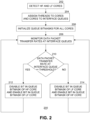
- FIG. 2 illustrates an example flow diagram of dynamic assignment of interface queues.
- the steps of FIG. 2 are performed by monitor 128 on core 130.
- monitor 128 stores the initial frequency settings and associated core classes and updates this information during runtime as needed (e.g., when a core moves from a high frequency setting to a low frequency setting and vice versa).
- processing continues with block 212.
- the bit in the queue bitmask of the HF core associated with the interface queue is disabled (i.e., cleared), and the bit in the queue bitmask of a LF core to now be associated with the interface queue is enabled (i.e., set). This reassigns the interface queue from a HF core to a LF core for subsequent processing of data packets. If the interface queue was already assigned to a LF core (e.g., the value of the bit in the queue bitmask is already the value the bit would be set to in block 212, then the bit setting operation of block 214 is omitted.
- processing when comparing a data transfer rate to a predetermined threshold, if a data packet transfer rate at an interface queue is greater than a predetermined threshold, then processing continues with block 214.
- the bit in the queue bitmask of the LF core associated with the interface queue is disabled (i.e., cleared), and the bit in queue bitmask of a HF core associated with the interface queue is enabled (i.e., set). This moves the interface queue from a LF core to a HF core for subsequent processing of data packets.
- the bit setting operation of block 214 is omitted. This scenario occurs when no change to the assignment of the interface queue to a core is needed.
- blocks 208-214 are performed for all interface queues.
- queue bitmasks 144, 146, ... 149 are changed depending on the monitored data packet transfer rates at the interface queues.
- this results in corresponding changes in assignments of interfaces queues to cores.
- Changing the interface queues assignments to cores results in different power consumption amounts of the system because different cores are now being used to process data packets from interface queues.
- This enables efficient processor core utilization according to traffic rates by dynamically assigning interface queues to cores based at least in part on the core frequencies.
- This approach is scalable for multicore virtual switches running with any number of high bandwidth physical/virtual interfaces. This approach can be used in conjunction with processor power management schemes by assigning different frequencies to different cores for dynamic interface queues assignments.
- C H is a subset of C where all the cores in C H are running at high frequency.
- C L is a subset of C where all the cores in C L are running in low frequency.
- C H and C L are mutually exclusive. For simplicity let us assume that C H and C L are not empty. There are separate sets of processes P H and P L which run on each of C H and C L respectively.
- Q is a set of k interface queues on which the process P H and P L of packet processing applications are polling for data.
- Q q i , where i ⁇ 0 , k ⁇ 1
- Q H is a subset of Q where all the interface queues are associated with high frequency cores and are polled by P H .
- Q L is a subset of Q where all the interface queues are associated with low frequency cores and are polled by P L .
- Q H and Q L are mutually exclusive.
- B is a bitmask of k bits which represents k interface queues as below.
- B b k ⁇ 1 b k ⁇ 2 ... b 0
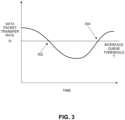
- FIG. 3 illustrates an example time series representation of dynamic assignment of interface queues based on traffic rate.
- Switch 402 includes monitor 128 monitor data packet transfer rates at the interface queues and to initialize and update the queue bitmasks.
- Switch 402 also includes packet processing threads for high frequency cores (PH) 412 and packet processing threads for low frequency cores (PL).
- PH high frequency cores
- PL low frequency cores
- the data packet transfer rate of an interface queue is used, but in other embodiments, there could be other metrics used to determine the processor core load.
- a flow lookup rate by the OVS application for the traffic received from a particular interface queue may be used.
- FIG. 5 illustrates an example computing system 500.
- computing system 500 includes a computing platform 501 coupled to a network 570 (which may be the Internet, for example).
- computing platform 501 is coupled to network 570 via network communication channel 575 and through at least one network I/O device 510 (e.g., a network interface controller (NIC) such as NIC 404) having one or more ports connected or coupled to network communication channel 575.
- network communication channel 575 includes a PHY device (not shown).
- network I/O device 510 is an Ethernet NIC.
- Network I/O device 510 transmits data packets from computing platform 501 over network 570 to other destinations and receives data packets from other destinations for forwarding to computing platform 501.
- computing platform 501 includes circuitry 520, primary memory 530, network (NW) I/O device driver 540, operating system (OS) 550, at least one application 560, and one or more storage devices 565.
- OS 550 is Linux ® .
- OS 550 is Windows ® Server.
- Network I/O device driver 540 operates to initialize and manage I/O requests performed by network I/O device 510.
- data packets and/or packet metadata transmitted to network I/O device 510 and/or received from network I/O device 510 are stored in one or more of primary memory 530 and/or storage devices 565.
- interface queues are stored in one or more of primary memory 530 and/or storage devices 565.
- application 560 is a packet processing (PP) application such as virtual switch 402 of FIG. 4 .
- Application 560 includes queue polling components and runs on one or more cores.
- Application 560 may also be run in or in conjunction with one or more VMs.
- storage devices 565 may be one or more of hard disk drives (HDDs) and/or solid-state drives (SSDs).
- storage devices 565 may be non-volatile memories (NVMs).
- circuitry 520 may communicatively couple to network I/O device 510 via communications link 555.
- communications link 555 is a peripheral component interface express (PCIe) bus conforming to version 3.0 or other versions of the PCIe standard published by the PCI Special Interest Group (PCI-SIG).
- operating system 550, NW I/O device driver 540, and application 560 are implemented, at least in part, via cooperation between one or more memory devices included in primary memory 530 (e.g., volatile or non-volatile memory devices), storage devices 565, and elements of circuitry 520 such as processing cores 522-1 to 522-m, where "m" is any positive whole integer greater than 2.
- OS 550, NW I/O device driver 540, and application 560 are executed by one or more processing cores 522-1 to 522-m.
- shared memory 154 of FIG. 1 is implemented by one or more of primary memory 530 and/or storage devices 565.
- computing platform 501 includes but is not limited to a server, a server array or server farm, a web server, a network server, an Internet server, a work station, a mini-computer, a main frame computer, a supercomputer, a network appliance, a web appliance, a distributed computing system, multiprocessor systems, processor-based systems, a laptop computer, a tablet computer, a smartphone, or a combination thereof.
- computing platform 501 is a disaggregated server.
- a disaggregated server is a server that breaks up components and resources into subsystems. Disaggregated servers can be adapted to changing storage or compute loads as needed without replacing or disrupting an entire server for an extended period of time.
- a server could, for example, be broken into modular compute, I/O, power and storage modules that can be shared among other nearby servers.
- Circuitry 520 having processing cores 522-1 to 522-m may include various commercially available processors, including without limitation Intel ® Atom ® , Celeron ® , Core (2) Duo ® , Core i3, Core i5, Core i7, Itanium ® , Pentium ® , Xeon ® or Xeon Phi ® processors, ARM processors, and similar processors. Circuitry 520 may include at least one cache 535 to store data.
- primary memory 530 may be composed of one or more memory devices or dies which may include various types of volatile and/or non-volatile memory.
- Volatile types of memory may include, but are not limited to, dynamic random-access memory (DRAM), static random-access memory (SRAM), thyristor RAM (TRAM) or zero-capacitor RAM (ZRAM).
- Non-volatile types of memory may include byte or block addressable types of non-volatile memory having a 3-dimensional (3-D) cross-point memory structure that includes chalcogenide phase change material (e.g., chalcogenide glass) hereinafter referred to as "3-D cross-point memory".
- chalcogenide phase change material e.g., chalcogenide glass
- Non-volatile types of memory may also include other types of byte or block addressable non-volatile memory such as, but not limited to, multi-threshold level NAND flash memory, NOR flash memory, single or multi-level phase change memory (PCM), resistive memory, nanowire memory, ferroelectric transistor random access memory (FeTRAM), magneto-resistive random-access memory (MRAM) that incorporates memristor technology, spin transfer torque MRAM (STT-MRAM), or a combination of any of the above.
- primary memory 530 may include one or more hard disk drives within and/or accessible by computing platform 501.
- data packets are transmitted to and/or received from network I/O device 510, and packets transferred between cores.
- Examples of a computer readable or machine-readable storage medium may include any tangible media capable of storing electronic data, including volatile memory or non-volatile memory, removable or non-removable memory, erasable or non-erasable memory, writeable or re-writeable memory, and so forth.
- Examples of computer executable instructions may include any suitable type of code, such as source code, compiled code, interpreted code, executable code, static code, dynamic code, object-oriented code, visual code, and the like. The examples are not limited in this context.
- processing component 702 may execute processing operations or logic for instructions stored on storage medium 600.
- Processing component 702 may include various hardware elements, software elements, or a combination of both.
- hardware elements may include devices, logic devices, components, processors, microprocessors, circuits, processor circuits, circuit elements (e.g., transistors, resistors, capacitors, inductors, and so forth), integrated circuits, application specific integrated circuits (ASIC), programmable logic devices (PLD), digital signal processors (DSP), field programmable gate array (FPGA), memory units, logic gates, registers, semiconductor device, chips, microchips, chip sets, and so forth.
- ASIC application specific integrated circuits
- PLD programmable logic devices
- DSP digital signal processors
- FPGA field programmable gate array
- Examples of software elements may include software components, programs, applications, computer programs, application programs, device drivers, system programs, software development programs, machine programs, operating system software, middleware, firmware, software modules, routines, subroutines, functions, methods, procedures, software interfaces, application program interfaces (API), instruction sets, computing code, computer code, code segments, computer code segments, words, values, symbols, or any combination thereof. Determining whether an example is implemented using hardware elements and/or software elements may vary in accordance with any number of factors, such as desired computational rate, power levels, heat tolerances, processing cycle budget, input data rates, output data rates, memory resources, data bus speeds and other design or performance constraints, as desired for a given example.
- other platform components 704 may include common computing elements, such as one or more processors, multi-core processors, co-processors, memory units, chipsets, controllers, peripherals, interfaces, oscillators, timing devices, video cards, audio cards, multimedia input/output (I/O) components (e.g., digital displays), power supplies, and so forth.
- processors such as one or more processors, multi-core processors, co-processors, memory units, chipsets, controllers, peripherals, interfaces, oscillators, timing devices, video cards, audio cards, multimedia input/output (I/O) components (e.g., digital displays), power supplies, and so forth.
- I/O multimedia input/output
- Examples of memory units may include without limitation various types of computer readable and machine readable storage media in the form of one or more higher speed memory units, such as read-only memory (ROM), random-access memory (RAM), dynamic RAM (DRAM), Double-Data-Rate DRAM (DDRAM), synchronous DRAM (SDRAM), static RAM (SRAM), programmable ROM (PROM), erasable programmable ROM (EPROM), electrically erasable programmable ROM (EEPROM), types of non-volatile memory such as 3-D cross-point memory that may be byte or block addressable.
- ROM read-only memory
- RAM random-access memory
- DRAM dynamic RAM
- DDRAM Double-Data-Rate DRAM
- SDRAM synchronous DRAM
- SRAM static RAM
- PROM programmable ROM
- EPROM erasable programmable ROM
- EEPROM electrically erasable programmable ROM
- Non-volatile types of memory may also include other types of byte or block addressable non-volatile memory such as, but not limited to, multi-threshold level NAND flash memory, NOR flash memory, single or multi-level PCM, resistive memory, nanowire memory, FeTRAM, MRAM that incorporates memristor technology, STT-MRAM, or a combination of any of the above.
- Other types of computer readable and machine-readable storage media may also include magnetic or optical cards, an array of devices such as Redundant Array of Independent Disks (RAID) drives, solid state memory devices (e.g., USB memory), solid state drives (SSD) and any other type of storage media suitable for storing information.
- RAID Redundant Array of Independent Disks
- SSD solid state drives
- communications interface 706 may include logic and/or features to support a communication interface.
- communications interface 706 may include one or more communication interfaces that operate according to various communication protocols or standards to communicate over direct or network communication links or channels.
- Direct communications may occur via use of communication protocols or standards described in one or more industry standards (including progenies and variants) such as those associated with the PCIe specification.
- Network communications may occur via use of communication protocols or standards such those described in one or more Ethernet standards promulgated by IEEE.
- one such Ethernet standard may include IEEE 802.3.
- Network communication may also occur according to one or more OpenFlow specifications such as the OpenFlow Switch Specification.
- computing platform 700 including logic represented by the instructions stored on storage medium 600 may be implemented using any combination of discrete circuitry, ASICs, logic gates and/or single chip architectures. Further, the features of computing platform 700 may be implemented using microcontrollers, programmable logic arrays and/or microprocessors or any combination of the foregoing where suitably appropriate. It is noted that hardware, firmware and/or software elements may be collectively or individually referred to herein as “logic” or “circuit.”
- exemplary computing platform 700 shown in the block diagram of FIG. 7 may represent one functionally descriptive example of many potential implementations. Accordingly, division, omission or inclusion of block functions depicted in the accompanying figures does not infer that the hardware components, circuits, software and/or elements for implementing these functions would necessarily be divided, omitted, or included in embodiments.
- hardware elements may include devices, components, processors, microprocessors, circuits, circuit elements (e.g., transistors, resistors, capacitors, inductors, and so forth), integrated circuits, ASIC, programmable logic devices (PLD), digital signal processors (DSP), FPGA, memory units, logic gates, registers, semiconductor device, chips, microchips, chip sets, and so forth.
- PLD programmable logic devices
- DSP digital signal processors
- FPGA field-programmable gate arrays
- memory units logic gates, registers, semiconductor device, chips, microchips, chip sets, and so forth.
- software elements may include software components, programs, applications, computer programs, application programs, system programs, machine programs, operating system software, middleware, firmware, software modules, routines, subroutines, functions, methods, procedures, software interfaces, application program interfaces (API), instruction sets, computing code, computer code, code segments, computer code segments, words, values, symbols, or any combination thereof. Determining whether an example is implemented using hardware elements and/or software elements may vary in accordance with any number of factors, such as desired computational rate, power levels, heat tolerances, processing cycle budget, input data rates, output data rates, memory resources, data bus speeds and other design or performance constraints, as desired for a given implementation.
- a computer-readable medium may include a non-transitory storage medium to store logic.
- the non-transitory storage medium may include one or more types of computer-readable storage media capable of storing electronic data, including volatile memory or non-volatile memory, removable or non-removable memory, erasable or non-erasable memory, writeable or re-writeable memory, and so forth.
- the logic may include various software elements, such as software components, programs, applications, computer programs, application programs, system programs, machine programs, operating system software, middleware, firmware, software modules, routines, subroutines, functions, methods, procedures, software interfaces, API, instruction sets, computing code, computer code, code segments, computer code segments, words, values, symbols, or any combination thereof.
- a logic flow or scheme may be implemented in software, firmware, and/or hardware.
- a logic flow or scheme may be implemented by computer executable instructions stored on at least one non-transitory computer readable medium or machine readable medium, such as an optical, magnetic or semiconductor storage. The embodiments are not limited in this context.
- Coupled and “connected” along with their derivatives. These terms are not necessarily intended as synonyms for each other. For example, descriptions using the terms “connected” and/or “coupled” may indicate that two or more elements are in direct physical or electrical contact with each other. The term “coupled,” however, may also mean that two or more elements are not in direct contact with each other, but yet still co-operate or interact with each other.
Landscapes
- Engineering & Computer Science (AREA)
- Computer Networks & Wireless Communication (AREA)
- Signal Processing (AREA)
- Environmental & Geological Engineering (AREA)
- Software Systems (AREA)
- Theoretical Computer Science (AREA)
- Physics & Mathematics (AREA)
- General Engineering & Computer Science (AREA)
- General Physics & Mathematics (AREA)
- Data Exchanges In Wide-Area Networks (AREA)
- Power Sources (AREA)
Claims (7)
- Verfahren zum Betreiben eines Systems (100), das mehrere Schnittstellenwarteschlangen (110, 112, ... 126) und mehrere Kerne (132, 134, 136) umfasst, wobei die Kerne in zwei Klassen von Kernen einer hohen Frequenz und Kernen einer tiefen Frequenz unterteilt sind und das Verfahren Folgendes umfasst:Zuweisen (204) eines Paketverarbeitungs-Threads zu jedem Kern (132, 134, 136) und jedes Kerns (132, 134, 136) zu einer oder mehreren Schnittstellenwarteschlangen (110, 112, ... 126) ;Initialisieren (206) einer Bitmaske (144, 146, 149) für jeden Kern (132, 134, 136), wobei jede Bitmaske eine Bitanzahl umfasst, die gleich einer Anzahl der Schnittstellenwarteschlangen (110, 112, ... 126) ist, und ein Bit in der Bitmaske einer Schnittstellenwarteschlange zugeordnet ist;Überwachen (208) für jede der Schnittstellenwarteschlangen (110, 112, ... 126) entweder einer Eingabe- oder einer Ausgabe-Datenpaketübertragungsrate in der Schnittstellenwarteschlange (110, 112, ... 126);Zuweisen (212) für jede der Schnittstellenwarteschlangen (110, 112, ... 126) der Schnittstellenwarteschlange (110, 112, ... 126) von einem Kern (132, 134) einer hohen Frequenz zu einem Kern (136) einer tiefen Frequenz oder Zuweisen (214) der Schnittstellenwarteschlange (110, 112, ... 126) von einem Kern (136) einer tiefen Frequenz zu einem Kern einer hohen Frequenz mindestens teilweise auf der Grundlage eines Vergleichs der Datenpaketübertragungsrate in der Schnittstellenwarteschlange (110, 112, ... 126) mit einem Schwellenwert,wobei das Zuweisen der Schnittstellenwarteschlange (110, 112, ... 126) von dem Kern (132, 134) einer hohen Frequenz zum Kern (136) einer tiefen Frequenz ein Deaktivieren des Bits, das der Schnittstellenwarteschlange (110, 112, ... 126) zugeordnet ist, in der Bitmaske des Kerns (132, 134) einer hohen Frequenz und ein Aktivieren des Bits, das der Schnittstellenwarteschlange (110, 112, ... 126) zugeordnet ist, in der Bitmaske des Kerns (136) einer tiefen Frequenz umfasst oder das Zuweisen der Schnittstellenwarteschlange (110, 112, ... 126) von dem Kern (136) einer tiefen Frequenz zum Kern (132, 134) einer hohen Frequenz ein Deaktivieren des Bits, das der Schnittstellenwarteschlange (110, 112, ... 126) zugeordnet ist, in der Bitmaske des Kerns (136) einer tiefen Frequenz und ein Aktivieren des Bits, das der Schnittstellenwarteschlange (110, 112, ... 126) zugeordnet ist, in der Bitmaske des Kerns (132, 134) einer hohen Frequenz umfasst.
- Verfahren nach Anspruch 1, das ein Detektieren (202) von Kernen (132, 134) einer hohen Frequenz und Kernen (136) einer tiefen Frequenz umfasst.
- Verfahren nach Anspruch 1, wobei der Paketverarbeitungs-Thread ein oder mehrere Datenpakete aus einer oder mehreren der Schnittstellenwarteschlangen (110, 112, ... 126) liest, die dem Kern zugewiesen sind, dem der Paketverarbeitungs-Thread zugewiesen ist.
- System (100), das Folgendes umfasst:mehrere Schnittstellenwarteschlangen (110, 112, ... 126) und mehrere Kerne (132, 134, 136), wobei die Kerne in zwei Klassen von Kernen einer hohen Frequenz und Kernen einer tiefen Frequenz unterteilt sind; undeine Überwachungsvorrichtung (128), die konfiguriert ist zumZuweisen eines Paketverarbeitungs- Threads zu jedem Kern (132, 134, 136) und jedes Kerns (132, 134, 136) zu einer oder mehreren Schnittstellenwarteschlangen (110, 112, ... 126);Initialisieren einer Bitmaske (144, 146, 149) für jeden Kern (132, 134, 136), wobei jede Bitmaske eine Bitanzahl umfasst, die gleich einer Anzahl der Schnittstellenwarteschlangen (110, 112, ... 126) ist, und ein Bit in der Bitmaske einer Schnittstellenwarteschlange zugeordnet ist;Überwachen für jede der Schnittstellenwarteschlangen (110, 112, ... 126) entweder einer Eingabe- oder einer Ausgabe-Datenpaketübertragungsrate in der Schnittstellenwarteschlange (110, 112, ... 126);Zuweisen für jede der Schnittstellenwarteschlangen (110, 112, ... 126) der Schnittstellenwarteschlange (110, 112, ... 126) von einem Kern (132, 134) einer hohen Frequenz zu einem Kern (136) einer tiefen Frequenz oder Zuweisen der Schnittstellenwarteschlange (110, 112, ... 126) von einem Kern (136) einer tiefen Frequenz zu einem Kern einer hohen Frequenz mindestens teilweise auf der Grundlage eines Vergleichs der Datenpaketübertragungsrate in der Schnittstellenwarteschlange (110, 112, ... 126) mit einem Schwellenwert,wobei das Zuweisen der Schnittstellenwarteschlange (110, 112, ... 126) von dem Kern (132, 134) einer hohen Frequenz zum Kern (136) einer tiefen Frequenz ein Deaktivieren des Bits, das der Schnittstellenwarteschlange (110, 112, ... 126) zugeordnet ist, in der Bitmaske des Kerns (132, 134) einer hohen Frequenz und ein Aktivieren des Bits, das der Schnittstellenwarteschlange (110, 112, ... 126) zugeordnet ist, in der Bitmaske des Kerns (136) einer tiefen Frequenz umfasst oder das Zuweisen der Schnittstellenwarteschlange (110, 112, ... 126) von dem Kern (136) einer tiefen Frequenz zum Kern (132, 134) einer hohen Frequenz ein Deaktivieren des Bits, das der Schnittstellenwarteschlange (110, 112, ... 126) zugeordnet ist, in der Bitmaske des Kerns (136) einer tiefen Frequenz und ein Aktivieren des Bits, das der Schnittstellenwarteschlange (110, 112, ... 126) zugeordnet ist, in der Bitmaske des Kerns (132, 134) einer hohen Frequenz umfasst.
- System nach Anspruch 4, wobei die Überwachungsvorrichtung (130) konfiguriert ist, Kerne (132, 134) einer hohen Frequenz und Kerne (136) einer tiefen Frequenz zu detektieren.
- System nach Anspruch 4, wobei der Paketverarbeitungs-Thread konfiguriert ist, ein oder mehrere Datenpakete aus einer oder mehreren der Schnittstellenwarteschlangen (110, 112, ... 126) liest, die dem Kern zugewiesen sind, dem der Paketverarbeitungs-Thread zugewiesen ist.
- Mindestens ein maschinenlesbares Medium, das mehrere Befehle enthält, die in Reaktion darauf, dass sie durch ein System ausgeführt werden, verursachen, dass das System ein Verfahren nach einem der Ansprüche 1 bis 3 ausführt.
Applications Claiming Priority (1)
| Application Number | Priority Date | Filing Date | Title |
|---|---|---|---|
| US16/160,176 US11431565B2 (en) | 2018-10-15 | 2018-10-15 | Dynamic traffic-aware interface queue switching among processor cores |
Publications (2)
| Publication Number | Publication Date |
|---|---|
| EP3640797A1 EP3640797A1 (de) | 2020-04-22 |
| EP3640797B1 true EP3640797B1 (de) | 2024-12-04 |
Family
ID=65275776
Family Applications (1)
| Application Number | Title | Priority Date | Filing Date |
|---|---|---|---|
| EP19183500.8A Active EP3640797B1 (de) | 2018-10-15 | 2019-06-28 | Dynamische verkehrsbewusste schnittstellen-warteschlangenumschaltung zwischen prozessorkernen |
Country Status (2)
| Country | Link |
|---|---|
| US (1) | US11431565B2 (de) |
| EP (1) | EP3640797B1 (de) |
Families Citing this family (4)
| Publication number | Priority date | Publication date | Assignee | Title |
|---|---|---|---|---|
| US11431565B2 (en) * | 2018-10-15 | 2022-08-30 | Intel Corporation | Dynamic traffic-aware interface queue switching among processor cores |
| EP4295230A1 (de) * | 2021-02-18 | 2023-12-27 | Telefonaktiebolaget LM Ericsson (publ) | Nichtintrusives verfahren für ressourcen- und energieeffiziente benutzerebenenimplementierungen |
| CN113132272B (zh) * | 2021-03-31 | 2023-02-14 | 中国人民解放军战略支援部队信息工程大学 | 基于流量感知的网络交换频率动态调整方法、系统及网络交换芯片结构 |
| CN115469963A (zh) * | 2021-06-10 | 2022-12-13 | 华为技术有限公司 | 一种多线程转发的负载均衡方法及相关装置 |
Citations (3)
| Publication number | Priority date | Publication date | Assignee | Title |
|---|---|---|---|---|
| US20040054999A1 (en) * | 2002-08-30 | 2004-03-18 | Willen James W. | Computer OS dispatcher operation with virtual switching queue and IP queues |
| US20060056406A1 (en) * | 2004-09-10 | 2006-03-16 | Cavium Networks | Packet queuing, scheduling and ordering |
| US7159221B1 (en) * | 2002-08-30 | 2007-01-02 | Unisys Corporation | Computer OS dispatcher operation with user controllable dedication |
Family Cites Families (13)
| Publication number | Priority date | Publication date | Assignee | Title |
|---|---|---|---|---|
| GB2372172B (en) * | 2001-05-31 | 2002-12-24 | Ericsson Telefon Ab L M | Congestion handling in a packet data network |
| US8533716B2 (en) * | 2004-03-31 | 2013-09-10 | Synopsys, Inc. | Resource management in a multicore architecture |
| US7554909B2 (en) * | 2005-03-21 | 2009-06-30 | Intel Corporation | Dynamic service management for multicore processors |
| US8239699B2 (en) * | 2009-06-26 | 2012-08-07 | Intel Corporation | Method and apparatus for performing energy-efficient network packet processing in a multi processor core system |
| US8639862B2 (en) * | 2009-07-21 | 2014-01-28 | Applied Micro Circuits Corporation | System-on-chip queue status power management |
| KR102284467B1 (ko) | 2014-12-22 | 2021-08-03 | 인텔 코포레이션 | 네트워크 디바이스에서의 수신된 패킷의 처리와 연관된 전력 관리 기법 |
| US10234930B2 (en) * | 2015-02-13 | 2019-03-19 | Intel Corporation | Performing power management in a multicore processor |
| US20160306416A1 (en) * | 2015-04-16 | 2016-10-20 | Intel Corporation | Apparatus and Method for Adjusting Processor Power Usage Based On Network Load |
| US20170351311A1 (en) | 2016-06-07 | 2017-12-07 | Intel Corporation | Power aware packet distribution |
| CN108334405A (zh) * | 2017-01-20 | 2018-07-27 | 阿里巴巴集团控股有限公司 | 频率异构cpu,频率异构实现方法、装置及任务调度方法 |
| US20190114206A1 (en) * | 2017-10-18 | 2019-04-18 | Cisco Technology, Inc. | System and method for providing a performance based packet scheduler |
| US11847008B2 (en) | 2018-04-12 | 2023-12-19 | Intel Corporation | Technologies for providing efficient detection of idle poll loops |
| US11431565B2 (en) * | 2018-10-15 | 2022-08-30 | Intel Corporation | Dynamic traffic-aware interface queue switching among processor cores |
-
2018
- 2018-10-15 US US16/160,176 patent/US11431565B2/en active Active
-
2019
- 2019-06-28 EP EP19183500.8A patent/EP3640797B1/de active Active
Patent Citations (3)
| Publication number | Priority date | Publication date | Assignee | Title |
|---|---|---|---|---|
| US20040054999A1 (en) * | 2002-08-30 | 2004-03-18 | Willen James W. | Computer OS dispatcher operation with virtual switching queue and IP queues |
| US7159221B1 (en) * | 2002-08-30 | 2007-01-02 | Unisys Corporation | Computer OS dispatcher operation with user controllable dedication |
| US20060056406A1 (en) * | 2004-09-10 | 2006-03-16 | Cavium Networks | Packet queuing, scheduling and ordering |
Non-Patent Citations (2)
| Title |
|---|
| SHANMUGALINGAM SIVASOTHY ET AL: "DPDK Open vSwitch performance validation with mirroring feature", 2016 23RD INTERNATIONAL CONFERENCE ON TELECOMMUNICATIONS (ICT), IEEE, 16 May 2016 (2016-05-16), pages 1 - 6, XP032916831, DOI: 10.1109/ICT.2016.7500387 * |
| SU ZIDONG ET AL: "A new model for DPDK-based virtual switches", 2017 IEEE CONFERENCE ON NETWORK SOFTWARIZATION (NETSOFT), IEEE, 3 July 2017 (2017-07-03), pages 1 - 5, XP033143121, DOI: 10.1109/NETSOFT.2017.8004211 * |
Also Published As
| Publication number | Publication date |
|---|---|
| US20190052530A1 (en) | 2019-02-14 |
| US11431565B2 (en) | 2022-08-30 |
| EP3640797A1 (de) | 2020-04-22 |
Similar Documents
| Publication | Publication Date | Title |
|---|---|---|
| US11726910B2 (en) | Dynamic control of memory bandwidth allocation for a processor | |
| US10331492B2 (en) | Techniques to dynamically allocate resources of configurable computing resources | |
| US11381515B2 (en) | On-demand packet queuing in a network device | |
| CN107003905B (zh) | 针对可配置计算资源的本地服务链而动态分配资源的技术 | |
| JP6545802B2 (ja) | ネットワークデバイスにおける受信パケットの処理と関連する電力管理のための技術 | |
| CN110908495A (zh) | 使用硬件队列管理器的功率感知负荷平衡 | |
| US8566494B2 (en) | Traffic class based adaptive interrupt moderation | |
| US20160378570A1 (en) | Techniques for Offloading Computational Tasks between Nodes | |
| EP3640797A1 (de) | Dynamische verkehrsbewusste schnittstellen-warteschlangenumschaltung zwischen prozessorkernen | |
| US9601180B2 (en) | Automatic partial array self-refresh | |
| US12566559B2 (en) | Managing memory system quality of service (QoS) | |
| CN105308571A (zh) | 基于活动处理器的动态电压和频率管理 | |
| US12373363B2 (en) | Adaptive pipeline selection for accelerating memory copy operations | |
| US11847008B2 (en) | Technologies for providing efficient detection of idle poll loops | |
| US20190253357A1 (en) | Load balancing based on packet processing loads | |
| US9952911B2 (en) | Dynamically optimized device driver protocol assist threads | |
| EP3771164B1 (de) | Technologien zur bereitstellung einer adaptiven abfrage von paketwarteschlangen | |
| US20230035142A1 (en) | Input work item flow metric for computing environment telemetry | |
| US10452574B2 (en) | Read performance on a SATA storage device behind a host bus adapter | |
| US10073723B2 (en) | Dynamic range-based messaging | |
| WO2025085146A1 (en) | Using a backup capacitor as an alternate energy source via dynamic apl budgeting |
Legal Events
| Date | Code | Title | Description |
|---|---|---|---|
| PUAI | Public reference made under article 153(3) epc to a published international application that has entered the european phase |
Free format text: ORIGINAL CODE: 0009012 |
|
| STAA | Information on the status of an ep patent application or granted ep patent |
Free format text: STATUS: THE APPLICATION HAS BEEN PUBLISHED |
|
| AK | Designated contracting states |
Kind code of ref document: A1 Designated state(s): AL AT BE BG CH CY CZ DE DK EE ES FI FR GB GR HR HU IE IS IT LI LT LU LV MC MK MT NL NO PL PT RO RS SE SI SK SM TR |
|
| AX | Request for extension of the european patent |
Extension state: BA ME |
|
| STAA | Information on the status of an ep patent application or granted ep patent |
Free format text: STATUS: REQUEST FOR EXAMINATION WAS MADE |
|
| 17P | Request for examination filed |
Effective date: 20200928 |
|
| RBV | Designated contracting states (corrected) |
Designated state(s): AL AT BE BG CH CY CZ DE DK EE ES FI FR GB GR HR HU IE IS IT LI LT LU LV MC MK MT NL NO PL PT RO RS SE SI SK SM TR |
|
| STAA | Information on the status of an ep patent application or granted ep patent |
Free format text: STATUS: EXAMINATION IS IN PROGRESS |
|
| 17Q | First examination report despatched |
Effective date: 20210901 |
|
| GRAP | Despatch of communication of intention to grant a patent |
Free format text: ORIGINAL CODE: EPIDOSNIGR1 |
|
| STAA | Information on the status of an ep patent application or granted ep patent |
Free format text: STATUS: GRANT OF PATENT IS INTENDED |
|
| INTG | Intention to grant announced |
Effective date: 20240709 |
|
| GRAS | Grant fee paid |
Free format text: ORIGINAL CODE: EPIDOSNIGR3 |
|
| GRAA | (expected) grant |
Free format text: ORIGINAL CODE: 0009210 |
|
| STAA | Information on the status of an ep patent application or granted ep patent |
Free format text: STATUS: THE PATENT HAS BEEN GRANTED |
|
| AK | Designated contracting states |
Kind code of ref document: B1 Designated state(s): AL AT BE BG CH CY CZ DE DK EE ES FI FR GB GR HR HU IE IS IT LI LT LU LV MC MK MT NL NO PL PT RO RS SE SI SK SM TR |
|
| REG | Reference to a national code |
Ref country code: GB Ref legal event code: FG4D |
|
| REG | Reference to a national code |
Ref country code: CH Ref legal event code: EP |
|
| REG | Reference to a national code |
Ref country code: DE Ref legal event code: R096 Ref document number: 602019062859 Country of ref document: DE |
|
| REG | Reference to a national code |
Ref country code: IE Ref legal event code: FG4D |
|
| P01 | Opt-out of the competence of the unified patent court (upc) registered |
Free format text: CASE NUMBER: APP_64915/2024 Effective date: 20241209 |
|
| REG | Reference to a national code |
Ref country code: LT Ref legal event code: MG9D |
|
| REG | Reference to a national code |
Ref country code: NL Ref legal event code: MP Effective date: 20241204 |
|
| PG25 | Lapsed in a contracting state [announced via postgrant information from national office to epo] |
Ref country code: HR Free format text: LAPSE BECAUSE OF FAILURE TO SUBMIT A TRANSLATION OF THE DESCRIPTION OR TO PAY THE FEE WITHIN THE PRESCRIBED TIME-LIMIT Effective date: 20241204 |
|
| PG25 | Lapsed in a contracting state [announced via postgrant information from national office to epo] |
Ref country code: FI Free format text: LAPSE BECAUSE OF FAILURE TO SUBMIT A TRANSLATION OF THE DESCRIPTION OR TO PAY THE FEE WITHIN THE PRESCRIBED TIME-LIMIT Effective date: 20241204 |
|
| PG25 | Lapsed in a contracting state [announced via postgrant information from national office to epo] |
Ref country code: BG Free format text: LAPSE BECAUSE OF FAILURE TO SUBMIT A TRANSLATION OF THE DESCRIPTION OR TO PAY THE FEE WITHIN THE PRESCRIBED TIME-LIMIT Effective date: 20241204 |
|
| PG25 | Lapsed in a contracting state [announced via postgrant information from national office to epo] |
Ref country code: ES Free format text: LAPSE BECAUSE OF FAILURE TO SUBMIT A TRANSLATION OF THE DESCRIPTION OR TO PAY THE FEE WITHIN THE PRESCRIBED TIME-LIMIT Effective date: 20241204 |
|
| PG25 | Lapsed in a contracting state [announced via postgrant information from national office to epo] |
Ref country code: NO Free format text: LAPSE BECAUSE OF FAILURE TO SUBMIT A TRANSLATION OF THE DESCRIPTION OR TO PAY THE FEE WITHIN THE PRESCRIBED TIME-LIMIT Effective date: 20250304 |
|
| PG25 | Lapsed in a contracting state [announced via postgrant information from national office to epo] |
Ref country code: LV Free format text: LAPSE BECAUSE OF FAILURE TO SUBMIT A TRANSLATION OF THE DESCRIPTION OR TO PAY THE FEE WITHIN THE PRESCRIBED TIME-LIMIT Effective date: 20241204 Ref country code: GR Free format text: LAPSE BECAUSE OF FAILURE TO SUBMIT A TRANSLATION OF THE DESCRIPTION OR TO PAY THE FEE WITHIN THE PRESCRIBED TIME-LIMIT Effective date: 20250305 |
|
| PG25 | Lapsed in a contracting state [announced via postgrant information from national office to epo] |
Ref country code: RS Free format text: LAPSE BECAUSE OF FAILURE TO SUBMIT A TRANSLATION OF THE DESCRIPTION OR TO PAY THE FEE WITHIN THE PRESCRIBED TIME-LIMIT Effective date: 20250304 |
|
| PG25 | Lapsed in a contracting state [announced via postgrant information from national office to epo] |
Ref country code: NL Free format text: LAPSE BECAUSE OF FAILURE TO SUBMIT A TRANSLATION OF THE DESCRIPTION OR TO PAY THE FEE WITHIN THE PRESCRIBED TIME-LIMIT Effective date: 20241204 |
|
| REG | Reference to a national code |
Ref country code: AT Ref legal event code: MK05 Ref document number: 1748864 Country of ref document: AT Kind code of ref document: T Effective date: 20241204 |
|
| PG25 | Lapsed in a contracting state [announced via postgrant information from national office to epo] |
Ref country code: SM Free format text: LAPSE BECAUSE OF FAILURE TO SUBMIT A TRANSLATION OF THE DESCRIPTION OR TO PAY THE FEE WITHIN THE PRESCRIBED TIME-LIMIT Effective date: 20241204 |
|
| PG25 | Lapsed in a contracting state [announced via postgrant information from national office to epo] |
Ref country code: PL Free format text: LAPSE BECAUSE OF FAILURE TO SUBMIT A TRANSLATION OF THE DESCRIPTION OR TO PAY THE FEE WITHIN THE PRESCRIBED TIME-LIMIT Effective date: 20241204 |
|
| PGFP | Annual fee paid to national office [announced via postgrant information from national office to epo] |
Ref country code: DE Payment date: 20250521 Year of fee payment: 7 |
|
| PG25 | Lapsed in a contracting state [announced via postgrant information from national office to epo] |
Ref country code: IS Free format text: LAPSE BECAUSE OF FAILURE TO SUBMIT A TRANSLATION OF THE DESCRIPTION OR TO PAY THE FEE WITHIN THE PRESCRIBED TIME-LIMIT Effective date: 20250404 |
|
| PG25 | Lapsed in a contracting state [announced via postgrant information from national office to epo] |
Ref country code: PT Free format text: LAPSE BECAUSE OF FAILURE TO SUBMIT A TRANSLATION OF THE DESCRIPTION OR TO PAY THE FEE WITHIN THE PRESCRIBED TIME-LIMIT Effective date: 20250404 |
|
| PG25 | Lapsed in a contracting state [announced via postgrant information from national office to epo] |
Ref country code: EE Free format text: LAPSE BECAUSE OF FAILURE TO SUBMIT A TRANSLATION OF THE DESCRIPTION OR TO PAY THE FEE WITHIN THE PRESCRIBED TIME-LIMIT Effective date: 20241204 |
|
| PG25 | Lapsed in a contracting state [announced via postgrant information from national office to epo] |
Ref country code: AT Free format text: LAPSE BECAUSE OF FAILURE TO SUBMIT A TRANSLATION OF THE DESCRIPTION OR TO PAY THE FEE WITHIN THE PRESCRIBED TIME-LIMIT Effective date: 20241204 Ref country code: RO Free format text: LAPSE BECAUSE OF FAILURE TO SUBMIT A TRANSLATION OF THE DESCRIPTION OR TO PAY THE FEE WITHIN THE PRESCRIBED TIME-LIMIT Effective date: 20241204 |
|
| PG25 | Lapsed in a contracting state [announced via postgrant information from national office to epo] |
Ref country code: SK Free format text: LAPSE BECAUSE OF FAILURE TO SUBMIT A TRANSLATION OF THE DESCRIPTION OR TO PAY THE FEE WITHIN THE PRESCRIBED TIME-LIMIT Effective date: 20241204 |
|
| PG25 | Lapsed in a contracting state [announced via postgrant information from national office to epo] |
Ref country code: CZ Free format text: LAPSE BECAUSE OF FAILURE TO SUBMIT A TRANSLATION OF THE DESCRIPTION OR TO PAY THE FEE WITHIN THE PRESCRIBED TIME-LIMIT Effective date: 20241204 |
|
| PG25 | Lapsed in a contracting state [announced via postgrant information from national office to epo] |
Ref country code: IT Free format text: LAPSE BECAUSE OF FAILURE TO SUBMIT A TRANSLATION OF THE DESCRIPTION OR TO PAY THE FEE WITHIN THE PRESCRIBED TIME-LIMIT Effective date: 20241204 |
|
| REG | Reference to a national code |
Ref country code: DE Ref legal event code: R097 Ref document number: 602019062859 Country of ref document: DE |
|
| PG25 | Lapsed in a contracting state [announced via postgrant information from national office to epo] |
Ref country code: SE Free format text: LAPSE BECAUSE OF FAILURE TO SUBMIT A TRANSLATION OF THE DESCRIPTION OR TO PAY THE FEE WITHIN THE PRESCRIBED TIME-LIMIT Effective date: 20241204 |
|
| PG25 | Lapsed in a contracting state [announced via postgrant information from national office to epo] |
Ref country code: DK Free format text: LAPSE BECAUSE OF FAILURE TO SUBMIT A TRANSLATION OF THE DESCRIPTION OR TO PAY THE FEE WITHIN THE PRESCRIBED TIME-LIMIT Effective date: 20241204 |
|
| PLBE | No opposition filed within time limit |
Free format text: ORIGINAL CODE: 0009261 |
|
| STAA | Information on the status of an ep patent application or granted ep patent |
Free format text: STATUS: NO OPPOSITION FILED WITHIN TIME LIMIT |
|
| REG | Reference to a national code |
Ref country code: CH Ref legal event code: L10 Free format text: ST27 STATUS EVENT CODE: U-0-0-L10-L00 (AS PROVIDED BY THE NATIONAL OFFICE) Effective date: 20251015 |
|
| 26N | No opposition filed |
Effective date: 20250905 |
|
| REG | Reference to a national code |
Ref country code: CH Ref legal event code: H13 Free format text: ST27 STATUS EVENT CODE: U-0-0-H10-H13 (AS PROVIDED BY THE NATIONAL OFFICE) Effective date: 20260127 |
|
| PG25 | Lapsed in a contracting state [announced via postgrant information from national office to epo] |
Ref country code: MC Free format text: LAPSE BECAUSE OF FAILURE TO SUBMIT A TRANSLATION OF THE DESCRIPTION OR TO PAY THE FEE WITHIN THE PRESCRIBED TIME-LIMIT Effective date: 20241204 |
|
| PG25 | Lapsed in a contracting state [announced via postgrant information from national office to epo] |
Ref country code: LU Free format text: LAPSE BECAUSE OF NON-PAYMENT OF DUE FEES Effective date: 20250628 |
|
| GBPC | Gb: european patent ceased through non-payment of renewal fee |
Effective date: 20250628 |
|
| REG | Reference to a national code |
Ref country code: BE Ref legal event code: MM Effective date: 20250630 |
|
| PG25 | Lapsed in a contracting state [announced via postgrant information from national office to epo] |
Ref country code: GB Free format text: LAPSE BECAUSE OF NON-PAYMENT OF DUE FEES Effective date: 20250628 |
|
| PG25 | Lapsed in a contracting state [announced via postgrant information from national office to epo] |
Ref country code: IE Free format text: LAPSE BECAUSE OF NON-PAYMENT OF DUE FEES Effective date: 20250628 |
|
| PG25 | Lapsed in a contracting state [announced via postgrant information from national office to epo] |
Ref country code: BE Free format text: LAPSE BECAUSE OF NON-PAYMENT OF DUE FEES Effective date: 20250630 |
|
| PG25 | Lapsed in a contracting state [announced via postgrant information from national office to epo] |
Ref country code: FR Free format text: LAPSE BECAUSE OF NON-PAYMENT OF DUE FEES Effective date: 20250630 |
|
| PG25 | Lapsed in a contracting state [announced via postgrant information from national office to epo] |
Ref country code: CH Free format text: LAPSE BECAUSE OF NON-PAYMENT OF DUE FEES Effective date: 20250630 |