EP3640586A1 - Bilderfassungsverfahren - Google Patents
Bilderfassungsverfahren Download PDFInfo
- Publication number
- EP3640586A1 EP3640586A1 EP19201285.4A EP19201285A EP3640586A1 EP 3640586 A1 EP3640586 A1 EP 3640586A1 EP 19201285 A EP19201285 A EP 19201285A EP 3640586 A1 EP3640586 A1 EP 3640586A1
- Authority
- EP
- European Patent Office
- Prior art keywords
- acquisition
- image
- locations
- camera
- scene
- Prior art date
- Legal status (The legal status is an assumption and is not a legal conclusion. Google has not performed a legal analysis and makes no representation as to the accuracy of the status listed.)
- Withdrawn
Links
Images
Classifications
-
- H—ELECTRICITY
- H04—ELECTRIC COMMUNICATION TECHNIQUE
- H04N—PICTORIAL COMMUNICATION, e.g. TELEVISION
- H04N23/00—Cameras or camera modules comprising electronic image sensors; Control thereof
- H04N23/95—Computational photography systems, e.g. light-field imaging systems
- H04N23/951—Computational photography systems, e.g. light-field imaging systems by using two or more images to influence resolution, frame rate or aspect ratio
-
- G—PHYSICS
- G01—MEASURING; TESTING
- G01C—MEASURING DISTANCES, LEVELS OR BEARINGS; SURVEYING; NAVIGATION; GYROSCOPIC INSTRUMENTS; PHOTOGRAMMETRY OR VIDEOGRAMMETRY
- G01C11/00—Photogrammetry or videogrammetry, e.g. stereogrammetry; Photographic surveying
- G01C11/02—Picture taking arrangements specially adapted for photogrammetry or photographic surveying, e.g. controlling overlapping of pictures
-
- G—PHYSICS
- G06—COMPUTING OR CALCULATING; COUNTING
- G06T—IMAGE DATA PROCESSING OR GENERATION, IN GENERAL
- G06T17/00—Three-dimensional [3D] modelling for computer graphics
-
- G—PHYSICS
- G06—COMPUTING OR CALCULATING; COUNTING
- G06T—IMAGE DATA PROCESSING OR GENERATION, IN GENERAL
- G06T7/00—Image analysis
- G06T7/50—Depth or shape recovery
- G06T7/521—Depth or shape recovery from laser ranging, e.g. using interferometry; from the projection of structured light
-
- G—PHYSICS
- G06—COMPUTING OR CALCULATING; COUNTING
- G06T—IMAGE DATA PROCESSING OR GENERATION, IN GENERAL
- G06T7/00—Image analysis
- G06T7/50—Depth or shape recovery
- G06T7/55—Depth or shape recovery from multiple images
- G06T7/593—Depth or shape recovery from multiple images from stereo images
-
- H—ELECTRICITY
- H04—ELECTRIC COMMUNICATION TECHNIQUE
- H04N—PICTORIAL COMMUNICATION, e.g. TELEVISION
- H04N23/00—Cameras or camera modules comprising electronic image sensors; Control thereof
- H04N23/60—Control of cameras or camera modules
- H04N23/695—Control of camera direction for changing a field of view, e.g. pan, tilt or based on tracking of objects
-
- H—ELECTRICITY
- H04—ELECTRIC COMMUNICATION TECHNIQUE
- H04N—PICTORIAL COMMUNICATION, e.g. TELEVISION
- H04N23/00—Cameras or camera modules comprising electronic image sensors; Control thereof
- H04N23/90—Arrangement of cameras or camera modules, e.g. multiple cameras in TV studios or sports stadiums
-
- G—PHYSICS
- G06—COMPUTING OR CALCULATING; COUNTING
- G06T—IMAGE DATA PROCESSING OR GENERATION, IN GENERAL
- G06T2207/00—Indexing scheme for image analysis or image enhancement
- G06T2207/10—Image acquisition modality
- G06T2207/10141—Special mode during image acquisition
- G06T2207/10152—Varying illumination
-
- G—PHYSICS
- G06—COMPUTING OR CALCULATING; COUNTING
- G06T—IMAGE DATA PROCESSING OR GENERATION, IN GENERAL
- G06T2210/00—Indexing scheme for image generation or computer graphics
- G06T2210/36—Level of detail
Definitions
- the invention relates to a method of acquiring images of scenes from an environment and a method of constructing a 3D digital model from images.
- a digital model of a scene including a set of real 3D objects for example on a screen or by means of an augmented reality headset, it is known to construct a point cloud which discretizes the external envelope of each of the objects.
- a known method consists in acquiring images by means of one or more cameras arranged in different acquisition locations and / or in different observation directions, then in generating the point cloud from the images, for example by stereoscopy.
- the problem associated with this method is that although it is capable of accounting with good resolution for the details of the objects placed near the camera, those arranged far away are meanwhile reproduced with a lower resolution, linked to their distance from the camera. Indeed, the resolution of a pixel, which is proportional to the inverse of the dimension of a part of an object which is imaged by a pixel, decreases as the distance between the camera and the object increases. Thus, for a given image definition, defined in number of rows and columns of pixels defining the image, the image may include pixels of different resolutions depending on the distance between the camera having acquired the image and the or objects to be imaged.
- a user can observe a virtual body, generated for the display of the digital model, which may appear to him visually poorly detailed, even when approaching virtually as close as possible to the virtual body, this body representing an object placed far from the camera during the acquisition of images.
- An image bank comprising images of the acquired scenes can thus advantageously be formed, and it is thus ensured that each image of the bank comprises a high resolution portion.
- the acquisition method according to the invention thus makes it possible to create a 3D model of an environment with a substantially homogeneous resolution, based on the high resolution portions of each image, and discarding the defined portions with a lower resolution.
- the high resolution portion preferably represents more than 20% of the total number of pixels defining the image. It can represent less than 100%, less than 90%, less than 80%, or even less than 50% of the total number of pixels defining the image.
- the image may include a low resolution portion which represents the complement, in number of pixels of the image, of the high resolution portion.
- the pixel surface density assigned to the element of the corresponding scene which is represented in the corresponding image by the high resolution portion may be greater than the target surface density.
- the pixel surface density assigned to an element, for example an object, of the scene represented in an image corresponds to the number of pixels representing the element in the image, divided by the area of the element. It can be expressed in px.mm -2 [pixels per square millimeter]. For example, in an image having a high resolution portion in which an object with N pixels is represented, the surface density assigned to the element is N pixels per square millimeter of surface of the element.
- the “target surface density” is determined by the operator implementing the acquisition method, for example before or during the acquisition.
- the “surface density of pixels of the high resolution portion” is referred to the surface density of pixels attributed to at least one element of the scene which is represented in the corresponding image by a high resolution portion.
- a “scene” is part of an environment that can be observed by an image acquisition device when it is stationary at a given acquisition location.
- a scene can comprise at least one, preferably several elements, in particular an object.
- the object can be a work, for example a bridge or a tunnel, a building, a house, a stadium, a ship, a warehouse, an urban furniture, for example a bus shelter, an ornamental article, a traffic sign, a signal light, a wall, a wall for example of a gallery, or a part of these.
- the object can be a natural element, for example a tree, a rock, a mountain, a wall of a cave.
- the operator can routinely determine the acquisition locations to ensure that the surface density of pixels of the high resolution portion is in accordance with the invention.
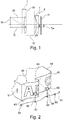
- a camera 5 comprises a lens 10 and a sensor 15 provided with photosites 20.
- Each photosite receives a portion of the radiation 25 coming from an object 30 to be imaged passing through the lens and converts it into information, generally colorimetric, at assign to a corresponding pixel in the image.
- the surface density p associated with the object is approximately 102 px.mm -2 .
- the person skilled in the art after having chosen the target surface density that he wishes to achieve, knows for example the distance, measured between an element of the scene and the acquisition device, below which the element will be shown with an area density of pixels greater than the target area density.
- the process can therefore include, before the acquisition of the images, the measurement of the distance between at least one element of the scene to be acquired and the main plane object of the camera lens, and the verification of the condition (2 ).
- the measurement is for example carried out by means of a rangefinder, for example with laser sight, mounted on the acquisition device.
- the target surface density is greater than or equal to 50 px.mm -2 [pixels per square millimeter], preferably greater than or equal to 60 px.mm -2 , better between 70 px.mm -2 and 100 px .mm -2 .
- a 3D model can thus be constructed with a high resolution, in particular close to or greater than that which the human eye is able to detect. An observer can thus observe in the display of the 3D model the same details as if he were observing the environment, from the same point of view.
- the pixel surface density can be greater than 90%, better still greater than 95% of the target surface density. It can be less than less than 110%, in particular less than 105% of the target surface density.
- the projection step described above is carried out when the angle between the viewing axes of the camera at the consecutive acquisition locations is greater than 5 °.
- the acquisition device comprises a plurality of cameras arranged to acquire, in the same acquisition location, respective images which overlap between them.
- the acquisition device can in particular comprise at least two cameras, preferably at least five cameras, preferably at least ten cameras, better still at least fifteen cameras, the cameras each acquiring an image of the corresponding scene along an axis of view different from the others, the images thus acquired of the same scene overlapping each other. In this way, the construction of the 3D model is facilitated, these images being able to be more easily correlated with each other, for example by photogrammetry.
- the cameras can be synchronized to acquire images at the same time. This makes it easier to further process the images.
- the acquisition device comprises an acquisition module comprising a rod and at least two acquisition stages arranged at different heights on the rod, each acquisition stage comprising a plurality of cameras configured to each acquire an image of the scene, the axes of view of the cameras of an acquisition stage being distributed angularly around the axis of the rod so that the acquired images overlap angularly.
- the cane can be adapted to be carried by an operator moving in the environment. It can include a foot in the lower part allowing it to be placed on the ground.
- the device can comprise at least three, preferably three acquisition stages.
- the cameras of each stage being distributed around the longitudinal axis of the rod, over a total angular sector between 90 ° and 120 °, of preferably between 150 ° and 190 °, in particular equal to 180 °.
- the spacing between the acquisition stages can be adjustable.
- the cameras of an acquisition stage are preferably fixed relative to each other.
- the acquisition module can comprise at least six, preferably at least ten, preferably at least twelve, in particular fifteen cameras.
- the optical settings of the camera are identical in at least two, preferably in all of the acquisition locations.
- the focusing of the camera can be identical in all the acquisition locations.
- the aperture of the camera lens and the shutter speed of the camera are identical in all the acquisition locations. This limits the differences in contrast and brightness between images of the same scene acquired at different acquisition points.
- the lighting of the scene is of constant intensity in all the acquisition locations.
- the color differences between two overlapping images acquired at different acquisition points are thus reduced, which facilitates their correlation and the creation of the 3D model.
- the scene or scenes can be illuminated by means of at least one lamp whose color temperature is constant, for example between 5000 K and 5500 K.
- the lamp can include light-emitting diodes.
- the camera can acquire a continuous film, made up of chronological sequences of images. Alternatively, it can acquire photographic images.
- the camera can be portable, for example of GoPro brand. It can be a photographic camera, for example of the reflex type. It can be configured to generate a digital image in a standard image data format, for example chosen from jpeg, png, tiff, raw and bmp, preferably raw, or to generate a film, for example example in standard format chosen from avi, mpeg and mkv, from which the chronological sequence of images can be extracted.
- a standard image data format for example chosen from jpeg, png, tiff, raw and bmp, preferably raw
- a film for example example in standard format chosen from avi, mpeg and mkv, from which the chronological sequence of images can be extracted.
- the images can each comprise more than 1 million, or even more than 4 million, or even more than 8 million, better still more than 16 million pixels.
- the acquisition device can be as described in the request FR 1856591 , incorporated herein by reference.
- the acquisition method includes moving the acquisition device in a plurality of acquisition movements.
- the movement of the acquisition device can be ensured by the movement, in particular of walking, of an operator manipulating the acquisition device.
- the acquisition device can be moved by means of a vehicle, for example a car, or a flying device, for example a drone, or a lifting device, for example a crane or a winch , on which the acquisition device is mounted.
- the consecutive acquisition locations can define a land route, in particular an urban route.
- the route can be underground, for example through a network of sewers or galleries. It can be aerial, for example when the device is mounted on a drone and the images are acquired in a diving view.
- the scanning device is moved along a route defined by the consecutive acquisition locations, then from the last acquisition location of the route, the scanning device is moved towards the first location of the route, so as to acquire different scenes from those acquired during the route.
- This increases the number of images acquired and consequently the total number of high resolution portions.
- the scenes acquired during the movement towards the first location preferably include objects included in the scenes acquired during the route.
- the acquisition device is moved between first and last acquisition locations.
- the number of stops between the first and last acquisition locations is less than 10, preferably less than 5.
- the movement of the acquisition device can be carried out without stopping.
- the scanning device then comprises a camera acquiring a film in the form of a chronological sequence of images. The total duration of the acquisition of the images between the first and last acquisition locations is thus reduced, which increases the productivity of the operator implementing the method.
- the average speed of movement of the acquisition device between the first and last acquisition locations can be greater than 0.4 ms -1 . It is thus possible to travel a long route in a reduced time.
- the method involves moving to at least 10 acquisition locations per minute, or even at least 60 acquisition locations per minute, or even at least 100 acquisition locations per minute.
- the frequency of acquisition of images during movement is greater than 0.5 Hz, in particular greater than 24 Hz, in particular when the images constitute a chronological sequence of a film.
- the route can follow a substantially unidirectional route between the first and last acquisition locations.
- the route can be traveled along the direction of extension of a tunnel.
- the route can include numerous changes of direction, for example when the environment extends over a surface.
- the route can follow a route along a set of streets in a city, oriented in several directions. Within a street, the route can include at least one crossing of the road to acquire images from opposite sidewalks of the street.
- the method according to the invention makes available, for the construction of a subsequent 3D digital model.
- images of which only the high-resolution portions can be used although such images may contain other usable information. It is therefore preferable, according to the invention, to acquire a higher number of images and, preferably at a higher number of acquisition locations, relative to the number of images necessary to implement a method of prior art.
- the route may include more than 10 acquisition locations per kilometer, preferably more than 100 acquisition locations per kilometer, or even more than 1000 acquisition locations per kilometer, or even more than 10,000 acquisition locations per kilometer, better still more than 100,000 acquisition locations per kilometer, based on the length of the route.
- the route can include more than 10 acquisition locations, preferably more than 100 acquisition locations, better still more than 1000 acquisition locations.
- the route can include more than 1,000 acquisition locations per square kilometer, or even more than 10,000 acquisition locations per square kilometer, or even more than 1 million acquisition locations per square kilometer, or even more than 10 million of acquisition locations per square kilometer and the surface on which the acquisition locations are arranged is greater than 1 m 2 , even greater than 100 m 2 , or even greater than 1000 m 2 , or even greater than 1000 m 2 .
- More than 1000 images preferably more than 10,000 images, or even more than 100,000 images can be acquired between the first and last acquisition locations.
- the same element for example the same object, is acquired at least 5 times, or even at least 10 times, or even at least 50 times, at different acquisition locations. In this way, the number of high-resolution portions representing all or part of the element in the different images is increased.
- the method according to the invention produces an image bank, each of the images comprising a high resolution portion that can be processed to construct a 3D digital model.
- the continuous 3D model is preferably formed of a point cloud.
- a voxel can be defined at each point of the cloud.
- a voxel is a volume of parallelepiped shape, preferably cubic.
- the size of the voxel corresponds to the diameter of the smallest sphere circumscribed to the voxel.
- Voxel represents an area of the object represented by one or more pixels in high-resolution portions of images. The size of the voxel depends on the resolution of the corresponding pixels.
- the invention finally relates to a computer storage unit comprising a bank of images obtained by the acquisition method according to the invention.
- the unit of computer storage can be a hard drive or SSD, a flash memory, for example a USB key.
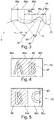
- FIG. 2 Is shown, for illustrative purposes, an environment 40 in which is disposed a building 46 having a wall 45.
- the wall is curved and has inscriptions in the form of the letters "A" to "C".
- the method according to the invention is implemented in order to acquire images of different scenes from the environment.
- An acquisition device 50 is positioned along a route whose direction of travel is represented by the arrow 51 between first 55 and last 60 acquisition locations. For clarity, only four acquisition locations 55, 60 and 61, 62 are shown on the figure 2 , but the route may have a higher number.
- the acquisition device preferably comprises several cameras, taking different images of the same scene 63,64. However, for the sake of clarity, the angle of view ⁇ and the images 70, 75 acquired by a single camera 65 are shown.
- the acquisition device is positioned so as to comply with the condition (2) described previously. In this way, at each acquisition location, it is ensured that the images acquired by the device comprise at least one portion at high resolution.
- the portions 80a-c of the wall shown on the figure 3 seen by the camera at each acquisition location, which are arranged at a distance less than or equal to D, are represented in the corresponding images by high resolution portions 85a-c, represented in hatching 86 and delimited by lines in dotted lines 87.
- the other portions 90a-c of the images include portions in which the maximum pixel density is lower than in the portions 80a-c. They indeed correspond to portions 95a-c of the wall located at a greater distance from the camera at the corresponding acquisition location 61, 62.
- a continuous 3D digital model of the environment can be generated using the high resolution portions.
- a basic 3D model of the portion of the wall comprising the letter "B" can be generated.
- the observer can virtually move around the area of the modeled wall with the letter "B", and observe the same level there of detail whatever the level of observation.
- the image acquisition method can be implemented to acquire images of a more complex environment than that illustrated in the drawing.
- the invention is not limited to the modes of implementation presented above.
Landscapes
- Engineering & Computer Science (AREA)
- Physics & Mathematics (AREA)
- Theoretical Computer Science (AREA)
- General Physics & Mathematics (AREA)
- Multimedia (AREA)
- Signal Processing (AREA)
- Computer Graphics (AREA)
- Geometry (AREA)
- Software Systems (AREA)
- Computer Vision & Pattern Recognition (AREA)
- Radar, Positioning & Navigation (AREA)
- Remote Sensing (AREA)
- Optics & Photonics (AREA)
- Computing Systems (AREA)
- Studio Devices (AREA)
Applications Claiming Priority (1)
| Application Number | Priority Date | Filing Date | Title |
|---|---|---|---|
| FR1859190A FR3087037B1 (fr) | 2018-10-03 | 2018-10-03 | Procede d'acquisition d'images |
Publications (1)
| Publication Number | Publication Date |
|---|---|
| EP3640586A1 true EP3640586A1 (de) | 2020-04-22 |
Family
ID=66690415
Family Applications (1)
| Application Number | Title | Priority Date | Filing Date |
|---|---|---|---|
| EP19201285.4A Withdrawn EP3640586A1 (de) | 2018-10-03 | 2019-10-03 | Bilderfassungsverfahren |
Country Status (5)
| Country | Link |
|---|---|
| US (1) | US11297229B2 (de) |
| EP (1) | EP3640586A1 (de) |
| AU (1) | AU2019240627A1 (de) |
| CA (1) | CA3057338A1 (de) |
| FR (1) | FR3087037B1 (de) |
Families Citing this family (2)
| Publication number | Priority date | Publication date | Assignee | Title |
|---|---|---|---|---|
| JP7458889B2 (ja) * | 2020-05-08 | 2024-04-01 | キヤノン株式会社 | 画像表示装置、制御方法、およびプログラム |
| CN115311589B (zh) * | 2022-10-12 | 2023-03-31 | 山东乾元泽孚科技股份有限公司 | 一种用于采光建筑的隐患处理方法及设备 |
Citations (3)
| Publication number | Priority date | Publication date | Assignee | Title |
|---|---|---|---|---|
| US20100013927A1 (en) * | 2008-04-11 | 2010-01-21 | Nearmap Pty Ltd. | Systems and Methods of Capturing Large Area Images in Detail Including Cascaded Cameras and/or Calibration Features |
| US20100295855A1 (en) * | 2008-01-21 | 2010-11-25 | Pasco Corporation | Method for generating orthophoto image |
| US20160057345A1 (en) * | 2014-06-20 | 2016-02-25 | nearmap australia pty ltd. | Wide-area aerial camera systems |
Family Cites Families (5)
| Publication number | Priority date | Publication date | Assignee | Title |
|---|---|---|---|---|
| WO2005109859A2 (en) * | 2004-05-01 | 2005-11-17 | Eliezer Jacob | Digital camera with non-uniform image resolution |
| WO2007030026A1 (en) * | 2005-09-09 | 2007-03-15 | Industrial Research Limited | A 3d scene scanner and a position and orientation system |
| US9137511B1 (en) * | 2011-12-15 | 2015-09-15 | Rawles Llc | 3D modeling with depth camera and surface normals |
| US10574974B2 (en) * | 2014-06-27 | 2020-02-25 | A9.Com, Inc. | 3-D model generation using multiple cameras |
| US10970924B2 (en) * | 2018-06-17 | 2021-04-06 | Foresight Ai Inc. | Reconstruction of a scene from a moving camera |
-
2018
- 2018-10-03 FR FR1859190A patent/FR3087037B1/fr not_active Expired - Fee Related
-
2019
- 2019-10-01 CA CA3057338A patent/CA3057338A1/fr not_active Abandoned
- 2019-10-02 AU AU2019240627A patent/AU2019240627A1/en not_active Abandoned
- 2019-10-03 EP EP19201285.4A patent/EP3640586A1/de not_active Withdrawn
- 2019-10-03 US US16/591,951 patent/US11297229B2/en not_active Expired - Fee Related
Patent Citations (3)
| Publication number | Priority date | Publication date | Assignee | Title |
|---|---|---|---|---|
| US20100295855A1 (en) * | 2008-01-21 | 2010-11-25 | Pasco Corporation | Method for generating orthophoto image |
| US20100013927A1 (en) * | 2008-04-11 | 2010-01-21 | Nearmap Pty Ltd. | Systems and Methods of Capturing Large Area Images in Detail Including Cascaded Cameras and/or Calibration Features |
| US20160057345A1 (en) * | 2014-06-20 | 2016-02-25 | nearmap australia pty ltd. | Wide-area aerial camera systems |
Also Published As
| Publication number | Publication date |
|---|---|
| FR3087037A1 (fr) | 2020-04-10 |
| US20200112672A1 (en) | 2020-04-09 |
| AU2019240627A1 (en) | 2020-04-23 |
| CA3057338A1 (fr) | 2020-04-03 |
| US11297229B2 (en) | 2022-04-05 |
| FR3087037B1 (fr) | 2021-06-04 |
Similar Documents
| Publication | Publication Date | Title |
|---|---|---|
| CA2711727C (en) | Method and camera for the real-time acquisition of visual information from three-dimensional scenes | |
| Castillo et al. | SF3M software: 3-D photo-reconstruction for non-expert users and its application to a gully network | |
| CA2523717C (fr) | Procede et programme de reconstruction de plan de fracture | |
| FR2899332A1 (fr) | Dispositif de mesure de champ de visibilite pour vehicule et systeme d'assistance a la conduite pour vehicule | |
| JP7160037B2 (ja) | 画像処理装置、画像処理方法、並びにプログラム | |
| KR102624378B1 (ko) | 도로의 균열 검출 시스템 | |
| CN106524909A (zh) | 三维图像采集方法及装置 | |
| FR2801123A1 (fr) | Procede de creation automatique de maquette numerique a partir de couples d'images stereoscopiques | |
| EP3598228A1 (de) | Tragbare vorrichtung zur erfassung von bildern einer umgebung | |
| CA3057338A1 (fr) | Procede d'acquisition d'images | |
| Shervais | Structure from motion introductory guide | |
| JPH1062140A (ja) | 形状の再構成方法および形状の再構成装置 | |
| EP4156102B1 (de) | Verfahren zur auswahl von stereoskopischen paaren von luft- oder satellitenbildern zur erzeugung von höhendaten | |
| US11302073B2 (en) | Method for texturing a 3D model | |
| Strigul et al. | Complementing forest inventory data with information from unmanned aerial vehicle imagery and photogrammetry | |
| EP3336478B1 (de) | Verfahren zur führung einer vorrichtung zum hochdruckreinigen von leitungen eines wärmetauschers | |
| Drofova et al. | 3D reconstruction of a group of plants by the ground multi-image photogrammetry method | |
| CA3099490A1 (fr) | Procede d'acquisition d'au moins une scene | |
| Leberl et al. | Aerial computer vision for a 3d virtual habitat | |
| WO2010086809A2 (fr) | Procede de reconstruction automatise de modeles tridimensionnels de superstructures des toits et des batiments en derivant | |
| WO2018229358A1 (fr) | Procédé et dispositif de construction d'une image tridimensionnelle | |
| EP4660945A1 (de) | Verfahren und system zur rekonstruktion der dreidimensionalen form eines objekts aus einem monokularen bild | |
| FR3052287B1 (fr) | Construction d'une image tridimensionnelle | |
| Alexander et al. | Bing maps mapping the world in 3D by UltraCam | |
| EP4740178A1 (de) | Verfahren zur verarbeitung eines bildes einer szene zur darstellung einer änderung des blickpunkts der szene |
Legal Events
| Date | Code | Title | Description |
|---|---|---|---|
| PUAI | Public reference made under article 153(3) epc to a published international application that has entered the european phase |
Free format text: ORIGINAL CODE: 0009012 |
|
| STAA | Information on the status of an ep patent application or granted ep patent |
Free format text: STATUS: THE APPLICATION HAS BEEN PUBLISHED |
|
| AK | Designated contracting states |
Kind code of ref document: A1 Designated state(s): AL AT BE BG CH CY CZ DE DK EE ES FI FR GB GR HR HU IE IS IT LI LT LU LV MC MK MT NL NO PL PT RO RS SE SI SK SM TR |
|
| AX | Request for extension of the european patent |
Extension state: BA ME |
|
| STAA | Information on the status of an ep patent application or granted ep patent |
Free format text: STATUS: REQUEST FOR EXAMINATION WAS MADE |
|
| 17P | Request for examination filed |
Effective date: 20201022 |
|
| RBV | Designated contracting states (corrected) |
Designated state(s): AL AT BE BG CH CY CZ DE DK EE ES FI FR GB GR HR HU IE IS IT LI LT LU LV MC MK MT NL NO PL PT RO RS SE SI SK SM TR |
|
| STAA | Information on the status of an ep patent application or granted ep patent |
Free format text: STATUS: THE APPLICATION IS DEEMED TO BE WITHDRAWN |
|
| 18D | Application deemed to be withdrawn |
Effective date: 20230503 |