EP3637574A1 - Method for estimating electrical parameters of a grid - Google Patents
Method for estimating electrical parameters of a grid Download PDFInfo
- Publication number
- EP3637574A1 EP3637574A1 EP18382728.6A EP18382728A EP3637574A1 EP 3637574 A1 EP3637574 A1 EP 3637574A1 EP 18382728 A EP18382728 A EP 18382728A EP 3637574 A1 EP3637574 A1 EP 3637574A1
- Authority
- EP
- European Patent Office
- Prior art keywords
- grid
- power converter
- parameters
- physical parameters
- steps
- Prior art date
- Legal status (The legal status is an assumption and is not a legal conclusion. Google has not performed a legal analysis and makes no representation as to the accuracy of the status listed.)
- Granted
Links
Images



Classifications
-
- H—ELECTRICITY
- H02—GENERATION; CONVERSION OR DISTRIBUTION OF ELECTRIC POWER
- H02J—ELECTRIC POWER NETWORKS; CIRCUIT ARRANGEMENTS OR SYSTEMS FOR SUPPLYING OR DISTRIBUTING ELECTRIC POWER; SYSTEMS FOR STORING ELECTRIC ENERGY
- H02J3/00—Circuit arrangements for AC mains or AC distribution networks
- H02J3/38—Arrangements for feeding a single network from two or more generators or sources in parallel; Arrangements for feeding already energised networks from additional generators or sources in parallel
-
- H—ELECTRICITY
- H02—GENERATION; CONVERSION OR DISTRIBUTION OF ELECTRIC POWER
- H02J—ELECTRIC POWER NETWORKS; CIRCUIT ARRANGEMENTS OR SYSTEMS FOR SUPPLYING OR DISTRIBUTING ELECTRIC POWER; SYSTEMS FOR STORING ELECTRIC ENERGY
- H02J3/00—Circuit arrangements for AC mains or AC distribution networks
- H02J3/38—Arrangements for feeding a single network from two or more generators or sources in parallel; Arrangements for feeding already energised networks from additional generators or sources in parallel
- H02J3/388—Arrangements for the handling of islanding, e.g. for disconnection or for avoiding the disconnection of power
-
- G—PHYSICS
- G01—MEASURING; TESTING
- G01R—MEASURING ELECTRIC VARIABLES; MEASURING MAGNETIC VARIABLES
- G01R19/00—Arrangements for measuring currents or voltages or for indicating presence or sign thereof
- G01R19/25—Arrangements for measuring currents or voltages or for indicating presence or sign thereof using digital measurement techniques
- G01R19/2513—Arrangements for monitoring electric power systems, e.g. power lines or loads; Logging
-
- H—ELECTRICITY
- H02—GENERATION; CONVERSION OR DISTRIBUTION OF ELECTRIC POWER
- H02J—ELECTRIC POWER NETWORKS; CIRCUIT ARRANGEMENTS OR SYSTEMS FOR SUPPLYING OR DISTRIBUTING ELECTRIC POWER; SYSTEMS FOR STORING ELECTRIC ENERGY
- H02J2103/00—Details of circuit arrangements for mains or AC distribution networks
- H02J2103/30—Simulating, planning, modelling, reliability check or computer assisted design [CAD] of electric power networks
-
- Y—GENERAL TAGGING OF NEW TECHNOLOGICAL DEVELOPMENTS; GENERAL TAGGING OF CROSS-SECTIONAL TECHNOLOGIES SPANNING OVER SEVERAL SECTIONS OF THE IPC; TECHNICAL SUBJECTS COVERED BY FORMER USPC CROSS-REFERENCE ART COLLECTIONS [XRACs] AND DIGESTS
- Y02—TECHNOLOGIES OR APPLICATIONS FOR MITIGATION OR ADAPTATION AGAINST CLIMATE CHANGE
- Y02E—REDUCTION OF GREENHOUSE GAS [GHG] EMISSIONS, RELATED TO ENERGY GENERATION, TRANSMISSION OR DISTRIBUTION
- Y02E60/00—Enabling technologies; Technologies with a potential or indirect contribution to GHG emissions mitigation
-
- Y—GENERAL TAGGING OF NEW TECHNOLOGICAL DEVELOPMENTS; GENERAL TAGGING OF CROSS-SECTIONAL TECHNOLOGIES SPANNING OVER SEVERAL SECTIONS OF THE IPC; TECHNICAL SUBJECTS COVERED BY FORMER USPC CROSS-REFERENCE ART COLLECTIONS [XRACs] AND DIGESTS
- Y04—INFORMATION OR COMMUNICATION TECHNOLOGIES HAVING AN IMPACT ON OTHER TECHNOLOGY AREAS
- Y04S—SYSTEMS INTEGRATING TECHNOLOGIES RELATED TO POWER NETWORK OPERATION, COMMUNICATION OR INFORMATION TECHNOLOGIES FOR IMPROVING THE ELECTRICAL POWER GENERATION, TRANSMISSION, DISTRIBUTION, MANAGEMENT OR USAGE, i.e. SMART GRIDS
- Y04S40/00—Systems for electrical power generation, transmission, distribution or end-user application management characterised by the use of communication or information technologies, or communication or information technology specific aspects supporting them
- Y04S40/20—Information technology specific aspects, e.g. CAD, simulation, modelling, system security
Definitions
- This invention belongs to the technical field of the estimation of electrical parameters of a grid and, more particularly, to the field of detection of islanding conditions and tuning of a power converter connected to said grid based on said estimated parameters.
- Grid-tied inverters which are a type of power converter, can be connected to a main grid or to a micro-grid by means of LCL filters.
- the micro-grid is an element of the main grid. They are commonly commanded by digital linear controllers that may contain current controllers which, due to the high-order dynamics and the presence of a resonant mode of the LCL filter, suffer reductions in their stability margins.
- the LCL filters are gaining popularity thanks to its advantages in terms of switching noise attenuation compared to L filters with the same total inductance.
- the current controller experiences a lack of performance or even instability when the setup parameters, which are used for the tuning, deviate from their nominal values.
- the setup parameters which model the physical system are the LCL filter reactive values, the electrical parameters of the grid and the Equivalent Series Resistance (R ESR ) of the VSC.
- the problem involved in such methods is the perturbation to which the grid is subjected.
- the injection of a signal introduces harmonic components that can affect other systems connected to the grid or the micro-grid.
- Such systems may have means of protection; that is, when they detect the presence of harmonic components, they disconnect themselves from the grid in order not to be damaged. In this way, although they cannot be affected by perturbations, in practice the efficiency of the system is diminished.
- the present invention solves the previous problems by means of an effective method for estimating the impedance of the grid without injecting additional signals superimposed to the input voltage of the power converter.
- the present invention provides an alternative solution for the aforementioned problems by a method for estimating the electrical parameters of a grid according to claim 1, a method for detecting islanding conditions according to claim 7, a system according to claim 11, a computer program according to claim 14 and a computer-readable medium according to claim 15.
- the invention provides a method for estimating the electrical parameters of a grid, wherein
- the method of the first inventive aspect may be also understood as a method implemented and executed by a processor, microprocessor, computer or any other device or system able to store and process information, i.e., a computer implemented method.
- step a) of the method comprises the stage of providing a power converter and an LCL filter.
- power converter will be understood as an electrical device for converting electrical energy. This term encompasses from simple transformers that change the voltage of AC power to DC -or vice versa- to systems of great complexity.
- LCL filter it must be understood a third-order filter that comprises two inductors and a capacitor. The use of such filters to connect a power converter to a grid has the advantage of filtering the harmonic components absorbed by the power converter while it is connected to said grid.
- step b) of the method comprises the stage of providing a digital controller comprising processing means configured to estimate the electrical parameters of a grid, that is, said processing means comprised in the digital controller are configured to execute the method of the present invention.
- digital controller may be understood as a processing means wherein the method is implemented and executed.
- Such digital controller estimates in step c) the transfer function of the whole system; that is, the combination of the power converter, the LCL filter and the electrical grid.
- the estimation is done in real-time, i.e., while the power converter is operating and connected to the micro-grid.
- transfer function we will understand the equation defining the relation between the measured grid-side current i 1 and the power converter output voltage v. A person skilled in the art can notice that this relation can be expressed as a zero-pole-gain model.
- step d) by separating the transfer function by the digital controller in two different factors, known and unknown. It involves the advantage of working with simpler expressions decreasing the calculation complexity.
- the digital controller converts the equation of the unknown factor of the transfer function into a rational expression with several unknown coefficients in step e).
- the digital controller estimates these coefficients by means of an estimation algorithm "recursive least squares" or RLS.
- This algorithm will be understood as an algorithm that receives two signals, the measured grid-side current i 1 filtered by a notch filter and the power converter output voltage v filtered also by a notch filter and by the known factor calculated in step d), to estimate the coefficients of a function, i.e. the rational expression of the unknown factor, that are the best adjusted for such signals.
- the term "recursive” refers to the memory of the algorithm; that is, during its execution it considers not only the current signal samples received but also the samples of the previous moments of time.
- the fundamental frequency of the grid will be understood as the frequency at which the grid reaches the greatest amplitude, preferably 50 or 60 Hz, and as “notch filter” will be understood a band-stop filter that attenuates the frequencies that belong to a narrow band.
- the final stage of the method, step g), comprises obtaining the electrical parameters of the grid by the digital controller taking into account the above mentioned coefficients, considering DC conditions, connecting and disconnecting the power converter from the grid and applying the known values of the LCL filter components and the sampling period of the power converter.
- sampling period will be understood as the known period at which the power converter works; e.g., the RLS algorithm is executed with this periodicity.
- the period is the inverse of the frequency, being the term "sampling frequency” equivalent by only performing the inverse of the period.
- the sampling frequency belongs to the range 1 kHz to 100 kHz.
- the main advantage of the method of the invention is that it is not necessary to inject any signal to the grid that would lead to harmonic components that can affect other systems connected to such grid. In this way, it is possible to improve the yield of the system despite the required LCL filter and to detect islanding conditions to protect the utility workers while the efficiency of the system is maintained.
- the method further comprises a sub-step between the stages f-ii) and f-iii) of filtering v f and i f with a low-pass filter.
- low-pass filter will be understood as a filter that passes the frequencies below a certain threshold and attenuates the frequencies above such threshold.
- the use of low-pass filters involves the advantage of eliminating undesired high-frequency components, e.g., noise.
- the power converter is a voltage source converter, VSC, modeled as a zero order hold, ZOH, in series with the equivalent series resistance R ESR .
- Voltage Source Converter will be understood as a converter that generates an amplitude and phase variable alternating voltage from a continuous voltage
- zero order hold will be understood as a mathematical model of a DC-AC converter for transforming a discrete-time signal to a continuous-time signal by holding each sample value for one sample interval
- equivalent series resistance will be understood as a component that, together with other capacitors and inductors, models approximately the behavior of an electric circuit.
- the method further comprises the following steps:
- the intrinsic parameters of the current controller should be understood as the parameters that define its bandwidth and its robustness.
- the method for estimating the grid impedance is used to readjust periodically some parameters of the current controller to improve the transient response and the steady state performance.
- the periodicity is defined by means of an optimization period, which is selectable. In a particular example, such optimization period is five seconds.
- the intrinsic parameters of the current controller that are modified define its bandwidth and its robustness. They are variable, that is, they depend on the type of current controller comprised in the digital controller.
- the intrinsic parameters of the current controller are a proportional gain K p and an integral gain K i .
- the digital controller is a proportional-integral controller, PI, or a proportional-resonant controller, PR
- the parameters of its current controller that can be readjusted according to the grid impedance estimated are two types of gains: a proportional gain K p and an integral gain K i .
- proportional-integral controller will be understood as a first-order controller and “proportional-resonant” as a second-order controller.
- the order of a controller is the highest order of the differential equation that describes such controller or, equivalently, the number of poles of its transfer function.
- the parameters that can be readjusted are the equations that describe its plant model.
- the parameters R g and L g are updated according to the values obtained by the method.
- step g-ii) the power converter is connected to the grid by means of a switch element and wherein in step g-i) the power converter is disconnected from the grid and short circuit its output by means of said switch element.
- switch element will be understood as a device configured to interrupt the current of an electrical circuit or to divert it from one conductor to another.
- the switch permits to connect and disconnect the power converter from the grid quickly and easily.
- the invention provides a method for detecting islanding conditions of a grid comprising the following steps:
- step 4) of the above previous embodiments a comparison is performed between the stored physical parameters and the updated physical parameters.
- the stored physical parameters are referred to the parameters stored in step 2).
- the stored physical parameters are referred to the parameters stored in step i).
- the stored physical parameters used in step 4) are referred to the last stored physical parameters by any of the embodiments of the method of the second inventive aspect.
- the method of the second inventive aspect may be also understood as a method implemented and executed by a processor, microprocessor, computer or any other device or system able to store and process information, i.e., a computer implemented method.
- “memory” will be understood as any type of device configured to store information, i.e., storage data means. Some particular examples are a server, a hard drive or a pen drive. Besides, “alarm” will be understood as a notification or information generated when the variation in the parameters is greater than a threshold.
- the method for estimating the grid impedance is used to detect periodically variations in such grid impedance. According to different norms, when a variation in the grid impedance is greater than a certain threshold, islanding condition exists. Most popular norms used are:
- the norm IEEE 929-2000 is imposed.
- the norm VDE 0126-1-1 is used to define the requisites for detecting islanding conditions.
- the norm EN 50330 is applied to detect islanding conditions.
- the periodicity for measuring the grid impedance variation is defined by means of a "determination period", which is selectable within a certain margin according to the specific norm used.
- the threshold that decides if islanding conditions exist also is specific of each norm.
- the alarm is received by a utility worker being informed about the existence of islanding conditions in order to avoid accidents.
- the last step of the method further comprises disconnecting the power converter from the grid.
- the power converter is disconnected from the grid when islanding conditions are detected so that accidents are avoided.
- t d is from one millisecond to five seconds and / or the threshold is from 0.1 to 1 ohms.
- the determination period is selectable within a certain margin according to the specific norm used.
- the margin of periods of this particular embodiment encompasses all the possible periods imposed in the most popular norms described above.
- the norm IEEE 929-2000 is imposed with a determination period lower than ten cycles of the grid fundamental frequency.
- the norm VDE 0126-1-1 is used with a determination period of less than 5 seconds.
- the norm EN 50330 is applied with a determination period of less than 5 seconds.
- the threshold that decides if islanding condition exists depends on the specific norm used.
- the margin of thresholds of this particular embodiment encompasses all the possible thresholds imposed in the most popular norms described above.
- the norm IEEE 929-2000 is imposed with a threshold equal to the base impedance of the power converter.
- the norm VDE 0126-1-1 is used with a threshold of 1 ohm.
- the norm EN 50330 is applied with a threshold of 0.5 ohms.
- the method of the first inventive aspect further comprises the steps of any of the embodiments of the second inventive aspect.
- the invention provides a system for estimating the electrical parameters of a grid comprising a power converter, an LCL filter, a digital controller and means configured to
- the digital controller comprises a noise-shaped modulator, a phase locked loop or PLL, at least one reference frame transformation element, a current controller and a grid impedance identification element.
- the noise-shaped modulator is configured to generate the reference voltage v that the power converter generates at its output.
- the input signals of the digital controller are the measurements of the current and voltage of the grid and its output are the triggering signals that enable the transistors of the power converter.
- the current controller is configured to control the current injected to the grid.
- the digital controller executes the PLL to obtain the phase of the grid voltage. After that, it transforms the reference current and the measured grid current using a reference frame transformation element and executes the current controller to obtain a modulating signal. Such signal is then converted into a synthesizable vector by the noise-shaped modulator. Afterward, the digital controller converts such vector into the triggering signals of the transistors of the power converter. Finally, it estimates the grid impedance by means of the grid impedance identification element.
- the invention provides a computer program comprising instructions to cause the third inventive aspect to
- the invention provides a computer-readable medium having stored thereon the computer program of the forth inventive aspect.
- the present invention provides a method (100) for estimating the electrical parameters of a grid (1).
- the electrical parameters comprise a resistive R g and a reactive j ⁇ g L g components of the grid impedance Z g (2), where ⁇ g is the grid angular frequency in radians per second.
- the electrical grid is modeled as an AC-voltage source v g (3) in series with the impedance Z g (2), and a current i 1 (4) flows through Z g (2).
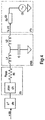
- figure 4 describes the simulation model where the method can be implemented or simulated. More particularly, it comprises a digital controller (8) implemented in a dSPACE platform working at a sampling frequency of 10kHz, a power converter (5) of the type two-level voltage-source converter (VSC) and an LCL filter. Further the power converter is modeled as a zero order hold (7) and the power converter equivalent series resistance R ESR (6) is 1.5 Ohms.
- the system of figure 5 comprises a digital controller (8) described on D. Perez-Estevez, J. Doval-Gandoy, A. G. Yepes, O. Lopez and F. Baneira, "Generalized Multi-Frequency Current Controller for Grid-Connected Converters With LCL Filter,” in IEEE Transactions on Industry Applications. doi: 10.1109/TIA.2018.2829459 .
- the system of figure 5 further comprises a power converter (5) of the type previously indicated, an LCL filter (10) and a power switch (10) of the type single pole double throw.
- the power converter comprises a voltage source converter, VSC, and the power converter equivalent series resistance R ESR (6), not shown in figure 5 , is 1.5 Ohms.
- the digital controller (8) comprises a current controller (8.2) described on D. Perez-Estevez, J. Doval-Gandoy, A. G. Yepes, O. Lopez and F. Baneira, "Generalized Multi-Frequency Current Controller for Grid-Connected Converters With LCL Filter,” in IEEE Transactions on Industry Applications. doi: 10.1109/TIA.2018.2829459 .
- the digital controller (8) further comprises, a noise-shaped modulator (8.1) with a third order filter, a grid impedance identification block (8.3) of the type described in this document, a low-bandwidth phase locked loop (8.4), PLL, described on F. D. Freijedo, J. Doval-Gandoy, O. Lopez and E.
- the Clarke transformation block (8.5) is connected to the electrical grid (1) at its input and its outputs are connected to the grid impedance identification block (8.3) and the current controller (8.2).
- the inputs of the inverse Park transformation block (8.7) are the reference current, i ref , and the output of the PLL (8.4).
- the output of such block is connected to the current controller (8.2).
- the input of the inverse Clarke transformation block (8.6) is the output of the noise-shaped modulator (8.1) and the output of said block is connected to the power converter (5).
- the grid impedance identification block (8.3) is connected to Clarke transformation block (8.5) and to the noise-shaped modulator (8.1) at its inputs, and its output is connected to the current controller (8.2).
- the current controller (8.2) is connected to the Clarke transformation block (8.5), the inverse Park transformation (8.7) and the grid impedance identification block (8.3) at its inputs, and its output is connected to the noise-shaped modulator (8.1).
- the noise-shaped modulator (8.1) is connected to the current controller (8.2) at its input, and its outputs are connected to the inverse Clarke transformation (8.6) and to the grid impedance identification block (8.3).
- the PLL (8.4) is connected to the output of the LCL filter (10) at its input, and its output is connected to the inverse Park transformation (8.7).
- the value of elements of the LCL are the following: the L 1 is 3.75 mH, the value of the L 2 is 3.75 mH and the value of the C is 15 ⁇ F.
- the electrical grid (1) is a 110-V 60-Hz three-phase micro-grid of the main electrical grid with a reactive and a resistive component in the grid impedance of value 2.5 mH and 2.5 Ohm, respectively. Such electrical grid is implemented using a three-phase AC source in series with an impedance.
- the digital controller (8) comprises the required initialization variables to execute the proposed estimation method (100), namely the known factor of the transfer function, G known (z); the notch filter; the initial current controller parameters; and the PLL parameters.
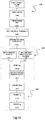
- Figure 1a-1b Method (100) for estimating the electrical parameters of a grid (1)
- Step a) of the method provides (110) a power converter (5) and an LCL filter (10), being the LCL filter (10) modeled with two inductors (L 1 , L 2 ), and a capacitor (C).
- the power converter (5) is connected to the grid (1) by means of said an LCL filter (10).
- the power converter (5) comprises a reference voltage v (9) as an input and a power converter equivalent series resistance R ESR (6), as it can be shown in the example of figure 4 .
- step b) of the method provides (120) a digital controller and in step c) said digital controller (8) estimates (130), as a zero-pole-gain model, the transfer function G(z) of the combination of the power converter (5), the LCL filter (10) and the electrical grid (1) through the processing module.
- the estimated function comprising two sampling-zeros z 1 and z 2 ; a pole that represents a computational delay of the digital controller (8), a pole at low frequencies p 1 ; two resonant poles p 2 and p 3 and a constant gain K:
- step d) the method (100), through the digital controller (8), separates (140) the transfer function G(z) in two parts, G known (z) and G unknown (z), wherein:
- step e) the method (100), through the digital controller (8), converts (150) the zero-pole-gain model of the function G unknown (z) to a rational expression in the variable z:
- G unknown z n 1 z 3 + m 1 z 2 + m 2 z + m 3
- step f) the method (100), through the digital controller (8), obtains (160) the values of m 1 , m 2 , m 3 , and n 1 following the next sub-steps:
- step g) the method (100), through the digital controller (8), obtains (170) the physical parameters that model the power converter (5) from the vector C(k), following the next sub-steps:
- the estimation of the electrical parameters of a grid (1) requires a power converter (5) that is connected to such grid (1) by means of an LCL filter (10). Such filter is required to avoid that undesired components reach the power converter (5).
- the next step of the method is calculating the transfer function of the system, understanding the system as the combination of the power converter (5), the LCL filter (10) and the grid (1) itself.
- This transfer function is proposed as a zero-pole-gain model with two zeros, three poles and a gain.
- the transfer function is separated in two factors such that, when they are multiplied, result in the complete transfer function.
- the first factor comprises several known terms that are independent of the changes in the grid impedance Z g (2), the computational delay of the digital controller (8), the LCL filter (10) and/or the equivalent series resistance R ESR (6) of the power converter (5); comprising such factor all the zeros and the delay pole of the zero-pole-gain model.
- the second factor comprises the rest of the components that are unknown, i.e. the gain and the poles of the transfer function.
- the unknown term is then converted into a third-order rational expression.
- the unknown coefficients of the rational expression are obtained by means of a recursive least squares (RLS) algorithm using the filtered versions of the signals i 1 (4) and v (9) as inputs: both signals are filtered by a notch filter tuned at the fundamental frequency and v is further with the known term of the transfer function.
- RLS recursive least squares
- the electrical parameters are obtained (170): firstly, from the estimated coefficients, considering DC conditions and disconnecting the power converter (5) from the grid (1), the value of the equivalent series resistance (6) is calculated (171); after that, the power converter (5) is again connected to the grid (1) so that the value of the resistive R g component of the grid impedance Z g (2) is calculated (172); and lastly, the reactive L g component of the grid impedance Z g (2) is calculated (173) taking into account the values of the LCL filter (10) components, the sampling period of the system and the poles of the transfer function.
- Figure 1b it is shown a further example of the method of the invention. It can be appreciated that this example is similar to the example of figure 1a with the exception that after filtering the signals v (9) and i 1 (4) with the notch filter (both signals) and with the known factor of the transfer function (only v), they are also filtered (161.1) with a low-pass filter to eliminate the high-frequency undesired components.
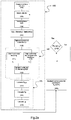
- Figures 2a-2b Method (100) for improving the transient response and the steady state performance from the estimated electrical parameters of a grid (1)
- Figures 2a-2b show further examples of the method of the invention.
- said examples comprise further steps of the flowchart depicted in figure 1a to incorporate the step of readjusting the parameters of the current controller (8.2) thanks to the digital controller (8).
- the digital controller (8) which is configured to command the power converter (5), comprises a current controller (8.2) module as the digital controller (8) shown in figure 5 . Thanks to the method (100) for estimating the grid impedance, it is possible to readjust periodically the intrinsic parameters of the current controller (8.2), which advantageously improves the transient response and the steady state performance of the power converter.
- the periodicity is defined by means of an optimization period t o , which is selectable.
- the current controller (8.2) is a proportional-integral controller PI, and the parameters that define its bandwidth and robustness are two different gains, a proportional gain K p and an integral gain K i .
- K p and K i are adjusted as described in the following document A. G. Yepes, A. Vidal, J. Malvar, O. Lopez and J. Doval-Gandoy, "Tuning Method Aimed at Optimized Settling Time and Overshoot for Synchronous Proportional-Integral Current Control in Electric Machines," in IEEE Transactions on Power Electronics, vol. 29, no. 6, pp.
- the method (100) is again performed to readjust anew the gains of the current controller (8.2).
- the optimization period t o is less than five seconds.
- the new values of R g and L g are 2.5 Ohms and 2.5 mH.
- the digital controller (8) is a proportional-resonant controller, PR.
- the parameters to be adjusted of such type of digital controller (8) are the same as the ones of the proportional-integral controller PI.
- Figure 2b shows an example when the digital controller (8) is a state-space controller, being the results similar for other types of high-order controllers, as the predictive ones.
- the parameters that can be readjusted are the equations that describe the plant model of such controllers (8), where parameters R g and L g are updated according to the values obtained by the method (100).
- v' d ( t ) is the continuous-time output voltage of the VSC
- i 1 is the grid-side current
- i 2 is the converter-side current
- v c is the capacitor voltage in the LCL filter.
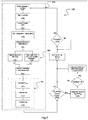
- Figure 3 Method (300) for detecting islanding conditions from the estimated electrical parameters of a grid (1)
- islanding conditions that is, the situation in which the power converter powers a micro-grid to which it is connected while the power of the main grid is no longer present.
- Islanding can be dangerous to utility workers, who may not realize that a circuit is still powered. Thus, detecting such islanding conditions is essential to avoid accidents.
- Figure 3 shows an example of the invention which solves the above problem.
- the method (300) is also performed through the digital controller (8).
- the period to calculate the variations, t d is selectable. In this particular example, t d is lower than five seconds.
- islanding condition exists when a variation in the grid impedance is greater than a certain threshold.
- a certain threshold depends on the norm that is being applied. In this particular example, the threshold is 1 Ohm.
- the method (300) further determinates (305) if the components of the grid impedance Z g (2), i.e. R g and L g , were saved before:
- the values calculated on the example of figure 1a are saved in the hard-disk. Then, the digital controller waits 5 seconds and performs again the method (100), obtaining the new values of R g and L g : 2.5 Ohms and 2.5 mH.
- the processing module emits (340) an acoustic alarm and disconnects (350) the power converter (5) by switching off the power switch (10).
- Figure 4 Simulation model of the components needed for estimating the electrical parameters of a grid (1)
- Figure 4 depicts a simulation model of the combination of the power converter (5), the LCL filter (10) and the grid (1).
- the input of the power converter (5) is the reference voltage v (9) and it is commanded by a digital controller (8), which is represented as an extra pole in the transfer function due to the delay it involves.
- the power converter (5) besides, is represented as a zero order hold module (7) in series with an equivalent series resistance (6).
- the LCL filter (10) comprises two inductors L 1 and L 2 and a capacitor C, as it can be noticed from the figure.
- the grid (1) comprises an impedance Z g (2), through which a current i 1 (4) flows, and an AC voltage source (3).
- a computer is connected to the digital controller.
- Figure 5 shows a scheme of the system where the digital controller (8) is depicted in detail. It comprises a noise shaped modulator (8.1), a current controller (8.2), a grid impedance identification element (8.3), a phase locked loop (8.4), PLL, and three reference frame transformation elements (8.5).
- the noise shaped modulator (8.1) is configured to generate the reference voltage v (9) as the input of the power converter (5).
- the power converter (5) and the LCL filter (10) can be connected and disconnected from the grid (1) by means of a switch element (11).
- the digital controller (8) executes the PLL (8.4) to obtain the phase of the grid voltage. After that, it transforms the measured grid current using the reference frame transformation element (8.5) and executes the current controller (8.2) to obtain a modulating signal that is then converted into a synthesizable vector. Afterward, the digital controller (8) converts such vector into firing triggering signals of the transistors of the power converter (5) and, finally, it estimates the grid impedance Zg (2) by means of the grid impedance identification element (8.3).
Landscapes
- Engineering & Computer Science (AREA)
- Power Engineering (AREA)
- Measurement Of Resistance Or Impedance (AREA)
- Supply And Distribution Of Alternating Current (AREA)
Abstract
Description
- This invention belongs to the technical field of the estimation of electrical parameters of a grid and, more particularly, to the field of detection of islanding conditions and tuning of a power converter connected to said grid based on said estimated parameters.
- Grid-tied inverters, which are a type of power converter, can be connected to a main grid or to a micro-grid by means of LCL filters. It should be understood that the micro-grid is an element of the main grid. They are commonly commanded by digital linear controllers that may contain current controllers which, due to the high-order dynamics and the presence of a resonant mode of the LCL filter, suffer reductions in their stability margins. On contrary, the LCL filters are gaining popularity thanks to its advantages in terms of switching noise attenuation compared to L filters with the same total inductance.
- Specifically, during operation of a voltage source converter or VSC, the current controller experiences a lack of performance or even instability when the setup parameters, which are used for the tuning, deviate from their nominal values. The setup parameters which model the physical system are the LCL filter reactive values, the electrical parameters of the grid and the Equivalent Series Resistance (RESR) of the VSC.
- During the operation of a power converter it must be taken into account the presence of any islanding condition in a micro-grid, which should be understood as the situation in which the power converter powers a micro-grid to which it is connected while the main grid is disabled. Islanding can be dangerous to utility workers, who may not realize that the micro-grid is still powered. Thus, detecting such islanding conditions is essential to avoid accidents.
- Various methods have been developed to identify the setup parameters during operation of the VSC to detect islanding conditions and to adjust the tuning of the current controller to, therefore, recover its nominal performance.
- These methods can be classified into two main categories:
- methods that inject a periodic signal, such the document
EP2827157 A1 , wherein a fundamental frequency signal is injected to perform the estimation, and - methods which inject a non-periodic signal, for example the document
EP1643256 A1 , that discloses a method that forces a voltage sag in the grid voltage waveform by connecting a very low impedance load during a short period of time and the estimation of the grid impedance is obtained by measuring the disturbed voltage waveform. - The problem involved in such methods is the perturbation to which the grid is subjected. The injection of a signal introduces harmonic components that can affect other systems connected to the grid or the micro-grid. Such systems may have means of protection; that is, when they detect the presence of harmonic components, they disconnect themselves from the grid in order not to be damaged. In this way, although they cannot be affected by perturbations, in practice the efficiency of the system is diminished.
- The present invention solves the previous problems by means of an effective method for estimating the impedance of the grid without injecting additional signals superimposed to the input voltage of the power converter.
- The present invention provides an alternative solution for the aforementioned problems by a method for estimating the electrical parameters of a grid according to
claim 1, a method for detecting islanding conditions according toclaim 7, a system according toclaim 11, a computer program according to claim 14 and a computer-readable medium according to claim 15. - Throughout this entire document, parameters that are related according to an equation are used. Thus, there are many ways of expressing explicit or implicitly the dependence among such variables, being the more generic form f(x1, x2, x3,...) = 0. These equations represent a functional relation between variables so that, when the values adopted by the resulting variables are the same, both expressions must be considered as equivalents.
- In a first inventive aspect, the invention provides a method for estimating the electrical parameters of a grid, wherein
- the electrical parameters comprise a resistive Rg and a reactive jωgLg components of the grid impedance Zg, where ωg is the grid angular frequency in radians per second,
- the electrical grid is modeled as an AC-voltage source vg in series with the impedance Zg, and
- a current i1 flows through Zg,
- a) providing a power converter and an LCL filter, being the LCL filter modeled with two inductors, and a capacitor, the power converter being configured for connecting to the grid by means of said an LCL filter, wherein the power converter comprises a reference voltage v as an input and a power converter equivalent series resistance RESR,
- b) providing a digital controller comprising processing means configured to estimate the electrical parameters of a grid,
- c) estimating by the digital controller, as a zero-pole-gain model, the transfer function G(z) of the combination of the power converter, the LCL filter and the electrical grid, the function comprising two sampling-zeros z1 and z2; a pole that represents a computational delay of the digital controller z; a pole at low frequencies p1; two resonant poles p2 and p3 and a constant gain K:

- d) separating by the digital controller, the transfer function G(z) in two parts, Gknown(z) and Gunknown(z), wherein:
- the transfer function G(z) is the multiplication of both parts,
- Gknown(z) comprises the terms of the function independent of the changes in the grid impedance Zg, the LCL filter parameters and/or the equivalent series resistance RESR of the power converter:

- and Gunknown(z) is a third-order all-pole transfer function comprising the resonant poles, the DC pole and the gain:

- e) converting by the digital controller the zero-pole-gain model of the function Gunknown(Z) to a rational expression in the variable z:

- f) obtaining by the digital controller the values of m 1, m 2, m 3, and n 1 following the next sub-steps:
- f-i) filtering the current i1 with a notch filter tuned at the fundamental grid frequency fg to remove the grid frequency components, i.e, vg is equal to zero, obtaining if,
- f-ii) filtering the voltage v with Gknown(z) and a notch filter tuned at the fundamental grid frequency fg to remove the grid frequency components, i.e, vg is equal to zero, obtaining vf,
- f-iii) estimating, by means of a recursive least squares, RLS, estimation algorithm, a vector C(k), being k a natural number, that comprises the coefficients of Gunknown(z):


- g) obtaining by the digital controller the physical parameters that model the power converter from the vector C(k), following the next sub-steps:
- g-i) calculating the value of the equivalent series resistance RESR in DC conditions, i.e, z equal to 1


- g-ii) calculating the value of Rg in DC conditions, i.e., z equal to 1 and connecting the power converter to the grid:

- g-iii) calculating the grid inductance Lg from the values L1, L2, C and the resonant frequency of the system ωres:


- g-i) calculating the value of the equivalent series resistance RESR in DC conditions, i.e, z equal to 1
- The method of the first inventive aspect may be also understood as a method implemented and executed by a processor, microprocessor, computer or any other device or system able to store and process information, i.e., a computer implemented method.
- Firstly, step a) of the method comprises the stage of providing a power converter and an LCL filter. Throughout this entire document, "power converter" will be understood as an electrical device for converting electrical energy. This term encompasses from simple transformers that change the voltage of AC power to DC -or vice versa- to systems of great complexity. On the other hand, as "LCL filter" it must be understood a third-order filter that comprises two inductors and a capacitor. The use of such filters to connect a power converter to a grid has the advantage of filtering the harmonic components absorbed by the power converter while it is connected to said grid.
- Next, step b) of the method comprises the stage of providing a digital controller comprising processing means configured to estimate the electrical parameters of a grid, that is, said processing means comprised in the digital controller are configured to execute the method of the present invention. Particularly, "digital controller" may be understood as a processing means wherein the method is implemented and executed.
- Such digital controller estimates in step c) the transfer function of the whole system; that is, the combination of the power converter, the LCL filter and the electrical grid. The estimation is done in real-time, i.e., while the power converter is operating and connected to the micro-grid. As transfer function we will understand the equation defining the relation between the measured grid-side current i1 and the power converter output voltage v. A person skilled in the art can notice that this relation can be expressed as a zero-pole-gain model.
- The method continues in step d) by separating the transfer function by the digital controller in two different factors, known and unknown. It involves the advantage of working with simpler expressions decreasing the calculation complexity.
- After that, the digital controller converts the equation of the unknown factor of the transfer function into a rational expression with several unknown coefficients in step e). In step f), the digital controller estimates these coefficients by means of an estimation algorithm "recursive least squares" or RLS. This algorithm will be understood as an algorithm that receives two signals, the measured grid-side current i1 filtered by a notch filter and the power converter output voltage v filtered also by a notch filter and by the known factor calculated in step d), to estimate the coefficients of a function, i.e. the rational expression of the unknown factor, that are the best adjusted for such signals. The term "recursive" refers to the memory of the algorithm; that is, during its execution it considers not only the current signal samples received but also the samples of the previous moments of time.
- Throughout this entire document, "the fundamental frequency of the grid" will be understood as the frequency at which the grid reaches the greatest amplitude, preferably 50 or 60 Hz, and as "notch filter" will be understood a band-stop filter that attenuates the frequencies that belong to a narrow band.
- The final stage of the method, step g), comprises obtaining the electrical parameters of the grid by the digital controller taking into account the above mentioned coefficients, considering DC conditions, connecting and disconnecting the power converter from the grid and applying the known values of the LCL filter components and the sampling period of the power converter. Throughout this entire document, "sampling period" will be understood as the known period at which the power converter works; e.g., the RLS algorithm is executed with this periodicity. A person skilled in the art would know the period is the inverse of the frequency, being the term "sampling frequency" equivalent by only performing the inverse of the period. In a particular example, the sampling frequency belongs to the
range 1 kHz to 100 kHz. - The main advantage of the method of the invention is that it is not necessary to inject any signal to the grid that would lead to harmonic components that can affect other systems connected to such grid. In this way, it is possible to improve the yield of the system despite the required LCL filter and to detect islanding conditions to protect the utility workers while the efficiency of the system is maintained.
- In a particular embodiment, the method further comprises a sub-step between the stages f-ii) and f-iii) of filtering vf and if with a low-pass filter.
- Throughout this entire document, "low-pass filter" will be understood as a filter that passes the frequencies below a certain threshold and attenuates the frequencies above such threshold. The use of low-pass filters involves the advantage of eliminating undesired high-frequency components, e.g., noise.
- In a particular embodiment, the power converter is a voltage source converter, VSC, modeled as a zero order hold, ZOH, in series with the equivalent series resistance RESR.
- Throughout this entire document, "Voltage Source Converter" will be understood as a converter that generates an amplitude and phase variable alternating voltage from a continuous voltage; "zero order hold" will be understood as a mathematical model of a DC-AC converter for transforming a discrete-time signal to a continuous-time signal by holding each sample value for one sample interval; and "equivalent series resistance" will be understood as a component that, together with other capacitors and inductors, models approximately the behavior of an electric circuit.
- In a particular embodiment, the method further comprises the following steps:
- readjusting the intrinsic parameters of the current controller based on the calculated physical parameters,
- after a second optimization period, to, performing the steps a) to g) of the method obtaining an update of the physical parameters and performing the previous step with the updated physical parameters.
- The intrinsic parameters of the current controller should be understood as the parameters that define its bandwidth and its robustness. Advantageously, the method for estimating the grid impedance is used to readjust periodically some parameters of the current controller to improve the transient response and the steady state performance. The periodicity is defined by means of an optimization period, which is selectable. In a particular example, such optimization period is five seconds.
- The intrinsic parameters of the current controller that are modified define its bandwidth and its robustness. They are variable, that is, they depend on the type of current controller comprised in the digital controller.
- In a particular embodiment, the intrinsic parameters of the current controller are a proportional gain Kp and an integral gain Ki.
- When the digital controller is a proportional-integral controller, PI, or a proportional-resonant controller, PR, the parameters of its current controller that can be readjusted according to the grid impedance estimated are two types of gains: a proportional gain Kp and an integral gain Ki.
- Throughout this entire document, "proportional-integral" controller will be understood as a first-order controller and "proportional-resonant" as a second-order controller. The order of a controller is the highest order of the differential equation that describes such controller or, equivalently, the number of poles of its transfer function.
- When the digital controller used is a high-order one, i.e., at least third order; e.g. a controller in state-space or a predictive controller, the parameters that can be readjusted are the equations that describe its plant model. Here, the parameters Rg and Lg are updated according to the values obtained by the method.
- In a particular embodiment, in steps a) and g-ii) the power converter is connected to the grid by means of a switch element and wherein in step g-i) the power converter is disconnected from the grid and short circuit its output by means of said switch element.
- Throughout this entire document, "switch element" will be understood as a device configured to interrupt the current of an electrical circuit or to divert it from one conductor to another.
- The switch permits to connect and disconnect the power converter from the grid quickly and easily.
- In a second inventive aspect, the invention provides a method for detecting islanding conditions of a grid comprising the following steps:
- 1) performing the method for estimating the electrical parameters of the grid according to any of the embodiments of the first inventive aspect,
- 2) storing the physical parameters within a memory,
- 3) after a determination period, td, performing the steps a) to g) of the method for estimating the electrical parameters of a grid according to any of the embodiments of the first inventive aspect, obtaining an update of the physical parameters,
- 4) comparing the stored physical parameters and the updated physical parameters,
- 5) if the variations between the stored physical parameters and the updated physical parameters are greater than a threshold, emitting an alarm.
- In one embodiment, if the variations between the physical parameters and the updated physical parameters are lower or equal than the threshold, iteratively performing the following steps:
- i) storing the updated physical parameters, and
- ii) repeating the steps 3) to 5) until the stored physical parameters and the updated physical parameters are greater than the threshold.
- It can be appreciated that step 4) of the above previous embodiments a comparison is performed between the stored physical parameters and the updated physical parameters. In the case of the first embodiment, the stored physical parameters are referred to the parameters stored in step 2). In the case of second embodiment, the stored physical parameters are referred to the parameters stored in step i). In both cases the stored physical parameters used in step 4) are referred to the last stored physical parameters by any of the embodiments of the method of the second inventive aspect.
- The method of the second inventive aspect may be also understood as a method implemented and executed by a processor, microprocessor, computer or any other device or system able to store and process information, i.e., a computer implemented method.
- Throughout this entire document, "memory" will be understood as any type of device configured to store information, i.e., storage data means. Some particular examples are a server, a hard drive or a pen drive. Besides, "alarm" will be understood as a notification or information generated when the variation in the parameters is greater than a threshold.
- Advantageously, the method for estimating the grid impedance is used to detect periodically variations in such grid impedance. According to different norms, when a variation in the grid impedance is greater than a certain threshold, islanding condition exists. Most popular norms used are:
- IEEE 929-2000: islanding conditions are detected when a variation in the grid impedance is equal or greater than the base impedance of the power converter in less than ten cycles of the grid fundamental frequency.
- VDE 0126-1-1: islanding conditions are detected when the grid impedance rises in 1 ohm when detection is done in less than 5 seconds.
- EN 50330: the power converter must be disconnected from the grid in less than 5 seconds when the grid impedance variates 0.5 resistive ohms.
- In a particular example, the norm IEEE 929-2000 is imposed. In other particular example, the norm VDE 0126-1-1 is used to define the requisites for detecting islanding conditions. In a third particular example, the norm EN 50330 is applied to detect islanding conditions.
- The periodicity for measuring the grid impedance variation is defined by means of a "determination period", which is selectable within a certain margin according to the specific norm used. In the same way, the threshold that decides if islanding conditions exist also is specific of each norm.
- In a particular example, the alarm is received by a utility worker being informed about the existence of islanding conditions in order to avoid accidents.
- In a particular embodiment, the last step of the method further comprises disconnecting the power converter from the grid.
- In a more advantageous way, the power converter is disconnected from the grid when islanding conditions are detected so that accidents are avoided.
- In a particular embodiment, td is from one millisecond to five seconds and/or the threshold is from 0.1 to 1 ohms.
- As it was explained before, the determination period is selectable within a certain margin according to the specific norm used. The margin of periods of this particular embodiment encompasses all the possible periods imposed in the most popular norms described above.
- In a particular example, the norm IEEE 929-2000 is imposed with a determination period lower than ten cycles of the grid fundamental frequency. In other particular example, the norm VDE 0126-1-1 is used with a determination period of less than 5 seconds. In a third particular example, the norm EN 50330 is applied with a determination period of less than 5 seconds.
- The threshold that decides if islanding condition exists depends on the specific norm used. The margin of thresholds of this particular embodiment encompasses all the possible thresholds imposed in the most popular norms described above.
- In a particular example, the norm IEEE 929-2000 is imposed with a threshold equal to the base impedance of the power converter. In other particular example, the norm VDE 0126-1-1 is used with a threshold of 1 ohm. In a third particular example, the norm EN 50330 is applied with a threshold of 0.5 ohms.
- In other embodiment according to the first inventive aspect, the method of the first inventive aspect further comprises the steps of any of the embodiments of the second inventive aspect.
- In a third inventive aspect, the invention provides a system for estimating the electrical parameters of a grid comprising a power converter, an LCL filter, a digital controller and means configured to
- perform steps of the method of any of the embodiments of the first inventive aspect, and/or
- perform steps of the method of any of the embodiments of the second inventive aspect.
- In a particular embodiment, the digital controller comprises a noise-shaped modulator, a phase locked loop or PLL, at least one reference frame transformation element, a current controller and a grid impedance identification element.
- Throughout this entire document, it should be understood the following interpretation for the following terms:
- "noise-shaped modulator" as a module that converts a continuous-amplitude signal to a voltage that is synthesizable by a power converter.
- "phase locked loop" as a control system that generates an output signal whose phase is related to the phase of an input signal.
- "reference frame transformation element" as a mathematical operation, useful to simplify the analysis of three-phase circuits, which transforms a three-element vector into a complex number employed. Said simplification are described on the following documents of the prior art:
- ∘ R. H. Park, "Two-reaction theory of synchronous machines generalized method of analysis-part I," in Transactions of the American Institute of Electrical Engineers, vol. 48, no. 3, pp. 716-727, July 1929. doi: 10.1109/T-AIEE.1929.5055275, and
- ∘ Clarke, E., Circuit Analysis of AC Power Systems, Vol. 1, New York: John Wiley & Sons, Inc., 1950.
- "current controller" as the module that minimizes the error between the measured grid-side current i1 and a reference current, being such reference current the one that must be provided to the grid by the power converter.
- "grid impedance identification element" as a module that estimates the impedance of a grid according to the method explained above.
- All these modules comprised in the digital controller works sequentially.
- In a particular embodiment, the noise-shaped modulator is configured to generate the reference voltage v that the power converter generates at its output.
- The input signals of the digital controller are the measurements of the current and voltage of the grid and its output are the triggering signals that enable the transistors of the power converter. Thus, the current controller is configured to control the current injected to the grid.
- Internally, the digital controller executes the PLL to obtain the phase of the grid voltage. After that, it transforms the reference current and the measured grid current using a reference frame transformation element and executes the current controller to obtain a modulating signal. Such signal is then converted into a synthesizable vector by the noise-shaped modulator. Afterward, the digital controller converts such vector into the triggering signals of the transistors of the power converter. Finally, it estimates the grid impedance by means of the grid impedance identification element.
- In a forth inventive aspect, the invention provides a computer program comprising instructions to cause the third inventive aspect to
- execute the steps of the method of any of the embodiments of the first inventive aspect, and/or
- execute the steps of the method of the embodiments of the second inventive aspect
- In a fifth inventive aspect, the invention provides a computer-readable medium having stored thereon the computer program of the forth inventive aspect.
- These and other characteristics and advantages of the invention will become clearly understood in view of the detailed description of the invention which becomes apparent from a preferred embodiment of the invention, given just as an example and not being limited thereto, with reference to the drawings.
- Figure 1a
- This figure shows a flowchart of the method for estimating the electrical parameters of a grid.
- Figure 1b
- This figure shows a flowchart of the method for estimating the electrical parameters of a grid with an extra filtering step.
- Figure 2a
- This figure shows a flowchart to readjust the parameters of the current controller when such current controller is an proportional-integral controller.
- Figure 2b
- This figure shows a flowchart to readjust the parameters of the current controller when such current controller is an state-space controller.
- Figure 3
- This figure shows a flowchart to detect islanding conditions periodically.
- Figure 4
- This figure shows a simulation model of the components needed for estimating the electrical parameters of a grid.
- Figure 5
- This figure shows an electrical scheme of components needed for estimating the electrical parameters of a grid wherein the modules of the digital controller are detailed.
- The present invention, according to a first inventive aspect, provides a method (100) for estimating the electrical parameters of a grid (1). In the following examples, the electrical parameters comprise a resistive Rg and a reactive jωgLg components of the grid impedance Zg (2), where ωg is the grid angular frequency in radians per second. Additionally, the electrical grid is modeled as an AC-voltage source vg (3) in series with the impedance Zg (2), and a current i1 (4) flows through Zg (2).
- Down below, examples of the method of invention are described using any of the components described in
figures 4 and/or 5. - In particular, the example of
figure 4 describes the simulation model where the method can be implemented or simulated. More particularly, it comprises a digital controller (8) implemented in a dSPACE platform working at a sampling frequency of 10kHz, a power converter (5) of the type two-level voltage-source converter (VSC) and an LCL filter. Further the power converter is modeled as a zero order hold (7) and the power converter equivalent series resistance RESR (6) is 1.5 Ohms. - Regarding the system of
figure 5 used, it comprises a digital controller (8) described on D. Perez-Estevez, J. Doval-Gandoy, A. G. Yepes, O. Lopez and F. Baneira, "Generalized Multi-Frequency Current Controller for Grid-Connected Converters With LCL Filter," in IEEE Transactions on Industry Applications. doi: 10.1109/TIA.2018.2829459. Additionally, the system offigure 5 further comprises a power converter (5) of the type previously indicated, an LCL filter (10) and a power switch (10) of the type single pole double throw. The power converter comprises a voltage source converter, VSC, and the power converter equivalent series resistance RESR (6), not shown infigure 5 , is 1.5 Ohms. - Further, the digital controller (8) comprises a current controller (8.2) described on D. Perez-Estevez, J. Doval-Gandoy, A. G. Yepes, O. Lopez and F. Baneira, "Generalized Multi-Frequency Current Controller for Grid-Connected Converters With LCL Filter," in IEEE Transactions on Industry Applications. doi: 10.1109/TIA.2018.2829459. Additionally the digital controller (8) further comprises, a noise-shaped modulator (8.1) with a third order filter, a grid impedance identification block (8.3) of the type described in this document, a low-bandwidth phase locked loop (8.4), PLL, described on F. D. Freijedo, J. Doval-Gandoy, O. Lopez and E. Acha, "Tuning of Phase-Locked Loops for Power Converters Under Distorted Utility Conditions," in IEEE Transactions on Industry Applications, vol. 45, no. 6, pp. 2039-2047, Nov.-dec. 2009. doi: 10.1109/TIA.2009.2031790 and three reference frame transformation blocks, namely, a direct (8.5) and an inverse Clarke transformation (8.6) and an inverse Park transformation (8.7).
- As it can be appreciated, the Clarke transformation block (8.5), is connected to the electrical grid (1) at its input and its outputs are connected to the grid impedance identification block (8.3) and the current controller (8.2). The inputs of the inverse Park transformation block (8.7) are the reference current, iref, and the output of the PLL (8.4). The output of such block is connected to the current controller (8.2). The input of the inverse Clarke transformation block (8.6) is the output of the noise-shaped modulator (8.1) and the output of said block is connected to the power converter (5).
- Finally, the grid impedance identification block (8.3) is connected to Clarke transformation block (8.5) and to the noise-shaped modulator (8.1) at its inputs, and its output is connected to the current controller (8.2). The current controller (8.2) is connected to the Clarke transformation block (8.5), the inverse Park transformation (8.7) and the grid impedance identification block (8.3) at its inputs, and its output is connected to the noise-shaped modulator (8.1). The noise-shaped modulator (8.1) is connected to the current controller (8.2) at its input, and its outputs are connected to the inverse Clarke transformation (8.6) and to the grid impedance identification block (8.3). The PLL (8.4) is connected to the output of the LCL filter (10) at its input, and its output is connected to the inverse Park transformation (8.7).
- In both examples of
figures 4 and5 , the value of elements of the LCL are the following: the L1 is 3.75 mH, the value of the L2 is 3.75 mH and the value of the C is 15 µF. The electrical grid (1) is a 110-V 60-Hz three-phase micro-grid of the main electrical grid with a reactive and a resistive component in the grid impedance of value 2.5 mH and 2.5 Ohm, respectively. Such electrical grid is implemented using a three-phase AC source in series with an impedance. - Further, in these examples, the digital controller (8) comprises the required initialization variables to execute the proposed estimation method (100), namely the known factor of the transfer function, Gknown(z); the notch filter; the initial current controller parameters; and the PLL parameters.
-
Figure 1a shows a flowchart of the steps comprised in the method:
Step a) of the method provides (110) a power converter (5) and an LCL filter (10), being the LCL filter (10) modeled with two inductors (L1, L2), and a capacitor (C). In this example, the power converter (5) is connected to the grid (1) by means of said an LCL filter (10). - The power converter (5) comprises a reference voltage v (9) as an input and a power converter equivalent series resistance RESR (6), as it can be shown in the example of
figure 4 . - Next step b) of the method provides (120) a digital controller and in step c) said digital controller (8) estimates (130), as a zero-pole-gain model, the transfer function G(z) of the combination of the power converter (5), the LCL filter (10) and the electrical grid (1) through the processing module. The estimated function comprising two sampling-zeros z1 and z2; a pole that represents a computational delay of the digital controller (8), a pole at low frequencies p1; two resonant poles p2 and p3 and a constant gain K:

- Further in step d), the method (100), through the digital controller (8), separates (140) the transfer function G(z) in two parts, Gknown(z) and Gunknown(z), wherein:
- the transfer function G(z) is the multiplication of both parts,
- Gknown(z) comprises the terms of the function independent of the changes in the grid impedance Zg (2), the LCL filter (10) parameters, the computational delay of the digital controller (8) and/or the equivalent series resistance RESR (6) of the power converter (5):

- and Gunknown(z) is a third-order all-pole transfer function comprising the resonant poles, the DC pole and the gain:
- Later in step e), the method (100), through the digital controller (8), converts (150) the zero-pole-gain model of the function Gunknown(z) to a rational expression in the variable z:

- Subsequently in step f), the method (100), through the digital controller (8), obtains (160) the values of m1, m2, m3, and n1 following the next sub-steps:
- f-i) filtering (161) the current i1 (4) with a notch filter tuned at the fundamental grid frequency fg to remove the grid frequency components, i.e, vg is equal to zero , obtaining if,
- f-ii) filtering (162) the voltage v (9) with Gknown(z) and a notch filter tuned at the fundamental grid frequency fg to remove the grid frequency components, i.e, vg is equal to zero, obtaining vf,
- f-iii) estimating (163), by means of a recursive least squares, RLS, estimation algorithm, a vector C(k), being k a natural number, that comprises the coefficients of Gunknown(z)


- Wherein in this particular example, for two consecutive k's the results are:


- Finally in step g), the method (100), through the digital controller (8), obtains (170) the physical parameters that model the power converter (5) from the vector C(k), following the next sub-steps:
- g-i) calculating (171) the value of the equivalent series resistance RESR (6) in DC conditions, i.e, z equal to 1


- g-ii) calculating (172) the value of Rg in DC conditions, i.e., z equal to 1 and connecting the power converter (5) to the grid:

- g-iii) calculating (173) the grid inductance Lg from the values L1, L2, C and the resonant frequency of the system ωres:

- The estimation of the electrical parameters of a grid (1) requires a power converter (5) that is connected to such grid (1) by means of an LCL filter (10). Such filter is required to avoid that undesired components reach the power converter (5).
- The next step of the method is calculating the transfer function of the system, understanding the system as the combination of the power converter (5), the LCL filter (10) and the grid (1) itself. This transfer function is proposed as a zero-pole-gain model with two zeros, three poles and a gain.
- Afterwards, the transfer function is separated in two factors such that, when they are multiplied, result in the complete transfer function. The first factor comprises several known terms that are independent of the changes in the grid impedance Zg (2), the computational delay of the digital controller (8), the LCL filter (10) and/or the equivalent series resistance RESR (6) of the power converter (5); comprising such factor all the zeros and the delay pole of the zero-pole-gain model. The second factor comprises the rest of the components that are unknown, i.e. the gain and the poles of the transfer function.
- Once the unknown term has been estimated, it is then converted into a third-order rational expression. The unknown coefficients of the rational expression are obtained by means of a recursive least squares (RLS) algorithm using the filtered versions of the signals i1 (4) and v (9) as inputs: both signals are filtered by a notch filter tuned at the fundamental frequency and v is further with the known term of the transfer function.
- Finally, the electrical parameters are obtained (170): firstly, from the estimated coefficients, considering DC conditions and disconnecting the power converter (5) from the grid (1), the value of the equivalent series resistance (6) is calculated (171); after that, the power converter (5) is again connected to the grid (1) so that the value of the resistive Rg component of the grid impedance Zg (2) is calculated (172); and lastly, the reactive Lg component of the grid impedance Zg (2) is calculated (173) taking into account the values of the LCL filter (10) components, the sampling period of the system and the poles of the transfer function.
- In
Figure 1b it is shown a further example of the method of the invention. It can be appreciated that this example is similar to the example offigure 1a with the exception that after filtering the signals v (9) and i1 (4) with the notch filter (both signals) and with the known factor of the transfer function (only v), they are also filtered (161.1) with a low-pass filter to eliminate the high-frequency undesired components. -
Figures 2a-2b show further examples of the method of the invention. In particular, said examples comprise further steps of the flowchart depicted infigure 1a to incorporate the step of readjusting the parameters of the current controller (8.2) thanks to the digital controller (8). - The digital controller (8), which is configured to command the power converter (5), comprises a current controller (8.2) module as the digital controller (8) shown in
figure 5 . Thanks to the method (100) for estimating the grid impedance, it is possible to readjust periodically the intrinsic parameters of the current controller (8.2), which advantageously improves the transient response and the steady state performance of the power converter. The periodicity is defined by means of an optimization period to, which is selectable. - In the example of
Figure 2a , the current controller (8.2) is a proportional-integral controller PI, and the parameters that define its bandwidth and robustness are two different gains, a proportional gain Kp and an integral gain Ki. - As it can be seen in such figure, after completing the estimation of the RESR, Rg and Lg, a new step of readjusting (200) the gains Kp and Ki appears through the processing module. This readjustment is done according to the values of RESR, Rg and Lg. In this example, Kp and Ki are adjusted as described in the following document A. G. Yepes, A. Vidal, J. Malvar, O. Lopez and J. Doval-Gandoy, "Tuning Method Aimed at Optimized Settling Time and Overshoot for Synchronous Proportional-Integral Current Control in Electric Machines," in IEEE Transactions on Power Electronics, vol. 29, no. 6, pp. 3041-3054, June 2014. doi: 10.1109/TPEL.2013.2276059:


- After a period to predefined, the method (100) is again performed to readjust anew the gains of the current controller (8.2). In this particular example, the optimization period to is less than five seconds. Thus, the new values of Rg and Lg are 2.5 Ohms and 2.5 mH. Finally, Kp and Ki is adjusted again as above indicated:


- In a particular example, the digital controller (8) is a proportional-resonant controller, PR. The parameters to be adjusted of such type of digital controller (8) are the same as the ones of the proportional-integral controller PI.
-
Figure 2b shows an example when the digital controller (8) is a state-space controller, being the results similar for other types of high-order controllers, as the predictive ones. In such cases, the parameters that can be readjusted are the equations that describe the plant model of such controllers (8), where parameters Rg and Lg are updated according to the values obtained by the method (100). - The equations that describe the plant are:


- Where v'd (t) is the continuous-time output voltage of the VSC, i 1 is the grid-side current, i 2 is the converter-side current, and vc is the capacitor voltage in the LCL filter.
- As it was explained in the background, during the operation of a power converter it must be taken into account islanding conditions; that is, the situation in which the power converter powers a micro-grid to which it is connected while the power of the main grid is no longer present. Islanding can be dangerous to utility workers, who may not realize that a circuit is still powered. Thus, detecting such islanding conditions is essential to avoid accidents.
-
Figure 3 shows an example of the invention which solves the above problem. In particular, it is shown a flowchart of a method (300) for detecting islanding conditions measuring periodically variations in the grid impedance Zg (2) that is estimated by the method (100). In this example, the method (300) is also performed through the digital controller (8). The period to calculate the variations, td, is selectable. In this particular example, td is lower than five seconds. - According to different norms, islanding condition exists when a variation in the grid impedance is greater than a certain threshold. Such threshold depends on the norm that is being applied. In this particular example, the threshold is 1 Ohm.
- As it can be seen in
figure 3 , after completing the method (100) wherein RESR, Rg and Lg, are estimated, the method (300) further determinates (305) if the components of the grid impedance Zg (2), i.e. Rg and Lg, were saved before: - If such components were not saved before, they are saved (310) within a certain memory storage device, for example, a hard-disk. After a determination period td, the method (100) is again performed (320).
- If such components were saved before, the new components estimated are compared (330) with the saved ones to calculate the variation:
- ∘ if the variation is below the threshold, the new components are saved (310) and, after a determination period td, the method (100) is again performed (320). In this example the threshold is 1 Ohm.
- ∘ If the variation is above the threshold, islanding conditions are detected. Then, an alarm is emitted (340) informing the utility worker to avoid a possible accident and the power converter (5) is disconnected (350) from the grid (1). In an example not shown in the
figure 3 , the method finishes once the alarm is emitted. In the example shown infigure 3 , the new components are saved (310) and, after a determination period td, the method (100) is again performed (320).
- In this example, the values calculated on the example of
figure 1a are saved in the hard-disk. Then, the digital controller waits 5 seconds and performs again the method (100), obtaining the new values of Rg and Lg: 2.5 Ohms and 2.5 mH. - Then, the variation in the grid impedance ΔZg is calculated as follows:


- As the variation is higher than the threshold, the processing module emits (340) an acoustic alarm and disconnects (350) the power converter (5) by switching off the power switch (10).
-
Figure 4 depicts a simulation model of the combination of the power converter (5), the LCL filter (10) and the grid (1). As it can be seen, the input of the power converter (5) is the reference voltage v (9) and it is commanded by a digital controller (8), which is represented as an extra pole in the transfer function due to the delay it involves. The power converter (5), besides, is represented as a zero order hold module (7) in series with an equivalent series resistance (6). The LCL filter (10), on the other hand, comprises two inductors L1 and L2 and a capacitor C, as it can be noticed from the figure. Finally, the grid (1) comprises an impedance Zg (2), through which a current i1 (4) flows, and an AC voltage source (3). In this example, a computer is connected to the digital controller. -
Figure 5 shows a scheme of the system where the digital controller (8) is depicted in detail. It comprises a noise shaped modulator (8.1), a current controller (8.2), a grid impedance identification element (8.3), a phase locked loop (8.4), PLL, and three reference frame transformation elements (8.5). The noise shaped modulator (8.1) is configured to generate the reference voltage v (9) as the input of the power converter (5). Besides, in this particular example the power converter (5) and the LCL filter (10) can be connected and disconnected from the grid (1) by means of a switch element (11). - Internally, the digital controller (8) executes the PLL (8.4) to obtain the phase of the grid voltage. After that, it transforms the measured grid current using the reference frame transformation element (8.5) and executes the current controller (8.2) to obtain a modulating signal that is then converted into a synthesizable vector. Afterward, the digital controller (8) converts such vector into firing triggering signals of the transistors of the power converter (5) and, finally, it estimates the grid impedance Zg (2) by means of the grid impedance identification element (8.3).


Claims (15)
- A method (100) for estimating the electrical parameters of a grid (1), whereinthe electrical parameters comprise a resistive Rg and a reactive jωgLg components of the grid impedance Zg (2), where ωg is the grid angular frequency in radians per second,the electrical grid is modeled as an AC-voltage source vg (3) in series with the impedance Zg (2), anda current i1 (4) flows through Zg (2),the method (100) comprising the steps of:a) providing (110) a power converter (5) and an LCL filter (10), being the LCL filter (10) modeled with two inductors (L1, L2), and a capacitor (C), the power converter (5) being configured for connecting to the grid (1) by means of said an LCL filter (10),
wherein the power converter (5) comprises a reference voltage v (9) as an input and a power converter equivalent series resistance RESR (6),b) providing (120) a digital controller (8) comprising processing means configured to estimate the electrical parameters of a grid (1),c) estimating (130) by the digital controller (8), as a zero-pole-gain model, the transfer function G(z) of the combination of the power converter (5), the LCL filter (10) and the electrical grid (1), the function comprising two sampling-zeros z1 and z2; a pole that represents a computational delay of the digital controller (8) z; a pole at low frequencies p1; two resonant poles p2 and p3 and a constant gain K: d) separating (140) by the digital controller (8) the transfer function G(z) in two parts, Gknown(z) and Gunknown(z), wherein:- the transfer function G(z) is the multiplication of both parts,- Gknown(z) comprises the terms of the function independent of the changes in the grid impedance Zg (2), the LCL filter (10) parameters and/or the equivalent series resistance RESR (6) of the power converter (5):
 - and Gunknown(z) is a third-order all-pole transfer function comprising the resonant poles, the DC pole and the gain:
 e) converting (150) by the digital controller (8), the zero-pole-gain model of the function Gunknown(z) to a rational expression in the variable z:
 f) obtaining (160) by the digital controller (8), the values of m1, m2, m3, and n1 following the next sub-steps:f-i) filtering (161) the current i1 (4) with a notch filter tuned at the fundamental grid frequency fg to remove the grid frequency components, i.e, vg is equal to zero, obtaining if,f-ii) filtering (162) the voltage v (9) with Gknown(z) and a notch filter tuned at the fundamental grid frequency fg to remove the grid frequency components, i.e, vg is equal to zero, obtaining vf,f-iii) estimating (163), by means of a recursive least squares, RLS, estimation algorithm, a vector C(k), being k a natural number, that comprises the coefficients of Gunknown(z):
 g) obtaining (170) by the digital controller (8) the physical parameters that model the power converter (5) from the vector C(k), following the next sub-steps:g-i) calculating (171) the value of the equivalent series resistance RESR (6) in DC conditions, i.e, z equal to 1
 g-ii) calculating (172) the value of Rg in DC conditions, i.e., z equal to 1 and connecting the power converter (5) to the grid (1):
 g-iii) calculating (173) the grid inductance Lg from the values L1, L2, C and the resonant frequency of the system ωres:
 wherein the resonant frequency of the system is calculated from the sampling period Ts of the power converter (5) and the poles of Gunknown(z), namely, the resonant poles p2 and p3 :
- The method (100) according to claim 1, wherein the method further comprises a sub-step between the stages f-ii) and f-iii) of filtering (161.1) vf (9) and if (4) with a low-pass filter.
- The method (100) according to any of the preceding claims, wherein the power converter (5) is a voltage source converter (VSC) modeled as a zero order hold (7), ZOH, in series with the equivalent series resistance RESR (6).
- The method (100) according to any of the preceding claims, further comprising the following steps:- readjusting (200) the intrinsic parameters of the current controller (8.2) based on the calculated physical parameters,- after a second optimization period, to, performing (210) the steps a) to g) of the method (100) obtaining an update of the physical parameters and performing the previous step with the updated physical parameters.
- The method (100) according to claim 4, wherein the intrinsic parameters of the current controller (8.2) are a proportional gain Kp and an integral gain Ki.
- The method (100) according to any of the preceding claims, wherein in steps a) and g-ii) the power converter (5) is connected to the grid by means of a switch element (11) and wherein in step g-i) the power converter (5) is disconnected from the grid and short circuit its output by means of said switch element (11).
- Method (300) for detecting islanding conditions of a grid (1) comprising the following steps:1) performing the method (100) for estimating the electrical parameters of the grid (1) according to any of the preceding claims,2) storing (310) the physical parameters within a memory,3) after a determination period, td, performing (320) the steps a) to g) of the method (100) for estimating the electrical parameters of a grid according to any of the preceding claims, obtaining an update of the physical parameters,4) comparing (330) the stored physical parameters and the updated physical parameters,5) if the variations between the stored physical parameters and the updated physical parameters are greater than a threshold, emitting (340) an alarm.
- The method (300) according to claim 7, wherein if the variations between the physical parameters and the updated physical parameters are lower or equal than the threshold, iteratively performing the following steps:i) storing the updated physical parameters, andii) repeating the steps 3) to 5) until the stored physical parameters and the updated physical parameters are greater than the threshold.
- The method (300) according to claims 7 or 8, wherein the last step of the method further comprises disconnecting (350) the power converter (5) from the grid (1).
- The method (300) according to any of the claims 7 to 9, wherein td is from one millisecond to five seconds and/or the threshold is from 0.1 to 1 ohms.
- System for estimating the electrical parameters of a grid (1) comprising a power converter (5), an LCL filter (10), a digital controller (8) and means configured to- perform steps of the method (100) of any of the claims 1 to 6, and/or- perform steps of the method (300) of any of the claims 7 to 10.
- The system according to claim 11, wherein the digital controller (8) comprises a noise-shaped modulator (8.1), a phase locked loop (8.4) or PLL, at least one reference frame transformation element (8.5), a current controller (8.2) and a grid impedance identification element (8.3).
- The system according to claim 12, wherein the noise-shaped modulator (8.1) is configured to generate the reference voltage v (9) that the power converter (5) generates at its output.
- A computer program comprising instructions to cause the system according to any of claims 11 to 13 to- execute the steps of the method (100) of any of the claims 1 to 6, and/or- execute the steps of the method (300) of any of the claims 7 to 10.
- A computer-readable medium having stored thereon the computer program of claim 14.
Priority Applications (2)
| Application Number | Priority Date | Filing Date | Title |
|---|---|---|---|
| ES18382728T ES2975415T3 (en) | 2018-10-11 | 2018-10-11 | Method to estimate electrical parameters of a distribution network |
| EP18382728.6A EP3637574B1 (en) | 2018-10-11 | 2018-10-11 | Method for estimating electrical parameters of a grid |
Applications Claiming Priority (1)
| Application Number | Priority Date | Filing Date | Title |
|---|---|---|---|
| EP18382728.6A EP3637574B1 (en) | 2018-10-11 | 2018-10-11 | Method for estimating electrical parameters of a grid |
Publications (3)
| Publication Number | Publication Date |
|---|---|
| EP3637574A1 true EP3637574A1 (en) | 2020-04-15 |
| EP3637574B1 EP3637574B1 (en) | 2024-02-21 |
| EP3637574C0 EP3637574C0 (en) | 2024-02-21 |
Family
ID=64049034
Family Applications (1)
| Application Number | Title | Priority Date | Filing Date |
|---|---|---|---|
| EP18382728.6A Active EP3637574B1 (en) | 2018-10-11 | 2018-10-11 | Method for estimating electrical parameters of a grid |
Country Status (2)
| Country | Link |
|---|---|
| EP (1) | EP3637574B1 (en) |
| ES (1) | ES2975415T3 (en) |
Cited By (6)
| Publication number | Priority date | Publication date | Assignee | Title |
|---|---|---|---|---|
| CN111769563A (en) * | 2020-04-21 | 2020-10-13 | 闽南理工学院 | A LCL Active Power Filter Model and Its Predictive Control Method |
| WO2021233190A1 (en) * | 2020-05-21 | 2021-11-25 | 合肥工业大学 | Dual-mode combined control method for multi-inverter system based on double split transformer |
| CN114050575A (en) * | 2022-01-12 | 2022-02-15 | 四川大学 | Distributed power station broadband harmonic instability analysis method, device, equipment and medium |
| CN115629277A (en) * | 2022-12-06 | 2023-01-20 | 深圳市首航新能源股份有限公司 | Weak power grid island detection method and device and electronic equipment |
| CN118671449A (en) * | 2024-05-22 | 2024-09-20 | 东方电气集团科学技术研究院有限公司 | Power grid impedance online estimation method based on wavelet transformation and Hilbert-Huang transformation |
| CN118971161A (en) * | 2024-10-17 | 2024-11-15 | 深圳古瑞瓦特新能源有限公司 | Method for judging grid oscillation when multiple grid-connected inverters are running in parallel |
Citations (4)
| Publication number | Priority date | Publication date | Assignee | Title |
|---|---|---|---|---|
| EP1643256A1 (en) | 2004-09-30 | 2006-04-05 | Rockwell Automation Technologies, Inc. | Method and system for monitoring the impedance of an AC power line |
| EP2827157A1 (en) | 2013-07-18 | 2015-01-21 | Siemens Aktiengesellschaft | Method and device for estimating grid properties of a power grid |
| US20160252588A1 (en) * | 2013-10-28 | 2016-09-01 | Sma Solar Technology Ag | Inverter and detection method for an inverter for detecting a network fault |
| CN108448608A (en) * | 2017-05-23 | 2018-08-24 | 广西大学 | A kind of control method of grid-connected inverter adaptive based on gain scheduling |
-
2018
- 2018-10-11 ES ES18382728T patent/ES2975415T3/en active Active
- 2018-10-11 EP EP18382728.6A patent/EP3637574B1/en active Active
Patent Citations (4)
| Publication number | Priority date | Publication date | Assignee | Title |
|---|---|---|---|---|
| EP1643256A1 (en) | 2004-09-30 | 2006-04-05 | Rockwell Automation Technologies, Inc. | Method and system for monitoring the impedance of an AC power line |
| EP2827157A1 (en) | 2013-07-18 | 2015-01-21 | Siemens Aktiengesellschaft | Method and device for estimating grid properties of a power grid |
| US20160252588A1 (en) * | 2013-10-28 | 2016-09-01 | Sma Solar Technology Ag | Inverter and detection method for an inverter for detecting a network fault |
| CN108448608A (en) * | 2017-05-23 | 2018-08-24 | 广西大学 | A kind of control method of grid-connected inverter adaptive based on gain scheduling |
Non-Patent Citations (8)
| Title |
|---|
| A. G. YEPES; A. VIDAL; J. MALVAR; O. LOPEZ; J. DOVAL-GANDOY: "Tuning Method Aimed at Optimized Settling Time and Overshoot for Synchronous Proportional-Integral Current Control in Electric Machines", IEEE TRANSACTIONS ON POWER ELECTRONICS, vol. 29, no. 6, June 2014 (2014-06-01), pages 3041 - 3054, XP011538394, DOI: doi:10.1109/TPEL.2013.2276059 |
| CLARKE, E.: "Circuit Analysis of AC Power Systems", vol. 1, 1950, JOHN WILEY & SONS, INC. |
| COBRECES S ET AL: "Complex-space recursive least squares power system identification", POWER ELECTRONICS SPECIALISTS CONFERENCE, 2007. PESC 2007. IEEE, IEEE, PISCATAWAY, NJ, USA, 17 June 2007 (2007-06-17), pages 2478 - 2484, XP031218653, ISBN: 978-1-4244-0654-8 * |
| D. PEREZ-ESTEVEZ; J. DOVAL-GANDOY; A. G. YEPES; O. LOPEZ; F. BANEIRA: "Generalized Multi-Frequency Current Controller for Grid-Connected Converters With LCL Filter", IEEE TRANSACTIONS ON INDUSTRY APPLICATIONS |
| F. D. FREIJEDO; J. DOVAL-GANDOY; O. LOPEZ; E. ACHA: "Tuning of Phase-Locked Loops for Power Converters Under Distorted Utility Conditions", IEEE TRANSACTIONS ON INDUSTRY APPLICATIONS, vol. 45, no. 6, November 2009 (2009-11-01), pages 2039 - 2047, XP011282995, DOI: doi:10.1109/TIA.2009.2031790 |
| JING YUAN ET AL: "An Adaptive Digital Notch Filter Based on Grid Impedance Estimation for Improving LCL Filter Peformance", 2018 IEEE/PES TRANSMISSION AND DISTRIBUTION CONFERENCE AND EXPOSITION (T&D), IEEE, 16 April 2018 (2018-04-16), pages 1 - 5, XP033390904, DOI: 10.1109/TDC.2018.8440296 * |
| PEREZ-ESTEVEZ DIEGO ET AL: "Enhanced Resonant Current Controller for Grid-Connected Converters With LCL Filter", IEEE TRANSACTIONS ON POWER ELECTRONICS, INSTITUTE OF ELECTRICAL AND ELECTRONICS ENGINEERS, USA, vol. 33, no. 5, 1 May 2018 (2018-05-01), pages 3765 - 3778, XP011676929, ISSN: 0885-8993, [retrieved on 20180205], DOI: 10.1109/TPEL.2017.2770218 * |
| R. H. PARK: "Two-reaction theory of synchronous machines generalized method of analysis-part I", vol. 48, July 1929, TRANSACTIONS OF THE AMERICAN INSTITUTE OF ELECTRICAL ENGINEERS, pages: 716 - 727 |
Cited By (8)
| Publication number | Priority date | Publication date | Assignee | Title |
|---|---|---|---|---|
| CN111769563A (en) * | 2020-04-21 | 2020-10-13 | 闽南理工学院 | A LCL Active Power Filter Model and Its Predictive Control Method |
| WO2021233190A1 (en) * | 2020-05-21 | 2021-11-25 | 合肥工业大学 | Dual-mode combined control method for multi-inverter system based on double split transformer |
| US11979025B2 (en) | 2020-05-21 | 2024-05-07 | Hefei University Of Technology | Dual-mode combined control method for multi-inverter system based on double split transformer |
| CN114050575A (en) * | 2022-01-12 | 2022-02-15 | 四川大学 | Distributed power station broadband harmonic instability analysis method, device, equipment and medium |
| CN115629277A (en) * | 2022-12-06 | 2023-01-20 | 深圳市首航新能源股份有限公司 | Weak power grid island detection method and device and electronic equipment |
| CN115629277B (en) * | 2022-12-06 | 2023-03-17 | 深圳市首航新能源股份有限公司 | Weak power grid island detection method and device and electronic equipment |
| CN118671449A (en) * | 2024-05-22 | 2024-09-20 | 东方电气集团科学技术研究院有限公司 | Power grid impedance online estimation method based on wavelet transformation and Hilbert-Huang transformation |
| CN118971161A (en) * | 2024-10-17 | 2024-11-15 | 深圳古瑞瓦特新能源有限公司 | Method for judging grid oscillation when multiple grid-connected inverters are running in parallel |
Also Published As
| Publication number | Publication date |
|---|---|
| EP3637574B1 (en) | 2024-02-21 |
| EP3637574C0 (en) | 2024-02-21 |
| ES2975415T3 (en) | 2024-07-05 |
Similar Documents
| Publication | Publication Date | Title |
|---|---|---|
| EP3637574B1 (en) | Method for estimating electrical parameters of a grid | |
| Xu et al. | Improved control strategy with grid‐voltage feedforward for LCL‐filter‐based inverter connected to weak grid | |
| EP3258581B1 (en) | Motor drive with resonance detection and impedance computation | |
| Saleem et al. | Resonance damping for an LCL filter type grid-connected inverter with active disturbance rejection control under grid impedance uncertainty | |
| EP3499676B1 (en) | Power converter | |
| CN103762595B (en) | A kind of frequency locking control method and system suppressing mains by harmonics and amplitude disturbance | |
| EP3035511B1 (en) | Method for damping resonant component of common-mode current of multi-phase power converter | |
| Forbes et al. | Improving the dynamic response of power factor correctors using simple digital filters: Moving average filter comparative evaluation | |
| US11444563B2 (en) | Motor drive | |
| Pérez-Estévez et al. | Grid impedance identification using the VSC switching ripple | |
| Huang et al. | Design of LLCL-filter for grid-connected converter to improve stability and robustness | |
| Gholami‐Khesht et al. | Low computational burden grid voltage estimation for grid connected voltage source converter‐based power applications | |
| EP3096429B1 (en) | Identification of lcl filter parameters | |
| CN106932674A (en) | Inverter output filter capacitor method for predicting residual useful life, device and electricity generation system | |
| Michels et al. | Design of plug-in repetitive controllers for single-phase PWM inverters | |
| Zhu et al. | Admittance shaping effects of power flow in modular multilevel converters | |
| Buyuk et al. | Performance evaluation of LLCL filter for active power filter | |
| Omine et al. | Comparative study of control systems for a photovoltaic inverter with lcl filter | |
| Jiao et al. | Gain scheduling control strategy for a single-phase grid-connected inverter | |
| Saleem et al. | An improved pre-filtering moving average filter based synchronization algorithm for single-phase V2G application | |
| Ahmadi et al. | System identification of the LCL filter parameters in grid-tied voltage source inverters | |
| Koppinen et al. | Parameter estimation of an LCL filter for control of grid converters | |
| Jiang et al. | Analytical tool for designing MMC parameters to improve damping of transients | |
| Liu et al. | Stability enhancement of single-loop inverter-side current feedback controlled grid-connected inverters with LCL filters | |
| Ahmadi et al. | Modelling and identification of the common and differential mode lcl filter parameters in grid-tied voltage source inverters |
Legal Events
| Date | Code | Title | Description |
|---|---|---|---|
| PUAI | Public reference made under article 153(3) epc to a published international application that has entered the european phase |
Free format text: ORIGINAL CODE: 0009012 |
|
| STAA | Information on the status of an ep patent application or granted ep patent |
Free format text: STATUS: THE APPLICATION HAS BEEN PUBLISHED |
|
| AK | Designated contracting states |
Kind code of ref document: A1 Designated state(s): AL AT BE BG CH CY CZ DE DK EE ES FI FR GB GR HR HU IE IS IT LI LT LU LV MC MK MT NL NO PL PT RO RS SE SI SK SM TR |
|
| AX | Request for extension of the european patent |
Extension state: BA ME |
|
| STAA | Information on the status of an ep patent application or granted ep patent |
Free format text: STATUS: REQUEST FOR EXAMINATION WAS MADE |
|
| 17P | Request for examination filed |
Effective date: 20201005 |
|
| RBV | Designated contracting states (corrected) |
Designated state(s): AL AT BE BG CH CY CZ DE DK EE ES FI FR GB GR HR HU IE IS IT LI LT LU LV MC MK MT NL NO PL PT RO RS SE SI SK SM TR |
|
| STAA | Information on the status of an ep patent application or granted ep patent |
Free format text: STATUS: EXAMINATION IS IN PROGRESS |
|
| 17Q | First examination report despatched |
Effective date: 20211118 |
|
| RIC1 | Information provided on ipc code assigned before grant |
Ipc: G01R 19/25 20060101ALN20230829BHEP Ipc: H02J 3/38 20060101AFI20230829BHEP |
|
| GRAP | Despatch of communication of intention to grant a patent |
Free format text: ORIGINAL CODE: EPIDOSNIGR1 |
|
| STAA | Information on the status of an ep patent application or granted ep patent |
Free format text: STATUS: GRANT OF PATENT IS INTENDED |
|
| RIC1 | Information provided on ipc code assigned before grant |
Ipc: G01R 19/25 20060101ALN20230919BHEP Ipc: H02J 3/38 20060101AFI20230919BHEP |
|
| INTG | Intention to grant announced |
Effective date: 20231013 |
|
| GRAS | Grant fee paid |
Free format text: ORIGINAL CODE: EPIDOSNIGR3 |
|
| GRAA | (expected) grant |
Free format text: ORIGINAL CODE: 0009210 |
|
| STAA | Information on the status of an ep patent application or granted ep patent |
Free format text: STATUS: THE PATENT HAS BEEN GRANTED |
|
| AK | Designated contracting states |
Kind code of ref document: B1 Designated state(s): AL AT BE BG CH CY CZ DE DK EE ES FI FR GB GR HR HU IE IS IT LI LT LU LV MC MK MT NL NO PL PT RO RS SE SI SK SM TR |
|
| REG | Reference to a national code |
Ref country code: GB Ref legal event code: FG4D |
|
| REG | Reference to a national code |
Ref country code: CH Ref legal event code: EP |
|
| REG | Reference to a national code |
Ref country code: DE Ref legal event code: R096 Ref document number: 602018065482 Country of ref document: DE |
|
| REG | Reference to a national code |
Ref country code: IE Ref legal event code: FG4D |
|
| U01 | Request for unitary effect filed |
Effective date: 20240305 |
|
| U07 | Unitary effect registered |
Designated state(s): AT BE BG DE DK EE FI FR IT LT LU LV MT NL PT SE SI Effective date: 20240313 |
|
| PG25 | Lapsed in a contracting state [announced via postgrant information from national office to epo] |
Ref country code: IS Free format text: LAPSE BECAUSE OF FAILURE TO SUBMIT A TRANSLATION OF THE DESCRIPTION OR TO PAY THE FEE WITHIN THE PRESCRIBED TIME-LIMIT Effective date: 20240621 |
|
| REG | Reference to a national code |
Ref country code: ES Ref legal event code: FG2A Ref document number: 2975415 Country of ref document: ES Kind code of ref document: T3 Effective date: 20240705 |
|
| PG25 | Lapsed in a contracting state [announced via postgrant information from national office to epo] |
Ref country code: GR Free format text: LAPSE BECAUSE OF FAILURE TO SUBMIT A TRANSLATION OF THE DESCRIPTION OR TO PAY THE FEE WITHIN THE PRESCRIBED TIME-LIMIT Effective date: 20240522 |
|
| PG25 | Lapsed in a contracting state [announced via postgrant information from national office to epo] |
Ref country code: RS Free format text: LAPSE BECAUSE OF FAILURE TO SUBMIT A TRANSLATION OF THE DESCRIPTION OR TO PAY THE FEE WITHIN THE PRESCRIBED TIME-LIMIT Effective date: 20240521 Ref country code: HR Free format text: LAPSE BECAUSE OF FAILURE TO SUBMIT A TRANSLATION OF THE DESCRIPTION OR TO PAY THE FEE WITHIN THE PRESCRIBED TIME-LIMIT Effective date: 20240221 |
|
| PG25 | Lapsed in a contracting state [announced via postgrant information from national office to epo] |
Ref country code: RS Free format text: LAPSE BECAUSE OF FAILURE TO SUBMIT A TRANSLATION OF THE DESCRIPTION OR TO PAY THE FEE WITHIN THE PRESCRIBED TIME-LIMIT Effective date: 20240521 Ref country code: NO Free format text: LAPSE BECAUSE OF FAILURE TO SUBMIT A TRANSLATION OF THE DESCRIPTION OR TO PAY THE FEE WITHIN THE PRESCRIBED TIME-LIMIT Effective date: 20240521 Ref country code: IS Free format text: LAPSE BECAUSE OF FAILURE TO SUBMIT A TRANSLATION OF THE DESCRIPTION OR TO PAY THE FEE WITHIN THE PRESCRIBED TIME-LIMIT Effective date: 20240621 Ref country code: HR Free format text: LAPSE BECAUSE OF FAILURE TO SUBMIT A TRANSLATION OF THE DESCRIPTION OR TO PAY THE FEE WITHIN THE PRESCRIBED TIME-LIMIT Effective date: 20240221 Ref country code: GR Free format text: LAPSE BECAUSE OF FAILURE TO SUBMIT A TRANSLATION OF THE DESCRIPTION OR TO PAY THE FEE WITHIN THE PRESCRIBED TIME-LIMIT Effective date: 20240522 |
|
| PG25 | Lapsed in a contracting state [announced via postgrant information from national office to epo] |
Ref country code: PL Free format text: LAPSE BECAUSE OF FAILURE TO SUBMIT A TRANSLATION OF THE DESCRIPTION OR TO PAY THE FEE WITHIN THE PRESCRIBED TIME-LIMIT Effective date: 20240221 |
|
| PG25 | Lapsed in a contracting state [announced via postgrant information from national office to epo] |
Ref country code: PL Free format text: LAPSE BECAUSE OF FAILURE TO SUBMIT A TRANSLATION OF THE DESCRIPTION OR TO PAY THE FEE WITHIN THE PRESCRIBED TIME-LIMIT Effective date: 20240221 |
|
| PG25 | Lapsed in a contracting state [announced via postgrant information from national office to epo] |
Ref country code: SM Free format text: LAPSE BECAUSE OF FAILURE TO SUBMIT A TRANSLATION OF THE DESCRIPTION OR TO PAY THE FEE WITHIN THE PRESCRIBED TIME-LIMIT Effective date: 20240221 |
|
| PG25 | Lapsed in a contracting state [announced via postgrant information from national office to epo] |
Ref country code: CZ Free format text: LAPSE BECAUSE OF FAILURE TO SUBMIT A TRANSLATION OF THE DESCRIPTION OR TO PAY THE FEE WITHIN THE PRESCRIBED TIME-LIMIT Effective date: 20240221 |
|
| PG25 | Lapsed in a contracting state [announced via postgrant information from national office to epo] |
Ref country code: SK Free format text: LAPSE BECAUSE OF FAILURE TO SUBMIT A TRANSLATION OF THE DESCRIPTION OR TO PAY THE FEE WITHIN THE PRESCRIBED TIME-LIMIT Effective date: 20240221 |
|
| PG25 | Lapsed in a contracting state [announced via postgrant information from national office to epo] |
Ref country code: SM Free format text: LAPSE BECAUSE OF FAILURE TO SUBMIT A TRANSLATION OF THE DESCRIPTION OR TO PAY THE FEE WITHIN THE PRESCRIBED TIME-LIMIT Effective date: 20240221 Ref country code: SK Free format text: LAPSE BECAUSE OF FAILURE TO SUBMIT A TRANSLATION OF THE DESCRIPTION OR TO PAY THE FEE WITHIN THE PRESCRIBED TIME-LIMIT Effective date: 20240221 Ref country code: RO Free format text: LAPSE BECAUSE OF FAILURE TO SUBMIT A TRANSLATION OF THE DESCRIPTION OR TO PAY THE FEE WITHIN THE PRESCRIBED TIME-LIMIT Effective date: 20240221 Ref country code: CZ Free format text: LAPSE BECAUSE OF FAILURE TO SUBMIT A TRANSLATION OF THE DESCRIPTION OR TO PAY THE FEE WITHIN THE PRESCRIBED TIME-LIMIT Effective date: 20240221 |
|
| U20 | Renewal fee for the european patent with unitary effect paid |
Year of fee payment: 7 Effective date: 20241015 |
|
| REG | Reference to a national code |
Ref country code: DE Ref legal event code: R097 Ref document number: 602018065482 Country of ref document: DE |
|
| PLBE | No opposition filed within time limit |
Free format text: ORIGINAL CODE: 0009261 |
|
| STAA | Information on the status of an ep patent application or granted ep patent |
Free format text: STATUS: NO OPPOSITION FILED WITHIN TIME LIMIT |
|
| 26N | No opposition filed |
Effective date: 20241122 |
|
| REG | Reference to a national code |
Ref country code: CH Ref legal event code: PL |
|
| GBPC | Gb: european patent ceased through non-payment of renewal fee |
Effective date: 20241011 |
|
| PG25 | Lapsed in a contracting state [announced via postgrant information from national office to epo] |
Ref country code: MC Free format text: LAPSE BECAUSE OF FAILURE TO SUBMIT A TRANSLATION OF THE DESCRIPTION OR TO PAY THE FEE WITHIN THE PRESCRIBED TIME-LIMIT Effective date: 20240221 |
|
| PG25 | Lapsed in a contracting state [announced via postgrant information from national office to epo] |
Ref country code: GB Free format text: LAPSE BECAUSE OF NON-PAYMENT OF DUE FEES Effective date: 20241011 |
|
| PG25 | Lapsed in a contracting state [announced via postgrant information from national office to epo] |
Ref country code: CH Free format text: LAPSE BECAUSE OF NON-PAYMENT OF DUE FEES Effective date: 20241031 |
|
| PG25 | Lapsed in a contracting state [announced via postgrant information from national office to epo] |
Ref country code: IE Free format text: LAPSE BECAUSE OF NON-PAYMENT OF DUE FEES Effective date: 20241011 |
|
| U20 | Renewal fee for the european patent with unitary effect paid |
Year of fee payment: 8 Effective date: 20250916 |
|
| PG25 | Lapsed in a contracting state [announced via postgrant information from national office to epo] |
Ref country code: CY Free format text: LAPSE BECAUSE OF FAILURE TO SUBMIT A TRANSLATION OF THE DESCRIPTION OR TO PAY THE FEE WITHIN THE PRESCRIBED TIME-LIMIT; INVALID AB INITIO Effective date: 20181011 |
|
| PGFP | Annual fee paid to national office [announced via postgrant information from national office to epo] |
Ref country code: ES Payment date: 20251103 Year of fee payment: 8 |
|
| PG25 | Lapsed in a contracting state [announced via postgrant information from national office to epo] |
Ref country code: HU Free format text: LAPSE BECAUSE OF FAILURE TO SUBMIT A TRANSLATION OF THE DESCRIPTION OR TO PAY THE FEE WITHIN THE PRESCRIBED TIME-LIMIT; INVALID AB INITIO Effective date: 20181011 |