EP3636768B1 - Method and means for determining the biodegradability of polymeric materials - Google Patents
Method and means for determining the biodegradability of polymeric materials Download PDFInfo
- Publication number
- EP3636768B1 EP3636768B1 EP19201844.8A EP19201844A EP3636768B1 EP 3636768 B1 EP3636768 B1 EP 3636768B1 EP 19201844 A EP19201844 A EP 19201844A EP 3636768 B1 EP3636768 B1 EP 3636768B1
- Authority
- EP
- European Patent Office
- Prior art keywords
- composition
- cutinase
- biodegradability
- polymeric material
- kit
- Prior art date
- Legal status (The legal status is an assumption and is not a legal conclusion. Google has not performed a legal analysis and makes no representation as to the accuracy of the status listed.)
- Active
Links
Images

Classifications
-
- C—CHEMISTRY; METALLURGY
- C12—BIOCHEMISTRY; BEER; SPIRITS; WINE; VINEGAR; MICROBIOLOGY; ENZYMOLOGY; MUTATION OR GENETIC ENGINEERING
- C12Q—MEASURING OR TESTING PROCESSES INVOLVING ENZYMES, NUCLEIC ACIDS OR MICROORGANISMS; COMPOSITIONS OR TEST PAPERS THEREFOR; PROCESSES OF PREPARING SUCH COMPOSITIONS; CONDITION-RESPONSIVE CONTROL IN MICROBIOLOGICAL OR ENZYMOLOGICAL PROCESSES
- C12Q1/00—Measuring or testing processes involving enzymes, nucleic acids or microorganisms; Compositions therefor; Processes of preparing such compositions
- C12Q1/34—Measuring or testing processes involving enzymes, nucleic acids or microorganisms; Compositions therefor; Processes of preparing such compositions involving hydrolase
- C12Q1/44—Measuring or testing processes involving enzymes, nucleic acids or microorganisms; Compositions therefor; Processes of preparing such compositions involving hydrolase involving esterase
Definitions
- the present invention relates to a method and means for determining and/or tracing the biodegradability of polymeric materials.
- the present invention provides a hydrogel composition for determining and/or tracing the biodegradability of polymeric materials.
- the present invention also provides a kit comprising said hydrogel composition.
- the present invention also provides a method for determining the degradability of polymeric materials by means of said hydrogel composition.
- the present invention also provides a computer-implemented method for determining the degradability of polymeric materials by means of said hydrogel composition.
- novel polymeric materials were developed, which ideally have performances that still fulfil usage needs and sometimes are comparable with that of conventional polymers but are also susceptible to (microbial or other) degradation when exposed to natural environments.
- the degradability provides these materials with novel and additional properties which may also be beneficial after their use.
- the plastic packaging of consumer products can be degraded from polymer backbones to oligo/monomeric fractions for novel plastics in an efficient and ecologically friendly manner, namely chemical recycling or plastic 'upcycling'.
- Biodegradability of polymeric materials is known as complete chemical dissolution of these polymers into their monomeric compounds through the action of of enzymes derived from micro-organisms such as bacteria, fungi, or any other biological means. Ideally, these monomeric compounds are mineralized by living organisms and close the carbon cycle, producing newly generated biogas and biomass. Extracellular agents such as bio-surfactants and enzymes are known to enhance the overall biodegradation process.
- Laboratory testing can be performed to help distinguish which type of polymer is being handled, but these are often not user-friendly because the involved equipment is voluminous and expensive, while their handling is cumbersome and non-practical in the daily personal circumstances.
- analytical results of available equipment such as FTIR for non-destructive measurements or NMR for destructive measurements, require highly educated insights in the field, relating analytical results with their interpretation, with the involved chemical composition of the materials, and consequently with their resulting degradation profile deduced from theoretical or empirical expertise. These tools are inaccessible to the average consumer.
- US 6548278 relates to a process for enzymatic hydrolysis of cyclic oligomers of poly(ethylene terephthalate), which process comprises subjecting the cyclic oligomer to the action of one or more lipolytic and/or biopolyester hydrolytic enzyme(s).
- WO 2017/2041615 relates to novel recombinant polynucleotides isolated from genes ancut1 and ancut2, which encode functional recombinant polypeptides that can degrade polyester plastics such as PET, of cutinase enzymes from Aspergillus nidulans.
- the devices and methods according to the present disclosure solve the aforementioned problems. Accordingly, provided herein are systems and methods for determining and/or tracing the biodegradability of polymeric materials.
- the present invention relates to a method for determining and/or tracing the biodegradability of polymeric materials, the method comprising the steps of:
- the biodegradability composition is a hydrogel composition comprising cutinase; a pH indicator suitable for visually indicating the cutinase's enzymatic activity, preferably bromothymol blue and/or bromocresol purple; a thickening agent, preferably sodium carboxymethyl cellulose (CMC); a humectant; and, a buffer.
- the method as disclosed herein is characterized in that the cutinase is chosen from Thermobifida cellulosilytica cutinase (Thc-cutl), Thermobifida alba cutinase (F71X06) and/or Fusarium solani cutinase, in particular Fusarium solani pisi cutinase (Cut1-Fusso).
- Thic-cutl Thermobifida cellulosilytica cutinase
- F71X06 Thermobifida alba cutinase
- Fusarium solani cutinase in particular Fusarium solani pisi cutinase (Cut1-Fusso).
- the method as disclosed herein is characterized in that cutinase is present in a concentration in an amount of at least 0.01 to at most 10.0 wt.% of cutinase; preferably 0.05 to at 5.0 wt.%; preferably 0.05 to 4.0 wt.%, preferably 0.05 to 3.0 wt.%, more preferably 0.1 to 2.0 wt.%; more preferably 0.1 to 1.0 wt.%, even more preferably 0.2 to 0.9 wt.%, even more preferably 0.3 to 0.8 wt.%, even more preferably 0.3 to 0.7 wt.%; for example 0.4 wt.%, for example 0.5 wt.%, for example 0.6 wt.%.
- the method as disclosed herein is characterized in that cutinase is present in a concentration of at least 0.1 to at most 1.0 wt.% of the total weight of the composition, preferably 0.1 to 0.9 wt.%, preferably 0.2 to 0.8 wt.%, more preferably 0.2 to 0.7 wt.%, more preferably 0.2 to 0.6 wt.%, even more preferably 0.3 to 0.6 wt.%, even more preferably 0.3 to 0.5 wt.%, for example 0.4 wt.%.
- the method as disclosed herein is characterized in that the pH indicator is bromothymol blue, in particular wherein the composition has a pre-application (starting) pH of 7.5 to 8.5, preferably 7.8 to 8.5, preferably 7.9 to 8.4, preferably 8.0 to 8.4, more preferably 8.0 to 8.3, more preferably 8.0 to 8.2; for example 8.0; for example 8.1; for example 8.2.
- starting pH of 7.5 to 8.5, preferably 7.8 to 8.5, preferably 7.9 to 8.4, preferably 8.0 to 8.4, more preferably 8.0 to 8.3, more preferably 8.0 to 8.2; for example 8.0; for example 8.1; for example 8.2.
- the method as disclosed herein is characterized in that the pH indicator is bromocresol purple, in particular wherein the composition has a pre-application (starting) pH of 6.5 to 7.5; preferably 6.8 to 7.5; preferably 6.9 to 7.4; preferably 7.0 to 7.4; more preferably 7.0 to 7.2; for example 7.0; for example 7.1; for example 8.2.
- starting pH of 6.5 to 7.5; preferably 6.8 to 7.5; preferably 6.9 to 7.4; preferably 7.0 to 7.4; more preferably 7.0 to 7.2; for example 7.0; for example 7.1; for example 8.2.
- the method as disclosed herein is characterized in that the thickening agent, preferably sodium carboxymethyl cellulose (CMC), is present in an amount of at least 0.01 to at most 10 wt.% of the total weight of the hydrogel composition; preferably 0.05 to 4.0 wt.%; preferably 0.05 to 3.0 wt.%; preferably 0.1 to 2.0 wt.%; preferably 0.1 to 1.0 wt.%; preferably 0.2 to 0.7 wt.%, more preferably 0.3 to 0.5 wt.%; for example 0.5 wt.%; for example 0.4 wt.%; for example 0.3 wt.%.
- CMC sodium carboxymethyl cellulose
- the method as disclosed herein is characterized in that the buffer is sodium bicarbonate (NaHCO 3 ) in particular present in a concentration of at least 1.0 mM to at most 5.0 mM; preferably 2.0 mM to 4.5 mM; more preferably 3.0 mM to 4.0 mM; most preferably about 3.0 mM; and/or sodium hydroxide (NaOH) in particular present in a concentration of at least 1.0 mM to at most 5.0 mM; preferably 2.0 mM to 4.5 mM; more preferably 3.0 mM to 4.0 mM; most preferably about 4.0 mM.
- NaHCO 3 sodium bicarbonate
- NaOH sodium hydroxide
- the method as disclosed herein is characterized in that the biodegradability composition comprises a humectant, preferably propylene glycol.
- the humectant is present in at least 0.1 to at most 20.0 wt% of the total weight of the hydrogel composition; more preferably 1.0 to 10.0 wt%; more preferably 1.0 to 5.0 wt%; for example 3 wt%.
- the method as disclosed herein is characterized in that the biodegradability composition comprises a stabilizer, preferably glycerol or sorbitol.
- the stabilizer is present in at least 5 to at most 50 wt% of the total weight of the composition; more preferably 10 to 40 wt%; more preferably 20 to 30 wt%; for example 25 wt%.
- the method as disclosed herein is characterized in that the method is a computer-implemented method for determining the biodegradability of a polymeric material, wherein step (iii) for determining and/or tracing the biodegradability further comprises the steps of:
- the method as disclosed herein is characterized in that the method comprises the preceding step of receiving user input on composition information and/or material information; wherein the composition information includes information on the enzyme type and/or concentration; and wherein the material information includes information on the polymer type and/or polymer colour.
- the method as disclosed herein is characterized in that the sensor unit registers the degradation the polymeric material at predefined time intervals; preferably every 10-30 sec, more preferably 15-25 sec, most preferably approximately every 20 sec.
- the method as disclosed herein is characterized in that the method comprises the step of alerting a user of the time interval for registering the degradation the polymeric material with the sensor unit; preferably every 1-10 sec before the registering, more preferably 3-8 sec, most preferably approximately 5 sec.
- kits for executing and/or facilitating the method of determining the biodegradability as disclosed herein comprising
- the kit as disclosed herein is characterized in that the application means are chosen from an adhesive plaster and/or a handheld pumping system or syringe.
- the method as disclosed herein is characterized in that the application means is a 2 component (2K) system comprising
- biodegradability composition for determining the biodegradability of polymeric materials comprising:
- biodegradability composition as disclosed herein is characterized in that the biodegradability composition is a hydrogel composition comprising: a cutinase; a pH indicator suitable for visually indicating the cutinase's enzymatic activity, a thickening agent, and, a buffer.
- the biodegradability composition as disclosed herein is characterized in that the biodegradability composition is a hydrogel composition comprising: 0.01 to 10.0 wt.% of a cutinase; a pH indicator suitable for visually indicating the cutinase's enzymatic activity, preferably bromothymol blue and/or bromocresol purple; a thickening agent, preferably sodium carboxymethyl cellulose (CMC); and, a buffer and/or pH adjustment agent.
- a hydrogel composition comprising: 0.01 to 10.0 wt.% of a cutinase; a pH indicator suitable for visually indicating the cutinase's enzymatic activity, preferably bromothymol blue and/or bromocresol purple; a thickening agent, preferably sodium carboxymethyl cellulose (CMC); and, a buffer and/or pH adjustment agent.
- the biodegradability composition as disclosed herein is characterized in that the biodegradability composition is a hydrogel composition comprising: 0.05 to 5.0 wt.% of a cutinase; a pH indicator suitable for visually indicating the cutinase's enzymatic activity, preferably bromothymol blue and/or bromocresol purple; a thickening agent, preferably sodium carboxymethyl cellulose (CMC); and, a buffer and/or pH adjustment agent.
- a hydrogel composition comprising: 0.05 to 5.0 wt.% of a cutinase; a pH indicator suitable for visually indicating the cutinase's enzymatic activity, preferably bromothymol blue and/or bromocresol purple; a thickening agent, preferably sodium carboxymethyl cellulose (CMC); and, a buffer and/or pH adjustment agent.
- the biodegradability composition as disclosed herein is characterized in that the biodegradability composition is a hydrogel composition comprising: 0.1 to 1.0 wt.% of a cutinase; a pH indicator suitable for visually indicating the cutinase's enzymatic activity, preferably bromothymol blue and/or bromocresol purple; a thickening agent, preferably sodium carboxymethyl cellulose (CMC); and, a buffer and/or pH adjustment agent.
- a hydrogel composition comprising: 0.1 to 1.0 wt.% of a cutinase; a pH indicator suitable for visually indicating the cutinase's enzymatic activity, preferably bromothymol blue and/or bromocresol purple; a thickening agent, preferably sodium carboxymethyl cellulose (CMC); and, a buffer and/or pH adjustment agent.
- the composition as disclosed herein is characterized in that the composition comprises a humectant, preferably propylene glycol.
- the humectant is present in at least 0.1 to at most 20.0 wt% of the total weight of the hydrogel composition; more preferably 1.0 to 10.0 wt%; more preferably 1.0 to 5.0 wt%.
- the composition as disclosed herein is characterized in that the composition comprises a stabilizer, preferably glycerol or sorbitol.
- the stabilizer is present in at least 5 to at most 50 wt% of the total weight of the composition; more preferably 10 to 40 wt%; more preferably 20 to 30 wt%.
- the composition as disclosed herein is characterized in that the composition comprises a preservative, preferably phyenoxyethanol.
- the preservative is present in at least 0.05 to at most 2.0 wt% of the total weight of the hydrogel composition; preferably 0.1 to 1.5 wt%; preferably 0.1 to 1.0 wt%; more preferably 0.1 to 0.5 wt%.
- the present invention relates to a means and method for determining the biodegradability of polymeric materials; in particular plastics in the form of thermoplastic or thermoset materials. It also relates to a computer-implemented method for determining the degradability of polymeric materials, a composition for use in said method, a kit for executing and/or facilitating said method and/or the use of the composition and/or kit in the method according to the present invention.
- the present invention may provide for highly effective, fast and cost-efficient determination of the biodegradability, and may also provide for an improved user-friendliness and accessibility.
- the means and method by the device or tool may allow for safely and accurately determining the biodegradability rate of polymeric materials without relying on third party information (e.g. catalogues, labels, certificates), which may be inaccurate, overwhelming or flawed. As a result, it may provide for higher responsibility of consumers, which may result in a more ecologically-friendly industrial and/or consumer consumption.
- the device or tool might therefore help to balance out a pushing socially responsible production apparatus, with a pulling socially responsible consumption counterforce.
- the means and method by the device or tool may be applied under various conditions, without relying on expensive and/or time-consuming analytical techniques (e.g. lab testing), and at any time, such as on location.
- analytical techniques e.g. lab testing
- polymeric materials refers to organic materials consisting of multiple repeating subunits or monomers, typically created via a polymerization process. Polymeric materials are further optimized to become functional plastic materials by so-called compounding steps: often a customized set of additives and fillers is combined with specific processing conditions to result in a functional plastic article.
- Additives can be colorants, chemical stabilizers such as antioxidants, process stabilizing agents, nucleating agents or lubricants.
- Fillers can typically be inorganic salts or (micro)crystalline materials. Processing steps generally rely on extrusion equipment, injection moulding, or additive manufacturing methods. Resulting functionalities are optimized towards the specific application; i.e. towards wishes, norms and values in the market environment.
- (bio)degradation refers to the process of (biologically) disintegrating materials by microorganisms, such as bacteria, fungi, or other biological means.
- a “(bio)degradable material” is a material that can be (biologically) disintegrated by microorganisms in a period of time, such as hours, days or weeks.
- the (bio)degradability of a material may be primarily determined by the presence of specific enzymes produced by the present microbial community that are capable of endo- or exo-cleaving of the polymeric backbones in the respective polymeric material.
- the biodegradability of a material can thereby be affected by a number of secondary factors that optimize the degradative capabilities by the present microbial community, such as temperature, pH, water and oxygen. Additionally, auxiliary factors may also influence the biodegradation, which can be intrinsic to the material itself such as crystallinity, surface roughness and bioavailability of polymeric chains or their released fragments, or be dependent on environmental conditions impacting the nature of the material such as light intensity and mechanical wear, such as (oceanic) waving or shaking. In some embodiments the degradability is related to the degradability of a polymeric material in an aqueous (marine) environment.
- a polymeric material is considered biodegradable when a defined fraction is removed by mineralization to CO 2 and cell mass growth within a defined timeframe under a defined set of (environmental) conditions. If it fails to reach the defined threshold values contained in the respective test method, it is not qualifying up to standard set forth by the method.
- biodegradable polymeric materials are polybutylene succinate (PBS), polybutylene co-adipate-terephthalate (PBAT), polyhydroxyalkanoates (PHAs) such as poly-3-hydroxybutyrate (PHB), polyhydroxyvalerate (PHV) and polyhydroxyhexanoate (PHH), polylactic acid (PLA), polycaprolactone (PCL), polybutylene sebacate, polyanhydrides, polyvinyl alcohol, cellulose esters, such as cellulose acetate and nitrocellulose and their derivatives, and/or polyethylene terephthalate.
- PBS polybutylene succinate
- PBAT polybutylene co-adipate-terephthalate
- PHAs polyhydroxyalkanoates
- PBB poly-3-hydroxybutyrate
- PV polyhydroxyvalerate
- PH polyhydroxyhexanoate
- PLA polylactic acid
- PCL polycaprolactone
- biodegradable polymeric materials can also be starch filled to enhance the degrad
- thermoplastic material families have been granted biodegradation labels by independent certification agencies (e.g. Vincotte) based on the above mentioned ASTM methods.
- carboxylic ester hydrolase refers to an enzyme that catalyzes the hydrolysis of a chemical bond. Accordingly the activity of carboxylic ester hydrolase refers to the catalysis of the hydrolysis of a chemical bond by said carboxylic ester hydrolase.
- Cutin There exist two major monomer families of cutin, the C16 and C18 families that contain one to three hydroxyl groups. Cutin is thereby embedded and overlaid by intracuticular and epicuticular waxes, complex mixtures of hydrophobic material containing very long-chain fatty acids and their derivatives. The combination of cutin, waxes and partially polysaccharides, forms the cuticle. Cuticles may be of lamellate, recticulate, or amorphous appearance. It is the extraordinary achievement of cutinases as hydrolytic enzymes to approach these complex hydrophobic material structures sufficiently with their catalytic center and mobilize water to cleave ester bonds initiating degradation of the cuticle layer.
- Cutinase is therefore the essential catalytic bridge between hydrophobic substrate and hydrophilic agent to create released and degraded material as a result. Furthermore, the cutinase is also able to adapt its catalytic conversion to more-or-less structured layers, translating in its ability to cope with semi-crystalline synthetic polymeric materials.
- pH indicator refers to a chemical compound added to a composition to allow visual determination of the pH (acidity or basicity). Accordingly, if carboxylic ester hydrolase's activity results in a change of the composition's pH value, the pH indicator will allow for visual determining of said carboxylic ester hydrolase's activity.
- the present invention relates to a method for determining the biodegradability of polymeric materials, the method comprising the steps of:
- the determining as used herein preferably refers to a typically immediate or short-term response, preferably determining the biodegradability in a matter of minutes to even seconds. This is in sharp contrast to other techniques in the art wherein the biodegradability is determined over hours or even days.
- the determining may refer to establishing the biodegradability of an unknown polymeric material, to verifying the biodegradability of a known polymeric material (e.g. by verifying the composition of the polymeric material), and/or to tracing the biodegradability of a polymeric material (e.g. tracing how the biodegradability changes during polymer processing).
- cutinase in a method and composition for determining the biodegradability of polymeric materials is particularly disclosed herein, it should be noted that also other types of enzymes could be used for the same purpose, in particular depending on the types of plastics.
- Carboxylic ester hydrolases such as cutinases can for instance be used for detecting biodegradable polyesters.
- PHB depolymerases can for instance be used for detecting biodegradable polyhydroxyalkanoates, using for instance methyl red or bromocresol purple as pH indicator.
- a composition comprising amylase and/or cellulase in combination with glucose detection means for determining biodegradability.
- the glucose detection means could for instance include glucose oxidase and peroxidase in combination with a color changing chromogen, a glucose dehydrogenase and an oxidized cofactor NAD+, and/or the detection of glucose through glucose strips known in the art.
- the enzyme may be provided in liquid or aqueous form, or alternatively a dry or powdered form which may be dissolved before or during the determining step.
- a liquid form is a liquid enzyme concentrate.
- An example of a dry form is a freeze-dried or spray-dried enzyme powder.
- the method as disclosed herein is characterized in that the cutinase is chosen from Thermobifida cellulosilytica cutinase (Thc-cutl), Thermobifida alba cutinase (F71X06) and/or Fusarium solani cutinase, in particular Fusarium solani pisi cutinase (Cut1-Fusso).
- the cutinase is Fusarium solani pisi cutinase (Cut1-Fusso).
- the method as disclosed herein is characterized in that the cutinase is present in a concentration of at least 0.01 to at most 10.0 wt.% of the total weight of the composition, preferably 0.05 to most 10.0 wt.%, more preferably 0.1 to most 10.0 wt.%.
- cutinase is present in a concentration in an amount of at least 0.05 to at most 5.0 wt.%; preferably 0.05 to 4.0 wt.%, preferably 0.05 to 3.0 wt.%, more preferably 0.1 to 2.0 wt.%; more preferably 0.1 to 1.0 wt.%, even more preferably 0.2 to 0.9 wt.%, even more preferably 0.3 to 0.8 wt.%, even more preferably 0.3 to 0.7 wt.%; for example 0.4 wt.%, for example 0.5 wt.%, for example 0.6 wt.%.
- the method as disclosed herein is characterized in that cutinase is present in a concentration of at least 0.1 to at most 1.0 wt.% of the total weight of the composition, preferably 0.1 to 0.9 wt.%, preferably 0.2 to 0.8 wt.%, more preferably 0.2 to 0.7 wt.%, more preferably 0.2 to 0.6 wt.%, even more preferably 0.3 to 0.6 wt.%, even more preferably 0.3 to 0.5 wt.%, for example 0.4 wt.%.
- the method as disclosed herein is characterized in that the cutinase is present in a concentration of at least 0.01 to at most 10.0 wt.% of the total weight of the composition, preferably 0.05 to most 10.0 wt.%, more preferably 0.1 to most 10.0 wt.%.
- cutinase is present in a concentration in an amount of at least 0.05 to at most 5.0 wt.%; preferably 0.05 to 4.0 wt.%, preferably 0.05 to 3.0 wt.%, more preferably 0.1 to 2.0 wt.%; more preferably 0.1 to 1.5 wt.%, more preferably 0.1 to 1.0 wt.%, even more preferably 0.2 to 0.9 wt.%, even more preferably 0.3 to 0.8 wt.%, even more preferably 0.3 to 0.7 wt.%; for example 0.4 wt.%, for example 0.5 wt.%, for example 0.6 wt.%.
- the method as disclosed herein is characterized in that cutinase is present in a concentration of at least 0.1 to at most 1.0 wt.% of the total weight of the composition, preferably 0.1 to 0.9 wt.%, preferably 0.2 to 0.8 wt.%, more preferably 0.2 to 0.7 wt.%, more preferably 0.2 to 0.6 wt.%, even more preferably 0.3 to 0.6 wt.%, even more preferably 0.3 to 0.5 wt.%, for example 0.4 wt.%.
- the method as disclosed herein is characterized in that the cutinase is present in an amount of at least 0.01 g/L to at most 100 g/L of the total weight of the composition, preferably 0.05 g/L to most 100 g/L, more preferably 0.1 g/L to most 100 g/L.
- cutinase is present in a concentration in an amount of at least 0.5 g/L to at most 50 g/L; preferably 0.5 g/L to 40 g/L, preferably 0.5 g/L to 30 g/L; more preferably 1 g/L to 20 g/L; more preferably 1 g/L to 15 g/L; more preferably 1 g/L to 10 g/L; even more preferably 2 g/L to 9 g/L, even more preferably 2 g/L to 8 g/L, even more preferably 3 g/L to 7 g/L; for example 4 g/L, for example 5 g/L for example 6 g/L.
- the pH indicator is bromothymol blue, litmus, bromocresol purple, anthocyanin preferably is bromothymol blue and/or bromocresol purple.
- the method as disclosed herein is characterized in that the pH indicator is bromothymol blue, in particular wherein the composition has a starting pH of 7.5 to 8.5,, preferably 7.8 to 8.5, preferably 7.9 to 8.4, preferably preferably 8.0 to 8.4, preferably 8.1 to 8.4, more preferably 8.0 to 8.2; for example 8.0; for example 8.1; for example 8.2.
- Below 8.0 pH the colour may be less intensily blue, while above 8.2 the buffering capacity may be too high leading to reduced colour changing properties.
- the method as disclosed herein is characterized in that the pH indicator is bromocresol purple, in particular wherein the composition has a pre-application (starting) pH of 6.5 to 7.5; preferably 6.8 to 7.5; preferably 6.9 to 7.4; preferably 7.0 to 7.4; more preferably 7.0 to 7.2; for example 7.0; for example 7.1; for example 8.2. Below 7.0 pH the colour may be less intensily purple, while above 8.2 the buffering capacity may be too high leading to reduced colour changing properties.
- the method as disclosed herein is characterized in that the pH indicator is anthocyanin, in particular wherein the composition has a starting pH of 6.5 to 7.5, preferably 6.6 to 7.4, preferably 6.7 to 7.3, preferably 6.8 to 7.2, preferably 6.9 to 7.1; for example 7.0.
- Anthocyanin can produce a range of colours over a wide pH response range; the preferred pH range may allow for more reliable colour control and stability foreadout
- the method as disclosed herein is characterized in that the pH indicator is litmus, in particular wherein the composition has a starting pH of 8.0 to 8.5, preferably 8.1 to 8.4, more preferably about 8.2.
- biodegradability composition further comprises an aqueous medium (water).
- biodegradability composition further comprises a hydrogel.
- a hydrogel refers to a network of typically hydrophilic polymers that hold a large amount of aqueous medium (water) while maintaining the structure due to chemical or physical cross-linking of individual polymer chains. Hydrogels are typically formed from biopolymers and/or polyelectrolytes. Some exemplary hydrogel production methods are discussed further in the description. The skilled person, however, understands that various production methods can be used to produce a suitable hydrogel, and the present invention is not limited to one method in particular.
- the biodegradability composition preferably the hydrogel, further comprises a thickener or thickening agent.
- Thickening agent may be added to create the gelling characteristics of a hydrogel.
- the thickening agent is poly(acrylic acid), hydroxyethyl cellulose (HEC), and/or sodium Carboxymethyl cellulose (CMC).
- HEC hydroxyethyl cellulose
- CMC sodium Carboxymethyl cellulose
- Other thickening agents, such as agarose, may be less suitable as thickening agent in the current hydrogel because of their elevated biodegradation tendency in contact with enzymes.
- the thickening agent is present in an amount of at least 0.01 to at most 5.0 wt.% of the total weight of the hydrogel composition; preferably 0.05 to 4.0 wt.%; preferably 0.05 to 3.0 wt.%; preferably 0.05 to 2.5 wt.%; more preferably 0.1 to 2.0 wt.%; more preferably 0.1 to 1.5 wt.%; more preferably 0.1 to 1.0 wt.%; more preferably 0.1 to 0.9 wt.%, more preferably 0.2 to 0.8 wt.%, more preferably 0.2 to 0.7 wt.%, even more preferably 0.3 to 0.6 wt.%, even more preferably 0.3 to 0.5 wt.%; for example 0.5 wt.%; for example 0.4 wt.%; for example 0.3 wt.%.
- the preferred concentration of thickening agent may be dependent on the composition and the production method used. For instance, the initial concentation of the thickening agent may be higher, for example 0.5 wt%, and then be diluted when mixed with other components to reach a lower concentration, for example 0.3 wt%.
- the thickening agent is sodium Carboxymethyl cellulose (CMC).
- CMC Carboxymethyl cellulose
- the inclusion of CMC may produce a particularly stable hydrogel that may allow other components to be incorporated without any of fewer adverse effects.
- standard thickening agents had various limitations with regards to the stability, longevity, viscosity, and/or processing difficulty of the biodegradability composition. For instance, the incorporation of, (predominantly acidic) cutinase may cause a pH decrease, depending on the thickening agent used, potentially causing a disruption in the cross-linking of the agent's chain network and decreasing the viscosity of the hydrogel. This may require the addition of a neutralisation agent to achieve suitable thickening.
- hydrogels produced based on a standard thickening agent may exhibit thermal instability, requiring cooling when stored for a prolonged period of time (e.g. refrigerated storage for a week).
- CMC was unexpectedly found to solve the above mentioned problems.
- CMC may require less of no addition of neutralisation agents when adding cutinase to achieve a suitable pH value.
- CMC may be show prolonged thermal stability making it suitable for use in a diagnostic kit as described herein.
- the biodegradability composition preferably the hydrogel, further comprises a humectant or wetting agent.
- the humectant is propylene glycol, hexylene glycol, butylene glycol, and/or a sugar alcohol, such as glycerol, sorbitol, xylitol, maltitol; preferably is propylene glycol.
- the humectant may serve as a solvent or co-solvent in the composition.
- the humectant is present in at least 0.1 to at most 20.0 wt% of the total weight of the composition, preferably the hydrogel; more preferably 1.0 to 10.0 wt%; more preferably 1.0 to 5.0 wt%; for example 2.0 wt%; for example 3.0 wt%; for example 4.0 wt%.
- the biodegradability composition preferably the hydrogel, further comprises a preservative, such as a germicide or disinfectant.
- the preservative is phyenoxyethanol.
- the preservative is present in at least 0.05 to at most 2.0 wt% of the total weight of the composition, preferably the hydrogel; more preferably 0.1 to 1.5 wt%; more preferably 0.1 to 1.0 wt%; more preferably 0.1 to 0.7 wt%; more preferably 0.1 to 0.6 wt%; even more preferably 0.1 to 0.5 wt%; for example 0.2 wt%; for example 0.3 wt%; for example 0.4 wt%.
- the biodegradability composition further comprises a buffer.
- the buffer is preferably used to maintain the pH of the biodegradability composition at a pH-value suitable for the pH indicatorr; it is a pH buffer.
- the buffer has a pH of at least 6.5 to at most 11.0; preferably 7.0 to 10.0; more preferably 7.5 to 9.5; most preferably 8.0 g/l to 9.0 g/l; for example 8.2; for example 8.5.
- the biodegradability composition further comprises a buffer pH adjustment agent.
- the pH adjustment agent is preferably used to adjust (increase or lower) the pH of the biodegradability composition to a pH-value suitable for the pH indicator.
- the pH adjustment agent may be part of the pH buffer system, or it may be an optional separate component.
- the buffer and/or the pH adjustment agent may be contained in the hydrogel; the hydrogel may contain an immobilized pH buffer.
- the buffer is sodium bicarbonate (NaHCO 3 ); preferably present in a concentration of at least 1.0 mM to at most 5.0 mM; preferably 2.0 mM to 4.5 mM; more preferably 3.0 mM to 4.0 mM; most preferably about 3.0 mM; and/or sodium hydroxide (NaOH) in particular present in a concentration of at least 1.0 mM to at most 5.0 mM; preferably 2.0 mM to 4.5 mM; more preferably 3.0 mM to 4.0 mM; most preferably about 4.0 mM.
- the buffer is TRIS buffer, Kpi (phosphate) buffer, and/or acetate buffer.
- the biodegradability composition preferably the hydrogel, further comprises a stabilizer or stabilizing agent.
- the stabilizer may serve as a solvent or co-solvent in the composition; in particular in embodiments wherein the enzyme is added in dry powder form.
- the stabilizer is glycerol, sorbitol, xylitol, maltitol; preferably is glycerol. Glycerol in particular was shown to be beneficial for achieving enzyme stabilization and preventing aggregation.
- the biodegradability composition comprises glycerol or sorbitol in at least 5 to at most 50 wt% of the total weight of the composition; more preferably 10 to 40 wt%; more preferably 20 to 30 wt%; for example 25 wt%.
- the composition further comprises stabilizers or processing additives, such as salts and/or organics, present in a concentration suitable for stabilizing the cutinase.
- stabilizers or processing additives such as salts and/or organics
- the addition of additives may be a result of the enzyme processing steps, for instance when the enzyme is provided in a powder form.
- the polymeric material (i.e. for determining the biodegradability) comprises cutin polymers.
- Cutin consists of omega hydroxy acids and their derivatives, which are interlinked via ester bonds, forming a polyester polymer of indeterminate size.
- the polymeric material is selected from the following list: polybutylene succinate (PBS), polybutylene adipate terephthalate (PBAT), polyhydroxyalkanoates (PHAs) such as poly-3-hydroxybutyrate (PHB), polyhydroxyvalerate (PHV) and polyhydroxyhexanoate (PHH), polylactic acid (PLA), polycaprolactone (PCL), polybutylene sebacate, polyanhydrides, polyvinyl alcohol, cellulose esters, such as cellulose acetate and nitrocellulose and their derivatives, and/or polyethylene terephthalate.
- PBS polybutylene succinate
- PBAT polybutylene adipate terephthalate
- PHAs polyhydroxyalkanoates
- PHB poly-3-hydroxybutyrate
- PV polyhydroxyvalerate
- PH polyhydroxyhexanoate
- PLA polylactic acid
- PCL polycaprolactone
- polybutylene sebacate polyanhydrides
- the method comprises providing a biodegradability composition contained in a hydrogel.
- the hydrogel composition comprises: a cutinase, a pH indicator, a thickening agent, and a buffer and/or pH adjustment agent.
- the hydrogel composition may comprise a a humectant, a preservative and/or a stabiliser.
- the hydrogel composition comprises:
- the hydrogel composition comprises:
- the hydrogel composition comprises
- the method as disclosed herein is characterized in that the method is a computer-implemented method for determining the biodegradability of a polymeric material further comprising the steps:
- the above computer-implemented method replaces step (iii) of the method for determining and/or tracing the biodegradability of a polymeric material as described herein; and/or is performed after step (ii) of the method for determining and/or tracing the biodegradability of a polymeric material as described herein.
- degradation speed refers to the speed at which the cutinase catalyses the polymeric material (by cleaving ester bonds) upon contact.
- degradation speed may be understood to refer to catalytic speed or enzymatic activity.
- the "degradability type” refers to the type of polymeric material with regards to its degradability in a natural or aqueous environment.
- the sensor data outputted by the sensor unit may be extracted, converted and analysed by a computing unit.
- the sensor data may include relative or absolute colourings of the composition, in particular colour changes of the pH indicator.
- the sensor unit may or may not require prior input of information from a user of the system. For instance, for determining biodegradability the user may be requested to enter information on the composition information, such as information on the enzyme type and/or enzyme concentration, and/or material information, such as such as information on the polymer type and/or polymer colour. Additionally or alternatively, the composition information and/or material information may be automatically determined by the sensor unit prior to performing the method.
- the sensor unit data may be configured for scanning an optical, machine-readable, representation of data corresponding with the composition information; for example, the user may be prompted to scan a barcode which includes information on the enzyme type and/or enzyme concentration.
- the sensor unit data may also be configured to determine the colour of the polymer from the surrounding area, i.e. the area not contacted with the degradability composition.
- the optical sensor unit is configured for determining the colouring changes of the pH indicator.
- the optical sensor unit may be a camera, such as a CCD and CMOS camera.
- the display sensor unit is configured for displaying the computed or determined degradability type of the polymeric material.
- the display unit may be a visual display, such as an LED or LCD screen.
- other means of notifying a user may be provided, like an audio signal playing, or a vibration of the device, and so on.
- the notification of the computed or determined degradability type is relevant, and not the means of notifying said information.
- the method as disclosed herein is characterized in that the method comprises the preceding step of receiving user input on composition information and/or material information; wherein the composition information includes information on the enzyme type and/or concentration; and wherein the material information includes information on the polymer type and/or polymer colour.
- the method as disclosed herein is characterized in that the sensor unit registers the degradation the polymeric material at predefined time intervals; preferably every 10-30 sec, more preferably 15-25 sec, most preferably approximately every 20 sec.
- the method as disclosed herein is characterized in that the method comprises the step of alerting a user of the time interval for registering the degradation the polymeric material with the sensor unit; preferably every 1-10 sec before the registering, more preferably 3-8 sec, most preferably approximately 5 sec.
- the alerting is an audio cue provided by an audio unit and/or a visual cue provided by a display unit.
- the degradability type is related to the degradability of a polymeric material in an aqueous (marine) environment.
- kits for executing and/or facilitating the method as disclosed herein comprising
- the kit as disclosed herein is characterized in that the application means are chosen from an adhesive plaster and/or a handheld pumping system, pipette or syringe.
- the kit as disclosed herein is characterized in that the application means is a 1 component (1K) system comprising application means configured for applying the biodegradability composition on a polymeric material wherein the application means is a handheld pumping system, spray bottles, spread-on bottle, roll-on bottle, pump-action marker pen, and the like.
- the application means is a handheld pumping system, spray bottles, spread-on bottle, roll-on bottle, pump-action marker pen, and the like.
- kit as disclosed herein is characterized in that the application means is a 2 component (2K) system comprising
- the kit as disclosed herein is characterized in that the application means is a 2 component (2K) system wherein the second component is a syringe dispensing tube, two-nib pens, pump-action marker pen, and the like.
- 2K 2 component
- the application of the composition comprised in the kit on the polymeric material may be performed in various ways, with or without tools.
- the application means might need to have certain properties such as good moisture and oxygen barrier properties.
- the application means may need to be produced with a material that is not interactive with the cutinase during application. The skilled person is, however, well aware of such requirements and knows which materials may be combined to accomplish such requirements.
- a particularly suitable example of a handheld pumping system includes the pump markers produced by Molotow; for example the 211EM empty marker model with a refillable body and a 4mm tip.
- the exemplary markers may allow for an improved easy-of-use, and the modularity may allow for easier refill or replacement of parts.
- Further suitable examples are handheld pumping systems which are multichannelled via a multitude of tips and corresponding reservoirs each containing a defined composition, adding up to a matrix of data that gives advanced information on the type of plastic and its degradation tendency and speed.
- the kit comprises instructions for performing the method according to one or more embodiments as described herein.
- the instructions may be provided in various ways, for instance on a readable or illustrative medium.
- an insert may be provided, or an illustrative guide.
- the kit comprises a packaging
- the packaging may comprise the instructions.
- reference may be made to an external medium, such as a link to a website.
- the instructions are not to be seen as limited by language or limited technical knowledge of the consumer.
- the kit comprises a storage means or storage compartment; for example a packaging.
- the packaging may be provided in various materials, such as plastics or paper.
- the packaging might need to have certain properties such as good moisture and oxygen barrier properties. In order to arrive at the required properties a combination of different materials might be required, for example, in form of a two-layer or multi-layer film. The skilled person is, however, well aware of such requirements and knows which materials may be combined to accomplish such requirements.
- biodegradability composition for determining the biodegradability of polymeric materials comprising:
- the present invention relates to a hydrogel (biodegradability) composition
- a hydrogel (biodegradability) composition comprising: a cutinase; a pH indicator suitable for visually indicating the cutinase's enzymatic activity, preferably bromothymol blue or bromocresol purple; a thickening agent, preferably sodium carboxymethyl cellulose (CMC); and, a buffer;
- biodegradability composition comprising the steps of:
- step (e) may be performed prior to step (d). In some embodiments steps (d) and (e) may be performed simultaneously.
- the thickening agent in step (d) is added gradually, preferably sprinkled into the solution.
- the cutinase in step (e) is added gradually, preferably sprinkled into the solution.
- the cutinase is added in the form of a powder; preferably a freeze-dried or spray-dried enzyme powder.
- the powder may comprise processing additives, such as carbohydrate and/or salts.
- the above production method enables a production of the biodegradability composition in a single sequence; the method is also referred to as the "all-in one" production method.
- biodegradability composition comprising the steps of:
- the preparation steps of the (I) first, (II) second and (III) third component may be interchanged or performed simultaneously.
- the (I) first and the (II) second components are first mixed prior to addition of the (III) third component; preferably wherein the (I) first and the (II) second components are stirred and the (III) third component is titrated into the (I) first and (II) second component mixture.
- the pH indicator is bromothymol blue
- the (III) third component is titrated until a pH of about 8.0 to 8.2 is reached.
- the pH indicator is bromocresol purple
- the (III) third component is titrated until a pH of about 7.0 to 7.5 is reached.
- the cutinase is added in the form of a powder; preferably a freeze-dried (lyophilized) or spray-dried enzyme powder.
- the cutinase powder may comprise processing additives, such as carbohydrate and/or salts.
- processing additives such as carbohydrate and/or salts.
- the cutinase powder is added together with a stabilizer, such as glycerol, to improve the dispersion.
- the method, kit and/or composition as disclosed herein is characterized in that the biodegradability composition further comprises glycerol or sorbitol typically in an amount ranging between 5 and 50 wt%, more preferably between 20 and 30 wt%, such as for instance 25 wt%.
- composition or the kit as disclosed herein for determining the biodegradability of polymeric materials.
- Foreseen embodiments of the composition or the kit are also foreseen embodiments of the use of the composition or the kit.
- ( Fusarium soloni ) cutinase is present in a concentration of at least 0.1 g/l to at most 50.0 g/l; preferably 1.0 g/l to 25.0 g/l; more preferably 2.0 g/l to 10.0 g/l; most preferably 3.0 g/l to 5.0 g/l; for example 4.0 g/l; for example 4.5 g/l.
- the composition is used on a polymeric material is selected from the following list of dominantly aliphatic linear polyesters: polybutylene succinate (PBS), polybutylene adipate terephthalate (PBAT), polyhydroxyalkanoates (PHAS) such as poly-3-hydroxybutyrate (PHB), polyhydroxyvalerate (PHV) and polyhydroxyhexanoate (PHH), polylactic acid (PLA), polycaprolactone (PCL), polybutylene sebacate, polyanhydrides, polyvinyl alcohol, cellulose esters, such as cellulose acetate and nitrocellulose and their derivatives, and/or polyethylene terephthalate.
- the composition is used on polymeric materials that are starch filled.
- the present invention relates to a use of the kit according to one or more embodiments as described herein for determining the biodegradability of polymeric materials.
- Foreseen embodiments of the kit are also foreseen embodiments of the use of the kit.
- Example 1 testing the reliability of the biodegradability composition
- Cutinase Fusarium solani pisi
- the supernatant was ultra-filtered and up-concentrated to 20 g/L.
- the cutinase solution was diluted 4 times and added to a 5mM NaHCO 3 buffered hydrogel containing bromothymol blue. After mixing, the hydrogel was applied onto a series of plastic substrates: namely: PP, LDPE, HDPE, PS, PC, PA-6, PBS and PBAT.
- the biodegradability composition was firstly able to distinguish the biodegradable plastics from the non-biodegradable ones; and secondly, it also was able to determine that PBS has a higher biodegradability rate compared to PBAT.
- the computer implemented method as disclosed herein may perform the following operations:
- the 'all-in' mixing method involved mixing all components into the base water, in a sequential manner, with the liquid components being added first and the powders being added towards the end, and the buffer system added last to stabilise the composition.
- the 'mixing in parts' method involved creating a base hydrogel by first producing and subsequently mixing parts A, B, and C together, to which the enzyme powder, glycerol were added.
- Table 1 Ordering of components used to formulate the biodegradability composition.
- the solution was then left to stir for 10 minutes (or until no clumping was visible) at high speed to fully hydrate the CMC. After 10 minutes the stirrer was removed and the solution was allowed to stand for about 30 minutes to allow the dispersal of the tiny air bubbles that had formed.
- the product was a smooth, clear, semi-transparent solution, which forms Part A of the method.
- Part A As a base matrix, Part B (consisting of a pH indicator, phenoxyethanol, and propylene glycol) was added and stirred using a magnetic stirrer. Finally, once fully mixed, NaOH and NaHCO 3 (Part C) were titrated in till the desired pH was reached. To this stable hydrogel, glycerol, enzyme powder and NaOH can be added as required. Depending on the pH indicator, NaHCO 3 may also be added. In particular, for bromocresol purple, NaHCO 3 can be left out while titrating the mixture a pH of about 7. However, for bromothymol blue, NaHCO 3 can be added while titrating to reach a pH of about 8.
- the first hydrogel comprises bromothymol blue and is referred to as the 'blue' hydrogel; the second hydrogel comprises Bromocresol purple and is referred to as the 'purple' hydrogel.
- the cutinase can be added as required in powder form to each hydrogel.
- Table 2 Composition of two exemplary biodegradability compositions. 'Blue' hydrogel (pH 8) Wt% 'Purple' hydrogel (pH 7) Wt% 0.5% CMC solution Part A 94 0.5% CMC solution.
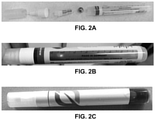
- FIG. 2 illustrates a pump-action marker pen (from Molotow).
- FIG. 2A illustrates the modularity of the system, allowing easy filling of the biodegradability composition.
- a suitable amount of cutinase (Cut1-Fusso) in dry powder (lyophilized) form produced using freeze drying was added to each of the two exemplary hydrogel composition, together with glycerol and optionally NaOH where required.
- a first marker pen was filled with the 'Blue' hydrogel to assemble a 'Blue' pen, which is illustrated in FIG.2B .
- a second first marker pen was filled with the 'Purple' hydrogel to assemble a 'Purple' pen, which is illustrated in FIG. 2C .
- the final compositions of the two marker pens is presented below in Table 3. Table 3: Final Composition of two exemplary biodegradability kits.
- the biodegradability of a polymeric material is determined by marking the surface of said polymeric material with the marker, thereby releasing an amount of biodegradability composition onto the surface of said polymeric material.
- the biodegradability composition will interact with the polymeric material and visually indicate its biodegradability through a colour switch (depending on the pH indicator colour).
- the 'Blue' hydrogel has a working pH range of 8 to 6 pH, wherein the hydrogel transitions from blue to yellow responsive to the cutinase's enzymatic activity.
- the 'Purple' hydrogel has a working pH range of 7 to 5 pH, wherein the hydrogel transitions from purple to yellow responsive to the cutinase's enzymatic activity.
Landscapes
- Chemical & Material Sciences (AREA)
- Organic Chemistry (AREA)
- Life Sciences & Earth Sciences (AREA)
- Health & Medical Sciences (AREA)
- Wood Science & Technology (AREA)
- Proteomics, Peptides & Aminoacids (AREA)
- Zoology (AREA)
- Engineering & Computer Science (AREA)
- Immunology (AREA)
- General Engineering & Computer Science (AREA)
- Microbiology (AREA)
- Molecular Biology (AREA)
- Analytical Chemistry (AREA)
- Biotechnology (AREA)
- Physics & Mathematics (AREA)
- Biochemistry (AREA)
- Bioinformatics & Cheminformatics (AREA)
- Biophysics (AREA)
- General Health & Medical Sciences (AREA)
- Genetics & Genomics (AREA)
- Measuring Or Testing Involving Enzymes Or Micro-Organisms (AREA)
- Addition Polymer Or Copolymer, Post-Treatments, Or Chemical Modifications (AREA)
- Materials For Medical Uses (AREA)
- Biological Depolymerization Polymers (AREA)
- Investigating Or Analysing Biological Materials (AREA)
Priority Applications (1)
| Application Number | Priority Date | Filing Date | Title |
|---|---|---|---|
| PL19201844T PL3636768T3 (pl) | 2018-10-08 | 2019-10-08 | Sposób i środki do określania biodegradowalności materiałów polimerowych |
Applications Claiming Priority (1)
| Application Number | Priority Date | Filing Date | Title |
|---|---|---|---|
| EP18199071 | 2018-10-08 |
Publications (2)
| Publication Number | Publication Date |
|---|---|
| EP3636768A1 EP3636768A1 (en) | 2020-04-15 |
| EP3636768B1 true EP3636768B1 (en) | 2022-03-16 |
Family
ID=63798843
Family Applications (1)
| Application Number | Title | Priority Date | Filing Date |
|---|---|---|---|
| EP19201844.8A Active EP3636768B1 (en) | 2018-10-08 | 2019-10-08 | Method and means for determining the biodegradability of polymeric materials |
Country Status (6)
| Country | Link |
|---|---|
| EP (1) | EP3636768B1 (pl) |
| DK (1) | DK3636768T3 (pl) |
| ES (1) | ES2917624T3 (pl) |
| MA (1) | MA51555B1 (pl) |
| PL (1) | PL3636768T3 (pl) |
| PT (1) | PT3636768T (pl) |
Families Citing this family (2)
| Publication number | Priority date | Publication date | Assignee | Title |
|---|---|---|---|---|
| WO2024175750A1 (en) * | 2023-02-23 | 2024-08-29 | B4Plastics Bv | Indicators to indicate the degree of depolymerisation |
| CN119479922B (zh) * | 2024-10-22 | 2025-08-26 | 浙江海正生物材料股份有限公司 | 一种基于高固厌氧生物分解试验结果的拟合求导法分析评价塑料抗降解性能的方法 |
Family Cites Families (2)
| Publication number | Priority date | Publication date | Assignee | Title |
|---|---|---|---|---|
| ES2139436T3 (es) * | 1996-01-22 | 2000-02-01 | Novo Nordisk As | Hidrolisis enzimatica de oligomeros ciclicos. |
| MX380946B (es) * | 2016-05-26 | 2025-03-12 | Univ Mexico Nac Autonoma | Cutinasas recombinantes de aspergillus nidulans para biodegradacion de poliesteres. |
-
2019
- 2019-10-08 PL PL19201844T patent/PL3636768T3/pl unknown
- 2019-10-08 DK DK19201844.8T patent/DK3636768T3/da active
- 2019-10-08 ES ES19201844T patent/ES2917624T3/es active Active
- 2019-10-08 MA MA51555A patent/MA51555B1/fr unknown
- 2019-10-08 EP EP19201844.8A patent/EP3636768B1/en active Active
- 2019-10-08 PT PT192018448T patent/PT3636768T/pt unknown
Also Published As
| Publication number | Publication date |
|---|---|
| PL3636768T3 (pl) | 2022-06-13 |
| MA51555A (fr) | 2020-11-18 |
| DK3636768T3 (da) | 2022-05-23 |
| MA51555B1 (fr) | 2022-04-29 |
| EP3636768A1 (en) | 2020-04-15 |
| PT3636768T (pt) | 2022-04-20 |
| ES2917624T3 (es) | 2022-07-11 |
Similar Documents
| Publication | Publication Date | Title |
|---|---|---|
| Roohi et al. | PHB (poly‐β‐hydroxybutyrate) and its enzymatic degradation | |
| Wang et al. | Seawater‐degradable polymers—fighting the marine plastic pollution | |
| Tyagi et al. | A critical review of the performance and soil biodegradability profiles of biobased natural and chemically synthesized polymers in industrial applications | |
| Kjeldsen et al. | A review of standards for biodegradable plastics | |
| Satti et al. | Biodegradation of poly (lactic acid) in soil microcosms at ambient temperature: evaluation of natural attenuation, bio-augmentation and bio-stimulation | |
| CN101589097B (zh) | 用于使聚合物材料生物可降解的化学添加剂 | |
| Numata et al. | Branched poly (lactide) synthesized by enzymatic polymerization: Effects of molecular branches and stereochemistry on enzymatic degradation and alkaline hydrolysis | |
| Rydz et al. | Polyester-based (bio) degradable polymers as environmentally friendly materials for sustainable development | |
| Magnin et al. | Green recycling process for polyurethane foams by a chem‐biotech approach | |
| Rudnik | 11-biodegradability testing of compostable polymer materials | |
| Sasimowski et al. | Artificial ageing, chemical resistance, and biodegradation of biocomposites from poly (butylene succinate) and wheat bran | |
| Iglesias-Montes et al. | Evaluation of the Factors Affecting the Disintegration under a Composting Process of Poly (lactic acid)/Poly (3-hydroxybutyrate)(PLA/PHB) Blends | |
| EP3636768B1 (en) | Method and means for determining the biodegradability of polymeric materials | |
| Kellerhals et al. | Renewable long-chain fatty acids for production of biodegradable medium-chain-length polyhydroxyalkanoates (mcl-PHAs) at laboratory and pilot plant scales | |
| Fiandra et al. | Designing biodegradable alternatives to commodity polymers | |
| Lors et al. | State of the art on biodegradability of bio-based plastics containing polylactic acid | |
| JP4359718B2 (ja) | ポリ乳酸の酵素解重合法、及び解重合生成物を用いるポリ乳酸の製造方法 | |
| US20130184415A1 (en) | Biodegradable resin composition | |
| Tiwari et al. | Recent development of biodegradation techniques of polymer | |
| Žagar et al. | Sequence distribution in microbial poly (3-hydroxybutyrate-co-3-hydroxyvalerate) co-polyesters determined by NMR and MS | |
| Prajapati et al. | Polyhydroxyalkanoates: an exotic gleam in the gloomy tale of plastics | |
| Khan et al. | Biodegradation of polyester polyurethane by Aspergillus flavus G10 | |
| Koller et al. | Biodegradability of polyhydroxyalkanoate (PHA) biopolyesters in nature: a review | |
| Brown et al. | UV light degradation of polylactic acid kickstarts enzymatic hydrolysis | |
| US20160208062A1 (en) | Biodegradable resin composition having a porous structure and method for surface treatment of same |
Legal Events
| Date | Code | Title | Description |
|---|---|---|---|
| PUAI | Public reference made under article 153(3) epc to a published international application that has entered the european phase |
Free format text: ORIGINAL CODE: 0009012 |
|
| STAA | Information on the status of an ep patent application or granted ep patent |
Free format text: STATUS: THE APPLICATION HAS BEEN PUBLISHED |
|
| AK | Designated contracting states |
Kind code of ref document: A1 Designated state(s): AL AT BE BG CH CY CZ DE DK EE ES FI FR GB GR HR HU IE IS IT LI LT LU LV MC MK MT NL NO PL PT RO RS SE SI SK SM TR |
|
| AX | Request for extension of the european patent |
Extension state: BA ME |
|
| STAA | Information on the status of an ep patent application or granted ep patent |
Free format text: STATUS: REQUEST FOR EXAMINATION WAS MADE |
|
| 17P | Request for examination filed |
Effective date: 20201013 |
|
| RAV | Requested validation state of the european patent: fee paid |
Extension state: MA Effective date: 20201013 |
|
| RBV | Designated contracting states (corrected) |
Designated state(s): AL AT BE BG CH CY CZ DE DK EE ES FI FR GB GR HR HU IE IS IT LI LT LU LV MC MK MT NL NO PL PT RO RS SE SI SK SM TR |
|
| STAA | Information on the status of an ep patent application or granted ep patent |
Free format text: STATUS: EXAMINATION IS IN PROGRESS |
|
| 17Q | First examination report despatched |
Effective date: 20201202 |
|
| GRAP | Despatch of communication of intention to grant a patent |
Free format text: ORIGINAL CODE: EPIDOSNIGR1 |
|
| STAA | Information on the status of an ep patent application or granted ep patent |
Free format text: STATUS: GRANT OF PATENT IS INTENDED |
|
| GRAJ | Information related to disapproval of communication of intention to grant by the applicant or resumption of examination proceedings by the epo deleted |
Free format text: ORIGINAL CODE: EPIDOSDIGR1 |
|
| GRAP | Despatch of communication of intention to grant a patent |
Free format text: ORIGINAL CODE: EPIDOSNIGR1 |
|
| INTG | Intention to grant announced |
Effective date: 20211014 |
|
| INTG | Intention to grant announced |
Effective date: 20211026 |
|
| GRAS | Grant fee paid |
Free format text: ORIGINAL CODE: EPIDOSNIGR3 |
|
| GRAA | (expected) grant |
Free format text: ORIGINAL CODE: 0009210 |
|
| STAA | Information on the status of an ep patent application or granted ep patent |
Free format text: STATUS: THE PATENT HAS BEEN GRANTED |
|
| AK | Designated contracting states |
Kind code of ref document: B1 Designated state(s): AL AT BE BG CH CY CZ DE DK EE ES FI FR GB GR HR HU IE IS IT LI LT LU LV MC MK MT NL NO PL PT RO RS SE SI SK SM TR |
|
| RAP3 | Party data changed (applicant data changed or rights of an application transferred) |
Owner name: B4PLASTICS BV |
|
| REG | Reference to a national code |
Ref country code: GB Ref legal event code: FG4D |
|
| REG | Reference to a national code |
Ref country code: FI Ref legal event code: FGE |
|
| REG | Reference to a national code |
Ref country code: CH Ref legal event code: EP |
|
| REG | Reference to a national code |
Ref country code: DE Ref legal event code: R096 Ref document number: 602019012551 Country of ref document: DE |
|
| REG | Reference to a national code |
Ref country code: IE Ref legal event code: FG4D |
|
| REG | Reference to a national code |
Ref country code: AT Ref legal event code: REF Ref document number: 1475908 Country of ref document: AT Kind code of ref document: T Effective date: 20220415 |
|
| REG | Reference to a national code |
Ref country code: PT Ref legal event code: SC4A Ref document number: 3636768 Country of ref document: PT Date of ref document: 20220420 Kind code of ref document: T Free format text: AVAILABILITY OF NATIONAL TRANSLATION Effective date: 20220413 |
|
| REG | Reference to a national code |
Ref country code: MA Ref legal event code: VAGR Ref document number: 51555 Country of ref document: MA Kind code of ref document: B1 |
|
| REG | Reference to a national code |
Ref country code: DK Ref legal event code: T3 Effective date: 20220520 |
|
| REG | Reference to a national code |
Ref country code: NO Ref legal event code: T2 Effective date: 20220316 |
|
| REG | Reference to a national code |
Ref country code: NL Ref legal event code: FP |
|
| REG | Reference to a national code |
Ref country code: SE Ref legal event code: TRGR |
|
| REG | Reference to a national code |
Ref country code: LT Ref legal event code: MG9D Ref country code: ES Ref legal event code: FG2A Ref document number: 2917624 Country of ref document: ES Kind code of ref document: T3 Effective date: 20220711 |
|
| PG25 | Lapsed in a contracting state [announced via postgrant information from national office to epo] |
Ref country code: RS Free format text: LAPSE BECAUSE OF FAILURE TO SUBMIT A TRANSLATION OF THE DESCRIPTION OR TO PAY THE FEE WITHIN THE PRESCRIBED TIME-LIMIT Effective date: 20220316 Ref country code: LT Free format text: LAPSE BECAUSE OF FAILURE TO SUBMIT A TRANSLATION OF THE DESCRIPTION OR TO PAY THE FEE WITHIN THE PRESCRIBED TIME-LIMIT Effective date: 20220316 Ref country code: HR Free format text: LAPSE BECAUSE OF FAILURE TO SUBMIT A TRANSLATION OF THE DESCRIPTION OR TO PAY THE FEE WITHIN THE PRESCRIBED TIME-LIMIT Effective date: 20220316 Ref country code: BG Free format text: LAPSE BECAUSE OF FAILURE TO SUBMIT A TRANSLATION OF THE DESCRIPTION OR TO PAY THE FEE WITHIN THE PRESCRIBED TIME-LIMIT Effective date: 20220616 |
|
| PG25 | Lapsed in a contracting state [announced via postgrant information from national office to epo] |
Ref country code: LV Free format text: LAPSE BECAUSE OF FAILURE TO SUBMIT A TRANSLATION OF THE DESCRIPTION OR TO PAY THE FEE WITHIN THE PRESCRIBED TIME-LIMIT Effective date: 20220316 Ref country code: GR Free format text: LAPSE BECAUSE OF FAILURE TO SUBMIT A TRANSLATION OF THE DESCRIPTION OR TO PAY THE FEE WITHIN THE PRESCRIBED TIME-LIMIT Effective date: 20220617 |
|
| PG25 | Lapsed in a contracting state [announced via postgrant information from national office to epo] |
Ref country code: SM Free format text: LAPSE BECAUSE OF FAILURE TO SUBMIT A TRANSLATION OF THE DESCRIPTION OR TO PAY THE FEE WITHIN THE PRESCRIBED TIME-LIMIT Effective date: 20220316 Ref country code: SK Free format text: LAPSE BECAUSE OF FAILURE TO SUBMIT A TRANSLATION OF THE DESCRIPTION OR TO PAY THE FEE WITHIN THE PRESCRIBED TIME-LIMIT Effective date: 20220316 Ref country code: RO Free format text: LAPSE BECAUSE OF FAILURE TO SUBMIT A TRANSLATION OF THE DESCRIPTION OR TO PAY THE FEE WITHIN THE PRESCRIBED TIME-LIMIT Effective date: 20220316 Ref country code: EE Free format text: LAPSE BECAUSE OF FAILURE TO SUBMIT A TRANSLATION OF THE DESCRIPTION OR TO PAY THE FEE WITHIN THE PRESCRIBED TIME-LIMIT Effective date: 20220316 Ref country code: CZ Free format text: LAPSE BECAUSE OF FAILURE TO SUBMIT A TRANSLATION OF THE DESCRIPTION OR TO PAY THE FEE WITHIN THE PRESCRIBED TIME-LIMIT Effective date: 20220316 |
|
| PG25 | Lapsed in a contracting state [announced via postgrant information from national office to epo] |
Ref country code: AL Free format text: LAPSE BECAUSE OF FAILURE TO SUBMIT A TRANSLATION OF THE DESCRIPTION OR TO PAY THE FEE WITHIN THE PRESCRIBED TIME-LIMIT Effective date: 20220316 |
|
| REG | Reference to a national code |
Ref country code: DE Ref legal event code: R097 Ref document number: 602019012551 Country of ref document: DE |
|
| PLBE | No opposition filed within time limit |
Free format text: ORIGINAL CODE: 0009261 |
|
| STAA | Information on the status of an ep patent application or granted ep patent |
Free format text: STATUS: NO OPPOSITION FILED WITHIN TIME LIMIT |
|
| 26N | No opposition filed |
Effective date: 20221219 |
|
| PG25 | Lapsed in a contracting state [announced via postgrant information from national office to epo] |
Ref country code: SI Free format text: LAPSE BECAUSE OF FAILURE TO SUBMIT A TRANSLATION OF THE DESCRIPTION OR TO PAY THE FEE WITHIN THE PRESCRIBED TIME-LIMIT Effective date: 20220316 |
|
| PGFP | Annual fee paid to national office [announced via postgrant information from national office to epo] |
Ref country code: IS Payment date: 20221020 Year of fee payment: 4 |
|
| PG25 | Lapsed in a contracting state [announced via postgrant information from national office to epo] |
Ref country code: MC Free format text: LAPSE BECAUSE OF FAILURE TO SUBMIT A TRANSLATION OF THE DESCRIPTION OR TO PAY THE FEE WITHIN THE PRESCRIBED TIME-LIMIT Effective date: 20220316 |
|
| PG25 | Lapsed in a contracting state [announced via postgrant information from national office to epo] |
Ref country code: HU Free format text: LAPSE BECAUSE OF FAILURE TO SUBMIT A TRANSLATION OF THE DESCRIPTION OR TO PAY THE FEE WITHIN THE PRESCRIBED TIME-LIMIT; INVALID AB INITIO Effective date: 20191008 |
|
| PG25 | Lapsed in a contracting state [announced via postgrant information from national office to epo] |
Ref country code: CY Free format text: LAPSE BECAUSE OF FAILURE TO SUBMIT A TRANSLATION OF THE DESCRIPTION OR TO PAY THE FEE WITHIN THE PRESCRIBED TIME-LIMIT Effective date: 20220316 |
|
| REG | Reference to a national code |
Ref country code: AT Ref legal event code: UEP Ref document number: 1475908 Country of ref document: AT Kind code of ref document: T Effective date: 20220316 |
|
| PG25 | Lapsed in a contracting state [announced via postgrant information from national office to epo] |
Ref country code: MK Free format text: LAPSE BECAUSE OF FAILURE TO SUBMIT A TRANSLATION OF THE DESCRIPTION OR TO PAY THE FEE WITHIN THE PRESCRIBED TIME-LIMIT Effective date: 20220316 |
|
| PG25 | Lapsed in a contracting state [announced via postgrant information from national office to epo] |
Ref country code: MT Free format text: LAPSE BECAUSE OF FAILURE TO SUBMIT A TRANSLATION OF THE DESCRIPTION OR TO PAY THE FEE WITHIN THE PRESCRIBED TIME-LIMIT Effective date: 20220316 |
|
| PG25 | Lapsed in a contracting state [announced via postgrant information from national office to epo] |
Ref country code: IS Free format text: LAPSE BECAUSE OF NON-PAYMENT OF DUE FEES Effective date: 20240506 |
|
| VS25 | Lapsed in a validation state [announced via postgrant information from nat. office to epo] |
Ref country code: MA Free format text: LAPSE BECAUSE OF NON-PAYMENT OF DUE FEES Effective date: 20231009 |
|
| VSFP | Annual fee paid to validation state [announced via postgrant information from national office to epo] |
Ref country code: MA Payment date: 20221027 Year of fee payment: 4 |
|
| REG | Reference to a national code |
Ref country code: CH Ref legal event code: U11 Free format text: ST27 STATUS EVENT CODE: U-0-0-U10-U11 (AS PROVIDED BY THE NATIONAL OFFICE) Effective date: 20251101 |
|
| PGFP | Annual fee paid to national office [announced via postgrant information from national office to epo] |
Ref country code: NL Payment date: 20251021 Year of fee payment: 7 Ref country code: LU Payment date: 20251022 Year of fee payment: 7 |
|
| PGFP | Annual fee paid to national office [announced via postgrant information from national office to epo] |
Ref country code: PT Payment date: 20251024 Year of fee payment: 7 |
|
| PGFP | Annual fee paid to national office [announced via postgrant information from national office to epo] |
Ref country code: DE Payment date: 20251021 Year of fee payment: 7 |
|
| PGFP | Annual fee paid to national office [announced via postgrant information from national office to epo] |
Ref country code: GB Payment date: 20251022 Year of fee payment: 7 |
|
| PGFP | Annual fee paid to national office [announced via postgrant information from national office to epo] |
Ref country code: NO Payment date: 20251024 Year of fee payment: 7 |
|
| PGFP | Annual fee paid to national office [announced via postgrant information from national office to epo] |
Ref country code: AT Payment date: 20251022 Year of fee payment: 7 |
|
| PGFP | Annual fee paid to national office [announced via postgrant information from national office to epo] |
Ref country code: FI Payment date: 20251028 Year of fee payment: 7 Ref country code: DK Payment date: 20251027 Year of fee payment: 7 Ref country code: IT Payment date: 20251024 Year of fee payment: 7 |
|
| PGFP | Annual fee paid to national office [announced via postgrant information from national office to epo] |
Ref country code: FR Payment date: 20251030 Year of fee payment: 7 |
|
| PGFP | Annual fee paid to national office [announced via postgrant information from national office to epo] |
Ref country code: TR Payment date: 20251027 Year of fee payment: 7 Ref country code: BE Payment date: 20251021 Year of fee payment: 7 |
|
| PGFP | Annual fee paid to national office [announced via postgrant information from national office to epo] |
Ref country code: SE Payment date: 20251021 Year of fee payment: 7 Ref country code: CH Payment date: 20251101 Year of fee payment: 7 |
|
| PGFP | Annual fee paid to national office [announced via postgrant information from national office to epo] |
Ref country code: IE Payment date: 20251024 Year of fee payment: 7 |
|
| PGFP | Annual fee paid to national office [announced via postgrant information from national office to epo] |
Ref country code: PL Payment date: 20251030 Year of fee payment: 7 |
|
| PGFP | Annual fee paid to national office [announced via postgrant information from national office to epo] |
Ref country code: ES Payment date: 20251216 Year of fee payment: 7 |