EP3636646A1 - Heteroaryl-pyrazole derivative, and preparation method therefor and medical application thereof - Google Patents
Heteroaryl-pyrazole derivative, and preparation method therefor and medical application thereof Download PDFInfo
- Publication number
- EP3636646A1 EP3636646A1 EP18803089.4A EP18803089A EP3636646A1 EP 3636646 A1 EP3636646 A1 EP 3636646A1 EP 18803089 A EP18803089 A EP 18803089A EP 3636646 A1 EP3636646 A1 EP 3636646A1
- Authority
- EP
- European Patent Office
- Prior art keywords
- compound
- general formula
- heterocyclyl
- cycloalkyl
- heteroaryl
- Prior art date
- Legal status (The legal status is an assumption and is not a legal conclusion. Google has not performed a legal analysis and makes no representation as to the accuracy of the status listed.)
- Withdrawn
Links
- 238000002360 preparation method Methods 0.000 title abstract description 6
- 239000008194 pharmaceutical composition Substances 0.000 claims abstract description 24
- 239000003814 drug Substances 0.000 claims abstract description 21
- 229940044616 toll-like receptor 7 agonist Drugs 0.000 claims abstract description 9
- 150000001875 compounds Chemical class 0.000 claims description 170
- 125000000623 heterocyclic group Chemical group 0.000 claims description 91
- -1 cyano, amino Chemical group 0.000 claims description 90
- 125000000753 cycloalkyl group Chemical group 0.000 claims description 77
- 125000000217 alkyl group Chemical group 0.000 claims description 63
- 125000003118 aryl group Chemical group 0.000 claims description 56
- 125000001072 heteroaryl group Chemical group 0.000 claims description 56
- 239000000203 mixture Substances 0.000 claims description 44
- 229910052736 halogen Inorganic materials 0.000 claims description 37
- 150000002367 halogens Chemical group 0.000 claims description 37
- 125000003545 alkoxy group Chemical group 0.000 claims description 35
- 150000003839 salts Chemical class 0.000 claims description 32
- 238000006243 chemical reaction Methods 0.000 claims description 30
- 125000001188 haloalkyl group Chemical group 0.000 claims description 28
- 125000002887 hydroxy group Chemical group [H]O* 0.000 claims description 28
- 125000002768 hydroxyalkyl group Chemical group 0.000 claims description 28
- 125000000449 nitro group Chemical group [O-][N+](*)=O 0.000 claims description 28
- 125000001424 substituent group Chemical group 0.000 claims description 27
- 125000004435 hydrogen atom Chemical group [H]* 0.000 claims description 23
- 125000002924 primary amino group Chemical group [H]N([H])* 0.000 claims description 19
- 238000000034 method Methods 0.000 claims description 17
- 125000004093 cyano group Chemical group *C#N 0.000 claims description 14
- 125000005842 heteroatom Chemical group 0.000 claims description 14
- 229910052757 nitrogen Inorganic materials 0.000 claims description 14
- 125000003342 alkenyl group Chemical group 0.000 claims description 12
- 125000000304 alkynyl group Chemical group 0.000 claims description 12
- 125000006239 protecting group Chemical group 0.000 claims description 11
- 125000002947 alkylene group Chemical group 0.000 claims description 10
- 238000004519 manufacturing process Methods 0.000 claims description 9
- 229910052760 oxygen Inorganic materials 0.000 claims description 9
- 229910052717 sulfur Inorganic materials 0.000 claims description 9
- 125000004433 nitrogen atom Chemical group N* 0.000 claims description 8
- 206010028980 Neoplasm Diseases 0.000 claims description 6
- 241000700605 Viruses Species 0.000 claims description 6
- 201000011510 cancer Diseases 0.000 claims description 6
- 239000000546 pharmaceutical excipient Substances 0.000 claims description 6
- 208000015181 infectious disease Diseases 0.000 claims description 4
- 206010004146 Basal cell carcinoma Diseases 0.000 claims description 3
- 206010035226 Plasma cell myeloma Diseases 0.000 claims description 3
- 208000006265 Renal cell carcinoma Diseases 0.000 claims description 3
- 241000724205 Rice stripe tenuivirus Species 0.000 claims description 3
- 241000315672 SARS coronavirus Species 0.000 claims description 3
- 239000003085 diluting agent Substances 0.000 claims description 3
- 239000003937 drug carrier Substances 0.000 claims description 3
- 206010073071 hepatocellular carcinoma Diseases 0.000 claims description 3
- 231100000844 hepatocellular carcinoma Toxicity 0.000 claims description 3
- 201000001441 melanoma Diseases 0.000 claims description 3
- 201000000050 myeloid neoplasm Diseases 0.000 claims description 3
- 208000002154 non-small cell lung carcinoma Diseases 0.000 claims description 3
- 125000001997 phenyl group Chemical group [H]C1=C([H])C([H])=C(*)C([H])=C1[H] 0.000 claims description 3
- 125000004076 pyridyl group Chemical group 0.000 claims description 3
- 208000029729 tumor suppressor gene on chromosome 11 Diseases 0.000 claims description 3
- 241000712461 unidentified influenza virus Species 0.000 claims description 3
- 241000710780 Bovine viral diarrhea virus 1 Species 0.000 claims description 2
- 241000725619 Dengue virus Species 0.000 claims description 2
- 241000710842 Japanese encephalitis virus Species 0.000 claims description 2
- 241000710912 Kunjin virus Species 0.000 claims description 2
- 241000710908 Murray Valley encephalitis virus Species 0.000 claims description 2
- IOVCWXUNBOPUCH-UHFFFAOYSA-M Nitrite anion Chemical compound [O-]N=O IOVCWXUNBOPUCH-UHFFFAOYSA-M 0.000 claims description 2
- 241000725177 Omsk hemorrhagic fever virus Species 0.000 claims description 2
- 241000710888 St. Louis encephalitis virus Species 0.000 claims description 2
- 241000710771 Tick-borne encephalitis virus Species 0.000 claims description 2
- 241000710886 West Nile virus Species 0.000 claims description 2
- 241000710772 Yellow fever virus Species 0.000 claims description 2
- 241000907316 Zika virus Species 0.000 claims description 2
- 238000007363 ring formation reaction Methods 0.000 claims description 2
- 229910052701 rubidium Inorganic materials 0.000 claims description 2
- 229940051021 yellow-fever virus Drugs 0.000 claims description 2
- 241000580858 Simian-Human immunodeficiency virus Species 0.000 claims 1
- 229940124597 therapeutic agent Drugs 0.000 abstract description 2
- 239000000243 solution Substances 0.000 description 40
- QTBSBXVTEAMEQO-UHFFFAOYSA-N Acetic acid Chemical compound CC(O)=O QTBSBXVTEAMEQO-UHFFFAOYSA-N 0.000 description 30
- XEKOWRVHYACXOJ-UHFFFAOYSA-N Ethyl acetate Chemical compound CCOC(C)=O XEKOWRVHYACXOJ-UHFFFAOYSA-N 0.000 description 27
- 210000004027 cell Anatomy 0.000 description 22
- IAZDPXIOMUYVGZ-UHFFFAOYSA-N Dimethylsulphoxide Chemical compound CS(C)=O IAZDPXIOMUYVGZ-UHFFFAOYSA-N 0.000 description 20
- 125000004432 carbon atom Chemical group C* 0.000 description 20
- 101000669402 Homo sapiens Toll-like receptor 7 Proteins 0.000 description 15
- ZMANZCXQSJIPKH-UHFFFAOYSA-N Triethylamine Chemical compound CCN(CC)CC ZMANZCXQSJIPKH-UHFFFAOYSA-N 0.000 description 15
- DTQVDTLACAAQTR-UHFFFAOYSA-N Trifluoroacetic acid Chemical compound OC(=O)C(F)(F)F DTQVDTLACAAQTR-UHFFFAOYSA-N 0.000 description 14
- 230000000694 effects Effects 0.000 description 13
- 238000002474 experimental method Methods 0.000 description 13
- 239000002904 solvent Substances 0.000 description 13
- XLYOFNOQVPJJNP-UHFFFAOYSA-N water Substances O XLYOFNOQVPJJNP-UHFFFAOYSA-N 0.000 description 13
- 101000800483 Homo sapiens Toll-like receptor 8 Proteins 0.000 description 12
- VEXZGXHMUGYJMC-UHFFFAOYSA-N Hydrochloric acid Chemical compound Cl VEXZGXHMUGYJMC-UHFFFAOYSA-N 0.000 description 12
- WMFOQBRAJBCJND-UHFFFAOYSA-M Lithium hydroxide Chemical compound [Li+].[OH-] WMFOQBRAJBCJND-UHFFFAOYSA-M 0.000 description 12
- ZMXDDKWLCZADIW-UHFFFAOYSA-N N,N-Dimethylformamide Chemical compound CN(C)C=O ZMXDDKWLCZADIW-UHFFFAOYSA-N 0.000 description 12
- FAPWRFPIFSIZLT-UHFFFAOYSA-M Sodium chloride Chemical compound [Na+].[Cl-] FAPWRFPIFSIZLT-UHFFFAOYSA-M 0.000 description 12
- HEMHJVSKTPXQMS-UHFFFAOYSA-M Sodium hydroxide Chemical compound [OH-].[Na+] HEMHJVSKTPXQMS-UHFFFAOYSA-M 0.000 description 12
- 102100039390 Toll-like receptor 7 Human genes 0.000 description 12
- 125000002619 bicyclic group Chemical group 0.000 description 12
- SCVFZCLFOSHCOH-UHFFFAOYSA-M potassium acetate Chemical compound [K+].CC([O-])=O SCVFZCLFOSHCOH-UHFFFAOYSA-M 0.000 description 12
- 239000003153 chemical reaction reagent Substances 0.000 description 11
- 125000003367 polycyclic group Chemical group 0.000 description 11
- 125000006413 ring segment Chemical group 0.000 description 11
- 102000006992 Interferon-alpha Human genes 0.000 description 10
- 108010047761 Interferon-alpha Proteins 0.000 description 10
- WYURNTSHIVDZCO-UHFFFAOYSA-N Tetrahydrofuran Chemical compound C1CCOC1 WYURNTSHIVDZCO-UHFFFAOYSA-N 0.000 description 10
- 102000002689 Toll-like receptor Human genes 0.000 description 10
- 108020000411 Toll-like receptor Proteins 0.000 description 10
- 229940079593 drug Drugs 0.000 description 10
- 238000004949 mass spectrometry Methods 0.000 description 10
- 210000003819 peripheral blood mononuclear cell Anatomy 0.000 description 10
- 239000012224 working solution Substances 0.000 description 10
- YMWUJEATGCHHMB-UHFFFAOYSA-N Dichloromethane Chemical compound ClCCl YMWUJEATGCHHMB-UHFFFAOYSA-N 0.000 description 9
- LFQSCWFLJHTTHZ-UHFFFAOYSA-N Ethanol Chemical compound CCO LFQSCWFLJHTTHZ-UHFFFAOYSA-N 0.000 description 9
- OKKJLVBELUTLKV-UHFFFAOYSA-N Methanol Chemical compound OC OKKJLVBELUTLKV-UHFFFAOYSA-N 0.000 description 9
- 102100033110 Toll-like receptor 8 Human genes 0.000 description 9
- YXFVVABEGXRONW-UHFFFAOYSA-N Toluene Chemical compound CC1=CC=CC=C1 YXFVVABEGXRONW-UHFFFAOYSA-N 0.000 description 9
- 230000002378 acidificating effect Effects 0.000 description 9
- DDLIGBOFAVUZHB-UHFFFAOYSA-N midazolam Chemical class C12=CC(Cl)=CC=C2N2C(C)=NC=C2CN=C1C1=CC=CC=C1F DDLIGBOFAVUZHB-UHFFFAOYSA-N 0.000 description 9
- 239000000047 product Substances 0.000 description 9
- XJLXINKUBYWONI-DQQFMEOOSA-N [[(2r,3r,4r,5r)-5-(6-aminopurin-9-yl)-3-hydroxy-4-phosphonooxyoxolan-2-yl]methoxy-hydroxyphosphoryl] [(2s,3r,4s,5s)-5-(3-carbamoylpyridin-1-ium-1-yl)-3,4-dihydroxyoxolan-2-yl]methyl phosphate Chemical compound NC(=O)C1=CC=C[N+]([C@@H]2[C@H]([C@@H](O)[C@H](COP([O-])(=O)OP(O)(=O)OC[C@@H]3[C@H]([C@@H](OP(O)(O)=O)[C@@H](O3)N3C4=NC=NC(N)=C4N=C3)O)O2)O)=C1 XJLXINKUBYWONI-DQQFMEOOSA-N 0.000 description 8
- 230000004913 activation Effects 0.000 description 8
- VLKZOEOYAKHREP-UHFFFAOYSA-N n-Hexane Chemical compound CCCCCC VLKZOEOYAKHREP-UHFFFAOYSA-N 0.000 description 8
- OHDXDNUPVVYWOV-UHFFFAOYSA-N n-methyl-1-(2-naphthalen-1-ylsulfanylphenyl)methanamine Chemical compound CNCC1=CC=CC=C1SC1=CC=CC2=CC=CC=C12 OHDXDNUPVVYWOV-UHFFFAOYSA-N 0.000 description 8
- 229930027945 nicotinamide-adenine dinucleotide Natural products 0.000 description 8
- LPXPTNMVRIOKMN-UHFFFAOYSA-M sodium nitrite Chemical compound [Na+].[O-]N=O LPXPTNMVRIOKMN-UHFFFAOYSA-M 0.000 description 8
- 239000004480 active ingredient Substances 0.000 description 7
- 125000004429 atom Chemical group 0.000 description 7
- 210000001853 liver microsome Anatomy 0.000 description 7
- 239000000463 material Substances 0.000 description 7
- 230000002503 metabolic effect Effects 0.000 description 7
- 238000010534 nucleophilic substitution reaction Methods 0.000 description 7
- RYHBNJHYFVUHQT-UHFFFAOYSA-N 1,4-Dioxane Chemical compound C1COCCO1 RYHBNJHYFVUHQT-UHFFFAOYSA-N 0.000 description 6
- VHYFNPMBLIVWCW-UHFFFAOYSA-N 4-Dimethylaminopyridine Chemical compound CN(C)C1=CC=NC=C1 VHYFNPMBLIVWCW-UHFFFAOYSA-N 0.000 description 6
- WEVYAHXRMPXWCK-UHFFFAOYSA-N Acetonitrile Chemical compound CC#N WEVYAHXRMPXWCK-UHFFFAOYSA-N 0.000 description 6
- 108010001237 Cytochrome P-450 CYP2D6 Proteins 0.000 description 6
- 102000004328 Cytochrome P-450 CYP3A Human genes 0.000 description 6
- 108010081668 Cytochrome P-450 CYP3A Proteins 0.000 description 6
- 102100021704 Cytochrome P450 2D6 Human genes 0.000 description 6
- OKKJLVBELUTLKV-MZCSYVLQSA-N Deuterated methanol Chemical compound [2H]OC([2H])([2H])[2H] OKKJLVBELUTLKV-MZCSYVLQSA-N 0.000 description 6
- RTZKZFJDLAIYFH-UHFFFAOYSA-N Diethyl ether Chemical compound CCOCC RTZKZFJDLAIYFH-UHFFFAOYSA-N 0.000 description 6
- TWRXJAOTZQYOKJ-UHFFFAOYSA-L Magnesium chloride Chemical compound [Mg+2].[Cl-].[Cl-] TWRXJAOTZQYOKJ-UHFFFAOYSA-L 0.000 description 6
- AFVFQIVMOAPDHO-UHFFFAOYSA-N Methanesulfonic acid Chemical compound CS(O)(=O)=O AFVFQIVMOAPDHO-UHFFFAOYSA-N 0.000 description 6
- JGFZNNIVVJXRND-UHFFFAOYSA-N N,N-Diisopropylethylamine (DIPEA) Chemical compound CCN(C(C)C)C(C)C JGFZNNIVVJXRND-UHFFFAOYSA-N 0.000 description 6
- LRHPLDYGYMQRHN-UHFFFAOYSA-N N-Butanol Chemical compound CCCCO LRHPLDYGYMQRHN-UHFFFAOYSA-N 0.000 description 6
- MZRVEZGGRBJDDB-UHFFFAOYSA-N N-Butyllithium Chemical compound [Li]CCCC MZRVEZGGRBJDDB-UHFFFAOYSA-N 0.000 description 6
- KDLHZDBZIXYQEI-UHFFFAOYSA-N Palladium Chemical compound [Pd] KDLHZDBZIXYQEI-UHFFFAOYSA-N 0.000 description 6
- NBIIXXVUZAFLBC-UHFFFAOYSA-N Phosphoric acid Chemical compound OP(O)(O)=O NBIIXXVUZAFLBC-UHFFFAOYSA-N 0.000 description 6
- JUJWROOIHBZHMG-UHFFFAOYSA-N Pyridine Chemical compound C1=CC=NC=C1 JUJWROOIHBZHMG-UHFFFAOYSA-N 0.000 description 6
- CDBYLPFSWZWCQE-UHFFFAOYSA-L Sodium Carbonate Chemical compound [Na+].[Na+].[O-]C([O-])=O CDBYLPFSWZWCQE-UHFFFAOYSA-L 0.000 description 6
- QAOWNCQODCNURD-UHFFFAOYSA-N Sulfuric acid Chemical compound OS(O)(=O)=O QAOWNCQODCNURD-UHFFFAOYSA-N 0.000 description 6
- 125000003282 alkyl amino group Chemical group 0.000 description 6
- 125000004414 alkyl thio group Chemical group 0.000 description 6
- 239000003638 chemical reducing agent Substances 0.000 description 6
- 125000000000 cycloalkoxy group Chemical group 0.000 description 6
- 125000005366 cycloalkylthio group Chemical group 0.000 description 6
- 239000012091 fetal bovine serum Substances 0.000 description 6
- 239000000706 filtrate Substances 0.000 description 6
- IXCSERBJSXMMFS-UHFFFAOYSA-N hydrogen chloride Substances Cl.Cl IXCSERBJSXMMFS-UHFFFAOYSA-N 0.000 description 6
- 229910000041 hydrogen chloride Inorganic materials 0.000 description 6
- 150000007529 inorganic bases Chemical class 0.000 description 6
- ZCSHNCUQKCANBX-UHFFFAOYSA-N lithium diisopropylamide Chemical compound [Li+].CC(C)[N-]C(C)C ZCSHNCUQKCANBX-UHFFFAOYSA-N 0.000 description 6
- BDAGIHXWWSANSR-UHFFFAOYSA-N methanoic acid Natural products OC=O BDAGIHXWWSANSR-UHFFFAOYSA-N 0.000 description 6
- 229960003793 midazolam Drugs 0.000 description 6
- 150000007530 organic bases Chemical class 0.000 description 6
- 235000011056 potassium acetate Nutrition 0.000 description 6
- BWHMMNNQKKPAPP-UHFFFAOYSA-L potassium carbonate Chemical compound [K+].[K+].[O-]C([O-])=O BWHMMNNQKKPAPP-UHFFFAOYSA-L 0.000 description 6
- LOUPRKONTZGTKE-LHHVKLHASA-N quinidine Chemical compound C([C@H]([C@H](C1)C=C)C2)C[N@@]1[C@H]2[C@@H](O)C1=CC=NC2=CC=C(OC)C=C21 LOUPRKONTZGTKE-LHHVKLHASA-N 0.000 description 6
- 230000028327 secretion Effects 0.000 description 6
- MFRIHAYPQRLWNB-UHFFFAOYSA-N sodium tert-butoxide Chemical compound [Na+].CC(C)(C)[O-] MFRIHAYPQRLWNB-UHFFFAOYSA-N 0.000 description 6
- 239000006228 supernatant Substances 0.000 description 6
- 239000000725 suspension Substances 0.000 description 6
- 150000003573 thiols Chemical class 0.000 description 6
- JOXIMZWYDAKGHI-UHFFFAOYSA-N toluene-4-sulfonic acid Chemical compound CC1=CC=C(S(O)(=O)=O)C=C1 JOXIMZWYDAKGHI-UHFFFAOYSA-N 0.000 description 6
- LWIHDJKSTIGBAC-UHFFFAOYSA-K tripotassium phosphate Chemical compound [K+].[K+].[K+].[O-]P([O-])([O-])=O LWIHDJKSTIGBAC-UHFFFAOYSA-K 0.000 description 6
- PMZURENOXWZQFD-UHFFFAOYSA-L Sodium Sulfate Chemical compound [Na+].[Na+].[O-]S([O-])(=O)=O PMZURENOXWZQFD-UHFFFAOYSA-L 0.000 description 5
- 239000000872 buffer Substances 0.000 description 5
- 229910052799 carbon Inorganic materials 0.000 description 5
- 238000006114 decarboxylation reaction Methods 0.000 description 5
- 229910052739 hydrogen Inorganic materials 0.000 description 5
- 239000001257 hydrogen Substances 0.000 description 5
- 239000002609 medium Substances 0.000 description 5
- 238000000746 purification Methods 0.000 description 5
- YLQBMQCUIZJEEH-UHFFFAOYSA-N tetrahydrofuran Natural products C=1C=COC=1 YLQBMQCUIZJEEH-UHFFFAOYSA-N 0.000 description 5
- 238000004809 thin layer chromatography Methods 0.000 description 5
- 125000003903 2-propenyl group Chemical group [H]C([*])([H])C([H])=C([H])[H] 0.000 description 4
- ZAMOUSCENKQFHK-UHFFFAOYSA-N Chlorine atom Chemical compound [Cl] ZAMOUSCENKQFHK-UHFFFAOYSA-N 0.000 description 4
- 102000004127 Cytokines Human genes 0.000 description 4
- 108090000695 Cytokines Proteins 0.000 description 4
- PEDCQBHIVMGVHV-UHFFFAOYSA-N Glycerine Chemical compound OCC(O)CO PEDCQBHIVMGVHV-UHFFFAOYSA-N 0.000 description 4
- UFHFLCQGNIYNRP-UHFFFAOYSA-N Hydrogen Chemical compound [H][H] UFHFLCQGNIYNRP-UHFFFAOYSA-N 0.000 description 4
- 238000005481 NMR spectroscopy Methods 0.000 description 4
- ZLMJMSJWJFRBEC-UHFFFAOYSA-N Potassium Chemical compound [K] ZLMJMSJWJFRBEC-UHFFFAOYSA-N 0.000 description 4
- VYPSYNLAJGMNEJ-UHFFFAOYSA-N Silicium dioxide Chemical compound O=[Si]=O VYPSYNLAJGMNEJ-UHFFFAOYSA-N 0.000 description 4
- HCHKCACWOHOZIP-UHFFFAOYSA-N Zinc Chemical compound [Zn] HCHKCACWOHOZIP-UHFFFAOYSA-N 0.000 description 4
- 125000002777 acetyl group Chemical group [H]C([H])([H])C(*)=O 0.000 description 4
- 125000001797 benzyl group Chemical group [H]C1=C([H])C([H])=C(C([H])=C1[H])C([H])([H])* 0.000 description 4
- 230000000903 blocking effect Effects 0.000 description 4
- 238000004113 cell culture Methods 0.000 description 4
- 229910052801 chlorine Inorganic materials 0.000 description 4
- 239000000460 chlorine Substances 0.000 description 4
- 230000002255 enzymatic effect Effects 0.000 description 4
- 125000000592 heterocycloalkyl group Chemical group 0.000 description 4
- 238000005984 hydrogenation reaction Methods 0.000 description 4
- 230000002401 inhibitory effect Effects 0.000 description 4
- 239000004530 micro-emulsion Substances 0.000 description 4
- 210000001589 microsome Anatomy 0.000 description 4
- 125000002950 monocyclic group Chemical group 0.000 description 4
- 239000012074 organic phase Substances 0.000 description 4
- 239000013641 positive control Substances 0.000 description 4
- 239000011591 potassium Substances 0.000 description 4
- 229910052700 potassium Inorganic materials 0.000 description 4
- 125000003226 pyrazolyl group Chemical group 0.000 description 4
- 239000000741 silica gel Substances 0.000 description 4
- 229910002027 silica gel Inorganic materials 0.000 description 4
- 238000010898 silica gel chromatography Methods 0.000 description 4
- 239000011780 sodium chloride Substances 0.000 description 4
- 235000010288 sodium nitrite Nutrition 0.000 description 4
- 239000000126 substance Substances 0.000 description 4
- 238000012360 testing method Methods 0.000 description 4
- 238000011282 treatment Methods 0.000 description 4
- XMAYWYJOQHXEEK-OZXSUGGESA-N (2R,4S)-ketoconazole Chemical compound C1CN(C(=O)C)CCN1C(C=C1)=CC=C1OC[C@@H]1O[C@@](CN2C=NC=C2)(C=2C(=CC(Cl)=CC=2)Cl)OC1 XMAYWYJOQHXEEK-OZXSUGGESA-N 0.000 description 3
- LTMRRSWNXVJMBA-UHFFFAOYSA-L 2,2-diethylpropanedioate Chemical compound CCC(CC)(C([O-])=O)C([O-])=O LTMRRSWNXVJMBA-UHFFFAOYSA-L 0.000 description 3
- FVFBHXGOJNEIES-UHFFFAOYSA-N 2-butoxy-6-chloro-N,N-bis[(4-methoxyphenyl)methyl]-5-nitropyrimidin-4-amine Chemical compound C(CCC)OC1=NC(=C(C(=N1)N(CC1=CC=C(C=C1)OC)CC1=CC=C(C=C1)OC)[N+](=O)[O-])Cl FVFBHXGOJNEIES-UHFFFAOYSA-N 0.000 description 3
- HOFMHGYZSFMHHY-UHFFFAOYSA-N 2-butoxy-N,N-bis[(4-methoxyphenyl)methyl]-5-nitro-6-[2-[4-(pyrrolidin-1-ylmethyl)phenyl]ethyl]pyrimidin-4-amine Chemical compound C(CCC)OC1=NC(=C(C(=N1)N(CC1=CC=C(C=C1)OC)CC1=CC=C(C=C1)OC)[N+](=O)[O-])CCC1=CC=C(C=C1)CN1CCCC1 HOFMHGYZSFMHHY-UHFFFAOYSA-N 0.000 description 3
- OSWFIVFLDKOXQC-UHFFFAOYSA-N 4-(3-methoxyphenyl)aniline Chemical compound COC1=CC=CC(C=2C=CC(N)=CC=2)=C1 OSWFIVFLDKOXQC-UHFFFAOYSA-N 0.000 description 3
- XVYWJPMMLSXGAJ-UHFFFAOYSA-N 5-butoxy-N,N-bis[(4-methoxyphenyl)methyl]-3-[[4-(pyrrolidin-1-ylmethyl)phenyl]methyl]-2H-pyrazolo[4,3-d]pyrimidin-7-amine Chemical compound C(CCC)OC=1N=C(C2=C(N=1)C(=NN2)CC1=CC=C(C=C1)CN1CCCC1)N(CC1=CC=C(C=C1)OC)CC1=CC=C(C=C1)OC XVYWJPMMLSXGAJ-UHFFFAOYSA-N 0.000 description 3
- CSCPPACGZOOCGX-UHFFFAOYSA-N Acetone Chemical compound CC(C)=O CSCPPACGZOOCGX-UHFFFAOYSA-N 0.000 description 3
- IAZDPXIOMUYVGZ-WFGJKAKNSA-N Dimethyl sulfoxide Chemical compound [2H]C([2H])([2H])S(=O)C([2H])([2H])[2H] IAZDPXIOMUYVGZ-WFGJKAKNSA-N 0.000 description 3
- XEEYBQQBJWHFJM-UHFFFAOYSA-N Iron Chemical compound [Fe] XEEYBQQBJWHFJM-UHFFFAOYSA-N 0.000 description 3
- MKXZASYAUGDDCJ-SZMVWBNQSA-N LSM-2525 Chemical compound C1CCC[C@H]2[C@@]3([H])N(C)CC[C@]21C1=CC(OC)=CC=C1C3 MKXZASYAUGDDCJ-SZMVWBNQSA-N 0.000 description 3
- GRYLNZFGIOXLOG-UHFFFAOYSA-N Nitric acid Chemical compound O[N+]([O-])=O GRYLNZFGIOXLOG-UHFFFAOYSA-N 0.000 description 3
- NPXOKRUENSOPAO-UHFFFAOYSA-N Raney nickel Chemical compound [Al].[Ni] NPXOKRUENSOPAO-UHFFFAOYSA-N 0.000 description 3
- KEAYESYHFKHZAL-UHFFFAOYSA-N Sodium Chemical compound [Na] KEAYESYHFKHZAL-UHFFFAOYSA-N 0.000 description 3
- HEDRZPFGACZZDS-MICDWDOJSA-N Trichloro(2H)methane Chemical compound [2H]C(Cl)(Cl)Cl HEDRZPFGACZZDS-MICDWDOJSA-N 0.000 description 3
- GLNADSQYFUSGOU-GPTZEZBUSA-J Trypan blue Chemical compound [Na+].[Na+].[Na+].[Na+].C1=C(S([O-])(=O)=O)C=C2C=C(S([O-])(=O)=O)C(/N=N/C3=CC=C(C=C3C)C=3C=C(C(=CC=3)\N=N\C=3C(=CC4=CC(=CC(N)=C4C=3O)S([O-])(=O)=O)S([O-])(=O)=O)C)=C(O)C2=C1N GLNADSQYFUSGOU-GPTZEZBUSA-J 0.000 description 3
- 108060008682 Tumor Necrosis Factor Proteins 0.000 description 3
- 102000000852 Tumor Necrosis Factor-alpha Human genes 0.000 description 3
- AZDRQVAHHNSJOQ-UHFFFAOYSA-N alumane Chemical compound [AlH3] AZDRQVAHHNSJOQ-UHFFFAOYSA-N 0.000 description 3
- 229910000091 aluminium hydride Inorganic materials 0.000 description 3
- 229910000147 aluminium phosphate Inorganic materials 0.000 description 3
- 239000007900 aqueous suspension Substances 0.000 description 3
- FJDQFPXHSGXQBY-UHFFFAOYSA-L caesium carbonate Chemical compound [Cs+].[Cs+].[O-]C([O-])=O FJDQFPXHSGXQBY-UHFFFAOYSA-L 0.000 description 3
- 229910000024 caesium carbonate Inorganic materials 0.000 description 3
- IJOOHPMOJXWVHK-UHFFFAOYSA-N chlorotrimethylsilane Chemical compound C[Si](C)(C)Cl IJOOHPMOJXWVHK-UHFFFAOYSA-N 0.000 description 3
- LOUPRKONTZGTKE-UHFFFAOYSA-N cinchonine Natural products C1C(C(C2)C=C)CCN2C1C(O)C1=CC=NC2=CC=C(OC)C=C21 LOUPRKONTZGTKE-UHFFFAOYSA-N 0.000 description 3
- 229960001985 dextromethorphan Drugs 0.000 description 3
- WPTSUSOMZRPESX-UHFFFAOYSA-N diethyl 2-[6-[bis[(4-methoxyphenyl)methyl]amino]-2-butoxy-5-nitropyrimidin-4-yl]propanedioate Chemical compound O(CC)C(=O)C(C1=NC(=NC(=C1N(=O)=O)N(CC1=CC=C(OC)C=C1)CC1=CC=C(OC)C=C1)OCCCC)C(=O)OCC WPTSUSOMZRPESX-UHFFFAOYSA-N 0.000 description 3
- 239000000796 flavoring agent Substances 0.000 description 3
- 235000013355 food flavoring agent Nutrition 0.000 description 3
- 235000003599 food sweetener Nutrition 0.000 description 3
- 235000019253 formic acid Nutrition 0.000 description 3
- 238000004128 high performance liquid chromatography Methods 0.000 description 3
- 102000045715 human TLR7 Human genes 0.000 description 3
- 102000045720 human TLR8 Human genes 0.000 description 3
- 230000005764 inhibitory process Effects 0.000 description 3
- 229960004125 ketoconazole Drugs 0.000 description 3
- 239000003446 ligand Substances 0.000 description 3
- 239000012280 lithium aluminium hydride Substances 0.000 description 3
- YNESATAKKCNGOF-UHFFFAOYSA-N lithium bis(trimethylsilyl)amide Chemical compound [Li+].C[Si](C)(C)[N-][Si](C)(C)C YNESATAKKCNGOF-UHFFFAOYSA-N 0.000 description 3
- 229910001629 magnesium chloride Inorganic materials 0.000 description 3
- 229940098779 methanesulfonic acid Drugs 0.000 description 3
- 229910017604 nitric acid Inorganic materials 0.000 description 3
- 239000003208 petroleum Substances 0.000 description 3
- 239000008363 phosphate buffer Substances 0.000 description 3
- 229910000027 potassium carbonate Inorganic materials 0.000 description 3
- 235000011181 potassium carbonates Nutrition 0.000 description 3
- 229910000160 potassium phosphate Inorganic materials 0.000 description 3
- 235000011009 potassium phosphates Nutrition 0.000 description 3
- LPNYRYFBWFDTMA-UHFFFAOYSA-N potassium tert-butoxide Chemical compound [K+].CC(C)(C)[O-] LPNYRYFBWFDTMA-UHFFFAOYSA-N 0.000 description 3
- UMJSCPRVCHMLSP-UHFFFAOYSA-N pyridine Natural products COC1=CC=CN=C1 UMJSCPRVCHMLSP-UHFFFAOYSA-N 0.000 description 3
- 229960001404 quinidine Drugs 0.000 description 3
- 238000006722 reduction reaction Methods 0.000 description 3
- 229920006395 saturated elastomer Polymers 0.000 description 3
- 239000011734 sodium Substances 0.000 description 3
- 239000012279 sodium borohydride Substances 0.000 description 3
- 229910000033 sodium borohydride Inorganic materials 0.000 description 3
- 229910000029 sodium carbonate Inorganic materials 0.000 description 3
- 235000017550 sodium carbonate Nutrition 0.000 description 3
- 239000012312 sodium hydride Substances 0.000 description 3
- 229910000104 sodium hydride Inorganic materials 0.000 description 3
- SYXYWTXQFUUWLP-UHFFFAOYSA-N sodium;butan-1-olate Chemical compound [Na+].CCCC[O-] SYXYWTXQFUUWLP-UHFFFAOYSA-N 0.000 description 3
- 239000003765 sweetening agent Substances 0.000 description 3
- 239000003826 tablet Substances 0.000 description 3
- 125000005931 tert-butyloxycarbonyl group Chemical group [H]C([H])([H])C(OC(*)=O)(C([H])([H])[H])C([H])([H])[H] 0.000 description 3
- FTVLMFQEYACZNP-UHFFFAOYSA-N trimethylsilyl trifluoromethanesulfonate Chemical compound C[Si](C)(C)OS(=O)(=O)C(F)(F)F FTVLMFQEYACZNP-UHFFFAOYSA-N 0.000 description 3
- MZOFCQQQCNRIBI-VMXHOPILSA-N (3s)-4-[[(2s)-1-[[(2s)-1-[[(1s)-1-carboxy-2-hydroxyethyl]amino]-4-methyl-1-oxopentan-2-yl]amino]-5-(diaminomethylideneamino)-1-oxopentan-2-yl]amino]-3-[[2-[[(2s)-2,6-diaminohexanoyl]amino]acetyl]amino]-4-oxobutanoic acid Chemical compound OC[C@@H](C(O)=O)NC(=O)[C@H](CC(C)C)NC(=O)[C@H](CCCN=C(N)N)NC(=O)[C@H](CC(O)=O)NC(=O)CNC(=O)[C@@H](N)CCCCN MZOFCQQQCNRIBI-VMXHOPILSA-N 0.000 description 2
- 125000005918 1,2-dimethylbutyl group Chemical group 0.000 description 2
- SHHLDUFMLLYCTD-UHFFFAOYSA-N 1-[[4-(chloromethyl)phenyl]methyl]pyrrolidine Chemical compound C1=CC(CCl)=CC=C1CN1CCCC1 SHHLDUFMLLYCTD-UHFFFAOYSA-N 0.000 description 2
- YBJSZDINMAVMRO-UHFFFAOYSA-N 2-butoxy-4,6-dichloro-5-nitropyrimidine Chemical compound C(CCC)OC1=NC(=C(C(=N1)Cl)[N+](=O)[O-])Cl.C(CCC)OC1=NC(=C(C(=N1)Cl)[N+](=O)[O-])Cl YBJSZDINMAVMRO-UHFFFAOYSA-N 0.000 description 2
- 125000006176 2-ethylbutyl group Chemical group [H]C([H])([H])C([H])([H])C([H])(C([H])([H])*)C([H])([H])C([H])([H])[H] 0.000 description 2
- 125000004493 2-methylbut-1-yl group Chemical group CC(C*)CC 0.000 description 2
- 125000005916 2-methylpentyl group Chemical group 0.000 description 2
- 125000003542 3-methylbutan-2-yl group Chemical group [H]C([H])([H])C([H])(*)C([H])(C([H])([H])[H])C([H])([H])[H] 0.000 description 2
- 125000005917 3-methylpentyl group Chemical group 0.000 description 2
- OXRWJIUXQYIJRZ-UHFFFAOYSA-N 5-butoxy-3-[[4-(pyrrolidin-1-ylmethyl)phenyl]methyl]-2H-pyrazolo[4,3-d]pyrimidin-7-amine Chemical compound C(CCC)OC=1N=C(C2=C(N=1)C(=NN2)CC1=CC=C(C=C1)CN1CCCC1)N OXRWJIUXQYIJRZ-UHFFFAOYSA-N 0.000 description 2
- XKRFYHLGVUSROY-UHFFFAOYSA-N Argon Chemical compound [Ar] XKRFYHLGVUSROY-UHFFFAOYSA-N 0.000 description 2
- IJGRMHOSHXDMSA-UHFFFAOYSA-N Atomic nitrogen Chemical compound N#N IJGRMHOSHXDMSA-UHFFFAOYSA-N 0.000 description 2
- 206010013710 Drug interaction Diseases 0.000 description 2
- 241000725303 Human immunodeficiency virus Species 0.000 description 2
- 241000124008 Mammalia Species 0.000 description 2
- 125000001931 aliphatic group Chemical group 0.000 description 2
- 125000003277 amino group Chemical group 0.000 description 2
- 238000004458 analytical method Methods 0.000 description 2
- 239000007864 aqueous solution Substances 0.000 description 2
- 239000012300 argon atmosphere Substances 0.000 description 2
- 239000012911 assay medium Substances 0.000 description 2
- 230000004071 biological effect Effects 0.000 description 2
- 210000004369 blood Anatomy 0.000 description 2
- 239000008280 blood Substances 0.000 description 2
- 150000001721 carbon Chemical group 0.000 description 2
- 239000011203 carbon fibre reinforced carbon Substances 0.000 description 2
- 239000006285 cell suspension Substances 0.000 description 2
- 238000005119 centrifugation Methods 0.000 description 2
- 239000003086 colorant Substances 0.000 description 2
- 238000004440 column chromatography Methods 0.000 description 2
- 238000001816 cooling Methods 0.000 description 2
- 210000004443 dendritic cell Anatomy 0.000 description 2
- 238000001514 detection method Methods 0.000 description 2
- 208000037265 diseases, disorders, signs and symptoms Diseases 0.000 description 2
- 239000003797 essential amino acid Substances 0.000 description 2
- XSHRBERZIAEYEU-UHFFFAOYSA-N ethyl 2-[6-[bis[(4-methoxyphenyl)methyl]amino]-2-butoxy-5-nitropyrimidin-4-yl]acetate Chemical compound COC1=CC=C(CN(C2=C(C(=NC(=N2)OCCCC)CC(=O)OCC)[N+](=O)[O-])CC2=CC=C(C=C2)OC)C=C1 XSHRBERZIAEYEU-UHFFFAOYSA-N 0.000 description 2
- 125000001495 ethyl group Chemical group [H]C([H])([H])C([H])([H])* 0.000 description 2
- 239000012997 ficoll-paque Substances 0.000 description 2
- 235000011187 glycerol Nutrition 0.000 description 2
- 150000002430 hydrocarbons Chemical group 0.000 description 2
- 125000002883 imidazolyl group Chemical group 0.000 description 2
- 239000003112 inhibitor Substances 0.000 description 2
- 239000007972 injectable composition Substances 0.000 description 2
- 229940102223 injectable solution Drugs 0.000 description 2
- 238000001990 intravenous administration Methods 0.000 description 2
- 125000000959 isobutyl group Chemical group [H]C([H])([H])C([H])(C([H])([H])[H])C([H])([H])* 0.000 description 2
- 125000004491 isohexyl group Chemical group C(CCC(C)C)* 0.000 description 2
- 125000001972 isopentyl group Chemical group [H]C([H])([H])C([H])(C([H])([H])[H])C([H])([H])C([H])([H])* 0.000 description 2
- 125000001449 isopropyl group Chemical group [H]C([H])([H])C([H])(*)C([H])([H])[H] 0.000 description 2
- 239000007788 liquid Substances 0.000 description 2
- 238000004895 liquid chromatography mass spectrometry Methods 0.000 description 2
- 238000001294 liquid chromatography-tandem mass spectrometry Methods 0.000 description 2
- 125000002496 methyl group Chemical group [H]C([H])([H])* 0.000 description 2
- 244000005700 microbiome Species 0.000 description 2
- 239000012046 mixed solvent Substances 0.000 description 2
- 125000004108 n-butyl group Chemical group [H]C([H])([H])C([H])([H])C([H])([H])C([H])([H])* 0.000 description 2
- 125000001280 n-hexyl group Chemical group C(CCCCC)* 0.000 description 2
- 125000000740 n-pentyl group Chemical group [H]C([H])([H])C([H])([H])C([H])([H])C([H])([H])C([H])([H])* 0.000 description 2
- 125000004123 n-propyl group Chemical group [H]C([H])([H])C([H])([H])C([H])([H])* 0.000 description 2
- 125000001971 neopentyl group Chemical group [H]C([*])([H])C(C([H])([H])[H])(C([H])([H])[H])C([H])([H])[H] 0.000 description 2
- 239000012299 nitrogen atmosphere Substances 0.000 description 2
- 231100000252 nontoxic Toxicity 0.000 description 2
- 230000003000 nontoxic effect Effects 0.000 description 2
- 239000003921 oil Substances 0.000 description 2
- 235000019198 oils Nutrition 0.000 description 2
- 125000003538 pentan-3-yl group Chemical group [H]C([H])([H])C([H])([H])C([H])(*)C([H])([H])C([H])([H])[H] 0.000 description 2
- 125000003386 piperidinyl group Chemical group 0.000 description 2
- 210000005134 plasmacytoid dendritic cell Anatomy 0.000 description 2
- 239000000843 powder Substances 0.000 description 2
- 239000003755 preservative agent Substances 0.000 description 2
- 102000004169 proteins and genes Human genes 0.000 description 2
- 108090000623 proteins and genes Proteins 0.000 description 2
- 125000000714 pyrimidinyl group Chemical group 0.000 description 2
- 125000000168 pyrrolyl group Chemical group 0.000 description 2
- 239000011541 reaction mixture Substances 0.000 description 2
- 210000000664 rectum Anatomy 0.000 description 2
- 239000000523 sample Substances 0.000 description 2
- 125000002914 sec-butyl group Chemical group [H]C([H])([H])C([H])([H])C([H])(*)C([H])([H])[H] 0.000 description 2
- 238000000926 separation method Methods 0.000 description 2
- DAEPDZWVDSPTHF-UHFFFAOYSA-M sodium pyruvate Chemical compound [Na+].CC(=O)C([O-])=O DAEPDZWVDSPTHF-UHFFFAOYSA-M 0.000 description 2
- 125000003003 spiro group Chemical group 0.000 description 2
- 230000000638 stimulation Effects 0.000 description 2
- 239000000758 substrate Substances 0.000 description 2
- 125000000999 tert-butyl group Chemical group [H]C([H])([H])C(*)(C([H])([H])[H])C([H])([H])[H] 0.000 description 2
- 125000001973 tert-pentyl group Chemical group [H]C([H])([H])C([H])([H])C(*)(C([H])([H])[H])C([H])([H])[H] 0.000 description 2
- 125000003718 tetrahydrofuranyl group Chemical group 0.000 description 2
- 125000001712 tetrahydronaphthyl group Chemical group C1(CCCC2=CC=CC=C12)* 0.000 description 2
- 125000000335 thiazolyl group Chemical group 0.000 description 2
- 125000004417 unsaturated alkyl group Chemical group 0.000 description 2
- 230000009385 viral infection Effects 0.000 description 2
- HBENZIXOGRCSQN-VQWWACLZSA-N (1S,2S,6R,14R,15R,16R)-5-(cyclopropylmethyl)-16-[(2S)-2-hydroxy-3,3-dimethylpentan-2-yl]-15-methoxy-13-oxa-5-azahexacyclo[13.2.2.12,8.01,6.02,14.012,20]icosa-8(20),9,11-trien-11-ol Chemical compound N1([C@@H]2CC=3C4=C(C(=CC=3)O)O[C@H]3[C@@]5(OC)CC[C@@]2([C@@]43CC1)C[C@@H]5[C@](C)(O)C(C)(C)CC)CC1CC1 HBENZIXOGRCSQN-VQWWACLZSA-N 0.000 description 1
- UHEPSJJJMTWUCP-DHDYTCSHSA-N (2r,3r,4r,5r)-2-[(1s,2s,3r,4s,6r)-4,6-diamino-3-[(2s,3r,4r,5s,6r)-3-amino-4,5-dihydroxy-6-[(1r)-1-hydroxyethyl]oxan-2-yl]oxy-2-hydroxycyclohexyl]oxy-5-methyl-4-(methylamino)oxane-3,5-diol;sulfuric acid Chemical compound OS(O)(=O)=O.OS(O)(=O)=O.O1C[C@@](O)(C)[C@H](NC)[C@@H](O)[C@H]1O[C@@H]1[C@@H](O)[C@H](O[C@@H]2[C@@H]([C@@H](O)[C@H](O)[C@@H]([C@@H](C)O)O2)N)[C@@H](N)C[C@H]1N UHEPSJJJMTWUCP-DHDYTCSHSA-N 0.000 description 1
- PHDIJLFSKNMCMI-ITGJKDDRSA-N (3R,4S,5R,6R)-6-(hydroxymethyl)-4-(8-quinolin-6-yloxyoctoxy)oxane-2,3,5-triol Chemical compound OC[C@@H]1[C@H]([C@@H]([C@H](C(O1)O)O)OCCCCCCCCOC=1C=C2C=CC=NC2=CC=1)O PHDIJLFSKNMCMI-ITGJKDDRSA-N 0.000 description 1
- 125000006570 (C5-C6) heteroaryl group Chemical group 0.000 description 1
- 102000040650 (ribonucleotides)n+m Human genes 0.000 description 1
- 108091032973 (ribonucleotides)n+m Proteins 0.000 description 1
- HBKPDEWGANZHJO-UHFFFAOYSA-N 1-(4-methoxyphenyl)-n-[(4-methoxyphenyl)methyl]methanamine Chemical compound C1=CC(OC)=CC=C1CNCC1=CC=C(OC)C=C1 HBKPDEWGANZHJO-UHFFFAOYSA-N 0.000 description 1
- IIZPXYDJLKNOIY-JXPKJXOSSA-N 1-palmitoyl-2-arachidonoyl-sn-glycero-3-phosphocholine Chemical compound CCCCCCCCCCCCCCCC(=O)OC[C@H](COP([O-])(=O)OCC[N+](C)(C)C)OC(=O)CCC\C=C/C\C=C/C\C=C/C\C=C/CCCCC IIZPXYDJLKNOIY-JXPKJXOSSA-N 0.000 description 1
- 238000005160 1H NMR spectroscopy Methods 0.000 description 1
- 125000003562 2,2-dimethylpentyl group Chemical group [H]C([H])([H])C([H])([H])C([H])([H])C(C([H])([H])[H])(C([H])([H])[H])C([H])([H])* 0.000 description 1
- 125000003660 2,3-dimethylpentyl group Chemical group [H]C([H])([H])C([H])([H])C([H])(C([H])([H])[H])C([H])(C([H])([H])[H])C([H])([H])* 0.000 description 1
- 125000003764 2,4-dimethylpentyl group Chemical group [H]C([H])([H])C([H])(C([H])([H])[H])C([H])([H])C([H])(C([H])([H])[H])C([H])([H])* 0.000 description 1
- JKMHFZQWWAIEOD-UHFFFAOYSA-N 2-[4-(2-hydroxyethyl)piperazin-1-yl]ethanesulfonic acid Chemical compound OCC[NH+]1CCN(CCS([O-])(=O)=O)CC1 JKMHFZQWWAIEOD-UHFFFAOYSA-N 0.000 description 1
- ITCLMZBNEKLMHW-UHFFFAOYSA-N 2-butoxy-4-N,4-N-bis[(4-methoxyphenyl)methyl]-6-[2-[4-(pyrrolidin-1-ylmethyl)phenyl]ethyl]pyrimidine-4,5-diamine Chemical compound C(CCC)OC1=NC(=C(C(=N1)N(CC1=CC=C(C=C1)OC)CC1=CC=C(C=C1)OC)N)CCC1=CC=C(C=C1)CN1CCCC1 ITCLMZBNEKLMHW-UHFFFAOYSA-N 0.000 description 1
- 125000003229 2-methylhexyl group Chemical group [H]C([H])([H])C([H])([H])C([H])([H])C([H])([H])C([H])(C([H])([H])[H])C([H])([H])* 0.000 description 1
- 125000004336 3,3-dimethylpentyl group Chemical group [H]C([H])([H])C([H])([H])C(C([H])([H])[H])(C([H])([H])[H])C([H])([H])C([H])([H])* 0.000 description 1
- 125000004337 3-ethylpentyl group Chemical group [H]C([H])([H])C([H])([H])C([H])(C([H])([H])C([H])([H])[H])C([H])([H])C([H])([H])* 0.000 description 1
- 125000003469 3-methylhexyl group Chemical group [H]C([H])([H])C([H])([H])C([H])([H])C([H])(C([H])([H])[H])C([H])([H])C([H])([H])* 0.000 description 1
- HIHOEGPXVVKJPP-JTQLQIEISA-N 5-fluoro-2-[[(1s)-1-(5-fluoropyridin-2-yl)ethyl]amino]-6-[(5-methyl-1h-pyrazol-3-yl)amino]pyridine-3-carbonitrile Chemical compound N([C@@H](C)C=1N=CC(F)=CC=1)C(C(=CC=1F)C#N)=NC=1NC=1C=C(C)NN=1 HIHOEGPXVVKJPP-JTQLQIEISA-N 0.000 description 1
- ZCYVEMRRCGMTRW-UHFFFAOYSA-N 7553-56-2 Chemical compound [I] ZCYVEMRRCGMTRW-UHFFFAOYSA-N 0.000 description 1
- NLXLAEXVIDQMFP-UHFFFAOYSA-N Ammonia chloride Chemical class [NH4+].[Cl-] NLXLAEXVIDQMFP-UHFFFAOYSA-N 0.000 description 1
- 108091003079 Bovine Serum Albumin Proteins 0.000 description 1
- WKBOTKDWSSQWDR-UHFFFAOYSA-N Bromine atom Chemical compound [Br] WKBOTKDWSSQWDR-UHFFFAOYSA-N 0.000 description 1
- 125000001313 C5-C10 heteroaryl group Chemical group 0.000 description 1
- UXVMQQNJUSDDNG-UHFFFAOYSA-L Calcium chloride Chemical compound [Cl-].[Cl-].[Ca+2] UXVMQQNJUSDDNG-UHFFFAOYSA-L 0.000 description 1
- 108091006146 Channels Proteins 0.000 description 1
- 102000019034 Chemokines Human genes 0.000 description 1
- 108010012236 Chemokines Proteins 0.000 description 1
- 208000000419 Chronic Hepatitis B Diseases 0.000 description 1
- 208000006154 Chronic hepatitis C Diseases 0.000 description 1
- 206010009900 Colitis ulcerative Diseases 0.000 description 1
- 208000035473 Communicable disease Diseases 0.000 description 1
- 239000006144 Dulbecco’s modified Eagle's medium Substances 0.000 description 1
- 238000002965 ELISA Methods 0.000 description 1
- 239000012594 Earle’s Balanced Salt Solution Substances 0.000 description 1
- 241000710781 Flaviviridae Species 0.000 description 1
- PXGOKWXKJXAPGV-UHFFFAOYSA-N Fluorine Chemical compound FF PXGOKWXKJXAPGV-UHFFFAOYSA-N 0.000 description 1
- 108010010803 Gelatin Proteins 0.000 description 1
- 208000005176 Hepatitis C Diseases 0.000 description 1
- 241000282412 Homo Species 0.000 description 1
- 101000801643 Homo sapiens Retinal-specific phospholipid-transporting ATPase ABCA4 Proteins 0.000 description 1
- 102000002227 Interferon Type I Human genes 0.000 description 1
- 108010014726 Interferon Type I Proteins 0.000 description 1
- 102000003996 Interferon-beta Human genes 0.000 description 1
- 108090000467 Interferon-beta Proteins 0.000 description 1
- KCTZOTUQSGYWLV-UHFFFAOYSA-N N1C=NC=C2N=CC=C21 Chemical group N1C=NC=C2N=CC=C21 KCTZOTUQSGYWLV-UHFFFAOYSA-N 0.000 description 1
- 108091000080 Phosphotransferase Proteins 0.000 description 1
- 206010035664 Pneumonia Diseases 0.000 description 1
- 102000004257 Potassium Channel Human genes 0.000 description 1
- 239000012980 RPMI-1640 medium Substances 0.000 description 1
- 102100033617 Retinal-specific phospholipid-transporting ATPase ABCA4 Human genes 0.000 description 1
- 206010039085 Rhinitis allergic Diseases 0.000 description 1
- 102000004142 Trypsin Human genes 0.000 description 1
- 108090000631 Trypsin Proteins 0.000 description 1
- 201000006704 Ulcerative Colitis Diseases 0.000 description 1
- 208000036142 Viral infection Diseases 0.000 description 1
- HGDWHTASNMRJMP-UHFFFAOYSA-N [1-(hydroxyamino)-1-oxo-5-(3-phenoxyphenyl)pentan-2-yl]phosphonic acid Chemical compound ONC(=O)C(P(O)(O)=O)CCCC1=CC=CC(OC=2C=CC=CC=2)=C1 HGDWHTASNMRJMP-UHFFFAOYSA-N 0.000 description 1
- GKHOLUJNLGYFHA-UHFFFAOYSA-N [Na].CC(C)=O Chemical compound [Na].CC(C)=O GKHOLUJNLGYFHA-UHFFFAOYSA-N 0.000 description 1
- 230000005856 abnormality Effects 0.000 description 1
- 238000010521 absorption reaction Methods 0.000 description 1
- 239000012445 acidic reagent Substances 0.000 description 1
- 239000000556 agonist Substances 0.000 description 1
- 230000001270 agonistic effect Effects 0.000 description 1
- 150000001335 aliphatic alkanes Chemical class 0.000 description 1
- 201000010105 allergic rhinitis Diseases 0.000 description 1
- 230000003321 amplification Effects 0.000 description 1
- 229910052786 argon Inorganic materials 0.000 description 1
- 208000006673 asthma Diseases 0.000 description 1
- 239000012298 atmosphere Substances 0.000 description 1
- 210000003719 b-lymphocyte Anatomy 0.000 description 1
- 230000004888 barrier function Effects 0.000 description 1
- 230000008901 benefit Effects 0.000 description 1
- WQZGKKKJIJFFOK-VFUOTHLCSA-N beta-D-glucose Chemical compound OC[C@H]1O[C@@H](O)[C@H](O)[C@@H](O)[C@@H]1O WQZGKKKJIJFFOK-VFUOTHLCSA-N 0.000 description 1
- 238000004166 bioassay Methods 0.000 description 1
- 210000000601 blood cell Anatomy 0.000 description 1
- GDTBXPJZTBHREO-UHFFFAOYSA-N bromine Substances BrBr GDTBXPJZTBHREO-UHFFFAOYSA-N 0.000 description 1
- 229910052794 bromium Inorganic materials 0.000 description 1
- 239000001110 calcium chloride Substances 0.000 description 1
- 229910001628 calcium chloride Inorganic materials 0.000 description 1
- 125000003178 carboxy group Chemical group [H]OC(*)=O 0.000 description 1
- 150000007942 carboxylates Chemical class 0.000 description 1
- PBAYDYUZOSNJGU-UHFFFAOYSA-N chelidonic acid Natural products OC(=O)C1=CC(=O)C=C(C(O)=O)O1 PBAYDYUZOSNJGU-UHFFFAOYSA-N 0.000 description 1
- 238000004296 chiral HPLC Methods 0.000 description 1
- 230000001684 chronic effect Effects 0.000 description 1
- 208000019425 cirrhosis of liver Diseases 0.000 description 1
- 238000004140 cleaning Methods 0.000 description 1
- 235000019868 cocoa butter Nutrition 0.000 description 1
- 229940110456 cocoa butter Drugs 0.000 description 1
- 239000002299 complementary DNA Substances 0.000 description 1
- 125000001995 cyclobutyl group Chemical group [H]C1([H])C([H])([H])C([H])(*)C1([H])[H] 0.000 description 1
- 125000002188 cycloheptatrienyl group Chemical group C1(=CC=CC=CC1)* 0.000 description 1
- 125000000582 cycloheptyl group Chemical group [H]C1([H])C([H])([H])C([H])([H])C([H])([H])C([H])(*)C([H])([H])C1([H])[H] 0.000 description 1
- 125000003678 cyclohexadienyl group Chemical group C1(=CC=CCC1)* 0.000 description 1
- 125000000596 cyclohexenyl group Chemical group C1(=CCCCC1)* 0.000 description 1
- 125000000113 cyclohexyl group Chemical group [H]C1([H])C([H])([H])C([H])([H])C([H])(*)C([H])([H])C1([H])[H] 0.000 description 1
- 125000000640 cyclooctyl group Chemical group [H]C1([H])C([H])([H])C([H])([H])C([H])([H])C([H])(*)C([H])([H])C([H])([H])C1([H])[H] 0.000 description 1
- 125000002433 cyclopentenyl group Chemical group C1(=CCCC1)* 0.000 description 1
- 125000001511 cyclopentyl group Chemical group [H]C1([H])C([H])([H])C([H])([H])C([H])(*)C1([H])[H] 0.000 description 1
- 125000001559 cyclopropyl group Chemical group [H]C1([H])C([H])([H])C1([H])* 0.000 description 1
- 210000004544 dc2 Anatomy 0.000 description 1
- 230000005860 defense response to virus Effects 0.000 description 1
- 238000011161 development Methods 0.000 description 1
- 235000005911 diet Nutrition 0.000 description 1
- 230000037213 diet Effects 0.000 description 1
- 235000014113 dietary fatty acids Nutrition 0.000 description 1
- 125000004852 dihydrofuranyl group Chemical group O1C(CC=C1)* 0.000 description 1
- 125000005047 dihydroimidazolyl group Chemical group N1(CNC=C1)* 0.000 description 1
- 125000005052 dihydropyrazolyl group Chemical group N1(NCC=C1)* 0.000 description 1
- 125000005054 dihydropyrrolyl group Chemical group [H]C1=C([H])C([H])([H])C([H])([H])N1* 0.000 description 1
- 201000010099 disease Diseases 0.000 description 1
- 208000037765 diseases and disorders Diseases 0.000 description 1
- 239000002270 dispersing agent Substances 0.000 description 1
- 238000009826 distribution Methods 0.000 description 1
- 239000000890 drug combination Substances 0.000 description 1
- 239000000839 emulsion Substances 0.000 description 1
- 102000027412 enzyme-linked receptors Human genes 0.000 description 1
- 108091008592 enzyme-linked receptors Proteins 0.000 description 1
- 208000002854 epidermolysis bullosa simplex superficialis Diseases 0.000 description 1
- 235000020776 essential amino acid Nutrition 0.000 description 1
- QMBMTSNUMKYSNC-UHFFFAOYSA-N ethyl 2-[6-[bis[(4-methoxyphenyl)methyl]amino]-2-butoxy-5-nitropyrimidin-4-yl]-3-[4-(pyrrolidin-1-ylmethyl)phenyl]propanoate Chemical compound O(CC)C(=O)C(CC1=CC=C(C=C1)CN1CCCC1)C1=NC(=NC(=C1N(=O)=O)N(CC1=CC=C(OC)C=C1)CC1=CC=C(OC)C=C1)OCCCC QMBMTSNUMKYSNC-UHFFFAOYSA-N 0.000 description 1
- 230000029142 excretion Effects 0.000 description 1
- 210000003722 extracellular fluid Anatomy 0.000 description 1
- 239000000194 fatty acid Substances 0.000 description 1
- 229930195729 fatty acid Natural products 0.000 description 1
- 229910052731 fluorine Inorganic materials 0.000 description 1
- 239000011737 fluorine Substances 0.000 description 1
- 238000009472 formulation Methods 0.000 description 1
- 125000002541 furyl group Chemical group 0.000 description 1
- 239000008273 gelatin Substances 0.000 description 1
- 229920000159 gelatin Polymers 0.000 description 1
- 235000019322 gelatine Nutrition 0.000 description 1
- 235000011852 gelatine desserts Nutrition 0.000 description 1
- 229960001031 glucose Drugs 0.000 description 1
- 239000008187 granular material Substances 0.000 description 1
- 239000007902 hard capsule Substances 0.000 description 1
- 230000036541 health Effects 0.000 description 1
- 208000002672 hepatitis B Diseases 0.000 description 1
- 208000010710 hepatitis C virus infection Diseases 0.000 description 1
- 125000004405 heteroalkoxy group Chemical group 0.000 description 1
- 125000005844 heterocyclyloxy group Chemical group 0.000 description 1
- 238000002868 homogeneous time resolved fluorescence Methods 0.000 description 1
- 239000008172 hydrogenated vegetable oil Substances 0.000 description 1
- 125000002632 imidazolidinyl group Chemical group 0.000 description 1
- 230000006450 immune cell response Effects 0.000 description 1
- 210000000987 immune system Anatomy 0.000 description 1
- 125000003392 indanyl group Chemical group C1(CCC2=CC=CC=C12)* 0.000 description 1
- 239000004615 ingredient Substances 0.000 description 1
- 229940102213 injectable suspension Drugs 0.000 description 1
- 238000002347 injection Methods 0.000 description 1
- 239000007924 injection Substances 0.000 description 1
- 230000015788 innate immune response Effects 0.000 description 1
- 229960001388 interferon-beta Drugs 0.000 description 1
- 210000004347 intestinal mucosa Anatomy 0.000 description 1
- 238000007918 intramuscular administration Methods 0.000 description 1
- 229910052740 iodine Inorganic materials 0.000 description 1
- 239000011630 iodine Substances 0.000 description 1
- 239000000787 lecithin Substances 0.000 description 1
- 235000010445 lecithin Nutrition 0.000 description 1
- 229940067606 lecithin Drugs 0.000 description 1
- JFOZKMSJYSPYLN-QHCPKHFHSA-N lifitegrast Chemical compound CS(=O)(=O)C1=CC=CC(C[C@H](NC(=O)C=2C(=C3CCN(CC3=CC=2Cl)C(=O)C=2C=C3OC=CC3=CC=2)Cl)C(O)=O)=C1 JFOZKMSJYSPYLN-QHCPKHFHSA-N 0.000 description 1
- 239000007937 lozenge Substances 0.000 description 1
- 210000004698 lymphocyte Anatomy 0.000 description 1
- 210000002540 macrophage Anatomy 0.000 description 1
- 238000002844 melting Methods 0.000 description 1
- 230000008018 melting Effects 0.000 description 1
- 125000000325 methylidene group Chemical group [H]C([H])=* 0.000 description 1
- 244000000010 microbial pathogen Species 0.000 description 1
- 238000002156 mixing Methods 0.000 description 1
- XONPDZSGENTBNJ-UHFFFAOYSA-N molecular hydrogen;sodium Chemical compound [Na].[H][H] XONPDZSGENTBNJ-UHFFFAOYSA-N 0.000 description 1
- 210000001616 monocyte Anatomy 0.000 description 1
- 239000000178 monomer Substances 0.000 description 1
- 125000002757 morpholinyl group Chemical group 0.000 description 1
- 125000003136 n-heptyl group Chemical group [H]C([H])([H])C([H])([H])C([H])([H])C([H])([H])C([H])([H])C([H])([H])C([H])([H])* 0.000 description 1
- 125000001624 naphthyl group Chemical group 0.000 description 1
- 231100000344 non-irritating Toxicity 0.000 description 1
- 239000000346 nonvolatile oil Substances 0.000 description 1
- 238000003199 nucleic acid amplification method Methods 0.000 description 1
- 102000039446 nucleic acids Human genes 0.000 description 1
- 108020004707 nucleic acids Proteins 0.000 description 1
- 150000007523 nucleic acids Chemical class 0.000 description 1
- 239000007764 o/w emulsion Substances 0.000 description 1
- 238000011369 optimal treatment Methods 0.000 description 1
- 230000003204 osmotic effect Effects 0.000 description 1
- 125000002971 oxazolyl group Chemical group 0.000 description 1
- 125000004043 oxo group Chemical group O=* 0.000 description 1
- 230000037361 pathway Effects 0.000 description 1
- 239000000825 pharmaceutical preparation Substances 0.000 description 1
- 239000012071 phase Substances 0.000 description 1
- 102000020233 phosphotransferase Human genes 0.000 description 1
- 125000004193 piperazinyl group Chemical group 0.000 description 1
- 229920001223 polyethylene glycol Polymers 0.000 description 1
- 108020001213 potassium channel Proteins 0.000 description 1
- 230000003389 potentiating effect Effects 0.000 description 1
- 238000000039 preparative column chromatography Methods 0.000 description 1
- 239000000651 prodrug Substances 0.000 description 1
- 229940002612 prodrug Drugs 0.000 description 1
- 230000000770 proinflammatory effect Effects 0.000 description 1
- 125000003373 pyrazinyl group Chemical group 0.000 description 1
- 150000004944 pyrrolopyrimidines Chemical class 0.000 description 1
- 102000005962 receptors Human genes 0.000 description 1
- 108020003175 receptors Proteins 0.000 description 1
- 238000012827 research and development Methods 0.000 description 1
- 230000004044 response Effects 0.000 description 1
- 229940054269 sodium pyruvate Drugs 0.000 description 1
- 239000007901 soft capsule Substances 0.000 description 1
- 239000007787 solid Substances 0.000 description 1
- 235000012424 soybean oil Nutrition 0.000 description 1
- 239000003549 soybean oil Substances 0.000 description 1
- 239000007858 starting material Substances 0.000 description 1
- 210000000130 stem cell Anatomy 0.000 description 1
- 230000004936 stimulating effect Effects 0.000 description 1
- 239000011550 stock solution Substances 0.000 description 1
- 238000007920 subcutaneous administration Methods 0.000 description 1
- 238000006467 substitution reaction Methods 0.000 description 1
- 239000000829 suppository Substances 0.000 description 1
- 239000000375 suspending agent Substances 0.000 description 1
- 239000006188 syrup Substances 0.000 description 1
- 235000020357 syrup Nutrition 0.000 description 1
- 125000001412 tetrahydropyranyl group Chemical group 0.000 description 1
- 125000003507 tetrahydrothiofenyl group Chemical group 0.000 description 1
- CZDYPVPMEAXLPK-UHFFFAOYSA-N tetramethylsilane Chemical compound C[Si](C)(C)C CZDYPVPMEAXLPK-UHFFFAOYSA-N 0.000 description 1
- 125000003831 tetrazolyl group Chemical group 0.000 description 1
- 238000011285 therapeutic regimen Methods 0.000 description 1
- VLLMWSRANPNYQX-UHFFFAOYSA-N thiadiazole Chemical compound C1=CSN=N1.C1=CSN=N1 VLLMWSRANPNYQX-UHFFFAOYSA-N 0.000 description 1
- 239000002562 thickening agent Substances 0.000 description 1
- 125000001544 thienyl group Chemical group 0.000 description 1
- 125000004568 thiomorpholinyl group Chemical group 0.000 description 1
- 239000012588 trypsin Substances 0.000 description 1
- 235000015112 vegetable and seed oil Nutrition 0.000 description 1
- 239000008158 vegetable oil Substances 0.000 description 1
- 239000003981 vehicle Substances 0.000 description 1
- 230000003612 virological effect Effects 0.000 description 1
- 239000003643 water by type Substances 0.000 description 1
- 239000000080 wetting agent Substances 0.000 description 1
Classifications
-
- A—HUMAN NECESSITIES
- A61—MEDICAL OR VETERINARY SCIENCE; HYGIENE
- A61P—SPECIFIC THERAPEUTIC ACTIVITY OF CHEMICAL COMPOUNDS OR MEDICINAL PREPARATIONS
- A61P35/00—Antineoplastic agents
-
- C—CHEMISTRY; METALLURGY
- C07—ORGANIC CHEMISTRY
- C07D—HETEROCYCLIC COMPOUNDS
- C07D487/00—Heterocyclic compounds containing nitrogen atoms as the only ring hetero atoms in the condensed system, not provided for by groups C07D451/00 - C07D477/00
- C07D487/02—Heterocyclic compounds containing nitrogen atoms as the only ring hetero atoms in the condensed system, not provided for by groups C07D451/00 - C07D477/00 in which the condensed system contains two hetero rings
- C07D487/04—Ortho-condensed systems
-
- A—HUMAN NECESSITIES
- A61—MEDICAL OR VETERINARY SCIENCE; HYGIENE
- A61K—PREPARATIONS FOR MEDICAL, DENTAL OR TOILETRY PURPOSES
- A61K31/00—Medicinal preparations containing organic active ingredients
- A61K31/33—Heterocyclic compounds
- A61K31/395—Heterocyclic compounds having nitrogen as a ring hetero atom, e.g. guanethidine or rifamycins
- A61K31/495—Heterocyclic compounds having nitrogen as a ring hetero atom, e.g. guanethidine or rifamycins having six-membered rings with two or more nitrogen atoms as the only ring heteroatoms, e.g. piperazine or tetrazines
- A61K31/505—Pyrimidines; Hydrogenated pyrimidines, e.g. trimethoprim
- A61K31/519—Pyrimidines; Hydrogenated pyrimidines, e.g. trimethoprim ortho- or peri-condensed with heterocyclic rings
-
- A—HUMAN NECESSITIES
- A61—MEDICAL OR VETERINARY SCIENCE; HYGIENE
- A61K—PREPARATIONS FOR MEDICAL, DENTAL OR TOILETRY PURPOSES
- A61K31/00—Medicinal preparations containing organic active ingredients
- A61K31/33—Heterocyclic compounds
- A61K31/395—Heterocyclic compounds having nitrogen as a ring hetero atom, e.g. guanethidine or rifamycins
- A61K31/535—Heterocyclic compounds having nitrogen as a ring hetero atom, e.g. guanethidine or rifamycins having six-membered rings with at least one nitrogen and one oxygen as the ring hetero atoms, e.g. 1,2-oxazines
- A61K31/5375—1,4-Oxazines, e.g. morpholine
- A61K31/5377—1,4-Oxazines, e.g. morpholine not condensed and containing further heterocyclic rings, e.g. timolol
-
- A—HUMAN NECESSITIES
- A61—MEDICAL OR VETERINARY SCIENCE; HYGIENE
- A61K—PREPARATIONS FOR MEDICAL, DENTAL OR TOILETRY PURPOSES
- A61K31/00—Medicinal preparations containing organic active ingredients
- A61K31/33—Heterocyclic compounds
- A61K31/395—Heterocyclic compounds having nitrogen as a ring hetero atom, e.g. guanethidine or rifamycins
- A61K31/55—Heterocyclic compounds having nitrogen as a ring hetero atom, e.g. guanethidine or rifamycins having seven-membered rings, e.g. azelastine, pentylenetetrazole
- A61K31/551—Heterocyclic compounds having nitrogen as a ring hetero atom, e.g. guanethidine or rifamycins having seven-membered rings, e.g. azelastine, pentylenetetrazole having two nitrogen atoms, e.g. dilazep
-
- A—HUMAN NECESSITIES
- A61—MEDICAL OR VETERINARY SCIENCE; HYGIENE
- A61P—SPECIFIC THERAPEUTIC ACTIVITY OF CHEMICAL COMPOUNDS OR MEDICINAL PREPARATIONS
- A61P31/00—Antiinfectives, i.e. antibiotics, antiseptics, chemotherapeutics
- A61P31/12—Antivirals
-
- C—CHEMISTRY; METALLURGY
- C07—ORGANIC CHEMISTRY
- C07D—HETEROCYCLIC COMPOUNDS
- C07D519/00—Heterocyclic compounds containing more than one system of two or more relevant hetero rings condensed among themselves or condensed with a common carbocyclic ring system not provided for in groups C07D453/00 or C07D455/00
-
- A—HUMAN NECESSITIES
- A61—MEDICAL OR VETERINARY SCIENCE; HYGIENE
- A61P—SPECIFIC THERAPEUTIC ACTIVITY OF CHEMICAL COMPOUNDS OR MEDICINAL PREPARATIONS
- A61P31/00—Antiinfectives, i.e. antibiotics, antiseptics, chemotherapeutics
- A61P31/12—Antivirals
- A61P31/14—Antivirals for RNA viruses
-
- A—HUMAN NECESSITIES
- A61—MEDICAL OR VETERINARY SCIENCE; HYGIENE
- A61P—SPECIFIC THERAPEUTIC ACTIVITY OF CHEMICAL COMPOUNDS OR MEDICINAL PREPARATIONS
- A61P31/00—Antiinfectives, i.e. antibiotics, antiseptics, chemotherapeutics
- A61P31/12—Antivirals
- A61P31/20—Antivirals for DNA viruses
-
- A—HUMAN NECESSITIES
- A61—MEDICAL OR VETERINARY SCIENCE; HYGIENE
- A61P—SPECIFIC THERAPEUTIC ACTIVITY OF CHEMICAL COMPOUNDS OR MEDICINAL PREPARATIONS
- A61P31/00—Antiinfectives, i.e. antibiotics, antiseptics, chemotherapeutics
- A61P31/12—Antivirals
- A61P31/20—Antivirals for DNA viruses
- A61P31/22—Antivirals for DNA viruses for herpes viruses
Definitions
- the present application belongs to medical field, relates to a new heteroaryl-pyrazole derivative as shown by general formula (I), a preparation method therefor, a pharmaceutical composition containing the derivative, and a use of the derivative as a therapeutic agent, in particular as a TLR7 agonist.
- TLRs Toll-like receptors
- TLRs are non-catalytic receptors for monomer transmembrane, usually expressed in sentinel cells such as macrophages and dendritic cells, and can recognize structurally conserved molecules produced by microorganisms. Once these microorganisms break through physical barriers such as the skin or intestinal mucosa, they will be recognized by TLRs, which in turn activate immune cell responses ( Mahla, R S. et al., Front Immunol. 4: 248 (2013 )). The ability of the immune system to broadly recognize pathogenic microorganisms is partly due to the widespread presence of Toll-like immunoreceptors.
- TLR7 is a member of TLRs (TLRs 3, 7, 8, and 9) subgroup, which is limited in the endosomal compartments of cells that specifically detecting non-self nucleic acids. TLR7 plays a key role in recognizing ssRNA antiviral defense ( Diebold S. S. et al, Science, 2004: 303, 1529-1531 ; and Lund J. M. et al, PNAS, 2004: 101, 5598-5603 ).
- TLR7 has a limited expression distribution in humans and is expressed primarily by B cells and plasmacytoid dendritic cells (pDC), but to a less extent by monocytes.
- Plasmacytoid DCs are the only population of lymphoid-derived dendritic cells (0.2-0.8% of peripheral blood mononuclear cells (PBMCs)). They are the first type I interferon-producing cells that secrete high levels of interferon- ⁇ (IFN ⁇ ) and interferon- ⁇ (IFN ⁇ ) in response to viral infections ( Liu YJ, Annu. Rev. Immunol., 2005: 23, 275-306 ).
- TLRs diseases and disorders are associated with abnormalities in TLRs
- diseases and disorders are associated with abnormalities in TLRs
- diseases and disorders are associated with abnormalities in TLRs
- TLRs such as melanoma, non-small cell lung cancer, hepatocellular carcinoma, basal cell carcinoma, renal cell carcinoma, myeloma, allergic rhinitis, asthma, chronic obstructive pneumonia disease (COPD), ulcerative colitis, liver fibrosis, HBV, Flaviviridae virus, HCV, HPV, RSV, SARS, HIV or influenza virus infection. Therefore, the use of TLRs agonists in treatment of related diseases is very promising.
- TLR7 and TLR8 are highly homologous, TLR7 ligands are also TLR8 ligands in most cases.
- TLR8 stimulation mainly induces the production of cytokines such as tumor necrosis factor ⁇ (TNF- ⁇ ) and chemokines.
- Interferon ⁇ is one of the main drugs for the treatment of chronic hepatitis B or hepatitis C, while TNF- ⁇ is a pro-inflammatory cytokine whose excessive secretion may cause serious side effects. Therefore, the selectivity of TLR7 and TLR8 is critical for the development of TLR7 agonists for the treatment of viral infectious diseases.
- TLR7 agonist patent applications so far, such as WO2005025583 , WO2007093901 , WO2008011406 , WO2009091032 , WO2010077613 , WO2010133882 , WO2011031965 , WO2012080730 and WO2016023511 .
- WO2016023511 discloses a series of pyrrolopyrimidine compounds, such as embodiment 21 but the safety-related CYP and hERG data are not given in this patent. Safety and efficacy are important factors that must be paid attention to in drug research and development, and based on this, it is necessary to further explore and develop more effective and safer TLR7 agonists.
- the agonistic effect on TLR7 is significantly improved after the pyrrole ring in the pyrrolopyrimidine scaffold compounds of WO2016023511 is replaced by the pyrazole ring, and the inhibition on CYP and hERG thereof is also unexpectedly improved.
- the present application provides a TLR7 agonist with more potent activation effect on TLR7 activation, higher selectivity, safer and more efficacy.
- the present application is aimed to provide a compound as shown by general formula (I): or a tautomer, a mesomer, a racemate, an enantiomer, a diastereomer thereof, or a mixture thereof, or a pharmaceutically acceptable salt thereof, wherein,
- the compound as shown by general formula (I) is a compound as shown by general formula (II): or a tautomer, a mesomer, a racemate, an enantiomer, a diastereomer thereof, or a mixture thereof, or a pharmaceutically acceptable salt thereof, wherein, the ring A, L 1 -L 2 , R 1 -R 3 and n are as defined in general formula (I).
- the compound as shown by general formula (I) is a compound as shown by general formula (III): or a tautomer, a mesomer, a racemate, an enantiomer, a diastereomer thereof, or a mixture thereof, or a pharmaceutically acceptable salt thereof, wherein,
- Typical compounds of the present application include, but are not limited to: or a tautomer, a mesomer, a racemate, an enantiomer, a diastereomer thereof, or a mixture thereof, or a pharmaceutically acceptable salt thereof.
- a compound as shown by general formula (IA) is an intermediate for preparing the compound as shown by general formula (I): or a tautomer, a mesomer, a racemate, an enantiomer, a diastereomer thereof, or a mixture thereof, or a pharmaceutically acceptable salt thereof, wherein,
- the compound as shown by general formula (IA) includes, but is not limited to:
- Another aspect of the present application relates to a method for preparing the compound as shown by general formula (IA), comprising: carrying out a ring-closing reaction on a compound as shown by general formula (IB) and nitrite to give the compound as shown by general formula (IA); wherein,
- Another aspect of the present application relates to a method for preparing the compound as shown by general formula (I), comprising: carrying out a de-protecting group reaction on the compound as shown by general formula (IA) to give the compound as shown by general formula (I); wherein,
- a method for preparing the compound as shown by general formula (I) or a tautomer, a mesomer, a racemate, an enantiomer, a diastereomer thereof, or a mixture thereof, or a pharmaceutically acceptable salt thereof of the present application comprising the following steps of:
- a method for preparing the compound as shown by general formula (II) or a tautomer, a mesomer, a racemate, an enantiomer, a diastereomer thereof, or a mixture thereof, or a pharmaceutically acceptable salt thereof of the present application comprising the following steps of:
- a method for preparing the compound as shown by general formula (II) or a tautomer, a mesomer, a racemate, an enantiomer, a diastereomer thereof, or a mixture thereof, or a pharmaceutically acceptable salt thereof of the present application comprising the following steps of:
- the present application relates to a pharmaceutical composition
- a pharmaceutical composition comprising a therapeutically effective amount of the compound as shown by general formula (I), or the tautomer, the mesomer, the racemate, the enantiomer, the diastereomer thereof, or the mixture thereof, or the pharmaceutically acceptable salt thereof, and one or more pharmaceutically acceptable carriers, diluents or excipients.
- the present application further relates to the compound as shown by general formula (I), or the tautomer, the mesomer, the racemate, the enantiomer, the diastereomer thereof, or the mixture thereof, or the pharmaceutically acceptable salt thereof, or a medicament comprising the same, for use as a medicament.
- the present application further relates to a use of the compound as shown by general formula (I), or the tautomer, the mesomer, the racemate, the enantiomer, the diastereomer thereof, or the mixture thereof, or the pharmaceutically acceptable salt thereof, or the pharmaceutical composition comprising the same in manufacturing a medicament for a TLR7 agonist.
- the present application further relates to a use of the compound as shown by general formula (I), or the tautomer, the mesomer, the racemate, the enantiomer, the diastereomer thereof, or the mixture thereof, or the pharmaceutically acceptable salt thereof, or the pharmaceutical composition comprising the same in manufacturing a medicament for treating an infection caused by viruses.
- general formula (I) or the tautomer, the mesomer, the racemate, the enantiomer, the diastereomer thereof, or the mixture thereof, or the pharmaceutically acceptable salt thereof, or the pharmaceutical composition comprising the same in manufacturing a medicament for treating an infection caused by viruses.
- the present application further relates to a use of the compound as shown by general formula (I), or the tautomer, the mesomer, the racemate, the enantiomer, the diastereomer thereof, or the mixture thereof, or the pharmaceutically acceptable salt thereof, or the pharmaceutical composition comprising the same in manufacturing a medicament for treating or preventing a cancer.
- general formula (I) or the tautomer, the mesomer, the racemate, the enantiomer, the diastereomer thereof, or the mixture thereof, or the pharmaceutically acceptable salt thereof, or the pharmaceutical composition comprising the same in manufacturing a medicament for treating or preventing a cancer.
- the present application further relates to a method for agonizing TLR7, comprising a step of contacting the compound as shown by general formula (I), or the tautomer, the mesomer, the racemate, the enantiomer, the diastereomer thereof, or the mixture thereof, or the pharmaceutically acceptable salt thereof, or the pharmaceutical composition comprising the same with TLR7.
- a method for agonizing TLR7 comprising a step of contacting the compound as shown by general formula (I), or the tautomer, the mesomer, the racemate, the enantiomer, the diastereomer thereof, or the mixture thereof, or the pharmaceutically acceptable salt thereof, or the pharmaceutical composition comprising the same with TLR7.
- the present application further relates to a method for treating an infection caused by viruses, comprising: administering to a patient in need thereof a therapeutically effective amount of the compound as shown by general formula (I), or the tautomer, the mesomer, the racemate, the enantiomer, the diastereomer thereof, or the mixture thereof, or the pharmaceutically acceptable salt thereof, or the pharmaceutical composition comprising the same.
- the present application further relates to a method for treating or preventing a cancer, comprising: administering to a patient in need thereof a therapeutically effective amount of the compound as shown by general formula (I), or the tautomer, the mesomer, the racemate, the enantiomer, the diastereomer thereof, or the mixture thereof, or the pharmaceutically acceptable salt thereof, or the pharmaceutical composition comprising the same.
- the present application further relates to the compound as shown by general formula (I), or the tautomer, the mesomer, the racemate, the enantiomer, the diastereomer thereof, or the mixture thereof, or the pharmaceutically acceptable salt thereof, or the pharmaceutical composition comprising the same, for use as a TLR7 agonist.
- the present application further relates to the compound as shown by general formula (I), or the tautomer, the mesomer, the racemate, the enantiomer, the diastereomer thereof, or the mixture thereof, or the pharmaceutically acceptable salt thereof, or the pharmaceutical composition comprising the same, for use in treating or preventing an infection caused by viruses.
- general formula (I) or the tautomer, the mesomer, the racemate, the enantiomer, the diastereomer thereof, or the mixture thereof, or the pharmaceutically acceptable salt thereof, or the pharmaceutical composition comprising the same, for use in treating or preventing an infection caused by viruses.
- the present application further relates to the compound as shown by general formula (I), or the tautomer, the mesomer, the racemate, the enantiomer, the diastereomer thereof, or the mixture thereof, or the pharmaceutically acceptable salt thereof, or the pharmaceutical composition comprising the same, for use in treating or preventing a cancer.
- the virus is preferably selected from dengue virus, yellow fever virus, West Nile virus, Japanese encephalitis virus, tick-borne encephalitis virus, Kunjin virus, Murray Valley encephalitis virus, St. Louis encephalitis virus, Omsk hemorrhagic fever virus, bovine viral diarrhea virus, Zika virus, HIV, HBV, HCV, HPV, RSV, SARS and influenza virus, more preferably selected from HBV and HCV.
- the cancer is preferably selected from melanoma, non-small cell lung cancer, hepatocellular carcinoma, basal cell carcinoma, renal cell carcinoma or myeloma.
- the pharmaceutical composition containing the active ingredient can be in a form suitable for oral administration, for example, tablet, troche, lozenge, aqueous or oily suspension, dispersible powder or granule, emulsion, hard or soft capsule, or syrup or elixir.
- the oral composition can be prepared according to any known method in the art for the preparation of pharmaceutical composition, and such composition can contain one or more ingredients selected from sweeteners, flavoring agents, colorants and preservatives, in order to provide a pleasing and palatable pharmaceutical preparation.
- the tablet contains the active ingredient in admixture with nontoxic pharmaceutically acceptable excipients suitable for the tablets manufacture.
- the aqueous suspension contains the active ingredient in admixture with excipients suitable for an aqueous suspension manufacture.
- the aqueous suspension can also contain one or more preservatives, one or more colorants, one or more flavoring agents, and one or more sweeteners.
- the oily suspension can be formulated by suspending the active ingredient in a vegetable oil.
- the oily suspension can contain a thickener.
- the aforementioned sweeteners and flavoring agents can be added to provide a palatable formulation.
- composition of the present application can also be in the form of an oil-in-water emulsion.
- the pharmaceutical composition can be in the form of a sterile injectable aqueous solution.
- Acceptable vehicles or solvents that can be used are water, Ringer's solution and isotonic sodium chloride solution.
- the sterile injectable formulation can be a sterile injectable oil-in-water micro-emulsion in which the active ingredient is dissolved in the oil phase.
- the active ingredient is dissolved in a mixture of soybean oil and lecithin.
- the oil solution is then added to a mixture of water and glycerin to form a micro-emulsion.
- the injectable solution or micro-emulsion can be introduced into a patient's bloodstream by local bolus injection.
- the solution and micro-emulsion are preferably administered in a manner that maintains a constant circulating concentration of the compound of the present application.
- a continuous intravenous delivery device can be used.
- An example of such a device is Deltec CADD-PLUS. TM. 5400 intravenous pump.
- the pharmaceutical composition of the present application can be in the form of a sterile injectable aqueous or oily suspension for intramuscular and subcutaneous administration.
- a suspension can be formulated with suitable dispersants or wetting agents and suspending agents as described above according to known techniques.
- the sterile injectable formulation can also be a sterile injectable solution or suspension prepared in a nontoxic parenterally acceptable diluent or solvent.
- sterile fixed oils can easily be used as a solvent or suspending medium.
- the compound of the present application can be administered in the form of a suppository for rectal administration.
- These pharmaceutical compositions can be prepared by mixing the drug with a suitable non-irritating excipient that is a solid at ordinary temperatures, but a liquid in the rectum, thereby melting in the rectum to release the drug.
- a suitable non-irritating excipient that is a solid at ordinary temperatures, but a liquid in the rectum, thereby melting in the rectum to release the drug.
- suitable non-irritating excipient that is a solid at ordinary temperatures, but a liquid in the rectum, thereby melting in the rectum to release the drug.
- Such materials include cocoa butter, glycerin gelatin, hydrogenated vegetable oil, a mixture of polyethylene glycols of various molecular weights and fatty acid esters thereof.
- the dosage of a drug depends on a variety of factors, including but not limited to, the following factors: activity of a specific compound, age of the patient, weight of the patient, general health of the patient, behavior of the patient, diet of the patient, administration time, administration route, excretion rate, drug combination and the like.
- the optimal treatment such as treatment mode, daily dose of the compound as shown by general formula (I) or the type of the pharmaceutically acceptable salt, can be verified by traditional therapeutic regimens.
- alkyl refers to a saturated aliphatic hydrocarbon group, which is a straight or branched chain group comprising 1 to 20 carbon atoms, preferably an alkyl comprising 1 to 12 carbon atoms, and more preferably an alkyl comprising 1 to 6 carbon atoms.
- Non-limiting examples include methyl, ethyl, n-propyl, isopropyl, n-butyl, isobutyl, tert-butyl, sec-butyl, n-pentyl, 1,1-dimethylpropyl, 1,2-dimethylpropyl, 2,2-dimethylpropyl, 1-ethylpropyl, 2-methylbutyl, 3-methylbutyl, n-hexyl, 1-ethyl-2-methylpropyl, 1,1,2-trimethylpropyl, 1,1-dimethylbutyl, 1,2-dimethylbutyl, 2,2-dimethylbutyl, 1,3-dimethylbutyl, 2-ethylbutyl, 2-methylpentyl, 3-methylpentyl, 4-methylpentyl, 2,3-dimethylbutyl, n-heptyl, 2-methylhexyl, 3-methylhexyl, 4-methylhexyl, 5-methylhexyl,
- Non-limiting examples of a lower alkyl comprising 1 to 6 carbon atoms include methyl, ethyl, n-propyl, isopropyl, n-butyl, isobutyl, tert-butyl, sec-butyl, n-pentyl, 1,1-dimethylpropyl, 1,2-dimethylpropyl, 2,2-dimethylpropyl, 1-ethylpropyl, 2-methylbutyl, 3-methylbutyl, n-hexyl, 1-ethyl-2-methylpropyl, 1,1,2-trimethylpropyl, 1,1-dimethylbutyl, 1,2-dimethylbutyl, 2,2-dimethylbutyl, 1,3-dimethylbutyl, 2-ethylbutyl, 2-methylpentyl, 3-methylpentyl, 4-methylpentyl, 2,3-dimethylbutyl, and the like.
- the alkyl group can be substituted or unsubstituted, and when substituted, the substituent(s) can be substituted at any available connection site.
- the substituent is preferably one or more groups independently optionally selected from the group consisting of alkyl, alkenyl, alkynyl, alkoxy, alkylthio, alkylamino, halogen, thiol, hydroxy, nitro, cyano, cycloalkyl, heterocyclyl, aryl, heteroaryl, cycloalkoxy, heterocyclyloxy, cycloalkylthio, heterocycloalkylthio, oxo, -C(O)R 6 , -C(O)OR 6 , -S(O) m R 6 , -NR 7 R 8 and -C(O)NR 7 R 8 .
- alkylene refers to a saturated straight or branched aliphatic hydrocarbon group comprising two residues derived from the removal of two hydrogen atoms from the same carbon atom of the parent alkane or two different carbon atoms, is a linear or branched group comprising 1 to 20 carbon atoms, preferably comprising 1 to 12 carbon atoms, more preferably an alkylene group comprising 1 to 6 carbon atoms.
- Non-limiting examples of alkylene groups include, but are not limited to, methylene (-CH 2 -), 1,1-ethylene (-CH(CH 3 )-), 1,2-ethylene (-CH 2 CH 2 -), 1,1-propylene (-CH(CH 2 CH 3 )-), 1,2-propylene (-CH 2 CH(CH 3 )-), 1,3-propylene (-CH 2 CH 2 CH 2 -), 1,4-butylidene (-CH 2 CH 2 CH 2 CH 2 -), and the like.
- the alkylene group may be substituted or unsubstituted, and when substituted, the substituent(s) may be substituted at any available connection site, preferably one or more groups independently optionally selected from the group consisting of alkyl, alkenyl, alkynyl, alkoxy, alkylthio, alkylamino, halogen, thiol, hydroxy, nitro, cyano, cycloalkyl, heterocyclyl, aryl, heteroaryl, cycloalkoxy, heteroalkoxy, cycloalkylthio, heterocycloalkylthio, oxo, -C(O)R 6 , -C(O)OR 6 , -S(O) m R 6 , -NR 7 R 8 and -C(O)NR 7 R 8 .
- alkenyl refers to an unsaturated alkyl containing a carbon-carbon double bond in the molecule, and the alkyl is as defined above.
- the alkenyl group may be substituted or unsubstituted, and when substituted, the substituent is preferably one or more groups independently selected from the following group consisting of hydrogen atom, alkyl, alkoxy, halogen, haloalkyl, hydroxyl, hydroxyalkyl, cyano, amino, nitro, cycloalkyl, heterocyclyl, aryl, heteroaryl, -C(O)R 6 ,-C(O)OR 6 , -S(O) m R 6 , -NR 7 R 8 and -C(O)NR 7 R 8 .
- alkynyl refers to an unsaturated alkyl containing a carbon-carbon triple bond in the molecule, and the alkyl is as defined above.
- the alkynyl group may be substituted or unsubstituted, and when substituted, the substituent is preferably one or more groups independently selected from the following group consisting of hydrogen atom, alkyl, alkoxy, halogen, haloalkyl, hydroxyl, hydroxyalkyl, cyano, amino, nitro, cycloalkyl, heterocyclyl, aryl, heteroaryl, -C(O)R 6 ,-C(O)OR 6 , -S(O) m R 6 , -NR 7 R 8 and -C(O)NR 7 R 8 .
- cycloalkyl refers to a saturated or partially unsaturated monocyclic or polycyclic hydrocarbon substituent group comprising 3 to 20 carbon atoms, preferably 3 to 12 carbon atoms, more preferably 3 to 6 carbon atoms, and most preferably 5 to 6 carbon atoms.
- monocyclic cycloalkyl include cyclopropyl, cyclobutyl, cyclopentyl, cyclopentenyl, cyclohexyl, cyclohexenyl, cyclohexadienyl, cycloheptyl, cycloheptatrienyl, cyclooctyl and the like.
- Polycyclic cycloalkyl includes a cycloalkyl comprising a spiro ring, fused ring and bridged ring.
- spiro cycloalkyl refers to a 5 to 20 membered polycyclic group with monocyclic rings connected through one shared carbon atom (called a spiro atom), and the rings can contain one or more double bonds, but none of the rings has a completely conjugated ⁇ -electron system, and the spiro cycloalkyl is preferably 6 to 14 membered spiro cycloalkyl, and more preferably 7 to 10 membered spiro cycloalkyl.
- the spiro cycloalkyl can be divided into mono-spiro cycloalkyl, di-spiro cycloalkyl, or poly-spiro cycloalkyl, and preferably a mono-spiro cycloalkyl or di-spiro cycloalkyl, and more preferably 4-membered/4-membered, 4-membered/5-membered, 4-membered/6-membered, 5-membered/5-membered, or 5-membered/6-membered mono-spiro cycloalkyl.
- Non-limiting examples of spiro cycloalkyl include:
- fused cycloalkyl refers to a 5 to 20 membered all-carbon polycyclic group, wherein each ring in the system shares an adjacent pair of carbon atoms with another ring, wherein one or more rings can contain one or more double bonds, but none of the rings has a completely conjugated ⁇ -electron system.
- the fused cycloalkyl is preferably 6 to 14 membered fused cycloalkyl, and more preferably 7 to 10 membered fused cycloalkyl.
- the fused cycloalkyl can be divided into bicyclic, tricyclic, tetracyclic or polycyclic fused cycloalkyl, and preferably bicyclic or tricyclic fused cycloalkyl, and more preferably 5-membered/5-membered, or 5-membered/6-membered bicyclic fused cycloalkyl.
- fused cycloalkyl include:
- bridged cycloalkyl refers to a 5 to 20 membered all-carbon polycyclic group, wherein every two rings in the system share two disconnected carbon atoms, wherein the rings can have one or more double bonds, but none of the rings has a completely conjugated ⁇ -electron system.
- the bridged cycloalkyl is preferably 6 to 14 membered bridged cycloalkyl, and more preferably 7 to 10 membered bridged cycloalkyl.
- the bridged cycloalkyl can be divided into bicyclic, tricyclic, tetracyclic or polycyclic bridged cycloalkyl, and preferably bicyclic, tricyclic or tetracyclic bridged cycloalkyl, and more preferably bicyclic or tricyclic bridged cycloalkyl.
- bridged cycloalkyls include:
- the ring of cycloalkyl can be fused to the ring of aryl, heteroaryl or heterocycloalkyl, wherein the ring bound to the parent structure is cycloalkyl.
- Non-limiting examples include indanyl, tetrahydronaphthyl, benzocycloheptyl and the like, and preferably benzocycloheptyl or tetrahydronaphthyl.
- the cycloalkyl can be optionally substituted or unsubstituted, and when substituted, the substituent(s) is preferably one or more following group(s) independently optionally selected from the group consisting of alkyl, alkenyl, alkynyl, alkoxy, alkylthio, alkylamino, halogen, thiol, hydroxy, nitro, cyano, cycloalkyl, heterocycloalkyl, aryl, heteroaryl, cycloalkoxy, heterocycloalkoxy, cycloalkylthio, heterocycloalkylthio, oxo, carboxy or carboxylate.
- group(s) independently optionally selected from the group consisting of alkyl, alkenyl, alkynyl, alkoxy, alkylthio, alkylamino, halogen, thiol, hydroxy, nitro, cyano, cycloalkyl, heterocycloalkyl, aryl, hetero
- heterocyclyl refers to a 3 to 20 membered saturated or partially unsaturated monocyclic or polycyclic hydrocarbon group, wherein one or more ring atoms are heteroatoms selected from the group consisting of N, O and S(O) m (wherein m is an integer of 0 to 2), but excluding -O-O-, -O-S- or -S-S- in the ring, with the remaining ring atoms being carbon atoms.
- the heterocyclyl has 3 to 12 ring atoms wherein 1 to 4 atoms are heteroatoms; more preferably, the heterocyclyl has 3 to 8 ring atoms wherein 1 to 3 atoms are heteroatoms, and most preferably 5 to 6 ring atoms wherein 1 to 2 atoms or 1 to 3 atoms are heteroatoms.
- Non-limiting examples of monocyclic heterocyclyl include pyrrolidyl, imidazolidinyl, tetrahydrofuranyl, tetrahydropyranyl, tetrahydrothiophenyl, dihydroimidazolyl, dihydrofuranyl, dihydropyrazolyl, dihydropyrrolyl, piperidinyl, piperazinyl, morpholinyl, thiomorpholinyl, homopiperazinyl and the like, and preferably tetrahydrofuranyl, piperidinyl or pyrrolidyl.
- Polycyclic heterocyclyl includes heterocyclyl comprising a spiro ring, fused ring or bridged ring.
- spiro heterocyclyl refers to a 5 to 20 membered polycyclic heterocyclyl group with monocyclic rings connected through one shared atom (called a spiro atom), wherein one or more ring atoms are heteroatoms selected from the group consisting of N, O and S(O) m (wherein m is an integer of 0 to 2), with the remaining ring atoms being carbon atoms, where the rings can contain one or more double bonds, but none of the rings has a completely conjugated ⁇ -electron system.
- the spiro heterocyclyl is preferably 6 to 14 membered spiro heterocyclyl, and more preferably 7 to 10 membered spiro heterocyclyl.
- the spiro heterocyclyl can be divided into mono-spiro heterocyclyl, di-spiro heterocyclyl, or poly-spiro heterocyclyl, and is preferably mono-spiro heterocyclyl or di-spiro heterocyclyl, and more preferably 4-membered/4-membered, 4-membered/5-membered, 4-membered/6-membered, 5-membered/5-membered, or 5-membered/6-membered mono-spiro heterocyclyl.
- spiro heterocyclyls include:
- fused heterocyclyl refers to a 5 to 20 membered polycyclic heterocyclyl group, wherein each ring in the system shares an adjacent pair of atoms with another ring, where the one or more rings can contain one or more double bonds, but none of the rings has a completely conjugated ⁇ -electron system, wherein one or more ring atoms are heteroatoms selected from the group consisting of N, O and S(O) m (wherein m is an integer of 0 to 2), with the remaining ring atoms being carbon atoms.
- the fused heterocyclyl is preferably 6 to 14 membered fused heterocyclyl, and more preferably 7 to 10 membered fused heterocyclyl.
- the fused heterocyclyl can be divided into bicyclic, tricyclic, tetracyclic or polycyclic fused heterocyclyl, and the fused heterocyclyl is preferably bicyclic or tetracyclic fused heterocyclyl, and more preferably 5-membered/5-membered or 5-membered/6-membered bicyclic fused heterocyclyl.
- fused heterocyclyl include:
- bridged heterocyclyl refers to a 5 to 14 membered polycyclic heterocyclyl group, wherein every two rings in the system share two disconnected atoms, wherein the rings can have one or more double bonds, but none of the rings has a completely conjugated ⁇ -electron system, wherein one or more ring atoms are heteroatoms selected from the group consisting of N, O and S(O) m (wherein m is an integer of 0 to 2), with the remaining ring atoms being carbon atoms.
- the bridged heterocyclyl is preferably 6 to 14 membered bridged heterocyclyl, and more preferably 7 to 10 membered bridged heterocyclyl.
- the bridged heterocyclyl can be divided into bicyclic, tricyclic, tetracyclic or polycyclic bridged heterocyclyl, and the bridged heterocyclyl is preferably bicyclic, tricyclic or tetracyclic bridged heterocyclyl, and more preferably bicyclic or tricyclic bridged heterocyclyl.
- bridged heterocyclyls include:
- the ring of heterocyclyl can be fused to the ring of aryl, heteroaryl or cycloalkyl, wherein the ring bound to the parent structure is heterocyclyl.
- Non-limiting examples thereof include: and the like.
- the heterocyclyl can be optionally substituted or unsubstituted, and when substituted, the substituent(s) is preferably one or more group(s) independently optionally selected from the following group consisting of alkyl, alkenyl, alkynyl, alkoxy, alkylthio, alkylamino, halogen, thiol, hydroxy, nitro, cyano, cycloalkyl, heterocyclyl, aryl, heteroaryl, cycloalkoxy, heterocycloalkoxy, cycloalkylthio, heterocycloalkylthio, oxo, -C(O)R 6 , -C(O)OR 6 , -S(O) m R 6 , -NR 7 R 8 and -C(O)NR 7 R 8 .
- aryl refers to a 6 to 14 membered all-carbon monocyclic ring or polycyclic fused ring (that is, each ring in the system shares an adjacent pair of carbon atoms with another ring in the system) having a conjugated ⁇ -electron system, preferably 6 to 10 membered aryl, more preferably 5 to 6 membered aryl, for example, phenyl and naphthyl.
- the ring of aryl can be fused to the ring of heteroaryl, heterocyclyl or cycloalkyl, wherein the ring bound to the parent structure is aryl ring.
- Non-limiting examples thereof include:
- the aryl can be substituted or unsubstituted, and when substituted, the substituent(s) is preferably one or more group(s) independently optionally selected from the following group consisting of alkyl, alkenyl, alkynyl, alkoxy, alkylthio, alkylamino, halogen, thiol, hydroxy, nitro, cyano, cycloalkyl, heterocycloalkyl, aryl, heteroaryl, cycloalkoxy, heterocycloalkoxy, cycloalkylthio, heterocycloalkylthio, -C(O)R 6 , -C(O)OR 6 , -S(O) m R 6 , -NR 7 R 8 and -C(O)NR 7 R 8 .
- amino protecting group is intended to keep the amino group unchanged during the reaction of other parts of the molecule, and to protect the amino group with a group which is easily to remove.
- Non-limiting examples include t-butoxycarbonyl, acetyl, benzyl, allyl, p- methoxybenzyl, and the like. These groups may be optionally substituted by 1 to 3 substituents selected from the group consisting of halogen, alkoxy and nitro.
- the amino protecting group is preferably p -methoxybenzyl.
- heteroaryl refers to a 5 to 14 membered heteroaromatic system comprising 1 to 4 heteroatoms selected from the group consisting of O, S and N.
- the heteroaryl is preferably 5 to 10 membered heteroaryl comprising 1 to 3 heteroatoms, more preferably 5 or 6 membered heteroaryl comprising 1 to 2 heteroatoms, preferably for example, imidazolyl, furyl, thienyl, thiazolyl, pyrazolyl, oxazolyl, pyrrolyl, tetrazolyl, pyridyl, pyrimidinyl, thiadiazole, pyrazinyl and the like, preferably imidazolyl, pyrazolyl, or pyrimidinyl, thiazolyl; more preferably pyrazolyl.
- the ring of heteroaryl can be fused to the ring of aryl, heterocyclyl or cycloalkyl, wherein the ring bound to the parent structure is
- the heteroaryl can be optionally substituted or unsubstituted, and when substituted, the substituent(s) is preferably one or more group(s) independently optionally selected from the following group consisting of alkyl, alkenyl, alkynyl, alkoxy, alkylthio, alkylamino, halogen, thiol, hydroxy, nitro, cyano, cycloalkyl, heterocycloalkyl, aryl, heteroaryl, cycloalkoxy, heterocycloalkoxy, cycloalkylthio, heterocycloalkylthio, -C(O)R 6 , -C(O)OR 6 , -S(O) m R 6 , -NR 7 R 8 and -C(O)NR 7 R 8 .
- alkoxy refers to an -O-(alkyl) or an -O-(unsubstituted cycloalkyl), wherein the alkyl and cycloalkyl are as defined above.
- alkoxy include: methoxy, ethoxy, propoxy, butoxy, cyclopropyloxy, cyclobutyloxy, cyclopentyloxy, cyclohexyloxy.
- the alkoxy can be optionally substituted or unsubstituted, and when substituted, the substituent(s) is preferably one or more group(s) independently optionally selected from the following group consisting of hydrogen atom, halogen, alkyl, alkoxy, haloalkyl, hydroxy, hydroxyalkyl, cyano, amino, nitro, cycloalkyl, heterocyclyl, aryl and heteroaryl.
- haloalkyl refers to alkyl substituted by one or more halogens, wherein the alkyl is as defined above.
- hydroxy refers to -OH group.
- hydroxyalkyl refers to alkyl substituted by hydroxyl(s), wherein the alkyl is as defined above.
- halogen refers to fluorine, chlorine, bromine or iodine.
- amino refers to -NH 2 .
- cyano refers to -CN.
- nitro refers to -NO 2 .
- Optional or “optionally” means that the event or circumstance described subsequently can, but not, occur, and such a description includes the situation in which the event or circumstance does or does not occur.
- the heterocyclyl optionally substituted by alkyl means that alkyl group can be, but need not be present, and such a description includes the situation of the heterocyclyl being substituted by alkyl and the heterocyclyl being not substituted by alkyl.
- Substituted refers to one or more hydrogen atoms in a group, preferably up to 5, more preferably 1 to 3 hydrogen atoms, independently substituted by a corresponding number of substituents. It goes without saying that the substituents only exist in their possible chemical position, and the person skilled in the art is able to determine whether the substitution is possible or impossible (by experiments or theory) without paying excessive efforts. For example, the combination of amino or hydroxy having free hydrogen and carbon atoms comprising unsaturated bonds (such as olefinic) may be unstable.
- “Pharmaceutical composition” refers to a mixture of one or more of the compounds according to the present application or physiologically/pharmaceutically acceptable salts or prodrugs thereof with other chemical components , and other components such as physiologically/pharmaceutically acceptable carriers and excipients.
- the purpose of the pharmaceutically composition is to facilitate administration of a compound to an organism, which is conducive to the absorption of the active ingredient so as to show biological activity.
- “Pharmaceutical acceptable salt” refers to a salt of the compound of the present application, which is safe and effective in mammals and has the desired biological activity.
- NMR nuclear magnetic resonance
- MS mass spectrometry
- MS was determined by a FINNIGAN LCQAd (ESI) mass spectrometer (manufacturer: Thermo, type: Finnigan LCQ advantage MAX).
- HPLC High performance liquid chromatography
- Chiral HPLC was determined on a LC-10A vp (Shimadzu) or SFC-analytical (Berger Instruments Inc.); Yantai Huanghai HSGF254 or Qingdao GF254 silica gel plate was used as the thin-layer silica gel chromatography (TLC) plate.
- TLC thin-layer silica gel chromatography
- Yantai Huanghai 200 to 300 mesh silica gel was generally used as a carrier for column chromatography.
- Prep Star SD-1 (Varian Instruments Inc.) or SFC-multigram (Berger Instruments Inc.) was used for chiral preparative column chromatography.
- the average kinase inhibition rates and IC 50 values were determined by a NovoStar ELISA (BMG Co., Germany).
- the known starting materials of the present application can be prepared by the known methods in the art, or can be purchased from ABCR GmbH & Co. KG, Acros Organnics, Aldrich Chemical Company, Accela ChemBio Inc., or Dari chemical Company, etc.
- the reactions were carried out under argon atmosphere or nitrogen atmosphere.
- Argon atmosphere or nitrogen atmosphere means that a reaction flask is equipped with an argon or nitrogen balloon (about 1 L).
- Hydrogen atmosphere means that a reaction flask is equipped with a hydrogen balloon (about 1 L).
- the solution refers to an aqueous solution.
- reaction temperature is room temperature from 20°C to 30°C.
- the reaction process in embodiments was monitored by thin layer chromatography (TLC).
- TLC thin layer chromatography
- the developing solvent used in the reactions, the eluting system in column chromatography and the developing solvent system in thin layer chromatography for purification of the compounds included: A: n -hexane/ethyl acetate system, and the ratio of the volume of the solvent was adjusted according to the polarity of the compounds, and a small quantity of alkaline reagent such as triethylamine or acidic reagent such as acetic acid could also be added for adjustment.
- alkaline reagent such as triethylamine or acidic reagent such as acetic acid
- the compound 1d (700 mg, 1.3 mmol) was dissolved in N,N -dimethylformamide (10 mL). After cooling to 0°C, sodium hydrogen (155.96 mg, 3.9 mmol) was added therein and stirred for 30 minutes.
- 1-(4-(Chloromethyl)benzyl)pyrrolidine 1f (408.86 mg, 1.95 mmol, prepared according to the known method disclosed in the patent application " WO2002012224 ") was added, and then the reaction mixture was heated to 100°C and stirred for 2 hours.
- the crude compound 1j (90 mg, 144.98 ⁇ mol) was dissolved in trifluoroacetic acid (2 mL), and the mixture was heated to 60°C and stirred for 48 hours. The reaction solution was concentrated under reduced pressure and the residue was purified by high performance liquid chromatography to give the crude title product 1 (7.1 mg), 12.87% yield.
- the activation effect of the compound of the present application on the hTLR7 protein expressed in HEK-BlueTM hTLR7 stably transfected cells and hTLR8 protein expressed in HEK-BlueTM hTLR8 stably transfected cells were determined by the following experimental method:
- the HEK-Blue assay medium was configured, HEK-Blue test dry powder was taken and 50 mL deendotoxin water was added to dissolve, then was placed into the 37°C incubator, and then filtered aseptically 10 minutes later.
- the compound was first formulated into a 20 mM stock solution, and then it was diluted with pure DMSO to a maximum concentration of 6 ⁇ 10 6 nM and diluted by a 3-fold gradient for a total of 10 points.
- the above-prepared compound was diluted 20-fold with a medium, and then 20 ⁇ L the diluted compound was added to each well.
- HEK-BlueTM hTLR7 cells and HEK-BlueTM hTLR8 cells were taken separately, and the supernatant was removed first, then 2-5 mL pre-warmed PBS was added, placed in an incubator for 1-2 minutes, and the cells were gently pipetted, stained with trypan blue and counted.
- the cells were resuspended in HEK-Blue assay medium to a concentration of 2.2 ⁇ 10 5 cells/mL, and 180 ⁇ L cells were added to the above 96-well cell culture plate where 20 ⁇ L the drug had been added, and cultured at 37°C for 6-16 hours.
- the microplate reader read at a wavelength of 620 nm. The corresponding OD value could be obtained, and the EC 50 value of the drug was calculated by Graphpad Prism.
- the activation effect of the compound of the present application and the control compound (prepared by the method of embodiment 21 of WO2016023511 ) on human TLR7 and TLR8 could be determined by the above test, and the measured EC 50 values were as shown in Table 1.
- the compound of the present application demonstrates better activation on human TLR7 than the control compound embodiment 21 of WO2016023511 , and the compound of the present application is more selective for TLR7 activation compared with the activation on human TLR8.
- the cells were resuspend with RMPI 1640 medium containing 10% FBS and counted, adjusted the amount of PBMC to 3.33 ⁇ 10 6 cells/mL, and 150 ⁇ L was taken and added to the cell culture plate to which the compound had been added, and cultured at 37°C in a 5.0% CO 2 incubator for 24 hours.
- the cell culture plate was placed in a centrifuge, centrifuged at 1200 rpm for 10 minutes at room temperature. 150 ⁇ L the supernatant was taken out per well.
- the reagent in the human IFN- ⁇ kit was firstly equilibrated to normal temperature, and anti-IFN- ⁇ -Eu 3+ -Cryptate conjugate and anti-IFN- ⁇ -d2-conjugate were prepared according to the kit instructions in the dark, the conjugates were both mixed with a conjugate buffer at a ratio of 1:40. Then, 16 ⁇ L of the supernatant obtained by centrifugation was added into each well.
- the lowest drug concentration that stimulated and produced the cytokine level at least 3 times of a minimum detection limit was defined as the MEC (Minimal Effective Concentration) value of the compound in the cytokine stimulation test.
- the compound of the present application demonstrates a smaller MEC value than that of the control compound embodiment 21 of WO2016023511 , and was able to cause IFN- ⁇ release better.
- 100 mM PBS buffer was configured, and 2.5 mg/mL microsome solution and 5 mM NADPH solution were prepared with this buffer, and the 5X concentration compound working solution was diluted with PBS (150, 50, 15, 5, 1.5, 0.15, 0.015, 0 ⁇ M).
- the 5X concentration of Ketoconazole working solution (150, 50, 15, 5, 1.5, 0.15, 0.015, 0 ⁇ M) was diluted with PBS.
- Midazolam working solution was diluted to a concentration of 15 ⁇ M with PBS.
- IC 50 values of the drug for the Midazolam metabolic site on CYP3A4 calculated by Graphpad Prism were as shown in Table 3.
- Table 3 The IC 50 values of the compound of the the present application and the control compound embodiment 21 of WO2016023511 for the midazolam metabolic site on CYP3A4 Embodiment No. IC 50 ( ⁇ M) 1 16.7 Embodiment 21 of WO2016023511 1.02
- the compound of the present application has no inhibitory effect on the Midazolam metabolic site of human liver microsome CYP3A4, suggesting that no metabolic drug interaction based on CYP3A4 metabolizing the midazolam metabolite site occurs, and demonstrates better safety compared with the control compound embodiment 21 of WO2016023511 .
- 100 mM PBS buffer was configured, and 2.5 mg/mL microsome solution and 5 mM NADPH solution were prepared with this buffer, and the 5X concentration compound working solution was diluted with PBS (150, 50, 15, 5, 1.5, 0.15, 0.015, 0 ⁇ M).
- the 5X concentration of Quinidine working solution (150, 50, 15, 5, 1.5, 0.15, 0.015, 0 ⁇ M) was diluted with PBS.
- Dextromethorphan working solution was diluted to a concentration of 20 ⁇ M with PBS.
- IC 50 values of the drug for the metabolic site on CYP2D6 calculated by Graphpad Prism were as shown in Table. Table 4
- the compound of the present application has no inhibitory effect against CYP2D6, suggesting that no metabolic drug interaction based on CYP2D6 occurs, and demonstrates better safety compared with the control compound embodiment 21 of WO2016023511 .
- Experimental equipments Experimental equipment Supply company Code Patchliner 4 channel nanion 2-03-03100-002 Patchliner Cleaning Station nanion 2-02-03201-005 Patchliner cell bank nanion 2-02-03105-000 Elektrodenchloridierer Patchliner nanion 3-02-03533-000 HEAK EPC10 Patch clamp Amplifier nanion 1-01-10012-000 osmotic pressure tester Gonoter Gonoter 030 pH meter Mettle Toledo FE20
- the HEK293-hERG stable cell line was subcultured at a density of 1:4 in MEM/EBSS medium (10% FBS, 400 ⁇ g/mL G418, 1% MEM non-essential amino acid solution (100 ⁇ ), 1% sodium pyruvate solution) and cultured within 48-72 hours for automatic patch-clamp experiments.
- MEM/EBSS medium 10% FBS, 400 ⁇ g/mL G418, 1% MEM non-essential amino acid solution (100 ⁇ ), 1% sodium pyruvate solution
- the cells were digested with 0.25% trypsin, collected by centrifugation and resuspended with extracellular fluid (140 mM NaCl, 4 mM KCl, 1 mM MgCl 2 , 2 mM CaCl 2 , 5 mM MD glucose monohydrate, 10 mM Hepes, pH 7.4, 298 mOsmol) to give a cell suspension.
- extracellular fluid 140 mM NaCl, 4 mM KCl, 1 mM MgCl 2 , 2 mM CaCl 2 , 5 mM MD glucose monohydrate, 10 mM Hepes, pH 7.4, 298 mOsmol
- the cell suspension was placed on the cell bank of the Patchliner instrument, the Patchliner instrument used a negative pressure controller to apply the cells to the chip (NPC-16), and the negative pressure attracted individual cells to the wells of the chip.
- the instrument got the hERG current according to the set hERG current voltage program, and then the instrument automatically perfused the compound from low to high concentration.
- the currents at each concentration of the compound and the blank control current were analyzed by HEAK Patchmaster, HEAK EPC10 patch clamp amplifiers (Nanion) and Pathlinersoftware and data analysis software provided by Pathcontrol HTsoftware.
- Blocking effect of the compound of the present application on hERG potassium current was determined by the following experimental method, and the IC 50 values were as shown in Table 5.
- Table 5 IC 50 values of blocking effect of the compound of the present application and the control compound embodiment 21 of WO2016023511 on hERG potassium current Embodiment No. IC 50 ( ⁇ M) 1 >30 Embodiment 21 of WO2016023511 3.6
- the compound of the present application has a weak inhibitory effect on hERG, and could reduce side effects caused by the hERG pathway, and demonstrates better safety compared with the control compound embodiment 21 of WO2016023511 .
Landscapes
- Chemical & Material Sciences (AREA)
- Organic Chemistry (AREA)
- Health & Medical Sciences (AREA)
- Life Sciences & Earth Sciences (AREA)
- General Health & Medical Sciences (AREA)
- Pharmacology & Pharmacy (AREA)
- Animal Behavior & Ethology (AREA)
- Medicinal Chemistry (AREA)
- Public Health (AREA)
- Veterinary Medicine (AREA)
- Epidemiology (AREA)
- Chemical Kinetics & Catalysis (AREA)
- General Chemical & Material Sciences (AREA)
- Nuclear Medicine, Radiotherapy & Molecular Imaging (AREA)
- Virology (AREA)
- Communicable Diseases (AREA)
- Oncology (AREA)
- Pharmaceuticals Containing Other Organic And Inorganic Compounds (AREA)
- Nitrogen Condensed Heterocyclic Rings (AREA)
Abstract
Description
- The present application claims priority to Chinese Patent Application No.
CN201710352719.5 filed on May 18, 2017 - The present application belongs to medical field, relates to a new heteroaryl-pyrazole derivative as shown by general formula (I), a preparation method therefor, a pharmaceutical composition containing the derivative, and a use of the derivative as a therapeutic agent, in particular as a TLR7 agonist.
- Toll-like receptors (TLRs) are a kind of important protein molecules involved in innate immunity. TLRs are non-catalytic receptors for monomer transmembrane, usually expressed in sentinel cells such as macrophages and dendritic cells, and can recognize structurally conserved molecules produced by microorganisms. Once these microorganisms break through physical barriers such as the skin or intestinal mucosa, they will be recognized by TLRs, which in turn activate immune cell responses (Mahla, R S. et al., Front Immunol. 4: 248 (2013)). The ability of the immune system to broadly recognize pathogenic microorganisms is partly due to the widespread presence of Toll-like immunoreceptors.
- There are at least 10 different TLRs in mammals. Some ligands and corresponding signal cascade amplification of these receptors have been identified. TLR7 is a member of TLRs (TLRs 3, 7, 8, and 9) subgroup, which is limited in the endosomal compartments of cells that specifically detecting non-self nucleic acids. TLR7 plays a key role in recognizing ssRNA antiviral defense (Diebold S. S. et al, Science, 2004: 303, 1529-1531; and Lund J. M. et al, PNAS, 2004: 101, 5598-5603). TLR7 has a limited expression distribution in humans and is expressed primarily by B cells and plasmacytoid dendritic cells (pDC), but to a less extent by monocytes. Plasmacytoid DCs are the only population of lymphoid-derived dendritic cells (0.2-0.8% of peripheral blood mononuclear cells (PBMCs)). They are the first type I interferon-producing cells that secrete high levels of interferon-α (IFNα) and interferon-β (IFNβ) in response to viral infections (Liu YJ, Annu. Rev. Immunol., 2005: 23, 275-306).
- Many diseases and disorders are associated with abnormalities in TLRs such as melanoma, non-small cell lung cancer, hepatocellular carcinoma, basal cell carcinoma, renal cell carcinoma, myeloma, allergic rhinitis, asthma, chronic obstructive pneumonia disease (COPD), ulcerative colitis, liver fibrosis, HBV, Flaviviridae virus, HCV, HPV, RSV, SARS, HIV or influenza virus infection. Therefore, the use of TLRs agonists in treatment of related diseases is very promising.
- Since TLR7 and TLR8 are highly homologous, TLR7 ligands are also TLR8 ligands in most cases. TLR8 stimulation mainly induces the production of cytokines such as tumor necrosis factor α (TNF-α) and chemokines. Interferon α is one of the main drugs for the treatment of chronic hepatitis B or hepatitis C, while TNF-α is a pro-inflammatory cytokine whose excessive secretion may cause serious side effects. Therefore, the selectivity of TLR7 and TLR8 is critical for the development of TLR7 agonists for the treatment of viral infectious diseases.
- There have been currently related TLR7 agonist patent applications so far, such as
WO2005025583 ,WO2007093901 ,WO2008011406 ,WO2009091032 ,WO2010077613 ,WO2010133882 ,WO2011031965 ,WO2012080730 andWO2016023511 . Among them,WO2016023511 discloses a series of pyrrolopyrimidine compounds, such as embodiment 21
- In the present application, it is found that the agonistic effect on TLR7 is significantly improved after the pyrrole ring in the pyrrolopyrimidine scaffold compounds of
WO2016023511 is replaced by the pyrazole ring, and the inhibition on CYP and hERG thereof is also unexpectedly improved. Thus, the present application provides a TLR7 agonist with more potent activation effect on TLR7 activation, higher selectivity, safer and more efficacy. - The present application is aimed to provide a compound as shown by general formula (I):

wherein, - ring A is selected from cycloalkyl, aryl and heteroaryl;
- G is selected from N and CR4;
- L1 is selected from -NR5-, -O-, -C(O)-, -S(O)m-, -N(R5)C(O)-, -C(O)N(R5)-, -N(R5)S(O)2-, -S(O)2N(R5)- and a covalent bond;
- R1 is selected from hydrogen atom, alkyl, haloalkyl, alkenyl, alkynyl, cycloalkyl, heterocyclyl, aryl and heteroaryl, wherein, each of the alkyl, alkenyl, alkynyl, cycloalkyl, heterocyclyl, aryl and heteroaryl is independently and optionally substituted by one or more substituents selected from the group consisting of alkyl, alkoxy, halogen, haloalkyl, hydroxy, hydroxyalkyl, cyano, amino, nitro, cycloalkyl, heterocyclyl, aryl and heteroaryl, respectively;
- each R2 is identical or different, and each is independently selected from hydrogen atom, halogen, alkyl, alkoxy, haloalkyl, hydroxy, hydroxyalkyl, cyano, amino, nitro, cycloalkyl, heterocyclyl, aryl, heteroaryl, -C(O)R6, -C(O)OR6, -S(O)mR6, -NR7R8 and -C(O)NR7R8, wherein, each of the alkyl, cycloalkyl, heterocyclyl, aryl and heteroaryl is independently and optionally substituted by one or more substituents selected from the group consisting of alkyl, alkoxy, halogen, haloalkyl, hydroxy, hydroxyalkyl, cyano, amino, nitro, cycloalkyl, heterocyclyl, aryl and heteroaryl, respectively;
- L2 is selected from alkylene or a covalent bond, wherein, the alkylene is optionally substituted by one or more substituents selected from the group consisting of halogen, alkyl, alkoxy, haloalkyl, hydroxy, hydroxyalkyl, cyano, amino, nitro, cycloalkyl and heterocyclyl;
- R3 is selected from hydrogen atom, alkyl, alkoxy, halogen, haloalkyl, hydroxy, hydroxyalkyl, cyano, amino, nitro, cycloalkyl, heterocyclyl, aryl, heteroaryl, -C(O)R6, -C(O)OR6,-S(O)mR6, -NR7R8 and -C(O)NR7R8, wherein, each of the cycloalkyl, heterocyclyl, aryl and heteroaryl is independently and optionally substituted by one or more substituents selected from the group consisting of alkyl, alkoxy, halogen, haloalkyl, hydroxy, hydroxyalkyl, cyano, amino, nitro, cycloalkyl, heterocyclyl, aryl, heteroaryl, -C(O)R6, -C(O)OR6, -S(O)mR6, -NR7R8 and -C(O)NR7R8, respectively;
- Ra and Rb are identical or different, and each is independently selected from hydrogen atom, halogen, alkyl, alkoxy, haloalkyl, hydroxy, hydroxyalkyl, cyano, amino, nitro, cycloalkyl, heterocyclyl, aryl and heteroaryl;
- R4 is selected from hydrogen atom, halogen, alkyl, alkoxy, haloalkyl, hydroxy, hydroxyalkyl, cyano, amino, nitro, cycloalkyl, heterocyclyl, aryl and heteroaryl;
- R5 is selected from hydrogen atom, alkyl, haloalkyl, cycloalkyl, heterocyclyl, aryl and heteroaryl;
- R6 is selected from hydrogen atom, alkyl, haloalkyl, amino, hydroxy, hydroxyalkyl, cycloalkyl, heterocyclyl, aryl and heteroaryl;
- R7 and R8 are identical or different, and each is independently selected from hydrogen atom, alkyl, haloalkyl, cycloalkyl, heterocyclyl, aryl and heteroaryl, wherein, each of the alkyl, cycloalkyl, heterocyclyl, aryl and heteroaryl is independently and optionally substituted by one or more substituents selected from the group consisting of alkyl, alkoxy, halogen, amino, cyano, nitro, hydroxy, hydroxyalkyl, cycloalkyl, heterocyclyl, aryl and heteroaryl, respectively;
- or, R7 and R8 are linked together with the attached nitrogen atom to form heterocyclyl, wherein, besides the one nitrogen atom, the heterocyclyl contains 1-2 identical or different heteroatoms selected from N, O and S, and the heterocyclyl is optionally substituted by one or more substituents selected from the group consisting of alkyl, alkoxy, halogen, amino, cyano, nitro, hydroxy, hydroxyalkyl, cycloalkyl, heterocyclyl, aryl and heteroaryl;
- n is 0, 1, 2, 3 or 4; and
- m is 0, 1 or 2.
- In a preferred embodiment of the present application, the compound as shown by general formula (I) is a compound as shown by general formula (II):

wherein,
the ring A, L1-L2, R1-R3 and n are as defined in general formula (I). - In a preferred embodiment of the present application, the compound as shown by general formula (I), wherein the ring A is selected from phenyl and pyridyl.
- In a preferred embodiment of the present application, the compound as shown by general formula (I) is a compound as shown by general formula (III):

wherein, - R7 and R8 are linked together with the attached nitrogen atom to form heterocyclyl, wherein, besides the one nitrogen atom, the heterocyclyl contains 1-2 identical or different heteroatoms selected from N, O and S, and the heterocyclyl is optionally substituted by one or more substituents selected from the group consisting of alkyl, alkoxy, halogen, amino, cyano, nitro, hydroxy, hydroxyalkyl, cycloalkyl, heterocyclyl, aryl and heteroaryl;
- L1-L2 and R1 are as defined in general formula (I).
- In a preferred embodiment of the present application, the compound as shown in general formula (I), wherein, L1 is -O-.
- In a preferred embodiment of the present application, the compound as shown in general formula (I), wherein, R1 is alkyl.
- In a preferred embodiment of the present application, the compound as shown in genral formula (I), wherein, L2 is alkylene.
- Typical compounds of the present application include, but are not limited to:

- In a preferred embodiment of the present application, a compound as shown by general formula (IA), is an intermediate for preparing the compound as shown by general formula (I):

wherein, - W is amino protecting group;
- the ring A, G, L1-L2, R1-R3, Ra, Rb and n are as defined in general formula (I).
- The compound as shown by general formula (IA) includes, but is not limited to:

- Another aspect of the present application relates to a method for preparing the compound as shown by general formula (IA), comprising:

wherein, - W is amino protecting group;
- ring A, G, L1-L2, R1-R3, Ra, Rb and n are as defined in general formula (IA).
- Another aspect of the present application relates to a method for preparing the compound as shown by general formula (I), comprising:

wherein, - W is amino protecting group;
- the ring A, G, L1-L2, R1-R3, Ra, Rb and n are as defined in general formula (I).
- In order to achieve the object of the present application, the following technical solutions are employed:
- A method for preparing the compound as shown by general formula (I) or a tautomer, a mesomer, a racemate, an enantiomer, a diastereomer thereof, or a mixture thereof, or a pharmaceutically acceptable salt thereof of the present application, comprising the following steps of:
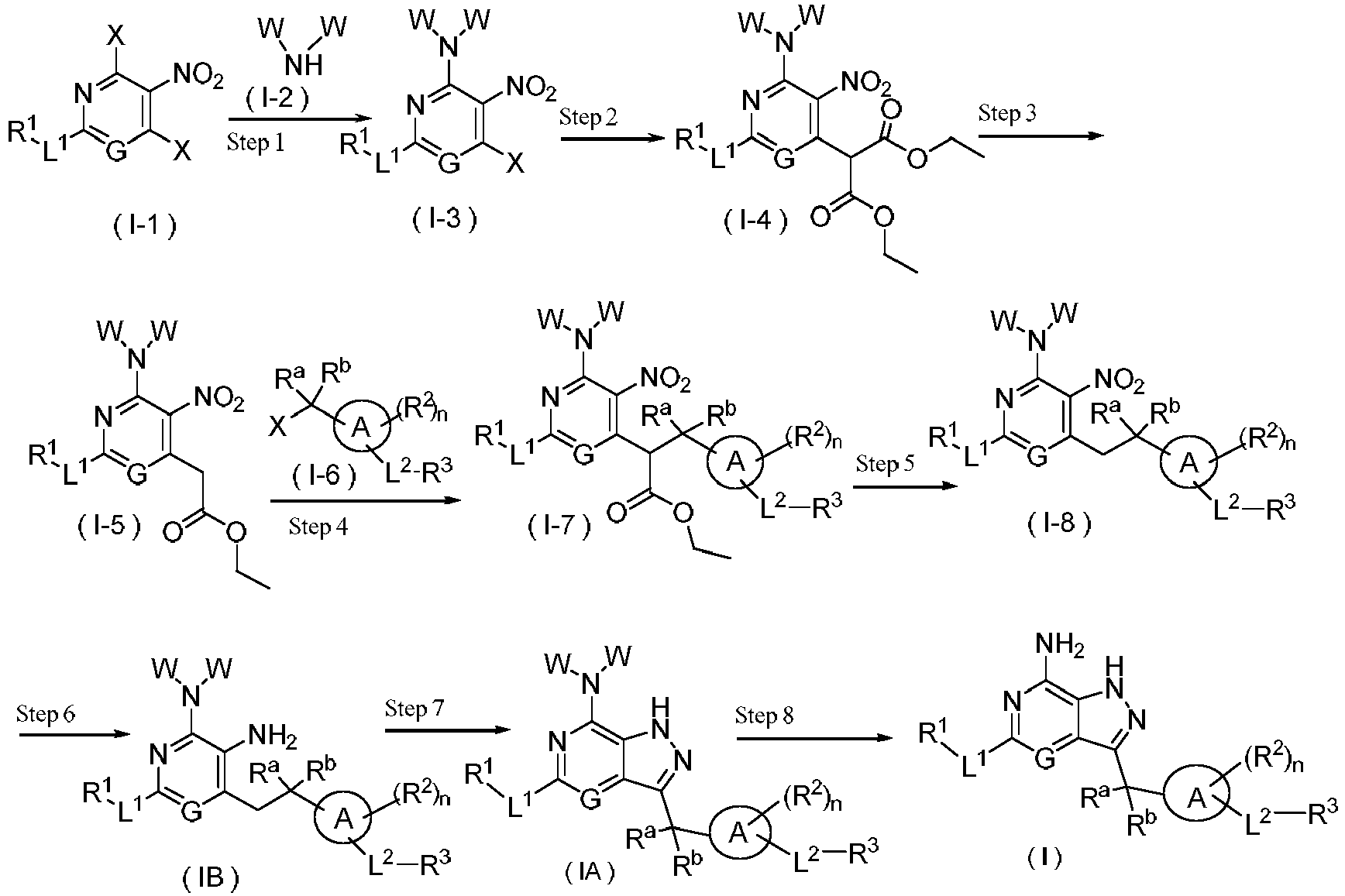
- step 1, carrying out a nucleophilic substitution reaction on a compound as shown by general formula (I-1) and a compound as shown by general formula (1-2) under alkaline condition to give a compound as shown by general formula (1-3);
- step 2, carrying out a nucleophilic substitution reaction on the compound as shown by general formula (1-3) and diethyl malonate under alkaline condition to give a compound as shown by general formula (1-4);
- step 3, carrying out a hydrolyzation and decarboxylation reaction on the compound as shown by general formula (1-4) at high temperature in the presence of sodium chloride and DMSO to give a compound as shown by general formula (1-5);
- step 4, carrying out a nucleophilic substitution reaction on the compound as shown by general formula (1-5) and a compound as shown by general formula (1-6) under alkaline condition to give a compound as shown by general formula (1-7);
- step 5, carrying out a hydrolyzation and decarboxylation reaction on the compound as shown by general formula (1-7) under alkaline condition to give a compound as shown by general formula (1-8);
- step 6, carrying out a reduction reaction on the compound as shown by general formula (1-8) in the presence of a reductant to give the compound as shown by general formula (IB);
- step 7, reacting the compound as shown by general formula (I-B) with sodium nitrite under acidic condition to give the compound as shown by general formula (IA);
- step 8, carrying out a de-protecting group reaction on the compound as shown by general formula (IA) under acidic condition to give the compound as shown by general formula (I);
wherein,- the reagent that offers an alkaline condition includes organic bases and inorganic bases. The organic bases include, but are not limited to, triethylamine, pyridine, 4-dimethylaminopyridine, N,N-diisopropylethylamine, n-butyllithium, lithium diisopropylamide, lithium bis(trimethylsilyl)amine, potassium acetate, sodium tert-butoxide, potassium tert-butoxide and sodium n-butoxide. The inorganic bases include, but are not limited to, sodium hydride, potassium phosphate, sodium carbonate, potassium carbonate, potassium acetate, cesium carbonate, sodium hydroxide and lithium hydroxide;
- the reagent that offers an acidic condition includes, but is not limited to, hydrogen chloride, hydrogen chloride in 1,4-dioxane solution, trifluoroacetic acid, formic acid, acetic acid, hydrochloric acid, sulfuric acid, methanesulfonic acid, nitric acid, phosphoric acid, p-toluenesulfonic acid, Me3SiCl and TMSOTf;
- the reductant includes, but is not limited to, iron powder, zinc powder, lithium aluminum hydride, sodium borohydride, DIBAL-H, NaAlH(O-t-Bu)3, AlH3, NaCNBH3, Na(AcO)3BH, B2H5, Li(Et)3BH, Pd/C/H2 and (Raney Ni)/H2;
- the above reactions are preferably carried out in a solvent, and the solvent used includes, but is not limited to, acetic acid, trifluoroacetic acid, methanol, ethanol, n-butanol, toluene, tetrahydrofuran, dichloromethane, petroleum ether, ethyl acetate, n-hexane, dimethyl sulfoxide, 1,4-dioxane, water, N,N-dimethylformamide and a mixture thereof;
- W is amino protecting group, preferably p-methoxybenzyl, tert-butoxycarbonyl, acetyl, benzyl and allyl;
- X is halogen, preferably chlorine;
- the ring A, G, L1-L2, R1-R3, Ra, Rb and n are as defined in general formula (I).
- A method for preparing the compound as shown by general formula (II) or a tautomer, a mesomer, a racemate, an enantiomer, a diastereomer thereof, or a mixture thereof, or a pharmaceutically acceptable salt thereof of the present application, comprising the following steps of:

- step 1, carrying out a nucleophilic substitution reaction on a compound as shown by general formula (II-1) and a compound as shown by general formula (1-2) under alkaline condition to give a compound as shown by general formula (II-2);
- step 2, carrying out a nucleophilic substitution reaction on the compound as shown by general formula (II-2) and diethyl malonate under alkaline condition to give a compound as shown by general formula (II-3);
- step 3, carrying out a hydrolyzation and decarboxylation reaction on the compound as shown by general formula (II-3) at high temperature in the presence of sodium chloride and DMSO to give a compound as shown by general formula (II-4);
- step 4, carrying out a nucleophilic substitution reaction on the compound as shown by general formula (II-4) and a compound as shown by general formula (1-6) under alkaline condition to give a compound as shown by general formula (II-5);
- step 5, carrying out a hydrolyzation and decarboxylation reaction on the compound as shown by general formula (II-5) under alkaline condition to give a compound as shown by general formula (II-6);
- step 6, carrying out a reduction reaction on the compound as shown by general formula (II-6) in the presence of a reductant to give a compound as shown by general formula (IIB);
- step 7, reacting the compound as shown by general formula (IIB) with sodium nitrite under acidic condition to give the compound as shown by general formula (IIA);
- step 8, carrying out a de-protecting group reaction on the compound as shown by general formula (IIA) under acidic condition to give the compound as shown by general formula (I);
wherein,- the reagent that offers an alkaline condition includes organic bases and inorganic bases. The organic bases include, but are not limited to, triethylamine, pyridine, 4-dimethylaminopyridine, N,N-diisopropylethylamine, n-butyllithium, lithium diisopropylamide, lithium bis(trimethylsilyl)amine, potassium acetate, sodium tert-butoxide, potassium tert-butoxide and sodium n-butoxide. The inorganic bases include, but are not limited to, sodium hydride, potassium phosphate, sodium carbonate, potassium carbonate, potassium acetate, cesium carbonate, sodium hydroxide and lithium hydroxide;
- the reagent that offers an acidic condition includes, but is not limited to, hydrogen chloride, hydrogen chloride in 1,4-dioxane solution, trifluoroacetic acid, formic acid, acetic acid, hydrochloric acid, sulfuric acid, methanesulfonic acid, nitric acid, phosphoric acid, p-toluenesulfonic acid, Me3SiCl and TMSOTf;
- the reductant includes, but is not limited to, iron powder, zinc powder, lithium aluminum hydride, sodium borohydride, DIBAL-H, NaAlH(O-t-Bu)3, AlH3, NaCNBH3, Na(AcO)3BH, B2H5, Li(Et)3BH, Pd/C/H2 and (Raney Ni)/H2;
- the above reactions are preferably carried out in a solvent, and the solvent used includes, but is not limited to, acetic acid, trifluoroacetic acid, methanol, ethanol, n-butanol, toluene, tetrahydrofuran, dichloromethane, petroleum ether, ethyl acetate, n-hexane, dimethyl sulfoxide, 1,4-dioxane, water, N,N-dimethylformamide and a mixture thereof;
- W is amino protecting group, preferably p-methoxybenzyl, tert-butoxycarbonyl, acetyl, benzyl and allyl;
- X is halogen, preferably chlorine;
- the ring A, L1-L2, R1-R3 and n are as defined in general formula (II).
- A method for preparing the compound as shown by general formula (II) or a tautomer, a mesomer, a racemate, an enantiomer, a diastereomer thereof, or a mixture thereof, or a pharmaceutically acceptable salt thereof of the present application, comprising the following steps of:

- step 1, carrying out a nucleophilic substitution reaction on the compound as shown by general formula (II-4) and a compound as shown by general formula (III-1) under alkaline condition to give a compound as shown by general formula (III-2);
- step 2, carrying out a hydrolyzation and decarboxylation reaction on the compound as shown by general formula (III-2) under alkaline condition to give a compound as shown by general formula (III-3);
- step 3, carrying out a reduction reaction on the compound as shown by general formula (III-3) in the presence of a reductant to give a compound as shown by general formula (IIIB);
- step 4, reacting the compound as shown by general formula (IIIB) with sodium nitrite under acidic condition to give a compound as shown by general formula (IIIA);
- step 5, carrying out a de-protecting group reaction on the compound as shown by general formula (IIIA) under acidic condition to give a compound as shown by general formula (III);
wherein,- the reagent that offers an alkaline condition includes organic bases and inorganic bases. The organic bases include, but are not limited to, triethylamine, pyridine, 4-dimethylaminopyridine, N,N-diisopropylethylamine, n-butyllithium, lithium diisopropylamide, lithium bis(trimethylsilyl)amine, potassium acetate, sodium tert-butoxide, potassium tert-butoxide and sodium n-butoxide. The inorganic bases include, but are not limited to, sodium hydride, potassium phosphate, sodium carbonate, potassium carbonate, potassium acetate, cesium carbonate, sodium hydroxide and lithium hydroxide;
- the reagent that offers an acidic condition includes, but is not limited to, hydrogen chloride, hydrogen chloride in 1,4-dioxane solution, trifluoroacetic acid, formic acid, acetic acid, hydrochloric acid, sulfuric acid, methanesulfonic acid, nitric acid, phosphoric acid, p-toluenesulfonic acid, Me3SiCl and TMSOTf;
- the reductant includes, but is not limited to, iron powder, zinc powder, lithium aluminum hydride, sodium borohydride, DIBAL-H, NaAlH(O-t-Bu)3, AlH3, NaCNBH3, Na(AcO)3BH, B2H5, Li(Et)3BH, Pd/C/H2 and (Raney Ni)/H2;
- the above reactions are preferably carried out in a solvent, and the solvent used includes, but is not limited to, acetic acid, trifluoroacetic acid, methanol, ethanol, n-butanol, toluene, tetrahydrofuran, dichloromethane, petroleum ether, ethyl acetate, n-hexane, dimethyl sulfoxide, 1,4-dioxane, water, N,N-dimethylformamide and a mixture thereof;
- W is amino protecting group, preferably p-methoxybenzyl, tert-butoxycarbonyl, acetyl, benzyl and allyl;
- X is halogen, preferably chlorine;
- L1-L2, R1 and R7-R8 are as defined in general formula (III).
- In another aspect, the present application relates to a pharmaceutical composition comprising a therapeutically effective amount of the compound as shown by general formula (I), or the tautomer, the mesomer, the racemate, the enantiomer, the diastereomer thereof, or the mixture thereof, or the pharmaceutically acceptable salt thereof, and one or more pharmaceutically acceptable carriers, diluents or excipients. The present application further relates to the compound as shown by general formula (I), or the tautomer, the mesomer, the racemate, the enantiomer, the diastereomer thereof, or the mixture thereof, or the pharmaceutically acceptable salt thereof, or a medicament comprising the same, for use as a medicament.
- The present application further relates to a use of the compound as shown by general formula (I), or the tautomer, the mesomer, the racemate, the enantiomer, the diastereomer thereof, or the mixture thereof, or the pharmaceutically acceptable salt thereof, or the pharmaceutical composition comprising the same in manufacturing a medicament for a TLR7 agonist.
- The present application further relates to a use of the compound as shown by general formula (I), or the tautomer, the mesomer, the racemate, the enantiomer, the diastereomer thereof, or the mixture thereof, or the pharmaceutically acceptable salt thereof, or the pharmaceutical composition comprising the same in manufacturing a medicament for treating an infection caused by viruses.
- The present application further relates to a use of the compound as shown by general formula (I), or the tautomer, the mesomer, the racemate, the enantiomer, the diastereomer thereof, or the mixture thereof, or the pharmaceutically acceptable salt thereof, or the pharmaceutical composition comprising the same in manufacturing a medicament for treating or preventing a cancer.
- The present application further relates to a method for agonizing TLR7, comprising a step of contacting the compound as shown by general formula (I), or the tautomer, the mesomer, the racemate, the enantiomer, the diastereomer thereof, or the mixture thereof, or the pharmaceutically acceptable salt thereof, or the pharmaceutical composition comprising the same with TLR7.
- The present application further relates to a method for treating an infection caused by viruses, comprising: administering to a patient in need thereof a therapeutically effective amount of the compound as shown by general formula (I), or the tautomer, the mesomer, the racemate, the enantiomer, the diastereomer thereof, or the mixture thereof, or the pharmaceutically acceptable salt thereof, or the pharmaceutical composition comprising the same.
- The present application further relates to a method for treating or preventing a cancer, comprising: administering to a patient in need thereof a therapeutically effective amount of the compound as shown by general formula (I), or the tautomer, the mesomer, the racemate, the enantiomer, the diastereomer thereof, or the mixture thereof, or the pharmaceutically acceptable salt thereof, or the pharmaceutical composition comprising the same.
- The present application further relates to the compound as shown by general formula (I), or the tautomer, the mesomer, the racemate, the enantiomer, the diastereomer thereof, or the mixture thereof, or the pharmaceutically acceptable salt thereof, or the pharmaceutical composition comprising the same, for use as a TLR7 agonist.
- The present application further relates to the compound as shown by general formula (I), or the tautomer, the mesomer, the racemate, the enantiomer, the diastereomer thereof, or the mixture thereof, or the pharmaceutically acceptable salt thereof, or the pharmaceutical composition comprising the same, for use in treating or preventing an infection caused by viruses.
- The present application further relates to the compound as shown by general formula (I), or the tautomer, the mesomer, the racemate, the enantiomer, the diastereomer thereof, or the mixture thereof, or the pharmaceutically acceptable salt thereof, or the pharmaceutical composition comprising the same, for use in treating or preventing a cancer.
- In the present application, the virus is preferably selected from dengue virus, yellow fever virus, West Nile virus, Japanese encephalitis virus, tick-borne encephalitis virus, Kunjin virus, Murray Valley encephalitis virus, St. Louis encephalitis virus, Omsk hemorrhagic fever virus, bovine viral diarrhea virus, Zika virus, HIV, HBV, HCV, HPV, RSV, SARS and influenza virus, more preferably selected from HBV and HCV.
- In the present application, the cancer is preferably selected from melanoma, non-small cell lung cancer, hepatocellular carcinoma, basal cell carcinoma, renal cell carcinoma or myeloma. The pharmaceutical composition containing the active ingredient can be in a form suitable for oral administration, for example, tablet, troche, lozenge, aqueous or oily suspension, dispersible powder or granule, emulsion, hard or soft capsule, or syrup or elixir. The oral composition can be prepared according to any known method in the art for the preparation of pharmaceutical composition, and such composition can contain one or more ingredients selected from sweeteners, flavoring agents, colorants and preservatives, in order to provide a pleasing and palatable pharmaceutical preparation. The tablet contains the active ingredient in admixture with nontoxic pharmaceutically acceptable excipients suitable for the tablets manufacture.
- The aqueous suspension contains the active ingredient in admixture with excipients suitable for an aqueous suspension manufacture. The aqueous suspension can also contain one or more preservatives, one or more colorants, one or more flavoring agents, and one or more sweeteners.
- The oily suspension can be formulated by suspending the active ingredient in a vegetable oil. The oily suspension can contain a thickener. The aforementioned sweeteners and flavoring agents can be added to provide a palatable formulation.
- The pharmaceutical composition of the present application can also be in the form of an oil-in-water emulsion.
- The pharmaceutical composition can be in the form of a sterile injectable aqueous solution. Acceptable vehicles or solvents that can be used are water, Ringer's solution and isotonic sodium chloride solution. The sterile injectable formulation can be a sterile injectable oil-in-water micro-emulsion in which the active ingredient is dissolved in the oil phase. For example, the active ingredient is dissolved in a mixture of soybean oil and lecithin. The oil solution is then added to a mixture of water and glycerin to form a micro-emulsion. The injectable solution or micro-emulsion can be introduced into a patient's bloodstream by local bolus injection. Alternatively, the solution and micro-emulsion are preferably administered in a manner that maintains a constant circulating concentration of the compound of the present application. In order to maintain this constant concentration, a continuous intravenous delivery device can be used. An example of such a device is Deltec CADD-PLUS. TM. 5400 intravenous pump.
- The pharmaceutical composition of the present application can be in the form of a sterile injectable aqueous or oily suspension for intramuscular and subcutaneous administration. Such a suspension can be formulated with suitable dispersants or wetting agents and suspending agents as described above according to known techniques. The sterile injectable formulation can also be a sterile injectable solution or suspension prepared in a nontoxic parenterally acceptable diluent or solvent. Moreover, sterile fixed oils can easily be used as a solvent or suspending medium.
- The compound of the present application can be administered in the form of a suppository for rectal administration. These pharmaceutical compositions can be prepared by mixing the drug with a suitable non-irritating excipient that is a solid at ordinary temperatures, but a liquid in the rectum, thereby melting in the rectum to release the drug. Such materials include cocoa butter, glycerin gelatin, hydrogenated vegetable oil, a mixture of polyethylene glycols of various molecular weights and fatty acid esters thereof.
- It is well known to those skilled in the art that the dosage of a drug depends on a variety of factors, including but not limited to, the following factors: activity of a specific compound, age of the patient, weight of the patient, general health of the patient, behavior of the patient, diet of the patient, administration time, administration route, excretion rate, drug combination and the like. In addition, the optimal treatment such as treatment mode, daily dose of the compound as shown by general formula (I) or the type of the pharmaceutically acceptable salt, can be verified by traditional therapeutic regimens.
- Unless opposite stated, the terms used in the specification and claims have the meanings described below.
- The term "alkyl" refers to a saturated aliphatic hydrocarbon group, which is a straight or branched chain group comprising 1 to 20 carbon atoms, preferably an alkyl comprising 1 to 12 carbon atoms, and more preferably an alkyl comprising 1 to 6 carbon atoms. Non-limiting examples include methyl, ethyl, n-propyl, isopropyl, n-butyl, isobutyl, tert-butyl, sec-butyl, n-pentyl, 1,1-dimethylpropyl, 1,2-dimethylpropyl, 2,2-dimethylpropyl, 1-ethylpropyl, 2-methylbutyl, 3-methylbutyl, n-hexyl, 1-ethyl-2-methylpropyl, 1,1,2-trimethylpropyl, 1,1-dimethylbutyl, 1,2-dimethylbutyl, 2,2-dimethylbutyl, 1,3-dimethylbutyl, 2-ethylbutyl, 2-methylpentyl, 3-methylpentyl, 4-methylpentyl, 2,3-dimethylbutyl, n-heptyl, 2-methylhexyl, 3-methylhexyl, 4-methylhexyl, 5-methylhexyl, 2,3-dimethylpentyl, 2,4-dimethylpentyl, 2,2-dimethylpentyl, 3,3-dimethylpentyl, 2-ethylpentyl, 3-ethylpentyl, n-octyl, 2,3-dimethylhexyl, 2,4-dimethylhexyl, 2,5-dimethylhexyl, 2,2-dimethylhexyl, 3,3-dimethylhexyl, 4,4-dimethylhexyl, 2-ethylhexyl, 3-ethylhexyl, 4-ethylhexyl, 2-methyl-2-ethylpentyl, 2-methyl-3-ethylpentyl, n-nonyl, 2-methyl-2-ethylhexyl, 2-methyl-3-ethylhexyl, 2,2-diethylpentyl, n-decyl, 3,3-diethylhexyl, 2,2-diethylhexyl, and various branched isomers thereof. Non-limiting examples of a lower alkyl comprising 1 to 6 carbon atoms, include methyl, ethyl, n-propyl, isopropyl, n-butyl, isobutyl, tert-butyl, sec-butyl, n-pentyl, 1,1-dimethylpropyl, 1,2-dimethylpropyl, 2,2-dimethylpropyl, 1-ethylpropyl, 2-methylbutyl, 3-methylbutyl, n-hexyl, 1-ethyl-2-methylpropyl, 1,1,2-trimethylpropyl, 1,1-dimethylbutyl, 1,2-dimethylbutyl, 2,2-dimethylbutyl, 1,3-dimethylbutyl, 2-ethylbutyl, 2-methylpentyl, 3-methylpentyl, 4-methylpentyl, 2,3-dimethylbutyl, and the like. The alkyl group can be substituted or unsubstituted, and when substituted, the substituent(s) can be substituted at any available connection site. The substituent is preferably one or more groups independently optionally selected from the group consisting of alkyl, alkenyl, alkynyl, alkoxy, alkylthio, alkylamino, halogen, thiol, hydroxy, nitro, cyano, cycloalkyl, heterocyclyl, aryl, heteroaryl, cycloalkoxy, heterocyclyloxy, cycloalkylthio, heterocycloalkylthio, oxo, -C(O)R6, -C(O)OR6, -S(O)mR6, -NR7R8 and -C(O)NR7R8.
- The term "alkylene" refers to a saturated straight or branched aliphatic hydrocarbon group comprising two residues derived from the removal of two hydrogen atoms from the same carbon atom of the parent alkane or two different carbon atoms, is a linear or branched group comprising 1 to 20 carbon atoms, preferably comprising 1 to 12 carbon atoms, more preferably an alkylene group comprising 1 to 6 carbon atoms. Non-limiting examples of alkylene groups include, but are not limited to, methylene (-CH2-), 1,1-ethylene (-CH(CH3)-), 1,2-ethylene (-CH2CH2-), 1,1-propylene (-CH(CH2CH3)-), 1,2-propylene (-CH2CH(CH3)-), 1,3-propylene (-CH2CH2CH2-), 1,4-butylidene (-CH2CH2CH2CH2-), and the like. The alkylene group may be substituted or unsubstituted, and when substituted, the substituent(s) may be substituted at any available connection site, preferably one or more groups independently optionally selected from the group consisting of alkyl, alkenyl, alkynyl, alkoxy, alkylthio, alkylamino, halogen, thiol, hydroxy, nitro, cyano, cycloalkyl, heterocyclyl, aryl, heteroaryl, cycloalkoxy, heteroalkoxy, cycloalkylthio, heterocycloalkylthio, oxo, -C(O)R6, -C(O)OR6, -S(O)mR6, -NR7R8 and -C(O)NR7R8.
- The term "alkenyl" refers to an unsaturated alkyl containing a carbon-carbon double bond in the molecule, and the alkyl is as defined above. The alkenyl group may be substituted or unsubstituted, and when substituted, the substituent is preferably one or more groups independently selected from the following group consisting of hydrogen atom, alkyl, alkoxy, halogen, haloalkyl, hydroxyl, hydroxyalkyl, cyano, amino, nitro, cycloalkyl, heterocyclyl, aryl, heteroaryl, -C(O)R6,-C(O)OR6, -S(O)mR6, -NR7R8 and -C(O)NR7R8.
- The term "alkynyl" refers to an unsaturated alkyl containing a carbon-carbon triple bond in the molecule, and the alkyl is as defined above. The alkynyl group may be substituted or unsubstituted, and when substituted, the substituent is preferably one or more groups independently selected from the following group consisting of hydrogen atom, alkyl, alkoxy, halogen, haloalkyl, hydroxyl, hydroxyalkyl, cyano, amino, nitro, cycloalkyl, heterocyclyl, aryl, heteroaryl, -C(O)R6,-C(O)OR6, -S(O)mR6, -NR7R8 and -C(O)NR7R8.
- The term "cycloalkyl" refers to a saturated or partially unsaturated monocyclic or polycyclic hydrocarbon substituent group comprising 3 to 20 carbon atoms, preferably 3 to 12 carbon atoms, more preferably 3 to 6 carbon atoms, and most preferably 5 to 6 carbon atoms. Non-limiting examples of monocyclic cycloalkyl include cyclopropyl, cyclobutyl, cyclopentyl, cyclopentenyl, cyclohexyl, cyclohexenyl, cyclohexadienyl, cycloheptyl, cycloheptatrienyl, cyclooctyl and the like. Polycyclic cycloalkyl includes a cycloalkyl comprising a spiro ring, fused ring and bridged ring.
- The term "spiro cycloalkyl" refers to a 5 to 20 membered polycyclic group with monocyclic rings connected through one shared carbon atom (called a spiro atom), and the rings can contain one or more double bonds, but none of the rings has a completely conjugated π-electron system, and the spiro cycloalkyl is preferably 6 to 14 membered spiro cycloalkyl, and more preferably 7 to 10 membered spiro cycloalkyl. According to the number of the spiro atoms shared between the rings, the spiro cycloalkyl can be divided into mono-spiro cycloalkyl, di-spiro cycloalkyl, or poly-spiro cycloalkyl, and preferably a mono-spiro cycloalkyl or di-spiro cycloalkyl, and more preferably 4-membered/4-membered, 4-membered/5-membered, 4-membered/6-membered, 5-membered/5-membered, or 5-membered/6-membered mono-spiro cycloalkyl. Non-limiting examples of spiro cycloalkyl include:

- The term "fused cycloalkyl" refers to a 5 to 20 membered all-carbon polycyclic group, wherein each ring in the system shares an adjacent pair of carbon atoms with another ring, wherein one or more rings can contain one or more double bonds, but none of the rings has a completely conjugated π-electron system. The fused cycloalkyl is preferably 6 to 14 membered fused cycloalkyl, and more preferably 7 to 10 membered fused cycloalkyl. According to the number of membered rings, the fused cycloalkyl can be divided into bicyclic, tricyclic, tetracyclic or polycyclic fused cycloalkyl, and preferably bicyclic or tricyclic fused cycloalkyl, and more preferably 5-membered/5-membered, or 5-membered/6-membered bicyclic fused cycloalkyl. Non-limiting examples of fused cycloalkyl include:

- The term "bridged cycloalkyl" refers to a 5 to 20 membered all-carbon polycyclic group, wherein every two rings in the system share two disconnected carbon atoms, wherein the rings can have one or more double bonds, but none of the rings has a completely conjugated π-electron system. The bridged cycloalkyl is preferably 6 to 14 membered bridged cycloalkyl, and more preferably 7 to 10 membered bridged cycloalkyl. According to the number of membered rings, the bridged cycloalkyl can be divided into bicyclic, tricyclic, tetracyclic or polycyclic bridged cycloalkyl, and preferably bicyclic, tricyclic or tetracyclic bridged cycloalkyl, and more preferably bicyclic or tricyclic bridged cycloalkyl. Non-limiting examples of bridged cycloalkyls include:


- The ring of cycloalkyl can be fused to the ring of aryl, heteroaryl or heterocycloalkyl, wherein the ring bound to the parent structure is cycloalkyl. Non-limiting examples include indanyl, tetrahydronaphthyl, benzocycloheptyl and the like, and preferably benzocycloheptyl or tetrahydronaphthyl. The cycloalkyl can be optionally substituted or unsubstituted, and when substituted, the substituent(s) is preferably one or more following group(s) independently optionally selected from the group consisting of alkyl, alkenyl, alkynyl, alkoxy, alkylthio, alkylamino, halogen, thiol, hydroxy, nitro, cyano, cycloalkyl, heterocycloalkyl, aryl, heteroaryl, cycloalkoxy, heterocycloalkoxy, cycloalkylthio, heterocycloalkylthio, oxo, carboxy or carboxylate.
- The term "heterocyclyl" refers to a 3 to 20 membered saturated or partially unsaturated monocyclic or polycyclic hydrocarbon group, wherein one or more ring atoms are heteroatoms selected from the group consisting of N, O and S(O)m (wherein m is an integer of 0 to 2), but excluding -O-O-, -O-S- or -S-S- in the ring, with the remaining ring atoms being carbon atoms. Preferably, the heterocyclyl has 3 to 12 ring atoms wherein 1 to 4 atoms are heteroatoms; more preferably, the heterocyclyl has 3 to 8 ring atoms wherein 1 to 3 atoms are heteroatoms, and most preferably 5 to 6 ring atoms wherein 1 to 2 atoms or 1 to 3 atoms are heteroatoms. Non-limiting examples of monocyclic heterocyclyl include pyrrolidyl, imidazolidinyl, tetrahydrofuranyl, tetrahydropyranyl, tetrahydrothiophenyl, dihydroimidazolyl, dihydrofuranyl, dihydropyrazolyl, dihydropyrrolyl, piperidinyl, piperazinyl, morpholinyl, thiomorpholinyl, homopiperazinyl and the like, and preferably tetrahydrofuranyl, piperidinyl or pyrrolidyl. Polycyclic heterocyclyl includes heterocyclyl comprising a spiro ring, fused ring or bridged ring.
- The term "spiro heterocyclyl" refers to a 5 to 20 membered polycyclic heterocyclyl group with monocyclic rings connected through one shared atom (called a spiro atom), wherein one or more ring atoms are heteroatoms selected from the group consisting of N, O and S(O)m (wherein m is an integer of 0 to 2), with the remaining ring atoms being carbon atoms, where the rings can contain one or more double bonds, but none of the rings has a completely conjugated π-electron system. The spiro heterocyclyl is preferably 6 to 14 membered spiro heterocyclyl, and more preferably 7 to 10 membered spiro heterocyclyl. According to the number of the spiro atoms shared between the rings, the spiro heterocyclyl can be divided into mono-spiro heterocyclyl, di-spiro heterocyclyl, or poly-spiro heterocyclyl, and is preferably mono-spiro heterocyclyl or di-spiro heterocyclyl, and more preferably 4-membered/4-membered, 4-membered/5-membered, 4-membered/6-membered, 5-membered/5-membered, or 5-membered/6-membered mono-spiro heterocyclyl. Non-limiting examples of spiro heterocyclyls include:

- The term "fused heterocyclyl" refers to a 5 to 20 membered polycyclic heterocyclyl group, wherein each ring in the system shares an adjacent pair of atoms with another ring, where the one or more rings can contain one or more double bonds, but none of the rings has a completely conjugated π-electron system, wherein one or more ring atoms are heteroatoms selected from the group consisting of N, O and S(O)m (wherein m is an integer of 0 to 2), with the remaining ring atoms being carbon atoms. The fused heterocyclyl is preferably 6 to 14 membered fused heterocyclyl, and more preferably 7 to 10 membered fused heterocyclyl. According to the number of membered rings, the fused heterocyclyl can be divided into bicyclic, tricyclic, tetracyclic or polycyclic fused heterocyclyl, and the fused heterocyclyl is preferably bicyclic or tetracyclic fused heterocyclyl, and more preferably 5-membered/5-membered or 5-membered/6-membered bicyclic fused heterocyclyl. Non-limiting examples of fused heterocyclyl include:


- The term "bridged heterocyclyl" refers to a 5 to 14 membered polycyclic heterocyclyl group, wherein every two rings in the system share two disconnected atoms, wherein the rings can have one or more double bonds, but none of the rings has a completely conjugated π-electron system, wherein one or more ring atoms are heteroatoms selected from the group consisting of N, O and S(O)m (wherein m is an integer of 0 to 2), with the remaining ring atoms being carbon atoms. The bridged heterocyclyl is preferably 6 to 14 membered bridged heterocyclyl, and more preferably 7 to 10 membered bridged heterocyclyl. According to the number of membered rings, the bridged heterocyclyl can be divided into bicyclic, tricyclic, tetracyclic or polycyclic bridged heterocyclyl, and the bridged heterocyclyl is preferably bicyclic, tricyclic or tetracyclic bridged heterocyclyl, and more preferably bicyclic or tricyclic bridged heterocyclyl. Non-limiting examples of bridged heterocyclyls include:


- The ring of heterocyclyl can be fused to the ring of aryl, heteroaryl or cycloalkyl, wherein the ring bound to the parent structure is heterocyclyl. Non-limiting examples thereof include:

- The heterocyclyl can be optionally substituted or unsubstituted, and when substituted, the substituent(s) is preferably one or more group(s) independently optionally selected from the following group consisting of alkyl, alkenyl, alkynyl, alkoxy, alkylthio, alkylamino, halogen, thiol, hydroxy, nitro, cyano, cycloalkyl, heterocyclyl, aryl, heteroaryl, cycloalkoxy, heterocycloalkoxy, cycloalkylthio, heterocycloalkylthio, oxo, -C(O)R6, -C(O)OR6, -S(O)mR6, -NR7R8 and -C(O)NR7R8.
- The term "aryl" refers to a 6 to 14 membered all-carbon monocyclic ring or polycyclic fused ring (that is, each ring in the system shares an adjacent pair of carbon atoms with another ring in the system) having a conjugated π-electron system, preferably 6 to 10 membered aryl, more preferably 5 to 6 membered aryl, for example, phenyl and naphthyl. The ring of aryl can be fused to the ring of heteroaryl, heterocyclyl or cycloalkyl, wherein the ring bound to the parent structure is aryl ring. Non-limiting examples thereof include:


- The aryl can be substituted or unsubstituted, and when substituted, the substituent(s) is preferably one or more group(s) independently optionally selected from the following group consisting of alkyl, alkenyl, alkynyl, alkoxy, alkylthio, alkylamino, halogen, thiol, hydroxy, nitro, cyano, cycloalkyl, heterocycloalkyl, aryl, heteroaryl, cycloalkoxy, heterocycloalkoxy, cycloalkylthio, heterocycloalkylthio, -C(O)R6, -C(O)OR6, -S(O)mR6, -NR7R8 and -C(O)NR7R8.
- The term "amino protecting group" is intended to keep the amino group unchanged during the reaction of other parts of the molecule, and to protect the amino group with a group which is easily to remove. Non-limiting examples include t-butoxycarbonyl, acetyl, benzyl, allyl, p-methoxybenzyl, and the like. These groups may be optionally substituted by 1 to 3 substituents selected from the group consisting of halogen, alkoxy and nitro. The amino protecting group is preferably p-methoxybenzyl.
- The term "heteroaryl" refers to a 5 to 14 membered heteroaromatic system comprising 1 to 4 heteroatoms selected from the group consisting of O, S and N. The heteroaryl is preferably 5 to 10 membered heteroaryl comprising 1 to 3 heteroatoms, more preferably 5 or 6 membered heteroaryl comprising 1 to 2 heteroatoms, preferably for example, imidazolyl, furyl, thienyl, thiazolyl, pyrazolyl, oxazolyl, pyrrolyl, tetrazolyl, pyridyl, pyrimidinyl, thiadiazole, pyrazinyl and the like, preferably imidazolyl, pyrazolyl, or pyrimidinyl, thiazolyl; more preferably pyrazolyl. The ring of heteroaryl can be fused to the ring of aryl, heterocyclyl or cycloalkyl, wherein the ring bound to the parent structure is heteroaryl ring. Non-limiting examples thereof include:


- The heteroaryl can be optionally substituted or unsubstituted, and when substituted, the substituent(s) is preferably one or more group(s) independently optionally selected from the following group consisting of alkyl, alkenyl, alkynyl, alkoxy, alkylthio, alkylamino, halogen, thiol, hydroxy, nitro, cyano, cycloalkyl, heterocycloalkyl, aryl, heteroaryl, cycloalkoxy, heterocycloalkoxy, cycloalkylthio, heterocycloalkylthio, -C(O)R6, -C(O)OR6, -S(O)mR6, -NR7R8 and -C(O)NR7R8.
- The term "alkoxy" refers to an -O-(alkyl) or an -O-(unsubstituted cycloalkyl), wherein the alkyl and cycloalkyl are as defined above. Non-limiting examples of alkoxy include: methoxy, ethoxy, propoxy, butoxy, cyclopropyloxy, cyclobutyloxy, cyclopentyloxy, cyclohexyloxy. The alkoxy can be optionally substituted or unsubstituted, and when substituted, the substituent(s) is preferably one or more group(s) independently optionally selected from the following group consisting of hydrogen atom, halogen, alkyl, alkoxy, haloalkyl, hydroxy, hydroxyalkyl, cyano, amino, nitro, cycloalkyl, heterocyclyl, aryl and heteroaryl.
- The term "haloalkyl" refers to alkyl substituted by one or more halogens, wherein the alkyl is as defined above. The term "hydroxy" refers to -OH group.
- The term "hydroxyalkyl" refers to alkyl substituted by hydroxyl(s), wherein the alkyl is as defined above.
- The term "halogen" refers to fluorine, chlorine, bromine or iodine.
- The term "amino" refers to -NH2.
- The term "cyano" refers to -CN.
- The term "nitro" refers to -NO2.
- The term "oxo" refers to =O.
- "Optional" or "optionally" means that the event or circumstance described subsequently can, but not, occur, and such a description includes the situation in which the event or circumstance does or does not occur. For example, "the heterocyclyl optionally substituted by alkyl" means that alkyl group can be, but need not be present, and such a description includes the situation of the heterocyclyl being substituted by alkyl and the heterocyclyl being not substituted by alkyl.
- "Substituted" refers to one or more hydrogen atoms in a group, preferably up to 5, more preferably 1 to 3 hydrogen atoms, independently substituted by a corresponding number of substituents. It goes without saying that the substituents only exist in their possible chemical position, and the person skilled in the art is able to determine whether the substitution is possible or impossible (by experiments or theory) without paying excessive efforts. For example, the combination of amino or hydroxy having free hydrogen and carbon atoms comprising unsaturated bonds (such as olefinic) may be unstable.
- "Pharmaceutical composition" refers to a mixture of one or more of the compounds according to the present application or physiologically/pharmaceutically acceptable salts or prodrugs thereof with other chemical components , and other components such as physiologically/pharmaceutically acceptable carriers and excipients. The purpose of the pharmaceutically composition is to facilitate administration of a compound to an organism, which is conducive to the absorption of the active ingredient so as to show biological activity.
- "Pharmaceutical acceptable salt" refers to a salt of the compound of the present application, which is safe and effective in mammals and has the desired biological activity.
- m and R6-R8 are as defined in general formula (I).
- In the embodiments followed, the structures of the compounds were identified by nuclear magnetic resonance (NMR) and/or mass spectrometry (MS). NMR shifts (δ) are given in 10-6 (ppm). NMR was determined by a Bruker AVANCE-400 machine, the solvents for determination were deuterated-dimethyl sulfoxide (DMSO-d6 ), deuterated-chloroform (CDCl3) and deuterated-methanol (CD3OD), and the internal standard was tetramethyl silane (TMS).
- MS was determined by a FINNIGAN LCQAd (ESI) mass spectrometer (manufacturer: Thermo, type: Finnigan LCQ advantage MAX).
- High performance liquid chromatography (HPLC) was determined on an Agilent 1200DAD high pressure liquid chromatograph (Sunfire C18 150×4.6 mm chromatographic column), and a Waters 2695-2996 high pressure liquid chromatography spectrometer (Gimini C18 150×4.6 mm chromatographic column).
- Chiral HPLC was determined on a LC-10A vp (Shimadzu) or SFC-analytical (Berger Instruments Inc.);
Yantai Huanghai HSGF254 or Qingdao GF254 silica gel plate was used as the thin-layer silica gel chromatography (TLC) plate. The dimension of the silica gel plate used in TLC was 0.15 mm to 0.2 mm, and the dimension of the silica gel plate used in product purification was 0.4 mm to 0.5 mm. - Yantai Huanghai 200 to 300 mesh silica gel was generally used as a carrier for column chromatography.
- Prep Star SD-1 (Varian Instruments Inc.) or SFC-multigram (Berger Instruments Inc.) was used for chiral preparative column chromatography.
- The average kinase inhibition rates and IC50 values were determined by a NovoStar ELISA (BMG Co., Germany).
- The known starting materials of the present application can be prepared by the known methods in the art, or can be purchased from ABCR GmbH & Co. KG, Acros Organnics, Aldrich Chemical Company, Accela ChemBio Inc., or Dari chemical Company, etc.
- Unless specially stated in embodiments, the reactions were carried out under argon atmosphere or nitrogen atmosphere.
- Argon atmosphere or nitrogen atmosphere means that a reaction flask is equipped with an argon or nitrogen balloon (about 1 L).
- Hydrogen atmosphere means that a reaction flask is equipped with a hydrogen balloon (about 1 L).
- Pressurized hydrogenation reactions were performed on a Parr 3916EKX hydrogenation instrument and a Qinglan QL-500 hydrogen generator or HC2-SS hydrogenation instrument.
- In hydrogenation reactions, the reaction system was generally vacuumed and filled with hydrogen, with the above operation was repeated three times.
- CEM Discover-S 908860 type microwave reactor was used in microwave reactions.
- Unless specially stated in embodiments, the solution refers to an aqueous solution.
- Unless specially stated in embodiments, the reaction temperature is room temperature from 20°C to 30°C.
- The reaction process in embodiments was monitored by thin layer chromatography (TLC). The developing solvent used in the reactions, the eluting system in column chromatography and the developing solvent system in thin layer chromatography for purification of the compounds included: A: n-hexane/ethyl acetate system, and the ratio of the volume of the solvent was adjusted according to the polarity of the compounds, and a small quantity of alkaline reagent such as triethylamine or acidic reagent such as acetic acid could also be added for adjustment.
-


- 2-Butoxy-4,6-dichloro-5-nitropyrimidine 1a (4.62 g, 17.43 mmol, prepared according to the known method disclosed in Journal of Medicinal Chemistry, 2012, 55(23), 10387-10404) was dissolved in tetrahydrofuran (50 mL), and triethylamine (2.64 g, 26.14 mmol) and N,N-bis(4-methoxybenzyl)amine (4.49 g, 17.43 mmol) were added therein in turn, and then was stirred at room temperature for 4 hours. The reaction solution was concentrated under reduced pressure and the residue was purified by eluting system A using CombiFlash rapid preparation to give the title product 1b (6.20 g), 73.8% yield.
MS m/z (ESI): 487.5 [M+1]. - The compound 1b (1.84 g, 3.78 mmol) was dissolved in acetone (60 mL). After cooling to 0°C, diethyl malonate (0.91 g, 5.68 mmol) and sodium hydroxide (0.52 g, 13 mmol) were added therein, then water (1.2 mL) was slowly added dropwise. The reaction solution was stirred at room temperature for 2 hours and then water (100 mL) was added, and then acetic acid was added dropwise to pH 8. The mixture was extracted with ethyl acetate (70 mL×3) and the organic phase was combined, and washed with saturated sodium chloride solution (50 mL), dried over anhydrous sodium sulfate and filtered. The filtrate was concentrated under reduced pressure and the residue was purified by eluting system A using Silica gel column chromatography to give the title product 1c (2.3 g), 100% yield.
MS m/z (ESI): 611.3 [M+1]. - The compound 1c (1.5 g, 2.46 mmol) and sodium chloride (0.57 g, 9.83 mmol) were dissolved in a mixed solvent of dimethyl sulfoxide and water (V/V = 5:1, 24 mL), and the mixture was warmed to 160°C and stirred for 2 hours. The reaction solution was cooled to room temperature and water (40 mL) was added, extracted with ethyl acetate (100 mL) and the organic phase was washed with water (20 mL×3), dried over anhydrous sodium sulfate and filtered. The filtrate was concentrated under reduced pressure and the residue was purified by eluting system A using Silica gel column chromatography to give the title product Id (660 mg), 47.39% yield.
MS m/z (ESI): 539.3 [M+1] - The compound 1d (700 mg, 1.3 mmol) was dissolved in N,N-dimethylformamide (10 mL). After cooling to 0°C, sodium hydrogen (155.96 mg, 3.9 mmol) was added therein and stirred for 30 minutes. 1-(4-(Chloromethyl)benzyl)pyrrolidine 1f (408.86 mg, 1.95 mmol, prepared according to the known method disclosed in the patent application "
WO2002012224 ") was added, and then the reaction mixture was heated to 100°C and stirred for 2 hours. The reaction mixture was cooled to room temperature, and saturated ammonium chloride solution (30 mL) was added, extracted with ethyl acetate (100 mL) and the organic phase was dried over anhydrous sodium sulfate and filtered. The filtrate was concentrated under reduced pressure and the residue was purified by eluting system A using Silica gel column chromatography to give the title product 1g (350 mg), 37.83% yield.
MS m/z (ESI): 712.3 [M+1] - The compound 1g (120 mg, 168.58 µmol) was dissolved in a mixed solvent of tetrahydrofuran and water (V/V = 2:1, 9 mL), and then lithium hydroxide (70.74 mg, 1.69 mmol) was added, then the reaction solution was heated to 60°C and stirred for 4 hours. The reaction solution was cooled to room temperature, and ethyl acetate was added, washed with saturated sodium chloride solution, and the organic phase was dried over anhydrous sodium sulfate and filtered. The filtrate was concentrated under reduced pressure to give the crude title product 1g (108 mg) which was used for the next step without further purification.
MS m/z (ESI): 640.3 [M+1] - The crude compound 1h (108 mg, 168.81 µmol) was dissolved in acetic acid (5 mL), and zinc powder (165.57 mg, 2.53 mmol) was added therein, and stirred for 1 hour. The reaction solution was filtered and the filtrate was concentrated under reduced pressure to give the crude title product 1i (90 mg) which was used for the next step without further purification.
MS m/z (ESI): 610.4 [M+1]. - The crude compound 1i (90 mg, 147.59 µmol) was dissolved in acetic acid (2 mL), and sodium nitrite (30.55 mg, 442.77 µmol) was added therein, and the reaction was stirred for 1 hour. Ethyl acetate (20 mL) was added into the reaction solution and washed with saturated sodium chloride solution (20 mL×3), dried over anhydrous sodium sulfate, filtered. The filtrate was concentrated under reduced pressure to give the crude title product 1j (91 mg) which was used for the next step without further purification.
MS m/z (ESI): 621.7 [M+1]. - The crude compound 1j (90 mg, 144.98 µmol) was dissolved in trifluoroacetic acid (2 mL), and the mixture was heated to 60°C and stirred for 48 hours. The reaction solution was concentrated under reduced pressure and the residue was purified by high performance liquid chromatography to give the crude title product 1 (7.1 mg), 12.87% yield.
MS m/z (ESI): 381.5 [M+1]
1H NMR (400 MHz, CD3OD) δ 7.45 (d, 2H), 7.37 (d, 2H), 4.54 (t, 2H), 4.32 (s, 2H), 4.29 (s, 2H), 3.45 (s, 2H), 3.13 (s, 2H), 2.13 (s, 2H), 1.99 (s, 2H), 1.84-1.76 (m, 2H), 1.56 -1.45 (m, 2H), 0.99 (t, 3H). - The activation effect of the compound of the present application on the hTLR7 protein expressed in HEK-Blue™ hTLR7 stably transfected cells and hTLR8 protein expressed in HEK-Blue™ hTLR8 stably transfected cells were determined by the following experimental method:
-
- DMEM (Gibco, 10564-029),
- Fetal bovine serum (GIBCO, 10099),
- Trypan blue solution (Sigma, T8154-100ML),
- Flexstation 3 multi-function microplate reader (Molecµlar Devices),
- HEK-Blue™ hTLR7 cell line (InvivoGen, hkb-hTLR7),
- HEK-Blue™ hTLR8 cell line (InvivoGen, hkb-hTLR8),
- HEK-Blue detection reagent (InvivoGen, hb-det3),
- Phosphate buffer (PBS) pH 7.4 (Shanghai BasalMedia Technologies Co., Ltd., B320).
- The HEK-Blue assay medium was configured, HEK-Blue test dry powder was taken and 50 mL deendotoxin water was added to dissolve, then was placed into the 37°C incubator, and then filtered aseptically 10 minutes later. The compound was first formulated into a 20 mM stock solution, and then it was diluted with pure DMSO to a maximum concentration of 6×10⁶ nM and diluted by a 3-fold gradient for a total of 10 points.
- The above-prepared compound was diluted 20-fold with a medium, and then 20 µL the diluted compound was added to each well. HEK-Blue™ hTLR7 cells and HEK-Blue™ hTLR8 cells were taken separately, and the supernatant was removed first, then 2-5 mL pre-warmed PBS was added, placed in an incubator for 1-2 minutes, and the cells were gently pipetted, stained with trypan blue and counted. The cells were resuspended in HEK-Blue assay medium to a concentration of 2.2×10⁵ cells/mL, and 180 µL cells were added to the above 96-well cell culture plate where 20 µL the drug had been added, and cultured at 37°C for 6-16 hours.
- The microplate reader read at a wavelength of 620 nm. The corresponding OD value could be obtained, and the EC50 value of the drug was calculated by Graphpad Prism. The activation effect of the compound of the present application and the control compound (prepared by the method of embodiment 21 of
WO2016023511 ) on human TLR7 and TLR8 could be determined by the above test, and the measured EC50 values were as shown in Table 1.Table 1 EC50 values of the compound of the present application and the control compound on human TLR7 and TLR8 Embodiment No. EC50(TLR7)/nM EC50(TLR8)/nM 1 53 5223 Embodiment 21 of WO2016023511 243 12471 - Conclusion: the compound of the present application demonstrates better activation on human TLR7 than the control compound embodiment 21 of
WO2016023511 , and the compound of the present application is more selective for TLR7 activation compared with the activation on human TLR8. - The ability of the compound of the present application to stimulate the secretion of IFN-α from PBMC was determined by the following experimental method:
-
- RPMI 1640 (Invitrogen, 11875),
- FBS (Gibco, 10099-141),
- Ficoll-Paque PREMIUM (GE, 17-5442-02),
- Trypan blue solution (Sigma, T8154-100ML),
- SepMateTM-50 (Stemcell, 15460),
- Bright-LineTM Blood Cell Counter (Sigma, Z359629-1EA),
- 96-well flat bottom plate (Corning, 3599),
- 96-well v backplane (Corning, 3894),
- Human IFN-α kit (cisbio, 6FHIFPEB),
- PHERAStar Multi-Function Microplate Reader (BMG, PHERAStar).
- Compounds were diluted in pure DMSO at a maximum concentration of 5 mM in 4-fold gradients for a total of 9 points. Then 4 µL the compound was taken and added to 196 µL of RMPI 1640 medium containing 10% FBS and mixed. 50 µL per well was taken and added into a new 96-well cell culture plate.
- All reagents were equilibrated to room temperature, and a 250 mL culture flask was taken and 60 mL blood and PBS+2% FBS were added therein, and the mixture was gently diluted by pipetting. 50 mL PBMC separation tube SepMateTM-50 was taken and 15 mL lymphocyte separation solution Ficoll-Paque PREMIUM was added, and then 30 mL diluted blood was added and centrifuged at 1200g for 10 minutes at room temperature. The supernatant was taken, and then centrifuged at 300g for 8 minutes. The cells were resuspend with RMPI 1640 medium containing 10% FBS and counted, adjusted the amount of PBMC to 3.33×10⁶ cells/mL, and 150 µL was taken and added to the cell culture plate to which the compound had been added, and cultured at 37°C in a 5.0% CO2 incubator for 24 hours.
- The cell culture plate was placed in a centrifuge, centrifuged at 1200 rpm for 10 minutes at room temperature. 150 µL the supernatant was taken out per well. The reagent in the human IFN-α kit was firstly equilibrated to normal temperature, and anti-IFN-α-Eu3+-Cryptate conjugate and anti-IFN-α-d2-conjugate were prepared according to the kit instructions in the dark, the conjugates were both mixed with a conjugate buffer at a ratio of 1:40. Then, 16 µL of the supernatant obtained by centrifugation was added into each well. Then, 2 µL of the anti-IFN-α-Eu3+-Cryptate conjugate and the anti-IFN-α-d2-conjugate were added to each well, and the mixture was shaken and incubated at room temperature for 3 hours in the dark.
- It was read in the HTRF mode on the PHERAStar. The lowest drug concentration that stimulated and produced the cytokine level at least 3 times of a minimum detection limit was defined as the MEC (Minimal Effective Concentration) value of the compound in the cytokine stimulation test.
- The ability of the compound of the present application and the control compound (prepared by the method of embodiment 21 of
WO2016023511 ) to stimulate the secretion of IFN-α from PBMC could be determined by the above test, and the measured MEC values were as shown in Table 2.Table 2 the MEC of the compound of the present application and the control compound to stimulate the secretion of IFN-α from PBMC Embodiment No. MEC (nM) 1 0.28 Embodiment 21 of WO2016023511 5.5 - Conclusion: based on the data of the activity of stimulating the secretion of IFN-α from PBMC, the compound of the present application demonstrates a smaller MEC value than that of the control compound embodiment 21 of
WO2016023511 , and was able to cause IFN-α release better. - The enzymatic activity of the compound of the present application against the Midazolam metabolite site on human liver microsome CYP3A4 was determined by the following experimental method:
-
- Phosphate buffer (PBS),
- NADPH (Sigma N-1630),
- Human liver microsomes (Corning Gentest),
- ABI QTrap 4000 LC/MS (AB Sciex),
- Inertsil C8-3 column, 4.6×50 mm, 5 µm (American Dikma Company),
- CYP probe substrate (15 µM Midazolam, SIGMA UC429) and positive control inhibitor (Ketoconazole, SIGMA K1003).
- 100 mM PBS buffer was configured, and 2.5 mg/mL microsome solution and 5 mM NADPH solution were prepared with this buffer, and the 5X concentration compound working solution was diluted with PBS (150, 50, 15, 5, 1.5, 0.15, 0.015, 0 µM). The 5X concentration of Ketoconazole working solution (150, 50, 15, 5, 1.5, 0.15, 0.015, 0 µM) was diluted with PBS. Midazolam working solution was diluted to a concentration of 15 µM with PBS.
- 20 µL each of 2.5 mg/mL microsome solution, 15 µM Midazolam working solution, MgCl2 solution and compound working solution (150, 50, 15, 5, 1.5, 0.15, 0.015, 0 µM, each concentration was setted differently reaction system) was taken and mixed evenly. The compound was replaced with the same concentration of Ketoconazole at the positive control group. At the same time, 5 mM NADPH solution was pre-incubated for 5 minutes at 37°C. After 5 minutes, 20 µL NADPH was added into the wells, and the reaction was started and incubated for 30 minutes. All samples were incubated for two samples. After 30 minutes, 250 µL internal standard-containing acetonitrile was added to all samples, mixed, shaken at 800 rpm for 10 minutes, and then centrifuged at 3700 rpm for 10 minutes. 80 µL the supernatant was taken and transferred to LC-MS/MS for analysis.
- The IC50 values of the drug for the Midazolam metabolic site on CYP3A4 calculated by Graphpad Prism were as shown in Table 3.
Table 3 The IC50 values of the compound of the the present application and the control compound embodiment 21 of WO2016023511 for the midazolam metabolic site on CYP3A4 Embodiment No. IC50(µM) 1 16.7 Embodiment 21 of WO2016023511 1.02 - Conclusion: the compound of the present application has no inhibitory effect on the Midazolam metabolic site of human liver microsome CYP3A4, suggesting that no metabolic drug interaction based on CYP3A4 metabolizing the midazolam metabolite site occurs, and demonstrates better safety compared with the control compound embodiment 21 of
WO2016023511 . - The enzymatic activity of the compound of the present application against human liver microsome CYP2D6 was determined by the following experimental method:
-
- Phosphate buffer (PBS),
- NADPH (Sigma N-1630),
- Human liver microsomes (Corning Gentest),
- ABI QTrap 4000 LC/MS (AB Sciex),
- Inertsil C8-3 column, 4.6×50 mm, 5 µm (American Dikma Company),
- CYP probe substrate (20 µM Dextromethorphan, SIGMA Q0750) and positive control inhibitor (Quinidine, SIGMA D9684).
- 100 mM PBS buffer was configured, and 2.5 mg/mL microsome solution and 5 mM NADPH solution were prepared with this buffer, and the 5X concentration compound working solution was diluted with PBS (150, 50, 15, 5, 1.5, 0.15, 0.015, 0 µM). The 5X concentration of Quinidine working solution (150, 50, 15, 5, 1.5, 0.15, 0.015, 0 µM) was diluted with PBS. Dextromethorphan working solution was diluted to a concentration of 20 µM with PBS.
- 20 µL each of 2.5 mg/mL microsome solution, 20 µM Dextromethorphan working solution, MgCl2 solution and compound working solution (150, 50, 15, 5, 1.5, 0.15, 0.015, 0 µM, each concentration was setted differently reaction system) was taken and mixed evenly. The compound was replaced with the same concentration of Quinidine at the positive control group. At the same time, 5 mM NADPH solution was pre-incubated for 5 minutes at 37°C. After 5 minutes, 20 µL NADPH was added into the wells, and the reaction was started and incubated for 30 minutes. All samples were incubated for two samples. After 30 minutes, 250 µL internal standard-containing acetonitrile was added to all samples, mixed, shaken at 800 rpm for 10 minutes, and then centrifuged at 3700 rpm for 10 minutes. 80 µL the supernatant was taken and transferred to LC-MS/MS for analysis.
- The IC50 values of the drug for the metabolic site on CYP2D6 calculated by Graphpad Prism were as shown in Table.
Table 4 The IC50 values of the compound of the present application and the control compound embodiment 21 of WO2016023511 for the metabolic site on CYP2D6 Embodiment No. IC50(µM) 1 >30 Embodiment 21 of WO2016023511 5.3 - Conclusion: the compound of the present application has no inhibitory effect against CYP2D6, suggesting that no metabolic drug interaction based on CYP2D6 occurs, and demonstrates better safety compared with the control compound embodiment 21 of
WO2016023511 . - The blocking effect of the compound of the present application on hERG potassium current was tested using an automatic patch-clamp on a stable cell line transfected with hERG potassium channels.
-
1. Experimental materials: Name of reagent Supply company Code FBS GIBCO 10099 Sodium acetone solution sigma S8636-100ML MEM Non-essential amino acid solution (100×) sigma M7145-100ML G418 Sulfate Enzo ALX-380-013-G005 MEM Hyclone SH30024.01B hERG cDNA Origene - 2. Experimental equipments: Experimental equipment Supply company Code Patchliner 4 channel nanion 2-03-03100-002 Patchliner Cleaning Station nanion 2-02-03201-005 Patchliner cell bank nanion 2-02-03105-000 Elektrodenchloridierer Patchliner nanion 3-02-03533-000 HEAK EPC10 Patch clamp Amplifier nanion 1-01-10012-000 osmotic pressure tester Gonoter Gonoter 030 pH meter Mettle Toledo FE20 - The HEK293-hERG stable cell line was subcultured at a density of 1:4 in MEM/EBSS medium (10% FBS, 400 µg/mL G418, 1% MEM non-essential amino acid solution (100×), 1% sodium pyruvate solution) and cultured within 48-72 hours for automatic patch-clamp experiments. On the day of the experiment, the cells were digested with 0.25% trypsin, collected by centrifugation and resuspended with extracellular fluid (140 mM NaCl, 4 mM KCl, 1 mM MgCl2, 2 mM CaCl2, 5 mM MD glucose monohydrate, 10 mM Hepes, pH 7.4, 298 mOsmol) to give a cell suspension. The cell suspension was placed on the cell bank of the Patchliner instrument, the Patchliner instrument used a negative pressure controller to apply the cells to the chip (NPC-16), and the negative pressure attracted individual cells to the wells of the chip. When the whole cell mode was formed, the instrument got the hERG current according to the set hERG current voltage program, and then the instrument automatically perfused the compound from low to high concentration. The currents at each concentration of the compound and the blank control current were analyzed by HEAK Patchmaster, HEAK EPC10 patch clamp amplifiers (Nanion) and Pathlinersoftware and data analysis software provided by Pathcontrol HTsoftware.
- Blocking effect of the compound of the present application on hERG potassium current was determined by the following experimental method, and the IC50 values were as shown in Table 5.
Table 5 IC50 values of blocking effect of the compound of the present application and the control compound embodiment 21 of WO2016023511 on hERG potassium current Embodiment No. IC50 (µM) 1 >30 Embodiment 21 of WO2016023511 3.6 - Conclusion: the compound of the present application has a weak inhibitory effect on hERG, and could reduce side effects caused by the hERG pathway, and demonstrates better safety compared with the control compound embodiment 21 of
WO2016023511 .
Claims (19)
- A compound as shown by formula (I):

wherein,ring A is selected from cycloalkyl, aryl and heteroaryl;G is selected from N and CR4;L1 is selected from -NR5-, -O-, -C(O)-, -S(O)m-, -N(R5)C(O)-, -C(O)N(R5)-, -N(R5)S(O)2-,-S(O)2N(R5)- and a covalent bond;R1 is selected from hydrogen atom, alkyl, haloalkyl, alkenyl, alkynyl, cycloalkyl, heterocyclyl, aryl and heteroaryl, wherein, each of the alkyl, alkenyl, alkynyl, cycloalkyl, heterocyclyl, aryl and heteroaryl is independently and optionally substituted by one or more substituents selected from the group consisting of alkyl, alkoxy, halogen, haloalkyl, hydroxy, hydroxyalkyl, cyano, amino, nitro, cycloalkyl, heterocyclyl, aryl and heteroaryl, respectively;each R2 is identical or different, and each is independently selected from hydrogen atom, halogen, alkyl, alkoxy, haloalkyl, hydroxy, hydroxyalkyl, cyano, amino, nitro, cycloalkyl, heterocyclyl, aryl, heteroaryl, -C(O)R6, -C(O)OR6, -S(O)mR6, -NR7R8 and -C(O)NR7R8, wherein, each of the alkyl, cycloalkyl, heterocyclyl, aryl and heteroaryl is independently and optionally substituted by one or more substituents selected from the group consisting of alkyl, alkoxy, halogen, haloalkyl, hydroxy, hydroxyalkyl, cyano, amino, nitro, cycloalkyl, heterocyclyl, aryl and heteroaryl, respectively;L2 is selected from alkylene or a covalent bond, wherein, the alkylene is optionally substituted by one or more substituents selected from the group consisting of halogen, alkyl, alkoxy, haloalkyl, hydroxy, hydroxyalkyl, cyano, amino, nitro, cycloalkyl and heterocyclyl;R3 is selected from hydrogen atom, alkyl, alkoxy, halogen, haloalkyl, hydroxy, hydroxyalkyl, cyano, amino, nitro, cycloalkyl, heterocyclyl, aryl, heteroaryl, -C(O)R6, -C(O)OR6, -S(O)mR6, -NR7R8 and -C(O)NR7R8, wherein, each of the cycloalkyl, heterocyclyl, aryl and heteroaryl is independently and optionally substituted by one or more substituents selected from the group consisting of alkyl, alkoxy, halogen, haloalkyl, hydroxy, hydroxyalkyl, cyano, amino, nitro, cycloalkyl, heterocyclyl, aryl, heteroaryl, -C(O)R6, -C(O)OR6, -S(O)mR6, -NR7R8 and -C(O)NR7R8, respectively;Ra and Rb are identical or different, and each is independently selected from hydrogen atom, halogen, alkyl, alkoxy, haloalkyl, hydroxy, hydroxyalkyl, cyano, amino, nitro, cycloalkyl, heterocyclyl, aryl and heteroaryl;R4 is selected from hydrogen atom, halogen, alkyl, alkoxy, haloalkyl, hydroxy, hydroxyalkyl, cyano, amino, nitro, cycloalkyl, heterocyclyl, aryl and heteroaryl;R5 is selected from hydrogen atom, alkyl, haloalkyl, cycloalkyl, heterocyclyl, aryl and heteroaryl;R6 is selected from hydrogen atom, alkyl, haloalkyl, amino, hydroxy, hydroxyalkyl, cycloalkyl, heterocyclyl, aryl and heteroaryl;R7 and R8 are identical or different, and each is independently selected from hydrogen atom, alkyl, haloalkyl, cycloalkyl, heterocyclyl, aryl and heteroaryl, wherein, each of the alkyl, cycloalkyl, heterocyclyl, aryl and heteroaryl is independently and optionally substituted by one or more substituents selected from the group consisting of alkyl, alkoxy, halogen, amino, cyano, nitro, hydroxy, hydroxyalkyl, cycloalkyl, heterocyclyl, aryl and heteroaryl, respectively;or, R7 and R8 are linked together with the attached nitrogen atom to form heterocyclyl, wherein, besides the one nitrogen atom, the heterocyclyl contains 1-2 identical or different heteroatoms selected from N, O and S, and the heterocyclyl is optionally substituted by one or more substituents selected from the group consisting of alkyl, alkoxy, halogen, amino, cyano, nitro, hydroxy, hydroxyalkyl, cycloalkyl, heterocyclyl, aryl and heteroaryl;n is 0, 1, 2, 3 or 4; andm is 0, 1 or 2. - The compound as shown by general formula (I) according to claim 1, wherein, the compound as shown by general formula (I) is a compound as shown by general formula (II):

wherein,
the ring A, L1-L2, R1-R3 and n are as defined in claim 1. - The compound as shown by general formula (I) according to any one of claim 1 or 2, wherein, the ring A is phenyl or pyridyl.
- The compound as shown by general formula (I) according to any one of claims 1 to 3, wherein, the compound as shown by general formula (I) is a compound as shown by general formula (III):

wherein,R7 and R8 are linked together with the attached nitrogen atom to form heterocyclyl, wherein, besides the one nitrogen atom, the heterocyclyl contains 1-2 identical or different heteroatoms selected from N, O and S, and the heterocyclyl is optionally substituted by one or more substituents selected from the group consisting of alkyl, alkoxy, halogen, amino, cyano, nitro, hydroxy, hydroxyalkyl, cycloalkyl, heterocyclyl, aryl and heteroaryl;L1-L2 and R1 are as defined in claim 1. - The compound as shown by general formula (I) according to any one of claims 1 to 4, wherein, L1 is -O-.
- The compound as shown by general formula (I) according to any one of claims 1 to 5, wherein, R1 is alkyl.
- The compound as shown by general formula (I) according to any one of claims 1 to 6, wherein, L2 is alkylene.
- The compound as shown by general formula (I) according to any one of claims 1 to 6, wherein, the compound as shown by general formula (I) is selected from

- A compound as shown by general formula (IA):

wherein,W is amino protecting group;the ring A, G, L1-L2, R1-R3, Ra, Rb and n are as defined in claim 1. - The compound as shown by general formula (IA) according to claim 9, wherein, the compound as shown by general formula (IA) is selected from

- A method for preparing the compound as shown by general formula (IA) according to claim 9, comprising:

wherein,W is amino protecting group;the ring A, G, L1-L2, R1-R3, Ra, Rb and n are as defined in claim 9. - A method for preparing the compound as shown by general formula (I) according to claim 1, comprising:

wherein,W is amino protecting group;the ring A, G, L1-L2, R1-R3, Ra, Rb and n are as defined in claim 1. - A pharmaceutical composition, comprising a therapeutically effective amount of the compound as shown by general formula (I), or the tautomer, the mesomer, the racemate, the enantiomer, the diastereomer thereof, or the mixture thereof, or the pharmaceutically acceptable salt thereof according to any one of claims 1 to 8, and one or more pharmaceutically acceptable carriers, diluents or excipients.
- The compound as shown by general formula (I), or the tautomer, the mesomer, the racemate, the enantiomer, the diastereomer thereof, or the mixture thereof, or the pharmaceutically acceptable salt thereof according to any one of claims 1 to 8, or the pharmaceutical composition according to claims 13 for use as a medicament.
- A use of the compound as shown by general formula (I), or the tautomer, the mesomer, the racemate, the enantiomer, the diastereomer thereof, or the mixture thereof, or the pharmaceutically acceptable salt thereof according to any one of claims 1 to 8, or the pharmaceutical composition according to claims 13, in manufacturing a medicament for a TLR7 agonist.
- A use of the compound as shown by general formula (I), or the tautomer, the mesomer, the racemate, the enantiomer, the diastereomer thereof, or the mixture thereof, or the pharmaceutically acceptable salt thereof according to any one of claims 1 to 8, or the pharmaceutical composition according to claims 13, in manufacturing a medicament for treating an infection caused by viruses.
- The use according to claims 16, wherein, the virus is selected from dengue virus, yellow fever virus, West Nile virus, Japanese encephalitis virus, tick-borne encephalitis virus, Kunjin virus, Murray Valley encephalitis virus, St. Louis encephalitis virus, Omsk hemorrhagic fever virus, bovine viral diarrhea virus, Zika virus, HIV, HBV, HCV, HPV, RSV, SARS and influenza virus.
- A use of the compound as shown by general formula (I), or the tautomer, the mesomer, the racemate, the enantiomer, the diastereomer thereof, or the mixture thereof, or the pharmaceutically acceptable salt thereof according to any one of claims 1 to 8, or the pharmaceutical composition according to claims 13, in manufacturing a medicament for treating or preventing a cancer.
- The use according to claims 18, wherein, the cancer is selected from melanoma, non-small cell lung cancer, hepatocellular carcinoma, basal cell carcinoma, renal cell carcinoma and myeloma.
Applications Claiming Priority (2)
| Application Number | Priority Date | Filing Date | Title |
|---|---|---|---|
| CN201710352719 | 2017-05-18 | ||
| PCT/CN2018/087248 WO2018210298A1 (en) | 2017-05-18 | 2018-05-17 | Heteroaryl-pyrazole derivative, and preparation method therefor and medical application thereof |
Publications (2)
| Publication Number | Publication Date |
|---|---|
| EP3636646A1 true EP3636646A1 (en) | 2020-04-15 |
| EP3636646A4 EP3636646A4 (en) | 2020-12-09 |
Family
ID=64273362
Family Applications (1)
| Application Number | Title | Priority Date | Filing Date |
|---|---|---|---|
| EP18803089.4A Withdrawn EP3636646A4 (en) | 2017-05-18 | 2018-05-17 | Heteroaryl-pyrazole derivative, and preparation method therefor and medical application thereof |
Country Status (6)
| Country | Link |
|---|---|
| US (1) | US11111249B2 (en) |
| EP (1) | EP3636646A4 (en) |
| JP (1) | JP2020520379A (en) |
| CN (1) | CN110177793B (en) |
| TW (1) | TW201900647A (en) |
| WO (1) | WO2018210298A1 (en) |
Families Citing this family (17)
| Publication number | Priority date | Publication date | Assignee | Title |
|---|---|---|---|---|
| MX2020012651A (en) * | 2018-05-25 | 2021-02-02 | Jiangsu Hengrui Medicine Co | Crystal form of hydrochloride of pyrazoloheteroaryl derivative and preparation method. |
| MX2021009439A (en) * | 2019-02-07 | 2021-11-12 | Beigene Ltd | Imidazo [2, 1-f] [1, 2, 4] triazin-4-amine derivatives as tlr7 agonist. |
| WO2020162705A1 (en) | 2019-02-08 | 2020-08-13 | 성균관대학교산학협력단 | Toll-like receptor 7 or 8 agonist-cholesterol complex, and use of same |
| CN114206872A (en) | 2019-08-02 | 2022-03-18 | 百济神州有限公司 | Imidazo [2,1-F ] [1,2,4] triazin-4-amine derivatives as TLR8 agonists |
| TW202126658A (en) * | 2019-09-29 | 2021-07-16 | 大陸商江蘇恆瑞醫藥股份有限公司 | Pyrrolo heteroaryl derivative or conjugate thereof, preparation method thereof and pharmaceutical use thereof |
| EP4097105A1 (en) * | 2020-01-27 | 2022-12-07 | Bristol-Myers Squibb Company | 1h-pyrazolo[4,3-d]pyrimidine compounds as toll-like receptor 7 (tlr7) agonists |
| WO2021154662A1 (en) * | 2020-01-27 | 2021-08-05 | Bristol-Myers Squibb Company | 1H-PYRAZOLO[4,3-d]PYRIMIDINE COMPOUNDS AS TOLL-LIKE RECEPTOR 7 (TLR7) AGONISTS |
| CA3170551A1 (en) | 2020-03-02 | 2021-09-10 | Yong Taik Lim | Live-pathogen-mimetic nanoparticles based on pathogen cell wall skeleton, and production method thereof |
| CN113521299B (en) * | 2020-04-15 | 2024-07-16 | 江苏恒瑞医药股份有限公司 | Pyrazolopyrimidine derivative or conjugate thereof, preparation method and application thereof |
| US20230219962A1 (en) * | 2020-06-04 | 2023-07-13 | Merck Sharp & Dohme Llc | PYRAZOLO[4,3-d]PYRIMIDINE DERIVATIVES AND METHODS OF USE THEREOF FOR THE TREATMENT OF CELLULAR PROLIFERATIVE DISORDERS |
| US20230277525A1 (en) | 2020-08-04 | 2023-09-07 | Progeneer Inc | Conjugate of functional drug and toll-like receptor 7 or 8 agonist of which active site is temporarily inactivated and use thereof |
| JP7690221B2 (en) | 2020-08-04 | 2025-06-10 | プロジェニア インコーポレイテッド | Dynamically Acting Adjuvant Ensembles |
| US20230346924A1 (en) | 2020-08-04 | 2023-11-02 | Progeneer Inc. | Mrna vaccine comprising adjuvant capable of kinetic control |
| CN114075219B (en) * | 2020-08-14 | 2023-11-14 | 江苏恒瑞医药股份有限公司 | Quinoline condensed ring derivative, preparation method and medical application thereof |
| CN116490506B (en) * | 2020-11-26 | 2024-12-13 | 江苏恒瑞医药股份有限公司 | Condensed tricyclic compound, preparation method thereof and application thereof in medicine |
| WO2022166810A1 (en) * | 2021-02-03 | 2022-08-11 | 江苏恒瑞医药股份有限公司 | Fused azatricyclic derivative, preparation method therefor, and application thereof in medicine |
| JP2026504779A (en) * | 2023-05-18 | 2026-02-10 | メルク・シャープ・アンド・ドーム・エルエルシー | Compounds and formulations useful as vaccine adjuvants |
Family Cites Families (15)
| Publication number | Priority date | Publication date | Assignee | Title |
|---|---|---|---|---|
| ATE323076T1 (en) | 2000-08-08 | 2006-04-15 | Ortho Mcneil Pharm Inc | BICYCLIC COMPOUNDS AS H3 RECEPTOR LIGANDS |
| JP2007504232A (en) | 2003-09-05 | 2007-03-01 | アナディス ファーマシューティカルズ インク | Administration of TLR7 ligand and prodrug thereof for the treatment of hepatitis C virus infection |
| NZ544187A (en) | 2005-12-15 | 2008-07-31 | Ind Res Ltd | Deazapurine analogs of 1'-aza-l-nucleosides |
| JP2009528989A (en) * | 2006-02-17 | 2009-08-13 | ファイザー・リミテッド | 3-Deazapurine derivatives as TLR7 modulators |
| CN101384593A (en) * | 2006-02-17 | 2009-03-11 | 辉瑞有限公司 | 3-deazapurine derivatives useful as TLR7 modulators |
| WO2008011406A2 (en) | 2006-07-18 | 2008-01-24 | Anadys Pharmaceuticals, Inc. | Carbonate and carbamate prodrugs of thiazolo [4,5-d] pyrimidines |
| WO2009091032A1 (en) | 2008-01-17 | 2009-07-23 | Dainippon Sumitomo Pharma Co., Ltd. | Method for producing adenine compound |
| RS53347B (en) | 2008-12-09 | 2014-10-31 | Gilead Sciences, Inc. | TOLL-SIMILAR RECEPTOR MODULATORS |
| GB0908772D0 (en) | 2009-05-21 | 2009-07-01 | Astrazeneca Ab | New salts 756 |
| CA2772253C (en) | 2009-09-14 | 2018-02-27 | Gilead Sciences, Inc. | Modulators of toll-like receptors |
| ES2627433T3 (en) | 2010-12-17 | 2017-07-28 | Sumitomo Dainippon Pharma Co., Ltd. | Purine derivatives |
| JO3407B1 (en) | 2012-05-31 | 2019-10-20 | Eisai R&D Man Co Ltd | Tetrahydropyrazolopyrimidines |
| AU2013348217B2 (en) | 2012-11-20 | 2016-10-06 | Glaxosmithkline Llc | Novel compounds |
| HRP20210927T1 (en) | 2014-08-15 | 2021-09-03 | Chia Tai Tianqing Pharmaceutical Group Co., Ltd. | Pyrrolopyrimidine compounds used as tlr7 agonist |
| CN105367576A (en) * | 2014-08-15 | 2016-03-02 | 正大天晴药业集团股份有限公司 | Pyrrolopyrimidine compounds as TLR7 agonists |
-
2018
- 2018-05-17 JP JP2019564108A patent/JP2020520379A/en not_active Withdrawn
- 2018-05-17 WO PCT/CN2018/087248 patent/WO2018210298A1/en not_active Ceased
- 2018-05-17 CN CN201880006750.6A patent/CN110177793B/en active Active
- 2018-05-17 US US16/612,620 patent/US11111249B2/en not_active Expired - Fee Related
- 2018-05-17 EP EP18803089.4A patent/EP3636646A4/en not_active Withdrawn
- 2018-05-17 TW TW107116859A patent/TW201900647A/en unknown
Also Published As
| Publication number | Publication date |
|---|---|
| CN110177793A (en) | 2019-08-27 |
| US20200131187A1 (en) | 2020-04-30 |
| US11111249B2 (en) | 2021-09-07 |
| WO2018210298A1 (en) | 2018-11-22 |
| CN110177793B (en) | 2021-12-21 |
| TW201900647A (en) | 2019-01-01 |
| EP3636646A4 (en) | 2020-12-09 |
| JP2020520379A (en) | 2020-07-09 |
Similar Documents
| Publication | Publication Date | Title |
|---|---|---|
| US11111249B2 (en) | Heteroaryl-pyrazole derivative, and preparation method therefor and medical application thereof | |
| EP3546457B1 (en) | Pyrazolo-heteroaryl derivative, preparation method and medical use thereof | |
| US12162879B2 (en) | Pyridopyrimidine derivative, preparation method therefor and medical use thereof | |
| CN108794486B (en) | Condensed ring group ketone derivative, preparation method and application thereof in medicine | |
| CN108948016B (en) | Purine ketone derivative, preparation method and medical application thereof | |
| CN110317202B (en) | Cyanopyrroloheteroaryl derivative, preparation method and medical application thereof | |
| TWI700281B (en) | Benzazepine derivatives, preparation method and medical use thereof | |
| CN114057734B (en) | Fused tricyclic derivatives, preparation method thereof and application thereof in medicines | |
| CN111065636B (en) | Condensed heteroaryl derivatives, their preparation and their use in medicine | |
| CN109937205B (en) | Heteroaryl thiadiazine-2, 2-dioxide derivatives, preparation method and application thereof in medicines | |
| RU2778524C2 (en) | Derivative of pyridopyrimidine, method for production thereof and application thereof in medicine | |
| HK40013347A (en) | Heteroaryl-pyrazole derivative, and preparation method therefor and medical application thereof | |
| CN109956903B (en) | Benzazepine derivative, preparation method thereof, and use thereof in medicine | |
| HK1261626B (en) | Pyrazolo-heteroaryl derivative, preparation method and medical use thereof | |
| TW202140474A (en) | Fused heteroaryl derivatives, preparation method and medical use thereof |
Legal Events
| Date | Code | Title | Description |
|---|---|---|---|
| STAA | Information on the status of an ep patent application or granted ep patent |
Free format text: STATUS: THE INTERNATIONAL PUBLICATION HAS BEEN MADE |
|
| PUAI | Public reference made under article 153(3) epc to a published international application that has entered the european phase |
Free format text: ORIGINAL CODE: 0009012 |
|
| STAA | Information on the status of an ep patent application or granted ep patent |
Free format text: STATUS: REQUEST FOR EXAMINATION WAS MADE |
|
| 17P | Request for examination filed |
Effective date: 20191129 |
|
| AK | Designated contracting states |
Kind code of ref document: A1 Designated state(s): AL AT BE BG CH CY CZ DE DK EE ES FI FR GB GR HR HU IE IS IT LI LT LU LV MC MK MT NL NO PL PT RO RS SE SI SK SM TR |
|
| AX | Request for extension of the european patent |
Extension state: BA ME |
|
| DAV | Request for validation of the european patent (deleted) | ||
| DAX | Request for extension of the european patent (deleted) | ||
| A4 | Supplementary search report drawn up and despatched |
Effective date: 20201106 |
|
| RIC1 | Information provided on ipc code assigned before grant |
Ipc: C07D 487/04 20060101AFI20201102BHEP Ipc: A61K 31/5377 20060101ALI20201102BHEP Ipc: A61K 31/519 20060101ALI20201102BHEP Ipc: A61P 35/00 20060101ALI20201102BHEP Ipc: A61P 31/14 20060101ALI20201102BHEP Ipc: C07D 519/00 20060101ALI20201102BHEP Ipc: A61P 31/12 20060101ALI20201102BHEP Ipc: A61K 31/551 20060101ALI20201102BHEP Ipc: A61P 31/20 20060101ALI20201102BHEP Ipc: A61P 31/22 20060101ALI20201102BHEP |
|
| STAA | Information on the status of an ep patent application or granted ep patent |
Free format text: STATUS: THE APPLICATION HAS BEEN WITHDRAWN |
|
| 18W | Application withdrawn |
Effective date: 20210831 |