EP3636463A1 - Machine for mounting and/or removing vehicle tyres, in particular truck tyres - Google Patents
Machine for mounting and/or removing vehicle tyres, in particular truck tyres Download PDFInfo
- Publication number
- EP3636463A1 EP3636463A1 EP19201650.9A EP19201650A EP3636463A1 EP 3636463 A1 EP3636463 A1 EP 3636463A1 EP 19201650 A EP19201650 A EP 19201650A EP 3636463 A1 EP3636463 A1 EP 3636463A1
- Authority
- EP
- European Patent Office
- Prior art keywords
- arm
- machine
- tool
- wheel
- machine according
- Prior art date
- Legal status (The legal status is an assumption and is not a legal conclusion. Google has not performed a legal analysis and makes no representation as to the accuracy of the status listed.)
- Granted
Links
Images







Classifications
-
- B—PERFORMING OPERATIONS; TRANSPORTING
- B60—VEHICLES IN GENERAL
- B60C—VEHICLE TYRES; TYRE INFLATION; TYRE CHANGING; CONNECTING VALVES TO INFLATABLE ELASTIC BODIES IN GENERAL; DEVICES OR ARRANGEMENTS RELATED TO TYRES
- B60C25/00—Apparatus or tools adapted for mounting, removing or inspecting tyres
- B60C25/01—Apparatus or tools adapted for mounting, removing or inspecting tyres for removing tyres from or mounting tyres on wheels
- B60C25/05—Machines
- B60C25/132—Machines for removing and mounting tyres
-
- B—PERFORMING OPERATIONS; TRANSPORTING
- B60—VEHICLES IN GENERAL
- B60C—VEHICLE TYRES; TYRE INFLATION; TYRE CHANGING; CONNECTING VALVES TO INFLATABLE ELASTIC BODIES IN GENERAL; DEVICES OR ARRANGEMENTS RELATED TO TYRES
- B60C25/00—Apparatus or tools adapted for mounting, removing or inspecting tyres
- B60C25/01—Apparatus or tools adapted for mounting, removing or inspecting tyres for removing tyres from or mounting tyres on wheels
- B60C25/05—Machines
- B60C25/0518—Horizontal wheel axis in working position
-
- B—PERFORMING OPERATIONS; TRANSPORTING
- B60—VEHICLES IN GENERAL
- B60C—VEHICLE TYRES; TYRE INFLATION; TYRE CHANGING; CONNECTING VALVES TO INFLATABLE ELASTIC BODIES IN GENERAL; DEVICES OR ARRANGEMENTS RELATED TO TYRES
- B60C25/00—Apparatus or tools adapted for mounting, removing or inspecting tyres
- B60C25/01—Apparatus or tools adapted for mounting, removing or inspecting tyres for removing tyres from or mounting tyres on wheels
- B60C25/05—Machines
- B60C25/132—Machines for removing and mounting tyres
- B60C25/135—Machines for removing and mounting tyres having a tyre support or a tool, movable along wheel axis
- B60C25/138—Machines for removing and mounting tyres having a tyre support or a tool, movable along wheel axis with rotary motion of tool or tyre support
-
- B—PERFORMING OPERATIONS; TRANSPORTING
- B60—VEHICLES IN GENERAL
- B60C—VEHICLE TYRES; TYRE INFLATION; TYRE CHANGING; CONNECTING VALVES TO INFLATABLE ELASTIC BODIES IN GENERAL; DEVICES OR ARRANGEMENTS RELATED TO TYRES
- B60C25/00—Apparatus or tools adapted for mounting, removing or inspecting tyres
- B60C25/01—Apparatus or tools adapted for mounting, removing or inspecting tyres for removing tyres from or mounting tyres on wheels
- B60C25/05—Machines
- B60C25/0563—Tools interacting with the tyre and moved in relation to the tyre during operation
- B60C25/0566—Tools interacting with the tyre and moved in relation to the tyre during operation rolling only
-
- B—PERFORMING OPERATIONS; TRANSPORTING
- B60—VEHICLES IN GENERAL
- B60C—VEHICLE TYRES; TYRE INFLATION; TYRE CHANGING; CONNECTING VALVES TO INFLATABLE ELASTIC BODIES IN GENERAL; DEVICES OR ARRANGEMENTS RELATED TO TYRES
- B60C25/00—Apparatus or tools adapted for mounting, removing or inspecting tyres
- B60C25/01—Apparatus or tools adapted for mounting, removing or inspecting tyres for removing tyres from or mounting tyres on wheels
- B60C25/05—Machines
- B60C25/053—Support of wheel parts during machine operation
- B60C25/0539—Support of wheel parts during machine operation radially fixing the rim, e.g. with gripping claws
Definitions
- the present invention regards a machine for mounting and/or removing tyred wheels, in particular truck wheels, as well as a method for removing wheels.
- Machines having a pair of arms bearing respective tools designated for engaging each a respective side of the machine are usually used for mounting or removing truck wheels, the tools being suitably driven by means of special actuators.
- US6422285B1 discloses a machine including a rear arm supporting a rear roller designated to engage a first rear side, in use, of a wheel or better a first circumferential bead of a respective tyre in the direction from the rear to the front of the machine and a front arm for supporting a front roller designated to engage the second front side, in use, of a wheel or better a second circumferential bead of a respective tyre in the direction from the front to the rear of the machine.
- Both the front arm and the rear arm are pivoted to a column of the machine around a substantially horizontal axis to carry out operations for engaging a respective bead of a tyre.
- the two arms are then also displaceable so as to adapt the rollers to handle wheels of different diameter.
- the rear roller engages the first circumferential bead along a substantially circle arc-like trajectory.
- the movement provided for the rear arm for adapting the rear roller to handle wheels of different diameter determines a further deterioration of the operative conditions of such arm, at least with reference to most wheels to be handled.
- WO2014184645A1 US2011042875A1 , EP3323644A1 , WO2014037771A1 and EP1364814A2 disclose solutions according to the prior art.
- An object of the present invention is to provide a new machine for mounting and/or removing vehicle wheels, in particular truck wheels.
- Another object of the present invention is to provide a mounting and/or removal machine that is structured so as not to generate high or erroneous reaction forces by the wheel or high or erroneous stress forces of the working arms, in particular a rear arm.
- Another object of the present invention is to provide a mounting and/or removal machine that is capable of correctly handling a tyred wheel.
- Another object of the present invention is to provide a mounting and/or removal machine that can be used correctly and without determining the occurrence of high stress forces for a rear arm irrespective of the size of the wheel to be handled.
- a machine according to claim 1 is provided for.
- a machine 1 for mounting and/or removing tyred wheels for vehicles comprising a framework 2, means 3 for dragging a wheel in rotation around a first rotation axis x-x, which, in use, corresponds to the main symmetry or longitudinal axis of the wheel, the dragging means 3 having a portion 3a for coupling to the framework 2 as well as a portion 3b for working or engaging a rim W of a tyred wheel TW projecting from the coupling portion 3a in the direction of the front F of the machine and moving away from the rear R of the machine.
- the rotation axis x-x is advantageously horizontal or inclined with respect to the horizontal by an angle between 5° and 40°, for example between 10° and 30°.
- the possible inclination of the rotation axis x-x is clearly such that the operative or engagement portion 3b extends starting from the coupling portion 3a upwards or that the free end/s of the operative or engagement portion 3b is/are at a higher level with respect to the respective end for connection to the coupling portion 3a.
- the means 3 for dragging in rotation may for example comprise a group 3b with expandable jaws or grippers mounted on a tang 3a or the like inserted into or connected to the framework 2.
- the means for dragging in rotation may also comprise a plate or board.
- jaws 3b1 or grippers possibly with a substantially C-shaped end, the jaws or grippers 3b1 being articulated or pivoted to a main plate 3b2 and also provided for being means for actuating the jaws, such as a motor, possibly electric, pneumatic, hydraulic, designated to displace the jaws 3b1 between an inoperative position and a diverging or angular displacement position, wherein the jaws are moved apart with respect to a longitudinal symmetry axis actually corresponding to the rotation axis x-x of the means 3 for dragging in rotation or the free ends of the jaws 3b1 are moved apart thus each engaging a respective portion of the rim W, usually an edge of the rim W or a central part of the rim W, so that driving the dragging means 3 in rotation allows to drive the rim W and the tyre T thereon in rotation.
- a motor possibly electric, pneumatic, hydraulic
- the dragging means 3 also comprise a suitable motor housed in the framework 2, possibly electric and provided with a special gearmotor, the motor being designed to drive the operative or engagement portion 3b in rotation and, possibly, the coupling portion 3a around the rotation axis x-x.
- the dragging means 3 can also be slidably mounted along the framework 2, so as to be lifted and lowered, by means of a special motor for an adaptation as a function of the dimensions of a wheel to be handled or of the components thereof.
- the framework 2 may comprise one or more columns or uprights 2a rising from a base 2b and possibly displaceable on the latter.
- the framework 2 or a column or upright 2a thereof can include a front part or wall 2c facing towards the front F of the machine and extending from which are dragging means 3, a rear part or wall 2d basically defining the rear R of the machine and two or more sides 2e, 2f for the bridge-connection of the front part 2c and of the rear part 2d.
- the framework 2 may then also comprise a top wall 2g as well as sections, uprights or crosspieces for supporting the various components of the machine.
- Motors or means for driving components of the machine can be housed in the framework 2.
- the front part or wall 2c may be inclined with respect to the horizontal, for example with lower end distant from the rear R relatively to the respective rear end.
- the machine 1 defines a work area WZ substantially around the operative or engagement portion 3b of the dragging means 3 facing the front part or wall 2c, a tyred wheel TW being basically positioned and handled by the machine 1 in the work area WZ.
- the machine 1 also comprises a first arm 4 extending from or supported by the framework 2 as well as at least one first mounting and/or removal tool 5, such as a roller, for example conical or frusto-conical, possibly rotatably mounted and, preferably idle, supported by the first arm 4, for example by a tubular element or cylindrical end 6 thereof.
- a first mounting and/or removal tool 5 such as a roller, for example conical or frusto-conical, possibly rotatably mounted and, preferably idle, supported by the first arm 4, for example by a tubular element or cylindrical end 6 thereof.
- the rotation axis or second rotation axis of the roller w-w is preferably orthogonal or transversal and preferably but not necessarily incident with respect to the rotation axis x-x.
- the first arm 4 can be displaced between at least one first receded or retracted inoperative position, wherein the first tool 5 is in a position closer to the rear R of the machine and farther than the front F of the machine, possibly beside the framework 2, and at least one second operative or removal or advanced or extended position (see figures 5 and 6 ), wherein the first tool 5 is in a position advanced or next to or closer to front F of the machine 1 and farther from the rear R of the machine, so that the first tool 5 is designed to act or engage or push on a first side TW1 of a wheel mounted on the means 3 for dragging in rotation or better of a first circumferential bead T1 of a tyre mounted on a rim W in turn mounted on the means 3 for dragging in rotation closest to the coupling portion 3a with respect to a second side TW2 of the respective wheel TW or to a second circumferential bead T2 of a tyre.
- the first tool 5 in the inoperative position, is closer to the rear R and farther from the front F with respect to the second operative or removal position. In the inoperative position, the first tool 5 does not engage or it is not capable of engaging a first side TW1 of a wheel or a first circumferential bead T1 of a tyre T mounted on the means 3 for dragging in rotation.
- the inoperative position could also be a position just before or next to the work area WZ.
- the tool 5 in the first position the tool 5 is outside or just outside the work area WZ, while in the second position or better in the second positions the tool 5 enters into the work area and pushes the tyre.
- a plurality of second positions i.e. several subsequent and adjacent positions of the arm 4 which define the consecutive thrust positions by the tool 5 on a tyre, are preferably provided for.
- the arm 4 and thus the tool 5 are displaced or displaceable substantially parallel to the axis x-x when moving from the or a first to a second position and more in particular, when removing (thus not during the initial steps of adapting to the dimensions of the wheel to be handled and not necessarily in the steps of approaching a tool in the work area WZ) only along one direction as indicated now.
- the arm 4 and thus the tool 5 are not displaced or cannot be displaced along an arched or a circle arc direction when moving from a first or from the first to a second position or to the second positions.
- a tyred wheel for a vehicle TW to be handled comprises a rim W and a tyre mounted on the latter, so as to have two sides TW1, TW2, each defined by a circumferential bead T1, T2 and by a respective annular edge W1, W2 of the rim W, with the two circumferential beads T1, T2 connected to each other by means of a lateral annular band T3 of the tyre T, while the two annular edges W1, W2 of the rim W are connected by means of the central body W3 of the rim.
- the tool 5 engages and pushes the tyre T of a wheel TW to be removed, in particular the first circumferential bead T1 which - in use - is internal, i.e. closer to the rear R with respect to the second circumferential bead T2, as explained better hereinafter while in the inoperative position the tool 5 does not engage the tyre T and in the receded position far from it and, preferably, outside the work area WZ.
- the first tool 5 when moving from a first or from the first to a second position, advances in the direction of the front F of the machine and thus towards the external side TW2 of the wheel or better towards the outer edge W2 of the rim, i.e. the edge W2 far from the coupling portion 3a, pushing the tyre T at a respective first circumferential edge T1, which - in use - is more inner or closer to the rear R of the machine 1.
- the first tool 5 is thus a rear tool, i.e. a tool that acts on the coupling side TW1 of a wheel TW or better on a respective first circumferential edge T1.
- the machine 1 also comprises a linear guide component 7 fixed or mounted on the framework 2, in particular on a side 2e thereof and having, at least for a final part of the extension thereof approaching the work area WZ, main or longitudinal extension axis y-y parallel or substantially parallel to the rotation axis x-x, and further comprising a slide-like component 8 slidably mounted on the linear guide component 7 as well as slidably fixed or constrained or integrally joined along an axis parallel to the axis x-x with the first arm 4.
- the slide-like component 8 could also represent a part of the first arm 4 and be or not be made of a single piece with the latter.
- the linear guide component 7 could also have a curved initial section and not with main or longitudinal extension axis y-y parallel or substantially parallel to the rotation axis x-x, wherein the expression initial section is used to indicate an end section distal from the means 3 for dragging in rotation or from the work area WZ of the machine.
- the arm 4 and thus the tool 5 is displaced substantially parallel to the axis x-x when moving from a first or from the first to a second position.
- the machine 1 is provided with means 9 for displacing the slide-like component 8 and thus the first arm 4 between the first inoperative position and the second operative position, the displacement means including an electric or hydraulic or pneumatic displacement or sliding actuator 9 of the slide-like component 8 along the linear guide component 7 substantially along or in the direction of the main or longitudinal extension axis y-y.
- the displacement or sliding actuator 9 is constrained or articulated or fixed, directly or with imposition of other components, on the one side to the framework 2 or to the column 2a and on the other side, directly or with interposition of other components, to the arm 4 or to the slide-like component 8.
- the linear guide component 7 comprises a plate 7a, possibly flat, for example rectangular-shaped, which can be fixed, possibly using screws or bolts or forced fitting of respective parts to the framework 2 or better to a side 2e thereof or of the column or upright 2a.
- the plate 7a has a main extension dimension along the main or longitudinal extension axis y-y.
- the plate 7a may have an upper end 7b and/or lower end 7c substantially straight and extending parallel to the main or longitudinal extension axis y-y.
- the plate 7a may be arranged at a desired height, for example in an intermediate position or also at the top part of the framework 2 or of the column or of the upright 2a.
- the machine 1 may also comprise means for lifting/lowering the plate 7a with respect to the framework 2.
- the slide-like component 8 may instead include a section or extrusion or sheet 8a shaped so as to define an upper edge 8b curved or folded - in use - so as to define a first cradle-like portion for slidably wrapping or housing - with or without clearance - the upper end 7b of the plate 7a and a lower, in use, edge 8c suitably curved or folded so as to define a second cradle-like portion for slidably wrapping or housing - with or without clearance - the lower end 7c of the plate 7a.
- the first cradle-like portion and the second cradle-like portion are substantially aligned and open towards each other.
- the first cradle-like portion and the second cradle-like portion have a substantially straight extension parallel to the main or longitudinal extension axis y-y.
- the section or extrusion or shaped sheet 8a may then comprise an extension 8d defining an end section of the first cradle-like portion, but open towards the bottom and thus not delimiting a section of the second cradle-like portion.
- the displacement or sliding actuator 9 it can for example include a cylinder 9a with a stem 9b slidably mounted thereon, in which case the cylinder 9a could be fixed or connected to the framework 2, while the stem 9b could be fixed or connected to the slide-like component 8 or vice versa.
- the cylinder 9a is clamped between two blocks 17, possibly C-shaped, one of which is fixed to the framework 2, possibly by means of screws, welding, gluing or other means, the blocks 17 being mutually constrained and clamped, after positioning the cylinder 9a between them, by means of screws or bolts or other means 18.
- the stem 9b is inserted and fixed into an appendage 8e which extends from an end of the extension 8d.
- the machine 1 may also comprise stop means for limiting the sliding or displacement extension of the slide-like component 8 on the linear guide component 7.
- a different structure for example a telescopic arm mounted or fixed to the framework, thus without the linear guide component and slide-like component, could also be provided for.
- the first arm 4 may also be pivoted or mounted angularly displaceable around a pivoting axis z-z with respect to the framework 2 or to the column or upright 2a or to the slide-like component 8, the pivoting axis z-z preferably being substantially orthogonal to the rotation axis x-x or to an axis parallel thereto and, even more preferably, to a first plane lying on which is the rotation axis x-x and a horizontal axis intercepting the horizontal axis x-x and parallel to the direction from one side 2e to the other 2f of the machine 1 or of the framework 2.
- Such angular displacement serves to adapt the arrangement of the tool 5 as a function of the diameter of a wheel TW or better of the rim W of a wheel to be handled.
- the pivoting of the first arm 4 can for example be obtained by inserting a first pin 15 into one or more holes delimited by the framework 2 or by the slide-like component 8 as well as in a first through hole delimited by the first arm 4 possibly at a rear end 4a or on the rear thereof possibly having an end enlargement.
- the rear end 4a could also be arranged and pivoted with the pin 15 between two bracket-like components 8f of the slide-like component 8.
- the first arm 4 can be pivoted or angularly displaceable between at least one closing position (see figure 3 ), wherein the arm 4 or better the tool 5 is next to or proximal to the framework 2 or to the respective side 2e and at least one opening position (see figure 4 ) wherein the arm 4 or better the tool 5 is far or distal or more distant with respect to the closing position from the framework 2 or from the respective side 2e.
- the arm 4 could carry out an angular excursion for example between about 1° and about 45°, possibly between 5° and 30° or between 5° and 20°.
- the length dimension of the first arm 4 preferably always lies in such first plane or in a plane parallel thereto, even following the pivoting around the axis z-z.
- the rotation axis or second rotation axis of the roller w-w preferably always lies in the same plane, possibly passing through the rotation axis x-x or through an axis parallel thereto.
- the second rotation axis of the roller w-w preferably always lies in such plane or in a plane parallel thereto, even following the pivoting around the axis z-z.
- the first arm 4 may be pivoted to the slide-like component 8 at a portion distal from the coupling portion 3a or at the rear R.
- the pivoting axis z-z is distant from the coupling portion 3a by a value for example greater than 20, 30, 40 or 50 cm. This guarantees that the angular displacement of the arm for adapting to wheels of different dimensions is small.
- the machine 1 may then comprise angular displacement means 19 designed to angularly displace - around the axis z-z - the first arm 4 with respect to the framework 2, for example with respect to the slide-like component 8.
- the first arm 4 can be displaced manually and thus fixed in position using a special stop element.
- the angular displacement means 19 can for example be of the manual or automatic actuation type.
- the angular displacement means 19 comprise a flywheel 20 for controlling and driving in rotation a shaft 21, fixed, integrally joined with or actuatable using the flywheel 20, the shaft 21 possibly being externally threaded for the screwing engagement with an internally threaded hole delimited by the first arm 4 or by a bushing or sleeve 22 constrained to the first arm 4, possibly supported, preferably displaced angularly or pivoted, by one or more pairs of brackets 23 fixed or welded to the arm 4.
- the shaft 21 in this case can also traverse a slot or hole delimited in the arm 4 and aligned to the internally threaded through hole delimited by the bushing or sleeve 22.
- a second pin or pawl 24 can be provided for pivoted or fixed to the slide-like component 8 and delimiting a hole for the through-passing of an end of the shaft 21.
- the shaft 21 could also have an end that is internal or far from the flywheel 20, which - in an end position - is at contact and pressure against an inner face of the slide-like component 8.
- controlling the rotation of the flywheel 20 manually would determine the screwing or unscrewing of the shaft 21 with respect to the bushing 22 and thus the angular displacement of the arm 4 fixed to the latter with respect to the slide-like component 8.
- the adaptation of the first arm 4 and thus of the tool 5 as a function of the diameter of a wheel TW or better of the rim W of a wheel to be handled can also be obtained in a different fashion, possibly even mounting the displaceable arm along a second guide orthogonal to the axis y-y, possibly also providing the machine with means for the translation of the arm along such second guide.
- the first arm 4 may comprise a first segment 4b at least partially tubular as well as a second segment 4c slidably mounted in the first segment 4b or in the tubular part of the first segment 4b, the second segment 4c bearing - at a respective end distal from the first segment 4b - the first tool 5, possibly by interposing a tubular element or cylindrical end 6 thereof.
- the machine 1 also comprises means 12 for fixing - in two or more work positions of the second segment 4c - to the first segment 4b, the second segment 4c projecting from the first segment 4b by a respective value different from the other positions, in each operative position.
- the first tubular segment 4b delimits a first through hole 4d
- the second tubular segment 4c delimits two or more second through holes 4e, hence aligning the first through hole 4d with a respective second through hole 4e allows to obtain an operative position of the second segment 4c which can be clearly stabilised or defined by inserting a bolt or rod or the like 12 in the holes thus aligned.
- the first tubular segment 4b may have a straight extension or even several inclined parts. Same case applies to the second tubular segment 4c.
- the rear end 4a of the arm 4 may be defined by the first tubular segment 4b.
- the first arm 4 may also support a roller or thrust tool 25, possibly next to the first tool 5 and in position on the side opposite to the means 3 for dragging in rotation with respect to the first tool 5.
- the thrust roller 25 may have a rotation axis substantially corresponding to that of the first tool 5.
- the first tool 5 would extend starting from an end of the first arm 4 or of a respective tubular element or cylindrical end 6 approaching the dragging means 3, while the thrust roller 25 would extend starting from an end of the first arm 4 or of a respective end tubular or cylindrical element 6 moving apart from the dragging means 3 and in the direction opposite to the first tool 5.
- the machine 1 comprises at least one second arm 26, possibly L-shaped or straight or with several pieces inclined with respect to each other, extending from the framework 2 or from the column 2a, for example from a second side 2f of the framework or of the column 2a opposite to the first side 2e from which the first arm 4 projects.
- the second arm 26 may also extend starting from the top wall 2g of the framework 2 or column 2a or of a respective second side 2f.
- the machine 1 also includes at least one second mounting and/or removal and/or beading tool 27 supported by the second arm 13.
- the second tool 27 could comprise a conical or frustoconical roller, possibly mounted rotatable and, preferably idle, on the second arm 26.
- the second arm 26 is displaceable between at least one first inoperative trim, wherein the second tool 27 is in a position that is more distant from the rear R of the machine 1 as well as from the work area WZ and at least one second operative or engagement or beading or thrust trim, wherein the second tool 27 is in a position that is closer to the rear R of the machine 1 and it is arranged in the work area WZ, so that the second tool 27 is designed to act on a second side TW2 of a wheel TW or better on a second circumferential bead T2 of a tyre T mounted on means 3 for dragging in rotation farther from the coupling portion 3a with respect to a first side TW1 of the respective wheel TW or to a first circumferential bead T1 of a tyre, so that the second tool 27 is designed to act on a second side TW2 of a wheel opposite to a first work side TW1 of the first tool 5.
- the second tool 5 is farther from the rear R with respect to the operative trim.
- the second tool 27 advances in the direction of the rear R and of the work area WZ of the machine and thus towards the inner side TW1 of the wheel, i.e. the side TW1 close to or next to the coupling portion 3a.
- actuation means 28 such as an electric, hydraulic or pneumatic actuator, may be provided for.
- the second arm 26 could be pivoted to the framework 2 or to the column 2a around an angular displacement axis.
- the angular displacement axis may be or may be not incident with the rotation axis x-x, and it could also be varied as a function of the adaptation of the second arm 26 to the dimensions of the wheel.
- the second tool 27 is thus a front tool, i.e. a tool that acts on the outermost or free side TW2 of a wheel TW mounted on the machine or on a respective second circumferential bead T2 or between a second circumferential bead T2 and a second edge W2.
- the second arm 26 can be displaced so as to adapt it to the dimensions of the wheel T and of the rim W of a wheel TW to be handled and also so as to allow to free the area facing the dragging means 3, i.e. the work area WZ, for the loading or the unloading - thereonto/therefrom - of a wheel TW to be removed or of a wheel W on which a tyre T is to be mounted.
- the second arm 26 could be pivoted to the column 2a around an axis for example substantially parallel to the rotation axis x-x of the means 3 for dragging in rotation.
- the machine could comprise actuator means 29, such as an electric, hydraulic or pneumatic actuator, for controlling the angular displacement of the second arm 26 as indicated now.
- the second arm 26 could also be obtained or displaced even in a different fashion and even possibly with a guide system and slider similar to the first arm 4.
- the machine 1 may also comprise other tools, for example a mounting nail 33 or the like supported by a respective third arm 34 and manually actuatable or suitably actuated by means of respective actuator/s.
- a machine according to the present invention also comprises control means 32, for example buttons or pedals each designed to control the actuators or motors of the machine.
- a remote control for the actuation means, actuators or other means of the machine for example by means of a remote control, computer, tablet, mobile phone etcetera, could also be provided for.
- the machine could also comprise a programmed control unit for automatically controlling the means of the machine and possibly receive and process signals of respective detection means or sensors.
- the machine 1 could also be provided with sensor means designed to detect the rim W and/or the tyre T and send - directly or by means of a programmed control unit - respective signals to the actuation means so as to determine the displacement or advancement of the arms between respective positions or trim.
- first arm 40 and the slide-like component 80 are articulated or connected to each other by means of an articulated polygon structure or an articulated parallelogram.
- the articulation axes of the articulated parallelogram and thus the respective pins 35, 36, 37 and 38 are preferably substantially parallel to the rotation axis x-x (in particular see figures 13 and 14 ).
- first arm 40 and the slide-like component 80 would represent two branches or opposite pieces of the articulated parallelogram.
- the slide-like component 80 comprises a section or extruded component or shaped sheet 80a similar to the one described above, and two arms or connection plates which are articulated or pivoted, preferably between axes substantially parallel to the rotation axis x-x, on the one side to the section or extruded component or shaped sheet 80a and - on the other side to the first arm 40, are provided for.
- a board or first connection element 81 is pivoted at a respective first side, while one or a pair of second connection or tubular elements 82 are pivoted at a lower end of the section or extruded component or shaped sheet 80a.
- the board 81 is also pivoted at a second side opposite to the first arm 40 and the same case applies to the second connection element/s 82.
- second connection or tubular elements 82 will preferably have the same length and each will be pivoted around the pivoting axis of the others.
- the first arm 40 may have a first segment 41 and one or a pair of second segments 42 connecting the first segment 41 and a respective point for pivoting to the board 81, while each of the connection or tubular elements 82 are pivoted at an intermediate section of a respective first 41 or second 42 segment.
- the bushing or sleeve 22 may be supported, preferably angularly displaceable or pivoted, by one or a pair of brackets 23 fixed or welded to the board 81.
- controlling the rotation of the flywheel 20 manually would in such case determine the screwing or unscrewing of the shaft 21 with respect to the bushing 22 and thus the angular displacement of the arm 40 fixed to the latter with respect to the slide-like component 80, according to the displacements imparted by the articulated parallelogram.
- Such structuring would allow to easily maintain the rotation axis or second rotation axis w-w of the roller incident and radial with respect to the rotation axis x-x or in a position proximal to such condition, this entailing an optimal operation of the wheel.
- the arm 40 and thus the tool 5 is displaced parallel to the axis x-x when moving from a first or from the first to a second position.
- the machine according to the present invention allows to implement the following removal method.
- the wheel to be removed is mounted and locked on the dragging means 3, for example an expandable jaw unit 3b and then the first tool 5 is brought with the work front or end facing towards the circumferential area of the tyred wheel TW for contact between the tyre T and the rim W.
- the dragging means 3 for example an expandable jaw unit 3b
- the first tool 5 is brought with the work front or end facing towards the circumferential area of the tyred wheel TW for contact between the tyre T and the rim W.
- the expression work front or end is used to indicate the portion which, in use, and if the roller is rotatable, whenever required and during the rotation of the roller 5, is at contact with a portion of the bead of the tyre.
- the first arm 4, 40 is displaced angularly possibly using angular displacement means 19 so as to adapt the tool 5 as a function of diameter of a wheel TW or better of the rim W of a wheel to be handled.
- the motor of the means 3 for dragging in rotation is then actuated and then the displacement of the first arm 4, 40 is controlled, possibly using displacement means 9, between a first receded inoperative position (see figures 5 and 16 ), and at least one second operative or removal position (see figure 6 and 17 ), along a direction substantially parallel to the rotation axis x-x, so that the first tool 5 is brought into contact and thrust on a portion of a first side TW1 of a wheel mounted on means 3 for dragging in rotation or better of a first circumferential bead T1 of a tyre mounted on a rim W in turn mounted on means 3 for dragging in rotation.
- the second tool 27, if present, can also be brought in operative position against the second side TW2 of the wheel or better against the second circumferential bead T2 of the tyre T at the second side TW2, so that, while the means 3 for dragging in rotation are activated, the second tool 27 contributes to bead-breaking the second circumferential bead T2, i.e. to detach the second circumferential bead T2 from the second edge.
- the second tool 27 will preferably act on a portion of the wheel angularly or diametrically opposite to that of action of the first tool 5.
- Operating tools such as in particular the second tool 27 and the mounting tool 33 or possible levers used by an operator according to the known execution methods, for example as described in US6422285B1 , can be used for mounting a tyre on a rim.
- the linear guide component 7 has a main or longitudinal extension axis y-y parallel or substantially parallel to the rotation axis x-x, the arm 4 and thus the tool 5 is displaced during removal parallel to the axis x-x when moving from a first or from the first to a second position.
- the rotation axis or second rotation axis of the roller w-w when moving from a first or from the first to a second position, preferably always lies in the same plane lying on which is the rotation axis x-x and a horizontal axis intercepting the rotation axis x-x and parallel to the direction from one side 2e to the other 2f of the machine or in a plane parallel to such plane.
Landscapes
- Engineering & Computer Science (AREA)
- Mechanical Engineering (AREA)
- Automatic Assembly (AREA)
- Testing Of Balance (AREA)
- Vehicle Cleaning, Maintenance, Repair, Refitting, And Outriggers (AREA)
- Processing And Handling Of Plastics And Other Materials For Molding In General (AREA)
- Vehicle Body Suspensions (AREA)
- Handcart (AREA)
Abstract
Description
- The present invention regards a machine for mounting and/or removing tyred wheels, in particular truck wheels, as well as a method for removing wheels.
- Machines having a pair of arms bearing respective tools designated for engaging each a respective side of the machine are usually used for mounting or removing truck wheels, the tools being suitably driven by means of special actuators.
-
US6422285B1 for example discloses a machine including a rear arm supporting a rear roller designated to engage a first rear side, in use, of a wheel or better a first circumferential bead of a respective tyre in the direction from the rear to the front of the machine and a front arm for supporting a front roller designated to engage the second front side, in use, of a wheel or better a second circumferential bead of a respective tyre in the direction from the front to the rear of the machine. - Both the front arm and the rear arm are pivoted to a column of the machine around a substantially horizontal axis to carry out operations for engaging a respective bead of a tyre.
- The two arms are then also displaceable so as to adapt the rollers to handle wheels of different diameter.
- As concerns this, in particular regarding the rear roller, it engages the first circumferential bead along a substantially circle arc-like trajectory.
- It was observed that such working trajectory determines considerable and damaging stresses on the rear arm, with ensuing damaging of the same.
- Furthermore, such solution does not even guarantee a correct handling of the wheel or better of the tyre.
- Furthermore, the movement provided for the rear arm for adapting the rear roller to handle wheels of different diameter determines a further deterioration of the operative conditions of such arm, at least with reference to most wheels to be handled.
-
WO2014184645A1 ,US2011042875A1 ,EP3323644A1 ,WO2014037771A1 andEP1364814A2 disclose solutions according to the prior art. - An object of the present invention is to provide a new machine for mounting and/or removing vehicle wheels, in particular truck wheels.
- Another object of the present invention is to provide a mounting and/or removal machine that is structured so as not to generate high or erroneous reaction forces by the wheel or high or erroneous stress forces of the working arms, in particular a rear arm.
- Another object of the present invention is to provide a mounting and/or removal machine that is capable of correctly handling a tyred wheel.
- Another object of the present invention is to provide a mounting and/or removal machine that can be used correctly and without determining the occurrence of high stress forces for a rear arm irrespective of the size of the wheel to be handled.
- According to an aspect of invention, a machine according to
claim 1 is provided for. - The dependent claims refer to preferred and advantageous embodiments of the invention.
- Other characteristics and advantages of the invention will be more apparent from the description of embodiments of a machine, illustrated by way of example in the drawings wherein:
-
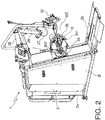
figures 1 and2 are perspective views, slightly from the top and from respective sides, of an embodiment of a machine according to the present invention; -
figures 3 and 4 are top views of themachine 1 in respective operative configurations; -
figures 5 and 6 are top views of the machine offigure 1 in respective removal steps; -
figures 7 and 8 are perspective views of parts of the machine offigure 1 ; -
figure 9 is a view with parts of the machine offigure 1 in exploded view; -
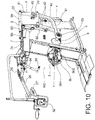
figures 10 and11 are perspective views, slightly from the top and from respective sides, of another embodiment of a machine according to the present invention; -
figures 12 and 13 are top views of the machine offigure 10 in respective operative trims; -
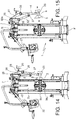
figures 14 and 15 are front views of the machine offigure 10 in respective operative trims; -
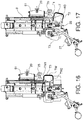
figures 16 and 17 are top views of the machine offigure 10 in respective removal steps; -
figures 18 and 19 are perspective views of parts of the machine offigure 10 ; -
figure 20 is a view with parts of the machine offigure 10 in exploded view. - In the attached drawings, identical parts or components are distinguished using the same reference numbers.
- With reference to
figures 1 to 9 , herein illustrated is amachine 1 for mounting and/or removing tyred wheels for vehicles comprising aframework 2, means 3 for dragging a wheel in rotation around a first rotation axis x-x, which, in use, corresponds to the main symmetry or longitudinal axis of the wheel, the dragging means 3 having aportion 3a for coupling to theframework 2 as well as aportion 3b for working or engaging a rim W of a tyred wheel TW projecting from thecoupling portion 3a in the direction of the front F of the machine and moving away from the rear R of the machine. - The rotation axis x-x is advantageously horizontal or inclined with respect to the horizontal by an angle between 5° and 40°, for example between 10° and 30°. The possible inclination of the rotation axis x-x is clearly such that the operative or
engagement portion 3b extends starting from thecoupling portion 3a upwards or that the free end/s of the operative orengagement portion 3b is/are at a higher level with respect to the respective end for connection to thecoupling portion 3a. - The
means 3 for dragging in rotation may for example comprise agroup 3b with expandable jaws or grippers mounted on atang 3a or the like inserted into or connected to theframework 2. Clearly, the means for dragging in rotation may also comprise a plate or board. - Possibly provided for are two, three, four or more jaws 3b1 or grippers, possibly with a substantially C-shaped end, the jaws or grippers 3b1 being articulated or pivoted to a main plate 3b2 and also provided for being means for actuating the jaws, such as a motor, possibly electric, pneumatic, hydraulic, designated to displace the jaws 3b1 between an inoperative position and a diverging or angular displacement position, wherein the jaws are moved apart with respect to a longitudinal symmetry axis actually corresponding to the rotation axis x-x of the
means 3 for dragging in rotation or the free ends of the jaws 3b1 are moved apart thus each engaging a respective portion of the rim W, usually an edge of the rim W or a central part of the rim W, so that driving the dragging means 3 in rotation allows to drive the rim W and the tyre T thereon in rotation. - Furthermore, the dragging means 3 also comprise a suitable motor housed in the
framework 2, possibly electric and provided with a special gearmotor, the motor being designed to drive the operative orengagement portion 3b in rotation and, possibly, thecoupling portion 3a around the rotation axis x-x. - The
dragging means 3 can also be slidably mounted along theframework 2, so as to be lifted and lowered, by means of a special motor for an adaptation as a function of the dimensions of a wheel to be handled or of the components thereof. - Clearly, the
framework 2 may comprise one or more columns oruprights 2a rising from abase 2b and possibly displaceable on the latter. - The
framework 2 or a column or upright 2a thereof can include a front part orwall 2c facing towards the front F of the machine and extending from which are draggingmeans 3, a rear part orwall 2d basically defining the rear R of the machine and two ormore sides front part 2c and of therear part 2d. Theframework 2 may then also comprise atop wall 2g as well as sections, uprights or crosspieces for supporting the various components of the machine. - Motors or means for driving components of the machine can be housed in the
framework 2. - The front part or
wall 2c may be inclined with respect to the horizontal, for example with lower end distant from the rear R relatively to the respective rear end. - Furthermore, the
machine 1 defines a work area WZ substantially around the operative orengagement portion 3b of the dragging means 3 facing the front part orwall 2c, a tyred wheel TW being basically positioned and handled by themachine 1 in the work area WZ. - The
machine 1 also comprises afirst arm 4 extending from or supported by theframework 2 as well as at least one first mounting and/orremoval tool 5, such as a roller, for example conical or frusto-conical, possibly rotatably mounted and, preferably idle, supported by thefirst arm 4, for example by a tubular element orcylindrical end 6 thereof. - If the
first tool 5 is a roller rotatably mounted on an end of thefirst arm 4, then the rotation axis or second rotation axis of the roller w-w is preferably orthogonal or transversal and preferably but not necessarily incident with respect to the rotation axis x-x. - Furthermore, the
first arm 4 can be displaced between at least one first receded or retracted inoperative position, wherein thefirst tool 5 is in a position closer to the rear R of the machine and farther than the front F of the machine, possibly beside theframework 2, and at least one second operative or removal or advanced or extended position (seefigures 5 and 6 ), wherein thefirst tool 5 is in a position advanced or next to or closer to front F of themachine 1 and farther from the rear R of the machine, so that thefirst tool 5 is designed to act or engage or push on a first side TW1 of a wheel mounted on themeans 3 for dragging in rotation or better of a first circumferential bead T1 of a tyre mounted on a rim W in turn mounted on themeans 3 for dragging in rotation closest to thecoupling portion 3a with respect to a second side TW2 of the respective wheel TW or to a second circumferential bead T2 of a tyre. - Clearly, in the inoperative position, the
first tool 5 is closer to the rear R and farther from the front F with respect to the second operative or removal position. In the inoperative position, thefirst tool 5 does not engage or it is not capable of engaging a first side TW1 of a wheel or a first circumferential bead T1 of a tyre T mounted on themeans 3 for dragging in rotation. - The inoperative position could also be a position just before or next to the work area WZ.
- Substantially, in the first position the
tool 5 is outside or just outside the work area WZ, while in the second position or better in the second positions thetool 5 enters into the work area and pushes the tyre. - A plurality of second positions, i.e. several subsequent and adjacent positions of the
arm 4 which define the consecutive thrust positions by thetool 5 on a tyre, are preferably provided for. - Furthermore, the
arm 4 and thus thetool 5 are displaced or displaceable substantially parallel to the axis x-x when moving from the or a first to a second position and more in particular, when removing (thus not during the initial steps of adapting to the dimensions of the wheel to be handled and not necessarily in the steps of approaching a tool in the work area WZ) only along one direction as indicated now. Thus, thearm 4 and thus thetool 5 are not displaced or cannot be displaced along an arched or a circle arc direction when moving from a first or from the first to a second position or to the second positions. - To clarify further, a tyred wheel for a vehicle TW to be handled comprises a rim W and a tyre mounted on the latter, so as to have two sides TW1, TW2, each defined by a circumferential bead T1, T2 and by a respective annular edge W1, W2 of the rim W, with the two circumferential beads T1, T2 connected to each other by means of a lateral annular band T3 of the tyre T, while the two annular edges W1, W2 of the rim W are connected by means of the central body W3 of the rim.
- Clearly, in the operative position or in the operative positions the
tool 5 engages and pushes the tyre T of a wheel TW to be removed, in particular the first circumferential bead T1 which - in use - is internal, i.e. closer to the rear R with respect to the second circumferential bead T2, as explained better hereinafter while in the inoperative position thetool 5 does not engage the tyre T and in the receded position far from it and, preferably, outside the work area WZ. - Basically, when moving from a first or from the first to a second position, the
first tool 5 advances in the direction of the front F of the machine and thus towards the external side TW2 of the wheel or better towards the outer edge W2 of the rim, i.e. the edge W2 far from thecoupling portion 3a, pushing the tyre T at a respective first circumferential edge T1, which - in use - is more inner or closer to the rear R of themachine 1. - The
first tool 5 is thus a rear tool, i.e. a tool that acts on the coupling side TW1 of a wheel TW or better on a respective first circumferential edge T1. - Preferably, the
machine 1 also comprises alinear guide component 7 fixed or mounted on theframework 2, in particular on aside 2e thereof and having, at least for a final part of the extension thereof approaching the work area WZ, main or longitudinal extension axis y-y parallel or substantially parallel to the rotation axis x-x, and further comprising a slide-like component 8 slidably mounted on thelinear guide component 7 as well as slidably fixed or constrained or integrally joined along an axis parallel to the axis x-x with thefirst arm 4. The slide-like component 8 could also represent a part of thefirst arm 4 and be or not be made of a single piece with the latter. - As observable hereinafter, the
linear guide component 7 could also have a curved initial section and not with main or longitudinal extension axis y-y parallel or substantially parallel to the rotation axis x-x, wherein the expression initial section is used to indicate an end section distal from themeans 3 for dragging in rotation or from the work area WZ of the machine. - Thanks to such expedient, the
arm 4 and thus thetool 5 is displaced substantially parallel to the axis x-x when moving from a first or from the first to a second position. - Preferably, the
machine 1 is provided withmeans 9 for displacing the slide-like component 8 and thus thefirst arm 4 between the first inoperative position and the second operative position, the displacement means including an electric or hydraulic or pneumatic displacement or slidingactuator 9 of the slide-like component 8 along thelinear guide component 7 substantially along or in the direction of the main or longitudinal extension axis y-y. - The displacement or sliding
actuator 9 is constrained or articulated or fixed, directly or with imposition of other components, on the one side to theframework 2 or to thecolumn 2a and on the other side, directly or with interposition of other components, to thearm 4 or to the slide-like component 8. - According to the non-limiting embodiment illustrated in the figures, the
linear guide component 7 comprises aplate 7a, possibly flat, for example rectangular-shaped, which can be fixed, possibly using screws or bolts or forced fitting of respective parts to theframework 2 or better to aside 2e thereof or of the column or upright 2a. Theplate 7a has a main extension dimension along the main or longitudinal extension axis y-y. - Furthermore, the
plate 7a may have anupper end 7b and/orlower end 7c substantially straight and extending parallel to the main or longitudinal extension axis y-y. - The
plate 7a may be arranged at a desired height, for example in an intermediate position or also at the top part of theframework 2 or of the column or of the upright 2a. Themachine 1 may also comprise means for lifting/lowering theplate 7a with respect to theframework 2. - The slide-
like component 8 may instead include a section or extrusion orsheet 8a shaped so as to define anupper edge 8b curved or folded - in use - so as to define a first cradle-like portion for slidably wrapping or housing - with or without clearance - theupper end 7b of theplate 7a and a lower, in use, edge 8c suitably curved or folded so as to define a second cradle-like portion for slidably wrapping or housing - with or without clearance - thelower end 7c of theplate 7a. Clearly, the first cradle-like portion and the second cradle-like portion are substantially aligned and open towards each other. - The first cradle-like portion and the second cradle-like portion have a substantially straight extension parallel to the main or longitudinal extension axis y-y.
- The section or extrusion or shaped
sheet 8a may then comprise anextension 8d defining an end section of the first cradle-like portion, but open towards the bottom and thus not delimiting a section of the second cradle-like portion. - Naturally, there could also be a different structure, for example with a flat plate or structurally corresponding to the
plate 7a representing the slide-like component, and with a section or extrusion or shaped sheet structurally corresponding to the section or extrusion or shapedsheet 8a representing the linear guide component. - On the other hand, as concerns the displacement or sliding
actuator 9, it can for example include acylinder 9a with astem 9b slidably mounted thereon, in which case thecylinder 9a could be fixed or connected to theframework 2, while thestem 9b could be fixed or connected to the slide-like component 8 or vice versa. - For example with reference to the non-limiting embodiment illustrated in the figures, the
cylinder 9a is clamped between twoblocks 17, possibly C-shaped, one of which is fixed to theframework 2, possibly by means of screws, welding, gluing or other means, theblocks 17 being mutually constrained and clamped, after positioning thecylinder 9a between them, by means of screws or bolts orother means 18. - On the other hand, the
stem 9b is inserted and fixed into anappendage 8e which extends from an end of theextension 8d. - Clearly, the
machine 1 may also comprise stop means for limiting the sliding or displacement extension of the slide-like component 8 on thelinear guide component 7. - A different structure, for example a telescopic arm mounted or fixed to the framework, thus without the linear guide component and slide-like component, could also be provided for.
- Advantageously, the
first arm 4 may also be pivoted or mounted angularly displaceable around a pivoting axis z-z with respect to theframework 2 or to the column or upright 2a or to the slide-like component 8, the pivoting axis z-z preferably being substantially orthogonal to the rotation axis x-x or to an axis parallel thereto and, even more preferably, to a first plane lying on which is the rotation axis x-x and a horizontal axis intercepting the horizontal axis x-x and parallel to the direction from oneside 2e to the other 2f of themachine 1 or of theframework 2. - Such angular displacement serves to adapt the arrangement of the
tool 5 as a function of the diameter of a wheel TW or better of the rim W of a wheel to be handled. - The pivoting of the
first arm 4 can for example be obtained by inserting afirst pin 15 into one or more holes delimited by theframework 2 or by the slide-like component 8 as well as in a first through hole delimited by thefirst arm 4 possibly at arear end 4a or on the rear thereof possibly having an end enlargement. As concerns this, therear end 4a could also be arranged and pivoted with thepin 15 between two bracket-like components 8f of the slide-like component 8. - The
first arm 4 can be pivoted or angularly displaceable between at least one closing position (seefigure 3 ), wherein thearm 4 or better thetool 5 is next to or proximal to theframework 2 or to therespective side 2e and at least one opening position (seefigure 4 ) wherein thearm 4 or better thetool 5 is far or distal or more distant with respect to the closing position from theframework 2 or from therespective side 2e. Between the closing position and the opening position thearm 4 could carry out an angular excursion for example between about 1° and about 45°, possibly between 5° and 30° or between 5° and 20°. - Thanks to the solution according to which the
first arm 4 is pivoted around a pivoting axis z-z substantially orthogonal to the rotation axis x-x or to an axis parallel thereto as well as to the first plane indicated above, i.e. a first plane lying on which is the rotation axis x-x and a horizontal axis intercepting the rotation axis x-x and parallel to the direction from oneside 2e to the other 2f of themachine 1, the length dimension of thefirst arm 4 preferably always lies in such first plane or in a plane parallel thereto, even following the pivoting around the axis z-z. - Advantageously, if the
first tool 5 is a roller rotatably mounted on an end of thefirst arm 4, then the rotation axis or second rotation axis of the roller w-w preferably always lies in the same plane, possibly passing through the rotation axis x-x or through an axis parallel thereto. Still with reference to the first plane, lying on which is the rotation axis x-x and a horizontal axis intercepting the rotation axis x-x and parallel to the direction from oneside 2e to the other 2f of the machine, the second rotation axis of the roller w-w preferably always lies in such plane or in a plane parallel thereto, even following the pivoting around the axis z-z. - In such case, the
first arm 4 may be pivoted to the slide-like component 8 at a portion distal from thecoupling portion 3a or at the rear R. Thus, for example, given that the slide-like component 8 and thefirst arm 4 are in the first receded inoperative position, the pivoting axis z-z is distant from thecoupling portion 3a by a value for example greater than 20, 30, 40 or 50 cm. This guarantees that the angular displacement of the arm for adapting to wheels of different dimensions is small. - The
machine 1 may then comprise angular displacement means 19 designed to angularly displace - around the axis z-z - thefirst arm 4 with respect to theframework 2, for example with respect to the slide-like component 8. Alternatively, thefirst arm 4 can be displaced manually and thus fixed in position using a special stop element. - The angular displacement means 19 can for example be of the manual or automatic actuation type.
- According to the embodiment illustrated in the figures, the angular displacement means 19 comprise a
flywheel 20 for controlling and driving in rotation ashaft 21, fixed, integrally joined with or actuatable using theflywheel 20, theshaft 21 possibly being externally threaded for the screwing engagement with an internally threaded hole delimited by thefirst arm 4 or by a bushing orsleeve 22 constrained to thefirst arm 4, possibly supported, preferably displaced angularly or pivoted, by one or more pairs ofbrackets 23 fixed or welded to thearm 4. Theshaft 21 in this case can also traverse a slot or hole delimited in thearm 4 and aligned to the internally threaded through hole delimited by the bushing orsleeve 22. - A second pin or
pawl 24 can be provided for pivoted or fixed to the slide-like component 8 and delimiting a hole for the through-passing of an end of theshaft 21. - The
shaft 21 could also have an end that is internal or far from theflywheel 20, which - in an end position - is at contact and pressure against an inner face of the slide-like component 8. - With a structure thus made, controlling the rotation of the
flywheel 20 manually would determine the screwing or unscrewing of theshaft 21 with respect to thebushing 22 and thus the angular displacement of thearm 4 fixed to the latter with respect to the slide-like component 8. - As mentioned above, a different structure could also be provided for, possibly with direct pivoting of the arm to the
framework 2 or to thecolumn 2a. - Clearly, the adaptation of the
first arm 4 and thus of thetool 5 as a function of the diameter of a wheel TW or better of the rim W of a wheel to be handled, can also be obtained in a different fashion, possibly even mounting the displaceable arm along a second guide orthogonal to the axis y-y, possibly also providing the machine with means for the translation of the arm along such second guide. - Furthermore, the
first arm 4 may comprise afirst segment 4b at least partially tubular as well as asecond segment 4c slidably mounted in thefirst segment 4b or in the tubular part of thefirst segment 4b, thesecond segment 4c bearing - at a respective end distal from thefirst segment 4b - thefirst tool 5, possibly by interposing a tubular element orcylindrical end 6 thereof. In such case, themachine 1 also comprises means 12 for fixing - in two or more work positions of thesecond segment 4c - to thefirst segment 4b, thesecond segment 4c projecting from thefirst segment 4b by a respective value different from the other positions, in each operative position. - Regarding this, according to the non-limiting embodiment illustrated in the figures, the first
tubular segment 4b delimits a first throughhole 4d, while thesecond tubular segment 4c delimits two or more second throughholes 4e, hence aligning the first throughhole 4d with a respective second throughhole 4e allows to obtain an operative position of thesecond segment 4c which can be clearly stabilised or defined by inserting a bolt or rod or the like 12 in the holes thus aligned. - The first
tubular segment 4b may have a straight extension or even several inclined parts. Same case applies to thesecond tubular segment 4c. - The
rear end 4a of thearm 4 may be defined by the firsttubular segment 4b. - The
first arm 4 may also support a roller or thrusttool 25, possibly next to thefirst tool 5 and in position on the side opposite to themeans 3 for dragging in rotation with respect to thefirst tool 5. - More in particular, if the
first tool 5 comprises a roller, then thethrust roller 25 may have a rotation axis substantially corresponding to that of thefirst tool 5. In such case, thefirst tool 5 would extend starting from an end of thefirst arm 4 or of a respective tubular element orcylindrical end 6 approaching the dragging means 3, while thethrust roller 25 would extend starting from an end of thefirst arm 4 or of a respective end tubular orcylindrical element 6 moving apart from the dragging means 3 and in the direction opposite to thefirst tool 5. - Possibly, the
machine 1 comprises at least onesecond arm 26, possibly L-shaped or straight or with several pieces inclined with respect to each other, extending from theframework 2 or from thecolumn 2a, for example from asecond side 2f of the framework or of thecolumn 2a opposite to thefirst side 2e from which thefirst arm 4 projects. Thesecond arm 26 may also extend starting from thetop wall 2g of theframework 2 orcolumn 2a or of a respectivesecond side 2f. - The
machine 1 also includes at least one second mounting and/or removal and/orbeading tool 27 supported by the second arm 13. - The
second tool 27 could comprise a conical or frustoconical roller, possibly mounted rotatable and, preferably idle, on thesecond arm 26. - In such case, the
second arm 26 is displaceable between at least one first inoperative trim, wherein thesecond tool 27 is in a position that is more distant from the rear R of themachine 1 as well as from the work area WZ and at least one second operative or engagement or beading or thrust trim, wherein thesecond tool 27 is in a position that is closer to the rear R of themachine 1 and it is arranged in the work area WZ, so that thesecond tool 27 is designed to act on a second side TW2 of a wheel TW or better on a second circumferential bead T2 of a tyre T mounted onmeans 3 for dragging in rotation farther from thecoupling portion 3a with respect to a first side TW1 of the respective wheel TW or to a first circumferential bead T1 of a tyre, so that thesecond tool 27 is designed to act on a second side TW2 of a wheel opposite to a first work side TW1 of thefirst tool 5. - Clearly, in the inoperative trim the
second tool 5 is farther from the rear R with respect to the operative trim. - Basically, when moving from the first to the second trim, the
second tool 27 advances in the direction of the rear R and of the work area WZ of the machine and thus towards the inner side TW1 of the wheel, i.e. the side TW1 close to or next to thecoupling portion 3a. - As concerns the displacement of the
second arm 26 between the first and the second trim, actuation means 28, such as an electric, hydraulic or pneumatic actuator, may be provided for. - In such case, the
second arm 26 could be pivoted to theframework 2 or to thecolumn 2a around an angular displacement axis. The angular displacement axis may be or may be not incident with the rotation axis x-x, and it could also be varied as a function of the adaptation of thesecond arm 26 to the dimensions of the wheel. - The
second tool 27 is thus a front tool, i.e. a tool that acts on the outermost or free side TW2 of a wheel TW mounted on the machine or on a respective second circumferential bead T2 or between a second circumferential bead T2 and a second edge W2. - Possibly, the
second arm 26 can be displaced so as to adapt it to the dimensions of the wheel T and of the rim W of a wheel TW to be handled and also so as to allow to free the area facing the dragging means 3, i.e. the work area WZ, for the loading or the unloading - thereonto/therefrom - of a wheel TW to be removed or of a wheel W on which a tyre T is to be mounted. As regards this, thesecond arm 26 could be pivoted to thecolumn 2a around an axis for example substantially parallel to the rotation axis x-x of themeans 3 for dragging in rotation. In such case, the machine could comprise actuator means 29, such as an electric, hydraulic or pneumatic actuator, for controlling the angular displacement of thesecond arm 26 as indicated now. - As regards the
second arm 26 and thesecond tool 27, they could for example be as disclosed byUS6422285B1 . - Clearly, the
second arm 26 could also be obtained or displaced even in a different fashion and even possibly with a guide system and slider similar to thefirst arm 4. - The
machine 1 may also comprise other tools, for example a mountingnail 33 or the like supported by a respectivethird arm 34 and manually actuatable or suitably actuated by means of respective actuator/s. - A machine according to the present invention also comprises control means 32, for example buttons or pedals each designed to control the actuators or motors of the machine.
- Clearly, a remote control for the actuation means, actuators or other means of the machine, for example by means of a remote control, computer, tablet, mobile phone etcetera, could also be provided for.
- The machine could also comprise a programmed control unit for automatically controlling the means of the machine and possibly receive and process signals of respective detection means or sensors.
- As regards this, the
machine 1 could also be provided with sensor means designed to detect the rim W and/or the tyre T and send - directly or by means of a programmed control unit - respective signals to the actuation means so as to determine the displacement or advancement of the arms between respective positions or trim. - Now, with reference to
figures 10 to 20 herein illustrated is a machine according to the present invention similar to the machine described above, but wherein thefirst arm 40 and the slide-like component 80 are structured differently or better the constraint between them is structured differently. - As regards this, the
first arm 40 and the slide-like component 80 are articulated or connected to each other by means of an articulated polygon structure or an articulated parallelogram. - In such case, the articulation axes of the articulated parallelogram and thus the
respective pins figures 13 and14 ). - Furthermore, in such case, the
first arm 40 and the slide-like component 80 would represent two branches or opposite pieces of the articulated parallelogram. - With reference to such aspect, according to the example illustrated in the figures, the slide-
like component 80 comprises a section or extruded component or shapedsheet 80a similar to the one described above, and two arms or connection plates which are articulated or pivoted, preferably between axes substantially parallel to the rotation axis x-x, on the one side to the section or extruded component or shapedsheet 80a and - on the other side to thefirst arm 40, are provided for. - More in particular, at an upper end of the section or extruded component or shaped
sheet 80a a board orfirst connection element 81 is pivoted at a respective first side, while one or a pair of second connection ortubular elements 82 are pivoted at a lower end of the section or extruded component or shapedsheet 80a. - The
board 81 is also pivoted at a second side opposite to thefirst arm 40 and the same case applies to the second connection element/s 82. - Clearly, if several second connection or
tubular elements 82 are provided for, the latter will preferably have the same length and each will be pivoted around the pivoting axis of the others. - In such case, the
first arm 40 may have afirst segment 41 and one or a pair ofsecond segments 42 connecting thefirst segment 41 and a respective point for pivoting to theboard 81, while each of the connection ortubular elements 82 are pivoted at an intermediate section of a respective first 41 or second 42 segment. - In such case, the bushing or
sleeve 22 may be supported, preferably angularly displaceable or pivoted, by one or a pair ofbrackets 23 fixed or welded to theboard 81. - As it will be understood, controlling the rotation of the
flywheel 20 manually would in such case determine the screwing or unscrewing of theshaft 21 with respect to thebushing 22 and thus the angular displacement of thearm 40 fixed to the latter with respect to the slide-like component 80, according to the displacements imparted by the articulated parallelogram. - Such structuring would allow to easily maintain the rotation axis or second rotation axis w-w of the roller incident and radial with respect to the rotation axis x-x or in a position proximal to such condition, this entailing an optimal operation of the wheel.
- Furthermore, even according to the embodiment described now, the
arm 40 and thus thetool 5 is displaced parallel to the axis x-x when moving from a first or from the first to a second position. - The machine according to the present invention, for example according to the embodiments described above, allows to implement the following removal method.
- First, the wheel to be removed is mounted and locked on the dragging means 3, for example an
expandable jaw unit 3b and then thefirst tool 5 is brought with the work front or end facing towards the circumferential area of the tyred wheel TW for contact between the tyre T and the rim W. - The expression work front or end is used to indicate the portion which, in use, and if the roller is rotatable, whenever required and during the rotation of the
roller 5, is at contact with a portion of the bead of the tyre. - If necessary and if possible, before such step, the
first arm tool 5 as a function of diameter of a wheel TW or better of the rim W of a wheel to be handled. - The motor of the
means 3 for dragging in rotation is then actuated and then the displacement of thefirst arm figures 5 and16 ), and at least one second operative or removal position (seefigure 6 and17 ), along a direction substantially parallel to the rotation axis x-x, so that thefirst tool 5 is brought into contact and thrust on a portion of a first side TW1 of a wheel mounted onmeans 3 for dragging in rotation or better of a first circumferential bead T1 of a tyre mounted on a rim W in turn mounted onmeans 3 for dragging in rotation. - Prior to such step or even at the beginning of such step, the
second tool 27, if present, can also be brought in operative position against the second side TW2 of the wheel or better against the second circumferential bead T2 of the tyre T at the second side TW2, so that, while themeans 3 for dragging in rotation are activated, thesecond tool 27 contributes to bead-breaking the second circumferential bead T2, i.e. to detach the second circumferential bead T2 from the second edge. As regards this, thesecond tool 27 will preferably act on a portion of the wheel angularly or diametrically opposite to that of action of thefirst tool 5. - Thus, maintaining the actuation of the dragging means 3 or controlling the actuation thereof now or re-activating them now (for example following the bead-breaking step), in particular after retracting or displacing the
second tool 27, if present, it is continued the control of the advancement or displacement of thefirst arm first tool 5 pushes or continues to push the tyre T so as to bring it with both circumferential beads T1, T2 thereof beyond the rim W or better outside the groove C defined between the circumferential edges W1, W2 thereof, then an operator, in particular after stopping the dragging means 3 and the advancement of thefirst arm 4, can pick up the tyre T to complete the removal thereof and possibly mounting a new tyre on the rim W mounted on the dragging means 3. - Clearly, when removing the operator can intervene with special levers or manual tools.
- Operating tools such as in particular the
second tool 27 and the mountingtool 33 or possible levers used by an operator according to the known execution methods, for example as described inUS6422285B1 , can be used for mounting a tyre on a rim. - As it will be observed, using a machine according to the present invention, given that the
linear guide component 7 has a main or longitudinal extension axis y-y parallel or substantially parallel to the rotation axis x-x, thearm 4 and thus thetool 5 is displaced during removal parallel to the axis x-x when moving from a first or from the first to a second position. - Furthermore, if the
first tool 5 is a rotatable roller, when moving from a first or from the first to a second position, the rotation axis or second rotation axis of the roller w-w preferably always lies in the same plane lying on which is the rotation axis x-x and a horizontal axis intercepting the rotation axis x-x and parallel to the direction from oneside 2e to the other 2f of the machine or in a plane parallel to such plane. - This, according to the embodiment of
figures 1 to 9 , is also preferably guaranteed in cases where the first arm is angularly displaceable with respect to theframework 2 or thecolumn 2a. - On the other hand, in case of the machine according to
figures 10 to 20 , it is possible to maintain the rotation axis or second rotation axis of the roller w-w incident and radial relatively to the rotation axis x-x or in a position proximal to such condition, even following the adaptation of thefirst arm 40 as a function of the dimensions of the wheel or better of the rim to be handled, further reducing the risk of ruining the first arm or the articulation thereof and thus obtaining optimal operating conditions of a wheel (in particular removal). - Thanks to the solutions described above, as it will be observed, the
arm 4 is stressed appropriately and there is no risk of it being ruined during the operations, this not being the case in machines according to the prior art, wherein the rear roller is displaced along a circle arc thus not complying with any of the conditions described now. - Modifications and variants of the invention can be implemented within the scope of protection defined by the claims.
Claims (18)
- Machine for mounting and/or removing tyred wheels for vehicles comprising a framework (2), means (3) for dragging a wheel in rotation around a first rotation axis (x-x), said dragging means (3) having a portion (3a) for coupling to said framework (2) as well as a portion for working or engaging (3b) a rim (W) of a tyred wheel (TW) which projects from said coupling portion (3) in the direction of the front (F) of the machine and moving away from the rear (R) of the machine, said machine further comprising at least one first arm (4, 40) extending from or supported by said framework (2) and at least one first mounting and/or removal tool (5) supported by said at least one first arm (4, 40), said at least one first arm (4, 40) being displaceable between at least one first receded or retracted inoperative position, wherein said at least one first tool (5) is in a position closer to the rear (R) of the machine and farther from the front (F) of the machine and at least one second operative position, wherein said at least one first tool (5) is in an advanced position proximal or next to or closer to said front (F) of said machine and farther from said rear (R) of the machine, so that said at least one first tool (5) is designed to act or engage or push on a first side (TW1) of a wheel or better on a first circumferential bead (T1) of a tyre (T) mounted on the means (3) for dragging in rotation which is closer to the coupling portion (3a) with respect to a second side (TW2) of the respective wheel (TW) or to a second circumferential bead (T2) of a tyre (T),
wherein said first arm (4, 40) and thus said at least one first tool (5) are displaceable between said at least one first inoperative position and said at least one second operative position substantially parallel to the rotation axis (x-x) when moving from said at least one first to said at least one second position. - Machine according to claim 1, comprising a linear guide component (7) fixed or mounted on said framework (2) and having, at least as regards a part of the extension thereof approaching the work area (WZ) of the machine, main or longitudinal extension axis (y-y) parallel or substantially parallel to said rotation axis (x-x), and it further comprises a slide-like component (8, 80) slidably mounted on said linear guide component (7) as well as slidably fixed or constrained or integral with said at least one first arm (4, 40).
- Machine according to claim 2, comprising means (9) for displacing said slide-like component (8, 80) and thus said at least one first arm (4, 40) between said at least one first inoperative position and said at least one second operative position, said displacement means including a displacement or sliding actuator (9) of said slide-like component (8, 80) along said linear guide component (7) substantially along or in the direction of said main or longitudinal extension axis (y-y).
- Machine according to any one of the preceding claims, wherein said at least one first arm (4, 40) is pivoted or mounted angularly displaceable around a pivoting axis (z-z) with respect to the framework (2).
- Machine according to claim 4, wherein said pivoting axis (z-z) is substantially orthogonal to said first rotation axis (x-x) or to an axis parallel thereto.
- Machine according to claim 5, wherein said pivoting axis (z-z) is substantially orthogonal to a first plane in which lie the rotation axis (x-x) and a horizontal axis intercepting the rotation axis (x-x) and parallel to the direction from one side (2e) to the other (2f) of the machine (1) or the framework (2), so that the length dimension of the first arm (4, 40) always lies in such first plane or in a plane parallel thereto, also following the pivoting of the first arm (4, 40) around the pivoting axis (z-z).
- Machine according to claim 4, 5 or 6, comprising angular displacement means (19) arranged to angularly displace the first arm (4, 40) with respect to the framework (2) around the pivoting axis (z-z).
- Machine according to claim 7, wherein said angular displacement means (19) comprise a flywheel (20) for controlling and driving in rotation a shaft (21) threaded externally for the screwing engagement with an internally threaded hole delimited by the first arm (4, 40) or by a bushing or sleeve (22) constrained to the first arm (4, 40).
- Machine according to one of claims 4 to 8 when dependent on claim 2, wherein said at least one first arm is pivoted to the slide-like component (8, 80) at a portion distal from the coupling portion (3a) or still at the rear (R) of the machine.
- Machine according to claim 9, wherein when the slide-like component (8, 80) and the first arm (4, 40) are in the first receded inoperative position, the pivoting axis (z-z) is distant from the coupling portion (3a) by a value greater than 20, 30, 40 or 50 cm.
- Machine according to any one of the preceding claims, wherein said at least one first arm (4, 40) comprises an at least partly tubular first segment (4b), as well as a second segment (4c) slidably mounted in the tubular part of the first segment (4b), the second segment (4c) bearing the first tool (5) at a respective end distal from the first segment (4b) and wherein said machine comprises means (12) for fixing, in two or more operative positions, the second segment (4c) to the first segment (4b), in each operative position the second segment (4c) projecting from the first segment (4b) by a respective amount different from the other operative positions.
- Machine according to any one of the preceding claims, wherein said first tool (5) is a conical or frusto-conical roller rotatably mounted on an end of said first arm (4, 40) around a second rotation axis (w-w).
- Machine according to claim 12, wherein said second rotation axis (w-w) lies in a first plane in which lie said first rotation axis (x-x) and a horizontal axis intercepting said first rotation axis (x-x) and parallel to the direction from one side (2e) to the other (2f) of the machine or in a plane parallel to such first plane.
- Machine according to any one of the preceding claims when dependent on claim 2, wherein the first arm (40) and the slide-like component (80) are pivoted and connected to each other by means of an articulated polygon-shaped or articulated parallelogram-like structure.
- Machine according to claim 14, wherein the pivoting axes of the articulated parallelogram and thus respective pins are substantially parallel to said first rotation axis (x-x).
- Machine according to any one of the preceding claims, comprising at least one second arm (26) extending from said framework (2) as well as at least one second mounting and/or removal and/or bead-breaking tool (27) supported by said at least one second arm (26), said second arm (26) being displaceable between at least one first inoperative trim, wherein said at least one second tool (27) is in a position more distant from the rear (R) and at least one second working or engagement or bead-breaking or thrust trim, wherein the second tool (27) is in a position closer to the rear (R) of the machine, so that said at least one second tool (27) is arranged to act on a second side (TW2) of a wheel (TW) or better on a second circumferential bead (T2) of a tyre (T) mounted on the means (3) for dragging in rotation farther from the coupling portion (3a) with respect to a first side (TW1) of the respective wheel (TW) or to a first circumferential bead (T1) of a tyre, so that the second tool (27) is arranged to act on a second side (TW2) of a wheel opposite to a first working side (TW1) of the first tool (5).
- Method for removing a tyred wheel with a machine according to any one of the preceding claims, comprising the following steps,- mounting and locking the wheel to be disassembled on the dragging means (3),- bringing the first tool (5) with work front or end facing towards the circumferential area of the tyred wheel (TW) for contact between the tyre (T) and the rim (W),- commanding or controlling the displacement of the first arm (4, 40) between a first receded inoperative position and a second operative or removal position along a direction substantially parallel to said first rotation axis (x-x), so that the first tool (5) is brought into contact and thrust on a portion of a first side (TW1) of a wheel or better of a first circumferential bead (T1) of a tyre mounted on the means (3) for dragging in rotation,- actuating the means (3) for dragging in rotation or keeping them actuated so as to drag the tyred wheel (TW) in rotation and continue to control the advancement or displacement of the first arm (4, 40) so that the first tool (5) pushes the tyre (T) so as to carry it with both of its circumferential beads (T1, T2) beyond the rim (W) or better outside the groove (C) defined between the circumferential edges (W1, W2), and- picking up the tyre (T).
- Removing method according to claim 17 carried out with a machine according to claim 16, comprising:- carrying said second tool (27) in an operative position against the second side (TW2) of the wheel or better against the second circumferential bead (T2) of the tyre (T) at the second side (TW2), so that, while the means (3) for dragging in rotation are activated, the second tool (27) contributes to break the beads of the second circumferential bead (T2), i.e. detach the second circumferential bead (T2) from the second edge (W2).
Priority Applications (1)
| Application Number | Priority Date | Filing Date | Title |
|---|---|---|---|
| HRP20212022TT HRP20212022T1 (en) | 2018-10-10 | 2019-10-07 | Machine for mounting and/or removing vehicle tyres, in particular truck tyres |
Applications Claiming Priority (1)
| Application Number | Priority Date | Filing Date | Title |
|---|---|---|---|
| IT102018000009322A IT201800009322A1 (en) | 2018-10-10 | 2018-10-10 | MACHINE FOR ASSEMBLY AND / OR DISASSEMBLY OF VEHICLE WHEELS, IN PARTICULAR TRUCK WHEELS |
Publications (2)
| Publication Number | Publication Date |
|---|---|
| EP3636463A1 true EP3636463A1 (en) | 2020-04-15 |
| EP3636463B1 EP3636463B1 (en) | 2021-12-01 |
Family
ID=65031642
Family Applications (1)
| Application Number | Title | Priority Date | Filing Date |
|---|---|---|---|
| EP19201650.9A Active EP3636463B1 (en) | 2018-10-10 | 2019-10-07 | Machine for mounting and/or removing vehicle tyres, in particular truck tyres |
Country Status (7)
| Country | Link |
|---|---|
| US (1) | US11254174B2 (en) |
| EP (1) | EP3636463B1 (en) |
| JP (1) | JP2020059496A (en) |
| CN (1) | CN111016557B (en) |
| ES (1) | ES2902389T3 (en) |
| HR (1) | HRP20212022T1 (en) |
| IT (1) | IT201800009322A1 (en) |
Cited By (1)
| Publication number | Priority date | Publication date | Assignee | Title |
|---|---|---|---|---|
| IT202100016793A1 (en) * | 2021-06-25 | 2022-12-25 | Devel Srl | TIRE CHANGING MACHINE, PARTICULARLY FOR LARGE WHEELS |
Families Citing this family (3)
| Publication number | Priority date | Publication date | Assignee | Title |
|---|---|---|---|---|
| IT201900009321A1 (en) * | 2019-06-18 | 2020-12-18 | Nexion Spa | TIRE CHANGING DEVICE |
| USD1053708S1 (en) * | 2022-01-21 | 2024-12-10 | Hunter Engineering Company | Tire changer press arm foot |
| CN114919344A (en) * | 2022-06-09 | 2022-08-19 | 营口辽南德威机械设备有限公司 | A vertical tire changer with a double-sided tool head and a flip structure |
Citations (6)
| Publication number | Priority date | Publication date | Assignee | Title |
|---|---|---|---|---|
| US6422285B1 (en) | 1999-04-02 | 2002-07-23 | Butler Engineering & Marketing S.R.L. | Tire changing machine for industrial vehicle wheels |
| EP1364814A2 (en) | 2002-05-23 | 2003-11-26 | BUTLER ENGINEERING & MARKETING S.r.l. | Tyre assembling-release machine for industrial vehicle wheels |
| US20110042875A1 (en) | 2009-08-21 | 2011-02-24 | John Story | Wheel clamping apparatus and method |
| WO2014037771A1 (en) | 2012-09-04 | 2014-03-13 | M&B Engineering S.R.L. | Tyre-changing machine |
| WO2014184645A1 (en) | 2013-05-17 | 2014-11-20 | M&B Engineering S.R.L. | Tyre-changing machine for trucks |
| EP3323644A1 (en) | 2016-11-04 | 2018-05-23 | NEXION S.p.A. | Apparatus for mounting and removing a tyre |
Family Cites Families (28)
| Publication number | Priority date | Publication date | Assignee | Title |
|---|---|---|---|---|
| SE434034B (en) * | 1980-09-08 | 1984-07-02 | Stig Sjovall | DEVICE FOR EASY TO ASSEMBLY AND REMOVE LARGE VEHICLE WHEELS |
| DK423488D0 (en) | 1988-07-29 | 1988-07-29 | Arne Hjorth Hansen | DEVICE AND REMOVAL DEVICE, NORMALLY LARGE TIRE |
| DK44893D0 (en) | 1993-04-21 | 1993-04-21 | Hjort Hansen Arne | DEVICE AND REMOVAL DEVICE, NORMALLY LARGE TIRE |
| IT1316726B1 (en) * | 2000-05-18 | 2003-05-12 | Mondolfo Ferro Spa | MACHINE FOR ASSEMBLING AND DISASSEMBLING THE TIRES OF THE WHEELS OF MOTOR VEHICLES |
| ITVR20030062A1 (en) * | 2003-05-19 | 2004-11-20 | Butler Eng & Marketing | MAINTENANCE EQUIPMENT OF A WHEELED WHEEL |
| ITMO20040044A1 (en) | 2004-02-27 | 2004-05-27 | Sicam Srl | MACHINE FOR THE ASSEMBLY AND DISASSEMBLY OF TIRES OF VEHICLE WHEELS |
| ITRE20040072A1 (en) | 2004-06-15 | 2004-09-15 | Corghi Spa | Bead breaker device |
| ITRE20070007A1 (en) | 2007-01-18 | 2008-07-19 | Societa Italiana Costruzioni Elettromeccaniche | '' MACHINE MONTA / SMONTA GOMME '' |
| ITRE20070091A1 (en) | 2007-07-30 | 2009-01-31 | Corghi Spa | '' PERFORMED TANK MACHINE " |
| US9434219B1 (en) * | 2008-01-25 | 2016-09-06 | Hunter Engineering Co. | Automated tire changer machine, systems, programs and methods |
| ITRE20080037A1 (en) | 2008-04-21 | 2009-10-22 | Corghi Spa | "MACHINE DISASSEMBLER AND RELATED STALLONATURE METHOD" |
| ITVR20080050A1 (en) | 2008-04-28 | 2009-10-29 | Butler Eng & Marketing | BREAKER GROUP FOR A TIRE CHANGER MACHINE |
| US8250915B1 (en) * | 2008-07-03 | 2012-08-28 | Hunter Engineering Company | Tire changer with actuated load roller |
| JP5325026B2 (en) | 2009-06-11 | 2013-10-23 | 小野谷機工株式会社 | Tool extension / reversal mechanism in tire attaching / detaching device |
| IT1403494B1 (en) * | 2010-12-23 | 2013-10-17 | Butler Eng & Marketing | DISASSEMBLY DEVICE OF THE SECOND HEEL OF A TIRE FROM A RIM AND ITS RELATION METHOD |
| IT1403852B1 (en) * | 2011-02-08 | 2013-11-08 | Corghi Spa | APPARATUS AND METHOD FOR THE REMOVAL OF A TIRE FROM A CORRESPONDING CIRCLE OF A WHEEL. |
| US9283820B1 (en) * | 2011-05-20 | 2016-03-15 | Hunter Engineering Company | Wheel assembly service machine with back cone center clamp mechanism |
| ITMO20120191A1 (en) * | 2012-07-31 | 2014-02-01 | Sicam Srl | TIRE CHANGER MACHINE FOR THE ASSEMBLY AND DISASSEMBLY OF VEHICLE WHEELS |
| ITVR20130252A1 (en) * | 2013-11-22 | 2015-05-23 | Butler Engineering And Marketing S P A | DISASSEMBLY DEVICE FOR A WHEELED WHEEL, AS WELL AS THE MACHINE INCLUDING THIS DEVICE. |
| ES2616537T3 (en) * | 2014-07-03 | 2017-06-13 | Corghi S.P.A. | Machine and method for mounting and disassembling a tire |
| EP2965927B1 (en) * | 2014-07-03 | 2016-07-20 | CORGHI S.p.A. | Machine and method for fitting and removing a tyre |
| CN104309422B (en) * | 2014-09-26 | 2016-07-06 | 营口光明科技有限公司 | The assistant of a kind of tyres for passenger cars changer and the manufacture method of critical piece |
| EP3075577B1 (en) * | 2015-04-03 | 2019-07-03 | Giuliano Group S.p.A. | Machine for fitting and removing wheel tyres for vehicles |
| ITMO20150008U1 (en) * | 2015-04-03 | 2016-10-03 | Giuliano Group Spa | IMPROVED TIRE MACHINE |
| CN108473010B (en) * | 2015-11-10 | 2020-09-04 | 斯耐普昂仪器有限公司 | Tyre mounting/dismounting machine |
| CN105799433A (en) | 2016-06-07 | 2016-07-27 | 营口通广汽车保修设备有限公司 | Large tire changer |
| IT201600071778A1 (en) * | 2016-07-08 | 2018-01-08 | Butler Eng And Marketing S P A | POSITIONING GROUP OF A WHEELED WHEEL AND / OR PUSHING OF A PORTION OF A TIRE OF A WHEELED WHEEL |
| IT201700086220A1 (en) * | 2017-07-27 | 2019-01-27 | Butler Eng And Marketing S P A | MACHINE AND METHOD OF TREATMENT OF A WHEELED WHEEL |
-
2018
- 2018-10-10 IT IT102018000009322A patent/IT201800009322A1/en unknown
-
2019
- 2019-10-07 ES ES19201650T patent/ES2902389T3/en active Active
- 2019-10-07 EP EP19201650.9A patent/EP3636463B1/en active Active
- 2019-10-07 HR HRP20212022TT patent/HRP20212022T1/en unknown
- 2019-10-09 JP JP2019186156A patent/JP2020059496A/en active Pending
- 2019-10-10 US US16/598,251 patent/US11254174B2/en active Active
- 2019-10-10 CN CN201910957944.0A patent/CN111016557B/en active Active
Patent Citations (6)
| Publication number | Priority date | Publication date | Assignee | Title |
|---|---|---|---|---|
| US6422285B1 (en) | 1999-04-02 | 2002-07-23 | Butler Engineering & Marketing S.R.L. | Tire changing machine for industrial vehicle wheels |
| EP1364814A2 (en) | 2002-05-23 | 2003-11-26 | BUTLER ENGINEERING & MARKETING S.r.l. | Tyre assembling-release machine for industrial vehicle wheels |
| US20110042875A1 (en) | 2009-08-21 | 2011-02-24 | John Story | Wheel clamping apparatus and method |
| WO2014037771A1 (en) | 2012-09-04 | 2014-03-13 | M&B Engineering S.R.L. | Tyre-changing machine |
| WO2014184645A1 (en) | 2013-05-17 | 2014-11-20 | M&B Engineering S.R.L. | Tyre-changing machine for trucks |
| EP3323644A1 (en) | 2016-11-04 | 2018-05-23 | NEXION S.p.A. | Apparatus for mounting and removing a tyre |
Cited By (2)
| Publication number | Priority date | Publication date | Assignee | Title |
|---|---|---|---|---|
| IT202100016793A1 (en) * | 2021-06-25 | 2022-12-25 | Devel Srl | TIRE CHANGING MACHINE, PARTICULARLY FOR LARGE WHEELS |
| WO2022269499A1 (en) * | 2021-06-25 | 2022-12-29 | Devel Srl | Tyre changing machine, particularly for large wheels |
Also Published As
| Publication number | Publication date |
|---|---|
| ES2902389T3 (en) | 2022-03-28 |
| JP2020059496A (en) | 2020-04-16 |
| EP3636463B1 (en) | 2021-12-01 |
| CN111016557B (en) | 2023-05-12 |
| US11254174B2 (en) | 2022-02-22 |
| HRP20212022T1 (en) | 2022-04-01 |
| IT201800009322A1 (en) | 2020-04-10 |
| CN111016557A (en) | 2020-04-17 |
| US20200114708A1 (en) | 2020-04-16 |
Similar Documents
| Publication | Publication Date | Title |
|---|---|---|
| EP3636463B1 (en) | Machine for mounting and/or removing vehicle tyres, in particular truck tyres | |
| US20120267055A1 (en) | Method and device for mounting a pneumatic tire | |
| EP2468541B1 (en) | Device for demounting the second bead of a tire from a rim and respective demounting method | |
| EP2629992B1 (en) | A tyre demounting machine | |
| US8910693B2 (en) | Device for demounting a tire from a rim as well as a tire demounting machine equipped with such device | |
| US7497761B2 (en) | Tool for automatically assembling-disassembling a tire to/from a wheel rim | |
| EP2987661B1 (en) | Device for assembling-disassembling a tyred wheel, as well as machine comprising such a device | |
| EP3317119B1 (en) | Wheel nut fitting and/or removal apparatus and method | |
| EP2692553B1 (en) | A device for disassembling a tyre from a wheel rim and a method of disassembling a tyred wheel. | |
| US8307874B1 (en) | Tire changing method and machine with angularly positionable drive axis | |
| US20110079362A1 (en) | Swing arm style tire changer | |
| US20120298313A1 (en) | Apparatus for angular positioning of an operating arm of a tire changing machine | |
| JP2009262929A (en) | Bead breaker group for tire mounting/demounting machine | |
| US20190105701A1 (en) | Device for jointing a plurality of elements on a shaft | |
| US10377193B2 (en) | Group for bead releasing a tyred wheel and/or for thrusting a portion of a tyre of a tyred wheel | |
| ITVR20070073A1 (en) | MACHINE ASSEMBLY / DISASSEMBLER FOR THE AUTOMATIC ASSEMBLY / DISASSEMBLY OF A TIRE FROM A RIM AND RELATIVE ASSEMBLY / DISASSEMBLY PROCEDURE |
Legal Events
| Date | Code | Title | Description |
|---|---|---|---|
| REG | Reference to a national code |
Ref country code: HR Ref legal event code: TUEP Ref document number: P20212022 Country of ref document: HR |
|
| PUAI | Public reference made under article 153(3) epc to a published international application that has entered the european phase |
Free format text: ORIGINAL CODE: 0009012 |
|
| STAA | Information on the status of an ep patent application or granted ep patent |
Free format text: STATUS: THE APPLICATION HAS BEEN PUBLISHED |
|
| AK | Designated contracting states |
Kind code of ref document: A1 Designated state(s): AL AT BE BG CH CY CZ DE DK EE ES FI FR GB GR HR HU IE IS IT LI LT LU LV MC MK MT NL NO PL PT RO RS SE SI SK SM TR |
|
| AX | Request for extension of the european patent |
Extension state: BA ME |
|
| STAA | Information on the status of an ep patent application or granted ep patent |
Free format text: STATUS: REQUEST FOR EXAMINATION WAS MADE |
|
| 17P | Request for examination filed |
Effective date: 20200807 |
|
| RBV | Designated contracting states (corrected) |
Designated state(s): AL AT BE BG CH CY CZ DE DK EE ES FI FR GB GR HR HU IE IS IT LI LT LU LV MC MK MT NL NO PL PT RO RS SE SI SK SM TR |
|
| STAA | Information on the status of an ep patent application or granted ep patent |
Free format text: STATUS: EXAMINATION IS IN PROGRESS |
|
| 17Q | First examination report despatched |
Effective date: 20201023 |
|
| GRAP | Despatch of communication of intention to grant a patent |
Free format text: ORIGINAL CODE: EPIDOSNIGR1 |
|
| STAA | Information on the status of an ep patent application or granted ep patent |
Free format text: STATUS: GRANT OF PATENT IS INTENDED |
|
| INTG | Intention to grant announced |
Effective date: 20210616 |
|
| GRAS | Grant fee paid |
Free format text: ORIGINAL CODE: EPIDOSNIGR3 |
|
| GRAA | (expected) grant |
Free format text: ORIGINAL CODE: 0009210 |
|
| STAA | Information on the status of an ep patent application or granted ep patent |
Free format text: STATUS: THE PATENT HAS BEEN GRANTED |
|
| AK | Designated contracting states |
Kind code of ref document: B1 Designated state(s): AL AT BE BG CH CY CZ DE DK EE ES FI FR GB GR HR HU IE IS IT LI LT LU LV MC MK MT NL NO PL PT RO RS SE SI SK SM TR |
|
| REG | Reference to a national code |
Ref country code: GB Ref legal event code: FG4D |
|
| REG | Reference to a national code |
Ref country code: AT Ref legal event code: REF Ref document number: 1451420 Country of ref document: AT Kind code of ref document: T Effective date: 20211215 Ref country code: CH Ref legal event code: EP |
|
| REG | Reference to a national code |
Ref country code: IE Ref legal event code: FG4D |
|
| REG | Reference to a national code |
Ref country code: DE Ref legal event code: R096 Ref document number: 602019009688 Country of ref document: DE |
|
| REG | Reference to a national code |
Ref country code: LT Ref legal event code: MG9D |
|
| REG | Reference to a national code |
Ref country code: ES Ref legal event code: FG2A Ref document number: 2902389 Country of ref document: ES Kind code of ref document: T3 Effective date: 20220328 |
|
| REG | Reference to a national code |
Ref country code: HR Ref legal event code: T1PR Ref document number: P20212022 Country of ref document: HR |
|
| REG | Reference to a national code |
Ref country code: NL Ref legal event code: MP Effective date: 20211201 |
|
| REG | Reference to a national code |
Ref country code: AT Ref legal event code: MK05 Ref document number: 1451420 Country of ref document: AT Kind code of ref document: T Effective date: 20211201 |
|
| PG25 | Lapsed in a contracting state [announced via postgrant information from national office to epo] |
Ref country code: RS Free format text: LAPSE BECAUSE OF FAILURE TO SUBMIT A TRANSLATION OF THE DESCRIPTION OR TO PAY THE FEE WITHIN THE PRESCRIBED TIME-LIMIT Effective date: 20211201 Ref country code: LT Free format text: LAPSE BECAUSE OF FAILURE TO SUBMIT A TRANSLATION OF THE DESCRIPTION OR TO PAY THE FEE WITHIN THE PRESCRIBED TIME-LIMIT Effective date: 20211201 Ref country code: FI Free format text: LAPSE BECAUSE OF FAILURE TO SUBMIT A TRANSLATION OF THE DESCRIPTION OR TO PAY THE FEE WITHIN THE PRESCRIBED TIME-LIMIT Effective date: 20211201 Ref country code: BG Free format text: LAPSE BECAUSE OF FAILURE TO SUBMIT A TRANSLATION OF THE DESCRIPTION OR TO PAY THE FEE WITHIN THE PRESCRIBED TIME-LIMIT Effective date: 20220301 Ref country code: AT Free format text: LAPSE BECAUSE OF FAILURE TO SUBMIT A TRANSLATION OF THE DESCRIPTION OR TO PAY THE FEE WITHIN THE PRESCRIBED TIME-LIMIT Effective date: 20211201 |
|
| PG25 | Lapsed in a contracting state [announced via postgrant information from national office to epo] |
Ref country code: SE Free format text: LAPSE BECAUSE OF FAILURE TO SUBMIT A TRANSLATION OF THE DESCRIPTION OR TO PAY THE FEE WITHIN THE PRESCRIBED TIME-LIMIT Effective date: 20211201 Ref country code: PL Free format text: LAPSE BECAUSE OF FAILURE TO SUBMIT A TRANSLATION OF THE DESCRIPTION OR TO PAY THE FEE WITHIN THE PRESCRIBED TIME-LIMIT Effective date: 20211201 Ref country code: NO Free format text: LAPSE BECAUSE OF FAILURE TO SUBMIT A TRANSLATION OF THE DESCRIPTION OR TO PAY THE FEE WITHIN THE PRESCRIBED TIME-LIMIT Effective date: 20220301 Ref country code: LV Free format text: LAPSE BECAUSE OF FAILURE TO SUBMIT A TRANSLATION OF THE DESCRIPTION OR TO PAY THE FEE WITHIN THE PRESCRIBED TIME-LIMIT Effective date: 20211201 Ref country code: GR Free format text: LAPSE BECAUSE OF FAILURE TO SUBMIT A TRANSLATION OF THE DESCRIPTION OR TO PAY THE FEE WITHIN THE PRESCRIBED TIME-LIMIT Effective date: 20220302 |
|
| PG25 | Lapsed in a contracting state [announced via postgrant information from national office to epo] |
Ref country code: NL Free format text: LAPSE BECAUSE OF FAILURE TO SUBMIT A TRANSLATION OF THE DESCRIPTION OR TO PAY THE FEE WITHIN THE PRESCRIBED TIME-LIMIT Effective date: 20211201 |
|
| PG25 | Lapsed in a contracting state [announced via postgrant information from national office to epo] |
Ref country code: SM Free format text: LAPSE BECAUSE OF FAILURE TO SUBMIT A TRANSLATION OF THE DESCRIPTION OR TO PAY THE FEE WITHIN THE PRESCRIBED TIME-LIMIT Effective date: 20211201 Ref country code: SK Free format text: LAPSE BECAUSE OF FAILURE TO SUBMIT A TRANSLATION OF THE DESCRIPTION OR TO PAY THE FEE WITHIN THE PRESCRIBED TIME-LIMIT Effective date: 20211201 Ref country code: RO Free format text: LAPSE BECAUSE OF FAILURE TO SUBMIT A TRANSLATION OF THE DESCRIPTION OR TO PAY THE FEE WITHIN THE PRESCRIBED TIME-LIMIT Effective date: 20211201 Ref country code: PT Free format text: LAPSE BECAUSE OF FAILURE TO SUBMIT A TRANSLATION OF THE DESCRIPTION OR TO PAY THE FEE WITHIN THE PRESCRIBED TIME-LIMIT Effective date: 20220401 Ref country code: EE Free format text: LAPSE BECAUSE OF FAILURE TO SUBMIT A TRANSLATION OF THE DESCRIPTION OR TO PAY THE FEE WITHIN THE PRESCRIBED TIME-LIMIT Effective date: 20211201 Ref country code: CZ Free format text: LAPSE BECAUSE OF FAILURE TO SUBMIT A TRANSLATION OF THE DESCRIPTION OR TO PAY THE FEE WITHIN THE PRESCRIBED TIME-LIMIT Effective date: 20211201 |
|
| REG | Reference to a national code |
Ref country code: DE Ref legal event code: R097 Ref document number: 602019009688 Country of ref document: DE |
|
| PG25 | Lapsed in a contracting state [announced via postgrant information from national office to epo] |
Ref country code: IS Free format text: LAPSE BECAUSE OF FAILURE TO SUBMIT A TRANSLATION OF THE DESCRIPTION OR TO PAY THE FEE WITHIN THE PRESCRIBED TIME-LIMIT Effective date: 20220401 |
|
| PLBE | No opposition filed within time limit |
Free format text: ORIGINAL CODE: 0009261 |
|
| STAA | Information on the status of an ep patent application or granted ep patent |
Free format text: STATUS: NO OPPOSITION FILED WITHIN TIME LIMIT |
|
| REG | Reference to a national code |
Ref country code: HR Ref legal event code: ODRP Ref document number: P20212022 Country of ref document: HR Payment date: 20220919 Year of fee payment: 4 |
|
| PG25 | Lapsed in a contracting state [announced via postgrant information from national office to epo] |
Ref country code: DK Free format text: LAPSE BECAUSE OF FAILURE TO SUBMIT A TRANSLATION OF THE DESCRIPTION OR TO PAY THE FEE WITHIN THE PRESCRIBED TIME-LIMIT Effective date: 20211201 Ref country code: AL Free format text: LAPSE BECAUSE OF FAILURE TO SUBMIT A TRANSLATION OF THE DESCRIPTION OR TO PAY THE FEE WITHIN THE PRESCRIBED TIME-LIMIT Effective date: 20211201 |
|
| 26N | No opposition filed |
Effective date: 20220902 |
|
| PG25 | Lapsed in a contracting state [announced via postgrant information from national office to epo] |
Ref country code: SI Free format text: LAPSE BECAUSE OF FAILURE TO SUBMIT A TRANSLATION OF THE DESCRIPTION OR TO PAY THE FEE WITHIN THE PRESCRIBED TIME-LIMIT Effective date: 20211201 |
|
| PG25 | Lapsed in a contracting state [announced via postgrant information from national office to epo] |
Ref country code: MC Free format text: LAPSE BECAUSE OF FAILURE TO SUBMIT A TRANSLATION OF THE DESCRIPTION OR TO PAY THE FEE WITHIN THE PRESCRIBED TIME-LIMIT Effective date: 20211201 |
|
| REG | Reference to a national code |
Ref country code: CH Ref legal event code: PL |
|
| P01 | Opt-out of the competence of the unified patent court (upc) registered |
Effective date: 20230516 |
|
| REG | Reference to a national code |
Ref country code: BE Ref legal event code: MM Effective date: 20221031 |
|
| PG25 | Lapsed in a contracting state [announced via postgrant information from national office to epo] |
Ref country code: LU Free format text: LAPSE BECAUSE OF NON-PAYMENT OF DUE FEES Effective date: 20221007 |
|
| PG25 | Lapsed in a contracting state [announced via postgrant information from national office to epo] |
Ref country code: LI Free format text: LAPSE BECAUSE OF NON-PAYMENT OF DUE FEES Effective date: 20221031 Ref country code: CH Free format text: LAPSE BECAUSE OF NON-PAYMENT OF DUE FEES Effective date: 20221031 |
|
| PG25 | Lapsed in a contracting state [announced via postgrant information from national office to epo] |
Ref country code: BE Free format text: LAPSE BECAUSE OF NON-PAYMENT OF DUE FEES Effective date: 20221031 |
|
| REG | Reference to a national code |
Ref country code: HR Ref legal event code: ODRP Ref document number: P20212022 Country of ref document: HR Payment date: 20230919 Year of fee payment: 5 |
|
| PG25 | Lapsed in a contracting state [announced via postgrant information from national office to epo] |
Ref country code: IE Free format text: LAPSE BECAUSE OF NON-PAYMENT OF DUE FEES Effective date: 20221007 |
|
| PG25 | Lapsed in a contracting state [announced via postgrant information from national office to epo] |
Ref country code: HU Free format text: LAPSE BECAUSE OF FAILURE TO SUBMIT A TRANSLATION OF THE DESCRIPTION OR TO PAY THE FEE WITHIN THE PRESCRIBED TIME-LIMIT; INVALID AB INITIO Effective date: 20191007 |
|
| PG25 | Lapsed in a contracting state [announced via postgrant information from national office to epo] |
Ref country code: CY Free format text: LAPSE BECAUSE OF FAILURE TO SUBMIT A TRANSLATION OF THE DESCRIPTION OR TO PAY THE FEE WITHIN THE PRESCRIBED TIME-LIMIT Effective date: 20211201 |
|
| REG | Reference to a national code |
Ref country code: HR Ref legal event code: PPPP Ref document number: P20212022 Country of ref document: HR Owner name: VEHICLE SERVICE GROUP ITALY S.R.L., IT |
|
| PG25 | Lapsed in a contracting state [announced via postgrant information from national office to epo] |
Ref country code: MK Free format text: LAPSE BECAUSE OF FAILURE TO SUBMIT A TRANSLATION OF THE DESCRIPTION OR TO PAY THE FEE WITHIN THE PRESCRIBED TIME-LIMIT Effective date: 20211201 |
|
| PG25 | Lapsed in a contracting state [announced via postgrant information from national office to epo] |
Ref country code: MT Free format text: LAPSE BECAUSE OF FAILURE TO SUBMIT A TRANSLATION OF THE DESCRIPTION OR TO PAY THE FEE WITHIN THE PRESCRIBED TIME-LIMIT Effective date: 20211201 |
|
| REG | Reference to a national code |
Ref country code: HR Ref legal event code: ODRP Ref document number: P20212022 Country of ref document: HR Payment date: 20240916 Year of fee payment: 6 |
|
| REG | Reference to a national code |
Ref country code: ES Ref legal event code: PC2A Owner name: VEHICLE SERVICE GROUP ITALY S.R.L. Effective date: 20241011 |
|
| REG | Reference to a national code |
Ref country code: HR Ref legal event code: ODRP Ref document number: P20212022 Country of ref document: HR Payment date: 20250916 Year of fee payment: 7 |
|
| PGFP | Annual fee paid to national office [announced via postgrant information from national office to epo] |
Ref country code: HR Payment date: 20250916 Year of fee payment: 7 |
|
| PG25 | Lapsed in a contracting state [announced via postgrant information from national office to epo] |
Ref country code: TR Free format text: LAPSE BECAUSE OF FAILURE TO SUBMIT A TRANSLATION OF THE DESCRIPTION OR TO PAY THE FEE WITHIN THE PRESCRIBED TIME-LIMIT Effective date: 20211201 |
|
| PGFP | Annual fee paid to national office [announced via postgrant information from national office to epo] |
Ref country code: DE Payment date: 20251028 Year of fee payment: 7 |
|
| PGFP | Annual fee paid to national office [announced via postgrant information from national office to epo] |
Ref country code: GB Payment date: 20251023 Year of fee payment: 7 |
|
| PGFP | Annual fee paid to national office [announced via postgrant information from national office to epo] |
Ref country code: IT Payment date: 20251022 Year of fee payment: 7 |
|
| PGFP | Annual fee paid to national office [announced via postgrant information from national office to epo] |
Ref country code: FR Payment date: 20251027 Year of fee payment: 7 |
|
| PGFP | Annual fee paid to national office [announced via postgrant information from national office to epo] |
Ref country code: ES Payment date: 20251118 Year of fee payment: 7 |
|
| REG | Reference to a national code |
Ref country code: DE Ref legal event code: R081 Ref document number: 602019009688 Country of ref document: DE Owner name: VEHICLE SERVICE GROUP ITALY S.R.L., OSTELLATO, IT Free format text: FORMER OWNER: BUTLER ENGINEERING & MARKETING S.P.A., ROLO, REGGIO EMILIA, IT |
|
| REG | Reference to a national code |
Ref country code: GB Ref legal event code: 732E Free format text: REGISTERED BETWEEN 20260226 AND 20260304 |