EP3636062B1 - Systeme und verfahren zur einrichtung sicherer fahrzeugnetzwerke - Google Patents
Systeme und verfahren zur einrichtung sicherer fahrzeugnetzwerke Download PDFInfo
- Publication number
- EP3636062B1 EP3636062B1 EP19199055.5A EP19199055A EP3636062B1 EP 3636062 B1 EP3636062 B1 EP 3636062B1 EP 19199055 A EP19199055 A EP 19199055A EP 3636062 B1 EP3636062 B1 EP 3636062B1
- Authority
- EP
- European Patent Office
- Prior art keywords
- node
- leader
- vehicle
- nodes
- follower
- Prior art date
- Legal status (The legal status is an assumption and is not a legal conclusion. Google has not performed a legal analysis and makes no representation as to the accuracy of the status listed.)
- Active
Links
Images








Classifications
-
- B—PERFORMING OPERATIONS; TRANSPORTING
- B60—VEHICLES IN GENERAL
- B60R—VEHICLES, VEHICLE FITTINGS, OR VEHICLE PARTS, NOT OTHERWISE PROVIDED FOR
- B60R16/00—Electric or fluid circuits specially adapted for vehicles and not otherwise provided for; Arrangement of elements of electric or fluid circuits specially adapted for vehicles and not otherwise provided for
- B60R16/02—Electric or fluid circuits specially adapted for vehicles and not otherwise provided for; Arrangement of elements of electric or fluid circuits specially adapted for vehicles and not otherwise provided for electric constitutive elements
- B60R16/023—Electric or fluid circuits specially adapted for vehicles and not otherwise provided for; Arrangement of elements of electric or fluid circuits specially adapted for vehicles and not otherwise provided for electric constitutive elements for transmission of signals between vehicle parts or subsystems
-
- H—ELECTRICITY
- H04—ELECTRIC COMMUNICATION TECHNIQUE
- H04L—TRANSMISSION OF DIGITAL INFORMATION, e.g. TELEGRAPHIC COMMUNICATION
- H04L12/00—Data switching networks
- H04L12/28—Data switching networks characterised by path configuration, e.g. LAN [Local Area Networks] or WAN [Wide Area Networks]
- H04L12/40—Bus networks
- H04L12/40006—Architecture of a communication node
-
- H—ELECTRICITY
- H04—ELECTRIC COMMUNICATION TECHNIQUE
- H04W—WIRELESS COMMUNICATION NETWORKS
- H04W76/00—Connection management
- H04W76/10—Connection setup
- H04W76/15—Setup of multiple wireless link connections
-
- A—HUMAN NECESSITIES
- A01—AGRICULTURE; FORESTRY; ANIMAL HUSBANDRY; HUNTING; TRAPPING; FISHING
- A01B—SOIL WORKING IN AGRICULTURE OR FORESTRY; PARTS, DETAILS, OR ACCESSORIES OF AGRICULTURAL MACHINES OR IMPLEMENTS, IN GENERAL
- A01B69/00—Steering of agricultural machines or implements; Guiding agricultural machines or implements on a desired track
- A01B69/007—Steering or guiding of agricultural vehicles, e.g. steering of the tractor to keep the plough in the furrow
- A01B69/008—Steering or guiding of agricultural vehicles, e.g. steering of the tractor to keep the plough in the furrow automatic
-
- G—PHYSICS
- G05—CONTROLLING; REGULATING
- G05D—SYSTEMS FOR CONTROLLING OR REGULATING NON-ELECTRIC VARIABLES
- G05D1/00—Control of position, course, altitude or attitude of land, water, air or space vehicles, e.g. using automatic pilots
- G05D1/02—Control of position or course in two dimensions
- G05D1/021—Control of position or course in two dimensions specially adapted to land vehicles
- G05D1/0287—Control of position or course in two dimensions specially adapted to land vehicles involving a plurality of land vehicles, e.g. fleet or convoy travelling
- G05D1/0291—Fleet control
- G05D1/0295—Fleet control by at least one leading vehicle of the fleet
-
- H—ELECTRICITY
- H04—ELECTRIC COMMUNICATION TECHNIQUE
- H04L—TRANSMISSION OF DIGITAL INFORMATION, e.g. TELEGRAPHIC COMMUNICATION
- H04L63/00—Network architectures or network communication protocols for network security
- H04L63/02—Network architectures or network communication protocols for network security for separating internal from external traffic, e.g. firewalls
- H04L63/0209—Architectural arrangements, e.g. perimeter networks or demilitarized zones
-
- H—ELECTRICITY
- H04—ELECTRIC COMMUNICATION TECHNIQUE
- H04L—TRANSMISSION OF DIGITAL INFORMATION, e.g. TELEGRAPHIC COMMUNICATION
- H04L63/00—Network architectures or network communication protocols for network security
- H04L63/04—Network architectures or network communication protocols for network security for providing a confidential data exchange among entities communicating through data packet networks
- H04L63/0428—Network architectures or network communication protocols for network security for providing a confidential data exchange among entities communicating through data packet networks wherein the data content is protected, e.g. by encrypting or encapsulating the payload
-
- H—ELECTRICITY
- H04—ELECTRIC COMMUNICATION TECHNIQUE
- H04L—TRANSMISSION OF DIGITAL INFORMATION, e.g. TELEGRAPHIC COMMUNICATION
- H04L63/00—Network architectures or network communication protocols for network security
- H04L63/08—Network architectures or network communication protocols for network security for authentication of entities
-
- H—ELECTRICITY
- H04—ELECTRIC COMMUNICATION TECHNIQUE
- H04L—TRANSMISSION OF DIGITAL INFORMATION, e.g. TELEGRAPHIC COMMUNICATION
- H04L67/00—Network arrangements or protocols for supporting network services or applications
- H04L67/01—Protocols
- H04L67/12—Protocols specially adapted for proprietary or special-purpose networking environments, e.g. medical networks, sensor networks, networks in vehicles or remote metering networks
-
- H—ELECTRICITY
- H04—ELECTRIC COMMUNICATION TECHNIQUE
- H04W—WIRELESS COMMUNICATION NETWORKS
- H04W4/00—Services specially adapted for wireless communication networks; Facilities therefor
- H04W4/30—Services specially adapted for particular environments, situations or purposes
- H04W4/40—Services specially adapted for particular environments, situations or purposes for vehicles, e.g. vehicle-to-pedestrians [V2P]
- H04W4/46—Services specially adapted for particular environments, situations or purposes for vehicles, e.g. vehicle-to-pedestrians [V2P] for vehicle-to-vehicle communication [V2V]
-
- A—HUMAN NECESSITIES
- A01—AGRICULTURE; FORESTRY; ANIMAL HUSBANDRY; HUNTING; TRAPPING; FISHING
- A01B—SOIL WORKING IN AGRICULTURE OR FORESTRY; PARTS, DETAILS, OR ACCESSORIES OF AGRICULTURAL MACHINES OR IMPLEMENTS, IN GENERAL
- A01B76/00—Parts, details or accessories of agricultural machines or implements, not provided for in groups A01B51/00 - A01B75/00
-
- H—ELECTRICITY
- H04—ELECTRIC COMMUNICATION TECHNIQUE
- H04L—TRANSMISSION OF DIGITAL INFORMATION, e.g. TELEGRAPHIC COMMUNICATION
- H04L12/00—Data switching networks
- H04L12/28—Data switching networks characterised by path configuration, e.g. LAN [Local Area Networks] or WAN [Wide Area Networks]
-
- H—ELECTRICITY
- H04—ELECTRIC COMMUNICATION TECHNIQUE
- H04L—TRANSMISSION OF DIGITAL INFORMATION, e.g. TELEGRAPHIC COMMUNICATION
- H04L12/00—Data switching networks
- H04L12/28—Data switching networks characterised by path configuration, e.g. LAN [Local Area Networks] or WAN [Wide Area Networks]
- H04L12/40—Bus networks
- H04L2012/40267—Bus for use in transportation systems
- H04L2012/40273—Bus for use in transportation systems the transportation system being a vehicle
-
- H—ELECTRICITY
- H04—ELECTRIC COMMUNICATION TECHNIQUE
- H04W—WIRELESS COMMUNICATION NETWORKS
- H04W56/00—Synchronisation arrangements
- H04W56/001—Synchronization between nodes
- H04W56/0015—Synchronization between nodes one node acting as a reference for the others
Definitions
- Example embodiments relate to systems to establish secure communication networks, and more specifically for intra-vehicle communication for components within a vehicle, and inter-vehicle communications amongst vehicles, for example, amongst agricultural vehicles.
- a vehicle such as an agricultural vehicle as in a tractor, combine, implement or a construction vehicle, as in a loader or an excavator, includes a plurality of electronic components that are required to communicate with each other.
- Example electronic components can include engine controllers, transmission controllers, telematics boxes, displays, on-vehicle servers, wireless communication controllers, satellite antenna, steering controllers, window controllers, implement hitch controllers, generators/inverters, brake control modules, seat controllers, etc.
- a vehicle can have more than one instance of each of the above electronic components. When the components communicate with each other within a vehicle, each such component will be a node within a communication network.
- An example vehicle might be a planter that can plant multiple rows of seeds at a time. Each row on the planter can have a number of electronic components performing similar functions. Each such electronic component must communicate, and will correspond to a node within a communication network.
- One node on the planter can receive groundspeed from a tractor pulling the planter, and broadcast the groundspeed to other nodes of the planter so that each of the multiple rows can determine how fast to dispense seeds.
- nodes execute these verifications with limited resources. Computation is delegated, for example, to dedicated security hardware, such as a dedicated security core of an embedded microcontroller, or a hardware security chip external to the microcontroller.
- vehicle data transfer rates for example over a Controller Area Network (CAN) bus
- CAN buses are broadcast networks and therefore vehicle nodes may not initially have private communication means to aid in establishing a secure vehicle networkAs every node is required to communicate with all nodes to verify all other nodes before establishing a secure network, time and resources may be high.
- CAN buses are broadcast networks and therefore vehicle nodes may not initially have private communication means to aid in establishing a secure vehicle networkAs every node is required to communicate with all nodes to verify all other nodes before establishing a secure network, time and resources may be high.
- a protocol to establish a secure network within a vehicle and among separate vehicles with reduced time and reduced resources.
- US2017303187 teaches a network for connecting a plurality of network nodes includes a leader node and a plurality of follower nodes.
- the leader node transmits a sync message to the plurality of follower nodes indicating a beginning of a network interval, wherein the leader node and the plurality of follower nodes transmit information during a transmission period and do not transmit information during a sleep period of the network interval, and wherein during a predetermined time of the transmission period of the network interval each of the follower nodes that received the sync message transmit a message advertising one or more properties of the leader node.
- the network nodes are environmental sensing devices that are part of a worker safety system.
- US2005094574 teaches a method of electing a leader node in an ad-hoc network including a plurality of nodes in the ad-hoc network transmitting node solicitation (NS) messages and calculating distances between the plurality of nodes using information included in the NS messages, determining whether the plurality of nodes are candidate leaders by calculating center position values based on the distances calculated by each of the nodes, and electing the leader node based on information included in leader election option messages transmitted by each candidate leader.
- NS node solicitation
- the environment includes one or more clusters of peer devices, wherein devices in a single cluster are organized into a logical hierarchy under an anchor master (at the root of the hierarchy) and any number of synchronization masters; other devices are non-master devices. Synchronization parameters established by the anchor master and disseminated throughout the hierarchy enable the clusters' devices to rendezvous, discover peers and services, and communicate among themselves.
- the anchor master may adjust the synchronization parameters to avoid conflict with another hierarchy.
- Each device issues beacons (e.g., heartbeats, discovery beacons) that identify the number of devices synchronized with the reporting device, which allows the anchor master tocalculate the total number of cluster members.
- beacons e.g., heartbeats, discovery beacons
- Devices may also report details of a neighboring cluster (e.g., its synchronization parameters) via a beacon or some other communication.
- US2017024453 discloses systems, methods, and computer-readable storage media for load balance resources amongst computing nodes.
- Various embodiments of the present technology can be used to, prior to assigning a first data shard included in a first cluster of data shards as a leader of the first cluster of data shards, determine whether a first computing node storing the first data shard also stores a second data shard designated as a leader of a second cluster of data shards, yielding a determination, and when the determination indicates that the first computing node stores the second data shard designated as the leader of the second cluster of data shards, designate the first data shard as non-electable to be the leader of the first cluster of data shards and electing an alternate data shard included in the first cluster of data shards as the leader of the first cluster of data
- a system includes a leader node in communication with a plurality of follower nodes.
- the leader node causes the leader and follower nodes to transition from an awake mode to a sleep mode where they consume less power.
- An exemplary embodiment of a method includes the steps of configuring nodes in a communication network as follower nodes and configuring a node in the communication network as a leader node.
- the leader node is configured to cause the leader and follower nodes to alternate between an awake mode and a sleep mode.
- the leader and follower nodes consume less power when in the sleep mode than when in the awake mode.
- FIGS. 1-9 represent non-limiting, example embodiments as described herein.
- Examples relate to systems and methods to establish secure communication networks, and more specifically for intra-vehicle communication for components within a vehicle, and inter-vehicle communications amongst vehicles, for example, amongst agricultural vehicles.
- the method further includes assigning a value corresponding to "follower" in the leader/follower field of the first node.
- the method further includes assigning a value in an identification number following field in the memory of the first node to correspond to an identifier of the second node.
- the method may further include, in response to the first node being elected leader, establishing a communication path from the first node to a third node with a value corresponding to "leader" in a leader/follower field of a memory of the third node, and communicating from the first node to the third node over the communication path to establish the secure vehicle network by (i) receiving third information from the third node, and (ii) electing the first node to assign a value corresponding to "follower” to the leader/ follower field based on the third information received from the third node.
- the electing includes electing the first node to assign a value corresponding to "follower" to the leader/follower field based on an identifier of the first node and an identifier of the second node.
- the method may further include, in the first node, setting a value corresponding to "leader" in the leader/ follower field in response to a reset command performed by the first node.
- the method may further include, in the first node, setting a value corresponding to "leader" in the leader/follower field in response to a wake-up command performed by the first node.
- the communicating from the first node to the second node includes communicating over a bus, the bus including at least one of a CAN bus, a wireless bus, a LIN bus, a FlexRay bus, a MOST bus, or an Ethernet bus.
- the establishing the communication path from the first node to the second node includes, the first node broadcasting a message over the bus, the message including a statement of a desire to join other nodes, and wherein the first node is configured to receive a message from the second node that is broadcast over the bus, the message including a statement of a desire to join other nodes.
- the first node of the plurality of nodes corresponds to an electronic component
- the electronic component includes at least one of a body controller, an engine controller, a transmission controller, a telematics box, a display, an on-vehicle server, a wireless communication controller, a satellite antenna, a steering controller, a window controller, an implement hitch controller, a generator/inverter, a brake controller, or a seat controller.
- the first node of the plurality of nodes corresponds to an electronic component of an agricultural vehicle, a mining vehicle, or of a construction vehicle, the agricultural vehicle including one of a tractor, combine, implement, the construction vehicle including one of a loader or an excavator.
- the method may further include changing a logical network topology of the vehicle secure network by selecting one of the plurality of nodes having a value corresponding to "follower" in the leader/follower field, and assigning a value in the identification number following field of the selected node to a value corresponding to the identification number corresponding to the one of the plurality of nodes.
- At least one example embodiment not claimed provides a method of communicating among a plurality of vehicles, at least one of the plurality of vehicles including at least one electronic component, the at least one electronic component including a memory storing a leader/ follower field, the method includes sending a first protected message from an electronic component in a first vehicle to an electronic component in a second vehicle, the leader/follower field of the at least one of the electronic components of the first vehicle having a value corresponding to "network leader", and receiving a second protected message from the second vehicle.
- the first vehicle may include a combine, and the second vehicle includes a tractor with a grain cart, and the first vehicle performs a message authentication of each communication from the second vehicle.
- the first vehicle may communicate to the second vehicle over a wireless communication path.
- a first electronic component of a first one of the plurality of vehicles includes a value corresponding to "remote guidance leader” in the leader/follower field, and a second electronic component of a second one of the plurality of electronic vehicles has a value corresponding to "remote guidance follower” in the leader/follower field, and the first electronic component sends a message to the second electronic components, the message including information on how the second one of the plurality of electronic components should be driven.
- the first vehicle includes a tractor
- the second vehicle includes a planter having a plurality of rows, each of the plurality of rows including a respective one of the electronic components
- the first electronic component in the first vehicle having a value corresponding to "remote guidance leader" in the leader/follower field is configured to broadcast a speed of the tractor
- the second electronic component in the second vehicle having a value corresponding to "remote guidance follower" in the leader/follower field is configured to broadcast the speed of the tractor to the other electronic components in the second vehicle.
- At least one example embodiment not claimed provides an agricultural vehicle including at least one electronic component configured to communicate with other electronic components over a communication bus, the at least one electronic component including a memory configured to (i) store an identification number, (ii) store a leader/follower field indicating whether the electronic component is a leader or a follower, and (ii) store an identification number following field indicating an identification number associated with a node to which the electronic component delegates joining vehicle secure communication networks, a node having a value of "leader” in the leader/follower field configured to join vehicle secure communication networks on behalf of other electronic components having a value of "follower” in the leader/follower field, a value of the identification number following field in the other nodes having a value of "follower” in the leader/ follower field corresponding to a value of the identification number stored in the identification number field of the node having a value of "leader” in the leader/follower field.
- a first electronic component having a value corresponding to "leader” in the leader/follower field is configured to communicate to a second electronic component having a value corresponding to "leader” in the leader/follower field, the first electronic component is configured to communicate to the second electronic component to elect the first electronic component to change the value in the leader/follower field to "follower.”
- At least one of the plurality of electronic components is configured to perform one of the methods.
- At least one of the plurality of electronic components having a value corresponding to "follower" in the leader/follower field does not broadcast a message to other nodes indicating a desire to join a vehicle secure network.
- a vehicle for example an agricultural vehicle, includes a plurality of machinery, such as tractor and other attached agricultural implements.
- Such implements may include cultivators, rotors, spreaders, etc.; however, inventive concepts are not limited thereto.
- the tractor and the other implements includes at least one electronic component. These electronic components communicate with each other through some communication path, e.g. some physical communication path.
- the communication path is used in establishing the secure vehicle network.
- individual electronic components may communicate over a communication path including a CAN bus or some other physical bus, for example some other bus over twisted pair communication and/or RS/232 communication; however, inventive concepts are not limited thereto.
- individual electronic components may communicate over a communication path that is wireless.
- individual electronic components can communicate over a communication path including a Local Interconnected Network (LIN) bus, or over a communication path including an Ethernet bus; inventive concepts are not limited thereto.
- LIN Local Interconnected Network
- the communication among the electronic components is made secure.
- Individual components may join the secure vehicle network.
- a system of individual electronic components communicating over the secure vehicle network can be established according to example embodiments.
- Such existing hardware may include one or more Central Processing Units (CPUs), Digital Signal Processors (DSPs), Application-Specific-Integrated-Circuits (ASICs), Field Programmable Gate Arrays (FPGAs), computers or the like.
- CPUs Central Processing Units
- DSPs Digital Signal Processors
- ASICs Application-Specific-Integrated-Circuits
- FPGAs Field Programmable Gate Arrays
- the term 'module' or the term 'controller' may be replaced with the term 'circuit.
- the term 'module' may refer to, be part of, or include processor hardware (shared, dedicated, or group) that executes code and memory hardware (shared, dedicated, or group) that stores code executed by the processor hardware.
- the module may include one or more interface circuits.
- the interface circuits may include wired or wireless interfaces that are connected to a local area network (LAN), the Internet, a wide area network (WAN), or combinations thereof.
- LAN local area network
- WAN wide area network
- the functionality of any given module of the present disclosure may be distributed among multiple modules that are connected via interface circuits.
- At least one embodiment not claimed relates to a non-transitory computer-readable storage medium comprising electronically readable control information stored thereon, configured such that when the storage medium is used in a controller, at least one embodiment of the method is carried out.
- any of the aforementioned methods may be embodied in the form of a program.
- the program may be stored on a non-transitory computer readable medium and is adapted to perform any one of the aforementioned methods when run on a computer device (a device including a processor).
- the non-transitory, tangible computer readable medium is adapted to store information and is adapted to interact with a data processing facility or computer device to execute the program of any of the above-mentioned embodiments and/or to perform the method of any of the above-mentioned embodiments.
- the computer readable medium or storage medium may be a built-in medium installed inside a computer device main body or a removable medium arranged so that it can be separated from the computer device main body.
- the term computer-readable medium, as used herein, does not encompass transitory electrical or electromagnetic signals propagating through a medium (such as on a carrier wave); the term computer-readable medium is therefore considered tangible and non-transitory.
- various information regarding stored images for example, property information, may be stored in any other form, or it may be provided in other ways.
- code may include software, firmware, and/or microcode, and may refer to programs, routines, functions, classes, data structures, and/or objects.
- Shared processor hardware encompasses a single microprocessor that executes some or all code from multiple modules.
- Group processor hardware encompasses a microprocessor that, in combination with additional microprocessors, executes some or all code from one or more modules.
- References to multiple microprocessors encompass multiple microprocessors on discrete dies, multiple microprocessors on a single die, multiple cores of a single microprocessor, multiple threads of a single microprocessor, or a combination of the above.
- Shared memory hardware encompasses a single memory device that stores some or all code from multiple modules.
- Group memory hardware encompasses a memory device that, in combination with other memory devices, stores some or all code from one or more modules.
- memory hardware is a subset of the term computer-readable medium.
- the term computer-readable medium does not encompass transitory electrical or electromagnetic signals propagating through a medium (such as on a carrier wave); the term computer-readable medium is therefore considered tangible and non-transitory.
- Non-limiting examples of the non-transitory computer-readable medium include, but are not limited to, rewriteable non-volatile memory devices (including, for example flash memory devices, erasable programmable read-only memory devices, or a mask read-only memory devices); volatile memory devices (including, for example static random access memory devices or a dynamic random access memory devices); magnetic storage media (including, for example an analog or digital magnetic tape or a hard disk drive); and optical storage media (including, for example a CD, a DVD, or a Blu-ray Disc).
- Examples of the media with a built-in rewriteable non-volatile memory include but are not limited to memory cards; and media with a built-in ROM, including but not limited to ROM cassettes; etc.
- various information regarding stored images for example, property information, may be stored in any other form, or it may be provided in other ways.
- a vehicle may network include, for example, a plurality of individual nodes within a vehicle, such as an automotive vehicle and/or an agricultural vehicle and/or a mining vehicle.
- a vehicle such as an automotive vehicle and/or an agricultural vehicle and/or a mining vehicle.
- Non-limiting example vehicles may include tractors, planters, sprayers, bulldozers, backhoe loaders, forklifts, steam rollers, cranes, haul truck, underground graders, rock breakers, etc.; inventive concepts are not limited thereto.
- a secure network may include nodes that communicate securely.
- each node will be designated as either a “follower node” or a "leader node.”
- a follower node is a node on a secure network that delegates to a leader node the action to join other secure networks.
- a leader node is a node with zero or more follower nodes, authorized by the follower nodes to join other secure networks on behalf of the follower nodes.
- a network leader node is a leader node that does not delegate the action to join other secure networks.
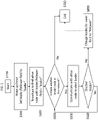
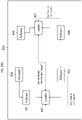
- FIG. 1 is a flowchart describing a method of establishing a secure vehicle network, for example for intra-vehicle communication, according to some example embodiments.
- a vehicle such as an agricultural vehicle, has a plurality of electronic control units, e.g. electronic components. These electronic control units/ components will be nodes within the secure vehicle network.
- Each electronic component includes a memory that stores a table 250, to be described in more detail below with reference to FIG. 2 .
- the table 250 includes a field, herein described as a "leader/follower" field, which indicates whether the corresponding node is a leader or a follower.
- step S100 the method of establishing a secure vehicle network begins.
- step S200 there are more electronic components (nodes) that are to join the secure vehicle network.
- a vehicle can be started up or powered on, and thus each electronic component will be turned on.
- a vehicle network needs to be created so that each such component/node can communicate.
- Electronic components that have been woken up, or have been reset, will set the "leader/ follower" field to "leader.”
- the first electronic component broadcasts a message, for example over a CAN bus within the vehicle.
- the broadcasted message will indicate that the electronic component is a leader, and is looking for another electronic component that is also a leader.
- Nodes with a value of "leader” in the leader/follower field may communicate with other nodes with a value of "leader” in the leader/follower field.
- a request message directed at another node, and a confirmation message from the other node, may result in a "handshake" where one node verifies another. This handshake may establish a secure communication.
- step S400 a determination is made as to whether there is another node in the network having a value corresponding to "leader" in the leader/ follower field.
- step S700 If, upon broadcasting the message, there are no other leader nodes in the network, the electronic component ends the method in step S700.
- step S500 the first electronic component and the second electronic component engage in a decision protocol/election, to be described in more detail below, to decide which of the first electronic component and the second electronic component will maintain the role of the leader, and keep a value corresponding to "leader" in the leader/follower field.
- a decision protocol/election to be described in more detail below, to decide which of the first electronic component and the second electronic component will maintain the role of the leader, and keep a value corresponding to "leader" in the leader/follower field.
- step S600 if, as an outcome of the election, the first electronic component is elected leader, the first electronic component, the method returns to step S400.
- the first electronic component may update/change the leader/follower field to correspond to "follower" in step S800.
- step S700 Upon changing the leader/follower field to correspond to "follower,” the method may end in step S700. Because nodes communicate and handshake securely, a secure vehicle network will be established.
- the example method described with reference to FIG. 1 is not limited thereto.
- One of ordinary skill in the art may modify the method of FIG. 1 in various ways. For example, during the communication, a comparison of a digital certificate may be performed. Communication may not be performed to other nodes that do not satisfy requirements of the digital certificate.
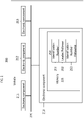
- FIG. 2 is an illustration of a vehicle 200, according to some example embodiments.
- the vehicle 200 includes a first electronic component 210 along with a plurality of other electronic components 211, 212, 213, etc.
- the communication bus 270 may be a CAN bus.
- the first electronic component 210 may be or include a body controller, an engine controller, a transmission controller, a telematics box, etc.; however, inventive concepts are not limited thereto.
- the first electronic component 210 includes hardware including a memory 225 that contains a table 250.
- the table 250 may be contiguous within the memory 225, or may be non-contiguous; inventive concepts are not limited thereto.
- the table 250 stored in the memory 225 of the electronic component 210 includes a field containing an identification number 251 or another identifier of the electronic component 210.
- the identification number 251 of the electronic component includes an identifier for the electronic component.
- the identification number 251 may be a unique identifier, unique to the specific electronic component.
- the identification number 251 may correspond to a hardware media access control physical address associated with the specific electronic component; however, inventive concepts are not limited thereto, and the identification number 251 may correspond to any other identifier, or any other unique identifier.
- the identification number 251 may correspond to a serial number associated with the specific electronic component.
- the identification number 251 may be a numeric string, an alphanumeric string, or a alphabetical string.
- the identification number may be the "NAME" field as defined by the J1939 Network Management protocol/ standard/ recommended practice.
- the table 250 also includes a leader/follower field 252.
- the leader/follower field 252 indicates whether the electronic component 210 is a leader or a follower in the secure vehicle network.
- the table 250 also includes an identification number following field 253 corresponding to an identification number or other identifier of another node to which the electronic component 210 is following. For example, if, after an election between the first electronic component 210 and a second electronic component (not shown) in step S600 in the method described above with reference to FIG. 1 , the first electronic component 210 is not elected a leader, then the identification number following field in the table 250 may include and/or correspond to the identification number of the second electronic component.
- the identification number following field 253 may be or correspond to "NULL,” or may be the identification number of the first electronic component 210; however, inventive concepts are not limited thereto.
- the memory 225 of the electronic component 210 may include other fields.
- other fields may be or include a symmetric key for secure communication, a list of addresses to which a leader leads, a symmetric key between the node and the node of the leader, and/or a public key for the network.
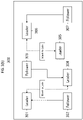
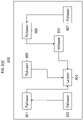
- FIGS. 3(a)-3(g) are illustrations of intra-vehicle secure vehicle networks, according to example embodiments.
- a plurality of nodes 301, 302, 303, 304, 305, 306, 307 are within a vehicle 300. Each node corresponds to an electronic component. Each of the plurality of nodes 301, 302, 303, 304, 305, 306, 307 includes the memory 225 described above with reference to FIG. 2 .
- each of the plurality of nodes 301, 302, 303, 304, 305, 306, 307 may be able to broadcast and communicate to others of the plurality of nodes 301, 302, 303, 304, 305, 306, 307 over a CAN bus, such as the communication bus 270 described above with reference to FIG. 2 , or over some wireless communication; however, inventive concepts are not limited thereto.
- the state of the vehicle 300 illustrated in FIG. 3(a) corresponds to a state in which each of the plurality of nodes 301, 302, 303, 304, 305, 306, 307 has been reset or woken up.
- each of the plurality of nodes 301, 302, 303, 304, 305, 306, 307 may have a value corresponding to "leader" in the field corresponding to the leader/follower field 252 shown in FIG. 2 .
- Each of, or at least some of, the plurality of nodes 301, 302, 303, 304, 305, 306, 307 will broadcast or send out a message along a communication channel such as the communication bus 270, requesting other nodes to join in creating a secure vehicle network.
- a communication channel such as the communication bus 270
- each of the nodes 301, 302, 303, 304, 305, 306, and 307 can broadcast a message over a CAN bus; the message may include a message stating that they wish to join a network.
- Some vehicles may greatly benefit from parallelism, for example if nodes are limited by computational resources and/or other operations cannot be, or cannot easily, be done in parallel.
- a CAN bus allows only one node to send a message at any time.
- a vehicle with a CAN bus may have one or more pairs of nodes executing verifications on embedded security hardware in parallel with a pair of nodes communicating back and forth over a CAN bus.
- Each node with a value corresponding to "leader” in the leader/follower field 252 that has broadcast a message stating a desire to join a secure vehicle network attempts to pair up with another node with a value corresponding to "leader” in the leader/follower field 252 that has also broadcast a message stating a desire to join a secure vehicle network.
- nodes 301 and 302 communicate a desire to join; similarly, nodes 303 and 304, and nodes 306 and 307.
- Each node may establish a secure network with the first node that is available to do so.
- nodes may not send other messages requesting to pair up with another node, and instead may engage in an election to determine a leader and a follower, after pairing.
- a node may indicate a desire to pair with a specific other node chosen from the address claim process as in the J1939 protocol, in which case the nodes may not broadcast.
- inventive concepts are not limited thereto.
- nodes 301 and 302 may pair up because nodes 301 and 302 were the first to respond to each other's broadcast message; nodes 303 and 304 may pair up because nodes 303 and 304 were the first to respond to each other's broadcast message; and nodes 306 and 307 may pair up because nodes 306 and 307 were the first to respond to each other's broadcast message.
- node 305 may not yet be able to pair up.
- nodes may have a desire to pair up to specific other nodes; for example, an engine controller may attempt to pair with a transmission controller.
- a first node e.g. node 301
- a second node e.g. node 302
- a preferred node may request joining the networks as well.
- an engine controller may prefer to join secure networks with a transmission controller.
- Such electronic components may know to do this based on the J1939 address claims where nodes broadcast an address claimed message (PGN) containing "NAME" message.
- PPN address claimed message
- FIG. 3(b) is an illustration of a vehicle 300, according to an example embodiment.
- each pair of the plurality of nodes may engage in an election to determine which element will remain a leader, and which element will change the leader/follower field 252 to correspond to "follower.”
- Determining which node is a leader and which node is a follower may be performed through any method.
- the leader may be determined as the node with the lower identification number 251, or with the lower hash, such as the lower SHA256 hash, of the identification number 251.
- any node may be the leader of the secure network, unless otherwise restricted by a specific implementation. Thus, even if nodes within the secure vehicle network may change, a leader may not change.
- the node that was not determined to be a leader Upon determination of the leader, the node that was not determined to be a leader will change the leader/follower field 252 to a value corresponding to "follower,” and will change the identification number following field 253 to a value corresponding to the identification number of the node that was determined to be leader.
- nodes 301 and 302 compare their respective identification numbers 251.
- node 301 has a lower identification number than node 302.
- node 301 is determined to be the leader.
- Node 301 will maintain a value corresponding to "leader” in the leader/follower field 252; node 302 will change the respective leader/follower field to correspond to "follower,” and will change the identification number following field 253 to correspond to the identification number of node 301.
- nodes 303 and 304 engage in a communication to determine that node 304 is a leader with node 303 following.
- Nodes 306 and 307 engage in a communication to determine that node 306 is a leader.
- nodes within the network that have a value corresponding to "leader” in the leader/follower field 252 may broadcast another message to determine other nodes that have a value corresponding to "leader” in the leader/follower field 252.
- nodes 301 and 304 can broadcast a desire to communicate and join in a secure network.
- nodes 305 and 306 may broadcast a desire to communicate and join in a secure network.
- Some implementations may rely on, or include, some counter to help manage some steps.
- some method of synchronizing the pairing of nodes may be achieved with a counter, thus creating a concept of a round, or round robin.
- a round may allow nodes to organize pairing to minimize or reduce the total number of rounds to establish the secure vehicle network.
- FIG. 3(c) is an illustration of a vehicle 300, according to an example embodiment.
- nodes 304 and 305 have a value corresponding to "leader” in the leader/follower field 252.
- nodes 301, 302, 303, 306, and 307 have a value corresponding to "follower” in the leader/follower field 252.
- node 302 has the identification number 251 of node 301 in the identification number following field 253;
- nodes 301 and 303 have the identification number 251 of node 304 in the respective identification number following field 253;
- node 307 has the identification number 251 of node 306 in the identification number following field 253; and
- node 306 has the identification number 251 of node 305 in the identification number following field 253.
- Nodes 304 and 305 which have a value corresponding to "leader" in the respective leader/follower field 252, may communicate a message to join and pair up.
- FIG. 3(d) is an illustration of a vehicle 300, according to an example embodiment.
- node 305 upon pairing of nodes 304 and 305, node 305 will be elected as a leader while node 305 will be the follower.
- node 304 may have a value corresponding to "leader” in the leader/follower field 252
- node 305 may have a value corresponding to "follower” in the leader/follower field 252.
- node 305 may have a value corresponding to the identification number of the leader node 304 in the identification number following field 253.
- the state of the vehicle 300 will correspond to a data structure such as a tree.
- the root of the tree corresponds to node 304 while internal nodes of the tree may correspond to nodes 301, 305, and 306, while leaves of the tree correspond to nodes 302, 303, and 307.
- FIG. 3(e) is an illustration of the contents of the memory 225 of each node in the secure vehicle network illustrated in FIG. 3(d) , according to an example embodiment.
- each of nodes 301, 302, 303, 304, 305, 306, and 307 has a memory 225.
- the memory 225 includes a table with fields as shown.
- node 301 may have a value corresponding to "304" in the identification number following field 253.
- node 304 may have a value of "NULL" in the identification number following field.
- node 304 may have a value corresponding to the identification number corresponding to node 304 in the identification number following field 253.
- node 304 may have a self-referential identification number following field 253.
- FIG. 3(f) is an illustration of a vehicle 300, according to an example embodiment.
- the logical network topology is different. Further steps can be performed by nodes in the vehicle network to restructure the network topology to a more efficient topology.
- a node e.g. node 305
- a follower in the leader/follower field 252 may broadcast a message corresponding to the respective identification number following field 253.
- All nodes that follow node 305 e.g. nodes 306 and 307, may update their respective identification number following field 253 to correspond to those of node 305.
- the network topology may change.
- 3(f) may simplify or speed up some operations, as compared to the vehicle network illustrated in FIG. 3(d) .
- a message from the leader to followers to change topology should be secure.
- the current leader may tell all internal nodes and leaf nodes to change topology.
- a network leader may broadcast a proof of leadership.
- FIG. 3(g) illustrates that node 304 has a value corresponding to "leader” in the leader/follower field 252.
- nodes 301, 302, 303, 305, 306, and 307 all have the identification number corresponding to node 304 in the identification number following field 253. This corresponds to such a restructuring of the network topology.
- FIG. 3(g) is an illustration of the contents of the memory 225 of each node of FIG. 3(f) , according to an example embodiment.
- each node the contents of the memory 225 of each node are similar to those illustrated in FIG. 3(e) .
- the contents of each follower node's identification number following field 253 contains, or corresponds to, the identification number corresponding to leader node 304.
- leader node 304 may also be a network leader node. Such a network leader node does not delegate the action to join other secure networks.
- Such a network leader node may securely distribute a shared key to nodes in the secure network for securely communicating with other nodes on the vehicle network.
- the network leader node 304 in FIG. 3 might distribute a shared secure CAN bus key for broadcasting messages that may be verified by recipient nodes to detect for potential message tampering.
- Inventive concepts are not limited to pairing network leaders.
- a third node may be required, for example as required by the network topology.
- example embodiments may contain gateway nodes that are connected to multiple vehicle networks.
- a gateway node might treat the secure networks independently, for example, the node might be a leader on one secure network and a follower on another.
- Example embodiments are not limited to the above network topologies.
- other network topologies may include a binary tree.
- Such a binary tree may be implemented with a version of a round robin protocol.
- a remote node that is, a node not on the vehicle, may be required to cross-verify during the pairing of secure networks.
- the vehicle 300 may require communication with a remote internet server (not shown).
- anhydrous ammonia applicator implement with a control valve controlled by an attached tractor.
- a tractor leader node might require a trusted remote computer to also verify the implement leader node or vise-versa as a precondition to opening the control value.
- an example embodiment may have nodes with a cached state from prior verification sequences.
- previously verified certificates could be stored in a compact form or in a way which is faster to verify.
- FIG. 4(a) is an illustration of a vehicle 400, according to some example embodiments.
- network leader nodes may delegate verification to one or more follower nodes.
- network leader nodes 401, 402, and 406 had previously established a shared key with their respective follower nodes.
- Network leader nodes 401, 402, and 407 might use the secure key to securely communicate to follower nodes to enable the follower nodes to perform verifications. If two network leader nodes, for example network leader nodes 401 and 402, are determined where follower nodes have made progress on verifying the other network leader node, for example node 406, the time to establish a secure vehicle network may be reduced. For example, if vehicle verification computation resources were constrained, such a time may be reduced.
- the non-pairing network leader node 407 has enough follower nodes 405 and 406 to ensure follower nodes will have made progress verifying the eventual new network leader node of the pairing nodes. This may be coordinated intentionally.
- FIG. 4(b) illustrates a subsequent secure network pairing wherein each network leader node 402, 407 retrieves a verification from a follower node.
- the time to establish the secure network in FIGS. 4(a) and 4(b) may therefore be reduced even if the follower nodes merely had not yet fully completed the verification ahead of time.
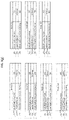
- FIG. 5 illustrates a number of iterations needed to establish a secure network, according to some example embodiments.
- a vehicle such as the vehicle 300 illustrated above, that has a plurality of electronic components, such as the electronic component 210.
- Each such electronic component follows the method illustrated in FIG. 1 to establish a vehicle network, consolidating nodes with each iteration.
- Each node within the vehicle network executes such a method illustrated in FIG. 1 in parallel. Accordingly, each such execution of the method illustrated in FIG. 1 might approximately double the size of an individual network, and reduce the number of networks in half for each such iteration.
- N is a natural number
- the time taken to securely define a network may be O(log(N)).
- O(N 2 ) time may be detrimental if, for example, the time to compute the verification were the limiting factor of establishing the security for the network.
- some nodes may not have enough memory to store verification information for all nodes, and may exclude some nodes from otherwise participating in the secure network or causing verification information to be redundantly transmitted on the vehicle network while establishing the secure network. If the vehicle network were on a CAN bus, redundant messages sent in series would exacerbate the time required to establish the secure vehicle network.
- FIGS. 6(a)-6(c) illustrates secure inter-vehicle networks, according to example embodiments.
- Example embodiments may be advantageous for a vehicle to form a secure vehicle network with multiple other vehicles, or with different vehicles over time.
- a leader may correspond to a lead vehicle that establishes a lead guidance path
- a follower may correspond to vehicle or vehicles track or generally follow the lead vehicle guidance path.
- the path may include offsets in one or more dimensions, such as: (1) lateral offset to allow for cultivating, tilling, leveling, earth-moving, planting, spraying, harvesting, treating, or processing of crop or ground. in adjacent or row-skipping operations and (2) longitudinal offset in the direction of travel of one or more vehicles for collision avoidance, clearance during turning operations, and a delay or lag for tracking/ guidance of the follower vehicle or vehicles to track the lead vehicle.
- the follower vehicle or lead vehicle may switch roles or reverse roles for efficiency or other reasons, such as resetting or re-establishing of a secure network after expiration of a timer or within a certain geographical zone, defined by a series of coordinates.
- An operator (not shown) may force the lead vehicle to be a lead vehicle within a certain zone, field or worksite, such as a vehicle that a foreman or project lead directs for a particular project; this lead vehicle may be transitioned at the end of a work shift or to bring a vehicle offline for service or maintenance or to reallocate a lead vehicle to another worksite or area.
- two vehicles might form a secure inter-vehicle network with each other.
- a first vehicle might be an agricultural combine 1100 and a second vehicle might be a tractor with a grain cart 1150; however, inventive concepts are not limited thereto.
- the combine 1100 includes a plurality of electronic components/nodes 1101(a), 1101(b), ... 1110 that have formed a secure vehicle network, according to the methods described above.
- Node 1110 is a leader or a network leader, with the other nodes 1101(a), 1101(b), ... being followers.
- the tractor with grain cart 1150 may include a plurality of electronic components/nodes 1151(a), 1151(b), ... 1160 that have formed a secure vehicle network, according to the methods described above.
- Node 1160 is a leader or a network leader with other nodes 1151(a), 1151(b), ... being followers.
- the agricultural combine 1100 sends data wirelessly to the tractor with grain cart 1150, such that the tractor with grain cart 1150 attempts to drive in tandem with the combine 1100 so that the combine 1100 can transfer material to the tractor with grain cart 1150.
- the agricultural combine 1100 might use the methods described in FIG. 1 to form a secure network with the tractor with grain cart 1150. Further, the combine 1100 and the tractor with grain cart 1150 might establish a secure communication between each other.
- FIG. 6(b) illustrates a state of an inter-secure vehicle network, according to example embodiments.
- protected messages may be sent between leader node 1110 and network leader node 1160.
- the combine 1100 may encrypt and add a message authentication (MAC) for each of the tractor with grain cart 1150's messages.
- MAC message authentication
- the tractor with grain cart 1150 can verify if messages received are from the combine 1100, and act on them accordingly.
- DOS denial of service
- example embodiments would be able to detect untrusted identities and choose not to establish secure vehicle networks with those entities. Nodes should not establish keys for authentication or confidentiality with entities other than those with which they have established a secure vehicle network.
- vehicles may identify properties of the other vehicle's nodes. Some properties might include the vehicle type, permissions, features, limitations, etc.; however, example embodiments are not limited thereto.
- Some secure vehicle networks may choose to reorganize the node topology to facility a better leader node when forming a secure vehicle network for inter-vehicle communication.
- FIG. 6(c) illustrates an inter-vehicle communication network, according to an example embodiment.
- one node, e.g. node 1120, of the combine 1100 is capable of remote, e.g. wireless, communication with other vehicles.
- another node, e.g. node 1161, of the tractor with grain cart 1150 may be node 1120, while the network leader of the tractor with grain cart 1150 may be node 1161, node 1110 may be the remote guidance leader while node 1160 may be the remote guidance follower.
- the remote guidance leader will inform the remote guidance follower how to drive/travel.
- the combine 1100 and the tractor with grain cart 1150 establish a secure vehicle network, and use digital certificates to verify each vehicle's network leader node.
- the secure vehicle network for intra-vehicle communications established in the combine 1100 and the secure vehicle network for intra-vehicle communications established in the tractor with grain cart 1150, there can be another gateway communication for inter-vehicle communications established between the combine 1100 and the tractor with grain cart 1150.
- a safety interlock when appropriate. For example, perhaps the operators of the combine 1100 and the tractor with grain cart 1150 must approve prior to secure vehicle network formation, for example with a prompt on respective displays on the vehicles.
- secure vehicle networks may be changed at runtime. For example, suppose a tractor forms a secure inter-vehicle network with a first implement, such as the tractor with grain cart 1150. After some time, the tractor may physically disconnect from the implement; for example, the tractor may disconnect from the grain cart because the grain cart is full. A node on the tractor which may correspond to the network leader node between the tractor and the grain cart, may detect the event, and would no longer be a leader node of the grain cart.
- a secure vehicle network may start as a new sequence of the method. Afterwards, a secure vehicle network is formed between the tractor and the second implement.
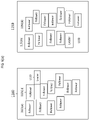
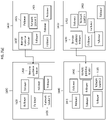
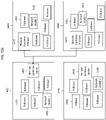
- FIGS. 7(a) and 7(b) illustrate an inter-vehicle secure vehicle network amongst a plurality of vehicles and a plurality of implements.
- a first combine 1400 may have a plurality of follower nodes 1401, a network leader node 1405, and a remote guidance leader 1410.
- a first grain cart 1420 may have a plurality of follower nodes 1421, a network leader node 1425, and a remote guidance follower 1430.
- a second combine 1440 may have a plurality of follower nodes 1441, a network leader node 1445, and a remote guidance leader 1450.
- a second grain cart 1460 may have a plurality of follower nodes 1461, a network leader node 1465, and a remote guidance follower 1470.
- combine 1400 is not physically connected, e.g. connected over a CAN bus, with grain cart 1460.
- combine 1440 is not physically connected, e.g. connected over a CAN bus, with grain cart 1420.
- first grain cart 1420 and the first combine 1400 there may be a secure communication between the first grain cart 1420 and the first combine 1400.
- second grain cart 1460 and the second combine 1440 there may be a secure communication between the second grain cart 1460 and the second combine 1440.
- the first combine 1400 and the first grain cart 1420 may be chosen to be remote on a secure vehicle network if possible, and may establish a second vehicle network comprising the first combine 1400 and the second grain cart 1460.
- inventive concepts are not limited thereto.
- remote guidance nodes may try to maintain a secure vehicle network with multiple other vehicles if possible. For example, each combine may try to maintain a secure vehicle network with each grain cart, and vice versa. Similarly, each vehicle may try to maintain a secure vehicle network with every other vehicle.
- a safety interlock e.g. an operator confirmation.
- a secure vehicle network may automate a transition from the first grain cart 1420's departure and the second grain cart's 1460 arrival. For example, there may be a synchronous departure.
- the first grain cart 1420 may return, having unloaded the grain.
- the first grain cart 1420 may try to establish a secure vehicle network with one or more vehicles in the system.
- the first grain cart may have been kept in a cache in components of the secure vehicle networks while the first grain cart 1420 was away unloading grain.
- a key previously established between the first grain cart 1420 and other vehicles may still be valid and reused, rather than using the method described in FIG. 1 to reestablish the secure vehicle network.
- FIG. 8 shows example agricultural vehicles according to an example embodiment.
- a tractor 800 may drive a planter 850.
- the planter 850 may include a plurality of rows 850a, 850b, 850z.
- the tractor 800 may include a plurality of electronic components.
- Each of the plurality of rows 850a, 850b, 850z may include one of, or a plurality of electronic components.
- the plurality of electronic components included in the plurality of rows 850a, 850b, 850z may engage in the method illustrated in FIG. 1 to establish an intra-vehicle secure network. After establishing the vehicle secure network, one of the plurality of electronic components included in the plurality of rows 850a, 850b, 850z may have a value corresponding to "leader” in the leader/follower field, while the other of the plurality of electronic components included in the plurality of rows 850a, 850b, 850z may have a value corresponding to "follower" in the leader/follower field.
- the tractor 800 and the planter 850 may engage in the methods illustrated in FIGS. 6(a)-7(b) to communicate in an inter-vehicle secure network.
- One of the plurality of electronic components included in the tractor 800 may communicate with one of the plurality of electronic components included in the planter 850, informing the planter of the speed of the tractor.
- the electronic component included in the planter 850 that receives communication from the tractor 800 may broadcast the speed of the tractor to other electronic components included in the planter 850, to inform the rows 850a, 850b, 850z of the planter 850 how fast to dispense seed.
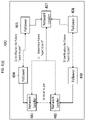
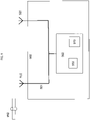
- FIG. 9 is a representative drawing illustrating a system including a satellite and a vehicle, according to some example embodiments, according to some example embodiments.
- a vehicle 900 may include a location-determining receiver 910, a wireless transceiver 920, and a data processing system 960 including a path planner 950 and a guidance-tracker 970.
- the location-determining receiver 910, the wireless transceiver 920, and the data processing system 960 may be connected over a bus 901.
- the vehicle 900 may correspond to one or more of the vehicles as described with regards to FIGS. 7(a)-7(b) .
- the location-determining receiver 910 may receive location information from a satellite 990.
- the location-determining receiver 910 may be or correspond to a satellite navigation receiver, such as a Global Navigation Satellite System (GNSS) receiver.
- the location information received from the satellite 990 may include at least one of position, velocity and heading data for the vehicle 900.
- the location-determining receiver 910 may also receive altitude information including at least one of roll angle, tilt angle, and yaw angle (heading) of the vehicle 900.
- the wireless transceiver 920 may enable communication with other vehicles in the vehicle secure network.
- the vehicle 900 may correspond to the combine 1400 described above with reference to FIG. 7(a) , and may communicate over the wireless transceiver 920 with another vehicle, such as grain cart 1420, described above with reference to FIG. 7(a) , so as to coordinate respective guidance paths.
- the vehicle 900 may track a lead path plan, whereas other follower vehicles may track a follower path plan.
- the follower path plan may be a derivative of the lead path plan.
- the data processing system 960 may include one or more processors configured to execute machine-readable instructions that, when executed, cause the one or more processors to perform various actions.
- the data processing system 960 may include the path planner 950 and the guidance tracker 970.
- the path planner 950 and the guidance tracker 970 may be embodied as hardware and/or software that, when executed by the one or more processors, cause the processor to perform various actions.
- the path planner 950 may determine the path plan, based on inputs received from the location-determining receiver 910.
- the guidance tracker 970 may track a path taken by the vehicle 900 in response to information received from the location-determining transceiver 910.
- the data processing system may receive information from, and transmit information through, the wireless transceiver 920. For example, if the vehicle 900 corresponds to the combine 1400, then the vehicle 900 may communicate with the grain cart 1420 to track set and track paths.
- Systems and methods for establishing a secure vehicle network may be performed with reduced or minimized speed. Further, a number of independent verifications may be reduced or minimized while nodes perform verifications in parallel. Further, redundant vehicle messages may be reduced or minimized. Still further, the systems and methods are robust to situations when a vehicle, or components within a vehicle, are reset.
Landscapes
- Engineering & Computer Science (AREA)
- Computer Networks & Wireless Communication (AREA)
- Signal Processing (AREA)
- Computing Systems (AREA)
- Computer Security & Cryptography (AREA)
- General Engineering & Computer Science (AREA)
- Computer Hardware Design (AREA)
- Life Sciences & Earth Sciences (AREA)
- Mechanical Engineering (AREA)
- Soil Sciences (AREA)
- Environmental Sciences (AREA)
- Health & Medical Sciences (AREA)
- General Health & Medical Sciences (AREA)
- Medical Informatics (AREA)
- Aviation & Aerospace Engineering (AREA)
- Radar, Positioning & Navigation (AREA)
- Remote Sensing (AREA)
- Physics & Mathematics (AREA)
- General Physics & Mathematics (AREA)
- Automation & Control Theory (AREA)
- Traffic Control Systems (AREA)
- Mobile Radio Communication Systems (AREA)
Claims (10)
- System zum Einrichten eines sicheren Fahrzeugnetzwerks, das eine Vielzahl von Knoten (301, 302, 303, 304, 305, 306, 307) beinhaltet, wobei die Vielzahl von Knoten (301, 302, 303, 304, 305, 306, 307) einen Speicher (225) umfasst, der ein Führer/Folger-Feld (252) speichert:ein Mittel zum Einrichten eines Kommunikationswegs von einem ersten Knoten (301) mit einem "Führer" entsprechenden Wert in dem Führer/Folger-Feld (252) zu einem zweiten Knoten (302) mit einem "Führer" entsprechenden Wert in dem Führer-Folger-Feld (252), wobei der erste Knoten (301) erste Informationen aufweist, die einem Bezeichner des ersten Knotens (301) entsprechen; undein Mittel zum Kommunizieren von dem ersten Knoten (301) zu dem zweiten Knoten (302) über den Kommunikationsweg, um das sichere Fahrzeugnetzwerk einzurichten durch (i) Empfangen von zweiten Informationen von dem zweiten Knoten (302), die einem Bezeichner des zweiten Knotens (302) entsprechen, und (ii) Pflegen des "Führer" entsprechenden Werts in dem Führer/Folger-Feld (252) als Reaktion darauf, dass der erste Knoten (301) auf der Grundlage der von dem zweiten Knoten (302) empfangenen zweiten Informationen zum Führer bestimmt wurde, und Zuweisen eines "Folger" entsprechenden Werts in dem Führer/Folger-Feld (252) des ersten Knotens (301) als Reaktion darauf, dass der erste Knoten (301) auf der Grundlage der von dem zweiten Knoten (302) empfangenen Informationen nicht zum Führer bestimmt wurde.
- System nach Anspruch 1, wobei das System, als Reaktion darauf, dass der erste Knoten (301) auf der Grundlage der von dem zweiten Knoten (302) empfangenen zweiten Informationen nicht zum Führer bestimmt wurde, ferner konfiguriert ist zum:
Zuweisen eines Werts in einem Bezeichnungsnummer-Folgefeld (253) in dem Speicher des ersten Knotens (301), um dem Bezeichner des zweiten Knotens (302) zu entsprechen. - System nach Anspruch 1 oder 2, das ferner konfiguriert ist zum:
als Reaktion darauf, dass der erste Knoten (301) zum Führer bestimmt wurde, Einrichten eines Kommunikationswegs von dem ersten Knoten (301) zu einem dritten Knoten (303) mit einem "Führer" entsprechenden Wert in einem Führer/Folger-Feld (252) eines Speichers (225) des dritten Knotens (303) und Kommunizieren von dem ersten Knoten (301) zu dem dritten Knoten (303) über den Kommunikationsweg zum Einrichten des sicheren Fahrzeugnetzwerks durch (i) Empfangen von dritten Informationen von dem dritten Knoten (303) und ii) Bestimmen des ersten Knotens (301) zum Zuweisen eines "Folger" entsprechenden Werts auf der Grundlage der von dem dritten Knoten (303) empfangenen dritten Informationen zu dem Führer/Folger-Feld (252). - System nach einem der vorhergehenden Ansprüche, das ferner konfiguriert ist zum:
in dem ersten Knoten (301) Setzen eines "Führer" entsprechenden Werts in dem Führer/Folger-Feld (252) als Reaktion auf einen von dem ersten Knoten (301) durchgeführten Rücksetzbefehl. - System nach einem der vorhergehenden Ansprüche, das ferner konfiguriert ist zum:
in dem ersten Knoten (301) Setzen eines "Führer" entsprechenden Werts in dem Führer/Folger-Feld (252) als Reaktion auf einen von dem ersten Knoten (301) durchgeführten Aufwachbefehl. - System nach einem der vorhergehenden Ansprüche, wobei das Kommunizieren von dem ersten Knoten (301) zu dem zweiten Knoten (302) Folgendes umfasst:
Kommunizieren über einen Bus (270). - System nach Anspruch 6, wobei das Mittel zum Einrichten des Kommunikationswegs von dem ersten Knoten (301) zu dem zweiten Knoten (302) Folgendes umfasst:den ersten Knoten (301), der zum Übertragen einer Nachricht über den Bus (270) konfiguriert ist, wobei die Nachricht eine Erklärung des Wunsches nach Anschließen an andere Knoten (302, 303, 304, 305, 306, 307) umfasst,und wobei der erste Knoten (301) zum Empfangen einer Nachricht von dem zweiten Knoten (302) konfiguriert ist, die über den Bus (270) übertragen wird, wobei die Nachricht eine Erklärung eines Wunsches nach Anschließen an andere Knoten (303, 304, 305, 306, 307) umfasst.
- System nach einem der vorhergehenden Ansprüche, wobei der erste Knoten (301) der Vielzahl von Knoten (301, 302, 303, 304, 305, 306, 307) einem elektronischen Bauteil (210) entspricht und das elektronische Bauteil (210) mindestens eines von einem Körpersteuergerät, einem Motorsteuergerät, einem Getriebesteuergerät, einer Telematikbox, einem Display, einem Bord-Server, einem Steuergerät für drahtlose Kommunikation, einer Satellitenantenne, einem Lenkungssteuergerät, einem Fenstersteuergerät, einem Anhängekupplungssteuergerät, einem Generator/Wechselrichter, einem Bremsensteuergerät oder einem Sitzsteuergerät umfasst.
- System nach Anspruch 1 bis 7, wobei der erste Knoten (301) der Vielzahl von Knoten (301, 302, 303, 304, 305, 306, 307) einem elektronischen Bauteil (210) eines landwirtschaftlichen Fahrzeugs, eines Bergbaufahrzeugs oder eines Baufahrzeugs entspricht, wobei das landwirtschaftliche Fahrzeug eines von einem Traktor, einem Mähdrescher, einem Anbaugerät umfasst, das Baufahrzeug einen von einem Lader oder einem Bagger umfasst.
- System nach einem der vorhergehenden Ansprüche, das ferner konfiguriert ist zum Ändern einer logischen Netzwerktopologie des sicheren Fahrzeugnetzwerk durch:Auswählen von einem der Vielzahl von Knoten (301, 302, 303, 304, 305, 306, 307), der einen "Folger" entsprechenden Wert in dem Führer/Folger-Feld (252) aufweist; undZuweisen eines Werts in dem Bezeichnungsnummer-Folgefeld (253) des ausgewählten Knotens (301, 302, 303, 304, 305, 306, 307) zu einem Wert, der der Bezeichnungsnummer entspricht, die dem einen der Vielzahl von Knoten (301, 302, 303, 304, 305, 306, 307) entspricht.
Applications Claiming Priority (2)
| Application Number | Priority Date | Filing Date | Title |
|---|---|---|---|
| US201862740070P | 2018-10-02 | 2018-10-02 | |
| US16/445,704 US11178712B2 (en) | 2018-10-02 | 2019-06-19 | Systems and methods to establish secure vehicle networks |
Publications (2)
| Publication Number | Publication Date |
|---|---|
| EP3636062A1 EP3636062A1 (de) | 2020-04-15 |
| EP3636062B1 true EP3636062B1 (de) | 2022-12-21 |
Family
ID=68062849
Family Applications (1)
| Application Number | Title | Priority Date | Filing Date |
|---|---|---|---|
| EP19199055.5A Active EP3636062B1 (de) | 2018-10-02 | 2019-09-23 | Systeme und verfahren zur einrichtung sicherer fahrzeugnetzwerke |
Country Status (3)
| Country | Link |
|---|---|
| US (2) | US11178712B2 (de) |
| EP (1) | EP3636062B1 (de) |
| CN (1) | CN110995556B (de) |
Families Citing this family (5)
| Publication number | Priority date | Publication date | Assignee | Title |
|---|---|---|---|---|
| DE112020001663T5 (de) * | 2019-03-29 | 2022-03-24 | Intel Corporation | Autonomes Fahrzeugsystem |
| KR20220082868A (ko) | 2019-10-16 | 2022-06-17 | 로코메이션, 인크. | 자율 팔로워 차량들에 관한 요구를 감소시키는 거동들 |
| GB202208929D0 (en) * | 2022-06-17 | 2022-08-10 | Agco Int Gmbh | Agricultural machine guidance |
| KR102701770B1 (ko) | 2023-11-15 | 2024-09-04 | 주식회사 긴트 | 우선순위를 이용한 작업차량의 원격제어 방법 및 그 장치 |
| KR102702845B1 (ko) | 2023-12-08 | 2024-09-05 | 주식회사 긴트 | 제한설정을 기반으로 작업차량을 공유하는 방법 및 그 장치 |
Family Cites Families (28)
| Publication number | Priority date | Publication date | Assignee | Title |
|---|---|---|---|---|
| US6240188B1 (en) | 1999-07-06 | 2001-05-29 | Matsushita Electric Industrial Co., Ltd. | Distributed group key management scheme for secure many-to-many communication |
| WO2001019017A1 (en) | 1999-09-07 | 2001-03-15 | Sony Corporation | Contents management system, device, method, and program storage medium |
| US6684331B1 (en) | 1999-12-22 | 2004-01-27 | Cisco Technology, Inc. | Method and apparatus for distributing and updating group controllers over a wide area network using a tree structure |
| US6732024B2 (en) * | 2001-05-07 | 2004-05-04 | The Board Of Trustees Of The Leland Stanford Junior University | Method and apparatus for vehicle control, navigation and positioning |
| US7478233B2 (en) * | 2002-05-30 | 2009-01-13 | Microsoft Corporation | Prevention of software tampering |
| US7079020B2 (en) * | 2003-02-03 | 2006-07-18 | Ingrid, Inc. | Multi-controller security network |
| US8015604B1 (en) | 2003-10-10 | 2011-09-06 | Arcsight Inc | Hierarchical architecture in a network security system |
| KR100555730B1 (ko) | 2003-11-04 | 2006-03-03 | 삼성전자주식회사 | 애드혹 네트워크의 리더 선출방법 |
| US8254301B2 (en) | 2005-11-22 | 2012-08-28 | Telcordia Technologies, Inc. | Group-header based method to organize local peer group of vehicles for inter-vehicle communication |
| EP2118809A4 (de) * | 2007-02-02 | 2012-08-01 | Telcordia Tech Inc | Verfahren und system zur autorisierung und zuweisung digitaler zertifikate ohne gefährdung der privatsphäre |
| CN101262333B (zh) | 2008-04-21 | 2010-06-02 | 上海大学 | 一种车辆网络中节点间的安全通信方法 |
| US7978717B2 (en) * | 2008-10-16 | 2011-07-12 | Synapse Wireless, Inc. | Systems and methods for reducing power consumption in communication networks |
| CN101741820B (zh) * | 2008-11-13 | 2013-12-18 | 华为技术有限公司 | Cga公钥识别和cga公钥确定的方法、系统及装置 |
| US8627073B2 (en) | 2010-03-24 | 2014-01-07 | GM Global Technology Operations LLC | Adaptive certificate distribution mechanism in vehicular networks using forward error correcting codes |
| US8499155B2 (en) | 2010-03-24 | 2013-07-30 | GM Global Technology Operations LLC | Adaptive certificate distribution mechanism in vehicular networks using variable inter-certificate refresh period |
| US8903930B2 (en) * | 2010-04-07 | 2014-12-02 | Lg Electronics Inc. | Group-based M2M communication method |
| JP5479408B2 (ja) | 2011-07-06 | 2014-04-23 | 日立オートモティブシステムズ株式会社 | 車載ネットワークシステム |
| KR101863564B1 (ko) * | 2011-08-18 | 2018-06-04 | 삼성전자주식회사 | 와이파이 다이렉트 연결 설정 시 그룹 오너를 결정하기 위한 장치 및 방법 |
| US20130212659A1 (en) | 2012-02-13 | 2013-08-15 | Intertrust Technologies Corporation | Trusted connected vehicle systems and methods |
| US9798799B2 (en) * | 2012-11-15 | 2017-10-24 | Sri International | Vehicle personal assistant that interprets spoken natural language input based upon vehicle context |
| US10003642B2 (en) | 2013-06-28 | 2018-06-19 | Apple Inc. | Operating a cluster of peer-to-peer devices |
| JP6189779B2 (ja) * | 2014-03-27 | 2017-08-30 | 株式会社クボタ | 作業車協調システム |
| US10091087B2 (en) | 2015-07-20 | 2018-10-02 | Cisco Technology, Inc. | Methods and systems for load balancing based on data shard leader |
| EP3446468B1 (de) | 2016-04-19 | 2023-04-12 | Industrial Scientific Corporation | Synchronisierung in einem drahtlosen mesh-netzwerk |
| US10511668B2 (en) * | 2016-10-07 | 2019-12-17 | Hyundai Motor Company | Method of transmitting and receiving data in vehicle network and apparatus for the same |
| JP6832793B2 (ja) * | 2017-05-29 | 2021-02-24 | 株式会社クボタ | 子作業車と協調して作業を行う親作業車 |
| DE102017222882A1 (de) * | 2017-12-15 | 2019-06-19 | Volkswagen Aktiengesellschaft | Vorrichtungen, Verfahren und Computerprogramm zum Freischalten von Fahrzeugkomponenten, Fahrzeug-zu-Fahrzeug-Kommunikationsmodul |
| US11171940B2 (en) * | 2018-03-30 | 2021-11-09 | Intel Corporation | Secure type-enforced actions |
-
2019
- 2019-06-19 US US16/445,704 patent/US11178712B2/en active Active
- 2019-08-30 CN CN201910825089.8A patent/CN110995556B/zh active Active
- 2019-09-23 EP EP19199055.5A patent/EP3636062B1/de active Active
-
2021
- 2021-08-31 US US17/462,160 patent/US11943826B2/en active Active
Also Published As
| Publication number | Publication date |
|---|---|
| US20210392712A1 (en) | 2021-12-16 |
| US20200107384A1 (en) | 2020-04-02 |
| BR102019017938A2 (pt) | 2020-04-14 |
| CN110995556B (zh) | 2022-07-26 |
| US11178712B2 (en) | 2021-11-16 |
| CN110995556A (zh) | 2020-04-10 |
| US11943826B2 (en) | 2024-03-26 |
| EP3636062A1 (de) | 2020-04-15 |
Similar Documents
| Publication | Publication Date | Title |
|---|---|---|
| EP3636062B1 (de) | Systeme und verfahren zur einrichtung sicherer fahrzeugnetzwerke | |
| KR102228881B1 (ko) | 자율주행시스템에서 군집주행중에 주행데이터의 수신방법 및 이를 위한 장치 | |
| US11049402B2 (en) | Cryptography-based platooning mechanism for autonomous vehicle fleet management | |
| Chaeikar et al. | AI-enabled cryptographic key management model for secure communications in the internet of vehicles | |
| US11456874B2 (en) | Vehicle control system for cybersecurity and financial transactions | |
| US20190259120A1 (en) | Task management of autonomous product delivery vehicles | |
| US11683160B2 (en) | Encrypted group communications | |
| CN112737916A (zh) | 一种基于区块链网络的数据处理方法及相关装置 | |
| US20240400074A1 (en) | Vehicle operation | |
| EP3553998B1 (de) | Netzwerksicherheitsrahmen für drahtlose flugzeugkommunikation | |
| CN113949432B (zh) | 面向飞行任务无人机区块链建立方法、系统、设备、终端 | |
| US12245030B2 (en) | Blockchain secured polyphonic radio (PR) wireless mesh networks using pulse-based communications (PBC) methods and apparatus | |
| CN112995211B (zh) | 基于区块链网络的数据处理方法、装置、设备及存储介质 | |
| Chen et al. | A summary of security techniques‐based Blockchain in IoV | |
| Kandi et al. | A blockchain-based key management protocol for secure device-to-device communication in the Internet of Things | |
| Chou et al. | Enhancing ota update security in zonal architecture for automobiles | |
| Alyoubi | A Multi-Agent Reinforcement Learning Blockchain Framework for Improving Vehicular Internet of Things Cybersecurity | |
| US11055990B1 (en) | Apparatus and method for two-way signaling with traffic controllers over a wireless link | |
| CN104835205A (zh) | 一种自由流下多天线处理方法、装置及rsu | |
| KR20220035538A (ko) | 블록체인을 기반으로 하는 드론을 이용한 펌웨어 업데이트 시스템 | |
| Jenefa et al. | Secure IBS scheme for vehicular ad hoc networks | |
| US20260105167A1 (en) | Quantum computing resistant vehicle to everything communication | |
| EP4022838B1 (de) | Blockchain-basiertes verfahren und system zur sicherung eines netzwerkes aus virtuellen drahtlosen basisstationen | |
| HK40046832A (en) | Block chain network-based data processing method, device, equipment and storage medium | |
| CN118401922A (zh) | 一种基于空中下载ota技术的升级方法及通信装置 |
Legal Events
| Date | Code | Title | Description |
|---|---|---|---|
| PUAI | Public reference made under article 153(3) epc to a published international application that has entered the european phase |
Free format text: ORIGINAL CODE: 0009012 |
|
| STAA | Information on the status of an ep patent application or granted ep patent |
Free format text: STATUS: THE APPLICATION HAS BEEN PUBLISHED |
|
| AK | Designated contracting states |
Kind code of ref document: A1 Designated state(s): AL AT BE BG CH CY CZ DE DK EE ES FI FR GB GR HR HU IE IS IT LI LT LU LV MC MK MT NL NO PL PT RO RS SE SI SK SM TR |
|
| AX | Request for extension of the european patent |
Extension state: BA ME |
|
| STAA | Information on the status of an ep patent application or granted ep patent |
Free format text: STATUS: REQUEST FOR EXAMINATION WAS MADE |
|
| 17P | Request for examination filed |
Effective date: 20201014 |
|
| RBV | Designated contracting states (corrected) |
Designated state(s): AL AT BE BG CH CY CZ DE DK EE ES FI FR GB GR HR HU IE IS IT LI LT LU LV MC MK MT NL NO PL PT RO RS SE SI SK SM TR |
|
| STAA | Information on the status of an ep patent application or granted ep patent |
Free format text: STATUS: EXAMINATION IS IN PROGRESS |
|
| 17Q | First examination report despatched |
Effective date: 20210812 |
|
| GRAP | Despatch of communication of intention to grant a patent |
Free format text: ORIGINAL CODE: EPIDOSNIGR1 |
|
| STAA | Information on the status of an ep patent application or granted ep patent |
Free format text: STATUS: GRANT OF PATENT IS INTENDED |
|
| INTG | Intention to grant announced |
Effective date: 20220714 |
|
| RIN1 | Information on inventor provided before grant (corrected) |
Inventor name: MALARKEY, JASON Inventor name: LINDNER, DAVID |
|
| GRAS | Grant fee paid |
Free format text: ORIGINAL CODE: EPIDOSNIGR3 |
|
| GRAA | (expected) grant |
Free format text: ORIGINAL CODE: 0009210 |
|
| STAA | Information on the status of an ep patent application or granted ep patent |
Free format text: STATUS: THE PATENT HAS BEEN GRANTED |
|
| AK | Designated contracting states |
Kind code of ref document: B1 Designated state(s): AL AT BE BG CH CY CZ DE DK EE ES FI FR GB GR HR HU IE IS IT LI LT LU LV MC MK MT NL NO PL PT RO RS SE SI SK SM TR |
|
| REG | Reference to a national code |
Ref country code: GB Ref legal event code: FG4D |
|
| REG | Reference to a national code |
Ref country code: CH Ref legal event code: EP |
|
| REG | Reference to a national code |
Ref country code: DE Ref legal event code: R096 Ref document number: 602019023335 Country of ref document: DE |
|
| REG | Reference to a national code |
Ref country code: AT Ref legal event code: REF Ref document number: 1538451 Country of ref document: AT Kind code of ref document: T Effective date: 20230115 |
|
| REG | Reference to a national code |
Ref country code: IE Ref legal event code: FG4D |
|
| REG | Reference to a national code |
Ref country code: LT Ref legal event code: MG9D |
|
| REG | Reference to a national code |
Ref country code: NL Ref legal event code: MP Effective date: 20221221 |
|
| PG25 | Lapsed in a contracting state [announced via postgrant information from national office to epo] |
Ref country code: SE Free format text: LAPSE BECAUSE OF FAILURE TO SUBMIT A TRANSLATION OF THE DESCRIPTION OR TO PAY THE FEE WITHIN THE PRESCRIBED TIME-LIMIT Effective date: 20221221 Ref country code: NO Free format text: LAPSE BECAUSE OF FAILURE TO SUBMIT A TRANSLATION OF THE DESCRIPTION OR TO PAY THE FEE WITHIN THE PRESCRIBED TIME-LIMIT Effective date: 20230321 Ref country code: LT Free format text: LAPSE BECAUSE OF FAILURE TO SUBMIT A TRANSLATION OF THE DESCRIPTION OR TO PAY THE FEE WITHIN THE PRESCRIBED TIME-LIMIT Effective date: 20221221 Ref country code: FI Free format text: LAPSE BECAUSE OF FAILURE TO SUBMIT A TRANSLATION OF THE DESCRIPTION OR TO PAY THE FEE WITHIN THE PRESCRIBED TIME-LIMIT Effective date: 20221221 |
|
| REG | Reference to a national code |
Ref country code: AT Ref legal event code: MK05 Ref document number: 1538451 Country of ref document: AT Kind code of ref document: T Effective date: 20221221 |
|
| PG25 | Lapsed in a contracting state [announced via postgrant information from national office to epo] |
Ref country code: RS Free format text: LAPSE BECAUSE OF FAILURE TO SUBMIT A TRANSLATION OF THE DESCRIPTION OR TO PAY THE FEE WITHIN THE PRESCRIBED TIME-LIMIT Effective date: 20221221 Ref country code: LV Free format text: LAPSE BECAUSE OF FAILURE TO SUBMIT A TRANSLATION OF THE DESCRIPTION OR TO PAY THE FEE WITHIN THE PRESCRIBED TIME-LIMIT Effective date: 20221221 Ref country code: HR Free format text: LAPSE BECAUSE OF FAILURE TO SUBMIT A TRANSLATION OF THE DESCRIPTION OR TO PAY THE FEE WITHIN THE PRESCRIBED TIME-LIMIT Effective date: 20221221 Ref country code: GR Free format text: LAPSE BECAUSE OF FAILURE TO SUBMIT A TRANSLATION OF THE DESCRIPTION OR TO PAY THE FEE WITHIN THE PRESCRIBED TIME-LIMIT Effective date: 20230322 |
|
| PG25 | Lapsed in a contracting state [announced via postgrant information from national office to epo] |
Ref country code: NL Free format text: LAPSE BECAUSE OF FAILURE TO SUBMIT A TRANSLATION OF THE DESCRIPTION OR TO PAY THE FEE WITHIN THE PRESCRIBED TIME-LIMIT Effective date: 20221221 |
|
| PG25 | Lapsed in a contracting state [announced via postgrant information from national office to epo] |
Ref country code: SM Free format text: LAPSE BECAUSE OF FAILURE TO SUBMIT A TRANSLATION OF THE DESCRIPTION OR TO PAY THE FEE WITHIN THE PRESCRIBED TIME-LIMIT Effective date: 20221221 Ref country code: RO Free format text: LAPSE BECAUSE OF FAILURE TO SUBMIT A TRANSLATION OF THE DESCRIPTION OR TO PAY THE FEE WITHIN THE PRESCRIBED TIME-LIMIT Effective date: 20221221 Ref country code: PT Free format text: LAPSE BECAUSE OF FAILURE TO SUBMIT A TRANSLATION OF THE DESCRIPTION OR TO PAY THE FEE WITHIN THE PRESCRIBED TIME-LIMIT Effective date: 20230421 Ref country code: ES Free format text: LAPSE BECAUSE OF FAILURE TO SUBMIT A TRANSLATION OF THE DESCRIPTION OR TO PAY THE FEE WITHIN THE PRESCRIBED TIME-LIMIT Effective date: 20221221 Ref country code: EE Free format text: LAPSE BECAUSE OF FAILURE TO SUBMIT A TRANSLATION OF THE DESCRIPTION OR TO PAY THE FEE WITHIN THE PRESCRIBED TIME-LIMIT Effective date: 20221221 Ref country code: CZ Free format text: LAPSE BECAUSE OF FAILURE TO SUBMIT A TRANSLATION OF THE DESCRIPTION OR TO PAY THE FEE WITHIN THE PRESCRIBED TIME-LIMIT Effective date: 20221221 Ref country code: AT Free format text: LAPSE BECAUSE OF FAILURE TO SUBMIT A TRANSLATION OF THE DESCRIPTION OR TO PAY THE FEE WITHIN THE PRESCRIBED TIME-LIMIT Effective date: 20221221 |
|
| PG25 | Lapsed in a contracting state [announced via postgrant information from national office to epo] |
Ref country code: SK Free format text: LAPSE BECAUSE OF FAILURE TO SUBMIT A TRANSLATION OF THE DESCRIPTION OR TO PAY THE FEE WITHIN THE PRESCRIBED TIME-LIMIT Effective date: 20221221 Ref country code: PL Free format text: LAPSE BECAUSE OF FAILURE TO SUBMIT A TRANSLATION OF THE DESCRIPTION OR TO PAY THE FEE WITHIN THE PRESCRIBED TIME-LIMIT Effective date: 20221221 Ref country code: IS Free format text: LAPSE BECAUSE OF FAILURE TO SUBMIT A TRANSLATION OF THE DESCRIPTION OR TO PAY THE FEE WITHIN THE PRESCRIBED TIME-LIMIT Effective date: 20230421 Ref country code: AL Free format text: LAPSE BECAUSE OF FAILURE TO SUBMIT A TRANSLATION OF THE DESCRIPTION OR TO PAY THE FEE WITHIN THE PRESCRIBED TIME-LIMIT Effective date: 20221221 |
|
| REG | Reference to a national code |
Ref country code: DE Ref legal event code: R097 Ref document number: 602019023335 Country of ref document: DE |
|
| PLBE | No opposition filed within time limit |
Free format text: ORIGINAL CODE: 0009261 |
|
| STAA | Information on the status of an ep patent application or granted ep patent |
Free format text: STATUS: NO OPPOSITION FILED WITHIN TIME LIMIT |
|
| PG25 | Lapsed in a contracting state [announced via postgrant information from national office to epo] |
Ref country code: DK Free format text: LAPSE BECAUSE OF FAILURE TO SUBMIT A TRANSLATION OF THE DESCRIPTION OR TO PAY THE FEE WITHIN THE PRESCRIBED TIME-LIMIT Effective date: 20221221 |
|
| 26N | No opposition filed |
Effective date: 20230922 |
|
| PG25 | Lapsed in a contracting state [announced via postgrant information from national office to epo] |
Ref country code: SI Free format text: LAPSE BECAUSE OF FAILURE TO SUBMIT A TRANSLATION OF THE DESCRIPTION OR TO PAY THE FEE WITHIN THE PRESCRIBED TIME-LIMIT Effective date: 20221221 |
|
| REG | Reference to a national code |
Ref country code: CH Ref legal event code: PL |
|
| PG25 | Lapsed in a contracting state [announced via postgrant information from national office to epo] |
Ref country code: LU Free format text: LAPSE BECAUSE OF NON-PAYMENT OF DUE FEES Effective date: 20230923 |
|
| REG | Reference to a national code |
Ref country code: BE Ref legal event code: MM Effective date: 20230930 |
|
| PG25 | Lapsed in a contracting state [announced via postgrant information from national office to epo] |
Ref country code: LU Free format text: LAPSE BECAUSE OF NON-PAYMENT OF DUE FEES Effective date: 20230923 Ref country code: IT Free format text: LAPSE BECAUSE OF FAILURE TO SUBMIT A TRANSLATION OF THE DESCRIPTION OR TO PAY THE FEE WITHIN THE PRESCRIBED TIME-LIMIT Effective date: 20221221 Ref country code: MC Free format text: LAPSE BECAUSE OF FAILURE TO SUBMIT A TRANSLATION OF THE DESCRIPTION OR TO PAY THE FEE WITHIN THE PRESCRIBED TIME-LIMIT Effective date: 20221221 |
|
| REG | Reference to a national code |
Ref country code: IE Ref legal event code: MM4A |
|
| PG25 | Lapsed in a contracting state [announced via postgrant information from national office to epo] |
Ref country code: IE Free format text: LAPSE BECAUSE OF NON-PAYMENT OF DUE FEES Effective date: 20230923 |
|
| PG25 | Lapsed in a contracting state [announced via postgrant information from national office to epo] |
Ref country code: CH Free format text: LAPSE BECAUSE OF NON-PAYMENT OF DUE FEES Effective date: 20230930 |
|
| PG25 | Lapsed in a contracting state [announced via postgrant information from national office to epo] |
Ref country code: IE Free format text: LAPSE BECAUSE OF NON-PAYMENT OF DUE FEES Effective date: 20230923 Ref country code: CH Free format text: LAPSE BECAUSE OF NON-PAYMENT OF DUE FEES Effective date: 20230930 |
|
| PG25 | Lapsed in a contracting state [announced via postgrant information from national office to epo] |
Ref country code: BE Free format text: LAPSE BECAUSE OF NON-PAYMENT OF DUE FEES Effective date: 20230930 |
|
| PG25 | Lapsed in a contracting state [announced via postgrant information from national office to epo] |
Ref country code: BG Free format text: LAPSE BECAUSE OF FAILURE TO SUBMIT A TRANSLATION OF THE DESCRIPTION OR TO PAY THE FEE WITHIN THE PRESCRIBED TIME-LIMIT Effective date: 20221221 |
|
| PG25 | Lapsed in a contracting state [announced via postgrant information from national office to epo] |
Ref country code: BG Free format text: LAPSE BECAUSE OF FAILURE TO SUBMIT A TRANSLATION OF THE DESCRIPTION OR TO PAY THE FEE WITHIN THE PRESCRIBED TIME-LIMIT Effective date: 20221221 |
|
| PG25 | Lapsed in a contracting state [announced via postgrant information from national office to epo] |
Ref country code: CY Free format text: LAPSE BECAUSE OF FAILURE TO SUBMIT A TRANSLATION OF THE DESCRIPTION OR TO PAY THE FEE WITHIN THE PRESCRIBED TIME-LIMIT; INVALID AB INITIO Effective date: 20190923 |
|
| PG25 | Lapsed in a contracting state [announced via postgrant information from national office to epo] |
Ref country code: HU Free format text: LAPSE BECAUSE OF FAILURE TO SUBMIT A TRANSLATION OF THE DESCRIPTION OR TO PAY THE FEE WITHIN THE PRESCRIBED TIME-LIMIT; INVALID AB INITIO Effective date: 20190923 |
|
| PGFP | Annual fee paid to national office [announced via postgrant information from national office to epo] |
Ref country code: DE Payment date: 20250820 Year of fee payment: 7 |
|
| PGFP | Annual fee paid to national office [announced via postgrant information from national office to epo] |
Ref country code: GB Payment date: 20250929 Year of fee payment: 7 |
|
| PGFP | Annual fee paid to national office [announced via postgrant information from national office to epo] |
Ref country code: FR Payment date: 20250925 Year of fee payment: 7 |
|
| PG25 | Lapsed in a contracting state [announced via postgrant information from national office to epo] |
Ref country code: TR Free format text: LAPSE BECAUSE OF FAILURE TO SUBMIT A TRANSLATION OF THE DESCRIPTION OR TO PAY THE FEE WITHIN THE PRESCRIBED TIME-LIMIT Effective date: 20221221 |