EP3635374B1 - Systeme und verfahren zur partikelzählung - Google Patents
Systeme und verfahren zur partikelzählung Download PDFInfo
- Publication number
- EP3635374B1 EP3635374B1 EP18813280.7A EP18813280A EP3635374B1 EP 3635374 B1 EP3635374 B1 EP 3635374B1 EP 18813280 A EP18813280 A EP 18813280A EP 3635374 B1 EP3635374 B1 EP 3635374B1
- Authority
- EP
- European Patent Office
- Prior art keywords
- particle
- particles
- video data
- image frames
- image
- Prior art date
- Legal status (The legal status is an assumption and is not a legal conclusion. Google has not performed a legal analysis and makes no representation as to the accuracy of the status listed.)
- Active
Links
Images




Classifications
-
- G—PHYSICS
- G01—MEASURING; TESTING
- G01N—INVESTIGATING OR ANALYSING MATERIALS BY DETERMINING THEIR CHEMICAL OR PHYSICAL PROPERTIES
- G01N15/00—Investigating characteristics of particles; Investigating permeability, pore-volume or surface-area of porous materials
- G01N15/10—Investigating individual particles
-
- G—PHYSICS
- G01—MEASURING; TESTING
- G01N—INVESTIGATING OR ANALYSING MATERIALS BY DETERMINING THEIR CHEMICAL OR PHYSICAL PROPERTIES
- G01N15/00—Investigating characteristics of particles; Investigating permeability, pore-volume or surface-area of porous materials
- G01N15/10—Investigating individual particles
- G01N15/14—Optical investigation techniques, e.g. flow cytometry
- G01N15/1468—Optical investigation techniques, e.g. flow cytometry with spatial resolution of the texture or inner structure of the particle
- G01N15/147—Optical investigation techniques, e.g. flow cytometry with spatial resolution of the texture or inner structure of the particle the analysis being performed on a sample stream
-
- G—PHYSICS
- G06—COMPUTING OR CALCULATING; COUNTING
- G06T—IMAGE DATA PROCESSING OR GENERATION, IN GENERAL
- G06T7/00—Image analysis
- G06T7/20—Analysis of motion
-
- G—PHYSICS
- G01—MEASURING; TESTING
- G01N—INVESTIGATING OR ANALYSING MATERIALS BY DETERMINING THEIR CHEMICAL OR PHYSICAL PROPERTIES
- G01N15/00—Investigating characteristics of particles; Investigating permeability, pore-volume or surface-area of porous materials
- G01N15/02—Investigating particle size or size distribution
- G01N15/0205—Investigating particle size or size distribution by optical means
- G01N15/0227—Investigating particle size or size distribution by optical means using imaging; using holography
-
- G—PHYSICS
- G01—MEASURING; TESTING
- G01N—INVESTIGATING OR ANALYSING MATERIALS BY DETERMINING THEIR CHEMICAL OR PHYSICAL PROPERTIES
- G01N15/00—Investigating characteristics of particles; Investigating permeability, pore-volume or surface-area of porous materials
- G01N15/06—Investigating concentration of particle suspensions
-
- G—PHYSICS
- G01—MEASURING; TESTING
- G01N—INVESTIGATING OR ANALYSING MATERIALS BY DETERMINING THEIR CHEMICAL OR PHYSICAL PROPERTIES
- G01N15/00—Investigating characteristics of particles; Investigating permeability, pore-volume or surface-area of porous materials
- G01N15/06—Investigating concentration of particle suspensions
- G01N15/075—Investigating concentration of particle suspensions by optical means
-
- G—PHYSICS
- G01—MEASURING; TESTING
- G01N—INVESTIGATING OR ANALYSING MATERIALS BY DETERMINING THEIR CHEMICAL OR PHYSICAL PROPERTIES
- G01N15/00—Investigating characteristics of particles; Investigating permeability, pore-volume or surface-area of porous materials
- G01N15/10—Investigating individual particles
- G01N15/14—Optical investigation techniques, e.g. flow cytometry
- G01N15/1434—Optical arrangements
-
- G—PHYSICS
- G01—MEASURING; TESTING
- G01N—INVESTIGATING OR ANALYSING MATERIALS BY DETERMINING THEIR CHEMICAL OR PHYSICAL PROPERTIES
- G01N15/00—Investigating characteristics of particles; Investigating permeability, pore-volume or surface-area of porous materials
- G01N15/10—Investigating individual particles
- G01N2015/1006—Investigating individual particles for cytology
-
- G—PHYSICS
- G01—MEASURING; TESTING
- G01N—INVESTIGATING OR ANALYSING MATERIALS BY DETERMINING THEIR CHEMICAL OR PHYSICAL PROPERTIES
- G01N15/00—Investigating characteristics of particles; Investigating permeability, pore-volume or surface-area of porous materials
- G01N15/10—Investigating individual particles
- G01N2015/1024—Counting particles by non-optical means
-
- G—PHYSICS
- G01—MEASURING; TESTING
- G01N—INVESTIGATING OR ANALYSING MATERIALS BY DETERMINING THEIR CHEMICAL OR PHYSICAL PROPERTIES
- G01N15/00—Investigating characteristics of particles; Investigating permeability, pore-volume or surface-area of porous materials
- G01N15/10—Investigating individual particles
- G01N15/14—Optical investigation techniques, e.g. flow cytometry
- G01N15/1434—Optical arrangements
- G01N2015/1454—Optical arrangements using phase shift or interference, e.g. for improving contrast
-
- G—PHYSICS
- G01—MEASURING; TESTING
- G01N—INVESTIGATING OR ANALYSING MATERIALS BY DETERMINING THEIR CHEMICAL OR PHYSICAL PROPERTIES
- G01N15/00—Investigating characteristics of particles; Investigating permeability, pore-volume or surface-area of porous materials
- G01N15/10—Investigating individual particles
- G01N15/14—Optical investigation techniques, e.g. flow cytometry
- G01N15/1456—Optical investigation techniques, e.g. flow cytometry without spatial resolution of the texture or inner structure of the particle, e.g. processing of pulse signals
- G01N2015/1461—Coincidence detecting; Circuits therefor
-
- G—PHYSICS
- G01—MEASURING; TESTING
- G01N—INVESTIGATING OR ANALYSING MATERIALS BY DETERMINING THEIR CHEMICAL OR PHYSICAL PROPERTIES
- G01N15/00—Investigating characteristics of particles; Investigating permeability, pore-volume or surface-area of porous materials
- G01N15/10—Investigating individual particles
- G01N15/14—Optical investigation techniques, e.g. flow cytometry
- G01N2015/1486—Counting the particles
-
- G—PHYSICS
- G03—PHOTOGRAPHY; CINEMATOGRAPHY; ANALOGOUS TECHNIQUES USING WAVES OTHER THAN OPTICAL WAVES; ELECTROGRAPHY; HOLOGRAPHY
- G03H—HOLOGRAPHIC PROCESSES OR APPARATUS
- G03H1/00—Holographic processes or apparatus using light, infrared or ultraviolet waves for obtaining holograms or for obtaining an image from them; Details peculiar thereto
- G03H1/0005—Adaptation of holography to specific applications
- G03H2001/0033—Adaptation of holography to specific applications in hologrammetry for measuring or analysing
-
- G—PHYSICS
- G03—PHOTOGRAPHY; CINEMATOGRAPHY; ANALOGOUS TECHNIQUES USING WAVES OTHER THAN OPTICAL WAVES; ELECTROGRAPHY; HOLOGRAPHY
- G03H—HOLOGRAPHIC PROCESSES OR APPARATUS
- G03H1/00—Holographic processes or apparatus using light, infrared or ultraviolet waves for obtaining holograms or for obtaining an image from them; Details peculiar thereto
- G03H1/04—Processes or apparatus for producing holograms
- G03H1/0443—Digital holography, i.e. recording holograms with digital recording means
- G03H2001/0447—In-line recording arrangement
-
- G—PHYSICS
- G06—COMPUTING OR CALCULATING; COUNTING
- G06T—IMAGE DATA PROCESSING OR GENERATION, IN GENERAL
- G06T2207/00—Indexing scheme for image analysis or image enhancement
- G06T2207/10—Image acquisition modality
- G06T2207/10016—Video; Image sequence
-
- G—PHYSICS
- G06—COMPUTING OR CALCULATING; COUNTING
- G06T—IMAGE DATA PROCESSING OR GENERATION, IN GENERAL
- G06T2207/00—Indexing scheme for image analysis or image enhancement
- G06T2207/30—Subject of image; Context of image processing
- G06T2207/30241—Trajectory
Definitions
- the present disclosure relates generally to improved systems and methods for counting particles in a fluid.
- Counting particles in a fluid has many important applications, including, for example, counting the number of cells in a biological sample.
- particles for example, cells, etc.
- a primary challenge is to count each particle only one time (and not multiple times if the particle appears in multiple image frames).
- WO 2012/004320 A1 discloses a method for determining a size or shape related parameter of an effective observation volume for an observation technique for particles undergoing at least partially stochastic motion in a dispersion.
- US 2013/157351 A1 relates to wide-field fluorescent imaging on a mobile device.
- WO 2016/174523 A1 discloses microfluidics systems and methods for identifying and/or tracking particles in a droplet.
- Funamizu Hideki et al. Proceedings of SPIE, vol. 10251, 16.04.2017 discloses counting RBC in microfluidics based on video images of their trajectories in a channel.
- WO 2015/143467 A1 is determining length of tracked particles trajectories to calculate sizes of particles with diffusion equation.
- the present disclosure may be embodied as a method of counting particles in a fluid.
- the method may include capturing video data of a flowing liquid that has suspended, dissolved therein, and/or otherwise includes particles.
- the video data is made up of a sequence of image frames taken over time.
- the video data may be captured using a lens-free imager.
- the method may also include detecting particles within each image frame of the sequence of image frames.
- the method includes obtaining a set of (x, y) coordinates corresponding to particle centers in video data.
- Each set of (x, y) coordinates corresponds to an image frame of the video data.
- a coordinate of each particle center in an image frame is linked to a coordinate of the particle center in the consecutive image frame by fitting the coordinates to a statistical model of particle displacements. For example, a transform may be computed to describe particle displacement between consecutive image frames.
- the particle centers may be linked in the forward direction (estimating a position in a second image frame based on the coordinates of the particle center in a first image frame) and/or the reverse direction (estimating a position in the first frame based on the coordinates in the second frame). Particle centers in each pair of consecutive image frames are matched in this way.
- a trajectory of each particle is tracked through links in each sequential image frame based on the links of particle centers in consecutive pairs of image frames. Each particle is tracked until the particle center is not linked in a next image frame. A length of each tracked particle trajectory is calculated, and the particle count is calculated based on the tracked particle trajectories.
- the particle count may be calculated by a linear regression having regression coefficients learned by comparing to known cell counts.
- the present disclosure may be embodied as a system for counting particles in a fluid.
- the system includes a flow cell having a fluid passage.
- a lens-free image sensor is configured to obtain holographic images of a fluid in the fluid passage.
- the system may also include a coherent light source for illuminating at least a portion of the fluid passage.
- the system includes a processor in communication with the image sensor.
- the processor is programmed to capture video data of particles within the fluid using the image sensor, where the video data is made up of a sequence of images (image frames of the video data) captured by the image sensor over time.
- the processor is programmed to obtain a set of ( x, y ) coordinates corresponding to particle centers in the video data, where each set of ( x , y ) coordinates corresponds to an image frame of the video data.
- the processor is programmed to link a coordinate of each particle in each pair of consecutive image frames by fitting the coordinates to a statistical model of particle displacements; track a trajectory of each particle through links in each sequential image frame until the particle is not linked in a next image frame; calculate a length of the tracked particle trajectory; and calculate a particle count based on the tracked particle trajectories.
- the present disclosure may be embodied as a non-transitory computer-readable medium having stored thereon a computer program for instructing a computer to obtain a set of ( x , y ) coordinates corresponding to particle centers in video data, where each set of ( x , y ) coordinates corresponds to an image frame of the video data.
- the computer program further instructs the computer to link a coordinate of each particle in each pair of consecutive image frames by fitting the coordinates to a statistical model of particle displacements; track a trajectory of each particle through links in each sequential image frame until the particle is not linked in a next image frame; calculate a length of the tracked particle trajectory; and calculate a particle count based on the tracked particle trajectories.
- a method of counting particles in a fluid includes obtaining a set of ( x, y) coordinates corresponding to particle centers in video data, where the video data comprises a sequence of image frames and each set of ( x, y ) coordinates corresponds to an image frame.
- Each particle center of each image frame is transformed to an expected particle center in a common coordinate frame. For example, a transform may be computed for describing particle displacement between consecutive image frames.
- the transformed particle centers are grouped into cluster centers. A particle count is calculated based on the number of cluster centers.
- the present disclosure may be embodied as a system for counting particles in a fluid.
- the system includes a flow cell having a fluid passage.
- a lens-free image sensor is configured to obtain holographic images of a fluid in the fluid passage.
- the system may also include a coherent light source for illuminating at least a portion of the fluid passage.
- the system includes a processor in communication with the image sensor. The processor is programmed to capture video data of particles within the fluid using the image sensor, where the video data comprises a sequence of image frames.
- the processor is programmed to obtain a set of ( x, y ) coordinates corresponding to particle centers in the video data, where each set of ( x , y ) coordinates corresponds with an image frame of the video data.
- the processor is programmed to transform each particle center of each image frame to an expected particle center in a common coordinate frame; group the transformed particle centers into cluster centers; and calculate the particle count based on the number of cluster centers.
- the present disclosure may be embodied as a non-transitory computer-readable medium having stored thereon a computer program for instructing a computer to obtain a set of ( x , y ) coordinates corresponding to particle centers in the video data, where each set of ( x , y ) coordinates corresponds with an image frame of the video data.
- the computer is further instructed to transform each particle center of each image frame to an expected particle center in a common coordinate frame; group the transformed particle centers into cluster centers; and calculate the particle count based on the number of cluster centers.
- the present disclosure is directed to systems and methods useful for, among other things, counting particles in a liquid. As such it is applicable to a wide variety of applications wherein analysis of samples comprising particles is desirable.
- the particles may be cells in a biological sample.
- the present disclosure provides systems and methods for counting particles, such as, for example, blood cells in blood flowing in a microfluidic chamber, using video data ( i . e ., consecutive image frames captured over time).
- the described techniques are applicable to many imaging modalities, with conventional light-field microscopy and lens-free imaging (LFI) being particular non-limiting examples.
- LFI lens-free imaging
- a primary challenge is to ensure that each particle is counted only once and not counted multiple times if the particle appears in multiple image frames.
- the disclosure pertains to any technique whereby particles (e.g., cells) in a liquid sample are subjected to a flow of that sample and are characterized during flow in connection with certain parameters, including but not limited to, the number of cells, the type of cells, the morphology of cells, cell surface markers, internal cell markers, and other characteristics that will be apparent to those skilled in the art, given the benefit of the present disclosure.
- Aspects disclosed herein can be useful in flow cytometry and any other type of cell sorting, including but not necessarily limited to single cell sorting, fluorescence activated cell sorting (FACS) and variations thereof, and magnetic cell sorting.
- FACS fluorescence activated cell sorting
- the disclosure facilitates improved particle counting.
- any improvement facilitated by the presently provided systems and/or methods can be compared to a suitable reference value and may accordingly demonstrate an improvement relative to the reference value.
- an improvement relative to a reference value comprises an improvement of between 1-100%, inclusive, and including all numbers there between. Additional improvements can include any multiple of a reference value that is greater than 100%.
- the disclosure provides an improvement in particle counting relative to a suitable reference value.
- the disclosure pertains to counting particles from any source, including cells from any biological source.
- biological sources include whole blood, blood plasma, lymph, cerebrospinal fluid, seminal fluid, lacrimal secretions, urine, and other biological liquids.
- the cells are obtained from a tissue sample and are processed for use in systems and/or methods of the disclosure.
- the disclosure provides information about cells that is useful for numerous applications in, for example, the fields of genetics, transplantation/determinations of immune status, hematology, determination of cell phenotypes, cancers and other disease diagnostics, microbiological applications, veterinary purposes, and other uses that will be apparent to those skilled in the art.
- the disclosure comprises processing a biological sample using a device and/or system as described herein for determining characteristics and/or the number of cells in a flowing liquid.
- the disclosure includes integration with computer-based analysis for, among other purposes, imaging and generating information about cell characteristics and/or cell numbers from the imaging approaches.
- the disclosure is used in conjunction with any subject matter described in PCT Application No. PCT/US2017/059933 , PCT Application No. PCT/US2017/059931 , and/or U.S. Application No. 15/802,779 .
- the disclosure further comprises fixing information regarding cell characteristics and/or cell numbers obtained using a method/system/device of this disclosure in a tangible non-transient medium, and includes such media.
- the disclosure comprises communicating information regarding cell characteristics and/or cell numbers to, for example, a database, over the internet, into a form of cloud storage, and/or to a health care provider.
- the steps of a method of the present disclosure includes the following steps:
- the present disclosure is embodied as a method 100 of counting particles in a fluid ( see, e.g., Figure 6 ).
- the method 100 includes capturing 103 a video of a flow of a fluid including particles, where the captured 103 video is made up of a sequence of image frames taken over time.
- the video data may be captured via any modality for recording such video provided that the modality allows for the detection of locations (or approximate locations) of individual particles ( i.e ., particle centers) within each image frame of the sequence of image frames.
- the method 100 includes detecting 106 particles within each image frame of the sequence and, for each image frame, obtaining 109 a location of each detected 106 particle center as an ( x , y ) coordinate.
- a set of ( x , y ) coordinates is obtained 109 for the particles of each image frame, wherein the number of coordinates in each set corresponds with the number of particles detected in the associated image frame.
- a particle location will be referenced by the location of the center of the particle. However, the particle location may be otherwise defined and such location definition is within the scope of the disclosure.
- the method 100 includes linking 112 coordinates of particle centers in a pair of consecutive image frames.
- consecutive image frames may be considered to be pairs of consecutive image frames. For example, in video data comprising image frame 1, image frame 2, image frame 3, and image frame 4, a first pair of consecutive image frames is made up of image frame 1 and image frame 2, a second pair is image frame 2 and image frame 3, and a third pair is image frame 3 and image frame 4. Because the particles of interest are flowing ( i.e. , moving), the particle centers are expected to be displaced from frame-to-frame.
- proposed linkages 112 between particle detections in two consecutive frames may be made by assuming that the displacements of the particles are independent and maximizing the likelihood of the model. More specifically, if there are N 1 detections in the first frame and N 2 detections in the second frame, then potential linkages from the first frame to the second frame, L f ⁇ ⁇ 1, ...
- linkages 112 between particles may be considered to be valid if the links in the forward direction match the links in the reverse direction.
- the particle count is then calculated 121 based on the tracked particle trajectories.
- the trajectories for each particle, d ( T i ) would be approximately equal to the length of the microfluidic channel that is imaged in the video.
- d T i
- one strategy that can be employed to estimate the total number of tracked particles is linear regression on the tracked particle statistics.
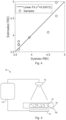
- Figure 4 shows the close correspondence between the linear regression and true particle counts as measured by a laboratory hematology analyzer (Sysmex).
- the disclosure provides a method that includes the following steps:
- the present disclosure may be embodied as a method 200 that can be useful for counting particles in a flowing fluid ( see, e.g., Figure 7 ).
- the method 200 may include capturing 203 a video of particles in a flowing fluid, where the captured 203 video is made up of a sequence of image frames taken over time.
- the video data may be captured via any modality for recording such video provided that the modality allows for the detection of locations (or approximate locations) of individual particles within each image frame of the sequence of image frames.
- the method 200 may include detecting 206 particles within each image frame of the sequence and, for each image frame, obtaining 209 a location of each detected 106 particle as an ( x , y ) coordinate. In this way, a set of ( x , y ) coordinates is obtained 209 for the particles of each image frame, wherein the number of coordinates in each set corresponds with the number of particles detected in the associated image frame.
- Each particle center of each frame is transformed 212 to an expected particle center in a common coordinate frame.
- the flow/movement of particles for example, biological cells
- a non-linear transform may be advantageous in modeling the displacement of particles between consecutive frames.
- a thin plate spline (TPS) transform may be used between consecutive image frames.
- Computing the TPS transform between two frames amounts to solving for the 2 ⁇ (3 + N ) coefficients of the transform.
- the video data comprise T image frames, where f ( t ) transforms points in image frame t to points in image frame t + 1.
- the detected particle centers in each image frame are transformed 212 into the common coordinate frame's coordinates (where the common coordinate frame is, for example, the last image frame).
- a single particle will appear in multiple image frames of the video data; therefore, the total number of particle centers transformed into the final frame will exceed the true number of distinct particles.
- the coordinates of a single particle that appears in multiple image frames will all be transformed to the same location in the common coordinate frame T . In reality, however, there will be some error in the transformations computed, so the coordinates for a single particle that appears in multiple image frames will be transformed into a cluster of points in frame T .
- the number of distinct particles in the video is thus equal to the number of clusters in frame T .
- the transformed particle centers in the common coordinate frame are grouped 215 into clusters (described as cluster centers).
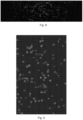
- Figure 9 depicts an image showing particles grouped into clusters.
- the particle centers are grouped 215 by, for example, mean shift clustering with a uniform kernel.
- Mean shift clustering searches for the local maxima in the distribution of particle centers using an iterative approach.
- Cluster centers are merged together and reinitialized when appropriate.
- the kernel bandwidth h is a model parameter that effects the number of local maxima found, with a larger bandwidth resulting in fewer local maxima.
- the method 200 includes determining 218 the particle count based on the number of cluster centers. For example, the number of cluster centers is equal to the estimated number of distinct particles in the video.
- the disclosure is embodied as a system 10 that can be useful for counting particles in a fluid ( see , e.g., Figure 5 ).
- the system 10 comprises a flow cell 18 having a fluid passage 19.
- the fluid passage 19 may be a tube or a micro-fluidic channel through which the fluid 90 may flow.
- the system 10 has an image sensor 12.
- the image sensor 12 is a lens-free image sensor for obtaining holographic images.
- the image sensor 12 may be, for example, an active pixel sensor, a charge-coupled device (CCD), or a CMOS active pixel sensor.
- the system 10 may further include a light source 16 , such as a coherent light source.
- the image sensor 12 is configured to obtain video data of the fluid 90 while the fluid is flowing through the fluid passage 19.
- the fluid 90 may be illuminated by light from the light source 16, when the image sensor 12 is actuated.
- the captured video data may comprise a sequence of holographic image frames.
- a processor 14 is in communication with the image sensor 12 .
- the processor 14 is programmed to perform any of the methods of the present disclosure.
- the processor 14 is programmed to capture video data of particles within the fluid using the image sensor, the video data comprising a sequence of image frames; obtain a set of ( x , y ) coordinates corresponding to particle centers in the video data, each set of ( x , y ) coordinates corresponding to an image frame of the video data; link a coordinate of each particle in each pair of consecutive image frames by fitting the coordinates to a statistical model of particle displacements; track a trajectory of each particle through links in each sequential image frame until the particle is not linked in a next image frame; calculate a length of the tracked particle trajectory; and calculate a particle count based on the tracked particle trajectories.
- the processor 14 may be programmed to capture video data of particles within the fluid using the image sensor, the video data comprising a sequence of image frames; obtain a set of ( x , y ) coordinates corresponding to particle centers in the video data, each set of ( x, y ) coordinates corresponding to an image frame of the video data; transform each particle center of each image frame to an expected particle center in a common coordinate frame; group the transformed particle centers into cluster centers; and calculate the particle count based on the number of cluster centers.
- the processor 14 may be in communication with and/or include a memory.
- the memory can be, for example, a Random-Access Memory (RAM) (e.g., a dynamic RAM, a static RAM), a flash memory, a removable memory, and/or so forth.
- RAM Random-Access Memory
- instructions associated with performing the operations described herein e.g ., operate an image sensor, generate a reconstructed image
- a storage medium which, in some embodiments, includes a database in which the instructions are stored
- the processor includes one or more modules and/or components.
- Each module/component executed by the processor can be any combination of hardware-based module/component (e.g., a field-programmable gate array (FPGA), an application specific integrated circuit (ASIC), a digital signal processor (DSP)), software-based module (e.g ., a module of computer code stored in the memory and/or in the database, and/or executed at the processor), and/or a combination of hardware- and software-based modules.
- FPGA field-programmable gate array
- ASIC application specific integrated circuit
- DSP digital signal processor
- software-based module e.g a module of computer code stored in the memory and/or in the database, and/or executed at the processor
- Each module/component executed by the processor is capable of performing one or more specific functions/operations as described herein.
- the modules/components included and executed in the processor can be, for example, a process, application, virtual machine, and/or some other hardware or software module/component.
- the processor can be any suitable processor configured to run and/or execute those modules/components.
- the processor can be any suitable processing device configured to run and/ or execute a set of instructions or code.
- the processor can be a general purpose processor, a central processing unit (CPU), an accelerated processing unit (APU), a field-programmable gate array (FPGA), an application specific integrated circuit (ASIC), a digital signal processor (DSP), and/or the like.
- Non-transitory computer-readable medium also can be referred to as a non-transitory processor-readable medium
- the computer-readable medium is non-transitory in the sense that it does not include transitory propagating signals per se (e.g., a propagating electromagnetic wave carrying information on a transmission medium such as space or a cable).
- the media and computer code also can be referred to as code
- code may be those designed and constructed for the specific purpose or purposes.
- non-transitory computer-readable media include, but are not limited to: magnetic storage media such as hard disks, floppy disks, and magnetic tape; optical storage media such as Compact Disc/Digital Video Discs (CD/DVDs), Compact Disc-Read Only Memories (CD-ROMs), and holographic devices; magneto-optical storage media such as optical disks; carrier wave signal processing modules; and hardware devices that are specially configured to store and execute program code, such as Application-Specific Integrated Circuits (ASICs), Programmable Logic Devices (PLDs), Read-Only Memory (ROM) and Random-Access Memory (RAM) devices.
- ASICs Application-Specific Integrated Circuits
- PLDs Programmable Logic Devices
- ROM Read-Only Memory
- RAM Random-Access Memory
- Other instances described herein relate to a computer program product, which can include, for example, the instructions and/or computer code discussed herein.
- Examples of computer code include, but are not limited to, micro-code or microinstructions, machine instructions, such as produced by a compiler, code used to produce a web service, and files containing higher-level instructions that are executed by a computer using an interpreter.
- instances may be implemented using Java, C++, .NET, or other programming languages (e.g ., object-oriented programming languages) and development tools.
- Additional examples of computer code include, but are not limited to, control signals, encrypted code, and compressed code.
- a non-transitory computer-readable medium includes a computer program to obtain a set of (x,y) coordinates corresponding to particle centers in video data, the video data comprising a sequence of image frames, and each set of (x,y) coordinates corresponding to an image frame of the video data; link a coordinate of each particle in each pair of consecutive image frames by fitting the coordinates to a statistical model of particle displacements; track a trajectory of each particle through links in each sequential image frame until the particle is not linked in a next image frame; calculate a length of the tracked particle trajectory; and calculate a particle count based on the tracked particle trajectories.
- a non-transitory computer-readable medium may include a computer program to obtain a set of (x,y) coordinates corresponding to particle centers in video data, the video data comprising a sequence of image frames, and each set of (x,y) coordinates corresponding to an image frame of the video data, transform each particle center of each image frame to an expected particle center in a common coordinate frame; group the transformed particle centers into cluster centers; and calculate the particle count based on the number of cluster centers.
Landscapes
- Chemical & Material Sciences (AREA)
- Engineering & Computer Science (AREA)
- Physics & Mathematics (AREA)
- General Physics & Mathematics (AREA)
- Life Sciences & Earth Sciences (AREA)
- Analytical Chemistry (AREA)
- Biochemistry (AREA)
- General Health & Medical Sciences (AREA)
- Health & Medical Sciences (AREA)
- Immunology (AREA)
- Pathology (AREA)
- Dispersion Chemistry (AREA)
- Multimedia (AREA)
- Computer Vision & Pattern Recognition (AREA)
- Theoretical Computer Science (AREA)
- Image Analysis (AREA)
Claims (9)
- Verfahren (100) zum Berechnen einer Partikelzahl in einem Fluidstrom, umfassend:Erfassen (103) von Videodaten einer Partikelmenge innerhalb eines Fluidstroms, wobei die Videodaten eine Abfolge von Einzelbildern über einen Zeitverlauf enthalten;Erkennen (106) von Partikeln innerhalb jedes Einzelbildes der Abfolge von Einzelbildern;Erhalten (109) eines Satzes von (x, y)-Koordinaten, die den Partikelzentren in den Videodaten der Partikelmenge innerhalb des Fluidstroms entsprechen, wobei jeder Satz von (x, y)-Koordinaten einem Einzelbild der Abfolge von Einzelbildern entspricht;Verknüpfen (112) einer Koordinate jedes Partikelzentrums in jedem Paar aufeinanderfolgender Einzelbilder der Abfolge von Einzelbildern, indem die Koordinaten in ein statistisches Modell von Partikelverschiebungen eingepasst werden;Verfolgen (115), für jeden Partikel der Partikelmenge, einer Trajektorie dieses Partikels durch Verknüpfungen in jedem Einzelbild der Abfolge, bis dieser Partikel nicht in einem nächsten Einzelbild der Abfolge von Einzelbildern verknüpft ist;wobei das Verfahren dadurch gekennzeichnet ist, dass es ferner umfasst:Berechnen (118), für jeden Partikel der Partikelmenge, einer Länge der verfolgten Partikeltrajektorie des betreffenden Partikels; undBerechnen (121) der Partikelzahl basierend auf der Länge der verfolgten Partikeltrajektorie jedes Partikels der Partikelmenge.
- Verfahren (100) nach Anspruch 1, wobei die Videodaten mit einem linsenlosen Bildgeber erfasst werden.
- Verfahren (100) nach Anspruch 1, wobei das Verknüpfen (112) einer Koordinate jedes Partikelzentrums in jedem Paar von aufeinanderfolgenden Einzelbildern ferner beinhaltet, jeden Partikel in der Vorwärtsrichtung und in der Rückwärtsrichtung zu verknüpfen.
- Verfahren (100) nach Anspruch 1, wobei das Verknüpfen (112) einer Koordinate jedes Partikelzentrums ferner beinhaltet, eine Transformierte zu berechnen, um die Partikelverschiebung zwischen aufeinanderfolgenden Einzelbildern zu beschreiben.
- Verfahren (100) nach Anspruch 1, wobei die Partikelzahl durch eine lineare Regression mit Regressionskoeffizienten berechnet wird, die durch Vergleichen mit bekannten Zellzahlen ermittelt werden.
- System (10), umfassend:eine Durchflusszelle (18) mit einem Fluidkanal (19);einen linsenlosen Bildsensor (12) zum Gewinnen holografischer Bilder eines Fluidstroms im Fluidkanal (19) ;einen Prozessor (14) in Kommunikationsverbindung mit dem Bildsensor (12), wobei der Prozessor (14) programmiert ist zum:Erfassen von Videodaten einer Partikelmenge innerhalb des Fluidstroms mithilfe des Bildsensors (12), wobei die Videodaten eine Abfolge von Einzelbildern umfassen;Erkennen von Partikeln innerhalb jedes Einzelbildes der Abfolge von Einzelbildern;Gewinnen eines Satzes von (x, y)-Koordinaten, die den Partikelzentren in den Videodaten entsprechen, wobei jeder Satz von (x, y)-Koordinaten einem Einzelbild der Abfolge von Einzelbildern entspricht;Verknüpfen einer Koordinate jedes Partikels der Partikelmenge in jedem Paar aufeinanderfolgender Einzelbilder, indem die Koordinaten in ein statistisches Modell von Partikelverschiebungen eingepasst werden;Verfolgen, für jeden Partikel der Partikelmenge, einer Trajektorie dieses Partikels durch Verknüpfungen in jedem Einzelbild der Abfolge, bis dieser Partikel nicht in einem nächsten Einzelbild verknüpft ist;dadurch gekennzeichnet, dass der Prozessor ferner programmiert ist zum:Berechnen, für jeden Partikel der Partikelmenge, einer Länge der verfolgten Partikeltrajektorie des betreffenden Partikels; undBerechnen der Partikelzahl basierend auf der Länge der verfolgten Partikeltrajektorie jedes Partikels der Partikelmenge.
- System (10) nach Anspruch 6, wobei der Bildsensor (12) ein linsenloser Bildsensor ist.
- System nach Anspruch 6, das ferner eine kohärente Lichtquelle (16) zum Beleuchten wenigstens eines Teils des Fluidkanals (19) umfasst.
- Nicht-transitorisches, computerlesbares Medium, auf dem ein Computerprogramm gespeichert ist, das einen Computer anweist zum:Erfassen, von einem Bildsensor, von Videodaten einer Partikelmenge innerhalb eines Fluidstroms, wobei die Videodaten eine Abfolge von Einzelbildern enthalten;Erkennen (106) von Partikeln innerhalb jedes Einzelbildes der Abfolge von Einzelbildern;Erhalten eines Satzes von (x, y)-Koordinaten, die den Partikelzentren in den Videodaten der Partikelmenge innerhalb des Fluidstroms entsprechen, wobei jeder Satz von (x, y)-Koordinaten einem Einzelbild der Abfolge von Einzelbildern entspricht;Verknüpfen einer Koordinate jedes Partikels der Partikelmenge in jedem Paar aufeinanderfolgender Einzelbilder, indem die Koordinaten in ein statistisches Modell von Partikelverschiebungen eingepasst werden;Verfolgen, für jeden Partikel der Partikelmenge, einer Trajektorie dieses Partikels durch Verknüpfungen in jedem Einzelbild der Abfolge, bis dieser Partikel nicht in einem nächsten Einzelbild verknüpft ist;dadurch gekennzeichnet, dass der Computer ferner angewiesen wird zum:Berechnen, für jeden Partikel der Partikelmenge, einer Länge der verfolgten Partikeltrajektorie des betreffenden Partikels; undBerechnen der Partikelzahl basierend auf der Länge der verfolgten Partikeltrajektorie jedes Partikels der Partikelmenge.
Applications Claiming Priority (2)
| Application Number | Priority Date | Filing Date | Title |
|---|---|---|---|
| US201762517650P | 2017-06-09 | 2017-06-09 | |
| PCT/US2018/036913 WO2018227193A1 (en) | 2017-06-09 | 2018-06-11 | Systems and methods for counting particles |
Publications (3)
| Publication Number | Publication Date |
|---|---|
| EP3635374A1 EP3635374A1 (de) | 2020-04-15 |
| EP3635374A4 EP3635374A4 (de) | 2021-07-07 |
| EP3635374B1 true EP3635374B1 (de) | 2024-12-25 |
Family
ID=64566334
Family Applications (1)
| Application Number | Title | Priority Date | Filing Date |
|---|---|---|---|
| EP18813280.7A Active EP3635374B1 (de) | 2017-06-09 | 2018-06-11 | Systeme und verfahren zur partikelzählung |
Country Status (3)
| Country | Link |
|---|---|
| US (2) | US11499907B2 (de) |
| EP (1) | EP3635374B1 (de) |
| WO (1) | WO2018227193A1 (de) |
Families Citing this family (10)
| Publication number | Priority date | Publication date | Assignee | Title |
|---|---|---|---|---|
| CN111356072B (zh) * | 2018-12-21 | 2020-12-11 | 珠海格力电器股份有限公司 | 一种室内定位的位置估计方法、装置及可读存储介质 |
| EP3839479B1 (de) * | 2019-12-20 | 2024-04-03 | IMEC vzw | Vorrichtung zum nachweis von partikeln in der luft |
| EP4145110A4 (de) * | 2020-04-28 | 2023-10-04 | Panasonic Intellectual Property Management Co., Ltd. | Zählverfahren und zählvorrichtung |
| US12106505B2 (en) * | 2020-09-02 | 2024-10-01 | International Business Machines Corporation | Reflection-based distance perception |
| US11573166B2 (en) * | 2020-12-16 | 2023-02-07 | Caterpillar Inc. | System and method for calibrating a particle monitoring sensor |
| CN113177574B (zh) * | 2021-03-19 | 2022-08-16 | 华中科技大学 | 用于材料表征图像分析的视觉模型及其分析方法 |
| WO2023026880A1 (ja) * | 2021-08-26 | 2023-03-02 | ソニーグループ株式会社 | 測定装置、測定方法、プログラム |
| CN114216906A (zh) * | 2021-12-15 | 2022-03-22 | 复旦大学 | 一种基于数字免疫分析技术的细胞因子快速检测方法 |
| TWI833308B (zh) * | 2022-07-28 | 2024-02-21 | 國立陽明交通大學 | 微粒追蹤方法 |
| JP2024018715A (ja) | 2022-07-29 | 2024-02-08 | アークレイ株式会社 | 情報処理装置、測定システム、画像処理方法、及び画像処理プログラム |
Citations (1)
| Publication number | Priority date | Publication date | Assignee | Title |
|---|---|---|---|---|
| WO2015143467A1 (de) * | 2014-03-26 | 2015-10-01 | Technische Universität Wien | Vorrichtung zur messung von nanopartikeln und verfahren zur bestimmung der durchmesser von nanopartikeln in einer flüssigkeit |
Family Cites Families (10)
| Publication number | Priority date | Publication date | Assignee | Title |
|---|---|---|---|---|
| US8798338B2 (en) * | 2006-01-09 | 2014-08-05 | University Of Wyoming | Method and system for counting particles in a laminar flow with an imaging device |
| US8139818B2 (en) * | 2007-06-28 | 2012-03-20 | Toshiba Tec Kabushiki Kaisha | Trajectory processing apparatus and method |
| US8391552B1 (en) * | 2010-04-22 | 2013-03-05 | U.S. Department Of Energy | Method of particle trajectory recognition in particle flows of high particle concentration using a candidate trajectory tree process with variable search areas |
| GB201011590D0 (en) * | 2010-07-09 | 2010-08-25 | Univ Gent | Method and system for dispersion measurements |
| US9057702B2 (en) * | 2010-12-21 | 2015-06-16 | The Regents Of The University Of California | Compact wide-field fluorescent imaging on a mobile device |
| WO2013019640A1 (en) | 2011-07-29 | 2013-02-07 | The Regents Of The University Of California | Lensfree holographic microscopy using wetting films |
| TWI582408B (zh) * | 2011-08-29 | 2017-05-11 | 安美基公司 | 用於非破壞性檢測-流體中未溶解粒子之方法及裝置 |
| US10267726B2 (en) * | 2015-04-27 | 2019-04-23 | Illumina France Sarl | Systems and methods of identifying and/or tracking particles in a droplet, wherein the particle can be a cell |
| FR3061297B1 (fr) * | 2016-12-28 | 2019-05-24 | Commissariat A L'energie Atomique Et Aux Energies Alternatives | Procede de comptage et de caracterisation de particules dans un fluide en mouvement |
| US10088660B2 (en) * | 2017-02-10 | 2018-10-02 | Amgen Inc. | Imaging system for counting and sizing particles in fluid-filled vessels |
-
2018
- 2018-06-11 EP EP18813280.7A patent/EP3635374B1/de active Active
- 2018-06-11 WO PCT/US2018/036913 patent/WO2018227193A1/en not_active Ceased
- 2018-06-11 US US16/619,201 patent/US11499907B2/en active Active
-
2022
- 2022-06-08 US US17/835,814 patent/US11846577B2/en active Active
Patent Citations (1)
| Publication number | Priority date | Publication date | Assignee | Title |
|---|---|---|---|---|
| WO2015143467A1 (de) * | 2014-03-26 | 2015-10-01 | Technische Universität Wien | Vorrichtung zur messung von nanopartikeln und verfahren zur bestimmung der durchmesser von nanopartikeln in einer flüssigkeit |
Non-Patent Citations (1)
| Title |
|---|
| FUNAMIZU HIDEKI ET AL: "Real-time three-dimensional counting and shape measurement of RBCs using digital holographic cytometry", PROCEEDINGS OF SPIE; [PROCEEDINGS OF SPIE ISSN 0277-786X VOLUME 10524], SPIE, US, vol. 10251, 16 April 2017 (2017-04-16), pages 1025113 - 1025113, XP060090085, ISBN: 978-1-5106-1533-5, DOI: 10.1117/12.2269425 * |
Also Published As
| Publication number | Publication date |
|---|---|
| US20200124516A1 (en) | 2020-04-23 |
| EP3635374A1 (de) | 2020-04-15 |
| WO2018227193A1 (en) | 2018-12-13 |
| EP3635374A4 (de) | 2021-07-07 |
| US20220299419A1 (en) | 2022-09-22 |
| US11846577B2 (en) | 2023-12-19 |
| US11499907B2 (en) | 2022-11-15 |
Similar Documents
| Publication | Publication Date | Title |
|---|---|---|
| EP3635374B1 (de) | Systeme und verfahren zur partikelzählung | |
| US10810723B2 (en) | System and method for single image object density estimation | |
| Paul et al. | Coupling image restoration and segmentation: a generalized linear model/Bregman perspective | |
| US10881382B2 (en) | Method and system for determining quality of semen sample | |
| US20170109879A1 (en) | Computer-implemented methods, computer-readable media, and systems for tracking a plurality of spermatozoa | |
| Elsayed et al. | Development of computer-assisted sperm analysis plugin for analyzing sperm motion in microfluidic environments using Image-J | |
| US8588503B2 (en) | System and method for detecting and eliminating one or more defocused or low contrast-to-noise ratio images | |
| US20190080462A1 (en) | Method and apparatus for calculating depth map based on reliability | |
| CN102521612B (zh) | 一种基于协同关联粒子滤波的多视频目标主动跟踪方法 | |
| EP3676750B1 (de) | Nachweis biologischer zellen und nachweis von zelllinien | |
| CN119477965B (zh) | 单颗粒扩散量化特征预测方法、装置、电子设备及存储介质 | |
| US20250308027A1 (en) | Methods of detection, classification, and motility assessment of sperm cells in images or videos | |
| Awang et al. | Vehicle counting system based on vehicle type classification using deep learning method | |
| Liu et al. | Optical flow guided cell segmentation and tracking in developing tissue | |
| Ghafari et al. | A comparison of YOLO and mask-RCNN for detecting cells from microfluidic images | |
| Vono et al. | Bayesian image restoration under Poisson noise and log-concave prior | |
| Ilhan et al. | A novel data acquisition and analyzing approach to spermiogram tests | |
| US20140112569A1 (en) | Method and apparatus for automatic cancer diagnosis scoring of tissue samples | |
| Hodneland et al. | Automated detection of tunneling nanotubes in 3D images | |
| Lee et al. | A hardware accelerated system for high throughput cellular image analysis | |
| Boulanger et al. | A simulation and estimation framework for intracellular dynamics and trafficking in video-microscopy and fluorescence imagery | |
| Rohr et al. | Tracking and quantitative analysis of dynamic movements of cells and particles | |
| US9892510B2 (en) | Method and apparatus for automatic cancer diagnosis using percentage scoring | |
| CN113361478B (zh) | 一种细胞运动过程中的形变跟踪方法及系统 | |
| Jiang et al. | High-accuracy object classification in droplet microfluidics using novel Ghost-EMA networks |
Legal Events
| Date | Code | Title | Description |
|---|---|---|---|
| STAA | Information on the status of an ep patent application or granted ep patent |
Free format text: STATUS: THE INTERNATIONAL PUBLICATION HAS BEEN MADE |
|
| PUAI | Public reference made under article 153(3) epc to a published international application that has entered the european phase |
Free format text: ORIGINAL CODE: 0009012 |
|
| STAA | Information on the status of an ep patent application or granted ep patent |
Free format text: STATUS: REQUEST FOR EXAMINATION WAS MADE |
|
| 17P | Request for examination filed |
Effective date: 20200108 |
|
| AK | Designated contracting states |
Kind code of ref document: A1 Designated state(s): AL AT BE BG CH CY CZ DE DK EE ES FI FR GB GR HR HU IE IS IT LI LT LU LV MC MK MT NL NO PL PT RO RS SE SI SK SM TR |
|
| AX | Request for extension of the european patent |
Extension state: BA ME |
|
| DAV | Request for validation of the european patent (deleted) | ||
| DAX | Request for extension of the european patent (deleted) | ||
| A4 | Supplementary search report drawn up and despatched |
Effective date: 20210608 |
|
| RIC1 | Information provided on ipc code assigned before grant |
Ipc: G01N 21/64 20060101AFI20210601BHEP Ipc: G01N 15/14 20060101ALI20210601BHEP Ipc: G01N 15/10 20060101ALI20210601BHEP Ipc: G03H 1/00 20060101ALI20210601BHEP Ipc: G03H 1/04 20060101ALI20210601BHEP Ipc: G01N 15/02 20060101ALI20210601BHEP Ipc: G01N 15/06 20060101ALI20210601BHEP |
|
| RAP3 | Party data changed (applicant data changed or rights of an application transferred) |
Owner name: MIDIAGNOSTICS NV |
|
| STAA | Information on the status of an ep patent application or granted ep patent |
Free format text: STATUS: EXAMINATION IS IN PROGRESS |
|
| 17Q | First examination report despatched |
Effective date: 20230315 |
|
| RAP3 | Party data changed (applicant data changed or rights of an application transferred) |
Owner name: MIDIAGNOSTICS NV |
|
| REG | Reference to a national code |
Ref country code: DE Ref legal event code: R079 Ref document number: 602018077966 Country of ref document: DE Free format text: PREVIOUS MAIN CLASS: G01N0021640000 Ipc: G01N0015143400 |
|
| GRAP | Despatch of communication of intention to grant a patent |
Free format text: ORIGINAL CODE: EPIDOSNIGR1 |
|
| STAA | Information on the status of an ep patent application or granted ep patent |
Free format text: STATUS: GRANT OF PATENT IS INTENDED |
|
| RIC1 | Information provided on ipc code assigned before grant |
Ipc: G01N 15/06 20060101ALI20240702BHEP Ipc: G01N 15/02 20060101ALI20240702BHEP Ipc: G03H 1/04 20060101ALI20240702BHEP Ipc: G03H 1/00 20060101ALI20240702BHEP Ipc: G01N 15/10 20060101ALI20240702BHEP Ipc: G01N 15/14 20060101ALI20240702BHEP Ipc: G01N 21/64 20060101ALI20240702BHEP Ipc: G01N 15/0227 20240101ALI20240702BHEP Ipc: G01N 15/1434 20240101AFI20240702BHEP |
|
| INTG | Intention to grant announced |
Effective date: 20240719 |
|
| GRAS | Grant fee paid |
Free format text: ORIGINAL CODE: EPIDOSNIGR3 |
|
| GRAA | (expected) grant |
Free format text: ORIGINAL CODE: 0009210 |
|
| STAA | Information on the status of an ep patent application or granted ep patent |
Free format text: STATUS: THE PATENT HAS BEEN GRANTED |
|
| AK | Designated contracting states |
Kind code of ref document: B1 Designated state(s): AL AT BE BG CH CY CZ DE DK EE ES FI FR GB GR HR HU IE IS IT LI LT LU LV MC MK MT NL NO PL PT RO RS SE SI SK SM TR |
|
| P01 | Opt-out of the competence of the unified patent court (upc) registered |
Free format text: CASE NUMBER: APP_61780/2024 Effective date: 20241119 |
|
| REG | Reference to a national code |
Ref country code: GB Ref legal event code: FG4D |
|
| REG | Reference to a national code |
Ref country code: CH Ref legal event code: EP |
|
| REG | Reference to a national code |
Ref country code: DE Ref legal event code: R096 Ref document number: 602018077966 Country of ref document: DE |
|
| REG | Reference to a national code |
Ref country code: IE Ref legal event code: FG4D |
|
| REG | Reference to a national code |
Ref country code: LT Ref legal event code: MG9D |
|
| PG25 | Lapsed in a contracting state [announced via postgrant information from national office to epo] |
Ref country code: HR Free format text: LAPSE BECAUSE OF FAILURE TO SUBMIT A TRANSLATION OF THE DESCRIPTION OR TO PAY THE FEE WITHIN THE PRESCRIBED TIME-LIMIT Effective date: 20241225 |
|
| PG25 | Lapsed in a contracting state [announced via postgrant information from national office to epo] |
Ref country code: FI Free format text: LAPSE BECAUSE OF FAILURE TO SUBMIT A TRANSLATION OF THE DESCRIPTION OR TO PAY THE FEE WITHIN THE PRESCRIBED TIME-LIMIT Effective date: 20241225 |
|
| PG25 | Lapsed in a contracting state [announced via postgrant information from national office to epo] |
Ref country code: BG Free format text: LAPSE BECAUSE OF FAILURE TO SUBMIT A TRANSLATION OF THE DESCRIPTION OR TO PAY THE FEE WITHIN THE PRESCRIBED TIME-LIMIT Effective date: 20241225 |
|
| PG25 | Lapsed in a contracting state [announced via postgrant information from national office to epo] |
Ref country code: NO Free format text: LAPSE BECAUSE OF FAILURE TO SUBMIT A TRANSLATION OF THE DESCRIPTION OR TO PAY THE FEE WITHIN THE PRESCRIBED TIME-LIMIT Effective date: 20250325 |
|
| PG25 | Lapsed in a contracting state [announced via postgrant information from national office to epo] |
Ref country code: GR Free format text: LAPSE BECAUSE OF FAILURE TO SUBMIT A TRANSLATION OF THE DESCRIPTION OR TO PAY THE FEE WITHIN THE PRESCRIBED TIME-LIMIT Effective date: 20250326 Ref country code: LV Free format text: LAPSE BECAUSE OF FAILURE TO SUBMIT A TRANSLATION OF THE DESCRIPTION OR TO PAY THE FEE WITHIN THE PRESCRIBED TIME-LIMIT Effective date: 20241225 |
|
| PG25 | Lapsed in a contracting state [announced via postgrant information from national office to epo] |
Ref country code: RS Free format text: LAPSE BECAUSE OF FAILURE TO SUBMIT A TRANSLATION OF THE DESCRIPTION OR TO PAY THE FEE WITHIN THE PRESCRIBED TIME-LIMIT Effective date: 20250325 |
|
| REG | Reference to a national code |
Ref country code: NL Ref legal event code: MP Effective date: 20241225 |
|
| PG25 | Lapsed in a contracting state [announced via postgrant information from national office to epo] |
Ref country code: NL Free format text: LAPSE BECAUSE OF FAILURE TO SUBMIT A TRANSLATION OF THE DESCRIPTION OR TO PAY THE FEE WITHIN THE PRESCRIBED TIME-LIMIT Effective date: 20241225 |
|
| REG | Reference to a national code |
Ref country code: AT Ref legal event code: MK05 Ref document number: 1754544 Country of ref document: AT Kind code of ref document: T Effective date: 20241225 |
|
| PG25 | Lapsed in a contracting state [announced via postgrant information from national office to epo] |
Ref country code: SM Free format text: LAPSE BECAUSE OF FAILURE TO SUBMIT A TRANSLATION OF THE DESCRIPTION OR TO PAY THE FEE WITHIN THE PRESCRIBED TIME-LIMIT Effective date: 20241225 |
|
| PG25 | Lapsed in a contracting state [announced via postgrant information from national office to epo] |
Ref country code: PL Free format text: LAPSE BECAUSE OF FAILURE TO SUBMIT A TRANSLATION OF THE DESCRIPTION OR TO PAY THE FEE WITHIN THE PRESCRIBED TIME-LIMIT Effective date: 20241225 |
|
| PGFP | Annual fee paid to national office [announced via postgrant information from national office to epo] |
Ref country code: DE Payment date: 20250516 Year of fee payment: 8 |
|
| PG25 | Lapsed in a contracting state [announced via postgrant information from national office to epo] |
Ref country code: ES Free format text: LAPSE BECAUSE OF FAILURE TO SUBMIT A TRANSLATION OF THE DESCRIPTION OR TO PAY THE FEE WITHIN THE PRESCRIBED TIME-LIMIT Effective date: 20241225 |
|
| PGFP | Annual fee paid to national office [announced via postgrant information from national office to epo] |
Ref country code: GB Payment date: 20250515 Year of fee payment: 8 |
|
| PG25 | Lapsed in a contracting state [announced via postgrant information from national office to epo] |
Ref country code: IS Free format text: LAPSE BECAUSE OF FAILURE TO SUBMIT A TRANSLATION OF THE DESCRIPTION OR TO PAY THE FEE WITHIN THE PRESCRIBED TIME-LIMIT Effective date: 20250425 |
|
| PG25 | Lapsed in a contracting state [announced via postgrant information from national office to epo] |
Ref country code: PT Free format text: LAPSE BECAUSE OF FAILURE TO SUBMIT A TRANSLATION OF THE DESCRIPTION OR TO PAY THE FEE WITHIN THE PRESCRIBED TIME-LIMIT Effective date: 20250428 |
|
| PG25 | Lapsed in a contracting state [announced via postgrant information from national office to epo] |
Ref country code: EE Free format text: LAPSE BECAUSE OF FAILURE TO SUBMIT A TRANSLATION OF THE DESCRIPTION OR TO PAY THE FEE WITHIN THE PRESCRIBED TIME-LIMIT Effective date: 20241225 |
|
| PGFP | Annual fee paid to national office [announced via postgrant information from national office to epo] |
Ref country code: FR Payment date: 20250515 Year of fee payment: 8 |
|
| PG25 | Lapsed in a contracting state [announced via postgrant information from national office to epo] |
Ref country code: AT Free format text: LAPSE BECAUSE OF FAILURE TO SUBMIT A TRANSLATION OF THE DESCRIPTION OR TO PAY THE FEE WITHIN THE PRESCRIBED TIME-LIMIT Effective date: 20241225 Ref country code: RO Free format text: LAPSE BECAUSE OF FAILURE TO SUBMIT A TRANSLATION OF THE DESCRIPTION OR TO PAY THE FEE WITHIN THE PRESCRIBED TIME-LIMIT Effective date: 20241225 |
|
| PG25 | Lapsed in a contracting state [announced via postgrant information from national office to epo] |
Ref country code: SK Free format text: LAPSE BECAUSE OF FAILURE TO SUBMIT A TRANSLATION OF THE DESCRIPTION OR TO PAY THE FEE WITHIN THE PRESCRIBED TIME-LIMIT Effective date: 20241225 |
|
| PG25 | Lapsed in a contracting state [announced via postgrant information from national office to epo] |
Ref country code: CZ Free format text: LAPSE BECAUSE OF FAILURE TO SUBMIT A TRANSLATION OF THE DESCRIPTION OR TO PAY THE FEE WITHIN THE PRESCRIBED TIME-LIMIT Effective date: 20241225 |
|
| PG25 | Lapsed in a contracting state [announced via postgrant information from national office to epo] |
Ref country code: IT Free format text: LAPSE BECAUSE OF FAILURE TO SUBMIT A TRANSLATION OF THE DESCRIPTION OR TO PAY THE FEE WITHIN THE PRESCRIBED TIME-LIMIT Effective date: 20241225 |
|
| PG25 | Lapsed in a contracting state [announced via postgrant information from national office to epo] |
Ref country code: SE Free format text: LAPSE BECAUSE OF FAILURE TO SUBMIT A TRANSLATION OF THE DESCRIPTION OR TO PAY THE FEE WITHIN THE PRESCRIBED TIME-LIMIT Effective date: 20241225 |
|
| REG | Reference to a national code |
Ref country code: DE Ref legal event code: R097 Ref document number: 602018077966 Country of ref document: DE |
|
| PG25 | Lapsed in a contracting state [announced via postgrant information from national office to epo] |
Ref country code: DK Free format text: LAPSE BECAUSE OF FAILURE TO SUBMIT A TRANSLATION OF THE DESCRIPTION OR TO PAY THE FEE WITHIN THE PRESCRIBED TIME-LIMIT Effective date: 20241225 |
|
| PLBE | No opposition filed within time limit |
Free format text: ORIGINAL CODE: 0009261 |
|
| STAA | Information on the status of an ep patent application or granted ep patent |
Free format text: STATUS: NO OPPOSITION FILED WITHIN TIME LIMIT |
|
| REG | Reference to a national code |
Ref country code: CH Ref legal event code: L10 Free format text: ST27 STATUS EVENT CODE: U-0-0-L10-L00 (AS PROVIDED BY THE NATIONAL OFFICE) Effective date: 20251105 |
|
| 26N | No opposition filed |
Effective date: 20250926 |
|
| REG | Reference to a national code |
Ref country code: CH Ref legal event code: H13 Free format text: ST27 STATUS EVENT CODE: U-0-0-H10-H13 (AS PROVIDED BY THE NATIONAL OFFICE) Effective date: 20260127 |
|
| PG25 | Lapsed in a contracting state [announced via postgrant information from national office to epo] |
Ref country code: MC Free format text: LAPSE BECAUSE OF FAILURE TO SUBMIT A TRANSLATION OF THE DESCRIPTION OR TO PAY THE FEE WITHIN THE PRESCRIBED TIME-LIMIT Effective date: 20241225 |
|
| PG25 | Lapsed in a contracting state [announced via postgrant information from national office to epo] |
Ref country code: LU Free format text: LAPSE BECAUSE OF NON-PAYMENT OF DUE FEES Effective date: 20250611 |
|
| REG | Reference to a national code |
Ref country code: BE Ref legal event code: MM Effective date: 20250630 |
|
| PG25 | Lapsed in a contracting state [announced via postgrant information from national office to epo] |
Ref country code: IE Free format text: LAPSE BECAUSE OF NON-PAYMENT OF DUE FEES Effective date: 20250611 |
|
| PG25 | Lapsed in a contracting state [announced via postgrant information from national office to epo] |
Ref country code: BE Free format text: LAPSE BECAUSE OF NON-PAYMENT OF DUE FEES Effective date: 20250630 |
|
| PG25 | Lapsed in a contracting state [announced via postgrant information from national office to epo] |
Ref country code: CH Free format text: LAPSE BECAUSE OF NON-PAYMENT OF DUE FEES Effective date: 20250630 |