EP3633615A1 - Deep learning network and average drift-based automatic vessel tracking method and system - Google Patents
Deep learning network and average drift-based automatic vessel tracking method and system Download PDFInfo
- Publication number
- EP3633615A1 EP3633615A1 EP18880214.4A EP18880214A EP3633615A1 EP 3633615 A1 EP3633615 A1 EP 3633615A1 EP 18880214 A EP18880214 A EP 18880214A EP 3633615 A1 EP3633615 A1 EP 3633615A1
- Authority
- EP
- European Patent Office
- Prior art keywords
- ship
- moment
- boxm
- num
- target
- Prior art date
- Legal status (The legal status is an assumption and is not a legal conclusion. Google has not performed a legal analysis and makes no representation as to the accuracy of the status listed.)
- Withdrawn
Links
Images


Classifications
-
- G—PHYSICS
- G06—COMPUTING OR CALCULATING; COUNTING
- G06T—IMAGE DATA PROCESSING OR GENERATION, IN GENERAL
- G06T7/00—Image analysis
- G06T7/20—Analysis of motion
- G06T7/277—Analysis of motion involving stochastic approaches, e.g. using Kalman filters
-
- G—PHYSICS
- G06—COMPUTING OR CALCULATING; COUNTING
- G06N—COMPUTING ARRANGEMENTS BASED ON SPECIFIC COMPUTATIONAL MODELS
- G06N3/00—Computing arrangements based on biological models
- G06N3/02—Neural networks
- G06N3/04—Architecture, e.g. interconnection topology
- G06N3/045—Combinations of networks
-
- G—PHYSICS
- G06—COMPUTING OR CALCULATING; COUNTING
- G06N—COMPUTING ARRANGEMENTS BASED ON SPECIFIC COMPUTATIONAL MODELS
- G06N3/00—Computing arrangements based on biological models
- G06N3/02—Neural networks
- G06N3/04—Architecture, e.g. interconnection topology
- G06N3/0464—Convolutional networks [CNN, ConvNet]
-
- G—PHYSICS
- G06—COMPUTING OR CALCULATING; COUNTING
- G06N—COMPUTING ARRANGEMENTS BASED ON SPECIFIC COMPUTATIONAL MODELS
- G06N3/00—Computing arrangements based on biological models
- G06N3/02—Neural networks
- G06N3/08—Learning methods
- G06N3/084—Backpropagation, e.g. using gradient descent
-
- G—PHYSICS
- G06—COMPUTING OR CALCULATING; COUNTING
- G06N—COMPUTING ARRANGEMENTS BASED ON SPECIFIC COMPUTATIONAL MODELS
- G06N3/00—Computing arrangements based on biological models
- G06N3/02—Neural networks
- G06N3/08—Learning methods
- G06N3/09—Supervised learning
-
- G—PHYSICS
- G06—COMPUTING OR CALCULATING; COUNTING
- G06T—IMAGE DATA PROCESSING OR GENERATION, IN GENERAL
- G06T5/00—Image enhancement or restoration
- G06T5/40—Image enhancement or restoration using histogram techniques
-
- G—PHYSICS
- G06—COMPUTING OR CALCULATING; COUNTING
- G06T—IMAGE DATA PROCESSING OR GENERATION, IN GENERAL
- G06T5/00—Image enhancement or restoration
- G06T5/70—Denoising; Smoothing
-
- G—PHYSICS
- G06—COMPUTING OR CALCULATING; COUNTING
- G06T—IMAGE DATA PROCESSING OR GENERATION, IN GENERAL
- G06T7/00—Image analysis
- G06T7/10—Segmentation; Edge detection
- G06T7/11—Region-based segmentation
-
- G—PHYSICS
- G06—COMPUTING OR CALCULATING; COUNTING
- G06T—IMAGE DATA PROCESSING OR GENERATION, IN GENERAL
- G06T7/00—Image analysis
- G06T7/20—Analysis of motion
- G06T7/246—Analysis of motion using feature-based methods, e.g. the tracking of corners or segments
-
- G—PHYSICS
- G06—COMPUTING OR CALCULATING; COUNTING
- G06T—IMAGE DATA PROCESSING OR GENERATION, IN GENERAL
- G06T7/00—Image analysis
- G06T7/90—Determination of colour characteristics
-
- G—PHYSICS
- G06—COMPUTING OR CALCULATING; COUNTING
- G06V—IMAGE OR VIDEO RECOGNITION OR UNDERSTANDING
- G06V20/00—Scenes; Scene-specific elements
- G06V20/40—Scenes; Scene-specific elements in video content
- G06V20/41—Higher-level, semantic clustering, classification or understanding of video scenes, e.g. detection, labelling or Markovian modelling of sport events or news items
-
- G—PHYSICS
- G06—COMPUTING OR CALCULATING; COUNTING
- G06V—IMAGE OR VIDEO RECOGNITION OR UNDERSTANDING
- G06V20/00—Scenes; Scene-specific elements
- G06V20/50—Context or environment of the image
- G06V20/52—Surveillance or monitoring of activities, e.g. for recognising suspicious objects
-
- G—PHYSICS
- G06—COMPUTING OR CALCULATING; COUNTING
- G06T—IMAGE DATA PROCESSING OR GENERATION, IN GENERAL
- G06T2207/00—Indexing scheme for image analysis or image enhancement
- G06T2207/10—Image acquisition modality
- G06T2207/10016—Video; Image sequence
-
- G—PHYSICS
- G06—COMPUTING OR CALCULATING; COUNTING
- G06T—IMAGE DATA PROCESSING OR GENERATION, IN GENERAL
- G06T2207/00—Indexing scheme for image analysis or image enhancement
- G06T2207/10—Image acquisition modality
- G06T2207/10024—Color image
-
- G—PHYSICS
- G06—COMPUTING OR CALCULATING; COUNTING
- G06T—IMAGE DATA PROCESSING OR GENERATION, IN GENERAL
- G06T2207/00—Indexing scheme for image analysis or image enhancement
- G06T2207/10—Image acquisition modality
- G06T2207/10032—Satellite or aerial image; Remote sensing
-
- G—PHYSICS
- G06—COMPUTING OR CALCULATING; COUNTING
- G06T—IMAGE DATA PROCESSING OR GENERATION, IN GENERAL
- G06T2207/00—Indexing scheme for image analysis or image enhancement
- G06T2207/20—Special algorithmic details
- G06T2207/20024—Filtering details
- G06T2207/20032—Median filtering
-
- G—PHYSICS
- G06—COMPUTING OR CALCULATING; COUNTING
- G06T—IMAGE DATA PROCESSING OR GENERATION, IN GENERAL
- G06T2207/00—Indexing scheme for image analysis or image enhancement
- G06T2207/20—Special algorithmic details
- G06T2207/20076—Probabilistic image processing
-
- G—PHYSICS
- G06—COMPUTING OR CALCULATING; COUNTING
- G06T—IMAGE DATA PROCESSING OR GENERATION, IN GENERAL
- G06T2207/00—Indexing scheme for image analysis or image enhancement
- G06T2207/20—Special algorithmic details
- G06T2207/20081—Training; Learning
-
- G—PHYSICS
- G06—COMPUTING OR CALCULATING; COUNTING
- G06T—IMAGE DATA PROCESSING OR GENERATION, IN GENERAL
- G06T2207/00—Indexing scheme for image analysis or image enhancement
- G06T2207/20—Special algorithmic details
- G06T2207/20084—Artificial neural networks [ANN]
-
- G—PHYSICS
- G06—COMPUTING OR CALCULATING; COUNTING
- G06T—IMAGE DATA PROCESSING OR GENERATION, IN GENERAL
- G06T2207/00—Indexing scheme for image analysis or image enhancement
- G06T2207/30—Subject of image; Context of image processing
- G06T2207/30232—Surveillance
-
- G—PHYSICS
- G06—COMPUTING OR CALCULATING; COUNTING
- G06T—IMAGE DATA PROCESSING OR GENERATION, IN GENERAL
- G06T2207/00—Indexing scheme for image analysis or image enhancement
- G06T2207/30—Subject of image; Context of image processing
- G06T2207/30236—Traffic on road, railway or crossing
-
- G—PHYSICS
- G06—COMPUTING OR CALCULATING; COUNTING
- G06T—IMAGE DATA PROCESSING OR GENERATION, IN GENERAL
- G06T2207/00—Indexing scheme for image analysis or image enhancement
- G06T2207/30—Subject of image; Context of image processing
- G06T2207/30241—Trajectory
-
- Y—GENERAL TAGGING OF NEW TECHNOLOGICAL DEVELOPMENTS; GENERAL TAGGING OF CROSS-SECTIONAL TECHNOLOGIES SPANNING OVER SEVERAL SECTIONS OF THE IPC; TECHNICAL SUBJECTS COVERED BY FORMER USPC CROSS-REFERENCE ART COLLECTIONS [XRACs] AND DIGESTS
- Y02—TECHNOLOGIES OR APPLICATIONS FOR MITIGATION OR ADAPTATION AGAINST CLIMATE CHANGE
- Y02A—TECHNOLOGIES FOR ADAPTATION TO CLIMATE CHANGE
- Y02A10/00—TECHNOLOGIES FOR ADAPTATION TO CLIMATE CHANGE at coastal zones; at river basins
- Y02A10/40—Controlling or monitoring, e.g. of flood or hurricane; Forecasting, e.g. risk assessment or mapping
Definitions
- the disclosure belongs to the field of digital image processing technologies, and more particularly, to an automatic ship tracking method based on deep learning network and mean shift.
- Video tracking is one of the focuses of computer vision studies, which mainly tracks objects of interest obtained by image sensors. Video tracking is the basis of multiple video applications, such as traffic monitoring, smart robots and human-computer interaction, which plays an important role in smart city management, cracking down on illegal and criminal activities and building safe and smart cities, and is the focus and difficulty of video processing studies at present.
- the multi-target tracking mainly includes a prediction-based method, a matching-based method and a detection-based method.
- the prediction-based method regards a tracking problem as a state estimation problem, which optimally estimates a state (e.g., position, color, shape, etc.) of the target in next frame by signal processing according to given data.
- the method mainly includes a tracking algorithm based on filtering and an algorithm based on subspace learning.
- Filtering-based algorithms such as Kalman filtering, mean shift filtering and particle filtering mainly learn a feature space of the target according to previous data, and then locate the target according to distribution of image blocks of a current frame in the feature space.
- the prediction method has the advantage of fast speed in multi-target tracking, but the state of the current frame completely depends on a tracking result of the previous frame, so the target tracking cannot be automatically performed, and tracking error situations are difficult to correct.
- the matching-based algorithm regards the multi-target tracking problem as a template matching problem, which uses a template to represent a target to be tracked to find an optimal matching result in next frame.
- the target may be one or a group of image blocks, or global or local feature representation of a target image.
- the detection-based algorithm regards the tracking problem as a target detection problem, which separates a target from a background, uses obtained data for training to obtain a classifier, and automatically performs target detection on the current frame, wherein an image block with the highest score is considered as a target position.
- the detection-based algorithm includes an offline method and an online method. The former uses pre-training or initial data of one or more frames to learn the classifier, while the latter uses sampled data of the current frame to carry out new training on the classifier.
- the offline learning method has poor tracking effect on dynamically changing targets, while the online learning method is easy to cause error accumulation due to the introduction of new errors in each update, and eventually drift or even lose targets. It still needs further studies on how to automatically and quickly track multiple targets accurately, i.e., considering results of the current frame and referring to different features of the target.
- the disclosure is intended to provide an automatic ship tracking method based on deep learning network and mean shift to overcome the shortcomings and deficiencies of the prior art.
- a technical solution of the disclosure relates to an automatic ship tracking method based on deep learning network and mean shift, including the following steps:
- the probability density calculation in the step 4 is realized by dividing a gray color space of a target region to obtain a gray histogram formed by multiple equal intervals, and calculating the probability density according to a histogram interval to which a gray value of a pixel in the target region belongs.
- the disclosure further provides an automatic ship tracking system based on deep learning network and mean shift, including the following modules:
- region-based convolutional neural network method performing a ship detection on the image at time t , and obtaining the num th detection coordinate Boxd num t of multiple ships in the image at time t , calculating a degree of overlap between the Boxd num t and the id th ship position Boxm id t , recording a value of degree of overlap O max between each Boxm id t and the corresponding Boxd num t with a maximum degree of overlap, and if the O max is less than a corresponding threshold ⁇ 1 , considering the ship position as false-alarm and deleting the Boxm id t ; and updating a new ship target appeared at the moment t by a neural network detection result of the step C, which includes calculating a maximum value of the degrees of overlap obtained respectively between each Boxd num t and all the Boxm id t , if the O max ′ is less than a corresponding threshold ⁇ 2 , considering the ship target as the ship appeared at the moment
- the probability density calculation in the step fourth module is realized by dividing a gray color space of a target region to obtain a gray histogram formed by multiple equal intervals, and calculating the probability density according to a histogram interval to which a gray value of a pixel in the target region belongs.
- the region-based convolutional neural network is specifically adopted to perform the simultaneous detection process on multiple ship targets on the surveillance video image.
- the method is fast, efficient and high in accuracy.
- the method still has good detection results for complex scenes such as cloudy, foggy and overcast days and the like, and has high robustness.
- a fast and efficient mean shift tracking method based on color histogram is adopted to simultaneously predict the mean shift results of the current frame for multiple targets tracked in the previous frame to obtain multiple prediction positions.
- the histogram of the target is not affected by a shape change of the target, so the mode of using the histogram as the target to match according to the color distribution has good stability.
- the combination of the deep learning network method and the mean shift tracking method can better complete the automatic tracking process of multiple ship targets, so that the tracking process is fully automated and does not need a man-machine interaction process; on the other hand, the stability and accuracy of the neural network method also eliminate the errors of the mean shift tracking method, and lay a foundation for tracking an emerging target, thus having important market values.
- an applicable system architecture mainly includes a surveillance video acquisition module, a ship tracking platform and an application platform.
- the surveillance video acquisition module mainly uses multiple visible light surveillance cameras to acquire seaside region videos, and transmits data to the ship tracking module.
- the ship tracking platform employs the method of the disclosure to extract and automatically track ship targets, and transmits abnormal situations of ship targets and the like to the application platform.
- a specific ship analysis platform a behavior prediction platform, an abnormal event processing platform and a ship surveillance platform in the application platform, the distribution and action of the ship targets are analyzed, and reasonable prediction and planning are made so as to complete relevant tasks.
- the method provided by the embodiments of the disclosure includes the following steps.
- surveillance video data is inputted: Surveillance video data may be collected in advance.
- the data needing to be collected by the disclosure is mainly coastal region surveillance video data under visible light.
- the collected video data it is necessary to obtain each frame of image through a decoder or a code.
- the data may be collected in advance.
- step 2 the data is preprocessed and samples are prepared: preprocessing of the video data and preparation of positive and negative samples of a ship target.
- the acquired surveillance video data needs to be preprocessed to facilitate development of subsequent digital image algorithms.
- An image smoothing operation is mainly employed in the preprocessing part, and a median filtering method is adopted in the disclosure to smooth each frame of video image.
- the positive and negative samples are prepared for convolutional neural network training in subsequent steps, a specific process of which is as follows.
- a first step is to use the video image obtained in the step 1 to expand the image to a certain extent by means of rotation, translation, etc.
- a second step is to obtain four vertex coordinates and corresponding images of a vertical minimum bounding rectangle of each ship target in a remote sensing image, and output the image and all target coordinates thereon together as the positive sample.
- a third step is to randomly intercept other regions around the positive sample to obtain four vertex coordinates of a vertical minimum bounding rectangle thereof as negative sample coordinates, and output the image and the negative sample coordinates thereon together.
- step 3 training is performed by a region-based convolutional neural network: the samples of the ship target in the video are inputted into a neural network to train a model by a region-based convolutional neural network method, wherein a theoretical process thereof is as follows.
- Standard formatting is carried out on data of the positive and negative samples of the ship target completed in the step 1 to convert the data into a structured database format and input the data into a convolutional neural network for training to obtain a training result model of the ship target under the surveillance video.
- the region-based convolutional neural network is composed of multiple alternating convolutional layers, pooling layers and fully connected layers, and mainly employs a back propagation algorithm (BP algorithm), wherein one input layer, multiple hidden layers and one output layer are provided.
- BP algorithm back propagation algorithm
- the convolutional layer in the convolutional neural network is updated by the network using a BP neural network mode.
- a feature map of a previous layer is convolved by a learnable convolution kernel, and then an output feature map can be obtained by an activation function.
- k ij l represents the convolution kernel between the input layer and the hidden layer, and " ⁇ " represents a convolution operation process. Therefore, the formula reflects an operational relation between an l th layer and an l -1 th layer.
- the convolutional neural network also has an important operation process, i.e., a pooling process and computation of the pooling layer.
- the pooling process is a process of aggregating and counting features of different positions in a large image, which greatly decreases feature redundancy and reduces feature dimensions to be counted.
- step 4 initial frame data of the video is extracted, and a detection result and a probability density at an initial moment are calculated: the video data is inputted, and ship detection and probability density calculation are performed on the initial moment data.
- step 5 data of a subsequent frame to be processed is extracted, and a ship tracking result of a current frame is determined by a recursive method: a previous moment is set as a moment t -1 and a current moment is set as a moment t, then a ship tracking result of the moment t is determined by a calculation result of the moment t -1, and the ship position and evaluation may be recorded and stored.
- a procedure thereof is shown in FIG. 3 , and a detailed process is as follows.
- the flow provided by the technical solutions of the disclosure can be automatically operated by those skilled in the art by adopting a computer software technology, and a corresponding system can also be realized by adopting a modularization mode.
- the embodiments of the disclosure further provide an automatic ship tracking system based on deep learning network and mean shift, including the following modules:
Landscapes
- Engineering & Computer Science (AREA)
- Physics & Mathematics (AREA)
- Theoretical Computer Science (AREA)
- General Physics & Mathematics (AREA)
- Computer Vision & Pattern Recognition (AREA)
- Software Systems (AREA)
- Computational Linguistics (AREA)
- Artificial Intelligence (AREA)
- Evolutionary Computation (AREA)
- Life Sciences & Earth Sciences (AREA)
- Multimedia (AREA)
- Biomedical Technology (AREA)
- Biophysics (AREA)
- Data Mining & Analysis (AREA)
- Health & Medical Sciences (AREA)
- General Health & Medical Sciences (AREA)
- Molecular Biology (AREA)
- Computing Systems (AREA)
- General Engineering & Computer Science (AREA)
- Mathematical Physics (AREA)
- Image Analysis (AREA)
Abstract
Description
- The disclosure belongs to the field of digital image processing technologies, and more particularly, to an automatic ship tracking method based on deep learning network and mean shift.
- In modern society, video surveillance cameras can be found everywhere. It is easy to miss abnormal events in videos if we only rely on human eyes to observe and detect. With the rapid development of computer networks, communication and semiconductor technologies, more and more people prefer to use computer vision instead of human eyes to analyze video images obtained by sensors and acquire useful information in the images. Video tracking is one of the focuses of computer vision studies, which mainly tracks objects of interest obtained by image sensors. Video tracking is the basis of multiple video applications, such as traffic monitoring, smart robots and human-computer interaction, which plays an important role in smart city management, cracking down on illegal and criminal activities and building safe and smart cities, and is the focus and difficulty of video processing studies at present.
- Studies on video tracking systems have been always focused on single-target tracking, which tracks the only object of interest in monitoring. The single-target tracking is of great significance to handling of abnormal events. However, a multi-target tracking method can provide a lot of help to regulatory authorities in multiple aspects, such as early warning prompt, surveillance and management before the abnormal events occur.
- At present, the multi-target tracking mainly includes a prediction-based method, a matching-based method and a detection-based method.
- The prediction-based method regards a tracking problem as a state estimation problem, which optimally estimates a state (e.g., position, color, shape, etc.) of the target in next frame by signal processing according to given data. The method mainly includes a tracking algorithm based on filtering and an algorithm based on subspace learning. Filtering-based algorithms such as Kalman filtering, mean shift filtering and particle filtering mainly learn a feature space of the target according to previous data, and then locate the target according to distribution of image blocks of a current frame in the feature space. The prediction method has the advantage of fast speed in multi-target tracking, but the state of the current frame completely depends on a tracking result of the previous frame, so the target tracking cannot be automatically performed, and tracking error situations are difficult to correct.
- The matching-based algorithm regards the multi-target tracking problem as a template matching problem, which uses a template to represent a target to be tracked to find an optimal matching result in next frame. The target may be one or a group of image blocks, or global or local feature representation of a target image. Such method improves tracking performances by the process of learning while tracking, but is still difficult to achieve automatic multi-target tracking results, and is also difficult to accurately track in covered and complex environments.
- The detection-based algorithm regards the tracking problem as a target detection problem, which separates a target from a background, uses obtained data for training to obtain a classifier, and automatically performs target detection on the current frame, wherein an image block with the highest score is considered as a target position. The detection-based algorithm includes an offline method and an online method. The former uses pre-training or initial data of one or more frames to learn the classifier, while the latter uses sampled data of the current frame to carry out new training on the classifier. The offline learning method has poor tracking effect on dynamically changing targets, while the online learning method is easy to cause error accumulation due to the introduction of new errors in each update, and eventually drift or even lose targets. It still needs further studies on how to automatically and quickly track multiple targets accurately, i.e., considering results of the current frame and referring to different features of the target.
- The disclosure is intended to provide an automatic ship tracking method based on deep learning network and mean shift to overcome the shortcomings and deficiencies of the prior art.
- A technical solution of the disclosure relates to an automatic ship tracking method based on deep learning network and mean shift, including the following steps:
- step 1: collecting surveillance video data which includes collecting coastal region surveillance video data under visible light and extracting each frame of image;
- step 2: performing preprocessing based on a video image obtained in the
step 1 to extract a positive sample and a negative sample of a ship target; - step 3: inputting the samples of the ship target in the video into a neural network to train a model by a region-based convolutional neural network method;
- step 4: extracting initial frame data of the video and performing ship detection and probability density calculation on initial moment data according to the trained model obtained in the step 3,
- step 5: determining a ship tracking result at the current moment through a calculation result of a previous moment, which includes the following processing:
- step A: taking ξ ship positions tracked at a moment t-1 as initial positions, respectively taking a center coordinate f 0 of each ship position as an initial target position of the ship tracked at a moment t, taking the f 0 as a center of a search window to obtain a center position coordinate f of a corresponding candidate ship, calculating a region histogram of a candidate position, and further calculating the probability density;
- step B: describing a degree of similarity between the ship model and the candidate ship by a Bhattacharyya coefficient, calculating a mean shift iteration equation in a center of the region, so that the model moves continuously towards a direction with a maximum color change until the last two moving distances are less than a corresponding preset threshold, finding a ship position obtained by a mean shift result at the moment t, setting that multiple ship positions Boxmt are obtained, and expressing an id th ship position as

- step C: By region-based convolutional neural network method, performing a ship detection on the image at time t, and obtaining the num th detection coordinate


- step D: updating a new ship target appeared at the moment t by a neural network detection result of the step C, which includes calculating a maximum value of the degrees of overlap obtained respectively between each


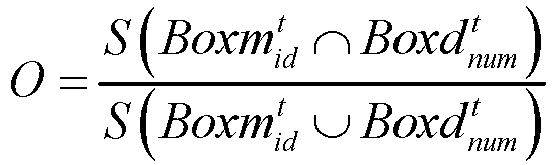
- Moreover, a degree of overlap between each


wherein, S represents an area size. - Moreover, the probability density calculation in the step 4 is realized by dividing a gray color space of a target region to obtain a gray histogram formed by multiple equal intervals, and calculating the probability density according to a histogram interval to which a gray value of a pixel in the target region belongs.
- The disclosure further provides an automatic ship tracking system based on deep learning network and mean shift, including the following modules:
- a first module configured to collect surveillance video data which includes collecting coastal region surveillance video data under visible light and extracting each frame of image;
- a second module configured to perform preprocessing based on a video image obtained by the first module to extract a positive sample and a negative sample of a ship target;
- a third module configured to input the samples of the ship target in the video into a neural network to train a model by a region-based convolutional neural network method;
- a fourth module configured to extract initial frame data of the video and perform ship detection and probability density calculation on initial moment data according to the trained model obtained by the third module; and
- a fifth module configured to determine a ship tracking result at the current moment through a calculation result of a previous moment, which includes the following ways:
- taking ξ ship positions tracked at a moment t-1 as initial positions, respectively taking a center coordinate f 0 of each ship position as an initial target position of the ship tracked at a moment t, taking the f 0 as a center of a search window to obtain a center position coordinate f of a corresponding candidate ship, calculating a region histogram of a candidate position, and further calculating the probability density;
- describing a degree of similarity between the ship model and the candidate ship by a Bhattacharyya coefficient, calculating a mean shift iteration equation in a center of the region, so that the model moves continuously towards a direction with a largest color change until the last two moving distances are less than a corresponding preset threshold, finding a ship position obtained by a mean shift result at the moment t, setting that multiple ship positions Boxmt are obtained, and expressing an id th ship position as

- By region-based convolutional neural network method, performing a ship detection on the image at time t, and obtaining the num th detection coordinate


updating a new ship target appeared at the moment t by a neural network detection result of the step C, which includes calculating a maximum value of the degrees of overlap obtained respectively between each


- Moreover, a degree of overlap between each

wherein, S represents an area size. - Moreover, the probability density calculation in the step fourth module is realized by dividing a gray color space of a target region to obtain a gray histogram formed by multiple equal intervals, and calculating the probability density according to a histogram interval to which a gray value of a pixel in the target region belongs.
- Compared with the prior art, the disclosure has the following advantages and effective results.
- In the depth learning method part, the region-based convolutional neural network is specifically adopted to perform the simultaneous detection process on multiple ship targets on the surveillance video image. The method is fast, efficient and high in accuracy. The method still has good detection results for complex scenes such as cloudy, foggy and overcast days and the like, and has high robustness.
- A fast and efficient mean shift tracking method based on color histogram is adopted to simultaneously predict the mean shift results of the current frame for multiple targets tracked in the previous frame to obtain multiple prediction positions. The histogram of the target is not affected by a shape change of the target, so the mode of using the histogram as the target to match according to the color distribution has good stability.
- On one hand, the combination of the deep learning network method and the mean shift tracking method can better complete the automatic tracking process of multiple ship targets, so that the tracking process is fully automated and does not need a man-machine interaction process; on the other hand, the stability and accuracy of the neural network method also eliminate the errors of the mean shift tracking method, and lay a foundation for tracking an emerging target, thus having important market values.
-
-
FIG. 1 is a structural diagram of an application platform system according to an embodiment of the disclosure. -
FIG. 2 is an overall flow chart of an embodiment of the disclosure. -
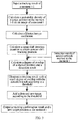
FIG. 3 is a flow chart of a specific strategy for obtaining a tracking result based on depth learning network and mean shift tracking methods after step 3 in the embodiment of the disclosure. -
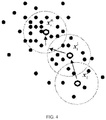
FIG. 4 is a schematic diagram of an iterative process of a mean shift algorithm used in step 4 and step 5 in the embodiment of the disclosure. - In order to better understand the technical solutions of the disclosure, the disclosure will be further described in detail below with reference to the drawings and embodiments.
- Referring to
FIG. 1 , when the disclosure is applied, an applicable system architecture mainly includes a surveillance video acquisition module, a ship tracking platform and an application platform. The surveillance video acquisition module mainly uses multiple visible light surveillance cameras to acquire seaside region videos, and transmits data to the ship tracking module. The ship tracking platform employs the method of the disclosure to extract and automatically track ship targets, and transmits abnormal situations of ship targets and the like to the application platform. According to a specific ship analysis platform, a behavior prediction platform, an abnormal event processing platform and a ship surveillance platform in the application platform, the distribution and action of the ship targets are analyzed, and reasonable prediction and planning are made so as to complete relevant tasks. - Referring to
FIG, 2 , the method provided by the embodiments of the disclosure includes the following steps. - In
step 1, surveillance video data is inputted: Surveillance video data may be collected in advance. - Collection of surveillance video data: the data needing to be collected by the disclosure is mainly coastal region surveillance video data under visible light. For the collected video data, it is necessary to obtain each frame of image through a decoder or a code. In specific implementation, the data may be collected in advance.
- In step 2, the data is preprocessed and samples are prepared: preprocessing of the video data and preparation of positive and negative samples of a ship target.
- The acquired surveillance video data needs to be preprocessed to facilitate development of subsequent digital image algorithms. An image smoothing operation is mainly employed in the preprocessing part, and a median filtering method is adopted in the disclosure to smooth each frame of video image. The positive and negative samples are prepared for convolutional neural network training in subsequent steps, a specific process of which is as follows.
- A first step is to use the video image obtained in the
step 1 to expand the image to a certain extent by means of rotation, translation, etc. A second step is to obtain four vertex coordinates and corresponding images of a vertical minimum bounding rectangle of each ship target in a remote sensing image, and output the image and all target coordinates thereon together as the positive sample. A third step is to randomly intercept other regions around the positive sample to obtain four vertex coordinates of a vertical minimum bounding rectangle thereof as negative sample coordinates, and output the image and the negative sample coordinates thereon together. - In step 3, training is performed by a region-based convolutional neural network: the samples of the ship target in the video are inputted into a neural network to train a model by a region-based convolutional neural network method, wherein a theoretical process thereof is as follows.
- Standard formatting is carried out on data of the positive and negative samples of the ship target completed in the
step 1 to convert the data into a structured database format and input the data into a convolutional neural network for training to obtain a training result model of the ship target under the surveillance video. The region-based convolutional neural network is composed of multiple alternating convolutional layers, pooling layers and fully connected layers, and mainly employs a back propagation algorithm (BP algorithm), wherein one input layer, multiple hidden layers and one output layer are provided. A calculation relation between the two layers in the BP algorithm is expressed by a formula as follows:
wherein, i is an index value of an input layer unit, j is an index value of a hidden layer unit,

- The convolutional layer in the convolutional neural network is updated by the network using a BP neural network mode. In one convolutional layer, a feature map of a previous layer is convolved by a learnable convolution kernel, and then an output feature map can be obtained by an activation function. A lower layer update algorithm after adding convolution operation is as follows:

wherein, Mj represents all selection sets of the input layer.
- In addition to the convolution layer, the convolutional neural network also has an important operation process, i.e., a pooling process and computation of the pooling layer. The pooling process is a process of aggregating and counting features of different positions in a large image, which greatly decreases feature redundancy and reduces feature dimensions to be counted. A calculation formula of the pooling layer is:

wherein, D() represents a downsampling function of the pooling process, while

- In step 4, initial frame data of the video is extracted, and a detection result and a probability density at an initial moment are calculated: the video data is inputted, and ship detection and probability density calculation are performed on the initial moment data.
- a. Ship detection is performed on the initial moment in the video data by using the model trained in the step 2 to obtain a ship detection position at the initial moment as an initial position for tracking, and each ship target is numbered.
- b. A probability density of each ship at the initial moment t 0 is calculated on the basis of the mean shift tracking method, and used as a first input result of
FIG. 3 . Assuming that the target contains n pixels, then {zi } i=1...n represents a position of each pixel, and a gray color space of the target region is divided to obtain a gray histogram composed of m (m = 16 in the embodiments of this patent) equal intervals. A formula for calculating an initial value
- In step 5, data of a subsequent frame to be processed is extracted, and a ship tracking result of a current frame is determined by a recursive method: a previous moment is set as a moment t-1 and a current moment is set as a moment t, then a ship tracking result of the moment t is determined by a calculation result of the moment t-1, and the ship position and evaluation may be recorded and stored. A procedure thereof is shown in
FIG. 3 , and a detailed process is as follows. - A. Inputting the tracking result of the moment t-1, and calculating the probability density of the target position at the moment t-1 on the image of the moment t: taking ξ ship positions tracked at the moment t-1 as initial positions, respectively taking a center coordinate f 0 of each ship position as an initial target position of the ship tracked at the moment t, taking the f 0 as a center of a search window to obtain a center position coordinate f of a corresponding candidate ship, calculating a region histogram of a candidate position using the calculation formula in the b of the step 4, and further calculating a probability density of the candidate position, which is as follows:

wherein, d is a window size of a kernel function (in the embodiment, d = 16 is set for a ship width size in the ship data. - B. Calculating a Bhattacharyya coefficient, and calculate a mean shift iteration equation to obtain a mean shift tracking position: describing a degree of similarity between a probability density of the ship position tracked at the moment t-1 and a probability density of a candidate ship position by a Bhattacharyya coefficient, and calculating a mean shift iteration equation in a center of the region according to a Taylor expansion formula as follows:


wherein, K' (x) is inverse of the function K obtained when an x-coordinate of the input position is x, and wi is an intermediate process of calculation.
As shown in the above formula, the entire mean shift tracking method is a process of iteratively obtaining f k+1 (a center position of an k+1 th iteration) from fk (a center position of a k th iteration), so that the model moves continuously towards a direction with a maximum color change until the last two moving distances are less than a threshold (a threshold of 10-6 is adopted in this patent), i.e., finding a ship position Boxmt obtained by a mean shift result at the moment t. A schematic diagram of the entire mean shift process is as shown inFIG. 4 . With the iteration process, an initial value of a center position
position 


- C. Extracting a detection result of the neural network method at the moment t , calculating a degree of overlap of a tracked position and the detection result, and excluding a tracking result with a small overlap with the detection result according to the threshold.: performing ship detection on an image (inputting the image in the neural network based on convolution) at the moment t by the region-based convolutional neural network method and the previously trained ship model, wherein the method independently obtains the detection result of the image at the moment t, namely µ candidate ship positions Boxdt obtained by detection. num is set as the detection result number at the moment t, and the num={1, ..., µ}th detection coordinate is


wherein, S represents an area size, and a result of dividing an area of an intersection region of the and the by an area of an union region of the two is obtained by formula. Meanwhile, a value of degree of overlap O max between each


In other words, ξ ships at the moment t-1 will calculate id mean drift resultsξ mean shift results can be calculated for ξ ships at the moment t-1, wherein, id=1,... , ξ; µ detection results will be obtained during detection, wherein num=1,...,µ; an O value is calculated for each detection result. If the O value of the detection result to any mean shift result is no greater than a threshold, then the detection result is considered as false alarm. If the O value of the detection result to any mean shift result is greater than the threshold, the detection result is considered as a coordinate of a ship, and the result is reserved. - D. Adding the detected new target according to the threshold, and outputting a tracking confirmation result and a new target position at the moment t: updating the new ship target appeared at the moment t by the neural network detection result in the step C. For each


- So far, the detailed implementation process of the ship automatic ship tracking method based on deep learning network and mean shift used in the patent has been completely introduced. In specific implementation, the flow provided by the technical solutions of the disclosure can be automatically operated by those skilled in the art by adopting a computer software technology, and a corresponding system can also be realized by adopting a modularization mode. The embodiments of the disclosure further provide an automatic ship tracking system based on deep learning network and mean shift, including the following modules:
- a first module configured to collect surveillance video data which includes collecting coastal region surveillance video data under visible light and extracting each frame of image;
- a second module configured to perform preprocessing based on a video image obtained by the first module to extract a positive sample and a negative sample of a ship target;
- a third module configured to input the samples of the ship target in the video into a neural network to train a model by a region-based convolutional neural network method;
- a fourth module configured to extract initial frame data of the video and perform ship detection and probability density calculation on initial moment data according to the trained model obtained by the third module; and
- a fifth module configured to determine a ship tracking result at the current moment by a calculation result of a previous moment, which includes the following ways:
- taking ξ ship positions tracked at a moment t-1 as initial positions, respectively taking a center coordinate f 0 of each ship position as an initial target position of the ship tracked at a moment t, taking the f 0 as a center of a search window to obtain a center position coordinate f of a corresponding candidate ship, calculating a region histogram of a candidate position, and further calculating the probability density;
- describing a degree of similarity between the ship model and the candidate ship by a Bhattacharyya coefficient, calculating a mean shift iteration equation in a center of the region, so that the model moves continuously towards a direction with a maximum color change until the last two moving distances are less than a corresponding preset threshold, finding a ship position obtained by a mean shift result at the moment t, setting that multiple ship positions Boxmt are obtained, and expressing an id th ship position as

- performing ship detection on an image at the moment t by the region-based convolutional neural network method, setting that a num th detection coordinate of multiple ships in the image at the moment t is


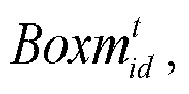


- updating a new ship target appeared at the moment t by a neural network detection result of the step C, which includes calculating a maximum value of the degrees of overlap obtained respectively between each


- The specific implementation of each module can be seen in the corresponding steps, and will not be described in detail in the disclosure.
- The specific examples described herein are merely illustrative of the spirit of the disclosure. Those skilled in the art to which the disclosure belongs can make various modifications or supplements to the specific examples described or replace the specific examples in a similar way without departing from the spirit of the disclosure or exceeding the scope defined in the appended claims.


wherein,

Claims (4)
- An automatic ship tracking method based on deep learning network and mean shift, comprising the following steps:step 1: collecting surveillance video data which comprises collecting coastal region surveillance video data under visible light and extracting each frame of image;step 2: performing preprocessing based on a video image obtained in the step 1 to extract a positive sample and a negative sample of a ship target;step 3: inputting the samples of the ship target in the video into a neural network to train a model by a region-based convolutional neural network method;step 4: extracting initial frame data of the video and performing ship detection and probability density calculation on initial moment data according to the trained model obtained in the step 3, wherein the probability density calculation is realized by dividing a gray color space of a target region to obtain a gray histogram formed by multiple equal intervals, and calculating the probability density according to a histogram interval to which a gray value of a pixel in the target region belongs; andstep 5: determining a ship tracking result at the current moment by a calculation result of a previous moment, which comprises the following processing:step A: taking ξ ship positions tracked at a moment t-1 as initial positions, respectively taking a center coordinate f 0 of each ship position as an initial target position of the ship tracked at a moment t, taking the f 0 as a center of a search window to obtain a center position coordinate f of a corresponding candidate ship, calculating a region histogram of a candidate position, and further calculating the probability density;step B: describing a degree of similarity between the ship model and the candidate ship by a Bhattacharyya coefficient, calculating a mean shift iteration equation in a center of the region, so that the model moves continuously towards a direction with a maximum color change until the last two moving distances are less than a corresponding preset threshold, finding a ship position obtained by a mean shift result at the moment t, setting that multiple ship positions Boxmt are obtained, and expressing an id th ship position as
 step C: by region-based convolutional neural network method, performing a ship detection on the image at time t, and obtaining the num th detection coordinate
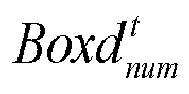


 step D: updating a new ship target appeared at the moment t by a neural network detection result of the step C, which comprises calculating a maximum value of the degrees of overlap obtained respectively between each


- The automatic ship tracking method based on deep learning network and mean shift according to claim 1, wherein a degree of overlap between each



- An automatic ship tracking system based on deep learning network and mean shift, comprising the following modules:a first module configured to collect surveillance video data which comprises collecting coastal region surveillance video data under visible light and extracting each frame of image;a second module configured to perform preprocessing based on a video image obtained by the first module to extract a positive sample and a negative sample of a ship target;a third module configured to input the samples of the ship target in the video into a neural network to train a model by a region-based convolutional neural network method;a fourth module configured to extract initial frame data of the video and perform ship detection and probability density calculation on initial moment data according to the trained model obtained by the third module, wherein the probability density calculation is realized by dividing a gray color space of a target region to obtain a gray histogram formed by multiple equal intervals, and calculating the probability density according to a histogram interval to which a gray value of a pixel in the target region belongs; anda fifth module configured to determine a ship tracking result at the current moment by a calculation result of a previous moment, which comprises the following ways:taking ξ ship positions tracked at a moment t-1 as initial positions, respectively taking a center coordinate f 0 of each ship position as an initial target position of the ship tracked at a moment t, taking the f 0 as a center of a search window to obtain a center position coordinate f of a corresponding candidate ship, calculating a region histogram of a candidate position, and further calculating the probability density;describing a degree of similarity between the ship model and the candidate ship by a Bhattacharyya coefficient, calculating a mean shift iteration equation in a center of the region, so that the model moves continuously towards a direction with a maximum color change until the last two moving distances are less than a corresponding preset threshold, finding a ship position obtained by a mean shift result at the moment t, setting that multiple ship positions Boxmt are obtained, and expressing an id th ship position as
 performing ship detection on an image at the moment t by the region-based convolutional neural network method, setting that a num th detection coordinate of multiple ships in the image at the moment t is


 updating a new ship target appeared at the moment t by a neural network detection result of the step C, which comprises calculating a maximum value of the degrees of overlap obtained respectively between each


- The automatic ship tracking system based on deep learning network and mean shift according to claim 3, wherein a degree of overlap between each


Applications Claiming Priority (2)
| Application Number | Priority Date | Filing Date | Title |
|---|---|---|---|
| CN201711324260.4A CN107818571B (en) | 2017-12-11 | 2017-12-11 | Ship automatic tracking method and system based on deep learning network and average drifting |
| PCT/CN2018/120294 WO2019101220A1 (en) | 2017-12-11 | 2018-12-11 | Deep learning network and average drift-based automatic vessel tracking method and system |
Publications (2)
| Publication Number | Publication Date |
|---|---|
| EP3633615A1 true EP3633615A1 (en) | 2020-04-08 |
| EP3633615A4 EP3633615A4 (en) | 2020-09-23 |
Family
ID=61605528
Family Applications (1)
| Application Number | Title | Priority Date | Filing Date |
|---|---|---|---|
| EP18880214.4A Withdrawn EP3633615A4 (en) | 2017-12-11 | 2018-12-11 | DEEP LEARNING NETWORK AND AVERAGE DRIFT BASED AUTOMATIC PROCEDURE AND SYSTEM FOR SHIP TRACKING |
Country Status (6)
| Country | Link |
|---|---|
| US (1) | US10706285B2 (en) |
| EP (1) | EP3633615A4 (en) |
| JP (1) | JP6759474B2 (en) |
| KR (1) | KR102129893B1 (en) |
| CN (1) | CN107818571B (en) |
| WO (1) | WO2019101220A1 (en) |
Cited By (1)
| Publication number | Priority date | Publication date | Assignee | Title |
|---|---|---|---|---|
| CN115423844A (en) * | 2022-09-01 | 2022-12-02 | 北京理工大学 | Target tracking method based on multi-module combination |
Families Citing this family (103)
| Publication number | Priority date | Publication date | Assignee | Title |
|---|---|---|---|---|
| CN107818571B (en) * | 2017-12-11 | 2018-07-20 | 珠海大横琴科技发展有限公司 | Ship automatic tracking method and system based on deep learning network and average drifting |
| CN108537826A (en) * | 2018-05-28 | 2018-09-14 | 深圳市芯汉感知技术有限公司 | A kind of Ship Target tracking based on manual intervention |
| CN109145836B (en) * | 2018-08-28 | 2021-04-16 | 武汉大学 | Vessel target video detection method based on deep learning network and Kalman filter |
| CN109241913B (en) * | 2018-09-10 | 2021-05-18 | 武汉大学 | Ship detection method and system combining significance detection and deep learning |
| CN109684953B (en) * | 2018-12-13 | 2021-05-14 | 北京小龙潜行科技有限公司 | Method and device for pig tracking based on target detection and particle filter algorithm |
| CN109859202B (en) * | 2019-02-18 | 2022-04-12 | 哈尔滨工程大学 | A deep learning detection method based on USV water surface optical target tracking |
| CN110232315A (en) * | 2019-04-29 | 2019-09-13 | 华为技术有限公司 | Object detection method and device |
| CN110287875B (en) * | 2019-06-25 | 2022-10-21 | 腾讯科技(深圳)有限公司 | Video object detection method and device, electronic equipment and storage medium |
| CN110532943A (en) * | 2019-08-28 | 2019-12-03 | 郑州轻工业学院 | Channel State Analysis Method Based on Camshift Algorithm and Image Frame by Frame Combination |
| CN112528715B (en) * | 2019-09-19 | 2024-05-28 | 杭州海康微影传感科技有限公司 | Ship monitoring method, device and equipment and storage medium |
| CN110717932B (en) * | 2019-09-21 | 2024-06-14 | 山西金智鸿阳科技有限公司 | A real-time tracking method for detecting the state of a scissor-type knife switch |
| CN110660082B (en) * | 2019-09-25 | 2022-03-08 | 西南交通大学 | A target tracking method based on graph convolution and trajectory convolution network learning |
| CN115066711B (en) * | 2019-11-15 | 2025-07-18 | 高通股份有限公司 | Permutation Invariant Convolution (PIC) for identifying long range activity |
| CN111161313B (en) * | 2019-12-16 | 2023-03-14 | 华中科技大学鄂州工业技术研究院 | Multi-target tracking method and device in video stream |
| CN111611836A (en) * | 2019-12-27 | 2020-09-01 | 珠海大横琴科技发展有限公司 | Vessel Detection Model Training and Vessel Tracking Method Based on Background Elimination |
| CN111311647B (en) * | 2020-01-17 | 2023-07-14 | 长沙理工大学 | A target tracking method and device based on global-local and Kalman filtering |
| SG10202001656VA (en) * | 2020-02-25 | 2021-09-29 | Emage Ai Pte Ltd | A computer implemented process to enhance edge defect detection and other defects in ophthalmic lenses |
| CN111444828B (en) * | 2020-03-25 | 2023-06-20 | 腾讯科技(深圳)有限公司 | Model training method, target detection method, device and storage medium |
| CN111738081A (en) * | 2020-05-20 | 2020-10-02 | 杭州电子科技大学 | A Deep Neural Network Sonar Target Detection Method Based on Difficult Sample Retraining |
| CN111738112B (en) * | 2020-06-10 | 2023-07-07 | 杭州电子科技大学 | Remote sensing ship image target detection method based on deep neural network and self-attention mechanism |
| CN111667509B (en) * | 2020-06-11 | 2023-05-26 | 中国矿业大学 | Automatic tracking method and system for moving target under condition that target and background colors are similar |
| CN111754545B (en) * | 2020-06-16 | 2024-05-03 | 江南大学 | IOU (input-output unit) matching-based double-filter video multi-target tracking method |
| CN111814734B (en) * | 2020-07-24 | 2024-01-26 | 南方电网数字电网研究院有限公司 | How to identify the status of the knife gate |
| US11742901B2 (en) * | 2020-07-27 | 2023-08-29 | Electronics And Telecommunications Research Institute | Deep learning based beamforming method and apparatus |
| CN111985363B (en) * | 2020-08-06 | 2022-05-06 | 武汉理工大学 | A system and method for ship name recognition based on deep learning framework |
| CN111898699B (en) * | 2020-08-11 | 2024-05-10 | 海之韵(苏州)科技有限公司 | Automatic detection and identification method for ship body target |
| CN111950519A (en) * | 2020-08-27 | 2020-11-17 | 重庆科技学院 | Two-column convolutional neural network crowd counting method based on detection and density estimation |
| CN112183946A (en) * | 2020-09-07 | 2021-01-05 | 腾讯音乐娱乐科技(深圳)有限公司 | Multimedia content evaluation method, device and training method thereof |
| CN112183232A (en) * | 2020-09-09 | 2021-01-05 | 上海鹰觉科技有限公司 | Method and system for location location of ship's hull number based on deep learning |
| CN114187321B (en) * | 2020-09-14 | 2024-11-19 | 中移(苏州)软件技术有限公司 | Target tracking method and device |
| CN112417955B (en) * | 2020-10-14 | 2024-03-05 | 国能大渡河沙坪发电有限公司 | Method and device for processing tour inspection video stream |
| CN112270661B (en) * | 2020-10-19 | 2024-05-07 | 北京宇航系统工程研究所 | A space environment monitoring method based on rocket telemetry video |
| CN112183470B (en) * | 2020-10-28 | 2022-07-19 | 长江大学 | Ship water gauge identification method and equipment and storage medium |
| CN112378397B (en) * | 2020-11-02 | 2023-10-10 | 中国兵器工业计算机应用技术研究所 | Unmanned aerial vehicle target tracking method and device and unmanned aerial vehicle |
| CN112308881B (en) * | 2020-11-02 | 2023-08-15 | 西安电子科技大学 | A Ship Multi-Target Tracking Method Based on Remote Sensing Image |
| CN112364763B (en) * | 2020-11-10 | 2024-01-26 | 南京农业大学 | Piglet sucking behavior monitoring system based on edge computing |
| CN112258549B (en) * | 2020-11-12 | 2022-01-04 | 珠海大横琴科技发展有限公司 | Ship target tracking method and device based on background elimination |
| CN114511793B (en) * | 2020-11-17 | 2024-04-05 | 中国人民解放军军事科学院国防科技创新研究院 | Unmanned aerial vehicle ground detection method and system based on synchronous detection tracking |
| CN112329707A (en) * | 2020-11-23 | 2021-02-05 | 珠海大横琴科技发展有限公司 | Unmanned aerial vehicle image ship tracking algorithm and device based on KCF filtering |
| CN112465867B (en) * | 2020-11-30 | 2024-01-05 | 南京莱斯电子设备有限公司 | A real-time detection and tracking method of infrared point targets based on convolutional neural network |
| CN112378458B (en) * | 2020-12-04 | 2022-06-03 | 四川长虹电器股份有限公司 | Operation monitoring method for unattended sand production ship |
| CN112507965A (en) * | 2020-12-23 | 2021-03-16 | 北京海兰信数据科技股份有限公司 | Target identification method and system of electronic lookout system |
| CN112866643A (en) * | 2021-01-08 | 2021-05-28 | 中国船舶重工集团公司第七0七研究所 | Multi-target visual management system and method for key areas in ship |
| CN112906463A (en) * | 2021-01-15 | 2021-06-04 | 上海东普信息科技有限公司 | Image-based fire detection method, device, equipment and storage medium |
| CN112767445B (en) * | 2021-01-22 | 2024-04-12 | 东南大学 | Ship target tracking method for video |
| CN112802050B (en) * | 2021-01-25 | 2024-04-16 | 商汤集团有限公司 | Network training, target tracking method and device, electronic device and storage medium |
| CN113283279B (en) * | 2021-01-25 | 2024-01-19 | 广东技术师范大学 | A method and device for multi-target tracking in videos based on deep learning |
| CN112949400B (en) * | 2021-01-26 | 2022-07-08 | 四川大学 | Animal intelligent experiment system and method based on deep learning |
| CN113804470B (en) * | 2021-04-14 | 2023-12-01 | 山东省计算中心(国家超级计算济南中心) | A fault detection feedback method for plug seedling cultivation line |
| CN113012203B (en) * | 2021-04-15 | 2023-10-20 | 南京莱斯电子设备有限公司 | A high-precision multi-target tracking method under complex backgrounds |
| CN113269204B (en) * | 2021-05-17 | 2022-06-17 | 山东大学 | Color stability analysis method and system for color direct part marking image |
| CN113313008B (en) * | 2021-05-26 | 2022-08-05 | 南京邮电大学 | Target and Recognition Tracking Method Based on YOLOv3 Network and Mean Shift |
| CN113313166B (en) * | 2021-05-28 | 2022-07-26 | 华南理工大学 | Ship target automatic labeling method based on feature consistency learning |
| CN113362373B (en) * | 2021-06-01 | 2023-12-15 | 北京首都国际机场股份有限公司 | Double-twin-network-based aircraft tracking method in complex apron area |
| CN113379603B (en) * | 2021-06-10 | 2024-03-15 | 大连海事大学 | A ship target detection method based on deep learning |
| CN113686314B (en) * | 2021-07-28 | 2024-02-27 | 武汉科技大学 | Monocular water target segmentation and monocular ranging method for shipborne cameras |
| CN113579545B (en) * | 2021-08-19 | 2024-11-15 | 航天智造(上海)科技有限责任公司 | An intelligent self-decision-making molten pool monitoring system |
| CN113705503B (en) * | 2021-09-02 | 2025-01-10 | 浙江索思科技有限公司 | An abnormal behavior detection system and method based on multimodal information fusion |
| CN113705502B (en) * | 2021-09-02 | 2024-08-02 | 浙江索思科技有限公司 | Ship target behavior understanding system integrating target detection and target tracking |
| CN113792633B (en) * | 2021-09-06 | 2023-12-22 | 北京工商大学 | A face tracking system and tracking method based on neural network and optical flow method |
| CN113793361B (en) * | 2021-09-16 | 2025-06-03 | 南京航空航天大学 | An improved KCF target tracking method combined with lightweight SSD |
| CN113554123B (en) * | 2021-09-18 | 2022-01-21 | 江苏禹治流域管理技术研究院有限公司 | Automatic sand production ship identification method based on acousto-optic linkage |
| CN114037733B (en) * | 2021-09-24 | 2024-10-29 | 西安电子科技大学 | SAR ship multi-target tracking method based on improved kernel correlation filter |
| CN113989659B (en) * | 2021-10-13 | 2025-02-11 | 中国空间技术研究院 | A fast ship target detection method for GEO remote sensing satellites |
| CN114610023B (en) * | 2022-02-21 | 2024-09-20 | 武汉理工大学 | A path tracking control method for unmanned ship |
| CN114782491B (en) * | 2022-04-19 | 2025-08-19 | 武汉华中天经通视科技有限公司 | Automatic extraction method of initial frame image target in target tracking |
| CN114936413B (en) * | 2022-04-21 | 2023-06-06 | 哈尔滨工程大学 | Neural Network Modeling Method for Hull Shape Optimization and Hull Shape Optimization Method |
| CN114758281A (en) * | 2022-04-28 | 2022-07-15 | 浙江省交通运输科学研究院 | Fender device impact test method, device, equipment and medium |
| CN114627683B (en) * | 2022-05-13 | 2022-09-13 | 深圳海卫通网络科技有限公司 | Early warning method, device, equipment, medium and system for abnormal driving behavior of ship |
| CN114764801B (en) * | 2022-05-19 | 2024-12-13 | 中国科学院微电子研究所 | Weak small ship target fusion detection method and device based on multi-visual salient features |
| CN115016341B (en) * | 2022-05-27 | 2024-07-30 | 武汉理工大学 | Ship remote driving fault-tolerant control method and system in communication delay state |
| CN114758363B (en) * | 2022-06-16 | 2022-08-19 | 四川金信石信息技术有限公司 | Insulating glove wearing detection method and system based on deep learning |
| CN115272990B (en) * | 2022-07-25 | 2025-08-22 | 中国人民解放军国防科技大学 | Nearshore ship target detection method based on anchor frame guided attention refinement network |
| CN115294043A (en) * | 2022-07-27 | 2022-11-04 | 颜旭东 | Medical image focal zone analysis system based on target tracking algorithm |
| CN115550564B (en) * | 2022-09-16 | 2026-01-02 | 智慧互通科技股份有限公司 | Video processing method and apparatus based on FPGA platform |
| KR102955985B1 (en) | 2022-09-26 | 2026-04-23 | 김준연 | A multi-channel artificial intelligence network-based ship detection, classification, and tracking system |
| CN115601397A (en) * | 2022-10-26 | 2023-01-13 | 天津大学(Cn) | Ship trajectory tracking and prediction method based on monocular camera |
| CN115661766B (en) * | 2022-10-31 | 2026-04-21 | 上海海事大学 | A Deep Learning-Based Intelligent Ship Safety Monitoring Method and System |
| CN115690061B (en) * | 2022-11-08 | 2024-01-05 | 北京国泰星云科技有限公司 | Vision-based container terminal truck collection detection method |
| CN116303523B (en) * | 2022-11-30 | 2023-10-17 | 杭州数聚链科技有限公司 | Automatic cargo ship identification sampling method and system |
| CN115903622B (en) * | 2022-12-22 | 2025-08-05 | 铭派科技集团有限公司 | A stable system for integrating industrial control host with ship system |
| CN115942120B (en) * | 2022-12-26 | 2024-11-22 | 南京莱斯网信技术研究院有限公司 | A method for tracking ships by smooth linkage of cameras |
| CN115797411B (en) * | 2023-01-17 | 2023-05-26 | 长江勘测规划设计研究有限责任公司 | Method for online recognition of hydropower station cable bridge deformation by utilizing machine vision |
| CN116188519B (en) * | 2023-02-07 | 2023-10-03 | 中国人民解放军海军航空大学 | A method and system for estimating ship target motion status based on video satellites |
| CN116310953B (en) * | 2023-02-20 | 2025-12-30 | 苏州热工研究院有限公司 | A Smart Detection Method for Floating Bollard Detachment in Cold Source Interception Nets |
| CN115859485B (en) * | 2023-02-27 | 2023-05-23 | 青岛哈尔滨工程大学创新发展中心 | Streamline seed point selection method based on ship appearance characteristics |
| CN116246205B (en) * | 2023-02-27 | 2024-04-19 | 杭州数尔安防科技股份有限公司 | Optimization method and system for ship tracking and character recognition |
| CN116363169A (en) * | 2023-03-14 | 2023-06-30 | 西湾智慧(广东)信息科技有限公司 | A ship target tracking and detection method deployed in k8s |
| CN116703982B (en) * | 2023-03-15 | 2025-11-07 | 中国科学院微电子研究所 | Weak and small ship target tracking method, equipment and medium with multispectral visual significance |
| CN116343057B (en) * | 2023-03-16 | 2026-01-23 | 电子科技大学 | Ship target detection and identification method combining SAR (synthetic aperture radar) with optical image |
| CN116300480B (en) * | 2023-05-23 | 2023-08-01 | 西南科技大学 | Radioactive Source Search Method Based on Improved Particle Filter and Biologically Inspired Neural Network |
| CN116385984B (en) * | 2023-06-05 | 2023-09-01 | 武汉理工大学 | Automatic detection method and device for ship draft |
| CN117011768B (en) * | 2023-08-07 | 2024-07-23 | 哈尔滨工程大学 | Multi-ship target detection and tracking method based on robust data association |
| CN116823872B (en) * | 2023-08-25 | 2024-01-26 | 尚特杰电力科技有限公司 | Fan inspection method and system based on target tracking and image segmentation |
| CN117576164B (en) * | 2023-12-14 | 2024-05-03 | 中国人民解放军海军航空大学 | Tracking method of moving targets on land and sea in remote sensing video based on joint feature learning |
| CN118007712B (en) * | 2024-01-17 | 2024-08-30 | 广州广检建设工程检测中心有限公司 | Displacement measurement method of foundation pit support structure displacement measurement system and related system |
| CN117688498B (en) * | 2024-01-30 | 2024-05-03 | 广州中海电信有限公司 | Ship comprehensive safety state monitoring system based on ship-shore cooperation |
| CN117930854B (en) * | 2024-01-31 | 2024-08-06 | 武汉科技大学 | Self-adaptive tracking system and tracking method for water surface target |
| CN118196682B (en) * | 2024-03-13 | 2024-11-05 | 七台河市公安局 | Target person positioning and track tracking method based on image processing |
| CN118397376B (en) * | 2024-06-21 | 2025-05-06 | 天津生态城环保有限公司 | Soil pollutant identification and route tracking method and system based on artificial intelligence |
| CN118537760B (en) * | 2024-07-26 | 2024-10-11 | 浙江华是科技股份有限公司 | Unmanned aerial vehicle-based water bayonet detection method and system |
| CN119559414B (en) * | 2025-01-27 | 2025-05-27 | 中国船舶集团有限公司第七〇七研究所 | Ship safety monitoring methods, devices, equipment, media and program products |
| CN120832594B (en) * | 2025-09-16 | 2025-12-12 | 六晟信息科技(杭州)有限公司 | Data processing method for AI data management platform |
Family Cites Families (23)
| Publication number | Priority date | Publication date | Assignee | Title |
|---|---|---|---|---|
| JP3997062B2 (en) * | 2001-05-30 | 2007-10-24 | 株式会社日立製作所 | Image monitoring device |
| JP4482623B2 (en) * | 2003-11-18 | 2010-06-16 | 国立大学法人東京海洋大学 | Extraction method of ships from time series voyage images |
| US7899253B2 (en) * | 2006-09-08 | 2011-03-01 | Mitsubishi Electric Research Laboratories, Inc. | Detecting moving objects in video by classifying on riemannian manifolds |
| US8374388B2 (en) * | 2007-12-28 | 2013-02-12 | Rustam Stolkin | Real-time tracking of non-rigid objects in image sequences for which the background may be changing |
| GB2492247B (en) * | 2008-03-03 | 2013-04-10 | Videoiq Inc | Dynamic object classification |
| GB0818561D0 (en) * | 2008-10-09 | 2008-11-19 | Isis Innovation | Visual tracking of objects in images, and segmentation of images |
| US8401239B2 (en) * | 2009-03-30 | 2013-03-19 | Mitsubishi Electric Research Laboratories, Inc. | Object tracking with regressing particles |
| US8335348B2 (en) * | 2009-12-14 | 2012-12-18 | Indian Institute Of Technology Bombay | Visual object tracking with scale and orientation adaptation |
| US8712096B2 (en) * | 2010-03-05 | 2014-04-29 | Sri International | Method and apparatus for detecting and tracking vehicles |
| WO2012006578A2 (en) * | 2010-07-08 | 2012-01-12 | The Regents Of The University Of California | End-to-end visual recognition system and methods |
| US8615105B1 (en) * | 2010-08-31 | 2013-12-24 | The Boeing Company | Object tracking system |
| CN102081801B (en) * | 2011-01-26 | 2014-04-16 | 上海交通大学 | Multi-feature adaptive fused ship tracking and track detecting method |
| JP5719230B2 (en) * | 2011-05-10 | 2015-05-13 | キヤノン株式会社 | Object recognition device, method for controlling object recognition device, and program |
| US9832452B1 (en) * | 2013-08-12 | 2017-11-28 | Amazon Technologies, Inc. | Robust user detection and tracking |
| CN104182772B (en) * | 2014-08-19 | 2017-10-24 | 大连理工大学 | A Gesture Recognition Method Based on Deep Learning |
| CN104809917B (en) | 2015-03-23 | 2017-05-31 | 南通大学 | Ship real-time tracking monitoring method |
| CN105184271A (en) * | 2015-09-18 | 2015-12-23 | 苏州派瑞雷尔智能科技有限公司 | Automatic vehicle detection method based on deep learning |
| CA3017027C (en) * | 2016-03-17 | 2024-06-25 | Avigilon Corporation | System and method for training object classifier by machine learning |
| CN106372590A (en) | 2016-08-29 | 2017-02-01 | 江苏科技大学 | Sea surface ship intelligent tracking system and method based on machine vision |
| CN106910204B (en) | 2016-12-30 | 2018-04-27 | 中国人民解放军空军预警学院监控系统工程研究所 | A kind of method and system to the automatic Tracking Recognition of sea ship |
| CN107291232A (en) * | 2017-06-20 | 2017-10-24 | 深圳市泽科科技有限公司 | A kind of somatic sensation television game exchange method and system based on deep learning and big data |
| CN107358176A (en) * | 2017-06-26 | 2017-11-17 | 武汉大学 | Sorting technique based on high score remote sensing image area information and convolutional neural networks |
| CN107818571B (en) * | 2017-12-11 | 2018-07-20 | 珠海大横琴科技发展有限公司 | Ship automatic tracking method and system based on deep learning network and average drifting |
-
2017
- 2017-12-11 CN CN201711324260.4A patent/CN107818571B/en active Active
-
2018
- 2018-12-11 WO PCT/CN2018/120294 patent/WO2019101220A1/en not_active Ceased
- 2018-12-11 JP JP2019572816A patent/JP6759474B2/en not_active Expired - Fee Related
- 2018-12-11 EP EP18880214.4A patent/EP3633615A4/en not_active Withdrawn
- 2018-12-11 KR KR1020207000066A patent/KR102129893B1/en not_active Expired - Fee Related
- 2018-12-11 US US16/627,485 patent/US10706285B2/en not_active Expired - Fee Related
Cited By (1)
| Publication number | Priority date | Publication date | Assignee | Title |
|---|---|---|---|---|
| CN115423844A (en) * | 2022-09-01 | 2022-12-02 | 北京理工大学 | Target tracking method based on multi-module combination |
Also Published As
| Publication number | Publication date |
|---|---|
| US20200160061A1 (en) | 2020-05-21 |
| KR102129893B1 (en) | 2020-07-03 |
| KR20200006167A (en) | 2020-01-17 |
| US10706285B2 (en) | 2020-07-07 |
| JP2020526826A (en) | 2020-08-31 |
| WO2019101220A1 (en) | 2019-05-31 |
| JP6759474B2 (en) | 2020-09-23 |
| EP3633615A4 (en) | 2020-09-23 |
| CN107818571A (en) | 2018-03-20 |
| CN107818571B (en) | 2018-07-20 |
Similar Documents
| Publication | Publication Date | Title |
|---|---|---|
| US10706285B2 (en) | Automatic ship tracking method and system based on deep learning network and mean shift | |
| CN114299417B (en) | A multi-target tracking method based on radar and vision fusion | |
| CN109800689B (en) | Target tracking method based on space-time feature fusion learning | |
| CN116403139A (en) | A Visual Tracking and Localization Method Based on Target Detection | |
| CN109145836B (en) | Vessel target video detection method based on deep learning network and Kalman filter | |
| CN110660082A (en) | A target tracking method based on graph convolution and trajectory convolution network learning | |
| CN113592905B (en) | Vehicle driving track prediction method based on monocular camera | |
| CN112541403B (en) | A method for indoor person fall detection using infrared cameras | |
| CN113743260B (en) | A pedestrian tracking method under dense crowd flow on subway platforms | |
| CN106355604A (en) | Target image tracking method and system | |
| CN103593679A (en) | Visual human-hand tracking method based on online machine learning | |
| CN116027324A (en) | Fall detection method and device based on millimeter wave radar and millimeter wave radar equipment | |
| Zheng et al. | Dim target detection method based on deep learning in complex traffic environment | |
| CN115359091B (en) | A method for detecting and tracking armor plates for mobile robots | |
| CN106447698A (en) | Multi-pedestrian tracking method and system based on distance sensor | |
| CN120496360A (en) | Traffic scene risk identification method, equipment and storage medium considering dynamic and static information fusion | |
| Allak et al. | Siamese neural networks in unmanned aerial vehicle target tracking process | |
| CN120635802A (en) | Aerial target detection method based on image recognition | |
| CN118609069A (en) | A method for monitoring industrial spillage based on deep learning and graph neural network | |
| CN117130010B (en) | Obstacle perception method and system for unmanned driving and unmanned vehicle | |
| CN110503663B (en) | Random multi-target automatic detection tracking method based on frame extraction detection | |
| CN121232610A (en) | Remote Intelligent Control Method and System for Electric Ships Based on Cloud-Edge Collaboration | |
| CN121708046A (en) | Multi-mode remote sensing target tracking positioning and intention judging method and device | |
| CN121527126A (en) | Real-time tracking system and method for slow-moving small targets in complex low-altitude environments using multimodal fusion | |
| CN115410097A (en) | A low-altitude UAV video tracking method |
Legal Events
| Date | Code | Title | Description |
|---|---|---|---|
| STAA | Information on the status of an ep patent application or granted ep patent |
Free format text: STATUS: THE INTERNATIONAL PUBLICATION HAS BEEN MADE |
|
| PUAI | Public reference made under article 153(3) epc to a published international application that has entered the european phase |
Free format text: ORIGINAL CODE: 0009012 |
|
| STAA | Information on the status of an ep patent application or granted ep patent |
Free format text: STATUS: REQUEST FOR EXAMINATION WAS MADE |
|
| 17P | Request for examination filed |
Effective date: 20200102 |
|
| AK | Designated contracting states |
Kind code of ref document: A1 Designated state(s): AL AT BE BG CH CY CZ DE DK EE ES FI FR GB GR HR HU IE IS IT LI LT LU LV MC MK MT NL NO PL PT RO RS SE SI SK SM TR |
|
| AX | Request for extension of the european patent |
Extension state: BA ME |
|
| A4 | Supplementary search report drawn up and despatched |
Effective date: 20200820 |
|
| RIC1 | Information provided on ipc code assigned before grant |
Ipc: G06T 7/246 20170101AFI20200814BHEP Ipc: G06T 7/277 20170101ALI20200814BHEP |
|
| DAV | Request for validation of the european patent (deleted) | ||
| DAX | Request for extension of the european patent (deleted) | ||
| STAA | Information on the status of an ep patent application or granted ep patent |
Free format text: STATUS: EXAMINATION IS IN PROGRESS |
|
| 17Q | First examination report despatched |
Effective date: 20220414 |
|
| STAA | Information on the status of an ep patent application or granted ep patent |
Free format text: STATUS: THE APPLICATION IS DEEMED TO BE WITHDRAWN |
|
| 18D | Application deemed to be withdrawn |
Effective date: 20240702 |