EP3633271A1 - Monitoring system for a door of a domestic appliance - Google Patents
Monitoring system for a door of a domestic appliance Download PDFInfo
- Publication number
- EP3633271A1 EP3633271A1 EP18198037.6A EP18198037A EP3633271A1 EP 3633271 A1 EP3633271 A1 EP 3633271A1 EP 18198037 A EP18198037 A EP 18198037A EP 3633271 A1 EP3633271 A1 EP 3633271A1
- Authority
- EP
- European Patent Office
- Prior art keywords
- door
- monitoring system
- sensor
- door sensor
- gyroscope
- Prior art date
- Legal status (The legal status is an assumption and is not a legal conclusion. Google has not performed a legal analysis and makes no representation as to the accuracy of the status listed.)
- Granted
Links
Images





Classifications
-
- E—FIXED CONSTRUCTIONS
- E05—LOCKS; KEYS; WINDOW OR DOOR FITTINGS; SAFES
- E05F—DEVICES FOR MOVING WINGS INTO OPEN OR CLOSED POSITION; CHECKS FOR WINGS; WING FITTINGS NOT OTHERWISE PROVIDED FOR, CONCERNED WITH THE FUNCTIONING OF THE WING
- E05F15/00—Power-operated mechanisms for wings
- E05F15/70—Power-operated mechanisms for wings with automatic actuation
-
- F—MECHANICAL ENGINEERING; LIGHTING; HEATING; WEAPONS; BLASTING
- F24—HEATING; RANGES; VENTILATING
- F24C—DOMESTIC STOVES OR RANGES ; DETAILS OF DOMESTIC STOVES OR RANGES, OF GENERAL APPLICATION
- F24C15/00—Details
- F24C15/02—Doors specially adapted for stoves or ranges
-
- F—MECHANICAL ENGINEERING; LIGHTING; HEATING; WEAPONS; BLASTING
- F24—HEATING; RANGES; VENTILATING
- F24C—DOMESTIC STOVES OR RANGES ; DETAILS OF DOMESTIC STOVES OR RANGES, OF GENERAL APPLICATION
- F24C7/00—Stoves or ranges heated by electric energy
- F24C7/08—Arrangement or mounting of control or safety devices
-
- G—PHYSICS
- G01—MEASURING; TESTING
- G01C—MEASURING DISTANCES, LEVELS OR BEARINGS; SURVEYING; NAVIGATION; GYROSCOPIC INSTRUMENTS; PHOTOGRAMMETRY OR VIDEOGRAMMETRY
- G01C19/00—Gyroscopes; Turn-sensitive devices using vibrating masses; Turn-sensitive devices without moving masses; Measuring angular rate using gyroscopic effects
-
- G—PHYSICS
- G01—MEASURING; TESTING
- G01P—MEASURING LINEAR OR ANGULAR SPEED, ACCELERATION, DECELERATION, OR SHOCK; INDICATING PRESENCE, ABSENCE, OR DIRECTION, OF MOVEMENT
- G01P15/00—Measuring acceleration; Measuring deceleration; Measuring shock, i.e. sudden change of acceleration
- G01P15/18—Measuring acceleration; Measuring deceleration; Measuring shock, i.e. sudden change of acceleration in two or more dimensions
-
- A—HUMAN NECESSITIES
- A47—FURNITURE; DOMESTIC ARTICLES OR APPLIANCES; COFFEE MILLS; SPICE MILLS; SUCTION CLEANERS IN GENERAL
- A47L—DOMESTIC WASHING OR CLEANING; SUCTION CLEANERS IN GENERAL
- A47L15/00—Washing or rinsing machines for crockery or tableware
- A47L15/42—Details
- A47L15/4251—Details of the casing
- A47L15/4257—Details of the loading door
-
- D—TEXTILES; PAPER
- D06—TREATMENT OF TEXTILES OR THE LIKE; LAUNDERING; FLEXIBLE MATERIALS NOT OTHERWISE PROVIDED FOR
- D06F—LAUNDERING, DRYING, IRONING, PRESSING OR FOLDING TEXTILE ARTICLES
- D06F39/00—Details of washing machines not specific to a single type of machines covered by groups D06F9/00 - D06F27/00
- D06F39/12—Casings; Tubs
- D06F39/14—Doors or covers; Securing means therefor
-
- E—FIXED CONSTRUCTIONS
- E05—LOCKS; KEYS; WINDOW OR DOOR FITTINGS; SAFES
- E05Y—INDEXING SCHEME ASSOCIATED WITH SUBCLASSES E05D AND E05F, RELATING TO CONSTRUCTION ELEMENTS, ELECTRIC CONTROL, POWER SUPPLY, POWER SIGNAL OR TRANSMISSION, USER INTERFACES, MOUNTING OR COUPLING, DETAILS, ACCESSORIES, AUXILIARY OPERATIONS NOT OTHERWISE PROVIDED FOR, APPLICATION THEREOF
- E05Y2400/00—Electronic control; Electrical power; Power supply; Power or signal transmission; User interfaces
- E05Y2400/10—Electronic control
- E05Y2400/44—Sensors not directly associated with the wing movement
-
- F—MECHANICAL ENGINEERING; LIGHTING; HEATING; WEAPONS; BLASTING
- F25—REFRIGERATION OR COOLING; COMBINED HEATING AND REFRIGERATION SYSTEMS; HEAT PUMP SYSTEMS; MANUFACTURE OR STORAGE OF ICE; LIQUEFACTION SOLIDIFICATION OF GASES
- F25D—REFRIGERATORS; COLD ROOMS; ICE-BOXES; COOLING OR FREEZING APPARATUS NOT OTHERWISE PROVIDED FOR
- F25D23/00—General constructional features
- F25D23/02—Doors; Covers
-
- F—MECHANICAL ENGINEERING; LIGHTING; HEATING; WEAPONS; BLASTING
- F25—REFRIGERATION OR COOLING; COMBINED HEATING AND REFRIGERATION SYSTEMS; HEAT PUMP SYSTEMS; MANUFACTURE OR STORAGE OF ICE; LIQUEFACTION SOLIDIFICATION OF GASES
- F25D—REFRIGERATORS; COLD ROOMS; ICE-BOXES; COOLING OR FREEZING APPARATUS NOT OTHERWISE PROVIDED FOR
- F25D2700/00—Means for sensing or measuring; Sensors therefor
- F25D2700/02—Sensors detecting door opening
Definitions
- the present invention relates to a monitoring system for a door of a domestic appliance. Further, the present invention relates to a domestic appliance.
- a detection system may be provided for detecting if said door or device is in an opened, closed state or intermediate state between said opened and closed state.
- a detection system may be provided for detecting if said door or device is in an opened, closed state or intermediate state between said opened and closed state.
- Conventional systems for detecting the opening angle of the door comprise sensors arranged at the door hinge or close to said door hinge. In this case it is difficult to detect exactly the opening angle of the door.
- Other system comprises sensors arranged in positions, where the temperature is very high. Said high temperature impairs the accuracy of the sensor.
- the object is achieved by the monitoring system according to claim 1.
- a monitoring system for a door of a domestic appliance wherein:
- the core of the present invention is the use of the inertial measurement unit (IMU) with the at least one accelerometer and/or at least one gyroscope.
- the inertial measurement unit (IMU) is a compact device arrangeable in numerous suitable positions.
- a combination of the accelerometer and gyroscope allows the determination of the angle, the angular speed and the angular acceleration of the door by low complexity.
- the door sensor is arrangeable or arranged at a maximum distance from a hinge axis of the door. Said maximum distance contributes to an improved measuring accuracy.
- the door sensor is arrangeable or arranged within an upper portion of the door, preferably within an upper third of said door.
- the door sensor may be arrangeable or arranged within an inner portion of the door, preferably within an upper third of the inner portion of said door.
- the door sensor is arrangeable or arranged in a low temperature area of the door.
- the door sensor is arrangeable or arranged within a door handle of the door.
- the door sensor may be arrangeable or arranged within a front panel of the door.
- the accelerometer may include one or more microelectromechanical systems (MEMS).
- MEMS microelectromechanical systems
- the accelerometer is a tri-axial accelerometer, wherein the three axes are orthogonal to each other.
- the gyroscope may include one or more microelectromechanical systems (MEMS).
- MEMS microelectromechanical systems
- the gyroscope is a tri-axial gyroscope, wherein the three axes are orthogonal to each other.
- the monitoring system may be provided for indicating the angle, the angular speed and/or the angular acceleration of the door, wherein said door is manually and/or automatically openable and closable.
- the monitoring system may be provided for controlling the angle, the angular speed and/or the angular acceleration of the door, wherein said door is automatically openable and closable by at least one motor.
- the monitoring system is provided for varying or keeping constant the angular speed of the door during the automatic opening and/or closing said door.
- the monitoring system may be provided for a drop down door.
- the monitoring system may be provided for a swing door.
- the present invention relates to a domestic appliance comprising at least one door, wherein said domestic appliance comprises at least one monitoring system mentioned above.
- FIG 1 illustrates a schematic perspective view of a domestic appliance 10 with a monitoring system according to a first embodiment of the present invention.
- the domestic appliance 10 is a cooking oven.
- the domestic appliance 10 may be an arbitrary domestic appliance.
- the domestic appliance 10 comprises a door 12 and a front panel 14.
- a user interface 16 is integrated within said front panel 14.
- a door handle 18 is attached at the door 12.
- the door 12 is a drop down door.
- a horizontal hinge axis 20 extends in the lower portion of the door 12, while the door handle 18 is attached in the upper portion of said door 12. The terms “lower” and “upper” relate to the closed state of the door 12.
- the monitoring system comprises a door sensor 22 arranged within the door handle 18.
- the door sensor 22 is arranged in low temperature area of the door 12.
- the low temperature area avoids measurement errors of the door sensor 22.
- the distance R between the door sensor 22 and the horizontal hinge axis 20 is maximised as possible.
- the big distance R between the door sensor 22 and the horizontal hinge axis 20 allows a high precision of said door sensor 22.
- the door sensor 22 is an inertial sensor.
- the door sensor 22 is an inertial measurement unit (IMU), wherein said inertial measurement unit includes at least one accelerometer and at least one gyroscope.
- the accelerometer is provided for detecting a linear acceleration of the door sensor 22.
- the gyroscope is provided for detecting a rotational speed ⁇ of the door sensor 22 relating to an axis.
- the unit of said rotational speed ⁇ is degrees per second.
- the accelerometer as well as the gyroscope includes one or more microelectromechanical systems (MEMS).
- MEMS microelectromechanical systems
- Said microelectromechanical systems are suitable for inertial measurements.
- the microelectromechanical systems are realised by low costs, have small sizes and cause only low power consumption.
- the accelerometer is a tri-axial accelerometer
- the gyroscope is a tri-axial gyroscope, wherein the three axes are orthogonal to each other.
- the accelerometer and the gyroscope have to be calibrated according to their applications.
- the distance R between the door sensor 22 and the horizontal hinge axis 20 is constant, while the movement of the door 12 is circular.
- the distance R corresponds with the radius R of the orbit of the door sensor 22.
- Said radius R is defined as the horizontal length of the inertial measurement unit.
- the angle ⁇ of the door 12 starts from the closed state of said door 12.
- the door sensor 22 effectively detects the angle ⁇ , the angular speed and the angular acceleration of the door 12.
- the acceleration of the door 12 may be directly provided by the door sensor 22, if the accelerometer is equipped with a micro controller. If said accelerometer is not equipped with the micro controller, then an output signal value is provided for a control unit. On the basis of input data, i.e. directly detected acceleration values or output signal values, the control unit compares duty cycle data with firmware set up data and sends an output signal to a motor in order to adjust the opening speed of the door 12. The opening speed of the door 12 may be speeded up, kept constant or slowed down.
- the door sensor 22 is connected to a control unit of the domestic appliance 10. Said control unit is not explicitly shown. Preferably, the door sensor 22 is connected to the control unit via cables.
- the control unit is suitable for an automatic door 12 as well as for a manual door 12. In the case of the automatic door 12, the control unit is connected to at least one motor for driving said door 12. The control unit activates and deactivated the motor and controls the speed and the acceleration of said motor.
- the control unit is connected to an output device for indicating the current state of said door 12.
- the information of the current state of said door 12 may be used for controlling a cooking process. For example, some heating operation are activated only, if the door 12 is actually closed.
- the control unit may output a warning signal, if the door 12 is not correctly closed. Further, the control unit may output a signal indicating that a lighting device in the domestic appliance 10 has to be switched on or off.
- the door sensor 22 mentioned above may replace a classical mechanical door switch with a plunger detecting the opening and closing state of the door 12. Since the mechanical door switch with the horizontal plunger has a tolerance depending on its assembly position, a wrong signal may be delivered. This is avoided by the door sensors and the related control unit according to the present invention.
- FIG 2 illustrates a schematic perspective view of the domestic appliance 10 with the monitoring system according to the first embodiment of the present invention.
- the door 12 is partially opened to an angle ⁇ .
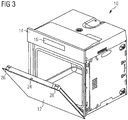
- FIG 3 illustrates a schematic perspective view of the domestic appliance 10 with the monitoring system according to a second embodiment of the present invention.
- the domestic appliance 10 comprises the door 12 and the front panel 14, wherein the user interface 16 is integrated within said front panel 14.
- the door 12 of the second embodiment does not include any door handle 18.
- the door 12 of the second embodiment is also a drop down door.
- the monitoring system comprises a central door sensor 24 and two lateral door sensors 26 and 28.
- the monitoring system may comprise the central door sensor 24 and/or at least one lateral door sensor 26 and/or 28.
- the central door sensor 24 and the lateral door sensors 26 and 28 are arranged within the inner upper portion of the door 12.
- the central door sensor 24 is arranged within a central inner upper portion of the door 12, while the lateral door sensors 26 and 28 are arranged in the inner upper corners of the door 12.
- the term "inner upper” relates to the closed state of the door 12.
- the door sensors 22, 24, 26, 28, 30 and 32 may be arranged in different positions of the door 12.
- the door sensors 22, 24, 26, 28, 30 and 32 mentioned above are arranged in preferred positions.
- only one single door sensor 22, 24, 26, 28, 30 or 32 including the accelerometer and the gyroscope is a preferred solution.
- FIG 4 illustrates a schematic perspective view of the domestic appliance 10 with the monitoring system according to the second embodiment of the present invention.
- FIG 4 the partially opened state of the door 12 and a completely opened state of said door 12 are shown, wherein the door 12 in the completely opened state is represented by dashed lines.
- the door 12 In the partially opened state, the door 12 is opened to the angle ⁇ .
- the door 12 In the completely opened state, the door 12 is opened to the angle ⁇ '.
- the position vector R defines the position of the central door sensor 24.
- the position vector R' defines the position of the central door sensor 24 in the completely opened state of the door 12.
- FIG 5 illustrates a schematic perspective view of the domestic appliance 10 with the monitoring system according to a third embodiment of the present invention.
- the domestic appliance 10 comprises the door 12 and the front panel 14, wherein the user interface 16 is integrated within said front panel 14.
- the door 12 of the third embodiment does not include any door handle 18.
- the door 12 of the third embodiment is a swing door with hinges on the right hand side as shown or a drop down door.
- the monitoring system comprises an inner door sensor 30 and optionally an outer door sensor 32.
- the inner door sensor 30 and/or the outer door sensor 32 are arranged within the upper portion of the door 12.
- the inner door sensor 30 is arranged in a central position of the upper portion of the door 12.
- the outer door sensor 32 is arranged opposite to the hinge of the door 12.
- FIG 6 illustrates a schematic perspective view of the domestic appliance 10 with the monitoring system according to a fourth embodiment of the present invention.
- FIG 6 shows both versions of the door 12, i.e. the swing door and the drop down door, in one picture.
- the hinge axes 20 and 34 and positions of the sensors 30 and 32 related to said hinge axes 20 and 34 are shown.
- the user interface 16 is integrated within door 12.
- the horizontal hinge axis 20 extends in the lower portion of the door 12 in the drop down door version, while a vertical hinge axis 34 extends on the right hand side of the door 12 in the swing door version.
- the inner door sensor 30 is arranged in the upper central portion of the door 12 and at the distance R from the horizontal hinge axis 20.
- the outer door sensor 32 is arranged on the left hand side in the upper portion of the door 12 and at a distance R1 from the vertical hinge axis 34.
- the distance R between the inner door sensor 30 and the horizontal hinge axis 20 is as big as possible.
- the big distance R between the outer door sensor 30 and the horizontal hinge axis 20 allows a high measurement precision of the monitoring system.
- the distance R1 between the outer door sensor 32 and the vertical hinge axis 34 is also as big as possible.
- the big distance R1 between the outer door sensor 32 and the vertical hinge axis 34 allows the high measurement precision of the monitoring system.
- the door sensors 30 and 32 are distant from the corresponding hinge axes 20 and 34, respectively, resulting in an increased measurement precision.
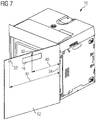
- FIG 7 illustrates a schematic perspective view of the domestic appliance 10 with the monitoring system according to the fourth embodiment of the present invention.
- the door 12 is opened as a swing door around the vertical hinge axis 34.
- the outer door sensor 32 is arranged at the distance R1 from the vertical hinge axis 34.
- the inner door sensor 30 is arranged at a smaller distance R2 from the vertical hinge axis 34, but preferably close to the user interface 16.
- the inner door sensor 30 is a part of the user interface 16, which allows an easy assembling.
- the present invention allows the monitoring of the states of the door 12 by low complexity.
- the door sensors 22, 24, 26, 28, 30 and 32 are arranged far away from the corresponding hinge axes 20 and 34, respectively, resulting in an increased accuracy of measurements. Further, the door sensors 22, 24, 26, 28, 30 and 32 are arranged in low temperature areas, so that measurement errors due to too high temperatures are avoided.
- the door sensors 22, 24, 26, 28, 30 and 32 are very small and arrangeable within the door handle 18 or the door 12.
- FIG 8 illustrates a schematic diagram of a path 40 of the door sensor 22 between a closed state 36 and an opened state 38 of the door 12 of the domestic appliance 10 according to the present invention.
- the door 12 is a drop down door with the horizontal hinge axis 20, wherein the opening angle of said door 12 is 90 degrees.
- the door sensor 22 is an inertial measurement unit (IMU).
- the path 40 of the door sensor 22 is a circular path. The radius R of said circular path corresponds with the distance R between door sensor 22 and horizontal hinge axis 20.
- the radial acceleration a R as well as the tangential acceleration a T are both directly proportional to the radius R.
- the most internal motion unit (IMU) systems use a gyroscope in order to smooth out any accelerometer error.
- the gyroscope detects the rotational movement in degrees per second around a specified axis.
- the gyroscope responds very fast, so that a quick response to a change of the opening angle ⁇ of the door 12 is obtained.
- the gyroscope is not free from noise as well.
- the gyroscope detects rotations but is less sensitive to linear mechanical movements. Furthermore, the gyroscope can drift, so that it does not come back to the zero-rate value when the rotation stops.
- the inertial motion unit IMU merges these two sensors for giving a quick response, which is sufficiently accurate. This combination solves the problems of the accelerometer and the gyroscope mentioned above.
- the inertial motion unit (IMU) directly provides the opening angle ⁇ and the rotational speed ⁇ in degrees per second of the door 12, if said inertial motion unit (IMU) is equipped with a micro controller. If said inertial motion unit (IMU) is not equipped with the micro controller, then output signal values are provided for a control unit. On the basis of input data the control unit compares duty cycle data with firmware set up data and sends an output signal to a motor in order to adjust the opening speed of the door 12. The opening speed of the door 12 may be speeded up, kept constant or slowed down.
Landscapes
- Engineering & Computer Science (AREA)
- Chemical & Material Sciences (AREA)
- Combustion & Propulsion (AREA)
- Mechanical Engineering (AREA)
- General Engineering & Computer Science (AREA)
- Physics & Mathematics (AREA)
- General Physics & Mathematics (AREA)
- Radar, Positioning & Navigation (AREA)
- Remote Sensing (AREA)
- Power-Operated Mechanisms For Wings (AREA)
Abstract
Description
- The present invention relates to a monitoring system for a door of a domestic appliance. Further, the present invention relates to a domestic appliance.
- For a door or another openable and closable access device of a domestic appliance a detection system may be provided for detecting if said door or device is in an opened, closed state or intermediate state between said opened and closed state. For an automatic door it is very important to control the opening and closing speed and the current opening angle of said door. But also for a manual door it may be important to support the movement of said door.
- Conventional systems for detecting the opening angle of the door comprise sensors arranged at the door hinge or close to said door hinge. In this case it is difficult to detect exactly the opening angle of the door. Other system comprises sensors arranged in positions, where the temperature is very high. Said high temperature impairs the accuracy of the sensor.
- It is an object of the present invention to provide a monitoring system for a door of a domestic appliance, which allows the detection of the state of the door with improved accuracy by low complexity.
- The object is achieved by the monitoring system according to claim 1.
- According to the present invention a monitoring system for a door of a domestic appliance is provided, wherein:
- the monitoring system comprises at least one door sensor arrangeable or arranged at or within the door,
- the door sensor is an inertial measurement unit (IMU) including at least one accelerometer and/or at least one gyroscope,
- the accelerometer can be provided for detecting a linear acceleration of the door sensor,
- the gyroscope can be provided for detecting a rotational speed of the door sensor, and
- the monitoring system determines at least one of the angle, the angular speed and the angular acceleration of the door.
- The core of the present invention is the use of the inertial measurement unit (IMU) with the at least one accelerometer and/or at least one gyroscope. The inertial measurement unit (IMU) is a compact device arrangeable in numerous suitable positions. A combination of the accelerometer and gyroscope allows the determination of the angle, the angular speed and the angular acceleration of the door by low complexity.
- Preferably, the door sensor is arrangeable or arranged at a maximum distance from a hinge axis of the door. Said maximum distance contributes to an improved measuring accuracy.
- For example, the door sensor is arrangeable or arranged within an upper portion of the door, preferably within an upper third of said door.
- Further, the door sensor may be arrangeable or arranged within an inner portion of the door, preferably within an upper third of the inner portion of said door.
- In particular, the door sensor is arrangeable or arranged in a low temperature area of the door.
- For example, the door sensor is arrangeable or arranged within a door handle of the door.
- Alternatively, the door sensor may be arrangeable or arranged within a front panel of the door.
- Further, the accelerometer may include one or more microelectromechanical systems (MEMS).
- Preferably, the accelerometer is a tri-axial accelerometer, wherein the three axes are orthogonal to each other.
- Moreover, the gyroscope may include one or more microelectromechanical systems (MEMS).
- In particular, the gyroscope is a tri-axial gyroscope, wherein the three axes are orthogonal to each other.
- Furthermore, the monitoring system may be provided for indicating the angle, the angular speed and/or the angular acceleration of the door, wherein said door is manually and/or automatically openable and closable.
- Additionally, the monitoring system may be provided for controlling the angle, the angular speed and/or the angular acceleration of the door, wherein said door is automatically openable and closable by at least one motor.
- For example, the monitoring system is provided for varying or keeping constant the angular speed of the door during the automatic opening and/or closing said door.
- Further, the monitoring system may be provided for a drop down door.
- Moreover, the monitoring system may be provided for a swing door.
- At last, the present invention relates to a domestic appliance comprising at least one door, wherein said domestic appliance comprises at least one monitoring system mentioned above.
- Novel and inventive features of the present invention are set forth in the appended claims.
- The present invention will be described in further detail with reference to the drawings, in which
- FIG 1
- illustrates a schematic perspective view of a domestic appliance with a monitoring system according to a first embodiment of the present invention,
- FIG 2
- illustrates a schematic perspective view of the domestic appliance with the monitoring system according to the first embodiment of the present invention,
- FIG 3
- illustrates a schematic perspective view of the domestic appliance with the monitoring system according to a second embodiment of the present invention,
- FIG 4
- illustrates a schematic perspective view of the domestic appliance with the monitoring system according to the second embodiment of the present invention,
- FIG 5
- illustrates a schematic perspective view of the domestic appliance with the monitoring system according to a third embodiment of the present invention,
- FIG 6
- illustrates a schematic perspective view of the domestic appliance with the monitoring system according to a fourth embodiment of the present invention,
- FIG 7
- illustrates a schematic perspective view of the domestic appliance with the monitoring system according to the fourth embodiment of the present invention, and
- FIG 8
- illustrates a schematic diagram of a path of a door sensor between a closed state and an opened state of a door of the domestic appliance according to the present invention.
-
FIG 1 illustrates a schematic perspective view of adomestic appliance 10 with a monitoring system according to a first embodiment of the present invention. In this example, thedomestic appliance 10 is a cooking oven. In general, thedomestic appliance 10 may be an arbitrary domestic appliance. - The
domestic appliance 10 comprises adoor 12 and afront panel 14. Auser interface 16 is integrated within saidfront panel 14. Adoor handle 18 is attached at thedoor 12. In this embodiment thedoor 12 is a drop down door. Ahorizontal hinge axis 20 extends in the lower portion of thedoor 12, while thedoor handle 18 is attached in the upper portion of saiddoor 12. The terms "lower" and "upper" relate to the closed state of thedoor 12. - The monitoring system comprises a
door sensor 22 arranged within thedoor handle 18. Thus, thedoor sensor 22 is arranged in low temperature area of thedoor 12. The low temperature area avoids measurement errors of thedoor sensor 22. The distance R between thedoor sensor 22 and thehorizontal hinge axis 20 is maximised as possible. The big distance R between thedoor sensor 22 and thehorizontal hinge axis 20 allows a high precision of saiddoor sensor 22. - Preferably, the
door sensor 22 is an inertial sensor. In this example, thedoor sensor 22 is an inertial measurement unit (IMU), wherein said inertial measurement unit includes at least one accelerometer and at least one gyroscope. The accelerometer is provided for detecting a linear acceleration of thedoor sensor 22. The gyroscope is provided for detecting a rotational speed ω of thedoor sensor 22 relating to an axis. Preferably, the unit of said rotational speed ω is degrees per second. - In particular, the accelerometer as well as the gyroscope includes one or more microelectromechanical systems (MEMS). Said microelectromechanical systems are suitable for inertial measurements. The microelectromechanical systems are realised by low costs, have small sizes and cause only low power consumption.
- Preferably, the accelerometer is a tri-axial accelerometer, while the gyroscope is a tri-axial gyroscope, wherein the three axes are orthogonal to each other. The accelerometer and the gyroscope have to be calibrated according to their applications.
- Since the movement of the
door 12 has usually one degree of freedom, a simpler model of said movement of thedoor 12 may be derived. The distance R between thedoor sensor 22 and thehorizontal hinge axis 20 is constant, while the movement of thedoor 12 is circular. The distance R corresponds with the radius R of the orbit of thedoor sensor 22. Said radius R is defined as the horizontal length of the inertial measurement unit. The angle α of thedoor 12 starts from the closed state of saiddoor 12. Thedoor sensor 22 effectively detects the angle α, the angular speed and the angular acceleration of thedoor 12. - The acceleration of the
door 12 may be directly provided by thedoor sensor 22, if the accelerometer is equipped with a micro controller. If said accelerometer is not equipped with the micro controller, then an output signal value is provided for a control unit. On the basis of input data, i.e. directly detected acceleration values or output signal values, the control unit compares duty cycle data with firmware set up data and sends an output signal to a motor in order to adjust the opening speed of thedoor 12. The opening speed of thedoor 12 may be speeded up, kept constant or slowed down. - Further, the
door sensor 22 is connected to a control unit of thedomestic appliance 10. Said control unit is not explicitly shown. Preferably, thedoor sensor 22 is connected to the control unit via cables. The control unit is suitable for anautomatic door 12 as well as for amanual door 12. In the case of theautomatic door 12, the control unit is connected to at least one motor for driving saiddoor 12. The control unit activates and deactivated the motor and controls the speed and the acceleration of said motor. In the case of themanual door 12, the control unit is connected to an output device for indicating the current state of saiddoor 12. The information of the current state of saiddoor 12 may be used for controlling a cooking process. For example, some heating operation are activated only, if thedoor 12 is actually closed. Moreover, the control unit may output a warning signal, if thedoor 12 is not correctly closed. Further, the control unit may output a signal indicating that a lighting device in thedomestic appliance 10 has to be switched on or off. - Thus, the
door sensor 22 mentioned above may replace a classical mechanical door switch with a plunger detecting the opening and closing state of thedoor 12. Since the mechanical door switch with the horizontal plunger has a tolerance depending on its assembly position, a wrong signal may be delivered. This is avoided by the door sensors and the related control unit according to the present invention. -
FIG 2 illustrates a schematic perspective view of thedomestic appliance 10 with the monitoring system according to the first embodiment of the present invention. InFIG 2 thedoor 12 is partially opened to an angle α. -
FIG 3 illustrates a schematic perspective view of thedomestic appliance 10 with the monitoring system according to a second embodiment of the present invention. - The
domestic appliance 10 comprises thedoor 12 and thefront panel 14, wherein theuser interface 16 is integrated within saidfront panel 14. However, thedoor 12 of the second embodiment does not include anydoor handle 18. Thedoor 12 of the second embodiment is also a drop down door. - In this example, the monitoring system comprises a
central door sensor 24 and twolateral door sensors central door sensor 24 and/or at least onelateral door sensor 26 and/or 28. Thecentral door sensor 24 and thelateral door sensors door 12. Thecentral door sensor 24 is arranged within a central inner upper portion of thedoor 12, while thelateral door sensors door 12. The term "inner upper" relates to the closed state of thedoor 12. - The
door sensors door 12. Thedoor sensors single door sensor -
FIG 4 illustrates a schematic perspective view of thedomestic appliance 10 with the monitoring system according to the second embodiment of the present invention. - In
FIG 4 the partially opened state of thedoor 12 and a completely opened state of saiddoor 12 are shown, wherein thedoor 12 in the completely opened state is represented by dashed lines. In the partially opened state, thedoor 12 is opened to the angle α. In the completely opened state, thedoor 12 is opened to the angle α'. In the partially opened state of thedoor 12, the position vector R defines the position of thecentral door sensor 24. In contrast, the position vector R' defines the position of thecentral door sensor 24 in the completely opened state of thedoor 12. -
FIG 5 illustrates a schematic perspective view of thedomestic appliance 10 with the monitoring system according to a third embodiment of the present invention. - The
domestic appliance 10 comprises thedoor 12 and thefront panel 14, wherein theuser interface 16 is integrated within saidfront panel 14. Thedoor 12 of the third embodiment does not include anydoor handle 18. Thedoor 12 of the third embodiment is a swing door with hinges on the right hand side as shown or a drop down door. - The monitoring system comprises an
inner door sensor 30 and optionally anouter door sensor 32. Theinner door sensor 30 and/or theouter door sensor 32 are arranged within the upper portion of thedoor 12. Theinner door sensor 30 is arranged in a central position of the upper portion of thedoor 12. In the case of the swing door theouter door sensor 32 is arranged opposite to the hinge of thedoor 12. -
FIG 6 illustrates a schematic perspective view of thedomestic appliance 10 with the monitoring system according to a fourth embodiment of the present invention.FIG 6 shows both versions of thedoor 12, i.e. the swing door and the drop down door, in one picture. The hinge axes 20 and 34 and positions of thesensors - The
user interface 16 is integrated withindoor 12. Thehorizontal hinge axis 20 extends in the lower portion of thedoor 12 in the drop down door version, while avertical hinge axis 34 extends on the right hand side of thedoor 12 in the swing door version. In the drop down door version theinner door sensor 30 is arranged in the upper central portion of thedoor 12 and at the distance R from thehorizontal hinge axis 20. In the swing door version theouter door sensor 32 is arranged on the left hand side in the upper portion of thedoor 12 and at a distance R1 from thevertical hinge axis 34. - The distance R between the
inner door sensor 30 and thehorizontal hinge axis 20 is as big as possible. The big distance R between theouter door sensor 30 and thehorizontal hinge axis 20 allows a high measurement precision of the monitoring system. - Further, in the swing door version the distance R1 between the
outer door sensor 32 and thevertical hinge axis 34 is also as big as possible. The big distance R1 between theouter door sensor 32 and thevertical hinge axis 34 allows the high measurement precision of the monitoring system. - The
door sensors -
FIG 7 illustrates a schematic perspective view of thedomestic appliance 10 with the monitoring system according to the fourth embodiment of the present invention. - In
FIG 7 thedoor 12 is opened as a swing door around thevertical hinge axis 34. Theouter door sensor 32 is arranged at the distance R1 from thevertical hinge axis 34. Theinner door sensor 30 is arranged at a smaller distance R2 from thevertical hinge axis 34, but preferably close to theuser interface 16. For example, theinner door sensor 30 is a part of theuser interface 16, which allows an easy assembling. - The present invention allows the monitoring of the states of the
door 12 by low complexity. Thedoor sensors door sensors door sensors door handle 18 or thedoor 12. -
FIG 8 illustrates a schematic diagram of apath 40 of thedoor sensor 22 between aclosed state 36 and an openedstate 38 of thedoor 12 of thedomestic appliance 10 according to the present invention. - In this example, the
door 12 is a drop down door with thehorizontal hinge axis 20, wherein the opening angle of saiddoor 12 is 90 degrees. Thedoor sensor 22 is an inertial measurement unit (IMU). Thepath 40 of thedoor sensor 22 is a circular path. The radius R of said circular path corresponds with the distance R betweendoor sensor 22 andhorizontal hinge axis 20. - The radial acceleration aR and the tangential acceleration aT of the
door sensor 22 are given by

door 12 and thedoor sensor 22. The radial acceleration aR as well as the tangential acceleration aT are both directly proportional to the radius R. - The opening angle α of the
door 12 is calculated by


- Both ways of determining the opening angle α of the
door 12 depend on the radius R. - Since an accelerometer is still very sensitive to vibration and mechanical noise in general, the most internal motion unit (IMU) systems use a gyroscope in order to smooth out any accelerometer error. The gyroscope detects the rotational movement in degrees per second around a specified axis. The gyroscope responds very fast, so that a quick response to a change of the opening angle α of the
door 12 is obtained. - However, the gyroscope is not free from noise as well. The gyroscope detects rotations but is less sensitive to linear mechanical movements. Furthermore, the gyroscope can drift, so that it does not come back to the zero-rate value when the rotation stops. Thus, the inertial motion unit (IMU) merges these two sensors for giving a quick response, which is sufficiently accurate. This combination solves the problems of the accelerometer and the gyroscope mentioned above.
- The inertial motion unit (IMU) directly provides the opening angle α and the rotational speed ω in degrees per second of the
door 12, if said inertial motion unit (IMU) is equipped with a micro controller. If said inertial motion unit (IMU) is not equipped with the micro controller, then output signal values are provided for a control unit. On the basis of input data the control unit compares duty cycle data with firmware set up data and sends an output signal to a motor in order to adjust the opening speed of thedoor 12. The opening speed of thedoor 12 may be speeded up, kept constant or slowed down. - Although illustrative embodiments of the present invention have been described herein with reference to the accompanying drawings, it is to be understood that the present invention is not limited to those precise embodiments, and that various other changes and modifications may be affected therein by one skilled in the art without departing from the scope or spirit of the invention. All such changes and modifications are intended to be included within the scope of the invention as defined by the appended claims.
-
- 10
- domestic appliance
- 12
- door
- 14
- front panel
- 16
- user interface
- 18
- door handle
- 20
- horizontal hinge axis
- 22
- door sensor
- 24
- central door sensor
- 26
- first lateral door sensor
- 28
- second lateral door sensor
- 30
- inner door sensor
- 32
- outer door sensor
- 34
- vertical hinge axis
- 36
- door in the closed state
- 38
- door in the opened state
- 40
- path of the door sensor
- R
- distance between door sensor and horizontal hinge axis
- R'
- distance between door sensor and horizontal hinge axis
- R1
- distance between outer door sensor and vertical hinge axis
- R2
- distance between inner door sensor and vertical hinge axis
- α
- opening angle of the door in partially opened state
- α'
- opening angle of the door in completely opened state
- ω
- rotational speed
- aR
- radial acceleration
- aT
- tangential acceleration
Claims (15)
- A monitoring system for a door (12) of a domestic appliance (10), wherein:- the monitoring system comprises at least one door sensor (22; 24, 26, 28; 30, 32) arrangeable or arranged at or within the door (12),- the door sensor (22; 24, 26, 28; 30, 32) is an inertial measurement unit (IMU) including at least one accelerometer and/or at least one gyroscope,- the accelerometer can be provided for detecting a linear acceleration of the door sensor (22; 24, 26, 28; 30, 32),- the gyroscope can be provided for detecting a rotational speed of the door sensor (22; 24, 26, 28; 30, 32), and- the monitoring system determines at least one of the angle (α,α'), the angular speed and the angular acceleration of the door (12).
- The monitoring system of claim 1, wherein the door sensor (22; 24, 26, 28; 30, 32) includes at least one accelerometer and at least one gyroscope, the accelerometer is provided for detecting a linear acceleration of the door sensor (22; 24, 26, 28; 30, 32), the gyroscope is provided for detecting a rotational speed of the door sensor (22; 24, 26, 28; 30, 32), and the monitoring system determines the angle (α,α'), the angular speed and the angular acceleration of the door (12) .
- The monitoring system according to claim 1 or 2, characterised in that
the door sensor (22; 24, 26, 28; 30, 32) is arrangeable or arranged close to or at a maximum distance (R, R', R1, R2) from a hinge axis (20, 34) of the door (12). - The monitoring system according to any of claims 1 to 3, characterised in that
the door sensor (22; 24, 26, 28; 30, 32) is arrangeable or arranged within an upper portion of the door (12), preferably within an upper third of said door (12). - The monitoring system according to any of claims 1 to 3, characterised in that
the door sensor (24, 26, 28) is arrangeable or arranged within an inner portion of the door (12), preferably within an upper third of the inner portion of said door (12). - The monitoring system according to any one of the preceding claims,
characterised in that
the door sensor (22; 24, 26, 28; 30, 32) is arrangeable or arranged in a low temperature area of the door (12), in particular wherein the door sensor (22) is arrangeable or arranged within a door handle (18) of the door (12). - The monitoring system according to any one of the claims 1 to 6,
characterised in that
the door sensor (30, 32) is arrangeable or arranged within a front panel of the door (12). - The monitoring system according to any one of the preceding claims,
characterised in that
the accelerometer includes one or more microelectromechanical systems (MEMS). - The monitoring system according to any one of the preceding claims,
characterised in that
the accelerometer is a tri-axial accelerometer, wherein the three axes are orthogonal to each other. - The monitoring system according to any one of the preceding claims,
characterised in that
the gyroscope includes one or more microelectromechanical systems (MEMS). - The monitoring system according to any one of the preceding claims,
characterised in that
the gyroscope is a tri-axial gyroscope, wherein the three axes are orthogonal to each other. - The monitoring system according to any one of the preceding claims,
characterised in that
the monitoring system is provided for indicating the angle (α, α'), the angular speed and/or the angular acceleration of the door (12), wherein said door (12) is manually and/or automatically openable and/or closable. - The monitoring system according to any one of the preceding claims,
characterised in that
the monitoring system is provided for controlling the angle (α, α'), the angular speed and/or the angular acceleration of the door (12), wherein said door (12) is automatically openable and/or closable by at least one motor, and wherein preferably the monitoring system is provided for varying or keeping constant the angular speed of the door (12) during the automatic opening and/or closing said door (12). - The monitoring system according to any one of the preceding claims,
characterised in that
the monitoring system is provided for a drop down door (12) and/or for a swing door (12). - A domestic appliance (10) comprising at least one door (12),
characterised in that
the domestic appliance (10) comprises at monitoring system according to any one of the preceding claims.
Priority Applications (5)
| Application Number | Priority Date | Filing Date | Title |
|---|---|---|---|
| EP18198037.6A EP3633271B1 (en) | 2018-10-01 | 2018-10-01 | Domestic appliance comprising a monitoring sytem for the door |
| PCT/EP2019/074082 WO2020069824A1 (en) | 2018-10-01 | 2019-09-10 | Monitoring system for a door of a domestic appliance and domestic appliance comprising such a system |
| BR112021005129-5A BR112021005129B1 (en) | 2018-10-01 | 2019-09-10 | HOUSEHOLD APPLIANCE COMPRISING AT LEAST ONE DOOR AND A MONITORING SYSTEM FOR SAID DOOR |
| US17/281,048 US12158037B2 (en) | 2018-10-01 | 2019-09-10 | Monitoring system for a door of a domestic appliance and domestic appliance comprising such a system |
| AU2019352672A AU2019352672B2 (en) | 2018-10-01 | 2019-09-10 | Monitoring system for a door of a domestic appliance and domestic appliance comprising such a system |
Applications Claiming Priority (1)
| Application Number | Priority Date | Filing Date | Title |
|---|---|---|---|
| EP18198037.6A EP3633271B1 (en) | 2018-10-01 | 2018-10-01 | Domestic appliance comprising a monitoring sytem for the door |
Publications (2)
| Publication Number | Publication Date |
|---|---|
| EP3633271A1 true EP3633271A1 (en) | 2020-04-08 |
| EP3633271B1 EP3633271B1 (en) | 2022-12-21 |
Family
ID=63720616
Family Applications (1)
| Application Number | Title | Priority Date | Filing Date |
|---|---|---|---|
| EP18198037.6A Active EP3633271B1 (en) | 2018-10-01 | 2018-10-01 | Domestic appliance comprising a monitoring sytem for the door |
Country Status (4)
| Country | Link |
|---|---|
| US (1) | US12158037B2 (en) |
| EP (1) | EP3633271B1 (en) |
| AU (1) | AU2019352672B2 (en) |
| WO (1) | WO2020069824A1 (en) |
Cited By (2)
| Publication number | Priority date | Publication date | Assignee | Title |
|---|---|---|---|---|
| US20220296073A1 (en) * | 2021-03-16 | 2022-09-22 | Haier Us Appliance Solutions, Inc. | Dishwasher appliance with camera for determination of door position |
| US20230194149A1 (en) * | 2021-12-20 | 2023-06-22 | BSH Hausgeräte GmbH | Household refrigeration appliance and calibration of a gyrosensor of the household refrigeration appliance |
Families Citing this family (5)
| Publication number | Priority date | Publication date | Assignee | Title |
|---|---|---|---|---|
| USD980013S1 (en) * | 2019-06-28 | 2023-03-07 | Whirlpool Corporation | Cooking appliance |
| CN114120530A (en) * | 2021-11-30 | 2022-03-01 | 合肥美的智能科技有限公司 | Vending machine, control method and device of vending machine and readable storage medium |
| US12100420B2 (en) * | 2022-02-15 | 2024-09-24 | Google Llc | Speech detection using multiple acoustic sensors |
| US12392497B2 (en) * | 2022-06-28 | 2025-08-19 | Midea Group Co., Ltd. | Oven door alert |
| US12458200B2 (en) * | 2023-09-08 | 2025-11-04 | Haier Us Appliance Solutions, Inc. | Detecting unwanted touch events on a user interface panel of a dishwashing appliance |
Citations (5)
| Publication number | Priority date | Publication date | Assignee | Title |
|---|---|---|---|---|
| US20040259651A1 (en) * | 2002-09-27 | 2004-12-23 | Imego Ab | Sporting equipment provided with a motion detecting arrangement |
| EP2540208A1 (en) * | 2011-06-27 | 2013-01-02 | Miele & Cie. KG | Household appliance, in particular dishwasher |
| JP2016011798A (en) * | 2014-06-30 | 2016-01-21 | ハイアールアジア株式会社 | refrigerator |
| EP3130696A1 (en) * | 2015-08-12 | 2017-02-15 | Wuxi Filin Electronics Co., Ltd. | Washing machine and anti-pinching control method for electric door thereof |
| US9888828B2 (en) * | 2015-08-20 | 2018-02-13 | Whirlpool Corporation | Dishwasher with pivoting handle |
Family Cites Families (24)
| Publication number | Priority date | Publication date | Assignee | Title |
|---|---|---|---|---|
| US2584271A (en) * | 1948-06-19 | 1952-02-05 | Searle & Co | Steroid derivatives and method for producing the same |
| US2636355A (en) * | 1949-07-15 | 1953-04-28 | Joseph H Thornley | Extra length concrete pile |
| US3513640A (en) * | 1969-08-04 | 1970-05-26 | Donald V Meis | Treatment of pumice for use in filtering out obnoxious contents of combustion gases |
| DE3513640C2 (en) * | 1985-04-16 | 1995-09-14 | Bosch Siemens Hausgeraete | Dishwasher with a dosing device for liquid detergent or additives |
| DE102009014023B3 (en) * | 2009-03-23 | 2010-08-12 | Miele & Cie. Kg | Dishwasher with a device for lighting the washing container |
| DE102009026670A1 (en) * | 2009-06-03 | 2010-12-09 | BSH Bosch und Siemens Hausgeräte GmbH | household appliance |
| DE102010037397A1 (en) * | 2010-09-08 | 2012-03-08 | Miele & Cie. Kg | Domestic appliance, in particular handle-less dishwasher |
| DE102011116600B4 (en) * | 2011-10-21 | 2017-11-23 | Diehl Ako Stiftung & Co. Kg | Device for opening and / or closing a door |
| EP2636355B1 (en) * | 2012-03-07 | 2015-10-07 | Miele & Cie. KG | Household appliance with door |
| US9378630B2 (en) * | 2013-10-08 | 2016-06-28 | Whirlpool Corporation | Method for preventing input on an apparatus having a user interface |
| US20150320289A1 (en) * | 2014-05-07 | 2015-11-12 | General Electric Company | Dishwasher appliance having improved ventilation apparatus |
| US10309125B2 (en) * | 2016-01-11 | 2019-06-04 | Spectrum Brands, Inc. | Electronic lock with door orientation sensing |
| US9865147B2 (en) * | 2016-02-21 | 2018-01-09 | David Langford | Collision warning system |
| US11041877B2 (en) * | 2016-12-20 | 2021-06-22 | Blackberry Limited | Determining motion of a moveable platform |
| GB201701593D0 (en) * | 2017-01-31 | 2017-03-15 | Smarter Applications Ltd | Imaging apparatus |
| IT201700057066A1 (en) * | 2017-05-25 | 2018-11-25 | St Microelectronics Srl | PROCESSING SYSTEM IMPLEMENTING AN ALGORITHM FOR THE MERGER OF DATA FROM INERTIAL SENSORS, AND METHOD |
| US20190015960A1 (en) * | 2017-07-15 | 2019-01-17 | Shwu-Ruu Chern | Wrench with a movable positioning rod |
| DE102017212229A1 (en) * | 2017-07-18 | 2019-01-24 | BSH Hausgeräte GmbH | Household appliance with at least one movable door or flap |
| US20210095513A1 (en) * | 2018-04-12 | 2021-04-01 | Electrolux Appliances Aktiebolag | Automatic door for a domestic appliance |
| US11344176B2 (en) * | 2019-10-16 | 2022-05-31 | Haier Us Appliance Solutions, Inc. | Dishwasher appliances and methods for determining wash additive levels |
| US20210274993A1 (en) * | 2020-03-04 | 2021-09-09 | Haier Us Appliance Solutions, Inc. | Dishwashing appliances and open-door drying methods |
| CN111184345B (en) * | 2020-03-13 | 2024-06-25 | 常州市凯迪电器股份有限公司 | Control method and control unit for safe operation of electric table |
| US11702880B2 (en) * | 2020-08-27 | 2023-07-18 | Extang Corporation | Capacitive touch vehicle accessory |
| US20220167825A1 (en) * | 2020-12-01 | 2022-06-02 | Haier Us Appliance Solutions, Inc. | Dishwashing appliance having a wirelessly powered light assembly |
-
2018
- 2018-10-01 EP EP18198037.6A patent/EP3633271B1/en active Active
-
2019
- 2019-09-10 AU AU2019352672A patent/AU2019352672B2/en active Active
- 2019-09-10 US US17/281,048 patent/US12158037B2/en active Active
- 2019-09-10 WO PCT/EP2019/074082 patent/WO2020069824A1/en not_active Ceased
Patent Citations (5)
| Publication number | Priority date | Publication date | Assignee | Title |
|---|---|---|---|---|
| US20040259651A1 (en) * | 2002-09-27 | 2004-12-23 | Imego Ab | Sporting equipment provided with a motion detecting arrangement |
| EP2540208A1 (en) * | 2011-06-27 | 2013-01-02 | Miele & Cie. KG | Household appliance, in particular dishwasher |
| JP2016011798A (en) * | 2014-06-30 | 2016-01-21 | ハイアールアジア株式会社 | refrigerator |
| EP3130696A1 (en) * | 2015-08-12 | 2017-02-15 | Wuxi Filin Electronics Co., Ltd. | Washing machine and anti-pinching control method for electric door thereof |
| US9888828B2 (en) * | 2015-08-20 | 2018-02-13 | Whirlpool Corporation | Dishwasher with pivoting handle |
Cited By (4)
| Publication number | Priority date | Publication date | Assignee | Title |
|---|---|---|---|---|
| US20220296073A1 (en) * | 2021-03-16 | 2022-09-22 | Haier Us Appliance Solutions, Inc. | Dishwasher appliance with camera for determination of door position |
| US11737638B2 (en) * | 2021-03-16 | 2023-08-29 | Haier Us Appliance Solutions, Inc. | Dishwasher appliance with camera for determination of door position |
| US20230194149A1 (en) * | 2021-12-20 | 2023-06-22 | BSH Hausgeräte GmbH | Household refrigeration appliance and calibration of a gyrosensor of the household refrigeration appliance |
| DE102021214691A1 (en) | 2021-12-20 | 2023-06-22 | BSH Hausgeräte GmbH | Calibrating a gyro sensor of a household refrigeration appliance |
Also Published As
| Publication number | Publication date |
|---|---|
| AU2019352672B2 (en) | 2024-12-19 |
| EP3633271B1 (en) | 2022-12-21 |
| AU2019352672A1 (en) | 2021-02-25 |
| WO2020069824A1 (en) | 2020-04-09 |
| US20210348435A1 (en) | 2021-11-11 |
| BR112021005129A2 (en) | 2021-06-15 |
| US12158037B2 (en) | 2024-12-03 |
Similar Documents
| Publication | Publication Date | Title |
|---|---|---|
| US12158037B2 (en) | Monitoring system for a door of a domestic appliance and domestic appliance comprising such a system | |
| US11473894B2 (en) | Computing system implementing an algorithm for fusing data from inertial sensors, and method | |
| CN104458503B (en) | A kind of Hemostasis examination instrument | |
| KR102470437B1 (en) | Robot control device, robot control method, and robot control program | |
| CN100394151C (en) | Electronic balance | |
| KR100499024B1 (en) | Microwave oven and control method thereof | |
| US20170306683A1 (en) | Movable barrier operator employing mems-based inertial measuring unit for gathering barrier parameter data | |
| BR112015005979B1 (en) | METHOD AND SYSTEM FOR DETERMINING A HEIGHT OF A SHAWLED WINDOW OPENING FORMED BY A MOBILE SHAFT WINDOW IN A LABORATORY CHAPEL | |
| CN107462674B (en) | Air detection device and method | |
| CN106323642A (en) | Clamp proof detection method and system | |
| JP5035632B2 (en) | centrifuge | |
| BR112021005129B1 (en) | HOUSEHOLD APPLIANCE COMPRISING AT LEAST ONE DOOR AND A MONITORING SYSTEM FOR SAID DOOR | |
| JP4296288B2 (en) | Door closing inspection device | |
| CN108618730A (en) | Dish-washing machine and the door body control device of dish-washing machine, method | |
| KR102121420B1 (en) | Apparatus and Method Opening and Closing Flap for Radiator | |
| CN107449552B (en) | Center of gravity detection method and device | |
| CN110742515A (en) | Pot cover of pot and pot | |
| CN208910128U (en) | Dishwasher and Dishwasher Door Control | |
| JP3788327B2 (en) | Electronic balance | |
| JPH0235951A (en) | Temperature control of centrifugal separator | |
| CN101598583B (en) | flow measuring device | |
| JP2001272323A (en) | Viscosity measuring device | |
| JPH07113540A (en) | Controller for air conditioning | |
| CN114076646B (en) | Electronic thermometer and information processing method | |
| JPH07180881A (en) | Heater abnormality detection device for air conditioner |
Legal Events
| Date | Code | Title | Description |
|---|---|---|---|
| PUAI | Public reference made under article 153(3) epc to a published international application that has entered the european phase |
Free format text: ORIGINAL CODE: 0009012 |
|
| STAA | Information on the status of an ep patent application or granted ep patent |
Free format text: STATUS: THE APPLICATION HAS BEEN PUBLISHED |
|
| AK | Designated contracting states |
Kind code of ref document: A1 Designated state(s): AL AT BE BG CH CY CZ DE DK EE ES FI FR GB GR HR HU IE IS IT LI LT LU LV MC MK MT NL NO PL PT RO RS SE SI SK SM TR |
|
| AX | Request for extension of the european patent |
Extension state: BA ME |
|
| STAA | Information on the status of an ep patent application or granted ep patent |
Free format text: STATUS: REQUEST FOR EXAMINATION WAS MADE |
|
| 17P | Request for examination filed |
Effective date: 20201008 |
|
| RBV | Designated contracting states (corrected) |
Designated state(s): AL AT BE BG CH CY CZ DE DK EE ES FI FR GB GR HR HU IE IS IT LI LT LU LV MC MK MT NL NO PL PT RO RS SE SI SK SM TR |
|
| GRAP | Despatch of communication of intention to grant a patent |
Free format text: ORIGINAL CODE: EPIDOSNIGR1 |
|
| STAA | Information on the status of an ep patent application or granted ep patent |
Free format text: STATUS: GRANT OF PATENT IS INTENDED |
|
| INTG | Intention to grant announced |
Effective date: 20220718 |
|
| GRAS | Grant fee paid |
Free format text: ORIGINAL CODE: EPIDOSNIGR3 |
|
| GRAA | (expected) grant |
Free format text: ORIGINAL CODE: 0009210 |
|
| STAA | Information on the status of an ep patent application or granted ep patent |
Free format text: STATUS: THE PATENT HAS BEEN GRANTED |
|
| AK | Designated contracting states |
Kind code of ref document: B1 Designated state(s): AL AT BE BG CH CY CZ DE DK EE ES FI FR GB GR HR HU IE IS IT LI LT LU LV MC MK MT NL NO PL PT RO RS SE SI SK SM TR |
|
| REG | Reference to a national code |
Ref country code: GB Ref legal event code: FG4D |
|
| REG | Reference to a national code |
Ref country code: CH Ref legal event code: EP |
|
| REG | Reference to a national code |
Ref country code: DE Ref legal event code: R096 Ref document number: 602018044435 Country of ref document: DE |
|
| REG | Reference to a national code |
Ref country code: AT Ref legal event code: REF Ref document number: 1539268 Country of ref document: AT Kind code of ref document: T Effective date: 20230115 |
|
| REG | Reference to a national code |
Ref country code: IE Ref legal event code: FG4D |
|
| REG | Reference to a national code |
Ref country code: LT Ref legal event code: MG9D |
|
| REG | Reference to a national code |
Ref country code: NL Ref legal event code: MP Effective date: 20221221 |
|
| PG25 | Lapsed in a contracting state [announced via postgrant information from national office to epo] |
Ref country code: SE Free format text: LAPSE BECAUSE OF FAILURE TO SUBMIT A TRANSLATION OF THE DESCRIPTION OR TO PAY THE FEE WITHIN THE PRESCRIBED TIME-LIMIT Effective date: 20221221 Ref country code: NO Free format text: LAPSE BECAUSE OF FAILURE TO SUBMIT A TRANSLATION OF THE DESCRIPTION OR TO PAY THE FEE WITHIN THE PRESCRIBED TIME-LIMIT Effective date: 20230321 Ref country code: LT Free format text: LAPSE BECAUSE OF FAILURE TO SUBMIT A TRANSLATION OF THE DESCRIPTION OR TO PAY THE FEE WITHIN THE PRESCRIBED TIME-LIMIT Effective date: 20221221 Ref country code: FI Free format text: LAPSE BECAUSE OF FAILURE TO SUBMIT A TRANSLATION OF THE DESCRIPTION OR TO PAY THE FEE WITHIN THE PRESCRIBED TIME-LIMIT Effective date: 20221221 |
|
| REG | Reference to a national code |
Ref country code: AT Ref legal event code: MK05 Ref document number: 1539268 Country of ref document: AT Kind code of ref document: T Effective date: 20221221 |
|
| PG25 | Lapsed in a contracting state [announced via postgrant information from national office to epo] |
Ref country code: RS Free format text: LAPSE BECAUSE OF FAILURE TO SUBMIT A TRANSLATION OF THE DESCRIPTION OR TO PAY THE FEE WITHIN THE PRESCRIBED TIME-LIMIT Effective date: 20221221 Ref country code: LV Free format text: LAPSE BECAUSE OF FAILURE TO SUBMIT A TRANSLATION OF THE DESCRIPTION OR TO PAY THE FEE WITHIN THE PRESCRIBED TIME-LIMIT Effective date: 20221221 Ref country code: HR Free format text: LAPSE BECAUSE OF FAILURE TO SUBMIT A TRANSLATION OF THE DESCRIPTION OR TO PAY THE FEE WITHIN THE PRESCRIBED TIME-LIMIT Effective date: 20221221 Ref country code: GR Free format text: LAPSE BECAUSE OF FAILURE TO SUBMIT A TRANSLATION OF THE DESCRIPTION OR TO PAY THE FEE WITHIN THE PRESCRIBED TIME-LIMIT Effective date: 20230322 |
|
| PG25 | Lapsed in a contracting state [announced via postgrant information from national office to epo] |
Ref country code: NL Free format text: LAPSE BECAUSE OF FAILURE TO SUBMIT A TRANSLATION OF THE DESCRIPTION OR TO PAY THE FEE WITHIN THE PRESCRIBED TIME-LIMIT Effective date: 20221221 |
|
| PG25 | Lapsed in a contracting state [announced via postgrant information from national office to epo] |
Ref country code: SM Free format text: LAPSE BECAUSE OF FAILURE TO SUBMIT A TRANSLATION OF THE DESCRIPTION OR TO PAY THE FEE WITHIN THE PRESCRIBED TIME-LIMIT Effective date: 20221221 Ref country code: RO Free format text: LAPSE BECAUSE OF FAILURE TO SUBMIT A TRANSLATION OF THE DESCRIPTION OR TO PAY THE FEE WITHIN THE PRESCRIBED TIME-LIMIT Effective date: 20221221 Ref country code: PT Free format text: LAPSE BECAUSE OF FAILURE TO SUBMIT A TRANSLATION OF THE DESCRIPTION OR TO PAY THE FEE WITHIN THE PRESCRIBED TIME-LIMIT Effective date: 20230421 Ref country code: ES Free format text: LAPSE BECAUSE OF FAILURE TO SUBMIT A TRANSLATION OF THE DESCRIPTION OR TO PAY THE FEE WITHIN THE PRESCRIBED TIME-LIMIT Effective date: 20221221 Ref country code: EE Free format text: LAPSE BECAUSE OF FAILURE TO SUBMIT A TRANSLATION OF THE DESCRIPTION OR TO PAY THE FEE WITHIN THE PRESCRIBED TIME-LIMIT Effective date: 20221221 Ref country code: CZ Free format text: LAPSE BECAUSE OF FAILURE TO SUBMIT A TRANSLATION OF THE DESCRIPTION OR TO PAY THE FEE WITHIN THE PRESCRIBED TIME-LIMIT Effective date: 20221221 Ref country code: AT Free format text: LAPSE BECAUSE OF FAILURE TO SUBMIT A TRANSLATION OF THE DESCRIPTION OR TO PAY THE FEE WITHIN THE PRESCRIBED TIME-LIMIT Effective date: 20221221 |
|
| P01 | Opt-out of the competence of the unified patent court (upc) registered |
Effective date: 20230625 |
|
| PG25 | Lapsed in a contracting state [announced via postgrant information from national office to epo] |
Ref country code: SK Free format text: LAPSE BECAUSE OF FAILURE TO SUBMIT A TRANSLATION OF THE DESCRIPTION OR TO PAY THE FEE WITHIN THE PRESCRIBED TIME-LIMIT Effective date: 20221221 Ref country code: PL Free format text: LAPSE BECAUSE OF FAILURE TO SUBMIT A TRANSLATION OF THE DESCRIPTION OR TO PAY THE FEE WITHIN THE PRESCRIBED TIME-LIMIT Effective date: 20221221 Ref country code: IS Free format text: LAPSE BECAUSE OF FAILURE TO SUBMIT A TRANSLATION OF THE DESCRIPTION OR TO PAY THE FEE WITHIN THE PRESCRIBED TIME-LIMIT Effective date: 20230421 Ref country code: AL Free format text: LAPSE BECAUSE OF FAILURE TO SUBMIT A TRANSLATION OF THE DESCRIPTION OR TO PAY THE FEE WITHIN THE PRESCRIBED TIME-LIMIT Effective date: 20221221 |
|
| REG | Reference to a national code |
Ref country code: DE Ref legal event code: R097 Ref document number: 602018044435 Country of ref document: DE |
|
| PLBE | No opposition filed within time limit |
Free format text: ORIGINAL CODE: 0009261 |
|
| STAA | Information on the status of an ep patent application or granted ep patent |
Free format text: STATUS: NO OPPOSITION FILED WITHIN TIME LIMIT |
|
| PG25 | Lapsed in a contracting state [announced via postgrant information from national office to epo] |
Ref country code: DK Free format text: LAPSE BECAUSE OF FAILURE TO SUBMIT A TRANSLATION OF THE DESCRIPTION OR TO PAY THE FEE WITHIN THE PRESCRIBED TIME-LIMIT Effective date: 20221221 |
|
| 26N | No opposition filed |
Effective date: 20230922 |
|
| PG25 | Lapsed in a contracting state [announced via postgrant information from national office to epo] |
Ref country code: SI Free format text: LAPSE BECAUSE OF FAILURE TO SUBMIT A TRANSLATION OF THE DESCRIPTION OR TO PAY THE FEE WITHIN THE PRESCRIBED TIME-LIMIT Effective date: 20221221 |
|
| PG25 | Lapsed in a contracting state [announced via postgrant information from national office to epo] |
Ref country code: MC Free format text: LAPSE BECAUSE OF FAILURE TO SUBMIT A TRANSLATION OF THE DESCRIPTION OR TO PAY THE FEE WITHIN THE PRESCRIBED TIME-LIMIT Effective date: 20221221 |
|
| REG | Reference to a national code |
Ref country code: CH Ref legal event code: PL |
|
| REG | Reference to a national code |
Ref country code: BE Ref legal event code: MM Effective date: 20231031 |
|
| PG25 | Lapsed in a contracting state [announced via postgrant information from national office to epo] |
Ref country code: LU Free format text: LAPSE BECAUSE OF NON-PAYMENT OF DUE FEES Effective date: 20231001 |
|
| GBPC | Gb: european patent ceased through non-payment of renewal fee |
Effective date: 20231001 |
|
| PG25 | Lapsed in a contracting state [announced via postgrant information from national office to epo] |
Ref country code: LU Free format text: LAPSE BECAUSE OF NON-PAYMENT OF DUE FEES Effective date: 20231001 |
|
| PG25 | Lapsed in a contracting state [announced via postgrant information from national office to epo] |
Ref country code: GB Free format text: LAPSE BECAUSE OF NON-PAYMENT OF DUE FEES Effective date: 20231001 |
|
| PG25 | Lapsed in a contracting state [announced via postgrant information from national office to epo] |
Ref country code: CH Free format text: LAPSE BECAUSE OF NON-PAYMENT OF DUE FEES Effective date: 20231031 |
|
| PG25 | Lapsed in a contracting state [announced via postgrant information from national office to epo] |
Ref country code: GB Free format text: LAPSE BECAUSE OF NON-PAYMENT OF DUE FEES Effective date: 20231001 Ref country code: CH Free format text: LAPSE BECAUSE OF NON-PAYMENT OF DUE FEES Effective date: 20231031 |
|
| PG25 | Lapsed in a contracting state [announced via postgrant information from national office to epo] |
Ref country code: BE Free format text: LAPSE BECAUSE OF NON-PAYMENT OF DUE FEES Effective date: 20231031 |
|
| PG25 | Lapsed in a contracting state [announced via postgrant information from national office to epo] |
Ref country code: IE Free format text: LAPSE BECAUSE OF NON-PAYMENT OF DUE FEES Effective date: 20231001 |
|
| PG25 | Lapsed in a contracting state [announced via postgrant information from national office to epo] |
Ref country code: IE Free format text: LAPSE BECAUSE OF NON-PAYMENT OF DUE FEES Effective date: 20231001 |
|
| PG25 | Lapsed in a contracting state [announced via postgrant information from national office to epo] |
Ref country code: BG Free format text: LAPSE BECAUSE OF FAILURE TO SUBMIT A TRANSLATION OF THE DESCRIPTION OR TO PAY THE FEE WITHIN THE PRESCRIBED TIME-LIMIT Effective date: 20221221 |
|
| PG25 | Lapsed in a contracting state [announced via postgrant information from national office to epo] |
Ref country code: BG Free format text: LAPSE BECAUSE OF FAILURE TO SUBMIT A TRANSLATION OF THE DESCRIPTION OR TO PAY THE FEE WITHIN THE PRESCRIBED TIME-LIMIT Effective date: 20221221 |
|
| PG25 | Lapsed in a contracting state [announced via postgrant information from national office to epo] |
Ref country code: CY Free format text: LAPSE BECAUSE OF FAILURE TO SUBMIT A TRANSLATION OF THE DESCRIPTION OR TO PAY THE FEE WITHIN THE PRESCRIBED TIME-LIMIT; INVALID AB INITIO Effective date: 20181001 |
|
| PG25 | Lapsed in a contracting state [announced via postgrant information from national office to epo] |
Ref country code: HU Free format text: LAPSE BECAUSE OF FAILURE TO SUBMIT A TRANSLATION OF THE DESCRIPTION OR TO PAY THE FEE WITHIN THE PRESCRIBED TIME-LIMIT; INVALID AB INITIO Effective date: 20181001 |
|
| PG25 | Lapsed in a contracting state [announced via postgrant information from national office to epo] |
Ref country code: TR Free format text: LAPSE BECAUSE OF FAILURE TO SUBMIT A TRANSLATION OF THE DESCRIPTION OR TO PAY THE FEE WITHIN THE PRESCRIBED TIME-LIMIT Effective date: 20221221 |
|
| PGFP | Annual fee paid to national office [announced via postgrant information from national office to epo] |
Ref country code: DE Payment date: 20251028 Year of fee payment: 8 |
|
| PGFP | Annual fee paid to national office [announced via postgrant information from national office to epo] |
Ref country code: IT Payment date: 20251022 Year of fee payment: 8 |
|
| PGFP | Annual fee paid to national office [announced via postgrant information from national office to epo] |
Ref country code: FR Payment date: 20251027 Year of fee payment: 8 |