EP3632968A1 - Vinylidene-fluoride resin film - Google Patents
Vinylidene-fluoride resin film Download PDFInfo
- Publication number
- EP3632968A1 EP3632968A1 EP18810655.3A EP18810655A EP3632968A1 EP 3632968 A1 EP3632968 A1 EP 3632968A1 EP 18810655 A EP18810655 A EP 18810655A EP 3632968 A1 EP3632968 A1 EP 3632968A1
- Authority
- EP
- European Patent Office
- Prior art keywords
- vinylidene
- film
- fluoride resin
- mass
- fluoride
- Prior art date
- Legal status (The legal status is an assumption and is not a legal conclusion. Google has not performed a legal analysis and makes no representation as to the accuracy of the status listed.)
- Granted
Links
Images
Classifications
-
- C—CHEMISTRY; METALLURGY
- C08—ORGANIC MACROMOLECULAR COMPOUNDS; THEIR PREPARATION OR CHEMICAL WORKING-UP; COMPOSITIONS BASED THEREON
- C08J—WORKING-UP; GENERAL PROCESSES OF COMPOUNDING; AFTER-TREATMENT NOT COVERED BY SUBCLASSES C08B, C08C, C08F, C08G or C08H
- C08J5/00—Manufacture of articles or shaped materials containing macromolecular substances
- C08J5/18—Manufacture of films or sheets
-
- B—PERFORMING OPERATIONS; TRANSPORTING
- B32—LAYERED PRODUCTS
- B32B—LAYERED PRODUCTS, i.e. PRODUCTS BUILT-UP OF STRATA OF FLAT OR NON-FLAT, e.g. CELLULAR OR HONEYCOMB, FORM
- B32B27/00—Layered products comprising a layer of synthetic resin
- B32B27/06—Layered products comprising a layer of synthetic resin as the main or only constituent of a layer, which is next to another layer of the same or of a different material
- B32B27/08—Layered products comprising a layer of synthetic resin as the main or only constituent of a layer, which is next to another layer of the same or of a different material of synthetic resin
-
- B—PERFORMING OPERATIONS; TRANSPORTING
- B32—LAYERED PRODUCTS
- B32B—LAYERED PRODUCTS, i.e. PRODUCTS BUILT-UP OF STRATA OF FLAT OR NON-FLAT, e.g. CELLULAR OR HONEYCOMB, FORM
- B32B27/00—Layered products comprising a layer of synthetic resin
- B32B27/18—Layered products comprising a layer of synthetic resin characterised by the use of special additives
-
- B—PERFORMING OPERATIONS; TRANSPORTING
- B32—LAYERED PRODUCTS
- B32B—LAYERED PRODUCTS, i.e. PRODUCTS BUILT-UP OF STRATA OF FLAT OR NON-FLAT, e.g. CELLULAR OR HONEYCOMB, FORM
- B32B27/00—Layered products comprising a layer of synthetic resin
- B32B27/30—Layered products comprising a layer of synthetic resin comprising vinyl (co)polymers; comprising acrylic (co)polymers
-
- B—PERFORMING OPERATIONS; TRANSPORTING
- B32—LAYERED PRODUCTS
- B32B—LAYERED PRODUCTS, i.e. PRODUCTS BUILT-UP OF STRATA OF FLAT OR NON-FLAT, e.g. CELLULAR OR HONEYCOMB, FORM
- B32B27/00—Layered products comprising a layer of synthetic resin
- B32B27/30—Layered products comprising a layer of synthetic resin comprising vinyl (co)polymers; comprising acrylic (co)polymers
- B32B27/304—Layered products comprising a layer of synthetic resin comprising vinyl (co)polymers; comprising acrylic (co)polymers comprising vinyl halide (co)polymers, e.g. PVC, PVDC, PVF, PVDF
-
- B—PERFORMING OPERATIONS; TRANSPORTING
- B32—LAYERED PRODUCTS
- B32B—LAYERED PRODUCTS, i.e. PRODUCTS BUILT-UP OF STRATA OF FLAT OR NON-FLAT, e.g. CELLULAR OR HONEYCOMB, FORM
- B32B27/00—Layered products comprising a layer of synthetic resin
- B32B27/30—Layered products comprising a layer of synthetic resin comprising vinyl (co)polymers; comprising acrylic (co)polymers
- B32B27/308—Layered products comprising a layer of synthetic resin comprising vinyl (co)polymers; comprising acrylic (co)polymers comprising acrylic (co)polymers
-
- B—PERFORMING OPERATIONS; TRANSPORTING
- B32—LAYERED PRODUCTS
- B32B—LAYERED PRODUCTS, i.e. PRODUCTS BUILT-UP OF STRATA OF FLAT OR NON-FLAT, e.g. CELLULAR OR HONEYCOMB, FORM
- B32B3/00—Layered products comprising a layer with external or internal discontinuities or unevennesses, or a layer of non-planar shape; Layered products comprising a layer having particular features of form
- B32B3/26—Layered products comprising a layer with external or internal discontinuities or unevennesses, or a layer of non-planar shape; Layered products comprising a layer having particular features of form characterised by a particular shape of the outline of the cross-section of a continuous layer; characterised by a layer with cavities or internal voids ; characterised by an apertured layer
- B32B3/30—Layered products comprising a layer with external or internal discontinuities or unevennesses, or a layer of non-planar shape; Layered products comprising a layer having particular features of form characterised by a particular shape of the outline of the cross-section of a continuous layer; characterised by a layer with cavities or internal voids ; characterised by an apertured layer characterised by a layer formed with recesses or projections, e.g. hollows, grooves, protuberances, ribs
-
- C—CHEMISTRY; METALLURGY
- C08—ORGANIC MACROMOLECULAR COMPOUNDS; THEIR PREPARATION OR CHEMICAL WORKING-UP; COMPOSITIONS BASED THEREON
- C08F—MACROMOLECULAR COMPOUNDS OBTAINED BY REACTIONS ONLY INVOLVING CARBON-TO-CARBON UNSATURATED BONDS
- C08F114/00—Homopolymers of compounds having one or more unsaturated aliphatic radicals, each having only one carbon-to-carbon double bond, and at least one being terminated by a halogen
- C08F114/18—Monomers containing fluorine
- C08F114/22—Vinylidene fluoride
-
- C—CHEMISTRY; METALLURGY
- C08—ORGANIC MACROMOLECULAR COMPOUNDS; THEIR PREPARATION OR CHEMICAL WORKING-UP; COMPOSITIONS BASED THEREON
- C08F—MACROMOLECULAR COMPOUNDS OBTAINED BY REACTIONS ONLY INVOLVING CARBON-TO-CARBON UNSATURATED BONDS
- C08F214/00—Copolymers of compounds having one or more unsaturated aliphatic radicals, each having only one carbon-to-carbon double bond, and at least one being terminated by a halogen
- C08F214/18—Monomers containing fluorine
- C08F214/22—Vinylidene fluoride
-
- C—CHEMISTRY; METALLURGY
- C08—ORGANIC MACROMOLECULAR COMPOUNDS; THEIR PREPARATION OR CHEMICAL WORKING-UP; COMPOSITIONS BASED THEREON
- C08F—MACROMOLECULAR COMPOUNDS OBTAINED BY REACTIONS ONLY INVOLVING CARBON-TO-CARBON UNSATURATED BONDS
- C08F214/00—Copolymers of compounds having one or more unsaturated aliphatic radicals, each having only one carbon-to-carbon double bond, and at least one being terminated by a halogen
- C08F214/18—Monomers containing fluorine
- C08F214/28—Hexyfluoropropene
-
- C—CHEMISTRY; METALLURGY
- C08—ORGANIC MACROMOLECULAR COMPOUNDS; THEIR PREPARATION OR CHEMICAL WORKING-UP; COMPOSITIONS BASED THEREON
- C08L—COMPOSITIONS OF MACROMOLECULAR COMPOUNDS
- C08L27/00—Compositions of homopolymers or copolymers of compounds having one or more unsaturated aliphatic radicals, each having only one carbon-to-carbon double bond, and at least one being terminated by a halogen; Compositions of derivatives of such polymers
- C08L27/02—Compositions of homopolymers or copolymers of compounds having one or more unsaturated aliphatic radicals, each having only one carbon-to-carbon double bond, and at least one being terminated by a halogen; Compositions of derivatives of such polymers not modified by chemical after-treatment
- C08L27/12—Compositions of homopolymers or copolymers of compounds having one or more unsaturated aliphatic radicals, each having only one carbon-to-carbon double bond, and at least one being terminated by a halogen; Compositions of derivatives of such polymers not modified by chemical after-treatment containing fluorine atoms
- C08L27/16—Homopolymers or copolymers or vinylidene fluoride
-
- B—PERFORMING OPERATIONS; TRANSPORTING
- B32—LAYERED PRODUCTS
- B32B—LAYERED PRODUCTS, i.e. PRODUCTS BUILT-UP OF STRATA OF FLAT OR NON-FLAT, e.g. CELLULAR OR HONEYCOMB, FORM
- B32B2250/00—Layers arrangement
- B32B2250/02—2 layers
-
- B—PERFORMING OPERATIONS; TRANSPORTING
- B32—LAYERED PRODUCTS
- B32B—LAYERED PRODUCTS, i.e. PRODUCTS BUILT-UP OF STRATA OF FLAT OR NON-FLAT, e.g. CELLULAR OR HONEYCOMB, FORM
- B32B2250/00—Layers arrangement
- B32B2250/24—All layers being polymeric
- B32B2250/246—All polymers belonging to those covered by groups B32B27/32 and B32B27/30
-
- B—PERFORMING OPERATIONS; TRANSPORTING
- B32—LAYERED PRODUCTS
- B32B—LAYERED PRODUCTS, i.e. PRODUCTS BUILT-UP OF STRATA OF FLAT OR NON-FLAT, e.g. CELLULAR OR HONEYCOMB, FORM
- B32B2264/00—Composition or properties of particles which form a particulate layer or are present as additives
- B32B2264/02—Synthetic macromolecular particles
- B32B2264/0214—Particles made of materials belonging to B32B27/00
- B32B2264/025—Acrylic resin particles, e.g. polymethyl methacrylate or ethylene-acrylate copolymers
-
- B—PERFORMING OPERATIONS; TRANSPORTING
- B32—LAYERED PRODUCTS
- B32B—LAYERED PRODUCTS, i.e. PRODUCTS BUILT-UP OF STRATA OF FLAT OR NON-FLAT, e.g. CELLULAR OR HONEYCOMB, FORM
- B32B2264/00—Composition or properties of particles which form a particulate layer or are present as additives
- B32B2264/30—Particles characterised by physical dimension
- B32B2264/303—Average diameter greater than 1µm
-
- B—PERFORMING OPERATIONS; TRANSPORTING
- B32—LAYERED PRODUCTS
- B32B—LAYERED PRODUCTS, i.e. PRODUCTS BUILT-UP OF STRATA OF FLAT OR NON-FLAT, e.g. CELLULAR OR HONEYCOMB, FORM
- B32B2270/00—Resin or rubber layer containing a blend of at least two different polymers
-
- B—PERFORMING OPERATIONS; TRANSPORTING
- B32—LAYERED PRODUCTS
- B32B—LAYERED PRODUCTS, i.e. PRODUCTS BUILT-UP OF STRATA OF FLAT OR NON-FLAT, e.g. CELLULAR OR HONEYCOMB, FORM
- B32B2307/00—Properties of the layers or laminate
- B32B2307/30—Properties of the layers or laminate having particular thermal properties
- B32B2307/306—Resistant to heat
-
- B—PERFORMING OPERATIONS; TRANSPORTING
- B32—LAYERED PRODUCTS
- B32B—LAYERED PRODUCTS, i.e. PRODUCTS BUILT-UP OF STRATA OF FLAT OR NON-FLAT, e.g. CELLULAR OR HONEYCOMB, FORM
- B32B2307/00—Properties of the layers or laminate
- B32B2307/40—Properties of the layers or laminate having particular optical properties
- B32B2307/408—Matt, dull surface
-
- B—PERFORMING OPERATIONS; TRANSPORTING
- B32—LAYERED PRODUCTS
- B32B—LAYERED PRODUCTS, i.e. PRODUCTS BUILT-UP OF STRATA OF FLAT OR NON-FLAT, e.g. CELLULAR OR HONEYCOMB, FORM
- B32B2307/00—Properties of the layers or laminate
- B32B2307/40—Properties of the layers or laminate having particular optical properties
- B32B2307/412—Transparent
-
- B—PERFORMING OPERATIONS; TRANSPORTING
- B32—LAYERED PRODUCTS
- B32B—LAYERED PRODUCTS, i.e. PRODUCTS BUILT-UP OF STRATA OF FLAT OR NON-FLAT, e.g. CELLULAR OR HONEYCOMB, FORM
- B32B2307/00—Properties of the layers or laminate
- B32B2307/40—Properties of the layers or laminate having particular optical properties
- B32B2307/416—Reflective
-
- B—PERFORMING OPERATIONS; TRANSPORTING
- B32—LAYERED PRODUCTS
- B32B—LAYERED PRODUCTS, i.e. PRODUCTS BUILT-UP OF STRATA OF FLAT OR NON-FLAT, e.g. CELLULAR OR HONEYCOMB, FORM
- B32B2307/00—Properties of the layers or laminate
- B32B2307/40—Properties of the layers or laminate having particular optical properties
- B32B2307/418—Refractive
-
- B—PERFORMING OPERATIONS; TRANSPORTING
- B32—LAYERED PRODUCTS
- B32B—LAYERED PRODUCTS, i.e. PRODUCTS BUILT-UP OF STRATA OF FLAT OR NON-FLAT, e.g. CELLULAR OR HONEYCOMB, FORM
- B32B2307/00—Properties of the layers or laminate
- B32B2307/70—Other properties
- B32B2307/714—Inert, i.e. inert to chemical degradation, corrosion
-
- B—PERFORMING OPERATIONS; TRANSPORTING
- B32—LAYERED PRODUCTS
- B32B—LAYERED PRODUCTS, i.e. PRODUCTS BUILT-UP OF STRATA OF FLAT OR NON-FLAT, e.g. CELLULAR OR HONEYCOMB, FORM
- B32B2307/00—Properties of the layers or laminate
- B32B2307/70—Other properties
- B32B2307/732—Dimensional properties
-
- B—PERFORMING OPERATIONS; TRANSPORTING
- B32—LAYERED PRODUCTS
- B32B—LAYERED PRODUCTS, i.e. PRODUCTS BUILT-UP OF STRATA OF FLAT OR NON-FLAT, e.g. CELLULAR OR HONEYCOMB, FORM
- B32B2327/00—Polyvinylhalogenides
- B32B2327/12—Polyvinylhalogenides containing fluorine
-
- B—PERFORMING OPERATIONS; TRANSPORTING
- B32—LAYERED PRODUCTS
- B32B—LAYERED PRODUCTS, i.e. PRODUCTS BUILT-UP OF STRATA OF FLAT OR NON-FLAT, e.g. CELLULAR OR HONEYCOMB, FORM
- B32B2333/00—Polymers of unsaturated acids or derivatives thereof
- B32B2333/04—Polymers of esters
- B32B2333/12—Polymers of methacrylic acid esters, e.g. PMMA, i.e. polymethylmethacrylate
-
- B—PERFORMING OPERATIONS; TRANSPORTING
- B32—LAYERED PRODUCTS
- B32B—LAYERED PRODUCTS, i.e. PRODUCTS BUILT-UP OF STRATA OF FLAT OR NON-FLAT, e.g. CELLULAR OR HONEYCOMB, FORM
- B32B2451/00—Decorative or ornamental articles
-
- B—PERFORMING OPERATIONS; TRANSPORTING
- B32—LAYERED PRODUCTS
- B32B—LAYERED PRODUCTS, i.e. PRODUCTS BUILT-UP OF STRATA OF FLAT OR NON-FLAT, e.g. CELLULAR OR HONEYCOMB, FORM
- B32B2605/00—Vehicles
- B32B2605/08—Cars
-
- C—CHEMISTRY; METALLURGY
- C08—ORGANIC MACROMOLECULAR COMPOUNDS; THEIR PREPARATION OR CHEMICAL WORKING-UP; COMPOSITIONS BASED THEREON
- C08J—WORKING-UP; GENERAL PROCESSES OF COMPOUNDING; AFTER-TREATMENT NOT COVERED BY SUBCLASSES C08B, C08C, C08F, C08G or C08H
- C08J2327/00—Characterised by the use of homopolymers or copolymers of compounds having one or more unsaturated aliphatic radicals, each having only one carbon-to-carbon double bond, and at least one being terminated by a halogen; Derivatives of such polymers
- C08J2327/02—Characterised by the use of homopolymers or copolymers of compounds having one or more unsaturated aliphatic radicals, each having only one carbon-to-carbon double bond, and at least one being terminated by a halogen; Derivatives of such polymers not modified by chemical after-treatment
- C08J2327/12—Characterised by the use of homopolymers or copolymers of compounds having one or more unsaturated aliphatic radicals, each having only one carbon-to-carbon double bond, and at least one being terminated by a halogen; Derivatives of such polymers not modified by chemical after-treatment containing fluorine atoms
- C08J2327/16—Homopolymers or copolymers of vinylidene fluoride
-
- C—CHEMISTRY; METALLURGY
- C08—ORGANIC MACROMOLECULAR COMPOUNDS; THEIR PREPARATION OR CHEMICAL WORKING-UP; COMPOSITIONS BASED THEREON
- C08J—WORKING-UP; GENERAL PROCESSES OF COMPOUNDING; AFTER-TREATMENT NOT COVERED BY SUBCLASSES C08B, C08C, C08F, C08G or C08H
- C08J2413/00—Characterised by the use of rubbers containing carboxyl groups
-
- C—CHEMISTRY; METALLURGY
- C08—ORGANIC MACROMOLECULAR COMPOUNDS; THEIR PREPARATION OR CHEMICAL WORKING-UP; COMPOSITIONS BASED THEREON
- C08J—WORKING-UP; GENERAL PROCESSES OF COMPOUNDING; AFTER-TREATMENT NOT COVERED BY SUBCLASSES C08B, C08C, C08F, C08G or C08H
- C08J2427/00—Characterised by the use of homopolymers or copolymers of compounds having one or more unsaturated aliphatic radicals, each having only one carbon-to-carbon double bond, and at least one being terminated by a halogen; Derivatives of such polymers
- C08J2427/02—Characterised by the use of homopolymers or copolymers of compounds having one or more unsaturated aliphatic radicals, each having only one carbon-to-carbon double bond, and at least one being terminated by a halogen; Derivatives of such polymers not modified by chemical after-treatment
- C08J2427/12—Characterised by the use of homopolymers or copolymers of compounds having one or more unsaturated aliphatic radicals, each having only one carbon-to-carbon double bond, and at least one being terminated by a halogen; Derivatives of such polymers not modified by chemical after-treatment containing fluorine atoms
- C08J2427/16—Homopolymers or copolymers of vinylidene fluoride
-
- C—CHEMISTRY; METALLURGY
- C08—ORGANIC MACROMOLECULAR COMPOUNDS; THEIR PREPARATION OR CHEMICAL WORKING-UP; COMPOSITIONS BASED THEREON
- C08J—WORKING-UP; GENERAL PROCESSES OF COMPOUNDING; AFTER-TREATMENT NOT COVERED BY SUBCLASSES C08B, C08C, C08F, C08G or C08H
- C08J2433/00—Characterised by the use of homopolymers or copolymers of compounds having one or more unsaturated aliphatic radicals, each having only one carbon-to-carbon double bond, and only one being terminated by only one carboxyl radical, or of salts, anhydrides, esters, amides, imides, or nitriles thereof; Derivatives of such polymers
- C08J2433/04—Characterised by the use of homopolymers or copolymers of compounds having one or more unsaturated aliphatic radicals, each having only one carbon-to-carbon double bond, and only one being terminated by only one carboxyl radical, or of salts, anhydrides, esters, amides, imides, or nitriles thereof; Derivatives of such polymers esters
- C08J2433/06—Characterised by the use of homopolymers or copolymers of compounds having one or more unsaturated aliphatic radicals, each having only one carbon-to-carbon double bond, and only one being terminated by only one carboxyl radical, or of salts, anhydrides, esters, amides, imides, or nitriles thereof; Derivatives of such polymers esters of esters containing only carbon, hydrogen, and oxygen, the oxygen atom being present only as part of the carboxyl radical
- C08J2433/10—Homopolymers or copolymers of methacrylic acid esters
- C08J2433/12—Homopolymers or copolymers of methyl methacrylate
-
- C—CHEMISTRY; METALLURGY
- C08—ORGANIC MACROMOLECULAR COMPOUNDS; THEIR PREPARATION OR CHEMICAL WORKING-UP; COMPOSITIONS BASED THEREON
- C08L—COMPOSITIONS OF MACROMOLECULAR COMPOUNDS
- C08L2205/00—Polymer mixtures characterised by other features
- C08L2205/02—Polymer mixtures characterised by other features containing two or more polymers of the same C08L -group
- C08L2205/025—Polymer mixtures characterised by other features containing two or more polymers of the same C08L -group containing two or more polymers of the same hierarchy C08L, and differing only in parameters such as density, comonomer content, molecular weight, structure
-
- C—CHEMISTRY; METALLURGY
- C08—ORGANIC MACROMOLECULAR COMPOUNDS; THEIR PREPARATION OR CHEMICAL WORKING-UP; COMPOSITIONS BASED THEREON
- C08L—COMPOSITIONS OF MACROMOLECULAR COMPOUNDS
- C08L2205/00—Polymer mixtures characterised by other features
- C08L2205/03—Polymer mixtures characterised by other features containing three or more polymers in a blend
Definitions
- the present invention relates to a vinylidene-fluoride resin film.
- a body, a panel dashboard, and the like of an automobile are decorated with a decorative film and further covered with a protective layer.
- the outermost layer of a conventionally used decorative film protective layer is an acrylic film.
- the acrylic film has some disadvantages.
- the acrylic film has deteriorated due to a sunscreen cream or an insecticide or the acrylic film has been whitened when the temperature increases in a state where a sunscreen cream or an insecticide adheres thereto in some cases.
- the decorative film protective layer is stuck to the body, the panel dashboard, and the like having a complicated shape with a large number of irregularities, and therefore has been required to have followability to the irregularities which allows the film to adhere thereto even in a case of the presence of a large number of irregularities.
- nonmetallic metal tone decoration has begun to be popular in the exterior and the like of an automobile.
- the nonmetallic metal tone is a matte tone having low glossiness, also referred to as a frosted tone, and frequently used for luxury automobiles and the like.
- a vinylidene-fluoride resin film described in Patent Document 1 has been developed as a film having a frosted tone of automobile members.
- the front surface layer comprises a crosslinked acrylic resin and a vinylidene-fluoride resin.
- Patent Document 1 JP-A No. 2001-205755
- the vinylidene-fluoride resin film described in Patent Document 1 exhibits a frosted tone when stuck onto a decorative film but a pattern and the like on the decorative film has become cloudy and the color tone has changed, so that the visibility clearly transmitting color or a design of an adherend has not been sufficient.
- the protective film has been demanded to have inconsistent features that, while the protective film has a matte tone with low glossiness, the protective film has low cloudiness and is excellent in the transmittance of visible light and has good visibility of a pattern and the like on the decorative film. Moreover, the protective film has also been demanded to have chemical resistance, weatherability, heat resistance, followability to irregularities, and the like.
- the present invention provides a vinylidene-fluoride resin film comprising crosslinked acrylic acid ester resin particles, in which the crosslinked acrylic acid ester resin particles have an average particle diameter of 5% or more and 40% or less to the thickness of the vinylidene-fluoride resin film and the arithmetic average surface roughness (Ra) of the vinylidene-fluoride resin film is 0.4 ⁇ m or more and less than 2 ⁇ m.
- the crosslinked acrylic acid ester resin particles are preferably comprised in an amount of 5 parts by mass or more and 25 parts by mass or less based on 100 parts by mass of a vinylidene-fluoride resin.
- the average particle diameter of the crosslinked acrylic acid ester resin particles is preferably 3.5 ⁇ m or more and 7.5 ⁇ m or less.
- the vinylidene-fluoride resin preferably comprises a copolymer of vinylidene fluoride and hexafluoropropene and/or polyvinylidene fluoride.
- the vinylidene-fluoride resin may comprise a methacrylic acid ester resin.
- the vinylidene-fluoride resin preferably comprises 50 parts by mass or more and 99 parts by mass or less of the vinylidene fluoride resin comprising the copolymer of vinylidene fluoride and hexafluoropropene and/or polyvinylidene fluoride and 50 parts by mass or less and 1 part by mass or more of the methacrylic acid ester resin so that the total is 100 parts by mass.
- the thickness of the vinylidene-fluoride resin film of the present invention can be set to 5 ⁇ m or more and 200 ⁇ m or less.
- the vinylidene-fluoride resin film of the present invention can be formed into a laminated film in which the vinylidene-fluoride resin film is laminated on a methacrylic acid ester resin film.
- the methacrylic acid ester resin may comprise the vinylidene-fluoride resin.
- the methacrylic acid ester resin preferably comprises 50 parts by mass or less and 1 part by mass or more of the vinylidene fluoride resin comprising the copolymer of vinylidene fluoride and hexafluoropropene and/or polyvinylidene fluoride and 50 parts by mass or more and 99 parts by mass or less of the methacrylic acid ester resin so that the total is 100 parts by mass.
- the entire thickness of the film is 20 ⁇ m or more and 300 ⁇ m or less and the ratio of the methacrylic acid ester resin film to the entire thickness of the film is 95% or less.
- the laminated film can be laminated on a decorative film.
- the present invention can provide an automobile or automobile parts in which the vinylidene-fluoride resin film or the laminated film is bonded to the front surface.
- the present invention can provide a vinylidene-fluoride resin film having low cloudiness and excellent visible light transmittance and having high visibility of a pattern and the like of a decorative film of a lower layer although having a matte tone with low glossiness. Moreover, the present invention can provide a vinylidene-fluoride resin film which also has excellent chemical resistance, weatherability, heat resistance, followability to irregularities, adhesiveness with other base materials, and the like and is excellent also in workability.
- the vinylidene-fluoride resin film of the present invention comprises crosslinked acrylic acid ester resin particles.
- a vinylidene-fluoride resin serving as a base material of the vinylidene-fluoride resin film preferably has a refractive index close to the refractive index of a crosslinked acrylic acid ester resin compounded as particles described later.
- the refractive index is preferably 1.3 to 1.5 and more preferably 1.4 to 1.49.
- the refractive index is 1.3 to 1.5, a refractive index difference between the vinylidene-fluoride resin and the crosslinked acrylic acid ester resin does not become excessively large and an increase in the internal haze is suppressed, so that the visibility of a pattern and the like on a film protection target, such as automobile parts, can be satisfactorily maintained.
- the vinylidene-fluoride resin having the refractive index described above is not particularly limited.
- polyvinylidene fluoride and a copolymer of vinylidene fluoride and hexafluoropropene are mentioned. These resins may be used alone or may be used as a mixture as necessary.
- the use of the copolymer of vinylidene fluoride and hexafluoropropene improves the followability to irregularities.
- the vinylidene-fluoride resin can be used as a mixture with other resins as necessary insofar as the weatherability, chemical resistance, antifouling property, and transparency which are features of the vinylidene-fluoride resin are not impaired and the refractive index described above is maintained.
- Suitably usable examples include a mixture of the vinylidene-fluoride resin and a methacrylic acid ester resin.
- the methacrylic acid ester resin is preferable also from the viewpoint of compatibility.
- the mixture ratio of the vinylidene-fluoride resin and the methacrylic acid ester resin is not particularly limited insofar as the internal haze value of the film is not deteriorated.
- a suitable mixture ratio for example, 50 parts by mass or more and 99 parts by mass or less of a vinylidene-fluoride resin comprising a copolymer of vinylidene-fluoride and hexafluoropropene and/or polyvinylidene fluoride and 50 parts by mass or less and 1 part by mass or more of the methacrylic acid ester resin are mixed so that the total is 100 parts by mass.
- the antifouling property which is a feature of the vinylidene-fluoride resin is also sufficiently obtained.
- the methacrylic acid ester resin When the methacrylic acid ester resin is set to 50 parts by mass or less, the strength of the film can be maintained, so that a fracture when tension is applied in processing, such as lamination, can also be prevented.
- methacrylic acid ester resin examples include polymethyl methacrylate, a copolymer of methyl methacrylate and acrylic acid n-butyl, a copolymer with other monomers, acrylic acid n-butyl rubber reinforced methyl methacrylate, and the like. These substances may be used alone or may be used as a mixture of a plurality of kinds thereof as necessary.
- the methacrylic acid ester resin is not particularly limited in the type and the amount insofar as the transparency when mixed with the vinylidene-fluoride resin is not impaired.
- heat stabilizers can be added as necessary besides the methacrylic acid ester resin.
- the heat stabilizers include a phenolic antioxidant, a phosphorus-based antioxidant, a sulfur-based antioxidant, an epoxy compound, ⁇ -diketone, and the like.
- the phenolic antioxidant and the phosphorus-based antioxidant do not hinder the transparency, and thus are preferable.
- a method for adding the heat stabilizer a method including using one obtained by melt-mixing the heat stabilizer with the vinylidene-fluoride resin and/or the methacrylic acid ester resin for granulation beforehand as a raw material may be acceptable or a method including melt-mixing the heat stabilizer with the vinylidene-fluoride resin and/or the methacrylic acid ester resin when manufacturing a film, and then performing film formation in the same flow may also be acceptable.
- the addition amount of the heat stabilizer is, although not particularly limited, preferably 0.001 to 5% by mass and more preferably 0.1 to 1.0% by mass.
- the addition amount of the heat stabilizer is 0.001% by mass or more, sufficient heat stability is obtained.
- the addition amount of the heat stabilizer is 5% by mass or less, a deterioration of the transparency of the vinylidene-fluoride resin film or the visibility and the color tone of a decorative film (base) can be suppressed.
- ultraviolet absorbers can be added to the vinylidene-fluoride resin film as necessary.
- the ultraviolet absorbers include organic ultraviolet absorbers, such as benzotriazole-based ultraviolet absorbers, benzophenone-based ultraviolet absorbers, and triazine-based ultraviolet absorbers.
- the triazine-based ultraviolet absorbers are preferable and 2-(4,6-diphenyl-1,3,5-triazine-2-yl)-5-[2-(2-ethylhexanoyloxy)ethoxy]phenol is preferable in the respect of the compatibility with the vinylidene-fluoride resin.
- a method for adding the ultraviolet absorber a method including using one obtained by melt-mixing the ultraviolet absorber with the vinylidene-fluoride resin and/or the methacrylic acid ester resin for granulation beforehand as a raw material may be acceptable or a method including melt-mixing the ultraviolet absorber with the vinylidene-fluoride resin and/or the methacrylic acid ester resin when manufacturing a film, and then performing film formation in the same flow may be acceptable.
- the addition amount of the ultraviolet absorber is, although not particularly limited, preferably 0.001 to 10% by mass and more preferably 0.1 to 5% by mass.
- the addition amount of the ultraviolet absorber is 0.001% by mass or more, sufficient ultraviolet ray cutting performance is obtained, so that an adherend of the vinylidene-fluoride resin film of the present invention can be protected from a deterioration due to ultraviolet rays.
- the addition amount of the ultraviolet absorber is 10% by mass or less, a deterioration of the transparency of the vinylidene-fluoride resin film or the visibility and the color tone of a decorative film (base) can be suppressed.
- a plasticizer, a lubricant, an antistatic agent, an antifogging agent, an antisticking agent, a hydrophilic agent, a liquid repellent agent, and the like can be added insofar as the glossiness is low, transparency and heat resistance are imparted, and the film appearance and the like are not practically impaired.
- pigments can also be added, a white tone is exhibited in some cases in the case of a titanium-based pigment and the like. Therefore, pigments are not required to be added.
- the substances above may be applied to the front surface after manufacturing a film besides the method including adding the substances above in melt-mixing in the same manner as described above.
- composition of the vinylidene-fluoride resin film as a base material comprising the crosslinked acrylic acid ester resin particles is configured.
- the crosslinked acrylic acid ester resin particles to be used for the vinylidene-fluoride resin film of the present invention comprise acrylic acid esters, such as methyl methacrylate and methacrylic acid n-butyl, for example, as a raw material.
- crosslinking agent is not particularly limited, an epoxy-based crosslinking agent, an isocyanate-based crosslinking agent, and the like are usable as a common crosslinking agent.
- the crosslinked acrylic acid ester resin particles have an average particle diameter of 5% to 40% to the thickness of the vinylidene-fluoride resin film of the present invention and the average particle diameter is preferably 10% to 35%.
- the average particle diameters is 0.25 ⁇ m to 80 ⁇ m.
- the average particle diameter is less than 0.25 ⁇ m, the internal haze of the film becomes excessively high due to an increase in light scattering efficiency due to the fact that the number of the particles is large as compared with a film to which the same parts by mass of particles having a larger average particle diameter are added, and thus the average particle diameter is not preferable.
- the average particle diameter exceeds 80 ⁇ m, irregularities of the front surface of the film decrease due to the fact that the number of the particles is small as compared with a film to which the same parts by mass of particles having a smaller average particle diameter are added, so that the light scattering efficiency is lowered. As a result, the external haze becomes excessively low, the glossiness of the front surface of the film increases, and a matte feeling is hard to be obtained, and thus the average particle diameter is not preferable.
- the average particle diameter of the crosslinked acrylic acid ester resin particles is preferably 3.5 ⁇ m to 7.5 ⁇ m and more preferably 3.5 ⁇ m to 4.5 ⁇ m.
- the average particle diameter is excessively small, the internal haze of the film increases, so that a white tone is exhibited, and thus the average particle diameter is not preferable.
- particles having the same average particle diameter may be comprised in the vinylidene-fluoride resin film or particles having a different average particle diameter may be mixed and comprised in the vinylidene-fluoride resin film.
- Vinylidene-fluoride resin film comprising crosslinked acrylic acid ester-based resin particles
- the crosslinked acrylic acid ester-based resin particles are preferably comprised in the vinylidene fluoride resin in an amount of 5 parts by mass to 25 parts by mass based on 100 parts by mass of the vinylidene fluoride resin.
- the amount is 25 parts by mass or less, the internal haze does not become excessively high and the visibility of a protection target can be maintained.
- the amount is 5 parts by mass or more, the external haze does not become excessively low and an increase in glossiness is suppressed, and therefore the matte feeling of the front surface of the film can be maintained.
- the content of the crosslinked acrylic acid ester resin particles is preferably 8 to 12 parts by mass based on 100 parts by mass of the vinylidene-fluoride resin but the content is not limited thereto.
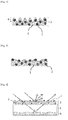
- FIG. 1 illustrates an embodiment of the vinylidene-fluoride resin film of the present invention.
- crosslinked acrylic acid ester resin particles 2 are comprised in such a manner as to be dispersed, so that a vinylidene-fluoride resin film 3 is formed.
- a matte tone front surface 4 of the vinylidene-fluoride resin film 3 is formed and maintained originating from the presence of the crosslinked acrylic acid ester resin particles 2.
- the arithmetic average surface roughness (Ra) of the matte tone front surface 4 of FIG. 1 is 0.4 ⁇ m or more and less than 2 ⁇ m.
- the arithmetic average surface roughness (Ra) is within this numerical range, suitable cloudiness and matte feeling and the transparency and visibility are balanced.
- the thickness 3 of the vinylidene-fluoride resin film of the present invention is not particularly limited and can be set to a thickness of 5 ⁇ m to 200 ⁇ m, for example, according to the intended use of the film. When the thickness is excessively small, the front surface is coarse, the appearance is rough, and a hole is easily formed.
- the thickness of the vinylidene-fluoride resin film includes the degree of the arithmetic average surface roughness (Ra) of the vinylidene-fluoride resin film.
- the vinylidene-fluoride resin film of the present invention As a method for manufacturing the vinylidene-fluoride resin film of the present invention, a conventional technique may be applied and the method is not particularly limited. An example of the manufacturing method is described below.
- Raw materials to be used for the vinylidene-fluoride resin film are uniformly melt-mixed beforehand, and then used for film formation.
- An extruder used for performing the melt-mixing beforehand is not particularly limited insofar as the extruder has a screw length and a screw configuration enough to sufficiently melt and uniformly disperse resin raw materials.
- a twin screw extruder of a screw configuration having a sufficient kneading function such as neutral screw kneading and backward screw kneading besides forward screw kneading, can be mentioned.
- the vinylidene-fluoride resin film can be manufactured by any method of a solvent cast method and an extrusion molding method. In the respect of improving the manufacturing efficiency, the application of the extrusion molding method is preferable.
- Examples of facilities to be used for the extrusion molding include a facility provided with a T-die on the downstream side of a single screw type extruder or a twin screw extruder.
- the single screw extruder is more preferable.
- a ratio (L/D) of the screw length (L [mm]) to the screw diameter (D [mm]) is preferably 20 to 40.
- L/D is less than 20
- plasticization and melting of a resin to be used for the raw materials become insufficient, so that the appearance becomes poor and the transparency is likely to deteriorate due to the mixing of unmelted substances into the film in some cases.
- L/D exceeds 40, excessive shearing is likely to be applied besides the fact that the heating time is excessively long, and therefore the resin is likely to deteriorate, which leads to a poor appearance due to yellowing or the generation of foreign substances originating from a deteriorated substance in some cases.
- a preferable screw compression ratio is preferably 1.5 to 4.0 and more preferably 2.0 to 3.5.
- the compression ratio is less than 1.5, the generation of shearing heat due to the compression of a space between a barrel and a screw groove is insufficient.
- the plasticization and the melting of the resin to be used for the raw material are insufficient, so that, besides the fact that the appearance becomes poor and the transparency is likely to deteriorate due to the mixing of unmelted substances into the film, the extrusion amount is not stabilized and the film thickness is not stabilized in some cases.
- the compression ratio exceeds 4.0, the shearing heat is excessively generated, and therefore the resin is likely to deteriorate, which leads to a poor appearance due to yellowing or the generation of foreign substances originating from a deteriorated substance in some cases.
- the configuration of the screw is not particularly limited insofar as the screw has a specification such that sufficient shearing required to plasticize and melt the resin can be applied.
- Examples of common screws include screws provided with a kneading zone having a Dulmage, Unimelt, or Maddock type mixing function to a full flight screw, a barrier flight screw, and the like.
- a screen mesh is installed in such a manner as to be fixed to a breaker plate. With respect to the screen mesh, it is preferable to combine two or more screen meshes different in the opening.
- a coarse mesh is installed in order to filter coarse foreign substances and a fine mesh is installed on the downstream side thereof. Furthermore, a coarse mesh is installed on the downstream side thereof to prevent the mesh from being fractured by resin pressure.
- the opening of the finest mesh is set as appropriate based on a permissible range of foreign substances to be mixed into the film according to the purpose and the intended use of the vinylidene-fluoride resin film of the present invention.
- the opening is preferably less than 0.1 mm and more preferably less than 0.05 mm.
- the vinylidene-fluoride resin film of the present invention can be manufactured.
- the manufactured vinylidene-fluoride resin film of the present invention can be evaluated for the following items.
- the arithmetic average surface roughness (Ra) of the vinylidene-fluoride resin film of the present invention can be measured with a common laser microscope.
- the arithmetic average surface roughness (Ra) of the vinylidene-fluoride resin film of the present invention is 0.4 ⁇ m or more and less than 2 ⁇ m.
- the total light transmittance of the vinylidene-fluoride resin film of the present invention is evaluated according to JIS K7361-1.
- a measured value to the incident light from the matte tone front surface side is preferably 90% or more and more preferably 91% or more.
- the measured value is less than 90%, the visibility and the clearness of a design of a decorative film (base) laminated with the vinylidene-fluoride resin film tend to decrease.
- the total haze of the vinylidene-fluoride resin film of the present invention is evaluated according to JIS K7136.
- a measured value to the incident light from the matte tone front surface side is preferably 60% or more and more preferably 70% or more.
- the measured value is less than 60%, a frosted feeling and a matte feeling of the front surface of the film tend to decrease.
- the internal haze accounting for the total haze can be obtained by filling irregularities of the matte tone front surface of the film with a liquid paraffin, silicone oil, and the like, sandwiching the same with cover glasses, and then measuring the same in a state where air bubbles do not enter.
- the internal haze is preferably less than 55% and more preferably less than 45%. When the internal haze exceeds 55%, the visibility and the clearness of a design of a decorative film (base) tend to decrease.
- the external haze accounting for the total haze can be obtained from a difference between a total haze value and an internal haze value.
- the external haze is preferably 30% or more and more preferably 50% or more.
- an external haze value is less than 30%, a frosted feeling and a matte feeling of the vinylidene-fluoride resin film front surface tend to decrease.
- the glossiness of the vinylidene-fluoride resin film of the present invention is evaluated according to JIS Z8741.
- the glossiness is measured as the glossiness at the incident angle of a light beam of 60°.
- the glossiness is preferably less than 15 and more preferably less than 12.
- the glossiness becomes 15 or more, a frosted feeling and a matte feeling of the vinylidene-fluoride resin film front surface tend to decrease.
- the vinylidene-fluoride resin film may be used alone, the vinylidene-fluoride resin film may be formed into a laminate by bonding with other base materials.
- the lamination is particularly effective for a case where the content of the vinylidene-fluoride resin is excessively high, and therefore sufficient adhesiveness is not obtained depending on the quality of other base materials.
- a back surface layer is provided on the side which is not a matte tone of the vinylidene-fluoride resin film in order to increase the adhesiveness with other base materials.
- the back surface layer examples include a methacrylic acid ester resin film, for example.
- the back surface layer film may be formed only of a methacrylic acid ester resin, a vinylidene-fluoride resin may be comprised in the methacrylic acid ester resin.
- vinylidene-fluoride resin examples include a copolymer of vinylidene fluoride and hexafluoropropene and/or polyvinylidene fluoride, for example.
- the flexibility of the laminated film can be improved, so that the laminated film can be suitably stuck also to an adherend having a complicated shape.
- the content of the vinylidene-fluoride resin of the back surface layer is not particularly limited.
- 50 parts by mass or less and 1 part by mass or more of the vinylidene fluoride resin and 50 parts by mass or more and 99 parts by mass or less of the methacrylic acid ester resin are comprised so that the total is 100 parts by mass, and thus a methacrylic acid ester resin rich film can be formed.
- the heat stabilizer, the ultraviolet absorber, the plasticizer, the lubricant, the antistatic agent, the antifogging agent, the antisticking agent, the hydrophilic agent, the liquid repellent agent, and the like described above can also be added as necessary besides the vinylidene-fluoride resin.
- pigments can also be added, a white tone is exhibited in some cases in the case of a titanium-based pigment and the like. Therefore, pigments are not required to be added.
- the substances above may be applied to the front surface after manufacturing the film besides the method including adding the substances above in melt-mixing of the resin as with the vinylidene-fluoride resin film described above.
- the heat stabilizer, the ultraviolet absorber, the plasticizer, the lubricant, the antistatic agent, the antifogging agent, the antisticking agent, the hydrophilic agent, the liquid repellent agent, and the like may be added to either the front surface layer or the back surface layer or both the front surface layer and the back surface layer.
- the entire thickness of the laminated film is not particularly limited insofar as the quality demanded in the environment where the laminated film is used is realized and is preferably 20 ⁇ m to 300 ⁇ m and more preferably 30 ⁇ m to 80 ⁇ m.
- the vinylidene-fluoride resin film of the front surface layer in the planar direction cannot be easily broken, so that the continuity of the vinylidene-fluoride resin layer can be maintained.
- the entire thickness is 300 ⁇ m or less, the rigidity of the laminated film does not become excessively high, so that the shape followability to a die is not impaired when heat-molded into a three-dimensional shape. Also when stuck to a part which was heat-molded beforehand through an adhesive layer, the followability to irregularities to a complicated-shaped is not impaired.
- the thickness of the back surface layer is also not particularly limited and is preferably 95% or less and more preferably 90% or less to the entire thickness of the laminated film, for example.
- the thickness is 95% or less, the front surface layer of the vinylidene-fluoride resin film does not become excessively thin and the generation of a pinhole can be suppressed.
- the thickness of the front surface layer is preferably 5 ⁇ m to 200 ⁇ m.
- the thickness of the front surface layer is preferably set to be not excessively smaller than the particle diameter of the crosslinked acrylic acid ester resin particles so as not to cause a lack of the continuity in the planar direction of the front surface layer and so as not to degrade the characteristics of the fluororesin, such as chemical resistance and antifouling property.
- the laminated film can be manufactured by a method including plasticizing and melting the above-described raw materials of the front surface layer and separately plasticizing and melting raw materials of the back surface layer, joining and laminating the front surface layer and the back surface layer using an extruder for manufacturing the front surface layer (extruder A) and an extruder for manufacturing the back surface layer (extruder B) in a feed block arranged on the upstream side of a T-die (i.e., downstream side of the extruder), and then widening and extruding the resultant substance with the T-die.
- a method including plasticizing and melting the above-described raw materials of the front surface layer and separately plasticizing and melting raw materials of the back surface layer, joining and laminating the front surface layer and the back surface layer using an extruder for manufacturing the front surface layer (extruder A) and an extruder for manufacturing the back surface layer (extruder B) in a feed block arranged on the upstream side of a T-die (i.e., downstream side of the
- a multi-manifold die method is mentioned and is a method including widening a resin of each layer to a predetermined width in a T-die, and then joining and extruding the layers.
- the method is suitably usable also in the manufacturing of the laminated film of the present invention.
- the melted resin extruded in accordance with the method described above is extruded into a film shape from the T-die, and then adjusted to a predetermined thickness based on a difference between the speed of the resin in a T-die outlet portion and the take-up speed by a take-up roll. Thereafter, the resin is cooled by contacting a temperature-regulated cooling roll to be adjusted to a predetermined thickness.
- an embossed front surface may be obtained.
- the film thickness is small, and therefore it is preferable to use a take-up roll in which a specular metal roll and a rubber roll to which an embossed front surface was imparted were press-bonded to each other.
- materials which can be suitably used as materials of the metal roll include a hard chrome plated roll and the like.
- materials which can be suitably used as materials of the rubber roll include a roll in which sand is dispersed in a silicone rubber, so that an embossed surface is formed and the like.
- an embossed surface formation roll is not particularly limited and a roll containing sand having a grain size of #320 to #800 is suitably used.
- the cooling temperature of the take-up roll is not particularly limited insofar as the emboss transferability to the front surface of the front surface layer is sufficiently obtained and deformation and the like do not occur after film manufacturing.
- the temperature of the cooling water circulated in the roll is preferably less than 60°C and more preferably less than 50°C. When the cooling temperature is 60°C or more, a deterioration of the film appearance occurs in some cases.
- the film cooled as described above was adjusted to an arbitrary film width by slitting a film end portion, and then wound with moderate tension not causing tight winding or winding deviation of the film, so that the laminated film of the present invention is obtained.
- the vinylidene-fluoride resin film or the laminated film of the present invention can be suitably used as a surface protective film in the car interior and exterior use, for example.
- Examples of specific adherends of a car interior and exterior surface protective film include various interior members, such as an installment panel, a dashboard, and a door, and various exterior members, such as a body, a front bumper, and a rear bumper.
- the surface protective film is used while being laminated with a decorative film to which a design, such as printing or coloring, was given in some cases.
- a design such as printing or coloring
- Examples of methods for laminating the surface protective film and the decorative film include a method including performing lamination with an adhesive besides a method including performing heat lamination by a Roll-to-Roll method.
- a three-dimensional surface decoration method is suitably used and a TOM (Threee dimension Overlay Method) molding method is typically mentioned.
- This method is a method including applying various adhesives to the side of a sticking surface with the interior base material part in the film in which the surface protective film is laminated on the decorative film, softening the film by heat, and then performing lamination utilizing an atmospheric pressure difference between the base material part side and a non-base material part side.
- the adhesives include an acrylic pressure-sensitive adhesive, a hot melt adhesive, and the like but are not particularly limited thereto.
- the lamination method, the three-dimensional surface decoration method, and the like even when heat and pressure are applied to the surface protective film, the frosted feeling and the matte feeling are maintained due to irregularities formed by the crosslinked acrylic acid ester resin particles present near the front surface of the front surface layer.
- the embossed surface protective film Although the embossed surface itself can be somewhat flattened even after the lamination to an adherend and a three-dimensional surface decoration method ( FIG. 2 ), the glossiness is kept low due to the irregularities formed by the crosslinked acrylic acid ester resin particles 2 in the vinylidene-fluoride resin 1.
- the performance of the surface protective film it is direct and preferable to confirm and evaluate the appearance as a laminated molded article with other base materials.
- the internal haze, the external haze, the glossiness, and the like may be used as substitute physical properties in accordance with the film evaluation method described above. It is preferable that evaluation values are within the numerical values described above.
- a back surface layer 5 and a front surface layer 3 are laminated on the decorative film 6, and, when light is emitted (arrows), transmitted light, which does not hit the crosslinked acrylic acid ester resin particle 2, passes through the front surface layer (vinylidene-fluoride resin rich film), also passes through the back surface layer (methacrylic acid ester resin rich film), and then is reflected on the decorative film 6.
- the lamination and the three-dimensional surface decoration method are preferably performed with light pressure and heating which are sufficient for the adhesion to an adherend but are not excessively strong.
- Raw materials used in Examples and Comparative Examples are described below. When two or more kinds of the raw materials are mixed to be used, the raw materials were premixed in an unmelted state, and then melted in a melt-mixing facility to be uniformly mixed. Thereafter, the mixture was extruded into a strand shape, cooled, and then cut into pellets. The resultant substances were used as raw materials.
- the raw materials obtained by the method described above were sufficiently melted with the following extruders, widened inside a coathanger T-die, and then extruded into a film shape.
- resins of the extruders were laminated in a feed block, widened inside a coathanger T-die, and then extruded into a film shape.
- Example 1 a vinylidene-fluoride resin film of a monolayer configuration was produced. Raw materials and manufacturing conditions are illustrated in Table 1 below.
- a hard chrome plated roll Alignment
- Ra 0.2 ⁇ m
- Examples 2 to 4 were manufactured in accordance with the same method as in Example 1. Used raw materials, manufacturing conditions, and performance are individually illustrated in Table 1 below. [Table 1] Example 1 Example 2 Example 3 Example 4 Raw material formulation of vinylidene-fluoride resin film Compounding formulation of front surface layer Type of vinylidene-fluoride resin 11000HD 11000HD 11000HD 11000HD 2K720 2K720 2K720 2K720 Compounding amount [% by mass] 150 150 150 150 230 230 230 230 230 230 230 230 Type of methacrylic acid ester resin MGSS MGSS MGSS MGSS Compounding amount [% by mass] 20 20 20 20 20 Type of crosslinked acrylic acid ester resin GM-0449S-2 GM-0449S-2 GM-0449S-2 GM-0630H Average particle diameter [ ⁇ m] 4 4 4 6 Addition amount [PHR] 10 5 25 10 Manufucturing conditions of vinylidene-fluoride resin film Front surface layer Extruder set temperature in compounding [
- Example 5 a laminated film was produced. Raw materials and manufacturing conditions of a front surface layer and a back surface layer are illustrated in Table 2 below. In Example 5, an ultraviolet absorber was added to the back surface layer.
- the pellet-like mixture A was melted by setting the highest set temperature in a barrel to 240°C in the extruder A and the number of rotations of a screw to 50 RPM.
- the pellet-like mixture B was melted by setting the highest set temperature in a barrel to 220°C in the extruder B described above and the number of rotations of a screw to 23 RPM.
- Each resin was joined and laminated in a feed block, and then extruded into a film shape from the T-die.
- a hard chrome plated roll Alignment
- Ra 0.2 ⁇ m
- Examples 6 to 11 laminated films were produced. Also in Examples 6 to 11, an ultraviolet absorber was added to the back surface layer.
- Examples 6 to 11 were manufactured in accordance with the same method as in Example 5. Used raw materials, manufacturing conditions, and performance are individually illustrated in Table 2 below. [Table 2] Example 5 Example 6 Example 7 Example 8 Example 9 Example 10 Example 11 Compounding formulation of front surface layer Type of vinylidene-fluoride resin 11000HD 11000HD 11000HD 2800-20 11000HD 11000HD 2K720 2K720 2K720 2K720 2K720 2K720 Compounding amount [% by mass] 150 150 150 150 80 150 150 230 230 230 230 230 230 230 230 230 230 230 230 230 230 230 230 230 230 230 230 Type of methacrylic acid ester resin MGSS MGSS MGSS MGSS MGSS MGSS MGSS MGSS MGSS Compounding amount [% by mass] 20 20 20 20 20 20 20 20 20 20 20 20 20 20 20 20 20 20 20 20 20 20 20 20 20 20 20 20 20 20 20 20 20 20 20 20 20 20 20 20 20 20 20 20 20
- Examples 12 and 13 laminated films were produced. In Examples 12 and 13, an ultraviolet absorber was not added to the back surface layer.
- Examples 12 and 13 were manufactured in accordance with the same method as in Example 5. Used raw materials, manufacturing conditions, and performance are individually illustrated in Table 3 below.
- Example 12 Example 13 Compounding formulation of front surface layer Type of vinylidene-fluoride resin 11000HD 11000HD 2K720 2K720 Compounding amount [% by mass] 150 150 230 230 Type of methacrylic acid ester resin MGSS MGSS Compounding amount [% by mass] 20 20 Type of crosslinked acrylic acid ester resin GM-0449S-2 GM-0449S-2 Raw material formulation of laminated film Average particle diameter [ ⁇ m] 4 4 Addition amount [PHR] 10 10 Compounding formulation of back surface layer Type of vinylidene-fluoride resin K720 K720 Compounding amount [% by mass] 20 20 Type of methacrylic acid ester resin HBS000 HBZG60 Compounding amount [% by mass] 80 80 Type of ultraviolet absorber - - Compounding amount based on 100 parts by mass of resin [parts by mass] -
- Comparative Examples 1 to 9 were manufactured in accordance with the same method as in Example 5. In Comparative Examples 1 to 9, an ultraviolet absorber was added to the back surface layer.
- the average particle diameter of the crosslinked acrylic acid ester resin particles was measured as follows.
- the film was placed and fixed in a small metal vise, and then cut using a single-edge knife so that the cross section of the film was smooth.
- the film cross section was observed at a magnification of 50 times using a confocal laser microscope (VK-X110 manufactured by KEYENCE CORP.), and then the maximum diameter of crosslinked resin beads present in the area of "Crosslinked resin bead added layer thickness ( ⁇ m) ⁇ 100 ⁇ m" in the cross section of the layer was measured. This operation was repeated 30 times, the arithmetic average value of the maximum diameters was calculated, and then the value was set as the average particle diameter.
- the film front surface was observed at a magnification of 50 times using a confocal laser microscope (VK-X110 manufactured by KEYENCE CORP.), the arithmetic average roughness Ra was measured in the range of the length of 250 ⁇ m, and then an average value of values at different three places was set as the arithmetic average roughness Ra of the film.
- test pieces cut out from arbitrary five places in the TD direction of the resin film were used, and the arithmetic average value thereof was adopted.
- the internal haze was measured by applying a liquid paraffin to both surfaces of the film, sandwiching the same with 0.15 mm thick cover glasses so that air bubbles did not enter, and then measured with the same meter.
- the external haze was obtained by calculating a difference between the total haze value and the internal haze obtained by performing the measurement in accordance with the method described above. With respect to each physical property value, the performance was determined in accordance with the following determination standards.
- the total light transmittance, the internal haze, and the external haze are either Excellent or Good.
- Good The total light transmittance, the internal haze, and the external haze include Excellent, Good, and Acceptable.
- Acceptable The total light transmittance, the internal haze, and the external haze are either Good or Acceptable.
- Poor The total light transmittance, the internal haze, and the external haze include one or more Poor.
- a gloss value at an incident angle of a light beam of 60° was measured according to JIS K 5600-4-7 using a Handy type gloss meter PG-IIM manufactured by Nippon Denshoku Industries Co., LTD., and then the arithmetic average value of three measured values was adopted.
- Excellent Both the determination of the transparency and the determination of the glossiness are Excellent.
- Good One of the determination of the transparency and the determination of glossiness is Excellent and the other one is Good or Acceptable.
- Acceptable Both the determination of the transparency and the determination of glossiness are Good or Acceptable.
- Poor The determination of the transparency and the determination of glossiness include Poor.
- the flexibility of the resin film was evaluated as follows.
- the film was cut into a 21.5 mm wide strip shape, and then the same surfaces of both ends were stuck to each other with a tape to form a ring 22.3 mm in diameter.
- the ring was pressed in the horizontal direction to be deformed into an oval shape, and then the flexibility of the film was evaluated as follows from a load in the horizontal direction when the minor axis of the oval reached 12.3 mm.
- the ultraviolet-ray cutting performance of the resin film was evaluated as follows.
- an accelerated weatherability test was performed using a metal weather manufactured by DAIPLA WINTES CO., LTD. under the conditions of irradiation illuminance of 132 mW/cm 2 , a black panel temperature of 63°C, a humidity Rh of 50%, and an irradiation/spraying cycle of 6 hours/2 hours, spectrophotometric measurement was performed for the resin film after a test time of 576 hours, and then the ultraviolet-ray cutting performance was evaluated from the transmittance of ultraviolet rays with a wavelength of 280 nm.
- the vinylidene-fluoride resin film and the laminated film of the present invention are suitable for the application as car interiors, such as an installment panel, a dashboard, and a door, and car exteriors, such as a body, a front bumper, and a rear bumper.
- the vinylidene-fluoride resin film and the laminated film of the present invention are also usable for an inner and exterior film of infrastructures and various buildings, an interior and exterior film of an automobile, a railway vehicle, an airplane, a watercraft, and a spacecraft, a surface protective film of water section facilities, such as a kitchen and a bathroom, and the like.
Landscapes
- Chemical & Material Sciences (AREA)
- Health & Medical Sciences (AREA)
- Chemical Kinetics & Catalysis (AREA)
- Medicinal Chemistry (AREA)
- Polymers & Plastics (AREA)
- Organic Chemistry (AREA)
- Engineering & Computer Science (AREA)
- Manufacturing & Machinery (AREA)
- Materials Engineering (AREA)
- Laminated Bodies (AREA)
- Compositions Of Macromolecular Compounds (AREA)
- Manufacture Of Macromolecular Shaped Articles (AREA)
Abstract
Description
- The present invention relates to a vinylidene-fluoride resin film.
- In an automobile decoration field, painting or metal plating has been used so far for a long time. In recent years, however, it has started to take an attitude of shifting to film decoration instead of painting or metal plating in order to reduce the body weight or reduce manufacturing line processes.
- For example, a body, a panel dashboard, and the like of an automobile are decorated with a decorative film and further covered with a protective layer.
- The outermost layer of a conventionally used decorative film protective layer is an acrylic film. However, the acrylic film has some disadvantages. For example, the acrylic film has deteriorated due to a sunscreen cream or an insecticide or the acrylic film has been whitened when the temperature increases in a state where a sunscreen cream or an insecticide adheres thereto in some cases.
- Moreover, the decorative film protective layer is stuck to the body, the panel dashboard, and the like having a complicated shape with a large number of irregularities, and therefore has been required to have followability to the irregularities which allows the film to adhere thereto even in a case of the presence of a large number of irregularities.
- Furthermore, nonmetallic metal tone decoration has begun to be popular in the exterior and the like of an automobile. The nonmetallic metal tone is a matte tone having low glossiness, also referred to as a frosted tone, and frequently used for luxury automobiles and the like.
- For example, a vinylidene-fluoride resin film described in
Patent Document 1 has been developed as a film having a frosted tone of automobile members. In the vinylidene-fluoride resin film, the front surface layer comprises a crosslinked acrylic resin and a vinylidene-fluoride resin. - [Patent Document 1]
JP-A No. 2001-205755 - However, the vinylidene-fluoride resin film described in
Patent Document 1 exhibits a frosted tone when stuck onto a decorative film but a pattern and the like on the decorative film has become cloudy and the color tone has changed, so that the visibility clearly transmitting color or a design of an adherend has not been sufficient. - Thus, the protective film has been demanded to have inconsistent features that, while the protective film has a matte tone with low glossiness, the protective film has low cloudiness and is excellent in the transmittance of visible light and has good visibility of a pattern and the like on the decorative film. Moreover, the protective film has also been demanded to have chemical resistance, weatherability, heat resistance, followability to irregularities, and the like.
- Thus, the present inventors have extensively conducted examinations in order to solve the above-described problems, and thus has accomplished the present invention.
- More specifically, the present invention provides
a vinylidene-fluoride resin film comprising crosslinked acrylic acid ester resin particles, in which
the crosslinked acrylic acid ester resin particles have an average particle diameter of 5% or more and 40% or less to the thickness of the vinylidene-fluoride resin film and
the arithmetic average surface roughness (Ra) of the vinylidene-fluoride resin film is 0.4 µm or more and less than 2 µm. - Herein, the crosslinked acrylic acid ester resin particles are preferably comprised in an amount of 5 parts by mass or more and 25 parts by mass or less based on 100 parts by mass of a vinylidene-fluoride resin.
- Moreover, the average particle diameter of the crosslinked acrylic acid ester resin particles is preferably 3.5 µm or more and 7.5 µm or less.
- The vinylidene-fluoride resin preferably comprises a copolymer of vinylidene fluoride and hexafluoropropene and/or polyvinylidene fluoride.
- The vinylidene-fluoride resin may comprise a methacrylic acid ester resin.
- In that case, the vinylidene-fluoride resin preferably comprises
50 parts by mass or more and 99 parts by mass or less of the vinylidene fluoride resin comprising the copolymer of vinylidene fluoride and hexafluoropropene and/or polyvinylidene fluoride and
50 parts by mass or less and 1 part by mass or more of the methacrylic acid ester resin
so that the total is 100 parts by mass. - The thickness of the vinylidene-fluoride resin film of the present invention can be set to 5 µm or more and 200 µm or less.
- The vinylidene-fluoride resin film of the present invention can be formed into a laminated film in which the vinylidene-fluoride resin film is laminated on a methacrylic acid ester resin film.
- The methacrylic acid ester resin may comprise the vinylidene-fluoride resin.
- In that case, the methacrylic acid ester resin preferably comprises
50 parts by mass or less and 1 part by mass or more of the vinylidene fluoride resin comprising the copolymer of vinylidene fluoride and hexafluoropropene and/or polyvinylidene fluoride and
50 parts by mass or more and 99 parts by mass or less of the methacrylic acid ester resin
so that the total is 100 parts by mass. - It is preferable in the laminated film that the entire thickness of the film is 20 µm or more and 300 µm or less and the ratio of the methacrylic acid ester resin film to the entire thickness of the film is 95% or less.
- The laminated film can be laminated on a decorative film.
- Furthermore, the present invention can provide an automobile or automobile parts in which the vinylidene-fluoride resin film or the laminated film is bonded to the front surface.
- The present invention can provide a vinylidene-fluoride resin film having low cloudiness and excellent visible light transmittance and having high visibility of a pattern and the like of a decorative film of a lower layer although having a matte tone with low glossiness. Moreover, the present invention can provide a vinylidene-fluoride resin film which also has excellent chemical resistance, weatherability, heat resistance, followability to irregularities, adhesiveness with other base materials, and the like and is excellent also in workability.
-
-
FIG. 1 is a view illustrating a vinylidene-fluoride resin film of the present invention. -
FIG. 2 is a view illustrating the vinylidene-fluoride resin film of the present invention. -
FIG. 3 is a view illustrating a laminated film of the present invention. - Hereinafter, preferable embodiments for implementing the present invention are described. The embodiments described below describe typical embodiments of the present invention and the scope of the present invention is not narrowly interpreted by the embodiments.
- The vinylidene-fluoride resin film of the present invention comprises crosslinked acrylic acid ester resin particles.
- First, a vinylidene-fluoride resin serving as a base material of the vinylidene-fluoride resin film preferably has a refractive index close to the refractive index of a crosslinked acrylic acid ester resin compounded as particles described later. The refractive index is preferably 1.3 to 1.5 and more preferably 1.4 to 1.49.
- When the refractive index is 1.3 to 1.5, a refractive index difference between the vinylidene-fluoride resin and the crosslinked acrylic acid ester resin does not become excessively large and an increase in the internal haze is suppressed, so that the visibility of a pattern and the like on a film protection target, such as automobile parts, can be satisfactorily maintained.
- The vinylidene-fluoride resin having the refractive index described above is not particularly limited. For example, polyvinylidene fluoride and a copolymer of vinylidene fluoride and hexafluoropropene are mentioned. These resins may be used alone or may be used as a mixture as necessary. In particular, the use of the copolymer of vinylidene fluoride and hexafluoropropene improves the followability to irregularities.
- The vinylidene-fluoride resin can be used as a mixture with other resins as necessary insofar as the weatherability, chemical resistance, antifouling property, and transparency which are features of the vinylidene-fluoride resin are not impaired and the refractive index described above is maintained.
- Suitably usable examples include a mixture of the vinylidene-fluoride resin and a methacrylic acid ester resin. The methacrylic acid ester resin is preferable also from the viewpoint of compatibility.
- The mixture ratio of the vinylidene-fluoride resin and the methacrylic acid ester resin is not particularly limited insofar as the internal haze value of the film is not deteriorated.
- As a suitable mixture ratio, for example,
50 parts by mass or more and 99 parts by mass or less of a vinylidene-fluoride resin comprising a copolymer of vinylidene-fluoride and hexafluoropropene and/or polyvinylidene fluoride and
50 parts by mass or less and 1 part by mass or more of the methacrylic acid ester resin are mixed
so that the total is 100 parts by mass. - When the mixture ratio is set within the mixture ratio range above, a vinylidene-fluoride resin rich film is obtained, so that the chemical resistance, weatherability, heat resistance, followability to irregularities, adhesiveness with other base materials, and the like are improved.
- When the vinylidene-fluoride resin is set to 50 parts by mass or more, the antifouling property which is a feature of the vinylidene-fluoride resin is also sufficiently obtained.
- When the methacrylic acid ester resin is set to 50 parts by mass or less, the strength of the film can be maintained, so that a fracture when tension is applied in processing, such as lamination, can also be prevented.
- Examples of the methacrylic acid ester resin include polymethyl methacrylate, a copolymer of methyl methacrylate and acrylic acid n-butyl, a copolymer with other monomers, acrylic acid n-butyl rubber reinforced methyl methacrylate, and the like. These substances may be used alone or may be used as a mixture of a plurality of kinds thereof as necessary.
- The methacrylic acid ester resin is not particularly limited in the type and the amount insofar as the transparency when mixed with the vinylidene-fluoride resin is not impaired.
- To the vinylidene-fluoride resin film of the present invention, heat stabilizers can be added as necessary besides the methacrylic acid ester resin. Examples of the heat stabilizers include a phenolic antioxidant, a phosphorus-based antioxidant, a sulfur-based antioxidant, an epoxy compound, β-diketone, and the like. Among the above, the phenolic antioxidant and the phosphorus-based antioxidant do not hinder the transparency, and thus are preferable.
- As a method for adding the heat stabilizer, a method including using one obtained by melt-mixing the heat stabilizer with the vinylidene-fluoride resin and/or the methacrylic acid ester resin for granulation beforehand as a raw material may be acceptable or a method including melt-mixing the heat stabilizer with the vinylidene-fluoride resin and/or the methacrylic acid ester resin when manufacturing a film, and then performing film formation in the same flow may also be acceptable.
- The addition amount of the heat stabilizer is, although not particularly limited, preferably 0.001 to 5% by mass and more preferably 0.1 to 1.0% by mass.
- When the addition amount of the heat stabilizer is 0.001% by mass or more, sufficient heat stability is obtained. When the addition amount of the heat stabilizer is 5% by mass or less, a deterioration of the transparency of the vinylidene-fluoride resin film or the visibility and the color tone of a decorative film (base) can be suppressed.
- Furthermore, ultraviolet absorbers can be added to the vinylidene-fluoride resin film as necessary. Examples of the ultraviolet absorbers include organic ultraviolet absorbers, such as benzotriazole-based ultraviolet absorbers, benzophenone-based ultraviolet absorbers, and triazine-based ultraviolet absorbers.
- In particular, the triazine-based ultraviolet absorbers are preferable and 2-(4,6-diphenyl-1,3,5-triazine-2-yl)-5-[2-(2-ethylhexanoyloxy)ethoxy]phenol is preferable in the respect of the compatibility with the vinylidene-fluoride resin.
- As a method for adding the ultraviolet absorber, a method including using one obtained by melt-mixing the ultraviolet absorber with the vinylidene-fluoride resin and/or the methacrylic acid ester resin for granulation beforehand as a raw material may be acceptable or a method including melt-mixing the ultraviolet absorber with the vinylidene-fluoride resin and/or the methacrylic acid ester resin when manufacturing a film, and then performing film formation in the same flow may be acceptable.
- The addition amount of the ultraviolet absorber is, although not particularly limited, preferably 0.001 to 10% by mass and more preferably 0.1 to 5% by mass.
- When the addition amount of the ultraviolet absorber is 0.001% by mass or more, sufficient ultraviolet ray cutting performance is obtained, so that an adherend of the vinylidene-fluoride resin film of the present invention can be protected from a deterioration due to ultraviolet rays. When the addition amount of the ultraviolet absorber is 10% by mass or less, a deterioration of the transparency of the vinylidene-fluoride resin film or the visibility and the color tone of a decorative film (base) can be suppressed.
- In addition thereto, a plasticizer, a lubricant, an antistatic agent, an antifogging agent, an antisticking agent, a hydrophilic agent, a liquid repellent agent, and the like can be added insofar as the glossiness is low, transparency and heat resistance are imparted, and the film appearance and the like are not practically impaired. Although pigments can also be added, a white tone is exhibited in some cases in the case of a titanium-based pigment and the like. Therefore, pigments are not required to be added.
- As an addition method, the substances above may be applied to the front surface after manufacturing a film besides the method including adding the substances above in melt-mixing in the same manner as described above.
- As described above, the composition of the vinylidene-fluoride resin film as a base material comprising the crosslinked acrylic acid ester resin particles is configured.
- The crosslinked acrylic acid ester resin particles to be used for the vinylidene-fluoride resin film of the present invention comprise acrylic acid esters, such as methyl methacrylate and methacrylic acid n-butyl, for example, as a raw material.
- Although a crosslinking agent is not particularly limited, an epoxy-based crosslinking agent, an isocyanate-based crosslinking agent, and the like are usable as a common crosslinking agent.
- As the particle diameter of the crosslinked acrylic acid ester resin particles, the crosslinked acrylic acid ester resin particles have an average particle diameter of 5% to 40% to the thickness of the vinylidene-fluoride resin film of the present invention and the average particle diameter is preferably 10% to 35%.
- For example, when the thickness of the vinylidene-fluoride resin film is 5 µm to 200 µm, the average particle diameters is 0.25 µm to 80 µm.
- When the average particle diameter is less than 0.25 µm, the internal haze of the film becomes excessively high due to an increase in light scattering efficiency due to the fact that the number of the particles is large as compared with a film to which the same parts by mass of particles having a larger average particle diameter are added, and thus the average particle diameter is not preferable.
- When the average particle diameter exceeds 80 µm, irregularities of the front surface of the film decrease due to the fact that the number of the particles is small as compared with a film to which the same parts by mass of particles having a smaller average particle diameter are added, so that the light scattering efficiency is lowered. As a result, the external haze becomes excessively low, the glossiness of the front surface of the film increases, and a matte feeling is hard to be obtained, and thus the average particle diameter is not preferable.
- When the vinylidene-fluoride resin film of the present invention is used as a surface protective film of a body and parts of an automobile, the average particle diameter of the crosslinked acrylic acid ester resin particles is preferably 3.5 µm to 7.5 µm and more preferably 3.5 µm to 4.5 µm.
- In usual, it is considered that, when the average particle diameter is small, the surface glossiness increases and a frosted surface is not obtained. However, one having a relatively small average particle diameter, which seems to be difficult to obtain a frosted surface, was used in the present invention. Thus, a film achieving both effects that the cloudiness is low and excellent visible light transmittance is imparted and the visibility of a pattern and the like of a decorative film of a lower layer is high although having a frosted feeling and a matte feeling was unexpectedly obtained.
- However, when the average particle diameter is excessively small, the internal haze of the film increases, so that a white tone is exhibited, and thus the average particle diameter is not preferable.
- With respect to the crosslinked acrylic acid ester resin particles, particles having the same average particle diameter may be comprised in the vinylidene-fluoride resin film or particles having a different average particle diameter may be mixed and comprised in the vinylidene-fluoride resin film.
- The crosslinked acrylic acid ester-based resin particles are preferably comprised in the vinylidene fluoride resin in an amount of 5 parts by mass to 25 parts by mass based on 100 parts by mass of the vinylidene fluoride resin. When the amount is 25 parts by mass or less, the internal haze does not become excessively high and the visibility of a protection target can be maintained. When the amount is 5 parts by mass or more, the external haze does not become excessively low and an increase in glossiness is suppressed, and therefore the matte feeling of the front surface of the film can be maintained.
- In particular, when used for a vinylidene-fluoride resin film for a body or parts of an automobile, the content of the crosslinked acrylic acid ester resin particles is preferably 8 to 12 parts by mass based on 100 parts by mass of the vinylidene-fluoride resin but the content is not limited thereto.
-
FIG. 1 illustrates an embodiment of the vinylidene-fluoride resin film of the present invention. - In a vinylidene-
fluoride resin 1, crosslinked acrylic acidester resin particles 2 are comprised in such a manner as to be dispersed, so that a vinylidene-fluoride resin film 3 is formed. A matte tonefront surface 4 of the vinylidene-fluoride resin film 3 is formed and maintained originating from the presence of the crosslinked acrylic acidester resin particles 2. - Herein, the arithmetic average surface roughness (Ra) of the matte tone
front surface 4 ofFIG. 1 is 0.4 µm or more and less than 2 µm. When the arithmetic average surface roughness (Ra) is within this numerical range, suitable cloudiness and matte feeling and the transparency and visibility are balanced. - When the arithmetic average surface roughness (Ra) is less than 0.4 µm, the cloudiness of the film decreases, so that gloss appears. When the arithmetic average surface roughness (Ra) is 2 µm or more, the cloudiness of the film increases, an impression coarser than the matte tone is presented, and the transparency and the visibility also decrease.
- The
thickness 3 of the vinylidene-fluoride resin film of the present invention is not particularly limited and can be set to a thickness of 5 µm to 200 µm, for example, according to the intended use of the film. When the thickness is excessively small, the front surface is coarse, the appearance is rough, and a hole is easily formed. - The thickness of the vinylidene-fluoride resin film includes the degree of the arithmetic average surface roughness (Ra) of the vinylidene-fluoride resin film.
- As a method for manufacturing the vinylidene-fluoride resin film of the present invention, a conventional technique may be applied and the method is not particularly limited. An example of the manufacturing method is described below.
- Raw materials to be used for the vinylidene-fluoride resin film are uniformly melt-mixed beforehand, and then used for film formation.
- An extruder used for performing the melt-mixing beforehand is not particularly limited insofar as the extruder has a screw length and a screw configuration enough to sufficiently melt and uniformly disperse resin raw materials. As an example of an extruder capable of performing the uniform melt-mixing, a twin screw extruder of a screw configuration having a sufficient kneading function, such as neutral screw kneading and backward screw kneading besides forward screw kneading, can be mentioned.
- The vinylidene-fluoride resin film can be manufactured by any method of a solvent cast method and an extrusion molding method. In the respect of improving the manufacturing efficiency, the application of the extrusion molding method is preferable.
- Examples of facilities to be used for the extrusion molding include a facility provided with a T-die on the downstream side of a single screw type extruder or a twin screw extruder.
- When a fluororesin is continuously heated more than necessary, there is a risk of the generation of harmful gas due to the decomposition of the resin. Therefore, in order to prevent the generation of excessive shearing heat and reduce places where the shearing heat stays, the single screw extruder is more preferable.
- As a preferable specification of a screw to be used for the extruder, a ratio (L/D) of the screw length (L [mm]) to the screw diameter (D [mm]) is preferably 20 to 40. When the L/D is less than 20, plasticization and melting of a resin to be used for the raw materials become insufficient, so that the appearance becomes poor and the transparency is likely to deteriorate due to the mixing of unmelted substances into the film in some cases. When the L/D exceeds 40, excessive shearing is likely to be applied besides the fact that the heating time is excessively long, and therefore the resin is likely to deteriorate, which leads to a poor appearance due to yellowing or the generation of foreign substances originating from a deteriorated substance in some cases.
- A preferable screw compression ratio is preferably 1.5 to 4.0 and more preferably 2.0 to 3.5. When the compression ratio is less than 1.5, the generation of shearing heat due to the compression of a space between a barrel and a screw groove is insufficient. As a result, the plasticization and the melting of the resin to be used for the raw material are insufficient, so that, besides the fact that the appearance becomes poor and the transparency is likely to deteriorate due to the mixing of unmelted substances into the film, the extrusion amount is not stabilized and the film thickness is not stabilized in some cases. When the compression ratio exceeds 4.0, the shearing heat is excessively generated, and therefore the resin is likely to deteriorate, which leads to a poor appearance due to yellowing or the generation of foreign substances originating from a deteriorated substance in some cases.
- The configuration of the screw is not particularly limited insofar as the screw has a specification such that sufficient shearing required to plasticize and melt the resin can be applied. Examples of common screws include screws provided with a kneading zone having a Dulmage, Unimelt, or Maddock type mixing function to a full flight screw, a barrier flight screw, and the like.
- On the downstream side of the screw described above, a screen mesh is installed in such a manner as to be fixed to a breaker plate. With respect to the screen mesh, it is preferable to combine two or more screen meshes different in the opening. On the upstream side, a coarse mesh is installed in order to filter coarse foreign substances and a fine mesh is installed on the downstream side thereof. Furthermore, a coarse mesh is installed on the downstream side thereof to prevent the mesh from being fractured by resin pressure. The opening of the finest mesh is set as appropriate based on a permissible range of foreign substances to be mixed into the film according to the purpose and the intended use of the vinylidene-fluoride resin film of the present invention. The opening is preferably less than 0.1 mm and more preferably less than 0.05 mm.
- In the facilities described above, the vinylidene-fluoride resin film of the present invention can be manufactured.
- The manufactured vinylidene-fluoride resin film of the present invention can be evaluated for the following items.
- The arithmetic average surface roughness (Ra) of the vinylidene-fluoride resin film of the present invention can be measured with a common laser microscope.
- As described above, the arithmetic average surface roughness (Ra) of the vinylidene-fluoride resin film of the present invention is 0.4 µm or more and less than 2 µm.
- The total light transmittance of the vinylidene-fluoride resin film of the present invention is evaluated according to JIS K7361-1.
- A measured value to the incident light from the matte tone front surface side is preferably 90% or more and more preferably 91% or more. When the measured value is less than 90%, the visibility and the clearness of a design of a decorative film (base) laminated with the vinylidene-fluoride resin film tend to decrease.
- The total haze of the vinylidene-fluoride resin film of the present invention is evaluated according to JIS K7136.
- A measured value to the incident light from the matte tone front surface side is preferably 60% or more and more preferably 70% or more. When the measured value is less than 60%, a frosted feeling and a matte feeling of the front surface of the film tend to decrease.
- The internal haze accounting for the total haze can be obtained by filling irregularities of the matte tone front surface of the film with a liquid paraffin, silicone oil, and the like, sandwiching the same with cover glasses, and then measuring the same in a state where air bubbles do not enter.
- The internal haze is preferably less than 55% and more preferably less than 45%. When the internal haze exceeds 55%, the visibility and the clearness of a design of a decorative film (base) tend to decrease.
- The external haze accounting for the total haze can be obtained from a difference between a total haze value and an internal haze value.
- The external haze is preferably 30% or more and more preferably 50% or more. When an external haze value is less than 30%, a frosted feeling and a matte feeling of the vinylidene-fluoride resin film front surface tend to decrease.
- The glossiness of the vinylidene-fluoride resin film of the present invention is evaluated according to JIS Z8741. The glossiness is measured as the glossiness at the incident angle of a light beam of 60°.
- The glossiness is preferably less than 15 and more preferably less than 12. When the glossiness becomes 15 or more, a frosted feeling and a matte feeling of the vinylidene-fluoride resin film front surface tend to decrease.
- Although the vinylidene-fluoride resin film may be used alone, the vinylidene-fluoride resin film may be formed into a laminate by bonding with other base materials. The lamination is particularly effective for a case where the content of the vinylidene-fluoride resin is excessively high, and therefore sufficient adhesiveness is not obtained depending on the quality of other base materials.
- For example, a back surface layer is provided on the side which is not a matte tone of the vinylidene-fluoride resin film in order to increase the adhesiveness with other base materials.
- Examples of the back surface layer include a methacrylic acid ester resin film, for example. Although the back surface layer film may be formed only of a methacrylic acid ester resin, a vinylidene-fluoride resin may be comprised in the methacrylic acid ester resin.
- Examples of the vinylidene-fluoride resin include a copolymer of vinylidene fluoride and hexafluoropropene and/or polyvinylidene fluoride, for example.
- When the vinylidene fluoride-hexafluoro propene copolymer is selected and used for either the front surface layer or the back surface layer described above or both the front surface layer and the back surface layer described above, the flexibility of the laminated film can be improved, so that the laminated film can be suitably stuck also to an adherend having a complicated shape.
- The content of the vinylidene-fluoride resin of the back surface layer is not particularly limited. For example,
50 parts by mass or less and 1 part by mass or more of the vinylidene fluoride resin and
50 parts by mass or more and 99 parts by mass or less of the methacrylic acid ester resin are comprised
so that the total is 100 parts by mass, and thus a methacrylic acid ester resin rich film can be formed. - When the content of the methacrylic acid ester resin is 50% by mass or more, sufficient adhesiveness with other base materials of a decorative film (base) is obtained. When used as a surface protective film of the decorative film, a defective phenomenon due to peeling between the decorative film and the back surface layer is hard to occur.
- To the back surface layer, the heat stabilizer, the ultraviolet absorber, the plasticizer, the lubricant, the antistatic agent, the antifogging agent, the antisticking agent, the hydrophilic agent, the liquid repellent agent, and the like described above can also be added as necessary besides the vinylidene-fluoride resin. Although pigments can also be added, a white tone is exhibited in some cases in the case of a titanium-based pigment and the like. Therefore, pigments are not required to be added.
- As an addition method, the substances above may be applied to the front surface after manufacturing the film besides the method including adding the substances above in melt-mixing of the resin as with the vinylidene-fluoride resin film described above.
- The heat stabilizer, the ultraviolet absorber, the plasticizer, the lubricant, the antistatic agent, the antifogging agent, the antisticking agent, the hydrophilic agent, the liquid repellent agent, and the like may be added to either the front surface layer or the back surface layer or both the front surface layer and the back surface layer.
- When added only to the back surface layer, the occurrence of a poor appearance accompanying the shift of the additives to the front surface of the film can be prevented, and therefore it is particularly preferable.
- The entire thickness of the laminated film is not particularly limited insofar as the quality demanded in the environment where the laminated film is used is realized and is preferably 20 µm to 300 µm and more preferably 30 µm to 80 µm.
- When the entire thickness is 20 µm or more, the vinylidene-fluoride resin film of the front surface layer in the planar direction cannot be easily broken, so that the continuity of the vinylidene-fluoride resin layer can be maintained. When the entire thickness is 300 µm or less, the rigidity of the laminated film does not become excessively high, so that the shape followability to a die is not impaired when heat-molded into a three-dimensional shape. Also when stuck to a part which was heat-molded beforehand through an adhesive layer, the followability to irregularities to a complicated-shaped is not impaired.
- The thickness of the back surface layer is also not particularly limited and is preferably 95% or less and more preferably 90% or less to the entire thickness of the laminated film, for example.
- When the thickness is 95% or less, the front surface layer of the vinylidene-fluoride resin film does not become excessively thin and the generation of a pinhole can be suppressed.
- The thickness of the front surface layer is preferably 5 µm to 200 µm. The thickness of the front surface layer is preferably set to be not excessively smaller than the particle diameter of the crosslinked acrylic acid ester resin particles so as not to cause a lack of the continuity in the planar direction of the front surface layer and so as not to degrade the characteristics of the fluororesin, such as chemical resistance and antifouling property.
- When manufacturing the laminated film of the front surface layer (vinylidene-fluoride resin rich film) and the back surface layer (methacrylic acid ester resin rich film), the laminated film can be manufactured by a method including plasticizing and melting the above-described raw materials of the front surface layer and separately plasticizing and melting raw materials of the back surface layer, joining and laminating the front surface layer and the back surface layer using an extruder for manufacturing the front surface layer (extruder A) and an extruder for manufacturing the back surface layer (extruder B) in a feed block arranged on the upstream side of a T-die (i.e., downstream side of the extruder), and then widening and extruding the resultant substance with the T-die.
- As another lamination method, a multi-manifold die method is mentioned and is a method including widening a resin of each layer to a predetermined width in a T-die, and then joining and extruding the layers. The method is suitably usable also in the manufacturing of the laminated film of the present invention.
- The melted resin extruded in accordance with the method described above is extruded into a film shape from the T-die, and then adjusted to a predetermined thickness based on a difference between the speed of the resin in a T-die outlet portion and the take-up speed by a take-up roll. Thereafter, the resin is cooled by contacting a temperature-regulated cooling roll to be adjusted to a predetermined thickness.
- Furthermore, by performing the taking-up while pressing the take-up roll, the surface of which was embossed, against the front surface of the front surface layer in a softened state in the process described above, an embossed front surface may be obtained.
- In the case of the vinylidene-fluoride resin film of the present invention, the film thickness is small, and therefore it is preferable to use a take-up roll in which a specular metal roll and a rubber roll to which an embossed front surface was imparted were press-bonded to each other. Examples of materials which can be suitably used as materials of the metal roll include a hard chrome plated roll and the like. Examples of materials which can be suitably used as materials of the rubber roll include a roll in which sand is dispersed in a silicone rubber, so that an embossed surface is formed and the like.
- Although the count of an embossed surface formation roll is not particularly limited and a roll containing sand having a grain size of #320 to #800 is suitably used.
- The cooling temperature of the take-up roll is not particularly limited insofar as the emboss transferability to the front surface of the front surface layer is sufficiently obtained and deformation and the like do not occur after film manufacturing. For example, the temperature of the cooling water circulated in the roll is preferably less than 60°C and more preferably less than 50°C. When the cooling temperature is 60°C or more, a deterioration of the film appearance occurs in some cases.
- The film cooled as described above was adjusted to an arbitrary film width by slitting a film end portion, and then wound with moderate tension not causing tight winding or winding deviation of the film, so that the laminated film of the present invention is obtained.
- The vinylidene-fluoride resin film or the laminated film of the present invention can be suitably used as a surface protective film in the car interior and exterior use, for example.
- Examples of specific adherends of a car interior and exterior surface protective film include various interior members, such as an installment panel, a dashboard, and a door, and various exterior members, such as a body, a front bumper, and a rear bumper.
- The surface protective film is used while being laminated with a decorative film to which a design, such as printing or coloring, was given in some cases. Examples of methods for laminating the surface protective film and the decorative film include a method including performing lamination with an adhesive besides a method including performing heat lamination by a Roll-to-Roll method.
- As a method for laminating the film in which the surface protective film is laminated on the decorative film and an interior base material part, a three-dimensional surface decoration method is suitably used and a TOM (Three dimension Overlay Method) molding method is typically mentioned. This method is a method including applying various adhesives to the side of a sticking surface with the interior base material part in the film in which the surface protective film is laminated on the decorative film, softening the film by heat, and then performing lamination utilizing an atmospheric pressure difference between the base material part side and a non-base material part side. Examples of the adhesives include an acrylic pressure-sensitive adhesive, a hot melt adhesive, and the like but are not particularly limited thereto.
- In the lamination method, the three-dimensional surface decoration method, and the like, even when heat and pressure are applied to the surface protective film, the frosted feeling and the matte feeling are maintained due to irregularities formed by the crosslinked acrylic acid ester resin particles present near the front surface of the front surface layer.
- For example, even in the case of the embossed surface protective film, although the embossed surface itself can be somewhat flattened even after the lamination to an adherend and a three-dimensional surface decoration method (
FIG. 2 ), the glossiness is kept low due to the irregularities formed by the crosslinked acrylic acidester resin particles 2 in the vinylidene-fluoride resin 1. - As for the performance of the surface protective film, it is direct and preferable to confirm and evaluate the appearance as a laminated molded article with other base materials. However, the internal haze, the external haze, the glossiness, and the like may be used as substitute physical properties in accordance with the film evaluation method described above. It is preferable that evaluation values are within the numerical values described above.
- For example, as illustrated in
FIG. 3 , aback surface layer 5 and afront surface layer 3 are laminated on thedecorative film 6, and, when light is emitted (arrows), transmitted light, which does not hit the crosslinked acrylic acidester resin particle 2, passes through the front surface layer (vinylidene-fluoride resin rich film), also passes through the back surface layer (methacrylic acid ester resin rich film), and then is reflected on thedecorative film 6. - On the other hand, when light hits the crosslinked acrylic acid ester resin particle, it is considered that the light is diffused there, so that a matte feeling arises.
- The lamination and the three-dimensional surface decoration method are preferably performed with light pressure and heating which are sufficient for the adhesion to an adherend but are not excessively strong.
- Hereinafter, the present invention is described in more detail based on Examples. Examples described below illustrate examples of typical Examples of the present invention and the scope of the present invention is not narrowly interpreted by Examples.
- Raw materials used in Examples and Comparative Examples are described below. When two or more kinds of the raw materials are mixed to be used, the raw materials were premixed in an unmelted state, and then melted in a melt-mixing facility to be uniformly mixed. Thereafter, the mixture was extruded into a strand shape, cooled, and then cut into pellets. The resultant substances were used as raw materials.
-
- Manufactured by Arkema S.A., Polyvinylidene fluoride Kynar "K720"
- Manufactured by Arkema S.A., Polyvinylidene fluoride Kynar "1000HD"
- Manufactured by Arkema S.A., Vinylidene fluoride-hexafluoropropylene copolymer Kynarflex "2800-20"
-
- Manufactured by Sumitomo Chemical Co., Ltd., Polymethyl methacrylate (PMMA) SUMIPEX "MGSS"
- Manufactured by Mitsubishi Rayon Co., Ltd., Acrylic acid n-butyl rubber reinforced polymethyl methacrylate (* comprising less than 7% of triazine-based ultraviolet absorber) "HBZ G60"
- Manufactured by Mitsubishi Rayon Co., Ltd., Acrylic acid n-butyl rubber reinforced polymethyl methacrylate "HBS000"
-
- Manufactured by Aica Kogyo Co., Ltd., Crosslinked PMMA particles GANZPEARL "GM-0449S-2", Average particle diameter D50: 4 µm, Refractive index: 1.49
- Manufactured by Aica Kogyo Co., Ltd., Crosslinked PMMA particles GANZPEARL "GM-0630 H", Average particle diameter D50: 6 µm, Refractive index: 1.49
- Manufactured by Aica Kogyo Co., Ltd., Crosslinked PMMA particles GANZPEARL "GM-0806S", Average particle diameter D50: 8 µm, Refractive index: 1.49
- Manufactured by Aica Kogyo Co., Ltd., Crosslinked PMMA particles GANZPEARL "GM-1001", Average particle diameter D50: 10 µm, Refractive index: 1.49
- Manufactured by Aica Kogyo Co., Ltd., Crosslinked polymethacrylic acid butyl particles GANZPEARL "GB-08S", Average particle diameter D50: 8 µm, Refractive index: 1.50
- Manufactured by Aica Kogyo Co., Ltd., Crosslinked polymethacrylic acid butyl particles (core shell type) GANZPEARL "GBM-55 S-F", Average particle diameter D50: 8 µm, Refractive index: 1.50
- Manufactured by Aica Kogyo Co., Ltd., Crosslinked PMMA particles GANZPEARL "GM-0105", Average particle diameter D50: 2 µm, Refractive index: 1.49
- Manufactured by Aica Kogyo Co., Ltd., Crosslinked PMMA particles GANZPEARL "GM-0205S", Average particle diameter D50: 3 µm, Refractive index: 1.49
- Manufactured by Aica Kogyo Co., Ltd., Silicone particles GANZPEARL "Si-045", Average particle diameter D50: 4.5 µm, Refractive index: 1.41
-
- Manufactured by BASF A.G., Tinuvin 1577ED
- Manufactured by BASF A.G., Tinuvin 234
- Facilities used for the melt-mixing are as follows.
- Manufactured by Kobe Steel, Ltd., "KTX30" Twin-screw extruder (Screw length (L [mm])/ Screw diameter (D [mm]) = 46.8)
- Screw kneading unit configuration A VCMT kneading unit and a kneading unit are provided in C5 to C8 process units in a cylinder.
- Screen mesh One in which three meshes of a mesh having an opening of 0.25 mm, a mesh having an opening of 0.075 mm, and a mesh having an opening of 0.25 mm were laminated from the screw side was used.
- The raw materials obtained by the method described above were sufficiently melted with the following extruders, widened inside a coathanger T-die, and then extruded into a film shape. With respect to one having a multilayer configuration, resins of the extruders were laminated in a feed block, widened inside a coathanger T-die, and then extruded into a film shape. The film-shaped resin was obtained by being cooled, immediately after discharged downward, while being taken-up in a state of being sandwiched between a temperature-regulated hard chrome plated roll (Arithmetic average surface roughness Ra = 0.2 µm) and an embossed rubber roll comprising sand (#600).
-
- Manufactured by TANABE PLASTICS MACHINERY CO., LTD., Single screw extruder (L/D = 25)
- Screw type: Full flight screw
-
- Manufactured by PLABOR Research Laboratory of Plastics Technology Co., Ltd., Single screw extruder (L/D = 25)
- Screw type: Full flight screw
-
- Manufactured by SUN ENGINEERING Co., Ltd., Coathanger system, Width: 550 mm, Lip opening degree: 0.5 mm
- In Example 1, a vinylidene-fluoride resin film of a monolayer configuration was produced. Raw materials and manufacturing conditions are illustrated in Table 1 below.
- 50% by mass of 1000HD, 30% by mass of K720C, and 20% by mass of MGSS were premixed in an unmelted state, and then further uniformly mixed at a resin temperature of less than 250°C in the melt-mixing facility described above while adding 10 parts by mass of GM-0449S-2 based on 100 parts by mass of the mixture to give a pellet-like mixture A. The pellet-like mixture A was melted by setting the highest set temperature in a barrel to 240°C in the extruder A described above and the number of rotations of the screw to 50 RPM, and then extruded into a film shape from the T-die. The extruded film was cooled simultaneously with being taken-up in a take-up portion in which a hard chrome plated roll (Arithmetic average surface roughness Ra = 0.2 µm), in which cooling water whose temperature was regulated to 45°C was circulated, and an embossed rubber roll comprising sand (#600) were press-bonded to each other to give a target film.
- The performance of the film obtained by the method described above is illustrated in Table 1 below.
- Also in Examples 2 to 4, vinylidene-fluoride resin films of a monolayer configuration were produced.
- Examples 2 to 4 were manufactured in accordance with the same method as in Example 1. Used raw materials, manufacturing conditions, and performance are individually illustrated in Table 1 below.
[Table 1] Example 1 Example 2 Example 3 Example 4 Raw material formulation of vinylidene-fluoride resin film Compounding formulation of front surface layer Type of vinylidene-fluoride resin ①1000HD ①1000HD ①1000HD ①1000HD ②K720 ②K720 ②K720 ②K720 Compounding amount [% by mass] ①50 ①50 ①50 ①50 ②30 ②30 ②30 ②30 Type of methacrylic acid ester resin MGSS MGSS MGSS MGSS Compounding amount [% by mass] 20 20 20 20 Type of crosslinked acrylic acid ester resin GM-0449S-2 GM-0449S-2 GM-0449S-2 GM-0630H Average particle diameter [µm] 4 4 4 6 Addition amount [PHR] 10 5 25 10 Manufucturing conditions of vinylidene-fluoride resin film Front surface layer Extruder set temperature in compounding [°C] 240 240 240 240 Number of rotations of screw in compounding [RPM] 340 340 340 340 Extrusion rate in [kg/h] 52.6 52.6 52.6 52.6 Extruder set temperature in film manufacturing [°C] 240 240 240 240 Number of rotations of screw in film manufacturing [RPM] 41 41 41 41 Extrusion rate in film manufacturing [kg/h] 11.6 11.6 11.6 11.6 Extruder/T-die portion set temperature [°C] 240 240 240 240 Set temperature of circulating water of first cooling roll, touch roll [°C] 45 45 45 45 Resin film thickness [µm] 30 30 30 30 Performance of vinylidene-fluoride resin film Front surface layer thickness [µm] 30 30 30 30 Arithmetic average surface roughness Ra in outmost surface of front surface layer [µm] 0.89 0.6 1.20 0.82 Total light transmittance [%] 91.5 92.3 91.0 92.0 Determination of total light transmittance Good Excellent Good Excellent Total haze [%] 87.6 80.7 93.4 84.3 Internal haze [%] 34.4 25.8 44.6 47.7 Determination of internal haze Excellent Excellent Good Acceptable External haze [%] 53.2 54.9 48.8 36.6 Determination of external haze Excellent Excellent Good Acceptable Determination of transparency Excellent Excellent Excellent Good Glossiness [-] 11.0 13.0 8.0 11.5 Determination of glossiness Excellent Good Excellent Excellent Determination in interior and exterior film use [-] Excellent Good Excellent Good Flexibility of film (followability to irregularities) Excellent Excellent Excellent Excellent - In Example 5, a laminated film was produced. Raw materials and manufacturing conditions of a front surface layer and a back surface layer are illustrated in Table 2 below. In Example 5, an ultraviolet absorber was added to the back surface layer.
- 50% by mass of 1000HD, 30% by mass of K720, and 20% by mass of MGSS were premixed in an unmelted state, and then further uniformly mixed at a resin temperature of less than 250°C in the melt-mixing facility described above while adding 10 parts by mass of GM-0449S-2 based on 100 parts by mass of the mixture to obtain pellet-like mixture A.
- 20% by mass of K720 and 80% by mass of HBZG60 were premixed in an unmelted state, and then uniformly mixed at a resin temperature of less than 250°C in the melt-mixing facility described above to give a pellet-like mixture B.
- The pellet-like mixture A was melted by setting the highest set temperature in a barrel to 240°C in the extruder A and the number of rotations of a screw to 50 RPM. The pellet-like mixture B was melted by setting the highest set temperature in a barrel to 220°C in the extruder B described above and the number of rotations of a screw to 23 RPM. Each resin was joined and laminated in a feed block, and then extruded into a film shape from the T-die.
- The extruded film was cooled simultaneously with being taken-up in a take-up portion in which a hard chrome plated roll (Arithmetic average surface roughness Ra = 0.2 µm), in which cooling water whose temperature was regulated to 45°C was circulated, and an embossed rubber roll comprising sand (#600) were press-bonded to each other to give a target film.
- The performance of the film obtained by the method described above is illustrated in Table 2 below.
- Also in Examples 6 to 11, laminated films were produced. Also in Examples 6 to 11, an ultraviolet absorber was added to the back surface layer.
- Examples 6 to 11 were manufactured in accordance with the same method as in Example 5. Used raw materials, manufacturing conditions, and performance are individually illustrated in Table 2 below.
[Table 2] Example 5 Example 6 Example 7 Example 8 Example 9 Example 10 Example 11 Compounding formulation of front surface layer Type of vinylidene-fluoride resin ①1000HD ①1000HD ①1000HD ①1000HD 2800-20 ①1000HD ①1000HD ②K720 ②K720 ②K720 ②K720 ②K720 ②K720 Compounding amount [% by mass] ①50 ①50 ①50 ①50 80 ①50 ①50 ②30 ②30 ②30 ②30 ②30 ②30 Type of methacrylic acid ester resin MGSS MGSS MGSS MGSS MGSS MGSS MGSS Compounding amount [% by mass] 20 20 20 20 20 20 20 Type of crosslinked acrylic acid ester resin GM-0449S-2 GM-0449S-2 GM-0449S-2 GM-0630H GM-0449S-2 GM-0449S-2 GM-0449S-2 Average particle diameter [µm] 4 4 4 6 4 4 4 Raw material formulation of laminated film Addition amount [PHR] 10 5 25 10 10 10 10 Compounding formulation of back surface layer Type of vinylidene-fluoride resin K720 K720 K720 K720 K720 K720 K720 Compounding amount [% by mass] 20 20 20 20 20 20 20 Type of methacrylic acid ester resin HBS000 HBS000 HBS000 HBS000 HBS000 HBS000 HBS000 Compounding amount [% by mass] 80 80 80 80 80 80 80 Type of ultraviolet absorber Tinuvin 1577ED Tinuvin 1577ED Tinuvin 1577ED Tinuvin 1577ED Tinuvin 1577ED Tinuvin 1577ED Tinuvin 234 Compounding amount based on 100 parts by mass of resin [parts by mass] 4.5 4.5 4.5 4.5 4.5 6.7 4.5 Front surface layer Extruder/resin set temperature in compounding [°C] 240 240 240 240 240 240 240 Number of rotations of screw in compounding [RPM] 340 340 340 340 340 340 340 Extrusion rate in compounding [kg/h] 52.6 52.6 52.6 52.6 52.6 52.6 52.6 Extruder/resin set temperature in film manufacturing [°C] 240 240 240 240 240 240 240 Number of rotations of screw in film manufacturing [RPM] 23 23 23 23 23 23 23 Extrusion rate in film manufacturing [kg/h] 6.6 6.6 6.6 6.5 6.5 6.6 6.6 Manufacturing conditions of laminated film Back surface layer Extruder set temperature in compounding [°C] 240 240 240 240 240 240 240 Number of rotations of screw in compounding [RPM] 340 340 340 340 340 340 340 Extrusion rate in compounding [kg/h] 52.6 52.6 52.6 52.6 52.6 52.6 52.6 Extruder set temperature in film manufacturing [°C] 220 220 220 220 220 220 220 Number of rotations of screw in film manufacturing [RPM] 50 50 50 50 50 50 50 Extrusion rate in film manufacturing [kg/h] 13.7 13.7 13.7 13.4 13.4 13.7 13.7 Extruder/T-die portion set temperature [°C] 240 240 240 240 240 240 240 Set temperature of circulating water of first cooling roll, touch roll [°C] 45 45 45 45 45 45 45 Resin film thickness [µm] 50 50 50 50 50 50 50 Front surface layer thickness [µm] 17 17 17 17 17 17 17 Back surface layer thickness [µm] 33 33 33 33 33 33 33 Arithmetic average surface roughness Ra in outmost surface of front surface layer [µm] 0.89 0.60 1.20 0.79 0.82 0.89 0.89 Total light transmittance [%] 91.8 92.5 91.2 92.1 91.2 91.8 91.8 Determination of total light transmittance Good Excellent Good Excellent Good Good Good Total haze [%] 81.5 76.7 88.9 76.5 80.2 81.5 81.5 Internal haze [%] 30.1 22.5 39.6 45.3 25.4 30.1 30.1 Determination of internal haze Excellent Excellent Good Acceptable Excellent Excellent Excellent External haze [%] 51.4 54.2 49.3 31.2 54.8 51.4 51.4 Performance of laminated film Determination of external haze Excellent Excellent Good Acceptable Excellent Excellent Excellent Determination of transparency Excellent Excellent Excellent Good Excellent Excellent Excellent Glossiness [-] 11.0 13.0 8.0 13.0 11.0 11.0 11.0 Determination of glossiness Excellent Good Excellent Good Excellent Excellent Excellent Determination in interior and exterior film use [-] Excellent Good Excellent Excellent Excellent Excellent Flexibility of film (followability to irregularities) Good Good Good Good Excellent Good Good - Also in Examples 12 and 13, laminated films were produced. In Examples 12 and 13, an ultraviolet absorber was not added to the back surface layer.
- Examples 12 and 13 were manufactured in accordance with the same method as in Example 5. Used raw materials, manufacturing conditions, and performance are individually illustrated in Table 3 below.
[Table 3] Example 12 Example 13 Compounding formulation of front surface layer Type of vinylidene-fluoride resin ①1000HD ①1000HD ②K720 ②K720 Compounding amount [% by mass] ①50 ①50 ②30 ②30 Type of methacrylic acid ester resin MGSS MGSS Compounding amount [% by mass] 20 20 Type of crosslinked acrylic acid ester resin GM-0449S-2 GM-0449S-2 Raw material formulation of laminated film Average particle diameter [µm] 4 4 Addition amount [PHR] 10 10 Compounding formulation of back surface layer Type of vinylidene-fluoride resin K720 K720 Compounding amount [% by mass] 20 20 Type of methacrylic acid ester resin HBS000 HBZG60 Compounding amount [% by mass] 80 80 Type of ultraviolet absorber - - Compounding amount based on 100 parts by mass of resin [parts by mass] - - Front surface layer Extruder/resin set temperature in compounding [°C] 240 240 Number of rotations of screw in compounding [RPM] 340 340 Extrusion rate in compounding [kg/h] 52.6 52.6 Extruder/resin set temperature in film manufacturing [°C] 240 240 Number of rotations of screw in film manufacturing [RPM] 23 23 Extrusion rate in film manufacturing [kg/h] 6.6 6.6 Manufacturing conditions of laminated film Back surface layer Extruder set temperature in compounding [°C] 240 240 Number of rotations of screw in compounding [RPM] 340 340 Extrusion rate in compounding [kg/h] 52.6 52.6 Extruder set temperature in film manufacturing [°C] 220 220 Number of rotations of screw in film manufacturing [RPM] 50 50 Extrusion rate in film manufacturing [kg/h] 13.7 13.7 Extruder/T-die portion set temperature [° C] 240 240 Set temperature of circulating water of first cooling roll, touch roll [°C] 45 45 Resin film thickness [µm] 50 50 Front surface layer thickness [µm] 17 17 Back surface layer thickness [µm] 33 33 Arithmetic average surface roughness Ra in outmost surface of front surface layer [µm] 0.89 0.86 Total light transmittance [%] 91.8 91.8 Determination of total light transmittance Good Good Total haze [%] 81.5 81.5 Performance of laminated film Internal haze [%] 30.1 30.1 Determination of internal haze Excellent Excellent External haze [%] 51.4 51.4 Determination of external haze Excellent Excellent Determination of transparency Excellent Excellent Glossiness [-] 11.0 11.0 Determination of glossiness Excellent Excellent Determination in interior and exterior film use [-] Excellent Excellent Flexibility of film (followability to irregularities) Good Good - Comparative Examples 1 to 9 were manufactured in accordance with the same method as in Example 5. In Comparative Examples 1 to 9, an ultraviolet absorber was added to the back surface layer.
- Used raw materials, manufacturing conditions, and performance are individually illustrated in Table 4 below.
[Table 4] Comparative Example 1 Comparative Example 2 Comparative Example 3 Comparative Example 4 Comparative Example 5 Comparative Example 6 Comparative Example 7 Comparative Example 8 Comparative Example 9 Compounding formulation of front surface layer Type of vinylidene-fluoride resin ①1000HD ①1000HD ①1000HD ①1000HD ①1000HD ①1000HD ①1000HD ①1000HD ①1000HD ②K720 ②K720 ②K720 ②K720 ②K720 ②K720 ②K720 ②K720 ②K720 Compounding amount [% by mass] ①50 ①50 ①50 ①50 ①50 ①50 ①50 ①50 ①50 ②30 ②30 ②30 ②30 ②30 ②30 ②30 ②30 ②30 Type of methacrylic acid ester resin MGSS MGSS MGSS MGSS MGSS MGSS MGSS MGSS MGSS Compounding amount [% by mass] 20 20 20 20 20 20 20 20 20 Type of crosslinked acrylic acid ester resin GM-0806S GM0806-S GM0806-S GM-1001 GB-08S GBM-55S-F GM-0105 GM-0205S Si-045 Average particle diameter [µm] 8 8 8 10 8 8 2 3 4.5 Raw material formulation of surface protective film Addition amount [PHR] 5 10 15 10 10 10 10 10 10 Compounding formulation of back surface layer Type of vinylidene-fluoride resin K720 K720 K720 K720 K720 K720 K720 K720 K720 Compounding amount [% by mass] 20 20 20 20 20 20 20 20 20 Type of methacrylic acid ester resin HBS000 HBS000 HBS000 HBS000 HBS000 HBS000 HBS000 HBS000 HBS000 Compounding amount [% by mass] 80 80 80 80 80 80 80 80 80 Type of ultraviolet absorber 1577ED 1577ED 1577ED 1577ED 1577ED 1577ED 1577ED 1577ED 1577ED Compounding amount based on 100 parts by mass of resin [parts by mass] 2.5 4.0 5.5 4.5 4.0 4.5 45 5.5 6.7 Front surface layer Extruder/resin set temperature in compounding [°C] 234 235 234 235 234 235 235 234 235 Number of rotations of screw in compounding [RPM] 340 340 340 340 340 340 340 340 340 Extrusion rate in compounding [kg/h] 52.6 52.6 52.6 52.6 52.6 52.6 52.6 52.6 52.6 Extruder/resin set temperature in film manufacturing [°C] 235 236 235 235 235 236 236 235 236 Number of rotations of screw in film manufacturing [RPM] 18.4 23 23 23 23 23 23 23 23 Extrusion rate in film manufacturing [kg/h] 4.2 6.6 6.5 6.5 6.6 6.6 6.5 6.6 6.5 Manufacturing conditions of surface protective film Back surface layer Extruder set temperature in compounding [°C] 240 240 240 240 240 240 240 240 240 Number of rotations of screw in compounding [RPM] 340 340 340 340 340 340 340 340 340 Extrusion rate in compounding [kg/h] 52.6 52.6 52.6 52.6 52.6 52.6 52.6 52.6 52.6 Extruder set temperature in film manufacturing [°C] 220 220 220 220 220 220 220 220 220 Number of rotations of screw in film manufacturing [RPM] 40 50 50 50 50 50 50 50 50 Extrusion rate in film manufacturing [kg/h] 11.0 13.6 13.9 13.7 13.9 13.8 13.8 13.6 14.0 Extruder/T-die portion set temperature [°C] 240 240 240 240 240 240 240 240 240 Set temperature of circulating water of first cooling roll, touch roll [°C] 45 45 45 45 45 45 45 45 45 Resin film thickness [µm] 40 50 50 50 50 50 50 50 50 Front surface layer thickness [µm] 14 17 17 17 17 17 17 17 17 Back surface layer thickness [µm] 26 33 33 33 33 33 33 33 33 Arithmetic average surface roughness Ra in outmost surface of front surface layer [µm] 0.62 0.72 0.99 0.80 0.63 0.48 0.31 0.43 0.36 Total light transmittance [%] 92.3 91.9 90.9 91.8 91.5 92.0 92.3 91.9 90.9 Determination of total light transmittance Excellent Good Acceptable Good Good Excellent Excellent Good Acceptable Total haze [%] 63.2 77.6 89.7 77.9 82.2 73.4 82.6 90.1 80.3 Performance of surface protective film Internal haze [%] 38.4 53.2 67.3 48.7 64.7 65.3 61.9 67.1 52.4 Determination of internal haze Good Acceptable Poor Acceptable Poor Poor Poor Poor Acceptable External haze [%] 248 24.4 22.4 29.2 17.5 8.1 20.7 23.0 27.9 Determination of external haze Poor Poor Poor Poor Poor Poor Poor Poor Poor Determination of transparency Poor Poor Poor Poor Poor Poor Poor Poor Poor Glossiness [-] 18 16 11 11 14 18 12 20 25 Determination of glossiness Poor Poor Excellent Excellent Acceptable Poor Good Poor Poor Determination in interior and exterior film use [-] Poor Poor Poor Poor Poor Poor Poor Poor Poor Flexibility of film (followability to irregularities) Good Good Good Good Good Good Good Good Good - The evaluation of the physical properties and the performance illustrated in Tables 1 to 4 were performed by the following methods.
- The average particle diameter of the crosslinked acrylic acid ester resin particles was measured as follows.
- The film was placed and fixed in a small metal vise, and then cut using a single-edge knife so that the cross section of the film was smooth. In the state where the film was placed in the vise, the film cross section was observed at a magnification of 50 times using a confocal laser microscope (VK-X110 manufactured by KEYENCE CORP.), and then the maximum diameter of crosslinked resin beads present in the area of "Crosslinked resin bead added layer thickness (µm) × 100 µm" in the cross section of the layer was measured. This operation was repeated 30 times, the arithmetic average value of the maximum diameters was calculated, and then the value was set as the average particle diameter.
- With respect to the arithmetic average roughness (Ra) of the vinylidene-fluoride resin film, the film front surface was observed at a magnification of 50 times using a confocal laser microscope (VK-X110 manufactured by KEYENCE CORP.), the arithmetic average roughness Ra was measured in the range of the length of 250 µm, and then an average value of values at different three places was set as the arithmetic average roughness Ra of the film.
- With respect to the transparency of the resin film, the total light transmittance and the total haze value were evaluated using a Haze Meter "NDH7000" manufactured by Nippon Denshoku Industries Co., LTD.
- In the evaluation, test pieces cut out from arbitrary five places in the TD direction of the resin film were used, and the arithmetic average value thereof was adopted.
- The internal haze was measured by applying a liquid paraffin to both surfaces of the film, sandwiching the same with 0.15 mm thick cover glasses so that air bubbles did not enter, and then measured with the same meter.
- The external haze was obtained by calculating a difference between the total haze value and the internal haze obtained by performing the measurement in accordance with the method described above. With respect to each physical property value, the performance was determined in accordance with the following determination standards.
- Excellent: 92% or more
Good: 91% or more and less than 92%
Acceptable: 90% or more and less than 91%
Poor: Less than 90% - Excellent: Less than 35%
Good: 35% or more and less than 45%
Acceptable: 45% or more and less than 55%
Poor: 55% or more - Excellent: 50% or more
Good: 40% or more and less than 50%
Acceptable: 30% or more and less than 40%
Poor: Less than 30% - Excellent: The total light transmittance, the internal haze, and the external haze are either Excellent or Good.
Good: The total light transmittance, the internal haze, and the external haze include Excellent, Good, and Acceptable.
Acceptable: The total light transmittance, the internal haze, and the external haze are either Good or Acceptable.
Poor: The total light transmittance, the internal haze, and the external haze include one or more Poor. - With respect to the glossiness of the resin film, a gloss value at an incident angle of a light beam of 60° was measured according to JIS K 5600-4-7 using a Handy type gloss meter PG-IIM manufactured by Nippon Denshoku Industries Co., LTD., and then the arithmetic average value of three measured values was adopted.
- Excellent: Gloss value pf less than 12
Good: Gloss value of 12 or more and less than 14
Acceptable: Gloss value of 14 or more and less than 15
Poor: Gloss value of 15 or more - Excellent: Both the determination of the transparency and the determination of the glossiness are Excellent.
Good: One of the determination of the transparency and the determination of glossiness is Excellent and the other one is Good or Acceptable.
Acceptable: Both the determination of the transparency and the determination of glossiness are Good or Acceptable.
Poor: The determination of the transparency and the determination of glossiness include Poor. - The flexibility of the resin film was evaluated as follows.
- The film was cut into a 21.5 mm wide strip shape, and then the same surfaces of both ends were stuck to each other with a tape to form a ring 22.3 mm in diameter. The ring was pressed in the horizontal direction to be deformed into an oval shape, and then the flexibility of the film was evaluated as follows from a load in the horizontal direction when the minor axis of the oval reached 12.3 mm.
- Excellent: Less than 0.6 gf
Good: 0.6 gf or more and less than 0.8 gf
Acceptable: 0.8 gf or more and less than 1.0 gf
Poor: 1.0 gf or more - The ultraviolet-ray cutting performance of the resin film was evaluated as follows.
- With respect to the resin film, an accelerated weatherability test was performed using a metal weather manufactured by DAIPLA WINTES CO., LTD. under the conditions of irradiation illuminance of 132 mW/cm2, a black panel temperature of 63°C, a humidity Rh of 50%, and an irradiation/spraying cycle of 6 hours/2 hours, spectrophotometric measurement was performed for the resin film after a test time of 576 hours, and then the ultraviolet-ray cutting performance was evaluated from the transmittance of ultraviolet rays with a wavelength of 280 nm.
- Excellent: Less than 1%
Good: 1% or more and less than 10%
Acceptable: 10% or more and less than 20%
Poor: 20% or more - The results of Table 1 and Table 2 show that, while the vinylidene-fluoride resin film and the laminated film of the present invention are excellent in lowness of glossy, the vinylidene-fluoride resin film and the laminated film of the present invention have a low internal haze value and are hard to impair the visibility of a design of a decorative film.
- The vinylidene-fluoride resin film and the laminated film of the present invention are suitable for the application as car interiors, such as an installment panel, a dashboard, and a door, and car exteriors, such as a body, a front bumper, and a rear bumper. Moreover, the vinylidene-fluoride resin film and the laminated film of the present invention are also usable for an inner and exterior film of infrastructures and various buildings, an interior and exterior film of an automobile, a railway vehicle, an airplane, a watercraft, and a spacecraft, a surface protective film of water section facilities, such as a kitchen and a bathroom, and the like.
-
- 1.
- Vinylidene-fluoride Resin
- 2.
- Crosslinked acrylic acid ester resin particle
- 3.
- Vinylidene-fluoride resin film
- 4.
- Matte tone surface
- 5.
- Back surface layer
- 6.
- Decorative film
Claims (13)
- A vinylidene-fluoride resin film comprising:crosslinked acrylic acid ester resin particles, whereinthe crosslinked acrylic acid ester resin particles have an average particle diameter of 5% or more and 40% or less to a thickness of the vinylidene-fluoride resin film, andan arithmetic average surface roughness (Ra) of the vinylidene-fluoride resin film is 0.4 µm or more and less than 2 µm.
- The vinylidene-fluoride resin film according to Claim 1, wherein
the crosslinked acrylic acid ester resin particles are comprised in an amount of 5 parts by mass or more and 25 parts by mass or less based on 100 parts by mass of a vinylidene-fluoride resin. - The vinylidene-fluoride resin film according to Claim 1 or 2, wherein
the average particle diameter of the crosslinked acrylic acid ester resin particles is 3.5 µm or more and 7.5 µm or less. - The vinylidene-fluoride resin film according to any one of Claims 1 to 3, wherein
the vinylidene-fluoride resin comprises a copolymer of vinylidene fluoride and hexafluoropropene and/or polyvinylidene fluoride. - The vinylidene-fluoride resin film according to any one of Claims 1 to 4, wherein
the vinylidene-fluoride resin comprises a methacrylic acid ester resin. - The vinylidene-fluoride resin film according to any one of Claims 1 to 5, wherein
the vinylidene-fluoride resin comprises:50 parts by mass or more and 99 parts by mass or less of the vinylidene fluoride resin comprising the copolymer of vinylidene fluoride and hexafluoropropene and/or polyvinylidene fluoride; and50 parts by mass or less and 1 part by mass or more of the methacrylic acid ester resinso that a total is 100 parts by mass. - The vinylidene-fluoride resin film according to any one of Claims 1 to 6, wherein
the thickness of the vinylidene-fluoride resin film is 5 µm or more and 200 µm or less. - A laminated film, in which the vinylidene-fluoride resin film according to any one of Claims 1 to 7 is laminated on a methacrylic acid ester resin film.
- The laminated film according to Claim 8, wherein
the methacrylic acid ester resin comprises the vinylidene-fluoride resin. - The laminated film according to Claim 8 or 9, wherein
the methacrylic acid ester resin comprises:50 parts by mass or less and 1 part by mass or more of the vinylidene fluoride resin comprising the copolymer of vinylidene fluoride and hexafluoropropene and/or polyvinylidene fluoride; and50 parts by mass or more and 99 parts by mass or less of the methacrylic acid ester resinso that the total is 100 parts by mass. - The laminated film according to any one of Claims 8 to 10, wherein
an entire thickness of the laminated film is 20 µm or more and 300 µm or less, and
a ratio of the methacrylic acid ester resin film to the entire thickness of the film is 95% or less. - The laminated film according to any one of Claims 8 to 11, which is laminated on a decorative film.
- An automobile or an automobile part, to a front surface of which the vinylidene-fluoride resin film according to any one of Claims 1 to 7 or the laminated film according to any one of Claims 8 to 12 is bonded.
Applications Claiming Priority (2)
| Application Number | Priority Date | Filing Date | Title |
|---|---|---|---|
| JP2017109060 | 2017-06-01 | ||
| PCT/JP2018/020924 WO2018221643A1 (en) | 2017-06-01 | 2018-05-31 | Vinylidene-fluoride resin film |
Publications (3)
| Publication Number | Publication Date |
|---|---|
| EP3632968A1 true EP3632968A1 (en) | 2020-04-08 |
| EP3632968A4 EP3632968A4 (en) | 2020-06-10 |
| EP3632968B1 EP3632968B1 (en) | 2021-07-07 |
Family
ID=64455428
Family Applications (1)
| Application Number | Title | Priority Date | Filing Date |
|---|---|---|---|
| EP18810655.3A Active EP3632968B1 (en) | 2017-06-01 | 2018-05-31 | Vinylidene-fluoride resin film |
Country Status (6)
| Country | Link |
|---|---|
| US (1) | US11685815B2 (en) |
| EP (1) | EP3632968B1 (en) |
| JP (1) | JP7117298B2 (en) |
| KR (1) | KR102511730B1 (en) |
| CN (1) | CN110662792B (en) |
| WO (1) | WO2018221643A1 (en) |
Cited By (1)
| Publication number | Priority date | Publication date | Assignee | Title |
|---|---|---|---|---|
| EP3795354A4 (en) * | 2018-06-22 | 2021-07-14 | Denka Company Limited | DECORATIVE FILM INTENDED FOR DECORATION IN THE MOLD AND ITS MANUFACTURING PROCESS |
Families Citing this family (5)
| Publication number | Priority date | Publication date | Assignee | Title |
|---|---|---|---|---|
| JP7215843B2 (en) * | 2018-08-03 | 2023-01-31 | リンテック株式会社 | overlaminate film |
| EP4105021A4 (en) * | 2020-02-10 | 2023-07-19 | Denka Company Limited | RESIN FILM AND METHOD OF PRODUCING THEREOF |
| JP7244879B2 (en) | 2020-02-10 | 2023-03-23 | 尾池工業株式会社 | Metal-like decorative film, metal-like vehicle interior and exterior parts, metal-like molding |
| KR20240074818A (en) * | 2021-10-13 | 2024-05-28 | 다이킨 고교 가부시키가이샤 | Compositions, circuit boards, and methods of making the compositions |
| JP7787861B2 (en) * | 2023-10-04 | 2025-12-17 | Nissha株式会社 | Cover panel, decorative sheet and display device |
Family Cites Families (10)
| Publication number | Priority date | Publication date | Assignee | Title |
|---|---|---|---|---|
| JP2594329B2 (en) * | 1988-07-15 | 1997-03-26 | 電気化学工業株式会社 | Low-gloss fluororesin-based outdoor film or sheet and method for producing the same |
| JP4480834B2 (en) | 2000-01-25 | 2010-06-16 | 電気化学工業株式会社 | Vinylidene fluoride resin film |
| JP4307242B2 (en) * | 2003-01-10 | 2009-08-05 | 三菱レイヨン株式会社 | Acrylic resin film, acrylic resin laminated film, photocurable acrylic resin film or sheet, laminated film or sheet, and laminated molded product obtained by laminating them |
| EP1798253B8 (en) * | 2004-08-11 | 2014-06-18 | Kaneka Corporation | Method for producing a vinylidene fluoride-based resin multilayered film |
| JP5255191B2 (en) * | 2006-06-30 | 2013-08-07 | 電気化学工業株式会社 | Surface protective film for interior and exterior building materials and method for producing the same |
| JP4976762B2 (en) * | 2006-07-03 | 2012-07-18 | 電気化学工業株式会社 | Vinylidene fluoride resin laminated film and method for producing the same |
| JP2009056770A (en) * | 2007-09-03 | 2009-03-19 | Kaneka Corp | Matt acrylic resin film having improved design flexibility after being coated |
| JP5790498B2 (en) * | 2010-01-26 | 2015-10-07 | 三菱レイヨン株式会社 | Fluorine matte film, fluorine matte laminate film, fluorine matte decorative laminate film, laminate sheet, laminate molded product obtained by laminating these, and method for producing the same |
| CN102892816B (en) * | 2010-05-14 | 2014-10-01 | 三菱丽阳株式会社 | Film, method for producing same, laminated film or sheet, and laminate |
| JP2015203093A (en) | 2014-04-16 | 2015-11-16 | 三菱レイヨン株式会社 | Crosslinked acrylic resin, matted resin composition, fluororesin molded product, film, laminated film and laminated molded article |
-
2018
- 2018-05-31 KR KR1020197034506A patent/KR102511730B1/en active Active
- 2018-05-31 CN CN201880033660.6A patent/CN110662792B/en active Active
- 2018-05-31 WO PCT/JP2018/020924 patent/WO2018221643A1/en not_active Ceased
- 2018-05-31 EP EP18810655.3A patent/EP3632968B1/en active Active
- 2018-05-31 US US16/618,016 patent/US11685815B2/en active Active
- 2018-05-31 JP JP2019521295A patent/JP7117298B2/en active Active
Cited By (2)
| Publication number | Priority date | Publication date | Assignee | Title |
|---|---|---|---|---|
| EP3795354A4 (en) * | 2018-06-22 | 2021-07-14 | Denka Company Limited | DECORATIVE FILM INTENDED FOR DECORATION IN THE MOLD AND ITS MANUFACTURING PROCESS |
| US11207872B2 (en) | 2018-06-22 | 2021-12-28 | Denka Company Limited | Decorative film for film insert molding and method for manufacturing same |
Also Published As
| Publication number | Publication date |
|---|---|
| EP3632968A4 (en) | 2020-06-10 |
| KR102511730B1 (en) | 2023-03-20 |
| JP7117298B2 (en) | 2022-08-12 |
| KR20200015493A (en) | 2020-02-12 |
| WO2018221643A1 (en) | 2018-12-06 |
| US11685815B2 (en) | 2023-06-27 |
| US20200140636A1 (en) | 2020-05-07 |
| EP3632968B1 (en) | 2021-07-07 |
| CN110662792B (en) | 2022-04-15 |
| CN110662792A (en) | 2020-01-07 |
| JPWO2018221643A1 (en) | 2020-04-02 |
Similar Documents
| Publication | Publication Date | Title |
|---|---|---|
| EP3632968B1 (en) | Vinylidene-fluoride resin film | |
| JP7160676B2 (en) | Extruded resin film, its manufacturing method, and laminate | |
| EP2460640B1 (en) | Multilayer clear over color polyolefin sheets and layered backing structure | |
| EP3616910B1 (en) | Thermoplastic resin multilayer film, method for manufacturing same, and laminate | |
| EP3685986B1 (en) | Resin film for vacuum forming, manufacturing method and usage thereof | |
| EP3056342B1 (en) | Scratch-resistant polycarbonate resin laminate | |
| KR20200098605A (en) | Acrylic resin film and its manufacturing method | |
| CN110546003A (en) | Laminated film, laminated molded article, and method for producing same | |
| EP3604429B1 (en) | Resin composition, fluorine-containing film, fluorine-containing laminated film and laminated molded body | |
| EP4105021A1 (en) | Resin film and method for producing same | |
| JP7241088B2 (en) | Thermoplastic resin multilayer film, method for producing the same, and laminate | |
| WO2023013404A1 (en) | Film having methacrylic acid ester-based resin as main component thereof | |
| EP3795354B1 (en) | Decorative film for film insert molding and method for manufacturing same | |
| JP7585803B2 (en) | Resin composition, film and molded article | |
| CN117794987A (en) | Methacrylate resin-based film | |
| JP2019167433A (en) | Matte film and matte laminated film or the like using the same |
Legal Events
| Date | Code | Title | Description |
|---|---|---|---|
| STAA | Information on the status of an ep patent application or granted ep patent |
Free format text: STATUS: THE INTERNATIONAL PUBLICATION HAS BEEN MADE |
|
| PUAI | Public reference made under article 153(3) epc to a published international application that has entered the european phase |
Free format text: ORIGINAL CODE: 0009012 |
|
| STAA | Information on the status of an ep patent application or granted ep patent |
Free format text: STATUS: REQUEST FOR EXAMINATION WAS MADE |
|
| 17P | Request for examination filed |
Effective date: 20191212 |
|
| AK | Designated contracting states |
Kind code of ref document: A1 Designated state(s): AL AT BE BG CH CY CZ DE DK EE ES FI FR GB GR HR HU IE IS IT LI LT LU LV MC MK MT NL NO PL PT RO RS SE SI SK SM TR |
|
| AX | Request for extension of the european patent |
Extension state: BA ME |
|
| A4 | Supplementary search report drawn up and despatched |
Effective date: 20200511 |
|
| RIC1 | Information provided on ipc code assigned before grant |
Ipc: B32B 27/30 20060101ALI20200504BHEP Ipc: C08J 5/18 20060101AFI20200504BHEP |
|
| DAV | Request for validation of the european patent (deleted) | ||
| DAX | Request for extension of the european patent (deleted) | ||
| GRAP | Despatch of communication of intention to grant a patent |
Free format text: ORIGINAL CODE: EPIDOSNIGR1 |
|
| STAA | Information on the status of an ep patent application or granted ep patent |
Free format text: STATUS: GRANT OF PATENT IS INTENDED |
|
| INTG | Intention to grant announced |
Effective date: 20210325 |
|
| GRAS | Grant fee paid |
Free format text: ORIGINAL CODE: EPIDOSNIGR3 |
|
| GRAA | (expected) grant |
Free format text: ORIGINAL CODE: 0009210 |
|
| STAA | Information on the status of an ep patent application or granted ep patent |
Free format text: STATUS: THE PATENT HAS BEEN GRANTED |
|
| AK | Designated contracting states |
Kind code of ref document: B1 Designated state(s): AL AT BE BG CH CY CZ DE DK EE ES FI FR GB GR HR HU IE IS IT LI LT LU LV MC MK MT NL NO PL PT RO RS SE SI SK SM TR |
|
| REG | Reference to a national code |
Ref country code: GB Ref legal event code: FG4D |
|
| REG | Reference to a national code |
Ref country code: AT Ref legal event code: REF Ref document number: 1408580 Country of ref document: AT Kind code of ref document: T Effective date: 20210715 |
|
| REG | Reference to a national code |
Ref country code: DE Ref legal event code: R096 Ref document number: 602018019880 Country of ref document: DE |
|
| REG | Reference to a national code |
Ref country code: IE Ref legal event code: FG4D |
|
| REG | Reference to a national code |
Ref country code: LT Ref legal event code: MG9D |
|
| REG | Reference to a national code |
Ref country code: NL Ref legal event code: MP Effective date: 20210707 |
|
| REG | Reference to a national code |
Ref country code: AT Ref legal event code: MK05 Ref document number: 1408580 Country of ref document: AT Kind code of ref document: T Effective date: 20210707 |
|
| PG25 | Lapsed in a contracting state [announced via postgrant information from national office to epo] |
Ref country code: RS Free format text: LAPSE BECAUSE OF FAILURE TO SUBMIT A TRANSLATION OF THE DESCRIPTION OR TO PAY THE FEE WITHIN THE PRESCRIBED TIME-LIMIT Effective date: 20210707 Ref country code: SE Free format text: LAPSE BECAUSE OF FAILURE TO SUBMIT A TRANSLATION OF THE DESCRIPTION OR TO PAY THE FEE WITHIN THE PRESCRIBED TIME-LIMIT Effective date: 20210707 Ref country code: FI Free format text: LAPSE BECAUSE OF FAILURE TO SUBMIT A TRANSLATION OF THE DESCRIPTION OR TO PAY THE FEE WITHIN THE PRESCRIBED TIME-LIMIT Effective date: 20210707 Ref country code: ES Free format text: LAPSE BECAUSE OF FAILURE TO SUBMIT A TRANSLATION OF THE DESCRIPTION OR TO PAY THE FEE WITHIN THE PRESCRIBED TIME-LIMIT Effective date: 20210707 Ref country code: PT Free format text: LAPSE BECAUSE OF FAILURE TO SUBMIT A TRANSLATION OF THE DESCRIPTION OR TO PAY THE FEE WITHIN THE PRESCRIBED TIME-LIMIT Effective date: 20211108 Ref country code: NO Free format text: LAPSE BECAUSE OF FAILURE TO SUBMIT A TRANSLATION OF THE DESCRIPTION OR TO PAY THE FEE WITHIN THE PRESCRIBED TIME-LIMIT Effective date: 20211007 Ref country code: NL Free format text: LAPSE BECAUSE OF FAILURE TO SUBMIT A TRANSLATION OF THE DESCRIPTION OR TO PAY THE FEE WITHIN THE PRESCRIBED TIME-LIMIT Effective date: 20210707 Ref country code: HR Free format text: LAPSE BECAUSE OF FAILURE TO SUBMIT A TRANSLATION OF THE DESCRIPTION OR TO PAY THE FEE WITHIN THE PRESCRIBED TIME-LIMIT Effective date: 20210707 Ref country code: BG Free format text: LAPSE BECAUSE OF FAILURE TO SUBMIT A TRANSLATION OF THE DESCRIPTION OR TO PAY THE FEE WITHIN THE PRESCRIBED TIME-LIMIT Effective date: 20211007 Ref country code: AT Free format text: LAPSE BECAUSE OF FAILURE TO SUBMIT A TRANSLATION OF THE DESCRIPTION OR TO PAY THE FEE WITHIN THE PRESCRIBED TIME-LIMIT Effective date: 20210707 Ref country code: LT Free format text: LAPSE BECAUSE OF FAILURE TO SUBMIT A TRANSLATION OF THE DESCRIPTION OR TO PAY THE FEE WITHIN THE PRESCRIBED TIME-LIMIT Effective date: 20210707 |
|
| PG25 | Lapsed in a contracting state [announced via postgrant information from national office to epo] |
Ref country code: PL Free format text: LAPSE BECAUSE OF FAILURE TO SUBMIT A TRANSLATION OF THE DESCRIPTION OR TO PAY THE FEE WITHIN THE PRESCRIBED TIME-LIMIT Effective date: 20210707 Ref country code: LV Free format text: LAPSE BECAUSE OF FAILURE TO SUBMIT A TRANSLATION OF THE DESCRIPTION OR TO PAY THE FEE WITHIN THE PRESCRIBED TIME-LIMIT Effective date: 20210707 Ref country code: GR Free format text: LAPSE BECAUSE OF FAILURE TO SUBMIT A TRANSLATION OF THE DESCRIPTION OR TO PAY THE FEE WITHIN THE PRESCRIBED TIME-LIMIT Effective date: 20211008 |
|
| REG | Reference to a national code |
Ref country code: DE Ref legal event code: R097 Ref document number: 602018019880 Country of ref document: DE |
|
| PG25 | Lapsed in a contracting state [announced via postgrant information from national office to epo] |
Ref country code: DK Free format text: LAPSE BECAUSE OF FAILURE TO SUBMIT A TRANSLATION OF THE DESCRIPTION OR TO PAY THE FEE WITHIN THE PRESCRIBED TIME-LIMIT Effective date: 20210707 |
|
| PLBE | No opposition filed within time limit |
Free format text: ORIGINAL CODE: 0009261 |
|
| STAA | Information on the status of an ep patent application or granted ep patent |
Free format text: STATUS: NO OPPOSITION FILED WITHIN TIME LIMIT |
|
| PG25 | Lapsed in a contracting state [announced via postgrant information from national office to epo] |
Ref country code: SM Free format text: LAPSE BECAUSE OF FAILURE TO SUBMIT A TRANSLATION OF THE DESCRIPTION OR TO PAY THE FEE WITHIN THE PRESCRIBED TIME-LIMIT Effective date: 20210707 Ref country code: SK Free format text: LAPSE BECAUSE OF FAILURE TO SUBMIT A TRANSLATION OF THE DESCRIPTION OR TO PAY THE FEE WITHIN THE PRESCRIBED TIME-LIMIT Effective date: 20210707 Ref country code: RO Free format text: LAPSE BECAUSE OF FAILURE TO SUBMIT A TRANSLATION OF THE DESCRIPTION OR TO PAY THE FEE WITHIN THE PRESCRIBED TIME-LIMIT Effective date: 20210707 Ref country code: EE Free format text: LAPSE BECAUSE OF FAILURE TO SUBMIT A TRANSLATION OF THE DESCRIPTION OR TO PAY THE FEE WITHIN THE PRESCRIBED TIME-LIMIT Effective date: 20210707 Ref country code: CZ Free format text: LAPSE BECAUSE OF FAILURE TO SUBMIT A TRANSLATION OF THE DESCRIPTION OR TO PAY THE FEE WITHIN THE PRESCRIBED TIME-LIMIT Effective date: 20210707 Ref country code: AL Free format text: LAPSE BECAUSE OF FAILURE TO SUBMIT A TRANSLATION OF THE DESCRIPTION OR TO PAY THE FEE WITHIN THE PRESCRIBED TIME-LIMIT Effective date: 20210707 |
|
| 26N | No opposition filed |
Effective date: 20220408 |
|
| PG25 | Lapsed in a contracting state [announced via postgrant information from national office to epo] |
Ref country code: IT Free format text: LAPSE BECAUSE OF FAILURE TO SUBMIT A TRANSLATION OF THE DESCRIPTION OR TO PAY THE FEE WITHIN THE PRESCRIBED TIME-LIMIT Effective date: 20210707 |
|
| REG | Reference to a national code |
Ref country code: CH Ref legal event code: PL |
|
| REG | Reference to a national code |
Ref country code: BE Ref legal event code: MM Effective date: 20220531 |
|
| GBPC | Gb: european patent ceased through non-payment of renewal fee |
Effective date: 20220531 |
|
| PG25 | Lapsed in a contracting state [announced via postgrant information from national office to epo] |
Ref country code: MC Free format text: LAPSE BECAUSE OF FAILURE TO SUBMIT A TRANSLATION OF THE DESCRIPTION OR TO PAY THE FEE WITHIN THE PRESCRIBED TIME-LIMIT Effective date: 20210707 Ref country code: LU Free format text: LAPSE BECAUSE OF NON-PAYMENT OF DUE FEES Effective date: 20220531 Ref country code: LI Free format text: LAPSE BECAUSE OF NON-PAYMENT OF DUE FEES Effective date: 20220531 Ref country code: CH Free format text: LAPSE BECAUSE OF NON-PAYMENT OF DUE FEES Effective date: 20220531 |
|
| PG25 | Lapsed in a contracting state [announced via postgrant information from national office to epo] |
Ref country code: IE Free format text: LAPSE BECAUSE OF NON-PAYMENT OF DUE FEES Effective date: 20220531 |
|
| PG25 | Lapsed in a contracting state [announced via postgrant information from national office to epo] |
Ref country code: GB Free format text: LAPSE BECAUSE OF NON-PAYMENT OF DUE FEES Effective date: 20220531 Ref country code: BE Free format text: LAPSE BECAUSE OF NON-PAYMENT OF DUE FEES Effective date: 20220531 |
|
| P01 | Opt-out of the competence of the unified patent court (upc) registered |
Effective date: 20230512 |
|
| PG25 | Lapsed in a contracting state [announced via postgrant information from national office to epo] |
Ref country code: MK Free format text: LAPSE BECAUSE OF FAILURE TO SUBMIT A TRANSLATION OF THE DESCRIPTION OR TO PAY THE FEE WITHIN THE PRESCRIBED TIME-LIMIT Effective date: 20210707 Ref country code: CY Free format text: LAPSE BECAUSE OF FAILURE TO SUBMIT A TRANSLATION OF THE DESCRIPTION OR TO PAY THE FEE WITHIN THE PRESCRIBED TIME-LIMIT Effective date: 20210707 |
|
| PG25 | Lapsed in a contracting state [announced via postgrant information from national office to epo] |
Ref country code: HU Free format text: LAPSE BECAUSE OF FAILURE TO SUBMIT A TRANSLATION OF THE DESCRIPTION OR TO PAY THE FEE WITHIN THE PRESCRIBED TIME-LIMIT; INVALID AB INITIO Effective date: 20180531 |
|
| PG25 | Lapsed in a contracting state [announced via postgrant information from national office to epo] |
Ref country code: MT Free format text: LAPSE BECAUSE OF FAILURE TO SUBMIT A TRANSLATION OF THE DESCRIPTION OR TO PAY THE FEE WITHIN THE PRESCRIBED TIME-LIMIT Effective date: 20210707 |
|
| PGFP | Annual fee paid to national office [announced via postgrant information from national office to epo] |
Ref country code: DE Payment date: 20250402 Year of fee payment: 8 |
|
| PGFP | Annual fee paid to national office [announced via postgrant information from national office to epo] |
Ref country code: FR Payment date: 20250401 Year of fee payment: 8 |
|
| PG25 | Lapsed in a contracting state [announced via postgrant information from national office to epo] |
Ref country code: TR Free format text: LAPSE BECAUSE OF FAILURE TO SUBMIT A TRANSLATION OF THE DESCRIPTION OR TO PAY THE FEE WITHIN THE PRESCRIBED TIME-LIMIT Effective date: 20210707 |