EP3632254A1 - Bracelet plastique avec une rugosite reduite - Google Patents
Bracelet plastique avec une rugosite reduite Download PDFInfo
- Publication number
- EP3632254A1 EP3632254A1 EP18198451.9A EP18198451A EP3632254A1 EP 3632254 A1 EP3632254 A1 EP 3632254A1 EP 18198451 A EP18198451 A EP 18198451A EP 3632254 A1 EP3632254 A1 EP 3632254A1
- Authority
- EP
- European Patent Office
- Prior art keywords
- strand
- bracelet
- strip
- extrusion
- synthetic material
- Prior art date
- Legal status (The legal status is an assumption and is not a legal conclusion. Google has not performed a legal analysis and makes no representation as to the accuracy of the status listed.)
- Pending
Links
Images

Classifications
-
- B—PERFORMING OPERATIONS; TRANSPORTING
- B24—GRINDING; POLISHING
- B24B—MACHINES, DEVICES, OR PROCESSES FOR GRINDING OR POLISHING; DRESSING OR CONDITIONING OF ABRADING SURFACES; FEEDING OF GRINDING, POLISHING, OR LAPPING AGENTS
- B24B1/00—Processes of grinding or polishing; Use of auxiliary equipment in connection with such processes
-
- B—PERFORMING OPERATIONS; TRANSPORTING
- B29—WORKING OF PLASTICS; WORKING OF SUBSTANCES IN A PLASTIC STATE IN GENERAL
- B29C—SHAPING OR JOINING OF PLASTICS; SHAPING OF MATERIAL IN A PLASTIC STATE, NOT OTHERWISE PROVIDED FOR; AFTER-TREATMENT OF THE SHAPED PRODUCTS, e.g. REPAIRING
- B29C48/00—Extrusion moulding, i.e. expressing the moulding material through a die or nozzle which imparts the desired form; Apparatus therefor
- B29C48/03—Extrusion moulding, i.e. expressing the moulding material through a die or nozzle which imparts the desired form; Apparatus therefor characterised by the shape of the extruded material at extrusion
- B29C48/12—Articles with an irregular circumference when viewed in cross-section, e.g. window profiles
-
- A—HUMAN NECESSITIES
- A44—HABERDASHERY; JEWELLERY
- A44C—PERSONAL ADORNMENTS, e.g. JEWELLERY; COINS
- A44C27/00—Making jewellery or other personal adornments
- A44C27/001—Materials for manufacturing jewellery
-
- B—PERFORMING OPERATIONS; TRANSPORTING
- B29—WORKING OF PLASTICS; WORKING OF SUBSTANCES IN A PLASTIC STATE IN GENERAL
- B29C—SHAPING OR JOINING OF PLASTICS; SHAPING OF MATERIAL IN A PLASTIC STATE, NOT OTHERWISE PROVIDED FOR; AFTER-TREATMENT OF THE SHAPED PRODUCTS, e.g. REPAIRING
- B29C48/00—Extrusion moulding, i.e. expressing the moulding material through a die or nozzle which imparts the desired form; Apparatus therefor
-
- B—PERFORMING OPERATIONS; TRANSPORTING
- B29—WORKING OF PLASTICS; WORKING OF SUBSTANCES IN A PLASTIC STATE IN GENERAL
- B29C—SHAPING OR JOINING OF PLASTICS; SHAPING OF MATERIAL IN A PLASTIC STATE, NOT OTHERWISE PROVIDED FOR; AFTER-TREATMENT OF THE SHAPED PRODUCTS, e.g. REPAIRING
- B29C48/00—Extrusion moulding, i.e. expressing the moulding material through a die or nozzle which imparts the desired form; Apparatus therefor
- B29C48/16—Articles comprising two or more components, e.g. co-extruded layers
- B29C48/17—Articles comprising two or more components, e.g. co-extruded layers the components having different colours
-
- A—HUMAN NECESSITIES
- A44—HABERDASHERY; JEWELLERY
- A44C—PERSONAL ADORNMENTS, e.g. JEWELLERY; COINS
- A44C5/00—Bracelets; Wrist-watch straps; Fastenings for bracelets or wrist-watch straps
- A44C5/0053—Flexible straps
-
- B—PERFORMING OPERATIONS; TRANSPORTING
- B24—GRINDING; POLISHING
- B24B—MACHINES, DEVICES, OR PROCESSES FOR GRINDING OR POLISHING; DRESSING OR CONDITIONING OF ABRADING SURFACES; FEEDING OF GRINDING, POLISHING, OR LAPPING AGENTS
- B24B31/00—Machines or devices designed for polishing or abrading surfaces on work by means of tumbling apparatus or other apparatus in which the work and/or the abrasive material is loose; Accessories therefor
- B24B31/06—Machines or devices designed for polishing or abrading surfaces on work by means of tumbling apparatus or other apparatus in which the work and/or the abrasive material is loose; Accessories therefor involving oscillating or vibrating containers
-
- B—PERFORMING OPERATIONS; TRANSPORTING
- B24—GRINDING; POLISHING
- B24B—MACHINES, DEVICES, OR PROCESSES FOR GRINDING OR POLISHING; DRESSING OR CONDITIONING OF ABRADING SURFACES; FEEDING OF GRINDING, POLISHING, OR LAPPING AGENTS
- B24B31/00—Machines or devices designed for polishing or abrading surfaces on work by means of tumbling apparatus or other apparatus in which the work and/or the abrasive material is loose; Accessories therefor
- B24B31/10—Machines or devices designed for polishing or abrading surfaces on work by means of tumbling apparatus or other apparatus in which the work and/or the abrasive material is loose; Accessories therefor involving other means for tumbling of work
- B24B31/108—Machines or devices designed for polishing or abrading surfaces on work by means of tumbling apparatus or other apparatus in which the work and/or the abrasive material is loose; Accessories therefor involving other means for tumbling of work involving a sectioned bowl, one part of which, e.g. its wall, is stationary and the other part of which is moved, e.g. rotated
-
- B—PERFORMING OPERATIONS; TRANSPORTING
- B29—WORKING OF PLASTICS; WORKING OF SUBSTANCES IN A PLASTIC STATE IN GENERAL
- B29C—SHAPING OR JOINING OF PLASTICS; SHAPING OF MATERIAL IN A PLASTIC STATE, NOT OTHERWISE PROVIDED FOR; AFTER-TREATMENT OF THE SHAPED PRODUCTS, e.g. REPAIRING
- B29C48/00—Extrusion moulding, i.e. expressing the moulding material through a die or nozzle which imparts the desired form; Apparatus therefor
- B29C48/03—Extrusion moulding, i.e. expressing the moulding material through a die or nozzle which imparts the desired form; Apparatus therefor characterised by the shape of the extruded material at extrusion
- B29C48/07—Flat, e.g. panels
-
- B—PERFORMING OPERATIONS; TRANSPORTING
- B29—WORKING OF PLASTICS; WORKING OF SUBSTANCES IN A PLASTIC STATE IN GENERAL
- B29C—SHAPING OR JOINING OF PLASTICS; SHAPING OF MATERIAL IN A PLASTIC STATE, NOT OTHERWISE PROVIDED FOR; AFTER-TREATMENT OF THE SHAPED PRODUCTS, e.g. REPAIRING
- B29C48/00—Extrusion moulding, i.e. expressing the moulding material through a die or nozzle which imparts the desired form; Apparatus therefor
- B29C48/16—Articles comprising two or more components, e.g. co-extruded layers
- B29C48/18—Articles comprising two or more components, e.g. co-extruded layers the components being layers
- B29C48/19—Articles comprising two or more components, e.g. co-extruded layers the components being layers the layers being joined at their edges
-
- B—PERFORMING OPERATIONS; TRANSPORTING
- B29—WORKING OF PLASTICS; WORKING OF SUBSTANCES IN A PLASTIC STATE IN GENERAL
- B29C—SHAPING OR JOINING OF PLASTICS; SHAPING OF MATERIAL IN A PLASTIC STATE, NOT OTHERWISE PROVIDED FOR; AFTER-TREATMENT OF THE SHAPED PRODUCTS, e.g. REPAIRING
- B29C48/00—Extrusion moulding, i.e. expressing the moulding material through a die or nozzle which imparts the desired form; Apparatus therefor
- B29C48/16—Articles comprising two or more components, e.g. co-extruded layers
- B29C48/18—Articles comprising two or more components, e.g. co-extruded layers the components being layers
- B29C48/20—Articles comprising two or more components, e.g. co-extruded layers the components being layers one of the layers being a strip, e.g. a partially embedded strip
-
- B—PERFORMING OPERATIONS; TRANSPORTING
- B29—WORKING OF PLASTICS; WORKING OF SUBSTANCES IN A PLASTIC STATE IN GENERAL
- B29L—INDEXING SCHEME ASSOCIATED WITH SUBCLASS B29C, RELATING TO PARTICULAR ARTICLES
- B29L2031/00—Other particular articles
- B29L2031/48—Wearing apparel
-
- B—PERFORMING OPERATIONS; TRANSPORTING
- B29—WORKING OF PLASTICS; WORKING OF SUBSTANCES IN A PLASTIC STATE IN GENERAL
- B29L—INDEXING SCHEME ASSOCIATED WITH SUBCLASS B29C, RELATING TO PARTICULAR ARTICLES
- B29L2031/00—Other particular articles
- B29L2031/722—Decorative or ornamental articles
Definitions
- the present invention relates to a manufacturing process by extrusion or molding of a watch strap or jewelry having after its manufacturing process a perfect aesthetic finish.
- plastic watch straps are essentially manufactured by molding, either by injection or by compression. These processes allow the rapid production of large series of this type of plastic object with complex shapes and a controlled surface finish.
- the straps produced by molding have an injection line over the entire length of the edge of the strap which constitutes an unattractive defect.
- the molding process requires expensive tools, all the more expensive the object is complex.
- it is necessary to have recourse to several stages of overmolding or bi-injection.
- the object of the present invention is to remedy the aforementioned drawbacks by proposing a method of manufacturing bracelets including, after an extrusion step plus cutting, or molding, a step of mass polishing the strands of the bracelet making it possible to reduce the roughness of surface and thereby obtain a perfect aesthetic finish.
- Mass polishing also known as mechanical chemical polishing, tribofinishing or mass finishing, makes it possible to obtain a surface that is very pleasant to the touch (ultra soft effect), also eliminating the tacky effect of certain materials after extrusion or injection. It also makes it possible to erase surface defects due to friction of the extrusion die on the material or to the injection lines. It also makes it possible to obtain a material with better resistance to soiling. In fact, the modification of the surface prevents dirt from clinging to the material: the resistance to soiling is improved and the elimination of soiling by washing is facilitated.
- the polishing step also makes it possible to round the edges of the bracelet, after cutting or after molding, which also improves the aesthetic appearance of the bracelet.
- mass polishing makes it possible to mattify the surface of the material and therefore to homogenize the roughness profile.
- the bracelet resulting from the process thus has the characteristic of having a roughness average Rp less than or equal to 3 ⁇ m, and preferably less than or equal to 2 ⁇ m.
- the extrusion step of the method consists in manufacturing a strip having a width corresponding substantially to the width of the bracelet or having a width corresponding substantially to the length of one strand or two strands of the bracelet.
- the strip from molding or extrusion can have a relief. It can also include zones which are distinguished by their color and / or their properties from the rest of the strip.
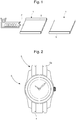
- the strip 1 has a width at the outlet of the die 2 corresponding to the length of a strand with, at one or each of the lateral ends, a hollow tubular projecting structure 3 forming a through hole intended to receive a bar allowing attachment to a watch case.
- the extruded band can have a width at the outlet of the die corresponding substantially to the width of a strand 5a and include grooves 4 extending over the entire length of the strap 5 of the watch 6.
- the extrusion step can consist of a co-extrusion step of several materials.
- the extruded band can thus have colored bands 7 which extend on the bracelet 5 longitudinally or transversely according to respectively that the extruded strip has a width corresponding to the width of the strand ( fig. 3 ) or the length of the strand ( fig. 4 ).
- the step of cutting the extruded band to form the strands of the bracelet can be carried out by mechanical cutting (stamping and / or blade system), water jet, laser or ultrasound. It is also possible to cool the strip before the cutting operation, in order to have more adequate mechanical properties for the chosen process, and limit burrs, for example.
- the mass polishing step consists in immersing the strands in an abrasive mixture set in motion in the tank of a polisher which can be of the vibrator or rotating bottom type.
- the polishing is carried out in a rotary bottom polisher, also called a rotary bottom centrifuge, with a rotation speed of between 100 and 400 rpm and, preferably, between 200 and 300 rpm with treatment times between 1 and 5 hours and preferably between 2 and 4 hours.
- the abrasive mixture comprises carriers which can be of different shapes (triangular, cylindrical, etc.) and made of different materials such as ceramic, metal, organic material, such as corn or crushed shells, or polymer, with a abrasive power adjusted according to the desired final appearance and the material of the strands.
- the mixture can also comprise a chemical additive such as soap and / or an abrasive additive in the form of powder or paste intended to amplify the abrasive effect.
- the mass polishing step makes it possible to mattify the entire surface of the strands of the bracelet, i.e. in other words to homogenize the height of the vertices.
- the value Rp which is the maximum height of the projections of the roughness profile measured according to the standards ISO 4287: 1997 and ISO 4288: 1996 is less than or equal to 3 ⁇ m and, preferably, less than or equal to 2 ⁇ m .
- the maximum height of the projections is determined for each base length analyzed and averaged over all the base lengths to obtain the above-mentioned value.
- the polishing step also makes it possible to remove any defects linked to the shaping process (trace of extrusion, for example) or of cutting (residual burrs, too sharp edges, etc.).
- TPE-S compounds of different colors are co-extruded through a three-dimensional die with a tubular profile at one lateral end.
- the extruded strip from the die has a geometry similar to that of the strip to the right of the figure 1 .
- the extruded band was cut by stamping to obtain a strand of bracelet with sharp edges.
- the bracelet strand was polished in a rotary bottom centrifuge for 3 hours with ceramic carriers of triangular shape having an average abrasive power, with a height and a width of 8 mm respectively (Spaleck endurentech B8 * 8D ) and a chemical soap additive (Spaleck endurentech nik D-670-U) at a speed of 260 rpm.
- the roughness of the bracelet strand before and after polishing was analyzed with an optical profiler Altisurf 500 (ISO 4288: 1996/4287: 1997) on a surface of 3 mm * 3 mm at a measurement speed of 250 ⁇ m / s, at due to a measurement by 1 ⁇ m.
- the values given below were carried out on thirty base lengths of 0.8 mm and are the average of the values obtained for each base length.
- the surface Before polishing, the surface has a roughness Rp of 3.4 ⁇ m. After polishing, the roughness Rp is reduced to a value of 1.9 ⁇ m.
- the resistance to soiling was evaluated by friction (1000 cycles) of a denim garment on the strands of bracelets before and after polishing.
- the disgorgement of the jeans on the bracelet was observed before and after washing. It has been found that polishing makes it possible to drastically reduce the formation of dirt on the bracelet and that it also makes it easier to wash.
Landscapes
- Engineering & Computer Science (AREA)
- Mechanical Engineering (AREA)
- Manufacturing & Machinery (AREA)
- Chemical & Material Sciences (AREA)
- Materials Engineering (AREA)
- Extrusion Moulding Of Plastics Or The Like (AREA)
- Adornments (AREA)
- Processing And Handling Of Plastics And Other Materials For Molding In General (AREA)
Abstract
Description
- La présente invention se rapporte à un procédé de fabrication par extrusion ou moulage d'un bracelet de montre ou de bijou présentant à l'issue de son procédé de fabrication une finition esthétique parfaite.
- A ce jour, les bracelets de montre en plastique sont essentiellement fabriqués par moulage, soit par injection, soit par compression. Ces procédés permettent la fabrication rapide de grandes séries de ce type d'objets en matière plastique avec des formes complexes et un état de surface contrôlé. Cependant, les bracelets fabriqués par moulage présentent sur toute la longueur de la tranche du bracelet une ligne d'injection qui constitue un défaut peu esthétique. D'autre part, le procédé de moulage nécessite un outillage coûteux, d'autant plus coûteux que l'objet est complexe. Par ailleurs, si on souhaite obtenir des bracelets avec différentes couleurs ou matières dans la masse, il est nécessaire d'avoir recours à plusieurs étapes de surmoulage ou de bi-injection.
- Il a également été proposé dans les documents
FR 2 121 864 WO 2017/118499 de réaliser des bracelets par un procédé d'extrusion qui est un procédé moins onéreux pour les fabrications de grandes séries de pièces. En particulier, le documentWO 2017/118499 divulgue un procédé de co-extrusion de matériaux de couleurs et/ou de propriétés différentes pour réaliser des bracelets aux géométries et aux propriétés plus élaborées. Le procédé d'extrusion a cependant pour désavantage qu'il génère sur la face de la bande extrudée des défauts dus au passage et aux frottements de la matière à travers la filière. Ces défauts sont visibles à l'oeil nu, peu agréables au toucher et facilitent l'accroche de la salissure à cause de la rugosité de surface. Par ailleurs, la découpe de la bande extrudée pour former les brins du bracelet conduit à des arêtes franches non arrondies et peu esthétiques. En conséquence, d'un point de vue pratique, l'utilisation de ce procédé est généralement limitée à la fabrication d'objets pour lesquels les critères esthétiques sont peu élevés comme, par exemple, des colliers pour chiens ou des bracelets temporaires dans le cadre hospitalier. - La présente invention a pour objet de remédier aux inconvénients précités en proposant un procédé de fabrication de bracelets incluant, après une étape d'extrusion plus découpe, ou de moulage, une étape de polissage en masse des brins du bracelet permettant de réduire la rugosité de surface et, par là-même, d'obtenir une finition esthétique parfaite.
- Le polissage en masse, aussi connu sous les termes de polissage mécano-chimique, tribofinition ou finition de masse, permet d'obtenir une surface très agréable au toucher (effet ultra soft), supprimant également l'effet collant de certaines matières après extrusion ou injection. Il permet également de gommer les défauts de surface dus aux frottements de la filière d'extrusion sur la matière ou aux lignes d'injection. Il permet également d'obtenir un matériau avec une meilleure résistance à la salissure. En effet, la modification de la surface évite aux salissures de s'accrocher dans le matériau : la résistance à la salissure est améliorée et l'élimination de la salissure par lavage est facilitée. L'étape de polissage permet également d'arrondir les tranches du bracelet, après découpe ou après moulage, ce qui améliore également l'aspect esthétique du bracelet.
- Concrètement, le polissage en masse permet de matifier la surface de la matière et donc d'homogénéiser le profil de rugosité. Le bracelet issu du procédé présente ainsi pour caractéristique d'avoir une rugosité moyenne Rp inférieure ou égale à 3 µm, et, de préférence, inférieure ou égale à 2 µm.
- D'autres caractéristiques et avantages de la présente invention apparaîtront dans la description suivante de modes de réalisation préférés, présentés à titre d'exemple non limitatif en référence aux dessins annexés.
-
- La
figure 1 représente une vue schématique de deux bandes de géométries différentes, issues de la ligne d'extrusion selon le procédé de l'invention. - La
figure 2 représente une vue en perspective d'une montre munie d'une variante de bracelet fabriqué avec le procédé selon l'invention. - Les
figures 3 et 4 représentent des vues en plan de montres munies respectivement d'autres variantes du bracelet fabriqué avec le procédé selon l'invention. - La présente invention se rapporte à un procédé de fabrication d'un bracelet de montre ou de bijou en matière synthétique ainsi qu'au bracelet issu du procédé. De manière conventionnelle, le bracelet comporte un ou deux brins avec, par exemple, un seul brin dans le cas d'une construction type NATO. Le procédé de fabrication inclut une étape de polissage en masse. En amont de cette étape, une bande destinée à former un ou deux brins du bracelet est réalisée. Préférentiellement, la bande synthétique est réalisée par extrusion qui est un procédé pour lequel l'état de surface est difficile à contrôler. Cependant, la présente invention n'exclut pas de réaliser la bande par moulage. Le procédé comporte ainsi successivement une étape de réalisation par moulage ou extrusion d'une bande en matériau synthétique destinée à former un ou deux brins du bracelet et une étape de polissage en masse de chaque brin. Dans le cas d'une étape de réalisation par moulage, la bande issue de cette étape présente des dimensions correspondantes à celles du brin. Dans le cas d'une étape de réalisation par extrusion, la bande issue de cette étape est découpée à dimension pour obtenir le ou les brins du bracelet. Ainsi, pour cette dernière variante préférée, le procédé de fabrication comporte successivement :
- 1. une étape d'extrusion d'au moins une matière synthétique pour former une bande extrudée,
- 2. une étape de découpe de la bande extrudée pour obtenir le ou les brins du bracelet,
- 3. une étape de polissage en masse de chaque brin.
- L'étape d'extrusion du procédé consiste à fabriquer une bande ayant une largeur correspondant sensiblement à la largeur du bracelet ou ayant une largeur correspondant sensiblement à la longueur d'un brin ou des deux brins du bracelet.
- La bande issue du moulage ou de l'extrusion peut présenter un relief. Elle peut également comporter des zones se distinguant par leur couleur et/ou leurs propriétés du reste de la bande. A titre d'exemple à la
figure 1 pour une bande extrudée, la bande 1 a une largeur en sortie de la filière 2 correspondant à la longueur d'un brin avec à une ou chacune des extrémités latérales une structure tubulaire creuse en saillie 3 formant un trou débouchant destiné à recevoir une barrette permettant la fixation à une boîte de montre. A titre d'autre exemple illustré à lafigure 2 , la bande extrudée peut avoir une largeur en sortie de filière correspondant sensiblement à la largeur d'un brin 5a et comporter des rainures 4 s'étendant sur toute la longueur du bracelet 5 de la montre 6. - Pour obtenir différentes couleurs et/ou propriétés sur la bande, l'étape d'extrusion peut consister en une étape de co-extrusion de plusieurs matières. La bande extrudée peut ainsi présenter des bandes de couleurs 7 qui s'étendent sur le bracelet 5 longitudinalement ou transversalement selon respectivement que la bande extrudée a une largeur correspondant à la largeur du brin (
fig.3 ) ou à la longueur du brin (fig.4 ). - Selon l'invention, les matériaux synthétiques utilisés sont des mélanges comprenant au moins un polymère élastomère avec une dureté comprise entre 55 et 90 shore A et, de préférence, entre 60 et 75 shore A choisi parmi un élastomère thermoplastique (TPE), un silicone et un caoutchouc naturel ou synthétique. Préférentiellement, le mélange comprend au moins un TPE choisi parmi la liste suivante :
- TPE-O - Oléfines thermoplastiques
- TPE-S - Plus particulièrement les composés SBS, SEBS ou SEPS styréniques
- TPE-V - Plus particulièrement les composés PP/EPDM vulcanisés ou TPSi-V (combinaison de thermoplastique et de silicone réticulé)
- TPE-E - Composé de copolyester
- TPE-U - Polyuréthane thermoplastique
- TPE-A - Polyamide thermoplastique
- Résines ionomères.
- L'étape de découpe de la bande extrudée pour former les brins du bracelet peut être réalisée par découpe mécanique (étampage et/ou système de lames), jet d'eau, laser ou ultrason. Il est aussi possible de refroidir la bande avant l'opération de découpe, afin d'avoir des propriétés mécaniques plus adéquates au procédé choisi, et limiter les bavures, par exemple.
- L'étape de polissage en masse consiste à immerger les brins dans un mélange abrasif mis en mouvement dans la cuve d'une polisseuse qui peut être de type vibreur ou à fond tournant. A titre d'exemple, le polissage est réalisé dans une polisseuse à fond tournant, aussi dite centrifugeuse à fond tournant, avec une vitesse de rotation comprise entre 100 et 400 t/min et, de préférence, entre 200 et 300 t/min avec des temps de traitement compris entre 1 et 5 heures et, de préférence, entre 2 et 4 heures. Le mélange abrasif comporte des porteurs pouvant être de différentes formes (triangulaires, cylindriques, etc.) et réalisés dans différents matériaux tels qu'en céramique, en métal, en matière organique, comme du maïs ou des coquilles broyées, ou en polymère, avec un pouvoir abrasif ajusté en fonction de l'aspect final désiré et de la matière des brins. Le mélange peut en outre comporter un additif chimique tel que du savon et/ou un additif abrasif sous forme de poudre ou de pâte destiné à amplifier l'effet abrasif. L'étape de polissage en masse permet de matifier l'ensemble de la surface des brins du bracelet, c.à.d. en d'autres mots d'homogénéiser la hauteur des sommets. Selon l'invention, la valeur Rp qui est la hauteur maximum des saillies du profil de rugosité mesurée selon les normes ISO 4287 :1997 et ISO 4288:1996 est inférieure ou égale à 3 µm et, de préférence, inférieure ou égale à 2 µm. La hauteur maximum des saillies est déterminée pour chaque longueur de base analysée et moyennée sur toutes les longueurs de base pour obtenir la valeur susmentionnée. L'étape de polissage permet aussi de supprimer les éventuels défauts liés au procédé de mise en forme (trace d'extrusion, par exemple) ou de découpe (bavures résiduelles, bords trop francs, etc...).
- Un exemple de fabrication selon l'invention est donné ci-après. Deux composés en TPE-S de couleurs distinctes sont co-extrudés à travers une filière tridimensionnelle comportant à une extrémité latérale un profil tubulaire. La bande extrudée issue de la filière présente une géométrie semblable à celle de la bande à droite de la
figure 1 . La bande extrudée a été découpée par étampage pour obtenir un brin de bracelet avec des arêtes franches. Ensuite, le brin de bracelet a été poli dans une centrifugeuse à fond tournant pendant 3 heures avec des porteurs céramiques de forme triangulaire ayant un pouvoir abrasif moyen, d'une hauteur et d'une largeur de respectivement 8 mm (Spaleck Oberflächentech B8*8D) et un additif chimique type savon (Spaleck Oberflächentech nik D-670-U) à une vitesse de 260 t/min. - La rugosité du brin de bracelet avant et après polissage a été analysée avec un profilomètre optique Altisurf 500 (ISO 4288 :1996/4287 :1997) sur une surface de 3 mm * 3 mm à une vitesse de mesure de 250 µm/s, à raison d'une mesure par 1 µm. Les valeurs données ci-dessous ont été réalisées sur trente longueurs de base de 0.8 mm et sont la moyenne des valeurs obtenues pour chaque longueur de base. Avant polissage, la surface présente une rugosité Rp de 3.4 µm. Après polissage, la rugosité Rp est réduite à une valeur de 1.9 µm.
- La résistance à la salissure a été évaluée par frottements (1000 cycles) d'un vêtement en jean sur les brins de bracelets avant et après polissage. Le dégorgement du jean sur le bracelet a été observé avant et après lavage. Il est constaté que le polissage permet de réduire drastiquement la formation de salissure sur le bracelet et qu'il permet en outre de faciliter le lavage.
-
- (1) Bande
- (2) Filière de la ligne d'extrusion
- (3) Structure tubulaire creuse
- (4) Rainure
- (5) Bracelet
- a. Brin
- (6) Montre
- (7) Bande de couleur
Claims (14)
- Procédé de fabrication d'un bracelet (5) en matériau synthétique pour montre (6) ou bijou comportant au moins un brin (5a), le procédé comprenant une étape de réalisation par moulage ou extrusion d'une bande (1) en matériau synthétique destinée à former ledit au moins brin (5a), le procédé étant caractérisé en ce qu'il comporte ensuite une étape de polissage en masse de ladite bande (1).
- Procédé selon la revendication 1, caractérisé en ce que l'étape de réalisation de la bande (1) est effectuée par extrusion et suivie d'une étape de découpe de ladite bande (1) pour former ledit au moins brin (5a) avant l'étape de polissage en masse.
- Procédé selon la revendication 1 ou 2, caractérisé en ce que l'étape de polissage en masse est effectuée dans une polisseuse à fond tournant ou de type vibreur.
- Procédé selon l'une quelconque des revendications précédentes, caractérisé en ce que l'étape de polissage en masse est effectuée dans une polisseuse à fond tournant avec une vitesse de rotation comprise entre 100 et 400 t/min et, de préférence, entre 200 et 300 t/min et avec un temps de traitement compris entre 1 et 5 heures et, de préférence, entre 2 et 4 heures.
- Procédé selon l'une quelconque des revendications précédentes, caractérisé en ce que l'étape de polissage en masse est effectuée dans un mélange abrasif comprenant des porteurs en céramique, en métal, en matière organique ou en polymère et, de préférence, comprenant des porteurs en céramique.
- Procédé selon l'une quelconque des revendications précédentes, caractérisé en ce que la bande (1) issue de l'étape d'extrusion ou de moulage comporte des zones en relief et/ou des zones formées de matières se distinguant par leurs couleurs et/ou leurs propriétés.
- Procédé selon l'une quelconque des revendications précédentes, caractérisé en ce que la bande (1) issue de l'étape d'extrusion a une largeur correspondant sensiblement à la largeur dudit au moins brin (5a).
- Procédé selon l'une quelconque des revendications 1 à 6, caractérisé en ce que la bande (1) issue de l'étape d'extrusion a une largeur correspondant sensiblement à la longueur dudit au moins brin (5a).
- Bracelet (5) en matériau synthétique pour montre (6) ou bijou comportant au moins un brin (5a) formé d'une bande (1) extrudée ou moulée, caractérisé en ce que ledit au moins brin (5a) a une rugosité Rp inférieure ou égale à 3 µm.
- Bracelet (5) selon la revendication 9, caractérisé en ce que ledit au moins brin (5a) a une rugosité Rp inférieure ou égale à 2 µm.
- Bracelet (5) selon la revendication 9 ou 10, caractérisé en ce que le matériau synthétique comprend au moins un polymère élastomère avec une dureté comprise entre 55 et 90 shore A et, de préférence, entre 60 et 75 shore A, ledit polymère élastomère étant choisi parmi un élastomère thermoplastique (TPE), un silicone et un caoutchouc naturel ou synthétique.
- Bracelet (5) selon l'une quelconque des revendications 9 à 11, caractérisé en ce que ledit au moins un brin (5a) comporte une zone en relief et/ou une zone se distinguant du reste dudit au moins brin (5a) par sa couleur et/ou ses propriétés.
- Bracelet (5) selon l'une quelconque des revendications 9 à 12, caractérisé en ce que ledit au moins un brin (5a) est formée d'une bande (1) extrudée présentant des tranches arrondies.
- Montre (6) ou bijou comprenant le bracelet (5) selon l'une quelconque des revendications 9 à 13.
Priority Applications (5)
| Application Number | Priority Date | Filing Date | Title |
|---|---|---|---|
| EP18198451.9A EP3632254A1 (fr) | 2018-10-03 | 2018-10-03 | Bracelet plastique avec une rugosite reduite |
| JP2019169042A JP7137542B2 (ja) | 2018-10-03 | 2019-09-18 | 美的仕上げが完全なプラスチック製腕輪 |
| CN202510618321.6A CN120481251A (zh) | 2018-10-03 | 2019-09-27 | 具有美学光洁度的由塑料制成的带 |
| CN201910921189.0A CN110977619A (zh) | 2018-10-03 | 2019-09-27 | 具有美学光洁度的由塑料制成的带 |
| US16/589,295 US11117304B2 (en) | 2018-10-03 | 2019-10-01 | Plastic bracelet and a method of making |
Applications Claiming Priority (1)
| Application Number | Priority Date | Filing Date | Title |
|---|---|---|---|
| EP18198451.9A EP3632254A1 (fr) | 2018-10-03 | 2018-10-03 | Bracelet plastique avec une rugosite reduite |
Publications (1)
| Publication Number | Publication Date |
|---|---|
| EP3632254A1 true EP3632254A1 (fr) | 2020-04-08 |
Family
ID=63762286
Family Applications (1)
| Application Number | Title | Priority Date | Filing Date |
|---|---|---|---|
| EP18198451.9A Pending EP3632254A1 (fr) | 2018-10-03 | 2018-10-03 | Bracelet plastique avec une rugosite reduite |
Country Status (4)
| Country | Link |
|---|---|
| US (1) | US11117304B2 (fr) |
| EP (1) | EP3632254A1 (fr) |
| JP (1) | JP7137542B2 (fr) |
| CN (2) | CN110977619A (fr) |
Cited By (1)
| Publication number | Priority date | Publication date | Assignee | Title |
|---|---|---|---|---|
| CN111499340A (zh) * | 2020-04-27 | 2020-08-07 | 任海清 | 一种釉下五彩玉瓷手镯生产工艺 |
Citations (5)
| Publication number | Priority date | Publication date | Assignee | Title |
|---|---|---|---|---|
| FR890112A (fr) * | 1942-09-23 | 1944-01-28 | Applic Des Procedes Lip A La M | Bracelets, ceintures ou analogues, en matière synthétique moulée |
| FR992105A (fr) * | 1944-05-10 | 1951-10-15 | Page Et Cie | Bracelets-montres ou objets analogues en matière plastique et leur procédé de fabrication |
| FR2121864A3 (fr) | 1971-01-15 | 1972-08-25 | Lewa Lederwarenfabrik Gmbh | |
| JP2005013697A (ja) * | 2003-06-28 | 2005-01-20 | ▲高▼木 征一 | アクセサリー |
| WO2017118499A1 (fr) | 2016-01-07 | 2017-07-13 | The Swatch Group Research And Development Ltd | Bracelet et son procede de fabrication |
Family Cites Families (8)
| Publication number | Priority date | Publication date | Assignee | Title |
|---|---|---|---|---|
| JPS52119358A (en) * | 1976-03-31 | 1977-10-06 | Tooru Mashida | Watch band |
| JPS604463A (ja) * | 1983-06-23 | 1985-01-10 | Toyoda Gosei Co Ltd | ステアリングホイ−ル |
| JPH0379257U (fr) * | 1989-11-30 | 1991-08-13 | ||
| US5507685A (en) * | 1993-08-25 | 1996-04-16 | Hoffman; Steve E. | Method for surface finishing of difficult polish surfaces |
| EP1399294B1 (fr) * | 2001-06-26 | 2005-12-21 | Lam Research Corporation | Systeme de detection de point d'extremite pour applications de polissage mecano-chimique |
| US7481949B2 (en) * | 2002-11-08 | 2009-01-27 | Wako Pure Chemical Industries, Ltd | Polishing composition and rinsing composition |
| US9788039B2 (en) * | 2014-06-23 | 2017-10-10 | Google Inc. | Camera system API for third-party integrations |
| CN207824654U (zh) * | 2017-12-14 | 2018-09-07 | 余江县恒欣精密元件有限公司 | 一种方便水管放置可过滤的振动研磨机 |
-
2018
- 2018-10-03 EP EP18198451.9A patent/EP3632254A1/fr active Pending
-
2019
- 2019-09-18 JP JP2019169042A patent/JP7137542B2/ja active Active
- 2019-09-27 CN CN201910921189.0A patent/CN110977619A/zh active Pending
- 2019-09-27 CN CN202510618321.6A patent/CN120481251A/zh active Pending
- 2019-10-01 US US16/589,295 patent/US11117304B2/en active Active
Patent Citations (5)
| Publication number | Priority date | Publication date | Assignee | Title |
|---|---|---|---|---|
| FR890112A (fr) * | 1942-09-23 | 1944-01-28 | Applic Des Procedes Lip A La M | Bracelets, ceintures ou analogues, en matière synthétique moulée |
| FR992105A (fr) * | 1944-05-10 | 1951-10-15 | Page Et Cie | Bracelets-montres ou objets analogues en matière plastique et leur procédé de fabrication |
| FR2121864A3 (fr) | 1971-01-15 | 1972-08-25 | Lewa Lederwarenfabrik Gmbh | |
| JP2005013697A (ja) * | 2003-06-28 | 2005-01-20 | ▲高▼木 征一 | アクセサリー |
| WO2017118499A1 (fr) | 2016-01-07 | 2017-07-13 | The Swatch Group Research And Development Ltd | Bracelet et son procede de fabrication |
Cited By (1)
| Publication number | Priority date | Publication date | Assignee | Title |
|---|---|---|---|---|
| CN111499340A (zh) * | 2020-04-27 | 2020-08-07 | 任海清 | 一种釉下五彩玉瓷手镯生产工艺 |
Also Published As
| Publication number | Publication date |
|---|---|
| JP2020096787A (ja) | 2020-06-25 |
| CN120481251A (zh) | 2025-08-15 |
| CN110977619A (zh) | 2020-04-10 |
| JP7137542B2 (ja) | 2022-09-14 |
| US11117304B2 (en) | 2021-09-14 |
| US20200108540A1 (en) | 2020-04-09 |
Similar Documents
| Publication | Publication Date | Title |
|---|---|---|
| EP3400122B1 (fr) | Bracelet et son procédé de fabrication | |
| LU86370A1 (fr) | Elements de coupe rotatifs interieurs pour rasoirs electriques et procedes pour la fabrication de ceux-ci | |
| FR2772656A1 (fr) | Procede de revetement d'une vis d'extrudeuse | |
| EP2316299B1 (fr) | Pièce comportant une structure en matériau inorganique et un revêtement élastomère et procédé pour l'obtention d'une telle pièce | |
| WO2007118942A1 (fr) | Element filifokme, notamment branche de lunettes, et son procede d 'obtention | |
| WO2018108336A1 (fr) | Procede de fabrication pour une piece d'habillage avec decor pour montre ou bijou | |
| CH365627A (fr) | Procédé de fabrication d'un objet en forme de brosse, notamment d'un outil, moule annulaire pour la mise en oeuvre de ce procédé et objet en forme de brosse obtenu par ce procédé | |
| CH715426A2 (fr) | Bracelet plastique avec une finition esthétique parfaite. | |
| CA2160954A1 (fr) | Eventation des moules | |
| JP7137542B2 (ja) | 美的仕上げが完全なプラスチック製腕輪 | |
| EP1708556B1 (fr) | Procede de fabrication de filaments de coupe de vegetaux et filaments de coupe de vegetaux | |
| CH699145B1 (fr) | Pièce comportant une structure en métal et munie d'un revêtement et procédé pour l'obtention d'une telle pièce. | |
| EP4039121B1 (fr) | Article de mode comportant une paroi mince a zones localement et selectivement expansibles | |
| EP1584441A1 (fr) | Procédé de fabrication de poils de brosses de lavage de véhicules, poils ainsi obtenus et brosses réalisées à partir de tels poils | |
| EP1350438A1 (fr) | Object de parure | |
| HK40125765A (zh) | 具有美学光洁度的由塑料制成的带 | |
| FR2891533A1 (fr) | Organe de recouvrement, procede de fabrication d'un tel organe et distributeur de produit fluide utilisant un tel organe. | |
| CH712004A2 (fr) | Bracelet et son procédé de fabrication. | |
| FR2835717A1 (fr) | Manche de pinceau de maquillage et son procede de fabrication | |
| EP4017701B1 (fr) | Article en elastomere comportant une surface texturee de type velours et procede de realisation d'un tel article | |
| CH719091B1 (fr) | Objet manufacturé thermochromique et son procédé de réalisation. | |
| CH718036B1 (fr) | Objet manufacturé photochromique et son procédé de réalisation. | |
| HK40024245A (en) | Plastic bracelet with a perfect aesthetic finish | |
| FR2966330A1 (fr) | Semelle antiperforation et procede de fabrication d'une telle semelle | |
| FR2763787A1 (fr) | Fil de coupe pour debroussailleuses et taille-bordures |
Legal Events
| Date | Code | Title | Description |
|---|---|---|---|
| PUAI | Public reference made under article 153(3) epc to a published international application that has entered the european phase |
Free format text: ORIGINAL CODE: 0009012 |
|
| STAA | Information on the status of an ep patent application or granted ep patent |
Free format text: STATUS: THE APPLICATION HAS BEEN PUBLISHED |
|
| AK | Designated contracting states |
Kind code of ref document: A1 Designated state(s): AL AT BE BG CH CY CZ DE DK EE ES FI FR GB GR HR HU IE IS IT LI LT LU LV MC MK MT NL NO PL PT RO RS SE SI SK SM TR |
|
| AX | Request for extension of the european patent |
Extension state: BA ME |
|
| STAA | Information on the status of an ep patent application or granted ep patent |
Free format text: STATUS: REQUEST FOR EXAMINATION WAS MADE |
|
| 17P | Request for examination filed |
Effective date: 20201008 |
|
| RBV | Designated contracting states (corrected) |
Designated state(s): AL AT BE BG CH CY CZ DE DK EE ES FI FR GB GR HR HU IE IS IT LI LT LU LV MC MK MT NL NO PL PT RO RS SE SI SK SM TR |
|
| STAA | Information on the status of an ep patent application or granted ep patent |
Free format text: STATUS: EXAMINATION IS IN PROGRESS |
|
| 17Q | First examination report despatched |
Effective date: 20221124 |
|
| P01 | Opt-out of the competence of the unified patent court (upc) registered |
Effective date: 20230615 |