EP3632216A1 - Sterilization method and sterilization device - Google Patents
Sterilization method and sterilization device Download PDFInfo
- Publication number
- EP3632216A1 EP3632216A1 EP18805141.1A EP18805141A EP3632216A1 EP 3632216 A1 EP3632216 A1 EP 3632216A1 EP 18805141 A EP18805141 A EP 18805141A EP 3632216 A1 EP3632216 A1 EP 3632216A1
- Authority
- EP
- European Patent Office
- Prior art keywords
- ultraviolet light
- sterilization
- light
- less
- emission wavelength
- Prior art date
- Legal status (The legal status is an assumption and is not a legal conclusion. Google has not performed a legal analysis and makes no representation as to the accuracy of the status listed.)
- Withdrawn
Links
Images




Classifications
-
- A—HUMAN NECESSITIES
- A23—FOODS OR FOODSTUFFS; TREATMENT THEREOF, NOT COVERED BY OTHER CLASSES
- A23B—PRESERVATION OF FOODS, FOODSTUFFS OR NON-ALCOHOLIC BEVERAGES; CHEMICAL RIPENING OF FRUIT OR VEGETABLES
- A23B70/00—Preservation of non-alcoholic beverages
- A23B70/50—Preservation of non-alcoholic beverages by irradiation or electric treatment, without heating
-
- A—HUMAN NECESSITIES
- A23—FOODS OR FOODSTUFFS; TREATMENT THEREOF, NOT COVERED BY OTHER CLASSES
- A23B—PRESERVATION OF FOODS, FOODSTUFFS OR NON-ALCOHOLIC BEVERAGES; CHEMICAL RIPENING OF FRUIT OR VEGETABLES
- A23B2/00—Preservation of foods or foodstuffs, in general
- A23B2/50—Preservation of foods or foodstuffs, in general by irradiation without heating
- A23B2/53—Preservation of foods or foodstuffs, in general by irradiation without heating with ultraviolet light
-
- A—HUMAN NECESSITIES
- A23—FOODS OR FOODSTUFFS; TREATMENT THEREOF, NOT COVERED BY OTHER CLASSES
- A23B—PRESERVATION OF FOODS, FOODSTUFFS OR NON-ALCOHOLIC BEVERAGES; CHEMICAL RIPENING OF FRUIT OR VEGETABLES
- A23B70/00—Preservation of non-alcoholic beverages
-
- A—HUMAN NECESSITIES
- A23—FOODS OR FOODSTUFFS; TREATMENT THEREOF, NOT COVERED BY OTHER CLASSES
- A23F—COFFEE; TEA; THEIR SUBSTITUTES; MANUFACTURE, PREPARATION, OR INFUSION THEREOF
- A23F5/00—Coffee; Coffee substitutes; Preparations thereof
- A23F5/24—Extraction of coffee; Coffee extracts; Making instant coffee
-
- A—HUMAN NECESSITIES
- A23—FOODS OR FOODSTUFFS; TREATMENT THEREOF, NOT COVERED BY OTHER CLASSES
- A23L—FOODS, FOODSTUFFS OR NON-ALCOHOLIC BEVERAGES, NOT OTHERWISE PROVIDED FOR; PREPARATION OR TREATMENT THEREOF
- A23L2/00—Non-alcoholic beverages; Dry compositions or concentrates therefor; Preparation or treatment thereof
- A23L2/02—Non-alcoholic beverages; Dry compositions or concentrates therefor; Preparation or treatment thereof containing fruit or vegetable juices
-
- C—CHEMISTRY; METALLURGY
- C12—BIOCHEMISTRY; BEER; SPIRITS; WINE; VINEGAR; MICROBIOLOGY; ENZYMOLOGY; MUTATION OR GENETIC ENGINEERING
- C12H—PASTEURISATION, STERILISATION, PRESERVATION, PURIFICATION, CLARIFICATION OR AGEING OF ALCOHOLIC BEVERAGES; METHODS FOR ALTERING THE ALCOHOL CONTENT OF FERMENTED SOLUTIONS OR ALCOHOLIC BEVERAGES
- C12H1/00—Pasteurisation, sterilisation, preservation, purification, clarification, or ageing of alcoholic beverages
- C12H1/12—Pasteurisation, sterilisation, preservation, purification, clarification, or ageing of alcoholic beverages without precipitation
- C12H1/16—Pasteurisation, sterilisation, preservation, purification, clarification, or ageing of alcoholic beverages without precipitation by physical means, e.g. irradiation
- C12H1/165—Pasteurisation, sterilisation, preservation, purification, clarification, or ageing of alcoholic beverages without precipitation by physical means, e.g. irradiation by irradiation
-
- A—HUMAN NECESSITIES
- A23—FOODS OR FOODSTUFFS; TREATMENT THEREOF, NOT COVERED BY OTHER CLASSES
- A23V—INDEXING SCHEME RELATING TO FOODS, FOODSTUFFS OR NON-ALCOHOLIC BEVERAGES AND LACTIC OR PROPIONIC ACID BACTERIA USED IN FOODSTUFFS OR FOOD PREPARATION
- A23V2002/00—Food compositions, function of food ingredients or processes for food or foodstuffs
Definitions
- the present invention relates to a sterilization method and sterilization device for beverages other than water.
- UV disinfection for food sterilization, disinfection using ultraviolet light (UV disinfection) is considered as a method in which the flavor is less likely to deteriorate than heat sterilization.
- a mercury lamp main emission wavelength is 254 nm
- Patent Documents 1 and 2 Japanese Patent Documents 1 and 2 below.
- Patent Document 3 describes an apparatus that irradiates ultraviolet light as a sterilization treatment for fruit juice beverages, jellies, mousses and the like that are food and drink. Patent Document 3 further describes that sterilization treatment is performed by using ultraviolet light having a wavelength range of 200 to 300 nm, particularly 220 nm to 280 nm (UV-C).
- ultraviolet light having a wavelength range of 200 to 300 nm, particularly 220 nm to 280 nm (UV-C).
- the present inventor conducted a quantitative analysis with this analyzer, and newly found a problem that, in a case of sterilizing a liquid material by irradiation with ultraviolet light, when light (wavelength: 254 nm) from a mercury lamp which was conventionally preferred was used, there was a problem that taste and smell (fragrance) changed due to generation of a new substance that did not exist before treatment or a large change in the amount of a specific substance.
- a to-be-treated solution which is a beverage other than water, is irradiated with ultraviolet light having an emission wavelength of 280 nm or more and 320 nm or less without being substantially irradiated with ultraviolet light having an emission wavelength of 260 nm or less.
- the sterilization device includes an ultraviolet light irradiation device which irradiates a to-be-treated solution, which is a beverage other than water, with ultraviolet light, having a main emission wavelength of 280 nm or more and 320 nm or less and substantially free of components having an emission wavelength of 260 nm or less, along a flow path through which the solution flows.
- the present invention achieves a sterilization method and a sterilization device that further suppresses deterioration of flavor while ensuring a sterilization effect.
- a treatment target in a sterilization device and a sterilization method of the present invention is a to-be-treated solution which is a beverage other than water.
- a to-be-treated solution include alcoholic beverages such as wine, sake, and beer, coffee, juice, and liquid flavoring themselves.
- Fig. 1 is a cross-sectional view taken along a flow path, schematically showing a configuration of a main part in an example of the sterilization device of the present invention.
- Fig. 2 is a cross-sectional view taken along line A-A in Fig. 1 .
- the dimensional ratio of the drawings does not necessarily coincide with the actual dimensional ratio.
- This sterilization device includes a reactor 10.
- the reactor 10 includes a flow path 3 through which a to-be-treated solution 2 flows, and an ultraviolet light irradiation device 20 provided along the flow path 3.
- the ultraviolet light irradiation device 20 is configured to emit ultraviolet light having a main emission wavelength of 280 nm or more and 320 nm or less and substantially free of components having an emission wavelength of 260 nm or less.
- the light having a main emission wavelength of 280 nm or more and 320 nm or less refers to light whose wavelength band indicating a half value of an emission spectrum is in the range of 280 nm or more and 320 nm or less.
- the light substantially free of components having an emission wavelength of 260 nm or less refers to light not containing components at 260 nm or less in a wavelength band indicating the half value of the emission spectrum.
- the reactor 10 has a cylindrical outer tube 11 and a cylindrical inner tube 12 that are arranged coaxially with each other.
- the flow path 3 for the to-be-treated solution 2 is constituted by a region sandwiched between an inner peripheral surface of the outer tube 11 and an outer peripheral surface of the inner tube 12.
- Materials constituting the outer tube 11 in the reactor 10 are not particularly limited, and for example, a metal material such as stainless steel can be used.
- Materials constituting the inner tube 12 in the reactor 10 may be those through which the ultraviolet light from the ultraviolet light irradiation device 20 transmits, and for example, quartz glass and the like can be used.
- the ultraviolet light irradiation device 20 is disposed along a central axis 5 of the reactor 10 inside the inner tube 12 in the reactor 10.
- the ultraviolet light irradiation device 20 includes a light source that emits ultraviolet light having a main emission wavelength of 280 nm or more and 320 nm or less and substantially free of components having an emission wavelength of 260 nm or less.
- a component having an emission wavelength of 260 nm or less for example, light from a low-pressure mercury lamp (254 nm emission line)
- the flavor of the to-be-treated solution 2 is deteriorated. This point will be described later with reference to examples.
- the light source used as the ultraviolet light irradiation device 20 it is possible to use, for example, an XeBr excimer lamp (peak wavelength is 283 nm) in which a mixed gas of Xe and Br is sealed as a discharge gas, an excimer lamp (peak wavelength is 289 nm) in which Br 2 is sealed as a discharge gas, and an XeCl excimer lamp (peak wavelength is 308 nm) in which a mixed gas of Xe and Cl is sealed as a discharge gas.
- an XeBr excimer lamp peak wavelength is 283 nm
- an excimer lamp peak wavelength is 289 nm
- Br 2 is sealed as a discharge gas
- XeCl excimer lamp peak wavelength is 308 nm
- an ultraviolet light emitting fluorescent lamp irradiates a phosphor with light serving as exciting light and emitted from an excimer generated by dielectric barrier discharge, and emits ultraviolet light serving as radiated light and falling within a specific wavelength range obtained when the phosphor is excited.
- the phosphor for example, bismuth-activated yttrium aluminum borate that emits ultraviolet light having a peak wavelength of 290 nm by excitation can be used.
- cerium-activated lanthanum phosphate having an emission peak with a wide full width at half maximum at a peak wavelength near 320 nm by excitation may be used.
- an LED element configured to have an emission wavelength of 280 nm or more and 320 nm or less and be substantially free of a component having an emission wavelength of 260 nm or less can also be used.
- the amount of ultraviolet light applied to the solution 2, to be treated, by the ultraviolet light irradiation device 20 is preferably, for example, 170 mJ/cm 2 or more, more preferably 170 to 500 mJ/cm 2 .
- the ultraviolet light irradiation amount is 170 mJ/cm 2 or more, sterilization treatment can be performed while suppressing changes in the taste and odor of the solution 2 itself.
- the diameter of the flow path 3 in the reactor 10, that is, the distance between the inner peripheral surface of the outer tube 11 and the outer peripheral surface of the inner tube 12, is preferably 0.05 to 1 mm, for example.
- the flow rate of the to-be-treated solution 2 circulated in the flow path 3 and the size of a region irradiated with ultraviolet light in the flow path 3 (that is, in the light source included in the ultraviolet light irradiation device 20, the length relating to the direction of the flow path 3) and other conditions can be appropriately set such that the ultraviolet light irradiation amount is within the above-described specific range.
- the to-be-treated solution 2 is introduced into the flow path 3 and is radiated with ultraviolet light in the above-described wavelength band emitted from the ultraviolet light irradiation device 20 in the process of being circulated in the flow path 3, whereby the solution 2 is sterilized.
- the sterilization effect can be shown while suppressing deterioration of the flavor of the to-be-processed solution 2 as a beverage.
- the reactor 10 only needs to have a structure in which the ultraviolet light irradiation device 20 is provided along the flow path through which the to-be-treated solution 2 is circulated, and is not limited to the above structure.
- the reactor 10 having the following specifications was manufactured according to the configuration shown in Fig. 1 .
- the outer tube 11 is formed of stainless steel and has an inner diameter of ⁇ 27 mm.
- the inner tube 12 is formed of quartz glass and has an outer diameter of ⁇ 26.5 mm and a wall thickness of 1.0 mm.
- the length of the region irradiated with ultraviolet light from the ultraviolet light irradiation device 20 is 80 mm.
- the distance between the inner peripheral surface of the outer tube 11 and the outer peripheral surface of the inner tube 12, that is, a radial width of the flow path 3 is 0.5 mm.
- a XeBr excimer lamp which emits ultraviolet light having a peak wavelength of 283 nm (half value was 280 nm to 286 nm) was used.
- the emission length of the XeBr excimer lamp is 80 mm.
- an ultraviolet excimer fluorescent lamp (UV-XEFL320BB manufactured by USHIO INC.) that emits ultraviolet light having a peak wavelength of 320 nm (half value was 310 nm to 360 nm) was used.
- the emission length of the ultraviolet excimer fluorescent lamp is 80 mm.
- an ultraviolet excimer fluorescent lamp (UV-XEFL290BB manufactured by USHIO INC.) that emits ultraviolet light having a peak wavelength of 290 nm (half value was 270 nm to 320 nm) was used.
- the emission length of the ultraviolet excimer fluorescent lamp is 80 mm.
- a low-pressure mercury lamp which emits ultraviolet light having a peak wavelength of 254 nm (half value was 251 nm to 257 nm) was used.
- the emission length of the low-pressure mercury lamp is 80 mm.
- a KrCl excimer lamp which emits ultraviolet light having a peak wavelength of 222 nm (half value was 215 nm to 229 nm) was used.
- the emission length of the KrCl excimer lamp is 80 mm.
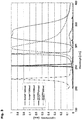
- Fig. 3 shows an emission spectrum of each light source in Examples 1 to 3 and Comparative Examples 1 and 2.
- Example 1 Several types of materials were prepared as the to-be-treated solutions 2, and each of the to-be-treated solutions 2 was irradiated with the ultraviolet light of Example 1 and Comparative Example 1 to perform odor analysis.
- the irradiation conditions of ultraviolet light are as follows. Flow rate of test solution in flow path for to-be-treated solution: 0.72 mL/hour Ultraviolet light intensity in flow path for to-be-treated solution: 3.6 mW/cm 2 Treatment time: 139 seconds Ultraviolet light irradiation amount: 500 mJ/cm 2 Temperature of to-be-treated solution during treatment: 20°C
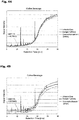
- Figs. 4A and 4B show the results when the to-be-treated solution 2 is a coffee beverage.
- Fig. 4B is a graph obtained by redrawing the graphs of an untreated case, Example 1, and Comparative Example 1 by moving the graphs in parallel in a vertical axis direction.
- 3-methyl-1-butanol that was not present in the untreated case and Example 1 was detected. Since 3-methyl-1-butanol is a substance having an unpleasant odor, it is confirmed that the odor changes from the state before the treatment by performing the treatment with the light source of Comparative Example 1.
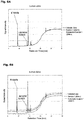
- Figs. 5A and 5B show the results when the to-be-treated solution 2 is apple juice.
- Fig. 5B is a graph obtained by redrawing the graphs of untreated case, Example 1, and Comparative Example 1 by moving the graphs in parallel in a vertical axis direction.
- Comparative Example 1 cycloheptanone that was not present in the untreated case and Example 1 was detected. Since cycloheptanone is a substance with a mint odor, it is confirmed that the treatment with the light source of Comparative Example 1 increases the odor component and changes the odor of the apple juice to an odor different from the original odor of the apple juice.
- Figs. 6A and 6B show the results when the to-be-treated solution 2 is lemon juice.
- Fig. 6B is a graph obtained by redrawing the graphs of untreated case, Example 1, and Comparative Example 1 by moving the graphs in parallel in a vertical axis direction.
- the strength of ethanol greatly increased in Comparative Example 1. Since ethanol is a substance with an alcoholic odor, it is confirmed that the treatment with the light source of Comparative Example 1 increases the odor component and changes the odor of the lemon juice to an odor different from the original odor of the lemon juice.
- Figs. 7A and 7B show the results when the to-be-treated solution 2 is wine.
- Fig. 7B is a graph obtained by redrawing the graphs of untreated case, Example 1, and Comparative Example 1 by moving the graphs in parallel in a vertical axis direction.
- the strength of 3-methyl-1-butanol greatly increased in Comparative Example 1. Since 3-methyl-1-butanol is a substance with an unpleasant odor, it is confirmed that the treatment with the light source of Comparative Example 1 increases the odor component and changes the odor of the wine to an odor different from the original odor of the wine.
- a coffee beverage was prepared as the to-be-treated solution 2, and taste analysis was performed by irradiating the ultraviolet light of Example 1, Example 2 and Comparative Example 1.
- the irradiation conditions of ultraviolet light are the same as in verification 1.
- a taste analysis test was conducted by the following method.
- Each of the to-be-treated solutions 2 was subjected to the ultraviolet light irradiation treatment (sterilization treatment) using the reactor 10 described above. Then, for each of the to-be-treated solutions 2 after the ultraviolet light irradiation treatment, the taste analysis test was conducted using a taste sensor (taste recognition device "TS-5000Z” manufactured by Intelligent Sensor Technology, Inc.). The results are shown in Fig. 5 .
- the chart shown in Fig. 8 is shown in relative value when the numerical value of each item obtained by analysis of the original taste of the to-be-treated solution 2 without the ultraviolet light irradiation treatment is 0.0.
- a threshold value at which a sensitive person can detect a difference in taste is about ⁇ 0.8.
- the eight analysis items displayed in the chart of Fig. 8 are as follows.
- Fig. 8 when the treatment is performed using the light source of Comparative Example 1, it is confirmed that the bitterness and coarse taste are changed to such an extent that it can be recognized as compared with the untreated case. On the other hand, when the treatment is performed using the light sources of Examples 1 and 2, the bitterness and coarse taste are not changed to such an extent that a difference in taste can be recognized as compared with the untreated case.
- Coffee flavor, grape flavor, and orange flavor were prepared as the to-be-treated solution 2, and the ultraviolet light of Examples 1 to 3 and Comparative Examples 1 to 2 was irradiated to perform sensory evaluation of the taste analysis. Specifically, three samples for each of Examples and Comparative Examples contained in a transparent flour container (70 g) of ⁇ 71 mm were prepared, and 10 people confirmed whether a change in flavor was confirmed before and after irradiation with ultraviolet light. The results of the sensory evaluation are shown in Table 1. In Table 1, Evaluation A indicates that the percentage of people who have confirmed the change in flavor is less than 3%, Evaluation B indicates that the percentage of people who have confirmed the change in flavor is 3% or more and less than 40%, and Evaluation C indicates that the percentage of people who have confirmed the change in flavor is 40% or more.
- Example 1 To-be-treated solution Example 1 (283 nm) Example 2 (320 nm) Example 3 (290 nm) Comparative Example 1 (254 nm) Comparative Example 2 (222 nm) Coffee flavor A A A C C Grape flavor A A A B C Orange flavor A A A B C
- the coffee flavor it was confirmed that after light irradiation from the light source of Comparative Example 1, the flavor was reduced as compared with before the light irradiation. Furthermore, it was confirmed that after light irradiation from the light source of Comparative Example 2, the flavor was reduced, and, at the same time, coarse taste increased as compared with before the light irradiation. On the other hand, after light irradiation from each of the light sources of Examples 1 to 3, deterioration of flavor was hardly confirmed as compared with before the light irradiation.
- the grape flavor As for the grape flavor, it was confirmed that after light irradiation from the light source of Comparative Example 1, the flavor and aftertaste were reduced as compared with before the light irradiation. Furthermore, it was confirmed that after light irradiation from the light source of Comparative Example 2, the taste became light as compared with before the light irradiation. On the other hand, after light irradiation from each of the light sources of Examples 1 to 3, deterioration of flavor was hardly confirmed as compared with before the light irradiation.
- the orange flavor it was confirmed that after light irradiation from the light source of Comparative Example 1, the flavor was reduced as compared with before the light irradiation. Furthermore, it was confirmed that after light irradiation from the light source of Comparative Example 2, the taste became light as compared with before the light irradiation. On the other hand, after light irradiation from each of the light sources of Examples 1 to 3, deterioration of flavor was hardly confirmed as compared with before the light irradiation.
- Bacillus cereus (JCM2152) in a spore state was used as a test bacterium, and a predetermined amount of the test bacteria was suspended in the to-be-treated solution 2 to prepare a test solution such that the number of bacteria initially generated was 10 5 CFU/mL.
- a coffee jelly flavor was adopted as the to-be-treated solution 2.
- a test solution before the ultraviolet light irradiation treatment (sterilization treatment) and a test solution after the ultraviolet light irradiation treatment (sterilization treatment) using the light source of Example 1 under the same conditions as in Verification 1 were applied onto an agar medium and cultured at 30°C for 48 hours, and the number of colonies generated on the agar medium was then examined.
- the results are shown in Fig. 9 .
- Fig. 9 it was confirmed that even when the light source of Example 1 was used, the sterilization effect was ensured.
- the sterilization effect was ensured even when the light sources of Example 2 and Example 3 were used.
- the treatment time was 55 seconds or more and 84 seconds or less
- the treatment time was 100 seconds or more and 300 seconds or less.
- the treatment time is sufficiently longer than the time (ms order) of sterilization treatment using a flash lamp in the food field such as meat and fish. Meat and fish contain a lot of oil, which is altered by absorbing light.
- a method of irradiating light for an extremely short time to instantaneously increase the temperature and thus to perform sterilization treatment may be used.
- some components e.g., compounds such as sugars, lipids, proteins, and carbohydrates
- components contained in coffee beverages, fruit juice beverages including fruit juices such as apple juice and lemon juice, and alcoholic beverages such as wine include substances that change due to the action of light and change their flavor.
- the present invention newly discovers that a change in odor and taste occurs by irradiating ultraviolet light in a predetermined wavelength band in the field of beverages, and then ultraviolet light in a specific wavelength band excluding the predetermined wavelength band is irradiated, so that it is possible to suppress change/deterioration of odor and taste while ensuring the sterilization effect.
- Fig. 10 is a graph showing relative values of sterilization power for each wavelength when the same amount of light is irradiated.
- the horizontal axis represents the wavelength
- the vertical axis represents the relative value of the sterilization power for each wavelength when the sterilization power at 254 nm is 100%.
- the sterilization power of light having a wavelength of 280 nm is about 60% with respect to a wavelength of 254 nm.
- the sterilization power of light having a wavelength longer than 320 nm is 0.001% or less with respect to the wavelength of 254 nm.
- the ability of sterilization is improved by increasing an amount of irradiation light. That is, the ability of sterilization can be substantially ensured at a practical level by adjusting the output of the light source and the irradiation time.
- the sterilization effect cannot be sufficiently ensured unless the output of the light source is made extremely high and an extremely long irradiation time is ensured. In particular, as shown in Fig.
Landscapes
- Engineering & Computer Science (AREA)
- Life Sciences & Earth Sciences (AREA)
- Chemical & Material Sciences (AREA)
- Food Science & Technology (AREA)
- Polymers & Plastics (AREA)
- Wood Science & Technology (AREA)
- Zoology (AREA)
- Health & Medical Sciences (AREA)
- Organic Chemistry (AREA)
- Nutrition Science (AREA)
- Biochemistry (AREA)
- Bioinformatics & Cheminformatics (AREA)
- General Engineering & Computer Science (AREA)
- General Health & Medical Sciences (AREA)
- Genetics & Genomics (AREA)
- Toxicology (AREA)
- Food Preservation Except Freezing, Refrigeration, And Drying (AREA)
- Non-Alcoholic Beverages (AREA)
- Physical Water Treatments (AREA)
Abstract
Description
- The present invention relates to a sterilization method and sterilization device for beverages other than water.
- Conventionally, as a sterilization treatment using light, there is treatment which applies pulsed light from the ultraviolet to the visible range. In recent years, a sterilization treatment method using ultraviolet light is expected.
- In particular, for food sterilization, disinfection using ultraviolet light (UV disinfection) is considered as a method in which the flavor is less likely to deteriorate than heat sterilization. From the viewpoint of luminous efficiency, there is known a method in which a mercury lamp (main emission wavelength is 254 nm) is used to sterilize an object by irradiating the object with ultraviolet light emitted from the lamp while suppressing deterioration of flavor (see
Patent Documents -
Patent Document 3 below describes an apparatus that irradiates ultraviolet light as a sterilization treatment for fruit juice beverages, jellies, mousses and the like that are food and drink.Patent Document 3 further describes that sterilization treatment is performed by using ultraviolet light having a wavelength range of 200 to 300 nm, particularly 220 nm to 280 nm (UV-C). -
- Patent Document 1:
JP-A-2004-201535 - Patent Document 2:
JP-B2-5924394 - Patent Document 3:
WO 2016/186068 A - It is an object of the present invention to provide a sterilization method and a sterilization device that further suppress deterioration of flavor while ensuring a sterilization effect in the sterilization method for a liquid material.
- Conventionally, deterioration of flavor of foods including beverages has been analyzed by sensory inspection. On the other hand, with recent advances in chemical analysis technology, quantitative analysis using an analyzer has become possible. The present inventor conducted a quantitative analysis with this analyzer, and newly found a problem that, in a case of sterilizing a liquid material by irradiation with ultraviolet light, when light (wavelength: 254 nm) from a mercury lamp which was conventionally preferred was used, there was a problem that taste and smell (fragrance) changed due to generation of a new substance that did not exist before treatment or a large change in the amount of a specific substance.
- In the sterilization method according to the present invention, a to-be-treated solution, which is a beverage other than water, is irradiated with ultraviolet light having an emission wavelength of 280 nm or more and 320 nm or less without being substantially irradiated with ultraviolet light having an emission wavelength of 260 nm or less.
- It was confirmed that by irradiating the to-be-treated solution with light in the above-described wavelength band (UV-B), it was possible to suppress generation of substances that caused bitterness, unpleasant taste components, and malodorous components that occurred when light having a wavelength of 254 nm was irradiated and it was possible to sterilize the solution while preventing inhibition of flavor.
- The sterilization device according to the present invention includes an ultraviolet light irradiation device which irradiates a to-be-treated solution, which is a beverage other than water, with ultraviolet light, having a main emission wavelength of 280 nm or more and 320 nm or less and substantially free of components having an emission wavelength of 260 nm or less, along a flow path through which the solution flows.
- The present invention achieves a sterilization method and a sterilization device that further suppresses deterioration of flavor while ensuring a sterilization effect.
-
-
Fig. 1 is a cross-sectional view taken along a flow path, schematically showing a configuration of a main part in an example of a sterilization device of the present invention. -
Fig. 2 is a cross-sectional view taken along line A-A inFig. 1 . -
Fig. 3 is an emission spectrum of each light source in Example 1, Example 2, and Comparative Example 1. -
Fig. 4A is an analysis result of a GC/MS/Olfactometry for coffee beverages. -
Fig. 4B is a graph illustrated by changing a drawing mode of the graph ofFig. 4A . -
Fig. 5A is an analysis result of the GC/MS/Olfactometry for apple juice. -
Fig. 5B is a graph illustrated by changing a drawing mode of the graph ofFig. 5A . -
Fig. 5A is an analysis result of the GC/MS/Olfactometry for lemon juice. -
Fig. 6B is a graph illustrated by changing a drawing mode of the graph ofFig. 6A . -
Fig. 7A is an analysis result of the GC/MS/Olfactometry for wine. -
Fig. 7B is a graph illustrated by changing a drawing mode of the graph ofFig. 7A . -
Fig. 8 is an analysis result of a taste sensor for a coffee beverage. -
Fig. 9 is a photograph showing a sterilization effect when an ultraviolet light irradiation treatment is performed using a light source of Example 1. -
Fig. 10 is a graph showing relative values of sterilization power for each wavelength. - A treatment target in a sterilization device and a sterilization method of the present invention is a to-be-treated solution which is a beverage other than water. Examples of such a to-be-treated solution include alcoholic beverages such as wine, sake, and beer, coffee, juice, and liquid flavoring themselves.
-
Fig. 1 is a cross-sectional view taken along a flow path, schematically showing a configuration of a main part in an example of the sterilization device of the present invention.Fig. 2 is a cross-sectional view taken along line A-A inFig. 1 . In each drawing, the dimensional ratio of the drawings does not necessarily coincide with the actual dimensional ratio. - This sterilization device includes a
reactor 10. Thereactor 10 includes aflow path 3 through which a to-be-treated solution 2 flows, and an ultravioletlight irradiation device 20 provided along theflow path 3. The ultravioletlight irradiation device 20 is configured to emit ultraviolet light having a main emission wavelength of 280 nm or more and 320 nm or less and substantially free of components having an emission wavelength of 260 nm or less. - In this specification, the light having a main emission wavelength of 280 nm or more and 320 nm or less refers to light whose wavelength band indicating a half value of an emission spectrum is in the range of 280 nm or more and 320 nm or less. The light substantially free of components having an emission wavelength of 260 nm or less refers to light not containing components at 260 nm or less in a wavelength band indicating the half value of the emission spectrum.
- The
reactor 10 has a cylindricalouter tube 11 and a cylindricalinner tube 12 that are arranged coaxially with each other. Theflow path 3 for the to-be-treated solution 2 is constituted by a region sandwiched between an inner peripheral surface of theouter tube 11 and an outer peripheral surface of theinner tube 12. - Materials constituting the
outer tube 11 in thereactor 10 are not particularly limited, and for example, a metal material such as stainless steel can be used. Materials constituting theinner tube 12 in thereactor 10 may be those through which the ultraviolet light from the ultravioletlight irradiation device 20 transmits, and for example, quartz glass and the like can be used. - The ultraviolet
light irradiation device 20 is disposed along acentral axis 5 of thereactor 10 inside theinner tube 12 in thereactor 10. As described above, the ultravioletlight irradiation device 20 includes a light source that emits ultraviolet light having a main emission wavelength of 280 nm or more and 320 nm or less and substantially free of components having an emission wavelength of 260 nm or less. When light containing a component having an emission wavelength of 260 nm or less (for example, light from a low-pressure mercury lamp (254 nm emission line)) is emitted to the to-be-treated solution 2, the flavor of the to-be-treated solution 2 is deteriorated. This point will be described later with reference to examples. - As the light source used as the ultraviolet
light irradiation device 20, it is possible to use, for example, an XeBr excimer lamp (peak wavelength is 283 nm) in which a mixed gas of Xe and Br is sealed as a discharge gas, an excimer lamp (peak wavelength is 289 nm) in which Br2 is sealed as a discharge gas, and an XeCl excimer lamp (peak wavelength is 308 nm) in which a mixed gas of Xe and Cl is sealed as a discharge gas. - Further, as the light source used as the ultraviolet
light irradiation device 20, for example, an ultraviolet light emitting fluorescent lamp can be used. The ultraviolet light emitting fluorescent lamp irradiates a phosphor with light serving as exciting light and emitted from an excimer generated by dielectric barrier discharge, and emits ultraviolet light serving as radiated light and falling within a specific wavelength range obtained when the phosphor is excited. As the phosphor, for example, bismuth-activated yttrium aluminum borate that emits ultraviolet light having a peak wavelength of 290 nm by excitation can be used. Further, as the phosphor, cerium-activated lanthanum phosphate having an emission peak with a wide full width at half maximum at a peak wavelength near 320 nm by excitation may be used. - Furthermore, as the light source used as the ultraviolet
light irradiation device 20, an LED element configured to have an emission wavelength of 280 nm or more and 320 nm or less and be substantially free of a component having an emission wavelength of 260 nm or less can also be used. - The amount of ultraviolet light applied to the
solution 2, to be treated, by the ultravioletlight irradiation device 20 is preferably, for example, 170 mJ/cm2 or more, more preferably 170 to 500 mJ/cm2. When the ultraviolet light irradiation amount is 170 mJ/cm2 or more, sterilization treatment can be performed while suppressing changes in the taste and odor of thesolution 2 itself. - The diameter of the
flow path 3 in thereactor 10, that is, the distance between the inner peripheral surface of theouter tube 11 and the outer peripheral surface of theinner tube 12, is preferably 0.05 to 1 mm, for example. By adopting such a configuration, even if the to-be-treated solution 2 is formed of a material having a low transmittance of ultraviolet light from the ultraviolet light irradiation device 20 (for example, 99% of the light amount of the ultraviolet light applied to thesolution 2 is opaque), thesolution 2 can be sterilized uniformly. - The flow rate of the to-
be-treated solution 2 circulated in theflow path 3 and the size of a region irradiated with ultraviolet light in the flow path 3 (that is, in the light source included in the ultravioletlight irradiation device 20, the length relating to the direction of the flow path 3) and other conditions can be appropriately set such that the ultraviolet light irradiation amount is within the above-described specific range. - In the sterilization device, the to-
be-treated solution 2 is introduced into theflow path 3 and is radiated with ultraviolet light in the above-described wavelength band emitted from the ultravioletlight irradiation device 20 in the process of being circulated in theflow path 3, whereby thesolution 2 is sterilized. Thereby, as shown in the results of examples described later, the sterilization effect can be shown while suppressing deterioration of the flavor of the to-be-processed solution 2 as a beverage. - Although the embodiment of the present invention has been described above, the present invention is not limited to the above-described embodiment, and various changes or modifications may be added to the embodiment. For example, the
reactor 10 only needs to have a structure in which the ultravioletlight irradiation device 20 is provided along the flow path through which the to-be-treated solution 2 is circulated, and is not limited to the above structure. - The effects of the present invention will be described below with reference to examples.
- The
reactor 10 having the following specifications was manufactured according to the configuration shown inFig. 1 . - The
outer tube 11 is formed of stainless steel and has an inner diameter of ϕ27 mm. Theinner tube 12 is formed of quartz glass and has an outer diameter of ϕ26.5 mm and a wall thickness of 1.0 mm. The length of the region irradiated with ultraviolet light from the ultravioletlight irradiation device 20 is 80 mm. The distance between the inner peripheral surface of theouter tube 11 and the outer peripheral surface of theinner tube 12, that is, a radial width of theflow path 3 is 0.5 mm. - As the light source included in the ultraviolet
light irradiation device 20, a XeBr excimer lamp which emits ultraviolet light having a peak wavelength of 283 nm (half value was 280 nm to 286 nm) was used. The emission length of the XeBr excimer lamp is 80 mm. - As a light source included in the ultraviolet
light irradiation device 20, an ultraviolet excimer fluorescent lamp (UV-XEFL320BB manufactured by USHIO INC.) that emits ultraviolet light having a peak wavelength of 320 nm (half value was 310 nm to 360 nm) was used. The emission length of the ultraviolet excimer fluorescent lamp is 80 mm. - As a light source included in the ultraviolet
light irradiation device 20, an ultraviolet excimer fluorescent lamp (UV-XEFL290BB manufactured by USHIO INC.) that emits ultraviolet light having a peak wavelength of 290 nm (half value was 270 nm to 320 nm) was used. The emission length of the ultraviolet excimer fluorescent lamp is 80 mm. - As a light source included in the ultraviolet
light irradiation device 20, a low-pressure mercury lamp which emits ultraviolet light having a peak wavelength of 254 nm (half value was 251 nm to 257 nm) was used. The emission length of the low-pressure mercury lamp is 80 mm. - As a light source included in the ultraviolet
light irradiation device 20, a KrCl excimer lamp which emits ultraviolet light having a peak wavelength of 222 nm (half value was 215 nm to 229 nm) was used. The emission length of the KrCl excimer lamp is 80 mm. -
Fig. 3 shows an emission spectrum of each light source in Examples 1 to 3 and Comparative Examples 1 and 2. - Several types of materials were prepared as the to-
be-treated solutions 2, and each of the to-be-treated solutions 2 was irradiated with the ultraviolet light of Example 1 and Comparative Example 1 to perform odor analysis. There are four types of materials prepared as the to-be-treated solutions 2: coffee beverage, apple juice, lemon juice, and wine. - The irradiation conditions of ultraviolet light are as follows.
Flow rate of test solution in flow path for to-be-treated solution: 0.72 mL/hour
Ultraviolet light intensity in flow path for to-be-treated solution: 3.6 mW/cm2
Treatment time: 139 seconds
Ultraviolet light irradiation amount: 500 mJ/cm2
Temperature of to-be-treated solution during treatment: 20°C - An odor analysis test was conducted by the following method.
- For each of the to-
be-treated solution 2 after the ultraviolet light irradiation treatment, an odor component analysis test was conducted using a GC/MS/Olfactometry (Gas Chromatograph Mass Spectrometer QP-2010Plus manufactured by Shimadzu Corporation). More specifically, an analysis test was performed on each of the to-be-treated solution 2 after irradiation with ultraviolet light using the light source of Example 1 and the light source of Comparative Example 1. The results are shown inFigs. 4A, 4B ,5A, 5B ,6A, 6B ,7A, and 7B . In each graph ofFigs. 4A to 7B , the horizontal axis represents a retention time, and the vertical axis represents intensity. -
Figs. 4A and 4B show the results when the to-be-treated solution 2 is a coffee beverage. For ease of viewingFig. 4A, Fig. 4B is a graph obtained by redrawing the graphs of an untreated case, Example 1, and Comparative Example 1 by moving the graphs in parallel in a vertical axis direction. According to the results ofFigs. 4A and 4B , in Comparative Example 1, 3-methyl-1-butanol that was not present in the untreated case and Example 1 was detected. Since 3-methyl-1-butanol is a substance having an unpleasant odor, it is confirmed that the odor changes from the state before the treatment by performing the treatment with the light source of Comparative Example 1. - From the analysis results of
Figs. 4A and 4B , after light irradiation from the light source of Example 1, generation of new odor components other than coffee-derived odor components was not confirmed. In both Example 1 and Comparative Example 1, although some changes were seen in the amount of a substance contained compared to the untreated case, these changes were not recognized as sufficient to change the coffee-derived odor. -
Figs. 5A and 5B show the results when the to-be-treated solution 2 is apple juice. For ease of viewingFig. 5A, Fig. 5B is a graph obtained by redrawing the graphs of untreated case, Example 1, and Comparative Example 1 by moving the graphs in parallel in a vertical axis direction. According to the results ofFigs. 5A and 5B , in Comparative Example 1, cycloheptanone that was not present in the untreated case and Example 1 was detected. Since cycloheptanone is a substance with a mint odor, it is confirmed that the treatment with the light source of Comparative Example 1 increases the odor component and changes the odor of the apple juice to an odor different from the original odor of the apple juice. - From the analysis results of
Figs. 5A and 5B , after light irradiation from the light source of Example 1, generation of new odor components other than apple juice-derived odor components was not confirmed. In both Example 1 and Comparative Example 1, although some changes were seen in the amount of a substance contained compared to the untreated case, these changes were not recognized as sufficient to change the apple juice-derived odor. -
Figs. 6A and 6B show the results when the to-be-treated solution 2 is lemon juice. For ease of viewingFig. 6A, Fig. 6B is a graph obtained by redrawing the graphs of untreated case, Example 1, and Comparative Example 1 by moving the graphs in parallel in a vertical axis direction. According to the results ofFigs. 6A and 6B , it was confirmed that the strength of ethanol greatly increased in Comparative Example 1. Since ethanol is a substance with an alcoholic odor, it is confirmed that the treatment with the light source of Comparative Example 1 increases the odor component and changes the odor of the lemon juice to an odor different from the original odor of the lemon juice. - According to the results of
Figs. 6A and 6B , in Comparative Example 1, limonene isomers that were not present in the untreated case and Example 1 was detected. In view of this result, it is considered that irradiation of the lemon juice with ultraviolet light from the light source of Comparative Example 1 destroys a portion of limonene which is a substance with a citrus odor to generate new limonene isomers. Thereby, it is considered that the original citrus odor of the lemon juice has been changed as compared with the untreated case and Example 1. -
Figs. 7A and 7B show the results when the to-be-treated solution 2 is wine. For ease of viewingFig. 6A ,Fig. 7B is a graph obtained by redrawing the graphs of untreated case, Example 1, and Comparative Example 1 by moving the graphs in parallel in a vertical axis direction. According to the results ofFigs. 7A and 7B , it was confirmed that the strength of 3-methyl-1-butanol greatly increased in Comparative Example 1. Since 3-methyl-1-butanol is a substance with an unpleasant odor, it is confirmed that the treatment with the light source of Comparative Example 1 increases the odor component and changes the odor of the wine to an odor different from the original odor of the wine. - From the analysis results of
Figs. 7A and 7B , in both Example 1 and Comparative Example 1, although some changes were seen in the amount of a substance contained compared to the untreated case, these changes were not recognized as sufficient to change the wine odor. - A coffee beverage was prepared as the to-
be-treated solution 2, and taste analysis was performed by irradiating the ultraviolet light of Example 1, Example 2 and Comparative Example 1. The irradiation conditions of ultraviolet light are the same as inverification 1. - A taste analysis test was conducted by the following method.
- Each of the to-
be-treated solutions 2 was subjected to the ultraviolet light irradiation treatment (sterilization treatment) using thereactor 10 described above. Then, for each of the to-be-treated solutions 2 after the ultraviolet light irradiation treatment, the taste analysis test was conducted using a taste sensor (taste recognition device "TS-5000Z" manufactured by Intelligent Sensor Technology, Inc.). The results are shown inFig. 5 . - The chart shown in
Fig. 8 is shown in relative value when the numerical value of each item obtained by analysis of the original taste of the to-be-treated solution 2 without the ultraviolet light irradiation treatment is 0.0. In the taste analysis test using the taste recognition device, a threshold value at which a sensitive person can detect a difference in taste is about ± 0.8. The eight analysis items displayed in the chart ofFig. 8 are as follows. -
- (1) Acidic taste (initial taste): acidic taste exhibited by citric acid and tartaric acid
- (2) Bitterness and coarse taste (initial taste): substance derived from bitterness, which corresponds to richness, hidden taste, or the like at low concentrations
- (3) Astringency stimulation (initial taste): acrid taste due to astringent substances
- (4) Umami (initial taste): deliciousness of amino acids, nucleic acids, etc.
- (5) Saltiness (initial state): saltiness of inorganic salts such as salt
- (6) Bitterness (aftertaste): bitterness of taste found in general foods
- (7) Astringency (aftertaste): astringency of aftertaste derived from astringent substances
- (8) Umami and richness (aftertaste): persistent rich taste of umami substances
- According to
Fig. 8 , when the treatment is performed using the light source of Comparative Example 1, it is confirmed that the bitterness and coarse taste are changed to such an extent that it can be recognized as compared with the untreated case. On the other hand, when the treatment is performed using the light sources of Examples 1 and 2, the bitterness and coarse taste are not changed to such an extent that a difference in taste can be recognized as compared with the untreated case. - When the same verification was performed on the to-
be-treated solutions 2 as apple juice, lemon juice, and wine, although Comparative Example 2 showed a change in taste compared to Examples 1 and 2, it was confirmed that the amount of change was remained within ± 0.8. - From the above verification results, it was confirmed that when the coffee beverage was irradiated with ultraviolet light, not only the odor but also the taste changed when the light source of Comparative Example 1 was used.
- Coffee flavor, grape flavor, and orange flavor were prepared as the to-
be-treated solution 2, and the ultraviolet light of Examples 1 to 3 and Comparative Examples 1 to 2 was irradiated to perform sensory evaluation of the taste analysis. Specifically, three samples for each of Examples and Comparative Examples contained in a transparent flour container (70 g) of ϕ71 mm were prepared, and 10 people confirmed whether a change in flavor was confirmed before and after irradiation with ultraviolet light. The results of the sensory evaluation are shown in Table 1. In Table 1, Evaluation A indicates that the percentage of people who have confirmed the change in flavor is less than 3%, Evaluation B indicates that the percentage of people who have confirmed the change in flavor is 3% or more and less than 40%, and Evaluation C indicates that the percentage of people who have confirmed the change in flavor is 40% or more.[Table 1] To-be-treated solution Example 1 (283 nm) Example 2 (320 nm) Example 3 (290 nm) Comparative Example 1 (254 nm) Comparative Example 2 (222 nm) Coffee flavor A A A C C Grape flavor A A A B C Orange flavor A A A B C - As for the coffee flavor, it was confirmed that after light irradiation from the light source of Comparative Example 1, the flavor was reduced as compared with before the light irradiation. Furthermore, it was confirmed that after light irradiation from the light source of Comparative Example 2, the flavor was reduced, and, at the same time, coarse taste increased as compared with before the light irradiation. On the other hand, after light irradiation from each of the light sources of Examples 1 to 3, deterioration of flavor was hardly confirmed as compared with before the light irradiation.
- As for the grape flavor, it was confirmed that after light irradiation from the light source of Comparative Example 1, the flavor and aftertaste were reduced as compared with before the light irradiation. Furthermore, it was confirmed that after light irradiation from the light source of Comparative Example 2, the taste became light as compared with before the light irradiation. On the other hand, after light irradiation from each of the light sources of Examples 1 to 3, deterioration of flavor was hardly confirmed as compared with before the light irradiation.
- As for the orange flavor, it was confirmed that after light irradiation from the light source of Comparative Example 1, the flavor was reduced as compared with before the light irradiation. Furthermore, it was confirmed that after light irradiation from the light source of Comparative Example 2, the taste became light as compared with before the light irradiation. On the other hand, after light irradiation from each of the light sources of Examples 1 to 3, deterioration of flavor was hardly confirmed as compared with before the light irradiation.
- Bacillus cereus (JCM2152) in a spore state was used as a test bacterium, and a predetermined amount of the test bacteria was suspended in the to-
be-treated solution 2 to prepare a test solution such that the number of bacteria initially generated was 105 CFU/mL. Here, a coffee jelly flavor was adopted as the to-be-treated solution 2. - A test solution before the ultraviolet light irradiation treatment (sterilization treatment) and a test solution after the ultraviolet light irradiation treatment (sterilization treatment) using the light source of Example 1 under the same conditions as in
Verification 1 were applied onto an agar medium and cultured at 30°C for 48 hours, and the number of colonies generated on the agar medium was then examined. The results are shown inFig. 9 . According toFig. 9 , it was confirmed that even when the light source of Example 1 was used, the sterilization effect was ensured. In addition, it was confirmed that by suitably setting the treatment time, the sterilization effect was ensured even when the light sources of Example 2 and Example 3 were used. - As an example, when the light source of Example 1 was used, the treatment time was 55 seconds or more and 84 seconds or less, and when the light source of Example 2 was used, the treatment time was 100 seconds or more and 300 seconds or less. The treatment time is sufficiently longer than the time (ms order) of sterilization treatment using a flash lamp in the food field such as meat and fish. Meat and fish contain a lot of oil, which is altered by absorbing light. Thus, in the food field, a method of irradiating light for an extremely short time to instantaneously increase the temperature and thus to perform sterilization treatment may be used.
- According to the above verification results, it is considered that some components (e.g., compounds such as sugars, lipids, proteins, and carbohydrates) contained in beverages change due to the action of light and change the flavor. In particular, it can be seen that components contained in coffee beverages, fruit juice beverages including fruit juices such as apple juice and lemon juice, and alcoholic beverages such as wine include substances that change due to the action of light and change their flavor. In the field of beverages, the present invention newly discovers that a change in odor and taste occurs by irradiating ultraviolet light in a predetermined wavelength band in the field of beverages, and then ultraviolet light in a specific wavelength band excluding the predetermined wavelength band is irradiated, so that it is possible to suppress change/deterioration of odor and taste while ensuring the sterilization effect.
- By the way, light has higher energy as the wavelength is shorter. According to the analysis described above, it is assumed that when the treatment is performed using the light source of Comparative Example 1 having a peak wavelength of 254 nm (half value is 251 to 257 nm), binding of a substance inherent in the to-
be-treated solution 2 is broken, for example, so that new substances are generated or the amount of substances already contained has changed significantly. In view of this, it is considered that when light of a light source having a shorter wavelength than that of the light source of Comparative Example 1 is used, odor and taste further change. This point also appears in the results when each sample has been irradiated with light from the light source of Comparative Example 2 inVerification 3. - On the other hand, when the treatment was performed using the light source of Example 1, no significant changes in odor and taste were confirmed compared to the untreated case. In view of this, it is considered that when light of a light source having a longer wavelength than that of the light source of Example 1 is used, a degree of change in odor and taste is equal to or less than that of Example 1. This point also appears in the results when each sample was irradiated with light from the light sources of Examples 2 and 3 in
Verification 3. - As shown in
Verification 4, even when the light sources of Examples 2 and 3 were used, the sterilization effect was confirmed. Therefore, it can be seen that when ultraviolet light having an emission wavelength of 260 nm or less is not substantially irradiated and ultraviolet light having an emission wavelength of 280 nm or more and 320 nm or less is irradiated, the sterilization treatment can be performed while suppressing changes in taste and odor. -
Fig. 10 is a graph showing relative values of sterilization power for each wavelength when the same amount of light is irradiated. InFig. 10 , the horizontal axis represents the wavelength, and the vertical axis represents the relative value of the sterilization power for each wavelength when the sterilization power at 254 nm is 100%. The sterilization power of light having a wavelength of 280 nm is about 60% with respect to a wavelength of 254 nm. The sterilization power of light having a wavelength longer than 320 nm is 0.001% or less with respect to the wavelength of 254 nm. - The ability of sterilization is improved by increasing an amount of irradiation light. That is, the ability of sterilization can be substantially ensured at a practical level by adjusting the output of the light source and the irradiation time. However, for light in the wavelength range longer than 320 nm, the sterilization effect cannot be sufficiently ensured unless the output of the light source is made extremely high and an extremely long irradiation time is ensured. In particular, as shown in
Fig. 1 , when it is assumed that sterilization is performed by irradiating light from a light source while flowing the to-be-treated solution 2 in theflow path 3, in a case of employing a light source that emits light having a wavelength longer than 320 nm, in order to ensure an extremely long irradiation time, it is necessary to extremely slow the flow rate of the to-be-treated solution 2 and to extremely lengthen the length of the light source in the flow path direction, which is not practical. - In view of the above points, it can be seen that when ultraviolet light having an emission wavelength of 260 nm or less is not substantially irradiated and ultraviolet light having an emission wavelength of 280 nm or more and 320 nm or less is irradiated, the sterilization treatment can be performed while suppressing changes in taste and odor under practical device design.
-
- 2
- To-be-treated solution
- 3
- Flow path
- 5
- Central axis of reactor
- 10
- Reactor
- 11
- Outer pipe
- 12
- Inner pipe
- 20
- Ultraviolet light irradiation device
Claims (5)
- A sterilization method comprising irradiating a to-be-treated solution, which is a beverage other than water, with ultraviolet light having an emission wavelength of 280 nm or more and 320 nm or less without substantially irradiating the to-be-treated solution with ultraviolet light having an emission wavelength of 260 nm or less.
- A sterilization device comprising an ultraviolet light irradiation device which irradiates a to-be-treated solution, which is a beverage other than water, with ultraviolet light, having a main emission wavelength of 280 nm or more and 320 nm or less and substantially free of components having an emission wavelength of 260 nm or less, along a flow path through which the to-be-treated solution flows.
- A sterilization method comprising irradiating a to-be-treated solution, which is a coffee beverage, with ultraviolet light having a main emission wavelength of 280 nm or more and 320 nm or less and substantially free of components having an emission wavelength of 260 nm or less.
- A sterilization method comprising irradiating a to-be-treated solution, which is a fruit juice beverage, with ultraviolet light having a main emission wavelength of 280 nm or more and 320 nm or less and substantially free of components having an emission wavelength of 260 nm or less.
- A sterilization method comprising irradiating a to-be-treated solution, which is an alcoholic beverage, with ultraviolet light having a main emission wavelength of 280 nm or more and 320 nm or less and substantially free of components having an emission wavelength of 260 nm or less.
Applications Claiming Priority (2)
| Application Number | Priority Date | Filing Date | Title |
|---|---|---|---|
| JP2017104646A JP6892788B2 (en) | 2017-05-26 | 2017-05-26 | Sterilization method, sterilization equipment |
| PCT/JP2018/019749 WO2018216709A1 (en) | 2017-05-26 | 2018-05-23 | Sterilization method and sterilization device |
Publications (2)
| Publication Number | Publication Date |
|---|---|
| EP3632216A4 EP3632216A4 (en) | 2020-04-08 |
| EP3632216A1 true EP3632216A1 (en) | 2020-04-08 |
Family
ID=64396496
Family Applications (1)
| Application Number | Title | Priority Date | Filing Date |
|---|---|---|---|
| EP18805141.1A Withdrawn EP3632216A1 (en) | 2017-05-26 | 2018-05-23 | Sterilization method and sterilization device |
Country Status (6)
| Country | Link |
|---|---|
| US (1) | US20200178573A1 (en) |
| EP (1) | EP3632216A1 (en) |
| JP (1) | JP6892788B2 (en) |
| KR (1) | KR102375198B1 (en) |
| CN (1) | CN110678084A (en) |
| WO (1) | WO2018216709A1 (en) |
Cited By (1)
| Publication number | Priority date | Publication date | Assignee | Title |
|---|---|---|---|---|
| WO2024213883A1 (en) * | 2023-04-13 | 2024-10-17 | Ultra Biotecs Limited | Uv disinfector for optically dense fluids |
Families Citing this family (3)
| Publication number | Priority date | Publication date | Assignee | Title |
|---|---|---|---|---|
| DK180477B1 (en) | 2019-10-01 | 2021-05-18 | Lyras As | An UV-reactor instrument and a cassette system for germicidal treatment of liquids |
| EP4171342A4 (en) | 2020-06-26 | 2024-07-31 | Ali Shambayati | HYBRID LAMP WITH FAR UV-C RADIATION AND VISIBLE LIGHT |
| US12213503B2 (en) * | 2020-08-05 | 2025-02-04 | Nichia Corporation | Method of treating plant and method of making plant-based food or drink product |
Family Cites Families (21)
| Publication number | Priority date | Publication date | Assignee | Title |
|---|---|---|---|---|
| JPS5924394B2 (en) | 1977-03-10 | 1984-06-08 | 三菱電機株式会社 | Even order strain detection device |
| JPH0789893B2 (en) * | 1991-12-26 | 1995-10-04 | 株式会社氷温 | Method for producing a concentrate from fruit or vegetable juices |
| US5768853A (en) * | 1996-02-15 | 1998-06-23 | Purepulse Technologies, Inc. | Deactivation of microorganisms |
| US6010727A (en) * | 1997-12-31 | 2000-01-04 | Rosenthal; Richard A. | Actinic process for cold pasteurization of fresh foods and beverages |
| JPH11243929A (en) * | 1998-03-06 | 1999-09-14 | Shokuhin Sangyo Denshi Riyou Gijutsu Kenkyu Kumiai | Light sterilization method |
| AU2954502A (en) * | 2000-11-13 | 2002-05-21 | Bayer Ag | Method of inactivating microorganisms in a fluid using ultraviolet radiation |
| US20060076506A1 (en) * | 2001-07-11 | 2006-04-13 | Duthie Robert E Jr | Micro-organism reduction in liquid by use of a metal halide ultraviolet lamp |
| JP2004201535A (en) | 2002-12-24 | 2004-07-22 | Kyushu Kankyo Techno Kk | A method for producing a brewed food having excellent storage stability and flavor, and an apparatus for sterilizing a fermented brewed food used in the method |
| US8455029B2 (en) * | 2005-04-13 | 2013-06-04 | Robert Bibb | Method for reducing cancer stimulating compounds in cow's milk |
| US20090304880A1 (en) * | 2008-05-07 | 2009-12-10 | Kidder John W | Ready-to-use mushrooms with enhanced vitamin d content and improved shelf life |
| US8673157B2 (en) * | 2009-09-15 | 2014-03-18 | Basf Se | Photoreactor |
| US9707307B2 (en) * | 2012-08-28 | 2017-07-18 | Sensor Electronic Technology, Inc. | Ultraviolet system for disinfection |
| CN102888325A (en) * | 2012-11-13 | 2013-01-23 | 扬州福尔喜果蔬汁机械有限公司 | Processing technology of fermented jujube wine |
| US20150305396A1 (en) * | 2012-12-07 | 2015-10-29 | Cougar Packaging Concepts | Food packaging method and apparatus |
| EP2965766B1 (en) * | 2014-07-11 | 2017-04-12 | Fidel Salas Vicente | System and method for sterilizing a fluid |
| CN204490560U (en) * | 2015-03-04 | 2015-07-22 | 上海敬林环保科技有限公司 | A kind of LED deep UV (ultraviolet light) purifying water process device |
| JP6192679B2 (en) * | 2015-04-23 | 2017-09-06 | 株式会社トクヤマ | Liquid sterilization method and sterilizer |
| JP6055513B2 (en) | 2015-05-19 | 2016-12-27 | 株式会社トクヤマ | UV sterilization method |
| CN104986823A (en) * | 2015-07-01 | 2015-10-21 | 青岛杰生电气有限公司 | Ultraviolet bacteriostatic method and purified direct drinking water bacteriostatic method |
| JP6780238B2 (en) * | 2015-11-27 | 2020-11-04 | ウシオ電機株式会社 | Sterilization method and sterilizer |
| JP6559577B2 (en) * | 2016-01-06 | 2019-08-14 | 日機装株式会社 | Fluid sterilization apparatus and fluid sterilization method |
-
2017
- 2017-05-26 JP JP2017104646A patent/JP6892788B2/en not_active Expired - Fee Related
-
2018
- 2018-05-23 KR KR1020197034259A patent/KR102375198B1/en not_active Expired - Fee Related
- 2018-05-23 EP EP18805141.1A patent/EP3632216A1/en not_active Withdrawn
- 2018-05-23 US US16/616,510 patent/US20200178573A1/en not_active Abandoned
- 2018-05-23 CN CN201880034614.8A patent/CN110678084A/en active Pending
- 2018-05-23 WO PCT/JP2018/019749 patent/WO2018216709A1/en not_active Ceased
Cited By (1)
| Publication number | Priority date | Publication date | Assignee | Title |
|---|---|---|---|---|
| WO2024213883A1 (en) * | 2023-04-13 | 2024-10-17 | Ultra Biotecs Limited | Uv disinfector for optically dense fluids |
Also Published As
| Publication number | Publication date |
|---|---|
| KR20190141214A (en) | 2019-12-23 |
| EP3632216A4 (en) | 2020-04-08 |
| WO2018216709A1 (en) | 2018-11-29 |
| JP6892788B2 (en) | 2021-06-23 |
| KR102375198B1 (en) | 2022-03-16 |
| CN110678084A (en) | 2020-01-10 |
| JP2018198556A (en) | 2018-12-20 |
| US20200178573A1 (en) | 2020-06-11 |
Similar Documents
| Publication | Publication Date | Title |
|---|---|---|
| US20200178573A1 (en) | Sterilization method and sterilization device | |
| Csapó et al. | Effect of UV light on food quality and safety | |
| Manoharan et al. | Study on low‐pressure plasma system for continuous decontamination of milk and its quality evaluation | |
| Zhu et al. | Reduction of patulin in apple juice products by UV light of different wavelengths in the UVC range | |
| Keklik et al. | Microbial decontamination of food by ultraviolet (UV) and pulsed UV light | |
| Kasahara et al. | Inactivation of Escherichia coli in goat milk using pulsed ultraviolet light | |
| Schlüter et al. | Opinion on the use of plasma processes for treatment of foods | |
| Choi et al. | Plasma bioscience for medicine, agriculture and hygiene applications | |
| Grant-Preece et al. | Light-induced changes in bottled white wine and underlying photochemical mechanisms | |
| Mahbubeh Mousavi et al. | Effect of cold plasma on degradation of organophosphorus pesticides used on some agricultural products | |
| Cassar et al. | Microbial decontamination of food by light-based technologies: Ultraviolet (UV) light, pulsed UV light (PUV), and UV light-emitting diodes (UV-LED) | |
| Orlowska et al. | Surrogate organisms for pathogenic O157: H7 and non-O157 Escherichia coli strains for apple juice treatments by UV-C light at three monochromatic wavelengths | |
| EP2965766B1 (en) | System and method for sterilizing a fluid | |
| US20100227031A1 (en) | Method and apparatus for preserving perishable products | |
| Chandra et al. | Patulin degradation and cytotoxicity evaluation of UV irradiated apple juice using human peripheral blood mononuclear cells | |
| US20160088853A1 (en) | Ultraviolet Disinfection of Produce, Liquids and Surfaces | |
| Koutchma et al. | Overview of ultraviolet (UV) LEDs technology for applications in food production | |
| US20030044311A1 (en) | Applications for use of pulsed light | |
| Krishnamurthy et al. | 11 UV Pasteurization | |
| JP6780238B2 (en) | Sterilization method and sterilizer | |
| Sunil et al. | Nonthermal light-based technologies in food processing | |
| Keklik et al. | Applications and modeling aspects of UV and pulsed UV-light for food decontamination | |
| JP2004201535A (en) | A method for producing a brewed food having excellent storage stability and flavor, and an apparatus for sterilizing a fermented brewed food used in the method | |
| Guivan et al. | Comparative inactivation of Bacillus subtilis spores using a DBD-driven xenon iodide excilamp and a conventional mercury lamp | |
| Usaga et al. | Determination of the validation frequency for commercial UV juice processing units |
Legal Events
| Date | Code | Title | Description |
|---|---|---|---|
| STAA | Information on the status of an ep patent application or granted ep patent |
Free format text: STATUS: THE INTERNATIONAL PUBLICATION HAS BEEN MADE |
|
| PUAI | Public reference made under article 153(3) epc to a published international application that has entered the european phase |
Free format text: ORIGINAL CODE: 0009012 |
|
| STAA | Information on the status of an ep patent application or granted ep patent |
Free format text: STATUS: REQUEST FOR EXAMINATION WAS MADE |
|
| 17P | Request for examination filed |
Effective date: 20191203 |
|
| A4 | Supplementary search report drawn up and despatched |
Effective date: 20200220 |
|
| AK | Designated contracting states |
Kind code of ref document: A1 Designated state(s): AL AT BE BG CH CY CZ DE DK EE ES FI FR GB GR HR HU IE IS IT LI LT LU LV MC MK MT NL NO PL PT RO RS SE SI SK SM TR |
|
| AX | Request for extension of the european patent |
Extension state: BA ME |
|
| DAV | Request for validation of the european patent (deleted) | ||
| DAX | Request for extension of the european patent (deleted) | ||
| STAA | Information on the status of an ep patent application or granted ep patent |
Free format text: STATUS: EXAMINATION IS IN PROGRESS |
|
| 17Q | First examination report despatched |
Effective date: 20210122 |
|
| STAA | Information on the status of an ep patent application or granted ep patent |
Free format text: STATUS: THE APPLICATION IS DEEMED TO BE WITHDRAWN |
|
| 18D | Application deemed to be withdrawn |
Effective date: 20241203 |