EP3631442B1 - Funktionalisierte kalibriermittel für spektrometrie und chromatographie - Google Patents
Funktionalisierte kalibriermittel für spektrometrie und chromatographie Download PDFInfo
- Publication number
- EP3631442B1 EP3631442B1 EP18810535.7A EP18810535A EP3631442B1 EP 3631442 B1 EP3631442 B1 EP 3631442B1 EP 18810535 A EP18810535 A EP 18810535A EP 3631442 B1 EP3631442 B1 EP 3631442B1
- Authority
- EP
- European Patent Office
- Prior art keywords
- acid
- cores
- composition
- ims
- present disclosure
- Prior art date
- Legal status (The legal status is an assumption and is not a legal conclusion. Google has not performed a legal analysis and makes no representation as to the accuracy of the status listed.)
- Active
Links
Images









Classifications
-
- H—ELECTRICITY
- H01—ELECTRIC ELEMENTS
- H01J—ELECTRIC DISCHARGE TUBES OR DISCHARGE LAMPS
- H01J49/00—Particle spectrometers or separator tubes
- H01J49/0009—Calibration of the apparatus
-
- B—PERFORMING OPERATIONS; TRANSPORTING
- B01—PHYSICAL OR CHEMICAL PROCESSES OR APPARATUS IN GENERAL
- B01D—SEPARATION
- B01D15/00—Separating processes involving the treatment of liquids with solid sorbents; Apparatus therefor
- B01D15/08—Selective adsorption, e.g. chromatography
- B01D15/26—Selective adsorption, e.g. chromatography characterised by the separation mechanism
- B01D15/34—Size-selective separation, e.g. size-exclusion chromatography; Gel filtration; Permeation
-
- C—CHEMISTRY; METALLURGY
- C07—ORGANIC CHEMISTRY
- C07C—ACYCLIC OR CARBOCYCLIC COMPOUNDS
- C07C233/00—Carboxylic acid amides
- C07C233/64—Carboxylic acid amides having carbon atoms of carboxamide groups bound to carbon atoms of six-membered aromatic rings
- C07C233/77—Carboxylic acid amides having carbon atoms of carboxamide groups bound to carbon atoms of six-membered aromatic rings having the nitrogen atom of at least one of the carboxamide groups bound to a carbon atom of a hydrocarbon radical substituted by amino groups
- C07C233/78—Carboxylic acid amides having carbon atoms of carboxamide groups bound to carbon atoms of six-membered aromatic rings having the nitrogen atom of at least one of the carboxamide groups bound to a carbon atom of a hydrocarbon radical substituted by amino groups with the substituted hydrocarbon radical bound to the nitrogen atom of the carboxamide group by an acyclic carbon atom
-
- C—CHEMISTRY; METALLURGY
- C07—ORGANIC CHEMISTRY
- C07C—ACYCLIC OR CARBOCYCLIC COMPOUNDS
- C07C69/00—Esters of carboxylic acids; Esters of carbonic or haloformic acids
- C07C69/02—Esters of acyclic saturated monocarboxylic acids having the carboxyl group bound to an acyclic carbon atom or to hydrogen
- C07C69/22—Esters of acyclic saturated monocarboxylic acids having the carboxyl group bound to an acyclic carbon atom or to hydrogen having three or more carbon atoms in the acid moiety
- C07C69/28—Esters of acyclic saturated monocarboxylic acids having the carboxyl group bound to an acyclic carbon atom or to hydrogen having three or more carbon atoms in the acid moiety esterified with dihydroxylic compounds
-
- C—CHEMISTRY; METALLURGY
- C07—ORGANIC CHEMISTRY
- C07C—ACYCLIC OR CARBOCYCLIC COMPOUNDS
- C07C69/00—Esters of carboxylic acids; Esters of carbonic or haloformic acids
- C07C69/02—Esters of acyclic saturated monocarboxylic acids having the carboxyl group bound to an acyclic carbon atom or to hydrogen
- C07C69/22—Esters of acyclic saturated monocarboxylic acids having the carboxyl group bound to an acyclic carbon atom or to hydrogen having three or more carbon atoms in the acid moiety
- C07C69/30—Esters of acyclic saturated monocarboxylic acids having the carboxyl group bound to an acyclic carbon atom or to hydrogen having three or more carbon atoms in the acid moiety esterified with trihydroxylic compounds
-
- C—CHEMISTRY; METALLURGY
- C07—ORGANIC CHEMISTRY
- C07C—ACYCLIC OR CARBOCYCLIC COMPOUNDS
- C07C69/00—Esters of carboxylic acids; Esters of carbonic or haloformic acids
- C07C69/02—Esters of acyclic saturated monocarboxylic acids having the carboxyl group bound to an acyclic carbon atom or to hydrogen
- C07C69/22—Esters of acyclic saturated monocarboxylic acids having the carboxyl group bound to an acyclic carbon atom or to hydrogen having three or more carbon atoms in the acid moiety
- C07C69/33—Esters of acyclic saturated monocarboxylic acids having the carboxyl group bound to an acyclic carbon atom or to hydrogen having three or more carbon atoms in the acid moiety esterified with hydroxy compounds having more than three hydroxy groups
-
- C—CHEMISTRY; METALLURGY
- C07—ORGANIC CHEMISTRY
- C07C—ACYCLIC OR CARBOCYCLIC COMPOUNDS
- C07C69/00—Esters of carboxylic acids; Esters of carbonic or haloformic acids
- C07C69/66—Esters of carboxylic acids having esterified carboxylic groups bound to acyclic carbon atoms and having any of the groups OH, O—metal, —CHO, keto, ether, acyloxy, groups, groups, or in the acid moiety
- C07C69/67—Esters of carboxylic acids having esterified carboxylic groups bound to acyclic carbon atoms and having any of the groups OH, O—metal, —CHO, keto, ether, acyloxy, groups, groups, or in the acid moiety of saturated acids
-
- C—CHEMISTRY; METALLURGY
- C07—ORGANIC CHEMISTRY
- C07C—ACYCLIC OR CARBOCYCLIC COMPOUNDS
- C07C69/00—Esters of carboxylic acids; Esters of carbonic or haloformic acids
- C07C69/76—Esters of carboxylic acids having a carboxyl group bound to a carbon atom of a six-membered aromatic ring
-
- C—CHEMISTRY; METALLURGY
- C07—ORGANIC CHEMISTRY
- C07C—ACYCLIC OR CARBOCYCLIC COMPOUNDS
- C07C69/00—Esters of carboxylic acids; Esters of carbonic or haloformic acids
- C07C69/76—Esters of carboxylic acids having a carboxyl group bound to a carbon atom of a six-membered aromatic ring
- C07C69/78—Benzoic acid esters
-
- G—PHYSICS
- G01—MEASURING; TESTING
- G01N—INVESTIGATING OR ANALYSING MATERIALS BY DETERMINING THEIR CHEMICAL OR PHYSICAL PROPERTIES
- G01N27/00—Investigating or analysing materials by the use of electric, electrochemical, or magnetic means
- G01N27/62—Investigating or analysing materials by the use of electric, electrochemical, or magnetic means by investigating the ionisation of gases, e.g. aerosols; by investigating electric discharges, e.g. emission of cathode
- G01N27/622—Ion mobility spectrometry
- G01N27/623—Ion mobility spectrometry combined with mass spectrometry
-
- G—PHYSICS
- G01—MEASURING; TESTING
- G01N—INVESTIGATING OR ANALYSING MATERIALS BY DETERMINING THEIR CHEMICAL OR PHYSICAL PROPERTIES
- G01N30/00—Investigating or analysing materials by separation into components using adsorption, absorption or similar phenomena or using ion-exchange, e.g. chromatography or field flow fractionation
- G01N30/02—Column chromatography
- G01N30/04—Preparation or injection of sample to be analysed
-
- G—PHYSICS
- G01—MEASURING; TESTING
- G01N—INVESTIGATING OR ANALYSING MATERIALS BY DETERMINING THEIR CHEMICAL OR PHYSICAL PROPERTIES
- G01N30/00—Investigating or analysing materials by separation into components using adsorption, absorption or similar phenomena or using ion-exchange, e.g. chromatography or field flow fractionation
- G01N30/02—Column chromatography
- G01N30/04—Preparation or injection of sample to be analysed
- G01N2030/042—Standards
Definitions
- the present invention relates to calibrants for spectrometry and/or chromatography that separate materials based on their sizes and shapes and methods for calibrating such spectrometry and/or chromatography.
- IMS Ion mobility spectrometry
- ESI electrospray ionization
- MALDI matrix assisted laser desorption ionization
- IMS is also extremely fast and can provide additional information to present technologies through coupling schemes with front end separations (i.e. liquid or gas chromatography) or back end characterizations (mass spectrometry (MS)), thereby allowing multi-dimensional sample characterization with increased sensitivity and no additional time needed.
- front end separations i.e. liquid or gas chromatography
- back end characterizations mass spectrometry (MS)
- Ion mobility-mass spectrometry is an analytical technique that separates gas-phase ions based on their molecular weight (more specifically, their mass to charge ratio, m / z ) and size/shape (more specifically, their collisional cross section (CCS)).
- ions are introduced into a drift tube
- the application of a static uniform electric field then propels these ions in the direction of the applied field
- the tube is filled with a drift gas, typically helium or nitrogen.
- the time taken for an ion to drift through the tube is related to its rotationally averaged cross-sectional area-that is, the area covered by a particle, or more simply its collision cross-section (CCS).
- CCS collision cross-section
- WO2017036545A1 discloses a method for determining the structure of a target carbohydrate by ion mobility-mass spectrometry in negative ionization mode.
- the calibrant and each sample were measured on a travelling wave Synapt instrument at five wave velocities in negative ion mode.
- Drift times where extracted from raw data by fitting a Gaussian distribution to the arrival time distribution of each ion and corrected for their m / z dependent flight time.
- CCS reference values of dextran were corrected for charge and mass and a logarithmic plot of corrected CCSs against corrected drift times was used as a calibration curve to estimate CCSs.
- One calibration curve was generated for every wave velocity and each ion polarity. The resulting five estimated CCSs for each sample ion were averaged.
- the present invention relates to a composition
- a composition comprising at least two calibrant compounds or salts thereof, or cationic complexes thereof, or anionic complexes thereof, wherein the at least two calibrant compounds or the salts thereof or the cationic complexes thereof, or the anionic complexes thereof comprise an alcohol functionalized core, and peripheral functionalities.
- composition of the present invention is defined in claim 1.
- the present invention relates to methods of manufacturing the composition of the present invention, including mixing two or more of the cores with 6, 8, 10 or 12 alcohol functionalities, and subjecting the mixture to an esterification reaction
- the present disclosure relates to methods of calibrating a mass spectrometer, including providing the composition of the present disclosure comprising at least one calibrant compound or salt thereof or cationic complex thereof, or anionic complex thereof, ionizing the at least one calibrant compound to provide at least one charged ion, collecting mass spectrometry data from the at least one charged ion, and calibrating the mass spectrometer based on the mass spectrometry data.
- the present disclosure relates to methods of calibrating an ion mobility spectrometer, including providing the composition of the present disclosure comprising at least one calibrant compound or salt thereof, or cationic complex thereof, or anionic complex thereof, ionizing at least one calibrant compound to provide at least one charged ion, collecting ion mobility data from at least one charged ion in a drift gas, and calibrating the ion mobility spectrometer based on the ion mobility data.
- the present disclosure relates to methods of calibrating an ion mobility-mass spectrometer, including providing the composition of the present disclosure comprising at least one calibrant compound or salt thereof or cationic complex thereof, or anionic complex thereof, ionizing at least one calibrant compound to provide at least one charged ion, collecting ion mobility data in a drift gas and mass spectrometer data from the at least one charged ion, and calibrating the ion mobility-mass spectrometer based on the ion mobility data and the mass spectrometer data.
- the present disclosure relates to methods of calibrating a light scattering spectrometer, including providing the composition of the present disclosure comprising at least one calibrant compound, dissolving the at least one calibrant compound to provide a solution of at least one calibrant compound, collecting light scattering data from at least one calibrant compound, and calibrating the light scattering spectrometer based on the light scattering data.
- the present disclosure relates to methods of calibrating a size exclusion chromatograph, including providing the composition of the present disclosure comprising at least one calibrant compound or salt thereof or cationic complex thereof, or anionic complex thereof, dissolving at least one calibrant compound to provide a solution of at least one calibrant compound, collecting size exclusion data from at least one calibrant compound, and calibrating the size exclusion chromatograph based on the size exclusion data.
- the present disclosure relates to methods of determining physical properties of a sample, including providing the composition of the present disclosure comprising at least one calibrant compound or salt thereof or cationic complex thereof, or anionic complex thereof, providing the sample, collecting physical data from at least one calibrant compound, calibrating an instrument capable of measuring the physical properties based on the physical data, and determining the physical properties of the sample.
- IM-MS ion mobility-mass spectrometry
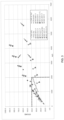
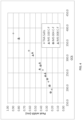
- FIG. 1 shows that these compounds all have a similar degree of compactness (slope of CCS relative to m / z, and shown by the shaded area), with the fluorinated Ultramark calibrants exhibiting slightly more compact nature due to higher density of fluorine.
- the high proportion of ionizable atoms (e.g., O and N) in these calibrant systems result in limited m / z range for 1+ species, as higher masses tend to be multiply charged. For ions of these traditional calibrants in the 1+ charge state, the calibration range covered is limited.
- these existing calibrants exhibit limited range in the CCS dimension (for N 2 ): 100-400 ⁇ 2 (top CCS boundary), and limited range in the m / z dimension (typically m / z range: 0-2000) (right m / z boundary). Furthermore, they exhibit limited diversity in compactness (e.g. slope of CCS relative to m / z ).
- the calibrants should provide a wider range for both the CCS and the m / z dimensions while exhibiting minimal dispersity in CCS dimension (narrow peak width). Additionally, the calibrants should be compatible with both positive and negative ion modes, should be technically simple to use, and should exhibit long shelf-lives.
- compositions containing at least one calibrant compound, or cationic complex thereof, or anionic complex thereof in which the at least one calibrant compound or the salt thereof or cationic complex thereof, or anionic complex thereof, may include an alcohol or an amine functionalized core and peripheral functionalities.
- the at least one calibrant compound or the salt thereof or cationic complex thereof, or anionic complex thereof may include at least one core with at least one alcohol functionality, which may be selected from the group consisting of mono-functional cores, di-functional cores, tri-functional cores, tetra-functional cores, penta-functional cores, hexa-functional cores, octa-functional cores, and dendrimer-based cores comprising a plurality of alcohol functionalities.
- the at least one calibrant compound or the salt thereof or cationic complex thereof, or anionic complex thereof may include at least one core with at least one amine functionality, which may be selected from the group consisting of mono-functional cores, di-functional cores, tri-functional cores, tetra-functional cores, and dendrimer-based cores comprising a plurality of amine functionalities.
- compositions containing at least two calibrant compounds or salts thereof or cationic complex thereof, or anionic complex thereof in which the at least two calibrant compounds or the salts thereof or cationic complex thereof, or anionic complex thereof, may contain the alcohol or amine functionalized cores and the peripheral functionalities.
- the present disclosure relates to methods of manufacturing the composition of the present disclosure, including mixing one, two, three, four, five, six, or more of the at least one core with at least one alcohol functionality, and subjecting the mixture to an esterification reaction.
- the present disclosure relates to methods of manufacturing the composition of the present disclosure, including mixing one, two, three, four, five, six, or more of the at least one core with at least one amine functionality, and subjecting the mixture to an amidation reaction.
- compositions of the present disclosure may be used to calibrate any instruments that can measure mass, size, shape, and/or collisional cross section area (CCS) of molecules in a gas phase.
- CCS collisional cross section area
- the present disclosure relates to methods of calibrating a mass spectrometer, including providing the composition of the present disclosure, ionizing the at least one calibrant compound to provide at least one charged ion, collecting mass spectrometry data from the at least one charged ion, and calibrating the mass spectrometer based on the mass spectrometry data.
- the at least one charged ion may be singly-charged or multi-charged ion.
- Mass spectrometry data may contain a mass to charge ratio ( m / z ) of the at least one charged ion.
- the mass to charge ratio ( m / z ) of the at least one charged ion may be from about 1 m/z to about 15000 m / z, from about 1 m/z to about 14000 m / z, from about 1 m/z to about 13000 m / z, from about 1 m/z to about 12000 m / z, from about 1 m/z to about 11000 m / z, from about 1 m/z to about 10000 m / z, from about 1 m/z to about 9000 m / z, from about 1 m/z to about 9500 m / z, from about 1 m / z to about 9000 m / z, from about 1
- the mass to charge ratio ( m / z ) of the at least one charged ion may be from about 1 m / z to about 50 m / z, from about 50 m / z to about 100 m / z, from about 100 m / z to about 150 m / z, from about 150 m / z to about 200 m / z, from about 200 m / z to about 250 m / z, from about 250 m / z to about 300 m / z , from about 300 m / z to about 350 m / z, from about 350 m / z to about 400 m / z, from about 400 m / z to about 450 m / z, from about 450 m / z to about 500 m / z, from about 500 m / z to about 550 m / z, from about 550 m / z to about 600
- the mass spectrometry may be selected from the group consisting of accelerator mass spectrometry, isotope ratio mass spectrometry, MALDI-TOF, SELDI-TOF, electrospray ionization (ESI)-rnass spectrometry, thermal ionization-mass spectrometry, and spark source mass spectrometry, and the mass spectrometer may be selected from the group of spectrometers useful for performing said mass spectrometry.
- the present disclosure relates to methods of calibrating an ion mobility spectrometer, including providing the composition of the present disclosure, ionizing the at least one calibrant compound to provide at least one charged ion, introducing the at least one charged ion into the ion mobility spectrometer, collecting ion mobility data from the at least one charged ion in a drift gas, and calibrating the ion mobility spectrometer based on the ion mobility data.
- the at least one charged ion may be singly-charged or multi-charged.
- the ion mobility data may contain a collision cross section (CCS) value of the at least one charged ion.
- the collision cross section (CCS) value of the at least one charged ion may be from about 10 ⁇ 2 to about 1500 ⁇ 2 , from about 10 ⁇ 2 to about 1400 ⁇ 2 , from about 10 ⁇ 2 to about 1300 ⁇ 2 , from about 10 ⁇ 2 to about 1200 ⁇ 2 , from about 10 ⁇ 2 to about 1100 ⁇ 2 , about 10 ⁇ 2 to about 1000 ⁇ 2 , from about 10 ⁇ 2 to about 900 ⁇ 2 , from about 100 ⁇ 2 to about 900 ⁇ 2 , from about 150 ⁇ 2 to about 900 ⁇ 2 , from about 150 ⁇ 2 to about 850 ⁇ 2 , from about 150 ⁇ 2 to about 800 ⁇ 2 , from about 150 ⁇ 2 to about 750 ⁇ 2 , from about 150 ⁇
- the collision cross section (CCS) value of the at least one charged ion may be from about 10 ⁇ 2 to about 20 ⁇ 2 , from about 20 ⁇ 2 to about 30 ⁇ 2 , from about 30 ⁇ 2 to about 40 ⁇ 2 , from about 40 ⁇ 2 to about 50 ⁇ 2 , from about 50 ⁇ 2 to about 60 ⁇ 2 , from about 60 ⁇ 2 to about 70 ⁇ 2 , from about 70 ⁇ 2 to about 80 ⁇ 2 , from about 80 ⁇ 2 to about 90 ⁇ 2 , from about 90 ⁇ 2 to about 100 ⁇ 2 , from about 100 ⁇ 2 to about 110 ⁇ 2 , from about 110 ⁇ 2 to about 120 ⁇ 2 , from about 120 ⁇ 2 to about 130 ⁇ 2 , from about 130 ⁇ 2 to about 140 ⁇ 2 , from about 140 ⁇ 2 to about 150 ⁇ 2 , from about 150 ⁇ 2 to about 160 ⁇ 2 , from about 160 ⁇ 2 to about 170 ⁇ 2 , from about 170 ⁇
- the drift gas may be selected from the group consisting of helium, nitrogen, argon, and carbon dioxide.
- the present disclosure relates to methods of calibrating an ion mobility-mass spectrometer, including providing the composition of the present disclosure, ionizing the at least one calibrant compound to provide at least one charged ion, introducing the at least one charged ion into the ion mobility-mass spectrometer, collecting ion mobility data in a drift gas and mass spectrometer data from the at least one charged ion, and calibrating the ion mobility-mass spectrometer based on the ion mobility data and the mass spectrometer data.
- the present disclosure relates to methods of calibrating a light scattering spectrometer, including providing the composition of the present disclosure, dissolving the at least one calibrant compound to provide a solution of the at least one calibrant compound, introducing the solution of the at least one calibrant compound into the light scattering spectrometer, collecting light scattering data from the at least one calibrant compound, and calibrating the light scattering spectrometer based on the light scattering data.
- the light scattering data may contain the size of the at least one calibrant compound in the solution.
- the present disclosure relates to methods of calibrating a size exclusion chromatograph, including providing the composition of the present disclosure, dissolving the at least one calibrant compound to provide a solution of the at least one calibrant compound, introducing the solution of the at least one calibrant compound into the size exclusion chromatograph, collecting size exclusion data from the at least one calibrant compound, and calibrating the size exclusion chromatograph based on the size exclusion data.
- the size exclusion data may contain the size of the at least one calibrant compound in the solution.
- the present disclosure relates to methods of determining physical properties of a sample, including providing the composition of the present disclosure, providing the sample, collecting physical data from the at least one calibrant compound, calibrating an instrument capable of measuring the physical properties based on the physical data, and determining the physical properties of the sample.
- the physical properties of the sample may include mass, size, shape, and/or collisional cross section area of the sample in a drift gas.
- the instrument may be selected from the group consisting of mass spectrometer, ion mobility spectrometer, ion mobility-mass spectrometer, light scattering spectrometer, size exclusion chromatograph, and a combination thereof.
- Embodiments of the present disclosure include novel calibrants and methods of making these calibrants that contain multifunctional cores and/or dimethylolpropionic acid (bis-MPA), i.e., based polyester dendrimers.
- These core molecules or dendrimers may be functionalized on their periphery to prepare a series of singular discrete compounds with exact molecular weights and well-defined sizes. These functionalized cores and dendrimers may then be used as IMS calibrants.
- Each compound within a sample set may be composed of a core molecule with at least one alcohol functionality, or at least one amine functionality. Each of these alcohol or amine functionalities can then be coupled with an activated carboxylic acid to yield multiple ester or amide bonds.
- Functionalized cores or dendrimers are prepared as singular discrete compounds that may exhibit a wider range of CCS and m/z values.
- CCS values of greater than 800 ⁇ 2 , and m/z values of in excess of 5500 (for singly charges species) can be measured, more than doubling the range of the existing common calibrants.
- embodiments of the present disclosure may include the addition of alkyl chains onto the periphery of the cores to make "star-shaped" calibrants (with multiple alkyl arms).
- Fatty acids varying from short chains to long chains are coupled with the multifunctional cores or dendrimers.
- long alkyl chains may not significantly increase the propensity for charging (ease of complexation with cations), it does increase the size substantially, and therefore yields extended conformations with high CCS values but modest m/z values.
- the present disclosure provides functionalized polyester dendrimers based on bis-MPA monomer that may be modified by esterification of their peripheral functionalities in order to prepare a set of singular, discrete compounds that may exhibit a wider range of CCS and m / z values.
- CCS values in excess of 800 ⁇ 2 , and m/z values of in excess of 5500 (for singly charges species) can be measured, more than doubling the range of existing calibrants.
- the present disclosure provides functionalized core molecules by reacting activated carboxylic acid derivatives with the alcohol and/or amine functionalities of the multifunctional cores.
- a set of discrete compounds may be generated that expand the available range of m / z calibration points as well as CCS calibration points for IM-MS characterization.
- multifunctional core may have a formula I: X-[OH] n , in which n is an integer from 3 to 20, and X is a core comprised of alkane, ether, ester, amine, and/or amide functionalities or generations of alkane, ether, ester, amine, and/or amide dendrimers.
- X-[OH] n cores are shown in Table 1.
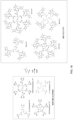
- Table 1 X n Core Symbol Core Structure alkyl 3 C 4 D 5 E ether 6 F 8 H amine 3 4 5 G1 dendrimer 6 C1 8 D1 10 E1 12 F1
- X-[OH] n are reacted with carboxylic acid derivatives according to Formula II: where m is an integer from 1 to 30.
- carboxylic acid derivatives may be selected from the group consisting of methanoic (formic) acid, ethanoic (acetic) acid, propanoic (proprionic) acid, butanoic (butyric) acid, pentanoic (valeric) acid, hexanoic (caprylic) acid, heptanoic (enanthic) acid, octanoic (caprylic) acid, nonanoic (pelargonic) acid, decanoic (capric) acid, undecanoic acid, dodecanoic (lauric) acid, tridecanoic acid, tetradecanoic (myristic) acid, pentadecanoic acid, hexadecanoic (palmitic acetic) acid, heptadecanoic (margaric acetic) acid, octadecanoic (stearic acetic) acid, nonadecanoic acid, eicosanoic (ar
- X-[OH] n may be reacted with carboxylic acid derivatives that include a hydrocarbon chain that may contain one or more branching points, one or more double bond, and/or one or more triple bond, such as arachidonic acid, cis-13-docosenoic acid, cis-11-eicosenoic acid, elaidic acid, linoleic acid, linolenic acid, linolelaidic acid, myristoleic, oleic acid, palmitoleic acid, petroselenic acid, and cis-15-tetracosenoic acid.
- carboxylic acid derivatives that include a hydrocarbon chain that may contain one or more branching points, one or more double bond, and/or one or more triple bond, such as arachidonic acid, cis-13-docosenoic acid, cis-11-eicosenoic acid, elaidic acid, linoleic acid, linolenic
- DCC dicyclohexylcarbodiimide
- DMAP 4-dimethylaminopyridine
- FIG. 3 shows that the addition of alkyl chains, e.g., from 4-carbon chain (IMS 004) to 22-carbon chain (IMS 022), onto cores and dendrimers provides a more extended conformation, and hence higher CCS values relative to m / z, (with values as high as 813 ⁇ 2 , e.g., 18-carbon chain IMS 018 C1-F1 as indicated by open arrows), than the existing standards, e.g., TAA salts, LCMS OC Ref, Poly-Ala, and Ultramark, as shown in FIG. 1 .
- the SpheriCal standards exhibit a trend in compactness similar to the existing standards, but may extend the CCS range just beyond 400 ⁇ 2 . All data correspond to Na + adducts.
- an embodiment of the present disclosure may include the incorporation of multiple halogen atoms into the calibrant compositions.
- Achieving high m / z can be a challenge in mass spectrometry because increases in the mass (m) tends to also increase the ability to carry charge (z).
- certain elements e.g. iodine "I''
- an embodiment of the present disclosure may include compounds with high I (or F) content that can exhibit very high masses in low charge states (hence high m / z ) as well as very compact conformation with modest CCS values, despite high m / z values.
- X-[OH] n may be reacted with carboxylic acid derivatives, such as those of Formula IV: in which y is an integer from 0 to 5.
- carboxylic acid derivatives may be selected from the group consisting of benzoic acid, 2-iodo benzoic acid, 3-iodo benzoic acid, 4-iodo benzoic acid, 2,3-diiodo benzoic acid, 2,4-diiodo benzoic acid, 2,5-diiodo benzoic acid, 2,6-diiodo benzoic acid, 3.4-diiodo benzoic acid, 3,5-diiodo benzoic acid, 2,3,4-triiodo benzoic acid, 2,3,5-triiodo benzoic acid, 2,3,6-triiodo benzoic acid, 3,4,5-triiodo benzoic acid, 2,3,4,5-tetraiodobenzoic acid, 2,3,4,6-tetraiodobenzoic acid, 2,3,5,6-tetraiodobenzoic acid, and 2,3,4,5,6-pentaiodo
- DCC dicyclohexylcarbodiimide
- DMAP 4-dimethylaminopyridine
- Table 3 shows the chemical structures of some calibrants with triiodobenzoate functionalized cores in accordance with some embodiments of the present disclosure.
- Table 3 X n Core Symbol Core Structure Calibrant Structure (Calibrant Symbol) alkyl 3 C (IMS 103 C) 4 D (IMS 103 D) 5 E (IMS 103 E) ether 6 F (IMS 103 F) 8 H (IMS 103 H) G1 dendrimer 6 C1 (IMS 103 C1) 8 D1 (IMS 103 D1) 10 E1 (IMS 103 E1) 12 F1 (IMS 103 F1)
- FIG. 3 shows that halogenated aromatics, e.g., triiodobenzoate functionalized core (IMS 103 C-F, IMS 103 C1-F1, and IMS 103 H), exhibit higher mass to size ratio, hence higher m / z , lower CCS values, and an overall more compact trend line than the existing standards, e.g., TAA salts, LCMS QC Ref, Poly-Ala, and Ultramark, as shown in FIG. 1 .
- This may increase the m / z values in the 1+ charge state from below 2000 to as high as 5571, with a CCS of only 576 ⁇ 2 , e.g., IMS 103 C1-F1 (as indicated by arrows).
- IMS 103 C1-F1 together with IMS 103 C-F (as indicated by arrow heads) and IMS 103 H (as indicated by open arrow head) is smaller than that of IMS 004-024, indicating that IMS 103 calibrants are more compact than IMS 004-024 calibrants.
- IMS 103 calibrants achieve very high masses in low charge states (hence high m / z ) as well as very compact conformation with modest CCS values, despite high m / z values.
- Size dispersity refers to the range of sizes that a single compound may exhibit. If the compounds are flexible, they may exhibit both very compact and very extended conformations. Embodiments of the present disclosure may include branched cores that lead to structures, which are more architecturally compact and therefore lack the ability to exhibit a wide range of shapes. This is in contrast, for example, to a long linear compound, which may exhibit either compact (wadded up) or extended (more elongated linear) conformations.
- FIG. 4 shows that the observed peak width in the CCS dimension is a function of both instrument resolution and the dispersities of conformation, which are sampled by the molecule in the gas phase.
- the series of dendrimers e.g., IMS 100 C-F (see Example 7), IMS 004 C-F (with 4-carbon chain), and IMS 008 C-F (with 8-carbon chain), exhibit CCS dispersities as narrow as those observed by other calibrants, such as the trialkyl ammonium salts (TAA salts).
- TAA salts trialkyl ammonium salts
- the conformational dispersity of the dendrimer calibrants of the present disclosure may be as narrow as those measured for other calibrants.
- Embodiments of the present disclosure may include calibrants that exhibit the ability to complex with a range of cations and/or anions to achieve mass spectra and ion mobility spectra in both positive and negative ion modes.
- FIG. 5 shows an analysis in the positive mode of ionization, in which data for calibrations can be achieved, as long as the appropriate salt is used.
- IMS103 IMS103-C, IMS103-D, IMS103-E, and IMS103-F
- FIG. 6 shows an analysis in the negative mode of ionization, in which data for calibrations can be achieved, as long as the appropriate salt is used.
- negative ion mode with 1% ammonium acetate used as an anion source in 1% ammonia IMS103 (IMS103-C, IMS103-D, and IMS103-E) yields acetate adducts.
- compounds exhibiting a range of compactness, from high CCS and low m / z (more extended) to low CCS and high m / z (more compact) are disclosed.
- the compactness of the calibrants e.g., varying peripheral groups from long, extended linear fatty acids, to short, mass-dense iodinated aromatic rings
- a larger area of the ion mobility mass spectrometry graph may be covered by calibration points, rather than a single linear trend as observed by most of the existing calibrations systems.
- core ethylene glycol
- C tris(hydroxymethyl)ethane
- D pentaerythritol
- E xylitol
- F dipentaerythritol
- H tripentaerythritol
- bis-MPA dendrimers made from the above cores.
- the reaction mixture was stirred vigorously for approximately 12 hours at standard temperature and pressure.
- the reaction was monitored by MALDI-TOF MS to confirm completion of the reaction for each of the cores present in the reaction.
- the flask contents were transferred to a separatory funnel, diluted with dichloromethane, extracted twice with 1M aqueous NaHSO 4 (sodium bisulfate) and extracted twice with 1M aqueous NaHCO 3 (sodium bicarbonate).
- the organic layer was reduced in vacuo to concentrate the sample.
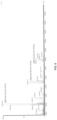
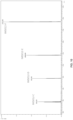
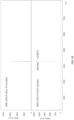
- a MALDI-TOF MS spectra of the purified product confirmed the purity of the mixture of esterified products and is shown in FIG. 7 .
- FIG. 7 shows MALDI-TOF MS data for IMS 008 C-F, the product of octanoic acid functionalization of cores C, D, E, and F.
- the reaction mixture was stirred vigorously for approximately 12 hours at standard temperature and pressure.
- the reaction was monitored by MALDI-TOF MS to determine completion of the reaction for each of the cores present in the reaction.
- the flask contents were transferred to a separatory funnel, diluted with dichloromethane, extracted twice with 1M aqueous NaHSO 4 (sodium bisulfate) and extracted twice with 1M aqueous NaHCO 3 (sodium bicarbonate).
- the organic layer was reduced in vacuo to concentrate the sample.
- a MALDI-TOF MS spectra of the purified product confirmed the purity of the mixture of esterified products and is shown in FIG. 8 .
- FIG. 8 shows MALDI-TOF MS data for IMS 008 C-F, the product of octanoic acid functionalization of cores C, D, E, and F.
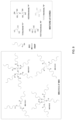
- FIG. 9 shows a scheme for the synthesis of IMS 012 C-F
- core tris(hydroxymethyl)ethane (“C"), pentaerythritol (“D”), xylitol (“E”), dipentaerythritol (“F”) made from the above cores. These were dissolved in tetrahydrofuran. 1.1 molar equivalents (per -OH of the hydroxyl terminated cores or dendrimers) of Dodecanoic Acid were added to the solution of cores.
- the reaction mixture was stirred vigorously for approximately 12 hours at standard temperature and pressure.
- the reaction was monitored by MALDI-TOF MS to determine completion of the reaction for each of the cores present in the reaction.
- the flask contents were transferred to a separatory funnel, diluted with dichloromethane, extracted twice with 1M aqueous NaHSO 4 (sodium bisulfate) and extracted twice with 1M aqueous NaHCO 3 (sodium bicarbonate).
- the organic layer was reduced in vacuo to concentrate the sample.
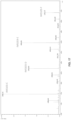
- a MALDI-TOF MS spectra of the purified product confirmed the purity of the mixture of esterified products and is shown in FIG. 10 .
- FIG. 10 shows MALDI-TOF MS data for IMS 012 C-F, the product of dodecanoic acid functionalization of cores C, D, E, and F.
- the reaction mixture was stirred vigorously for approximately 12 hours at standard temperature and pressure.
- the reaction was monitored by MALDI-TOF MS to determine completion of the reaction for each of the cores present in the reaction.
- the flask contents were transferred to a separatory funnel, diluted with dichloromethane, extracted twice with 1M aqueous NaHSO 4 (sodium bisulfate) and extracted twice with 1M aqueous NaHCO 3 (sodium bicarbonate).
- the organic layer was reduced in vacuo to concentrate the sample.
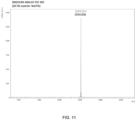
- a MALDI-TOF MS spectra of the purified product confirmed the purity of the mixture of esterified products and is shown in FIG. 11 .
- FIG. 11 shows MALDI-TOF MS data for IMS 018 H, the product of octadecanoic acid functionalization of core H (IMS018H).
- FIG. 12 shows a scheme for the synthesis of IMS 018 C1-F1.
- the reaction mixture was stirred vigorously for approximately 12 hours at standard temperature and pressure.
- the reaction was monitored by MALDI-TOF MS to determine completion of the reaction for each of the cores present in the reaction.
- the flask contents were transferred to a separatory funnel, diluted with dichloromethane, extracted twice with 1M aqueous NaHSO 4 (sodium bisulfate) and extracted twice with 1M aqueous NaHCO 3 (sodium bicarbonate).
- the organic layer was reduced in vacuo to concentrate the sample.
- a MALDI-TOF MS spectra of the purified product confirmed the purity of the mixture of esterified products and is shown in FIG. 13 .
- FIG. 13 shows MALDI-TOF MS data for IMS 018 C1-F1, the product of octadecanoic acid functionalization of cores C1, D1, E1, and F1.
- core tris(hydroxymethyl)ethane (“C"), pentaerythritol (“D”), xylitol (“E”), dipentaerythritol (“F”) made from the above cores. These were dissolved in tetrahydrofuran. 1.1 molar equivalents (per -OH of the hydroxyl terminated cores or dendrimers) of Docosanoic Acid were added to the solution of cores.
- C tris(hydroxymethyl)ethane
- D pentaerythritol
- E xylitol
- F dipentaerythritol
- the reaction mixture was stirred vigorously for approximately 12 hours at standard temperature and pressure.
- the reaction was monitored by MALDI-TOF MS to determine completion of the reaction for each of the cores present in the reaction.
- the flask contents were transferred to a separatory funnel, diluted with dichloromethane, extracted twice with 1M aqueous NaHSO 4 (sodium bisulfate) and extracted twice with 1M aqueous NaHCO 3 (sodium bicarbonate).
- the organic layer was reduced in vacuo to concentrate the sample.
- a MALDI-TOF MS spectra of the purified product confirmed the purity of the mixture of esterified products and is shown in FIG. 14 .
- FIG. 14 shows MALDI-TOF MS data for IMS 022 C-F, the product of docosanoic acid functionalization of cores C, D, E, and F.
- core tris(hydroxymethyl)ethane (“C"), pentaerythritol (“D”), xylitol (“E”), dipentaerythritoi (“F”) made from the above cores. These were dissolved in tetrahydrofuran. 1.1 molar equivalents (per -OH of the hydroxyl terminated cores or dendrimers) of Benzoic Acid were added to the solution of cores.
- the reaction mixture was stirred vigorously for approximately 12 hours at standard temperature and pressure.
- the reaction was monitored by MALDI-TOF MS to determine completion of the reaction for each of the cores present in the reaction.
- the flask contents were transferred to a separatory funnel, diluted with dichloromethane, extracted twice with 1M aqueous NaHSO 4 (sodium bisulfate) and extracted twice with 1M aqueous NaHCO 3 (sodium bicarbonate).
- the organic layer was reduced in vacuo to concentrate the sample.
- a MALDI-TOF MS spectra of the purified product confirmed the purity of the mixture of esterified products and is shown in FIG. 15 .
- FIG. 15 shows MALDI-TOF MS data for IMS 100 C-F, the product of benzoic acid functionalization of cores C, D, E, and F.
- FIG. 16 shows a scheme for the synthesis of IMS 103 C-F.
- the reaction mixture was stirred vigorously for approximately 12 hours at standard temperature and pressure.
- the reaction was monitored by MALDI-TOF MS to determine completion of the reaction for each of the cores present in the reaction.
- the flask contents were transferred to a separatory funnel diluted with dichloromethane, extracted twice with 1M aqueous NaHSO 4 (sodium bisulfate) and extracted twice with 1M aqueous NaHCO 3 (sodium bicarbonate).
- the organic layer was reduced in vacuo to concentrate the sample.
- a MALDI-TOF MS spectra of the purified product confirmed the purity of the mixture of esterified products and is shown in FIG. 17 .
- FIG. 17 shows MALDI-TOF MS data for IMS 103 C-F, the product of triiodobenzoic acid functionalization of cores C, D, E, and F.
- tripentaerythritol made from the above cores. These were dissolved in tetrahydrofuran. 1.1 molar equivalents (per -OH of the hydroxyl terminated cores or dendrimers) of Triiodobenzoic Acid were added to the solution of cores. To these reagents were added 1.2 molar equivalents (per -OH of the hydroxyl terminated cores or dendrimers) of dicyclohexylcarbodiimide and 0.1 molar equivalents (per -OH of hydroxyl-terminated core or of dendrimer) of 4-dimethylaminopyridine (DMAP).
- DMAP 4-dimethylaminopyridine
- the reaction mixture was stirred vigorously for approximately 12 hours at standard temperature and pressure.
- the reaction was monitored by MALDI-TOF MS to determine completion of the reaction for each of the cores present in the reaction.
- the flask contents were transferred to a separatory funnel, diluted with dichloromethane, extracted twice with 1M aqueous NaHSO 4 (sodium bisulfate) and extracted twice with 1M aqueous NaHCO 3 (sodium bicarbonate).
- the organic layer was reduced in vacuo to concentrate the sample.
- a MALDI-TOF MS spectra of the purified product confirmed the purity of the mixture of esterified products and is shown in FIG. 18 .
- FIG. 18 shows MALDI-TOF MS data for IMS 004 H, the product of triiodobenzoic acid functionalization of core H.
- FIG. 19 shows a scheme for the synthesis of IMS 103 C1-F1.
- the reaction mixture was stirred vigorously for approximately 12 hours at standard temperature and pressure.
- the reaction was monitored by MALDI-TOF MS to determine completion of the reaction for each of the cores present in the reaction.
- the flask contents were transferred to a separatory funnel, diluted with dichloromethane, extracted twice with 1M aqueous NaHSO 4 (sodium bisulfate) and extracted twice with 1M aqueous NaHCO 3 (sodium bicarbonate).
- the organic layer was reduced in vacuo to concentrate the sample.
- a MALDI-TOF MS spectra of the purified product confirmed the purity of the mixture of esterified products and is shown in FIG. 20 .
- FIG. 20 shows MALDI-TOF MS data for IMS 103 C1-F1, the product of triiodobenzoate acid functionalization of cores C1, D1, E1 and F1.
- FIG. 21 shows the MALDI-TOF mass spectrum for the product, i.e., N,N,N -Tris-(2-aminoethyl)amine-tris(triodobenzamide) or N,N',N"-(nitrilotris(ethane-2,1-diyl)tris(2,3,5-triiodobenzamide) of the amidation reaction between N,N,N -tris(2-aminoethyl)amine and 2,3,5-triiodobenzoic acid.
- the product i.e., N,N,N -Tris-(2-aminoethyl)amine-tris(triodobenzamide) or N,N',N"-(nitrilotris(ethane-2,1-diyl)tris(2,3,5-triiodobenzamide)
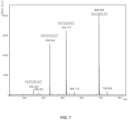
- FIG. 22 shows representative example of stability of IMS calibrants under ambient conditions - IMS 103 H at 0 months (bottom panel) and after 9 months (top panel) of storage. This data shows after 9 months at ambient conditions (e.g., exposed to room temperature, light, and air), no sign of degradation of these calibrants was observed.
- ambient conditions e.g., exposed to room temperature, light, and air
- calibrant compounds exhibiting a range of compactness, from high CCS with low m / z (more extended) to low CCS with high m / z (more compact). These compounds may serve as calibration points that cover a larger area of the ion mobility-mass spectrometry graph.
- the compactness of the calibrants may be tuned (e.g. varying peripheral groups from long, extended linear fatty acids, to short, mass-dense iodinated aromatic rings) to adjust the range of values on the x-axis (e.g. m / z ) relative to those on the y-axis (e.g. CeS) in ion mobility-mass spectrometry spectra in order to improve the quality of calibration.
- calibrants may be used in a variety of analytical instruments, in addition to IM-MS, e.g., in a mass spectrometer, an ion mobility spectrometer, a light scattering spectrometer, and a size exclusion chromatograph.
Landscapes
- Chemical & Material Sciences (AREA)
- Organic Chemistry (AREA)
- Physics & Mathematics (AREA)
- Analytical Chemistry (AREA)
- Health & Medical Sciences (AREA)
- Life Sciences & Earth Sciences (AREA)
- Spectroscopy & Molecular Physics (AREA)
- Chemical Kinetics & Catalysis (AREA)
- Biochemistry (AREA)
- General Health & Medical Sciences (AREA)
- General Physics & Mathematics (AREA)
- Immunology (AREA)
- Pathology (AREA)
- Electrochemistry (AREA)
- Molecular Biology (AREA)
- Other Investigation Or Analysis Of Materials By Electrical Means (AREA)
Claims (14)
- Zusammensetzung, umfassend mindestens zwei Kalibrierverbindungen oder Salze davon oder kationische Komplexe davon oder anionische Komplexe davon, wobei die mindestens zwei Kalibrierverbindungen oder die Salze davon oder die kationischen Komplexe davon oder die anionischen Komplexe davon einen alkoholfunktionalisierten Kern und periphere Funktionalitäten umfassen, wobei der alkoholfunktionalisierte Kern ausgewählt ist aus der Gruppe bestehend aus:

wobei die peripheren Funktionalitäten Ester sind, die durch Kupplung der Alkoholfunktionalitäten der Kerne mit einer Carbonsäure oder einem aktivierten Ester oder einem aktivierten Carbonsäurederivat mit einer chemischen Struktur der Formel II hergestellt werden:
- Zusammensetzung nach Anspruch 1, wobei die peripheren Funktionalitäten Amide sind, die durch Kupplung der Aminfunktionalitäten der Kerne mit einer Carbonsäure hergestellt werden, die ausgewählt ist aus der Gruppe bestehend aus Methansäure, Ethansäure, Propansäure, Butansäure, Pentansäure, Hexansäure, Heptansäure, Octansäure, Nonansäure, Decansäure, Undecansäure, Dodecansäure, Tridecansäure, Tetradecansäure, Pentadecansäure, Hexadecansäure, Heptadecansäure, Octadecansäure, Nonadecansäure, Eicosansäure, Heneicosansäure, Docosansäure, Tetracosansäure, Hexacosansäure, Octacosansäure und Triacosansäure.
- Verfahren zur Herstellung der Zusammensetzung nach einem der Ansprüche 1 und 2, umfassend
Mischen der mindestens zwei Kerne mit mindestens einer Alkoholfunktionalität und Unterziehen des Gemisches einer Veresterungsreaktion. - Verfahren zum Kalibrieren eines Instruments, das aus der Gruppe eines Massenspektrometers, eines lonenmobilitätsspektrometers, eines Ionenmobilitäts-Massenspektrometers, eines Lichtstreuspektrometers, eines Größenausschlusschromatographen und Kombinationen davon ausgewählt ist, umfassend
Bereitstellen der Zusammensetzung nach einem der Ansprüche 1 und 2, Sammeln von Daten von der Zusammensetzung mit dem Instrument und Kalibrieren des Instruments auf der Grundlage der gesammelten Daten. - Verfahren zur Bestimmung von physikalischen Eigenschaften einer Probe,
umfassendBereitstellen der Zusammensetzung nach einem der Ansprüche 1 und 2, Bereitstellen der Probe,Sammeln physikalischer Daten von der mindestens einen Kalibrierverbindung, Kalibrieren eines Instruments, das in der Lage ist, die physikalischen Eigenschaften auf der Grundlage der physikalischen Daten zu messen, undBestimmen der physikalischen Eigenschaften der Probe. - Verfahren nach Anspruch 5, wobei die physikalischen Eigenschaften der Probe Masse, Größe, Form und/oder Kollisionsquerschnittsfläche der Probe in einem Driftgas umfassen.
- Zusammensetzung nach Anspruch 2, wobei die Carbonsäure Methansäure ist.
- Zusammensetzung nach Anspruch 2, wobei die Carbonsäure Ethansäure ist.
- Zusammensetzung nach Anspruch 2, wobei die Carbonsäure Propansäure ist.
- Zusammensetzung nach Anspruch 2, wobei die Carbonsäure Butansäure ist.
- Zusammensetzung nach Anspruch 2, wobei die Carbonsäure Dodecansäure ist.
- Zusammensetzung nach Anspruch 2, wobei die Carbonsäure Hexadecansäure ist.
- Zusammensetzung nach Anspruch 2, wobei die Carbonsäure Octadecansäure ist.
- Zusammensetzung nach Anspruch 2, wobei die Carbonsäure Docosansäure ist.
Applications Claiming Priority (2)
| Application Number | Priority Date | Filing Date | Title |
|---|---|---|---|
| US201762512570P | 2017-05-30 | 2017-05-30 | |
| PCT/US2018/034885 WO2018222593A1 (en) | 2017-05-30 | 2018-05-29 | Functionlized calibrants for spectrometry and chromatography |
Publications (4)
| Publication Number | Publication Date |
|---|---|
| EP3631442A1 EP3631442A1 (de) | 2020-04-08 |
| EP3631442A4 EP3631442A4 (de) | 2021-03-03 |
| EP3631442C0 EP3631442C0 (de) | 2025-05-21 |
| EP3631442B1 true EP3631442B1 (de) | 2025-05-21 |
Family
ID=64455080
Family Applications (1)
| Application Number | Title | Priority Date | Filing Date |
|---|---|---|---|
| EP18810535.7A Active EP3631442B1 (de) | 2017-05-30 | 2018-05-29 | Funktionalisierte kalibriermittel für spektrometrie und chromatographie |
Country Status (3)
| Country | Link |
|---|---|
| US (2) | US11862446B2 (de) |
| EP (1) | EP3631442B1 (de) |
| WO (1) | WO2018222593A1 (de) |
Families Citing this family (3)
| Publication number | Priority date | Publication date | Assignee | Title |
|---|---|---|---|---|
| CN110231416B (zh) * | 2019-06-06 | 2021-08-31 | 浙江国邦药业有限公司 | 一种利用hplc测定2-碘酰基苯甲酸有关物质的方法 |
| CN111896035B (zh) * | 2020-07-09 | 2022-05-20 | 哈尔滨理工大学 | 基于微纳光纤耦合器的马赫曾德干涉型光纤局放探测方法 |
| CN112946123A (zh) * | 2021-02-01 | 2021-06-11 | 中山未名海济生物医药有限公司 | 一种氨丁三醇含量的检测方法 |
Citations (1)
| Publication number | Priority date | Publication date | Assignee | Title |
|---|---|---|---|---|
| US20150132854A1 (en) * | 2012-05-21 | 2015-05-14 | The Administrators Of The Tulane Educational Fund | Tuned Synthetic Dendrimer Calibrants for Mass Spectrometry |
Family Cites Families (8)
| Publication number | Priority date | Publication date | Assignee | Title |
|---|---|---|---|---|
| DE10144250A1 (de) | 2001-08-31 | 2003-04-03 | Fraunhofer Ges Forschung | Verbesserte massenspektrometrische Analyse unter Verwendung von Nanopartikeln |
| US7709788B2 (en) | 2007-12-31 | 2010-05-04 | Implant Sciences Corporation | Chemical calibration method and system |
| US20110052696A1 (en) * | 2008-05-07 | 2011-03-03 | Polymer Factory Sweden Ab | Dendrimers with interior and exterior functionalities comprising of azide or alkyne groups for post-functionalization by the huisgen click cycloaddition |
| MX2011001814A (es) * | 2008-08-18 | 2011-09-01 | Cook Composites & Polymers | Composiciones de recubrimiento de resina y pintura que comprenden poliester de poliol altanente esterificados con un par de enlaces dobles conjugados. |
| US8461517B2 (en) | 2008-10-27 | 2013-06-11 | Smiths Detection Montreal Inc. | Ammonium salts as IMS positive mode calibrants/reactants |
| US8846848B2 (en) | 2009-02-03 | 2014-09-30 | The Administrators Of The Tulane Educational Fund | Tuned synthetic dendrimer calibrants for mass spectrometry |
| US9250222B2 (en) * | 2011-02-18 | 2016-02-02 | The Florida International University Board Of Trustees | Universal detector calibrant |
| WO2017036545A1 (en) | 2015-09-03 | 2017-03-09 | MAX-PLANCK-Gesellschaft zur Förderung der Wissenschaften e.V. | Method for determining carbohydrates structure |
-
2018
- 2018-05-29 EP EP18810535.7A patent/EP3631442B1/de active Active
- 2018-05-29 US US16/617,692 patent/US11862446B2/en active Active
- 2018-05-29 WO PCT/US2018/034885 patent/WO2018222593A1/en not_active Ceased
-
2023
- 2023-12-05 US US18/529,686 patent/US20240128067A1/en active Pending
Patent Citations (1)
| Publication number | Priority date | Publication date | Assignee | Title |
|---|---|---|---|---|
| US20150132854A1 (en) * | 2012-05-21 | 2015-05-14 | The Administrators Of The Tulane Educational Fund | Tuned Synthetic Dendrimer Calibrants for Mass Spectrometry |
Also Published As
| Publication number | Publication date |
|---|---|
| US20200105513A1 (en) | 2020-04-02 |
| EP3631442C0 (de) | 2025-05-21 |
| WO2018222593A1 (en) | 2018-12-06 |
| EP3631442A4 (de) | 2021-03-03 |
| US20240128067A1 (en) | 2024-04-18 |
| EP3631442A1 (de) | 2020-04-08 |
| US11862446B2 (en) | 2024-01-02 |
Similar Documents
| Publication | Publication Date | Title |
|---|---|---|
| US20240128067A1 (en) | Functionalized calibrants for spectrometry and chromatography | |
| US12087564B2 (en) | Tuned synthetic dendrimer calibrants for mass spectrometry | |
| Byrne et al. | Poly-6-cationic amphiphilic cyclodextrins designed for gene delivery | |
| JP5666476B2 (ja) | 調整された質量分析用合成デンドリマー較正物質 | |
| Andjelkovic et al. | Spectroscopic and potentiometric studies on derivatized natural humic acid | |
| Myers et al. | The characterization of dendronized poly (ethylene glycol) s and poly (ethylene glycol) multi-arm stars using matrix-assisted laser desorption/ionization time-of-flight mass spectrometry | |
| Christians et al. | New single-isomer chiral selector for capillary electrophoresis: the highly water-soluble heptakis (2-N, N-dimethylcarbamoyl)-β-cyclodextrin | |
| Tokunaga et al. | Do dibenzo [22–30] crown ethers bind secondary ammonium ions to form pseudorotaxanes? | |
| Nikolić et al. | The protection of Nifedipin from photodegradation due to complex formation with β-cyclodextrin | |
| JP2015155884A (ja) | Maldi質量分析用界面活性型マトリックス | |
| EP1743907A1 (de) | Konjugat aus Cyclodextrin und Poly(oxyethylen) und Verfahren zu seiner Herstellung | |
| Wei et al. | Separation and characterization of benzaldehyde-functional polyethylene glycols by liquid chromatography under critical conditions | |
| EP3875463B1 (de) | Zyklischer di-amp-natrium-salzkristall | |
| EP2840079B1 (de) | 4-(3-benzyloxyphenylthio)-2-chlor-1-(3-nitropropyl)benzolkristall | |
| CN118851948A (zh) | 一种二羟丙基精氨酸衍生物的制备方法 | |
| EP4190824A1 (de) | Verfahren zur beurteilung des reinheitsgrades einer pharmazeutischen substanz in einem verbundkörper und verfahren zur herstellung eines verbundkörpers | |
| EP4219592A1 (de) | Verfahren zur herstellung von maleimid-polyethylenglykol-lipid | |
| EP2920152B1 (de) | Harnstoffderivatprodukte und verfahren zur herstellung davon | |
| Meyerson et al. | The mass spectrum of n-octadecyl benzoate. Hydrogen migration in the formation of C18H36⨥ and C7H7O2+ | |
| JP2023540980A (ja) | ニコチンアミドリボシドクロリドからのジヒドロニコチンアミドリボシドの製造方法 | |
| HK1164849A (en) | Tuned synthetic dendrimer calibrants for mass spectrometry | |
| HK1164849B (en) | Tuned synthetic dendrimer calibrants for mass spectrometry | |
| LUNA et al. | VJ STELLA1. 1Department of Pharmaceutical Chemistry and the Center for Drug Delivery Research, The University of Kansas, Lawrence, KS-66047, USA; 2CyDex, LC | |
| Luna et al. | Characterization of Sulfobutyl Ether β-Cyclodextrin Mixtures |
Legal Events
| Date | Code | Title | Description |
|---|---|---|---|
| STAA | Information on the status of an ep patent application or granted ep patent |
Free format text: STATUS: THE INTERNATIONAL PUBLICATION HAS BEEN MADE |
|
| PUAI | Public reference made under article 153(3) epc to a published international application that has entered the european phase |
Free format text: ORIGINAL CODE: 0009012 |
|
| STAA | Information on the status of an ep patent application or granted ep patent |
Free format text: STATUS: REQUEST FOR EXAMINATION WAS MADE |
|
| 17P | Request for examination filed |
Effective date: 20191202 |
|
| AK | Designated contracting states |
Kind code of ref document: A1 Designated state(s): AL AT BE BG CH CY CZ DE DK EE ES FI FR GB GR HR HU IE IS IT LI LT LU LV MC MK MT NL NO PL PT RO RS SE SI SK SM TR |
|
| AX | Request for extension of the european patent |
Extension state: BA ME |
|
| DAV | Request for validation of the european patent (deleted) | ||
| DAX | Request for extension of the european patent (deleted) | ||
| A4 | Supplementary search report drawn up and despatched |
Effective date: 20210129 |
|
| RIC1 | Information provided on ipc code assigned before grant |
Ipc: C07C 69/76 20060101ALI20210125BHEP Ipc: G01N 30/86 20060101ALI20210125BHEP Ipc: G01N 27/62 20210101ALI20210125BHEP Ipc: B01D 15/34 20060101ALI20210125BHEP Ipc: C07C 233/78 20060101ALI20210125BHEP Ipc: C07C 69/78 20060101ALI20210125BHEP Ipc: C07C 69/30 20060101ALI20210125BHEP Ipc: C07C 69/28 20060101ALI20210125BHEP Ipc: G01N 33/00 20060101AFI20210125BHEP Ipc: H01J 49/00 20060101ALI20210125BHEP Ipc: C07C 69/33 20060101ALI20210125BHEP Ipc: G01N 30/04 20060101ALI20210125BHEP Ipc: C07C 69/67 20060101ALI20210125BHEP |
|
| STAA | Information on the status of an ep patent application or granted ep patent |
Free format text: STATUS: EXAMINATION IS IN PROGRESS |
|
| 17Q | First examination report despatched |
Effective date: 20230315 |
|
| P01 | Opt-out of the competence of the unified patent court (upc) registered |
Effective date: 20230531 |
|
| REG | Reference to a national code |
Ref country code: DE Free format text: PREVIOUS MAIN CLASS: G01N0033000000 Ref country code: DE Ref legal event code: R079 Ref document number: 602018082139 Country of ref document: DE Free format text: PREVIOUS MAIN CLASS: G01N0033000000 Ipc: G01N0027623000 |
|
| GRAP | Despatch of communication of intention to grant a patent |
Free format text: ORIGINAL CODE: EPIDOSNIGR1 |
|
| STAA | Information on the status of an ep patent application or granted ep patent |
Free format text: STATUS: GRANT OF PATENT IS INTENDED |
|
| RIC1 | Information provided on ipc code assigned before grant |
Ipc: G01N 30/04 20060101ALI20241125BHEP Ipc: C07C 233/78 20060101ALI20241125BHEP Ipc: C07C 69/76 20060101ALI20241125BHEP Ipc: C07C 69/33 20060101ALI20241125BHEP Ipc: B01D 15/34 20060101ALI20241125BHEP Ipc: C07C 69/78 20060101ALI20241125BHEP Ipc: C07C 69/67 20060101ALI20241125BHEP Ipc: C07C 69/30 20060101ALI20241125BHEP Ipc: C07C 69/28 20060101ALI20241125BHEP Ipc: G01N 27/62 20060101ALI20241125BHEP Ipc: H01J 49/00 20060101ALI20241125BHEP Ipc: G01N 33/00 20060101ALI20241125BHEP Ipc: G01N 27/623 20210101AFI20241125BHEP |
|
| INTG | Intention to grant announced |
Effective date: 20241216 |
|
| GRAS | Grant fee paid |
Free format text: ORIGINAL CODE: EPIDOSNIGR3 |
|
| GRAA | (expected) grant |
Free format text: ORIGINAL CODE: 0009210 |
|
| STAA | Information on the status of an ep patent application or granted ep patent |
Free format text: STATUS: THE PATENT HAS BEEN GRANTED |
|
| RAP1 | Party data changed (applicant data changed or rights of an application transferred) |
Owner name: POLYMER FACTORY SWEDEN AB |
|
| AK | Designated contracting states |
Kind code of ref document: B1 Designated state(s): AL AT BE BG CH CY CZ DE DK EE ES FI FR GB GR HR HU IE IS IT LI LT LU LV MC MK MT NL NO PL PT RO RS SE SI SK SM TR |
|
| REG | Reference to a national code |
Ref country code: GB Ref legal event code: FG4D |
|
| REG | Reference to a national code |
Ref country code: CH Ref legal event code: EP |
|
| REG | Reference to a national code |
Ref country code: DE Ref legal event code: R096 Ref document number: 602018082139 Country of ref document: DE |
|
| REG | Reference to a national code |
Ref country code: IE Ref legal event code: FG4D |
|
| U01 | Request for unitary effect filed |
Effective date: 20250619 |
|
| U07 | Unitary effect registered |
Designated state(s): AT BE BG DE DK EE FI FR IT LT LU LV MT NL PT RO SE SI Effective date: 20250630 |
|
| P04 | Withdrawal of opt-out of the competence of the unified patent court (upc) registered |
Free format text: CASE NUMBER: APP_30559/2025 Effective date: 20250625 |
|
| PG25 | Lapsed in a contracting state [announced via postgrant information from national office to epo] |
Ref country code: ES Free format text: LAPSE BECAUSE OF FAILURE TO SUBMIT A TRANSLATION OF THE DESCRIPTION OR TO PAY THE FEE WITHIN THE PRESCRIBED TIME-LIMIT Effective date: 20250521 |
|
| PG25 | Lapsed in a contracting state [announced via postgrant information from national office to epo] |
Ref country code: GR Free format text: LAPSE BECAUSE OF FAILURE TO SUBMIT A TRANSLATION OF THE DESCRIPTION OR TO PAY THE FEE WITHIN THE PRESCRIBED TIME-LIMIT Effective date: 20250822 Ref country code: NO Free format text: LAPSE BECAUSE OF FAILURE TO SUBMIT A TRANSLATION OF THE DESCRIPTION OR TO PAY THE FEE WITHIN THE PRESCRIBED TIME-LIMIT Effective date: 20250821 |
|
| PG25 | Lapsed in a contracting state [announced via postgrant information from national office to epo] |
Ref country code: PL Free format text: LAPSE BECAUSE OF FAILURE TO SUBMIT A TRANSLATION OF THE DESCRIPTION OR TO PAY THE FEE WITHIN THE PRESCRIBED TIME-LIMIT Effective date: 20250521 |
|
| PG25 | Lapsed in a contracting state [announced via postgrant information from national office to epo] |
Ref country code: HR Free format text: LAPSE BECAUSE OF FAILURE TO SUBMIT A TRANSLATION OF THE DESCRIPTION OR TO PAY THE FEE WITHIN THE PRESCRIBED TIME-LIMIT Effective date: 20250521 |
|
| PG25 | Lapsed in a contracting state [announced via postgrant information from national office to epo] |
Ref country code: RS Free format text: LAPSE BECAUSE OF FAILURE TO SUBMIT A TRANSLATION OF THE DESCRIPTION OR TO PAY THE FEE WITHIN THE PRESCRIBED TIME-LIMIT Effective date: 20250821 |
|
| U20 | Renewal fee for the european patent with unitary effect paid |
Year of fee payment: 8 Effective date: 20250916 |
|
| PG25 | Lapsed in a contracting state [announced via postgrant information from national office to epo] |
Ref country code: IS Free format text: LAPSE BECAUSE OF FAILURE TO SUBMIT A TRANSLATION OF THE DESCRIPTION OR TO PAY THE FEE WITHIN THE PRESCRIBED TIME-LIMIT Effective date: 20250921 |
|
| REG | Reference to a national code |
Ref country code: CH Ref legal event code: H13 Free format text: ST27 STATUS EVENT CODE: U-0-0-H10-H13 (AS PROVIDED BY THE NATIONAL OFFICE) Effective date: 20251223 |
|
| PG25 | Lapsed in a contracting state [announced via postgrant information from national office to epo] |
Ref country code: SM Free format text: LAPSE BECAUSE OF FAILURE TO SUBMIT A TRANSLATION OF THE DESCRIPTION OR TO PAY THE FEE WITHIN THE PRESCRIBED TIME-LIMIT Effective date: 20250521 |
|
| PG25 | Lapsed in a contracting state [announced via postgrant information from national office to epo] |
Ref country code: CH Free format text: LAPSE BECAUSE OF NON-PAYMENT OF DUE FEES Effective date: 20250531 |
|
| PG25 | Lapsed in a contracting state [announced via postgrant information from national office to epo] |
Ref country code: CZ Free format text: LAPSE BECAUSE OF FAILURE TO SUBMIT A TRANSLATION OF THE DESCRIPTION OR TO PAY THE FEE WITHIN THE PRESCRIBED TIME-LIMIT Effective date: 20250521 |
|
| PG25 | Lapsed in a contracting state [announced via postgrant information from national office to epo] |
Ref country code: SK Free format text: LAPSE BECAUSE OF FAILURE TO SUBMIT A TRANSLATION OF THE DESCRIPTION OR TO PAY THE FEE WITHIN THE PRESCRIBED TIME-LIMIT Effective date: 20250521 |
|
| PG25 | Lapsed in a contracting state [announced via postgrant information from national office to epo] |
Ref country code: MC Free format text: LAPSE BECAUSE OF FAILURE TO SUBMIT A TRANSLATION OF THE DESCRIPTION OR TO PAY THE FEE WITHIN THE PRESCRIBED TIME-LIMIT Effective date: 20250521 |
|
| PLBE | No opposition filed within time limit |
Free format text: ORIGINAL CODE: 0009261 |
|
| STAA | Information on the status of an ep patent application or granted ep patent |
Free format text: STATUS: NO OPPOSITION FILED WITHIN TIME LIMIT |
|
| REG | Reference to a national code |
Ref country code: CH Ref legal event code: L10 Free format text: ST27 STATUS EVENT CODE: U-0-0-L10-L00 (AS PROVIDED BY THE NATIONAL OFFICE) Effective date: 20260402 |
|
| PGFP | Annual fee paid to national office [announced via postgrant information from national office to epo] |
Ref country code: GB Payment date: 20260317 Year of fee payment: 9 |
|
| PG25 | Lapsed in a contracting state [announced via postgrant information from national office to epo] |
Ref country code: IE Free format text: LAPSE BECAUSE OF NON-PAYMENT OF DUE FEES Effective date: 20250529 |
|
| 26N | No opposition filed |
Effective date: 20260224 |