EP3629925B1 - A method and device for control of a mobility device - Google Patents
A method and device for control of a mobility device Download PDFInfo
- Publication number
- EP3629925B1 EP3629925B1 EP18831335.7A EP18831335A EP3629925B1 EP 3629925 B1 EP3629925 B1 EP 3629925B1 EP 18831335 A EP18831335 A EP 18831335A EP 3629925 B1 EP3629925 B1 EP 3629925B1
- Authority
- EP
- European Patent Office
- Prior art keywords
- gait
- mobility device
- motion command
- mobility
- data
- Prior art date
- Legal status (The legal status is an assumption and is not a legal conclusion. Google has not performed a legal analysis and makes no representation as to the accuracy of the status listed.)
- Active
Links
Images
Classifications
-
- B—PERFORMING OPERATIONS; TRANSPORTING
- B60—VEHICLES IN GENERAL
- B60L—PROPULSION OF ELECTRICALLY-PROPELLED VEHICLES; SUPPLYING ELECTRIC POWER FOR AUXILIARY EQUIPMENT OF ELECTRICALLY-PROPELLED VEHICLES; ELECTRODYNAMIC BRAKE SYSTEMS FOR VEHICLES IN GENERAL; MAGNETIC SUSPENSION OR LEVITATION FOR VEHICLES; MONITORING OPERATING VARIABLES OF ELECTRICALLY-PROPELLED VEHICLES; ELECTRIC SAFETY DEVICES FOR ELECTRICALLY-PROPELLED VEHICLES
- B60L15/00—Methods, circuits, or devices for controlling the traction-motor speed of electrically-propelled vehicles
- B60L15/20—Methods, circuits, or devices for controlling the traction-motor speed of electrically-propelled vehicles for control of the vehicle or its driving motor to achieve a desired performance, e.g. speed, torque, programmed variation of speed
- B60L15/2009—Methods, circuits, or devices for controlling the traction-motor speed of electrically-propelled vehicles for control of the vehicle or its driving motor to achieve a desired performance, e.g. speed, torque, programmed variation of speed for braking
-
- A—HUMAN NECESSITIES
- A61—MEDICAL OR VETERINARY SCIENCE; HYGIENE
- A61B—DIAGNOSIS; SURGERY; IDENTIFICATION
- A61B5/00—Measuring for diagnostic purposes; Identification of persons
- A61B5/103—Measuring devices for testing the shape, pattern, colour, size or movement of the body or parts thereof, for diagnostic purposes
- A61B5/11—Measuring movement of the entire body or parts thereof, e.g. head or hand tremor or mobility of a limb
-
- A—HUMAN NECESSITIES
- A61—MEDICAL OR VETERINARY SCIENCE; HYGIENE
- A61B—DIAGNOSIS; SURGERY; IDENTIFICATION
- A61B5/00—Measuring for diagnostic purposes; Identification of persons
- A61B5/72—Signal processing specially adapted for physiological signals or for diagnostic purposes
- A61B5/7235—Details of waveform analysis
- A61B5/7264—Classification of physiological signals or data, e.g. using neural networks, statistical classifiers, expert systems or fuzzy systems
- A61B5/7267—Classification of physiological signals or data, e.g. using neural networks, statistical classifiers, expert systems or fuzzy systems involving training the classification device
-
- B—PERFORMING OPERATIONS; TRANSPORTING
- B60—VEHICLES IN GENERAL
- B60L—PROPULSION OF ELECTRICALLY-PROPELLED VEHICLES; SUPPLYING ELECTRIC POWER FOR AUXILIARY EQUIPMENT OF ELECTRICALLY-PROPELLED VEHICLES; ELECTRODYNAMIC BRAKE SYSTEMS FOR VEHICLES IN GENERAL; MAGNETIC SUSPENSION OR LEVITATION FOR VEHICLES; MONITORING OPERATING VARIABLES OF ELECTRICALLY-PROPELLED VEHICLES; ELECTRIC SAFETY DEVICES FOR ELECTRICALLY-PROPELLED VEHICLES
- B60L15/00—Methods, circuits, or devices for controlling the traction-motor speed of electrically-propelled vehicles
- B60L15/32—Control or regulation of multiple-unit electrically-propelled vehicles
- B60L15/38—Control or regulation of multiple-unit electrically-propelled vehicles with automatic control
-
- B—PERFORMING OPERATIONS; TRANSPORTING
- B60—VEHICLES IN GENERAL
- B60W—CONJOINT CONTROL OF VEHICLE SUB-UNITS OF DIFFERENT TYPE OR DIFFERENT FUNCTION; CONTROL SYSTEMS SPECIALLY ADAPTED FOR HYBRID VEHICLES; ROAD VEHICLE DRIVE CONTROL SYSTEMS FOR PURPOSES NOT RELATED TO THE CONTROL OF A PARTICULAR SUB-UNIT
- B60W40/00—Estimation or calculation of non-directly measurable driving parameters for road vehicle drive control systems not related to the control of a particular sub unit, e.g. by using mathematical models
- B60W40/08—Estimation or calculation of non-directly measurable driving parameters for road vehicle drive control systems not related to the control of a particular sub unit, e.g. by using mathematical models related to drivers or passengers
-
- B—PERFORMING OPERATIONS; TRANSPORTING
- B60—VEHICLES IN GENERAL
- B60W—CONJOINT CONTROL OF VEHICLE SUB-UNITS OF DIFFERENT TYPE OR DIFFERENT FUNCTION; CONTROL SYSTEMS SPECIALLY ADAPTED FOR HYBRID VEHICLES; ROAD VEHICLE DRIVE CONTROL SYSTEMS FOR PURPOSES NOT RELATED TO THE CONTROL OF A PARTICULAR SUB-UNIT
- B60W50/00—Details of control systems for road vehicle drive control not related to the control of a particular sub-unit, e.g. process diagnostic or vehicle driver interfaces
- B60W50/08—Interaction between the driver and the control system
- B60W50/082—Selecting or switching between different modes of propelling
-
- A—HUMAN NECESSITIES
- A61—MEDICAL OR VETERINARY SCIENCE; HYGIENE
- A61B—DIAGNOSIS; SURGERY; IDENTIFICATION
- A61B2562/00—Details of sensors; Constructional details of sensor housings or probes; Accessories for sensors
- A61B2562/02—Details of sensors specially adapted for in-vivo measurements
- A61B2562/0219—Inertial sensors, e.g. accelerometers, gyroscopes, tilt switches
-
- A—HUMAN NECESSITIES
- A61—MEDICAL OR VETERINARY SCIENCE; HYGIENE
- A61B—DIAGNOSIS; SURGERY; IDENTIFICATION
- A61B5/00—Measuring for diagnostic purposes; Identification of persons
- A61B5/103—Measuring devices for testing the shape, pattern, colour, size or movement of the body or parts thereof, for diagnostic purposes
- A61B5/11—Measuring movement of the entire body or parts thereof, e.g. head or hand tremor or mobility of a limb
- A61B5/112—Gait analysis
-
- A—HUMAN NECESSITIES
- A63—SPORTS; GAMES; AMUSEMENTS
- A63C—SKATES; SKIS; ROLLER SKATES; DESIGN OR LAYOUT OF COURTS, RINKS OR THE LIKE
- A63C17/00—Roller skates; Skate-boards
- A63C17/12—Roller skates; Skate-boards with driving mechanisms
-
- A—HUMAN NECESSITIES
- A63—SPORTS; GAMES; AMUSEMENTS
- A63C—SKATES; SKIS; ROLLER SKATES; DESIGN OR LAYOUT OF COURTS, RINKS OR THE LIKE
- A63C2203/00—Special features of skates, skis, roller-skates, snowboards and courts
- A63C2203/12—Electrically powered or heated
-
- A—HUMAN NECESSITIES
- A63—SPORTS; GAMES; AMUSEMENTS
- A63C—SKATES; SKIS; ROLLER SKATES; DESIGN OR LAYOUT OF COURTS, RINKS OR THE LIKE
- A63C2203/00—Special features of skates, skis, roller-skates, snowboards and courts
- A63C2203/18—Measuring a physical parameter, e.g. speed, distance
-
- A—HUMAN NECESSITIES
- A63—SPORTS; GAMES; AMUSEMENTS
- A63C—SKATES; SKIS; ROLLER SKATES; DESIGN OR LAYOUT OF COURTS, RINKS OR THE LIKE
- A63C2203/00—Special features of skates, skis, roller-skates, snowboards and courts
- A63C2203/24—Processing or storing data, e.g. with electronic chip
-
- B—PERFORMING OPERATIONS; TRANSPORTING
- B60—VEHICLES IN GENERAL
- B60L—PROPULSION OF ELECTRICALLY-PROPELLED VEHICLES; SUPPLYING ELECTRIC POWER FOR AUXILIARY EQUIPMENT OF ELECTRICALLY-PROPELLED VEHICLES; ELECTRODYNAMIC BRAKE SYSTEMS FOR VEHICLES IN GENERAL; MAGNETIC SUSPENSION OR LEVITATION FOR VEHICLES; MONITORING OPERATING VARIABLES OF ELECTRICALLY-PROPELLED VEHICLES; ELECTRIC SAFETY DEVICES FOR ELECTRICALLY-PROPELLED VEHICLES
- B60L2200/00—Type of vehicles
- B60L2200/24—Personal mobility vehicles
-
- B—PERFORMING OPERATIONS; TRANSPORTING
- B60—VEHICLES IN GENERAL
- B60L—PROPULSION OF ELECTRICALLY-PROPELLED VEHICLES; SUPPLYING ELECTRIC POWER FOR AUXILIARY EQUIPMENT OF ELECTRICALLY-PROPELLED VEHICLES; ELECTRODYNAMIC BRAKE SYSTEMS FOR VEHICLES IN GENERAL; MAGNETIC SUSPENSION OR LEVITATION FOR VEHICLES; MONITORING OPERATING VARIABLES OF ELECTRICALLY-PROPELLED VEHICLES; ELECTRIC SAFETY DEVICES FOR ELECTRICALLY-PROPELLED VEHICLES
- B60L2240/00—Control parameters of input or output; Target parameters
- B60L2240/40—Drive Train control parameters
- B60L2240/42—Drive Train control parameters related to electric machines
-
- B—PERFORMING OPERATIONS; TRANSPORTING
- B60—VEHICLES IN GENERAL
- B60W—CONJOINT CONTROL OF VEHICLE SUB-UNITS OF DIFFERENT TYPE OR DIFFERENT FUNCTION; CONTROL SYSTEMS SPECIALLY ADAPTED FOR HYBRID VEHICLES; ROAD VEHICLE DRIVE CONTROL SYSTEMS FOR PURPOSES NOT RELATED TO THE CONTROL OF A PARTICULAR SUB-UNIT
- B60W50/00—Details of control systems for road vehicle drive control not related to the control of a particular sub-unit, e.g. process diagnostic or vehicle driver interfaces
- B60W2050/0001—Details of the control system
- B60W2050/0002—Automatic control, details of type of controller or control system architecture
- B60W2050/0014—Adaptive controllers
-
- B—PERFORMING OPERATIONS; TRANSPORTING
- B60—VEHICLES IN GENERAL
- B60W—CONJOINT CONTROL OF VEHICLE SUB-UNITS OF DIFFERENT TYPE OR DIFFERENT FUNCTION; CONTROL SYSTEMS SPECIALLY ADAPTED FOR HYBRID VEHICLES; ROAD VEHICLE DRIVE CONTROL SYSTEMS FOR PURPOSES NOT RELATED TO THE CONTROL OF A PARTICULAR SUB-UNIT
- B60W50/00—Details of control systems for road vehicle drive control not related to the control of a particular sub-unit, e.g. process diagnostic or vehicle driver interfaces
- B60W2050/0062—Adapting control system settings
- B60W2050/0063—Manual parameter input, manual setting means, manual initialising or calibrating means
- B60W2050/0064—Manual parameter input, manual setting means, manual initialising or calibrating means using a remote, e.g. cordless, transmitter or receiver unit, e.g. remote keypad or mobile phone
-
- G—PHYSICS
- G16—INFORMATION AND COMMUNICATION TECHNOLOGY [ICT] SPECIALLY ADAPTED FOR SPECIFIC APPLICATION FIELDS
- G16H—HEALTHCARE INFORMATICS, i.e. INFORMATION AND COMMUNICATION TECHNOLOGY [ICT] SPECIALLY ADAPTED FOR THE HANDLING OR PROCESSING OF MEDICAL OR HEALTHCARE DATA
- G16H50/00—ICT specially adapted for medical diagnosis, medical simulation or medical data mining; ICT specially adapted for detecting, monitoring or modelling epidemics or pandemics
- G16H50/70—ICT specially adapted for medical diagnosis, medical simulation or medical data mining; ICT specially adapted for detecting, monitoring or modelling epidemics or pandemics for mining of medical data, e.g. analysing previous cases of other patients
-
- Y—GENERAL TAGGING OF NEW TECHNOLOGICAL DEVELOPMENTS; GENERAL TAGGING OF CROSS-SECTIONAL TECHNOLOGIES SPANNING OVER SEVERAL SECTIONS OF THE IPC; TECHNICAL SUBJECTS COVERED BY FORMER USPC CROSS-REFERENCE ART COLLECTIONS [XRACs] AND DIGESTS
- Y02—TECHNOLOGIES OR APPLICATIONS FOR MITIGATION OR ADAPTATION AGAINST CLIMATE CHANGE
- Y02T—CLIMATE CHANGE MITIGATION TECHNOLOGIES RELATED TO TRANSPORTATION
- Y02T10/00—Road transport of goods or passengers
- Y02T10/60—Other road transportation technologies with climate change mitigation effect
- Y02T10/72—Electric energy management in electromobility
Definitions
- the invention relates to a mobility device. More specifically, the invention relates to a control system and method of controlling a mobility device having an electric motor that is worn on the feet of a user to provide mobility assistance.
- Commuters and other travelers often have to walk the final leg of their trip, regardless of whether they travelled by car, bus, train, or other means. Depending on the distance, the time needed to complete this final leg of the journey can comprise a significant amount of the total duration of the trip. While bikes or scooters can be used, they are bulky and require skill and a minimum level of fitness to operate. Powered systems, such as moving walkways, suffer from a lack of mobility. Other mobility solutions suffer the same drawbacks or lack the ability to adapt to a particular user. Therefore, it would be advantageous to develop a control system for a mobility device that does not require any special skills or user training and can adapt to the individual needs of a particular user.
- WO2011092443 discloses wheeled shoes or undersoles enabling fast walking.
- US2008093144 discloses a device and method for assisting a user in regaining balance.
- US6059062 discloses powered roller skates.
- the present invention is a system and method of controlling a pair of mobility devices, wherein the mobility devices are worn on each foot of a user.
- a sensor in each mobility device obtains data about the gait of a user and transmits the data to a processor.
- the processor analyzes the gait of a user and then uses the gait data to develop motion commands for each mobility device.
- Each mobility device may comprise a motor, gearing, and wheels.
- the mobility devices allow a user to walk at an increased rate of speed for a given cadence and stride length, as compared to their speed without the mobility devices.
- the control system adapts to a user so no learning or other control inputs are required by the user.
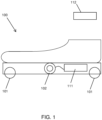
- a mobility device 100 comprises a plurality of wheels 101, with at least one of the wheels 101 connected to an electric motor 102. Further shown in Fig. 1 is an onboard controller 111 and an optional remote controller 112. During typical use, a user will wear two mobility devices 100, one on each foot. The mobility device 100 enables a pedestrian to walk faster than a normal walking pace by adding torque to the wheels 101 of the mobility device 100 worn on the foot in contact with the ground. In this manner, the user experiences an effect similar to that of walking on a moving walkway. More specifically, the control system 110 of the present invention enables a user to maintain a normal walking motion by adapting the control of the motor 102 to the movements of the user. As will be discussed in greater detail, the speed at which the wheels 101 spin, through a torque applied by the motor 102, is controlled in part by an analysis of the user's gait.
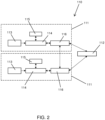
- Fig. 2 depicts the components of the onboard controller 111, which comprises at least one inertial measurement unit 113, a processor 114, a motor driver 115, and a wireless communication module 116.
- the control system 110 may also include a remote controller 112, which is capable of sending commands to each of the onboard controllers 111.
- both the left and right mobility devices 100 receive command speeds from the remote controller 112, which can be in the form of a hand-held controller, a computer, or a mobile phone, and actuate the mobility devices at the specified command speeds.
- the control system 110 is used to collect data and analyze the gait of a user.
- each mobility device 100 When a pair of mobility devices 100 is worn by a user, each mobility device 100 will have a control system 110.
- the onboard processor 114 reads gait dynamic data, which may comprise acceleration, angular rates, orientation, gyroscopic data, or quaternion data of each mobility device 100 from the inertial measurement unit 113.
- both onboard controllers 111 send the gait dynamic data to the remote controller 112 and, in return, receive a motion command from the remote controller 112.
- the motion command comprises, for example, acceleration to a set speed, braking, deceleration to a set speed, and holding at a constant speed.
- additional data can be included in the motion command.
- the onboard processor 114 along with the motor driver 115 converts the motion command into a motor driving signal and drives the motor system 102, thereby affecting the speed of the wheels 101.
- the motor driver 115 receives a speed command and drives the motor 102 at the command speed via a feedback loop control.
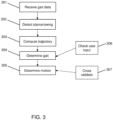
- the flow diagram shown in Fig. 3 depicts the method of gait- based motion control, according to one embodiment, comprising the steps of receiving gait dynamic data 301, detecting the stance/swing phase 302, computing the gait trajectory vector 303, determining the user gait 304, and determining the motion command 305.
- the control system 110 receives gait dynamic data from both onboard controllers 111.
- the gait dynamic data includes data collected from the inertial measurement unit 113 in each mobility device 100.
- the control system 110 determines the status of each mobility device 100 as being 'in stance' (i.e. on the ground) or 'swing' (i.e. in the air).
- a gait trajectory vector is set to zero.
- the gait trajectory vector may comprise an estimated foot velocity, stride length, orientation, and elevation, among other parameters. For example, acceleration in the x direction can be integrated over a period of time to determine forward velocity.
- acceleration in the z direction can be used to derive elevation.
- the elevation is positive, this could indicate that a user is climbing stairs.
- a negative elevation can indicate a user is travelling down a set of stairs.
- Acceleration in the y direction i.e. side-to-side
- a gait speed and trajectory vector are calculated based on the gait dynamic data.
- the acceleration data acquired from the inertial measurement units 113 is integrated to provide a velocity for each mobility device 100. The average of the velocity of both mobility devices 100 can be used to calculate the user's overall speed.
- the gait speed and trajectory vectors are compared against a pre-configured gait model (or profile) which comprises a range of speeds during walking, different ranges of elevation during walking, climbing hills, or stepping on stairs. Based on the result of said comparisons, the user gait is determined.
- the motion command is generated based on the determined gait. For example, if the average velocity of the two mobility devices 100 is calculated to be 1.2 m/s, then the gait is determined to be 'middle' (or any other assigned profile based on the average velocity) and requires a motion command for a wheel speed of .8 m/s. A lower average velocity may require a motion command with a lower wheel speed.
- the remote controller 112 checks if any user input has been registered.
- the user input can be in various forms such as pressing a button or moving the remote controller 112 in a certain trajectory.
- the user input may press a button indicating that the user wants forward motion.
- the forward motion command received from the user can override the motion command provided by the controller 112 or onboard processors 111.
- a motion command is generated and sent by the remote controller 112 to both onboard controllers 111.
- the final motion command is replaced with the user input before being sent to the onboard controllers 111.
- each onboard controller 111 determines the gait in step 304 and generates a motion command in step 305.
- the motion command may include acceleration to a set speed, braking, deceleration to a set speed, and holding at a constant speed.
- the processor 1 14 along with the motor driver 115 convert the motion command into a motor driving signal and drive the motor system.
- cross validation compares the motion commands generated by each of the two mobility devices 100. For example, the motor driver 115 will only command motor speed when both commands are similar and will brake when the speed commands are inconsistent.
Landscapes
- Engineering & Computer Science (AREA)
- Health & Medical Sciences (AREA)
- Life Sciences & Earth Sciences (AREA)
- Physics & Mathematics (AREA)
- Mechanical Engineering (AREA)
- Transportation (AREA)
- Automation & Control Theory (AREA)
- Public Health (AREA)
- Biophysics (AREA)
- Biomedical Technology (AREA)
- Heart & Thoracic Surgery (AREA)
- Medical Informatics (AREA)
- Molecular Biology (AREA)
- Surgery (AREA)
- Animal Behavior & Ethology (AREA)
- General Health & Medical Sciences (AREA)
- Pathology (AREA)
- Veterinary Medicine (AREA)
- Artificial Intelligence (AREA)
- Physiology (AREA)
- Power Engineering (AREA)
- Mathematical Physics (AREA)
- Dentistry (AREA)
- Oral & Maxillofacial Surgery (AREA)
- Human Computer Interaction (AREA)
- Signal Processing (AREA)
- Psychiatry (AREA)
- Computer Vision & Pattern Recognition (AREA)
- Fuzzy Systems (AREA)
- Evolutionary Computation (AREA)
- Rehabilitation Tools (AREA)
- Motorcycle And Bicycle Frame (AREA)
- Measurement Of The Respiration, Hearing Ability, Form, And Blood Characteristics Of Living Organisms (AREA)
- Toys (AREA)
Description
- The invention relates to a mobility device. More specifically, the invention relates to a control system and method of controlling a mobility device having an electric motor that is worn on the feet of a user to provide mobility assistance.
- Commuters and other travelers often have to walk the final leg of their trip, regardless of whether they travelled by car, bus, train, or other means. Depending on the distance, the time needed to complete this final leg of the journey can comprise a significant amount of the total duration of the trip. While bikes or scooters can be used, they are bulky and require skill and a minimum level of fitness to operate. Powered systems, such as moving walkways, suffer from a lack of mobility. Other mobility solutions suffer the same drawbacks or lack the ability to adapt to a particular user. Therefore, it would be advantageous to develop a control system for a mobility device that does not require any special skills or user training and can adapt to the individual needs of a particular user.
-
WO2011092443 discloses wheeled shoes or undersoles enabling fast walking. -
US2008093144 discloses a device and method for assisting a user in regaining balance. -
US6059062 discloses powered roller skates. - According to embodiments of the present invention is a system and method of controlling a pair of mobility devices, wherein the mobility devices are worn on each foot of a user. A sensor in each mobility device obtains data about the gait of a user and transmits the data to a processor. The processor analyzes the gait of a user and then uses the gait data to develop motion commands for each mobility device. Each mobility device may comprise a motor, gearing, and wheels. When worn on the feet of a user, the mobility devices allow a user to walk at an increased rate of speed for a given cadence and stride length, as compared to their speed without the mobility devices. Further, the control system adapts to a user so no learning or other control inputs are required by the user.
-
-
Fig. 1 depicts a mobility device with an embedded controller, according to one embodiment. -
Fig. 2 is a block diagram of a control system according to one embodiment. -
Fig. 3 shows the steps of the method of control, utilizing the controller depicted inFig. 2 . - As shown in
Fig. 1 , amobility device 100, according to one embodiment, comprises a plurality ofwheels 101, with at least one of thewheels 101 connected to anelectric motor 102. Further shown inFig. 1 is anonboard controller 111 and an optionalremote controller 112. During typical use, a user will wear twomobility devices 100, one on each foot. Themobility device 100 enables a pedestrian to walk faster than a normal walking pace by adding torque to thewheels 101 of themobility device 100 worn on the foot in contact with the ground. In this manner, the user experiences an effect similar to that of walking on a moving walkway. More specifically, thecontrol system 110 of the present invention enables a user to maintain a normal walking motion by adapting the control of themotor 102 to the movements of the user. As will be discussed in greater detail, the speed at which thewheels 101 spin, through a torque applied by themotor 102, is controlled in part by an analysis of the user's gait. -
Fig. 2 depicts the components of theonboard controller 111, which comprises at least oneinertial measurement unit 113, aprocessor 114, amotor driver 115, and awireless communication module 116. Twoonboard controllers 111 are shown inFig. 2 since each mobility device (i.e. one for each foot of the user) will house anonboard controller 111. In an alternative embodiment, thecontrol system 110 may also include aremote controller 112, which is capable of sending commands to each of theonboard controllers 111. In this particular embodiment, both the left andright mobility devices 100 receive command speeds from theremote controller 112, which can be in the form of a hand-held controller, a computer, or a mobile phone, and actuate the mobility devices at the specified command speeds. - The
control system 110 is used to collect data and analyze the gait of a user. When a pair ofmobility devices 100 is worn by a user, eachmobility device 100 will have acontrol system 110. For example, theonboard processor 114 reads gait dynamic data, which may comprise acceleration, angular rates, orientation, gyroscopic data, or quaternion data of eachmobility device 100 from theinertial measurement unit 113. In one embodiment, bothonboard controllers 111 send the gait dynamic data to theremote controller 112 and, in return, receive a motion command from theremote controller 112. The motion command comprises, for example, acceleration to a set speed, braking, deceleration to a set speed, and holding at a constant speed. In alternative embodiments, additional data can be included in the motion command. Upon receiving the motion command, theonboard processor 114 along with themotor driver 115 converts the motion command into a motor driving signal and drives themotor system 102, thereby affecting the speed of thewheels 101. In one embodiment, themotor driver 115 receives a speed command and drives themotor 102 at the command speed via a feedback loop control. - The flow diagram shown in
Fig. 3 depicts the method of gait- based motion control, according to one embodiment, comprising the steps of receiving gaitdynamic data 301, detecting the stance/swing phase 302, computing thegait trajectory vector 303, determining theuser gait 304, and determining themotion command 305. - In
step 301, thecontrol system 110 receives gait dynamic data from bothonboard controllers 111. The gait dynamic data includes data collected from theinertial measurement unit 113 in eachmobility device 100. Next, instep 302, thecontrol system 110 determines the status of eachmobility device 100 as being 'in stance' (i.e. on the ground) or 'swing' (i.e. in the air). Then, instep 303, if themobility device 100 is in the stance phase, a gait trajectory vector is set to zero. The gait trajectory vector may comprise an estimated foot velocity, stride length, orientation, and elevation, among other parameters. For example, acceleration in the x direction can be integrated over a period of time to determine forward velocity. Similarly, acceleration in the z direction can be used to derive elevation. By way of further example, if the elevation is positive, this could indicate that a user is climbing stairs. A negative elevation can indicate a user is travelling down a set of stairs. Acceleration in the y direction (i.e. side-to-side) can be used to derive orientation, which may be indicative of a turning motion by the user. If themobility device 100 is in swing phase, a gait speed and trajectory vector are calculated based on the gait dynamic data. For example, in one embodiment, the acceleration data acquired from theinertial measurement units 113 is integrated to provide a velocity for eachmobility device 100. The average of the velocity of bothmobility devices 100 can be used to calculate the user's overall speed. - Next, at
step 304, the gait speed and trajectory vectors are compared against a pre-configured gait model (or profile) which comprises a range of speeds during walking, different ranges of elevation during walking, climbing hills, or stepping on stairs. Based on the result of said comparisons, the user gait is determined. Once gait is determined, atstep 305 the motion command is generated based on the determined gait. For example, if the average velocity of the twomobility devices 100 is calculated to be 1.2 m/s, then the gait is determined to be 'middle' (or any other assigned profile based on the average velocity) and requires a motion command for a wheel speed of .8 m/s. A lower average velocity may require a motion command with a lower wheel speed. - However, in
optional step 306, theremote controller 112 checks if any user input has been registered. The user input can be in various forms such as pressing a button or moving theremote controller 112 in a certain trajectory. For example, the user input may press a button indicating that the user wants forward motion. Thus, the forward motion command received from the user can override the motion command provided by thecontroller 112 oronboard processors 111. After checking for a user input atstep 306, a motion command is generated and sent by theremote controller 112 to bothonboard controllers 111. However, if the user input is received fromstep 306, the final motion command is replaced with the user input before being sent to theonboard controllers 111. - In an alternative embodiment, each
onboard controller 111 determines the gait instep 304 and generates a motion command instep 305. To prevent inconsistent commands from eachonboard controller 111, each sends the motion command signal to the other for cross-validation instep 307. The motion command may include acceleration to a set speed, braking, deceleration to a set speed, and holding at a constant speed. Upon validating the motion command, the processor 1 14 along with themotor driver 115 convert the motion command into a motor driving signal and drive the motor system. Stated differently, instep 307, cross validation compares the motion commands generated by each of the twomobility devices 100. For example, themotor driver 115 will only command motor speed when both commands are similar and will brake when the speed commands are inconsistent. - While the disclosure has been described in detail and with reference to specific embodiments thereof, it will be apparent to one skilled in the art that various changes and modification can be made therein without departing from the scope of the embodiments. Thus, it is intended that the present disclosure cover the modifications and variations of this disclosure provided they come within the scope of the appended claims .
Claims (13)
- A method of controlling a pair of mobility devices (100), each having an electric motor (102), the method comprising:receiving gait data from at least one inertial measurement unit (113) in a first mobility device (100) and at least one inertial measurement unit (113) in a second mobility device (100);detecting a stance/ swing phase of the first mobility device (100) and the second mobility device (100) based on the gait data;computing a gait trajectory, wherein the gait trajectory comprises a velocity and computing the gait trajectory comprises integrating an acceleration provided by the inertial measurement unit (113) to calculate the velocity;determining the gait of a user based on the average velocity of the first mobility device (100) and the second mobility device (100); andgenerating a motion command using the determined gait.
- The method of claim 1, wherein the gait data is selected from the group consisting of acceleration, angular rates, orientation, gyroscopic data, or quaternion data.
- The method of claim 1 or 2, wherein the gait trajectory of the gait is set to zero if in a stance phase.
- The method of any preceding claim, further comprising cross validating the motion command between the first mobility device (100) and the second mobility device (100).
- The method of claim 4, wherein the step of cross validating the motion command comprises:
converting the motion command into a motor driving signal if the motion command of the first mobility device (100) is similar to a motion command of the second mobility device (100). - The method of claim 4, wherein the step of cross validating the motion command comprises:
converting the motion command into a braking signal if the motion command of the first mobility device (100) is not similar to a motion command of the second mobility device (100). - The method of any preceding claim, further comprising:checking for user input from a remote controller (112), andoverriding the motion command based on the user input.
- The method of any preceding claim, wherein the step of determining the gait of a user based on the gait trajectory comprises:
comparing the gait trajectory to a range of speeds. - The method of any preceding claim, wherein the gait trajectory further comprises at least one of a parameter selected from the group consisting of stride length, orientation, and elevation.
- A computer program or computer-readable medium comprising instructions which, when executed by a computer, cause the computer to carry out the method of any preceding claim.
- A control
system for controlling a pair of mobility devices (100), each having an electric motor (102), wherein the apparatus is configured to:receive gait data from at least one inertial measurement unit (113) in a first mobility device (100) and at least one inertial measurement unit (113) in a second mobility device (100);detect a stance/ swing phase of the first mobility device (100) and the second mobility device (100) based on the gait data;compute a gait trajectory, wherein the gait trajectory comprises a velocity and computing the gait trajectory comprises integrating an acceleration provided by the inertial measurement unit (113) to calculate the velocity;determine the gait of a user based on the average velocity of the first mobility device (100) and the second mobility device (100); andgenerate a motion command using the determined gait. - The control system of claim 11, further comprising the first and/or second mobility devices (100).
- The control system of claim 11 or 12, further configured to perform the method of any of claims 2-9.
Applications Claiming Priority (2)
| Application Number | Priority Date | Filing Date | Title |
|---|---|---|---|
| US201762530177P | 2017-07-08 | 2017-07-08 | |
| PCT/US2018/041345 WO2019014154A1 (en) | 2017-07-08 | 2018-07-09 | A method and device for control of a mobility device |
Publications (3)
| Publication Number | Publication Date |
|---|---|
| EP3629925A1 EP3629925A1 (en) | 2020-04-08 |
| EP3629925A4 EP3629925A4 (en) | 2021-03-03 |
| EP3629925B1 true EP3629925B1 (en) | 2024-12-04 |
Family
ID=65001490
Family Applications (1)
| Application Number | Title | Priority Date | Filing Date |
|---|---|---|---|
| EP18831335.7A Active EP3629925B1 (en) | 2017-07-08 | 2018-07-09 | A method and device for control of a mobility device |
Country Status (5)
| Country | Link |
|---|---|
| US (3) | US11364431B2 (en) |
| EP (1) | EP3629925B1 (en) |
| JP (2) | JP7214243B2 (en) |
| CN (2) | CN110868925A (en) |
| WO (2) | WO2019014152A1 (en) |
Families Citing this family (12)
| Publication number | Priority date | Publication date | Assignee | Title |
|---|---|---|---|---|
| CN106390428B (en) | 2016-11-01 | 2019-03-05 | 爱柯迪股份有限公司 | A kind of bionical electric-powered shoes |
| CN106582003B (en) | 2016-11-01 | 2019-11-05 | 爱柯迪股份有限公司 | A kind of regulating mechanism of electric-powered shoes |
| CN106390430B (en) | 2016-11-01 | 2019-03-05 | 爱柯迪股份有限公司 | A kind of anti kickback attachment of power footwear apparatus |
| CN110868925A (en) | 2017-07-08 | 2020-03-06 | 筋斗云机器人技术有限公司 | Method and device for controlling mobile device |
| KR102614779B1 (en) * | 2018-09-14 | 2023-12-15 | 삼성전자주식회사 | Method and apparatus for assisting walking |
| CN113543858B (en) | 2019-01-09 | 2024-04-26 | 瞬动科技股份有限公司 | Method and device for controlling a mobile device using an estimated gait trajectory |
| GB201904018D0 (en) | 2019-03-23 | 2019-05-08 | Hoffman Shalom | Motorized platforms for walking |
| CN110710976A (en) * | 2019-10-14 | 2020-01-21 | 深圳市迈步机器人科技有限公司 | Storage medium for personalized gait generation method, control system and exoskeleton robot |
| CN112741617A (en) * | 2019-10-30 | 2021-05-04 | 成都易书桥科技有限公司 | CSI-based omnidirectional gait detection algorithm |
| GB2589855A (en) * | 2019-12-09 | 2021-06-16 | Slipstream Board Ltd | Electric skateboard and associated gaming apparatus, system and method |
| US20220028546A1 (en) * | 2020-07-24 | 2022-01-27 | International Business Machines Corporation | Assessing the gait of parkinson's patients |
| JP7824945B2 (en) | 2020-10-21 | 2026-03-05 | シフト ロボティクス、インク. | Wheel configuration of an electric shoe device with an integrated translation-rotation hinge mechanism and an integrated gear-bushing assembly |
Family Cites Families (104)
| Publication number | Priority date | Publication date | Assignee | Title |
|---|---|---|---|---|
| US833100A (en) | 1906-02-23 | 1906-10-09 | Daniel D Wells | Pedemobile. |
| US1672700A (en) | 1926-03-29 | 1928-06-05 | Joseph Vargo | Roller skate |
| US1801205A (en) | 1930-05-22 | 1931-04-14 | Edward M Mirick | Skate |
| US2857008A (en) | 1956-11-23 | 1958-10-21 | Pirrello Antonio | Power roller skates |
| US3392986A (en) | 1966-04-11 | 1968-07-16 | Mattel Inc | Self-propelling roller skate |
| US4334690A (en) | 1979-11-05 | 1982-06-15 | Trend Products Group | Trainer/learner skate |
| USRE32346E (en) | 1979-11-05 | 1987-02-03 | Trend Products Group | Trainer/learner skate |
| US4417737A (en) | 1982-09-13 | 1983-11-29 | Hyman Suroff | Self-propelled roller skate |
| US4553767A (en) | 1984-02-09 | 1985-11-19 | The Quaker Oats Company | Roller skate with integral ratchet means |
| US4932676A (en) | 1988-02-08 | 1990-06-12 | Quaker Oats Company | Roller skate having three control modes |
| PL162516B1 (en) | 1990-04-06 | 1993-12-31 | Zygmunt Piotrowski | Apparatus facilitating displacement of human body |
| US5236058A (en) | 1991-12-11 | 1993-08-17 | Irving Yamet | Motor driven roller skates |
| US5400484A (en) | 1992-10-23 | 1995-03-28 | Hyde Athletic Industries, Inc. | Adjustable roller skate |
| US5413380A (en) | 1993-10-12 | 1995-05-09 | Fernandez; Juan M. | Gyroscopic in-line belt roller skate |
| IT1273897B (en) | 1994-06-08 | 1997-07-11 | Nordica Spa | IMPROVED WHEEL STRUCTURE OF WHEELS |
| US6059062A (en) * | 1995-05-31 | 2000-05-09 | Empower Corporation | Powered roller skates |
| US5730241A (en) | 1996-08-15 | 1998-03-24 | Chorng Rong Shyr | Caterpillar track shoe |
| IT1284909B1 (en) | 1996-10-02 | 1998-05-28 | Antonio Romeo | ARTICULATED INLINE WHEEL SKATES |
| US5797466A (en) | 1997-03-05 | 1998-08-25 | Gendle; Timothy A. | Powered in-line skate |
| DE59809621D1 (en) | 1997-07-28 | 2003-10-23 | Thieme Sport Gmbh | Sports and play equipment |
| US6626442B2 (en) | 1998-03-20 | 2003-09-30 | Nikolaos S. Pahis | Rolling foot apparatus with motion-conversion mechanism |
| EP1093388B1 (en) | 1998-06-09 | 2006-05-10 | Mattel Inc. | Convertible skate |
| ATE306302T1 (en) | 1998-07-07 | 2005-10-15 | Ventura Corp Ltd | ROLLER SKATES |
| TW370888U (en) | 1998-12-19 | 1999-09-21 | Chun-Cheng Chang | Structure of roller stand of roller skate |
| US7175187B2 (en) | 1999-01-11 | 2007-02-13 | Lyden Robert M | Wheeled skate with step-in binding and brakes |
| US6645126B1 (en) | 2000-04-10 | 2003-11-11 | Biodex Medical Systems, Inc. | Patient rehabilitation aid that varies treadmill belt speed to match a user's own step cycle based on leg length or step length |
| US6425587B1 (en) | 2000-08-29 | 2002-07-30 | Aaron G. Moon | Multi-functional roller skates |
| US6517091B1 (en) | 2000-11-28 | 2003-02-11 | Blue Sky | Roller skate |
| US7153242B2 (en) * | 2001-05-24 | 2006-12-26 | Amit Goffer | Gait-locomotor apparatus |
| US6604593B1 (en) | 2002-01-29 | 2003-08-12 | Wayne-Dalton Corp. | Powered roller skates |
| KR20040101673A (en) | 2003-05-26 | 2004-12-03 | 주식회사자이츠 | Wheel-set Equipped with Shoe |
| US20050046139A1 (en) | 2003-08-26 | 2005-03-03 | Shenjie Guan | Weight powered engine and its usage in roller skates, roller blades and electricity generation |
| JP2005081038A (en) | 2003-09-11 | 2005-03-31 | Yukio Kawanishi | Portable electric walking aid system |
| US7383908B2 (en) | 2003-10-20 | 2008-06-10 | Raja Tuli | Motorized walking shoes |
| US7163210B1 (en) | 2003-12-29 | 2007-01-16 | Rehco, Llc | Training device for wheeled vehicles |
| GB2427832A (en) * | 2004-05-04 | 2007-01-10 | Yonatan Manor | Device and method for regaining balance |
| ES2545261T3 (en) | 2004-08-04 | 2015-09-09 | Heeling Sports Limited | Motorized transport device and procedure |
| CN2759524Y (en) | 2004-12-22 | 2006-02-22 | 李晶淼 | Dedicated shoes for land curling sports |
| EP1857157A1 (en) | 2006-05-17 | 2007-11-21 | Adolf Brunner | Self-propelled skate |
| US7204330B1 (en) * | 2006-06-08 | 2007-04-17 | Nick Lauren | Battery-powered, remote-controlled, motor-driven, steerable roller skates |
| GB2452563B (en) | 2007-09-08 | 2012-09-12 | Ian James Turnbull | Roller sled with steering and braking mechanism |
| US20110181013A9 (en) | 2007-10-21 | 2011-07-28 | Othman Fadel M Y | Wheeled personal transportation device powerd by weight of the user: the autoshoe |
| US7900731B2 (en) | 2007-11-13 | 2011-03-08 | Mckinzie Bradley K | Shoe with retractable motorized wheels |
| CN201423154Y (en) | 2009-03-24 | 2010-03-17 | 程汝薇 | Power assist shoe |
| CN201565096U (en) | 2009-11-10 | 2010-09-01 | 黎广源 | Simple two-section straight-row roller skate |
| FR2955780A1 (en) * | 2010-02-01 | 2011-08-05 | Paul Chavand | ROLLING SHOES OR SUBSYUBES FOR QUICK MARKET |
| WO2012007855A1 (en) | 2010-07-14 | 2012-01-19 | Ecole Polytechnique Federale De Lausanne (Epfl) | System and method for 3d gait assessment |
| CN101912681A (en) | 2010-07-19 | 2010-12-15 | 无锡江天高新纳米技术材料有限公司 | Electric roller skates |
| CN101912680A (en) | 2010-07-19 | 2010-12-15 | 无锡江天高新纳米技术材料有限公司 | Electric roller-skates |
| GB2484463A (en) * | 2010-10-11 | 2012-04-18 | Jonathan Butters | Apparatus to assist the rehabilitation of disabled persons |
| CN102167117B (en) | 2011-04-22 | 2014-03-12 | 方显忠 | Pedaling overrunning clutch type skidding mechanism |
| WO2012158199A1 (en) | 2011-05-15 | 2012-11-22 | Treadway Peter | Wearable mobility device |
| CN102805928A (en) | 2011-05-31 | 2012-12-05 | 无锡江天高新纳米技术材料有限公司 | Electric power-assisted pulley shoe |
| US9198821B2 (en) | 2011-09-28 | 2015-12-01 | Northeastern University | Lower extremity exoskeleton for gait retraining |
| JP2013111118A (en) * | 2011-11-25 | 2013-06-10 | Tomohito Takubo | Walking assist device |
| US9295302B1 (en) * | 2012-02-17 | 2016-03-29 | University Of South Florida | Gait-altering shoes |
| US9526977B2 (en) * | 2012-03-29 | 2016-12-27 | Daniel B. Edney | Powered skate with automatic motor control |
| WO2014107653A1 (en) * | 2013-01-04 | 2014-07-10 | Hyneman James Franklin | Powered shoes |
| US10137050B2 (en) | 2013-01-17 | 2018-11-27 | Rewalk Robotics Ltd. | Gait device with a crutch |
| US20160058326A1 (en) * | 2013-04-15 | 2016-03-03 | University Of Delaware | Gait and mobility assessment systems and methods |
| CN203389316U (en) | 2013-08-27 | 2014-01-15 | 陈小虎 | Roller shoe wheel with ratchet wheel |
| CN103431929B (en) * | 2013-08-29 | 2016-01-20 | 电子科技大学 | A kind of strength enhancement mode power exoskeleton walking step state cognitive method and device |
| AU2014348761A1 (en) | 2013-11-12 | 2016-05-12 | Ekso Bionics, Inc. | Machine to human interfaces for communication from a lower extremity orthotic |
| KR102119536B1 (en) | 2014-01-15 | 2020-06-05 | 삼성전자주식회사 | Wearable robot and control method for the same |
| CN104787183A (en) | 2014-01-16 | 2015-07-22 | 阿克顿公司 | Motorized transportation device |
| US20200000373A1 (en) * | 2014-04-22 | 2020-01-02 | The Trustees Of Columbia University In The City Of New York | Gait Analysis Devices, Methods, and Systems |
| WO2015164456A2 (en) | 2014-04-22 | 2015-10-29 | The Trustees Of Columbia University In The City Of New York | Gait analysis devices, methods, and systems |
| WO2015191753A1 (en) * | 2014-06-10 | 2015-12-17 | Acton, Inc. | Wearable personal transportation system |
| US9907722B2 (en) * | 2014-08-15 | 2018-03-06 | Honda Motor Co., Ltd. | Admittance shaping controller for exoskeleton assistance of the lower extremities |
| CN104266648A (en) * | 2014-09-16 | 2015-01-07 | 南京诺导电子科技有限公司 | Indoor location system based on Android platform MARG sensor |
| US10449105B2 (en) * | 2014-10-26 | 2019-10-22 | Springactive, Inc. | System and method of bidirectional compliant joint torque actuation |
| CN104323780B (en) * | 2014-10-30 | 2016-07-06 | 上海交通大学 | Pedestrian's gait classification system and method based on support vector machine |
| CN204395401U (en) | 2014-12-13 | 2015-06-17 | 程坚强 | A kind of shatter-resistant ice skate |
| CN204364838U (en) | 2015-01-27 | 2015-06-03 | 齐齐哈尔大学 | Butting plow formula Sliding retainers |
| CN104689559B (en) | 2015-03-04 | 2017-01-04 | 王炳基 | Driven shoes, driven shoes assembly and control method thereof |
| US10426637B2 (en) * | 2015-05-11 | 2019-10-01 | The Hong Kong Polytechnic University | Exoskeleton ankle robot |
| JP5938124B1 (en) * | 2015-05-19 | 2016-06-22 | 本田技研工業株式会社 | Walking assist device |
| CN105214299A (en) | 2015-09-22 | 2016-01-06 | 黄冠洲 | A kind of intelligent electric ice skate |
| AU2016352184A1 (en) * | 2015-11-10 | 2018-04-26 | Globe International Nominees Pty Ltd | Electric vehicle interfaces and control systems |
| CN105631195B (en) * | 2015-12-18 | 2017-12-26 | 合肥工业大学 | A kind of gait analysis system and its method of wearable Multi-information acquisition |
| CN106926218A (en) | 2015-12-24 | 2017-07-07 | 株式会社捷太格特 | Servicing unit, swinging joint device, direct acting variable stiffness unit and lathe |
| CN105457258B (en) | 2015-12-28 | 2017-12-12 | 金华飞人科技有限公司 | A kind of remote electric shoes |
| GB2547260B (en) | 2016-02-12 | 2019-05-15 | Artemev Timur | Motorized footwear |
| US10908045B2 (en) | 2016-02-23 | 2021-02-02 | Deka Products Limited Partnership | Mobility device |
| US9937408B2 (en) * | 2016-03-08 | 2018-04-10 | TianDe Mo | Wearable motorized device |
| US9919200B2 (en) * | 2016-03-08 | 2018-03-20 | TianDe Mo | Wearable motorized device |
| CN114190924B (en) | 2016-04-14 | 2023-12-15 | 医学节奏股份有限公司 | Systems and methods for neurological rehabilitation |
| CN205627021U (en) | 2016-05-24 | 2016-10-12 | 黄冠洲 | Electronic pulley shoes of intelligence |
| WO2018013994A1 (en) * | 2016-07-15 | 2018-01-18 | Razor Usa Llc | Powered mobility systems |
| CN106039689A (en) | 2016-08-04 | 2016-10-26 | 唐勇 | Vibration-isolating electric double-row roller skate |
| CN106390428B (en) * | 2016-11-01 | 2019-03-05 | 爱柯迪股份有限公司 | A kind of bionical electric-powered shoes |
| CN106582003B (en) | 2016-11-01 | 2019-11-05 | 爱柯迪股份有限公司 | A kind of regulating mechanism of electric-powered shoes |
| CN206560675U (en) * | 2016-11-01 | 2017-10-17 | 爱柯迪股份有限公司 | A kind of power footwear apparatus |
| CN106390430B (en) * | 2016-11-01 | 2019-03-05 | 爱柯迪股份有限公司 | A kind of anti kickback attachment of power footwear apparatus |
| US12220626B2 (en) * | 2016-11-17 | 2025-02-11 | Raja Singh Tuli | Motorized walking shoes |
| US9925453B1 (en) * | 2016-11-17 | 2018-03-27 | Raja Singh Tuli | Motorized walking shoes |
| US10238316B2 (en) * | 2017-05-17 | 2019-03-26 | Rehabit Llc | Passive five sensor insole real-time feedback device |
| US10456698B2 (en) | 2017-05-17 | 2019-10-29 | Goldlok Holdings (Guangdong) Co. Ltd. | Toy vehicle with novel drive-train control assembly |
| DE102018003787A1 (en) * | 2017-05-30 | 2018-12-06 | Merck Patent Gmbh | Liquid crystalline medium |
| CN110868925A (en) | 2017-07-08 | 2020-03-06 | 筋斗云机器人技术有限公司 | Method and device for controlling mobile device |
| US10926160B2 (en) * | 2017-12-15 | 2021-02-23 | Mohawknee S.R.L. | Device for skating and related method of functioning |
| US20210113914A1 (en) * | 2018-04-29 | 2021-04-22 | Nimbus Robotics, Inc. | A gait controlled mobility device |
| CN208356075U (en) * | 2018-05-21 | 2019-01-11 | 周伟 | self-balancing vehicle |
| CN113543858B (en) | 2019-01-09 | 2024-04-26 | 瞬动科技股份有限公司 | Method and device for controlling a mobile device using an estimated gait trajectory |
-
2018
- 2018-07-09 CN CN201880045226.XA patent/CN110868925A/en active Pending
- 2018-07-09 US US16/629,252 patent/US11364431B2/en active Active
- 2018-07-09 US US16/629,251 patent/US20200129843A1/en not_active Abandoned
- 2018-07-09 EP EP18831335.7A patent/EP3629925B1/en active Active
- 2018-07-09 JP JP2020521859A patent/JP7214243B2/en active Active
- 2018-07-09 CN CN201880045277.2A patent/CN110868926A/en active Pending
- 2018-07-09 WO PCT/US2018/041343 patent/WO2019014152A1/en not_active Ceased
- 2018-07-09 WO PCT/US2018/041345 patent/WO2019014154A1/en not_active Ceased
-
2022
- 2022-06-17 US US17/843,153 patent/US11772499B2/en active Active
-
2023
- 2023-01-11 JP JP2023002135A patent/JP2023052305A/en active Pending
Also Published As
| Publication number | Publication date |
|---|---|
| US11772499B2 (en) | 2023-10-03 |
| JP7214243B2 (en) | 2023-01-30 |
| EP3629925A4 (en) | 2021-03-03 |
| CN110868926A (en) | 2020-03-06 |
| WO2019014154A1 (en) | 2019-01-17 |
| JP2020527092A (en) | 2020-09-03 |
| JP2023052305A (en) | 2023-04-11 |
| US20220314103A1 (en) | 2022-10-06 |
| US20200129844A1 (en) | 2020-04-30 |
| EP3629925A1 (en) | 2020-04-08 |
| WO2019014152A1 (en) | 2019-01-17 |
| CN110868925A (en) | 2020-03-06 |
| US11364431B2 (en) | 2022-06-21 |
| US20200129843A1 (en) | 2020-04-30 |
Similar Documents
| Publication | Publication Date | Title |
|---|---|---|
| EP3629925B1 (en) | A method and device for control of a mobility device | |
| US12042717B2 (en) | Method and device for control of a mobility device using an estimated gait trajectory | |
| US20210113914A1 (en) | A gait controlled mobility device | |
| CN106476974B (en) | A kind of power-assisted carries out method, electric vehicle and its controller | |
| JP6884040B2 (en) | Electric Assist Control methods and devices that control the electric motor to assist the bicycle in pushing and walking | |
| KR101360727B1 (en) | Moter driven personal transportation apparatus | |
| JP6882050B2 (en) | Bicycle control device | |
| US20220063758A1 (en) | Integrated head tube steering motor for autonomous electronic bicycle | |
| TW202116612A (en) | Electronic bicycle, transmission device, and operation method | |
| TWI615137B (en) | Electric walking assisting device for multi-mode walking training and control method of the same | |
| WO2018133050A1 (en) | Electric walking aid for multimode walking training, and control method therefor | |
| HK40024627A (en) | A method and device for control of a mobility device | |
| CN104274942A (en) | Treadmill and automatic speed adjustment device and method for treadmill | |
| EP4019355A1 (en) | Electric bicycle | |
| HK40024628A (en) | A method and device for control of a mobility device | |
| JP7121907B2 (en) | Inverted moving object | |
| KR20220105199A (en) | Smart rollator for autonomous driving by recognition of the user's intent to walk and its control method | |
| KR102896431B1 (en) | Smart walker system | |
| CN110613564A (en) | Stair climbing wheelchair protection method and system based on hub detection and readable storage medium | |
| CN120921383A (en) | Control method and storage medium for auxiliary exoskeleton robot | |
| HK40045625A (en) | A gait controlled mobility device | |
| CN108762266B (en) | Electric scooter control method and device, storage medium and electric scooter | |
| HK40045625B (en) | A gait controlled mobility device |
Legal Events
| Date | Code | Title | Description |
|---|---|---|---|
| STAA | Information on the status of an ep patent application or granted ep patent |
Free format text: STATUS: THE INTERNATIONAL PUBLICATION HAS BEEN MADE |
|
| PUAI | Public reference made under article 153(3) epc to a published international application that has entered the european phase |
Free format text: ORIGINAL CODE: 0009012 |
|
| STAA | Information on the status of an ep patent application or granted ep patent |
Free format text: STATUS: REQUEST FOR EXAMINATION WAS MADE |
|
| 17P | Request for examination filed |
Effective date: 20191230 |
|
| AK | Designated contracting states |
Kind code of ref document: A1 Designated state(s): AL AT BE BG CH CY CZ DE DK EE ES FI FR GB GR HR HU IE IS IT LI LT LU LV MC MK MT NL NO PL PT RO RS SE SI SK SM TR |
|
| AX | Request for extension of the european patent |
Extension state: BA ME |
|
| DAV | Request for validation of the european patent (deleted) | ||
| DAX | Request for extension of the european patent (deleted) | ||
| A4 | Supplementary search report drawn up and despatched |
Effective date: 20210203 |
|
| RIC1 | Information provided on ipc code assigned before grant |
Ipc: A61F 2/68 20060101ALI20210128BHEP Ipc: A61H 3/00 20060101ALI20210128BHEP Ipc: A61B 5/00 20060101ALI20210128BHEP Ipc: A61F 2/60 20060101ALI20210128BHEP Ipc: A63C 17/12 20060101ALI20210128BHEP Ipc: A61B 5/11 20060101AFI20210128BHEP Ipc: A61F 5/01 20060101ALI20210128BHEP Ipc: A61H 1/02 20060101ALI20210128BHEP |
|
| RAP1 | Party data changed (applicant data changed or rights of an application transferred) |
Owner name: SHIFT ROBOTICS, INC. |
|
| RAP3 | Party data changed (applicant data changed or rights of an application transferred) |
Owner name: SHIFT ROBOTICS, INC. |
|
| GRAP | Despatch of communication of intention to grant a patent |
Free format text: ORIGINAL CODE: EPIDOSNIGR1 |
|
| STAA | Information on the status of an ep patent application or granted ep patent |
Free format text: STATUS: GRANT OF PATENT IS INTENDED |
|
| INTG | Intention to grant announced |
Effective date: 20240626 |
|
| GRAS | Grant fee paid |
Free format text: ORIGINAL CODE: EPIDOSNIGR3 |
|
| GRAA | (expected) grant |
Free format text: ORIGINAL CODE: 0009210 |
|
| STAA | Information on the status of an ep patent application or granted ep patent |
Free format text: STATUS: THE PATENT HAS BEEN GRANTED |
|
| AK | Designated contracting states |
Kind code of ref document: B1 Designated state(s): AL AT BE BG CH CY CZ DE DK EE ES FI FR GB GR HR HU IE IS IT LI LT LU LV MC MK MT NL NO PL PT RO RS SE SI SK SM TR |
|
| REG | Reference to a national code |
Ref country code: GB Ref legal event code: FG4D |
|
| REG | Reference to a national code |
Ref country code: CH Ref legal event code: EP |
|
| REG | Reference to a national code |
Ref country code: DE Ref legal event code: R096 Ref document number: 602018077317 Country of ref document: DE |
|
| REG | Reference to a national code |
Ref country code: IE Ref legal event code: FG4D |
|
| REG | Reference to a national code |
Ref country code: LT Ref legal event code: MG9D |
|
| REG | Reference to a national code |
Ref country code: NL Ref legal event code: MP Effective date: 20241204 |
|
| PG25 | Lapsed in a contracting state [announced via postgrant information from national office to epo] |
Ref country code: HR Free format text: LAPSE BECAUSE OF FAILURE TO SUBMIT A TRANSLATION OF THE DESCRIPTION OR TO PAY THE FEE WITHIN THE PRESCRIBED TIME-LIMIT Effective date: 20241204 |
|
| PG25 | Lapsed in a contracting state [announced via postgrant information from national office to epo] |
Ref country code: FI Free format text: LAPSE BECAUSE OF FAILURE TO SUBMIT A TRANSLATION OF THE DESCRIPTION OR TO PAY THE FEE WITHIN THE PRESCRIBED TIME-LIMIT Effective date: 20241204 |
|
| PG25 | Lapsed in a contracting state [announced via postgrant information from national office to epo] |
Ref country code: BG Free format text: LAPSE BECAUSE OF FAILURE TO SUBMIT A TRANSLATION OF THE DESCRIPTION OR TO PAY THE FEE WITHIN THE PRESCRIBED TIME-LIMIT Effective date: 20241204 |
|
| PG25 | Lapsed in a contracting state [announced via postgrant information from national office to epo] |
Ref country code: ES Free format text: LAPSE BECAUSE OF FAILURE TO SUBMIT A TRANSLATION OF THE DESCRIPTION OR TO PAY THE FEE WITHIN THE PRESCRIBED TIME-LIMIT Effective date: 20241204 |
|
| PG25 | Lapsed in a contracting state [announced via postgrant information from national office to epo] |
Ref country code: NO Free format text: LAPSE BECAUSE OF FAILURE TO SUBMIT A TRANSLATION OF THE DESCRIPTION OR TO PAY THE FEE WITHIN THE PRESCRIBED TIME-LIMIT Effective date: 20250304 |
|
| PG25 | Lapsed in a contracting state [announced via postgrant information from national office to epo] |
Ref country code: LV Free format text: LAPSE BECAUSE OF FAILURE TO SUBMIT A TRANSLATION OF THE DESCRIPTION OR TO PAY THE FEE WITHIN THE PRESCRIBED TIME-LIMIT Effective date: 20241204 Ref country code: GR Free format text: LAPSE BECAUSE OF FAILURE TO SUBMIT A TRANSLATION OF THE DESCRIPTION OR TO PAY THE FEE WITHIN THE PRESCRIBED TIME-LIMIT Effective date: 20250305 |
|
| PG25 | Lapsed in a contracting state [announced via postgrant information from national office to epo] |
Ref country code: RS Free format text: LAPSE BECAUSE OF FAILURE TO SUBMIT A TRANSLATION OF THE DESCRIPTION OR TO PAY THE FEE WITHIN THE PRESCRIBED TIME-LIMIT Effective date: 20250304 |
|
| PG25 | Lapsed in a contracting state [announced via postgrant information from national office to epo] |
Ref country code: NL Free format text: LAPSE BECAUSE OF FAILURE TO SUBMIT A TRANSLATION OF THE DESCRIPTION OR TO PAY THE FEE WITHIN THE PRESCRIBED TIME-LIMIT Effective date: 20241204 |
|
| REG | Reference to a national code |
Ref country code: AT Ref legal event code: MK05 Ref document number: 1747238 Country of ref document: AT Kind code of ref document: T Effective date: 20241204 |
|
| PG25 | Lapsed in a contracting state [announced via postgrant information from national office to epo] |
Ref country code: SM Free format text: LAPSE BECAUSE OF FAILURE TO SUBMIT A TRANSLATION OF THE DESCRIPTION OR TO PAY THE FEE WITHIN THE PRESCRIBED TIME-LIMIT Effective date: 20241204 |
|
| PG25 | Lapsed in a contracting state [announced via postgrant information from national office to epo] |
Ref country code: PL Free format text: LAPSE BECAUSE OF FAILURE TO SUBMIT A TRANSLATION OF THE DESCRIPTION OR TO PAY THE FEE WITHIN THE PRESCRIBED TIME-LIMIT Effective date: 20241204 |
|
| PGFP | Annual fee paid to national office [announced via postgrant information from national office to epo] |
Ref country code: GB Payment date: 20250619 Year of fee payment: 8 |
|
| PG25 | Lapsed in a contracting state [announced via postgrant information from national office to epo] |
Ref country code: IS Free format text: LAPSE BECAUSE OF FAILURE TO SUBMIT A TRANSLATION OF THE DESCRIPTION OR TO PAY THE FEE WITHIN THE PRESCRIBED TIME-LIMIT Effective date: 20250404 |
|
| PG25 | Lapsed in a contracting state [announced via postgrant information from national office to epo] |
Ref country code: PT Free format text: LAPSE BECAUSE OF FAILURE TO SUBMIT A TRANSLATION OF THE DESCRIPTION OR TO PAY THE FEE WITHIN THE PRESCRIBED TIME-LIMIT Effective date: 20250404 |
|
| PG25 | Lapsed in a contracting state [announced via postgrant information from national office to epo] |
Ref country code: EE Free format text: LAPSE BECAUSE OF FAILURE TO SUBMIT A TRANSLATION OF THE DESCRIPTION OR TO PAY THE FEE WITHIN THE PRESCRIBED TIME-LIMIT Effective date: 20241204 |
|
| PGFP | Annual fee paid to national office [announced via postgrant information from national office to epo] |
Ref country code: FR Payment date: 20250619 Year of fee payment: 8 |
|
| PG25 | Lapsed in a contracting state [announced via postgrant information from national office to epo] |
Ref country code: AT Free format text: LAPSE BECAUSE OF FAILURE TO SUBMIT A TRANSLATION OF THE DESCRIPTION OR TO PAY THE FEE WITHIN THE PRESCRIBED TIME-LIMIT Effective date: 20241204 Ref country code: RO Free format text: LAPSE BECAUSE OF FAILURE TO SUBMIT A TRANSLATION OF THE DESCRIPTION OR TO PAY THE FEE WITHIN THE PRESCRIBED TIME-LIMIT Effective date: 20241204 |
|
| PG25 | Lapsed in a contracting state [announced via postgrant information from national office to epo] |
Ref country code: SK Free format text: LAPSE BECAUSE OF FAILURE TO SUBMIT A TRANSLATION OF THE DESCRIPTION OR TO PAY THE FEE WITHIN THE PRESCRIBED TIME-LIMIT Effective date: 20241204 |
|
| PG25 | Lapsed in a contracting state [announced via postgrant information from national office to epo] |
Ref country code: CZ Free format text: LAPSE BECAUSE OF FAILURE TO SUBMIT A TRANSLATION OF THE DESCRIPTION OR TO PAY THE FEE WITHIN THE PRESCRIBED TIME-LIMIT Effective date: 20241204 |
|
| PG25 | Lapsed in a contracting state [announced via postgrant information from national office to epo] |
Ref country code: IT Free format text: LAPSE BECAUSE OF FAILURE TO SUBMIT A TRANSLATION OF THE DESCRIPTION OR TO PAY THE FEE WITHIN THE PRESCRIBED TIME-LIMIT Effective date: 20241204 |
|
| REG | Reference to a national code |
Ref country code: DE Ref legal event code: R097 Ref document number: 602018077317 Country of ref document: DE |
|
| PG25 | Lapsed in a contracting state [announced via postgrant information from national office to epo] |
Ref country code: SE Free format text: LAPSE BECAUSE OF FAILURE TO SUBMIT A TRANSLATION OF THE DESCRIPTION OR TO PAY THE FEE WITHIN THE PRESCRIBED TIME-LIMIT Effective date: 20241204 |
|
| PG25 | Lapsed in a contracting state [announced via postgrant information from national office to epo] |
Ref country code: DK Free format text: LAPSE BECAUSE OF FAILURE TO SUBMIT A TRANSLATION OF THE DESCRIPTION OR TO PAY THE FEE WITHIN THE PRESCRIBED TIME-LIMIT Effective date: 20241204 |
|
| PGFP | Annual fee paid to national office [announced via postgrant information from national office to epo] |
Ref country code: DE Payment date: 20250620 Year of fee payment: 8 |
|
| PLBE | No opposition filed within time limit |
Free format text: ORIGINAL CODE: 0009261 |
|
| STAA | Information on the status of an ep patent application or granted ep patent |
Free format text: STATUS: NO OPPOSITION FILED WITHIN TIME LIMIT |
|
| REG | Reference to a national code |
Ref country code: CH Ref legal event code: L10 Free format text: ST27 STATUS EVENT CODE: U-0-0-L10-L00 (AS PROVIDED BY THE NATIONAL OFFICE) Effective date: 20251015 |
|
| 26N | No opposition filed |
Effective date: 20250905 |
|
| REG | Reference to a national code |
Ref country code: CH Ref legal event code: H13 Free format text: ST27 STATUS EVENT CODE: U-0-0-H10-H13 (AS PROVIDED BY THE NATIONAL OFFICE) Effective date: 20260224 |
|
| PG25 | Lapsed in a contracting state [announced via postgrant information from national office to epo] |
Ref country code: LU Free format text: LAPSE BECAUSE OF NON-PAYMENT OF DUE FEES Effective date: 20250709 |
|
| REG | Reference to a national code |
Ref country code: BE Ref legal event code: MM Effective date: 20250731 |
|
| PG25 | Lapsed in a contracting state [announced via postgrant information from national office to epo] |
Ref country code: BE Free format text: LAPSE BECAUSE OF NON-PAYMENT OF DUE FEES Effective date: 20250731 |
|
| PG25 | Lapsed in a contracting state [announced via postgrant information from national office to epo] |
Ref country code: CH Free format text: LAPSE BECAUSE OF NON-PAYMENT OF DUE FEES Effective date: 20250731 |