EP3628773B1 - A process of textile dyeing and dyed textiles - Google Patents
A process of textile dyeing and dyed textiles Download PDFInfo
- Publication number
- EP3628773B1 EP3628773B1 EP18197202.7A EP18197202A EP3628773B1 EP 3628773 B1 EP3628773 B1 EP 3628773B1 EP 18197202 A EP18197202 A EP 18197202A EP 3628773 B1 EP3628773 B1 EP 3628773B1
- Authority
- EP
- European Patent Office
- Prior art keywords
- textile
- carbon particles
- dye
- dyeing
- microparticles
- Prior art date
- Legal status (The legal status is an assumption and is not a legal conclusion. Google has not performed a legal analysis and makes no representation as to the accuracy of the status listed.)
- Active
Links
Images


Classifications
-
- D—TEXTILES; PAPER
- D06—TREATMENT OF TEXTILES OR THE LIKE; LAUNDERING; FLEXIBLE MATERIALS NOT OTHERWISE PROVIDED FOR
- D06P—DYEING OR PRINTING TEXTILES; DYEING LEATHER, FURS OR SOLID MACROMOLECULAR SUBSTANCES IN ANY FORM
- D06P1/00—General processes of dyeing or printing textiles, or general processes of dyeing leather, furs, or solid macromolecular substances in any form, classified according to the dyes, pigments, or auxiliary substances employed
- D06P1/44—General processes of dyeing or printing textiles, or general processes of dyeing leather, furs, or solid macromolecular substances in any form, classified according to the dyes, pigments, or auxiliary substances employed using insoluble pigments or auxiliary substances, e.g. binders
-
- D—TEXTILES; PAPER
- D06—TREATMENT OF TEXTILES OR THE LIKE; LAUNDERING; FLEXIBLE MATERIALS NOT OTHERWISE PROVIDED FOR
- D06P—DYEING OR PRINTING TEXTILES; DYEING LEATHER, FURS OR SOLID MACROMOLECULAR SUBSTANCES IN ANY FORM
- D06P1/00—General processes of dyeing or printing textiles, or general processes of dyeing leather, furs, or solid macromolecular substances in any form, classified according to the dyes, pigments, or auxiliary substances employed
- D06P1/44—General processes of dyeing or printing textiles, or general processes of dyeing leather, furs, or solid macromolecular substances in any form, classified according to the dyes, pigments, or auxiliary substances employed using insoluble pigments or auxiliary substances, e.g. binders
- D06P1/673—Inorganic compounds
-
- D—TEXTILES; PAPER
- D06—TREATMENT OF TEXTILES OR THE LIKE; LAUNDERING; FLEXIBLE MATERIALS NOT OTHERWISE PROVIDED FOR
- D06M—TREATMENT, NOT PROVIDED FOR ELSEWHERE IN CLASS D06, OF FIBRES, THREADS, YARNS, FABRICS, FEATHERS OR FIBROUS GOODS MADE FROM SUCH MATERIALS
- D06M11/00—Treating fibres, threads, yarns, fabrics or fibrous goods made from such materials, with inorganic substances or complexes thereof; Such treatment combined with mechanical treatment, e.g. mercerising
- D06M11/73—Treating fibres, threads, yarns, fabrics or fibrous goods made from such materials, with inorganic substances or complexes thereof; Such treatment combined with mechanical treatment, e.g. mercerising with carbon or compounds thereof
-
- D—TEXTILES; PAPER
- D06—TREATMENT OF TEXTILES OR THE LIKE; LAUNDERING; FLEXIBLE MATERIALS NOT OTHERWISE PROVIDED FOR
- D06M—TREATMENT, NOT PROVIDED FOR ELSEWHERE IN CLASS D06, OF FIBRES, THREADS, YARNS, FABRICS, FEATHERS OR FIBROUS GOODS MADE FROM SUCH MATERIALS
- D06M23/00—Treatment of fibres, threads, yarns, fabrics or fibrous goods made from such materials, characterised by the process
- D06M23/12—Processes in which the treating agent is incorporated in microcapsules
-
- D—TEXTILES; PAPER
- D06—TREATMENT OF TEXTILES OR THE LIKE; LAUNDERING; FLEXIBLE MATERIALS NOT OTHERWISE PROVIDED FOR
- D06P—DYEING OR PRINTING TEXTILES; DYEING LEATHER, FURS OR SOLID MACROMOLECULAR SUBSTANCES IN ANY FORM
- D06P1/00—General processes of dyeing or printing textiles, or general processes of dyeing leather, furs, or solid macromolecular substances in any form, classified according to the dyes, pigments, or auxiliary substances employed
- D06P1/22—General processes of dyeing or printing textiles, or general processes of dyeing leather, furs, or solid macromolecular substances in any form, classified according to the dyes, pigments, or auxiliary substances employed using vat dyestuffs including indigo
- D06P1/228—Indigo
-
- D—TEXTILES; PAPER
- D06—TREATMENT OF TEXTILES OR THE LIKE; LAUNDERING; FLEXIBLE MATERIALS NOT OTHERWISE PROVIDED FOR
- D06P—DYEING OR PRINTING TEXTILES; DYEING LEATHER, FURS OR SOLID MACROMOLECULAR SUBSTANCES IN ANY FORM
- D06P5/00—Other features in dyeing or printing textiles, or dyeing leather, furs, or solid macromolecular substances in any form
- D06P5/13—Fugitive dyeing or stripping dyes
- D06P5/138—Fugitive dyeing or stripping dyes fugitive dyeing
-
- D—TEXTILES; PAPER
- D06—TREATMENT OF TEXTILES OR THE LIKE; LAUNDERING; FLEXIBLE MATERIALS NOT OTHERWISE PROVIDED FOR
- D06P—DYEING OR PRINTING TEXTILES; DYEING LEATHER, FURS OR SOLID MACROMOLECULAR SUBSTANCES IN ANY FORM
- D06P7/00—Dyeing or printing processes combined with mechanical treatment
Definitions
- the present invention relates to a process of dyeing textiles and to the textiles dyed with such process.
- the invention relates to a method of producing modified textiles which include carbon particles, namely carbon microparticles and/or carbon nanoparticles.
- Dyeing is a known process of applying a colour to a textile; the textile may be fibers, yarns, fabrics or garments.
- the textile may be fibers, yarns, fabrics or garments.
- ring-dyeing it is known to carry out a "ring-dyeing" process according to which dye is concentrated on the outer thickness of a yarn. Ring-dyeing is particularly useful in dyeing of yarns for denim and other casual fabrics that have to show a "worn” or “washed-out” appearance in the final garment.
- the nanoparticles in US'160 can be organic or inorganic nanoparticles.
- the nanoparticles suitable for use are metal oxides, nanosized metals, inorganic pigments, organic pigments, insoluble polymers, and any solid materials that can be physically or chemically processed into nanosize particles.
- the nanoparticle is carbon black.
- the dimensions of the nanoparticles are 1 - 100 nm; small nanoparticles of 8 nm give better results than greater ones.
- Suitable and preferred nanoparticles are e.g. nanosized particles, such as Ag, Cu, Fe, glass, Au and Pt. US'160 is silent about the 2D particles imparting special optical effects to the dyed fabric.
- US2008/155764 discloses processes for dyeing textile webs either woven or non-woven.
- the dye is a solvent-based dye that comprises at least one component which may be selected from one or more of carbon black, graphite, alumina, titanium, and other possible metals as additional components, including mixed oxides, such as magnetite and nickel oxide. This document is also silent about an undercoating for indigo and/or indigo derivatives.
- the present invention provides a process of dyeing textiles according to claim 1. It is a further object of the invention a dyed textile according to claim 8; another object of the invention is a garment according to claim 11; a further object of the invention is a composition for dyeing a textile according to claim 13, and another object of the invention is the use according to claim 14.
- the process comprises the steps of preparing a composition containing carbon particles, namely carbon nanoparticles and/or carbon microparticles.
- At least some of the carbon particles applied with said composition to textiles are "2D" particles, i.e. lamellar particles in the shape of "nano- and/or micro-sheets" or "nano- and/or micro-surfaces".
- a carbon particle used for the invention is a 2D nanoparticle and/or 2D microparticle having dimensions of 0.01 to 80 microns, preferably of 0.1 to 20.0 microns, more preferably of 0.5 to 2 microns.
- Suitable 2D nanoparticles and/or 2D microparticles are 2D, or flake-shaped, particles preferably selected from graphene flakes, graphite flakes and mixtures thereof. Size measurements of carbon particles may be done with an optical microscope and atomic force microscope (AFM) or by Malvern Dynamic Light Scattering using a wet method (particles were suspended in wet medium including an emulsifier). Techniques for particle measurement are common general knowledge, e.g. as summarized in "A basic guide to particle characterization” 2015, Malvern Instruments Limited, available online.
- 2D nanoparticles and “2D microparticles” it is here meant nano- and microparticles in which the thickness of the particle is few nanometers and the length of the major axis is in range of tens to hundreds of nanometers or a few microns; suitable 2D particles are ⁇ - ⁇ stacked multilayer graphene or graphite particles having dimensions as above discussed.
- undercoat or “undercoating” this specification defines a coating, or coating process, using carbon particles, particularly 2D carbon particles that is used in a dyeing process before the final colour is applied to the textile.
- carbon nanoparticles or microparticles in the form of flakes, having the above specified dimensions, can adhere to the fibers of the yarns of a textile, at least in the outer layer of the yarn, on a yarn alone, in a rope or in a fabric, so as to provide a layer of carbon particles at least in the external thickness of the yarn, i.e. in a ring on the surface and part of the interior of a yarn.
- This layer acts as an undercoating, i.e. as a basis, or foundation, onto which an additional dye can be deposited. Indigo is a preferred additional dye.
- the composition further comprises other carbon particles (i.e. carbon particles other than 2D nanoparticles and/or 2D microparticles as described above), such as amorphous carbon nanoparticles, to enhance the effect provided by the undercoating 2D carbon particles.
- amorphous carbon nanoparticles are nanoparticles of amorphous carbon.
- Such nanoparticles of amorphous carbon preferably having dimensions in the range of 1 nm to 1000 nm, more preferably 1 to 800 nm, even more preferably 10 to 200 nm as measured by Malvern Dynamic Light Scattering using a wet method (particles were suspended in wet medium including an emulsifier).
- the textile is treated at least once, preferably more than once, with the composition of carbon particles to provide darker shades; preferably, this is carried out with a dip and dry process.
- the invention also relates to the textiles obtained with the above mentioned process and to garments obtainable from said textiles.
- textiles is used to define fibers, yarns and fabrics; preferably, the process of the invention is carried out on yarns and fabrics.
- the invention relates to a dyed textile comprising a dye and a plurality of carbon particles, wherein at least part of said carbon particles are 2D nanoparticles and/or 2D microparticles having the above mentioned dimensions.
- the dyed textile comprises an additional dye, different from 2D carbon nanoparticles and 2D carbon microparticles.
- a preferred additional dye is indigo, most preferably indigo is applied as a ring on the surface and the external portion of the section of the yarns of the textile product.
- indigo here includes indigo derivatives; dyeing with indigo is known in the art and is not discussed in detail in this invention.
- carbon particles in particular graphene and/or graphite 2D particles having dimensions as disclosed above, can provide an excellent undercoating, or basis, in the treated textile for a dye that is applied to the said textile; thus, the said undercoating may be used to achieve darker shades upon a further dyeing step with additional dyes, without changing the spectral response of the treated fabric.
- the carbon particles it is possible to use the carbon particles as a "foundation" onto which a different dye can be added: when a fabric, or textile, previously treated with carbon 2D particles according to the invention is dyed with a dye to impart e.g.
- Nanoparticles of amorphous carbon in particular those having dimensions in the range of 1 nm to 1000 nm, more preferably 1 to 800 nm, even more preferably 10 to 200 nm, proved to improve the undercoating effect when used in addition to an undercoating of 2D carbon nano- and/or micro-particles to dye the fabric, instead of using a dark or black dye; advantageously the nanoparticles of amorphous carbon may be used together with the 2D carbon nano- and micro-particles to provide the required dark colour by means of a single composition.
- the invention provides on one side a process of dyeing a textile according to claim 1, wherein carbon 2D nano and/or microparticles are used.
- the process distinguishes from the prior art in that it uses 2D nano and/or microparticles, preferably 2D microparticles.
- the textile treated with a composition comprising nanoparticles of amorphous carbon and 2D carbon microparticles and/or nanoparticles, preferably microparticles does not necessarily undergo a further dyeing treatment with a different, "traditional" dye.
- a further object of the invention is the use of carbon 2D micro and/or nanoparticles in a dyeing process, according to claim 16.
- the invention provides for a dyeing process according to claim 3, comprising the step of preparing a composition containing 2D carbon particles, preferably 2D microparticles, as above described and applying said composition to textiles, characterized in that said textile is further treated with an additional dye which is different from 2D nanoparticles and 2D microparticles.
- the invention relates to a composition, comprising carbon particles and at least a binder and/or an auxiliary chemical, said composition being configured to apply said carbon particles to a textile, characterized in that said carbon particles are 2D nanoparticles and/or 2D microparticles, preferably having dimensions of 0.01 to 150 microns, preferably of 0.1 to 20.0 microns, more preferably of 0.5 to 2 microns.
- compositions containing 2D carbon particles of the invention comprise 2D carbon particles, binders and auxiliary chemicals.
- Suitable binders are e.g. based on acrylate, styrene acrylate, styrene, acrylic ester, acrylonitrile.
- Suitable auxiliary chemicals are e.g. thickening agents, wetting agents, binders, softening agents and antifoaming agents.
- 2D carbon particles may be obtained from carbon sources such graphite, graphene and may be produced via mechanical and chemical exfoliation. Examples of compositions of amorphous carbon particles and relevant auxiliary chemicals are disclosed in US2003/0106160 , to which reference is made for further details.
- the carbon content of the composition applied on the yarn and/or fabric is in the range of 0.1wt% to 30wt%, preferably 1wt% to 20wt%, more preferably 5wt% to 15wt%.
- Textiles that may be treated with the invention process are mainly those from natural fibers, especially cellulose, regenerated cellulose, bamboo, kapok, hemp, flax and sisal. Additionally, synthetic fibers, yarns and/or fabrics made of polyethylene terephthalate, polyamides (incl. PA6, PA66, PA612, PA11), and mixtures thereof and mixtures natural and synthetic fibers, can benefit from such an undercoat as well.
- the invention also provides several advantages over the prior art.
- the carbon particles include 2D nanoparticles and/or 2D microparticles, advantageously having dimensions of 0.01 to 80 microns, preferably of 0.1 to 20.0 microns, more preferably of 0.5 to 2 microns; these carbon particles may be used as an undercoating for a dye; the dye may be a traditional dye, such as e.g. indigo, or other dye; the dye may be applied to the textile after having applied the undercoating.
- the invention process provides for preparing a composition containing carbon particles and treating a textile with the said composition; an additional step of dyeing the treated textile with an additional known dye suitable to be used with the said textile may also be provided by the invention method.
- the additional dyeing step is preferably performed on a textile treated with a composition comprising 2D nano- and/or micro-particles; a textile may also be treated with a composition comprising 2D nano- and/or micro-particles and other carbon particles, e.g. nanoparticles of amorphous carbon.
- the textile is selected from yarns and fabrics, more preferably the textile is a yarn.
- Yarns may be treated with the invention compositions via rope dyeing process; the treated yarn may be subsequently be indigo dyed to obtain a ring-dye effect and may then be used to provide a fabric.
- an undercoating layer is obtained, e.g. in the form of a "ring" of carbon particles, located essentially in the outer thickness, or outer layer, of the yarns, as shown in fig.1.
- Fig. 1 also shows the corresponding results of repeated treatment of the yarn or fabric with carbon particles compositions: darker shades of grey/black are progressively obtained.
- Undercoating of carbon particles is done preferably by dip dyeing process, which is known per se in the art.
- FIGs 2 and 3 show a comparison between three different fabrics, i.e. fabrics A, B and C.
- Fabric A is a fabric dyed according to the invention process, by using a composition containing 2D carbon particles and by performing an additional dyeing step with indigo;
- fabric B is a fabric dyed only with indigo in a traditional way and
- fabric C is a fabric treated with only a composition according to the invention, without additional dye treatment.
- Fig. 3 shows the K/S readings of fabrics A-C obtained from Datacolor Spectrum Equipment (K/S is a function of frequency).
- the dotted line shows a K/S value of the ecru fabric C treated with a composition of carbon particles according to the invention.
- the 2D carbon particles make the absorbance of the material nearly flat across the visible spectrum.
- Dashed line is the spectral response of fabric B, i.e. of an ordinary indigo dyeing on the ecru fabric; the continuous line shows the K/S values of fabric A, i.e. the fabric where the ecru fabric C first undercoated with the carbon source has been then dyed with indigo.
- the flat absorbance of the undercoat darker shade is achieved without changing the spectral response of the desired colour and without using higher concentrations of the dye itself (in this case of indigo) as otherwise would be necessary if a traditional dyeing system and process is used.
- Figure 4 schematically shows the ring effect obtainable with the process of the invention on a yarn treated with carbon 2D particles and further dyed with indigo.
- the picture shows a partially un-twisted carbon + indigo dyed yarn in which the dyed outer fibers and the white inner core are well visible. Thanks to the enhanced ring dyeing effect obtainable according to the invention, a fabric according to the invention can provide a wider variety of effects than known fabrics, upon washes and other known finishing treatments, including rinse wash, enzyme wash and stone wash.
- the graphene particles were 2D nano- and microparticles having dimension in a range of 0.5-2.0 microns.
- Graphene composition was water based; in addition to the nano- and micro-particles the composition included 2 g/L emulsifying agent, 10g/L binder, 5 g/L of thickening agents, 5 g/L of wetting agents, 20 g/L of softening agents and 0.5 g/L of antifoaming agents.
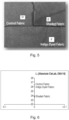
- FIG. 5 shows the picture of three fabrics including indigo dyed fabric F as a reference, fabric F was obtained by indigo dyeing the fabric, without any previous treatment.
- Fabric E is a fabric treated according to the invention, i.e. a fabric having an undercoating with graphene 2D particles as disclosed in the present example and indigo dyed; control fabric D was treated to provide an undercoating for indigo with other chemicals, namely auxiliary chemicals (wetting agent, softening agent etc.), excluding carbon particles.
- auxiliary chemicals wetting agent, softening agent etc.
- Lightness (L) values visible in fig. 6 , also show that a darker shade of the fabric is deriving from the presence of the carbon source. Shaded fabric (E) is 8,4% darker than the reference indigo dyed fabric (F) while control fabric (D) is 2,2% lighter than the reference.
Landscapes
- Engineering & Computer Science (AREA)
- Textile Engineering (AREA)
- Chemical & Material Sciences (AREA)
- Inorganic Chemistry (AREA)
- Coloring (AREA)
- Chemical Or Physical Treatment Of Fibers (AREA)
- Pigments, Carbon Blacks, Or Wood Stains (AREA)
Description
- The present invention relates to a process of dyeing textiles and to the textiles dyed with such process. In greater detail, the invention relates to a method of producing modified textiles which include carbon particles, namely carbon microparticles and/or carbon nanoparticles.
- Dyeing is a known process of applying a colour to a textile; the textile may be fibers, yarns, fabrics or garments. In the field of textile dyeing, it is known to carry out a "ring-dyeing" process according to which dye is concentrated on the outer thickness of a yarn. Ring-dyeing is particularly useful in dyeing of yarns for denim and other casual fabrics that have to show a "worn" or "washed-out" appearance in the final garment.
- Known dyeing processes may be long and use several steps and a lot of water; an example of such processes is indigo dyeing, which may require several steps in order to obtain the required colour shade. Additionally, known dyeing processes make use of high volumes of water. To reduce the number of steps in an indigo dyeing process it was proposed to pre-treat the fabric with a dye to provide a basis or undercoat for the subsequent indigo process. The "undercoat" should provide darker shades of indigo with fewer dyeing steps. These known "undercoating" methods, however, result in a change of the spectral response of the desired color.
- It has been proposed to use nanoparticle dyes to improve the dyeing process in polymeric synthetic yarns.
US2003/0106160 discloses a process for dyeing synthetic textiles by using nanoparticles of the dye to be used; the dye nanoparticles diffuse in the polymers of the textile fibers and are embedded into a textile, namely into yarns. Preferably, at least about 60% to about 70% of the embedded nanoparticles which have diffused into the polymer of the fibers are present just below the surface of the polymer. - The nanoparticles in US'160 can be organic or inorganic nanoparticles. The nanoparticles suitable for use are metal oxides, nanosized metals, inorganic pigments, organic pigments, insoluble polymers, and any solid materials that can be physically or chemically processed into nanosize particles. In one preferred embodiment, the nanoparticle is carbon black. The dimensions of the nanoparticles are 1 - 100 nm; small nanoparticles of 8 nm give better results than greater ones. Suitable and preferred nanoparticles are e.g. nanosized particles, such as Ag, Cu, Fe, glass, Au and Pt. US'160 is silent about the 2D particles imparting special optical effects to the dyed fabric.
-
US2008/155764 , discloses processes for dyeing textile webs either woven or non-woven. The dye is a solvent-based dye that comprises at least one component which may be selected from one or more of carbon black, graphite, alumina, titanium, and other possible metals as additional components, including mixed oxides, such as magnetite and nickel oxide. This document is also silent about an undercoating for indigo and/or indigo derivatives. - Therefore, there is a need for a new textile dyeing process that could solve or mitigate the above discussed problems. The new process should also simplify dyeing processes to obtain a ring-dyed textile.
- It is an aim of the present invention to solve the above problems and to provide a process for dyeing textiles that is easier and more economic to implement than known processes, and that is also suitable to provide ring-dyed yarns.
- Said aim is reached by the present invention, which provides a process of dyeing textiles according to claim 1. It is a further object of the invention a dyed textile according to claim 8; another object of the invention is a garment according to claim 11; a further object of the invention is a composition for dyeing a textile according to claim 13, and another object of the invention is the use according to claim 14.
- In an embodiment, the process comprises the steps of preparing a composition containing carbon particles, namely carbon nanoparticles and/or carbon microparticles. At least some of the carbon particles applied with said composition to textiles are "2D" particles, i.e. lamellar particles in the shape of "nano- and/or micro-sheets" or "nano- and/or micro-surfaces". In greater detail, a carbon particle used for the invention is a 2D nanoparticle and/or 2D microparticle having dimensions of 0.01 to 80 microns, preferably of 0.1 to 20.0 microns, more preferably of 0.5 to 2 microns. Suitable 2D nanoparticles and/or 2D microparticles are 2D, or flake-shaped, particles preferably selected from graphene flakes, graphite flakes and mixtures thereof. Size measurements of carbon particles may be done with an optical microscope and atomic force microscope (AFM) or by Malvern Dynamic Light Scattering using a wet method (particles were suspended in wet medium including an emulsifier). Techniques for particle measurement are common general knowledge, e.g. as summarized in "A basic guide to particle characterization" 2015, Malvern Instruments Limited, available online.
- With the wordings "2D nanoparticles" and "2D microparticles" it is here meant nano- and microparticles in which the thickness of the particle is few nanometers and the length of the major axis is in range of tens to hundreds of nanometers or a few microns; suitable 2D particles are π-π stacked multilayer graphene or graphite particles having dimensions as above discussed.
- With the wording "undercoat" or "undercoating" this specification defines a coating, or coating process, using carbon particles, particularly 2D carbon particles that is used in a dyeing process before the final colour is applied to the textile.
- It was found that carbon nanoparticles or microparticles, in the form of flakes, having the above specified dimensions, can adhere to the fibers of the yarns of a textile, at least in the outer layer of the yarn, on a yarn alone, in a rope or in a fabric, so as to provide a layer of carbon particles at least in the external thickness of the yarn, i.e. in a ring on the surface and part of the interior of a yarn. This layer acts as an undercoating, i.e. as a basis, or foundation, onto which an additional dye can be deposited. Indigo is a preferred additional dye.
- In a possible embodiment, the composition further comprises other carbon particles (i.e. carbon particles other than 2D nanoparticles and/or 2D microparticles as described above), such as amorphous carbon nanoparticles, to enhance the effect provided by the undercoating 2D carbon particles. For example, such non-2D carbon nanoparticles are nanoparticles of amorphous carbon. Such nanoparticles of amorphous carbon preferably having dimensions in the range of 1 nm to 1000 nm, more preferably 1 to 800 nm, even more preferably 10 to 200 nm as measured by Malvern Dynamic Light Scattering using a wet method (particles were suspended in wet medium including an emulsifier).
- According to an embodiment of the invention, the textile is treated at least once, preferably more than once, with the composition of carbon particles to provide darker shades; preferably, this is carried out with a dip and dry process.
- The invention also relates to the textiles obtained with the above mentioned process and to garments obtainable from said textiles. In the present description textiles is used to define fibers, yarns and fabrics; preferably, the process of the invention is carried out on yarns and fabrics. Thus, according to an embodiment, the invention relates to a dyed textile comprising a dye and a plurality of carbon particles, wherein at least part of said carbon particles are 2D nanoparticles and/or 2D microparticles having the above mentioned dimensions.
- In an embodiment, the dyed textile comprises an additional dye, different from 2D carbon nanoparticles and 2D carbon microparticles. A preferred additional dye is indigo, most preferably indigo is applied as a ring on the surface and the external portion of the section of the yarns of the textile product. The wording "indigo" here includes indigo derivatives; dyeing with indigo is known in the art and is not discussed in detail in this invention.
- It was surprisingly found that carbon particles, in particular graphene and/or graphite 2D particles having dimensions as disclosed above, can provide an excellent undercoating, or basis, in the treated textile for a dye that is applied to the said textile; thus, the said undercoating may be used to achieve darker shades upon a further dyeing step with additional dyes, without changing the spectral response of the treated fabric. In other words, it is possible to use the carbon particles as a "foundation" onto which a different dye can be added: when a fabric, or textile, previously treated with carbon 2D particles according to the invention is dyed with a dye to impart e.g. color A, the fabric, or textile, exhibits shades of the same color A that are darker than the shades of A obtainable on the same fabric with the same amount of dye, when the undercoat of nanoparticles is not present. Nanoparticles of amorphous carbon, in particular those having dimensions in the range of 1 nm to 1000 nm, more preferably 1 to 800 nm, even more preferably 10 to 200 nm, proved to improve the undercoating effect when used in addition to an undercoating of 2D carbon nano- and/or micro-particles to dye the fabric, instead of using a dark or black dye; advantageously the nanoparticles of amorphous carbon may be used together with the 2D carbon nano- and micro-particles to provide the required dark colour by means of a single composition.
- Thus, the invention provides on one side a process of dyeing a textile according to claim 1, wherein carbon 2D nano and/or microparticles are used. The process distinguishes from the prior art in that it uses 2D nano and/or microparticles, preferably 2D microparticles. According to an embodiment, the textile treated with a composition comprising nanoparticles of amorphous carbon and 2D carbon microparticles and/or nanoparticles, preferably microparticles, does not necessarily undergo a further dyeing treatment with a different, "traditional" dye. A further object of the invention is the use of carbon 2D micro and/or nanoparticles in a dyeing process, according to claim 16.
- In another aspect, the invention provides for a dyeing process according to claim 3, comprising the step of preparing a composition containing 2D carbon particles, preferably 2D microparticles, as above described and applying said composition to textiles, characterized in that said textile is further treated with an additional dye which is different from 2D nanoparticles and 2D microparticles. In a further aspect, the invention relates to a composition, comprising carbon particles and at least a binder and/or an auxiliary chemical, said composition being configured to apply said carbon particles to a textile, characterized in that said carbon particles are 2D nanoparticles and/or 2D microparticles, preferably having dimensions of 0.01 to 150 microns, preferably of 0.1 to 20.0 microns, more preferably of 0.5 to 2 microns.
- The compositions containing 2D carbon particles of the invention comprise 2D carbon particles, binders and auxiliary chemicals. Suitable binders are e.g. based on acrylate, styrene acrylate, styrene, acrylic ester, acrylonitrile. Suitable auxiliary chemicals are e.g. thickening agents, wetting agents, binders, softening agents and antifoaming agents. 2D carbon particles may be obtained from carbon sources such graphite, graphene and may be produced via mechanical and chemical exfoliation. Examples of compositions of amorphous carbon particles and relevant auxiliary chemicals are disclosed in
US2003/0106160 , to which reference is made for further details. - The carbon content of the composition applied on the yarn and/or fabric is in the range of 0.1wt% to 30wt%, preferably 1wt% to 20wt%, more preferably 5wt% to 15wt%. Textiles that may be treated with the invention process are mainly those from natural fibers, especially cellulose, regenerated cellulose, bamboo, kapok, hemp, flax and sisal. Additionally, synthetic fibers, yarns and/or fabrics made of polyethylene terephthalate, polyamides (incl. PA6, PA66, PA612, PA11), and mixtures thereof and mixtures natural and synthetic fibers, can benefit from such an undercoat as well.
- The invention also provides several advantages over the prior art. In fact, by providing a 2D carbon particles undercoating in the external layer of the yarn, darker shades become accessible with very thin layer of coating without changing the mechanical features of the yarn and/or fabric, while allowing other chemicals like dyes to be bound to the textile for further applications, due to the inert character of the carbon to other chemicals. Summarizing, the carbon particles include 2D nanoparticles and/or 2D microparticles, advantageously having dimensions of 0.01 to 80 microns, preferably of 0.1 to 20.0 microns, more preferably of 0.5 to 2 microns; these carbon particles may be used as an undercoating for a dye; the dye may be a traditional dye, such as e.g. indigo, or other dye; the dye may be applied to the textile after having applied the undercoating.
- The invention will now be further disclosed with reference to the following non-limiting examples and figures, in which:
-
Fig. 1 is schematic illustration of the effect of successive treatments of a yarn with a composition of the invention; -
Fig. 2 is a picture of three fabrics, two according to the invention and one a comparative example; -
Fig. 3 is a graph showing the spectral definition of the fabrics offig.2 ; -
Fig. 4 is a picture of an untwisted yarn showing how the ring effect is maintained in the process of the invention; -
Fig. 5 is a picture of a fabric according to the invention vs. two control fabrics; and -
Fig. 6 is a graph showing the lightness values of the three fabrics offig. 5 . - As above mentioned, the invention process provides for preparing a composition containing carbon particles and treating a textile with the said composition; an additional step of dyeing the treated textile with an additional known dye suitable to be used with the said textile may also be provided by the invention method. The additional dyeing step is preferably performed on a textile treated with a composition comprising 2D nano- and/or micro-particles; a textile may also be treated with a composition comprising 2D nano- and/or micro-particles and other carbon particles, e.g. nanoparticles of amorphous carbon.
- Preferably the textile is selected from yarns and fabrics, more preferably the textile is a yarn. Yarns may be treated with the invention compositions via rope dyeing process; the treated yarn may be subsequently be indigo dyed to obtain a ring-dye effect and may then be used to provide a fabric.
- By treating the textile with the invention compositions an undercoating layer is obtained, e.g. in the form of a "ring" of carbon particles, located essentially in the outer thickness, or outer layer, of the yarns, as shown in
fig.1. Fig. 1 also shows the corresponding results of repeated treatment of the yarn or fabric with carbon particles compositions: darker shades of grey/black are progressively obtained. Undercoating of carbon particles is done preferably by dip dyeing process, which is known per se in the art. -
Figures 2 and3 show a comparison between three different fabrics, i.e. fabrics A, B and C. Fabric A is a fabric dyed according to the invention process, by using a composition containing 2D carbon particles and by performing an additional dyeing step with indigo; fabric B is a fabric dyed only with indigo in a traditional way and fabric C is a fabric treated with only a composition according to the invention, without additional dye treatment.Fig. 3 shows the K/S readings of fabrics A-C obtained from Datacolor Spectrum Equipment (K/S is a function of frequency). The dotted line shows a K/S value of the ecru fabric C treated with a composition of carbon particles according to the invention. - It is noticed that the 2D carbon particles, particularly 2D microparticles, make the absorbance of the material nearly flat across the visible spectrum. Dashed line is the spectral response of fabric B, i.e. of an ordinary indigo dyeing on the ecru fabric; the continuous line shows the K/S values of fabric A, i.e. the fabric where the ecru fabric C first undercoated with the carbon source has been then dyed with indigo. As a result of the flat absorbance of the undercoat, darker shade is achieved without changing the spectral response of the desired colour and without using higher concentrations of the dye itself (in this case of indigo) as otherwise would be necessary if a traditional dyeing system and process is used.
-
Figure 4 schematically shows the ring effect obtainable with the process of the invention on a yarn treated with carbon 2D particles and further dyed with indigo. The picture shows a partially un-twisted carbon + indigo dyed yarn in which the dyed outer fibers and the white inner core are well visible. Thanks to the enhanced ring dyeing effect obtainable according to the invention, a fabric according to the invention can provide a wider variety of effects than known fabrics, upon washes and other known finishing treatments, including rinse wash, enzyme wash and stone wash. - Five fabrics were subjected to consecutive dip-dry treatment by a composition of the invention to provide different undercoatings of carbon particles, namely graphene particles. Undercoating of carbon particles was done by dipping-drying method. Concentration of graphene in the composition was 3,7g/L. Indigo concentration in a formulation which was used as a top (i.e. additional) dye was 1,10 % by weight of the indigo containing formulation.
- The graphene particles were 2D nano- and microparticles having dimension in a range of 0.5-2.0 microns. Graphene composition was water based; in addition to the nano- and micro-particles the composition included 2 g/L emulsifying agent, 10g/L binder, 5 g/L of thickening agents, 5 g/L of wetting agents, 20 g/L of softening agents and 0.5 g/L of antifoaming agents.
- All the samples were treated in the same graphene particles composition; fabric sample #1 was dipped-dried only once while sample #2 is dipped-dried twice, sample #3 was treated three times, sample #4 four times and sample #5 five times.
- All the five samples were subsequently dyed with the same indigo dyeing treatment, which is also carried out onto an untreated fabric (reference fabric). Absolute L* values (detected with Datacolor spectrophotometer measurements) were obtained: each dip-dry treatment gives darker shades to the fabrics by each consecutive treatment, with the reference having an L* value of 25.9 and samples 1-5 having L* values decreasing from 25.0 to 23.8.
-
Figure 5 shows the picture of three fabrics including indigo dyed fabric F as a reference, fabric F was obtained by indigo dyeing the fabric, without any previous treatment. Fabric E is a fabric treated according to the invention, i.e. a fabric having an undercoating with graphene 2D particles as disclosed in the present example and indigo dyed; control fabric D was treated to provide an undercoating for indigo with other chemicals, namely auxiliary chemicals (wetting agent, softening agent etc.), excluding carbon particles. - Lightness (L) values, visible in
fig. 6 , also show that a darker shade of the fabric is deriving from the presence of the carbon source. Shaded fabric (E) is 8,4% darker than the reference indigo dyed fabric (F) while control fabric (D) is 2,2% lighter than the reference. - From the above it is clear that the use of 2D carbon microparticles and nanoparticles (the 2D particles having a preferred range of dimensions of 0.5 to 2.0 microns - i.e. 500 nanometres to 2.0 microns) to treat a textile in a dyeing process before applying a dye, provides several advantages to the process. Namely, it results in lower consumption of dye and water and chemicals used in the dye process because of the colour basis, or undercoating, that is provided by the 2D carbon nano- and/or microparticles. At the same time, the final colour of the textile is not jeopardized by the use of the carbon particles of the invention.
Claims (14)
- A process of dyeing a textile, comprising the step of preparing a composition containing carbon particles and applying said composition to textiles, characterized in that at least part of said carbon particles are 2D nanoparticles and/or 2D microparticles having dimensions of 0.01 to 80 micrometers, measured as disclosed in the description, to provide an undercoating for the application of a dye, said process further comprising the step of dyeing said textile with at least one additional dye which is different from said 2D nanoparticles and 2D microparticles.
- A process according to claim 1, wherein said carbon particles have dimensions in the range of 0.1 to 20.0 micrometers, more preferably of 0.5 to 2 micrometers.
- A process according to claim 1, wherein said dye contains indigo or an indigo derivative which is applied to said textile, preferably with a rope-dyeing process when said textile is a yarn and a dyeing process when said textile is a fabric.
- A process according to any previous claim, wherein said composition containing carbon particles is applied more than once to said textiles.
- A process according to any previous claim, wherein said textile is selected from yarns and fabrics.
- A process according to claim 5, further comprising the step of treating said fabric in a finishing step to remove part of at least said additional dye, preferably part of said carbon particles and of said additional dye.
- A process according to any previous claim, wherein said carbon particles are selected from graphene, graphite and mixtures thereof.
- A dyed textile as obtainable according to the process of any previous claim, comprising a plurality of 2D nanoparticles and/or 2D microparticles having dimensions in the range of 0.01 to 80 micrometers, measured as disclosed in the description, preferably of 0.1 to 20.0 micrometers, more preferably of 0.5 to 2 micrometers, said 2D nanoparticles and/or 2D microparticles providing an undercoating for a dye, and further comprising an additional dye different from said 2D nanoparticles and 2D microparticles.
- A dyed textile according to claim 8, wherein said additional dye comprises indigo or an indigo derivative.
- A dyed textile according to claim 9, wherein at least said textile is ring-dyed.
- A garment comprising a textile according to any claim 8 to 10.
- A garment according to claim 11, wherein part of the additional dye or of said additional dye and of said carbon particles has been removed from the textile.
- A composition for a process of dyeing a textile according to any claim 1 to 7, comprising carbon particles and at least a binder and an auxiliary chemical, said composition being configured to apply said carbon particles to a textile, characterized in that said carbon particles are 2D nanoparticles and/or 2D microparticles having dimensions of 0.01 to 80 micrometers, measured as disclosed in the description, preferably of 0.1 to 20.0 micrometers, more preferably of 0.5 to 2 micrometers.
- The use of 2D carbon nano or microparticles in a dyeing process of a textile, to provide an undercoating for the application of a dye, said 2D carbon nano or microparticles having dimensions of 0.01 to 80 micrometers, measured as disclosed in the description, preferably of 0.1 to 20.0 micrometers, more preferably of 0.5 to 2 micrometers.
Priority Applications (10)
| Application Number | Priority Date | Filing Date | Title |
|---|---|---|---|
| PT181972027T PT3628773T (en) | 2018-09-27 | 2018-09-27 | A process of textile dyeing and dyed textiles |
| PL18197202.7T PL3628773T3 (en) | 2018-09-27 | 2018-09-27 | A process of textile dyeing and dyed textiles |
| EP18197202.7A EP3628773B1 (en) | 2018-09-27 | 2018-09-27 | A process of textile dyeing and dyed textiles |
| DK18197202.7T DK3628773T3 (en) | 2018-09-27 | 2018-09-27 | PROCEDURE FOR TEXTILE DYEING AND COLORED TEXTILES |
| ES18197202T ES2970435T3 (en) | 2018-09-27 | 2018-09-27 | Procedure for dyeing textiles and dyed textiles |
| BR102019019844A BR102019019844A2 (en) | 2018-09-27 | 2019-09-23 | process for dyeing a textile product, dyed textile product, garment, composition and use of 2d carbon nano or microparticles in a textile product dyeing process |
| JP2019172501A JP7346197B2 (en) | 2018-09-27 | 2019-09-24 | Textile dyeing method and dyed textile products |
| PCT/EP2019/075878 WO2020064845A1 (en) | 2018-09-27 | 2019-09-25 | A process of textile dyeing and dyed textiles |
| CN201910917876.5A CN110952351B (en) | 2018-09-27 | 2019-09-26 | Method for dyeing textiles and dyed textiles |
| US16/583,630 US10954628B2 (en) | 2018-09-27 | 2019-09-26 | Process of textile dyeing and dyed textiles |
Applications Claiming Priority (1)
| Application Number | Priority Date | Filing Date | Title |
|---|---|---|---|
| EP18197202.7A EP3628773B1 (en) | 2018-09-27 | 2018-09-27 | A process of textile dyeing and dyed textiles |
Publications (2)
| Publication Number | Publication Date |
|---|---|
| EP3628773A1 EP3628773A1 (en) | 2020-04-01 |
| EP3628773B1 true EP3628773B1 (en) | 2023-11-29 |
Family
ID=63685887
Family Applications (1)
| Application Number | Title | Priority Date | Filing Date |
|---|---|---|---|
| EP18197202.7A Active EP3628773B1 (en) | 2018-09-27 | 2018-09-27 | A process of textile dyeing and dyed textiles |
Country Status (10)
| Country | Link |
|---|---|
| US (1) | US10954628B2 (en) |
| EP (1) | EP3628773B1 (en) |
| JP (1) | JP7346197B2 (en) |
| CN (1) | CN110952351B (en) |
| BR (1) | BR102019019844A2 (en) |
| DK (1) | DK3628773T3 (en) |
| ES (1) | ES2970435T3 (en) |
| PL (1) | PL3628773T3 (en) |
| PT (1) | PT3628773T (en) |
| WO (1) | WO2020064845A1 (en) |
Family Cites Families (19)
| Publication number | Priority date | Publication date | Assignee | Title |
|---|---|---|---|---|
| CH614339GA3 (en) * | 1975-09-01 | 1979-11-30 | Process for producing finished, wash-fast indigo-dyed textile sheet materials | |
| DE3380268D1 (en) * | 1982-12-02 | 1989-08-31 | Shinetsu Chemical Co | A method for increasing color density and improving color fastness of dyed fabrics |
| JPS61225387A (en) * | 1985-03-27 | 1986-10-07 | キングプリンテイング株式会社 | Printing method |
| JPH0653978B2 (en) * | 1987-04-10 | 1994-07-20 | 帝人株式会社 | Black polyester fiber |
| JPH01162881A (en) * | 1987-12-17 | 1989-06-27 | Chuo Giken Kogyo:Kk | Dyeing of printed fabric |
| JP2516571B2 (en) * | 1994-03-29 | 1996-07-24 | 東栄株式会社 | A processing method that changes the hue of black dyed silk fiber products to produce a deep black color |
| JP3969599B2 (en) * | 1996-04-12 | 2007-09-05 | 坂本デニム株式会社 | Black dyeing method using indigo dye |
| US7048771B2 (en) | 2001-10-22 | 2006-05-23 | University Of California | Dyeing textiles using nanoparticles |
| ES2698058T3 (en) | 2002-09-16 | 2019-01-30 | Sage Automotive Interiors Inc | Textile static electricity dissipater and procedure to produce the same |
| WO2005115915A1 (en) * | 2004-05-27 | 2005-12-08 | Mitsubishi Chemical Corporation | Fibrous carbon fine particles and production method therefor |
| JP4016026B2 (en) | 2004-11-15 | 2007-12-05 | 株式会社田中直染料店 | Pre-mordant method, pre-mordant product, cationizing agent, anionizing agent, dyeing product, dyeing method |
| US7740666B2 (en) | 2006-12-28 | 2010-06-22 | Kimberly-Clark Worldwide, Inc. | Process for dyeing a textile web |
| KR20080105458A (en) * | 2007-05-31 | 2008-12-04 | 주식회사 코오롱 | Processing method of polyester yarn-spandex yarn dyed knitted fabric |
| EP2322710B1 (en) * | 2009-11-09 | 2014-12-17 | W.L.Gore & Associates Gmbh | Textile composite article |
| KR101220687B1 (en) * | 2012-06-29 | 2013-01-10 | 코오롱인더스트리 주식회사 | Textile coating solution with graphite, manufacturing method of textile coated with graphite and textile coated with graphite |
| DE102015218510A1 (en) * | 2015-09-25 | 2017-03-30 | Cht R. Beitlich Gmbh | Textile fabrics with denim-like features |
| GB201611048D0 (en) * | 2016-06-24 | 2016-08-10 | Univ Of Manchester The | Graphene-based sensor |
| CN106120382B (en) * | 2016-06-24 | 2018-09-14 | 湖州新嘉怡丝织印花有限公司 | A kind of natural dye environment-friendly type mordant and preparation method thereof |
| WO2018167917A1 (en) | 2017-03-16 | 2018-09-20 | 康夫 川端 | Dying method and dying kit |
-
2018
- 2018-09-27 PL PL18197202.7T patent/PL3628773T3/en unknown
- 2018-09-27 DK DK18197202.7T patent/DK3628773T3/en active
- 2018-09-27 PT PT181972027T patent/PT3628773T/en unknown
- 2018-09-27 ES ES18197202T patent/ES2970435T3/en active Active
- 2018-09-27 EP EP18197202.7A patent/EP3628773B1/en active Active
-
2019
- 2019-09-23 BR BR102019019844A patent/BR102019019844A2/en active Search and Examination
- 2019-09-24 JP JP2019172501A patent/JP7346197B2/en active Active
- 2019-09-25 WO PCT/EP2019/075878 patent/WO2020064845A1/en not_active Ceased
- 2019-09-26 CN CN201910917876.5A patent/CN110952351B/en not_active Expired - Fee Related
- 2019-09-26 US US16/583,630 patent/US10954628B2/en not_active Expired - Fee Related
Also Published As
| Publication number | Publication date |
|---|---|
| PL3628773T3 (en) | 2024-05-20 |
| WO2020064845A1 (en) | 2020-04-02 |
| PT3628773T (en) | 2024-02-15 |
| JP7346197B2 (en) | 2023-09-19 |
| US20200102700A1 (en) | 2020-04-02 |
| CN110952351A (en) | 2020-04-03 |
| DK3628773T3 (en) | 2024-02-26 |
| CN110952351B (en) | 2024-03-08 |
| EP3628773A1 (en) | 2020-04-01 |
| ES2970435T3 (en) | 2024-05-28 |
| BR102019019844A2 (en) | 2020-04-07 |
| US10954628B2 (en) | 2021-03-23 |
| JP2020076188A (en) | 2020-05-21 |
Similar Documents
| Publication | Publication Date | Title |
|---|---|---|
| Bhatti et al. | Effect of UV radiation on the dyeing of cotton fabric with reactive blue 13 | |
| Sadr et al. | In situ sonosynthesis of nano TiO2 on cotton fabric | |
| Rai et al. | Environment-friendly nanocellulose-indigo dyeing of textiles | |
| Abdelghaffar et al. | Highly effective surface modification using plasma technologies toward green coloration of polyester fabrics | |
| Tang et al. | Coloration of cotton fibers with anisotropic silver nanoparticles | |
| Zhang et al. | Reactive dyeing of cationized cotton fabric: the effect of cationization level | |
| Elnagar et al. | Dyeing of polyester and polyamide synthetic fabrics with natural dyes using ecofriendly technique | |
| EP3353343A1 (en) | Textile fabrics with denim-like features | |
| Ramalingam et al. | Tailoring nanostructured dyes for auxiliary free sustainable leather dyeing application | |
| El-Gabry et al. | Surface functionalization of viscose and polyester fabrics toward antibacterial and coloration properties | |
| Fakin et al. | Effects of nanoTiO2–SiO2 on the hydrophilicity/dyeability of polyester fabric and photostability of disperse dyes under UV irradiation | |
| CN106894245A (en) | The preparation method of schemochrome fabric | |
| Kundu et al. | Coloration with nanoparticles: scope for developing simultaneous colouring and functional properties onto textile surfaces—a short review | |
| Yin et al. | Surface deposition on cellulose substrate via cationic SiO2/TiO2 hybrid sol for transfer printing using disperse dye | |
| US10954628B2 (en) | Process of textile dyeing and dyed textiles | |
| Barani et al. | Comprehensive plasma-enhanced wool advancements: Cleaning, dyeing, and finishing | |
| HK40020997B (en) | A process of textile dyeing and dyed textiles | |
| HK40020997A (en) | A process of textile dyeing and dyed textiles | |
| Khajeh Mehrizi et al. | The coloration of polyester fabric with Prangos ferulacea natural dye: new approaches toward a cleaner production | |
| CN110382773A (en) | Fabric through laser treatment | |
| Sadeghi-Kiakhani et al. | Impact of chitosan-poly (amidoamine) dendreimer hybrid treatment on dyeing and color fastness properties of wool yarn with madder natural dye | |
| Gürses et al. | Dyeing and dyeing technology | |
| Zolriasatein | Effects of ultraviolet pretreatment on pigment printing of cotton/polyester blend fabric | |
| Wang et al. | Acrylic yarns dyeing properties of cationic ultra-fine pigment modified by TDBAC | |
| Uğur et al. | Nano polyurethane based surface modification on the anti-felting functionalization of wool fabrics |
Legal Events
| Date | Code | Title | Description |
|---|---|---|---|
| PUAI | Public reference made under article 153(3) epc to a published international application that has entered the european phase |
Free format text: ORIGINAL CODE: 0009012 |
|
| STAA | Information on the status of an ep patent application or granted ep patent |
Free format text: STATUS: THE APPLICATION HAS BEEN PUBLISHED |
|
| AK | Designated contracting states |
Kind code of ref document: A1 Designated state(s): AL AT BE BG CH CY CZ DE DK EE ES FI FR GB GR HR HU IE IS IT LI LT LU LV MC MK MT NL NO PL PT RO RS SE SI SK SM TR |
|
| AX | Request for extension of the european patent |
Extension state: BA ME |
|
| STAA | Information on the status of an ep patent application or granted ep patent |
Free format text: STATUS: REQUEST FOR EXAMINATION WAS MADE |
|
| 17P | Request for examination filed |
Effective date: 20200605 |
|
| RBV | Designated contracting states (corrected) |
Designated state(s): AL AT BE BG CH CY CZ DE DK EE ES FI FR GB GR HR HU IE IS IT LI LT LU LV MC MK MT NL NO PL PT RO RS SE SI SK SM TR |
|
| STAA | Information on the status of an ep patent application or granted ep patent |
Free format text: STATUS: EXAMINATION IS IN PROGRESS |
|
| REG | Reference to a national code |
Ref country code: HK Ref legal event code: DE Ref document number: 40020997 Country of ref document: HK |
|
| 17Q | First examination report despatched |
Effective date: 20201028 |
|
| P01 | Opt-out of the competence of the unified patent court (upc) registered |
Effective date: 20230419 |
|
| GRAP | Despatch of communication of intention to grant a patent |
Free format text: ORIGINAL CODE: EPIDOSNIGR1 |
|
| STAA | Information on the status of an ep patent application or granted ep patent |
Free format text: STATUS: GRANT OF PATENT IS INTENDED |
|
| INTG | Intention to grant announced |
Effective date: 20230628 |
|
| RIN1 | Information on inventor provided before grant (corrected) |
Inventor name: HAMITBEYLI, AGAMIRZA Inventor name: AKDAG, AYBIGE Inventor name: ZENGI, LEYLA Inventor name: KAPLAN, GOKHAN Inventor name: IYIDOGAN, DENIZ Inventor name: ERYILMAZ, JITKA Inventor name: COBANOGLU, OZGUR |
|
| GRAJ | Information related to disapproval of communication of intention to grant by the applicant or resumption of examination proceedings by the epo deleted |
Free format text: ORIGINAL CODE: EPIDOSDIGR1 |
|
| STAA | Information on the status of an ep patent application or granted ep patent |
Free format text: STATUS: EXAMINATION IS IN PROGRESS |
|
| GRAP | Despatch of communication of intention to grant a patent |
Free format text: ORIGINAL CODE: EPIDOSNIGR1 |
|
| STAA | Information on the status of an ep patent application or granted ep patent |
Free format text: STATUS: GRANT OF PATENT IS INTENDED |
|
| INTC | Intention to grant announced (deleted) | ||
| INTG | Intention to grant announced |
Effective date: 20230824 |
|
| GRAS | Grant fee paid |
Free format text: ORIGINAL CODE: EPIDOSNIGR3 |
|
| GRAA | (expected) grant |
Free format text: ORIGINAL CODE: 0009210 |
|
| STAA | Information on the status of an ep patent application or granted ep patent |
Free format text: STATUS: THE PATENT HAS BEEN GRANTED |
|
| AK | Designated contracting states |
Kind code of ref document: B1 Designated state(s): AL AT BE BG CH CY CZ DE DK EE ES FI FR GB GR HR HU IE IS IT LI LT LU LV MC MK MT NL NO PL PT RO RS SE SI SK SM TR |
|
| REG | Reference to a national code |
Ref country code: GB Ref legal event code: FG4D |
|
| REG | Reference to a national code |
Ref country code: CH Ref legal event code: EP |
|
| REG | Reference to a national code |
Ref country code: DE Ref legal event code: R096 Ref document number: 602018061742 Country of ref document: DE |
|
| REG | Reference to a national code |
Ref country code: IE Ref legal event code: FG4D |
|
| REG | Reference to a national code |
Ref country code: NL Ref legal event code: FP |
|
| REG | Reference to a national code |
Ref country code: PT Ref legal event code: SC4A Ref document number: 3628773 Country of ref document: PT Date of ref document: 20240215 Kind code of ref document: T Free format text: AVAILABILITY OF NATIONAL TRANSLATION Effective date: 20240209 |
|
| REG | Reference to a national code |
Ref country code: DK Ref legal event code: T3 Effective date: 20240220 |
|
| REG | Reference to a national code |
Ref country code: SE Ref legal event code: TRGR |
|
| REG | Reference to a national code |
Ref country code: LT Ref legal event code: MG9D |
|
| PG25 | Lapsed in a contracting state [announced via postgrant information from national office to epo] |
Ref country code: GR Free format text: LAPSE BECAUSE OF FAILURE TO SUBMIT A TRANSLATION OF THE DESCRIPTION OR TO PAY THE FEE WITHIN THE PRESCRIBED TIME-LIMIT Effective date: 20240301 |
|
| PG25 | Lapsed in a contracting state [announced via postgrant information from national office to epo] |
Ref country code: IS Free format text: LAPSE BECAUSE OF FAILURE TO SUBMIT A TRANSLATION OF THE DESCRIPTION OR TO PAY THE FEE WITHIN THE PRESCRIBED TIME-LIMIT Effective date: 20240329 |
|
| PG25 | Lapsed in a contracting state [announced via postgrant information from national office to epo] |
Ref country code: LT Free format text: LAPSE BECAUSE OF FAILURE TO SUBMIT A TRANSLATION OF THE DESCRIPTION OR TO PAY THE FEE WITHIN THE PRESCRIBED TIME-LIMIT Effective date: 20231129 |
|
| PG25 | Lapsed in a contracting state [announced via postgrant information from national office to epo] |
Ref country code: LT Free format text: LAPSE BECAUSE OF FAILURE TO SUBMIT A TRANSLATION OF THE DESCRIPTION OR TO PAY THE FEE WITHIN THE PRESCRIBED TIME-LIMIT Effective date: 20231129 Ref country code: IS Free format text: LAPSE BECAUSE OF FAILURE TO SUBMIT A TRANSLATION OF THE DESCRIPTION OR TO PAY THE FEE WITHIN THE PRESCRIBED TIME-LIMIT Effective date: 20240329 Ref country code: GR Free format text: LAPSE BECAUSE OF FAILURE TO SUBMIT A TRANSLATION OF THE DESCRIPTION OR TO PAY THE FEE WITHIN THE PRESCRIBED TIME-LIMIT Effective date: 20240301 Ref country code: BG Free format text: LAPSE BECAUSE OF FAILURE TO SUBMIT A TRANSLATION OF THE DESCRIPTION OR TO PAY THE FEE WITHIN THE PRESCRIBED TIME-LIMIT Effective date: 20240229 |
|
| REG | Reference to a national code |
Ref country code: AT Ref legal event code: MK05 Ref document number: 1636218 Country of ref document: AT Kind code of ref document: T Effective date: 20231129 |
|
| REG | Reference to a national code |
Ref country code: ES Ref legal event code: FG2A Ref document number: 2970435 Country of ref document: ES Kind code of ref document: T3 Effective date: 20240528 |
|
| PG25 | Lapsed in a contracting state [announced via postgrant information from national office to epo] |
Ref country code: RS Free format text: LAPSE BECAUSE OF FAILURE TO SUBMIT A TRANSLATION OF THE DESCRIPTION OR TO PAY THE FEE WITHIN THE PRESCRIBED TIME-LIMIT Effective date: 20231129 Ref country code: LV Free format text: LAPSE BECAUSE OF FAILURE TO SUBMIT A TRANSLATION OF THE DESCRIPTION OR TO PAY THE FEE WITHIN THE PRESCRIBED TIME-LIMIT Effective date: 20231129 Ref country code: HR Free format text: LAPSE BECAUSE OF FAILURE TO SUBMIT A TRANSLATION OF THE DESCRIPTION OR TO PAY THE FEE WITHIN THE PRESCRIBED TIME-LIMIT Effective date: 20231129 |
|
| PG25 | Lapsed in a contracting state [announced via postgrant information from national office to epo] |
Ref country code: AT Free format text: LAPSE BECAUSE OF FAILURE TO SUBMIT A TRANSLATION OF THE DESCRIPTION OR TO PAY THE FEE WITHIN THE PRESCRIBED TIME-LIMIT Effective date: 20231129 Ref country code: CZ Free format text: LAPSE BECAUSE OF FAILURE TO SUBMIT A TRANSLATION OF THE DESCRIPTION OR TO PAY THE FEE WITHIN THE PRESCRIBED TIME-LIMIT Effective date: 20231129 |
|
| PG25 | Lapsed in a contracting state [announced via postgrant information from national office to epo] |
Ref country code: SK Free format text: LAPSE BECAUSE OF FAILURE TO SUBMIT A TRANSLATION OF THE DESCRIPTION OR TO PAY THE FEE WITHIN THE PRESCRIBED TIME-LIMIT Effective date: 20231129 |
|
| PG25 | Lapsed in a contracting state [announced via postgrant information from national office to epo] |
Ref country code: SM Free format text: LAPSE BECAUSE OF FAILURE TO SUBMIT A TRANSLATION OF THE DESCRIPTION OR TO PAY THE FEE WITHIN THE PRESCRIBED TIME-LIMIT Effective date: 20231129 Ref country code: SK Free format text: LAPSE BECAUSE OF FAILURE TO SUBMIT A TRANSLATION OF THE DESCRIPTION OR TO PAY THE FEE WITHIN THE PRESCRIBED TIME-LIMIT Effective date: 20231129 Ref country code: RO Free format text: LAPSE BECAUSE OF FAILURE TO SUBMIT A TRANSLATION OF THE DESCRIPTION OR TO PAY THE FEE WITHIN THE PRESCRIBED TIME-LIMIT Effective date: 20231129 Ref country code: EE Free format text: LAPSE BECAUSE OF FAILURE TO SUBMIT A TRANSLATION OF THE DESCRIPTION OR TO PAY THE FEE WITHIN THE PRESCRIBED TIME-LIMIT Effective date: 20231129 Ref country code: CZ Free format text: LAPSE BECAUSE OF FAILURE TO SUBMIT A TRANSLATION OF THE DESCRIPTION OR TO PAY THE FEE WITHIN THE PRESCRIBED TIME-LIMIT Effective date: 20231129 Ref country code: AT Free format text: LAPSE BECAUSE OF FAILURE TO SUBMIT A TRANSLATION OF THE DESCRIPTION OR TO PAY THE FEE WITHIN THE PRESCRIBED TIME-LIMIT Effective date: 20231129 |
|
| REG | Reference to a national code |
Ref country code: DE Ref legal event code: R097 Ref document number: 602018061742 Country of ref document: DE |
|
| PLBE | No opposition filed within time limit |
Free format text: ORIGINAL CODE: 0009261 |
|
| STAA | Information on the status of an ep patent application or granted ep patent |
Free format text: STATUS: NO OPPOSITION FILED WITHIN TIME LIMIT |
|
| PG25 | Lapsed in a contracting state [announced via postgrant information from national office to epo] |
Ref country code: SI Free format text: LAPSE BECAUSE OF FAILURE TO SUBMIT A TRANSLATION OF THE DESCRIPTION OR TO PAY THE FEE WITHIN THE PRESCRIBED TIME-LIMIT Effective date: 20231129 |
|
| PG25 | Lapsed in a contracting state [announced via postgrant information from national office to epo] |
Ref country code: SI Free format text: LAPSE BECAUSE OF FAILURE TO SUBMIT A TRANSLATION OF THE DESCRIPTION OR TO PAY THE FEE WITHIN THE PRESCRIBED TIME-LIMIT Effective date: 20231129 |
|
| 26N | No opposition filed |
Effective date: 20240830 |
|
| REG | Reference to a national code |
Ref country code: DE Ref legal event code: R119 Ref document number: 602018061742 Country of ref document: DE |
|
| REG | Reference to a national code |
Ref country code: DK Ref legal event code: EBP Effective date: 20240930 |
|
| PG25 | Lapsed in a contracting state [announced via postgrant information from national office to epo] |
Ref country code: MC Free format text: LAPSE BECAUSE OF FAILURE TO SUBMIT A TRANSLATION OF THE DESCRIPTION OR TO PAY THE FEE WITHIN THE PRESCRIBED TIME-LIMIT Effective date: 20231129 |
|
| REG | Reference to a national code |
Ref country code: SE Ref legal event code: EUG |
|
| REG | Reference to a national code |
Ref country code: CH Ref legal event code: PL |
|
| REG | Reference to a national code |
Ref country code: NL Ref legal event code: MM Effective date: 20241001 |
|
| PG25 | Lapsed in a contracting state [announced via postgrant information from national office to epo] |
Ref country code: LU Free format text: LAPSE BECAUSE OF NON-PAYMENT OF DUE FEES Effective date: 20240927 |
|
| GBPC | Gb: european patent ceased through non-payment of renewal fee |
Effective date: 20240927 |
|
| PG25 | Lapsed in a contracting state [announced via postgrant information from national office to epo] |
Ref country code: NL Free format text: LAPSE BECAUSE OF NON-PAYMENT OF DUE FEES Effective date: 20241001 |
|
| PG25 | Lapsed in a contracting state [announced via postgrant information from national office to epo] |
Ref country code: DE Free format text: LAPSE BECAUSE OF NON-PAYMENT OF DUE FEES Effective date: 20250401 |
|
| PG25 | Lapsed in a contracting state [announced via postgrant information from national office to epo] |
Ref country code: GB Free format text: LAPSE BECAUSE OF NON-PAYMENT OF DUE FEES Effective date: 20240927 |
|
| REG | Reference to a national code |
Ref country code: BE Ref legal event code: MM Effective date: 20240930 |
|
| PG25 | Lapsed in a contracting state [announced via postgrant information from national office to epo] |
Ref country code: NO Free format text: LAPSE BECAUSE OF NON-PAYMENT OF DUE FEES Effective date: 20240930 |
|
| PG25 | Lapsed in a contracting state [announced via postgrant information from national office to epo] |
Ref country code: BE Free format text: LAPSE BECAUSE OF NON-PAYMENT OF DUE FEES Effective date: 20240930 Ref country code: IT Free format text: LAPSE BECAUSE OF NON-PAYMENT OF DUE FEES Effective date: 20240927 |
|
| PG25 | Lapsed in a contracting state [announced via postgrant information from national office to epo] |
Ref country code: PT Free format text: LAPSE BECAUSE OF NON-PAYMENT OF DUE FEES Effective date: 20250627 |
|
| PG25 | Lapsed in a contracting state [announced via postgrant information from national office to epo] |
Ref country code: FR Free format text: LAPSE BECAUSE OF NON-PAYMENT OF DUE FEES Effective date: 20240930 |
|
| PG25 | Lapsed in a contracting state [announced via postgrant information from national office to epo] |
Ref country code: CH Free format text: LAPSE BECAUSE OF NON-PAYMENT OF DUE FEES Effective date: 20240930 |
|
| PG25 | Lapsed in a contracting state [announced via postgrant information from national office to epo] |
Ref country code: IE Free format text: LAPSE BECAUSE OF NON-PAYMENT OF DUE FEES Effective date: 20240927 |
|
| PG25 | Lapsed in a contracting state [announced via postgrant information from national office to epo] |
Ref country code: FI Free format text: LAPSE BECAUSE OF FAILURE TO SUBMIT A TRANSLATION OF THE DESCRIPTION OR TO PAY THE FEE WITHIN THE PRESCRIBED TIME-LIMIT Effective date: 20231129 |
|
| PG25 | Lapsed in a contracting state [announced via postgrant information from national office to epo] |
Ref country code: DK Free format text: LAPSE BECAUSE OF NON-PAYMENT OF DUE FEES Effective date: 20240930 |
|
| PG25 | Lapsed in a contracting state [announced via postgrant information from national office to epo] |
Ref country code: SE Free format text: LAPSE BECAUSE OF NON-PAYMENT OF DUE FEES Effective date: 20240928 |
|
| REG | Reference to a national code |
Ref country code: ES Ref legal event code: FD2A Effective date: 20251031 |
|
| PG25 | Lapsed in a contracting state [announced via postgrant information from national office to epo] |
Ref country code: PL Free format text: LAPSE BECAUSE OF NON-PAYMENT OF DUE FEES Effective date: 20240927 |
|
| PG25 | Lapsed in a contracting state [announced via postgrant information from national office to epo] |
Ref country code: CY Free format text: LAPSE BECAUSE OF FAILURE TO SUBMIT A TRANSLATION OF THE DESCRIPTION OR TO PAY THE FEE WITHIN THE PRESCRIBED TIME-LIMIT; INVALID AB INITIO Effective date: 20180927 |
|
| PG25 | Lapsed in a contracting state [announced via postgrant information from national office to epo] |
Ref country code: ES Free format text: LAPSE BECAUSE OF NON-PAYMENT OF DUE FEES Effective date: 20240928 |
|
| PG25 | Lapsed in a contracting state [announced via postgrant information from national office to epo] |
Ref country code: HU Free format text: LAPSE BECAUSE OF FAILURE TO SUBMIT A TRANSLATION OF THE DESCRIPTION OR TO PAY THE FEE WITHIN THE PRESCRIBED TIME-LIMIT; INVALID AB INITIO Effective date: 20180927 |