EP3628718A1 - Antifogging agent composition and antifogging article using same - Google Patents
Antifogging agent composition and antifogging article using same Download PDFInfo
- Publication number
- EP3628718A1 EP3628718A1 EP19206953.2A EP19206953A EP3628718A1 EP 3628718 A1 EP3628718 A1 EP 3628718A1 EP 19206953 A EP19206953 A EP 19206953A EP 3628718 A1 EP3628718 A1 EP 3628718A1
- Authority
- EP
- European Patent Office
- Prior art keywords
- antifogging
- monomer
- weight
- parts
- film
- Prior art date
- Legal status (The legal status is an assumption and is not a legal conclusion. Google has not performed a legal analysis and makes no representation as to the accuracy of the status listed.)
- Granted
Links
- 0 *CC1CCCCC1 Chemical compound *CC1CCCCC1 0.000 description 4
Classifications
-
- C—CHEMISTRY; METALLURGY
- C09—DYES; PAINTS; POLISHES; NATURAL RESINS; ADHESIVES; COMPOSITIONS NOT OTHERWISE PROVIDED FOR; APPLICATIONS OF MATERIALS NOT OTHERWISE PROVIDED FOR
- C09D—COATING COMPOSITIONS, e.g. PAINTS, VARNISHES OR LACQUERS; FILLING PASTES; CHEMICAL PAINT OR INK REMOVERS; INKS; CORRECTING FLUIDS; WOODSTAINS; PASTES OR SOLIDS FOR COLOURING OR PRINTING; USE OF MATERIALS THEREFOR
- C09D5/00—Coating compositions, e.g. paints, varnishes or lacquers, characterised by their physical nature or the effects produced; Filling pastes
-
- B—PERFORMING OPERATIONS; TRANSPORTING
- B32—LAYERED PRODUCTS
- B32B—LAYERED PRODUCTS, i.e. PRODUCTS BUILT-UP OF STRATA OF FLAT OR NON-FLAT, e.g. CELLULAR OR HONEYCOMB, FORM
- B32B27/00—Layered products comprising a layer of synthetic resin
- B32B27/30—Layered products comprising a layer of synthetic resin comprising vinyl (co)polymers; comprising acrylic (co)polymers
-
- B—PERFORMING OPERATIONS; TRANSPORTING
- B32—LAYERED PRODUCTS
- B32B—LAYERED PRODUCTS, i.e. PRODUCTS BUILT-UP OF STRATA OF FLAT OR NON-FLAT, e.g. CELLULAR OR HONEYCOMB, FORM
- B32B27/00—Layered products comprising a layer of synthetic resin
- B32B27/40—Layered products comprising a layer of synthetic resin comprising polyurethanes
-
- C—CHEMISTRY; METALLURGY
- C03—GLASS; MINERAL OR SLAG WOOL
- C03C—CHEMICAL COMPOSITION OF GLASSES, GLAZES OR VITREOUS ENAMELS; SURFACE TREATMENT OF GLASS; SURFACE TREATMENT OF FIBRES OR FILAMENTS MADE FROM GLASS, MINERALS OR SLAGS; JOINING GLASS TO GLASS OR OTHER MATERIALS
- C03C17/00—Surface treatment of glass, not in the form of fibres or filaments, by coating
- C03C17/28—Surface treatment of glass, not in the form of fibres or filaments, by coating with organic material
- C03C17/32—Surface treatment of glass, not in the form of fibres or filaments, by coating with organic material with synthetic or natural resins
- C03C17/322—Polyurethanes or polyisocyanates
-
- C—CHEMISTRY; METALLURGY
- C08—ORGANIC MACROMOLECULAR COMPOUNDS; THEIR PREPARATION OR CHEMICAL WORKING-UP; COMPOSITIONS BASED THEREON
- C08F—MACROMOLECULAR COMPOUNDS OBTAINED BY REACTIONS ONLY INVOLVING CARBON-TO-CARBON UNSATURATED BONDS
- C08F220/00—Copolymers of compounds having one or more unsaturated aliphatic radicals, each having only one carbon-to-carbon double bond, and only one being terminated by only one carboxyl radical or a salt, anhydride ester, amide, imide or nitrile thereof
- C08F220/02—Monocarboxylic acids having less than ten carbon atoms; Derivatives thereof
- C08F220/52—Amides or imides
- C08F220/54—Amides, e.g. N,N-dimethylacrylamide or N-isopropylacrylamide
-
- C—CHEMISTRY; METALLURGY
- C08—ORGANIC MACROMOLECULAR COMPOUNDS; THEIR PREPARATION OR CHEMICAL WORKING-UP; COMPOSITIONS BASED THEREON
- C08F—MACROMOLECULAR COMPOUNDS OBTAINED BY REACTIONS ONLY INVOLVING CARBON-TO-CARBON UNSATURATED BONDS
- C08F220/00—Copolymers of compounds having one or more unsaturated aliphatic radicals, each having only one carbon-to-carbon double bond, and only one being terminated by only one carboxyl radical or a salt, anhydride ester, amide, imide or nitrile thereof
- C08F220/02—Monocarboxylic acids having less than ten carbon atoms; Derivatives thereof
- C08F220/52—Amides or imides
- C08F220/54—Amides, e.g. N,N-dimethylacrylamide or N-isopropylacrylamide
- C08F220/60—Amides, e.g. N,N-dimethylacrylamide or N-isopropylacrylamide containing nitrogen in addition to the carbonamido nitrogen
-
- C—CHEMISTRY; METALLURGY
- C08—ORGANIC MACROMOLECULAR COMPOUNDS; THEIR PREPARATION OR CHEMICAL WORKING-UP; COMPOSITIONS BASED THEREON
- C08G—MACROMOLECULAR COMPOUNDS OBTAINED OTHERWISE THAN BY REACTIONS ONLY INVOLVING UNSATURATED CARBON-TO-CARBON BONDS
- C08G18/00—Polymeric products of isocyanates or isothiocyanates
- C08G18/06—Polymeric products of isocyanates or isothiocyanates with compounds having active hydrogen
- C08G18/08—Processes
- C08G18/16—Catalysts
- C08G18/22—Catalysts containing metal compounds
- C08G18/24—Catalysts containing metal compounds of tin
- C08G18/244—Catalysts containing metal compounds of tin tin salts of carboxylic acids
- C08G18/246—Catalysts containing metal compounds of tin tin salts of carboxylic acids containing also tin-carbon bonds
-
- C—CHEMISTRY; METALLURGY
- C08—ORGANIC MACROMOLECULAR COMPOUNDS; THEIR PREPARATION OR CHEMICAL WORKING-UP; COMPOSITIONS BASED THEREON
- C08G—MACROMOLECULAR COMPOUNDS OBTAINED OTHERWISE THAN BY REACTIONS ONLY INVOLVING UNSATURATED CARBON-TO-CARBON BONDS
- C08G18/00—Polymeric products of isocyanates or isothiocyanates
- C08G18/06—Polymeric products of isocyanates or isothiocyanates with compounds having active hydrogen
- C08G18/28—Polymeric products of isocyanates or isothiocyanates with compounds having active hydrogen characterised by the compounds used containing active hydrogen
- C08G18/40—High-molecular-weight compounds
- C08G18/62—Polymers of compounds having carbon-to-carbon double bonds
- C08G18/6216—Polymers of alpha-beta ethylenically unsaturated carboxylic acids or of derivatives thereof
- C08G18/622—Polymers of esters of alpha-beta ethylenically unsaturated carboxylic acids
- C08G18/6225—Polymers of esters of acrylic or methacrylic acid
- C08G18/6229—Polymers of hydroxy groups containing esters of acrylic or methacrylic acid with aliphatic polyalcohols
-
- C—CHEMISTRY; METALLURGY
- C08—ORGANIC MACROMOLECULAR COMPOUNDS; THEIR PREPARATION OR CHEMICAL WORKING-UP; COMPOSITIONS BASED THEREON
- C08G—MACROMOLECULAR COMPOUNDS OBTAINED OTHERWISE THAN BY REACTIONS ONLY INVOLVING UNSATURATED CARBON-TO-CARBON BONDS
- C08G18/00—Polymeric products of isocyanates or isothiocyanates
- C08G18/06—Polymeric products of isocyanates or isothiocyanates with compounds having active hydrogen
- C08G18/70—Polymeric products of isocyanates or isothiocyanates with compounds having active hydrogen characterised by the isocyanates or isothiocyanates used
- C08G18/72—Polyisocyanates or polyisothiocyanates
- C08G18/80—Masked polyisocyanates
- C08G18/8061—Masked polyisocyanates masked with compounds having only one group containing active hydrogen
- C08G18/807—Masked polyisocyanates masked with compounds having only one group containing active hydrogen with nitrogen containing compounds
-
- C—CHEMISTRY; METALLURGY
- C08—ORGANIC MACROMOLECULAR COMPOUNDS; THEIR PREPARATION OR CHEMICAL WORKING-UP; COMPOSITIONS BASED THEREON
- C08G—MACROMOLECULAR COMPOUNDS OBTAINED OTHERWISE THAN BY REACTIONS ONLY INVOLVING UNSATURATED CARBON-TO-CARBON BONDS
- C08G18/00—Polymeric products of isocyanates or isothiocyanates
- C08G18/06—Polymeric products of isocyanates or isothiocyanates with compounds having active hydrogen
- C08G18/70—Polymeric products of isocyanates or isothiocyanates with compounds having active hydrogen characterised by the isocyanates or isothiocyanates used
- C08G18/72—Polyisocyanates or polyisothiocyanates
- C08G18/80—Masked polyisocyanates
- C08G18/8061—Masked polyisocyanates masked with compounds having only one group containing active hydrogen
- C08G18/807—Masked polyisocyanates masked with compounds having only one group containing active hydrogen with nitrogen containing compounds
- C08G18/8077—Oximes
-
- C—CHEMISTRY; METALLURGY
- C08—ORGANIC MACROMOLECULAR COMPOUNDS; THEIR PREPARATION OR CHEMICAL WORKING-UP; COMPOSITIONS BASED THEREON
- C08G—MACROMOLECULAR COMPOUNDS OBTAINED OTHERWISE THAN BY REACTIONS ONLY INVOLVING UNSATURATED CARBON-TO-CARBON BONDS
- C08G18/00—Polymeric products of isocyanates or isothiocyanates
- C08G18/06—Polymeric products of isocyanates or isothiocyanates with compounds having active hydrogen
- C08G18/70—Polymeric products of isocyanates or isothiocyanates with compounds having active hydrogen characterised by the isocyanates or isothiocyanates used
- C08G18/72—Polyisocyanates or polyisothiocyanates
- C08G18/80—Masked polyisocyanates
- C08G18/8061—Masked polyisocyanates masked with compounds having only one group containing active hydrogen
- C08G18/8093—Compounds containing active methylene groups
-
- C—CHEMISTRY; METALLURGY
- C09—DYES; PAINTS; POLISHES; NATURAL RESINS; ADHESIVES; COMPOSITIONS NOT OTHERWISE PROVIDED FOR; APPLICATIONS OF MATERIALS NOT OTHERWISE PROVIDED FOR
- C09D—COATING COMPOSITIONS, e.g. PAINTS, VARNISHES OR LACQUERS; FILLING PASTES; CHEMICAL PAINT OR INK REMOVERS; INKS; CORRECTING FLUIDS; WOODSTAINS; PASTES OR SOLIDS FOR COLOURING OR PRINTING; USE OF MATERIALS THEREFOR
- C09D133/00—Coating compositions based on homopolymers or copolymers of compounds having one or more unsaturated aliphatic radicals, each having only one carbon-to-carbon double bond, and at least one being terminated by only one carboxyl radical, or of salts, anhydrides, esters, amides, imides, or nitriles thereof; Coating compositions based on derivatives of such polymers
- C09D133/04—Homopolymers or copolymers of esters
- C09D133/06—Homopolymers or copolymers of esters of esters containing only carbon, hydrogen and oxygen, the oxygen atom being present only as part of the carboxyl radical
- C09D133/062—Copolymers with monomers not covered by C09D133/06
- C09D133/066—Copolymers with monomers not covered by C09D133/06 containing -OH groups
-
- C—CHEMISTRY; METALLURGY
- C09—DYES; PAINTS; POLISHES; NATURAL RESINS; ADHESIVES; COMPOSITIONS NOT OTHERWISE PROVIDED FOR; APPLICATIONS OF MATERIALS NOT OTHERWISE PROVIDED FOR
- C09D—COATING COMPOSITIONS, e.g. PAINTS, VARNISHES OR LACQUERS; FILLING PASTES; CHEMICAL PAINT OR INK REMOVERS; INKS; CORRECTING FLUIDS; WOODSTAINS; PASTES OR SOLIDS FOR COLOURING OR PRINTING; USE OF MATERIALS THEREFOR
- C09D133/00—Coating compositions based on homopolymers or copolymers of compounds having one or more unsaturated aliphatic radicals, each having only one carbon-to-carbon double bond, and at least one being terminated by only one carboxyl radical, or of salts, anhydrides, esters, amides, imides, or nitriles thereof; Coating compositions based on derivatives of such polymers
- C09D133/04—Homopolymers or copolymers of esters
- C09D133/14—Homopolymers or copolymers of esters of esters containing halogen, nitrogen, sulfur or oxygen atoms in addition to the carboxy oxygen
-
- C—CHEMISTRY; METALLURGY
- C09—DYES; PAINTS; POLISHES; NATURAL RESINS; ADHESIVES; COMPOSITIONS NOT OTHERWISE PROVIDED FOR; APPLICATIONS OF MATERIALS NOT OTHERWISE PROVIDED FOR
- C09D—COATING COMPOSITIONS, e.g. PAINTS, VARNISHES OR LACQUERS; FILLING PASTES; CHEMICAL PAINT OR INK REMOVERS; INKS; CORRECTING FLUIDS; WOODSTAINS; PASTES OR SOLIDS FOR COLOURING OR PRINTING; USE OF MATERIALS THEREFOR
- C09D133/00—Coating compositions based on homopolymers or copolymers of compounds having one or more unsaturated aliphatic radicals, each having only one carbon-to-carbon double bond, and at least one being terminated by only one carboxyl radical, or of salts, anhydrides, esters, amides, imides, or nitriles thereof; Coating compositions based on derivatives of such polymers
- C09D133/24—Homopolymers or copolymers of amides or imides
- C09D133/26—Homopolymers or copolymers of acrylamide or methacrylamide
-
- C—CHEMISTRY; METALLURGY
- C09—DYES; PAINTS; POLISHES; NATURAL RESINS; ADHESIVES; COMPOSITIONS NOT OTHERWISE PROVIDED FOR; APPLICATIONS OF MATERIALS NOT OTHERWISE PROVIDED FOR
- C09D—COATING COMPOSITIONS, e.g. PAINTS, VARNISHES OR LACQUERS; FILLING PASTES; CHEMICAL PAINT OR INK REMOVERS; INKS; CORRECTING FLUIDS; WOODSTAINS; PASTES OR SOLIDS FOR COLOURING OR PRINTING; USE OF MATERIALS THEREFOR
- C09D175/00—Coating compositions based on polyureas or polyurethanes; Coating compositions based on derivatives of such polymers
- C09D175/04—Polyurethanes
-
- C—CHEMISTRY; METALLURGY
- C09—DYES; PAINTS; POLISHES; NATURAL RESINS; ADHESIVES; COMPOSITIONS NOT OTHERWISE PROVIDED FOR; APPLICATIONS OF MATERIALS NOT OTHERWISE PROVIDED FOR
- C09D—COATING COMPOSITIONS, e.g. PAINTS, VARNISHES OR LACQUERS; FILLING PASTES; CHEMICAL PAINT OR INK REMOVERS; INKS; CORRECTING FLUIDS; WOODSTAINS; PASTES OR SOLIDS FOR COLOURING OR PRINTING; USE OF MATERIALS THEREFOR
- C09D5/00—Coating compositions, e.g. paints, varnishes or lacquers, characterised by their physical nature or the effects produced; Filling pastes
- C09D5/16—Antifouling paints; Underwater paints
-
- C—CHEMISTRY; METALLURGY
- C09—DYES; PAINTS; POLISHES; NATURAL RESINS; ADHESIVES; COMPOSITIONS NOT OTHERWISE PROVIDED FOR; APPLICATIONS OF MATERIALS NOT OTHERWISE PROVIDED FOR
- C09D—COATING COMPOSITIONS, e.g. PAINTS, VARNISHES OR LACQUERS; FILLING PASTES; CHEMICAL PAINT OR INK REMOVERS; INKS; CORRECTING FLUIDS; WOODSTAINS; PASTES OR SOLIDS FOR COLOURING OR PRINTING; USE OF MATERIALS THEREFOR
- C09D7/00—Features of coating compositions, not provided for in group C09D5/00; Processes for incorporating ingredients in coating compositions
- C09D7/40—Additives
- C09D7/60—Additives non-macromolecular
- C09D7/63—Additives non-macromolecular organic
-
- C—CHEMISTRY; METALLURGY
- C09—DYES; PAINTS; POLISHES; NATURAL RESINS; ADHESIVES; COMPOSITIONS NOT OTHERWISE PROVIDED FOR; APPLICATIONS OF MATERIALS NOT OTHERWISE PROVIDED FOR
- C09K—MATERIALS FOR MISCELLANEOUS APPLICATIONS, NOT PROVIDED FOR ELSEWHERE
- C09K3/00—Materials not provided for elsewhere
-
- C—CHEMISTRY; METALLURGY
- C09—DYES; PAINTS; POLISHES; NATURAL RESINS; ADHESIVES; COMPOSITIONS NOT OTHERWISE PROVIDED FOR; APPLICATIONS OF MATERIALS NOT OTHERWISE PROVIDED FOR
- C09K—MATERIALS FOR MISCELLANEOUS APPLICATIONS, NOT PROVIDED FOR ELSEWHERE
- C09K3/00—Materials not provided for elsewhere
- C09K3/18—Materials not provided for elsewhere for application to surfaces to minimize adherence of ice, mist or water thereto; Thawing or antifreeze materials for application to surfaces
-
- C—CHEMISTRY; METALLURGY
- C08—ORGANIC MACROMOLECULAR COMPOUNDS; THEIR PREPARATION OR CHEMICAL WORKING-UP; COMPOSITIONS BASED THEREON
- C08K—Use of inorganic or non-macromolecular organic substances as compounding ingredients
- C08K2201/00—Specific properties of additives
- C08K2201/014—Additives containing two or more different additives of the same subgroup in C08K
Definitions
- the present invention relates to an antifogging agent composition having excellent antifogging performance and an antifogging article using the same.
- a lighting apparatus such as a headlight of an automobile is configured so that a transparent member formed of glass, plastic, or the like, is placed in front of a light source and light emitted from the light source is applied to the outside via the transparent member.
- a transparent member formed of glass, plastic, or the like
- the intensity of irradiation light is reduced and the aesthetic appearance of irradiation light is spoiled in some cases.
- Patent Literature 1 an antifogging agent composition that can be used for preventing the above-mentioned lighting apparatus from being fogged is disclosed.
- This antifogging agent composition contains the following components.
- the antifogging agent composition described in Patent Literature 1 can achieve antifogging performance on the basis of the properties of the monomer (A), favorable adhesiveness and water resistance on the basis of the properties of the monomer (B), and favorable antifogging performance on the basis of the function of the surfactant (E).
- Patent Document 1 Japanese Patent Application Laid-open No. 2010-150351
- the surfactant (E) gradually flows out when the antifogging film is used as, for example, a headlight of an automobile used in an environment where condensation repeatedly occurs. Therefore, in an antifogging article using the antifogging agent composition described in Patent Literature 1, antifogging performance (water film forming properties) is reduced along with the use in some cases.
- an object of the present invention to provide an antifogging agent composition having excellent sustainability of antifogging performance and an antifogging article using the same.
- an antifogging agent composition includes a copolymer (A); a polyfunctional blocked isocyanate compound (B); and a surfactant (C).
- the copolymer (A) is formed of a monomer (A-1) represented by a following general formula (1) or (2), a monomer (A-2) represented by a following general formula (3), and a monomer (A-3) represented by a following general formula (4) or (5).
- R 1 represents a hydrogen atom or a methyl group
- R 2 represents a C 1 to C 4 straight chain or branched alkyl group, -C(CH 3 ) 2 CH 2 COCH 3 , -C 2 H 4 N(CH 3 ) 2 , or -C 3 H 6 N(CH 3 ) 2
- R 3 represents a hydrogen atom or a C 1 to C 4 straight chain or branched alkyl group
- R 4 represents a hydrogen atom or a methyl group
- R 5 represents a hydrogen atom or a methyl group
- R 6 represents a C 1 to C 16 straight chain, branched, or cyclic alkyl group
- R 7 represents a hydrogen atom or a methyl group
- a content of the monomer (A-1) is 35 to 90 parts by weight
- a content of the monomer (A-2) is 5 to 60 parts by weight
- a content of the monomer (A-3) is 5 to 30 parts by weight per a total content of 100 parts by weight of the monomer (A-1), the monomer (A-2), and the monomer (A-3).
- An NCO/OH ratio obtained by dividing an isocyanate group content (NCO) of the polyfunctional blocked isocyanate compound (B) by a hydroxyl group content (OH) of the copolymer (A) is within a range from 0.1 to 1.5.
- the surfactant (C) includes an anionic surfactant (C-1) and a cationic surfactant (C-2), a content of the anionic surfactant (C-1) being 1.00 to 10.0 parts by weight per 100 parts by weight of the copolymer (A), a content of the cationic surfactant (C-2) being 0.01 to 3.00 parts by weight per 100 parts by weight of the copolymer (A).
- the anionic surfactant (C-1) may be a fluorochemical surfactant.
- An antifogging article includes a substrate; and an antifogging film.
- the antifogging film is formed by heating and curing the antifogging agent composition applied to the substrate.
- an antifogging article including a formed antifogging film in which antifogging performance (water film forming properties) is less likely to be reduced along with the use and excellent antifogging performance is maintained can be achieved.
- An embodiment of the present invention relates to, for example, a technique for providing an antifogging film on a surface of a substrate to which antifogging performance is given, such as a transparent member used for a headlight of an automobile and the like.
- the antifogging film according to this embodiment is formed by heating and curing an antifogging agent composition that is a mixture of a plurality of types of materials.
- the ingredients of the antifogging agent composition are determined so that favorable sustainability of antifogging performance can be achieved in the antifogging film after thermal curing.
- the antifogging agent composition according to this embodiment includes a copolymer (A), a polyfunctional blocked isocyanate compound (B), and a surfactant (C).
- an anionic surfactant (C-1) and a cationic surfactant (C-2) are used together as the surfactant (C).
- an anion of the anionic surfactant (C-1) and a cation of the cationic surfactant (C-2) form an ion pair. Accordingly, the anionic surfactant (C-1) and the cationic surfactant (C-2) are made less likely to flow out due to water generated by condensation and the like.
- antifogging performance water film forming properties
- anionic surfactant (C-1) is a fluorochemical surfactant
- higher antifogging performance can be achieved because surface tension of water can be favorably reduced in an antifogging film obtained from the antifogging agent composition.
- the content of the anionic surfactant (C-1) is favorably within the range from 1.00 to 10.00 parts by weight per 100 parts by weight of the copolymer (A).
- the content of the anionic surfactant (C-1) is less than 1.00 parts by weight, sustainability of antifogging performance in the antifogging film is reduced and antifogging performance after a heat resistance test is reduced.
- the content of the anionic surfactant (C-1) exceeds 10.00 parts by weight, a stain of a water drip becomes conspicuous in the antifogging film.
- the content of the cationic surfactant (C-2) is favorably within the range from 0.01 to 3.00 parts by weight per 100 parts by weight of the copolymer (A).
- the content of the cationic surfactant (C-2) is less than 0.01 parts by weight, sustainability of antifogging performance in the antifogging film is reduced.
- the content of the anionic surfactant (C-1) exceeds 3.00 parts by weight, a stain of a water drip becomes conspicuous in the antifogging film.
- the copolymer (A) is formed of a monomer (A-1), a monomer (A-2), and a monomer (A-3).
- the monomer (A-1) is represented by the following general formula (1) or (2).
- the monomer (A-2) is represented by the following general formula (3).
- the monomer (A-3) is represented by the following general formula (4) or (5).
- R 1 represents a hydrogen atom or a methyl group
- R 2 represents a C 1 to C 4 straight chain or branched alkyl group, - C(CH 3 ) 2 CH 2 COCH 3 , -C 2 H 4 N(CH 3 ) 2 , or -C 3 H 6 N(CH 3 ) 2
- R 3 represents a hydrogen atom or a C 1 to C 4 straight chain or branched alkyl group.
- R 4 represents a hydrogen atom or a methyl group.
- R 5 represents a hydrogen atom or a methyl group and R 6 represents a C 1 to C 16 straight chain, branched, or cyclic alkyl group.
- R 9 represents a hydrogen atom or a methyl group and R 10 represents a C 1 to C 4 straight chain or branched alkylene group.
- an antifogging film obtained from the antifogging agent composition has particularly excellent adhesiveness to a substrate.
- the content of the monomer (A-1) is favorably within the range from 35 to 90 parts by weight per a total content of 100 parts by weight of the monomer (A-1), the monomer (A-2), and the monomer (A-3).
- the content of the monomer (A-1) is less than 35 parts by weight, sustainability of antifogging performance in the antifogging film is reduced.
- the content of the monomer (A-1) exceeds 90 parts by weight, a stain of a water drip becomes conspicuous in the antifogging film.
- an antifogging film obtained from the antifogging agent composition has particularly excellent antifogging performance after heat resistance and moisture resistance tests.
- the carbon number is larger than 16
- the content of the monomer (A-2) is favorably within the range from 5 to 60 parts by weight per a total content of 100 parts by weight of the monomer (A-1), the monomer (A-2), and the monomer (A-3).
- the content of the monomer (A-2) is less than 5 parts by weight, a stain of a water drip becomes conspicuous in the antifogging film.
- the content of the monomer (A-2) exceeds 60 parts by weight, sustainability of antifogging performance in the antifogging film is reduced.
- an antifogging film obtained from the antifogging agent composition has particularly excellent sustainability of antifogging performance.
- the content of the monomer (A-3) is favorably within the range from 5 to 30 parts by weight per a total content of 100 parts by weight of the monomer (A-1), the monomer (A-2), and the monomer (A-3).
- the content of the monomer (A-3) is less than 5 parts by weight, water resistance of the antifogging film is reduced and a stain of a water drip becomes conspicuous in the antifogging film.
- the content of the monomer (A-3) exceeds 30 parts by weight, adhesiveness of the antifogging film to a substrate is reduced.
- the antifogging agent composition is favorably cured at low temperature (approximately 120°C) with no catalyst.
- an NCO/OH ratio obtained by dividing the isocyanate group content NCO by the hydroxyl group content OH of the copolymer (A) is favorably within the range from 0.1 to 1.5.
- An antifogging article according to this embodiment can be produced by applying an antifogging agent composition to a surface of an article that is a substrate to which antifogging performance is given, and heating and curing the antifogging agent composition on the surface of the article.
- the article to which this embodiment can be applied is not particularly limited.
- this embodiment can be favorably applied to an article used in an environment where condensation is easy to occur.
- Examples of such an article include a headlight of an automobile.
- a reaction container including a thermometer, a stirring device, a nitrogen introduction tube, and a cooling tube was used to heat 213 parts by weight of t-amyl alcohol that was an organic solvent to 80°C while a nitrogen gas was exhaled.
- the following solution (a) and solution (b) were dropped into this reaction container for two hours.
- the solution of the copolymer (A) was obtained by stirring for one hour the solution in the reaction container into which the solution (a) and the solution (b) had been dropped.
- the polymerization conversion rate of the charged monomer of the copolymer (A) measured by gas chromatography was 100%. Further, the weight average molecular weight of the copolymer (A) measured by gel permeation chromatography was 93,000.
- polyfunctional blocked isocyanate compound (B) 83.5 parts by weight of a malonate blocked isocyanate of a hexamethylene diisocyanate [trade name: Duranate MF-K60B (NCO concentration of 6.5% by weight) manufactured by Asahi Kasei Chemicals Corporation] in which the NCO/OH ratio corresponded to 1.0 was used.
- anionic surfactant (C-1) sodium di (2-ethylhexyl) sulfosuccinate [trade name: Rapisol A-80 (effective component 80.0% by weight) manufactured by NOF CORPORATION] having the content corresponding to 5.0 parts by weight was used.
- C-2 didecyl dimethyl ammonium chloride [trade name: Nissan cation 2DB500E (effective component 50.0 % by weight) manufactured by NOF CORPORATION] having the content corresponding to 0.01 parts by weight was used.
- leveling agent 0.01 parts by weight of polyether-modified polydimethylsiloxane [trade name: BYK333 manufactured by BYK Japan KK] was used.
- polyfunctional blocked isocyanate compound (B) 51.7 parts by weight of a dimethylpyrazole blocked isocyanate of a hexamethylene diisocyanate [trade name: Desmodur 3575/1 (NCO concentration of 10.5% by weight) manufactured by Sumika Bayer Urethane Co., Ltd.] in which the NCO/OH ratio corresponded to 1.0 was used.
- anionic surfactant (C-1) sodium di (2-ethylhexyl) sulfosuccinate [trade name: Rapisol A-80 (effective component 80.0% by weight) manufactured by NOF CORPORATION] having the content corresponding to 5.0 parts by weight was used.
- cationic surfactant (C-2) 1-methyl-1-hydroxyethyl-2-tallow alkyl imidazolinium chloride [trade name: Nissan cation AR-4 (effective component 35.0 % by weight) manufactured by NOF CORPORATION] having the content corresponding to 3.0 parts by weight was used.
- leveling agent 0.01 parts by weight of polyether-modified polydimethylsiloxane [trade name: BYK333 manufactured by BYK Japan KK] was used.
- a polycarbonate resin plate As a substrate on which an antifogging film was formed, a polycarbonate resin plate was used. An antifogging agent composition was applied to the polycarbonate resin plate with a spray coating method so that the film thickness of the cured antifogging film was 5 ⁇ m. Then, the antifogging agent composition was heated and cured by holding the polycarbonate resin plate to which the antifogging agent composition was applied at 130°C for 30 minutes. Accordingly, an antifogging film specimen having an antifogging film was obtained.
- the antifogging film of the antifogging film specimen was applied with steam by a water bath by placing the antifogging film specimen at a 2-cm-high position from the surface of the water bath maintained at 80°C so that the antifogging film looked down for the surface of the water bath, the antifogging film specimen was dried for one hour at room temperature while the antifogging film specimen was vertically erected. This is repeated 50 times before existence or non-existence of fogging in 10 seconds of the steam application was visually evaluated using the following four grades.
- the antifogging film of the antifogging film specimen was applied with steam by a water bath by placing the antifogging film specimen at a 2-cm-high position from the surface of the water bath maintained at 80°C so that the antifogging film looked down for the surface of the water bath, and existence or non-existence of fogging in 10 seconds of the steam application was visually evaluated using the following four grades.
- the antifogging film specimen was placed under the conditions of 50°C and 95% RH for 240 hours, and then at room temperature for one hour. After that, the antifogging film of the antifogging film specimen was applied with steam by a water bath by placing the antifogging film specimen at a 2-cm-high position from the surface of the water bath maintained at 80°C so that the antifogging film looked down for the surface of the water bath, and existence or non-existence of fogging in 10 seconds of the steam application was visually evaluated using the following four grades.
- the antifogging film specimen was placed under the conditions of 120°C for 240 hours, and then at room temperature for one hour. After that, the antifogging film of the antifogging film specimen was applied with steam by a water bath by placing the antifogging film specimen at a 2-cm-high position from the surface of the water bath maintained at 80°C so that the antifogging film looked down for the surface of the water bath, and existence or non-existence of fogging in 10 seconds of the steam application was visually evaluated using the following four grades.
- the antifogging film of the antifogging film specimen was applied with steam by a water bath by placing the antifogging film specimen at a 2-cm-high position from the surface of the water bath maintained at 80°C so that the antifogging film looked down for the surface of the water bath, the antifogging film specimen was dried for one hour at room temperature while the antifogging film specimen was vertically erected. Existence or non-existence of a stain of a water drip on the dried antifogging film specimen was visually evaluated using the following four grades.
- the antifogging film specimen was placed in hot water of 40°C for 240 hours and then at room temperature for one hour. After that, the appearance of the antifogging film of the antifogging film specimen was visually evaluated using the following four grades.
- examples 1-1 to 1-9 the kind and content of each of the anionic surfactant (C-1) and the cationic surfactant (C-2) were mainly examined.
- Antifogging film specimens according to the examples 1-1 to 1-9 were prepared with the same method as that described above.
- Table 1 shows the composition (parts by weight) of antifogging agent compositions according to the examples 1-1 to 1-9 and evaluation results of performance of antifogging film specimens in which an antifogging film is formed by the antifogging agent composition.
- examples 1-10 to 1-21 the kind of each of the monomer (A-1), the monomer (A-2), and the monomer (A-3) was mainly examined.
- Antifogging film specimens according to the examples 1-10 to 1-21 were prepared with the same method as that described above.
- Table 2 shows the composition (parts by weight) of antifogging agent compositions according to the examples 1-10 to 1-21 and evaluation results of performance of antifogging film specimens in which an antifogging film is formed by the antifogging agent composition.
- examples 1-22 to 1-26 the amount of each of the monomer (A-1), the monomer (A-2), the monomer (A-3), and the polyfunctional blocked isocyanate compound (B) was mainly examined.
- Antifogging film specimens according to the examples 1-22 to 1-26 were prepared with the same method as that described above.
- Table 3 shows the composition (parts by weight) of antifogging agent compositions according to the examples 1-22 to 1-26 and evaluation results of performance of antifogging film specimens in which an antifogging film is formed by the antifogging agent composition.
- examples 2-1 to 2-9 the kind and amount of each of the anionic surfactant (C-1) and the cationic surfactant (C-2) in the case where a fluorochemical surfactant was used as the anionic surfactant (C-1) were mainly examined.
- Antifogging film specimens according to the examples 2-1 to 2-9 were prepared with the same method as that described above.
- Table 4 shows the composition (parts by weight) of antifogging agent compositions according to the examples 2-1 to 2-9 and evaluation results of performance of antifogging film specimens in which an antifogging film is formed by the antifogging agent composition.
- examples 2-10 to 2-21 the kind of each of the monomer (A-1), the monomer (A-2), and the monomer (A-3) in the case where a fluorochemical surfactant was used as the anionic surfactant (C-1) was mainly examined.
- Antifogging film specimens according to the examples 2-10 to 2-21 were prepared with the same method as that described above.
- Table 5 shows the composition (parts by weight) of antifogging agent compositions according to the examples 2-10 to 2-21 and evaluation results of performance of antifogging film specimens in which an antifogging film is formed by the antifogging agent composition.
- examples 2-22 to 2-26 the amount of each of the monomer (A-1), the monomer (A-2), the monomer (A-3), and the polyfunctional blocked isocyanate compound (B) in the case where a fluorochemical surfactant was used as the anionic surfactant (C-1) was mainly examined.
- Antifogging film specimens according to the examples 2-22 to 2-26 were prepared with the same method as that described above.
- Table 6 shows the composition (parts by weight) of antifogging agent compositions according to the examples 2-22 to 2-26 and evaluation results of performance of antifogging film specimens in which an antifogging film is formed by the antifogging agent composition.
- Table 7 shows the composition (parts by weight) of antifogging agent compositions according to comparative examples 1 to 6 and evaluation results of performance of antifogging film specimens in which an antifogging film is formed by the antifogging agent composition.
- Antifogging film specimens according to the comparative examples 1 to 6 were prepared with the same method as that described above.
- Antifogging agent compositions according to the comparative example 1 and 2 contain no cationic surfactant (C-2) unlike the embodiments of the present invention. As a result, sufficient sustainability of antifogging performance was not achieved in antifogging films according to the comparative examples 1 and 2. Further, a stain of a water drip on the antifogging films according to comparative examples 1 and 2 was conspicuous.
- the antifogging agent composition according to the comparative example 3 contains no anionic surfactant (C-1) unlike the embodiments of the present invention. As a result, sufficient sustainability of antifogging performance was not achieved in an antifogging film according to the comparative example 3. Further, antifogging performance of the antifogging film according to comparative example 3 after the heat resistance test was slightly low, and a stain of a water drip on the antifogging film was conspicuous.
- an antifogging agent composition according to the comparative example 4 a nonionic surfactant (C-3) is used instead of the anionic surfactant (C-1) and the cationic surfactant (C-2) unlike the embodiments of the present invention.
- C-3 a nonionic surfactant
- C-1 anionic surfactant
- C-2 cationic surfactant
- antifogging performance of the antifogging film according to the comparative example 4 after the heat resistance test was slightly low, and a stain of a water drip on the antifogging film was slightly conspicuous.
- the nonionic surfactant (C-3) is used instead of the cationic surfactant (C-2) unlike the embodiments of the present invention.
- the nonionic surfactant (C-3) is used instead of the anionic surfactant (C-1) unlike the embodiments of the present invention.
- the nonionic surfactant (C-3) is used instead of the anionic surfactant (C-1) unlike the embodiments of the present invention.
- Noigen EA-140 polyoxyethylene alkyl phenyl ether
Landscapes
- Chemical & Material Sciences (AREA)
- Organic Chemistry (AREA)
- Engineering & Computer Science (AREA)
- Materials Engineering (AREA)
- Life Sciences & Earth Sciences (AREA)
- Wood Science & Technology (AREA)
- Chemical Kinetics & Catalysis (AREA)
- Polymers & Plastics (AREA)
- Health & Medical Sciences (AREA)
- Medicinal Chemistry (AREA)
- Combustion & Propulsion (AREA)
- General Chemical & Material Sciences (AREA)
- Geochemistry & Mineralogy (AREA)
- Materials Applied To Surfaces To Minimize Adherence Of Mist Or Water (AREA)
- Paints Or Removers (AREA)
- Surface Treatment Of Glass (AREA)
- Laminated Bodies (AREA)
- Compositions Of Macromolecular Compounds (AREA)
- Addition Polymer Or Copolymer, Post-Treatments, Or Chemical Modifications (AREA)
Abstract
Description
- The present invention relates to an antifogging agent composition having excellent antifogging performance and an antifogging article using the same.
- A lighting apparatus such as a headlight of an automobile is configured so that a transparent member formed of glass, plastic, or the like, is placed in front of a light source and light emitted from the light source is applied to the outside via the transparent member. In such a lighting apparatus, for example, in the case where the inside of the transparent member is fogged, the intensity of irradiation light is reduced and the aesthetic appearance of irradiation light is spoiled in some cases.
- In Patent Literature 1, an antifogging agent composition that can be used for preventing the above-mentioned lighting apparatus from being fogged is disclosed. This antifogging agent composition contains the following components.
- Monomer (A): non-crosslinked water-soluble vinyl-based monomer
- Monomer (B): non-crosslinked non-water-soluble vinyl-based monomer
- Monomer (C): vinyl-based monomer having a hydroxyl group
- Cross-linking agent (D) having an isocyanate group Surfactant (E)
- The antifogging agent composition described in Patent Literature 1 can achieve antifogging performance on the basis of the properties of the monomer (A), favorable adhesiveness and water resistance on the basis of the properties of the monomer (B), and favorable antifogging performance on the basis of the function of the surfactant (E).
- Patent Document 1: Japanese Patent Application Laid-open No.
2010-150351 - In an antifogging film obtained from the antifogging agent composition described in Patent Literature 1, the surfactant (E) gradually flows out when the antifogging film is used as, for example, a headlight of an automobile used in an environment where condensation repeatedly occurs. Therefore, in an antifogging article using the antifogging agent composition described in Patent Literature 1, antifogging performance (water film forming properties) is reduced along with the use in some cases.
- In view of the circumstances as described above, it is an object of the present invention to provide an antifogging agent composition having excellent sustainability of antifogging performance and an antifogging article using the same.
- In order to achieve the above-mentioned object, an antifogging agent composition according to an embodiment of the present invention includes a copolymer (A); a polyfunctional blocked isocyanate compound (B); and a surfactant (C).
- The copolymer (A) is formed of a monomer (A-1) represented by a following general formula (1) or (2), a monomer (A-2) represented by a following general formula (3), and a monomer (A-3) represented by a following general formula (4) or (5).


- A content of the monomer (A-1) is 35 to 90 parts by weight, a content of the monomer (A-2) is 5 to 60 parts by weight, and a content of the monomer (A-3) is 5 to 30 parts by weight per a total content of 100 parts by weight of the monomer (A-1), the monomer (A-2), and the monomer (A-3).
- An NCO/OH ratio obtained by dividing an isocyanate group content (NCO) of the polyfunctional blocked isocyanate compound (B) by a hydroxyl group content (OH) of the copolymer (A) is within a range from 0.1 to 1.5.
- The surfactant (C) includes an anionic surfactant (C-1) and a cationic surfactant (C-2), a content of the anionic surfactant (C-1) being 1.00 to 10.0 parts by weight per 100 parts by weight of the copolymer (A), a content of the cationic surfactant (C-2) being 0.01 to 3.00 parts by weight per 100 parts by weight of the copolymer (A).
- With this configuration, by using the anionic surfactant (C-1) and the cationic surfactant (C-2) together, the surfactant is made less likely to flow out due to water generated by condensation and the like. Therefore, in this antifogging agent composition, antifogging performance (water film forming properties) is less likely to be reduced along with the use and excellent antifogging performance is maintained.
- The anionic surfactant (C-1) may be a fluorochemical surfactant.
- With this configuration, it is possible to favorably reduce the surface tension of water.
- An antifogging article according to an embodiment of the present invention includes a substrate; and an antifogging film.
- The antifogging film is formed by heating and curing the antifogging agent composition applied to the substrate.
- With this configuration, an antifogging article including a formed antifogging film in which antifogging performance (water film forming properties) is less likely to be reduced along with the use and excellent antifogging performance is maintained can be achieved.
- It is possible to provide an antifogging agent composition and an antifogging article that have excellent sustainability of antifogging performance. Mode(s) for Carrying Out the Invention
- Hereinafter, an embodiment of the present invention will be described.
- An embodiment of the present invention relates to, for example, a technique for providing an antifogging film on a surface of a substrate to which antifogging performance is given, such as a transparent member used for a headlight of an automobile and the like. The antifogging film according to this embodiment is formed by heating and curing an antifogging agent composition that is a mixture of a plurality of types of materials. The ingredients of the antifogging agent composition are determined so that favorable sustainability of antifogging performance can be achieved in the antifogging film after thermal curing.
- The antifogging agent composition according to this embodiment includes a copolymer (A), a polyfunctional blocked isocyanate compound (B), and a surfactant (C).
- In this antifogging agent composition according this embodiment, as the surfactant (C), an anionic surfactant (C-1) and a cationic surfactant (C-2) are used together. In this configuration, an anion of the anionic surfactant (C-1) and a cation of the cationic surfactant (C-2) form an ion pair. Accordingly, the anionic surfactant (C-1) and the cationic surfactant (C-2) are made less likely to flow out due to water generated by condensation and the like.
- Therefore, in an antifogging film obtained from the antifogging agent composition according to this embodiment, antifogging performance (water film forming properties) is less likely to be reduced along with the use and excellent antifogging performance is maintained thanks to the effects of the anionic surfactant (C-1) and the cationic surfactant (C-2).
- When the anionic surfactant (C-1) is a fluorochemical surfactant, higher antifogging performance can be achieved because surface tension of water can be favorably reduced in an antifogging film obtained from the antifogging agent composition.
- The content of the anionic surfactant (C-1) is favorably within the range from 1.00 to 10.00 parts by weight per 100 parts by weight of the copolymer (A). When the content of the anionic surfactant (C-1) is less than 1.00 parts by weight, sustainability of antifogging performance in the antifogging film is reduced and antifogging performance after a heat resistance test is reduced. On the other hand, when the content of the anionic surfactant (C-1) exceeds 10.00 parts by weight, a stain of a water drip becomes conspicuous in the antifogging film.
- The content of the cationic surfactant (C-2) is favorably within the range from 0.01 to 3.00 parts by weight per 100 parts by weight of the copolymer (A). When the content of the cationic surfactant (C-2) is less than 0.01 parts by weight, sustainability of antifogging performance in the antifogging film is reduced. On the other hand, when the content of the anionic surfactant (C-1) exceeds 3.00 parts by weight, a stain of a water drip becomes conspicuous in the antifogging film.
- The copolymer (A) is formed of a monomer (A-1), a monomer (A-2), and a monomer (A-3). The monomer (A-1) is represented by the following general formula (1) or (2). The monomer (A-2) is represented by the following general formula (3). The monomer (A-3) is represented by the following general formula (4) or (5).

- In the general formula (1), R1 represents a hydrogen atom or a methyl group, R2 represents a C1 to C4 straight chain or branched alkyl group, - C(CH3)2CH2COCH3, -C2H4N(CH3)2, or -C3H6N(CH3)2, and R3 represents a hydrogen atom or a C1 to C4 straight chain or branched alkyl group.

- In the general formula (2), R4 represents a hydrogen atom or a methyl group.

- In the general formula (3), R5 represents a hydrogen atom or a methyl group and R6 represents a C1 to C16 straight chain, branched, or cyclic alkyl group.
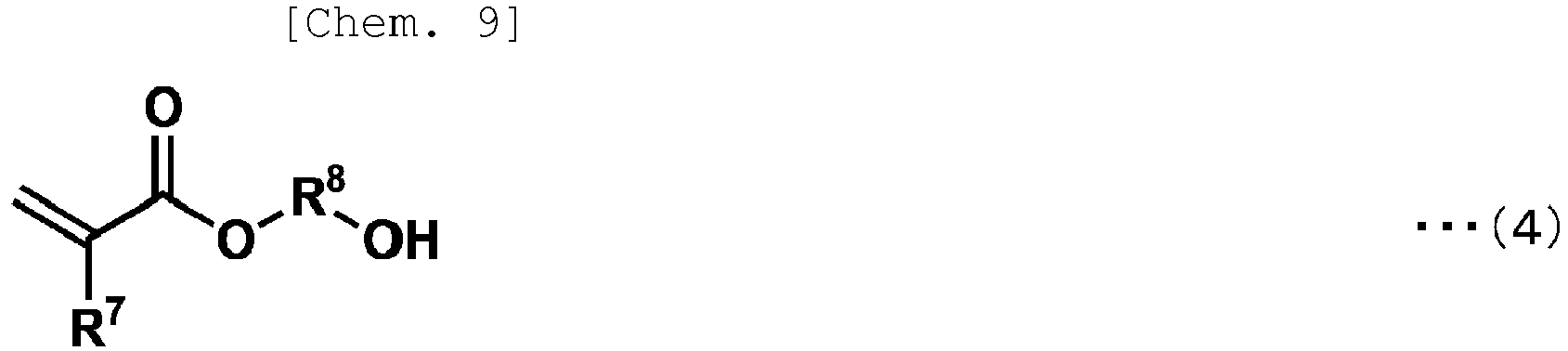
- In the general formula (4), R7 represents a hydrogen atom or a methyl group and R8 represents a C2 to C4 straight chain or branched alkylene group or - C2H4(OCO(CH2)5)n- (n=1 to 5).
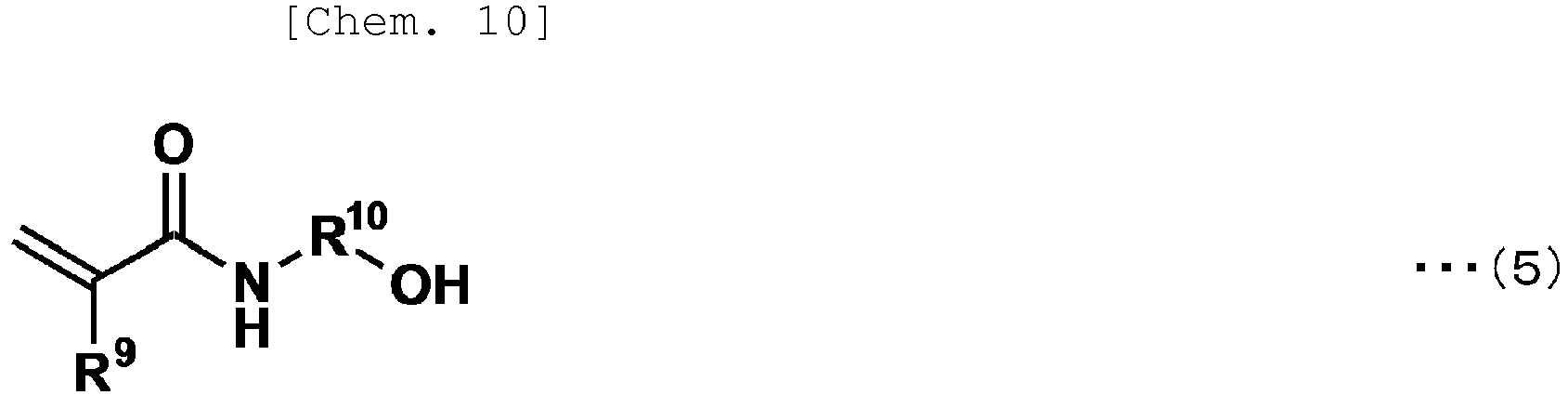
- In the general formula (5), R9 represents a hydrogen atom or a methyl group and R10 represents a C1 to C4 straight chain or branched alkylene group.
- In the case where the monomer (A-1) is a dialkyl (meth)acrylamide, an antifogging film obtained from the antifogging agent composition has particularly excellent adhesiveness to a substrate.
- The content of the monomer (A-1) is favorably within the range from 35 to 90 parts by weight per a total content of 100 parts by weight of the monomer (A-1), the monomer (A-2), and the monomer (A-3). When the content of the monomer (A-1) is less than 35 parts by weight, sustainability of antifogging performance in the antifogging film is reduced. On the other hand, when the content of the monomer (A-1) exceeds 90 parts by weight, a stain of a water drip becomes conspicuous in the antifogging film.
- In the case where the monomer (A-2) is a C1 to C16 (meth)acrylate, an antifogging film obtained from the antifogging agent composition has particularly excellent antifogging performance after heat resistance and moisture resistance tests. In the case where the carbon number is larger than 16, antifogging performance of the antifogging film obtained from the antifogging agent composition after heat resistance and moisture resistance tests is reduced.
- The content of the monomer (A-2) is favorably within the range from 5 to 60 parts by weight per a total content of 100 parts by weight of the monomer (A-1), the monomer (A-2), and the monomer (A-3). When the content of the monomer (A-2) is less than 5 parts by weight, a stain of a water drip becomes conspicuous in the antifogging film. On the other hand, when the content of the monomer (A-2) exceeds 60 parts by weight, sustainability of antifogging performance in the antifogging film is reduced.
- In the case where the monomer (A-3) is a hydroxyalkyl (meth)acrylate or hydroxyalkyl (meth)acrylamide, an antifogging film obtained from the antifogging agent composition has particularly excellent sustainability of antifogging performance.
- The content of the monomer (A-3) is favorably within the range from 5 to 30 parts by weight per a total content of 100 parts by weight of the monomer (A-1), the monomer (A-2), and the monomer (A-3). When the content of the monomer (A-3) is less than 5 parts by weight, water resistance of the antifogging film is reduced and a stain of a water drip becomes conspicuous in the antifogging film. On the other hand, when the content of the monomer (A-3) exceeds 30 parts by weight, adhesiveness of the antifogging film to a substrate is reduced.
- In the case where the polyfunctional blocked isocyanate compound (B) is a diethyl malonate blocked isocyanate, the antifogging agent composition is favorably cured at low temperature (approximately 120°C) with no catalyst.
- When the isocyanate group content of the polyfunctional blocked isocyanate compound (B) is represented by "NCO" and the hydroxyl group content of the copolymer (A) is represented by "OH," an NCO/OH ratio obtained by dividing the isocyanate group content NCO by the hydroxyl group content OH of the copolymer (A) is favorably within the range from 0.1 to 1.5.
- When the NCO/OH ratio is less than 0.1, water resistance of the antifogging film is reduced and a stain of a water drip becomes conspicuous in the antifogging film. On the other hand, when the NCO/OH ratio exceeds 1.5, sustainability of antifogging performance in the antifogging film is reduced.
- An antifogging article according to this embodiment can be produced by applying an antifogging agent composition to a surface of an article that is a substrate to which antifogging performance is given, and heating and curing the antifogging agent composition on the surface of the article. The article to which this embodiment can be applied is not particularly limited.
- However, because excellent sustainability of antifogging performance can be achieved in the antifogging article according to this embodiment, this embodiment can be favorably applied to an article used in an environment where condensation is easy to occur. Examples of such an article include a headlight of an automobile.
- A reaction container including a thermometer, a stirring device, a nitrogen introduction tube, and a cooling tube was used to heat 213 parts by weight of t-amyl alcohol that was an organic solvent to 80°C while a nitrogen gas was exhaled. The following solution (a) and solution (b) were dropped into this reaction container for two hours.
- Solution (a): solution obtained by mixing 50 parts by weight of N,N-dimethyl acrylamide (monomer (A-1)), 35 parts by weight of butyl acrylate (monomer (A-2)), and 15 parts by weight of 2-hydroxy acrylate (monomer (A-3))
- Solution (b): solution obtained by dissolving t-hexyl peroxypivalate (radical polymerization initiator) [trade name: Perhexyl PV (effective component 70% by weight) manufactured by NOF CORPORATION] having the content corresponding to 0.5 parts by weight in 20 parts by weight of t-amyl alcohol.
- The solution of the copolymer (A) was obtained by stirring for one hour the solution in the reaction container into which the solution (a) and the solution (b) had been dropped. The polymerization conversion rate of the charged monomer of the copolymer (A) measured by gas chromatography was 100%. Further, the weight average molecular weight of the copolymer (A) measured by gel permeation chromatography was 93,000.
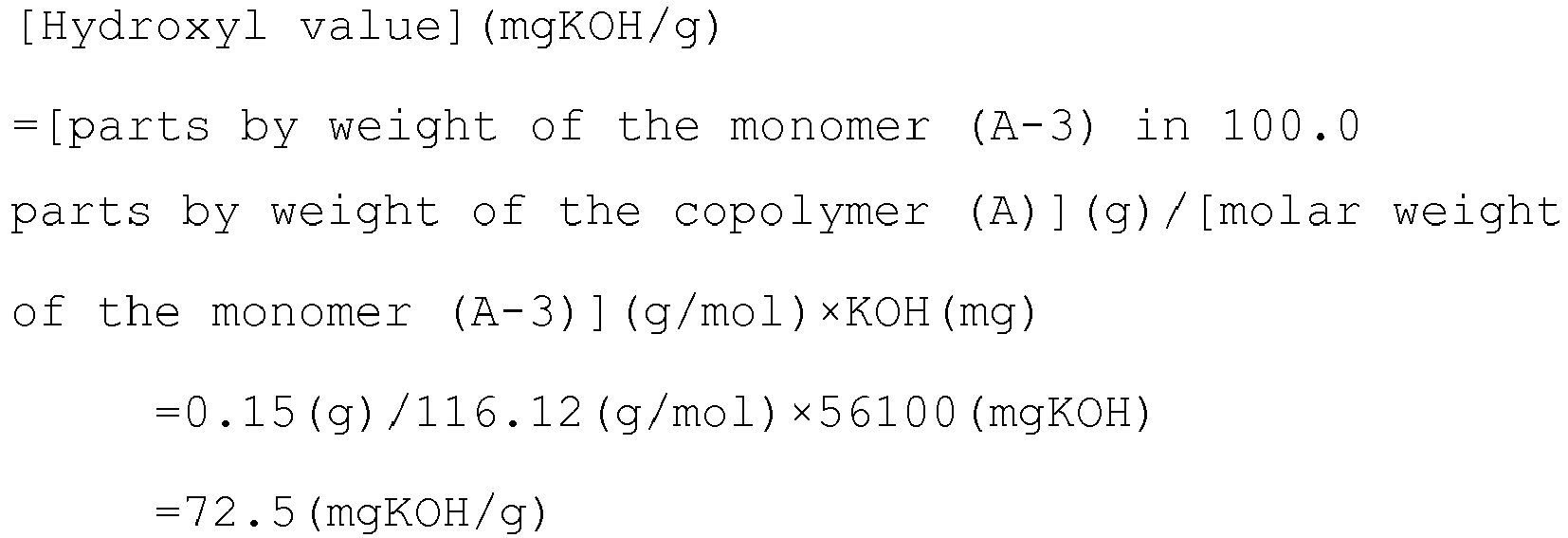
- Further, the hydroxyl value of the copolymer (A) was calculated as the following formula.
- Hundred parts by weight of propylene glycol monomethylether, 200 parts by weight of diacetone alcohol, 100 parts by weight of methyl isobutyl ketone, and 267 parts by weight of n-butanol were added to 333 parts by weight of a polymerization solution containing 30.0% of the solid copolymer (A) corresponding to 100 parts by weight to adjust the solid content to 10.0% by weight.
- As the polyfunctional blocked isocyanate compound (B), 83.5 parts by weight of a malonate blocked isocyanate of a hexamethylene diisocyanate [trade name: Duranate MF-K60B (NCO concentration of 6.5% by weight) manufactured by Asahi Kasei Chemicals Corporation] in which the NCO/OH ratio corresponded to 1.0 was used.
- As the anionic surfactant (C-1), sodium di (2-ethylhexyl) sulfosuccinate [trade name: Rapisol A-80 (effective component 80.0% by weight) manufactured by NOF CORPORATION] having the content corresponding to 5.0 parts by weight was used.
- As the cationic surfactant (C-2), didecyl dimethyl ammonium chloride [trade name: Nissan cation 2DB500E (effective component 50.0 % by weight) manufactured by NOF CORPORATION] having the content corresponding to 0.01 parts by weight was used.
- As the leveling agent, 0.01 parts by weight of polyether-modified polydimethylsiloxane [trade name: BYK333 manufactured by BYK Japan KK] was used.
- By mixing the above-mentioned copolymer (A), polyfunctional blocked isocyanate compound (B), anionic surfactant (C-1), cationic surfactant (C-2), and leveling agent, an antifogging agent composition was obtained.
- Hundred parts by weight of propylene glycol monomethylether, 200 parts by weight of diacetone alcohol, 100 parts by weight of methyl isobutyl ketone, and 267 parts by weight of n-butanol were added to 333 parts by weight of a polymerization solution containing 30.0% of the solid copolymer (A) corresponding to 100 parts by weight to adjust the solid content to 10.0% by weight.
- As the polyfunctional blocked isocyanate compound (B), 51.7 parts by weight of a dimethylpyrazole blocked isocyanate of a hexamethylene diisocyanate [trade name: Desmodur 3575/1 (NCO concentration of 10.5% by weight) manufactured by Sumika Bayer Urethane Co., Ltd.] in which the NCO/OH ratio corresponded to 1.0 was used.
- As the anionic surfactant (C-1), sodium di (2-ethylhexyl) sulfosuccinate [trade name: Rapisol A-80 (effective component 80.0% by weight) manufactured by NOF CORPORATION] having the content corresponding to 5.0 parts by weight was used.
- As the cationic surfactant (C-2), 1-methyl-1-hydroxyethyl-2-tallow alkyl imidazolinium chloride [trade name: Nissan cation AR-4 (effective component 35.0 % by weight) manufactured by NOF CORPORATION] having the content corresponding to 3.0 parts by weight was used.
- As the catalyst, 1.0 parts by weight of dibutyl tin dilaurate was used.
- As the leveling agent, 0.01 parts by weight of polyether-modified polydimethylsiloxane [trade name: BYK333 manufactured by BYK Japan KK] was used.
- By mixing the above-mentioned copolymer (A), polyfunctional blocked isocyanate compound (B), anionic surfactant (C-1), cationic surfactant (C-2), catalyst, and leveling agent, an antifogging agent composition was obtained.
- As a substrate on which an antifogging film was formed, a polycarbonate resin plate was used. An antifogging agent composition was applied to the polycarbonate resin plate with a spray coating method so that the film thickness of the cured antifogging film was 5 µm. Then, the antifogging agent composition was heated and cured by holding the polycarbonate resin plate to which the antifogging agent composition was applied at 130°C for 30 minutes. Accordingly, an antifogging film specimen having an antifogging film was obtained.
- After the antifogging film of the antifogging film specimen was applied with steam by a water bath by placing the antifogging film specimen at a 2-cm-high position from the surface of the water bath maintained at 80°C so that the antifogging film looked down for the surface of the water bath, the antifogging film specimen was dried for one hour at room temperature while the antifogging film specimen was vertically erected. This is repeated 50 times before existence or non-existence of fogging in 10 seconds of the steam application was visually evaluated using the following four grades.
- A: A water film is formed right after the steam application and no fogging occurs.
- B: Although fogging is recognized for a moment right after the steam application, a water film is soon formed and the fogging is eliminated.
- C: Although fogging is recognized right after the steam application, a water film is formed before long and the fogging is eliminated.
- D: A clear water film is not formed after the steam application, or a water film is not formed and fogging is recognized.
- Note that in the evaluation of the antifogging film formed in the antifogging film specimen, "C" or upper grades have no practical problem, "B" is favorable, and "A" is more favorable.
- The antifogging film of the antifogging film specimen was applied with steam by a water bath by placing the antifogging film specimen at a 2-cm-high position from the surface of the water bath maintained at 80°C so that the antifogging film looked down for the surface of the water bath, and existence or non-existence of fogging in 10 seconds of the steam application was visually evaluated using the following four grades.
- A: A water film is formed right after the steam application and no fogging occurs.
- B: Although fogging is recognized for a moment right after the steam application, a water film is soon formed and the fogging is eliminated.
- C: Although fogging is recognized right after the steam application, a water film is formed before long and the fogging is eliminated.
- D: Fogging is recognized right after the steam application and a water film is not formed.
- Note that in the evaluation of the antifogging film formed in the antifogging film specimen, "C" or upper grades have no practical problem, "B" is favorable, and "A" is more favorable.
- The antifogging film specimen was placed under the conditions of 50°C and 95% RH for 240 hours, and then at room temperature for one hour. After that, the antifogging film of the antifogging film specimen was applied with steam by a water bath by placing the antifogging film specimen at a 2-cm-high position from the surface of the water bath maintained at 80°C so that the antifogging film looked down for the surface of the water bath, and existence or non-existence of fogging in 10 seconds of the steam application was visually evaluated using the following four grades.
- A: A water film is formed right after the steam application and no fogging occurs.
- B: Although fogging is recognized for a moment right after the steam application, a water film is soon formed and the fogging is eliminated.
- C: Although fogging is recognized right after the steam application, a water film is formed before long and the fogging is eliminated.
- D: A clear water film is not formed after the steam application, or a water film is not formed and fogging is recognized.
- Note that in the evaluation of the antifogging film formed in the antifogging film specimen, "C" or upper grades have no practical problem, "B" is favorable, and "A" is more favorable.
- The antifogging film specimen was placed under the conditions of 120°C for 240 hours, and then at room temperature for one hour. After that, the antifogging film of the antifogging film specimen was applied with steam by a water bath by placing the antifogging film specimen at a 2-cm-high position from the surface of the water bath maintained at 80°C so that the antifogging film looked down for the surface of the water bath, and existence or non-existence of fogging in 10 seconds of the steam application was visually evaluated using the following four grades.
- A: A water film is formed right after the steam application and no fogging occurs.
- B: Although fogging is recognized for a moment right after the steam application, a water film is soon formed and the fogging is eliminated.
- C: Although fogging is recognized right after the steam application, a water film is formed before long and the fogging is eliminated.
- D: A clear water film is not formed after the steam application, or a water film is not formed and fogging is recognized.
- Note that in the evaluation of the antifogging film formed in the antifogging film specimen, "C" or upper grades have no practical problem, "B" is favorable, and "A" is more favorable.
- After the antifogging film of the antifogging film specimen was applied with steam by a water bath by placing the antifogging film specimen at a 2-cm-high position from the surface of the water bath maintained at 80°C so that the antifogging film looked down for the surface of the water bath, the antifogging film specimen was dried for one hour at room temperature while the antifogging film specimen was vertically erected. Existence or non-existence of a stain of a water drip on the dried antifogging film specimen was visually evaluated using the following four grades.
- A: A stain of a water drip is not conspicuous.
- B: A stain of a water drip is not substantially conspicuous.
- C: A stain of a water drip is a bit conspicuous.
- D: A stain of a water drip is conspicuous.
- Note that in the evaluation of the antifogging film formed in the antifogging film specimen, "C" or upper grades have no practical problem, "B" is favorable, and "A" is more favorable.
- According to JIS K 5600-5-6, existence or non-existence of peeling of the antifogging film in the antifogging film specimen was visually evaluated using the following three grades.
- A: No peeling is recognized
- B: Peeling is partly recognized
- D: It is completely peeled
- Note that in the evaluation of the antifogging film formed in the antifogging film specimen, "B" or upper grades have no practical problem and "A" is more favorable.
- The antifogging film specimen was placed in hot water of 40°C for 240 hours and then at room temperature for one hour. After that, the appearance of the antifogging film of the antifogging film specimen was visually evaluated using the following four grades.
- A: No change occurs in the appearance as compared with before the test.
- B: The surface of the coating film is slightly rough.
- C: The surface of the coating film is slightly rough or a slight whitening or stain is recognized.
- D: A part or whole of the coating film is resolved or an obvious whitening or stain is recognized.
- Note that in the evaluation of the antifogging film formed in the antifogging film specimen, "C" or upper grades have no practical problem, "B" is favorable, and "A" is more favorable.
- In examples 1-1 to 1-9, the kind and content of each of the anionic surfactant (C-1) and the cationic surfactant (C-2) were mainly examined. Antifogging film specimens according to the examples 1-1 to 1-9 were prepared with the same method as that described above. Table 1 shows the composition (parts by weight) of antifogging agent compositions according to the examples 1-1 to 1-9 and evaluation results of performance of antifogging film specimens in which an antifogging film is formed by the antifogging agent composition.
[Table 1] Example 1-1 1-2 1-3 1-4 1-5 1-6 1-7 1-8 1-9 Antifogging agent composition Copolymer (A) [parts by weight] Monomer (A-1) DMAA 50 50 50 50 50 50 50 50 50 Monomer (A-2) BA (C4) 35 35 35 35 35 35 35 35 35 Monomer (A-3) HEA 15 15 15 15 15 15 15 15 15 Total monomer 100 100 100 100 100 100 100 100 100 Hydroxyl value [mgKOH/g] 72.5 72.5 72.5 72.5 72.5 72.5 72.5 72.5 72.5 Polyfunctional blocked isocyanate compound (B) [parts by weight] Diethyl malonate blocked isocyanate Duranate MF-K60B 83.5 83.5 83.5 83.5 83.5 83.5 Dimethylpyrazole blocked isocyanate Desmodur BL3575/1 51.7 51.7 51.7 NCO/OH ratio 1.0 1.0 1.0 1.0 1.0 1.0 1.0 1.0 1.0 Surfactant (C) [parts by weight] Anion-based (C-1) Rapisol A80 5.0 5.0 1.0 1.0 10.0 10.0 Persoft SK 5.0 1.0 10.0 Cation-based (C-2) Nissan cation 2DB500E 0.01 Nissan cation BB 0.50 0.01 0.50 0.01 Nissan cation AR-4 3.00 Ftergent 300 3.00 0.50 3.00 Catalyst [parts by weight] Dibutyl tin dilauratc 1.0 1.0 1.0 Performance Antifogging performance Sustainability test C B B C C B B B B Steam test A A A B A A A A A Steem test efter moisture resistance test B A A B A A A A A Steam test after heat resistance test B A A C B B A A A Stain of water drip A A B A A B B B C Adhesiveness A A A A A A A A A Water resistance A A A A A A A A A - As shown in Table 1, in each of the examples 1-1 to 1-9, favorable performance of the antifogging film was confirmed. Particularly favorably performance was achieved in the antifogging film according to the example 1-2.
- From the results of the examples 1-1, 1-4, and 1-5, it was seen that sustainability of antifogging performance of the antifogging film tended to be slightly reduced in the case where the amount of at least one of the anionic surfactant (C-1) and the cationic surfactant (C-2) was small.
- From the result of the example 1-4, it was seen that antifogging performance of the antifogging film tended to be slightly reduced in the case where the amounts of the anionic surfactant (C-1) and the cationic surfactant (C-2) were small.
- From the results of the examples 1-1 and 1-4, it was seen that antifogging performance of the antifogging film after the moisture resistance test tended to be slightly reduced in the case where the amount of the cationic surfactant (C-2) was small.
- From the results of the examples 1-1, 1-4, 1-5, and 1-6, it was seen that antifogging performance of the antifogging film after the heat resistance test tended to be slightly reduced in the case where the amount of at least one of the anionic surfactant (C-1) and the cationic surfactant (C-2) was small.
- From the results of the examples 1-3, 1-6, 1-7, 1-8, and 1-9, it was seen that a stain of a water drip on the antifogging film tended to be conspicuous in the case where the amount of at least one of the anionic surfactant (C-1) and the cationic surfactant (C-2) was large.
- In examples 1-10 to 1-21, the kind of each of the monomer (A-1), the monomer (A-2), and the monomer (A-3) was mainly examined. Antifogging film specimens according to the examples 1-10 to 1-21 were prepared with the same method as that described above. Table 2 shows the composition (parts by weight) of antifogging agent compositions according to the examples 1-10 to 1-21 and evaluation results of performance of antifogging film specimens in which an antifogging film is formed by the antifogging agent composition.
[Table 2] Example 1-10 1-11 1-12 1-13 1-14 1-15 1-16 1-17 1-18 1-19 1-20 1-21 Monomer (A-1) DMAA 50 50 50 50 50 45 45 DEMA 50 IPAA 50 DAAA 50 DMAPAA 50 ACMO 50 Monomer (A-2) MMA (C1) 35 BA (C4) 35 35 35 35 35 33 35 30 25 Copolymer (A) [parts by weight] CHA (C6) 35 CA (C16) 35 Monomer (A-3) HEA 15 15 15 15 15 15 15 15 HEMA 17 HEAA 15 Placcel FA2D 25 Antifogging agent composition Placcel FA5 30 Total monomer 100 100 100 100 100 100 100 100 100 100 100 100 Hydroxyl value [mgKOH/g] 72.5 72.5 72.5 72.5 72.5 72.5 72.5 72.5 73.3 73.1 40.8 24.4 Polyfunctional blocked isocyanate compound (B) [parts by weight] Diethyl malonate blocked isocyanate Duranate MF-K60B 83.5 83.5 83.5 84.2 47.0 28.1 Dimethylpyrazole blocked isocyanate Desmodur BL3575/1 51.7 51.7 51.7 51.7 Methyl ethyl ketoxime blocked isocyanate Sumidur BL 3175 48.9 49.3 NCO/OH ratio 1.0 1.0 1.0 1.0 1.0 1.0 1.0 1.0 1.0 1.0 1.0 1.0 Surfactant (C) [parts by weight] Anion-based (C-1) Rapisol A80 5.0 5.0 5.0 Persoft SK 5.0 5.0 5.0 5.0 5.0 5.0 5.0 5.0 5.0 Cation-based (C-2) Nissan cation 2DB500E 0.50 0.50 0.50 0.50 Nissan cation BB 0.50 0.50 0.50 0.50 0.50 Nissan cation AR-4 0.50 Ftergent 300 0.50 0.50 Catalyst [parts by weight] Dibutyl tin dilaurate 1.0 1.0 1.0 1.0 1.0 1.0 Performance Antifogging performance Sustainability test B B B B B B B B B B C C Steam test A A A A A A A A A A A A Steam test after moisture resistance test A A A A A A A B A A A A Steam test after heat resistance test A A A A A A A B A A A A Stain of water drip A A A A A B A A A A A A Adhesiveness A B B B B A A A A A A B Water resistance A A A A A A A A A A A A - As shown in Table 2, in each of the examples 1-10 to 1-21, favorable performance of the antifogging film was confirmed.
- From the results of the examples 1-10, 1-16, 1-18, and 1-19, it was seen that particularly favorable performance was achieved in the case where the monomer (A-1) was a dialkyl acrylamide, where the monomer (A-2) was a C6 acrylic acid ester, or where the monomer (A-3) was a hydroxy ethyl methacrylate or hydroxy ethyl acrylamide.
- From the results of the examples 1-20 and 1-21, it was seen that sustainability of antifogging performance of the antifogging film tended to be slightly reduced in the case where the monomer (A-3) was a long-chain hydroxy acrylate or further longer-chain hydroxy acrylate.
- From the result of the example 1-17, it was seen that antifogging performance of the antifogging film after moisture resistance and heat resistance tests tended to be slightly reduced in the case where the monomer (A-2) was a C16 acrylic acid ester.
- From the result of the example 1-15, it was seen that a stain of a water drip of the antifogging film tended to be conspicuous in the case where the monomer (A-2) was a C1 acrylic acid ester.
- From the results of the examples 1-11, 1-12, 1-13, 1-14, and 1-21, it was seen that the adhesiveness of the antifogging film in the antifogging film specimen tended to be slightly reduced in the case where the monomer (A-1) was a monoalkyl acrylamide, diacetone acrylamide, dimethylaminopropyl acrylamide, or acryloyl morpholine or where the monomer (A-3) was a long-chain hydroxy acrylate.
- In examples 1-22 to 1-26, the amount of each of the monomer (A-1), the monomer (A-2), the monomer (A-3), and the polyfunctional blocked isocyanate compound (B) was mainly examined. Antifogging film specimens according to the examples 1-22 to 1-26 were prepared with the same method as that described above. Table 3 shows the composition (parts by weight) of antifogging agent compositions according to the examples 1-22 to 1-26 and evaluation results of performance of antifogging film specimens in which an antifogging film is formed by the antifogging agent composition.
[Table 3] Example 1-22 1-23 1-24 1-25 1-26 Copolymer (A) [parts by weight] Monomer (A-1) DMAA 90 35 50 50 50 Monomer (A-2) BA (C4) 5 60 20 35 35 Monomer (A-3) HEA 5 5 30 15 15 Total monomer 100 100 100 100 100 Hydroxyl value [mgKOH/g] 24.2 24.2 144.9 72.5 72.5 Polyfunctional blocked isocyanate compound (B) [parts by weight] Diethyl malonate blocked isocyanate Duranate MF-K60B 27.8 83.5 8.4 125.3 Dimethylpyrazole blocked isocyanate Desmodur BL3575/1 17.3 NCO/OH ratio 1.0 1.0 0.5 0.1 1.5 Antifogging agent composition Surfactant (C) [parts by weight] Anion-based (C-1) Rapisol A80 5.0 Persoft SK 5.0 5.0 5.0 5.0 Cation-based (C-2) Nissan cation 2DB500E 0.5 Nissan cation BB 0.50 0.50 0.50 Nissan cation AR-4 0.5 Ftergent 300 Catalyst [parts by weight] Dibutyl tin dilaurate 1.0 Performance Antifogging performance Sustainability test B C B B C Steam test A A A A A Steam test after moisture resistance test A A A A A Steam test after heat resistance test A A A A A Stain of water drip C B A C A Adhesiveness A A B A A Water resistance C B A C A - As shown in Table 3, in each of the examples 1-22 to 1-26, favorable performance of the antifogging film was confirmed.
- From the results of the examples 1-23 and 1-26, it was seen that sustainability of antifogging performance of the antifogging film tended to be slightly reduced in the case where the amount of the monomer (A-2) was large and the amounts of the monomer (A-1) and the monomer (A-3) were small, or where the amount of the polyfunctional blocked isocyante
- From the results of the examples 1-22, 1-23, and 1-25, it was seen that a stain of a water drip on the antifogging film tended to be conspicuous in the case where the amount of the monomer (A-1) was large and the amounts of the monomer (A-2) and the monomer (A-3) were small, where the amount of the monomer (A-2) was large and the amounts of the monomer (A-1) and the monomer (A-3) were small, or where the amount of the polyfunctional blocked isocyanate compound (B) was small.
- From the result of the example 1-24, it was seen that the adhesiveness of the antifogging film in the antifogging film specimen tended to be slightly reduced in the case where the amount of the monomer (A-3) was large.
- From the results of the examples 1-22, 1-23, and 1-25, it was seen that water resistance of the antifogging film tended to be slightly reduced in the case where the amount of the monomer (A-1) was large and the amounts of the monomer (A-2) and the monomer (A-3) were small, where the amount of the monomer (A-2) was large and the amounts of the monomer (A-1) and the monomer (A-3) were small, or where the amount of the polyfunctional blocked isocyanate compound (B) was small.
- In examples 2-1 to 2-9, the kind and amount of each of the anionic surfactant (C-1) and the cationic surfactant (C-2) in the case where a fluorochemical surfactant was used as the anionic surfactant (C-1) were mainly examined. Antifogging film specimens according to the examples 2-1 to 2-9 were prepared with the same method as that described above. Table 4 shows the composition (parts by weight) of antifogging agent compositions according to the examples 2-1 to 2-9 and evaluation results of performance of antifogging film specimens in which an antifogging film is formed by the antifogging agent composition.
[Table 4] Example 2-1 2-2 2-3 2-4 2-5 2-6 2-7 2-8 2-9 Copolymer (A) [parts by weight] Monomer (A-1) DMAA 50 50 50 50 50 50 50 50 50 Monomer (A-2) BA (C4) 35 35 35 35 35 35 35 35 35 Monomer (A-3) HEA 15 15 15 15 15 15 15 15 15 Total monomer 100 100 100 100 100 100 100 100 100 Hydroxyl value [mgKOH/g] 72.5 72.5 72.5 72.5 72.5 72.5 72.5 72.5 72.5 Polyfunctional blocked isocyanate compound (B) [parts by weight] Diethyl malonate blocked isocyanate Duranate MF-K60B 83.5 83.5 83.5 83.5 83.5 83.5 Dimethylpyrazole blocked isocyanate Desmodur BL3575/1 51.7 51.7 51.7 NCO/OH ratio 1.0 1.0 1.0 1.0 1.0 1.0 1.0 1.0 1.0 Antifogging agent composition Surfactant (C) [parts by weight] Anion-based (C-1) Fluorine -based Ftergent 100 5.0 5.0 1.0 1.0 10.0 10.0 Surflon S211 5.0 1.0 10.0 Cation-based (C-2) Nissan cation 2DB500E 0.01 Nissan cation BB 0.50 0.01 0.50 0.01 Nissan cation AR-4 3.00 Ftergent 300 3.00 0.50 3.00 Catalyst [parts by weight] Dibutyl tin dilaurate 1.0 1.0 1.0 Performance Antifogging performance Sustainability test B A A B B A A A A Steam test A A A B A A A A A Steam test after moisture resistance test B A A B A A A A A Steam test after heat resistance test B A A C B B A A A Stain of water drip A A B A A B B B C Adhesiveness A A A A A A A A A Water resistance A A A A A A A A A - As shown in Table 4, in each of the examples 2-1 to 2-9, favorable performance of the antifogging film was confirmed. Particularly favorably performance was achieved in the antifogging film according to the example 2-2.
- From the results of the examples 2-1, 2-4, and 2-5, it was seen that sustainability of antifogging performance of the antifogging film tended to be slightly reduced in the case where the amount of at least one of the anionic surfactant (C-1) and the cationic surfactant (C-2) was small.
- From the result of the example 2-4, it was seen that antifogging performance of the antifogging film tended to be slightly reduced in the case where the amounts of the anionic surfactant (C-1) and the cationic surfactant (C-2) were small.
- From the results of the examples 2-1 and 2-4, it was seen that antifogging performance of the antifogging film after the moisture resistance test tended to be slightly reduced in the case where the amount of the cationic surfactant (C-2) was small.
- From the results of the examples 2-1, 2-4, 2-5, and 2-6, it was seen that antifogging performance of the antifogging film after the heat resistance test tended to be slightly reduced in the case where the amount of at least one of the anionic surfactant (C-1) and the cationic surfactant (C-2) was small.
- From the results of the examples of 2-3, 2-6, 2-7, 2-8, and 2-9, it was seen that a stain of a water drip on the antifogging film tended to be conspicuous in the case where the amount of at least one of the anionic surfactant (C-1) and the cationic surfactant (C-2) was large.
- In examples 2-10 to 2-21, the kind of each of the monomer (A-1), the monomer (A-2), and the monomer (A-3) in the case where a fluorochemical surfactant was used as the anionic surfactant (C-1) was mainly examined. Antifogging film specimens according to the examples 2-10 to 2-21 were prepared with the same method as that described above. Table 5 shows the composition (parts by weight) of antifogging agent compositions according to the examples 2-10 to 2-21 and evaluation results of performance of antifogging film specimens in which an antifogging film is formed by the antifogging agent composition.
[Table 5] Example 2-10 2-11 2-12 2-13 2-14 2-15 2-16 2-17 2-18 2-19 2-20 2-21 Monomer (A-1) DMAA 50 50 50 50 50 45 45 DEMA 50 IPAA 50 DAAA 50 DMAPAA 50 ACMO 50 Monomer (A-2) MMA (C1) 35 BA (C1) 35 35 35 35 35 33 35 30 25 Copolymer (A) [parts by weight] CHA (C6) 35 CA (C16) 35 Monomer (A-3) IIEA 15 15 15 15 15 15 15 15 HEMA 17 HEAA 15 Placcel FA2D 25 Placcel FA5 30 Total monomer 100 100 100 100 100 100 100 100 100 100 100 100 Hydroxyl value [mgKOH/g] 72.5 72.5 72.5 72.5 72.5 72.5 72.5 72.5 73.3 73.1 40.8 24.4 Antifogging agent composition Polyfunctional blocked isocyanate compound (B) [parts by weight] Diethyl malonate blocked isocyanate Duranate MF-K60B 83.5 83.5 83.5 84.2 47.0 28.1 Dimethylpyrazole blocked isocyanate Desmodur BL3575/1 51.7 51.7 51.7 51.7 Methyl ethyl ketoxime blocked isocyanate Sumidur BL 3175 48.9 49.3 NCO/OH ratio 1.0 1.0 1.0 1.0 1.0 1.0 1.0 1.0 1.0 1.0 1.0 1.0 Surfactant (C) [parts by weight] Anion-based (C-1) Fluorine -based Ftergent 100 5.0 5.0 5.0 Surflon S211 5.0 5.0 5.0 5.0 5.0 5.0 5.0 5.0 5.0 Cation-based (C-2) Nissan cation 2DB500E 0.50 0.50 0.50 0.50 Nissan cation BB 0.50 0.50 0.50 0.50 0.50 Nissan cation AR-4 0.50 Ftergent 300 0.50 0.50 Catalyst [parts by weight] Dibutyl tin dilaurate 1.0 1.0 1.0 1.0 1.0 1.0 Performance Antifogging performance Sustainability test A A A A A A A A A A B B Steam test A A A A A A A A A A A A Steam test after moisture resistance test A A A A A A A B A A A A Steam test after heat resistance test A A A A A A A B A A A A Stain of water drip A A A A A B A A A A A A Adhesiveness A B B B B A A A A A A B Water resistance A A A A A A A A A A A A - As shown in Table 5, in each of the examples 2-10 to 2-21, favorable performance of the antifogging film was confirmed.
- From the results of the examples 2-10, 2-16, 2-18, and 2-19, particularly favorable performance of the antifogging film was achieved in the case where the monomer (A-1) was a dialkyl acrylamide, where the monomer (A-2) was a C6 acrylic acid ester, or where the monomer (A-3) was a hydroxy ethyl methacrylate or hydroxy ethyl acrylamide.
- From the results of the examples 2-20 and 2-21, it was seen that sustainability of antifogging performance of the antifogging film tended to be slightly reduced in the case where the monomer (A-3) was a long-chain hydroxy acrylate or further longer-chain hydroxy acrylate.
- From the result of the example 2-17, it was seen that antifogging performance of the antifogging film after the moisture resistance and heat resistance tests tended to be slightly reduced in the case where the monomer (A-2) was a C16 acrylic acid ester.
- From the result of the example 2-15, it was seen that a stain of a water drip on the antifogging film tended to be conspicuous in the case where the monomer (A-2) was a C1 acrylic acid ester.
- From the results of the examples of 2-11, 2-12, 2-13, 2-14, and 2-21, it was seen that the adhesiveness of the antifogging film in the antifogging film specimen tended to be slightly reduced in the case where the monomer (A-1) was a monoalkyl acrylamide, diacetone acrylamide, dimethylaminopropyl acrylamide, or acryloyl morpholine, or where the monomer (A-3) was a further longer-chain hydroxy acrylate.
- In examples 2-22 to 2-26, the amount of each of the monomer (A-1), the monomer (A-2), the monomer (A-3), and the polyfunctional blocked isocyanate compound (B) in the case where a fluorochemical surfactant was used as the anionic surfactant (C-1) was mainly examined. Antifogging film specimens according to the examples 2-22 to 2-26 were prepared with the same method as that described above. Table 6 shows the composition (parts by weight) of antifogging agent compositions according to the examples 2-22 to 2-26 and evaluation results of performance of antifogging film specimens in which an antifogging film is formed by the antifogging agent composition.
[Table 6] Example 2-22 2-23 2-24 2-25 2-26 Copolymer (A) [parts by weight] Monomer (A-1) DMAA 90 35 50 50 50 Monomer (A-2) BA (C4) 5 60 20 35 35 Monomer (A-3) HEA 5 5 30 15 15 Total monomer 100 100 100 100 100 Hydroxyl value [mgKOH/g] 24.2 24.2 144.9 72.5 72.5 Polyfunctional blocked isocyanate compound (B) [parts by weight] Diethyl malonate blocked isocyanate Duranate MF-K60B 27.8 83.5 8.4 125.3 Dimethylpyrazole blocked isocyanate Desmodur BL3575/1 17.3 NCO/OH ratio 1.0 1.0 0.5 0.1 1.5 Antifogging agent composition Surfactant (C) [parts by weight] Anion-based (C-1) Fluorine -based Ftergent 100 5.0 5.0 5.0 Surflon S211 5.0 5.0 Cation-based (C-2) Nissan cation 2DB500E 0.5 Nissan cation BB 0.50 0.50 0.50 Nissan cation AR-4 0.5 Ftergent 300 Catalyst [parts by weight] Dibutyl tin dilaurate 1.0 Performance Antifogging performance Sustainability test A B A A B Steam test A A A A A Steam test after moisture resistance test A A A A A Steam test after heat resistance test A A A A A Stain of water drip C B A C A Adhesiveness A A B A A Water resistance C B A C A - As shown in Table 6, in each of the examples 2-22 to 2-26, favorable performance of the antifogging film was confirmed.
- From the results of the examples of 2-23 and 2-26, it was seen that sustainability of antifogging performance of the antifogging film tended to be slightly reduced in the case where the amount of the monomer (A-2) was large and the amounts of tha monomer (A-1) and tha monomer (A-3) were small, or where the amount of the polyfunctional blocked isocyanate compound (B) was large.
- From the results of the examples 2-22, 2-23, and 2-25, it was seen that a stain of a water drip on the antifogging film tended to be conspicuous in the case where the amount of the monomer (A-1) was large and the amounts of the monomer (A-2) and the monomer (A-3) were small, where the amount of the monomer (A-2) was large and the amounts of the monomer (A-1) and the monomer (A-3) were small, or where the amount of the polyfunctional blocked isocyanate compound (B) was small.
- From the result of the example 2-24, it was seen that the adhesiveness of the antifogging film in the antifogging film specimen tended to be slightly reduced in the case where the amount of the monomer (A-3) was large.
- From the results of the examples 2-22, 2-23, and 2-25, it was seen that water resistance of the antifogging film tended to be slightly reduced in the case where the amount of the monomer (A-1) was large and the amounts of the monomer (A-2) and the monomer (A-3) were small, where the amount of the monomer (A-2) was large and the amounts of the monomer (A-1) and the monomer (A-3) were small, or where the amount of the polyfunctional blocked isocyanate compound (B) was small.
- Table 7 shows the composition (parts by weight) of antifogging agent compositions according to comparative examples 1 to 6 and evaluation results of performance of antifogging film specimens in which an antifogging film is formed by the antifogging agent composition. Antifogging film specimens according to the comparative examples 1 to 6 were prepared with the same method as that described above.
[Table 7] Comparative example 1 2 3 4 5 6 Antifogging agent composition Copolymer (A) [parts by weight] Monomer (A-1) DMAA 50 50 50 50 50 50 Monomer (A-2) BA(C4) 35 35 35 35 35 35 Monomer (A-3) HEA 15 15 15 15 15 15 Total monomer 100 100 100 100 100 100 Hydroxyl value [mgKOH/g] 72.5 72.5 72.5 72.5 72.5 72.5 Polyfunctional blocked isocyanate compound (B) [parts by weight] Diethyl malonate blocked isocyanate Duranate MF-K60B 83.5 83.5 83.5 83.5 83.5 83.5 NCO/OH ratio 1.0 1.0 1.0 1.0 1.0 1.0 Surfactant (C) [parts by weight] Anion-based (C-1) - Rapisol A80 10.0 Fluorine-based Surflon S211 10.0 10.0 Cation-based (C-2) - Nissan cation BB 3.0 3.0 Nonion-based (C-3) - Noigen EA-140 3.0 3.0 3.0 Performance Antifogging performance Sustainability test D D D D D D Steam test A A A A A A Steam test after moisture resistance test A A A A A A Steam test after heat resistance test A A C A A A Stain of water drip C C C C C C Adhesiveness A A A A A A Water resistance A A A A A A - Antifogging agent compositions according to the comparative example 1 and 2 contain no cationic surfactant (C-2) unlike the embodiments of the present invention. As a result, sufficient sustainability of antifogging performance was not achieved in antifogging films according to the comparative examples 1 and 2. Further, a stain of a water drip on the antifogging films according to comparative examples 1 and 2 was conspicuous.
- The antifogging agent composition according to the comparative example 3 contains no anionic surfactant (C-1) unlike the embodiments of the present invention. As a result, sufficient sustainability of antifogging performance was not achieved in an antifogging film according to the comparative example 3. Further, antifogging performance of the antifogging film according to comparative example 3 after the heat resistance test was slightly low, and a stain of a water drip on the antifogging film was conspicuous.
- In an antifogging agent composition according to the comparative example 4, a nonionic surfactant (C-3) is used instead of the anionic surfactant (C-1) and the cationic surfactant (C-2) unlike the embodiments of the present invention. As a result, sufficient sustainability of antifogging performance was not achieved in an antifogging film according to the comparative example 4. Further, antifogging performance of the antifogging film according to the comparative example 4 after the heat resistance test was slightly low, and a stain of a water drip on the antifogging film was slightly conspicuous.
- In an antifogging agent composition according to the comparative example 5, the nonionic surfactant (C-3) is used instead of the cationic surfactant (C-2) unlike the embodiments of the present invention. As a result, sufficient sustainability of antifogging performance was not achieved in an antifogging film according to the comparative example 5. Further, a stain of a water drip on the antifogging film according to the comparative example 5 was conspicuous.
- In an antifogging agent composition according to the comparative example 6, the nonionic surfactant (C-3) is used instead of the anionic surfactant (C-1) unlike the embodiments of the present invention. As a result, sufficient sustainability of antifogging performance was not achieved in an antifogging film according to the comparative example 6. Further, antifogging performance of the antifogging film according to the comparative example 6 after the heat resistance test was slightly low, and a stain of a water drip on the antifogging film was slightly conspicuous.
- Names corresponding to the abbreviated notation of each material used in Tables 1 to 7 will be collectively described below.
-
- DMAA: N,N-dimethyl acrylamide
- DEMA: N,N-diethyl methacrylamide
- IPAA: N-isopropyl acrylamide
- DAAA: diacetone acrylamide
- DMAPAA: dimethylaminopropyl acrylamide
- ACMO: N-acryloylmorpholine
-
- MMA: methyl methacrylate
- BA: n-butyl acrylate
- CHA: cyclohexyl acrylate
- CA: cetyl acrylate
-
- HEA: 2-hydroxy ethyl acrylate
- HEMA: 2-hydroxy ethyl methacrylate
- HEAA: hydroxy ethyl acrylamide
- Placcel FA2D: caprolactone 2 mol adduct of 2-hydroxy ethyl acrylate
- Placcel FA5: caprolactone 5 mol adduct of 2-hydroxy ethyl acrylate
-
- Duranate MF-K60B: malonate blocked isocyanate [trade
- name: Duranate MF-K60B manufactured by Asahi Kasei Chemicals Corporation]
- Desmodur BL3575/1: dimethylpyrazole blocked isocyanate
- [trade name: Desmodur BL3575/1 manufactured by Sumika Bayer Urethane Co., Ltd.]
- Sumidur BL3175: methyl ethyl ketoxime blocked
- isocyanate [trade name: SumidurBL3175 manufactured by Sumika Bayer Urethane Co., Ltd.]
-
- Ftergent 100: fluorine-containing sulfonate
- Surflon S211: fluorine-containing carboxylate
- Rapisol A80: diester sulfosuccinate
- Persoft SK: alkyl sulfonate
-
- Nissan cation 2DB500E: dialkyl quaternary ammonium salt
- Nissan cation BB: monoalkyl quaternary ammonium salt
- Nissan cation AR-4: imidazoline salt
- Ftergent 300: fluorine-containing cationic surfactant
- Noigen EA-140: polyoxyethylene alkyl phenyl ether
- Although embodiments of the present invention have been described, the embodiments of the present invention are not limited to the above-mentioned embodiments and it goes without saying that various modifications can be made without departing from the essence of the present invention.
Claims (2)
- An antifogging agent composition, comprising:a copolymer (A);a polyfunctional blocked isocyanate compound (B); anda surfactant (C), whereinthe copolymer (A) is formed of a monomer (A-1) represented by a following general formula (1) or (2), a monomer (A-2) represented by a following general formula (3), and a monomer (A-3) represented by a following general formula (4) or (5),


 a content of the monomer (A-1) is 35 to 90 parts by weight, a content of the monomer (A-2) is 5 to 60 parts by weight, and a content of the monomer (A-3) is 5 to 30 parts by weight per a total content of 100 parts by weight of the monomer (A-1), the monomer (A-2), and the monomer (A-3),an NCO/OH ratio obtained by dividing an isocyanate group content (NCO) of the polyfunctional blocked isocyanate compound (B) by a hydroxyl group content (OH) of the copolymer (A) is within a range from 0.1 to 1.5, andthe surfactant (C) includes an anionic surfactant (C-1) and a cationic surfactant (C-2), a content of the anionic surfactant (C-1) being 1.00 to 10.0 parts by weight per 100 parts by weight of the copolymer (A), a content of the cationic surfactant (C-2) being 0.01 to 3.00 parts by weight per 100 parts by weight of the copolymer (A), wherein the anionic surfactant (C-1) is a fluorochemical surfactant.
 - An antifogging article, comprising:a substrate; andan antifogging film formed by heating and curing the antifogging agent composition according to claim 1 applied to the substrate.
Applications Claiming Priority (3)
| Application Number | Priority Date | Filing Date | Title |
|---|---|---|---|
| JP2014192217 | 2014-09-22 | ||
| PCT/JP2015/075382 WO2016047430A1 (en) | 2014-09-22 | 2015-09-08 | Antifogging agent composition and antifogging article using same |
| EP15845322.5A EP3199607B1 (en) | 2014-09-22 | 2015-09-08 | Antifogging agent composition and antifogging article using same |
Related Parent Applications (1)
| Application Number | Title | Priority Date | Filing Date |
|---|---|---|---|
| EP15845322.5A Division EP3199607B1 (en) | 2014-09-22 | 2015-09-08 | Antifogging agent composition and antifogging article using same |
Publications (2)
| Publication Number | Publication Date |
|---|---|
| EP3628718A1 true EP3628718A1 (en) | 2020-04-01 |
| EP3628718B1 EP3628718B1 (en) | 2020-07-15 |
Family
ID=55580958
Family Applications (2)
| Application Number | Title | Priority Date | Filing Date |
|---|---|---|---|
| EP15845322.5A Withdrawn - After Issue EP3199607B1 (en) | 2014-09-22 | 2015-09-08 | Antifogging agent composition and antifogging article using same |
| EP19206953.2A Active EP3628718B1 (en) | 2014-09-22 | 2015-09-08 | Antifogging agent composition and antifogging article using same |
Family Applications Before (1)
| Application Number | Title | Priority Date | Filing Date |
|---|---|---|---|
| EP15845322.5A Withdrawn - After Issue EP3199607B1 (en) | 2014-09-22 | 2015-09-08 | Antifogging agent composition and antifogging article using same |
Country Status (9)
| Country | Link |
|---|---|
| US (1) | US10022945B2 (en) |
| EP (2) | EP3199607B1 (en) |
| JP (1) | JP6565920B2 (en) |
| CN (1) | CN106574167B (en) |
| BR (1) | BR112017004808B1 (en) |
| MX (1) | MX388088B (en) |
| RU (1) | RU2697553C2 (en) |
| TW (1) | TWI570228B (en) |
| WO (1) | WO2016047430A1 (en) |
Families Citing this family (19)
| Publication number | Priority date | Publication date | Assignee | Title |
|---|---|---|---|---|
| JP2016169287A (en) * | 2015-03-12 | 2016-09-23 | 日油株式会社 | Antifogging agent composition and antifogging article using the same |
| JP6497139B2 (en) * | 2015-03-12 | 2019-04-10 | 日油株式会社 | Anti-fogging agent composition and anti-fogging article using the same |
| US10647872B2 (en) * | 2015-09-25 | 2020-05-12 | Dic Corporation | Moisture-permeable film |
| JP6610892B2 (en) * | 2016-03-17 | 2019-11-27 | 日油株式会社 | Anti-fogging agent composition and anti-fogging article using the same |
| JP6905676B2 (en) * | 2017-03-14 | 2021-07-21 | 日油株式会社 | Urethane paint composition, cured coating, and resin members |
| JP6912751B2 (en) * | 2017-03-28 | 2021-08-04 | 日油株式会社 | Urethane paint composition, cured coating, and resin members |
| JP6880503B2 (en) * | 2017-06-22 | 2021-06-02 | 日油株式会社 | Anti-fog composition, anti-fog article with anti-fog coating |
| JP6924409B2 (en) * | 2017-07-26 | 2021-08-25 | 日油株式会社 | Urethane paint composition, cured coating, and resin members |
| JP6891702B2 (en) * | 2017-07-26 | 2021-06-18 | 藤倉化成株式会社 | Anti-fog paint resin and anti-fog paint |
| US10428229B2 (en) | 2017-12-28 | 2019-10-01 | Industrial Technology Research Institute | Aqueous coating material and method for manufacturing the same |
| JP6992617B2 (en) * | 2018-03-13 | 2022-01-13 | 日油株式会社 | Anti-fog composition, anti-fog article having an anti-fog film formed from the composition |
| EP3960449B1 (en) * | 2019-04-25 | 2025-07-16 | NOF Corporation | Antifogging agent composition, and antifogging article having antifogging film formed from said composition |
| US12545790B2 (en) | 2020-03-10 | 2026-02-10 | Nof Corporation | Antifoggant composition and anti-fog article having antifogging film formed from said composition |
| CN112409915A (en) * | 2020-12-21 | 2021-02-26 | 广州市奈森化工有限公司 | Hydrophilic oleophobic antifogging photocureable coating and preparation method thereof |
| CN113416338B (en) * | 2021-07-05 | 2022-07-26 | 海南赛诺实业有限公司 | Anti-fog easy-uncovering coating film and preparation method thereof |
| JP2023018749A (en) * | 2021-07-28 | 2023-02-09 | 日油株式会社 | Anti-fogging composition, and anti-fogging article having anti-fogging film formed from composition |
| TW202330646A (en) * | 2022-01-20 | 2023-08-01 | 日商Dic股份有限公司 | Active energy ray-curable anti-fogging composition, cured product, and article |
| JP7818180B2 (en) * | 2022-03-30 | 2026-02-20 | 日油株式会社 | Antifogging agent composition and antifogging article having antifogging film formed from said composition |
| CN117986437A (en) * | 2024-01-31 | 2024-05-07 | 湖南庆润新材料有限公司 | A terpolymer and its preparation method and anti-fog and anti-fouling coating |
Citations (3)
| Publication number | Priority date | Publication date | Assignee | Title |
|---|---|---|---|---|
| US5877254A (en) * | 1996-07-22 | 1999-03-02 | Film Specialties, Inc. | Scratch-resistant anti-fog coating composition incorporating isocyanate-reactive surfactants |
| JP2010150351A (en) | 2008-12-24 | 2010-07-08 | Nof Corp | Anticlouding coating material composition, method of manufacturing the same, and article coated with the same |
| US20120308828A1 (en) * | 2011-05-31 | 2012-12-06 | Sdc Technologies, Inc. | Anti-fog polyurethane coating compositions |
Family Cites Families (15)
| Publication number | Priority date | Publication date | Assignee | Title |
|---|---|---|---|---|
| US5180760A (en) * | 1988-04-28 | 1993-01-19 | Nippon Oil And Fats Company, Limited | Anti-fogging resin film-forming composition |
| JPH02255854A (en) * | 1988-04-28 | 1990-10-16 | Nippon Oil & Fats Co Ltd | Composition for forming antifogging resin coating |
| JP3629753B2 (en) * | 1994-05-16 | 2005-03-16 | 旭硝子株式会社 | Water-dispersed antifouling agent |
| IN186438B (en) * | 1996-03-29 | 2001-09-01 | Daikin Ind Ltd | |
| JP2002220781A (en) * | 2001-01-25 | 2002-08-09 | Asahi Glass Co Ltd | Antifouling agent composition and fiber product |
| JP4381742B2 (en) * | 2002-08-01 | 2009-12-09 | セントラル硝子株式会社 | Antifogging film, method for forming the same and coating agent for forming antifogging film |
| JP2004143443A (en) * | 2002-09-30 | 2004-05-20 | Toto Ltd | Hydrophilic coating composition, and dewing inhibitor and dewing inhibition method using it |
| JP2004250601A (en) * | 2003-02-20 | 2004-09-09 | Nof Corp | Anti-fog coating composition and coated article thereof |
| JP4752197B2 (en) * | 2004-06-04 | 2011-08-17 | ユニマテック株式会社 | Manufacturing method of water and oil repellent |
| EP1806388A1 (en) * | 2004-08-19 | 2007-07-11 | Kansai Paint Co., Ltd. | Photocurable composition for forming antifog coating |
| JP4887622B2 (en) * | 2004-12-17 | 2012-02-29 | セントラル硝子株式会社 | Antifogging article, method for producing the same, and coating agent for forming antifogging film |
| JP2006282904A (en) * | 2005-04-01 | 2006-10-19 | Mitsubishi Rayon Co Ltd | Anti-fog coating composition |
| JP4332751B2 (en) * | 2006-12-15 | 2009-09-16 | カナヱ塗料株式会社 | Curable anti-fogging coating composition |
| JP5568995B2 (en) * | 2010-01-08 | 2014-08-13 | 日油株式会社 | Anti-fog coating composition |
| JP5685839B2 (en) * | 2010-06-23 | 2015-03-18 | 日油株式会社 | Anti-fog coating composition |
-
2015
- 2015-09-08 WO PCT/JP2015/075382 patent/WO2016047430A1/en not_active Ceased
- 2015-09-08 EP EP15845322.5A patent/EP3199607B1/en not_active Withdrawn - After Issue
- 2015-09-08 EP EP19206953.2A patent/EP3628718B1/en active Active
- 2015-09-08 BR BR112017004808-6A patent/BR112017004808B1/en active IP Right Grant
- 2015-09-08 CN CN201580044953.0A patent/CN106574167B/en active Active
- 2015-09-08 MX MX2017001890A patent/MX388088B/en unknown
- 2015-09-08 US US15/507,581 patent/US10022945B2/en active Active
- 2015-09-08 JP JP2016550091A patent/JP6565920B2/en active Active
- 2015-09-08 RU RU2017108409A patent/RU2697553C2/en active
- 2015-09-18 TW TW104130864A patent/TWI570228B/en active
Patent Citations (3)
| Publication number | Priority date | Publication date | Assignee | Title |
|---|---|---|---|---|
| US5877254A (en) * | 1996-07-22 | 1999-03-02 | Film Specialties, Inc. | Scratch-resistant anti-fog coating composition incorporating isocyanate-reactive surfactants |
| JP2010150351A (en) | 2008-12-24 | 2010-07-08 | Nof Corp | Anticlouding coating material composition, method of manufacturing the same, and article coated with the same |
| US20120308828A1 (en) * | 2011-05-31 | 2012-12-06 | Sdc Technologies, Inc. | Anti-fog polyurethane coating compositions |
Also Published As
| Publication number | Publication date |
|---|---|
| WO2016047430A1 (en) | 2016-03-31 |
| TWI570228B (en) | 2017-02-11 |
| MX2017001890A (en) | 2017-08-08 |
| BR112017004808A2 (en) | 2017-12-12 |
| EP3199607A1 (en) | 2017-08-02 |
| EP3199607A4 (en) | 2018-06-06 |
| RU2697553C2 (en) | 2019-08-15 |
| US10022945B2 (en) | 2018-07-17 |
| RU2017108409A (en) | 2018-10-26 |
| MX388088B (en) | 2025-03-19 |
| EP3199607B1 (en) | 2019-11-06 |
| BR112017004808B1 (en) | 2022-02-15 |
| JPWO2016047430A1 (en) | 2017-08-10 |
| CN106574167B (en) | 2018-10-26 |
| TW201623562A (en) | 2016-07-01 |
| EP3628718B1 (en) | 2020-07-15 |
| CN106574167A (en) | 2017-04-19 |
| JP6565920B2 (en) | 2019-08-28 |
| RU2017108409A3 (en) | 2019-02-12 |
| US20170282512A1 (en) | 2017-10-05 |
Similar Documents
| Publication | Publication Date | Title |
|---|---|---|
| EP3628718B1 (en) | Antifogging agent composition and antifogging article using same | |
| TWI495699B (en) | Adhesive composition and surface protective film | |
| JP6497139B2 (en) | Anti-fogging agent composition and anti-fogging article using the same | |
| JP2016169287A (en) | Antifogging agent composition and antifogging article using the same | |
| TWI495698B (en) | Adhesive composition and surface protective film | |
| KR102150773B1 (en) | (Meth)acrylamide-based urethane oligomer and active energy ray-curable resin composition containing the same | |
| EP3438149B1 (en) | Block polyisocyanate composition, one-part coating composition, coating film, and coated article | |
| EP3239202B1 (en) | Polyisocyanate composition and method for producing the same, blocked polyisocyanate composition and method for producing the same, resin composition and hardened material | |
| KR102674355B1 (en) | Anti-fog composition, anti-fog article having an anti-fog film formed from the composition | |
| TW201704422A (en) | Adhesive composition and surface protection film | |
| ES2747852T3 (en) | Polycarbonate / polyoxyethylene block copolymer for aqueous compositions and aqueous composition, aqueous coating composition, aqueous ink composition and aqueous tackifier composition comprising the same | |
| JP6610892B2 (en) | Anti-fogging agent composition and anti-fogging article using the same | |
| WO2006090572A1 (en) | Removable adhesive composition, removable adhesive layer, adhesive sheet, and surface protective material | |
| JP7764523B2 (en) | Pressure-sensitive adhesive composition, cured product, and pressure-sensitive adhesive sheet | |
| WO2022145362A1 (en) | Aqueous dispersion liquid, adhesive agent composition, adhesive agent, affixing material, and adhesive tape | |
| JP5197340B2 (en) | Solar battery backsheet | |
| EP2746350B1 (en) | Coating composition for chromium thin film coating | |
| CN109400835A (en) | Hydrophilic polyisocyanate composition, curing agent composition and water system application composition | |
| JP2004217695A (en) | Aqueous ultraviolet light-absorbing resin composition and method for producing the same | |
| JPWO2017043241A1 (en) | Method for producing (meth) acrylic polymer and method for producing pressure-sensitive adhesive layer | |
| JP2021046483A (en) | Active energy ray-curable anti-fog composition and cured product | |
| EP3686255A1 (en) | Coating composition, coating material, cured film, article including cured film, and production method for article including cured film | |
| JP2023018749A (en) | Anti-fogging composition, and anti-fogging article having anti-fogging film formed from composition | |
| JP6992617B2 (en) | Anti-fog composition, anti-fog article having an anti-fog film formed from the composition | |
| EP4498148A1 (en) | Spectacle lens and method for manufacturing same |
Legal Events
| Date | Code | Title | Description |
|---|---|---|---|
| PUAI | Public reference made under article 153(3) epc to a published international application that has entered the european phase |
Free format text: ORIGINAL CODE: 0009012 |
|
| STAA | Information on the status of an ep patent application or granted ep patent |
Free format text: STATUS: THE APPLICATION HAS BEEN PUBLISHED |
|
| AC | Divisional application: reference to earlier application |
Ref document number: 3199607 Country of ref document: EP Kind code of ref document: P |
|
| AK | Designated contracting states |
Kind code of ref document: A1 Designated state(s): AL AT BE BG CH CY CZ DE DK EE ES FI FR GB GR HR HU IE IS IT LI LT LU LV MC MK MT NL NO PL PT RO RS SE SI SK SM TR |
|
| STAA | Information on the status of an ep patent application or granted ep patent |
Free format text: STATUS: REQUEST FOR EXAMINATION WAS MADE |
|
| 17P | Request for examination filed |
Effective date: 20200410 |
|
| RBV | Designated contracting states (corrected) |
Designated state(s): AL AT BE BG CH CY CZ DE DK EE ES FI FR GB GR HR HU IE IS IT LI LT LU LV MC MK MT NL NO PL PT RO RS SE SI SK SM TR |
|
| GRAP | Despatch of communication of intention to grant a patent |
Free format text: ORIGINAL CODE: EPIDOSNIGR1 |
|
| STAA | Information on the status of an ep patent application or granted ep patent |
Free format text: STATUS: GRANT OF PATENT IS INTENDED |
|
| GRAS | Grant fee paid |
Free format text: ORIGINAL CODE: EPIDOSNIGR3 |
|
| GRAA | (expected) grant |
Free format text: ORIGINAL CODE: 0009210 |
|
| STAA | Information on the status of an ep patent application or granted ep patent |
Free format text: STATUS: THE PATENT HAS BEEN GRANTED |
|
| INTG | Intention to grant announced |
Effective date: 20200529 |
|
| AC | Divisional application: reference to earlier application |
Ref document number: 3199607 Country of ref document: EP Kind code of ref document: P |
|
| AK | Designated contracting states |
Kind code of ref document: B1 Designated state(s): AL AT BE BG CH CY CZ DE DK EE ES FI FR GB GR HR HU IE IS IT LI LT LU LV MC MK MT NL NO PL PT RO RS SE SI SK SM TR |
|
| REG | Reference to a national code |
Ref country code: CH Ref legal event code: EP Ref country code: GB Ref legal event code: FG4D |
|
| REG | Reference to a national code |
Ref country code: IE Ref legal event code: FG4D |
|
| REG | Reference to a national code |
Ref country code: DE Ref legal event code: R096 Ref document number: 602015056021 Country of ref document: DE |
|
| REG | Reference to a national code |
Ref country code: AT Ref legal event code: REF Ref document number: 1291028 Country of ref document: AT Kind code of ref document: T Effective date: 20200815 |
|
| REG | Reference to a national code |
Ref country code: LT Ref legal event code: MG4D |
|
| REG | Reference to a national code |
Ref country code: AT Ref legal event code: MK05 Ref document number: 1291028 Country of ref document: AT Kind code of ref document: T Effective date: 20200715 |
|
| REG | Reference to a national code |
Ref country code: NL Ref legal event code: MP Effective date: 20200715 |
|
| PG25 | Lapsed in a contracting state [announced via postgrant information from national office to epo] |
Ref country code: FI Free format text: LAPSE BECAUSE OF FAILURE TO SUBMIT A TRANSLATION OF THE DESCRIPTION OR TO PAY THE FEE WITHIN THE PRESCRIBED TIME-LIMIT Effective date: 20200715 Ref country code: SE Free format text: LAPSE BECAUSE OF FAILURE TO SUBMIT A TRANSLATION OF THE DESCRIPTION OR TO PAY THE FEE WITHIN THE PRESCRIBED TIME-LIMIT Effective date: 20200715 Ref country code: PT Free format text: LAPSE BECAUSE OF FAILURE TO SUBMIT A TRANSLATION OF THE DESCRIPTION OR TO PAY THE FEE WITHIN THE PRESCRIBED TIME-LIMIT Effective date: 20201116 Ref country code: ES Free format text: LAPSE BECAUSE OF FAILURE TO SUBMIT A TRANSLATION OF THE DESCRIPTION OR TO PAY THE FEE WITHIN THE PRESCRIBED TIME-LIMIT Effective date: 20200715 Ref country code: BG Free format text: LAPSE BECAUSE OF FAILURE TO SUBMIT A TRANSLATION OF THE DESCRIPTION OR TO PAY THE FEE WITHIN THE PRESCRIBED TIME-LIMIT Effective date: 20201015 Ref country code: HR Free format text: LAPSE BECAUSE OF FAILURE TO SUBMIT A TRANSLATION OF THE DESCRIPTION OR TO PAY THE FEE WITHIN THE PRESCRIBED TIME-LIMIT Effective date: 20200715 Ref country code: LT Free format text: LAPSE BECAUSE OF FAILURE TO SUBMIT A TRANSLATION OF THE DESCRIPTION OR TO PAY THE FEE WITHIN THE PRESCRIBED TIME-LIMIT Effective date: 20200715 Ref country code: NO Free format text: LAPSE BECAUSE OF FAILURE TO SUBMIT A TRANSLATION OF THE DESCRIPTION OR TO PAY THE FEE WITHIN THE PRESCRIBED TIME-LIMIT Effective date: 20201015 Ref country code: AT Free format text: LAPSE BECAUSE OF FAILURE TO SUBMIT A TRANSLATION OF THE DESCRIPTION OR TO PAY THE FEE WITHIN THE PRESCRIBED TIME-LIMIT Effective date: 20200715 Ref country code: GR Free format text: LAPSE BECAUSE OF FAILURE TO SUBMIT A TRANSLATION OF THE DESCRIPTION OR TO PAY THE FEE WITHIN THE PRESCRIBED TIME-LIMIT Effective date: 20201016 |
|
| PG25 | Lapsed in a contracting state [announced via postgrant information from national office to epo] |
Ref country code: PL Free format text: LAPSE BECAUSE OF FAILURE TO SUBMIT A TRANSLATION OF THE DESCRIPTION OR TO PAY THE FEE WITHIN THE PRESCRIBED TIME-LIMIT Effective date: 20200715 Ref country code: RS Free format text: LAPSE BECAUSE OF FAILURE TO SUBMIT A TRANSLATION OF THE DESCRIPTION OR TO PAY THE FEE WITHIN THE PRESCRIBED TIME-LIMIT Effective date: 20200715 Ref country code: LV Free format text: LAPSE BECAUSE OF FAILURE TO SUBMIT A TRANSLATION OF THE DESCRIPTION OR TO PAY THE FEE WITHIN THE PRESCRIBED TIME-LIMIT Effective date: 20200715 Ref country code: IS Free format text: LAPSE BECAUSE OF FAILURE TO SUBMIT A TRANSLATION OF THE DESCRIPTION OR TO PAY THE FEE WITHIN THE PRESCRIBED TIME-LIMIT Effective date: 20201115 |
|
| PG25 | Lapsed in a contracting state [announced via postgrant information from national office to epo] |
Ref country code: NL Free format text: LAPSE BECAUSE OF FAILURE TO SUBMIT A TRANSLATION OF THE DESCRIPTION OR TO PAY THE FEE WITHIN THE PRESCRIBED TIME-LIMIT Effective date: 20200715 |
|
| REG | Reference to a national code |
Ref country code: DE Ref legal event code: R119 Ref document number: 602015056021 Country of ref document: DE |
|
| PG25 | Lapsed in a contracting state [announced via postgrant information from national office to epo] |
Ref country code: IT Free format text: LAPSE BECAUSE OF FAILURE TO SUBMIT A TRANSLATION OF THE DESCRIPTION OR TO PAY THE FEE WITHIN THE PRESCRIBED TIME-LIMIT Effective date: 20200715 Ref country code: SM Free format text: LAPSE BECAUSE OF FAILURE TO SUBMIT A TRANSLATION OF THE DESCRIPTION OR TO PAY THE FEE WITHIN THE PRESCRIBED TIME-LIMIT Effective date: 20200715 Ref country code: EE Free format text: LAPSE BECAUSE OF FAILURE TO SUBMIT A TRANSLATION OF THE DESCRIPTION OR TO PAY THE FEE WITHIN THE PRESCRIBED TIME-LIMIT Effective date: 20200715 Ref country code: RO Free format text: LAPSE BECAUSE OF FAILURE TO SUBMIT A TRANSLATION OF THE DESCRIPTION OR TO PAY THE FEE WITHIN THE PRESCRIBED TIME-LIMIT Effective date: 20200715 Ref country code: DK Free format text: LAPSE BECAUSE OF FAILURE TO SUBMIT A TRANSLATION OF THE DESCRIPTION OR TO PAY THE FEE WITHIN THE PRESCRIBED TIME-LIMIT Effective date: 20200715 |
|
| REG | Reference to a national code |
Ref country code: CH Ref legal event code: PL |
|
| PLBE | No opposition filed within time limit |
Free format text: ORIGINAL CODE: 0009261 |
|
| STAA | Information on the status of an ep patent application or granted ep patent |
Free format text: STATUS: NO OPPOSITION FILED WITHIN TIME LIMIT |
|
| PG25 | Lapsed in a contracting state [announced via postgrant information from national office to epo] |
Ref country code: AL Free format text: LAPSE BECAUSE OF FAILURE TO SUBMIT A TRANSLATION OF THE DESCRIPTION OR TO PAY THE FEE WITHIN THE PRESCRIBED TIME-LIMIT Effective date: 20200715 |
|
| REG | Reference to a national code |
Ref country code: BE Ref legal event code: MM Effective date: 20200930 |
|
| 26N | No opposition filed |
Effective date: 20210416 |
|
| PG25 | Lapsed in a contracting state [announced via postgrant information from national office to epo] |
Ref country code: SK Free format text: LAPSE BECAUSE OF FAILURE TO SUBMIT A TRANSLATION OF THE DESCRIPTION OR TO PAY THE FEE WITHIN THE PRESCRIBED TIME-LIMIT Effective date: 20200715 Ref country code: LU Free format text: LAPSE BECAUSE OF NON-PAYMENT OF DUE FEES Effective date: 20200908 |
|
| PG25 | Lapsed in a contracting state [announced via postgrant information from national office to epo] |
Ref country code: DE Free format text: LAPSE BECAUSE OF NON-PAYMENT OF DUE FEES Effective date: 20210401 Ref country code: FR Free format text: LAPSE BECAUSE OF NON-PAYMENT OF DUE FEES Effective date: 20200915 |
|
| PG25 | Lapsed in a contracting state [announced via postgrant information from national office to epo] |
Ref country code: BE Free format text: LAPSE BECAUSE OF NON-PAYMENT OF DUE FEES Effective date: 20200930 Ref country code: CH Free format text: LAPSE BECAUSE OF NON-PAYMENT OF DUE FEES Effective date: 20200930 Ref country code: LI Free format text: LAPSE BECAUSE OF NON-PAYMENT OF DUE FEES Effective date: 20200930 Ref country code: IE Free format text: LAPSE BECAUSE OF NON-PAYMENT OF DUE FEES Effective date: 20200908 |
|
| PG25 | Lapsed in a contracting state [announced via postgrant information from national office to epo] |
Ref country code: MT Free format text: LAPSE BECAUSE OF FAILURE TO SUBMIT A TRANSLATION OF THE DESCRIPTION OR TO PAY THE FEE WITHIN THE PRESCRIBED TIME-LIMIT Effective date: 20200715 Ref country code: CY Free format text: LAPSE BECAUSE OF FAILURE TO SUBMIT A TRANSLATION OF THE DESCRIPTION OR TO PAY THE FEE WITHIN THE PRESCRIBED TIME-LIMIT Effective date: 20200715 |
|
| PG25 | Lapsed in a contracting state [announced via postgrant information from national office to epo] |
Ref country code: MK Free format text: LAPSE BECAUSE OF FAILURE TO SUBMIT A TRANSLATION OF THE DESCRIPTION OR TO PAY THE FEE WITHIN THE PRESCRIBED TIME-LIMIT Effective date: 20200715 Ref country code: MC Free format text: LAPSE BECAUSE OF FAILURE TO SUBMIT A TRANSLATION OF THE DESCRIPTION OR TO PAY THE FEE WITHIN THE PRESCRIBED TIME-LIMIT Effective date: 20200715 |
|
| PG25 | Lapsed in a contracting state [announced via postgrant information from national office to epo] |
Ref country code: SI Free format text: LAPSE BECAUSE OF FAILURE TO SUBMIT A TRANSLATION OF THE DESCRIPTION OR TO PAY THE FEE WITHIN THE PRESCRIBED TIME-LIMIT Effective date: 20200715 |
|
| PGFP | Annual fee paid to national office [announced via postgrant information from national office to epo] |
Ref country code: TR Payment date: 20250901 Year of fee payment: 11 |
|
| PGFP | Annual fee paid to national office [announced via postgrant information from national office to epo] |
Ref country code: GB Payment date: 20250919 Year of fee payment: 11 |
|
| PGFP | Annual fee paid to national office [announced via postgrant information from national office to epo] |
Ref country code: CZ Payment date: 20250903 Year of fee payment: 11 |