EP3626006B1 - Uplink-trägerzugang - Google Patents
Uplink-trägerzugang Download PDFInfo
- Publication number
- EP3626006B1 EP3626006B1 EP17910226.4A EP17910226A EP3626006B1 EP 3626006 B1 EP3626006 B1 EP 3626006B1 EP 17910226 A EP17910226 A EP 17910226A EP 3626006 B1 EP3626006 B1 EP 3626006B1
- Authority
- EP
- European Patent Office
- Prior art keywords
- uplink carrier
- wireless node
- uplink
- access
- information
- Prior art date
- Legal status (The legal status is an assumption and is not a legal conclusion. Google has not performed a legal analysis and makes no representation as to the accuracy of the status listed.)
- Active
Links
Images











Classifications
-
- H—ELECTRICITY
- H04—ELECTRIC COMMUNICATION TECHNIQUE
- H04W—WIRELESS COMMUNICATION NETWORKS
- H04W48/00—Access restriction; Network selection; Access point selection
- H04W48/16—Discovering, processing access restriction or access information
-
- H—ELECTRICITY
- H04—ELECTRIC COMMUNICATION TECHNIQUE
- H04W—WIRELESS COMMUNICATION NETWORKS
- H04W72/00—Local resource management
- H04W72/02—Selection of wireless resources by user or terminal
-
- H—ELECTRICITY
- H04—ELECTRIC COMMUNICATION TECHNIQUE
- H04W—WIRELESS COMMUNICATION NETWORKS
- H04W72/00—Local resource management
- H04W72/04—Wireless resource allocation
- H04W72/044—Wireless resource allocation based on the type of the allocated resource
- H04W72/0453—Resources in frequency domain, e.g. a carrier in FDMA
-
- H—ELECTRICITY
- H04—ELECTRIC COMMUNICATION TECHNIQUE
- H04W—WIRELESS COMMUNICATION NETWORKS
- H04W72/00—Local resource management
- H04W72/50—Allocation or scheduling criteria for wireless resources
- H04W72/56—Allocation or scheduling criteria for wireless resources based on priority criteria
-
- H—ELECTRICITY
- H04—ELECTRIC COMMUNICATION TECHNIQUE
- H04W—WIRELESS COMMUNICATION NETWORKS
- H04W74/00—Wireless channel access
- H04W74/08—Non-scheduled access, e.g. ALOHA
- H04W74/0833—Random access procedures, e.g. with 4-step access
-
- H—ELECTRICITY
- H04—ELECTRIC COMMUNICATION TECHNIQUE
- H04W—WIRELESS COMMUNICATION NETWORKS
- H04W74/00—Wireless channel access
- H04W74/08—Non-scheduled access, e.g. ALOHA
- H04W74/0866—Non-scheduled access, e.g. ALOHA using a dedicated channel for access
- H04W74/0891—Non-scheduled access, e.g. ALOHA using a dedicated channel for access for synchronized access
Definitions
- a communication link between wireless nodes may be facilitated using one or more uplink carriers.
- the UE may access an uplink carrier and use the uplink to transmit data to and/or through the BS.
- the uplink carrier may not always be available, may have limited and/or changing resources and/or may have limited and/or changing capabilities.
- one or more devices and/or methods for facilitating provision of access to an uplink carrier are provided.
- a user equipment may connect to a (e.g., wireless communication) network via a base station (BS) of the network.
- the UE may have one or more cells.
- the one or more cells may comprise a primary service cell and/or one or more secondary service cells.
- the primary service cell may be used to receive and/or send (e.g., secure) parameters and/or nonaccess stratum (NAS) mobility features.
- the one or more secondary service cells may be used to provide data service for the UE.
- Each cell may comprise a downlink carrier, and one or more cells may comprise an uplink carrier, but in some implementations, one or more cells may not comprise an uplink carrier.
- the provision of access to uplink carriers may be facilitated in a manner that allows for one or more cells of the UE to (e.g., each) have one (e.g., or more) downlink carrier and one or more (e.g., a plurality) of uplink carriers, and thus support scenarios in which uplink carriers of the UE (e.g., and/or of a cell of the UE) outnumber downlink carriers of the UE (e.g., and/or of a cell of the UE).
- the first wireless node is a user equipment (UE) and the second wireless node may be a network and/or base station (BS).
- the first wireless node may (e.g., be required to) transmit one or more data packets to the second wireless node using an uplink carrier.
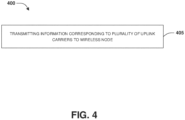
- the first wireless node receives information corresponding to a plurality of uplink carriers (e.g., from the second wireless node).
- An uplink carrier from the plurality of uplink carriers is selected to be used for data transmission.
- the first wireless node selects the uplink carrier, from the plurality of uplink carriers, based upon the information received.
- the information corresponding to the plurality of uplink carriers allows the first wireless node to determine which uplink carrier of the plurality of uplink carriers, which the first wireless node can support, should be selected to be used for data transmission.
- the information (e.g., used to determine which uplink carrier to select) comprises an indication of a frequency of the uplink carrier.
- the information may comprise a bandwidth of the uplink carrier.
- the information may comprise an extra-spectrum leakage of the uplink carrier.
- the information may comprise a priority of the uplink carrier.
- the information may comprise a maximum transmission power.
- the information may comprise one or more configurations, such as a random access channel (RACH) common configuration, a physical random access channel (PRACH) common configuration, a physical control channel (PUCCH) configuration, a physical shared channel (PUSCH) configuration, a sounding reference signal (SRS) common configuration, an upstream loop length configuration, a time alignment (TA) timer common configuration, and/or other information.
- RACH random access channel
- PRACH physical random access channel
- PUCCH physical control channel
- PUSCH physical shared channel
- SRS sounding reference signal
- upstream loop length configuration a time alignment (TA) timer common configuration
- TA time alignment
- the first wireless node (e.g., then) requests to access the uplink carrier.
- the first wireless node may transmit a request to access the uplink carrier to the second wireless node.
- the first wireless node may transmit the request (e.g., to the second wireless node) using an (e.g., previously) accessed uplink carrier which the first wireless node may have already accessed.
- the first wireless node may transmit (e.g., to the second wireless node) a data packet comprising the request.
- the request may comprise an indication of the uplink carrier.
- the indication of the uplink carrier may comprise the frequency of the uplink carrier.
- the indication of the uplink carrier may comprise an identification of the uplink carrier.
- the second wireless node may (e.g., then) determine whether the uplink carrier is available (e.g., for the first wireless node to access). In response to determining that the uplink carrier is available (e.g., for the first wireless node to access), the second wireless node may transmit a confirmation message (e.g., to the first wireless node), corresponding to the request, indicating that the uplink carrier is available (e.g., for the first wireless node to access).
- the confirmation message may comprise a second indication of the uplink carrier.
- the second indication may comprise the frequency of the uplink carrier. Alternatively and/or additionally, the second indication may comprise a second identification of the uplink carrier.
- the confirmation message may comprise the configuration of the first wireless node on the uplink carrier (e.g., such as a RACH resource, PUSCH information, a PUCCH configuration, an SRS configuration, an uplink power exclusive configuration, a channel quality indicator (CQI) configuration, a scheduling request (SR) configuration, a TA timer common configuration and/or other information.
- the uplink carrier e.g., such as a RACH resource, PUSCH information, a PUCCH configuration, an SRS configuration, an uplink power exclusive configuration, a channel quality indicator (CQI) configuration, a scheduling request (SR) configuration, a TA timer common configuration and/or other information.
- the first wireless node may access the uplink carrier.
- the first wireless node may access the uplink carrier.
- the first wireless node may initiate a (e.g., non-competitive) random access to the uplink carrier.
- the second wireless node may initiate random access to the uplink carrier.
- the second wireless node directly configures the first wireless node for the uplink carrier, the first wireless node may directly access the uplink carrier.
- the first wireless node may transmit a completion message (e.g., to the second wireless node).
- the first wireless node may transmit the completion message via the uplink carrier.
- the first wireless node may use the uplink carrier for transmission of (e.g., further) data (e.g., to the second wireless node).
- the second wireless node may transmit a rejection message (e.g., to the first wireless node), corresponding to the request, indicating that the uplink carrier is not available (e.g., for the first wireless node to access).
- the rejection message may comprise the frequency of the uplink carrier and/or a cause of the rejection.
- the first wireless node may use the (e.g., previously) accessed uplink carrier for transmission of data (e.g., to the second wireless node).
- the first wireless node may access the uplink carrier in response to selecting the uplink carrier, and/or prior to transmitting the request.
- the first wireless node may (e.g., then) transmit the request to the second wireless node via the uplink carrier.
- the second wireless node may (e.g., then) determine whether the uplink carrier is available (e.g., for the first wireless node to access).
- the first wireless node may have a transmission problem.
- the first wireless node may be unable to transmit data, at a desired rate, using the uplink carrier.
- the second wireless node may (e.g., directly) indicate a second (e.g., alternative) uplink carrier to the first wireless node by transmitting uplink carrier indication information (e.g., associated with the second uplink carrier) to the first wireless node.
- uplink carrier indication information e.g., associated with the second uplink carrier
- the second wireless node may transmit the uplink carrier indication information in a radio resource control (RRC) message.
- RRC radio resource control
- the second wireless node may transmit the uplink carrier indication information in a physical downlink control channel (PDCCH) message.
- PDCCH physical downlink control channel
- the second wireless node may transmit the uplink carrier indication information in a medium access control (MAC) control element (CE) message.
- MAC medium access control
- the uplink carrier indication information may comprise a frequency of the second uplink carrier and/or a configuration of the second uplink carrier.
- the first wireless node may access the second uplink carrier.
- the first wireless node may initiate a (e.g., non-competitive) random access to the second uplink carrier.
- the second wireless node directly configures the first wireless node for the second uplink carrier, the first wireless node may directly access the second uplink carrier.
- the first wireless node may select the second uplink carrier.
- the transmission problem occurs and the first wireless node selects the second uplink carrier are contemplated.
- the first wireless node may transmit a second request (e.g., from RRC layer) to access the second uplink carrier to the second wireless node.
- the first wireless node when a determination is made that the first wireless node transmits a data packet (e.g., from radio link control (RLC) layer) to the uplink carrier a threshold (e.g., maximum) number of times, the first wireless node may transmit the second request (e.g., from RRC layer) to access the second uplink carrier to the second wireless node.
- the first wireless node may transmit the second request (e.g., from RRC layer) to access the second uplink carrier to the second wireless node.
- the first wireless node may be a UE and the second wireless node may be a network and/or BS.
- the first wireless node may (e.g., be required to) transmit one or more data packets to the second wireless node using an uplink carrier.
- the first wireless node may receive information corresponding to a plurality of uplink carriers (e.g., from the second wireless node) comprising a first uplink carrier and a second uplink carrier.
- the information may comprise first information corresponding to the first uplink carrier and/or second information corresponding to the second uplink carrier.
- the first wireless node may determine a first priority of the first uplink carrier based on the first information.
- the first information (e.g., used to determine the first priority) may comprise an indication of a frequency of the first uplink carrier.
- the first information may comprise a bandwidth of the first uplink carrier.
- the first information may comprise an extra-spectrum leakage of the first uplink carrier.
- the first information may comprise a maximum transmission power of the first uplink carrier.
- the first information may comprise the first priority of the first uplink carrier.
- the first information may comprise one or more configurations, such as a RACH common configuration, a PRACH common configuration, a PUCCH configuration, a PUSCH configuration, an SRS common configuration, an upstream loop length configuration, a TA timer common configuration and/or other information.
- a RACH common configuration such as a RACH common configuration, a PRACH common configuration, a PUCCH configuration, a PUSCH configuration, an SRS common configuration, an upstream loop length configuration, a TA timer common configuration and/or other information.
- the first wireless node may determine a second priority of the second uplink carrier based on the second information.
- the second information (e.g., used to determine the second priority) may comprise an indication of a frequency of the second uplink carrier.
- the second information may comprise a bandwidth of the second uplink carrier.
- the second information may comprise an extra-spectrum leakage of the second uplink carrier.
- the second information may comprise a maximum transmission power of the second uplink carrier.
- the second information may comprise the second priority of the second uplink carrier.
- the second information may comprise one or more configurations, such as a RACH common configuration, a PRACH common configuration, a PUCCH configuration, a PUSCH configuration, an SRS common configuration, an upstream loop length configuration, a TA timer common configuration and/or other information).
- a RACH common configuration such as a RACH common configuration, a PRACH common configuration, a PUCCH configuration, a PUSCH configuration, an SRS common configuration, an upstream loop length configuration, a TA timer common configuration and/or other information.
- the first priority may be determined based upon the frequency of the first uplink carrier and/or the second priority may be determined based upon the frequency of the second uplink carrier. Alternatively and/or additionally, the first priority may be determined based upon a load of the first uplink carrier and/or the second priority may be determined based upon a load of the second uplink carrier.
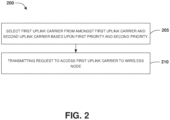
- the first wireless node may select the first uplink carrier from amongst the first uplink carrier and the second uplink carrier, based upon the first priority and the second priority.
- the first wireless node may select the first uplink carrier based upon an application of the first priority and/or the second priority to one or more (e.g., defined) rules (e.g., stored on the first wireless node). For example, the first wireless node may select the first uplink carrier based upon a comparison of the first priority to the second priority.
- the first wireless node selects the first uplink carrier based upon a comparison of the first priority to the second priority.
- the first wireless node may select the first uplink carrier based upon a comparison of the first priority and the second priority, wherein the first priority is based upon the frequency of the first uplink carrier and the second priority is based upon the frequency of the second uplink carrier.
- the frequency of the first uplink carrier may be lower than the frequency of the second uplink carrier.
- the first wireless node may select the first uplink carrier based upon a comparison of the first priority and the second priority, wherein the first priority is based upon the load of the first uplink carrier and the second priority is based upon the load of the second uplink carrier.
- the load of the first uplink carrier may be lighter than the load of the second uplink carrier.
- the first wireless node may (e.g., then) request to access the first uplink carrier.
- the first wireless node may transmit a request to access the first uplink carrier to the second wireless node.
- the first wireless node may transmit the request (e.g., to the second wireless node) using an (e.g., previously) accessed uplink carrier which the first wireless node may have already accessed.
- the first wireless node may transmit (e.g., to the second wireless node) a data packet comprising the request.
- the request may comprise an indication of the first uplink carrier.
- the indication of the first uplink carrier may comprise the frequency of the first uplink carrier.
- the indication of the first uplink carrier may comprise an identification of the first uplink carrier.
- the second wireless node may (e.g., then) determine whether the first uplink carrier is available (e.g., for the first wireless node to access). In response to determining that the first uplink carrier is available (e.g., for the first wireless node to access), the second wireless node may transmit a confirmation message (e.g., to the first wireless node), corresponding to the request, indicating that the first uplink carrier is available (e.g., for the first wireless node to access).
- the confirmation message may comprise a second indication of the first uplink carrier.
- the second indication may comprise the frequency of the first uplink carrier. Alternatively and/or additionally, the second indication may comprise a second identification of the first uplink carrier.
- the confirmation message may comprise the configuration of the first wireless node on the first uplink carrier (e.g., such as a RACH resource, PUSCH information, a PUCCH configuration, an SRS configuration, an uplink power exclusive configuration, a CQI configuration, a SR configuration, a TA timer common configuration and/or other information).
- the configuration of the first wireless node on the first uplink carrier e.g., such as a RACH resource, PUSCH information, a PUCCH configuration, an SRS configuration, an uplink power exclusive configuration, a CQI configuration, a SR configuration, a TA timer common configuration and/or other information.
- the first wireless node may access the first uplink carrier.
- the first wireless node may access the first uplink carrier.
- the first wireless node may initiate a (e.g., non-competitive) random access to the first uplink carrier.
- the second wireless node may initiate random access to the first uplink carrier.
- the second wireless node directly configures the first wireless node for the first uplink carrier, the first wireless node may directly access the first uplink carrier.
- the first wireless node may transmit a completion message (e.g., to the second wireless node).
- the first wireless node may transmit the completion message via the first uplink carrier.
- the first wireless node may use the first uplink carrier for transmission of (e.g., further) data (e.g., to the second wireless node).
- the second wireless node may transmit a rejection message (e.g., to the first wireless node), corresponding to the request, indicating that the first uplink carrier is not available (e.g., for the first wireless node to access).
- the rejection message may comprise the frequency of the first uplink carrier and/or a cause of the rejection.
- the first wireless node may use the (e.g., previously) accessed uplink carrier for transmission of data (e.g., to the second wireless node).
- the first wireless node may access the first uplink carrier in response to selecting the first uplink carrier, and/or prior to transmitting the request.
- the first wireless node may (e.g., then) transmit the request to the second wireless node via the first uplink carrier.
- the second wireless node may (e.g., then) determine whether the first uplink carrier is available (e.g., for the first wireless node to access).
- a change of the load of the first uplink carrier and/or a change of the frequency of the first uplink carrier may cause the first priority to change.
- the first priority may be changed (e.g., by the first wireless node and/or the second wireless node) in response to receiving an indication of a change of the frequency of the first uplink carrier (e.g., from the second wireless node and/or the first wireless node).
- the first priority may be changed (e.g., by the first wireless node and/or the second wireless node) in response to receiving an indication of a change of the load of the first uplink carrier (e.g., from the second wireless node and/or the first wireless node).
- the second wireless node may transmit third information corresponding to a plurality of uplink carriers (e.g., to the first wireless node).
- a third uplink carrier from the plurality of uplink carriers may be selected (e.g., by the first wireless node) to be used for data transmission.
- the third information may comprise a selection threshold used in selecting the third uplink carrier.
- the selection threshold is used in selecting the third uplink carrier. For example, if a received signal quality (e.g., Reference Signal Received Power (RSRP)) measured by the first wireless node (e.g., and/or associated with a downlink carrier) is below the selection threshold, the first wireless node selects an uplink carrier with a low frequency. Alternatively and/or additionally, if the received signal quality (e.g., RSRP) measured by the first wireless node is above the selection threshold, the first wireless node selects an uplink carrier with a high frequency. In some examples, the selection threshold is based upon a load of the third uplink carrier and/or the received signal quality (e.g., RSRP).
- RSRP Reference Signal Received Power
- the selection threshold may alternatively and/or additionally be based upon an offset value (e.g., received from the second wireless node), where the offset value may be modified (e.g., by the first wireless node and/or the second wireless node) to modify the selection threshold.
- the selection threshold is based upon a combination, such as a sum, of the received signal quality (e.g., RSRP) and/or the offset value.
- the first wireless node has a transmission problem.
- the first wireless node may be unable to transmit data, at a desired rate, using the first uplink carrier.
- the second wireless node may (e.g., directly) indicate a fourth (e.g., alternative) uplink carrier to the first wireless node by transmitting uplink carrier indication information (e.g., associated with the second uplink carrier) to the first wireless node.
- uplink carrier indication information e.g., associated with the second uplink carrier
- the second wireless node may transmit the uplink carrier indication information in an RRC message. Alternatively and/or additionally, the second wireless node may transmit the uplink carrier indication information in a PDCCH message. Alternatively and/or additionally, the second wireless node may transmit the uplink carrier indication information in a MAC CE message.
- the uplink carrier indication information may comprise a frequency of the fourth uplink carrier and/or a configuration of the fourth uplink carrier.
- the first wireless node may access the fourth uplink carrier.
- the first wireless node may initiate a (e.g., non-competitive) random access to the fourth uplink carrier.
- the second wireless node directly configures the first wireless node for the fourth uplink carrier, the first wireless node may directly access the fourth uplink carrier.
- the first wireless node may select the fourth uplink carrier.
- the transmission problem occurs and the first wireless node selects the fourth uplink carrier are contemplated.
- the first wireless node may transmit a second request (e.g., from RRC layer) to access the fourth uplink carrier to the second wireless node and/or may lower the priority of the uplink carrier.
- the offset value may be lowered by (e.g., at least) one step (e.g., by the first wireless node and/or the second wireless node), where the step may be configured (e.g., by the first wireless node and/or the second wireless node).
- the first wireless node may transmit the second request (e.g., from RRC layer) to access the fourth uplink carrier to the second wireless node.
- the first wireless node may transmit the second request (e.g., from RRC layer) to access the second uplink carrier to the second wireless node.
- the first wireless node may be a UE and the second wireless node may be a network and/or BS.
- the first wireless node may (e.g., be required to) transmit one or more data packets to the second wireless node using an uplink carrier.
- the first wireless node receives information corresponding to a plurality of uplink carriers (e.g., from the second wireless node).
- An uplink carrier from the plurality of uplink carriers may be selected to be used for data transmission.
- the first wireless node may select the uplink carrier, from the plurality of uplink carriers, based upon the information received.
- the first wireless node may (e.g., then) request to access the uplink carrier.
- the first wireless node may transmit a request to access the uplink carrier to the second wireless node, wherein the request comprises an indication of the uplink carrier.
- the indication of the uplink carrier may comprise the frequency of the uplink carrier.
- the indication of the uplink carrier may comprise an identification of the uplink carrier.
- the first wireless node may be a UE and the second wireless node may be a network and/or BS.
- the second wireless node may (e.g., be required to) receive one or more data packets from the first wireless node using an uplink carrier.
- the second wireless node transmits information corresponding to a plurality of uplink carriers (e.g., to the first wireless node).
- the first wireless node may select the uplink carrier, from the plurality of uplink carriers, based upon the information transmitted.
- the information corresponding to the plurality of uplink carriers may allow the first wireless node to determine which uplink carrier of the plurality of uplink carriers, which the first wireless node can support, should be selected to be used for data transmission.
- the information (e.g., used to determine which uplink carrier to select) may comprise an indication of a frequency of the uplink carrier.
- the information may comprise a bandwidth of the uplink carrier.
- the information may comprise an extra-spectrum leakage of the uplink carrier.
- the information may comprise a priority of the uplink carrier.
- the information may comprise a maximum transmission power.
- the information may comprise one or more configurations, such as a RACH common configuration, a PRACH common configuration, a PUCCH configuration, a PUSCH configuration, an SRS common configuration, an upstream loop length configuration, a TA timer common configuration and/or other information.
- a RACH common configuration such as a RACH common configuration, a PRACH common configuration, a PUCCH configuration, a PUSCH configuration, an SRS common configuration, an upstream loop length configuration, a TA timer common configuration and/or other information.
- the first wireless node may be a UE and the second wireless node may be a network and/or BS.
- the second wireless node may (e.g., be required to) receive one or more data packets from the first wireless node using an uplink carrier. Accordingly the second wireless node transmits information corresponding to a plurality of uplink carriers (e.g., to the first wireless node).
- the first wireless node may select the uplink carrier, from the plurality of uplink carriers, based upon the information transmitted.
- the second wireless node may, at 505, receive a request to access the uplink carrier, wherein the request comprises an indication of the uplink carrier.
- the indication of the uplink carrier may comprise the frequency of the uplink carrier.
- the indication of the uplink carrier may comprise an identification of the uplink carrier.
- the second wireless node may receive the request (e.g., from the first wireless node) using an (e.g., previously) accessed uplink carrier which the first wireless node may have already accessed.
- the second wireless node may receive (e.g., from the first wireless node) a data packet comprising the request.
- the second wireless node may (e.g., then) determine whether the uplink carrier is available (e.g., for the first wireless node to access). At 510, the second wireless node may generate a response based upon whether the uplink carrier is available. For example, in response to determining that the uplink carrier is available (e.g., for the first wireless node to access), the second wireless node may generate a confirmation message, corresponding to the request.
- the second wireless node may transmit the response to the first wireless node.
- the second wireless node may transmit the confirmation message (e.g., to the first wireless node) indicating that the uplink carrier is available (e.g., for the first wireless node to access).
- the confirmation message may comprise a second indication of the uplink carrier.
- the second indication may comprise the frequency of the uplink carrier.
- the second indication may comprise a second identification of the uplink carrier.
- the confirmation message may comprise the configuration of the first wireless node on the uplink carrier (e.g., such as a RACH resource, PUSCH information, a PUCCH configuration, an SRS configuration, an uplink power exclusive configuration, a CQI configuration, a SR configuration, a TA timer common configuration and/or other information).
- the uplink carrier e.g., such as a RACH resource, PUSCH information, a PUCCH configuration, an SRS configuration, an uplink power exclusive configuration, a CQI configuration, a SR configuration, a TA timer common configuration and/or other information.
- the first wireless node may access the uplink carrier.
- the first wireless node may access the uplink carrier.
- the first wireless node may initiate a (e.g., non-competitive) random access to the uplink carrier.
- the second wireless node may initiate random access to the uplink carrier.
- the second wireless node directly configures the first wireless node for the uplink carrier, the first wireless node may directly access the uplink carrier.
- the first wireless node may transmit a completion message (e.g., to the second wireless node).
- the first wireless node may transmit the completion message via the uplink carrier.
- the first wireless node may use the uplink carrier for transmission of (e.g., further) data (e.g., to the second wireless node).
- the second wireless node may generate a rejection message, corresponding to the request.
- the second wireless node may (e.g., then) transmit the rejection message (e.g., to the first wireless node) indicating that the uplink carrier is not available (e.g., for the first wireless node to access).
- the rejection message may comprise the frequency of the uplink carrier and/or a cause of the rejection.
- the first wireless node may use the (e.g., previously) accessed uplink carrier for transmission of data (e.g., to the second wireless node).
- the first wireless node may access the uplink carrier in response to selecting the uplink carrier, and/or prior to transmitting the request.
- the first wireless node may (e.g., then) transmit the request to the second wireless node via the uplink carrier.
- the second wireless node may (e.g., then) determine whether the uplink carrier is available (e.g., for the first wireless node to access).
- the first wireless node may have a transmission problem.
- the first wireless node may be unable to transmit data, at a desired rate, using the uplink carrier.
- the second wireless node may (e.g., directly) indicate a second (e.g., alternative) uplink carrier to the first wireless node by transmitting uplink carrier indication information (e.g., associated with the second uplink carrier) to the first wireless node.
- uplink carrier indication information e.g., associated with the second uplink carrier
- the second wireless node may transmit the uplink carrier indication information in an RRC message. Alternatively and/or additionally, the second wireless node may transmit the uplink carrier indication information in a PDCCH message. Alternatively and/or additionally, the second wireless node may transmit the uplink carrier indication information in a MAC CE message.
- the uplink carrier indication information may comprise a frequency of the second uplink carrier and/or a configuration of the second uplink carrier.
- the first wireless node may access the second uplink carrier.
- the first wireless node may initiate a (e.g., non-competitive) random access to the second uplink carrier.
- the second wireless node directly configures the first wireless node for the second uplink carrier, the first wireless node may directly access the second uplink carrier.
- the first wireless node may select the second uplink carrier.
- the transmission problem occurs and the first wireless node selects the second uplink carrier are contemplated.
- the first wireless node may transmit a second request (e.g., from RRC layer) to access the second uplink carrier to the second wireless node.
- the first wireless node may transmit the second request (e.g., from RRC layer) to access the second uplink carrier to the second wireless node.
- the first wireless node may transmit the second request (e.g., from RRC layer) to access the second uplink carrier to the second wireless node.
- the first wireless node may be a UE and the second wireless node may be a network and/or BS.
- the first wireless node may (e.g., be required to) transmit one or more data packets to the second wireless node using an uplink carrier.
- the first wireless node receives information corresponding to a plurality of uplink carriers (e.g., from the second wireless node).
- An uplink carrier from the plurality of uplink carriers may be selected to be used for data transmission.
- the first wireless node may select the uplink carrier, from the plurality of uplink carriers, based upon the information received.
- the information corresponding to the plurality of uplink carriers may allow the first wireless node to determine which uplink carrier of the plurality of uplink carriers, which the first wireless node can support, should be selected to be used for data transmission.
- the information (e.g., used to determine which uplink carrier to select) may comprise an indication of the uplink carrier.
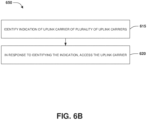
- the first wireless node may identify the indication of the uplink carrier.
- the indication of the uplink carrier may comprise a frequency of the uplink carrier and/or an identification of the uplink carrier.
- the information may comprise a bandwidth of the uplink carrier.
- the information may comprise an extra-spectrum leakage of the uplink carrier.
- the information may comprise a priority of the uplink carrier.
- the information may comprise a maximum transmission power.
- the information may comprise a RACH resource, PUSCH information, a PUCCH configuration, an SRS configuration, uplink power exclusive configuration, a CQI configuration, a SR configuration, a TA timer common configuration and/or other information.
- the first wireless node may (e.g., then) request to access the uplink carrier.
- the first wireless node may transmit a request to access the uplink carrier, based upon the indication of the uplink carrier, to the second wireless node.
- the request may comprise a second indication of the uplink carrier.
- the second indication may comprise the frequency of the uplink carrier.
- the second indication may comprise an identification of the uplink carrier.
- the first wireless node may transmit the request (e.g., to the second wireless node) using an (e.g., previously) accessed uplink carrier which the first wireless node may have already accessed.
- the first wireless node may transmit (e.g., to the second wireless node) a data packet comprising the request.
- the first wireless node may be a UE and the second wireless node may be a network and/or BS.
- the first wireless node may (e.g., be required to) transmit one or more data packets to the second wireless node using an uplink carrier.
- the first wireless node receives information corresponding to a plurality of uplink carriers (e.g., from the second wireless node).
- An uplink carrier from the plurality of uplink carriers may be selected to be used for data transmission.
- the first wireless node may select the uplink carrier, from the plurality of uplink carriers, based upon the information received.
- the information corresponding to the plurality of uplink carriers may allow the first wireless node to determine which uplink carrier of the plurality of uplink carriers, which the first wireless node can support, should be selected to be used for data transmission.
- the information (e.g., used to determine which uplink carrier to select) may comprise an indication of the uplink carrier.
- the first wireless node may identify the indication of the uplink carrier.
- the indication of the uplink carrier may comprise a frequency of the uplink carrier and/or an identification of the uplink carrier.
- the information may comprise a bandwidth of the uplink carrier.
- the information may comprise an extra-spectrum leakage of the uplink carrier.
- the information may comprise a priority of the uplink carrier.
- the information may comprise a maximum transmission power.
- the information may comprise a RACH resource, PUSCH information, a PUCCH configuration, an SRS configuration, uplink power exclusive configuration, a CQI configuration, a SR configuration, a TA timer common configuration and/or other information.
- the first wireless node may access the uplink carrier in response to identifying the indication of the uplink carrier, and/or prior to transmitting a request to access the uplink carrier.
- the first wireless node may (e.g., then) transmit the request to the second wireless node via the uplink carrier.
- the request may comprise a second indication of the uplink carrier.
- the second indication may comprise the frequency of the uplink carrier.
- the second indication may comprise an identification of the uplink carrier.
- the second wireless node may (e.g., then) determine whether the uplink carrier is available (e.g., for the first wireless node to access). In response to determining that the uplink carrier is available (e.g., for the first wireless node to access), the second wireless node may transmit a confirmation message (e.g., to the first wireless node). Upon the first wireless node receiving the confirmation message, the first wireless node may transmit a completion message (e.g., to the second wireless node).
- the second wireless node may transmit a rejection message (e.g., to the first wireless node).
- the first wireless node may (e.g., cease accessing the uplink carrier and/or) use an initial uplink carrier which the first wireless node may have already (e.g., previously) accessed, for transmission of data (e.g., to the second wireless node).
- the first wireless node may be a UE and the second wireless node may be a network and/or BS.
- the second wireless node may (e.g., be required to) receive one or more data packets from the first wireless node using an uplink carrier. Accordingly the second wireless node transmits information corresponding to a plurality of uplink carriers (e.g., to the first wireless node).
- the first wireless node may select the uplink carrier, from the plurality of uplink carriers, based upon the information transmitted.
- the first wireless node may have a transmission problem.
- the first wireless node may be unable to transmit data, at a desired rate, using the uplink carrier.
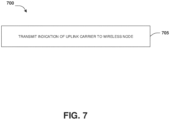
- the second wireless node may transmit an indication of a second uplink carrier to the first wireless node.
- the second wireless node may (e.g., directly) indicate the second (e.g., alternative) uplink carrier to the first wireless node by transmitting uplink carrier indication information (e.g., associated with the second uplink carrier) to the first wireless node.
- the second wireless node may transmit the uplink carrier indication information in an RRC message. Alternatively and/or additionally, the second wireless node may transmit the uplink carrier indication information in a PDCCH message. Alternatively and/or additionally, the second wireless node may transmit the uplink carrier indication information in a MAC CE message.
- the uplink carrier indication information may comprise a frequency of the second uplink carrier and/or a configuration of the second uplink carrier.
- the first wireless node may access the second uplink carrier.
- the first wireless node may initiate a (e.g., non-competitive) random access to the second uplink carrier.
- the second wireless node directly configures the first wireless node for the second uplink carrier, the first wireless node may directly access the second uplink carrier.
- Fig. 8 illustrates an example of a system 800 for facilitating transmission of a request to access an uplink carrier from a first wireless node 805 (e.g., UE) to a second wireless node 810 (e.g., network and/or BS).
- the first wireless node 805 may (e.g., be required to) transmit one or more data packets to the second wireless node 810 using an uplink carrier. Accordingly, the first wireless node 805 receives information corresponding to a plurality of uplink carriers (e.g., from the second wireless node 810).
- the information may comprise first information 815 corresponding to a first uplink carrier, second information 820 corresponding to a second uplink carrier and/or third information 825 corresponding to a third uplink carrier, wherein the first uplink carrier, the second uplink carrier and/or the third uplink carrier are comprised within the plurality of uplink carriers.
- An uplink carrier from the plurality of uplink carriers may be selected to be used for data transmission.
- the first wireless node 805 may select the uplink carrier, from the plurality of uplink carriers, based upon the information received.
- the information corresponding to the plurality of uplink carriers may allow the first wireless node 805 to determine which uplink carrier of the plurality of uplink carriers, which the first wireless node 805 can support, should be selected to be used for data transmission.
- the first information 815, the second information 820 and/or the third information 825 may comprise an indication of a frequency, a bandwidth, an extra-spectrum leakage, a priority, a maximum transmission power and/or one or more configurations.
- the first wireless node 805 may then select the uplink carrier based upon the first information 815, the second information 820 and/or the third information 825.
- the first wireless node 805 may (e.g., then) request to access the uplink carrier.
- the first wireless node 805 may transmit a request 830 to access the uplink carrier to the second wireless node 810, wherein the request 830 comprises an indication of the uplink carrier.
- the indication of the uplink carrier may comprise the frequency of the uplink carrier.
- the indication of the uplink carrier may comprise an identification of the uplink carrier.
- the first wireless node 805 may transmit the request 830 (e.g., to the second wireless node 810) using an initial uplink carrier which the first wireless node 805 may have already (e.g., previously) accessed.
- the first wireless node 805 may transmit (e.g., to the second wireless node 810) a data packet comprising the request 830.
- the second wireless node 810 may (e.g., then) determine whether the uplink carrier is available (e.g., for the first wireless node 805 to access).
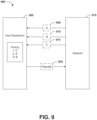
- Fig. 9 illustrates an example of a system 900 for facilitating transmission of a request to access an uplink carrier from the first wireless node 805 to the second wireless node 810.
- the first wireless node 805 may (e.g., be required to) transmit one or more data packets to the second wireless node 810 using an uplink carrier. Accordingly, the first wireless node 805 receives information corresponding to a plurality of uplink carriers (e.g., from the second wireless node 810).
- the information may comprise first information 905 corresponding to a first uplink carrier, second information 910 corresponding to a second uplink carrier and/or third information 915 corresponding to a third uplink carrier, wherein the first uplink carrier, the second uplink carrier and/or the third uplink carrier are comprised within the plurality of uplink carriers.
- An uplink carrier from amongst the first uplink carrier, the second uplink carrier and/or the third uplink carrier may be selected to be used for data transmission.
- the first wireless node 805 may select the uplink carrier, from the plurality of uplink carriers, based upon the information received.
- the information corresponding to the plurality of uplink carriers may allow the first wireless node 805 to determine which uplink carrier of the plurality of uplink carriers, which the first wireless node 805 can support, should be selected to be used for data transmission.
- the first information 905, the second information 910 and/or the third information 915 may comprise an indication of a frequency, a bandwidth, an extra-spectrum leakage, a priority, a maximum transmission power and/or one or more configurations.
- the first wireless node 805 may determine a first priority of the first uplink carrier based on the first information 905.
- the first wireless node 805 may determine a second priority of the second uplink carrier based on the second information 910.
- the first wireless node 805 may determine a third priority of the third uplink carrier based on the third information 915. Accordingly, the first wireless node 805 may determine that the third uplink carrier has a higher priority than the first uplink carrier and/or the first uplink carrier has a higher priority than the second uplink carrier.
- the first wireless node 805 may (e.g., then) select the third uplink carrier.
- the first wireless node 805 may (e.g., then) request to access the third uplink carrier.
- the first wireless node 805 may transmit a request 920 to access the third uplink carrier to the second wireless node 810, wherein the request 920 comprises an indication of the third uplink carrier.
- the indication of the third uplink carrier may comprise the frequency of the third uplink carrier.
- the indication of the third uplink carrier may comprise an identification of the third uplink carrier.
- the first wireless node 805 may transmit the request 920 (e.g., to the second wireless node 810) using an initial uplink carrier which the first wireless node 805 may have already (e.g., previously) accessed.
- the first wireless node 805 may transmit (e.g., to the second wireless node 810) a data packet comprising the request 920.
- the second wireless node 810 may (e.g., then) determine whether the uplink carrier is available (e.g., for the first wireless node 805 to access).
- Fig. 10 illustrates an example of a system 1000 for facilitating transmission of a request to access an uplink carrier from the first wireless node 805 to the second wireless node 810.
- the first wireless node 805 may (e.g., be required to) transmit one or more data packets to the second wireless node 810 using an uplink carrier. Accordingly, the first wireless node 805 may select the uplink carrier from a plurality of uplink carriers. The first wireless node 805 may (e.g., then) request to access the uplink carrier. Thus, the first wireless node 805 may transmit a request 1005 to access the uplink carrier to the second wireless node 810, wherein the request 1005 comprises an indication of the uplink carrier.
- the indication of the uplink carrier may comprise the frequency of the uplink carrier. Alternatively and/or additionally, the indication of the uplink carrier may comprise an identification of the uplink carrier.
- the first wireless node 805 may transmit the request 1005 (e.g., to the second wireless node 810) using an initial uplink carrier which the first wireless node 805 may have already (e.g., previously) accessed.
- the first wireless node 805 may transmit (e.g., to the second wireless node 810) a data packet comprising the request 1005.
- the second wireless node 810 may (e.g., then) determine whether the uplink carrier is available (e.g., for the first wireless node 805 to access).
- the second wireless node 810 may transmit a confirmation message 1010 (e.g., to the first wireless node 805), corresponding to the request 1005, indicating that the uplink carrier is available (e.g., for the first wireless node 805 to access).
- the confirmation message 1010 may comprise a second indication of the uplink carrier.
- the second indication may comprise the frequency of the uplink carrier.
- the second indication may comprise a second identification of the uplink carrier.
- the confirmation message 1010 may comprise the configuration of the first wireless node 805 on the uplink carrier.
- the first wireless node 805 may access the uplink carrier.
- Fig. 11 illustrates an example of a system 1100 for facilitating transmission of a request to access an uplink carrier from the first wireless node 805 to the second wireless node 810.
- the first wireless node 805 may transmit a request 1105 to access an uplink carrier to the second wireless node 810.
- the second wireless node 810 may transmit a confirmation message 1110 (e.g., to the first wireless node 805), corresponding to the request 1105, indicating that the uplink carrier is available (e.g., for the first wireless node 805 to access).
- the first wireless node 805 may access 1115 the uplink carrier. Upon accessing 1115 the uplink carrier, the first wireless node 805 may transmit a completion message 1120 (e.g., to the second wireless node 810). Upon the first wireless node 805 transmitting the completion message 1120, the first wireless node 805 may use the uplink carrier for transmission of (e.g., further) data (e.g., to the second wireless node 810).
- a completion message 1120 e.g., to the second wireless node 810
- the first wireless node 805 may use the uplink carrier for transmission of (e.g., further) data (e.g., to the second wireless node 810).
- the second wireless node 810 may transmit information corresponding to a plurality of uplink carriers (e.g., to the first wireless node 805).
- the information may comprise first information 1125 corresponding to a first uplink carrier, second information 1130 corresponding to a second uplink carrier and/or third information 1135 corresponding to a third uplink carrier, wherein the first uplink carrier, the second uplink carrier and/or the third uplink carrier are comprised within the plurality of uplink carriers.
- a second uplink carrier from the plurality of uplink carriers may be selected to be used for data transmission.
- the first wireless node 805 may select the second uplink carrier, from the plurality of uplink carriers, based upon the information received.
- the first wireless node 805 may (e.g., then) request to access the second uplink carrier.
- the first wireless node 805 may transmit a request 1140 to access the second uplink carrier to the second wireless node 810, wherein the request 1140 comprises an indication of the second uplink carrier.
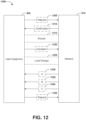
- Fig. 12 illustrates an example of a system 1200 for facilitating transmission of a request to access an uplink carrier from the first wireless node 805 to the second wireless node 810.
- the first wireless node 805 may transmit a request 1205 to access an uplink carrier to the second wireless node 810.
- the second wireless node 810 may transmit a confirmation message 1210 (e.g., to the first wireless node 805).
- the first wireless node 805 may access 1215 the uplink carrier. Upon accessing 1215 the uplink carrier, the first wireless node 805 may transmit a completion message 1220 (e.g., to the second wireless node 810). Upon the first wireless node 805 transmitting the completion message 1220, the first wireless node 805 may use the uplink carrier for transmission of (e.g., further) data (e.g., to the second wireless node 810).
- a completion message 1220 e.g., to the second wireless node 810
- the first wireless node 805 may use the uplink carrier for transmission of (e.g., further) data (e.g., to the second wireless node 810).
- a load change 1225 occurs (e.g., in association with the uplink carrier).
- the load change 1225 may cause a change in a priority of the uplink carrier.
- the second wireless node 810 may transmit information corresponding to a plurality of uplink carriers (e.g., to the first wireless node 805).
- the information may comprise first information 1230 corresponding to a first uplink carrier, second information 1235 corresponding to a second uplink carrier and/or third information 1240 corresponding to a third uplink carrier, wherein the first uplink carrier, the second uplink carrier and/or the third uplink carrier are comprised within the plurality of uplink carriers.
- a fourth uplink carrier from the plurality of uplink carriers may be selected to be used for data transmission.
- the first wireless node 805 may (e.g., then) request to access the fourth uplink carrier. Thus, the first wireless node 805 may transmit a request 1245 to access the fourth uplink carrier to the second wireless node 810.
- Fig. 13 illustrates an example of a system 1300 for facilitating transmission of a request to access an uplink carrier from the first wireless node 805 to the second wireless node 810.
- the first wireless node 805 may transmit a request 1305 to access an uplink carrier to the second wireless node 810.
- the second wireless node 810 may transmit a confirmation message 1310 (e.g., to the first wireless node 805).
- the first wireless node 805 may access 1315 the uplink carrier. Upon accessing 1315 the uplink carrier, the first wireless node 805 may transmit a completion message 1320 (e.g., to the second wireless node 810).
- the second wireless node 810 may transmit information corresponding to a plurality of uplink carriers (e.g., to the first wireless node 805).
- the information may comprise first information 1330, second information 1335 and/or third information 1340 corresponding to the plurality of uplink carriers.
- a second uplink carrier from the plurality of uplink carriers may be selected to be used for data transmission.
- the first wireless node 805 may select the second uplink carrier, from the plurality of uplink carriers, based upon the information received.
- the first wireless node 805 may (e.g., then) transmit a second request 1345 to access the second uplink carrier to the second wireless node 810.
- the second wireless node 810 may transmit a confirmation message 1350 (e.g., to the first wireless node 805).
- the first wireless node 805 may access 1355 the uplink carrier.
- the first wireless node 805 may transmit a completion message 1360 (e.g., to the second wireless node 810).
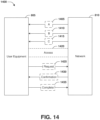
- Fig. 14 illustrates an example of a system 1400 for facilitating transmission of a request to access an uplink carrier from the first wireless node 805 to the second wireless node 810.
- the second wireless node 810 may transmit information corresponding to a plurality of uplink carriers (e.g., to the first wireless node 805).
- the information may comprise first information 1405, second information 1410 and/or third information 1415 corresponding to the plurality of uplink carriers.
- An uplink carrier from the plurality of uplink carriers may be selected to be used for data transmission.
- the first wireless node 805 may select the uplink carrier, from the plurality of uplink carriers, based upon the information received.
- the first wireless node 805 may (e.g., then) access 1420 the uplink carrier.
- the accessing 1420 comprises initiating random access to the uplink carrier.
- the first wireless node 805 may then transmit a request 1425 to the second wireless node 810.
- the second wireless node 810 may transmit a confirmation message 1430 (e.g., to the first wireless node 805).
- the first wireless node 805 may transmit a completion message 1435 (e.g., to the second wireless node 810).
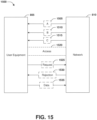
- Fig. 15 illustrates an example of a system 1500 for facilitating transmission of a request to access an uplink carrier from the first wireless node 805 to the second wireless node 810.
- the second wireless node 810 may transmit information corresponding to a plurality of uplink carriers (e.g., to the first wireless node 805).
- the information may comprise first information 1505, second information 1510 and/or third information 1515 corresponding to the plurality of uplink carriers.
- An uplink carrier from the plurality of uplink carriers may be selected to be used for data transmission.
- the first wireless node 805 may select the uplink carrier, from the plurality of uplink carriers, based upon the information received.
- the first wireless node 805 may (e.g., then) access 1520 the uplink carrier.
- the accessing 1520 comprises initiating random access to the uplink carrier.
- the first wireless node 805 may then transmit a request 1525 to the second wireless node 810.
- the second wireless node 810 may transmit a rejection message 1530 (e.g., to the first wireless node 805).
- the first wireless node 805 may (e.g., cease accessing the uplink carrier and/or) use an initial uplink carrier which the first wireless node 805 may have already (e.g., previously) accessed, for transmission of data 1535 (e.g., to the second wireless node).
- Fig. 16 illustrates an example of a system 1600 for facilitating transmission of a request to access an uplink carrier from the first wireless node 805 to the second wireless node 810.
- the first wireless node 805 may transmit a request 1605 to access an uplink carrier to the second wireless node 810.
- the second wireless node 810 may transmit a confirmation message 1610 (e.g., to the first wireless node 805).
- the first wireless node 805 may access 1615 the uplink carrier. Upon accessing 1615 the uplink carrier, the first wireless node 805 may transmit a completion message 1620 (e.g., to the second wireless node 810).
- the first wireless node 805 may have a transmission problem 1625.
- the first wireless node 805 may be unable to transmit data, at a desired rate, using the uplink carrier.
- the second wireless node 810 may (e.g., then) (e.g., directly) indicate a second (e.g., alternative) uplink carrier to the first wireless node by transmitting uplink carrier indication information 1630 (e.g., associated with the second uplink carrier) to the first wireless node.
- the first wireless node 805 may (e.g., then) (e.g., directly) access 1635 the second uplink carrier.
- the accessing 1635 comprises initiating random access to the second uplink carrier.
- the accessing 1635 comprises initiating non-competitive random access to the second uplink carrier.
- the first wireless node 805 may (e.g., then) transmit a second completion message 1640.
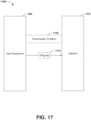
- Fig. 17 illustrates an example of a system 1700 for facilitating transmission of a request to access an uplink carrier from the first wireless node 805 to the second wireless node 810.
- the first wireless node 805 may (e.g., be determined to) have a transmission problem 1705.
- the first wireless node 805 may be unable to transmit data, at a desired rate, using an uplink carrier.
- the transmission problem 1705 occurs when the first wireless node 805 transmits a random access preamble to the uplink carrier a threshold (e.g., maximum) number of times.
- the transmission problem 1705 occurs when the first wireless node 805 transmits a data packet to the uplink carrier a threshold (e.g., maximum) number of times.
- the transmission problem 1705 occurs when the uplink carrier is out of step (e.g., in association with a TA timer timeout).
- the first wireless node 805 may transmit a request 1710 to access a second uplink carrier to the second wireless node 810.
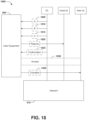
- Fig. 18 illustrates an example of a system 1800 for facilitating transmission of a request to access an uplink carrier from the first wireless node 805 to the second wireless node 810.
- the second wireless node 810 may transmit information corresponding to a plurality of uplink carriers (e.g., to the first wireless node 805).
- the information may be transmitted using a downlink carrier.
- the information may comprise first information 1805, second information 1810 and/or third information 1815 corresponding to the plurality of uplink carriers.
- An uplink carrier from the plurality of uplink carriers may be selected to be used for data transmission.
- the first wireless node 805 may select the uplink carrier, from the plurality of uplink carriers, based upon the information received.
- the first wireless node 805 may (e.g., then) transmit a request 1820 to access the uplink carrier to the second wireless node 810.
- the request 1820 may be transmitted using an initial uplink carrier that was (e.g., previously) accessed.
- the second wireless node 810 may transmit a confirmation message 1825 (e.g., to the first wireless node 805).
- the confirmation message 1825 may be transmitted using the downlink carrier.
- the first wireless node 805 may access 1830 the uplink carrier.
- the accessing 1830 may be associated with the downlink carrier, the initial uplink carrier and/or the uplink carrier.
- the first wireless node 805 may transmit a completion message 1835 (e.g., to the second wireless node 810).
- the completion message 1835 may be transmitted using the uplink carrier.
- Fig. 19 illustrates an example of a system 1900 for facilitating transmission of a request to access an uplink carrier from the first wireless node 805 to the second wireless node 810.
- the second wireless node 810 may transmit information corresponding to a plurality of uplink carriers (e.g., to the first wireless node 805).
- the information may be transmitted using a downlink carrier.
- the information may comprise first information 1905, second information 1910 and/or third information 1915 corresponding to the plurality of uplink carriers.
- An uplink carrier from the plurality of uplink carriers may be selected to be used for data transmission.
- the first wireless node 805 may select the uplink carrier, from the plurality of uplink carriers, based upon the information received.
- the first wireless node 805 may (e.g., then) access 1920 the uplink carrier.
- the accessing 1920 comprises initiating random access to the uplink carrier.
- the accessing 1920 may be associated with the downlink carrier and/or the uplink carrier.
- the first wireless node 805 may then transmit a request 1925 to the second wireless node 810.
- the request 1925 may be transmitted using the uplink carrier.
- the second wireless node 810 may transmit a confirmation message 1930 (e.g., to the first wireless node 805).
- the confirmation message 1930 may be transmitted using the downlink carrier.
- the first wireless node 805 may transmit a completion message 1935 (e.g., to the second wireless node 810).
- the completion message 1935 may be transmitted using the uplink carrier.
- Fig. 20 illustrates an example of a system 2000 for facilitating transmission of a request to access an uplink carrier from the first wireless node 805 to the second wireless node 810.
- the first wireless node 805 may (e.g., be determined to) have a transmission problem 2005 associated with an initial uplink carrier that was (e.g., previously) accessed.
- the first wireless node 805 may be unable to transmit data, at a desired rate, using the initial uplink carrier.
- the second wireless node 810 may (e.g., then) (e.g., directly) indicate an (e.g., alternative) uplink carrier to the first wireless node 805 by transmitting uplink carrier indication information 2010 (e.g., associated with the second uplink carrier) to the first wireless node 805.
- uplink carrier indication information 2010 may be transmitted using a downlink carrier.
- the first wireless node 805 may (e.g., then) (e.g., directly) access 2015 the second uplink carrier.
- the accessing 2015 may be associated with the downlink carrier, the initial uplink carrier and/or the uplink carrier.
- the accessing 2015 comprises initiating random access to the uplink carrier.
- the accessing 2015 comprises initiating non-competitive random access to the uplink carrier.
- the first wireless node 805 may (e.g., then) transmit a completion message 2020 to the second wireless node 810.
- the completion message 2020 may be transmitted using the uplink carrier.
- Fig. 21 presents a schematic architecture diagram 2100 of a base station 2150 (e.g., a node) that may utilize at least a portion of the techniques provided herein.
- a base station 2150 e.g., a node
- Such a base station 2150 may vary widely in configuration and/or capabilities, alone or in conjunction with other base stations, nodes, end units and/or servers, etc. in order to provide a service, such as at least some of one or more of the other disclosed techniques, scenarios, etc.
- the base station 2150 may connect one or more user equipment (UE) to a (e.g., wireless) network (e.g., which may be connected and/or include one or more other base stations), such as Code Division Multiple Access (CDMA) networks, Time Division Multiple Access (TDMA) networks, Frequency Division Multiple Access (FDMA) networks, Orthogonal FDMA (OFDMA) networks, Single-Carrier FDMA (SC-FDMA) networks, etc.
- the network may implement a radio technology, such as Universal Terrestrial Radio Access (UTRA), CDMA13000, Global System for Mobile Communications (GSM), Evolved UTRA (E-UTRA), IEEE 802.11, IEEE 802.16, IEEE 802.20, Flash-OFDM, etc.
- the base station 2150 and/or the network may communicate using a standard, such as Long-Term Evolution (LTE).
- LTE Long-Term Evolution
- the base station 2150 may comprise one or more (e.g., hardware) processors 2110 that process instructions.
- the one or more processors 2110 may optionally include a plurality of cores; one or more coprocessors, such as a mathematics coprocessor or an integrated graphical processing unit (GPU); and/or one or more layers of local cache memory.
- the base station 2150 may comprise memory 2102 storing various forms of applications, such as an operating system 2104; one or more base station applications 2106; and/or various forms of data, such as a database 2108 and/or a file system, etc.
- the base station 2150 may comprise a variety of peripheral components, such as a wired and/or wireless network adapter 2114 connectible to a local area network and/or wide area network; one or more storage components 2116, such as a hard disk drive, a solid-state storage device (SSD), a flash memory device, and/or a magnetic and/or optical disk reader; and/or other peripheral components.
- peripheral components such as a wired and/or wireless network adapter 2114 connectible to a local area network and/or wide area network; one or more storage components 2116, such as a hard disk drive, a solid-state storage device (SSD), a flash memory device, and/or a magnetic and/or optical disk reader; and/or other peripheral components.
- the base station 2150 may comprise a mainboard featuring one or more communication buses 2112 that interconnect the processor 2110, the memory 2102, and/or various peripherals, using a variety of bus technologies, such as a variant of a serial or parallel AT Attachment (ATA) bus protocol; a Uniform Serial Bus (USB) protocol; and/or Small Computer System Interface (SCI) bus protocol.
- a communication bus 2112 may interconnect the base station 2150 with at least one other server.
- Other components that may optionally be included with the base station 2150 (though not shown in the schematic diagram 2100 of Fig.
- a display includes a display adapter, such as a graphical processing unit (GPU); input peripherals, such as a keyboard and/or mouse; and/or a flash memory device that may store a basic input/output system (BIOS) routine that facilitates booting the base station 2150 to a state of readiness, etc.
- a display adapter such as a graphical processing unit (GPU)
- input peripherals such as a keyboard and/or mouse
- BIOS basic input/output system
- the base station 2150 may operate in various physical enclosures, such as a desktop or tower, and/or may be integrated with a display as an "all-in-one" device.
- the base station 2150 may be mounted horizontally and/or in a cabinet or rack, and/or may simply comprise an interconnected set of components.
- the base station 2150 may comprise a dedicated and/or shared power supply 2118 that supplies and/or regulates power for the other components.
- the base station 2150 may provide power to and/or receive power from another base station and/or server and/or other devices.
- the base station 2150 may comprise a shared and/or dedicated climate control unit 2120 that regulates climate properties, such as temperature, humidity, and/or airflow. Many such base stations 2150 may be configured and/or adapted to utilize at least a portion of the techniques presented herein.
- Fig. 22 presents a schematic architecture diagram 2200 of a user equipment (UE) 2250 (e.g., a node) whereupon at least a portion of the techniques presented herein may be implemented.
- UE user equipment
- Such a UE 2250 may vary widely in configuration and/or capabilities, in order to provide a variety of functionality to a user.
- the UE 2250 may be provided in a variety of form factors, such as a mobile phone (e.g., a smartphone); a desktop or tower workstation; an "all-in-one" device integrated with a display 2208; a laptop, tablet, convertible tablet, or palmtop device; a wearable device, such as mountable in a headset, eyeglass, earpiece, and/or wristwatch, and/or integrated with an article of clothing; and/or a component of a piece of furniture, such as a tabletop, and/or of another device, such as a vehicle or residence.
- the UE 2250 may serve the user in a variety of roles, such as a telephone, a workstation, kiosk, media player, gaming device, and/or appliance.
- the UE 2250 may comprise one or more (e.g., hardware) processors 2210 that process instructions.
- the one or more processors 2210 may optionally include a plurality of cores; one or more coprocessors, such as a mathematics coprocessor or an integrated graphical processing unit (GPU); and/or one or more layers of local cache memory.
- the UE 2250 may comprise memory 2201 storing various forms of applications, such as an operating system 2203; one or more user applications 2202, such as document applications, media applications, file and/or data access applications, communication applications, such as web browsers and/or email clients, utilities, and/or games; and/or drivers for various peripherals.
- the UE 2250 may comprise a variety of peripheral components, such as a wired and/or wireless network adapter 2206 connectible to a local area network and/or wide area network; one or more output components, such as a display 2208 coupled with a display adapter (optionally including a graphical processing unit (GPU)), a sound adapter coupled with a speaker, and/or a printer; input devices for receiving input from the user, such as a keyboard 2211, a mouse, a microphone, a camera, and/or a touch-sensitive component of the display 2208, and/or environmental sensors, such as a GPS receiver 2219 that detects the location, velocity, and/or acceleration of the UE 2250, a compass, accelerometer, and/or gyroscope that detects a physical orientation of the UE 2250.
- peripheral components such as a wired and/or wireless network adapter 2206 connectible to a local area network and/or wide area network
- one or more output components such as a display 2208 coupled
- Other components that may optionally be included with the UE 2250 include one or more storage components, such as a hard disk drive, a solid-state storage device (SSD), a flash memory device, and/or a magnetic and/or optical disk reader; a flash memory device that may store a basic input/output system (BIOS) routine that facilitates booting the UE 2250 to a state of readiness; and/or a climate control unit that regulates climate properties, such as temperature, humidity, and airflow, etc.
- storage components such as a hard disk drive, a solid-state storage device (SSD), a flash memory device, and/or a magnetic and/or optical disk reader
- a flash memory device that may store a basic input/output system (BIOS) routine that facilitates booting the UE 2250 to a state of readiness
- BIOS basic input/output system
- climate control unit that regulates climate properties, such as temperature, humidity, and airflow, etc.
- the UE 2250 may comprise a mainboard featuring one or more communication buses 2212 that interconnect the processor 2210, the memory 2201, and/or various peripherals, using a variety of bus technologies, such as a variant of a serial or parallel AT Attachment (ATA) bus protocol; the Uniform Serial Bus (USB) protocol; and/or the Small Computer System Interface (SCI) bus protocol.
- the UE 2250 may comprise a dedicated and/or shared power supply 2218 that supplies and/or regulates power for other components, and/or a battery 2204 that stores power for use while the UE 2250 is not connected to a power source via the power supply 2218.
- the UE 2250 may provide power to and/or receive power from other client devices.
- Fig. 23 is an illustration of a scenario 2300 involving an example non-transitory computer readable medium 2302.
- the non-transitory computer readable medium 2302 may comprise processor-executable instructions 2312 that when executed by a processor 2316 cause performance (e.g., by the processor 2316) of at least some of the provisions herein.
- the non-transitory computer readable medium 2302 may comprise a memory semiconductor (e.g., a semiconductor utilizing static random access memory (SRAM), dynamic random access memory (DRAM), and/or synchronous dynamic random access memory (SDRAM) technologies), a platter of a hard disk drives, a flash memory device, or a magnetic or optical disc (such as a compact disc (CD), digital versatile disc (DVD), and/or floppy disk).
- SRAM static random access memory
- DRAM dynamic random access memory
- SDRAM synchronous dynamic random access memory
- the example non-transitory computer readable medium 2302 stores computerreadable data 2304 that, when subjected to reading 2306 by a reader 2310 of a device 2308 (e.g., a read head of a hard disk drive, or a read operation invoked on a solid-state storage device), express the processor-executable instructions 2312.
- the processor-executable instructions 2312 when executed, cause performance of operations, such as at least some of the example method 100 of Fig. 1 , the example method 200 of Fig. 2 , the example method 300 of Fig. 3 , the example method 400 of Fig. 4 , the example method 500 of Fig. 5 , the example method 600 of Fig. 6A , the example method 650 of Fig.
- the processor-executable instructions 2312 are configured to cause implementation of a system and/or scenario, such as at least some of the example system 800 of Fig. 8 , the example system 900 of Fig. 9 , the example system 1000 of Fig. 10 , the example system 1100 of Fig. 11 , the example system 1200 of Fig. 12 , the example system 1300 of Fig. 13 , the example system 1400 of Fig. 14 , the example system 1500 of Fig. 15 , the example system 1600 of Fig. 16 , the example system 1700 of Fig. 17 , the example system 1800 of Fig. 18 , the example system 1900 of Fig. 19 and/or the example system 2000 of Fig. 20 , for example.
- a system and/or scenario such as at least some of the example system 800 of Fig. 8 , the example system 900 of Fig. 9 , the example system 1000 of Fig. 10 , the example system 1100 of Fig. 11 , the example system 1200 of Fig. 12
- ком ⁇ онент As used in this application, "component,” “module,” “system”, “interface”, and/or the like are generally intended to refer to a computerrelated entity, either hardware, a combination of hardware and software, software, or software in execution.
- a component may be, but is not limited to being, a process running on a processor, a processor, an object, an executable, a thread of execution, a program, and/or a computer.
- an application running on a controller and the controller can be a component.
- One or more components may reside within a process and/or thread of execution and a component may be localized on one computer and/or distributed between two or more computers (e.g., nodes(s)).
- first,” “second,” and/or the like are not intended to imply a temporal aspect, a spatial aspect, an ordering, etc. Rather, such terms are merely used as identifiers, names, etc. for features, elements, items, etc.
- a first object and a second object generally correspond to object A and object B or two different or two identical objects or the same object.
- example is used herein to mean serving as an instance, illustration, etc., and not necessarily as advantageous.
- “or” is intended to mean an inclusive “or” rather than an exclusive “or”.
- “a” and “an” as used in this application are generally be construed to mean “one or more” unless specified otherwise or clear from context to be directed to a singular form.
- at least one of A and B and/or the like generally means A or B or both A and B.
- such terms are intended to be inclusive in a manner similar to the term “comprising”.
- the claimed subject matter may be implemented as a method, apparatus, or article of manufacture using standard programming and/or engineering techniques to produce software, firmware, hardware, or any combination thereof to control a computer (e.g., node) to implement the disclosed subject matter.
- a computer e.g., node
- article of manufacture is intended to encompass a computer program accessible from any computerreadable device, carrier, or media.
Landscapes
- Engineering & Computer Science (AREA)
- Computer Networks & Wireless Communication (AREA)
- Signal Processing (AREA)
- Computer Security & Cryptography (AREA)
- Mobile Radio Communication Systems (AREA)
- Quality & Reliability (AREA)
- Physics & Mathematics (AREA)
- Electromagnetism (AREA)
Claims (12)
- Verfahren, das von einem Benutzergerät, UE, durchgeführt wird, das aufweist:Empfangen von Informationen, die mehreren Uplink-Trägern entsprechen, wobei die Informationen eine gemeinsame Konfiguration eines Direktzugriffskanals, RACH, eine gemeinsame Konfiguration eines Zeitabgleich, TA, Zeitgebers und eine Anzeige für eine Frequenz eines Uplink-Trägers aufweisen;Auswählen eines Uplink-Trägers aus den mehreren Uplink-Trägern basierend auf den Informationen,wobei das Auswählen des Uplink-Trägers auf dem Vergleichen einer Referenzsignal-Empfangsleistung, RSRP, eines Downlink-Trägers, gemessen durch das Benutzergerät, mit einem Schwellenwert basiert,wobei der ausgewählte Uplink-Träger als Reaktion darauf, dass die RSRP unter dem Schwellenwert liegt, eine niedrige Frequenz aufweist,wobei der ausgewählte Uplink-Träger als Reaktion darauf, dass die RSRP über dem Schwellenwert liegt, eine hohe Frequenz aufweist, undwobei das Benutzergerät, UE, als Reaktion auf ein Übertragungsproblem mit einem aktuellen Uplink-Träger einen geeigneten Uplink-Träger neu auswählt; undDurchführen eines Direktzugriffs unter Verwendung des ausgewählten Uplink-Trägers.
- Verfahren nach Anspruch 1, wobei der Uplink-Träger als Reaktion auf das Bestimmen des Übertragungsproblems (1625, 1705) mit einem Uplink-Träger aus den mehreren Uplink-Trägern ausgewählt wird.
- Verfahren nach Anspruch 2, wobei das Bestimmen des Übertragungsproblems (1625, 1705) das Bestimmen aufweist, dass eine Direktzugriffspräambel unter Verwendung des Uplink-Trägers bis zu einer Schwellenanzahl von Malen übertragen wird.
- Verfahren nach Anspruch 2, wobei das Bestimmen des Übertragungsproblems (1625, 1705) das Bestimmen aufweist, dass ein Datenpaket unter Verwendung des Uplink-Trägers bis zu einer Schwellenanzahl von Malen übertragen wird.
- Verfahren nach Anspruch 1, das ferner aufweist:
als Reaktion auf das Bestimmen, dass der Uplink-Träger im Vergleich zum TA-Zeitgeber außer Takt ist, Übertragen einer Anforderung (1140, 1345), um auf einen zweiten Uplink-Träger aus den mehreren Uplink-Trägern zuzugreifen. - Benutzergerät, UE, das aufweist:einen Prozessor (2210); undeinen Speicher (2201), der prozessorausführbare Befehle aufweist, die, wenn sie durch den Prozessor ausgeführt werden, die Durchführung eines Verfahrens nach einem der Ansprüche 1 bis 5 bewirken.
- Nichtflüchtiges computerlesbares Medium (2302), auf dem prozessorausführbare Befehle gespeichert sind, die, wenn sie ausgeführt werden, die Durchführung eines Verfahrens nach einem der Ansprüche 1 bis 5 bewirken.
- System, das aufweist:eine Basisstation (2150), die konfiguriert ist, um:
Informationen zu übertragen, die mehreren Uplink-Trägern entsprechen, wobei die Informationen eine gemeinsame Konfiguration eines Direktzugriffskanals, RACH, eine gemeinsame Konfiguration eines Zeitabgleich, TA, Zeitgebers und eine Anzeige für eine Frequenz eines Uplink-Trägers aufweisen;ein Benutzergerät, UE, das konfiguriert ist, um:die Informationen zu empfangen, die den mehreren Uplink-Trägern entsprechen;einen Uplink-Träger aus den mehreren Uplink-Trägern basierend auf den Informationen auszuwählen,wobei das Auswählen des Uplink-Trägers auf dem Vergleichen einer Referenzsignal-Empfangsleistung, RSRP, eines Downlink-Trägers, gemessen durch das UE, mit einem Schwellenwert basiert,wobei der ausgewählte Uplink-Träger als Reaktion darauf, dass die RSRP unter dem Schwellenwert liegt, eine niedrige Frequenz aufweist,wobei der ausgewählte Uplink-Träger als Reaktion darauf, dass die RSRP über dem Schwellenwert liegt, eine hohe Frequenz aufweist, undwobei das Benutzergerät, UE, konfiguriert ist, als Reaktion auf ein Übertragungsproblem mit einem aktuellen Uplink-Träger einen geeigneten Uplink-Träger neu auszuwählen; undeinen Direktzugriff unter Verwendung des ausgewählten Uplink-Trägers durchzuführen. - System nach Anspruch 8, wobei der Uplink-Träger als Reaktion darauf ausgewählt wird, dass das Benutzergerät konfiguriert ist, das Übertragungsproblem (1625, 1705) mit einem Uplink-Träger der mehreren Uplink-Träger zu bestimmen.
- System nach Anspruch 9, wobei das Bestimmen des Übertragungsproblems (1625, 1705) aufweist, dass das Benutzergerät konfiguriert ist, zu bestimmen, dass eine Direktzugriffspräambel unter Verwendung des Uplink-Trägers bis zu einer Schwellenanzahl von Malen übertragen wird.
- System nach Anspruch 9, wobei das Bestimmen des Übertragungsproblems (1625, 1705) aufweist, dass das Benutzergerät konfiguriert ist, zu bestimmen, dass ein Datenpaket unter Verwendung des Uplink-Trägers bis zu einer Schwellenanzahl von Malen übertragen wird.
- System nach Anspruch 8, wobei das Benutzergerät ferner konfiguriert ist, um:
als Reaktion auf das Bestimmen, dass der Uplink-Träger im Vergleich zum TA-Zeitgeber außer Takt ist, eine Anforderung (1140, 1345) zu übertragen, um auf einen zweiten Uplink-Träger aus den mehreren Uplink-Trägern zuzugreifen.
Applications Claiming Priority (1)
| Application Number | Priority Date | Filing Date | Title |
|---|---|---|---|
| PCT/CN2017/084706 WO2018209593A1 (en) | 2017-05-17 | 2017-05-17 | Uplink carrier access |
Publications (3)
| Publication Number | Publication Date |
|---|---|
| EP3626006A1 EP3626006A1 (de) | 2020-03-25 |
| EP3626006A4 EP3626006A4 (de) | 2020-04-29 |
| EP3626006B1 true EP3626006B1 (de) | 2024-10-02 |
Family
ID=64273082
Family Applications (1)
| Application Number | Title | Priority Date | Filing Date |
|---|---|---|---|
| EP17910226.4A Active EP3626006B1 (de) | 2017-05-17 | 2017-05-17 | Uplink-trägerzugang |
Country Status (9)
| Country | Link |
|---|---|
| US (2) | US11224008B2 (de) |
| EP (1) | EP3626006B1 (de) |
| JP (1) | JP6971329B2 (de) |
| KR (2) | KR102451221B1 (de) |
| CN (2) | CN113645703B (de) |
| AU (1) | AU2017414388B2 (de) |
| CA (1) | CA3062936C (de) |
| RU (1) | RU2728537C1 (de) |
| WO (1) | WO2018209593A1 (de) |
Families Citing this family (8)
| Publication number | Priority date | Publication date | Assignee | Title |
|---|---|---|---|---|
| JP6971329B2 (ja) | 2017-05-17 | 2021-11-24 | 中興通訊股▲ふん▼有限公司Zte Corporation | アップリンクキャリアアクセス |
| GB2563453A (en) * | 2017-06-16 | 2018-12-19 | Nec Corp | Communication system |
| CN108370574A (zh) * | 2017-10-30 | 2018-08-03 | 北京小米移动软件有限公司 | 随机接入方法及装置 |
| US10834761B2 (en) * | 2018-02-17 | 2020-11-10 | Ofinno, Llc | Cell uplink selection control |
| US11122627B2 (en) * | 2018-06-29 | 2021-09-14 | Lg Electronics Inc. | Method of random access procedure in wireless communication system and apparatus therefor |
| CN113692024A (zh) * | 2019-09-27 | 2021-11-23 | 上海朗帛通信技术有限公司 | 一种被用于无线通信的方法和设备 |
| US11706071B2 (en) * | 2020-05-15 | 2023-07-18 | Qualcomm Incorporated | Peak reduction tone allocation techniques |
| US12376088B2 (en) * | 2022-03-28 | 2025-07-29 | At&T Intellectual Property I, L.P. | Intelligent real-time carrier selection for UAVs |
Family Cites Families (35)
| Publication number | Priority date | Publication date | Assignee | Title |
|---|---|---|---|---|
| US7047009B2 (en) * | 2003-12-05 | 2006-05-16 | Flarion Technologies, Inc. | Base station based methods and apparatus for supporting break before make handoffs in a multi-carrier system |
| BRPI0716714B1 (pt) | 2006-08-29 | 2020-09-29 | Sharp Kabushiki Kaisha | Aparelho de estação móvel para transmitir um canal de acesso randômico para um aparelho de estação base e método para transmitir um canal de acesso randômico a partir de um aparelho de estação móvel para um aparelho de estação base |
| US8165026B2 (en) | 2008-03-25 | 2012-04-24 | Qualcomm Incorporated | Method and apparatus to report and manage cells in a multi carrier system |
| US8687545B2 (en) * | 2008-08-11 | 2014-04-01 | Qualcomm Incorporated | Anchor carrier in a multiple carrier wireless communication system |
| US8526374B2 (en) * | 2008-09-12 | 2013-09-03 | Qualcomm Incorporated | Physical random access channel (PRACH) transmission in multicarrier operation |
| JP2012507960A (ja) * | 2008-10-31 | 2012-03-29 | インターデイジタル パテント ホールディングス インコーポレイテッド | 複数のアップリンク搬送波を使用するワイヤレス送信のための方法および装置 |
| KR101122095B1 (ko) * | 2009-01-05 | 2012-03-19 | 엘지전자 주식회사 | 불필요한 재전송 방지를 위한 임의접속 기법 및 이를 위한 단말 |
| TWI508602B (zh) * | 2009-04-23 | 2015-11-11 | 內數位專利控股公司 | 在多載波無線通訊中隨機存取方法及裝置 |
| US8634358B2 (en) * | 2009-04-23 | 2014-01-21 | Qualcomm Incorporated | Method and apparatus for multicarrier control in a wireless communication system |
| EP2449827B1 (de) * | 2009-06-30 | 2017-08-02 | Telefonaktiebolaget LM Ericsson (publ) | Uplink-leistungssteuerung für zwei- und mehrträger-funksysteme |
| US9113491B2 (en) * | 2009-07-22 | 2015-08-18 | Qualcomm Incorporated | Uplink control and data transmission in a mixed single and multiple carrier network |
| US11012947B2 (en) * | 2009-10-21 | 2021-05-18 | Qualcomm Incorporated | Uplink multi-power amplifier/antenna operation and channel prioritization |
| CN102055700B (zh) * | 2009-10-28 | 2015-06-03 | 中兴通讯股份有限公司 | 载波聚合中分量载波配置的方法及装置 |
| US20120269147A1 (en) * | 2010-01-15 | 2012-10-25 | Zte Corporation | Transmission method for auxiliary carrier pairing information, node b and system for implementing transmission |
| CN102131245B (zh) * | 2010-01-15 | 2016-01-20 | 中兴通讯股份有限公司 | 辅载波配对信息的传输方法、实现传输的节点b和系统 |
| CN102823291B (zh) * | 2010-04-06 | 2015-06-17 | 上海贝尔股份有限公司 | 激活用于越区切换的用户设备的载波分量的方法和设备 |
| WO2011124018A1 (zh) * | 2010-04-06 | 2011-10-13 | 上海贝尔股份有限公司 | 基于载波聚合的处理物理随机接入信道传输的方法和装置 |
| CN104601313B (zh) * | 2010-04-30 | 2018-09-25 | 索尼公司 | 选择成份载波的方法、基站、终端和通信系统 |
| US8798636B2 (en) * | 2011-03-28 | 2014-08-05 | Alcatel Lucent | Method and apparatus for carrier selection and scheduling in wireless systems |
| WO2012153993A2 (ko) * | 2011-05-10 | 2012-11-15 | 삼성전자 주식회사 | 반송파 집적 기술을 사용하는 무선통신시스템에서 타임 정렬 타이머를 적용하는 방법 및 장치 |
| US9357417B2 (en) * | 2012-08-17 | 2016-05-31 | Telefonaktiebolaget L M Ericsson | Methods, systems and devices for obtaining system information in a wireless network |
| TWI637603B (zh) | 2012-10-05 | 2018-10-01 | 內數位專利控股公司 | 增強機器類型通訊(mtc)裝置涵蓋的方法和裝置 |
| US9807811B2 (en) * | 2013-10-03 | 2017-10-31 | Lg Electronics Inc. | Method and apparatus for transmitting indication for D2D operation in wireless communication system |
| EP3493641B1 (de) * | 2014-01-28 | 2022-03-23 | Huawei Technologies Co., Ltd. | Durch physikalischen direktzugriffskanal erweitertes übertragungsverfahren, vorrichtung computerlesbares speichermedium |
| MX381591B (es) * | 2014-01-29 | 2025-03-12 | Interdigital Patent Holdings Inc | Método de acceso y adaptación de enlace para transmisiones inalámbricas mejoradas en cobertura. |
| JP6492094B2 (ja) * | 2014-01-29 | 2019-03-27 | 華為技術有限公司Huawei Technologies Co.,Ltd. | 強化された物理チャネル伝送方法、通信デバイス、ユーザ機器、及び基地局 |
| US10111166B2 (en) * | 2014-07-30 | 2018-10-23 | Lg Electronics Inc. | Method and apparatus for performing access control for WLAN interworking in wireless communication system |
| DK3189696T3 (en) * | 2014-09-02 | 2018-08-13 | Ericsson Telefon Ab L M | Cellular base station and method of operation |
| KR20170084026A (ko) * | 2014-11-06 | 2017-07-19 | 가부시키가이샤 엔티티 도코모 | 유저단말, 무선기지국 및 무선통신방법 |
| EP3986064A1 (de) * | 2015-05-22 | 2022-04-20 | Samsung Electronics Co., Ltd. | Verfahren und vorrichtung zur meldung des pufferstatus der lte-wlan-kombination in einem drahtloskommunikationssystem |
| US9775141B2 (en) | 2015-07-14 | 2017-09-26 | Motorola Mobility Llc | Method and apparatus for reducing latency of LTE uplink transmissions |
| US10701619B2 (en) * | 2015-11-03 | 2020-06-30 | Lg Electronics Inc. | Method and apparatus for controlling an access of a terminal in a wireless communication system |
| US10314045B2 (en) * | 2016-08-09 | 2019-06-04 | Htc Corporation | Device and method of handling narrowband internet of things communication |
| WO2018137786A1 (en) * | 2017-01-27 | 2018-08-02 | Telefonaktiebolaget Lm Ericsson (Publ) | Access barring techniques in a connected mode |
| JP6971329B2 (ja) * | 2017-05-17 | 2021-11-24 | 中興通訊股▲ふん▼有限公司Zte Corporation | アップリンクキャリアアクセス |
-
2017
- 2017-05-17 JP JP2019563224A patent/JP6971329B2/ja active Active
- 2017-05-17 KR KR1020217029276A patent/KR102451221B1/ko active Active
- 2017-05-17 WO PCT/CN2017/084706 patent/WO2018209593A1/en not_active Ceased
- 2017-05-17 EP EP17910226.4A patent/EP3626006B1/de active Active
- 2017-05-17 CA CA3062936A patent/CA3062936C/en active Active
- 2017-05-17 CN CN202110910209.1A patent/CN113645703B/zh active Active
- 2017-05-17 KR KR1020197037054A patent/KR20200007037A/ko not_active Ceased
- 2017-05-17 AU AU2017414388A patent/AU2017414388B2/en active Active
- 2017-05-17 CN CN201780090966.0A patent/CN110651518B/zh active Active
- 2017-05-17 RU RU2019141612A patent/RU2728537C1/ru active
-
2019
- 2019-11-15 US US16/685,608 patent/US11224008B2/en active Active
-
2021
- 2021-12-02 US US17/457,424 patent/US11601874B2/en active Active
Non-Patent Citations (1)
| Title |
|---|
| HUAWEI: "Introduction of NB-IoT Enhancements other than Multicast", vol. RAN WG2, no. Athens, Greece; 20170213 - 20170217, 5 March 2017 (2017-03-05), XP051232627, Retrieved from the Internet <URL:http://www.3gpp.org/ftp/Meetings_3GPP_SYNC/RAN/Docs/> [retrieved on 20170305] * |
Also Published As
| Publication number | Publication date |
|---|---|
| WO2018209593A1 (en) | 2018-11-22 |
| RU2728537C1 (ru) | 2020-07-30 |
| KR102451221B1 (ko) | 2022-10-06 |
| EP3626006A1 (de) | 2020-03-25 |
| US11601874B2 (en) | 2023-03-07 |
| US11224008B2 (en) | 2022-01-11 |
| BR112019023375A2 (pt) | 2020-06-16 |
| JP2020521372A (ja) | 2020-07-16 |
| CA3062936A1 (en) | 2018-11-22 |
| KR20200007037A (ko) | 2020-01-21 |
| JP6971329B2 (ja) | 2021-11-24 |
| AU2017414388A1 (en) | 2019-11-21 |
| CN110651518A (zh) | 2020-01-03 |
| US20200084709A1 (en) | 2020-03-12 |
| CN110651518B (zh) | 2021-07-23 |
| KR20210117346A (ko) | 2021-09-28 |
| CN113645703B (zh) | 2024-08-06 |
| AU2017414388B2 (en) | 2020-11-26 |
| CA3062936C (en) | 2023-02-28 |
| US20220095208A1 (en) | 2022-03-24 |
| EP3626006A4 (de) | 2020-04-29 |
| CN113645703A (zh) | 2021-11-12 |
Similar Documents
| Publication | Publication Date | Title |
|---|---|---|
| US11601874B2 (en) | Uplink carrier access | |
| US11051329B2 (en) | Search space monitoring | |
| US11330578B2 (en) | Uplink carrier configuration | |
| US11856626B2 (en) | Secondary path configuration | |
| WO2018227616A1 (en) | Channel state information report transmission | |
| WO2018201489A1 (en) | Channel state information report transmission | |
| WO2019028753A1 (en) | Random access configuration | |
| BR112019023375B1 (pt) | Método, dispositivo de comunicação sem fio, meio legível por computador não transitório e sistema para acesso a portadora de uplink | |
| CN110622541B (zh) | 配置传输 | |
| WO2019028830A1 (en) | BLIND DETECTION OF CANDIDATE CONTROL CHANNEL | |
| CN116266961A (zh) | Prach传输方法、装置及终端 |
Legal Events
| Date | Code | Title | Description |
|---|---|---|---|
| STAA | Information on the status of an ep patent application or granted ep patent |
Free format text: STATUS: THE INTERNATIONAL PUBLICATION HAS BEEN MADE |
|
| PUAI | Public reference made under article 153(3) epc to a published international application that has entered the european phase |
Free format text: ORIGINAL CODE: 0009012 |
|
| STAA | Information on the status of an ep patent application or granted ep patent |
Free format text: STATUS: REQUEST FOR EXAMINATION WAS MADE |
|
| 17P | Request for examination filed |
Effective date: 20191217 |
|
| AK | Designated contracting states |
Kind code of ref document: A1 Designated state(s): AL AT BE BG CH CY CZ DE DK EE ES FI FR GB GR HR HU IE IS IT LI LT LU LV MC MK MT NL NO PL PT RO RS SE SI SK SM TR |
|
| AX | Request for extension of the european patent |
Extension state: BA ME |
|
| A4 | Supplementary search report drawn up and despatched |
Effective date: 20200330 |
|
| RIC1 | Information provided on ipc code assigned before grant |
Ipc: H04W 36/36 20090101ALI20200324BHEP Ipc: H04W 72/04 20090101AFI20200324BHEP Ipc: H04W 74/08 20090101ALI20200324BHEP |
|
| DAV | Request for validation of the european patent (deleted) | ||
| DAX | Request for extension of the european patent (deleted) | ||
| STAA | Information on the status of an ep patent application or granted ep patent |
Free format text: STATUS: EXAMINATION IS IN PROGRESS |
|
| 17Q | First examination report despatched |
Effective date: 20211006 |
|
| REG | Reference to a national code |
Ref country code: DE Ref legal event code: R079 Free format text: PREVIOUS MAIN CLASS: H04W0072040000 Ipc: H04W0074083300 Ref document number: 602017085278 Country of ref document: DE |
|
| GRAP | Despatch of communication of intention to grant a patent |
Free format text: ORIGINAL CODE: EPIDOSNIGR1 |
|
| STAA | Information on the status of an ep patent application or granted ep patent |
Free format text: STATUS: GRANT OF PATENT IS INTENDED |
|
| INTG | Intention to grant announced |
Effective date: 20240507 |
|
| RIC1 | Information provided on ipc code assigned before grant |
Ipc: H04W 72/04 20090101ALI20240422BHEP Ipc: H04W 36/36 20090101ALI20240422BHEP Ipc: H04W 74/0833 20240101AFI20240422BHEP |
|
| GRAS | Grant fee paid |
Free format text: ORIGINAL CODE: EPIDOSNIGR3 |
|
| GRAA | (expected) grant |
Free format text: ORIGINAL CODE: 0009210 |
|
| STAA | Information on the status of an ep patent application or granted ep patent |
Free format text: STATUS: THE PATENT HAS BEEN GRANTED |
|
| AK | Designated contracting states |
Kind code of ref document: B1 Designated state(s): AL AT BE BG CH CY CZ DE DK EE ES FI FR GB GR HR HU IE IS IT LI LT LU LV MC MK MT NL NO PL PT RO RS SE SI SK SM TR |
|
| REG | Reference to a national code |
Ref country code: GB Ref legal event code: FG4D |
|
| REG | Reference to a national code |
Ref country code: CH Ref legal event code: EP |
|
| REG | Reference to a national code |
Ref country code: IE Ref legal event code: FG4D |
|
| REG | Reference to a national code |
Ref country code: DE Ref legal event code: R096 Ref document number: 602017085278 Country of ref document: DE |
|
| REG | Reference to a national code |
Ref country code: SE Ref legal event code: TRGR |
|
| REG | Reference to a national code |
Ref country code: LT Ref legal event code: MG9D |
|
| REG | Reference to a national code |
Ref country code: NL Ref legal event code: MP Effective date: 20241002 |
|
| PG25 | Lapsed in a contracting state [announced via postgrant information from national office to epo] |
Ref country code: NL Free format text: LAPSE BECAUSE OF FAILURE TO SUBMIT A TRANSLATION OF THE DESCRIPTION OR TO PAY THE FEE WITHIN THE PRESCRIBED TIME-LIMIT Effective date: 20241002 |
|
| PG25 | Lapsed in a contracting state [announced via postgrant information from national office to epo] |
Ref country code: NL Free format text: LAPSE BECAUSE OF FAILURE TO SUBMIT A TRANSLATION OF THE DESCRIPTION OR TO PAY THE FEE WITHIN THE PRESCRIBED TIME-LIMIT Effective date: 20241002 |
|
| PG25 | Lapsed in a contracting state [announced via postgrant information from national office to epo] |
Ref country code: HR Free format text: LAPSE BECAUSE OF FAILURE TO SUBMIT A TRANSLATION OF THE DESCRIPTION OR TO PAY THE FEE WITHIN THE PRESCRIBED TIME-LIMIT Effective date: 20241002 Ref country code: PT Free format text: LAPSE BECAUSE OF FAILURE TO SUBMIT A TRANSLATION OF THE DESCRIPTION OR TO PAY THE FEE WITHIN THE PRESCRIBED TIME-LIMIT Effective date: 20250203 Ref country code: IS Free format text: LAPSE BECAUSE OF FAILURE TO SUBMIT A TRANSLATION OF THE DESCRIPTION OR TO PAY THE FEE WITHIN THE PRESCRIBED TIME-LIMIT Effective date: 20250202 |
|
| PG25 | Lapsed in a contracting state [announced via postgrant information from national office to epo] |
Ref country code: FI Free format text: LAPSE BECAUSE OF FAILURE TO SUBMIT A TRANSLATION OF THE DESCRIPTION OR TO PAY THE FEE WITHIN THE PRESCRIBED TIME-LIMIT Effective date: 20241002 |
|
| PG25 | Lapsed in a contracting state [announced via postgrant information from national office to epo] |
Ref country code: BG Free format text: LAPSE BECAUSE OF FAILURE TO SUBMIT A TRANSLATION OF THE DESCRIPTION OR TO PAY THE FEE WITHIN THE PRESCRIBED TIME-LIMIT Effective date: 20241002 |
|
| PG25 | Lapsed in a contracting state [announced via postgrant information from national office to epo] |
Ref country code: ES Free format text: LAPSE BECAUSE OF FAILURE TO SUBMIT A TRANSLATION OF THE DESCRIPTION OR TO PAY THE FEE WITHIN THE PRESCRIBED TIME-LIMIT Effective date: 20241002 |
|
| P01 | Opt-out of the competence of the unified patent court (upc) registered |
Free format text: CASE NUMBER: APP_12675/2025 Effective date: 20250314 |
|
| PG25 | Lapsed in a contracting state [announced via postgrant information from national office to epo] |
Ref country code: NO Free format text: LAPSE BECAUSE OF FAILURE TO SUBMIT A TRANSLATION OF THE DESCRIPTION OR TO PAY THE FEE WITHIN THE PRESCRIBED TIME-LIMIT Effective date: 20250102 |
|
| PG25 | Lapsed in a contracting state [announced via postgrant information from national office to epo] |
Ref country code: LV Free format text: LAPSE BECAUSE OF FAILURE TO SUBMIT A TRANSLATION OF THE DESCRIPTION OR TO PAY THE FEE WITHIN THE PRESCRIBED TIME-LIMIT Effective date: 20241002 Ref country code: GR Free format text: LAPSE BECAUSE OF FAILURE TO SUBMIT A TRANSLATION OF THE DESCRIPTION OR TO PAY THE FEE WITHIN THE PRESCRIBED TIME-LIMIT Effective date: 20250103 |
|
| PG25 | Lapsed in a contracting state [announced via postgrant information from national office to epo] |
Ref country code: PL Free format text: LAPSE BECAUSE OF FAILURE TO SUBMIT A TRANSLATION OF THE DESCRIPTION OR TO PAY THE FEE WITHIN THE PRESCRIBED TIME-LIMIT Effective date: 20241002 Ref country code: CZ Free format text: LAPSE BECAUSE OF FAILURE TO SUBMIT A TRANSLATION OF THE DESCRIPTION OR TO PAY THE FEE WITHIN THE PRESCRIBED TIME-LIMIT Effective date: 20241002 |
|
| PG25 | Lapsed in a contracting state [announced via postgrant information from national office to epo] |
Ref country code: RS Free format text: LAPSE BECAUSE OF FAILURE TO SUBMIT A TRANSLATION OF THE DESCRIPTION OR TO PAY THE FEE WITHIN THE PRESCRIBED TIME-LIMIT Effective date: 20250102 |
|
| PG25 | Lapsed in a contracting state [announced via postgrant information from national office to epo] |
Ref country code: SM Free format text: LAPSE BECAUSE OF FAILURE TO SUBMIT A TRANSLATION OF THE DESCRIPTION OR TO PAY THE FEE WITHIN THE PRESCRIBED TIME-LIMIT Effective date: 20241002 |
|
| REG | Reference to a national code |
Ref country code: DE Ref legal event code: R097 Ref document number: 602017085278 Country of ref document: DE |
|
| PG25 | Lapsed in a contracting state [announced via postgrant information from national office to epo] |
Ref country code: DK Free format text: LAPSE BECAUSE OF FAILURE TO SUBMIT A TRANSLATION OF THE DESCRIPTION OR TO PAY THE FEE WITHIN THE PRESCRIBED TIME-LIMIT Effective date: 20241002 |
|
| PG25 | Lapsed in a contracting state [announced via postgrant information from national office to epo] |
Ref country code: EE Free format text: LAPSE BECAUSE OF FAILURE TO SUBMIT A TRANSLATION OF THE DESCRIPTION OR TO PAY THE FEE WITHIN THE PRESCRIBED TIME-LIMIT Effective date: 20241002 |
|
| PG25 | Lapsed in a contracting state [announced via postgrant information from national office to epo] |
Ref country code: RO Free format text: LAPSE BECAUSE OF FAILURE TO SUBMIT A TRANSLATION OF THE DESCRIPTION OR TO PAY THE FEE WITHIN THE PRESCRIBED TIME-LIMIT Effective date: 20241002 |
|
| PG25 | Lapsed in a contracting state [announced via postgrant information from national office to epo] |
Ref country code: SK Free format text: LAPSE BECAUSE OF FAILURE TO SUBMIT A TRANSLATION OF THE DESCRIPTION OR TO PAY THE FEE WITHIN THE PRESCRIBED TIME-LIMIT Effective date: 20241002 |
|
| PG25 | Lapsed in a contracting state [announced via postgrant information from national office to epo] |
Ref country code: IT Free format text: LAPSE BECAUSE OF FAILURE TO SUBMIT A TRANSLATION OF THE DESCRIPTION OR TO PAY THE FEE WITHIN THE PRESCRIBED TIME-LIMIT Effective date: 20241002 |
|
| PLBE | No opposition filed within time limit |
Free format text: ORIGINAL CODE: 0009261 |
|
| STAA | Information on the status of an ep patent application or granted ep patent |
Free format text: STATUS: NO OPPOSITION FILED WITHIN TIME LIMIT |
|
| 26N | No opposition filed |
Effective date: 20250703 |
|
| REG | Reference to a national code |
Ref country code: CH Ref legal event code: H13 Free format text: ST27 STATUS EVENT CODE: U-0-0-H10-H13 (AS PROVIDED BY THE NATIONAL OFFICE) Effective date: 20251223 |
|
| PG25 | Lapsed in a contracting state [announced via postgrant information from national office to epo] |
Ref country code: LU Free format text: LAPSE BECAUSE OF NON-PAYMENT OF DUE FEES Effective date: 20250517 |
|
| PG25 | Lapsed in a contracting state [announced via postgrant information from national office to epo] |
Ref country code: CH Free format text: LAPSE BECAUSE OF NON-PAYMENT OF DUE FEES Effective date: 20250531 |
|
| REG | Reference to a national code |
Ref country code: BE Ref legal event code: MM Effective date: 20250531 |
|
| PG25 | Lapsed in a contracting state [announced via postgrant information from national office to epo] |
Ref country code: MC Free format text: LAPSE BECAUSE OF FAILURE TO SUBMIT A TRANSLATION OF THE DESCRIPTION OR TO PAY THE FEE WITHIN THE PRESCRIBED TIME-LIMIT Effective date: 20241002 |
|
| PGFP | Annual fee paid to national office [announced via postgrant information from national office to epo] |
Ref country code: SE Payment date: 20260312 Year of fee payment: 10 |
|
| PGFP | Annual fee paid to national office [announced via postgrant information from national office to epo] |
Ref country code: GB Payment date: 20260312 Year of fee payment: 10 |
|
| PG25 | Lapsed in a contracting state [announced via postgrant information from national office to epo] |
Ref country code: IE Free format text: LAPSE BECAUSE OF NON-PAYMENT OF DUE FEES Effective date: 20250517 |
|
| PG25 | Lapsed in a contracting state [announced via postgrant information from national office to epo] |
Ref country code: BE Free format text: LAPSE BECAUSE OF NON-PAYMENT OF DUE FEES Effective date: 20250531 |
|
| PGFP | Annual fee paid to national office [announced via postgrant information from national office to epo] |
Ref country code: FR Payment date: 20260309 Year of fee payment: 10 |
|
| PG25 | Lapsed in a contracting state [announced via postgrant information from national office to epo] |
Ref country code: LT Free format text: LAPSE BECAUSE OF FAILURE TO SUBMIT A TRANSLATION OF THE DESCRIPTION OR TO PAY THE FEE WITHIN THE PRESCRIBED TIME-LIMIT Effective date: 20241002 |
|
| PGFP | Annual fee paid to national office [announced via postgrant information from national office to epo] |
Ref country code: DE Payment date: 20260324 Year of fee payment: 10 |
|
| PGFP | Annual fee paid to national office [announced via postgrant information from national office to epo] |
Ref country code: AT Payment date: 20260427 Year of fee payment: 10 |
|
| PG25 | Lapsed in a contracting state [announced via postgrant information from national office to epo] |
Ref country code: CY Free format text: LAPSE BECAUSE OF FAILURE TO SUBMIT A TRANSLATION OF THE DESCRIPTION OR TO PAY THE FEE WITHIN THE PRESCRIBED TIME-LIMIT Effective date: 20241002 |