EP3625935B1 - Verfahren für sicheres blockchain-routen - Google Patents
Verfahren für sicheres blockchain-routen Download PDFInfo
- Publication number
- EP3625935B1 EP3625935B1 EP17909735.7A EP17909735A EP3625935B1 EP 3625935 B1 EP3625935 B1 EP 3625935B1 EP 17909735 A EP17909735 A EP 17909735A EP 3625935 B1 EP3625935 B1 EP 3625935B1
- Authority
- EP
- European Patent Office
- Prior art keywords
- blockchain
- routing
- network
- forwarding
- protocol
- Prior art date
- Legal status (The legal status is an assumption and is not a legal conclusion. Google has not performed a legal analysis and makes no representation as to the accuracy of the status listed.)
- Active
Links
Images


Classifications
-
- H—ELECTRICITY
- H04—ELECTRIC COMMUNICATION TECHNIQUE
- H04L—TRANSMISSION OF DIGITAL INFORMATION, e.g. TELEGRAPHIC COMMUNICATION
- H04L9/00—Cryptographic mechanisms or cryptographic arrangements for secret or secure communications; Network security protocols
- H04L9/32—Cryptographic mechanisms or cryptographic arrangements for secret or secure communications; Network security protocols including means for verifying the identity or authority of a user of the system or for message authentication, e.g. authorization, entity authentication, data integrity or data verification, non-repudiation, key authentication or verification of credentials
- H04L9/3236—Cryptographic mechanisms or cryptographic arrangements for secret or secure communications; Network security protocols including means for verifying the identity or authority of a user of the system or for message authentication, e.g. authorization, entity authentication, data integrity or data verification, non-repudiation, key authentication or verification of credentials using cryptographic hash functions
- H04L9/3239—Cryptographic mechanisms or cryptographic arrangements for secret or secure communications; Network security protocols including means for verifying the identity or authority of a user of the system or for message authentication, e.g. authorization, entity authentication, data integrity or data verification, non-repudiation, key authentication or verification of credentials using cryptographic hash functions involving non-keyed hash functions, e.g. modification detection codes [MDCs], MD5, SHA or RIPEMD
-
- H—ELECTRICITY
- H04—ELECTRIC COMMUNICATION TECHNIQUE
- H04L—TRANSMISSION OF DIGITAL INFORMATION, e.g. TELEGRAPHIC COMMUNICATION
- H04L45/00—Routing or path finding of packets in data switching networks
- H04L45/64—Routing or path finding of packets in data switching networks using an overlay routing layer
-
- H—ELECTRICITY
- H04—ELECTRIC COMMUNICATION TECHNIQUE
- H04L—TRANSMISSION OF DIGITAL INFORMATION, e.g. TELEGRAPHIC COMMUNICATION
- H04L9/00—Cryptographic mechanisms or cryptographic arrangements for secret or secure communications; Network security protocols
- H04L9/06—Cryptographic mechanisms or cryptographic arrangements for secret or secure communications; Network security protocols the encryption apparatus using shift registers or memories for block-wise or stream coding, e.g. DES systems or RC4; Hash functions; Pseudorandom sequence generators
- H04L9/0618—Block ciphers, i.e. encrypting groups of characters of a plain text message using fixed encryption transformation
- H04L9/0637—Modes of operation, e.g. cipher block chaining [CBC], electronic codebook [ECB] or Galois/counter mode [GCM]
-
- H—ELECTRICITY
- H04—ELECTRIC COMMUNICATION TECHNIQUE
- H04L—TRANSMISSION OF DIGITAL INFORMATION, e.g. TELEGRAPHIC COMMUNICATION
- H04L9/00—Cryptographic mechanisms or cryptographic arrangements for secret or secure communications; Network security protocols
- H04L9/50—Cryptographic mechanisms or cryptographic arrangements for secret or secure communications; Network security protocols using hash chains, e.g. blockchains or hash trees
-
- H—ELECTRICITY
- H04—ELECTRIC COMMUNICATION TECHNIQUE
- H04L—TRANSMISSION OF DIGITAL INFORMATION, e.g. TELEGRAPHIC COMMUNICATION
- H04L2209/00—Additional information or applications relating to cryptographic mechanisms or cryptographic arrangements for secret or secure communication H04L9/00
- H04L2209/56—Financial cryptography, e.g. electronic payment or e-cash
Definitions
- a blockchain is a transaction database shared by all nodes participating in a system based on a blockchain protocol.
- a blockchain may include a number of blocks of interaction records.
- Each block in the blockchain can contain also include a timestamp and a link to a previous block.
- each block may include or be appended to a hash of the previous block.
- interaction records in a blockchain may be stored as a series of "blocks," or permanent files that include a record of a number of transactions occurring over a given period of time. Blocks may be appended to a blockchain by a blockchain provider after it completes the block and the block is validated.
- a blockchain may be distributed, and a copy of the blockchain may be maintained at one or more locations. In some examples, the blockchain can be used to verify transactions. The security of a blockchain may be obtained using a cryptographic scheme.
- blockchain technology enables a decentralized approach to database management
- blockchain message payloads are still routed via the traditional centralized network approach (e.g., via the Internet).
- the traditional centralized network approach e.g., via the Internet.
- reliance on a relatively small set of corporations to provide communications flow within the Internet may bring disadvantages such as higher monetary costs, latency, and privacy and/or security issues, to name a few.
- Embodiments of the invention address these and other problems, individually and collectively.
- Renlord N Yang "Mesh networking with Bitcoin Research Project", XP055363071 , describes a mesh network where each node runs an OLSR (Optimised Link State Routing) daemon and software for bitcoin micropayment channels to allow payments in bitcoin for network usage.
- OSLR identifies potential paths by broadcasting "HELLO" messages to a specific port. These messages are used to discovery one-hop and two-hop neighbours through responses from other nodes.
- Each mesh node selects a multipoint relay based on the one hop node that offers the best route to adjacent two hop nodes.
- OLSR also uses topology control messages to disseminate neighbour information throughout the network. IP routing tables at the nodes allow optimal paths to be identified, but identifying a path cost through the network requires manual configuration.
- LN Lightning Network
- a hybrid routing algorithm called FLARE, includes route discovery, a proactive part, and route selection, a reactive part.
- the proactive part uses a routing table in which a certain subset of channels that are known to exist on the network are recorded.
- the reactive part uses a combination of a node's routing table and a recipient's routing table to find an appropriate path.
- Embodiments of the invention are directed to techniques for secure blockchain routing.
- an extended blockchain protocol may be utilized to implement message routing functionality.
- Such routing functionality may enable a blockchain routing system to maintain forwarding and/or routing tables, to determine routing costs, to select a particular route from many available routes, and to effectuate the routing of a data message to an intended destination.
- One aspect of the invention is directed to a method according to claim 1
- Another aspect of the invention is directed to a blockchain routing node according to claim 9.
- a “blockchain router” (also referred to as a “blockchain routing node”) can be any suitable computing device or software module that may be configured to perform routing functions utilizing a blockchain protocol.
- a blockchain routing node may be configured to transmit and receive data via a wired or wireless data network (e.g. 3G, 4G or similar networks), Wi-Fi, Wi-Max, or any other communication medium that may provide access to a network.
- a blockchain routing node may comprise any suitable hardware and software for performing routing functions, and may also include multiple devices or components (e.g., when a device has access to a network by tethering to another device - i.e. using the other device as a modem - both electronic devices taken together may be considered a blockchain routing node).
- a blockchain routing node may be configured to perform functions such as maintaining forwarding and/or routing tables, determining routing costs, selecting particular routes from many available routes, and facilitating or effecuating the routing of a data message to an intended destination.
- the blockchain provider node may be configured to manage one or more blockchain ledgers.
- blockchain and routing management functionality may be commonly performed by a blockchain routing node.
- a “blockchain provider” (also referred to as a “blockchain provider node”) can be an computing device configured to provide blockchain functionality.
- the blockchain provider can include a single device, multiple devices, or one or more software modules configured to maintain aspects of a blockchain (e.g., one or more ledgers, etc.).
- the blockchain provider may additionally provide routing functionality.
- An "extended blockchain protocol” may define message formats and message exchange rules for performing network routing functionality.
- the extended blockchain protocol may include functionality of a standard blockchain protocol that does not define network routing functionality.
- a "forwarding table request message" is an example of a message defined by an extended blockchain protocol.
- a forwarding table request message may be utilized to request forwarding table information from another computing device.
- a forwarding table request message may be utilized to request an entire forwarding table from another computing device.
- a "forwarding table response message" is an example of a message defined by an extended blockchain protocol.
- a forwarding table response message may be utilized to provide forwarding table information to another computing device.
- a forwarding table response message may be utilized to provide an entire forwarding table to another computing device.
- Forwarding table information may include any suitable data associated with a forwarding table.
- forwarding table information may include, but is not limited to, a destination, a next hop, and performance data (e.g., a metric and a cost) associated with a particular network route between two computing devices of a network.
- performance data e.g., a metric and a cost
- a metric may correspond to a latency value, a processing value quantifying processing costs, or the like.
- a "cost" may correspond to a monetary cost associated with utilization of the network route.
- routing table request message is an example of a message defined by an extended blockchain protocol.
- a routing table request message may be utilized to request routing table information from another computing device.
- a routing table request message may be utilized to request an entire routing table from another computing device.
- routing table response message is an example of a message defined by an extended blockchain protocol.
- a routing table response message may be utilized to provide routing table information to another computing device.
- a routing table response message may be utilized to provide an entire routing table to another computing device.
- routing table information may include any suitable data associated with a routing table.
- routing table information may include, but is not limited to, a destination, a next hop, and performance data (e.g., a metric and a cost) associated with a particular network route between two computing devices of a network.
- a “computing device” can be any suitable device or software module that is configured to process data.
- a computing device may include communication capabilities such as using a mobile phone (wireless) network, wireless data network (e.g. 3G, 4G or similar networks), Wi-Fi, Wi-Max, or any other communication medium that may provide access to a network such as the Internet, an overlay network, or the like.
- Examples of computing devices include mobile phones (e.g. cellular phones), PDAs, tablet computers, net books, laptop computers, personal music players, hand-held specialized readers, server computers, etc.
- a computing device may comprise any suitable hardware and software for performing such functions, and may also include multiple devices or components (e.g. when a device has remote access to a network by tethering to another device - i.e. using the other device as a modem - both electronic devices taken together may be considered a single computing device).
- a "blockchain ledger” is a record of electronic transactions maitained according to a blockchain protocol.
- a full copy of a blockchain ledger may include every transaction ever executed by the system.
- Each entry (e.g., block) in the ledger may contain a hash of the previous entry. This has the effect of creating a chain of blocks from the genesis block to a current block.
- Each block is guaranteed to come after the previous block chronologically because the previous block's hash would otherwise not be known.
- Each block is also computationally impractical to modify once it has been in the chain for a while because every block after it would also have to be regenerated.
- An "overlay network” may be a computer network that is built on top of another network. Nodes in an overlay network can be thought of as being connected by virtual or logical links, each of which corresponds to a path, perhaps through many physical links, in the underlying network. For example, distributed systems such as peer-to-peer networks and client-server applications are often overlay networks because their nodes run on top of the Internet.
- An overlay network may include one or more computing nodes (e.g., blockchain routing nodes, computing nodes for maintaining blockchain ledgers, etc.) for performing blockchain functionality including, but not limited to, managing one or more blockchain ledgers, determining routing costs, selecting particular routes from many available routes, and facilitating or effecuating the routing of a data message to an intended destination.
- a “decentralized network” is intended to refer to a network in which no one single computing device or software module has control over all of the processing of the network.
- a “centralized network” is intended to refer to a network in which a single computing device or node (or a relatviely small number of the same) control the processing of the network. Between the two, a decentralized network may be less likely to fail accidentally because it relies on many separate components that are not likely to fail at once. Additionally, decentralized systems are more expensive to attack and destroy or manipulate than centralized networks because decentralized networks lack sensitive central points that can be attacked at much lower cost than the economic size of the surrounding system. Additionally, it may be significantly more difficult for participants in a decentralized networks to collude to act in ways that benefit them at the expense of other participants.
- a "centralized routing model” may refer to a routing model that is centrally effectuated using a centralized database (e.g., a single database maintained by a single entity).
- a centralized database e.g., a single database maintained by a single entity.
- the routing table in a centralized routing model is stored at a single "central" node, which may be consulted when other nodes need to make a routing decision.
- a “distributed routing model” may refer to a routing model that is implemented using a distributed database, or in other words, a database for which a copy is distributed and maintained on many (or all) of the nodes/devices of a network.
- a "messaging protocol” may be a set of rules for exchanging messages between two computing devices.
- a messaging protocol may include conditions upon which actions are to be performed.
- a message protocol may include a specification that defines a bitwise implementation for various message formats of the messaging protocol.
- routing table may be a data table that lists available routes within a network, and in some cases, metrics (distances) associated with those routes.
- a routing table contains information about the topology of the network to which it refers. The construction of routing tables is the primary goal of traditional routing protocols.
- a "forwarding table” may include a subset of entries of a routing table.
- a forwarding table may include routes that have been determined to be optimal (e.g., based on latency, cost, or other suitable measures) from multiple available routes.
- a “peer-to-peer network” refers to a network that includes peer nodes/devices simultaneously acting as “clients” and “servers” to other nodes/devices in the network.
- the peer-to-peer network arrangement differs from the client-server model where communication is usually to and from a central server.
- Peer-to-peer networks may implement some form of virtual overlay network on top of the physical network topology, where the nodes in the virtual overlay form a subset of the nodes in the physical network. Data may still exchanged directly over the underlying protocol (e.g., TCP/IP) network, but at an application layer peers are able to communicate with each other directly, via the logical overlay links (each of which corresponds to a path through the underlying physical network).
- TCP/IP Transmission Control Protocol/IP
- a “peer discovery process” may refer to operations performed to discover other peers within a network .
- the peer discovery process may include any suitable operation for performing such a task such as referring to a list of nodes from a previous connection to the network (e.g., a locally stored list), requesting and/or receiving a Domain Name Server (DNS) seed, or transmitting a request for identification to the network.
- DNS Domain Name Server
- a DNS seed resolves to a list of IP addresses known to be running nodes.
- the process may include referring to a static, hard-coded, locally-stored peer list in order to identify one or more peers of a network.
- An “application” may be computer code or other data stored on a computer readable medium (e.g. memory element or secure element) that may be executable by a processor to complete a task.
- a computer readable medium e.g. memory element or secure element
- FIG. 1 depicts an example system 100 for implementing at least some embodiments of the current disclosure.
- network 102 may include network 102, network 104 and network 106.
- Network 102 may include one or more computing devices (e.g., computing device 108).
- the computing device 108 may be in communication with one or more other computing nodes of network 102 via communication connection 110 for example.
- the network 102 may be an example of a global network (e.g., the Internet) that may provide a variety of information and communication facilities, consisting of interconnected networks using standardized communication protocols (e.g., TCP/IP, HTTP, etc.).
- data may be transmitting between the computing devices of network 102 using a secure communications protocols such as, but not limited to, File Transfer Protocol (FTP); HyperText Transfer Protocol (HTTP); Secure Hypertext Transfer Protocol (HTTPS), Secure Socket Layer (SSL), ISO (e.g., ISO 8583) and/or the like.
- FTP File Transfer Protocol
- HTTP HyperText Transfer Protocol
- HTTPS Secure Hypertext Transfer Protocol
- SSL Secure Socket Layer
- ISO e.g., ISO 8583
- the computing device 108 may be any electronic device configured to perform at least one primary function.
- the computing device 108 may include at least one memory and one or more processing units (or processor(s)).
- the processor(s) may be implemented as appropriate in hardware, computer-executable instructions, firmware, or combinations thereof.
- Computer-executable instruction or firmware implementations of the processor(s) may include computer-executable or machine-executable instructions written in any suitable programming language to perform the various functions described.
- the memory of computing device 108 may individually store program instructions that are loadable and executable on the processor(s), as well as data generated during the execution of these programs.
- the memory may be volatile (such as random access memory (RAM)) and/or non-volatile (such as read-only memory (ROM), flash memory, etc.).
- the computing device 108 may also include additional removable storage and/or non-removable storage including, but not limited to, magnetic storage, optical disks, and/or tape storage.
- the disk drives and their associated computer-readable media may provide non-volatile storage of computer-readable instructions, data structures, program modules, and other data for the computing devices.
- the memory may include multiple different types of memory, such as static random access memory (SRAM), dynamic random access memory (DRAM), or ROM.
- SRAM static random access memory
- DRAM dynamic random access memory
- ROM read-only memory
- the memory may include an operating system and one or more application programs, modules, or services for implementing the features of a centralized network. Additionally, the memory may store configuration information such as, but not limited to, routing tables, forwarding tables, and the like.
- the network 102 may be an example of a centralized network in which routing is processed by a single, or a subset, of the computing devices in the network 102.
- the computing device 108 may include a communication interface configured to enable communication between the computing device 108 and another computing device (e.g., another computing device having access to the network 102).
- Examples of communication interface may include one or more radio frequency (RF) transceivers configured to send and receive communications using near-field communications (NFC), or other radio frequency or wireless communication protocols such as Bluetooth, Bluetooth low-energy (BLE), a wireless local area network (e.g., WiFi), iBeacon, etc.
- RF radio frequency
- NFC near-field communications
- BLE Bluetooth low-energy
- WiFi wireless local area network
- iBeacon iBeacon
- communication interface may include an infrared communication device.
- the communication interface may include both long range and short range communication means.
- the communication interface may include an antenna configured to connect to a cellular network in order to enable communication with various other components of the depicted architecture.
- the communication interface may utilize physical connections between computing devices of the network 102 to transmit and receive data.
- Network 104 may include one or more computing devices (e.g., computing device 112) configured to perform blockchain management functionality.
- the computing device 112 may be in communication with one or more other computing nodes of network 104 via communication connection 116 for example.
- the network 104 may be an example of an overlay network that may provide a variety of information and communication facilities, consisting of interconnected networks using a standard messaging protocol. By way of example, data may be transmitting between the computing devices of network 104 using a blockchain protocol.
- the computing devices of network 104 may be the same, or a subset, of the computing devices of the network 102. Although it may be the case that at least one computing device of network 104 does not participate in network 102.
- the computing device 112 may be any electronic device configured to perform at least one primary function.
- the computing device 112 may include at least one memory and one or more processing units (or processor(s)).
- the processor(s) may be implemented as appropriate in hardware, computer-executable instructions, firmware, or combinations thereof.
- Computer-executable instruction or firmware implementations of the processor(s) may include computer-executable or machine-executable instructions written in any suitable programming language to perform the various functions described.
- the memory of computing device 112 may individually store program instructions that are loadable and executable on the processor(s), as well as data generated during the execution of these programs.
- the memory may be volatile (such as random access memory (RAM)) and/or non-volatile (such as read-only memory (ROM), flash memory, etc.).
- the computing device 112 may also include additional removable storage and/or non-removable storage including, but not limited to, magnetic storage, optical disks, and/or tape storage.
- the disk drives and their associated computer-readable media may provide non-volatile storage of computer-readable instructions, data structures, program modules, and other data for the computing devices.
- the memory may include multiple different types of memory, such as static random access memory (SRAM), dynamic random access memory (DRAM), or ROM.
- SRAM static random access memory
- DRAM dynamic random access memory
- ROM read-only memory
- the memory may include an operating system and one or more application programs (e.g., the application 114), modules, or services for implementing the features of a system for managing blockchain ledgers. Additionally, the memory may store a copy of one or more database (e.g., one or more decentralized blockchain ledgers).
- the network 104 may be an example of a decentralized network in which blockchain ledger management is performed by each computing device of the network 104.
- the computing device 112 may include a communication interface configured to enable communication between the computing device 112 and another computing device (e.g., another computing device having access to the network 104).
- Examples of communication interface may include one or more radio frequency (RF) transceivers configured to send and receive communications using near-field communications (NFC), or other radio frequency or wireless communication protocols such as Bluetooth, Bluetooth low-energy (BLE), a wireless local area network (e.g., WiFi), iBeacon, etc.
- RF radio frequency
- NFC near-field communications
- BLE Bluetooth low-energy
- WiFi wireless local area network
- iBeacon iBeacon
- communication interface may include an infrared communication device.
- the communication interface may include both long range and short range communication means.
- the communication interface may include an antenna configured to connect to a cellular network in order to enable communication with various other components of the depicted architecture.
- the communication interface may utilize physical connections between computing devices of the network 104 to transmit and receive data.
- Network 106 may include one or more computing devices (e.g., computing device 118) configured to perform blockchain routing functionality.
- the computing device 118 may be in communication with one or more other computing nodes of network 106 via communication connection 122 for example.
- the network 106 may be an example of an overlay network that may provide a variety of information and communication facilities, consisting of interconnected networks using an extension of a standard blockchain protocol.
- the extended blockchain protocol may be utilized to perform routing operations within the network 106.
- the computing devices of network 106 may be the same, or a subset, of the computing devices of the network 104. Although it may be the case that at least one computing device of network 106 does not participate in network 104 and/or network 102.
- the computing device 118 may be any electronic device configured to perform at least one primary function.
- the computing device 118 may include at least one memory and one or more processing units (or processor(s)).
- the processor(s) may be implemented as appropriate in hardware, computer-executable instructions, firmware, or combinations thereof.
- Computer-executable instruction or firmware implementations of the processor(s) may include computer-executable or machine-executable instructions written in any suitable programming language to perform the various functions described.
- the memory of computing device 118 may individually store program instructions that are loadable and executable on the processor(s), as well as data generated during the execution of these programs.
- the memory may be volatile (such as random access memory (RAM)) and/or non-volatile (such as read-only memory (ROM), flash memory, etc.).
- the computing device 118 may also include additional removable storage and/or non-removable storage including, but not limited to, magnetic storage, optical disks, and/or tape storage.
- the disk drives and their associated computer-readable media may provide non-volatile storage of computer-readable instructions, data structures, program modules, and other data for the computing devices.
- the memory may include multiple different types of memory, such as static random access memory (SRAM), dynamic random access memory (DRAM), or ROM.
- the memory may include an operating system and one or more application programs (e.g., the application 120), modules, or services for implementing the features of a system for performing routing operations according to an extended blockchain protocol. Additionally, the memory may store a copy of one or more database (e.g., one or more decentralized blockchain ledgers).
- the network 104 may be an example of a centralized network in which routing operations are performed by a single, or a subset, of the computing devices of network 106. The network 104 may alternatively depict a decentralized network in which routing operations are performed by each computing device of the network 106.
- the computing device 118 may include a communication interface configured to enable communication between the computing device 118 and another computing device (e.g., another computing device having access to the network 104).
- Examples of communication interface may include one or more radio frequency (RF) transceivers configured to send and receive communications using near-field communications (NFC), or other radio frequency or wireless communication protocols such as Bluetooth, Bluetooth low-energy (BLE), a wireless local area network (e.g., WiFi), iBeacon, etc.
- RF radio frequency
- NFC near-field communications
- BLE Bluetooth low-energy
- WiFi wireless local area network
- iBeacon iBeacon
- communication interface may include an infrared communication device.
- the communication interface may include both long range and short range communication means.
- the communication interface may include an antenna configured to connect to a cellular network in order to enable communication with various other components of the depicted architecture.
- the communication interface may utilize physical connections between computing devices of the network 118 to transmit and receive data.
- Embodiments of one or more modules on the computing device 118 may be stored and executed from its memory.
- the memory may include an operating system and one or more modules configured to cause one or more processors to carry out instructions in accordance with at least some embodiments of the disclosure.
- FIG. 1 For simplicity of illustration, a certain number of computing devices are shown in FIG. 1 . It is understood, however, that embodiments of the invention may include more than one of each computing device. In addition, some embodiments of the invention may include fewer than or greater than all of the computing device shown in FIG. 1 .
- FIG. 2 depicts an example network 200 of blockchain routers for implementing secure blockchain routing protocols in accordance with at least some embodiments.
- the network 200 may include any suitable number of blockchain routers (e.g., blockchain routers A-F).
- One or more of the blockchain routers may perform the functions of a routing controller 202 described herein.
- the blockchain routers A-F of FIG. 2 are intended to be examples of the computing device 118 of FIG. 1 participating in an overlay network (e.g., the network 106 of FIG. 1 ).
- the blockchain routers may individually be a device or software module configured to perform the routing functionality described herein and corresponding to the routing controller 202.. In some examples, such functionality may be performed by an application (e.g., the application 120 of FIG.
- the blockchain routers may individually be a device or software module configured to perform blockchain ledger management. In these examples, such functionality may be performed by an application (e.g., the application 114 of FIG. 1 ) operating on one or more of the blockchain routers of FIG. 2 .
- an application e.g., the application 114 of FIG. 1
- FIG. 2 Although a particular number of blockchain routers are depicted in FIG. 2 , it should be appreciated that any suitable number of blockchain routers may be utilized.
- each blockchain router may be configured to execute a peer discovery process in order to identify other blockchain routers in the network 200.
- the peer discovery process may be executed as part of a process executed by the blockchain router to join the network 200. The peer discovery process will be discussed further below with respect to FIG. 6 .
- routing controller 202 may be configured to generate and maintain a routing table (e.g., the routing table 204) for the network 200.
- Routing table 204 is intended to depict an example routing table for the network 200. Routing table 204 may include more or fewer entries then those depicted in FIG. 2 . Each entry in routing table 204 may include a suitable combination of a destination (e.g., an Internet Protocol (IP) address of a destination), a next hop address (e.g., an IP address of a next hop), a metric (depicting a processing cost, distance, latency, or the like), and a monetary cost.
- IP Internet Protocol
- the routing table 204 may be viewed as a set of rules, in this case formatted in table format, that is used to determine where data packets traveling over the network 200 will be directed.
- the routing controller 202 may be configured to generate the routing table 204 from one or more data messages received from one or more of the blockchain routers of the network 200.
- Such data messages may be formatted according to an extended blockchain protocol that defines message formats and message exchange rules for performing the functionality of routing controller 202.
- the extended blockchain protocol utilized may include functionality of a standard blockchain protocol that does not define routing capabilities/functionality.
- the routing controller 202 may additionally be configured to generate forwarding table 206 from the routing table 204.
- the forwarding table 206 may include some subset of the routes contained in the routing table 204.
- the entries of the forwarding table 206 may include the most optimal routes determined from the routing table 204.
- the forwarding table 206 may include a single optimal route between any pair of blockchain routers that constitutes the lowest total cost.
- the optimal route may be one that has a lowest total cost as determined by multiplying a corresponding metric by a corresponding monetary cost.
- the routing controller 204 may be configured to communicate one or more forwarding tables (e.g., the forwarding table 206) to one or more blockchain routers (or another suitable computing device) in the network 200.
- the routing controller 202 may be configured to facilitate data message routing within the network 200.
- the routing controller 202 may be configured to transmit and receive data messages formatted according to an extended blockchain protocol in order to transmit data message through the network 200 according to the routing table 204 and/or the forwarding table 206.
- the routing controller 202 may be configured to maintain one or more blockchain ledgers.
- the routing controller 202 may maintain a blockchain ledger of the routing table 204 and/or the forwarding table 206.
- routing table 204 and/or forwarding table 206 may be made to be tamper resistant.
- each update of the routing table 204 may be stored as a transaction in a blockchain ledger where each entry of the blockchain ledger contains the current routing table as well as a hash of the previous entries in the blockchain ledger corresponding to previous versions of the routing table.
- the blockchain ledger may be utilized to ensure that the routing table 204 has not been tampered with.
- the routing controller 202 may be configured to maintain one or more blockchain ledgers for the forwarding table 206 (or any forwarding table) to ensure that the forwarding table 206 has not been tampered with.
- the network 200 may depict a centralized network in which a single computing device (e.g., the blockchain router B) may perform the functions of the routing controller 202. It may be the case in some embodiments, the generation and maintenance of the routing table 204 and/or the forwarding table 206 is performed by the routing controller 202 and distributed across some or all of the blockchain routers of the network 200. In other examples, the network 200 may depict a decentralized network in which each of the blockchain routers may perform the functions of the routing controller 202.
- tasks may be submitted by applications (e.g., application 212.
- the tasks submitted may be any suitable task requiring routing between two computing devices.
- the routing controller 202 may be configured to consult the forwarding table 206 to determine a next hop address for a data packet corresponding to the submitted task.
- the forwarding table 206 in some examples, may be associated with a current blockchain router at which the data packet was most recently received.
- the routing controller 202 may be configured to cause the data packet to be transmitted to the identified next hop address. This process may be repeated any suitable number of times until the data packet arrives at the intended destination.
- FIG. 3 depicts a system 300 configured to implement secure blockchain routing protocols across networks (e.g., network 302, network 304, and network 306) in accordance with at least some embodiments.
- the network 302, the network 304 and the network 306 may individually include any suitable number of blockchain routers (e.g., blockchain routers A-F, blockchain routers H-I, and blockchain routers J-K, respectively).
- the network 302, the network 304, and the network 306 are each examples of the network 200 of FIG. 2 .
- the blockchain routers of FIG. 3 are intended to be examples of the computing device 118 and each of the blockchain routers of FIG. 3 may be individually configured to act as a routing controller (e.g., routing controller 202 of FIG. 2 ).
- blockchain router H and/or blockchain router I may be configured to act as routing controller 308 (an example of routing controller 202 of FIG. 2 ) to perform routing functionality within network 304.
- blockchain routers A-G (or some subset of the same) may be configured to act as routing controller 310 (e.g., routing controller 202) to perform routing functionality within network 302.
- the blockchain router J and/or the blockchain router K may be configured to act as routing controller 312 (an example of routing controller 202) to perform routing functionality within network 306.
- routing functionality of routing controller 308, routing controller 310, and/or routing controller 312 may be performed by an application (e.g., the application 120 of FIG. 1 ) operating on one or more of the blockchain routers of the corresponding network.
- the blockchain routers of FIG. 3 may individually be a device or software module configured to perform blockchain ledger management. In these examples, such functionality may be performed by an application (e.g., the application 114 of FIG. 1 ) operating on one or more of the blockchain routers of FIG. 3 .
- an application e.g., the application 114 of FIG. 1
- FIG. 3 Although a particular number of blockchain routers are depicted within the networks of FIG. 3 , it should be appreciated that any suitable number of blockchain routers may be utilized in any of the networks of FIG. 3 .
- an inter-network routing controller 314 may be configured to generate and maintain a routing table (e.g., routing table 316) for routing networks (e.g., between the network 308, the network 310, and the network 312). Although three networks are depicted in FIG. 3 , the inter-network routing controller 314 may be configured to perform routing functionality for any suitable number of networks. Routing table 316 is intended to depict an example routing table for routing data between the network 302, the network 304, and the network 306.
- routing table 316 may include more or fewer entries then those depicted in FIG. 3 .
- Each entry in routing table 316 may include a suitable combination of a destination (e.g., an Internet Protocol (IP) address of a destination), a next hop address (e.g., an IP address of a next hop or a network identifier for a network), a metric (depicting a processing cost, distance, latency, or the like), and a monetary cost.
- IP Internet Protocol
- the routing table 316 may be viewed as a set of rules, in this case formatted as a table, that is used to determine where data packets traveling between networks will be directed.
- the inter-network routing controller 314 may be configured to generate the routing table 316 from one or more data messages received from routing controller 308, routing controller 310 and/or routing controller 312. Such data messages may be formatted according to an extended blockchain protocol that defines message formats and message exchange rules for performing the functionality of inter-network routing controller 314.
- the extended blockchain protocol utilized may include functionality of a standard blockchain protocol that does not define routing such capabilities/functionality.
- the inter-network routing controller 314 may additionally be configured to generate forwarding table 318 from the routing table 316.
- the forwarding table 318 may include some subset of the entries (e.g., routes) contained in the routing table 316.
- the entries of the forwarding table 318 may include the most optimal routes determined from the routing table 316.
- the forwarding table 318 may include a single route between networks that constitutes the lowest total cost.
- the optimal route may be one that has a lowest total cost as determined by multiplying a corresponding metric by a corresponding monetary cost as described above in connection with FIG. 2 .
- the inter-network routing controller 314 may be configured to include the most optimal routes in forwarding table 318 and exclude other routes from the forwarding table 206. In some embodiments, the inter-network routing controller 314 may be configured to communicate one or more forwarding tables (e.g., the forwarding table 318) to one or more blockchain routers (or another suitable computing device) acting as routing controller 308, routing controller 310, and/or routing controller 312.
- the inter-network routing controller 314 may be configured to facilitate data message routing between network 308, network 310, and network 312.
- the inter-network routing controller 314 may be configured to transmit and receive data messages formatted according to the extended blockchain protocol described herein in order to transmit data messages according to the routing table 316 and/or the forwarding table 318.
- the inter-network routing controller 314 may be configured to maintain one or more blockchain ledgers.
- the inter-network routing controller 314 may maintain a blockchain ledger of the routing table 316 and/or the forwarding table 318.
- routing table 316 and/or forwarding table 318 may be made to be tamper resistant.
- each update of the routing table 316 may be stored as a transaction in a blockchain ledger where each entry of the blockchain ledger contains the current routing table as well as a hash of the previous entries in the blockchain ledger corresponding to previous versions of the routing table. Accordingly, the blockchain ledger may be utilized to ensure that the routing table 316 has not been tampered with.
- the inter-network routing controller 314 may be configured to maintain one or more blockchain ledgers for the forwarding table 318 (or any forwarding table) to ensure that the forwarding table 318 has not been tampered with.
- the system 300 may depict a centralized network in which a single computing device (e.g., the blockchain router B acting as routing controller 310) may perform the functions of the inter-network routing controller 314.
- the generation and maintenance of the routing table 316 and/or the forwarding table 318 is performed by the routing controller 310 and distributed across some or all of the routing controllers (e.g., routing controller 308 and/or routing controller 312) of the system 300.
- the system 300 may depict a decentralized network in which routing controller 308, routing controller 310, and routing controller 312 may each perform the functions of the inter-network routing controller 314.
- tasks may be submitted by applications (e.g., application 320.
- the tasks submitted may be any suitable task requiring routing between two networks (e.g., the network 302 and the network 304).
- the inter-network routing controller 314 may be configured to consult the forwarding table 318 to determine a next hop address for a data packet corresponding to the submitted task.
- the forwarding table 318 in some examples, may be associated with a particular network (e.g., the network 302) at which the data packet was most recently received.
- the entries within the forwarding table 318 may define next hops with respect to the particular network.
- the inter-network routing controller 314 may be configured to cause the data packet to be transmitted to the identified next hop address.
- routing within the networks may be performed by a corresponding routing controller (e.g., the routing controller 308 for network 304, the routing controller 310 for network 302, and/or the routing controller 312 for network 306).
- FIG. 4 depicts an illustrative example computer architecture 400 of a blockchain router 402 (e.g., the blockchain routers of FIGS 2 and 3 ) configured to implement secure blockchain routing protocols in accordance with at least some embodiments.
- the blockchain router 402 may perform any suitable combination of the routing functionality of the routing controllers and/or the inter-network routing controller of FIGS. 2 and 3 .
- the routing functionality may be executed by an application (e.g., the application 114 and/or the application 120) stored in the computer readable medium 410 and operating on the blockchain router 402.
- the blockchain router 402 may comprise a processor 404 (or have access to said process), which may be coupled to a system memory 406 and an external communication interface 408.
- a computer readable medium 410 may also be operatively coupled to the processor 404.
- the computer readable medium 410 may comprise any suitable combination of software modules including a network manager 412, a table management engine 414, a routing engine 416, and an inter-controller routing engine 418.
- the modules of the blockchain router 502 may be software and/or hardware modules. It should be appreciated that any functionality described with respect to the modules of FIG. 4 may be combined to be performed by a single module or may be performed by a module that is external to the blockchain router 402.
- the network manager 412 may be configured to cause the processor 404 to execute operations for joining a network (e.g., the network 106 of FIG. 1 , an example of an overlay network for performing blockchain routing functionality). Such operations may include transmitting and receiving data messages corresponding to requests/response to join the network.
- the network manager 412 may be configured to cause the processor 404 to execute operations to discover peers within a network (e.g., the network 106). Such peer discovery operations are discussed further in connection with FIG. 6 .
- the table management engine 414 may be configured to cause the processor 404 to execute operations for maintaining one or more routing tables (e.g., the routing table 204 of FIG. 2 and/or the routing table 316 of FIG. 3 ) and/or one or more forwarding tables (e.g., the forwarding table 206 of FIG. 2 and/or the forwarding table 318 of FIG. 3 ).
- Such operations may include transmitting and receiving data messages to/from other blockchain routers (or other computing devices of the network) corresponding to requests/response for routing information.
- the routing information received by the table management engine 414 may specify particular routes known by a particular blockchain router and/or suitable computing device of the network.
- the route information may include a destination, next hop, metric, and monetary cost associated with each route known to the device. It should be appreciated that the routing information may contain any suitable information associated with a route.
- the table management engine 414 may be configured to cause the processor 404 to calculate a total cost associated with each route. As described above a total cost may be calculated by the table management engine 414 multiplying a metric by a monetary cost associated with the route, although other suitable methods for calculating a total cost may be utilized. After calculating the total cost for each route, the table management engine 414 may be configured to construct one or more forwarding tables (e.g., the forwarding table 206 and/or the forwarding table 318). In some embodiments, the table management engine 414 may be configured to provide the generated routing table(s) and/or forwarding table(s) to one or more other blockchain routers.
- a total cost may be calculated by the table management engine 414 multiplying a metric by a monetary cost associated with the route, although other suitable methods for calculating a total cost may be utilized.
- the table management engine 414 may be configured to construct one or more forwarding tables (e.g., the forwarding table 206 and/or the forwarding table 318).
- the table management engine 414 may be configured to cause the processor 404 to store any suitable combination of one or more routing tables and/or one or more forwarding tables that the table management engine maintains.
- the table management engine 414 may be configured to store such routing/forwarding tables in data store 420, a storage location configured to store such information.
- the data store 420 may exist as part of the memory 410 that is local to the blockchain router 402 and/or the data store 420 may be accessible to the processor 404 but exist external to the blockchain router 402.
- the routing engine 416 may be configured to cause the processor 404 to execute operations for transmitting a data message according to a routing table (e.g., the routing table 204 of FIG. 2 ) and/or one or more forwarding tables (e.g., the forwarding table 206).
- the routing engine 416 may be configured to modify the data message in any suitable manner in order to transmit the data message to the appropriate destination.
- the routing engine 416 may be configured to cause the processor 404 to modify an address field of the message in order to direct the data message to the appropriate next hop address.
- the routing engine 416 may be configured to cause the processor to perform any suitable operations corresponding to a routing controller (e.g., the routing controller 302 of FIG. 3 ).
- the inter-controller routing engine 418 may be configured to cause the processor 404 to execute operations for transmitting a data message according to a routing table (e.g., the routing table 316 of FIG. 3 ) and/or one or more forwarding tables (e.g., the forwarding table 318 of FIG. 3 ).
- the inter-controller routing engine 418 may be configured to cause the processor 404 to modify the data message in any suitable manner in order to transmit the data message to the appropriate destination.
- the inter-controller routing engine 418 may be configured to cause the processor 404 to modify an address field of the message in order to direct the data message to the appropriate next hop address.
- the inter-controller routing engine 418 may be configured to cause the processor to perform any suitable operations corresponding to an inter-network routing controller (e.g., the inter-network routing controller 302 of FIG. 3 ).
- FIG. 5 depicts an illustrative example computer architecture 500 of a blockchain provider 502 configured maintain one or more blockchain ledgers in accordance with at least some embodiments.
- a blockchain provider 402 can be configured to maintain aspects of a blockchain (e.g., one or more ledgers, etc.). It is contemplated that, in some embodiments, functionality of the blockchain provider 502 may be included as a module of the blockchain router 402 of FIG. 4 .
- the blockchain provider 502 may comprise a processor 504 (or have access to said process), which may be coupled to a system memory 506 and an external communication interface 508.
- a computer readable medium 510 may also be operatively coupled to the processor 504.
- the computer readable medium 510 may comprise any suitable combination of software modules including a network manager 512 and a blockchain ledger management engine 514.
- the modules of the blockchain provider 502 may be software and/or hardware modules. It should be appreciated that any functionality described with respect to the modules of FIG. 5 may be combined to be performed by a single module or may be performed by a module that is external to the blockchain provider 502.
- the network manager 512 may be configured to cause the processor 504 to execute operations for joining a network (e.g., the network 104 of FIG. 1 , an example overlay network for maintaining one or more blockchain ledgers). Such operations may include transmitting and receiving data messages corresponding to traditional blockchain transactions.
- the network manager 512 may be configured to cause the processor 404 to execute operations to discover peers within a network (e.g., the network 104). Such operations may conform to traditional technique for peer discovery within a blockchain network (e.g., the network 104).
- the blockchain ledger management engine 514 may be configured to cause the processor 504 to execute operations for maintaining one or more blockchain ledgers.
- a "blockchain ledger” is a record of electronic transactions maitained according to a blockchain protocol.
- a full copy of a blockchain ledger may include every transaction ever executed within a blockchain network (e.g., the network 104 of FIG. 1 ).
- Each entry (e.g., block) in the ledger may contain a hash of the previous entry. This has the effect of creating a chain of blocks from the genesis block to a current block.
- Each block is guaranteed to come after the previous block chronologically because the previous block's hash would otherwise not be known.
- Each block is also computationally impractical to modify once it has been in the chain for a while because every block after it would also have to be regenerated.
- routing/forwarding tables corresponding to a routing controller may be stored as a blockchain ledger.
- routing/forwarding table corresponding to an inter-network routing controller may be stored as a blockchain ledger.
- the blockchain ledger management engine 514 may be configured to cause the processor 504 to store any suitable combination of one or more blockchain ledgers.
- the blockchain ledger management engine 514 may be configured to store a blockchain ledger in data store 516, a storage location configured to store such information.
- the data store 516 may exist as part of the memory 510 that is local to the blockchain provider 502 or the data store 516 may be accessible to the processor 504 but exist external to the blockchain provider 502.
- the blockchain ledger management engine 514 may be configured to cause the processor 504 to execute operations for transmitting/receiving data messages between blockchain providers of a distributed blockchain.
- a distributed blockchain can include any suitable number of blockchain providers collectively responsible for maintaining one or more blockchain ledgers.
- FIG. 6 depicts a flow diagram illustrating a process 600 for managing a routing table utilizing a secure blockchain routing protocol according to some embodiments.
- Some or all of any of the processes described herein may be performed under the control of one or more computer systems configured with executable instructions and may be implemented as code (e.g., executable instructions, one or more computer programs or one or more applications).
- the process 600 of FIG. 6 may be performed by the modules of FIG. 4 or the modules of FIG. 5 .
- the code may be stored on a computer-readable storage medium, for example, in the form of a computer program including a plurality of instructions executable by one or more processors.
- the computer-readable storage medium may be non-transitory.
- the process 600 may be performed by blockchain routers of a network (e.g., the network 106 of FIG. 1 ). Although FIG. 6 depicts the process 600 being performed between blockchain routers, it should be appreciated that blockchain providers may be substituted for the depicted blockchain routers when the process 600 is performed with a traditional blockchain network (e.g., the network 104 of FIG. 1 ).
- Process 600 may begin at 602, when a blockchain router (e.g., the blockchain router A, an example of a blockchain router 402 of FIG. 4 ) may perform operations for joining a network (e.g., the network 106).
- the operations for joining a network may include performing a peer discovery process.
- the peer discovery process performed at 602 may refer to operations performed to discover other peers within a network.
- the peer discovery process may include any suitable operation for performing such a task such as referring to a list of nodes/devices from a previous connection to the network (e.g., a locally stored list or a list that is accessible to the blockchain router A), requesting and/or receiving a Domain Name Server (DNS) seed, or transmitting a request for identification to the network.
- DNS Domain Name Server
- a DNS seed resolves to a list of IP addresses known to be running nodes.
- the peer discovery process may include referring to a static, hard-coded, locally-stored peer list in order to identify one or more peers of a network.
- the blockchain router A may transmit a forwarding table request message to blockcahin router B.
- the forwarding table request message may request some or all of the forwarding information known to blockchain router B.
- the forwarding table request may be utilized to request any suitable routing information such as routes that are currently known to blockchain router B.
- the blockchain router B may consult a stored data record such as a forwarding table that stored forwarding table information corresponding to the blockchain router B. Additionally, or alternatively, the blockchain router B may provide any suitable routing information such as routes that are currently known to blockchain routing B, regardless of whether such information is formatted and/or utilized by blockchain router B as forwarding information for routing purposes.
- the blockchain router B may transmit a forwarding table response message to the blockchain router A.
- the forwarding table response message may contain the forwarding table information corresponding to the blockchain router B.
- the forwarding table response message may contain any suitable routing information such as routes that are currently known to blockchain routing B, regardless of whether such information is formatted and/or utilized by blockchain router B as forwarding information for routing purposes.
- the blockchain router A may transmit a forwarding table request message to blockcahin router C.
- the forwarding table request message may request some or all of the forwarding information known to blockchain router C.
- the forwarding table request may be utilized to request any suitable routing information such as routes that are currently known to blockchain router C.
- the blockchain router C may consult a stored data record such as a forwarding table that stored forwarding table information corresponding to the blockchain router C. Additionally, or alternatively, the blockchain router C may provide any suitable routing information such as routes that are currently known to blockchain routing C, regardless of whether such information is formatted and/or utilized by blockchain router C as forwarding information for routing purposes.
- the blockchain router C may transmit a forwarding table response message to the blockchain router A.
- the forwarding table response message may contain the forwarding table information corresponding to the blockchain router C.
- the forwarding table response message may contain any suitable routing information such as routes that are currently known to blockchain routing C, regardless of whether such information is formatted and/or utilized by blockchain router C as forwarding information for routing purposes.
- the blockchain router A may determine a routing table for a network utilzing the forwarding information received at 608 and at 614. Determining a routing table for the network may include appending the forwarding information (or other suitable routing information) to a routing table.
- the blockchain router A may determine corresponding forwarding tables for any suitable combination of blockcahin router A, blockchain router B, and/or blockchain router C. To determine such forwarding tables, the blockchain router A may calcualte a total cost associated with each available route associated with the forwarding information received at 608 and 614. The blockchain router A may determine a single optimal route between each blockchain router in the network utilizing the calculated total costs. The blockchain router may include one or more optimal routes for each forwarding table corresponding to a particular blockchain router.
- the blockchain router A may distribute one or more determined forwarding tables to the blockchain router B and/or the blockchain router C.
- the forwarding table distributed to blockchain router B may pretain to network neighbors of blockchain router B while the forwarding table distributed to blockchain router C may pretain to network neighbors of blockchain router C.
- the blockchain router A may perform any additional operations including, but not limited to maintaining the determined routing table and/or one or more of the determined forwarding tables in one or more blockchain ledgers.
- maintaining the routing table and/or one or more of the determined forwarding tables in the one or more blockchain ledgers may include transmitting/receiving information to/from the blockchain router A and other blockchain routers such that multple blockchain routers may collectively maintain the one or more blockchain ledgers.
- a copy of each of the one or more blockchain ledgers may be stored on each blockchain router configured to maintain such data.
- blockchain router A may additionally, or alternatively, be performed by blockchain router B and/or blockchain router C.
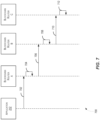
- FIG. 7 depicts a flow diagram illustrating a process 700 for performing message routing with a secure blockchain routing protocol (e.g., the extended blockchain protocol described herein) in accordance with at least some embodiments.
- a secure blockchain routing protocol e.g., the extended blockchain protocol described herein
- any of the processes described herein may be performed under the control of one or more computer systems configured with executable instructions and may be implemented as code (e.g., executable instructions, one or more computer programs or one or more applications).
- the process 700 of FIG. 7 may be performed by at least the routing manager 416 and/or the inter-controller routing manager 418 of FIG. 4 .
- the code may be stored on a computer-readable storage medium, for example, in the form of a computer program including a plurality of instructions executable by one or more processors.
- the computer-readable storage medium may be non-transitory.
- the process 700 may begin at 702, where an application running on a computing device configured to access a network may submit a task to blockchain router A via any suitable data message formatted according to the extended blockchain protocol discussed herein.
- the task may correspond to any suitable task for which routing functionality is required to route task information via a data message to a computing device of the network.
- the task may require that the task information be sent via a data message to a particular destination (e.g., the blockchain router C).
- the data message may be formatted and transmitted to the blockchain router A according to the extended blockchain protocol described herein.
- a destination address (e.g., corresponding to the blockchain router C) may be included in the data message transmitted to the blockchain router A may include a destination address field that specifies the destination as blockchain router C.
- blockchain router A may consult a locally stored forwarding table to determine a next hop address for the data message.
- the next hop address may indicate a network neighbor of blockchain router A (e.g., blockchain router B) that is closer to the destination (e.g., blockchain router C).
- the blockchain router A may request a forwarding route from another computing device configured to maintain a forwarding table corresponding to the blockchain router A.
- blockchain router A may transmit the data message to another blockchain router (e.g., the blockchain router B).
- the blockchain router A may modify the data message prior to transmission.
- the blockchain router A may modify a next hop address field within the data message to indicate that the data message is to be transmitted to blockchain router B.
- blockchain router B may consult a locally stored forwarding table to determine a next hop address for the data message.
- the next hop address may indicate a network neighbor of blockchain router B (e.g., blockchain router C).
- the blockchain router B may request a forwarding route from another computing device configured to maintain a forwarding table corresponding to the blockchain router B.
- blockchain router B may transmit the task information to another blockchain router (e.g., the blockchain router C).
- the blockchain router B may modify a data message prior to transmission.
- the blockchain router B may modify a next hop address field to indicate that the data message is to be transmitted to blockchain router C.
- blockchain router C may receive the data message, determine that it is the destination indicated in the data message, and process the data message payload.
- the blockchain router C may perform data message processing that includes performing operations for maintaining one or more blockchain ledgers of the information contained in the data message payload.
- blockchain router C may determine that the destination address corresponds to another computing device (e.g., a blockchain provider) known to the blockchain router C. In such examples, the blockchain router C may forward the data message to the destination address of the computing device for further processing.
- another computing device e.g., a blockchain provider
- Embodiments of the invention provide for a number of technical advantages.
- embodiments of the invention enable routing functionality utilizing an extended blockchain protocol.
- Traditional blockchain protocols do not include such routing functionality.
- the techniques described herein enable an overlay network that provides decentralized routing where the routing and/or forwarding information of the overlay network is maintained by some or all of the overlay network participants. This relieves the participants from utilizing a centralized network, such as the Internet, for message routing. Accordingly, the privacy of the data being exchanged may be guarded to a greater extent than is possible using the standard message protocols utilized by the Internet.
- the techniques provided herein enable monetization of network routing and such monetary costs may be utilized to perform routing decisions. Such costs may be collected via traditional billing/payment procedures.
- the techniques provided herein enable overlay network participants to provide a more secure means to transfer data messages than the security provided by the Internet as routing and/or forwarding tables may themselves by maintained within blockchain ledgers, which by their very nature, are tamper resistant.
- any of the embodiments of the present invention can be implemented in the form of control logic using hardware (e.g. an application specific integrated circuit or field programmable gate array) and/or using computer software with a generally programmable processor in a modular or integrated manner.
- a processor includes a single-core processor, multi-core processor on a same integrated chip, or multiple processing units on a single circuit board or networked. Based on the disclosure and teachings provided herein, a person of ordinary skill in the art will know and appreciate other ways and/or methods to implement embodiments of the present invention using hardware and a combination of hardware and software.
- any of the software components or functions described in this application may be implemented as software code to be executed by a processor using any suitable computer language such as, for example, Java, C, C++, C#, Objective-C, Swift, or scripting language such as Perl or Python using, for example, conventional or object-oriented techniques.
- the software code may be stored as a series of instructions or commands on a computer readable medium for storage and/or transmission, suitable media include random access memory (RAM), a read only memory (ROM), a magnetic medium such as a hard-drive or a floppy disk, or an optical medium such as a compact disk (CD) or DVD (digital versatile disk), flash memory, and the like.
- RAM random access memory
- ROM read only memory
- magnetic medium such as a hard-drive or a floppy disk
- an optical medium such as a compact disk (CD) or DVD (digital versatile disk), flash memory, and the like.
- the computer readable medium may be any combination of such storage or transmission devices.
- Such programs may also be encoded and transmitted using carrier signals adapted for transmission via wired, optical, and/or wireless networks conforming to a variety of protocols, including the Internet.
- a computer readable medium may be created using a data signal encoded with such programs.
- Computer readable media encoded with the program code may be packaged with a compatible device or provided separately from other devices (e.g., via Internet download). Any such computer readable medium may reside on or within a single computer product (e.g. a hard drive, a CD, or an entire computer system), and may be present on or within different computer products within a system or network.
- a computer system may include a monitor, printer, or other suitable display for providing any of the results mentioned herein to a user.
Landscapes
- Engineering & Computer Science (AREA)
- Computer Security & Cryptography (AREA)
- Computer Networks & Wireless Communication (AREA)
- Signal Processing (AREA)
- Data Exchanges In Wide-Area Networks (AREA)
- Peptides Or Proteins (AREA)
Claims (14)
- Computerimplementiertes Verfahren zum Verwalten einer Routing-Tabelle unter Verwendung eines sicheren Blockchain-Routing-Protokolls, das von einem Blockchain-Routing-Knoten (A) eines Overlay-Netzwerks (106) durchgeführt wird, umfassend:Senden (604, 610) von Weiterleitungstabellen-Anforderungsnachrichten an eine Vielzahl von Blockchain-Routing-Knoten (B, C);Empfangen (608, 614) einer Weiterleitungstabelle (318) von jedem der Vielzahl von Blockchain-Routing-Knoten (B, C) gemäß einem erweiterten Blockchain-Protokoll, wobei jede der Knotenweiterleitungstabellen einem jeweiligen der Vielzahl von Blockchain-Routing-Knoten (B, C) entspricht, wobei der Blockchain-Routing-Knoten (A) an der Vielzahl von Blockchain-Routing-Knoten (B, C) in dem Overlay-Netzwerk (106) beteiligt ist;Bestimmen (616) der Routing-Tabelle (316) für das Overlay-Netzwerk (106) unter Verwendung von Weiterleitungsinformationen, die mit den Weiterleitungstabellen (318) empfangen wurden;Bestimmen (618) entsprechender Weiterleitungstabellen für jede geeignete Kombination aus dem Blockchain-Routing-Knoten (A) und der Vielzahl von Blockchain-Routing-Knoten (B, C) durch Berechnen eines Gesamtaufwands im Zusammenhang mit jedem verfügbaren Leitweg, der mit den empfangenen Weiterleitungsinformationen verbunden ist, um mindestens einen optimalen Leitweg zwischen jedem der Blockchain-Routing-Knoten (A, B, C) in dem Netzwerk unter Verwendung des berechneten Aufwands zu bestimmen;Verteilen (620) der bestimmten Weiterleitungstabellen an die Vielzahl von Blockchain-Routing-Knoten (B, C); undAufrechterhalten (622) der bestimmten Routing-Tabelle und der bestimmten Weiterleitungstabellen in einem oder mehreren Blockchain-Ledgers durch Senden und/oder Empfangen von Informationen zu und/oder von dem Blockchain-Routing-Knoten (A) und einer Vielzahl von Blockchain-Routing-Knoten (B, C), um den einen oder die mehreren Blockchain-Ledger gemeinsam aufrechtzuerhalten.
- Computerimplementiertes Verfahren nach Anspruch 1, ferner umfassend:Ausführen, durch den Blockchain-Routing-Knoten (A), von Anweisungen zum Beitreten zu dem Overlay-Netzwerk (106); undIdentifizieren, durch den Blockchain-Routing-Knoten (A), der Vielzahl von Blockchain-Routing-Knoten (B, C) aus einem gespeicherten Datensatz.
- Verfahren nach Anspruch 2, wobei der Datensatz in einem lokalen Speicher des Blockchain-Routing-Knotens (A) gespeichert wird.
- Computerimplementiertes Verfahren nach Anspruch 1, ferner umfassend Konsultieren einer lokal gespeicherten Weiterleitungstabelle der bestimmten Weiterleitungstabellen (318), um eine nächste Sprungadresse für eine Datennachricht zu bestimmen, die über das Overlay-Netzwerk (106) zu übertragen ist.
- Computerimplementiertes Verfahren nach Anspruch 1, ferner umfassend Senden einer Verteilungsnachricht an die Vielzahl von Blockchain-Routing-Knoten (B, C), wobei die Verteilungsnachricht den Blockchain-Ledger umfasst, wobei die Verteilungsnachricht gemäß dem erweiterten Blockchain-Protokoll formatiert ist.
- Computerimplementiertes Verfahren nach Anspruch 1, wobei das Berechnen, durch den Blockchain-Routing-Knoten (A), des Gesamtaufwands im Zusammenhang mit jedem verfügbaren Leitweg, der mit den empfangenen Weiterleitungsinformationen assoziiert ist, um mindestens einen optimalen Leitweg zu bestimmen, ein Berechnen des Gesamtaufwands basierend auf Leistungsdaten im Zusammenhang mit entsprechenden Blockchain-Routing-Knoten der Vielzahl von Blockchain-Routing-Knoten umfasst.
- Computerimplementiertes Verfahren nach Anspruch 6, wobei die Leistungsdaten mindestens ein erstes Attribut im Zusammenhang mit einem Latenzwert und ein zweites Attribut im Zusammenhang mit einem Aufwandswert umfassen, wobei der Gesamtaufwand im Zusammenhang mit jedem verfügbaren Leitweg zumindest teilweise durch Multiplizieren des Latenzwerts mit dem Aufwandswert berechnet wird.
- Computerimplementiertes Verfahren nach Anspruch 1, wobei das erweiterte Blockchain-Protokoll mindestens eine Routing-Prozedur definiert, die in einem Blockchain-Protokoll, von dem sich das erweiterte Blockchain-Protokoll erweitert, undefiniert ist.
- Blockchain-Routing-Knoten (A), der konfiguriert ist, eine Routing-Tabelle zu verwalten, indem er ein sicheres Blockchain-Routing-Protokoll verwendet, umfassendeinen Prozessor, undein computerlesbares Medium, das mit dem Prozessor gekoppelt ist, wobei das computerlesbare Medium Code umfasst, der den Prozessor zu Folgendem veranlasst:Senden (604, 610) von Weiterleitungstabellen-Anforderungsnachrichten an eine Vielzahl von Blockchain-Routing-Knoten (B, C);Empfangen (608, 614) einer Weiterleitungstabelle (318) von jedem der Vielzahl von Blockchain-Routing-Knoten (B, C) gemäß einem erweiterten Blockchain-Protokoll, wobei jede der Knotenweiterleitungstabellen einem jeweiligen der Vielzahl von Blockchain-Routing-Knoten (B, C) entspricht, wobei der Blockchain-Routing-Knoten (A) an der Vielzahl von Blockchain-Routing-Knoten (B, C) in einem Overlay-Netzwerk (106) beteiligt ist;Bestimmen (616) der Routing-Tabelle (316) für das Overlay-Netzwerk (106) unter Verwendung von Weiterleitungsinformationen, die mit den Weiterleitungstabellen (318) empfangen wurden;Bestimmen (618) entsprechender Weiterleitungstabellen für jede geeignete Kombination aus Blockchain-Routing-Knoten (A) und der Vielzahl von Blockchain-Routing-Knoten (B, C) durch Berechnen eines Gesamtaufwands im Zusammenhang mit jedem verfügbaren Leitweg, der mit den empfangenen Weiterleitungsinformationen verbunden ist, um mindestens einen optimalen Leitweg zwischen jedem der Blockchain-Routing-Knoten (A, B, C) in dem Netzwerk unter Verwendung des berechneten Aufwands zu bestimmen;Verteilen (620) der bestimmten Weiterleitungstabellen an die Vielzahl von Blockchain-Routing-Knoten (B, C); undAufrechterhalten (622) der bestimmten Routing-Tabelle und der bestimmten Weiterleitungstabellen in einem oder mehreren Blockchain-Ledgers durch Senden und/oder Empfangen von Informationen zu/von dem Blockchain-Routing-Knoten (A) und der Vielzahl von Blockchain-Routing-Knoten (B, C), um den einen oder die mehreren Blockchain-Ledger gemeinsam aufrechtzuerhalten.
- Blockchain-Routing-Knoten (A) nach Anspruch 9, wobei das computerlesbare Medium zusätzlichen Code umfasst, um den Prozessor zu Folgendem zu veranlassen:Ausführen von Anweisungen zum Beitreten zu dem Overlay-Netzwerk (106); undIdentifizieren der Vielzahl von Blockchain-Routing-Knoten (B, C) aus einem gespeicherten Datensatz.
- Blockchain-Routing-Knoten (A) nach Anspruch 9, wobei das computerlesbare Medium Code umfasst, der den Prozessor veranlasst, eine lokal gespeicherte Weiterleitungstabelle der bestimmten Weiterleitungstabellen (318) zu konsultieren, um eine nächste Sprungadresse für eine Datennachricht zu bestimmen, die über das Overlay-Netzwerk (106) zu übertragen ist.
- Blockchain-Routing-Knoten (A) nach Anspruch 9, wobei das computerlesbare Medium zusätzlichen Code umfasst, um den Prozessor zu Folgendem zu veranlassen:
Senden einer Verteilungsnachricht an die Vielzahl von Blockchain-Routing-Knoten (B, C), wobei die Verteilungsnachricht den Blockchain-Ledger umfasst, wobei die Verteilungsnachricht gemäß dem erweiterten Blockchain-Protokoll formatiert ist. - Blockchain-Routing-Knoten (A) nach Anspruch 9, wobei der Code, der den Prozessor veranlasst, den Gesamtaufwand im Zusammenhang mit jedem verfügbaren Leitweg, der mit den empfangenen Weiterleitungsinformationen assoziiert ist, zu berechnen, um mindestens einen optimalen Leitweg zu bestimmen, so konfiguriert ist, dass er den Gesamtaufwand zumindest basierend teilweise auf Leistungsdaten im Zusammenhang mit entsprechenden Blockchain-Routing-Knoten der Vielzahl von Blockchain-Routing-Knoten berechnet.
- Blockchain-Routing-Knoten nach Anspruch 9, wobei das erweiterte Blockchain-Protokoll mindestens eine Routing-Prozedur definiert, die in einem Blockchain-Protokoll, von dem sich das erweiterte Blockchain-Protokoll erweitert, undefiniert ist.
Applications Claiming Priority (1)
| Application Number | Priority Date | Filing Date | Title |
|---|---|---|---|
| PCT/US2017/032762 WO2018212756A1 (en) | 2017-05-15 | 2017-05-15 | Techniques for secure blockchain routing |
Publications (3)
| Publication Number | Publication Date |
|---|---|
| EP3625935A1 EP3625935A1 (de) | 2020-03-25 |
| EP3625935A4 EP3625935A4 (de) | 2020-04-29 |
| EP3625935B1 true EP3625935B1 (de) | 2023-04-19 |
Family
ID=64274485
Family Applications (1)
| Application Number | Title | Priority Date | Filing Date |
|---|---|---|---|
| EP17909735.7A Active EP3625935B1 (de) | 2017-05-15 | 2017-05-15 | Verfahren für sicheres blockchain-routen |
Country Status (5)
| Country | Link |
|---|---|
| US (2) | US11108561B2 (de) |
| EP (1) | EP3625935B1 (de) |
| CN (2) | CN114844626B (de) |
| SG (1) | SG11201908957XA (de) |
| WO (1) | WO2018212756A1 (de) |
Families Citing this family (32)
| Publication number | Priority date | Publication date | Assignee | Title |
|---|---|---|---|---|
| EP3625935B1 (de) * | 2017-05-15 | 2023-04-19 | Visa International Service Association | Verfahren für sicheres blockchain-routen |
| CN107453896B (zh) * | 2017-06-27 | 2020-08-04 | 创新先进技术有限公司 | 多重区块链网络数据处理方法、装置及服务器 |
| US10977628B2 (en) | 2017-09-12 | 2021-04-13 | Northwestern University | Preventing service discrimination in a blockchain distribution network |
| US11132660B2 (en) * | 2017-12-12 | 2021-09-28 | Mastercard International Incorporated | Systems and methods for distributed peer to peer analytics |
| US10880070B1 (en) * | 2018-02-08 | 2020-12-29 | Rockwell Collins, Inc. | Distributed blockchain ledger for vehicular systems |
| US11184175B2 (en) | 2018-07-30 | 2021-11-23 | Hewlett Packard Enterprise Development Lp | Systems and methods for using secured representations of location and user distributed ledger addresses to prove user presence at a location and time |
| US11270403B2 (en) | 2018-07-30 | 2022-03-08 | Hewlett Packard Enterprise Development Lp | Systems and methods of obtaining verifiable image of entity by embedding secured representation of entity's distributed ledger address in image |
| US11250466B2 (en) | 2018-07-30 | 2022-02-15 | Hewlett Packard Enterprise Development Lp | Systems and methods for using secured representations of user, asset, and location distributed ledger addresses to prove user custody of assets at a location and time |
| US11488160B2 (en) | 2018-07-30 | 2022-11-01 | Hewlett Packard Enterprise Development Lp | Systems and methods for using captured time series of secured representations of distributed ledger addresses and smart contract deployed on distributed ledger network to prove compliance |
| US11356443B2 (en) | 2018-07-30 | 2022-06-07 | Hewlett Packard Enterprise Development Lp | Systems and methods for associating a user claim proven using a distributed ledger identity with a centralized identity of the user |
| US11403674B2 (en) * | 2018-07-30 | 2022-08-02 | Hewlett Packard Enterprise Development Lp | Systems and methods for capturing time series dataset over time that includes secured representations of distributed ledger addresses |
| US11233641B2 (en) | 2018-07-31 | 2022-01-25 | Hewlett Packard Enterprise Development Lp | Systems and methods for using distributed attestation to verify claim of attestation holder |
| US11271908B2 (en) | 2018-07-31 | 2022-03-08 | Hewlett Packard Enterprise Development Lp | Systems and methods for hiding identity of transacting party in distributed ledger transaction by hashing distributed ledger transaction ID using secured representation of distributed ledger address of transacting party as a key |
| US11488161B2 (en) | 2018-07-31 | 2022-11-01 | Hewlett Packard Enterprise Development Lp | Systems and methods for providing transaction provenance of off-chain transactions using distributed ledger transactions with secured representations of distributed ledger addresses of transacting parties |
| US10771384B2 (en) * | 2018-08-17 | 2020-09-08 | Tyson Trautmann | Routing based blockchain |
| CN110213224B (zh) * | 2019-04-19 | 2021-06-22 | 北京清红微谷技术开发有限责任公司 | 数据包异步转发方法和系统、数据处理系统及共识节点终端 |
| US20200372492A1 (en) * | 2019-05-21 | 2020-11-26 | American Express Travel Related Services Company, Inc. | Hyper-personalized identity-based financial system |
| CN110445882A (zh) * | 2019-09-19 | 2019-11-12 | 腾讯科技(深圳)有限公司 | 通信连接方法、装置、计算机设备及存储介质 |
| US11563679B1 (en) * | 2019-12-12 | 2023-01-24 | Architecture Technology Corporation | Distributed ledger adjustment in response to disconnected peer |
| GB2592225A (en) | 2020-02-19 | 2021-08-25 | Nchain Holdings Ltd | Attestation service for use with a blockchain network |
| GB2594684A (en) * | 2020-02-19 | 2021-11-10 | Nchain Holdings Ltd | Layered network |
| GB2592211A (en) | 2020-02-19 | 2021-08-25 | Nchain Holdings Ltd | Adapting connections of a layered network |
| CN111817967B (zh) | 2020-08-28 | 2020-12-18 | 支付宝(杭州)信息技术有限公司 | 区块链网络的通信优化系统及报文转发方法 |
| CN113079079B (zh) | 2020-09-25 | 2022-08-02 | 支付宝(杭州)信息技术有限公司 | 消息传输方法及装置 |
| CN112732775A (zh) * | 2020-12-23 | 2021-04-30 | 深圳壹账通智能科技有限公司 | 区块节点数据的处理方法、装置、计算机设备和存储介质 |
| CN113507480B (zh) * | 2021-07-23 | 2023-10-27 | 北京众享比特科技有限公司 | 网络设备、网闸设备和系统、网络间数据传输及汇报方法 |
| CN114500269B (zh) * | 2022-01-17 | 2023-04-07 | 重庆长安汽车股份有限公司 | 基于自定义属性对车端信号进行路由分发的方法及汽车 |
| US12587396B2 (en) * | 2022-10-06 | 2026-03-24 | Coinbase, Inc. | Systems and methods for recommending network processing routes when conducting network operations |
| US20240144246A1 (en) * | 2022-11-02 | 2024-05-02 | Opentensor Foundation | System and method for proof-of-stake validated serving of stake-prioritized utility |
| CN115996187B (zh) * | 2022-11-18 | 2025-05-16 | 京东科技控股股份有限公司 | 路由信息处理方法、装置、路由信息交互系统和路由设备 |
| CN115811498A (zh) * | 2023-02-06 | 2023-03-17 | 北京微芯区块链与边缘计算研究院 | 一种联盟链的节点路由方法、装置、设备及存储介质 |
| US20250252440A1 (en) * | 2024-02-05 | 2025-08-07 | Stillmark Management LLC | Automated channel management for a second-layer payment protocol network via discrete optimization and simulation |
Family Cites Families (8)
| Publication number | Priority date | Publication date | Assignee | Title |
|---|---|---|---|---|
| CN105378790B (zh) | 2013-03-15 | 2020-06-12 | 索库里公司 | 使用社交联网数据的风险评估 |
| US10565588B2 (en) * | 2015-03-12 | 2020-02-18 | International Business Machines Corporation | Cryptographic methods implementing proofs of work in systems of interconnected nodes |
| KR101628624B1 (ko) * | 2015-06-01 | 2016-06-09 | 주식회사 코인플러그 | 비트코인을 기반으로 하는 이종국가간 송금시스템 및 방법 |
| CN105657022B (zh) * | 2015-06-15 | 2019-04-05 | 重庆高开清芯科技产业发展有限公司 | 主动推送信息的方法和嵌入式节点操作系统 |
| US20170048209A1 (en) | 2015-07-14 | 2017-02-16 | Fmr Llc | Crypto Key Recovery and Social Aggregating, Fractionally Efficient Transfer Guidance, Conditional Triggered Transaction, Datastructures, Apparatuses, Methods and Systems |
| WO2017066431A1 (en) | 2015-10-13 | 2017-04-20 | TransActive Grid Inc. | Use of blockchain based distributed consensus control |
| CN106656784B (zh) * | 2016-10-14 | 2020-01-21 | 中国银联股份有限公司 | 用于区块链网络的数据流传播系统及方法 |
| EP3625935B1 (de) * | 2017-05-15 | 2023-04-19 | Visa International Service Association | Verfahren für sicheres blockchain-routen |
-
2017
- 2017-05-15 EP EP17909735.7A patent/EP3625935B1/de active Active
- 2017-05-15 CN CN202210662184.2A patent/CN114844626B/zh active Active
- 2017-05-15 WO PCT/US2017/032762 patent/WO2018212756A1/en not_active Ceased
- 2017-05-15 CN CN201780090818.9A patent/CN110622474B/zh active Active
- 2017-05-15 US US16/604,056 patent/US11108561B2/en active Active
- 2017-05-15 SG SG11201908957X patent/SG11201908957XA/en unknown
-
2021
- 2021-08-02 US US17/391,447 patent/US11716202B2/en active Active
Also Published As
| Publication number | Publication date |
|---|---|
| US11108561B2 (en) | 2021-08-31 |
| US20210359860A1 (en) | 2021-11-18 |
| US11716202B2 (en) | 2023-08-01 |
| CN110622474A (zh) | 2019-12-27 |
| EP3625935A4 (de) | 2020-04-29 |
| SG11201908957XA (en) | 2019-10-30 |
| WO2018212756A1 (en) | 2018-11-22 |
| EP3625935A1 (de) | 2020-03-25 |
| CN114844626B (zh) | 2026-03-24 |
| US20200076610A1 (en) | 2020-03-05 |
| CN114844626A (zh) | 2022-08-02 |
| CN110622474B (zh) | 2022-06-28 |
Similar Documents
| Publication | Publication Date | Title |
|---|---|---|
| EP3625935B1 (de) | Verfahren für sicheres blockchain-routen | |
| US11995618B2 (en) | Blockchain network interaction controller | |
| Roos et al. | Settling payments fast and private: Efficient decentralized routing for path-based transactions | |
| US10116593B1 (en) | Transmission and storage of routing path information and routing topology information using a single routing protocol | |
| US20130282860A1 (en) | Name-Based Neighbor Discovery and Multi-Hop Service Discovery in Information-Centric Networks | |
| Gopala Krishnan et al. | Energy and trust management framework for MANET using clustering algorithm | |
| US20220182243A1 (en) | Method and Apparatus for Distributed Ledger | |
| US10250484B2 (en) | Network service computation system | |
| Ahmadi et al. | A hybrid algorithm for preserving energy and delay routing in mobile ad-hoc networks | |
| US20130177024A1 (en) | Content-centric network and method of performing routing between domains therefor | |
| Wang et al. | FairCache: Introducing fairness to ICN caching | |
| WO2017036163A1 (zh) | 一种报文发送方法及系统 | |
| Murad et al. | Secure and efficient hierarchical P2P fog architecture: A novel approach for IoT | |
| Yassine et al. | Routing approaches in named data network: a survey and emerging research challenges | |
| Popat et al. | A study of routing protocols for MANETs | |
| Raj et al. | Secure cloud communication for effective cost management system through msbe | |
| CN106850430A (zh) | 一种域间路由方法、装置及网络侧设备 | |
| Chang et al. | Simulate and compare routing protocols for smart green systems | |
| Preet Singh et al. | Performance issues and behavioral analysis of routing protocols in MANETs | |
| US20230246961A1 (en) | Methods and systems for routing network traffic among organizations using a service-oriented protocol | |
| Banerjee et al. | A New Approach to Trace the Behaviour Pattern of Nodes in the Delay Tolerant Network | |
| Sindhuja et al. | Mobility assisted uncertainty reduction in manets using forward node optimization | |
| Hung et al. | Edge Computing Acceleration: From 5G to 6G and Beyond | |
| Ove et al. | Performance Evaluation and Comparison of LANMAR and LAR1 Routing Protocols Using QualNet | |
| Ahmat et al. | Towards securing communications in infrastructure-poor areas |
Legal Events
| Date | Code | Title | Description |
|---|---|---|---|
| STAA | Information on the status of an ep patent application or granted ep patent |
Free format text: STATUS: THE INTERNATIONAL PUBLICATION HAS BEEN MADE |
|
| PUAI | Public reference made under article 153(3) epc to a published international application that has entered the european phase |
Free format text: ORIGINAL CODE: 0009012 |
|
| STAA | Information on the status of an ep patent application or granted ep patent |
Free format text: STATUS: REQUEST FOR EXAMINATION WAS MADE |
|
| 17P | Request for examination filed |
Effective date: 20191216 |
|
| AK | Designated contracting states |
Kind code of ref document: A1 Designated state(s): AL AT BE BG CH CY CZ DE DK EE ES FI FR GB GR HR HU IE IS IT LI LT LU LV MC MK MT NL NO PL PT RO RS SE SI SK SM TR |
|
| AX | Request for extension of the european patent |
Extension state: BA ME |
|
| A4 | Supplementary search report drawn up and despatched |
Effective date: 20200327 |
|
| RIC1 | Information provided on ipc code assigned before grant |
Ipc: H04L 9/06 20060101ALI20200324BHEP Ipc: H04L 12/715 20130101AFI20200324BHEP Ipc: H04L 12/741 20130101ALI20200324BHEP |
|
| DAV | Request for validation of the european patent (deleted) | ||
| DAX | Request for extension of the european patent (deleted) | ||
| STAA | Information on the status of an ep patent application or granted ep patent |
Free format text: STATUS: EXAMINATION IS IN PROGRESS |
|
| 17Q | First examination report despatched |
Effective date: 20210601 |
|
| REG | Reference to a national code |
Ref country code: DE Ref legal event code: R079 Ref document number: 602017067972 Country of ref document: DE Free format text: PREVIOUS MAIN CLASS: H04L0012715000 Ipc: H04L0009320000 |
|
| RIC1 | Information provided on ipc code assigned before grant |
Ipc: H04L 9/00 20060101ALI20220902BHEP Ipc: H04L 9/32 20060101AFI20220902BHEP |
|
| GRAJ | Information related to disapproval of communication of intention to grant by the applicant or resumption of examination proceedings by the epo deleted |
Free format text: ORIGINAL CODE: EPIDOSDIGR1 |
|
| GRAP | Despatch of communication of intention to grant a patent |
Free format text: ORIGINAL CODE: EPIDOSNIGR1 |
|
| GRAP | Despatch of communication of intention to grant a patent |
Free format text: ORIGINAL CODE: EPIDOSNIGR1 |
|
| STAA | Information on the status of an ep patent application or granted ep patent |
Free format text: STATUS: GRANT OF PATENT IS INTENDED |
|
| INTG | Intention to grant announced |
Effective date: 20221212 |
|
| GRAS | Grant fee paid |
Free format text: ORIGINAL CODE: EPIDOSNIGR3 |
|
| GRAA | (expected) grant |
Free format text: ORIGINAL CODE: 0009210 |
|
| STAA | Information on the status of an ep patent application or granted ep patent |
Free format text: STATUS: THE PATENT HAS BEEN GRANTED |
|
| AK | Designated contracting states |
Kind code of ref document: B1 Designated state(s): AL AT BE BG CH CY CZ DE DK EE ES FI FR GB GR HR HU IE IS IT LI LT LU LV MC MK MT NL NO PL PT RO RS SE SI SK SM TR |
|
| REG | Reference to a national code |
Ref country code: GB Ref legal event code: FG4D |
|
| REG | Reference to a national code |
Ref country code: CH Ref legal event code: EP |
|
| REG | Reference to a national code |
Ref country code: DE Ref legal event code: R096 Ref document number: 602017067972 Country of ref document: DE |
|
| REG | Reference to a national code |
Ref country code: IE Ref legal event code: FG4D |
|
| REG | Reference to a national code |
Ref country code: AT Ref legal event code: REF Ref document number: 1562012 Country of ref document: AT Kind code of ref document: T Effective date: 20230515 |
|
| P01 | Opt-out of the competence of the unified patent court (upc) registered |
Effective date: 20230511 |
|
| REG | Reference to a national code |
Ref country code: LT Ref legal event code: MG9D |
|
| REG | Reference to a national code |
Ref country code: NL Ref legal event code: MP Effective date: 20230419 |
|
| REG | Reference to a national code |
Ref country code: AT Ref legal event code: MK05 Ref document number: 1562012 Country of ref document: AT Kind code of ref document: T Effective date: 20230419 |
|
| PG25 | Lapsed in a contracting state [announced via postgrant information from national office to epo] |
Ref country code: NL Free format text: LAPSE BECAUSE OF FAILURE TO SUBMIT A TRANSLATION OF THE DESCRIPTION OR TO PAY THE FEE WITHIN THE PRESCRIBED TIME-LIMIT Effective date: 20230419 |
|
| PG25 | Lapsed in a contracting state [announced via postgrant information from national office to epo] |
Ref country code: SE Free format text: LAPSE BECAUSE OF FAILURE TO SUBMIT A TRANSLATION OF THE DESCRIPTION OR TO PAY THE FEE WITHIN THE PRESCRIBED TIME-LIMIT Effective date: 20230419 Ref country code: PT Free format text: LAPSE BECAUSE OF FAILURE TO SUBMIT A TRANSLATION OF THE DESCRIPTION OR TO PAY THE FEE WITHIN THE PRESCRIBED TIME-LIMIT Effective date: 20230821 Ref country code: NO Free format text: LAPSE BECAUSE OF FAILURE TO SUBMIT A TRANSLATION OF THE DESCRIPTION OR TO PAY THE FEE WITHIN THE PRESCRIBED TIME-LIMIT Effective date: 20230719 Ref country code: ES Free format text: LAPSE BECAUSE OF FAILURE TO SUBMIT A TRANSLATION OF THE DESCRIPTION OR TO PAY THE FEE WITHIN THE PRESCRIBED TIME-LIMIT Effective date: 20230419 Ref country code: AT Free format text: LAPSE BECAUSE OF FAILURE TO SUBMIT A TRANSLATION OF THE DESCRIPTION OR TO PAY THE FEE WITHIN THE PRESCRIBED TIME-LIMIT Effective date: 20230419 |
|
| PG25 | Lapsed in a contracting state [announced via postgrant information from national office to epo] |
Ref country code: RS Free format text: LAPSE BECAUSE OF FAILURE TO SUBMIT A TRANSLATION OF THE DESCRIPTION OR TO PAY THE FEE WITHIN THE PRESCRIBED TIME-LIMIT Effective date: 20230419 Ref country code: PL Free format text: LAPSE BECAUSE OF FAILURE TO SUBMIT A TRANSLATION OF THE DESCRIPTION OR TO PAY THE FEE WITHIN THE PRESCRIBED TIME-LIMIT Effective date: 20230419 Ref country code: LV Free format text: LAPSE BECAUSE OF FAILURE TO SUBMIT A TRANSLATION OF THE DESCRIPTION OR TO PAY THE FEE WITHIN THE PRESCRIBED TIME-LIMIT Effective date: 20230419 Ref country code: LT Free format text: LAPSE BECAUSE OF FAILURE TO SUBMIT A TRANSLATION OF THE DESCRIPTION OR TO PAY THE FEE WITHIN THE PRESCRIBED TIME-LIMIT Effective date: 20230419 Ref country code: IS Free format text: LAPSE BECAUSE OF FAILURE TO SUBMIT A TRANSLATION OF THE DESCRIPTION OR TO PAY THE FEE WITHIN THE PRESCRIBED TIME-LIMIT Effective date: 20230819 Ref country code: HR Free format text: LAPSE BECAUSE OF FAILURE TO SUBMIT A TRANSLATION OF THE DESCRIPTION OR TO PAY THE FEE WITHIN THE PRESCRIBED TIME-LIMIT Effective date: 20230419 Ref country code: GR Free format text: LAPSE BECAUSE OF FAILURE TO SUBMIT A TRANSLATION OF THE DESCRIPTION OR TO PAY THE FEE WITHIN THE PRESCRIBED TIME-LIMIT Effective date: 20230720 Ref country code: AL Free format text: LAPSE BECAUSE OF FAILURE TO SUBMIT A TRANSLATION OF THE DESCRIPTION OR TO PAY THE FEE WITHIN THE PRESCRIBED TIME-LIMIT Effective date: 20230419 |
|
| PG25 | Lapsed in a contracting state [announced via postgrant information from national office to epo] |
Ref country code: FI Free format text: LAPSE BECAUSE OF FAILURE TO SUBMIT A TRANSLATION OF THE DESCRIPTION OR TO PAY THE FEE WITHIN THE PRESCRIBED TIME-LIMIT Effective date: 20230419 |
|
| REG | Reference to a national code |
Ref country code: CH Ref legal event code: PL |
|
| PG25 | Lapsed in a contracting state [announced via postgrant information from national office to epo] |
Ref country code: SK Free format text: LAPSE BECAUSE OF FAILURE TO SUBMIT A TRANSLATION OF THE DESCRIPTION OR TO PAY THE FEE WITHIN THE PRESCRIBED TIME-LIMIT Effective date: 20230419 |
|
| PG25 | Lapsed in a contracting state [announced via postgrant information from national office to epo] |
Ref country code: MC Free format text: LAPSE BECAUSE OF FAILURE TO SUBMIT A TRANSLATION OF THE DESCRIPTION OR TO PAY THE FEE WITHIN THE PRESCRIBED TIME-LIMIT Effective date: 20230419 |
|
| REG | Reference to a national code |
Ref country code: DE Ref legal event code: R097 Ref document number: 602017067972 Country of ref document: DE |
|
| REG | Reference to a national code |
Ref country code: BE Ref legal event code: MM Effective date: 20230531 |
|
| PG25 | Lapsed in a contracting state [announced via postgrant information from national office to epo] |
Ref country code: SM Free format text: LAPSE BECAUSE OF FAILURE TO SUBMIT A TRANSLATION OF THE DESCRIPTION OR TO PAY THE FEE WITHIN THE PRESCRIBED TIME-LIMIT Effective date: 20230419 Ref country code: SK Free format text: LAPSE BECAUSE OF FAILURE TO SUBMIT A TRANSLATION OF THE DESCRIPTION OR TO PAY THE FEE WITHIN THE PRESCRIBED TIME-LIMIT Effective date: 20230419 Ref country code: RO Free format text: LAPSE BECAUSE OF FAILURE TO SUBMIT A TRANSLATION OF THE DESCRIPTION OR TO PAY THE FEE WITHIN THE PRESCRIBED TIME-LIMIT Effective date: 20230419 Ref country code: MC Free format text: LAPSE BECAUSE OF FAILURE TO SUBMIT A TRANSLATION OF THE DESCRIPTION OR TO PAY THE FEE WITHIN THE PRESCRIBED TIME-LIMIT Effective date: 20230419 Ref country code: LU Free format text: LAPSE BECAUSE OF NON-PAYMENT OF DUE FEES Effective date: 20230515 Ref country code: LI Free format text: LAPSE BECAUSE OF NON-PAYMENT OF DUE FEES Effective date: 20230531 Ref country code: EE Free format text: LAPSE BECAUSE OF FAILURE TO SUBMIT A TRANSLATION OF THE DESCRIPTION OR TO PAY THE FEE WITHIN THE PRESCRIBED TIME-LIMIT Effective date: 20230419 Ref country code: DK Free format text: LAPSE BECAUSE OF FAILURE TO SUBMIT A TRANSLATION OF THE DESCRIPTION OR TO PAY THE FEE WITHIN THE PRESCRIBED TIME-LIMIT Effective date: 20230419 Ref country code: CZ Free format text: LAPSE BECAUSE OF FAILURE TO SUBMIT A TRANSLATION OF THE DESCRIPTION OR TO PAY THE FEE WITHIN THE PRESCRIBED TIME-LIMIT Effective date: 20230419 Ref country code: CH Free format text: LAPSE BECAUSE OF NON-PAYMENT OF DUE FEES Effective date: 20230531 |
|
| PLBE | No opposition filed within time limit |
Free format text: ORIGINAL CODE: 0009261 |
|
| STAA | Information on the status of an ep patent application or granted ep patent |
Free format text: STATUS: NO OPPOSITION FILED WITHIN TIME LIMIT |
|
| REG | Reference to a national code |
Ref country code: IE Ref legal event code: MM4A |
|
| 26N | No opposition filed |
Effective date: 20240122 |
|
| PG25 | Lapsed in a contracting state [announced via postgrant information from national office to epo] |
Ref country code: IE Free format text: LAPSE BECAUSE OF NON-PAYMENT OF DUE FEES Effective date: 20230515 |
|
| PG25 | Lapsed in a contracting state [announced via postgrant information from national office to epo] |
Ref country code: IE Free format text: LAPSE BECAUSE OF NON-PAYMENT OF DUE FEES Effective date: 20230515 |
|
| PG25 | Lapsed in a contracting state [announced via postgrant information from national office to epo] |
Ref country code: SI Free format text: LAPSE BECAUSE OF FAILURE TO SUBMIT A TRANSLATION OF THE DESCRIPTION OR TO PAY THE FEE WITHIN THE PRESCRIBED TIME-LIMIT Effective date: 20230419 |
|
| PG25 | Lapsed in a contracting state [announced via postgrant information from national office to epo] |
Ref country code: SI Free format text: LAPSE BECAUSE OF FAILURE TO SUBMIT A TRANSLATION OF THE DESCRIPTION OR TO PAY THE FEE WITHIN THE PRESCRIBED TIME-LIMIT Effective date: 20230419 Ref country code: IT Free format text: LAPSE BECAUSE OF FAILURE TO SUBMIT A TRANSLATION OF THE DESCRIPTION OR TO PAY THE FEE WITHIN THE PRESCRIBED TIME-LIMIT Effective date: 20230419 Ref country code: BE Free format text: LAPSE BECAUSE OF NON-PAYMENT OF DUE FEES Effective date: 20230531 |
|
| PG25 | Lapsed in a contracting state [announced via postgrant information from national office to epo] |
Ref country code: BG Free format text: LAPSE BECAUSE OF FAILURE TO SUBMIT A TRANSLATION OF THE DESCRIPTION OR TO PAY THE FEE WITHIN THE PRESCRIBED TIME-LIMIT Effective date: 20230419 |
|
| PG25 | Lapsed in a contracting state [announced via postgrant information from national office to epo] |
Ref country code: BG Free format text: LAPSE BECAUSE OF FAILURE TO SUBMIT A TRANSLATION OF THE DESCRIPTION OR TO PAY THE FEE WITHIN THE PRESCRIBED TIME-LIMIT Effective date: 20230419 |
|
| PGFP | Annual fee paid to national office [announced via postgrant information from national office to epo] |
Ref country code: DE Payment date: 20250423 Year of fee payment: 9 |
|
| PGFP | Annual fee paid to national office [announced via postgrant information from national office to epo] |
Ref country code: GB Payment date: 20250423 Year of fee payment: 9 |
|
| PGFP | Annual fee paid to national office [announced via postgrant information from national office to epo] |
Ref country code: FR Payment date: 20250423 Year of fee payment: 9 |
|
| PG25 | Lapsed in a contracting state [announced via postgrant information from national office to epo] |
Ref country code: CY Free format text: LAPSE BECAUSE OF FAILURE TO SUBMIT A TRANSLATION OF THE DESCRIPTION OR TO PAY THE FEE WITHIN THE PRESCRIBED TIME-LIMIT; INVALID AB INITIO Effective date: 20170515 |
|
| PG25 | Lapsed in a contracting state [announced via postgrant information from national office to epo] |
Ref country code: HU Free format text: LAPSE BECAUSE OF FAILURE TO SUBMIT A TRANSLATION OF THE DESCRIPTION OR TO PAY THE FEE WITHIN THE PRESCRIBED TIME-LIMIT; INVALID AB INITIO Effective date: 20170515 |
|
| PG25 | Lapsed in a contracting state [announced via postgrant information from national office to epo] |
Ref country code: TR Free format text: LAPSE BECAUSE OF FAILURE TO SUBMIT A TRANSLATION OF THE DESCRIPTION OR TO PAY THE FEE WITHIN THE PRESCRIBED TIME-LIMIT Effective date: 20230419 |