EP3625307B1 - Iron sulfide scale control agent for geothermal wells - Google Patents
Iron sulfide scale control agent for geothermal wells Download PDFInfo
- Publication number
- EP3625307B1 EP3625307B1 EP18732983.4A EP18732983A EP3625307B1 EP 3625307 B1 EP3625307 B1 EP 3625307B1 EP 18732983 A EP18732983 A EP 18732983A EP 3625307 B1 EP3625307 B1 EP 3625307B1
- Authority
- EP
- European Patent Office
- Prior art keywords
- sulfide
- scale inhibitor
- copolymer
- weight
- ppm
- Prior art date
- Legal status (The legal status is an assumption and is not a legal conclusion. Google has not performed a legal analysis and makes no representation as to the accuracy of the status listed.)
- Active
Links
Images
Classifications
-
- C—CHEMISTRY; METALLURGY
- C02—TREATMENT OF WATER, WASTE WATER, SEWAGE, OR SLUDGE
- C02F—TREATMENT OF WATER, WASTE WATER, SEWAGE, OR SLUDGE
- C02F5/00—Softening water; Preventing scale; Adding scale preventatives or scale removers to water, e.g. adding sequestering agents
- C02F5/08—Treatment of water with complexing chemicals or other solubilising agents for softening, scale prevention or scale removal, e.g. adding sequestering agents
- C02F5/10—Treatment of water with complexing chemicals or other solubilising agents for softening, scale prevention or scale removal, e.g. adding sequestering agents using organic substances
- C02F5/12—Treatment of water with complexing chemicals or other solubilising agents for softening, scale prevention or scale removal, e.g. adding sequestering agents using organic substances containing nitrogen
-
- C—CHEMISTRY; METALLURGY
- C09—DYES; PAINTS; POLISHES; NATURAL RESINS; ADHESIVES; COMPOSITIONS NOT OTHERWISE PROVIDED FOR; APPLICATIONS OF MATERIALS NOT OTHERWISE PROVIDED FOR
- C09K—MATERIALS FOR MISCELLANEOUS APPLICATIONS, NOT PROVIDED FOR ELSEWHERE
- C09K8/00—Compositions for drilling of boreholes or wells; Compositions for treating boreholes or wells, e.g. for completion or for remedial operations
- C09K8/52—Compositions for preventing, limiting or eliminating depositions, e.g. for cleaning
- C09K8/528—Compositions for preventing, limiting or eliminating depositions, e.g. for cleaning inorganic depositions, e.g. sulfates or carbonates
-
- E—FIXED CONSTRUCTIONS
- E21—EARTH OR ROCK DRILLING; MINING
- E21B—EARTH OR ROCK DRILLING; OBTAINING OIL, GAS, WATER, SOLUBLE OR MELTABLE MATERIALS OR A SLURRY OF MINERALS FROM WELLS
- E21B37/00—Methods or apparatus for cleaning boreholes or wells
- E21B37/06—Methods or apparatus for cleaning boreholes or wells using chemical means for preventing or limiting, e.g. eliminating, the deposition of paraffins or like substances
-
- F—MECHANICAL ENGINEERING; LIGHTING; HEATING; WEAPONS; BLASTING
- F24—HEATING; RANGES; VENTILATING
- F24T—GEOTHERMAL COLLECTORS; GEOTHERMAL SYSTEMS
- F24T10/00—Geothermal collectors
- F24T10/20—Geothermal collectors using underground water as working fluid; using working fluid injected directly into the ground, e.g. using injection wells and recovery wells
-
- C—CHEMISTRY; METALLURGY
- C02—TREATMENT OF WATER, WASTE WATER, SEWAGE, OR SLUDGE
- C02F—TREATMENT OF WATER, WASTE WATER, SEWAGE, OR SLUDGE
- C02F2101/00—Nature of the contaminant
- C02F2101/10—Inorganic compounds
-
- C—CHEMISTRY; METALLURGY
- C02—TREATMENT OF WATER, WASTE WATER, SEWAGE, OR SLUDGE
- C02F—TREATMENT OF WATER, WASTE WATER, SEWAGE, OR SLUDGE
- C02F2101/00—Nature of the contaminant
- C02F2101/10—Inorganic compounds
- C02F2101/101—Sulfur compounds
-
- C—CHEMISTRY; METALLURGY
- C02—TREATMENT OF WATER, WASTE WATER, SEWAGE, OR SLUDGE
- C02F—TREATMENT OF WATER, WASTE WATER, SEWAGE, OR SLUDGE
- C02F2303/00—Specific treatment goals
- C02F2303/22—Eliminating or preventing deposits, scale removal, scale prevention
-
- C—CHEMISTRY; METALLURGY
- C02—TREATMENT OF WATER, WASTE WATER, SEWAGE, OR SLUDGE
- C02F—TREATMENT OF WATER, WASTE WATER, SEWAGE, OR SLUDGE
- C02F5/00—Softening water; Preventing scale; Adding scale preventatives or scale removers to water, e.g. adding sequestering agents
- C02F5/08—Treatment of water with complexing chemicals or other solubilising agents for softening, scale prevention or scale removal, e.g. adding sequestering agents
- C02F5/10—Treatment of water with complexing chemicals or other solubilising agents for softening, scale prevention or scale removal, e.g. adding sequestering agents using organic substances
- C02F5/12—Treatment of water with complexing chemicals or other solubilising agents for softening, scale prevention or scale removal, e.g. adding sequestering agents using organic substances containing nitrogen
- C02F5/125—Treatment of water with complexing chemicals or other solubilising agents for softening, scale prevention or scale removal, e.g. adding sequestering agents using organic substances containing nitrogen combined with inorganic substances
-
- Y—GENERAL TAGGING OF NEW TECHNOLOGICAL DEVELOPMENTS; GENERAL TAGGING OF CROSS-SECTIONAL TECHNOLOGIES SPANNING OVER SEVERAL SECTIONS OF THE IPC; TECHNICAL SUBJECTS COVERED BY FORMER USPC CROSS-REFERENCE ART COLLECTIONS [XRACs] AND DIGESTS
- Y02—TECHNOLOGIES OR APPLICATIONS FOR MITIGATION OR ADAPTATION AGAINST CLIMATE CHANGE
- Y02E—REDUCTION OF GREENHOUSE GAS [GHG] EMISSIONS, RELATED TO ENERGY GENERATION, TRANSMISSION OR DISTRIBUTION
- Y02E10/00—Energy generation through renewable energy sources
- Y02E10/10—Geothermal energy
Definitions
- the present invention relates to methods of using a combination of chemical compounds to inhibit or reduce sulfide and silica scale in aqueous systems.
- Geothermal energy is energy in the form of heat within the earth's interior, which can be tapped using geothermal wells.
- the earth's interior contains an enormous supply of heat, but challenges remain in extracting the heat for generating energy.
- Geothermal energy moves towards the earth's surface by thermal conduction through solid rock.
- Thermal energy can also be transmitted towards the earth's surface by movement of molten rock or by circulation of fluid (H 2 O as steam or water) through interconnected fractures and pores.
- Geothermal wells are in any instance relatively deep wells.
- Geothermal brines and steam are generally used as the energy source. Geothermal brine is used in power generation, heating and electrical processes. Geothermal steam temperatures range from about 185° C. to about 370° C. (about 365° F. to about 700° F.). Steam is separated from the brine using flashing units. Low temperature brines can also be used to produce electricity binary units (secondary fluid units).
- the geothermal brines can have a salinity from less than about 1000 ppm to several hundred thousand ppm, and a content of non-condensable gases up to about 6 percent. Depending upon the salt content and application, geothermal fluids may be used directly or through a secondary fluid cycle.
- geothermal energy as an energy source has risen in importance as other energy sources become less abundant and more expensive. This is a sustainable renewable source of energy, and unlike other renewable sources, geothermal energy is constantly available. Some geothermal steam power stations can generate up to about 250 MW.
- Mineral deposition is a major problem under the severe conditions encountered in the production of geothermal energy and can be a factor limiting the development of geothermal fields. Mineral deposition from the boiling geothermal fluid of a water-dominated reservoir is particularly a problem.
- Hydrogen sulfide is a naturally occurring contaminant of fluids or produced by sulfur reducing bacteria.
- the corrosive nature of H 2 S causes the accumulation of particulate iron sulfide.
- Iron compounds, including iron sulfide can form within pipeline networks that transport gas, oil, water and mixtures of gas, oil and water.
- the iron sulfide compounds are physically characterized as appearing to be amorphous solid particles capable of absorbing water.
- Iron sulfide becomes entrained in hydrocarbons, glycol, salts to form deposits on the surfaces of conduits such as pipelines.
- Sulfide scales may be present in different forms such as antimony and iron sulfide scale.
- the iron sulfide particles can adhere to the internal surfaces of pipeline networks and associated process equipment.
- the physical characteristic of the iron sulfide deposits can vary from a viscous oil coated mass to a dry black powder form.
- the buildup of iron and iron sulfide deposits over time can lead to a range of operational problems.
- the deposits can hinder accurate determinations of pipeline structural integrity and the pipelines must be cleaned physically.
- the presence of iron and iron sulfide deposits can lead to increased corrosion rates within pipeline networks.
- the deposits can also interfere with the safe operation of pipeline valving systems, potentially leading to catastrophic system failures. Therefore, cleaning is common practice in pipeline networks containing iron and iron sulfide deposits.
- Silica scale deposition in wells is also a problem.
- Amorphous silica scales cause significant fouling problems when industrial waters contain high quantities of silica.
- high quantities of silica means that the industrial waters contain at least about 5 ppm and up to about 500 ppm dissolved silica and may contain higher quantities of silica either in dissolved, dispersed, or colloidal forms.
- the silica and sulfide deposits may occur individually, mixed together, or mixed with other metal ions, such as iron, antimony, copper, etc.
- WO 2012/088240 A2 relates to an improved method for inhibiting the formation and deposition of silica arid silicate compounds in a water system.
- US 2006/124301 A1 discloses a well treating composition of a composite containing a scale inhibitor adsorbed onto a water-insoluble adsorbent is useful in the control, formation and treatment of inorganic scales in a subterranean formation or wellbore.
- a method for sulfide and silica scale inhibition or reduction in an aqueous system by injecting a composition into the aqueous system, wherein the composition comprises a sulfide scale inhibitor and a silica scale inhibitor.
- a method for sulfide and silica scale inhibition or reduction in a wellbore by injecting a composition into the wellbore, wherein the composition comprises a sulfide scale inhibitor and a silica scale inhibitor.
- the present disclosure also provides the use of a composition for sulfide and silica scale inhibition or reduction wherein the composition comprises a sulfide scale inhibitor and a silica scale inhibitor.
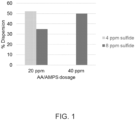
- FIG. 1 shows the effect of sulfide concentration on inhibition performance.
- Sulfide scale is less common than sulfate and carbonate scale but it also causes significant production problems in geothermal power plants. Sulfide salts typically have much lower solubility than conventional calcium sulfate and calcium carbonate scale.
- the most common type of sulfide scale is iron sulfide. Iron forms a variety of binary compounds with sulfur in contrast to other sulfide scales, such as lead sulfide and zinc sulfide, which form single sulfides. Many types of iron sulfides form in H 2 S rich environments including Troilite, Pyrrhotite, Mackinawite, Greigite, Pyrite, and Marcasite. Iron sulfide scales can transform from one form to another depending on physical conditions. Sulfide scales have been reported much more frequently in the last three decades, and more field cases are reporting that sulfide scale dominates other scale.
- Aqueous systems may form deposits of scale that include a mixture of different compounds, such as iron, sulfide, and silica.
- Mixed deposits containing sulfide scale may be resistant to sulfide scale inhibitors if not used in combination with other scale inhibitors.
- individual scale inhibitors used in combination with other scale inhibitors may lose their function because of unpredictable interactions between the inhibitors or between the mixture of inhibitors and the scale deposits. Therefore, there is a need for compositions of scale inhibitors that can inhibit or reduce mixed scale deposits.
- the present disclosure relates to compositions for inhibiting or reducing sulfide and silica scale deposits in aqueous systems.
- the aqueous system may be a geothermal well or geothermal power plant.
- Iron sulfide scale is a major challenge in geothermal wells because it impacts power generation and decreases efficiency.
- a method for sulfide and silica scale inhibition or reduction in an aqueous system.
- the method may include injecting a composition into the aqueous system.
- the composition may include a sulfide scale inhibitor and a silica scale inhibitor.
- the sulfide scale inhibitor and a silica scale inhibitor may be injected into the aqueous system together or separately in any sequence.
- the aqueous system may comprise cooling waters, geothermal waters, salt water for desalinization purposes, industrial waters being prepared for boiler treatment and steam generation, downhole waters for petroleum crude recovery, pulp and paper mill waters, or mining and mineral processing waters.
- the problem of amorphous silica scale formation on the surfaces in contact with these industrial waters is particularly noted when the industrial waters are alkaline, having a pH of at least about 5.0 or above, and contain at least about 5 ppm total silica as SiO 2 .
- the scale inhibitors are injected in geothermal wells via feed lines that may be generally formed of stainless steel or a highly corrosion-resistant alloy.
- the feed lines pass through the upwardly-flowing production stream and are the tubes through which the scale inhibitors are pumped downhole to the site at which the scale inhibitors are injected into the production stream.
- the fluids of the production stream are extremely hot, having temperatures on the order of from about 200 °C to about 260 °C (about 400 °F to about 500 °F), and the feed line temperatures likewise may reach temperatures from about 200 °C to about 260 °C.
- the composition may be injected at a point in the wellbore that may be from about 200 to about 400 feet below the lowest encountered scale formation site (generally the flash zone). This may be to ensure that the feed point is sufficiently ahead of the scale deposit area so that the inhibitor is adequately admixed in the production fluid when the first problem area is reached.
- a geothermal well itself may extend at least about 1 or 2 km (about 3,280 or 6,560 feet), and may be considerably deeper.
- Scale inhibitor feed lines that are from about 3,000 to about 5,000 feet long are not unusual. Scale inhibitor residence times in the feed lines may be from about 20 to about 30 minutes or longer.
- the composition may be injected into a condenser in the aqueous system.
- the condenser may contain water or brine.
- the brine may include iron, sulfide, and silica.
- the composition may be injected into a separator in the aqueous system.
- the separator may contain water or brine.
- the aqueous system may be a geothermal system.
- the geothermal system may be a geothermal power plant, such as a dry steam station, a flash steam station, or a binary cycle station.
- the aqueous system may include brine.
- the sulfide scale may be iron sulfide, antimony sulfide, lead sulfide, zinc sulfide, or any combination thereof.
- the sulfide scale may be iron sulfide, antimony sulfide, or any combination thereof.
- a method for sulfide and silica scale inhibition or reduction in a wellbore.
- the method may include injecting a composition into the wellbore.
- the composition may include a sulfide scale inhibitor and a silica scale inhibitor.
- the sulfide scale inhibitor may include a copolymer of acrylic acid or methacrylic acid and an anionic monomer.
- the anionic monomer may be 2-acrylamido-2-methylpropane sulfonic acid (AMPS), styrene sulfonic acid, 2-methyacrylimido-2-methylpropylsulfonic acid, vinyl sulfonic acid, sulfoalkyl acrylate, sulfoalkyl methacrylate, allyl sulfonic acid, 3-methacrylamido-2-hydroxypropylsulfonic acid, any salt thereof, or any combination thereof.
- AMPS 2-acrylamido-2-methylpropane sulfonic acid
- styrene sulfonic acid 2-methyacrylimido-2-methylpropylsulfonic acid
- vinyl sulfonic acid sulfoalkyl acrylate
- sulfoalkyl methacrylate sulfoalkyl methacrylate
- allyl sulfonic acid 3-methacrylamido-2-hydroxy
- the anionic monomer may be 2-acrylamido-2-methylpropane sulfonic acid (AMPS), styrene sulfonic acid, 2-methyacrylimido-2-methylpropylsulfonic acid, vinyl sulfonic acid, 3-methacrylamido-2-hydroxypropylsulfonic acid, any salt thereof, or any combination thereof.
- AMPS 2-acrylamido-2-methylpropane sulfonic acid
- styrene sulfonic acid 2-methyacrylimido-2-methylpropylsulfonic acid
- vinyl sulfonic acid 3-methacrylamido-2-hydroxypropylsulfonic acid, any salt thereof, or any combination thereof.
- the anionic monomer may be AMPS.
- the sulfide scale inhibitor may be a copolymer.
- the copolymer may include from about 40% to about 80% by weight of acrylic acid and from about 20% to about 60% by weight of AMPS.
- the scale inhibitor may be a copolymer of about 60% by weight acrylic acid and about 40% by weight AMPS.
- the silica scale inhibitor may include a copolymer of acrylic acid or methacrylic acid and an alkoxylated monomer. More specifically, the alkoxylated monomer can be derivatized from either ethylene oxide, propylene oxide, or any combination thereof. Average substitution ranges may range from about 4 to about 20 mole percent.
- the alkoxylated monomer may be hydroxypolyethoxy allyl ether (AAE), 3-allyloxy-1 ,2-propanediol, diethylene glycol monoallyl ether, tetraethylene glycol methyl vinyl ether, ethylene glycol vinyl ether, polyethoxy methacrylate, 1-allyloxy-2-hydroxypropane sulfonic acid, any salt thereof, or any combination thereof.
- AAE hydroxypolyethoxy allyl ether
- 3-allyloxy-1 ,2-propanediol diethylene glycol monoallyl ether
- tetraethylene glycol methyl vinyl ether ethylene glycol vinyl ether
- polyethoxy methacrylate 1-allyloxy-2-hydroxypropane sulfonic acid, any salt thereof, or any combination thereof.
- the alkoxylated monomer may be hydroxypolyethoxy allyl ether (AAE), 3-allyloxy-1 ,2-propanediol, tetraethylene glycol methyl vinyl ether, polyethoxy methacrylate, any salt thereof, or any combination thereof.
- AAE hydroxypolyethoxy allyl ether
- 3-allyloxy-1 ,2-propanediol 3-allyloxy-1 ,2-propanediol
- tetraethylene glycol methyl vinyl ether polyethoxy methacrylate, any salt thereof, or any combination thereof.
- the alkoxylated monomer may be hydroxypolyethoxy allyl ether (AAE), 3-allyloxy-1 ,2-propanediol, any salt thereof, or any combination thereof.
- AAE hydroxypolyethoxy allyl ether
- 3-allyloxy-1 ,2-propanediol any salt thereof, or any combination thereof.
- the alkoxylated monomer may be hydroxypolyethoxy (10) allyl ether (AAE-10).
- the silica scale inhibitor may be a copolymer that may include from about 30% to about 70% by weight of acrylic acid and from about 30% to about 70% by weight of AAE-10.
- the silica scale inhibitor may be a copolymer of about 50% by weight of acrylic acid and about 50% by weight of AAE-10.
- the composition injected into the aqueous system consists of a sulfide scale inhibitor and a silica scale inhibitor.
- the composition consists of a copolymer including from about 40% to about 80% by weight of acrylic acid and from about 20% to about 60% by weight of AMPS and another copolymer that may include from about 30% to about 70% by weight of acrylic acid and from about 30% to about 70% by weight of AAE-10.
- the composition consists of a sulfide scale inhibitor and a silica scale inhibitor, wherein the sulfide scale inhibitor may be a copolymer of about 60% by weight acrylic acid and about 40% by weight AMPS, and wherein the silica scale inhibitor may be a copolymer of about 50% by weight of acrylic acid and about 50% by weight of AAE-10.
- the weight average molecular weight of the sulfide scale inhibitor may range from about 1,000 Da to about 100,000 Da.
- the weight average molecular weight of the sulfide scale inhibitor may range from about 10,000 Da to about 20,000 Da or from about 14,000 Da to about 16,000 Da.
- the weight average molecular weight of the copolymers is determined using size exclusion chromatography.
- the weight average molecular weight of the silica scale inhibitor may range from about 1,000 Da to about 100,000 Da. In certain embodiments, the weight average molecular weight of the sulfide scale inhibitor may range from about 10,000 Da to about 20,000 Da or from about 14,000 Da to about 16,000 Da. The weight average molecular weight of the copolymers is determined using size exclusion chromatography.
- the sulfide scale inhibitor may be added in an amount ranging from about 1 ppm to about 500 ppm and the silica scale inhibitor may be added in an amount ranging from about 1 ppm to about 100 ppm.
- the sulfide scale inhibitor may be added in an amount ranging from about 1 ppm to about 100 ppm, about 5 ppm to about 100 ppm, about 5 ppm to about 50 ppm, about 5 ppm to about 40 ppm, about 10 ppm to about 100 ppm, about 10 ppm to about 50 ppm, or about 10 ppm to about 40 ppm. In some embodiments, the sulfide scale inhibitor may be added in an amount of about 20 ppm, about 30 ppm, about 40 ppm, or about 50 ppm.
- the silica scale inhibitor may be added in an amount ranging from about 1 ppm to about 100 ppm, about 1 ppm to about 50 ppm, or about 1 ppm to about 25 ppm. In some embodiments, the silica scale inhibitor may be added in an amount ranging from about 100 ppm to about 10,000 ppm. In some embodiments, the silica scale inhibitor may be added in an amount of about 20 ppm, about 30 ppm, about 40 ppm, or about 50 ppm.
- compositions of this disclosure may be injected into the aqueous system as aqueous solutions of scale inhibitor actives.
- Such compositions may contain from about 15 to about 70 weight percent actives.
- the compositions may contain from about 20 to about 30 weight percent actives.
- the aqueous compositions of scale inhibitors may be introduced into the feed line of a geothermal well, for delivery downhole, at actives concentrations of about 1 to about 15 weight percent. The actives concentration may be adjusted by injecting an aqueous diluent along with the composition or to flush the feed lines.
- the composition may include additional additives, such as a hydrogen sulfide scavenger, a corrosion inhibitor, a dispersant, a gas hydrate inhibitor, a biocide, a surfactant, a solvent, an inert tracer, or any combination thereof.
- additional additives such as a hydrogen sulfide scavenger, a corrosion inhibitor, a dispersant, a gas hydrate inhibitor, a biocide, a surfactant, a solvent, an inert tracer, or any combination thereof.
- the composition may include one or more corrosion inhibitors, one or more other scale inhibitors, one or more fluorescent tracers, one or more water treatment polymers, one or more polyalkoxy compounds, or any other suitable additive or additional component.
- such additives may be added simultaneously or sequentially with the polymers of the invention.
- the composition may include an inert tracer, making it compatible with fluorescent tracing technology such as 3D TRASAR ® technology (available from Nalco ® Company, Naperville, III., USA).
- an inert fluorescent tracer may be included in the composition to provide a means of determining the dosage level.
- a known proportion of the fluorescent tracer may be added either simultaneously or sequentially with the scale inhibitors in the composition.
- Effective inert fluorescent tracers may include those substances that are chemically non-reactive with other components in the system and that do not significantly degrade with time.
- Representative inert fluorescent tracers include fluorescein or fluorescein derivatives; rhodamine or rhodamine derivatives; naphthalene sulfonic acids (mono-, di-, tri-, etc.); pyrene sulfonic acids (mono-, di-, tri-, tetra-, etc.); stilbene derivatives containing sulfonic acids (including optical brighteners); biphenyl sulfonic acids; phenylalanine; tryptophan; tyrosine; vitamin B2 (riboflavin); vitamin B6 (pyridoxin); vitamin E (a-tocopherols); ethoxyquin; caffeine; vanillin; naphthalene sulfonic acid formaldehyde condensation polymers; phenyl sulfonic acid formaldehyde condensates; lignin sulfonic acids; polycyclic aromatic hydrocarbons; aromatic (poly)cyclic hydrocarbons
- compositions may include additional scale inhibitors to disperse scales other than sulfide and silica.
- additional scale inhibitors may include, but are not limited to, inorganic and organic polyphosphate, phosphonates, and polycarboxylates. These inhibitors may help inhibit or disperse other scales such as calcium carbonate, calcium sulfate, calcium phosphate, calcium fluoride, barium sulfate, calcium oxalate.
- the disclosed methods may be combined with other utilities known in the industry.
- Representative utilities include sensors for measuring the content of various additives in the system; dissolved or particulate contaminant sensors; other sensors based upon resistance, capacitance, spectroscopic absorbance or transmittance, calorimetric measurements, and fluorescence; and mathematical tools for analyzing sensor/controller results (e.g. multivariate analysis, chemometrics, on/off dosage control, PID dosage control, and combinations thereof).
- Polymer % Dispersion Control 0 Polymethacrylic acid and a copolymer of acrylic acid and AMPS* 903 38 Copolymer of acrylic acid (60%) and AMPS (40%) 69 Copolymer of acrylic acid (50%) and Maleic Anhydride (50%) 116 15 Copolymer of Maleic Anhydride and sulfo styrene 310 35 Polyamino polyether methylene phosphonic acid and a copolymer of acrylic acid and AMPS* 00m 22 *50/50 blend by weight of the two polymers
- a copolymer of acrylic acid and AMPS (AA/AMPS; 60/40 by weight) was added to brine in an amount of about 20 ppm for about 16 hours. Even after about 16 hours, greater than about 80% of the iron remained dispersed in the brine containing the copolymer. In the control, about 10 ppm of iron in the form of iron sulfide precipitated. At about 20 ppm, the copolymer exhibited about 52% inhibition of iron sulfide precipitate.
Landscapes
- Chemical & Material Sciences (AREA)
- Engineering & Computer Science (AREA)
- Life Sciences & Earth Sciences (AREA)
- Organic Chemistry (AREA)
- Environmental & Geological Engineering (AREA)
- Hydrology & Water Resources (AREA)
- General Chemical & Material Sciences (AREA)
- Chemical Kinetics & Catalysis (AREA)
- General Life Sciences & Earth Sciences (AREA)
- Geology (AREA)
- Mining & Mineral Resources (AREA)
- Water Supply & Treatment (AREA)
- Inorganic Chemistry (AREA)
- Materials Engineering (AREA)
- Sustainable Development (AREA)
- Mechanical Engineering (AREA)
- General Engineering & Computer Science (AREA)
- Physics & Mathematics (AREA)
- Fluid Mechanics (AREA)
- Combustion & Propulsion (AREA)
- Sustainable Energy (AREA)
- Geochemistry & Mineralogy (AREA)
- Preventing Corrosion Or Incrustation Of Metals (AREA)
- Compositions Of Macromolecular Compounds (AREA)
- Addition Polymer Or Copolymer, Post-Treatments, Or Chemical Modifications (AREA)
Description
- The present invention relates to methods of using a combination of chemical compounds to inhibit or reduce sulfide and silica scale in aqueous systems.
- Geothermal energy is energy in the form of heat within the earth's interior, which can be tapped using geothermal wells. The earth's interior contains an enormous supply of heat, but challenges remain in extracting the heat for generating energy. Geothermal energy moves towards the earth's surface by thermal conduction through solid rock. Thermal energy can also be transmitted towards the earth's surface by movement of molten rock or by circulation of fluid (H2O as steam or water) through interconnected fractures and pores. Geothermal wells are in any instance relatively deep wells.
- Geothermal brines and steam are generally used as the energy source. Geothermal brine is used in power generation, heating and electrical processes. Geothermal steam temperatures range from about 185° C. to about 370° C. (about 365° F. to about 700° F.). Steam is separated from the brine using flashing units. Low temperature brines can also be used to produce electricity binary units (secondary fluid units). The geothermal brines can have a salinity from less than about 1000 ppm to several hundred thousand ppm, and a content of non-condensable gases up to about 6 percent. Depending upon the salt content and application, geothermal fluids may be used directly or through a secondary fluid cycle. The use of geothermal energy as an energy source has risen in importance as other energy sources become less abundant and more expensive. This is a sustainable renewable source of energy, and unlike other renewable sources, geothermal energy is constantly available. Some geothermal steam power stations can generate up to about 250 MW.
- Mineral deposition is a major problem under the severe conditions encountered in the production of geothermal energy and can be a factor limiting the development of geothermal fields. Mineral deposition from the boiling geothermal fluid of a water-dominated reservoir is particularly a problem.
- Hydrogen sulfide (H2S) is a naturally occurring contaminant of fluids or produced by sulfur reducing bacteria. The corrosive nature of H2S causes the accumulation of particulate iron sulfide. Iron compounds, including iron sulfide can form within pipeline networks that transport gas, oil, water and mixtures of gas, oil and water. The iron sulfide compounds are physically characterized as appearing to be amorphous solid particles capable of absorbing water.
- Iron sulfide becomes entrained in hydrocarbons, glycol, salts to form deposits on the surfaces of conduits such as pipelines. Sulfide scales may be present in different forms such as antimony and iron sulfide scale.
- The iron sulfide particles can adhere to the internal surfaces of pipeline networks and associated process equipment. The physical characteristic of the iron sulfide deposits can vary from a viscous oil coated mass to a dry black powder form. The buildup of iron and iron sulfide deposits over time can lead to a range of operational problems. The deposits can hinder accurate determinations of pipeline structural integrity and the pipelines must be cleaned physically. The presence of iron and iron sulfide deposits can lead to increased corrosion rates within pipeline networks. The deposits can also interfere with the safe operation of pipeline valving systems, potentially leading to catastrophic system failures. Therefore, cleaning is common practice in pipeline networks containing iron and iron sulfide deposits.
- Silica scale deposition in wells is also a problem. Amorphous silica scales cause significant fouling problems when industrial waters contain high quantities of silica. For the most part, high quantities of silica means that the industrial waters contain at least about 5 ppm and up to about 500 ppm dissolved silica and may contain higher quantities of silica either in dissolved, dispersed, or colloidal forms. The silica and sulfide deposits may occur individually, mixed together, or mixed with other metal ions, such as iron, antimony, copper, etc.
- The scale-deposit problems are presently being countered primarily by the down-hole addition of scale inhibitor chemicals, although other techniques are being implemented, such as acidizing produced fluids and adding carbon dioxide under pressure. Mechanical methods have also been explored.
-
WO 2012/088240 A2 relates to an improved method for inhibiting the formation and deposition of silica arid silicate compounds in a water system.US 2006/124301 A1 discloses a well treating composition of a composite containing a scale inhibitor adsorbed onto a water-insoluble adsorbent is useful in the control, formation and treatment of inorganic scales in a subterranean formation or wellbore. - In some embodiments of the present disclosure, a method is provided for sulfide and silica scale inhibition or reduction in an aqueous system by injecting a composition into the aqueous system, wherein the composition comprises a sulfide scale inhibitor and a silica scale inhibitor.
- In some embodiments of the present disclosure, a method is provided for sulfide and silica scale inhibition or reduction in a wellbore by injecting a composition into the wellbore, wherein the composition comprises a sulfide scale inhibitor and a silica scale inhibitor.
- The present disclosure also provides the use of a composition for sulfide and silica scale inhibition or reduction wherein the composition comprises a sulfide scale inhibitor and a silica scale inhibitor.
- The foregoing has outlined rather broadly the features and technical advantages of the present disclosure in order that the detailed description that follows may be better understood. Additional features and advantages of the disclosure will be described hereinafter that form the subject of the claims of this application. It should be appreciated by those skilled in the art that the conception and the specific embodiments disclosed may be readily utilized as a basis for modifying or designing other embodiments for carrying out the same purposes of the present disclosure.
- A detailed description of the invention is hereafter described with specific reference being made to the drawings in which:
FIG. 1 shows the effect of sulfide concentration on inhibition performance. - Various embodiments are described below. The relationship and functioning of the various elements of the embodiments may better be understood by reference to the following detailed description. However, embodiments are not limited to those illustrated below. In certain instances details may have been omitted that are not necessary for an understanding of embodiments disclosed herein.
- Sulfide scale is less common than sulfate and carbonate scale but it also causes significant production problems in geothermal power plants. Sulfide salts typically have much lower solubility than conventional calcium sulfate and calcium carbonate scale. The most common type of sulfide scale is iron sulfide. Iron forms a variety of binary compounds with sulfur in contrast to other sulfide scales, such as lead sulfide and zinc sulfide, which form single sulfides. Many types of iron sulfides form in H2S rich environments including Troilite, Pyrrhotite, Mackinawite, Greigite, Pyrite, and Marcasite. Iron sulfide scales can transform from one form to another depending on physical conditions. Sulfide scales have been reported much more frequently in the last three decades, and more field cases are reporting that sulfide scale dominates other scale.
- Aqueous systems may form deposits of scale that include a mixture of different compounds, such as iron, sulfide, and silica. Mixed deposits containing sulfide scale may be resistant to sulfide scale inhibitors if not used in combination with other scale inhibitors. However, individual scale inhibitors used in combination with other scale inhibitors may lose their function because of unpredictable interactions between the inhibitors or between the mixture of inhibitors and the scale deposits. Therefore, there is a need for compositions of scale inhibitors that can inhibit or reduce mixed scale deposits.
- The present disclosure relates to compositions for inhibiting or reducing sulfide and silica scale deposits in aqueous systems. In some embodiments, the aqueous system may be a geothermal well or geothermal power plant. Iron sulfide scale is a major challenge in geothermal wells because it impacts power generation and decreases efficiency.
- In some embodiments of the present disclosure, a method is disclosed for sulfide and silica scale inhibition or reduction in an aqueous system. In some embodiments the method may include injecting a composition into the aqueous system. The composition may include a sulfide scale inhibitor and a silica scale inhibitor. In some embodiments, the sulfide scale inhibitor and a silica scale inhibitor may be injected into the aqueous system together or separately in any sequence.
- In some embodiments, the aqueous system may comprise cooling waters, geothermal waters, salt water for desalinization purposes, industrial waters being prepared for boiler treatment and steam generation, downhole waters for petroleum crude recovery, pulp and paper mill waters, or mining and mineral processing waters. The problem of amorphous silica scale formation on the surfaces in contact with these industrial waters is particularly noted when the industrial waters are alkaline, having a pH of at least about 5.0 or above, and contain at least about 5 ppm total silica as SiO2.
- In some embodiments, the scale inhibitors are injected in geothermal wells via feed lines that may be generally formed of stainless steel or a highly corrosion-resistant alloy. The feed lines pass through the upwardly-flowing production stream and are the tubes through which the scale inhibitors are pumped downhole to the site at which the scale inhibitors are injected into the production stream. The fluids of the production stream are extremely hot, having temperatures on the order of from about 200 °C to about 260 °C (about 400 °F to about 500 °F), and the feed line temperatures likewise may reach temperatures from about 200 °C to about 260 °C.
- In some embodiments, the composition may be injected at a point in the wellbore that may be from about 200 to about 400 feet below the lowest encountered scale formation site (generally the flash zone). This may be to ensure that the feed point is sufficiently ahead of the scale deposit area so that the inhibitor is adequately admixed in the production fluid when the first problem area is reached. A geothermal well itself may extend at least about 1 or 2 km (about 3,280 or 6,560 feet), and may be considerably deeper. Scale inhibitor feed lines that are from about 3,000 to about 5,000 feet long are not unusual. Scale inhibitor residence times in the feed lines may be from about 20 to about 30 minutes or longer.
- In certain embodiments, the composition may be injected into a condenser in the aqueous system. The condenser may contain water or brine. The brine may include iron, sulfide, and silica.
- In some embodiments, the composition may be injected into a separator in the aqueous system. The separator may contain water or brine.
- In some embodiments, the aqueous system may be a geothermal system. In other embodiments, the geothermal system may be a geothermal power plant, such as a dry steam station, a flash steam station, or a binary cycle station.
- In some embodiments, the aqueous system may include brine.
- In other embodiments, the sulfide scale may be iron sulfide, antimony sulfide, lead sulfide, zinc sulfide, or any combination thereof. The sulfide scale may be iron sulfide, antimony sulfide, or any combination thereof.
- In certain embodiments, a method is disclosed for sulfide and silica scale inhibition or reduction in a wellbore. The method may include injecting a composition into the wellbore. The composition may include a sulfide scale inhibitor and a silica scale inhibitor.
- In some embodiments, the sulfide scale inhibitor may include a copolymer of acrylic acid or methacrylic acid and an anionic monomer.
- In other embodiments, the anionic monomer may be 2-acrylamido-2-methylpropane sulfonic acid (AMPS), styrene sulfonic acid, 2-methyacrylimido-2-methylpropylsulfonic acid, vinyl sulfonic acid, sulfoalkyl acrylate, sulfoalkyl methacrylate, allyl sulfonic acid, 3-methacrylamido-2-hydroxypropylsulfonic acid, any salt thereof, or any combination thereof.
- In other embodiments, the anionic monomer may be 2-acrylamido-2-methylpropane sulfonic acid (AMPS), styrene sulfonic acid, 2-methyacrylimido-2-methylpropylsulfonic acid, vinyl sulfonic acid, 3-methacrylamido-2-hydroxypropylsulfonic acid, any salt thereof, or any combination thereof. The anionic monomer may be AMPS.
- In some embodiments, the sulfide scale inhibitor may be a copolymer. The copolymer may include from about 40% to about 80% by weight of acrylic acid and from about 20% to about 60% by weight of AMPS. In other embodiments, the scale inhibitor may be a copolymer of about 60% by weight acrylic acid and about 40% by weight AMPS.
- In some embodiments, the silica scale inhibitor may include a copolymer of acrylic acid or methacrylic acid and an alkoxylated monomer. More specifically, the alkoxylated monomer can be derivatized from either ethylene oxide, propylene oxide, or any combination thereof. Average substitution ranges may range from about 4 to about 20 mole percent.
- In other embodiments, the alkoxylated monomer may be hydroxypolyethoxy allyl ether (AAE), 3-allyloxy-1 ,2-propanediol, diethylene glycol monoallyl ether, tetraethylene glycol methyl vinyl ether, ethylene glycol vinyl ether, polyethoxy methacrylate, 1-allyloxy-2-hydroxypropane sulfonic acid, any salt thereof, or any combination thereof.
- In some embodiments, the alkoxylated monomer may be hydroxypolyethoxy allyl ether (AAE), 3-allyloxy-1 ,2-propanediol, tetraethylene glycol methyl vinyl ether, polyethoxy methacrylate, any salt thereof, or any combination thereof.
- In some embodiments, the alkoxylated monomer may be hydroxypolyethoxy allyl ether (AAE), 3-allyloxy-1 ,2-propanediol, any salt thereof, or any combination thereof.
- In some embodiments, the alkoxylated monomer may be hydroxypolyethoxy (10) allyl ether (AAE-10).
- In some embodiments, the silica scale inhibitor may be a copolymer that may include from about 30% to about 70% by weight of acrylic acid and from about 30% to about 70% by weight of AAE-10.
- In other embodiments, the silica scale inhibitor may be a copolymer of about 50% by weight of acrylic acid and about 50% by weight of AAE-10.
- In some embodiments, the composition injected into the aqueous system consists of a sulfide scale inhibitor and a silica scale inhibitor. In other embodiments, the composition consists of a copolymer including from about 40% to about 80% by weight of acrylic acid and from about 20% to about 60% by weight of AMPS and another copolymer that may include from about 30% to about 70% by weight of acrylic acid and from about 30% to about 70% by weight of AAE-10. In some embodiments, the composition consists of a sulfide scale inhibitor and a silica scale inhibitor, wherein the sulfide scale inhibitor may be a copolymer of about 60% by weight acrylic acid and about 40% by weight AMPS, and wherein the silica scale inhibitor may be a copolymer of about 50% by weight of acrylic acid and about 50% by weight of AAE-10.
- In some embodiments, the weight average molecular weight of the sulfide scale inhibitor may range from about 1,000 Da to about 100,000 Da.
- In certain embodiments, the weight average molecular weight of the sulfide scale inhibitor may range from about 10,000 Da to about 20,000 Da or from about 14,000 Da to about 16,000 Da. The weight average molecular weight of the copolymers is determined using size exclusion chromatography.
- In other embodiments, the weight average molecular weight of the silica scale inhibitor may range from about 1,000 Da to about 100,000 Da. In certain embodiments, the weight average molecular weight of the sulfide scale inhibitor may range from about 10,000 Da to about 20,000 Da or from about 14,000 Da to about 16,000 Da. The weight average molecular weight of the copolymers is determined using size exclusion chromatography.
- In certain embodiments, the sulfide scale inhibitor may be added in an amount ranging from about 1 ppm to about 500 ppm and the silica scale inhibitor may be added in an amount ranging from about 1 ppm to about 100 ppm.
- In some embodiments, the sulfide scale inhibitor may be added in an amount ranging from about 1 ppm to about 100 ppm, about 5 ppm to about 100 ppm, about 5 ppm to about 50 ppm, about 5 ppm to about 40 ppm, about 10 ppm to about 100 ppm, about 10 ppm to about 50 ppm, or about 10 ppm to about 40 ppm. In some embodiments, the sulfide scale inhibitor may be added in an amount of about 20 ppm, about 30 ppm, about 40 ppm, or about 50 ppm.
- In certain embodiments, the silica scale inhibitor may be added in an amount ranging from about 1 ppm to about 100 ppm, about 1 ppm to about 50 ppm, or about 1 ppm to about 25 ppm. In some embodiments, the silica scale inhibitor may be added in an amount ranging from about 100 ppm to about 10,000 ppm. In some embodiments, the silica scale inhibitor may be added in an amount of about 20 ppm, about 30 ppm, about 40 ppm, or about 50 ppm.
- In other embodiments, the compositions of this disclosure may be injected into the aqueous system as aqueous solutions of scale inhibitor actives. Such compositions may contain from about 15 to about 70 weight percent actives. In certain embodiments, the compositions may contain from about 20 to about 30 weight percent actives. In some embodiments, the aqueous compositions of scale inhibitors may be introduced into the feed line of a geothermal well, for delivery downhole, at actives concentrations of about 1 to about 15 weight percent. The actives concentration may be adjusted by injecting an aqueous diluent along with the composition or to flush the feed lines.
- In some embodiments, the composition may include additional additives, such as a hydrogen sulfide scavenger, a corrosion inhibitor, a dispersant, a gas hydrate inhibitor, a biocide, a surfactant, a solvent, an inert tracer, or any combination thereof.
- In other embodiments, the composition may include one or more corrosion inhibitors, one or more other scale inhibitors, one or more fluorescent tracers, one or more water treatment polymers, one or more polyalkoxy compounds, or any other suitable additive or additional component. In alternative embodiments, such additives may be added simultaneously or sequentially with the polymers of the invention.
- In some embodiments, the composition may include an inert tracer, making it compatible with fluorescent tracing technology such as 3D TRASAR® technology (available from Nalco® Company, Naperville, III., USA). In other embodiments, an inert fluorescent tracer may be included in the composition to provide a means of determining the dosage level. A known proportion of the fluorescent tracer may be added either simultaneously or sequentially with the scale inhibitors in the composition. Effective inert fluorescent tracers may include those substances that are chemically non-reactive with other components in the system and that do not significantly degrade with time.
- Representative inert fluorescent tracers include fluorescein or fluorescein derivatives; rhodamine or rhodamine derivatives; naphthalene sulfonic acids (mono-, di-, tri-, etc.); pyrene sulfonic acids (mono-, di-, tri-, tetra-, etc.); stilbene derivatives containing sulfonic acids (including optical brighteners); biphenyl sulfonic acids; phenylalanine; tryptophan; tyrosine; vitamin B2 (riboflavin); vitamin B6 (pyridoxin); vitamin E (a-tocopherols); ethoxyquin; caffeine; vanillin; naphthalene sulfonic acid formaldehyde condensation polymers; phenyl sulfonic acid formaldehyde condensates; lignin sulfonic acids; polycyclic aromatic hydrocarbons; aromatic (poly)cyclic hydrocarbons containing amine, phenol, sulfonic acid, carboxylic acid functionalities in any combination; (poly)heterocyclic aromatic hydrocarbons having N, O, or S; a polymer containing at least one of the following moieties: naphthalene sulfonic acids, pyrene sulfonic acids, biphenyl sulfonic acids, or stilbene sulfonic acids.
- In other embodiments, the compositions may include additional scale inhibitors to disperse scales other than sulfide and silica. These additional scale inhibitors may include, but are not limited to, inorganic and organic polyphosphate, phosphonates, and polycarboxylates. These inhibitors may help inhibit or disperse other scales such as calcium carbonate, calcium sulfate, calcium phosphate, calcium fluoride, barium sulfate, calcium oxalate.
- In certain embodiments, the disclosed methods may be combined with other utilities known in the industry. Representative utilities include sensors for measuring the content of various additives in the system; dissolved or particulate contaminant sensors; other sensors based upon resistance, capacitance, spectroscopic absorbance or transmittance, calorimetric measurements, and fluorescence; and mathematical tools for analyzing sensor/controller results (e.g. multivariate analysis, chemometrics, on/off dosage control, PID dosage control, and combinations thereof).
- Scale inhibition and iron dispersion was tested using a laboratory protocol. Brines were prepared containing sulfide and iron. The polymers were added to the brine in amount of about 10 ppm. The control contained no scale inhibitors. Dispersion of iron was determined visually for different polymers or mixtures of polymers (see Table 1).
Table 1. Iron dispersion of different polymers or polymer mixtures. Polymer % Dispersion Control 0 Polymethacrylic acid and a copolymer of acrylic acid and AMPS* 903 38 Copolymer of acrylic acid (60%) and AMPS (40%) 69 Copolymer of acrylic acid (50%) and Maleic Anhydride (50%) 116 15 Copolymer of Maleic Anhydride and sulfo styrene 310 35 Polyamino polyether methylene phosphonic acid and a copolymer of acrylic acid and AMPS* 00m 22 *50/50 blend by weight of the two polymers - A copolymer of acrylic acid and AMPS (AA/AMPS; 60/40 by weight) was added to brine in an amount of about 20 ppm for about 16 hours. Even after about 16 hours, greater than about 80% of the iron remained dispersed in the brine containing the copolymer. In the control, about 10 ppm of iron in the form of iron sulfide precipitated. At about 20 ppm, the copolymer exhibited about 52% inhibition of iron sulfide precipitate.
- Experiments were conducted with higher amounts of sulfide in the brine. Interestingly, a higher concentration of AA/AMPS (60/40) was required to inhibit scale formation when there was a higher concentration of sulfide in the brine (See
FIG. 1 ). A dosage of 40 ppm of the copolymer was needed to inhibit 50% of the iron sulfide precipitate. - Experiments were conducted to evaluate the effect of temperature on dispersion efficacy (Table 2). Dispersion efficacy was tested at about 25 °C and about 80 °C. The percent of iron dispersed was evaluated at about 30 min and about 16 hours. There was no difference in precipitation in the control at the different temperatures.
Table 2. Effect of temperature on Iron dispersion. Temp: 80 °C Temp: 25 °C Fe (ppm) %dispersion Fe (ppm) %dispersion Blank 23.2 0 23.2 0 Control 7 0 7.2 0 5 ppm AA/AMPS 7.5 3.1 7.6 2.5 10 ppm AA/AMPS 16.4 58 18 67.5 20 ppm AA/AMPS 20.5 83.3 17.9 66.9 30 ppm AA/AMPS 19.6 77.8 18.5 70.6 - A solution was prepared that formed mixed deposits of silica/iron silicate and iron sulfide. Table 3 shows that when the copolymers are mixed together they inhibited precipitation of mixed deposits to a greater extent than the sum of the individual polymers.
Table 3. Synergism of copolymer mixture against mixed scale. Copolymer of AA/AAE-10 (50/50) Copolymer AA/AMPS (60/40) % inhibition 0 ppm 20 ppm 30 20 ppm 0 ppm 27 10 ppm 10 ppm 79 20 ppm 20 ppm 88 - All of the compositions and methods disclosed and claimed herein can be made and executed without undue experimentation in light of the present disclosure. While this invention may be embodied in many different forms, there are described in detail herein specific preferred embodiments of the invention. The present disclosure is an exemplification of the principles of the invention and is not intended to limit the invention to the particular embodiments illustrated. In addition, unless expressly stated to the contrary, use of the term "a" is intended to include "at least one" or "one or more." For example, "a device" is intended to include "at least one device" or "one or more devices."
- Any ranges given either in absolute terms or in approximate terms are intended to encompass both, and any definitions used herein are intended to be clarifying and not limiting. Notwithstanding that the numerical ranges and parameters setting forth the broad scope of the invention are approximations, the numerical values set forth in the specific examples are reported as precisely as possible. Any numerical value, however, inherently contains certain errors necessarily resulting from the standard deviation found in their respective testing measurements. Moreover, all ranges disclosed herein are to be understood to encompass any and all subranges (including all fractional and whole values) subsumed therein.
- Furthermore, the invention encompasses any and all possible combinations of some or all of the various embodiments described herein. It should also be understood that various changes and modifications to the presently preferred embodiments described herein will be apparent to those skilled in the art.
Claims (15)
- A method for sulfide and silica scale inhibition or reduction in an aqueous system, comprising:
injecting a composition into the aqueous system, wherein the composition comprises a sulfide scale inhibitor and a silica scale inhibitor. - The method of claim 1, wherein the sulfide scale inhibitor comprises a copolymer of acrylic acid or methacrylic acid and an anionic monomer, and/or
wherein the silica scale inhibitor comprises a copolymer of acrylic acid or methacrylic acid and an alkoxylated monomer. - The method of claim 2, wherein the anionic monomer is selected from the group consisting of 2-acrylamido-2-methylpropane sulfonic acid (AMPS), styrene sulfonic acid, 2-methyacrylimido-2-methylpropylsulfonic acid, vinyl sulfonic acid, sulfoalkyl acrylate, sulfoalkyl methacrylate, allyl sulfonic acid, 3-methacrylamido-2-hydroxypropylsulfonic acid, any salt thereof, and any combination thereof, and/or
wherein the alkoxylated monomer is selected from the group consisting of hydroxypolyethoxy allyl ether (AAE), 3-allyloxy-1,2-propanediol, diethylene glycol monoallyl ether, tetraethylene glycol methyl vinyl ether, ethylene glycol vinyl ether, polyethoxy methacrylate, 1-allyloxy-2-hydroxypropane sulfonic acid, any salt thereof, and any combination thereof. - The method of any of claims 2-3, wherein the anionic monomer is AMPS, and/or wherein the alkoxylated monomer is hydroxypolyethoxy (10) allyl ether (AAE-10).
- The method of any of claims 1-4, wherein the sulfide scale inhibitor is added in an amount ranging from 1 ppm to 500 ppm and the silica scale inhibitor is added in an amount ranging from 1 ppm to 100 ppm.
- The method of any of claims 1-5, wherein the sulfide scale inhibitor comprises a copolymer, wherein the copolymer comprises from 40% to 80% by weight of acrylic acid and from 20% to 60% by weight of AMPS, and/or
wherein the silica scale inhibitor comprises a copolymer, wherein the copolymer comprises from 30% to 70% by weight of acrylic acid and from 30% to 70% by weight of AAE-10. - The method of any of claims 1-6, wherein the composition is injected into a condenser in the aqueous system, wherein the condenser contains water, and/or wherein the composition is injected into a separator in the aqueous system, wherein the separator contains water.
- The method of any of claims 1-7, wherein the aqueous system is a geothermal system, wherein the geothermal system is a geothermal power plant selected from the group consisting of a dry steam station, a flash steam station, and a binary cycle station.
- The method of any of claims 1-8, wherein the aqueous system comprises brine.
- A method for sulfide and silica scale inhibition or reduction in a wellbore, comprising:
injecting a composition into the wellbore, wherein the composition comprises a sulfide scale inhibitor and a silica scale inhibitor. - The method of claim 10, wherein the sulfide scale inhibitor comprises a copolymer, wherein the copolymer comprises from 40% to 80% by weight of acrylic acid and from 20% to 60% by weight of AMPS, and/or
wherein the silica scale inhibitor comprises a copolymer, wherein the copolymer comprises from 30% to 70% by weight of acrylic acid and from 30% to 70% by weight of AAE-10. - The method of any of claims 1-11, wherein the sulfide scale inhibitor comprises a copolymer with a weight average molecular weight ranging from 1,000 Da to 100,000 Da, wherein the silica scale inhibitor comprises a copolymer with a weight average molecular weight ranging from 1,000 Da to 100,000 Da, wherein the weight average molecular weight is determined using size exclusion chromatography.
- The method of any of claims 1-12, wherein the sulfide scale is selected from the group consisting of iron sulfide, antimony sulfide, lead sulfide, zinc sulfide, and any combination thereof.
- The method of any of claims 1-13, wherein the composition further comprises an additive selected from the group consisting of a hydrogen sulfide scavenger, a corrosion inhibitor, a dispersant, a gas hydrate inhibitor, a biocide, a surfactant, a solvent, an inert tracer, and any combination thereof.
- Use of a composition for sulfide and silica scale inhibition or reduction, wherein the composition comprises a sulfide scale inhibitor and a silica scale inhibitor.
Applications Claiming Priority (2)
| Application Number | Priority Date | Filing Date | Title |
|---|---|---|---|
| US201762506444P | 2017-05-15 | 2017-05-15 | |
| PCT/US2018/032190 WO2018213105A1 (en) | 2017-05-15 | 2018-05-11 | Iron sulfide scale control agent for geothermal wells |
Publications (3)
| Publication Number | Publication Date |
|---|---|
| EP3625307A1 EP3625307A1 (en) | 2020-03-25 |
| EP3625307B1 true EP3625307B1 (en) | 2023-08-02 |
| EP3625307C0 EP3625307C0 (en) | 2023-08-02 |
Family
ID=62685097
Family Applications (1)
| Application Number | Title | Priority Date | Filing Date |
|---|---|---|---|
| EP18732983.4A Active EP3625307B1 (en) | 2017-05-15 | 2018-05-11 | Iron sulfide scale control agent for geothermal wells |
Country Status (7)
| Country | Link |
|---|---|
| US (1) | US11447410B2 (en) |
| EP (1) | EP3625307B1 (en) |
| JP (1) | JP7314057B2 (en) |
| ES (1) | ES2955010T3 (en) |
| MX (1) | MX2019013600A (en) |
| PH (1) | PH12019502536A1 (en) |
| WO (1) | WO2018213105A1 (en) |
Cited By (2)
| Publication number | Priority date | Publication date | Assignee | Title |
|---|---|---|---|---|
| WO2025178621A1 (en) * | 2024-02-22 | 2025-08-28 | Ecolab Usa Inc. | Silica inhibition for high silica brine |
| WO2026019430A1 (en) * | 2024-07-19 | 2026-01-22 | Ecolab Usa Inc. | Formulation for cleaning silica and silicate containing deposits |
Families Citing this family (8)
| Publication number | Priority date | Publication date | Assignee | Title |
|---|---|---|---|---|
| CN110527498A (en) * | 2019-08-12 | 2019-12-03 | 成都能生材科技开发有限责任公司 | A kind of method that combustible ice is quickly subcooled nanometer liquefier and its exploits combustible ice |
| WO2021106148A1 (en) | 2019-11-28 | 2021-06-03 | Kurita Water Industries Ltd. | Anionic copolymers suitable as scaling inhibitors |
| US11466196B2 (en) * | 2020-02-28 | 2022-10-11 | Saudi Arabian Oil Company | Iron sulfide inhibitor suitable for squeeze application |
| JP2023547437A (en) * | 2020-10-26 | 2023-11-10 | エコラボ ユーエスエー インコーポレイティド | Calcite scale control agent for geothermal wells |
| JP7562433B2 (en) * | 2021-01-15 | 2024-10-07 | 株式会社日本触媒 | (Meth)acrylic acid copolymer |
| CN115492558B (en) * | 2022-09-14 | 2023-04-14 | 中国石油大学(华东) | Device and method for preventing secondary generation of hydrate in pressure-reducing exploitation shaft of sea natural gas hydrate |
| US20250051632A1 (en) * | 2023-08-09 | 2025-02-13 | Ecolab Usa Inc. | Compositions and methods for dissolving iron sulfide |
| WO2025034790A1 (en) * | 2023-08-09 | 2025-02-13 | Ecolab Usa Inc. | Compositions and methods for dissolving deposits and inhibiting corrosion |
Citations (10)
| Publication number | Priority date | Publication date | Assignee | Title |
|---|---|---|---|---|
| US4328106A (en) | 1980-06-13 | 1982-05-04 | The United States Of America As Represented By The United States Department Of Energy | Method for inhibiting silica precipitation and scaling in geothermal flow systems |
| EP0454915A1 (en) | 1987-12-23 | 1991-11-06 | Calgon Corporation | Method for controlling silica/silicate deposition in aqueous systems |
| US5271847A (en) | 1992-01-28 | 1993-12-21 | Betz Laboratories, Inc. | Polymers for the treatment of boiler water |
| US20030052303A1 (en) | 2001-03-15 | 2003-03-20 | Betzdearborn Inc. | Method for controlling scale formation and deposition in aqueous systems |
| WO2005074688A2 (en) | 2004-02-03 | 2005-08-18 | Rhodia Uk Limited | Synergistic biocidal compositions comprising a thp salt |
| US20060124301A1 (en) | 2004-12-15 | 2006-06-15 | Bj Services Company | Slow release scale inhibitor composites and methods of using the same |
| EP1881017A2 (en) | 2006-07-21 | 2008-01-23 | National Starch and Chemical Investment Holding Corporation | Sulfonated graft copolymers |
| WO2009148978A1 (en) | 2008-06-02 | 2009-12-10 | Nalco Company | Method for inhibiting the formation and deposition of silica scale in aqueous systems |
| US20110046025A1 (en) | 2006-07-21 | 2011-02-24 | Akzo Nobel N.V. | Low Molecular Weight Graft Copolymers |
| WO2012088240A2 (en) | 2010-12-22 | 2012-06-28 | Nalco Company | Method for inhibiting the formation and deposition of silica scale in aqueous systems |
Family Cites Families (32)
| Publication number | Priority date | Publication date | Assignee | Title |
|---|---|---|---|---|
| US4633949A (en) | 1985-02-12 | 1987-01-06 | Dowell Schlumberger Incorporated | Method of preventing precipitation of ferrous sulfide and sulfur during acidizing |
| US4650591A (en) * | 1985-08-29 | 1987-03-17 | Calgon Corporation | Acrylic acid/2-acrylamido-2-methylpropylsulfonic acid/2-acrylamido-2-methylpropyl phosphonic acid polymers as scale and corrosion inhibitors |
| US5266186A (en) | 1989-10-12 | 1993-11-30 | Nalco Chemical Company | Inhibiting fouling employing a dispersant |
| US5264141A (en) | 1992-06-08 | 1993-11-23 | Halliburton Company | Methods of reducing precipitation from acid solutions |
| US5403493A (en) * | 1992-12-10 | 1995-04-04 | Nalco Chemical Company | Noncorrosive scale inhibitor additive in geothermal wells |
| US5656172A (en) * | 1995-12-28 | 1997-08-12 | Union Oil Company Of California | pH modification of geothermal brine with sulfur-containing acid |
| US6017994A (en) | 1997-01-31 | 2000-01-25 | Nalco Chemical Company | Utility of water-soluble polymers having pendant derivatized amide functionalities for scale control |
| US6375907B1 (en) | 1998-11-03 | 2002-04-23 | Union Oil Company Of California | Hydrogen sulfide abatement with scale control and/or well acidizing |
| US6315045B1 (en) | 2000-03-07 | 2001-11-13 | Halliburton Energy Services, Inc. | Methods and acidizing compositions for reducing metal surface corrosion and sulfide precipitation |
| US6774090B2 (en) | 2002-04-19 | 2004-08-10 | Jacam Chemicals, L.L.C. | Compositions and methods for controlling downhole sulfide deposits |
| GB0306531D0 (en) | 2003-03-21 | 2003-04-23 | Rhodia Cons Spec Ltd | Formulation for corrosion and scale inhibition |
| US7398824B1 (en) | 2003-09-25 | 2008-07-15 | Bj Services Company | Method for inhibiting or controlling inorganic scale formations with copolymers of acrylamide and quaternary ammonium salts |
| US7159655B2 (en) | 2003-09-25 | 2007-01-09 | Bj Services Company | Method for inhibiting or controlling inorganic scale formations |
| JP2008534694A (en) | 2005-03-31 | 2008-08-28 | 株式会社日本触媒 | (Meth) acrylic acid copolymer, its production method and its use |
| US20080011687A1 (en) | 2006-07-17 | 2008-01-17 | Floryan De Campo | Silica scale inhibition |
| US8703655B2 (en) * | 2007-06-15 | 2014-04-22 | Baker Hughes Incorporated | Dispersing sulfide scales in oil and gas production systems |
| US20090101587A1 (en) * | 2007-10-22 | 2009-04-23 | Peter Blokker | Method of inhibiting scale formation and deposition in desalination systems |
| US8980101B2 (en) * | 2008-09-04 | 2015-03-17 | Nalco Company | Method for inhibiting scale formation and deposition in membrane systems via the use of an AA-AMPS copolymer |
| US20100294984A1 (en) | 2009-05-22 | 2010-11-25 | General Electric Company | Methods of inhibiting scale of silica |
| CN102241441B (en) * | 2010-05-14 | 2015-12-02 | 纳尔科公司 | Comprise the composition and use thereof of AA-AMPS multipolymer and PMA |
| MY159861A (en) | 2010-09-30 | 2017-02-15 | Amsa Inc | Formulations for use in sulfur scale control in industrial water systems |
| WO2013019627A1 (en) | 2011-07-29 | 2013-02-07 | Kemira Oyj | Scale-inhibiting polymers and methods for preventing scale formation |
| EP2650314A1 (en) | 2012-04-13 | 2013-10-16 | Clariant International Ltd. | Process for inhibition of sulphide scales |
| EP3686181B1 (en) * | 2013-01-30 | 2024-07-17 | Ecolab USA Inc. | Hydrogen sulfide scavengers |
| US9340723B2 (en) | 2013-06-26 | 2016-05-17 | Halliburton Energy Services, Inc. | Catalyzed polyamine sulfide scavengers and methods of use in subterranean treatment fluids |
| US9914790B2 (en) | 2014-10-06 | 2018-03-13 | Hercules Llc | Low molecular weight graft polymer for scale inhibitor |
| EP3277771B1 (en) * | 2015-04-02 | 2019-05-08 | Clariant International Ltd | Composition and method for inhibition of sulfide scales |
| GB201507480D0 (en) | 2015-04-30 | 2015-06-17 | Johnson Matthey Plc | Oil field chemical delivery fluids, methods for their use in the targeted delivery of oil field chemicals to subterranean hydrocarbon reservoirs and methods |
| GB201507479D0 (en) | 2015-04-30 | 2015-06-17 | Johnson Matthey Plc | Sustained release system for reservoir treatment and monitoring |
| AR104516A1 (en) * | 2015-05-13 | 2017-07-26 | Dow Global Technologies Llc | THERMALLY STABLE COMPOSITIONS INHIBITING INCRUSTATIONS |
| CA2985503A1 (en) | 2015-05-13 | 2016-11-17 | Ecolab Usa Inc. | Invertible water-in-oil latices and methods of use |
| WO2016180563A1 (en) | 2015-05-14 | 2016-11-17 | Clariant International Ltd | Composition and method for scavenging sulfides and mercaptans |
-
2018
- 2018-05-11 US US15/976,977 patent/US11447410B2/en active Active
- 2018-05-11 EP EP18732983.4A patent/EP3625307B1/en active Active
- 2018-05-11 ES ES18732983T patent/ES2955010T3/en active Active
- 2018-05-11 JP JP2019561723A patent/JP7314057B2/en active Active
- 2018-05-11 MX MX2019013600A patent/MX2019013600A/en unknown
- 2018-05-11 WO PCT/US2018/032190 patent/WO2018213105A1/en not_active Ceased
-
2019
- 2019-11-12 PH PH12019502536A patent/PH12019502536A1/en unknown
Patent Citations (11)
| Publication number | Priority date | Publication date | Assignee | Title |
|---|---|---|---|---|
| US4328106A (en) | 1980-06-13 | 1982-05-04 | The United States Of America As Represented By The United States Department Of Energy | Method for inhibiting silica precipitation and scaling in geothermal flow systems |
| EP0454915A1 (en) | 1987-12-23 | 1991-11-06 | Calgon Corporation | Method for controlling silica/silicate deposition in aqueous systems |
| US5271847A (en) | 1992-01-28 | 1993-12-21 | Betz Laboratories, Inc. | Polymers for the treatment of boiler water |
| US20030052303A1 (en) | 2001-03-15 | 2003-03-20 | Betzdearborn Inc. | Method for controlling scale formation and deposition in aqueous systems |
| WO2005074688A2 (en) | 2004-02-03 | 2005-08-18 | Rhodia Uk Limited | Synergistic biocidal compositions comprising a thp salt |
| US20060124301A1 (en) | 2004-12-15 | 2006-06-15 | Bj Services Company | Slow release scale inhibitor composites and methods of using the same |
| EP1881017A2 (en) | 2006-07-21 | 2008-01-23 | National Starch and Chemical Investment Holding Corporation | Sulfonated graft copolymers |
| US20110046025A1 (en) | 2006-07-21 | 2011-02-24 | Akzo Nobel N.V. | Low Molecular Weight Graft Copolymers |
| US8227381B2 (en) | 2006-07-21 | 2012-07-24 | Akzo Nobel N.V. | Low molecular weight graft copolymers for scale control |
| WO2009148978A1 (en) | 2008-06-02 | 2009-12-10 | Nalco Company | Method for inhibiting the formation and deposition of silica scale in aqueous systems |
| WO2012088240A2 (en) | 2010-12-22 | 2012-06-28 | Nalco Company | Method for inhibiting the formation and deposition of silica scale in aqueous systems |
Non-Patent Citations (15)
| Title |
|---|
| AMJAD ZAHID, ZUHL ROBERT W: "Selection and Application of Deposit Control Polymers as Iron Stabilization Agents in Industrial Water Treatment Programs", ASSOCIATION OF WATER TECHNOLOGIES, INC. 19TH ANNUAL CONVENTION & EXPOSITION, 7 November 2007 (2007-11-07) - 10 November 2007 (2007-11-10), XP093188760 |
| ANONYMOUS: "Carbosperse ™ K-775 Acrylate Copolymer - Technical Data Sheet", LUBRIZOL, 1 November 2016 (2016-11-01), XP093188764, Retrieved from the Internet <URL:https://www.lubrizol.com/-/media/Lubrizol/Water-Treatment/Documents/TDS/Carbosperse-K-775.PDF> |
| ANONYMOUS: "Carbosperse™ K-776 Acrylate Copolymer - Technical Data Sheet", LUBRIZOL, 1 August 2006 (2006-08-01), XP093188770, Retrieved from the Internet <URL:https://www.lubrizol.com/-/media/Lubrizol/Water-Treatment/Documents/TDS/Carbosperse-K-776.pdf> |
| ANONYMOUS: "Pfropfcopolymerisation ", RÖMPP ONLINE, VERSION 3.28, 6 November 2012 (2012-11-06), XP093188744 |
| ANONYMOUS: "Scale and Solids Control (Chapter III)", GEOCHEMICAL ENGINEERING REFERENCE MANUAL, 1 January 1984 (1984-01-01), XP093188819, Retrieved from the Internet <URL:https://core.ac.uk/download/pdf/5026292.pdf> |
| COLLINS I.R., JORDAN M.M.: "Occurance, Prediction and Prevention of Zinc Sulfide Scale Within Gulf Coast and North Sea High Temperature/High Salinity Production Wells", INTERNATIONAL SYMPOSIUM ON OILFIELD SCALE, JANUARY 30–31, 2001, ABERDEEN, UNITED KINGDOM, SOCIETY OF PETROLEUM ENGINEERS, vol. SPE 68317, 30 January 2001 (2001-01-30) - 31 January 2001 (2001-01-31), XP009556421, ISBN: 978-1-55563-915-0, DOI: 10.2118/68317-MS |
| D.L. GALLUP ET AL.: "Low-Cost Silica, Calcite And Metal Sulfide Scale Control Through On-Site Production Of Sulfurous Acid from H2S Or Elemental Sulfur", MEETING THE CHALLENGE OF INCREASED COMPETITION : GEOTHERMAL RESOURCES COUNCIL 1997 ANNUAL MEETING, 12 - 15 OCTOBER, 1997, BURLINGAME, CALIFORNIA, GEOTHERMAL RESOURCES COUNCIL, US, vol. 21, 1 January 1997 (1997-01-01) - 15 October 1997 (1997-10-15), US, pages 399 - 405, XP009556375, ISBN: 0-934412-81-2 |
| DYER SARAH, KARINE ORSKI, CARLOS MENEZES, STEVE HEATH, CALUM MACPHERSON, CAROLINE SIMPSON, GORDON GRAHAM: "Prediction and optimisation of Pb/Zn/Fe sulphide scales in gas production fields", GEILO OILFIELD CHEMICALS SYMPOSIUM, MARCH 2006, GEILO NORWAY, 1 March 2006 (2006-03-01), XP093188793 |
| GILL AT AL.: "Inhibition of Antimony Sulfide (Stibnite) Scale in Geothermal Fields", GEOTHERMAL RESOURCES COUNCIL, TRANSACTIONS, GEOTHERMAL RESOURCES COUNCIL, DAVIS, CA, US, vol. 37, 1 January 2013 (2013-01-01), US , pages 899 - 904, XP009556377, ISSN: 0193-5933 |
| GULF PROFESSIONAL PUBLISHING: "Petroleum Engineer’s Guide to Oil Field Chemicals and Fluids - Scale inhibitors", 2015, ELSEVIER INC. |
| HARRAR, LOCKE, OTTO, LORENSEN, MONACO, FREY: "Field Tests of Organic Additives for Scale Control at the Salton Sea Geothermal Field", SOCIETY OF PETROLEUM ENGINEERS JOURNAL, DALLAS, TX, US, vol. 22, no. 01, 1 January 1982 (1982-01-01), US , pages 17 - 27, XP009555869, ISSN: 0197-7520, DOI: 10.2118/9091-PA |
| J.Z. GRENS ET AL.: "Field Evaluation of Scale Control Methods: Acidification", GEOTHERMAL: STATE OF THE ART. TRANSACTIONS, GEOTHERMAL RESOURCES COUNCIL, US, 1 January 1977 (1977-01-01) - 11 May 1977 (1977-05-11), US, pages 119 - 121, XP009556376 |
| NOWACK B, BAUMANN U: "Biologischer Abbau der Photolyseprodukte von Fe III EDTA / Biodegradation of the Photolysis Products of Fe III EDTA", ACTA HYDROCHIM. HYDROBIOL., vol. 26, no. 2, 1 January 1998 (1998-01-01), pages 104 - 108, XP093346801 |
| ZAHID AMJAD, KONSTANTINOS D. DEMADIS: "MINERAL SCALES AND DEPOSITS - Scientific and Technological Approaches", 22 May 2015, ELSEVIER, ISBN: 978-0-444-63228-9, article GALLUP, DARRELL L.; VON HIRTZ, PAUL: "Chapter 22 Control of Silica-Based Scales in Cooling and Geothermal Systems", pages: 573 - 582, XP009556477 |
| ZAHID AMJAD: "The Science and Technology of Industrial Water Treatment - Recent Developments in Controlling Silica", 5 April 2010, IWA PUBLISHING, London, ISBN: 9781420071443, article DEMADIS, KONSTANTINOS D. : "10 Recent Developments in Controlling Silica and Magnesium Silicate Foulants in Industrial Water Systems", pages: 179 - 203, XP009556476 |
Cited By (2)
| Publication number | Priority date | Publication date | Assignee | Title |
|---|---|---|---|---|
| WO2025178621A1 (en) * | 2024-02-22 | 2025-08-28 | Ecolab Usa Inc. | Silica inhibition for high silica brine |
| WO2026019430A1 (en) * | 2024-07-19 | 2026-01-22 | Ecolab Usa Inc. | Formulation for cleaning silica and silicate containing deposits |
Also Published As
| Publication number | Publication date |
|---|---|
| US11447410B2 (en) | 2022-09-20 |
| JP7314057B2 (en) | 2023-07-25 |
| MX2019013600A (en) | 2019-12-18 |
| JP2020520792A (en) | 2020-07-16 |
| PH12019502536A1 (en) | 2020-07-13 |
| ES2955010T3 (en) | 2023-11-28 |
| EP3625307C0 (en) | 2023-08-02 |
| US20180327294A1 (en) | 2018-11-15 |
| EP3625307A1 (en) | 2020-03-25 |
| WO2018213105A1 (en) | 2018-11-22 |
Similar Documents
| Publication | Publication Date | Title |
|---|---|---|
| US11447410B2 (en) | Iron sulfide scale control agent for geothermal wells | |
| CA2822608C (en) | Method for inhibiting the formation and deposition of silica scale in aqueous systems | |
| EP1636142B1 (en) | Tagged scale inhibiting polymers, compositions comprising the same, and method for preventing or controlling scale formation | |
| US10669172B2 (en) | Elemental sulfur dispersant to control fouling in water systems | |
| WO2014009445A1 (en) | Tagged scale inhibiting polymer compositions and methods of inhibiting scale formation | |
| US9688903B2 (en) | Mitigation of corrosion in geothermal systems | |
| CN103991974A (en) | Oilfield reinjection water scale inhibitor and preparation method thereof | |
| CN102321464A (en) | Corrosion and scale inhibitor for oil wells in high water cut period | |
| US11827842B2 (en) | Calcite scale control agent for geothermal wells | |
| WO2021025888A1 (en) | Corrosion inhibitor for systems with mixed metallurgy | |
| US20240343849A1 (en) | Tagged polymer and method | |
| KR20230060511A (en) | Silica Remover for Reverse Osmosis Membrane Pretreatment | |
| WO2020251772A1 (en) | Corrosion inhibitor formulation for geothermal reinjection well | |
| RU2265080C2 (en) | Corrosion inhibitor of metals for acid media | |
| Chen et al. | Wastewater treatment and disposal for unconventional oil and gas development | |
| US20150274551A1 (en) | Steam generation system | |
| Yang et al. | Improve Waterflood Efficiency by Film Treatment Technology | |
| CN107720985A (en) | A kind of compound oil field water process antisludging agent |
Legal Events
| Date | Code | Title | Description |
|---|---|---|---|
| STAA | Information on the status of an ep patent application or granted ep patent |
Free format text: STATUS: UNKNOWN |
|
| STAA | Information on the status of an ep patent application or granted ep patent |
Free format text: STATUS: THE INTERNATIONAL PUBLICATION HAS BEEN MADE |
|
| PUAI | Public reference made under article 153(3) epc to a published international application that has entered the european phase |
Free format text: ORIGINAL CODE: 0009012 |
|
| STAA | Information on the status of an ep patent application or granted ep patent |
Free format text: STATUS: REQUEST FOR EXAMINATION WAS MADE |
|
| 17P | Request for examination filed |
Effective date: 20191107 |
|
| AK | Designated contracting states |
Kind code of ref document: A1 Designated state(s): AL AT BE BG CH CY CZ DE DK EE ES FI FR GB GR HR HU IE IS IT LI LT LU LV MC MK MT NL NO PL PT RO RS SE SI SK SM TR |
|
| AX | Request for extension of the european patent |
Extension state: BA ME |
|
| DAV | Request for validation of the european patent (deleted) | ||
| DAX | Request for extension of the european patent (deleted) | ||
| STAA | Information on the status of an ep patent application or granted ep patent |
Free format text: STATUS: EXAMINATION IS IN PROGRESS |
|
| 17Q | First examination report despatched |
Effective date: 20220112 |
|
| GRAP | Despatch of communication of intention to grant a patent |
Free format text: ORIGINAL CODE: EPIDOSNIGR1 |
|
| STAA | Information on the status of an ep patent application or granted ep patent |
Free format text: STATUS: GRANT OF PATENT IS INTENDED |
|
| INTG | Intention to grant announced |
Effective date: 20230217 |
|
| GRAS | Grant fee paid |
Free format text: ORIGINAL CODE: EPIDOSNIGR3 |
|
| GRAA | (expected) grant |
Free format text: ORIGINAL CODE: 0009210 |
|
| STAA | Information on the status of an ep patent application or granted ep patent |
Free format text: STATUS: THE PATENT HAS BEEN GRANTED |
|
| AK | Designated contracting states |
Kind code of ref document: B1 Designated state(s): AL AT BE BG CH CY CZ DE DK EE ES FI FR GB GR HR HU IE IS IT LI LT LU LV MC MK MT NL NO PL PT RO RS SE SI SK SM TR |
|
| REG | Reference to a national code |
Ref country code: GB Ref legal event code: FG4D |
|
| REG | Reference to a national code |
Ref country code: CH Ref legal event code: EP |
|
| REG | Reference to a national code |
Ref country code: DE Ref legal event code: R096 Ref document number: 602018054504 Country of ref document: DE |
|
| REG | Reference to a national code |
Ref country code: IE Ref legal event code: FG4D |
|
| U01 | Request for unitary effect filed |
Effective date: 20230901 |
|
| U07 | Unitary effect registered |
Designated state(s): AT BE BG DE DK EE FI FR IT LT LU LV MT NL PT SE SI Effective date: 20230907 |
|
| REG | Reference to a national code |
Ref country code: ES Ref legal event code: FG2A Ref document number: 2955010 Country of ref document: ES Kind code of ref document: T3 Effective date: 20231128 |
|
| PG25 | Lapsed in a contracting state [announced via postgrant information from national office to epo] |
Ref country code: GR Free format text: LAPSE BECAUSE OF FAILURE TO SUBMIT A TRANSLATION OF THE DESCRIPTION OR TO PAY THE FEE WITHIN THE PRESCRIBED TIME-LIMIT Effective date: 20231103 |
|
| PG25 | Lapsed in a contracting state [announced via postgrant information from national office to epo] |
Ref country code: RS Free format text: LAPSE BECAUSE OF FAILURE TO SUBMIT A TRANSLATION OF THE DESCRIPTION OR TO PAY THE FEE WITHIN THE PRESCRIBED TIME-LIMIT Effective date: 20230802 Ref country code: NO Free format text: LAPSE BECAUSE OF FAILURE TO SUBMIT A TRANSLATION OF THE DESCRIPTION OR TO PAY THE FEE WITHIN THE PRESCRIBED TIME-LIMIT Effective date: 20231102 Ref country code: HR Free format text: LAPSE BECAUSE OF FAILURE TO SUBMIT A TRANSLATION OF THE DESCRIPTION OR TO PAY THE FEE WITHIN THE PRESCRIBED TIME-LIMIT Effective date: 20230802 Ref country code: GR Free format text: LAPSE BECAUSE OF FAILURE TO SUBMIT A TRANSLATION OF THE DESCRIPTION OR TO PAY THE FEE WITHIN THE PRESCRIBED TIME-LIMIT Effective date: 20231103 |
|
| PG25 | Lapsed in a contracting state [announced via postgrant information from national office to epo] |
Ref country code: PL Free format text: LAPSE BECAUSE OF FAILURE TO SUBMIT A TRANSLATION OF THE DESCRIPTION OR TO PAY THE FEE WITHIN THE PRESCRIBED TIME-LIMIT Effective date: 20230802 |
|
| PG25 | Lapsed in a contracting state [announced via postgrant information from national office to epo] |
Ref country code: SM Free format text: LAPSE BECAUSE OF FAILURE TO SUBMIT A TRANSLATION OF THE DESCRIPTION OR TO PAY THE FEE WITHIN THE PRESCRIBED TIME-LIMIT Effective date: 20230802 Ref country code: RO Free format text: LAPSE BECAUSE OF FAILURE TO SUBMIT A TRANSLATION OF THE DESCRIPTION OR TO PAY THE FEE WITHIN THE PRESCRIBED TIME-LIMIT Effective date: 20230802 Ref country code: CZ Free format text: LAPSE BECAUSE OF FAILURE TO SUBMIT A TRANSLATION OF THE DESCRIPTION OR TO PAY THE FEE WITHIN THE PRESCRIBED TIME-LIMIT Effective date: 20230802 Ref country code: SK Free format text: LAPSE BECAUSE OF FAILURE TO SUBMIT A TRANSLATION OF THE DESCRIPTION OR TO PAY THE FEE WITHIN THE PRESCRIBED TIME-LIMIT Effective date: 20230802 |
|
| REG | Reference to a national code |
Ref country code: DE Ref legal event code: R026 Ref document number: 602018054504 Country of ref document: DE |
|
| PLBI | Opposition filed |
Free format text: ORIGINAL CODE: 0009260 |
|
| U20 | Renewal fee for the european patent with unitary effect paid |
Year of fee payment: 7 Effective date: 20240408 |
|
| PLAX | Notice of opposition and request to file observation + time limit sent |
Free format text: ORIGINAL CODE: EPIDOSNOBS2 |
|
| 26 | Opposition filed |
Opponent name: CLARIANT PRODUKTE (DEUTSCHLAND) GMBH Effective date: 20240430 |
|
| PLBB | Reply of patent proprietor to notice(s) of opposition received |
Free format text: ORIGINAL CODE: EPIDOSNOBS3 |
|
| REG | Reference to a national code |
Ref country code: CH Ref legal event code: PL |
|
| PG25 | Lapsed in a contracting state [announced via postgrant information from national office to epo] |
Ref country code: MC Free format text: LAPSE BECAUSE OF FAILURE TO SUBMIT A TRANSLATION OF THE DESCRIPTION OR TO PAY THE FEE WITHIN THE PRESCRIBED TIME-LIMIT Effective date: 20230802 |
|
| GBPC | Gb: european patent ceased through non-payment of renewal fee |
Effective date: 20240511 |
|
| PG25 | Lapsed in a contracting state [announced via postgrant information from national office to epo] |
Ref country code: MC Free format text: LAPSE BECAUSE OF FAILURE TO SUBMIT A TRANSLATION OF THE DESCRIPTION OR TO PAY THE FEE WITHIN THE PRESCRIBED TIME-LIMIT Effective date: 20230802 Ref country code: CH Free format text: LAPSE BECAUSE OF NON-PAYMENT OF DUE FEES Effective date: 20240531 |
|
| PG25 | Lapsed in a contracting state [announced via postgrant information from national office to epo] |
Ref country code: IE Free format text: LAPSE BECAUSE OF NON-PAYMENT OF DUE FEES Effective date: 20240511 |
|
| PG25 | Lapsed in a contracting state [announced via postgrant information from national office to epo] |
Ref country code: GB Free format text: LAPSE BECAUSE OF NON-PAYMENT OF DUE FEES Effective date: 20240511 |
|
| U20 | Renewal fee for the european patent with unitary effect paid |
Year of fee payment: 8 Effective date: 20250407 |
|
| PGFP | Annual fee paid to national office [announced via postgrant information from national office to epo] |
Ref country code: ES Payment date: 20250603 Year of fee payment: 8 |
|
| PGFP | Annual fee paid to national office [announced via postgrant information from national office to epo] |
Ref country code: IS Payment date: 20250429 Year of fee payment: 8 |
|
| PG25 | Lapsed in a contracting state [announced via postgrant information from national office to epo] |
Ref country code: CY Free format text: LAPSE BECAUSE OF FAILURE TO SUBMIT A TRANSLATION OF THE DESCRIPTION OR TO PAY THE FEE WITHIN THE PRESCRIBED TIME-LIMIT; INVALID AB INITIO Effective date: 20180511 |
|
| PG25 | Lapsed in a contracting state [announced via postgrant information from national office to epo] |
Ref country code: HU Free format text: LAPSE BECAUSE OF FAILURE TO SUBMIT A TRANSLATION OF THE DESCRIPTION OR TO PAY THE FEE WITHIN THE PRESCRIBED TIME-LIMIT; INVALID AB INITIO Effective date: 20180511 |
|
| PLAB | Opposition data, opponent's data or that of the opponent's representative modified |
Free format text: ORIGINAL CODE: 0009299OPPO |
|
| R26 | Opposition filed (corrected) |
Opponent name: CLARIANT PRODUKTE (DEUTSCHLAND) GMBH Effective date: 20240430 |