EP3623974B1 - Verfahren und systeme zur verbesserten biometrischen identifizierung mittels nutzervorrichtungen näherungsverhältnissen - Google Patents
Verfahren und systeme zur verbesserten biometrischen identifizierung mittels nutzervorrichtungen näherungsverhältnissen Download PDFInfo
- Publication number
- EP3623974B1 EP3623974B1 EP19195742.2A EP19195742A EP3623974B1 EP 3623974 B1 EP3623974 B1 EP 3623974B1 EP 19195742 A EP19195742 A EP 19195742A EP 3623974 B1 EP3623974 B1 EP 3623974B1
- Authority
- EP
- European Patent Office
- Prior art keywords
- people
- biometric
- devices
- subset
- person
- Prior art date
- Legal status (The legal status is an assumption and is not a legal conclusion. Google has not performed a legal analysis and makes no representation as to the accuracy of the status listed.)
- Active
Links
Images

Classifications
-
- G—PHYSICS
- G06—COMPUTING OR CALCULATING; COUNTING
- G06F—ELECTRIC DIGITAL DATA PROCESSING
- G06F16/00—Information retrieval; Database structures therefor; File system structures therefor
- G06F16/20—Information retrieval; Database structures therefor; File system structures therefor of structured data, e.g. relational data
- G06F16/29—Geographical information databases
-
- G—PHYSICS
- G06—COMPUTING OR CALCULATING; COUNTING
- G06F—ELECTRIC DIGITAL DATA PROCESSING
- G06F21/00—Security arrangements for protecting computers, components thereof, programs or data against unauthorised activity
- G06F21/30—Authentication, i.e. establishing the identity or authorisation of security principals
- G06F21/31—User authentication
- G06F21/32—User authentication using biometric data, e.g. fingerprints, iris scans or voiceprints
-
- G—PHYSICS
- G06—COMPUTING OR CALCULATING; COUNTING
- G06F—ELECTRIC DIGITAL DATA PROCESSING
- G06F21/00—Security arrangements for protecting computers, components thereof, programs or data against unauthorised activity
- G06F21/30—Authentication, i.e. establishing the identity or authorisation of security principals
- G06F21/31—User authentication
- G06F21/34—User authentication involving the use of external additional devices, e.g. dongles or smart cards
- G06F21/35—User authentication involving the use of external additional devices, e.g. dongles or smart cards communicating wirelessly
-
- G—PHYSICS
- G06—COMPUTING OR CALCULATING; COUNTING
- G06V—IMAGE OR VIDEO RECOGNITION OR UNDERSTANDING
- G06V40/00—Recognition of biometric, human-related or animal-related patterns in image or video data
- G06V40/70—Multimodal biometrics, e.g. combining information from different biometric modalities
-
- H—ELECTRICITY
- H04—ELECTRIC COMMUNICATION TECHNIQUE
- H04L—TRANSMISSION OF DIGITAL INFORMATION, e.g. TELEGRAPHIC COMMUNICATION
- H04L9/00—Cryptographic mechanisms or cryptographic arrangements for secret or secure communications; Network security protocols
- H04L9/32—Cryptographic mechanisms or cryptographic arrangements for secret or secure communications; Network security protocols including means for verifying the identity or authority of a user of the system or for message authentication, e.g. authorization, entity authentication, data integrity or data verification, non-repudiation, key authentication or verification of credentials
- H04L9/3226—Cryptographic mechanisms or cryptographic arrangements for secret or secure communications; Network security protocols including means for verifying the identity or authority of a user of the system or for message authentication, e.g. authorization, entity authentication, data integrity or data verification, non-repudiation, key authentication or verification of credentials using a predetermined code, e.g. password, passphrase or PIN
- H04L9/3231—Biological data, e.g. fingerprint, voice or retina
-
- H—ELECTRICITY
- H04—ELECTRIC COMMUNICATION TECHNIQUE
- H04W—WIRELESS COMMUNICATION NETWORKS
- H04W12/00—Security arrangements; Authentication; Protecting privacy or anonymity
- H04W12/06—Authentication
-
- H—ELECTRICITY
- H04—ELECTRIC COMMUNICATION TECHNIQUE
- H04W—WIRELESS COMMUNICATION NETWORKS
- H04W12/00—Security arrangements; Authentication; Protecting privacy or anonymity
- H04W12/60—Context-dependent security
- H04W12/63—Location-dependent; Proximity-dependent
- H04W12/64—Location-dependent; Proximity-dependent using geofenced areas
-
- H—ELECTRICITY
- H04—ELECTRIC COMMUNICATION TECHNIQUE
- H04W—WIRELESS COMMUNICATION NETWORKS
- H04W4/00—Services specially adapted for wireless communication networks; Facilities therefor
- H04W4/02—Services making use of location information
- H04W4/021—Services related to particular areas, e.g. point of interest [POI] services, venue services or geofences
-
- H—ELECTRICITY
- H04—ELECTRIC COMMUNICATION TECHNIQUE
- H04L—TRANSMISSION OF DIGITAL INFORMATION, e.g. TELEGRAPHIC COMMUNICATION
- H04L2209/00—Additional information or applications relating to cryptographic mechanisms or cryptographic arrangements for secret or secure communication H04L9/00
- H04L2209/80—Wireless
Definitions
- the present application generally relates to biometric identification and to methods and systems for improved accuracy in biometric identification.
- Biometric identification has become commonplace in many electronic systems. Examples include fingerprint scanners, such as are now common in mobile phones, iris scanners, face recognition, voice recognition, etc. In some cases, these are devices to which a user voluntarily and actively submits biometric information. For example, a user may submit a request associated with the biometric information, and the biometric information may be authenticated before the request is granted. An example is fingerprint or facial-recognition based unlocking of a mobile phone. This is akin to entry of a password, in which a user purports to be a particular authorized individual and provides input data to authenticate that claim. This is an example of one-to-one matching in which the input biometric information is compared against one (or very few) templates of the correct data. One-to-one biometric matching tends to be fairly accurate compared to one-to-many matching in which input biometric information is compared against a large database of biometric data so as to identify an individual from among many possible individuals.
- One example of one-to-many biometric matching is a user request to enter a secured area at a gate, doorway or other checkpoint, which may involve input of voice information, an iris scan, fingerprint scan, or the like.
- voice information For example a fingerprint-based entry at a workplace or at a theme park.
- biometric information may be obtained without user participation so as to identify a user.
- security systems or other monitoring systems may be configured to analyze video or still picture images to detect and obtain facial images and identify the person in the image from among a large database of known persons for whom the system has facial data.
- Such one-to-many biometric identification system may have a significant False Acceptance Ratio (FAR), which is a measure of how often a particular matching algorithm may incorrectly identify a match.
- FAR False Acceptance Ratio
- US2013251216A1 discloses that the identity of a person (e.g., a customer in a commercial transaction) is determinable without active identification effort, via biometric data is obtained without action by the person. Machine processing of the biometric data over a set of possible persons, determined from secondary proximity sensing, is used to determine or assist in determining the identity of the person.
- US2012154117A1 discloses that a computer may identify an individual according to one or more biometrics based on various physiological aspects of the individual, such as metrics of various features of the face, gait, fingerprint, or voice of the individual.
- biometrics are often computationally intensive to compute, inaccurate, and unable to scale to identify an individual among a large set of known individuals. Therefore, the biometric identification of an individual may be supplemented by identifying one or more devices associated with the individual (e.g., a mobile phone, a vehicle driven by the individual, or an implanted medical device).
- various device identifiers of devices associated with the individual may be stored along with the biometrics of the individual. Individuals may then be identified using both biometrics and detected device identifiers, thereby improving the efficiency, speed, accuracy, and scalability of the identification.
- EP2843601A describes a method of identification of a person to be identified, comprising: receiving, from an input device, user input data of the person to be identified and location data indicating the location of the person to be identified; and identifying by a processing device, in a user database storing a plurality of user records of registered users, each record comprising user reference data and historical location information of a registered user, a record of the person to be identified based on the user input data and the location data, wherein the historical location information of at least one of the registered users includes an association of time and location data provided by a user location device associated with the registered user.
- US 2016/042357 A1 (HO PATRICK [US]) 11 February 2016 (2016-02-11) discloses a position and biometric authentication in a transport application.
- the servers keeps and updates a list of the travelling media (fare) which are in distance of the gates.
- biometric authentication only the corresponding biometrics are matched.
- a list is populated with identifiers of media that are within the detection range.
- the present application describes methods and systems for improving the quality and confidence of biometric identification.
- the present application describes a method according to claim 1.
- the present application describes a system according to claim 6.
- the present application describes non-transitory computer-readable media storing computer-executable program instructions which, when executed, cause one or more processors to perform the described methods.
- the present application describes a computer-readable signal containing program instructions which, when executed by a computer, cause the computer to perform the described methods.
- biometric identification has become commonplace in many electronic systems.
- One-to-many matching presents a challenge in achieving an acceptable FAR.
- Biometric information obtained regarding a subject which may contain distortions or imperfections in the data, is compared against a large database of pre-stored biometric data, e.g. profiles, so as to try to find a match between the obtained information and one of the pre-stored profiles.
- Each profile is associated with an individual person and matching obtained biometric information to the profile identifies the subject as that individual person.
- the quality of the match required to constitute an identification may be tuned depending on the system. A lower quality match will lead to more false positives, whereas a higher quality match may result in few matches and difficultly identifying individuals that have a legitimate profile in the database. Accordingly, it would be advantageous to find mechanisms for improving the confidence and quality of biometric identification.
- FIG. 1 shows an example of a system 10 that improves biometric identification confidence through the use of side information.
- the system 10 may use side information regarding a local population to reduce the set of persons in the database to a subset of persons likely present in the area of the system 10. If a biometric match is found with the biometric data, e.g. profile, of one of the persons in the subset, then it has a higher confidence of being accurate than a match without the side information.
- the system 10 includes an authenticator 12 which has access to a memory unit 14, locally or remotely, that stores biometric data for a set of people.
- the authenticator 12 is an electronic device that includes a processor, memory, communications subsystem(s), and the like.
- the electronic device further includes at least one biometric input device, locally or remotely, capable of obtaining biometric information from a subject.
- the biometric information is any data obtained by way of a sensor and representative of a personal characteristic.
- the biometric information may be an image, video, iris scan, fingerprint scan, voice input, or any other such data.
- the electronic device may include a mobile phone, smart phone, tablet, laptop computer, desktop computer, computing kiosk, point-of-sale device, gaming system, headless computer, or any other electronic device capable of carrying out the described operations herein under executable program control.
- the system 10 further includes, or has access to, information regarding devices and associated users in a geographic location corresponding to the location of the subject.
- the devices may be described herein as mobile devices, such as mobile phones, smart phones, tablets, laptops, or the like, but are not necessarily limited to mobile devices.
- the devices may include stationary or fixed computing devices.
- the system 10 includes a localized device detector 16.
- the localized device detector 16 may be a standalone system or part of another system, such as a security system, internal computer network, cellular system, or any other computing system that includes, or has access to, data identifying devices in a geographic area.
- Such a system may include, for example, a private WiFi network capable of identifying mobile devices or stationary devices attached to the network in the coverage area of the WiFi network.
- a secure device manager is capable of authenticating devices (e.g. using a certificate) and securely running code on the device to obtain device location information, such as GPS data.
- it may include local Bluetooth network or other short-range communication system capable of identifying devices attached to the network in its coverage area.
- it may include a cellular network capable of identifying mobile devices in communication with one or more base stations in the cellular network in the vicinity of an area of interest.
- the computing system may include a system that obtains location data from one or more devices in an area.
- some facilities may include wireless location systems that may use a combination of WiFi fingerprinting and GPS location reporting to track the location of devices, in particular mobile devices, within a facility.
- Devices may be also communicate location data through attachment to a wired network port, e.g. Ethernet port, having a known location.
- the computing system may have pre-stored location data for a device having a fixed location, such as a computing kiosk or other such device.
- Other such systems for identifying devices within a defined geographic area will be appreciated by those of ordinary skill in the art having regard to these examples and the description that follows.
- the localized device detector 16 in this example includes a memory 18 containing device-user associations.
- the device-user associations provide information that associates one or more users ( i.e. persons) with each device. In some cases the association is one-to-one. In some cases, a device may be associated with more than one user, or may be associated with a plurality of users belonging to a category or class.
- the stored set of associations may be a list of device identifiers and, for each device identifier, one or more user identifiers, structured in any suitable data structure.
- the device-user associations may be stored at the authenticator 12 or in a remote memory to which the authenticator 12 has access.
- the localized device detector 16 provides information regarding the devices detected in a defined geographic area associated with the subject.
- the defined geographic area is an areas associated with the source of biometric information. If the biometric input device supplying information to the authenticator 12 is physically proximate the authenticator 12, then the defined geographic area is proximate the authenticator 12; however, the biometric input device may be remote from the location of the authenticator 12 in some implementations.
- the defined geographic area may be of a size suitable for a particular implementation and subject to any resolution limitations of the localized device detector 16.
- the information regarding devices detected in the area provides the authenticator 12 with a set of users likely to be in the defined geographic area. Accordingly, when the authenticator 12 attempts to match the biometric information to stored biometric data, e.g. a biometric profile, it may limit the search to profiles associated with the users identified as likely to be in the defined geographic area, at least initially. In some implementations, the authenticator 12 may first attempt to match the obtained biometric information of the subject to the subset of stored profiles for the users associated with devices detected in the area. Such a match, due to the two sources of identification, provides a higher confidence match that an identification based on biometrics alone.
- biometric data e.g. a biometric profile
- the authenticator 12 may attempt to match the biometric information to one of the other profiles in the set of profiles of stored biometric data. Such a match may have a lower associated confidence since it is not corroborated by identification of an associated device in the area.
- the stored biometric data may include a set U of profiles for users U 1 to U N .
- the stored device-user associations may include associations for a set V of users V 1 to V M .
- the detected devices in the area result in a selection of a subset of V.
- the intersection of V and U produces a subset P of biometric profiles for the persons likely to be in the geographic area.
- the user identifier(s) associated with a device may have a prescribed format for uniquely identifying a particular user. In some cases, this may be a name, an email address, an employee number, or some other identifier.
- the biometric profile for a user includes biometric data for the user and some user identifier.
- the user identifier in the biometric profile and the user identifier in the device-user associations is the same. In some implementations it may not be the same, in which case a further matching operation using a data structure of concordance between user identifiers may be employed to map a user identifier from the device-user associations to one or more user identifiers in the biometric profiles.
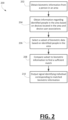
- the method 200 includes an operation 202 of obtaining biometric information from a subject person in a defined geographic area.
- the biometric information may be data representative of any person characteristic that may be used to uniquely identify a person. Examples include, but are not limited to, facial features, fingerprints, voice, irises, retinas, vein or palm patterns, DNA, etc.
- the input device may include a camera, microphone, scanner, capacitive sensors, or any such sensor for obtaining biometric data.
- information regarding identified people in the area is obtained.
- the identified people are people associated with devices located in the area, and the identification of those people may be based on a set of stored associations between each device and one or more users.
- a biometric authentication system stores a set of biometric profiles, i.e. biometric data, for a relatively large number of people. This may be stored in the form of a database or any other suitable data structure that enables queries to match biometric information to one or more of the stored profiles.
- a subset of the stored profiles may be selected based on the information regarding identified people in the area. That is, the subset may be selected to contain the biometric profile of any person identified in operation 204 that has a corresponding biometric profile in the database.
- the obtained biometric information is then compared to the profiles in the subset to attempt to identify a sufficient match in operation 208.
- the determination of whether there is a "sufficient" match may be tuned to a particular application.
- Various thresholds may be set and/or adjusted for achieving a desired degree of confidence in the accuracy of the identification, and may vary depending on the nature of the biometric data being tested.
- a signal is output in operation 210 identifying the individual associated with the matched biometric profile as the subject.
- the signal may indicate that the subject is permitted access to a system or area, or that the subject has been authenticated for a security purpose, or that a request submitted by the subject is authorized, like a purchase or the like.
- a separate request handler system may have initiated the biometric authorization process by sending an identification request signal to the authenticator, and the signal returned may indicate success, failure, or the identity of the individual (if identified with sufficient confidence).
- it may indicate whether the identification is high confidence (e.g. one of the profiles in the subset) or low confidence (e.g. one of the profiles but not in the subset), and a low confidence identification may trigger additional authentication or identification operations.
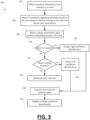
- a further example method 300 of biometrically identifying a subject is shown in Figure 3 .
- the method 300 includes an operation 302 of obtaining biometric information from a subject person in a defined geographic area.
- the biometric information may be data representative of any person characteristic that may be used to uniquely identify a person. Examples include, but are not limited to, facial features, fingerprints, voice, irises, retinas, vein or palm patterns, DNA, etc.
- the input device may include a camera, microphone, scanner, capacitive sensors, or any such sensor for obtaining biometric data.
- information regarding identified people in the area is obtained.
- the identified people are people associated with devices located in the area, and the identification of those people may be based on a set of stored associations between each device and one or more users.
- a biometric authentication system stores a set of biometric profiles, i.e. biometric data, for a relatively large number of people. This may be stored in the form of a database or any other suitable data structure that enables queries to match biometric information to one or more of the stored profiles.
- a subset of the stored profiles may be selected based on the information regarding identified people in the area. That is, the subset may be selected to contain the biometric profile of any person identified in operation 304 that has a corresponding biometric profile in the database.
- the system may perform additional filtering (not shown), for example based upon static data, such as whether users are permitted to be in the area under consideration.
- the authenticator determines whether a sufficient match is found between the obtained biometric information and one of the profiles in the subset. If so, then it outputs a signal indicating a high confidence match in operation 310.
- the signal may include the identity associated with the matched profile in some cases. In some other cases, the signal may indicate a class or category of authorized persons to which the identified person belongs, e.g. a security clearance level. In some cases, the signal simply indicates a positive match with high confidence.
- the authenticator attempts to find a sufficient match between the biometric information and the remaining profiles, i.e. those profiles in the set that were not associated with individuals likely to be in the area based on detected local mobile devices. If a match is found, then in operation 314, a signal is output indicating a low confidence match.
- the signal may include the identity associated with the matched profile in some cases. In some other cases, the signal may indicate a class or category of authorized persons to which the identified person belongs, e.g. a security clearance level. In some cases, the signal simply indicates a positive match with low confidence.
- the identification of a match may trigger a second factor authentication operation 318.
- the second factor authentication operation 318 may only be triggered in the case of a low confidence match from operation 314, or may be triggered in the case of both a high and low confidence match.
- the second factor authentication may include any suitable authentication mechanism, including, for example, messaging a mobile device associated with the biometric profile with a code or other secret data that is to be input to the authenticator via a user interface to confirm the identification.
- the mobile device may be the same device associated with the user in the device-user associations, or may be a different device.
- the second factor authentication may include inputting a passcode, pressing a confirmation button or UI element, providing additional biometric information via a mobile device, executing a defined motion with the mobile device, etc.
- the confidence level of the identification may be updated - e.g. increased, if successful - and a signal to that effect output in operation 320.
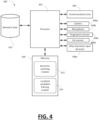
- the authenticator 400 is an electronic device that includes a processor 402, memory 404, and one or more communication units 406 to enable wired and/or wireless communication with other systems or other parts of the electronic device.
- the processor 402 has access to a memory unit 410 storing biometric data, e.g. the database of biometric profiles.
- the memory unit 410 may be the same as memory 404 or may be separate.
- the memory unit 410 may be remoted located in some cases and accessed via the communication unit 406.
- the authenticator 400 further includes one or more biometric input devices 408. Examples shown include a camera 408a, a microphone 408b, fingerprint sensor 408c, iris scanner 408d, or any other suitable biometric input device 408e.
- the biometric input devices 408 supply biometric information to the processor 402 obtained from a subject. In some instances, the biometric input devices 408 may be part of a physically separate device or system and may provide the biometric information via a communications connection, such as via the communications unit 406.
- the memory 404 may store program instructions which, when executed by the processor 402, cause the processor 402 to carry out one or more of the operations described herein.
- the program instructions may include an operating system (not illustrated) enabling basic operations on the electronic device and providing a run-time environment within which applications may execute, as will be familiar to those of ordinary skill in the art.
- the memory 404 may store a biometric matching module 412 containing executable program instructions that, when executed, cause the processor 402 to compare obtained biometric information to stored biometric profiles to determine whether a sufficient match is found.
- the biometric matching module 412 may output a signal indicating whether a match is found, indicating the identity of a matched profile, indicating a confidence level of a match and/or providing other information regarding the accuracy and reliability of match.
- the memory 404 may store a localized candidate filtering module 414 containing executable program instructions that, when executed, cause the processor 402 to obtain information identifying persons likely to be in a defined geographic area associated with the biometric input device(s) 408 and based on mobile devices located in the defined geographic area, and to reduce the set of candidate biometric profiles to be searched by the biometric matching module 412 to a subset of candidate biometric profiles based on the information identifying persons.
- the subset selection may be implemented based on the intersection of the set of persons for whom biometric profiles are stored and the set of persons found in the information identifying persons likely to be located in the defined geographic area.
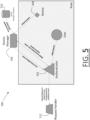
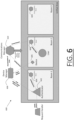
- FIG. 5 and 6 diagrammatically illustrate first and second uses cases 500 and 600, respectively, of an example biometric identification system.
- an authenticator 502 receives, from a subject user, a request.
- the request include biometric information.
- the request may arrive via a user-activated input associated with a request, such a facility access request, a computing resource access request, or the like.
- the request come with biometric information or may cause the authenticator 502 to obtain biometric information via a biometric input device, such as a camera, microphone, or other sensor.
- the subject user is located within an area 504. In this example the authenticator 502 is also located within the area 504.
- a device manager 506 is configured to track device locations. That is, the device manager 506 includes information regarding the location of devices and, specifically, identification information regarding devices 508 located within the area 504.
- the device manager 506 (or the authenticator 502) has, or has access to, a database 510 storing device-user associations. Accordingly, the device manager 506 provides the authenticator 502 with the set of users associated with devices 508 presently determined to be in the area 504. This may be provided periodically or in response to a specific request from the authenticator 502.
- the authenticator 502 includes the stored biometric data for a plurality of users, i.e. their biometric profiles. Therefore, the authenticator 502 may select a subset of profiles based on the provided set of users associated with devices 508, and may attempt to match the obtained biometric information to one of the profiles in the subset. If no match is found, the authenticator 502 may attempt to match the biometric information to one of the other profiles.
- a request handler 512 may be configured to carry out one of a number of operations in response to the user request, including granting access to a facility or computing resources, for example, dependent upon an output signal from the authenticator 502.
- the signal may indicate the confidence level of the identification, if any.
- the request handler 512 may determine whether to seek further identification data if the confidence level is below a threshold. For example, if the identification is from the subset, the confidence level of the identification may be high, but if the identification is from the broader set after filing to match a profile in the subset, then the confidence level may be low.
- the authenticator 502 or the request handler 512 may seek additional identification authentication in the case of a low confidence identification.
- the request handler 512 may provide restricted access or permissions to a user that is only identified with a low confidence level, and may provide less restricted access or permissions to a user that is identified at a high confidence level. A weakly identified user may be prompted to improve the level of access through providing additional identification information, such as through a second factor authentication process.
- a request handler 512 may receive a request for access to specific data, e.g. current year's revenue figures for a company. That request is accompanied by biometric input to identify the requestor. Using the present system the authenticator may return an identification at a low confidence level, which may prompt the request handler to grant only limited access or a limited reply to the request, e.g. only a portion of the revenue figures, such as those already publicly disclosed, and not confidential current quarter figures.
- the second use case 600 shown in Figure 6 involves a distributed system in which an authenticator 602 and a subject user may not be located in the same area.
- the authenticator 502 may be capable of obtaining biometric information from a number of physically separate areas using one or more local biometric input devices.
- a communication manager 610 may link the separate areas through communications nodes 604 in the respective areas, thereby creating a unified area for some purposes.
- the communications nodes 604 themselves may operate as biometric input devices, for example if the communication node 604 receives audio or video data in connection with voice print and/or facial recognition biometrics.
- a separate local biometric input device (not shown) receives and relays the biometric input to the authenticator. In some cases, that biometric input data received by the local biometric input device may be relayed to the authenticator via the communications manager 610.
- a plurality of devices is present in the unified area, such as example device 605, may be identified by device manager 606.
- the device manager 606 provides the authenticator with information regarding users likely in the unified area based on user-device associations and the devices identified in the unified area.
- the device manager 606 provide information regarding users likely to be in the specific sub-area from which the request originates and from which the biometric input was received.
- One example of the second use case 600 involves a conference call between a number of participants in dispersed locations.
- a participant may make an audible voice request that is relayed via the communication manager 610 to all the other communication nodes 604, and that is received by the authenticator 602 located one of the other sub-areas.
- the authenticator 602 is then able to respond to the request by attempting to biometrically identify the requestor using voice print technology, for example.
- the device manager may provide identification of persons likely located in the unified area based on user-device associations to aid the authenticator 602.
- the authenticator and any other electronic devices described herein may be implemented in a number of computing devices, including, without limitation, servers, suitably-programmed general purpose computers, and mobile devices.
- the described devices and system may be implemented by way of software containing instructions for configuring a processor or processors to carry out the functions described herein.
- the software instructions may be stored on any suitable non-transitory computer-readable memory, including CDs, RAM, ROM, Flash memory, etc.
- the present application also provides for a computer-readable signal encoding the data produced through application of an encoding process in accordance with the present application.
Landscapes
- Engineering & Computer Science (AREA)
- Computer Security & Cryptography (AREA)
- Theoretical Computer Science (AREA)
- Physics & Mathematics (AREA)
- General Physics & Mathematics (AREA)
- Computer Networks & Wireless Communication (AREA)
- Signal Processing (AREA)
- General Engineering & Computer Science (AREA)
- Computer Hardware Design (AREA)
- Software Systems (AREA)
- Databases & Information Systems (AREA)
- Human Computer Interaction (AREA)
- Multimedia (AREA)
- Remote Sensing (AREA)
- Data Mining & Analysis (AREA)
- Health & Medical Sciences (AREA)
- Life Sciences & Earth Sciences (AREA)
- Biodiversity & Conservation Biology (AREA)
- Biomedical Technology (AREA)
- General Health & Medical Sciences (AREA)
- Collating Specific Patterns (AREA)
Claims (7)
- Ein Verfahren zum Identifizieren einer Person, die sich in einem definierten geographischen Gebiet befindet, unter Verwendung einer elektronischen Vorrichtung (400), wobei die elektronische Vorrichtung (400) wenigstens eine Speichereinheit (410) umfasst, die gespeicherte biometrische Daten für einen Satz von Personen umfasst, wobei das Verfahren Folgendes beinhaltet:Bestimmen einer oder mehrerer Vorrichtungen, die sich innerhalb des definierten geografischen Gebiets befinden;Erhalten (302) biometrischer Informationen von der Person in dem definierten geografischen Gebiet und Informationen in Bezug auf die eine oder die mehreren Vorrichtungen, die sich in dem definierten geografischen Gebiet befinden;Erhalten (304) einer oder mehrerer identifizierter Personen aus einem gespeicherten Satz von Zuordnungen zwischen Personen und Vorrichtungen auf Grundlage der Informationen, die sich auf eine oder mehrere Vorrichtungen beziehen, die sich innerhalb des definierten geografischen Gebiets befinden;Reduzieren (306) des Satzes von Personen auf einen Teilsatz von Personen auf Grundlage der einen oder der mehreren identifizierten Personen, wobei der Teilsatz eine Schnittmenge zwischen der Menge von Personen und der einen oder den mehreren identifizierten Personen ist;Bestimmen (308), ob eine ausreichende Übereinstimmung zwischen den biometrischen Informationen und den gespeicherten biometrischen Daten, die einer Person aus dem Teilsatz von Personen zugeordnet sind, gefunden wird, wobei eine ausreichende Übereinstimmung mit einer Schwelle erhalten wird, die zum Erreichen eines gewünschten Vertrauensgrades angepasst ist; undals Reaktion auf das Bestimmen, dass eine ausreichende Übereinstimmung innerhalb des Teilsatzes von Personen gefunden wurde, Ausgeben (310) eines Signals, das das Individuum als die Person identifiziert, wobei das Signal ferner ein Vertrauensniveau in die Identifizierung beinhaltet, wobei das Signal ein erstes Vertrauensniveau anzeigt; undals Reaktion auf das Bestimmen, dass keine ausreichende Übereinstimmung innerhalb des Teilsatzes von Personen gefunden wird, Bestimmen, ob eine ausreichende Übereinstimmung zwischen den biometrischen Informationen und den gespeicherten biometrischen Daten, die einem Individuum aus dem Satz von Personen, aber nicht aus dem Teilsatz von Personen zugeordnet sind, gefunden wird; undals Reaktion auf das Bestimmen, dass eine ausreichende Übereinstimmung innerhalb des Satzes von Personen, aber nicht aus dem Teilsatz von Personen gefunden wird, Ausgeben (314) eines zweiten Vertrauensniveaus, das niedriger ist als das erste Vertrauensniveau, und Gewähren eines eingeschränkten Zugangs zu der Person als Reaktion auf eine Zugangsanfrage auf Grundlage der zweiten Vertrauensanzeige und/oder Anfordern einer Authentifizierung mit dem zweiten Faktor von dem Individuum.
- Verfahren gemäß Anspruch 1, wobei das Bestimmen der Vorrichtungen, die sich innerhalb des definierten geografischen Gebiets befinden, auf Grundlage von Daten von einem oder mehreren lokalen Zugangspunkten in einem drahtlosen Netzwerk erfolgt.
- Verfahren gemäß einem der vorhergehenden Ansprüche, wobei der gespeicherte Satz von Zuordnungen eine Vielzahl von Vorrichtungskennungen und für jede Vorrichtungskennung eine oder mehrere Benutzerkennungen umfasst.
- Verfahren gemäß einem der vorhergehenden Ansprüche, wobei die gespeicherten biometrischen Daten ein biometrisches Profil für jede Person in dem Satz von Personen umfassen.
- Verfahren gemäß einem der vorhergehenden Ansprüche, wobei die biometrischen Informationen einen/eine von einem Fingerabdruckscan, einem Gesichtsbild, einem Irisscan, einem Netzhautscan, einem Handflächenmusterbild, einem Venenmusterbild oder einer Sprachaufzeichnung umfassen.
- Ein System (10, 400) zum Identifizieren einer Person, die sich in einem definierten geographischen Gebiet befindet, wobei das System dazu konfiguriert ist, das Verfahren gemäß einem der vorhergehenden Ansprüche auszuführen, und das System Folgendes beinhaltet:wenigstens eine Speichereinheit (14, 410), die gespeicherte biometrische Daten für einen Satz von Personen beinhaltet; undeine elektronische Vorrichtung (12, 400) mit wenigstens einer biometrischen Eingabevorrichtung (408), einer Kommunikationseinheit (406) und einem Prozessor (402).
- Ein Computerprogramm, das, wenn es auf einem Prozessor (402) eines Systems ausgeführt wird, dazu konfiguriert ist, das Verfahren gemäß einem der Ansprüche 1 bis 5 auszuführen.
Priority Applications (1)
| Application Number | Priority Date | Filing Date | Title |
|---|---|---|---|
| EP24212613.4A EP4482188A3 (de) | 2018-09-13 | 2019-09-05 | Verfahren und systeme zur verbesserten biometrischen identifizierung |
Applications Claiming Priority (1)
| Application Number | Priority Date | Filing Date | Title |
|---|---|---|---|
| US16/130,053 US10810450B2 (en) | 2018-09-13 | 2018-09-13 | Methods and systems for improved biometric identification |
Related Child Applications (1)
| Application Number | Title | Priority Date | Filing Date |
|---|---|---|---|
| EP24212613.4A Division EP4482188A3 (de) | 2018-09-13 | 2019-09-05 | Verfahren und systeme zur verbesserten biometrischen identifizierung |
Publications (3)
| Publication Number | Publication Date |
|---|---|
| EP3623974A1 EP3623974A1 (de) | 2020-03-18 |
| EP3623974B1 true EP3623974B1 (de) | 2024-11-20 |
| EP3623974C0 EP3623974C0 (de) | 2024-11-20 |
Family
ID=67874401
Family Applications (2)
| Application Number | Title | Priority Date | Filing Date |
|---|---|---|---|
| EP24212613.4A Pending EP4482188A3 (de) | 2018-09-13 | 2019-09-05 | Verfahren und systeme zur verbesserten biometrischen identifizierung |
| EP19195742.2A Active EP3623974B1 (de) | 2018-09-13 | 2019-09-05 | Verfahren und systeme zur verbesserten biometrischen identifizierung mittels nutzervorrichtungen näherungsverhältnissen |
Family Applications Before (1)
| Application Number | Title | Priority Date | Filing Date |
|---|---|---|---|
| EP24212613.4A Pending EP4482188A3 (de) | 2018-09-13 | 2019-09-05 | Verfahren und systeme zur verbesserten biometrischen identifizierung |
Country Status (2)
| Country | Link |
|---|---|
| US (1) | US10810450B2 (de) |
| EP (2) | EP4482188A3 (de) |
Families Citing this family (4)
| Publication number | Priority date | Publication date | Assignee | Title |
|---|---|---|---|---|
| US10936708B2 (en) * | 2018-10-01 | 2021-03-02 | International Business Machines Corporation | Biometric data protection |
| KR102758937B1 (ko) * | 2019-02-18 | 2025-01-23 | 삼성전자주식회사 | 생체 정보를 인증하기 위한 전자 장치 및 그의 동작 방법 |
| US12153938B2 (en) * | 2020-11-03 | 2024-11-26 | Kpn Innovations, Llc. | Systems and methods for a configurable device environment |
| US11599614B2 (en) * | 2020-11-03 | 2023-03-07 | Kpn Innovations, Llc. | Systems and methods for a configurable device environment |
Family Cites Families (18)
| Publication number | Priority date | Publication date | Assignee | Title |
|---|---|---|---|---|
| WO2007116496A1 (ja) * | 2006-03-31 | 2007-10-18 | Fujitsu Limited | 利用者判別システム |
| EP2304655A4 (de) * | 2008-06-09 | 2014-01-08 | Rangaswamy Narayanan | Auf aktivität basierendes verwaltungssystem |
| EP2511871B1 (de) * | 2009-12-09 | 2018-05-09 | Fujitsu Limited | Kapazitiver sensor und verfahren zur erzeugung eines biologischen bildes |
| EP2490151A1 (de) * | 2011-02-17 | 2012-08-22 | Nagravision S.A. | Verfahren und Vorrichtung zur Beschleunigung der Gesichtserkennung |
| US9436816B2 (en) | 2010-12-16 | 2016-09-06 | Microsoft Technology Licensing, Llc | Supplementing biometric identification with device identification |
| RU2623795C2 (ru) * | 2011-08-22 | 2017-06-29 | АЙЛОК ЭлЭлСи | Системы и способы для захвата безартефактных изображений |
| US9152868B2 (en) * | 2012-03-23 | 2015-10-06 | Microsoft Technology Licensing, Llc | Personal identification combining proximity sensing with biometrics |
| US8792677B2 (en) * | 2012-04-19 | 2014-07-29 | Intelligence Based Integrated Security Systems, Inc. | Large venue security method |
| SG2013063003A (en) * | 2013-08-19 | 2015-03-30 | Artivision Technologies Ltd | A method for logging a user in to a mobile device |
| EP2843601A1 (de) | 2013-08-29 | 2015-03-04 | Accenture Global Services Limited | Identifikationssystem |
| US9876788B1 (en) * | 2014-01-24 | 2018-01-23 | Microstrategy Incorporated | User enrollment and authentication |
| CA2956961A1 (en) | 2014-08-11 | 2016-02-18 | Cubic Corporation | Biometric payment in transit systems |
| US9785880B2 (en) * | 2015-11-06 | 2017-10-10 | Bank Of America Corporation | Radio frequency identification activation |
| CN109313902A (zh) * | 2016-06-06 | 2019-02-05 | 思睿逻辑国际半导体有限公司 | 语音用户接口 |
| CN107967077A (zh) * | 2016-10-19 | 2018-04-27 | 深圳富泰宏精密工业有限公司 | 电子装置及其触控方法 |
| US12027033B2 (en) * | 2017-06-08 | 2024-07-02 | Guardian Band Inc. | Wearable personal safety devices and methods of operating the same |
| JP6921654B2 (ja) * | 2017-06-29 | 2021-08-18 | キヤノン株式会社 | 情報処理装置、方法、及びプログラム |
| US11251956B2 (en) * | 2018-07-02 | 2022-02-15 | Avaya Inc. | Federated blockchain identity model and secure personally identifiable information data transmission model for RCS |
-
2018
- 2018-09-13 US US16/130,053 patent/US10810450B2/en active Active
-
2019
- 2019-09-05 EP EP24212613.4A patent/EP4482188A3/de active Pending
- 2019-09-05 EP EP19195742.2A patent/EP3623974B1/de active Active
Also Published As
| Publication number | Publication date |
|---|---|
| EP3623974C0 (de) | 2024-11-20 |
| EP4482188A2 (de) | 2024-12-25 |
| EP3623974A1 (de) | 2020-03-18 |
| US10810450B2 (en) | 2020-10-20 |
| US20200089978A1 (en) | 2020-03-19 |
| EP4482188A3 (de) | 2025-03-12 |
Similar Documents
| Publication | Publication Date | Title |
|---|---|---|
| US12361777B2 (en) | System and method for providing credential activation layered security | |
| US9934373B1 (en) | User enrollment and authentication | |
| EP3623974B1 (de) | Verfahren und systeme zur verbesserten biometrischen identifizierung mittels nutzervorrichtungen näherungsverhältnissen | |
| US11997087B2 (en) | Mobile enrollment using a known biometric | |
| EP4207112A1 (de) | Authentifizierungsverfahren und -vorrichtung für toreingang | |
| US11178142B2 (en) | Biometric data synchronization devices | |
| US12530936B2 (en) | Trusted seamless authentication method for access control | |
| US12013956B2 (en) | Systems and methods for verifying user activity using behavioral models | |
| US11354394B2 (en) | Identity verification using autonomous vehicles | |
| US11995167B2 (en) | Systems and methods for authenticating user identity using supplemental environment data | |
| KR101926709B1 (ko) | 생체 인증 및 제어 장치 및 그 방법 | |
| JP2020135666A (ja) | 認証装置、認証用端末、認証方法、プログラム及び記録媒体 | |
| KR102340398B1 (ko) | 출입 통제 제어를 위한 장치, 시스템 및 방법 | |
| JP2023012581A (ja) | 認証システム、認証方法および認証プログラム |
Legal Events
| Date | Code | Title | Description |
|---|---|---|---|
| PUAI | Public reference made under article 153(3) epc to a published international application that has entered the european phase |
Free format text: ORIGINAL CODE: 0009012 |
|
| STAA | Information on the status of an ep patent application or granted ep patent |
Free format text: STATUS: THE APPLICATION HAS BEEN PUBLISHED |
|
| AK | Designated contracting states |
Kind code of ref document: A1 Designated state(s): AL AT BE BG CH CY CZ DE DK EE ES FI FR GB GR HR HU IE IS IT LI LT LU LV MC MK MT NL NO PL PT RO RS SE SI SK SM TR |
|
| AX | Request for extension of the european patent |
Extension state: BA ME |
|
| STAA | Information on the status of an ep patent application or granted ep patent |
Free format text: STATUS: REQUEST FOR EXAMINATION WAS MADE |
|
| 17P | Request for examination filed |
Effective date: 20200904 |
|
| RBV | Designated contracting states (corrected) |
Designated state(s): AL AT BE BG CH CY CZ DE DK EE ES FI FR GB GR HR HU IE IS IT LI LT LU LV MC MK MT NL NO PL PT RO RS SE SI SK SM TR |
|
| STAA | Information on the status of an ep patent application or granted ep patent |
Free format text: STATUS: EXAMINATION IS IN PROGRESS |
|
| 17Q | First examination report despatched |
Effective date: 20211201 |
|
| GRAP | Despatch of communication of intention to grant a patent |
Free format text: ORIGINAL CODE: EPIDOSNIGR1 |
|
| STAA | Information on the status of an ep patent application or granted ep patent |
Free format text: STATUS: GRANT OF PATENT IS INTENDED |
|
| RIC1 | Information provided on ipc code assigned before grant |
Ipc: H04W 12/64 20210101ALI20240702BHEP Ipc: G06V 40/70 20220101ALI20240702BHEP Ipc: H04L 9/32 20060101ALI20240702BHEP Ipc: H04W 12/06 20090101ALI20240702BHEP Ipc: H04W 12/00 20090101ALI20240702BHEP Ipc: G06F 21/35 20130101ALI20240702BHEP Ipc: G06F 21/32 20130101AFI20240702BHEP |
|
| INTG | Intention to grant announced |
Effective date: 20240715 |
|
| RAP1 | Party data changed (applicant data changed or rights of an application transferred) |
Owner name: MALIKIE INNOVATIONS LIMITED |
|
| GRAS | Grant fee paid |
Free format text: ORIGINAL CODE: EPIDOSNIGR3 |
|
| GRAA | (expected) grant |
Free format text: ORIGINAL CODE: 0009210 |
|
| STAA | Information on the status of an ep patent application or granted ep patent |
Free format text: STATUS: THE PATENT HAS BEEN GRANTED |
|
| AK | Designated contracting states |
Kind code of ref document: B1 Designated state(s): AL AT BE BG CH CY CZ DE DK EE ES FI FR GB GR HR HU IE IS IT LI LT LU LV MC MK MT NL NO PL PT RO RS SE SI SK SM TR |
|
| REG | Reference to a national code |
Ref country code: GB Ref legal event code: FG4D |
|
| REG | Reference to a national code |
Ref country code: CH Ref legal event code: EP |
|
| REG | Reference to a national code |
Ref country code: DE Ref legal event code: R096 Ref document number: 602019062145 Country of ref document: DE |
|
| REG | Reference to a national code |
Ref country code: IE Ref legal event code: FG4D |
|
| U01 | Request for unitary effect filed |
Effective date: 20241217 |
|
| U07 | Unitary effect registered |
Designated state(s): AT BE BG DE DK EE FI FR IT LT LU LV MT NL PT RO SE SI Effective date: 20250103 |
|
| PG25 | Lapsed in a contracting state [announced via postgrant information from national office to epo] |
Ref country code: HR Free format text: LAPSE BECAUSE OF FAILURE TO SUBMIT A TRANSLATION OF THE DESCRIPTION OR TO PAY THE FEE WITHIN THE PRESCRIBED TIME-LIMIT Effective date: 20241120 Ref country code: IS Free format text: LAPSE BECAUSE OF FAILURE TO SUBMIT A TRANSLATION OF THE DESCRIPTION OR TO PAY THE FEE WITHIN THE PRESCRIBED TIME-LIMIT Effective date: 20250320 |
|
| PG25 | Lapsed in a contracting state [announced via postgrant information from national office to epo] |
Ref country code: ES Free format text: LAPSE BECAUSE OF FAILURE TO SUBMIT A TRANSLATION OF THE DESCRIPTION OR TO PAY THE FEE WITHIN THE PRESCRIBED TIME-LIMIT Effective date: 20241120 |
|
| PG25 | Lapsed in a contracting state [announced via postgrant information from national office to epo] |
Ref country code: NO Free format text: LAPSE BECAUSE OF FAILURE TO SUBMIT A TRANSLATION OF THE DESCRIPTION OR TO PAY THE FEE WITHIN THE PRESCRIBED TIME-LIMIT Effective date: 20250220 |
|
| PG25 | Lapsed in a contracting state [announced via postgrant information from national office to epo] |
Ref country code: GR Free format text: LAPSE BECAUSE OF FAILURE TO SUBMIT A TRANSLATION OF THE DESCRIPTION OR TO PAY THE FEE WITHIN THE PRESCRIBED TIME-LIMIT Effective date: 20250221 |
|
| PG25 | Lapsed in a contracting state [announced via postgrant information from national office to epo] |
Ref country code: PL Free format text: LAPSE BECAUSE OF FAILURE TO SUBMIT A TRANSLATION OF THE DESCRIPTION OR TO PAY THE FEE WITHIN THE PRESCRIBED TIME-LIMIT Effective date: 20241120 |
|
| PG25 | Lapsed in a contracting state [announced via postgrant information from national office to epo] |
Ref country code: RS Free format text: LAPSE BECAUSE OF FAILURE TO SUBMIT A TRANSLATION OF THE DESCRIPTION OR TO PAY THE FEE WITHIN THE PRESCRIBED TIME-LIMIT Effective date: 20250220 |
|
| PG25 | Lapsed in a contracting state [announced via postgrant information from national office to epo] |
Ref country code: SM Free format text: LAPSE BECAUSE OF FAILURE TO SUBMIT A TRANSLATION OF THE DESCRIPTION OR TO PAY THE FEE WITHIN THE PRESCRIBED TIME-LIMIT Effective date: 20241120 |
|
| PG25 | Lapsed in a contracting state [announced via postgrant information from national office to epo] |
Ref country code: SK Free format text: LAPSE BECAUSE OF FAILURE TO SUBMIT A TRANSLATION OF THE DESCRIPTION OR TO PAY THE FEE WITHIN THE PRESCRIBED TIME-LIMIT Effective date: 20241120 |
|
| PG25 | Lapsed in a contracting state [announced via postgrant information from national office to epo] |
Ref country code: CZ Free format text: LAPSE BECAUSE OF FAILURE TO SUBMIT A TRANSLATION OF THE DESCRIPTION OR TO PAY THE FEE WITHIN THE PRESCRIBED TIME-LIMIT Effective date: 20241120 |
|
| PLBE | No opposition filed within time limit |
Free format text: ORIGINAL CODE: 0009261 |
|
| STAA | Information on the status of an ep patent application or granted ep patent |
Free format text: STATUS: NO OPPOSITION FILED WITHIN TIME LIMIT |
|
| PGFP | Annual fee paid to national office [announced via postgrant information from national office to epo] |
Ref country code: GB Payment date: 20250923 Year of fee payment: 7 |
|
| 26N | No opposition filed |
Effective date: 20250821 |
|
| U20 | Renewal fee for the european patent with unitary effect paid |
Year of fee payment: 7 Effective date: 20250925 |