EP3620976A1 - Methods and systems for providing fast semantic proposals for image and video annotation - Google Patents
Methods and systems for providing fast semantic proposals for image and video annotation Download PDFInfo
- Publication number
- EP3620976A1 EP3620976A1 EP19195157.3A EP19195157A EP3620976A1 EP 3620976 A1 EP3620976 A1 EP 3620976A1 EP 19195157 A EP19195157 A EP 19195157A EP 3620976 A1 EP3620976 A1 EP 3620976A1
- Authority
- EP
- European Patent Office
- Prior art keywords
- image
- pixel
- network model
- feature
- state network
- Prior art date
- Legal status (The legal status is an assumption and is not a legal conclusion. Google has not performed a legal analysis and makes no representation as to the accuracy of the status listed.)
- Granted
Links
Images




Classifications
-
- G—PHYSICS
- G06—COMPUTING OR CALCULATING; COUNTING
- G06V—IMAGE OR VIDEO RECOGNITION OR UNDERSTANDING
- G06V10/00—Arrangements for image or video recognition or understanding
- G06V10/20—Image preprocessing
- G06V10/26—Segmentation of patterns in the image field; Cutting or merging of image elements to establish the pattern region, e.g. clustering-based techniques; Detection of occlusion
-
- G—PHYSICS
- G05—CONTROLLING; REGULATING
- G05D—SYSTEMS FOR CONTROLLING OR REGULATING NON-ELECTRIC VARIABLES
- G05D1/00—Control of position, course, altitude or attitude of land, water, air or space vehicles, e.g. using automatic pilots
- G05D1/0088—Control of position, course, altitude or attitude of land, water, air or space vehicles, e.g. using automatic pilots characterized by the autonomous decision making process, e.g. artificial intelligence, predefined behaviours
-
- G—PHYSICS
- G05—CONTROLLING; REGULATING
- G05D—SYSTEMS FOR CONTROLLING OR REGULATING NON-ELECTRIC VARIABLES
- G05D1/00—Control of position, course, altitude or attitude of land, water, air or space vehicles, e.g. using automatic pilots
- G05D1/02—Control of position or course in two dimensions
- G05D1/021—Control of position or course in two dimensions specially adapted to land vehicles
- G05D1/0231—Control of position or course in two dimensions specially adapted to land vehicles using optical position detecting means
- G05D1/0246—Control of position or course in two dimensions specially adapted to land vehicles using optical position detecting means using a video camera in combination with image processing means
-
- G—PHYSICS
- G06—COMPUTING OR CALCULATING; COUNTING
- G06T—IMAGE DATA PROCESSING OR GENERATION, IN GENERAL
- G06T7/00—Image analysis
- G06T7/10—Segmentation; Edge detection
- G06T7/194—Segmentation; Edge detection involving foreground-background segmentation
-
- G—PHYSICS
- G06—COMPUTING OR CALCULATING; COUNTING
- G06T—IMAGE DATA PROCESSING OR GENERATION, IN GENERAL
- G06T7/00—Image analysis
- G06T7/90—Determination of colour characteristics
-
- G—PHYSICS
- G06—COMPUTING OR CALCULATING; COUNTING
- G06V—IMAGE OR VIDEO RECOGNITION OR UNDERSTANDING
- G06V10/00—Arrangements for image or video recognition or understanding
- G06V10/40—Extraction of image or video features
- G06V10/44—Local feature extraction by analysis of parts of the pattern, e.g. by detecting edges, contours, loops, corners, strokes or intersections; Connectivity analysis, e.g. of connected components
- G06V10/443—Local feature extraction by analysis of parts of the pattern, e.g. by detecting edges, contours, loops, corners, strokes or intersections; Connectivity analysis, e.g. of connected components by matching or filtering
- G06V10/449—Biologically inspired filters, e.g. difference of Gaussians [DoG] or Gabor filters
- G06V10/451—Biologically inspired filters, e.g. difference of Gaussians [DoG] or Gabor filters with interaction between the filter responses, e.g. cortical complex cells
-
- G—PHYSICS
- G06—COMPUTING OR CALCULATING; COUNTING
- G06V—IMAGE OR VIDEO RECOGNITION OR UNDERSTANDING
- G06V10/00—Arrangements for image or video recognition or understanding
- G06V10/70—Arrangements for image or video recognition or understanding using pattern recognition or machine learning
- G06V10/82—Arrangements for image or video recognition or understanding using pattern recognition or machine learning using neural networks
-
- G—PHYSICS
- G06—COMPUTING OR CALCULATING; COUNTING
- G06T—IMAGE DATA PROCESSING OR GENERATION, IN GENERAL
- G06T2207/00—Indexing scheme for image analysis or image enhancement
- G06T2207/20—Special algorithmic details
- G06T2207/20081—Training; Learning
-
- G—PHYSICS
- G06—COMPUTING OR CALCULATING; COUNTING
- G06T—IMAGE DATA PROCESSING OR GENERATION, IN GENERAL
- G06T2207/00—Indexing scheme for image analysis or image enhancement
- G06T2207/20—Special algorithmic details
- G06T2207/20112—Image segmentation details
- G06T2207/20132—Image cropping
-
- G—PHYSICS
- G06—COMPUTING OR CALCULATING; COUNTING
- G06T—IMAGE DATA PROCESSING OR GENERATION, IN GENERAL
- G06T2207/00—Indexing scheme for image analysis or image enhancement
- G06T2207/30—Subject of image; Context of image processing
- G06T2207/30248—Vehicle exterior or interior
- G06T2207/30252—Vehicle exterior; Vicinity of vehicle
Definitions
- the present invention relates generally to methods and systems for providing fast semantic proposals (i.e., pre-proposals) for image and video annotation. More specifically, the present invention relates to methods and systems for providing fast semantic proposals for image and video annotation using modified echo state networks (ESNs).
- ESNs modified echo state networks
- the methods and systems of the present invention find particular applicability in the training and testing of driver assist (DA) and autonomous driving (AD) systems in the automotive and active safety fields.
- DA driver assist
- AD autonomous driving
- Deep neural networks require numerous training samples to converge to and produce significant output results. These training samples must be annotated and must be of very high quality for the successful implementation of such DNNs.
- One challenge is producing large numbers of training samples with high-quality annotated data.
- DNNs are used in the training and testing of DA and AD systems in the automotive and active safety fields. These systems require large amounts of annotated image data to train and test the various functionalities, such as object detection, drivable surface recognition, semantic segmentation, and object tracking using camera and video images.
- the main challenge in using manually-annotated image data for these tasks is twofold.
- manually-annotated image data is expensive in terms of the time and expertise required to segment regions of interest (ROIs).
- ROIs segment regions of interest
- the scalability of algorithms across datasets is often a challenge.
- a proposal generation algorithm that works with one dataset may not provide the same performance with another dataset.
- DL algorithms are capable of extracting high-level features from images and videos by tapping into the local and global-level spatial characteristics.
- DL algorithms require a large number of training samples to adequately learn and perform.
- ESNs are capable of high-level feature abstraction from a small number of image frames. ESNs have been studied quite extensively and have been applied in numerous fields for other purposes. The primary assumption made related to existing ESNs for semantic image segmentation is that all images in the dataset under consideration have similar spatial orientations and segmentation objectives. This assumption leads to the inherent property of ESNs that, at the end of a training batch of images, the reservoir nodes achieve a steady state, regardless of the initial conditions.
- semantic segmentation tasks cannot always assure similar spatial and/or intensity orientations and often the segmentation objectives can vary. For instance, images acquired by mobile phones with centralized objects of interest for foreground segmentation tasks must be treated separately from wide-angle scenery images acquired from vehicle cameras with the objectives of object and drivable surface segmentation tasks.
- the present invention utilizes an active learning framework that can iteratively learn to segment foreground and background ROIs.
- deep learning algorithms are found to be capable of extracting high-level features from images and/or videos by tapping into the local and global-level spatial characteristics.
- deep learning algorithms require a large number of training samples to learn.
- the present invention utilizes a recurrent neural network-like setup that is capable of high-level feature abstraction from a very small number of image frames. This proposed framework is generalizable for images and video frame annotation, segmentation, and video interpolation tasks.
- the present invention provides for the batch-wise training of ESNs that are modified to incorporate spatial and neighborhood-based features from images with similar orientations and segmentation objectives. These ESN modifications enable region-specific feature abstraction from a small set of training images, such that hybrid features specific to a variety of segmentation objectives can be quickly learned per training batch and applied to a large test set thereafter.
- This framework is generalizable for images and video frame annotation, segmentation, and interpolation tasks.
- the ESN architecture is modified to incorporate both spatial and temporal features, not only from within an image, but also from across a batch of training images. This modified ESN architecture significantly increases the accuracy of semantic segmentation across a variety of datasets.
- a mechanism for the modified ESN network to generate neighborhood region per image-pixel is provided to create larger feature vectors per image-pixel.
- a fast neighborhood feature extraction process is also provided that eliminates the need to query the two-dimensional neighborhood for each pixel, thereby minimizing computational time complexity.
- the modified ESN framework generates very fast segmentation pre-proposals (e.g., 1 second per image) by utilizing only 20-30% of a dataset for training and testing on the remaining 70-80% of the dataset. Furthermore, this architecture is scalable across a variety of datasets and segmentation objectives across images and video sequences.
- the proposed framework is capable of quickly learning the segmentation objective from a small set of images and providing segmentation pre-proposals for foreground, object, and region segmentation tasks across images and video sequences.
- This framework is highly optimized for iteratively processing small batches of images using a feature readout mechanism and is capable of high-level feature abstraction from multiple color image planes using an ESN architecture that has been modified to incorporate spatial and temporal characteristics across image frames.
- the proposed ESN architecture is modified to accept spatial and temporal features within an image and across a batch of images.
- the neighborhood region per image-pixel is utilized to generate larger feature vectors per image-pixel, followed by feature dimension increase and dimension reduction steps. This modification significantly increases the accuracy of regional segmentation across a variety of datasets.
- the process to extract neighborhood-region information per pixel for larger feature vector generation is an optimized process.
- the proposed framework is capable of generating segmentation pre-proposals in about 1 second per image by learning from only 20-30% of a data set and testing on the remaining 70-80% of the dataset.
- the proposed framework is highly scalable and generalizable across a variety of datasets.
- a method for providing fast semantic proposals for image and video annotation includes: given an input image to be segmented for a region of interest, extracting one or more image planes from the input image; linearizing each of the one or more image planes to generate a one-dimensional array corresponding to the one or more image planes to extract an input feature vector per image pixel for the one or more image planes; abstracting features for the region of interest using a modified echo state network model utilizing a reservoir including a layer of connections between reservoir nodes, wherein the reservoir increases feature dimensions per pixel location to multiple dimensions followed by feature reduction to one dimension per pixel location, wherein the echo state network model includes both spatial and temporal state factors for the reservoir nodes associated with each pixel vector, and wherein the echo state network model outputs a probability image that is thresholded; post-processing the probability image by discarding small area regions then using one or more of morphological filling of holes or bounding box estimation to form a segmented binary image including the region of interest.
- the region of interest includes one or more of a foreground object, a drivable surface, and a trackable object.
- the one or more image planes include one or more of a red-green-blue image plane, a median-filtered grayscale image plane, a gradient-filtered grayscale image plane, a hue-saturation-lightness color plane, a hue-saturation-value color plane, and a Lab color plane.
- the echo state network model incorporates spatial characteristics from both neighboring pixels in a same input image and similar pixels from a previous input image.
- the input image is part of a batch of data selected from a larger dataset of frames and only the batch of data is used to form the semantic proposal image.
- the echo state network model utilizes contributions of a dxd spatial grid around each pixel to generate an input feature vector per pixel, such that a total number of features extracted per pixel location is of dimension d 2 xn.
- the echo state network model utilizes a function overloading mechanism to readout a feature vector per pixel by padding edges of an image with columns/rows of zeros to form a zero-padded image and invoking a cropping function to generate sub-images from the zero-padded image and overloading a feature readout function to generate feature vectors corresponding to each pixel location from the sub-images generated by the cropping function.
- the semantic proposal image is used to train or test one or more of a driver assist system and an autonomous driving system.
- a system for providing fast semantic proposals for image and video annotation includes an extraction algorithm executed on a processor operable for, given an input image to be segmented for a region of interest, extracting one or more image planes from the input image; a linearization algorithm executed on the processor operable for linearizing each of the one or more image planes to generate a one-dimensional array corresponding to the one or more image planes to extract an input feature vector per image pixel for the one or more image planes; a feature abstraction algorithm executed on the processor operable for abstracting features for the region of interest using a modified echo state network model utilizing a reservoir including a layer of connections between reservoir nodes, wherein the reservoir increases feature dimensions per pixel location to multiple dimensions followed by feature reduction to one dimension per pixel location, wherein the echo state network model includes both spatial and temporal state factors for the reservoir nodes associated with each pixel vector, and wherein the echo state network model outputs a probability image that is thresholded; a post-processing algorithm executed on the processor operable for post-processing the
- the region of interest includes one or more of a foreground object, a drivable surface, and a trackable object.
- the one or more image planes include one or more of a red-green-blue image plane, a median-filtered grayscale image plane, a gradient-filtered grayscale image plane, a hue-saturation-lightness color plane, a hue-saturation-value color plane, and a Lab color plane.
- the echo state network model incorporates spatial characteristics from both neighboring pixels in a same input image and similar pixels from a previous input image.
- the input image is part of a batch of data selected from a larger dataset of frames and only the batch of data is used to form the semantic proposal image.
- the echo state network model utilizes contributions of a dxd spatial grid around each pixel to generate an input feature vector per pixel, such that a total number of features extracted per pixel location is of dimension d 2 xn.
- the echo state network model utilizes a function overloading mechanism to readout a feature vector per pixel by padding edges of an image with columns/rows of zeros to form a zero-padded image and invoking a cropping function to generate sub-images from the zero-padded image and overloading a feature readout function to generate feature vectors corresponding to each pixel location from the sub-images generated by the cropping function.
- the semantic proposal image is used to train or test one or more of a driver assist system and an autonomous driving system.
- the present invention provides for the batch-wise training of ESNs that are modified to incorporate spatial and neighborhood-based features from images with similar orientations and segmentation objectives.
- ESN modifications enable region-specific feature abstraction from a small set of training images, such that hybrid features specific to a variety of segmentation objectives can be quickly learned per training batch and applied to a large test set thereafter.
- This framework is generalizable for images and video frame annotation, segmentation, and video interpolation tasks.
- the ESN architecture is modified to incorporate both spatial and temporal features, not only from within an image, but also from across a batch of training images. This modified ESN architecture significantly increases the accuracy of semantic segmentation across a variety of datasets.
- a mechanism for the modified ESN network to generate neighborhood region per image-pixel is provided to create larger feature vectors per image-pixel.
- a fast neighborhood feature extraction process is also provided that eliminates the need to query the two-dimensional neighborhood for each pixel to minimize the computational time complexity.
- the modified ESN framework generates very fast segmentation proposals (e.g., 1 second per image) by utilizing only 20-30% of a dataset for training and testing on the remaining 70-80% of the dataset. Furthermore, this architecture is scalable across a variety of datasets and segmentation objectives across images and video sequences.
- the proposed framework is capable of quickly learning the segmentation objective from a small set of images and providing segmentation pre-proposals for foreground, object, and region segmentation tasks across images and video sequences.
- This framework is highly optimized for iteratively processing small batches of images using a feature readout mechanism and is capable of high-level feature abstraction from multiple color image planes using an ESN architecture that has been modified to incorporate spatial and temporal characteristics across image frames.
- the proposed ESN architecture is modified to accept spatial and temporal features within an image and across a batch of images.
- the neighborhood region per image-pixel is utilized to generate larger feature vectors per image-pixel, followed by feature dimension increase and dimension reduction steps. This modification significantly increases the accuracy of regional segmentation across a variety of datasets.
- the process to extract neighborhood-region information per pixel for larger feature vector generation is an optimized process.
- the proposed framework is capable of generating segmentation pre-proposals in about 1 second per image by learning from only 20-30% of a data set and testing on the remaining 70-80% of the dataset.
- the proposed framework is highly scalable and generalizable across a variety of datasets.
- the system 10 of the present invention utilizes an input image (I) 12 that includes any digital images or video frames that need to be segmented for any ROI, such as foreground objects, drivable surfaces, trackable objects, etc.
- I input image
- ROI such as foreground objects, drivable surfaces, trackable objects, etc.
- RGB red, green, and blue
- some other color planes can provide significant region segmentation features, such as a median-filtered grayscale image plane, a gradient-filtered grayscale image plane, the HSL, HSV, and Lab color planes, etc. 'n' such handcrafted planes are thus first extracted per image 14.
- the ESN model 18 contains a single layer of sparse connections between 'm' nodes, called the reservoir, such that 'm> dimensions of the input pixel feature vector (n, 9n, or 25n, based on the extent of neighborhood information extracted per pixel).
- the input feature vector is fed to the reservoir.
- the reservoir increases the feature dimensions per pixel location to [mx1] followed by feature reduction to [1x1] per pixel position.
- a probability image 20 is generated by the ESN model 18.
- the formulation of the ESN model 18 is modified and optimized to include spatial and temporal state-updates of reservoir nodes to each pixel vector.
- the probability image (P) is generated by rearranging the posterior probabilities per pixel (y) per image into the original image dimensions.
- 20 is a probabilistic image that is output from the ESN model 18 such that all pixel values are within the range [0,1]. Thresholding and post-processing this image 20 results in a binary masked region containing the ROI.
- the probability image 20 predicted by ESN model 18 per input image 12 is thresholded, followed by some minimal post-processing steps 22 that include the discarding any small regions with area ⁇ 20 pixels, then morphological filling of holes or bounding box estimation for example.
- a spatial preference for the ROI may also be enforced. For instance, to segment a drivable surface, regions that are close to the bottom horizontal edge of an image are retained while other smaller regions are discarded.
- the initially segmented binary image (P) 24 is a final binary mask corresponding to the ROI that is generated after the thresholding and simple post-processing of the image.
- x i j k state vector of the reservoir for pixel 'k' with respect to pixel 'j' in the 'i' th previous image.
- x 0 k k refers to the state vector of the reservoir for pixel 'k' with respect to itself in the current image under analysis
- x 0 k ⁇ 1 k refers to the state vector of the reservoir for pixel 'k' with respect to the previous pixel in the current image under analysis
- x ⁇ 1 k k refers to the state vector of the reservoir for pixel position 'k' with respect to the same pixel position in the image that was processed before the current image.
- An important aspect here is the variation from (1) to (1a) to incorporate spatial characteristics from neighboring pixels in the same image and similar pixels from the previous image, as well as Increasing the size of the input vector from u(t) in (2) to u(k) in (2a), as well as the batch processing step (from (3) to (3a)) for optimal memory management.
- This reservoir state update rule assumes temporal behavior for each pixel position across a sequence of images, such as video sequence.
- a modified architecture is provided that incorporates spatial and temporal perturbations in the ESN reservoir states from pixel neighborhood in an image and across training images, respectively, as illustrated in FIG. 2 , which illustrates the proposed ESN framework for semantic segmentation tasks in standalone images and video frames.
- stage 1 n-dimensional input features are extracted for each pixel location, thereby resulting in feature matrix U.
- Stage 2 introduces increase in feature dimensionality for each pixel feature vector, given m > n, followed by dimensionality reduction in stage 3, thereby resulting in probabilistic output 'y' that is then resized and post-processed to generate segmented image S.
- the optimal output matrix weight can be obtained for one particular image by solving the following regularized least squared error optimization problem, which is written as: arg min w out ⁇ w out T z k ⁇ y k ⁇ 2 2 + ⁇ ⁇ w out ⁇ 2 2 where ⁇ is the ridge parameter.
- the extended state vector z k 1 ; u k ; x 0 k k for the I-th image in the training dataset.
- the output obtained for I-th image can be denoted and the extended states can be stacked from all the training images in the dataset. Accordingly, the output vector for all the training images is determined and the following minimization problem results: arg min w out ⁇ Zw out ⁇ y ⁇ 2 2 + ⁇ ⁇ w out ⁇ 2 2
- ESNs trained by a batch of training images can then be utilized to generate probabilistic linear outcomes (y) for each test image.
- Y can then be resized to original image dimensions as ESN predicted probabilistic image P.
- Image P can then be thresholded at the pixel level, followed by minor post-processing, such as discarding small areas then hole-filling or bounding box estimation, to generate a binary segmented mask S corresponding to the segmented ROI (see FIG. 2 ).
- the ESN parameters that are empirically estimated based on existing works and supplied to the model are: network leak rate for reservoir states, network spectral radius, number of reservoir nodes, and sparsity of randomly connected reservoir weights. Also, the randomly initialized weights assigned to the ESN are included.
- the ESN framework of the present invention can be described in terms of implementation steps and input feature extraction steps.
- the ESN initialization step proceeds with ESN weight matrices being randomly initialized in a range.
- the input feature matrix and desired segmentation output are used to update the ESN reservoir states per pixel location, vectors, and batch-sums.
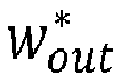
- the output weights w out * is evaluated.
- the input feature matrix per image U and reservoir state matrix X are used to generate the extended state vector per pixel location followed by evaluation of the probabilistic output (y)
- This batch-training process for evaluation of w out * along with the use of reservoir state matrix X and the reservoir update rule lead to a modified ESN framework that can learn a variety of segmentation objectives.
- n handcrafted image planes are derived, e.g., RGB, while some other color planes that can provide significant region segmentation features, such as median-filtered gray scale image planes, gradient-filtered gray scale image planes, the HSL, HSV, and Lab color planes, respectively, can be used.
- the input feature extraction process is depicted in stage 1 of FIG. 2 , where a feature readout function is invoked to stack pixel intensities from n-feature planes corresponding to each pixel position into input feature vector u.
- Input feature extraction for the modified ESN network 18 proceeds with, for each input image, the left-right-top-bottom edges being padded with d/2 columns/rows of zeros, respectively.
- a cropping function is invoked that generates d 2 sub-images of size [axb] from this zero-padded image.
- the 1st cropped sub-image corresponds to top left (i-1,j-1) corner neighbor of each image pixel
- the 2nd cropped sub-image corresponds to pixels to the top (i,j-1) of each image pixel and so on.
- the aforementioned feature readout function is overloaded to generate [nx1] feature vectors corresponding to each pixel location from the d 2 sub-images generated from the cropping function.
- This function overloading process incurs significantly low computational complexity due to the constant feature readout function implementation.
- the spatial neighborhood size (d) increases, the time complexity for input feature extraction by the modified ESN 18 increases due to the cropping function.
- the goal is the segmentation of a ROI and every pixel that belongs to the ROI and is detected as the ROI is called a true positive, TP. Every pixel that is actually a part of the ROI, but is missed by the proposed framework is called false negative, FN. Every pixel that is not a part of the ROI, but is falsely detected as part of the ROI by the proposed framework is called a false positive, FP.
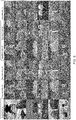
- FIG. 5 is a series of images illustrating the performance of object detection implementing the systems and methods of the present invention in terms of maximum F-score on a public Weizmann 2 dataset.
- FIG. 6 is a series of images illustrating the performance of drivable surface segmentation implementing the systems and methods of the present invention in terms of maximum F-score on a public ADE Challenge dataset.
- FIG. 7 is a series of images illustrating the performance of object tracking implementing the systems and methods of the present invention on a public LISA dataset.
- FIG. 8 is a series of images illustrating the performance of the methods and systems of the present invention for drivable surface segmentation on public data images for various weather conditions.
- FIG. 9 is another series of images illustrating the performance of the methods and systems of the present invention for drivable surface segmentation on public data images for various weather conditions.
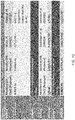
- FIG. 10 is a table providing the comparative segmentation performance of the methods and systems of the present invention relative to other conventional methodologies.
- the software application/algorithm/method of the present invention is implemented as coded instructions stored in a memory and executed by a processor.
- the processor is a hardware device for executing such coded instructions.
- the processor can be any custom made or commercially available processor, a central processing unit (CPU), an auxiliary processor among several processors associated with the memory, a semiconductor-based microprocessor (in the form of a microchip or chip set), or generally any device for executing coded instructions.
- the processor is configured to execute software stored within the memory, to communicate data to and from the memory, and to generally control operations pursuant to the coded instructions.
- the processor may include a mobile optimized processor, such as one optimized for power consumption and mobile applications.
- I/O interfaces can be used to receive user input and/or for providing system output.
- User input can be provided via, for example, a keypad, a touch screen, a scroll ball, a scroll bar, buttons, a voice-activation system, and/or the like.
- System output can be provided via a display device, such as a liquid crystal display (LCD), touch screen, and/or the like.
- the I/O interfaces can also include, for example, a serial port, a parallel port, a small computer system interface (SCSI), an infrared (IR) interface, a radio frequency (RF) interface, a universal serial bus (USB) interface, and/or the like.
- the I/O interfaces can include a graphical user interface (GUI) that enables the user to interact with the memory. Additionally, the I/O interfaces may further include an imaging device, i.e. the camera(s), etc.
- GUI graphical user interface
- the memory may include any of volatile memory elements (e.g., random access memory (RAM, such as DRAM, SRAM, SDRAM, etc.)), nonvolatile memory elements (e.g., ROM, hard drive, etc.), and combinations thereof. Moreover, the memory may incorporate electronic, magnetic, optical, and/or other types of storage media. Note that the memory may have a distributed architecture, where various components are situated remotely from one another, but can be accessed by the processor.
- the software in memory can include one or more software programs, each of which includes an ordered listing of executable instructions for implementing logical functions.
- the software in the memory includes a suitable operating system (O/S) and programs.
- O/S operating system
- the operating system essentially controls the execution of other computer programs, and provides scheduling, input-output control, file and data management, memory management, and communication control and related services.
- the programs may include various applications, add-ons, etc. configured to provide end user functionality.
- the programs can include an application or "app" which provides various functionalities.
Landscapes
- Engineering & Computer Science (AREA)
- Physics & Mathematics (AREA)
- General Physics & Mathematics (AREA)
- Theoretical Computer Science (AREA)
- Computer Vision & Pattern Recognition (AREA)
- Multimedia (AREA)
- Health & Medical Sciences (AREA)
- Evolutionary Computation (AREA)
- General Health & Medical Sciences (AREA)
- Medical Informatics (AREA)
- Artificial Intelligence (AREA)
- Radar, Positioning & Navigation (AREA)
- Remote Sensing (AREA)
- Automation & Control Theory (AREA)
- Aviation & Aerospace Engineering (AREA)
- Molecular Biology (AREA)
- Databases & Information Systems (AREA)
- Software Systems (AREA)
- Computing Systems (AREA)
- Biomedical Technology (AREA)
- Biodiversity & Conservation Biology (AREA)
- Life Sciences & Earth Sciences (AREA)
- Electromagnetism (AREA)
- Business, Economics & Management (AREA)
- Game Theory and Decision Science (AREA)
- Image Analysis (AREA)
Abstract
Description
- The present invention relates generally to methods and systems for providing fast semantic proposals (i.e., pre-proposals) for image and video annotation. More specifically, the present invention relates to methods and systems for providing fast semantic proposals for image and video annotation using modified echo state networks (ESNs). The methods and systems of the present invention find particular applicability in the training and testing of driver assist (DA) and autonomous driving (AD) systems in the automotive and active safety fields.
- The deep learning (DL) field has gained significant attention over the last few years due to its implementation in a wide variety of applications. Deep neural networks (DNNs) require numerous training samples to converge to and produce significant output results. These training samples must be annotated and must be of very high quality for the successful implementation of such DNNs. One challenge is producing large numbers of training samples with high-quality annotated data.
- One particular application of DNNs is in the training and testing of DA and AD systems in the automotive and active safety fields. These systems require large amounts of annotated image data to train and test the various functionalities, such as object detection, drivable surface recognition, semantic segmentation, and object tracking using camera and video images. The main challenge in using manually-annotated image data for these tasks is twofold. First, manually-annotated image data is expensive in terms of the time and expertise required to segment regions of interest (ROIs). Thus, there is a need to obtain fast and accurate semantic proposals from minimally-supervised and/or active learning algorithms that reduce manual annotation time and cost. Second, the scalability of algorithms across datasets is often a challenge. A proposal generation algorithm that works with one dataset may not provide the same performance with another dataset. Thus, there is a need for a generalizable proposal algorithm with low computational complexity.
- Typically, DL algorithms are capable of extracting high-level features from images and videos by tapping into the local and global-level spatial characteristics. However, such DL algorithms require a large number of training samples to adequately learn and perform. As an alternative, ESNs are capable of high-level feature abstraction from a small number of image frames. ESNs have been studied quite extensively and have been applied in numerous fields for other purposes. The primary assumption made related to existing ESNs for semantic image segmentation is that all images in the dataset under consideration have similar spatial orientations and segmentation objectives. This assumption leads to the inherent property of ESNs that, at the end of a training batch of images, the reservoir nodes achieve a steady state, regardless of the initial conditions. However, semantic segmentation tasks cannot always assure similar spatial and/or intensity orientations and often the segmentation objectives can vary. For instance, images acquired by mobile phones with centralized objects of interest for foreground segmentation tasks must be treated separately from wide-angle scenery images acquired from vehicle cameras with the objectives of object and drivable surface segmentation tasks.
- More generally, various works have been developed over the years to incorporate image segmentation using graph cut-techniques. These works segment each image into several super-pixel regions, followed by the identification of each region as a positive or negative bag region. All regions that are identified as positive bags are combined to generate the desired ROI. The disadvantage of this process is that it is slow, due to the super-pixel implementation, and lacks scalability. Other works utilize probabilistic measures and textural features in image sub-regions to decide whether to include each sub-region in the ROI. This process utilizes pixel intensity and texture along with a graph-based approach for image segmentation. The process, although minimally supervised, relies heavily on handcrafted intensity and textural features and fails to extract high-level features from multiple image planes.
- Other works propose the use of super-pixel segmentation followed by the implementation of a density-based spatial clustering of applications with noise (DBSCAN) algorithm and some spatial priors to segment a ROI. This process is again slow due to the super-pixel segmentation process and lacks scalability. Other works introduce a two-round active learning framework to learn from video sequences and enable object racking using a dataset. This framework performs offline learning using wavelets and a classifier and applies particle filtering to track multiple objects. This process lacks scalability across datasets and requires large sets of training data (e.g., several thousand samples of objects) to update the system.
- Other works first isolate object bounding boxes using a bird's-eye-view (BEV) plane followed by feature extraction and a classifier to eliminate false detections. This method also requires a large number of training samples for classification and lacks generalizability. Several benchmarking datasets have been publicly made available for object segmentation tasks, such as the Weizmann 1 and 2 object segmentation datasets, the ADE 20K dataset from MIT, and the LISA vehicle detection dataset. Some prior works have focused on utilizing ESNs for image segmentation by utilizing the reservoir states as features for classification and readout. However, all of these methods lack scalability and fail to utilize spatial neighborhood-based features for high-level feature abstraction.
- Thus, fast and accurate pre-proposals that can be obtained by minimally-supervised or active learning algorithms can largely reduce the time taken for manual annotation tasks. The present invention utilizes an active learning framework that can iteratively learn to segment foreground and background ROIs.
- Typically, deep learning algorithms are found to be capable of extracting high-level features from images and/or videos by tapping into the local and global-level spatial characteristics. However, deep learning algorithms require a large number of training samples to learn. The present invention utilizes a recurrent neural network-like setup that is capable of high-level feature abstraction from a very small number of image frames. This proposed framework is generalizable for images and video frame annotation, segmentation, and video interpolation tasks.
- The present invention provides for the batch-wise training of ESNs that are modified to incorporate spatial and neighborhood-based features from images with similar orientations and segmentation objectives. These ESN modifications enable region-specific feature abstraction from a small set of training images, such that hybrid features specific to a variety of segmentation objectives can be quickly learned per training batch and applied to a large test set thereafter. This framework is generalizable for images and video frame annotation, segmentation, and interpolation tasks.
- The ESN architecture is modified to incorporate both spatial and temporal features, not only from within an image, but also from across a batch of training images. This modified ESN architecture significantly increases the accuracy of semantic segmentation across a variety of datasets.
- A mechanism for the modified ESN network to generate neighborhood region per image-pixel is provided to create larger feature vectors per image-pixel. A fast neighborhood feature extraction process is also provided that eliminates the need to query the two-dimensional neighborhood for each pixel, thereby minimizing computational time complexity.
- The modified ESN framework generates very fast segmentation pre-proposals (e.g., 1 second per image) by utilizing only 20-30% of a dataset for training and testing on the remaining 70-80% of the dataset. Furthermore, this architecture is scalable across a variety of datasets and segmentation objectives across images and video sequences.
- Again, vision-related machine learning models for DA and AD systems require annotated images to train the models for automated detection tasks. The proposed framework is capable of quickly learning the segmentation objective from a small set of images and providing segmentation pre-proposals for foreground, object, and region segmentation tasks across images and video sequences. This framework is highly optimized for iteratively processing small batches of images using a feature readout mechanism and is capable of high-level feature abstraction from multiple color image planes using an ESN architecture that has been modified to incorporate spatial and temporal characteristics across image frames.
- The proposed ESN architecture is modified to accept spatial and temporal features within an image and across a batch of images. The neighborhood region per image-pixel is utilized to generate larger feature vectors per image-pixel, followed by feature dimension increase and dimension reduction steps. This modification significantly increases the accuracy of regional segmentation across a variety of datasets. The process to extract neighborhood-region information per pixel for larger feature vector generation is an optimized process. The proposed framework is capable of generating segmentation pre-proposals in about 1 second per image by learning from only 20-30% of a data set and testing on the remaining 70-80% of the dataset. The proposed framework is highly scalable and generalizable across a variety of datasets.
- In one aspect, a method for providing fast semantic proposals for image and video annotation includes: given an input image to be segmented for a region of interest, extracting one or more image planes from the input image; linearizing each of the one or more image planes to generate a one-dimensional array corresponding to the one or more image planes to extract an input feature vector per image pixel for the one or more image planes; abstracting features for the region of interest using a modified echo state network model utilizing a reservoir including a layer of connections between reservoir nodes, wherein the reservoir increases feature dimensions per pixel location to multiple dimensions followed by feature reduction to one dimension per pixel location, wherein the echo state network model includes both spatial and temporal state factors for the reservoir nodes associated with each pixel vector, and wherein the echo state network model outputs a probability image that is thresholded; post-processing the probability image by discarding small area regions then using one or more of morphological filling of holes or bounding box estimation to form a segmented binary image including the region of interest. The region of interest includes one or more of a foreground object, a drivable surface, and a trackable object. The one or more image planes include one or more of a red-green-blue image plane, a median-filtered grayscale image plane, a gradient-filtered grayscale image plane, a hue-saturation-lightness color plane, a hue-saturation-value color plane, and a Lab color plane. The echo state network model incorporates spatial characteristics from both neighboring pixels in a same input image and similar pixels from a previous input image. The input image is part of a batch of data selected from a larger dataset of frames and only the batch of data is used to form the semantic proposal image. The echo state network model utilizes contributions of a dxd spatial grid around each pixel to generate an input feature vector per pixel, such that a total number of features extracted per pixel location is of dimension d2xn. The echo state network model utilizes a function overloading mechanism to readout a feature vector per pixel by padding edges of an image with columns/rows of zeros to form a zero-padded image and invoking a cropping function to generate sub-images from the zero-padded image and overloading a feature readout function to generate feature vectors corresponding to each pixel location from the sub-images generated by the cropping function. The semantic proposal image is used to train or test one or more of a driver assist system and an autonomous driving system.
- In another aspect, a system for providing fast semantic proposals for image and video annotation includes an extraction algorithm executed on a processor operable for, given an input image to be segmented for a region of interest, extracting one or more image planes from the input image; a linearization algorithm executed on the processor operable for linearizing each of the one or more image planes to generate a one-dimensional array corresponding to the one or more image planes to extract an input feature vector per image pixel for the one or more image planes; a feature abstraction algorithm executed on the processor operable for abstracting features for the region of interest using a modified echo state network model utilizing a reservoir including a layer of connections between reservoir nodes, wherein the reservoir increases feature dimensions per pixel location to multiple dimensions followed by feature reduction to one dimension per pixel location, wherein the echo state network model includes both spatial and temporal state factors for the reservoir nodes associated with each pixel vector, and wherein the echo state network model outputs a probability image that is thresholded; a post-processing algorithm executed on the processor operable for post-processing the probability image by discarding small area regions then using one or more of morphological filling of holes or bounding box estimation to form a segmented binary image including the region of interest that serves as a semantic proposal image. The region of interest includes one or more of a foreground object, a drivable surface, and a trackable object. The one or more image planes include one or more of a red-green-blue image plane, a median-filtered grayscale image plane, a gradient-filtered grayscale image plane, a hue-saturation-lightness color plane, a hue-saturation-value color plane, and a Lab color plane. The echo state network model incorporates spatial characteristics from both neighboring pixels in a same input image and similar pixels from a previous input image. The input image is part of a batch of data selected from a larger dataset of frames and only the batch of data is used to form the semantic proposal image. The echo state network model utilizes contributions of a dxd spatial grid around each pixel to generate an input feature vector per pixel, such that a total number of features extracted per pixel location is of dimension d2xn. The echo state network model utilizes a function overloading mechanism to readout a feature vector per pixel by padding edges of an image with columns/rows of zeros to form a zero-padded image and invoking a cropping function to generate sub-images from the zero-padded image and overloading a feature readout function to generate feature vectors corresponding to each pixel location from the sub-images generated by the cropping function. The semantic proposal image is used to train or test one or more of a driver assist system and an autonomous driving system.
- The present invention is illustrated and described herein with reference to the various drawings, in which like reference numbers are used to denote like system components/method steps, as appropriate, and in which:
-
FIG. 1 is a flowchart illustrating the operation of the system for providing fast semantic pre-proposals for image and video annotation of the present invention; -
FIG. 2 is a schematic diagram illustrating the modified ESN framework for semantic segmentation tasks in standalone images and video frames of the present invention; -
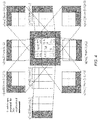
FIG. 3 is a schematic diagram illustrating an input feature extraction process per pixel position (i, j) using the modified ESN model of the present invention to include 3x3 neighborhood contributions, the spatial neighborhood capturing a larger receptive field and extraction of higher order abstract features in later stages of the ESN framework; -
FIG. 4 is a schematic diagram illustrating an input feature extraction method for the modified ESN model of the present invention considering a (d = 3) 3x3 spatial neighborhood per pixel; -
FIG. 5 is a series of images illustrating the performance of object detection implementing the systems and methods of the present invention in terms of maximum F-score on apublic Weizmann 2 dataset; -
FIG. 6 is a series of images illustrating the performance of drivable surface segmentation implementing the systems and methods of the present invention in terms of maximum F-score on a public ADE Challenge dataset; -
FIG. 7 is a series of images illustrating the performance of object tracking implementing the systems and methods of the present invention on a public LISA dataset; -
FIG. 8 is a series of images illustrating the performance of the methods and systems of the present invention for drivable surface segmentation on public data images for various weather conditions; -
FIG. 9 is another series of images illustrating the performance of the methods and systems of the present invention for drivable surface segmentation on public data images for various weather conditions; and -
FIG. 10 is a table providing the comparative segmentation performance of the methods and systems of the present invention relative to other conventional methodologies. - Again, the present invention provides for the batch-wise training of ESNs that are modified to incorporate spatial and neighborhood-based features from images with similar orientations and segmentation objectives. These ESN modifications enable region-specific feature abstraction from a small set of training images, such that hybrid features specific to a variety of segmentation objectives can be quickly learned per training batch and applied to a large test set thereafter. This framework is generalizable for images and video frame annotation, segmentation, and video interpolation tasks.
- The ESN architecture is modified to incorporate both spatial and temporal features, not only from within an image, but also from across a batch of training images. This modified ESN architecture significantly increases the accuracy of semantic segmentation across a variety of datasets.
- A mechanism for the modified ESN network to generate neighborhood region per image-pixel is provided to create larger feature vectors per image-pixel. A fast neighborhood feature extraction process is also provided that eliminates the need to query the two-dimensional neighborhood for each pixel to minimize the computational time complexity.
- The modified ESN framework generates very fast segmentation proposals (e.g., 1 second per image) by utilizing only 20-30% of a dataset for training and testing on the remaining 70-80% of the dataset. Furthermore, this architecture is scalable across a variety of datasets and segmentation objectives across images and video sequences.
- Again, vision-related machine learning models for DA and AD systems require annotated images to train the models for automated detection tasks. The proposed framework is capable of quickly learning the segmentation objective from a small set of images and providing segmentation pre-proposals for foreground, object, and region segmentation tasks across images and video sequences. This framework is highly optimized for iteratively processing small batches of images using a feature readout mechanism and is capable of high-level feature abstraction from multiple color image planes using an ESN architecture that has been modified to incorporate spatial and temporal characteristics across image frames.
- The proposed ESN architecture is modified to accept spatial and temporal features within an image and across a batch of images. The neighborhood region per image-pixel is utilized to generate larger feature vectors per image-pixel, followed by feature dimension increase and dimension reduction steps. This modification significantly increases the accuracy of regional segmentation across a variety of datasets. The process to extract neighborhood-region information per pixel for larger feature vector generation is an optimized process. The proposed framework is capable of generating segmentation pre-proposals in about 1 second per image by learning from only 20-30% of a data set and testing on the remaining 70-80% of the dataset. The proposed framework is highly scalable and generalizable across a variety of datasets.
- Referring now specifically to
FIG. 1 , thesystem 10 of the present invention utilizes an input image (I) 12 that includes any digital images or video frames that need to be segmented for any ROI, such as foreground objects, drivable surfaces, trackable objects, etc. Since most camera images are red, green, and blue (RGB) plane images, some other color planes can provide significant region segmentation features, such as a median-filtered grayscale image plane, a gradient-filtered grayscale image plane, the HSL, HSV, and Lab color planes, etc. 'n' such handcrafted planes are thus first extracted perimage 14. - Next, each 2-
D image 12 is linearized in row-major order to generate a 1-D array corresponding to eachimage plane 16. So, if animage 12 had dimensions [200x200] and (n=5) color image planes were extracted in the first step above, the extracted input features would create a matrix of dimension [5x40000], where each column represents a unique pixel position and is represented by a [5x1] vector. Each pixel has exactly 9 neighbors in a 3x3 spatial grid. Similarly, considering a larger spatial neighborhood grid of dimensions [dxd] around each pixel, where d={3,5,7,9,.....}, the total number of features extracted per pixel position would be [dxdxn]. For example, considering the [3x3] spatial neighborhood per pixel, one can create a matrix of [45x40000], where each pixel is represented by a [(3x3xn)x1]=[45x1] vector. Similarly, if a [5x5] neighborhood area per pixel is used to create feature vector per pixel, then the dimension of feature vector per pixel becomes [(5x5xn)x1]=[125x1]. - The ESN model 18 contains a single layer of sparse connections between 'm' nodes, called the reservoir, such that 'm> dimensions of the input pixel feature vector (n, 9n, or 25n, based on the extent of neighborhood information extracted per pixel). The input feature vector is fed to the reservoir. The reservoir increases the feature dimensions per pixel location to [mx1] followed by feature reduction to [1x1] per pixel position. Thus, a
probability image 20 is generated by the ESN model 18. The formulation of the ESN model 18 is modified and optimized to include spatial and temporal state-updates of reservoir nodes to each pixel vector. The probability image (P) is generated by rearranging the posterior probabilities per pixel (y) per image into the original image dimensions. 20 is a probabilistic image that is output from the ESN model 18 such that all pixel values are within the range [0,1]. Thresholding and post-processing thisimage 20 results in a binary masked region containing the ROI. - The
probability image 20 predicted by ESN model 18 perinput image 12 is thresholded, followed by some minimalpost-processing steps 22 that include the discarding any small regions with area <20 pixels, then morphological filling of holes or bounding box estimation for example. In some instances, a spatial preference for the ROI may also be enforced. For instance, to segment a drivable surface, regions that are close to the bottom horizontal edge of an image are retained while other smaller regions are discarded. - The initially segmented binary image (P) 24 is a final binary mask corresponding to the ROI that is generated after the thresholding and simple post-processing of the image.
- The typical formulation of an ESN on time series data is:



- The proposed modification incorporates spatial and temporal state updates. Note:



- An important aspect here is the variation from (1) to (1a) to incorporate spatial characteristics from neighboring pixels in the same image and similar pixels from the previous image, as well as Increasing the size of the input vector from u(t) in (2) to u(k) in (2a), as well as the batch processing step (from (3) to (3a)) for optimal memory management.
- Typically, the ESN model 18, with n-dimensional inputs and m reservoirs for a pixel 'k' in a training image is described by the following reservoir state update rule:

- This reservoir state update rule assumes temporal behavior for each pixel position across a sequence of images, such as video sequence. A modified architecture is provided that incorporates spatial and temporal perturbations in the ESN reservoir states from pixel neighborhood in an image and across training images, respectively, as illustrated in
FIG. 2 , which illustrates the proposed ESN framework for semantic segmentation tasks in standalone images and video frames. Instage 1, n-dimensional input features are extracted for each pixel location, thereby resulting in featurematrix U. Stage 2 introduces increase in feature dimensionality for each pixel feature vector, given m > n, followed by dimensionality reduction instage 3, thereby resulting in probabilistic output 'y' that is then resized and post-processed to generate segmented image S. For semantic segmentation in standalone images, a modified reservoir state update rule is provided for the ESN network 18 that can be described as:


- Considering multiple images in the training set, where each image is indexed, one can denote the extended state vector


- The solution for the optimization problem can be written in closed form as:

- Thus, ESNs trained by a batch of training images can then be utilized to generate probabilistic linear outcomes (y) for each test image. Y can then be resized to original image dimensions as ESN predicted probabilistic image P. Image P can then be thresholded at the pixel level, followed by minor post-processing, such as discarding small areas then hole-filling or bounding box estimation, to generate a binary segmented mask S corresponding to the segmented ROI (see
FIG. 2 ). The ESN parameters that are empirically estimated based on existing works and supplied to the model are: network leak rate for reservoir states, network spectral radius, number of reservoir nodes, and sparsity of randomly connected reservoir weights. Also, the randomly initialized weights assigned to the ESN are included. - The ESN framework of the present invention can be described in terms of implementation steps and input feature extraction steps.
- Regarding the implementation steps, assuming that each image in the training set is resized, the ESN initialization step proceeds with ESN weight matrices being randomly initialized in a range. In the training step, for each training image, the input feature matrix and desired segmentation output are used to update the ESN reservoir states per pixel location, vectors, and batch-sums. At the end of the training process, the output weights

- Regarding the input feature extraction steps, for each image, n handcrafted image planes are derived, e.g., RGB, while some other color planes that can provide significant region segmentation features, such as median-filtered gray scale image planes, gradient-filtered gray scale image planes, the HSL, HSV, and Lab color planes, respectively, can be used. For the baseline ESN model, the input feature extraction process is depicted in
stage 1 ofFIG. 2 , where a feature readout function is invoked to stack pixel intensities from n-feature planes corresponding to each pixel position into input feature vector u. - For the modified ESN model 18, contributions due to neighboring pixels for the input feature vectors are considered important. This notion is motivated by the use of 2D-spatial kernels in deep learning models that capture increasing receptive fields across layers. This modification is shown in
FIG. 3 , where the contributions of a 3x3 spatial grid around each pixel is used to generate the input feature vector per pixel. Similarly, for a larger neighborhood contribution, a spatial grid of dimensions dxd can be applied around each pixel, where d = 3, 5, 7, 9, etc., such that the total number of features extracted per pixel position would be of dimension d2xn. - Although extraction of neighborhood pixel lends important spatial information for segmentation purposes, the process of querying the 2-D neighborhood for each pixel to generate the d2xn-dimensional feature vector can incur significant computational time complexity. Thus, to facilitate fast neighborhood feature extraction per pixel, a function overloading mechanism is used to readout the feature vector u(k) per pixel k as illustrated in
FIG. 4 . - Input feature extraction for the modified ESN network 18 proceeds with, for each input image, the left-right-top-bottom edges being padded with d/2 columns/rows of zeros, respectively. Next, a cropping function is invoked that generates d2 sub-images of size [axb] from this zero-padded image. For e.g., the 1st cropped sub-image corresponds to top left (i-1,j-1) corner neighbor of each image pixel, the 2nd cropped sub-image corresponds to pixels to the top (i,j-1) of each image pixel and so on. Finally, the aforementioned feature readout function is overloaded to generate [nx1] feature vectors corresponding to each pixel location from the d2 sub-images generated from the cropping function. This function overloading process incurs significantly low computational complexity due to the constant feature readout function implementation. However, it is noteworthy that as the spatial neighborhood size (d) increases, the time complexity for input feature extraction by the modified ESN 18 increases due to the cropping function.
- In evaluating the results of the methods and systems of the present invention, the goal is the segmentation of a ROI and every pixel that belongs to the ROI and is detected as the ROI is called a true positive, TP. Every pixel that is actually a part of the ROI, but is missed by the proposed framework is called false negative, FN. Every pixel that is not a part of the ROI, but is falsely detected as part of the ROI by the proposed framework is called a false positive, FP. Thus, the following may be used:


-
FIG. 5 is a series of images illustrating the performance of object detection implementing the systems and methods of the present invention in terms of maximum F-score on apublic Weizmann 2 dataset. -
FIG. 6 is a series of images illustrating the performance of drivable surface segmentation implementing the systems and methods of the present invention in terms of maximum F-score on a public ADE Challenge dataset. -
FIG. 7 is a series of images illustrating the performance of object tracking implementing the systems and methods of the present invention on a public LISA dataset. -
FIG. 8 is a series of images illustrating the performance of the methods and systems of the present invention for drivable surface segmentation on public data images for various weather conditions. -
FIG. 9 is another series of images illustrating the performance of the methods and systems of the present invention for drivable surface segmentation on public data images for various weather conditions. -
FIG. 10 is a table providing the comparative segmentation performance of the methods and systems of the present invention relative to other conventional methodologies. - Preferably, the software application/algorithm/method of the present invention is implemented as coded instructions stored in a memory and executed by a processor. The processor is a hardware device for executing such coded instructions. The processor can be any custom made or commercially available processor, a central processing unit (CPU), an auxiliary processor among several processors associated with the memory, a semiconductor-based microprocessor (in the form of a microchip or chip set), or generally any device for executing coded instructions. The processor is configured to execute software stored within the memory, to communicate data to and from the memory, and to generally control operations pursuant to the coded instructions. In an exemplary embodiment, the processor may include a mobile optimized processor, such as one optimized for power consumption and mobile applications. Input/output (I/O) interfaces can be used to receive user input and/or for providing system output. User input can be provided via, for example, a keypad, a touch screen, a scroll ball, a scroll bar, buttons, a voice-activation system, and/or the like. System output can be provided via a display device, such as a liquid crystal display (LCD), touch screen, and/or the like. The I/O interfaces can also include, for example, a serial port, a parallel port, a small computer system interface (SCSI), an infrared (IR) interface, a radio frequency (RF) interface, a universal serial bus (USB) interface, and/or the like. The I/O interfaces can include a graphical user interface (GUI) that enables the user to interact with the memory. Additionally, the I/O interfaces may further include an imaging device, i.e. the camera(s), etc.
- The memory may include any of volatile memory elements (e.g., random access memory (RAM, such as DRAM, SRAM, SDRAM, etc.)), nonvolatile memory elements (e.g., ROM, hard drive, etc.), and combinations thereof. Moreover, the memory may incorporate electronic, magnetic, optical, and/or other types of storage media. Note that the memory may have a distributed architecture, where various components are situated remotely from one another, but can be accessed by the processor. The software in memory can include one or more software programs, each of which includes an ordered listing of executable instructions for implementing logical functions. The software in the memory includes a suitable operating system (O/S) and programs. The operating system essentially controls the execution of other computer programs, and provides scheduling, input-output control, file and data management, memory management, and communication control and related services. The programs may include various applications, add-ons, etc. configured to provide end user functionality. The programs can include an application or "app" which provides various functionalities.
- Although the present invention is illustrated and described herein with reference to aspects and examples thereof, it will be readily apparent to persons of ordinary skill in the art that other aspects and examples may perform similar functions and/or achieve like results. All such equivalent aspects and examples are within the spirit and scope of the present invention, are contemplated thereby, and are intended to be covered by the following non-limiting claims for all purposes.
Claims (15)
- A method for providing fast semantic proposals for image and video annotation, comprising:given an input image to be segmented for a region of interest, extracting one or more image planes from the input image;linearizing each of the one or more image planes to generate a one-dimensional array corresponding to the one or more image planes to extract an input feature vector per image pixel for the one or more image planes;abstracting features for the region of interest using a modified echo state network model utilizing a reservoir including a layer of connections between reservoir nodes, wherein the reservoir increases feature dimensions per pixel location to multiple dimensions followed by feature reduction to one dimension per pixel location, wherein the echo state network model comprises both spatial and temporal state factors for the reservoir nodes associated with each pixel vector, and wherein the echo state network model outputs a probability image that is thresholded; andpost-processing.
- The method of claim 1, wherein the region of interest comprises one or more of a portion or whole of a foreground or background object, a drivable surface, and a trackable object.
- The method of claim 1, wherein the one or more image planes comprise one or more of a red-green-blue image plane, a median-filtered grayscale image plane, a gradient-filtered grayscale image plane, a hue-saturation-lightness color plane, a hue-saturation-value color plane, a Lab color plane, a YUV color plane, a YCbCr color plane, and a filtered image plane.
- The method of claim 1, wherein the echo state network model incorporates spatial characteristics from both neighboring pixels in a same input image and similar pixels from a previous input image.
- The method of claim 1, wherein the input image is part of a batch of data selected from a larger dataset of frames and only the batch of data is used to form the semantic proposal image.
- The method of claim 1, wherein the echo state network model utilizes contributions of a dxd spatial grid around each pixel to generate an input feature vector per pixel, such that a total number of features extracted per pixel location is of dimension d2xn.
- The method of claim 1, wherein the echo state network model utilizes a function overloading mechanism to readout a feature vector per pixel by padding edges of an image with columns/rows of zeros to form a zero-padded image and invoking a cropping function to generate sub-images from the zero-padded image and overloading a feature readout function to generate feature vectors corresponding to each pixel location from the sub-images generated by the cropping function.
- The method of claim 1, wherein the semantic proposal image is used to train or test one or more of a driver assist system and an autonomous driving system.
- A system for providing fast semantic proposals for image and video annotation, comprising:an extraction algorithm executed on a processor operable for, given an input image to be segmented for a region of interest, extracting one or more image planes from the input image;a linearization algorithm executed on the processor operable for linearizing each of the one or more image planes to generate a one-dimensional array corresponding to the one or more image planes to extract an input feature vector per image pixel for the one or more image planes;a feature abstraction algorithm executed on the processor operable for abstracting features for the region of interest using a modified echo state network model utilizing a reservoir including a layer of connections between reservoir nodes, wherein the reservoir increases feature dimensions per pixel location to multiple dimensions followed by feature reduction to one dimension per pixel location, wherein the echo state network model comprises both spatial and temporal state factors for the reservoir nodes associated with each pixel vector, and wherein the echo state network model outputs a probability image that is thresholded;a post-processing algorithm executed on the processor.
- The system of claim 9, wherein the region of interest comprises one or more of a portion or whole of a foreground or background object, a drivable surface, and a trackable object.
- The system of claim 9, wherein the one or more image planes comprise one or more of a red-green-blue image plane, a median-filtered grayscale image plane, a gradient-filtered grayscale image plane, a hue-saturation-lightness color plane, a hue-saturation-value color plane, a Lab color plane, a YUV color plane, a YCbCr color plane, and a filtered image plane.
- The system of claim 9, wherein the echo state network model incorporates spatial characteristics from both neighboring pixels in a same input image and similar pixels from a previous input image.
- The system of claim 9, wherein the input image is part of a batch of data selected from a larger dataset of frames and only the batch of data is used to form the semantic proposal image.
- The system of claim 9, wherein the echo state network model utilizes contributions of a dxd spatial grid around each pixel to generate an input feature vector per pixel, such that a total number of features extracted per pixel location is of dimension d2xn.
- The system of claim 9, wherein the echo state network model utilizes a function overloading mechanism to readout a feature vector per pixel by padding edges of an image with columns/rows of zeros to form a zero-padded image and invoking a cropping function to generate sub-images from the zero-padded image and overloading a feature readout function to generate feature vectors corresponding to each pixel location from the sub-images generated by the cropping function.
Applications Claiming Priority (1)
| Application Number | Priority Date | Filing Date | Title |
|---|---|---|---|
| US16/125,362 US10706557B2 (en) | 2018-09-07 | 2018-09-07 | Methods and systems for providing fast semantic proposals for image and video annotation |
Publications (2)
| Publication Number | Publication Date |
|---|---|
| EP3620976A1 true EP3620976A1 (en) | 2020-03-11 |
| EP3620976B1 EP3620976B1 (en) | 2023-06-21 |
Family
ID=67850940
Family Applications (1)
| Application Number | Title | Priority Date | Filing Date |
|---|---|---|---|
| EP19195157.3A Active EP3620976B1 (en) | 2018-09-07 | 2019-09-03 | Methods and systems for providing fast semantic proposals for image and video annotation |
Country Status (2)
| Country | Link |
|---|---|
| US (2) | US10706557B2 (en) |
| EP (1) | EP3620976B1 (en) |
Cited By (2)
| Publication number | Priority date | Publication date | Assignee | Title |
|---|---|---|---|---|
| CN112116979A (en) * | 2020-08-11 | 2020-12-22 | 重庆华医康道科技有限公司 | Electronic prescription circulation safety working method based on block chain ledger protocol |
| CN112417206A (en) * | 2020-11-24 | 2021-02-26 | 杭州一知智能科技有限公司 | Weak supervision video time interval retrieval method and system based on two-branch proposed network |
Families Citing this family (10)
| Publication number | Priority date | Publication date | Assignee | Title |
|---|---|---|---|---|
| US10896345B2 (en) * | 2017-06-02 | 2021-01-19 | Fujitsu Limited | Feature vector generation and encryption |
| US11868871B1 (en) | 2019-08-16 | 2024-01-09 | Perceive Corporation | Circuit for executing stateful neural network |
| CN112001939B (en) | 2020-08-10 | 2021-03-16 | 浙江大学 | Image foreground segmentation algorithm based on edge knowledge transformation |
| CN112269270B (en) * | 2020-11-02 | 2022-09-13 | 太原理工大学 | Echo state network system based on dual polarization states of vertical cavity surface emitting laser |
| CN112784894B (en) * | 2021-01-18 | 2022-11-15 | 西南石油大学 | Automatic labeling method for rock slice microscopic image |
| CN112750127B (en) * | 2021-02-04 | 2022-08-26 | 深圳市泽峰光电科技有限公司 | Image processing method for log end face measurement |
| KR102957945B1 (en) | 2021-02-15 | 2026-04-24 | 에스케이하이닉스 주식회사 | Device for detecting an object using feature transformation and method thereof |
| US20230200693A1 (en) * | 2021-12-22 | 2023-06-29 | Nova Biomedical Corporation | System and Method for Measuring the Percent Fill of Blood Sampling Capillary |
| WO2025041292A1 (en) * | 2023-08-23 | 2025-02-27 | 三菱電機株式会社 | Training device, inference device, training inference device, program, training inference system, training method, and inference method |
| CN117036910B (en) * | 2023-09-28 | 2024-01-12 | 合肥千手医疗科技有限责任公司 | Medical image training method based on multi-view and information bottleneck |
Citations (1)
| Publication number | Priority date | Publication date | Assignee | Title |
|---|---|---|---|---|
| US20180253640A1 (en) * | 2017-03-01 | 2018-09-06 | Stc.Unm | Hybrid architecture system and method for high-dimensional sequence processing |
Family Cites Families (2)
| Publication number | Priority date | Publication date | Assignee | Title |
|---|---|---|---|---|
| EP2892230A4 (en) * | 2012-08-30 | 2015-09-02 | Fujitsu Ltd | IMAGE PROCESSING APPARATUS, IMAGE PROCESSING METHOD, AND PROGRAM |
| US11294052B2 (en) * | 2018-06-18 | 2022-04-05 | The Board Of Trustees Of The University Of Illinois | Ultrasonic imaging with clutter filtering for perfusion |
-
2018
- 2018-09-07 US US16/125,362 patent/US10706557B2/en active Active
-
2019
- 2019-09-03 EP EP19195157.3A patent/EP3620976B1/en active Active
-
2020
- 2020-05-26 US US16/883,019 patent/US11145067B2/en active Active
Patent Citations (1)
| Publication number | Priority date | Publication date | Assignee | Title |
|---|---|---|---|---|
| US20180253640A1 (en) * | 2017-03-01 | 2018-09-06 | Stc.Unm | Hybrid architecture system and method for high-dimensional sequence processing |
Non-Patent Citations (3)
| Title |
|---|
| ROYCHOWDHURY SOHINI ET AL: "Fast Proposals for Image and Video Annotation Using Modified Echo State Networks", 2018 17TH IEEE INTERNATIONAL CONFERENCE ON MACHINE LEARNING AND APPLICATIONS (ICMLA), IEEE, 17 December 2018 (2018-12-17), pages 1225 - 1230, XP033502414, DOI: 10.1109/ICMLA.2018.00199 * |
| SOUAHLIA ABDELKENM ET AL: "Blood vessel segmentation in retinal images using echo state networks", 2017 NINTH INTERNATIONAL CONFERENCE ON ADVANCED COMPUTATIONAL INTELLIGENCE (ICACI), IEEE, 4 February 2017 (2017-02-04), pages 91 - 98, XP033119981, DOI: 10.1109/ICACI.2017.7974491 * |
| SOUAHLIA ABDELKERIM ET AL: "An experimental evaluation of echo state network for colour image segmentation", 2016 INTERNATIONAL JOINT CONFERENCE ON NEURAL NETWORKS (IJCNN), IEEE, 24 July 2016 (2016-07-24), pages 1143 - 1150, XP032992292, DOI: 10.1109/IJCNN.2016.7727326 * |
Cited By (4)
| Publication number | Priority date | Publication date | Assignee | Title |
|---|---|---|---|---|
| CN112116979A (en) * | 2020-08-11 | 2020-12-22 | 重庆华医康道科技有限公司 | Electronic prescription circulation safety working method based on block chain ledger protocol |
| CN112116979B (en) * | 2020-08-11 | 2024-03-19 | 重庆华医康道科技有限公司 | A security working method for electronic prescription circulation based on blockchain ledger protocol |
| CN112417206A (en) * | 2020-11-24 | 2021-02-26 | 杭州一知智能科技有限公司 | Weak supervision video time interval retrieval method and system based on two-branch proposed network |
| CN112417206B (en) * | 2020-11-24 | 2021-09-24 | 杭州一知智能科技有限公司 | Weak supervision video time interval retrieval method and system based on two-branch proposed network |
Also Published As
| Publication number | Publication date |
|---|---|
| US20200286241A1 (en) | 2020-09-10 |
| US20200082540A1 (en) | 2020-03-12 |
| US11145067B2 (en) | 2021-10-12 |
| US10706557B2 (en) | 2020-07-07 |
| EP3620976B1 (en) | 2023-06-21 |
Similar Documents
| Publication | Publication Date | Title |
|---|---|---|
| EP3620976B1 (en) | Methods and systems for providing fast semantic proposals for image and video annotation | |
| US11657525B2 (en) | Extracting information from images | |
| US20230252662A1 (en) | Extracting information from images | |
| CN113361495B (en) | Method, device, equipment and storage medium for calculating similarity of face images | |
| EP3803791B1 (en) | Generating a displacement map of an input dataset pair of image or audio data | |
| JP6351240B2 (en) | Image processing apparatus, image processing method, and program | |
| EP3333768B1 (en) | Method and apparatus for detecting target | |
| EP2989607B1 (en) | Method and device for performing super-resolution on an input image | |
| US9633282B2 (en) | Cross-trained convolutional neural networks using multimodal images | |
| Velasco-Forero et al. | Supervised Ordering in ${\rm I}\!{\rm R}^ p $: Application to Morphological Processing of Hyperspectral Images | |
| Bautista et al. | Convolutional neural network for vehicle detection in low resolution traffic videos | |
| Yang et al. | A self-learning approach to single image super-resolution | |
| US8989442B2 (en) | Robust feature fusion for multi-view object tracking | |
| CN101282461A (en) | image processing method | |
| Heng et al. | Shrink boost for selecting multi-lbp histogram features in object detection | |
| CN109685830B (en) | Target tracking method, device and equipment and computer storage medium | |
| Sabzalian et al. | Deep and sparse features for anomaly detection and localization in video | |
| CN110827327B (en) | Fusion-based long-term target tracking method | |
| Biyouki et al. | A comprehensive survey on deep neural image deblurring | |
| Roychowdhury et al. | Fast proposals for image and video annotation using modified echo state networks | |
| Cretu et al. | Biologically-inspired visual attention features for a vehicle classification task | |
| Pastorino et al. | Semantic segmentation of remote sensing images combining hierarchical probabilistic graphical models and deep convolutional neural networks | |
| US12633091B2 (en) | Feature extraction for object re-identification or object classification using a composite image | |
| Pattnayak et al. | Plant Leaf Diseases: Feature Extraction and Identification Using Convolutional Neural Networks and GLCM features | |
| EP4485378B1 (en) | Feature extraction for object re-identification or object classification using a composite image |
Legal Events
| Date | Code | Title | Description |
|---|---|---|---|
| PUAI | Public reference made under article 153(3) epc to a published international application that has entered the european phase |
Free format text: ORIGINAL CODE: 0009012 |
|
| STAA | Information on the status of an ep patent application or granted ep patent |
Free format text: STATUS: THE APPLICATION HAS BEEN PUBLISHED |
|
| AK | Designated contracting states |
Kind code of ref document: A1 Designated state(s): AL AT BE BG CH CY CZ DE DK EE ES FI FR GB GR HR HU IE IS IT LI LT LU LV MC MK MT NL NO PL PT RO RS SE SI SK SM TR |
|
| AX | Request for extension of the european patent |
Extension state: BA ME |
|
| STAA | Information on the status of an ep patent application or granted ep patent |
Free format text: STATUS: REQUEST FOR EXAMINATION WAS MADE |
|
| 17P | Request for examination filed |
Effective date: 20200911 |
|
| RBV | Designated contracting states (corrected) |
Designated state(s): AL AT BE BG CH CY CZ DE DK EE ES FI FR GB GR HR HU IE IS IT LI LT LU LV MC MK MT NL NO PL PT RO RS SE SI SK SM TR |
|
| STAA | Information on the status of an ep patent application or granted ep patent |
Free format text: STATUS: EXAMINATION IS IN PROGRESS |
|
| 17Q | First examination report despatched |
Effective date: 20210929 |
|
| REG | Reference to a national code |
Ref country code: DE Free format text: PREVIOUS MAIN CLASS: G06K0009340000 Ref country code: DE Ref legal event code: R079 Ref document number: 602019031271 Country of ref document: DE Free format text: PREVIOUS MAIN CLASS: G06K0009340000 Ipc: G06V0010260000 |
|
| GRAP | Despatch of communication of intention to grant a patent |
Free format text: ORIGINAL CODE: EPIDOSNIGR1 |
|
| STAA | Information on the status of an ep patent application or granted ep patent |
Free format text: STATUS: GRANT OF PATENT IS INTENDED |
|
| RIC1 | Information provided on ipc code assigned before grant |
Ipc: G06V 10/82 20220101ALI20230221BHEP Ipc: G06V 10/44 20220101ALI20230221BHEP Ipc: G06V 10/26 20220101AFI20230221BHEP |
|
| INTG | Intention to grant announced |
Effective date: 20230309 |
|
| GRAS | Grant fee paid |
Free format text: ORIGINAL CODE: EPIDOSNIGR3 |
|
| GRAA | (expected) grant |
Free format text: ORIGINAL CODE: 0009210 |
|
| STAA | Information on the status of an ep patent application or granted ep patent |
Free format text: STATUS: THE PATENT HAS BEEN GRANTED |
|
| AK | Designated contracting states |
Kind code of ref document: B1 Designated state(s): AL AT BE BG CH CY CZ DE DK EE ES FI FR GB GR HR HU IE IS IT LI LT LU LV MC MK MT NL NO PL PT RO RS SE SI SK SM TR |
|
| REG | Reference to a national code |
Ref country code: CH Ref legal event code: EP |
|
| REG | Reference to a national code |
Ref country code: DE Ref legal event code: R096 Ref document number: 602019031271 Country of ref document: DE |
|
| REG | Reference to a national code |
Ref country code: AT Ref legal event code: REF Ref document number: 1581452 Country of ref document: AT Kind code of ref document: T Effective date: 20230715 |
|
| REG | Reference to a national code |
Ref country code: IE Ref legal event code: FG4D |
|
| REG | Reference to a national code |
Ref country code: LT Ref legal event code: MG9D |
|
| REG | Reference to a national code |
Ref country code: NL Ref legal event code: MP Effective date: 20230621 |
|
| PG25 | Lapsed in a contracting state [announced via postgrant information from national office to epo] |
Ref country code: SE Free format text: LAPSE BECAUSE OF FAILURE TO SUBMIT A TRANSLATION OF THE DESCRIPTION OR TO PAY THE FEE WITHIN THE PRESCRIBED TIME-LIMIT Effective date: 20230621 Ref country code: NO Free format text: LAPSE BECAUSE OF FAILURE TO SUBMIT A TRANSLATION OF THE DESCRIPTION OR TO PAY THE FEE WITHIN THE PRESCRIBED TIME-LIMIT Effective date: 20230921 |
|
| REG | Reference to a national code |
Ref country code: AT Ref legal event code: MK05 Ref document number: 1581452 Country of ref document: AT Kind code of ref document: T Effective date: 20230621 |
|
| PG25 | Lapsed in a contracting state [announced via postgrant information from national office to epo] |
Ref country code: RS Free format text: LAPSE BECAUSE OF FAILURE TO SUBMIT A TRANSLATION OF THE DESCRIPTION OR TO PAY THE FEE WITHIN THE PRESCRIBED TIME-LIMIT Effective date: 20230621 Ref country code: NL Free format text: LAPSE BECAUSE OF FAILURE TO SUBMIT A TRANSLATION OF THE DESCRIPTION OR TO PAY THE FEE WITHIN THE PRESCRIBED TIME-LIMIT Effective date: 20230621 Ref country code: LV Free format text: LAPSE BECAUSE OF FAILURE TO SUBMIT A TRANSLATION OF THE DESCRIPTION OR TO PAY THE FEE WITHIN THE PRESCRIBED TIME-LIMIT Effective date: 20230621 Ref country code: LT Free format text: LAPSE BECAUSE OF FAILURE TO SUBMIT A TRANSLATION OF THE DESCRIPTION OR TO PAY THE FEE WITHIN THE PRESCRIBED TIME-LIMIT Effective date: 20230621 Ref country code: HR Free format text: LAPSE BECAUSE OF FAILURE TO SUBMIT A TRANSLATION OF THE DESCRIPTION OR TO PAY THE FEE WITHIN THE PRESCRIBED TIME-LIMIT Effective date: 20230621 Ref country code: GR Free format text: LAPSE BECAUSE OF FAILURE TO SUBMIT A TRANSLATION OF THE DESCRIPTION OR TO PAY THE FEE WITHIN THE PRESCRIBED TIME-LIMIT Effective date: 20230922 |
|
| PG25 | Lapsed in a contracting state [announced via postgrant information from national office to epo] |
Ref country code: FI Free format text: LAPSE BECAUSE OF FAILURE TO SUBMIT A TRANSLATION OF THE DESCRIPTION OR TO PAY THE FEE WITHIN THE PRESCRIBED TIME-LIMIT Effective date: 20230621 |
|
| PG25 | Lapsed in a contracting state [announced via postgrant information from national office to epo] |
Ref country code: SK Free format text: LAPSE BECAUSE OF FAILURE TO SUBMIT A TRANSLATION OF THE DESCRIPTION OR TO PAY THE FEE WITHIN THE PRESCRIBED TIME-LIMIT Effective date: 20230621 |
|
| P01 | Opt-out of the competence of the unified patent court (upc) registered |
Effective date: 20231212 |
|
| PG25 | Lapsed in a contracting state [announced via postgrant information from national office to epo] |
Ref country code: ES Free format text: LAPSE BECAUSE OF FAILURE TO SUBMIT A TRANSLATION OF THE DESCRIPTION OR TO PAY THE FEE WITHIN THE PRESCRIBED TIME-LIMIT Effective date: 20230621 |
|
| PG25 | Lapsed in a contracting state [announced via postgrant information from national office to epo] |
Ref country code: IS Free format text: LAPSE BECAUSE OF FAILURE TO SUBMIT A TRANSLATION OF THE DESCRIPTION OR TO PAY THE FEE WITHIN THE PRESCRIBED TIME-LIMIT Effective date: 20231021 |
|
| PG25 | Lapsed in a contracting state [announced via postgrant information from national office to epo] |
Ref country code: SM Free format text: LAPSE BECAUSE OF FAILURE TO SUBMIT A TRANSLATION OF THE DESCRIPTION OR TO PAY THE FEE WITHIN THE PRESCRIBED TIME-LIMIT Effective date: 20230621 Ref country code: SK Free format text: LAPSE BECAUSE OF FAILURE TO SUBMIT A TRANSLATION OF THE DESCRIPTION OR TO PAY THE FEE WITHIN THE PRESCRIBED TIME-LIMIT Effective date: 20230621 Ref country code: RO Free format text: LAPSE BECAUSE OF FAILURE TO SUBMIT A TRANSLATION OF THE DESCRIPTION OR TO PAY THE FEE WITHIN THE PRESCRIBED TIME-LIMIT Effective date: 20230621 Ref country code: PT Free format text: LAPSE BECAUSE OF FAILURE TO SUBMIT A TRANSLATION OF THE DESCRIPTION OR TO PAY THE FEE WITHIN THE PRESCRIBED TIME-LIMIT Effective date: 20231023 Ref country code: IS Free format text: LAPSE BECAUSE OF FAILURE TO SUBMIT A TRANSLATION OF THE DESCRIPTION OR TO PAY THE FEE WITHIN THE PRESCRIBED TIME-LIMIT Effective date: 20231021 Ref country code: ES Free format text: LAPSE BECAUSE OF FAILURE TO SUBMIT A TRANSLATION OF THE DESCRIPTION OR TO PAY THE FEE WITHIN THE PRESCRIBED TIME-LIMIT Effective date: 20230621 Ref country code: EE Free format text: LAPSE BECAUSE OF FAILURE TO SUBMIT A TRANSLATION OF THE DESCRIPTION OR TO PAY THE FEE WITHIN THE PRESCRIBED TIME-LIMIT Effective date: 20230621 Ref country code: CZ Free format text: LAPSE BECAUSE OF FAILURE TO SUBMIT A TRANSLATION OF THE DESCRIPTION OR TO PAY THE FEE WITHIN THE PRESCRIBED TIME-LIMIT Effective date: 20230621 Ref country code: AT Free format text: LAPSE BECAUSE OF FAILURE TO SUBMIT A TRANSLATION OF THE DESCRIPTION OR TO PAY THE FEE WITHIN THE PRESCRIBED TIME-LIMIT Effective date: 20230621 |
|
| PG25 | Lapsed in a contracting state [announced via postgrant information from national office to epo] |
Ref country code: PL Free format text: LAPSE BECAUSE OF FAILURE TO SUBMIT A TRANSLATION OF THE DESCRIPTION OR TO PAY THE FEE WITHIN THE PRESCRIBED TIME-LIMIT Effective date: 20230621 |
|
| REG | Reference to a national code |
Ref country code: DE Ref legal event code: R097 Ref document number: 602019031271 Country of ref document: DE |
|
| PLBE | No opposition filed within time limit |
Free format text: ORIGINAL CODE: 0009261 |
|
| STAA | Information on the status of an ep patent application or granted ep patent |
Free format text: STATUS: NO OPPOSITION FILED WITHIN TIME LIMIT |
|
| PG25 | Lapsed in a contracting state [announced via postgrant information from national office to epo] |
Ref country code: DK Free format text: LAPSE BECAUSE OF FAILURE TO SUBMIT A TRANSLATION OF THE DESCRIPTION OR TO PAY THE FEE WITHIN THE PRESCRIBED TIME-LIMIT Effective date: 20230621 |
|
| REG | Reference to a national code |
Ref country code: CH Ref legal event code: PL |
|
| PG25 | Lapsed in a contracting state [announced via postgrant information from national office to epo] |
Ref country code: SI Free format text: LAPSE BECAUSE OF FAILURE TO SUBMIT A TRANSLATION OF THE DESCRIPTION OR TO PAY THE FEE WITHIN THE PRESCRIBED TIME-LIMIT Effective date: 20230621 |
|
| PG25 | Lapsed in a contracting state [announced via postgrant information from national office to epo] |
Ref country code: LU Free format text: LAPSE BECAUSE OF NON-PAYMENT OF DUE FEES Effective date: 20230903 |
|
| REG | Reference to a national code |
Ref country code: BE Ref legal event code: MM Effective date: 20230930 |
|
| 26N | No opposition filed |
Effective date: 20240322 |
|
| PG25 | Lapsed in a contracting state [announced via postgrant information from national office to epo] |
Ref country code: SI Free format text: LAPSE BECAUSE OF FAILURE TO SUBMIT A TRANSLATION OF THE DESCRIPTION OR TO PAY THE FEE WITHIN THE PRESCRIBED TIME-LIMIT Effective date: 20230621 Ref country code: LU Free format text: LAPSE BECAUSE OF NON-PAYMENT OF DUE FEES Effective date: 20230903 Ref country code: IT Free format text: LAPSE BECAUSE OF FAILURE TO SUBMIT A TRANSLATION OF THE DESCRIPTION OR TO PAY THE FEE WITHIN THE PRESCRIBED TIME-LIMIT Effective date: 20230621 Ref country code: MC Free format text: LAPSE BECAUSE OF FAILURE TO SUBMIT A TRANSLATION OF THE DESCRIPTION OR TO PAY THE FEE WITHIN THE PRESCRIBED TIME-LIMIT Effective date: 20230621 |
|
| REG | Reference to a national code |
Ref country code: IE Ref legal event code: MM4A |
|
| PG25 | Lapsed in a contracting state [announced via postgrant information from national office to epo] |
Ref country code: IE Free format text: LAPSE BECAUSE OF NON-PAYMENT OF DUE FEES Effective date: 20230903 |
|
| PG25 | Lapsed in a contracting state [announced via postgrant information from national office to epo] |
Ref country code: CH Free format text: LAPSE BECAUSE OF NON-PAYMENT OF DUE FEES Effective date: 20230930 |
|
| PG25 | Lapsed in a contracting state [announced via postgrant information from national office to epo] |
Ref country code: IE Free format text: LAPSE BECAUSE OF NON-PAYMENT OF DUE FEES Effective date: 20230903 Ref country code: CH Free format text: LAPSE BECAUSE OF NON-PAYMENT OF DUE FEES Effective date: 20230930 |
|
| PG25 | Lapsed in a contracting state [announced via postgrant information from national office to epo] |
Ref country code: BE Free format text: LAPSE BECAUSE OF NON-PAYMENT OF DUE FEES Effective date: 20230930 |
|
| PG25 | Lapsed in a contracting state [announced via postgrant information from national office to epo] |
Ref country code: BG Free format text: LAPSE BECAUSE OF FAILURE TO SUBMIT A TRANSLATION OF THE DESCRIPTION OR TO PAY THE FEE WITHIN THE PRESCRIBED TIME-LIMIT Effective date: 20230621 |
|
| PG25 | Lapsed in a contracting state [announced via postgrant information from national office to epo] |
Ref country code: BG Free format text: LAPSE BECAUSE OF FAILURE TO SUBMIT A TRANSLATION OF THE DESCRIPTION OR TO PAY THE FEE WITHIN THE PRESCRIBED TIME-LIMIT Effective date: 20230621 |
|
| PG25 | Lapsed in a contracting state [announced via postgrant information from national office to epo] |
Ref country code: CY Free format text: LAPSE BECAUSE OF FAILURE TO SUBMIT A TRANSLATION OF THE DESCRIPTION OR TO PAY THE FEE WITHIN THE PRESCRIBED TIME-LIMIT; INVALID AB INITIO Effective date: 20190903 |
|
| PG25 | Lapsed in a contracting state [announced via postgrant information from national office to epo] |
Ref country code: HU Free format text: LAPSE BECAUSE OF FAILURE TO SUBMIT A TRANSLATION OF THE DESCRIPTION OR TO PAY THE FEE WITHIN THE PRESCRIBED TIME-LIMIT; INVALID AB INITIO Effective date: 20190903 |
|
| PGFP | Annual fee paid to national office [announced via postgrant information from national office to epo] |
Ref country code: DE Payment date: 20250820 Year of fee payment: 7 |
|
| PGFP | Annual fee paid to national office [announced via postgrant information from national office to epo] |
Ref country code: GB Payment date: 20250820 Year of fee payment: 7 |
|
| PGFP | Annual fee paid to national office [announced via postgrant information from national office to epo] |
Ref country code: FR Payment date: 20250821 Year of fee payment: 7 |
|
| PG25 | Lapsed in a contracting state [announced via postgrant information from national office to epo] |
Ref country code: TR Free format text: LAPSE BECAUSE OF FAILURE TO SUBMIT A TRANSLATION OF THE DESCRIPTION OR TO PAY THE FEE WITHIN THE PRESCRIBED TIME-LIMIT Effective date: 20230621 |