EP3620454B1 - Carboxylic acid derivative as at2r receptor antagonist - Google Patents
Carboxylic acid derivative as at2r receptor antagonist Download PDFInfo
- Publication number
- EP3620454B1 EP3620454B1 EP18813230.2A EP18813230A EP3620454B1 EP 3620454 B1 EP3620454 B1 EP 3620454B1 EP 18813230 A EP18813230 A EP 18813230A EP 3620454 B1 EP3620454 B1 EP 3620454B1
- Authority
- EP
- European Patent Office
- Prior art keywords
- compound
- nmr
- group
- 400mhz
- chloroform
- Prior art date
- Legal status (The legal status is an assumption and is not a legal conclusion. Google has not performed a legal analysis and makes no representation as to the accuracy of the status listed.)
- Active
Links
- 0 C*C1C2C(C[C@@](C)*)*CC2C1 Chemical compound C*C1C2C(C[C@@](C)*)*CC2C1 0.000 description 22
- OPLXIHPCTNAJTQ-UHFFFAOYSA-N COc(ccc(C1)c2CC(C(O)=O)N1C(C(c1ccccc1)OC1CCCC1)=O)c2OCc1cnc[s]1 Chemical compound COc(ccc(C1)c2CC(C(O)=O)N1C(C(c1ccccc1)OC1CCCC1)=O)c2OCc1cnc[s]1 OPLXIHPCTNAJTQ-UHFFFAOYSA-N 0.000 description 2
- CWDDZGCXSASRJK-UHFFFAOYSA-N COc1ccc(CN(C(C2)C(O)=O)C(C(c3ccccc3)NC(C3CCCC3)=O)=O)c2c1OCc1ccccc1 Chemical compound COc1ccc(CN(C(C2)C(O)=O)C(C(c3ccccc3)NC(C3CCCC3)=O)=O)c2c1OCc1ccccc1 CWDDZGCXSASRJK-UHFFFAOYSA-N 0.000 description 2
- QIPPFXKRGGYUBP-UHFFFAOYSA-N COc1ccc(CN(C(C2)C(O)=O)C(C(c3ccccc3)OC3CCCC3)=O)c2c1OCc1ccc[s]1 Chemical compound COc1ccc(CN(C(C2)C(O)=O)C(C(c3ccccc3)OC3CCCC3)=O)c2c1OCc1ccc[s]1 QIPPFXKRGGYUBP-UHFFFAOYSA-N 0.000 description 2
- PRHUZYFQDXWSAN-LMSSTIIKSA-N COc1ccc(CN([C@@H](C2)C(O)=O)C([C@@H](c3ccccc3)Oc(cc3)ccc3F)=O)c2c1OCc1ccccc1 Chemical compound COc1ccc(CN([C@@H](C2)C(O)=O)C([C@@H](c3ccccc3)Oc(cc3)ccc3F)=O)c2c1OCc1ccccc1 PRHUZYFQDXWSAN-LMSSTIIKSA-N 0.000 description 2
- VEVLUOYOLBIPQZ-LITSAYRRSA-N COc1ccc(CN([C@@H](C2)C(O)=O)C([C@@H](c3ccccc3)Oc(cccc3)c3F)=O)c2c1OCc1ccccc1 Chemical compound COc1ccc(CN([C@@H](C2)C(O)=O)C([C@@H](c3ccccc3)Oc(cccc3)c3F)=O)c2c1OCc1ccccc1 VEVLUOYOLBIPQZ-LITSAYRRSA-N 0.000 description 2
- NGQXLNJYKIFQEE-UHFFFAOYSA-N N#Cc1ccc(CN(CC2)C(C(c3ccccc3)OC3CCCC3)=O)c2c1OCc1ccccc1 Chemical compound N#Cc1ccc(CN(CC2)C(C(c3ccccc3)OC3CCCC3)=O)c2c1OCc1ccccc1 NGQXLNJYKIFQEE-UHFFFAOYSA-N 0.000 description 2
- NRFQGKLGFARODQ-QBHOUYDASA-N CC1(CCCC1)OC(C(N(Cc(c(C1)c2OCc3ccccc3)ccc2Cl)[C@@H]1C(O)=O)=O)c1ccccc1 Chemical compound CC1(CCCC1)OC(C(N(Cc(c(C1)c2OCc3ccccc3)ccc2Cl)[C@@H]1C(O)=O)=O)c1ccccc1 NRFQGKLGFARODQ-QBHOUYDASA-N 0.000 description 1
- CAYCDYNEICKVAJ-UHFFFAOYSA-N CC1(CCCC1)OC(C(N(Cc(c(C1)c2OCc3ccccc3)ccc2OC)C1C(O)=O)=O)c1ccccc1 Chemical compound CC1(CCCC1)OC(C(N(Cc(c(C1)c2OCc3ccccc3)ccc2OC)C1C(O)=O)=O)c1ccccc1 CAYCDYNEICKVAJ-UHFFFAOYSA-N 0.000 description 1
- NRFQGKLGFARODQ-SXOMAYOGSA-N CC1(CCCC1)O[C@H](C(N(Cc(c(C1)c2OCc3ccccc3)ccc2Cl)[C@H]1C(O)=O)=O)c1ccccc1 Chemical compound CC1(CCCC1)O[C@H](C(N(Cc(c(C1)c2OCc3ccccc3)ccc2Cl)[C@H]1C(O)=O)=O)c1ccccc1 NRFQGKLGFARODQ-SXOMAYOGSA-N 0.000 description 1
- SVCZBSNQCDVRSD-UHFFFAOYSA-N CCCCOC(C(N(Cc(c(C1)c2OCc3ccccc3)ccc2OC)C1C(O)=O)=O)c1ccccc1 Chemical compound CCCCOC(C(N(Cc(c(C1)c2OCc3ccccc3)ccc2OC)C1C(O)=O)=O)c1ccccc1 SVCZBSNQCDVRSD-UHFFFAOYSA-N 0.000 description 1
- SVCZBSNQCDVRSD-AHKZPQOWSA-N CCCCO[C@@H](C(N(Cc(c(C1)c2OCc3ccccc3)ccc2OC)[C@@H]1C(O)=O)=O)c1ccccc1 Chemical compound CCCCO[C@@H](C(N(Cc(c(C1)c2OCc3ccccc3)ccc2OC)[C@@H]1C(O)=O)=O)c1ccccc1 SVCZBSNQCDVRSD-AHKZPQOWSA-N 0.000 description 1
- VQSNMMPEZUJIIB-QODXOHEASA-N CCOC([C@H](Cc(c(C1)ccc2OC)c2OC2CCOCC2)N1C(C(c1ccccc1)OC1CCCC1)=O)=O Chemical compound CCOC([C@H](Cc(c(C1)ccc2OC)c2OC2CCOCC2)N1C(C(c1ccccc1)OC1CCCC1)=O)=O VQSNMMPEZUJIIB-QODXOHEASA-N 0.000 description 1
- CDHLJHBHIAJKBJ-FQEVSTJZSA-N CCOC([C@H](Cc(c(C1)ccc2OC)c2OCc(c(F)c2)ccc2F)N1C(OC(C)(C)C)=O)=O Chemical compound CCOC([C@H](Cc(c(C1)ccc2OC)c2OCc(c(F)c2)ccc2F)N1C(OC(C)(C)C)=O)=O CDHLJHBHIAJKBJ-FQEVSTJZSA-N 0.000 description 1
- VVVGJJUSINCOIY-FQEVSTJZSA-N CCOC([C@H](Cc(c(C1)ccc2OC)c2OCc(cc2)ccc2F)N1C(OC(C)(C)C)=O)=O Chemical compound CCOC([C@H](Cc(c(C1)ccc2OC)c2OCc(cc2)ccc2F)N1C(OC(C)(C)C)=O)=O VVVGJJUSINCOIY-FQEVSTJZSA-N 0.000 description 1
- AWAFVGHNRFNOEM-QHSFNAQHSA-N CCOC([C@H](Cc(c(C1)ccc2OC)c2OCc2ccccc2)N1C(C(c1ccccc1)Oc1ccccc1)=O)=O Chemical compound CCOC([C@H](Cc(c(C1)ccc2OC)c2OCc2ccccc2)N1C(C(c1ccccc1)Oc1ccccc1)=O)=O AWAFVGHNRFNOEM-QHSFNAQHSA-N 0.000 description 1
- QSJUMPUMNRHOER-IZEXYCQBSA-N CCOC([C@H](Cc(c(C1)ccc2OC)c2OCc2ccccc2)N1C([C@H](c1ccccc1)Oc(ccc(F)c1)c1F)=O)=O Chemical compound CCOC([C@H](Cc(c(C1)ccc2OC)c2OCc2ccccc2)N1C([C@H](c1ccccc1)Oc(ccc(F)c1)c1F)=O)=O QSJUMPUMNRHOER-IZEXYCQBSA-N 0.000 description 1
- NOIKFTFZLMOZKJ-IBGZPJMESA-N CCOC([C@H](Cc(c(C1)ccc2OC)c2OCc2ccncc2)N1C(OC(C)(C)C)=O)=O Chemical compound CCOC([C@H](Cc(c(C1)ccc2OC)c2OCc2ccncc2)N1C(OC(C)(C)C)=O)=O NOIKFTFZLMOZKJ-IBGZPJMESA-N 0.000 description 1
- FNRLTWFMHLMBIU-XCZPVHLTSA-N CCOC([C@H](Cc(c(C1)ccc2OC)c2OCc2nccnc2)N1C([C@H](c1ccccc1)OC1CCCC1)=O)=O Chemical compound CCOC([C@H](Cc(c(C1)ccc2OC)c2OCc2nccnc2)N1C([C@H](c1ccccc1)OC1CCCC1)=O)=O FNRLTWFMHLMBIU-XCZPVHLTSA-N 0.000 description 1
- MDQXOJWLRPILLE-KRWDZBQOSA-N CCOC([C@H](Cc1c2OCc(cc3)ccc3F)NCc1ccc2OC)=O Chemical compound CCOC([C@H](Cc1c2OCc(cc3)ccc3F)NCc1ccc2OC)=O MDQXOJWLRPILLE-KRWDZBQOSA-N 0.000 description 1
- UVFMUODBNPOGBH-QHSFNAQHSA-N CC[O](C)C([C@H](Cc(c(C1)ccc2OC)c2OCc2ccccc2)N1C(C(c1ccccc1)NC(C1CCCC1)=O)=O)=O Chemical compound CC[O](C)C([C@H](Cc(c(C1)ccc2OC)c2OCc2ccccc2)N1C(C(c1ccccc1)NC(C1CCCC1)=O)=O)=O UVFMUODBNPOGBH-QHSFNAQHSA-N 0.000 description 1
- KUMIIJZUFIVOSS-AZGAKELHSA-N CCc(c(C[C@@H](C(O)=O)NC([C@@H](c1ccccc1)OC1CCCC1)=O)c1OCc2cnc[s]2)ccc1OC Chemical compound CCc(c(C[C@@H](C(O)=O)NC([C@@H](c1ccccc1)OC1CCCC1)=O)c1OCc2cnc[s]2)ccc1OC KUMIIJZUFIVOSS-AZGAKELHSA-N 0.000 description 1
- VVWHYDMNSVNTEB-UHFFFAOYSA-N COC(CCC(F)=C1)=C1F Chemical compound COC(CCC(F)=C1)=C1F VVWHYDMNSVNTEB-UHFFFAOYSA-N 0.000 description 1
- UDTBXRJCFRYBQR-GGZNPFNTSA-N COC1C=CC(CN([C@@H](C2)C(O)=O)C(C(c3ccccc3)OC3CCCC3)=O)=C2C1OCc1ccncc1 Chemical compound COC1C=CC(CN([C@@H](C2)C(O)=O)C(C(c3ccccc3)OC3CCCC3)=O)=C2C1OCc1ccncc1 UDTBXRJCFRYBQR-GGZNPFNTSA-N 0.000 description 1
- RRMOYCAMDLWEPK-QMEHICNMSA-N COC1C=CC(CN([C@H](C2)C(O)=O)C(C(c3ccccc3)OC3CCCC3)=O)=C2C1OCc(cccc1)c1F Chemical compound COC1C=CC(CN([C@H](C2)C(O)=O)C(C(c3ccccc3)OC3CCCC3)=O)=C2C1OCc(cccc1)c1F RRMOYCAMDLWEPK-QMEHICNMSA-N 0.000 description 1
- FVTPQPMIYVMXNN-AZGAKELHSA-N COCCO[C@@H](C(N(Cc(c(C1)c2OCc3ccccc3)ccc2OC)[C@@H]1C(O)=O)=O)c1ccccc1 Chemical compound COCCO[C@@H](C(N(Cc(c(C1)c2OCc3ccccc3)ccc2OC)[C@@H]1C(O)=O)=O)c1ccccc1 FVTPQPMIYVMXNN-AZGAKELHSA-N 0.000 description 1
- VGDGLZYXKWVOTL-UHFFFAOYSA-N COc(c(F)c1)ccc1[F]COc(c(F)cc(F)c1)c1F Chemical compound COc(c(F)c1)ccc1[F]COc(c(F)cc(F)c1)c1F VGDGLZYXKWVOTL-UHFFFAOYSA-N 0.000 description 1
- XDJAAZYHCCRJOK-UHFFFAOYSA-N COc(cc1)ccc1C#N Chemical compound COc(cc1)ccc1C#N XDJAAZYHCCRJOK-UHFFFAOYSA-N 0.000 description 1
- PMWQKOGSXKDFGH-UHFFFAOYSA-N COc(cc1)ccc1OC(C(N(Cc(c(C1)c2OCc3ccccc3)ccc2OC)C1C(O)=O)=O)c1ccccc1 Chemical compound COc(cc1)ccc1OC(C(N(Cc(c(C1)c2OCc3ccccc3)ccc2OC)C1C(O)=O)=O)c1ccccc1 PMWQKOGSXKDFGH-UHFFFAOYSA-N 0.000 description 1
- VSRWKQSHJCOKPR-UHFFFAOYSA-N COc(cc1)ccc1[F]COc(cccc1COc(cc2)ccc2Cl)c1F Chemical compound COc(cc1)ccc1[F]COc(cccc1COc(cc2)ccc2Cl)c1F VSRWKQSHJCOKPR-UHFFFAOYSA-N 0.000 description 1
- JIXDOBAQOWOUPA-UHFFFAOYSA-N COc(cccc1)c1F Chemical compound COc(cccc1)c1F JIXDOBAQOWOUPA-UHFFFAOYSA-N 0.000 description 1
- VRBMFRMLMAKWID-CILPGNKCSA-N COc1ccc(CN(C(/C(/P=C)=[O]\C2CCOCC2)O)[C@H](C2)C(O)=O)c2c1OCc1ccccc1 Chemical compound COc1ccc(CN(C(/C(/P=C)=[O]\C2CCOCC2)O)[C@H](C2)C(O)=O)c2c1OCc1ccccc1 VRBMFRMLMAKWID-CILPGNKCSA-N 0.000 description 1
- OUNKRNRFMMFIRS-UHFFFAOYSA-N COc1ccc(CN(C(C(c2ccccc2)OCC(F)(F)F)O)C(C2)C(O)=O)c2c1OCc1ccccc1 Chemical compound COc1ccc(CN(C(C(c2ccccc2)OCC(F)(F)F)O)C(C2)C(O)=O)c2c1OCc1ccccc1 OUNKRNRFMMFIRS-UHFFFAOYSA-N 0.000 description 1
- KTDOITPBAYTFGE-UHFFFAOYSA-N COc1ccc(CN(C(C2)C(O)=O)C(C(c3ccccc3)NC3CCCC3)=O)c2c1OCc1ccccc1 Chemical compound COc1ccc(CN(C(C2)C(O)=O)C(C(c3ccccc3)NC3CCCC3)=O)c2c1OCc1ccccc1 KTDOITPBAYTFGE-UHFFFAOYSA-N 0.000 description 1
- VQTVXUWDUBLNFO-UHFFFAOYSA-N COc1ccc(CN(C(C2)C(O)=O)C(C(c3ccccc3)OC(CC3)CCC3O)=O)c2c1OCc1ccccc1 Chemical compound COc1ccc(CN(C(C2)C(O)=O)C(C(c3ccccc3)OC(CC3)CCC3O)=O)c2c1OCc1ccccc1 VQTVXUWDUBLNFO-UHFFFAOYSA-N 0.000 description 1
- ZPNWYQLFMVIYDK-UHFFFAOYSA-N COc1ccc(CN(C(C2)C(O)=O)C(C(c3ccccc3)OC3C(C4)C4CC3)=O)c2c1OCc1ccccc1 Chemical compound COc1ccc(CN(C(C2)C(O)=O)C(C(c3ccccc3)OC3C(C4)C4CC3)=O)c2c1OCc1ccccc1 ZPNWYQLFMVIYDK-UHFFFAOYSA-N 0.000 description 1
- CUZUMYKDEMPABL-UHFFFAOYSA-N COc1ccc(CN(C(C2)C(O)=O)C(C(c3ccccc3)OC3CCCC3)=O)c2c1/[O]=C/c1ncccn1 Chemical compound COc1ccc(CN(C(C2)C(O)=O)C(C(c3ccccc3)OC3CCCC3)=O)c2c1/[O]=C/c1ncccn1 CUZUMYKDEMPABL-UHFFFAOYSA-N 0.000 description 1
- QPFASCBGNAZOIC-UHFFFAOYSA-N COc1ccc(CN(C(C2)C(O)=O)C(C(c3ccccc3)OC3CCCC3)=O)c2c1OC1CCOCC1 Chemical compound COc1ccc(CN(C(C2)C(O)=O)C(C(c3ccccc3)OC3CCCC3)=O)c2c1OC1CCOCC1 QPFASCBGNAZOIC-UHFFFAOYSA-N 0.000 description 1
- YWMZVVNUBYVCFL-UHFFFAOYSA-N COc1ccc(CN(C(C2)C(O)=O)C(C(c3ccccc3)OC3CCCC3)=O)c2c1OCc(cc1)ccc1Cl Chemical compound COc1ccc(CN(C(C2)C(O)=O)C(C(c3ccccc3)OC3CCCC3)=O)c2c1OCc(cc1)ccc1Cl YWMZVVNUBYVCFL-UHFFFAOYSA-N 0.000 description 1
- FBBCNOGOIRLNQO-UHFFFAOYSA-N COc1ccc(CN(C(C2)C(O)=O)C(C(c3ccccc3)OC3CCCC3)=O)c2c1OCc(cc1)ccc1F Chemical compound COc1ccc(CN(C(C2)C(O)=O)C(C(c3ccccc3)OC3CCCC3)=O)c2c1OCc(cc1)ccc1F FBBCNOGOIRLNQO-UHFFFAOYSA-N 0.000 description 1
- SFEHILJPSFLBFA-UHFFFAOYSA-N COc1ccc(CN(C(C2)C(O)=O)C(C(c3ccccc3)OC3CCCC3)=O)c2c1OCc1ncccn1 Chemical compound COc1ccc(CN(C(C2)C(O)=O)C(C(c3ccccc3)OC3CCCC3)=O)c2c1OCc1ncccn1 SFEHILJPSFLBFA-UHFFFAOYSA-N 0.000 description 1
- VTKUQKBTNHQVMI-UHFFFAOYSA-N COc1ccc(CN(C(C2)C(O)=O)C(C(c3ccccc3)Oc3ccc[s]3)=O)c2c1OCc1ccccc1 Chemical compound COc1ccc(CN(C(C2)C(O)=O)C(C(c3ccccc3)Oc3ccc[s]3)=O)c2c1OCc1ccccc1 VTKUQKBTNHQVMI-UHFFFAOYSA-N 0.000 description 1
- BPLQKTYSOVIHMQ-RXBHZZDJSA-N COc1ccc(CN(C(C2)C(O)=O)C([C@H](c3ccccc3)OC3CCOCC3)=O)c2c1OCc1ccccc1 Chemical compound COc1ccc(CN(C(C2)C(O)=O)C([C@H](c3ccccc3)OC3CCOCC3)=O)c2c1OCc1ccccc1 BPLQKTYSOVIHMQ-RXBHZZDJSA-N 0.000 description 1
- DFOJLXKLTCOCMQ-WARVSFJISA-N COc1ccc(CN(C(C2)C2C(C2C=CCCC2)OC2CCCC2)[C@H](C2)C(O)=O)c2c1CCCc(cc1)ccc1Cl Chemical compound COc1ccc(CN(C(C2)C2C(C2C=CCCC2)OC2CCCC2)[C@H](C2)C(O)=O)c2c1CCCc(cc1)ccc1Cl DFOJLXKLTCOCMQ-WARVSFJISA-N 0.000 description 1
- MUULMRBAOKUCES-GADZNUIXSA-N COc1ccc(CN([C@@H](C2)C(O)=O)C(C(c3ccccc3)OC3CC(C4)C4C3)=O)c2c1OCc1ccccc1 Chemical compound COc1ccc(CN([C@@H](C2)C(O)=O)C(C(c3ccccc3)OC3CC(C4)C4C3)=O)c2c1OCc1ccccc1 MUULMRBAOKUCES-GADZNUIXSA-N 0.000 description 1
- LJVIALUIQAEARL-QODXOHEASA-N COc1ccc(CN([C@@H](C2)C(O)=O)C(C(c3ccccc3)OC3CCCC3)=O)c2c1OCc1ccccc1 Chemical compound COc1ccc(CN([C@@H](C2)C(O)=O)C(C(c3ccccc3)OC3CCCC3)=O)c2c1OCc1ccccc1 LJVIALUIQAEARL-QODXOHEASA-N 0.000 description 1
- IXOYAKKOOCFVIP-BVOOQYFDSA-N COc1ccc(CN([C@@H](C2)C(O)=O)C(C(c3ccccc3)Oc3ccccc3)=O)c2c1OCc1ccccc1 Chemical compound COc1ccc(CN([C@@H](C2)C(O)=O)C(C(c3ccccc3)Oc3ccccc3)=O)c2c1OCc1ccccc1 IXOYAKKOOCFVIP-BVOOQYFDSA-N 0.000 description 1
- ZPNWYQLFMVIYDK-DOSWSCPRSA-N COc1ccc(CN([C@@H](C2)C(O)=O)C([C@@H](c3ccccc3)OC3C(C4)C4CC3)=O)c2c1OCc1ccccc1 Chemical compound COc1ccc(CN([C@@H](C2)C(O)=O)C([C@@H](c3ccccc3)OC3C(C4)C4CC3)=O)c2c1OCc1ccccc1 ZPNWYQLFMVIYDK-DOSWSCPRSA-N 0.000 description 1
- XKBBJUDZGASMKK-LMSSTIIKSA-N COc1ccc(CN([C@@H](C2)C(O)=O)C([C@@H](c3ccccc3)OC3CCCC3)=O)c2c1OCCc1ccccc1 Chemical compound COc1ccc(CN([C@@H](C2)C(O)=O)C([C@@H](c3ccccc3)OC3CCCC3)=O)c2c1OCCc1ccccc1 XKBBJUDZGASMKK-LMSSTIIKSA-N 0.000 description 1
- WTVHTAOGDUIQSJ-XTEPFMGCSA-N COc1ccc(CN([C@@H](C2)C(O)=O)C([C@@H](c3ccccc3)OC3CCCC3)=O)c2c1OCc1ccccc1F Chemical compound COc1ccc(CN([C@@H](C2)C(O)=O)C([C@@H](c3ccccc3)OC3CCCC3)=O)c2c1OCc1ccccc1F WTVHTAOGDUIQSJ-XTEPFMGCSA-N 0.000 description 1
- AAEHMLKDTZRUCR-LITSAYRRSA-N COc1ccc(CN([C@@H](C2)C(O)=O)C([C@@H](c3ccccc3)Oc(c(F)c3)ccc3F)=O)c2c1OCc1ccccc1 Chemical compound COc1ccc(CN([C@@H](C2)C(O)=O)C([C@@H](c3ccccc3)Oc(c(F)c3)ccc3F)=O)c2c1OCc1ccccc1 AAEHMLKDTZRUCR-LITSAYRRSA-N 0.000 description 1
- YHVCPSRWFZNQRG-ZCYQVOJMSA-N COc1ccc(CN([C@@H](C2)C(O)=O)C([C@H](C3=CCCC=C3)OC3CCCC3)=O)c2c1OCc1cnc[s]1 Chemical compound COc1ccc(CN([C@@H](C2)C(O)=O)C([C@H](C3=CCCC=C3)OC3CCCC3)=O)c2c1OCc1cnc[s]1 YHVCPSRWFZNQRG-ZCYQVOJMSA-N 0.000 description 1
- XKBBJUDZGASMKK-YTMVLYRLSA-N COc1ccc(CN([C@@H](C2)C(O)=O)C([C@H](c3ccccc3)OC3CCCC3)=O)c2c1OCCc1ccccc1 Chemical compound COc1ccc(CN([C@@H](C2)C(O)=O)C([C@H](c3ccccc3)OC3CCCC3)=O)c2c1OCCc1ccccc1 XKBBJUDZGASMKK-YTMVLYRLSA-N 0.000 description 1
- WTVHTAOGDUIQSJ-XCZPVHLTSA-N COc1ccc(CN([C@@H](C2)C(O)=O)C([C@H](c3ccccc3)OC3CCCC3)=O)c2c1OCc1ccccc1F Chemical compound COc1ccc(CN([C@@H](C2)C(O)=O)C([C@H](c3ccccc3)OC3CCCC3)=O)c2c1OCc1ccccc1F WTVHTAOGDUIQSJ-XCZPVHLTSA-N 0.000 description 1
- DMXGWJKOZJKQQA-XCZPVHLTSA-N COc1ccc(CN([C@@H](C2)C(O)=O)C([C@H](c3ccccc3)Oc(c(F)cc(F)c3)c3F)=O)c2c1OCc1ccccc1 Chemical compound COc1ccc(CN([C@@H](C2)C(O)=O)C([C@H](c3ccccc3)Oc(c(F)cc(F)c3)c3F)=O)c2c1OCc1ccccc1 DMXGWJKOZJKQQA-XCZPVHLTSA-N 0.000 description 1
- VEVLUOYOLBIPQZ-WNJJXGMVSA-N COc1ccc(CN([C@@H](C2)C(O)=O)C([C@H](c3ccccc3)Oc3ccccc3F)=O)c2c1OCc1ccccc1 Chemical compound COc1ccc(CN([C@@H](C2)C(O)=O)C([C@H](c3ccccc3)Oc3ccccc3F)=O)c2c1OCc1ccccc1 VEVLUOYOLBIPQZ-WNJJXGMVSA-N 0.000 description 1
- MPDRUAVWOKEZRG-XTEPFMGCSA-N COc1ccc(CN([C@@H](C2)C(O)O)C([C@@H](c3ccccc3)OC3CCCC3)=O)c2c1OCc1ccccc1 Chemical compound COc1ccc(CN([C@@H](C2)C(O)O)C([C@@H](c3ccccc3)OC3CCCC3)=O)c2c1OCc1ccccc1 MPDRUAVWOKEZRG-XTEPFMGCSA-N 0.000 description 1
- LJVIALUIQAEARL-HSLSYKTRSA-N COc1ccc(CN([C@H](C2)C(O)=O)C(C(c3ccccc3)OC3CCCC3)=O)c2c1OCc1ccccc1 Chemical compound COc1ccc(CN([C@H](C2)C(O)=O)C(C(c3ccccc3)OC3CCCC3)=O)c2c1OCc1ccccc1 LJVIALUIQAEARL-HSLSYKTRSA-N 0.000 description 1
- WUNBPLYJHKNCPN-XNMGPUDCSA-N COc1ccc(CN([C@H](C2)C(O)=O)C([C@@H](C3=CC=CCC3)OC3CCCC3)=O)c2c1OCc1ccncc1 Chemical compound COc1ccc(CN([C@H](C2)C(O)=O)C([C@@H](C3=CC=CCC3)OC3CCCC3)=O)c2c1OCc1ccncc1 WUNBPLYJHKNCPN-XNMGPUDCSA-N 0.000 description 1
- HHEUJVZGMQRLJJ-XNMGPUDCSA-N COc1ccc(CN([C@H](C2)C(O)=O)C([C@@H](c3ccccc3)OC3CCCC3)=O)c2c1Oc1ccccc1 Chemical compound COc1ccc(CN([C@H](C2)C(O)=O)C([C@@H](c3ccccc3)OC3CCCC3)=O)c2c1Oc1ccccc1 HHEUJVZGMQRLJJ-XNMGPUDCSA-N 0.000 description 1
- KINZEPUIBKETNH-ISKFKSNPSA-N COc1ccc(CN([C@H](C2)C(O)=O)C([C@@H](c3ccccc3)OCC(F)(F)F)=O)c2c1OCc1ccccc1 Chemical compound COc1ccc(CN([C@H](C2)C(O)=O)C([C@@H](c3ccccc3)OCC(F)(F)F)=O)c2c1OCc1ccccc1 KINZEPUIBKETNH-ISKFKSNPSA-N 0.000 description 1
- PNVGQXVHWVEQHD-CITHKVLSSA-N COc1ccc(CN([C@H](C2)C(O)=O)C([C@@H](c3ccccc3)O[C@H]3C=CC(F)=C[C@H]3F)=O)c2c1OCc1ccccc1 Chemical compound COc1ccc(CN([C@H](C2)C(O)=O)C([C@@H](c3ccccc3)O[C@H]3C=CC(F)=C[C@H]3F)=O)c2c1OCc1ccccc1 PNVGQXVHWVEQHD-CITHKVLSSA-N 0.000 description 1
- PRHUZYFQDXWSAN-XRKRLSELSA-N COc1ccc(CN([C@H](C2)C(O)=O)C([C@@H](c3ccccc3)Oc(cc3)ccc3F)=O)c2c1OCc1ccccc1 Chemical compound COc1ccc(CN([C@H](C2)C(O)=O)C([C@@H](c3ccccc3)Oc(cc3)ccc3F)=O)c2c1OCc1ccccc1 PRHUZYFQDXWSAN-XRKRLSELSA-N 0.000 description 1
- VEVLUOYOLBIPQZ-GGXMVOPNSA-N COc1ccc(CN([C@H](C2)C(O)=O)C([C@@H](c3ccccc3)Oc(cccc3)c3F)=O)c2c1OCc1ccccc1 Chemical compound COc1ccc(CN([C@H](C2)C(O)=O)C([C@@H](c3ccccc3)Oc(cccc3)c3F)=O)c2c1OCc1ccccc1 VEVLUOYOLBIPQZ-GGXMVOPNSA-N 0.000 description 1
- HLNOMOAJEDUIRS-IAPPQJPRSA-N COc1ccc(CN([C@H](C2)C(O)=O)C([C@H](c3ccccc3)OC3CCCC3)=O)c2c1OCc(c(F)c1)ccc1F Chemical compound COc1ccc(CN([C@H](C2)C(O)=O)C([C@H](c3ccccc3)OC3CCCC3)=O)c2c1OCc(c(F)c1)ccc1F HLNOMOAJEDUIRS-IAPPQJPRSA-N 0.000 description 1
- KINZEPUIBKETNH-VWNXMTODSA-N COc1ccc(CN([C@H](C2)C(O)=O)C([C@H](c3ccccc3)OCC(F)(F)F)=O)c2c1OCc1ccccc1 Chemical compound COc1ccc(CN([C@H](C2)C(O)=O)C([C@H](c3ccccc3)OCC(F)(F)F)=O)c2c1OCc1ccccc1 KINZEPUIBKETNH-VWNXMTODSA-N 0.000 description 1
- AAEHMLKDTZRUCR-UHSQPCAPSA-N COc1ccc(CN([C@H](C2)C(O)=O)C([C@H](c3ccccc3)Oc(ccc(F)c3)c3F)=O)c2c1OCc1ccccc1 Chemical compound COc1ccc(CN([C@H](C2)C(O)=O)C([C@H](c3ccccc3)Oc(ccc(F)c3)c3F)=O)c2c1OCc1ccccc1 AAEHMLKDTZRUCR-UHSQPCAPSA-N 0.000 description 1
- VRUVZWCZIXVRFO-PVCWFJFTSA-N Cc1ccc(CN([C@@H](C2)C(O)=O)C(C(c3ccccc3)OC(C3)CC3(F)F)=O)c2c1OCc1ccccc1 Chemical compound Cc1ccc(CN([C@@H](C2)C(O)=O)C(C(c3ccccc3)OC(C3)CC3(F)F)=O)c2c1OCc1ccccc1 VRUVZWCZIXVRFO-PVCWFJFTSA-N 0.000 description 1
- HVXUJWVQMGXPOQ-PXWPCYPXSA-N Cc1ccc(CN([C@@H](C2)C(OC)=O)C(C(c3ccccc3)O[C@H](C3)C[C@H]3O)=O)c2c1OCc1ccccc1 Chemical compound Cc1ccc(CN([C@@H](C2)C(OC)=O)C(C(c3ccccc3)O[C@H](C3)C[C@H]3O)=O)c2c1OCc1ccccc1 HVXUJWVQMGXPOQ-PXWPCYPXSA-N 0.000 description 1
- KDEYPOOGKXPLHH-XRKRLSELSA-N Cc1ccc(CN([C@H](C2)C(O)=O)C([C@@H](c3ccccc3)OC3CCCC3)=O)c2c1OCc1ccccc1 Chemical compound Cc1ccc(CN([C@H](C2)C(O)=O)C([C@@H](c3ccccc3)OC3CCCC3)=O)c2c1OCc1ccccc1 KDEYPOOGKXPLHH-XRKRLSELSA-N 0.000 description 1
- KDEYPOOGKXPLHH-PXJZQJOASA-N Cc1ccc(CN([C@H](C2)C(O)=O)C([C@H](c3ccccc3)OC3CCCC3)=O)c2c1OCc1ccccc1 Chemical compound Cc1ccc(CN([C@H](C2)C(O)=O)C([C@H](c3ccccc3)OC3CCCC3)=O)c2c1OCc1ccccc1 KDEYPOOGKXPLHH-PXJZQJOASA-N 0.000 description 1
- SAZROLHSCJRATI-XNMGPUDCSA-N OC([C@@H](Cc(c(C1)ccc2O)c2OCc2ccccc2)N1C([C@@H](c1ccccc1)OC1CCCC1)=O)=O Chemical compound OC([C@@H](Cc(c(C1)ccc2O)c2OCc2ccccc2)N1C([C@@H](c1ccccc1)OC1CCCC1)=O)=O SAZROLHSCJRATI-XNMGPUDCSA-N 0.000 description 1
- BYKYTJRNZYYYDW-IKOFQBKESA-O OC([C@@H](Cc1c(C2)ccc(Cl)c1OCc1ccccc1)N2C(C(c1ccccc1)[OH+]C(C1)CC1(F)F)=O)=O Chemical compound OC([C@@H](Cc1c(C2)ccc(Cl)c1OCc1ccccc1)N2C(C(c1ccccc1)[OH+]C(C1)CC1(F)F)=O)=O BYKYTJRNZYYYDW-IKOFQBKESA-O 0.000 description 1
- LUKQWYBDXWSMHM-WUFINQPMSA-N OC([C@H](Cc(c(C1)ccc2F)c2OCc2ccccc2)N1C(C[C@H](c1ccccc1)OC1CCCC1)=O)=O Chemical compound OC([C@H](Cc(c(C1)ccc2F)c2OCc2ccccc2)N1C(C[C@H](c1ccccc1)OC1CCCC1)=O)=O LUKQWYBDXWSMHM-WUFINQPMSA-N 0.000 description 1
- ABTRPTNMTUVELI-HHHXNRCGSA-N OC1(C/[O]=C(\Cc2ccccc2)/N(Cc(c(C2)c3OCc4ccccc4)ccc3Cl)[C@H]2C(O)=O)CCCC1 Chemical compound OC1(C/[O]=C(\Cc2ccccc2)/N(Cc(c(C2)c3OCc4ccccc4)ccc3Cl)[C@H]2C(O)=O)CCCC1 ABTRPTNMTUVELI-HHHXNRCGSA-N 0.000 description 1
- LMYJGUNNJIDROI-UHFFFAOYSA-N OC1CCOCC1 Chemical compound OC1CCOCC1 LMYJGUNNJIDROI-UHFFFAOYSA-N 0.000 description 1
- DMQYPDNWQQOQLU-JZTSUELASA-N O[C@H](CC1)CC[C@H]1O[C@H](C(N(Cc(c(C1)c2OCc3ccccc3)ccc2Cl)[C@@H]1C(O)=O)=O)c1ccccc1 Chemical compound O[C@H](CC1)CC[C@H]1O[C@H](C(N(Cc(c(C1)c2OCc3ccccc3)ccc2Cl)[C@@H]1C(O)=O)=O)c1ccccc1 DMQYPDNWQQOQLU-JZTSUELASA-N 0.000 description 1
Classifications
-
- C—CHEMISTRY; METALLURGY
- C07—ORGANIC CHEMISTRY
- C07D—HETEROCYCLIC COMPOUNDS
- C07D217/00—Heterocyclic compounds containing isoquinoline or hydrogenated isoquinoline ring systems
- C07D217/22—Heterocyclic compounds containing isoquinoline or hydrogenated isoquinoline ring systems with hetero atoms or with carbon atoms having three bonds to hetero atoms with at the most one bond to halogen, e.g. ester or nitrile radicals, directly attached to carbon atoms of the nitrogen-containing ring
- C07D217/26—Carbon atoms having three bonds to hetero atoms with at the most one bond to halogen
-
- A—HUMAN NECESSITIES
- A61—MEDICAL OR VETERINARY SCIENCE; HYGIENE
- A61P—SPECIFIC THERAPEUTIC ACTIVITY OF CHEMICAL COMPOUNDS OR MEDICINAL PREPARATIONS
- A61P29/00—Non-central analgesic, antipyretic or antiinflammatory agents, e.g. antirheumatic agents; Non-steroidal antiinflammatory drugs [NSAID]
-
- A—HUMAN NECESSITIES
- A61—MEDICAL OR VETERINARY SCIENCE; HYGIENE
- A61K—PREPARATIONS FOR MEDICAL, DENTAL OR TOILETRY PURPOSES
- A61K31/00—Medicinal preparations containing organic active ingredients
- A61K31/33—Heterocyclic compounds
- A61K31/395—Heterocyclic compounds having nitrogen as a ring hetero atom, e.g. guanethidine or rifamycins
- A61K31/435—Heterocyclic compounds having nitrogen as a ring hetero atom, e.g. guanethidine or rifamycins having six-membered rings with one nitrogen as the only ring hetero atom
- A61K31/47—Quinolines; Isoquinolines
-
- A—HUMAN NECESSITIES
- A61—MEDICAL OR VETERINARY SCIENCE; HYGIENE
- A61K—PREPARATIONS FOR MEDICAL, DENTAL OR TOILETRY PURPOSES
- A61K31/00—Medicinal preparations containing organic active ingredients
- A61K31/33—Heterocyclic compounds
- A61K31/395—Heterocyclic compounds having nitrogen as a ring hetero atom, e.g. guanethidine or rifamycins
- A61K31/435—Heterocyclic compounds having nitrogen as a ring hetero atom, e.g. guanethidine or rifamycins having six-membered rings with one nitrogen as the only ring hetero atom
- A61K31/47—Quinolines; Isoquinolines
- A61K31/472—Non-condensed isoquinolines, e.g. papaverine
- A61K31/4725—Non-condensed isoquinolines, e.g. papaverine containing further heterocyclic rings
-
- A—HUMAN NECESSITIES
- A61—MEDICAL OR VETERINARY SCIENCE; HYGIENE
- A61P—SPECIFIC THERAPEUTIC ACTIVITY OF CHEMICAL COMPOUNDS OR MEDICINAL PREPARATIONS
- A61P25/00—Drugs for disorders of the nervous system
-
- C—CHEMISTRY; METALLURGY
- C07—ORGANIC CHEMISTRY
- C07D—HETEROCYCLIC COMPOUNDS
- C07D401/00—Heterocyclic compounds containing two or more hetero rings, having nitrogen atoms as the only ring hetero atoms, at least one ring being a six-membered ring with only one nitrogen atom
- C07D401/02—Heterocyclic compounds containing two or more hetero rings, having nitrogen atoms as the only ring hetero atoms, at least one ring being a six-membered ring with only one nitrogen atom containing two hetero rings
- C07D401/04—Heterocyclic compounds containing two or more hetero rings, having nitrogen atoms as the only ring hetero atoms, at least one ring being a six-membered ring with only one nitrogen atom containing two hetero rings directly linked by a ring-member-to-ring-member bond
-
- C—CHEMISTRY; METALLURGY
- C07—ORGANIC CHEMISTRY
- C07D—HETEROCYCLIC COMPOUNDS
- C07D401/00—Heterocyclic compounds containing two or more hetero rings, having nitrogen atoms as the only ring hetero atoms, at least one ring being a six-membered ring with only one nitrogen atom
- C07D401/02—Heterocyclic compounds containing two or more hetero rings, having nitrogen atoms as the only ring hetero atoms, at least one ring being a six-membered ring with only one nitrogen atom containing two hetero rings
- C07D401/12—Heterocyclic compounds containing two or more hetero rings, having nitrogen atoms as the only ring hetero atoms, at least one ring being a six-membered ring with only one nitrogen atom containing two hetero rings linked by a chain containing hetero atoms as chain links
-
- C—CHEMISTRY; METALLURGY
- C07—ORGANIC CHEMISTRY
- C07D—HETEROCYCLIC COMPOUNDS
- C07D405/00—Heterocyclic compounds containing both one or more hetero rings having oxygen atoms as the only ring hetero atoms, and one or more rings having nitrogen as the only ring hetero atom
- C07D405/02—Heterocyclic compounds containing both one or more hetero rings having oxygen atoms as the only ring hetero atoms, and one or more rings having nitrogen as the only ring hetero atom containing two hetero rings
- C07D405/12—Heterocyclic compounds containing both one or more hetero rings having oxygen atoms as the only ring hetero atoms, and one or more rings having nitrogen as the only ring hetero atom containing two hetero rings linked by a chain containing hetero atoms as chain links
-
- C—CHEMISTRY; METALLURGY
- C07—ORGANIC CHEMISTRY
- C07D—HETEROCYCLIC COMPOUNDS
- C07D407/00—Heterocyclic compounds containing two or more hetero rings, at least one ring having oxygen atoms as the only ring hetero atoms, not provided for by group C07D405/00
- C07D407/02—Heterocyclic compounds containing two or more hetero rings, at least one ring having oxygen atoms as the only ring hetero atoms, not provided for by group C07D405/00 containing two hetero rings
- C07D407/04—Heterocyclic compounds containing two or more hetero rings, at least one ring having oxygen atoms as the only ring hetero atoms, not provided for by group C07D405/00 containing two hetero rings directly linked by a ring-member-to-ring-member bond
-
- C—CHEMISTRY; METALLURGY
- C07—ORGANIC CHEMISTRY
- C07D—HETEROCYCLIC COMPOUNDS
- C07D409/00—Heterocyclic compounds containing two or more hetero rings, at least one ring having sulfur atoms as the only ring hetero atoms
- C07D409/02—Heterocyclic compounds containing two or more hetero rings, at least one ring having sulfur atoms as the only ring hetero atoms containing two hetero rings
- C07D409/04—Heterocyclic compounds containing two or more hetero rings, at least one ring having sulfur atoms as the only ring hetero atoms containing two hetero rings directly linked by a ring-member-to-ring-member bond
-
- C—CHEMISTRY; METALLURGY
- C07—ORGANIC CHEMISTRY
- C07D—HETEROCYCLIC COMPOUNDS
- C07D409/00—Heterocyclic compounds containing two or more hetero rings, at least one ring having sulfur atoms as the only ring hetero atoms
- C07D409/02—Heterocyclic compounds containing two or more hetero rings, at least one ring having sulfur atoms as the only ring hetero atoms containing two hetero rings
- C07D409/12—Heterocyclic compounds containing two or more hetero rings, at least one ring having sulfur atoms as the only ring hetero atoms containing two hetero rings linked by a chain containing hetero atoms as chain links
-
- C—CHEMISTRY; METALLURGY
- C07—ORGANIC CHEMISTRY
- C07D—HETEROCYCLIC COMPOUNDS
- C07D417/00—Heterocyclic compounds containing two or more hetero rings, at least one ring having nitrogen and sulfur atoms as the only ring hetero atoms, not provided for by group C07D415/00
- C07D417/02—Heterocyclic compounds containing two or more hetero rings, at least one ring having nitrogen and sulfur atoms as the only ring hetero atoms, not provided for by group C07D415/00 containing two hetero rings
- C07D417/04—Heterocyclic compounds containing two or more hetero rings, at least one ring having nitrogen and sulfur atoms as the only ring hetero atoms, not provided for by group C07D415/00 containing two hetero rings directly linked by a ring-member-to-ring-member bond
-
- C—CHEMISTRY; METALLURGY
- C07—ORGANIC CHEMISTRY
- C07D—HETEROCYCLIC COMPOUNDS
- C07D417/00—Heterocyclic compounds containing two or more hetero rings, at least one ring having nitrogen and sulfur atoms as the only ring hetero atoms, not provided for by group C07D415/00
- C07D417/02—Heterocyclic compounds containing two or more hetero rings, at least one ring having nitrogen and sulfur atoms as the only ring hetero atoms, not provided for by group C07D415/00 containing two hetero rings
- C07D417/12—Heterocyclic compounds containing two or more hetero rings, at least one ring having nitrogen and sulfur atoms as the only ring hetero atoms, not provided for by group C07D415/00 containing two hetero rings linked by a chain containing hetero atoms as chain links
Definitions
- the present disclosure relates to a compound of a formula (II) or a pharmaceutically acceptable salt thereof, and the same for use in the treatment of chronic pain.
- Angiotensin II is an octapeptide substance produced by the hydrolysis of angiotensin I under the action of angiotensin converting enzyme, and has the functions of regulating blood pressure, body fluid balance and pain perception.
- Angiotensin receptors are G-protein coupled receptors that use angiotensin as a ligand and are an important component of the renin-angiotensin system.
- AngII activates angiotensin II receptor 1 (AT 1 R) and angiotensin II receptor 2 (AT 2 R). Wherein, AT 2 R is related to the pain mechanism in the nervous system, mainly expressed in dorsal root ganglia and trigeminal ganglion.
- AT 2 R antagonists have been proven to be useful for relieving pains in animal experiments ( Pain. Medicine. 2013, 14, 1557-1568 ; Pain. Medicine. 2013, 14, 692-705 ) and clinical trials ( Lancet. 2014, 383, 1637-1647 ).
- a related review report can be found in Expert Opin. Investig. Drugs. 2014, 23, 1-12 ; Expert. Opin. Ther. Targets. 2015, 19, 25-35 , etc.
- WO 2011088504 discloses a compound EMA-401.
- the present disclosure provides a compound of a formula (I) and a pharmaceutically acceptable salt thereof, wherein,
- the carbon atom with "*" or “#” is a chiral carbon atom, and is present in a single enantiomer form of (R) or (S) or in a form rich in one enantiomer.
- Being rich in one enantiomer refers to the content of one of the enantiomers ⁇ 100%, and ⁇ 60%, preferably ⁇ 70%, more preferably ⁇ 80%, more preferably ⁇ 90%, more preferably ⁇ 95%, more preferably ⁇ 96%, more preferably ⁇ 97%, more preferably ⁇ 98%, more preferably ⁇ 99%, more preferably ⁇ 99.5%, more preferably ⁇ 99.6%, more preferably ⁇ 99.7%, more preferably ⁇ 99.8%, and more preferably ⁇ 99.9%.
- the above R is selected from the group consisting of H, halogen, OH, NH 2 , and CN; or selected from the group consisting C 1-3 alkyl optionally substituted by one, two or three R' groups and C 1-3 alkoxy optionally substituted by one, two or three R' groups.
- the above R is selected from the group consisting of H, F, Cl, Br, I, OH, NH 2 , CN, Me, Et, CF 3 and
- R 1 is selected from the group consisting of C 1-4 alkyl, C 3-7 cycloalkyl, 3-7 membered heterocycloalkyl, 6-10 membered aryl and 5-6 membered heteroaryl, wherein each is optionally substituted by one, two or three R groups.
- the above R 1 is selected from the group consisting of C 1-4 alkyl, C 4-6 cycloalkyl, oxetanyl, tetrahydrofuranyl, tetrahydropyranyl, phenyl, naphthyl, thienyl, pyrazolyl, imidazolyl, oxazolyl, thiazolyl, morpholinyl, piperazinyl, piperidinyl, pyridyl, pyrazinyl and pyrimidinyl, wherein each is optionally substituted by one, two or three R groups.
- R 1 is selected from the group consisting of Me, Et, and wherein each is optionally substituted by one, two or three R groups.
- R 1 is selected from the group consisting of Me, Et,
- the above structural unit is selected from the group consisting of
- R 2 is selected from the group consisting of H, halogen, OH, NH 2 and CN, or selected from the group consisting of C 1-3 alkyl, C 1-3 alkoxyl, C 1-3 alkylthio and C 1-3 alkylamino, wherein each is optionally substituted by one, two or three R groups.
- R 2 is selected from the group consisting of H, F, Cl, Br, I, OH, NH 2 , CN, Me and
- the above R 3 is selected from the group consisting of phenyl, pyridyl, pyrimidinyl, pyrazinyl, thienyl, thiazolyl, isothiazolyl, oxazolyl, isoxazolyl, tetrahydropyranyl, piperidinyl and morpholinyl, wherein each is optionally substituted by one, two or three R groups.
- R 3 is selected from wherein each is optionally substituted by one, two or three R groups.
- the above R 3 is selected from the group consisting of
- the above structural unit is selected from the group consisting of
- R 4 is selected from H and Me.
- the above R is selected from the group consisting of H, halogen, OH, NH 2 , CN, or selected from the group consisting of C 1-3 alkyl optionally substituted by one, two or three R' groups and C 1-3 alkoxyl optionally substituted by one, two or three R' groups, and other variables are as defined above.
- the above R is selected from the group consisting of H, F, Cl, Br, I, OH, NH 2 , CN, Me, Et, CF 3 , and and other variables are as defined above.
- R 1 is selected from the group consisting of C 1-4 alkyl, C 3-7 cycloalkyl, 3-7 membered heterocycloalkyl, 6-10 membered aryl, and 5-6 membered heteroaryl, wherein each is optionally substituted by one, two or three R groups, and other variables are as defined above.
- the above R 1 is selected from the group consisting of C 1-4 alkyl, C 4-6 cycloalkyl, oxetanyl, tetrahydrofuranyl, tetrahydropyranyl, phenyl, naphthyl, thienyl, pyrazolyl, imidazolyl, oxazolyl, thiazolyl, morpholinyl, piperazinyl, piperidinyl, pyridyl, pyrazinyl and pyrimidinyl, wherein each is optionally substituted by one, two or three R groups, and other variables are as defined above.
- R 1 is selected from the group consisting of Me, Et, wherein each is optionally substituted by one, two or three R groups, and other variables are as defined above.
- R 1 is selected from the group consisting of Me, Et, and other variables are as defined above.
- the above structural unit is selected from the group consisting of and other variables are as defined above.
- R 2 is selected from the group consisting of H, halogen, OH, NH 2 and CN, or selected from the group consisting of C 1-3 alkyl, C 1-3 alkoxyl, C 1-3 alkylthio and C 1-3 alkylamino, wherein each is optionally substituted by one, two or three R groups, and other variables are as defined above.
- R 2 is selected from the group consisting of H, F, Cl, Br, I, OH, NH 2 , CN, Me, and and other variables are as defined above.
- the above R 3 is selected from the group consisting of phenyl, pyridyl, pyrimidinyl, pyrazinyl, thienyl, thiazolyl, isothiazolyl, oxazolyl, isoxazolyl, tetrahydropyranyl, piperidinyl and morpholinyl, wherein each is optionally substituted by one, two or three R groups, and other variables are as defined above.
- R 3 is selected from the group consisting of wherein each is optionally substituted by one, two or three R groups, and other variables are as defined above.
- R 3 is selected from the group consisting of and and other variables are as defined above.
- the above structural unit is selected from the group consisting of an d and other variables are as defined above.
- R 4 is selected from H and Me, and other variables are as defined above.
- the above compound and the pharmaceutically acceptable salts thereof are selected from the group consisting of wherein
- the present disclosure provides a compound of a formula (II) and a pharmaceutically acceptable salt thereof, wherein,
- the carbon atom with "*" or “#” is a chiral carbon atom, and is present in a single enantiomer form of (R) or (S) or in a form rich in one enantiomer.
- Being rich in one enantiomer refers to the content of one of the enantiomers ⁇ 100%, and ⁇ 60%, preferably ⁇ 70%, more preferably ⁇ 80%, more preferably ⁇ 90%, more preferably ⁇ 95%, more preferably ⁇ 96%, more preferably ⁇ 97%, more preferably ⁇ 98%, more preferably ⁇ 99%, more preferably ⁇ 99.5%, more preferably ⁇ 99.6%, more preferably ⁇ 99.7%, more preferably ⁇ 99.8%, and more preferably ⁇ 99.9%.
- the above R is selected from the group consisting of H, halogen, OH, NH 2 , and CN; or selected from the group consisting C 1-3 alkyl optionally substituted by one, two or three R' groups and C 1-3 alkoxy optionally substituted by one, two or three R' groups.
- Other variables are as defined by the present disclosure.
- the above R is selected from the group consisting of H, F, Cl, Br, I, OH, NH 2 , CN, Me, Et, CF 3 and Other variables are as defined by the present disclosure.
- Other variables are as defined by the present disclosure.
- R 1 is selected from the group consisting of C 1-4 alkyl, C 3-7 cycloalkyl, 3-7 membered heterocycloalkyl, 6-10 membered aryl and 5-6 membered heteroaryl, wherein each is optionally substituted by one, two or three R groups.
- Other variables are as defined by the present disclosure.
- the above R 1 is selected from the group consisting of C 1-4 alkyl, cyclobutyl, cyclopentyl, cyclohexyl, bicyclo[3.1.0]hexyl, oxetanyl, tetrahydrofuranyl, tetrahydropyranyl, phenyl, naphthyl, thienyl, pyrazolyl, imidazolyl, oxazolyl, thiazolyl, morpholinyl, piperazinyl, piperidinyl, pyridyl, pyrazinyl and pyrimidinyl, wherein each is optionally substituted by one, two or three R groups.
- Other variables are as defined by the present disclosure.
- R 1 is selected from the group consisting of Me, Et, wherein each is optionally substituted by one, two or three R groups.
- Other variables are as defined by the present disclosure.
- R 1 is selected from the group consisting of Me, Et, and other variables are as defined by the present disclosure.
- the above structural unit is selected from the group consisting of and other variables are as defined by the present disclosure.
- R 2 is selected from the group consisting of H, halogen, OH, NH 2 and CN; or selected from the group consisting of C 1-3 alkyl, C 1-3 alkoxyl, C 1-3 alkylthio and C 1-3 alkylamino, wherein each is optionally substituted by one, two or three R groups.
- Other variables are as defined by the present disclosure.
- R 2 is selected from the group consisting of H, F, Cl, Br, I, OH, NH 2 , CN, Me, and and other variables are as defined by the present disclosure.
- the above R 3 is selected from the group consisting of phenyl, pyridyl, pyrimidinyl, pyrazinyl, thienyl, thiazolyl, isothiazolyl, oxazolyl, isoxazolyl, tetrahydropyranyl, piperidinyl and morpholinyl, wherein each is optionally substituted by one, two or three R groups.
- Other variables are as defined by the present disclosure.
- R 3 is selected from the group consisting of wherein each is optionally substituted by one, two or three R groups.
- Other variables are as defined by the present disclosure.
- R 3 is selected from the group consisting of and other variables are as defined by the present disclosure.
- the above structural unit is selected from the group consisting of and and other variables are as defined by the present disclosure.
- R 4 is selected from H and Me.
- R 4 is selected from H and Me, and other variables are as defined by the present disclosure.
- the above compound and the pharmaceutically acceptable salt thereof are selected from the group consisting of and wherein,
- the present disclosure provides a compound of the following formula selected from the group consisting of
- the above compound is selected from the group consisting of
- the disclosure also provides the compound or the pharmaceutically acceptable salt thereof for use in the treatment of chronic pain.
- pharmaceutically acceptable salt refers to a salt of a compound of the present disclosure, prepared from a compound having a particular substituent found in the present disclosure and a relatively non-toxic acid or base.
- a base addition salt can be obtained by contacting a neutral form of such a compound with a sufficient amount of a base in a pure solution or a suitable inert solvent.
- Pharmaceutically acceptable base addition salts include sodium, potassium, calcium, ammonium, organic ammonia or magnesium salts or similar salts.
- an acid addition salt can be obtained by contacting a neutral form of such a compound with a sufficient amount of an acid in a pure solution or a suitable inert solvent.
- pharmaceutically acceptable acid addition salts include inorganic acid salts, wherein inorganic acid includes, for example, hydrochloric acid, hydrobromic acid, nitric acid, carbonic acid, hydrogen carbonate, phosphoric acid, monohydrogen phosphate, dihydrogen phosphate, sulfuric acid, hydrogen sulfate, hydroiodic acid, and phosphorous acid; organic acid salts, wherein organic acid includes, for example, acetic acid, propionic acid, isobutyric acid, maleic acid, malonic acid, benzoic acid, succinic acid, suberic acid, fumaric acid, lactic acid, mandelic acid, phthalic acid, benzenesulfonic acid, p-toluenesulfonic acid, citric acid, tart
- the salt is contacted with a base or an acid in a conventional manner, and the parent compound is separated, thereby regenerating the neutral form of the compound.
- the parent form of the compound differs from the form of its various salts in certain physical properties, such as differences in solubility in polar solvents.
- a "pharmaceutically acceptable salt” is a derivative of a compound of the present disclosure, wherein the parent compound is modified by salt formation with an acid or with a base.
- pharmaceutically acceptable salts include, but are not limited to, inorganic or organic acid salts of bases such as amines, alkali metal or organic salts of acid groups such as carboxylic acids.
- Pharmaceutically acceptable salts include the conventional non-toxic salts or quaternary ammonium salts of the parent compound, for example salts formed from non-toxic inorganic or organic acids.
- non-toxic salts include, but are not limited to, those derived from inorganic acids and organic acids selected from the group consisting of 2-acetoxybenzoic acid, 2-hydroxyethanesulfonic acid, acetic acid, ascorbic acid, benzenesulfonic acid, benzoic acid, hydrogen carbonate, carbonic acid, citric acid, edetic acid, ethanedisulfonic acid, ethanesulfonic acid, fumaric acid, glucoheptose, gluconic acid, glutamic acid, glycolic acid, hydrobromic acid, hydrochloric acid, hydroiodide, hydroxyl, hydroxynaphthalene, isethionic acid, lactic acid, lactose, dodecylsulfonic acid, maleic acid, malic acid, mandelic acid, methanesulfonic acid, nitric acid, oxalic acid, pamoic acid, pantothenic acid, phenylacetic acid, phen
- the pharmaceutically acceptable salts of the present disclosure can be synthesized from the parent compound containing an acid group or a basic group by conventional chemical methods.
- such salts are prepared by reacting these compounds via a free acid or base form with a stoichiometric amount of the appropriate base or acid in water or an organic solvent or a mixture of the two.
- a nonaqueous medium such as ether, ethyl acetate, ethanol, isopropanol or acetonitrile is preferred.
- Certain compounds of the present disclosure may have asymmetric carbon atoms (optical centers) or double bonds. Racemates, diastereomers, geometric isomers and individual isomers are included within the scope of the present disclosure.
- the wedge and dashed bonds ( ) are used to represent the absolute configuration of a stereocenter, the wavy line is used to represent a wedge or dashed bond ( or ), and are used to represent the relative configuration of the stereocenter.
- the compounds described herein contain olefinic double bonds or other centers of geometric asymmetry, they include the E and Z geometric isomers unless otherwise specified.
- all tautomeric forms are included within the scope of the present disclosure.
- the compounds of the disclosure may exist in specific geometric or stereoisomeric forms.
- the present disclosure contemplates all such compounds, including the cis and trans isomers, the (-)- and (+)-enantiomers, the (R)- and (S)-enantiomers, and the diastereoisomer, a (D)-isomer, a (L)-isomer, and a racemic mixture thereof, and other mixtures such as the mixtures enriched in enantiomer and diastereoisomer, all of which are within the scope of the present disclosure.
- Additional asymmetric carbon atoms may be present in the substituents such as alkyl groups. All such isomers as well as mixtures thereof are included within the scope of the present disclosure.
- optically active (R)- and (S)-isomers as well as the D and L isomers can be prepared by chiral synthesis or chiral reagents or other conventional techniques. If an enantiomer of a certain compound of the present disclosure is desired, it can be prepared by asymmetric synthesis or by derivatization with a chiral auxiliary, wherein the resulting mixture of diastereomers is separated and the auxiliary group is cleaved to provide the desired pure enantiomer.
- a diastereomeric salt is formed with a suitable optically active acid or base, and then the diastereomers are resolved by conventional methods well known in the art, and the pure enantiomer is recovered.
- the separation of enantiomers and diastereomers is generally accomplished by the use of chromatography using a chiral stationary phase optionally combined with chemical derivatization (eg, formation of carbamate from an amine).
- the compounds of the present disclosure may contain unnatural proportions of atomic isotopes on one or more of the atoms that make up the compound.
- a compound can be labeled with a radioisotope such as tritium ( 3 H), iodine-125 ( 125 I) or C-14 ( 14 C). Alterations of all isotopes of the compounds of the present disclosure, whether radioactive or not, are included within the scope of the present disclosure.
- substituted means that any one or more hydrogen atoms on a particular atom are replaced by a substituent, and may include variants of heavy hydrogen and hydrogen, as long as the valence of the particular atom is normal and the substituted compound is stable.
- Ketone substitution does not occur on the aryl group.
- optionally substituted means that it may or may not be substituted, and unless otherwise specified, the type and number of substituents may be arbitrary as long as it is chemically achievable.
- any variable eg, R
- its definition in each case is independent.
- the group may optionally be substituted at most by two R groups, and R has an independent option in each case.
- substituents and/or variants thereof are permissible only if such combinations result in stable compounds.
- linking group When the number of one linking group is 0, such as -(CRR) 0 -, it indicates that the linking group is a single bond.
- one of the variables When one of the variables is selected from a single bond, it means that the two groups to which it is attached are directly linked. For example, when L represents a single bond in A-L-Z, the structure is actually A-Z.
- a substituent When a substituent is vacant, it means that the substituent is absent. For example, when X is vacant in A-X, the structure is actually A.
- a substituent can be attached to one or more atoms on a ring, the substituent can be bonded to any atom on the ring.
- the substituents listed do not indicate which atom is attached to the substituted group, such a substituent may be bonded through any atom thereof.
- pyridyl can be attached to the substituted group through any carbon atom in the pyridine ring.
- the linking group L in is -M-W-, and at this time -M-W- can connect a ring A and a ring B to form according to the direction the same as the reading direction of from left to right, or -M-W- can connect the ring A and the ring B to form according to the direction opposite to the reading direction of from left to right.
- the combination of the linking groups, substituents and/or variants thereof is permitted only if such combination produces a stable compound.
- a "ring” means substituted or unsubstituted cycloalkyl, heterocycloalkyl, cycloalkenyl, heterocycloalkenyl, cycloalkynyl, heterocycloalkynyl, aryl or heteroaryl.
- the so-called rings include single rings, linking rings, spiral rings, fused rings or bridged rings.
- the number of atoms on the ring is usually defined as the number of members of the ring. For example, a "5-7 membered ring" means 5 to 7 atoms are arranged in a circle. Unless otherwise specified, the ring optionally contains 1 to 3 heteroatoms.
- the "5-7 membered ring” includes, for example, phenyl, pyridine, and piperidinyl; on the other hand, the term “5-7 membered heterocycloalkyl ring” includes pyridyl and piperidinyl, but does not include phenyl.
- the term “ring” also includes a ring system containing at least one ring, wherein each "ring” independently conforms to the above definition.
- heterocycle or “heterocyclyl” means a stable monocyclic, bicyclic or tricyclic ring containing a heteroatom or a heteroatom group, and it may be saturated, partially unsaturated or unsaturated (aromatic), and it comprises a carbon atom and 1, 2, 3 or 4 heteroatoms in the ring, independently selected from N, O and S, wherein any of the above heterocycles may be fused to a phenyl ring to form a bicyclic ring.
- the nitrogen and sulfur heteroatoms can be optionally oxidized (i.e., NO and S(O)p, p is 1 or 2).
- the nitrogen atom can be substituted or unsubstituted (i.e., N or NR, wherein R is H or other substituents as already defined herein).
- the heterocyclic ring can be attached to the side groups of any heteroatom or carbon atom to form a stable structure. If the resulting compound is stable, the heterocycles described herein can undergo substitutions at the carbon or nitrogen sites.
- the nitrogen atom in the heterocycle is optionally quaternized.
- a preferred embodiment is that when the total number of S and O atoms in the heterocycle exceeds 1, these heteroatoms are not adjacent to each other. Another preferred embodiment is that the total number of S and O atoms in the heterocycle does not exceed one.
- aromatic heterocyclic group or "heteroaryl” as used herein means a stable 5, 6, or 7 membered monocyclic or bicyclic or aromatic ring of a 7, 8, 9 or 10 membered bicyclic heterocyclic group, and it contains carbon atoms and 1, 2, 3 or 4 heteroatoms in the ring, independently selected from N, O and S.
- the nitrogen atom can be substituted or unsubstituted (i.e., N or NR, wherein R is H or other substituents as already defined herein).
- the nitrogen and sulfur heteroatoms can be optionally oxidized (i.e., NO and S(O)p, p is 1 or 2).
- bridged rings are also included in the definition of heterocycles.
- a bridged ring is formed when one or more atoms (ie, C, O, N, or S) join two non-adjacent carbon or nitrogen atoms.
- Preferred bridged rings include, but are not limited to, one carbon atom, two carbon atoms, one nitrogen atom, two nitrogen atoms, and one carbon-nitrogen group. It is worth noting that a bridge always converts a single ring into a tricyclic ring. In the bridged ring, a substituent on the ring can also be present on the bridge.
- heterocyclic compounds include, but are not limited to, acridinyl, azocinyl, benzimidazolyl, benzofuranyl, benzomercaptofuranyl, benzomercaptophenyl, benzoxazolyl, benzoxazolinyl, benzothiazolyl, benzotriazolyl, benzotetrazolyl, benzisoxazolyl, benzisothiazolyl, benzimidazolinyl, carbazolyl, 4aH-carbazolyl, carbolinyl, chromanyl, chromene, cinnolinyl decahydroquinolinyl, 2H,6H-1,5,2-dithiazinyl, dihydrofuro[2,3-b]tetrahydrofuranyl, furyl, furazanyl, imidazolidinyl, imidazolinyl, imidazolyl, 1H-indazolyl, indol,
- alkyl is used to denote a straight or branched saturated hydrocarbon group, which may be monosubstituted (eg, -CH 2 F) or polysubstituted (eg, -CF 3 ), and may be monovalent (eg, methyl), divalent (such as methylene) or polyvalent (such as methine).
- alkyl group examples include methyl (Me), ethyl (Et), propyl (e.g., n-propyl and isopropyl), butyl (e.g., n-butyl, isobutyl, s-butyl, t-butyl), pentyl (eg, n-pentyl, isopentyl, neopentyl) and the like.
- heteroalkyl refers to, by itself or in conjunction with another term, a stable straight or branched hydrocarbon group or combination thereof, having a certain number of carbon atoms and at least one heteroatom.
- the heteroatoms are selected from the group consisting of B, O, N, and S, wherein the nitrogen and sulfur atoms are optionally oxidized, and the nitrogen heteroatoms are optionally quaternized.
- a heteroatom or heteroatom group can be located at any internal position of a heteroalkyl group, including the position where the alkyl group is attached to the rest of the molecule, but the terms "alkoxy”, “alkylamino” and “alkylthio” (or thioalkoxyl) are conventional expressions and refer to those alkyl groups which are attached to the remaining parts of the molecule through an oxygen atom, an amino group or a sulfur atom, respectively.
- Examples include, but are not limited to, -CH 2 -CH 2 -O-CH 3 , -CH 2 -CH 2 -NH-CH 3 , -CH 2 -CH 2 -N(CH 3 )-CH 3 , -CH 2 -S-CH 2 -CH 3 , -CH 2 -CH 2 , - S(O)-CH 3 , and -CH 2 -CH 2 -S(O) 2 -CH 3 .
- At most two heteroatoms can be continuous, such as -CH 2 -NH-OCH 3 .
- a cycloalkyl group includes any stable cyclic or polycyclic hydrocarbon group, wherein any carbon atom is saturated, and may be monosubstituted or polysubstituted, and may be monovalent, divalent or multivalent.
- Examples of such cycloalkyl groups include, but are not limited to, cyclopropyl, norbornyl, [2.2.2]bicyclooctane, [4.4.0]bicyclodecane.
- halo refers to, by itself or as a part of another substituent, a fluorine, chlorine, bromine or iodine atom.
- haloalkyl is intended to include both monohaloalkyl and polyhaloalkyl.
- halo(C 1 -C 4 )alkyl is intended to include, but is not limited to, trifluoromethyl, 2,2,2-trifluoroethyl, 4-chlorobutyl, 3-bromopropyl.
- examples of haloalkyl include, but are not limited to, trifluoromethyl, trichloromethyl, pentafluoroethyl and pentachloroethyl.
- Alkoxyl represents the above alkyl group having a specified number of carbon atoms attached through an oxygen bridge, and unless otherwise specified, C 1-6 alkoxyl includes C 1 alkoxyl, C 2 alkoxyl, C 3 alkoxyl, C 4 alkoxyl, C 5 alkoxyl and C 6 alkoxyl. Examples of alkoxyl include, but are not limited to, methoxy, ethoxy, n-propoxy, isopropoxy, n-butoxy, sec-butoxy, tert-butoxy, n-pentyloxy and S-pentyloxy.
- aryl denotes a polyunsaturated aromatic hydrocarbon substituent which may be monosubstituted or polysubstituted, may be monovalent, divalent or polyvalent, and may be monocyclic or polycyclic (for example, 1 to 3 rings, wherein at least one ring is aromatic), they are fused together or covalently linked.
- heteroaryl refers to an aryl (or ring) containing one to four heteroatoms. In an illustrative example, the heteroatoms are selected from the group consisting of B, N, O, and S, wherein the nitrogen and sulfur atoms are optionally oxidized, and the nitrogen atom is optionally quaternized.
- a heteroaryl can be attached to the remaining part of the molecule through a heteroatom.
- aryl or heteroaryl include phenyl, naphthyl, biphenyl, pyrrolyl, pyrazolyl, imidazolyl, pyrazinyl, oxazolyl, phenyl-oxazolyl, isoxazolyl, thiazolyl, furyl, thienyl, pyridyl, pyrimidinyl, benzothiazolyl, purinyl, benzimidazolyl, indolyl, isoquinolyl, quinoxalinyl, quinolyl, 1-naphthyl, 2-naphthyl, 4-biphenylyl, 1-pyrrolyl, 2-pyrrolyl, 3-pyrrolyl, 3-pyrazolyl, 2-imidazolyl, 4-imidazolyl, pyrazinyl, 2-oxazolyl, 4-oxazo
- aryl when used in conjunction with other terms (e.g., aryloxy, arylthio, and aralkyl), include aryl and heteroaryl rings as defined above.
- aralkyl is intended to include those atomic groups (eg, benzyl, phenethyl, and pyridylmethyl) to which an aryl group is attached to an alkyl group, and alkyls of which the carbon atom (eg, methylene) has been substituted by such as an oxygen atom, for example, phenoxymethyl, 2-pyridyloxymethyl 3-(1-naphthyloxy)propyl.
- the compounds of the present disclosure can be prepared by a variety of synthetic methods well known to those skilled in the art, including the specific embodiments set forth below, embodiments formed through combinations thereof with other chemical synthetic methods, and those equivalent alternatives well known to those skilled in the art, and preferred embodiments include, but are not limited to, embodiments of the disclosure.
- the solvent used in the present disclosure is commercially available.
- the present disclosure employs the following abbreviations: Bn represents benzyl; aq represents water; HATU represents O-(7-azabenzotriazol-1-yl)-N,N,N',N'-tetramethyl urea hexafluorophosphate; EDC stands for N-(3-dimethylaminopropyl)-N'-ethylcarbodiimide hydrochloride; m-CPBA stands for 3-chloroperoxybenzoic acid; eq stands for equivalent weight, and equal weight; CDI stands for carbonyl diimidazole; DCM stands for dichloromethane; PE stands for petroleum ether; DIAD stands for diisopropyl azodicarboxylate; DMF stands for N,N-dimethylformamide; DMSO stands for dimethyl sulfoxide; EtOAc represents ethyl acetate; EtOH represents ethanol; MeOH represents m
- a series of compounds of the formula (I) are synthesized by a simple preparation method to obtain a novel class of selective inhibitors of angiotensin II type 2 receptor (AT 2 R) for the treatment of chronic pain.
- the compounds of the present disclosure all exhibit better biological activity in vitro and exhibit excellent pharmacokinetic properties in a variety of genera.
- methyl tert-butyl ether (20mL) was used for washing.
- the aqueous phase was adjusted to pH of about 3 with 2N hydrochloric acid and extracted with methyl tert-butyl ether (20 mL x 3).
- the mixed organic phase was washed with saturated salt water (20 mL), dried with anhydrous sodium sulfate, filtered and concentrated in vacuum to obtain a crude product.
- the crude product was separated and purified by a silica gel chromatography column (an eluent: 50-100% ethyl acetate/petroleum ether) to obtain the product A1 .
- the aqueous phase was adjusted to pH of 4 to 5 with a IN aqueous citric acid solution, and then extracted with ethyl acetate (200 mL ⁇ 3).
- the mixed organic phase was washed with saturated brine (200 mL), dried with anhydrous sodium sulfate, filtered and concentrated in vacuum to obtain a crude product.
- the compound S-A1-1 (340.0 mg, 1.2 mmol) was dissolved in a mixed solvent of tetrahydrofuran (6.0 mL) and water (3.0 mL), and lithium hydroxide monohydrate (283.0 mg, 11.8 mmol) was added.
- the reaction solution was stirred for 48 hours at 20-25 °C.
- the reaction solution was adjusted to pH ⁇ 3 with IN hydrochloric acid and extracted with ethyl acetate (20mL x3).
- the mixed organic phase was washed with saturated salt water (50mL), dried with anhydrous sodium sulfate and concentrated in vacuum to obtain a crude product.
- Phenol (193.9 mg, 2.1 mmol) was dissolved in N,N-dimethylformamide (10.0 mL), and then the compound A12-1 (500.0 mg, 2.1 mmol) and potassium carbonate (854.1 mg, 6.2 mmol) were added sequentially. After the reaction solution was heated to 80 °C, stirring was continued to be performed for 16 hours. After cooling to room temperature, 20 mL of water was added to the reaction solution, and the aqueous phase was extracted with ethyl acetate (10 mL x 3). The mixed organic phase was dried with anhydrous sodium sulfate, filtered and concentrated in vacuum to obtain a crude product.
- A12-2 (100.0 mg, 390.2 ⁇ mol) was dissolved in a mixed solvent of ethanol (2.0 mL) and water (0.5 mL). After lithium hydroxide monohydrate (14.0 mg, 585.3 ⁇ mol) was added, the reaction solution was continued to be stirred for 16 hours at 20 °C. 2 mL of water was added to the reaction solution, and the reaction solution was adjusted to pH of 3 to 4 with IN hydrochloric acid, and then extracted with ethyl acetate (10 mL). The organic phase was dried with anhydrous sodium sulfate, filtered and concentrated in vacuum to obtain a crude product A12 . This compound was used in the next step without further purification.
- 1 H NMR 400 MHz, CHLOROFORM-d: ⁇ 7.35-7.26 (m, 4H), 7.02-6.84 (m, 6H), 5.32 (s, 1H).
- the compound S-A21-1 (831.0 mg, 5.0 mmol) was dissolved in dichloromethane (10.0 mL), then magnesium perchlorate (111.6 mg, 500.0 ⁇ mol) and di-tert-butyl dicarbonate (2.5 g, 11.5 mmol) were added sequentially. After the reaction solution was heated to 40 °C, the reaction was continued to be performed under stirring for 40 hours. After cooling to room temperature, the reaction solution was poured into 25 mL of water and extracted with dichloromethane (10 mL ⁇ 3). The mixed organic phase was washed with saturated salt water (50mL), dried with anhydrous sodium sulfate, filtered and concentrated in vacuum to obtain a crude product.
- a compound C1-1 (200.0 g, 1.31 mol) was dissolved in absolute ethanol (1.50 L) under the protection of nitrogen.
- Anhydrous potassium carbonate (181.1 g, 1.31 mol) and benzyl bromide (268.9 g, 1.57 mol) were successively added under stirring at 15 °C, and the reaction solution was heated to 100 °C and stirring was continued to be performed for 15 hours.
- the reaction solution was cooled to room temperature, the reaction solution was filtered, and the filtrate was concentrated in vacuum to obtain an oily substance.
- the compound Cl-4 (8.2 g, 22.82 mmol) was dissolved in acetic acid (100 mL) at 15°C, zinc powder (76.2 g, 212.04 mmol) was slowly added and the reaction temperature was maintained between 60-65°C. Thereafter, the reaction was continued to be performed under stirring at 60°C for 2 hours. After the reaction solution was cooled to room temperature, the reaction solution was filtered, and the filter cake was washed with acetic acid (300mL).
- a compound C2-1 (5.0 g, 36.2 mmol) was dissolved in N,N-dimethylformamide (60 mL) under the nitrogen atmosphere, and a sodium hydrogen compound (1.5 g, 36.2 mmol, 60.0% purity) was added slowly, and after 0.5 hour, the temperature was lowered to 0°C, benzyl bromide (6.2g, 36.2 mmol) was added dropwise to the reaction solution, and the reaction solution was slowly heated to 25°C and then continuously stirred for 19.5 hours.
- the reaction solution was poured into ice water (50 mL), and ethyl acetate (200 mL) was added, and the mixture was separated, and the organic phase was washed with water (100 mL x 3) and saturated saline water (50 mL), dried with anhydrous sodium sulfate, filtered and decompressed to remove the organic solvent.
- the crude product was separated and purified by a silica gel chromatography column (an eluent: 9-25% ethyl acetate/petroleum ether) to obtain the compound C2-2.
- the Compound C2-2 (4.0 g, 17.5 mmol) and Boc-a-phosphonoglycine trimethyl ester (6.3 g, 21.0 mmol) were dissolved in tetrahydrofuran (60 mL) at 0°C, and tetramethylguanidine (4.4g, 38.5mmol) was added and the reaction solution was stirred at 25°C for 20 hours.
- the reaction solution was adjusted to pH of 6-7 with 1M hydrochloric acid, and extracted by ethyl acetate (50mL x 3).
- the mixed organic phase was washed with a saturated saline solution (20mL), dried with anhydrous sodium sulfate, filtered, and decompressed to remove the organic solvent, and the crude product was separated and purified by a silica gel chromatography column (an eluent: 9-25% ethyl acetate/petroleum ether) to obtain the compound C2-3.
- the compound C2-3 (6.3 g, 15.8 mmol) was dissolved in methanol (60 mL) at 0°C, and then nickel chloride hexahydrate (1.9g, 7.9mmol) and sodium borohydride (1.8g, 47.3mmol) were added sequentially.
- the reaction solution was slowly heated to 25°C and stirring was continued to be performed for 20 hours.
- Water (50 mL) was added to the reaction solution, and the reaction solution was decompressed to remove methanol, and extracted with ethyl acetate (50 mL x 3).
- the mixed organic phase was washed with a saturated saline solution (30mL), dried with anhydrous sodium sulfate, filtered, and decompressed to remove the organic solvent, and the crude product was separated and purified by a silica gel chromatography column (an eluent: 9-25% ethyl acetate/petroleum ether) to obtain the compound C2-4.
- the compound C2-4 (1.1g, 2.7 mmol) was dissolved in dichloromethane (20 mL), and trifluoroacetic acid (6.2g, 54.0 mmol) was added, and the reaction solution was reacted at 25°C for 1 hour. The organic solvent was removed under reduced pressure to obtain a trifluoroacetic acid salt of a crude compound C2-5. And the compound was used directly for the next reaction step without further purification.
- the trifluoroacetic acid salt of the compound C2-5 (1.0g, 2.4 mmol) was added to an aqueous solution of formaldehyde (1.2g, 14.4 mmol, 37%), and 1M diluted hydrochloric acid (20 mL) was added, and the reaction solution was heated to 60°C, and continuously stirred for 1 hour. The organic solvent was removed under reduced pressure to obtain the hydrochloride salt of a crude compound C2-6. And the compound was used directly for the next reaction step without further purification.
- the hydrochloride salt of the compound C2-6 (740.0 mg, 2.1 mmol) was dissolved in dichloromethane (7 mL), and then di-t-butyl dicarbonate (692.5 mg, 3.2 mmol) and triethylamine (856.2 mg, 8.5 mmol) were added sequentially, and the reaction solution was continuously stirred at 25°C for 3 hours.
- the organic solvent was removed under reduced pressure, and the obtained crude product was separated and purified by a silica gel chromatography column (an eluent: 9-33% ethyl acetate/petroleum ether) to obtain the compound C2-7.
- the compound C2-7 (500.0 mg, 1.2 mmol) was dissolved in N,N-dimethylformamide (10 mL), and then N,N-diisopropylethylamine (468.9 mg, 3.6 mmol) and N-phenyl bis(trifluoromethanesulfonimide) (648.0 mg, 1.8 mmol) were added. The reaction solution was continuously stirred at 25°C for 16 hours.
- the compound C2-9 (140.0 mg, 340.2 ⁇ mol) was dissolved in methanol (1 mL), and a 4M hydrochloric acid methanol solution (2 mL) was added, and the reaction solution was continuously stirred at 25°C for 16 hours. The organic solvent was removed under reduced pressure to obtain a hydrochloride salt of the crude compound C2.
- the compound C2-8 (190.0 mg, 348.3 ⁇ m ⁇ l) was dissolved in dioxane (3 mL) under a nitrogen atmosphere, and then potassium chloride (51.9 mg, 696.9 ⁇ mol),, Pd 2 (dba) 3 (4.8 mg, 5.2 ⁇ m ⁇ l), di-tert-butyl (2',4',6'-triisopropyl-3,6-dimethoxybiphenyl-2-yl)phosphine (7.6 mg, 15.7 ⁇ mol) and potassium fluoride (10.1 mg, 174.1 ⁇ mol) were added sequentially. The reaction solution was heated to 130°C and stirring was continued to be performed for 20 hours.
- the compound C2-8 (260.0 mg, 476.6 ⁇ mol) was dissolved in dioxane (6 mL) under a nitrogen atmosphere, and potassium bromide (113.4 mg, 953.2 ⁇ mol), Pd 2 (dba) 3 (13.1 mg, 14.3 ⁇ m ⁇ l), di-tert-butyl (2',4',6'-triisopropyl-3,6-dimethoxybiphenyl-2-yl)phosphine (23.1 mg, 47.6 ⁇ mol) and potassium fluoride (13.8 mg, 238.3 ⁇ mol) were added sequentially, and the reaction solution was heated to 130°C and stirring was continued to be performed for 20 hours.
- the compound C4-2 (76.0 mg, 179.9 ⁇ mol) was dissolved in methanol (1 mL), and a 4M hydrogen chloride methanol solution (1 mL) was added, and the reaction solution was continuously stirred at 25°C for 2 hours. The organic solvent was removed under reduced pressure to obtain a hydrochloride salt of the crude compound C4.
- the compound C1-4 (10.0 g, 27.8 mmol) was dissolved in N,N-dimethylformamide (30.0 mL), and sodium hydride (13.4 g, 33.5 mmol, 60% purity) was added under an ice-water bath, and stirring was continued to be performed for 30 minutes.
- Methyl iodide (35.3 g, 248.7 mmol) was added, and the reaction solution was slowly heated to 15-20°C and stirring was continued to be performed for 16 hours.
- the reaction solution was poured into water (100.0 mL), and ethyl acetate (100.0 mL) was used for extraction for three times.
- the mixed organic phase was dried with anhydrous sodium sulfate, filtered and decompressed to remove the organic solvent.
- the compound C5-1 (3.7 g, 9.8 mmol) was dissolved in ethanol (50.0 mL), and reduced iron powder (5.6 g, 99.6 mmol) and ammonium chloride (7.9 g, 147.0 mmol) were sequentially added, and the reaction solution was heated to 80°C, and stirring was continued to be performed for 16 hours. After cooling, the mixture was filtered with kieselguhr. And the filter cake was washed with ethanol (50.0mL). The filtrate was decompressed to remove the organic solvent to obtain the crude compound C5-2. The compound was used directly for the next reaction step without further purification. MS m/z: 344.1 [M+H] + .
- the compound C5-2 (3.4 g, 9.8 mmol) was dissolved in a mixed solution of dichloromethane (50.0 mL) and trifluoroacetic acid (10.0 mL), and paraformaldehyde (3.5 g, 39.3 mmol) was added.
- the reaction solution was continuously stirred for 16 hours at 20-25°C.
- the organic solvent was removed under reduced pressure.
- Dichloromethane (50.0 ml) and water (50.0 ml) were added to the obtained crude product, and the mixture was adjusted to pH of 8-9 with saturated sodium carbonate, and then separated. The aqueous phase was extracted with dichloromethane (80.0mL) for three times.
- the mixed organic phase was washed with a saturated saline solution (100.0 mL), and the organic solvent was removed under reduced pressure.
- the crude product was separated and purified by silica gel chromatography (an eluent: 0-10% methanol/dichloromethane), and then separated and purified through high performance liquid chromatography (column: Phenomenex luna C18 250 ⁇ 50mm ⁇ 10 ⁇ m; mobile phase: [water (0.1%TFA)-ACN]; B%: 15%-40%, 23min), and most acetonitrile was removed under reduced pressure.
- the aqueous phase was adjusted to pH of 8-9 with saturated sodium carbonate, and extracted with dichloromethane (150.0 mL) for three times.
- the compound (-)-C2-1 (37.0 g, 92.2 mmol) was dissolved in ethyl acetate (200 mL), and then a hydrogen chloride ethyl acetate solution (4M, 200 mL) was added and the reaction solution was continuously stirred at 25°C for 1.5 hours. The organic solvent was removed under reduced pressure to obtain a hydrochloride salt of the crude product (-)-C2-2. And the compound was directly used for the next reaction step without further purification.
- the compound (-)-C2-2 (21.0 g, 62.2 mmol) was dissolved in hydrochloric acid (1M, 187.3 mL), and an aqueous solution of formaldehyde (15.1g, 186.5 mmol, 13.9 mL, 37%) was added, and the reaction solution was continuously stirred at 25°C for 16 hours. The solution was filtered, and the filter cake was dried in vacuum to obtain a hydrochloride salt of the crude compound (-)-C2-3, which was directly used in the next reaction step without further purification.
- the compound (-)-C2-3 (16.0 g, 45.7 mmol) was dissolved in tetrahydrofuran (160.0 mL), triethylamine (5.6 g, 54.9 mmol, 7.6 mL) was added and stirred to be dissolved, and a tetrahydrofuran (50 mL) solution of Boc anhydride (10.0g, 45.7mmol, 10.5mL) was added dropwise, and the reaction solution was continuously stirred for 16 hours at 25°C. The reaction solution was poured into 150 mL of water and extracted for three times with ethyl acetate (100 mL).
- the mixed organic phase was washed with 50 mL of saturated saline water, dried with anhydrous sodium sulfate, and filtered, and the organic solvent was removed under reduced pressure to obtain a crude product, and the crude product was separated and purified by silica gel chromatography (an eluent: 10-20% ethyl acetate/petroleum ether) to obtain the compound (-)-C2-4.
- the compound (-)-C2-4 (16.6 g, 40.2 mmol) was dissolved in DMF (200.0 mL), diisopropylethylamine (15.6 g, 120.5 mmol, 20.98 mL) and N-phenyl bis(trifluoromethanesulfonyl)imide (18.7g, 52.2mmol) were added and the reaction solution was continuously stirred at 25°C for 16 hours.
- the reaction solution was poured into 200mL of water and extracted with ethyl acetate (180mL) for three times.
- the mixed organic phase was washed with 150mL of a saturated saline solution, dried with anhydrous sodium sulfate, filtered, and decompressed to remove the organic solvent, and the obtained crude product was separated and purified by silica gel chromatography (an eluent: 10-20% ethyl acetate/petroleum ether) to obtain the compound (-)-C2-5.
- the compound (-)-C2-5 (1.0 g, 1.8 mmol) was dissolved in 1,4-dioxane (15.0 mL) under a nitrogen atmosphere, and then potassium chloride (275.0 mg, 3.7 mmol), potassium fluoride (54.0 mg, 929.5 ⁇ mol), Pd 2 (dba) 3 (26.0 mg, 28.4 ⁇ mol) and di-tert-butyl(2',4',6'-triisopropyl-3,6-dimethoxybiphenyl-2-yl)phosphine (40.0 mg, 82.5 ⁇ mol) were added sequentially, and the reaction solution was heated to 130°C and stirring was continued to be performed for 16 hours.
- the compound (-)-C3-1 (590.0 mg, 1.4 mmol) was dissolved in dioxane (2.0 mL), and a dioxane solution of hydrogen chloride (4M, 3 mL) was added. The reaction solution was continuously stirred at 20-25°C for 2.5 hours. The organic solvent was removed under reduced pressure to obtain a hydrochloride salt of the compound (-)-C3. And this compound was directly used in the next reaction step without further purification.
- the compound (-)-C2-1 (6.0 g, 14.9 mmol) was dissolved in tetrahydrofuran (120.0 mL) and water (40.0 mL), and lithium hydroxide monohydrate (1.9 g, 44.8 mmol) was slowly added.
- the reaction solution was continuously stirred for 5 hours at 25°C.
- the reaction solution was adjusted to pH of 5-6 with 1M diluted hydrochloric acid, and extracted with ethyl acetate (40.0mL) for three times.
- the compound (-)-C6-1 (7.0 g, 18.1 mmol) was dissolved in ethyl acetate (50.0 mL), and an ethyl acetate solution of hydrogen chloride (4M, 50.0 mL) was added. The reaction solution was continuously stirred at 25°C for 2 hours. The organic solvent was removed under reduced pressure to obtain a hydrochloride salt of the compound (-)-C6-2, which was directly used in the next reaction step without further purification.
- the compound (-)-C6-2 (5.0 g, 15.4 mmol) was dissolved in hydrochloric acid (1M, 83.0 mL), and an aqueous solution of formaldehyde (7.5 g, 92.6 mmol, 37%) was added, and the reaction solution was heated to 60°C and stirring was continued to be performed for 1 hour.
- the solution was cooled with an ice water bath, and an aqueous solution (40.0 mL) of sodium acetate (10.1 g, 123.5 mmol) was added to the reaction system, and stirring was continued to be performed at 0°C for 2 hours.
- the solution was filtered, and the filter cake was washed with water (50 mL) and dried in vacuum to obtain the compound (-)-C6.
- the compound (-)-C2-5 (4.0 g, 7.3 mmol) was dissolved in methanol (100 mL), and then triethylamine (1.5 g, 14.7 mmol, 2.0 mL) and wet palladium carbon (0.3 g, 10% purity) were added sequentially.
- the hydrogen replacement was performed for three times, and the reaction solution was continuously stirred at 25°C in 15 Psi hydrogen for 16 hours.
- the reaction solution was filtered, and the organic solvent was removed under reduced pressure, and the resulting crude product was separated and purified by silica gel column chromatography (an eluent: 10-30% ethyl acetate/petroleum ether) to obtain the compound (-)-C7-1 .
- the compound (-)-C7-1 (2.0 g, 6.5 mmol) was dissolved in tetrahydrofuran (50 mL), and cesium carbonate (4.2g, 13.0mmol) and benzyl bromide (1.7g, 9.8mmol, 1.2mL) were sequentially added.
- the reaction solution was heated to 60 °C and continuously stirred for 3 hours.
- the organic solvent was removed under reduced pressure, and the obtained crude product was separated and purified by silica gel column chromatography (an eluent: 0-30% ethyl acetate/petroleum ether) to obtain the compound (-)-C7-2.
- the compound (-)-C7-2 (2.4 g, 6.0 mmol) was dissolved in dioxane (30 mL), and a dioxane solution of hydrogen chloride (4M, 8 mL) was added and the reaction solution was continuously stirred at 25°C for 16 hours. The organic solvent was removed under reduced pressure to obtain a hydrochloride salt of the compound (-)-C7, which was directly used for the next reaction step without further purification.
- Step 1 Preparation of Compounds (-)-C8-1 and (-)-C9-1
- the compound (-)-C8-1 (30.0 mg, 92.2 ⁇ mol) was dissolved in tetrahydrofuran (5 mL), and cesium carbonate (60.1 mg, 184.4 ⁇ mol) and benzyl bromide (23.7 mg, 138.3 ⁇ mol, 16.4 ⁇ L) were added. The temperature of the reaction solution was raised to 60°C and the stirring was continued to be performed for 16 hours. The organic solvent was removed under reduced pressure, and the obtained crude product was separated and purified by silica gel column chromatography (an eluent: 0-30% ethyl acetate/petroleum ether) to obtain the compound (-)-C8-2.
- the compound (-)-C8-2 (35.0 mg, 77.5 ⁇ mol) was dissolved in ethyl acetate (2 mL), and an ethyl acetate solution of hydrogen chloride (4M, 2.4 mL) was added .
- the reaction solution was continuously stirred for 30 minutes at 25°C.
- the organic solvent was removed under reduced pressure to obtain a hydrochloride salt of the compound (-)-C8.
- the compound (-)-C9-1 (80.0 mg, 245.9 ⁇ mol) was dissolved in tetrahydrofuran (5.0 mL), and cesium carbonate (160.2 mg, 491.8 ⁇ mol) and benzyl bromide (63.1 mg, 368.9 ⁇ mol) were added thereto, and the reaction liquid was heated to 60°C, and stirring was continued to be performed for 16 hours. After cooling, the organic solvent was removed under reduced pressure, and the obtained crude product was separated and purified by silica gel column chromatography (an eluent: 0-20% ethyl acetate/petroleum ether) to obtain the compound (-)-C9-2.
- the compound (-)-C9-2 (82.0 mg, 197.4 ⁇ mol) was dissolved in ethyl acetate (1.0 mL), and then an ethyl acetate solution of hydrogen chloride (4.0 M, 1.0 mL) was added. The reaction solution was continuously stirred for 3 hours at 20-25°C. The organic solvent was removed under reduced pressure to obtain a hydrochloride salt of the compound (-)-C9. And the compound was directly used for the next reaction step without further purification.
- the compound (-)-Cl (1.0 g, 2.9 mmol) was dissolved in dichloromethane (12 mL), and then triethylamine (600.0mg, 5.9mmol) and di-tert-butyl dicarbonate (770.0mg, 3.5mmol) were sequentially added. And the reaction solution was continuously stirred at 15-20°C for 5 hours. The organic solvent was removed under reduced pressure, and the obtained crude product was separated and purified by silica gel column chromatography (an eluent: 10-30% ethyl acetate/petroleum ether) to obtain the compound (-)-C10-1 .
- the compound (-)-C10-1 (1.0 g, 2.3 mmol) was dissolved in methanol (20.0 mL), and wet Pd/C (100.0 mg, 226.5 ⁇ mol, 5% purity) was added, and the hydrogen replacement was performed for three times, and the reaction solution was continuously stirred for 1.5 hours in a 15 Psi hydrogen atmosphere at 15-20°C.
- the reaction solution was filtered through kieselguhr. The organic solvent was removed under reduced pressure to obtain the compound (-)-C10-2 .
- the compound is used directly for the next reaction step without further purification.
- the compound (-)-C10-2 (100.0 mg, 284.6 ⁇ m ⁇ l) was dissolved in tetrahydrofuran (8.0 mL), and then a compound 4-chlorobenzyl bromide (88.0 mg, 428.3 ⁇ mol) and cesium carbonate (185.0 mg, 567.8) were added sequentially.
- the reaction solution was heated to 70°C and stirring was continued to be performed for 16 hours. After cooling, the organic solvent was removed under reduced pressure, and the obtained crude product was separated and purified by silica gel column chromatography (an eluent: 0-30% ethyl acetate/petroleum ether) to obtain the compound (-)-C10-3 .
- the compound (-)-C10-3 (120.0 mg, 252.1 ⁇ mol) was dissolved in ethyl acetate (1.0 mL), and then an ethyl acetate solution of hydrogen chloride (4.0 M, 1.0 mL) was added. The reaction solution was continuously stirred for 16 hours at 15-20°C. The organic solvent was removed under reduced pressure to obtain a hydrochloride salt of the compound (-)-C10 . And the compound was directly used for the next reaction step without further purification.
- the reaction solution was poured into water (30 mL), the mixture was separated, the water phase was extracted with dichloromethane (30 mL) for three times, the mixed organic phase was washed with a saturated sodium chloride water solution (50 mL), and the organic solvent was removed under reduced pressure.
- the resulting crude product was separated and purified by silica gel column chromatography (an eluent: 0-30% ethyl acetate/petroleum ether) to obtain the compound (-)-C24-1.
- the compound (-)-C24-1 (125.0 mg, 292.4 ⁇ mol) was dissolved in ethyl acetate (1.0 mL), and then an ethyl acetate solution of hydrogen chloride (4.0 M, 1.0 mL) was added. The reaction solution was continuously stirred for 16 hours at 20-25°C. The organic solvent was removed under reduced pressure to obtain a hydrochloride salt of the compound (-)-C24. And the compound was directly used for the next reaction step without further purification.
- the compound (-)-C1 (150.0 mg, 439.4 ⁇ mol) was dissolved in anhydrous dichloromethane (6.0 mL), and then HATU (200.0 mg, 527.2 ⁇ mol), pyridine (104.0 mg, 1.32 mmol) and A2 (156.0 mg, 659.1 ⁇ mol) were added sequentially. After the reaction solution was stirred at 25°C for 16 hours, the organic solvent was removed through concentration in vacuum. The resulting crude product was separated and purified by a silica gel chromatography column (an eluent: 50-100% ethyl acetate/petroleum ether) to obtain the compound 1-1.
- the compound 1-1 (200.0 mg, 357.4 ⁇ mol) was dissolved in a mixed solution of tetrahydrofuran (3.0 mL) and water (1.5 mL) at 25°C, and then lithium hydroxide monohydrate (85.0 mg, 2.0 mmol) was added. After stirring for 72 hours, 1 M hydrochloric acid was added to the reaction solution to have a pH ⁇ 4. The aqueous phase was extracted with ethyl acetate (15.0 mL x 3). The mixed organic phase was washed with a saturated saline solution (30.0mL), dried with anhydrous sodium sulfate, and concentrated in vacuum to obtain a crude product.
- the compound (-)-Cl (150.0 mg, 439.4 ⁇ mol) was dissolved in dichloromethane (5.0 mL), and then HATU (251.0 mg, 660.1 ⁇ mol), pyridine (70.0 mg, 885.0 ⁇ mol) and S-A18 (120.0 mg, 487.4 ⁇ mol) were added sequentially. After the reaction solution was stirred at 25°C for 16 hours, the organic solvent was removed through concentrating in vacuum to obtain a crude product. The crude product was separated and purified by a silica gel chromatography column (an eluent: 0-50% petroleum ether/ethyl acetate) to obtain the product 17-1.
- the compound 17-1 (218.0 mg, 382.7 ⁇ mol) was dissolved in tetrahydrofuran (5.0 mL), and an aqueous solution (2.0 mL) of lithium hydroxide monohydrate (93.0 mg, 2.2 mmol) was added.
- the solution was reacted for 40 hours while stirring at 15-20°C, then the reaction solution was diluted with water (15.0 mL) and adjusted to pH ⁇ 4 with 1 M hydrochloric acid.
- the aqueous phase was extracted with ethyl acetate (50.0 mL x 3).
- the mixed organic phase was washed with saturated saline water (50.0mL), dried with anhydrous sodium sulfate, and concentrated in vacuum to obtain a crude product.
- the crude product was separated and purified by a chromatography column (an eluent: 0-80% petroleum ether/ethyl acetate) to obtain the product, which was separated by SFC (column: AD (250mm*30mm, 5 ⁇ m); mobile phase [0.1% NH 3 H 2 O EtOH]; B%: 35%-35%) to obtain two diastereomers, the main product compound 17 and a small amount of compound 18.
- the compound 46-1 (123.0 mg, 223.0 ⁇ mol) was dissolved in ethanol (2.0 mL), and then lithium hydroxide monohydrate (10.7 mg, 446.0 ⁇ mol) was added. The mixture was reacted for 4 hours while stirring at 20°C, then the reaction solution was diluted with 5mL of water and adjusted to pH ⁇ 4 with 1 M hydrochloric acid. The aqueous phase was extracted with ethyl acetate (5.0 mL x 3). The mixed organic phase was dried with anhydrous sodium sulfate, and concentrated in vacuum to obtain a crude product. The crude product was separated and purified by a chromatography column (an eluent: 0-80% petroleum ether/ethyl acetate) to obtain the product 46.
- a chromatography column an eluent: 0-80% petroleum ether/ethyl acetate
- the hydrochloride salt of the compound C2 (60.0 mg, 172.5 ⁇ mol) was dispersed in dichloromethane (3.0 mL), and triethylamine (69.8 mg, 690.0 ⁇ mol), the compound S-A1 (49.4 mg, 224.2 ⁇ mol) and HATU (98.4 mg, 258.7 ⁇ mol) were sequentially added under a nitrogen atmosphere. And the reaction solution was continuously stirred at 25°C for 16 hours. The organic solvent was removed through decompressing the reaction solution, and the obtained crude product was separated and purified through a silica gel chromatography column (an eluent: 9-25% ethyl acetate/petroleum ether) to obtain the product 49-1.
- the compound 49-1 (80.0 mg, 155.7 ⁇ mol) was dissolved in tetrahydrofuran (3.0 mL) and water (1.0 mL), then lithium hydroxide monohydrate (37.3 mg, 1.5 mmol) was added and the reaction solution was continuously stirred for 16 hours at 25°C.
- the reaction solution was adjusted to pH of 5-6 with 1.0M hydrochloric acid, and extraction was performed with ethyl acetate (10 mL ⁇ 3).
- the mixed organic phase was washed with 10 mL of a saturated saline solution, dried with anhydrous sodium sulfate, and decompressed to remove the organic solvent.
- the resulting crude product was separated and purified by a silica gel column chromatography column (an eluent: 50-100% ethyl acetate/petroleum ether) to obtain the product which was separated by SFC (column: AD (250 mm ⁇ 30 mm, 10 ⁇ m); mobile phase [0.1% NH 3 H 2 O MeOH]; B%: 20%-20%) to obtain two diastereomers: the compound 49 and the compound 50.
- the compound (-)-C23 (110 mg, 437.76 ⁇ mol) and S-A1 (115.71 mg, 525.31 ⁇ mol) were dissolved in anhydrous dichloromethane (5 mL), and HATU (166.45 mg, 437.76 ⁇ mol) and diisopropylethylamine (169.73 mg, 1.31 mmol, 228.75 ⁇ L) were added, and the reaction solution was continuously stirred at 25°C for 16 hours. 10 mL of water was added to the reaction solution, and the mixture was separated, and the aqueous phase was extracted with dichloromethane (10 mL) for three times.
- the compound 117-2 (30 mg, 70.51 ⁇ mol) was dissolved in N,N-dimethylformamide (1 mL), potassium carbonate (19.49 mg, 141.02 ⁇ mol) was added, and the reaction solution was stirred at 25°C for 30 minutes, and 2-chloromethylthiophene (18.70 mg, 141.02 ⁇ mol) was added, and the reaction solution was heated to 70°C and stirring was continued to be performed for 1 hour. 5 mL of water was added to the reaction solution, and the mixture was extracted with ethyl acetate (5 mL) for three times.
- the compound S-A1 (25.3 g, 114.9 mmol) was dissolved in anhydrous dichloromethane (250.0 mL), N,N-dimethylformamide (0.5 mL) was added, and oxalyl chloride (17.5 g, 137.8mmol, 12.07mL) was added dropwise under a nitrogen atmosphere.
- the reaction solution was stirred at 20-25°C for 30 minutes, and the organic solvent was removed under reduced pressure.
- the obtained crude product was dissolved in dichloromethane (200.0 mL) to prepare a solution.
- the compound (-)-C6 (50.0 mg, 167.0 ⁇ mol) was dissolved in N,N-dimethylformamide (2.0 mL), and 1,1,3,3-tetramethylguanidine (23.1 mg, 200.4 ⁇ mol) was added. After the liquid mixture was stirred at 25°C for 1 hour, the compound 118-1 (54.2 mg, 200.4 ⁇ mol) was added, and the reaction solution was continuously stirred at 25°C for 18 hours. Ethyl acetate (30 mL) was added to the reaction solution, and the mixture was washed with water (25 mL) twice, and washed with a saturated sodium chloride aqueous solution (20mL) once.
- the reference ligand PD123319 and the test compound were prepared into a 750 ⁇ M mother liquor by DMSO; each compound was prepared into a solution of 8 concentration gradients (up to a concentration of 750 ⁇ M, 3-fold dilution) and 10 ⁇ l of the solution was added to a master of a 384-well plate per well.
- the SPA beads were prepared to a mother liquor of 25 mg/ml by the buffer;
- the isotope [ 125 I]-Sarl-Ile8-Angiotensin II was prepared into a mother liquor of 50 ⁇ Ci/ml by adding pure water.
- the cell membrane overexpressing hAT2 in HEK-293 cells was prepared to 2.5 mg/ml by the buffer.
- a 50 ml membrane solution containing 10 ⁇ g/ ⁇ l of magnetic beads and 0.05 ⁇ g/ ⁇ l of AT2 was prepared, placed on a shaker and uniformly mixed. (100rpm, 30min).
- the test plate finally contained an hAT2 membrane with1.25 ⁇ g/well and magnetic beads with 250 ⁇ g/well.
- a 3.2 ml membrane liquid mixture was added to the compound test plate by using a Multidrop Combi pipette, and 25 ⁇ l was added to each well.
- a 0.2 nM solution was prepared with 50 ⁇ Ci/ml of isotope [ 121 I] -Sar1-Ile8-Angiotensin II mother liquor by the buffer, and 0.2 nM of 125 I was added to the compound test plate with a Multidrop Combi pipette. A volume of 25 ⁇ l was added to each well. The final concentration of 125 I isotope is 0.1 nM
- the prepared test plate was placed on a shaker overnight at room temperature at 200 rpm.
- test plate was centrifuged with a centrifuge at 1200 rpm for 1 min.
- the centrifuged test plate was read with Microbeta.
- Table 1 Compound Serial Number hAT2 IC 50 (nM) Compound Serial Number hAT2 IC 50 (nM) Compound Serial Number hAT2 IC 50 (nM) Compound Serial Number hAT2 IC 50 (nM) EMA-401 53.2 30 372.9 60 2.5 90 10.3 1 66.4 31 59.6 61 72.7 91 7.0 2 850.5 32 78.3 62 270.2 92 4.8 3 196.7 33 647.7 63 10.3 93 10.5 4 836.0 34 227.2 64 375.3 94 7.2 5 17.7 35 1242.0 65 157.4 95 59.6 6 382.7 36 97.1 66 >3,000 96 3.7 7 35.2 37 4.1 67 1.6 97 6.1 8 513.1 38 691.1 68 67.0 98 5.6 9 47.6 39 18.5 69 1.7 99 11.0 10 60.7 40 9.1 70 65.6 100 10.8 11 >3000 41 216.4 71 1090.0 101 30.6 12 >3000 42 161.0 72
- the to-be-tested compound was dissolved in DMSO to prepare a 10 mmol/L stock solution.
- 980 ⁇ L of dissolution medium was pipetted into a 2 mL screw-capped glass vial by using a pipette (Eppendorf Research Company).
- 20 ⁇ L of the stock solution of each test compound and the QC sample were added to a buffer solution corresponding to a kinetic detection solution of pH 7.4.
- the final concentrations of the test compound and DMSO solution were 200 ⁇ M and 2%, respectively.
- the cover of the medicine bottle was screwed.
- the theoretical maximum concentration is 200 ⁇ M.
- the mixture was shaken at 880 rpm for 24 hours at room temperature.
- the vial was centrifuged for 30 minutes at 13,000 rpm.
- the research project used a specific probe substrate for each isoenzyme to evaluate the inhibitory effect of the test compound on human liver microsomal cytochrome P450 isoenzymes (CYP1A2, CYP2C9, CYP2C19, CYP2D6, and CYP3A4).
- the diluted series of to-be-tested compound working solutions were added to an incubation system containing cofactors of human liver microsomes, a probe substrate and a circulation system, and the methanol content was about 1% (v/v) of the final incubation system.
- a control containing no the to-be-tested compound and containing a solvent was used as a control for enzyme activity (100%).
- the concentration of the analyte in the sample was determined by liquid chromatography-tandem mass spectrometry (LC/MS/MS). The calculation was performed by using the average of the concentrations of the samples (a blank solvent, a positive control inhibitor, or the to-be-tested compound).
- Non-linear regression analysis was performed by using SigmaPlot (V11) on the average percent activity of the compound to be tested to the concentration.
- the IC 50 value was calculated by a three-parameter or four-parameter inflection logarithmic equation. The experimental results are shown in Table 3.
- the compounds of the present disclosure have no inhibitory effect on five CYP isoenzymes, or the inhibitory effects are weak, indicating that there is less possibility of drug-drug interaction in humans.
- the two-way permeability of the to-be-tested compound in Caco-2 cells was measured, and whether the to-be-tested compound was transported by efflux or not was tested.
- the compound is dissolved in dimethyl sulfoxide (DMSO) or other suitable solvent to prepare a stock solution of the appropriate concentration.
- DMSO dimethyl sulfoxide
- a suitable internal standard (IS) is dissolved in acetonitrile (ACN) or other organic solvent to be used as a stop solution.
- ACN acetonitrile
- Nadolol, metoprolol, digoxin, estrone 3-sulfate potassium (E3S) and GF120918 were used as a hypotonic control compound, a hypertonic control compound, a P-glycoprotein (P-gp) substrate, a breast cancer resistance protein (BCRP) substrate, and an efflux transporter inhibitor in this study.
- Stock solutions of these compounds are prepared with DMSO and stored at ⁇ -30 °C, and used within 6 months.
- HBSS Hanks Balanced Salt Solution
- HEPES 4-[4-(2-hydroxyethyl)-1-piperazine]ethanesulfonic acid
- Caco-2 cells were cultured in an MEM medium (Minimum Essential Media) under the conditions of 37 ⁇ 1°C, 5% CO 2 and saturated humidity. The cells were then seeded in a Corning Transwell-96 well plate at a density of 1 x 10 5 cells/cm 2 , and then the cells were placed in a carbon dioxide incubator for culture for 21-28 days for transport experiments. The medium was changed once every 5-6 days during culture.
- MEM medium Minimum Essential Media
- Compounds were administered at concentrations of 2, 10 and 100 ⁇ M and were administered in both directions (A-B and B-A directions) with or without 10 ⁇ M GF120918, and there are three parallels for each administration concentration.
- Digoxin and E3S were tested at the concentration of 10 ⁇ M and 5 ⁇ M, respectively, and administered bidirectionally with or without 10 ⁇ M GF120918.
- the test concentrations of nadolol and metoprolol were 2 ⁇ M, and nadolol and metoprolol were administered unidirectionally (the A-B direction) without 10 ⁇ M GF120918.
- the three control compounds were also made in three parallels.
- the administration solution, receiving solution and transport buffer were pre-incubated for 30 minutes at 37°C.
- the cell layer was rinsed twice with the transport buffer.
- the administration solution and the receiving solution were separately added to the corresponding cell plate wells (75 ⁇ L and 250 ⁇ L, respectively, for each of the top and base end wells). After sampling, the cell plates were incubated for 120 minutes in an incubator at 37 ⁇ 1°C, 5% CO 2 and saturated humidity.
- Sample collection information is shown in Table 5 below. Table 5 Sample Type Receiving Volume Per Hole ( ⁇ L) Stop Solution Volume ( ⁇ L) Transport Buffer Volume ( ⁇ L) A-B Administration End 50 250 100 A-B Receiving End 150 250 0 A-B Cell Lysis 50 200 150 B-A Administration End 50 250 100 B-A Receiving End 50 250 100 B-A Cell Lysis 50 200 150 TO 50 250 100
- the compounds after vortex oscillation were centrifuged at 3220 ⁇ g, and 20°C for 20 minutes, the appropriate volume of the supernatant was transfered to a sample analysis plate, and after the plate was sealed, the compounds were stored at 2-8°C if the compounds were not immediately analyzed.
- the analysis was carried out by the method of LC/MS/MS, and the specific compound treatment method is shown in the research report.
- the Lucifer Yellow Rejection Assay was used to test the integrity of Caco-2 cells. Six cell wells were randomly selected from each cell plate, and 100 ⁇ M Lucifer Yellow was added respectively. The Lucifer Yellow Rejection Assay and the transport experiment were performed simultaneously. After 120 minutes of incubation, a Lucifer Yellow sample was taken and the relative fluorescence unit (RFU) of the Lucifer Yellow in the sample was detected at a 425/528 nm (excitation/emission) spectrum.
- REU relative fluorescence unit
- the concentrations of the to-be-tested compound and the control compounds nadolol, metoprolol, digoxin and E3S in the samples were determined by liquid chromatography-tandem mass spectrometry (LC/MS/MS).
- the retention time of the analyte and internal standard, chromatogram acquisition and chromatogram integration were processed by using the software Analyst (AB Sciex, Framingham, Massachusetts, USA). The experimental results are shown in Table 6.
- the experiment will use a 96-well equilibrium dialysis plate (HTDialysis device) to determine the plasma protein binding rate of the to-be-tested compound and the control compounds.
- HTDialysis device 96-well equilibrium dialysis plate
- the dialysis membrane was pretreated according to the instructions for use and the dialysis unit was assembled as required.
- Blank plasma was taken from CD-1 mice, Sprague-Dawley rats, Beagle dogs, cynomolgus monkeys and humans (an anticoagulant is EDTA-K2, which is a commercial product purchased, or is collected and prepared by the Drug Evaluation Department of Wuxi AppTech, and is stored in a refrigerator below -60°C before use).
- the organic phase content was ⁇ 1%.
- %Unbound is the dissociation rate of the compound
- %Bound is the binding rate of the compound
- [F] is the concentration of the compound at the buffer end of the dialysis plate
- [T] is the concentration of the compound at the plasma end of the dialysis plate
Landscapes
- Chemical & Material Sciences (AREA)
- Organic Chemistry (AREA)
- Health & Medical Sciences (AREA)
- Medicinal Chemistry (AREA)
- Pharmacology & Pharmacy (AREA)
- Life Sciences & Earth Sciences (AREA)
- Animal Behavior & Ethology (AREA)
- General Health & Medical Sciences (AREA)
- Public Health (AREA)
- Veterinary Medicine (AREA)
- Epidemiology (AREA)
- Nuclear Medicine, Radiotherapy & Molecular Imaging (AREA)
- Chemical Kinetics & Catalysis (AREA)
- General Chemical & Material Sciences (AREA)
- Bioinformatics & Cheminformatics (AREA)
- Biomedical Technology (AREA)
- Neurology (AREA)
- Neurosurgery (AREA)
- Engineering & Computer Science (AREA)
- Pain & Pain Management (AREA)
- Rheumatology (AREA)
- Pharmaceuticals Containing Other Organic And Inorganic Compounds (AREA)
- Plural Heterocyclic Compounds (AREA)
- Medicines That Contain Protein Lipid Enzymes And Other Medicines (AREA)
Description
- The present disclosure relates to a compound of a formula (II) or a pharmaceutically acceptable salt thereof, and the same for use in the treatment of chronic pain.
- Angiotensin II (Ang II) is an octapeptide substance produced by the hydrolysis of angiotensin I under the action of angiotensin converting enzyme, and has the functions of regulating blood pressure, body fluid balance and pain perception. Angiotensin receptors are G-protein coupled receptors that use angiotensin as a ligand and are an important component of the renin-angiotensin system. AngII activates angiotensin II receptor 1 (AT1R) and angiotensin II receptor 2 (AT2R). Wherein, AT2R is related to the pain mechanism in the nervous system, mainly expressed in dorsal root ganglia and trigeminal ganglion. Damaged nerves and painful neuromas have higher AT2R expression than normal nerves. The second messenger pathway activated by the G-protein coupled receptors after AT2R activation sensitizes ion channels in neurons. Sensitization causes ion channel activation to excite neurons. AT2R antagonists have been proven to be useful for relieving pains in animal experiments (Pain. Medicine. 2013, 14, 1557-1568; Pain. Medicine. 2013, 14, 692-705) and clinical trials (Lancet. 2014, 383, 1637-1647). A related review report can be found in Expert Opin. Investig. Drugs. 2014, 23, 1-12; Expert. Opin. Ther. Targets. 2015, 19, 25-35, etc.
-
WO 2011088504 discloses a compound EMA-401.
- The present disclosure provides a compound of a formula (I) and a pharmaceutically acceptable salt thereof,

- L is selected from -O-, -N(R)-, and -N(R)C(=O)- ;
- L1 is selected from a single bond, -CH2- and -CH2CH2-;
- R1 is selected from the group consisting of C1-6 alkyl, C1-6 heteroalkyl, C3-7 cycloalkyl, 3-7 membered heterocycloalkyl, 6-10 membered aryl and 5-6 membered heteroaryl, wherein each is optionally substituted by one, two or three R groups;
- R2 is selected from the group consisting of H, halogen, OH, NH2 and CN; or selected from the group consisting of C1-6 alkyl and C1-6 heteroalkyl, wherein each is optionally substituted by one, two or three R groups;
- R3 is selected from the group consisting of phenyl, 5-6 membered heteroaryl and 5-6 membered heterocycloalkyl, wherein each is optionally substituted by one, two or three R groups;
- R4 is selected from H, or selected from C1-3 alkyl optionally substituted by one, two or three R groups;
- R is selected from the group consisting of H, halogen, OH, NH2, CN, or selected from the group consisting of C1-3 alkyl optionally substituted by one, two or three R' groups and C1-3 heteroalkyl optionally substituted by one, two or three R' groups;
- R' is selected from F, Cl, Br, I, OH, CN and NH2;
- a carbon atom with "*" is a chiral carbon atom, and is present in a single enantiomer form of (R) or (S) or in a form rich in one enantiomer;
- a carbon atom with "#" is a chiral carbon atom, and is present in a single enantiomer form of (R) or (S) or in a form rich in one enantiomer;
- the "hetero" of the 4-6 membered heterocycloalkyl, 5-6 membered heteroaryl, C1-6 heteroalkyl and C1-3 heteroalkyl is independently selected from -C(=O)NH-, -NH-, N, -O-, -S-, -C(=O)O- and -C(=O)-; and
- in any one of the above cases, the number of heteroatoms or heteroatom groups is independently selected from 1, 2 or 3.
- In some embodiments of the present disclosure, the carbon atom with "*" or "#" is a chiral carbon atom, and is present in a single enantiomer form of (R) or (S) or in a form rich in one enantiomer. "Being rich in one enantiomer" refers to the content of one of the enantiomers <100%, and ≥60%, preferably ≥70%, more preferably ≥80%, more preferably ≥90%, more preferably ≥95%, more preferably ≥ 96%, more preferably ≥97%, more preferably ≥98%, more preferably ≥99%, more preferably ≥99.5%, more preferably ≥99.6%, more preferably ≥99.7%, more preferably ≥99.8%, and more preferably ≥99.9%.
- In some embodiments of the present disclosure, the above R is selected from the group consisting of H, halogen, OH, NH2, and CN; or selected from the group consisting C1-3 alkyl optionally substituted by one, two or three R' groups and C1-3 alkoxy optionally substituted by one, two or three R' groups.
- In some embodiments of the present disclosure, the above R is selected from the group consisting of H, F, Cl, Br, I, OH, NH2, CN, Me, Et, CF3 and

- In some embodiments of the present disclosure, the above L is selected from the group consisting of -O-, -NH-, -N(CH3)-, -NHC(=O)- and -N(CH3)C(=O)-.
- In some embodiments of the present disclosure, the above R1 is selected from the group consisting of C1-4 alkyl, C3-7 cycloalkyl, 3-7 membered heterocycloalkyl, 6-10 membered aryl and 5-6 membered heteroaryl, wherein each is optionally substituted by one, two or three R groups.
- In some embodiments of the present disclosure, the above R1 is selected from the group consisting of C1-4 alkyl, C4-6 cycloalkyl, oxetanyl, tetrahydrofuranyl, tetrahydropyranyl, phenyl, naphthyl, thienyl, pyrazolyl, imidazolyl, oxazolyl, thiazolyl, morpholinyl, piperazinyl, piperidinyl, pyridyl, pyrazinyl and pyrimidinyl, wherein each is optionally substituted by one, two or three R groups.
- In some embodiments of the present disclosure, the above R1 is selected from the group consisting of Me, Et,


- In some embodiments of the present disclosure, the above R1 is selected from the group consisting of Me, Et,


- In some embodiments of the present disclosure, the above structural unit


- In some embodiments of the present disclosure, the above R2 is selected from the group consisting of H, halogen, OH, NH2 and CN, or selected from the group consisting of C1-3 alkyl, C1-3 alkoxyl, C1-3 alkylthio and C1-3 alkylamino, wherein each is optionally substituted by one, two or three R groups.
- In some embodiments of the present disclosure, the above R2 is selected from the group consisting of H, F, Cl, Br, I, OH, NH2, CN, Me and

- In some embodiments of the present disclosure, the above R3 is selected from the group consisting of phenyl, pyridyl, pyrimidinyl, pyrazinyl, thienyl, thiazolyl, isothiazolyl, oxazolyl, isoxazolyl, tetrahydropyranyl, piperidinyl and morpholinyl, wherein each is optionally substituted by one, two or three R groups.
- In some embodiments of the present disclosure, the above R3 is selected from

- In some embodiments of the present disclosure, the above R3 is selected from the group consisting of


- In some embodiments of the present disclosure, the above structural unit


- In some embodiments of the present disclosure, the above R4 is selected from H and Me.
- In some embodiments of the present disclosure, the above R is selected from the group consisting of H, halogen, OH, NH2, CN, or selected from the group consisting of C1-3 alkyl optionally substituted by one, two or three R' groups and C1-3 alkoxyl optionally substituted by one, two or three R' groups, and other variables are as defined above.
- In some embodiments of the present disclosure, the above R is selected from the group consisting of H, F, Cl, Br, I, OH, NH2, CN, Me, Et, CF3, and

- In some embodiments of the present disclosure, the above L is selected from the group consisting of -O-, -NH-, -N(CH3)-, -NHC(=O)- and -N(CH3)C(=O)-, and other variables are as defined above.
- In some embodiments of the disclosure, the above R1 is selected from the group consisting of C1-4 alkyl, C3-7 cycloalkyl, 3-7 membered heterocycloalkyl, 6-10 membered aryl, and 5-6 membered heteroaryl, wherein each is optionally substituted by one, two or three R groups, and other variables are as defined above.
- In some embodiments of the disclosure, the above R1 is selected from the group consisting of C1-4 alkyl, C4-6 cycloalkyl, oxetanyl, tetrahydrofuranyl, tetrahydropyranyl, phenyl, naphthyl, thienyl, pyrazolyl, imidazolyl, oxazolyl, thiazolyl, morpholinyl, piperazinyl, piperidinyl, pyridyl, pyrazinyl and pyrimidinyl, wherein each is optionally substituted by one, two or three R groups, and other variables are as defined above.
- In some embodiments of the present disclosure, the above R1 is selected from the group consisting of Me, Et,


- In some embodiments of the present disclosure, the above R1 is selected from the group consisting of Me, Et,


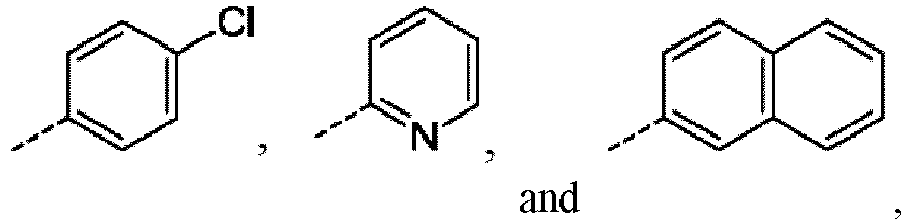
- In some embodiments of the present disclosure, the above structural unit


- In some embodiments of the present disclosure, the above R2 is selected from the group consisting of H, halogen, OH, NH2 and CN, or selected from the group consisting of C1-3 alkyl, C1-3 alkoxyl, C1-3 alkylthio and C1-3 alkylamino, wherein each is optionally substituted by one, two or three R groups, and other variables are as defined above.
- In some embodiments of the present disclosure, the above R2 is selected from the group consisting of H, F, Cl, Br, I, OH, NH2, CN, Me, and

- In some embodiments of the present disclosure, the above R3 is selected from the group consisting of phenyl, pyridyl, pyrimidinyl, pyrazinyl, thienyl, thiazolyl, isothiazolyl, oxazolyl, isoxazolyl, tetrahydropyranyl, piperidinyl and morpholinyl, wherein each is optionally substituted by one, two or three R groups, and other variables are as defined above.
- In some embodiments of the present disclosure, the above R3 is selected from the group consisting of

- In some embodiments of the present disclosure, the above R3 is selected from the group consisting of

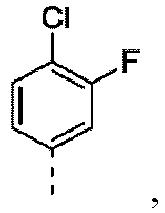
- In some embodiments of the present disclosure, the above structural unit


- In some embodiments of the present disclosure, the above R4 is selected from H and Me, and other variables are as defined above.
- In some embodiments of the disclosure, the above compound and the pharmaceutically acceptable salts thereof are selected from the group consisting of


- R, R2, R3, R4, L1 and L are as defined above;
- T is selected from N or CH;
- D is selected from CH2 or O;
- m and p are each independently selected from 0, 1, 2 or 3, and m and p are not simultaneously selected from 0 or 3;
- n is selected from 0, 1, 2 or 3;
- and n is not selected from 3 when m is selected from 0, and D is selected from O.
- The present disclosure provides a compound of a formula (II) and a pharmaceutically acceptable salt thereof,

- L is selected from -O-, -N(R)- or -N(R)C(=O)-;
- L1 is selected from the group consisting of a single bond, -CH2- and -CH2CH2-;
- R1 is selected from the group consisting of C1-6 alkyl, C1-6 heteroalkyl, C3-7 cycloalkyl, 3-7 membered heterocycloalkyl, 6-10 membered aryl and 5-6 membered heteroaryl, wherein each is optionally substituted by one, two or three R groups;
- R2 is selected from the group consisting of H, halogen, OH, NH2 and CN, or selected from the group consisting of C1-6 alkyl and C1-6 heteroalkyl, wherein each is optionally substituted by one, two or three R groups;
- R3 is selected from the group consisting of phenyl, 5-6 membered heteroaryl and 5-6 membered heterocycloalkyl, wherein each is optionally substituted by one, two or three R groups;
- R4 is selected from H, or selected from C1-3 alkyl optionally substituted by one, two or three R groups;
- R5 is selected from H, F, Cl, Br, I and OH;
- R6 is selected from H, F, Cl, Br, I and OH;
- R is selected from the group consisting of H, halogen, OH, NH2, CN, or selected from the group consisting of C1-3 alkyl optionally substituted by one, two or three R' groups and C1-3 heteroalkyl optionally substituted by one, two or three R' groups;
- R' is selected from the group consisting of F, Cl, Br, I, OH, CN and NH2;
- a carbon atom with "*" is a chiral carbon atom, and is present in a single enantiomer form of (R) or (S) or in a form rich in one enantiomer;
- a carbon atom with "#" is a chiral carbon atom, and is present in a single enantiomer form of (R) or (S) or in a form rich in one enantiomer;
- the "hetero" of the 3-7 membered heterocycloalkyl, 5-6 membered heteroaryl, C1-6 heteroalkyl, C1-3 heteroalkyl and 5-6 membered heterocycloalkyl is independently selected from -C(=O)NH-, -NH-, N, -O-, -S-, -C(=O)O- and -C(=O)-;
- in any one of the above cases, the number of heteroatoms or heteroatom groups is independently selected from 1, 2 or 3.
- In some embodiments of the present disclosure, the carbon atom with "*" or "#" is a chiral carbon atom, and is present in a single enantiomer form of (R) or (S) or in a form rich in one enantiomer. "Being rich in one enantiomer" refers to the content of one of the enantiomers <100%, and ≥60%, preferably ≥70%, more preferably ≥80%, more preferably ≥90%, more preferably ≥95%, more preferably ≥ 96%, more preferably ≥97%, more preferably ≥98%, more preferably ≥99%, more preferably ≥99.5%, more preferably ≥99.6%, more preferably ≥99.7%, more preferably ≥99.8%, and more preferably ≥99.9%.
- In some embodiments of the present disclosure, the above R is selected from the group consisting of H, halogen, OH, NH2, and CN; or selected from the group consisting C1-3 alkyl optionally substituted by one, two or three R' groups and C1-3 alkoxy optionally substituted by one, two or three R' groups. Other variables are as defined by the present disclosure.
- In some embodiments of the present disclosure, the above R is selected from the group consisting of H, F, Cl, Br, I, OH, NH2, CN, Me, Et, CF3 and

- In some embodiments of the present disclosure, the above L is selected from the group consisting of -O-, -NH-, -N(CH3)-, -NHC(=O)- and -N(CH3)C(=O)-. Other variables are as defined by the present disclosure.
- In some embodiments of the present disclosure, the above R1 is selected from the group consisting of C1-4 alkyl, C3-7 cycloalkyl, 3-7 membered heterocycloalkyl, 6-10 membered aryl and 5-6 membered heteroaryl, wherein each is optionally substituted by one, two or three R groups. Other variables are as defined by the present disclosure.
- In some embodiments of the present disclosure, the above R1 is selected from the group consisting of C1-4 alkyl, cyclobutyl, cyclopentyl, cyclohexyl, bicyclo[3.1.0]hexyl, oxetanyl, tetrahydrofuranyl, tetrahydropyranyl, phenyl, naphthyl, thienyl, pyrazolyl, imidazolyl, oxazolyl, thiazolyl, morpholinyl, piperazinyl, piperidinyl, pyridyl, pyrazinyl and pyrimidinyl, wherein each is optionally substituted by one, two or three R groups. Other variables are as defined by the present disclosure.
- In some embodiments of the present disclosure, the above R1 is selected from the group consisting of Me, Et,


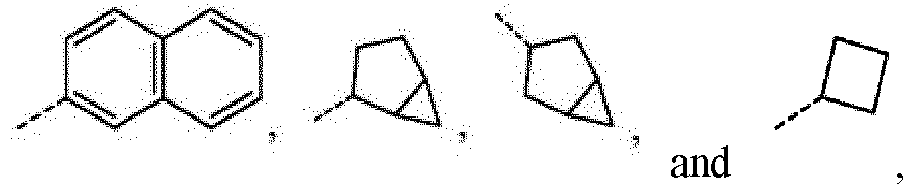
- In some embodiments of the present disclosure, the above R1 is selected from the group consisting of Me, Et,


- In some embodiments of the present disclosure, the above structural unit



- In some embodiments of the present disclosure, the above R2 is selected from the group consisting of H, halogen, OH, NH2 and CN; or selected from the group consisting of C1-3 alkyl, C1-3 alkoxyl, C1-3 alkylthio and C1-3 alkylamino, wherein each is optionally substituted by one, two or three R groups. Other variables are as defined by the present disclosure.
- In some embodiments of the present disclosure, the above R2 is selected from the group consisting of H, F, Cl, Br, I, OH, NH2, CN, Me, and

- In some embodiments of the present disclosure, the above R3 is selected from the group consisting of phenyl, pyridyl, pyrimidinyl, pyrazinyl, thienyl, thiazolyl, isothiazolyl, oxazolyl, isoxazolyl, tetrahydropyranyl, piperidinyl and morpholinyl, wherein each is optionally substituted by one, two or three R groups. Other variables are as defined by the present disclosure.
- In some embodiments of the present disclosure, the above R3 is selected from the group consisting of

- In some embodiments of the present disclosure, the above R3 is selected from the group consisting of

- In some embodiments of the present disclosure, the above structural unit


- In some embodiments of the present disclosure, the above R4 is selected from H and Me.
- In some embodiments of the present disclosure, the above R4 is selected from H and Me, and other variables are as defined by the present disclosure.
- In some embodiments of the disclosure, the above compound and the pharmaceutically acceptable salt thereof are selected from the group consisting of
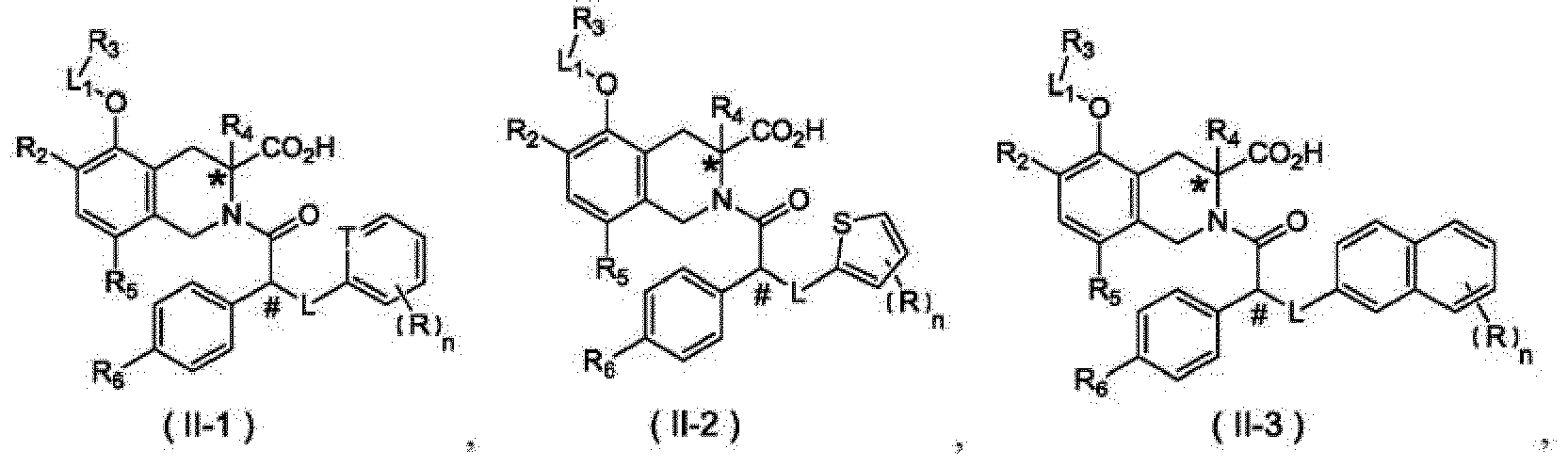

- R, R2, R3, R4, R5, R6, L1 and L are as defined above;
- T is selected from N or CH;
- D is selected from CH2 or O;
- m and p are each independently selected from 0, 1, 2 or 3, and m and p are not simultaneously selected from 0 or 3;
- n is selected from 0, 1, 2 or 3;
- and n is not selected from 3 when m is selected from 0, and D is selected from O.
- Some embodiments of the present disclosure are arbitrarily combined by the above variables.
- The present disclosure provides a compound of the following formula selected from the group consisting of





- In some embodiments of the disclosure, the above compound is selected from the group consisting of










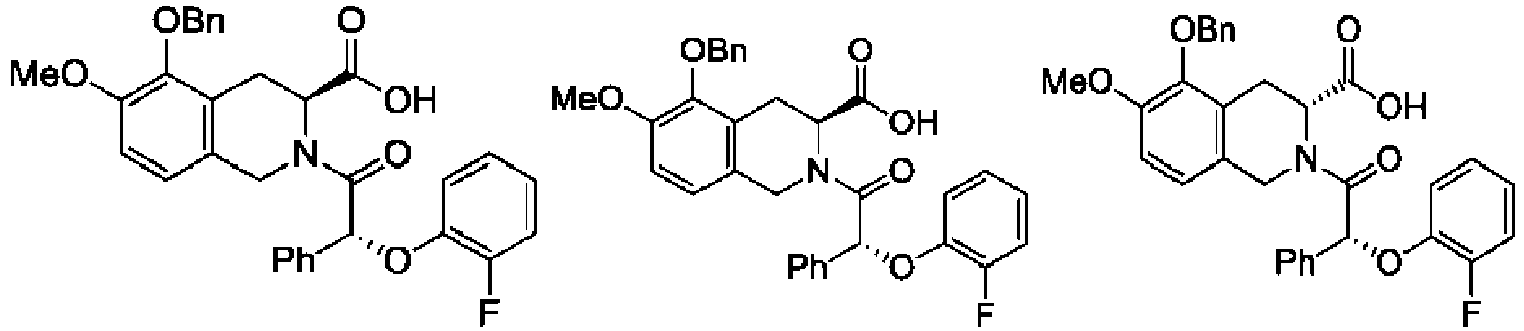


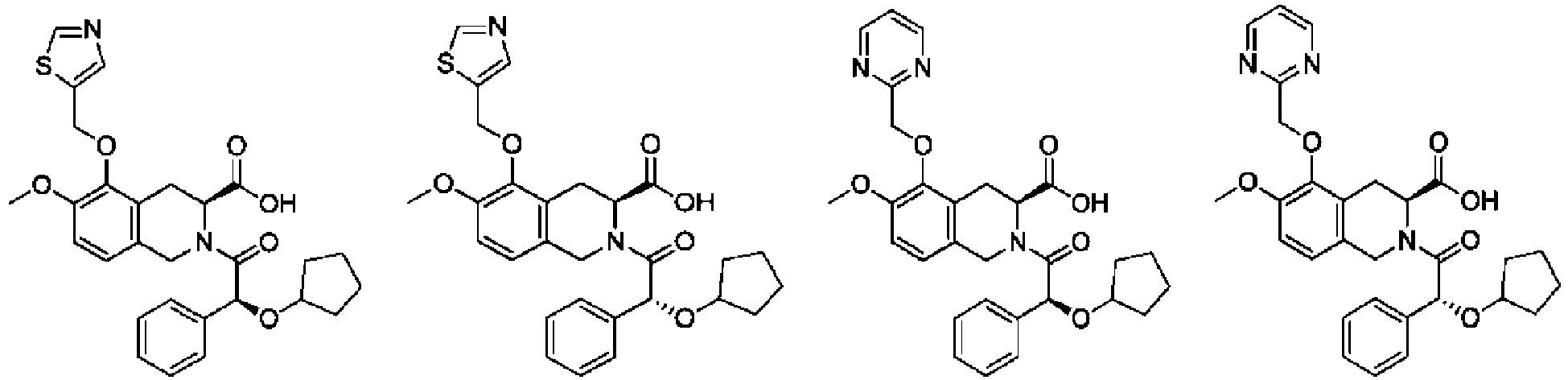












- The disclosure also provides the compound or the pharmaceutically acceptable salt thereof for use in the treatment of chronic pain.
- Unless otherwise stated, the following terms and phrases as used herein are intended to have the following meanings. A particular term or phrase should not be considered undefined or unclear without a particular definition, but should be understood in the ordinary sense. When a trade name appears herein, it is intended to refer to its corresponding commodity or its active ingredient. The term "pharmaceutically acceptable" as used herein is intended to mean that those compounds, materials, compositions and/or dosage forms are within the scope of sound medical judgment and are suitable for use in contact with human and animal tissues. Without excessive toxicity, irritation, allergic reactions or other problems or complications, it is commensurate with a reasonable benefit/risk ratio.
- The term "pharmaceutically acceptable salt" refers to a salt of a compound of the present disclosure, prepared from a compound having a particular substituent found in the present disclosure and a relatively non-toxic acid or base. When a relatively acidic functional group is contained in the compound of the present disclosure, a base addition salt can be obtained by contacting a neutral form of such a compound with a sufficient amount of a base in a pure solution or a suitable inert solvent. Pharmaceutically acceptable base addition salts include sodium, potassium, calcium, ammonium, organic ammonia or magnesium salts or similar salts. When a relatively basic functional group is contained in the compound of the present disclosure, an acid addition salt can be obtained by contacting a neutral form of such a compound with a sufficient amount of an acid in a pure solution or a suitable inert solvent. Examples of pharmaceutically acceptable acid addition salts include inorganic acid salts, wherein inorganic acid includes, for example, hydrochloric acid, hydrobromic acid, nitric acid, carbonic acid, hydrogen carbonate, phosphoric acid, monohydrogen phosphate, dihydrogen phosphate, sulfuric acid, hydrogen sulfate, hydroiodic acid, and phosphorous acid; organic acid salts, wherein organic acid includes, for example, acetic acid, propionic acid, isobutyric acid, maleic acid, malonic acid, benzoic acid, succinic acid, suberic acid, fumaric acid, lactic acid, mandelic acid, phthalic acid, benzenesulfonic acid, p-toluenesulfonic acid, citric acid, tartaric acid, and methanesulfonic acid; salts of amino acids (such as arginine, etc.), and salts of organic acids such as glucuronic acid (see Berge et al., "Pharmaceutical Salts", Journal of Pharmaceutical Science 66: 1-19 (1977)). Certain specific compounds of the present disclosure contain both basic and acidic functional groups and thus can be converted to any one base or acid addition salt.
- Preferably, the salt is contacted with a base or an acid in a conventional manner, and the parent compound is separated, thereby regenerating the neutral form of the compound. The parent form of the compound differs from the form of its various salts in certain physical properties, such as differences in solubility in polar solvents.
- As used herein, a "pharmaceutically acceptable salt" is a derivative of a compound of the present disclosure, wherein the parent compound is modified by salt formation with an acid or with a base. Examples of pharmaceutically acceptable salts include, but are not limited to, inorganic or organic acid salts of bases such as amines, alkali metal or organic salts of acid groups such as carboxylic acids. Pharmaceutically acceptable salts include the conventional non-toxic salts or quaternary ammonium salts of the parent compound, for example salts formed from non-toxic inorganic or organic acids. Conventional non-toxic salts include, but are not limited to, those derived from inorganic acids and organic acids selected from the group consisting of 2-acetoxybenzoic acid, 2-hydroxyethanesulfonic acid, acetic acid, ascorbic acid, benzenesulfonic acid, benzoic acid, hydrogen carbonate, carbonic acid, citric acid, edetic acid, ethanedisulfonic acid, ethanesulfonic acid, fumaric acid, glucoheptose, gluconic acid, glutamic acid, glycolic acid, hydrobromic acid, hydrochloric acid, hydroiodide, hydroxyl, hydroxynaphthalene, isethionic acid, lactic acid, lactose, dodecylsulfonic acid, maleic acid, malic acid, mandelic acid, methanesulfonic acid, nitric acid, oxalic acid, pamoic acid, pantothenic acid, phenylacetic acid, phosphoric acid, polygalacturonic acid, propionic acid, salicylic acid, stearic acid, folinic acid, succinic acid, sulfamic acid, p-aminobenzenesulfonic acid, sulfuric acid, tannin, tartaric acid and p-toluenesulfonic acid.
- The pharmaceutically acceptable salts of the present disclosure can be synthesized from the parent compound containing an acid group or a basic group by conventional chemical methods. In general, such salts are prepared by reacting these compounds via a free acid or base form with a stoichiometric amount of the appropriate base or acid in water or an organic solvent or a mixture of the two. Generally, a nonaqueous medium such as ether, ethyl acetate, ethanol, isopropanol or acetonitrile is preferred.
- Certain compounds of the present disclosure may have asymmetric carbon atoms (optical centers) or double bonds. Racemates, diastereomers, geometric isomers and individual isomers are included within the scope of the present disclosure.
- Unless otherwise stated, the wedge and dashed bonds (
 ) are used to represent the absolute configuration of a stereocenter, the wavy line
 is used to represent a wedge or dashed bond (
 or
or ), and
 are used to represent the relative configuration of the stereocenter. When the compounds described herein contain olefinic double bonds or other centers of geometric asymmetry, they include the E and Z geometric isomers unless otherwise specified. Likewise, all tautomeric forms are included within the scope of the present disclosure.
- The compounds of the disclosure may exist in specific geometric or stereoisomeric forms. The present disclosure contemplates all such compounds, including the cis and trans isomers, the (-)- and (+)-enantiomers, the (R)- and (S)-enantiomers, and the diastereoisomer, a (D)-isomer, a (L)-isomer, and a racemic mixture thereof, and other mixtures such as the mixtures enriched in enantiomer and diastereoisomer, all of which are within the scope of the present disclosure. Additional asymmetric carbon atoms may be present in the substituents such as alkyl groups. All such isomers as well as mixtures thereof are included within the scope of the present disclosure.
- The optically active (R)- and (S)-isomers as well as the D and L isomers can be prepared by chiral synthesis or chiral reagents or other conventional techniques. If an enantiomer of a certain compound of the present disclosure is desired, it can be prepared by asymmetric synthesis or by derivatization with a chiral auxiliary, wherein the resulting mixture of diastereomers is separated and the auxiliary group is cleaved to provide the desired pure enantiomer. Alternatively, when a molecule contains a basic functional group (e.g., an amino group) or an acidic functional group (e.g., a carboxyl group), a diastereomeric salt is formed with a suitable optically active acid or base, and then the diastereomers are resolved by conventional methods well known in the art, and the pure enantiomer is recovered. Furthermore, the separation of enantiomers and diastereomers is generally accomplished by the use of chromatography using a chiral stationary phase optionally combined with chemical derivatization (eg, formation of carbamate from an amine).
- The compounds of the present disclosure may contain unnatural proportions of atomic isotopes on one or more of the atoms that make up the compound. For example, a compound can be labeled with a radioisotope such as tritium (3H), iodine-125 (125I) or C-14 (14C). Alterations of all isotopes of the compounds of the present disclosure, whether radioactive or not, are included within the scope of the present disclosure.
- "Optional" or "optionally" means that the subsequently described event or condition may, but does not necessarily, occur, and that the description includes instances in which the event or condition occurs and instances in which the event or condition does not occur.
- The term "substituted" means that any one or more hydrogen atoms on a particular atom are replaced by a substituent, and may include variants of heavy hydrogen and hydrogen, as long as the valence of the particular atom is normal and the substituted compound is stable. When the substituent is a keto group (ie, =O), it means that two hydrogen atoms are substituted. Ketone substitution does not occur on the aryl group. The term "optionally substituted" means that it may or may not be substituted, and unless otherwise specified, the type and number of substituents may be arbitrary as long as it is chemically achievable.
- When any variable (eg, R) occurs one or more times in the composition or structure of a compound, its definition in each case is independent. Thus, for example, if a group is substituted by 0-2 R groups, the group may optionally be substituted at most by two R groups, and R has an independent option in each case. Furthermore, combinations of substituents and/or variants thereof are permissible only if such combinations result in stable compounds.
- When the number of one linking group is 0, such as -(CRR)0-, it indicates that the linking group is a single bond.
- When one of the variables is selected from a single bond, it means that the two groups to which it is attached are directly linked. For example, when L represents a single bond in A-L-Z, the structure is actually A-Z.
- When a substituent is vacant, it means that the substituent is absent. For example, when X is vacant in A-X, the structure is actually A. When a substituent can be attached to one or more atoms on a ring, the substituent can be bonded to any atom on the ring. For example, the structural unit


- Unless otherwise specified, a "ring" means substituted or unsubstituted cycloalkyl, heterocycloalkyl, cycloalkenyl, heterocycloalkenyl, cycloalkynyl, heterocycloalkynyl, aryl or heteroaryl. The so-called rings include single rings, linking rings, spiral rings, fused rings or bridged rings. The number of atoms on the ring is usually defined as the number of members of the ring. For example, a "5-7 membered ring" means 5 to 7 atoms are arranged in a circle. Unless otherwise specified, the ring optionally contains 1 to 3 heteroatoms. Thus, the "5-7 membered ring" includes, for example, phenyl, pyridine, and piperidinyl; on the other hand, the term "5-7 membered heterocycloalkyl ring" includes pyridyl and piperidinyl, but does not include phenyl. The term "ring" also includes a ring system containing at least one ring, wherein each "ring" independently conforms to the above definition.
- Unless otherwise specified, the term "heterocycle" or "heterocyclyl" means a stable monocyclic, bicyclic or tricyclic ring containing a heteroatom or a heteroatom group, and it may be saturated, partially unsaturated or unsaturated (aromatic), and it comprises a carbon atom and 1, 2, 3 or 4 heteroatoms in the ring, independently selected from N, O and S, wherein any of the above heterocycles may be fused to a phenyl ring to form a bicyclic ring. The nitrogen and sulfur heteroatoms can be optionally oxidized (i.e., NO and S(O)p, p is 1 or 2). The nitrogen atom can be substituted or unsubstituted (i.e., N or NR, wherein R is H or other substituents as already defined herein). The heterocyclic ring can be attached to the side groups of any heteroatom or carbon atom to form a stable structure. If the resulting compound is stable, the heterocycles described herein can undergo substitutions at the carbon or nitrogen sites. The nitrogen atom in the heterocycle is optionally quaternized. A preferred embodiment is that when the total number of S and O atoms in the heterocycle exceeds 1, these heteroatoms are not adjacent to each other. Another preferred embodiment is that the total number of S and O atoms in the heterocycle does not exceed one. The term "aromatic heterocyclic group" or "heteroaryl" as used herein means a stable 5, 6, or 7 membered monocyclic or bicyclic or aromatic ring of a 7, 8, 9 or 10 membered bicyclic heterocyclic group, and it contains carbon atoms and 1, 2, 3 or 4 heteroatoms in the ring, independently selected from N, O and S. The nitrogen atom can be substituted or unsubstituted (i.e., N or NR, wherein R is H or other substituents as already defined herein). The nitrogen and sulfur heteroatoms can be optionally oxidized (i.e., NO and S(O)p, p is 1 or 2). It is worth noting that the total number of S and O atoms on the aromatic heterocycle does not exceed one. Bridged rings are also included in the definition of heterocycles. A bridged ring is formed when one or more atoms (ie, C, O, N, or S) join two non-adjacent carbon or nitrogen atoms. Preferred bridged rings include, but are not limited to, one carbon atom, two carbon atoms, one nitrogen atom, two nitrogen atoms, and one carbon-nitrogen group. It is worth noting that a bridge always converts a single ring into a tricyclic ring. In the bridged ring, a substituent on the ring can also be present on the bridge.
- Examples of heterocyclic compounds include, but are not limited to, acridinyl, azocinyl, benzimidazolyl, benzofuranyl, benzomercaptofuranyl, benzomercaptophenyl, benzoxazolyl, benzoxazolinyl, benzothiazolyl, benzotriazolyl, benzotetrazolyl, benzisoxazolyl, benzisothiazolyl, benzimidazolinyl, carbazolyl, 4aH-carbazolyl, carbolinyl, chromanyl, chromene, cinnolinyl decahydroquinolinyl, 2H,6H-1,5,2-dithiazinyl, dihydrofuro[2,3-b]tetrahydrofuranyl, furyl, furazanyl, imidazolidinyl, imidazolinyl, imidazolyl, 1H-indazolyl, indolenyl, indolinyl, indolizinyl, indolyl, 3H-indolyl, isobenzofuranyl, isoindolyl, isoindolinyl, isoquinolyl, isothiazolyl, isoxazolyl, methylenedioxyphenyl, morpholinyl, naphthyridinyl, octahydroisoquinolinyl, oxadiazolyl, 1,2,3-oxadiazolyl, 1,2,4-oxadiazolyl, 1,2,5-oxadiazolyl, 1,3,4-oxadiazolyl, oxazolidinyl, oxazolyl, hydroxyindolyl, pyrimidinyl, phenanthridinyl, phenanthrolinyl, phenazine, phenothiazine, benzoxanthinyl, phenooxazinyl, phthalazinyl, piperazinyl, piperidinyl, piperidinone, 4-piperidinone, piperonyl, pteridinyl, purinyl, pyranyl, pyrazinyl, pyrazolidinyl, pyrazolinyl, pyrazolyl, pyridazinyl, pyridooxazole, pyridoimidazole, pyridothiazole, pyridyl, pyrrolidinyl, pyrrolinyl, 2H-pyrrolyl, pyrrolyl, quinazolinyl, quinolyl, 4H-quinolizinyl, quinoxalinyl, quinuclidinyl, tetrahydrofuranyl, tetrahydroisoquinolyl, tetrahydroquinolyl, tetrazolyl, 6H-1,2,5-thiadiazinyl, 1,2,3-thiadiazolyl, 1,2,4-thiadiazolyl, 1,2,5-thiadiazolyl, 1,3,4-thiadiazolyl, thianthrenyl, thiazolyl, isothiazolyl thiophenyl, thienooxazolyl, thienothiazolyl, thienoimidazolyl, thienyl, triazinyl, 1,2,3-triazolyl, 1,2,4-triazolyl, 1,2,5-triazolyl, 1,3,4-triazolyl and xanthenyl. Fused and spiro compounds are also included.
- Unless otherwise specified, the term "alkyl" is used to denote a straight or branched saturated hydrocarbon group, which may be monosubstituted (eg, -CH2F) or polysubstituted (eg, -CF3), and may be monovalent (eg, methyl), divalent (such as methylene) or polyvalent (such as methine). Examples of the alkyl group include methyl (Me), ethyl (Et), propyl (e.g., n-propyl and isopropyl), butyl (e.g., n-butyl, isobutyl, s-butyl, t-butyl), pentyl (eg, n-pentyl, isopentyl, neopentyl) and the like.
- In some embodiments, the term "heteroalkyl" refers to, by itself or in conjunction with another term, a stable straight or branched hydrocarbon group or combination thereof, having a certain number of carbon atoms and at least one heteroatom. In a typical embodiment, the heteroatoms are selected from the group consisting of B, O, N, and S, wherein the nitrogen and sulfur atoms are optionally oxidized, and the nitrogen heteroatoms are optionally quaternized. A heteroatom or heteroatom group can be located at any internal position of a heteroalkyl group, including the position where the alkyl group is attached to the rest of the molecule, but the terms "alkoxy", "alkylamino" and "alkylthio" (or thioalkoxyl) are conventional expressions and refer to those alkyl groups which are attached to the remaining parts of the molecule through an oxygen atom, an amino group or a sulfur atom, respectively. Examples include, but are not limited to, -CH2-CH2-O-CH3, -CH2-CH2-NH-CH3, -CH2-CH2-N(CH3)-CH3, -CH2-S-CH2-CH3, -CH2-CH2, - S(O)-CH3, and -CH2-CH2-S(O)2-CH3. At most two heteroatoms can be continuous, such as -CH2-NH-OCH3.
- Unless otherwise specified, a cycloalkyl group includes any stable cyclic or polycyclic hydrocarbon group, wherein any carbon atom is saturated, and may be monosubstituted or polysubstituted, and may be monovalent, divalent or multivalent. Examples of such cycloalkyl groups include, but are not limited to, cyclopropyl, norbornyl, [2.2.2]bicyclooctane, [4.4.0]bicyclodecane.
- Unless otherwise specified, the term "halo" or "halogen" refers to, by itself or as a part of another substituent, a fluorine, chlorine, bromine or iodine atom. Further, the term "haloalkyl" is intended to include both monohaloalkyl and polyhaloalkyl. For example, the term "halo(C1-C4)alkyl" is intended to include, but is not limited to, trifluoromethyl, 2,2,2-trifluoroethyl, 4-chlorobutyl, 3-bromopropyl. Unless otherwise specified, examples of haloalkyl include, but are not limited to, trifluoromethyl, trichloromethyl, pentafluoroethyl and pentachloroethyl.
- "Alkoxyl" represents the above alkyl group having a specified number of carbon atoms attached through an oxygen bridge, and unless otherwise specified, C1-6 alkoxyl includes C1 alkoxyl, C2 alkoxyl, C3 alkoxyl, C4 alkoxyl, C5 alkoxyl and C6 alkoxyl. Examples of alkoxyl include, but are not limited to, methoxy, ethoxy, n-propoxy, isopropoxy, n-butoxy, sec-butoxy, tert-butoxy, n-pentyloxy and S-pentyloxy.
- Unless otherwise specified, the term "aryl" denotes a polyunsaturated aromatic hydrocarbon substituent which may be monosubstituted or polysubstituted, may be monovalent, divalent or polyvalent, and may be monocyclic or polycyclic (for example, 1 to 3 rings, wherein at least one ring is aromatic), they are fused together or covalently linked. The term "heteroaryl" refers to an aryl (or ring) containing one to four heteroatoms. In an illustrative example, the heteroatoms are selected from the group consisting of B, N, O, and S, wherein the nitrogen and sulfur atoms are optionally oxidized, and the nitrogen atom is optionally quaternized. A heteroaryl can be attached to the remaining part of the molecule through a heteroatom. Non-limiting examples of aryl or heteroaryl include phenyl, naphthyl, biphenyl, pyrrolyl, pyrazolyl, imidazolyl, pyrazinyl, oxazolyl, phenyl-oxazolyl, isoxazolyl, thiazolyl, furyl, thienyl, pyridyl, pyrimidinyl, benzothiazolyl, purinyl, benzimidazolyl, indolyl, isoquinolyl, quinoxalinyl, quinolyl, 1-naphthyl, 2-naphthyl, 4-biphenylyl, 1-pyrrolyl, 2-pyrrolyl, 3-pyrrolyl, 3-pyrazolyl, 2-imidazolyl, 4-imidazolyl, pyrazinyl, 2-oxazolyl, 4-oxazolyl, 2-phenyl-4-oxazolyl, 5-oxazolyl, 3-isoxazolyl, 4-isoxazolyl, 5-isoxazolyl, 2-thiazolyl, 4-thiazolyl, 5-thiazolyl, 2-furyl, 3-furyl, 2-thienyl, 3-thienyl, 2-pyridyl, 3-pyridyl, 4-pyridyl, 2-pyrimidinyl, 4-pyrimidinyl, 5-benzothiazolyl, purinyl, 2-benzimidazolyl, 5-indyl, 1-isoquinolinyl, 5-isoquinolinyl, 2-quinoxalinyl, 5-quinoxalinyl, 3-quinolyl and 6-quinolyl. The substituents of any of the above aryl and heteroaryl ring systems are selected from the group of acceptable substituents described below.
- Unless otherwise specified, aryl, when used in conjunction with other terms (e.g., aryloxy, arylthio, and aralkyl), include aryl and heteroaryl rings as defined above. Thus, the term "aralkyl" is intended to include those atomic groups (eg, benzyl, phenethyl, and pyridylmethyl) to which an aryl group is attached to an alkyl group, and alkyls of which the carbon atom (eg, methylene) has been substituted by such as an oxygen atom, for example, phenoxymethyl, 2-pyridyloxymethyl 3-(1-naphthyloxy)propyl.
- The compounds of the present disclosure can be prepared by a variety of synthetic methods well known to those skilled in the art, including the specific embodiments set forth below, embodiments formed through combinations thereof with other chemical synthetic methods, and those equivalent alternatives well known to those skilled in the art, and preferred embodiments include, but are not limited to, embodiments of the disclosure.
- The solvent used in the present disclosure is commercially available. The present disclosure employs the following abbreviations: Bn represents benzyl; aq represents water; HATU represents O-(7-azabenzotriazol-1-yl)-N,N,N',N'-tetramethyl urea hexafluorophosphate; EDC stands for N-(3-dimethylaminopropyl)-N'-ethylcarbodiimide hydrochloride; m-CPBA stands for 3-chloroperoxybenzoic acid; eq stands for equivalent weight, and equal weight; CDI stands for carbonyl diimidazole; DCM stands for dichloromethane; PE stands for petroleum ether; DIAD stands for diisopropyl azodicarboxylate; DMF stands for N,N-dimethylformamide; DMSO stands for dimethyl sulfoxide; EtOAc represents ethyl acetate; EtOH represents ethanol; MeOH represents methanol; CBz represents benzyloxycarbonyl which is an amine protecting group; BOC represents t-butylcarbonyl which is an amine protecting group; HOAc represents acetic acid; NaCNBH3 represents sodium cyanoborohydride; r.t. represents room temperature; O/N stands for overnight; THF stands for tetrahydrofuran; Boc2O stands for di-tert-butyldicarbonate; TFA stands for trifluoroacetic acid; DIPEA stands for diisopropylethylamine; SOCl2 stands for thionyl chloride; CS2 stands for carbon disulfide; TsOH stands for p-toluenesulfonic acid; NFSI stands for N-fluoro-N-(phenylsulfonyl)benzenesulfonamide; NCS stands for 1-chloropyrrolidine-2,5-dione; n-Bu4NF stands for tetrabutylammonium fluoride; iPrOH stands for 2-propanol; mp stands for melting point; LDA stands for lithium diisopropylamide; EDCI stands for carbodiimide; HOBt stands for 1-hydroxybenzotriazole; Pd(dppf)Cl2 stands for [1,1'-bis(diphenylphosphino)ferrocene]palladium dichloride.
- Compounds are named by hand or by ChemDraw® software, and commercial compounds are based on supplier catalog names.
- In this patent, a series of compounds of the formula (I) are synthesized by a simple preparation method to obtain a novel class of selective inhibitors of angiotensin II type 2 receptor (AT2R) for the treatment of chronic pain. The compounds of the present disclosure all exhibit better biological activity in vitro and exhibit excellent pharmacokinetic properties in a variety of genera.
-

- Under a nitrogen atmosphere, NaH (466.0 mg, 11.7 mmol, purity: 60%) was suspended in anhydrous tetrahydrofuran (2.5 mL), and an anhydrous tetrahydrofuran (2.5 mL) solution of cyclopentanol (301.0 mg, 3.5 mmol, 316.9 uL) was slowly added dropwise. After stirring was performed at 15 °C for 30 minutes, an anhydrous tetrahydrofuran (2.5 mL) solution of A1-1 (500.0 mg, 2.3 mmol) was added. After the addition was completed, the reaction solution was further stirred at 15 °C for 1.5 hours. The reaction solution was slowly poured into water (15 mL). After quenching the reaction, methyl tert-butyl ether (20mL) was used for washing. The aqueous phase was adjusted to pH of about 3 with 2N hydrochloric acid and extracted with methyl tert-butyl ether (20 mL x 3). The mixed organic phase was washed with saturated salt water (20 mL), dried with anhydrous sodium sulfate, filtered and concentrated in vacuum to obtain a crude product. The crude product was separated and purified by a silica gel chromatography column (an eluent: 50-100% ethyl acetate/petroleum ether) to obtain the product A1. 1H NMR (400 MHz, CHLOROFORM-d): δ 7.46-7.43 (m, 2H), 7.40-7.36 (m, 3H), 4.94 (s, 1H), 4.07-4.05 (m, 1H), 1.83-1.67 (m, 6H), 1.66-1.46 (m, 2H).
- The following compounds were synthesized in a similar manner to compound A1:
Reference Example Compound Serial Number Structural Formula Spectrogram 2 A2 
1H NMR (400MHz, CHLOROFORM-d): δ 7.48 - 7.46 (m, 2H), 7.39 - 7.37 (m, 3H), 5.06 (s, 1H), 3.99 - 3.91 (m, 2H), 3.60 - 3.53 (m, 1H), 3.43 - 3.39 (m, 2H), 1.93 - 1.85 (m, 1H), 1.80 - 1.73 (m, 1H), 1.69 - 1.54 (m, 2H). MS m/z: 258.9 [M+Na]+ 3 A3 
1H NMR (400MHz, CHLOROFORM-d): δ 7.47 - 7.39 (m, 5H), 4.89 (s, 1H), 3.60 - 3.49 (m, 2H), 1.68 - 1.64 (m, 2H), 1.43 - 1.40 (m, 2H) 0.95 - 0.92 (t, J= 7.6 Hz, 3H). 4 A4 
1H NMR (400MHz, CHLOROFORM-d): δ 7.48 - 7.42 (m, 5 H), 5.11 (s, 1 H), 3.98 - 3.85 (m, 2H). 5 A5 
1H NMR (400MHz, CHLOROFORM-d): δ 7.61 - 7.58 (m, 4H), 7.45 - 7.44 (m, 3H), 7.04 - 7.02 (m, 2H), 5.71 (s, 1H). 6 A6 
1H NMR (400MHz, CHLOROFORM-d): δ 7.47 - 7.45 (m, 2H), 7.38 - 7.31 (m, 3H), 4.89 (s, 1 H), 3.78 - 3.60 (m, 4H), 3.42 (s, 3H). 7 A7 
1H NMR (400MHz, CHLOROFORM-d): δ 7.47 - 7.39 (m, 5H), 4.96 (s, 1 H), 4.31 - 4.24 (m, 1H), 4.07 - 3.74 (m, 4H), 2.06 - 1.97 (m, 3H). 8 A8 
1H NMR (400MHz, CHLOROFORM-d): δ 7.48 - 7.37 (m, 5H), 4.88 (s, 1H), 4.83 - 4.75 (m, 2H), 4.71 - 4.65 (m, 1H), 4.63 - 4.57 (m, 2H). 9 A9 
1H NMR (400MHz, CHLOROFORM-d): δ 7.54 - 7.52 (m, 2H), 7.40 - 7.39 (m, 3H), 6.67 - 6.61 (m, 2H), 5.71 (s, 1H). 10 A10 
1H NMR (400 MHz, CHLOROFORM-d): δ 7.51 - 7.40 (m, 5H), 5.05 - 4.97 (m, 1H), 3.89 - 3.62 (m, 1H), 3.62 - 3.43 (m, 1H), 2.00 - 1.28(m, 8H). 11 A11 
1H NMR (400MHz, CHLOROFORM-d): δ 7.79 - 7.78 (m, 2H), 7.66 - 7.64 (m, 3H), 7.44 - 7.41 (m, 5H), 7.29 - 7.27 (m, 1H), 7.15 - 7.14 (d, J=4.0 Hz, 1H), 5.82 (s, 1H). 30 A25 
1H NMR (400MHz, CHLOROFORM-d): δ 7.45 - 7.41 (m, 5H), 4.88 (s, 1H), 4.10 - 4.03 (m, 1H), 2.96 - 2.55 (m, 4H). 31 A26 
1H NMR (400MHz, CHLOROFORM-d): δ 7.62 - 7.29 (m, 5H), 4.89 (s, 1H), 4.12 - 4.02 (m, 1H), 2.10 - 1.98 (m, 3H), 1.94 - 1.83 (m, 1H), 1.29 - 1.27 (m, 2H), 0.55 - 0.47 (m, 2H). 32 A27 
1H NMR (400MHz, CHLOROFORM-d): δ 7.51 - 7.49 (m, 2H), 7.41 - 7.33 (m, 3H), 5.05 (s, 1H), 2.03 - 1.77 (m, 3H), 1.73 - 1.48 (m, 5H), 1.34 (s, 3H). 33 A28 
1H NMR (400MHz, CHLOROFORM-d): δ 7.51 - 7.30 (m, 5H), 5.05 - 4.95 (m, 1H), 4.07 - 3.95 (m, 1H), 2.01 - 1.86 (m, 1H), 1.82 - 1.59 (m, 2H), 1.56 - 1.35 (m, 2H), 1.31 - 1.20 (m, 1H), 0.56 - 0.35 (m, 1H), 0.08 - 0.12 (m, 1H). 34 A29 
1H NMR (400MHz, CHLOROFORM-d): δ 7.50 - 7.32 (m, 5H), 5.00 - 4.88 (m, 1H), 3.65 - 3.47 (m, 1H), 2.16 - 2.00 (m, 1H), 1.94 - 1.57 (m, 6H), 1.09 - 0.96 (m, 3H). 35 cis-A10 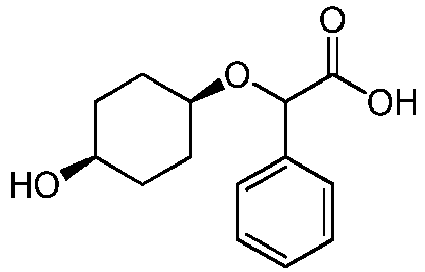
1H NMR (400 MHz, CHLOROFORM-d): δ 7.40 - 7.27 (m, 5H), 5.00 - 4.90 (m, 1H), 3.75 - 3.65 (m, 1H), 3.60 - 3.35 (m, 1H), 2.11 - 0.77 (m, 8H). 36 trans-A10 
1H NMR (400 MHz, CHLOROFORM-d): δ 7.46 - 7.34 (m, 5H), 5.02 (s, 1H), 3.74 - 3.65 (m, 1H), 3.52 - 3.42 (m, 1H), 2.19 - 1.89 (m, 4H), 1.55 - 1.20 (m, 4H). 37 A30 
1H NMR (400 MHz, CHLOROFORM-d): δ 7.49 - 7.33 (m, 5H), 4.85 (s, 1H), 3.93 - 3.86 (m, 1H), 3.73 - 3.60 (m, 1H), 2.80 - 2.55 (m, 2H), 2.09 - 1.92 (m, 2H). -

- The compound S-mandelic acid (4.6 g, 30.0 mmol) was dissolved in butyronitrile (62.0 mL), followed by the addition of iodobenzene (6.1 g, 30.0 mmol, 3.3 mL) and cesium carbonate (19.6 g, 60.0 mmol), then cuprous iodide (285.7 mg, 1.50 mmol) was added under a nitrogen atmosphere, and the mixture was heated to 75-80 °C, and the mixture was subjected to a reaction under stirring for 15 hours. After cooling to room temperature, the reaction solution was concentrated in vacuum to remove the organic solvent. The residue was dissolved in 200 mL of water and washed with ethyl acetate (150 mL x2). The aqueous phase was adjusted to pH of 4 to 5 with a IN aqueous citric acid solution, and then extracted with ethyl acetate (200 mL×3). The mixed organic phase was washed with saturated brine (200 mL), dried with anhydrous sodium sulfate, filtered and concentrated in vacuum to obtain a crude product. The crude product was separated and purified by column chromatography (an eluent: ethyl acetate/petroleum ether: 0-50%) and then the obtained product was recrystallized with 20ml of petroleum ether/ethyl acetate (v: v = 6:1) to obtain the product S-A12 (41.1% ee). 1H NMR (400 MHz, CHLOROFORM-d): δ 7.60-7.58 (m, 2H), 7.46-7.37 (m, 3H), 7.33-7.27 (m, 2H), 7.06-6.92 (m, 3H), 5.68 (s, 1H).
- The following compounds were synthesized in a similar manner to the compound S-A12:
Reference Example Compound Serial Number Structural Formula Spectrogram 13 S-A13 
1H NMR (400MHz, CHLOROFORM-d): δ 8.20 - 8.06 (m, 1H), 7.72 - 7.57 (m, 3H), 7.48 - 7.34 (m, 3H), 7.00 - 6.85 (m, 2H), 6.24 (s, 1H). MS m/z: 229.9 [M+1]+. SFC: column: Chiralpak AD-3 (150mm*4.6mm, 3µm); mobile phase: [0.05%DEAEtOH]; B%: 5%-40% 5.5 min, 40% 3 min, 5% 1.5 min; Rt = 4.008 min; 93.2% ee. 14 S-A14 
1H NMR (400MHz, CHLOROFORM-d): δ 7.59 - 7.55 (m, 2H), 7.43 - 7.37 (m, 3H), 6.92 - 6.90 (d, J= 8.8 Hz, 2H), 6.83 - 6.81 (d, J= 8.8 Hz, 2H), 5.58 (s, 1H), 3.77 (s, 3H). 15 S-A15 
1H NMR (400MHz, CHLOROFORM-d): δ 7.58 - 7.56 (m, 2H), 7.44 - 7.42 (m, 3H), 6.73 - 6.60 (m, 2H), 6.33 - 6.32 (m, 1H), 5.53 (s, 1H). 16 S-A16 
1H NMR (400MHz, CHLOROFORM-d): δ 7.61 - 7.54 (m, 2H), 7.46 - 7.39 (m, 3H), 6.99 - 6.85 (m, 2H), 6.98 - 6.86 (m, 1H), 5.62 (s, 1H). 17 S-A17 
1H NMR (400MHz, CHLOROFORM-d): δ 7.63 - 7.51 (m, 2H), 7.47 - 7.33(m, 3H), 7.11 - 6.74 (m, 4H), 5.59 (s, 1 H). SFC: column: ChiralCel OJ-H (150mm∗4.6mm, 5µm); mobile phase: [0.05%DEA EtOH]; B%: 5%-40% 5.5 min, 40% 3 min, 5% 1.5 min; Rt = 2.236 min; 49.0% ee. 18 S-A18 
1H NMR (400MHz, CHLOROFORM-d): δ 7.63 - 7.54 (m, 2H), 7.46 - 7.35 (m, 3H), 7.16 - 7.06 (m, 1H), 7.04 - 6.89 (m, 3H), 5.68 (s, 1H). SFC: column: ChiralCel OJ-H (150mm∗4.6mm, 5µm); mobile phase: [0.05%DEA EtOH]; B%: 5%-40% 5.5 min, 40% 3 min, 5% 1.5 min; Rt = 2.229 min; 19.7% ee. 19 S-A19 
1H NMR (400MHz, CHLOROFORM-d): δ 7.65 - 7.53 (m, 2H), 7.49 - 7.35 (m, 3H), 7.27 - 7.18 (m, 2H), 7.02 - 6.75(m, 2H), 5.62 (s, 1 H). SFC: column: ChiralPak AD-3 (150mm∗4.6mm, 3µm); mobile phase: [0.05%DEA EtOH]; B%: 5%-40% 5.5 min, 40% 3 min, 5% 1.5 min; Rt = 3.968 min; 65.9% ee. -

- Silver oxide (1.5 g, 6.6 mmol) was added to a liquid mixture of the compound S-mandelic acid (500.0 mg, 3.3 mmol) and bromocyclopentane (49.0 g, 328.6 mmol), and then the mixture was subjected to a reaction under stirring for 16 hours at 20-25 °C. The reaction solution was filtered, and the filtrate was vacuum concentrated to remove the solvent to obtain a crude product. The crude product was separated and purified by a silica gel chromatography column (an eluent: ethyl acetate/petroleum ether 0-10%) to obtain the product S-A1-1. 1H NMR (400 MHz, CHLOROFORM-d): δ 7.49-7.40 (m, 2H), 7.38-7.28 (m, 3H), 5.22-5.19 (m, 1H), 4.88 (s, 1H), 4.03-3.99 (m, 1H), 1.89-1.64 (m, 10H), 1.57-1.45 (m, 6H). MS m/z: 311.1 [M+Na]+.
- The following compounds were synthesized in a similar manner to the compound S-A1-1:
Compound serial number Structural formula Spectrogram R-A1-1 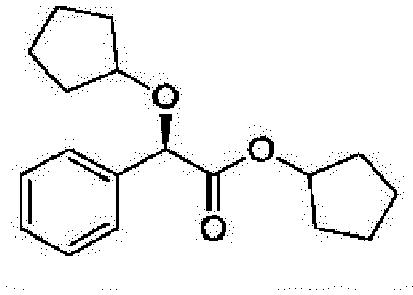
1H NMR (400MHz, CHLOROFORM-d): δ 7.49 - 7.40 (m, 2H), 7.38 - 7.28 (m, 3H), 5.24 - 5.20 (m, 1H), 4.89 (s, 1H), 4.05 - 3.99 (m, 1H), 1.89 - 1.64 (m, 10H), 1.57 - 1.45 (m, 6H). MS m/z: 311.1 [M+Na]+. S-A20-1 
1H NMR (400MHz, CHLOROFORM-d): δ 7.53 - 7.41 (m, 2H), 7.38 - 7.28 (m, 3H), 5.02 (s, 1H), 4.88 - 3.75 (m, 1H), 3.43 - 3.29 (m, 1H), 2.11 - 1.64 (m, 6H), 1.54 - 1.16 (m, 14H). A31-1 
1H NMR (400MHz, CHLOROFORM-d): δ7.48 - 7.39 (m, 2H), 7.09 - 7.01 (m, 2H), 5.25 - 5.18 (m, 1H), 4.86 (s, 1H), 4.05 - 3.97 (m, 1H), 1.88 - 1.67 (m, 11H), 1.59 - 1.50 (m, 5H). - The compound S-A1-1 (340.0 mg, 1.2 mmol) was dissolved in a mixed solvent of tetrahydrofuran (6.0 mL) and water (3.0 mL), and lithium hydroxide monohydrate (283.0 mg, 11.8 mmol) was added. The reaction solution was stirred for 48 hours at 20-25 °C. The reaction solution was adjusted to pH <3 with IN hydrochloric acid and extracted with ethyl acetate (20mL x3). The mixed organic phase was washed with saturated salt water (50mL), dried with anhydrous sodium sulfate and concentrated in vacuum to obtain a crude product. The crude product was separated and purified by a silica gel chromatography column (an eluent: 0-37.5% petroleum ether/ethyl acetate) to obtain the product S-A1 (95.6% ee). 1H NMR (400MHz, CHLOROFORM-d): δ 7.45-7.34 (m, 5H), 4.93 (s, 1H), 4.07-4.03 (m, 1H), 1.78-1.69 (m, 6H), 1.62 -1.48(m, 2H).
- The following compounds were synthesized in a similar manner to the compound S-A1:
Reference Example Compound Serial Number Structural Formula Spectrogram 21 R-Al 
1H NMR (400MHz, CHLOROFORM-d): δ 7.45 - 7.35 (m, 5H), 4.94 (s, 1H), 4.08 - 4.06 (m, 1H), 1.78 - 1.69 (m, 6H), 1.62 - 1.48 (m, 2H). 22 S-A20 
1H NMR (400MHz, CHLOROFORM-d): δ 7.51 - 7.31 (m, 5H), 5.05 (s, 1H), 3.63 - 3.36 (m, 1H), 1.90 - 1.67 (m, 3H), 1.60 - 1.35 (m, 3H), 1.30 - 1.19 (m, 4H). 38 A31 
1H NMR (400MHz, CHLOROFORM-d): δ 7.49 - 7.37 (m, 2H), 7.12 - 7.00 (m, 2H), 4.92 (s, 1H), 4.08 - 4.02 (m, 1H), 1.82 - 1.67 (m, 8H). -
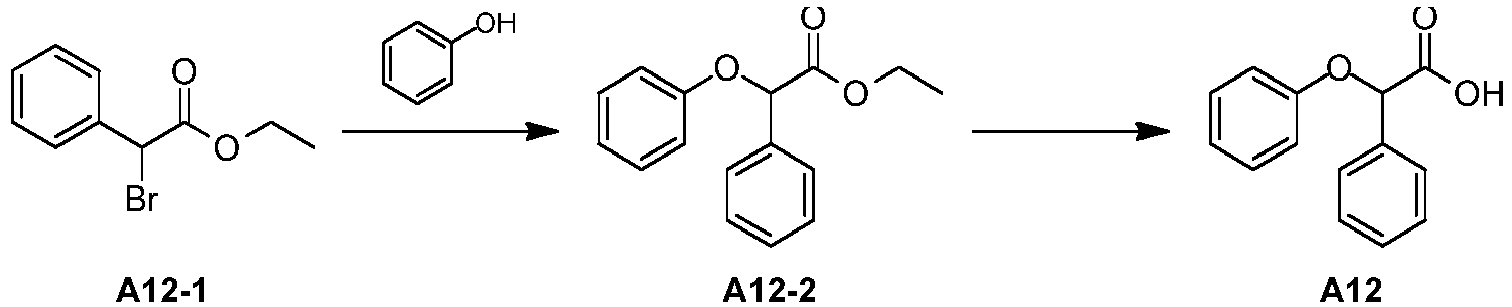
- Phenol (193.9 mg, 2.1 mmol) was dissolved in N,N-dimethylformamide (10.0 mL), and then the compound A12-1 (500.0 mg, 2.1 mmol) and potassium carbonate (854.1 mg, 6.2 mmol) were added sequentially. After the reaction solution was heated to 80 °C, stirring was continued to be performed for 16 hours. After cooling to room temperature, 20 mL of water was added to the reaction solution, and the aqueous phase was extracted with ethyl acetate (10 mL x 3). The mixed organic phase was dried with anhydrous sodium sulfate, filtered and concentrated in vacuum to obtain a crude product. The crude product was separated and purified by a silica gel chromatography column (an eluent: 9% petroleum ether/ethyl acetate) to obtain the product A12-2. 1H NMR (400 MHz, CHLOROFORM-d): δ 7.52-7.50 (m, 2H), 7.32-7.30 (m, 3H), 7.23-7.16 (m, 2H), 6.93-6.84 (m, 3H), 5.55 (s, 1H), 4.19-4.04 (m, 2H), 1.14-1.11 (t, J = 7.2 Hz, 3H). MS m/z: 257.1 [M+1] +.
- A12-2 (100.0 mg, 390.2 µmol) was dissolved in a mixed solvent of ethanol (2.0 mL) and water (0.5 mL). After lithium hydroxide monohydrate (14.0 mg, 585.3 µmol) was added, the reaction solution was continued to be stirred for 16 hours at 20 °C. 2 mL of water was added to the reaction solution, and the reaction solution was adjusted to pH of 3 to 4 with IN hydrochloric acid, and then extracted with ethyl acetate (10 mL). The organic phase was dried with anhydrous sodium sulfate, filtered and concentrated in vacuum to obtain a crude product A12. This compound was used in the next step without further purification. 1H NMR (400 MHz, CHLOROFORM-d): δ 7.35-7.26 (m, 4H), 7.02-6.84 (m, 6H), 5.32 (s, 1H).
-

- The compound S-A21-1 (831.0 mg, 5.0 mmol) was dissolved in dichloromethane (10.0 mL), then magnesium perchlorate (111.6 mg, 500.0 µmol) and di-tert-butyl dicarbonate (2.5 g, 11.5 mmol) were added sequentially. After the reaction solution was heated to 40 °C, the reaction was continued to be performed under stirring for 40 hours. After cooling to room temperature, the reaction solution was poured into 25 mL of water and extracted with dichloromethane (10 mL×3). The mixed organic phase was washed with saturated salt water (50mL), dried with anhydrous sodium sulfate, filtered and concentrated in vacuum to obtain a crude product. The crude product was separated and purified by a silica gel chromatography column (an eluent: 0-20% petroleum ether/ethyl acetate) to obtain the product S-A21-2. 1H NMR (400 MHz, CHLOROFORM-d): δ 7.49-7.47 (m, 2H), 7.35-7.31 (m, 3H), 5.10 (s, 1H), 3.71 (s, 3H), 1.27 (s, 9H).
- S-A21-2 (300.0 mg, 1.4 mmol) was dissolved in methanol (11.0 mL), then potassium hydroxide (1.5 g, 26.7 mmol) was added, and the reaction solution was subjected to a reaction under stirring for 16 hours at 15 °C. The reaction solution was adjusted to pH of 5-6 with IN hydrochloric acid and extracted with dichloromethane (50mLx3). The mixed organic phase was washed with saturated salt water (80mL), dried with anhydrous sodium sulfate, filtered and concentrated in vacuum to obtain a crude product. The crude product was separated and purified by a silica gel chromatography column (an eluent: 0-33% petroleum ether/ethyl acetate) to obtain the product S-A21 (97.9% ee). 1H NMR (400 MHz, CHLOROFORM-d): δ 7.48-7.45 (m, 2H), 7.41-7.29 (m, 3H), 5.09 (s, 1H), 1.30 (s, 9H).
-
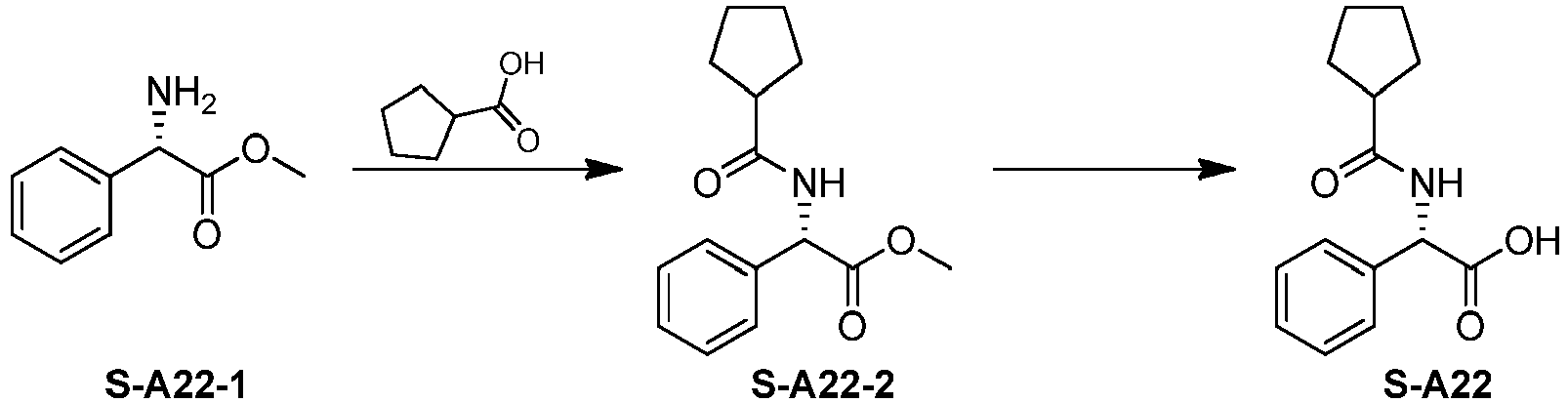
- The hydrochloride of the compound S-A22-1 (650.0mg, 3.2mmol) was dissolved in dichloromethane (10.0mL) under nitrogen protection. Cyclopentanecarboxylic acid (367.5 mg, 3.2 mmol, 350.03 uL), pyridine (1.0 g, 12.9 mmol, 1.0 mL) and HATU (1.6 g, 4.2 mmol) were sequentially added. After the reaction solution was continuously stirred at 10-15°C for 12 hours, 30mL of saturated sodium bicarbonate was added to the reaction solution for quenching the reaction, and the aqueous phase was extracted with dichloromethane (20mL x 3). The mixed organic phase was washed with saturated salt water (50mL), dried with anhydrous sodium sulfate, filtered and concentrated in vacuum to obtain a crude product. The crude product was separated and purified by a silica gel chromatography column (an eluent: 0-33% petroleum ether/ethyl acetate) to obtain the product S-A22-2. 1H NMR (400 MHz, CHLOROFORM-d): δ 7.40-7.31 (m, 5H), 5.60-5.58 (d, J = 7.2 Hz, 1H), 3.74 (s, 3H), 2.65-2.60 (m, 1H), 2.25-2.11 (m, 1H), 1.95-1.69 (m, 7H). MS m/z: 261.9 [M+1]+.
- S-A22-2 (400.0 mg, 1.5 mmol) was dissolved in tetrahydrofuran (10.0 mL). An aqueous solution (4.0 mL) of lithium hydroxide monohydrate (367.0 mg, 15.3 mmol) was added, and the reaction solution was stirred at 25 °C for 2 hours. The reaction solution was adjusted to pH of 5-6 with IN hydrochloric acid and extracted with ethyl acetate (25mL x3). The mixed organic phase was dried with anhydrous sodium sulfate, filtered and concentrated in vacuum to obtain a crude product S-A22. This product was used in the next reaction without purification. 1H NMR (400 MHz, METHANOL-d4): δ 7.45-7.22 (m, 5H), 5.43 (s, 1H), 2.86-2.60 (m, 1H), 1.94-1.59 (m, 8H). MS m/z: 247.9 [M+1]+.
-

- The compound S-A23-1 (500.0 mg, 3.3 mmol) and cyclopentanone (835.0 mg, 9.9 mmol) were dissolved in methanol (4.5 mL), and acetic acid (150.0 µL) and sodium cyanoborohydride (624.0 mg, 9.93 mmol) were successively added. The reaction solution was stirred at 10-15 °C for 12 hours and then concentrated in vacuum to obtain a crude product. 5 mL of water was added to the crude product, filtering was performed, and the product S-A23 was prepared and separated by high performance liquid chromatography. 1H NMR (400 MHz, CHLOROFORM-d) δ: 7.56-7.53 (m, 2H), 7.44-7.41 (m, 3H), 4.50 (s, 1H), 3.45-3.35 (m, 1H), 2.11-1.96 (m, 2H), 1.88-1.43 (m, 6H). MS m/z: 219.9 [M+1]+.
- The following compounds were synthesized in a similar manner to the compound S-A23:
Reference Example Compound Serial Number Structural formula Spectrogram 27 S-A24 
H NMR (400MHz, CD3OD): δ 7.63 - 7.52 (m, 5H), 5.15 (s, 3H), 3.97 - 2.50 (m, 1 H), 3.08 - 2.36 (m, 3H), 2.12 - 1.55 (m, 8H). MS m/z: 233.9 [M+1]+. -

- A compound C1-1 (200.0 g, 1.31 mol) was dissolved in absolute ethanol (1.50 L) under the protection of nitrogen. Anhydrous potassium carbonate (181.1 g, 1.31 mol) and benzyl bromide (268.9 g, 1.57 mol) were successively added under stirring at 15 °C, and the reaction solution was heated to 100 °C and stirring was continued to be performed for 15 hours. After the reaction solution was cooled to room temperature, the reaction solution was filtered, and the filtrate was concentrated in vacuum to obtain an oily substance. After being re-dissolved with ethyl acetate (3.0 L), the oily substance was washed with a 2N sodium hydroxide solution (500mL x 2) and saturated salt water (600mL x 2), dried with anhydrous magnesium sulfate, filtered and concentrated in vacuum to obtain a crude product. The crude product was dispersed in petroleum ether and stirred for 1 hour, and filtered to obtain 247.0 g of the compound C1-2. 1H NMR (400 MHz, CHLOROFORM-d): δ 10.25 (s, 1H), 7.42-7.34 (m, 6H), 7.21-7.12 (m, 2H), 5.19 (s, 2H), 3.96 (s, 3H).
- The compound Cl-2 (220.0 g, 908.08 mmol), ethyl 2-nitroacetate (145.0 g, 1.09 mol) and diethylamine hydrochloride (149.3 g, 1.36 mol) were heated in a mixed solution of anhydrous toluene (2.1 L) to 130 °C to be subjected to reflux for 15 hours, and the water formed by the reaction was separated by using a Deane-Stark water knockout trap. After the reaction solution was cooled to room temperature, the reaction solution was concentrated in vacuum to remove toluene. The residue was re-dissolved in dichloromethane (500 mL), washed with a saturated saline solution (1000mL x 2), dried with anhydrous sodium sulfate, filtered and concentrated in vacuum to obtain the compound C1-3, which was directly used in the next reaction without purification.
- The crude compound C1-3 (430.0 g, 1.2 mol) obtained in the above step 2 and isopropyl alcohol (2.2 g, 36.0 mmol) were dissolved in chloroform (4.5 L) under a nitrogen atmosphere, and the liquid mixture was cooled to 0°C. Thereafter, 100-200-mesh silica gel (1.8 kg) was added thereto with stirring, and then sodium borohydride (201.1 g, 5.3 mol) was added in batch within 1.5 hours. After the reaction solution was heated to 15°C, the reaction was continued to be performed under stirring for 12 hours. After acetic acid (210 mL) was slowly added, stirring was continued to be performed for 15 minutes, and the reaction solution was filtered, and the filter cake was washed with chloroform (500 mL). The residue obtained by concentrating the mixed filtrate under vacuum was separated and purified by a silica gel chromatography column (an eluent: 6-10% petroleum ether/ethyl acetate) to obtain the compound C1-4. 1H NMR (400 MHz, CHLOROFORM-d): δ 7.48-7.33 (m, 5H), 7.02-6.97 (m, 1H), 6.94-6.90 (m, 1H), 6.64-6.62 (dd, J = 1.6, 7.6 Hz, 1H), 5.33-5.30 (dd, J = 6.0, 9.2 Hz, 1H), 5.19-5.05 (m, 2H), 4.15-4.10 (q, J = 7.2 Hz, 2H), 3.91 (s), 3H), 3.44-3.31 (m, 2H), 1.16-1.12 (t, J = 7.2 Hz, 3H).
- The compound Cl-4 (8.2 g, 22.82 mmol) was dissolved in acetic acid (100 mL) at 15°C, zinc powder (76.2 g, 212.04 mmol) was slowly added and the reaction temperature was maintained between 60-65°C. Thereafter, the reaction was continued to be performed under stirring at 60°C for 2 hours. After the reaction solution was cooled to room temperature, the reaction solution was filtered, and the filter cake was washed with acetic acid (300mL). The residue obtained by concentrating the mixed filtrate in vacuum was re-dissolved in dichloromethane (500mL), washed with a saturated sodium bicarbonate aqueous solution (200mLx3) and saturated saline solution (200mL x 2), dried with anhydrous sodium sulfate, filtered and concentrated in vacuum to obtain a crude product C1-5, which was directly used in the next step without purification. MS m/z: 330.1 [M+1]+.
- The compound Cl-5 (48.9 g, 149.4 mmol) was dissolved in a 2N hydrochloric acid solution (500 mL) at 15°C under the nitrogen atmosphere, and then a 37% aqueous solution of formaldehyde (36.4 g, 448.1 mmol) was added. After stirring is performed for 25 hours, the stirred material was filtered, and the filter cake was washed with water (100 mL) to obtain the hydrochloride of the compound C1. MS m/z: 342.1[M+1]+.
- The compound C1 (40.0 g, 117.2 mmol) was separated by a chiral column to obtain two isomers (-)-C1 and (+)-C1.
(-)-Cl: 1H NMR (400 MHz, CHLOROFORM-d): δ 7.40-7.38 (m, 2H), 7.33-7.22 (m, 3H), 6.73-6.71 (m, 2H), 4.93-4.92 (m, 2H), 4.17-4.15 (q, J = 7.2 Hz, 2H), 4.10-3.93 (m, 2H), 3.79 (s, 3H), 3.62-3.58 (m, 1H), 3.07-3.06 (m, 1H), 2.77-2.65 (m, 1H), 1.21 (t, J = 7.2 Hz, 3H). MS m/z: 342.1 [M+1]+. [α] = -23.4.
(+)-C1: 1H NMR (400 MHz, CHLOROFORM-d): δ 7.43-7.40 (m, 2H), 7.33-7.22 (m, 3H), 6.86 (s, 2H), 5.06-4.95 (q, J = 11.2 Hz, 2H), 4.54-4.50 (m, 1H), 4.33-4.21 (m, 3H), 4.07-4.05 (m, 1H), 3.88 (s, 3H), 3.34-3.25 (m, 1H), 3.20-3.14 (m, 1H), 1.30-1.26 (t, J = 7.2 Hz, 3H). MS m/z: 342.1 [M+l]+.[α]=+9.8. -

- A compound C2-1 (5.0 g, 36.2 mmol) was dissolved in N,N-dimethylformamide (60 mL) under the nitrogen atmosphere, and a sodium hydrogen compound (1.5 g, 36.2 mmol, 60.0% purity) was added slowly, and after 0.5 hour, the temperature was lowered to 0°C, benzyl bromide (6.2g, 36.2 mmol) was added dropwise to the reaction solution, and the reaction solution was slowly heated to 25°C and then continuously stirred for 19.5 hours. The reaction solution was poured into ice water (50 mL), and ethyl acetate (200 mL) was added, and the mixture was separated, and the organic phase was washed with water (100 mL x 3) and saturated saline water (50 mL), dried with anhydrous sodium sulfate, filtered and decompressed to remove the organic solvent. The crude product was separated and purified by a silica gel chromatography column (an eluent: 9-25% ethyl acetate/petroleum ether) to obtain the compound C2-2. 1H NMR (400 MHz, CHLOROFORM-d): δ 10.19 (s, 1H), 7.45-7.36 (m, 6H), 7.24-7.13 (m, 2H), 5.77 (s, 1H), 5.09 (s, 2H).
- The Compound C2-2 (4.0 g, 17.5 mmol) and Boc-a-phosphonoglycine trimethyl ester (6.3 g, 21.0 mmol) were dissolved in tetrahydrofuran (60 mL) at 0°C, and tetramethylguanidine (4.4g, 38.5mmol) was added and the reaction solution was stirred at 25°C for 20 hours. The reaction solution was adjusted to pH of 6-7 with 1M hydrochloric acid, and extracted by ethyl acetate (50mL x 3). The mixed organic phase was washed with a saturated saline solution (20mL), dried with anhydrous sodium sulfate, filtered, and decompressed to remove the organic solvent, and the crude product was separated and purified by a silica gel chromatography column (an eluent: 9-25% ethyl acetate/petroleum ether) to obtain the compound C2-3. 1H NMR (400MHz, CHLOROFORM-d): δ 7.42-7.37 (m, 5H), 7.16 (brs, 1H), 7.05-6.98 (m, 2H), 6.94-6.88 (m, 1H), 6.74 (brs, 1H), 5.58 (s, 1H), 4.91 (s, 2H), 3.88 (s, 3H), 1.41 (s, 9H).
- The compound C2-3 (6.3 g, 15.8 mmol) was dissolved in methanol (60 mL) at 0°C, and then nickel chloride hexahydrate (1.9g, 7.9mmol) and sodium borohydride (1.8g, 47.3mmol) were added sequentially. The reaction solution was slowly heated to 25°C and stirring was continued to be performed for 20 hours. Water (50 mL) was added to the reaction solution, and the reaction solution was decompressed to remove methanol, and extracted with ethyl acetate (50 mL x 3). The mixed organic phase was washed with a saturated saline solution (30mL), dried with anhydrous sodium sulfate, filtered, and decompressed to remove the organic solvent, and the crude product was separated and purified by a silica gel chromatography column (an eluent: 9-25% ethyl acetate/petroleum ether) to obtain the compound C2-4. 1H NMR (400 MHz, CHLOROFORM-d): δ 7.40-7.31 (m, 5H), 6.93-6.86 (m, 1H), 6.79-6.77 (d, J = 7.2 Hz, 1H), 6.62-6.60 (d, J = 7.2 Hz, 1H), 5.41 (s, 1H), 4.89-4.81 (m, 2H), 4.52-4.47 (m, 1H), 3.57 (s, 3H), 3.06-3.03 (m, 1H), 2.99-2.94 (m, 1H), 1.35 (s, 9H). MS m/z: 423.9 [M+Na]+.
- The compound C2-4 (1.1g, 2.7 mmol) was dissolved in dichloromethane (20 mL), and trifluoroacetic acid (6.2g, 54.0 mmol) was added, and the reaction solution was reacted at 25°C for 1 hour. The organic solvent was removed under reduced pressure to obtain a trifluoroacetic acid salt of a crude compound C2-5. And the compound was used directly for the next reaction step without further purification. 1H NMR (400 MHz, CHLOROFORM-d): δ 8.15 (brs, 2H), 7.38-7.33 (m, 5H), 6.94-6.89 (m, 2H), 6.62-6.60 (d, J = 7.6 Hz) , 1H), 4.96 (s, 2H), 4.36-4.33 (m, 1H), 3.71 (s, 3H), 3.15-3.10 (m, 1H), 2.93-2.87 (m, 1H). MS m/z: 301.9 [M+1]+.
- The trifluoroacetic acid salt of the compound C2-5 (1.0g, 2.4 mmol) was added to an aqueous solution of formaldehyde (1.2g, 14.4 mmol, 37%), and 1M diluted hydrochloric acid (20 mL) was added, and the reaction solution was heated to 60°C, and continuously stirred for 1 hour. The organic solvent was removed under reduced pressure to obtain the hydrochloride salt of a crude compound C2-6. And the compound was used directly for the next reaction step without further purification. 1H NMR (400 MHz, METHANOL-d4): δ 7.47-7.44 (m, 2H), 7.38-7.36 (m, 3H), 6.90-6.85 (m, 2H), 5.12 (s, 2H), 4.37-4.25 (m, 3H), 3.90 (s, 3H), 3.33-3.30 (m, 1H), 2.89-2.80 (m, 1H). MS m/z: 314.0 [M+1]+.
- The hydrochloride salt of the compound C2-6 (740.0 mg, 2.1 mmol) was dissolved in dichloromethane (7 mL), and then di-t-butyl dicarbonate (692.5 mg, 3.2 mmol) and triethylamine (856.2 mg, 8.5 mmol) were added sequentially, and the reaction solution was continuously stirred at 25°C for 3 hours. The organic solvent was removed under reduced pressure, and the obtained crude product was separated and purified by a silica gel chromatography column (an eluent: 9-33% ethyl acetate/petroleum ether) to obtain the compound C2-7. 1H NMR (400MHz, CHLOROFORM-d): δ 7.44-7.39 (m, 5H), 6.88-6.80 (m, 2H), 5.34 (s, 1H), 5.21-4.88 (m, 3H), 4.76-4.63 (m, 1H), 4.51-4.38 (m, 1H), 3.67-3.65 (d, J = 8.8 Hz, 3H), 3.57-3.34 (m, 1H), 3.07-2.99 (m, 1H), 1.48-1.44 (d, J = 13.6 Hz, 9H). MS m/z: 436.1 [M+Na]+.
- The compound C2-7 (500.0 mg, 1.2 mmol) was dissolved in N,N-dimethylformamide (10 mL), and then N,N-diisopropylethylamine (468.9 mg, 3.6 mmol) and N-phenyl bis(trifluoromethanesulfonimide) (648.0 mg, 1.8 mmol) were added. The reaction solution was continuously stirred at 25°C for 16 hours. Ethyl acetate (100 mL) was added to the reaction solution, and the solution was washed with water (20 mLx3) and a saturated saline solution (20mL), dried with anhydrous sodium sulfate, filtered, and decompressed to remove the organic solvent, and the resulting crude product was separated and purified by a silica gel chromatography column (an eluent: 9-25% ethyl acetate/petroleum ether) to obtain the compound C2-8. 1H NMR (400 MHz, CHLOROFORM-d): δ 7.47-7.41 (m, 5H), 7.17-6.96 (m, 2H), 5.21-4.69 (m, 4H), 4.56-4.41 (m, 1H), 3.66-3.65 (d, J = 6.0 Hz, 3H), 3.54-3.28 (m, 1H), 2.96-2.84 (m, 1H), 1.55-1.48 (d, J = 27.6 Hz, 9H). MS m/z: 568.1 [M+Na]+.
- The compound C2-8 (200.0 mg, 366.6 µmol) and methylboronic acid (109.7 mg, 1.8 mmol) were dissolved in dioxane (3 mL) under a nitrogen atmosphere, and Pd(dppf)Cl2 (26.8 mg, 36.6 µmol) and potassium carbonate (152.0 mg, 1.1 mmol) were added sequentially, and the reaction solution was heated to 100°C for a reaction for 2 hours. The organic solvent was removed under reduced pressure, and the resulting crude product was separated and purified by a silica gel chromatography column (an eluent: 9-25% ethyl acetate/petroleum ether) to obtain the compound C2-9. 1H NMR (400 MHz, CHLOROFORM-d): δ 7.50-7.39 (m, 5H), 7.08-6.84 (m, 2H), 5.18-4.67 (m, 4H), 4.54-4.47 (m, 1H), 3.66-3.64 (d, J = 9.2 Hz, 3H), 3.59-3.34 (m, 1H), 3.07-2.94 (m, 1H), 2.31 (s, 3H), 1.55-1.48 (d, J = 28.4 Hz, 9H). MS m/z: 434.1 [M+Na]+.
- The compound C2-9 (140.0 mg, 340.2 µmol) was dissolved in methanol (1 mL), and a 4M hydrochloric acid methanol solution (2 mL) was added, and the reaction solution was continuously stirred at 25°C for 16 hours. The organic solvent was removed under reduced pressure to obtain a hydrochloride salt of the crude compound C2. 1H NMR (400 MHz, METHANOL-d4): δ 7.49-7.40 (m, 5H), 7.23-7.21 (d, J = 8.0 Hz, 1H), 7.00-6.98 (d, J = 8.0 Hz, 1H), 4.94 (s, 2H), 4.49-4.39 (m, 3H), 3.91 (s, 3H), 3.47-3.42 (m, 1H), 3.08-3.00 (m, 1H), 2.33 (s, 3H). MS m/z: 312.0 [M+1]+.
-

- The compound C2-8 (190.0 mg, 348.3 µmοl) was dissolved in dioxane (3 mL) under a nitrogen atmosphere, and then potassium chloride (51.9 mg, 696.9 µmol),, Pd2(dba)3 (4.8 mg, 5.2µmοl), di-tert-butyl (2',4',6'-triisopropyl-3,6-dimethoxybiphenyl-2-yl)phosphine (7.6 mg, 15.7 µmol) and potassium fluoride (10.1 mg, 174.1 µmol) were added sequentially. The reaction solution was heated to 130°C and stirring was continued to be performed for 20 hours. The organic solvent was removed under reduced pressure, and the obtained crude product was separated and purified by a silica gel chromatography column (an eluent: 5-16% ethyl acetate/petroleum ether) to obtain the compound C3-1. 1H NMR (400 MHz, CHLOROFORM-d): δ 7.56-7.37 (m, 5H), 7.26-7.11 (m, 1H), 6.94-6.72 (m, 1H), 5.19-5.04 (m, 1H) , 5.03-4.85 (m, 2H), 4.76-4.65 (m, 1H), 4.54-4.39 (m, 1H), 3.65-3.63 (d, J = 8.0 Hz, 3H), 3.58-3.30 (m, 1H), 2.98-2.82 (m, 1H), 1.54-1.44 (m, 9H). MS m/z: 331.9 [M-100]+.
- The compound C3-1 (110.0 mg, 254.7 µmol) was dissolved in methanol (1 mL), and a 4M hydrogen chloride methanol solution (1 mL) was added, and the reaction solution was continuously stirred at 25°C for 16 hours. The organic solvent was removed under reduced pressure to obtain a hydrochloride salt of the crude compound C3. 1H NMR (400MHz, METHANOL-d4): δ 7.54-7.37 (m, 6H), 7.13-6.91 (m, 1H), 5.20-5.08 (m, 2H), 4.55-4.33 (m, 3H), 3.93-3.90 (m, 3H), 3.54-3.38 (m, 1H), 3.06-2.90 (m, 1H). MS m/z: 332.0 [M+1]+.
-

- The compound C2-8 (260.0 mg, 476.6 µmol) was dissolved in dioxane (6 mL) under a nitrogen atmosphere, and potassium bromide (113.4 mg, 953.2 µmol), Pd2(dba)3 (13.1 mg, 14.3 µmοl), di-tert-butyl (2',4',6'-triisopropyl-3,6-dimethoxybiphenyl-2-yl)phosphine (23.1 mg, 47.6 µmol) and potassium fluoride (13.8 mg, 238.3 µmol) were added sequentially, and the reaction solution was heated to 130°C and stirring was continued to be performed for 20 hours. The organic solvent was removed under reduced pressure, and the obtained crude product was separated and purified by a silica gel chromatography column (an eluent: 5-10% ethyl acetate/petroleum ether) to obtain the compound C4-1. 1H NMR (400 MHz, CHLOROFORM-d): δ 7.59-7.33 (m, 6H), 6.90-6.77 (m, 1H), 5.22-5.06 (m, 1H), 5.03-4.84 (m, 2H) , 4.79-4.63 (m, 1H), 4.54-4.37 (m, 1H), 3.65-3.63 (d, J = 8.0 Hz, 3H), 3.59-3.32 (m, 1H), 3.02-2.85 (m, 1H) , 1.54-1.45 (m, 9H). MS m/z: 377.9 [M-100]+.
- Under a nitrogen atmosphere, concentrated sulfuric acid (44.2 mg, 450.25 µmol) was added to N,N-dimethylacetamide (10.0 mL), and the reaction solution was stirred at 25°C for 0.5 hour, and palladium acetate (0.1 g, 668.12µmol) and XPhos (0.6 g, 1.30 mmol) were added. The temperature of the mixture was raised to 80°C and stirring was continued to be performed for 0.5 hour. 1 mL of the above solution was added to a mixed solution of the compound C4-1 (50.0 mg, 104.9 µmol), zinc cyanide (18.5 mg, 157.4 µmol), zinc powder (686.4 µg, 10.50 µmοl) and N,N-dimethylacetamide (2.0mL). The reaction solution was heated to 90°C and stirring was continued to be performed for 16 hours. After cooling, ethyl acetate (30.0 mL) was added into the reaction solution, and the mixture was washed with water (10.0 mL) for three times, washed with a saturated aqueous sodium chloride solution (20.0 mL), dried with anhydrous sodium sulfate, and filtered, and the filtrate was decompressed to remove the organic solvent. The obtained crude product was separated and purified by a silica gel preparation plate (20% ethyl acetate/petroleum ether) to obtain the compound C4-2. 1H NMR (400 MHz, CHLOROFORM-d): δ 7.55-7.37 (m, 6H), 7.01-6.95 (m, 1H), 5.23-5.12 (m, 2H), 4.88-4.43 (m, 3H), 3.65-3.63 (d, J = 6.8 Hz, 3H), 3.59-3.35 (m, 1H), 2.93-2.77 (m, 1H), 1.57-1.43 (m, 9H). MS m/z: 323.0 [M-100]+.
- The compound C4-2 (76.0 mg, 179.9 µmol) was dissolved in methanol (1 mL), and a 4M hydrogen chloride methanol solution (1 mL) was added, and the reaction solution was continuously stirred at 25°C for 2 hours. The organic solvent was removed under reduced pressure to obtain a hydrochloride salt of the crude compound C4. 1H NMR (400 MHz, METHANOL-d4): δ 7.58-7.56 (d, J = 8.0 Hz, 1H), 7.42-7.28 (m, 5H), 7.10-7.08 (d, J = 8.0 Hz, 1H), 5.25-5.16 (m, 2H), 4.48-4.26 (m, 3H), 3.80 (s, 3H), 3.32-3.26 (m, 1H), 2.92-2.75 (m, 1H). MS m/z: 323.1 [M+1]+.
-

- The compound C1-4 (10.0 g, 27.8 mmol) was dissolved in N,N-dimethylformamide (30.0 mL), and sodium hydride (13.4 g, 33.5 mmol, 60% purity) was added under an ice-water bath, and stirring was continued to be performed for 30 minutes. Methyl iodide (35.3 g, 248.7 mmol) was added, and the reaction solution was slowly heated to 15-20°C and stirring was continued to be performed for 16 hours. The reaction solution was poured into water (100.0 mL), and ethyl acetate (100.0 mL) was used for extraction for three times. The mixed organic phase was dried with anhydrous sodium sulfate, filtered and decompressed to remove the organic solvent. The obtained crude product was separated and purified by silica gel chromatography (an eluent: 0-17% ethyl acetate/petroleum ether) to obtain a crude compound C5-1. 1H NMR (400 MHz, CHLOROFORM-d): δ 7.45-7.35 (m, 5H), 7.02-6.96 (m, 1H), 6.92-6.86 (m, 1H), 6.62-6.60 (m, 1H), 5.09-5.07 (d, J = 10.8 Hz, 1H), 4.94-4.92 (d, J = 10.8 Hz, 1H), 4.28-4.18 (m, 2H), 3.90 (s, 3H), 3.62-3.43 (m, 2H), 1.61 (s, 3H), 1.27-1.23 (t, J = 7.2 Hz, 3H). MS m/z: 396.0 [M+Na]+.
- The compound C5-1 (3.7 g, 9.8 mmol) was dissolved in ethanol (50.0 mL), and reduced iron powder (5.6 g, 99.6 mmol) and ammonium chloride (7.9 g, 147.0 mmol) were sequentially added, and the reaction solution was heated to 80°C, and stirring was continued to be performed for 16 hours. After cooling, the mixture was filtered with kieselguhr. And the filter cake was washed with ethanol (50.0mL). The filtrate was decompressed to remove the organic solvent to obtain the crude compound C5-2. The compound was used directly for the next reaction step without further purification. MS m/z: 344.1 [M+H]+.
- The compound C5-2 (3.4 g, 9.8 mmol) was dissolved in a mixed solution of dichloromethane (50.0 mL) and trifluoroacetic acid (10.0 mL), and paraformaldehyde (3.5 g, 39.3 mmol) was added. The reaction solution was continuously stirred for 16 hours at 20-25°C. The organic solvent was removed under reduced pressure. Dichloromethane (50.0 ml) and water (50.0 ml) were added to the obtained crude product, and the mixture was adjusted to pH of 8-9 with saturated sodium carbonate, and then separated. The aqueous phase was extracted with dichloromethane (80.0mL) for three times. The mixed organic phase was washed with a saturated saline solution (100.0 mL), and the organic solvent was removed under reduced pressure. The crude product was separated and purified by silica gel chromatography (an eluent: 0-10% methanol/dichloromethane), and then separated and purified through high performance liquid chromatography (column: Phenomenex luna C18 250∗50mm∗10µm; mobile phase: [water (0.1%TFA)-ACN]; B%: 15%-40%, 23min), and most acetonitrile was removed under reduced pressure. The aqueous phase was adjusted to pH of 8-9 with saturated sodium carbonate, and extracted with dichloromethane (150.0 mL) for three times. The mixed organic phase was washed with a saturated saline solution (200.0 mL), and the organic solvent was removed under reduced pressure to obtain the compound C5. 1H NMR: (400MHz, METHANOL-d4): δ 7.52-7.51 (d, J=7.2Hz, 2H), 7.44-7.31 (m, 3H), 6.82-6.72 (m, 2H), 5.08-4.88 (m, 2H), 4.16-4.07 (m, 2H), 4.06-3.93 (m, 2H), 3.86 (s, 3H), 3.39-3.35 (d, J = 16.8 Hz, 1H), 2.62-2.57 (d, J = 16.8 Hz, 1H), 1.40 (s, 3H), 1.22-1.18 (t, J = 7.2 Hz, 3H). MS m/z: 356.1 [M+H]+.
-

- (S,S)-Et-DuPhos (202.9 mg, 559.8 µmol) was dissolved in methanol (20 mL) under an argon atmosphere, and Rh(COD)+OTf- (231.9 mg, 495.2 µmol) was added. Stirring was continuously performed for 15 minutes, and the solution was added to a methanol solution (1.0 L) of the compound C2-3 (86.0 g, 215.3 mmol) under an argon atmosphere, and argon replacement was performed for three times, hydrogen replacement was performed for three times, and the reaction solution was continuously stirred for 16 hours at 25°C and in 15 Psi hydrogen. The organic solvent was removed under reduced pressure to obtain a crude product (-)-C2-1, which was used for the next reaction step without further purification. 1H NMR (400 MHz, CHLOROFORM-d): δ 7.41-7.28 (m, 5H), 6.94-6.86 (m, 1H), 6.80-6.78 (d, J = 6.4 Hz, 1H), 6.62-6.61 (d, J=7.2 Hz, 1H), 5.32 (brs, 1H), 5.16-5.14 (m, 1H), 4.90-4.76 (m, 2H), 4.60-4.42 (m, 1H), 3.58 (s, 3H) ), 3.15-2.87 (m, 2H), 1.32 (s, 9H). MS m/z: 424.1 [M+Na]+. SFC: column: Chiralpak AY (150 mm * 4.6 mm, 3 µm); mobile phase: [0.05% DEAMeOH]; B%: 5%-40% 5 min, 40% 2.5 min, 40% 2.5 min; Rt = 3.904 min; 98.9% ee.
- The compound (-)-C2-1 (37.0 g, 92.2 mmol) was dissolved in ethyl acetate (200 mL), and then a hydrogen chloride ethyl acetate solution (4M, 200 mL) was added and the reaction solution was continuously stirred at 25°C for 1.5 hours. The organic solvent was removed under reduced pressure to obtain a hydrochloride salt of the crude product (-)-C2-2. And the compound was directly used for the next reaction step without further purification. 1H NMR (400 MHz, METHANOL-d4): δ 7.38-7.32 (m, 2H), 7.30-7.19 (m, 3H), 6.87-6.75 (m, 2H), 6.55-6.50 (m, 1H) , 5.10-5.03 (m, 1H), 5.00-4.93 (m, 1H), 4.10-3.94 (m, 1H), 3.60 (s, 3H), 3.07-2.99 (m, 1H), 2.79-2.69 (m, 1H). MS m/z: 302.0 [M+1]+.
- The compound (-)-C2-2 (21.0 g, 62.2 mmol) was dissolved in hydrochloric acid (1M, 187.3 mL), and an aqueous solution of formaldehyde (15.1g, 186.5 mmol, 13.9 mL, 37%) was added, and the reaction solution was continuously stirred at 25°C for 16 hours. The solution was filtered, and the filter cake was dried in vacuum to obtain a hydrochloride salt of the crude compound (-)-C2-3, which was directly used in the next reaction step without further purification. 1H NMR (400 MHz, METHANOL-d4): δ 7.49-7.29 (m, 5H), 6.92-6.82 (m, 2H), 5.12 (s, 2H), 4.40-4.22 (m, 3H), 3.90 (s, 3H), 3.32-3.28 (m, 1H), 2.90-2.79 (m, 1H). MS m/z: 314.0 [M+1]+.
- The compound (-)-C2-3 (16.0 g, 45.7 mmol) was dissolved in tetrahydrofuran (160.0 mL), triethylamine (5.6 g, 54.9 mmol, 7.6 mL) was added and stirred to be dissolved, and a tetrahydrofuran (50 mL) solution of Boc anhydride (10.0g, 45.7mmol, 10.5mL) was added dropwise, and the reaction solution was continuously stirred for 16 hours at 25°C. The reaction solution was poured into 150 mL of water and extracted for three times with ethyl acetate (100 mL). The mixed organic phase was washed with 50 mL of saturated saline water, dried with anhydrous sodium sulfate, and filtered, and the organic solvent was removed under reduced pressure to obtain a crude product, and the crude product was separated and purified by silica gel chromatography (an eluent: 10-20% ethyl acetate/petroleum ether) to obtain the compound (-)-C2-4. MS m/z: 436.1 [M+Na]+.
- The compound (-)-C2-4 (16.6 g, 40.2 mmol) was dissolved in DMF (200.0 mL), diisopropylethylamine (15.6 g, 120.5 mmol, 20.98 mL) and N-phenyl bis(trifluoromethanesulfonyl)imide (18.7g, 52.2mmol) were added and the reaction solution was continuously stirred at 25°C for 16 hours. The reaction solution was poured into 200mL of water and extracted with ethyl acetate (180mL) for three times. The mixed organic phase was washed with 150mL of a saturated saline solution, dried with anhydrous sodium sulfate, filtered, and decompressed to remove the organic solvent, and the obtained crude product was separated and purified by silica gel chromatography (an eluent: 10-20% ethyl acetate/petroleum ether) to obtain the compound (-)-C2-5. 1H NMR (400MHz, CHLOROFORM-d): δ 7.42-7.28 (m, 5H), 7.10-7.04 (m, 1H), 6.94-6.85 (m, 1H), 5.10-5.01 (m, 0.5H), 4.97-4.88 (m, 1H), 4.86-4.78 (m, 1H), 4.72-4.57 (m, 1.5H), 4.51-4.29 (m, 1H), 3.57-3.56 (d, J = 6.0 Hz, 3H), 3.48-3.15 (m, 1H), 2.87-2.70 (m, 1H), 1.48-1.32 (m, 9H). MS m/z: 446.1 [M-100]+.
- The compound (-)-C2-5 (6.2 g, 11.4 mmol) and methylboronic acid (3.4 g, 56.8 mmol) were dissolved in dioxane (70 mL) under a nitrogen atmosphere, and Pd(dppf)Cl2 (831.6 mg, 1.1 mmol) and potassium carbonate (4.7 g, 34.1 mmol) were sequentially added, and the reaction solution was heated to 100°C for a reaction for 10 hours. The mixture was cooled, and filtered, and the filter cake was washed with 50 mL of ethyl acetate. The organic phase was mixed, and the organic solvent was removed under reduced pressure. The obtained crude product was separated and purified by a silica gel chromatography column (an eluent: 9-16% ethyl acetate/petroleum ether) to obtain the compound (-)-C2-6. 1H NMR (400 MHz, CHLOROFORM-d): δ 7.52-7.34 (m, 5H), 7.07-7.05 (d, J = 7.6 Hz, 1H), 6.91-6.81 (m, 1H), 5.19-4.64 (m, 4H), 4.55-4.41 (m, 1H), 3.65-3.62 (d, J = 9.2 Hz, 3H), 3.58-3.30 (m, 1H), 3.08-2.89 (m, 1H), 2.30 (s, 3H), 1.56-1.44 (m, 9H). MS m/z: 434.1 [M+Na]+.
- The compound (-)-C2-6 (4.5g, 10.9 mmol) was dissolved in dioxane (20 mL), a 4M dioxane solution of hydrogen chloride (30 mL) was added, and the reaction solution was continuously stirred at 25°C for 1.5 hours. The organic solvent was removed under reduced pressure to obtain a hydrochloride salt of a crude compound (-)-C2. 1H NMR (400 MHz, METHANOL-d4): δ 7.51-7.36 (m, 5H), 7.24-7.22 (d, J = 7.6 Hz, 1H), 7.00-6.98 (d, J = 7.6 Hz, 1H), 4.92 (s, 2H), 4.51-4.35 (m, 3H), 3.91 (s, 3H), 3.49-3.41 (m, 1H), 3.04-2.97 (m, 1H), 2.33 (s, 3H). MS m/z: 312.1 [M+1]+.
-

- The compound (-)-C2-5 (1.0 g, 1.8 mmol) was dissolved in 1,4-dioxane (15.0 mL) under a nitrogen atmosphere, and then potassium chloride (275.0 mg, 3.7 mmol), potassium fluoride (54.0 mg, 929.5 µmol), Pd2(dba)3 (26.0 mg, 28.4 µmol) and di-tert-butyl(2',4',6'-triisopropyl-3,6-dimethoxybiphenyl-2-yl)phosphine (40.0 mg, 82.5 µmol) were added sequentially, and the reaction solution was heated to 130°C and stirring was continued to be performed for 16 hours. The organic solvent was removed under reduced pressure, and the obtained crude product was separated and purified by silica gel column chromatography (an eluent: 0-20% methanol/ethyl acetate) to obtain the compound (-)-C3-1. 1H NMR (400MHz, CHLOROFORM-d): δ 7.54-7.51 (m, 2H), 7.48-7.35 (m, 3H), 7.29-7.23 (m, 1H), 6.92-6.85 (m, 1H), 5.17-5.15 (m, 0.5H), 5.05-4.87 (m, 2H), 4.78-4.61 (m, 1.5H), 4.53-4.34 (m, 1H), 3.65-3.63 (d, J = 8.0 Hz, 3H), 3.57-3.53 (m, 0.5H), 3.36-3.31 (m, 0.5H), 3.01-2.77 (m, 1H), 1.56-1.46 (m, 9H). MS m/z: 454.1 [M+Na]+.
- The compound (-)-C3-1 (590.0 mg, 1.4 mmol) was dissolved in dioxane (2.0 mL), and a dioxane solution of hydrogen chloride (4M, 3 mL) was added. The reaction solution was continuously stirred at 20-25°C for 2.5 hours. The organic solvent was removed under reduced pressure to obtain a hydrochloride salt of the compound (-)-C3. And this compound was directly used in the next reaction step without further purification. 1H NMR (400 MHz, METHANOL-d4): δ 7.50-7.36 (m, 6H), 7.08-7.06 (d, J = 8.0 Hz, 1H), 5.08 (s, 2H), 4.49-4.33 (m, 3H), 3.89 (s, 3H), 3.41-3.34 (m, 1H), 2.96-2.88 (m, 1H). MS m/z: 331.9 [M+1]+.
-

- The compound (-)-C2-1 (6.0 g, 14.9 mmol) was dissolved in tetrahydrofuran (120.0 mL) and water (40.0 mL), and lithium hydroxide monohydrate (1.9 g, 44.8 mmol) was slowly added. The reaction solution was continuously stirred for 5 hours at 25°C. The reaction solution was adjusted to pH of 5-6 with 1M diluted hydrochloric acid, and extracted with ethyl acetate (40.0mL) for three times. The mixed organic phase was washed with a saturated sodium chloride water solution (40.0mL), dried with anhydrous sodium sulfate, filtered, and decompressed to remove the organic solvent to obtain the compound (-)-C6-1, which was directly used in the next reaction step without further purification. 1H NMR (400 MHz, CHLOROFORM-d): δ 7.48-7.30 (m, 5H), 7.00-6.67 (m, 3H), 5.38-5.37 (m 1H), 5.02-4.89 (m, 2H), 4.58-4.41 (m, 1H), 3.19-3.13 (m, 1H), 3.02-2.96 (m, 1H), 1.42-1.28 (m, 9H). MS m/z: 410.1 [M+Na]+.
- The compound (-)-C6-1 (7.0 g, 18.1 mmol) was dissolved in ethyl acetate (50.0 mL), and an ethyl acetate solution of hydrogen chloride (4M, 50.0 mL) was added. The reaction solution was continuously stirred at 25°C for 2 hours. The organic solvent was removed under reduced pressure to obtain a hydrochloride salt of the compound (-)-C6-2, which was directly used in the next reaction step without further purification. 1H NMR (400MHz, METHANOL-d4): δ 7.51-7.46 (m, 2H), 7.39-7.31 (m, 3H), 6.97-6.89 (m, 2H), 6.69-6.67 (m, 1H), 5.24-5.19 (m, 1H), 5.14-5.09 (m, 1H), 4.19-4.14 (m, 1H), 3.31-3.26 (m, 1H), 2.83-2.77 (m, 1H). MS m/z: 287.9 [M+1]+.
- The compound (-)-C6-2 (5.0 g, 15.4 mmol) was dissolved in hydrochloric acid (1M, 83.0 mL), and an aqueous solution of formaldehyde (7.5 g, 92.6 mmol, 37%) was added, and the reaction solution was heated to 60°C and stirring was continued to be performed for 1 hour. The solution was cooled with an ice water bath, and an aqueous solution (40.0 mL) of sodium acetate (10.1 g, 123.5 mmol) was added to the reaction system, and stirring was continued to be performed at 0°C for 2 hours. The solution was filtered, and the filter cake was washed with water (50 mL) and dried in vacuum to obtain the compound (-)-C6. 1H NMR (400 MHz, METHANOL-d4): δ 7.56-7.47 (m, 2H), 7.42-7.30 (m, 3H), 6.88-6.80 (m, 2H), 5.11-5.03 (m, 2H), 4.32-4.17 (m, 2H), 3.74-3.70 (m, 1H), 3.53-3.48 (m, 1H), 2.92-2.85 (m, 1H). MS m/z: 299.9 [M+1]+.
-

- The compound (-)-C2-5 (4.0 g, 7.3 mmol) was dissolved in methanol (100 mL), and then triethylamine (1.5 g, 14.7 mmol, 2.0 mL) and wet palladium carbon (0.3 g, 10% purity) were added sequentially. The hydrogen replacement was performed for three times, and the reaction solution was continuously stirred at 25°C in 15 Psi hydrogen for 16 hours. The reaction solution was filtered, and the organic solvent was removed under reduced pressure, and the resulting crude product was separated and purified by silica gel column chromatography (an eluent: 10-30% ethyl acetate/petroleum ether) to obtain the compound (-)-C7-1. 1H NMR (400 MHz, CHLOROFORM-d): δ 7.00-6.96 (t, J = 7.6 Hz, 1H), 6.80-6.54 (m, 2H), 5.17-5.11 (m, 0.5H), 4.86 (s, 1H), 4.82-4.76 (m, 0.5H), 4.71-4.60 (m, 1H), 4.51-4.24 (m, 1H), 3.62-3.55 (m, 3H), 3.46-3.11 (m, 1H) , 3.08-2.74 (m, 1H), 1.48-1.35 (m, 9H). MS m/z: 207.9 [M-100]+.
- The compound (-)-C7-1 (2.0 g, 6.5 mmol) was dissolved in tetrahydrofuran (50 mL), and cesium carbonate (4.2g, 13.0mmol) and benzyl bromide (1.7g, 9.8mmol, 1.2mL) were sequentially added. The reaction solution was heated to 60 °C and continuously stirred for 3 hours. The organic solvent was removed under reduced pressure, and the obtained crude product was separated and purified by silica gel column chromatography (an eluent: 0-30% ethyl acetate/petroleum ether) to obtain the compound (-)-C7-2. 1H NMR (400 MHz, CHLOROFORM-d): δ 7.48-7.31 (m, 5H), 7.19-7.12 (m, 1H), 6.84-6.71 (m, 2H), 5.23-5.19 (m, 0.5H) ), 5.10 (s, 2H), 4.90-4.69 (m, 1.5H), 4.58-4.40 (m, 1H), 3.68-3.63 (m, 3H), 3.61-3.37 (m, 1H), 3.14-2.93 (m, 1H), 1.57-1.44 (m, 9H). MS m/z: 420.0 [M+Na]+.
- The compound (-)-C7-2 (2.4 g, 6.0 mmol) was dissolved in dioxane (30 mL), and a dioxane solution of hydrogen chloride (4M, 8 mL) was added and the reaction solution was continuously stirred at 25°C for 16 hours. The organic solvent was removed under reduced pressure to obtain a hydrochloride salt of the compound (-)-C7, which was directly used for the next reaction step without further purification. 1H NMR (400 MHz, METHANOL-d4): δ 7.51-7.26 (m, 6H), 7.06-7.04 (d, J = 8.4 Hz, 1H), 6.88-6.86 (d, J = 7.8 Hz, 1H) ), 5.18 (s, 2H), 4.54-4.41 (m, 3H), 3.93 (s, 3H), 3.54-3.46 (m, 1H), 3.05-2.96 (m, 1H). MS m/z: 298.0 [M+1]+.
-

- The compound (-)-C7-1 (0.7 g, 2.3 mmol) was dissolved in acetonitrile (10mL), and Select F (968.2mg, 2.7mmol) was added. The reaction solution was continuously stirred at 25°C for 16 hours. 5 mL of methanol was added to the reaction solution, and decompressed to remove the organic solvent, and the crude product was separated and purified by silica gel column chromatography (an eluent: 10-25% ethyl acetate/petroleum ether), further separated and purified by high performance liquid chromatography (column: Xtimate C18 150 * 25 mm * 5 microns; Mobile phase: [water (10mM NH4HCO3)-ACN]; B %: 45%-70%, 9.5min) to obtain the compound (-)-C8-1 and the compound (-)-C9-1.
Compound (-)-C8-1: 1H NMR (400 MHz, CHLOROFORM-d): δ 6.96-6.91 (t, J = 9.2 Hz, 1H), 6.74-6.60 (m, 1H), 5.76 (brs, 1H), 5.31-4.96 (m, 0.5H), 4.86-4.85 (m, 0.5H), 4.74-4.66 (m, 1H), 4.49-4.38 (m, 1H), 3.69-3.66 (m, 3H), 3.53-3.30 (m, 1H), 3.10-2.94 (m, 1H), 1.61-1.43 (m, 9H). MS m/z: 225.9 [M-100]+.
Compound (-)-C9-1: 1H NMR (400 MHz, CHLOROFORM-d): δ 6.80-6.75 (t, J = 9.2 Hz, 1H), 6.63-6.53 (m, 1H), 5.94-5.75 (m, 1H), 5.29-5.01 (m, 1H), 4.85-4.75 (m, 1H), 4.47-4.37 (m, 1H), 3.69-3.66 (m, 3H), 3.56-3.24 (m, 1H), 2.98-2.85 (m, 1H), 1.56-1.51 (m, 9H). MS m/z: 226.0 [M-100]+. - The compound (-)-C8-1 (30.0 mg, 92.2 µmol) was dissolved in tetrahydrofuran (5 mL), and cesium carbonate (60.1 mg, 184.4 µmol) and benzyl bromide (23.7 mg, 138.3 µmol, 16.4 µL) were added. The temperature of the reaction solution was raised to 60°C and the stirring was continued to be performed for 16 hours. The organic solvent was removed under reduced pressure, and the obtained crude product was separated and purified by silica gel column chromatography (an eluent: 0-30% ethyl acetate/petroleum ether) to obtain the compound (-)-C8-2. 1H NMR (400MHz, CHLOROFORM-d): δ 7.43-7.24 (m, 5H), 6.92-6.85 (m, 1H), 6.81-6.67 (m, 1H), 5.11-4.51 (m, 2.5H), 4.64-4.54 (m, 1.5H), 4.42-4.24 (m, 1H), 3.58-3.51 (m, 3H), 3.48-3.15 (m, 1H), 2.93-2.67 (m, 1H), 1.47-1.36 (m, 9H). MS m/z: 438.2 [M+Na]+.
- The compound (-)-C8-2 (35.0 mg, 77.5 µmol) was dissolved in ethyl acetate (2 mL), and an ethyl acetate solution of hydrogen chloride (4M, 2.4 mL) was added . The reaction solution was continuously stirred for 30 minutes at 25°C. The organic solvent was removed under reduced pressure to obtain a hydrochloride salt of the compound (-)-C8. 1H NMR (400 MHz, CHLOROFORM-d): δ 7.57-7.32 (m, 5H), 7.29-7.14 (m, 1H), 7.12-6.94 (m, 1H), 5.30-5.16 (m, 2H), 4.56-4.30 (m, 3H), 3.94 (s, 3H), 3.73-3.43 (m, 1H), 2.97-2.87 (m, 1H). MS m/z: 316.0 [M+1]+.
-

- The compound (-)-C9-1 (80.0 mg, 245.9 µmol) was dissolved in tetrahydrofuran (5.0 mL), and cesium carbonate (160.2 mg, 491.8 µmol) and benzyl bromide (63.1 mg, 368.9 µmol) were added thereto, and the reaction liquid was heated to 60°C, and stirring was continued to be performed for 16 hours. After cooling, the organic solvent was removed under reduced pressure, and the obtained crude product was separated and purified by silica gel column chromatography (an eluent: 0-20% ethyl acetate/petroleum ether) to obtain the compound (-)-C9-2. 1H NMR (400 MHz, METHANOL-d4): δ 7.46-7.31 (m, 5H), 6.90-6.82 (m, 1H), 6.73-6.70 (m, 1H), 5.35-5.22 (m, 0.5H), 5.07 (s, 2H), 5.01 (s, 0.5H), 4.93-4.70 (m, 1H), 4.53-4.30 (m, 1H), 3.74-3.65 (m, 3H), 3.65-3.45 (m, 1H), 3.06-2.83 (m, 1H), 1.58-1.48 (m, 9H). MS m/z: 438.1 [M+Na]+.
- The compound (-)-C9-2 (82.0 mg, 197.4 µmol) was dissolved in ethyl acetate (1.0 mL), and then an ethyl acetate solution of hydrogen chloride (4.0 M, 1.0 mL) was added. The reaction solution was continuously stirred for 3 hours at 20-25°C. The organic solvent was removed under reduced pressure to obtain a hydrochloride salt of the compound (-)-C9. And the compound was directly used for the next reaction step without further purification. 1H NMR (400 MHz, METHANOL-d4): δ 7.45-7.29 (m, 5H), 7.10-7.02 (m, 2H), 5.15 (s, 2H), 4.58-4.31 (m, 3H), 3.92 (s, 3H), 3.52-3.46 (m, 1H), 3.03-2.95 (m, 1H). MS m/z: 315.9 [M+1]+.
-

- The compound (-)-Cl (1.0 g, 2.9 mmol) was dissolved in dichloromethane (12 mL), and then triethylamine (600.0mg, 5.9mmol) and di-tert-butyl dicarbonate (770.0mg, 3.5mmol) were sequentially added. And the reaction solution was continuously stirred at 15-20°C for 5 hours. The organic solvent was removed under reduced pressure, and the obtained crude product was separated and purified by silica gel column chromatography (an eluent: 10-30% ethyl acetate/petroleum ether) to obtain the compound (-)-C10-1. 1H NMR (400MHz, CHLOROFORM-d): δ 7.52-7.44 (m, 2H), 7.43-7.31 (m, 3H), 6.94-6.78 (m, 2H), 5.10-4.99 (m, 1.5H), 4.95-4.89 (m, 1H), 4.67-4.53 (m, 1.5H), 4.49-4.34 (m, 1H), 4.15-4.00 (m, 2H), 3.87 (s, 3H), 3.53-3.49 (m, 0.5H), 3.27-3.22 (m, 0.5H), 2.99-2.75 (m, 1H), 1.55-1.43 (m, 9H), 1.19-1.13 (m, 3H). MS m/z: 464.1 [M+Na]+.
- The compound (-)-C10-1 (1.0 g, 2.3 mmol) was dissolved in methanol (20.0 mL), and wet Pd/C (100.0 mg, 226.5 µmol, 5% purity) was added, and the hydrogen replacement was performed for three times, and the reaction solution was continuously stirred for 1.5 hours in a 15 Psi hydrogen atmosphere at 15-20°C. The reaction solution was filtered through kieselguhr. The organic solvent was removed under reduced pressure to obtain the compound (-)-C10-2. The compound is used directly for the next reaction step without further purification. 1H NMR (400 MHz, CHLOROFORM-d): δ 6.79-6.58 (m, 2H), 5.70 (brs, 1H), 5.14-5.12 (m, 0.5H), 4.79-4.59 (m, 1.5H), 4.50-4.34 (m, 1H), 4.16-4.02 (m, 2H), 3.87 (s, 3H), 3.50-3.44 (m, 0.5H), 3.33-3.28 (m, 0.5H), 3.14-2.90 (m, 1H), 1.57-1.42 (m, 9H), 1.20-1.17 (m, 3H). MS m/z: 374.1 [M+Na]+.
- The compound (-)-C10-2 (100.0 mg, 284.6 µmοl) was dissolved in tetrahydrofuran (8.0 mL), and then a compound 4-chlorobenzyl bromide (88.0 mg, 428.3 µmol) and cesium carbonate (185.0 mg, 567.8) were added sequentially. The reaction solution was heated to 70°C and stirring was continued to be performed for 16 hours. After cooling, the organic solvent was removed under reduced pressure, and the obtained crude product was separated and purified by silica gel column chromatography (an eluent: 0-30% ethyl acetate/petroleum ether) to obtain the compound (-)-C10-3. 1H NMR (400 MHz, CHLOROFORM-d): δ 7.47-7.32 (m, 4H), 6.93-6.77 (m, 2H), 5.09-5.07 (m, 0.5H), 5.02-4.82 (m, 2H), 4.68-4.55 (m, 1.5H), 4.48-4.34 (m, 1H), 4.16-3.99 (m, 2H), 3.86 (s, 3H), 3.53-5.48 (m, 0.5H), 3.26-3.21 (m, 0.5H), 2.97-2.77 (m, 1H), 1.54-1.41 (m, 9H), 1.21-1.09 (m, 3H). MS m/z: 498.2 [M+Na]+.
- The following compounds were synthesized in a similar manner to the compound (-)-C10-3:
Compound Serial Number Structural Formula Spectrogram (-)-C11-1 
1H NMR (400MHz, CHLOROFORM-d): δ 7.61 - 7.37 (m, 1H), 6.94 - 6.81 (m, 4H), 5.10 - 5.03 (m, 1H), 5.01 - 4.94 (m, 1H), 4.77 - 4.56 (m, 2H), 4.51 - 4.36 (m, 1H), 4.17 - 4.02 (m, 2H), 3 . 88 - 3 . 87 (d, J=3.6 Hz, 3H), 3.55 - 3.20 (m, 1H), 3.01 - 2.79 (m, 1H), 1.56 - 1.42 (m, 9H), 1.20 - 1.14 (m, 3H). MS m/z: 500.2 [M+Na]+. (-)-C12-1 
1H NMR (400MHz, CHLOROFORM-d): δ 7.75 - 7.59 (m, 4H), 6.96 - 6.81 (m, 2H), 5.14 - 4.95 (m, 2H), 4.74 - 4.59 (m, 2H), 4.48 - 4.40 (t, J=17.2 Hz, 1H), 4.10 - 4.05 (m, 2H), 3.86 (s, 3H), 3.58 - 3.28 (m, 1H), 3.01 - 2.82 (m, 1H), 1.57 - 1.44 (m, 9H), 1.19 - 1.13 (m, 3H). MS m/z: 489.2 [M+Na]+. (-)-C13-1 
1H NMR (400MHz, CHLOROFORM-d): δ 7.47 - 7.41 (m, 2H), 7.09 - 7.04 (m, 2H), 6.89 - 6.81 (m, 2H), 5.07 - 4.88 (m, 2.5H), 4.62 - 4.56 (m, 1.5H), 4.41 - 4.33 (m, 1H), 4.10 - 4.04 (m, 2H), 3.87 (s, 3H), 3.50 - 3.48 (m, 0.5H), 3.23 - 3.19 (m, 0.5H), 2.95 - 2.82 (m, 1H), 1.57 - 1.44 (m, 9H), 1.19 - 1.13 (m, 3H). MS m/z: 482.2 [M+Na]+. (-)-C14-1 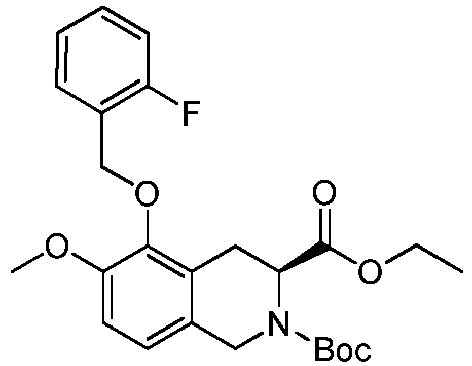
1H NMR (400MHz, CHLOROFORM-d): δ 7.62 - 7.51 (m, 1H), 7.38 - 7.29 (m, 1H), 7.23 - 7.13 (m, 1H), 7.11 - 7.03 (m, 1H), 6.94 - 6.77 (m, 2H), 5.14 - 4.99 (m, 2H), 4.82 - 4.56 (m, 2H), 4.50 - 4.37 (m, 1H), 4.11 - 4.02 (m, 2H), 3.87 (s, 3H), 3.55 - 3.22 (m, 1H), 3.00 - 2.79 (m, 1H), 1.54 - 1.43 (m, 9H), 1.19 - 1.13 (m, 3H). MS m/z: 482.2 [M+Na]+. (-)-C15-1 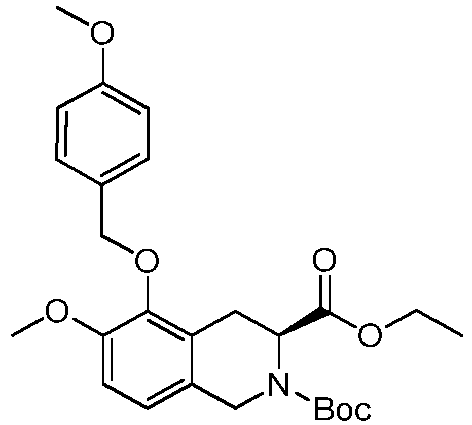
1H NMR (400MHz, CHLOROFORM-d): δ 7.41 - 7.36(m, 2H), 6.96 - 6.77 (m, 4H), 5.06 - 4.95 (m, 1.5H), 4.87 - 4.81 (m, 1H), 4.66 - 4.52 (m, 1.5H), 4.51 - 4.33 (m, 1H), 4.11 - 4.01 (m, 2H), 3.88 - 3.83 (d, J=19.2 Hz, 6H), 3.55 -3.14 (m, 1H), 2.98 - 2.76 (m, 1H), 1.54 - 1.42 (m, 9H), 1.21 - 1.11 (m, 3H). MS m/z: 494.2 [M+Na]+. (-)-C16-1 
1H NMR (400MHz, CHLOROFORM-d): δ 7.35 - 7.28 (m, 4H), 7.26 - 7.20 (m, 1H), 6.92 - 6.70 (m, 2H), 5.04 - 5.01 (m, 0.5H), 4.69 - 4.54 (m, 1.5H), 4.49 - 4.35 (m, 1H), 4.26 - 3.96 (m, 4H), 3.81 (s, 3H), 3.37 - 3.03 (m, 3H), 2.95 - 2.68 (m, 1H), 1.53 - 1.40 (m, 9H), 1.20 - 1.08 (m, 3H). MS m/z: 478.2 [M+Na]+. (-)-C17-1 
1H NMR (400MHz, CHLOROFORM-d): δ 8.85 (s, 1H), 7.86 (s, 1H), 6.98 - 6.78 (m, 2H), 5.35 - 5.13 (m, 2H), 5.11 - 4.58 (m, 2H), 4.50 - 4.38 (m, 1H), 4.13 - 4.01 (m, 2H), 3.89 (s, 3H), 3.55 - 3.21 (m, 1H), 3.05 - 2.73 (m, 1H), 1.56 - 1.46 (m, 9H), 1.21 - 1.13(m, 3H). MS m/z: 471.1 [M+Na]+. (-)-C18-1 
1H NMR (400MHz, CHLOROFORM-d): δ 7.43 - 7.39 (m, 1H), 7.38 - 7.33 (m, 1H), 7.25 - 7.12 (m, 1H), 6.97 - 6.78 (m, 2H), 5.10 - 5.09 (m, 0.5H), 5.01 - 4.95 (m, 1H), 4.91 - 4.83 (m, 1H), 4.69 - 4.58 (m, 1.5H), 4.49 - 4.36 (m, 1H), 4.16 - 4.01 (m, 2H), 3.86 (s, 3H), 3.53 - 3.48 (m, 0.5H), 3.30 - 3.25 (m, 0.5H), 2.99 - 2.81 (m, 1H), 1.55 - 1.43 (m, 9H), 1.18 - 1.13 (m, 3H). MS m/z: 516.1 [M+Na]+. (-)-C19-1 
1H NMR (400MHz, CHLOROFORM-d): δ 8.65 - 8.63 (d, J=6.0 Hz, 2H), 7.42 - 7.36 (m, 2H), 6.93 - 6.81 (m, 2H), 5.13 - 5.04 (m, 1.5H), 4.96 - 4.92 (m, 1H), 4.76 - 4.60 (m, 1.5H), 4.48 - 4.41 (m, 1H), 3.14 - 4.04 (m, 2H), 3.84 (s, 3H), 3.56 - 3.33 (m, 1H), 3.02 - 2.93 (m, 1H), 1.53 - 1.46 (m, 9H), 1.17 - 1.12 (m, 3H). MS m/z: 443.2 [M+1]+. (-)-C20-1 
1H NMR (400MHz, CHLOROFORM-d): δ 8.97 (s, 1H), 8.57 (s, 2H), 6.94 - 6.82 (m, 2H), 5.22 - 5.09 (m, 2.5H), 4.74 - 4.61 (m,1.5H), 4.49 - 4.41 (m, 1H), 4.1 - 4.05 (m, 2H), 3.84 (s, 3H), 3.58 -3.35(m, 1H), 3.05 -2.92 (m, 1H), 1.53 - 1.46 (m, 9H), 1.18-1.13 (q, J=6.8 Hz, 3H). MS m/z: 552.1 [M+Na]+. (-)-C21-1 
1H NMR (400MHz, CHLOROFORM-d): δ 8.79 - 8.76 (m, 2H), 7.30 - 7.26 (m, 1H), 6.70 - 6.53 (m, 2H), 5.06 - 5.03 (m, 2H), 4.69 - 4.29 (m, 3H), 4.15 - 3.98 (m, 2H), 3.79 (s, 3H), 3.48 - 2.80 (m, 2H), 1.39 - 1.34 (m, 9H), 1.18 - 1.07 (m, 3H). MS m/z: 444.1 [M+1]+. (-)-C22-1 
1H NMR (400MHz, CHLOROFORM-d): δ 6.95 - 6.75 (m, 2H), 5.09 - 5.07 (m, 0.5H), 4.74 - 4.57 (m, 1.5H), 4.53 - 4.38 (m, 1H), 4.32 - 4.27 (m, 1H), 4.16 - 3.97 (m, 4H), 3.83 (s, 3H), 3.56 - 3.29 (m, 3H), 3.14 - 2.88 (m, 1H), 2.02 - 1.72 (m, 4H), 1.54 - 1.45 (m, 9H), 1.21 - 1.15(m, 3H). MS m/z: 458.2 [M+Na]+. (-)-C23-1 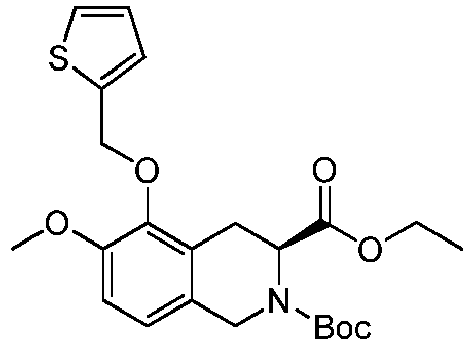
1H NMR (400MHz, CHLOROFORM-d): δ 7.34 - 7.27 (m, 1H), 7.07 - 6.98 (m, 2H), 6.91 - 6.80 (m, 2H), 5.23 - 5.09 (m, 2H), 4.96 - 4.92 (m, 0.5H), 4.65 - 4.56 (m, 1.5H), 4.46 - 4.33 (m, 1H), 4.14 - 4.04 (m, 2H), 3.88 (s, 3H), 3.55 - 3.19 (m, 1H), 2.89 - 2.78 (m, 1H), 1.52 - 1.44 (m, 9H), 1.19 - 1.14 (m, 3H). MS m/z: 470.1 [M+Na]+. - The compound (-)-C10-3 (120.0 mg, 252.1 µmol) was dissolved in ethyl acetate (1.0 mL), and then an ethyl acetate solution of hydrogen chloride (4.0 M, 1.0 mL) was added. The reaction solution was continuously stirred for 16 hours at 15-20°C. The organic solvent was removed under reduced pressure to obtain a hydrochloride salt of the compound (-)-C10. And the compound was directly used for the next reaction step without further purification. 1H NMR (400 MHz, METHANOL-d4): δ 7.46-7.33 (m, 4H), 7.12-6.95 (m, 2H), 5.12-5.02 (m, 2H), 4.42-4.23 (m, 5H), 3.91 (s, 3H), 3.35-3.31 (m, 1H), 2.88-2.80 (m, 1H), 1.36-1.32 (t, J = 7.2 Hz, 3H). MS m/z: 376.0 [M+1]+.
- The following compounds were synthesized in a similar manner to the compound (-)-C10b:
Referenc e Example Compound Serial Number Structural Formula Spectrogram 49 (-)-C11 
1H NMR (400MHz, METHANOL-d 4): δ 7.56 - 7.48 (m, 1H), 7.11 - 6.97 (m, 4H), 5.20 - 5.12 (m, 2H), 4.44 - 4.27 (m, 5H), 3.93 (s, 3H), 3.42 - 3.35 (m, 1H), 2.90 - 2.83 (m, 1H), 1.38 - 1.35 (t, J=7.2 Hz, 3H). MS m/z: 378.1 [M+1]+. 50 (-)-C12 
1H NMR (400MHz, METHANOL-d 4): δ 7.79 - 7.77 (d, J=8.4 Hz, 2H), 7.67 - 7.65 (d, J=8.4 Hz, 2H), 7.12 - 7.00 (m, 2H), 5.20 - 5.15 (m, 2H), 4.43 - 4.25 (m, 5H), 3.91 (s, 3H), 3 .39 - 3 . 35 (m, 1H), 2.95 - 2.88 (m, 1H), 1.37 - 1.33 (t, J=7.2 Hz, 3H). MS m/z: 367.0 [M+1]+. 51 (-)-C13 
1H NMR (400MHz, METHANOL-d 4): δ 7.46 - 7.42 (m, 2H), 7.15 - 7.03 (m, 3H), 7.02 - 6.95 (m, 1H), 5.12 - 5.00 (m, 2H), 4.44 - 4.20 (m, 5H), 3.91 (s, 3H), 3 . 35 - 3 . 27 (m, 1H), 2.86 - 2.79 (m, 1H), 1.36 - 1.32 (t, J=7.2 Hz, 3H). MS m/z: 360.1 [M+1]+. 52 (-)-C14 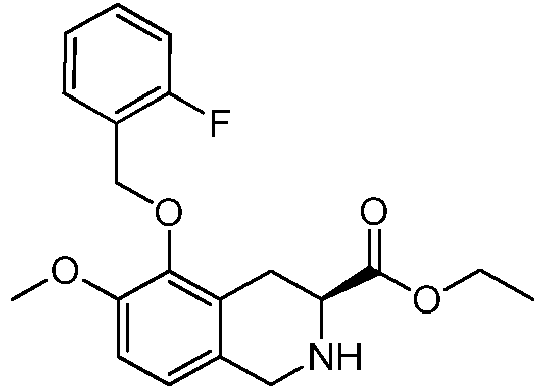
1H NMR (400MHz, METHANOL-d 4): δ 7.54 - 7.38 (m, 2H), 7.23 - 6.99 (m, 4H), 5.19 (s, 2H), 4.43 - 4.25 (m, 5H), 3.93 (s, 3H), 3.43 - 3.38 (m, 1H), 2.91 - 2.84 (m, 1H), 1.38 - 1.34 (t, J=7.2 Hz, 3H). MS m/z: 360.1 [M+1]+. 53 (-)-C15 
1H NMR (400MHz, METHANOL-d 4): δ 7.36 - 7.25 (m, 2H), 6.96 - 6.89 (m, 3H), 6.74 - 6.71 (d, J=8.4 Hz, 1H), 4.93 - 4.90 (m, 1H), 4.61 (s, 1H), 4.45 - 4.35 (m, 5H), 3.88 (s, 3H), 3.80 (s, 3H), 3.50 - 3.45 (m, 1H), 3.00 - 2.93 (m, 1H), 1.41 - 1.36 (t, J=6.8 Hz, 3H). MS m/z: 372.2 [M+1]+. 54 (-)-C16 
1H NMR (400MHz, METHANOL-d 4): δ 7.32 - 7.26 (m, 4H), 7.25 - 7.18 (m, 1H), 7.03 - 6.91 (m, 2H), 4.44 - 4.28 (m, 5H), 4.27 - 4.19 (m, 2H), 3.85 (s, 3H), 3.18 - 3.07 (m, 1H), 3.05 - 3.01 (m, 2H), 2.67 - 2.59 (m, 1H), 1.38 - 1.35 (t, J=7.2 Hz, 3H). MS m/z: 356.2 [M+1]+. 55 (-)-C17 
1H NMR (400MHz, METHANOL-d 4): δ 9.73 (s, 1H), 8.25 (s, 1H), 7.25 - 6.99 (m, 2H), 5.59 - 5.35 (m, 2H), 4.52 - 4.28 (m, 5H), 3.95 (s, 3H), 3.58 - 3.41 (m, 1H), 3.06 - 3.01 (m, 1H), 1.40 - 1.36 (t, J=7.2 Hz, 3H). MS m/z: 349.0 [M+1]+. 56 (-)-CI8 
1H NMR (400MHz, METHANOL-d 4): δ 7.50 - 7.46 (t, J=8.0 Hz, 1H), 7.38 - 7.35 (m, 1H), 7.24 - 7.21 (d, J=8.0 Hz, 1H), 7.10 - 6.96 (m, 2H), 5.14 - 5.01 (m, 2H), 4.45 - 4.23 (m, 5H), 3.90 (s, 3H), 3.40 - 3.34 (m, 1H), 2.93 - 2.86 (m, 1H), 1.36 - 1.32 (t, J=7.2 Hz, 3H). MS m/z: 394.1 [M+1]+. 57 (-)-C19 
1H NMR (400MHz, CHLOROFORM-d): δ 8.97 - 8.95 (d, J=6.0 Hz, 2H), 8.12 - 8.07 (m, 2H), 7.05 - 6.94 (m, 2H), 5.39 - 5.29 (m, 2H), 4.56 - 4.52 (m, 1H), 4.45 - 4.41 (m, 1H), 4.32 - 4.24 (m, 3H), 3.82 (s, 3H), 3.54 - 3.48 (m, 1H), 3.28 - 3.22 (m, 1H), 1.30 - 1.26 (m, 3H). MS m/z: 343.1 [M+1]+. 58 (-)-C20 
1H NMR (400MHz, CHLOROFORM-d): δ 8.98 (s, 1H), 8.78 (br s, 1H), 8.65 (s, 1H), 6.95 (s, 2H), 5.32 (s, 2H), 4.52 - 4.26 (m, 5H), 3.53 - 3.48 (m, 1H), 3.26 - 3.18 (m, 1H), 1.31 - 1.28(m, 3H). 59 (-)-C21 
MS m/z: 344.1 [M+1]+. 60 (-)-C22 
1H NMR (400MHz, METHANOL-d 4): δ 7.10 - 6.93 (m, 2H), 4.56 - 4.53 (m, 1H), 4.45 - 4.30 (m, 5H), 4.00 - 3.95 (m, 2H), 3.86 (s, 3H), 3.54 - 3.42 (m, 3H), 3.08 - 3.00 (m, 1H), 2.05 - 1.86 (m, 2H), 1.81 - 1.63 (m, 2H), 1.38 - 1.35 (t, J=7.2 Hz, 3H). MS m/z: 336.1 [M+1]+. 61 (-)-C23 
1H NMR (400MHz, METHANOL-d 4): δ 6.96 - 6.91 (m, 1H), 6.72 - 6.70 (d, J=8.0 Hz, 1H), 4.42 - 4.36 (m, 4H), 3.86 (s, 3H), 3.52 - 3.44 (m, 1H), 3.00 - 2.86 (m, 1H), 2.04 - 1.99 (m, 1H), 1.39 - 1.35 (t, J=7.6 Hz, 3H). MS m/z: 252.1 [M+1]+. -

- The compound (-)-C10-2 (100.0 mg, 284.6 µmol) and phenylboronic acid (70.1 mg, 574.9 µmol) were dissolved in dichloromethane (10 mL), and copper acetate (54.0 mg, 297.3 µmol), a 4Å molecular sieve (321 mg), TEMPO (90.0 mg, 572.3 µmol) and pyridine (226.0 mg, 2.9 mmol) were added, and the reaction solution was continuously stirred at 15-20°C for 64 hours. The reaction solution was poured into water (30 mL), the mixture was separated, the water phase was extracted with dichloromethane (30 mL) for three times, the mixed organic phase was washed with a saturated sodium chloride water solution (50 mL), and the organic solvent was removed under reduced pressure. The resulting crude product was separated and purified by silica gel column chromatography (an eluent: 0-30% ethyl acetate/petroleum ether) to obtain the compound (-)-C24-1. 1H NMR (400 MHz, CHLOROFORM-d): δ 7.26-7.21 (m, 2H), 7.06-6.96 (m, 2H), 6.89-6.76 (m, 3H), 5.06-5.05 (m, 0.5H), 4.76-4.63 (m, 1.5H), 4.58-4.46 (m, 1H), 4.12-3.87 (m, 2H), 3.75 (s, 3H), 3.40-3.13 (m, 1H), 2.96-2.75 (m, 1H), 1.56-1.38 (m, 9H), 1.16-1.02 (m, 3H). MS m/z: 450.2 [M+Na]+.
- The compound (-)-C24-1 (125.0 mg, 292.4 µmol) was dissolved in ethyl acetate (1.0 mL), and then an ethyl acetate solution of hydrogen chloride (4.0 M, 1.0 mL) was added. The reaction solution was continuously stirred for 16 hours at 20-25°C. The organic solvent was removed under reduced pressure to obtain a hydrochloride salt of the compound (-)-C24. And the compound was directly used for the next reaction step without further purification. 1H NMR (400 MHz, METHANOL-d 4): δ 7.28-7.24 (m, 2H), 7.21-7.14 (m, 2H), 7.04-6.95 (m, 1H), 6.79-6.76 (m, 2H), 4.53-4.37 (m, 3H), 4.35-4.21 (m, 2H), 3.74 (s, 3H), 3.40-3.32 (m, 1H), 2.97-2.90 (m, 1H), 1.29-1.26 (t, J=7.2Hz, 3H). 325.1 [M+1]+.
-

- The compound (-)-C1 (150.0 mg, 439.4 µmol) was dissolved in anhydrous dichloromethane (6.0 mL), and then HATU (200.0 mg, 527.2 µmol), pyridine (104.0 mg, 1.32 mmol) and A2 (156.0 mg, 659.1 µmol) were added sequentially. After the reaction solution was stirred at 25°C for 16 hours, the organic solvent was removed through concentration in vacuum. The resulting crude product was separated and purified by a silica gel chromatography column (an eluent: 50-100% ethyl acetate/petroleum ether) to obtain the compound 1-1. 1H NMR (400MHz, CHLOROFORM-d): δ 7.64-7.31 (m, 10H), 6.93-6.32 (m, 2H), 5.51-5.29 (m, 1H), 5.13-4.81 (m, 3H), 4.27-3.90 (m, 4H), 3.90-3.79 (m, 2H), 3.53-3.35 (m, 2H), 1.87-1.49 (m, 5H), 1.33-1.04 (m, 3H). MS m/z: 560.2 [M+1]+.
- The following compounds were synthesized in a similar manner to the compound 1-1:
Compound Serial Number Structural Formula Spectrogram 3-1 
1H NMR (400MHz, CHLOROFORM-d): δ 7.53 - 7.31 (m, 10H), 6.95 - 6.49 (m, 2H), 5.41 - 5.28 (m, 1H), 5.24 - 4.60 (m, 4H), 4.53 - 4.19 (m, 1H), 4.16 - 3.89 (m, 2H), 3.87 - 3.82 (m, 3H), 3.80 - 3.48 (m, 5H), 3.45 - 3.26 (m, 4H), 1.20 - 0.86 (m, 3H). MS m/z: 534.2 [M+1]+. 5-1 
1H NMR (400MHz, CHLOROFORM-d): δ 7.59 - 7.32 (m, 10H), 6.93 - 6.43 (m, 2H), 5.35 - 4.79 (m, 5H), 4.69 - 4.39 (m, 1H), 4.22 - 3.99 (m, 2H), 3.86 (d, J= 7.2 Hz, 3H), 3.72 - 3.49 (m, 2H), 3.35 - 3.10 (m, 1H), 1.82 - 1.35 (m, 5H), 1.10 (t, J= 7.2 Hz, 1H), 1.23 - 1.07 (m, 1H), 1.02 - 0.85 (m, 4H). MS m/z: 532.2 [M+1]+ 7-1 
1H NMR (400MHz, CHLOROFORM-d): δ 7.55 - 7.31 (m, 10H), 6.92 - 6.43 (m, 2H), 5.50 - 5.33 (m, 1H), 5.08 - 4.81 (m, 3H), 4.62 - 4.43 (m, 1H), 4.35 - 4.19 (m, 1H), 4.10 - 3.94 (m, 2H), 3.85 (d, J=3.5 Hz, 4H), 3.51 - 2.81 (m, 2H), 1.22 - 0.92 (m, 4H). MS m/z: 558.1 [M+1]+ 9-1 
1H NMR (400MHz, CHLOROFORM-d): δ 7.56 - 7.30 (m, 10H), 6.90 - 6.36 (m, 2H), 5.37 - 5.27 (m, 1H), 5.14 - 4.75 (m, 4H), 4.59 - 4.30 (m, 2H), 4.07 - 3.89 (m, 3H), 3.87 - 3.82 (m, 4H), 3.79 - 3.63 (m, 1H), 3.56 - 3.22 (m, 1H), 3.17 - 2.95 (m, 1H), 2.81 (s, 1H), 2.19 - 2.08 (m, 1H), 2.03 - 1.88 (m, 1H), 1.21 - 0.85 (m, 3H). MS m/z: 546.1 [M+1]+ 13-1 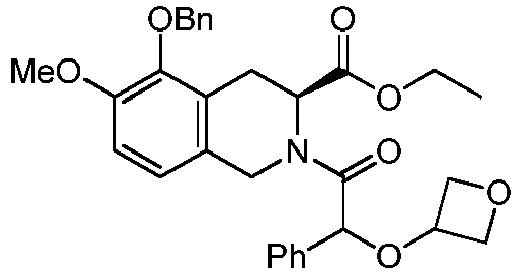
1H NMR (400MHz, CHLOROFORM-d): δ 7.55 - 7.31 (m, 10H), 6.95 - 6.40 (m, 2H), 5.30 - 5.13 (m, 1H), 5.09 - 4.22 (m, 10H), 4.12 - 4.04 (m, 1H), 3.87 - 3.86 (d, J=4.0 Hz, 3H), 3.51 - 3.08 (m, 1H), 3.05 - 2.81 (m, 1H), 2.55 - 2.12 (m, 1H), 1.22 - 0.93 (m, 3H). MS m/z: 546.1 [M+1]+. 15-1 
1H NMR (400MHz, CHLOROFORM-d): δ 7.54 - 7.35 (m, 10H), 6.67 - 6.59 (m, 4H), 6.03 - 5.73 (m, 1H), 5.35 - 4.82 (m, 3H), 4.81 - 4.49 (m, 1H), 4.42 - 4.18 (m, 1H), 4.11 - 3.94 (m, 1H), 3.89 - 3.84 (m, 3H), 3.84 - 3.62 (m, 1H), 3.55 - 3.31 (m, 1H), 2.99 - 2.53 (m, 1H), 1.19 - 0.97 (m, 3H). MS m/z:m/z: 606.0 [M+1]+ 51-1 
1H NMR (400MHz, CHLOROFORM-d): δ 7.51 - 7.29 (m, 10H), 6.90 - 6.41 (m, 2H), 5.23 - 5.15 (m, 1H), 5.13 - 4.95 (m, 2H), 4.95 - 4.62 (m, 2H), 4.57 - 4.45 (m, 1H), 4.36 - 4.21 (m, 1H), 4.09 - 3.97 (m, 1H), 3.88 - 3.82 (m, 3H), 3.80 - 3.43 (m, 1H), 3.34 - 3.04 (m, 1H), 3.01 - 2.45 (m, 5H), 1.24 - 1.03 (m, 3H). MS m/z: 566.0 [M+1]+. 53-1 
1H NMR (400MHz, CHLOROFORM-d): δ 7.51 - 7.32 (m, 7H), 7.11 - 6.96 (m, 2H), 6.89 - 6.74 (m, 1H), 6.70 - 6.41 (m, 1H), 5.47 - 4.78 (m, 5H), 4.64 - 4.41 (m, 1H), 4.35 - 4.16 (m, 1H), 4.09 - 3.95 (m, 1H), 3.88 - 3.83 (m, 3H), 3.74 - 3.47 (m, 1H), 3.32 - 3.07 (m, 1H), 3.02 - 2.66 (m, 1H), 2.01 - 1.85 (m, 1H), 1.85 - 1.61 (m, 7H), 1.24 - 0.90 (m, 3H). MS m/z: 562.1 [M+1]+. 55-1 
1H NMR (400MHz, CHLOROFORM-d): δ7.52 - 7.25 (m, 10H), 6.90 - 6.32 (m, 2H), 5.49 - 5.18 (m, 2H), 5.07 - 4.74 (m, 3H), 4.57 - 4.38 (m, 1H), 4.34 - 3.94 (m, 3H), 3.89 - 3.79 (m, 3H), 3.67 - 3.37 (m, 1H), 3.25 - 2.87 (m, 1H), 2.15 - 1.89 (m, 4H), 1.37 - 1.04 (m, 5H), 0.72 - 0.37 (m, 2H). MS m/z: 556.3 [M+1]+. 57-1 
1H NMR (400MHz, CHLOROFORM-d): δ 7.55 - 7.45 (m, 4H), 7.44 - 7.34 (m, 6H), 6.89 - 6.62 (m, 2H), 5.61 - 5.20 (m, 2H), 5.13 - 4.75 (m, 4H), 4.67 - 4.42 (m, 1H), 4.11 - 3.96 (m, 1H), 3.89 - 3.83 (m, 3H), 3.64 - 3.39 (m, 1H), 3.25 - 2.90 (m, 1H), 2.05 - 1.79 (m, 4H), 1.78 - 1.62 (m, 4H), 1.44 - 1.31 (m, 3H), 1.24 - 1.09 (m, 3H). MS m/z: 580.2 [M+Na]+. 59-1 
1H NMR (400MHz, CHLOROFORM-d): δ 7.50 - 7.18 (m, 10H), 6.80 - 6.55 (m, 2H), 5.49 - 5.40 (m, 1H), 5.28 - 3.99 (m, 8H), 3.81 - 3.72(m, 3H), 3.50 - 2.62 (m, 2H), 1.91 - 1.12 (m, 9H), 0.46 - 0.24 (m, 1H), 0.03 - 0.03 (m, 1H). MS m/z: 556.1 [M+1]+. 63-1 
MS m/z: 574.3 [M+1]+. 65-1 
MS m/z: 574.3 [M+1]+. 67-1 
1H NMR (400MHz, CHLOROFORM-d): δ 7.54 - 7.31 (m, 10H), 7.09 - 6.45 (m, 2H), 5.40 - 5.04 (m, 3H), 4.82 - 4.47 (m, 3H), 4.41 - 4.22 (m, 1H), 3.71 - 3.53 (m, 2H), 3.52 - 3.30 (m, 1H), 3.29 - 3.24 (m, 1H), 2.98 - 2.83 (m, 2H), 2.75 - 2.51 (m, 2H), 2.32 - 2.25 (m, 3H). MS m/z: 536.1 [M+H]+. 69-1 
1H NMR (400MHz, CHLOROFORM-d): δ 7.43 - 7.25 (m, 10H), 6.97 - 6.35 (m, 2H), 5.59 - 5.18 (m, 2H), 5.13 - 4.94 (m, 1H), 4.87 - 4.56 (m, 2H), 4.55 - 4.34 (m, 1H), 3.61 - 3.51 (m, 2H), 3.23 - 3.08 (m, 1H), 2.98 (s, 1H), 2.94 - 2.78 (m, 1H), 2.19 - 2.15 (d, J=18.4 Hz, 3H), 1.96 - 1.62 (m, 8H), 1.30 - 1.24 (m, 3H). MS m/z: 550.2 [M+Na]+. 71-1 
1H NMR (400MHz, CHLOROFORM-d): δ 7.59 - 7.28 (m, 10H), 7.11 - 6.41 (m, 2H), 5.60 - 5.15 (m, 2H), 5.13 - 4.48 (m, 4H), 3.69 - 3.58 (m, 3H), 3.37 - 3.17 (m, 1H), 3.15 -3 .00 (m, 1H), 2.98 (s, 2H), 2.30 - 2.23 (m, 3H), 1.77 - 1.55 (m, 8H). MS m/z: 566.2 [M+Na]+. 73-1 
1H NMR (400MHz, CHLOROFORM-d): δ 7.51 - 7.30 (m, 10H), 7.27 - 7.12 (m, 1H), 6.92 - 6.42 (m, 1H), 5.27 - 4.07 (m, 7H), 3.67 - 3.65 (d, J=7.6 Hz, 2H), 3.55 (s, 1H), 3.32 - 3.13 (m, 1H), 2.99 - 2.45 (m, 5H). MS m/z: 578.1 [M+Na]+. 75-1 
1H NMR (400MHz, CHLOROFORM-d): δ 7.53 - 7.36 (m, 10H), 7.11 - 6.38 (m, 2H), 5.46 - 5.25 (m, 2H), 5.21 - 5.06 (m, 1H), 5.02 - 4.84 (m, 2H), 4.61 - 4.37 (m, 1H), 3.72 - 3.55 (m, 3H), 3.31 - 3.13 (m, 1H), 3.00 - 2.73 (m, 1H), 2.03 - 1.65 (m, 8H), 1.42 - 1.32 (m, 3H). MS m/z: 570.1[M+Na]+. 77-1 
1H NMR (400MHz, CHLOROFORM-d): δ 7.60 - 7.33 (m, 11H), 7.14 - 6.36 (m, 1H), 5.60 - 5.37 (m, 3H), 5.21 - 4.44 (m, 5H), 3.80 - 3.49 (m, 4H), 3.24 - 3.09 (m, 1H), 1.94 - 1.46 (m, 8H). MS m/z: 564.1 [M+1]+. 79-1 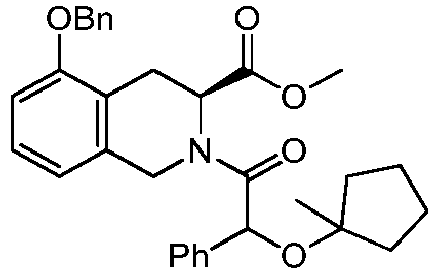
MS m/z: 536.2 [M+Na]+. 81-1 
MS m/z: 530.2 [M+1]+. 83-1 
1H NMR (400MHz, CHLOROFORM-d): δ 7.55 - 7.30 (m, 10H), 7.21 - 7.12 (m, 1H), 6.89 - 6.35 (m, 2H), 5.50 - 4.10 (m, 7H), 3.75 - 3.61 (m, 3H), 3.41 - 3.30 (m, 1H), 3.15 - 3.02 (m, 1H), 2.99 - 2.50 (m, 4H). MS m/z: 522.1 [M+1]+. 85-1 
MS m/z: 502.1 [M+1]+. - The compound 1-1 (200.0 mg, 357.4 µmol) was dissolved in a mixed solution of tetrahydrofuran (3.0 mL) and water (1.5 mL) at 25°C, and then lithium hydroxide monohydrate (85.0 mg, 2.0 mmol) was added. After stirring for 72 hours, 1 M hydrochloric acid was added to the reaction solution to have a pH <4. The aqueous phase was extracted with ethyl acetate (15.0 mL x 3). The mixed organic phase was washed with a saturated saline solution (30.0mL), dried with anhydrous sodium sulfate, and concentrated in vacuum to obtain a crude product. The crude product was separated and purified by a chromatography column (an eluent: 50-100% ethyl acetate/petroleum ether) to obtain a white solid (130.0mg). Then two diastereoisomers 1 (99.4% de) and 2 (96.4% de) were obtained through SFC separation (AD (250mm*30mm, 10µm); mobile phase: [0.1% NH3H2O EtOH]; B%: 30%-30%).
- Compound 1: 1H NMR (400 MHz, DMSO-d6): δ 7.54-7.21 (m, 10H), 6.99-6.60 (m, 2H), 5.55 (s, 1H), 5.18-4.64 (m, 4H), 4.43-4.24 (m, 1H), 3.88-3.56 (m, 4H), 3.27-3.14 (m, 2H), 2.92-2.64 (m, 1H), 2.37-2.24 (m, 1H), 2.04-1.82 (m, 2H), 1.63-1.41 (m, 2H). MS m/z: 532.1 [M+1]+. SFC: Column: Chiralpak AD-3 (150mm∗4.6mm, 3µm); mobile phase: [0.05% DEA ethanol]; B%: 5%-40% 5min, 40% 2.5min, 5% 2.5min; Rt=4.704 min; 99.4% de.
- Compound 2: 1H NMR (400 MHz, DMSO-d6): δ 7.52-7.25 (m, 10H), 6.97-6.72 (m, 2H), 5.56-5.44 (m, 1H), 5.08-4.66 (m, 4H), 4.51-4.25 (m, 1H), 3.88-3.60 (m, 6H), 3.25-3.16 (m, 2H), 2.83-2.63 (m, 1H), 2.20-1.76 (m, 3H), 1.62-1.36 (m,2H). MS m/z: 532.1 [M+1]+. SFC: column: Chiralpak AD-3 (150mm∗4.6mm, 3µm); mobile phase: [0.05% DEA ethanol]; B%: 5%-40% 5min, 40% 2.5min, 5% 2.5min; Rt=5.497 min; 96.4% de.
- The following compounds were synthesized by using a method similar to compounds 1 and 2:
Example Compound Serial Number Structural Formula Spectrogram 3 3 
1H NMR (400MHz, METHANOL-d 4): δ 7.49 - 7.28 (m, 10H), 6.90 - 6.64 (m, 2H), 5.45 - 5.27 (m, 1H), 5.04 - 4.67 (m, 4H), 4.45 - 4.25 (m, 1H), 3.78 (d, J=8.0 Hz, 3H), 3.69 - 3.49 (m, 4H), 3.24 (d, J=8.0 Hz, 3H), 2.80 - 2.64 (m, 1H), 2.34 - 2.17 (m, 1H). MS m/z: 506.1 [M+1]+. SFC: column: ChiralCel OJ-H (150mm∗4.6mm,5µm); mobile phase [0.05%DEA MeOH]; B%: 5%-40% 5.5 min, 40% 3 min, 5% 1.5min; Rt = 3.203 min; 97.2% de. 4 4 
1H NMR (400MHz, METHANOL-d 4): δ 7.48 - 7.25 (m, 10H), 6.90 - 6.67 (m, 2H), 5.41 - 5.24 (m, 1H), 5.02 - 4.58 (m, 4.5H), 4.29 (d, J=16.0 Hz, 0.5H), 3.77 (d, J=4.0 Hz, 3H), 3.61 - 3.45 (m, 4H), 3.23 (d, J=8.0 Hz, 3H), 2.69 - 2.52 (m, 1H), 2.43 - 2.29 (m, 1H). MS m/z: 506.1 [M+1]+. SFC: column: ChiralCel OJ-H (150mm∗4.6mm,5µm); mobile phase [0.05%DEA MeOH]; B%: 5%-40% 5.5 min, 40% 3 min, 5% 1.5min; Rt = 3.504 min; 86.4% de. 5 5 
1H NMR (400MHz, METHANOL-d 4): δ 7.51 - 7.26 (m, 10H), 6.95 - 6.64 (m, 2H), 5.40 - 5.23 (m, 1H), 4.97 - 4.73 (m, 3H), 4.52 - 4.28 (m, 1H), 3.78 (d, J= 2.8 Hz, 3H), 3.69 - 3.48 (m, 2H), 2.81 - 2.60 (m, 1H), 2.27 - 1.93 (m, 1H), 1.61 - 1.27 (m, 5H), 0.88 (q, J= 8.0 Hz, 3H). MS m/z: 504.1 [M+1]+. SFC: column: Chiralpak AD-3 (150mm∗4.6mm, 3µm); mobile phase: [0.05%DEA EtOH]; B%: 5%-40% 5 min, 40% 2.5 min, 5% 2.5 min; Rt = 5.200 min; 96.6% de. 6 6 
1H NMR (400MHz, METHANOL-d 4): δ 7.60 - 7.30 (m, 10H), 7.00 - 6.77 (m, 2H), 5.43 - 5.27 (m, 1H), 5.09 - 4.70 (m, 4H), 4.64 - 4.30 (m, 1H), 3.67 - 3.50 (m, 3H), 2.81 - 2.60 (m, 1H), 2.43 - 2.06 (m, 1H), 1.68 - 1.23 (m, 5H), 0.98 - 0.81 (m, 3H). MS m/z: 504.1 [M+1]+. SFC: column: Chiralpak AD-3 (150mm∗4.6mm, 3µm); mobile phase: [0.05%DEA EtOH]; B%: 5%-40% 5 min, 40% 2.5 min, 5% 2.5 min; Rt = 5.660 min; 91.7% de. 7 7 
1H NMR (400MHz, METHANOL-d 4): δ 7.54 - 7.29 (m, 10H), 6.96 - 6.67 (m, 2H), 5.75 - 5.57 (m, 1H), 5.13 - 4.66 (m, 4H), 4.38 - 3.96 (m, 3H), 3.79 (d, J=4.0 Hz, 3H), 2.90 - 2.64 (m, 1H), 2.41 - 1.99 (m, 1H). MS m/z: 530.1 [M+1]+. SFC: column: Chiralpak AD-3 (150mm∗4.6mm, 3µm); mobile phase: [0.05%DEA EtOH]; B%: 5%-40% 5 min, 40% 2.5 min, 5% 2.5min; Rt = 4.128 min; 96.4% de. 8 8 
1H NMR (400MHz, METHANOL-d 4): δ 7.51 - 7.25 (m, 10H), 6.98 - 6.70 (m, 2H), 5.74 - 5.56 (m, 1H), 5.07 - 4.60 (m, 4H), 4.48 - 4.00 (m, 3H), 3.79 ( d, J=8.0 Hz, 3H), 2.82 - 2.57 (m, 1H), 2.37 - 2.05 (m, 1H). MS m/z: 530.0 [M+1]+. SFC: column: Chiralpak AD-3 (150mm∗4.6mm, 3µm); mobile phase: [0.05%DEA EtOH]; B%: 5%-40% 5 min, 40% 2.5 min, 5% 2.5min; Rt = 5.081 min; 95.1% de. 9 9 
1H NMR (400MHz, METHANOL-d 4): δ 7.51 - 7.26 (m, 10H), 6.92 - 6.65 (m, 2H), 5.53 - 5.35 (m, 1H), 5.10 - 4.63 (m, 4H), 4.46 - 4.25 (m, 2H), 3.88 - 3.56 (m, 7H), 2.82 - 2.63 (m, 1H), 2.38 - 1.86 (m, 3H). MS m/z: 518.1 [M+1]+. SFC: column: Chiralpak AD-3 (100mm∗4.6mm, 3µm); mobile phase [0.05%DEA EtOH]; B%: 5%-40% 4.5 min, 40% 2.5 min, 5% 1 min; Rt = 3.603 min; 98.1% de. 10 10 
1H NMR (400MHz, METHANOL-d 4): δ 7.51 - 7.26 (m, 10H), 6.90 - 6.63 (m, 2H), 5.50 - 5.35 (m, 1H), 4.96 - 4.66 (m, 3H), 4.49 - 4.19 (m, 2H), 3.90 - 3.52 (m, 7H), 3.44 - 3.38 (m, 1H), 2.69 - 2.55 (m, 1H), 2.46 - 2.32 (m, 3H). MS m/z: 518.1 [M+1]+. SFC: column: Chiralcel OJ-3 (100mm∗4.6mm, 3µm); mobile phase [0.05%DEA EtOH]; B%: 5%-40% 4.5 min, 40% 2.5 min, 5% 1 min; Rt = 2.676 min; 97.7% de. 11 11 
1H NMR (400MHz, METHANOL-d 4): δ 7.49 - 7.28 (m, 10H), 6.91 - 6.70 (m, 2H), 5.49 - 5.32 (m, 1H), 5.11 - 4.06 (m, 6H), 4.04 - 3.48 (m, 7H), 2.68 (s, 1H), 2.38 - 1.84 (m, 3H). MS m/z: 518.1 [M+1]+. SFC: column: Chiralpak AD-3 (100mm∗4.6mm, 3µm); mobile phase [0.05%DEA EtOH]; B%: 5%-40% 4.5 min, 40% 2.5 min, 5% 1 min; Rt = 4.416 min; 99.4% de. 12 12 
1H NMR (400MHz, METHANOL-d 4): δ 7.52 - 7.25 (m, 10H), 6.91 - 6.68 (m, 2H), 5.39 (d, J= 20.0 Hz, 1H), 5.07 - 4.65 (m, 4H), 4.62 - 4.20 (m, 2H), 3.90 - 3.55 (m, 8H), 2.68 (s, 1H), 2.37 - 2.00 (m, 2H). MS m/z: 518.1 [M+1]+. SFC: column: Chiralcel OJ-3 (100mm∗4.6mm, 3µm); mobile phase [0.05%DEA EtOH]; B%: 5%-40% 4.5 min, 40% 2.5 min, 5% 1 min; Rt = 3.221 min; 98.7% de. 13 13 
1H NMR (400MHz, METHANOL-d 4): δ 7.50 - 7.29 (m, 10H), 6.96 - 6.67 (m, 2H), 5.53 - 5.30 (m, 1H), 5.06 - 4.71 (m, 3H), 4.69 - 4.13 (m, 7H), 3.80 - 3.78 (d, J=6.0 Hz, 3H), 2.37 - 2.00 (m, 2H). MS m/z: 504.1 [M+1]+. SFC: column: Chiralpak AD-3 (100mm∗4.6mm, 3µm); mobile phase [0.05%DEA EtOH]; B%: 5%-40% 4.5 min, 40% 2.5 min, 5% 1 min; Rt = 3.645 min; 92.2% de. 14 14 
1H NMR (400MHz, METHANOL-d 4): δ 7.50 - 7.29 (m, 10H), 6.96 - 6.67 (m, 2H), 5.53 - 5.30 (m, 1H), 5.06 - 4.71 (m, 3H), 4.69 - 4.13 (m, 7H), 3.79 - 3.77 (d, J=8.0 Hz, 3H), 2.37 - 2.00 (m, 2H). MS m/z: 504.0 [M+1]+. SFC: column: Chiralpak AD-3 (100mm∗4.6mm, 3µm); mobile phase [0.05%DEA EtOH]; B%: 5%-40% 4.5 min, 40% 2.5 min, 5% 1 min; Rt = 4.230 min; 96.3% de. 15 15 
1H NMR (400MHz, DMSO-d6): δ 7.61 - 7.35 (m, 10H), 7.19 - 7.15 (m, 2H), 6.90 - 6.78 (m, 2H), 6.33 - 6.14 (m, 1H), 5.08 - 4.74 (m, 4H), 4.31 - 4.12 (m, 1H), 3.80 - 3.77 (d, J=12.8 Hz, 3H), 2.75 - 2.68 (m, 1H), 2.34 - 1.80 (m, 1H). MS m/z: 578.0 [M+1]+. SFC: column: Chiralcel OJ-3 (100mm∗4.6mm, 3µm); mobile phase [0.05%DEA EtOH]; B%: 5%-40% 4.5 min, 40% 2.5 min, 5% 1 min; Rt = 2.620 min; 100.0% de. 16 16 
1H NMR (400MHz, DMSO-d6): δ 7.54 - 7.35 (m, 10H), 7.19 - 7.15 (m, 2H), 6.91 - 6.75 (m, 2H), 6.26 - 6.20 (m, 1H), 4.99 - 4.70 (m, 4H), 4.67 - 4.28 (m, 1H), 3.80 - 3.77 (d, J=13.6 Hz, 3H), 2.75 - 2.68 (m, 1H), 2.34 - 1.80 (m, 1H). MS m/z: 578.1 [M+1]+. SFC: column: Chiralcel OJ-3 (100mm∗4.6mm, 3µm); mobile phase [0.05%DEA EtOH]; B%: 5%-40% 4.5 min, 40% 2.5 min, 5% 1 min; Rt = 2.912 min; 90.0% de. 51 51 
1H NMR (400MHz, DMSO-d6): δ 7.63 - 7.27 (m, 10H), 7.02 - 6.72 (m, 2H), 5.61 - 5.37 (m, 1H), 5.18 - 4.73 (m, 4H), 4.43 - 4.05 (m, 2H), 3.85 - 3.84 (d, J= 4.0 Hz, 3H), 2.86 (s, 3H), 2.77 - 2.65 (m, 2H), 2.44 - 2.03 (m, 1H). MS m/z: 538.1 [M+1]+. SFC: column: Chiralpak AD-3 (100mm∗4.6mm, 3µm); mobile phase: B: [0.05% DEA EtOH]; B%: 5%-40% 4.5 min, 40% 2.5 min, 5% 1 min; Rt = 2.971 min; 98.6% de. 52 52 
1H NMR (400MHz, DMSO-d6): δ 7.60 - 7.33 (m, 10H), 7.04 - 6.77 (m, 2H), 5.56 - 5.37 (m, 1H), 5.03 - 4.84 (m, 3H), 4.70 - 4.54 (m, 1H), 4.43 - 4.05 (m, 2H), 3.85 (s, 3H), 2.88 (s, 2H), 2.79 - 2.63 (m, 3H), 2.45 - 2.30 (m, 1H). MS m/z: 538.1 [M+1]+. SFC: column: Chiralpak AD-3 (100mm∗4.6mm, 3µm); mobile phase: B: [0.05% DEA EtOH]; B%: 5%-40% 4.5 min, 40% 2.5 min, 5% 1 min; Rt = 3.431 min; 98.2% de. 53 53 
1H NMR (400MHz, DMSO-d6): δ 7.48 - 7.32 (m, 7H), 7.19 - 7.16 (m, 2H), 6.95 - 6.70 (m, 2H), 5.40 - 5.36 (d, J=16.0 Hz, 1H), 5.13 - 4.70 (m, 4H), 4.45 - 4.25 (m, 1H), 4.05 - 4.01 (d, J=20.0 Hz, 1H), 3.80 (s, 3H), 2.84 - 2.79 (m, 1H), 2.43 - 2.30 (m, 1H), 1.76 - 1.55 (m, 6H), 1.50 - 1.46 (m, 2H). MS m/z: 534.1 [M+1]+. SFC: column: Chiralpak AD-3 (150mm∗4.6mm, 3µm); mobile phase: B: [0.05% DEA IPA]; B%: 5%-40% 5.5 min, 40% 3 min, 5% 1.5 min; Rt = 5.399 min; 97.7% de. 54 54 
1H NMR (400MHz, DMSO-d6): δ 7.51 - 7.30 (m, 7H), 7.20 - 7.16 (t, J=8.8 Hz, 2H), 6.96 - 6.73 (m, 2H), 5.36 - 5.31 (d, J=20.0 Hz, 1H), 5.08 - 4.70 (m, 4H), 4.47 - 4.26 (m, 1H), 4.00 (br s, 1H), 3.80 (s, 3H), 2.79 - 2.65 (m, 1H), 2.37 - 2.21 (m, 1H), 1.76 - 1.54 (m, 6H), 1.48 (br s, 2H). MS m/z: 534.1 [M+1]+. SFC: column: Chiralpak AD-3 (150mm∗4.6mm, 3µm); mobile phase: B: [0.05% DEA IPA]; B%: 5%-40% 5.5 min, 40% 3 min, 5% 1.5 min; Rt = 5.959 min; 96.9% de. 55 55 
1H NMR (400MHz, DMSO-d64): δ 7.48 - 7.28 (m, 10H), 7.02 - 6.55 (m, 2H), 5.38 - 5.28 (m, 1H), 5.13 - 4.60 (m, 4H), 4.47 - 3.99 (m, 2H), 3.79 (s, 3H), 3.25 - 3.22 (m, 1H), 2.87 - 2.64 (m, 1H), 2.00 - 1.83 (m, 4H), 1.28 - 1.15 (m, 2H), 0.58 - 0.35 (m, 2H). MS m/z: 531.1 [M+1]+. SFC: column: Chiralpak AD-3 (100mm∗4.6mm, 3µm); mobile phase: B: [0.05% DEA IPA]; B%: 5%-40% 4.5 min, 40% 2.5 min, 5% 1 min; Rt = 4.466 min; 97.8% de. 56 56 
1H NMR (400MHz, DMSO-d6): δ 7.46 - 7.25 (m, 10H), 6.96 - 6.68 (m, 2H), 5.38 - 5.23 (m, 1H), 4.95 - 4.60 (m, 4H), 4.42 - 4.22 (m, 1H), 4.11 - 3.97 (m, 1H), 3.79 - 3.78 (d, J=3.6 Hz, 3H), 3.25 - 3.13 (m, 1H), 2.80 - 2.67 (m, 1H), 2.03 - 1.76 (m, 4H), 1.30 - 1.13 (m, 2H), 0.55 - 0.24 (m, 2H). MS m/z: 528.3 [M+1]+. SFC: column: Chiralpak AD-3 (100mm∗4.6mm, 3µm); mobile phase: B: [0.05% DEA IPA]; B%: 5%-40% 4.5 min, 40% 2.5 min, 5% 1 min; Rt = 5.247 min; 98.6% de. 57 57 
1H NMR (400MHz, DMSO-d6): δ 7.51-7.13 (m, 10H), 6.96 - 6.52 (m, 2H), 5.35 - 5.32 (d, J=12.0 Hz, 1H), 5.05 - 4.66 (m, 4H), 4.61 - 4.22 (m, 1H), 3.78 - 3.77 (d, J=4.0 Hz, 3H), 2.72 - 2.57 (m, 1H), 2.36 - 2.34 (m, 1H), 1.96 - 1.37 (m, 8H), 1.35 - 1.19 (m, 3H). MS m/z: 552.3 [M+Na]+. SFC: column: ChiralCel OJ-H (150mm∗4.6mm, 3µm); mobile phase: B: [0.05% DEA MeOH]; B%: 5%-40% 5.5 min, 40% 3 min, 5% 1.5 min; Rt = 2.860 min; 100.0% de. 58 58 
1H NMR (400MHz, DMSO-d6): δ 7.50 - 7.28 (m, 10H), 6.92 - 6.68 (m, 2H), 5.29 - 5.28 (d, J=4.0 Hz, 1H), 5.05 - 4.72 (m, 4H), 4.38 - 4.17 (m, 1H), 3.79 - 3.77 (d, J=8.0 Hz, 3H), 3.30 - 3.06 (m, 1H), 2.71 - 2.65 (m, 1H), 1.93 - 1.42 (m, 8H), 1.34 - 1.21 (m, 3H). MS m/z: 552.5 [M+Na]+. SFC: column: ChiralCel OJ-H (150mm∗4.6mm, 3µm); mobile phase: B: [0.05% DEA MeOH]; B%: 5%-40% 5.5 min, 40% 3 min, 5% 1.5 min; Rt = 3.100 min; 90.9% de. 59 59 
1H NMR (400MHz, DMSO-d6): δ 7.45 - 7.22 (m, 10H), 6.96 - 6.67 (m, 2H), 5.43 - 5.41 (d, J=10.0 Hz, 1H), 5.18 - 4.67 (m, 4H), 4.47 - 4.22 (m, 1H), 3.97 - 3.89 (m, 1H), 3.77 (s, 3H), 3.21 - 2.35 (m, 2H), 1.80 - 1.16 (m, 6H), 0.44 - 0.30 (m, 1H), 0.06 - 0.07 (m, 1H). MS m/z: 528.1 [M+1]+. SFC: column: ChiralPak AS-3 (150mm∗4.6mm, 3µm); mobile phase: B: [0.05% DEA EEtOH]; B%:5%-40% 5.5 min, 40% 3 min, 5% 1.5 min; Rt = 3.612 min; 97.4% de. 60 60 
1H NMR (400MHz, DMSO-d6): δ 7.51 - 7.21 (m, 10H), 6.99 - 6.62 (m, 2H), 5.57 - 5.42 (m, 1H), 5.15 - 4.68 (m, 4H), 4.52 - 4.21 (m, 1H), 4.04 - 3.88 (m, 1H), 3.79 (s, 3H), 3.30 - 2.18 (m, 2H), 1.91 - 1.23 (m, 6H), 0.48 - 0.30 (m, 1H), 0.03 -0.03(m, 1H), MS m/z: 528.3 [M+1]+. SFC: column: ChiralPak AS-3 (150mm∗4.6mm, 3µm); mobile phase: B: [0.05% DEA EEtOH]; B%: 5%-40% 5.5 min, 40% 3 min, 5% 1.5 min; Rt = 3.691 min; 76.4% de. 61 61 
1H NMR (400MHz, DMSO-d6): δ 7.52 - 7.24 (m, 10H), 6.98 - 6.66 (m, 2H), 5.41 - 5.33(m, 1H), 5.09 - 4.72 (m, 4H), 4.59 - 4.26 (m, 1H), 3.91 - 3.78 (m, 1H), 3.78 3.74(m, 3H), 2.92 - 2.24 (m, 2H), 1.81 - 1.21 (m, 6H), 0.45 - 0.24 (m, 1H), 0.04 -0.03(m, 1H). MS m/z: 528.2 [M+1]+. SFC: column: ChiralCel OJ-H (150mm∗4.6mm, 5µm); mobile phase: B: [0.05% DEA MeOH]; B%: 5%-40% 5.5 min, 40% 3 min, 5% 1.5 min; Rt = 3.720 min; 92.7% de. 62 62 
1H NMR (400MHz, DMSO-d6): δ 7.52 - 7.26 (m, 10H), 6.97 - 6.70 (m, 2H), 5.47 - 5.42 (d, J=18.4 Hz, 1H), 5.04 - 4.66 (m, 4H), 4.53 - 4.26 (m, 1H), 3.98 - 3.89 (m, 1H), 3.79 (s, 3H), 3.14 - 2.23 (m, 2H), 1.90 - 1.14 (m, 6H), 0.46 - 0.32 (m, 1H), 0.04 -0.06 (m, 1H). MS m/z: 528.1 [M+1]+. SFC: column: ChiralCel OJ-H (150mm∗4.6mm, 5µm); mobile phase: B: [0.05% DEA MeOH]; B%: 5%-40% 5.5 min, 40% 3 min, 5% 1.5 min; Rt = 4.395 min; 98.9% de. 63 63 
1H NMR (400MHz, DMSO-d6): δ 7.56 - 7.26 (m, 10H), 7.02 - 6.65(m, 2H), 5.52 - 5.45 (m, 1H), 5.12 - 4.69 (m, 4H), 4.51 - 4.31 (m, 1H), 3.84 (s, 3H), 3.69 - 3.50 (m, 2H), 3.29 - 3.24 (m, 1H), 2.87 - 2.80 (m, 0.5H), 2.40 - 2.30 (m, 0.5H), 1.99 - 1.40 (m, 8H). MS m/z: 568.1 [M+Na]+. SFC: column: Chiralcel OJ-3 (100mm∗4.6mm, 3µm); mobile phase: B: [0.05% DEA MeOH]; B%: 5%-40% 4.5 min, 40% 2.5 min, 5% 1 min; Rt = 2.605 min; 98.2% de. 64 64 
1H NMR (400MHz, DMSO-d6): δ 7.59 - 7.30 (m, 10H), 7.01 - 6.73 (m, 2H), 5.49 - 5.42 (m, 1H), 5.22 - 4.71 (m, 4H), 4.49 - 4.31 (m, 1H), 3.84 (s, 3H), 3.64 - 3.61 (m, 2H), 3.34 - 3.25 (m, 1H), 2.81 - 2.75 (m, 0.5H), 2.13 - 2.09 (m, 0.5H), 1.98 - 1.39 (m, 8H). MS m/z: 568.1 [M+Na]+. SFC: column: Chiralcel OJ-3 (100mm∗4.6mm, 3µm); mobile phase: B: [0.05% DEA MMeOH]; B%: 5%-40% 4.5 min, 40% 2.5 min, 5% 1 min; Rt = 3.227 min; 98.6% de. 65 65 
1H NMR (400MHz, DMSO-d6): δ 7.49 - 7.27 (m, 10H), 6.90 - 6.58 (m, 2H), 5.50 - 5.28 (m, 1H), 5.06 - 4.67 (m, 4H), 4.63 - 4.38 (m, 2H), 3.76 (s, 3H), 3.33 - 3.32 (m, 1H), 2.75 - 2.52 (m, 1H), 2.14 - 2.09 (m, 1H), 2.03 - 1.64 (m, 4H), 1.31 - 1.02 (m, 4H). MS m/z: 546.2 [M+1]+. SFC: column: Chiralcel OJ-3 (100mm∗4.6mm, 3µm); mobile phase: B: [0.05% DEA MeOH]; B%: 5%-40% 5 min, 40% 2.5 min, 5% 2.5 min; Rt = 3.403 min; 100.0% de. 66 66 
1H NMR (400MHz, DMSO-d6): δ 7.55 - 7.25 (m, 10H), 6.93 - 6.64 (m, 2H), 5.46 - 5.36 (m, 1H), 5.09 - 5.07 (m, 0.5H), 4.87 - 4.73 (m, 3H), 4.53 - 4.47 (m, 2H), 4.33 - 4.28 (m, 0.5H), 3.77 (s, 3H), 3.31 - 3.30 (m, 1H), 2.65 - 2.59 (m, 1H), 2.21 - 2.08 (m, 1H), 2.05 - 1.60 (m, 4H), 1.31 - 1.03 (m, 4H). MS m/z: 546.2 [M+1]+. SFC: column: Chiralcel OJ-3 (100mm∗4.6mm, 3µm); mobile phase: B: [0.05% DEA MeOH]; B%: 5%-40% 5 min, 40% 2.5 min, 5% 2.5 min; Rt = 4.786 min; 93.9% de. 67 67 
1H NMR (400MHz, DMSO-d6): δ 7.55 - 7.29 (m, 10H), 7.05 - 6.63 (m, 2H), 5.53 - 5.37 (m, 1H), 5.24 - 4.07 (m, 6H), 2.94 - 2.74 (m, 2H), 2.73 - 2.52 (m, 3H), 2.42 - 2.23 (m, 1H), 2.19 - 2.17 (d, J=8.0 Hz, 3H). MS m/z: 522.3 [M+1]+. SFC: column: Chiralpak AD-3 (100mm∗4.6mm, 3µm); mobile phase: B: [0.05% DEA IPA]; B%: 5%-40% 4.5 min, 40% 2.5 min, 5% 1 min; Rt = 3.357 min; 98.3% de. 68 68 
1H NMR (400MHz, DMSO-d6): δ 7.55 - 7.26 (m, 10H), 7.07 - 6.69 (m, 2H), 5.53 - 5.32 (m, 1H), 5.14 - 4.05 (m, 6H), 2.93 - 2.55 (m, 5H), 2.47 - 2.30 (m, 1H), 2.19 - 2.18 (d, J=3.2 Hz, 3H). MS m/z: 522.3 [M+1]+. SFC: column: Chiralpak AD-3 (100mm∗4.6mm, 3µm); mobile phase: B: [0.05% DEA IPA]; B%: 5%-40% 4.5 min, 40% 2.5 min, 5% 1 min; Rt = 3.994 min; 99.0% de. 69 69 
1H NMR (400MHz, DMSO-d6): δ 7.52 - 7.18 (m, 10H), 7.06 - 6.55 (m, 2H), 5.42 - 5.06 (m, 2H), 4.88 - 4.30 (m, 4H), 2.83 - 2.78 (m, 1H), 2.48 - 2.27 (m, 1H), 2.19 - 2.17 (d, J=6.0 Hz, 3H), 1.96 - 1.45 (m, 8H), 1.36 - 1.25 (m, 3H). MS m/z: 536.3 [M+Na]+. SFC: column: ChiralPak AD-3 (150mm∗4.6mm, 3µm); mobile phase: B: [0.05% DEA IPA]; B%: 5%-40% 5.5 min, 40% 3 min, 5% 1.5 min; Rt = 4.854 min; 100% de. 70 70 
1H NMR (400MHz, DMSO-d6): δ 7.56 - 7.26 (m, 10H), 7.08 - 6.64 (m, 2H), 5.35 - 4.71 (m, 4H), 4.65 - 4.25 (m, 2H), 3.13 - 3.10 (m, 1H), 2.84 - 2.80 (m, 1H), 2.19 - 2.16 (d, J=10.0 Hz, 3H), 1.92 - 1.44 (m, 8H), 1.36 - 1.19 (m, 3H). MS m/z: 536.3 [M+Na]+. SFC: column: ChiralPak AD-3 (150mm*4.6mm, 3µm); mobile phase: B: [0.05% DEA IPA]; B%: 5%-40% 5.5 min, 40% 3 min, 5% 1.5 min; Rt = 5.312 min; 100% de. 71 71 
1H NMR (400MHz, DMSO-d6): δ 7.53 - 7.25 (m, 10H), 7.02 - 6.61 (m, 2H), 5.41 - 5.38 (d, J=8.8 Hz, 1H), 5.19 - 4.83 (m, 2H), 4.79 - 4.33 (m, 4H), 3.60 - 3.51 (m, 2H), 3.50 - 3.48 (m, 1H), 2.18 (s, 3H), 1.87 - 1.39 (m, 8H). MS m/z: 530.2 [M+H]+. SFC condition: SFC: column: ChiralPak AD-3 (150mm*4.6mm, 3µm); mobile phase: B: [0.05% DEA Ethanol]; B%: 5%-40% 5.5 min, 40% 3 min, 5% 1.5 min; Rt= 5.030 min; 100% de. 72 72 
1H NMR (400MHz, DMSO-d6): δ 7.56 - 7.25 (m, 10H), 6.98 - 6.95 (m, 1H), 6.88 - 6.61 (m, 1H), 5.54 - 5.32 (m, 1H), 5.24 - 4.32 (m, 6H), 3.63 - 3.49 (m, 1H), 2.83 - 2.77 (m, 1H), 2.42 - 2.32 (m, 1H), 2.18 (s, 3H), 1.90 - 1.44 (m, 8H). MS m/z: 530.2 [M+H]+. SFC condition: SFC: column: ChiralPak AD-3 (150mm*4.6mm, 3µm); mobile phase: B: [0.05% DEA Ethanol]; B%: 5%-40% 5.5 min, 40% 3 min, 5% 1.5 min; Rt = 5.789 min; 98.7% de. 73 73 
1H NMR (400MHz, DMSO-d6): δ 7.57 - 7.25 (m, 11H), 7.05 - 6.75 (m, 1H), 5.53 - 5.34 (m, 1H), 5.22 - 5.09 (m, 0.5H), 4.96 - 4.67 (m, 3.5H), 4.41 - 4.27 (m, 1H), 4.11 (brs, 1H), 2.96 - 2.74 (m, 3H), 2.64 - 2.52 (m, 2H), 2.27 - 2.22 (m, 1H). MS m/z: 542.1 [M+l]+. SFC: column: ChiralCel OJ-H (150mm*4.6mm, 5µm); mobile phase: B: [0.05% DEA Methanol]; B%: 5%-40% 5.5 min, 40% 3 min, 5% 1.5 min; Rt = 3.192 min; 82.4% de. 74 74 
1H NMR (400MHz, DMSO-d6): δ 7.59 - 7.22 (m, 11H), 7.07 - 6.79 (m, 1H), 5.49 - 5.31 (m, 1H), 5.12 - 4.60 (m, 4.5H), 4.41 - 4.36 (d, J=18.0 Hz, 0.5H), 4.14 (brs, 1H), 2.94 - 2.70 (m, 3H), 2.64 - 2.53 (m, 2H), 2.43 - 2.31 (m, 1H). MS m/z: 442.4 [M+l]+. SFC: column: ChiralCel OJ-H (150mm*4.6mm, 5µm); mobile phase: B: [0.05% DEA Methanol]; B%: 5%-40% 5.5 min, 40% 3 min, 5% 1.5 min; Rt = 3.698 min; 97.1% de. 75 75 
1H NMR (400MHz, DMSO-d6): δ 7.52 - 7.17 (m, 11H), 7.03 - 7.01 (d, J=8.4 Hz, 0.5H), 6.72 - 6.70 (d, J=8.4 Hz, 0.5H), 5.37 - 5.35 (d, J=6.4 Hz, 1H), 5.22 - 5.06 (m, 1H), 4.93 - 4.74 (m, 3H), 4.61 - 4.27 (m, 1H), 3.29 - 3.26 (m, 1H), 2.81 - 2.75(m, 1H), 1.96 - 1.41 (m, 8H), 1.36 - 1.24 (m, 3H). MS m/z: 556.3 [M+Na]+. SFC: column: Chiralpak AD-3 (150mm*4.6mm, 3µm); mobile phase: B: [0.05% DEA IPA]; B%: 5%-40% 5 min, 40% 2.5 min, 5% 2.5 min; Rt = 4.620 min; 100% de. 76 76 
1H NMR (400MHz, DMSO-d6): δ 7.54 - 7.24 (m, 11H), 7.08 - 6.79 (m, 1H), 5.33 - 5.32 (d, J=4.8 Hz, 1H), 5.12 - 4.83 (m, 3H), 4.76 - 4.68 (m, 1H), 4.44 -4.21 (m, 1H), 3.14 - 3.10 (d, J=16.0 Hz, 1H), 2.85 - 2.79 (m, 1H), 1.90 - 1.46 (m, 8H), 1.35 - 1.23 (m, 3H). MS m/z: 556.2 [M+Na]+. SFC: column: Chiralpak AD-3 (150mm*4.6mm, 3µm); mobile phase: B: [0.05% DEA IPA]; B%: 5%-40% 5 min, 40% 2.5 min, 5% 2.5 min; Rt = 4.947 min; 96.3% de. 77 77 
1H NMR (400MHz, DMSO-d6): δ 7.58 - 7.17 (m, 11H), 7.04 - 6.73 (m, 1H), 5.39 - 5.37 (d, J=5.2 Hz, 1H), 5.14 - 5.13 (d, J=5.6 Hz, 0.5H), 4.99 - 4.80 (m, 3H), 4.70 - 4.67 (d, J=10.4 Hz, 0.5H), 4.60 - 4.31 (m, 2H), 3.57 - 3.38 (m, 1H), 2.71 - 2.59 (m, 1H), 2.35 - 2.07 (m, 1H), 1.88 - 1.33 (m, 8H). MS m/z: 550.1 [M+l]+. SFC: column: Chiralpak AD-3 (150mm*4.6mm, 3µm); mobile phase: B: [0.05% DEA Ethanol]; B%: 5%-40% 5 min, 40% 2.5 min, 5% 2.5 min; Rt = 4.795 min; 97.6% de. 78 78 
1H NMR (400MHz, DMSO-d6): δ 7.56 - 7.24 (m, 11H), 7.04 - 6.68 (m, 1H), 5.52 - 5.32 (m, 1H), 5.18 - 5.17 (d, J=3.6 Hz, 0.5H), 4.98 - 4.70 (m, 3.5H), 4.62 - 4.31 (m, 2H), 3.62 - 3.51 (m, 1H), 2.86 - 2.66 (m, 1H), 2.42 - 2.28 (m, 1H), 1.89 - 1.37 (m, 8H). MS m/z: 550.2 [M+l]+. SFC: column: Chiralpak AD-3 (150mm*4.6mm, 3µm); mobile phase: B: [0.05% DEA Ethanol]; B%: 5%-40% 5 min, 40% 2.5 min, 5% 2.5 min; Rt = 5.778 min; 98.2% de. 79 79 
1H NMR (400MHz, DMSO-d6): δ 7.48 - 7.19 (m, 10H), 7.15 - 6.99 (m, 1H), 6.86 - 6.47 (m, 2H), 5.39 - 5.06 (m, 4H), 4.91 - 4.75 (m, 1H), 4.55 - 4.24 (m, 1H), 2.94 - 2.53 (m, 2H), 1.97 - 1.43 (m, 8H), 1.36 - 1.24 (m, 3H). MS m/z: 522.3 [M+Na]+. SFC: column: Chiralpak AD-3 (150mm*4.6mm, 3µm); mobile phase: B: [0.05% DEA Ethanol]; B%: 5%-40% 5.5 min, 40% 3 min, 5% 1.5 min; Rt = 4.325 min; 100% de. 80 80 
1H NMR (400MHz, DMSO-d6): δ 7.52 - 7.25 (m, 10H), 7.19 - 7.01 (m, 1H), 6.94 - 6.60 (m, 2H), 5.40 - 4.88 (m, 5H), 4.51 - 4.15 (m, 1H), 3.19 - 2.63 (m, 2H), 1.96 - 1.38 (m, 8H), 1.35 - 1.14 (m, 3H). MS m/z: 522.3 [M+Na]+. SFC: column: Chiralpak AD-3 (150mm*4.6mm, 3µm); mobile phase: B: [0.05% DEA Ethanol]; B%: 5%-40% 5.5 min, 40% 3 min, 5% 1.5 min; Rt = 4.785 min; 98.0% de. 81 81 
1H NMR (400MHz, DMSO-d6): δ 7.59 - 7.22 (m, 10H), 7.13 - 6.97 (m, 1H), 6.87 - 6.52 (m, 2H), 5.56 - 4.82 (m, 5H), 4.62 - 4.22 (m, 2H), 3.60 - 3.50 (m, 1H), 2.76 - 2.55 (m, 1H), 1.89 - 1.34 (m, 8H). MS m/z: 516.3 [M+l]+. SFC: column: Chiralpak AD-3 (150mm*4.6mm, 3µm); mobile phase: B: [0.05% DEA IPA]; B%: 40%; Rt = 2.046 min; 100% de. 82 82 
1H NMR (400MHz, DMSO-d6): δ 7.53 - 7.18 (m, 10H), 7.13 - 6.97 (m, 1H), 6.86 - 6.43 (m, 2H), 5.60 - 4.21 (m, 7H), 3.66 - 3.46 (m, 1H), 2.69 - 2.60 (m, 1H), 1.95 - 1.31 (m, 8H). MS m/z: 516.1 [M+l]+. SFC: column: Chiralpak AD-3 (150mm*4.6mm, 3µm); mobile phase: B: [0.05% DEA IPA]; B%: 40%; Rt = 5.382 min; 99.58% de. 83 83 
1H NMR (400MHz, DMSO-d6): δ 7.52 - 7.26 (m, 10H), 7.10 - 7.02 (m, 1H), 6.88 - 6.56 (m, 2H), 5.61 - 4.63 (m, 5H), 4.47 - 4.01 (m, 2H), 3.03 - 2.54 (m, 5H), 2.37 - 2.13 (m, 1H). MS m/z: 508.1[M+1]+. SFC: column: Chiralpak AD-3 (150mm*4.6mm, 3µm); mobile phase: B: [0.05% DEA Ethanol]; B%: 5%-40% 5.5 min, 40% 3 min, 5% 1.5 min; Rt = 3.861 min; 100% de. 84 84 
1H NMR (400MHz, DMSO-d6): δ 7.59 - 7.39 (m, 10H), 7.22 - 7.13 (m, 1H), 6.99 - 6.70 (m, 2H), 5.64 - 4.74 (m, 7H), 3.06 - 2.33 (m, 6H). MS m/z: 508.1 [M+l]+. SFCcolumn: Chiralpak AD-3 (150mm*4.6mm, 3µm); mobile phase: B: [0.05% DEA Ethanol]; B%: 5%-40% 5.5 min, 40% 3 min, 5% 1.5 min; Rt = 4.692 min; 99.6% de. 85 85 
1H NMR (400MHz, DMSO-d6): δ 7.48 - 7.27 (m, 10H), 7.18 - 7.05 (m, 1H), 6.95 - 6.82 (m, 1H), 6.82 - 6.55 (m, 1H), 5.39 - 5.31 (m, 1H), 5.25 (brs, 1H), 5.16 - 5.02 (m, 3H), 4.96 - 4.82 (m, 1H), 4.40 - 4.22 (m, 1H), 3.76 - 3.61 (m, 5H), 2.93 - 2.81 (m, 1H), 2.45 - 2.33 (m, 1H), 1.94 - 1.66 (m, 2H). MS m/z: 488.2 [M+l]+. SFC: column: Chiralpak AD-3 (50mm*3mm, 3µm); mobile phase: B: [0.05% DEA IPA]; B%: 5%-40% 2.5 min, 40% 0.35 min, 5%0.15 min; Rt = 2.285 min; 95.1% de. 86 86 
1H NMR (400MHz, DMSO-d6): δ 7.49 - 7.27 (m, 10H), 7.18 - 7.06 (m, 1H), 6.93 - 6.83 (m, 1H), 6.82 - 6.63 (m, 1H), 5.38 - 5.22 (m, 1H), 5.22 - 5.14 (m, 1H), 5.12 - 5.03 (m, 3H), 5.01 - 4.74 (m, 1H), 4.58 - 4.26 (m, 1H), 3.67 - 3.56 (m, 5H), 2.85 - 2.74 (m, 1H), 2.44 - 2.31 (m, 1H), 1.91 - 1.68 (m, 2H). MS m/z: 488.1 [M+l]+. SFC: column: Chiralpak AD-3 (50mm*3mm, 3µm); mobile phase: B: [0.05% DEA IPA]; B%: 5%-40% 2.5 min, 40% 0.35 min, 5% 0.15 min; Rt = 2.126 min; 72.96% de. -

- The compound (-)-Cl (150.0 mg, 439.4 µmol) was dissolved in dichloromethane (5.0 mL), and then HATU (251.0 mg, 660.1 µmol), pyridine (70.0 mg, 885.0 µmol) and S-A18 (120.0 mg, 487.4 µmol) were added sequentially. After the reaction solution was stirred at 25°C for 16 hours, the organic solvent was removed through concentrating in vacuum to obtain a crude product. The crude product was separated and purified by a silica gel chromatography column (an eluent: 0-50% petroleum ether/ethyl acetate) to obtain the product 17-1. 1H NMR (400 MHz, CHLOROFORM-d): δ 7.68-7.57 (m, 2H), 7.50-7.34 (m, 8H), 7.21-6.94 (m, 4H), 6.87-6.79 (m, 1H), 6.73-6.50 (m, 1H), 6.06-5.96 (m, 1H), 5.43-5.11 (m, 1H), 5.08-4.70 (m, 4H), 4.56-4.30 (m, 1H), 4.08-3.92 (m,1H), 3.87-3.81 (m, 3H), 3.68-3.41 (m, 1H), 3.27-3.08 (m, 0.5H), 2.98-2.74 (m, 0.5H), 1.08-0.80 (m, 3H). MS m/z: 570.1 [M+l]+.
- The following compounds were synthesized in a similar manner to the compound 17-1:
Compound Serial number Structural formula Spectrogram 19-1 
1H NMR (400MHz, CHLOROFORM-d): δ 7.67 - 7.52 (m, 2 H), 7.49 - 7.27 (m, 10 H), 7.13 - 6.96 (m, 3 H), 6.87 - 6.77 (m, 1H), 6.80 - 6.54 (m, 1 H), 6.09 - 5.95 (m, 1 H), 5.12 - 5.08(m, 1H), 5.07 - 4.70 (m, 3H), 4.71 - 4.41(m, 1H), 4.19 - 4.10 (m, 2H), 3.84 (m, 3 H), 3.56 - 3.13 (m, 1 H), 2.06 (s, 2H), 1.27 (t, J=8.0 Hz, 3H). MS m/z: 552.3 [M+l]+. 21-1 
1H NMR (400MHz, CHLOROFORM-d): δ 8.19 - 7.91 (m, 1H), 7.71 - 7.54 (m, 3H), 7.51 - 7.31 (m, 8H), 6.96 - 6.65(m, 5H), 5.47 - 5.13 (m, 1H), 5.10 - 4.80 (m, 3H), 4.69 (d, J=16.0 Hz, 0.2H), 4.58 - 4.33 (m, 0.8H), 4.09 - 3.91 (m, 2H), 3.88 - 3.80 (m, 3H), 3.50 - 3.30 (m, 1H), 2.88 - 2.63 (m, 1H), 1.10-0.93(m, 3H). MS m/z: 553.2 [M+l]+. 23-1 
1H NMR (400MHz, CHLOROFORM-d): δ 7.47 - 7.30 (m, 10H), 7.03 - 6.97 (m, 2H), 6.85 - 6.79 (m, 4H), 5.96 - 5.87 (m, 1H), 5.05 - 4.74 (m, 3H), 4.54 - 4.37 (m, 1H), 4.08 - 3.92 (m, 1H), 3.84 (d, J= 8.0 Hz, 3H), 3.78 - 3.72 (m, 5H), 3.68 - 3.44 (m, 1H), 3.28 - 2.87 (m, 1H), 1.07 - 0.88 (m, 3H). MS m/z: 582.1 [M+l]+. 25-1 
1H NMR (400MHz, CHLOROFORM-d): δ 7.63 - 7.31 (m, 10H), 6.92 - 6.57 (m, 4H), 6.46 - 6.35 (m, 1H), 5.94 - 5.83 (m, 1H), 5.29 - 4.66 (m, 4H), 4.60 - 4.35 (m, 1H), 4.10 - 3.96 (m, 1H), 3.89 - 3.82 (m, 3H), 3.80 - 3.62 (m, 1H), 3.54 - 3.27 (m, 1H), 2.97 - 2.54 (m, 1H), 1.18 - 0.86 (m, 3H). MS m/z: 558.1 [M+l]+. 27-1 
1H NMR (400MHz, CHLOROFORM-d): δ 7.61 - 7.54 (m, 2H), 7.49 - 7.33 (m, 8H), 7.21 - 7.04 (m, 1H), 6.96 - 6.50 (m, 4H), 5.97 - 5.89 (m, 1H), 5.29 - 4.73 (m, 4H), 4.71 - 4.30 (m, 2H), 4.11 - 3.96 (m, 1H), 3.86 (d, J=4.0 Hz, 3H), 3.74 - 3.47 (m, 1H), 3.27 - 2.89 (m, 1H), 1.13 - 0.88 (m, 3H). MS m/z: 588.1 [M+l]+. 29-1 
1H NMR (400MHz, CHLOROFORM-d): δ 7.65 - 7.52 (m, 4H), 7.46 - 7.34 (m, 8H), 7.17 - 7.05 (m, 2H), 6.89 - 6.46 (m, 2H), 6.05 - 5.90 (m, 1H), 5.12 - 4.74 (m, 4H), 4.72 - 4.29 (m, 2H), 4.09 - 3.91 (m, 1H), 3.87 - 3.84 (m, 3H), 3.49 - 2.76 (m, 2H), 1.20 - 1.00 (m, 3H). MS m/z: 577.1 [M+l]+. 31-1 
1H NMR (400MHz, CHLOROFORM-d): δ 7.64 - 7.53 (m, 2H), 7.47 - 7.35 (m, 8H), 7.06 - 6.95 (m, 4H), 6.88 - 6.50 (m, 2H), 5.92 (d, J=8.0 Hz, 1H), 5.35 - 5.12 (m, 1H), 5.10 - 4.60 (m, 4H), 4.57 - 4.34 (m, 1H), 4.08 - 3.93 (m, 1H), 3.89 - 3.83 (m, 3H), 3.72 - 3.42 (m, 1 H), 3.34 - 2.76 (m, 1H), 1.10 - 0.77 (m, 3 H). MS m/z: 570.1 [M+l]+. 33-1 
1H NMR (400MHz, CHLOROFORM-d): δ 7.61 - 7.50 (m, 2H), 7.46 - 7.31 (m, 9H), 7.25 - 7.20 (m, 1H), 7.06 - 6.93 (m, 2H), 6.87 - 6.78 (m, 1H), 6.77 - 6.49(m, 1H), 5.98 - 5.90 (m, 1H), 5.35 - 4.58 (m, 5H), 4.55 - 4.28 (m, 1H), 4.06 - 3.91 (m, 1H), 3.87 - 3.83 (m, 3H), 3.74 - 3.59 (m, 1 H), 3.50 - 3.15 (m, 1H), 1.07 - 0.90 (m, 3 H). MS m/z: 586.1 [M+l]+. 35-1 
1H NMR (400MHz, CHLOROFORM-d): δ 7.86 - 7.73 (m, 4H), 7.72 - 7.57 (m, 3H), 7.51 - 7.35 (m, 12H), 6.92 - 6.57 (m, 2H), 6.20 - 6.11 (m, 1H), 5.33 - 5.00 (m, 2H), 5.00 - 4.84 (m, 2H), 4.83 - 4.72 (m, 1H), 4.66 - 4.39 (m, 1H), 4.19 - 4.01 (m, 1H), 3.86 - 3.81 (m, 3H), 3.76 - 3.45 (m, 1H), 3.43 - 3.12 (m, 1H), 1.16 (t, J=8.0 Hz, 1H), 0.99 - 0.83 (m, 2H). MS m/z: 602.1 [M+l]+. 37-1 
1H NMR (400MHz, CHLOROFORM-d): δ 7.50 - 7.20 (m, 10H), 6.84 (m, 1H), 6.66 (d, J=8.0 Hz, 0.5H), 6.43 (d, J=12.0 Hz, 0.5H), 5.50 - 5.48 (m, 0.5H), 5.32 (d, J=8.0 Hz, 1H), 5.07 - 4.76 (m, 3H), 4.60(d, J=16.0 Hz, 0.5H), 4.51 - 4.45 (m, 1H), 4.18 - 4.07 (m, 2H), 3.84 (d, J=12 Hz, 3H), 3.66 - 3.61 (m, 0.5H), 3.55 - 3.40 (m, 1H), 3.17 - 3.11 (m, 0.5H), 2.99 - 2.93 (m, 0.5H), 2.74 - 2.68 (m, 0.5H), 1.90 - 1.70 (m, 5H), 1.60 - 1.57 (m, 3H), 1.29 - 1.17(m, 3H). MS m/z: 544.4 [M+l]+. 38-1 
1H NMR (400MHz, CHLOROFORM-d): δ 7.53 (d, J=4 Hz, 1H), 7.48 - 7.30 (m, 9H), 6.95 - 6.61 (m, 2H), 5.40 - 5.15(m, 1.5H), 4.76 - 4.57 (m, 3.5H), 4.10 - 4.01(m, 3H), 3.86(d, J=8.0 Hz, 3H), 3.34 - 3.14 (m, 1H), 3.00 - 2.94(m, 1H), 1.90 - 1.58 (m, 9H), 1.29 - 1.17(m, 3H). MS m/z: 544.3 [M+l]+. 39-1 
1H NMR (400MHz, CHLOROFORM-d): δ7.53 - 7.45 (m, 2H), 7.44 - 7.28 (m, 7H), 7.24 - 7.14 (m, 1 H), 6.83 (d, J=8.0 Hz, 1H), 6.64 (d, J=8.0 Hz, 0.5H), 6.40 (d, J=8.0 Hz, 0.5H), 5.62 - 5.43 (m, 2H), 5.07 - 4.82 (m, 3H), 4.64 - 4.40 (m, 1.5H), 4.20 - 4.05 (m, 1.5H), 3.89 - 3.79 (m, 3H), 3.64 - 3.38 (m, 2H), 1.39 (s, 3 H), 1.34 - 1.16 (m, 9H). MS m/z: 532.3 [M+l]+. 40-1 
1H NMR (400MHz, CHLOROFORM-d): δ 7.64 - 7.56 (m, 2H), 7.55 - 7.49 (m, 2H), 7.47 - 7.31 (m, 7H), 6.95 - 6.57 (m, 1H), 5.31 (s, 2H), 5.05 - 4.76 (m, 3H), 4.64 - 4.56 (m, 1H), 4.05 - 3.87 (m, 2H), 3.78 - 3.86 (m, 3H), 3.51 - 3.29 (m, 2H), 3.02 - 2.83 (m, 1H), 1.94 - 1.41 (m, 8H), 1.54 - 1.13 (m, 3H). MS m/z: 543.2 [M+l]+. 42-1 
1H NMR (400MHz, CHLOROFORM-d): δ 7.59 - 7.28 (m, 10H), 6.96 - 6.48 (m, 2H), 6.07 - 5.84 (m, 1H), 5.03 - 4.76 (m, 3H), 4.64 - 4.48 (m, 1H), 4.18 - 3.98 (m, 3H), 3.87 - 3.82 (m, 3H), 3.57 - 3.17 (m, 1H), 2.95 - 2.42 (m, 2H), 1.96 - 1.57 (m, 8H), 1.30 - 1.09(m, 3H). MS m/z: 571.2 [M+l]+. 44-1 
1H NMR (400MHz, CHLOROFORM-d): δ 55 - 7.27 (m, 10H), 6.92 - 6.33 (m, 2H), 5.56 - 5.26 (m, 2H), 5.05 - 4.79 (m, 3H), 4.68 - 4.40 (m, 2H), 4.20 - 4.02 (m, 1H), 3.84 (d, J=8.0 Hz, 3H), 3.64 - 3.44 (m, 2H), 3.19 - 2.62 (m, 1H), 2.05 - 1.72 (m, 4H), 1.51 - 1.22 (m, 6H), 1.19 (t, J=8.0 Hz, 1.5H), 0.85 (t, J=8.0 Hz, 1.5H). MS m/z: 558.2 [M+l]+. 45-1 
MS m/z: 557.1 [M+l]+. - At 25°C, the compound 17-1 (218.0 mg, 382.7 µmol) was dissolved in tetrahydrofuran (5.0 mL), and an aqueous solution (2.0 mL) of lithium hydroxide monohydrate (93.0 mg, 2.2 mmol) was added. The solution was reacted for 40 hours while stirring at 15-20°C, then the reaction solution was diluted with water (15.0 mL) and adjusted to pH < 4 with 1 M hydrochloric acid. The aqueous phase was extracted with ethyl acetate (50.0 mL x 3). The mixed organic phase was washed with saturated saline water (50.0mL), dried with anhydrous sodium sulfate, and concentrated in vacuum to obtain a crude product. The crude product was separated and purified by a chromatography column (an eluent: 0-80% petroleum ether/ethyl acetate) to obtain the product, which was separated by SFC (column: AD (250mm*30mm, 5µm); mobile phase [0.1% NH3H2O EtOH]; B%: 35%-35%) to obtain two diastereomers, the main product compound 17 and a small amount of compound 18.
- Compound 17: 1H NMR (400MHz, DMSO-d6) δ 7.69-7.30 (m, 11H), 7.25-7.13 (m, 1H), 7.06-6.77 (m, 4H), 6.52-6.23 (m, 1H), 5.11-4.75 (m, 4H), 4.27 (d, J = 16.0 Hz, 1H), 3.84-3.74 (m, 3H), 2.88-2.64 (m, 1H), 2.43-2.29 (m, 1H). MS m/z: 564.1 [M+Na]+. SFC: Column: Chiralpak AD-3 (150mm*4.6mm, 3µm); mobile phase: B: [0.05% DEA Ethanol]; B%: 5%-40% 5.5min, 40% 3min, 5% 1.5min; Rt =5.339min; 97.5% de.
- Compound 18: 1H NMR (400 MHz, DMSO-d6) δ 7.63-7.28 (m, 10H), 7.25-6.99 (m, 3H), 6.97-6.73 (m, 3H), 6.47-6.28 (m, 1H), 5.04-4.73 (m, 4H), 4.56-4.27 (m, 1H), 3.82-3.75 (m, 3H), 2.83-2.59 (m, 1H), 2.42-2.22 (m, 1H). MS m/z: 564.1 [M+Na]+. SFC: Column: Chiralpak AD-3 (150mm*4.6mm, 3µm); Mobile phase: B: [0.05% DEA Ethanol]; B%: 5%-40% 5.5min, 40% 3min, 5% 1.5min; Rt =5.745min; 94.5% de.
- The following compounds were synthesized by using a method similar to the compounds 17 and 18:
Exampl e Compoun d Serial Number Structural Formula Spectrogram 19 19 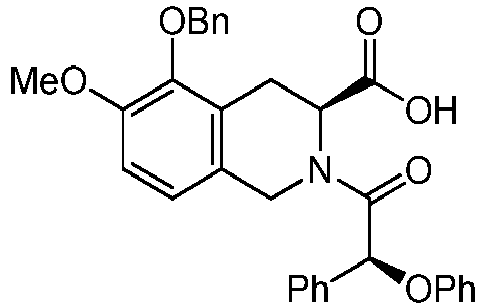
1H NMR (400MHz, METHANOL-d 4): δ 7.64 - 7.51 (m, 2H), 7.47 - 7.30 (m, 8H), 7.28 - 7.19 (m, 2H), 7.05 (d, J=8 Hz, 1H), 6.97 - 6.81 (m, 4H), 6.44 - 6.20 (m, 1H), 5.08 - 4.74 (m, 4H), 4.26 (d, J=20.0 Hz, 1H), 3.88 - 3.70 (m, 3H), 2.90 - 2.65 (m, 1H), 2.53 - 2.50 (m, 1H). MS m/z: 524.3 [M+1]+. SFC: column: ChiralCel OJ-H (150mm*4.6mm, 5µm); mobile phase: B: [0.05% DEA Methanol]; B%: 5%-40% 5.5 min, 40% 3 min, 5% 1.5 min; Rt = 5.584 min; 100.0% de. 20 20 
1H NMR (400MHz, METHANOL-d 4): δ 7.63 - 7.49 (m, 2H), 7.48 - 7.30 (m, 8H), 7.25 (t, J=8.0 Hz, 2H), 7.06 - 6.82 (m, 5H), 6.41 - 6.16 (m, 1H), 5.03 - 4.76(m, 4H), 4.55 (d, J=16 Hz, 0.6H), 4.32 (d, J=20 Hz, 0.4H), 3.88 - 3.71 (m, 3H),3.50 - 3.40 (m, 1H), 2.80 - 2.62 (m, 1H). MS m/z: 524.3 [M+l]+. SFC: column: ChiralCel OJ-H (150mm*4.6mm, 5µm); mobile phase: B: [0.05% DEA Methanol]; B%: 5%-40% 5.5 min, 40% 3 min, 5% 1.5 min; Rt = 5.720 min; 99.1% de. 21 21 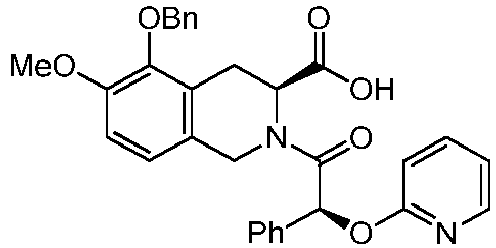
1H NMR (400MHz, METHANOL-d 4): δ 8.23 - 7.84 (m, 1H), 7.69 (s, 2H), 7.58 - 7.23 (m, 9 H), 7.08 - 6.72 (m, 5H), 5.06 - 5.01 (m, 1H), 4.96 - 4.56 (m, 3H), 4.46 - 4.27 (m, 1H), 3.86 - 3.69 (m, 3H), 3.20 - 3.10 (m, 1H), 2.67 - 2.59 (m, 1H). MS m/z: 525.1 [M+1]+. SFC: column: ChiralCel OJ-3 (100mm*4.6mm, 3µm); mobile phase: B: [0.05% DEA Ethanol]; B%: 5%-40% 4.5 min, 40% 2.5 min, 5% 1 min; Rt = 3.192 min; 97.7% de. 22 22 
1H NMR (400MHz, METHANOL-d 4): δ8.15 - 7.98 (m, 1H), 7.78 - 7.54 (m, 3H), 7.52 - 7.27 (m, 8H), 7.06 - 6.68 (m, 5H), 5.60 - 5.25 (m, 0.5H), 5.10 - 4.59(m, 4H), 4.22 - 4.18 (m, 0.5H), 3.88 - 3.76 (m, 3H), 3.22 - 3.17 (m, 1H), 2.94 - 2.88(m, 0.5H), 2.79 - 2.62 (m, 0.5H). MS m/z: 525.1 [M+l]+. SFC: column: ChiralCel OJ-3 (100mm*4.6mm, 3µm); mobile phase: B: [0.05% DEA Ethanol]; B%: 5%-40% 4.5 min, 40% 2.5 min, 5% 1 min; Rt = 3.465 min; 91.2%% de. 23 23 
1H NMR (400MHz, DMSO-d6): δ 7.64 - 7.33 (m, 10H), 7.04 - 6.78 (m, 6H), 6.31 - 6.08 (m, 1H), 5.11 - 4.77 (m, 4H), 4.38 - 4.23 (m, 1H), 3.86 - 3.61 (m, 6H), 3.18 (s, 2H), 2.89 - 2.62 (m, 1H), 2.37 - 1.90 (m, 1H). MS m/z: 554.1 [M+l]+. SFC: column: ChiralPak AD-3 (150mm*4.6mm, 3µm); mobile phase: B: [0.05% DEA Ethanol]; B%: 5%-40% 5.5 min, 40% 3 min, 5% 1.5 min; Rt = 6.612 min; 100.0% de. 24 24 
1H NMR (400MHz, DMSO-d6): δ 7.64 - 7.25 (m, 10H), 7.03 - 6.71 (m, 6H), 6.15 - 6.01 (m, 1H), 5.14 - 4.32 (m, 5H), 3.83 - 3.62 (m, 6H), 3.52 (d, J= 12.0 Hz, 1H), 3.17 (d, J= 4.0 Hz, 1H), 2.73 - 2.57 (m, 1H), 2.39 - 1.91 (m, 1H). MS m/z: 554.1 [M+l]+. SFC: column: ChiralPak AD-3 (150mm*4.6mm, 3µm); mobile phase: B: [0.05% DEA Ethanol]; B%: 5%-40% 5.5 min, 40% 3 min, 5% 1.5 min; Rt = 7.593 min; 99.1% de. 25 25 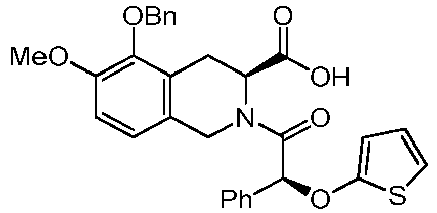
1H NMR (400MHz, DMSO-d6): δ 7.61 (s, 1H), 7.46 - 7.31 (m, 9H), 6.95 - 6.81 (m, 2H), 6.76 - 6.65 (m, 2H), 6.51 - 6.30 (m, 1H), 6.30 - 6.14 (m, 1H), 5.09 - 4.77 (m, 4H), 4.32 - 4.16 (m, 1H), 3.79 (d, J=12.4 Hz, 3H), 2.84 - 2.65 (m, 1H), 2.36 - 1.90 (m, 1H). MS m/z: 530.0 [M+l]+. SFC: column: ChiralPak AD-3 (100mm*4.6mm, 3µm); mobile phase: B: [0.05% DEA iso-propanol]; B%: 5%-40% 4.5 min, 40% 2.5 min, 5% 1 min; Rt = 5.171 min; 96.0% de. 26 26 
1H NMR (400MHz, DMSO-d6): δ 7.65 - 7.23 (m, 10H), 6.96 - 6.62 (m, 4H), 6.48 - 6.30 (m, 1H), 6.28 - 6.11 (m, 1H), 5.15 - 4.63 (m, 4H), 4.57 - 4.23 (m, 1H), 3.77 (s, 3H), 2.86 - 2.69 (m, 1H), 1.97 (s, 1H). MS m/z: 530.0 [M+l]+. SFC: column: ChiralPak AD-3 (100mm*4.6mm, 3µm); mobile phase: B: [0.05% DEA iso-propanol]; B%: 5%-40% 4.5 min, 40% 2.5 min, 5% 1 min; Rt = 6.112 min; 90.9% de. 27 27 
1H NMR (400MHz, DMSO-d6): δ 7.67 - 7.52 (m, 2H), 7.51 - 7.09 (m, 10H), 7.00 - 6.75 (m, 3H), 6.51 - 6.29 (m, 1H), 5.11 - 4.76 (m, 4H), 4.33 - 4.14 (m, 1H), 3.80 (d, J=10.8 Hz, 3H), 2.89 - 2.64 (m, 1H), 2.39 - 1.92 (m, 1H). MS m/z: 560.0 [M+l]+. SFC: column: ChiralPak AD-3 (100mm*4.6mm, 3µm); mobile phase: B: [0.05% DEA iso-propanol]; B%: 5%-40% 4.5 min, 40% 2.5 min, 5% 1 min; Rt = 4.386 min; 99.1% de. 28 28 
1H NMR (400MHz, DMSO-d6): δ 7.67 - 7.52 (m, 2H), 7.51 - 7.09 (m, 10H), 7.00 - 6.75 (m, 3H), 6.51 - 6.29 (m, 1H), 5.11 - 4.76 (m, 4H), 4.33 - 4.14 (m, 1H), 3.80 (d, J=10.8 Hz, 3H), 2.89 - 2.64 (m, 1H), 2.39 - 1.92 (m, 1H). MS m/z: 560.0 [M+l]+. SFC: column: ChiralPak AD-3 (100mm*4.6mm, 3µm); mobile phase: B: [0.05% DEA iso-propanol]; B%: 5%-40% 4.5 min, 40% 2.5 min, 5% 1 min; Rt = 5.051 min; 94.3% de. 29 29 
1H NMR (400MHz, DMSO-d6): δ 7.77 - 7.67 (m, 2H), 7.67 - 7.50 (m, 2H), 7.49 - 7.29 (m, 9H), 7.12 - 6.91 (m, 1H), 6.88 (s, 2H), 6.63 - 6.27 (m, 1H), 5.10 - 4.57 (m, 4H), 4.34 - 4.12 (m, 1H), 3.85 - 3.75 (m, 3H), 2.96 - 2.61 (m, 1H), 2.37 - 1.92 (m, 1H). MS m/z: 571.1 [M+Na]+. SFC: column: Chiralcel OJ-3 (100mm*4.6mm, 3µm); mobile phase: B: [0.05% DEA ethanol]; B%: 5%-40% 4.5 min, 40% 2.5 min, 5% 1 min;Rt = 3.079 min; 99.5% de. 30 30 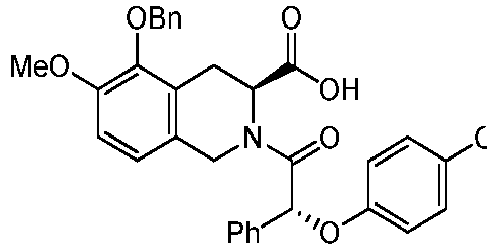
1H NMR (400MHz, DMSO-d6): δ 7.78 - 7.59 (m, 3H), 7.55 - 7.31 (m, 9H), 7.22 - 7.05 (m, 2H), 6.96 - 6.75 (m, 2H), 6.62 - 6.37 (m, 1H), 5.21 - 4.76 (m, 4H), 4.52 - 4.28 (m, 1H), 3.85 - 3.76 (m, 3H), 3.52 (s, 1H), 2.90 - 2.61 (m, 1H). MS m/z: 571.1 [M+Na]+. SFC: column: Chiralcel OJ-3 (100mm*4.6mm, 3µm); mobile phase: B: [0.05% DEA ethanol]; B%: 5%-40% 4.5 min, 40% 2.5 min, 5% 1 min; Rt = 4.142 min; 97.4% de. 31 31 
1H NMR (400MHz, DMSO-d6): δ 7.63 - 7.34(m, 10H), 7.17 - 6.75(m, 6H), 6.40 - 6.08(m, 1H), 5.07 - 4.71 (m, 4H), 4.27 (d, J=16.0 Hz, 1H), 3.83 - 3.75 (m, 3H), 2.83 - 2.63 (m, 1H), 2.36 - 2.18 (m, 1H). MS m/z: 564.1 [M+Na]+. SFC: column: Chiralcel OJ-3 (100mm*4.6mm, 3µm); mobile phase: B: [0.05% DEA ethanol]; B%: 5%-40% 4.5 min, 40% 2.5 min, 5% 1 min; Rt = 2.899 min; 100.0% de. 32 32 
1H NMR (400MHz, DMSO-d6): δ 7.61 - 7.31 (m, 10H), 7.12 - 6.70(m, 6H), 6.29 - 6.10 (m, 1H), 5.06 - 4.76 (m, 4H), 4.63 - 4.27 (m, 1H), 3.81 - 3.75 (m, 3H), 2.74 - 2.59 (m, 1H), 2.39 - 2.27 (m, 1H). MS m/z: 564.1 [M+Na]+. SFC: column: Chiralcel OJ-3 (100mm*4.6mm, 3µm); mobile phase: B: [0.05% DEA ethanol]; B%: 5%-40% 4.5 min, 40% 2.5 min, 5% 1 min; Rt = 3.654 min; 97.9% de. 33 33 
1H NMR (400MHz, DMSO-d6): δ 7.63 - 7.12(m, 13H), 6.99 - 6.71(m, 3H), 6.46 - 6.09(m, 1H), 5.08 - 4.60 (m, 4H), 4.27 (d, J=16.0 Hz, 1H), 3.83 - 3.72 (m, 3H), 2.86 - 2.61 (m, 1H), 2.45 - 2.22 (m, 1H). MS m/z: 558.1 [M+l]+. SFC: column: Chiralpak AD-3 (100mm*4.6mm, 3µm); mobile phase: B: [0.05% DEA ethanol]; B%: 5%-40% 4.5 min, 40% 2.5 min, 5% 1 min; Rt = 4.897 min; 100.0% de. 34 34 
1H NMR (400MHz, DMSO-d6): δ 7.62 - 7.55(m, 1H), 7.52 - 7.28(m, 11H), 7.07 - 6.78(m, 4H), 6.41 - 6.14 (m, 1H), 5.03 - 4.76 (m, 4H), 4.56 - 4.25 (m, 1H), 3.87 - 3.73 (m, 3H), 2.71 - 2.62 (m, 1H), 2.41 - 2.26 (m, 1H). MS m/z: 558.1 [M+l]+. SFC: column: Chiralpak AD-3 (100mm*4.6mm, 3µm); mobile phase: B: [0.05% DEA ethanol]; B%: 5%-40% 4.5 min, 40% 2.5 min, 5% 1 min; Rt = 5.999 min; 100.0% de. 35 35 
1H NMR (400MHz, DMSO-d6): δ 7.93 - 7.73 (m, 3H), 7.72 - 7.66 (m, 1H), 7.65 - 7.52 (m, 2H), 7.51 - 7.28 (m, 10H), 7.24 - 7.07 (m, 1H), 7.02 - 6.85 (m, 2H), 6.61 - 6.37 (m, 1H), 5.24 - 4.73 (m, 4H), 4.38 - 4.20 (m, 1H), 3.78 - 3.72 (m, 3H), 2.93 - 2.62 (m, 1H), 2.44 - 2.23 (m, 1H). MS m/z: 574.1 [M+Na]+. SFC: column: Chiralpak AD-3 (100mm*4.6mm, 3µm); mobile phase: B: [0.05% DEA iso-propanol]; B%: 40%; Rt = 4.484 min; 98.3% de. 36 36 
1H NMR (400MHz, DMSO-d6): δ 7.89 - 7.73 (m, 3H), 7.69 - 7.56 (m, 2H), 7.49 - 7.15 (m, 12H), 7.01 - 6.76 (m, 2H), 6.59 - 6.29 (m, 1H), 5.18 - 4.75 (m, 4H), 4.66 - 4.21 (m, 1H), 3.80 (s, 3H), 2.82 - 2.63 (m, 1H), 2.46 - 2.15 (m, 1H). MS m/z: 574.1 [M+Na]+. SFC: Chiralpak AD-3 (100mm∗4.6mm, 3µm); mobile phase: B: [0.05% DEA iso-propanol]; B%: 40%; Rt = 5.502 min; 96.9% de. 37 37 
1H NMR (400MHz, DMSO-d6): δ 7.53 - 7.16 (m, 10H), 7.00 - 6.80 (m, 1.5H), 6.68 (d, J=8.0 Hz, 0.5H), 5.36 (d, J=12.0 Hz, 1H), 5.01 - 4.66 (m, 3H), 4.41 (d, J=24.0 Hz, 0.5 H), 4.30 (d, J=24 Hz, 0.5 H), 4.13 - 3.95 (m, 1H), 3.79 (s, 3H), 2.84 - 2.79 (m, 1H), 2.68 - 2.64(m,1H), 2.39 - 2.27(m, 1H), 1.80 - 1.38 (m, 8H). MS m/z: 516.3 [M+1]+. SFC: column: Chiralpak AD-3 (100mm∗4.6mm, 3µm); mobile phase: B: [0.05% DEA iso-propanol]; B%: 5%-40% 4.5 min, 40% 2.5 min, 5% 1 min; Rt = 4.198 min; 100.0% de. 38 38 
1H NMR (400MHz, DMSO-d6): δ 7.47 - 7.25 (m, 10H), 6.97 - 6.85 (m, 1.5H), 6.75 (d, J=42.0 Hz, 0.5H), 5.32 (d, J=24.0 Hz, 1H), 4.97 - 4.66 (m, 3H), 4.46 - 4.27 (m, 1H), 4.08 - 3.96 (m, 1H), 3.80 (s, 3H), 3.26 - 3.13 (m, 1H), 2.79 - 2.74 (m, 0.7H), 2.69 - 2.66 (m, 0.3H), 2.35 - 2.33 (m, 0.5H), 2.14 - 2.08 (m, 0.5H), 1.80 - 1.38 (m, 8H). MS m/z: 516.3 [M+1]+. SFC: column: Chiralpak AD-3 (100mm∗4.6mm, 3µm); mobile phase: B: [0.05% DEA iso-propanol]; B%: 5%-40% 4.5 min, 40% 2.5 min, 5% 1 min; Rt = 4.776 min; 100.0% de. 39 39 
1H NMR (400MHz, DMSO-d6): δ 7.50 - 7.20 (m, 10H), 6.97 - 6.88 (m, 1H), 6.83 (d, J=8.0 Hz, 0.5H), 6.59 (d, J=8.0 Hz, 0.5H), 5.41 (s, 1H), 5.30 - 5.26 (m, 0.5H), 4.94 - 4.61 (m, 3.5H), 4.45 (d, J=16.0 Hz, 0.5H), 4.26 (d, J=16.0 Hz, 0.5H), 3.79 (d, J=8.0 Hz, 3H), 3.16 - 3.11 (m, 0.5H), 2.80 - 2.75 (m, 0.5H), , 2.41 - 2.35 (m, 0.5H), 2.34 - 2.30 (s, 0.5H), 1.28 - 1.20 (m, 9 H). MS m/z: 526.1 [M+Na]+. SFC: column: Chiralcel OJ-3 (100mm∗4.6mm, 3µm); mobile phase: B: [0.05% DEA ethanol]; B%: 5%-40% 4.5 min, 40% 2.5 min, 5% 1 min; Rt = 1.836 min; 90.3% de. 40 40 
1H NMR (400MHz, DMSO-d6): δ 7.74 - 7.58(m, 2H), 7.54 - 7.26 (m, 8H), 7.06 - 6.69 (m, 2H), 5.62 (s, 1H), 5.24 - 4.69 (m, 4H), 4.32 (d, J=16.0 Hz, 0.5H), 3.89 - 3.83 (m, 0.5H), 3.80 (d, J=8.0 Hz, 3H), 3.20 - 3.07(m, 2H), 2.90 - 2.65 (m, 1H), 1.87- 1.40 (m, 8H). MS m/z: 515.2 [M+1]+. SFC: column: Chiralcel OJ-3 (100mm∗4.6mm, 3µm); mobile phase: B: [0.05% DEA ethanol]; B%: 5%-40% 4.5 min, 40% 2.5 min, 5% 1 min; Rt = 4.375 min; 98.6% de. 41 41 
1H NMR (400MHz, DMSO-d6): δ 7.66 - 7.15 (m, 10H), 6.99 - 6.59 (m, 2H), 5.33 (t, J=4.0 Hz, 2H), 5.01 - 4.71 (m, 3H), 4.36 - 4.19 (m, 1H), 3.80 (d, J=8.0 Hz, 3H), 3.17 - 3.15 (m, 2H), 2.66 - 2.68 (m, 1H), 1.74 - 1.39 (m, 8H). MS m/z: 515.2 [M+1]+. SFC: column: Chiralcel OJ-3 (100mm∗4.6mm, 3µm); mobile phase: B: [0.05% DEA ethanol]; B%: 5%-40% 4.5 min, 40% 2.5 min, 5% 1 min; Rt = 5.107 min; 83.4% de. 42 42 
1H NMR (400MHz, DMSO-d6): δ 8.49 - 8.23 (m, 1H), 7.57 - 7.23 (m, 10H), 6.99 - 6.72 (m, 2H), 6.15 - 5.83 (m, 1H), 5.13 - 4.59 (m, 4H), 4.41 - 4.10 (m, 1H), 3.78 (d, J=12.0 Hz, 3H), 2.89 - 2.63 (m, 2H), 2.35 - 2.24 (m, 0.5H), 2.02 - 1.91 (m, 0.5H), 1.74 - 1.39 (m, 8H). MS m/z: 543.3 [M+1]+. SFC: column: ChiralPak AD-3 (150mm∗4.6mm, 3µm); mobile phase: B: [0.05% DEA ethanol]; B%: 5%-40% 5.5 min, 40% 3.0 min, 5% 1.5 min; Rt = 5.926 min; 100.0% de. 43 43 
1H NMR (400MHz, DMSO-d6): δ 8.38 (d, J=8.0 Hz, 1H), 7.47 - 7.22 (m, 10H), 6.95 - 6.70 (m, 2H), 6.18 - 5.84 (m, 1H), 5.10 - 4.61 (m, 4H), 4.49 - 4.19 (m, 1H), 3.79 (d, J=8.0 Hz, 3H), 2.80 - 2.59 (m, 2H), 2.40 - 2.24 (m, 0.5H), 2.02 - 1.88 (m, 0.5H), 1.75 - 1.35 (m, 8H). MS m/z: 543.2 [M+1]+. SFC: column: ChiralPak AD-3 (150mm∗4.6mm, 3µm); mobile phase: B: [0.05% DEA ethanol]; B%: 5%-40% 5.5 min, 40% 3.0 min, 5% 1.5 min; Rt = 7.558 min; 100.0% de. 44 44 
1H NMR (400MHz, DMSO-d6): δ 7.47 - 7.28 (m, 10H), 6.98 - 6.57 (m, 2H), 5.47 (d, J=8.0 Hz, 1H), 5.23 - 4.59 (m, 4H), 4.46 - 4.23 (m, 1H), 3.79 (s, 3H), 3.24 - 3.16 (m, 1H), 2.91 - 2.62 (m, 1H), 2.42 - 2.28 (m, 1H), 1.94 - 1.62 (m, 4H), 1.55 - 1.06 (m, 6H). MS m/z: 530.1 [M+1]+. SFC: column: ChiralCel OJ-H (150mm∗4.6mm, 5µm); mobile phase: B: [0.05% DEA ethanol]; B%: 5%-40% 5.5 min, 40% 3.0 min, 5% 1.5 min; Rt = 3.221 min; 90.6% de. 45 45 
1H NMR (400MHz, DMSO-d6): δ 7.82 - 7.29 (m, 10H), 7.03 - 6.73 (m, 2H), 5.84 - 5.63 (m, 1H), 5.45 - 4.62 (m, 4H), 4.36 - 4.25 (m, 0.5H), 3.91 - 3.84 (m, 0.5H), 3.83 - 3.75 (m, 3H), 3.27 - 2.75 (m, 2H), 2.37 - 1.34 (m, 12H). MS m/z: 529.1 [M+1]+. SFC: column: Chiralpak IC-3 (150mm∗4.6mm, 3µm); mobile phase: B: [0.05% DEA Methanol]; B%: 40%; Rt = 8.541 min; 13.6% de. -

- The compound (-)-C1 (280.0 mg, 820.2 µmol) and A12 (187.2 mg, 820.2 µmol) were dissolved in N,N-dimethylformamide (8.0 mL), followed by the addition of diisopropylethylamine (318.0 mg, 2.5 mmol) and HATU (374.2 mg, 984.2 µmol). After the reaction solution was stirred at 20°C for 5 hours, water (5.0 mL) was added for quenching the reaction. The aqueous phase was extracted with ethyl acetate (2.0mL x 3). The mixed organic phase was dried with anhydrous sodium sulfate, filtered and concentrated in vacuum to obtain a crude product. The crude product was separated and purified by a silica gel column chromatography column (an eluent: 9-11% petroleum ether/ethyl acetate) to get the product 46-1. 1H NMR (400 MHz, CHLOROFORM-d): δ 1.27-1.29 (m, 3H) 2.83 (s, 3H) 3.84-3.86 (m, 2H) 4.12-4.18 (m, 2H) 4.84-5.12 (m, 2H), 5.09-5.11(m, 1H), 5.97-6.05(m, 1H), 6.72-6.94(m, 2H), 6.94-7.15 (m, 3H), 7.29-7.48 (m, 11H), 7.48-7.65 (m, 2H).
- The following compounds were synthesized in a similar manner to the compound 46-1:
Compound serial number Structural formula Spectrogram 47-1 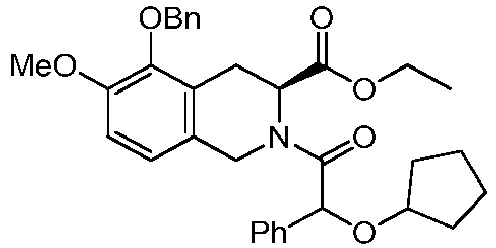
1H NMR (400MHz, CHLOROFORM-d): δ7.15 - 7.44 (m, 10 H), 6.65 - 6.82 (m, 1 H), 6.52 - 6.60 (m, 1 H), 5.15 - 5.27 (m, 2 H), 4.75 - 4.98 (m, 3 H), 4.30 - 4.46 (m, 1 H), 3.90 - 4.16 (m, 3 H), 3.74 - 3.89 (m, 3 H), 2.97 - 3.21 (m, 1 H), 2.77 - 2.96 (m, 1 H), 1.36 - 1.92 (m, 9 H), 0.97 - 1.26 (m, 3 H), 0.77 (t, J=7.15 Hz, 1 H). 48-1 
MS m/z: 574.3 [M+1]+. 87-1 
1H NMR (400MHz, CHLOROFORM-d): δ 7.60 - 7.24 (m, 10H), 6.96 - 6.41 (m, 2H), 5.50 - 5.15 (m, 2H), 5.06 - 4.93 (m, 1H), 4.81 - 4.55 (m, 2H), 4.51 - 4.31 (m, 1H), 4.23 - 3.97 (m, 2H), 3.85 - 3.83 (d, J=5.2 Hz, 3H), 3.76 - 3.45 (m, 1H), 3.44 - 3.40 (m, 1H), 3.16 - 2.81 (m, 1H), 2.16 - 1.56 (m, 7H), 1.17 - 0.87 (m, 6H). MS m/z: 558.3 [M+1]+. 88-1 
1H NMR (400MHz, CHLOROFORM-d): δ 7.46 - 7.26 (m, 10H), 7.03 - 6.53 (m, 2H), 5.36 - 4.89 (m, 4H), 4.76 - 4.21 (m, 2H), 4.16 - 3.92 (m, 2H), 3.84 (s, 3H), 3.81 - 3.62 (m, 2H), 3.24 - 2.93 (m, 1H), 2.93 - 2.83 (m, 1H), 2.74 - 2.52 (m, 2H), 2.00 - 1.79 (m, 2H), 1.19 - 0.87 (m, 3H). MS m/z: 546.1[M+1]+. 89-1 
1H NMR (400MHz, CHLOROFORM-d): δ 7.55 - 7.29 (m, 10H), 7.08 - 6.49 (m, 2H), 5.42 - 5.13 (m, 2H), 5.11 - 4.83 (m, 1H), 4.81 - 4.61 (m, 2H), 4.58 - 4.42 (m, 1H), 4.02 - 3.71 (m, 2H), 3.70 - 3.55 (m, 2H), 3.53 - 3.25 (m, 1H), 3.23 (s, 1H), 3.10 - 2.84 (m, 1H), 2.32 - 2.22 (m, 3H), 1.97 - 1.76 (m, 4H). MS m/z: 516.2 [M+1]+. 90-1 
1H NMR (400MHz, CHLOROFORM-d): δ 7.70 - 7.63 (m, 1H), 7.54 - 7.30 (m, 10H), 7.18 - 6.84 (m, 1H), 6.79 - 6.38 (m, 1H), 5.64 - 5.34 (m, 2H), 5.16 - 4.96 (m, 2H), 4.94 - 4.64 (m, 1H), 4.63 - 4.48 (m, 1H), 4.35 - 4.20 (m, 1H), 3.73 - 3.66 (m, 1H), 3.62 - 3.50 (m, 1H), 3.21 - 3.03 (m, 2H), 2.96 - 2.79 (m, 1H), 1.97 - 1.74 (m, 8H). MS m/z: 500.2 [M+1]+. 91-1 
MS m/z: 518.2 [M+1]+. 92-1 
1H NMR (400MHz, CHLOROFORM-d): δ 7.49 - 7.28 (m, 9H), 7.27 - 7.22 (m, 1H), 6.91 - 6.59 (m, 2H), 5.70 - 5.53 (m, 1H), 5.44 - 5.30 (m, 1H), 5.14 - 4.83 (m, 3H), 4.54 - 4.35 (m, 1H), 4.28 - 4.09 (m, 1H), 3.66 - 3.62 (m, 1H), 3.57 - 3.42 (m, 1H), 3.14 (s, 2H), 2.95 - 2.76 (m, 1H), 1.96 - 1.58 (m, 8H). MS m/z: 518.3 [M+1]+. 93-1 
1H NMR (400MHz, CHLOROFORM-d): δ 7.54 - 7.28 (m, 9H), 6.92 - 6.42 (m, 2H), 5.54 - 5.47 (m, 2H), 5.13 - 4.76 (m, 3H), 4.65 - 4.44 (m, 1H), 4.32 - 4.02 (m, 2H), 3.85 - 3.82 (d, J=10.0 Hz, 3H), 3.67 - 3.59 (m, 0.5H), 3.51 - 3.39 (m, 1H), 3.21 - 3.16(m, 0.5H), 2.97 - 2.89 (m, 0.5H), 2.73 - 2.67 (m, 0.5H), 1.96 - 1.59 (m, 8H), 1.18 - 1.15 (t, J=7.2 Hz, 1.5H), 0.86 - 0.82 (t, J=7.2 Hz, 1.5H). MS m/z: 578.3 [M+1]+. 94-1 
1H NMR (400MHz, CHLOROFORM-d): δ 7.57 - 7.38 (m, 5H), 7.36 - 7.29 (m, 2H), 6.96 - 6.80 (m, 3H), 5.56 - 5.43 (m, 1H), 5.38 - 5.29 (m, 2H), 5.10 - 4.89 (m, 3H), 4.52 - 4.48 (m, 1H), 4.32 - 4.30 (m, 1H), 4.21 - 4.10 (m, 1H), 3.86 - 3.83 (d, J=9.6 Hz, 3H), 3.55 - 3.41 (m, 1H), 3.26 - 2.93 (m, 1H), 1.97 - 1.76 (m, 8H), 1.25 - 0.83 (m, 3H). MS m/z: 580.1 [M+1]+. 95-1 
1H NMR (400MHz, CHLOROFORM-d): δ 7.65 - 7.46 (m, 4H), 7.44 - 7.21 (m, 5H), 6.85 - 6.40 (m, 2H), 5.46 - 5.24 (m, 2H), 5.23 - 4.97 (m, 1H), 5.14 - 4.79 (m, 3H), 4.60 - 4.34 (m, 1H), 4.24 - 3.96 (m, 2H), 3.78 - 3.70 (m, 3H), 3.60 - 3.33 (m, 1H), 2.93 - 2.63 (m, 1H), 1.85 - 1.54 (m, 8H), 1.12 - 0.74 (m, 3H). MS m/z: 569.3 [M+1]+. 96-1 
1H NMR (400MHz, CHLOROFORM-d): δ 7.48 - 7.38 (m, 4H), 7.35 - 7.28 (m, 2H), 7.27 - 7.21 (m, 1H), 7.09 - 7.04 (m, 2H), 6.91 - 6.42 (m, 2H), 5.54 - 5.29 (m, 2H), 5.17 - 4.77 (m, 3H), 4.65 - 4.41 (m, 1H), 4.35 - 4.13 (m, 2H), 3.85 - 3.83 (d, J=9.6 Hz, 3H), 3.68 - 3.60 (m, 0.5H), 3.50 - 3.38 (m, 1H), 3.25 - 3.08 (m, 0.5H), 2.97 - 2.91 (m, 0.5H), 2.71 - 2.66(m, 0.5H), 1.98 - 1.61 (m, 8H), 1.20 - 0.83 (m, 2H). MS m/z: 562.1 [M+1]+. 97-1 
1H NMR (400MHz, CHLOROFORM-d): δ 7.52 - 7.43 (m, 2H), 7.43 - 7.36 (m, 2H), 7.36 - 7.28 (m, 3H), 7.20 - 7.05 (m, 2H), 6.89 - 6.79 (m, 1H), 6.67 - 6.39 (m, 1H), 5.52 - 4.89 (m, 5H), 4.64 - 4.27 (m, 2H), 4.18 - 4.05 (m, 1H), 3.85 - 3.83 (d, J=7.2 Hz, 3H), 3.67 - 3.59 (m, 0.5H), 3.54 - 3.44 (m, 1H), 3.20 - 2.95 (m, 1H), 2.77 - 2.69 (m, 0.5H), 1.96 - 1.87 (m, 1H), 1.86 - 1.71 (m, 7H), 1.19 - 0.83 (m, 3H). MS m/z: 562.1 [M+1]+. 98-1 
1H NMR (400MHz, CHLOROFORM-d): δ 7.42 - 7.28 (m, 5H), 7.27 - 7.21 (m, 4H), 6.68 - 6.63 (m, 1H), 6.58 - 6.53 (m, 1H), 5.59 (s, 2H), 5.51 - 5.44 (m, 1H), 5.28 - 5.25 (d, J=9.2 Hz, 2H), 5.17 - 5.15 (t, J=6.0 Hz, 1H), 4.95 - 4.86 (m, 1H), 4.44 - 4.34 (m, 2H), 3.77 (s, 6H), 3.76 (s, 6H), 3.62 - 3.54 (m, 1H), 3.46 - 3.40 (m, 1H), 1.79 - 1.70 (m, 8H), 1.14 - 1.11 (m, 3H). MS m/z: 574.3 [M+1]+. 99-1 
1H NMR (400MHz, CHLOROFORM-d): δ 7.51 - 7.38 (m, 2H), 7.35 - 7.27 (m, 6H), 7.27 - 7.20 (m, 2H), 6.87 - 6.37 (m, 2H), 5.46 - 5.44 (m, 0.5H), 5.36 - 5.28 (m, 1H), 5.17 - 5.12 (m, 0.5H), 4.91 - 4.88 (d, J=17.6 Hz, 0.5H), 4.64 - 4.42 (m, 1.5H), 4.31 - 3.99 (m, 4H), 3.79 - 3.77 (d, J=6.8 Hz, 3H), 3.67 - 3.59 (m, 0.5H), 3.52 - 3.41 (m, 0.5H), 3.34 - 3.29 (m, 0.5H), 3.14 - 3.03 (m, 2.5H), 2.90 - 2.84 (m, 0.5H), 2.71 - 2.65(m, 0.5H), 1.94 - 1.58 (m, 8H), 1.20 - 1.17 (t, J=7.0 Hz, 1.5H), 0.86 - 0.82 (t, J=7.2 Hz,1.5H). MS m/z: 558.3 [M+1]+. 100-1 
1H NMR (400MHz, CHLOROFORM-d): δ 7.51 - 7.38 (m, 2H), 7.35 - 7.27 (m, 6H), 7.27 - 7.20 (m, 2H), 6.87 - 6.37 (m, 2H), 5.46 - 5.44 (m, 0.5H), 5.36 - 5.28 (m, 1H), 5.19 - 5.17 (m, 0.5H), 5.04 - 4.91 (m, 0.5H), 4.64 - 4.42 (m, 1.5H), 4.31 - 3.99 (m, 2H), 3.73 - 3.70 (m, 3H), 3.67 - 3.29 (m, 1H), 3.14 - 3.03 (m, 1H), 2.90 - 2.65(m, 1H), 1.94 - 1.58 (m, 8H), 1.14 - 0.79 (m,3H). MS m/z: 558.3 [M+1]+. 101-1 
1H NMR (400MHz, CHLOROFORM-d): δ 7.50 - 7.36 (m, 3H), 7.36 - 7.28 (m, 3H), 7.26 - 7.21 (m, 1H), 7.19 - 7.10 (m, 1H), 6.95 - 6.40 (m, 2H), 5.52 - 5.50 (m, 0.5H), 5.36 - 5.29 (m, 1.5H), 5.16 - 5.14 (t, J=5.2 Hz, 0.5H), 5.01 - 4.77 (m, 2.5H), 4.68 - 4.57 (m, 0.5H), 4.54 - 4.43 (m, 1H), 4.30 - 4.29 (m, 0.5H), 4.21 - 3.99 (m, 2H), 3.84 - 3.82 (d, J=10.0 Hz, 3H), 3.68 - 3.60 (m, 0.5H), 3.51 - 3.37 (m, 1H), 3.24 - 3.19 (m, 0.5H), 2.99 - 2.94 (m, 0.5H), 2.76 - 2.71 (m, 0.5H), 1.95 - 1.58 (m, 8H), 1.20 - 1.16 (t, J=7.2 Hz, 1.5H), 0.86 - 0.84 (t, J=7.2 Hz, 1.5H). MS m/z: 596.1 [M+1]+. 102-1 
1H NMR (400MHz, CHLOROFORM-d): δ 8.64 - 8.63 (m, 2H), 7.41 - 7.47 (m, 4H), 7.34 - 7.31 (m, 2H), 7.21 - 7.26 (m, 1H), 6.90 - 6.82 (m, 1H), 6.70 - 6.50 (m, 1H), 5.52 - 5.24 (m, 2H), 5.06 - 4.90 (m, 2.5H), 4.65 - 4.45 (m, 1.5H), 3.40 - 4.00 (m, 2H), 3.83 - 3.81 (m, 3H), 3.68 - 3.65 (m, 1H), 3.52 - 3.46 (m, 1H), 3.31 - 2.99 (m, 1H), 1.89 - 1.60 (m, 8H), 1.30 - 1.27 (m, 1H), 0.87-0.83 (m, 2H). MS m/z: 545.2[M+1]+. 103-1 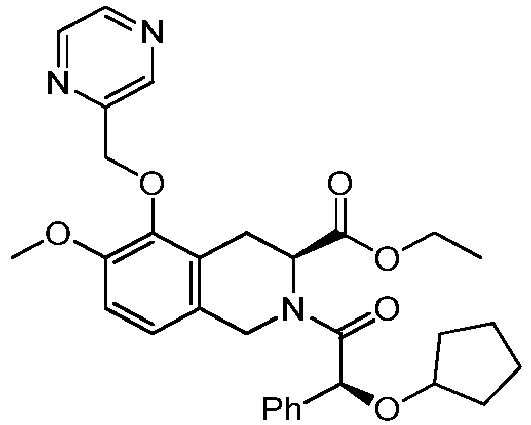
1H NMR (400MHz, CHLOROFORM-d): δ 8.96 - 8.92 (m, 1H), 8.57 - 8.56 (m, 2H),7.47 - 7.41 (m, 2H), 7.34 - 7.30 (m, 2H), 7.26 - 7.22 (m, 1H), 6.91 - 6.82 (m, 1H), 6.69 - 6.67(d, J=8.8 Hz, 0.5H), 6.51 - 6.49 (d,J=8.8 Hz, 0.5H), 5.53 - 5.51 (m, 0.5H), 5.35 - 5.33 (m, 1H), 5.21 - 5.16 (m, 1.5H), 5.12 - 5.03 (m, 1H), 4.97 - 4.92 (m, 0.5H), 4.65 - 4.61 (m, 0.5H), 4.54 - 4.46 (m, 1H), 4.32 - 4.28 m, 0.5H), 4.21 - 4.17 (m, 0.5H), 4.15 - 4.07 (m, 1H), 3.82 - 3.80 (m, 3H), 3.66 - 3.62 (m, 0.5H), 3.56 - 3.45 (m, 1H), 3.31 - 3.25 (m, 0.5H), 3.07 - 2.97 (m, 0.5H), 2.85 - 2.84 (m, 0.5H), 1.93 - 1.73 (m, 6H), 1.57 - 1.42 (m, 2H), 1.31 - 1.24 (m, 2H), 1.21 - 1.15 (m, 1.5H), 0.86 - 0.83 (t, J=6.8 Hz, 1.5H). 104-1 
1H NMR (400MHz, CHLOROFORM-d): δ 7.35 - 7.32 (m, 5H), 6.88 - 6.37 (m, 2H), 5.35 - 5.32 (m, 1H), 5.25 - 5.08 (m, 2H), 4.94 - 4.93 (m, 1H), 4.68 - 4.44 (m, 1H), 4.37 - 4.14 (m, 4H), 3.81 - 3.79 (d, J=8.4 Hz, 3H), 3.49 - 3.40 (m, 2H), 1.86 - 1.76 (m, 12H), 0.91 - 0.82 (m, 3H). MS m/z: 538.1 [M+1]+. 105-1 
1H NMR (400MHz, CHLOROFORM-d): δ 8.85 - 8.80 (m, 1H), 7.87 - 7.82 (m, 1H), 7.45 - 7.26 (m, 5H), 6.85 - 6.45 (m, 2H), 5.55 - 4.05 (m, 9H), 3.89 - 3.83 (m, 3H), 3.50 - 2.70 (m, 2H), 1.90 - 1.42 (m, 8H), 1.23 - 0.84 (m, 3H). MS m/z: 551.2 [M+1]+. 106-1 
MS m/z: 546.1 [M+1]+. - At 25°C, the compound 46-1 (123.0 mg, 223.0 µmol) was dissolved in ethanol (2.0 mL), and then lithium hydroxide monohydrate (10.7 mg, 446.0 µmol) was added. The mixture was reacted for 4 hours while stirring at 20°C, then the reaction solution was diluted with 5mL of water and adjusted to pH < 4 with 1 M hydrochloric acid. The aqueous phase was extracted with ethyl acetate (5.0 mL x 3). The mixed organic phase was dried with anhydrous sodium sulfate, and concentrated in vacuum to obtain a crude product. The crude product was separated and purified by a chromatography column (an eluent: 0-80% petroleum ether/ethyl acetate) to obtain the product 46.
- Compound 46: 1H NMR (400 MHz, DMSO-d6) δ 2.61-3.11 (m, 2H), 3.71-3.91 (m, 3H), 4.05-4.33 (m, 1H), 4.78-5.06 (m, 4H), 5.06-5.24 (m, 1H), 6.30-6.42 (m, 1H), 6.80-6.86 (m, 1H), 6.88-6.98 (m, 4H), 7.25 (brt, J=7.47 Hz, 2H), 7.35-7.47 (m, 8H), 7.44-7.48 (m, 1H), 7.53-7.66 (m, 2H). MS m/z: 524.2 [M+1]+.
- The following compounds were synthesized in a similar manner to the compound 46:
Example Compound serial number Structural formula Spectrogram 47 47 
1H NMR (400MHz, CHLOROFORM-d): δ 7.27 - 7.50 (m, 10 H), 6.86 - 6.98 (m, 1 H), 6.65 - 6.78 (m, 1 H), 5.33 - 5.40 (m, 1 H), 5.16 - 5.22 (m, 1 H), 5.19 (br d, J=3.91 Hz, 1 H), 5.13 (br d, J=4.40 Hz, 1 H), 4.72 - 4.99 (m, 4 H), 4.27 - 4.46 (m, 1 H), 3.85 - 4.13 (m, 1 H), 3.75 - 3.85 (m, 3 H), 3.29 - 3.49 (m, 1 H), 3.08 - 3.29 (m, 1 H), 2.75 - 2.95 (m, 1 H), 2.26 - 2.47 (m, 1 H), 2.05 - 2.15 (m, 1 H), 1.42 - 1.82 (m, 8 H). MS m/z: 516.3 [M+1]+. 48 48 
1H NMR (400MHz, DMSO-d6): δ 7.42 - 7.28 (m, 10H), 6.96 - 6.57 (m, 2H), 5.45 - 5.38 (m, 1H), 4.92 - 4.71 (m, 4H), 4.43 - 4.31 (m, 1H), 3.78 (s, 3H), 3.21 - 3.05 (m, 1H), 2.94 - 2.66 (m, 1H), 2.36 - 2.03 (m, 2H), 2.02 - 1.67 (m, 4H), 1.54 - 1.11 (m, 4H). MS m/z: 546.2 [M+1]+. -

- The hydrochloride salt of the compound C2 (60.0 mg, 172.5 µmol) was dispersed in dichloromethane (3.0 mL), and triethylamine (69.8 mg, 690.0 µmol), the compound S-A1 (49.4 mg, 224.2 µmol) and HATU (98.4 mg, 258.7 µmol) were sequentially added under a nitrogen atmosphere. And the reaction solution was continuously stirred at 25°C for 16 hours. The organic solvent was removed through decompressing the reaction solution, and the obtained crude product was separated and purified through a silica gel chromatography column (an eluent: 9-25% ethyl acetate/petroleum ether) to obtain the product 49-1. 1H NMR (400 MHz, CHLOROFORM-d): δ 7.58-7.30 (m, 10H), 7.10-6.45 (m, 2H), 5.60-4.94 (m, 3H), 4.85-4.47 (m, 3H), 4.34-4.17 (m, 1H), 3.69-3.51 (m, 3H), 3.36-3.20 (m, 1H), 3.08-2.79 (m, 1H), 2.32-2.22 (m, 3H), 1.95-1.61 (m, 8H). MS m/z: 514.1 [M+1]+.
- The following compounds were synthesized in a similar manner to the compound 49-1:
Compound Serial Number Structural Formula Spectrogram 107-1 
1H NMR (400MHz, CHLOROFORM-d): δ 7.45 - 7.30 (m, 10H), 7.25 - 7.11 (m, 1H), 6.91 - 6.62 (m, 1H), 5.41 - 5.26 (m, 2H), 5.13 - 4.84 (m, 3H), 4.80 - 4.63 (m, 1H), 4.54 - 4.43 (m, 1H), 3.68 - 3.58 (m, 3H), 3.31 - 3.18 (m, 1H), 2.98 - 2.70 (m, 1H), 1.86 - 1.72 (m, 6H), 1.66 - 1.60 (m, 2H). MS m/z: 534.1 [M+1]+. 109-1 
1H NMR (400MHz, CHLOROFORM-d): δ 7.51 - 7.34 (m, 11H), 7.00 - 6.52 (m, 1H), 5.37 - 5.29 (m, 2H), 5.25 - 5.06 (m, 2H), 5.04 - 4.93 (m, 1H), 4.58 - 4.48 (m, 1H), 4.33 - 4.15 (m, 1H), 3.69 - 3.59 (m, 2H), 3.50 - 3.15 (m, 1H), 3.13 (s, 1H), 2.95 - 2.67 (m, 1H), 1.86 - 1.68 (m, 8H). MS m/z: 525.2 [M+1]+. 113-1 
1H NMR (400MHz, CHLOROFORM-d): δ 7.53 - 7.29 (m, 10H), 6.74 - 6.37 (m, 2H), 5.21 (s, 1H), 4.98 - 4.90 (m, 2H), 4.51 - 4.10 (m, 5H), 3.88 - 3.82 (m, 3H), 3.05 - 2.78 (m, 2H), 1.94 - 1.60 (m, 8H), 1.42 - 1.32 (m, 3H), 1.24 - 1.16 (m, 3H). MS m/z: 558.3 [M+1]+. - The compound 49-1 (80.0 mg, 155.7 µmol) was dissolved in tetrahydrofuran (3.0 mL) and water (1.0 mL), then lithium hydroxide monohydrate (37.3 mg, 1.5 mmol) was added and the reaction solution was continuously stirred for 16 hours at 25°C. The reaction solution was adjusted to pH of 5-6 with 1.0M hydrochloric acid, and extraction was performed with ethyl acetate (10 mL×3). The mixed organic phase was washed with 10 mL of a saturated saline solution, dried with anhydrous sodium sulfate, and decompressed to remove the organic solvent. The resulting crude product was separated and purified by a silica gel column chromatography column (an eluent: 50-100% ethyl acetate/petroleum ether) to obtain the product which was separated by SFC (column: AD (250 mm ∗ 30 mm, 10 µm); mobile phase [0.1% NH3H2O MeOH]; B%: 20%-20%) to obtain two diastereomers: the compound 49 and the compound 50.
- Compound 49: 1H NMR (400 MHz, DMSO-d6): δ 7.58-7.21 (m, 10H), 7.02-6.57 (m, 2H), 5.49-5.09 (m, 1H), 4.89-4.47 (m, 4H), 4.41-4.37 (d, J = 16.8 Hz, 1H), 4.18-4.00 (m, 1H), 3.22-3.18 (m, 1H), 2.38-2.25 (m, 1H), 2.18-2.17 (d, J = 4.8 Hz, 3H), 1.80-1.42 (m, 8H). MS m/z: 500.2 [M+1]+. SFC: column: Chiralpak AD-3 (100 mm ∗ 4.6 mm, 3 µm); mobile phase: B: [0.05% DEA Methanol]; B%: 5%-40% 4.5 min, 40% 2.5 min, 5% 1.0 min; Rt = 3.207 min; 97.2% de.
- Compound 50: 1H NMR (400MHz, DMSO-d6): δ 7.54-7.23 (m, 10H), 7.05-6.69 (m, 2H), 5.35-5.30 (d, J = 18.0Hz, 1H), 5.17-4.80 (m, 2H), 4.79-4.29 (m, 3H), 4.04 (s, 1H), 3.22-3.18 (m, 1H), 2.81-2.65 (m, 1H), 2.19 (s, 3H), 1.81-1.42 (m, 8H). MS m/z: 500.1 [M+1]+. SFC: column: Chiralpak AD-3 (100 mm ∗ 4.6 mm, 3 µm); mobile phase: B: [0.05% DEA Methanol]; B%: 5%-40% 4.5 min, 40% 2.5 min, 5% 1.0 min; Rt = 3.813 min; 96.4% de.
- The following compounds were synthesized by using a method similar to the compounds 49 and 50:
Example Compoun d Serial number Structural formula Spectrogram 107 107 
1H NMR (400MHz, DMSO-d6): δ 7.56 - 6.62 (m, 12H), 5.44 - 5.30 (m, 1H), 5.23 - 5.00 (m, 1H), 4.96 - 4.36 (m, 4H), 4.16 - 3.97 (m, 1H), 3.68 - 3.50 (m, 1H), 2.92 - 2.85 (m, 1H), 1.79 - 1.43 (m, 8H). MS m/z: 520.1 [M+1]+. SFC: column: ChiralPak AD-3 (150mm∗4.6mm, 3µm); mobile phase: B: [0.05% DEA ethanol]; B%: 5%-40% 5.5 min, 40% 3.0 min, 5% 1.5 min; Rt = 4.552 min; 99.8% de. 108 108 
1H NMR (400MHz, DMSO-d6): δ 7.60 - 6.79 (m, 12H), 5.33 - 5.30 (d, J=10.8 Hz, 1H), 5.16 - 4.67 (m, 4H), 4.62 - 4.34 (m, 1H), 4.05 - 4.01 (m, 1H), 3.71 - 3.47 (m, 1H), 2.25 - 1.96 (m, 1H), 1.79 - 1.37 (m, 8H). MS m/z: 520.1 [M+1]+. SFC: column: ChiralPak AD-3 (150mm∗4.6mm, 3µm); mobile phase: B: [0.05% DEA EtOH]; B%: 5%-40% 5.5 min, 40% 3.0 min, 5% 1.5 min; Rt = 4.992 min; 98.3% de. 109 109 
1H NMR (400MHz, DMSO-d6): δ 7.60 - 7.26 (m, 10H), 7.18 - 6.77 (m, 2H), 5.39 - 5.26 (m, 1H), 5.21 - 4.88 (m, 4H), 4.73 - 4.43 (m, 1H), 4.05 - 4.01 (m, 1H), 3.09 - 3.06 (m, 1H), 3.05 - 3.03 (m, 1H), 1.88 - 1.48 (m, 8H). MS m/z: 511.3 [M+1]+. SFC: column: ChiralPak AD-3 (150mm∗4.6mm, 3µm); mobile phase: B: [0.05% DEA IPA]; B%: 5%-40% 5.5 min, 40% 3.0 min, 5% 1.5 min; Rt = 5.069 min; 89.4% de. 110 110 
1H NMR (400MHz, DMSO-d6): δ 7.59 - 6.94 (m, 12H), 5.38 - 5.26 (m, 1H), 5.21 - 4.91 (m, 4H), 4.76 - 4.48 (m, 1H), 4.05 - 4.01 (m, 1H), 3.48 - 3.44 (m, 2H), 1.73 - 1.50 (m, 8H). MS m/z: 511.3 [M+1]+. SFC: column: ChiralPak AD-3 (150mm∗4.6mm, 3µm); mobile phase: B: [0.05% DEA IPA]; B%: 5%-40% 5.5 min, 40% 3.0 min, 5% 1.5 min; Rt = 6.378 min; 100.0% de. 111 111 
1H NMR (400MHz, DMSO-d6): δ 7.57 - 7.28 (m, 10H), 7.21 - 6.83 (m, 2H), 5.47 - 4.83 (m, 4H), 4.69 - 4.63 (m, 1H), 4.51 - 4.46 (m, 1H), 4.11 - 4.05 (m, 1H), 3.33 - 3.25 (m, 2H), 1.76 - 1.46 (m, 8H). MS m/z: 511.2 [M+1]+. SFC: column: (R,R)Whelk-01 (100mm∗4.6mm, 3µm); mobile phase: B: [0.05% DEA EtOH]; B%: 5%-40% 5.5 min, 40% 3.0 min, 5% 1.5 min; Rt = 5.889 min; 94.2% de. 112 112 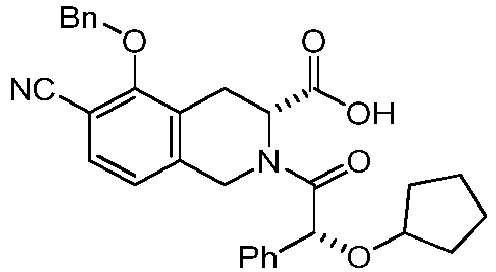
1H NMR (400MHz, DMSO-d6): δ 7.60 - 6.91 (m, 12H), 5.43 - 5.28 (m, 2H), 5.12 - 4.87 (m, 4H), 4.55 - 4.48 (m, 1H), 2.07 - 1.93 (m, 2H), 1.70 - 1.44 (m, 8H). MS m/z: 511.3 [M+1]+. SFC: column: (R,R)Whelk-01 (100mm∗4.6mm, 3µm); mobile phase: B: [0.05% DEA EtOH]; B%: 5%-40% 5.5 min, 40% 3.0 min, 5% 1.5 min; Rt = 5.694 min; 61.9% de. 113 113 
1H NMR (400MHz, DMSO-d6): δ 7.70 - 7.18 (m, 10H), 6.85 - 6.81 (m, 1H), 6.59 - 6.55 (m, 1H), 5.22 (s, 1H), 4.94 - 4.79 (m, 2H), 4.56 - 4.03 (m, 3H), 3.79 (s, 3H), 2.98 - 2.75 (m, 2H), 1.80 - 1.40 (m, 8H), 1.27 - 1.18 (m, 3H). MS m/z: 530.2 [M+1]+. SFC: column: ChiralPak AD-3 (150mm∗4.6mm, 3µm); mobile phase: B: [0.05% DEA IPA]; B%: 40%; Rt = 1.589 min; 98.0% de. 114 114 
1H NMR (400MHz, DMSO-d6): δ 7.73 - 7.19 (m, 10H), 6.85 - 6.83 (d, J=8.4 Hz, 1H), 6.63 - 6.61 (d, J=8.0 Hz, 1H), 5.15 (s, 1H), 4.97 - 4.81 (m, 2H), 4.69 - 4.66 (d, J=12.8 Hz, 1H), 4.05 - 3.95 (m, 2H), 3.80 (s, 3H), 3.03 - 2.78 (m, 2H), 1.85 - 1.37 (m, 8H), 1.21 (s, 3H). MS m/z: 530.2 [M+1]+. SFC: column: ChiralPak AD-3 (150mm∗4.6mm, 3µm); mobile phase: B: [0.05% DEA IPA]; B%: 40%; Rt = 2.841 min; 99.1% de. 115 115 
1H NMR (400MHz, DMSO-d6): δ 7.58 - 7.23 (m, 10H), 6.84 - 6.82 (d, J=8.0 Hz, 1H), 6.59 - 6.57 (d, J=7.2 Hz, 1H), 5.22 (s, 1H), 4.94 - 4.77 (m, 2H), 4.50 - 4.42 (m, 1H), 4.32 - 4.07 (m, 2H), 3.79 (s, 3H), 2.96 - 2.79 (m, 2H), 1.81 - 1.39 (m, 8H), 1.21 (s, 3H). MS m/z: 530.2 [M+1]+. SFC: column: Chiralpak AS-3 (150mm∗4.6mm, 3µm); mobile phase: B: [0.05% DEA EtOH]; B%: 5%-40% 5.0 min, 40% 2.5 min, 5% 2.5 min; Rt = 3.082 min; 97.1% de. 116 116 
1H NMR (400MHz, DMSO-d6): δ 7.57 - 7.24 (m, 10H), 6.85 - 6.83 (d, J=8.4 Hz, 1H), 6.63 - 6.61 (d, J=8.4 Hz, 1H), 5.15 (s, 1H), 4.96 - 4.80 (m, 2H), 4.70 - 4.67 (d, J=14.4 Hz, 1H), 4.05 - 3.95 (m, 2H), 3.80 (s, 3H), 3.00 - 2.77 (m, 2H), 1.82 - 1.43 (m, 8H), 1.21 (s, 3H). MS m/z: 530.2 [M+1]+. SFC: column: Chiralpak AS-3 (150mm∗4.6mm, 3µm); mobile phase: B: [0.05% DEA EtOH]; B%: 5%-40% 5.0 min, 40% 2.5 min, 5% 2.5 min; Rt = 3.714 min; 100 % de. -

- The compound (-)-C23 (110 mg, 437.76 µmol) and S-A1 (115.71 mg, 525.31 µmol) were dissolved in anhydrous dichloromethane (5 mL), and HATU (166.45 mg, 437.76 µmol) and diisopropylethylamine (169.73 mg, 1.31 mmol, 228.75 µL) were added, and the reaction solution was continuously stirred at 25°C for 16 hours. 10 mL of water was added to the reaction solution, and the mixture was separated, and the aqueous phase was extracted with dichloromethane (10 mL) for three times. The organic phase was mixed and the organic solvent was removed under reduced pressure, and the resulting crude product was separated and purified by silica gel column chromatography (petroleum ether: ethyl acetate = 2:1) to obtain the compound 117-1. 1H NMR (400 MHz, CHLOROFORM-d): δ 7.48-7.22 (m, 5H), 7.07-6.93 (m, 1H), 6.75-6.58 (m, 1H), 5.81-4.06 (m, 7H), 3.85-3.83 (d, J = 8.4 Hz, 3H), 3.79-3.44 (m, 1H), 3.27-2.83 (m, 1H), 1.89-1.59 (m, 8H), 1.27-0.85 (m, 3H). MS m/z: 454.2 [M+1]+.
- The compound 117-1 (45 mg, 99.22 µmol) was dissolved in a mixed solvent of tetrahydrofuran (1 mL) and water (2 mL), and lithium hydroxide monohydrate (83.27 mg, 1.98 mmol) was added, and the reaction solution was continuously stirred at 25°C for 16 hours. 10 mL of water was added to the reaction solution, and the mixture was extracted with ethyl acetate (10 mL) for three times. The organic phase was mixed and the organic solvent was removed under reduced pressure, and the resulting crude product was separated and purified by silica gel column chromatography (petroleum ether: ethyl acetate = 2:1) to obtain the compound 117-2. 1H NMR (400MHz, CHLOROFORM-d): δ 7.31-7.21 (m, 5H), 7.05-6.98 (m, 1H), 6.69-6.56 (m, 1H), 5.61-5.51 (m, 1H), 5.27-5.10 (m, 1H), 4.93-4.56 (m, 1H), 4.42-4.35 (m, 1H), 4.08-4.03 (m, 1H), 3.78-3.76 (d, J = 8.8 Hz, 3H), 3.40-3.17 (m, 1H), 3.08-2.73 (m, 1H), 1.74-1.71 (m, 8H). MS m/z: 426.1 [M+1]+.
- The compound 117-2 (30 mg, 70.51 µmol) was dissolved in N,N-dimethylformamide (1 mL), potassium carbonate (19.49 mg, 141.02 µmol) was added, and the reaction solution was stirred at 25°C for 30 minutes, and 2-chloromethylthiophene (18.70 mg, 141.02 µmol) was added, and the reaction solution was heated to 70°C and stirring was continued to be performed for 1 hour. 5 mL of water was added to the reaction solution, and the mixture was extracted with ethyl acetate (5 mL) for three times. The organic phase was mixed and the organic solvent was removed under reduced pressure, and the resulting crude product was separated and purified by silica gel column chromatography (petroleum ether: ethyl acetate = 10:1) to obtain the compound 117-3. MS m/z: 618.1 [M+1]+.
- The compound 117-3 (45 mg, 72.84 µmol) was dissolved in a mixed solution of tetrahydrofuran (2 mL) and water (1 mL), and lithium hydroxide monohydrate (30.57 mg, 728.42 µmol) was added, and the reaction solution was continuously stirred at 25°C for 16 hours. And 5 mL of water was added, and the mixture was extracted with ethyl acetate (10 mL) for three times. The organic phase was mixed and the organic solvent was removed under reduced pressure, and the resulting crude product was separated and purified by a silica gel preparation plate (petroleum ether: ethyl acetate = 5:1) to obtain the compound 117. 1H NMR (400MHz, DMSO-d6): δ 8.41 (brs, 2H), 7.55-7.51 (m, 1H), 7.36-7.23 (m, 4H), 7.07-7.06 (m, 1H), 7.01-6.98 (m, 1H), 6.85-6.80 (m, 1H), 5.32-5.25 (m, 1H), 5.08-4.90 (m, 3H), 4.82-4.73 (m, 1H), 4.40-4.31 (m, 1H), 4.14-4.02 (m, 1H), 3.78 (s, 3H), 2.73-2.66 (m,1H), 2.33-2.24(m, 1H), 2.15-1.99 (m, 1H), 1.73-1.85 (m, 6H), 1.45-1.23 (m, 1H). MS m/z: 522.1 [M+1]+. SFC: column: Chiralcel OD-3 (100 mm ∗ 4.6 mm, 3 µm); mobile phase: B: [0.1% DEAEtOH]; B%: 5%-40% 4.5 min, 40% 2.5 min, 5% 1.0 min; Rt = 3.370min; de = 87.16%.
-

- The compound S-A1 (25.3 g, 114.9 mmol) was dissolved in anhydrous dichloromethane (250.0 mL), N,N-dimethylformamide (0.5 mL) was added, and oxalyl chloride (17.5 g, 137.8mmol, 12.07mL) was added dropwise under a nitrogen atmosphere. The reaction solution was stirred at 20-25°C for 30 minutes, and the organic solvent was removed under reduced pressure. The obtained crude product was dissolved in dichloromethane (200.0 mL) to prepare a solution. Pyrazole (8.6 g, 126.3 mmol) and N-methylmorpholine (15.1g, 149.3 mmol, 16.4 mL) were dissolved in anhydrous dichloromethane (100.0 mL), and the above solution was slowly added dropwise under a nitrogen atmosphere. The reaction solution was continuously stirred at 20-25°C for 16 hours. The stirred material was washed with a 1.0 M sulfuric acid solution (300 mL) twice, washed with saturated sodium bicarbonate (300 mL) twice, washed with water (300 mL), washed with a saturated aqueous sodium chloride solution (500 mL), dried with anhydrous sodium sulfate, and filtered. The organic solvent was removed under reduced pressure, and n-hexane (150 mL) was added to the obtained crude product, and the mixture was stirred at 70°C for 30 minutes, and slowly cooled to 0°C, and allowed to stand for 2 hours. Then the mixture was filtered, and the filter cake was washed with n-hexane (80 mL), and dried in vacuum to obtain the compound 118-1. 1H NMR (400 MHz, CHLOROFORM-d): δ 8.24-8.23 (d, J =2.4 Hz, 1H), 7.73 (s, 1H), 7.60-7.58 (d, J = 6.8 Hz, 2H), 7.41-7.27 (m, 3H), 6.44-6.43 (m, 1H), 6.36 (s, 1H), 4.21-3.98 (m, 1H), 1.87-1.67 (m, 6H), 1.56-1.42 (m, 2H). MS m/z: 271.0 [M+1]+. SFC: column: ChiralCel OJ-H (150 mm ∗ 4.6 mm, 5 µm); mobile phase: B: [0.05%DEAEtOH]; B%: 5%-40%-5%; Rt = 1.936 min; 99.4% de.
- The compound (-)-C6 (50.0 mg, 167.0 µmol) was dissolved in N,N-dimethylformamide (2.0 mL), and 1,1,3,3-tetramethylguanidine (23.1 mg, 200.4 µmol) was added. After the liquid mixture was stirred at 25°C for 1 hour, the compound 118-1 (54.2 mg, 200.4 µmol) was added, and the reaction solution was continuously stirred at 25°C for 18 hours. Ethyl acetate (30 mL) was added to the reaction solution, and the mixture was washed with water (25 mL) twice, and washed with a saturated sodium chloride aqueous solution (20mL) once. The organic phase was dried with anhydrous sodium sulfate, filtered and decompressed to remove the organic solvent. The obtained crude product was separated and purified by a silica gel preparation plate (ethyl acetate/petroleum ether = 1/1) to obtain the compound 118. 1H NMR (400MHz, DMSO-d6): δ 7.54-7.23 (m, 10H), 6.74-6.43 (m, 2H), 5.39-5.26 (m, 1H), 5.12-4.55 (m, 4H), 4.51-4.25 (m, 1H), 4.16-3.97 (m, 1H), 3.46-3.42 (m, 1H), 2.21-2.16 (m, 1H), 1.80-1.40 (m, 8H). MS m/z: 502.2 [M+1]+. SFC: column: ChiralCel OJ-H (150 mm ∗ 4.6 mm, 5 µm); mobile phase: B: [0.05% DEAEtOH]; B%: 5%-40% 5.5 min, 40% 3.0 min, 5% 1.5 min; Rt = 4.009min; 96.5% de.
-
- 50mM Tris
- 100mM NaCl
- 5mM MgCl2
- 0.1%BSA
- Protease inhibitor mixture, free of ethylenediaminetetraacetic acid-1 tablets (Roche #11873580001) (50mL plus one piece)
- pH 7.4
- The reference ligand PD123319 and the test compound were prepared into a 750 µM mother liquor by DMSO; each compound was prepared into a solution of 8 concentration gradients (up to a concentration of 750 µM, 3-fold dilution) and 10 µl of the solution was added to a master of a 384-well plate per well.
- The SPA beads were prepared to a mother liquor of 25 mg/ml by the buffer;
The isotope [125I]-Sarl-Ile8-Angiotensin II was prepared into a mother liquor of 50 µCi/ml by adding pure water. - The cell membrane overexpressing hAT2 in HEK-293 cells was prepared to 2.5 mg/ml by the buffer.
- 200 nl of compound was aspirated from the mother plate with ECHO to each well of the 384-well test plate. ZPE was added to an equal volume of DMSO. (The concentration of the test compound in the reaction was diluted by 250 times).
- A 50 ml membrane solution containing 10 µg/µl of magnetic beads and 0.05 µg/µl of AT2 was prepared, placed on a shaker and uniformly mixed. (100rpm, 30min). The test plate finally contained an hAT2 membrane with1.25 µg/well and magnetic beads with 250 µg/well.
- A 3.2 ml membrane liquid mixture was added to the compound test plate by using a Multidrop Combi pipette, and 25 µl was added to each well.
- A 0.2 nM solution was prepared with 50 µCi/ml of isotope [121I] -Sar1-Ile8-Angiotensin II mother liquor by the buffer, and 0.2 nM of 125I was added to the compound test plate with a Multidrop Combi pipette. A volume of 25 µl was added to each well. The final concentration of 125 I isotope is 0.1 nM
- The prepared test plate was placed on a shaker overnight at room temperature at 200 rpm.
- The test plate was centrifuged with a centrifuge at 1200 rpm for 1 min.
- The centrifuged test plate was read with Microbeta.
- The experimental results are shown in Table 1.
Table 1 Compound Serial Number hAT2 IC50 (nM) Compound Serial Number hAT2 IC50 (nM) Compound Serial Number hAT2 IC50 (nM) Compound Serial Number hAT2 IC50 (nM) EMA-401 53.2 30 372.9 60 2.5 90 10.3 1 66.4 31 59.6 61 72.7 91 7.0 2 850.5 32 78.3 62 270.2 92 4.8 3 196.7 33 647.7 63 10.3 93 10.5 4 836.0 34 227.2 64 375.3 94 7.2 5 17.7 35 1242.0 65 157.4 95 59.6 6 382.7 36 97.1 66 >3,000 96 3.7 7 35.2 37 4.1 67 1.6 97 6.1 8 513.1 38 691.1 68 67.0 98 5.6 9 47.6 39 18.5 69 1.7 99 11.0 10 60.7 40 9.1 70 65.6 100 10.8 11 >3000 41 216.4 71 1090.0 101 30.6 12 >3000 42 161.0 72 5.3 102 22.1 13 153.8 43 >3000 73 3.7 103 12.3 14 >3,000 44 8.0 74 129.4 104 40.0 15 96.4 45 487.0 75 3.9 105 13.8 16 16.5 46 186.3 76 72.7 106 22.9 17 143.3 47 17.0 77 880.8 107 13.2 18 54.1 48 21.4 78 7.4 108 234.0 19 249.8 49 4.0 79 5.8 109 1055.0 20 175.6 50 269.5 80 322.7 110 552.5 21 195.3 51 3.2 81 10380.0 111 15.9 22 1342.0 52 126.3 82 20.8 112 116.3 23 >3000 53 84.1 83 3.2 113 >3,000 24 191.9 54 >3,000 84 481.1 114 412.5 25 72.1 55 4.4 85 83.5 115 115.3 26 95.1 56 224.5 86 878.9 116 NA 27 245.3 57 5.8 87 22.4 117 9.1 28 29.8 58 155.3 88 55.2 118 30.4 29 230.8 59 22.7 89 29.7 - Conclusion: the results show that the active isomers of the compounds of the present disclosure have good in vitro activity compared to that of EMA-401.
- The to-be-tested compound was dissolved in DMSO to prepare a 10 mmol/L stock solution. 980 µL of dissolution medium was pipetted into a 2 mL screw-capped glass vial by using a pipette (Eppendorf Research Company). 20 µL of the stock solution of each test compound and the QC sample were added to a buffer solution corresponding to a kinetic detection solution of pH 7.4. The final concentrations of the test compound and DMSO solution were 200 µM and 2%, respectively. The cover of the medicine bottle was screwed. The theoretical maximum concentration is 200 µM. The mixture was shaken at 880 rpm for 24 hours at room temperature. The vial was centrifuged for 30 minutes at 13,000 rpm. 200 µL of the supernatant was added to a 96-well plate by using a digital pipette. The solubility of the test compound was determined by high performance liquid chromatography, and the experimental results are shown in Table 2.
Table 2 Compound Solubility (µM)@pH=7.4 EMA401 191.7 37 >200.0 49 >200.0 51 189.96 63 190.32 90 182.68 103 >200.0 107 181.07 111 >200.0 - Conclusion: the results show the compounds of the present disclosure have good solubility (at pH 7.4).
- The research project used a specific probe substrate for each isoenzyme to evaluate the inhibitory effect of the test compound on human liver microsomal cytochrome P450 isoenzymes (CYP1A2, CYP2C9, CYP2C19, CYP2D6, and CYP3A4).
- Mixed human liver microsomes (pooled HLM, n ≥ 50) were purchased from Corning Inc. (Steuben, New York, USA) or other qualified suppliers, and were stored in a refrigerator below -60°C before use.
- The diluted series of to-be-tested compound working solutions were added to an incubation system containing cofactors of human liver microsomes, a probe substrate and a circulation system, and the methanol content was about 1% (v/v) of the final incubation system. A control containing no the to-be-tested compound and containing a solvent was used as a control for enzyme activity (100%). The concentration of the analyte in the sample was determined by liquid chromatography-tandem mass spectrometry (LC/MS/MS). The calculation was performed by using the average of the concentrations of the samples (a blank solvent, a positive control inhibitor, or the to-be-tested compound). Non-linear regression analysis was performed by using SigmaPlot (V11) on the average percent activity of the compound to be tested to the concentration. The IC50 value was calculated by a three-parameter or four-parameter inflection logarithmic equation. The experimental results are shown in Table 3.
Table 3 Test Compound Cytochrome P450 isoenzyme IC50 (µM) CYPIA2 2C9 2C19 2D6 3A4 EMA-401 13.0 7.28 17.6 >50 9.19 37 >50 30.5 >50 >50 >50 49 >50 16.0 >50 >50 >50 51 >50 34.4 >50 >50 >50 63 >50 >50 >50 >50 >50 90 >50 21.6 >50 >50 >50 103 >50 >50 >50 >50 >50 107 >50 14.5 >50 >50 >50 - Conclusion: the compounds of the present disclosure have no inhibitory effect on five CYP isoenzymes, or the inhibitory effects are weak, indicating that there is less possibility of drug-drug interaction in humans.
- The two-way permeability of the to-be-tested compound in Caco-2 cells was measured, and whether the to-be-tested compound was transported by efflux or not was tested.
- The compound is dissolved in dimethyl sulfoxide (DMSO) or other suitable solvent to prepare a stock solution of the appropriate concentration.
- A suitable internal standard (IS) is dissolved in acetonitrile (ACN) or other organic solvent to be used as a stop solution. The specific information will be described in the research report.
- Nadolol, metoprolol, digoxin, estrone 3-sulfate potassium (E3S) and GF120918 were used as a hypotonic control compound, a hypertonic control compound, a P-glycoprotein (P-gp) substrate, a breast cancer resistance protein (BCRP) substrate, and an efflux transporter inhibitor in this study. Stock solutions of these compounds are prepared with DMSO and stored at ≤ -30 °C, and used within 6 months.
- In this study, HBSS (Hanks Balanced Salt Solution) containing 10 mM HEPES (2-[4-(2-hydroxyethyl)-1-piperazine]ethanesulfonic acid) was used as a transport buffer (pH 7.40±0.05). The preparation method of the administration solution and the receiving solution is shown in Table 4 below.
Table 4 Solution Name Composition DMSO Final Concentration (v/v) administration solution 1) to-be-tested compounds with concentrations of 2, 10 and 100 µM were prepared with a transport buffer containing or containing no 10 µM GF120918, respectively ≤0.7% 2) digoxin with a concentration of 10 µM was prepared with a transport buffer containing or containing no 10 µM GF120918 3) E3S with a concentration of 5 µM was prepared with a transport buffer containing or containing no 10 µM GF120918 4) nadolol with a concentration of 2 µM and metoprolol with a concentration of 2 µM are prepared with a transport buffer containing no GF120918 Receiving Solution transport buffer containing or containing no 10 µM GF120918 ≤0.2% - Caco-2 cells were cultured in an MEM medium (Minimum Essential Media) under the conditions of 37 ± 1°C, 5% CO2 and saturated humidity. The cells were then seeded in a Corning Transwell-96 well plate at a density of 1 x 10⁵ cells/cm2, and then the cells were placed in a carbon dioxide incubator for culture for 21-28 days for transport experiments. The medium was changed once every 5-6 days during culture.
- Compounds were administered at concentrations of 2, 10 and 100 µM and were administered in both directions (A-B and B-A directions) with or without 10 µM GF120918, and there are three parallels for each administration concentration. Digoxin and E3S were tested at the concentration of 10 µM and 5 µM, respectively, and administered bidirectionally with or without 10 µM GF120918. The test concentrations of nadolol and metoprolol were 2 µM, and nadolol and metoprolol were administered unidirectionally (the A-B direction) without 10 µM GF120918. The three control compounds were also made in three parallels.
- The administration solution, receiving solution and transport buffer were pre-incubated for 30 minutes at 37°C. The cell layer was rinsed twice with the transport buffer. The administration solution and the receiving solution were separately added to the corresponding cell plate wells (75 µL and 250 µL, respectively, for each of the top and base end wells). After sampling, the cell plates were incubated for 120 minutes in an incubator at 37 ± 1°C, 5% CO2 and saturated humidity.
- Sample collection information is shown in Table 5 below.
Table 5 Sample Type Receiving Volume Per Hole (µL) Stop Solution Volume (µL) Transport Buffer Volume (µL) A-B Administration End 50 250 100 A-B Receiving End 150 250 0 A-B Cell Lysis 50 200 150 B-A Administration End 50 250 100 B-A Receiving End 50 250 100 B-A Cell Lysis 50 200 150 TO 50 250 100 - After all the compounds were subjected to vortex oscillation, the compounds after vortex oscillation were centrifuged at 3220× g, and 20°C for 20 minutes, the appropriate volume of the supernatant was transfered to a sample analysis plate, and after the plate was sealed, the compounds were stored at 2-8°C if the compounds were not immediately analyzed. The analysis was carried out by the method of LC/MS/MS, and the specific compound treatment method is shown in the research report.
- The Lucifer Yellow Rejection Assay was used to test the integrity of Caco-2 cells. Six cell wells were randomly selected from each cell plate, and 100 µM Lucifer Yellow was added respectively. The Lucifer Yellow Rejection Assay and the transport experiment were performed simultaneously. After 120 minutes of incubation, a Lucifer Yellow sample was taken and the relative fluorescence unit (RFU) of the Lucifer Yellow in the sample was detected at a 425/528 nm (excitation/emission) spectrum.
- The concentrations of the to-be-tested compound and the control compounds nadolol, metoprolol, digoxin and E3S in the samples were determined by liquid chromatography-tandem mass spectrometry (LC/MS/MS). The retention time of the analyte and internal standard, chromatogram acquisition and chromatogram integration were processed by using the software Analyst (AB Sciex, Framingham, Massachusetts, USA). The experimental results are shown in Table 6.
Table 6 Compound Serial Number Papp (AB) (10-6 cm/s) Papp (BA) (10-6 cm/s) Efflux ratio EMA-401 0.11 6.40 58.39 37 0.27 8.68 32.50 49 1.15 14.56 12.6 57 0.67 17.69 26.33 90 1.10 10.89 9.91 107 0.48 6.24 13.05 - Conclusion: The test results show that the permeability of the compound of the present disclosure is improved relative to EMA-401, which is advantageous for the absorption of the compound.
- In vitro protein binding rates of 0.2 µM, 2 µM, 10 µM of test compounds with Sprague-Dawley rats, beagle dogs, human plasma were determined by equilibrium dialysis.
- The experiment will use a 96-well equilibrium dialysis plate (HTDialysis device) to determine the plasma protein binding rate of the to-be-tested compound and the control compounds.
- Prior to the start of the experiment, the dialysis membrane was pretreated according to the instructions for use and the dialysis unit was assembled as required.
- Blank plasma was taken from CD-1 mice, Sprague-Dawley rats, Beagle dogs, cynomolgus monkeys and humans (an anticoagulant is EDTA-K2, which is a commercial product purchased, or is collected and prepared by the Drug Evaluation Department of Wuxi AppTech, and is stored in a refrigerator below -60°C before use). A certain volume of the to-be-tested compound or the control compound working solution was added to prepare plasma samples of the compound to be tested at a concentration of 0.2, 2, 10 µM and plasma samples of the control compound at a concentration of 2 µM (n = 1). The organic phase content was ≤1%. First, a certain volume of a plasma sample containing the to-be-tested compound and the control compound was taken out into the sample receiving plate as a sample at zero time (T0 sample, n=3); secondly, a plasma sample containing the to-be-tested compound and the control compound was added to one side of the dialysis membrane (plasma end, n=3), and a certain volume of dialysis buffer (buffer end, n=3) was added to the other side of the dialysis membrane; then the dialysis plate was placed in a humidified incubator with 5% CO2 for incubation for 4 hours at 37 ± 1°C.
- After the incubation, a certain volume of the dialyzed buffer sample (F sample) and the dialyzed plasma sample (T sample) were transferred to the sample receiving plate, and all samples were subjected to protein precipitation for LC/MS/MS analysis. And the dissociation rate of the compound (%Unbound) was calculated by the following formula: %Unbound=100∗[F]/[T], %Bound=100-%Unbound. Wherein, %Unbound is the dissociation rate of the compound; %Bound is the binding rate of the compound; [F] is the concentration of the compound at the buffer end of the dialysis plate; [T] is the concentration of the compound at the plasma end of the dialysis plate; and the experimental results are shown in Table 7.
Table 7 Compound Serial Number Plasma Protein Binding (%) Human Plasma SD Rat Plasma EMA-401 99.8% 99.9% 37 99.6% 99.9% 49 99.8% 99.9% 51 99.3% 94.5% 57 99.5% 99.8% 63 98.4% 98.9% 103 94.0% 95.5% 111 99.8% 99.8%
Claims (20)
- A compound of a formula (II) and a pharmaceutically acceptable salt thereof,
 L is selected from -O-, -N(R)-, and -N(R)C(=O)-;L1 is selected from a single bond, -CH2- and -CH2CH2-;R1 is selected from the group consisting of C1-6 alkyl, C1-6 heteroalkyl, C3-7 cycloalkyl, 3-7 membered heterocycloalkyl, 6-10 membered aryl and 5-6 membered heteroaryl, wherein each is optionally substituted by one, two or three R groups;R2 is selected from H, halogen, OH, NH2 and CN; or selected from the group consisting of C1-6 alkyl and C1-6 heteroalkyl, wherein each is optionally substituted by one, two or three R groups;R3 is selected from the group consisting of phenyl, 5-6 membered heteroaryl and 5-6 membered heterocycloalkyl, wherein each is optionally substituted by one, two or three R groups;R4 is selected from H, or selected from C1-3 alkyl optionally substituted by one, two or three R groups;R5 is selected from H, F, Cl, Br, I, and OH;R6 is selected from H, F, Cl, Br, I, and OH;R is selected from H, halogen, OH, NH2, CN, or selected from the group consisting of C1-3 alkyl optionally substituted by one, two or three R' groups and C1-3 heteroalkyl optionally substituted by one, two or three R' groups;R' is selected from F, Cl, Br, I, OH, CN and NH2;a carbon atom with "*" is a chiral carbon atom, and is present in a single enantiomer form of (R) or (S) or in a form rich in one enantiomer;a carbon atom with "#" is a chiral carbon atom, and is present in a single enantiomer form of (R) or (S) or in a form rich in one enantiomer;the "hetero" of the 3-7 membered heterocycloalkyl, 5-6 membered heteroaryl, C1-6 heteroalkyl, C1-3 heteroalkyl and 5-6 membered heterocycloalkyl is independently selected from -C(=O)NH-, -NH-, N, -O-, -S-, -C(=O)O- and -C(=O)-; andin any one of the above cases, the number of heteroatoms or heteroatom groups is independently selected from 1, 2 or 3.
 - The compound or the pharmaceutically acceptable salt thereof according to claim 1, wherein R is selected from the group consisting of H, halogen, OH, NH2 and CN; or selected from the group consisting of C1-3 alkyl optionally substituted by one, two or three R' groups and C1-3 alkoxy optionally substituted by one, two or three R' groups.
- The compound or the pharmaceutically acceptable salt thereof according to claim 2, wherein R is selected from the group consisting of H, F, Cl, Br, I, OH, NH2, CN, Me, Et, CF3 and

- The compound or the pharmaceutically acceptable salt thereof according to any one of claims 1-3, wherein L is selected from the group consisting of -O-, -NH-, -N(CH3)-, -NHC(=O)-, and -N(CH3)C(=O)-.
- The compound or the pharmaceutically acceptable salt thereof according to any one of claims 1-3, wherein R1 is selected from the group consisting of C1-4 alkyl, C1-6 heteroalkyl, C3-7 cycloalkyl, 3-7 membered heterocycloalkyl, 6-10 membered aryl and 5-6 membered heteroaryl, wherein each is optionally substituted by one, two or three R groups.
- The compound or the pharmaceutically acceptable salt thereof according to claim 5, wherein R1 is selected from the group consisting of C1-4 alkyl, cyclobutyl, cyclopentyl, cyclohexyl, bicyclo[3.1.0]hexyl, oxetanyl, tetrahydrofuranyl, tetrahydropyranyl, phenyl, naphthyl, thienyl, pyrazolyl, imidazolyl, oxazolyl, thiazolyl, morpholinyl, piperazinyl, piperidinyl, pyridyl, pyrazinyl and pyrimidinyl, wherein each is optionally substituted by one, two or three R groups.
- The compound or the pharmaceutically acceptable salt thereof according to claim 6, wherein R1 is selected from the group consisting of Me, Et,


- The compound or the pharmaceutically acceptable salt thereof according to claim 7, wherein R1 is selected from the group consisting of Me, Et,




- The compound or the pharmaceutically acceptable salt thereof according to claim 1 or 8, wherein the structural unit


- The compound or the pharmaceutically acceptable salt thereof according to any one of claims 1-3, wherein R2 is selected from the group consisting of H, halogen, OH, NH2 and CN; or selected from the group consisting of C1-3 alkyl, C1-3 alkoxyl, C1-3 alkylthio and C1-3 alkylamino, wherein each is optionally substituted by one, two or three R groups.
- The compound or the pharmaceutically acceptable salt thereof according to claim 10, wherein R2 is selected from the group consisting of H, F, Cl, Br, I, OH, NH2, CN, Me, and

- The compound or the pharmaceutically acceptable salt thereof according to any one of claims 1-3, wherein R3 is selected from the group consisting of phenyl, pyridyl, pyrimidinyl, pyrazinyl, thienyl, thiazolyl, isothiazolyl, oxazolyl, isoxazolyl, tetrahydropyranyl, piperidinyl and morpholinyl, wherein each is optionally substituted by one, two or three R groups.
- The compound or the pharmaceutically acceptable salt thereof according to claim 12, wherein R3 is selected from the group consisting of

- The compound or the pharmaceutically acceptable salt thereof according to claim 13, wherein R3 is selected from the group consisting of


- The compound or the pharmaceutically acceptable salt thereof according to claim 1 or 14, wherein the structural unit



- The compound or the pharmaceutically acceptable salt thereof according to any one of claims 1-3, wherein R4 is selected from the group consisting of H and Me.
- The compound or the pharmaceutically acceptable salt thereof according to any one of claims 1-5 and claims 9-16, selected from the group consisting of

 R, R2, R3, R4, R5, R6, L1 and L are defined as in claims 1-5 and 9-16;T is selected from N or CH;D is selected from CH2 or O;m and p are each independently selected from 0, 1, 2 or 3, and m and p are not simultaneously selected from 0 or 3;n is selected from 0, 1, 2 or 3;and n is not selected from 3 when m is selected from 0 and D is selected from O.
 - A compound according to claim 1 of the following formula, which is selected from the group consisting of


- The compound according to claim 18, which is selected from the group consisting of





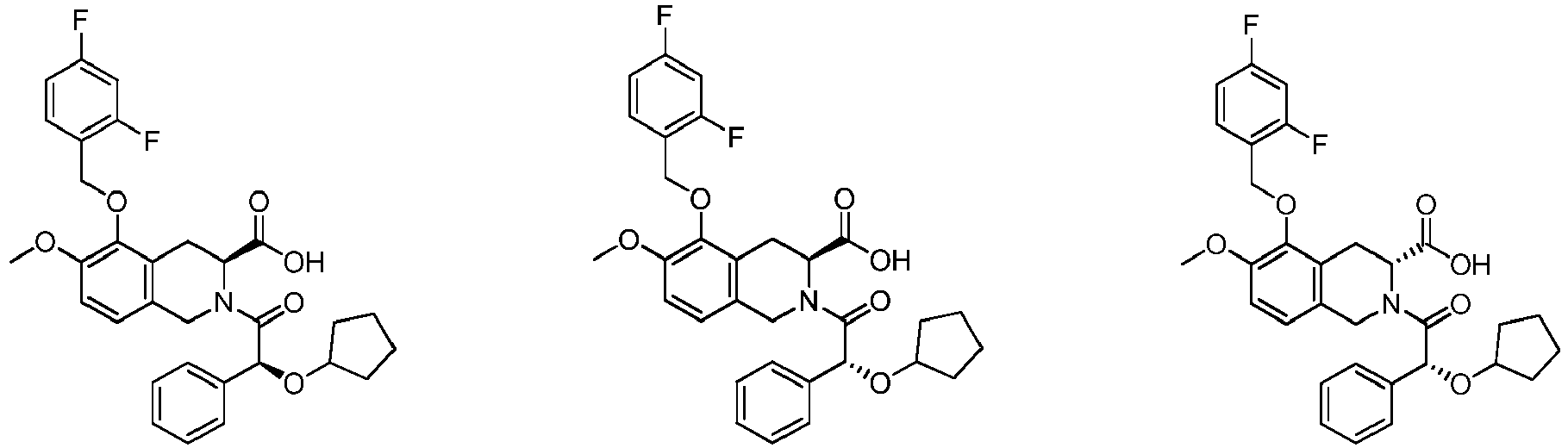

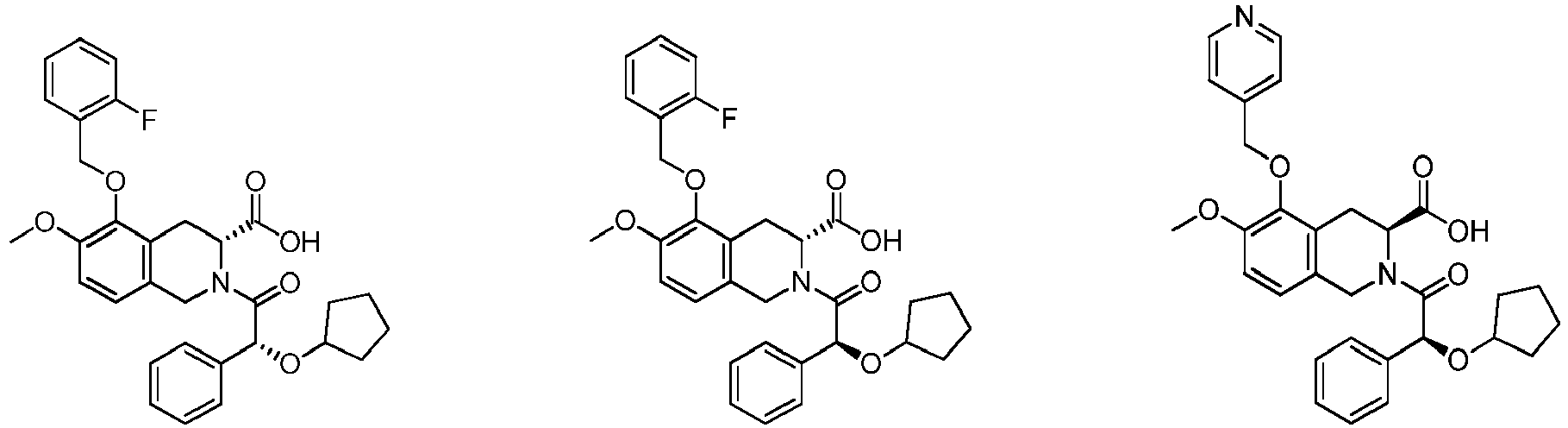


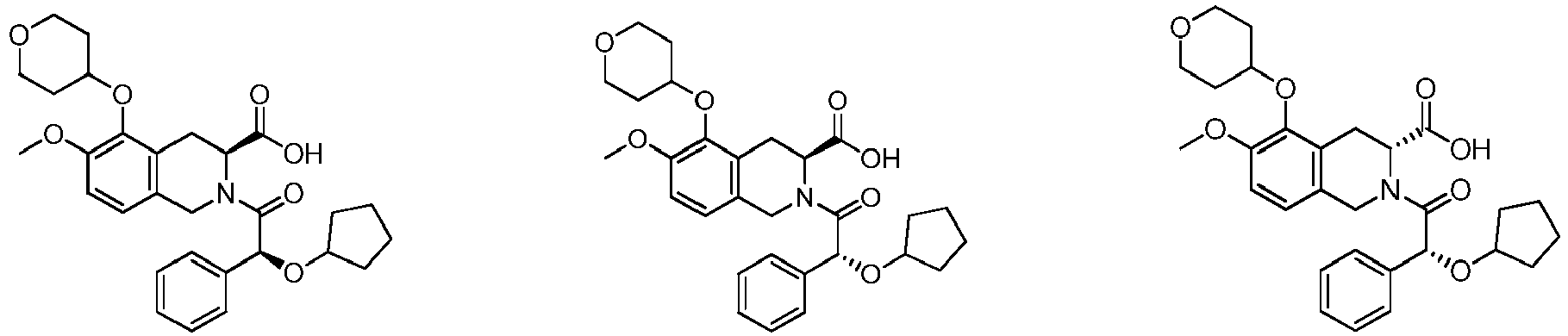









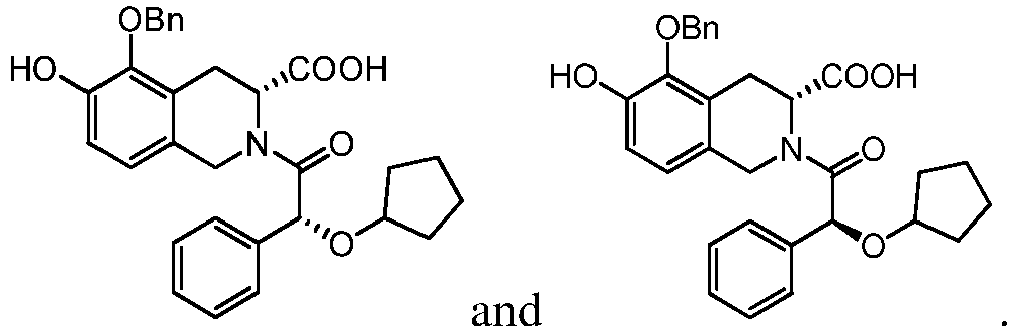
- The compound or the pharmaceutically acceptable salt thereof according to any one of claims 1-18 for use in the treatment of chronic pain.
Applications Claiming Priority (2)
| Application Number | Priority Date | Filing Date | Title |
|---|---|---|---|
| CN201710434262 | 2017-06-09 | ||
| PCT/CN2018/090432 WO2018224037A1 (en) | 2017-06-09 | 2018-06-08 | Carboxylic acid derivative as at2r receptor antagonist |
Publications (3)
| Publication Number | Publication Date |
|---|---|
| EP3620454A1 EP3620454A1 (en) | 2020-03-11 |
| EP3620454A4 EP3620454A4 (en) | 2020-04-08 |
| EP3620454B1 true EP3620454B1 (en) | 2021-05-05 |
Family
ID=64565746
Family Applications (1)
| Application Number | Title | Priority Date | Filing Date |
|---|---|---|---|
| EP18813230.2A Active EP3620454B1 (en) | 2017-06-09 | 2018-06-08 | Carboxylic acid derivative as at2r receptor antagonist |
Country Status (9)
| Country | Link |
|---|---|
| US (1) | US11021445B2 (en) |
| EP (1) | EP3620454B1 (en) |
| JP (1) | JP6873284B2 (en) |
| KR (1) | KR102132761B1 (en) |
| CN (1) | CN110914243B (en) |
| AU (1) | AU2018279669B8 (en) |
| ES (1) | ES2878313T3 (en) |
| PT (1) | PT3620454T (en) |
| WO (1) | WO2018224037A1 (en) |
Families Citing this family (2)
| Publication number | Priority date | Publication date | Assignee | Title |
|---|---|---|---|---|
| WO2020088677A1 (en) | 2018-11-02 | 2020-05-07 | 山东丹红制药有限公司 | Angiotensin ii receptor 2 antagonist salt form and crystalline form, and preparation method therefor |
| CN110950739B (en) * | 2019-11-22 | 2022-05-20 | 浙江工业大学 | Method for directly fluorinating ortho-position of phenol compound |
Family Cites Families (8)
| Publication number | Priority date | Publication date | Assignee | Title |
|---|---|---|---|---|
| US5246943A (en) | 1992-05-19 | 1993-09-21 | Warner-Lambert Company | Substituted 1,2,3,4-tetahydroisoquinolines with angiotensin II receptor antagonist properties |
| CL2004000366A1 (en) * | 2003-02-26 | 2005-01-07 | Pharmacia Corp Sa Organizada B | USE OF A COMBINATION OF A QUINASA P38 INHIBITING DERIVED COMPOUND OF PIRAZOL, AND AN ACE INHIBITOR TO TREAT RENAL DYSFUNCTION, CARDIOVASCULAR AND VASCULAR DISEASE, RETINOPATHY, NEUROPATIA, EDOTEL, INSOTUNATIO OPINION. |
| WO2006066361A1 (en) | 2004-12-24 | 2006-06-29 | The University Of Queensland | Method of treatment or prophylaxis |
| US8143259B2 (en) * | 2008-08-19 | 2012-03-27 | Janssen Pharmaceutica, Nv | Cold menthol receptor antagonists |
| ES2560327T3 (en) | 2010-01-19 | 2016-02-18 | Novartis Ag | Methods and compositions for improved nerve conduction velocity |
| AU2011281381B2 (en) * | 2010-07-21 | 2015-07-16 | Novartis Ag | Salt and solvates of a tetrahydroisoquinoline derivative |
| PL3019477T3 (en) | 2013-07-08 | 2021-11-22 | Novartis Ag | Heterocyclic compounds and methods of their use |
| CN106478502B (en) * | 2015-08-29 | 2021-04-27 | 上海翰森生物医药科技有限公司 | 1,2,3,4-Tetrahydroisoquinoline derivative, its preparation method and application |
-
2018
- 2018-06-08 WO PCT/CN2018/090432 patent/WO2018224037A1/en not_active Ceased
- 2018-06-08 ES ES18813230T patent/ES2878313T3/en active Active
- 2018-06-08 PT PT188132302T patent/PT3620454T/en unknown
- 2018-06-08 AU AU2018279669A patent/AU2018279669B8/en active Active
- 2018-06-08 CN CN201880029881.6A patent/CN110914243B/en active Active
- 2018-06-08 JP JP2019567596A patent/JP6873284B2/en active Active
- 2018-06-08 EP EP18813230.2A patent/EP3620454B1/en active Active
- 2018-06-08 KR KR1020207000587A patent/KR102132761B1/en active Active
-
2019
- 2019-12-02 US US16/700,978 patent/US11021445B2/en active Active
Also Published As
| Publication number | Publication date |
|---|---|
| CN110914243B (en) | 2023-02-28 |
| JP2020522542A (en) | 2020-07-30 |
| EP3620454A1 (en) | 2020-03-11 |
| US20200102275A1 (en) | 2020-04-02 |
| KR20200013052A (en) | 2020-02-05 |
| AU2018279669A8 (en) | 2020-10-15 |
| AU2018279669B8 (en) | 2020-10-15 |
| JP6873284B2 (en) | 2021-05-19 |
| AU2018279669B2 (en) | 2020-05-28 |
| AU2018279669A1 (en) | 2020-01-16 |
| PT3620454T (en) | 2021-09-10 |
| US11021445B2 (en) | 2021-06-01 |
| CN110914243A (en) | 2020-03-24 |
| EP3620454A4 (en) | 2020-04-08 |
| WO2018224037A1 (en) | 2018-12-13 |
| KR102132761B1 (en) | 2020-07-17 |
| ES2878313T3 (en) | 2021-11-18 |
Similar Documents
| Publication | Publication Date | Title |
|---|---|---|
| EP3481828B1 (en) | Spiro-fused cyclic ureas as inhibitors of rock | |
| JP7233523B2 (en) | Cyclopropylamine compound as LSD1 inhibitor and use thereof | |
| EP4289823A1 (en) | Substituted pyridazine phenol derivatives | |
| CN111344290A (en) | Macrocyclic compound as Wee1 inhibitor and application thereof | |
| BR112021015853A2 (en) | THIENO[3,2-B]PYRIDIN-7-AMINE COMPOUNDS FOR THE TREATMENT OF FAMILY DYSAUTONOMY | |
| EP3590929B1 (en) | Spiro compound and use thereof | |
| JP2016537369A (en) | Substituted 4,5,6,7-tetrahydropyrazolo [1,5-A] pyrazine derivatives as casein kinase 1D / E inhibitors | |
| CN114846009B (en) | Compounds with KHK inhibitory effect | |
| RS61913B1 (en) | Tri-cycle compound and applications thereof | |
| EP4074699A1 (en) | Compound as cyclin-dependent kinase 9 inhibitor and use thereof | |
| US11021445B2 (en) | Carboxylic acid derivative as AT2R receptor antagonist | |
| EP3719013B1 (en) | Pyrimidine sulfamide derivative and preparation method and medical application thereof | |
| EP4526303A1 (en) | N6-adenosine-methyltransferase protacs and methods of use thereof | |
| EP3255044B1 (en) | Diaza-benzofluoranthrene compounds | |
| EP3720855B1 (en) | Imidazopyridine derivatives and the use thereof as medicament | |
| HK40015419B (en) | Carboxylic acid derivative as at2r receptor antagonist | |
| EP3980401B1 (en) | Purine derivatives, as nr2b negative modulators and the use thereof as medicament, in particular for treating depressive disorders | |
| HK40015419A (en) | Carboxylic acid derivative as at2r receptor antagonist | |
| RU2783243C2 (en) | Macrocyclic compound with functions of wee1 inhibitor and its application options | |
| CN120424061A (en) | N-acylacridine compounds for inhibiting Nav1.8 | |
| CN121532384A (en) | Pyrimidine compounds and their use as USP1 inhibitors | |
| HK40033047B (en) | Imidazopyridine derivatives and the use thereof as medicament | |
| HK40033047A (en) | Imidazopyridine derivatives and the use thereof as medicament | |
| HK40022836A (en) | Macrocyclic compound as a wee1 inhibitor and applications thereof |
Legal Events
| Date | Code | Title | Description |
|---|---|---|---|
| STAA | Information on the status of an ep patent application or granted ep patent |
Free format text: STATUS: THE INTERNATIONAL PUBLICATION HAS BEEN MADE |
|
| PUAI | Public reference made under article 153(3) epc to a published international application that has entered the european phase |
Free format text: ORIGINAL CODE: 0009012 |
|
| STAA | Information on the status of an ep patent application or granted ep patent |
Free format text: STATUS: REQUEST FOR EXAMINATION WAS MADE |
|
| 17P | Request for examination filed |
Effective date: 20191205 |
|
| AK | Designated contracting states |
Kind code of ref document: A1 Designated state(s): AL AT BE BG CH CY CZ DE DK EE ES FI FR GB GR HR HU IE IS IT LI LT LU LV MC MK MT NL NO PL PT RO RS SE SI SK SM TR |
|
| AX | Request for extension of the european patent |
Extension state: BA ME |
|
| A4 | Supplementary search report drawn up and despatched |
Effective date: 20200306 |
|
| RIC1 | Information provided on ipc code assigned before grant |
Ipc: C07D 401/04 20060101ALI20200302BHEP Ipc: C07D 409/04 20060101ALI20200302BHEP Ipc: C07D 217/26 20060101AFI20200302BHEP Ipc: C07D 407/04 20060101ALI20200302BHEP Ipc: A61P 25/00 20060101ALI20200302BHEP Ipc: A61K 31/47 20060101ALI20200302BHEP Ipc: A61P 29/00 20060101ALI20200302BHEP Ipc: C07D 417/04 20060101ALI20200302BHEP |
|
| STAA | Information on the status of an ep patent application or granted ep patent |
Free format text: STATUS: EXAMINATION IS IN PROGRESS |
|
| DAV | Request for validation of the european patent (deleted) | ||
| DAX | Request for extension of the european patent (deleted) | ||
| 17Q | First examination report despatched |
Effective date: 20200825 |
|
| GRAP | Despatch of communication of intention to grant a patent |
Free format text: ORIGINAL CODE: EPIDOSNIGR1 |
|
| STAA | Information on the status of an ep patent application or granted ep patent |
Free format text: STATUS: GRANT OF PATENT IS INTENDED |
|
| INTG | Intention to grant announced |
Effective date: 20210129 |
|
| GRAS | Grant fee paid |
Free format text: ORIGINAL CODE: EPIDOSNIGR3 |
|
| GRAA | (expected) grant |
Free format text: ORIGINAL CODE: 0009210 |
|
| STAA | Information on the status of an ep patent application or granted ep patent |
Free format text: STATUS: THE PATENT HAS BEEN GRANTED |
|
| AK | Designated contracting states |
Kind code of ref document: B1 Designated state(s): AL AT BE BG CH CY CZ DE DK EE ES FI FR GB GR HR HU IE IS IT LI LT LU LV MC MK MT NL NO PL PT RO RS SE SI SK SM TR |
|
| REG | Reference to a national code |
Ref country code: GB Ref legal event code: FG4D |
|
| REG | Reference to a national code |
Ref country code: CH Ref legal event code: EP Ref country code: CH Ref legal event code: NV Representative=s name: NOVAGRAAF INTERNATIONAL SA, CH |
|
| REG | Reference to a national code |
Ref country code: AT Ref legal event code: REF Ref document number: 1389673 Country of ref document: AT Kind code of ref document: T Effective date: 20210515 |
|
| REG | Reference to a national code |
Ref country code: IE Ref legal event code: FG4D |
|
| REG | Reference to a national code |
Ref country code: DE Ref legal event code: R096 Ref document number: 602018016865 Country of ref document: DE |
|
| REG | Reference to a national code |
Ref country code: FI Ref legal event code: FGE |
|
| REG | Reference to a national code |
Ref country code: NO Ref legal event code: T2 Effective date: 20210505 |
|
| REG | Reference to a national code |
Ref country code: SE Ref legal event code: TRGR |
|
| REG | Reference to a national code |
Ref country code: LT Ref legal event code: MG9D |
|
| REG | Reference to a national code |
Ref country code: PT Ref legal event code: SC4A Ref document number: 3620454 Country of ref document: PT Date of ref document: 20210910 Kind code of ref document: T Free format text: AVAILABILITY OF NATIONAL TRANSLATION Effective date: 20210903 |
|
| REG | Reference to a national code |
Ref country code: AT Ref legal event code: MK05 Ref document number: 1389673 Country of ref document: AT Kind code of ref document: T Effective date: 20210505 |
|
| PG25 | Lapsed in a contracting state [announced via postgrant information from national office to epo] |
Ref country code: HR Free format text: LAPSE BECAUSE OF FAILURE TO SUBMIT A TRANSLATION OF THE DESCRIPTION OR TO PAY THE FEE WITHIN THE PRESCRIBED TIME-LIMIT Effective date: 20210505 Ref country code: LT Free format text: LAPSE BECAUSE OF FAILURE TO SUBMIT A TRANSLATION OF THE DESCRIPTION OR TO PAY THE FEE WITHIN THE PRESCRIBED TIME-LIMIT Effective date: 20210505 Ref country code: AT Free format text: LAPSE BECAUSE OF FAILURE TO SUBMIT A TRANSLATION OF THE DESCRIPTION OR TO PAY THE FEE WITHIN THE PRESCRIBED TIME-LIMIT Effective date: 20210505 Ref country code: BG Free format text: LAPSE BECAUSE OF FAILURE TO SUBMIT A TRANSLATION OF THE DESCRIPTION OR TO PAY THE FEE WITHIN THE PRESCRIBED TIME-LIMIT Effective date: 20210805 |
|
| REG | Reference to a national code |
Ref country code: ES Ref legal event code: FG2A Ref document number: 2878313 Country of ref document: ES Kind code of ref document: T3 Effective date: 20211118 |
|
| PG25 | Lapsed in a contracting state [announced via postgrant information from national office to epo] |
Ref country code: PL Free format text: LAPSE BECAUSE OF FAILURE TO SUBMIT A TRANSLATION OF THE DESCRIPTION OR TO PAY THE FEE WITHIN THE PRESCRIBED TIME-LIMIT Effective date: 20210505 Ref country code: LV Free format text: LAPSE BECAUSE OF FAILURE TO SUBMIT A TRANSLATION OF THE DESCRIPTION OR TO PAY THE FEE WITHIN THE PRESCRIBED TIME-LIMIT Effective date: 20210505 Ref country code: RS Free format text: LAPSE BECAUSE OF FAILURE TO SUBMIT A TRANSLATION OF THE DESCRIPTION OR TO PAY THE FEE WITHIN THE PRESCRIBED TIME-LIMIT Effective date: 20210505 Ref country code: IS Free format text: LAPSE BECAUSE OF FAILURE TO SUBMIT A TRANSLATION OF THE DESCRIPTION OR TO PAY THE FEE WITHIN THE PRESCRIBED TIME-LIMIT Effective date: 20210905 Ref country code: GR Free format text: LAPSE BECAUSE OF FAILURE TO SUBMIT A TRANSLATION OF THE DESCRIPTION OR TO PAY THE FEE WITHIN THE PRESCRIBED TIME-LIMIT Effective date: 20210806 |
|
| REG | Reference to a national code |
Ref country code: NL Ref legal event code: MP Effective date: 20210505 |
|
| PG25 | Lapsed in a contracting state [announced via postgrant information from national office to epo] |
Ref country code: NL Free format text: LAPSE BECAUSE OF FAILURE TO SUBMIT A TRANSLATION OF THE DESCRIPTION OR TO PAY THE FEE WITHIN THE PRESCRIBED TIME-LIMIT Effective date: 20210505 |
|
| PG25 | Lapsed in a contracting state [announced via postgrant information from national office to epo] |
Ref country code: RO Free format text: LAPSE BECAUSE OF FAILURE TO SUBMIT A TRANSLATION OF THE DESCRIPTION OR TO PAY THE FEE WITHIN THE PRESCRIBED TIME-LIMIT Effective date: 20210505 Ref country code: SM Free format text: LAPSE BECAUSE OF FAILURE TO SUBMIT A TRANSLATION OF THE DESCRIPTION OR TO PAY THE FEE WITHIN THE PRESCRIBED TIME-LIMIT Effective date: 20210505 Ref country code: CZ Free format text: LAPSE BECAUSE OF FAILURE TO SUBMIT A TRANSLATION OF THE DESCRIPTION OR TO PAY THE FEE WITHIN THE PRESCRIBED TIME-LIMIT Effective date: 20210505 Ref country code: DK Free format text: LAPSE BECAUSE OF FAILURE TO SUBMIT A TRANSLATION OF THE DESCRIPTION OR TO PAY THE FEE WITHIN THE PRESCRIBED TIME-LIMIT Effective date: 20210505 Ref country code: SK Free format text: LAPSE BECAUSE OF FAILURE TO SUBMIT A TRANSLATION OF THE DESCRIPTION OR TO PAY THE FEE WITHIN THE PRESCRIBED TIME-LIMIT Effective date: 20210505 Ref country code: EE Free format text: LAPSE BECAUSE OF FAILURE TO SUBMIT A TRANSLATION OF THE DESCRIPTION OR TO PAY THE FEE WITHIN THE PRESCRIBED TIME-LIMIT Effective date: 20210505 |
|
| REG | Reference to a national code |
Ref country code: DE Ref legal event code: R097 Ref document number: 602018016865 Country of ref document: DE |
|
| PLBE | No opposition filed within time limit |
Free format text: ORIGINAL CODE: 0009261 |
|
| STAA | Information on the status of an ep patent application or granted ep patent |
Free format text: STATUS: NO OPPOSITION FILED WITHIN TIME LIMIT |
|
| 26N | No opposition filed |
Effective date: 20220208 |
|
| PG25 | Lapsed in a contracting state [announced via postgrant information from national office to epo] |
Ref country code: IS Free format text: LAPSE BECAUSE OF FAILURE TO SUBMIT A TRANSLATION OF THE DESCRIPTION OR TO PAY THE FEE WITHIN THE PRESCRIBED TIME-LIMIT Effective date: 20210905 Ref country code: AL Free format text: LAPSE BECAUSE OF FAILURE TO SUBMIT A TRANSLATION OF THE DESCRIPTION OR TO PAY THE FEE WITHIN THE PRESCRIBED TIME-LIMIT Effective date: 20210505 |
|
| PG25 | Lapsed in a contracting state [announced via postgrant information from national office to epo] |
Ref country code: CY Free format text: LAPSE BECAUSE OF FAILURE TO SUBMIT A TRANSLATION OF THE DESCRIPTION OR TO PAY THE FEE WITHIN THE PRESCRIBED TIME-LIMIT Effective date: 20210505 |
|
| PG25 | Lapsed in a contracting state [announced via postgrant information from national office to epo] |
Ref country code: HU Free format text: LAPSE BECAUSE OF FAILURE TO SUBMIT A TRANSLATION OF THE DESCRIPTION OR TO PAY THE FEE WITHIN THE PRESCRIBED TIME-LIMIT; INVALID AB INITIO Effective date: 20180608 |
|
| PG25 | Lapsed in a contracting state [announced via postgrant information from national office to epo] |
Ref country code: MK Free format text: LAPSE BECAUSE OF FAILURE TO SUBMIT A TRANSLATION OF THE DESCRIPTION OR TO PAY THE FEE WITHIN THE PRESCRIBED TIME-LIMIT Effective date: 20210505 |
|
| PGFP | Annual fee paid to national office [announced via postgrant information from national office to epo] |
Ref country code: LU Payment date: 20240524 Year of fee payment: 7 |
|
| PGFP | Annual fee paid to national office [announced via postgrant information from national office to epo] |
Ref country code: IE Payment date: 20240517 Year of fee payment: 7 |
|
| PGFP | Annual fee paid to national office [announced via postgrant information from national office to epo] |
Ref country code: MC Payment date: 20240522 Year of fee payment: 7 |
|
| PGFP | Annual fee paid to national office [announced via postgrant information from national office to epo] |
Ref country code: NO Payment date: 20240523 Year of fee payment: 7 Ref country code: FI Payment date: 20240521 Year of fee payment: 7 |
|
| PGFP | Annual fee paid to national office [announced via postgrant information from national office to epo] |
Ref country code: PT Payment date: 20240517 Year of fee payment: 7 |
|
| PG25 | Lapsed in a contracting state [announced via postgrant information from national office to epo] |
Ref country code: MT Free format text: LAPSE BECAUSE OF FAILURE TO SUBMIT A TRANSLATION OF THE DESCRIPTION OR TO PAY THE FEE WITHIN THE PRESCRIBED TIME-LIMIT Effective date: 20210505 |
|
| PGFP | Annual fee paid to national office [announced via postgrant information from national office to epo] |
Ref country code: DE Payment date: 20250618 Year of fee payment: 8 |
|
| PGFP | Annual fee paid to national office [announced via postgrant information from national office to epo] |
Ref country code: GB Payment date: 20250618 Year of fee payment: 8 |
|
| PGFP | Annual fee paid to national office [announced via postgrant information from national office to epo] |
Ref country code: BE Payment date: 20250618 Year of fee payment: 8 |
|
| PGFP | Annual fee paid to national office [announced via postgrant information from national office to epo] |
Ref country code: FR Payment date: 20250626 Year of fee payment: 8 |
|
| PGFP | Annual fee paid to national office [announced via postgrant information from national office to epo] |
Ref country code: SE Payment date: 20250618 Year of fee payment: 8 |
|
| PGFP | Annual fee paid to national office [announced via postgrant information from national office to epo] |
Ref country code: ES Payment date: 20250728 Year of fee payment: 8 |
|
| PGFP | Annual fee paid to national office [announced via postgrant information from national office to epo] |
Ref country code: IT Payment date: 20250624 Year of fee payment: 8 |
|
| PGFP | Annual fee paid to national office [announced via postgrant information from national office to epo] |
Ref country code: CH Payment date: 20250701 Year of fee payment: 8 |
|
| PG25 | Lapsed in a contracting state [announced via postgrant information from national office to epo] |
Ref country code: TR Free format text: LAPSE BECAUSE OF FAILURE TO SUBMIT A TRANSLATION OF THE DESCRIPTION OR TO PAY THE FEE WITHIN THE PRESCRIBED TIME-LIMIT Effective date: 20210505 |
|
| PG25 | Lapsed in a contracting state [announced via postgrant information from national office to epo] |
Ref country code: PT Free format text: LAPSE BECAUSE OF NON-PAYMENT OF DUE FEES Effective date: 20251209 |
|
| PG25 | Lapsed in a contracting state [announced via postgrant information from national office to epo] |
Ref country code: FI Free format text: LAPSE BECAUSE OF NON-PAYMENT OF DUE FEES Effective date: 20250608 |
|
| PG25 | Lapsed in a contracting state [announced via postgrant information from national office to epo] |
Ref country code: MC Free format text: LAPSE BECAUSE OF NON-PAYMENT OF DUE FEES Effective date: 20250630 |
|
| PG25 | Lapsed in a contracting state [announced via postgrant information from national office to epo] |
Ref country code: LU Free format text: LAPSE BECAUSE OF NON-PAYMENT OF DUE FEES Effective date: 20250608 |
|
| PG25 | Lapsed in a contracting state [announced via postgrant information from national office to epo] |
Ref country code: IE Free format text: LAPSE BECAUSE OF NON-PAYMENT OF DUE FEES Effective date: 20250608 Ref country code: NO Free format text: LAPSE BECAUSE OF NON-PAYMENT OF DUE FEES Effective date: 20250630 |