EP3618166A1 - Lithium ion battery non-aqueous electrolyte and lithium ion battery - Google Patents
Lithium ion battery non-aqueous electrolyte and lithium ion battery Download PDFInfo
- Publication number
- EP3618166A1 EP3618166A1 EP17907767.2A EP17907767A EP3618166A1 EP 3618166 A1 EP3618166 A1 EP 3618166A1 EP 17907767 A EP17907767 A EP 17907767A EP 3618166 A1 EP3618166 A1 EP 3618166A1
- Authority
- EP
- European Patent Office
- Prior art keywords
- lithium ion
- aqueous electrolyte
- ion battery
- compound
- electrolyte
- Prior art date
- Legal status (The legal status is an assumption and is not a legal conclusion. Google has not performed a legal analysis and makes no representation as to the accuracy of the status listed.)
- Granted
Links
Classifications
-
- H—ELECTRICITY
- H01—ELECTRIC ELEMENTS
- H01M—PROCESSES OR MEANS, e.g. BATTERIES, FOR THE DIRECT CONVERSION OF CHEMICAL ENERGY INTO ELECTRICAL ENERGY
- H01M10/00—Secondary cells; Manufacture thereof
- H01M10/05—Accumulators with non-aqueous electrolyte
- H01M10/052—Li-accumulators
-
- H—ELECTRICITY
- H01—ELECTRIC ELEMENTS
- H01M—PROCESSES OR MEANS, e.g. BATTERIES, FOR THE DIRECT CONVERSION OF CHEMICAL ENERGY INTO ELECTRICAL ENERGY
- H01M10/00—Secondary cells; Manufacture thereof
- H01M10/05—Accumulators with non-aqueous electrolyte
- H01M10/056—Accumulators with non-aqueous electrolyte characterised by the materials used as electrolytes, e.g. mixed inorganic/organic electrolytes
- H01M10/0564—Accumulators with non-aqueous electrolyte characterised by the materials used as electrolytes, e.g. mixed inorganic/organic electrolytes the electrolyte being constituted of organic materials only
- H01M10/0566—Liquid materials
- H01M10/0567—Liquid materials characterised by the additives
-
- H—ELECTRICITY
- H01—ELECTRIC ELEMENTS
- H01M—PROCESSES OR MEANS, e.g. BATTERIES, FOR THE DIRECT CONVERSION OF CHEMICAL ENERGY INTO ELECTRICAL ENERGY
- H01M10/00—Secondary cells; Manufacture thereof
- H01M10/05—Accumulators with non-aqueous electrolyte
- H01M10/052—Li-accumulators
- H01M10/0525—Rocking-chair batteries, i.e. batteries with lithium insertion or intercalation in both electrodes; Lithium-ion batteries
-
- H—ELECTRICITY
- H01—ELECTRIC ELEMENTS
- H01M—PROCESSES OR MEANS, e.g. BATTERIES, FOR THE DIRECT CONVERSION OF CHEMICAL ENERGY INTO ELECTRICAL ENERGY
- H01M4/00—Electrodes
- H01M4/02—Electrodes composed of, or comprising, active material
- H01M4/36—Selection of substances as active materials, active masses, active liquids
- H01M4/48—Selection of substances as active materials, active masses, active liquids of inorganic oxides or hydroxides
- H01M4/52—Selection of substances as active materials, active masses, active liquids of inorganic oxides or hydroxides of nickel, cobalt or iron
- H01M4/525—Selection of substances as active materials, active masses, active liquids of inorganic oxides or hydroxides of nickel, cobalt or iron of mixed oxides or hydroxides containing iron, cobalt or nickel for inserting or intercalating light metals, e.g. LiNiO2, LiCoO2 or LiCoOxFy
-
- H—ELECTRICITY
- H01—ELECTRIC ELEMENTS
- H01M—PROCESSES OR MEANS, e.g. BATTERIES, FOR THE DIRECT CONVERSION OF CHEMICAL ENERGY INTO ELECTRICAL ENERGY
- H01M4/00—Electrodes
- H01M4/02—Electrodes composed of, or comprising, active material
- H01M2004/026—Electrodes composed of, or comprising, active material characterised by the polarity
- H01M2004/028—Positive electrodes
-
- H—ELECTRICITY
- H01—ELECTRIC ELEMENTS
- H01M—PROCESSES OR MEANS, e.g. BATTERIES, FOR THE DIRECT CONVERSION OF CHEMICAL ENERGY INTO ELECTRICAL ENERGY
- H01M2300/00—Electrolytes
- H01M2300/0017—Non-aqueous electrolytes
- H01M2300/0025—Organic electrolyte
-
- Y—GENERAL TAGGING OF NEW TECHNOLOGICAL DEVELOPMENTS; GENERAL TAGGING OF CROSS-SECTIONAL TECHNOLOGIES SPANNING OVER SEVERAL SECTIONS OF THE IPC; TECHNICAL SUBJECTS COVERED BY FORMER USPC CROSS-REFERENCE ART COLLECTIONS [XRACs] AND DIGESTS
- Y02—TECHNOLOGIES OR APPLICATIONS FOR MITIGATION OR ADAPTATION AGAINST CLIMATE CHANGE
- Y02E—REDUCTION OF GREENHOUSE GAS [GHG] EMISSIONS, RELATED TO ENERGY GENERATION, TRANSMISSION OR DISTRIBUTION
- Y02E60/00—Enabling technologies; Technologies with a potential or indirect contribution to GHG emissions mitigation
- Y02E60/10—Energy storage using batteries
Definitions
- the invention relates to the field of lithium ion batteries, more particularly, to a non-aqueous electrolyte for lithium ion battery and lithium ion battery.
- Lithium-ion batteries have been widely used in the fields of digital products such as mobile phones and notebook computers because of their advantages of light weight, small volume, high working voltage, high energy density, high output power, high charging efficiency, no memory effect and long cycle life, etc. They are also considered as one of the best choices for electric vehicles and large energy storage devices. With the rapid development of electronic and digital products such as smart phones and tablet computers, the requirements for energy density of batteries are increasing, making the existing commercial lithium ion batteries difficult to meet the use requirements. Using high voltage anode materials is the most effective way to improve the energy density of lithium ion batteries.
- Electrolyte is the key factor that affects the comprehensive performance of battery, especially, additives in electrolyte are particularly important for the performances of battery. Therefore, to give full play to the performance of lithium ion batteries, such as lithium cobalt oxide batteries, the selection of electrolyte is the key.
- practical lithium ion batteries can ensure excellent cycle performance by adding traditional film-forming additives such as vinylene carbonate (VC) or fluoroethylene carbonate (FEC) into non-aqueous electrolyte.
- VC vinylene carbonate
- FEC fluoroethylene carbonate
- VC has poor high voltage stability and can easily decompose and generate gas with FEC under high temperature. Therefore, under high voltage and high temperature, these additives are difficult to meet the performance requirements of lithium ion battery cycle.
- a patent discloses an electrolyte for lithium ion batteries, which contains a cyano-containing compound additive, and the cyano-containing additive can improve the storage performance of lithium ion batteries under high voltage of 4.2V-4.5V.
- the cyano-containing additive has an obvious complexing effect on Co ions in high oxidation state, thus inhibiting the continuous decomposition of electrolyte under high voltage and the dissolution of positive electrode Co ions.
- the cyano-containing additive could cause certain deterioration to graphite negative electrode, and the use of the cyano-containing additive alone has the problem of insufficient cycle performance.
- the combination of the traditional negative film-forming additive vinylene carbonate or fluoroethylene carbonate with the cyano-containing additive does not significantly improve the performances and still has the problem of insufficient cycle performance and high-temperature storage performance.
- the present application provides a non-aqueous electrolyte for lithium ion battery with both better cycle performance and high-temperature storage performance, and aims to solve the problem of insufficient cycle performance and high-temperature storage performance of the existing lithium ion battery electrolyte at high pressure.
- a nother object of the disclosure is to provide a lithium ion battery.
- the non-aqueous electrolyte for lithium ion battery provided by the present application, comprises a cyano-containing compound A and a compound B represented by formula I,
- R 1 , R 2 , R 3 , R 4 , R 5 and R 6 are each independently selected from one of hydrogen atom, halogen atom and C1-C5 group.
- the cyano-containing compound A comprises at least one of the compounds represented by the following formulae II, III, IV and V, Formula II ⁇ NC-R 7 -CN ⁇ Formula IV ⁇ R 11 -O-R 12 -CN ⁇
- R 7 is a C1-C8 alkylene, cyano-substituted C1-C8 alkylene, C2-C8 alkenylene, cyano-substituted C2-C8 alkenylene;
- R 8 , R 9 and R 10 are each independently selected from a C1-C5 alkylene and C2-C5 alkenylene, and m is an integer of 1-5;
- R 11 is a C2-C5 unsaturated hydrocarbon group, and R 12 is a C1-C5 alkylene;
- R 13 , R 14 and R 15 are each independently selected from a C1-C5 alkylene and C2-C5 alkenylene.
- the C1-C5 group is selected from a C1-C5 hydrocarbon group, halogenated hydrocarbon group, oxygen-containing hydrocarbon group, silicon-containing hydrocarbon group, and cyano-substituted hydrocarbon group.
- R 1 , R 2 , R 3 , R 4 , R 5 and R 6 are each independently selected from a hydrogen atom, fluorine atom, C1-C5 methyl group, C1-C5 ethyl group, C1-C5 methoxyl group, C1-C5 ethyoxyl group, C1-C5 trimethylsiloxy group, C1-C5 cyano group or C1-C5 trifluoromethyl group.
- the compound B comprises one or more of compounds 1-9 represented by the following structural formulae,
- the percentage mass content of the compound B is 0.1-5% based on the total mass of the non-aqueous electrolyte for lithium ion battery being 100%.
- the cyano-containing compound A comprises one or more of compounds 10-19 represented by the following structural formulae,
- the percentage mass content of the cyano-contai ni ng compound A is 0.1-5% based on the total mass of the non-aqueous electrolyte for lithium ion battery being 100%.
- the lithium ion non-aqueous electrolyte further comprises at least one of unsaturated cyclic carbonate compounds, fluorine-substituted cyclic carbonate compounds, and sultone compounds.
- the unsaturated cyclic carbonate compound includes at least one of vinylene carbonate (VC) and vinyl ethylene carbonate (VEC).
- the fluorine-substituted cyclic carbonate compound includes fluoroethylene carbonate (FEC).
- the sultone compound is selected from at least one of 1,3- propane sultone (1,3-PS), 1,4- butane sultone (1,4-BS), and 1,3-propene sultone (PST).
- the non-aqueous electrolyte for lithium ion battery comprises a non-aqueous organic solvent
- the non-aqueous organic solvent is at least one of vinyl carbonate, propylene carbonate, butylene carbonate, dimethyl carbonate, diethyl carbonate, methyl ethyl carbonate and methyl propyl carbonate.
- the lithium salt is selected from one or more of LiPF 6 , LiBF 4 , LiBOB, LiDFOB, LiN(SO 2 CF 3 ) 2 , LiN(SO 2 C 2 F 5 ) 2 , LiC(SO 2 CF 3 ) 3 and LiN(SO 2 F) 2 .
- the lithium salt content in the non-aqueous electrolyte for lithium ion battery is 0.1-15%.
- a lithium ion battery comprises a positive electrode, a negative electrode, a separator interposed between the positive electrode and the negative electrode, and an electrolyte, wherein the electrolyte is the non-aqueous electrolyte for lithium ion battery.
- the non-aqueous electrolyte for lithium ion battery contains both the cyano-containing compound A and the compound B, which can effectively improve the cycle performance and high-temperature storage performance of the battery at high pressure, so that the lithium ion battery containing the non-aqueous electrolyte has better cycle performance and high-temperature storage performance.
- the lithium ion battery provided by the application contains the above-mentioned non-aqueous electrolyte, which enables the lithium ion battery to have both better cycle performance and high-temperature storage performance.
- the non-aqueous electrolyte for lithium ion battery provided by the present application, comprises a cyano-containing compound A and a compound B represented by formula
- R 1 , R 2 , R 3 , R 4 , R 5 and R 6 are each independently selected from one of hydrogen atom, halogen atom and C1-C5 group.
- the cyano-containing compound A comprises at least one of the compounds represented by the following formulae II, III, IV and V, Formula II ⁇ NC-R 7 -CN ⁇ Formula IV ⁇ R 11 -O-R 12 -CN ⁇
- R 7 is a C1-C8 alkylene, cyano-substituted C1-C8 alkylene, C2-C8 alkenylene, cyano-substituted C2-C8 alkenylene;
- R 8 , R 9 and R 10 are each independently selected from a C1-C5 alkylene and C2-C5 alkenylene, and m is an integer of 1-5;
- R 11 is a C2-C5 unsaturated hydrocarbon group, and R 12 is a C1-C5 alkylene;
- R 13 , R 14 and R 15 are each independently selected from a C1-C5 alkylene and C2-C5 alkenylene.
- C1-C8 refers to the number of carbon atoms being 1-8, similarly, C2-C8 refers to the number of carbon atoms being 2-8, C1-C5 refers to the number of carbon atoms being 1-5, similarly, C2-C5 refers to the number of carbon atoms being 2-5.
- the non-aqueous electrolyte for lithium ion battery provided by the embodiment of the invention comprises at least one cyano-containing compound A represented by formulae II, III, IV and V.
- the cyano-containing compound A comprises one or more of compounds 10-19 represented by the following structural formulae,
- the percentage mass content of the cyano-containing compound A is 0.1-5% based on the total mass of the non-aqueous electrolyte for lithium ion battery being 100%. It is further preferred that the percentage mass content of the cyano-contai ni ng compound A is 0.1-3% based on the total mass of the non-aqueous electrolyte for lithium ion battery being 100%.
- the content is the content of the one substance; If the non-aqueous electrolyte for lithium ion battery contains a plurality of the above substances, the content is the sum of the contents of the plurality of substances.
- the non-aqueous electrolyte for lithium ion battery contains at least one cyano-containing compound A represented by formula II, III, IV and V, the cyano-containing compound A has an obvious positive complexing effect, which can effectively inhibit the structure of the positive electrode material from being damaged, and also inhibits the cartalytic decomposition effect of metal ions on electrolyte and the damage to the negative passivation film.
- the cyano-containing compound A has a negative effect on negative electrode film formation, resulting in deterioration of cycle performance.
- the compound B represented by formula I was added to the non-aqueous electrolyte of the lithium ion battery on the basis of the cyano-containing compound A.
- the compound B represented by formula I was added on the basis of at least one cyano-containing compound A represented by formula II, III, IV and V, wherein, the cyano-containing compound A can be complexed with metal ions dissolved from the positive electrode material, which can effectively inhibit the structure of the positive electrode material from being damaged, and also inhibits the cartalytic decomposition effect of metal ions on electrolyte and the damage to the negative passivation film.
- the side reaction between the positive electrode material and the electrolyte under high voltage can be effectively reduced, thus improving the storage performance of the lithium ion battery under high voltage.
- the cyano-contai ni ng compound A has a deterioration effect on the negative electrode, which easily leads to rapid capacity attenuation of the battery in later period.
- the compound B represented by formula I has a good effect of film forming on negative electrode and has little influence on the film impedance, thus improving the stability of the negative electrode in the cycle process and improving the cycle performance.
- the compound B was added on the basis of the cyano-containing compound A, the two are used together, so that an effective passivation film can be formed on the negative electrode while complexing protection is assured on the positive electrode of the battery, and side reactions of the electrolyte between the positive electrode and the negative electrode are reduced, so that the cycle performance of the battery can be effectively improved, and meanwhile, the high-temperature storage performance can be enhanced.
- the C1-C5 group includes a C1-C5 hydrocarbon group, halogenated hydrocarbon group, oxygen-containing hydrocarbon group, silicon-containing hydrocarbon group, and cyano-substituted hydrocarbon group.
- R 1 , R 2 , R 3 , R 4 , R 5 and R 6 are each independently selected from a hydrogen atom, fluorine atom, C1-C5 methyl group, C1-C5 ethyl group, C1-C5 methoxyl group, C1-C5 ethyoxyl group, C1-C5 trimethylsiloxy group, C1-C5 cyano group or C1-C5 trifluoromethyl group.
- the compound B comprises one or more of compounds 1-9 represented by the following structural formulae,
- the preferred specific compound above can be better compounded with the cyano-containing compound A to improve the cycle performance and high-temperature storage performance of the lithium ion battery.
- the synthesis method of the compound B represented by formula I is conventional, for example, the compound B can be prepared by ester exchange reaction between polyol (such as erythritol, xylitol, etc.) and carbonate (such as dimethyl carbonate, diethyl carbonate, vinyl carbonate, etc.) in the presence of basic catalyst.
- polyol such as erythritol, xylitol, etc.
- carbonate such as dimethyl carbonate, diethyl carbonate, vinyl carbonate, etc.
- the fluorine-containing compound in compound B is prepared by: fluorinating the corresponding carbonate and mixture F 2 /N 2 , and then recrystallizing or purifying by column chromatography.
- a n example of the synthetic route is as follows:
- the cyano group-containing compound in compound B is prepared by: the chlorination reaction of the corresponding carbonate and sulfonyl chloride, then reacting with NaCN or KCN, and then recrystallizing or purifying by column chromatography.
- An example of the synthetic route is as follows:
- the trimethylsilanolate-containing compound in the compound B is prepared by: the substitution reaction of the corresponding hydroxy carbonate and silazane, then ecrystallizing or purifying by column chromatography.
- An example of the synthetic route is as follows:
- the percentage mass content of the compound B is 0.1-5% based on the total mass of the non-aqueous electrolyte for lithium ion battery being 100%.
- the content of the compound B is less than 0.1%, it is not conducive to forming a passivation film on the negative electrode, and the improvement effect on the cycle performance of the lithium ion battery is reduced;
- the content of the compound B is more than 5%, the film formation on the negative electrode surface of the lithium ion battery is thicker, which will increase the battery impedance.
- the percentage mass content of the compound B is 0.1-2% based on the total mass of the non-aqueous electrolyte for lithium ion battery being 100%.
- the content is the content of the one substance; If the non-aqueous electrolyte for lithium ion battery contains a plurality of the above substances, the content is the sum of the contents of the plurality of substances.
- the lithium ion non-aqueous electrolyte further comprises at least one of unsaturated cyclic carbonate compounds, fluorine-substituted cyclic carbonate compounds, and sultone compounds.
- the unsaturated cyclic carbonate compound includes at least one of vinylene carbonate (VC) and vinyl ethylene carbonate (VEC).
- the fluorine-substituted cyclic carbonate compound includes fluoroethylene carbonate (FEC).
- the sultone compound is selected from at least one of 1,3- propane sultone (1,3-PS), 1,4- butane sultone (1,4-BS), and 1,3-propene sultone (PST).
- the lithium ion non-aqueous electrolyte may further include at least one of fluorine-substituted cyclic carbonate compounds and/or sultone compounds on the basis of at least one of unsaturated cyclic carbonate compounds.
- the content of unsaturated cyclic carbonate compound is 0.1-5% based on the total mass of the non-aqueous electrolyte for lithium ion battery being 100%.
- the content of fluorine-substituted cyclic carbonate compound is 0.1-30% based on the total mass of the non-aqueous electrolyte for lithium ion battery being 100%.
- the percentage mass content of sultone compound is 0.1-5% based on the total mass of the non-aqueous electrolyte for lithium ion battery being 100%.
- the non-aqueous electrolyte for lithium ion battery comprises a non-aqueous organic solvent
- the non-aqueous organic solvent is at least one of vinyl carbonate, propylene carbonate, butyl ene carbonate, dimethyl carbonate, diethyl carbonate, methyl ethyl carbonate and methyl propyl carbonate.
- the non-aqueous organic solvent is a composition of vinyl carbonate, diethyl carbonate and methyl ethyl carbonate.
- the lithium salt is selected from one or more of LiPF 6 , LiBF 4 , LiBOB, LiDFOB, LiN(SO 2 CF 3 ) 2 , LiN(SO 2 C 2 F 5 ) 2 , LiC(SO 2 CF 3 ) 3 and LiN(SO 2 F) 2 .
- the lithium salt content in the non-aqueous electrolyte for lithium ion battery is 0.1-15%.
- the main components in the non-aqueous electrolyte for lithium ion battery are non-aqueous organic solvents, lithium salts and additives.
- compound A and compound B are additives.
- the content of non-aqueous organic solvent and lithium salt is conventional, and it can be adjusted accordingly after the content of the additive including compound A and compound B is determined, which is not repeated in the present application.
- the non-aqueous electrolyte for lithium ion battery provided by the embodiment contains both the cyano-containing compound A and the compound B, which can effectively improve the cycle performance and high-temperature storage performance of the battery at high pressure, so that the lithium ion battery containing the non-aqueous electrolyte has better cycle performance and high-temperature storage performance.
- the embodiment of the invention also provides a lithium ion battery, comprising a positive electrode, a negative electrode, a separator interposed between the positive electrode and the negative electrode, and an electrolyte, wherein the electrolyte is the non-aqueous electrolyte for lithium ion battery.
- the positive electrode comprises a positive electrode active material
- the negative electrode and the separator are not specifically limited, they can be the conventional ones in the art.
- the lithium ion battery provided by the application contains the above-mentioned non-aqueous electrolyte, which enables the lithium ion battery to have both better cycle performance and high-temperature storage performance.
- a LiCoO 2 / artificial graphite battery comprises a positive electrode, a negative electrode, a separator interposed between the positive electrode and the negative electrode, and an electrolyte, wherein the electrolyte is a non-aqueous electrolyte and comprises the following components in percentage by mass as shown in Table 1 of Embodiment 1, based on the total weight of the non-aqueous electrolyte taken as 100% by weight.
- a LiCoO 2 / artificial graphite battery comprises a positive electrode, a negative electrode, a separator interposed between the positive electrode and the negative electrode, and an electrolyte, wherein the electrolyte is a non-aqueous electrolyte and comprises the following components in percentage by mass as shown in Table 1 of Embodiment 2, based on the total weight of the non-aqueous electrolyte taken as 100% by weight.
- a LiCoO 2 / artificial graphite battery comprises a positive electrode, a negative electrode, a separator interposed between the positive electrode and the negative electrode, and an electrolyte, wherein the electrolyte is a non-aqueous electrolyte and comprises the following components in percentage by mass as shown in Table 1 of Embodiment 3, based on the total weight of the non-aqueous electrolyte taken as 100% by weight.
- a LiCoO 2 / artificial graphite battery comprises a positive electrode, a negative electrode, a separator interposed between the positive electrode and the negative electrode, and an electrolyte, wherein the electrolyte is a non-aqueous electrolyte and comprises the following components in percentage by mass as shown in Table 1 of Embodiment 4, based on the total weight of the non-aqueous electrolyte taken as 100% by weight.
- a LiCoO 2 / artificial graphite battery comprises a positive electrode, a negative electrode, a separator interposed between the positive electrode and the negative electrode, and an electrolyte, wherein the electrolyte is a non-aqueous electrolyte and comprises the following components in percentage by mass as shown in Table 1 of Embodiment 5, based on the total weight of the non-aqueous electrolyte taken as 100% by weight.
- a LiCoO 2 / artificial graphite battery comprises a positive electrode, a negative electrode, a separator interposed between the positive electrode and the negative electrode, and an electrolyte, wherein the electrolyte is a non-aqueous electrolyte and comprises the following components in percentage by mass as shown in Table 1 of Embodiment 6, based on the total weight of the non-aqueous electrolyte taken as 100% by weight.
- a LiCoO 2 / artificial graphite battery comprises a positive electrode, a negative electrode, a separator interposed between the positive electrode and the negative electrode, and an electrolyte, wherein the electrolyte is a non-aqueous electrolyte and comprises the following components in percentage by mass as shown in Table 1 of Embodiment 7, based on the total weight of the non-aqueous electrolyte taken as 100% by weight.
- a LiCoO 2 / artificial graphite battery comprises a positive electrode, a negative electrode, a separator interposed between the positive electrode and the negative electrode, and an electrolyte, wherein the electrolyte is a non-aqueous electrolyte and comprises the following components in percentage by mass as shown in Table 1 of Embodiment 8, based on the total weight of the non-aqueous electrolyte taken as 100% by weight.
- a LiCoO 2 / artificial graphite battery comprises a positive electrode, a negative electrode, a separator interposed between the positive electrode and the negative electrode, and an electrolyte, wherein the electrolyte is a non-aqueous electrolyte and comprises the following components in percentage by mass as shown in Table 1 of Embodiment 9, based on the total weight of the non-aqueous electrolyte taken as 100% by weight.
- a LiCoO 2 / artificial graphite battery comprises a positive electrode, a negative electrode, a separator interposed between the positive electrode and the negative electrode, and an electrolyte, wherein the electrolyte is a non-aqueous electrolyte and comprises the following components in percentage by mass as shown in Table 1 of E mbodi ment 10, based on the total weight of the non-aqueous electrolyte taken as 100% by weight.
- a LiCoO 2 / artificial graphite battery comprises a positive electrode, a negative electrode, a separator interposed between the positive electrode and the negative electrode, and an electrolyte, wherein the electrolyte is a non-aqueous electrolyte and comprises the following components in percentage by mass as shown in Table 1 of Embodiment 11, based on the total weight of the non-aqueous electrolyte taken as 100% by weight.
- a LiCoO 2 / artificial graphite battery comprises a positive electrode, a negative electrode, a separator interposed between the positive electrode and the negative electrode, and an electrolyte, wherein the electrolyte is a non-aqueous electrolyte and comprises the following components in percentage by mass as shown in Table 1 of E mbodi ment 12, based on the total weight of the non-aqueous electrolyte taken as 100% by weight.
- a LiCoO 2 / artificial graphite battery comprises a positive electrode, a negative electrode, a separator interposed between the positive electrode and the negative electrode, and an electrolyte, wherein the electrolyte is a non-aqueous electrolyte and comprises the following components in percentage by mass as shown in Table 1 of E mbodi ment 13, based on the total weight of the non-aqueous electrolyte taken as 100% by weight.
- a LiCoO 2 / artificial graphite battery comprises a positive electrode, a negative electrode, a separator interposed between the positive electrode and the negative electrode, and an electrolyte, wherein the electrolyte is a non-aqueous electrolyte and comprises the following components in percentage by mass as shown in Table 1 of E mbodi ment 14, based on the total weight of the non-aqueous electrolyte taken as 100% by weight.
- a LiCoO 2 / artificial graphite battery comprises a positive electrode, a negative electrode, a separator interposed between the positive electrode and the negative electrode, and an electrolyte, wherein the electrolyte is a non-aqueous electrolyte and comprises the following components in percentage by mass as shown in Table 1 of Embodiment 15, based on the total weight of the non-aqueous electrolyte taken as 100% by weight.
- a LiCoO 2 / artificial graphite battery comprises a positive electrode, a negative electrode, a separator interposed between the positive electrode and the negative electrode, and an electrolyte, wherein the electrolyte is a non-aqueous electrolyte and comprises the following components in percentage by mass as shown in Table 1 of Embodiment 16, based on the total weight of the non-aqueous electrolyte taken as 100% by weight.
- a LiCoO 2 / artificial graphite battery comprises a positive electrode, a negative electrode, a separator interposed between the positive electrode and the negative electrode, and an electrolyte, wherein the electrolyte is a non-aqueous electrolyte and comprises the following components in percentage by mass as shown in Table 1 of E mbodi ment 17, based on the total weight of the non-aqueous electrolyte taken as 100% by weight.
- a LiCoO 2 / artificial graphite battery comprises a positive electrode, a negative electrode, a separator interposed between the positive electrode and the negative electrode, and an electrolyte, wherein the electrolyte is a non-aqueous electrolyte and comprises the following components in percentage by mass as shown in Table 1 of Embodiment 18, based on the total weight of the non-aqueous electrolyte taken as 100% by weight.
- a LiNi 0.5 Co 0.2 Mn 0.3 O 2 / artificial graphite battery comprises a positive electrode, a negative electrode, a separator interposed between the positive electrode and the negative electrode, and an electrolyte, wherein the electrolyte is a non-aqueous electrolyte and comprises the following components in percentage by mass as shown in Table 1 of Comparative Example 1, based on the total weight of the non-aqueous electrolyte taken as 100% by weight.
- a LiNi 0.5 Co 0.2 Mn 0.3 O 2 / artificial graphite battery comprises a positive electrode, a negative electrode, a separator interposed between the positive electrode and the negative electrode, and an electrolyte, wherein the electrolyte is a non-aqueous electrolyte and comprises the following components in percentage by mass as shown in Table 1 of Comparative Example 2, based on the total weight of the non-aqueous electrolyte taken as 100% by weight.
- a LiNi 0.5 Co 0.2 Mn 0.3 O 2 / artificial graphite battery comprises a positive electrode, a negative electrode, a separator interposed between the positive electrode and the negative electrode, and an electrolyte, wherein the electrolyte is a non-aqueous electrolyte and comprises the following components in percentage by mass as shown in Table 1 of Comparative Example 3, based on the total weight of the non-aqueous electrolyte taken as 100% by weight.
- Embodiments 1-18 and the LiNi 0.5 Co 0.2 Mn 0.3 O 2 / artificial graphite batteries of Comparative Examples 1-3 of the present invention were tested for performance, and the test parameters and test methods are as follows:
- Embodiments 1-18 and Comparative Examples 1-3 are shown in Table 1 below.
- Table 1 Compound A Compound B Other The 500th cycle capacity retention rate at 45 1C (%) After 30 days of storage at 60 The 500th cycle capacity retention rate at room temperature (%) Capa city retention rate (%) Capa city recovery rate (%) Thickness expansion rate (%) Embodiment 1 0.5% compound 10 1% compound 1 / 70.28 72.18 74.55 25.67 73.28 Embodiment 2 1% compound 10 1% compound 1 / 75.94 79.57 84.89 20.82 80.94 Embodiment 3 2% compound 10 1% compound 1 / 83.46 87.13 88.45 13.88 84.46 Embodiment 4 3% compound 10 1% compound 1 / 80.4 85.55 86.51 12.3 83.4 Embodiment 5 2% compound 10 0.5% compound 1 / 81.31 83.25 85.68 13.09 82.31 Embodiment 6 2% compound 10 1.5% compound 1
- Embodiments 1-15 and Comparative Example 1 are compared.
- the lithium ion non-aqueous electrolyte of Embodiments 1-15 contains both the cyano-containing compound A and compound B, while the lithium ion non-aqueous electrolyte of Comparative Examples 1-3 contains only the cyano-containing compound A.
- the results show that the lithium ion non-aqueous electrolyte containing the cyano-containing compound A alone has poor high-temperature cycle, room-temperature cycle and high-temperature storage performance.
- the cycle performance and high-temperature storage performance of the lithium ion battery can be obviously improved, so that the battery has better cycle performance and high-temperature storage performance. It can be seen that the addition of compound B can significantly improve the cycle performance and high-temperature storage performance of lithium ion batteries.
- Embodiment 16 with Comparative Example 2 Embodiment 17 with Comparative Example 3, Embodiment 18 with Comparative Example 2-3
- the lithium ion non-aqueous electrolyte of Embodiments 16-18 and Comparative Examples 2-3 contains the same cyano-containing compound A
- the lithium ion non-aqueous electrolyte of Embodiments 16-18 contains the same compound B
- Embodiment 16 further contains 7% FEC
- Embodiment 17 further contai ns 3% PS
- E mbodi ment 18 further contains 7% FEC and 3% PS
- Comparative Example 2 further contains 7% FEC
- Comparative Example 3 further contains 3% PS.
Landscapes
- Chemical & Material Sciences (AREA)
- Engineering & Computer Science (AREA)
- Chemical Kinetics & Catalysis (AREA)
- Electrochemistry (AREA)
- General Chemical & Material Sciences (AREA)
- Manufacturing & Machinery (AREA)
- Inorganic Chemistry (AREA)
- Physics & Mathematics (AREA)
- Condensed Matter Physics & Semiconductors (AREA)
- General Physics & Mathematics (AREA)
- Materials Engineering (AREA)
- Secondary Cells (AREA)
Abstract
Description
- The invention relates to the field of lithium ion batteries, more particularly, to a non-aqueous electrolyte for lithium ion battery and lithium ion battery.
- Lithium-ion batteries have been widely used in the fields of digital products such as mobile phones and notebook computers because of their advantages of light weight, small volume, high working voltage, high energy density, high output power, high charging efficiency, no memory effect and long cycle life, etc. They are also considered as one of the best choices for electric vehicles and large energy storage devices. With the rapid development of electronic and digital products such as smart phones and tablet computers, the requirements for energy density of batteries are increasing, making the existing commercial lithium ion batteries difficult to meet the use requirements. Using high voltage anode materials is the most effective way to improve the energy density of lithium ion batteries.
- Increasing the operating voltage of lithium ion batteries often leads to performance degradation. Because under high voltage, on the one hand, the crystal structure on the positive electrode of battery has certain instability, and in the charge-discharge process, the structure will collapse, resulting in deterioration of performance; On the other hand, under high voltage, the surface of the positive electrode is in a high oxidation state with high activity, which can easily catalyze the oxidative decomposition of the electrolyte, and the decomposition products of the electrolyte are likely to deposit on the surface of the positive electrode, blocking the diffusion channel of lithium ions, thus deteriorating the performance of the battery.
- Electrolyte is the key factor that affects the comprehensive performance of battery, especially, additives in electrolyte are particularly important for the performances of battery. Therefore, to give full play to the performance of lithium ion batteries, such as lithium cobalt oxide batteries, the selection of electrolyte is the key. At present, practical lithium ion batteries can ensure excellent cycle performance by adding traditional film-forming additives such as vinylene carbonate (VC) or fluoroethylene carbonate (FEC) into non-aqueous electrolyte. However, VC has poor high voltage stability and can easily decompose and generate gas with FEC under high temperature. Therefore, under high voltage and high temperature, these additives are difficult to meet the performance requirements of lithium ion battery cycle.
- A patent discloses an electrolyte for lithium ion batteries, which contains a cyano-containing compound additive, and the cyano-containing additive can improve the storage performance of lithium ion batteries under high voltage of 4.2V-4.5V. Studies have found that the cyano-containing additive has an obvious complexing effect on Co ions in high oxidation state, thus inhibiting the continuous decomposition of electrolyte under high voltage and the dissolution of positive electrode Co ions. However, the cyano-containing additive could cause certain deterioration to graphite negative electrode, and the use of the cyano-containing additive alone has the problem of insufficient cycle performance. Moreover, the combination of the traditional negative film-forming additive vinylene carbonate or fluoroethylene carbonate with the cyano-containing additive does not significantly improve the performances and still has the problem of insufficient cycle performance and high-temperature storage performance.
- The present application provides a non-aqueous electrolyte for lithium ion battery with both better cycle performance and high-temperature storage performance, and aims to solve the problem of insufficient cycle performance and high-temperature storage performance of the existing lithium ion battery electrolyte at high pressure.
- A nother object of the disclosure is to provide a lithium ion battery.
- The non-aqueous electrolyte for lithium ion battery provided by the present application, comprises a cyano-containing compound A and a compound B represented by formula I,
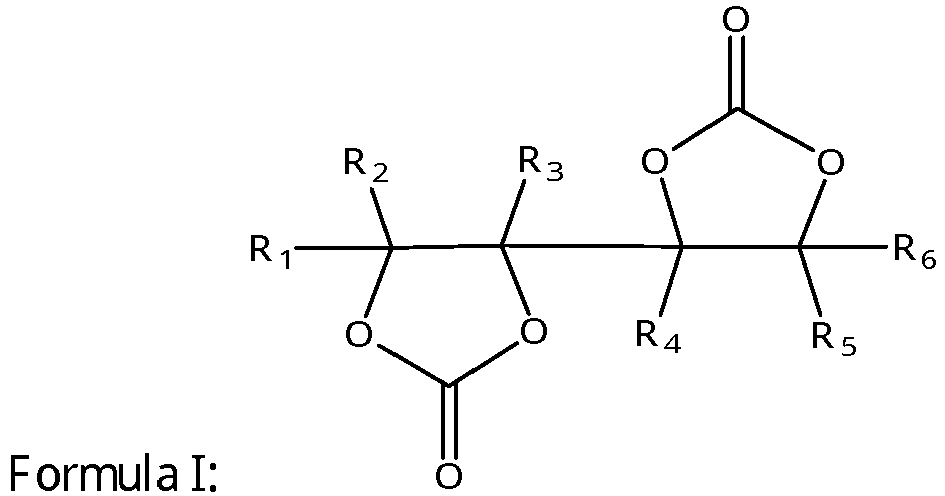
- In formula I, R1, R2, R3, R4, R5 and R6 are each independently selected from one of hydrogen atom, halogen atom and C1-C5 group.
- Preferably, the cyano-containing compound A comprises at least one of the compounds represented by the following formulae II, III, IV and V,
Formula II ┤ NC-R7-CN┤


- In formula II, R7 is a C1-C8 alkylene, cyano-substituted C1-C8 alkylene, C2-C8 alkenylene, cyano-substituted C2-C8 alkenylene;
In formula III, R8, R9 and R10 are each independently selected from a C1-C5 alkylene and C2-C5 alkenylene, and m is an integer of 1-5;
In formula IV, R11 is a C2-C5 unsaturated hydrocarbon group, and R12 is a C1-C5 alkylene;
In formula V, R13, R14 and R15 are each independently selected from a C1-C5 alkylene and C2-C5 alkenylene. - Preferably, in formula I, the C1-C5 group is selected from a C1-C5 hydrocarbon group, halogenated hydrocarbon group, oxygen-containing hydrocarbon group, silicon-containing hydrocarbon group, and cyano-substituted hydrocarbon group. Preferably, R1, R2, R3, R4, R5 and R6 are each independently selected from a hydrogen atom, fluorine atom, C1-C5 methyl group, C1-C5 ethyl group, C1-C5 methoxyl group, C1-C5 ethyoxyl group, C1-C5 trimethylsiloxy group, C1-C5 cyano group or C1-C5 trifluoromethyl group.
- Preferably, the compound B comprises one or more of compounds 1-9 represented by the following structural formulae,


- Preferably, the percentage mass content of the compound B is 0.1-5% based on the total mass of the non-aqueous electrolyte for lithium ion battery being 100%.
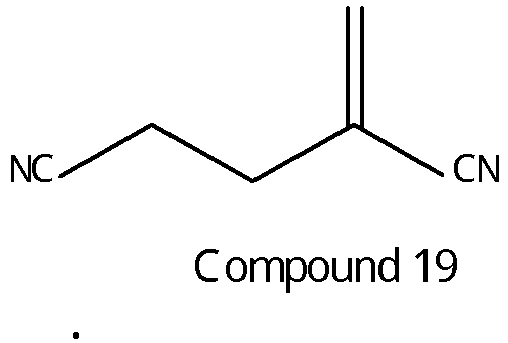
- Preferably, the cyano-containing compound A comprises one or more of compounds 10-19 represented by the following structural formulae,


- Preferably, the percentage mass content of the cyano-contai ni ng compound A is 0.1-5% based on the total mass of the non-aqueous electrolyte for lithium ion battery being 100%.
- Preferably, the lithium ion non-aqueous electrolyte further comprises at least one of unsaturated cyclic carbonate compounds, fluorine-substituted cyclic carbonate compounds, and sultone compounds.
- More preferably, the unsaturated cyclic carbonate compound includes at least one of vinylene carbonate (VC) and vinyl ethylene carbonate (VEC). The fluorine-substituted cyclic carbonate compound includes fluoroethylene carbonate (FEC). The sultone compound is selected from at least one of 1,3- propane sultone (1,3-PS), 1,4- butane sultone (1,4-BS), and 1,3-propene sultone (PST).
- Preferably, the non-aqueous electrolyte for lithium ion battery comprises a non-aqueous organic solvent, and the non-aqueous organic solvent is at least one of vinyl carbonate, propylene carbonate, butylene carbonate, dimethyl carbonate, diethyl carbonate, methyl ethyl carbonate and methyl propyl carbonate.
- Preferably, the lithium salt is selected from one or more of LiPF6, LiBF4, LiBOB, LiDFOB, LiN(SO2CF3)2, LiN(SO2C2F5)2, LiC(SO2CF3)3 and LiN(SO2F)2. The lithium salt content in the non-aqueous electrolyte for lithium ion battery is 0.1-15%.
- And, a lithium ion battery, comprises a positive electrode, a negative electrode, a separator interposed between the positive electrode and the negative electrode, and an electrolyte, wherein the electrolyte is the non-aqueous electrolyte for lithium ion battery.
- The positive electrode comprises a positive electrode active material, and the positive electrode active material is at least one of LiNixCoyMnzL(1-x-y-z)O2, LiCox-L+ 1-x-J O2, LiNix-Lw y-Mnj 2-)(--y-J O4 and Liz-MPO4, wherein, L is at least one of Al, Sr, Mg, Ti, Ca, Zr, Zn, Si or Fe, 01=tx1=t1, 0", m=tz1=t1, 0T x+y+z1=t1, 0<xi1, 0.31=tx1=tJ.6, 0.01fty"H).2, L " is at least one of Co, Al, Sr, Mg, Ti, Ca, Zr, Zn, Si and Fe; 0.5ttM, M is at least one of Fe, M n and Co.
- The non-aqueous electrolyte for lithium ion battery provided by the disclosure contains both the cyano-containing compound A and the compound B, which can effectively improve the cycle performance and high-temperature storage performance of the battery at high pressure, so that the lithium ion battery containing the non-aqueous electrolyte has better cycle performance and high-temperature storage performance.
- The lithium ion battery provided by the application contains the above-mentioned non-aqueous electrolyte, which enables the lithium ion battery to have both better cycle performance and high-temperature storage performance.
- In order to make the technical problems to be solved, technical solutions and beneficial effects more apparent and clearer, the present application will be described in further detail below with reference to embodiments. It should be understood that the specific embodiments described herein are only for the purpose of explaining the present invention and are not intended to limit the present invention.
- The non-aqueous electrolyte for lithium ion battery provided by the present application, comprises a cyano-containing compound A and a compound B represented by formula

- Formula I:
In formula I, R1, R2, R3, R4, R5 and R6 are each independently selected from one of hydrogen atom, halogen atom and C1-C5 group. - Preferably, the cyano-containing compound A comprises at least one of the compounds represented by the following formulae II, III, IV and V,
Formula II ┤ NC-R7-CN┤

Formula IV ┤ R11-O-R12-CN┤

- In formula II, R7 is a C1-C8 alkylene, cyano-substituted C1-C8 alkylene, C2-C8 alkenylene, cyano-substituted C2-C8 alkenylene;
In formula III, R8, R9 and R10 are each independently selected from a C1-C5 alkylene and C2-C5 alkenylene, and m is an integer of 1-5;
In formula IV, R11 is a C2-C5 unsaturated hydrocarbon group, and R12 is a C1-C5 alkylene;
In formula V, R13, R14 and R15 are each independently selected from a C1-C5 alkylene and C2-C5 alkenylene. - In the embodiment of the invention, C1-C8 refers to the number of carbon atoms being 1-8, similarly, C2-C8 refers to the number of carbon atoms being 2-8, C1-C5 refers to the number of carbon atoms being 1-5, similarly, C2-C5 refers to the number of carbon atoms being 2-5.
- The non-aqueous electrolyte for lithium ion battery provided by the embodiment of the invention comprises at least one cyano-containing compound A represented by formulae II, III, IV and V.
- Preferably, the cyano-containing compound A comprises one or more of compounds 10-19 represented by the following structural formulae,


- It is further preferred that the percentage mass content of the cyano-containing compound A is 0.1-5% based on the total mass of the non-aqueous electrolyte for lithium ion battery being 100%. It is further preferred that the percentage mass content of the cyano-contai ni ng compound A is 0.1-3% based on the total mass of the non-aqueous electrolyte for lithium ion battery being 100%.
- It is understood that if the non-aqueous electrolyte for lithium ion battery contains one of the above substances, the content is the content of the one substance; If the non-aqueous electrolyte for lithium ion battery contains a plurality of the above substances, the content is the sum of the contents of the plurality of substances.
- The non-aqueous electrolyte for lithium ion battery provided by the embodiments of the invention contains at least one cyano-containing compound A represented by formula II, III, IV and V, the cyano-containing compound A has an obvious positive complexing effect, which can effectively inhibit the structure of the positive electrode material from being damaged, and also inhibits the cartalytic decomposition effect of metal ions on electrolyte and the damage to the negative passivation film. However, the cyano-containing compound A has a negative effect on negative electrode film formation, resulting in deterioration of cycle performance.
- In the embodiments of the invention, the compound B represented by formula I was added to the non-aqueous electrolyte of the lithium ion battery on the basis of the cyano-containing compound A. The compound B represented by formula I was added on the basis of at least one cyano-containing compound A represented by formula II, III, IV and V, wherein, the cyano-containing compound A can be complexed with metal ions dissolved from the positive electrode material, which can effectively inhibit the structure of the positive electrode material from being damaged, and also inhibits the cartalytic decomposition effect of metal ions on electrolyte and the damage to the negative passivation film. In the full-charge storage process, the side reaction between the positive electrode material and the electrolyte under high voltage can be effectively reduced, thus improving the storage performance of the lithium ion battery under high voltage. However, the cyano-contai ni ng compound A has a deterioration effect on the negative electrode, which easily leads to rapid capacity attenuation of the battery in later period. While the compound B represented by formula I has a good effect of film forming on negative electrode and has little influence on the film impedance, thus improving the stability of the negative electrode in the cycle process and improving the cycle performance. In the non-aqueous electrolyte for lithium ion battery provided by the embodiments of the invention, the compound B was added on the basis of the cyano-containing compound A, the two are used together, so that an effective passivation film can be formed on the negative electrode while complexing protection is assured on the positive electrode of the battery, and side reactions of the electrolyte between the positive electrode and the negative electrode are reduced, so that the cycle performance of the battery can be effectively improved, and meanwhile, the high-temperature storage performance can be enhanced.
- Preferably, in formula I, the C1-C5 group includes a C1-C5 hydrocarbon group, halogenated hydrocarbon group, oxygen-containing hydrocarbon group, silicon-containing hydrocarbon group, and cyano-substituted hydrocarbon group.
- Preferably, R1, R2, R3, R4, R5 and R6 are each independently selected from a hydrogen atom, fluorine atom, C1-C5 methyl group, C1-C5 ethyl group, C1-C5 methoxyl group, C1-C5 ethyoxyl group, C1-C5 trimethylsiloxy group, C1-C5 cyano group or C1-C5 trifluoromethyl group.
- In formula I, preferably, the compound B comprises one or more of compounds 1-9 represented by the following structural formulae,


- The preferred specific compound above can be better compounded with the cyano-containing compound A to improve the cycle performance and high-temperature storage performance of the lithium ion battery.
- The synthesis method of the compound B represented by formula I is conventional, for example, the compound B can be prepared by ester exchange reaction between polyol (such as erythritol, xylitol, etc.) and carbonate (such as dimethyl carbonate, diethyl carbonate, vinyl carbonate, etc.) in the presence of basic catalyst. An example of the synthetic route is as follows:

- The fluorine-containing compound in compound B is prepared by: fluorinating the corresponding carbonate and mixture F2/N2, and then recrystallizing or purifying by column chromatography. A n example of the synthetic route is as follows:

- The cyano group-containing compound in compound B is prepared by: the chlorination reaction of the corresponding carbonate and sulfonyl chloride, then reacting with NaCN or KCN, and then recrystallizing or purifying by column chromatography. An example of the synthetic route is as follows:

- The trimethylsilanolate-containing compound in the compound B is prepared by: the substitution reaction of the corresponding hydroxy carbonate and silazane, then ecrystallizing or purifying by column chromatography. An example of the synthetic route is as follows:

- Preferably, the percentage mass content of the compound B is 0.1-5% based on the total mass of the non-aqueous electrolyte for lithium ion battery being 100%. When the content of the compound B is less than 0.1%, it is not conducive to forming a passivation film on the negative electrode, and the improvement effect on the cycle performance of the lithium ion battery is reduced; When the content of the compound B is more than 5%, the film formation on the negative electrode surface of the lithium ion battery is thicker, which will increase the battery impedance. It is further preferred that the percentage mass content of the compound B is 0.1-2% based on the total mass of the non-aqueous electrolyte for lithium ion battery being 100%.
- It is understood that if the non-aqueous electrolyte for lithium ion battery contains one of the above substances, the content is the content of the one substance; If the non-aqueous electrolyte for lithium ion battery contains a plurality of the above substances, the content is the sum of the contents of the plurality of substances.
- Based on the above embodiments, it is preferred that the lithium ion non-aqueous electrolyte further comprises at least one of unsaturated cyclic carbonate compounds, fluorine-substituted cyclic carbonate compounds, and sultone compounds.
- Preferably, the unsaturated cyclic carbonate compound includes at least one of vinylene carbonate (VC) and vinyl ethylene carbonate (VEC). The fluorine-substituted cyclic carbonate compound includes fluoroethylene carbonate (FEC). The sultone compound is selected from at least one of 1,3- propane sultone (1,3-PS), 1,4- butane sultone (1,4-BS), and 1,3-propene sultone (PST).
- Apparently, it should be understood that the lithium ion non-aqueous electrolyte may further include at least one of fluorine-substituted cyclic carbonate compounds and/or sultone compounds on the basis of at least one of unsaturated cyclic carbonate compounds.
- The content of unsaturated cyclic carbonate compound is 0.1-5% based on the total mass of the non-aqueous electrolyte for lithium ion battery being 100%. The content of fluorine-substituted cyclic carbonate compound is 0.1-30% based on the total mass of the non-aqueous electrolyte for lithium ion battery being 100%. The percentage mass content of sultone compound is 0.1-5% based on the total mass of the non-aqueous electrolyte for lithium ion battery being 100%.
- Preferably, the non-aqueous electrolyte for lithium ion battery comprises a non-aqueous organic solvent, and the non-aqueous organic solvent is at least one of vinyl carbonate, propylene carbonate, butyl ene carbonate, dimethyl carbonate, diethyl carbonate, methyl ethyl carbonate and methyl propyl carbonate. More preferably, the non-aqueous organic solvent is a composition of vinyl carbonate, diethyl carbonate and methyl ethyl carbonate.
- Preferably, the lithium salt is selected from one or more of LiPF6, LiBF4, LiBOB, LiDFOB, LiN(SO2CF3)2, LiN(SO2C2F5)2, LiC(SO2CF3)3 and LiN(SO2F)2. The lithium salt content in the non-aqueous electrolyte for lithium ion battery is 0.1-15%.
- As is known to those skilled in the art, the main components in the non-aqueous electrolyte for lithium ion battery are non-aqueous organic solvents, lithium salts and additives. In the present application, compound A and compound B are additives. The content of non-aqueous organic solvent and lithium salt is conventional, and it can be adjusted accordingly after the content of the additive including compound A and compound B is determined, which is not repeated in the present application.
- The non-aqueous electrolyte for lithium ion battery provided by the embodiment contains both the cyano-containing compound A and the compound B, which can effectively improve the cycle performance and high-temperature storage performance of the battery at high pressure, so that the lithium ion battery containing the non-aqueous electrolyte has better cycle performance and high-temperature storage performance.
- And, the embodiment of the invention also provides a lithium ion battery, comprising a positive electrode, a negative electrode, a separator interposed between the positive electrode and the negative electrode, and an electrolyte, wherein the electrolyte is the non-aqueous electrolyte for lithium ion battery.
- Preferably, the positive electrode comprises a positive electrode active material, and the positive electrode active material is at least one of LiNixCoyMnyL(1-x-y-z)O2, LiCox-LJ l-,,-J O2, LiNi,,-L - y-MR 2-,,-y-J O4, Liz and MPO4, wherein, L is at leastoneof Al, Sr, Mg, Ti, Ca, Zr, Zn, Si or Fe, 01=tx1=t1, 0", 01=tz1=t1, 0T x+y+zlll, 0<xli1, 0.3M-M.6, O.Oltfy'M.2, L " is at least one of Co, Al, Sr, Mg, Ti, Ca, Zr, Zn, Si and Fe; 0.51=12 TH, M is at least one of Fe, M n and Co.
- In the embodiment of the present invention, the negative electrode and the separator are not specifically limited, they can be the conventional ones in the art.
- The lithium ion battery provided by the application contains the above-mentioned non-aqueous electrolyte, which enables the lithium ion battery to have both better cycle performance and high-temperature storage performance.
- The following descri pti on will be made with reference to specific embodi ments.
- A LiCoO2/ artificial graphite battery, comprises a positive electrode, a negative electrode, a separator interposed between the positive electrode and the negative electrode, and an electrolyte, wherein the electrolyte is a non-aqueous electrolyte and comprises the following components in percentage by mass as shown in Table 1 of Embodiment 1, based on the total weight of the non-aqueous electrolyte taken as 100% by weight.
- A LiCoO2/ artificial graphite battery, comprises a positive electrode, a negative electrode, a separator interposed between the positive electrode and the negative electrode, and an electrolyte, wherein the electrolyte is a non-aqueous electrolyte and comprises the following components in percentage by mass as shown in Table 1 of Embodiment 2, based on the total weight of the non-aqueous electrolyte taken as 100% by weight.
- A LiCoO2/ artificial graphite battery, comprises a positive electrode, a negative electrode, a separator interposed between the positive electrode and the negative electrode, and an electrolyte, wherein the electrolyte is a non-aqueous electrolyte and comprises the following components in percentage by mass as shown in Table 1 of Embodiment 3, based on the total weight of the non-aqueous electrolyte taken as 100% by weight.
- A LiCoO2/ artificial graphite battery, comprises a positive electrode, a negative electrode, a separator interposed between the positive electrode and the negative electrode, and an electrolyte, wherein the electrolyte is a non-aqueous electrolyte and comprises the following components in percentage by mass as shown in Table 1 of Embodiment 4, based on the total weight of the non-aqueous electrolyte taken as 100% by weight.
- A LiCoO2/ artificial graphite battery, comprises a positive electrode, a negative electrode, a separator interposed between the positive electrode and the negative electrode, and an electrolyte, wherein the electrolyte is a non-aqueous electrolyte and comprises the following components in percentage by mass as shown in Table 1 of Embodiment 5, based on the total weight of the non-aqueous electrolyte taken as 100% by weight.
- A LiCoO2/ artificial graphite battery, comprises a positive electrode, a negative electrode, a separator interposed between the positive electrode and the negative electrode, and an electrolyte, wherein the electrolyte is a non-aqueous electrolyte and comprises the following components in percentage by mass as shown in Table 1 of Embodiment 6, based on the total weight of the non-aqueous electrolyte taken as 100% by weight.
- A LiCoO2/ artificial graphite battery, comprises a positive electrode, a negative electrode, a separator interposed between the positive electrode and the negative electrode, and an electrolyte, wherein the electrolyte is a non-aqueous electrolyte and comprises the following components in percentage by mass as shown in Table 1 of Embodiment 7, based on the total weight of the non-aqueous electrolyte taken as 100% by weight.
- A LiCoO2/ artificial graphite battery, comprises a positive electrode, a negative electrode, a separator interposed between the positive electrode and the negative electrode, and an electrolyte, wherein the electrolyte is a non-aqueous electrolyte and comprises the following components in percentage by mass as shown in Table 1 of Embodiment 8, based on the total weight of the non-aqueous electrolyte taken as 100% by weight.
- A LiCoO2/ artificial graphite battery, comprises a positive electrode, a negative electrode, a separator interposed between the positive electrode and the negative electrode, and an electrolyte, wherein the electrolyte is a non-aqueous electrolyte and comprises the following components in percentage by mass as shown in Table 1 of Embodiment 9, based on the total weight of the non-aqueous electrolyte taken as 100% by weight.
- A LiCoO2/ artificial graphite battery, comprises a positive electrode, a negative electrode, a separator interposed between the positive electrode and the negative electrode, and an electrolyte, wherein the electrolyte is a non-aqueous electrolyte and comprises the following components in percentage by mass as shown in Table 1 of E mbodi ment 10, based on the total weight of the non-aqueous electrolyte taken as 100% by weight.
- A LiCoO2/ artificial graphite battery, comprises a positive electrode, a negative electrode, a separator interposed between the positive electrode and the negative electrode, and an electrolyte, wherein the electrolyte is a non-aqueous electrolyte and comprises the following components in percentage by mass as shown in Table 1 of Embodiment 11, based on the total weight of the non-aqueous electrolyte taken as 100% by weight.
- A LiCoO2/ artificial graphite battery, comprises a positive electrode, a negative electrode, a separator interposed between the positive electrode and the negative electrode, and an electrolyte, wherein the electrolyte is a non-aqueous electrolyte and comprises the following components in percentage by mass as shown in Table 1 of E mbodi ment 12, based on the total weight of the non-aqueous electrolyte taken as 100% by weight.
- A LiCoO2/ artificial graphite battery, comprises a positive electrode, a negative electrode, a separator interposed between the positive electrode and the negative electrode, and an electrolyte, wherein the electrolyte is a non-aqueous electrolyte and comprises the following components in percentage by mass as shown in Table 1 of E mbodi ment 13, based on the total weight of the non-aqueous electrolyte taken as 100% by weight.
- A LiCoO2/ artificial graphite battery, comprises a positive electrode, a negative electrode, a separator interposed between the positive electrode and the negative electrode, and an electrolyte, wherein the electrolyte is a non-aqueous electrolyte and comprises the following components in percentage by mass as shown in Table 1 of E mbodi ment 14, based on the total weight of the non-aqueous electrolyte taken as 100% by weight.
- A LiCoO2/ artificial graphite battery, comprises a positive electrode, a negative electrode, a separator interposed between the positive electrode and the negative electrode, and an electrolyte, wherein the electrolyte is a non-aqueous electrolyte and comprises the following components in percentage by mass as shown in Table 1 of Embodiment 15, based on the total weight of the non-aqueous electrolyte taken as 100% by weight.
- A LiCoO2/ artificial graphite battery, comprises a positive electrode, a negative electrode, a separator interposed between the positive electrode and the negative electrode, and an electrolyte, wherein the electrolyte is a non-aqueous electrolyte and comprises the following components in percentage by mass as shown in Table 1 of Embodiment 16, based on the total weight of the non-aqueous electrolyte taken as 100% by weight.
- A LiCoO2/ artificial graphite battery, comprises a positive electrode, a negative electrode, a separator interposed between the positive electrode and the negative electrode, and an electrolyte, wherein the electrolyte is a non-aqueous electrolyte and comprises the following components in percentage by mass as shown in Table 1 of E mbodi ment 17, based on the total weight of the non-aqueous electrolyte taken as 100% by weight.
- A LiCoO2/ artificial graphite battery, comprises a positive electrode, a negative electrode, a separator interposed between the positive electrode and the negative electrode, and an electrolyte, wherein the electrolyte is a non-aqueous electrolyte and comprises the following components in percentage by mass as shown in Table 1 of Embodiment 18, based on the total weight of the non-aqueous electrolyte taken as 100% by weight.
- A LiNi0.5Co0.2Mn0.3O2/ artificial graphite battery, comprises a positive electrode, a negative electrode, a separator interposed between the positive electrode and the negative electrode, and an electrolyte, wherein the electrolyte is a non-aqueous electrolyte and comprises the following components in percentage by mass as shown in Table 1 of Comparative Example 1, based on the total weight of the non-aqueous electrolyte taken as 100% by weight.
- A LiNi0.5Co0.2Mn0.3O2/ artificial graphite battery, comprises a positive electrode, a negative electrode, a separator interposed between the positive electrode and the negative electrode, and an electrolyte, wherein the electrolyte is a non-aqueous electrolyte and comprises the following components in percentage by mass as shown in Table 1 of Comparative Example 2, based on the total weight of the non-aqueous electrolyte taken as 100% by weight.
- A LiNi0.5Co0.2Mn0.3O2/ artificial graphite battery, comprises a positive electrode, a negative electrode, a separator interposed between the positive electrode and the negative electrode, and an electrolyte, wherein the electrolyte is a non-aqueous electrolyte and comprises the following components in percentage by mass as shown in Table 1 of Comparative Example 3, based on the total weight of the non-aqueous electrolyte taken as 100% by weight.
- The Embodiments 1-18 and the LiNi0.5Co0.2Mn0.3O2/ artificial graphite batteries of Comparative Examples 1-3 of the present invention were tested for performance, and the test parameters and test methods are as follows:
- (1) High-temperature cycle performance is demonstrated by testing the capacity retention rate after 500th cycles at 1C rate, 45. The specific method is as follows: at 45
 , the formed battery was charged with 1C constant current/ constant voltage to an operating voltage such as (3-4.4V), the cutoff current was 0.01C, and then discharged to 3.0V with 1C constant current. After such charging/discharging for 500 cycles, the capacity retention after the 500th cycle was calculated to evaluate its high-temperature cycle performance.
The calculation formula of the 500th cycle capacity retention rate at 451C is as follows:

- (2) Room-temperature cycle performance is demonstrated by testing the capacity retention rate after 500th cycles at 1C rate, room temperature. The specific method is as follows: at room temperature, the formed battery was charged with 1C constant current/constant voltage to an operati ng voltage such as (3-4.4V), the cutoff current was 0.01C, and then discharged to 3.0V with 1C constant current. After such charging/discharging for 500 cycles, the capacity retention after the 500th cycle was calculated to evaluate its room-temperature cycle performance.
The calculation formula of the 500th cycle capacity retention rate at room temperature 1C is as follows:
- (3) Test method for capacity retention rate, capacity recovery rate and thickness expansion rate after 30 days of storage at 60: the formed battery was charged to an operating voltage at room temperature with 1C constant current/ constant voltage, the cutoff current was 0.01C, then discharged to 3.0V with 1C constant current, the initial discharge capacity of the battery was measured, then charged to the operating voltage with 1C constant current/ constant voltage, the cutoff current was 0.01C, and the initial thickness of the battery was measured. Then the battery was stored at 60
 for 30 days, measured the thickness of the battery, discharged it to 3.0V with 1C constant current, measured the capacity retention of the battery, then charged it to the operating voltage with 1C constant current/ constant voltage, the cutoff current was 0.01C, then discharged it to 3.0V with 1C constant current, then measured the recovery capacity.The calculation formulas for capacity retention rate and capacity recovery rate are as follows:


- The test results of Embodiments 1-18 and Comparative Examples 1-3 are shown in Table 1 below.
Table 1 Compound A Compound B Other The 500th cycle capacity retention rate at 45 1C (%)
After 30 days of storage at 60 
The 500th cycle capacity retention rate at room temperature (%) Capa city retention rate (%) Capa city recovery rate (%) Thickness expansion rate (%) Embodiment 1 0.5% compound 10 1% compound 1 / 70.28 72.18 74.55 25.67 73.28 Embodiment 2 1% compound 10 1% compound 1 / 75.94 79.57 84.89 20.82 80.94 Embodiment 3 2% compound 10 1% compound 1 / 83.46 87.13 88.45 13.88 84.46 Embodiment 4 3% compound 10 1% compound 1 / 80.4 85.55 86.51 12.3 83.4 Embodiment 5 2% compound 10 0.5% compound 1 / 81.31 83.25 85.68 13.09 82.31 Embodiment 6 2% compound 10 1.5% compound 1 / 85.46 86.19 88.08 13.54 85.46 Embodiment 7 2% compound 10 2% compound 1 / 84.56 85.21 87.58 13.6 82.56 Embodiment 8 2% compound 10 1% compound 3 / 84.39 86.89 88.5 11.56 84.39 Embodiment 9 2% compound 10 1% compound 5 / 83.67 87.81 88.61 12.44 83.67 Embodiment 10 2% compound 10 1% compound 7 / 83.67 87.81 88.61 12.44 83.67 Embodiment 11 2% compound 10 1% compound 8 / 84.32 87.5 89.04 12.56 84.32 Embodiment 12 2% compound 10 1% compound 9 / 85.5 87.52 87.96 13.52 85.1 Embodiment 13 1% compound 13 1% compound 1 / 84.1 88.31 89.01 15.2 84.1 Embodiment 14 1% compound 14 1% compound 1 / 84.39 86.89 88.5 11.56 84.39 Embodiment 15 1% compound 16 1% compound 1 / 83.67 87.81 88.61 12.44 83.67 Embodiment 16 2% compound 10 1% compound 1 7%FEC 85.37 88.89 89.69 12.44 89.65 Embodiment 17 2% compound 10 1% compound 1 3% PS 86.32 88.5 89.04 12.56 88.32 Embodiment 18 2% compound 10 1% compound 1 7%FEC+3% PS 86.5 89.52 90.96 13.52 92.1 Comparative Example 1 2% compound 10 / / 45.6 55 63.4 32.22 61.5 Comparative Example 2 2% compound 10 / 7%FE C 55.47 61.1 64.53 36.39 65,47 Comparative Example 3 2% compound 10 / 3%PS 58.59 59.63 65.31 35.66 64.59 - As is well known to those skilled in the art, the E mbodiments and Comparative Examples in Table 1 above include conventional solvents, lithium salts and other substances in addition to the listed substances, which are not specifically described in the present application, and, in the electrolyte, the weight other than the listed above is the content of solvent and lithium salt.
- Referring to the above table 1, Embodiments 1-15 and Comparative Example 1 are compared. The lithium ion non-aqueous electrolyte of Embodiments 1-15 contains both the cyano-containing compound A and compound B, while the lithium ion non-aqueous electrolyte of Comparative Examples 1-3 contains only the cyano-containing compound A. The results show that the lithium ion non-aqueous electrolyte containing the cyano-containing compound A alone has poor high-temperature cycle, room-temperature cycle and high-temperature storage performance. When the cyano-containing compound A and compound B are used together, the cycle performance and high-temperature storage performance of the lithium ion battery can be obviously improved, so that the battery has better cycle performance and high-temperature storage performance. It can be seen that the addition of compound B can significantly improve the cycle performance and high-temperature storage performance of lithium ion batteries.
- Comparing Embodiment 16 with Comparative Example 2, Embodiment 17 with Comparative Example 3, Embodiment 18 with Comparative Example 2-3, the lithium ion non-aqueous electrolyte of Embodiments 16-18 and Comparative Examples 2-3 contains the same cyano-containing compound A, the lithium ion non-aqueous electrolyte of Embodiments 16-18 contains the same compound B, in addition, Embodiment 16 further contains 7% FEC, Embodiment 17 further contai ns 3% PS, E mbodi ment 18 further contains 7% FEC and 3% PS, Comparative Example 2 further contains 7% FEC, and Comparative Example 3 further contains 3% PS. The results show that the lithium ion non-aqueous electrolyte containing the cyano-containing compound A and FEC or PS has poor high-temperature cycle, room-temperature cycle and high-temperature storage performance (no obvious improvement compared with Comparative Example 1). However, when the cyano-containing compound A, compound B, FEC and/or PS are used together, the cycle performance and high-temperature storage performance of the lithium ion battery can be obviously improved, and the performance is slightly increased on the basis of not adding FEC and/or PS (Embodiment 3). It can be seen that the addition of compound B can obviously improve the overall performance of lithium ion batteries, including cycle performance and high-temperature storage performance.
- The above descriptions are only preferred embodiments and are not intended to limit the present invention. Any modifications, equivalent substitutions and improvements made within the spirit and principles of the present invention shall be included within the scope of protection of the present invention.
Claims (11)
- A non-aqueous electrolyte for lithium ion battery, comprising a cyano-containing compound A and a compound B represented by formula I,

- The non-aqueous electrolyte for lithium ion battery of claim 1, wherein the cyano-containing compound A comprises at least one of the compounds represented by the following formulae II, III, IV and V,
Formula II ┤NC-R7-CN┤

Formula IV ┤R11-O-R12-CN┤
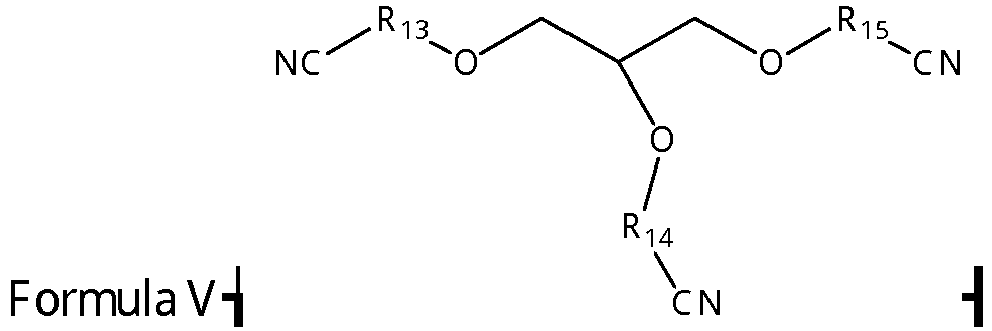
In formula III, R8, R9 and R10 are each independently selected from a C1-C5 alkylene and C2-C5 alkenylene, and m is an integer of 1-5;
In formula IV, R11 is a C2-C5 unsaturated hydrocarbon group, and R12 is a C1-C5 alkylene;
In formula V, R13, R14 and R15 are each independently selected from a C1-C5 alkylene and C2-C5 alkenylene. - The non-aqueous electrolyte for lithium ion battery of claim 1, wherein in formula I, the C1-C5 group is selected from a C1-C5 hydrocarbon group, halogenated hydrocarbon group, oxygen-contai ni ng hydrocarbon group, silicon-containing hydrocarbon group, and cyano-substituted hydrocarbon group.
- The non-aqueous electrolyte for lithium ion battery of claim 1, wherein the compound B comprises one or more of compounds 1-9 represented by the following structural formulae,


- The non-aqueous electrolyte for lithium ion battery of claim 1, wherein the percentage mass content of the compound B is 0.1-5% based on the total mass of the non-aqueous electrolyte for lithium ion battery being 100%.
- The non-aqueous electrolyte for lithium ion battery of any of claims 1-4, wherein the cyano-containing compound A comprises one or more of compounds 10-19 represented by the following structural formulae,



- The non-aqueous electrolyte for lithium ion battery of any of claims 1-4, wherein the percentage mass content of the cyano-containing compound A is 0.1-5% based on the total mass of the non-aqueous electrolyte for lithium ion battery being 100%.
- The non-aqueous electrolyte for lithium ion battery of any of claims 1-4, wherein the lithium ion non-aqueous electrolyte further comprises at least one of unsaturated cyclic carbonate compounds, fluorine-substituted cyclic carbonate compounds, and sultone compounds.
- The non-aqueous electrolyte for lithium ion battery of any of claims 1-4, wherein the non-aqueous electrolyte for lithium ion battery comprises a non-aqueous organic solvent, and the non-aqueous organic solvent is at least one of vinyl carbonate, propylene carbonate, butylene carbonate, dimethyl carbonate, diethyl carbonate, methyl ethyl carbonate and methyl propyl carbonate.
- A lithium ion battery, comprisi ng a positive electrode, a negative electrode, a separator interposed between the positive electrode and the negative electrode, and an electrolyte, wherein the electrolyte is the non-aqueous electrolyte for lithium ion battery of any of claims 1-8.
- The lithium ion battery of claim 9, wherein the positive electrode comprises a positive electrode active material, and the positive electrode active material is at least one of LiNixCoyMnzL(1-x-y-z)O2, LiCûx-LJ 1-x-J O2, LiNix-L- y-M n' 2-,,-y-J O4 and Liz-MPO4, wherein, L is at least one of Al, Sr, Mg, Ti, Ca, Zr, Zn, Si or Fe, 01=tx1=)1, 0rfy1=t1, 01=tz1=)1, 0T x+y+z1=t1, 0<xTt1, 0.31=tx1=tJ.6, 0.01rfyW.2, L/is at least one of Co, Al, Sr, Mg, Ti, Ca, Zr, Zn, Si and Fe; 0.5tt'M, M is at least one of Fe, M n and Co.
Applications Claiming Priority (2)
| Application Number | Priority Date | Filing Date | Title |
|---|---|---|---|
| CN201710297522.6A CN108808086B (en) | 2017-04-28 | 2017-04-28 | Lithium-ion battery non-aqueous electrolyte and lithium-ion battery |
| PCT/CN2017/089724 WO2018196145A1 (en) | 2017-04-28 | 2017-06-23 | Lithium ion battery non-aqueous electrolyte and lithium ion battery |
Publications (3)
| Publication Number | Publication Date |
|---|---|
| EP3618166A1 true EP3618166A1 (en) | 2020-03-04 |
| EP3618166A4 EP3618166A4 (en) | 2020-04-15 |
| EP3618166B1 EP3618166B1 (en) | 2021-05-05 |
Family
ID=63918082
Family Applications (1)
| Application Number | Title | Priority Date | Filing Date |
|---|---|---|---|
| EP17907767.2A Active EP3618166B1 (en) | 2017-04-28 | 2017-06-23 | Lithium ion battery non-aqueous electrolyte and lithium ion battery |
Country Status (4)
| Country | Link |
|---|---|
| US (1) | US11177506B2 (en) |
| EP (1) | EP3618166B1 (en) |
| CN (1) | CN108808086B (en) |
| WO (1) | WO2018196145A1 (en) |
Families Citing this family (3)
| Publication number | Priority date | Publication date | Assignee | Title |
|---|---|---|---|---|
| CN108933292B (en) * | 2017-05-27 | 2020-04-21 | 深圳新宙邦科技股份有限公司 | Lithium-ion battery non-aqueous electrolyte and lithium-ion battery |
| CN114824281B (en) * | 2022-06-29 | 2022-10-14 | 天鹏锂能技术(淮安)有限公司 | Lithium ion battery and preparation method thereof |
| CN115548473B (en) * | 2022-09-30 | 2026-01-06 | 浙江师范大学 | An electrolyte containing xylitol, its preparation method and application |
Family Cites Families (32)
| Publication number | Priority date | Publication date | Assignee | Title |
|---|---|---|---|---|
| GB1147540A (en) | 1966-04-19 | 1969-04-02 | Grace W R & Co | Butanetetrol dicarbonates and their production |
| US3663569A (en) | 1969-09-02 | 1972-05-16 | Atlas Chem Ind | Process for preparing cyclic carbonates from polyhydric alcohols |
| JP3867756B2 (en) | 1999-03-08 | 2007-01-10 | 三洋化成工業株式会社 | Non-aqueous electrolyte and secondary battery using the same |
| US6174629B1 (en) | 1999-09-10 | 2001-01-16 | Wilson Greatbatch Ltd. | Dicarbonate additives for nonaqueous electrolyte rechargeable cells |
| JP4033074B2 (en) | 2002-08-29 | 2008-01-16 | 日本電気株式会社 | Secondary battery electrolyte and secondary battery using the same |
| KR100536196B1 (en) * | 2003-05-13 | 2005-12-12 | 삼성에스디아이 주식회사 | A non-aqueous electrolyte and a lithium secondary battery comprising the same |
| JP5055536B2 (en) | 2005-02-09 | 2012-10-24 | 国立大学法人宇都宮大学 | Highly immobilized carbon dioxide |
| KR100814827B1 (en) * | 2007-04-05 | 2008-03-20 | 삼성에스디아이 주식회사 | Electrolyte for lithium secondary battery and lithium secondary battery comprising same |
| US9806377B2 (en) | 2009-12-07 | 2017-10-31 | Sony Corporation | Secondary battery, electrolytic solution, battery pack, electronic device, and electrical vehicle |
| JP5431218B2 (en) * | 2010-03-18 | 2014-03-05 | 三洋電機株式会社 | Non-aqueous electrolyte secondary battery |
| EP2675010B1 (en) | 2011-02-10 | 2019-03-27 | Mitsubishi Chemical Corporation | Non-aqueous electrolyte solution for secondary battery, and non-aqueous electrolyte secondary battery using same |
| JP5120513B2 (en) | 2011-03-31 | 2013-01-16 | ダイキン工業株式会社 | Lithium ion secondary battery and non-aqueous electrolyte for lithium ion secondary battery |
| JP6178317B2 (en) | 2011-09-02 | 2017-08-09 | イー・アイ・デュポン・ドウ・ヌムール・アンド・カンパニーE.I.Du Pont De Nemours And Company | Lithium ion battery |
| CN102522590B (en) * | 2011-12-26 | 2014-09-17 | 华为技术有限公司 | Non-aqueous organic electrolyte, lithium ion secondary battery containing non-aqueous organic electrolyte, preparation method of lithium ion secondary battery and terminal communication equipment |
| WO2013191885A1 (en) * | 2012-06-19 | 2013-12-27 | Leyden Energy, Inc. | Electrolytes including fluorinated solvents for use in electrochemical cells |
| CN103151559A (en) | 2013-02-05 | 2013-06-12 | 深圳新宙邦科技股份有限公司 | Non-aqueous electrolyte solution for lithium ion battery and corresponding lithium ion battery |
| JP6131380B2 (en) | 2013-03-15 | 2017-05-17 | ワイルドキャット・ディスカバリー・テクノロジーズ・インコーポレイテッドWildcat Discovery Technologies, Inc. | Electrolyte suitable for high energy cathode material and method of using the same |
| JP6062297B2 (en) | 2013-03-19 | 2017-01-18 | 旭化成株式会社 | Non-aqueous electrochemical device electrolyte and lithium ion secondary battery |
| CN103441304B (en) * | 2013-09-11 | 2017-09-12 | 宁德新能源科技有限公司 | Lithium rechargeable battery and its electrolyte |
| EP3051618B1 (en) | 2013-09-26 | 2018-11-14 | Mitsubishi Chemical Corporation | Nonaqueous electrolyte solution and nonaqueous electrolyte battery using same |
| JP2015092476A (en) * | 2013-10-04 | 2015-05-14 | 旭化成株式会社 | Nonaqueous electrolyte, electrolyte for lithium ion secondary batteries and nonaqueous electrolyte battery |
| CN103594729B (en) | 2013-11-28 | 2015-11-18 | 深圳新宙邦科技股份有限公司 | A kind of electrolyte for lithium ion battery |
| CN105830270B (en) | 2013-12-19 | 2019-04-02 | 宇部兴产株式会社 | Non-aqueous electrolyte solution, power storage device using the same, and carboxylate compound used in the same |
| KR20190027957A (en) | 2014-08-14 | 2019-03-15 | 솔베이(소시에떼아노님) | Nonaqueous electrolyte compositions comprising sultone and fluorinated solvent |
| CN104300174A (en) | 2014-10-11 | 2015-01-21 | 深圳新宙邦科技股份有限公司 | Non-aqueous electrolyte of lithium ion battery and lithium ion battery |
| JPWO2016151983A1 (en) | 2015-03-26 | 2018-01-18 | 三洋電機株式会社 | Nonaqueous electrolyte secondary battery |
| JP6403278B2 (en) | 2015-06-30 | 2018-10-10 | オートモーティブエナジーサプライ株式会社 | Lithium ion secondary battery |
| CN105161763A (en) | 2015-08-03 | 2015-12-16 | 深圳新宙邦科技股份有限公司 | Non-aqueous electrolyte of lithium ion battery and lithium ion battery |
| CN110247114A (en) * | 2015-12-18 | 2019-09-17 | 深圳新宙邦科技股份有限公司 | A kind of electrolyte for lithium ion battery and lithium ion battery |
| CN106410272A (en) | 2016-01-30 | 2017-02-15 | 东莞市凯欣电池材料有限公司 | Electrolyte for high-voltage lithium ion battery and high-voltage lithium ion battery |
| CN106058317B (en) | 2016-08-12 | 2019-04-23 | 联想(北京)有限公司 | Lithium-ion battery electrolytes and lithium ion battery and electronic equipment |
| CN106252639A (en) | 2016-10-17 | 2016-12-21 | 广州天赐高新材料股份有限公司 | A kind of high-capacity lithium ion cell electrolyte, preparation method and lithium ion battery taking into account high temperature performance |
-
2017
- 2017-04-28 CN CN201710297522.6A patent/CN108808086B/en active Active
- 2017-06-23 WO PCT/CN2017/089724 patent/WO2018196145A1/en not_active Ceased
- 2017-06-23 US US16/490,895 patent/US11177506B2/en active Active
- 2017-06-23 EP EP17907767.2A patent/EP3618166B1/en active Active
Also Published As
| Publication number | Publication date |
|---|---|
| US20190393551A1 (en) | 2019-12-26 |
| EP3618166B1 (en) | 2021-05-05 |
| EP3618166A4 (en) | 2020-04-15 |
| US11177506B2 (en) | 2021-11-16 |
| CN108808086B (en) | 2020-03-27 |
| WO2018196145A1 (en) | 2018-11-01 |
| CN108808086A (en) | 2018-11-13 |
Similar Documents
| Publication | Publication Date | Title |
|---|---|---|
| US11876169B2 (en) | Non-aqueous electrolyte for lithium ion battery and lithium ion battery | |
| EP3664212B1 (en) | Non-aqueous electrolyte for lithium-ion battery, and lithium-ion battery comprising the same | |
| CN103022556B (en) | Lithium-ion battery and electrolyte thereof | |
| EP3664211B1 (en) | Non-aqueous electrolyte for lithium-ion battery, and lithium-ion battery comprising the same | |
| CN110247119A (en) | A kind of lithium secondary cell electrolyte, lithium secondary battery | |
| US11398642B2 (en) | Non-aqueous electrolyte for lithium ion battery and lithium ion battery | |
| CN111276743A (en) | A high-voltage lithium-ion battery non-aqueous electrolyte and its lithium-ion battery | |
| WO2023236509A1 (en) | Electrolyte solution and preparation method therefor, and lithium-ion battery | |
| EP4459732A1 (en) | Non-aqueous electrolyte and lithium-ion battery comprising non-aqueous electrolyte | |
| CN113394450A (en) | Lithium cobaltate high-voltage lithium ion battery non-aqueous electrolyte and lithium ion battery | |
| EP3618166B1 (en) | Lithium ion battery non-aqueous electrolyte and lithium ion battery | |
| CN114421015B (en) | Carbonate-based electrolyte with ether oxygen bond functional group and application thereof | |
| US11489190B2 (en) | Non-aqueous electrolyte for lithium ion battery and lithium ion battery | |
| EP3618164B1 (en) | Lithium ion battery non-aqueous electrolyte and lithium ion battery | |
| CN113937358B (en) | A kind of lithium ion battery electrolyte additive and preparation method thereof and lithium battery electrolyte | |
| CN117747942A (en) | Electrolyte for improving normal temperature cycle performance and lithium ion battery | |
| CN115863763B (en) | Lithium-ion electrolyte additives, lithium-ion electrolytes and their preparation methods, lithium batteries and electrical equipment | |
| CN114614089B (en) | Lithium battery electrolyte and lithium ion battery |
Legal Events
| Date | Code | Title | Description |
|---|---|---|---|
| STAA | Information on the status of an ep patent application or granted ep patent |
Free format text: STATUS: THE INTERNATIONAL PUBLICATION HAS BEEN MADE |
|
| PUAI | Public reference made under article 153(3) epc to a published international application that has entered the european phase |
Free format text: ORIGINAL CODE: 0009012 |
|
| STAA | Information on the status of an ep patent application or granted ep patent |
Free format text: STATUS: REQUEST FOR EXAMINATION WAS MADE |
|
| 17P | Request for examination filed |
Effective date: 20191004 |
|
| AK | Designated contracting states |
Kind code of ref document: A1 Designated state(s): AL AT BE BG CH CY CZ DE DK EE ES FI FR GB GR HR HU IE IS IT LI LT LU LV MC MK MT NL NO PL PT RO RS SE SI SK SM TR |
|
| AX | Request for extension of the european patent |
Extension state: BA ME |
|
| A4 | Supplementary search report drawn up and despatched |
Effective date: 20200316 |
|
| RIC1 | Information provided on ipc code assigned before grant |
Ipc: H01M 10/0567 20100101AFI20200310BHEP Ipc: H01M 10/0525 20100101ALI20200310BHEP |
|
| STAA | Information on the status of an ep patent application or granted ep patent |
Free format text: STATUS: EXAMINATION IS IN PROGRESS |
|
| 17Q | First examination report despatched |
Effective date: 20200605 |
|
| DAV | Request for validation of the european patent (deleted) | ||
| DAX | Request for extension of the european patent (deleted) | ||
| GRAP | Despatch of communication of intention to grant a patent |
Free format text: ORIGINAL CODE: EPIDOSNIGR1 |
|
| STAA | Information on the status of an ep patent application or granted ep patent |
Free format text: STATUS: GRANT OF PATENT IS INTENDED |
|
| INTG | Intention to grant announced |
Effective date: 20210115 |
|
| GRAS | Grant fee paid |
Free format text: ORIGINAL CODE: EPIDOSNIGR3 |
|
| GRAA | (expected) grant |
Free format text: ORIGINAL CODE: 0009210 |
|
| STAA | Information on the status of an ep patent application or granted ep patent |
Free format text: STATUS: THE PATENT HAS BEEN GRANTED |
|
| AK | Designated contracting states |
Kind code of ref document: B1 Designated state(s): AL AT BE BG CH CY CZ DE DK EE ES FI FR GB GR HR HU IE IS IT LI LT LU LV MC MK MT NL NO PL PT RO RS SE SI SK SM TR |
|
| REG | Reference to a national code |
Ref country code: GB Ref legal event code: FG4D |
|
| REG | Reference to a national code |
Ref country code: CH Ref legal event code: EP |
|
| REG | Reference to a national code |
Ref country code: AT Ref legal event code: REF Ref document number: 1390964 Country of ref document: AT Kind code of ref document: T Effective date: 20210515 |
|
| REG | Reference to a national code |
Ref country code: IE Ref legal event code: FG4D |
|
| REG | Reference to a national code |
Ref country code: DE Ref legal event code: R096 Ref document number: 602017038376 Country of ref document: DE |
|
| REG | Reference to a national code |
Ref country code: NL Ref legal event code: FP |
|
| REG | Reference to a national code |
Ref country code: LT Ref legal event code: MG9D |
|
| REG | Reference to a national code |
Ref country code: AT Ref legal event code: MK05 Ref document number: 1390964 Country of ref document: AT Kind code of ref document: T Effective date: 20210505 |
|
| PG25 | Lapsed in a contracting state [announced via postgrant information from national office to epo] |
Ref country code: AT Free format text: LAPSE BECAUSE OF FAILURE TO SUBMIT A TRANSLATION OF THE DESCRIPTION OR TO PAY THE FEE WITHIN THE PRESCRIBED TIME-LIMIT Effective date: 20210505 Ref country code: BG Free format text: LAPSE BECAUSE OF FAILURE TO SUBMIT A TRANSLATION OF THE DESCRIPTION OR TO PAY THE FEE WITHIN THE PRESCRIBED TIME-LIMIT Effective date: 20210805 Ref country code: HR Free format text: LAPSE BECAUSE OF FAILURE TO SUBMIT A TRANSLATION OF THE DESCRIPTION OR TO PAY THE FEE WITHIN THE PRESCRIBED TIME-LIMIT Effective date: 20210505 Ref country code: FI Free format text: LAPSE BECAUSE OF FAILURE TO SUBMIT A TRANSLATION OF THE DESCRIPTION OR TO PAY THE FEE WITHIN THE PRESCRIBED TIME-LIMIT Effective date: 20210505 Ref country code: LT Free format text: LAPSE BECAUSE OF FAILURE TO SUBMIT A TRANSLATION OF THE DESCRIPTION OR TO PAY THE FEE WITHIN THE PRESCRIBED TIME-LIMIT Effective date: 20210505 |
|
| PG25 | Lapsed in a contracting state [announced via postgrant information from national office to epo] |
Ref country code: SE Free format text: LAPSE BECAUSE OF FAILURE TO SUBMIT A TRANSLATION OF THE DESCRIPTION OR TO PAY THE FEE WITHIN THE PRESCRIBED TIME-LIMIT Effective date: 20210505 Ref country code: RS Free format text: LAPSE BECAUSE OF FAILURE TO SUBMIT A TRANSLATION OF THE DESCRIPTION OR TO PAY THE FEE WITHIN THE PRESCRIBED TIME-LIMIT Effective date: 20210505 Ref country code: LV Free format text: LAPSE BECAUSE OF FAILURE TO SUBMIT A TRANSLATION OF THE DESCRIPTION OR TO PAY THE FEE WITHIN THE PRESCRIBED TIME-LIMIT Effective date: 20210505 Ref country code: NO Free format text: LAPSE BECAUSE OF FAILURE TO SUBMIT A TRANSLATION OF THE DESCRIPTION OR TO PAY THE FEE WITHIN THE PRESCRIBED TIME-LIMIT Effective date: 20210805 Ref country code: PL Free format text: LAPSE BECAUSE OF FAILURE TO SUBMIT A TRANSLATION OF THE DESCRIPTION OR TO PAY THE FEE WITHIN THE PRESCRIBED TIME-LIMIT Effective date: 20210505 Ref country code: PT Free format text: LAPSE BECAUSE OF FAILURE TO SUBMIT A TRANSLATION OF THE DESCRIPTION OR TO PAY THE FEE WITHIN THE PRESCRIBED TIME-LIMIT Effective date: 20210906 Ref country code: IS Free format text: LAPSE BECAUSE OF FAILURE TO SUBMIT A TRANSLATION OF THE DESCRIPTION OR TO PAY THE FEE WITHIN THE PRESCRIBED TIME-LIMIT Effective date: 20210905 Ref country code: GR Free format text: LAPSE BECAUSE OF FAILURE TO SUBMIT A TRANSLATION OF THE DESCRIPTION OR TO PAY THE FEE WITHIN THE PRESCRIBED TIME-LIMIT Effective date: 20210806 |
|
| PG25 | Lapsed in a contracting state [announced via postgrant information from national office to epo] |
Ref country code: RO Free format text: LAPSE BECAUSE OF FAILURE TO SUBMIT A TRANSLATION OF THE DESCRIPTION OR TO PAY THE FEE WITHIN THE PRESCRIBED TIME-LIMIT Effective date: 20210505 Ref country code: CZ Free format text: LAPSE BECAUSE OF FAILURE TO SUBMIT A TRANSLATION OF THE DESCRIPTION OR TO PAY THE FEE WITHIN THE PRESCRIBED TIME-LIMIT Effective date: 20210505 Ref country code: DK Free format text: LAPSE BECAUSE OF FAILURE TO SUBMIT A TRANSLATION OF THE DESCRIPTION OR TO PAY THE FEE WITHIN THE PRESCRIBED TIME-LIMIT Effective date: 20210505 Ref country code: SK Free format text: LAPSE BECAUSE OF FAILURE TO SUBMIT A TRANSLATION OF THE DESCRIPTION OR TO PAY THE FEE WITHIN THE PRESCRIBED TIME-LIMIT Effective date: 20210505 Ref country code: SM Free format text: LAPSE BECAUSE OF FAILURE TO SUBMIT A TRANSLATION OF THE DESCRIPTION OR TO PAY THE FEE WITHIN THE PRESCRIBED TIME-LIMIT Effective date: 20210505 Ref country code: EE Free format text: LAPSE BECAUSE OF FAILURE TO SUBMIT A TRANSLATION OF THE DESCRIPTION OR TO PAY THE FEE WITHIN THE PRESCRIBED TIME-LIMIT Effective date: 20210505 Ref country code: ES Free format text: LAPSE BECAUSE OF FAILURE TO SUBMIT A TRANSLATION OF THE DESCRIPTION OR TO PAY THE FEE WITHIN THE PRESCRIBED TIME-LIMIT Effective date: 20210505 |
|
| REG | Reference to a national code |
Ref country code: CH Ref legal event code: PL |
|
| REG | Reference to a national code |
Ref country code: DE Ref legal event code: R097 Ref document number: 602017038376 Country of ref document: DE |
|
| REG | Reference to a national code |
Ref country code: BE Ref legal event code: MM Effective date: 20210630 |
|
| PLBE | No opposition filed within time limit |
Free format text: ORIGINAL CODE: 0009261 |
|
| STAA | Information on the status of an ep patent application or granted ep patent |
Free format text: STATUS: NO OPPOSITION FILED WITHIN TIME LIMIT |
|
| PG25 | Lapsed in a contracting state [announced via postgrant information from national office to epo] |
Ref country code: MC Free format text: LAPSE BECAUSE OF FAILURE TO SUBMIT A TRANSLATION OF THE DESCRIPTION OR TO PAY THE FEE WITHIN THE PRESCRIBED TIME-LIMIT Effective date: 20210505 Ref country code: LU Free format text: LAPSE BECAUSE OF NON-PAYMENT OF DUE FEES Effective date: 20210623 |
|
| 26N | No opposition filed |
Effective date: 20220208 |
|
| PG25 | Lapsed in a contracting state [announced via postgrant information from national office to epo] |
Ref country code: LI Free format text: LAPSE BECAUSE OF NON-PAYMENT OF DUE FEES Effective date: 20210630 Ref country code: IE Free format text: LAPSE BECAUSE OF NON-PAYMENT OF DUE FEES Effective date: 20210623 Ref country code: CH Free format text: LAPSE BECAUSE OF NON-PAYMENT OF DUE FEES Effective date: 20210630 |
|
| PG25 | Lapsed in a contracting state [announced via postgrant information from national office to epo] |
Ref country code: IS Free format text: LAPSE BECAUSE OF FAILURE TO SUBMIT A TRANSLATION OF THE DESCRIPTION OR TO PAY THE FEE WITHIN THE PRESCRIBED TIME-LIMIT Effective date: 20210905 Ref country code: AL Free format text: LAPSE BECAUSE OF FAILURE TO SUBMIT A TRANSLATION OF THE DESCRIPTION OR TO PAY THE FEE WITHIN THE PRESCRIBED TIME-LIMIT Effective date: 20210505 |
|
| PG25 | Lapsed in a contracting state [announced via postgrant information from national office to epo] |
Ref country code: IT Free format text: LAPSE BECAUSE OF FAILURE TO SUBMIT A TRANSLATION OF THE DESCRIPTION OR TO PAY THE FEE WITHIN THE PRESCRIBED TIME-LIMIT Effective date: 20210505 Ref country code: BE Free format text: LAPSE BECAUSE OF NON-PAYMENT OF DUE FEES Effective date: 20210630 |
|
| PG25 | Lapsed in a contracting state [announced via postgrant information from national office to epo] |
Ref country code: CY Free format text: LAPSE BECAUSE OF FAILURE TO SUBMIT A TRANSLATION OF THE DESCRIPTION OR TO PAY THE FEE WITHIN THE PRESCRIBED TIME-LIMIT Effective date: 20210505 |
|
| P01 | Opt-out of the competence of the unified patent court (upc) registered |
Effective date: 20230601 |
|
| PG25 | Lapsed in a contracting state [announced via postgrant information from national office to epo] |
Ref country code: HU Free format text: LAPSE BECAUSE OF FAILURE TO SUBMIT A TRANSLATION OF THE DESCRIPTION OR TO PAY THE FEE WITHIN THE PRESCRIBED TIME-LIMIT; INVALID AB INITIO Effective date: 20170623 |
|
| PG25 | Lapsed in a contracting state [announced via postgrant information from national office to epo] |
Ref country code: MK Free format text: LAPSE BECAUSE OF FAILURE TO SUBMIT A TRANSLATION OF THE DESCRIPTION OR TO PAY THE FEE WITHIN THE PRESCRIBED TIME-LIMIT Effective date: 20210505 |
|
| PG25 | Lapsed in a contracting state [announced via postgrant information from national office to epo] |
Ref country code: MT Free format text: LAPSE BECAUSE OF FAILURE TO SUBMIT A TRANSLATION OF THE DESCRIPTION OR TO PAY THE FEE WITHIN THE PRESCRIBED TIME-LIMIT Effective date: 20210505 |
|
| PGFP | Annual fee paid to national office [announced via postgrant information from national office to epo] |
Ref country code: NL Payment date: 20250528 Year of fee payment: 9 |
|
| PGFP | Annual fee paid to national office [announced via postgrant information from national office to epo] |
Ref country code: DE Payment date: 20250617 Year of fee payment: 9 |
|
| PGFP | Annual fee paid to national office [announced via postgrant information from national office to epo] |
Ref country code: GB Payment date: 20250625 Year of fee payment: 9 |
|
| PGFP | Annual fee paid to national office [announced via postgrant information from national office to epo] |
Ref country code: FR Payment date: 20250630 Year of fee payment: 9 |
|
| PG25 | Lapsed in a contracting state [announced via postgrant information from national office to epo] |
Ref country code: TR Free format text: LAPSE BECAUSE OF FAILURE TO SUBMIT A TRANSLATION OF THE DESCRIPTION OR TO PAY THE FEE WITHIN THE PRESCRIBED TIME-LIMIT Effective date: 20210505 |