EP3617284A1 - Ink jet printing penetrant, ink jet printing ink set, and ink jet printing method - Google Patents
Ink jet printing penetrant, ink jet printing ink set, and ink jet printing method Download PDFInfo
- Publication number
- EP3617284A1 EP3617284A1 EP19193922.2A EP19193922A EP3617284A1 EP 3617284 A1 EP3617284 A1 EP 3617284A1 EP 19193922 A EP19193922 A EP 19193922A EP 3617284 A1 EP3617284 A1 EP 3617284A1
- Authority
- EP
- European Patent Office
- Prior art keywords
- ink
- ink jet
- jet printing
- penetrant
- cloth
- Prior art date
- Legal status (The legal status is an assumption and is not a legal conclusion. Google has not performed a legal analysis and makes no representation as to the accuracy of the status listed.)
- Granted
Links
Images

Classifications
-
- D—TEXTILES; PAPER
- D06—TREATMENT OF TEXTILES OR THE LIKE; LAUNDERING; FLEXIBLE MATERIALS NOT OTHERWISE PROVIDED FOR
- D06P—DYEING OR PRINTING TEXTILES; DYEING LEATHER, FURS OR SOLID MACROMOLECULAR SUBSTANCES IN ANY FORM
- D06P1/00—General processes of dyeing or printing textiles, or general processes of dyeing leather, furs, or solid macromolecular substances in any form, classified according to the dyes, pigments, or auxiliary substances employed
- D06P1/90—General processes of dyeing or printing textiles, or general processes of dyeing leather, furs, or solid macromolecular substances in any form, classified according to the dyes, pigments, or auxiliary substances employed using dyes dissolved in organic solvents or aqueous emulsions thereof
- D06P1/92—General processes of dyeing or printing textiles, or general processes of dyeing leather, furs, or solid macromolecular substances in any form, classified according to the dyes, pigments, or auxiliary substances employed using dyes dissolved in organic solvents or aqueous emulsions thereof in organic solvents
- D06P1/928—Solvents other than hydrocarbons
-
- C—CHEMISTRY; METALLURGY
- C09—DYES; PAINTS; POLISHES; NATURAL RESINS; ADHESIVES; COMPOSITIONS NOT OTHERWISE PROVIDED FOR; APPLICATIONS OF MATERIALS NOT OTHERWISE PROVIDED FOR
- C09D—COATING COMPOSITIONS, e.g. PAINTS, VARNISHES OR LACQUERS; FILLING PASTES; CHEMICAL PAINT OR INK REMOVERS; INKS; CORRECTING FLUIDS; WOODSTAINS; PASTES OR SOLIDS FOR COLOURING OR PRINTING; USE OF MATERIALS THEREFOR
- C09D11/00—Inks
- C09D11/30—Inkjet printing inks
- C09D11/32—Inkjet printing inks characterised by colouring agents
- C09D11/328—Inkjet printing inks characterised by colouring agents characterised by dyes
-
- B—PERFORMING OPERATIONS; TRANSPORTING
- B41—PRINTING; LINING MACHINES; TYPEWRITERS; STAMPS
- B41M—PRINTING, DUPLICATING, MARKING, OR COPYING PROCESSES; COLOUR PRINTING
- B41M5/00—Duplicating or marking methods; Sheet materials for use therein
- B41M5/0023—Digital printing methods characterised by the inks used
-
- C—CHEMISTRY; METALLURGY
- C09—DYES; PAINTS; POLISHES; NATURAL RESINS; ADHESIVES; COMPOSITIONS NOT OTHERWISE PROVIDED FOR; APPLICATIONS OF MATERIALS NOT OTHERWISE PROVIDED FOR
- C09D—COATING COMPOSITIONS, e.g. PAINTS, VARNISHES OR LACQUERS; FILLING PASTES; CHEMICAL PAINT OR INK REMOVERS; INKS; CORRECTING FLUIDS; WOODSTAINS; PASTES OR SOLIDS FOR COLOURING OR PRINTING; USE OF MATERIALS THEREFOR
- C09D11/00—Inks
- C09D11/30—Inkjet printing inks
- C09D11/36—Inkjet printing inks based on non-aqueous solvents
-
- C—CHEMISTRY; METALLURGY
- C09—DYES; PAINTS; POLISHES; NATURAL RESINS; ADHESIVES; COMPOSITIONS NOT OTHERWISE PROVIDED FOR; APPLICATIONS OF MATERIALS NOT OTHERWISE PROVIDED FOR
- C09D—COATING COMPOSITIONS, e.g. PAINTS, VARNISHES OR LACQUERS; FILLING PASTES; CHEMICAL PAINT OR INK REMOVERS; INKS; CORRECTING FLUIDS; WOODSTAINS; PASTES OR SOLIDS FOR COLOURING OR PRINTING; USE OF MATERIALS THEREFOR
- C09D11/00—Inks
- C09D11/54—Inks based on two liquids, one liquid being the ink, the other liquid being a reaction solution, a fixer or a treatment solution for the ink
-
- D—TEXTILES; PAPER
- D06—TREATMENT OF TEXTILES OR THE LIKE; LAUNDERING; FLEXIBLE MATERIALS NOT OTHERWISE PROVIDED FOR
- D06P—DYEING OR PRINTING TEXTILES; DYEING LEATHER, FURS OR SOLID MACROMOLECULAR SUBSTANCES IN ANY FORM
- D06P1/00—General processes of dyeing or printing textiles, or general processes of dyeing leather, furs, or solid macromolecular substances in any form, classified according to the dyes, pigments, or auxiliary substances employed
- D06P1/16—General processes of dyeing or printing textiles, or general processes of dyeing leather, furs, or solid macromolecular substances in any form, classified according to the dyes, pigments, or auxiliary substances employed using dispersed, e.g. acetate, dyestuffs
-
- D—TEXTILES; PAPER
- D06—TREATMENT OF TEXTILES OR THE LIKE; LAUNDERING; FLEXIBLE MATERIALS NOT OTHERWISE PROVIDED FOR
- D06P—DYEING OR PRINTING TEXTILES; DYEING LEATHER, FURS OR SOLID MACROMOLECULAR SUBSTANCES IN ANY FORM
- D06P3/00—Special processes of dyeing or printing textiles, or dyeing leather, furs, or solid macromolecular substances in any form, classified according to the material treated
- D06P3/34—Material containing ester groups
- D06P3/52—Polyesters
- D06P3/54—Polyesters using dispersed dyestuffs
-
- D—TEXTILES; PAPER
- D06—TREATMENT OF TEXTILES OR THE LIKE; LAUNDERING; FLEXIBLE MATERIALS NOT OTHERWISE PROVIDED FOR
- D06P—DYEING OR PRINTING TEXTILES; DYEING LEATHER, FURS OR SOLID MACROMOLECULAR SUBSTANCES IN ANY FORM
- D06P5/00—Other features in dyeing or printing textiles, or dyeing leather, furs, or solid macromolecular substances in any form
- D06P5/30—Ink jet printing
Definitions
- the present disclosure relates to an ink jet printing penetrant, an ink jet printing ink set, and an ink jet printing method.
- an ink jet printing color ink (hereinafter, also referred to as "color ink” in some cases) containing a dye as a colorant is used in some cases.
- a penetrant may be used in some cases.
- a method using a penetrant which contains 20 percent by mass or more of a compound, such as 2-pyrrolidone, having a lactam structure has been proposed (for example, see JP-A-2016-141802 ).
- the reduction in color difference between the front and the rear surfaces of the cloth is further required.
- FIGURE is a schematic perspective view showing a printing apparatus which performs an ink jet printing method according to this embodiment.
- an ink jet printing penetrant which is used to penetrate an ink jet printing color ink containing a dye in a cloth and which comprises at least one glycol-based solvent having an HSP value of 13.6 or more and water.
- the content of the glycol-based solvent with respect to a total mass of at least one organic solvent contained in the ink jet printing penetrant is 95 percent by mass or more, and the glycol-based solvent has a standard boiling point of 243°C or less.
- an ink jet printing ink set is an ink set which comprises an ink jet printing color ink containing at least one dye and the ink jet printing penetrant according to this embodiment.
- an ink jet printing method which comprises a step of performing printing by adhesion of an ink jet printing color ink containing a dye and the ink jet printing penetrant according to this embodiment to the cloth.
- the structure of a printing apparatus which can realize the ink jet printing method an ink jet printing color ink (hereinafter, also referred to as “color ink” or “ink” in some cases); an ink jet printing penetrant (hereinafter, also referred to as “penetrant” in some cases); an ink jet printing ink set (hereinafter, also referred to as "ink set” in some cases); a cloth on which ink jet printing is performed; and an ink jet printing method will be described in this order.
- printing apparatus used in this embodiment will be described with reference to FIGURE.
- the printing apparatus used in this embodiment is not limited to the following apparatus.
- the printing apparatus used in this embodiment, an on-carriage type printer in which an ink cartridge is mounted in a carriage will be described by way of example.
- the printing apparatus is not limited to the on-carriage type printer and may also be an off-carriage type printer in which an ink cartridge is fixed outside.
- the printer used for the following illustration is a serial printer in which a recording ink jet head is mounted on a carriage moving in a predetermined direction, and liquid droplets are ejected on a recording medium when the ink jet head moves in association with the movement of the carriage.
- the printing apparatus used in the present disclosure is not limited to a serial printer and may also be a line printer.
- the line printer is a printer in which an ink jet head is formed wider than the width of a recording medium, and liquid droplets are ejected thereon without the movement of the ink jet head.
- a printer 1 includes an ink jet head 2, ink cartridges 3, a carriage 4, a platen 5, a heating mechanism 6, a carriage moving mechanism 7, a medium transport mechanism 8, a guide rod 9, a linear encoder 10, and a control portion CONT.
- the control portion CONT controls the operation of the entire printer 1.
- the carriage 4 mounts the ink jet head 2 which will be described later and also detachably mounts the ink cartridges 3 each of which supplies an ink or a penetrant to the ink jet head 2.
- the platen 5 is provided under the ink jet head 2 to transport a cloth M functioning as a recording medium.
- the heating mechanism 6 heats the cloth M.
- the carriage moving mechanism 7 moves the carriage 4 in a medium width direction of the cloth M.
- the medium transport mechanism 8 transports the cloth M in a medium transport direction.
- the medium width direction indicates a main scanning direction which is an operation direction of the ink jet head 2.
- the medium transport direction is a direction orthogonal to the main scanning direction and is a sub-scanning direction along which the cloth M is transported.
- the ink jet head 2 is a unit to adhere the ink and the penetrant to the cloth M and includes a plurality of nozzles (not shown), each of which ejects the ink or the penetrant, along its surface facing the cloth M to which the ink is adhered. Those nozzles are arranged in lines so that a nozzle surface is formed along a nozzle plate surface.
- a piezoelectric method in which a pressure and a recording information signal are simultaneously applied to the ink or the penetrant by a piezoelectric element to eject liquid droplets of the ink or the penetrant for recording.
- the ink cartridges 3 each of which supplies the ink or the penetrant to the ink jet head 2 are independent from each other, and the number thereof is four. Three out of the four cartridges are filled with different types of color inks, and one out of the four cartridges is filled with the penetrant.
- the ink cartridges 3 are detachably mounted to the ink jet head 2. In the example shown in FIGURE, although the number of the cartridges is four, the number is not limited thereto, and a desired number of cartridges may be mounted.
- the carriage 4 is fitted so as to be supported by the guide rod 9 functioning as a support member provided in the main scanning direction and is moved by the carriage moving mechanism 7 in the main scanning direction along the guide rod 9.
- the carriage 4 is moved in the main scanning direction, the carriage is not limited thereto and may also be moved in the sub-scanning direction besides in the main scanning direction.
- the heating mechanism 6 may be provided at any position as long as the cloth M can be heated.
- the heating mechanism 6 is provided above the platen 5 at a position facing the ink jet head 2.
- the heating mechanism 6 is provided at the position which faces the ink jet head 2, positions of the cloth M to which the inks and the penetrant are adhered can be reliably heated, and the inks and the penetrant adhered to the cloth M can be efficiently dried.
- the heating mechanism 6 for example, there may be mentioned a print heater mechanism in which the cloth M is heated by direct contact with a heat source, a mechanism in which infrared rays or microwaves which are electromagnetic waves having a maximum wavelength of approximately 2,450 MHz are irradiated on the cloth M, or a drier mechanism in which hot wind is applied to the cloth M.
- the heating of the cloth M by the heating mechanism 6 is performed before or when the liquid droplets ejected from the nozzles of the ink jet head 2 are adhered to the cloth M.
- the control of various heating conditions is performed by the control portion CONT.
- the heating of the cloth M by the heating mechanism 6 is performed so as to maintain the cloth M in a temperature range of 35°C to 65°C.
- the temperature of heating the cloth M indicates a surface temperature of a recording surface of the cloth M during the heating.
- the printer 1 may also include, besides the heating mechanism 6, a second heating mechanism (not shown).
- the second heating mechanism is provided at a downstream side in the transport direction of the cloth M than the heating mechanism 6.
- the second heating mechanism heats the cloth M. Accordingly, the drying properties of the inks and the penetrant adhered to the cloth M are improved.
- the second heating mechanism any one of the mechanisms described in the heating mechanism 6 may be used.
- the heating by the second heating mechanism is preferably performed so that the cloth M is maintained in a temperature range of 100°C to 200°C.
- the linear encoder 10 detects the position of the carriage 4 in the main scanning direction by a signal.
- the signal detected by the linear encoder 10 is sent to the control portion CONT as position information.
- the control portion CONT recognizes a scan position of the ink jet head 2 based on the position information from the linear encoder 10 and controls a recording operation, that is, an ejection operation and the like, by the ink jet head 2.
- the control portion CONT is configured to be able to perform a variable control of the moving rate of the carriage 4.
- An ink jet printing color ink used in this embodiment contains at least one dye.
- the ink jet printing color ink used in this embodiment forms an ink jet printing ink set together with the ink jet printing penetrant according to this embodiment.
- the ink jet printing color ink used in this embodiment is used to be adhered to a cloth together with the ink jet printing penetrant according to this embodiment for printing.
- the ink jet printing color ink contains a dye as a colorant.
- a dye for example, there may be mentioned a dispersive dye, an acidic dye, a basic dye, a direct dye, or a reactive dye.
- the dispersive dye is not particularly limited, and for example, there may be mentioned C.I. Disperse Yellow 3, 4, 5, 7, 9, 13, 23, 24, 30, 33, 34, 42, 44, 49, 50, 51, 54, 56, 58, 60, 63, 64, 66, 68, 71, 74, 76, 79, 82, 83, 85, 86, 88, 90, 91, 93, 98, 99, 100, 104, 108, 114, 116, 118, 119, 122, 124, 126, 135, 140, 141, 149, 160, 162, 163, 164, 165, 179, 180, 182, 183, 184, 186, 192, 198, 199, 202, 204, 210, 211, 215, 216, 218, 224, 227, 231, or 232; C.I.
- the acidic dye is not particularly limited, and for example, there may be mentioned C.I. Acid Yellow 1, 3, 6, 11, 17, 18, 19, 23, 25, 36, 38, 40, 40:1, 42, 44, 49, 59, 59:1, 61, 65, 67, 72, 73, 79, 99, 104, 159, 169, 176, 184, 193, 200, 204, 207, 215, 219, 219:1, 220, 230, 232, 235, 241, 242, or 246; C.I.
- the basic dye is not particularly limited, and for example, there may be mentioned C.I. Basic Yellow 1, 2, 13, 19, 21, 25, 32, 36, 40, or 51; C.I. Basic Red 1, 5, 12, 19, 22, 29, 37, 39, or 92; C.I. Basic Blue 1, 3, 9, 11, 16, 17, 24, 28, 41, 45, 54, 65, or 66; or C.I. Basic Black 2 or 8.
- the direct dye is not particularly limited, and for example, there may be mentioned C.I. Direct Yellow 8, 9, 10, 11, 12, 22, 27, 28, 39, 44, 50, 58, 86, 87, 98, 105, 106, 130, 137, 142, 147, or 153; C.I. Direct Orange 6, 26, 27, 34, 39, 40, 46, 102, 105, 107, or 118; C.I. Direct Red 2, 4, 9, 23, 24, 31, 54, 62, 69, 79, 80, 81, 83, 84, 89, 95, 212, 224, 225, 226, 227, 239, 242, 243, or 254; C.I. Direct Violet 9, 35, 51, 66, 94, or 95; C.I.
- the reactive dye is not particularly limited, and for example, there may be mentioned C.I. Reactive Yellow 2, 3, 7, 15, 17, 18, 22, 23, 24, 25, 27, 37, 39, 42, 57, 69, 76, 81, 84, 85, 86, 87, 92, 95, 102, 105, 111, 125, 135, 136, 137, 142, 143, 145, 151, 160, 161, 165, 167, 168, 175, or 176; C.I. Reactive Orange 1, 4, 5, 7, 11, 12, 13, 15, 16, 20, 30, 35, 56, 64, 67, 69, 70, 72, 74, 82, 84, 86, 87, 91, 92, 93, 95, 99, or 107; C.I.
- a dispersive dye when printing is performed on a polyester cloth or a polyester blend cloth, as a dye used for the ink, a dispersive dye is preferable. Since being a nonionic dye which has a hydrophilic group and an appropriate polar group but has no anionic ionizable group in its molecule, the dispersive dye is preferably used for printing on hydrophobic synthetic fibers of a polyester, a nylon, an acetate, or the like.
- the dispersive dye is a hydrophobic dye
- the dispersive dye when the penetrant is hydrophobic, the dispersive dye is dissolved in the penetrant and is not likely to be fixed to a cloth containing a polyester, and a preferable color development cannot be obtained, so that the color development may be degraded in some cases.
- a black color formed by mixing at least two types of dyes because of the difference in solvent solubility between the dyes to be mixed together, the change in color may occur in some cases.
- the dispersive dye since being used together with a penetrant containing a hydrophilic solvent which will be described later as a primary solvent, the dispersive dye is suppressed from being dissolved in the penetrant.
- the color ink is sufficiently fixed to a cloth containing a polyester, and hence, a preferable color development can be obtained.
- the penetration of the ink to a rear surface of the cloth the degradation in color development at the rear surface is suppressed, and as a result, the color difference between the front and the rear surfaces can be reduced.
- the dissolution of the dispersive dye in the solvent of the penetrant is suppressed, in particular, a yellow dye and a red dye, each of which is likely to be dissolved in the solvent of the penetrant, is not likely to be dissolved therein, so that the change in color is not likely to occur between the dyes.
- a mixed ink such as a black ink, containing at least two types of dyes, the change in color is reduced.
- the lower limit of the content of the dye described above is preferably 1.0 percent by mass or more, more preferably 2.0 percent by mass or more, and further preferably 3.0 percent by mass or more.
- the upper limit of the content of the dye described above with respect to the total mass of the ink is preferably 15.0 percent by mass or less, more preferably 12.0 percent by mass or less, and further preferably 10.0 percent by mass or less.
- the content of the dye is in the range described above, the chromogenic property is improved, and in addition, since the dye is used together with the penetrant as a set which will be described later, the degradation in color development at the rear surface is suppressed, and the color difference between the front and the rear surfaces can be reduced. In addition, the storage stability and the ejection stability of the ink tend to be improved.
- the color ink preferably contains water.
- water purified water, such as ion-exchanged water, ultrafiltration water, reverse osmosis water, or distilled water, or ultrapure water is preferably used.
- purified water such as ion-exchanged water, ultrafiltration water, reverse osmosis water, or distilled water, or ultrapure water is preferably used.
- the water mentioned above is preferable since the generation of fungi and bacteria can be prevented for a long period of time.
- the content of the water in the color ink is not particularly limited and is preferably 40 to 90 percent by mass, more preferably 50 to 80 percent by mass, and further preferably 55 to 70 percent by mass.
- the color ink preferably contains an aqueous organic solvent. Since the color ink contains an aqueous organic solvent, the ejection stability of the ink from the nozzle of the ink jet head can be improved.
- the aqueous organic solvent described above for example, there may be mentioned an alcohol, such as methanol, ethanol, or isopropyl alcohol; a ketone or a ketoalcohol, such as acetone or diacetone alcohol; an ether, such as tetrahydrofuran or dioxane; a polyol, such as glycerin, ethylene glycol, diethylene glycol, triethylene glycol, polyethylene glycol, dipropylene glycol, tripropylene glycol, polypropylene glycol, 1,2-propanediol, 1,2-butanediol, 1,2-pentanediol, 1,2-methylpentane-2,4-diol, 1,3-propanediol, 1,4-
- the content of the aqueous organic solvent in the color ink is preferably 5 to 50 percent by mass, more preferably 10 to 45 percent by mass, and further preferably 15 to 40 percent by mass.
- a surfactant is preferably added to the color ink.
- the surfactant may be used as a wetting agent which decreases the surface tension of the color ink and which adjust the wettability thereof to the cloth, that is, the penetration property of the color ink in the cloth.
- the stability is increased when the ink is ejected from the ink jet head.
- any one of a nonionic surfactant, an anionic surfactant, a cationic surfactant, and an ampholytic surfactant may be used, or at least two thereof may be used in combination.
- an acetylene glycol-based surfactant, a silicone-based surfactant, or a fluorine-based surfactant may be preferably used.
- the acetylene glycol-based surfactant is not particularly limited, and for example, there may be mentioned Surfynol (registered trademark) 104, 104E, 104H, 104A, 104BC, 104DPM, 104PA, 104PG-50, 104S, 420, 440, 465, 485, SE, SE-F, 504, 61, DF37, CT111, CT121, CT131, CT136, TG, GA, or DF110D (trade name, manufactured by Nisshin Chemical Industry Co., Ltd.); Olfine (registered trademark) B, Y, P, A, STG, SPC, E1004, E1010, PD-001, PD-002W, PD-003, PD-004, PD-005, EXP.4001, EXP.4300, EXP.4036, EXP.4051, AF-103, AF-104, AK-02, SK-14, or AE-3 (trade name, manufactured by Ni
- the silicone-based surfactant is not particularly limited, and for example, a polysiloxane-based compound may be preferably mentioned.
- a polysiloxane-based compound may be preferably mentioned.
- the polysiloxane-based compound described above is not particularly limited, for example, a polyether modified organosiloxane may be mentioned.
- BYK registered trademark
- BYK-341 BYK-345
- BYK-346 BYK-348
- KF-351A KF-352A, KF-353, KF-354L
- KF-355A KF-615A, KF-945, KF-640, KF-642, KF-643, KF-6020, X-22-4515, KF-6011, KF-6012, KF-6015, or KF-6017
- KF-6011, KF-6012, KF-6015, or KF-6017 trade name, manufactured by Shin-Etsu Chemical Co., Ltd.
- a fluorine modified polymer is preferably used but is not particularly limited, and for example, BYK (registered trademark)-340 (manufactured by BYK Japan KK) may be mentioned.
- the surfactant When the surfactant is added to the color ink, at least two types of the surfactants mentioned above may be used, and the total content thereof with respect to the total mass of the ink is preferably 0.01 to 3 percent by mass, more preferably 0.05 to 2 percent by mass, further preferably 0.1 to 1.5 percent by mass, and particularly preferably 0.2 to 1 percent by mass.
- the color ink preferably contains a pH adjuster in order to adjust the pH.
- a pH adjuster is not particularly limited, for example, an acid, a base, a weak acid, a weak base, or an appropriate combination therebetween may be mentioned, and for example, a tertiary alkanolamine, such as triethanolamine or triisopropanolamine, may be mentioned.
- the addition amount of the pH adjuster with respect to the total mass of the color ink is preferably 0.01 to 2 percent by mass, more preferably 0.1 to 1 percent by mass, and further preferably 0.2 to 0.5 percent by mass.
- an urea is preferably added to the color ink.
- the urea for example, urea, ethylene urea, tetramethyl urea, thiourea, or 1,3-dimethyl-2-imidazolidinone may be mentioned.
- the addition amount thereof may be set to 1 to 10 percent by mass with respect to the total mass of the ink.
- an appropriate amount of a sugar may be added to the color ink.
- a sugar for example, glucose, mannose, fructose, ribose, xylose, arabinose, galactose, aldonic acid, glucitol (sorbit), maltose, cellobiose, lactose, sucrose, trehalose, or maltotriose may be mentioned.
- an appropriate amount of a chelating agent may be added to the color ink.
- a chelating agent for example, there may be mentioned ethylenediaminetetraacetic acid or its salt, such as disodium dihydrogen ethylenediaminetetraacetate, a nitrilotriacetate, a hexametaphosphate, a pyrophosphate, or a metaphosphate.
- the chelating agent When the chelating agent is added, the content thereof with respect to the total mass of the ink may be set to 0.01 to 1 percent by mass.
- a fungicide and/or an antiseptic agent may be appropriately added to the color ink.
- the fungicide and the antiseptic agent for example, there may be mentioned sodium benzoate, sodium pentachlorophenate, sodium 2-pyridinethiol-1-oxide, sodium sorbate, sodium dehydroacetate, 1,2-dibenzisothiazoline-3-one, such as PROXEL CRL, BDN, GXL, XL-2, TN, or LV available from by Lonza Japan, or 4-chloro-3-methylphenol, such as Preventol (registered trademark) CMK available from Bayer Holding Ltd.
- the color ink may also contain additives, such as benzotriazole functioning as an antirust agent, an antioxidant, an UV absorber, an oxygen absorber, and/or an dissolution auxiliary agent, which can be generally used in an ink jet ink.
- additives such as benzotriazole functioning as an antirust agent, an antioxidant, an UV absorber, an oxygen absorber, and/or an dissolution auxiliary agent, which can be generally used in an ink jet ink.
- the color ink is obtained in such a way that the individual components described above are mixed together in an arbitrary order, and if needed, impurities are then removed by filtration or the like.
- a mixing method for mixing the individual components there may be preferably used a method in which the materials are sequentially changed in a container equipped with a stirring device, such as a mechanical stirrer or a magnetic stirrer, followed by stirring and mixing.
- a stirring device such as a mechanical stirrer or a magnetic stirrer
- filtration method if needed, for example, centrifugal filtration or filter filtration may be performed.
- the color ink preferably has a pH of 7.0 to 11.0 and more preferably has a pH of 8.0 to 10.5.
- the pH of the color ink is in the range described above, the storage stability of the dye in the ink is improved, and the change in chromogenic property and hue of an image to be obtained is not likely to occur.
- the color of a predetermined design can be preferably reproduced.
- a surface tension of the ink jet printing color ink at 20°C is preferably 20 to 40 mN/m and more preferably 30 to 36 mN/m. Since the surface tension is in the range described above, the ejection stability is excellent in the ink jet printing, and in addition, the ink is likely to uniformly wet spread on and penetrate in the cloth when being adhered to the cloth. Accordingly, the ink is likely to be fixed to the cloth.
- the measurement of the surface tension may be performed using an automatic surface tension meter CBVP-Z (trade name, manufactured by Kyowa Interface Science Co., Ltd.) in such a way that a surface tension at which a platinum plate is wetted with the ink in an environment at 20°C is confirmed.
- an automatic surface tension meter CBVP-Z (trade name, manufactured by Kyowa Interface Science Co., Ltd.) in such a way that a surface tension at which a platinum plate is wetted with the ink in an environment at 20°C is confirmed.
- a method to set the surface tension in the range described above for example, a method in which, for example, the types of the organic solvent and the surfactant described above, the addition amounts thereof, and the addition amount of water are appropriately adjusted may be mentioned.
- a viscosity of the ink at 20°C is preferably 1.5 to 10 mPa ⁇ s, more preferably 2 to 8 mPa ⁇ s, and further preferably 4 to 5.5 mPa ⁇ s.
- the viscosity of the ink at 20°C is set in the range described above, the ink is likely to be fixed to the cloth when being adhered thereto, and the chromogenic property is improved.
- the measurement of the viscosity may be performed, for example, by a viscoelastic tester MCR-Series (trade name, manufactured by Anton Paar).
- a method to set the viscosity in the range described above a method in which, for example, the types of the organic solvent and the surfactant described above, the addition amounts thereof, and the addition amount of water are appropriately adjusted may be mentioned.
- the ink jet printing penetrant (hereinafter, also referred to as "penetrant" in some cases) according to this embodiment is a penetrant which is used for printing to be adhered to a cloth together with the ink jet printing color ink described above by an ink jet method and which contains at least one glycol-based solvent having an HSP value of 13.6 or more and water.
- the content of the glycol-based solvent with respect to the total mass of at least one organic solvent contained in the ink jet printing penetrant is 95 percent by mass or more, and the glycol-based solvent has a standard boiling point of 243°C or less.
- the ink jet printing color ink and the penetrant described above are used as a set, so that the penetration of the ink in the cloth is appropriately controlled, so that the color difference between the front and the rear surfaces can be reduced.
- the degradation in color development which is caused since the ink is not fixed, can be suppressed.
- the ink contains a dispersive dye as the dye, since the dissolution of the dye is suppressed, and the dispersion state of the dye is maintained, the change in color can be suppressed in particular when a mixed ink is used.
- the ink jet printing penetrant according to this embodiment contains at least one organic solvent, and among the at least one organic solvent, a glycol-based solvent having an HSP value of 13.6 or more and a standard boiling point of 243°C or less is contained.
- organic solvent which can be used in the ink jet printing penetrant according to this embodiment and which is a glycol-based solvent having an HSP value of 13.6 or more and a standard boiling point of 243°C or less
- the HSP values described above are numerical values each obtained by calculating the above equation (1) with reference to the numerical values of ⁇ D , ⁇ P , and ⁇ H listed in the data base of International Chemical Identifier.
- the penetrant contains at least two types of the above glycol-based solvents. Since the penetrant contains at least two types of the above glycol-based solvents, the penetration property of the ink is improved, and the color difference between the front and the rear surfaces and the degradation in color development can be suppressed. According to the points described above, among the above glycol-based solvents, in particular, 1,2-propanediol and 1,3-butanediol are preferably used in combination.
- the lower limit of the HSP value of the above glycol-based solvent is preferably 13.8 or more, more preferably 14.0 or more, and further preferably 14.1 or more.
- the upper limit of the HSP value of the above glycol-based solvent is preferably 17.0 or less, more preferably 16.5 or less, and further preferably 16.0 or less. Since a hydrophilic solvent, that is, the glycol-based solvent having the HSP value in the range described above, is used, the penetration of the ink in the cloth is more appropriately controlled, and the color difference between the front and the rear surfaces and the degradation in color development can be suppressed.
- the ink contains a dispersive dye as the dye
- the solubility of the dispersive dye is adjusted, and the chromogenic property is improved.
- the glycol-based solvent described above since the glycol-based solvent described above is used, the dissolution of the dispersive dye is suppressed, and the chromogenic property is improved.
- a mixed ink which forms a mixed color, such as black, using a plurality of dispersive dyes is used, the generation of the change in color caused by the difference in solvent solubility of the dyes to be mixed together can be suppressed.
- the dispersion stability of the penetrant is secured, and the storage stability and the ejection stability of the penetrant are improved.
- the lower limit of the standard boiling point of the above glycol-based solvent is preferably 180°C or more, more preferably 190°C or more, and further preferably 200°C or more.
- the upper limit of the standard boiling point of the above glycol-based solvent is preferably 230°C or less, more preferably 220°C or less, and further preferably 210°C or less. Since the standard boiling point of the above glycol-based solvent is in the range described above, the penetration of the ink in the cloth is more appropriately controlled, and the color difference between the front and the rear surfaces and the degradation in color development can be suppressed.
- the ink contains a dispersive dye as the dye
- the dissolution of the dye is suppressed, and in particular, the change in color, which is caused when a mixed ink is used, can be suppressed.
- the dispersion stability of the penetrant is secured, and the storage stability and the ejection stability thereof are improved.
- the total content of the glycol-based solvent having an HSP value of 13.6 or more and a standard boiling point of 243°C or less is 95 percent by mass or more with respect to the total mass of the at least one organic solvent contained in the ink jet printing penetrant and is preferably 97 percent by mass or more, more preferably 99 percent by mass or more, and further preferably 100 percent by mass. Since the content of the glycol-based solvent having an HSP value of 13.6 or more and a standard boiling point of 243°C or less is in the range described above, the penetration of the ink, which is used together with the penetrant, in the cloth is appropriately controlled, and the color difference between the front and the rear surfaces can be reduced.
- the degradation in color development which is caused since the ink is not fixed to the cloth, can be suppressed.
- the ink contains a dispersive dye as the dye, the dissolution of the dye is suppressed, and in particular, the change in color, which is caused when a mixed ink is used, can be suppressed.
- the aqueous organic solvent described in the above "2.3. Aqueous Organic Solvent” may also be contained.
- the content of the aqueous organic solvent with respect to the total mass of the organic solvents contained in the ink jet printing penetrant is preferably 5 percent by mass or less, more preferably 3 percent by mass or less, further preferably 1 percent by mass or less, and even further preferably 0 percent by mass.
- the lower limit of the total content of the above glycol-based solvent and the other organic solvent is preferably 25 percent by mass or more with respect to the total mass of the ink jet printing penetrant, more preferably 30 percent by mass or more, and further preferably 35 percent by mass or more.
- the upper limit of the total content of the above glycol-based solvent and the other organic solvent is preferably 50 percent by mass or less with respect to the total mass of the ink jet printing penetrant according to this embodiment, more preferably 45 percent by mass or less, and further preferably 40 percent by mass or less.
- the content of the organic solvent can be increased as high as the range described above.
- the content of the organic solvent is set to the value described above or more, nozzle missing is suppressed, and the ejection stability and the penetration property of the ink can be improved.
- the upper limit is set to the value described above or less, the increase in viscosity is suppressed, and the reduction in ejection amount and the degradation in penetration property can be suppressed.
- the content of the compound having a lactam structure which is described in the above "2.3. Aqueous Organic Solvent” as an organic solvent, is preferably 2 percent by mass or less, more preferably 1 percent by mass or less, and further preferably 0 percent by mass.
- the compound having a lactam structure may degrade the ejection stability due to clogging of the nozzle and/or may cause blurring due to bleeding since the dye is liable to diffuse.
- the dye of the ink is a dispersive dye
- the dye is decomposed by the compound described above, and as a result, the change in color may occur in some cases.
- This change in color is liable to occur when printing is performed using a mixed ink containing at least two types of dyes as the dye or using at least two types of color inks.
- the penetrant preferably contains no compound having a lactam structure.
- the ink jet printing penetrant according to this embodiment preferably contains water as a primary solvent.
- This water is a component to be evaporated and removed by drying after the penetrant is adhered to the cloth functioning as a recording medium.
- the water since water similar to that described by way of example in the ink may also be used, the water is not particularly described.
- the content of the water contained in the penetrant with respect to the total mass of the penetrant is, for example, preferably 40 percent by mass or more, more preferably 50 percent by mass or more, and further preferably 60 percent by mass or more. 3.3.
- a surfactant is preferably added. Since the surfactant is added, the surface tension of the penetrant is decreased, and the wettability to the cloth can be improved.
- the surfactant as that described by way of example in the above ink jet printing color ink, an acetylene glycol-based surfactant, a silicone-based surfactant, or a fluorine-based surfactant may be preferably used.
- a surfactant similar to that described by way of example in the above ink jet printing color ink may also be used.
- the content of the surfactant is not particularly limited and may be set to 0.1 to 1.5 percent by mass with respect to the total mass of the penetrant. 3.4.
- the penetrant used in this embodiment may contain, if needed, a pH adjuster, an antiseptic agent/a fungicide, an antirust agent, a chelating agent, and/or the like.
- a pH adjuster an antiseptic agent/a fungicide
- an antirust agent an antirust agent
- a chelating agent an antiseptic agent/a fungicide
- a chelating agent an antiseptic agent/a fungicide
- a chelating agent e.g., a chelating agent, and/or the like.
- an urea used as the humidifier is preferably added in order to improve the ejection stability.
- the content thereof with respect to that total mass of the ink is preferably 1 to 20 percent by mass and more preferably 5 to 15 percent by mass. 3.5.
- the ink jet printing penetrant according to this embodiment can be manufactured by dispersing and mixing the components described above using an appropriate method. After the components described above are sufficiently stirred, filtration is performed to remove coarse particles and foreign materials which cause clogging, so that a target penetrant can be obtained.
- the ink jet printing penetrant according to this embodiment preferably has a pH of 7.0 to 11.0 and more preferably has a pH of 8.0 to 10.5. Since the pH of the penetrant is in the range described above, the penetration property of the ink, which is used together with the penetrant, can be controlled, and hence, the color difference between the front and the rear surfaces of the cloth can be suppressed. In addition, the decomposition of the dye in the ink can be suppressed, and the degradation in color development can be suppressed.
- a surface tension of the penetrant at 20°C is preferably 20 to 40 mN/m and more preferably 30 to 36 mN/m. Since the surface tension of the penetrant is in the range described above, the ejection stability is excellent, and in addition, the penetrant uniformly wet spreads on the cloth when being adhered to the cloth and is likely to penetrate therein.
- the measurement of the surface tension may be performed in a manner similar to that described in the case of the ink.
- a viscosity of the ink jet printing penetrant at 20°C is preferably 1.5 to 10 mPa ⁇ s, more preferably 2 to 8 mPa ⁇ s, and further preferably 4 to 5.5 mPa ⁇ s.
- the viscosity of the penetrant at 20°C is in the range described above, the penetrant is more likely to be fixed to the cloth when being adhered to the cloth.
- the measurement of the viscosity may be performed in a manner similar to that for the ink. 4. Ink Jet Printing Ink Set
- the ink jet printing ink set according to this embodiment is formed from the ink jet printing color ink containing a dye described above and the ink jet printing penetrant according to this embodiment.
- the penetrant since the hydrophilic penetrant is used as described above, the penetrant promotes the ink to penetrate in a cloth thickness direction, and hence, the color difference between the front and the rear surfaces can be reduced.
- the solubility of the dye adhered to the cloth is controlled, and the change in color of an image, which is caused when a specific color ink is not dyed, can be suppressed. This effect is significant when a dispersive dye is used as the dye.
- the ink jet printing method according to this embodiment is performed on a cloth.
- a raw material forming the cloth is not particularly limited, and for example, there may be mentioned natural fibers of cotton, hemp, wool, silk, or the like; synthetic fibers of a polypropylene, a polyester, an acetate, a triacetate, a polyamide, a polyurethane, or the like; biodegradable fibers of a poly(lactic acid) or the like; or blend fibers of those materials mentioned above.
- the ink jet printing penetrant contains the glycol-based solvent having an HSP value of 13.6 or more and a standard boiling point of 243°C or less and water, and since the content of this glycol-based solvent is 95 percent by mass or more with respect to the total mass of the organic solvent contained in the penetrant, when the cloth is a polyester cloth or a blend cloth containing a polyester and an elastomer or the like, printing can be performed so that the color difference between the front and the rear surfaces is reduced.
- the dye of the ink is a dispersive dye
- the color difference between the front and the rear surfaces can be reduced.
- the change in color is not likely to occur.
- the cloth may be any one of a woven fabric, a knitted fabric, a non-woven cloth, and the like formed from the fibers described above.
- the weight per unit area of the cloth used in this embodiment is not particularly limited and may be 1.0 to 10.0 ounces and is preferably 2.0 to 9.0 ounces, more preferably 3.0 to 8.0 ounces, and further preferably 4.0 to 7.0 ounces.
- the ink jet printing method according to this embodiment may be applied to a plurality of cloths having different weights per unit area, and preferable printing can be performed.
- preferable printing having a small color difference between the front and the rear surfaces can also be performed on a relatively thick substrate.
- the ink jet printing method performs printing by adhering the ink jet printing color ink containing a dye described above and the ink jet printing penetrant according to this embodiment and has a color ink adhesion step and a penetrant adhesion step.
- a timing at which the penetrant is adhered to the cloth may be before, simultaneously with, or after the adhesion of the color ink.
- the ink jet printing color ink containing a dye described above and the ink jet printing penetrant according to this embodiment are used, the penetration of the ink in the cloth is appropriately controlled, and the color difference between the front and the rear surfaces can be reduced.
- the degradation in color development which is caused when the ink is not fixed, can be suppressed.
- the ink contains a dispersive dye as the dye, the decomposition of the dye can be suppressed.
- the solubility of the dye adhered to the cloth is controlled, and the change in color of an image, which is caused when a specific color ink is not dyed, can be suppressed.
- This effect is particularly significant when a dispersive dye is used as the dye.
- the color ink adhesion step is a step in which the color ink described above is ejected from the nozzle of the ink jet head 2 so as to be adhered to at least a part of one surface of the cloth M facing the nozzle surface of the ink jet head 2 shown in FIGURE. By the step described above, an image is formed on the cloth by the dye.
- the adhesion amount of the ink jet printing color ink to the cloth is, for example, preferably 10 g/m 2 or more, more preferably 20 g/m 2 or more, and further preferably 30 g/m 2 or more.
- the ink adhesion amount is preferably 100 g/m 2 or less, more preferably 80 g/m 2 or less, and further preferably 60 g/m 2 or less. Since the adhesion amount of the color ink is in the range described above, the chromogenic property of an image to be recorded is excellent, and images, such as pictures and/or letters, can be reproducibly recorded on the cloth.
- the penetrant adhesion step is a step in which the penetrant described above is ejected from the nozzle of the ink jet head 2 so as to be adhered to one surface of the cloth M facing the nozzle surface of the ink jet head 2 shown in FIGURE.
- the penetrant adhesion step may be performed before, simultaneously with, or after the color ink adhesion step.
- the penetrant When the penetrant is adhered to the cloth, the penetrant may be adhered so as to be overlapped with at least a part of a region to which the color ink is adhered.
- the penetrant is adhered so as to be preferably overlapped with 50% or more of the region to which the color ink is adhered, more preferably overlapped with 60% or more of the above region, further preferably overlapped with 70% or more of the above region, and particularly preferably overlapped with 80% or more of the above region. Since the penetrant is adhered as described above, the color ink is allowed to penetrate to the rear surface of the cloth, and hence, the color difference between the front and the rear surfaces thereof can be reduced.
- the adhesion amount of the penetrant to the cloth is, for example, preferably 100 g/m 2 or less, more preferably 80 g/m 2 or less, and further preferably 60 g/m 2 or less. Since the adhesion amount of the penetrant is in the range described above, the ink is allowed to penetrate to the rear surface of the cloth, and hence, the intensity in color development at the rear surface of the cloth can be increased. In addition, excessive penetration of the ink is suppressed, and hence, the generation of blurring can be suppressed.
- the ink jet printing method may include a fixing step of fixing the dye adhered to the cloth in the color ink adhesion step.
- the fixing step is a heat treatment step in which at least one of heat and steam is applied to the cloth obtained in the color ink adhesion step, and by this step, the dye in the ink is fixed to the fibers of the cloth.
- a related known method may be used for the heat treatment method, and for example, the heating mechanism 6 shown in FIGURE may be mentioned.
- the heating mechanism besides the mechanism described above, for example, there may be mentioned a heat press method, a normal pressure steam method, a high pressure steam method, a hot wind dry method, or a thermofix method.
- the temperature in the fixing step is preferably set in a range from 90°C to 110°C in the case of natural fibers of cotton or the like and synthetic fibers of a polyamide or the like and is preferably set in a range of 160°C to 170°C in the case of synthetic fibers of a polyester or the like.
- the ink jet printing method may include a washing step of washing a printed material.
- the washing step is performed after the fixing step described above so as to remove a dye not fixed to the fibers.
- the washing step may be performed, for example, using water or hot water and, if needed, may be performed a plurality of times, and a soaping treatment may also be performed.
- the ink jet printing method may include, if needed, a pre-treatment step in which a pre-treatment composition containing at least one of an alkaline agent and a hydrotropic agent is applied to the cloth.
- a pre-treatment step in which a pre-treatment composition containing at least one of an alkaline agent and a hydrotropic agent is applied to the cloth.
- a method to apply the pre-treatment composition to the cloth a method similar to the method described above in which the penetrant is adhered may be mentioned, and any method may also be used.
- the ink jet printing method according to this embodiment may include a pre-treatment composition drying step of drying the pre-treatment composition applied to the cloth after the pre-treatment step described above and before the adhesion step described above.
- a pre-treatment composition drying step of drying the pre-treatment composition applied to the cloth after the pre-treatment step described above and before the adhesion step described above.
- the drying of the pre-treatment composition may be performed by spontaneous drying, in order to increase a drying rate, drying with heating is preferable.
- the heating step is not particularly limited, and for example, a method similar to that of the fixing step described above may be mentioned.
- the HSP values in the tables are numerical values each obtained by calculation of the above equation (1) with reference to the numerical values of ⁇ D , ⁇ P , and ⁇ H listed in the data base of International Chemical Identifier.
- the inks thus obtained and the penetrants listed in Tables 2 to 4 were each filled in a cartridge of an ink jet printer (product name "PX-G930", manufactured by Seiko Epson Corporation). A cloth was set in the printer, and the ink and the penetrant were each printed at a duty of 100%, so that the ink and the penetrant were adhered to a surface of the cloth.
- the image resolution was set to 1,440 ⁇ 720 dpi.
- the cloth in accordance with the types of dyes, four types of cloths, that is, a cloth containing 100% of a polyester (basis weight: 70 g/m 2 ), a blend cloth containing a polyester and an elastomer (basis weight: 190 g/m 2 ), a cloth containing 100% of a cotton (basis weight: 130 g/m 2 , and a blend cloth containing a polyamide and an elastomer (basis weight: 190 g/m 2 ), were used.
- Duty % number of actually ejected dots / vertical resolution ⁇ lateral resolution ⁇ 100
- the "number of actually ejected dots” indicates the number of actually ejected dots per unit area
- the "vertical resolution” and the “lateral resolution” each indicate the resolution per unit area
- a heat treatment was performed on a cotton at 102°C for 10 minuets, a polyamide at 102°C for 30 minuets, and a polyester or a blend containing a polyester and an elastomer at 170°C for 10 minuets, so that the ink was fixed to the cloth.
- washing and drying of the cloth were performed, and L*, a*, and b* values of the front surface and the rear surface of the printed material were measured and then evaluated in accordance with the following criteria.
- a colorimeter (trade name: "FD-7", manufactured by Konica Minolta, Inc.) was used.
- Color difference ⁇ E* between the front and the rear surfaces of the printed material was calculated using the following color difference formula, and the color difference was evaluated.
- ⁇ E * ⁇ L * 2 + ⁇ a * 2 + ⁇ b * 2
- 0.5 ⁇ L * L * 1 ⁇ L * 2
- ⁇ a * a * 1 ⁇ a * 2
- ⁇ b * b * 1 ⁇ b * 2
- L* 1 a* 1 , and b* 1 each indicate the value at the front surface of the printed material
- L* 2 , a* 2 , and b* 2 each indicate the value at the rear surface of the printed material.
- OD values of the front surface and the rear surface of the printed material obtained in 7.2.1 were measured using a colorimeter (trade name "FD-7", manufactured by Konica Minolta, Inc.), and the difference therebetween was obtained and then evaluated in accordance with the following criteria.
- the inks thus obtained and the penetrants listed in Tables 2 to 4 were filled in cartridges of an ink jet printer (trade name "PX-G930", manufactured by Seiko Epson Corporation). After regular paper was set in the printer, a solid pattern having an A4 size was recorded on the regular paper using the ink and the penetrant. After recording was performed on 500 pieces of paper, the presence or absence of the generation of nozzle missing was confirmed by visual inspection using a nozzle check pattern, and evaluation was performed in accordance with the following criteria.
- Example 24 when recording was performed on a cotton using the ink 4 containing a reactive dye, all the evaluation results of Example 24 were high although being slightly inferior to those of Example 6.
- Example 25 when recording was performed on a blend cloth containing a polyamide and an elastomer using the ink 5 containing an acidic dye, all the evaluation results of Example 25 were high although being slightly inferior to those of Example 6.
- the penetrant in which the content of the glycol-based solvent having an HSP value of 13.6 or more and a standard boiling point of 243°C or less was 95 percent by mass or more with respect to the total mass of the organic solvent was used, the difference in OD value between the front and the rear surfaces could be reduced, and in addition, the color difference between the front and the rear surfaces was suppressed, and the ejection stability was excellent.
- the present disclosure is not limited to the embodiments described above and may be variously changed.
- the present disclosure includes substantially the same structure (for example, the structure in which the function, the method, and the result are the same as those described above, or the structure in which the object and the effect are the same as those described above) as the structure described in the embodiment.
- the present disclosure includes the structure in which a nonessential portion of the structure described in the embodiment is replaced with something else.
- the present disclosure includes the structure which performs the same operational effect as that of the structure described in the embodiment or the structure which is able to achieve the same object as that of the structure described in the embodiment.
- the present disclosure includes the structure in which a known technique is added to the structure described in the embodiment.
Landscapes
- Chemical & Material Sciences (AREA)
- Engineering & Computer Science (AREA)
- Organic Chemistry (AREA)
- Life Sciences & Earth Sciences (AREA)
- Materials Engineering (AREA)
- Wood Science & Technology (AREA)
- Textile Engineering (AREA)
- Chemical Kinetics & Catalysis (AREA)
- Dispersion Chemistry (AREA)
- Coloring (AREA)
- Ink Jet Recording Methods And Recording Media Thereof (AREA)
- Ink Jet (AREA)
- Inks, Pencil-Leads, Or Crayons (AREA)
Abstract
Description
- The present application is based on, and claims priority from
JP Application Serial Number 2018-159243, filed August 28, 2018 - The present disclosure relates to an ink jet printing penetrant, an ink jet printing ink set, and an ink jet printing method.
- Printing in which an image is recorded on a cloth, such as a woven fabric, a knitted fabric, or a non-woven cloth, has been known. In recent years, for example, in order to efficiently use an ink composition (hereinafter, also referred to as "ink" in some cases) used for printing, also in the printing, the use of an ink jet recording method has been investigated. In ink jet printing using this ink jet recording method, an ink in the form of liquid droplets is ejected from a nozzle of an ink jet head and is adhered to a cloth, so that an ink coating film is formed on the cloth as an image.
- In the ink jet printing, an ink jet printing color ink (hereinafter, also referred to as "color ink" in some cases) containing a dye as a colorant is used in some cases. In the ink jet printing as described above, when the color ink is allowed to penetrate to a rear surface of a cloth so as to form images having the same pattern on a front and a rear surface thereof with no color difference therebetween, a penetrant may be used in some cases. In the case described above, a method using a penetrant which contains 20 percent by mass or more of a compound, such as 2-pyrrolidone, having a lactam structure has been proposed (for example, see
JP-A-2016-141802 - In the ink jet printing which uses the ink jet printing color ink containing a dye, the reduction in color difference between the front and the rear surfaces of the cloth is further required.
-
- 1. The present disclosure provides an ink jet printing penetrant which is used to penetrate an ink jet printing color ink containing a dye in a cloth. In addition, the penetrant described above comprises at least one glycol-based solvent having an HSP value of 13.6 or more and water, a content of the glycol-based solvent with respect to a total mass of at least one organic solvent contained in the above ink jet printing penetrant is 95 percent by mass or more, and the glycol-based solvent has a standard boiling point of 243°C or less.
- 2. In the ink jet printing penetrant described in the above 1, the dye is a dispersive dye.
- 3. In the ink jet printing penetrant described in the above 1 or 2, the glycol-based solvent has an HSP value of 17.0 or less.
- 4. In the ink jet printing penetrant described in any one of the above 1 to 3, a content of the organic solvent with respect to a total mass of the ink jet printing penetrant is 25 to 50 percent by mass.
- 5. In the ink jet printing penetrant described in any one of the above 1 to 4, the cloth is a polyester cloth or a polyester blend cloth.
- 6. In the ink jet printing penetrant described in any one of the above 1 to 5, the number of the glycol-based solvents is at least two.
- 7. An ink jet printing ink set comprises: an ink jet printing color ink containing at least one dye; and the ink jet printing penetrant described in any one of the above 1 to 6.
- 8. In the ink jet printing ink set described in the above 7, the ink jet printing color ink contains at least two types of the dyes described above.
- 9. An ink jet printing method comprises a step of performing printing by adhesion of an ink jet printing color ink containing a dye and the ink jet printing penetrant described in any one of the above 1 to 6 to the cloth.
- FIGURE is a schematic perspective view showing a printing apparatus which performs an ink jet printing method according to this embodiment.
- Hereinafter, several embodiments of the present disclosure will be described. The following embodiments are each described to explain one example of the present disclosure. The present disclosure is not limited to the following embodiments and includes various changed and/or modified embodiments performed within the range in which the scope of the present disclosure is not changed. In addition, all the structures which will be described below are not always required to be essential structures of the present disclosure.
- One aspect of an ink jet printing penetrant according to this embodiment is an ink jet printing penetrant which is used to penetrate an ink jet printing color ink containing a dye in a cloth and which comprises at least one glycol-based solvent having an HSP value of 13.6 or more and water. In the ink jet printing penetrant described above, the content of the glycol-based solvent with respect to a total mass of at least one organic solvent contained in the ink jet printing penetrant is 95 percent by mass or more, and the glycol-based solvent has a standard boiling point of 243°C or less.
- One aspect of an ink jet printing ink set according to this embodiment is an ink set which comprises an ink jet printing color ink containing at least one dye and the ink jet printing penetrant according to this embodiment.
- One aspect of an ink jet printing method according to this embodiment is an ink jet printing method which comprises a step of performing printing by adhesion of an ink jet printing color ink containing a dye and the ink jet printing penetrant according to this embodiment to the cloth.
- Hereinafter, as for the ink jet printing penetrant, the ink jet printing ink set, and the ink jet printing method according to this embodiment, the structure of a printing apparatus which can realize the ink jet printing method; an ink jet printing color ink (hereinafter, also referred to as "color ink" or "ink" in some cases); an ink jet printing penetrant (hereinafter, also referred to as "penetrant" in some cases); an ink jet printing ink set (hereinafter, also referred to as "ink set" in some cases); a cloth on which ink jet printing is performed; and an ink jet printing method will be described in this order.
- First, one example of a printing apparatus used in this embodiment will be described with reference to FIGURE. In addition, the printing apparatus used in this embodiment is not limited to the following apparatus.
- In addition, as the printing apparatus used in this embodiment, an on-carriage type printer in which an ink cartridge is mounted in a carriage will be described by way of example. In this embodiment, the printing apparatus is not limited to the on-carriage type printer and may also be an off-carriage type printer in which an ink cartridge is fixed outside.
- In addition, the printer used for the following illustration is a serial printer in which a recording ink jet head is mounted on a carriage moving in a predetermined direction, and liquid droplets are ejected on a recording medium when the ink jet head moves in association with the movement of the carriage. The printing apparatus used in the present disclosure is not limited to a serial printer and may also be a line printer. The line printer is a printer in which an ink jet head is formed wider than the width of a recording medium, and liquid droplets are ejected thereon without the movement of the ink jet head.
- In FIGURE used for the following illustration, in order to facilitate the recognition of individual members, the reduction scales thereof are appropriately changed.
- As the printing apparatus, for example, an ink jet-type printer (hereinafter, also referred to as "printer" in some cases) mounting an ink jet head shown in FIGURE may be mentioned. As shown in FIGURE, a printer 1 includes an
ink jet head 2,ink cartridges 3, acarriage 4, aplaten 5, aheating mechanism 6, a carriage moving mechanism 7, amedium transport mechanism 8, aguide rod 9, alinear encoder 10, and a control portion CONT. - The control portion CONT controls the operation of the entire printer 1. The
carriage 4 mounts theink jet head 2 which will be described later and also detachably mounts theink cartridges 3 each of which supplies an ink or a penetrant to theink jet head 2. Theplaten 5 is provided under theink jet head 2 to transport a cloth M functioning as a recording medium. Theheating mechanism 6 heats the cloth M. The carriage moving mechanism 7 moves thecarriage 4 in a medium width direction of the cloth M. Themedium transport mechanism 8 transports the cloth M in a medium transport direction. In this case, the medium width direction indicates a main scanning direction which is an operation direction of theink jet head 2. The medium transport direction is a direction orthogonal to the main scanning direction and is a sub-scanning direction along which the cloth M is transported. - The
ink jet head 2 is a unit to adhere the ink and the penetrant to the cloth M and includes a plurality of nozzles (not shown), each of which ejects the ink or the penetrant, along its surface facing the cloth M to which the ink is adhered. Those nozzles are arranged in lines so that a nozzle surface is formed along a nozzle plate surface. - As a method to eject the ink or the penetrant from the nozzle, for example, there may be mentioned a piezoelectric method in which a pressure and a recording information signal are simultaneously applied to the ink or the penetrant by a piezoelectric element to eject liquid droplets of the ink or the penetrant for recording.
- In FIGURE, the
ink cartridges 3 each of which supplies the ink or the penetrant to theink jet head 2 are independent from each other, and the number thereof is four. Three out of the four cartridges are filled with different types of color inks, and one out of the four cartridges is filled with the penetrant. Theink cartridges 3 are detachably mounted to theink jet head 2. In the example shown in FIGURE, although the number of the cartridges is four, the number is not limited thereto, and a desired number of cartridges may be mounted. - The
carriage 4 is fitted so as to be supported by theguide rod 9 functioning as a support member provided in the main scanning direction and is moved by the carriage moving mechanism 7 in the main scanning direction along theguide rod 9. In the example shown in FIGURE, although thecarriage 4 is moved in the main scanning direction, the carriage is not limited thereto and may also be moved in the sub-scanning direction besides in the main scanning direction. - The
heating mechanism 6 may be provided at any position as long as the cloth M can be heated. In the example shown in FIGURE, theheating mechanism 6 is provided above theplaten 5 at a position facing theink jet head 2. When theheating mechanism 6 is provided at the position which faces theink jet head 2, positions of the cloth M to which the inks and the penetrant are adhered can be reliably heated, and the inks and the penetrant adhered to the cloth M can be efficiently dried. - As the
heating mechanism 6, for example, there may be mentioned a print heater mechanism in which the cloth M is heated by direct contact with a heat source, a mechanism in which infrared rays or microwaves which are electromagnetic waves having a maximum wavelength of approximately 2,450 MHz are irradiated on the cloth M, or a drier mechanism in which hot wind is applied to the cloth M. - The heating of the cloth M by the
heating mechanism 6 is performed before or when the liquid droplets ejected from the nozzles of theink jet head 2 are adhered to the cloth M. The control of various heating conditions, such as a timing at which the heating is performed, a heating temperature, and a heating time, is performed by the control portion CONT. - In view of improvement in wet spreadability, penetration property, and drying property of the ink, ejection stability thereof, and the like, the heating of the cloth M by the
heating mechanism 6 is performed so as to maintain the cloth M in a temperature range of 35°C to 65°C. In this case, the temperature of heating the cloth M indicates a surface temperature of a recording surface of the cloth M during the heating. - The printer 1 may also include, besides the
heating mechanism 6, a second heating mechanism (not shown). In this case, the second heating mechanism is provided at a downstream side in the transport direction of the cloth M than theheating mechanism 6. After the cloth M is heated by theheating mechanism 6, that is, after the inks and the penetrant ejected from the nozzles are adhered to the cloth M to form an image thereon, the second heating mechanism heats the cloth M. Accordingly, the drying properties of the inks and the penetrant adhered to the cloth M are improved. As the second heating mechanism, any one of the mechanisms described in theheating mechanism 6 may be used. The heating by the second heating mechanism is preferably performed so that the cloth M is maintained in a temperature range of 100°C to 200°C. - The
linear encoder 10 detects the position of thecarriage 4 in the main scanning direction by a signal. The signal detected by thelinear encoder 10 is sent to the control portion CONT as position information. The control portion CONT recognizes a scan position of theink jet head 2 based on the position information from thelinear encoder 10 and controls a recording operation, that is, an ejection operation and the like, by theink jet head 2. In addition, the control portion CONT is configured to be able to perform a variable control of the moving rate of thecarriage 4. - An ink jet printing color ink used in this embodiment contains at least one dye. The ink jet printing color ink used in this embodiment forms an ink jet printing ink set together with the ink jet printing penetrant according to this embodiment. In addition, the ink jet printing color ink used in this embodiment is used to be adhered to a cloth together with the ink jet printing penetrant according to this embodiment for printing.
- Hereinafter, the ink jet printing color ink (hereinafter, also referred to as "color ink" in some cases) used in this embodiment will be described.
- In this embodiment, the ink jet printing color ink contains a dye as a colorant. As the dye, for example, there may be mentioned a dispersive dye, an acidic dye, a basic dye, a direct dye, or a reactive dye.
- The dispersive dye is not particularly limited, and for example, there may be mentioned C.I. Disperse Yellow 3, 4, 5, 7, 9, 13, 23, 24, 30, 33, 34, 42, 44, 49, 50, 51, 54, 56, 58, 60, 63, 64, 66, 68, 71, 74, 76, 79, 82, 83, 85, 86, 88, 90, 91, 93, 98, 99, 100, 104, 108, 114, 116, 118, 119, 122, 124, 126, 135, 140, 141, 149, 160, 162, 163, 164, 165, 179, 180, 182, 183, 184, 186, 192, 198, 199, 202, 204, 210, 211, 215, 216, 218, 224, 227, 231, or 232; C.I. Disperse
Orange Violet Brown Blue Black - The acidic dye is not particularly limited, and for example, there may be mentioned C.I.
Acid Yellow Acid Orange Acid Red Acid Blue 1, 7, 9, 15, 23, 25, 40, 61:1, 62, 72, 74, 80, 83, 90, 92, 103, 104, 112, 113, 114, 120, 127, 127:1, 128, 129, 138, 140, 142, 156, 158, 171, 182, 185, 193, 199, 201, 203, 204, 205, 207, 209, 220, 221, 224, 225, 229, 230, 239, 258, 260, 264, 277:1, 278, 279, 280, 284, 290, 296, 298, 300, 317, 324, 333, 335, 338, 342, or 350; C.I.Acid Green 9, 12, 16, 19, 20, 25, 27, 28, 40, 43, 56, 73, 81, 84, 104, 108, or 109; C.I.Acid Brown Acid Black - The basic dye is not particularly limited, and for example, there may be mentioned C.I.
Basic Yellow 1, 2, 13, 19, 21, 25, 32, 36, 40, or 51; C.I.Basic Red 1, 5, 12, 19, 22, 29, 37, 39, or 92; C.I.Basic Blue Basic Black - The direct dye is not particularly limited, and for example, there may be mentioned C.I.
Direct Yellow Direct Orange 6, 26, 27, 34, 39, 40, 46, 102, 105, 107, or 118; C.I.Direct Red Direct Violet 9, 35, 51, 66, 94, or 95; C.I. Direct Blue 1, 15, 71, 76, 77, 78, 80, 86, 87, 90, 98, 106, 108, 160, 168, 189, 192, 193, 199, 200, 201, 202, 203, 218, 225, 229, 237, 244, 248, 251, 270, 273, 274, 290, or 291; C.I. Direct Green 26, 28, 59, 80, or 85; C.I. Direct Brown 44, 44:1, 106, 115, 195, 209, 210, 212:1, 222, or 223; or C.I. Direct Black 17, 19, 22, 32, 51, 62, 108, 112, 113, 117, 118, 132, 146, 154, 159, or 169. - The reactive dye is not particularly limited, and for example, there may be mentioned C.I. Reactive Yellow 2, 3, 7, 15, 17, 18, 22, 23, 24, 25, 27, 37, 39, 42, 57, 69, 76, 81, 84, 85, 86, 87, 92, 95, 102, 105, 111, 125, 135, 136, 137, 142, 143, 145, 151, 160, 161, 165, 167, 168, 175, or 176; C.I.
Reactive Orange Reactive Red Reactive Violet Reactive Blue Reactive Green 8, 12, 15, 19, or 21; C.I.Reactive Brown Reactive Black - Those dyes mentioned above may be used alone, or at least two types thereof may be used in combination.
- In this embodiment, when printing is performed on a polyester cloth or a polyester blend cloth, as a dye used for the ink, a dispersive dye is preferable. Since being a nonionic dye which has a hydrophilic group and an appropriate polar group but has no anionic ionizable group in its molecule, the dispersive dye is preferably used for printing on hydrophobic synthetic fibers of a polyester, a nylon, an acetate, or the like.
- As described above, since the dispersive dye is a hydrophobic dye, when the penetrant is hydrophobic, the dispersive dye is dissolved in the penetrant and is not likely to be fixed to a cloth containing a polyester, and a preferable color development cannot be obtained, so that the color development may be degraded in some cases. In addition, in the case of a black color formed by mixing at least two types of dyes, because of the difference in solvent solubility between the dyes to be mixed together, the change in color may occur in some cases. In this embodiment, since being used together with a penetrant containing a hydrophilic solvent which will be described later as a primary solvent, the dispersive dye is suppressed from being dissolved in the penetrant. Accordingly, the color ink is sufficiently fixed to a cloth containing a polyester, and hence, a preferable color development can be obtained. In addition, by the penetration of the ink to a rear surface of the cloth, the degradation in color development at the rear surface is suppressed, and as a result, the color difference between the front and the rear surfaces can be reduced. Furthermore, since the dissolution of the dispersive dye in the solvent of the penetrant is suppressed, in particular, a yellow dye and a red dye, each of which is likely to be dissolved in the solvent of the penetrant, is not likely to be dissolved therein, so that the change in color is not likely to occur between the dyes. Hence, in particular, in a mixed ink, such as a black ink, containing at least two types of dyes, the change in color is reduced.
- When the total mass of the ink is regarded as 100 percent by mass, the lower limit of the content of the dye described above is preferably 1.0 percent by mass or more, more preferably 2.0 percent by mass or more, and further preferably 3.0 percent by mass or more. In addition, the upper limit of the content of the dye described above with respect to the total mass of the ink is preferably 15.0 percent by mass or less, more preferably 12.0 percent by mass or less, and further preferably 10.0 percent by mass or less. Since the content of the dye is in the range described above, the chromogenic property is improved, and in addition, since the dye is used together with the penetrant as a set which will be described later, the degradation in color development at the rear surface is suppressed, and the color difference between the front and the rear surfaces can be reduced. In addition, the storage stability and the ejection stability of the ink tend to be improved.
- In this embodiment, the color ink preferably contains water. As the water, purified water, such as ion-exchanged water, ultrafiltration water, reverse osmosis water, or distilled water, or ultrapure water is preferably used. In particular, when being sterilized by ultraviolet irradiation, addition of hydrogen peroxide, or the like, the water mentioned above is preferable since the generation of fungi and bacteria can be prevented for a long period of time. The content of the water in the color ink is not particularly limited and is preferably 40 to 90 percent by mass, more preferably 50 to 80 percent by mass, and further preferably 55 to 70 percent by mass.
- In this embodiment, the color ink preferably contains an aqueous organic solvent. Since the color ink contains an aqueous organic solvent, the ejection stability of the ink from the nozzle of the ink jet head can be improved. As the aqueous organic solvent described above, for example, there may be mentioned an alcohol, such as methanol, ethanol, or isopropyl alcohol; a ketone or a ketoalcohol, such as acetone or diacetone alcohol; an ether, such as tetrahydrofuran or dioxane; a polyol, such as glycerin, ethylene glycol, diethylene glycol, triethylene glycol, polyethylene glycol, dipropylene glycol, tripropylene glycol, polypropylene glycol, 1,2-propanediol, 1,2-butanediol, 1,2-pentanediol, 1,2-methylpentane-2,4-diol, 1,3-propanediol, 1,4-butanediol, 1,2-hexanediol, 1,5-pentanediol, 3-methyl-1,5-pentanediol, 1,6-hexanediol, 1,2,6-hexanetriol, or pentaerythritol; a lower alkyl ether, such as ethylene glycol monomethyl ether, diethylene glycol monomethyl ether, diethylene glycol monoethyl ether, diethylene glycol monobutyl ether, triethylene glycol monomethyl ether, or triethylene glycol monobutyl ether; or a compound, such as 2-pyrrolidone, N-methyl-2-pyrrolidone, or ε-caprolactam, having a lactam structure. In addition, those aqueous organic solvents may be used alone, or at least two types thereof may be used in combination.
- In this embodiment, in order to prevent clogging of the nozzle and blurring, the content of the aqueous organic solvent in the color ink is preferably 5 to 50 percent by mass, more preferably 10 to 45 percent by mass, and further preferably 15 to 40 percent by mass.
- In this embodiment, a surfactant is preferably added to the color ink. The surfactant may be used as a wetting agent which decreases the surface tension of the color ink and which adjust the wettability thereof to the cloth, that is, the penetration property of the color ink in the cloth. In addition, since the color ink contains the surfactant, the stability is increased when the ink is ejected from the ink jet head.
- As the surfactant, any one of a nonionic surfactant, an anionic surfactant, a cationic surfactant, and an ampholytic surfactant may be used, or at least two thereof may be used in combination. In addition, among the surfactants, an acetylene glycol-based surfactant, a silicone-based surfactant, or a fluorine-based surfactant may be preferably used.
- The acetylene glycol-based surfactant is not particularly limited, and for example, there may be mentioned Surfynol (registered trademark) 104, 104E, 104H, 104A, 104BC, 104DPM, 104PA, 104PG-50, 104S, 420, 440, 465, 485, SE, SE-F, 504, 61, DF37, CT111, CT121, CT131, CT136, TG, GA, or DF110D (trade name, manufactured by Nisshin Chemical Industry Co., Ltd.); Olfine (registered trademark) B, Y, P, A, STG, SPC, E1004, E1010, PD-001, PD-002W, PD-003, PD-004, PD-005, EXP.4001, EXP.4300, EXP.4036, EXP.4051, AF-103, AF-104, AK-02, SK-14, or AE-3 (trade name, manufactured by Nisshin Chemical Industry Co., Ltd.); or Acetynol (registered trademark) E00, E00P, E40, or E100 (trade name, manufactured by Kawaken Fine Chemicals Co., Ltd.).
- The silicone-based surfactant is not particularly limited, and for example, a polysiloxane-based compound may be preferably mentioned. Although the polysiloxane-based compound described above is not particularly limited, for example, a polyether modified organosiloxane may be mentioned. As a commercially available product of the polyether modified organosiloxane described above, for example, there may be mentioned BYK (registered trademark)-306, BYK-307, BYK-333, BYK-341, BYK-345, BYK-346, or BYK-348 (trade name, manufactured by BYK Japan KK); or KF-351A, KF-352A, KF-353, KF-354L, KF-355A, KF-615A, KF-945, KF-640, KF-642, KF-643, KF-6020, X-22-4515, KF-6011, KF-6012, KF-6015, or KF-6017 (trade name, manufactured by Shin-Etsu Chemical Co., Ltd.).
- As the fluorine-based surfactant, a fluorine modified polymer is preferably used but is not particularly limited, and for example, BYK (registered trademark)-340 (manufactured by BYK Japan KK) may be mentioned.
- When the surfactant is added to the color ink, at least two types of the surfactants mentioned above may be used, and the total content thereof with respect to the total mass of the ink is preferably 0.01 to 3 percent by mass, more preferably 0.05 to 2 percent by mass, further preferably 0.1 to 1.5 percent by mass, and particularly preferably 0.2 to 1 percent by mass.
- In this embodiment, the color ink preferably contains a pH adjuster in order to adjust the pH. Although the pH adjuster is not particularly limited, for example, an acid, a base, a weak acid, a weak base, or an appropriate combination therebetween may be mentioned, and for example, a tertiary alkanolamine, such as triethanolamine or triisopropanolamine, may be mentioned.
- In this embodiment, when the pH adjuster is added to the color ink, the addition thereof is appropriately performed while the pH is monitored. For example, the addition amount of the pH adjuster with respect to the total mass of the color ink is preferably 0.01 to 2 percent by mass, more preferably 0.1 to 1 percent by mass, and further preferably 0.2 to 0.5 percent by mass.
- In addition, in this embodiment, as a humidifier or as a dyeing auxiliary agent to improve a dyeing property of the dye, an urea is preferably added to the color ink. As the urea, for example, urea, ethylene urea, tetramethyl urea, thiourea, or 1,3-dimethyl-2-imidazolidinone may be mentioned. When the urea is added, the addition amount thereof may be set to 1 to 10 percent by mass with respect to the total mass of the ink.
- In this embodiment, in order to suppress solidification and drying of the ink, an appropriate amount of a sugar may be added to the color ink. As the sugar, for example, glucose, mannose, fructose, ribose, xylose, arabinose, galactose, aldonic acid, glucitol (sorbit), maltose, cellobiose, lactose, sucrose, trehalose, or maltotriose may be mentioned. Those sugars, which are not organic solvents, each function as a humidifier, and the content thereof with respect to total mass of the ink may be set to 1 to 10 percent by mass.
- In this embodiment, in order to remove unnecessary ions in the ink, an appropriate amount of a chelating agent may be added to the color ink. As the chelating agent, for example, there may be mentioned ethylenediaminetetraacetic acid or its salt, such as disodium dihydrogen ethylenediaminetetraacetate, a nitrilotriacetate, a hexametaphosphate, a pyrophosphate, or a metaphosphate. When the chelating agent is added, the content thereof with respect to the total mass of the ink may be set to 0.01 to 1 percent by mass.
- In this embodiment, a fungicide and/or an antiseptic agent may be appropriately added to the color ink. As the fungicide and the antiseptic agent, for example, there may be mentioned sodium benzoate, sodium pentachlorophenate, sodium 2-pyridinethiol-1-oxide, sodium sorbate, sodium dehydroacetate, 1,2-dibenzisothiazoline-3-one, such as PROXEL CRL, BDN, GXL, XL-2, TN, or LV available from by Lonza Japan, or 4-chloro-3-methylphenol, such as Preventol (registered trademark) CMK available from Bayer Holding Ltd.
- Besides the components described above, the color ink may also contain additives, such as benzotriazole functioning as an antirust agent, an antioxidant, an UV absorber, an oxygen absorber, and/or an dissolution auxiliary agent, which can be generally used in an ink jet ink. 2.5. Method for Preparing Ink Jet Printing Color Ink
- In this embodiment, the color ink is obtained in such a way that the individual components described above are mixed together in an arbitrary order, and if needed, impurities are then removed by filtration or the like. As a mixing method for mixing the individual components, there may be preferably used a method in which the materials are sequentially changed in a container equipped with a stirring device, such as a mechanical stirrer or a magnetic stirrer, followed by stirring and mixing. As a filtration method, if needed, for example, centrifugal filtration or filter filtration may be performed.
- In this embodiment, the color ink preferably has a pH of 7.0 to 11.0 and more preferably has a pH of 8.0 to 10.5. When the pH of the color ink is in the range described above, the storage stability of the dye in the ink is improved, and the change in chromogenic property and hue of an image to be obtained is not likely to occur. Hence, the color of a predetermined design can be preferably reproduced.
- In this embodiment, in view of the balance between printing quality and reliability of the ink jet ink, a surface tension of the ink jet printing color ink at 20°C is preferably 20 to 40 mN/m and more preferably 30 to 36 mN/m. Since the surface tension is in the range described above, the ejection stability is excellent in the ink jet printing, and in addition, the ink is likely to uniformly wet spread on and penetrate in the cloth when being adhered to the cloth. Accordingly, the ink is likely to be fixed to the cloth.
- In addition, the measurement of the surface tension may be performed using an automatic surface tension meter CBVP-Z (trade name, manufactured by Kyowa Interface Science Co., Ltd.) in such a way that a surface tension at which a platinum plate is wetted with the ink in an environment at 20°C is confirmed. As one method to set the surface tension in the range described above, for example, a method in which, for example, the types of the organic solvent and the surfactant described above, the addition amounts thereof, and the addition amount of water are appropriately adjusted may be mentioned.
- In addition, a viscosity of the ink at 20°C is preferably 1.5 to 10 mPa·s, more preferably 2 to 8 mPa·s, and further preferably 4 to 5.5 mPa·s. When the viscosity of the ink at 20°C is set in the range described above, the ink is likely to be fixed to the cloth when being adhered thereto, and the chromogenic property is improved.
- The measurement of the viscosity may be performed, for example, by a viscoelastic tester MCR-Series (trade name, manufactured by Anton Paar). In addition, as one method to set the viscosity in the range described above, a method in which, for example, the types of the organic solvent and the surfactant described above, the addition amounts thereof, and the addition amount of water are appropriately adjusted may be mentioned.
- The ink jet printing penetrant (hereinafter, also referred to as "penetrant" in some cases) according to this embodiment is a penetrant which is used for printing to be adhered to a cloth together with the ink jet printing color ink described above by an ink jet method and which contains at least one glycol-based solvent having an HSP value of 13.6 or more and water. In the ink jet printing penetrant described above, the content of the glycol-based solvent with respect to the total mass of at least one organic solvent contained in the ink jet printing penetrant is 95 percent by mass or more, and the glycol-based solvent has a standard boiling point of 243°C or less.
- In this embodiment, since the ink jet printing color ink and the penetrant described above are used as a set, the penetration of the ink in the cloth is appropriately controlled, so that the color difference between the front and the rear surfaces can be reduced. In addition, the degradation in color development, which is caused since the ink is not fixed, can be suppressed. Furthermore, when the ink contains a dispersive dye as the dye, since the dissolution of the dye is suppressed, and the dispersion state of the dye is maintained, the change in color can be suppressed in particular when a mixed ink is used.
- Hereinafter, the ink jet printing penetrant according to this embodiment will be described.
- The ink jet printing penetrant according to this embodiment contains at least one organic solvent, and among the at least one organic solvent, a glycol-based solvent having an HSP value of 13.6 or more and a standard boiling point of 243°C or less is contained.
- In this case, the "HSP value" indicates Hansen's three-dimensional solubility parameter represented by the following equation (1). Although the unit is not described below, the unit indicates (cal/cm3)0.5.

- Dispersion Term δD: energy by dispersion force between molecules
- Polar Term δP: energy by dipole interaction between molecules
- Hydrogen Bond Term δH: energy by hydrogen bond between molecules
- As an organic solvent which can be used in the ink jet printing penetrant according to this embodiment and which is a glycol-based solvent having an HSP value of 13.6 or more and a standard boiling point of 243°C or less, for example, there may be preferably used ethylene glycol (HSP value: 16.1, standard boiling point: 197°C), 1,3-propanediol (HSP value: 15.5, standard boiling point: 214°C), 1,3-butandiol (HSP value: 13.6, standard boiling point: 207°C), 1,2-propandiol (HSP value: 14.2, standard boiling point: 188°C), 1,4-butanediol (HSP value: 14.1, standard boiling point: 228°C), 2-butyne-1,4-diol (HSP value: 15.1, standard boiling point: 238°C), trimethylolpropane (HSP value: 14.1, standard boiling point: 160°C), or 1,2,3-butanetriol (HSP value: 15.2, standard boiling point: 175°C). Among those organic solvents, in particular, 1,2-propandiol or 1,3-butanediol is preferably used.
- The HSP values described above are numerical values each obtained by calculating the above equation (1) with reference to the numerical values of δD, δP, and δH listed in the data base of International Chemical Identifier.
- In the ink jet printing penetrant according to this embodiment, at least two types of the glycol-based solvents mentioned above are preferably contained. Since the penetrant contains at least two types of the above glycol-based solvents, the penetration property of the ink is improved, and the color difference between the front and the rear surfaces and the degradation in color development can be suppressed. According to the points described above, among the above glycol-based solvents, in particular, 1,2-propanediol and 1,3-butanediol are preferably used in combination.
- The lower limit of the HSP value of the above glycol-based solvent is preferably 13.8 or more, more preferably 14.0 or more, and further preferably 14.1 or more. In addition, the upper limit of the HSP value of the above glycol-based solvent is preferably 17.0 or less, more preferably 16.5 or less, and further preferably 16.0 or less. Since a hydrophilic solvent, that is, the glycol-based solvent having the HSP value in the range described above, is used, the penetration of the ink in the cloth is more appropriately controlled, and the color difference between the front and the rear surfaces and the degradation in color development can be suppressed. In addition, when the ink contains a dispersive dye as the dye, the solubility of the dispersive dye is adjusted, and the chromogenic property is improved. In addition, since the glycol-based solvent described above is used, the dissolution of the dispersive dye is suppressed, and the chromogenic property is improved. In particular, when a mixed ink which forms a mixed color, such as black, using a plurality of dispersive dyes is used, the generation of the change in color caused by the difference in solvent solubility of the dyes to be mixed together can be suppressed. Furthermore, the dispersion stability of the penetrant is secured, and the storage stability and the ejection stability of the penetrant are improved.
- In addition, the lower limit of the standard boiling point of the above glycol-based solvent is preferably 180°C or more, more preferably 190°C or more, and further preferably 200°C or more. The upper limit of the standard boiling point of the above glycol-based solvent is preferably 230°C or less, more preferably 220°C or less, and further preferably 210°C or less. Since the standard boiling point of the above glycol-based solvent is in the range described above, the penetration of the ink in the cloth is more appropriately controlled, and the color difference between the front and the rear surfaces and the degradation in color development can be suppressed. In addition, when the ink contains a dispersive dye as the dye, the dissolution of the dye is suppressed, and in particular, the change in color, which is caused when a mixed ink is used, can be suppressed. Furthermore, the dispersion stability of the penetrant is secured, and the storage stability and the ejection stability thereof are improved.
- In addition, even when the HSP value of the above glycol-based solvent is in a preferable range, if the boiling point is excessively high, water is only evaporated and removed during drying, so that an organic solvent-rich state may be unfavorably formed in some cases. In the state as described above, since the dispersive dye is liable to be dissolved in the organic solvent, the degradation in color development may occur in some cases.
- In the ink jet printing penetrant according to this embodiment, the total content of the glycol-based solvent having an HSP value of 13.6 or more and a standard boiling point of 243°C or less is 95 percent by mass or more with respect to the total mass of the at least one organic solvent contained in the ink jet printing penetrant and is preferably 97 percent by mass or more, more preferably 99 percent by mass or more, and further preferably 100 percent by mass. Since the content of the glycol-based solvent having an HSP value of 13.6 or more and a standard boiling point of 243°C or less is in the range described above, the penetration of the ink, which is used together with the penetrant, in the cloth is appropriately controlled, and the color difference between the front and the rear surfaces can be reduced. In addition, the degradation in color development, which is caused since the ink is not fixed to the cloth, can be suppressed. Furthermore, when the ink contains a dispersive dye as the dye, the dissolution of the dye is suppressed, and in particular, the change in color, which is caused when a mixed ink is used, can be suppressed.
- In the ink jet printing penetrant according to this embodiment, as at least one organic solvent other than the above glycol-based solvent, the aqueous organic solvent described in the above "2.3. Aqueous Organic Solvent" may also be contained. In the case described above, the content of the aqueous organic solvent with respect to the total mass of the organic solvents contained in the ink jet printing penetrant is preferably 5 percent by mass or less, more preferably 3 percent by mass or less, further preferably 1 percent by mass or less, and even further preferably 0 percent by mass.
- In addition, in the ink jet printing penetrant according to this embodiment, the lower limit of the total content of the above glycol-based solvent and the other organic solvent is preferably 25 percent by mass or more with respect to the total mass of the ink jet printing penetrant, more preferably 30 percent by mass or more, and further preferably 35 percent by mass or more. On the other hand, the upper limit of the total content of the above glycol-based solvent and the other organic solvent is preferably 50 percent by mass or less with respect to the total mass of the ink jet printing penetrant according to this embodiment, more preferably 45 percent by mass or less, and further preferably 40 percent by mass or less. Since the solid component of the ink jet printing penetrant according to this embodiment is smaller than that of the color ink described above, the content of the organic solvent can be increased as high as the range described above. As described above, since the content of the organic solvent is set to the value described above or more, nozzle missing is suppressed, and the ejection stability and the penetration property of the ink can be improved. In addition, since the upper limit is set to the value described above or less, the increase in viscosity is suppressed, and the reduction in ejection amount and the degradation in penetration property can be suppressed.
- In addition, in the ink jet printing penetrant according to this embodiment, the content of the compound having a lactam structure, which is described in the above "2.3. Aqueous Organic Solvent" as an organic solvent, is preferably 2 percent by mass or less, more preferably 1 percent by mass or less, and further preferably 0 percent by mass. In this embodiment, although enhancing the penetration property of the ink in the cloth, on the other hand, the compound having a lactam structure may degrade the ejection stability due to clogging of the nozzle and/or may cause blurring due to bleeding since the dye is liable to diffuse. In addition, when the dye of the ink is a dispersive dye, the dye is decomposed by the compound described above, and as a result, the change in color may occur in some cases. This change in color is liable to occur when printing is performed using a mixed ink containing at least two types of dyes as the dye or using at least two types of color inks. Hence, in particular, when a dispersive dye is used as the dye of the ink, the penetrant preferably contains no compound having a lactam structure.
- The ink jet printing penetrant according to this embodiment preferably contains water as a primary solvent. This water is a component to be evaporated and removed by drying after the penetrant is adhered to the cloth functioning as a recording medium. As the water, since water similar to that described by way of example in the ink may also be used, the water is not particularly described. The content of the water contained in the penetrant with respect to the total mass of the penetrant is, for example, preferably 40 percent by mass or more, more preferably 50 percent by mass or more, and further preferably 60 percent by mass or more. 3.3. Surfactant
- To the ink jet printing penetrant according to this embodiment, a surfactant is preferably added. Since the surfactant is added, the surface tension of the penetrant is decreased, and the wettability to the cloth can be improved. As the surfactant, as that described by way of example in the above ink jet printing color ink, an acetylene glycol-based surfactant, a silicone-based surfactant, or a fluorine-based surfactant may be preferably used. As concrete examples of those surfactants, a surfactant similar to that described by way of example in the above ink jet printing color ink may also be used. The content of the surfactant is not particularly limited and may be set to 0.1 to 1.5 percent by mass with respect to the total mass of the penetrant. 3.4. Other components
- The penetrant used in this embodiment may contain, if needed, a pH adjuster, an antiseptic agent/a fungicide, an antirust agent, a chelating agent, and/or the like. As the other components, components similar to those described by way of example in the above ink jet printing color ink may also be used.
- In addition, an urea used as the humidifier is preferably added in order to improve the ejection stability. When the urea is added, the content thereof with respect to that total mass of the ink is preferably 1 to 20 percent by mass and more preferably 5 to 15 percent by mass. 3.5. Method for Preparing Penetrant
- The ink jet printing penetrant according to this embodiment can be manufactured by dispersing and mixing the components described above using an appropriate method. After the components described above are sufficiently stirred, filtration is performed to remove coarse particles and foreign materials which cause clogging, so that a target penetrant can be obtained.
- The ink jet printing penetrant according to this embodiment preferably has a pH of 7.0 to 11.0 and more preferably has a pH of 8.0 to 10.5. Since the pH of the penetrant is in the range described above, the penetration property of the ink, which is used together with the penetrant, can be controlled, and hence, the color difference between the front and the rear surfaces of the cloth can be suppressed. In addition, the decomposition of the dye in the ink can be suppressed, and the degradation in color development can be suppressed.
- When the ink jet printing penetrant according to this embodiment is ejected by an ink jet-type recording head, a surface tension of the penetrant at 20°C is preferably 20 to 40 mN/m and more preferably 30 to 36 mN/m. Since the surface tension of the penetrant is in the range described above, the ejection stability is excellent, and in addition, the penetrant uniformly wet spreads on the cloth when being adhered to the cloth and is likely to penetrate therein. The measurement of the surface tension may be performed in a manner similar to that described in the case of the ink.
- A viscosity of the ink jet printing penetrant at 20°C according to this embodiment is preferably 1.5 to 10 mPa·s, more preferably 2 to 8 mPa·s, and further preferably 4 to 5.5 mPa·s. When the viscosity of the penetrant at 20°C is in the range described above, the penetrant is more likely to be fixed to the cloth when being adhered to the cloth. The measurement of the viscosity may be performed in a manner similar to that for the ink. 4. Ink Jet Printing Ink Set
- The ink jet printing ink set according to this embodiment is formed from the ink jet printing color ink containing a dye described above and the ink jet printing penetrant according to this embodiment.
- In this embodiment, since the hydrophilic penetrant is used as described above, the penetrant promotes the ink to penetrate in a cloth thickness direction, and hence, the color difference between the front and the rear surfaces can be reduced. In addition, when the color ink uses at least two types of dyes, or when the set includes at least two types of color inks, the solubility of the dye adhered to the cloth is controlled, and the change in color of an image, which is caused when a specific color ink is not dyed, can be suppressed. This effect is significant when a dispersive dye is used as the dye.
- The ink jet printing method according to this embodiment is performed on a cloth. A raw material forming the cloth is not particularly limited, and for example, there may be mentioned natural fibers of cotton, hemp, wool, silk, or the like; synthetic fibers of a polypropylene, a polyester, an acetate, a triacetate, a polyamide, a polyurethane, or the like; biodegradable fibers of a poly(lactic acid) or the like; or blend fibers of those materials mentioned above. In this embodiment, since the ink jet printing penetrant contains the glycol-based solvent having an HSP value of 13.6 or more and a standard boiling point of 243°C or less and water, and since the content of this glycol-based solvent is 95 percent by mass or more with respect to the total mass of the organic solvent contained in the penetrant, when the cloth is a polyester cloth or a blend cloth containing a polyester and an elastomer or the like, printing can be performed so that the color difference between the front and the rear surfaces is reduced. In addition, in particular, when the dye of the ink is a dispersive dye, the color difference between the front and the rear surfaces can be reduced. In addition, even when a mixed ink containing a plurality of dispersive dyes is used, or even when a set including at least two types of color inks is used, the change in color is not likely to occur.
- The cloth may be any one of a woven fabric, a knitted fabric, a non-woven cloth, and the like formed from the fibers described above. In addition, the weight per unit area of the cloth used in this embodiment is not particularly limited and may be 1.0 to 10.0 ounces and is preferably 2.0 to 9.0 ounces, more preferably 3.0 to 8.0 ounces, and further preferably 4.0 to 7.0 ounces. When the weight per unit area of the cloth is in the range as described above, preferable recording can be performed. Furthermore, the ink jet printing method according to this embodiment may be applied to a plurality of cloths having different weights per unit area, and preferable printing can be performed. In addition, by the ink jet printing method according to this embodiment, preferable printing having a small color difference between the front and the rear surfaces can also be performed on a relatively thick substrate.
- The ink jet printing method according to this embodiment performs printing by adhering the ink jet printing color ink containing a dye described above and the ink jet printing penetrant according to this embodiment and has a color ink adhesion step and a penetrant adhesion step. A timing at which the penetrant is adhered to the cloth may be before, simultaneously with, or after the adhesion of the color ink.
- In the ink jet printing method according to this embodiment, since the ink jet printing color ink containing a dye described above and the ink jet printing penetrant according to this embodiment are used, the penetration of the ink in the cloth is appropriately controlled, and the color difference between the front and the rear surfaces can be reduced. In addition, the degradation in color development, which is caused when the ink is not fixed, can be suppressed. Furthermore, when the ink contains a dispersive dye as the dye, the decomposition of the dye can be suppressed. In particular, when a mixed ink containing at least two types of dyes is used as the ink, or when a set including at least two types of color inks is used, the solubility of the dye adhered to the cloth is controlled, and the change in color of an image, which is caused when a specific color ink is not dyed, can be suppressed. This effect is particularly significant when a dispersive dye is used as the dye.
- The color ink adhesion step is a step in which the color ink described above is ejected from the nozzle of the
ink jet head 2 so as to be adhered to at least a part of one surface of the cloth M facing the nozzle surface of theink jet head 2 shown in FIGURE. By the step described above, an image is formed on the cloth by the dye. - In the color ink adhesion step, the adhesion amount of the ink jet printing color ink to the cloth is, for example, preferably 10 g/m2 or more, more preferably 20 g/m2 or more, and further preferably 30 g/m2 or more. In addition, the ink adhesion amount is preferably 100 g/m2 or less, more preferably 80 g/m2 or less, and further preferably 60 g/m2 or less. Since the adhesion amount of the color ink is in the range described above, the chromogenic property of an image to be recorded is excellent, and images, such as pictures and/or letters, can be reproducibly recorded on the cloth.
- The penetrant adhesion step is a step in which the penetrant described above is ejected from the nozzle of the
ink jet head 2 so as to be adhered to one surface of the cloth M facing the nozzle surface of theink jet head 2 shown in FIGURE. The penetrant adhesion step may be performed before, simultaneously with, or after the color ink adhesion step. - When the penetrant is adhered to the cloth, the penetrant may be adhered so as to be overlapped with at least a part of a region to which the color ink is adhered. In particular, the penetrant is adhered so as to be preferably overlapped with 50% or more of the region to which the color ink is adhered, more preferably overlapped with 60% or more of the above region, further preferably overlapped with 70% or more of the above region, and particularly preferably overlapped with 80% or more of the above region. Since the penetrant is adhered as described above, the color ink is allowed to penetrate to the rear surface of the cloth, and hence, the color difference between the front and the rear surfaces thereof can be reduced.
- In the penetrant adhesion step, the adhesion amount of the penetrant to the cloth is, for example, preferably 100 g/m2 or less, more preferably 80 g/m2 or less, and further preferably 60 g/m2 or less. Since the adhesion amount of the penetrant is in the range described above, the ink is allowed to penetrate to the rear surface of the cloth, and hence, the intensity in color development at the rear surface of the cloth can be increased. In addition, excessive penetration of the ink is suppressed, and hence, the generation of blurring can be suppressed.
- The ink jet printing method according to this embodiment may include a fixing step of fixing the dye adhered to the cloth in the color ink adhesion step.
- In particular, the fixing step is a heat treatment step in which at least one of heat and steam is applied to the cloth obtained in the color ink adhesion step, and by this step, the dye in the ink is fixed to the fibers of the cloth. A related known method may be used for the heat treatment method, and for example, the
heating mechanism 6 shown in FIGURE may be mentioned. As the heating mechanism, besides the mechanism described above, for example, there may be mentioned a heat press method, a normal pressure steam method, a high pressure steam method, a hot wind dry method, or a thermofix method. - In order to preferably dye the fibers forming the cloth with the dye, the temperature in the fixing step, that is, an achieving temperature of the cloth, is preferably set in a range from 90°C to 110°C in the case of natural fibers of cotton or the like and synthetic fibers of a polyamide or the like and is preferably set in a range of 160°C to 170°C in the case of synthetic fibers of a polyester or the like.
- The ink jet printing method according to this embodiment may include a washing step of washing a printed material. The washing step is performed after the fixing step described above so as to remove a dye not fixed to the fibers. The washing step may be performed, for example, using water or hot water and, if needed, may be performed a plurality of times, and a soaping treatment may also be performed.
- The ink jet printing method according to this embodiment may include, if needed, a pre-treatment step in which a pre-treatment composition containing at least one of an alkaline agent and a hydrotropic agent is applied to the cloth. As a method to apply the pre-treatment composition to the cloth, a method similar to the method described above in which the penetrant is adhered may be mentioned, and any method may also be used.
- In addition, the ink jet printing method according to this embodiment may include a pre-treatment composition drying step of drying the pre-treatment composition applied to the cloth after the pre-treatment step described above and before the adhesion step described above. Although the drying of the pre-treatment composition may be performed by spontaneous drying, in order to increase a drying rate, drying with heating is preferable. When heating is performed in the pre-treatment composition drying step, the heating step is not particularly limited, and for example, a method similar to that of the fixing step described above may be mentioned.
- Hereinafter, although the present disclosure will be described in detail with reference to Examples and Comparative Examples, the present disclosure is not limited to the following Examples. In addition, "part(s)" and "%" in Examples and Comparative Examples each indicate a mass basis unless otherwise particularly noted.
- Components listed in Tables 1 to 4 were mixed together and then mixed and stirred for 2 hours by a magnetic stirrer. Subsequently, filtration was performed using a membrane filter having a pore size of 5 µm, so that inks 1 to 5 and penetrants were obtained. In addition, in Tables 1 to 4, the unit of the numerical value indicates percent by mass unless otherwise particularly noted. In addition, ion-exchanged water was added so that the total mass of the ink or the penetrant was 100 percent by mass.
Table 1 TYPE OF INK INK 1 INK 2 INK 3 INK4 INK 5 TYPE OF DYE DISPERSIVE TYPE DISPERSIVE TYPE DISPERSIVE TYPE REACTIVE TYPE ACIDIC TYPE COLOR Black Yellow Cyan Black Black DYE DISPERSE YELLOW 163 3 DISPERSE YELLOW 114 4.5 DISPERSE RED 154 2 DISPERSE BLUE 60 4.5 DISPERSE BLUE 165 2 REACTIVE BLACK 39 12 REACTIVE ORANGE 12 2 REACTIVE RED 245 1 ACID BLACK 172 10 ORGANIC SOLVENT GLYCOL-BASE GLYCERIN 2 2 2 3 1,2-PROPANEDIOL 19 19 19 3 1,3-BUTANEDIOL 19 19 19 1,2-HEXANEDIOL 2 LACTAM-BASE 2-PYRROLIDONE 5 15 SOLID COMPONENT UREA 3 SURFACTANT OLFINE PD002W 0.1 0.2 0.2 0.1 0.5 OTHER ADDITIVES TRIETHANOLAMINE 0.2 0.2 0.2 0.2 0.5 EDTA 0.02 0.02 0.02 0.02 0.02 PROXEL XL-2 0.3 0.2 0.2 0.3 0.3 WATER ION-EXCHANGED WATER BALANCE BALANCE BALANCE BALANCE BALANCE Table 2 HSP VALUE BOILING POINT (°C) DENSITY (g/cm3) EXAMPLE 1 EXAMPLE 2 EXAMPLE 3 EXAMPLE 4 EXAMPLE 5 EXAMPLE 6 EXAMPLE 7 EXAMPLE 8 EXAMPLE 9 EXAMPLE 10 EXAMPLE 11 EXAMPLE 12 INK INK 1 INK 1 INK 1 INK 1 INK 1 INK 1 INK 1 INK 1 INK 1 INK 1 INK 1 INK 1 1,2,3,4-BUTANETETROL 17.8 329°C 1.451 GLYCERIN 16.7 290°C 1.261 ETHYLENE GLYCOL 16.1 197°C 1.113 38 1,3-PROPANEDIOL 15.5 214°C 1.060 38 1,3-BUTANEDIOL 13.6 207°C 1.005 23 23 15 15 19 19 20 20 1,2-PROPANEDIOL 14.2 188°C 1.038 12.5 10.3 20 20 19 19 20 40 18 18 ORGANIC SOLVENT GLYCOL-BASE 1,4-BUTANEDIOL 14.1 228°C 1.022 20 DIETHYLENE GLYCOL 13.7 245°C 1.116 TRIETHYLENE GLYCOL 13.5 285°C 1.125 1,5-PENTANEDIOL 13.5 239°C 0.985 TRIETHYLENE GLYCOL MONOMETHYL ETHER 10.7 248°C 1.040 TRIETHYLENE GLYCOL MONOBUTYL ETHER 10 278°C 1.002 LACTAM-BASE 2-PYRROLIDONE 11.5 245°C 1.116 2 2 2 2 SURFACTANT OLFINE EXP4300 0.25 0.25 0.25 0.25 0.25 0.25 0.25 0.25 0.25 0.25 0.25 0.25 OTHER ADDITIVES UREA 15 15 10 15 5 5 TRIETHANOLAMINE 0.2 0.2 0.2 0.2 0.2 0.2 0.2 0.2 0.2 0.2 0.2 0.2 PROXEL XL-2 0.3 0.3 0.3 0.3 0.3 0.3 0.3 0.3 0.3 0.3 0.3 0.3 WATER ION-EXCHANGED WATER BALANCE BALANCE BALANCE BALANCE BALANCE BALANCE BALANCE BALANCE BALANCE BALANCE BALANCE BALANCE TOTAL (PERCENT BY MASS) 100 100 100 100 100 100 100 100 100 100 100 100 SOLVENT HAVING HSP VALUE OF 13.6 OR MORE/ALL SOLVENTS 100% 100% 100% 100% 100% 100% 100% 100% 95% 95% 95% 95% SOLVENT HAVING HSP VALUE OF 13.6 OR MORE AND BOILING POINT OF 243°C OR LESS/ALL SOLVENTS 100% 100% 100% 100% 100% 100% 100% 100% 95% 95% 95% 95% ALL SOLVENTS/PENETRANT 36% 33% 35% 35% 38% 38% 40% 40% 40% 40% 40% 40% EVALUATION RESULT POLYESTER COLOR DIFFERENCE BETWEEN FRONT AND REAR SURFACES A A A A A S A A B A A A DIFFERENCE IN OD VALUE BETWEEN FRONT AND REAR SURFACES A A A A A A A A A A B A BLEND OF POLYESTER/ ELASTOMER COLOR DIFFERENCE BETWEEN FRONT AND REAR SURFACES A A A A A S A A B A B B DIFFERENCE IN OD VALUE BETWEEN FRONT AND REAR SURFACES B B B B A A A B A B B A EJECTION STABILITY CONTINUOUS PRINTING A A A A S A S B A C C C EVALUATION RESULT COTTON COLOR DIFFERENCE BETWEEN FRONT AND REAR SURFACES DIFFERENCE IN OD VALUE BETWEEN FRONT AND REAR SURFACES BLEND OF POLYAMIDE/ ELASTOMER COLOR DIFFERENCE BETWEEN FRONT AND REAR SURFACES DIFFERENCE IN OD VALUE BETWEEN FRONT AND REAR SURFACES EJECTION STABILITY CONTINUOUS PRINTING Table 3 HSP VALUE BOILING POINT (°C) DENSITY (g/cm3) EXAMPLE 13 EXAMPLE 14 EXAMPLE 15 EXAMPLE 16 EXAMPLE 17 EXAMPLE 18 EXAMPLE 19 EXAMPLE 20 EXAMPLE 21 EXAMPLE 22 EXAMPLE 23 EXAMPLE 24 EXAMPLE 25 INK INK 1 INK 1 INK 1 INK 1 INK 1 INK 1 INK 1 INK 1 INK 1 INK 2 INK 3 INK4 INK 5 1,2,3,4-BUTANETETROL 17.8 329°C 1.451 GLYCERIN 16.7 290°C 1.261 2 ETHYLENE GLYCOL 16.1 197°C 1.113 1,3-PROPANEDIOL 15.5 214°C 1.060 20 20 20 1,3-BUTANEDIOL 13.6 207°C 1.005 25 13 26 12 20 20 19 19 19 19 1,2-PROPANEDIOL 14.2 188°C 1.038 18 19 20 25 12 25 12 18 18 19 19 19 19 ORGANIC SOLVENT GLYCOL-BASE 1,4-BUTANEDIOL 14.1 228°C 1.022 DIETHYLENE GLYCOL 13.7 245°C 1.116 2 TRIETHYLENE GLYCOL 13.5 285°C 1.125 1,5-PENTANEDIOL 13.5 239°C 0.985 TRIETHYLENE GLYCOL MONOMETHYL ETHER 10.7 248°C 1.040 TRIETHYLENE GLYCOL MONOBUTYL ETHER 10 278°C 1.002 LACTAM-BASE 2-PYRROLIDONE 11.5 245°C 1.116 2 1 0 SURFACTANT OLFINE EXP4300 0.25 0.25 0.25 0.25 0.25 0.25 0.25 0.25 0.25 0.25 0.25 0.25 0.25 OTHER ADDITIVES UREA TRIETHANOLAMINE 0.2 0.2 0.2 0.2 0.2 0.2 0.2 0.2 0.2 0.2 0.2 0.2 0.2 PROXEL XL-2 0.3 0.3 0.3 0.3 0.3 0.3 0.3 0.3 0.3 0.3 0.3 0.3 0.3 WATER ION-EXCHANGED WATER BALANCE BALANCE BALANCE BALANCE BALANCE BALANCE BALANCE BALANCE BALANCE BALANCE BALANCE BALANCE BALANCE TOTAL (PERCENT BY MASS) 100 100 100 100 100 100 100 100 100 100 100 100 100 SOLVENT HAVING HSP VALUE OF 13.6 OR MORE/ALL SOLVENTS 95% 98% 100% 100% 100% 100% 100% 95% 100% 100% 100% 100% 100% SOLVENT HAVING HSP VALUE OF 13.6 OR MORE AND BOILING POINT OF 243°C OR LESS/ALL SOLVENTS 95% 98% 100% 100% 100% 100% 100% 95% 95% 100% 100% 100% 100% ALL SOLVENTS/PENETRANT 40% 40% 40% 50% 25% 51% 24% 40% 40% 38% 38% 38% 38% EVALUATION RESULT POLYESTER COLOR DIFFERENCE BETWEEN FRONT AND REAR SURFACES A A A A A A A B B S S DIFFERENCE IN OD VALUE BETWEEN FRONT AND REAR SURFACES A A A A A B B A A A A BLEND OF POLYESTER/ ELASTOMER COLOR DIFFERENCE BETWEEN FRONT AND REAR SURFACES B B A A A A A B B S S DIFFERENCE IN OD VALUE BETWEEN FRONT AND REAR SURFACES A A A B B B B A A A A EJECTION STABILITY CONTINUOUS PRINTING C B A B B C C A A A A EVALUATION RESULT COTTON COLOR DIFFERENCE BETWEEN FRONT AND REAR SURFACES A DIFFERENCE IN OD VALUE BETWEEN FRONT AND REAR SURFACES B BLEND OF POLYAMIDE/ ELASTOMER COLOR DIFFERENCE BETWEEN FRONT AND REAR SURFACES A DIFFERENCE IN OD VALUE BETWEEN FRONT AND REAR SURFACES B EJECTION STABILITY CONTINUOUS PRINTING A A 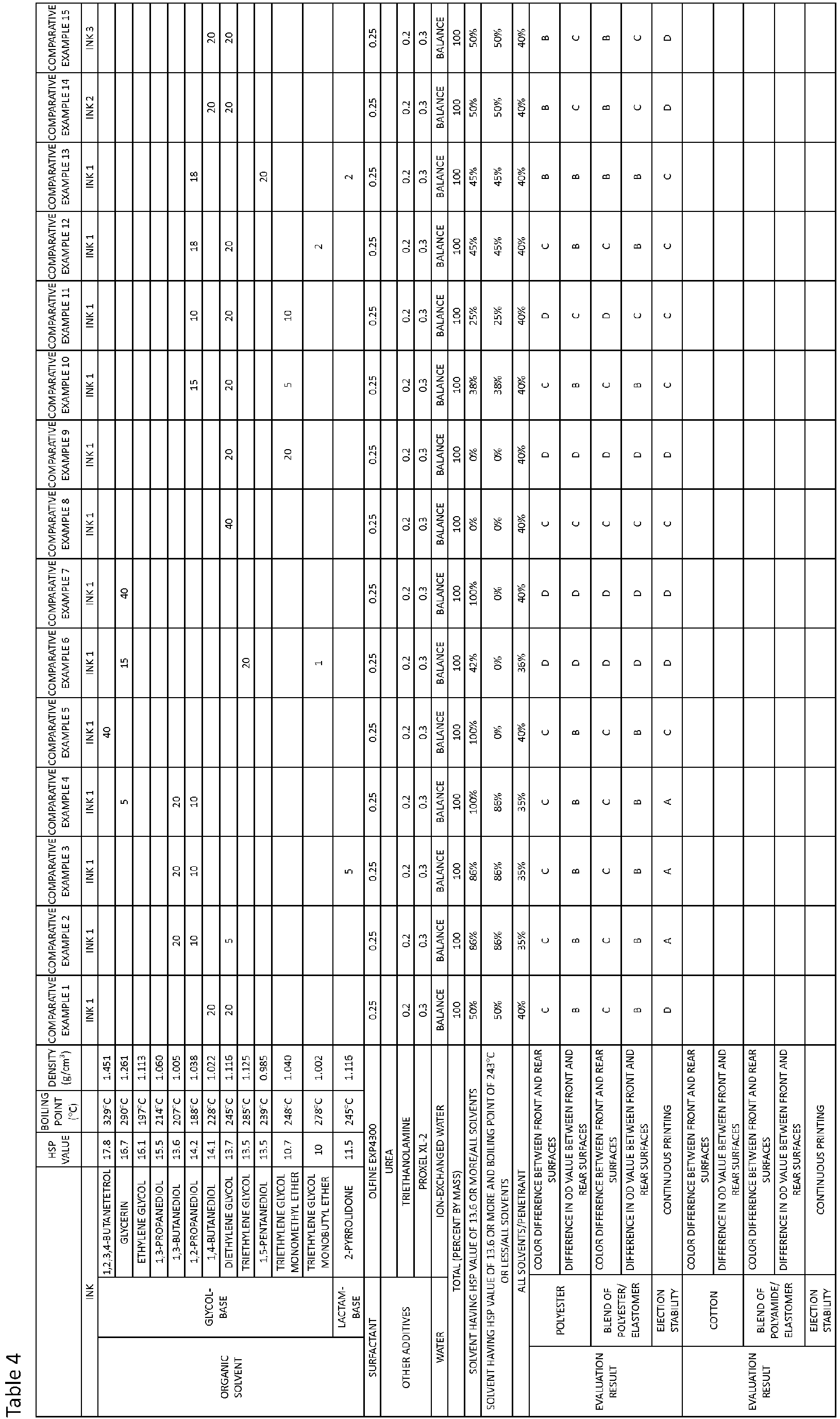
- Among the components listed in the tables, the details of the components not described by the chemical names are as follows.
-
- C.I. Disperse Yellow 163, dispersive dye
- C.I. Dispersive Yellow 114, dispersive dye
- C.I. Dispersive Red 154, dispersive dye
- C.I. Dispersive Blue 60, dispersive dye
- C.I. Dispersive Blue 165, dispersive dye
- C.I. Reactive Black 39, reactive dye
- C.I. Reactive Orange 12, reactive dye
- C.I. Reactive Red 245, reactive dye
- C.I. Acid Black 172, acidic dye
-
- Olefin (registered trademark) PD002W: acetylene glycol-based surfactant, manufactured by Nisshin Chemical Industry Co., Ltd.
- Olefin (registered trademark) EXP. 4300: acetylene glycol-based surfactant, manufactured by Nisshin Chemical Industry Co., Ltd.
-
- EDTA: disodium ethylenediaminetetraacetate, chelating agent
- PROXEL XL-2: trade name, antiseptic agent, manufactured by Lonza Japan Ltd.
- The HSP values in the tables are numerical values each obtained by calculation of the above equation (1) with reference to the numerical values of δD, δP, and δH listed in the data base of International Chemical Identifier.
- The inks thus obtained and the penetrants listed in Tables 2 to 4 were each filled in a cartridge of an ink jet printer (product name "PX-G930", manufactured by Seiko Epson Corporation). A cloth was set in the printer, and the ink and the penetrant were each printed at a duty of 100%, so that the ink and the penetrant were adhered to a surface of the cloth. The image resolution was set to 1,440×720 dpi. As the cloth, in accordance with the types of dyes, four types of cloths, that is, a cloth containing 100% of a polyester (basis weight: 70 g/m2), a blend cloth containing a polyester and an elastomer (basis weight: 190 g/m2), a cloth containing 100% of a cotton (basis weight: 130 g/m2, and a blend cloth containing a polyamide and an elastomer (basis weight: 190 g/m2), were used.
- In addition, the "duty" in the above measurement method indicates the value calculated in accordance with the following equation.

- In the above equation, the "number of actually ejected dots" indicates the number of actually ejected dots per unit area, and the "vertical resolution" and the "lateral resolution" each indicate the resolution per unit area.
- On a printed material thus obtained, by the use of a steamer (Steamer DHe type, manufactured by Mathis), a heat treatment was performed on a cotton at 102°C for 10 minuets, a polyamide at 102°C for 30 minuets, and a polyester or a blend containing a polyester and an elastomer at 170°C for 10 minuets, so that the ink was fixed to the cloth. Subsequently, washing and drying of the cloth were performed, and L*, a*, and b* values of the front surface and the rear surface of the printed material were measured and then evaluated in accordance with the following criteria. For the measurement, a colorimeter (trade name: "FD-7", manufactured by Konica Minolta, Inc.) was used.
- Color difference ΔE* between the front and the rear surfaces of the printed material was calculated using the following color difference formula, and the color difference was evaluated.


- L*1 a*1, and b*1 each indicate the value at the front surface of the printed material, and L*2, a*2, and b*2 each indicate the value at the rear surface of the printed material.
-
- S: Color difference between the front and the rear surfaces is less than 1.
- A: Color difference between the front and the rear surfaces is 1 to less than 2.
- B: Color difference between the front and the rear surfaces is 2 to less than 3.
- C: Color difference between the front and the rear surfaces is 3 to less than 4.
- D: Color difference between the front and the rear surfaces is more than 4.
- OD values of the front surface and the rear surface of the printed material obtained in 7.2.1 were measured using a colorimeter (trade name "FD-7", manufactured by Konica Minolta, Inc.), and the difference therebetween was obtained and then evaluated in accordance with the following criteria.
-
- A: Difference in OD value between the front and the rear surfaces is less than 0.1.
- B: Difference in OD value between the front and the surfaces is 0.1 to less than 0.2.
- C: Difference in OD value between the front and the surfaces is 0.2 to less than 0.3.
- D: Difference in OD value between the front and the surfaces is more than 0.3.
- The inks thus obtained and the penetrants listed in Tables 2 to 4 were filled in cartridges of an ink jet printer (trade name "PX-G930", manufactured by Seiko Epson Corporation). After regular paper was set in the printer, a solid pattern having an A4 size was recorded on the regular paper using the ink and the penetrant. After recording was performed on 500 pieces of paper, the presence or absence of the generation of nozzle missing was confirmed by visual inspection using a nozzle check pattern, and evaluation was performed in accordance with the following criteria.
-
- S: Number of missing nozzles is 0.
- A: Number of missing nozzles is 1 to less than 5.
- B: Number of missing nozzles is 5 to less than 10.
- C: Number of missing nozzles is 10 to less than 15.
- D: Number of missing nozzles is more than 15.
- By the penetrant of Comparative Example 1 shown in Table 4, since the content of the glycol-based solvent having an HSP value of 13.6 or more and a standard boiling point of 243°C or less is low, the ink was not allowed to sufficiently penetrate to the rear surface, and as a result, the color difference and the difference in OD value between the front and the rear surfaces were increased. In addition, the evaluation of the continuous printing was also low. In Comparative Examples 2 to 4, although the content of the glycol-based solvent as described above was relatively high as compared to that of Comparative Example 1, and the evaluation of the continuous printing was improved, the color difference and the difference in OD value between the front and the rear surfaces were not so much changed.
- Since the penetrants of Comparative Examples 5 to 9 contained no glycol-based solvent having an HSP value of 13.6 or more and a standard boiling point of 243°C or less, as was the case of Comparative Example 1, the ink was not allowed to sufficiently penetrate to the rear surface, and the color difference and the difference in OD value between the front and the rear surfaces were increased. In addition, the evaluation of the continuous printing was also low.
- In the penetrants of Comparative Examples 10 to 13, since the content of the glycol-based solvent having an HSP value of 13.6 or more and a standard boiling point of 243°C or less was also low, as was the case of Comparative Example 1, the ink was not allowed to sufficiently penetrate to the rear surface, and the color difference and the difference in OD value between the front and the rear surfaces were increased. In addition, the evaluation of the continuous printing was also low. In addition, from Comparative Examples 1, 14, and 15, even when the type of dispersive dye was changed, the evaluation was not changed.
- Compared to the results of Comparative Examples, the evaluation of the color difference and the difference in OD value between the front and the rear surfaces were each "B or more" in Examples. In addition, the evaluation of the continuous printing was "C or more".
- First, in Examples 1 to 8, when the content of the glycol-based solvent having an HSP value of 13.6 or more and a standard boiling point of 243°C or less was 95 percent by mass or more with respect to the total mass of the organic solvent contained in the penetrant, the ink was allowed to sufficiently penetrate to the rear surface, and the color different and the difference in OD value between the front and the rear surfaces were small. In addition, the evaluation of the continuous printing was also high. In particular, when the content of the organic solvent with respect to the total mass of the penetrant was high, and at least two types of the glycol-based solvents were used, the evaluation tended to be high. In addition, when the urea functioning as a humidifier was contained, the evaluation of the continuous printing was improved. Furthermore, in Examples 7 and 8, when at least two types of the glycol-based solvents having an HSP value of 13.6 or more and a standard boiling point of 243°C or less were used, the evaluation of the continuous printing tended to be high.
- From Examples 9 to 15, when 2-pyrrolidone, which was a compound having a lactam structure, was contained, the evaluation of the continuous printing tended to be low, and in the blend cloth containing a polyester and an elastomer, the evaluation of the color difference between the front and the rear surfaces tended to be relatively low. In addition, when at least two types of the glycol-based solvents having an HSP value of 13.6 or more and a standard boiling point of 243°C or less were used, the whole evaluation tended to be high.
- From Examples 16 to 19, when the content of the organic solvent with respect to the total mass of the penetrant was 25 to 50 percent by mass, the evaluation of the continuous printing and the difference in OD value between the front and the rear surfaces tended to be high.
- From comparison between Examples 9, 20, and 21 and Example 6, when a solvent other than the glycol-based solvent having an HSP value of 13.6 or more and a standard boiling point of 243°C or less was contained, the evaluation of the color difference between the front and the rear surfaces tended to be relatively low.
- From comparison between Examples 22 and 23 and Example 6, even when different dispersive dyes were used, evaluation results similar to each other were obtained. On the other hand, from comparison between Example 24 and Example 6, when recording was performed on a cotton using the
ink 4 containing a reactive dye, all the evaluation results of Example 24 were high although being slightly inferior to those of Example 6. In addition, from comparison between Example 25 and Example 6, when recording was performed on a blend cloth containing a polyamide and an elastomer using theink 5 containing an acidic dye, all the evaluation results of Example 25 were high although being slightly inferior to those of Example 6. - Accordingly, when the penetrant in which the content of the glycol-based solvent having an HSP value of 13.6 or more and a standard boiling point of 243°C or less was 95 percent by mass or more with respect to the total mass of the organic solvent was used, the difference in OD value between the front and the rear surfaces could be reduced, and in addition, the color difference between the front and the rear surfaces was suppressed, and the ejection stability was excellent.
- The present disclosure is not limited to the embodiments described above and may be variously changed. For example, the present disclosure includes substantially the same structure (for example, the structure in which the function, the method, and the result are the same as those described above, or the structure in which the object and the effect are the same as those described above) as the structure described in the embodiment. In addition, the present disclosure includes the structure in which a nonessential portion of the structure described in the embodiment is replaced with something else. In addition, the present disclosure includes the structure which performs the same operational effect as that of the structure described in the embodiment or the structure which is able to achieve the same object as that of the structure described in the embodiment. In addition, the present disclosure includes the structure in which a known technique is added to the structure described in the embodiment.
Claims (9)
- An ink jet printing penetrant which is used to penetrate an ink jet printing color ink containing a dye in a cloth, the ink jet printing penetrant comprising: at least one glycol-based solvent having an HSP value of 13.6 or more; and water, wherein
a content of the glycol-based solvent with respect to a total mass of at least one organic solvent contained in the ink jet printing penetrant is 95 percent by mass or more, and
the glycol-based solvent has a standard boiling point of 243°C or less. - The ink jet printing penetrant according to claim 1, wherein
the dye is a dispersive dye. - The ink jet printing penetrant according to claim 1 or claim 2, wherein
the glycol-based solvent has an HSP value of 17.0 or less. - The ink jet printing penetrant according to any one of the preceding claims, wherein
a content of the organic solvent with respect to a total mass of the ink jet printing penetrant is 25 to 50 percent by mass. - The ink jet printing penetrant according to any one of the preceding claims, wherein
the cloth is a polyester cloth or a polyester blend cloth. - The ink jet printing penetrant according to any one of the preceding claims, wherein
the number of the glycol-based solvents is at least two. - An ink jet printing ink set comprising:an ink jet printing color ink containing at least one dye; andthe ink jet printing penetrant according to any one of the preceding claims.
- The ink jet printing ink set according to claim 7, wherein
the ink jet printing color ink contains at least two types of the dyes. - An ink jet printing method comprising:
performing printing by adhesion of an ink jet printing color ink containing a dye and the ink jet printing penetrant according to any one of claims 1 to 6 to the cloth.
Applications Claiming Priority (1)
| Application Number | Priority Date | Filing Date | Title |
|---|---|---|---|
| JP2018159243A JP7206699B2 (en) | 2018-08-28 | 2018-08-28 | Penetrating liquid for inkjet textile printing, ink set for inkjet textile printing, and inkjet textile printing method |
Publications (2)
| Publication Number | Publication Date |
|---|---|
| EP3617284A1 true EP3617284A1 (en) | 2020-03-04 |
| EP3617284B1 EP3617284B1 (en) | 2025-02-19 |
Family
ID=67777099
Family Applications (1)
| Application Number | Title | Priority Date | Filing Date |
|---|---|---|---|
| EP19193922.2A Active EP3617284B1 (en) | 2018-08-28 | 2019-08-27 | Ink jet printing penetrant, ink jet printing ink set, and ink jet printing method |
Country Status (4)
| Country | Link |
|---|---|
| US (1) | US20200071553A1 (en) |
| EP (1) | EP3617284B1 (en) |
| JP (1) | JP7206699B2 (en) |
| CN (1) | CN110863378B (en) |
Cited By (1)
| Publication number | Priority date | Publication date | Assignee | Title |
|---|---|---|---|---|
| EP3978680A1 (en) * | 2020-09-30 | 2022-04-06 | Seiko Epson Corporation | Textile printing method, printed matter, and recording apparatus |
Families Citing this family (8)
| Publication number | Priority date | Publication date | Assignee | Title |
|---|---|---|---|---|
| JP7155565B2 (en) * | 2018-03-26 | 2022-10-19 | セイコーエプソン株式会社 | Inkjet textile printing composition set and inkjet textile printing method |
| WO2021193322A1 (en) * | 2020-03-25 | 2021-09-30 | 京セラドキュメントソリューションズ株式会社 | Pretreatment solution for inkjet textile printing, inkjet, inkjet textile printing method, and inkjet textile printing device |
| JP7532961B2 (en) * | 2020-07-08 | 2024-08-14 | コニカミノルタ株式会社 | Ink set for ink-jet printing and ink-jet printing method |
| CN112160173B (en) * | 2020-09-01 | 2022-11-04 | 四川省丝绸科学研究院有限公司 | Unidirectional penetrant for digital printing pretreatment of natural fiber fabric |
| JP2022101989A (en) * | 2020-12-25 | 2022-07-07 | セイコーエプソン株式会社 | Inkjet printing treatment liquid composition, ink set, and recording method |
| JP2023145897A (en) * | 2022-03-29 | 2023-10-12 | セイコーエプソン株式会社 | Textile printing inkjet ink composition and recording method |
| CN114481649A (en) * | 2022-04-02 | 2022-05-13 | 宏华印染(苏州)有限公司 | High-permeability anhydrous digital printing and dyeing method |
| JP2024033771A (en) * | 2022-08-31 | 2024-03-13 | セイコーエプソン株式会社 | Dye textile printing treatment liquid composition, composition set, textile printing method, and inkjet textile printing method |
Citations (8)
| Publication number | Priority date | Publication date | Assignee | Title |
|---|---|---|---|---|
| JPH02112489A (en) * | 1988-10-19 | 1990-04-25 | Toray Ind Inc | Production of cloth of ink jet |
| JPH11269783A (en) * | 1998-03-20 | 1999-10-05 | Suminoe Textile Co Ltd | Ink jet dyeing fabric and dyeing method |
| JP2005188007A (en) * | 2003-12-26 | 2005-07-14 | Fuji Xerox Co Ltd | Recording paper and method for recording picture image using the same |
| JP2010255133A (en) * | 2009-04-23 | 2010-11-11 | Konica Minolta Ij Technologies Inc | Inkjet printing method |
| EP2311917A1 (en) * | 2008-07-31 | 2011-04-20 | Nippon Kayaku Kabushiki Kaisha | Ink set for inkjet printing and method for printing fiber using the same |
| US20150116418A1 (en) * | 2013-02-21 | 2015-04-30 | Kiwa Chemical Industry Co., Ltd. | Sublimating dye ink for ink jets and dyeing method |
| JP2016141802A (en) | 2015-02-05 | 2016-08-08 | セイコーエプソン株式会社 | Ink-jet printing penetrant |
| JP2018159243A (en) | 2017-03-23 | 2018-10-11 | 大和ハウス工業株式会社 | building |
-
2018
- 2018-08-28 JP JP2018159243A patent/JP7206699B2/en active Active
-
2019
- 2019-08-26 CN CN201910789682.1A patent/CN110863378B/en active Active
- 2019-08-27 EP EP19193922.2A patent/EP3617284B1/en active Active
- 2019-08-27 US US16/551,907 patent/US20200071553A1/en not_active Abandoned
Patent Citations (8)
| Publication number | Priority date | Publication date | Assignee | Title |
|---|---|---|---|---|
| JPH02112489A (en) * | 1988-10-19 | 1990-04-25 | Toray Ind Inc | Production of cloth of ink jet |
| JPH11269783A (en) * | 1998-03-20 | 1999-10-05 | Suminoe Textile Co Ltd | Ink jet dyeing fabric and dyeing method |
| JP2005188007A (en) * | 2003-12-26 | 2005-07-14 | Fuji Xerox Co Ltd | Recording paper and method for recording picture image using the same |
| EP2311917A1 (en) * | 2008-07-31 | 2011-04-20 | Nippon Kayaku Kabushiki Kaisha | Ink set for inkjet printing and method for printing fiber using the same |
| JP2010255133A (en) * | 2009-04-23 | 2010-11-11 | Konica Minolta Ij Technologies Inc | Inkjet printing method |
| US20150116418A1 (en) * | 2013-02-21 | 2015-04-30 | Kiwa Chemical Industry Co., Ltd. | Sublimating dye ink for ink jets and dyeing method |
| JP2016141802A (en) | 2015-02-05 | 2016-08-08 | セイコーエプソン株式会社 | Ink-jet printing penetrant |
| JP2018159243A (en) | 2017-03-23 | 2018-10-11 | 大和ハウス工業株式会社 | building |
Cited By (2)
| Publication number | Priority date | Publication date | Assignee | Title |
|---|---|---|---|---|
| EP3978680A1 (en) * | 2020-09-30 | 2022-04-06 | Seiko Epson Corporation | Textile printing method, printed matter, and recording apparatus |
| US12059916B2 (en) | 2020-09-30 | 2024-08-13 | Seiko Epson Corporation | Textile printing method, printed matter, and recording apparatus |
Also Published As
| Publication number | Publication date |
|---|---|
| JP2020033660A (en) | 2020-03-05 |
| JP7206699B2 (en) | 2023-01-18 |
| CN110863378A (en) | 2020-03-06 |
| EP3617284B1 (en) | 2025-02-19 |
| CN110863378B (en) | 2023-06-16 |
| US20200071553A1 (en) | 2020-03-05 |
Similar Documents
| Publication | Publication Date | Title |
|---|---|---|
| EP3617284B1 (en) | Ink jet printing penetrant, ink jet printing ink set, and ink jet printing method | |
| EP3674479A1 (en) | Liquid discharge apparatus, ink jet recording method, and pigment textile printing ink composition | |
| EP3546644B1 (en) | Ink jet textile printing composition set and ink jet textile printing method | |
| EP3375829B1 (en) | Ink jet ink composition and recording method | |
| EP3053972B1 (en) | Penetrant liquid for ink jet textile printing | |
| US10487227B2 (en) | Ink set and recording method | |
| EP3048145A1 (en) | Ink jet black ink composition for sublimination transfer, and dyed article and method for producing dyed article | |
| EP3434739B1 (en) | Sublimation transfer ink jet ink composition and sublimation transfer ink jet recording method | |
| CN112980245B (en) | Sublimation transfer ink jet ink composition and method for producing printed matter | |
| JP2017071683A (en) | Inkjet printing ink composition and printing method | |
| JP2019026963A (en) | Processing liquid recording method | |
| US12215241B2 (en) | Printing ink jet ink composition and recording method | |
| CN118620449A (en) | Inkjet printing treatment liquid composition, ink set and inkjet recording method | |
| JP6222461B2 (en) | Manufacturing method for printing and printing | |
| US12378426B2 (en) | Ink jet ink composition | |
| EP3822083B1 (en) | Ink jet recording apparatus | |
| EP4239123A1 (en) | Recording method | |
| JP2025027745A (en) | Textile printing inkjet ink composition |
Legal Events
| Date | Code | Title | Description |
|---|---|---|---|
| PUAI | Public reference made under article 153(3) epc to a published international application that has entered the european phase |
Free format text: ORIGINAL CODE: 0009012 |
|
| STAA | Information on the status of an ep patent application or granted ep patent |
Free format text: STATUS: THE APPLICATION HAS BEEN PUBLISHED |
|
| AK | Designated contracting states |
Kind code of ref document: A1 Designated state(s): AL AT BE BG CH CY CZ DE DK EE ES FI FR GB GR HR HU IE IS IT LI LT LU LV MC MK MT NL NO PL PT RO RS SE SI SK SM TR |
|
| AX | Request for extension of the european patent |
Extension state: BA ME |
|
| STAA | Information on the status of an ep patent application or granted ep patent |
Free format text: STATUS: REQUEST FOR EXAMINATION WAS MADE |
|
| 17P | Request for examination filed |
Effective date: 20200904 |
|
| RBV | Designated contracting states (corrected) |
Designated state(s): AL AT BE BG CH CY CZ DE DK EE ES FI FR GB GR HR HU IE IS IT LI LT LU LV MC MK MT NL NO PL PT RO RS SE SI SK SM TR |
|
| STAA | Information on the status of an ep patent application or granted ep patent |
Free format text: STATUS: EXAMINATION IS IN PROGRESS |
|
| 17Q | First examination report despatched |
Effective date: 20230502 |
|
| GRAP | Despatch of communication of intention to grant a patent |
Free format text: ORIGINAL CODE: EPIDOSNIGR1 |
|
| STAA | Information on the status of an ep patent application or granted ep patent |
Free format text: STATUS: GRANT OF PATENT IS INTENDED |
|
| RIC1 | Information provided on ipc code assigned before grant |
Ipc: D06P 5/30 20060101ALI20240827BHEP Ipc: C09D 11/54 20140101ALI20240827BHEP Ipc: C09D 11/328 20140101AFI20240827BHEP |
|
| INTG | Intention to grant announced |
Effective date: 20240923 |
|
| GRAS | Grant fee paid |
Free format text: ORIGINAL CODE: EPIDOSNIGR3 |
|
| GRAA | (expected) grant |
Free format text: ORIGINAL CODE: 0009210 |
|
| STAA | Information on the status of an ep patent application or granted ep patent |
Free format text: STATUS: THE PATENT HAS BEEN GRANTED |
|
| AK | Designated contracting states |
Kind code of ref document: B1 Designated state(s): AL AT BE BG CH CY CZ DE DK EE ES FI FR GB GR HR HU IE IS IT LI LT LU LV MC MK MT NL NO PL PT RO RS SE SI SK SM TR |
|
| REG | Reference to a national code |
Ref country code: GB Ref legal event code: FG4D |
|
| REG | Reference to a national code |
Ref country code: CH Ref legal event code: EP |
|
| REG | Reference to a national code |
Ref country code: DE Ref legal event code: R096 Ref document number: 602019066071 Country of ref document: DE |
|
| REG | Reference to a national code |
Ref country code: IE Ref legal event code: FG4D |
|
| REG | Reference to a national code |
Ref country code: NL Ref legal event code: MP Effective date: 20250219 |
|
| PG25 | Lapsed in a contracting state [announced via postgrant information from national office to epo] |
Ref country code: RS Free format text: LAPSE BECAUSE OF FAILURE TO SUBMIT A TRANSLATION OF THE DESCRIPTION OR TO PAY THE FEE WITHIN THE PRESCRIBED TIME-LIMIT Effective date: 20250519 |
|
| PG25 | Lapsed in a contracting state [announced via postgrant information from national office to epo] |
Ref country code: FI Free format text: LAPSE BECAUSE OF FAILURE TO SUBMIT A TRANSLATION OF THE DESCRIPTION OR TO PAY THE FEE WITHIN THE PRESCRIBED TIME-LIMIT Effective date: 20250219 |
|
| PG25 | Lapsed in a contracting state [announced via postgrant information from national office to epo] |
Ref country code: PL Free format text: LAPSE BECAUSE OF FAILURE TO SUBMIT A TRANSLATION OF THE DESCRIPTION OR TO PAY THE FEE WITHIN THE PRESCRIBED TIME-LIMIT Effective date: 20250219 |
|
| PG25 | Lapsed in a contracting state [announced via postgrant information from national office to epo] |
Ref country code: ES Free format text: LAPSE BECAUSE OF FAILURE TO SUBMIT A TRANSLATION OF THE DESCRIPTION OR TO PAY THE FEE WITHIN THE PRESCRIBED TIME-LIMIT Effective date: 20250219 |
|
| PGFP | Annual fee paid to national office [announced via postgrant information from national office to epo] |
Ref country code: GB Payment date: 20250625 Year of fee payment: 7 |
|
| REG | Reference to a national code |
Ref country code: LT Ref legal event code: MG9D |
|
| PG25 | Lapsed in a contracting state [announced via postgrant information from national office to epo] |
Ref country code: IS Free format text: LAPSE BECAUSE OF FAILURE TO SUBMIT A TRANSLATION OF THE DESCRIPTION OR TO PAY THE FEE WITHIN THE PRESCRIBED TIME-LIMIT Effective date: 20250619 Ref country code: NO Free format text: LAPSE BECAUSE OF FAILURE TO SUBMIT A TRANSLATION OF THE DESCRIPTION OR TO PAY THE FEE WITHIN THE PRESCRIBED TIME-LIMIT Effective date: 20250519 |
|
| PG25 | Lapsed in a contracting state [announced via postgrant information from national office to epo] |
Ref country code: NL Free format text: LAPSE BECAUSE OF FAILURE TO SUBMIT A TRANSLATION OF THE DESCRIPTION OR TO PAY THE FEE WITHIN THE PRESCRIBED TIME-LIMIT Effective date: 20250219 |
|
| PG25 | Lapsed in a contracting state [announced via postgrant information from national office to epo] |
Ref country code: HR Free format text: LAPSE BECAUSE OF FAILURE TO SUBMIT A TRANSLATION OF THE DESCRIPTION OR TO PAY THE FEE WITHIN THE PRESCRIBED TIME-LIMIT Effective date: 20250219 |
|
| PG25 | Lapsed in a contracting state [announced via postgrant information from national office to epo] |
Ref country code: LV Free format text: LAPSE BECAUSE OF FAILURE TO SUBMIT A TRANSLATION OF THE DESCRIPTION OR TO PAY THE FEE WITHIN THE PRESCRIBED TIME-LIMIT Effective date: 20250219 Ref country code: PT Free format text: LAPSE BECAUSE OF FAILURE TO SUBMIT A TRANSLATION OF THE DESCRIPTION OR TO PAY THE FEE WITHIN THE PRESCRIBED TIME-LIMIT Effective date: 20250620 |
|
| PG25 | Lapsed in a contracting state [announced via postgrant information from national office to epo] |
Ref country code: GR Free format text: LAPSE BECAUSE OF FAILURE TO SUBMIT A TRANSLATION OF THE DESCRIPTION OR TO PAY THE FEE WITHIN THE PRESCRIBED TIME-LIMIT Effective date: 20250520 Ref country code: BG Free format text: LAPSE BECAUSE OF FAILURE TO SUBMIT A TRANSLATION OF THE DESCRIPTION OR TO PAY THE FEE WITHIN THE PRESCRIBED TIME-LIMIT Effective date: 20250219 |
|
| REG | Reference to a national code |
Ref country code: AT Ref legal event code: MK05 Ref document number: 1768276 Country of ref document: AT Kind code of ref document: T Effective date: 20250219 |
|
| PG25 | Lapsed in a contracting state [announced via postgrant information from national office to epo] |
Ref country code: SE Free format text: LAPSE BECAUSE OF FAILURE TO SUBMIT A TRANSLATION OF THE DESCRIPTION OR TO PAY THE FEE WITHIN THE PRESCRIBED TIME-LIMIT Effective date: 20250219 |
|
| PG25 | Lapsed in a contracting state [announced via postgrant information from national office to epo] |
Ref country code: SM Free format text: LAPSE BECAUSE OF FAILURE TO SUBMIT A TRANSLATION OF THE DESCRIPTION OR TO PAY THE FEE WITHIN THE PRESCRIBED TIME-LIMIT Effective date: 20250219 |
|
| PG25 | Lapsed in a contracting state [announced via postgrant information from national office to epo] |
Ref country code: DK Free format text: LAPSE BECAUSE OF FAILURE TO SUBMIT A TRANSLATION OF THE DESCRIPTION OR TO PAY THE FEE WITHIN THE PRESCRIBED TIME-LIMIT Effective date: 20250219 |
|
| PGFP | Annual fee paid to national office [announced via postgrant information from national office to epo] |
Ref country code: DE Payment date: 20250827 Year of fee payment: 7 |
|
| PGFP | Annual fee paid to national office [announced via postgrant information from national office to epo] |
Ref country code: IT Payment date: 20250825 Year of fee payment: 7 |
|
| PG25 | Lapsed in a contracting state [announced via postgrant information from national office to epo] |
Ref country code: AT Free format text: LAPSE BECAUSE OF FAILURE TO SUBMIT A TRANSLATION OF THE DESCRIPTION OR TO PAY THE FEE WITHIN THE PRESCRIBED TIME-LIMIT Effective date: 20250219 |
|
| PG25 | Lapsed in a contracting state [announced via postgrant information from national office to epo] |
Ref country code: CZ Free format text: LAPSE BECAUSE OF FAILURE TO SUBMIT A TRANSLATION OF THE DESCRIPTION OR TO PAY THE FEE WITHIN THE PRESCRIBED TIME-LIMIT Effective date: 20250219 Ref country code: EE Free format text: LAPSE BECAUSE OF FAILURE TO SUBMIT A TRANSLATION OF THE DESCRIPTION OR TO PAY THE FEE WITHIN THE PRESCRIBED TIME-LIMIT Effective date: 20250219 |
|
| PG25 | Lapsed in a contracting state [announced via postgrant information from national office to epo] |
Ref country code: RO Free format text: LAPSE BECAUSE OF FAILURE TO SUBMIT A TRANSLATION OF THE DESCRIPTION OR TO PAY THE FEE WITHIN THE PRESCRIBED TIME-LIMIT Effective date: 20250219 |
|
| PG25 | Lapsed in a contracting state [announced via postgrant information from national office to epo] |
Ref country code: SK Free format text: LAPSE BECAUSE OF FAILURE TO SUBMIT A TRANSLATION OF THE DESCRIPTION OR TO PAY THE FEE WITHIN THE PRESCRIBED TIME-LIMIT Effective date: 20250219 |
|
| REG | Reference to a national code |
Ref country code: DE Ref legal event code: R097 Ref document number: 602019066071 Country of ref document: DE |
|
| PLBE | No opposition filed within time limit |
Free format text: ORIGINAL CODE: 0009261 |
|
| STAA | Information on the status of an ep patent application or granted ep patent |
Free format text: STATUS: NO OPPOSITION FILED WITHIN TIME LIMIT |
|
| REG | Reference to a national code |
Ref country code: CH Ref legal event code: L10 Free format text: ST27 STATUS EVENT CODE: U-0-0-L10-L00 (AS PROVIDED BY THE NATIONAL OFFICE) Effective date: 20251231 |
|
| 26N | No opposition filed |
Effective date: 20251120 |
|
| REG | Reference to a national code |
Ref country code: CH Ref legal event code: H13 Free format text: ST27 STATUS EVENT CODE: U-0-0-H10-H13 (AS PROVIDED BY THE NATIONAL OFFICE) Effective date: 20260324 |
|
| PG25 | Lapsed in a contracting state [announced via postgrant information from national office to epo] |
Ref country code: MC Free format text: LAPSE BECAUSE OF FAILURE TO SUBMIT A TRANSLATION OF THE DESCRIPTION OR TO PAY THE FEE WITHIN THE PRESCRIBED TIME-LIMIT Effective date: 20250219 |
|
| PG25 | Lapsed in a contracting state [announced via postgrant information from national office to epo] |
Ref country code: LU Free format text: LAPSE BECAUSE OF NON-PAYMENT OF DUE FEES Effective date: 20250827 |
|
| PG25 | Lapsed in a contracting state [announced via postgrant information from national office to epo] |
Ref country code: CH Free format text: LAPSE BECAUSE OF NON-PAYMENT OF DUE FEES Effective date: 20250831 |