EP3617196B1 - N-(4-pyridyl) nicotinamide compound or salt thereof - Google Patents
N-(4-pyridyl) nicotinamide compound or salt thereof Download PDFInfo
- Publication number
- EP3617196B1 EP3617196B1 EP18790208.5A EP18790208A EP3617196B1 EP 3617196 B1 EP3617196 B1 EP 3617196B1 EP 18790208 A EP18790208 A EP 18790208A EP 3617196 B1 EP3617196 B1 EP 3617196B1
- Authority
- EP
- European Patent Office
- Prior art keywords
- compound
- ome
- compounds
- based compounds
- methyl
- Prior art date
- Legal status (The legal status is an assumption and is not a legal conclusion. Google has not performed a legal analysis and makes no representation as to the accuracy of the status listed.)
- Active
Links
Classifications
-
- A—HUMAN NECESSITIES
- A01—AGRICULTURE; FORESTRY; ANIMAL HUSBANDRY; HUNTING; TRAPPING; FISHING
- A01N—PRESERVATION OF BODIES OF HUMANS OR ANIMALS OR PLANTS OR PARTS THEREOF; BIOCIDES, e.g. AS DISINFECTANTS, AS PESTICIDES OR AS HERBICIDES; PEST REPELLANTS OR ATTRACTANTS; PLANT GROWTH REGULATORS
- A01N47/00—Biocides, pest repellants or attractants, or plant growth regulators containing organic compounds containing a carbon atom not being member of a ring and having no bond to a carbon or hydrogen atom, e.g. derivatives of carbonic acid
- A01N47/08—Biocides, pest repellants or attractants, or plant growth regulators containing organic compounds containing a carbon atom not being member of a ring and having no bond to a carbon or hydrogen atom, e.g. derivatives of carbonic acid the carbon atom having one or more single bonds to nitrogen atoms
- A01N47/10—Carbamic acid derivatives, i.e. containing the group —O—CO—N<; Thio analogues thereof
- A01N47/12—Carbamic acid derivatives, i.e. containing the group —O—CO—N<; Thio analogues thereof containing a —O—CO—N< group, or a thio analogue thereof, neither directly attached to a ring nor the nitrogen atom being a member of a heterocyclic ring
-
- C—CHEMISTRY; METALLURGY
- C07—ORGANIC CHEMISTRY
- C07D—HETEROCYCLIC COMPOUNDS
- C07D401/00—Heterocyclic compounds containing two or more hetero rings, having nitrogen atoms as the only ring hetero atoms, at least one ring being a six-membered ring with only one nitrogen atom
- C07D401/02—Heterocyclic compounds containing two or more hetero rings, having nitrogen atoms as the only ring hetero atoms, at least one ring being a six-membered ring with only one nitrogen atom containing two hetero rings
- C07D401/12—Heterocyclic compounds containing two or more hetero rings, having nitrogen atoms as the only ring hetero atoms, at least one ring being a six-membered ring with only one nitrogen atom containing two hetero rings linked by a chain containing hetero atoms as chain links
-
- A—HUMAN NECESSITIES
- A01—AGRICULTURE; FORESTRY; ANIMAL HUSBANDRY; HUNTING; TRAPPING; FISHING
- A01N—PRESERVATION OF BODIES OF HUMANS OR ANIMALS OR PLANTS OR PARTS THEREOF; BIOCIDES, e.g. AS DISINFECTANTS, AS PESTICIDES OR AS HERBICIDES; PEST REPELLANTS OR ATTRACTANTS; PLANT GROWTH REGULATORS
- A01N43/00—Biocides, pest repellants or attractants, or plant growth regulators containing heterocyclic compounds
- A01N43/34—Biocides, pest repellants or attractants, or plant growth regulators containing heterocyclic compounds having rings with one nitrogen atom as the only ring hetero atom
- A01N43/40—Biocides, pest repellants or attractants, or plant growth regulators containing heterocyclic compounds having rings with one nitrogen atom as the only ring hetero atom six-membered rings
-
- A—HUMAN NECESSITIES
- A01—AGRICULTURE; FORESTRY; ANIMAL HUSBANDRY; HUNTING; TRAPPING; FISHING
- A01N—PRESERVATION OF BODIES OF HUMANS OR ANIMALS OR PLANTS OR PARTS THEREOF; BIOCIDES, e.g. AS DISINFECTANTS, AS PESTICIDES OR AS HERBICIDES; PEST REPELLANTS OR ATTRACTANTS; PLANT GROWTH REGULATORS
- A01N43/00—Biocides, pest repellants or attractants, or plant growth regulators containing heterocyclic compounds
- A01N43/48—Biocides, pest repellants or attractants, or plant growth regulators containing heterocyclic compounds having rings with two nitrogen atoms as the only ring hetero atoms
- A01N43/56—1,2-Diazoles; Hydrogenated 1,2-diazoles
-
- A—HUMAN NECESSITIES
- A01—AGRICULTURE; FORESTRY; ANIMAL HUSBANDRY; HUNTING; TRAPPING; FISHING
- A01P—BIOCIDAL, PEST REPELLANT, PEST ATTRACTANT OR PLANT GROWTH REGULATORY ACTIVITY OF CHEMICAL COMPOUNDS OR PREPARATIONS
- A01P5/00—Nematocides
-
- C—CHEMISTRY; METALLURGY
- C07—ORGANIC CHEMISTRY
- C07D—HETEROCYCLIC COMPOUNDS
- C07D213/00—Heterocyclic compounds containing six-membered rings, not condensed with other rings, with one nitrogen atom as the only ring hetero atom and three or more double bonds between ring members or between ring members and non-ring members
- C07D213/02—Heterocyclic compounds containing six-membered rings, not condensed with other rings, with one nitrogen atom as the only ring hetero atom and three or more double bonds between ring members or between ring members and non-ring members having three double bonds between ring members or between ring members and non-ring members
- C07D213/04—Heterocyclic compounds containing six-membered rings, not condensed with other rings, with one nitrogen atom as the only ring hetero atom and three or more double bonds between ring members or between ring members and non-ring members having three double bonds between ring members or between ring members and non-ring members having no bond between the ring nitrogen atom and a non-ring member or having only hydrogen or carbon atoms directly attached to the ring nitrogen atom
- C07D213/60—Heterocyclic compounds containing six-membered rings, not condensed with other rings, with one nitrogen atom as the only ring hetero atom and three or more double bonds between ring members or between ring members and non-ring members having three double bonds between ring members or between ring members and non-ring members having no bond between the ring nitrogen atom and a non-ring member or having only hydrogen or carbon atoms directly attached to the ring nitrogen atom with hetero atoms or with carbon atoms having three bonds to hetero atoms with at the most one bond to halogen, e.g. ester or nitrile radicals, directly attached to ring carbon atoms
- C07D213/78—Carbon atoms having three bonds to hetero atoms, with at the most one bond to halogen, e.g. ester or nitrile radicals
- C07D213/81—Amides; Imides
- C07D213/82—Amides; Imides in position 3
-
- C—CHEMISTRY; METALLURGY
- C07—ORGANIC CHEMISTRY
- C07D—HETEROCYCLIC COMPOUNDS
- C07D401/00—Heterocyclic compounds containing two or more hetero rings, having nitrogen atoms as the only ring hetero atoms, at least one ring being a six-membered ring with only one nitrogen atom
- C07D401/14—Heterocyclic compounds containing two or more hetero rings, having nitrogen atoms as the only ring hetero atoms, at least one ring being a six-membered ring with only one nitrogen atom containing three or more hetero rings
Definitions
- the present invention relates to a novel N-(4-pyridyl)nicotinamide compound or a salt thereof.
- the present invention relates to a pest control agent, an agricultural and horticultural insecticide, a miticide, a nematicide, or a soil pesticide comprising the compound or a salt thereof as an active ingredient.
- the present invention relates to a method for controlling a pest by applying an effective amount of the compound or a salt thereof, excluding methods of medical or veterinary treatment or diagnosis.
- WO2002/070483 describes a wide range of heteroarylamide compounds for insecticide uses and WO2005/115986 describes a wide range of compounds having a pyridine skeleton for medicament uses. Also, JP-A-2003-73357 describes a wide range of heteroarylamide compounds for medicament uses.
- WO 2012/161877 discloses 1-amino-2-aminocarbonyl-substituted pyridine - and pyrazine derivatives of a general formula (I) as novel compounds having valuable pharmaceutical properties, in particular the capable of inhibiting one or more kinases and being suitable for treating a variety of disorders in humans.
- JP-A-2004-331541 provides nicotinamide derivatives of a general formula (I) and salts thereof and agrochemical compositions containing the same, which have insecticidal properties.
- JP-A-2017-008029 relates to a pest control agent containing a N- (4-pyridyl) picolinamide compound of a general formula (I) or a salt thereof as an active ingredient
- WO 2016/175017 describes 4-pyridinecarboxamide derivatives and agricultural and horticultural agent containing the same as an active ingredient and which are useful as plant pest control agents.
- Objects of the present invention are to provide a highly active compound or a salt thereof against a pest, to provide a pest control agent, an agricultural and horticultural insecticide, a miticide, a nematicide, or a soil pesticide using the compound or a salt thereof, and to provide a method for controlling a pest by applying the compound or a salt thereof.
- the present invention provides a compound which is a N-(4-pyridyl)nicotinamide compound of formula (I) or a salt thereof (also referred to as “the present compound” hereinafter): wherein
- the invention provides a pest control agent, as well as an agricultural and horticultural insecticide, miticide, nematicide, or soil pesticide, each comprising the present compound as an active ingredient.
- the invention provides a method for controlling a pest by applying an effective amount of the present compound.
- the pest control agent comprising the present compound has an extremely high control effect against pests at low dose.
- C n (n is natural number) has the same meaning as that of "carbon number n” (n is natural number).
- ppm is described for the concentration, it means “ppm by weight”.
- the present invention relates to a compound which is a N-(4-pyridyl)nicotinamide compound of formula (I) or a salt thereof: wherein
- halogen atom or the halogen as a substituent in the above formula (I) F, Cl, Br and I may be mentioned.
- the number of the halogen atom as the substituent may be 1 or 2. In the case of 2, individual halogen atoms may be the same or different from each other. Further, the substitution position of the halogen atom may be any position.
- Haloalkyl used herein means an alkyl at least one hydrogen atom of which is substituted with the halogen atom(s).
- haloalkoxy means an alkoxy, an alkylaryl and an alkylcarbonyl at least one hydrogen atom of each group is substituted with the halogen atom(s), respectively.
- the halogen atom substituted from the hydrogen atom in these haloalkyl, haloalkoxy, haloalkylaryl or haloalkylcarbonyl is referred to as "the halogen as a substituent”.
- alkyl or alkyl portion in the above formula (I) examples include linear or branched C 1-6 -groups such as methyl, ethyl, normal propyl, isopropyl, normal butyl, isobutyl, secondary butyl, tertiary butyl, normal pentyl, isopentyl, neopentyl, normal hexyl, or neohexyl.
- alkenyl or alkenyl portion in the above formula (I) examples include linear or branched C 2-6 -groups such as vinyl, 1-propenyl, 2-propenyl, isopropenyl, 2-methyl-1-propenyl, 1-methyl-1-propenyl, 2-methyl-2-propenyl, 1-methyl-2-propenyl, 1-butenyl, 2-butenyl, 3-butenyl, 1-pentenyl, 2-pentenyl, 2-methyl-2-butenyl, 1-hexenyl, or 2,3 -dimethyl-2-butenyl.
- linear or branched C 2-6 -groups such as vinyl, 1-propenyl, 2-propenyl, isopropenyl, 2-methyl-1-propenyl, 1-methyl-1-propenyl, 2-methyl-2-propenyl, 1-methyl-2-propenyl, 1-butenyl, 2-butenyl, 3-butenyl, 1-pentenyl, 2-pentenyl,
- alkynyl or alkynyl portion in the above formula (I) examples include linear or branched C 2-6 -groups such as ethynyl, 1-propynyl, 2-propynyl, 1-butynyl, 2-butynyl, 3-butynyl, 1-methyl-2-propynyl, 2-methyl-3-butynyl, 3,3-dimethyl-1-butynyl, 1-hexynyl, 2-hexynyl, 3-hexynyl, 4-hexynyl, or 5-hexynyl.
- C 2-6 -groups such as ethynyl, 1-propynyl, 2-propynyl, 1-butynyl, 2-butynyl, 3-butynyl, 1-methyl-2-propynyl, 2-methyl-3-butynyl, 3,3-dimethyl-1-butynyl, 1-hexynyl, 2-hexyn
- Examples of the cycloalkyl or cycloalkyl portion in the above formula (I) include C 3-6 -groups such as cyclopropyl, cyclobutyl, cyclopentyl, or cyclohexyl.
- Examples of the aryl or aryl portion in the above formula (I) include C 6-10 - groups such as phenyl and naphthyl.
- any salts may be included as far as they are acceptable in the technical field.
- ammonium salts such as dimethylammonium and triethylammonium
- inorganic salts such as hydrochlorides, perchlorates, sulfates, and nitrates
- organic salts such as acetates, trifluoroacetates, oxalates, p-toluenesulfonates, and methanesulfonates.
- isomers such as optical isomers may be present as the present compound, and both of individual isomers and an isomer mixture are included in the present compound.
- the isomers are described as a mixture unless specifically stated.
- the present compound can be produced according to the following production methods and usual production methods of salts, but methods are not limited to these methods.
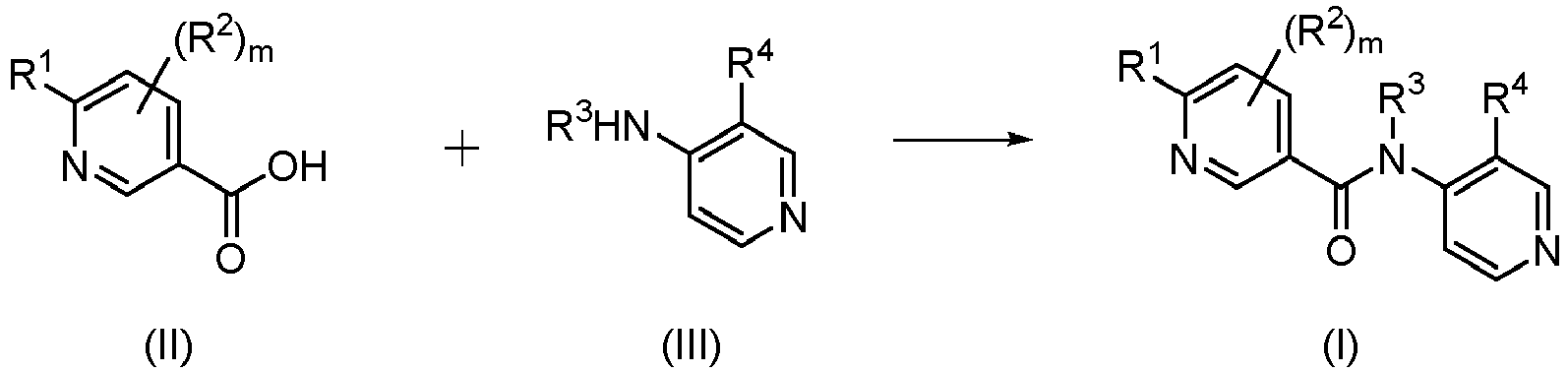
- the compound of formula (I) can be produced by reacting a compound of formula (II) with a compound of formula (III) in the presence of a dehydration condensation agent or a base.
- a dehydration condensation agent or a base Commercially available products can be used as the compounds of formula (II) and (III), and also the compounds can be produced by known methods: In the formulae R 1 , R 2 , R 3 , R 4 , and m are as mentioned above.
- the dehydration condensation agent is not particularly limited but examples thereof include 1-ethyl-3-(3-dimethylaminopropyl)carbodiimide hydrochloride, 1,3-dicyclohexylcarbodiimide and O-(7-azabenzotriazol-1-yl)-N,N,N',N'-tetramethyluronium hexafluorophosphate.
- the reaction can be carried out with adding an additive, as required.
- the additive include 1-hydroxybenzotriazole, N-hydroxysuccinimide and N,N-dimethyl-4-aminopyridine.
- the base is not particularly limited but examples thereof include tertiary amines such as triethylamine, 4-methylmorpholine, and diisopropylethylamine, 1,8-diazabicyclo[5.4.0]-7-undecene, pyridine and 4-(dimethylamino)pyridine, 2,6-lutidine.
- tertiary amines such as triethylamine, 4-methylmorpholine, and diisopropylethylamine, 1,8-diazabicyclo[5.4.0]-7-undecene, pyridine and 4-(dimethylamino)pyridine, 2,6-lutidine.
- the reaction can be carried out in the presence of a solvent, as required.
- the solvent is not particularly limited but, for example, there may be used one or two or more appropriately selected from ethers such as diethyl ether, butyl methyl ether, tetrahydrofuran, ethylene glycol dimethyl ether, 1,4-dioxane, and dimethoxyethane; aliphatic halogenated hydrocarbons such as methylene chloride, dichloroethane, and chloroform; aromatic hydrocarbons such as benzene, toluene, xylene, and chlorobenzene; aprotic polar solvents such as N,N-dimethylformamide, N,N-dimethylacetamide, N-methyl-2-pyrrolidone, dimethyl sulfoxide, and sulfolane; nitriles such as acetonitrile and propionitrile; esters such as ethyl acetate and ethyl
- the reaction can be usually carried out in a range of 0°C to a temperature at which the reaction system is refluxed under heating.
- the reaction time the reaction can be usually carried out for several minutes to 24 hours.
- the compound of formula (I) can be produced by reacting a compound of formula (II-a) with a compound of formula (III) in the presence of a base:
- a base In the formulae R 1 , R 2 , R 3 , R 4 , and m are as mentioned above, and X is a halogen atom.
- the base may be an organic base or an inorganic base.
- the organic base is not particularly limited but example thereof include amine bases such as triethylamine and diisopropylethylamine.
- the inorganic base is not particularly limited but examples thereof include alkali metal carbonates such as sodium carbonate, potassium carbonate, and cesium carbonate.
- the reaction can be carried out in the presence of a solvent, as required.
- the solvent is not particularly limited but, for example, there may be used one or two or more appropriately selected from ethers such as diethyl ether, butyl methyl ether, tetrahydrofuran, ethylene glycol dimethyl ether, 1,4-dioxane, and dimethoxyethane; aliphatic halogenated hydrocarbons such as methylene chloride, dichloroethane, and chloroform; aromatic hydrocarbons such as benzene, toluene, xylene, and chlorobenzene; aprotic polar solvents such as N,N-dimethylformamide, N,N-dimethylacetamide, N-methyl-2-pyrrolidone, dimethyl sulfoxide, and sulfolane; nitriles such as acetonitrile and propionitrile; esters such as ethyl acetate and ethyl
- the reaction can be usually carried out in a range of 0°C to a temperature at which the reaction system is refluxed under heating.
- the reaction time the reaction can be usually carried out for several minutes to 24 hours.
- a commercially available product can be used as the compound of formula (II-a), and also the compound can be produced by reacting a compound of formula (II) with a halogenating agent as shown in the following scheme:
- a halogenating agent as shown in the following scheme:
- R 1 , R 2 , X, and m are as mentioned above.
- the halogenating agent is not particularly limited but examples thereof include thionyl chloride, oxalyl chloride, phosphoryl chloride, sulfuryl chloride, phosphorus trichloride and phosphorus pentachloride.
- the reaction can be carried out in the presence of a solvent, as required.
- the solvent is not particularly limited but, for example, there may be used one or two or more appropriately selected from ethers such as diethyl ether, butyl methyl ether, tetrahydrofuran, ethylene glycol dimethyl ether, 1,4-dioxane, and dimethoxyethane; aliphatic halogenated hydrocarbons such as methylene chloride, dichloroethane, and chloroform; aromatic hydrocarbons such as benzene, toluene, xylene, and chlorobenzene; aprotic polar solvents such as N,N-dimethylformamide, N,N-dimethylacetamide, N-methyl-2-pyrrolidone, dimethyl sulfoxide, and sulfolane; nitriles such as acetonitrile and propionitrile; esters such as ethyl acetate and ethyl
- the reaction can be usually carried out in a range of 0°C to a temperature at which the reaction system is refluxed under heating.
- the reaction time the reaction can be usually carried out for several minutes to 24 hours.
- the compound of formula (III) can be produced by reacting a compound of formula (III-a) with a compound of formula (IV).
- a compound of formula (IV) Commercially available products can be used as the compounds of formula (III-a) and (IV), and also the compounds can be produced by known methods: In the formulae R 3 , R 4 , and X are as mentioned above.
- the reaction can be carried out in the presence of a base, as required.
- a base examples include alkali metal hydrides such as sodium hydride; alkali metal carbonates such as sodium carbonate, potassium carbonate, and cesium carbonate; alkali metal hydroxides such as lithium hydroxide, sodium hydroxide, and potassium hydroxide; tertiary amines such as triethylamine, 4-methylmorpholine, and diisopropylethylamine; 1,8-diazabicyclo[5.4.0]-7-undecene, pyridine, 4-(dimethylamino)pyridine and 2,6-lutidine.
- alkali metal hydrides such as sodium hydride
- alkali metal carbonates such as sodium carbonate, potassium carbonate, and cesium carbonate
- alkali metal hydroxides such as lithium hydroxide, sodium hydroxide, and potassium hydroxide
- tertiary amines such as triethylamine, 4-methylmorpholine, and
- the reaction can be carried out in the presence of a solvent, as required.
- the solvent is not particularly limited but, for example, there may be used one or two or more appropriately selected from ethers such as diethyl ether, butyl methyl ether, tetrahydrofuran, ethylene glycol dimethyl ether, 1,4-dioxane, and dimethoxyethane; aliphatic halogenated hydrocarbons such as methylene chloride, dichloroethane, and chloroform; aromatic hydrocarbons such as benzene, toluene, xylene, and chlorobenzene; aprotic polar solvents such as N,N-dimethylformamide, N,N-dimethylacetamide, N-methyl-2-pyrrolidone, dimethyl sulfoxide, and sulfolane; nitriles such as acetonitrile and propionitrile; esters such as ethyl acetate and ethyl
- the reaction can be usually carried out in a range of 0°C to a temperature at which the reaction system is refluxed under heating.
- the reaction time the reaction can be usually carried out for several minutes to 24 hours.
- pest control agents comprising the present compounds as an active ingredient (also referred to as “the present pest control agents”) will be described below.
- the present pest control agents are useful, for example, as agents for controlling pests, mites, nematodes, or soil pests which are problematic in agricultural and horticultural fields, that is, agricultural and horticultural insecticides, miticides, nematicides, or soil pesticides and so on. Further, the agents are useful as control agents for animal parasitic organisms, that is, animal parasitic organism-killing agents.
- the present compounds are useful for controlling pests, e.g., aphids such as green peach aphid (Myzus persicae) and cotton aphid (Aphis gossypii); agricultural pests such as diamondback moth (Plutella xylostella), cabbage armyworm (Mamestra brassicae), common cutworm (Spodoptera litura), codling moth (Laspeyresia pomonella), corn earworm moth (Heliothis zea), tobacco budworm (Heliothis virescens), gypsy moth (Lymantria dispar), rice leafroller (Cnaphalocrocis medinalis), smaller tea tortrix (Adoxophyes honmai), colorado potato beetle (Leptinotarsa decemlineata), cucurbit leaf beetle (Aulacophora femoralis), boll weevil (Anthonomus grandis),
- the present pest control agents are particularly effective for controlling e.g. plant parasitic mites, agricultural pests and plant parasitic nematodes.
- the compounds exhibits further excellent effect on control of plant parasitic mites and agricultural pests, so that the compounds are very useful as insecticides and miticides.
- present agricultural and horticultural insecticides, miticides, nematicides, and soil pesticides are also effective for controlling various pests having acquired resistance to chemical agents such as organophosphorus agents, carbamate agents, synthetic pyrethroid agents and neonicotinoid agents.
- the present compounds have excellent systemic properties, and therefore, by the application of the agricultural and horticultural insecticides, miticides, nematicides, or soil pesticides comprising the compounds of the present invention as an active ingredient to a soil treatment, soil pests, mites, nematodes, gastropods, and isopods and, at the same time, foliage pests can be controlled.
- pest control agents there may be mentioned agricultural and horticultural insecticides, miticides, nematicides, and soil pesticides which collectively control the above-described plant parasitic mites, agricultural pests, plant parasitic nematodes, gastropods and soil pests.
- the present pest control agent is usually formulated by mixing the compound with various additives and used in the form of formulation such as dusts, granules, water dispersible granules, wettable powders, water-based suspension concentrates, oil-based suspension concentrates, water soluble granules, water soluble powders, emulsifiable concentrates, soluble concentrates, pastes, aerosols, or ultra low volume formulations.
- formulation such as dusts, granules, water dispersible granules, wettable powders, water-based suspension concentrates, oil-based suspension concentrates, water soluble granules, water soluble powders, emulsifiable concentrates, soluble concentrates, pastes, aerosols, or ultra low volume formulations.
- it may be formulated into any type of formulation which is commonly used in this field.
- the additives to be used for the formulation include solid carriers such as diatomaceous earth, slaked lime, calcium carbonate, talc, white carbon, kaolin, bentonite, kaolinite, sericite, clay, sodium carbonate, sodium bicarbonate, mirabilite, zeolite, and starch; solvents such as water, toluene, xylene, solvent naphtha, dioxane, acetone, isophorone, methyl isobutyl ketone, chlorobenzene, cyclohexane, dimethyl sulfoxide, N,N-dimethylformamide, N,N-dimethylacetamide, N-methyl-2-pyrrolidone, and alcohol; anionic surfactants such as salts of fatty acid, benzoate, alkylsulfosuccinate, dialkylsulfosuccinate, polycarboxylate, salts of alkylsulfuric acid ester, alkyl sulfate
- ingredients of such additives one or two or more may be appropriately selected for use, so long as the purpose of the present invention can thereby be accomplished. Further, in addition to the above-described additives, some one can be appropriately selected from ones which are known in this field, and used. For example, various additives which are commonly used, such as a filler, a thickener, an anti-settling agent, an antifreezing agent, a dispersion stabilizer, a phytotoxicity reducing agent, and an anti-mold agent may also be employed.
- the mixing ratio (weight ratio) of the present compound to the various additives is 0.001:99.999 to 95:5, preferably 0.005:99.995 to 90:10.
- a diluent such as water, as required, added with various spreaders (such as surfactants, plant oils, mineral oils), and then used.
- the application of the present agricultural and horticultural insecticides, miticides, nematicides, and soil pesticides cannot generally be defined, as it varies depending upon the weather conditions, the type of the formulation, the time for application, the application site, the types or degree of outbreak of diseases and pests. However, it is usually applied in a concentration of the active ingredient being 0.05-800,000 ppm, preferably 0.5-500,000 ppm, and the dose thereof per unit area is such that the compound of the present invention is 0.05-50,000 g, preferably 1-30,000 g, per hectare.
- the present invention also includes a method for controlling pests by such application methods, especially, a method for controlling pests, mites, nematodes or soil pests which are problematic in agricultural and horticultural fields, particularly, a method for controlling plant parasitic mites, agricultural pests, or plant parasitic nematodes.
- the various formulations of the present pest control agents or their diluted compositions may be applied by application methods which are commonly employed, such as spreading (such as spraying, misting, atomizing, granule scattering, or application on water surface), soil application (such as mixing or irrigation), surface application (such as coating, dust coating, or covering), or use of an impregnated toxic bait. Further, it is possible to feed domestic animals with a food into which the above active ingredient is mixed to thereby control the outbreak or growth of noxious pests, particularly noxious insects, with excrements of the animals. Furthermore, the agent may also be applied by a so-called ultra low volume application method. In this method, the agent may be composed of 100% of the active ingredient.
- the present agricultural and horticultural insecticides, miticides, nematicides, and soil pesticides may be mixed with or may be used in combination with e.g. other agricultural chemicals, fertilizers or phytotoxicity-reducing agents, and in this case, more excellent effects or activities may sometimes be obtained.
- other agricultural chemicals include a herbicide, an insecticide, a miticide, a nematicide, a soil pesticide, a fungicide, an antivirus agent, an attractant, an antibiotic, a plant hormone and a plant growth regulator.
- an insecticide composition, miticide composition, nematicide composition, or soil pesticide composition having a compound of the present invention mixed with or used in combination with one or two or more active ingredient compounds of other agricultural chemicals can improve, for example, the application range, the timing for application of the agent, and the controlling activities to preferred directions.
- the present compound and the active compounds of other agricultural chemicals may separately be formulated and they may be mixed for use at the time of application, or the both may be formulated together for use.
- the present invention also includes such an insecticide composition, miticide composition, nematicide composition, or soil pesticide composition.
- Examples of the active ingredient compounds (common names, some of them are still in an application stage, or test codes of the Japan Plant Protection Association) of the insecticides, miticides, nematicides, or soil pesticides in above-described other agricultural chemicals include:
- the present compounds may be mixed with or used in combination with microorganism agricultural chemicals such as crystal protein toxins produced by Bacillus thuringiensis such as Bacillus thuringiensis aizawai, Bacillus thuringiensis kurstaki, Bacillus thuringiensis israelensis, Bacillus thuringiensis japonensis, or Bacillus thuringiensis tenebrionis, insect pathogenic virus agents, insect pathogenic filamentous fungus agents, and nematode pathogenic filamentous fungus agents; antibiotics and semi-synthetic antibiotics such as avermectin, emamectin benzoate, milbemectin, milbemycin, spinosad, ivermectin, lepimectin, DE-175, abamectin, emamectin, and spinetoram; natural products such as azadirachtin and rotenone; and repellents such as deet,
- Examples of the active ingredient compounds (common names, some of them are still in an application stage, or test codes of the Japan Plant Protection Association) of the fungicides in the above-described other agricultural chemicals include:
- Methyl 4-aminonicotinate (366 mg, 2.4 mmol), O-(7-azabenzotriazol-1-yl)-N,N,N',N'-tetramethyluronium hexafluorophosphate (997 mg, 2.6 mmol), and triethylamine (1.22 mL, 8.7 mmol) were added to a solution of 6-(trifluoromethyl)nicotinic acid (418 mg, 2.2 mmol) in N,N-dimethylformamide (15 mL), followed by stirring at room temperature for 24 hours. The reaction mixture was poured into water (50 mL) and the resulting solid was filtrated to afford the desired product (426 mg, Yield: 60%).
- Table 1 typical examples of the compounds represented by the formula (I) according to the present invention will be shown in Table 1. These compounds can be synthesized in accordance with the above-described Synthetic Examples or the above-described various production methods.
- Table 1 numerical values described in the column of physical properties indicate melting points (°C) and, for the compounds with description of "NMR", 1 H-NMR spectral data thereof are shown in Table 2.
- Control value 1 ⁇ Ta ⁇ Cb / Tb ⁇ Ca ⁇ 100
- the above ones are uniformly mixed to form a wettable powder.
- a mixture of the above ingredients and a compound of the present invention were mixed in a weight ratio of 4:1 to form a wettable powder.
- the above ones are uniformly mixed and pulverized to form a raw liquid.
- Sodium polycarboxylate 5 pbw (6) Anhydrous sodium sulfate 42.8 pbw, and the whole is uniformly mixed, granulated, and dried to obtain water dispersible granules.
- the above (1) to (3) are uniformly mixed previously and, after diluted with an appropriate amount of acetone, the diluted mixture was sprayed to the above (4) and acetone is removed to form granules.
- the above ones are uniformly mixed and dissolved to form a ultra low volume formulation.
Landscapes
- Life Sciences & Earth Sciences (AREA)
- Chemical & Material Sciences (AREA)
- Organic Chemistry (AREA)
- Environmental Sciences (AREA)
- Engineering & Computer Science (AREA)
- Wood Science & Technology (AREA)
- Zoology (AREA)
- Plant Pathology (AREA)
- Pest Control & Pesticides (AREA)
- Health & Medical Sciences (AREA)
- General Health & Medical Sciences (AREA)
- Dentistry (AREA)
- Agronomy & Crop Science (AREA)
- Chemical Kinetics & Catalysis (AREA)
- General Chemical & Material Sciences (AREA)
- Agricultural Chemicals And Associated Chemicals (AREA)
- Pyridine Compounds (AREA)
- Plural Heterocyclic Compounds (AREA)
- Toxicology (AREA)
- Dispersion Chemistry (AREA)
- Catching Or Destruction (AREA)
- Medicinal Preparation (AREA)
- Pharmaceuticals Containing Other Organic And Inorganic Compounds (AREA)
Description
- The present invention relates to a novel N-(4-pyridyl)nicotinamide compound or a salt thereof. In addition, the present invention relates to a pest control agent, an agricultural and horticultural insecticide, a miticide, a nematicide, or a soil pesticide comprising the compound or a salt thereof as an active ingredient. Further, the present invention relates to a method for controlling a pest by applying an effective amount of the compound or a salt thereof, excluding methods of medical or veterinary treatment or diagnosis.
-
WO2002/070483 describes a wide range of heteroarylamide compounds for insecticide uses andWO2005/115986 describes a wide range of compounds having a pyridine skeleton for medicament uses. Also,JP-A-2003-73357 -
WO 2012/161877 discloses 1-amino-2-aminocarbonyl-substituted pyridine - and pyrazine derivatives of a general formula (I) as novel compounds having valuable pharmaceutical properties, in particular the capable of inhibiting one or more kinases and being suitable for treating a variety of disorders in humans. - A.G. Ismail et al., J. Chem. Soc. (C), 24, 2613-17 (1967) describes the synthesis and chemical characterization of Pyrido [4,3-d]pyrimidin-4(3H)-ones from 4-amino-nicotinic acid.
-
JP-A-2004-331541 JP-A-2017-008029 WO 2016/175017 describes 4-pyridinecarboxamide derivatives and agricultural and horticultural agent containing the same as an active ingredient and which are useful as plant pest control agents. - Although a large number of pest control agents have been used for many years, many of these pest control agents have various problems such as insufficient effectiveness and restriction on use thereof due to resistance acquired by pests. Therefore, it is desired to develop a novel pest control agent that is less likely to have such drawbacks.
- Objects of the present invention are to provide a highly active compound or a salt thereof against a pest, to provide a pest control agent, an agricultural and horticultural insecticide, a miticide, a nematicide, or a soil pesticide using the compound or a salt thereof, and to provide a method for controlling a pest by applying the compound or a salt thereof.
- Incidentally, the compounds described in
WO2002/070483 and the compounds described inWO2005/115986 are distinguished from the compounds of the present invention. In addition, inJP-A-2003-73357 - In order to find a more excellent pest control agent, the present inventors have extensively studied pyridine compounds. As a result, they have found that a novel N-(4-pyridyl)nicotinamide compound or a salt thereof has an extremely high control effect against pests at low dose.
- That is, the present invention provides a compound which is a N-(4-pyridyl)nicotinamide compound of formula (I) or a salt thereof (also referred to as "the present compound" hereinafter):

- R1
- is halogen, alkyl, haloalkyl, alkoxy, haloalkoxy, aryloxy or haloalkylaryl;
- R2
- is halogen, alkyl, haloalkyl, alkoxy, amino, cyano, alkylthio, alkylsulfanyl or alkylsulfonyl;
- R3
- is H, alkyl, cycloalkyl, alkoxy or alkoxycarbonyl;
- R4
- is nitro, alkyl, alkenyl, haloalkyl, alkoxy, alkylthio, alkylcarbonyl, alkoxycarbonyl, (alkylthio)carbonyl or pyrazolyl; and
- m
- is 0 or 1.
- Also, the invention provides a pest control agent, as well as an agricultural and horticultural insecticide, miticide, nematicide, or soil pesticide, each comprising the present compound as an active ingredient.
- Yet further, the invention provides a method for controlling a pest by applying an effective amount of the present compound.
- Preferred embodiments of the invention are as defined in the appended dependent claims and/or in the following detailed description.
- The pest control agent comprising the present compound has an extremely high control effect against pests at low dose.
- Hereinafter, the present invention is described in detail.
- In the present application, "Cn" (n is natural number) has the same meaning as that of "carbon number n" (n is natural number). When "ppm" is described for the concentration, it means "ppm by weight".
- The present invention relates to a compound which is a N-(4-pyridyl)nicotinamide compound of formula (I) or a salt thereof:

- R1
- is halogen, alkyl, haloalkyl, alkoxy, haloalkoxy, aryloxy or haloalkylaryl;
- R2
- is halogen, alkyl, haloalkyl, alkoxy, amino, cyano, alkylthio, alkylsulfanyl or alkylsulfonyl;
- R3
- is H, alkyl, cycloalkyl, alkoxy or alkoxycarbonyl;
- R4
- is nitro, alkyl, alkenyl, haloalkyl, alkoxy, alkylthio, alkylcarbonyl, alkoxycarbonyl, (alkylthio)carbonyl or pyrazolyl; and
- m
- is 0 or 1.
- As the halogen atom or the halogen as a substituent in the above formula (I), F, Cl, Br and I may be mentioned. The number of the halogen atom as the substituent may be 1 or 2. In the case of 2, individual halogen atoms may be the same or different from each other. Further, the substitution position of the halogen atom may be any position.
- "Haloalkyl" used herein means an alkyl at least one hydrogen atom of which is substituted with the halogen atom(s). Similarly, "haloalkoxy", "haloalkylaryl" and "haloalkylcarbonyl" mean an alkoxy, an alkylaryl and an alkylcarbonyl at least one hydrogen atom of each group is substituted with the halogen atom(s), respectively. The halogen atom substituted from the hydrogen atom in these haloalkyl, haloalkoxy, haloalkylaryl or haloalkylcarbonyl is referred to as "the halogen as a substituent".
- Examples of the alkyl or alkyl portion in the above formula (I) include linear or branched C1-6-groups such as methyl, ethyl, normal propyl, isopropyl, normal butyl, isobutyl, secondary butyl, tertiary butyl, normal pentyl, isopentyl, neopentyl, normal hexyl, or neohexyl.
- Examples of the alkenyl or alkenyl portion in the above formula (I) include linear or branched C2-6-groups such as vinyl, 1-propenyl, 2-propenyl, isopropenyl, 2-methyl-1-propenyl, 1-methyl-1-propenyl, 2-methyl-2-propenyl, 1-methyl-2-propenyl, 1-butenyl, 2-butenyl, 3-butenyl, 1-pentenyl, 2-pentenyl, 2-methyl-2-butenyl, 1-hexenyl, or 2,3 -dimethyl-2-butenyl.
- Examples of the alkynyl or alkynyl portion in the above formula (I) include linear or branched C2-6-groups such as ethynyl, 1-propynyl, 2-propynyl, 1-butynyl, 2-butynyl, 3-butynyl, 1-methyl-2-propynyl, 2-methyl-3-butynyl, 3,3-dimethyl-1-butynyl, 1-hexynyl, 2-hexynyl, 3-hexynyl, 4-hexynyl, or 5-hexynyl.
- Examples of the cycloalkyl or cycloalkyl portion in the above formula (I) include C3-6-groups such as cyclopropyl, cyclobutyl, cyclopentyl, or cyclohexyl.
- Examples of the aryl or aryl portion in the above formula (I) include C6-10- groups such as phenyl and naphthyl.
- As the salt of the compound of formula (I), any salts may be included as far as they are acceptable in the technical field. Examples thereof include ammonium salts such as dimethylammonium and triethylammonium; inorganic salts such as hydrochlorides, perchlorates, sulfates, and nitrates; and organic salts such as acetates, trifluoroacetates, oxalates, p-toluenesulfonates, and methanesulfonates.
- There is a case where isomers such as optical isomers may be present as the present compound, and both of individual isomers and an isomer mixture are included in the present compound. In the present description, the isomers are described as a mixture unless specifically stated.
- The present compound can be produced according to the following production methods and usual production methods of salts, but methods are not limited to these methods.
- The compound of formula (I) can be produced by reacting a compound of formula (II) with a compound of formula (III) in the presence of a dehydration condensation agent or a base. Commercially available products can be used as the compounds of formula (II) and (III), and also the compounds can be produced by known methods:
- The dehydration condensation agent is not particularly limited but examples thereof include 1-ethyl-3-(3-dimethylaminopropyl)carbodiimide hydrochloride, 1,3-dicyclohexylcarbodiimide and O-(7-azabenzotriazol-1-yl)-N,N,N',N'-tetramethyluronium hexafluorophosphate.
- The reaction can be carried out with adding an additive, as required. Examples of the additive include 1-hydroxybenzotriazole, N-hydroxysuccinimide and N,N-dimethyl-4-aminopyridine.
- The base is not particularly limited but examples thereof include tertiary amines such as triethylamine, 4-methylmorpholine, and diisopropylethylamine, 1,8-diazabicyclo[5.4.0]-7-undecene, pyridine and 4-(dimethylamino)pyridine, 2,6-lutidine.
- The reaction can be carried out in the presence of a solvent, as required. The solvent is not particularly limited but, for example, there may be used one or two or more appropriately selected from ethers such as diethyl ether, butyl methyl ether, tetrahydrofuran, ethylene glycol dimethyl ether, 1,4-dioxane, and dimethoxyethane; aliphatic halogenated hydrocarbons such as methylene chloride, dichloroethane, and chloroform; aromatic hydrocarbons such as benzene, toluene, xylene, and chlorobenzene; aprotic polar solvents such as N,N-dimethylformamide, N,N-dimethylacetamide, N-methyl-2-pyrrolidone, dimethyl sulfoxide, and sulfolane; nitriles such as acetonitrile and propionitrile; esters such as ethyl acetate and ethyl propionate; aliphatic hydrocarbons such as pentane, hexane, heptane, octane, and cyclohexane; ketones such as acetone and ethyl methyl ketone; and water; or a mixture thereof may be used.
- As for the reaction temperature, the reaction can be usually carried out in a range of 0°C to a temperature at which the reaction system is refluxed under heating. As for the reaction time, the reaction can be usually carried out for several minutes to 24 hours.
- The compound of formula (I) can be produced by reacting a compound of formula (II-a) with a compound of formula (III) in the presence of a base:

- The base may be an organic base or an inorganic base. The organic base is not particularly limited but example thereof include amine bases such as triethylamine and diisopropylethylamine. The inorganic base is not particularly limited but examples thereof include alkali metal carbonates such as sodium carbonate, potassium carbonate, and cesium carbonate.
- The reaction can be carried out in the presence of a solvent, as required. The solvent is not particularly limited but, for example, there may be used one or two or more appropriately selected from ethers such as diethyl ether, butyl methyl ether, tetrahydrofuran, ethylene glycol dimethyl ether, 1,4-dioxane, and dimethoxyethane; aliphatic halogenated hydrocarbons such as methylene chloride, dichloroethane, and chloroform; aromatic hydrocarbons such as benzene, toluene, xylene, and chlorobenzene; aprotic polar solvents such as N,N-dimethylformamide, N,N-dimethylacetamide, N-methyl-2-pyrrolidone, dimethyl sulfoxide, and sulfolane; nitriles such as acetonitrile and propionitrile; esters such as ethyl acetate and ethyl propionate; aliphatic hydrocarbons such as pentane, hexane, heptane, octane, and cyclohexane; ketones such as acetone and ethyl methyl ketone; and water; or a mixture thereof may be used.
- As for the reaction temperature, the reaction can be usually carried out in a range of 0°C to a temperature at which the reaction system is refluxed under heating. As for the reaction time, the reaction can be usually carried out for several minutes to 24 hours.
- A commercially available product can be used as the compound of formula (II-a), and also the compound can be produced by reacting a compound of formula (II) with a halogenating agent as shown in the following scheme:

- The halogenating agent is not particularly limited but examples thereof include thionyl chloride, oxalyl chloride, phosphoryl chloride, sulfuryl chloride, phosphorus trichloride and phosphorus pentachloride.
- The reaction can be carried out in the presence of a solvent, as required. The solvent is not particularly limited but, for example, there may be used one or two or more appropriately selected from ethers such as diethyl ether, butyl methyl ether, tetrahydrofuran, ethylene glycol dimethyl ether, 1,4-dioxane, and dimethoxyethane; aliphatic halogenated hydrocarbons such as methylene chloride, dichloroethane, and chloroform; aromatic hydrocarbons such as benzene, toluene, xylene, and chlorobenzene; aprotic polar solvents such as N,N-dimethylformamide, N,N-dimethylacetamide, N-methyl-2-pyrrolidone, dimethyl sulfoxide, and sulfolane; nitriles such as acetonitrile and propionitrile; esters such as ethyl acetate and ethyl propionate; aliphatic hydrocarbons such as pentane, hexane, heptane, octane, and cyclohexane; ketones such as acetone and ethyl methyl ketone; or a mixture thereof may be used.
- As for the reaction temperature, the reaction can be usually carried out in a range of 0°C to a temperature at which the reaction system is refluxed under heating. As for the reaction time, the reaction can be usually carried out for several minutes to 24 hours.
- The compound of formula (III) can be produced by reacting a compound of formula (III-a) with a compound of formula (IV). Commercially available products can be used as the compounds of formula (III-a) and (IV), and also the compounds can be produced by known methods:

- The reaction can be carried out in the presence of a base, as required. Examples of the base include alkali metal hydrides such as sodium hydride; alkali metal carbonates such as sodium carbonate, potassium carbonate, and cesium carbonate; alkali metal hydroxides such as lithium hydroxide, sodium hydroxide, and potassium hydroxide; tertiary amines such as triethylamine, 4-methylmorpholine, and diisopropylethylamine; 1,8-diazabicyclo[5.4.0]-7-undecene, pyridine, 4-(dimethylamino)pyridine and 2,6-lutidine.
- The reaction can be carried out in the presence of a solvent, as required. The solvent is not particularly limited but, for example, there may be used one or two or more appropriately selected from ethers such as diethyl ether, butyl methyl ether, tetrahydrofuran, ethylene glycol dimethyl ether, 1,4-dioxane, and dimethoxyethane; aliphatic halogenated hydrocarbons such as methylene chloride, dichloroethane, and chloroform; aromatic hydrocarbons such as benzene, toluene, xylene, and chlorobenzene; aprotic polar solvents such as N,N-dimethylformamide, N,N-dimethylacetamide, N-methyl-2-pyrrolidone, dimethyl sulfoxide, and sulfolane; nitriles such as acetonitrile and propionitrile; esters such as ethyl acetate and ethyl propionate; aliphatic hydrocarbons such as pentane, hexane, heptane, octane, and cyclohexane; ketones such as acetone and ethyl methyl ketone; and water; or a mixture thereof may be used.
- As for the reaction temperature, the reaction can be usually carried out in a range of 0°C to a temperature at which the reaction system is refluxed under heating. As for the reaction time, the reaction can be usually carried out for several minutes to 24 hours.
- Preferred embodiments of pest control agents comprising the present compounds as an active ingredient (also referred to as "the present pest control agents") will be described below.
- The present pest control agents are useful, for example, as agents for controlling pests, mites, nematodes, or soil pests which are problematic in agricultural and horticultural fields, that is, agricultural and horticultural insecticides, miticides, nematicides, or soil pesticides and so on. Further, the agents are useful as control agents for animal parasitic organisms, that is, animal parasitic organism-killing agents.
- The present compounds are useful for controlling pests, e.g., aphids such as green peach aphid (Myzus persicae) and cotton aphid (Aphis gossypii); agricultural pests such as diamondback moth (Plutella xylostella), cabbage armyworm (Mamestra brassicae), common cutworm (Spodoptera litura), codling moth (Laspeyresia pomonella), corn earworm moth (Heliothis zea), tobacco budworm (Heliothis virescens), gypsy moth (Lymantria dispar), rice leafroller (Cnaphalocrocis medinalis), smaller tea tortrix (Adoxophyes honmai), colorado potato beetle (Leptinotarsa decemlineata), cucurbit leaf beetle (Aulacophora femoralis), boll weevil (Anthonomus grandis), planthoppers such as brown planthopper (Nilaparvata lugens), leafhoppers, scales, stinkbugs, whiteflies such as sweetpotato whitefly(Bemisia tabaci), thrips, grasshoppers, anthomyiid flies, scarabaeidae scarabs, black cutworm (Agrotis ipsilon), turnip moth cutworm (Agrotis segetum), and ants; gastropods such as slugs and snails; sanitary hygienic pests such as tropical rat mite (Ornithonyssus bacoti), cockroaches, housefly (Musca domestica), and common house mosquito (Culex pipiens); stored grain pests such as angoumois grain moth (Sitotroga cerealella), adzuki bean weevil (Callosobruchus chinensis), red flour beetle (Tribolium castaneum), and mealworms; household pests such as casemaking clothes moth (Tinea translucens), black carpet beetle (Attagenus unicolor), and termites;, mites, e.g., plant parasitic mites such as two-spotted spider mite (Tetranychus urticae), carmine spider mite (Tetranychus cinnabarinus), kanzawa spider mite (Tetranychus kanzawai), citrus red mite (Panonychus citri), European red mite (Panonychus ulmi), broad mite (Polyphagotarsonemus latus), pink citrus rust mite (Aculops pelekassi), and bulb mite (Rhizoglyphus echinopus); house dust mites such as mold mite (Tyrophagus putrescentiae), Dermatophagoides farinae, and Chelacaropsis moorei; nematodes, e.g., plant parasitic nematodes such as root-knot nematodes, cyst nematodes, root-lesion nematodes, white-tip nematode (Aphelenchoides besseyi), strawberry bud nematode (Nothotylenchus acris), and pine wood nematode (Bursaphelenchus lignicolus); and soil pests, e.g., isopods such as wood lice (Armadillidium vulgare) and sowbugs (Porcellio scaber).
- The present pest control agents are particularly effective for controlling e.g. plant parasitic mites, agricultural pests and plant parasitic nematodes. Among them, the compounds exhibits further excellent effect on control of plant parasitic mites and agricultural pests, so that the compounds are very useful as insecticides and miticides.
- Moreover, the present agricultural and horticultural insecticides, miticides, nematicides, and soil pesticides (which comprise the present compounds as an active ingredient) are also effective for controlling various pests having acquired resistance to chemical agents such as organophosphorus agents, carbamate agents, synthetic pyrethroid agents and neonicotinoid agents.
- Furthermore, the present compounds have excellent systemic properties, and therefore, by the application of the agricultural and horticultural insecticides, miticides, nematicides, or soil pesticides comprising the compounds of the present invention as an active ingredient to a soil treatment, soil pests, mites, nematodes, gastropods, and isopods and, at the same time, foliage pests can be controlled.
- As other preferred embodiments of the present pest control agents, there may be mentioned agricultural and horticultural insecticides, miticides, nematicides, and soil pesticides which collectively control the above-described plant parasitic mites, agricultural pests, plant parasitic nematodes, gastropods and soil pests.
- The present pest control agent is usually formulated by mixing the compound with various additives and used in the form of formulation such as dusts, granules, water dispersible granules, wettable powders, water-based suspension concentrates, oil-based suspension concentrates, water soluble granules, water soluble powders, emulsifiable concentrates, soluble concentrates, pastes, aerosols, or ultra low volume formulations. However, so long as it is suitable for the purpose of the present invention, it may be formulated into any type of formulation which is commonly used in this field.
- The additives to be used for the formulation include solid carriers such as diatomaceous earth, slaked lime, calcium carbonate, talc, white carbon, kaolin, bentonite, kaolinite, sericite, clay, sodium carbonate, sodium bicarbonate, mirabilite, zeolite, and starch; solvents such as water, toluene, xylene, solvent naphtha, dioxane, acetone, isophorone, methyl isobutyl ketone, chlorobenzene, cyclohexane, dimethyl sulfoxide, N,N-dimethylformamide, N,N-dimethylacetamide, N-methyl-2-pyrrolidone, and alcohol; anionic surfactants such as salts of fatty acid, benzoate, alkylsulfosuccinate, dialkylsulfosuccinate, polycarboxylate, salts of alkylsulfuric acid ester, alkyl sulfate, alkylaryl sulfate, alkyl diglycol ether sulfate, salts of alcohol sulfuric acid ester, alkyl sulfonate, alkylarylsulfonate, aryl sulfonate, lignin sulfonate, alkyldiphenyl ether disulfonate, polystyrene sulfonate, salts of alkylphosphoric acid ester, alkylaryl phosphate, styrylaryl phosphate, salts of polyoxyethylene alkyl ether sulfuric acid ester, polyoxyethylene alkylaryl ether sulfate, salts of polyoxyethylene alkylaryl ether sulfuric acid ester, polyoxyethylene alkyl ether phosphate, salts of polyoxyethylene alkylaryl phosphoric acid ester, and salts of condensate of naphthalene sulfonate with formaldehyde; nonionic surfactants such as sorbitan fatty acid ester, glycerin fatty acid ester, fatty acid polyglyceride, fatty acid alcohol polyglycol ether, acetylene glycol, acetylene alcohol, oxyalkylene block polymer, polyoxyethylene alkyl ether, polyoxyethylene alkylaryl ether, polyoxyethylene styrylaryl ether, polyoxyethylene glycol alkyl ether, polyethylene glycol, polyoxyethylene fatty acid ester, polyoxyethylene sorbitan fatty acid ester, polyoxyethylene glycerin fatty acid ester, polyoxyethylene hydrogenated castor oil, and polyoxypropylene fatty acid ester; and vegetable and mineral oils such as olive oil, kapok oil, castor oil, palm oil, camellia oil, coconut oil, sesame oil, corn oil, rice bran oil, peanut oil, cottonseed oil, soybean oil, rapeseed oil, linseed oil, tung oil, and liquid paraffin.
- As for the ingredients of such additives, one or two or more may be appropriately selected for use, so long as the purpose of the present invention can thereby be accomplished. Further, in addition to the above-described additives, some one can be appropriately selected from ones which are known in this field, and used. For example, various additives which are commonly used, such as a filler, a thickener, an anti-settling agent, an antifreezing agent, a dispersion stabilizer, a phytotoxicity reducing agent, and an anti-mold agent may also be employed.
- The mixing ratio (weight ratio) of the present compound to the various additives is 0.001:99.999 to 95:5, preferably 0.005:99.995 to 90:10. In the actual application of such a formulation, it may be used as it is, or may be diluted to a predetermined concentration with a diluent such as water, as required, added with various spreaders (such as surfactants, plant oils, mineral oils), and then used.
- The application of the present agricultural and horticultural insecticides, miticides, nematicides, and soil pesticides cannot generally be defined, as it varies depending upon the weather conditions, the type of the formulation, the time for application, the application site, the types or degree of outbreak of diseases and pests. However, it is usually applied in a concentration of the active ingredient being 0.05-800,000 ppm, preferably 0.5-500,000 ppm, and the dose thereof per unit area is such that the compound of the present invention is 0.05-50,000 g, preferably 1-30,000 g, per hectare.
- Further, the present invention also includes a method for controlling pests by such application methods, especially, a method for controlling pests, mites, nematodes or soil pests which are problematic in agricultural and horticultural fields, particularly, a method for controlling plant parasitic mites, agricultural pests, or plant parasitic nematodes.
- The various formulations of the present pest control agents or their diluted compositions may be applied by application methods which are commonly employed, such as spreading (such as spraying, misting, atomizing, granule scattering, or application on water surface), soil application (such as mixing or irrigation), surface application (such as coating, dust coating, or covering), or use of an impregnated toxic bait. Further, it is possible to feed domestic animals with a food into which the above active ingredient is mixed to thereby control the outbreak or growth of noxious pests, particularly noxious insects, with excrements of the animals. Furthermore, the agent may also be applied by a so-called ultra low volume application method. In this method, the agent may be composed of 100% of the active ingredient.
- Further, the present agricultural and horticultural insecticides, miticides, nematicides, and soil pesticides may be mixed with or may be used in combination with e.g. other agricultural chemicals, fertilizers or phytotoxicity-reducing agents, and in this case, more excellent effects or activities may sometimes be obtained. Examples of such other agricultural chemicals include a herbicide, an insecticide, a miticide, a nematicide, a soil pesticide, a fungicide, an antivirus agent, an attractant, an antibiotic, a plant hormone and a plant growth regulator. Especially, an insecticide composition, miticide composition, nematicide composition, or soil pesticide composition having a compound of the present invention mixed with or used in combination with one or two or more active ingredient compounds of other agricultural chemicals can improve, for example, the application range, the timing for application of the agent, and the controlling activities to preferred directions. The present compound and the active compounds of other agricultural chemicals may separately be formulated and they may be mixed for use at the time of application, or the both may be formulated together for use. The present invention also includes such an insecticide composition, miticide composition, nematicide composition, or soil pesticide composition.
- Examples of the active ingredient compounds (common names, some of them are still in an application stage, or test codes of the Japan Plant Protection Association) of the insecticides, miticides, nematicides, or soil pesticides in above-described other agricultural chemicals include:
- organic phosphate ester-based compounds such as profenofos, dichlorvos, fenamiphos, fenitrothion, EPN (O-ethyl O-4-nitrophenyl phenylphosphonothioate), diazinon, chlorpyrifos, chlorpyrifos-methyl, acephate, prothiofos, fosthiazate, cadusafos, dislufoton, isoxathion, isofenphos, ethion, etrimfos, quinalphos, dimethylvinphos, dimethoate, sulprofos, thiometon, vamidothion, pyraclofos, pyridaphenthion, pirimiphos-methyl, propaphos, phosalone, formothion, malathion, tetrachlorvinphos, chlorfenvinphos, cyanophos, trichlorfon, methidathion, phenthoate, ESP (oxydeprofos), azinphos-methyl, fenthion, heptenophos, methoxychlor, parathion, phosphocarb, demeton-S-methyl, monocrotophos, methamidophos, imicyafos, parathion-methyl, terbufos, phosphamidon, phosmet, phorate, phoxim, and triazophos;
- carbamate-based compounds such as carbaryl, propoxur, aldicarb, carbofuran, thiodicarb, methomyl, oxamyl, ethiofencarb, pirimicarb, fenobucarb, carbosulfan, benfuracarb, bendiocarb, furathiocarb, isoprocarb, metolcarb, xylylcarb, XMC (3,5-xylyl methylcarbamate), and fenothiocarb;
- nereistoxin derivatives such as cartap, thiocyclam, bensultap, thiosultap-sodium, thiosultap-disodium, monosultap, bisultap, and thiocyclam hydrogen oxalate;
- organochlorine-based compounds such as dicofol, tetradifon, endosulfan, dienochlor, and dieldrin;
- organometallic compounds such as fenbutatin oxide and cyhexatin;
- pyrethroid-based compounds such as fenvalerate, permethrin, cypermethrin, deltamethrin, cyhalothrin, tefluthrin, ethofenprox, flufenprox, cyfluthrin, fenpropathrin, flucythrinate, fluvalinate, cycloprothrin, lambda-cyhalothrin, pyrethrins, esfenvalerate, tetramethrin, resmethrin, protrifenbute, bifenthrin, zeta-cypermethrin, acrinathrin, alpha-cypermethrin, allethrin, gamma-cyhalothrin, theta-cypermethrin, tau-fluvalinate, tralomethrin, profluthrin, beta-cypermethrin, beta-cyfluthrin, metofluthrin, phenothrin, flumethrin, and decamethrin;
- benzoylurea-based compounds such as diflubenzuron, chlorfluazuron, teflubenzuron, flufenoxuron, triflumuron, hexaflumuron, lufenuron, novaluron, noviflumuron, bistrifluron, and fluazuron;
- juvenile hormone-like compounds such as methoprene, pyriproxyfen, fenoxycarb, and diofenolan;
- pyridazinone-based compounds such as pyridaben;
- pyrazole-based compounds such as fenpyroximate, fipronil, tebufenpyrad, ethiprole, tolfenpyrad, acetoprole, pyrafluprole, and pyriprole;
- neonicotinoid-based compounds such as imidacloprid, nitenpyram, acetamiprid, thiacloprid, thiamethoxam, clothianidin, nidinotefuran, dinotefuran, and nithiazine;
- hydrazine-based compounds such as tebufenozide, methoxyfenozide, chromafenozide, and halofenozide;
- pyridine-based compounds such as pyridalyl and flonicamid;
- cyclic keto enol-based compounds such as spirodiclofen, spiromesifen, spirotetramat, and spiropidion;
- strobilurin-based compounds such as fluacrypyrim;
- pyridinamine-based compounds such as flufenerim;
- dinitro-based compounds, organosulfur compounds, urea-based compounds, triazine-based compounds, hydrazone-based compounds, and, as other compounds, there may be mentioned compounds such as flometoquin, buprofezin, hexythiazox, amitraz, chlordimeform, silafluofen, triazamate, pymetrozine, pyrimidifen, chlorfenapyr, indoxacarb, acequinocyl, etoxazole, cyromazine, 1,3-dichloropropene, diafenthiuron, benclothiaz, bifenazate, propargite, clofentezine, metaflumizone, flubendiamide, cyflumetofen, chlorantraniliprole, cyantraniliprole, cyclaniliprole, cyenopyrafen, pyrifluquinazon, fenazaquin, amidoflumet, sulfluramid, hydramethylnon, metaldehyde, ryanodine, verbutin, chlorobenzoate, thiazolylcinnanonitrile, sulfoxaflor, fluensulfone, triflumezopyrim, afidopyropen, flupyradifuron, fluxametamide, tetraniliprole, fluralaner, broflanilide, pyflubumide, dicloromezotiaz, fluhexafon, tioxazafen, fluazaindolizine, acynonapyr, benzpyrimoxan, oxazosulfyl, flupyrimin, and tyclopyrazoflor.
- Furthermore, the present compounds may be mixed with or used in combination with microorganism agricultural chemicals such as crystal protein toxins produced by Bacillus thuringiensis such as Bacillus thuringiensis aizawai, Bacillus thuringiensis kurstaki, Bacillus thuringiensis israelensis, Bacillus thuringiensis japonensis, or Bacillus thuringiensis tenebrionis, insect pathogenic virus agents, insect pathogenic filamentous fungus agents, and nematode pathogenic filamentous fungus agents; antibiotics and semi-synthetic antibiotics such as avermectin, emamectin benzoate, milbemectin, milbemycin, spinosad, ivermectin, lepimectin, DE-175, abamectin, emamectin, and spinetoram; natural products such as azadirachtin and rotenone; and repellents such as deet.
- Examples of the active ingredient compounds (common names, some of them are still in an application stage, or test codes of the Japan Plant Protection Association) of the fungicides in the above-described other agricultural chemicals include:
- anilinopyrimidine-based compounds such as mepanipyrim, pyrimethanil, cyprodinil, and ferimzone;
- triazolopyrimidine-based compounds such as 5-chloro-7-(4-methylpiperidin-1-yl)-6-(2,4,6-trifluorophenyl)[1,2,4]triazolo[1,5-a]pyrimidine;
- pyridinamine-based compounds such as fluazinam;
- azole-based compounds such as triadimefon, bitertanol, triflumizole, etaconazole, propiconazole, penconazole, flusilazole, myclobutanil, cyproconazole, tebuconazole, hexaconazole, furconazole-cis, prochloraz, metconazole, epoxiconazole, tetraconazole, oxpoconazole fumarate, sipconazole, prothioconazole, triadimenol, flutriafol, difenoconazole, fluquinconazole, fenbuconazole, bromuconazole, diniconazole, tricyclazole, probenazole, simeconazole, pefurazoate, ipconazole, and imibenconazole;
- quinoxaline-based compounds such as quinomethionate;
- dithiocarbamate-based compounds such as maneb, zineb, mancozeb, polycarbamate, metiram, propineb, and thiram;
- organochlorine-based compounds such as fthalide, chlorothalonil, and quintozene;
- imidazole-based compounds such as benomyl, cyazofamid, thiophanate-methyl, carbendazim, thiabendazole, and fuberiazole;
- cyanoacetamide-based compounds such as cymoxanil;
- anilide-based compounds such as metalaxyl, metalaxyl-M, mefenoxam, oxadixyl, ofurace, benalaxyl, benalaxyl-M (another name: kiralaxyl or chiralaxyl), furalaxyl, cyprofuram, carboxin, oxycarboxin, thifluzamide, boscalid, bixafen, isothianil, tiadinil, and sedaxane;
- sulfamide-based compounds such as dichlofluanid;
- copper-based compounds such as cupric hydroxide and oxine copper;
- isoxazole-based compounds such as hymexazol;
- organophosphorus-based compounds such as fosetyl-Al, tolclofos-methyl, S-benzyl O, O-diisopropyl phosphorothioate, O-ethyl S, S-diphenyl phosphorodithioate, aluminum ethyl hydrogen phosphonate, edifenphos, and iprobenfos;
- phthalimide-based compounds such as captan, captafol, and folpet;
- dicarboxyimide-based compounds such as procymidone, iprodione, and vinclozolin;
- benzanilide-based compounds such as flutolanil and mepronil;
- amide-based compounds such as penthiopyrad, a mixture of 3-(difluoromethyl)-1-methyl-N-[(1RS,4SR,9RS)-1,2,3,4-tetrahydro-9-isopropyl-1,4-methanonaphthalen-5-yl]pyrazol-4-carboxamide and 3-(difluoromethyl)-1-methyl-N-[(1RS,4SR,9SR)-1,2,3,4-tetrahydro-9-isopropyl-1,4-methanonaphthalen-5-yl]pyrazol-4-carboxamide (isopyrazam), silthiopham, fenoxanil, and furametpyr;
- benzamide-based compounds such as fluopyram and zoxamide;
- piperadine-based compounds such as triforine;
- pyridine-based compounds such as pyrifenox;
- carbinol-based compounds such as fenarimol;
- piperidine-based compounds such as fenpropidin;
- morpholine-based compounds such as fenpropimorph and tridemorph;
- organotin-based compounds such as fentin hydroxide and fentin acetate;
- urea-based compounds such as pencycuron;
- cinnamic acid-based compounds such as dimethomorph and flumorph;
- phenylcarbamate-based compounds such as diethofencarb;
- cyanopyrrole-based compounds such as fludioxonil and fenpiclonil;
- strobilurin-based compounds such as azoxystrobin, kresoxim-methyl, metominostrobin, trifloxystrobin, picoxystrobin, oryzastrobin, dimoxystrobin, pyraclostrobin, and fluoxastrobin;
- oxazolidinone-based compounds such as famoxadone;
- thiazolecarboxamide-based compounds such as ethaboxam;
- valine amide-based compounds such as iprovalicarb and benthiavalicarb-isopropyl;
- acylamino acid-based compounds such as methyl N-(isopropoxycarbonyl)-L-valyl-(3RS)-3-(4-chlorophenyl)-β-alaninate (valiphenalate);
- imidazolinone-based compounds such as fenamidone;
- hydroxyanilide-based compounds such as fenhexamid;
- benzenesulfonamide-based compounds such as flusulfamide;
- oxime ether-based compounds such as cyflufenamid;
- anthraquinone-based compounds;
- crotonic acid-based compounds;
- antibiotics such as validamycin, kasugamycin, and polyoxins;
- guanidine-based compounds such as iminoctadine and dodine;
- quinoline-based compounds such as 6-tertiary butyl-8-fluoro-2,3-dimethylquinolin-4-yl acetate (tebufloquin);
- thiazolidine-based compounds such as (Z)-2-(2-fluoro-5-(trifluoromethyl)phenylthio)-2-(3-(2-methoxyphenyl)thiazolidin-2-ylidene)acetonitrile (flutianil); and
- as other compounds, there may be mentioned pyribencarb, isoprothiolane, pyroquilon, diclomezine, quinoxyfen, propamocarb hydrochloride, chloropicrin, dazomet, metam-sodium, nicobifen, metrafenone, UBF-307, diclocymet, proquinazid, amisulbrom (another name: amibromdole), 3-(2,3,4-trimethoxy-6-methylbenzoyl)-5-chloro-2-methoxy-4-methylpyridine, 4-(2,3,4-trimethoxy-6-methylbenzoyl)-2,5-dichloro-3-trifluoromethylpyridine, pyriofenone, isofetamid, mandipropamid, fluopicolide, carpropamid, meptyldinocap, spiroxamine, fenpyrazamine, mandestrobin, ZF-9646, BCF-051, BCM-061 and BCM-062.
- Besides, as agricultural chemicals capable of being mixed with or being used in combination with the present compounds, for example, there are active ingredient compounds of herbicides described in The Pesticide Manual (15th edition), particularly soil-treating type ones.
- Examples of the present invention will be described in the following. First, Synthetic Examples of the present compounds will be described.
- Methyl 4-aminonicotinate (366 mg, 2.4 mmol), O-(7-azabenzotriazol-1-yl)-N,N,N',N'-tetramethyluronium hexafluorophosphate (997 mg, 2.6 mmol), and triethylamine (1.22 mL, 8.7 mmol) were added to a solution of 6-(trifluoromethyl)nicotinic acid (418 mg, 2.2 mmol) in N,N-dimethylformamide (15 mL), followed by stirring at room temperature for 24 hours. The reaction mixture was poured into water (50 mL) and the resulting solid was filtrated to afford the desired product (426 mg, Yield: 60%).
-
- (1) An aqueous 70% ethylamine solution (9.9 g, 153.9 mmol) was added to a solution of methyl 4-chloronicotinate (3.3 g, 19.2 mmol) in N,N-dimethylformamide (40 mL), followed by stirring at 70°C for 2 hours. The reaction mixture was poured into water (200 mL), followed by extraction with ethyl acetate. The organic layer was washed with saturated saline, dried over anhydrous sodium sulfate, and filtered. The solvent was removed under reduced pressure to afford methyl 4-(ethylamino)nicotinate (3.0 g, Yield: 87%).
- (2) To a mixture of methyl 4-(ethylamino)nicotinate (300 mg, 1.7 mmol) and diisopropylethylamine (0.85 mL, 5.0 mmol) in tetrahydrofuran (6 mL) was added 6-(trifluoromethyl)nicotinic acid chloride (350 mg, 1.7 mmol), followed by stirring at 65°C for 5 hours. The reaction mixture was poured into water (20 mL), followed by extraction with ethyl acetate. The organic layer was washed with saturated saline, dried over anhydrous sodium sulfate, and filtered. After the solvent was removed under reduced pressure, the residue was purified by flash chromatography (eluent: n-heptane/ethyl acetate) to afford the desired product (437 mg, Yield: 74%).
-
- (1) Water (13 mL), sodium hydroxide (2.7 g, 67.0 mmol), and triethylamine (4.7 mL, 33.5 mmol) were sequentially added to a solution of O-methylhydroxylamine hydrochloride (8.4 g, 100.5 mmol) in N-methyl-2-pyrrolidone (67 mL), followed by stirring at room temperature for 15 minutes. Methyl 4-chloronicotinate (5.75 g, 33.5 mmol) was added to the reaction mixture, followed by stirring at 75°C for 15 hours. The reaction mixture was poured into water (300 mL), followed by extraction with ethyl acetate. The organic layer was washed with saturated saline, dried over anhydrous sodium sulfate, and filtered. After the solvent was removed under reduced pressure, the residue was purified by flash chromatography (eluent: n-heptane/ethyl acetate) to afford methyl 4-(methoxyamino)nicotinate (1.7 g, Yield: 28%).
- (2) To a mixture of methyl 4-(methoxyamino)nicotinate (500 mg, 2.7 mmol) and diisopropylethylamine (1.44 mL, 8.2 mmol) in tetrahydrofuran (9 mL) was added 6-(trifluoromethyl)nicotinic acid chloride (863 mg, 4.1 mmol), followed by stirring at 65°C for 16 hours. The reaction mixture was poured into water (45 mL), followed by extraction with ethyl acetate. The organic layer was washed with saturated saline, dried over anhydrous sodium sulfate, and filtered. After the solvent was removed under reduced pressure, the residue was purified by flash chromatography (eluent: n-heptane/ethyl acetate) to afford the desired product (330 mg, Yield: 34%).
- Now, typical examples of the compounds represented by the formula (I) according to the present invention will be shown in Table 1. These compounds can be synthesized in accordance with the above-described Synthetic Examples or the above-described various production methods. In Table 1, numerical values described in the column of physical properties indicate melting points (°C) and, for the compounds with description of "NMR", 1H-NMR spectral data thereof are shown in Table 2.
- "No." in Table 1 indicates compound number. Further, in the table, Me is methyl, Et is ethyl, Pr is propyl, Bu is butyl, "cyc-" is "cyclo", "i-" is "iso", "t-" is "tertiary", and "n-" is "normal", respectively.
- Moreover, in the column of (R2)m, for example, the compound described as "6-NH2" represents that it is substituted with R2 only at the substitution position attached to the chemical structural formula in the table, that is, it is a compound of "m=1" where it is substituted with amino only at 6-position. On the other hand, the compound described as "m=0" represents a compound which is not substituted with R2. The other similar descriptions follow this.
-

Table 1 No. R1 (R2)m R3 R4 Physical properties I-1 CF3 m=0 H Me 129.2 I-6 CF3 m=0 H NO2 110.2 I-7 CF3 m=0 H OEt 165.4 I-8 CF3 6-NH2 H OEt NMR I-9 CF3 m=0 H CO2Me 120.9 I-10 CF3 m=0 Me CO2Me 105-106 I-11 CF3 m=0 Et CO2Me 98-99 I-12 CF3 6-Me H CO2Me 171.9 I-13 CF3 6-Et H CO2Me 135.9 I-14 CF3 6-i-Pr H CO2Me 138.6 I-15 CF3 6-CF3 H CO2Me 140-153.5 I-16 CF3 m=0 H COSMe 134.0 I-17 Cl m=0 H CO2Me NMR I-18 Cl m=0 H OEt I-19 Me m=0 H CO2Me NMR I-20 Me m=0 H OEt I-21 OMe m=0 H CO2Me 121.8 I-22 OMe m=0 H OEt I-23 CF3 6-OMe H CO2Me NMR I-24 CF3 6-OMe H OEt I-25 CF3 m=0 H 
286.5 I-27 OCH2CF3 m=0 H CO2Me NMR I-28 OCH2CF3 m=0 H OEt I-30 t-Bu m=0 H CO2Me 239.5 I-31 t-Bu m=0 H OEt I-35 CF3 m=0 COMe CO2Me I-36 CF3 m=0 CO2Me CO2Me NMR I-37 CF3 m=0 H CF3 77.6 I-38 CF3 m=0 H SEt 128.2 I-40 CF3 m=0 H CO2-i-Pr 122 I-41 i-C3F7 m=0 H CO2Me 118.4 I-42 i-C3F7 m=0 Me CO2Me I-43 i-C3F7 m=0 Et CO2Me 90.5 I-45 Me m=0 Et CO2Me 93.7 I-46 (4-CF3)Ph m=0 H CO2Me 274 I-47 CF3 6-Cl H CO2Me 138.7 I-48 n-C3F7 m=0 H CO2Me 106.4 I-49 n-C3F7 m=0 Me CO2Me I-50 n-C3F7 m=0 Et CO2Me NMR I-51 OPh m=0 Et CO2Me NMR I-52 CF3 6-Me Et CO2Me 104.3 I-55 CF3 3-Br H CO2Me 173.4 I-56 CF3 3-F H CO2Me NMR I-57 CF3 6-SEt H CO2Me 130 I-58 n-C3F7 m=0 H OEt 108.7 I-59 n-C3F7 m=0 Me OEt I-60 n-C3F7 m=0 Et OEt I-61 C2F5 m=0 H OEt 140.6 I-62 C2F5 m=0 Me OEt I-63 C2F5 m=0 Et OEt I-64 C2F5 m=0 H CO2Me 113 I-65 C2F5 m=0 Me CO2Me I-66 C2F5 m=0 Et CO2Me 92.8 I-67 CF3 4-SEt H CO2Me 177.8 I-68 CF3 4-SOEt H CO2Me 155.7 I-69 CF3 4-SO2Et H CO2Me 182.7 I-70 CF3 m=0 Me OEt 128.2 I-71 CF3 m=0 Et OEt NMR I-72 CF3 m=0 Me SEt 92.5 I-73 CF3 m=0 Et SEt 68.8 I-74 CF3 m=0 H OMe 138.6 I-75 CF3 m=0 Me OMe 85.5 I-76 CF3 m=0 Et OMe NMR I-77 CF3 m=0 H O-n-Pr 137.7 I-78 CF3 m=0 Me O-n-Pr I-79 CF3 m=0 Et O-n-Pr I-80 C2F5 m=0 H SEt I-81 C2F5 m=0 Me SEt I-82 C2F5 m=0 Et SEt I-83 CF3 m=0 H COMe 235.5 I-84 CF3 m=0 H COEt 169.7 I-87 CF3 3-Me H CO2Me 119.2 I-88 CF3 3-CN H CO2Me NMR I-89 CF3 4-Me H CO2Me 133.9 I-90 CF3 4-CN H CO2Me I-91 CF3 m=0 H CO2Et 123.1 I-92 CF3 m=0 H CO2n-Pr 101.9 I-93 CF3 m=0 H Et I-94 CF3 m=0 H n-Pr 128.1 I-95 CF3 m=0 H i-Bu I-96 CF3 m=0 H CH3-C(CH3)=CH- 197.3 I-97 CF3 m=0 Me CO2Et 86.6 I-98 CF3 m=0 Me CO2n-Pr I-99 CF3 m=0 Me CO2i-Pr I-100 CF3 m=0 Me COMe I-101 CF3 m=0 Me COEt I-102 CF3 m=0 Me COn-Pr I-103 CF3 m=0 Me COi-Pr I-104 CF3 m=0 Me Et I-105 CF3 m=0 Me n-Pr I-106 CF3 m=0 Me i-Bu I-107 CF3 m=0 Me CH2=CH-CH2- I-108 CF3 m=0 Et CO2Et NMR I-109 CF3 m=0 Et CO2n-Pr I-110 CF3 m=0 Et CO2i-Pr I-111 CF3 m=0 Et COMe I-112 CF3 m=0 Et COEt I-113 CF3 m=0 Et COn-Pr I-114 CF3 m=0 Et COi-Pr I-115 CF3 m=0 Et Et I-116 CF3 m=0 Et n-Pr I-117 CF3 m=0 Et i-Bu I-118 CF3 m=0 Et CH2=CH-CH2- I-119 CF3 m=0 n-Pr CO2Me 98.2 I-120 CF3 m=0 n-Pr CO2Et I-121 CF3 m=0 n-Pr CO2n-Pr I-122 CF3 m=0 n-Pr CO2i-Pr I-123 CF3 m=0 n-Pr COMe I-124 CF3 m=0 n-Pr COEt I-125 CF3 m=0 n-Pr OMe I-126 CF3 m=0 n-Pr OEt I-127 CF3 m=0 n-Pr O-n-Pr I-128 CF3 m=0 n-Pr Et I-129 CF3 m=0 n-Pr n-Pr I-130 CF3 m=0 n-Pr i-Bu I-131 CF3 m=0 OMe CO2Me 150.9 I-132 CF3 m=0 OMe CO2Et I-133 CF3 m=0 OMe CO2n-Pr I-134 CF3 m=0 OMe CO2i-Pr I-135 CF3 m=0 OMe COMe I-136 CF3 m=0 OMe COEt I-137 CF3 m=0 OMe OMe I-138 CF3 m=0 OMe OEt I-139 CF3 m=0 OMe O-n-Pr I-140 CF3 m=0 OMe Et I-141 CF3 m=0 OMe n-Pr I-142 CF3 m=0 OMe i-Bu I-154 CF3 m=0 CO2Me CO2Et I-155 CF3 m=0 CO2Me CO2n-Pr I-156 CF3 m=0 CO2Me CO2i-Pr I-157 CF3 m=0 CO2Me COMe I-158 CF3 m=0 CO2Me COEt I-159 CF3 m=0 CO2Me OMe I-160 CF3 m=0 CO2Me OEt I-161 CF3 m=0 CO2Me O-n-Pr I-162 CF3 m=0 CO2Me Et I-163 CF3 m=0 CO2Me n-Pr I-164 CF3 m=0 CO2Me i-Bu I-177 C2F5 m=0 H CO2Et I-178 C2F5 m=0 H CO2n-Pr I-179 C2F5 m=0 H CO2i-Pr I-180 C2F5 m=0 H COMe I-181 C2F5 m=0 H COEt I-182 C2F5 m=0 H OMe I-183 C2F5 m=0 H O-n-Pr I-184 C2F5 m=0 H Et I-185 C2F5 m=0 H n-Pr I-186 C2F5 m=0 H i-Bu I-187 C2F5 m=0 Me CO2Et I-188 C2F5 m=0 Me CO2n-Pr I-189 C2F5 m=0 Me CO2i-Pr I-190 C2F5 m=0 Me COMe I-191 C2F5 m=0 Me COEt I-192 C2F5 m=0 Me OMe I-193 C2F5 m=0 Me O-n-Pr I-194 C2F5 m=0 Me Et I-195 C2F5 m=0 Me n-Pr I-196 C2F5 m=0 Me i-Bu I-197 C2F5 m=0 Et CO2Et I-198 C2F5 m=0 Et CO2n-Pr I-199 C2F5 m=0 Et CO2i-Pr I-200 C2F5 m=0 Et COMe I-201 C2F5 m=0 Et COEt I-202 C2F5 m=0 Et OMe I-203 C2F5 m=0 Et O-n-Pr I-204 C2F5 m=0 Et Et I-205 C2F5 m=0 Et n-Pr I-206 C2F5 m=0 Et i-Bu I-207 C2F5 m=0 n-Pr CO2Me I-208 C2F5 m=0 n-Pr CO2Et I-209 C2F5 m=0 n-Pr CO2n-Pr I-210 C2F5 m=0 n-Pr CO2i-Pr I-211 C2F5 m=0 n-Pr COMe I-212 C2F5 m=0 n-Pr COEt I-213 C2F5 m=0 n-Pr OMe I-214 C2F5 m=0 n-Pr OEt I-215 C2F5 m=0 n-Pr O-n-Pr I-216 C2F5 m=0 n-Pr Et I-217 C2F5 m=0 n-Pr n-Pr I-218 C2F5 m=0 n-Pr i-Bu I-219 C2F5 m=0 OMe CO2Me I-220 C2F5 m=0 OMe CO2Et I-221 C2F5 m=0 OMe CO2n-Pr I-222 C2F5 m=0 OMe CO2i-Pr I-223 C2F5 m=0 OMe COMe I-224 C2F5 m=0 OMe COEt I-225 C2F5 m=0 OMe OMe I-226 C2F5 m=0 OMe OEt I-227 C2F5 m=0 OMe O-n-Pr I-228 C2F5 m=0 OMe Et I-229 C2F5 m=0 OMe n-Pr I-230 C2F5 m=0 OMe i-Bu I-231 n-C3F7 m=0 H CO2Et I-232 n-C3F7 m=0 H CO2n-Pr I-233 n-C3F7 m=0 H CO2i-Pr I-234 n-C3F7 m=0 H COMe I-235 n-C3F7 m=0 H COEt I-236 n-C3F7 m=0 H OMe I-237 n-C3F7 m=0 H O-n-Pr I-238 n-C3F7 m=0 H Et I-239 n-C3F7 m=0 H n-Pr I-240 n-C3F7 m=0 H i-Bu I-241 n-C3F7 m=0 Me CO2Et I-242 n-C3F7 m=0 Me CO2n-Pr I-243 n-C3F7 m=0 Me CO2i-Pr I-244 n-C3F7 m=0 Me COMe I-245 n-C3F7 m=0 Me COEt I-246 n-C3F7 m=0 Me OMe I-247 n-C3F7 m=0 Me O-n-Pr I-248 n-C3F7 m=0 Me Et I-249 n-C3F7 m=0 Me n-Pr I-250 n-C3F7 m=0 Me i-Bu I-251 n-C3F7 m=0 Et CO2Et I-252 n-C3F7 m=0 Et CO2n-Pr I-253 n-C3F7 m=0 Et CO2i-Pr I-254 n-C3F7 m=0 Et COMe I-255 n-C3F7 m=0 Et COEt I-256 n-C3F7 m=0 Et OMe I-257 n-C3F7 m=0 Et O-n-Pr I-258 n-C3F7 m=0 Et Et I-259 n-C3F7 m=0 Et n-Pr I-260 n-C3F7 m=0 Et i-Bu I-261 n-C3F7 m=0 n-Pr CO2Me I-262 n-C3F7 m=0 n-Pr CO2Et I-263 n-C3F7 m=0 n-Pr CO2n-Pr I-264 n-C3F7 m=0 n-Pr CO2i-Pr I-265 n-C3F7 m=0 n-Pr COMe I-266 n-C3F7 m=0 n-Pr COEt I-267 n-C3F7 m=0 n-Pr OMe I-268 n-C3F7 m=0 n-Pr OEt I-269 n-C3F7 m=0 n-Pr O-n-Pr I-270 n-C3F7 m=0 n-Pr Et I-271 n-C3F7 m=0 n-Pr n-Pr I-272 n-C3F7 m=0 n-Pr i-Bu I-273 n-C3F7 m=0 OMe CO2Me I-274 n-C3F7 m=0 OMe CO2Et I-275 n-C3F7 m=0 OMe CO2n-Pr I-276 n-C3F7 m=0 OMe CO2i-Pr I-277 n-C3F7 m=0 OMe COMe I-278 n-C3F7 m=0 OMe COEt I-279 n-C3F7 m=0 OMe OMe I-280 n-C3F7 m=0 OMe OEt I-281 n-C3F7 m=0 OMe O-n-Pr I-282 n-C3F7 m=0 OMe Et I-283 n-C3F7 m=0 OMe n-Pr I-284 n-C3F7 m=0 OMe i-Bu I-285 i-C3F7 m=0 H CO2Et I-286 i-C3F7 m=0 H CO2n-Pr I-287 i-C3F7 m=0 H CO2i-Pr I-288 i-C3F7 m=0 H COMe I-289 i-C3F7 m=0 H COEt I-290 i-C3F7 m=0 H OMe I-291 i-C3F7 m=0 H OEt I-292 i-C3F7 m=0 H O-n-Pr I-293 i-C3F7 m=0 H Et I-294 i-C3F7 m=0 H n-Pr I-295 i-C3F7 m=0 H i-Bu I-296 i-C3F7 m=0 Me CO2Et I-297 i-C3F7 m=0 Me CO2n-Pr I-298 i-C3F7 m=0 Me CO2i-Pr I-299 i-C3F7 m=0 Me COMe I-300 i-C3F7 m=0 Me COEt I-301 i-C3F7 m=0 Me OMe I-302 i-C3F7 m=0 Me OEt I-303 i-C3F7 m=0 Me O-n-Pr I-304 i-C3F7 m=0 Me Et I-305 i-C3F7 m=0 Me n-Pr I-306 i-C3F7 m=0 Me i-Bu I-307 i-C3F7 m=0 Et CO2Et I-308 i-C3F7 m=0 Et CO2n-Pr I-309 i-C3F7 m=0 Et CO2i-Pr I-310 i-C3F7 m=0 Et COMe I-311 i-C3F7 m=0 Et COEt I-312 i-C3F7 m=0 Et OMe I-313 i-C3F7 m=0 Et OEt I-314 i-C3F7 m=0 Et O-n-Pr I-315 i-C3F7 m=0 Et Et I-316 i-C3F7 m=0 Et n-Pr I-317 i-C3F7 m=0 Et i-Bu I-318 i-C3F7 m=0 OMe CO2Me I-319 i-C3F7 m=0 OMe CO2Et I-320 i-C3F7 m=0 OMe CO2n-Pr I-321 i-C3F7 m=0 OMe CO2i-Pr I-322 i-C3F7 m=0 OMe COMe I-323 i-C3F7 m=0 OMe COEt I-324 i-C3F7 m=0 OMe OMe I-325 i-C3F7 m=0 OMe OEt I-326 i-C3F7 m=0 OMe O-n-Pr I-327 i-C3F7 m=0 OMe Et I-328 i-C3F7 m=0 OMe n-Pr I-329 i-C3F7 m=0 OMe i-Bu I-330 CF3 m=0 cyc-Pr CO2Me 143.6 I-331 CF3 m=0 cyc-Pr CO2Et I-332 CF3 m=0 cyc-Pr CO2n-Pr I-333 CF3 m=0 cyc-Pr CO2i-Pr I-334 CF3 m=0 cyc-Pr COMe I-335 CF3 m=0 cyc-Pr COEt I-336 CF3 m=0 cyc-Pr OMe I-337 CF3 m=0 cyc-Pr OEt I-338 CF3 m=0 cyc-Pr O-n-Pr I-339 CF3 m=0 cyc-Pr Et I-340 CF3 m=0 cyc-Pr n-Pr I-341 CF3 m=0 cyc-Pr i-Bu -
Table 2 No. 1H-NMR δ values ppm Measuring device: JEOL-ECX(500 MHz), Solvent: CDCl3 I-8 8.57 (1H, brs), 8.35 (1H, d), 8.28 (2H, d), 7.88 (1H, d), 7.05 (1H, d), 6.61 (2H, brs), 4.28 (2H, q), 1.53 (3H, t) I-17 12.26 (1H, brs), 9.24 (1H, s), 9.07 (1H, s), 8.75 (1H, d), 8.71 (1H, d), 8.27 (1H, dd), 7.52 (1H, d), 4.05 (3H, s) I-19 12.19 (1H, brs), 9.22 (1H, s), 9.19 (1H, d), 8.78 (1H, d), 8.69 (1H, d), 8.20 (1H, dd), 7.34 (1H, d), 4.02 (3H, s), 2.67 (3H, s) I-23 9.22 (1H, s), 9.85 (1H, d), 8.66-8.69 (2H, m), 7.46 (1H, d), 4.30 (3H, s), 4.01 (3H, s) I-27 12.18 (1H, s), 9.21 (1H, s), 8.86 (1H, s), 8.75 (1H, d), 8.68 (1H, d), 8.28 (1H, d), 7.00 (1H, d), 4.85 (2H, q), 4.02 (3H, s) I-36 9.36 (1H, s), 9.05 (1H, s), 8.90 (1H, d), 8.23 (1H, dd), 7.79 (1H, d), 7.30 (1H, d), 3.92 (3H, s), 3.67 (3H, s) I-50 9.05 (1H, brs), 8.69 (1H, brs), 8.64 (1H, brs), 7.84 (1H, brs), 7.55 (1H, brs), 7.25 (1H, m), 4.15 (2H, q), 3.88 (3H, brs), 1.25 (3H, t) I-51 9.02 (1H, s), 8.71 (1H, d), 8.07 (1H, br), 7.70 (1H, d), 7.38 (2H, t), 7.19 (2H, m), 7.06 (2H, d), 6.77 (1H, d), 3.93 (2H, br), 3.85 (3H, s), 1.22 (3H, t) I-56 9.22 (1H, brs), 9.16 (1H, s), 8.61-8.89 (2H, m) 8.24 (d, 1H), 4.06 (3H, s) I-71 8.66 (1H, s), 8.22 (1H, d), 8.20 (1H, s), 7.81 (1H, dd), 7.51 (1H, d), 7.07 (1H, d), 4.03 (2H, br), 3.91 (2H, br), 1.41 (3H, t), 1.21 (3H, t) I-76 8.65 (1H, s), 8.25 (1H, d), 8.22 (1H, s), 7.81 (1H, d), 7.52 (1H, d), 7.08 (1H, d), 3.92 (2H, br), 3.79 (3H, s), 1.20 (3H, t) I-88 9.49 (1H, d), 9.28 (1H, s), 8.79 (1H, d), 8.75 (1H, d), 8.72 (1H, d), 4.06 (3H, s) I-108 9.03 (1H, br), 8.74 (1H, br), 8.62 (1H, br), 7.81 (1H, br), 7.52 (1H, br), 7.20 (1H, br), 4.34 (2H, q), 4.12 (2H, q), 1.36 (3H, t), 1.26 (3H, t) - Rice seedling was subjected to a dipping treatment in a test solution prepared so that the concentration of the present compound was 200 ppm. After the test solution was dried in air, the seedling with its root wrapped with a wet absorbent cotton, was put into a test tube. Then, about 10 second- to third-instar nymphs of brown planthopper (Nilaparvata lugens) were released therein, and the tube was covered with a gauze and left in a chamber with lightening at 25°C. On the fifth day after the treatment, life or death of the brown planthopper (Nilaparvata lugens) was judged, and the mortality (%) was determined by the following equation. As a result of testing Compound Nos. I-8, I-9, I-10, I-11, and I-94, the mortality was shown to be 90% or more for all compounds.

- Adults of sweetpotato whitefly (Bemisia tabaci) were released on cucumber seedling planted in a pot. After they were permitted to lay eggs for 1 day, the cucumber seedling was taken out and left in a chamber with lightening at 25°C. After 7 days, the number of first- to second-instar nymphs parasitic on the cucumber seedling was investigated and a test solution prepared so that the concentration of a compound of the present invention be 200 ppm was sprayed using a hand sprayer. After the test solution was dried in air, the cucumber seedling was left in a chamber with lightening at 25°C. On seventh day after the treatment, the number of old nymphs was investigated and the control value was determined by the following equation. As a result of testing Compound Nos. I-7, I-8, I-9, I-10, I-11, I-12, I-13, I-15, I-25, I-27, I-30, and I-94, the control value was shown to be 90% or more for all compounds.

- Ta: the number of old nymphs after treatment on treated cucumber seedling
- Tb: the number of first- to second-instar nymphs before treatment on treated cucumber seedling
- Ca: the number of old nymphs after treatment on non-treated cucumber seedling
- Cb: the number of first- to second-instar nymphs before treatment on non-treated cucumber seedling
- 5 adults of green peach aphid (Myzus persicae) were released on a radish leaf which was inserted into water in a test tube. The adults were removed after 1 day, the number of nymphs parasitic on the radish leaf was counted, which was subjected to a dipping treatment in a test solution prepared so that the concentration of the present compound was 200 ppm. After the test solution was dried in air, the leaf was left in a chamber with lightening at 25°C. On the fifth day after the treatment, life or death of the green peach aphid (Myzus persicae) was judged, and the mortality was determined by the following equation. Incidentally, removed insects and abnormal insects were regarded as dead insects. As a result of testing Compound Nos. I-7, I-8, I-9, I-10, I-11, I-15, I-25, I-30, and I-94, the mortality was shown to be 90% or more for all compounds.

- The following will describe Formulation Examples.
-
(1) Compound of the present invention 20 parts by weight (pbw) (2) Clay 70 pbw (3) White carbon 5 pbw (4) Sodium polycarboxylate 3 pbw (5) Sodium alkylnaphthalenesulfonate 2 pbw - The above ones are uniformly mixed to form a wettable powder.
-
(1) Compound of the present invention 5 pbw (2) Talc 60 pbw (3) Calcium carbonate 34.5 pbw (4) Liquid paraffin 0.5 pbw - The above ones are uniformly mixed to form a dust.
-
(1) Compound of the present invention 20 pbw (2) N,N-Dimethylacetamide 20 pbw (3) Polyoxyethylene tristyryl phenyl ether 10 pbw (4) Calcium dodecylbenzenesulfonate 2 pbw (5) Xylene 48 pbw - The above ones are uniformly mixed and dissolved to form an emulsifiable concentrate.
-
(1) Clay 68 pbw (2) Sodium ligninsulfonate 2 pbw (3) Polyoxyethylene alkylaryl sulfate 5 pbw (4) White carbon 25 pbw - A mixture of the above ingredients and a compound of the present invention were mixed in a weight ratio of 4:1 to form a wettable powder.
-
(1) Compound of the present invention 50 pbw (2) Condensate of sodium alkylnaphthalenesulfonate with formaldehyde 2 pbw (3) Silicone oil 0.2 pbw (4) Water 47.8 pbw - The above ones are uniformly mixed and pulverized to form a raw liquid. To the raw liquid are further added
(5) Sodium polycarboxylate 5 pbw (6) Anhydrous sodium sulfate 42.8 pbw, -
(1) Compound of the present invention 5 pbw (2) Polyoxyethylene octylphenyl ether 1 pbw (3) Polyoxyethylene alkyl ether phosphate ester 0.1 pbw (4) Particulate calcium carbonate 93.9 pbw - The above (1) to (3) are uniformly mixed previously and, after diluted with an appropriate amount of acetone, the diluted mixture was sprayed to the above (4) and acetone is removed to form granules.
-
(1) Compound of the present invention 2.5 pbw (2) N,N-Dimethylacetamide 2.5 pbw (3) Soybean oil 95.0 pbw - The above ones are uniformly mixed and dissolved to form a ultra low volume formulation.
-
(1) Compound of the present invention 10 pbw (2) Diethylene glycol monoethyl ether 80 pbw (3) Polyoxyethylene alkyl ether 10 pbw - The above ones are uniformly mixed to form a soluble concentrate.
Claims (4)
- A compound which is a N-(4-pyridyl)nicotinamide compound of formula (I) or a salt thereof:
 R1 is halogen, alkyl, haloalkyl, alkoxy, haloalkoxy, aryloxy or haloalkylaryl;R2 is halogen, alkyl, haloalkyl, alkoxy, amino, cyano, alkylthio, alkylsulfanyl or alkylsulfonyl;R3 is H, alkyl, cycloalkyl, alkoxy or alkoxycarbonyl;R4 is nitro, alkyl, alkenyl, haloalkyl, alkoxy, alkylthio, alkylcarbonyl, alkoxycarbonyl, (alkylthio)carbonyl or pyrazolyl; andm is 0 or 1.
 - A pest control agent comprising the compound of claim 1 as an active ingredient.
- An agricultural and horticultural insecticide, miticide, nematicide, or soil pesticide comprising the compound of claim 1 as an active ingredient.
- A method for controlling a pest by applying an effective amount of the compound of claim 1, excluding methods of medical or veterinary treatment or diagnosis.
Priority Applications (1)
| Application Number | Priority Date | Filing Date | Title |
|---|---|---|---|
| RS20230566A RS64364B1 (en) | 2017-04-27 | 2018-04-25 | N-(4-pyridyl) nicotinamide compound or salt thereof |
Applications Claiming Priority (2)
| Application Number | Priority Date | Filing Date | Title |
|---|---|---|---|
| JP2017088847 | 2017-04-27 | ||
| PCT/JP2018/016844 WO2018199175A1 (en) | 2017-04-27 | 2018-04-25 | N-(4-pyridyl) nicotinamide compound or salt thereof |
Publications (4)
| Publication Number | Publication Date |
|---|---|
| EP3617196A1 EP3617196A1 (en) | 2020-03-04 |
| EP3617196A4 EP3617196A4 (en) | 2021-01-13 |
| EP3617196C0 EP3617196C0 (en) | 2023-06-07 |
| EP3617196B1 true EP3617196B1 (en) | 2023-06-07 |
Family
ID=63918424
Family Applications (1)
| Application Number | Title | Priority Date | Filing Date |
|---|---|---|---|
| EP18790208.5A Active EP3617196B1 (en) | 2017-04-27 | 2018-04-25 | N-(4-pyridyl) nicotinamide compound or salt thereof |
Country Status (26)
| Country | Link |
|---|---|
| US (1) | US11912684B2 (en) |
| EP (1) | EP3617196B1 (en) |
| JP (1) | JP7081078B2 (en) |
| KR (1) | KR102520792B1 (en) |
| CN (1) | CN110573496B (en) |
| AR (1) | AR111422A1 (en) |
| AU (1) | AU2018257296B2 (en) |
| BR (1) | BR112019022430B1 (en) |
| CA (1) | CA3061459C (en) |
| CL (1) | CL2019003077A1 (en) |
| CO (1) | CO2019011969A2 (en) |
| CR (1) | CR20190502A (en) |
| DO (1) | DOP2019000276A (en) |
| EC (1) | ECSP19077740A (en) |
| IL (1) | IL270148B (en) |
| MA (1) | MA49068B1 (en) |
| MX (1) | MX2019012786A (en) |
| MY (1) | MY192039A (en) |
| NI (1) | NI201900111A (en) |
| PE (1) | PE20191788A1 (en) |
| PH (1) | PH12019502407B1 (en) |
| RS (1) | RS64364B1 (en) |
| TW (1) | TWI771410B (en) |
| UA (1) | UA125728C2 (en) |
| WO (1) | WO2018199175A1 (en) |
| ZA (1) | ZA201907272B (en) |
Families Citing this family (3)
| Publication number | Priority date | Publication date | Assignee | Title |
|---|---|---|---|---|
| JP2021066664A (en) * | 2018-02-22 | 2021-04-30 | 石原産業株式会社 | Pest control agent containing substituted pyridine compound or salt thereof as active ingredient |
| WO2022071434A1 (en) * | 2020-09-30 | 2022-04-07 | 住友化学株式会社 | Heterocyclic compound and harmful arthropod-controlling composition containing same |
| CN113354579B (en) * | 2021-07-15 | 2024-05-14 | 安徽大学 | High-yield synthesis method of methyl 4-aminonicotinate |
Family Cites Families (20)
| Publication number | Priority date | Publication date | Assignee | Title |
|---|---|---|---|---|
| DE4434637A1 (en) | 1994-09-28 | 1996-04-04 | Hoechst Schering Agrevo Gmbh | Substituted pyridines, processes for their preparation and their use as pesticides and fungicides |
| JP2002070483A (en) | 2000-08-30 | 2002-03-08 | Komatsu Ltd | Tapered disk cutter and cutter head |
| AU2002254107B2 (en) | 2001-03-05 | 2006-12-21 | E. I. Du Pont De Nemours And Company | Heterocyclic diamide invertebrate pest control agents |
| JP2003073357A (en) | 2001-09-03 | 2003-03-12 | Mitsubishi Pharma Corp | Rho kinase inhibitors containing amide compounds |
| DE10148290A1 (en) | 2001-09-29 | 2003-04-17 | Bayer Cropscience Gmbh | Heterocyclic amides, processes for their preparation, compositions containing them and their use |
| JP4462841B2 (en) | 2003-05-06 | 2010-05-12 | 三井化学アグロ株式会社 | Nicotinamide derivatives having 5- or 6-membered heterocycles |
| JP2005115986A (en) | 2003-10-03 | 2005-04-28 | Hitachi Ltd | Optical disk device |
| SE0401345D0 (en) | 2004-05-25 | 2004-05-25 | Astrazeneca Ab | Therapeutic compounds: Pyridine as scaffold |
| EP2069313A2 (en) | 2006-06-29 | 2009-06-17 | Alantos Pharmaceuticals Holdings, Inc. | Metalloprotease inhibitors |
| LT3081552T (en) | 2008-08-13 | 2021-06-10 | Mitsui Chemicals Agro, Inc. | Pest control agent containing an amide derivative and use of the pest control agent |
| CA2741666C (en) | 2008-10-31 | 2017-04-11 | Merck Sharp & Dohme Corp. | P2x3, receptor antagonists for treatment of pain |
| PL3354650T3 (en) | 2008-12-19 | 2022-06-13 | Vertex Pharmaceuticals Incorporated | Compounds useful as inhibitors of atr kinase |
| JP2013537178A (en) | 2010-09-13 | 2013-09-30 | ビーエーエスエフ ソシエタス・ヨーロピア | Pyridine compounds for controlling invertebrate pests III |
| LT2714677T (en) * | 2011-05-23 | 2018-12-10 | Merck Patent Gmbh | Pyridine-and pyrazine derivatives |
| EP3628374B1 (en) | 2014-07-31 | 2023-08-30 | University College Cardiff Consultants Limited | Bcl-3 inhibitors |
| JP2016204325A (en) * | 2015-04-27 | 2016-12-08 | 石原産業株式会社 | Pest control agent |
| WO2016175017A1 (en) * | 2015-04-28 | 2016-11-03 | アグロカネショウ株式会社 | Novel 4-pyridinecarboxamide derivative and agricultural and horticultural agents containing same as active ingredient |
| JP2017008029A (en) * | 2015-06-16 | 2017-01-12 | 石原産業株式会社 | Pest control agent comprising n-(4-pyridyl)picoline amide compound or salt thereof as active ingredient |
| JP6850079B2 (en) | 2015-08-24 | 2021-03-31 | 学校法人 関西大学 | Polymer compounds, radiation-sensitive compositions and pattern-forming methods |
| JP2019142776A (en) * | 2016-06-24 | 2019-08-29 | 石原産業株式会社 | Pest control agent containing n-(4-pyridyl) benzamide compound or salt thereof as active ingredient |
-
2018
- 2018-04-25 MA MA49068A patent/MA49068B1/en unknown
- 2018-04-25 UA UAA201911449A patent/UA125728C2/en unknown
- 2018-04-25 CR CR20190502A patent/CR20190502A/en unknown
- 2018-04-25 AR ARP180101060A patent/AR111422A1/en active IP Right Grant
- 2018-04-25 CN CN201880027250.0A patent/CN110573496B/en active Active
- 2018-04-25 RS RS20230566A patent/RS64364B1/en unknown
- 2018-04-25 KR KR1020197031663A patent/KR102520792B1/en active Active
- 2018-04-25 AU AU2018257296A patent/AU2018257296B2/en active Active
- 2018-04-25 TW TW107113974A patent/TWI771410B/en active
- 2018-04-25 US US16/608,593 patent/US11912684B2/en active Active
- 2018-04-25 JP JP2019514582A patent/JP7081078B2/en active Active
- 2018-04-25 PE PE2019002110A patent/PE20191788A1/en unknown
- 2018-04-25 PH PH1/2019/502407A patent/PH12019502407B1/en unknown
- 2018-04-25 WO PCT/JP2018/016844 patent/WO2018199175A1/en not_active Ceased
- 2018-04-25 MX MX2019012786A patent/MX2019012786A/en unknown
- 2018-04-25 CA CA3061459A patent/CA3061459C/en active Active
- 2018-04-25 MY MYPI2019006302A patent/MY192039A/en unknown
- 2018-04-25 EP EP18790208.5A patent/EP3617196B1/en active Active
- 2018-04-25 BR BR112019022430-0A patent/BR112019022430B1/en active IP Right Grant
-
2019
- 2019-10-24 IL IL270148A patent/IL270148B/en unknown
- 2019-10-25 DO DO2019000276A patent/DOP2019000276A/en unknown
- 2019-10-25 CL CL2019003077A patent/CL2019003077A1/en unknown
- 2019-10-25 NI NI201900111A patent/NI201900111A/en unknown
- 2019-10-25 CO CONC2019/0011969A patent/CO2019011969A2/en unknown
- 2019-10-29 EC ECSENADI201977740A patent/ECSP19077740A/en unknown
- 2019-11-01 ZA ZA2019/07272A patent/ZA201907272B/en unknown
Also Published As
Similar Documents
| Publication | Publication Date | Title |
|---|---|---|
| EP4026831B1 (en) | Piperic acid derivative and its use as insecticide | |
| US10945434B2 (en) | Azole derivative, intermediate compound, method for producing azole derivative, agricultural or horticultural chemical agent, and protective agent for industrial material | |
| US12207654B2 (en) | Bactericidal agent for agricultural or horticultural use, plant disease control method, and product for plant disease control use | |
| ES3039701T3 (en) | Pyridazine (thio)amides as fungicidal compounds | |
| US20110124877A1 (en) | 5-benzyl-4-azolylmethyl-4-spiro[2.4]heptanol derivatives, methods for producing the same, and agro-horticultural agents and industrial material protecting agents thereof | |
| CN114867529A (en) | Novel heteroaryl triazole compounds as pesticides | |
| CN110191639B (en) | Substituted sulfonamides for combating animal pests | |
| US20120238762A1 (en) | Azole derivatives and methods for producing the same, intermediate compounds for the derivatives and methods for producing the same, and agro-horticultural agents and industrial material protecting agents containing the derivatives | |
| CN106414426A (en) | N-acylimino heterocyclic compounds | |
| CN103734137A (en) | Piperazin derivatives and their use in controlling pests | |
| US11912684B2 (en) | N-(4-pyridyl)nicotinamide compound or salt thereof | |
| EP1979354B1 (en) | Diaza-spiro-[4, 5]-decanes useful as pesticides | |
| EP1694676B1 (en) | Spiroindoline derivatives having insecticidal properties | |
| CN101940214B (en) | Spiropiperidine derivatives for controlling pests | |
| US20040116480A1 (en) | Oxime ether compound and agricultural or horticultural bactericide | |
| US5760033A (en) | 1.3 oxa (thia) zines and pest control agents | |
| RU2785399C2 (en) | N-(4-pyridyl)nicotinamide compound or its salt | |
| EP1697327B1 (en) | Insecticidal spiroindane derivatives | |
| CN101355879B (en) | Chemical compounds | |
| WO2017065237A1 (en) | Pest control agent containing thienopyrrole compound or salt thereof as active ingredient | |
| HK1097829B (en) | Spiropiperidine derivatives for controlling pests |
Legal Events
| Date | Code | Title | Description |
|---|---|---|---|
| STAA | Information on the status of an ep patent application or granted ep patent |
Free format text: STATUS: THE INTERNATIONAL PUBLICATION HAS BEEN MADE |
|
| PUAI | Public reference made under article 153(3) epc to a published international application that has entered the european phase |
Free format text: ORIGINAL CODE: 0009012 |
|
| STAA | Information on the status of an ep patent application or granted ep patent |
Free format text: STATUS: REQUEST FOR EXAMINATION WAS MADE |
|
| 17P | Request for examination filed |
Effective date: 20191113 |
|
| AK | Designated contracting states |
Kind code of ref document: A1 Designated state(s): AL AT BE BG CH CY CZ DE DK EE ES FI FR GB GR HR HU IE IS IT LI LT LU LV MC MK MT NL NO PL PT RO RS SE SI SK SM TR |
|
| AX | Request for extension of the european patent |
Extension state: BA ME |
|
| RAV | Requested validation state of the european patent: fee paid |
Extension state: TN Effective date: 20191113 Extension state: MA Effective date: 20191113 |
|
| RIC1 | Information provided on ipc code assigned before grant |
Ipc: A01N 43/56 20060101ALI20201109BHEP Ipc: A01P 7/04 20060101ALI20201109BHEP Ipc: C07D 213/82 20060101AFI20201109BHEP Ipc: C07D 401/14 20060101ALI20201109BHEP Ipc: A01P 7/02 20060101ALI20201109BHEP Ipc: A01N 43/40 20060101ALI20201109BHEP Ipc: A01P 5/00 20060101ALI20201109BHEP |
|
| A4 | Supplementary search report drawn up and despatched |
Effective date: 20201215 |
|
| RIC1 | Information provided on ipc code assigned before grant |
Ipc: A01N 47/12 20060101ALI20201209BHEP Ipc: A01P 7/04 20060101ALI20201209BHEP Ipc: C07D 213/82 20060101AFI20201209BHEP Ipc: A01P 5/00 20060101ALI20201209BHEP Ipc: C07D 401/14 20060101ALI20201209BHEP Ipc: A01P 7/02 20060101ALI20201209BHEP Ipc: A01N 43/40 20060101ALI20201209BHEP Ipc: A01N 43/56 20060101ALI20201209BHEP |
|
| GRAP | Despatch of communication of intention to grant a patent |
Free format text: ORIGINAL CODE: EPIDOSNIGR1 |
|
| STAA | Information on the status of an ep patent application or granted ep patent |
Free format text: STATUS: GRANT OF PATENT IS INTENDED |
|
| INTG | Intention to grant announced |
Effective date: 20221031 |
|
| GRAS | Grant fee paid |
Free format text: ORIGINAL CODE: EPIDOSNIGR3 |
|
| GRAA | (expected) grant |
Free format text: ORIGINAL CODE: 0009210 |
|
| STAA | Information on the status of an ep patent application or granted ep patent |
Free format text: STATUS: THE PATENT HAS BEEN GRANTED |
|
| AK | Designated contracting states |
Kind code of ref document: B1 Designated state(s): AL AT BE BG CH CY CZ DE DK EE ES FI FR GB GR HR HU IE IS IT LI LT LU LV MC MK MT NL NO PL PT RO RS SE SI SK SM TR |
|
| REG | Reference to a national code |
Ref country code: GB Ref legal event code: FG4D Ref country code: TN Ref legal event code: VAGR Ref document number: TN/P/2023/000157 Country of ref document: TN |
|
| REG | Reference to a national code |
Ref country code: CH Ref legal event code: EP Ref country code: AT Ref legal event code: REF Ref document number: 1574689 Country of ref document: AT Kind code of ref document: T Effective date: 20230615 |
|
| REG | Reference to a national code |
Ref country code: DE Ref legal event code: R096 Ref document number: 602018051268 Country of ref document: DE |
|
| REG | Reference to a national code |
Ref country code: MA Ref legal event code: VAGR Ref document number: 49068 Country of ref document: MA Kind code of ref document: B1 |
|
| U01 | Request for unitary effect filed |
Effective date: 20230704 |
|
| U07 | Unitary effect registered |
Designated state(s): AT BE BG DE DK EE FI FR IT LT LU LV MT NL PT SE SI Effective date: 20230717 |
|
| REG | Reference to a national code |
Ref country code: LT Ref legal event code: MG9D |
|
| PG25 | Lapsed in a contracting state [announced via postgrant information from national office to epo] |
Ref country code: NO Free format text: LAPSE BECAUSE OF FAILURE TO SUBMIT A TRANSLATION OF THE DESCRIPTION OR TO PAY THE FEE WITHIN THE PRESCRIBED TIME-LIMIT Effective date: 20230907 Ref country code: ES Free format text: LAPSE BECAUSE OF FAILURE TO SUBMIT A TRANSLATION OF THE DESCRIPTION OR TO PAY THE FEE WITHIN THE PRESCRIBED TIME-LIMIT Effective date: 20230607 |
|
| PG25 | Lapsed in a contracting state [announced via postgrant information from national office to epo] |
Ref country code: HR Free format text: LAPSE BECAUSE OF FAILURE TO SUBMIT A TRANSLATION OF THE DESCRIPTION OR TO PAY THE FEE WITHIN THE PRESCRIBED TIME-LIMIT Effective date: 20230607 Ref country code: GR Free format text: LAPSE BECAUSE OF FAILURE TO SUBMIT A TRANSLATION OF THE DESCRIPTION OR TO PAY THE FEE WITHIN THE PRESCRIBED TIME-LIMIT Effective date: 20230908 |
|
| PG25 | Lapsed in a contracting state [announced via postgrant information from national office to epo] |
Ref country code: SK Free format text: LAPSE BECAUSE OF FAILURE TO SUBMIT A TRANSLATION OF THE DESCRIPTION OR TO PAY THE FEE WITHIN THE PRESCRIBED TIME-LIMIT Effective date: 20230607 |
|
| PG25 | Lapsed in a contracting state [announced via postgrant information from national office to epo] |
Ref country code: IS Free format text: LAPSE BECAUSE OF FAILURE TO SUBMIT A TRANSLATION OF THE DESCRIPTION OR TO PAY THE FEE WITHIN THE PRESCRIBED TIME-LIMIT Effective date: 20231007 |
|
| PG25 | Lapsed in a contracting state [announced via postgrant information from national office to epo] |
Ref country code: SM Free format text: LAPSE BECAUSE OF FAILURE TO SUBMIT A TRANSLATION OF THE DESCRIPTION OR TO PAY THE FEE WITHIN THE PRESCRIBED TIME-LIMIT Effective date: 20230607 Ref country code: SK Free format text: LAPSE BECAUSE OF FAILURE TO SUBMIT A TRANSLATION OF THE DESCRIPTION OR TO PAY THE FEE WITHIN THE PRESCRIBED TIME-LIMIT Effective date: 20230607 Ref country code: RO Free format text: LAPSE BECAUSE OF FAILURE TO SUBMIT A TRANSLATION OF THE DESCRIPTION OR TO PAY THE FEE WITHIN THE PRESCRIBED TIME-LIMIT Effective date: 20230607 Ref country code: IS Free format text: LAPSE BECAUSE OF FAILURE TO SUBMIT A TRANSLATION OF THE DESCRIPTION OR TO PAY THE FEE WITHIN THE PRESCRIBED TIME-LIMIT Effective date: 20231007 Ref country code: CZ Free format text: LAPSE BECAUSE OF FAILURE TO SUBMIT A TRANSLATION OF THE DESCRIPTION OR TO PAY THE FEE WITHIN THE PRESCRIBED TIME-LIMIT Effective date: 20230607 |
|
| PG25 | Lapsed in a contracting state [announced via postgrant information from national office to epo] |
Ref country code: PL Free format text: LAPSE BECAUSE OF FAILURE TO SUBMIT A TRANSLATION OF THE DESCRIPTION OR TO PAY THE FEE WITHIN THE PRESCRIBED TIME-LIMIT Effective date: 20230607 |
|
| REG | Reference to a national code |
Ref country code: DE Ref legal event code: R097 Ref document number: 602018051268 Country of ref document: DE |
|
| U20 | Renewal fee for the european patent with unitary effect paid |
Year of fee payment: 7 Effective date: 20240306 |
|
| PLBE | No opposition filed within time limit |
Free format text: ORIGINAL CODE: 0009261 |
|
| STAA | Information on the status of an ep patent application or granted ep patent |
Free format text: STATUS: NO OPPOSITION FILED WITHIN TIME LIMIT |
|
| 26N | No opposition filed |
Effective date: 20240308 |
|
| PG25 | Lapsed in a contracting state [announced via postgrant information from national office to epo] |
Ref country code: MC Free format text: LAPSE BECAUSE OF FAILURE TO SUBMIT A TRANSLATION OF THE DESCRIPTION OR TO PAY THE FEE WITHIN THE PRESCRIBED TIME-LIMIT Effective date: 20230607 |
|
| PG25 | Lapsed in a contracting state [announced via postgrant information from national office to epo] |
Ref country code: MC Free format text: LAPSE BECAUSE OF FAILURE TO SUBMIT A TRANSLATION OF THE DESCRIPTION OR TO PAY THE FEE WITHIN THE PRESCRIBED TIME-LIMIT Effective date: 20230607 |
|
| REG | Reference to a national code |
Ref country code: CH Ref legal event code: PL |
|
| PG25 | Lapsed in a contracting state [announced via postgrant information from national office to epo] |
Ref country code: CH Free format text: LAPSE BECAUSE OF NON-PAYMENT OF DUE FEES Effective date: 20240430 |
|
| U20 | Renewal fee for the european patent with unitary effect paid |
Year of fee payment: 8 Effective date: 20250310 |
|
| PG25 | Lapsed in a contracting state [announced via postgrant information from national office to epo] |
Ref country code: IE Free format text: LAPSE BECAUSE OF NON-PAYMENT OF DUE FEES Effective date: 20240425 |
|
| PG25 | Lapsed in a contracting state [announced via postgrant information from national office to epo] |
Ref country code: CY Free format text: LAPSE BECAUSE OF FAILURE TO SUBMIT A TRANSLATION OF THE DESCRIPTION OR TO PAY THE FEE WITHIN THE PRESCRIBED TIME-LIMIT; INVALID AB INITIO Effective date: 20180425 |
|
| PG25 | Lapsed in a contracting state [announced via postgrant information from national office to epo] |
Ref country code: HU Free format text: LAPSE BECAUSE OF FAILURE TO SUBMIT A TRANSLATION OF THE DESCRIPTION OR TO PAY THE FEE WITHIN THE PRESCRIBED TIME-LIMIT; INVALID AB INITIO Effective date: 20180425 |
|
| VSFP | Annual fee paid to validation state [announced via postgrant information from national office to epo] |
Ref country code: MA Payment date: 20240322 Year of fee payment: 7 |
|
| VSFP | Annual fee paid to validation state [announced via postgrant information from national office to epo] |
Ref country code: MA Payment date: 20250430 Year of fee payment: 8 |
|
| PGFP | Annual fee paid to national office [announced via postgrant information from national office to epo] |
Ref country code: GB Payment date: 20260313 Year of fee payment: 9 |
|
| U20 | Renewal fee for the european patent with unitary effect paid |
Year of fee payment: 9 Effective date: 20260310 |
|
| U1N | Appointed representative for the unitary patent procedure changed after the registration of the unitary effect |
Representative=s name: MARKS & CLERK LLP; GB |
|
| PGFP | Annual fee paid to national office [announced via postgrant information from national office to epo] |
Ref country code: MK Payment date: 20260310 Year of fee payment: 9 |
|
| VSFP | Annual fee paid to validation state [announced via postgrant information from national office to epo] |
Ref country code: MA Payment date: 20260423 Year of fee payment: 9 |
|
| PGFP | Annual fee paid to national office [announced via postgrant information from national office to epo] |
Ref country code: RS Payment date: 20260407 Year of fee payment: 9 |
|
| PGFP | Annual fee paid to national office [announced via postgrant information from national office to epo] |
Ref country code: TR Payment date: 20260420 Year of fee payment: 9 |
|
| PGFP | Annual fee paid to national office [announced via postgrant information from national office to epo] |
Ref country code: AL Payment date: 20260417 Year of fee payment: 9 |