EP3615833B1 - Procédé d'atténuation des vibrations des roues freinées d'aéronef - Google Patents
Procédé d'atténuation des vibrations des roues freinées d'aéronef Download PDFInfo
- Publication number
- EP3615833B1 EP3615833B1 EP18717954.4A EP18717954A EP3615833B1 EP 3615833 B1 EP3615833 B1 EP 3615833B1 EP 18717954 A EP18717954 A EP 18717954A EP 3615833 B1 EP3615833 B1 EP 3615833B1
- Authority
- EP
- European Patent Office
- Prior art keywords
- steel
- coefficient
- friction
- bars
- tenons
- Prior art date
- Legal status (The legal status is an assumption and is not a legal conclusion. Google has not performed a legal analysis and makes no representation as to the accuracy of the status listed.)
- Active
Links
Images

Classifications
-
- B—PERFORMING OPERATIONS; TRANSPORTING
- B64—AIRCRAFT; AVIATION; COSMONAUTICS
- B64C—AEROPLANES; HELICOPTERS
- B64C25/00—Alighting gear
- B64C25/32—Alighting gear characterised by elements which contact the ground or similar surface
- B64C25/42—Arrangement or adaptation of brakes
-
- F—MECHANICAL ENGINEERING; LIGHTING; HEATING; WEAPONS; BLASTING
- F16—ENGINEERING ELEMENTS AND UNITS; GENERAL MEASURES FOR PRODUCING AND MAINTAINING EFFECTIVE FUNCTIONING OF MACHINES OR INSTALLATIONS; THERMAL INSULATION IN GENERAL
- F16D—COUPLINGS FOR TRANSMITTING ROTATION; CLUTCHES; BRAKES
- F16D65/00—Parts or details
- F16D65/005—Components of axially engaging brakes not otherwise provided for
- F16D65/0056—Brake supports
-
- F—MECHANICAL ENGINEERING; LIGHTING; HEATING; WEAPONS; BLASTING
- F16—ENGINEERING ELEMENTS AND UNITS; GENERAL MEASURES FOR PRODUCING AND MAINTAINING EFFECTIVE FUNCTIONING OF MACHINES OR INSTALLATIONS; THERMAL INSULATION IN GENERAL
- F16D—COUPLINGS FOR TRANSMITTING ROTATION; CLUTCHES; BRAKES
- F16D55/00—Brakes with substantially-radial braking surfaces pressed together in axial direction, e.g. disc brakes
- F16D2055/0004—Parts or details of disc brakes
- F16D2055/0008—Brake supports
-
- F—MECHANICAL ENGINEERING; LIGHTING; HEATING; WEAPONS; BLASTING
- F16—ENGINEERING ELEMENTS AND UNITS; GENERAL MEASURES FOR PRODUCING AND MAINTAINING EFFECTIVE FUNCTIONING OF MACHINES OR INSTALLATIONS; THERMAL INSULATION IN GENERAL
- F16D—COUPLINGS FOR TRANSMITTING ROTATION; CLUTCHES; BRAKES
- F16D55/00—Brakes with substantially-radial braking surfaces pressed together in axial direction, e.g. disc brakes
- F16D2055/0004—Parts or details of disc brakes
- F16D2055/0058—Fully lined, i.e. braking surface extending over the entire disc circumference
-
- F—MECHANICAL ENGINEERING; LIGHTING; HEATING; WEAPONS; BLASTING
- F16—ENGINEERING ELEMENTS AND UNITS; GENERAL MEASURES FOR PRODUCING AND MAINTAINING EFFECTIVE FUNCTIONING OF MACHINES OR INSTALLATIONS; THERMAL INSULATION IN GENERAL
- F16D—COUPLINGS FOR TRANSMITTING ROTATION; CLUTCHES; BRAKES
- F16D2200/00—Materials; Production methods therefor
- F16D2200/0004—Materials; Production methods therefor metallic
- F16D2200/0008—Ferro
- F16D2200/0021—Steel
-
- F—MECHANICAL ENGINEERING; LIGHTING; HEATING; WEAPONS; BLASTING
- F16—ENGINEERING ELEMENTS AND UNITS; GENERAL MEASURES FOR PRODUCING AND MAINTAINING EFFECTIVE FUNCTIONING OF MACHINES OR INSTALLATIONS; THERMAL INSULATION IN GENERAL
- F16D—COUPLINGS FOR TRANSMITTING ROTATION; CLUTCHES; BRAKES
- F16D55/00—Brakes with substantially-radial braking surfaces pressed together in axial direction, e.g. disc brakes
- F16D55/24—Brakes with substantially-radial braking surfaces pressed together in axial direction, e.g. disc brakes with a plurality of axially-movable discs, lamellae, or pads, pressed from one side towards an axially-located member
- F16D55/26—Brakes with substantially-radial braking surfaces pressed together in axial direction, e.g. disc brakes with a plurality of axially-movable discs, lamellae, or pads, pressed from one side towards an axially-located member without self-tightening action
- F16D55/36—Brakes with a plurality of rotating discs all lying side by side
-
- F—MECHANICAL ENGINEERING; LIGHTING; HEATING; WEAPONS; BLASTING
- F16—ENGINEERING ELEMENTS AND UNITS; GENERAL MEASURES FOR PRODUCING AND MAINTAINING EFFECTIVE FUNCTIONING OF MACHINES OR INSTALLATIONS; THERMAL INSULATION IN GENERAL
- F16D—COUPLINGS FOR TRANSMITTING ROTATION; CLUTCHES; BRAKES
- F16D65/00—Parts or details
- F16D65/0006—Noise or vibration control
Definitions
- the invention relates to a method for attenuating the vibrations of the braked wheels of an aircraft occurring during braking.
- vibrations are liable to occur during braking of an aircraft in the wheels equipped with brakes. These vibrations result from complex dynamic phenomena and have received several treatments. It has for example been proposed to equip the hydraulic circuit supplying the brakes with restrictors to avoid hydraulic jolts liable to give rise to vibrations. It has also been proposed to equip the foot of the torsion tube with an anti-vibration ring (anti-whirl) reducing the intensity of the vibrations.
- anti-whirl anti-whirl
- the document FR2887559 discloses a chromium-nickel stainless steel alloy braking device having an adherent, wear-resistant metal oxide coating, and a method of forming an adherent, wear-resistant metal oxide coating on a chromium-nickel stainless steel alloy item.
- the invention aims to propose a method for attenuating the vibrations of the braked wheels of an aircraft during braking, which does not have the aforementioned drawbacks.
- the inventors have carried out advanced braking simulations integrating the coefficient of friction of the interfaces between the discs and the tenons or strips. These simulations have made it possible to discover a very significant influence of this coefficient of friction on the level of vibrations generated during braking.
- the vibratory amplitudes (characterized by the accelerations developed and measured in g) are globally proportional to the coefficient of friction between the discs and the tenons or strips.
- the inventors have thus discovered that a choice of interfaces having a coefficient of friction less than or equal to 0.6 makes it possible to attenuate this level of vibration.
- the rotors of the brakes which were previously in the hold are set in rotation and are subjected to the surrounding temperature and to the flow of air linked to the movement of the aircraft. It can be estimated that the temperature of the riders, bars and studs is between -40°C and + 40°C approximately. When the braking force is exerted, the temperature of the riders, bars and studs will rapidly increase. It is estimated that this temperature remains most of the time below an extreme maximum temperature of approximately 400° C. (other parts of the brake may be hotter or on the contrary less hot). Under the conditions of braking on landing of an aircraft, the temperature range seen by the interface of the riders with the wheel or the tube is therefore between -40°C and 400°C
- Such coefficients of friction can be obtained by appropriately choosing the material of the riders which equip the discs and which come into contact with the studs and strips, the material of the studs and strips, or by equipping the latter with a coating specific to obtain such coefficients of friction.
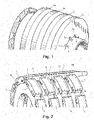
- a typical modern aircraft brake for example an airliner brake of the type produced by the AIRBUS or BOEING companies, comprises a torsion tube 1 on which carbon discs are threaded.
- these disks there are stator disks 2a which have notches 3a in which tenons 4 integral with the torsion tube are engaged, so that the stator disks 2a are immobilized in rotation.
- the studs 4 have come together with the torsion tube 1, but they could be attached to the torsion tube.
- rotor discs 2b which have notches 3b in which are engaged strips 5 integral with the rim 6 of a wheel (visible in picture 3 ) which extends around the brakes, so that the rotor discs rotate with the wheel.
- the bars 5 are attached to the rim of the wheel, but they could be integral with the rim.
- the brake comprises hydraulic or electromechanical brake actuators (not shown here), which selectively press the discs together to generate a friction force between the discs and thus brake the wheel.
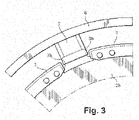
- the sides of the notches are generally protected by jumpers 7 which define the interface between the discs and the studs or strips.
- the amplitude of the vibrations has been represented in the form of the level of acceleration (measured in g) induced by the vibrations occurring during braking, by retaining respectively a coefficient of friction of 0.6 and a coefficient of friction of 0 .2 for the interface between the discs and the tenons or strips.
- the vibrations stabilize in a few tenths of a second at a level of maximum amplitude, which remains relatively constant.
- the inventors have noticed that the influence of the coefficient of friction is decisive. It can be seen that the level of vibration decreases when the coefficient of friction decreases.
- the coefficient of friction of 0.6 leads to a vibration amplitude of ⁇ 60g, while the coefficient of friction of 0.2 results in a ⁇ 20g vibration amplitude.
- the figure 5 shows the result obtained by varying this parameter, namely that the maximum amplitude of the vibrations is substantially proportional to the selected coefficient of friction.
Landscapes
- Engineering & Computer Science (AREA)
- General Engineering & Computer Science (AREA)
- Mechanical Engineering (AREA)
- Aviation & Aerospace Engineering (AREA)
- Braking Arrangements (AREA)
Description
- L'invention concerne un procédé d'atténuation des vibrations des roues freinées d'aéronef survenant lors d'un freinage.
- On sait que des vibrations sont susceptibles d'intervenir lors de freinages d'un aéronef dans les roues équipées de freins. Ces vibrations résultent de phénomènes dynamiques complexes et ont reçu plusieurs traitements. On a par exemple proposé d'équiper le circuit hydraulique alimentant les freins de restricteurs pour éviter des à-coups hydrauliques susceptibles de donner naissance à des vibrations. On a également proposé d'équiper le pied du tube de torsion d'une bague anti-vibrations (anti-whirl) diminuant l'intensité des vibrations.
- Ces solutions ne sont pas sans inconvénients. Les restricteurs limitent de fait les débits disponibles pour la commande des freins et en limitent donc la dynamique. Par ailleurs l'utilisation d'une bague anti-vibration oblige à équiper le tube de torsion d'un pied, ce qui complexifie le tube et l'alourdit. Le document
FR2887559 - L'invention vise à proposer un procédé d'atténuation des vibrations des roues freinées d'aéronef lors de freinages, ne présentant pas les inconvénients précités.
- En vue de la réalisation de ce but, on propose un procédé d'atténuation de vibrations d'un ensemble roue/frein d'aéronef selon la revendication
- Les inventeurs ont réalisé des simulations de freinage poussées intégrant le coefficient de frottement des interfaces entre les disques et les tenons ou barrettes. Ces simulations ont permis de découvrir une influence très sensible de ce coefficient de frottement sur le niveau de vibrations générées lors des freinages. En particulier, il apparaît que les amplitudes vibratoires (caractérisées par les accélérations développées et mesurées en g) sont globalement proportionnelles au coefficient de frottement entre les disques et les tenons ou barrettes. Les inventeurs ont ainsi découvert qu'un choix d'interfaces présentant un coefficient de frottement inférieur ou égal à 0,6 permet d'atténuer ce niveau de vibrations. Pour rappel, lorsqu'un aéronef touche le sol, les rotors des freins qui étaient auparavant dans la soute sont mis en rotation et sont soumis à la température environnante et au flux d'air lié au déplacement de l'aéronef. On peut estimer que la température des cavaliers, barrettes et tenons est comprise entre -40°C et + 40°C environ. Lorsque l'effort de freinage est exercé, la température des cavaliers, barrettes et tenons va rapidement augmenter. On estime que cette température reste la plupart du temps inférieure à une température maximale extrême de 400°C environ (d'autres parties du frein pouvant être plus chaudes ou au contraire moins chaudes). Dans les conditions d'un freinage à l'atterrissage d'un aéronef, la plage de température vue par l'interface des cavaliers avec la roue ou le tube est donc comprise entre -40°C et 400°C
- De tels coefficients de frottement peuvent être obtenus en choisissant de façon adéquate la matière des cavaliers qui équipent les disques et qui viennent en contact avec les tenons et barrettes, la matière des tenons et barrettes, ou en équipant ces derniers d'un revêtement propre à obtenir de tels coefficients de frottement.
- L'invention sera mieux comprise à la lumière de la description qui suit en référence aux figures des dessins annexés, parmi lesquelles :
- la
figure 1 est une vue en perspective d'un tube de torsion d'un frein équipé de tenons et sur lequel des disques de freins sont enfilés. Seuls les disques stators sont représentés ; - la
figure 2 est une vue en perspective des disques rotor du frein de lafigure 1 recevant dans leurs encoches des barrettes de la roue à freiner ; - La
figure 3 est une vue en perspective d'un cavalier équipant une encoche d'un disque rotor ; - la
figure 4 est un graphe montrant les vibrations générées par un freinage, avec respectivement un coefficient de frottement de 0,6 et un coefficient de frottement de 0,2 - la
figure 5 est un graphe montrant la relation entre le coefficient de frottement et le niveau maximal de vibrations. - De façon connue en soi, et comme cela est illustré aux
figures 1 et 2 , un frein typique d'aéronef moderne, par exemple un frein d'avion de ligne du type de ceux produits par les sociétés AIRBUS ou BOEING, comporte un tube de torsion 1 sur lequel des disques en carbone sont enfilés. Parmi ces disques, on compte des disques stators 2a qui comportent des encoches 3a dans lesquelles sont engagés des tenons 4 solidaires du tube de torsion, de sorte que les disques stators 2a sont immobilisés en rotation. Ici les tenons 4 sont venus de matière avec le tube de torsion 1, mais ils pourraient être rapportés sur le tube de torsion. En alternance avec les disques stators 2a, on trouve des disques rotors 2b qui comportent des encoches 3b dans lesquelles sont engagées des barrettes 5 solidaires de la jante 6 d'une roue (visible à lafigure 3 ) qui s'étend autour des freins, de sorte que les disques rotors tournent avec la roue. Ici, les barrettes 5 sont rapportées sur la jante de la roue, mais elles pourraient être venues de matière avec la jante. Le frein comporte des actionneurs de freinage hydrauliques ou électromécaniques (non représentés ici), qui pressent sélectivement les disques entre eux pour générer un effort de frottement entre les disques et ainsi freiner la roue. Comme cela est illustré à lafigure 3 , les flancs des encoches sont généralement protégés par des cavaliers 7 qui définissent l'interface entre les disques et les tenons ou barrettes. - Sur la
figure 4 a été représentée l'amplitude des vibrations sous la forme du niveau d'accélération (mesuré en g) induit par les vibrations intervenant lors d'un freinage, en retenant respectivement un coefficient de frottement de 0,6 et un coefficient de frottement de 0,2 pour l'interface entre les disques et les tenons ou barrettes. Après une phase initiale de naissance et de développement, les vibrations se stabilisent en quelques dixièmes de secondes à un niveau d'amplitude maximale, qui reste relativement constant. Les inventeurs ont remarqué que l'influence du coefficient de frottement est déterminante. On constate que le niveau de vibration baisse quand le coefficient de frottement baisse. Dans la simulation illustrée, le coefficient de frottement de 0,6 conduit à une amplitude de vibration de ± 60g, tandis que le coefficient de frottement de 0,2 aboutit à une amplitude de vibration de ± 20g. - Cette découverte a incité les inventeurs à explorer l'influence de ce paramètre. La
figure 5 montre le résultat obtenu en faisant varier ce paramètre, à savoir que l'amplitude maximale des vibrations est sensiblement proportionnelle au coefficient de frottement retenu. - Ainsi, le choix d'interfaces présentant un coefficient de frottement inférieur ou égal à 0,6 permet de limiter efficacement l'amplitude maximale des vibrations. Un tel coefficient de frottement peut être obtenu de différentes manières, comme par exemple :
- en choisissant un couple de matériau pour l'interface cavalier/tenon ou cavalier/barrette à faible coefficient de frottement ;
- en appliquant sur le cavalier un revêtement de surface présentant avec les barrettes ou tenons un faible coefficient de frottement ;
- en appliquant sur les barrettes ou les tenons d'un revêtement de surface présentant avec les cavaliers un faible coefficient de frottement ;
- en recouvrant les barrettes ou les tenons d'une tôle de protection présentant avec les cavaliers un faible coefficient de frottement...
- L'obtention de tels coefficients de frottement a pu être vérifiée par diverses expérimentations détaillées ci-dessous, aboutissant à des coefficients de frottement mesurés inférieurs à 0,6, allant jusqu'à 0,2 ou moins. Ces expérimentations concernent des combinaisons barrettes/cavaliers, mais peuvent bien entendu s'appliquer à des combinaisons tenons/cavaliers :
-
- cavaliers en acier 15CrMoV6 ;
- barrettes en acier X5CrNiMo16-5 avec un revêtement en carbure de tungstène enrichi de cobalt (WC/Co/Cr) sans rectification, rugosité Ra=3,2 microns.
-
- cavaliers en acier 17-22AS ;
- barrettes en acier X5CrNiMo16-5 avec un revêtement en carbure de tungstène enrichi de cobalt (WC/Co/Cr) rectifié avec une rugosité Ra=1,6 microns.
-
- cavaliers en acier 15CrMoV6, avec dépôt en surface de particules de carbone;
- barrettes en acier X5CrNiMo16-5 avec un revêtement en carbure de tungstène enrichi de cobalt (WC/Co/Cr) sans rectification, rugosité Ra=3,2 microns, avec dépôt en surface de particules de carbone.
- Il est ainsi techniquement possible d'obtenir des coefficients de frottement inférieurs à 0,6, et même bien plus bas, de l'ordre de 0,2. Un coefficient de frottement aussi bas a permis de limiter le niveau maximal d'accélération à ± 20g dans les simulations menées par les inventeurs, ce qui répond aux spécifications récentes émises par certains avionneurs
- Il est possible dans les exemples décrits d'abaisser le coefficient de frottement en réduisant la rugosité.
- L'invention n'est pas limitée à ce qui vient d'être décrit, mais bien au contraire englobe toute variante entrant dans le cadre défini par la revendication.
Claims (1)
- Procédé d'atténuation de vibrations d'un ensemble roue/frein d'aéronef survenant lors d'un freinage, le frein comportant des disques rotors (2b) entraînés en rotation avec la roue au moyen de barrettes (5) solidaires de la roue et engagées dans des encoches (3b) des disques rotors, et des disques stators (2a) maintenus immobiles en rotation au moyen de tenons (4) solidaires d'un tube de torsion (1) du frein et engagés dans des encoches (3a) des disques stators, les encoches ayant des flancs protégés par des cavaliers (7), caractérisé en ce que l'on sélectionne l'un des couples cavaliers/tenons et/ou cavaliers/barrettes suivant :- cavaliers en acier 15CrMoV6, et- barrettes ou tenons en acier X5CrNiMo16-5 avec un revêtement en carbure de tungstène enrichi de cobalt (WC/Co/Cr) sans rectification, rugosité Ra≤3,2 microns ; ou- cavaliers en acier 17-22AS, et- barrettes ou tenons en acier X5CrNiMo16-5 avec un revêtement en carbure de tungstène enrichi de cobalt (WC/Co/Cr) rectifié avec une rugosité Ra≤1,6 microns ;
ou- cavaliers en acier 15CrMoV6, avec dépôt en surface de particules de carbone, et- barrettes ou tenons en acier X5CrNiMo16-5 avec un revêtement en carbure de tungstène enrichi de cobalt (WC/Co/Cr) sans rectification, rugosité Ra≤3,2 microns avec dépôt en surface de particules de carbone.
Applications Claiming Priority (2)
| Application Number | Priority Date | Filing Date | Title |
|---|---|---|---|
| FR1753531A FR3065439B1 (fr) | 2017-04-24 | 2017-04-24 | Procede d’attenuation des vibrations des roues freinees d’aeronef |
| PCT/EP2018/060409 WO2018197448A1 (fr) | 2017-04-24 | 2018-04-24 | Procede d'attenuation des vibrations des roues freinees d'aeronef |
Publications (2)
| Publication Number | Publication Date |
|---|---|
| EP3615833A1 EP3615833A1 (fr) | 2020-03-04 |
| EP3615833B1 true EP3615833B1 (fr) | 2022-09-28 |
Family
ID=59579695
Family Applications (1)
| Application Number | Title | Priority Date | Filing Date |
|---|---|---|---|
| EP18717954.4A Active EP3615833B1 (fr) | 2017-04-24 | 2018-04-24 | Procédé d'atténuation des vibrations des roues freinées d'aéronef |
Country Status (5)
| Country | Link |
|---|---|
| US (1) | US11162551B2 (fr) |
| EP (1) | EP3615833B1 (fr) |
| CN (1) | CN110546396B (fr) |
| FR (1) | FR3065439B1 (fr) |
| WO (1) | WO2018197448A1 (fr) |
Families Citing this family (3)
| Publication number | Priority date | Publication date | Assignee | Title |
|---|---|---|---|---|
| US20220356915A1 (en) * | 2021-05-04 | 2022-11-10 | Meggitt Aircraft Braking Systems Corporation | Reinforced torque tubes |
| FR3129370B1 (fr) | 2021-11-24 | 2023-11-24 | Safran Landing Systems | Roue freinée dotée de cames rotatives. |
| FR3163415A1 (fr) * | 2024-06-13 | 2025-12-19 | Safran Landing Systems | Barrette coiffant un tenon solidaire d’une roue pour entraîner en rotation des disques rotors de frein |
Family Cites Families (17)
| Publication number | Priority date | Publication date | Assignee | Title |
|---|---|---|---|---|
| US3605967A (en) * | 1969-04-07 | 1971-09-20 | Goodrich Co B F | Protective bearing member for brake or clutch |
| US4289216A (en) * | 1979-04-06 | 1981-09-15 | Toyota Jidosha Kogyo Kabushiki | Disc brake |
| US4557356A (en) * | 1984-04-30 | 1985-12-10 | Goodyear Aerospace Corporation | Brake disk and keyslot reinforcements therefor |
| US5806636A (en) * | 1995-08-16 | 1998-09-15 | Northrop Grumman Corporation | Brake rotors/drums and brake pads particulary adapted for motorized vehicles |
| US5931269A (en) * | 1997-04-21 | 1999-08-03 | Alliedsignal Inc. | Aircraft wheel part with corrosion and wear resistance |
| GB2390885A (en) * | 2002-07-17 | 2004-01-21 | Bombardier Transp Gmbh | Rail vehicle wheel set with torsional vibration damping |
| DE102004021126A1 (de) * | 2004-04-29 | 2005-11-17 | Lucas Automotive Gmbh | Scheibenbremse |
| US7763192B2 (en) * | 2005-04-12 | 2010-07-27 | Honeywell International Inc. | Resin transfer molding to toughen composite beam keys |
| US7442443B2 (en) * | 2005-05-31 | 2008-10-28 | Goodrich Corporation | Chromium-nickel stainless steel alloy article having oxide coating formed from the base metal suitable for brake apparatus |
| US20070175709A1 (en) * | 2006-01-31 | 2007-08-02 | Honeywell International Inc. | Low friction stator insert assembly |
| US7766133B2 (en) * | 2007-06-04 | 2010-08-03 | Honeywell International, Inc. | Insert and retainer for securing same to an aircraft brake disk |
| US8574470B2 (en) * | 2008-10-24 | 2013-11-05 | Honeywell International Inc. | Combustion synthesis to bond metal inserts to C-C composite surfaces |
| KR101359959B1 (ko) * | 2012-05-10 | 2014-02-12 | 전자부품연구원 | 치형 브레이크를 갖는 브레이크 장치 및 그를 이용한 모터 조립체 |
| CN105393016A (zh) * | 2013-07-19 | 2016-03-09 | 亨德里克森美国有限责任公司 | 用于重载车辆的盘式制动器转子 |
| US9919794B2 (en) * | 2015-12-21 | 2018-03-20 | Goodrich Corporation | System and method for stiffened torque bar |
| US9938003B2 (en) * | 2015-12-21 | 2018-04-10 | Goodrich Corporation | Multipart torque bar for vibration suppression |
| US11092203B2 (en) * | 2018-04-25 | 2021-08-17 | Goodrich Corporation | Hybrid torque bar |
-
2017
- 2017-04-24 FR FR1753531A patent/FR3065439B1/fr active Active
-
2018
- 2018-04-24 US US16/607,584 patent/US11162551B2/en active Active
- 2018-04-24 CN CN201880026651.4A patent/CN110546396B/zh active Active
- 2018-04-24 WO PCT/EP2018/060409 patent/WO2018197448A1/fr not_active Ceased
- 2018-04-24 EP EP18717954.4A patent/EP3615833B1/fr active Active
Also Published As
| Publication number | Publication date |
|---|---|
| EP3615833A1 (fr) | 2020-03-04 |
| FR3065439B1 (fr) | 2020-08-14 |
| CN110546396A (zh) | 2019-12-06 |
| US11162551B2 (en) | 2021-11-02 |
| CN110546396B (zh) | 2021-07-20 |
| FR3065439A1 (fr) | 2018-10-26 |
| US20200049212A1 (en) | 2020-02-13 |
| WO2018197448A1 (fr) | 2018-11-01 |
Similar Documents
| Publication | Publication Date | Title |
|---|---|---|
| EP2925480B1 (fr) | Procede de soudage par friction d'une pale sur un disque de rotor d'une turbomachine | |
| EP3350468B1 (fr) | Procédé de fabrication d'un disque de frein et disque de frein pour freins à disque | |
| EP3615833A1 (fr) | Procede d'attenuation des vibrations des roues freinees d'aeronef | |
| CA2145466C (fr) | Disques multimateriaux pour freinage a haute energie constitue de l'assemblage de differents flasques | |
| CN103562587B (zh) | 铁道车辆用制动衬片及具有该铁道车辆用制动衬片的盘形制动器 | |
| EP2876326B1 (fr) | Procédé de rénovation et d'utilisation de disques de frein de type stator arrière à plots, disque assemblé et pile de disques correspondante | |
| FR2978931A1 (fr) | Procede de realisation d'un renfort de protection du bord d'attaque d'une pale | |
| FR2557240A1 (fr) | Disque de frein a garnitures demontables | |
| FR2990188A1 (fr) | Ecran thermique a pente pour roue d'aeronef et roue d'aeronef equipee d'un tel ecran thermique | |
| EP1588912B1 (fr) | Procédé de freinage d'un aéronef à plusieurs roues freinées | |
| CA2823504A1 (fr) | Procede d'amortissement de pale de turbine a gaz et amortisseur de vibration de mise en oeuvre | |
| CN106979263A (zh) | 用于自行车盘式刹车的垫和包括这种垫的盘式刹车 | |
| EP2746118B1 (fr) | Procédé de gestion du freinage d'un aéronef | |
| CN108474426A (zh) | 铁道车辆用制动衬片和具备该铁道车辆用制动衬片的盘式制动器 | |
| DE69128536T2 (de) | Bremsescheibe oder ähnliche Bauteil aus Verbundwerkstoff mit metallmatrix | |
| JPH05164158A (ja) | ディスクブレーキ用ブレーキパッド | |
| EP2971839B1 (fr) | Plaquette de frein sous tension | |
| CN114303017B (zh) | 制动片保持器装置 | |
| FR3097197A1 (fr) | Barrette pour roue freinee d’aeronef | |
| Hamid et al. | Effect of brake pad design on friction and wear with hard particle present | |
| WO2018210570A1 (fr) | Bague de friction pour disque de frein, disque de frein ainsi que procédé de fabrication associé | |
| FR3031153A1 (fr) | Procede de reduction de bruit dans un boitier d'etrier de frein a disque, et boitier d'etrier correspondant | |
| EP2647861A1 (fr) | Procédé d'utilisation et de rénovation d'un disque d'une pile de disques d'un frein de véhicule | |
| US9140131B2 (en) | Methods for controlling friction between heterogeneous contact surfaces | |
| BE1028803B1 (nl) | Turbomachine |
Legal Events
| Date | Code | Title | Description |
|---|---|---|---|
| STAA | Information on the status of an ep patent application or granted ep patent |
Free format text: STATUS: UNKNOWN |
|
| STAA | Information on the status of an ep patent application or granted ep patent |
Free format text: STATUS: THE INTERNATIONAL PUBLICATION HAS BEEN MADE |
|
| PUAI | Public reference made under article 153(3) epc to a published international application that has entered the european phase |
Free format text: ORIGINAL CODE: 0009012 |
|
| STAA | Information on the status of an ep patent application or granted ep patent |
Free format text: STATUS: REQUEST FOR EXAMINATION WAS MADE |
|
| 17P | Request for examination filed |
Effective date: 20191024 |
|
| AK | Designated contracting states |
Kind code of ref document: A1 Designated state(s): AL AT BE BG CH CY CZ DE DK EE ES FI FR GB GR HR HU IE IS IT LI LT LU LV MC MK MT NL NO PL PT RO RS SE SI SK SM TR |
|
| AX | Request for extension of the european patent |
Extension state: BA ME |
|
| DAV | Request for validation of the european patent (deleted) | ||
| DAX | Request for extension of the european patent (deleted) | ||
| STAA | Information on the status of an ep patent application or granted ep patent |
Free format text: STATUS: EXAMINATION IS IN PROGRESS |
|
| 17Q | First examination report despatched |
Effective date: 20210322 |
|
| GRAP | Despatch of communication of intention to grant a patent |
Free format text: ORIGINAL CODE: EPIDOSNIGR1 |
|
| STAA | Information on the status of an ep patent application or granted ep patent |
Free format text: STATUS: GRANT OF PATENT IS INTENDED |
|
| INTG | Intention to grant announced |
Effective date: 20220421 |
|
| GRAS | Grant fee paid |
Free format text: ORIGINAL CODE: EPIDOSNIGR3 |
|
| GRAA | (expected) grant |
Free format text: ORIGINAL CODE: 0009210 |
|
| STAA | Information on the status of an ep patent application or granted ep patent |
Free format text: STATUS: THE PATENT HAS BEEN GRANTED |
|
| AK | Designated contracting states |
Kind code of ref document: B1 Designated state(s): AL AT BE BG CH CY CZ DE DK EE ES FI FR GB GR HR HU IE IS IT LI LT LU LV MC MK MT NL NO PL PT RO RS SE SI SK SM TR |
|
| REG | Reference to a national code |
Ref country code: GB Ref legal event code: FG4D Free format text: NOT ENGLISH |
|
| REG | Reference to a national code |
Ref country code: CH Ref legal event code: EP |
|
| REG | Reference to a national code |
Ref country code: AT Ref legal event code: REF Ref document number: 1521412 Country of ref document: AT Kind code of ref document: T Effective date: 20221015 |
|
| REG | Reference to a national code |
Ref country code: DE Ref legal event code: R096 Ref document number: 602018041095 Country of ref document: DE |
|
| REG | Reference to a national code |
Ref country code: IE Ref legal event code: FG4D Free format text: LANGUAGE OF EP DOCUMENT: FRENCH |
|
| REG | Reference to a national code |
Ref country code: LT Ref legal event code: MG9D |
|
| PG25 | Lapsed in a contracting state [announced via postgrant information from national office to epo] |
Ref country code: SE Free format text: LAPSE BECAUSE OF FAILURE TO SUBMIT A TRANSLATION OF THE DESCRIPTION OR TO PAY THE FEE WITHIN THE PRESCRIBED TIME-LIMIT Effective date: 20220928 Ref country code: RS Free format text: LAPSE BECAUSE OF FAILURE TO SUBMIT A TRANSLATION OF THE DESCRIPTION OR TO PAY THE FEE WITHIN THE PRESCRIBED TIME-LIMIT Effective date: 20220928 Ref country code: NO Free format text: LAPSE BECAUSE OF FAILURE TO SUBMIT A TRANSLATION OF THE DESCRIPTION OR TO PAY THE FEE WITHIN THE PRESCRIBED TIME-LIMIT Effective date: 20221228 Ref country code: LV Free format text: LAPSE BECAUSE OF FAILURE TO SUBMIT A TRANSLATION OF THE DESCRIPTION OR TO PAY THE FEE WITHIN THE PRESCRIBED TIME-LIMIT Effective date: 20220928 Ref country code: LT Free format text: LAPSE BECAUSE OF FAILURE TO SUBMIT A TRANSLATION OF THE DESCRIPTION OR TO PAY THE FEE WITHIN THE PRESCRIBED TIME-LIMIT Effective date: 20220928 Ref country code: FI Free format text: LAPSE BECAUSE OF FAILURE TO SUBMIT A TRANSLATION OF THE DESCRIPTION OR TO PAY THE FEE WITHIN THE PRESCRIBED TIME-LIMIT Effective date: 20220928 |
|
| REG | Reference to a national code |
Ref country code: NL Ref legal event code: MP Effective date: 20220928 |
|
| REG | Reference to a national code |
Ref country code: AT Ref legal event code: MK05 Ref document number: 1521412 Country of ref document: AT Kind code of ref document: T Effective date: 20220928 |
|
| PG25 | Lapsed in a contracting state [announced via postgrant information from national office to epo] |
Ref country code: HR Free format text: LAPSE BECAUSE OF FAILURE TO SUBMIT A TRANSLATION OF THE DESCRIPTION OR TO PAY THE FEE WITHIN THE PRESCRIBED TIME-LIMIT Effective date: 20220928 Ref country code: GR Free format text: LAPSE BECAUSE OF FAILURE TO SUBMIT A TRANSLATION OF THE DESCRIPTION OR TO PAY THE FEE WITHIN THE PRESCRIBED TIME-LIMIT Effective date: 20221229 |
|
| PG25 | Lapsed in a contracting state [announced via postgrant information from national office to epo] |
Ref country code: SM Free format text: LAPSE BECAUSE OF FAILURE TO SUBMIT A TRANSLATION OF THE DESCRIPTION OR TO PAY THE FEE WITHIN THE PRESCRIBED TIME-LIMIT Effective date: 20220928 Ref country code: RO Free format text: LAPSE BECAUSE OF FAILURE TO SUBMIT A TRANSLATION OF THE DESCRIPTION OR TO PAY THE FEE WITHIN THE PRESCRIBED TIME-LIMIT Effective date: 20220928 Ref country code: PT Free format text: LAPSE BECAUSE OF FAILURE TO SUBMIT A TRANSLATION OF THE DESCRIPTION OR TO PAY THE FEE WITHIN THE PRESCRIBED TIME-LIMIT Effective date: 20230130 Ref country code: ES Free format text: LAPSE BECAUSE OF FAILURE TO SUBMIT A TRANSLATION OF THE DESCRIPTION OR TO PAY THE FEE WITHIN THE PRESCRIBED TIME-LIMIT Effective date: 20220928 Ref country code: CZ Free format text: LAPSE BECAUSE OF FAILURE TO SUBMIT A TRANSLATION OF THE DESCRIPTION OR TO PAY THE FEE WITHIN THE PRESCRIBED TIME-LIMIT Effective date: 20220928 Ref country code: AT Free format text: LAPSE BECAUSE OF FAILURE TO SUBMIT A TRANSLATION OF THE DESCRIPTION OR TO PAY THE FEE WITHIN THE PRESCRIBED TIME-LIMIT Effective date: 20220928 |
|
| PG25 | Lapsed in a contracting state [announced via postgrant information from national office to epo] |
Ref country code: SK Free format text: LAPSE BECAUSE OF FAILURE TO SUBMIT A TRANSLATION OF THE DESCRIPTION OR TO PAY THE FEE WITHIN THE PRESCRIBED TIME-LIMIT Effective date: 20220928 Ref country code: PL Free format text: LAPSE BECAUSE OF FAILURE TO SUBMIT A TRANSLATION OF THE DESCRIPTION OR TO PAY THE FEE WITHIN THE PRESCRIBED TIME-LIMIT Effective date: 20220928 Ref country code: IS Free format text: LAPSE BECAUSE OF FAILURE TO SUBMIT A TRANSLATION OF THE DESCRIPTION OR TO PAY THE FEE WITHIN THE PRESCRIBED TIME-LIMIT Effective date: 20230128 Ref country code: EE Free format text: LAPSE BECAUSE OF FAILURE TO SUBMIT A TRANSLATION OF THE DESCRIPTION OR TO PAY THE FEE WITHIN THE PRESCRIBED TIME-LIMIT Effective date: 20220928 |
|
| REG | Reference to a national code |
Ref country code: DE Ref legal event code: R097 Ref document number: 602018041095 Country of ref document: DE |
|
| PG25 | Lapsed in a contracting state [announced via postgrant information from national office to epo] |
Ref country code: NL Free format text: LAPSE BECAUSE OF FAILURE TO SUBMIT A TRANSLATION OF THE DESCRIPTION OR TO PAY THE FEE WITHIN THE PRESCRIBED TIME-LIMIT Effective date: 20220928 Ref country code: AL Free format text: LAPSE BECAUSE OF FAILURE TO SUBMIT A TRANSLATION OF THE DESCRIPTION OR TO PAY THE FEE WITHIN THE PRESCRIBED TIME-LIMIT Effective date: 20220928 |
|
| PG25 | Lapsed in a contracting state [announced via postgrant information from national office to epo] |
Ref country code: DK Free format text: LAPSE BECAUSE OF FAILURE TO SUBMIT A TRANSLATION OF THE DESCRIPTION OR TO PAY THE FEE WITHIN THE PRESCRIBED TIME-LIMIT Effective date: 20220928 |
|
| PLBE | No opposition filed within time limit |
Free format text: ORIGINAL CODE: 0009261 |
|
| STAA | Information on the status of an ep patent application or granted ep patent |
Free format text: STATUS: NO OPPOSITION FILED WITHIN TIME LIMIT |
|
| 26N | No opposition filed |
Effective date: 20230629 |
|
| REG | Reference to a national code |
Ref country code: DE Ref legal event code: R119 Ref document number: 602018041095 Country of ref document: DE |
|
| PG25 | Lapsed in a contracting state [announced via postgrant information from national office to epo] |
Ref country code: SI Free format text: LAPSE BECAUSE OF FAILURE TO SUBMIT A TRANSLATION OF THE DESCRIPTION OR TO PAY THE FEE WITHIN THE PRESCRIBED TIME-LIMIT Effective date: 20220928 |
|
| REG | Reference to a national code |
Ref country code: CH Ref legal event code: PL |
|
| PG25 | Lapsed in a contracting state [announced via postgrant information from national office to epo] |
Ref country code: LU Free format text: LAPSE BECAUSE OF NON-PAYMENT OF DUE FEES Effective date: 20230424 |
|
| REG | Reference to a national code |
Ref country code: BE Ref legal event code: MM Effective date: 20230430 |
|
| PG25 | Lapsed in a contracting state [announced via postgrant information from national office to epo] |
Ref country code: MC Free format text: LAPSE BECAUSE OF FAILURE TO SUBMIT A TRANSLATION OF THE DESCRIPTION OR TO PAY THE FEE WITHIN THE PRESCRIBED TIME-LIMIT Effective date: 20220928 |
|
| PG25 | Lapsed in a contracting state [announced via postgrant information from national office to epo] |
Ref country code: MC Free format text: LAPSE BECAUSE OF FAILURE TO SUBMIT A TRANSLATION OF THE DESCRIPTION OR TO PAY THE FEE WITHIN THE PRESCRIBED TIME-LIMIT Effective date: 20220928 Ref country code: LI Free format text: LAPSE BECAUSE OF NON-PAYMENT OF DUE FEES Effective date: 20230430 Ref country code: DE Free format text: LAPSE BECAUSE OF NON-PAYMENT OF DUE FEES Effective date: 20231103 Ref country code: CH Free format text: LAPSE BECAUSE OF NON-PAYMENT OF DUE FEES Effective date: 20230430 |
|
| REG | Reference to a national code |
Ref country code: IE Ref legal event code: MM4A |
|
| PG25 | Lapsed in a contracting state [announced via postgrant information from national office to epo] |
Ref country code: BE Free format text: LAPSE BECAUSE OF NON-PAYMENT OF DUE FEES Effective date: 20230430 |
|
| PG25 | Lapsed in a contracting state [announced via postgrant information from national office to epo] |
Ref country code: IE Free format text: LAPSE BECAUSE OF NON-PAYMENT OF DUE FEES Effective date: 20230424 |
|
| PG25 | Lapsed in a contracting state [announced via postgrant information from national office to epo] |
Ref country code: IE Free format text: LAPSE BECAUSE OF NON-PAYMENT OF DUE FEES Effective date: 20230424 |
|
| PG25 | Lapsed in a contracting state [announced via postgrant information from national office to epo] |
Ref country code: IT Free format text: LAPSE BECAUSE OF FAILURE TO SUBMIT A TRANSLATION OF THE DESCRIPTION OR TO PAY THE FEE WITHIN THE PRESCRIBED TIME-LIMIT Effective date: 20220928 |
|
| PG25 | Lapsed in a contracting state [announced via postgrant information from national office to epo] |
Ref country code: BG Free format text: LAPSE BECAUSE OF FAILURE TO SUBMIT A TRANSLATION OF THE DESCRIPTION OR TO PAY THE FEE WITHIN THE PRESCRIBED TIME-LIMIT Effective date: 20220928 |
|
| PG25 | Lapsed in a contracting state [announced via postgrant information from national office to epo] |
Ref country code: BG Free format text: LAPSE BECAUSE OF FAILURE TO SUBMIT A TRANSLATION OF THE DESCRIPTION OR TO PAY THE FEE WITHIN THE PRESCRIBED TIME-LIMIT Effective date: 20220928 |
|
| PGFP | Annual fee paid to national office [announced via postgrant information from national office to epo] |
Ref country code: FR Payment date: 20250422 Year of fee payment: 8 |
|
| PG25 | Lapsed in a contracting state [announced via postgrant information from national office to epo] |
Ref country code: CY Free format text: LAPSE BECAUSE OF FAILURE TO SUBMIT A TRANSLATION OF THE DESCRIPTION OR TO PAY THE FEE WITHIN THE PRESCRIBED TIME-LIMIT; INVALID AB INITIO Effective date: 20180424 |
|
| PG25 | Lapsed in a contracting state [announced via postgrant information from national office to epo] |
Ref country code: HU Free format text: LAPSE BECAUSE OF FAILURE TO SUBMIT A TRANSLATION OF THE DESCRIPTION OR TO PAY THE FEE WITHIN THE PRESCRIBED TIME-LIMIT; INVALID AB INITIO Effective date: 20180424 |
|
| PG25 | Lapsed in a contracting state [announced via postgrant information from national office to epo] |
Ref country code: TR Free format text: LAPSE BECAUSE OF FAILURE TO SUBMIT A TRANSLATION OF THE DESCRIPTION OR TO PAY THE FEE WITHIN THE PRESCRIBED TIME-LIMIT Effective date: 20220928 |
|
| PGFP | Annual fee paid to national office [announced via postgrant information from national office to epo] |
Ref country code: GB Payment date: 20260327 Year of fee payment: 9 |