EP3614918B1 - Systeme zur behandlung von herzrhythmusstörungen - Google Patents
Systeme zur behandlung von herzrhythmusstörungen Download PDFInfo
- Publication number
- EP3614918B1 EP3614918B1 EP18722152.8A EP18722152A EP3614918B1 EP 3614918 B1 EP3614918 B1 EP 3614918B1 EP 18722152 A EP18722152 A EP 18722152A EP 3614918 B1 EP3614918 B1 EP 3614918B1
- Authority
- EP
- European Patent Office
- Prior art keywords
- propagation
- detection region
- wavefront
- processing means
- heart
- Prior art date
- Legal status (The legal status is an assumption and is not a legal conclusion. Google has not performed a legal analysis and makes no representation as to the accuracy of the status listed.)
- Active
Links
Images



Classifications
-
- A—HUMAN NECESSITIES
- A61—MEDICAL OR VETERINARY SCIENCE; HYGIENE
- A61B—DIAGNOSIS; SURGERY; IDENTIFICATION
- A61B5/00—Measuring for diagnostic purposes; Identification of persons
- A61B5/24—Detecting, measuring or recording bioelectric or biomagnetic signals of the body or parts thereof
- A61B5/25—Bioelectric electrodes therefor
- A61B5/279—Bioelectric electrodes therefor specially adapted for particular uses
- A61B5/28—Bioelectric electrodes therefor specially adapted for particular uses for electrocardiography [ECG]
- A61B5/283—Invasive
- A61B5/287—Holders for multiple electrodes, e.g. electrode catheters for electrophysiological study [EPS]
-
- A—HUMAN NECESSITIES
- A61—MEDICAL OR VETERINARY SCIENCE; HYGIENE
- A61B—DIAGNOSIS; SURGERY; IDENTIFICATION
- A61B5/00—Measuring for diagnostic purposes; Identification of persons
- A61B5/24—Detecting, measuring or recording bioelectric or biomagnetic signals of the body or parts thereof
- A61B5/316—Modalities, i.e. specific diagnostic methods
- A61B5/318—Heart-related electrical modalities, e.g. electrocardiography [ECG]
- A61B5/346—Analysis of electrocardiograms
- A61B5/349—Detecting specific parameters of the electrocardiograph cycle
- A61B5/361—Detecting fibrillation
-
- A—HUMAN NECESSITIES
- A61—MEDICAL OR VETERINARY SCIENCE; HYGIENE
- A61B—DIAGNOSIS; SURGERY; IDENTIFICATION
- A61B5/00—Measuring for diagnostic purposes; Identification of persons
- A61B5/24—Detecting, measuring or recording bioelectric or biomagnetic signals of the body or parts thereof
- A61B5/316—Modalities, i.e. specific diagnostic methods
- A61B5/318—Heart-related electrical modalities, e.g. electrocardiography [ECG]
- A61B5/346—Analysis of electrocardiograms
- A61B5/349—Detecting specific parameters of the electrocardiograph cycle
- A61B5/363—Detecting tachycardia or bradycardia
-
- A—HUMAN NECESSITIES
- A61—MEDICAL OR VETERINARY SCIENCE; HYGIENE
- A61B—DIAGNOSIS; SURGERY; IDENTIFICATION
- A61B2505/00—Evaluating, monitoring or diagnosing in the context of a particular type of medical care
- A61B2505/05—Surgical care
Definitions
- the present invention relates to the detection and pictorial representation of cardiac activation, and in particular of the progression of activation through the heart. It has application in locating sites suitable for ablation therapy, for example to cure atrial fibrillation.
- Irregular heart beat (arrhythmia) is commonly treated with ablation therapy in a cardiac catheter laboratory.
- a method is needed to identify where the ablation therapy should be delivered, in order to cure the arrhythmia without having to ablate an unnecessarily large amount of the heart.
- the abnormal sequences may be of two categories: those that show a surface ECG pattern that is obviously regular and repetitive, or those that appear to be irregular and do not show a simple repeating pattern.
- Fibrillatory electrical activation of the myocardium is one of the most common causes of cardiac morbidity and mortality. It can affect either the atrium (atrial fibrillation) or the ventricle (ventricular fibrillation).
- Mathematical modelling and in-vitro studies have suggested that fibrillatory electrical activation can often be driven by electrical rotors ( Skanes AC, Mandapati R, Berenfeld O, Davidenko JM, Jalife J. Spatiotemporal periodicity during atrial fibrillation in the is olated sheep heart. Circulation 1998;98:1236-48 ) and that a small number, for example one to three, of such rotors may be sufficient to maintain fibrillation in the human heart. If the origin of these rotors can be identified and targeted for treatment, then it may be possible to prevent the death and suffering caused by fibrillatory electrical activation.
- fibrillatory activity is that there exist areas of the heart that act as focal sources of atrial fibrillation giving rise to focal activation. The repetitive firing from these areas may then perpetuate atrial fibrillation ( Lee MS, Sahadevan J, Khrestian CM, Durand DM, Waldo AL. High Density Mapping of Atrial Fibrillation During Vagal Nerve Stimulation in the Canine Heart: Restudying the Moe Hypothesis. Journal of Cardiovascular Electrophysiology, 24: 328-335. doi:10.1111/jce.12032 ).
- Atrial activation during human atrial fibrillation is not identical between different patients. It can be anywhere on a spectrum between completely organised to highly disorganised activation ( Kanagaratnam P, Cherian A, Stanbridge RD, Glenville B, Severs NJ, Peters NS Relationship between connexins and atrial activation during human atrial fibrillation. J Cardiovasc Electrophysiol. 2004 Feb;15(2):206-16 ).
- the current state of the art is that, using multi-electrode catheters, it is possible to map the activation sequences using isochronal mapping. i.e. mapping of the timing of activation over the cardiac surface with points which activate at the same time being identified, eg by the same colour.
- This is time-consuming and needs careful expert assessment of each electrogram and comparing it to neighbouring electrograms in order to identify the local activation time and produce an isochronal map.
- WO2014/174274 discloses a system for locating and representing activation wave fronts and rotors. The present invention aims to further improve on the systems described therein.
- US2012/0089038 A1 describes a method of identifying potential driver sites for cardiac arrhythmias including acquiring various types of electrical activity maps and analysing these to detect potential driver sites.
- US2014/371609 describes a method of identifying a source of arrhythmia including forming indexes of progressive rotational activations or progressive focal activations over time and selecting one or more of the indexes that indicate consistency of the successive rotational activations.
- WO2017/041891 A1 describes a device for intravascular insertion having a body and a number of electrodes.
- the present invention provides an apparatus for monitoring activation in a heart, as defined in claim 1.
- the apparatus is comprising a probe and extending over a detection area of the probe, the detection area being arranged to contact a detection region of the heart, wherein each of the electrodes is arranged to detect electrical potential at a respective position in the heart during movement of a series of activation wavefronts across the detection region, processing means arranged to analyse the detected electrical potentials to identify a plurality of wavefronts, and display means, and wherein the processing means is further arranged, for each of the wavefronts, to define a series of update intervals over a transition period during which the wavefront crosses the detection region, and for each of the update intervals to determine a propagation direction, wherein the processing means is arranged to control the display means to generate and display an image indicative of the directions.
- the processing means may be arranged to allocate the electrodes to a plurality of groups.
- the processing means may be arranged, within each group, to allocate the electrodes into a plurality of pairs each comprising a first electrode and a second electrode.
- the processing means may be arranged, for each of the pairs, to determine the time delay between a wave front passing the first electrode and the wavefront passing the second electrode.
- the processing means may be arranged, from the time delays, to determine a direction of propagation of the wavefront past the group.
- the processing means may be arranged to analyse detected potentials for a plurality of positions of the probe in the heart.
- the processing means may be arranged to control the display means to indicate simultaneously the direction of propagation at each of the positions of the probe.
- the processing means may be arranged to control the display to generate an image comprising a series of features. One of the features may be added after each update interval in a position determined by the propagation direction for that update interval.
- the processing means may be arranged to identify an update interval in which a wavefront first enters the detection region and to control the display in response thereto to add one of the features at an origin position of the image, whereby each wavefront crossing the detection region is indicated by a line of said features extending away from the origin position.
- the processing means may be arranged to determine the direction of propagation at each of a plurality of points in the detection region.
- the processing means may be arranged to determine from the directions of propagation a value for the curl, or divergence, of the propagation direction at at least one point in the detection region.
- the processing means may be arranged, from the at least one value of the curl or divergence, to locate a source of fibrillation within the detection region.
- the system may further comprise any one or more features, in any combination, of the embodiments of the invention which will now be described by way of example only with reference to the accompanying drawings.
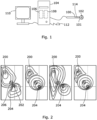
- a cardiac monitoring system comprises a catheter 100 having a probe 101 at one end with a set of electrodes 102 located on it.
- Each of the electrodes 102 is connected independently through the probe catheter 100 to a computer 104 which is arranged to acquire, store and analyse the voltages detected by the electrodes 102.
- the computer 104 comprises a memory 106 and a processor 108.
- the processor is arranged to sample the voltages detected by the electrodes 102 at a regular sample rate and store the values of the sampled voltages, which form a time series of sample values, in the memory 106, and then to analyse the stored voltage values so as to analyse the activation of the heart in the area contacted by the probe 101.
- the data can be analysed to identify focal targets within areas of irregular activation.
- the processor 108 is arranged to generate from the sampled voltage data, an image data set which it then provides to the display screen 110 which displays an image showing the activation pattern in the heart so that a user can interpret it.
- the probe 101 can be moved from region to region within the heart to focus attention in the regions where the targets are suspected.
- the catheter 100 may further comprise an ablation tip 114 which is connected to a radio frequency (RF) power source.
- the ablation tip 114 can therefore be used for ablation of regions of the heart which are found to be sources of atrial fibrillation, whether focal sources or rotors.
- the catheter may for example be a Smart-Touch catheter (Biosense-Webster) or a Tacticath catheter (Abbott). Alternatively separate catheters may be used, one such as the AFocus catheter for diagnosis or location of the source of fibrillation, and the other for example a Navistar catheter for ablation.
- FIG. 2 The variety of directions of activation wave fronts at a particular location is illustrated for example in Figure 2 .
- the activation waves from the two sources interact in a manner which varies considerably over time. Therefore if a point such as that 206 shown in Figure 2 is considered, the direction in which wave fronts will cross that point will in general be different for each wave front. While some, such as the first, second and fourth shown, may be generally in the direction away from one of the sources, others, such as the third shown, will be in different directions as a result of the interference between waves from the two sources.
- the system is therefore arranged to analyse the signals from the probe electrodes 102 so as to detect each of the different directions of propagation across each point, and then to analysis those as will be described in more detail below so as to locate, and enable treatment of, the rotors or other problematic regions.
- the processor 108 is arranged to perform each of these steps. For any particular position of the catheter 100, a stream of raw signal data is acquired from each of the numerous electrodes 102 of the catheter. The position of each electrode 102 is known through one of a variety of methods well known to those skilled in the art, such as those marketed as CARTO TM or NavX TM . The following steps are then carried out by the system under the control of the processor 108. They are described here in sequence but they can occur almost simultaneously so that the operator sees the activation pattern at any position of the catheter 100 after only a minimal delay, for example less than a second.
- the catheter 100 and computer 104 are arranged to acquire unipolar or bipolar electrogram data.
- a standard definition of unipolar electrogram data for a particular site is the potential difference between an intracardiac electrode at that site and a reference potential, for example at Wilson's central terminal, or any other combination of skin surface electrodes.
- a unipolar electrogram can be defined as the potential difference recorded between an intracardiac electrode and an electrode placed within the body at a site outside the heart, for example in the inferior vena cava, a large vein adjacent to the heart in which an electrode can very conveniently be located. Therefore for unipolar electrogram data a further electrode, not shown, is also provided and connected to the computer to provide the reference signal in known manner.
- bipolar electrogram data can be used, being defined as the potential difference between two of the intracardiac electrodes 102. In this case no further reference electrode is needed.
- the electrical signal (voltage) from each electrode (or electrode pair) is sampled at a regular sample frequency and the sampled values stored in memory for analysis.
- the electrogram data obtained is filtered to remove noise and baseline artefact.
- filtering algorithms are well known to those skilled in the art. It is possible to apply one or more in sequence, using software programs coded operating on the microcomputer system 104 as in this embodiment. In other embodiments the processing is performed by hardware circuitry specifically designed or customised for filtering, known as digital signal processing hardware. For example a simple band pass filter may be used, which may be at 10-250Hz.
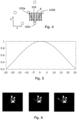
- An example of filtered electrogram signals is shown in Figure 3 , in which the electrogram data for electrodes numbered 12, 13, 14, 15 and 16 are shown, together with the results of analysis of pairs of the electrograms which are shown on lines 12.5, 13.5, 14.5 and 15.5, as will be described in more detail below.
- the electrode locations at which the electrograms are obtained will be referred to as 'nodes'.
- the nodes are triangulated, i.e. grouped into sets of three nodes 102a, 102b, 102c which form a triangle.
- Each edge 104 of the triangle extends between a pair of the three nodes, e.g. 102a and 102b, with a corresponding pair of electrograms.
- Each of these three pairs of electrograms is then processed to determine a time delay between the activation times of the two electrodes in the pair. From the three time delays, the direction and speed of the wave front passing the group of three nodes can be determined. For example each direction may be calculated and defined as components in two orthogonal directions x, and y, of a vector of unit length in the direction of propagation.
- an autocorrelation algorithm is used, performed by the processor 108 to compare the activation times of the two electrodes in each electrogram pair.
- Autocorrelation is used because closely spaced electrograms usually have a morphology that is similar. Autocorrelation provides a way of determining relative times of activation between the pair.
- e e 1 , e 2 , e 3 , ... , e n
- a windowing function is applied to the time series in order to select information that corresponds to a particular time and avoids multiple activations falling within the same window.
- w w ⁇ k , w ⁇ k + 1 , ... , w ⁇ 1 , w 0 , w 1 , ... , w k ⁇ 1 , w k
- the total width of the windowing function is 51 (2k+1) samples, corresponding to approximately 100ms at a sample rate of 500Hz.
- the windowing function is centred on one sample, indicated as sample 0 in Figure 5 , and has its highest value for sample 0. It falls away to zero at the samples at either end of the window, i.e. -k and +k.
- windowed electrograms from two neighbouring nodes are selected - e 1 w and e 2 w .
- values of ⁇ may be limited to ⁇ 20 ms .
- Information from multiple electrograms can, optionally, be compared by performing the above analysis on, for example, all possible pairs from groups of three electrograms, with their positions, after they have been triangulated.
- the node positions 102a, 102b, 102c on the catheter are then transformed onto a 2 dimensional surface and a grid defined, with a spacing that is substantially smaller than the inter-electrode distance.
- the nearest edge 104 is determined and the relative distances from the two nodes at the ends of that edge are calculated.
- the activation timing T g at each grid point g is then calculated as: where ⁇ has a value of 0 if the grid location g is next to node 1 and has a value of 1 if the location is next to node 2.
- Each grid value is assigned to 1 at times where there exists t - Tg ⁇ 100 ms .
- Standard image smoothing algorithms are then used to create a visual display of smooth wavefront propagation. This may be performed, for example, by applying a box filter and then thresholding. Using the smooth wavefront data, a Sobel edge detector, or other suitable edge detector, is used to identify the wavefront direction at each grid point.
- Wavefront direction, at a given sample time, for a particular wavefront travelling over the analysed region G(T) is calculated as the integral of latest directions for all grid points over a fixed time period, for example 200ms, which will typically be approximately long enough so that each transition period is covered completely by one integration period, though this will of course not always be the case:
- G (T) is a vector sum of directional vectors d latest over the transition period during which the wave front is passing through the analysed region. Therefore, assuming the wave front moves in one direction the length of the vector G (T) will increase over the transition period. If there is variation in the direction of travel of the wavefront, then the direction of the vector G (T) will also vary over that period.
- a new dot may be displayed at regular update intervals during the transition period, and each dot displayed may be displayed for a display period, which is much longer than those regular update intervals, so that the dots are superimposed on the image during the transition period.
- each dot may be removed from the display, or faded out.
- the dots may be each be displayed continuously so that the number of dots displayed increases until the end of the measurement.
- This addition of a series of dots generates a line of dots for each wavefront that starts at the origin and is extended after each update interval in the direction of travel of the wavefront during that update interval. Therefore if the direction of travel is constant, the line will be straight, whereas if the direction of travel varies over the transition period, the line will be curved.
- This display therefore gives information about the direction and coherence of wavefronts.
- FIG. 6 shows the appearance of the plot as a wavefront passes the recording electrodes in a direction from bottom-right towards top-left. Panels are shown at 15ms intervals, which is equal to the sample interval.
- the dots in the example shown are roughly circular, but it will be appreciated that they can be of a variety of shapes such as square or triangular.
- the integral G(T) is calculated over much shorter time periods, for example once for each sample period. Then a new dot is displayed for each sample period, the location of the dot being determined not relative to the origin, but relative to the location of the previous dot in the line, with the new dot being offset from the previous dot in the direction of the wavefront direction just in the latest sample period.
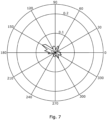
- the information on wavefront direction can also be amalgamated into a polar histogram plot, weighted according to the number and coherence of wavefronts in each direction.
- the wavefront direction is calculated at regular intervals, for example using the integral G(T) as described above either once for each sample interval, or once every two or three sample intervals. This generates a set of sample wavefront directions which can be displayed on a polar histogram as shown in Figure 7 .
- the vector quantities d latest at each of the grid points any one time define a vector field over the detected region and can therefore be analysed to determine the vector operators curl and divergence at points within that region.
- the divergence and curl are calculated at each grid point g using the vector that represents the last wavefront direction at neighbouring grid points. (Thus the speed of the wavefront is not used.) The divergence and curl are calculated using standard algorithms.
- x and y be the distance along two orthogonal vectors (i and j) on the heart surface.
- the wavefront divergence and curvature may be used to highlight locations where there is rotor (or rotational) activity and also where there are focal sources or wavefront collision. Specifically maxima, or high values, of curl are associated with rotors, and maxima or values of high divergence are associated with focal sources. Therefore these maxima or high values can be located as described below and used to indicate the location of tissue that can be ablated.
- the operation of the system can be described as follows. Firstly at step A the electrogram data for each of the electrodes 102 on the probe 101 is acquired for a first position of the probe 101 and a corresponding region of the heart. Then at step B the electrogram data for that position over a sample time period is analysed as described above to determine the direction of propagation, and optionally also the coherence, of each wave front passing through that region in the total sampling time is determined.
- the probe 101 has a spiral array of electrodes 102, with the electrode positions or nodes shown in Figure 8 .
- step C data relating to the directions of wavefront propagation is displayed as an image on the display screen 110, for example as vectors on a polar plot, or a moving dot pattern as described above with reference to Figure 6 , for the region in which the probe 101 is located.
- the probe 101 is then moved to a second position and then subsequent positions, and in each position further data acquired, analysed and displayed.
- the data for each position is stored, together with probe location data indicative of the location of the probe and hence the position on the heart of the region currently being examined.
- step D from this location data, the individual wave front direction images are mapped onto an image of the heart.
- the individual wavefront direction images may be shown as vector plots or dot images, or indeed as histogram plots or simple directional indicators as shown in Figure 8 .
- the location of sources of fibrillation may then be determined by the user from the directional information displayed.
- the processor 108 may be arranged to determine the location of sources and to control the display 110 to indicate the location of the sources on the image.
- the processor may be arranged to calculate the curl of the wavefront direction vector at positions on the heart as described above, locate a maximum of the curl, and identify the position of that maximum as the position of a rotor.
- the processor may then be arranged to control the display 110 to highlight, for example using arrows or colour or an outline, the position on the heat of the rotor.
- the processor may be arranged to calculate the divergence of the wavefront direction vector at positions on the heart as described above, locate a maximum of the divergence, and identify the position of that maximum as the position of a focal source.
- the processor may then be arranged to control the display 110 to highlight, for example using arrows or colour or an outline, the position on the heat of the focal source.
- the ablation tip 114 of the catheter is used to ablate heart tissue at the location of the rotor.
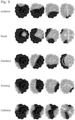
- the system of Figure 1 can be arranged to differentiate between further different wave front patterns using the divergence and curvature (curl) of the wave front directions.
- the first set of four images in Figure 9 shows the detection of a relatively uniform wave front passing across the region of the heart that is being contacted by the probe 101.
- the second set of four images shows the detection of a wave front propagating out from a focal point in the imaged region of the heart.
- the third set of four images shows a wave front that is rotating about a point generally at the centre of the imaged region of the heart.
- the fourth set of four images shows the detection of a wave front that is turning about a point outside (in this case below as seen in Figure 9 ) the imaged region of the heart.
- the last set of four images in Figure 9 shows the detection of a pair of wave fronts colliding at the centre of the imaged region of the heart.
Landscapes
- Health & Medical Sciences (AREA)
- Life Sciences & Earth Sciences (AREA)
- Cardiology (AREA)
- Biomedical Technology (AREA)
- Medical Informatics (AREA)
- Biophysics (AREA)
- Pathology (AREA)
- Engineering & Computer Science (AREA)
- Veterinary Medicine (AREA)
- Heart & Thoracic Surgery (AREA)
- Physics & Mathematics (AREA)
- Molecular Biology (AREA)
- Surgery (AREA)
- Animal Behavior & Ethology (AREA)
- General Health & Medical Sciences (AREA)
- Public Health (AREA)
- Physiology (AREA)
- Measurement And Recording Of Electrical Phenomena And Electrical Characteristics Of The Living Body (AREA)
Claims (8)
- Vorrichtung zur Überwachung von Aktivierung in einem Herzen, wobei die Vorrichtung eine Sonde (100), eine Mehrzahl von Elektroden (102), die auf der Sonde getragen wird und sich über einen Erfassungsbereich der Sonde erstreckt, wobei der Erfassungsbereich dazu ausgelegt ist, eine Erfassungsregion des Herzens zu berühren, wobei jede der Elektroden (102) dazu ausgelegt ist, ein elektrisches Potenzial an einer jeweiligen Position im Herzen während der Bewegung einer Reihe von Aktivierungswellenfronten über die Erfassungsregion zu erfassen, ein Verarbeitungsmittel (108), das dazu ausgelegt ist, die detektierten elektrischen Potenziale zu analysieren, um eine Mehrzahl von Wellenfronten zu identifizieren, und Anzeigemittel (110) umfasst, wobei das Verarbeitungsmittel (108) ferner dazu ausgelegt ist, für jede der Wellenfronten eine Reihe von Aktualisierungsintervallen über einen Übergangszeitraum zu definieren, während dessen die Wellenfront die Erfassungsregion durchquert, und für die jede der Aktualisierungsintervalle eine Ausbreitungsrichtung zu bestimmen, wobei das Verarbeitungsmittel (108) dazu ausgelegt ist, die Anzeigemittel (110) zum Erzeugen und Anzeigen eines Bildes zu steuern, das die Richtungen angibt.
- Vorrichtung nach Anspruch 1, wobei das Verarbeitungsmittel (108) dazu ausgelegt ist, die erfassten Potenziale zu analysieren, um eine Mehrzahl von Ausbreitungsrichtungen einer einzelnen Wellenfront zu identifizieren, wenn sich die Wellenfront über die Erfassungsregion bewegt.
- Vorrichtung nach Anspruch 1 oder 2, wobei das Verarbeitungsmittel (108) dazu ausgelegt ist, die Elektroden (102) einer Mehrzahl von Gruppen (102a, 102b, 102c) zuzuteilen und die Elektroden (102) innerhalb jeder Gruppe in eine Mehrzahl von Paaren aufzuteilen, die jeweils eine erste Elektrode und eine zweite Elektrode umfassen, und für jedes der Paare die Zeitverzögerung zwischen einer Wellenfront, die die erste Elektrode passiert, und der Wellenfront zu bestimmen, die die zweite Elektrode passiert, und aus den Zeitverzögerungen eine Ausbreitungsrichtung der Wellfront an der Gruppe vorbei zu bestimmen.
- Vorrichtung nach einem der vorhergehenden Ansprüche, wobei das Verarbeitungsmittel (108) dazu ausgelegt ist, erfasste Potenziale für eine Mehrzahl von Positionen der Sonde (100) im Herzen zu analysieren und die Anzeigemittel (110) zum simultanen Angeben der Ausbreitungsrichtung an jeder der Positionen der Sonde zu steuern.
- Vorrichtung nach einem der vorhergehenden Ansprüche, wobei das Verarbeitungsmittel (108) dazu ausgelegt ist, die Anzeigemittel (110) zum Erzeugen eines Bildes zu steuern, das eine Reihe von Merkmalen umfasst, wobei eines der Merkmale nach jedem Aktualisierungsintervall in einer Position hinzugefügt wird, die durch die Ausbreitungsrichtung für dieses Aktualisierungsintervall bestimmt wird.
- Vorrichtung nach Anspruch 5, wobei das Verarbeitungsmittel (108) dazu ausgelegt ist, ein Aktualisierungsintervall zu identifizieren, in dem eine Wellenfront erstmals in die Erfassungsregion eintritt, und die Anzeigemittel in Reaktion darauf zum Hinzufügen eines der Merkmale an einer Ursprungsposition des Bildes zu steuern, wobei jede Wellenfront, die die Erfassungsregion durchquert, durch eine Linie der Merkmale angegeben ist, die sich von der Ursprungsposition weg erstreckt.
- Vorrichtung nach einem der vorhergehenden Ansprüche, wobei das Verarbeitungsmittel (108) dazu ausgelegt ist, die Ausbreitungsrichtung an jedem einer Mehrzahl von Punkten in der Erfassungsregion zu bestimmen, aus den Ausbreitungsrichtungen einen Wert für die Krümmung der Ausbreitungsrichtung an mindestens einem Punkt in der Erfassungsregion zu bestimmen und aus dem mindestens einen Wert der Krümmung eine Fibrillationsquelle innerhalb der Erfassungsregion zu lokalisieren.
- Vorrichtung nach einem der vorhergehenden Ansprüche, wobei das Verarbeitungsmittel (108) dazu ausgelegt ist, die Ausbreitungsrichtung an jedem einer Mehrzahl von Punkten in der Erfassungsregion zu bestimmen, aus den Ausbreitungsrichtungen einen Wert für die Divergenz der Ausbreitungsrichtung an mindestens einem Punkt in der Erfassungsregion zu bestimmen und aus dem mindestens einen Wert der Divergenz eine Fibrillationsquelle innerhalb der Erfassungsregion zu lokalisieren.
Applications Claiming Priority (2)
| Application Number | Priority Date | Filing Date | Title |
|---|---|---|---|
| GBGB1706561.6A GB201706561D0 (en) | 2017-04-25 | 2017-04-25 | Systems and methods for treating cardiac arrhythmia |
| PCT/GB2018/051078 WO2018197865A1 (en) | 2017-04-25 | 2018-04-25 | Systems and methods for treating cardiac arrhythmia |
Publications (3)
| Publication Number | Publication Date |
|---|---|
| EP3614918A1 EP3614918A1 (de) | 2020-03-04 |
| EP3614918B1 true EP3614918B1 (de) | 2024-10-30 |
| EP3614918C0 EP3614918C0 (de) | 2024-10-30 |
Family
ID=58795645
Family Applications (1)
| Application Number | Title | Priority Date | Filing Date |
|---|---|---|---|
| EP18722152.8A Active EP3614918B1 (de) | 2017-04-25 | 2018-04-25 | Systeme zur behandlung von herzrhythmusstörungen |
Country Status (4)
| Country | Link |
|---|---|
| US (1) | US11331033B2 (de) |
| EP (1) | EP3614918B1 (de) |
| GB (1) | GB201706561D0 (de) |
| WO (1) | WO2018197865A1 (de) |
Families Citing this family (6)
| Publication number | Priority date | Publication date | Assignee | Title |
|---|---|---|---|---|
| US12279877B2 (en) | 2017-04-25 | 2025-04-22 | Imperial College Innovations Limited | Systems and methods for treating cardiac arrhythmia |
| EP3476286B1 (de) * | 2017-10-24 | 2023-08-30 | Berner Fachhochschule | Vorrichtung zur bereitstellung von elektrokardiographischen und insbesondere von arrhythmieinformationen |
| EP3914345A1 (de) * | 2019-01-23 | 2021-12-01 | Impulse Dynamics NV | Unterscheidung von supraventrikulären tachykardien in kombinierter ccm-icd-vorrichtung |
| GB201903259D0 (en) | 2019-03-11 | 2019-04-24 | Imperial College Innovations Ltd | Systems and methods for treating cardiac arrhythmia |
| GB2588924B (en) | 2019-11-14 | 2022-01-12 | Hexigone Inhibitors Ltd | Corrosion inhibitor |
| WO2023223007A1 (en) * | 2022-05-16 | 2023-11-23 | Imperial College Of Science, Technology And Medicine | Apparatus for monitoring activation in the heart |
Citations (1)
| Publication number | Priority date | Publication date | Assignee | Title |
|---|---|---|---|---|
| US10398326B2 (en) * | 2013-03-15 | 2019-09-03 | The Regents Of The University Of California | System and method of identifying sources associated with biological rhythm disorders |
Family Cites Families (14)
| Publication number | Priority date | Publication date | Assignee | Title |
|---|---|---|---|---|
| US5487391A (en) | 1994-01-28 | 1996-01-30 | Ep Technologies, Inc. | Systems and methods for deriving and displaying the propagation velocities of electrical events in the heart |
| US6301496B1 (en) | 1998-07-24 | 2001-10-09 | Biosense, Inc. | Vector mapping of three-dimensionally reconstructed intrabody organs and method of display |
| US6847839B2 (en) | 2001-07-30 | 2005-01-25 | The Trustees Of Columbia University In The City Of New York | System and method for determining reentrant ventricular tachycardia isthmus location and shape for catheter ablation |
| US20050288599A1 (en) | 2004-05-17 | 2005-12-29 | C.R. Bard, Inc. | High density atrial fibrillation cycle length (AFCL) detection and mapping system |
| US7890159B2 (en) | 2004-09-30 | 2011-02-15 | Cardiac Pacemakers, Inc. | Cardiac activation sequence monitoring and tracking |
| GB0708781D0 (en) | 2007-05-04 | 2007-06-13 | Imp Innovations Ltd | A Method of and apparatus for generating a model of a cardiac surface having a plurality of images representing electrogram voltages |
| US8340766B2 (en) | 2010-10-07 | 2012-12-25 | St. Jude Medical, Atrial Fibrillation Division, Inc. | Method and system for identifying cardiac arrhythmia driver sites |
| WO2012092016A1 (en) | 2010-12-30 | 2012-07-05 | St. Jude Medical, Atrial Fibrillation Division, Inc. | System and method for diagnosing arrhythmias and directing catheter therapies |
| GB201307211D0 (en) * | 2013-04-22 | 2013-05-29 | Imp Innovations Ltd | Image display interfaces |
| CN105307561B (zh) | 2013-05-07 | 2017-12-05 | 波士顿科学医学有限公司 | 用于标识转子传播矢量的系统 |
| CN105228510B (zh) | 2013-05-14 | 2018-12-14 | 波士顿科学医学有限公司 | 在电生理学映射期间使用向量场的活动模式的表示和识别 |
| JP6117433B2 (ja) | 2013-05-16 | 2017-04-19 | ボストン サイエンティフィック サイムド,インコーポレイテッドBoston Scientific Scimed,Inc. | 類似性ベースのパターンマッチングによる増強された活動開始時間の最適化のための解剖学的マッピングシステム |
| EP3073908B1 (de) * | 2014-02-25 | 2019-04-10 | St. Jude Medical, Cardiology Division, Inc. | Systeme und verfahren zur verwendung elektrophysiologischer eigenschaften zur klassifizierung von arrhythmiequellen |
| WO2017041891A1 (en) * | 2015-09-07 | 2017-03-16 | Ablacon Inc. | Elongated medical device suitable for intravascular insertion |
-
2017
- 2017-04-25 GB GBGB1706561.6A patent/GB201706561D0/en not_active Ceased
-
2018
- 2018-04-25 US US16/606,514 patent/US11331033B2/en active Active
- 2018-04-25 EP EP18722152.8A patent/EP3614918B1/de active Active
- 2018-04-25 WO PCT/GB2018/051078 patent/WO2018197865A1/en not_active Ceased
Patent Citations (1)
| Publication number | Priority date | Publication date | Assignee | Title |
|---|---|---|---|---|
| US10398326B2 (en) * | 2013-03-15 | 2019-09-03 | The Regents Of The University Of California | System and method of identifying sources associated with biological rhythm disorders |
Also Published As
| Publication number | Publication date |
|---|---|
| GB201706561D0 (en) | 2017-06-07 |
| EP3614918A1 (de) | 2020-03-04 |
| EP3614918C0 (de) | 2024-10-30 |
| US20200037906A1 (en) | 2020-02-06 |
| WO2018197865A1 (en) | 2018-11-01 |
| US11331033B2 (en) | 2022-05-17 |
Similar Documents
| Publication | Publication Date | Title |
|---|---|---|
| EP3614918B1 (de) | Systeme zur behandlung von herzrhythmusstörungen | |
| EP2996550B1 (de) | Darstellung und identifizierung von aktivitätsmustern während der elektrophysiologischen abbildung mit vektorfeldern | |
| US10010258B2 (en) | Atrial fibrillation treatment systems and methods | |
| US10264985B2 (en) | Medical system for mapping cardiac tissue | |
| CN105307561B (zh) | 用于标识转子传播矢量的系统 | |
| JP4001959B2 (ja) | 可動電極要素を複数電極構造体内で誘導するためのシステム | |
| EP3192442B1 (de) | Nichtüberlappender schleifenartiger katheter zur bestimmung der aktivierungsquellenrichtung und der aktivierungsquellenart | |
| US9974462B2 (en) | Signal characterization for detecting and/or analyzing driver activity | |
| US11160481B2 (en) | Atrial fibrillation mapping using atrial fibrillation cycle length (AFCL) gradients | |
| JP2017514597A (ja) | 心臓組織をマッピングする医療用デバイス | |
| CN120814830A (zh) | 用于辅助标测心律异常的计算机实现的方法和系统 | |
| EP3200679B1 (de) | Medizinische vorrichtungen zum herzgewebemapping | |
| CN117835910A (zh) | 在存在远场干扰的情况下检测测量位置的心脏隔离状态的方法 | |
| US20220369991A1 (en) | Medical apparatus for diagnostic and site determination of cardiac arrhythmias and methods | |
| US12279877B2 (en) | Systems and methods for treating cardiac arrhythmia | |
| EP4525722A1 (de) | Vorrichtung zur überwachung der aktivierung im herzen | |
| WO2018190781A1 (en) | Improvement of electropotential measurement based traditional 3-dimensional electroanatomical mapping systems with the endocardial biological magnetic field signal mapping: cardiac conductive tissue mapping | |
| EP4385414A1 (de) | Identifizierung von fokalen quellen von arrhythmie mit einem multielektrodenkatheter | |
| WO2018237099A1 (en) | Dynamic repolarization substrate mapping | |
| JP2024543583A (ja) | 心内電位図を分析するための方法 |
Legal Events
| Date | Code | Title | Description |
|---|---|---|---|
| STAA | Information on the status of an ep patent application or granted ep patent |
Free format text: STATUS: UNKNOWN |
|
| STAA | Information on the status of an ep patent application or granted ep patent |
Free format text: STATUS: THE INTERNATIONAL PUBLICATION HAS BEEN MADE |
|
| PUAI | Public reference made under article 153(3) epc to a published international application that has entered the european phase |
Free format text: ORIGINAL CODE: 0009012 |
|
| STAA | Information on the status of an ep patent application or granted ep patent |
Free format text: STATUS: REQUEST FOR EXAMINATION WAS MADE |
|
| 17P | Request for examination filed |
Effective date: 20191107 |
|
| AK | Designated contracting states |
Kind code of ref document: A1 Designated state(s): AL AT BE BG CH CY CZ DE DK EE ES FI FR GB GR HR HU IE IS IT LI LT LU LV MC MK MT NL NO PL PT RO RS SE SI SK SM TR |
|
| AX | Request for extension of the european patent |
Extension state: BA ME |
|
| DAV | Request for validation of the european patent (deleted) | ||
| DAX | Request for extension of the european patent (deleted) | ||
| STAA | Information on the status of an ep patent application or granted ep patent |
Free format text: STATUS: EXAMINATION IS IN PROGRESS |
|
| 17Q | First examination report despatched |
Effective date: 20230331 |
|
| REG | Reference to a national code |
Ref country code: DE Ref legal event code: R079 Free format text: PREVIOUS MAIN CLASS: A61B0005042000 Ipc: A61B0005361000 Ref country code: DE Ref legal event code: R079 Ref document number: 602018075958 Country of ref document: DE Free format text: PREVIOUS MAIN CLASS: A61B0005042000 Ipc: A61B0005361000 |
|
| RIC1 | Information provided on ipc code assigned before grant |
Ipc: A61B 5/287 20210101ALI20240410BHEP Ipc: A61B 5/361 20210101AFI20240410BHEP |
|
| GRAP | Despatch of communication of intention to grant a patent |
Free format text: ORIGINAL CODE: EPIDOSNIGR1 |
|
| STAA | Information on the status of an ep patent application or granted ep patent |
Free format text: STATUS: GRANT OF PATENT IS INTENDED |
|
| RAP3 | Party data changed (applicant data changed or rights of an application transferred) |
Owner name: IMPERIAL COLLEGE INNOVATIONS LIMITED |
|
| INTG | Intention to grant announced |
Effective date: 20240522 |
|
| GRAS | Grant fee paid |
Free format text: ORIGINAL CODE: EPIDOSNIGR3 |
|
| GRAA | (expected) grant |
Free format text: ORIGINAL CODE: 0009210 |
|
| STAA | Information on the status of an ep patent application or granted ep patent |
Free format text: STATUS: THE PATENT HAS BEEN GRANTED |
|
| AK | Designated contracting states |
Kind code of ref document: B1 Designated state(s): AL AT BE BG CH CY CZ DE DK EE ES FI FR GB GR HR HU IE IS IT LI LT LU LV MC MK MT NL NO PL PT RO RS SE SI SK SM TR |
|
| REG | Reference to a national code |
Ref country code: GB Ref legal event code: FG4D |
|
| REG | Reference to a national code |
Ref country code: CH Ref legal event code: EP |
|
| REG | Reference to a national code |
Ref country code: IE Ref legal event code: FG4D |
|
| REG | Reference to a national code |
Ref country code: DE Ref legal event code: R096 Ref document number: 602018075958 Country of ref document: DE |
|
| U01 | Request for unitary effect filed |
Effective date: 20241030 |
|
| U07 | Unitary effect registered |
Designated state(s): AT BE BG DE DK EE FI FR IT LT LU LV MT NL PT RO SE SI Effective date: 20241106 |
|
| PG25 | Lapsed in a contracting state [announced via postgrant information from national office to epo] |
Ref country code: IS Free format text: LAPSE BECAUSE OF FAILURE TO SUBMIT A TRANSLATION OF THE DESCRIPTION OR TO PAY THE FEE WITHIN THE PRESCRIBED TIME-LIMIT Effective date: 20250228 Ref country code: HR Free format text: LAPSE BECAUSE OF FAILURE TO SUBMIT A TRANSLATION OF THE DESCRIPTION OR TO PAY THE FEE WITHIN THE PRESCRIBED TIME-LIMIT Effective date: 20241030 |
|
| PG25 | Lapsed in a contracting state [announced via postgrant information from national office to epo] |
Ref country code: ES Free format text: LAPSE BECAUSE OF FAILURE TO SUBMIT A TRANSLATION OF THE DESCRIPTION OR TO PAY THE FEE WITHIN THE PRESCRIBED TIME-LIMIT Effective date: 20241030 |
|
| PG25 | Lapsed in a contracting state [announced via postgrant information from national office to epo] |
Ref country code: NO Free format text: LAPSE BECAUSE OF FAILURE TO SUBMIT A TRANSLATION OF THE DESCRIPTION OR TO PAY THE FEE WITHIN THE PRESCRIBED TIME-LIMIT Effective date: 20250130 |
|
| PG25 | Lapsed in a contracting state [announced via postgrant information from national office to epo] |
Ref country code: GR Free format text: LAPSE BECAUSE OF FAILURE TO SUBMIT A TRANSLATION OF THE DESCRIPTION OR TO PAY THE FEE WITHIN THE PRESCRIBED TIME-LIMIT Effective date: 20250131 |
|
| PG25 | Lapsed in a contracting state [announced via postgrant information from national office to epo] |
Ref country code: PL Free format text: LAPSE BECAUSE OF FAILURE TO SUBMIT A TRANSLATION OF THE DESCRIPTION OR TO PAY THE FEE WITHIN THE PRESCRIBED TIME-LIMIT Effective date: 20241030 |
|
| PG25 | Lapsed in a contracting state [announced via postgrant information from national office to epo] |
Ref country code: RS Free format text: LAPSE BECAUSE OF FAILURE TO SUBMIT A TRANSLATION OF THE DESCRIPTION OR TO PAY THE FEE WITHIN THE PRESCRIBED TIME-LIMIT Effective date: 20250130 |
|
| U20 | Renewal fee for the european patent with unitary effect paid |
Year of fee payment: 8 Effective date: 20250430 |
|
| PG25 | Lapsed in a contracting state [announced via postgrant information from national office to epo] |
Ref country code: SM Free format text: LAPSE BECAUSE OF FAILURE TO SUBMIT A TRANSLATION OF THE DESCRIPTION OR TO PAY THE FEE WITHIN THE PRESCRIBED TIME-LIMIT Effective date: 20241030 |
|
| PGFP | Annual fee paid to national office [announced via postgrant information from national office to epo] |
Ref country code: GB Payment date: 20250430 Year of fee payment: 8 |
|
| PG25 | Lapsed in a contracting state [announced via postgrant information from national office to epo] |
Ref country code: SK Free format text: LAPSE BECAUSE OF FAILURE TO SUBMIT A TRANSLATION OF THE DESCRIPTION OR TO PAY THE FEE WITHIN THE PRESCRIBED TIME-LIMIT Effective date: 20241030 |
|
| PG25 | Lapsed in a contracting state [announced via postgrant information from national office to epo] |
Ref country code: CZ Free format text: LAPSE BECAUSE OF FAILURE TO SUBMIT A TRANSLATION OF THE DESCRIPTION OR TO PAY THE FEE WITHIN THE PRESCRIBED TIME-LIMIT Effective date: 20241030 |
|
| PLBE | No opposition filed within time limit |
Free format text: ORIGINAL CODE: 0009261 |
|
| STAA | Information on the status of an ep patent application or granted ep patent |
Free format text: STATUS: NO OPPOSITION FILED WITHIN TIME LIMIT |
|
| 26N | No opposition filed |
Effective date: 20250731 |
|
| REG | Reference to a national code |
Ref country code: CH Ref legal event code: H13 Free format text: ST27 STATUS EVENT CODE: U-0-0-H10-H13 (AS PROVIDED BY THE NATIONAL OFFICE) Effective date: 20251125 |