EP3612520B1 - Isoxazole derivatives as nuclear receptor agonists and uses thereof - Google Patents
Isoxazole derivatives as nuclear receptor agonists and uses thereof Download PDFInfo
- Publication number
- EP3612520B1 EP3612520B1 EP18785171.2A EP18785171A EP3612520B1 EP 3612520 B1 EP3612520 B1 EP 3612520B1 EP 18785171 A EP18785171 A EP 18785171A EP 3612520 B1 EP3612520 B1 EP 3612520B1
- Authority
- EP
- European Patent Office
- Prior art keywords
- cyclopropyl
- phenyl
- chloro
- ethynyl
- methoxy
- Prior art date
- Legal status (The legal status is an assumption and is not a legal conclusion. Google has not performed a legal analysis and makes no representation as to the accuracy of the status listed.)
- Active
Links
- 0 CC(C)*1=C*(C)COC1=O Chemical compound CC(C)*1=C*(C)COC1=O 0.000 description 5
- JHHIBGYNKSWPMJ-UHFFFAOYSA-N CC(S(N)(=O)=O)=C Chemical compound CC(S(N)(=O)=O)=C JHHIBGYNKSWPMJ-UHFFFAOYSA-N 0.000 description 1
- MWWHFPACIRAPEB-UHFFFAOYSA-N CCC(C)NC(OCC)=O Chemical compound CCC(C)NC(OCC)=O MWWHFPACIRAPEB-UHFFFAOYSA-N 0.000 description 1
- ZWAVGZYKJNOTPX-UHFFFAOYSA-N CCNC(NCC)=O Chemical compound CCNC(NCC)=O ZWAVGZYKJNOTPX-UHFFFAOYSA-N 0.000 description 1
- JGRPZAGOYKNIAC-UHFFFAOYSA-N CCOC(NC(C)C)=O Chemical compound CCOC(NC(C)C)=O JGRPZAGOYKNIAC-UHFFFAOYSA-N 0.000 description 1
Classifications
-
- C—CHEMISTRY; METALLURGY
- C07—ORGANIC CHEMISTRY
- C07D—HETEROCYCLIC COMPOUNDS
- C07D261/00—Heterocyclic compounds containing 1,2-oxazole or hydrogenated 1,2-oxazole rings
- C07D261/02—Heterocyclic compounds containing 1,2-oxazole or hydrogenated 1,2-oxazole rings not condensed with other rings
- C07D261/06—Heterocyclic compounds containing 1,2-oxazole or hydrogenated 1,2-oxazole rings not condensed with other rings having two or more double bonds between ring members or between ring members and non-ring members
- C07D261/08—Heterocyclic compounds containing 1,2-oxazole or hydrogenated 1,2-oxazole rings not condensed with other rings having two or more double bonds between ring members or between ring members and non-ring members with only hydrogen atoms, hydrocarbon or substituted hydrocarbon radicals, directly attached to ring carbon atoms
-
- A—HUMAN NECESSITIES
- A61—MEDICAL OR VETERINARY SCIENCE; HYGIENE
- A61K—PREPARATIONS FOR MEDICAL, DENTAL OR TOILETRY PURPOSES
- A61K31/00—Medicinal preparations containing organic active ingredients
- A61K31/33—Heterocyclic compounds
- A61K31/395—Heterocyclic compounds having nitrogen as a ring hetero atom, e.g. guanethidine or rifamycins
- A61K31/41—Heterocyclic compounds having nitrogen as a ring hetero atom, e.g. guanethidine or rifamycins having five-membered rings with two or more ring hetero atoms, at least one of which being nitrogen, e.g. tetrazole
- A61K31/42—Oxazoles
-
- A—HUMAN NECESSITIES
- A61—MEDICAL OR VETERINARY SCIENCE; HYGIENE
- A61K—PREPARATIONS FOR MEDICAL, DENTAL OR TOILETRY PURPOSES
- A61K31/00—Medicinal preparations containing organic active ingredients
- A61K31/33—Heterocyclic compounds
- A61K31/395—Heterocyclic compounds having nitrogen as a ring hetero atom, e.g. guanethidine or rifamycins
- A61K31/495—Heterocyclic compounds having nitrogen as a ring hetero atom, e.g. guanethidine or rifamycins having six-membered rings with two or more nitrogen atoms as the only ring heteroatoms, e.g. piperazine or tetrazines
- A61K31/496—Non-condensed piperazines containing further heterocyclic rings, e.g. rifampin, thiothixene or sparfloxacin
-
- A—HUMAN NECESSITIES
- A61—MEDICAL OR VETERINARY SCIENCE; HYGIENE
- A61K—PREPARATIONS FOR MEDICAL, DENTAL OR TOILETRY PURPOSES
- A61K31/00—Medicinal preparations containing organic active ingredients
- A61K31/33—Heterocyclic compounds
- A61K31/395—Heterocyclic compounds having nitrogen as a ring hetero atom, e.g. guanethidine or rifamycins
- A61K31/535—Heterocyclic compounds having nitrogen as a ring hetero atom, e.g. guanethidine or rifamycins having six-membered rings with at least one nitrogen and one oxygen as the ring hetero atoms, e.g. 1,2-oxazines
- A61K31/5375—1,4-Oxazines, e.g. morpholine
- A61K31/5377—1,4-Oxazines, e.g. morpholine not condensed and containing further heterocyclic rings, e.g. timolol
-
- A—HUMAN NECESSITIES
- A61—MEDICAL OR VETERINARY SCIENCE; HYGIENE
- A61P—SPECIFIC THERAPEUTIC ACTIVITY OF CHEMICAL COMPOUNDS OR MEDICINAL PREPARATIONS
- A61P3/00—Drugs for disorders of the metabolism
-
- C—CHEMISTRY; METALLURGY
- C07—ORGANIC CHEMISTRY
- C07D—HETEROCYCLIC COMPOUNDS
- C07D413/00—Heterocyclic compounds containing two or more hetero rings, at least one ring having nitrogen and oxygen atoms as the only ring hetero atoms
- C07D413/02—Heterocyclic compounds containing two or more hetero rings, at least one ring having nitrogen and oxygen atoms as the only ring hetero atoms containing two hetero rings
- C07D413/12—Heterocyclic compounds containing two or more hetero rings, at least one ring having nitrogen and oxygen atoms as the only ring hetero atoms containing two hetero rings linked by a chain containing hetero atoms as chain links
-
- C—CHEMISTRY; METALLURGY
- C07—ORGANIC CHEMISTRY
- C07D—HETEROCYCLIC COMPOUNDS
- C07D413/00—Heterocyclic compounds containing two or more hetero rings, at least one ring having nitrogen and oxygen atoms as the only ring hetero atoms
- C07D413/14—Heterocyclic compounds containing two or more hetero rings, at least one ring having nitrogen and oxygen atoms as the only ring hetero atoms containing three or more hetero rings
Definitions
- the present disclosure relates to compounds useful as agonists for Famesoid X receptor(FXR, NR1H4), pharmaceutical formulation comprising such compounds and its study for medicinal uses.
- Farnesoid X receptor (FXR, NR1H4)is a member of the nuclear hormone receptor superfamily of ligand-activated transcription factors. FXR is highly expressed in the liver, intestine, kidney, adrenal glands, white adipose tissue and in induced during adipocyte differentiation in vitro. ( Cariu B. et al., J. Biol. Chem., 2006, 16, 11039-11049 ).
- FXR regulates various physiological processed such as modulates regulrated of bile acid(BA) regulation, lipids/glucose metabolism, inflammation/fibrosis, but recently it has also been linked to the pathology of FXR receptors.
- This nuclear receptor is the intracellular bile acid ⁇ "sensor" and its major physiological role is to protect liver cells from the deleterious effect of bile acids(BA) overload.
- Intestine is the tissue expressing the first FXR target gene identified. Indeed IBAB-P is expressed in enterocytes and binds bile acids, thus limiting the free concentration of BA intracellularly and consequently their toxicity.
- FXR is highly expressed in the liver and regulates key genes involved in BA synthesis, metabolism and transport including CYP7A1, UGT2B4, BSEP, MDR3, MRP2, ASBT, NTCP, OST ⁇ and OST ⁇ in humans.
- FXR activation is down regulation of CYP7A1 and thus bile acid synthesis; this is accomplished through induction of SHP(Small Heterodimer Partner) which then represses CYP7A1 transcription( Claude T, et al., Arterioscler. Thromb. Vasc. Biol., 2005, 25, 2020-2031 ). Altered expression or malfunction of these genes has been described in patients with cholestatic liver disease.
- FXR agonist 6-ethyl-chenodeoxycholic acid (6EtCDCA) was found to fully reverse the impairment of bile flow and to protect the hepatocytes against liver cell injury caused by the cytotoxic lithocholic acid.( Pelliciari R, et al., J. Med. Chem., 2002, 45(17), 3569-3572 ).
- FXR also induces expression of SHP which represses transcription of the apical sodium dependent bile acid transporter(ASBT, SLC10A2) gene which encodes the hight affinity apical sodium dependent bile acid transporter that mouse bile acids from the intestinal lumen into the enterocyte as part of the enterohepatic recycling of bile acids.
- ASBT apical sodium dependent bile acid transporter
- SLC10A2 apical sodium dependent bile acid transporter
- IBABP Ileal bile acid binding protein
- FXR Fibroblast Growth Factor 15(rodents) or 19(monkeys, humans).
- FXR activation has also been described to downregulate proinflammatory enzymes iNOS and COX-2, as well as migration of vascular smooth muscle cell migration.
- FXR is also expressed in hepatic stellate cells(HSC) which play a role in deposition of extracellular matrix during the fibrotic process.
- HSC hepatic stellate cells
- 6EtCDCA 6-ethyl-chenodeoxycholic acid
- 6EtCDCA has also been reported to precent development and promote resolution of hepatic fibrosis in multiple rodent models of this disease.( Fiorucci S, et al., Gastroenterology, 2004, 127(5), 1497-1512 ; Fiorucci S, et al., J. Pharmacol. Exp. Ther., 2005, 314(2), 584-595 ).
- bile acid(BA) are secreted with nile into the lumen of the small intestine to aid in the digestion and absorption of fat and fat-soluble vitamins,
- the ratio of different BA determines the hydrophilicity of the bile acid pool and its ability to solubilize cholesterol.
- FXR activation increases the hydrophilicity of the pool, decreasing the intestinal solubilization of cholesterol, effectively blocking its absorption.
- FXR activation affects Triglyceride(TG) metabolism via several pathways such as Sterol regulatory element-binding transcription factor 1 (SREBF1), apoC-III, apoC-II, syndecan-1 and the VLDL receptor.
- SREBF1 Sterol regulatory element-binding transcription factor 1
- apoC-III apoC-III
- apoC-II syndecan-1
- VLDL receptor VLDL receptor
- FXR agonist GW4064 or cholic acid treatment reduced plasma glucose levels and improved insulin sensitivity in three diabetic models(db/db, ob/ob and KK-A(y)mice)( Cariu B,et al., J. Biol. Chem., 2006, 281(16), 11039-11049 Zhang Y, et al., Proc. Natl. Acad. Sci., 2006, 103(4), 1006-1011 ; Ma K, et al., J. Clin. Invest., 2006, 116, 1102-1109 ). This demonstrates that FXR is involved in glucose metabolism.
- FXR activity has been implicated in variety of diseases, including, but not limited to disorder of bile acid homeostasis, inflammation/fibrosis and hight levels of plasma triglyceride(TG)/ cholesterol.
- FXR agonists INT-747(OCA) and EDP-305 are modified bile acid(BA),developed for the treatment of diseases caused by disorder of bile acid homeostasis such as Nonalcoholic fatty liver disease(NASH), Alcoholic disorders, Primary biliary cirrhosis(PBC), Primary sclerosing cholangitis(PSC) and caused clinical side effects for the accumulation of substances in the body.
- diseases caused by disorder of bile acid homeostasis such as Nonalcoholic fatty liver disease(NASH), Alcoholic disorders, Primary biliary cirrhosis(PBC), Primary sclerosing cholangitis(PSC) and caused clinical side effects for the accumulation of substances in the body.
- NASH Nonalcoholic fatty liver disease
- PBC Primary biliary cirrhosis
- PSC Primary sclerosing cholangitis
- small molecule compounds such as FXR agonist were derived form GW4064, PX-102(GS-9674)/PX-104 and Global Pharmaceutical Company published various patent with various derivatives( WO2000037077 , WO2003015771 , WO2004048349 , WO2009012125 , WO2009149795 , WO2011020615 , WO2013037482 and WO2016097933 ).
- WO 2011/020615 relates to "compounds which bind to the NR1 H4 receptor (FXR) and act as agonists of the NR1 H4 receptor".
- FXR agonist is development as target for variety treatment of diseases, including, but not limited to disorder of bile acid homeostasis, inflammation/fibrosis and hight levels of plasma triglyceride(TG)/ cholesterol so that worldwide attention is focused.
- the present disclosure is expected that patients with metabolic diseases, including, but not limited to cholestatic Liver Diseases, Organ Fibrosis and Liver Fibrosis, will be able to open a therapeutic field of new mechanism.
- the present disclosure is related to compounds of excellent activity as FXR agonist. Particularly, the present disclosure relates to derivatives and processes for the preparation thereof.
- the object of the present disclosure is to provide medical use for useful treatment of diseases, for modulating the activity as FXR receptors and for the treatment, prevention or amelioration of one or more symptoms of disease or disorder related to the activity of the receptors, including, but not limited to hypercholesterolemia, hyperlipoproteinemia, hypertriglyceridemia, dyslipidemia, lipodystrophy, cholestasis/fibrosis, cholesterol gallstone disease, gastrointestinal disease or condition, hyperglycemia, diabetes, insulin resistance, metabolic inflexibility, nephropathy, liver diseases, atherosclerosis, cancer, inflammatory disorders, osteoporosis and skin aging.
- diseases for modulating the activity as FXR receptors and for the treatment, prevention or amelioration of one or more symptoms of disease or disorder related to the activity of the receptors, including, but not limited to hypercholesterolemia, hyperlipoproteinemia, hypertriglyceridemia, dyslipidemia, lipodystrophy, cholestasis/fibrosis, cholesterol gallstone disease, gastrointestinal
- the present invention provides a compound represented by Formula I, racemate, enantiomer, diastereoisomer thereof, or pharmaceutically acceptable salt thereof.
- the present disclosure also provides a compound represented by Formula I, racemic, enantiomer, diastereoisomer thereof, or pharmaceutically acceptable salt thereof.
- compositions for the treatment, prevention, or amelioration of metabolic diseases, cholestatic Liver Diseases and Organ Fibrosis comprising the compound represented by Formula I, racemic, enantiomer, diastereoisomer thereof, or pharmaceutically acceptable salt thereof.
- Also disclosed herein is a use for the treatment, prevention, or amelioration of metabolic diseases, cholestatic Liver Diseases and Organ Fibrosis comprising the compound represented by Formula I, racemic, enantiomer, diastereoisomer thereof, or pharmaceutically acceptable salt thereof.
- Also disclosed herein is a method for the treatment, prevention, or amelioration of metabolic diseases, cholestatic Liver Diseases and Organ Fibrosis in a subject in need thereof, comprising administering an effective amount of the pharmaceutical composition represented by Formula I, racemic, enantiomer, diastereoisomer thereof, or pharmaceutically acceptable salt thereof to the subject(including human).
- the compounds of the present disclosure are highly active as FXR agonist, and according to its pharmaceutical compositions are expected to be useful for therapeutic applications which are improved by FXR agonist, such as metabolic diseases, cholestatic Liver Diseases and Organ Fibrosis.
- the present disclosure provides a compound represented by Formula I, racemic, enantiomer, diastereoisomer thereof, or pharmaceutically acceptable salt thereof.:
- the compound of Formula I is preferably selected form i) or iv) disclosed below:
- C 1-6 alkyl is a saturated hydrocarbonyl amine with linear or branched chains of 1-6 carbon atoms.
- exemplary alkyl include, but are not limited, to methyl, ethyl, propyl, butyl, pentyl, hexyl, 1-methylethyl, 1-methylpropyl, 2-methylpropyl, 1,1-dimethylethyl, 1-methylbutyl, 1,1-dimethylpropyl, 1-methylpentyl or 1,1-dimethylbutyl.
- C 3-6 cycloalkyl is intended as a saturated hydrocarbonyl ring with 3-6 carbon atoms.
- exemplary cycloalkyl include, but are not limited, to cyclopropyl, cyclobutyl, cyclopentyl or cyclohexyl.
- C 1-6 alkylamine is a saturated hydrocarbonyl amine with linear or branched chains of 1 ⁇ 6 carbon atoms.
- exemplary alkylamines include, but are not limited, to methylamine, ethylamine, propylamine, butylamine, 1-methylethylamine, diethylamine or dimethylamine.
- C 1-6 alkyl alcohol is an R-OH group with R as defined above.
- exemplary alkyl alcohol with 1-6 carbon atoms include, but are not limited, to methyl alcohol, ethyl alcohol, propyl alcohol, isopropyl_ alcohol or n-butyl alcohol.
- halo is intended as bromine, fluorine, or chlorine atom.
- halo C 1-6 alkyl is intended as a C 1-6 alkyl radical having one or more hydrogen atoms replaced by a halogen atom as defined above.
- exemplary haloalkyl include, but are not limited, to difluoromethyl or trifluoromethyl.
- aryl is intended as aromatic ring with single ring and substituted a halogen.
- exemplary aryl include, but are not limited, to phenyl or halo phenyl.
- heteroaryl is intended as a monocyclic ring with at least one nitrogen, oxygen or sulfur atom.
- exemplary heteroaryl include, but are not limited pyridinyl, quinolyl, furanyl, thienyl, oxadiazolyl, thiadiazolyl, thiazolyl, oxazolyl, isoxazolyl, pyrazolyl, triazolyl, imidazolyl, pyrimidinyl, indolyl, pyrazinyl or indazolyl.
- heterocycle is intended as a saturated or partially unsaturated hydrocarbonyl mono-tricyclic ring with at least one nitrogen atom.
- exemplary mono heterocycles with 5-6 atoms include, but are not limited, to pyrrolidinyl, piperidinyl, piperazinyl pyrollyl, pyrazolyl, imidazolyl, oxazolyl, isoxazolyl, triazolyl, thiazolyl, pyridyl, pyridazinyl, pyrimidinyl, pyrazinyl, or triazinyl.
- exemplary bicyclic aromatic ring include, but are not limited, to benzothiazolyl, benzoxazolyl, benzoxazinone, benzoxadiazolyl, 1,3-benzodioxolyl, benzofuryl, benzopyrazinyl, indolyl, indazolyl, benzimidazolyl, benzopyranyl, pyrolopyridanyl, furopyridinyl, or imidazothiazolyl.
- pharmaceutically acceptable when referring to a component of a pharmaceutical composition means that the component, when administered to an animal, does not have undue adverse effects such as excessive toxicity, irritation, or allergic response commensurate with a reasonable benefit/risk ratio.
- treatment covers any treatment of a disease in a mammal, particularly a human, and includes inhibiting the disease, i.e., arresting its development; or relieving the disease, i.e. causing regression of the disease and/or its symptoms or conditions and slowing disease progression.
- terapéuticaally effective amount means an amount of a compound of the present disclosure that ameliorates, attenuates or eliminates a particular disease or condition or prevents or delays the onset of a particular disease or condition.
- the compounds of the disclosure may contain asymmetric or chiral centers, and therefore exist in different stereoisomeric forms. It is intended that all stereoisomeric forms of the compounds of the disclosure, including but not limited to, diastereomers, enantiomers and atropisomers, as well as mixtures thereof such as racemic mixtures, form part of the present disclosure.
- a specific stereoisomer may also be referred to as an enantiomer, and a mixture of such isomers is often called an enantiomeric mixture.
- a 50:50 mixture of enantiomers is referred to as a racemic-mixture or a racemate.
- Diastereomer refers to a stereoisomer with two or more centers of chirality and whose molecules are not mirror images of one another. Diastereomers have different physical properties, e.g. melting points, boiling points, spectral properties, and reactivities. Mixtures of diastereomers may separate under high resolution analytical procedures such as electrophoresis and chromatography.
- Enantiomers refer to two stereoisomers of a compound which are non-superimposable mirror images of one another.
- phrases "pharmaceutically acceptable salt” as used herein, refers to pharmaceutically acceptable organic or inorganic salts of a compound of the disclosure.
- Exemplary salts include, but are not limited, to sulfate, citrate, acetate, oxalate, chloride, bromide, iodide, nitrate, bisulfate, phosphate, acid phosphate, isonicotinate, lactate, salicylate, citrate, tartrate, oleate, tannate, pantothenate, bitartrate, ascorbate, succinate, maleate, gentisinate, fumarate, gluconate, glucuronate, saccharate, formate, benzoate, glutamate, methanesulfonate "mesylate", ethanesulfonate, benzenesulfonate, p-toluenesulfonate, and pamoate(i.e., 1,1'-methylene-bis-(
- a pharmaceutically acceptable salt may involve the inclusion of another molecule such as an acetate ion, a succinate ion or other counter ion.
- the counter ion may be any organic or inorganic moiety that stabilizes the charge on the parent compound.
- a pharmaceutically acceptable salt may have more than one charged atom in its structure. Instances where multiple charged atoms are part of the pharmaceutically acceptable salt can have multiple counter ions. Hence, a pharmaceutically acceptable salt can have one or more charged atoms and/or one or more counter ion.
- the desired pharmaceutically acceptable salt may be prepared by any suitable method available in the art, for example, treatment of the free base with an inorganic acid, such as hydrochloric acid, hydrobromic acid, sulfuric acid, nitric acid, methanesulfonic acid, phosphoric acid and the like, or with an organic acid, such as acetic acid, maleic acid, succinic acid, mandelic acid, fumaric acid, malonic acid, pyruvic acid, oxalic acid, glycolic acid, salicylic acid, a pyranosidyl acid, such as glucuronic acid or galacturonic acid, an alpha hydroxy acid, such as citric acid or tartaric acid, an amino acid, such as aspartic acid or glutamic acid, an aromatic acid, such as benzoic acid or cinnamic acid, a sulfonic acid, such as p-toluenesulfonic acid or ethanesulfonic acid
- an inorganic acid such as hydro
- the desired pharmaceutically acceptable salt may be prepared by any suitable method, for example, treatment of the free acid with an inorganic or organic base, such as an amine(primary, secondary or tertiary), an alkali metal hydroxide or alkaline earth metal hydroxide, or the like.
- suitable salts include, but are not limited to, organic salts derived from amino acids, such as glycine and arginine, ammonia, primary, secondary, and tertiary amines, and cyclic amines, such as piperidine, morpholine and piperazine, and inorganic salts derived from sodium, calcium, potassium, magnesium, manganese, iron, copper, zinc, aluminum and lithium.
- the present disclosure also provides a method of preparing the compound represented by Formula I or a pharmaceutically approved salt thereof.
- the compound of Formula A8, which is a compound of the present disclosure, may be prepared by series of steps from the compound of Formula A2 as shown in Scheme 1.
- the preparation method of the Formula A8 according to the present disclosure comprise:
- Example of preparing the compound of Formula A8 from the compound of Formula A7 by bromination in the above Step 5 of the preparing method of the present disclosure is illustrated in the following reaction scheme.
- the compound of Formula I which is a compound of the present disclosure, may be prepared by series of steps from the compound of Formula B2 as shown in Scheme 2.
- the preparation method of the Formula I according to the present disclosure comprise:
- Example of preparing the compound of Formula I from the compound of Formula B6 with B7 by Sonogashira reaction or hydrolysis after Sonogashira reaction from in the above Step 5 of the preparing method of the present disclosure is illustrated below.
- the compound of Formula I which is a compound of the present disclosure, may be prepared by series of steps from the compound of Formula B6 as shown in Scheme 3.
- R 1 , R 2 , R 6 , R 7 , R d1 , Y and Z of Formula I, D1, B2 and B7, illustrated in Scheme 3, are defined as below.
- the preparation method of the Formula I according to the present disclosure comprise:
- the compound of Formula I which is a compound of the present disclosure, may be prepared by series of steps from the compound of Formula B6 as shown in Scheme 4.
- R 1 , R 2 , R 6 , R 7 , R e1 , R e2 , Y and Z of Formula I, B6 and E3, illustrated in Scheme 4, are defined as below: In the present Formula I,
- the preparation method of the Formula I according to the present disclosure comprise:
- Example of preparing the compound of Formula I from the compound of Formula E3 by hydrolysis in the above Step 3 of the preparing method of the present disclosure is illustrated in the following reaction scheme.
- the compound of Formula I which is a compound of the present disclosure, may be prepared by series of steps from the compound of Formula B6 as shown in Scheme 5.
- R 1 , R 2 , R 3 , R 6 , R 7 , Y and Z of Formula I, B6 and G4, illustrated in Scheme 5, are defined as below: In the present Formula I,
- the preparation method of the Formula I according to the present disclosure comprise:
- Example of preparing the compound of Formula I from Formula G4 by hydrolysis in the above Step 4 of the preparing method of the present disclosure is illustrated in the following reaction scheme.
- the compound of Formula I which is a compound of the present disclosure, may be prepared by series of steps from the compound of Formula B6 as shown in Scheme 6.
- R 1 , R 2 , R 3 , R 6 , R 7 , R j1 , Y and Z of Formula I, B6 and J3, illustrated in Scheme 6, are defined as below:
- the preparation method of the Formula I according to the present disclosure comprise:
- the desired compound of Formula I may be prepared by hydrolysis or addition reaction.
- the compound of Formula J3 may be converted to Formula I by above hydrolysis reaction under the condition of lithium hydroxide in one or more of tetrahydrofuran, 1,4-dioxane or water at rt-80°C for 4-48 hours and it is illustrated in the following reaction scheme.
- the compound of Formula I may be prepared by addition reaction with Formula J3 under basic condition in N,N -dimethylformamide or tetrahydrofuran at room temperature or heating condition for 3 or 24 hours in the present disclosure and it is illustrated in the following reaction scheme.
- compositions for the treatment, prevention, or amelioration of the metabolic diseases, cholestatic Liver Diseases and Organ Fibrosis comprising the compound of Formula I, racemic, enantiomer, diastereoisomer thereof, or pharmaceutically acceptable salt thereof.
- the metabolic diseases, cholestatic Liver Diseases and Organ Fibrosis may be caused by FXR receptor activity.
- Exemplary diseases include hypercholesterolemia, hyperlipoproteinemia, hypertriglyceridemia, dyslipidemia, lipodystrophy, cholestasis/fibrosis, cholesterol gallstone disease, gastrointestinal disease or condition, hyperglycemia, diabetes, insulin resistance, metabolic inflexibility, nephropathy, liver diseases, atherosclerosis, cancer, inflammatory disorders, osteoporosis and skin aging.
- Also disclosed herein is a method of the treatment, prevention, or amelioration of metabolic diseases, cholestatic Liver Diseases and Organ Fibrosis in a subject in need thereof, comprising administering an effective amount of the pharmaceutical composition to the subject.
- the dosage of pharmaceutical composition may vary depending on the patient's weight, age, gender, physical condition, diet, the time and mode of administration, excretion rates, and the severity of illness. Mammals(including human) are desirable for the individual without limit.
- compositions suitable for the delivery of compounds of the present disclosure and methods for their preparation will be readily apparent to those skilled in the art. Such compositions and methods for their preparation may be found, for example, in Remington's Pharmaceutical Sciences, 19th Edition(Mack Publishing Company, 1995 ).
- the compounds of the disclosure may be administered orally.
- Oral administration may involve swallowing, so that the compound enters the gastrointestinal tract, and/or buccal, lingual, or sublingual administration by which the compound enters the blood stream directly from the mouth.
- Formulations suitable for oral administration include solid plugs, solid microparticulates, semi-solid and liquid(including multiple phases or dispersed systems) such as tablets; soft or hard capsules containing multi- or nano-particulates, liquids, emulsions or powders; lozenges(including liquid-filled); chews; gels; fast dispersing dosage forms; films; ovules; sprays; and buccal/mucoadhesive patches.
- Liquid(including multiple phases and dispersed systems) formulations include emulsions, suspensions, solutions, syrups and elixirs.
- Such formulations may be presented as fillers in soft or hard capsules(made, for example, from gelatin or hydroxypropyl methyl_cellulose) and typically comprise a carrier, for example, water, ethanol, polyethylene glycol, propylene glycol, methyl cellulose, or a suitable oil, and one or more emulsifying agents and/or suspending agents.
- a carrier for example, water, ethanol, polyethylene glycol, propylene glycol, methyl cellulose, or a suitable oil
- emulsifying agents and/or suspending agents may also be prepared by the reconstitution of a solid, for example, from a sachet.
- the compounds of the disclosure may also be used in fast-dissolving, fast-disintegrating dosage forms such as those described in Expert Opinion in Therapeutic Patents, 11 (6), 981-986 by Liang and Chen (2001 )
- the immediate release portion may comprise a disintegrant.
- disintegrants include sodium starch glycolate, sodium carboxymethyl cellulose, calcium carboxymethyl cellulose, croscarmellose sodium, crospovidone, polyvinylpyrrolidone, methyl cellulose, microcrystalline cellulose, powdered cellulose, loweralkyl-substituted hydroxypropyl cellulose, polacrilin potassium, starch, pregelatinizedstarch, sodium alginate, and mixtures thereof.
- the disintegrant will comprise_from 1 wt% to 80 wt%, preferably from 5 wt% to 60 wt% of the layer.
- matrix materials, fillers, or diluents include lactose, mannitol, xylitol, dextrose, sucrose, sorbitol, compressible sugar, microcrystalline cellulose, powdered cellulose, starch, pregelatinized starch, dextrates, dextran, dextrin, dextrose, maltodextrin, calcium carbonate, dibasic calcium phosphate, tribasic calcium phosphate, calcium sulfate, magnesium carbonate, magnesium oxide, poloxamers, polyethylene oxide, hydroxypropyl methyl cellulose and mixtures thereof.
- the compounds may also be blended with conventional excipients such as binders, including gelatin, pregelatinized starch, and the like; lubricants, such as hydrogenated vegetable oil, stearic acid, and the like; diluents, such as lactose, mannose, and sucrose; disintegrants, such as carboxymethyl cellulose and sodium starch glycolate; suspending agents, such as povidone, polyvinyl alcohol, and the like; absorbants, such as silicon dioxide; preservatives, such as methylparaben, propylparaben, and sodium benzoate; surfactants; such as sodium lauryl sulfate, polysorbate 80, and the like; flavorants; and sweeteners.
- binders including gelatin, pregelatinized starch, and the like
- lubricants such as hydrogenated vegetable oil, stearic acid, and the like
- diluents such as lactose, mannose, and sucrose
- disintegrants such as carboxymethyl
- the surfactants would comprise of 0.2 wt% to 5 wt% and the absorbants would comprise from 0.2 wt% to 1 wt%.
- Another excipients include one or more of: anti-oxidants, colorant, flavouring agents, preservatives and taste-masking agents.
- Tablet blends or portions of blends may alternatively be wet-, dry-, or melt-granulated, melt congealed, or extruded before tabletting.
- the final formulation may comprise one or more layers and may be coated or uncoated; it may even be encapsulated.
- Solid formulations for oral administration may be formulated to be immediate and/or modified release.
- Modified release formulations include delayed-, sustained-, pulsed-, controlled-, targeted and programmed release
- the compounds of the disclosure may also be administered directly into the blood stream, into muscle, or into an internal organ.
- Suitable means for parenteral administration include intravenous, intra-arterial, intraperitoneal, intrathecal, intraventricular, intraurethral, intrasternal, intracranial, intramuscular and subcutaneous.
- Suitable devices for parenteral administration includes needle(including micro needle) injectors, needle-free injectors and infusion techniques.
- needle free injection is PowderjectTM.
- Parenteral formulations are typically aqueous solutions which may contain excipients such as salts, carbohydrates and buffering agents(preferably, to a pH of from 3 to 9), but, for some applications, they may be more suitably formulated as a sterile non aqueous solution or as a powdered, dried form to be used in conjunction with a suitable vehicle such as sterile, pyrogen-free water.
- excipients such as salts, carbohydrates and buffering agents(preferably, to a pH of from 3 to 9)
- a suitable vehicle such as sterile, pyrogen-free water.
- parenteral formulations under sterile conditions may readily be accomplished using standard pharmaceutical techniques well known to those skilled in the art.
- a proper dosage form such as combination with solubility enhancer can increase solubility of compound of formula I used in non-oral solution.
- Formulations for parenteral administration may be formulated to be immediate and/or modified/controlled release.
- Controlled/modified release formulations include delayed-, sustained-, pulsed-, controlled-, targeted and pro-grammed release.
- compounds of the disclosure may be formulated as a solid, semi-solid, or thixotropic liquid for administration as an implanted depot providing modified release of the active compound. Examples of such formulations include drug-coated stents and PGLA microspheres.
- the compounds of the disclosure may also be administered topically to the skin or mucosa, that is, dermally or transdermally.
- Typical formulations for this purpose include gels, hydrogels, lotions, solutions, creams, ointments, dusting powders, dressings, foams, films, skin patches, wafers, implants, sponges, fibres, bandages and microemulsions.
- Li-posomes may also be used.
- the precise daily dose administered depends on various factors such as the age, sex, weight and condition of the patient being treated.
- the amount of dose can be selected within the bounds of goal achieving treatment effect without harmful or serious adverse effect.
- the dosage of the compound may be administered in an effective amount raging from 0.05 to 1000mg daily on patients.
- the following dosage levels and other dosage levels herein are for the average human subject having a weight range of about 65 to 70kg. The skilled person will readily be able to determine the dosage levels required for a subject whose weight falls outside this range, such as children and the elderly.
- Step 1 Preparation of 2,6-dichlorobenzaldehyde oxime
- N -chlorosuccinimide(NCS, 18.4g, 140mmol) was added to a solution of the intermediate compound(Step 1)(25.9g, 140mmol) in chloroform(1000ml) and stirred for 4 hours at room temperature.
- the reaction mixture was evaporated in vacuum, diluted with dicholrometane and washed with water.
- the combined organic layers were dried over MgSO 4 , filtered, evaporated in vacuum and purified using silica chromatography to afford the intermediate compound 2,6-dichloro-N-hydroxybenzimidoyl chloride(29g) without any further purification.
- Step 3 Preparation of ethyl 5-cyclopropyl-3-(2,6-dichlorophenyl)isoxazole-4-carboxylate
- the intermediate compound(Step 2)(29g, 129mmol) was added to ethyl 3-cyclopropyl-3-oxopropanate(25ml, 194mmol) in triethylamine(150ml)and stirred for 24 hours at room temperature.
- the reaction mixture was diluted with ethyl acetate and washed with water.
- the combined organic layers were dried over MgSO 4 , filtered, evaporated in vacuum and purified using silica chromatography to afford the intermediate compound ethyl 5-cyclopropyl-3-(2,6-dichlorophenyl)isoxazole-4-carboxylate (22.37g, 56%).
- Step 4 (5-cyclopropyl-3-(2,6-dichlorophenyl)isoxazol-4-yl)methanol
- Step 5 Preparation of 4-(bromomethyl)-5-cyclopropyl-3-(2,6-dichlorophenyl) isoxazole
- Triphenylphosphine(TPP, 16.9g, 64.53mmol) and tetrabromomethane(21.4g, 64.53mmol) was slowlly added to the intermediate compound(Step 4)(12.2g, 43.02mmol) in dichloromethane(158ml) at 0°C and stirred for 4 hours at room temperature.
- the reaction mixture was evaporated in vacuum and purified using silica chromatography to afford the title compound(13.44g, 90%).
- Example 1 4-((4-((5-cyclopropyl-3-(2,6-dichlorophenyl)isoxazol-4-yl) methoxy)phenyl)ethynyl)benzoic acid; (I-1)
- Step 1 Preparation of tert-butyl(4-iodophenoxy)dimethylsilane
- tert-Butyldimethylsilyl chloride (TBSCl, 2.1g, 13.6mmol) and imidazole (1.2g, 18.2mmol) were added to a solution of 4-Iodophenol(2g, 9.1mmol) in N,N -dimethylformamide (45ml) and stirred for 12 hours at room temperature.
- the reaction mixture was diluted with ethyl acetate and washed with water.
- the combined organic layers were dried over MgSO 4 , filtered, evaporated in vacuum and purified using silica chromatography to afford the intermediate compound tert-butyl(4-iodophenoxy)dimethylsilane(2.8g, 93%).
- 1 H-NMR (CDCl 3 , 400MHz): ⁇ 7.32 (m, 2H), 6.43 (m, 2H), 0.78 (t, 9H), 0.23 (t, 6H).
- Step 2 Preparation of tert-butyl(4-((trimethylsilyl)ethyl)phenoxy)silane
- Trimethylsilylacetylene(2.4ml, 17mmol), bis(triphenylphosphine)palladium(ii) dichloride (PdCl 2 (PPh 3 ) 2 , 0.6g, 0.85mmol), Copper(I) iodide(0.16g, 0.85mmol), and triethylamine(0.6ml, 4.25mmol) were added to a solution of the intermediate compound(Step 1)(2.8g, 8.5mmol) in N,N -dimethylformamide (50ml) and stirred for 12 hours at 80°C.
- the reaction mixture was diluted with Ethyl acetate and washed with water.
- Potassium fluoride (KF, 3.8g, 65mmol) was added to a solution of the intermediate compound(Step 2)( 1.99g, 6.5mmol) in methanol (65ml) at 0°C and stirred for 1 hour.
- the reaction mixture was diluted with dichloromethane and washed with water.
- the combined organic layers were dried over MgSO 4 , filtered, and evaporated in vacuum.
- the resulting 4-((trimethylsilly)ethynyl)phenol was used for next step without any further purification.
- Step 5 Preparation of methyl 4-((4-((5-cyclopropyl-3-(2,6-dichlorophenyl) isoxazol-4-yl)methoxy)phenyl)ethynyl)benzoate
- Step 6 Preparation of 4-((4-((5-cyclopropyl-3-(2,6-dichlorophenyl)isoxazol -4-yl)methoxy)phenyl)ethynyl)benzoic acid
- Step 1 Preparation of methyl 3-((4-((5-cyclopropyl-3-(2,6-dichlorophenyl) isoxazol-4-yl)methoxy)phenyl)ethynyl)benzoate
- Step 2 Preparation of 3-((4-((5-cyclopropyl-3-(2,6-dichlorophenyl)isoxazol- 4-yl)methoxy)phenyl)ethynyl)benzoic acid
- Step 1 Preparation of tert-butyl(4-iodo-3-(trifluoromethyl)phenoxy) dimethylsilane
- This compound was made using the procedure described for example 1(Step 2).
- this intermediate compound(Step 1)(52mg, 0.13mmol) was reacted with Trimethylsilylacetylene(0.036ml, 0.26mmol), bis(triphenylphosphine)palladium(ii) dichloride (PdCl 2 (PPh 3 ) 2 , 9.1mg, 0.013mmol), Copper(I) iodide(2.4mg, 0.013mmol) and triethylamine(0.095ml, 0.65mmol) to afford the intermediate compound tert-butyldimethyl(3-(trifluoromethyl)-4-((trimethylsilyl)ethynyl) phenoxy)silane(41.1mg, 88%).
- Step 3 Preparation of 3-(trifluoromethyl)-4-((trimethylsilyl)ethynyl)phenol
- This compound was made using the procedure described for example 1(Step 3).
- this intermediate compound(Step 2)(41.1mg, 0.16mmol) was reacted with Potassium fluoride (KF, 93mg, 1.6mmol) to afford the intermediate compound 3-(trifluoromethyl)-4-((trimethylsilyl)ethynyl)phenol.
- KF Potassium fluoride
- This compound was made using the procedure described for example 1(Step 4).
- this intermediate compound(Step 3)(0.16mmol) was reacted with 4-(bromomethyl)-5-cyclopropyl-3-(2,6-dichlorophenyl)isoxlazole(Intermediate 1)(50mg, 0.144mmol), and potassium carbonate (26.6mg, 0.192mmol) to afford the intermediate compound 5-cyclopropyl-3-(2,6-dichlorophenyl)-4-((4- ethynyl-3-(trifluoromethyl)phenoxy)methyl)isoxazole(36mg, 50%).
- Step 5 Preparation of methyl 3-((4-((5-cyclopropyl-3-(2,6-dichlorophenyl) isoxazol-4-yl)methoxy)-2-(trifluoromethyl)phenyl)ethynyl)benzoate
- This compound was made using the procedure described for example 1(Step 5).
- this intermediate compound(Step 4)(36mg, 0.080mmol) was reacted with methyl 3-iodobenzoate(21mg, 0.080mmol), bis(triphenylphosphine)palladium(II) dichloride (PdCl 2 (PPh 3 ) 2 , 5.6mg, 0.008mmol), Copper(I) iodide(1.5mg, 0.008mmol) and triethylamine(0.013ml, 0.096mmol)to afford the intermediate compound methyl 3-((4-((5-cyclopropyl-3-(2,6-dichlorophenyl)isoxazol-4-yl) methoxy)-2-(trifluoromethyl)phenyl)ethynyl)benzoate(3mg, 75%).
- Step 6 Preparation of 3-((4-((5-cyclopropyl-3-(2,6-dichlorophenyl)isoxazol- 4-yl)methoxy)-2-(trifluoromethyl)phenyl)ethynyl)benzoic acid
- Example 4 4-((4-((5-cyclopropyl-3-(2,6-dichlorophenyl)isoxazol-4-yl) methoxy)-2-(trifluoromethyl)phenyl)ethynyl)benzoic acid; (I-4)
- Step 1 Preparation of methyl 4-((4-((5-cyclopropyl-3-(2,6-dichlorophenyl) isoxazol-4-yl)methoxy)-2-(trifluoromethyl)phenyl)ethynyl)benzoate
- Step 2 Preparation of 4-((4-((5-cyclopropyl-3-(2,6- dichlorophenyl)isoxazol -4-yl)methoxy)-2-(trifluoromethyl)phenyl)ethynyl)benzoic acid
- Example 5 4-((3-chloro-4-ethynylphenoxy)methyl)-5-cyclopropyl-3-(2,6-dichlorophenyl)isoxazole; (I-5)
- Step 1 Preparation of tert-butyl(3-chloro-4-iodophenoxy)dimethylsilane
- Step 4 Preparation of 4-((3-chloro-4-ethyntlphenoxy)metehyl)-5- cyclopropyl-3-(2,6- dichlorophenyl)isoxazole
- Step 1 Preparation of 4-((3-chloro-4-(phenylethynyl)phenoxy)methyl)-5-cyclopropyl-3-(2,6-dichlorophenyl)isoxazole
- Step 1 Preparation of methyl 3-((2-chloro-4-((5- cyclopropyl-3-(2,6-dichlorophenyl)isoxazol-4-yl)methoxy)phenyl)ethynyl)benzoate
- Step 1 Preparation of methyl 3-((2-chloro-4-((5-cyclopropyl-3-(2,6-dichlorophenyl)isoxazol-4-yl)methoxy)phenyl)ethynyl)-5-nitrobenzoate
- Step 2 Preparation of methyl 3-amino-5-((2-chloro-4-((5-cyclopropyl-3-(2,6-dichlorophenyl)isoxazol-4-yl)methoxy)phenyl)ethynyl)benzoate
- the intermediate compound(step 1) was dissolved in ethyl acetate(70ml) and ethanol(35ml) and tin(II) chloride dihydrate(15.5g, 68.7mmol) were added. The reaction was stirred at room temperature for 1 day. The reaction mixture was extracted with ethyl acetate and washed with water.
- Step 3 Preparation of methyl 3-((2-chloro-4-((cyclopropyl-3-(2,6-dichlorophenyl)isoxazol-4-yl)methoxy)phenyl)ethynyl)-5-((ethoxycarbonyl)amino)benzoate
- the intermediate compound(step 2) was dissolved in N,N -dimethylform amide(8.8ml) and ethylchloroformate(250ul, 2.64mmol), triethylamine(369ul, 2.64mmol) and 1,8-Diazabicyclo[5.4.0]undec-7-ene(DBU, 13 ul, 0.0881mmol) were added.
- the reaction was stirred at room temperature for 4 hours.
- the reaction mixture was extracted with ethyl acetate and washed with water.
- the combined organic phase was dried over MgSO 4 , filtered, concentrated and purified by column chromatography on silica to give the title compound(254mg, 65%).
- Step 1 Preparation of methyl 3-(tert-butoxycarbonyl)amino)-5-((2-chloro-4-((cyclopropyl-3-(2,6-dichlorophenyl)isoxazol-4-yl)methoxy)phenyl)ethynyl)benzoate
- Step 1 Preparation of methyl 3-((2-chloro-4-((cyclopropyl-3-(2,6-dichlorophenyl) isoxazol-4-yl)methoxy)phenyl)ethynyl)-5-((ethoxycarbonyl)(methyl)amino)benzoate
- Step 1 Preparation of 4-((3-chloro-4-((3-nitrophenyl)ethynyl)phenoxy) methyl)-5-cyclopropyl-3-(2,6-dichlorophenyl)isoxazole
- This compound was made using the procedure described for example 8(Step 2).
- this intermediate compound(Step 1) (100mg, 0.19mmol) was reacted with tin(II) chloride dihydrate(208.9mg, 0.93mmol) to afford the intermediate compound 3-((2-chloro-4-((5-cyclopropyl-3-(2,6-dichlorophenyl)isoxazol-4- yl)methoxy)phenyl)ethynyl)aniline(60mg, 62%).
- Triethylamine(12.3ul, 0.08mmol) and ethylchloroformate(8.3ul, 0.08mmol) was added to a suspension of the intermediate compound(Step 2)(30mg, 0.06mmol) in dichloromethane and stirred for 7 hours at room temperature. Water was added to the reaction mixture and the product was extracted into dichloromethane. The combined organic layers were dried over MgSO 4 , filtered, evaporated in vacuum and purified using silica chromatography to give the title compound(25mg, 72%).
- Step 1 Preparation of 3-((2-chloro-4-((5-cyclopropyl-3-(2,6-dichlorophenyl) isoxazol-4-yl)methoxy)phenyl)ethynyl)benzenesulfonamide
- Step 1 Preparation of N -(3-((2-chloro-4-((5-cyclopropyl-3-(2,6-dichlorophenyl)isoxazol-4-yl)methoxy)phenyl)ethynyl)phenyl)methanesulfonamide
- Methanesulfonyl chloride(2drops) was added to a solution of 3-((2-chloro-4- ((5-cyclopropyl-3-(2,6-dichlorophenyl)isoxazol-4-yl)methoxy)phenyl)ethynyl)aniline(Step 2 of example 11)(35mg, 0.0686mmol) in tetrahydrofuran(1ml) and triethylamine(0.05ml, 0.343mmol) was added to the reaction mixture and stirred for 8 hours. The reaction mixture was concentrated in vacuum, added IN HCl(aq) and extracted into ethyl acetate.
- Step 1 Preparation of N -(3-((2-chloro-4-((5-cyclopropyl-3-(2,6-dichloro phenyl)isoxazol -4-yl)methoxy)phenyl)ethynyl)phenyl)sulfamide
- Step 1 Preparation of methyl 4-((2-chloro-4-((5-cyclopropyl-3-(2,6-dichlorophenyl)isoxazol-4-yl)methoxy)phenyl)ethynyl)benzoate
- Step 2 Preparation of 4-((2-chloro-4-((5-cyclopropyl-3-(2,6-dichlorophenyl) isoxazol-4-yl)methoxy)phenyl)ethynyl)benzoic acid
- Example 17 6-((2-chloro-4-((5-cyclopropyl-3-(2,6-dichlorophenyl)isoxazol -4-yl)methoxy)phenyl)ethynyl)nicotinic acid; (I-17)
- Step 1 Preparation of methyl 6-((4-((5-cyclopropyl-3-(2,6-dichlorophenyl) isoxazol-4-yl)methoxy)phenyl)ethynyl)nicotinate
- Step 2 Preparation of 6-((2-chloro-4-((5-cyclopropyl-3-(2,6-dichlorophenyl) isoxazol-4-yl)methoxy)phenyl)ethynyl)nicotinic acid
- Step 1 Preparation of methyl 2-((4-((5-cyclopropyl-3-(2,6-dichlorophenyl) isoxazol-4-yl)methoxy)phenyl)ethynyl)isonicotinate
- Step 2 Preparation of 2-((2-chloro-4-((5-cyclopropyl-3-(2,6-dichlorophenyl) isoxazol-4-yl)methoxy)phenyl)ethynyl)isonicotinic acid
- Step 1 Preparation of methyl 6-((2-chloro-4-((5-cyclopropyl-3-(2,6-dichlorophenyl)isoxazol-4-yl)methoxy)phenyl)ethynyl)picolinate
- Step 2 Preparation of 6-((2-chloro-4-((5-cyclopropyl-3-(2,6-dichlorophenyl) isoxazol-4-yl)methoxy)phenyl)ethynyl)picolinic acid
- Step 1 Preparation of methyl5-((2-chloro-4-((5-cyclopropyl-3-(2,6-dichlorophenyl)isoxazol-4-yl)methoxy)phenyl)ethynyl)nicotinate
- Step 2 Preparation of 5-((2-chloro-4-((5-cyclopropyl-3-(2,6-dichlorophenyl) isoxazol-4-yl)methoxy)phenyl)ethynyl)nicotinic acid
- Step 1 Preparation of methyl 3-((2-chloro-4-((5-cyclopropyl-3-(2,6-dichlorophenyl)isoxazol-4-yl)methoxy)phenyl)ethynyl)-5-(dimethylamino)benzoate
- Step 2 Preparation of 3-((2-chloro-4-((5-cyclopropyl-3-(2,6-dichlorophenyl) isoxazol-4-yl)methoxy)phenyl)ethynyl)-5-(dimethylamino)benzoic acid
- Step 1 Preparation of methyl 4-((2-chloro-4-((5-cyclopropyl-3-(2,6-dichlorophenyl)isoxazol-4-yl)methoxy)phenyl)ethynyl)-3-(dimethylamino)benzoate
- Step 2 Preparation of 4-((2-chloro-4-((5-cyclopropyl-3-(2,6-dichlorophenyl)isoxazol-4-yl)methoxy)phenyl)ethynyl)-3-(dimethylamino) benzoic acid
- Step 1 Preparation of methyl 4-((2-chloro-4-((5-cyclopropyl-3-(2,6-dichlorophenyl)isoxazol-4-yl)methoxy)phenyl)ethynyl)-2-(dimethylamino)benzoate
- Step 2 Preparation of 4-((2-chloro-4-((5-cyclopropyl-3-(2,6-dichlorophenyl) isoxazol-4-yl)methoxyphenyl)ethynyl)-2-(dimethylamino)benzoic acid
- Step 1 Preparation of Methyl 3-((2-chloro-4-((5-cyclopropyl-3-(2,6-dichlorophenyl)isoxazol-4-yl)methoxy)phenyl)ethynyl)-5-(diethylamino)benzoate
- Step 2 Preparation of 3-((2-chloro-4-((5-cyclopropyl-3-(2,6-dichlorophenyl) isoxazol-4-yl)methoxy)phenyl)ethynyl)-5-(diethylamino)benzoic acid
- Step 1 Preparation of 3-amino-5-((2-chloro-4-((5-cyclopropyl-3-(2,6-dichlorophenyl)isoxazol-4-yl)methoxy)phenyl)ethynyl)benzoic acid
- Step 1 Preparation of methyl 3-((2-chloro-4-((5-cyclopropyl-3-(2,6-dichlorophenyl)isoxazol-4-yl)methoxy)phenyl)ethynyl)-4-(dimethylamino)benzoate
- Step 2 Preparation of 3-((2-chloro-4-((5-cyclopropyl-3-(2,6-dichlorophenyl) isoxazol-4-yl)methoxy)phenyl)ethynyl)-4-(dimethylamino)benzoic acid
- Step 1 Preparation of methyl 3-chloro-5-((2-chloro-4-((5-cyclopropyl- 3-(2,6-dichlorophenyl)isoxazol-4-yl)methoxy)phenyl)ethynyl)benzoate
- Step 2 Preparation of 3-chloro-5-((2-chloro-4-((5-cyclopropyl-3-(2,6-dichlorophenyl)isoxazol-4-yl)methoxy)phenyl)ethynyl)benzoic acid
- Step 1 Preparation of methyl 4-chloro-3-((2-chloro-4-((5-cyclopropyl- 3-(2,6-dichlorophenyl)isoxazol-4-yl)methoxy)phenyl)ethynyl)benzoate
- Step 2 Preparation of 4-chloro-3-((2-chloro-4-((5-cyclopropyl-3-(2,6-dichlorophenyl)isoxazol-4-yl)methoxy)phenyl)ethynyl)benzoic acid
- Step 1 Preparation of methyl 2-chloro-5-((2-chloro-4-((5-cyclopropyl-3- (2,6-dichlorophenyl)isoxazol-4-yl)methoxy)phenyl)ethynyl)benzoate
- Step 2 Preparation of 2-chloro-5-((2-chloro-4-((5-cyclopropyl-3-(2,6-dichlorophenyl)isoxazol-4-yl)methoxy)phenyl)ethynyl)benzoic acid
- Step 1 Preparation of methyl 3-((2-chloro-4-((5-cyclopropyl-3-(2,6-dichlorophenyl)isoxazol-4-yl)methoxy)phenyl)ethynyl)-5-fluorobenzoate
- Step 2 Preparation of 3-((2-chloro-4-((5-cyclopropyl-3-(2,6-dichlorophenyl) isoxazol-4-yl)methoxy)phenyl)ethynyl)-5-fluorobenzoic acid
- Step 1 Preparation of methyl 3-((2-chloro-4-((5-cyclopropyl-3-(2,6-dichlorophenyl)isoxazol-4-yl)methoxy)phenyl)ethynyl)-5-(trifluoromethyl)benzoate
- Step 2 Preparation of 3-((2-chloro-4-((5-cyclopropyl-3-(2,6-dichlorophenyl) isoxazol-4-yl)methoxy)phenyl)ethynyl)-5-(trifluoromethyl)benzoic acid
- Step 1 Preparation of methyl 3-((2-chloro-4-((cyclopropyl-3-(2,6-dichlorophenyl)isoxazol-4-yl)methoxy)phenyl)ethynyl)-5-ethynylbenzoate
- Step 2 Preparation of 3-((2-chloro-4-((cyclopropyl-3-(2,6-dichlorophenyl) isoxazol-4-yl)methoxy)phenyl)ethynyl)-5-ethynylbenzoic acid
- Step 1 Preparation of methyl 3-((2-chloro-4-((5-cyclopropyl-3-(2,6-dichlorophenyl)isoxazol-4-yl)methoxy)phenyl)ethynyl)-5-cyanobenzoate
- Step 2 Preparation of 3-((2-chloro-4-((5-cyclopropyl-3-(2,6-dichlorophenyl) isoxazol-4-yl)methoxy)phenyl)ethynyl)-5-cyanobenzoic acid
- Step 1 Preparation of tert-butyl(3,5-dichloro-4-iodophenoxy)dimethylsillane
- Step 2 Preparation of tert-butyl(3,5-dichloro-4-((trimethylsilyl)ethynyl) phenoxy)dimethylsillane
- Step 4 Preparation of 5-cyclopropyl-4-((3,5-dichloro-4-ethynylphenoxy) methyl)-3-(2,6-dichlorophenyl)isoxazole
- Step 5 Preparation of methyl 3-((2,6-dichloro-4-((5-cyclopropyl-3-(2,6-dichlorophenyl)isoxazol-4-yl)methoxy)phenyl)ethynyl)benzoate
- This compound was made using the procedure described for example 1(Step 5).
- this intermediate compound(Step 4)(200mg, 0.48mmol) was reacted with methyl 3-bromobenzoate(103mg, 0.48mmol), bis(triphenylphosphine) palladium(II) dichloride (PdCl 2 (PPh 3 ) 2 , 35mg, 0.05mmol), Copper(I) iodide(10mg, 0.05mmol) and triethylamine(0.14ml, 0.96mmol) to afford the intermediate compound methyl 3-((2,6-dichloro-4-((5-cyclopropyl-3-(2,6-dichlorophenyl) isoxazol-4-yl)methoxy)phenyl)ethynyl)benzoate(158mg, 56%).
- Step 6 Preparation of 3-((2,6-dichloro-4-((5-cyclopropyl-3-(2,6-dichlorophenyl)isoxazol-4-yl)methoxy)phenyl)ethynyl)benzoic acid
- Step 1 Preparation of methyl 2-chloro-3-((2-chloro-4-((5-cyclopropyl-3-(2,6-dichlorophenyl)isoxazol-4-yl)methoxy)phenyl)ethynyl)benzoate
- Step 2 Preparation of 2-chloro-3-((2-chloro-4-((5-cyclopropyl-3-(2,6-dichlorophenyl)isoxazol-4-yl)methoxy)phenyl)ethynyl)benzoic acid
- Step 1 Preparation of methyl 3-((2-chloro-4-((5-cyclopropyl-3-(2,6-dichlorophenyl)isoxazol-4-yl)methoxy)phenyl)ethynyl)-2-fluorobenzoate
- Step 2 Preparation of 3-((2-chloro-4-((5-cyclopropyl-3-(2,6-dichlorophenyl) isoxazol-4-yl)methoxy)phenyl)ethynyl)-2-fluorobenzoic acid
- Step 1 Preparation of methyl 5-((2-chloro-4-((5-cyclopropyl-3-(2,6-dichlorophenyl)isoxazol-4-yl)methoxy)phenyl)ethynyl)-2-fluorobenzoate
- Step 2 Preparation of 5-((2-chloro-4-((5-cyclopropyl-3-(2,6-dichlorophenyl) isoxazol-4-yl)methoxy)phenyl)ethynyl)-2-fluorobenzoic acid
- Step 1 Preparation of methyl 3-((2-chloro-4-((5-cyclopropyl-3-(2,6-dichlorophenyl)isoxazol-4-yl)methoxy)phenyl)ethynyl)-4-fluorobenzoate
- Step 2 Preparation of 3-((2-chloro-4-((5-cyclopropyl-3-(2,6-dichlorophenyl) isoxazol-4-yl)methoxy)phenyl)ethynyl)-4-fluorobenzoic acid
- Step 1 Preparation of methyl 3-((2-chloro-4-((5-cyclopropyl-3-(2,6-dichlorophenyl)isoxazol-4-yl)methoxy)phenyl)ethyl)-5-(trifluoromethoxy)benzoate
- Step 2 Preparation of 3-((2-chloro-4-((5-cyclopropyl-3-(2,6-dichlorophenyl) isoxazol-4-yl)methoxy)phenyl)ethynyl)-5-(trifluoromethoxy)benzoic acid
- Step 1 Preparation of methyl 3-((2-chloro-4-((5-cyclopropyl-3-(2,6-dichlorophenyl)isoxazol-4-yl)methoxy)phenyl)ethynyl)-5-methoxybenzoate
- Step 2 Preparation of 3-((2-chloro-4-((5-cyclopropyl-3-(2,6-dichlorophenyl) isoxazol-4-yl)methoxy)phenyl)ethynyl)-5-methoxybenzoic acid
- Step 1 Preparation of methyl 3-((2-chloro-4-((5-cyclopropyl-3-(2,6-dichlorophenyl)isoxazol-4-yl)methoxy)phenyl)ethynyl)-5-formylbenzoate
- Step 2 Preparation of 3-((2-chloro-4-((5-cyclopropyl-3-(2,6-dichlorophenyl) isoxazol-4-yl)methoxy)phenyl)ethynyl)-5-formylbenzoic acid
- Step 1 Preparation of methyl 3-((2-chloro-4-((5-cyclopropyl-3-(2,6-dichlorophenyl)isoxazole-4-yl)methoxy)phenyl)ethynyl)-5-((cyclopropylamino)methyl)benzoate
- Step 2 Preparation of 3-((2-Chloro-4-((5-cyclopropyl-3-(2,6-dichlorophenyl) isoxazole-4-yl)methoxy)phenyl)ethynyl)-5-((cyclopropylamino)methyl)benzoic acid
- Step 1 Preparation of Methyl 3-(azetidine-1-ylmethyl)-5-((2-chloro-4-((5-cyclopropyl-3-(2,6-dichlorophenyl)isoxazole-4-yl)methoxy)phenyl)ethynyl)benzoate
- Step 2 Preparation of 3-(Azetidine-1-ylmethyl)-5-((2-chloro-4-((5- cyclopropyl-3-(2,6-dichlorophenyl)isoxazole-4-yl)methoxy)phenyl)ethynyl)benzoic acid
- Step 1 Preparation of Methyl 3-((2-chloro-4-((5-cyclopropyl-3-(2,6-dichloro phenyl)isoxazole-4-yl)methoxy)phenyl)ethynyl)-5-((methylamino)methyl)benzoate
- Step 2 Preparation of 3-((2-Chloro-4-((5-cyclopropyl-3-(2,6-dichlorophenyl )isoxazole-4-yl)methoxy)phenyl)ethynyl)-5-((methylamino)methyl)benzoic acid
- Step 1 Preparation of methyl3-((2-chloro-4-((5-cyclopropyl-3-(2,6-dichloro phenyl)isoxazol-4-yl)methoxy)phenyl)ethynyl)-5-((ethylamino)methyl)benzoate
- Step 2 Preparation of 3-((2-chloro-4-((5-cyclopropyl-3-(2,6-dichlorophenyl) isoxazol-4-yl)methoxy)phenyl)ethynyl)-5-((ethylamino)methyl)benzoic acid
- Step 1 Preparation of methyl 3-((2-chloro-4-((5-cyclopropyl-3-(2,6-dichlorophenyl)isoxazol-4-yl)methoxy)phenyl)ethynyl)-5-(((2,2,2-trifluoroethyl)amino)methyl)benzoate
- Step 2 Preparation of 3-((2-chloro-4-((5-cyclopropyl-3-(2,6-dichlorophenyl) isoxazol-4-yl)methoxy)phenyl)ethynyl)-5-(((2,2,2-trifluoroethyl)amino)methyl)benzoic acid
- Step 1 Preparation of methyl 3-((2-chloro-4-((5-cyclopropyl-3-(2,6-dichlorophenyl)isoxazol-4-yl)methoxy)phenyl)ethynyl)-5-((isopropylamino)methyl)benzoate
- Step 2 Preparation of 3-((2-chloro-4-((5-cyclopropyl-3-(2,6-dichlorophenyl) isoxazol-4-yl)methoxy)phenyl)ethynyl)-5-((isopropylamino)methyl)benzoic acid
- Step 1 Preparation of methyl 3-((tert-butylamino)methyl)-5-((2-chloro-4- ((5-cyclopropyl-3-(2,6-dichlorophenyl)isoxazol-4-yl)methoxy)phenyl)ethynyl)benzoate
- Step 2 Preparation of 3-((tert-butylamino)methyl)-5-((2-chloro-4-((5-cyclopropyl-3-(2,6-dichlorophenyl)isoxazol-4-yl)methoxy)phenyl)ethynyl)benzoic acid
- Step 1 Preparation of methyl 3-((2-chloro-4-((5-cyclopropyl-3-(2,6-dichloro phenyl)isoxazol-4-yl)methoxy)phenyl)ethynyl)-5-((dimethylamino)methyl)benzoate
- Step 2 Preparation of 3-((2-chloro-4-((5-cyclopropyl-3-(2,6-dichlorophenyl) isoxazol-4-yl)methoxy)phenyl)ethynyl)-5-((dimethylamino)methyl)benzoic acid
- Step 1 Preparation of methyl 3-((2-chloro-4-((5-cyclopropyl-3-(2,6-dichlorophenyl)isoxazol-4-yl)methoxy)phenyl)ethynyl)-5-(morpholinomethyl)benzoate
- Step 2 Preparation of 3-((2-chloro-4-((5-cyclopropyl-3-(2,6-dichlorophenyl) isoxazol-4-yl)methoxy)phenyl)ethynyl)-5-(morpholinomethyl)benzoic acid
- Step 1 Preparation of methyl 3-((2-chloro-4-((5-cyclopropyl-3-(2,6-dichlorophenyl)isoxazol-4-yl)methoxy)phenyl)ethynyl)-5-((oxetan-3-ylamino)methyl)benzoate
- Step 1 Preparation of methyl 3-((2-chloro-4-((5-cyclopropyl-3-(2,6-dichlorophenyl)isoxazol-4-yl)methoxy)phenyl)ethynyl)-5-(methylamino)benzoate
- Step 2 Preparation of3-((2-chloro-4-((5-cyclopropyl-3-(2,6-dichlorophenyl) isoxazol-4-yl)methoxy)phenyl)ethynyl)-5-(methylamino)benzoic acid
- Step 1 Preparation of methyl 3-((2-chloro-4-((5-cyclopropyl-3-(2,6-dichlorophenyl)isoxazol-4-yl)methoxv)phenyl)ethynyl)-5-(ethylamino)benzoate
- Step 2 Preparation of 3-((2-chloro-4-((5-cyclopropyl-3-(2,6-dichlorophenyl) isoxazol-4-yl)methoxy)phenyl)ethynyl)-5-(ethylamino)benzoic acid
- Step 1 Preparation of methyl 3-((2-chloro-4-((5-cyclopropyl-3-(2,6-dichlorophenyl)isoxazol-4-yl)methoxy)phenyl)ethynyl)-5-(isopropylamino)benzoate
- Step 2 Preparation of 3-((2-chloro-4-((5-cyclopropyl-3-(2,6-dichlorophenyl) isoxazol-4-yl)methoxy)phenyl)ethynyl)-5-(isopropylamino)benzoic acid
- Step 1 Preparation of methyl 3-((2-chloro-4-((5-cyclopropyl-3-(2,6-dichlorophenyl)isoxazol-4-yl)methoxy)phenyl)ethynyl)-5-iodobenzoate
- tert -butyl nitrite (0.126ml, 1.05mmol) and iodine (536mg, 2.11mmol)were added to a solution of methyl 3-amino-5-((2-chloro-4-((5-cyclopropyl-3-(2,6- dichlorophenyl)isoxazol-4-yl)methoxy)phenyl)ethynyl)benzoate(Step 2 of example 8)(300mg, 0.528mmol) in toluene (5ml) and stirred for 1 hour at 55?. The reaction mixture was diluted with ethyl acetate and washed with water.
- Step 2 Preparation of methyl 3-(azetidin-1-yl)-5-((2-chloro-4-((5- cyclopropyl-3-(2,6-dichlorophenyl)isoxazol-4-yl)methoxy)phenyl)ethynyl)benzoate
- Azetidine(12mg, 0.13mmol), L-proline(2.2mg,0.019mmol), cesium carbonate (36mg, 0.11mmol) and copper(I) iodide(1.6mg, 0.01mmol) were added to a solution of the intermediate compound(Step 1)(44mg, 0.065mmol) in dimethyl sulfoxide(1ml) and stirred for 1 day at 80°C.
- the reaction mixture was diluted with ethyl acetate and washed with water.
- Step 3 Preparation of 3-(azetidin-1-yl)-5-((2-chloro-4-((5-cyclopropyl-3- (2,6-dichlorophenyl)isoxazol-4-yl)methoxy)phenyl)ethynyl)benzoic acid
- Step 1 Preparation of methyl 4-((2-chloro-4-((5-cyclopropyl-3-(2,6-dichlorophenyl)isoxazol-4-yl)methoxy)phenyl)ethynyl)-2-(pyrrolidin-1-yl)benzoate
- Step 2 Preparation of 3-((2-chloro-4-((5-cyclopropyl-3-(2.6-dichlorophenyl) isoxazol-4-yl)methoxy)phenyl)ethynyl)-5-(pyrrolidin-1-yl)benzoic acid
- Step 1 Preparation of tert-butyl 3-((3-((2-chloro-4-((5-cyclopropyl-3-(2,6-dichlorophenyl)isoxazol-4-yl)methoxy)phenyl)ethynyl)-5-(methoxycarbonyl)phenyl)amino)azetidine-1-carboxylate
- Step 2 Preparation of 3-((1-(tert-butoxycarbonyl)azetidine-3-yl)amino)-5- ((2-chloro-4-((5-cyclopropyl-3-(2,6-dichlorophenyl)isoxazol-4-yl)methoxy)phenyl)ethynyl)benzoic acid
- This compound was made using the procedure described for example 1(step 6).
- this intermediate compound(Step 1)(35mg, 0.048mmol) was reacted with lithium hydroxide(17mg, 0.48mmol) to afford the intermediate compound 3-((1-(tert-butoxycarbonyl)azetidine-3-yl)amino)-5-((2-chloro-4-((5-cyclopropyl-3-(2,6-dichlorophenyl)isoxazol-4-yl)methoxy)phenyl)ethynyl)benzoic acid(29mg, 85%).
- Step 3 Preparation of 3-(azetidine-3-ylamino)-5-((2-chloro-4-((5- cyclopropyl-3-(2,6-dichlorophenyl)isoxazol-4-yl)methoxy)phenyl)ethynyl)benzoic acid
- This intermediate compound(Step 2)(29mg, 0.041mmol) was dissolved in dichloromethane. 5 ⁇ 6N HCl solution(41ul, 0.20mmol) was added at 0°C, after stirring at room temperature for 3h. The reaction mixture added ethyl acetate and washed with water. The combined organic layers were dried over MgSO 4 , filtered, and recrystalized to afford the title compound(10mg, 38%).
- Step 1 Preparation of tert-butyl 4-((3-((2-chloro-4-((5-cyclopropyl-3- (2,6-dichlorophenyl)isoxazol-4-yl)methoxv)phenyl)ethynyl)-5-(methoxycarbonyl)phenyl)amino)piperidine-1-carboxylate
- Step 2 Preparation of 3-((1-(tert-butoxycarbonyl)piperidine-4-yl)amino)-5- ((2-chloro-4-((5-cyclopropyl-3-(2,6-dichlorophenyl)isoxazol-4-yl)methoxy)phenyl)ethynyl)benzoic acid
- This compound was made using the procedure described for example 1(step 6).
- this intermediate compound(Step 1)(49.4mg, 0.07mmol) was reacted with lithium hydroxide(27.6mg, 0.7mmol) to afford 3-((1-(tert-butoxycarbonyl) piperidine-4-yl)amino)-5-((2-chloro-4-((5-cyclopropyl-3-(2,6-dichlorophenyl)isoxazol-4-yl)methoxy)phenyl)ethynyl)benzoic acid(18mg, 35%).
- Step 3 Preparation of 3-((2-chloro-4-((5-cyclopropyl-3-(2,6-dichlorophenyl) isoxazol-4-yl)methoxy)phenyl)ethynyl)-5-piperdine-4-ylamino)benzoic acid
- This intermediate compound(Step 2)( 18mg, 0.024mmol) was dissolved in dichloromethane. 5 ⁇ 6N HCl solution(12ul, 0.048mmol) was added at 0°C, after stirring at room temperature for 3h. The reaction mixture added ethyl acetate_and washed with water. The combined organic layers were dried over MgSO 4 , filtered, and recrystalized to afford the title compound(7mg, 44%).
- Step 1 Preparation of tert-butvl 4-(3-((2-chloro-4-((5-cyclopropyl-3-(2,6-dichlorophenyl)isoxazol-4-yl)methoxy)phenyl)ethynyl)-5-(methoxycarbonyl) phenyl)piperazin-1-carboxylate
- Step 2 Preparation of 3-(4-(tert-buthoxycarbonyl)piperazin-1-yl)-5-((2-chloro-4-((5-cyclopropyl-3-(2,6-dichlorophenyl)isoxazol-4-yl)methoxv)phenyl)ethynyl)benzoic acid
- Step 3 Preparation of 3-((2-chloro-4-((5-cyclopropyl-3-(2,6-dichlorophenyl) isoxazol-4-yl)methoxy)phenyl)ethynyl)-5-(piperazin-1-yl)benzoic acid hydrochloride
- Step 1 Preparation of methyl 3-((2-chloro-4-((5-cyclopropyl-3-(2,6-dichlorophenyl)isoxazol-4-yl)methoxy)phenyl)ethynyl)-4-methy-5-nitrobenzoate
- Step 2 Preparation of methyl 3-amino-5-((2-chloro-4-((5-cyclopropyl-3- (2,6-dichlorophenyl)isoxazol-4-yl)methoxy)phenyl)ethynyl)-4-methybenzoate
- Step 3 Preparation of 3-amino-5-((2-chloro-4-((5-cyclopropyl-3-(2,6-dichlorophenyl)isoxazol-4-yl)methoxy)phenyl)ethynyl)-4-methylbenzoic acid
- Step 1 Preparation of methyl 3-((2-chloro-4-((5-cyclopropyl-3-(2,6-dichlorophenyl)isoxazol-4-yl)methoxy)phenyl)ethynyl)-4-methoxy-5-nitrobenzoate
- Step 2 Preparation of methyl 3-amino-5-((2-chloro-4-((5-cyclopropyl-3- (2,6-dichlorophenyl)isoxazol-4-yl)methoxy)phenyl)ethynyl)-4-methoxy benzoate
- Step 3 Preparation of 3-amino-5-((2-chloro-4-((5-cyclopropyl-3-(2,6-dichlorophenyl)isoxazol-4-yl)methoxy)phenyl)ethynyl)-4-methoxybenzoic acid
- Step 1 Preparation of methyl 5-((2-chloro-4-((5-cyclopropyl-3-(2,6-dichlorophenyl)isoxazol-4-yl)methoxy)phenyl)ethynyl)-2-methoxy-3-nitrobenzoate
- Step 2 Preparation of methyl 3-amino-5-((2-chloro-4-((5-cyclopropyl-3- (2,6-dichlorophenyl)isoxazol-4-yl)methoxy)phenyl)ethynyl)-2-methoxy benzoate
- This compound was made using the procedure described for example 8(Step 2).
- this intermediate compound(Step 1) (126.5mg, 0.2mmol) was reacted with tin(II) chloride dihydrate(225.63mg, 1.0mmol) to afford the intermediate compound methyl 3-amino-5-((2-chloro-4-((5-cyclopropyl-3-(2,6-dichloro phenyl)isoxazol-4-yl)methoxy)phenyl)ethynyl)-2-methoxybenzoate(51mg, 43%).
- Step 3 Preparation of 3-amino-5-((2-chloro-4-((5-cyclopropyl-3-(2.6-dichlorophenyl)isoxazol-4-yl)methoxy)phenyl)ethynyl)-2-methoxybenzoic acid
- Step 1 Preparation of methyl 3-((2-chloro-4-((5-cyclopropyl-3-(2,6-dichlorophenyl)isoxazol-4-yl)methoxy)phenyl)ethynyl)-5-methylbenzoate
- Step 2 Preparation of methyl 3-((2-chloro-4-((5-cyclopropyl-3-(2,6-dichlorophenyl)isoxazol-4-yl)methoxy)phenyl)ethynyl)-5-methylbenzoic acid
- Step 1 Preparation of methyl 3-((2-chloro-4-((5-cyclopropyl-3-(2,6-dichlorophenyl)isoxazol-4-yl)methoxy)phenyl)ethynyl)-5-cyclopropylbenzoate
- Step 2 Preparation of 3-amino-5-((2-chloro-4-((5-cyclopropyl-3-(2,6-dichlorophenyl)isoxazol-4-yl)methoxy)phenyl)ethynyl)-2-methoxybenzoic acid
- Example 65 3-((2-chloro-4-((5-cyclopropyl-3-(2,6-dichlorophenyl)isoxazol -4-yl)methoxy)phenyl)ethynyl)-5-ethylbenzoic acid; (I-65)
- Step 1 Preparation of methyl 3-((2-chloro-4-((5-cyclopropyl-3-(2,6-dichlorophenyl)isoxazol-4-yl)methoxy)phenyl)ethynyl)-5-ethylbenzoate
- Step 2 Preparation of 3-((2-chloro-4-((5-cyclopropyl-3-(2,6-dichlorophenyl) isoxazol-4-yl)methoxy)phenyl)ethynyl)-5-ethylbenzoic acid
- Example 66 3-((2-chloro-4-((5-cyclopropyl-3-(2,6-dichlorophenyl) isoxazol-4-yl)methoxy)phenyl)ethynyl)-5-isopropylbenzoic acid; (I-66)
- Step 1 Preparation of methyl 3-((2-chloro-4-((5-cyclopropyl-3-(2,6-dichlorophenyl)isoxazol-4-yl)methoxy)phenyl)ethynyl)-5-isopropylbenzoate
- Step 2 Preparation of 3-((2-chloro-4-((5-cyclopropyl-3-(2,6-dichlorophenyl) isoxazol-4-yl)methoxy)phenyl)ethynyl)-5-isopropylbenzoic acid
- Step 1 Preparation of 3-((2-chloro-4-((5-cyclopropyl-3-(2,6-dichlorophenyl) isoxazol-4-yl)methoxy)phenyl)ethynyl)-5-iodobenzoic acid
- Step 1 Preparation of tert-butyl(2,5-dichloro-4-iodophenoxy)dimethylsilane
- Step 2 Preparation of tert-butyl(2,5-dichloro-4-((trimethylsilyl)ethynyl) phanoxy)dimethylsilane
- This compound was made using the procedure described for example 1(Step 2).
- this intermediate compound(Step 1) (0.61g, 1.52mmol) was reacted with bis(triphenylphosphine)palladium(II) dichloride((PdCl 2 (PPh 3 ) 2 , 106.68mg, 0.15mmol), Copper(I) iodide(29mg, 1.22mmol), triethylamine(0.42ml, 3.04mmol) to afford the intermediate compoundtert-butyl(2,5-dichloro-4-((trimethylsilyl) ethynyl)phanoxy)dimethylsilane(368.97mg, 65%).
- 1 H-NMR (CDCl 3 , 400MHz): ⁇ 7.24 (s, 1H), 6.97 (s, 1H), 0.96 (s, 9H), 0.25 (s, 9H), 0.16 (s, 6H).
- Step 4 Preparation of 5-cyclopropyl-4-((2,5-dichloro-4-ethynylphenoxy) methyl)-3-(2,6-duchlorophenyl)isoxazole
- Step 5 Preparation of methyl 3-((2,5-dichloro-4-((5-cyclopropyl-3-(2,6-dichlorophenyl)isoxazol-4-yl)methoxy)phenyl)ethynyl)benzoate
- This compound was made using the procedure described for example 1(Step 5).
- this intermediate compound(Step 4)(345.4mg, 0.762mmol) was reacted with bis(triphenylphosphine)palladium(II) dichloride((PdCl 2 (PPh 3 ) 2 , 49mg, 0.07mmol), Copper(I) iodide(7mg, 0.035mmol) and 1,8-Diazabicyclo[5.4.0]undec -7-ene(DBU, 0.16ml, 1.05mmol) to afford the intermediate compound methyl 3-((2,5-dichloro-4-((5-cyclopropyl-3-(2,6-dichlorophenyl)isoxazole -4-yl)methoxy)phenyl)ethynyl)benzoate(232.7mg, 52%).
- Step 6 Preparation of 3-(2,5-dichloro-4-((5-cyclopropyl-3-(2,6-dichlorophenyl)isoxazol-4-yl)methoxy)phenyl)ethynyl)benzoic acid
- Step 1 Preparation of tert-butyl(2.3-dichloro-4-iodophenoxy)dimethylsilane
- Step 2 Preparation of tert-butyl(2,3-dichloro-4-((trimethylsilyl)ethynyl) phanoxy)dimethylsilane
- Step 4 Preparation of 5-cyclopropyl-4-((2,3-dichloro-4-ethynylphenoxy) methyl)-3-(2,6-duchloropheny l )isoxazole
- Step 5 Preparation of methyl 3-((2,3-dichloro-4-((5-cyclopropyl-3- (2,6-dichlorophenyl)isoxazol-4-yl)methoxy)phenyl)ethynyl)benzoate
- This compound was made using the procedure described for example 1(Step 5).
- this intermediate compound(Step 4)(345.4mg, 0.762mmol) was reacted with bis(triphenylphosphine)palladium(II) dichloride((PdCl 2 (PPh 3 ) 2 , 49mg, 0.07mmol), Copper(I) iodide(7mg, 0.035mmol) and 1,8-Diazabicyclo[5.4.0]undec -7-ene(DBU, 0.16ml, 1.05mmol) to afford the intermediate compound methyl 3-((2,3-dichloro-4-((5-cyclopropyl-3-(2,6-dichlorophenyl)isoxazol-4-yl) methoxy)phenyl)ethynyl)benzoate (232.7mg, 52%).
- Step 6 Preparation of 3-((2,3-dichloro-4-((5-cyclopropyl-3-(2.6-dichlorophenyl)isoxazol-4-yl)methoxy)phenyl)ethynyl)benzoic acid
- Step 1 Preparation of tert-butyl(3-chloro-5-fluoro-4-iodophenoxy)dimethyl silane
- Step 3 Preparation of 3-chloro-5-fluoro-4-((trimethylsilyl)ethynyl)phenol
- Step 4 Preparation of 4-((3-chloro-4-ethynyl-5-fluorophenoxy)methyl)-5-cyclopropyl-3-(2,6-dichlorophenyl)isoxazole
- Step 5 Preparation of methyl 3-((2-chloro-4-((5-cyclopropyl-3-(2,6-dichlorophenyl)isoxazole-4-yl)methoxy)-6-fluorophenyl)ethynyl)benzoate
- This compound was made using the procedure described for example 1(Step 5).
- this intermediate compound(Step 4)(210.7mg, 0.48mmol) was reacted with bis(triphenylphosphine)palladium(II) dichloride((PdCl 2 (PPh 3 ) 2 , 35mg, 0.05mmol), copper(I) iodide(9.5mg, 0.05mmol), 1,8-Diazabicyclo(5.4.0)undec-7-ene(DBU, 0.36ml, 2.4mmol) to afford the intermediate compound methyl 3-((2-chloro-4-((5-cyclopropyl-3-(2,6-dichlorophenyl)isoxazole-4-yl)methoxy)-6-fluorophenyl)ethynyl)benzoate(131.
- Step 6 Preparation of 3-((2-chloro-4-((5-cyclopropyl-3-(2,6-dichlorophenyl)isoxazole-4-yl)methoxy)-6-fluorophenyl)ethynyl)benzoic acid
- Step 1 Preparation of methyl 5-((2-chloro-4-((5-cyclopropyl-3-(2,6-dichloro phenyl)isoxazol-4-yl)methoxy)phenyl)ethynl)-2-methyl-3-nitrobenzoate
- Step 2 Preparation of methyl 3-amino-5-((2-chloro-4-((5-cyclopropyl-3- (2,6-dichlorophenyl)isoxazol-4-yl)methoxy)phenyl)ethynyl)-2-methylbenzoate
- Step 3 Preparation of 3-amino-5-((2-chloro-4-((5-cyclopropyl-3-(2,6-dichlorophenyl)isoxazol-4-yl)methoxy)phenyl)ethynyl)-2-methylbenzoic acid
- Step 1 Preparation of methyl 3-((2-chloro-4-((5-cyclopropyl-3-(2,6-dichlorophenyl)isoxazol-4-yl)methoxy)phenyl)ethynyl)-5-(3-ethylureido) benzoate
- Step 2 Preparation of 3-((2-chloro-4-((5-cyclopropyl-3-(2,6-dichloro phenyl)isoxazol-4-yl)methoxy)phenyl)ethynyl)-5-(3-ethylureido) benzoic acid
- Step 1 Preparation of methyl 3-acetamido-5-((2-chloro-4-((5-cyclopropyl-3- (2,6-dichlorophenyl)isoxazol-4-yl)methoxy)phenyl)ethynyl)benzoate
- Step 2 Preparation of 3-acetamido-5-((2-chloro-4-((5-cyclopropyl-3- (2,6-dichlorophenyl)isoxazol-4-yl)methoxy)phenyl)ethynyl)benzoic acid
- the intermediate compound(Step 1) was dissolved in 1,4-dioxane(1.0ml)/ water and lithium hydroxide(58mg, 0.716mmol) was added. The reaction was stirred at room temperature for 18 hours. The pH of reaction mixture was adjusted 4 to 5 with IN solution of hydrochloric acid and the reaction mixture was extracted with ethyl acetate and washed with water. The combined organic phase was dried over MgSO 4 , filtered, concentrated to afford the title compound(18.0mg, 42%).
- Step 1 Preparation of methyl 3-((2-chloro-4-((5-cyclopropyl-3-(2,6-dichlorophenyl)isoxazol-4-yl)methoxy)phenyl)ethynyl)-5-((ethoxycarbonyl)amino)benzoate
- Step 2 Preparation of 3-((2-chloro-4-((5-cyclopropyl-3-(2,6-dichloro phenyl)isoxazol-4-yl)methoxy)phenyl)ethynyl)-5-(ethoxycarbonyl)amino)benzoic acid
- Step 1 Preparation of methyl 3-((2-chloro-4-((5-cyclopropyl-3-(2,6-dichloro phenyl)isoxazol-4-yl)methoxy)phenyl)ethynyl)-5-((cyclopropoxycarbonyl)amino)benzoate
- Diisopropylamine(0.3ml, 1.8mmol) was added to a solution of cyclopropanol (0.1ml, 1.8mmol) and triphosgene(267mg, 0.9mmol) in dichloromethane which was cooled to 0°C and stirred for 1 hour at room temperature.
- Example 77 3-((tert-butoxycarbonyl)amino)-5-((2-chloro-4-((5-cyclopropyl-3-(2,6-dichlorophenyl)isoxazol-4-yl)methoxy)phenyl)ethynyl)benzoic acid; (I-77)
- Step 1 Preparation of 3-((tert-butoxycarbonyl)amino)-5-((2-chloro-4-((5-cyclopropyl-3-(2,6-dichlorophenyl)isoxazol-4-yl)methoxy)phenyl)ethynyl)benzoic acid
- Example 78 3-((tert-butoxycarbonyl)(methyl)ammo)-5-((2-chloro-4-((5-cyclo propyl-3-(2,6-dichlorophenyl)isoxazol-4-yl)methoxy)phenyl)ethynyl)benzoic acid; (I-78)
- Step 1 Preparation of methyl 3-((tert-butoxycarbonyl)(methyl)amino)-5- ((2-chloro-4-((5-cyclopropyl-3-(2,6-dichlorophenyl)isoxazol-4-yl)methoxy)phenyl)ethynyl)benzoate
- Step 2 Preparation of 3-((tert-butoxycarbonyl)(methyl)amino)-5-((2-chloro- 4-((5-cyclopropyl-3-(2,6-dichlorophenyl)isoxazol-4-yl)methoxy)phenyl)ethynyl)benzoic acid
- Example 79 3-((2-chloro-4-((5-cyclopropyl-3-(2,6-dichlorophenyl)isoxazol -4-yl)methoxy)phenyl)ethynyl)-5-(((cyclopropylmethoxy)carbonyl)amino)benzoic acid; (I-79)
- Step 1 Preparation of methyl 3-((2-chloro-4-((5-cyclopropyl-3-(2,6-dichlorophenyl)isoxazol-4-yl)methoxy)phenyl)ethynyl)-5-(((cyclopropylmethoxy)carbonyl)amino)benzoate
- Step 2 Preparation of 3-((2-chloro-4-((5-cyclopropyl-3-(2,6-dichloro phenyl)isoxazol-4-yl)methoxy)phenyl)ethynyl)-5-(((cyclopropylmethoxy)carbonyl)amino)benzoic acid
- Example 80 3-((2-chloro-4-((5-cyclopropyl-3-(2,6-dichlorophenyl)isoxazol -4-yl)methoxy)phenyl)ethynyl)-5-(((2-cyclopropylethoxy)carbonyl)amino)benzoic acid ; (I-80)
- Step 1 Preparation of methyl 3-((2-chloro-4-((5-cyclopropyl-3-(2,6-dichloro phenyl)isoxazol-4-yl)methoxy)phenyl)ethynyl)-5-(((2-cyclopropylethoxy)carbonyl)amino)benzoate
- Step 1 Preparation of methyl 3-((2-chloro-4-((5-cyclopropyl-3-(2,6-dichlorophenyl) isoxazol-4-yl)methoxy)phenyl)ethynyl)-5-(((2-hydroxyethoxy)carbonyl)amino)benzoate
- Example 82 3-(((azetidin-3-yloxy)carbonyl)amino)-5-((2-chloro-4-((5-cyclopropyl-3-(2,6-dichlorophenyl)isoxazol-4-yl)methoxy)phenyl)ethynyl)benzoic acid; (I-82)
- Step 1 Preparation of tert-butyl-3-(((3-((2-chloro-4-((5-cyclopropyl-3-(2,6-dichlorophenyl)isoxazol-4-yl)methoxy)phenyl-ethynyl)-5-(methoxycarbonyl)phenyl)carbamoyl)oxy)azetidine-1-carboxylate
- Step 2 Preparation of 3-(((azetidin-3-yloxy)carbonyl)amino)-5-((2-chloro-4- ((5-cyclopropyl-3-(2,6-dichlorophenyl)isoxazol-4-yl)methoxy)phenyl)ethynyl)benzoic acid
- Step 1 Preparation of methyl 3-((2-chloro-4-((5-cyclopropyl-3-(2,6-dichloro phenyl)isoxazol-4-yl)methoxy)phenyl)etynyl)-5-(2-oxooxazolidin-3-yl)benzoate
- the intermediate compound methyl 3-amino-5-((2-chloro-4-((5-cyclopropyl-3- (2,6-dichlorophenyl)isoxazol-4-yl)methoxy)phenyl)ethynyl)benzoate (Step 2 of example 8)(100mg, 0.176mmol) was dissolved in acetonitrile(2ml) and 2-chlroroethylchloroformate(27.3ul, 0.264mmol) and potassium carbonate (36.5mg, 0.264mmol) was added. The reaction was heated at 80°Cfor 4 hours. The reaction mixture was extracted with ethyl acetate and washed with water.
- Step 1 Preparation of dimethyl 5-((2-chloro-4-((5-cyclopropyl-3-(2,6-dichlorophenyl)isoxazol-4-yl)methoxy)phenyl)ethynyl)isophthalate
- Step 2 Preparation of 5-((2-chloro-4-((5-cyclopropyl-3-(2,6-dichlorophenyl) isoxazol-4-yl)metoxy)phenyl)ethynyl)isophthalic acid
- Step 1 Preparation of tert-butyl 4-(3-((2-chloro-4-((5-cyclopropyl-3-(2,6-dichlorophenyl)isoxazol-4-yl)methoxy)phenyl)ethynyl)-5-(methoxycarbonyl)benzoyl)piperazine-1-carboxylate
- Step 2 Preparation of 3-(4-(tert-butoxycarbonyl)piperazine-1-carbonyl) -5-((2-chloro-4-((5-cyclopropyl-3-(2,6-dichlorophenyl)isoxazol-4-yl)methoxy)phenyl)ethynyl)benzoic acid
- This compound was made using the procedure described for example 1(Step 6).
- this intermediate compound(Step 1)(88mg, 0.12mmol) was reacted with lithium hydroxide(48.3mg, 1.2mmol) to afford the 3-(4-(tert-butoxycarbonyl) piperazine-1-carbonyl)-5-((2-chloro-4-((5-cyclopropyl-3-(2,6-dichlorophenyl)isoxazol-4-yl)methoxy)phenyl)ethynyl)benzoic acid(61mg, 67.7%).
- Step 1 Preparation of methyl 3-((2-chloro-4-((5-cyclopropyl-3-(2,6-dichlorophenyl)isoxazol-4-yl)methoxy)phenyl)ethynyl)-5-(methylsulfonamido)benzoate
- reaction mixture was extracted with ethyl acetate and washed with water.
- the combined organic phase was dried over MgSO 4 , filtered, concentrated and purified by column chromatography on silica to afford the intermediate compound methyl 3-((2-chloro-4-((5-cyclopropyl-3-(2,6-dichlorophenyl)isoxazol-4-yl)methoxy)phenyl)ethynyl)-5-(methylsulfonamido)benzoate(74mg, 44%).
- Step 1 Preparation of 2-(trifluoromethyl)benzoaldehyde oxime
- Step 2 Preparation of N -hydroxv-2-(trifluoromethyl)bezamidoyl chloride
- Step 3 Preparation of ethyl 5-cyclopropyl-3-(2-(trifluoromethyl)phenyl) ioxazol-4-carboxylate
- Step 4 Preparation of (5-cyclopropyl-3-(2-(trifluoromethyl)phenyl)isoxazol -4-yl)methanol
- Step 5 Preparation of 4-(bromomethyl)-5-cyclopropyl-3-(2-(trifluoromethyl) phenyl)ioxazole
- Step 6 Preparation of 4-((3-chloro-4-ethynylphenoxy)methyl)- 5-cyclopropyl -3-(2-(trifluoromethyl)phenyl)ioxazole
- Step 7 Preparation of methyl 3-((2-chloro-4-((5-cyclopropyl-3-(2-(trifluoro methyl)phenyl)ioxazol-4-)methoxy)phenyl)ethynyl)benzoate
- Step 8 Preparation of 3-((2-chloro-4-((5-cyclopropyl-3-(2-(trifluoromethyl) phenyl)isoxazol-4-yl)methoxy)phenyl)ethynyl)benzoic acid
- Step 1 Preparation of 2-(trifluoromethoxy)benzoaldehyde oxime
- Step 2 Preparation of N -hydroxy-2-(trrifluoromethoxy)benzamidoyl chloride
- Step 3 Preparation of ethyl 5-cyclopropyl-3-(2-(trifluoromethoxy)phenyl) isoxazol-4-carboxylate
- Step 4 Preparation of (5-cyclopropyl-3-(2-(trifluoromethoxy)phenyl)isoxazol -4-yl)methanol
- Step 5 Preparation of 4-(bromomethyl)-5-cyclopropyl-3-(2-(trifluoromethoxy)phenyl)isoxazole
- Step 6 Preparation of 4-((3-chloro-4-ethynylphenoxy)methyl)-5-cyclopropyl -3-(2-(trifluoromethoxy)phenyl)isoxazole
- Step 7 Preparation of methyl 3-((2-chloro-4-((5-cyclopropyl-3-(2-(trifluoromethoxy)phenyl)isoxazol-4-yl)methoxy)phenyl)ethynyl)benzoate
- Step 8 Preparation of 3-((2-chloro-4-((5-cyclopropyl-3-(2-(trifluoro methoxy)phenyl)isoxazol-4-yl)methoxy)phenyl)ethynyl)benzoic acid
- Example 89 4-((2-chloro-4-((5-cyclopropyl-3-(2,6-dichlorophenyl)isoxazol -4-yl)methoxy)phenyl)ethynyl)-1 H -indazole-6-carboxylic acid; (I-89)
- Step 1 Preparation of 1-(tert-butyl) 6-methyl 4-((2-chloro-4-((5-cyclopropyl -3-(2,6-dichlorophenyl)isoxazol-4-yl)methoxy)phenyl)ethynyl)-1 H -indazole-1,6-dicarboxylate
- Trifluoroacetic acid(0.15ml) was added to a solution of intermediate compound(Step1)(98mg, 0.140mmol) in dichloromethane(3ml) and stirred for 3 days at room temperature.
- the reaction mixture was concentrated in vacuum, added ethyl acetate and washed with water.
- Step 3 Preparation of 4-((2-chloro-4-((5-cyclopropyl-3-(2,6-dichlorophenyl) isoxazol-4-yl)methoxy)phenyl)ethynyl)-1 H -indazole-6-carboxylic acid
- Example 90 4-((2-chloro-4-((5-cyclopropyl-3-(2,6-dichlorophenyl)isoxazol -4-yl)methoxy)phenyl)ethynyl)-1H-benzo[d]imidazole-6-carboxylic acid; (I-90)
- Step 2 Preparation of 4-((2-chloro-4-((5-cyclopropyl-3-(2,6-dichlorophenyl) isoxazol-4-yl)methoxy)phenyl)ethynyl)-1H-benzo[d]imidazole-6-carboxylic acid
- Step 1 Preparation of 1-(tert-butyl) 6-methyl 4-((2-chloro-4-((5-cyclopropyl -3-(2,6-dichlorophenyl)isoxazol-4-yl)methoxy)phenyl)ethynyl)-1 H -indole-1,6-dicarboxylate
- Example 92 4-((2-chloro-4-((5-cyclopropyl-3-(2,6-dichlorophenyl)isoxazol -4-yl)methoxy)phenyl)ethynyl)-1-(2-(dimethylamino)ethyl)-1 H -indole-6-carboxylic acid; (I-92)
- Step 1 Preparation of methyl 4-((2-chloro-4-((5-cyclopropyl-3-(2,6-dichlorophenyl)isoxazol-4-yl)methoxy)phenyl)ethynyl)-1-(2-(dimethylamino)ethyl)-1 H- indole-6-carboxylate
- Step 2 Preparation of 4-((2-chloro-4-((5-cyclopropyl-3-(2,6-dichlorophenyl) isoxazol-4-yl)methoxy)phenyl)ethynyl)-1-(2-(dimethylamino)ethyl)-1 H -indole-6-carboxylic acid
- Example 93 4-((2-chloro-4-((5-cyclopropyl-3-(2,6-dichlorophenyl)isoxazol -4-yl)methoxy)phenyl)ethynyl)-1-(3-(isopropylamino)propyl)-1H-indole-6-carboxylic acid; (I-93)
- Step 1 Preparation of methyl 1-(3-((tert-butoxycarbonyl)(isopropyl)amino) propyl)-4-((2-chloro-4-((5-cyclopropyl-3-(2,6-dichlorophenyl)isoxazol-4-yl)methoxy)phenyl)ethynyl)-1H-indole-6-carboxylate
- Step 2 Preparation of methyl 4-((2-chloro-4-((5-cyclopropyl-3-(2,6-dichlorophenyl)isoxazol-4-yl)methoxy)phenyl)ethynyl)-1-(3-(isopropylamino)propyl)-1H-indole-6-carboxylate
- This compound was made using the procedure described for example 89(Step 2).
- this intermediate compound(Step 1) (165mg, 0.20mmol) was reacted with trifluoroacetic acid(0.2ml, 2.0mmol) to afford the intermediate compound methyl 4-((2-chloro-4-((5-cyclopropyl-3-(2,6-dichlorophenyl)isoxazol-4-yl) methoxy)phenyl)ethynyl)-1-(3-(isopropylamino)propyl)-1H-indole-6-carboxylate(85.7mg, 62%).
- Example 94 4-((2-chloro-4-((5-cyclopropyl-3-(2,6-dichlorophenyl)isoxazol -4-yl)methoxy)phenyl)ethynyl)-1-(pyridin-4-ylmethyl)-1 H -indole-6-carboxylic acid; (I-94)
- Step 1 Preparation of methyl 4-((2-chloro-4-((5-cyclopropyl-3-(2,6-dichlorophenyl)isoxazol-4-yl)methoxy)phenyl)ethynyl)-1-(pyridin-4-ylmethyl)-1 H -indole-6-carboxylate
- Example 95 4-((2-chloro-4-((5-cyclopropyl-3-(2,6-dichlorophenyl)isoxazol -4-yl)methoxy)phenyl)ethynyl)-1-(2-morpholinoethyl)-1 H -indole-6-carboxylic acid hydrochloride; (I-95)
- Step 1 Preparation of methyl 4-((2-chloro-4-((5-cyclopropyl-3-(2,6-dichlorophenyl)isoxazol-4-yl)methoxy)phenyl)ethynyl)-1-(2-morpholine—ethyl)-1 H -indole-6-carboxylate
- Step 2 Preparation of 4-((2-chloro-4-((5-cyclopropyl-3-(2,6-dichlorophenyl) isoxazol-4-yl)methoxy)phenyl)ethynyl)-1-(2-morpholinoethyl)-1 H -indole-6-carboxylic acid hydrochloride
- Example 96 4-((2-chloro-4-((5-cyclopropyl-3-(2,6-dichlorophenyl)isoxazol -4-yl)methoxy)phenyl)ethynyl)-1-(2,2-dimethoxyethyl)-1H-indole-6-carboxylic acid; (I-96)
- Step 1 Preparation of methyl 4-((2-chloro-4-((5-cyclopropyl-3-(2,6-dichlorophenyl)isoxazol-4-yl)methoxy)phenyl)ethynyl)-1-(2,2-dimethoxyethyl)-1H-indole-6-carboxylate
- Example 97 4-((2-chloro-4-((5-cyclopropyl-3-(2,6-dichlorophenyl)isoxazol -4-yl)methoxy)phenyl)ethynyl)-1-(2-hydroxyethyl)-1 H -indole-6-carboxylic acid; (I-97)
- Step 1 Preparation of methyl 4-((2-chloro-4-((5-cyclopropyl-3-(2,6-dichlorophenyl)isoxazol-4-yl)methoxy)phenyl)ethynyl)-1-(2-hydroxyethyl)-1 H -indole-6-carboxylate
- Example 98 4-((2-chloro-4-((5-cyclopropyl-3-(2,6-dichlorophenyl)isoxazol -4-yl)methoxy)phenyl)ethynyl)-1-(2-hydroxy-2-methylpropyl)-1 H -indole-6- carboxylic acid; (I-98)
- Step 1 Preparation of methyl 4-((2-chloro-4-((5-cyclopropyl-3-(2,6-dichlorophenyl)isoxazol-4-yl)methoxy)phenyl)ethynyl)-1-(2-hydroxy-2-methylpropyl)-1 H- indole-6-carboxylate
- Step 1 Preparation of 1-(tert-butyl) 4-methyl 6-((2-chloro-4-((5-cyclopropyl -3-(2,6-dichlorophenyl)isoxazol-4-yl)methoxy)phenyl)ethynyl)-1 H -indazole-1.4-dicarboxylate
- Step 1 Preparation of 1-(tert-butyl) 4-methyl 6-((2-chloro-4-((5-cyclopropyl -3-(2.6-dichlorophenyl)isoxazol-4-yl)methoxy)phenyl)ethynyl)-1 H -indole-1,4-dicarboxylate
- Step 1 Preparation of methyl 5-((2-chloro-4-((5-cyclopropyl-3-(2,6-dichlorophenyl)isoxazol-4-yl)methoxy)phenyl)ethynyl)benzo[d]oxazole-7-carboxylate
- Step 1 Preparation of methyl 5-((2-chloro-4-((5-cyclopropyl-3-(2,6-dichloro phenyl)isoxazol-4-yl)methoxy)phenyl)ethynyl)-2-methylbenzo[d]oxazole-7-carboxylate
- Example 104 5-((2-chloro-4-((5-cyclopropyl-3-(2,6-dichlorophenyl) isoxazol-4-yl)methoxy)phenyl)ethynyl)-2-ethylbenzo[d]oxazole-7-carboxylic acid; (I-104)
- Step 1 Preparation of methyl 5-((2-chloro-4-((5-cyclopropyl-3-(2,6-dichlorophenyl)isoxazol-4-yl)methoxy)phenyl)ethynyl)-2-ethylbenzo[d]oxazole-7-carboxylate
- Example 105 5-((2-chloro-4-((5-cyclopropyl-3-(2,6-dichlorophenyl) isoxazol-4-yl)methoxy)phenyl)ethynyl)-2-propylbenzo[d]oxazole-7-carboxylic acid; (I-105)
- Step 1 Preparation of methyl 5-((2-chloro-4-((5-cyclopropyl-3-(2,6-dichlorophenyl)isoxazol-4-yl)methoxy)phenyl)ethynyl)-2-propylbenzo[d]oxazole-7-carboxylate
- Step 1 Preparation of methyl 5-((2-chloro-4-((5-cyclopropyl-3-(2,6-dichlorophenyl)isoxazol-4-yl)methoxy)phenyl)ethynyl)-2-isopropylbenzo[d]oxazole-7-carboxylate
- Step 1 Preparation of methyl 5-((2-chloro-4-((5-cyclopropyl-3-(2,6-dichloro phenyl)isoxazol-4-yl)methoxy)phenyl)ethynyl)-2-(methoxymethyl)benzo[d]oxazole-7-carboxylate
- Step 1 Preparation of methyl 7-((2-chloro-4-((5-cyclopropyl-3-(2,6-dichlorophenyl)isoxazol-4-yl)methoxy)phenyl)ethynyl)quinoxaline-5- carboxylate
- Step 1 Preparation of methyl 7-((2-chloro-4-((5-cyclopropyl-3-(2,6-dichloro phenyl)isoxazol-4-yl)methoxy)phenyl)ethynyl)-2,3-dimethylquinoxaline-5-carboxylate
- Step 2 Preparation of 7-((2-chloro-4-((5-cyclopropyl-3-(2,6-dichlorophenyl )isoxazol-4-yl)methoxy)phenyl)ethynyl)-2,3-dimethylquinoxaline-5-carboxylic acid
- Step 1 Preparation of methyl 5-((2-chloro-4-((5-cyclopropyl-3-(2,6-dichlorophenyl)isoxazol-4-yl)methoxy)phenyl)ethynyl)-2-cyclopropylbenzo[d]oxazole-7-carboxylate
- Step 1 Preparation of methyl 2-butyl-5-((2-chloro-4-((5-cyclopropyl-3- (2,6-dichlorophenyl)isoxazol-4-yl)methoxy)phenyl)ethynyl)benzo[d]oxazole-7-carboxylate
- Example 112 6-((2-chloro-4-((5-cyclopropyl-3-(2,6-dichlorophenyl) isoxazol-4-yl)methoxy)phenyl)ethynyl)-2-methylbenzo[d]oxazole-4-carboxylic acid; (I-112)
- Step 1 Preparation of methyl 6-((2-chloro-4-((5-cyclopropyl-3-(2,6-dichlorophenyl)isoxazol-4-yl)methoxy)phenyl)ethynyl)-2-methylbenzo[d]oxazole-4-carboxylate
- Example 113 6-((2-chloro-4-((5-cyclopropyl-3-(2,6-dichlorophenyl) isoxazol-4-yl)methoxy)phenyl)ethynyl)-2-ethylbenzo[d]oxazole-4-carboxylic acid; (I-113)
- Step 1 Preparation of methyl 6-((2-chloro-4-((5-cyclopropyl-3-(2,6-dichlorophenyl)isoxazol-4-yl)methoxy)phenyl)ethynyl)-2-ethylbenzo[d]oxazole-4-carboxylate
- Step 1 Preparation of methyl 6-((2-chloro-4-((5-cyclopropyl-3-(2,6-dichlorophenyl)isoxazol-4-yl)methoxy)phenyl)ethynyl)-2-propylbenzo[d]oxazole-4-carboxylate
- Example 115 6-((2-chloro-4-((5-cyclopropyl-3-(2,6-dichlorophenyl)isoxazol-4-yl)methoxy)phenyl)ethynyl)-2-isopropylbenzo[d]oxazole-4-carboxylic acid; (I-115)
- Step 1 Preparation of methyl 6-((2-chloro-4-((5-cyclopropyl-3-(2,6-dichlorophenyl)isoxazol-4-yl)methoxy)phenyl)ethynyl)-2-isopropylbenzo[d]oxazole-4-carboxylate
- FXR reporter assay was performed to measure cellular FXR activities of the compounds in the present disclosure.
- FXR reporter cells with high expression level of human FXR were seeded into 96-well cell culture plates, and incubated for 1 ⁇ 2 hours at 37°C under 5% CO 2 atmosphere.
- the disclosed compounds diluted in DMSO with various concentrations were added to the 96-well cell culture plates, and they were incubated for 24 hours at 37°C under 5% CO 2 atmosphere. After incubation, we calculate EC 50 by using luciferase substrate.
- E max of the compounds in the present disclosure was calculated where the E max of GW-4064, a full FXR agonist, is 100%.
- the disclosed 18 compounds of examples were determined as follows. Blood samples are collected at 15, 30, 60, 120, 240, 480, 1140 min. Quantification is by using a LC-MS/MS method specific to the selected compound. Pharmarcokinetics parameters are calculated using WinNonLinnon compartmental analysis software.
Landscapes
- Chemical & Material Sciences (AREA)
- Organic Chemistry (AREA)
- Health & Medical Sciences (AREA)
- Veterinary Medicine (AREA)
- Medicinal Chemistry (AREA)
- Pharmacology & Pharmacy (AREA)
- Life Sciences & Earth Sciences (AREA)
- Animal Behavior & Ethology (AREA)
- General Health & Medical Sciences (AREA)
- Public Health (AREA)
- Epidemiology (AREA)
- Engineering & Computer Science (AREA)
- Bioinformatics & Cheminformatics (AREA)
- Diabetes (AREA)
- Hematology (AREA)
- Obesity (AREA)
- Chemical Kinetics & Catalysis (AREA)
- General Chemical & Material Sciences (AREA)
- Nuclear Medicine, Radiotherapy & Molecular Imaging (AREA)
- Pharmaceuticals Containing Other Organic And Inorganic Compounds (AREA)
- Heterocyclic Carbon Compounds Containing A Hetero Ring Having Nitrogen And Oxygen As The Only Ring Hetero Atoms (AREA)
- Plural Heterocyclic Compounds (AREA)
Description
- The present application claims priority to
Korean Patent Application No. 10-2017-0047393 filed on April 12, 2017 Korean Patent Application No. 10-2018-0042545 filed April 12, 2018 - The present disclosure relates to compounds useful as agonists for Famesoid X receptor(FXR, NR1H4), pharmaceutical formulation comprising such compounds and its study for medicinal uses.
- Farnesoid X receptor(FXR, NR1H4)is a member of the nuclear hormone receptor superfamily of ligand-activated transcription factors. FXR is highly expressed in the liver, intestine, kidney, adrenal glands, white adipose tissue and in induced during adipocyte differentiation in vitro. (Cariu B. et al., J. Biol. Chem., 2006, 16, 11039-11049).
- Not only FXR regulates various physiological processed such as modulates regulrated of bile acid(BA) regulation, lipids/glucose metabolism, inflammation/fibrosis, but recently it has also been linked to the pathology of FXR receptors.
- This nuclear receptor is the intracellular bile acid ¡"sensor" and its major physiological role is to protect liver cells from the deleterious effect of bile acids(BA) overload. Intestine is the tissue expressing the first FXR target gene identified. Indeed IBAB-P is expressed in enterocytes and binds bile acids, thus limiting the free concentration of BA intracellularly and consequently their toxicity.(Makishima M, et al., Science, 1999, 284(5418), 1362-1365). FXR is highly expressed in the liver and regulates key genes involved in BA synthesis, metabolism and transport including CYP7A1, UGT2B4, BSEP, MDR3, MRP2, ASBT, NTCP, OST α and OST β in humans. One effect of FXR activation is down regulation of CYP7A1 and thus bile acid synthesis; this is accomplished through induction of SHP(Small Heterodimer Partner) which then represses CYP7A1 transcription(Claude T, et al., Arterioscler. Thromb. Vasc. Biol., 2005, 25, 2020-2031). Altered expression or malfunction of these genes has been described in patients with cholestatic liver disease. FXR agonist 6-ethyl-chenodeoxycholic acid(6EtCDCA)was found to fully reverse the impairment of bile flow and to protect the hepatocytes against liver cell injury caused by the cytotoxic lithocholic acid.(Pelliciari R, et al., J. Med. Chem., 2002, 45(17), 3569-3572).
- In the intestine, FXR also induces expression of SHP which represses transcription of the apical sodium dependent bile acid transporter(ASBT, SLC10A2) gene which encodes the hight affinity apical sodium dependent bile acid transporter that mouse bile acids from the intestinal lumen into the enterocyte as part of the enterohepatic recycling of bile acids.(Li H, et al., Am. J. Physiol. Gastrointest.Liver Physiol., 2005, 288, G60-G66). Ileal bile acid binding protein (IBABP) gene expression is also induced by FXR agonists in the enterocyte.(Grober J, et al.,J. Biol. Chem., 1999, 274(42), 29759-29754). FXR seems to be also involved in paracrine and endocrine signaling by upregulation the expression of the cytokine Fibroblast Growth Factor 15(rodents) or 19(monkeys, humans).(Holt J, et al., Genes Dev., 2003, 17(13), 1581-1591; Inagaki T,et al., Cell Metab., 2005, 2(4), 217-225).
- FXR activation has also been described to downregulate proinflammatory enzymes iNOS and COX-2, as well as migration of vascular smooth muscle cell migration.(Li YTY, et al., Arterioscler Thromb Vasc Biol., 2007, 27(12), 2606-2611). FXR is also expressed in hepatic stellate cells(HSC) which play a role in deposition of extracellular matrix during the fibrotic process. Treatment of cultured HSCs with the FXR agonist 6-ethyl-chenodeoxycholic acid(6EtCDCA) results in decreased expression of fibrotic markers such as α-smooth muscle actin and α1(I)collagen. 6EtCDCA has also been reported to precent development and promote resolution of hepatic fibrosis in multiple rodent models of this disease.(Fiorucci S, et al., Gastroenterology, 2004, 127(5), 1497-1512; Fiorucci S, et al., J. Pharmacol. Exp. Ther., 2005, 314(2), 584-595).
- The process of enterohepatic circulation of bile acids is also a major regulator of serum cholesterol homeostasis. After biosynthesis from cholesterol in the liver, bile acid(BA) are secreted with nile into the lumen of the small intestine to aid in the digestion and absorption of fat and fat-soluble vitamins, The ratio of different BA determines the hydrophilicity of the bile acid pool and its ability to solubilize cholesterol. FXR activation increases the hydrophilicity of the pool, decreasing the intestinal solubilization of cholesterol, effectively blocking its absorption. Recent report have shown that FXR opposed this effect in part by directly repressing the expression of HMGCoA reductase via a pathway involving SHP(Small Heterodimer Partner) and LRH1.(Datta S, et al., J. Biol. Chem., 2006, 281(2), 807-812).
- According to subsequent studies, FXR activation affects Triglyceride(TG) metabolism via several pathways such as Sterol regulatory element-binding transcription factor 1 (SREBF1), apoC-III, apoC-II, syndecan-1 and the VLDL receptor. Recently new FXR modulator compounds show the ability to reduce both plasma triglyceride(TG) and cholesterol levels in normal and hyperlipidemic animal models(
WO2007070796 ). - In addition, FXR agonist GW4064 or cholic acid treatment reduced plasma glucose levels and improved insulin sensitivity in three diabetic models(db/db, ob/ob and KK-A(y)mice)(Cariu B,et al., J. Biol. Chem., 2006, 281(16), 11039-11049 Zhang Y, et al., Proc. Natl. Acad. Sci., 2006, 103(4), 1006-1011; Ma K, et al., J. Clin. Invest., 2006, 116, 1102-1109). This demonstrates that FXR is involved in glucose metabolism.
- Therefore, FXR activity has been implicated in variety of diseases, including, but not limited to disorder of bile acid homeostasis, inflammation/fibrosis and hight levels of plasma triglyceride(TG)/ cholesterol.
- Conventionally known FXR agonists INT-747(OCA) and EDP-305 are modified bile acid(BA),developed for the treatment of diseases caused by disorder of bile acid homeostasis such as Nonalcoholic fatty liver disease(NASH), Alcoholic disorders, Primary biliary cirrhosis(PBC), Primary sclerosing cholangitis(PSC) and caused clinical side effects for the accumulation of substances in the body.
- Following, small molecule compounds such as FXR agonist were derived form GW4064, PX-102(GS-9674)/PX-104 and Global Pharmaceutical Company published various patent with various derivatives(
WO2000037077 ,WO2003015771 ,WO2004048349 ,WO2009012125 ,WO2009149795 ,WO2011020615 ,WO2013037482 andWO2016097933 ). -
WO 2011/020615 relates to "compounds which bind to the NR1 H4 receptor (FXR) and act as agonists of the NR1 H4 receptor". - Sepe et a, Expert Opin Ther Pat, 2015; 25(8):885-96 relates to "Farnesoid X receptor modulators (2011-2014): a patent review".
- Kainuma et al, Bioorg Med Chem, 2007 Apr 1; 15(7):2587-600 relates to "design, synthesis, and evaluation of non-steroidal farnesoid X receptor (FXR) antagonist".
- As FXR agonist has been progressed with respect to the prior published clinical literature, has a new mechanism of action for the treatment.
- FXR agonist is development as target for variety treatment of diseases, including, but not limited to disorder of bile acid homeostasis, inflammation/fibrosis and hight levels of plasma triglyceride(TG)/ cholesterol so that worldwide attention is focused.
- So The present disclosure is expected that patients with metabolic diseases, including, but not limited to cholestatic Liver Diseases, Organ Fibrosis and Liver Fibrosis, will be able to open a therapeutic field of new mechanism.
- The present disclosure is related to compounds of excellent activity as FXR agonist. Particularly, the present disclosure relates to derivatives and processes for the preparation thereof.
- In addition, the object of the present disclosure is to provide medical use for useful treatment of diseases, for modulating the activity as FXR receptors and for the treatment, prevention or amelioration of one or more symptoms of disease or disorder related to the activity of the receptors, including, but not limited to hypercholesterolemia, hyperlipoproteinemia, hypertriglyceridemia, dyslipidemia, lipodystrophy, cholestasis/fibrosis, cholesterol gallstone disease, gastrointestinal disease or condition, hyperglycemia, diabetes, insulin resistance, metabolic inflexibility, nephropathy, liver diseases, atherosclerosis, cancer, inflammatory disorders, osteoporosis and skin aging.
- However, the technical objects to be achieved in the present disclosure are not limited to those stated above and other objects may be clearly understood to those skilled in the art from the following description.
- The present invention is as defined in the claims. This invention and other facets of the present disclosure may be more fully understood by reference to the following description.
- To solve the problem described above, the present invention provides a compound represented by Formula I, racemate, enantiomer, diastereoisomer thereof, or pharmaceutically acceptable salt thereof.

- In the present Formula I,
- Y is carbon or nitrogen,
- R1 and R2 are each independently hydrogen, halo or trifluoromethyl,
- Z is

- n is 0, 1 or 2,
- X1, X2 and X3 are each independently carbon or nitrogen,
- R3 and R4 are each independently hydrogen, halo, cyano, C1-6 alkyl, C3-6 cycloalkyl, halo C1-6 alkyl,

- wherein, m is 1 or 2,
- Ra1 and Ra2 are each independently hydrogen, C1-6 alkyl, C3-6 cycloalkyl, halo C1-6 alkyl,

- Ra3 is hydrogen, C1-6 alkyl, C3-6 cycloalkyl, halo C1-6 alkyl,


- Ra4 is hydrogen or C1-6 alkyl,
- R5 is hydrogen,


- R6 and R7 are each independently hydrogen, halo, trifluoromethyl or trifluoromethoxy, Rc3 is hydrogen, halo, C1-6 alkyl, C3-6 cycloalkyl,
- W1, W2 and W3 are each independently oxygen, nitrogen, CHRw1, CRw1, NRw1 or CO, wherein, Rw1 is hydrogen, halo, C1-6 alkyl, C3-6 cycloalkyl, halo C1-6 alkyl, C1-6 alkylamine, C1-6 alkyl alcohol,

- The present disclosure also provides a compound represented by Formula I, racemic, enantiomer, diastereoisomer thereof, or pharmaceutically acceptable salt thereof.
- Also disclosed herein is a pharmaceutical composition for the treatment, prevention, or amelioration of metabolic diseases, cholestatic Liver Diseases and Organ Fibrosis comprising the compound represented by Formula I, racemic, enantiomer, diastereoisomer thereof, or pharmaceutically acceptable salt thereof.
- Also disclosed herein (but not claimed) is a use for the treatment, prevention, or amelioration of metabolic diseases, cholestatic Liver Diseases and Organ Fibrosis comprising the compound represented by Formula I, racemic, enantiomer, diastereoisomer thereof, or pharmaceutically acceptable salt thereof.
- Also disclosed herein (but not claimed) is a method for the treatment, prevention, or amelioration of metabolic diseases, cholestatic Liver Diseases and Organ Fibrosis in a subject in need thereof, comprising administering an effective amount of the pharmaceutical composition represented by Formula I, racemic, enantiomer, diastereoisomer thereof, or pharmaceutically acceptable salt thereof to the subject(including human).
- The compounds of the present disclosure are highly active as FXR agonist, and according to its pharmaceutical compositions are expected to be useful for therapeutic applications which are improved by FXR agonist, such as metabolic diseases, cholestatic Liver Diseases and Organ Fibrosis.
- The present disclosure provides a compound represented by Formula I, racemic, enantiomer, diastereoisomer thereof, or pharmaceutically acceptable salt thereof.:

- In the present Formula I,
- Y is carbon or nitrogen,
- R1 and R2 are each independently hydrogen, halo or trifluoromethyl,
- Z is

- n is 0, 1 or 2,
- X1, X2 and X3 are each independently carbon or nitrogen,
- R3 and R4 are each independently hydrogen, halo, cyano, C1-6 alkyl, C3-6 cycloalkyl, halo C1-6 alkyl,

- wherein, m is 1 or 2,
- Ra1 and Ra2 are each independently hydrogen, C1-6 alkyl, C3-6 cycloalkyl, halo C1-6 alkyl,
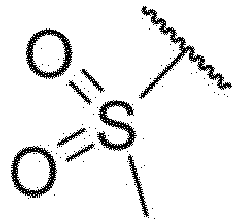
- Ra3 is hydrogen, C1-6 alkyl, C3-6 cycloalkyl, halo C1-6 alkyl,


- Ra4 is hydrogen or C1-6 alkyl,
- R5 is hydrogen,


- R6 and R7 are each independently hydrogen, halo, trifluoromethyl or trifluoromethoxy,
- Rc3 is hydrogen, halo, C1-6 alkyl, C3-6 cycloalkyl,
- W1, W2 and W3 are each independently oxygen, nitrogen, CHRw1, CRw1, NRw1 or CO,
- wherein, Rw1 is hydrogen, halo, C1-6 alkyl, C3-6 cycloalkyl, halo C1-6 alkyl, C1-6 alkylamine, C1-6 alkyl alcohol,

- In the present disclosure, the compound of Formula I is preferably selected form i) or iv) disclosed below:
- i) In case, Z is


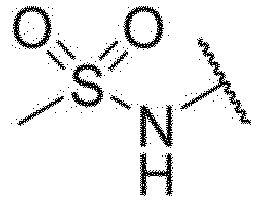
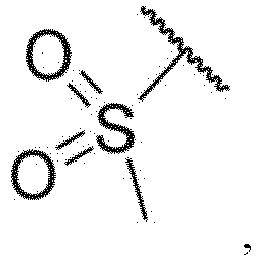


- ii) In case, Z is


- iii) In case, Z is


- iv) In case, Z is


- Particularly proferred examples of the compound of Formula I according to the present disclosure comprise_the followings:
- 4-((4-((5-cyclopropyl-3-(2,6-dichlorophenyl)isoxazol-4-yl)methoxy)phenyl)ethynyl)benzoic acid; (1-1)
- 3-((4-((5-cyclopropyl-3-(2,6-dichlorophenyl)isoxazol-4-yl)methoxy)phenyl)ethynyl)benzoic acid; (1-2)
- 3-((4-((5-cyclopropyl-3-(2,6-dichlorophenyl)isoxazol-4-yl)methoxy)-2-(trifluoromethyl)phenyl)ethynyl)benzoic acid; (1-3)
- 4-((4-((5-cyclopropyl-3-(2,6-dichlorophenyl)isoxazol-4-yl)methoxy)-2-(trifluoromethyl)phenyl)ethynyl)benzoic acid; (I-4)
- 4-((3-chloro-4-ethynylphenoxy)methyl)-5-cyclopropyl-3-(2,6-dichlorophenyl)isoxazole; (1-5)
- 4-((3-chloro-4-(phenylethynyl)phenoxy)methyl)-5-cyclopropyl-3-(2,6-dichlorophenyl)isoxazole; (1-6)
- methyl 3-((2-chloro-4-((5-cyclopropyl-3-(2,6-dichlorophenyl)isoxazol- 4-yl)methoxy)phenyl)ethynyl)benzoate; (1-7)
- methyl 3-((2-chloro-4-((5-cyclopropyl-3-(2,6-dichlorophenyl)isoxazol- 4-yl)methoxy)phenyl)ethynyl)-5-((ethoxycarbonyl)amino)benzoate; (1-8)
- methyl 3-((tert-butoxycarbonyl)amino)-5-((2-chloro-4-((5-cyclopropyl- 3-(2,6-dichlorophenyl)isoxazol-4-yl)methoxy)phenyl)ethynyl)benzoate; (1-9)
- methyl 3-((2-chloro-4-((5-cyclopropyl-3-(2,6-dichlorophenyl)isoxazol- 4-yl)methoxy)phenyl)ethynyl)-5-((ethoxycarbonyl)(methyl)amino)benzoate; (1-10)
- ethyl (3-((2-chloro-4-((5-cyclopropyl-3-(2,6-dichlorophenyl)isoxazol- 4-yl)methoxy)phenyl)ethynyl)phenyl)carbamate; (1-11)
- 3-((2-chloro-4-((5-cyclopropyl-3-(2,6-dichlorophenyl)isoxazol-4-yl)methoxy)phenyl)ethynyl)benzenesulfonamide; (1-12)
- N-(3-((2-chloro-4-((5-cyclopropyl-3-(2,6-dichlorophenyl)isoxazol-4-yl)methoxy)phenyl)ethynyl)phenyl)methanesulfonamide; (1-13)
- N-(3-((2-chloro-4-((5-cyclopropyl-3-(2,6-dichlorophenyl)isoxazol-4-yl)methoxy)phenyl)ethynyl)phenyl)sulfamide; (1-14)
- 3-((2-chloro-4-((5-cyclopropyl-3-(2,6-dichlorophenyl)isoxazol-4-yl)methoxy)phenyl)ethynyl)benzoic acid; (1-15)
- 4-((2-chloro-4-((5-cyclopropyl-3-(2,6-dichlorophenyl)isoxazol-4-yl)methoxy)phenyl)ethynyl)benzoic acid; (1-16)
- 6-((2-chloro-4-((5-cyclopropyl-3-(2,6-dichlorophenyl)isoxazol-4-yl)methoxy)phenyl)ethynyl)nicotinic acid; (I-17)
- 2-((2-chloro-4-((5-cyclopropyl-3-(2,6-dichlorophenyl)isoxazol-4-yl)methoxy)phenyl)ethynyl)isonicotinic acid; (1-18)
- 6-((2-chloro-4-((5-cyclopropyl-3-(2,6-dichlorophenyl)isoxazol-4-yl)methoxy)phenyl)ethynyl)picolinic acid; (I-19)
- 5-((2-chloro-4-((5-cyclopropyl-3-(2,6-dichlorophenyl)isoxazol-4-yl)methoxy)phenyl)ethynyl)nicotinic acid; (1-20)
- 3-((2-chloro-4-((5-cyclopropyl-3-(2,6-dichlorophenyl)isoxazol-4-yl)methoxy)phenyl)ethynyl)-5-(dimethylamino)benzoic acid; (1-21)
- 4-((2-chloro-4-((5-cyclopropyl-3-(2,6-dichlorophenyl)isoxazol-4-yl)methoxy)phenyl)ethynyl)-3-(dimethylamino)benzoic acid; (1-22)
- 4-((2-chloro-4-((5-cyclopropyl-3-(2,6-dichlorophenyl)isoxazol-4-yl)methoxy)phenyl)ethynyl)-2-(dimethylamino)benzoic acid; (1-23)
- 3-((2-chloro-4-((5-cyclopropyl-3-(2,6-dichlorophenyl)isoxazol-4-yl)methoxy)phenyl)ethynyl)-5-(diethylamino)benzoic acid; (1-24)
- 3-amino-5-((2-chloro-4-((5-cyclopropyl-3-(2,6-dichlorophenyl)isoxazol-4-yl)methoxy)phenyl)ethynyl)benzoic acid; (1-25)
- 3-((2-chloro-4-((5-cyclopropyl-3-(2,6-dichlorophenyl)isoxazol-4-yl)methoxy)phenyl)ethynyl)-4-(dimethylamino)benzoic acid; (1-26)
- 3-chloro-5-((2-chloro-4-((5-cyclopropyl-3-(2,6-dichlorophenyl)isoxazol-4-yl)methoxy)phenyl)ethynyl)benzoic acid; (1-27)
- 4-chloro-3-((2-chloro-4-((5-cyclopropyl-3-(2,6-dichlorophenyl)isoxazol-4-yl)methoxy)phenyl)ethynyl)benzoic acid; (1-28)
- 2-chloro-5-((2-chloro-4-((5-cyclopropyl-3-(2,6-dichlorophenyl)isoxazol-4-yl)methoxy)phenyl)ethynyl)benzoic acid; (1-29)
- 3-((2-chloro-4-((5-cyclopropyl-3-(2,6-dichlorophenyl)isoxazol-4-yl)methoxy)phenyl)ethynyl)-5-fluorobenzoic acid; (1-30)
- 3-((2-chloro-4-((5-cyclopropyl-3-(2,6-dichlorophenyl)isoxazol-4-yl)methoxy)phenyl)ethynyl)-5-(trifluoromethyl)benzoic acid; (I-31)
- 3-((2-chloro-4-((5-cyclopropyl-3-(2,6-dichlorophenyl)isoxazol-4-yl)methoxy)phenyl)ethynyl)-5-ethynylbenzoic acid; (1-32)
- 3-((2-chloro-4-((5-cyclopropyl-3-(2,6-dichlorophenyl)isoxazol-4-yl)methoxy)phenyl)ethynyl)-5-cyanobenzoic acid; (1-33)
- 3-((2,6-dichloro-4-((5-cyclopropyl-3-(2,6-dichlorophenyl)isoxazol-4-yl)methoxy)phenyl)ethynyl)benzoic acid; (1-34)
- 2-chloro-3-((2-chloro-4-((5-cyclopropyl-3-(2,6-dichlorophenyl)isoxazol-4-yl)methoxy)phenyl)ethynyl)benzoic acid; (1-35)
- 3-((2-chloro-4-((5-cyclopropyl-3-(2,6-dichlorophenyl)isoxazol-4-yl)methoxy)phenyl)ethynyl)-2-fluorobenzoic acid; (1-36)
- 5-((2-chloro-4-((5-cyclopropyl-3-(2,6-dichlorophenyl)isoxazol-4-yl)methoxy)phenyl)ethynyl)-2-fluorobenzoic acid; (1-37)
- 3-((2-chloro-4-((5-cyclopropyl-3-(2,6-dichlorophenyl)isoxazol-4-yl)methoxy)phenyl)ethynyl)-4-fluorobenzoic acid; (1-38)
- 3-((2-chloro-4-((5-cyclopropyl-3-(2,6-dichlorophenyl)isoxazol-4-yl)methoxy)phenyl)ethynyl)-5-(trifluoromethoxy)benzoic acid; (1-39)
- 3-((2-chloro-4-((5-cyclopropyl-3-(2,6-dichlorophenyl)isoxazol-4-yl)methoxy)phenyl)ethynyl)-5-methoxybenzoic acid; (1-40)
- 3-((2-chloro-4-((5-cyclopropyl-3-(2,6-dichlorophenyl)isoxazol-4-yl)methoxy)phenyl)ethynyl)-5-formylbenzoic acid; (1-41)
- 3-((2-chloro-4-((5-cyclopropyl-3-(2,6-dichlorophenyl)isoxazol-4-yl)methoxy)phenyl)ethynyl)-5-((cyclopropylamino)methyl)benzoic acid; (1-42)
- 3-(azetidin-l-ylmethyl)-5-((2-chloro-4-((5-cyclopropyl-3-(2,6-dichlorophenyl)isoxazol-4-yl)methoxy)phenyl)ethynyl)benzoic acid; (1-43)
- 3-((2-chloro-4-((5-cyclopropyl-3-(2,6-dichlorophenyl)isoxazol-4-yl)methoxy)phenyl)ethynyl)-5-((methylamino)methyl)benzoic acid; (1-44)
- 3-((2-chloro-4-((5-cyclopropyl-3-(2,6-dichlorophenyl)isoxazol-4-yl)methoxy)phenyl)ethynyl)-5-((ethylamino)methyl)benzoic acid; (I-45)
- 3-((2-chloro-4-((5-cyclopropyl-3-(2,6-dichlorophenyl)isoxazol-4-yl)methoxy)phenyl)ethynyl)-5-(((2,2,2-trifluoroethyl)amino)methyl)benzoic acid; (1-46)
- 3-((2-chloro-4-((5-cyclopropyl-3-(2,6-dichlorophenyl)isoxazol-4-yl)methoxy)phenyl)ethynyl)-5-((isopropylamino)methyl)benzoic acid; (1-47)
- 3-((tert-butylamino)methyl)-5-((2-chloro-4-((5-cyclopropyl-3-(2,6-dichlorophenyl)isoxazol-4-yl)methoxy)phenyl)ethynyl)benzoic acid; (1-48)
- 3-((2-chloro-4-((5-cyclopropyl-3-(2,6-dichlorophenyl)isoxazol-4-yl)methoxy)phenyl)ethynyl)-5-((dimethylamino)methyl)benzoic acid; (1-49)
- 3-((2-chloro-4-((5-cyclopropyl-3-(2,6-dichlorophenyl)isoxazol-4-yl)methoxy)phenyl)ethynyl)-5-(morpholinomethyl)benzoic acid; (I-50)
- 3-((2-chloro-4-((5-cyclopropyl-3-(2,6-dichlorophenyl)isoxazol-4-yl)methoxy)phenyl)ethynyl)-5-((oxetan-3-ylamino)methyl)benzoic acid; (I-51)
- 3-((2-chloro-4-((5-cyclopropyl-3-(2,6-dichlorophenyl)isoxazol-4-yl)methoxy)phenyl)ethynyl)-5-(methylamino)benzoic acid; (I-52)
- 3-((2-chloro-4-((5-cyclopropyl-3-(2,6-dichlorophenyl)isoxazol-4-yl)methoxy)phenyl)ethynyl)-5-(ethylamino)benzoic acid; (I-53)
- 3-((2-chloro-4-((5-cyclopropyl-3-(2,6-dichlorophenyl)isoxazol-4-yl)methoxy)phenyl)ethynyl)-5-(isopropylamino)benzoic acid; (I-54)
- 3-(azetidin-1-yl)-5-((2-chloro-4-((5-cyclopropyl-3-(2,6-dichlorophenyl)isoxazol-4-yl)methoxy)phenyl)ethynyl)benzoic acid; (I-55)
- 3-((2-chloro-4-((5-cyclopropyl-3-(2,6-dichlorophenyl)isoxazol-4-yl)methoxy)phenyl)ethynyl)-5-(pyrrolidin-1-yl)benzoic acid; (I-56)
- 3-(azetidin-3-ylamino)-5-((2-chloro-4-((5-cyclopropyl-3-(2,6-dichlorophenyl)isoxazol-4-yl)methoxy)phenyl)ethynyl)benzoic acid hydrochloride; (I-57)
- 3-((2-chloro-4-((5-cyclopropyl-3-(2,6-dichlorophenyl)isoxazol-4-yl)methoxy)phenyl)ethynyl)-5-(piperidin-4-ylamino)benzoic acid hydrochloride; (I-58)
- 3-((2-chloro-4-((5-cyclopropyl-3-(2,6-dichlorophenyl)isoxazol-4-yl)methoxy)phenyl)ethynyl)-5-(piperazin-1-yl)benzoic acid hydrochloride; (I-59)
- 3-amino-5-((2-chloro-4-((5-cyclopropyl-3-(2,6-dichlorophenyl)isoxazol-4-yl)methoxy)phenyl)ethynyl)-4-methylbenzoic acid; (1-60)
- 3-amino-5-((2-chloro-4-((5-cyclopropyl-3-(2,6-dichlorophenyl)isoxazol-4-yl)methoxy)phenyl)ethynyl)-4-methoxybenzoic acid; (1-61)
- 3-amino-5-((2-chloro-4-((5-cyclopropyl-3-(2,6-dichlorophenyl)isoxazol-4-yl)methoxy)phenyl)ethynyl)-2-methoxybenzoic acid; (I-62)
- 3-((2-chloro-4-((5-cyclopropyl-3-(2,6-dichlorophenyl)isoxazol-4-yl)methoxy)phenyl)ethynyl)-5-methylbenzoic acid; (1-63)
- 3-((2-chloro-4-((5-cyclopropyl-3-(2,6-dichlorophenyl)isoxazol-4-yl)methoxy)phenyl)ethynyl)-5-cyclopropylbenzoic acid; (1-64)
- 3-((2-chloro-4-((5-cyclopropyl-3-(2,6-dichlorophenyl)isoxazol-4-yl)methoxy)phenyl)ethynyl)-5-ethylbenzoic acid; (1-65)
- 3-((2-chloro-4-((5-cyclopropyl-3-(2,6-dichlorophenyl)isoxazol-4-yl)methoxy)phenyl)ethynyl)-5-isopropylbenzoic acid; (1-66)
- 3-((2-chloro-4-((5-cyclopropyl-3-(2,6-dichlorophenyl)isoxazol-4-yl)methoxy)phenyl)ethynyl)-5-iodobenzoic acid; (1-67)
- 3-((2,5-dichloro-4-((5-cyclopropyl-3-(2,6-dichlorophenyl)isoxazol-4-yl)methoxy)phenyl)ethynyl)benzoic acid; (1-68)
- 3-((2,3-dichloro-4-((5-cyclopropyl-3-(2,6-dichlorophenyl)isoxazol-4-yl)methoxy)phenyl)ethynyl)benzoic acid; (I-69)
- 3-((2-chloro-4-((5-cyclopropyl-3-(2,6-dichlorophenyl)isoxazol-4-yl)methoxy)-6-fluorophenyl)ethynyl)benzoic acid; (1-70)
- 3-amino-5-((2-chloro-4-((5-cyclopropyl-3-(2,6-dichlorophenyl)isoxazol-4-yl)methoxy)phenyl)ethynyl)-2-methylbenzoic acid; (1-71)
- 3-((2-chloro-4-((5-cyclopropyl-3-(2,6-dichlorophenyl)isoxazol-4-yl)methoxy)phenyl)ethynyl)-5-(3-ethylureido)benzoic acid; (1-72)
- 3-acetamido-5-((2-chloro-4-((5-cyclopropyl-3-(2,6-dichlorophenyl)isoxazol-4-yl)methoxy)phenyl)ethynyl)benzoic acid; (1-73)
- 3-((2-chloro-4-((5-cyclopropyl-3-(2,6-dichlorophenyl)isoxazol-4-yl)methoxy)phenyl)ethynyl)-5-((ethoxycarbonyl)amino)benzoic acid; (1-74)
- 3-((2-chloro-4-((5-cyclopropyl-3-(2,6-dichlorophenyl)isoxazol-4-yl)methoxy)phenyl)ethynyl)-5-((ethoxycarbonyl)(methyl)amino)benzoic acid; (I-75)
- 3-((2-chloro-4-((5-cyclopropyl-3-(2,6-dichlorophenyl)isoxazol-4-yl)methoxy)phenyl)ethynyl)-5-((cyclopropoxycarbonyl)amino)benzoic acid; (1-76)
- 3-((tert-butoxycarbonyl)amino)-5-((2-chloro-4-((5-cyclopropyl-3-(2,6-dichlorophenyl)isoxazol-4-yl)methoxy)phenyl)ethynyl)benzoic acid; (1-77)
- 3-((tert-butoxycarbonyl)(methyl)amino)-5-((2-chloro-4-((5-cyclopropyl-3-(2,6-dichlorophenyl)isoxazol-4-yl)methoxy)phenyl)ethynyl)benzoic acid; (1-78)
- 3-((2-chloro-4-((5-cyclopropyl-3-(2,6-dichlorophenyl)isoxazol-4-yl)methoxy)phenyl)ethynyl)-5-(((cyclopropylmethoxy)carbonyl)amino)benzoic acid; (1-79)
- 3-((2-chloro-4-((5-cyclopropyl-3-(2,6-dichlorophenyl)isoxazol-4-yl)methoxy)phenyl)ethynyl)-5-(((2-cyclopropylethoxy)carbonyl)amino)benzoic acid; (1-80)
- 3-((2-chloro-4-((5-cyclopropyl-3-(2,6-dichlorophenyl)isoxazol-4-yl)methoxy)phenyl)ethynyl)-5-(((2-hydroxyethoxy)carbonyl)amino)benzoic acid; (1-81)
- 3-(((azetidin-3-yloxy)carbonyl)amino)-5-((2-chloro-4-((5-cyclopropyl-3-(2,6-dichlorophenyl)isoxazol-4-yl)methoxy)phenyl)ethynyl)benzoic acid; (1-82)
- 3-((2-chloro-4-((5-cyclopropyl-3-(2,6-dichlorophenyl)isoxazol-4-yl)methoxy)phenyl)ethynyl)-5-(2-oxooxazolidin-3-yl)benzoic acid; (I-83)
- 5-((2-chloro-4-((5-cyclopropyl-3-(2,6-dichlorophenyl)isoxazol-4-yl)methoxy)phenyl)ethynyl)isophthalic acid; (1-84)
- 3-((2-chloro-4-((5-cyclopropyl-3-(2,6-dichlorophenyl)isoxazol-4-yl)methoxy)phenyl)ethynyl)-5-(piperazine-1-carbonyl)benzoic acid hydrochloride; (I-85)
- 3-((2-chloro-4-((5-cyclopropyl-3-(2,6-dichlorophenyl)isoxazol-4-yl)methoxy)phenyl)ethynyl)-5-(methylsulfonamido)benzoic acid; (1-86)
- 3-((2-chloro-4-((5-cyclopropyl-3-(2-(trifluoromethyl)phenyl)isoxazol-4-yl)methoxy)phenyl)ethynyl)benzoic acid; (1-87)
- 3-((2-chloro-4-((5-cyclopropyl-3-(2-(trifluoromethoxy)phenyl)isoxazol-4-yl)methoxy)phenyl)ethynyl)benzoic acid; (1-88)
- 4-((2-chloro-4-((5-cyclopropyl-3-(2,6-dichlorophenyl)isoxazol-4-yl)methoxy)phenyl)ethynyl)-1H-indazole-6-carboxylic acid; (1-89)
- 4-((2-chloro-4-((5-cyclopropyl-3-(2,6-dichlorophenyl)isoxazol-4-yl)methoxy)phenyl)ethynyl)-1H-benzo[d]imidazole-6-carboxylic acid; (1-90)
- 4-((2-chloro-4-((5-cyclopropyl-3-(2,6-dichlorophenyl)isoxazol-4-yl)methoxy)phenyl)ethynyl)-1H-indole-6-carboxylic acid; (1-91)
- 4-((2-chloro-4-((5-cyclopropyl-3-(2,6-dichlorophenyl)isoxazol-4-yl)methoxy)phenyl)ethynyl)-1-(2-(dimethylamino)ethyl)-1H-indole-6-carboxylic acid; (1-92)
- 4-((2-chloro-4-((5-cyclopropyl-3-(2,6-dichlorophenyl)isoxazol-4-yl)methoxy)phenyl)ethynyl)-1-(3-(isopropylamino)propyl)-1H-indole-6-carboxylic acid; (I-93)
- 4-((2-chloro-4-((5-cyclopropyl-3-(2,6-dichlorophenyl)isoxazol-4-yl)methoxy)phenyl)ethynyl)-1-(pyridin-4-ylmethyl)-1H-indole-6-carboxylic acid; (1-94)
- 4-((2-chloro-4-((5-cyclopropyl-3-(2,6-dichlorophenyl)isoxazol-4-yl)methoxy)phenyl)ethynyl)-1-(2-morpholinoethyl)-1H-indole-6-carboxylic acid hydrochloride; (1-95)
- 4-((2-chloro-4-((5-cyclopropyl-3-(2,6-dichlorophenyl)isoxazol-4-yl)methoxy)phenyl)ethynyl)-1-(2,2-dimethoxyethyl)-1H-mdole-6-carboxylic acid; (1-96)
- 4-((2-chloro-4-((5-cyclopropyl-3-(2,6-dichlorophenyl)isoxazol-4-yl)methoxy)phenyl)ethynyl)-1 -(2-hydroxyethyl)-1H-indole-6-carboxylic acid; (I-97)
- 4-((2-chloro-4-((5-cyclopropyl-3-(2,6-dichlorophenyl)isoxazol-4-yl)methoxy)phenyl)ethynyl)-1-(2-hydroxy-2-methylpropyl)-1H-indole-6-carboxylic acid; (I-98)
- 6-((2-chloro-4-((5-cyclopropyl-3-(2,6-dichlorophenyl)isoxazol-4-yl)methoxy)phenyl)ethynyl)-1H-indazole-4-carboxylic acid; (1-99)
- 5-((2-chloro-4-((5-cyclopropyl-3-(2.6-dichlorophenyl) isoxazol-4-yl)methoxy)phenyl)ethynyl)-2,3-dihydrobenzofuran-7-carboxylic acid; (I-100)
- 6-((2-chloro-4-((5-cyclopropyl-3-(2,6-dichlorophenyl)isoxazol-4-yl)methoxy)phenyl)ethynyl)-1H-indole-4-carboxylic acid; (I-101)
- 5-((2-chloro-4-((5-cyclopropyl-3-(2,6-dichlorophenyl)isoxazol-4-yl)methoxy)phenyl)ethynyl)benzo[d]oxazole-7-carboxylic acid; (I-102)
- 5-((2-chloro-4-((5-cyclopropyl-3-(2,6-dichlorophenyl)isoxazol-4-yl)methoxy)phenyl)ethynyl)-2-methylbenzo[d]oxazole-7-carboxylic acid; (I-103)
- 5-((2-chloro-4-((5-cyclopropyl-3-(2,6-dichlorophenyl)isoxazol-4-yl)methoxy)phenyl)ethynyl)-2-ethylbenzo[d]oxazole-7-carboxylic acid; (I-104)
- 5-((2-chloro-4-((5-cyclopropyl-3-(2,6-dichlorophenyl)isoxazol-4-yl)methoxy)phenyl)ethynyl)-2-propylbenzo[d]oxazole-7-carboxylic acid; (1-105)
- 5-((2-chloro-4-((5-cyclopropyl-3-(2,6-dichlorophenyl)isoxazol-4-yl)methoxy)phenyl)ethynyl)-2-isopropylbenzo[d]oxazole-7-carboxylic acid; (1-106)
- 5-((2-chloro-4-((5-cyclopropyl-3-(2,6-dichlorophenyl)isoxazol-4-yl)methoxy)phenyl)ethynyl)-2-(hydroxymethyl)benzo[d]oxazole-7-carboxylic acid; (I-107)
- 7-((2-chloro-4-((5-cyclopropyl-3-(2,6-dichlorophenyl)isoxazol-4-yl)methoxy)phenyl)ethynyl)quinoxaline-5-carboxylic acid; (I-108)
- 7-((2-chloro-4-((5-cyclopropyl-3-(2,6-dichlorophenyl)isoxazol-4-yl)methoxy)phenyl)ethynyl)-2,3-dimethylquinoxaline-5-carboxylic acid; (1-109)
- 5-((2-chloro-4-((5-cyclopropyl-3-(2,6-dichlorophenyl)isoxazol-4-yl)methoxy)phenyl)ethynyl)-2-cyclopropylbenzo[d]oxazole-7-carboxylic acid; (I-110)
- 2-butyl-5-((2-chloro-4-((5-cyclopropyl-3-(2,6-dichlorophenyl)isoxazol-4-yl)methoxy)phenyl)ethynyl)benzo[d]oxazole-7-carboxylic acid; (I-111)
- 6-((2-chloro-4-((5-cyclopropyl-3-(2,6-dichlorophenyl)isoxazol-4-yl)methoxy)phenyl)ethynyl)-2-methylbenzo[d]oxazole-4-carboxylic acid; (1-112)
- 6-((2-chloro-4-((5-cyclopropyl-3-(2,6-dichlorophenyl)isoxazol-4-yl)methoxy)phenyl)ethynyl)-2-ethylbenzo[d]oxazole-4-carboxylic acid; (1-113)
- 6-((2-chloro-4-((5-cyclopropyl-3-(2,6-dichlorophenyl)isoxazol-4-yl)methoxy)phenyl)ethynyl)-2-propylbenzo[d]oxazole-4-carboxylic acid; (1-114) and
- 6-((2-chloro-4-((5-cyclopropyl-3-(2,6-dichlorophenyl)isoxazol-4-yl)methoxy)phenyl)ethynyl)-2-isopropylbenzo[d]oxazole-4-carboxylic acid. (I-115)
- In the present disclosure, "C1-6 alkyl" is a saturated hydrocarbonyl amine with linear or branched chains of 1-6 carbon atoms. Exemplary alkyl include, but are not limited, to methyl, ethyl, propyl, butyl, pentyl, hexyl, 1-methylethyl, 1-methylpropyl, 2-methylpropyl, 1,1-dimethylethyl, 1-methylbutyl, 1,1-dimethylpropyl, 1-methylpentyl or 1,1-dimethylbutyl.
- In the present disclosure, "C3-6 cycloalkyl" is intended as a saturated hydrocarbonyl ring with 3-6 carbon atoms. Exemplary cycloalkyl include, but are not limited, to cyclopropyl, cyclobutyl, cyclopentyl or cyclohexyl.
- In the present disclosure, "C1-6 alkylamine" is a saturated hydrocarbonyl amine with linear or branched chains of 1~6 carbon atoms. Exemplary alkylamines include, but are not limited, to methylamine, ethylamine, propylamine, butylamine, 1-methylethylamine, diethylamine or dimethylamine.
- In the present disclosure, "C1-6 alkyl alcohol" is an R-OH group with R as defined above. Exemplary alkyl alcohol with 1-6 carbon atoms include, but are not limited, to methyl alcohol, ethyl alcohol, propyl alcohol, isopropyl_ alcohol or n-butyl alcohol.
- In the present disclosure, "halo" is intended as bromine, fluorine, or chlorine atom.
- In the present disclosure, "halo C1-6 alkyl" is intended as a C1-6 alkyl radical having one or more hydrogen atoms replaced by a halogen atom as defined above. Exemplary haloalkyl include, but are not limited, to difluoromethyl or trifluoromethyl.
- In the present disclosure, "aryl" is intended as aromatic ring with single ring and substituted a halogen. Exemplary aryl include, but are not limited, to phenyl or halo phenyl.
- In the present disclosure, "heteroaryl" is intended as a monocyclic ring with at least one nitrogen, oxygen or sulfur atom. Exemplary heteroaryl include, but are not limited pyridinyl, quinolyl, furanyl, thienyl, oxadiazolyl, thiadiazolyl, thiazolyl, oxazolyl, isoxazolyl, pyrazolyl, triazolyl, imidazolyl, pyrimidinyl, indolyl, pyrazinyl or indazolyl.
- In the present disclosure, "heterocycle" is intended as a saturated or partially unsaturated hydrocarbonyl mono-tricyclic ring with at least one nitrogen atom. Exemplary mono heterocycles with 5-6 atoms include, but are not limited, to pyrrolidinyl, piperidinyl, piperazinyl pyrollyl, pyrazolyl, imidazolyl, oxazolyl, isoxazolyl, triazolyl, thiazolyl, pyridyl, pyridazinyl, pyrimidinyl, pyrazinyl, or triazinyl. Also, exemplary bicyclic aromatic ring include, but are not limited, to benzothiazolyl, benzoxazolyl, benzoxazinone, benzoxadiazolyl, 1,3-benzodioxolyl, benzofuryl, benzopyrazinyl, indolyl, indazolyl, benzimidazolyl, benzopyranyl, pyrolopyridanyl, furopyridinyl, or imidazothiazolyl.
- The term "pharmaceutically acceptable," as used herein, when referring to a component of a pharmaceutical composition means that the component, when administered to an animal, does not have undue adverse effects such as excessive toxicity, irritation, or allergic response commensurate with a reasonable benefit/risk ratio.
- The term "treatment" as used herein covers any treatment of a disease in a mammal, particularly a human, and includes inhibiting the disease, i.e., arresting its development; or relieving the disease, i.e. causing regression of the disease and/or its symptoms or conditions and slowing disease progression.
- The term "therapeutically effective amount" means an amount of a compound of the present disclosure that ameliorates, attenuates or eliminates a particular disease or condition or prevents or delays the onset of a particular disease or condition.
- The compounds of the disclosure may contain asymmetric or chiral centers, and therefore exist in different stereoisomeric forms. It is intended that all stereoisomeric forms of the compounds of the disclosure, including but not limited to, diastereomers, enantiomers and atropisomers, as well as mixtures thereof such as racemic mixtures, form part of the present disclosure. A specific stereoisomer may also be referred to as an enantiomer, and a mixture of such isomers is often called an enantiomeric mixture. A 50:50 mixture of enantiomers is referred to as a racemic-mixture or a racemate.
- "Diastereomer" refers to a stereoisomer with two or more centers of chirality and whose molecules are not mirror images of one another. Diastereomers have different physical properties, e.g. melting points, boiling points, spectral properties, and reactivities. Mixtures of diastereomers may separate under high resolution analytical procedures such as electrophoresis and chromatography.
- "Enantiomers" refer to two stereoisomers of a compound which are non-superimposable mirror images of one another.
- The phrase "pharmaceutically acceptable salt" as used herein, refers to pharmaceutically acceptable organic or inorganic salts of a compound of the disclosure. Exemplary salts include, but are not limited, to sulfate, citrate, acetate, oxalate, chloride, bromide, iodide, nitrate, bisulfate, phosphate, acid phosphate, isonicotinate, lactate, salicylate, citrate, tartrate, oleate, tannate, pantothenate, bitartrate, ascorbate, succinate, maleate, gentisinate, fumarate, gluconate, glucuronate, saccharate, formate, benzoate, glutamate, methanesulfonate "mesylate", ethanesulfonate, benzenesulfonate, p-toluenesulfonate, and pamoate(i.e., 1,1'-methylene-bis-(2-hydroxy-3- naphthoate)) salts. A pharmaceutically acceptable salt may involve the inclusion of another molecule such as an acetate ion, a succinate ion or other counter ion. The counter ion may be any organic or inorganic moiety that stabilizes the charge on the parent compound. Furthermore, a pharmaceutically acceptable salt may have more than one charged atom in its structure. Instances where multiple charged atoms are part of the pharmaceutically acceptable salt can have multiple counter ions. Hence, a pharmaceutically acceptable salt can have one or more charged atoms and/or one or more counter ion.
- If the compound of the disclosure is a base, the desired pharmaceutically acceptable salt may be prepared by any suitable method available in the art, for example, treatment of the free base with an inorganic acid, such as hydrochloric acid, hydrobromic acid, sulfuric acid, nitric acid, methanesulfonic acid, phosphoric acid and the like, or with an organic acid, such as acetic acid, maleic acid, succinic acid, mandelic acid, fumaric acid, malonic acid, pyruvic acid, oxalic acid, glycolic acid, salicylic acid, a pyranosidyl acid, such as glucuronic acid or galacturonic acid, an alpha hydroxy acid, such as citric acid or tartaric acid, an amino acid, such as aspartic acid or glutamic acid, an aromatic acid, such as benzoic acid or cinnamic acid, a sulfonic acid, such as p-toluenesulfonic acid or ethanesulfonic acid, or the like.
- If the compound of the disclosure is an acid, the desired pharmaceutically acceptable salt may be prepared by any suitable method, for example, treatment of the free acid with an inorganic or organic base, such as an amine(primary, secondary or tertiary), an alkali metal hydroxide or alkaline earth metal hydroxide, or the like. Illustrative examples of suitable salts include, but are not limited to, organic salts derived from amino acids, such as glycine and arginine, ammonia, primary, secondary, and tertiary amines, and cyclic amines, such as piperidine, morpholine and piperazine, and inorganic salts derived from sodium, calcium, potassium, magnesium, manganese, iron, copper, zinc, aluminum and lithium.
- The present disclosure also provides a method of preparing the compound represented by Formula I or a pharmaceutically approved salt thereof.
- The method for preparing the compound of Formula A8 according to the present disclosure is shown in the following scheme 1.

- The compound of Formula A8, which is a compound of the present disclosure, may be prepared by series of steps from the compound of Formula A2 as shown in Scheme 1.
- R6 and R7 of Formula A8, A2 and A7, illustrated in Scheme 1, are defined as below. Wherein,
- R6 and R7is each independently hydrogen, halo, trifluoromethyl or trifluoromethoxy.
- The preparation method of the Formula A8 according to the present disclosure comprise:
- Preparing the compound of Formula A3 by reductive amination of Formula A2 (Step 1);
- Preparing the compound of Formula A4 by chlorination of Formula A3 (Step 2);
- Preparing the compound of Formula A6 by cyclization of Formula A4 with compound of Formula A5 (Step 3);
- Preparing the compound of Formula A7 by reduction of Formula A6 (Step 4);
- Preparing the compound of Formula A8 by bromination of Formula A7 (Step 5).
- Each step in_the above preparation method of scheme 1 is described in more detail as follows.
- i) In the first step, a compound of Formula A2 may be converted to Formula A3 by reductive amination under conditions of hydroxyl amine and sodium hydroxide in ethanol and distilled water at 90°C for 24 hours.
The example of preparing the compound of Formula A3 from the Formula A2 by reductive amination in the above Step 1 of the preparing method of the present disclosure is illustrated in the following reaction scheme.
- ii) In the second step, a compound of Formula A3, prepared as described in step 1, may be converted to Formula A4 by chlorination carried out in the presence of chlorination reagents in one or more of N,N-dimethylformamide, or chloroform at room temperature for 1 hour.
Example of preparing the compound of Formula A4 from the compound of Formula A3 by chlorination in the above Step 2 of the preparing method of the present disclosure is illustrated in the following reaction scheme.
- iii) In the third step, the compound of Formula A4, prepared as described in step 2, may be converted to Formula A6 by cyclization with Formula A5 under basic condition at room temperature for 24 hours.
Example of preparing the compound of Formula A6 from the compound of Formula A4 and A5 by cyclization in the above Step 3 of the preparing method of the present disclosure is illustrated in the following reaction scheme.
- iv) In the fourth step, the compound of Formula A6, prepared as described in step 3, may be converted to Formula A7 by reduction carried out in the presence of reducing reagent in THF at room temperature for 7 hours.
Example of preparing the compound of Formula A7 from the compound of Formula A6 by reduction in the above Step 4 of the preparing method of the present disclosure is illustrated in the following reaction scheme.
- v) In the fifth step, the compound of Formula A7, prepared as described in step 4, may be converted to Formula A8 by bromination carried out in the presence of bromination reagent in dichloromethane at room temperature for 4 hours.
- Example of preparing the compound of Formula A8 from the compound of Formula A7 by bromination in the above Step 5 of the preparing method of the present disclosure is illustrated in the following reaction scheme.

- Another preparation method of the compound of Formula I is shown in the following reaction scheme 2.

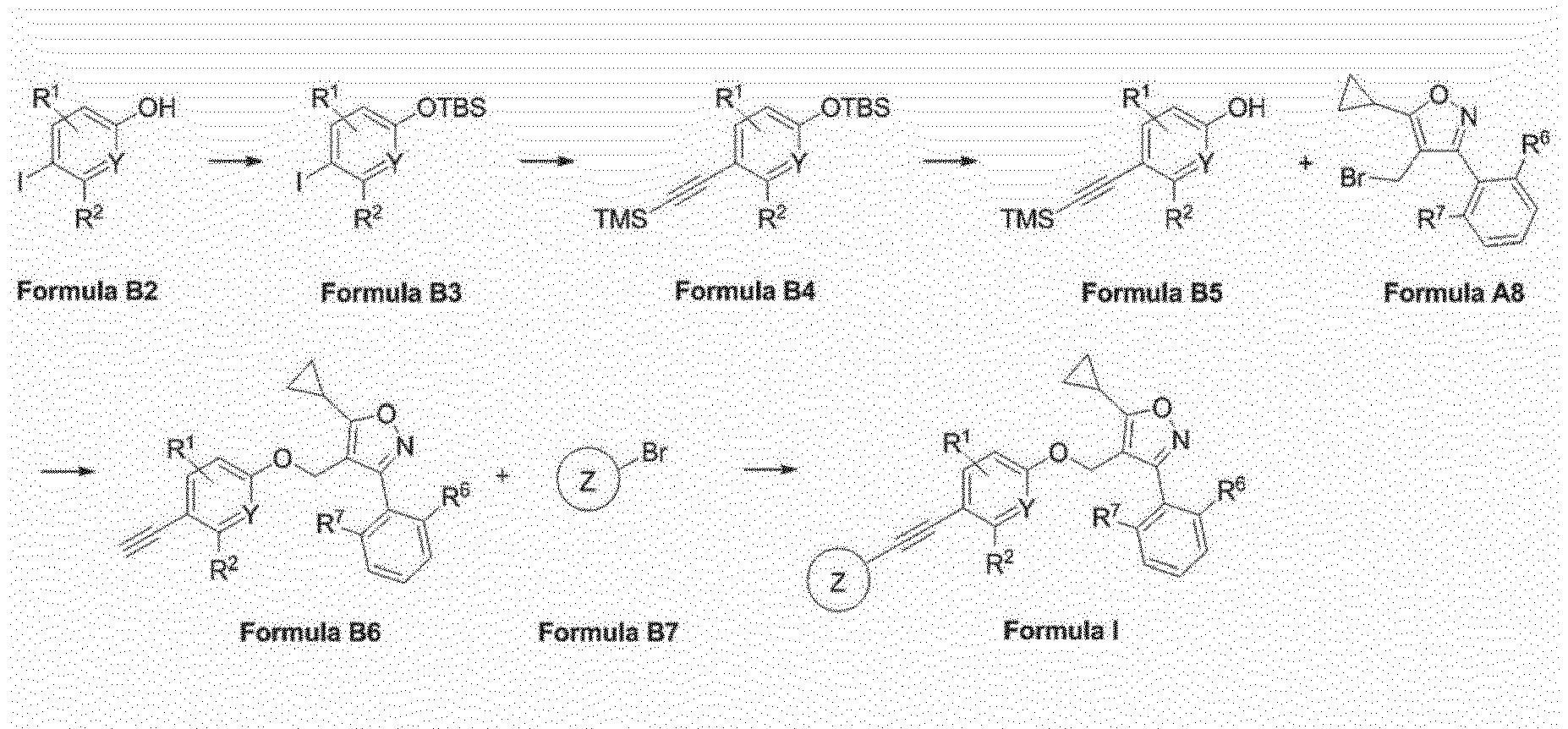
- The compound of Formula I, which is a compound of the present disclosure, may be prepared by series of steps from the compound of Formula B2 as shown in Scheme 2.
- Y, R1, R2, R6, R7 and Z of Formula I, B2 and B7, illustrated in Scheme 2, are defined as below:
In the present Formula I, - Y is carbon or nitrogen,
- R1 and R2 are each independently hydrogen, halo or trifluoromethyl,
- Z is

- n is 0, 1 or 2,
- X1, X2 and X3 are each independently carbon or nitrogen,
- R3 and R4 are each independently hydrogen, halo, cyano, C1-6 alkyl, C3-6 cycloalkyl, halo C1-6 alkyl,

- wherein, m is 1 or 2,
- Ra1 and Ra2 are each independently hydrogen, C1-6 alkyl, C3-6 cycloalkyl, halo C1-6 alkyl,

- Ra3 is hydrogen, C1-6 alkyl, C3-6 cycloalkyl, halo C1-6 alkyl,


- Ra4 is hydrogen or C1-6 alkyl,
- R5 is hydrogen,

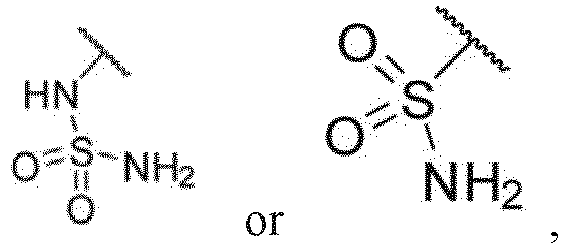
- R6 and R7 are each independently hydrogen, halo, trifluoromethyl or trifluoromethoxy,
- Rc3 is hydrogen, halo, C1-6 alkyl, C3-6 cycloalkyl,
- W1, W2 and W3 are each independently oxygen, nitrogen, CHRw1, CRw1, NRw1 or CO,
- wherein, Rw1 is hydrogen, halo, C1-6 alkyl, C3-6 cycloalkyl, halo C1-6 alkyl, C1-6 alkylamine, C1-6 alkyl alcohol,

- The preparation method of the Formula I according to the present disclosure comprise:
- Preparing the compound of Formula B3 by protection of hydroxyl group of Formula B2 (Step 1);
- Preparing the compound of Formula B4 by Sonogashira reaction of Formula B3 (Step 2);
- Preparing the compound of Formula B5 by deprotection of tert-butyldimethyloxy(

- Preparing the compound of Formula B6 by substitution of Formula B5 with A8(Step 4);
- Preparing the compound of Formula I by Sonogashira reaction or hydrolysis after Sonogashira reaction of Formula B6 and B7 (Step 5).
- Each step in the above preparation method of scheme 2 is described in more detail as follows.
- i) In the first step, the compound of Formula B3 may be prepared by protection of hydroxyl group of Formula B2 using tert-Butyldimethylsilyl chloride(TBSCl) and imidazole in N,N-dimethylformamide at room temperature for 6-24 hours.
The example of preparing the compound of Formula B3 from the Formula B2 by protection of hydroxyl group in the above Step 1 of the preparing method of the present disclosure is in the following reaction scheme.
- ii) In the second step, the compound of Formula B3, prepared as described in step 1, may be converted to Formula B4 by Sonogashira reaction using catalytic amount of tetrakis(triphenylphosphine)palladium(0)(Pd(PPh3)4) or bis(triphenylphosphine)palladium(II) dichloride(PdCl2(PPh3)2) in one or more of N,N-dimethylformamide or methanol at 70-100°C for 3-24 hour.
Example of preparing the compound of Formula B4 from the compound of Formula B3 by Sonogashira reaction in the above Step 2 of the preparing method of the present disclosure is in the following reaction scheme
- iii) In the third step, the compound of Formula B4, prepared as described in step 2, may be converted to Formula B5 by deprotection of tert-butyldimethyloxy(

Example of preparing the compound of Formula B5 from the compound of Formula B4 by deprotection reaction in the above Step 3 of the preparing method of the present disclosure is in the following reaction scheme.
- iv) In the fourth step, the compound of Formula B5, prepared as described in step 3, may be converted to Formula B6 by substitution of with A8 under basic conditions in one or more of THF or N,N-dimethylformamide at room temperature for 5-24 hours.
Example of preparing the compound of Formula B6 from the compound of Formula B5 with A8 by substitution in the above Step 4 of the preparing method of the present disclosure is in the following reaction scheme.
- v) In the fifth step, the compound of Formula B6, prepared as described in step 4, may be converted to Formula I by Sonogashira reaction with B7 using catalytic amount of tetrakis(triphenylphosphine)palladium(0)(Pd(PPh3)4) or bis(triphenylphosphine)palladium(II) dichloride(PdCl2(PPH3)2) and Copper(I)iodide under basic condition in one or more of tetrahydrofuran or N,N-dimethylformamide at 70-100°C for 3-24 hour. Besides, the compound of Formula I can be prepared from Formula B6 with B7 by Sonogashira reaction with hydrolysis using lithium hydroxide in one or more of tetrahydrofuran, 1,4-dioxane or water at 80°C for 4-48 hours.
- Example of preparing the compound of Formula I from the compound of Formula B6 with B7 by Sonogashira reaction or hydrolysis after Sonogashira reaction from in the above Step 5 of the preparing method of the present disclosure is illustrated below.

- Another preparation method of the compound of Formula I is shown in the following reaction scheme 3.

- The compound of Formula I, which is a compound of the present disclosure, may be prepared by series of steps from the compound of Formula B6 as shown in Scheme 3.
- R1, R2, R6, R7, Rd1, Y and Z of Formula I, D1, B2 and B7, illustrated in Scheme 3, are defined as below.
- In the present Formula I,
- Rd1 is bromo,
- Y is carbon or nitrogen,
- R1 and R2 are each independently hydrogen, halo or trifluoromethyl,
- Z is

- n is 0, 1 or 2,
- X1, X2 and X3 are each independently carbon or nitrogen,
- R3 and R4 are each independently hydrogen, halo, cyano, C1-6 alkyl, C3-6 cycloalkyl, halo C1-6 alkyl,

- wherein, m is 1 or 2,
- Ra1 and Ra2 are each independently hydrogen, C1-6 alkyl, C3-6 cycloalkyl, halo C1-6 alkyl,

- Ra3 is hydrogen, C1-6 alkyl, C3-6 cycloalkyl, halo C1-6 alkyl,


- Ra4 is hydrogen or C1-6 alkyl,
- R5 is hydrogen,


- R6 and R7 are each independently hydrogen, halo, trifluoromethyl or trifluoromethoxy,
- Rc3 is hydrogen, halo, C1-6 alkyl, C3-6 cycloalkyl,
- W1, W2 and W3 are each independently oxygen, nitrogen, CHRw1, CRw1, NRw1 or CO,
- wherein, Rw1 is hydrogen, halo, C1-6 alkyl, C3-6 cycloalkyl, halo C1-6 alkyl, C1-6 alkylamine, C1-6 alkyl alcohol,

- The preparation method of the Formula I according to the present disclosure comprise:
- Preparing the compound of Formula D2 by Sonogashira reaction of Formula B6 and D1 (Step 1);
- Preparing the compound of Formula I by deprotection of tert-butyloxycarbonyl(


- Each step in the above preparation method of scheme 3 is described in more detail as follows.
- i) In the first step, the compound of Formula B6, prepared as described in step 4 in scheme 2, may be converted to Formula D2 by Sonogashira reaction with Formula D1 using catalytic amount of tetrakis(triphenylphosphine)palladium(0)(Pd(PPh3)4) or bis(triphenyl phosphine)palladium(II) dichloride(PdCl2(PPH3)2) and Copper(I)iodide under basic condition in one or more of tetrahydrofuran or N,N-dimethylformamide at 70-100°C for 3-24 hour
Example of preparing the compound of Formula D2 from the compound of Formula B6 with D1 by Sonogashira reaction in the above Step 1 of the preparing method of the present disclosure is illustrated in the following reaction scheme.
- ii) In the second step, the compound of Formula D2, prepared as described in step 1, may be converted to Formula I by hydrolysis using lithium hydroxide in one or more of tetahydrofuran, 1,4-dioxane or water at rt-80°C for 4-48 hours followed by deprotection in the presence of boron tribromide solution or hydrogen chloride solution in dichloromethane or tetahydrofuran(THF) at 0-80°C for 2-24 hours.
Example of preparing the compound of Formula I from the compound of Formula D2 by hydrolysis and deprotection reaction in the above Step 2 of the preparing method of the present disclosure is illustrated in the following reaction scheme.
- Another preparation method of the compound of Formula I is shown in the following reaction scheme 4.

- The compound of Formula I, which is a compound of the present disclosure, may be prepared by series of steps from the compound of Formula B6 as shown in Scheme 4.
- R1, R2, R6, R7, Re1, Re2, Y and Z of Formula I, B6 and E3, illustrated in Scheme 4, are defined as below:
In the present Formula I, - Re1 is aldehyde or nitro,
- Re2 is CH2NRa1Ra2 or NH2,
- Y is carbon or nitrogen,
- R1 and R2 are each independently hydrogen, halo or trifluoromethyl,
- Z is

- n is 0, 1 or 2,
- X1, X2 and X3 are each independently carbon or nitrogen,
- R3 and R4 are each independently hydrogen, halo, cyano, C1-6 alkyl, C3-6 cycloalkyl, halo C1-6 alkyl,

- wherein, m is 1 or 2,
- Ra1 and Ra2 are each independently hydrogen, C1-6 alkyl, C3-6 cycloalkyl, halo C1-6 alkyl,

- Ra3 is hydrogen, C1-6 alkyl, C3-6 cycloalkyl, halo C1-6 alkyl,

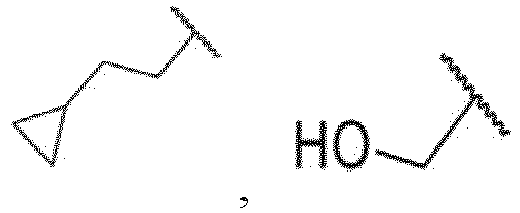
- Ra4 is hydrogen or C1-6 alkyl,
- R5 is hydrogen,


- R6 and R7 are each independently hydrogen, halo, trifluoromethyl or trifluoromethoxy,
- Rc3 is hydrogen, halo, C1-6 alkyl, C3-6 cycloalkyl,
- W1, W2 and W3 are each independently oxygen, nitrogen, CHRw1, CRw1, NRw1 or CO,
- wherein, Rw1 is hydrogen, halo, C1-6 alkyl, C3-6 cycloalkyl, halo C1-6 alkyl, C1-6 alkylamine, C1-6 alkyl alcohol,

- The preparation method of the Formula I according to the present disclosure comprise:
- Preparing the compound of Formula E2 by Sonogashira reaction of Formula B6 and E1 (Step 1);
- Preparing the compound of Formula E3 by reduction or reductive amination of Formula E2 (Step 2);
- Preparing the compound of Formula I by hydrolysis of Formula E3 (Step 3).
- Each step in the above preparation method of scheme 4 is described in more detail as follows.
- i) In the first step, the compound of Formula B6, prepared as described in step 4 in scheme 2, may be converted to Formula E2 by Sonogashira reaction with Formula E1 using catalytic amount of tetrakis(triphenylphosphine) palladium(0)(Pd(PPh3)4) or bis(triphenylphosphine)palladium(II) dichloride (PdCl2(PPh3)2) and Copper(I) iodide under basic condition in one or more of tetrahydrofuran or N,N-dimethylformamide at 70-100°C for 3-24 hour.
Example of preparing the compound of Formula E2 from the compound of Formula B6 with E1 by Sonogashira reaction in the above Step 1 of the preparing method of the present disclosure is illustrated in the following reaction scheme.
- ii) In the second step, the compound of Formula E2, prepared as described in step 1, may be converted to Formula E3 by reduction or reductive amination depending on the type of the substituent Re1.
The second step in the above preparation method of scheme 4 is described in more detail as follows.
In the second step of the preparation method, the desired compound of Formula E3 may be prepared by reduction or reductive amination.
The above reduction reaction may be carried out by Tin(II) chloride dehydrate in ethyl acetate or ethanol with the compound of Formula E2(When Re2 is nitro in the above Formula) at room temperature for one day and it is illustrated in the following reaction scheme.
In the present disclosure, the compound of Formula E2(When Re1 is aldehyde in the above Formula)also may be converted to Formula E3(A substituent maybe introduced in the presence of sodium carbonate and Rc4-I in N,N-dimethylformamide) by reductive amination in the presence of sodiumtriacetoxyborohydride(NaBH(OAc)3) or acetic acid in one or more of dichloromethane or 1,2-dichloroethane at room temperature for overnight and it is illustrated in the following reaction scheme.
- iii) In the third step, the compound of Formula E3, prepared as described in step 2, may be converted to Formula I by hydrolysis using lithium hydroxide in one or more of tetrahydrofuran, 1,4-dioxane or water at rt - 80°C for 4-48 hours.
- Example of preparing the compound of Formula I from the compound of Formula E3 by hydrolysis in the above Step 3 of the preparing method of the present disclosure is illustrated in the following reaction scheme.

- Another preparation method of the compound of Formula I is shown in the following reaction scheme 5.

- The compound of Formula I, which is a compound of the present disclosure, may be prepared by series of steps from the compound of Formula B6 as shown in Scheme 5.
- R1, R2, R3, R6, R7, Y and Z of Formula I, B6 and G4, illustrated in Scheme 5, are defined as below:
In the present Formula I, - Y is carbon or nitrogen,
- R1 and R2 are each independently hydrogen, halo or trifluoromethyl,
- Z is
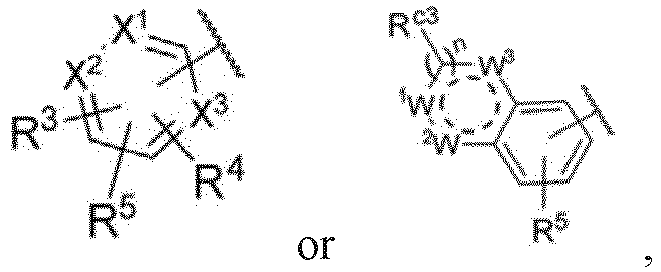
- n is 0, 1 or 2,
- X1, X2 and X3 are each independently carbon or nitrogen,
- R3 and R4 are each independently hydrogen, halo, cyano, C1-6 alkyl, C3-6 cycloalkyl, halo C1-6 alkyl,

- wherein, m is 1 or 2,
- Ra1 and Ra2 are each independently hydrogen, C1-6 alkyl, C3-6 cycloalkyl, halo C1-6 alkyl,

- Ra3 is hydrogen, C1-6 alkyl, C3-6 cycloalkyl, halo C1-6 alkyl,


- Ra4 is hydrogen or C1-6 alkyl,
- R5 is hydrogen,


- R6 and R7 are each independently hydrogen, halo, trifluoromethyl or trifluoromethoxy,
- Rc3 is hydrogen, halo, C1-6 alkyl, C3-6 cycloalkyl,
- W1, W2 and W3 are each independently oxygen, nitrogen, CHRw1, CRw1, NRw1 or CO,
- wherein, Rw1 is hydrogen, halo, C1-6 alkyl, C3-6 cycloalkyl, halo C1-6 alkyl, C1-6 alkylamine, C1-6 alkyl alcohol,

- The preparation method of the Formula I according to the present disclosure comprise:
- Preparing the compound of Formula G2 by Sonogashira reaction of Formula B6 and G1 (Step 1);
- Preparing the compound of Formula G3 by reduction of Formula G2 (Step 2);
- Preparing the compound of Formula G4 by substitution or addition reaction of Formula G3 (Step 3);
- Preparing the compound of Formula I by hydrolysis of compound of Formula G4(Step 4).
- Each step in the above preparation method of scheme 5 is described in more detail as follows.
- i) In the first step, the compound of Formula B6, prepared as described in step 4 in scheme 2, may be converted to Formula G2 by Sonogashira reaction with Formula G1 using catalytic amount of tetrakis(triphenylphosphine)palladium(0)(Pd(PPh3)4) or bis(triphenyl phosphine)palladium(II) dichloride(PdCl2(PPh3)2) and Copper(I) iodide under basic condition in one or more of tetrahydrofuran or N,N-dimethylformamide at 70-100°C for 3-24 hour.
Example of preparing the compound of Formula G2 from the compound of Formula B6 with G1 by Sonogashira reaction in the above Step 1 of the preparing method of the present disclosure is illustrated in the following reaction scheme.
- ii) In the second step, the compound of Formula G2, prepared as described in step 1, may be converted to Formula G3 using Tin(II) chloride dehydrate in ethyl acetate or ethanol at room temperature for one day and it is illustrated in the following reaction scheme.

- iii) In the third step, the compound of Formula G3, prepared as described in step 2, may be converted to Formula G4 by substitution or addition.
The third step in the above preparation method of scheme 5 is described in more detail as follows.
In the third step of the preparation method, the desired compound of Formula G4 may be prepared by substitution or addition.
The compound of Formula G3 may be converted to Formula G4 by the above substitution in the presence of tert-butylnitrile with iodine in toluene at room temperature for 3 hours or by iodo substitution followed by substitution with amine compound using L-proline, cesium carbonate, copper(I) iodide in dimethylsulfoxide.
Example of preparing the compound of Formula G4 from the compound of Formula G3 by substitution or iodo substitution followed by amine substitution in the above Step 3 of the preparing method of the present disclosure is illustrated in the following reaction scheme.
In the present disclosure, the compound of Formula G4 may be prepared by addition reaction which is carried out with the compound of Formula G3 and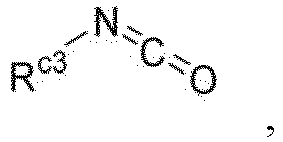


The compound of Formula G3 may be converted to Formula G4 by another method of the addition reaction which is carried out with
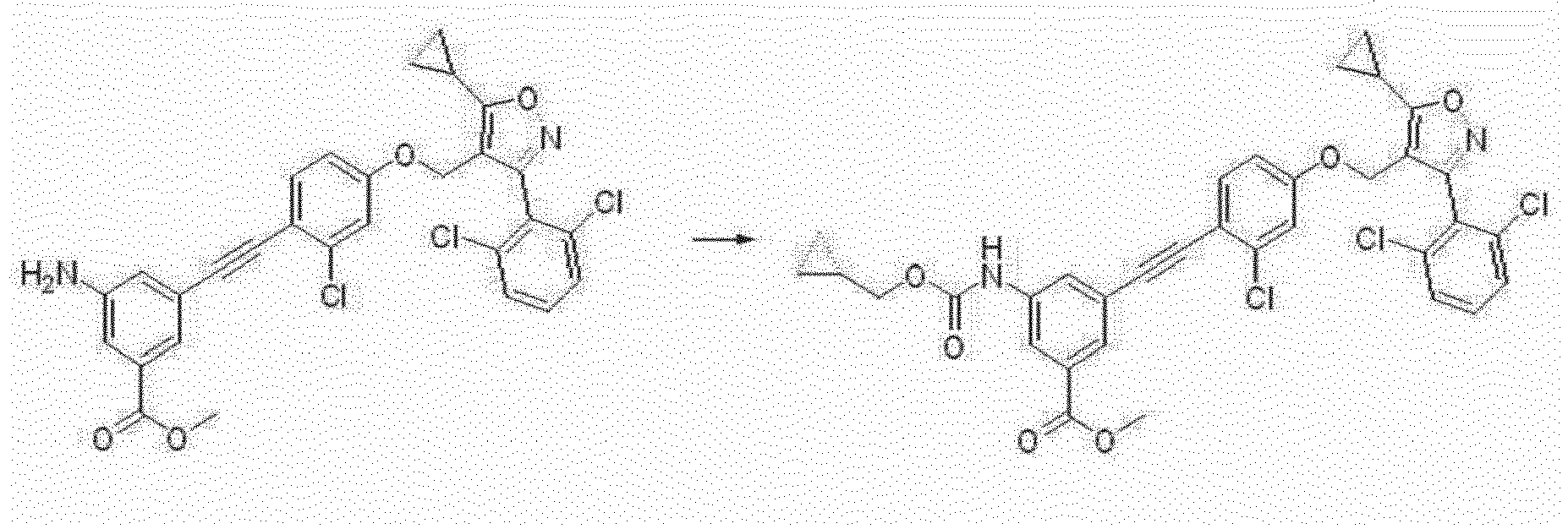
- iv) In the fourth step, the compound of Formula G4, prepared as described in step 3, may be converted to Formula I by hydrolysis using lithium hydroxide in one or more of tetrahydrofuran, 1,4-dioxane or water at rt-80°C for 4-48 hours.
- Example of preparing the compound of Formula I from Formula G4 by hydrolysis in the above Step 4 of the preparing method of the present disclosure is illustrated in the following reaction scheme.

- Another preparation method of the compound of Formula I is shown in the following reaction scheme 6.

- The compound of Formula I, which is a compound of the present disclosure, may be prepared by series of steps from the compound of Formula B6 as shown in Scheme 6.
- R1, R2, R3, R6, R7, Rj1, Y and Z of Formula I, B6 and J3, illustrated in Scheme 6, are defined as below:
- In the present Formula I,
- Rj1 is H or methyl ester,
- Y is carbon or nitrogen,
- R1 and R2 are each independently hydrogen, halo or trifluoromethyl,
- Z is
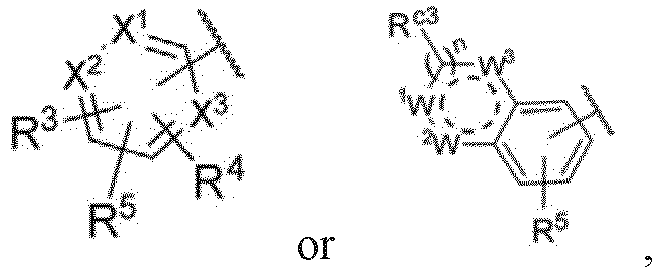
- n is 0, 1 or 2,
- X1, X2 and X3 are each independently carbon or nitrogen,
- R3 and R4 are each independently hydrogen, halo, cyano, C1-6 alkyl, C3-6 cycloalkyl, halo C1-6 alkyl,

- wherein, m is 1 or 2,
- Ra1 and Ra2 are each independently hydrogen, C1-6 alkyl, C3-6 cycloalkyl, halo C1-6 alkyl,
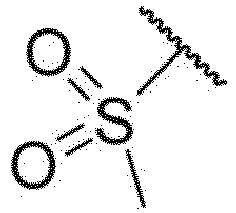
- Ra3 is hydrogen, C1-6 alkyl, C3-6 cycloalkyl, halo C1-6 alkyl,


- Ra4 is hydrogen or C1-6 alkyl,
- R5 is hydrogen,


- R6 and R7 are each independently hydrogen, halo, trifluoromethyl or trifluoromethoxy,
- Rc3 is hydrogen, halo, C1-6 alkyl, C3-6 cycloalkyl,
- W1, W2 and W3 are each independently oxygen, nitrogen, CHRw1, CRw1, NRw1 or CO,
- wherein, Rw1 is hydrogen, halo, C1-6 alkyl, C3-6 cycloalkyl, halo C1-6 alkyl, C1-6 alkylamine, C1-6 alkyl alcohol,

- The preparation method of the Formula I according to the present disclosure comprise:
- Preparing the compound of Formula J2 by Sonogashira reaction of Formula B6 and J1 (Step 1);
- Preparing the compound of Formula J3 by reduction of Formula J2 (Step 2);
- Preparing the compound of Formula I by hydrolysis or addition of compound of Formula J3 (Step 3);
- Each step in the above preparation method of scheme 6 is described in more detail as follows.
- i) In the first step, the compound of Formula B6, prepared as described in step 4 in scheme 2, may be converted to Formula J2 by Sonogashira reaction with Formula J1 using catalytic amount of tetrakis(triphenylphosphine) palladium(0)(Pd(PPh3)4) or bis(triphenyl phosphine)palladium(II)dichloride (PdCl2(PPh3)2) and Copper(I)iodide under basic condition in one or more of tetrahydrofuran or N,N-dimethylformamide at 70-100°C for 3-24 hour.
Example of preparing the compound of Formula J2 from the compound of Formula B6 with J1 by Sonogashira reaction in the above Step 1 of the preparing method of the present disclosure is illustrated in the following reaction scheme.
- ii) In the second step, the compound of Formula J2, prepared as described in step 1, may be converted to Formula J3 by reduction reaction with Tin(II) chloride dehydrate in ethyl acetate or ethanol at room temperature for one day and it is illustrated in the following reaction scheme.

- iii) In the third step, the compound of Formula J3, prepared as described in step 2, may be converted to Formula I by hydrolysis or addition reaction.
- The third step in the above preparation method of scheme 6 is described in more detail as follows.
- In the third step of the preparation method, the desired compound of Formula I may be prepared by hydrolysis or addition reaction.
- The compound of Formula J3 may be converted to Formula I by above hydrolysis reaction under the condition of lithium hydroxide in one or more of tetrahydrofuran, 1,4-dioxane or water at rt-80°C for 4-48 hours and it is illustrated in the following reaction scheme.

- Besides, the compound of Formula I may be prepared by addition reaction with Formula J3 under basic condition in N,N-dimethylformamide or tetrahydrofuran at room temperature or heating condition for 3 or 24 hours in the present disclosure and it is illustrated in the following reaction scheme.

- Also disclosed herein is a pharmaceutical composition for the treatment, prevention, or amelioration of the metabolic diseases, cholestatic Liver Diseases and Organ Fibrosis comprising the compound of Formula I, racemic, enantiomer, diastereoisomer thereof, or pharmaceutically acceptable salt thereof.
- The metabolic diseases, cholestatic Liver Diseases and Organ Fibrosis may be caused by FXR receptor activity. Exemplary diseases include hypercholesterolemia, hyperlipoproteinemia, hypertriglyceridemia, dyslipidemia, lipodystrophy, cholestasis/fibrosis, cholesterol gallstone disease, gastrointestinal disease or condition, hyperglycemia, diabetes, insulin resistance, metabolic inflexibility, nephropathy, liver diseases, atherosclerosis, cancer, inflammatory disorders, osteoporosis and skin aging.
- Also disclosed herein is a method of the treatment, prevention, or amelioration of metabolic diseases, cholestatic Liver Diseases and Organ Fibrosis in a subject in need thereof, comprising administering an effective amount of the pharmaceutical composition to the subject. The dosage of pharmaceutical composition may vary depending on the patient's weight, age, gender, physical condition, diet, the time and mode of administration, excretion rates, and the severity of illness. Mammals(including human) are desirable for the individual without limit.
- Compounds of the disclosure intended for pharmaceutical use may be administered as a solid or liquid, such as a tablet, capsule, solution or suspension. Pharmaceutical compositions suitable for the delivery of compounds of the present disclosure and methods for their preparation will be readily apparent to those skilled in the art. Such compositions and methods for their preparation may be found, for example, in Remington's Pharmaceutical Sciences, 19th Edition(Mack Publishing Company, 1995).
- The compounds of the disclosure may be administered orally. Oral administration may involve swallowing, so that the compound enters the gastrointestinal tract, and/or buccal, lingual, or sublingual administration by which the compound enters the blood stream directly from the mouth.
- Formulations suitable for oral administration include solid plugs, solid microparticulates, semi-solid and liquid(including multiple phases or dispersed systems) such as tablets; soft or hard capsules containing multi- or nano-particulates, liquids, emulsions or powders; lozenges(including liquid-filled); chews; gels; fast dispersing dosage forms; films; ovules; sprays; and buccal/mucoadhesive patches. Liquid(including multiple phases and dispersed systems) formulations include emulsions, suspensions, solutions, syrups and elixirs. Such formulations may be presented as fillers in soft or hard capsules(made, for example, from gelatin or hydroxypropyl methyl_cellulose) and typically comprise a carrier, for example, water, ethanol, polyethylene glycol, propylene glycol, methyl cellulose, or a suitable oil, and one or more emulsifying agents and/or suspending agents. Liquid formulations may also be prepared by the reconstitution of a solid, for example, from a sachet.
- The compounds of the disclosure may also be used in fast-dissolving, fast-disintegrating dosage forms such as those described in Expert Opinion in Therapeutic Patents, 11 (6), 981-986 by Liang and Chen (2001)
- The immediate release portion may comprise a disintegrant. Examples of disintegrants include sodium starch glycolate, sodium carboxymethyl cellulose, calcium carboxymethyl cellulose, croscarmellose sodium, crospovidone, polyvinylpyrrolidone, methyl cellulose, microcrystalline cellulose, powdered cellulose, loweralkyl-substituted hydroxypropyl cellulose, polacrilin potassium, starch, pregelatinizedstarch, sodium alginate, and mixtures thereof. Generally, the disintegrant will comprise_from 1 wt% to 80 wt%, preferably from 5 wt% to 60 wt% of the layer.
- Examples of matrix materials, fillers, or diluents include lactose, mannitol, xylitol, dextrose, sucrose, sorbitol, compressible sugar, microcrystalline cellulose, powdered cellulose, starch, pregelatinized starch, dextrates, dextran, dextrin, dextrose, maltodextrin, calcium carbonate, dibasic calcium phosphate, tribasic calcium phosphate, calcium sulfate, magnesium carbonate, magnesium oxide, poloxamers, polyethylene oxide, hydroxypropyl methyl cellulose and mixtures thereof.
- When preparing dosage forms incorporating the compositions of the disclosure, the compounds may also be blended with conventional excipients such as binders, including gelatin, pregelatinized starch, and the like; lubricants, such as hydrogenated vegetable oil, stearic acid, and the like; diluents, such as lactose, mannose, and sucrose; disintegrants, such as carboxymethyl cellulose and sodium starch glycolate; suspending agents, such as povidone, polyvinyl alcohol, and the like; absorbants, such as silicon dioxide; preservatives, such as methylparaben, propylparaben, and sodium benzoate; surfactants; such as sodium lauryl sulfate, polysorbate 80, and the like; flavorants; and sweeteners. If present, the surfactants would comprise of 0.2 wt% to 5 wt% and the absorbants would comprise from 0.2 wt% to 1 wt%. Another excipients include one or more of: anti-oxidants, colorant, flavouring agents, preservatives and taste-masking agents.
- Tablet blends or portions of blends may alternatively be wet-, dry-, or melt-granulated, melt congealed, or extruded before tabletting. The final formulation may comprise one or more layers and may be coated or uncoated; it may even be encapsulated.
- The formulation of tablets is discussed in °Pharmaceutical Dosage Forms: Tablets, Vol. 1¡±, by H. Lieberman and L.Lachman, Marcel Dekker, N.Y., N.Y., 1980 (ISBN 0-8247-6918-X).
- Solid formulations for oral administration may be formulated to be immediate and/or modified release. Modified release formulations include delayed-, sustained-, pulsed-, controlled-, targeted and programmed release
- The compounds of the disclosure may also be administered directly into the blood stream, into muscle, or into an internal organ. Suitable means for parenteral administration include intravenous, intra-arterial, intraperitoneal, intrathecal, intraventricular, intraurethral, intrasternal, intracranial, intramuscular and subcutaneous.
- Suitable devices for parenteral administration includes needle(including micro needle) injectors, needle-free injectors and infusion techniques. An example of a needle free injection is Powderject™.
- Parenteral formulations are typically aqueous solutions which may contain excipients such as salts, carbohydrates and buffering agents(preferably, to a pH of from 3 to 9), but, for some applications, they may be more suitably formulated as a sterile non aqueous solution or as a powdered, dried form to be used in conjunction with a suitable vehicle such as sterile, pyrogen-free water.
- The preparation of parenteral formulations under sterile conditions, for example, by lyophilisation, may readily be accomplished using standard pharmaceutical techniques well known to those skilled in the art.
- A proper dosage form such as combination with solubility enhancer can increase solubility of compound of formula I used in non-oral solution.
- Formulations for parenteral administration may be formulated to be immediate and/or modified/controlled release. Controlled/modified release formulations include delayed-, sustained-, pulsed-, controlled-, targeted and pro-grammed release. Thus compounds of the disclosure may be formulated as a solid, semi-solid, or thixotropic liquid for administration as an implanted depot providing modified release of the active compound. Examples of such formulations include drug-coated stents and PGLA microspheres.
- The compounds of the disclosure may also be administered topically to the skin or mucosa, that is, dermally or transdermally. Typical formulations for this purpose include gels, hydrogels, lotions, solutions, creams, ointments, dusting powders, dressings, foams, films, skin patches, wafers, implants, sponges, fibres, bandages and microemulsions. Li-posomes may also be used.
- In human patients, the precise daily dose administered depends on various factors such as the age, sex, weight and condition of the patient being treated. The amount of dose can be selected within the bounds of goal achieving treatment effect without harmful or serious adverse effect.
- For instance, the dosage of the compound may be administered in an effective amount raging from 0.05 to 1000mg daily on patients. The following dosage levels and other dosage levels herein are for the average human subject having a weight range of about 65 to 70kg. The skilled person will readily be able to determine the dosage levels required for a subject whose weight falls outside this range, such as children and the elderly.
- The present disclosure explain, but are not limited, in detail through_the following examples and experimental examples.
- Sodium hydroxide(6.3g, 160mmol) and 2,6-dichlorobenzaldehyde(25g, 140mmol) in ethanol(200ml) was added to hydroxylamine hydrochloride(11g, 160mmol) in water(100ml) and stirred for 24 hours at 90 °C. The reaction mixture was evaporated in vacuum, filtered with water(200ml, 2 times) and dried in vacuum to afford the intermediate compound 2,6-dichlorobenzaldehyde oxime(25.9g, 96%).
1H-NMR (DMSO, 400MHz): δ 11.80 (s, 1H), 8.22 (s, 1H), 7.55 (d, 2H), 7.45-7.41 (dd, 1H). - N-chlorosuccinimide(NCS, 18.4g, 140mmol) was added to a solution of the intermediate compound(Step 1)(25.9g, 140mmol) in chloroform(1000ml) and stirred for 4 hours at room temperature. The reaction mixture was evaporated in vacuum, diluted with dicholrometane and washed with water. The combined organic layers were dried over MgSO4, filtered, evaporated in vacuum and purified using silica chromatography to afford the intermediate compound 2,6-dichloro-N-hydroxybenzimidoyl chloride(29g) without any further purification.
- The intermediate compound(Step 2)(29g, 129mmol) was added to ethyl 3-cyclopropyl-3-oxopropanate(25ml, 194mmol) in triethylamine(150ml)and stirred for 24 hours at room temperature. The reaction mixture was diluted with ethyl acetate and washed with water. The combined organic layers were dried over MgSO4, filtered, evaporated in vacuum and purified using silica chromatography to afford the intermediate compound ethyl 5-cyclopropyl-3-(2,6-dichlorophenyl)isoxazole-4-carboxylate (22.37g, 56%).
1H-NMR (CDCl3, 400MHz): δ 7.41-7.38 (m, 2H), 7.35-7.31 (m, 4H), 3.69 (s, 3H), 2.91 (m, 1H), 1.43-1.39 (m, 2H), 1.30-1.26 (m, 2H). - 1M Diisobutylaluminium hydride(DIBAL-H, 144ml, 144mmol) was added to the intermediate compound(Step 3)(22.37g, 71.7mmol) in tetrahydrofuran(72ml) at 0°C and stirred for 7 hours at room temperature. The reaction mixture was diluted with ethyl acetate and washed with 10 w/w% citric acid solution and water, The combined organic layers were dried over MgSO4, filtered, evaporated in vacuum and purified using silica chromatographyto afford the intermediate compound (5-cyclopropyl-3-(2,6-dichlorophenyl)isoxazol-4-yl)methanol(12.2g, 60%).
1H-NMR (CDCl3, 400MHz): δ 7.44-7.40 (m, 2H), 7.37-7.33 (m, 1H), 4.41 (d, 2H), 2.19 (m, 1H), 1.40 (t, 1H), 1.30-1.25 (m, 2H), 1.17-1.10 (m, 2H). - Triphenylphosphine(TPP, 16.9g, 64.53mmol) and tetrabromomethane(21.4g, 64.53mmol) was slowlly added to the intermediate compound(Step 4)(12.2g, 43.02mmol) in dichloromethane(158ml) at 0°C and stirred for 4 hours at room temperature. The reaction mixture was evaporated in vacuum and purified using silica chromatography to afford the title compound(13.44g, 90%).
1H-NMR (CDCl3, 400MHz): δ 7.46-7.45 (dd, 2H), 7.40-7.36 (dd, 1H), 4.23 (s, 2H), 2.12 (m, 1H), 1.32-1.23 (m, 2H), 1.22-1.17 (m, 2H). - tert-Butyldimethylsilyl chloride (TBSCl, 2.1g, 13.6mmol) and imidazole (1.2g, 18.2mmol) were added to a solution of 4-Iodophenol(2g, 9.1mmol) in N,N-dimethylformamide (45ml) and stirred for 12 hours at room temperature. The reaction mixture was diluted with ethyl acetate and washed with water. The combined organic layers were dried over MgSO4, filtered, evaporated in vacuum and purified using silica chromatography to afford the intermediate compound tert-butyl(4-iodophenoxy)dimethylsilane(2.8g, 93%).
1H-NMR (CDCl3, 400MHz): δ 7.32 (m, 2H), 6.43 (m, 2H), 0.78 (t, 9H), 0.23 (t, 6H). - Trimethylsilylacetylene(2.4ml, 17mmol), bis(triphenylphosphine)palladium(ii) dichloride (PdCl2(PPh3)2, 0.6g, 0.85mmol), Copper(I) iodide(0.16g, 0.85mmol), and triethylamine(0.6ml, 4.25mmol) were added to a solution of the intermediate compound(Step 1)(2.8g, 8.5mmol) in N,N-dimethylformamide (50ml) and stirred for 12 hours at 80°C. The reaction mixture was diluted with Ethyl acetate and washed with water. The combined organic layers were dried over MgSO4, filtered, evaporated in vacuum and purified using silica chromatography to afford the intermediate compound tert-butyl(4-((trimethylsilyl)ethyl)phenoxy)silane (1.99g, 77%).
1H-NMR (CDCl3, 400MHz): δ 7.32 (m, 2H), 6.43 (m, 2H), 0.78 (s, 9H), 0.25 (s, 9H), 0.23 (s, 6H). - Potassium fluoride (KF, 3.8g, 65mmol) was added to a solution of the intermediate compound(Step 2)( 1.99g, 6.5mmol) in methanol (65ml) at 0°C and stirred for 1 hour. The reaction mixture was diluted with dichloromethane and washed with water. The combined organic layers were dried over MgSO4, filtered, and evaporated in vacuum. The resulting 4-((trimethylsilly)ethynyl)phenol was used for next step without any further purification.
- 4-(bromomethyl)-5-cyclopropyl-3-(2,6-dichlorophenyl)isoxlazole(Intermediate 1)(2.25g, 6.5mmol) and potassium carbonate (1.34g, 9.75mmol) were added to a solution of the intermediate compound(Step 3)(1.25g, 6.5mmol) in N,N-dimethylformamide (65ml) stirred for 12 hours at room temperature. The reaction mixture was diluted with Ethyl acetate and washed with water. The combined organic layers were dried over MgSO4, filtered, evaporated in vacuum and purified using silica chromatography to afford the intermediate compound 5-cyclopropyl-3-(2,6-dichlorophenyl)-4-((4-ethynylphenoxy)methyl)isoxazole(2.05g, 82%)
1H-NMR (CDCl3, 400MHz): δ 7.41-7.30 (m, 5H), 6.83 (d, 1H), 6.66 (dd, 1H), 4.80 (s, 2H), 3.26 (s, 1H), 2.17-2.10 (m, 1H), 1.31-1.27 (m, 2H), 1.23-1.17 (m, 2H). - 4-iodobenzoate (67mg, 0.52mmol), bis(triphenylphosphine)palladium(ii) dichloride (PdCl2(PPh3)2, 42mg, 0.06mmol), Copper(I) iodide(11.4mg, 0.06mmol), and 1,8-Diazabicyclo[5.4.0]undec-7-ene (DBU, 0.4ml, 2.6mmol) were added to a solution of the intermediate compound(Step 4)(200mg, 0.52mmol) in N,N-dimethylformamide (5.2ml) and stirred for 4 hours at 80°C. The reaction mixture was diluted with Ethyl acetate and washed with water. The combined organic layers were dried over MgSO4, filtered, evaporated in vacuum and purified using silica chromatography to afford the intermediate compound methyl 4-((4-((5-cyclopropyl-3-(2,6-dichlorophenyl)isoxazol-4-yl)methoxy)phenyl)ethynyl)benzoate (175mg, 65%).
1H-NMR (MeOD, 400MHz): δ 8.03 (d, 2H), 8.01-7.40 (m, 7H), 6.83 (d, 2H), 4.94 (s, 2H), 3.93 (s, 3H), 2.37-2.34 (m, 1H), 1.24-1.22 (m, 4H). - lithium hydroxide(14.2mg, 0.34mmol) was added to a solution of the intermediate compound(Step 5)( 175mg, 0.34mmol) in 1,4-dioxane(3ml) and distilled water(0.4ml) and stirred for 18 hours at room temperature. The reaction mixture was acidified to pH=2~3 with IN HCl and extracted with ethyl acetate. The combined organic layers were dried over MgSO4, filtered, and evaporated in vacuum to afford the title compound(133mg, 78%).
1H-NMR (CDCl3, 400MHz): δ 8.01 (dd, 2H), 7.55 (dd, 2H), 7.43-7.40 (m, 4H), 7.34-7.32 (m, 1H), 6.79 (d, 2H), 4.83 (s, 2H), 2.20-2.16 (m, 1H), 1.30-1.22 (m, 2H), 1.19-1.13 (m, 2H). - This compound was made using the procedure described for example 1(Step 5). Thus, this intermediate compound(Step 4 of Example 1)(100mg, 0.26mmol) was reacted with methyl 3-bromobenzoate (56mg, 0.26mmol), bis(triphenylphosphine) palladium(II) dichloride (PdCl2(PPh3)2, 21mg, 0.03mmol), Copper(I) iodide(5.7mg, 0.03mmol), and 1,8-Diazabicyclo[5.4.0]undec-7-ene (DBU, 0.2ml, 1.3mmol) to afford the intermediate compound methyl 3-((4-((5-cyclopropyl-3-(2,6- dichlorophenyl)isoxazol-4-yl)methoxy)phenyl)ethynyl)benzoate(40mg, 30%).
1H-NMR (CDCl3, 400MHz): δ 8.17 (s, 1H), 8.17-7.96 (m, 1H), 7.68-7.65 (m, 1H), 7.42-7.40 (m, 5H), 7.34-7.30 (m, 1H), 6.80-6.77 (m, 2H), 4.82 (s, 2H), 3.93 (s, 3H), 2.19-2.15 (m, 1H), 1.31-1.27 (m, 2H), 1.17-1.13 (m, 2H). - This compound was made using the procedure described for example 1(Step 6). Thus, this intermediate compound(Step 1)(40mg, 0.08mmol) was reacted with lithium hydroxide(LiOH, 3.3mg, 0.08mmol) to afford the title compound(30mg, 78%).
1H-NMR (CDCl3, 400MHz): δ 8.19-8.18 (m, 1H), 8.00-7.98 (m, 1H), 7.68-7.66 (m, 1H), 7.43-7.40 (m, 5H), 7.36-7.34 (m, 1H), 6.80-6.77 (m, 2H), 4.83 (s, 2H), 2.20-2.16 (m, 1H), 1.31-1.26 (m, 2H), 1.19-1.14 (m, 2H). - This compound was made using the procedure described for example 1(Step 1). Thus, 4-Iodo-3-(trifluoromethyl)phenol(40mg, 0.14mmol) was reacted with tert-Butyldimethylsilyl chloride (TBSCl, 32mg, 0.21mmol) and imidazole (19mg, 0.28mmol) to afford the intermediate compound tert-butyl(4-iodo-3-(trifluoro methyl)phenoxy)dimethylsilane(52mg, 93%).
1H-NMR (CDCl3, 400MHz): δ 7.64(d, 1H), 6.97 (d, 1H), 6.48 (dd, 1H), 0.96 (s, 9H), 0.16 (s, 6H). - This compound was made using the procedure described for example 1(Step 2). Thus, this intermediate compound(Step 1)(52mg, 0.13mmol) was reacted with Trimethylsilylacetylene(0.036ml, 0.26mmol), bis(triphenylphosphine)palladium(ii) dichloride (PdCl2(PPh3)2, 9.1mg, 0.013mmol), Copper(I) iodide(2.4mg, 0.013mmol) and triethylamine(0.095ml, 0.65mmol) to afford the intermediate compound tert-butyldimethyl(3-(trifluoromethyl)-4-((trimethylsilyl)ethynyl) phenoxy)silane(41.1mg, 88%).
1H-NMR (CDCl3, 400MHz): δ 7.35 (d, 1H), 6.87 (d, 1H), 6.66 (dd, 1H), 0.96 (s, 9H), 0.25 (s, 9H), 0.19 (s, 6H). - This compound was made using the procedure described for example 1(Step 3). Thus, this intermediate compound(Step 2)(41.1mg, 0.16mmol) was reacted with Potassium fluoride (KF, 93mg, 1.6mmol) to afford the intermediate compound 3-(trifluoromethyl)-4-((trimethylsilyl)ethynyl)phenol. The resulting residue was used for next step without any further purification.
- This compound was made using the procedure described for example 1(Step 4). Thus, this intermediate compound(Step 3)(0.16mmol) was reacted with 4-(bromomethyl)-5-cyclopropyl-3-(2,6-dichlorophenyl)isoxlazole(Intermediate 1)(50mg, 0.144mmol), and potassium carbonate (26.6mg, 0.192mmol) to afford the intermediate compound 5-cyclopropyl-3-(2,6-dichlorophenyl)-4-((4- ethynyl-3-(trifluoromethyl)phenoxy)methyl)isoxazole(36mg, 50%).
1H-NMR (CDCl3, 400MHz): δ 7.50-7.48 (m, 1H), 7.40-7.30 (m, 3H), 7.08-7.04 (m, 1H), 6.90-6.86 (m, 1H), 4.86 (s, 2H), 3.25 (s, 1H), 2.17-2.11 (m, 1H), 1.35-1.22 (m, 2H), 1.18-1.14 (m, 2H). - This compound was made using the procedure described for example 1(Step 5). Thus, this intermediate compound(Step 4)(36mg, 0.080mmol) was reacted with methyl 3-iodobenzoate(21mg, 0.080mmol), bis(triphenylphosphine)palladium(II) dichloride (PdCl2(PPh3)2, 5.6mg, 0.008mmol), Copper(I) iodide(1.5mg, 0.008mmol) and triethylamine(0.013ml, 0.096mmol)to afford the intermediate compound methyl 3-((4-((5-cyclopropyl-3-(2,6-dichlorophenyl)isoxazol-4-yl) methoxy)-2-(trifluoromethyl)phenyl)ethynyl)benzoate(3mg, 75%).
1H-NMR (CDCl3, 400MHz): δ 8.17-8.16 (m, 1H), 8.02-7.99 (m, 1H), 7.70-7.67 (m, 1H), 7.54-7.51 (m, 1H), 7.45-7.31 (m, 4H), 7.09-7.08 (m, 1H), 6.94-6.91 (m, 1H), 4.88 (s, 2H), 3.94 (s, 3H), 2.18-2.13 (m, 1H), 1.33-1.29 (m, 2H), 1.22-1.15 (m, 2H). - This compound was made using the procedure described for example 1(Step 6). Thus, this intermediate compound(Step 5)(35mg, 0.06mmol) was reacted with lithium hydroxide(2.5mg, 0.06mmol) to afford the title compound (23mg, 68%).
1H-NMR (CDCl3, 400MHz): δ 8.23-8.21 (m, 1H), 8.06-8.05 (m, 1H), 7.71-7.66 (m, 1H), 7.55-7.31 (m, 5H), 7.09-7.08 (m, 1H), 7.00-6.91 (m, 1H), 4.88 (s, 2H), 2.17-2.12 (m, 1H), 1.33-1.28 (m, 2H), 1.20-1.15 (m, 2H). - This compound was made using the procedure described for example 1(Step 5). Thus, the intermediate compound(Step 4 of Example 3) 5-cyclopropyl-3-(2,6- dichlorophenyl)-4-((4-ethynyl-3-(trifluoromethyl)phenoxy)methyl)isoxazole(45mg, 0.1mmol) was reacted with methyl 4-iodobenzoate (28mg, 0.1mmol), bis(triphenylphosphine)palladium(II) dichloride(PdCl2(PPh3)2, 13mg, 0.02mmol), copper(I) iodide(1.7mg, 0.01mmol) and triethylamine(0.06ml, 0.46mmol) to afford the intermediate compound methyl 4-((4-((5-cyclopropyl-3-(2,6-dichloro phenyl)isoxazol-4-yl)methoxy)-2-(trifluoromethyl)phenyl)ethynyl)benzoate(42mg, 71%).
1H-NMR (CDCl3, 400MHz): δ 8.02 (dd, 2H), 7.57-7.52 (m, 3H), 7.41-7.39 (m, 2H), 7.35 (dd, 1H), 7.09 (d, 1H), 6.94 (dd, 1H), 4.88 (s, 2H), 3.93 (s, 3H), 2.17-2.13 (m, 1H), 1.32-1.27 (m, 2H), 1.20-1.16 (m, 2H). - This compound was made using the procedure described for example 1(Step 6). Thus, the intermediate compound(Step1)(42mg, 0.07mmol) was reacted with lithium hydroxide(29mg, 0.7mmol) to afford the title compound(40mg, 100%).
1H-NMR (DMSO, 400MHz): δ 13.27 (s, 1H), 8.05 (d, 2H), 7.78 (d, 1H), 7.73-7.58 (m, 5H), 7.24-7.21 (m, 2H), 5.15 (s, 2H), 2.59 (m, 1H), 1.29-1.21 (m, 4H). - This compound was made using the procedure described for example 1(Step 1). Thus, 3-chloro-4-iodophenol(10g, 39.5mmol) was reacted with tert-butyldimethylsilyl chloride(TBSCl, 7.5g, 47.2mmol) and imidazole(3g, 59mmol) to afford the intermediate compound tert-butyl(3-chloro-4-iodo phenoxy)dimethylsilane(9g, 66%).
1H-NMR (CDCl3, 400MHz): δ 7.64(d, 1H), 6.97 (d, 1H), 6.48 (dd, 1H), 0.96 (s, 9H), 0.16 (s, 6H). - This compound was made using the procedure described for example 1(Step 2). Thus, the intermediate compound(Step 1)(9g, 24.4mmol) was reacted with trimethylsilylacetylene(6.76ml, 48.8mmol), bis(triphenylphosphine)palladium(II) dichloride(PdCl2(PPh3)2, 0.85g, 1.22mmol), copper(I) iodide(0.23g, 1.22mmol), triethylamine(15.3ml, 109.8mmol) to afford the intermediate compound tert-butyl(3-chloro-4-((trimethylsilyl)ethynyl)phenoxy)dimethylsilane(7.44g, 90%).
1H-NMR (CDCl3, 400MHz): δ 7.35 (d, 1H), 6.87 (d, 1H), 6.66 (dd, 1H), 0.96 (s, 9H), 0.25 (s, 9H), 0.19 (s, 6H). - This compound was made using the procedure described for example 1(Step 3). Thus, the intermediate compound(Step 2)(7.44g, 21.9mmol) was reacted with potassium fluoride(KF, 12.7g, 219mmol) to afford the intermediate compound 3-chloro-4-((trimethylsilyl)ethynyl)phenol and used without further purification.
- This compound was made using the procedure described for example 1(Step 4). Thus, the intermediate compound(Step 3)(4.92g, 21.9mmol) was reacted with 4-(bromomethyl)-5-cyclopropyl-3-(2,6-dichlorophenyl)isoxazole(example 1)(7.59g, 21.9mmol) and potassium carbonate(4.54g, 32.9mmol) to afford the title compound(7.15g, 78%).
1H-NMR (CDCl3, 400MHz): δ 7.41-7.30 (m, 4H), 6.83 (d, 1H), 6.66 (dd, 1H), 4.80 (s, 2H), 3.26 (s, 1H), 2.17-2.10 (m, 1H), 1.31-1.27 (m, 2H), 1.23-1.17 (m, 2H). - This compound was made using the procedure described for example 1(Step 5). Thus, 4-((3-chloro-4-ethynylphenoxy)methyl)-5-cyclopropyl-3-(2,6-dichloro phenyl)isoxazole(example 5)(128mg, 0.306mmol) was reacted with bromobenzene(48mg, 0.306mmol), bis(triphenylphosphine)palladium(II) dichloride(PdCl2(PPh3)2, 21.5mg, 0.031mmol), copper(I) iodide(5.8mg, 0.031mmol) and triethylamine(0.052ml, 0.367mmol) to afford the title compound (7.15g, 78%).
1H-NMR (CDCl3, 400MHz): δ 7.54-7.52 (m, 2H), 7.42-7.31 (m, 7H), 6.87-6.86 (d, 1H), 6.69-6.66 (dd, 1H), 4.81 (s, 2H), 2.17-2.04 (m, 1H), 1.29-1.24 (m, 2H), 1.19-1.14 (m, 2H). - This compound was made using the procedure described for example 1(Step 5). Thus, 4-((3-chloro-4-ethynylphenoxy)methyl)-5-cyclopropyl-3-(2,6-dichloro phenyl)isoxazole(Example 6)(128mg, 0.31mmol) was reacted with methyl 3-iodobenzoate(80mg, 0.31mmol), bis(triphenylphosphine)palladium(II) dichloride (PdCl2(PPh3)2, 22mg, 0.03mmol), Copper(I) iodide(5.8mg, 0.03mmol) and triethylamine(0.052ml, 0.37mmol) to afford the title compound(107mg, 63%).
1H-NMR (CDCl3, 400MHz): δ 8.20-8.19 (m, 1H), 8.01-7.98 (m, 1H), 7.72-7.69 (m, 1H), 7.43-7.32 (m, 5H), 6.88-6.87 (m, 1H), 6.71-6.68 (m, 1H), 4.82 (s, 2H), 3.94 (s, 3H), 2.18-2.15 (m, 1H), 1.32-1.28 (m, 2H), 1.20-1.16 (m, 2H). - This compound was made using the procedure described for example 1(Step 5). Thus, 4-((3-chloro-4-ethynylphenoxy)methyl)-5-cyclopropyl-3-(2,6-dichloro phenyl)isoxazol(example 5)(3.6g, 8.59mmol) was reacted with methyl 3-bromo-5-nitrobenzoate(2.6g, 10.3mmol), bis(triphenylphosphine)palladium(II) dichloride(PdCl2(PPh3)2, 302mg, 0.429mmol), copper(I)iodide(81.8mg, 0.429mmol) and triethylamine(1.44ml, 10.3mmol) to afford the intermediate compound methyl 3-((2-chloro-4-((5-cyclopropyl-3-(2,6-dichlorophenyl)isoxazol -4-yl)methoxy)phenyl)ethynyl)-5-nitrobenzoate(3.9g, 80%).
1H-NMR (CDCl3, 400MHz): δ 8.78 (t, 1H), 8.51 (t, 1H), 8.46 ∗t, 1H), 7.44-7.40 (m, 3H), 7.36-7.32 (m, 1H), 6.89 (d, 1H), 6.73 (dd, 1H), 4.84 (s, 2H), 4.00 (s, 3H), 2.19-2.13 (m, 1H), 1.32-1.28 (m, 2H), 1.20-1.15 (m, 2H). - The intermediate compound(step 1) was dissolved in ethyl acetate(70ml) and ethanol(35ml) and tin(II) chloride dihydrate(15.5g, 68.7mmol) were added. The reaction was stirred at room temperature for 1 day. The reaction mixture was extracted with ethyl acetate and washed with water. The combined organic phase was dried over MgSO4, filtered, concentrated and purified by column chromatography on silica to give methyl 3-amino-5-((2-chloro-4-((5-cyclopropyl -3-(2,6-dichlorophenyl)isoxazol-4-yl)methoxy)phenyl)ethynyl)benzoate (3.0g, 77%).
1H-NMR (CDCl3, 400MHz): δ 7.59-7.58 (m, 1H), 7.41-7.27 (m, 5H), 7.00-6.99 (m, 1H), 6.87-6.86 (m, 1H), 6.69-6.67 (m, 1H), 4.82 (s, 2H), 3.90 (s,3H), 2.19-2.12 (m, 1H), 1.31-1.28 (m, 2H), 1.20-1.14 (m, 2H). - The intermediate compound(step 2) was dissolved in N,N-dimethylform amide(8.8ml) and ethylchloroformate(250ul, 2.64mmol), triethylamine(369ul, 2.64mmol) and 1,8-Diazabicyclo[5.4.0]undec-7-ene(DBU, 13 ul, 0.0881mmol) were added. The reaction was stirred at room temperature for 4 hours. The reaction mixture was extracted with ethyl acetate and washed with water. The combined organic phase was dried over MgSO4, filtered, concentrated and purified by column chromatography on silica to give the title compound(254mg, 65%).
1H-NMR (CDCl3, 400MHz): δ 13.42 (br, 1H), 8.03 (d, 1H), 7.82 (t, 1H), 7.65-7.61 (m, 2H), 7.58-7.54 (m, 1H), 7.13 (d, 1H), 6.87 (dd, 1H), 5.01 (s, 2H), 1.05-1.32 (m, 5H). - This compound was made using the procedure described for example 8(Step 3). Thus, methyl 3-amino-5-((2-chloro-4-((cyclopropyl-3-(2,6-dichlorophenyl) isoxazol-4-yl)methoxy)phenyl)ethynyl)benzoate(Step 2 of example 8)(500mg, 0.880mmol) was reacted with di-tert-butyl dicarbonate(385mg, 1.76mmol), 4-dimethylaminopyridine(5.4mg, 0.044mmol) and triethylamine(0.2ml, 1.32mmol) to afford the title compound(300mg, 51%).
1H-NMR (CDCl3, 400MHz): δ 8.12 (t, 1H), 7.89 (t, 1H), 7.79 (t, 1H), 7.51 - 7.31 (m, 5H), 6.86 (d, 1H), 6.69 (dd, 1H), 6.61(s, 1H), 4.81 (s, 2H), 3.93 (s, 3H), 2.17 (m, 1H), 1.52 (s, 9H), 1.31 1.23 (m, 2H), 1.19 - 1.16 (m, 2H). - The compound methyl 3-((2-chloro-4-((5-cyclopropyl-3-(2,6-dichlorophenyl) isoxazol-4-yl)methoxy)phenyl)ethynyl)-5-((ethoxycarbonyl)amino)benzoate(example 8)(220mg, 0.348mmol) was dissolved in N,N-dimethylformamide(5ml) and sodiumhydride(25mg, 1.04mmol) and iodomethane(87ul, 1.39mmol) were added. The reaction was stirred at room temperature for 20 hours. The reaction mixture was extracted with ethyl acetate and washed with water. The combined organic phase was dried over MgSO4, filtered, concentrated and purified by column chromatography on silica to afford the title compound(113mg, 48%).
1H-NMR (CDCl3, 400MHz): δ 8.02 (t, 1H), 7.88 (s, 1H), 7.62 (s, 1H), 7.42-7.38 (m, 1H), 7.35-7.31 (m, 1H), 6.87 (d, 1H), 6.70 (dd, 1H), 4.82 (s, 2H), 4.22 (q, 2H), 3.93 (s, 3H), 3.32(s, 3H), 2.17-2.13 (m, 1 H), 1.34(t, 3H), 1.32-1.24 (m, 2H), 1.23-1.14 (m, 2H). - This compound was made using the procedure described for example 1(Step 5). Thus, 4-((3-chloro-4-ethynylphenoxy)methyl)-5-cyclopropyl-3-(2,6-dichloro phenyl)isoxazole(Example 5)(300mg, 0.72mmol) was reacted with 1-iodo-3-nitrobenzene(178.4mg, 0.72mmol), tetrakis(triphenylphosphine) palladium(0)(Pd(PPh3)4, 81mg, 0.07mmol), copper(I) iodide(13.3mg, 0.07mmol) and N,N-diisopropylethylamine(0.15ml, 0.86mmol) to afford the intermediate compound 4-((3-chloro-4-((3-nitrophenyl)ethynyl)phenoxy)methyl)-5-cyclo propyl-3-(2,6-dichlorophenyl)isoxazole(368.8mg, 95%).
1H-NMR (CDCl3, 400MHz): δ 8.36(s, 1H), 8.17(d, 1H), 7.82(d, 1H), 7.55-7.43(m, 2H), 7.42-7.40(m, 3H), 6.88(d, 1H), 6.71(dd, 1H), 4.83(s, 2H), 2.18-2.13(m, 1H), 1.31-1.30(m, 2H), 1.19-1.17(m, 2H). - This compound was made using the procedure described for example 8(Step 2). Thus, this intermediate compound(Step 1)(100mg, 0.19mmol) was reacted with tin(II) chloride dihydrate(208.9mg, 0.93mmol) to afford the intermediate compound 3-((2-chloro-4-((5-cyclopropyl-3-(2,6-dichlorophenyl)isoxazol-4- yl)methoxy)phenyl)ethynyl)aniline(60mg, 62%).
1H-NMR (CDCl3, 400MHz): δ 7.70(s, 1H), 7.68(d, 1H), 7.55-7.33(m, 4H), 7.15-7.12(m, 1H), 6.99-6.93(m, 1H), 6.88(d, 1H), 6.66(dd, 1H), 4.80(s, 2H), 2.17-2.14(m, 1H), 1.30-1.24(m, 2H), 1.19-1.14(m, 2H). - Triethylamine(12.3ul, 0.08mmol) and ethylchloroformate(8.3ul, 0.08mmol) was added to a suspension of the intermediate compound(Step 2)(30mg, 0.06mmol) in dichloromethane and stirred for 7 hours at room temperature. Water was added to the reaction mixture and the product was extracted into dichloromethane. The combined organic layers were dried over MgSO4, filtered, evaporated in vacuum and purified using silica chromatography to give the title compound(25mg, 72%).
1H-NMR (MeOD, 400MHz): δ 7.53(s, 1H), 7.43-7.41(m, 2H), 7.38-7.29(m, 3H), 7.17(t, 1H), 7.05(dd, 1H), 6.81(d, 1H), 6.65(dd, 1H), 5.90(s, 2H), 4.08(q, 2H), 2.28-2.21(m, 1H), 1.19(t, 3H), 1.14-1.08(m, 4H). - This compound was made using the procedure described for example 1(Step 5). Thus, 4-((3-chloro-4-ethynylphenoxy)methyl)-5-cyclopropyl-3-(2,6-dichloro phenyl)isoxazole(Example 5)(75mg, 0.17mmol) was reacted with 3-bromobenzenesulfonamide(200mg, 0.85mmol), bis(triphenylphosphine) palladium(II) dichloride (PdCl2(PPh3)2, 13mg, 0.02mmol), Copper(I) iodide(3.5mg, 0.02mmol) and triethylamine(0.030ml, 0.21mmol) to afford the title compound(12mg, 12%).
1H-NMR (CDCl3, 400MHz): δ 8.08 (m, 1H), 7.86-.7.89 (m, 1H), 7.70-7.64 (m, 3H), 7.57-7.44 (m, 3H), 6.88 (m, 1H), 6.71-6.68 (m, 1H), 4.83 (s, 2H), 2.17-2.14 (m, 1H), 1.33-1.28 (m, 2H), 1.20-1.15 (m, 2H). - Methanesulfonyl chloride(2drops) was added to a solution of 3-((2-chloro-4- ((5-cyclopropyl-3-(2,6-dichlorophenyl)isoxazol-4-yl)methoxy)phenyl)ethynyl)aniline(Step 2 of example 11)(35mg, 0.0686mmol) in tetrahydrofuran(1ml) and triethylamine(0.05ml, 0.343mmol) was added to the reaction mixture and stirred for 8 hours. The reaction mixture was concentrated in vacuum, added IN HCl(aq) and extracted into ethyl acetate. The combined organic layers were dried over MgSO4, filtered, evaporated in vacuum and purified using silica chromatography to afford the title compound(27mg, 67%).
1H-NMR (CDCl3, 400MHz): δ 7.42-7.32 (m, 7H), 7.22-7.19 (m, 1H), 6.87 (d, 1H), 6.70-6.68 (dd, 1H), 6.38 (s, 1H), 4.82 (s, 2H), 6.04 (s, 3H), 2.15-2.14 (m, 1H), 1.31-1.24 (m, 2H), 1.19-1.15 (m, 2H). - This compound was made using the procedure described for example 13(Step 1). Thus, 3-((2-chloro-4-((5-cyclopropyl-3-(2,6-dichlorophenyl)isoxazol-4-yl)methoxy)phenyl)ethynyl)aniline(Step 2 of example 11)(34.8mg, 0.0683mmol) was reacted with chlorosulfonylisocyanate(2drops) and pyridine(15µl, 0.1366mmol) to afford the title compound(23.9mg, 89%).
1H-NMR (DMSO, 400MHz): δ 9.67 (s, 1H), 7.64-7.62 (m, 2H), 7.57-7.50 (m, 2H), 7.31-7.29 (d, 2H), 7.21-7.08 (m, 5H), 6.83-6.80 (dd, 1H), 4.98 (s, 2H), 1.21-1.17 (m, 2H), 1.15-1.13 (m, 2H). - This compound was made using the procedure described for example 1(Step 6). Thus, methyl 3-((2-chloro-4-((5-cyclopropyl-3-(2,6-dichlorophenyl)isoxazol- 4-yl)methoxy)phenyl)ethynyl)benzoate(Example 7)(105mg, 0.190mmol) was reacted with lithium hydroxide(8mg, 0.19mmol) to afford the title compound (66mg, 65%).
1H-NMR (CDCl3, 400MHz): δ 8.27-8.26 (m, 1H), 8.08-8.05 (m, 1H), 7.77-7.75 (m, 1H), 7.49-7.32 (m, 5H), 6.89-6.88 (m, 1H), 6.72-6.69 (m, 1H), 4.83 (s, 2H), 2.17-2.14 (m, 1H), 1.33-1.28 (m, 2H), 1.20-1.15 (m, 2H). - This compound was made using the procedure described for example 1(Step 5). Thus, 4-((3-chloro-4-ethynylphenoxy)methyl)-5-cyclopropyl-3-(2,6-dichloro phenyl)isoxazole(Example 5)(175mg, 0.42mmol)was reacted with methyl 4-bromobenzoate(100mg, 0.38mmol), bis(triphenylphosphine)palladium(II) dichloride(PdCl2(PPh3)2, 53mg, 0.08mmol), copper(I) iodide(7mg, 0.04mmol) and triethylamine(0.26ml, 1.89mmol) to afford the intermediate compound methyl 4-((2-chloro-4-((5-cyclopropyl-3-(2,6-dichlorophenyl)isoxazol-4-yl)methoxy)phenyl)ethynyl)benzoate(150mg, 71%).
1H-NMR (CDCl3, 400MHz): δ 8.02 (dd, 2H), 7.59 (dd, 2H), 7.42-7.40 (m, 3H), 7.35 (dd, 1H), 6.88 (d, 1H), 6.71 (dd, 1H), 4.82 (s, 2H), 3.92 (s, 3H), 2.17-2.13 (m, 1H), 1.32-1.28 (m, 2H), 1.19-1.15 (m, 2H). - This compound was made using the procedure described for example 1(Step 6). Thus, the intermediate compound(Step 1)(150mg, 0.27mmol) was reacted with lithium hydroxide(114mg, 2.7mmol) to afford the title compound (106mg, 73%).
1H-NMR (DMSO, 400MHz): δ 13.16 (s, 1H), 7.98 (dd, 2H), 7.65-7.62 (m, 4H), 7.57-7.53 (m, 2H), 7.11 (d, 1H), 6.85 (dd, 1H), 4.99 (s, 2H), 2.46 (m, 1H), 1.22-1.12 (m, 4H). - This compound was made using the procedure described for example 1(Step 5). Thus, 4-((3-chloro-4-ethynylphenoxy)methyl)-5-cyclopropyl-3-(2,6-dichloro phenyl)isoxazole(Eample 5)(100mg, 0.239mmol) was reacted with methyl 6-bromonicotinate(61.9mg, 0.287mmol), bis(triphenylphosphine) palladium(II) dichloride(PdCl2(PPh3)2, 21mg, 0.03mmol), copper(I) iodide(5.7mg, 0.03mmol) and triethylamine(0.2ml, 1.44mmol) to afford the intermediate compound methyl 6-((4-((5-cyclopropyl-3-(2,6-dichlorophenyl)isoxazol-4-yl)methoxy)phenyl) ethynyl)nicotinate(77mg, 68%).
1H-NMR (CDCl3, 400MHz): δ 9.20 (dd, 1H), 8.28 (dd, 1H), 7.60 (dd, 1H), 7.50 (d, 1H), 7.43-7.39 (m, 2H), 7.36-7.31 (m, 1H), 6.89 (d, 1H), 6.71 (dd, 1H), 4.83 (s, 3 H), 3.97 (s, 3 H), 2.20-2.10(m, 1 H), 1.34-1.29 (m, 2H), 1.21-1.15 (m, 2H). - This compound was made using the procedure described for example 1(Step 6). Thus, this intermediate compound(Step 1)(77mg, 0.14mmol) was reacted with lithium hydroxide(58mg, 1.40mmol) to afford the title compound(23.5mg, 27%).
1H-NMR (DMSO, 400MHz): δ 13.55 (br, 1H), 9.06 (dd, 1H), 8.29 (dd, 1H), 7.74 (dd, 1H), 7.65 7.60 (m, 3H), 7.53-7.58 (m, 1 H),7.13 (d, 1H), 6.87 (dd, 1H), 5.01 (s, 2H), 1.25-1.12 (m, 5H). - This compound was made using the procedure described for example 1(Step 5). Thus, 4-((3-chloro-4-ethynylphenoxy)methyl)-5-cyclopropyl-3-(2,6-dichloro phenyl)isoxazole(Eample 5)(100mg, 0.239mmol) was reacted with methyl 2-bromoisonicotinate(61.9mg, 0.287mmol), bis(triphenylphosphine) palladium(II) dichloride(PdCl2(PPh3)2, 21mg, 0.03mmol), copper(I) iodide(5.7mg, 0.03mmol) and triethylamine(0.2ml, 1.44mmol) to afford the intermediate compound methyl 2-((4-((5-cyclopropyl-3-(2,6-dichlorophenyl)isoxazol-4-yl)methoxy)phenyl) ethynyl)isonicotinate(47.6mg, 36%).
1H-NMR (CDCl3, 400MHz): δ 8.77 (dd, 1H), 8.07 (dd, 1H), 7.78 (dd, 1H), 7.49 (d, 1H),7.31-7.44 (m, 2H), 7.26 (s, 1H), 6.89 (d, 1H), 6.71 (dd, 1H), 4.83 (s, 2H), 3.98 (s, 3H), 2.18-2.13 (m, 1H), 1.35-1.21 (m, 2 H), 1.21-1.11 (m, 2H). - This compound was made using the procedure described for example 1(Step 6). Thus, this intermediate compound(Step 1)(47.6mg, 0.086mmol) was reacted with lithium hydroxide(36mg, 0.86mmol) to afford the title compound(27mg, 58%).
1H-NMR (DMSO, 400MHz): δ 13.73(br, 1H), 8.03 (d, 1H), 7.82 (t, 1H), 7.60 -7.65 (m, 1 H), 7.58-7.53 (m, 3 H), 7.13 (d, 1H),6.87 (dd, 1H), 5.01 (s, 2H), 1.32-1.03(m, 5H). - This compound was made using the procedure described for example 1(Step 5). Thus, 4-((3-chloro-4-ethynylphenoxy)methyl)-5-cyclopropyl-3-(2,6-dichloro phenyl)isoxazole(Eample 5)(100mg, 0.239mmol) was reacted with methyl 6-bromopicolinate(65.9mg, 0.287mmol), bis(triphenylphosphine) palladium(II) dichloride(PdCl2(PPh3)2, 21mg, 0.03mmol), copper(I) iodide(5.7mg, 0.03mmol) and triethylamine(0.2ml, 1.44mmol) to afford the intermediate compound methyl 6-((2-chloro-4-((5-cyclopropyl-3-(2,6-dichlorophenyl)isoxazol-4-yl) methoxy)phenyl)ethynyl)picolinate(60.4mg, 45%).
1H-NMR (CDCl3, 400MHz): δ 8.06 (dd, 1H), 7.83 (t, 1H), 7.70 (dd 1H), 7.50 (d, 1H), 7.43-7.39 (m, 2H),7.36-7.31 (m, 1H), 6.88 (d, 1H),6.70 (dd, 1H), 4.83 (s, 2H), 4.49 (q, 2H), 2.18-2.12(m, 1H), 1.45 (t, 3H), 1.30 (dd, 2H), 1.17 (dd, 2H). - This compound was made using the procedure described for example 1(Step_6). Thus, this intermediate compound(Step 1)(60.4mg, 0.106mmol) was reacted with lithium hydroxide(44.5mg, 1.06mmol) to afford the title compound(9.7mg, 17%).
1H-NMR (DMSO, 400MHz): δ 13.42 (br, 1H), 8.03 (d, 1H), 7.82 (t, 1H), 7.65-7.61 (m, 2H), 7.58-7.54 (m, 1H), 7.13 (d, 1H), 6.87 (dd, 1H), 5.01 (s, 2H), 1.05-1.32 (m, 5H). - This compound was made using the procedure described for example 1(Step_5). Thus 4-((3-chloro-4-ethynylphenoxy)methyl)-5-cyclopropyl-3-(2,6-dichloro phenyl)isoxazol(Example 5)(100mg, 0.239mmol) was reacted with methyl 5-bromonicotinate(65.9mg, 0.287mmol), bis(triphenylphosphine) palladium(II)Dichloride(PdCl2(PPh3)2, 21mg, 0.03mmol), copper(I)iodide(5.7mg, 0.03mmol) and triethylamine(0.2ml, 1.44mmol) to afford the intermediate compound methyl 5-((2-chloro-4-((5-cyclopropyl-3-(2,6-dichlorophenyl) isoxazol-4-yl)methoxy)phenyl)ethynyl)nicotinate(68.8mg, 52%).
1H-NMR (CDCl3, 400MHz): δ 9.13 (s, 1H), 8.90 (s, 1H), 8.41 (d, 1H), 7.46-7.40 (m, 3H), 7.36-7.32 (m, 1H), 6.90 (d, 1H), 6.72 (dd, 1H), 4.84 (s, 2H), 3.97 (s, 3H), 2.16 (m, 1H), 1.32-1.28 (m, 2H), 1.21-1.15 (m, 2H). - This compound was made using the procedure described for example 1(Step 6). Thus the intermediate compound(Step 1)(68.8mg, 0.124mmol) was reacted with lithium hydroxide(52mg, 1.24mmol) to afford the title compound(44.8mg, 67%).
1H-NMR (CDCl3, 400MHz): δ 9.26 (s, 1H), 8.98 (s, 1H), 8.54 (d, 1H), 7.45-7.40 (m, 3H), 7.36-7.32 (m, 1H), 6.89 (d, 1H), 6.72 (dd, 1H), 4.84 (s, 2H), 2.16 (m, 1H), 1.32-1.28 (m, 2H), 1.19-1.17 (m, 2H). - This compound was made using the procedure described for example 1(Step 5). Thus, 4-((3-chloro-4-ethynylphenoxy)methyl)-5-cyclopropyl-3-(2,6-dichloro phenyl)isoxazole(Example 5)(100mg, 0.26mmol) was reacted with methyl 4-bromo-3-(dimethylamino)benzoate(67mg, 0.26mmol), bis (triphenylphosphine) palladium(II) dichloride (PdCl2(PPh3)2, 21mg, 0.03mmol), Copper(I) iodide(5.7mg, 0.03mmol) and 1,8-Diazabicyclo[5.4.0]undec-7-ene (DBU, 0.2ml, 1.3mmol)to afford the intermediate compound methyl 3-((2-chloro-4-((5-cyclopropyl-3- (2,6-dichlorophenyl)isoxazol-4-yl)methoxy)phenyl)ethynyl)-5-(dimethylamino)benzoate(70mg, 42%).
1H-NMR (CDCl3, 400MHz): δ 7.55-7.54 (m, 1H), 7.42-7.31 (m, 5H), 7.02-7.01 (m, 1H), 6.87-6.86 (m, 1H), 6.70-6.67 (m, 1H), 4.82 (s, 2H), 3.91 (s, 3H), 3.01 (s, 6H), 2.18-2.14 (m, 1H), 1.32-1.28 (m, 2H), 1.19-1.16 (m, 2H). - This compound was made using the procedure described for example 1(Step_6). Thus, this intermediate compound(Step 1)(70mg, 0.118mmol) was reacted with lithium hydroxide(4.9mg, 0.118mmol) to afford the title compound (54mg, 78%).
1H-NMR (CDCl3, 400MHz): δ 7.60 (s, 1H), 7.43-7.32 (m, 5H), 7.05-7.04 (m, 1H), 6.88-6.87 (m, 1H), 6.70-6.68 (m, 1H), 4.82 (s, 2H), 3.02 (s, 6H), 2.18-2.14 (m, 1H), 1.32-1.29 (m, 2H), 1.19-1.16 (m, 2H). - This compound was made using the procedure described for example 1(Step 5). Thus, 4-((3-chloro-4-ethynylphenoxy)methyl)-5-cyclopropyl-3-(2,6-dichloro phenyl)isoxazole(Example 5)(100mg, 0.26mmol) was reacted with methyl 4-bromo-3-(dimethylamino)benzoate(67mg, 0.26mmol), bis(triphenylphosphine) palladium(II) dichloride(PdCl2(PPh3)2, 21mg, 0.03mmol), copper(I) iodide(5.7mg, 0.03mmol) and 1,8-Diazabicyclo[5.4.0]undec-7-ene (DBU, 0.2ml, 1.3mmol) to afford the intermediate compound methyl 4-((2-chloro-4-((5-cyclopropyl-3- (2,6-dichlorophenyl)isoxazol-4-yl)methoxy)phenyl)ethynyl)-3-(dimethylamino)benzoate(80mg, 55%).
1H-NMR (CDCl3, 400MHz): δ 7.58 (br, 1H), 7.53 (br, 1H), 7.43-7.41 (m, 3H), 7.35-7.31 (m, 1H), 6.87 (d, 1H), 6.716.68 (dd, 1H), 4.82 (s, 2H), 3.91 (s, 3H), 3.02 (s, 6H), 2.15 (m, 1H), 1.32-1.29 (m, 2H), 1.19-1.14 (m, 2H). - This compound was made using the procedure described for example 1(Step 6). Thus, the intermediate compound(Step 1)(80mg, 0.14mmol) was reacted with lithium hydroxide(58.7 mg, 1.4 mmol) to afford the title compound (42mg, 55%).
1H-NMR (DMSO, 400MHz): δ 7.92 (d, 1H), 7.79-7.76 (dd, 1H), 7.65-7.62 (m, 2H), 7.57-7.52 (m, 2H), 7.07 (d, 1H), 6.93 (d, 1H), 6.83-6.80 (dd, 1H), 4.98 (s, 2H), 3.08 (s, 6H), 2.49 (m, 1H), 1.21-1.13 (m, 4H). - This compound was made using the procedure described for example 1(Step 5). Thus, 4-((3-chloro-4-ethynylphenoxy)methyl)-5-cyclopropyl-3-(2,6-dichloro phenyl)isoxazole(Example 5)(200mg, 0.52mmol) was reacted with methyl 4-bromo-2-(dimethylamino)benzoate(134mg, 0.52mmol), bis(triphenyl phosphine)palladium(II) dichloride (PdCl2(PPh3)2, 42mg, 0.06mmol), Copper(I) iodide(11.4mg, 0.06mmol) and 1,8-Diazabicyclo[5.4.0]undec-7-ene (DBU, 0.4ml, 2.6mmol) to afford the intermediate compound methyl 4-((2-chloro -4-((5-cyclopropyl-3-(2,6-dichlorophenyl)isoxazol-4-yl)methoxy)phenyl)ethynyl)-2-(dimethylamino)benzoate(132mg, 43%).
1H-NMR (CDCl3, 400MHz): δ 7.66-7.64 (m, 1H), 7.43-7.32 (m, 4H), 7.09-7.08 (m, 1H), 7.02-6.99 (m, 1H), 6.88-6.87 (m, 1H), 6.70-6.68 (m, 1H), 4.82 (s, 2H), 3.91 (s, 3H), 2.87 (s, 6H), 2.18-2.14 (m, 1H), 1.32-1.28 (m, 2H), 1.20-1.16 (m, 2H). - This compound was made using the procedure described for example 1(Step 6). Thus, this intermediate compound(Step 1)(132mg, 0.221mmol) was reacted with lithium hydroxide(9.3mg, 0.221mmol) to afford the title compound (36mg, 28%).
1H-NMR (CDCl3, 400MHz): δ 8.26-8.24 (m, 1H), 7.57-7.52 (m, 2H), 7.43-7.33 (m, 4H), 6.89-6.88 (m, 1H), 6.72-6.69 (m, 1H), 4.83 (s, 2H), 2.84 (s, 6H), 2.16-2.12 (m, 1H), 1.31-1.28 (m, 2H), 1.19-1.15 (m, 2H). - This compound was made using the procedure described for example 1(Step_5). Thus, 4-((3-chloro-4-ethynylphenoxy)methyl)-5-cyclopropyl-3-(2,6-dichloro phenyl)isoxazole(Example 5)(20mg, 0.052mmol) was reacted with methyl 3-bromo-5-(diethylamino)benzoate(14.9mg, 0.052mmol), bis(tripheny lphosphine)palladium(II) dichloride (PdCl2(PPh3)2, 4.2mg, 0.006mmol), Copper(I) iodide(1.14mg, 0.006mmol) and 1,8-Diazabicyclo[5.4.0] undec-7-ene(DBU, 0.04ml, 0.26mmol)to afford the intermediate compound methyl 3-((2-chloro-4-((5-cyclopropyl-3-(2,6-dichlorophenyl)isoxazol-4-yl) methoxy)phenyl)ethynyl)-5-(diethylamino)benzoate(9mg, 28%).
1H-NMR (CDCl3, 400MHz): δ 7.55-7.54 (m, 1H), 7.42-7.31 (m, 5H), 7.02-7.01 (m, 1H), 6.87-6.86 (m, 1H), 6.70-6.67 (m, 1H), 4.82 (s, 2H), 3.91 (s, 3H), 3.49 (s, 3H), 3.42-3.37 (m, 3H), 2.18-2.14 (m, 1H), 1.32-1.28 (m, 2H), 1.20-1.16 (m, 6H). - This compound was made using the procedure described for example 1(Step 6). Thus, this intermediate compound(Step 1)(9mg, 0.0144mmol) was reacted with lithium hydroxide(0.6mg, 0.0144mmol) to afford the title compound (5mg, 57%).
1H-NMR (CDCl3, 400MHz): δ 7.52-7.50 (m, 1H), 7.42-7.40 (m, 3H), 7.35-7.31 (m, 2H), 6.99-6.98 (m, 1H), 6.87-6.86 (m, 1H), 6.70-6.67 (m, 1H), 4.82 (s, 2H), 3.49 (s, 3H), 3.42-3.37 (m, 3H), 2.17-2.15 (m, 1H), 1.31-1.30 (m, 2H), 1.20-1.16 (m, 6H). - This compound was made using the procedure described for example 1(Step 6). Thus, methyl 3-amino-5-((2-chloro-4-((5-cyclopropyl-3-(2,6-dichlorophenyl) isoxazol-4-yl)methoxy)phenyl)ethynyl)benzoate(Step 2 of Example 8)(71mg, 0.13mmol) was reacted with lithium hydroxide(54.6mg, 1.30mmol) to afford the title compound (54mg, 78%).
1H-NMR (CDCl3, 400MHz): δ 7.62 (s, 1H), 7.41-7.31 (m, 5H), 7.01-6.99 (m, 1H), 6.86-6.85 (m, 1H), 6.69-6.68 (m, 1H), 4.81 (s, 2H), 2.16-2.14 (m, 1H), 1.31-1.29 (m, 2H), 1.18-1.15 (m, 2H). - This compound was made using the procedure described for example 1(Step 5). Thus, 4-((3-chloro-4-ethynylphenoxy)methyl)-5-cyclopropyl-3-(2,6-dichloro phenyl)isoxazole(Example 5)(100mg, 0.26mmol) was reacted with methyl 3-bromo-4-(dimethylamino)benzoate(67mg, 0.26mmol), bis(triphenylphosphine) palladium(II) dichloride(PdCl2(PPh3)2, 21mg, 0.03mmol), copper(I) iodide(5.7mg, 0.03mmol) and 1,8-Diazabicyclo[5.4.0]undec-7-ene (DBU, 0.2ml, 1.3mmol) to afford the intermediate compound methyl 3-((2-chloro-4-((5-cyclopropyl-3- (2,6-dichlorophenyl)isoxazol-4-yl)methoxy)phenyl)ethynyl)-4-(dimethylamino)benzoate(70mg, 48%).
1H-NMR (CDCl3, 400MHz): δ 8.14 (d, 1H), 7.87-7.84 (dd, 1H), 7.42-7.38 (m, 3H), 7.35-7.31 (m, 1H), 6.86 (d, 1H), 6.82 (d, 1H), 6.70-6.68 (dd, 1H), 4.82 (s, 2H), 3.88 (s, 3H), 3.14 (s, 6H), 2.16 (m, 1H), 1.30-1.26 (m, 2H), 1.24-1.16 (m, 2H). - This compound was made using the procedure described for example 1 (Step 6). Thus, this intermediate compound(Step 1)(70mg, 0.12mmol) was reacted with lithium hydroxide(50.4 mg, 1.2mmol) to afford the title compound(35mg, 53%).
1H-NMR (DMSO, 400MHz): δ 7.95 (d, 1H), 7.79-7.76 (dd, 1H), 7.64-7.62 (m, 2H), 7.57-7.51 (m, 2H), 7.07 (d, 1H), 6.93 (d, 1H), 6.83-6.80 (dd, 1H), 4.97 (d, 1H), 3.08 (s, 6H), 2.47 (m, 1H), 1.23-1.13 (m, 4H). - This compound was made using the procedure described for example 1(Step 5). Thus, 4-((3-chloro-4-ethynylphenoxy)methyl)-5-cyclopropyl-3-(2,6-dichloro phenyl)isoxazole(Example 5)(100mg, 0.26mmol) was reacted with methyl 3-bromo-5-chlorobenzoate(65mg, 0.26mmol), bis(triphenylphosphine) palladium(II) dichloride(PdCl2(PPh3)2, 21mg, 0.03mmol), copper(I) iodide(5.7mg, 0.03mmol) and 1,8-Diazabicyclo[5.4.0]undec-7-ene(DBU, 0.2ml, 1.3mmol) to afford the intermediate compound methyl 3-chloro-5-((2-chloro-4-((5- cyclopropyl-3-(2,6-dichlorophenyl)isoxazol-4-yl)methoxy)phenyl)ethynyl)benzoate(87mg, 61%).
1H-NMR (CDCl3, 400MHz): δ 8.06 (m, 1H), 7.96 (m, 1H), 7.67 (m, 1H), 7.42-7.35 (m, 3H), 7.34-7.31 (m, 1H), 6.88 (d, 1H), 6.71-6.68 (dd, 1H), 4.83 (s, 2H), 3.94 (s, 3H), 2.15 (m, 1H), 1.31-1.24 (m, 2H), 1.18-1.16 (m, 2H). - This compound was made using the procedure described for example 1(Step 6). Thus, this intermediate compound(Step 1)(87mg, 0.16mmol) was reacted with lithium hydroxide(67.2mg, 1.6mmol) to afford the title compound(43mg, 50%).
1H-NMR (DMSO, 400MHz): δ 7.93 (br, 1H), 7.88 (br, 1H), 7.64-7.62 (m, 3H), 7.56 (m, 2H), 7.10 (d, 1H), 6.85-6.83 (dd, 1H), 4.99 (s, 2H), 2.47 (m, 1H), 1.22-1.14 (m, 4H). - This compound was made using the procedure described for example 1(Step 5). Thus, 4-((3-chloro-4-ethynylphenoxy)methyl)-5-cyclopropyl-3-(2,6-dichloro phenyl)isoxazole(Example 5)(100mg, 0.26mmol) was reacted with methyl 3-bromo-4-chlorobenzoate(65mg, 0.26mmol), bis(triphenylphosphine) palladium(II) dichloride(PdCl2(PPh3)2, 21mg, 0.03mmol), copper(I) iodide(5.7mg, 0.03mmol) and 1,8-Diazabicyclo[5.4.0]undec-7-ene(DBU, 0.2ml, 1.3mmol) to afford the intermediate compound methyl 4-chloro-3-((2-chloro-4-((5- cyclopropyl-3-(2,6-dichlorophenyl)isoxazol-4-yl)methoxy)phenyl)ethynyl)benzoate(87mg, 61%).
1H-NMR (CDCl3, 400MHz): δ 8.22 (d, 1H), 7.92-7.89 (dd, 1H), 7.51-7.40 (m, 4H), 7.35-7.33 (m, 1H), 6.88 (d, 1H), 6.71-6.69 (dd, 1H), 4.83 (s, 2H), 3.93 (s, 3H), 2.15 (m, 1H), 1.31-1.24 (m, 2H), 1.18-1.16 (m, 2H). - This compound was made using the procedure described for example 1(Step 6). Thus, this intermediate compound(Step 1)(87mg, 0.16mmol) was reacted with lithium hydroxide(67.2mg, 1.6mmol) to afford the title compound(43mg, 50%).
1H-NMR (DMSO, 400MHz): δ 8.10 (d, 1H), 7.94-7.91 (dd, 1H), 7.72 (d, 1H), 7.65-7.53 (m, 4H), 7.11 (d, 1H), 6.87-6.84(d, 1H), 5.00 (s, 2H), 2.47 (m, 1H), 1.21-1.13 (m, 4H). - This compound was made using the procedure described for example 1(Step 5). Thus, 4-((3-chloro-4-ethynylphenoxy)methyl)-5-cyclopropyl-3-(2,6-dichloro phenyl)isoxazole(example 5)(155mg, 0.37mmol) was reacted with methyl 5-bromo-2-chlorobenzoate(100mg, 0.34mmol), bis(triphenylphosphine) palladium(II) dichloride(PdCl2(PPh3)2, 48mg, 0.06mmol), copper(I) iodide(6.5mg, 0.03mmol) and triethylamine(0.23ml, 1.7mmol) to afford the intermediate compound methyl 2-chloro-5-((2-chloro-4-((5-cyclopropyl-3-(2,6-dichloro phenyl)isoxazol-4-yl)methoxy)phenyl)ethynyl)benzoate(155mg, 78%).
1H-NMR (CDCl3, 400MHz): δ 7.98 (s, 1H), 7.55 (dd, 1H), 7.44-7.31 (m, 5H), 6.87 (d, 1H), 6.69 (dd, 1H), 4.82 (s, 2H), 3.94 (s, 3H), 2.17-2.13 (m, 1H), 1.32-1.27 (m, 2H), 1.19-1.15 (m, 2H). - This compound was made using the procedure described for example 1(Step 6). Thus, the intermediate compound(Step 1)(155mg, 0.264mmol) was reacted with lithium hydroxide(58.7mg, 2.64mmol) to afford the title compound(75mg, 50%).
1H-NMR (DMSO, 400MHz): δ13.65 (s, 1H), 7.88 (d, 1H), 7.67-7.53 (m, 6H), 7.10 (d, 1H), 6.85 (dd, 1H), 4.99 (s, 2H), 2.46 (m, 1H), 1.22-1.12 (m, 4H). - This compound was made using the procedure described for example 1(Step 5). Thus, 4-((3-chloro-4-ethynylphenoxy)methyl)-5-cyclopropyl-3-(2,6-dichloro phenyl)isoxazole(Example 5)(50mg, 0.119mmol) was reacted with methyl 3-fluoro-5-iodobenzoate(40mg, 0.143mmol), bis(triphenylphosphine) palladium(II) dichloride (PdCl2(PPh3)2, 8.4mg, 0.012mmol), Copper(I) iodide(2.3mg, 0.012mmol) and triethylamine(0.020ml, 0.143mmol) to afford the intermediate compound methyl 3-((2-chloro-4-((5-cyclopropyl-3-(2,6- dichlorophenyl)isoxazol-4-yl)methoxy)phenyl)ethynyl)-5-fluorobenzoate(23mg, 34%).
1H-NMR (CDCl3, 400MHz): δ 7.99-7.98 (m, 1H), 7.71-7.67 (m, 1H), 7.43-7.32 (m, 5H), 6.88-6.87 (m, 1H), 6.71-6.69 (m, 1H), 4.83 (s, 2H), 3.94 (s, 3H), 2.17-2.15 (m, 1H), 1.33-1.28 (m, 2H), 1.19-1.16 (m, 2H). - This compound was made using the procedure described for example 1(Step 6). Thus, this intermediate compound(Step 1)(23mg, 0.040mmol) was reacted with lithium hydroxide(1.7mg, 0.040mmol) to afford the title compound(17mg, 76%).
1H-NMR (CDCl3, 400MHz): δ 8.05-8.04 (m, 1H), 7.76-7.73 (m, 1H), 7.47-7.43 (m, 4H), 7.36-7.32 (m, 1H), 6.89-6.88 (m, 1H), 6.72-6.69 (m, 1H), 4.83 (s, 2H), 2.18-2.14 (m, 1H), 1.33-1.30 (m, 2H), 1.17-1.15 (m, 2H). - This compound was made using the procedure described for example 1(Step 5). Thus, 4-((3-chloro-4-ethynylphenoxy)methyl)-5-cyclopropyl-3-(2,6-dichloro phenyl)isoxazole(Example 5)(50mg, 0.119mmol) was reacted with methyl 3-bromo-5-(trifluoromethyl)benzoate(41mg, 0.143mmol), bis (triphenyl phosphine)palladium(II) dichloride (PdCl2(PPh3)2, 8.4mg, 0.012mmol), Copper(I) iodide(2.3mg, 0.012mmol) and triethylamine(0.020ml, 0.143mmol) to afford the intermediate compound methyl 3-((2-chloro-4-((5-cyclopropyl-3-(2,6-dichloro phenyl)isoxazol-4-yl)methoxy)phenyl)ethynyl)-5-(trifluoromethyl)benzoate(56mg, 76%).
1H-NMR (CDCl3, 400MHz): δ 8.35 (s, 1H), 8.23 (s, 1H), 7.94 (s, 1H), 7.43-7.31 (m, 4H), 6.89-6.88 (m, 1H), 6.73-6.70 (m, 1H), 4.83 (s, 2H), 3.98 (s, 3H), 2.18-2.14 (m, 1H), 1.33-1.28 (m, 2H), 1.20-1.17 (m, 2H). - This compound was made using the procedure described for example 1(Step 6). Thus, this intermediate compound(Step 1)(55mg, 0.089mmol) was reacted with lithium hydroxide(3.7mg, 0.089mmol) to afford the title compound(50mg, 93%).
1H-NMR (CDCl3, 400MHz): δ 8.40 (s, 1H), 8.29 (s, 1H), 7.99 (s, 1H), 7.52-7.32 (m, 4H), 6.90-6.89 (m, 1H), 6.73-6.70 (m, 1H), 4.84 (s, 2H), 2.18-2.14 (m, 1H), 1.32-1.28 (m, 2H), 1.20-1.15 (m, 2H). - This compound was made using the procedure described for example 1(Step 5). Thus, 4-((3-chloro-4-ethynylphenoxy)methyl)-5-cyclopropyl-3-(2,6-dichloro phenyl)isoxazol(example 5)(11.2mg, 0.027mmol) was reacted with methyl 3-bromo-5-((trimethylsilyl)ethynyl)benzoate(7.6mg, 0.032mmol), bis (triphenyl phosphine)palladium(II)dichloride(PdCl2(PPh3)2, 21mg, 0.03mmol), copper(I) iodide(5.7mg, 0.03mmol) and triethylamine(0.2ml, 1.44mmol) to afford the intermediate methyl 3-((2-chloro-4-((cyclopropyl-3-(2,6-dichlorophenyl) isoxazol-4-yl)methoxy)phenyl)ethynyl)-5-ethynylbenzoate(14.7mg, 85%).
1H-NMR (CDCl3, 400MHz): δ 8.10 (t, 1H), 8.08 (t, 1H), 7.78 (t, 1H), 7.51-7.32 (m, 4 H), 6.87 (d, 1H), 6.69 (dd, 1H), 4.82 (s, 2H), 3.93 (s, 3H), 2.24-2.10 (m, 1H), 1.30-1.26 (m, 2H), 1.23-1.12 (m, 2H). - This compound was made using the procedure described for example 1(Step 6). Thus, the intermediate compound(Step1)(14.7mg, 0.023mmol) was reacted with lithium hydroxide(9.5mg, 0.23mmol) to afford the title compound(4.0mg, 31%).
1H-NMR (CDCl3, 400MHz): δ 8.98 (br, 1H), 8.24-8.20 (m, 1H), 8.17- 8.12(m, 1H), 7.87-7.85 (m, 1H), 7.44-7.39 (m, 3H), 7.37-7.34 (m, 1H), 6.88 (d, 1H), 6.70 (dd, 1H), 4.83 (s, 2H), 3.16 (s, 1H), 2.12 - 2.19 (m, 1H), 1.35-1.28 (m, 2H), 1.22-1.14 (m, 2H). - This compound was made using the procedure described for example 1(Step 5). Thus, 4-((3-chloro-4-ethynylphenoxy)methyl)-5-cyclopropyl-3-(2,6-dichloro phenyl)isoxazole(Example 5)(200mg, 0.52mmol) was reacted with methyl 3-bromo-5-cyanobenzoate(129mg, 0.52mmol), bis(triphenylphosphine) palladium(II) dichloride(PdCl2(PPh3)2, 42mg, 0.06mmol), copper(I) iodide(11.4mg, 0.06mmol) and1,8-Diazabicyclo[5.4.0]undec-7-ene(DBU, 0.4ml, 2.6mmol) to afford the intermediate compound methyl 3-((2-chloro-4-((5-cyclopropyl-3- (2,6-dichlorophenyl)isoxazol-4-yl)methoxy)phenyl)ethynyl)-5-cyanobenzoate(165mg, 55%).
1H-NMR (CDCl3, 400MHz): δ 8.39 (s, 1H), 8.26(s, 1H), 7.97(s, 1H), 7.45-7.34(m, 4H), 6.91(d, 1H), 6.75-6.72(dd, 1H), 4.86(s, 2H), 4.00(s, 3H), 2.19-2.15(m, 1H), 1.35-1.31(m, 2H), 1.22-1.17(m, 2H). - This compound was made using the procedure described for example 1(Step 6). Thus, this intermediate compound(Step 1)(165mg, 0.28mmol)was reacted with lithium hydroxide(117mg, 2.8mmol) to afford the title compound(97mg, 62%).
1H-NMR (DMSO, 400MHz): δ 8.20 (s, 1H), 8.17 (s, 1H), 8.01 (s, 1H), 7.64-7.53 (m, 4H), 7.11 (dd, 1H), 6.86-6.83 (dd, 1H), 4.99 (s, 2H), 2.48 (m, 1H), 1.24-1.12 (m, 4H). - This compound was made using the procedure described for example 1(Step 1). Thus, 3,5-dichloro-4-iodophenol(2g, 6.92mmol) was reacted with tert-Butyldimethylsilyl chloride(TBSCl, 1.56g, 10.38mmol) and imidazole (0.94g, 13.84mmol) to afford the intermediate compound tert-butyl(3,5-dichloro-4- iodophenoxy)dimethylsillane(2.45g, 88%).
1H-NMR (CDCl3, 400MHz): δ 7.82 (s, 2H), 0.96 (s, 9H), 0.16 (s, 6H). - This compound was made using the procedure described for example 1(Step 2). Thus, this intermediate compound(Step 1)(2.45g, 6.09mmol) was reacted with Trimethylsilylacetylene( 1.73ml, 12.18mmol), bis(triphenylphosphine) palladium(II) dichloride (PdCl2(PPh3)2, 0.43g, 0.61mmol), Copper(I) iodide(0.12g, 0.61mmol) and triethylamine(1.7ml, 12.18mmol) to afford the intermediate compound tert-butyl(3,5-dichloro-4-((trimethylsilyl)ethynyl)phenoxy) dimethyl sillane(1.12g, 52%).
1H-NMR (CDCl3, 400MHz): δ 7.82 (s, 2H), 0.96 (s, 9H), 0.25 (s, 9H), 0.16 (s, 6H). - This compound was made using the procedure described for example 1(Step 3). Thus, this intermediate compound(Step 2)( 1.12g, 3.17mmol) was reacted with Potassium fluoride (KF, 1.84g, 31.7mmol) to afford the intermediate compound 3,5-dichloro-4-((trimethylsilyl)ethynyl)phenol. The resulting residue was used for next step without any further purification.
- This compound was made using the procedure described for example 1(Step 4). Thus, this intermediate compound(Step 3)(3.17mmol) was reacted with 4-(bromomethyl)-5-cyclopropyl-3-(2,6-dichlorophenyl)isoxlazole(Intermediate 1)(1.1g, 3.17mmol) and potassium carbonate (0.66g, 4.76mmol) to afford the intermediate compound 5-cyclopropyl-4-((3,5-dichloro-4-ethynylphenoxy) methyl)-3-(2,6-dichlorophenyl)isoxazole(1.16g, 81%).
1H-NMR (CDCl3, 400MHz): δ 7.41-7.30 (m, 3H), 6.83 (d, 1H), 6.66 (dd, 1H), 4.80 (s, 2H), 3.26 (s, 1H), 2.17-2.10 (m, 1H), 1.31-1.27 (m, 2H), 1.23-1.17 (m, 2H). - This compound was made using the procedure described for example 1(Step 5). Thus, this intermediate compound(Step 4)(200mg, 0.48mmol) was reacted with methyl 3-bromobenzoate(103mg, 0.48mmol), bis(triphenylphosphine) palladium(II) dichloride (PdCl2(PPh3)2, 35mg, 0.05mmol), Copper(I) iodide(10mg, 0.05mmol) and triethylamine(0.14ml, 0.96mmol) to afford the intermediate compound methyl 3-((2,6-dichloro-4-((5-cyclopropyl-3-(2,6-dichlorophenyl) isoxazol-4-yl)methoxy)phenyl)ethynyl)benzoate(158mg, 56%).
1H-NMR (CDCl3, 400MHz): δ 8.22-8.21 (m, 1H), 8.02-8.00 (m, 1H), 7.75-7.72 (m, 1H), 7.46-7.32 (m, 4H), 6.81 (d, 2H), 4.83 (s, 2H), 3.94 (s, 3H), 2.17-2.12 (m, 1H), 1.34-1.30 (m, 2H), 1.20-1.16 (m, 2H). - This compound was made using the procedure described for example 1(Step 6). Thus, this intermediate compound(Step 5)(158mg, 0.269mmol) was reacted with lithium hydroxide(112mg, 2.70mmol) to afford the title compound(150mg, 97%).
1H-NMR (CDCl3, 400MHz): δ 8.08-8.07 (m, 1H), 7.89-7.88 (m, 1H), 7.45-7.28 (m, 5H), 6.68-6.67 (m, 2H), 4.75 (s, 2H), 2.11-2.08 (m, 1H), 1.27-1.26 (m, 2H), 1.15-1.13 (m, 2H). - This compound was made using the procedure described for example 1(Step 5). Thus, 4-((3-chloro-4-ethynylphenoxy)methyl)-5-cyclopropyl-3-(2,6-dichloro phenyl)isoxazole(Exaple 5)(268mg, 0.64mmol) was reacted with methyl 3-boromo-2-chlorobenzoate(173mg, 0.58mmol), bis(triphenylphosphine) palladium(II) dichloride(PdCl2(PPh3)2, 81mg, 0.12mmol), copper(I) iodide(11mg, 0.06mmol) and triethylamine(0.4ml, 2.9mmol) to afford the intermediate compound methyl 2-chloro-3-((2-chloro-4-((5-cyclopropyl-3-(2,6-dichloro phenyl)isoxazol-4-yl)methoxy)phenyl)ethynyl)benzoate(152mg, 44%).
1H-NMR (CDCl3, 400MHz): δ 7.72-7.67 (m, 2H), 7.46-7.40 (m, 3H), 7.35-7.24 (m, 2H), 6.88 (d, 1H), 6.71 (dd, 1H), 4.82 (s, 2H), 3.94 (s, 3H), 2.17-2.13 (m, 1H), 1.32-1.28 (m, 2H), 1.19-1.14 (m, 2H). - This compound was made using the procedure described for example 1(Step 6). Thus, the intermediate compound(Step 1)(152mg, 0.26mmol) was reacted with lithium hydroxide(109mg, 2.6mmol) to afford the title compound(86mg, 58%).
1H-NMR (DMSO, 400MHz): δ 13.61 (s, 1H), 7.78 (t, 2H), 7.64-7.53 (m, 4H), 7.48 (t, 1H), 7.11 (d, 1H), 6.86 (dd, 1H), 4.99 (s, 2H), 2.47 (m, 1H), 1.24-1.12 (m, 4H). - This compound was made using the procedure described for example 1(Step 5). Thus, 4-((3-chloro-4-ethynylphenoxy)methyl)-5-cyclopropyl-3-(2,6-dichloro phenyl)isoxazole(Example 5)(60mg, 0.143mmol) was reacted with methyl 2-fluoro-3-iodobenzoate(48mg, 0.171mmol), bis(triphenylphosphine) palladium(II) dichloride (PdCl2(PPh3)2, 10.1mg, 0.014mmol), Copper(I) iodide(2.8mg, 0.014mmol) and triethylamine(0.024ml, 0.172mmol) to afford the intermediate compound methyl 3-((2-chloro-4-((5-cyclopropyl-3-(2,6- dichlorophenyl)isoxazol-4-yl)methoxy)phenyl)ethynyl)-2-fluorobenzoate(76mg, 93%).
1H-NMR (CDCl3, 400MHz): δ 7.99-7.98 (m, 1H), 7.71-7.30 (m, 4H), 6.98-6.97 (m, 1H), 6.78-6.77 (m, 1H), 6.61-6.59 (m, 1H), 4.80 (s, 2H), 3.93 (s, 3H), 2.17-2.15 (m, 1H), 1.23-1.19 (m, 2H), 1.15-1.10 (m, 2H). - This compound was made using the procedure described for example 1(Step 6). Thus, this intermediate compound(Step 1)(76mg, 0.133mmol) was reacted with lithium hydroxide(1 1.2mg, 0.266mmol) to afford the title compound(62mg, 83%).
1H-NMR (CDCl3, 400MHz): δ 7.82-7.80 (m, 1H), 7.43-7.28 (m, 4H), 6.94-6.93 (m, 1H), 6.77-6.76 (m, 1H), 6.59-6.57 (m, 1H), 4.76 (s, 2H), 2.14-2.07 (m, 1H), 1.23-1.19 (m, 2H), 1.15-1.10 (m, 2H). - This compound was made using the procedure described for example 1(Step 5). Thus, 4-((3-chloro-4-ethynylphenoxy)methyl)-5-cyclopropyl-3-(2,6-dichloro phenyl)isoxazole(Example 5)(60mg, 0.143mmol) was reacted with methyl 2-fluoro-5-iodobenzoate(48mg, 0.171mmol), bis(triphenylphosphine) palladium(II) dichloride (PdCl2(PPh3)2, 10.1mg, 0.014mmol), Copper(I) iodide(2.8mg, 0.014mmol) and triethylamine(0.024ml, 0.172mmol) to afford the intermediate compound methyl 5((2-chloro-4-((5-cyclopropyl-3-(2,6-dichloro phenyl)isoxazol-4-yl)methoxy)phenyl)ethynyl)-2-fluorobenzoate(42mg, 51%).
1H-NMR (CDCl3, 400MHz): δ 8.21-8.20 (m, 1H), 7.78-7.75 (m, 1H), 7.50-7.40 (m, 4H), 7.20-7.15 (m, 1H), 7.00-6.98 (m, 1H), 6.84-6.81 (m, 1H), 5.14 (s, 2H), 4.15 (s, 3H), 2.23-2.21 (m, 1H), 1.45-1.41 (m, 2H), 1.21-1.18 (m, 2H). - This compound was made using the procedure described for example 1(Step 6). Thus, this intermediate compound(Step 1)(42mg, 0.0735mmol) was reacted with lithium hydroxide(9.3mg, 0.221mmol) to afford the title compound(32mg, 79%).
1H-NMR (CDCl3, 400MHz): δ 8.14-8.13 (m, 1H), 7.64-7.61 (m, 1H), 7.41-7.31 (m, 4H), 7.12-7.07 (m, 1H), 6.85-6.84 (m, 1H), 6.68-6.66 (m, 1H), 4.81 (s, 2H), 2.17-2.10 (m, 1H), 1.31-1.27 (m, 2H), 1.19-1.14 (m, 2H). - This compound was made using the procedure described for example 1(Step 5). Thus, 4-((3-chloro-4-ethynylphenoxy)methyl)-5-cyclopropyl-3-(2,6-dichloro phenyl)isoxazole(Example 5)(50mg, 0.119mmol) was reacted with methyl 4-fluoro-3-iodobenzoate(40mg, 0.143mmol), bis(triphenylphosphine) palladium(II) dichloride (PdCl2(PPh3)2, 8.4mg, 0.012mmol), Copper(I) iodide(2.3mg, 0.012mmol) and triethylamine(0.020ml, 0.143mmol) to afford the intermediate compound methyl 3-((2-chloro-4-((5-cyclopropyl-3-(2,6-dichloro phenyl)isoxazol-4-yl)methoxy)phenyl)ethynyl)-4-fluorobenzoate(54mg, 66%).
1H-NMR (CDCl3, 400MHz): δ 8.20-8.19 (m, 1H), 7.79-7.76 (m, 1H), 7.52-7.41 (m, 4H), 7.22-7.17 (m, 1H), 7.01-6.99 (m, 1H), 6.84-6.81 (m, 1H), 5.14 (s, 2H), 4.16 (s, 3H), 2.23-2.21 (m, 1H), 1.46-1.42 (m, 2H), 1.22-1.19 (m, 2H). - This compound was made using the procedure described for example 1(Step 6). Thus, this intermediate compound(Step 1)(54mg, 0.0946mmol) was reacted with lithium hydroxide(7.9mg, 0.189mmol) to afford the title compound(40mg, 76%).
1H-NMR (CDCl3, 400MHz): δ 8.20-8.19 (m, 1H), 7.97-7.96 (m, 1H), 7.46-7.29 (m, 4H), 7.04-7.02 (m, 1H), 6.84-6.83 (m, 1H), 6.66-6.64 (m, 1H), 4.80 (s, 2H), 2.17-2.10 (m, 1H), 1.30-1.28 (m, 2H), 1.18-1.13 (m, 2H). - This compound was made using the procedure described for example 1(Step 5). Thus 4-((3-chloro-4-ethynylphenoxy)methyl)-5-cyclopropyl-3-(2,6-dichloro phenyl)isoxazole(Example 5)(100mg, 0.23mmol) was reacted with methyl 3-bromo-5-(trifluoromethoxy)benzoate(68.8mg, 0.23mmol), bis(triphenyl phosphine)palladium(II)dichloride(PdCl2(PPh3)2, 16mg, 0.023mmol), Copper(I) iodide(4.4.mg, 0.023mmol) and triethylamine(0.1ml, 0.71mmol) to afford the intermediate compound methyl 3-((2-chloro-4-((5-cyclopropyl-3- (2,6-dichlorophenyl)isoxazol-4-yl)methoxy)phenyl)ethyl)-5-(trifluoromethoxy)benzoate(67.0mg, 50%).
1H-NMR (CDCl3, 400MHz): δ 8.12 (s, 1H), 8.11 (s, 1H), 7.73 (s, 1H), 7.54-7.31 (m, 4H), 6.88 (d, 1H), 6.71 (dd, 1H), 4.83 (s, 2H), 3.95 (s, 3H), 2.19-2.12 (m, 1H), 1.37-1.29 (m, 2H), 1.26-1.18 (m, 2H). - This compound was made using the procedure described for example 1(step 6). Thus, this intermediate compound(Step 1)(67.0mg, 0.10mmol) was reacted with LiOH(44.0mg, 1.05mmol) to afford the title compound(58mg, 93%).
1H-NMR (CDCl3, 400MHz): δ 8.17 (s, 1H), 7.89 (s, 1H), 7.59 (s, 1H), 7.43-7.32 (m, 4H), 6.88 (d, 1H), 6.72 (dd, 1H), 4.83 (s, 2H),2.19-2.12 (m, 1H), 1.32-1.27 (m, 2H), 1.24-1.14 (m, 2H). - This compound was made using the procedure described for example 1(Step 5). Thus, 4-((3-chloro-4-ethynylphenoxy)methyl)-5-cyclopropyl-3-(2,6-dichloro phenyl)isoxazole(Example 6)(150mg, 0.35mmol) was reacted with methyl 3-bromo-5-methoxybenzoate(88mg, 0.35mmol), bis(triphenylphosphine) palladium(II)dichloride(PdCl2(PPh3)2, 12.5mg, 0.018mmol), Copper(I) iodide(3.4.mg, 0.018mmol) and triethylamine(0.1ml, 1.07mmol) to afford the intermediate compound methyl 3-((2-chloro-4-((5-cyclopropyl-3-(2,6- dichlorophenyl)isoxazol-4-yl)methoxy)phenyl)ethyl)-5-methoxybenzoate(24.0mg, 12%).
1H-NMR (CDCl3, 400MHz): δ 7.80 (s, 1H), 7.79 (s, 1H), 7.54-7.52 (m, 2H), 7.42-7.33 (m, 2H), 7.23 (t, 1H), 6.87 (d, 1H), 6.70 (dd, 1H), 4.82 (s, 2H), 4.0 (s, 3H), 3.86 (s, 3H), 2.17-2.13 (m, 1H), 1.32-1.28 (m, 2H), 1.19-1.14 (m, 2H). - This compound was made using the procedure described for example 1(step 6). Thus, this intermediate compound(Step 1)(24.0mg, 0.04mmol) was reacted with LiOH(16.7mg, 0.40mmol) to afford the title compound(9mg, 40%).
1H-NMR (CDCl3, 400MHz): δ 7.76 (s, 1H), 7.50 (s, 1H), 7.49-7.30 (m, 4H), 7.27 (s, 1H), 7.17 (s, 1H), 6.81 (dd, 1H), 4.77 (s, 2H), 3.81 (s, 3H), 2.13-2.10 (m, 1H), 1.26-1.20 (m, 2H), 1.14-1.10 (m, 2H). - This compound was made using the procedure described for example 1(Step 5). Thus 4-((3-chloro-4-ethynylphenoxy)methyl)-5-cyclopropyl-3-(2,6-dichloro phenyl)isoxazol(Example 5)(3.2g, 13mmol) was reacted with methyl 3-bromo-5-formylbenzoate(3.71g, 16mmol), bis(triphenylphosphine) palladium(II) Dichloride(PdCl2(PPh3)2(420mg, 0.65mol), copper(I)iodide(114mg, 0.65mol) and triethylamine(2.2ml, 16mmol) to afford the intermediate compound methyl 3-((2-chloro-4-((5-cyclopropyl-3-(2,6-dichlorophenyl)isoxazol-4-yl) methoxy)phenyl)ethynyl)-5-formylbenzoate(4.1g, 58%).
1H-NMR (CDCl3, 400MHz): δ 10.06 (s, 1H), 8.46-8.40 (m, 2H), 8.20-8.19 (m, 1H), 7.43-7.31 (m, 4H), 6.89(d, 1H), 6.71 (dd, 1H), 4.83 (s, 2H), 3.98 (s, 3H), 2.17-2.13 (m, 1H), 1.32-1.25 (m, 2H), 1.19-1.16 (m, 2H). - This compound was made using the procedure described for example 1(Step 6). Thus the intermediate compound(Step 1)(100mg, 0.172mmol) was reacted with lithium hydroxide(72.2mg, 1.72mmol) to afford the title compound(35mg, 33%).
1H-NMR (DMSO, 400MHz): 813.70 (s, 1H), 10.10 (s, 1H), 8.41(s, 1H), 8.26-8.23 (m, 2H), 7.64-7.53 (m, 4H), 7.11 (d, 1H), 6.86 (dd, 1H), 4.99 (s, 2H), 2.66-2.32 (m, 1H), 1.20-1.14 (m, 4H). - Cyclopropylamine(0.042ml, 0.60mmol) and acetic acid(16mg, 0.258mmol) was added to a solution of intermediate compound(Step 1 of Example 41)(150mg, 0.258mmol) in 1,2-dichloroethane(2ml)and stirred for 12 hours at room temperature. Sodium cyanoborohydride(49mg, 0.775mmol) was added to a solution of reaction mixture and stirred for 2 hours at room temperature._The reaction mixture was concentrated in vacuum, added dichloromethane and washed brine. The combined organic layers were dried over MgSO4, filtered, evaporated in vacuum and purified using silica chromatography to give the intermediate compound 3-((2-Chloro-4-((5-cyclopropyl-3-(2,6-dichloro phenyl)isoxazole-4-yl)methoxy)phenyl)ethynyl)-5-((cyclopropylamino)methyl)benzoate(100mg, 64%).
1H-NMR (CDCl3, 400MHz): δ 8.10 (s, 1H), 7.93 (s, 1H), 7.68 (s, 1H), 7.42-7.35 (m, 4H), 6.87 (d, 1H), 6.69 (dd, 1H), 4.82 (s, 2H), 3.92 (s, 3H), 3.45-3.41 (m, 4H), 2.25-2.12 (m, 4H), 1.32-1.14 (m, 4H). - This compound was made using the procedure described for example 1(Step 6). Thus, this intermediate compound(Step 1)(58mg, 0.12mmol) was reacted with lithium hyroxide(40mg, 0.96mmol) to afford the title compound(62mg, 82%).
1H-NMR (DMSO, 400MHz): δ 12.50 (brs, 1H), 7.93 (s, 1H), 7.88 (s, 1H), 7.70 (s, 1H), 7.63-7.53 (m, 4H), 7.09 (d, 1H), 6.83 (dd, 1H), 4.98 (s, 2H), 3.82 (s, 2H), 2.10-2.04 (m, 1H), 1.20-1.13 (m, 5H), 0.38-0.30 (m, 4H). - This compound was made using the procedure described for example 42(Step 1). Thus, methyl-3-((chloro-4((cyclopropyl-3-(2,6-dichlorophenyl)isoxazole- 4-yl)methoxy)phenyl)ethynyl)-5-formylbenzoate(Step 1 of Example 41)(150mg, 0.258mmol) was reacted with azetidinecyclopropylamine(40ul, 0.60mmol) and acetic acid(16mg, 0.258mmol), Sodium cyanoborohydride(49mg, 0.775mmol) to afford the intermediate compound methyl 3-(azetidine-1-ylmethyl)-5- ((2-chloro-4-((5-cyclopropyl-3-(2,6-dichlorophenyl)isoxazole-4-yl)methoxy) phenyl)ethynyl)benzoate(100mg, 64%).
1H-NMR (CDCl3, 400MHz): δ 8.07 (s, 1H), 7.94 (s, 1H), 7.66 (s, 1H), 7.41-7.30 (m, 4H), 6.87 (d, 1H), 6.69 (dd, 1H), 4.81 (s, 2H), 3.92 (s, 3H), 3.88 (s, 2H), 2.17-2.11 (m, 2H), 1.31-1.13 (m, 5H), 0.47-0.39 (m, 4H). - This compound was made using the procedure described for example 1(Step 6). Thus, this intermediate compound(Step 1)(23mg, 0.04mmol) was reacted with lithium hyroxide(15mg, 0.36mmol) to afford the title compound(11mg, 49%).
1H-NMR (CDCl3, 400MHz): δ 8.64 (s, 1H), 8.25 (s, 1H), 7.47 (s, 1H), 7.41-7.31 (m, 4H), 6.86 (d, 1H), 6.68 (dd, 1H), 4.81 (s, 2H), 4.05 (s, 2H), 3.95-3.90 (m, 2H), 2.18-2.11 (m, 1H), 1.31-1.14 (m, 6H). - This compound was made using the procedure described for example 42(Step 1). Thus, methyl-3-((chloro-4((cyclopropyl-3-(2,6-dichlorophenyl)isoxazole -4-yl)methoxy)phenyl)ethynyl)-5-formylbenzoate(Step 1 of example 41) (150mg, 0.258mmol) was reacted with methylamine(0.1ml, 0.60mmol) and acetic acid(16mg, 0.258mmol), Sodium cyanoborohydride(49mg, 0.775mmol) to afford the intermediate compound methy 3-((2-chloro-4-((5-cyclopropyl-3-(2,6- dichlorophenyl)isoxazole-4-yl)methoxy)phenyl)ethynyl)-5-((methylamino)methyl)benzoate(100mg, 64%).
1H-NMR (CDCl3, 400MHz): δ 8.19 (s, 1H), 7.99 (s, 1H), 7.69 (s, 1H), 7.41-7.31 (m, 4H), 6.87 (d, 1H), 6.70 (dd, 1H), 4.82 (s, 2H), 3.93 (s, 3H), 3.66 (s, NH, 1H), 2.50 (s, 2H), 2.17-2.13 (m, 1H), 2.04 (s, 3H), 1.31-1.27 (m, 2H), 1.23-1.13 (m, 2H). - This compound was made using the procedure described for example 1(Step 6). Thus, this intermediate compound(Step 1)(26mg, 0.04mmol) was reacted with lithium hyroxide(18mg, 0.43mmol) to afford the title compound(8.5mg, 32%).
1H-NMR (DMSO, 400MHz): δ 8.18 (s, 1H), 7.93 (s, 1H), 7.67-7.52 (m, 5H), 7.09 (d, 1H), 6.83 (dd, 1H), 4.98 (s, 2H), 4.01 (s, 2H), 1.25-1.11 (m, 5H). - This compound was made using the procedure described for example 42(Step 1). Thus methyl 3-((2-chloro-4-((5-cyclopropyl-3-(2,6-dichlorophenyl) isoxazol-4-yl)methoxy)phenyl)ethynyl)-5-formylbenzoate(Step 1 of Example 41)(150mg, 0.258mmol) was reacted withacetic acid(16mg, 0.258mmol), 6.0M ethylamine(0.1ml, 0.60mmol) and sodium cyanoborohydride(49mg, 0.775mmol) to afford the intermediate compound 3-((2-chloro-4-((5-cyclopropyl-3-(2,6- dichlorophenyl)isoxazol-4-yl)methoxy)phenyl)ethynyl)-5-((ethylamino)methyl)benzoate(100mg, 64%).
1H-NMR (CDCl3, 400MHz): δ 8.08 (s, 1H), 7.95 (s, 1H), 7.69 (s, 1H), 7.42-7.38 (m, 3H), 7.35-7.31 (m, 1H), 6.87 (d, 1H), 6.69 (dd, 1H), 4.81 (s, 2H), 3.92 (s, 3H), 3.84 (s, 2H), 2.70 (q, 2H), 2.18-2.13 (m, 1H), 1.31-1.27 (m, 2H), 1.20-1.12 (m, 5H). - This compound was made using the procedure described for example 1(Step 6). Thus the intermediate compound(Step 1)(100mg, 0.164mmol) was reacted with lithium hydroxide(69mg, 1.64mmol) to afford the title compound(88mg, 91%).
1H-NMR (DMSO, 400MHz): δ 8.14 (s, 1H), 8.01 (s, 1H), 7.88 (s, 1H), 7.64-7.61 (m, 2H), 7.57-7.53 (m, 2H), 7.10 (d, 1H), 6.85 (dd, 1H), 4.98 (s, 2H), 4.18 (s, 2H), 2.97 (q, 2H), 2.52-2.47 (m, 1H), 1.23-1.17 (m, 5H), 1.59-1.32 (m, 2H). - This compound was made using the procedure described for example 42(Step 1). Thus methyl 3-((2-chloro-4-((5-cyclopropyl-3-(2,6-dichlorophenyl) isoxazol-4-yl)methoxy)phenyl)ethynyl)-5-formylbenzoate (Step 1 of Example 41)(200mg, 0.344mmol) was reacted withacetic acid(21mg, 0.344mmol), trifluoroethylamine(51mg, 0.516mmol) and sodium cyanoborohydride(65mg, 1.03mmol) to afford the intermediate compound 3-((2-chloro-4-((5-cyclopropy 1-3-(2,6-dichlorophenyl)isoxazol-4-yl)methoxy)phenyl)ethynyl)-5-(((2,2,2-trifluoroethyl)amino)methyl)benzoate(176mg, 77%).
1H-NMR (CDCl3, 400MHz): δ 8.08 (s, 1H), 7.94 (s, 1H), 7.68 (s, 1H), 7.43-7.38 (m, 3H), 7.33-7.29 (m, 1H), 6.86 (d, 1H), 6.69 (dd, 1H), 4.81 (s, 3H), 3.96-3.93 (m, 5H), 3.22 (q, 2H), 2.18-2.12 (m, 1H), 1.29-1.22 (m, 2H), 1.19-1.16 (m, 2H). - This compound was made using the procedure described for example 1(Step 6). Thus the intermediate compound(Step 1)(176mg, 0.254mmol) was reacted with lithium hydroxide(54mg, 1.28mmol) to afford the title compound(130mg, 78%).
1H-NMR (CDCl3, 400MHz): δ 7.83-7.74 (m, 2H), 7.37-7.33 (m, 3H), 7.27-7.23 (m, 2H), 7.15-7.13 (m, 1H), 6.74 (d, 1H), 6.55 (dd, 1H), 4.72 (s, 2H), 4.14 (q, 2H), 3.59 (s, 2H), 2.11-2.02 (m, 1H), 1.20-1.11 (m, 2H), 0.90-0.85 (m, 2H). - This compound was made using the procedure described for example 42(Step 1). Thus methyl 3-((2-chloro-4-((5-cyclopropyl-3-(2,6-dichlorophenyl) isoxazol-4-yl)methoxy)phenyl)ethynyl)-5-formylbenzoate(Step 1 of Example 41)(200mg, 0.344mmol) was reacted with acetic acid(21mg, 0.344mmol), isopropylamine(31mg, 0.516mmol) and sodium cyanoborohydride(65mg, 1.03mmol) to afford the intermediate compound 3-((2-chloro-4-((5-cyclopropyl -3-(2,6-dichlorophenyl)isoxazol-4-yl)methoxy)phenyl)ethynyl)-5-((isopropylamino)methyl)benzoate(95mg, 44%).
1H-NMR (CDCl3, 400MHz): δ 8.07 (s, 1H), 7.95 (s, 1H), 7.69 (s, 1H), 7.42-7.39 (m, 3H), 7.35-7.31 (m, 1H), 6.87 (d, 1H), 6.69 (dd, 1H), 4.82 (s, 2H), 3.92 (s, 3H), 3.82 (s, 2H), 2.88-2.82 (m, 1H), 2.17-2.12 (m, 1H), 1.32-1.27 (m, 2H), 1.25-1.24 (m, 2H), 1.16(d, 6H). - This compound was made using the procedure described for example 1(Step 6). Thus the intermediate compound(Step 1)(95mg, 0.144mmol) was reacted with lithium hydroxide(61mg, 1.44mmol) to afford the title compound(71mg, 81%).
1H-NMR (DMSO, 400MHz): δ 9.04 (s, 1H), 8.17 (s, 1H), 8.03 (s, 1H), 7.99 (s, 1H), 7.64-7.62 (m, 2H), 7.57-7.53 (m, 2H), 7.11 (d, 1H), 6.86 (dd, 1H), 4.99 (s, 2H), 4.24 (s, 2H), 3.30-3.25 (m, 1H), 2.50-2.47 (m, 1H), 1.31 (d, 6H), 1.20-1.12 (m, 4H). - This compound was made using the procedure described for example 42(Step 1). Thus methyl 3-((2-chloro-4-((5-cyclopropyl-3-(2,6-dichlorophenyl) isoxazol-4-yl)methoxy)phenyl)ethynyl)-5-formylbenzoate (Step 1 of Example 41)(200mg, 0.344mmol) was reacted withacetic acid(21mg, 0.344mmol), tert-butylamine(38mg, 0.516mmol) and sodium cyanoborohydride(65mg, 1.03mmol) to afford the intermediate compound methyl 3-((tert-butyl amino)methyl)-5-((2-chloro-4-((5-cyclopropyl-3-(2,6-dichlorophenyl) isoxazol-4-yl)methoxy)phenyl)ethynyl)benzoate(45mg, 21%).
1H-NMR (CDCl3, 400MHz): δ 8.05(s, 1H), 7.96(s, 1H), 7.71 (s, 1H), 7.41-7.38(m, 3H), 7.35-7.31(m, 1H), 6.87(d, 1H), 6.69(dd, 1H), 4.81(s, 2H), 4.32(s, 1H), 3.94(s, 3H), 3.76(s, 2H), 2.18-2.12(m, 1H), 1.38-1.31(m, 2H), 1.27-1.14(m, 2H). - This compound was made using the procedure described for example 1(Step 6). Thus the intermediate compound(Step 1)(45mg, 0.070mmol) was reacted with lithium hydroxide(30mg, 0.70mmol) to afford the title compound(45mg, 83%).
1H-NMR (DMSO, 400MHz): δ 13.45 (s, 1H), 9.03 (s, 1H), 8.19 (s, 1H), 8.04 (s, 1H), 8.01 (s, 1H), 7.64-7.62 (m, 2H), 7.58-7.53 (m, 2H), 7.11 (d, 1H), 6.86 (dd, 1H), 4.99 (s, 2H), 4.22 (s, 2H), 3.30-3.25 (m, 1H), 2.50-2.46 (m, 1H), 1.38 (s, 9H), 1.20-1.12 (m, 4H). - This compound was made using the procedure described for example 42(Step 1). Thus methyl 3-((2-chloro-4-((5-cyclopropyl-3-(2,6-dichlorophenyl) isoxazol-4-yl)methoxy)phenyl)ethynyl)-5-formylbenzoate (Step 1 of Example 41)(200mg, 0.344mmol) was reacted with acetic acid(21mg, 0.344mmol), dimethylamine(34ul, 0.516mmol) and sodium cyanoborohydride(65mg, 1.03mmol) to afford the intermediate compound methyl 3-((2-chloro-4-((5-cyclopropyl-3- (2,6-dichlorophenyl)isoxazol-4-yl)methoxy)phenyl)ethynyl)-5-((dimethylamino)methyl)benzoate(65mg, 34%).
1H-NMR (CDCl3, 400MHz): δ 8.13 (s, 1H), 7.95 (s, 1H), 7.72 (s, 1H), 7.41-7.31 (m, 4H), 6.86 (d, 1H), 6.68 (dd, 1H), 4.81 (s, 2H), 3.92 (s, 3H), 3.63 (s, 2H), 2.38 (s, 6H), 2.18-2.12 (m, 1H), 1.31-1.25 (m, 2H), 1.17-1.12 (m, 2H). - This compound was made using the procedure described for example 1(Step 6). Thus the intermediate compound(Step 1)(65mg, 0.04mmol) was reacted with lithium hydroxide(40mg, 0.40mmol) to afford the title compound(9.7mg, 40%).
1H-NMR (CDCl3, 400MHz): δ 8.71 (s, 1H), 8.23 (s, 1H), 7.48 (s, 1H), 7.41-7.31 (m, 4H), 6.86 (d, 1H), 6.68 (dd, 1H), 4.81 (s, 2H), 3.69 (s, 2H), 2.69 (s, 6H), 2.18-2.11 (m, 1H), 1.31-1.27 (m, 2H), 1.19-1.14 (m, 2H). - This compound was made using the procedure described for example 41(Step 1). Thus methyl 3-((2-chloro-4-((5-cyclopropyl-3-(2,6-dichlorophenyl) isoxazol-4-yl)methoxy)phenyl)ethynyl)-5-formylbenzoate(Step 1 of example 41)(200mg, 0.344mmol) was reacted with acetic acid(21mg, 0.344mmol), morpholine(45mg, 0.516mmol) and sodium cyanoborohydride(65mg, 1.03mmol) to afford the intermediate compound methyl 3-((2-chloro-4-((5-cyclopropyl-3- (2,6-dichlorophenyl)isoxazol-4-yl)methoxy)phenyl)ethynyl)-5-(morpholinomethyl)benzoate(99mg, 44%).
1H-NMR (CDCl3, 400MHz): δ 8.09 (s, 1H), 7.95 (s, 1H), 7.69 (s, 1H), 7.42-7.39 (m, 3H), 7.35-7.31 (m, 1H), 6.88 (d, 1H), 6.70 (dd, 1H), 4.82 (s, 2H), 3.93 (s, 3H), 3.72-3.70 (m, 4H), 3.52 (s, 2H), 2.45-2.44 (m, 4H), 2.17-2.13 (m, 1H), 1.32-1.24 (m, 2H), 1.19-1.14 (m, 2H). - This compound was made using the procedure described for example 1(Step 6). Thus the intermediate compound(Step 1)(99mg, 0.151mmol) was reacted with lithium hydroxide(63mg, 1.51mmol) to afford the title compound(85mg, 96%).
1H-NMR (DMSO, 400MHz): δ 7.96-7.76 (m, 3H), 7.64-7.62 (m, 2H), 7.57-7.53 (m, 2H), 7.10 (d, 1H), 6.85 (dd, 1H), 4.99 (s, 2H), 3.78 (s, 2H), 3.30-3.25 (m, 4H), 2.50-2.46 (m, 5H), 1.27-1.11 (m, 4H). - This compound was made using the procedure described for example 42(Step 1). Thus methyl 3-((2-chloro-4-((5-cyclopropyl-3-(2,6-dichlorophenyl) isoxazol-4-yl)methoxy)phenyl)ethynyl)-5-formylbenzoate(Step 1 of Example 41)(200mg, 0.344mmol) was reacted with acetic acid(21mg, 0.344mmol), oxetan-3-yl amine(38mg, 0.516mmol) and sodium cyanoborohydride(65mg, 1.03mmol) to afford the intermediate compound methyl 3-((2-chloro-4-((5-cyclopropyl-3-(2,6-dichlorophenyl)isoxazol-4-yl)methoxy)phenyl)ethynyl)-5-((oxetan-3-ylamino)methyl)benzoate(98mg, 45%).
1H-NMR (CDCl3, 400MHz): δ 8.08 (s, 1H), 7.92 (s, 1H), 7.66 (s, 1H), 7.41-7.29 (m, 4H), 6.88 (d, 1H), 6.70 (dd, 1H), 4.82 (s, 2H), 4.78 (t, 2H), 4.42 (t, 2H), 4.03-3.99 (m, 1H), 3.92 (s, 3H), 3.77 (s, 2H), 2.19-2.11 (m, 1H), 1.29-1.23 (m, 2H), 1.17-1.13 (m, 2H). - This compound was made using the procedure described for example 1(Step 6). Thus the intermediate compound(Step 1)(98mg, 0.154mmol) was reacted with lithium hydroxide(64mg, 1.54mmol) to afford the title compound(40mg, 46%).
1H-NMR (DMSO, 400MHz): δ 7.91-7.89 (m, 2H), 7.66 (s, 1H), 7.59-7.56 (m, 2H), 7.53-7.49 (m, 2H), 6.98 (d, 1H), 6.80 (dd, 1H), 4.94 (s, 2H), 4.60 (t, 2H), 4.37 (t, 2H), 4.01-3.97 (m, 1H), 3.77 (s, 2H), 2.42-2.38 (m, 1H), 1.21-1.17 (m, 2H), 1.10-1.07 (m, 2H). - This compound was made using the procedure described for example 1(Step 5). Thus, 4-((3-chloro-4-ethynylphenoxy)methyl)-5-cyclopropyl-3-(2,6-dichloro phenyl)isoxazole(Example 5)(100mg, 0.26mmol) was reacted with methyl 3-bromo-5-(methylamino)benzoate(63mg, 0.26mmol), bis(triphenylphosphine) palladium(II) dichloride(PdCl2(PPh3)2, 21mg, 0.03mmol), copper(I) iodide(5.7mg, 0.03mmol) and 1,8-Diazabicyclo[5.4.0]undec-7-ene (DBU, 0.2ml, 1.3mmol) to afford the intermediate compound methyl 3-((2-chloro-4-((5-cyclopropyl-3- (2,6-dichlorophenyl)isoxazol-4-yl)methoxy)phenyl)ethynyl)-5-(methylamino)benzoate(70mg, 48%).
1H-NMR (DMSO, 400MHz): δ 7.52-7.39 (m, 4H), 7.34 (t, 1H), 7.21-7.20 (dd, 1H), 6.91-6.88 (m, 2H), 6.76-6.73 (dd, 1H), 4.39 (s, 2H), 3.88 (s, 3H), 2.79 (s, 3H), 2.34 (m, 1H), 1.28-1.20 (m, 4H). - This compound was made using the procedure described for example 1 (Step 6). Thus, this intermediate compound(Step 1)(70mg, 0.13mmol) was reacted with lithium hydroxide(54.5mg, 1.3mmol) to afford the title compound(36.8mg, 53%).
1H-NMR (DMSO, 400MHz): δ 7.64 (d, 1H), 7.62 (d, 1H), 7.57-7.52 (m, 2H), 7.21 (m, 1H),7.14 (t, 1H), 7.08 (d, 1H), 6.83 (d, 1H), 6.80 (m, 1H), 6.13 (br, 1H), 4.98 (s, 2H), 2.71 (d, 3H), 2.47 (m, 1H), 1.23-1.12 (m, 4H). - This compound was made using the procedure described for example 1 (Step 5). Thus, 4-((3-chloro-4-ethynylphenoxy)methyl)-5-cyclopropyl-3-(2,6-dichloro phenyl)isoxazole(Example 5)(100mg, 0.26mmol) was reacted with methyl 3-bromo-5-(ethylamino)benzoate(67mg, 0.26mmol), bis(triphenyl phosphine)palladium(II) dichloride(PdCl2(PPh3)2, 21mg, 0.03mmol), copper(I) iodide(5.7mg, 0.03mmol) and 1,8-Diazabicyclo[5.4.0]undec-7-ene (DBU, 0.2ml, 1.3mmol) to afford the intermediate compound methyl 3-((2-chloro-4-((5- cyclopropyl-3-(2,6-dichlorophenyl)isoxazol-4-yl)methoxy)phenyl)ethynyl)-5-(ethylamino)benzoate(70mg, 48%).
1H-NMR (DMSO, 400MHz): δ 7.52-7.39 (m, 4H), 7.34 (t, 1H), 7.21-7.20 (dd, 1H), 6.91-6.88 (m, 2H), 6.76-6.73 (dd, 1H), 4.39 (s, 2H), 3.88 (s, 3H), 3.03 (m, 2H), 2.79 (s, 3H), 2.34 (m, 1H), 1.28-1.20 (m, 4H). - This compound was made using the procedure described for example 1(Step 6). Thus, this intermediate compound(Step 1)(70mg, 0.13mmol) was reacted with lithium hydroxide(54.5mg, 1.3mmol) to afford the title compound(37.7mg, 53%).
1H-NMR (DMSO, 400MHz): δ 7.64 (d, 1H), 7.62 (d, 1H), 7.57-7.52 (m, 2H), 7.21 (, 1H), 7.14 (t, 1H), 7.08 (d, 1H), 6.83 (d, 1H), 6.80 (m, 1H), 6.13 (br, 1H), 4.98 (s, 2H), 2.71 (d, 3H), 2.52 (m, 2H), 2.47 (m, 1H), 1.23-1.12 (m, 4H). - This compound was made using the procedure described for example 1(Step 5). Thus, 4-((3-chloro-4-ethynylphenoxy)methyl)-5-cyclopropyl-3-(2,6-dichloro phenyl)isoxazole(Example 5)(50mg, 0.119mmol) was reacted with methyl 3-iodo-5-(isopropylamino)benzoate(46mg, 0.143mmol), bis(triphenylphosphine) palladium(II) dichloride (PdCl2(PPh3)2, 8.4mg, 0.012mmol), Copper(I) iodide(2.3mg, 0.012mmol) and triethylamine(0.020ml, 0.143mmol) to afford the intermediate compound methyl 3-((2-chloro-4-((5- cyclopropyl-3-(2,6- dichlorophenyl)isoxazol-4-yl)methoxy)phenyl)ethynyl)-5-(isopropylamino)benzoate(23mg, 34%).
1H-NMR (CDCl3, 400MHz): δ 7.99-7.98 (m, 1H), 7.71-7.67 (m, 1H), 7.43-7.32 (m, 5H), 6.88-6.87 (m, 1H), 6.71-6.69 (m, 1H), 4.83 (s, 2H), 3.94 (s, 3H), 2.17-2.15 (m, 1H), 1.33-1.28 (m, 2H), 1.19-1.16 (m, 2H). - This compound was made using the procedure described for example 1 (Step 6). Thus, this intermediate compound(Step 1)(23mg, 0.040mmol) was reacted with lithium hydroxide(17mg, 0.40mmol) to afford the title comp2ound (13mg, 56%).
1H-NMR (CDCl3, 400MHz): δ 8.05-8.04 (m, 1H), 7.76-7.73 (m, 1H), 7.47-7.43 (m, 4H), 7.36-7.32 (m, 1H), 6.89-6.88 (m, 1H), 6.72-6.69 (m, 1H), 4.83 (s, 2H), 2.18-2.14 (m, 1H), 1.33-1.30 (m, 2H), 1.17-1.15 (m, 2H). - tert-butyl nitrite (0.126ml, 1.05mmol) and iodine (536mg, 2.11mmol)were added to a solution of methyl 3-amino-5-((2-chloro-4-((5-cyclopropyl-3-(2,6- dichlorophenyl)isoxazol-4-yl)methoxy)phenyl)ethynyl)benzoate(Step 2 of example 8)(300mg, 0.528mmol) in toluene (5ml) and stirred for 1 hour at 55?. The reaction mixture was diluted with ethyl acetate and washed with water. The combined organic layers were dried over MgSO4, filtered, evaporated in vacuum and purified using silica chromatography to give the intermediate compound methyl 3-((2-chloro-4-((5-cyclopropyl-3-(2,6-dichlorophenyl)isoxazol-4-yl) methoxy)phenyl)ethynyl)-5-iodobenzoate(108mg, 44%).
1H-NMR (CDCl3, 400MHz): δ 8.20 (t, 1H), 7.99 (dt, 1H), 7.70 (dt, 1H), 7.46-7.22 (m, 4H), 6.88 (d, 1H), 6.69 (dd, 1H), 4.82 (s, 2H), 3.94 (s, 3H), 2.19-2.12 (m, 1H), 1.33-1.24 (m, 2H), 1.23-1.14 (m, 2H). - Azetidine(12mg, 0.13mmol), L-proline(2.2mg,0.019mmol), cesium carbonate (36mg, 0.11mmol) and copper(I) iodide(1.6mg, 0.01mmol) were added to a solution of the intermediate compound(Step 1)(44mg, 0.065mmol) in dimethyl sulfoxide(1ml) and stirred for 1 day at 80°C. The reaction mixture was diluted with ethyl acetate and washed with water. The combined organic layers were dried over MgSO4, filtered, evaporated in vacuum and purified using silica chromatography to give the intermediate compound methyl 3-(azetidin-1-yl)-5-((2-chloro-4-((5-cyclopropyl-3-(2,6-dichlorophenyl)isoxazol-4-yl)methoxy)phenyl)ethynyl)benzoate(14mg, 36%).
1H-NMR (CDCl3, 400MHz): δ 7.55 (d, 1H), 7.42-7.31 (m, 4H), 7.05-7.04 (m, 1H), 6.87-6.86 (m, 1H), 6.72-6.67 (m, 2H), 4.82 (s, 2H), 3.97-3.90 (m, 7H), 2.43-2.38 (m, 2H), 2.18-2.13 (m, 1H), 1.32-1.29 (m, 2H), 1.19-1.16 (m, 2H). - This compound was made using the procedure described for example 1(Step 6). Thus, this intermediate compound(Step 2)(14mg, 0.023mmol) was reacted with lithium hydroxide(10mg, 0.23mmol) to afford the title compound(14mg, 99%).
1H-NMR (CDCl3, 400MHz): δ 7.60 (m, 1H), 7.41-7.31 (m, 4H), 7.07 (m, 1H), 6.87-6.86 (m, 1H), 6.68-6.66 (m, 2H), 4.81 (s, 2H), 3.94-3.90 (m, 4H), 2.40-2.37 (m, 2H), 2.16-2.14 (m, 1H), 1.30-1.27 (m, 2H), 1.18-1.14(m, 2H). - This compound was made using the procedure described for example 55(Step 2). Thus, methyl 3-((2-chloro-4-((5-cyclopropyl-3-(2,6-dichlorophenyl) isoxazol-4-yl)methoxy)phenyl)ethynyl)-5-iodobenzoate(Step 1 of example 55)(44mg, 0.065mmol) was reacted with pyrrolidine(15mg, 0.13mmol), L-proline(2.2mg,0.019mmol), cesium carbonate(36mg, 0.11mmol) and copper(I) iodide(1.6mg, 0.01mmol)to afford the intermediate compound methyl 4-((2-chloro-4-((5-cyclopropyl-3-(2,6-dichlorophenyl)isoxazol-4-yl)methoxy)phenyl)ethynyl)-2-(pyrrolidin-1-yl)benzoate(14mg, 36%).
1H-NMR (CDCl3, 400MHz): δ 7.48 (d, 1H), 7.43-7.40 (m, 3H), 7.36-7.32 (m, 1H), 7.19-7.18 (m, 1H), 6.88-6.84 (m, 2H), 6.70-6.67 (m, 1H), 4.82 (s, 2H), 3.91 (s, 3H), 3.33 (t, 4H), 2.17-2.15 (m, 1H), 2.03-2.01 (m, 4H), 1.32-1.28 (m, 2H), 1.20-1.16 (m, 2H). - This compound was made using the procedure described for example 1(Step 6). Thus, this intermediate compound(Step 1)(14mg, 0.031mmol) was reacted with lithium hydroxide(13mg, 0.31mmol) to afford the title compound (11mg, 62%).
1H-NMR (CDCl3, 400MHz): δ 7.55-7.32 (m, 5H), 7.24-7.23 (m, 1H), 6.90-6.87 (m, 2H), 6.70-6.67 (m, 1H), 4.82 (s, 2H), 3.35 (t, 4H), 2.18-2.13 (m, 1H), 2.14-2.02 (m, 4H), 1.31-1.28 (m, 2H), 1.19-1.15 (m, 2H). - This compound was made using the procedure described for example 1(Step 5). Thus, 4-((3-chloro-4-ethynylphenoxy)methyl)-5-cyclopropyl-3-(2,6-dichloro phenyl)isoxazole(example 5)(300mg, 0.72mmol) was reacted with tert-butyl 3-((3-bromo-5-(methoxycarbonyl)phenyl)amino)azetidine-1-carboxylate (277.38mg, 0.72mmol), bis(triphenylphosphine) palladium(II) dichloride (PdCl2(PPh3)2, 49mg, 0.07mmol), copper(I) iodide(13mg, 0.07mmol) and triethylamine(0.12ml, 0.86mmol) to afford the intermediate compound tert-butyl 3-((3-((2-chloro-4-((5-cyclopropyl-3-(2,6-dichlorophenyl)isoxazol-4-yl) methoxy)phenyl)ethynyl)-5-(methoxycarbonyl)phenyl)amino)azetidine-1-carboxylate(370mg, 71%).
1H-NMR (CDCl3, 400MHz): δ 7.60(s, 1H), 7.41-7.32(m, 4H), 7.21(s, 1H), 6.90(s, 1H), 6.81(d, 1H), 6.69(dd, 1H), 4.82(s, 2H), 4.36-4.32(m, 2H), 4.19-4.11(m, 2H), 3.90(s, 3H), 3.73(dd, 1H), 2.16-2.05(m, 1H), 1.48(s, 9H), 1.42-1.24(m, 2H), 1.19-1.15(m, 2H). - This compound was made using the procedure described for example 1(step 6). Thus, this intermediate compound(Step 1)(35mg, 0.048mmol) was reacted with lithium hydroxide(17mg, 0.48mmol) to afford the intermediate compound 3-((1-(tert-butoxycarbonyl)azetidine-3-yl)amino)-5-((2-chloro-4-((5-cyclopropyl-3-(2,6-dichlorophenyl)isoxazol-4-yl)methoxy)phenyl)ethynyl)benzoic acid(29mg, 85%).
1H-NMR (CDCl3, 400MHz): δ 7.66 (s, 1H), 7.43-7.39 (m, 3H), 7.35-7.33 (m, 1H), 7.19 (s, 1H), 6.87 (d, 2H), 6.70 (dd, 1H), 4.82 (s, 2H), 4.37-4.33 (m, 2H), 4.28-4.26 (m, 1H), 3.78-3.74 (m, 2H), 2.19-2.17 (m, 1H), 1.49 (s, 9H), 1.30-1.28 (m, 2H), 1.26-1.20 (m, 2H). - This intermediate compound(Step 2)(29mg, 0.041mmol) was dissolved in dichloromethane. 5~6N HCl solution(41ul, 0.20mmol) was added at 0°C, after stirring at room temperature for 3h. The reaction mixture added ethyl acetate and washed with water. The combined organic layers were dried over MgSO4, filtered, and recrystalized to afford the title compound(10mg, 38%).
1H-NMR (DMSO, 400MHz): δ 8.93(br s, 2H), 7.64 (d, 2H), 7.62-7.52 (m, 2H), 7.31 (s, 1H), 7.15 (d, 1H), 7.09 (d, 1H), 6.85-6.81 (m, 2H), 4.98 (s, 2H), 4.48-4.44 (m, 1H), 4.29-4.27 (m, 2H), 3.87-3.78 (m, 2H), 1.23-1.19 (m, 2H), 1.17-1.14 (m, 2H). - This compound was made using the procedure described for example 1(Step 5). Thus, 4-((3-chloro-4-ethynylphenoxy)methyl)-5-cyclopropyl-3-(2,6-dichloro phenyl)isoxazole(Example 5)(300mg, 0.72mmol) was reacted with tert-butyl 4-((3-bromo-5-(methoxycarbonyl)phenyl)amino)piperidine-1- carboxylate (298mg, 0.72mmol), bis(triphenylphosphine)palladium(II) dichloride (PdCl2(PPh3)2, 49mg, 0.07mmol), copper(I) iodide(13mg, 0.07mmol) and triethylamine(0.12ml, 0.86mmol) to afford the intermediate compound tert-butyl 4-((3-((2-chloro-4-((5-cyclopropyl-3-(2,6-dichlorophenyl)isoxazol-4-yl)methoxy)phenyl)ethynyl)-5-(methoxycarbonyl)phenyl)amino)piperidine-l-carboxylate(340mg, 63%).
1H-NMR (CDCl3, 400MHz): δ 7.52 (s, 1H), 7.41-7.31 (m, 3H), 7.26 (s, 1H), 7.21 (s, 1H), 6.89-6.86 (m, 2H), 6.67 (dd, 1H), 4.81 (s, 2H), 4.14-4.09 (m, 2H), 3.90 (s, 3H), 3.79-3.68 (m, 2H), 2.98-2.88 (m, 2H), 2.46-2.44 (m, 1H), 2.21-2.10 (m, 1H), 2.18-2.00 (m, 2H), 1.48 (s, 9H), 1.38-1.33 (m, 2H), 1.29-1.18 (m, 2H). - This compound was made using the procedure described for example 1(step 6). Thus, this intermediate compound(Step 1)(49.4mg, 0.07mmol) was reacted with lithium hydroxide(27.6mg, 0.7mmol) to afford 3-((1-(tert-butoxycarbonyl) piperidine-4-yl)amino)-5-((2-chloro-4-((5-cyclopropyl-3-(2,6-dichlorophenyl)isoxazol-4-yl)methoxy)phenyl)ethynyl)benzoic acid(18mg, 35%).
1H-NMR (CDCl3, 400MHz): δ 7.72 (s, 2H), 7.58-7.29 (m, 4H), 6.93 (s, 1H), 6.87 (s, 1H), 6.68 (dd, 1H), 4.82 (s, 2H), 4.20-4.00 (m, 2H), 3.58-3.46 (m, 1H), 3.09-2.98 (m, 2H), 2.28-2.17 (m, 2H), 1.47 (s, 9H), 1.35-1.30 (m, 2H), 1.29-1.26 (m, 2H). - This intermediate compound(Step 2)( 18mg, 0.024mmol) was dissolved in dichloromethane. 5~6N HCl solution(12ul, 0.048mmol) was added at 0°C, after stirring at room temperature for 3h. The reaction mixture added ethyl acetate_and washed with water. The combined organic layers were dried over MgSO4, filtered, and recrystalized to afford the title compound(7mg, 44%).
1H-NMR (MeOD, 400MHz): δ 7.66-7.50 (m, 3H), 7.48-7.43 (m, 3H), 7.14 (s, 1H), 6.94 (s, 1H), 6.78 (dd, 1H), 4.98 (s, 2H), 3.82-3.70 (m, 2H), 3.53-3.41 (m, 2H), 3.33-3.12 (m, 2H), 2.38-2.22 (m, 2H), 1.90-1.80 (m, 2H), 1.25-1.22 (m, 2H). - This compound was made using the procedure described for example 1(Step 5). Thus, 4-((3-chloro-4-ethynylphenoxy)methyl)-5-cyclopropyl-3-(2,6-dichloro phenyl)isoxazole(Example 5)(100mg, 0.239mmol) was reacted with tert-butyl 4-(3-bromo-5-(methoxycarbonyl)phenyl)piperazin-1-carboxylate (70mg, 0.287 mmol), bis(triphenylphosphine)palladium(II) dichloride(PdCl2(PPh3)2, 21mg, 0.03mmol), copper(I) iodide(5.7mg, 0.03mmol) and triethylamine (0.2ml, 1.44mmol) to afford the intermediate compound tert-butyl 4-(3-((2-chloro-4- ((5-cyclopropyl-3-(2,6-dichlorophenyl)isoxazol-4-yl)methoxy)phenyl)ethynyl)-5-(methoxycarbonyl)phenyl)piperazin-1-carboxylate(114mg, 65%).
1H-NMR (CDCl3, 400MHz): δ 7.71 (s, 1H), 7.57 (s, 1H), 7.44-7.41 (m, 3H), 7.38-7.34 (m, 1H), 7.24 (d, 1H), 6.90-6.89 (d, 1H), 6.72-6.70 (dd, 1H), 4.84 (s, 2H), 6.94 (s, 3H), 3.62-3.60 (t, 4H), 3.23 (s, 4H), 2.20-2.15 (m, 1H), 1.51 (s, 9H), 1.34-1.26 (m, 2H), 1.21-1.18 (m, 2H). - This compound was made using the procedure described for example 1(Step 6). Thus, the intermediate compound(Step 1)(114mg, 0.15mmol)lithium hydroxide(63mg, 1.5mmol) to afford the intermediate compound 3-(4-(tert- buthoxycarbonyl)piperazin-1-yl)-5-((2-chloro-4-((5-cyclopropyl-3-(2,6-dichlorophenyl)isoxazol-4-yl)methoxy)phenyl)ethynyl)benzoic acid(108mg, 98%).

1H-NMR (CDCl3, 400MHz): δ 7.68 (s, 1H),7.53-7.52 (m, 1H), 7.35-7.32 (m, 3H), 7.28-7.24 (m, 1H), 6.81-6.80 (d, 1H), 6.64-6.61 (dd, 1H), 4.75 (s, 2H), 3.54-3.52 (t, 4H), 3.15 (s, 4H), 2.10-2.05 (m, 1H), 1.42 (s, 9H), 1.25-1.21 (m, 2H), 1.11-1.09 (m, 2H). - This compound was made using the procedure described for example 57(Step 3). Thus, the intermediate compound(Step 2)(108mg, 0.14mmol) was reacted with 6M solution of hydrochloric acid to afford the title compound (59mg, 64%).
1H-NMR (MeOD, 400MHz): 7.70-7.67 (m, 2H), 7.55-7.44 (m, 4H), 7.39-7.38 (m, 1H), 6.95-6.94 (d, 1H), 6.80-6.77 (dd, 1H), 4.91 (s, 3H), 3.53-3.50 (m, 4H), 3.42-3.40 (m, 4H), 2.40-2.35 (m, 1H), 1.25-1.21 (m, 4H). - This compound was made using the procedure described for example 1(Step 5). Thus, 4-((3-chloro-4-ethynylphenoxy)methyl)-5-cyclopropyl-3-(2,6-dichloro phenyl)isoxazole(Exaple 5)(100mg, 0.239mmol) was reacted with methyl 3-bromo-4-methyl-5-nitrobenzoate(78.6mg, 0.287mmol), bis(triphenyl phosphine) palladium(II) dichloride(PdCl2(PPh3)2, 21mg, 0.03mmol), copper(I) iodide(5.7mg, 0.03mmol) and triethylamine(0.2ml, 1.44mmol) to afford the intermediate compound methyl 3-((2-chloro-4-((5-cyclopropyl-3-(2,6-dichloro phenyl)isoxazol-4-yl)methoxy)phenyl)ethynyl)-4-methy-5-nitrobenzoate(88mg, 60%).
1H-NMR (CDCl3, 400MHz): δ 7.65 (d, 1H), 7.42-7.40 (m, 3H), 7.35-7.31 (m, 2H), 6.88 (d, 1H), 6.69 (dd, 1H), 4.82 (s, 2H), 3.89 (s, 3H), 2.42 (s, 3H), 2.18-2.13 (m, 1H), 1.32-1.28 (m, 2H), 1.19-1.15 (m, 2H). - This compound was made using the procedure described for example 8(Step 2). Thus, the intermediate compound(Step 1)(88mg, 0.14mmol) was reacted with tin(II) chloride dihydrate(315mg, 1.4mmol) to afford the intermediate compound methyl 3-amino-5-((2-chloro-4-((5-cyclopropyl-3-(2,6-dichlorophenyl) isoxazol-4-yl)methoxy)phenyl)ethynyl)-4-methybenzoate(50mg, 61%).
1H-NMR (CDCl3, 400MHz): δ 7.65 (d, 1H), 7.42-7.40 (m, 3H), 7.35-7.31 (m, 2H), 6.88 (d, 1H), 6.69 (dd, 1H), 4.82 (s, 2H), 3.89 (s, 3H), 3.78 (s, 2H), 2.42 (s, 3H), 2.18-2.13 (m, 1H), 1.32-1.28 (m, 2H), 1.19-1.15 (m, 2H). - This compound was made using the procedure described for example 1 (Step 6). Thus, the intermediate compound(Step 2)(50mg, 0.08mmol) was reacted with lithium hydroxide(36mg, 0.8mmol) to afford the title compound(53mg, 108%).
1H-NMR (DMSO, 400MHz): δ 12.65 (s, 1H), 7.64 (d, 1H), 7.62 (s, 1H), 7.57-7.53 (m, 2H), 7.27 (s, 2H), 7.08 (d, 1H), 6.82 (dd, 1H), 5.34 (s, 2H), 4.98(s, 2H), 2.47 (m, 1H), 2.29 (s, 3H), 1.23-1.19 (m, 2H), 1.17-1.13 (m, 2H). - This compound was made using the procedure described for example 1(step 5). Thus, 4-((3-chloro-4-ethynylphenoxy)methyl)-5-cyclopropyl-3-(2,6-dichloro phenyl)isoxazole(Example 5)(100mg, 0.26mmol)was reacted with methyl 3-bromo-4-methoxy-5-nitrobenzoate(72mg, 0.26mmol), tetrakis(triphenyl phosphine) palladium(0) (Pd(PPh3)4, 21mg, 0.03mmol), copper(I) iodide(5.7mg, 0.03mmol) and N,N-diisopropylethylamine(0.52ml, 2.98mmol) to afford the intermediate compound methyl 3-((2-chloro-4-((5-cyclopropyl-3-(2,6-dichloro phenyl)isoxazol-4-yl)methoxy)phenyl)ethynyl)-4-methoxy-5-nitrobenzoate(102.8mg, 63%).
1H-NMR (DMSO, 400MHz): δ 12.60 (s, 1H), 8.26 (d, 1H), 7.97 (d, 1H), 7.89 (t, 1H), 7.83 (t, 1H), 7.50-7.44(m, 1H), 7.40 (d, 1H), 7.21 (t, 1H), 4.37 (s, 2H), 3.79-3.67 (m, 1H), 3.59-3.33 (m, 3H), 3.29-3.06 (m, 3H). - This compound was made using the procedure described for example 8(Step 2). Thus, this intermediate compound(Step 1)(102.8mg, 0.164mmol) was reacted with tin(II) chloride dihydrate(369mg, 1.64mmol) to afford the intermediate compound methyl 3-amino-5-((2-chloro-4-((5-cyclopropyl-3-(2,6-dichloro phenyl)isoxazol-4-yl)methoxy)phenyl)ethynyl)-4-methoxybenzoate(80mg, 51%).
1H-NMR (DMSO, 400MHz): δ 12.60 (s, 1H), 8.26 (d, 1H), 7.97 (d, 1H), 7.89 (t, 1H), 7.83 (t, 1H), 7.50-7.44 (m, 1H), 7.40 (d, 1H), 7.21 (t, 1H), 4.37 (s, 2H), 3.79-3.67 (m, 1H), 3.59-3.33 (m, 3H), 3.29-3.06 (m, 3H). - This compound was made using the procedure described for example 1(Step 6). Thus, this intermediate compound(Step 2)(80mg, 0.14mmol) was reacted with lithium hydroxide(58.7 mg, 1.4 mmol) to afford the title compound(42mg, 55%).
1H-NMR (MeOD, 400MHz): δ 7.54 (s, 1H), 7.43-7.51 (m, 4H), 6.94 (d, 1H), 6.79 (dd, 1H), 4.97 (s, 2H), 4.05 (s, 3H), 2.32-2.42 (m, 1H), 1.27-1.37 (m, 2H), 0.88-0.96 (m, 2H). - This compound was made using the procedure described for example 1(Step 5). Thus, 4-((3-chloro-4-ethynylphenoxy)methyl)-5-cyclopropyl-3-(2,6-dichloro phenyl)isoxazole(Example 5)(140mg, 0.33mmol) was reacted with methyl 5-bromo-2-methoxy-3-nitrobenzoate(96.9mg, 0.33mmol), tetrakis(triphenyl phosphine)palladium(0)(Pd(PPh3)4, 34.7mg, 0.03mmol), copper(I) iodide(5.7mg, 0.03mmol) and N,N-diisopropylethylamine(69ul, 0.4mmol) to afford the intermediate compound methyl 5-((2-chloro-4-((5-cyclopropyl-3-(2,6-dichloro phenyl)isoxazol-4-yl)methoxy)phenyl)ethynyl)-2-methoxy-3-nitrobenzoate(126.5mg, 61.1%).
1H-NMR (CDCl3, 400MHz): δ 8.13 (s, 1H), 8.02 (s, 1H), 7.43-7.33 (m, 4H), 6.88 (d, 1H), 6.67-6.65 (m, 1H), 4.83 (s, 2H), 4.01 (s, 3H), 3.97 (s, 3H), 2.18-2.13 (m, 1H), 1.33-1.26 (m, 2H), 1.20-1.15 (m, 2H). - This compound was made using the procedure described for example 8(Step 2). Thus, this intermediate compound(Step 1)(126.5mg, 0.2mmol) was reacted with tin(II) chloride dihydrate(225.63mg, 1.0mmol) to afford the intermediate compound methyl 3-amino-5-((2-chloro-4-((5-cyclopropyl-3-(2,6-dichloro phenyl)isoxazol-4-yl)methoxy)phenyl)ethynyl)-2-methoxybenzoate(51mg, 43%).
1H-NMR (CDCl3, 400MHz): δ 7.39-7.33 (m, 5H), 7.05 (s, 1H), 6.86 (s, 1H), 6.68 (dd, 1H), 4.80 (s, 2H), 3.86 (s, 3H), 3.84 (s, 3H), 2.15-2.05 (m, 1H), 1.29-1.24 (m, 2H), 1.16-1.11 (m, 2H). - This compound was made using the procedure described for example 1(step 6). Thus, this intermediate compound(Step 2)(51mg, 0.09mmol) was reacted with lithium hydroxide(36mg, 0.9mmol) to afford the title compound(37.3mg, 71%).
1H-NMR (MeOD, 400MHz): δ 7.55-7.50 (m, 2H), 7.48-7.46 (m, 1H), 7.41 (d, 1H), 7.21 (d, 1H), 7.08 (d, 1H), 6.92 (d, 1H), 6.76 (dd, 1H), 4.95 (s, 2H), 4.13 (s, 3H), 2.38-2.34 (m, 1H), 1.30-1.22 (m, 4H). - This compound was made using the procedure described for example 1(Step 5). Thus, 4-((3-chloro-4-ethynylphenoxy)methyl)-5-cyclopropyl-3-(2,6-dichloro phenyl)isoxazole(Example 5)(100mg, 0.239mmol) was reacted with methyl 3-bromo-5-methylbenzoate(65.5mg, 0.287mmol), bis (triphenylphosphine) palladium(II)dichloride(PdCl2(PPh3)2, 21mg, 0.03mmol), copper(I)iodide(5.7mg, 0.03mmol) and triethylamine(0.2ml, 1.44mmol) to afford the intermediate compound methyl 3-((2-chloro-4-((cyclopropyl-3-(2,6-dichlorophenyl) isoxazol-4-yl)methoxy)phenyl)ethynyl)-5-methylbenzoate(87mg, 31%).
1H-NMR (CDCl3, 400MHz): δ 8.00 (s, 1H), 7.82 (s, 1H), 7.53 (s, 1H), 7.42-7.35 (m, 3H), 7.33-7.26 (m, 1H), 6.87 (d, 1H), 6.69 (dd, 1H), 4.82 (s, 2H), 3.92 (s, 3H), 2.40 (s, 3H), 2.22-2.11 (m, 1H), 1.32-1.29 (m, 2H), 1.21-1.15 (m, 2H). - This compound was made using the procedure described for example 1(Step 6). Thus, the intermediate compound(step1)(87mg, 0.153mmol) was reacted with lithium hydroxide(64.3mg, 1.53mmol) to afford the title compound(28.8mg, 34%).
1H-NMR (DMSO, 400MHz): δ 13.43 (br, 1H), 7.81 (d, 1H), 7.65-7.63 (m, 1H), 7.59 (br, 1H), 7.58-7.54 (m, 1H), 7.10 (d, 1H), 6.84 (dd, 1H), 4.99 (s, 2H), 2.39 (s, 3H), 1.21-1.11 (m, 5H). - This compound was made using the procedure described for example 1(Step 5). Thus, 4-((3-chloro-4-ethynylphenoxy)methyl)-5-cyclopropyl-3-(2,6-dichloro phenyl)isoxazole(Example 5)(77.3mg, 0.18mmol)was reacted with methyl 3-cyclopropyl-5-iodobenzoate(55.8mg, 0.18mmol), tetrakis(triphenyl phosphine)palladium(0)(Pd(PPh3)4, 23mg, 0.02mmol), copper(I) iodide(4mg, 0.02mmol) and N,N-diisopropylethylamine(38ul, 0.22mmol) to afford the intermediate compound methyl 3-((2-chloro-4-((5-cyclopropyl-3-(2,6-dichloro phenyl)isoxazol-4-yl)methoxy)phenyl)ethynyl)-5-cyclopropylbenzoate(45.9mg, 43%).
1H-NMR (CDCl3, 400MHz): δ 7.97 (t, 1H), 7.69 (t, 1H), 7.43-7.38 (m, 4H), 7.36-7.31 (m, 1H), 6.87 (d, 1H), 6.69 (dd, 1H), 4.80 (s, 2H), 3.92 (s, 3H), 2.24-2.12 (m, 1H), 1.98-1.90 (m, 1H), 1.33-1.28 (m, 2H), 1.20-1.14 (m, 2H), 1.05-0.99 (m, 2H), 0.79-0.73 (m, 2H). - This compound was made using the procedure described for example 1 (Step 6). Thus, this intermediate compound(Step 1)(45.9mg, 0.077mmol) was reacted with lithium hydroxide(32.5mg, 0.77mmol) to afford the title compound(22.8mg, 51%).
1H-NMR (DMSO, 400MHz): δ 7.77 (d, 1H), 7.66-7.60 (m, 3H), 7.59-7.52 (m, 2H), 7.44 (s, 1H), 7.08 (d, 1H), 6.83 (dd, 1H), 4.98 (s, 2H), 2.57-2.53 (m, 1H), 2.10-2.01 (m, 1H), 1.24-1.18 (m, 2H), 1.16-1.09 (m, 2H). - This compound was made using the procedure described for example 1(Step 5). Thus, 4-((3-chloro-4-ethynylphenoxy)methyl)-5-cyclopropyl-3-(2,6-dichloro phenyl)isoxazole(Example 5)(84.7mg, 0.2mmol) was reacted with methyl 3-ethyl-5-iodobenzoate(58.7mg, 0.2mmol), tetrakis(triphenylphosphine) palladium(0)(Pd(PPh3)4, 23.1mg, 0.02mmol), copper(I) iodide(3.8mg, 0.02mmol) and N,N-diisopropylethylamine(41.8ul, 0.24mmol) to afford the intermediate compound methyl 3-((2-chloro-4-((5-cyclopropyl-3-(2,6-dichlorophenyl) isoxazol-4-yl)methoxy)phenyl)ethynyl)-5-ethylbenzoate(78.2mg, 67%).
1H-NMR (CDCl3, 400MHz): δ 8.01 (t, 1H), 7.84 (t, 1H), 7.54 (t, 1H), 7.43-7.41 (m, 1H), 7.39 (d, 2H), 7.36-7.32 (m, 1H), 6.87 (d, 1H), 6.69 (dd, 1H), 4.81 (s, 2H), 3.92 (s, 3H), 2.69 (q, 2H), 2.19-2.11 (m, 1H), 1.32-1.22 (m, 5H), 1.20-1.14 (m, 2H). - This compound was made using the procedure described for example 1(Step 6). Thus, this intermediate compound(Step 1)(78.2mg, 0.13mmol) was reacted with lithium hydroxide(56.5mg, 1.3mmol) to afford the title compound(27mg, 37%).
1H-NMR (MeOD, 400MHz): δ 7.93 (d, 2H), 7.62-7.53 (m, 3H), 7.52-7.46 (m, 2H), 6.96 (d, 1H), 6.80 (dd, 1H), 4.99 (s, 2H), 2.75 (q, 2H), 2.44-2.34 (m, 1H), 1.30 (t, 3H), 1.27-1.21 (m, 4H). - This compound was made using the procedure described for example 1(Step 5). Thus, 4-((3-chloro-4-ethynylphenoxy)methyl)-5-cyclopropyl-3-(2,6-dichloro phenyl)isoxazole(Example 5)(64.2mg, 0.15mmol) was reacted with methyl 3-iodo-5-isopropylbenzoate(46.6mg, 0.15mmol), tetrakis(triphenylphosphine) palladium(0)(Pd(PPh3)4, 17.3mg, 0.02mmol), copper(I) iodide(2.9mg, 0.02mmol) and N,N-diisopropylethylamine(31.3ul, 0.18mmol) to afford the intermediate compound methyl 3-((2-chloro-4-((5-cyclopropyl-3-(2,6-dichlorophenyl) isoxazol-4-yl)methoxy)phenyl)ethynyl)-5-isopropylbenzoate(76.3mg, 86%).
1H-NMR (CDCl3, 400MHz): δ 8.02 (t, 1H), 7.87 (t, 1H), 7.56 (t, 1H), 7.44-7.39 (m, 3H), 7.36-7.31 (m, 1H), 6.87 (d, 1H), 6.69 (dd, 1H), 4.82 (s, 2H), 3.92 (s, 3H), 3.00-2.91 (m, 1H), 2.20-2.12 (m, 1H), 1.32-1.29 (m, 2H), 1.28 (d, 6H), 1.21-1.14 (m, 2H). - This compound was made using the procedure described for example 1 (Step 6). Thus, this intermediate compound(Step 1)(76.3mg, 0.13mmol) was reacted with lithium hydroxide(53.8 mg, 1.3mmol) to afford the title compound(37mg, 50%).
1H-NMR (DMSO, 400MHz): δ 7.84 (d, 2H), 7.65-7.61 (m, 2H), 7.53-7.59 (m, 2H), 7.09 (d, 1H), 6.84 (dd, 1H), 4.89 (s, 2H), 3.06-2.96 (m, 1H), 1.23 (d, 6H), 1.21-1.17 (m, 2H), 1.17-1.15 (m, 2H). - This compound was made using the procedure described for example 1(Step 6). Thus, the intermediate compound methyl 3-((2-chloro-4-((5-cyclopropyl-3- (2,6-dichlorophenyl)isoxazol-4-yl)methoxy)phenyl)ethynyl)-5-iodobenzoate (Step 2 of example 56)(87mg, 0.153mmol) was reacted with lithium hydroxide (66.7mg, 1.59mmol)to afford the title compound(41mg, 39%).
1H-NMR (DMSO, 400MHz): δ 13.50 (br, 1H), 8.22(t, 1H), 8.11(t, 1H), 7.98 (t, 1H), 7.65-7.61 (m, 3H), 7.59-7.53 (m, 1H), 7.10 (d, 1H), 6.85 (dd, 1H), 4.99 (s, 2H), 2.39 (s, 3H), 1.27-1.12 (m, 5H). - This compound was made using the procedure described for example 1(Step 1). Thus, 2,5-dichloro-4-iodophenol(0.5g, 1.73mmol) was reacted with tert-buty ldimethylsilylchloride(TBSCl, 0.39g, 2.60mmol), imidazole(0.23g, 3.46mmol) to afford the intermediate compound tert-butyl(2,5-dichloro- 4-iodophenoxy) dimethylsilane(0.61g, 88%).
1H-NMR (CDCl3, 400MHz): δ 7.24 (s, 1H), 6.97 (s, 1H), 0.96 (s, 9H), 0.16 (s, 6H). - This compound was made using the procedure described for example 1(Step 2). Thus, this intermediate compound(Step 1)(0.61g, 1.52mmol) was reacted with bis(triphenylphosphine)palladium(II) dichloride((PdCl2(PPh3)2, 106.68mg, 0.15mmol), Copper(I) iodide(29mg, 1.22mmol), triethylamine(0.42ml, 3.04mmol) to afford the intermediate compoundtert-butyl(2,5-dichloro-4-((trimethylsilyl) ethynyl)phanoxy)dimethylsilane(368.97mg, 65%).
1H-NMR (CDCl3, 400MHz): δ 7.24 (s, 1H), 6.97 (s, 1H), 0.96 (s, 9H), 0.25 (s, 9H), 0.16 (s, 6H). - This compound was made using the procedure described for example 1(Step 3). Thus, this intermediate compound(Step 2)(368.97mg, 0.99mmol)was reacted with Potassium fluoride(KF, 574mg, 9.9mmol) to afford the intermediate compound 2,5-dichloro-4-((trimethylsilyl)ethynylphenol(185mg, 45%) and used directly for the next step without further purification.
- This compound was made using the procedure described for example 1 (Step 4). Thus, this intermediate compound(Step 3)(256.6mg, 0.99mmol) was reacted with 4-(bromomethyl)-5-cyclopropyl-3-(2,6-dichlorophenyl)isoxazole(Intermediate 1)(343.6mg, 0.99mmol), potassium carbonate(205.2mg, 1.49mmol) to afford the intermediate compound 5-cyclopropyl-4-((2,5-dichloro-4-ethynylphenoxy) methyl)-3-(2,6-duchlorophenyl)isoxazole(345.4mg, 77%).
1H-NMR (CDCl3, 400MHz): δ 7.41-7.30 (m, 3H), 6.83 (d, 1H), 6.66 (dd, 1H), 4.80 (s, 2H), 3.26 (s, 1H), 2.17-2.10 (m, 1H), 1.31-1.27 (m, 2H), 1.23-1.17 (m, 2H). - This compound was made using the procedure described for example 1(Step 5). Thus, this intermediate compound(Step 4)(345.4mg, 0.762mmol) was reacted with bis(triphenylphosphine)palladium(II) dichloride((PdCl2(PPh3)2, 49mg, 0.07mmol), Copper(I) iodide(7mg, 0.035mmol) and 1,8-Diazabicyclo[5.4.0]undec -7-ene(DBU, 0.16ml, 1.05mmol) to afford the intermediate compound methyl 3-((2,5-dichloro-4-((5-cyclopropyl-3-(2,6-dichlorophenyl)isoxazole -4-yl)methoxy)phenyl)ethynyl)benzoate(232.7mg, 52%).
1H-NMR (DMSO, 400MHz): δ 11.33 (s, 1H), 8.06 (t, 1H), 8.02-7.98 (m, 1H), 7.83-7.79 (m, 1H), 7.77 (s, 1H), 7.61 (t, 1H), 7.12 (s, 1H), 3.89 (s, 3H). - This compound was made using the procedure described for example 2(Step 6). Thus, this intermediate compound(Step 5)(232.7mg, 0.40mmol) was reacted with lithium hydroxide(167.8mg, 4mmol) to afford the title compound(133mg, 58%).
1H-NMR (CDCl3, 400MHz): δ 8.04 (t, 1H), 7.97(d, 1H), 7.79-7.71 (m, 2H), 7.65-7.52 (m, 4H), 7.45 (s, 1H), 5.14 (s, 2H), 1.28-1.12 (m, 5H). - This compound was made using the procedure described for example 1(Step 1). Thus, 2,3-dichloro-4-iodophenol(0.5g, 1.73mmol) was reacted with tert-butyldimethylsilylchloride(TBSCl, 0.39g, 2.60mmol), imidazole(0.23g, 3.46mmol) to afford the intermediate compound tert-butyl(2,3-dichloro-4- iodophenoxy)dimethylsilane(0.61g, 88%).
1H-NMR (CDCl3, 400MHz): δ 7.42 (m, 1H), 6.42 (m, 1H), 0.96 (s, 9H), 0.16 (s, 6H). - This compound was made using the procedure described for example 1(Step 2). Thus, this intermediate compound(Step 1)(0.61g, 1.52mmol) was reacted with bis(triphenylphosphine)palladium(II) dichloride((PdCl2(PPh3)2, 106.68mg, 0.15mmol), Copper(I) iodide(29mg, 1.22mmol), triethylamine(0.42ml, 3.04mmol), and trimethylsilylacetylene(0.42ml, 3.04mmol), to afford the intermediate compound tert-butyl(2,3-dichloro-4-((trimethylsilyl) ethynyl)phanoxy)dimethylsilane(368.97mg, 65%).
1H-NMR (CDCl3, 400MHz): δ 7.42 (m, 1H), 6.42 (m, 1H), 0.96 (s, 9H), 0.25 (s, 9H), 0.16 (s, 6H). - This compound was made using the procedure described for example 1(Step 3). Thus, this intermediate compound(Step 2)(368.97mg, 0.99mmol)was reacted with Potassium fluoride(KF, 574mg, 9.9mmol) to afford the intermediate compound 2,3-dichloro-4-((trimethylsilyl)ethynylphenol(185mg, 45%) and used directly for the next step without further purification.
- This compound was made using the procedure described for example 1 (Step 4). Thus, this intermediate compound(Step 3)(256.6mg, 0.99mmol) was reacted with 4-(bromomethyl)-5-cyclopropyl-3-(2,6-dichlorophenyl)isoxazole(Intermediate 1)(343.6mg, 0.99mmol) and potassium carbonate(205.2mg, 1.49mmol) to afford the intermediate compound 5-cyclopropyl-4-((2,3-dichloro-4-ethynylphenoxy) methyl)-3-(2,6-duchlorophenyl)isoxazole(345.4mg, 77%).
1H-NMR (CDCl3, 400MHz): δ 7.41-7.30 (m, 3H), 6.83 (d, 1H), 6.66 (dd, 1H), 4.80 (s, 2H), 3.26 (s, 1H), 2.17-2.10 (m, 1H), 1.31-1.27 (m, 2H), 1.23-1.17 (m, 2H). - This compound was made using the procedure described for example 1(Step 5). Thus, this intermediate compound(Step 4)(345.4mg, 0.762mmol) was reacted with bis(triphenylphosphine)palladium(II) dichloride((PdCl2(PPh3)2, 49mg, 0.07mmol), Copper(I) iodide(7mg, 0.035mmol) and 1,8-Diazabicyclo[5.4.0]undec -7-ene(DBU, 0.16ml, 1.05mmol) to afford the intermediate compound methyl 3-((2,3-dichloro-4-((5-cyclopropyl-3-(2,6-dichlorophenyl)isoxazol-4-yl) methoxy)phenyl)ethynyl)benzoate (232.7mg, 52%).
1H-NMR (DMSO, 400MHz): δ 8.06 (t, 1H), 8.03-7.78 (m, 2H), 7.96-7.53 (m, 5H), 7.27 (d, 1H), 5.15 (s, 2H), 3.89 (s, 3H), 1.28-1.13 (m, 5H). - This compound was made using the procedure described for example 1 (Step 6). Thus, this intermediate compound(Step 5)(232.7mg, 0.40mmol) was reacted with lithium hydroxide(167.8mg, 4mmol) to afford the title compound(133mg, 58%).
1H-NMR (DMSO, 400MHz): δ 8.05 (t, 1H), 7.99 (d, 1H), 7.79 (d, 1H), 7.67-7.53 (m, 5H), 7.26 (d, 1H), 5.14 (s, 2H), 1.12-1.26 (m, 5H). - This compound was made using the procedure described for example 1(Step 1). Thus, 3-chloro-5-fluoro-4-iodophenol(0.5g, 1.84mmol) was reacted with tert-butyldimethylsilyl chloride(TBSCl, 0.39g, 2.60mmol), imidazole(0.23g, 3.46mmol) to afford the intermediate compound tert-butyl(3-chloro-5- fluoro-4-iodophenoxy)dimethylsilane(0.54g, 76%).
1H-NMR (CDCl3, 400MHz): δ 7.69 (d, 1H), 6.97 (d, 1H), 0.96 (s, 9H), 0.16 (s, 6H). - This compound was made using the procedure described for example 1(Step 2). Thus, this intermediate compound(Step 1)(0.54g, 1.40mmol)was reacted with bis(triphenylphosphine)palladium(II)dichloride((PdCl2(PPh3)2, 106.68mg, 0.14 mmol), copper(I) iodide (29mg, 0.14mmol) triethylamine(0.42ml, 3.04mmol), and trimethylsilylacetylene(0.42ml, 3.04mmol), to afford the intermediate compound tert-butyl(3-chloro-5-fluoro-4- ((trimethylsilyl)ethylnyl)phenoxy)dimethylsilane(239.91mg, 48%).
1H-NMR (CDCl3, 400MHz): δ 7.69 (d, 1H), 6.97 (d, 1H), 0.96 (s, 9H), 0.25 (s, 9H), 0.16 (s, 6H). - This compound was made using the procedure described for example 1(Step 3). Thus, this intermediate compound(Step 2)(239.91mg, 0.67mmol) was reacted with Potassium fluoride(390mg, 6.7mmol) to afford the intermediate compound 3-chloro-5-fluoro-4-((trimethylsilyl)ethylnyl)phenol without further purification.
- This compound was made using the procedure described for example 1 (Step 4). Thus, this intermediate compound(Step 3)(162.6mg, 0.67mmol) was reacted with 4-(bromomethyl)-5-cyclopropyl-3-(2,6-dichlorophenyl)isoxazole(Intermediate 1)(232.5mg, 0.67mmol), potassium carbonate(138.90mg, 1.01mmol) to afford the intermediate compound 4-((3-chloro-4-ethynyl-5-fluorophenoxy)methyl)-5- cyclopropyl-3-(2,6-dichlorophenyl)isoxazole(210.7mg, 72%).
1H-NMR (CDCl3, 400MHz): δ 7.41-7.30 (m, 3H), 6.83 (d, 1H), 6.66 (dd, 1H), 4.80 (s, 2H), 3.26 (s, 1H), 2.17-2.10 (m, 1H), 1.31-1.27 (m, 2H), 1.23-1.17 (m, 2H). - This compound was made using the procedure described for example 1(Step 5). Thus, this intermediate compound(Step 4)(210.7mg, 0.48mmol) was reacted with bis(triphenylphosphine)palladium(II) dichloride((PdCl2(PPh3)2, 35mg, 0.05mmol), copper(I) iodide(9.5mg, 0.05mmol), 1,8-Diazabicyclo(5.4.0)undec-7-ene(DBU, 0.36ml, 2.4mmol) to afford the intermediate compound methyl 3-((2-chloro-4-((5-cyclopropyl-3-(2,6-dichlorophenyl)isoxazole-4-yl)methoxy)-6-fluorophenyl)ethynyl)benzoate(131. 5mg, 48%).
1H-NMR (CDCl3, 400MHz): δ 8.21 (t, 1H), 8.02-7.99 (m, 1H), 7.73-7.71 (m, 1H), 7.45-7.32 (m, 4H), 6.71 (d, 1H), 6.50 (dd, 1H), 4.81 (s, 2H), 3.93 (s, 3H), 2.16-2.12 (m, 1H), 1.32-1.27 (m, 2H), 1.21-1.16 (m, 2H). - This compound was made using the procedure described for example 1(Step 6). Thus, this intermediate compound(Step 5)(131.5mg, 0.23mmol) was reacted with lithium hyroxide(96.5mg, 2.3mmol) to afford the title compound(79.4mg, 62%).
1H-NMR (CDCl3, 400MHz): δ 8.29 (s, 1H), 8.09 (d, 1H), 7.79 (d, 1H), 7.50-7.33 (m, 4H), 6.71 (d, 1H), 6.51 (dd, 1H), 4.82 (s, 2H), 2.17-2.11 (m, 1H), 1.33-1.28 (m, 2H), 1.21-1.16 (m, 2H). - This compound was made using the procedure described for example 1(Step 5). Thus, 4-((3-chloro-4-ethynylphenoxy)methyl)-5-cyclopropyl-3-(2,6-dichloro phenyl)isoxazole(Exaple 5)(100mg, 0.239mmol) was reacted with methyl 5-bromo-2-methyl-3-nitrobenzoate(70.1mg, 0.287mmol), bis(triphenyl phosphine)palladium(II) dichloride((PdCl2(PPh3)2, 21mg, 0.03mmol), copper(I) iodide(5.7mg, 0.03mmol) and triethylamine(0.2ml, 1.44mmol) to afford the intermediate compound methyl 5-((2-chloro-4-((5-cyclopropyl-3-(2,6-dichloro phenyl)isoxazol-4-yl)methoxy)phenyl)ethynyl)-2-methyl-3-nitrobenzoate(105.2mg, 72%).
1H-NMR (CDCl3, 400MHz): δ 8.11-8.10 (d, 1H), 7.96 (d, 1H), 7.42-7.39 (m, 3H), 7.35-7.31 (m, 1H), 6.88-6.87 (d, 1H), 6.71-6.69 (dd, 1H), 4.83 (s, 2H), 3.95 (s, 3H), 2.63 (s, 3H), 2.17-2.13 (m, 1H), 1.32-1.28 (m, 2H), 1.26-1.15 (m, 2H). - This compound was made using the procedure described for example 8(Step 2). Thus, the intermediate compound(Step 1)(105.2mg, 0.172mmol) was reacted with tin(II) chloride dihydrate(388mg, 1.72mmol) to afford the intermediate compound methyl 3-amino-5-((2-chloro-4-((5-cyclopropyl-3-(2,6-dichloro phenyl)isoxazol-4-yl)methoxy)phenyl)ethynyl)-2-methylbenzoate (62mg, 62%).
1H-NMR (CDCl3, 400MHz): δ 7.42-7.31 (m, 5H), 6.97 (d, 1H), 6.86 (d, 1H), 6.68 (dd, 1H), 4.81 (s, 2H), 3.89 (s, 3H), 3.76 (s, 2H), 2.35 (s, 3H), 2.17-2.13 (m, 1H), 1.32-1.28 (m, 2H), 1.19-1.15 (m, 2H). - This compound was made using the procedure described for example 1(Step 6). Thus, the intermediate compound(Step 2)(62mg, 0.106mmol) was reacted with lithium hydroxide(44mg, 1.06mmol) to afford the title compound (53mg, 88%).
1H-NMR (DMSO, 400MHz): δ 7.64-7.62 (m, 2H), 7.57-7.48 (m, 2H), 7.06 (dd, 2H), 6.92 (d, 1H), 6.82 (dd, 1H), 5.28 (s, 2H), 4.97 (s, 2H), 2.47 (m, 1H), 2.21 (s, 3H), 1.21-1.19 (m, 2H), 1.14-1.13 (m, 2H). - The intermediate compound methyl 3-amino-5-((2-chloro-4-((5-cyclopropyl-3- (2,6-dichlorophenyl)isoxazol-4-yl)methoxy)phenyl)ethynyl)benzoate(Step 2 of example 8)(150mg, 0.264mmol) was dissolved in dichlromethane(3ml) and ethylisocyanite(31ul, 0.396mmol) was added. The reaction was stirred at room temperature for 1day. The reaction mixture was extracted with ethyl acetate and washed with water. The combined organic phase was dried over MgSO4, filtered, concentrated and purified by column chromatography on silica to afford the intermediate compound methyl 3-((2-chloro-4-((5-cyclopropyl-3-(2,6-dichlorophenyl)isoxazol-4-yl)methoxy)phenyl)ethynyl)-5-(3-ethylureido) benzoate(117mg, 69%).
1H-NMR (CDCl3, 400MHz): δ 7.95 (t, 1H), 7.86 (t, 1H), 7.79 (t, 1H), 7.44-7.38 (m, 2H), 7.36-7.30 (m, 2H), 6.85 (d, 1H), 6.67 (dd, 1H), 5.41 (s, 2H), 4.82 (s, 2H), 3.89 (s, 3H), 3.74 (q, 1H), 2.19-2.10 (m, 1 H), 1.24-1.20 (m, 3H), 1.15-1.11 (m, 4H). - This compound was made using the procedure described for example 1(Step 6). Thus, the intermediate compound(Step 1)(105mg, 0.165mmol) was reacted with lithium hydroxide(58mg, 1.65mmol) to afford the title compound(20.6mg, 20%).
1H-NMR (DMSO, 400MHz): δ 13.12 (br, 1H), 8.82 (s, 1H), 7.93 (s, 1H), 7.88 (s, 1H), 7.64-7.62 (m, 2H), 7.57-7.55 (m, 2H), 7.09 (d, 1H), 6.84 (dd, 1H), 4.99 (s, 2H), 3.11 (s, 2H), 1.24-1.15 (m, 5H), 1.07-1.04 (q, 3H). - The intermediate compound methyl 3-amino-5-((2-chloro-4-((5-cyclopropyl- 3-(2,6-dichlorophenyl)isoxazol-4-yl)methoxy)phenyl)ethynyl)benzoate(Step 2 of example 8)(100mg, 0.176mmol) was dissolved in N,N-dimethylform amide(1.7ml) and acetylchloride(26ul, 0.264mmol) and triethylamine(55ul, 0.264mmol) were added. The reaction was stirred at room temperature for 1day. The reaction mixture was extracted with ethyl acetate and washed with water. The combined organic phase was dried over MgSO4, filtered, concentrated and purified by column chromatography on silica to afford the intermediate compound methyl 3-acetamido-5-((2-chloro-4-((5-cyclopropyl-3-(2,6-dichloro phenyl)isoxazol-4-yl)methoxy)phenyl)ethynyl)benzoate(44mg, 41%).
1H-NMR (CDCl3, 400MHz): δ 8.23 (t, 1H), 7.91 (dd, 1H), 7.50-7.40 (m, 2H), 7.38-7.32(m, 2H), 6.88 (d, 1H), 6.69 (dd, 1H), 4.82 (s, 2H), 4.27 (q, 1H), 4.26 (q, 2H), 3.94 (s, 3H), 2.31 (s, 3H), 2.19-2.12 (m, 1 H), 1.33-1.24 (m, 2H), 1.23-1.14 (m, 2H). - The intermediate compound(Step 1) was dissolved in 1,4-dioxane(1.0ml)/ water and lithium hydroxide(58mg, 0.716mmol) was added. The reaction was stirred at room temperature for 18 hours. The pH of reaction mixture was adjusted 4 to 5 with IN solution of hydrochloric acid and the reaction mixture was extracted with ethyl acetate and washed with water. The combined organic phase was dried over MgSO4, filtered, concentrated to afford the title compound(18.0mg, 42%).
1H-NMR (DMSO, 400MHz): δ 13.45 (br, 1H), 10.25 (br, 1H), 8.15 (s, 1H), 8.04 (s, 1H), 7.68 (s, 1H), 7.64-7.20 (m, 2H), 7.58-7.54 (m, 2H), 7.09 (d, 1H), 6.84 (dd, 1H), 4.99 (s, 2H), 2.07(s, 3H), 1.21-1.14 (m, 5H). - This compound was made using the procedure described for example 1(Step 6). Thus, methyl 3-((2-chloro-4-((5-cyclopropyl-3-(2,6-dichlorophenyl)isoxazol-4-yl)methoxy)phenyl)ethynyl)-5-((ethoxycarbonyl)amino)benzoate(Example 8)(55.1mg, 0.086mmol) was reacted with lithium hydroxide(36.1mg, 0.86mmol) to afford the title compound(45.2mg, 84%).
1H-NMR (DMSO, 400MHz): δ 13.55 (br, 1H), 9.98 (s, 1H), 8.09 (s, 1H), 7.87 (s, 1H), 7.64-7.62 (m, 3H), 7.58-7.54 (m, 1H), 7.09 (d, 1H), 6.69 (dd, 1H), 4.82 (s, 2H), 4.16 (q, 2H), 1.25(t, 3H), 1.21-1.14 (m, 5H). - This compound was made using the procedure described for example 10(Step 1). Thus, methyl 3-((2-chloro-4-((5-cyclopropyl-3-(2,6-dichlorophenyl)isoxazol- 4-yl)methoxy)phenyl)ethynyl)-5-((ethoxycarbonyl)amino)benzoate(Example 8) (50mg, 0.078mmol) was reacted with sodium hydride(5.6mg, 0.234mmol) and iodomethane(6ul, 0.093mmol) to afford the intermediate compound methyl 3-((2-chloro-4-((5-cyclopropyl-3-(2,6-dichlorophenyl)isoxazol-4-yl)methoxy)phenyl)ethynyl)-5-((ethoxycarbonyl)(methyl)amino)benzoate(35mg, 69%).
1H-NMR (CDCl3, 400MHz): δ 8.02 (t, 1H), 7.88 (s, 1H), 7.62 (s, 1H), 7.42-7.38 (m, 1H), 7.35-7.31 (m, 1H), 6.87 (d, 1H), 6.70 (dd, 1H), 4.82 (s, 2H), 4.22 (q, 2H), 3.93 (s, 3H), 3.32(s, 3H), 2.17-2.13 (m, 1 H), 1.34(t, 3H), 1.32-1.24 (m, 2H), 1.23-1.14 (m, 2H). - This compound was made using the procedure described for example 1(Step 6). Thus, the intermediate(Step 1)(20mg, 0.031mmol) was reacted with lithium hydroxide(12.8mg, 0.31mmol) to afford the title compound(18mg, 94%).
1H-NMR (DMSO, 400MHz): δ 13.38 (br, 1H), 7.88 (t, 1H), 7.83 (t, 1H), 7.72 (t, 1H), 7.64-7.62(m, 2H), 7.57-7.53 (m, 2H), 7.10 (d, 1H), 6.85 (dd, 1H), 4.98 (s, 2H), 4.13 (q, 2H), 3.27 (s, 3H), 1.23-1.11 (m, 8H). - Diisopropylamine(0.3ml, 1.8mmol)was added to a solution of cyclopropanol (0.1ml, 1.8mmol) and triphosgene(267mg, 0.9mmol) in dichloromethane which was cooled to 0°C and stirred for 1 hour at room temperature. 3-Amino-5-((2-chloro-4-((5-cyclopropyl-3-(2,6-dichlorophenyl)isoxazol-4-yl)methoxy)phenyl)ethynyl)benzoate(Step 2 of example 8)(100mg, 0.18mmol) and diisopropylethylamine(0.12ml, 0.54mmol) was added to the reaction mixture and stirred for 3 hours at room temperature. Water was added to the reaction mixture and the product was extracted into dichloromethane. The combined organic layers were dried over MgSO4, filtered, evaporated in vacuum and purified using silica chromatography to afford the intermediate compound methyl3-((2-chloro-4-((5-cyclopropyl-3-(2,6-dichlorophenyl)isoxazol-4-yl)methoxy)phenyl)ethynyl)-5-((cyclopropoxycarbonyl)amino)benzoate(35mg, 30%).
1H-NMR (CDCl3, 400MHz): δ 7.96 (m, 1H), 7.84 (m, 2H), 6.86 (d, 1H), 6.69 (dd, 1H), 7.42-7.31 (m, 4H), 6.86 (d, 1H), 6.72 (dd, 1H), 5.64 (s, 2H), 4.82 (s, 2H), 3.92 (s, 3H), 2.16 (m, 1H), 1.31-1.14 (m, 4H). - This compound was made using the procedure described for example1(Step 6). Thus, this intermediate compound(Step 1)(30mg, 0.046mmol) was reacted with lithium hydroxide(19mg, 0.46mmol)to afford the title compound(9mg, 31%).
1H-NMR (DMSO, 400MHz): δ 9.92 (s, 1H), 8.02 (s, 1H), 7.79 (s, 1H), 7.65-7.63 (m, 3H), 7.59-7.54 (m, 2H), 7.10 (m, 1H), 6.85-6.82 (m, 1H), 5.02 (s, 2H), 4.09(m, 1H), 1.23-1.14 (m, 6H), 0.72-0.70 (m, 4H). - This compound was made using the procedure described for example 1(Step 6). Thus, methyl 3-((tert-butoxycarbonyl)amino)-5-((2-chloro-4-((5-cyclopropyl -3-(2,6-dichlorophenyl)isoxazol-4-yl)methoxy)phenyl)ethynyl)benzoate(Example 9)(300mg, 0.449mmol) was reacted with lithium hydroxide(188mg, 4.49mmol) to afford the title compound(227mg, 77%).
1H-NMR (DMSO, 400MHz): δ 13.27 (br, 1H), 8.10(t, 1H), 7.84 (t, 1H), 7.64-7.60 (m, 3H), 7.57-7.56 (m, 2H), 7.09 (d, 1H), 6.84 (dd, 1H), 4.99 (s, 2H), 1.49 (s, 9H), 1.19-1.14 (m, 5H). - This compound was made using the procedure described for example 10(Step 1). Thus, methyl 3-((tert-butoxycarbonyl)amino)-5-((2-chloro-4-((5-cyclopropyl- 3-(2,6-dichlorophenyl)isoxazol-4-yl)methoxy)phenyl)ethynyl)benzoate(example 9)(220mg, 0.329mmol) was reacted with sodium hydride(24mg, 0.988mmol) and iodomethane(87ul, 1.31mmol) to afford the intermediate compound methyl 3-((tert-butoxycarbonyl)(methyl)amino)-5-((2-chloro-4-((5-cyclopropyl-3-(2,6-dichlorophenyl)isoxazol-4-yl)methoxy)phenyl)ethynyl)benzoate(102mg, 45%).
1H-NMR (CDCl3, 400MHz): δ 7.98 (t, 1H), 7.88 (t, 1H), 7.60 (s, 1H), 7.42-7.39 (m, 3H), 7.35-7.31 (m, 1H), 6.87 (d, 1H), 6.70 (dd, 1H), 4.82 (s, 2H), 3.93 (s, 3H), 3.29 (s, 3H), 2.17 (m, 1H), 1.46(s, 9H), 1.32 1.24 (m, 2H), 1.19-1.15 (m, 2H). - This compound was made using the procedure described for example 1(Step 6). Thus, the intermediate compound(Step 1)(100mg, 0.146mmol) was reacted with lithium hydroxide(61.5mg, 1.46mmol) to afford the title compound(28.3mg, 29%).
1H-NMR (DMSO, 400MHz): δ 13.37 (br, 1H), 7.88(t, 1H), 7.79 (t, 1H), 7.67(s, 1H), 7.64-7.62 (m, 2H), 7.57-7.53 (m, 2H), 7.10 (d, 1H), 6.85 (dd, 1H), 4.98 (s, 2H), 3.27 (s, 3H), 1.40 (s, 9H), 1.21-1.11 (m, 5H). - This compound was made using the procedure described for example 76(Step 1). Thus, 3-amino-5-((2-chloro-4-((5-cyclopropyl-3-(2,6-dichlorophenyl) isoxazol-4-yl)methoxy)phenyl)ethynyl)benzoate(Step 2 of example8)(100mg, 0.18mmol), diisopropylamine(0.3ml, 1.6mmol), triphosgene(53mg, 0.18mmol), cyclopropanemethanol(0.03ml, 0.35mmol) and N, N-diisopropylethyl amine(0.12ml, 0.54mmol) to afford the intermediate compound methyl 3-((2-chloro-4-((5-cyclopropyl-3-(2,6-dichlorophenyl)isoxazol-4-yl)methoxy)phenyl)ethynyl)-5-((cyclopropylmethoxy)amino)benzoate(38mg, 32%).
1H-NMR (CDCl3, 400MHz): δ 7.93 (m, 1H), 7.89 (m, 2H), 7.43-7.32 (m, 4H), 6.87 (d, 1H), 6.72 (dd, 1H), 4.82 (s, 2H), 4.03 (s, 1H), 4.01 (m, 1H), 3.93 (s, 3H), 2.16 (m, 1H), 1.56-1.16 (m, 4H), 0.62 (m, 2H), 0.34 (m, 2H). - This compound was made using the procedure described for example 1(Step 6). Thus, this intermediate compound(Step 1)(30mg, 0.045mmol) was reacted with lithium hydroxide(19mg, 0.46mmol) to afford the title compound(15mg, 52%).
1H-NMR (DMSO, 400MHz): δ 9.92 (s, 1H), 7.97 (s, 1H), 7.74 (s, 1H), 7.54 (m, 3H), 7.46 (m, 2H), 6.99 (m, 1H), 6.72 (dd, 1H), 4.88 (s, 2H), 3.84 (d, 2H), 1.84 (d, 2H), 1.13-1.04 (m, 4H), 0.46 (m, 2H), 0.22 (m, 2H). - This compound was made using the procedure described for example 76(Step 1). Thus, 3-amino-5-((2-chloro-4-((5-cyclopropyl-3-(2,6-dichlorophenyl) isoxazol-4-yl)methoxy)phenyl)ethynyl)benzoate(Step 2 of example 8)(150mg, 0.264mmol), 1,1'-carbonyldiimidazole(47mg, 0.29mmol) and cyclopropylethyl alcohol(43mg, 0.5mmol) to afford the intermediate compound methyl 3-((2-chloro-4-((5-cyclopropyl-3-(2,6-dichlorophenyl)isoxazol-4-yl)methoxy) phenyl)ethynyl)-5-(((2-cyclopropylethoxy)carbonyl)amino)benzoate(30mg, 17%)).
1H-NMR (CDCl3, 400MHz): δ 7.92 (s, 1H), 7.89 (s, 2H), 7.44-7.32 (m, 4H), 6.87 (m, 1H), 6.70 (m, 1H), 4.82 (s, 2H), 4.27 (m, 2H), 3.92 (s, 3H), 2.17 (m, 1H), 1.60 (m, 2H), 1.33-1.16 (m, 4H), 0.76 (m, 1H), 0.49 (m, 2H), 0.11 (m, 2H). - This compound was made using the procedure described for example 1(Step 6). Thus, this intermediate compound(Step 1)(30mg, 0.044mmol) was reacted with lithium hydroxide(50mg, 1.2mmol) to afford the title compound(153g, 44%).
1H-NMR (DMSO, 400MHz): δ 9.84 (s, 1H), 7.96 (s, 1H), 7.75 (s, 1H), 7.52 (m, 3H), 7.45 (d, 2H), 6.98 (d, 1H), 6.72 (dd, 1H), 5.64 (s, 2H), 4.87 (s, 2H), 4.06(m, 2H), 1.43 (m, 2H), 0.74-0.65 (m, 4H), 0.30 (m, 2H), 0.01 (m, 2H). - This compound was made using the procedure described for example 78(Step 1). Thus, methyl 3-amino-5-((2-chloro-4-((5-cyclopropyl-3-(2,6-dichlorophenyl) isoxazol-4-yl)methoxy)phenyl)ethynyl)benzoate(Step 2 of example 8)(70mg, 0.123mmol), 1,1'-carbonyldiimidazole(22mg, 0.136mmol) and ethylene glycol (13.6ul, 0.24mmol) to afford the intermediate compound methyl 3-((2-chloro-4-((5-cyclopropyl-3-(2,6-dichlorophenyl)isoxazol-4-yl)methoxy)phenyl)ethynyl)-5-(((2-hydroxyethoxy)carbonyl)amino)benzoate(20mg, 25%)).
1H-NMR (CDCl3, 400MHz): δ 7.94 (m, 1H), 7.90 (m, 1H), 7.42-7.32 (m, 4H), 7.00 (s, 1H), 6.87 (d, 1H), 6.69 (dd, 1H), 4.82 (s, 2H), 4.53 (m, 3H), 4.35 (m, 1H), 3.92 (s, 3H), 2.17 (m, 1H), 1.32-1.16 (m, 4H). - This compound was made using the procedure described for example 1(Step 6). Thus, this intermediate compound(Step 1)(20mg, 0.03mmol) was reacted with lithium hydroxide(50mg, 1.2mmol) to afford the title compound(11mg, 57%).
1H-NMR (DMSO, 400MHz): δ 9.93 (s, 1H), 8.03 (s, 1H), 7.78 (s, 1H), 7.64 (m, 3H), 7.54 (m, 2H), 7.09 (d, 1H), 6.83 (dd, 1H), 4.98 (s, 2H), 4.12 (t, 2H), 3.63 (m, 2H), 1.23-1.14 (m, 5H). - This compound was made using the procedure described for example 78(Step 1). Thus, methyl 3-amino-5-((2-chloro-4-((5-cyclopropyl-3-(2,6-dichlorophenyl) isoxazol-4-yl)methoxy)phenyl)ethynyl)benzoate(Step 2 of example 8)(170mg, 0.30mmol), tert-butyl 3-hydroxyazetidine -1-carboxylate(120mg, 0.69mmol), N,N-diisopropylethylamine(0.19ml, 1.04mmol) and triphosgene(72mg, 0.24mmol) to afford the intermediate compound tert-butyl-3-(((3-((2-chloro-4-((5- cyclopropyl-3-(2,6-dichlorophenyl)isoxazol-4-yl)methoxy)phenyl-ethynyl)-5-(methoxycarbonyl)phenyl)carbamoyl)oxy)azetidine-1-carboxylate(80mg, 35%).
1H-NMR (CDCl3, 400MHz): δ 7.94 (m, 2H), 7.86 (s, 1H), 7.43-7.32 (m, 3H), 6.94 (s, 1H), 6.87 (m, 1H), 6.69 (dd, 1H), 5.23 (m, 1H), 4.82 (s, 2H), 4.29 (m, 2H), 3.98 (m, 2H), 3.93 (s, 3H), 2.16 (m, 1H), 1.56 (m, 9H), 1.45-1.15 (m, 4H). - This compound was made using the procedure described for example 1(Step 6). Thus, this intermediate compound(Step 1)(30mg, 0.04mmol) was reacted with lithium hydroxide(19mg, 0.46mmol) to afford the title compound(12mg, 61%).
1H-NMR (DMSO, 400MHz): δ 13.28 (s, 1H), 10.08 (s, 1H), 8.10 (s, 1H), 7.87 (s, 1H), 7.64 (m, 3H), 7.55 (m, 2H), 7.10 (m, 1H), 6.84 (dd, 1H), 4.99 (s, 2H), 3.95 (d, 2H), 1.24-1.19 (m, 7H), 0.57 (m, 2H), 0.35 (m, 2H). - The intermediate compound methyl 3-amino-5-((2-chloro-4-((5-cyclopropyl-3- (2,6-dichlorophenyl)isoxazol-4-yl)methoxy)phenyl)ethynyl)benzoate(Step 2 of example 8)(100mg, 0.176mmol) was dissolved in acetonitrile(2ml) and 2-chlroroethylchloroformate(27.3ul, 0.264mmol) and potassium carbonate (36.5mg, 0.264mmol) was added. The reaction was heated at 80°Cfor 4 hours. The reaction mixture was extracted with ethyl acetate and washed with water. The combined organic phase was dried over MgSO4, filtered, concentrated and purified by column chromatography on silica to afford the intermediate compound methyl 3-((2-chloro-4-((5-cyclopropyl-3-(2,6-dichlorophenyl)isoxazol -4-yl)methoxy)phenyl)ethynyl)-5-(2-oxooxazolidin-3-yl)benzoate(73mg, 65%).
H-NMR (CDCl3, 400MHz): δ 8.01 (t, 1H), 7.97 (t, 1H), 7.95 (t, 1H), 7.42-7.40 (m, 3H), 7.35-7.31 (m, 1H), 6.87 (d, 1H), 6.70 (dd, 1H), 4.82 (s, 2H), 4.54 (q, 2H), 4.14 (q, 2H), 3.91 (s, 3H), 2.19 (m, 1H) 1.31-1.27 (m, 2H), 1.201.16 (m, 2H). - This compound was made using the procedure described for example 1(Step 6). Thus, the intermediate compound(Step 1)(65mg, 0.101mmol) was reacted with lithium hydroxide(43mg, 1.019mmol) to afford the title compound(21mg, 33%).
1H-NMR (DMSO, 400MHz): δ 13.45 (br, 1H), 8.16 (s, 1H), 7.89 (s, 1H), 7.76 (s, 1H), 7.64-7.62 (m, 2H), 7.59-7.53 (m, 2H), 7.10 (d, 1H), 6.85 (dd, 1H), 4.99 (s, 2H), 4.48 (q, 2H), 4.16 (q, 2H), 1.24-1.13 (m, 5H). - This compound was made using the procedure described for example 1(Step 5). Thus, 4-((3-chloro-4-ethynylphenoxy)methyl)-5-cyclopropyl-3-(2,6-dichloro phenyl)isoxazole(example 5)(196.2mg, 0.47mmol) was reacted with dimethyl 5-iodoisophthalate(150mg, 0.47mmol), tetrakis(triphenylphosphine) palladium(0) (Pd(PPh3)4, 54.3mg, 0.05mmol), copper(I) iodide(10mg, 0.05mmol) and N,N-diisopropylethylamine(0.1ml, 0.56mmol) to afford the intermediate compound dimethyl 5-((2-chloro-4-((5-cyclopropyl-3-(2,6-dichlorophenyl)isoxazol-4-yl) methoxy)phenyl)ethynyl)isophthalate(278mg, 97%).
1H-NMR (CDCl3, 400MHz): δ 8.64 (t, 1H), 8.37 (d, 1H), 7.41-7.50 (m, 2H), 7.32-7.40 (m, 3H), 6.90 (d, 1H), 6.73 (d, 1H), 4.85 (s, 2H), 3.98 (s, 6H), 2.13-2.23 (m, 1H), 1.30-1.37 (m, 2H), 1.16-1.24 (m, 2H). - This compound was made using the procedure described for example 1(Step 6). Thus, this intermediate compound(Step 1)(278mg, 0.46mmol) was reacted with lithium hydroxide(193mg, 4.6mmol) to afford the title compound(66.6mg, 71.5%).
1H-NMR (MeOD, 400MHz): δ 8.61 (t, 1H), 8.30 (d, 2H), 7.55 (d, 1H), 7.53 (d, 1H), 7.50 (d, 1H), 7.48 (d, 1H), 6.96 (d, 1H), 6.80 (d, 1H), 4.97 (s, 2H), 2.33-2.42 (m, 1H), 1.21-1.27 (m, 4H). - This compound was made using the procedure described for example 1(Step 5). Thus, 4-((3-chloro-4-ethynylphenoxy)methyl)-5-cyclopropyl-3-(2,6-dichloro phenyl)isoxazole(example 5)(115mg, 0.27mmol)was reacted with tert-butyl 4-(3-(methoxycarbonyl)benzoyl)piperazine-1-carboxylate(130mg, 0.27mmol), tetrakis(triphenylphosphine)palladium(0)(Pd(PPh3)4, 34.7mg, 0.03mmol), copper(I) iodide(5.7mg, 0.03mmol), N,N-diisopropylethyl amine(56.4ul, 0.32mmol) to afford the intermediate compound tert-butyl 4-(3-((2- chloro-4-((5-cyclopropyl-3-(2,6-dichlorophenyl)isoxazol-4-yl)methoxy)phenyl)ethynyl)-5-(methoxycarbonyl)benzoyl)piperazine-1-carboxylate(88mg, 43%).
1H-NMR (CDCl3, 400MHz): δ 8.24 (s, 1H), 8.00 (s, 1H), 7.74 (s, 1H), 7.50-7.38(m, 3H), 7.35-7.31 (m, 1H), 6.88 (d, 1H), 6.70 (dd, 1H), 4.83 (s, 3H), 3.99 (s, 3H), 3.85-3.80 (m, 2H), 3.66-3.40(m, 6H), 2.21-2.12 (m, 1H), 1.48 (s, 9H), 1.38-1.32 (m, 2H), 1.20-1.12(m, 2H). - This compound was made using the procedure described for example 1(Step 6). Thus, this intermediate compound(Step 1)(88mg, 0.12mmol) was reacted with lithium hydroxide(48.3mg, 1.2mmol) to afford the 3-(4-(tert-butoxycarbonyl) piperazine-1-carbonyl)-5-((2-chloro-4-((5-cyclopropyl-3-(2,6-dichlorophenyl)isoxazol-4-yl)methoxy)phenyl)ethynyl)benzoic acid(61mg, 67.7%).
1H-NMR (CDCl3, 400MHz): δ 8.28 (s, 1H), 8.05 (s, 1H), 7.79 (s, 1H), 7.45-7.33 (m, 3H), 7.31-7.28(m, 1H), 6.88 (s, 1H), 6.70 (dd, 1H), 4.83 (s, 2H), 3.90-3.82(m, 1H), 3.62-3.30 (m, 6H), 2.30-2.12 (m, 2H), 1.48 (s, 9H), 1.38-1.33 (m, 2H), 1.29-1.16 (m, 2H). - This compound was made using the procedure described for example 57(step 3). Thus, this intermediate compound(Step 2)(61mg, 0.08mmol) was reacted with 5~6N HCl solution(48ul, 0.24mmol) to afford the title compound(35mg, 64%).
1H-NMR (DMSO, 400MHz): δ 13.56 (br, 1H), 8.07 (s, 1H), 7.99 (s, 1H), 7.84 (s, 1H), 7.66-7.60 (m, 2H), 7.58-7.52 (m, 2H), 7.19 (s, 1H), 6.85 (dd, 1H), 4.99 (s, 2H), 3.82-3.74 (m, 3H), 3.42-3.34 (m, 2H), 3.21-3.10 (m, 4H), 1.31-1.19 (m, 4H). - The intermediate compound methyl 3-amino-5-((2-chloro-4-((5-cyclopropyl-3- (2,6-dichlorophenyl)isoxazol-4-yl)methoxy)phenyl)ethynyl)benzoate(Step 2 of example 8)(150mg, 0.264mmol) was dissolved in dichloromethane(2ml) /N,N-dimethylformamide(1ml) and methylsulfonyl chloride(22.5ul, 0.290mmol) and 1,8-Diazobicyclo[5.4.0]undec-7-ene(DBU, 40ul, 0.264mmol) were added. The reaction was stirred at room temperature for 1day. The reaction mixture was extracted with ethyl acetate and washed with water. The combined organic phase was dried over MgSO4, filtered, concentrated and purified by column chromatography on silica to afford the intermediate compound methyl 3-((2-chloro-4-((5-cyclopropyl-3-(2,6-dichlorophenyl)isoxazol-4-yl)methoxy)phenyl)ethynyl)-5-(methylsulfonamido)benzoate(74mg, 44%).
1H-NMR (CDCl3, 400MHz): δ 8.01 (t, 1H), 7.79 (t, 1H), 7.61 (t, 1H), 7.42-7.40 (m, 2H), 7.35-7.31 (m, 1H), 6.88 (d, 1H), 6.71 (dd, 1H), 6.56 (s, 1H), 4.82 (s, 2H), 3.94 (s, 3H), 2.19 (m, 1H) 1.05-1.32 (m, 4H). - This compound was made using the procedure described for example 1(Step 6). Thus, the intermediate compound(step 1)(20mg, 0.031mmol) was reacted with lithium hydroxide(13mg, 0.31mmol) to afford the title compound(16mg, 85%).
1H-NMR (DMSO, 400MHz): δ 13.33 (br, 1H), 10.14 (s, 1H), 7.81(s, 1H), 7.73 (s, 1H), 7.64-7.61 (m, 2H), 7.59-7.57 (m, 1H), 7.53 (s, 1H), 7.10 (d, 1H), 6.85 (dd, 1H), 4.98 (s, 2H), 3.06 (s, 3H), 1.05-1.32 (m, 5H). - This compound was made using the procedure described for Intermediate 1(Step 1). Thus, 2-(trifluoromethyl)benzoaldehyde(11g, 160mmol) was reacted with sodium hydroxide(6.3g, 160mmol), 2,6-dichlorobenzoaldehyde(25g, 140mmol) to afford the intermediate compound 2-(trifluoromethyl)benzo aldehyde oxime(25.9g, 96%).
1H-NMR (CDCl3, 400MHz): δ8.53-8.52 (t, 1H), 8.04-8.02 (d, 1H), 7.85 (s, 1H), 7.72-7.70 (d, 1H), 7.60-7.56 (t, 1H), 7.53-7.51 (d, 1H). - This compound was made using the procedure described for Intermediate1(Step 2). Thus, the intermediate compound(Step 1)(25.9g, 140mmol) was reacted with N-chloro succinimide(NCS, 18.4g, 140mmol) to afford N-hydroxy-2-(trifluoro methyl)bezamidoyl chloride(29g) and used without further purification.
1H-NMR (CDCl3, 400MHz): δ8.57 (s, 1H), 7.77-7.75 (d, 1H), 7.67-7.58 (m, 3H). - This compound was made using the procedure described for Intermediate 1(Step 3). Thus, the intermediate compound(Step 2)(29g, 129mmol) was reacted with ethyl 3-cyclopropyl-3-oxopropanoate(25ml, 194mmol) andtriethylamine(150ml) to afford the intermediate compound ethyl 5-cyclopropyl-3-(2-(trifluoromethyl) phenyl)ioxazol-4-carboxylate(22.37g, 56%).
1H-NMR (CDCl3, 400MHz): δ 7.80-7.78 (m, 1H), 7.66-7.62 (m, 2H), 7.42-7.40 (m, 1H), 3.64 (s, 3H), 2.07-2.03 (m, 1H), 1.16-1.12 (m, 2H), 1.01-0.97 (m, 2H). - This compound was made using the procedure described for Intermediate 1(Step 4). Thus, the intermediate compound(Step 3)(22.37g, 71.7mmol) was reacted with 1M diisobutylaluminium hydride in THF (DIBAL-H, 144ml, 144mmol) to afford the intermediate compound (5-cyclopropyl-3-(2-(trifluoromethyl)phenyl )isoxazol-4-yl)methanol(12.2g, 60%).
1H-NMR (CDCl3, 400MHz): δ 7.81-7.79 (m, 1H), 7.65-7.57 (m, 2H), 7.47-7.45 (m, 1H), 4.40 (s, 2H), 2.19-2.12 (m, 1H), 1.27-1.23 (m, 2H), 1.15-1.10 (m, 2H). - This compound was made using the procedure described for Intermediate 1(Step 5). Thus, the intermediate compound(Step 4)(12.2g, 43.02mmol) was reacted with triphenyl phosphite(TPP, 16.9g, 64.53mmol), tetrabromomethane(21.4g, 64.53mmol) to afford the intermediate compound 4-(bromomethyl)-5- cyclopropyl-3-(2-(trifluoromethyl)phenyl)ioxazole(13.44g, 90%).
1H-NMR (CDCl3, 400MHz): δ7.83-7.81 (m, 1H), 7.68-7.62 (m, 2H), 7.55-7.53 (m, 1H), 4.20 (s, 2H), 2.12-2.08 (m, 1H), 1.30-1.25 (m, 2H), 1.24-1.18 (m, 2H). - This compound was made using the procedure described for example 1(Step 4). Thus, the intermediate compound(Step 5)(7.59g, 21.9mmol) was reacted with 3-chloro-4-((trimethylsilyl)ethynyl)phenol(Step 3 of example 5)(4.92g, 21.9mmol), potassium carbonate(4.54g, 32.9mmol) to afford the intermediate compound 4-((3-chloro-4-ethynylphenoxy)methyl)-5-cyclopropyl-3-(2- (trifluoro methyl)phenyl)ioxazole(7.15g, 78%).
1H-NMR (CDCl3, 400MHz): δ 7.41-7.30 (m, 4H), 6.83 (d, 1H), 6.66 (dd, 1H), 4.80 (s, 2H), 3.26 (s, 1H), 2.17-2.10 (m, 1H), 1.31-1.27 (m, 2H), 1.23-1.17 (m, 2H). - This compound was made using the procedure described for example 1(Step 5). Thus, 4-((3-chloro-4-ethynylphenoxy)methyl)-5-cyclopropyl-3-(2,6-dichloro phenyl)isoxazole(Example 6) (128mg, 0.31mmol) was reacted with methyl 3-iodobenzoate(80mg, 0.31mmol), bis(triphenylphosphine)palladium(II) dichloride (PdCl2(PPh3)2, 22mg, 0.03mmol), copper(I) iodide(5.8mg, 0.03mmol), triethylamine(0.052ml, 0.37mmol) to afford the intermediate compoundmethyl 3-((2-chloro-4-((5-cyclopropyl-3-(2-(trifluoromethyl)phenyl)ioxazol-4-yl)methoxy)phenyl)ethynyl)benzoate(107mg, 63%).
1H-NMR (CDCl3, 400MHz): δ 8.20 (s, 1H), 8.00-7.98 (m, 1H), 7.81-7.79 (m, 1H), 7.72-7.69 (m, 1H), 7.62-7.59 (m, 2H), 7.45-7.41 (m, 3H), 6.88-6.87 (d, 1H), 6.71-6.68 (dd, 1H), 4.75 (s,2H), 3.93 (s, 3H), 2.14-2.10 (m, 1H), 1.28-1.26 (m, 2H), 1.18-1.14 (m, 2H). - This compound was made using the procedure described for example 1(Step 6). Thus, the intermediate compound(Step 7)(107mg, 0.20mmol) was reacted with lithium hydroxide(84mg, 2.0mmol) to afford the title compound(92.5mg, 86%).
1H-NMR (DMSO, 400MHz): δ 13.27 (s, 1H), 8.02 (s, 1H), 7.97-7.65 (d, 1H), 7.92-7.90 (d, 1H), 7.80-7.71 (m, 3H), 7.59-7.55 (m, 3H), 7.14-7.13 (d, 1H), 6.89-6.86 (dd, 1H), 4.95 (s, 2H), 2.51-2.42 (m, 1H), 1.21-1.10 (m, 4H). - This compound was made using the procedure described for Intermediate 1(Step 1). Thus, 2-(trifluoromethyl)benzoaldehyde(11g, 160mmol) was reacted with sodium hydroxide(6.3g, 160mmol), 2,6-dichlorobenzoaldehyde(25g, 140mmol) to afford the intermediate compound 2-(trifluoromethoxy)benzoaldehyde oxime(25.9g, 96%).
1H-NMR (CDCl3, 400MHz): δ8.41 (s, 1H), 7.89-7.87 (dd, 1H), 7.47-7.41 (m, 1H), 7.38-7.26 (m, 2H). - This compound was made using the procedure described for Intermediate 1(Step 2). Thus, the intermediate compound(Step 1)(25.9g, 140mmol) was reacted with N-chlorosuccinimide(NCS, 18.4g, 140mmol) to afford the intermediate compound N-hydroxy-2-(trifluoromethoxy)benzamidoyl chloride(29g) and used without further purification.
1H-NMR (CDCl3, 400MHz): δ 8.79 (s, 1H), 7.62-7.59 (m, 1H), 7.51-7.47 (m, 1H), 7.40-7.33 (m, 2H). - This compound was made using the procedure described for Intermediate 1(Step 3). Thus, the intermediate compound(Step 2)(29g, 129mmol) was reacted with ethyl 3-cyclopropyl-3-oxopropanoate(25ml, 194mmol) and triethylamine(150ml) to afford the intermediate compound 5-cyclopropyl-3-(2-(trifluoromethoxy) phenyl)isoxazol-4-carboxylate(22.37g, 56%).
1H-NMR (CDCl3, 400MHz): δ 7.54-7.48 (m, 2H), 7.41-7.33 (m, 2H), 3.77 (s, 3H), 2.05-2.01 (m, 1H), 1.14-1.10 (m, 2H), 0.99-0.94 (m, 2H). - This compound was made using the procedure described for Intermediate 1(Step 4). Thus, the intermediate compound(Step 3)(22.37g, 71.7mmol) was reacted with 1M diisobutylaluminium hydride in THF(DIBAL-H, 144ml, 144mmol) to afford the intermediate compound (5-cyclopropyl-3-(2-(trifluoromethoxy) phenyl)isoxazol-4-yl)methanol(12.2g, 60%).
1H-NMR (CDCl3, 400MHz): δ 7.58-7.50 (m, 2H), 7.42-7.38 (m, 2H), 4.50 (s, 2H), 2.21-2.16 (m, 1H), 1.27-1.22 (m, 2H), 1.15-1.11 (m, 2H). - This compound was made using the procedure described for Intermediate 1(Step 5). Thus, the intermediate compound(Step 4)(12.2g, 43.02mmol) was reacted with triphenyl phosphite(TPP, 16.9g, 64.53mmol), tetrabromomethane(21.4g, 64.53mmol) to afford the intermediate compound 4-(bromomethyl)-5- cyclopropyl-3-(2-(trifluoromethoxy)phenyl)isoxazole(13.44g, 90%).
1H-NMR (CDCl3, 400MHz): δ 7.60-7.53 (m, 2H), 7.45-7.40 (m, 2H), 4.33 (s, 2H), 2.15 (m, 1H), 1.29-1.26 (m, 2H), 1.25-1.20 (m, 2H). - This compound was made using the procedure described for example 1(Step 4). Thus, the intermediate compound(Step 5)(7.59g, 21.9mmol) was reacted with 3-chloro-4-((trimethylsilyl)ethynyl)phenol(Step 3 of Example 5)(4.92g, 21.9mmol) and potassium carbonate(4.54g, 32.9mmol) to afford the intermediate compound 4-((3-chloro-4-ethynylphenoxy)methyl)-5-cyclopropyl-3-(2- (trifluoromethoxy)phenyl)isoxazole(7.15g, 78%).
1H-NMR (CDCl3, 400MHz): δ 7.41-7.30 (m, 4H), 6.83 (d, 1H), 6.66 (dd, 1H), 4.80 (s, 2H), 3.26 (s, 1H), 2.17-2.10 (m, 1H), 1.31-1.27 (m, 2H), 1.23-1.17 (m, 2H). - This compound was made using the procedure described for example 1(Step 5). Thus, 4-((3-chloro-4-ethynylphenoxy)methyl)-5-cyclopropyl-3-(2,6-dichloro phenyl)isoxazole(Example 6)(128mg, 0.31mmol) was reacted with methyl 3-iodobenzoate(80mg, 0.31mmol), bis(triphenylphosphine)palladium(II) dichloride(PdCl2(PPh3)2, 22mg, 0.03mmol), copper(I) iodide(5.8mg, 0.03mmol) and triethylamine(0.052ml, 0.37mmol) to afford the intermediate compound methyl 3-((2-chloro-4-((5-cyclopropyl-3-(2-(trifluoromethoxy)phenyl)isoxazol -4-yl)methoxy)phenyl)ethynyl)benzoate(107mg, 63%).
1H-NMR (CDCl3, 400MHz): δ 8.20 (s, 1H), 8.00-7.98 (m, 1H), 7.72-7.69 (m, 1H), 7.45-7.37 (m, 4H), 4.88 (s, 2H), 3.93 (s, 3H), 2.16-2.11 (m, 1H), 1.28-1.24 (m, 2H), 1.14-1.13 (m, 2H). - This compound was made using the procedure described for example 1(Step 6). Thus, the intermediate compound(Step 7)(107mg, 0.20mmol) was reacted with lithium hydroxide(84mg, 2.0mmol) to afford the title compound(92.5mg, 86%).
1H-NMR (DMSO, 400MHz): δ 13.6 (s, 1H), 8.02 (s, 1H), 7.97-7.95 (d, 1H) 7.78-7.76 (d, 1H), 7.69-.51 (m, 6H), 7.15 (d, 1H), 6.90-6.88 (dd, 1H), 5.02 (s, 2H), 2.47-2.42 (m, 1H), 1.20-1.15 (m, 2H), 1.14-1.11 (m, 2H). - This compound was made using the procedure described for example 1(Step 5). Thus, 4-((3-chloro-4-ethynylphenoxy)methyl)-5-cyclopropyl-3-(2,6-dichloro phenyl)isoxazole(Example 5)(176mg, 0.422mmol) was reacted with 1-(tert-butyl) 6-methyl 4-bromo-1H-indazole-1,6-dicarboxylate(100mg, 0.281mmol), copper(I) iodide(5.3mg, 0.028mmol) and bis(triphenylphosphine)palladium(II) dichloride(PdCl2(PPh3)2, 39.5g, 0.056mmol) to afford the intermediate compound 1-(tert-butyl) 6-methyl-4-((2-chloro-4- ((5-cyclopropyl-3-(2,6-dichlorophenyl)isoxazol-4-yl)methoxy)phenyl) ethynyl)-1H-indazole-1,6-dicarboxylate (107mg, 55%).
1H-NMR (CDCl3, 400MHz): δ 8.70 (s, 1H), 8.62 (s, 1H), 8.17-8.16 (d, 1H), 7.45-7.39 (m, 4H), 7.36-7.32 (m, 1H), 6.89 (d, 1H), 6.73-6.70 (dd, 1H), 4.83 (s, 2H), 4.04 (s, 3H), 2.19-2.13 (m, 1H), 1.74 (s, 9H), 1.33-1.29 (m, 2H), 1.20-1.18 (m, 2H). - Trifluoroacetic acid(0.15ml) was added to a solution of intermediate compound(Step1)(98mg, 0.140mmol) in dichloromethane(3ml) and stirred for 3 days at room temperature. The reaction mixture was concentrated in vacuum, added ethyl acetate and washed with water. The combined organic layers were dried over MgSO4, filtered, evaporated in vacuum and purified using silica chromatography to afford the intermediate compound methyl 4-((2-chloro-4- ((5-cyclopropyl-3-(2,6-dichlorophenyl)isoxazol-4-yl)methoxy)phenyl)ethynyl)-1H-indazole-6-carboxylate (24mg, 28%).
1H-NMR (CDCl3, 400MHz): δ 10.47 (s, 1H), 8.59 (s, 1H), 8.08 (d, 1H), 7.87 (s, 1H), 7.45-7.40 (m, 3H), 7.35-7.31 (m, 1H), 6.89-6.88 (d, 1H), 6.72-6.69 (dd, 1H), 4.83 (s, 1H), 4.09 (s, 3H), 2.18-2.13 (m, 1H), 1.32-1.26 (m, 2H), 1.20-1.16 (m, 2H). - This compound was made using the procedure described for example 1(Step 6). Thus, the intermediate compound(Step 2)(24mg, 0.04mmol) was reacted with lithium hydroxide(17mg, 0.405mmol) to afford the title compound(20mg, 86%).
1H-NMR (CDCl3, 400MHz): δ8.62 (s, 1H), 8.11 (s, 1H), 7.90 (s, 1H), 7.45-7.41 (m, 3H), 7.36-7.32 (m, 1H), 6.89-6.88 (d, 1H), 6.72-6.69 (dd, 1H), 4.83 (s, 2H), 2.02-2.12 (m, 1H), 1.32-1.19 (m, 4H). - This compound was made using the procedure described for example 1(Step 5). Thus, 4-((3-chloro-4-ethynylphenoxy)methyl)-5-cyclopropyl-3-(2,6-dichloro phenyl)isoxazole(Eample 5)(101mg, 0.24mmol) was reacted with 1-(tert-butyl) 6-methyl-4-bromo-1H-benzo[d]imidazole-1,6-dicarboxylate(71mg, 0.20 mmol), bis(triphenylphosphine)palladium(II) dichloride((PdCl2(PPh3)2, 7mg, 0.01mmol), Copper(I) iodide(2mg, 0.01mmol) and triethylamine(2mg, 0.01mmol) to afford the intermediate compound methyl 4-((2-chloro-4-((5-cyclopropyl-3- (2,6-dichlorophenyl)isoxazol-4-yl)methoxy)phenyl)ethynyl)-1H-benzo[d]imidazole-6-carboxylate(57mg, 48%).
1H-NMR (CDCl3, 400MHz): δ 8.19 (s, 1H), 8.02 (s, 1H), 7.69-7.32 (m, 5H), 7.00 (m, 1H), 6.70 (m, 1H), 4.84 (s, 2H), 3.96 (s, 3H), 2.17 (m, 1H), 1.32-1.28 (m, 2H), 1.20-1.15 (m, 2H). - This compound was made using the procedure described for example 1(Step 6). Thus, this intermediate compound(Step 1)(30mg, 0.05mmol) was reacted with lithium hydroxide(50mg, 1.2mmol) to afford the title compound(15mg, 52%).
1H-NMR (DMSO, 400MHz): δ 8.39 (s, 1H), 8.18 (s, 1H), 7.97 (s, 1H), 7.64 (m, 2H), 7.56 (m, 2H), 7.10 (d, 1H), 6.87 (dd, 1H), 5.00 (s, 2H), 3.16 (m, 2H), 1.23-1.13 (m, 4H). - This compound was made using the procedure described for example 1(Step 5). Thus, 4-((3-chloro-4-ethynylphenoxy)methyl)-5-cyclopropyl-3-(2,6-dichloro phenyl)isoxazole(Example 5)(236mg, 0.56mmol) was reacted with 1-(tert-butyl) 6-methyl 4-bromo-1H-indole-1,6-dicarboxylate(200mg, 0.56mmol), bis( triphenylphosphine)palladium(II) dichloride((PdCl2(PPh3)2, 79mg, 0.11mmol), copper(I) iodide(11mg, 0.06mmol) and triethylamine(0.39ml, 2.82mmol) to afford the intermediate compound 1-(tert-butyl) 6-methyl 4-((2-chloro-4-((5- cyclopropyl-3-(2,6-dichlorophenyl)isoxazol-4-yl)methoxy)phenyl)ethynyl)-1H-indole-1,6-dicarboxylate(141mg, 36%).
1H-NMR (CDCl3, 400MHz): δ 8.83 (s, 1H), 8.12 (d, 1H), 7.97 (d, 1H), 7.48-7.32 (m, 5H), 6.92-6.90 (m, 2H), 6.73 (dd, 1H), 4.83 (s, 2H), 3.95 (s, 3H), 2.18-2.14 (m, 1H), 1.70 (s, 9H), 1.32-1.28 (m, 2H), 1.20-1.16 (m, 2H). - This compound was made using the procedure described for example 89(Step 2). Thus, the intermediate compound(Step 1)(141mg, 0.2mmol) was reacted with trifluoroacetic acid(0.28ml, 3.8mmol) to afford the intermediate compound methyl 4-((2-chloro-4-((5-cyclopropyl-3-(2,6-dichlorophenyl)isoxazol-4-yl) methoxy)phenyl)ethynyl)-1H-indole-6-carboxylate(49mg, 41%).
1H-NMR (CDCl3, 400MHz): δ8.52 (s, 1H), 8.14 (t, 1H), 8.03 (d, 1H), 7.52-7.32 (m, 5H), 6.91-6.89 (dd, 2H), 6.73 (dd, 1H), 4.83 (s, 2H), 3.95 (s, 3H), 2.19-2.14 (m, 1H), 1.33-1.29 (m, 2H), 1.20-1.16 (m, 2H). - This compound was made using the procedure described for example 1(Step 6). Thus, the intermediate compound(Step 2)(49mg, 0.08mmol) was reacted with lithium hydroxide(33mg, 0.8mmol) to afford the title compound(45mg, 98%).
1H-NMR (DMSO, 400MHz): δ 11.77 (s, 1H), 8.09 (s, 1H), 7.77 (d, 1H), 7.72 (t, 1H), 7.65-7.61 (m, 3H), 7.58 (dd, 1H), 7.11 (d, 1H), 6.86 (dd, 1H), 6.70 (s, 1H), 4.99 (s, 2H), 2.48 (m, 1H), 1.24-1.21 (m, 2H), 1.17-1.12 (m, 2H). - This compound was made using the procedure described for example 1(Step 5). Thus, 4-((3-chloro-4-ethynylphenoxy)methyl)-5-cyclopropyl-3-(2,6-dichloro phenyl)isoxazole(Example 5)(41.87mg, 0.10mmol) was reacted with 1-(tert-butyl) 6-methyl 4-bromo-1H-indole-1,6-dicarboxylate(32.52mg, 0.10mmol), bis(triphenylphosphine)palladium(II) dichloride(PdCl2(PPh3)2, 7.7mg, 0.011mmol), copper(I) iodide(2mg, 0.011mmol) and triethylamine(42ul, 0.30mmol) to afford the intermediate compound methyl 4-((2-chloro-4-((5-cyclopropyl-3-(2,6-dichlorophenyl)isoxazol-4-yl)methoxy)phenyl)ethynyl)-1H-indole-1,6-dicarboxylate(67mg, 68%).
1H-NMR (CDCl3, 400MHz): δ 8.12 (s, 1H), 8.03 (d, 1H), 7.50-7.34 (m, 5H), 6.92 (d, 1H), 6.84-6.83 (d, 1H), 6.74-6.71 (dd, 1H), 4.85 (s, 2H), 4.33-4.29 (t, 2H), 3.97 (s, 3H), 2.75-2.71 (t, 2H), 2.31 (s, 6H), 2.20-2.17 (m, 1H), 1.34-1.30 (m, 2H), 1.22-1.19 (m, 2H). - This compound was made using the procedure described for example 1(Step 6). Thus, the intermediate compound(Step 1)(46mg, 0.069mmol) was reacted with lithium hydroxide(29mg, 0.694mmol) to afford the title compound(0.014g, 31%).
1H-NMR (DMSO, 400MHz): δ 12.85 (s, 1H), 8.16 (s, 1H), 7.78 (d, 1H), 7.74-7.73 (d, 1H), 7.65-7.61 (m, 3H), 7.58-7.54 (m, 1H), 7.12-7.11 (d, 1H), 6.86-6.83 (m, 1H), 6.68 (d, 1H), 4.99 (s, 2H), 4.4-4.36 (t, 2H), 2.64-2.60 (t, 2H), 2.18 (s, 6H), 1.23-1.18 (m, 2H), 1.16-1.14 (m, 2H). - This compound was made using the procedure described for example 1(Step 5). Thus, 4-((3-chloro-4-ethynylphenoxy)methyl)-5-cyclopropyl-3-(2,6-dichloro phenyl)isoxazole(Example 5)(200mg, 0.52mmol) was reacted with methyl 4-bromo-1-(3-((tert-butoxycarbonyl)(isopropyl)amino)propyl)-1H-indole-6- carboxylate(235mg, 0.52mmol), bis(triphenylphosphine)palladium(II) dichloride (PdCl2(PPh3)2, 42mg, 0.0.6mmol), copper(I) iodide(11.4mg, 0.06mmol)and 1,8-Diazabicyclo[5.4.0]undec-7-ene(DBU, 0.4ml, 2.6mmol) to afford the intermediate compound methyl 1-(3-((tert-butoxycarbonyl)(isopropyl)amino) propyl)-4-((2-chloro-4-((5-cyclopropyl-3-(2,6-dichlorophenyl)isoxazol-4-yl)methoxy)phenyl)ethynyl)-1H-indole-6-carboxylate(165mg, 38%).
1H-NMR (CDCl3, 400MHz): δ 8.07 (s, 1H), 8.01 (s, 1H), 7.47 (d, 1H), 7.42-7.31 (m, 4H), 6.90 (d, 1H), 6.83 (d, 1H), 6.72-6.69 (dd, 1H), 4.82 (s, 2H), 4.21 (q, 2H), 3.95 (s, 3H), 3.12 (br, 2H), 2.16-2.04 (m, 3H), 1.52 (br, 1H), 1.45 (s, 9H), 1.31-1.27 (m, 2H), 1.86-1.15 (m, 2H), 1.05 (s, 3H), 1.03 (s, 3H). - This compound was made using the procedure described for example 89(Step 2). Thus, this intermediate compound(Step 1)(165mg, 0.20mmol) was reacted with trifluoroacetic acid(0.2ml, 2.0mmol) to afford the intermediate compound methyl 4-((2-chloro-4-((5-cyclopropyl-3-(2,6-dichlorophenyl)isoxazol-4-yl) methoxy)phenyl)ethynyl)-1-(3-(isopropylamino)propyl)-1H-indole-6-carboxylate(85.7mg, 62%).
1H-NMR (CDCl3, 400MHz): δ 8.07 (s, 1H), 8.01 (s, 1H), 7.47 (d, 1H), 7.42-7.31 (m, 4H), 6.90 (d, 1H), 6.83 (d, 1H), 6.72-6.69 (dd, 1H), 4.82 (s, 2H), 4.21 (q, 2H), 3.95 (s, 3H), 3.12 (br, 2H), 2.16-2.04 (m, 3H), 1.52 (br, 1H), 1.31-1.27 (m, 2H), 1.86-1.15 (m, 2H), 1.05 (s, 3H), 1.03 (s, 3H). - This compound was made using the procedure described for example 1(Step 6). Thus, this intermediate compound(Step 2)(85.7mg, 0.12mmol)was reacted with lithium hydroxide(50mg, 1.2mmol) to afford the title compound(32mg, 39%).
1H-NMR (DMSO, 400MHz): δ 8.14 (s, 1H), 7.08 (s, 1H), 7.71 (d, 1H), 7.65-7.53 (m, 5H), 7.11 (d, 1H), 6.86-6.83 (dd, 1H), 6.68 (d, 1H), 4.90 (s, 2H), 4.30 (q, 2H), 3.06 (br, 2H), 2.46 (m, 2H), 1.48 (m, 1H), 1.22-1.12 (m, 4H), 1.01 (s, 3H), 1.00 (s, 3H). - This compound was made using the procedure described for example 1(Step 5). Thus, 4-((3-chloro-4-ethynylphenoxy)methyl)-5-cyclopropyl-3-(2,6-dichloro phenyl)isoxazole(Example 5)(100mg, 0.239mmol) was reacted with methyl 4-bromo-1-(pyridin-4-ylmethyl)-1H-indole-6-carboxylate(82.5mg, 0.287 mmol), bis(triphenylphosphine)palladium(II) dichloride(21mg, 0.03mmol), copper(I) iodide(5.7mg, 0.03mmol) and triethylamine(0.2ml, 1.44mmol) to afford the intermediate compound methyl 4-((2-chloro-4-((5-cyclopropyl-3-(2,6- dichlorophenyl)isoxazol-4-yl)methoxy)phenyl)ethynyl)-1-(pyridin-4-ylmethyl-1H-indole-6-carboxylate(78mg, 48%).
1H-NMR (CDCl3, 400MHz): δ 8.54-8.53 (d, 2H), 8.04 (s, 1H), 7.95 (s, 1H), 7.49-7.47 (d, 1H), 7.43 (d, 2H), 7.41-7.34 (m, 2H), 6.95-6.91 (m, 4H), 6.74-6.71 (m, 1H), 5.42 (s, 2H), 4.83 (s, 2H), 3.91 (s, 3H), 2.19-2.14 (m, 1H), 1.33-1.30 (m, 2H), 1.20-1.15 (m, 2H). - This compound was made using the procedure described for example 1(Step 6). Thus, the intermediate compound(Step 1)(78mg, 0.114mmol)lithium hydroxide(47.8mg, 1.14mmol) to afford the title compound(72.4mg, 95%).
1H-NMR (DMSO, 400MHz): δ 12.88 (s, 1H), 8.50 (s, 2H), 8.06 (s, 1H), 7.89-7.88 (d, 1H), 7.80 (s, 1H), 7.65-7.54 (m, 4H), 7.13-7.12 (d, 1H),7.04-7.03 (d, 2H), 6.87-6.81 (m, 2H), 5.68 (s, 2H), 5.00 (s, 2H), 1.23-1.19 (m, 2H), 1.15 (m, 2H). - This compound was made using the procedure described for example 1(Step 5). Thus, 4-((3-chloro-4-ethynylphenoxy)methyl)-5-cyclopropyl-3-(2,6-dichloro phenyl)isoxazole(Example 5)(100mg, 0.239mmol) was reacted with methyl 4-bromo-1-(2-morpholinoethyl)-1H-indole-6-carboxylate(105mg, 0.287mmol), bis(triphenylphosphine)palladium(II) dichloride(21mg, 0.03mmol), copper(I) iodide(5.7mg, 0.03mmol) and triethylamine(0.2ml, 1.44mmol) to afford the intermediate compoundmethyl 4-((2-chloro-4-((5-cyclopropyl-3-(2,6-dichloro phenyl)isoxazol-4-yl)methoxy)phenyl)ethynyl)-1-(2-morpholine-ethyl)-1H-indole-6-carboxylate(87.6mg, 52%).
1H-NMR (CDCl3, 400MHz): δ 8.12 (s, 1H), 8.01 (s, 1H), 7.48-7.31 (m, 5H), 6.90 (d, 1H), 6.82-6.81 (d, 1H), 6.72-6.69 (m, 1H), 4.83 (s, 2H), 4.32-4.28 (t, 2H), 3.95 (s, 3H), 3.69-3.37 (t, 3H), 2.77-2.74 (m, 2H), 2.48-2.46 (m, 4H), 2.18-2.12 (m, 1H), 1.32-1.29 (m, 2H), 1.19-1.15 (m, 2H). - This compound was made using the procedure described for example 1(Step 6). Thus, the intermediate compound(Step 1)(87.6mg, 0.124mmol) was reacted with lithium hydroxide(52mg, 1.24mmol) to afford the title compound (72.8mg, 85%).
1H-NMR (DMSO, 400MHz): δ 12.89 (s, 1H), 10.96 (s, 1H), 8.30 (s, 1H), 7.83-7.81 (m, 2H), 7.65-7.62 (m, 3H), 7.58-7.54 (m, 1H), 7.12 (d, 1H), 6.87-6.84 (dd, 1H), 6.78 (s, 1H), 5.00 (s, 2H), 4.79 (s, 2H), 4.00-3.90 (m, 2H), 3.75 (m, 2H), 3.57-3.56 (m, 2H), 3.47-3.44 (m, 2H), 3.15 (m, 2H), 1.23-1.17 (m, 2H), 1.15-1.12 (m, 2H). - This compound was made using the procedure described for example 1(Step 5). Thus, 4-((3-chloro-4-ethynylphenoxy)methyl)-5-cyclopropyl-3-(2,6- dichloro phenyl)isoxazole(Example 5)(200mg, 0.52mmol)was reacted with methyl 4-bromo-1-(2,2-dimethoxyethyl)-1H-indole-6-carboxylate(178mg, 0.52mmol), bis(triphenylphosphine)palladium(II) dichloride(PdCl2(PPh3)2, 42mg, 0.0.6mmol), copper(I) iodide(11.4mg, 0.06mmol)and 1,8-Diazabicyclo[5.4.0]undec-7-ene (DBU, 0.4ml, 2.6mmol) to afford the intermediate compound methyl 4-((2-chloro-4-((5-cyclopropyl-3-(2,6-dichlorophenyl)isoxazol-4-yl)methoxy)phenyl)ethynyl)-1-(2,2-dimethoxyethyl)-1H-indole-6-carboxylate(205mg, 58%).
1H-NMR (CDCl3, 400MHz): δ8.13 (s, 1H), 8.02 (d, 1H), 7.48-7.31 (m, 6H), 6.90 (d, 1H), 6.84 (d, 1H), 6.72-6.70 (dd, 1H), 4.83 (s, 2H), 4.55 (m, 1H), 4.28 (d, 2H), 6.96 (s, 3H), 3.35 (s, 6H), 2.16 (m, 1H), 1.32-1.27 (m, 2H), 1.20-1.16 (m, 2H). - This compound was made using the procedure described for example 1(Step 6). Thus, this intermediate compound(Step 1)(205mg, 0.30mmol) was reacted with lithium hydroxide(126mg, 3.0mmol) to afford the title compound(115mg, 58%).
1H-NMR (DMSO 400MHz): δ 8.19 (s, 1H), 7.80 (s, 1H), 7.69 (d, 1H), 7.65-7.54 (m, 4H), 7.12 (d, 1H), 6.86-6.84 (dd, 1H), 6.71 (d, 1H), 6.99 (s, 2H), 4.62 (q, 1H), 4.01 (dd, 2H), 6.27 (s, 6H), 2.51 (m, 1H), 1.23-1.14(m, 4H). - This compound was made using the procedure described for example 1(Step 5). Thus, 4-((3-chloro-4-ethynylphenoxy)methyl)-5-cyclopropyl-3-(2,6-dichloro phenyl)isoxazole(Example 5)(100mg, 0.239mmol) was reacted with methyl 4-bromo-1-(2-((tert-butyldimethylsilyl)oxy)ethyl)-1H-indole-6- carboxylate (118mg, 0.287mmol), bis(triphenylphosphine)palladium(II) dichloride(21mg, 0.03 mmol), copper(I) iodide(5.7mg, 0.03mmol) and triethylamine(0.2ml, 1.44mmol) to afford the intermediate compound methyl 4-((2-chloro-4-((5-cyclopropyl-3- (2,6-dichlorophenyl)isoxazol-4-yl)methoxy)phenyl)ethynyl)-1-(2-hydroxyethyl)-1H-indole-6-carboxylate(48.6mg, 32%).
1H-NMR (CDCl3, 400MHz): δ 8.10 (s, 1H), 8.01 (d, 1H), 7.48-7.40 (m, 4H), 7.35-7.31 (m, 1H), 6.90 (d, 1H), 6.85-6.84 (d, 1H), 6.72-6.69 (m, 1H), 4.83 (s, 2H), 4.37-4.35 (t, 2H), 4.00-3.99 (d, 2H), 3.94 (s, 2H), 2.18-2.13 (m, 1H), 1.61 (s, 1H), 1.32-1.28 (m, 2H), 1.25-1.16 (m, 2H). - This compound was made using the procedure described for example 1(Step 6). Thus, the intermediate compound(Step 1)(48.6mg, 0.076mmol) was reacted with lithium hydroxide(32mg, 0.76mmol) to afford the title compound(41.5mg, 88%).
1H-NMR (CDCl3, 400MHz): δ 8.18 (s, 1H), 8.08 (d, 1H), 7.49-7.40 (m, 4H), 7.36-7.32 (m, 1H), 6.91-6.90 (d, 1H), 6.87 (d, 1H), 6.73-6.70 (m, 1H), 4.83 (s, 2H), 4.40-4.37 (t, 2H), 4.02-4.00 (t, 2H), 2.18-2.17 (m, 1H), 1.32-1.27 (m, 2H), 1.20-1.16 (m, 2H). - This compound was made using the procedure described for example 1(Step 5). Thus, 4-((3-chloro-4-ethynylphenoxy)methyl)-5-cyclopropyl-3-(2,6-dichloro phenyl)isoxazole(Example 5)(100mg, 0.239mmol) was reacted with methyl 4-bromo-1-(2-((tert-butyldimethylsilyl)oxy)-2-methylpropyl)-1H-indole-6-carboxylate(126mg, 0.287mmol), bis(triphenylphosphine)palladium(II) dichloride(21mg, 0.03mmol), copper(I) iodide(5.7mg, 0.03mmol) and triethylamine(0.2ml, 1.44mmol) to afford the intermediate compound methyl 4-((2-chloro-4-((5-cyclopropyl-3-(2,6-dichlorophenyl)isoxazol-4-yl)methoxy)phenyl)ethynyl)-1-(2-hydroxyethyl)-1H-indole-6-carboxylate(44.4mg, 28%).
1H-NMR (DMSO, 400MHz): δ 8.27 (s, 1H), 7.77 (d, 1H), 7.66-7.8 (m, 4H), 7.56-7.54 (t, 1H), 7.12-7.11 (d, 1H), 6.96(s, 3H), 6.68-6.84 (m, 1H), 6.70-6.69 (d, 1H), 4.99 (s, 2H), 4.74 (s, 1H), 4.19 (s, 2H), 1.23-1.14 (m, 4H), 1.09 (s, 6H). - This compound was made using the procedure described for example 1(Step 6). Thus,the intermediate compound(Step 1)(44.4mg, 0.066mmol) was reacted with lithium hydroxide(27mg, 0.66mmol) to afford the title compound(39mg, 91%).
1H-NMR (DMSO, 400MHz): δ 8.27 (s, 1H), 7.77 (d, 1H), 7.66-7.8 (m, 4H), 7.56-7.54 (t, 1H), 7.12-7.11 (d, 1H), 6.68-6.84 (m, 1H), 6.70-6.69 (d, 1H), 4.99 (s, 2H), 4.74 (s, 1H), 4.19 (s, 2H), 1.23-1.14 (m, 4H), 1.09 (s, 6H). - This compound was made using the procedure described for example 1(Step 5). Thus, 4-((3-chloro-4-ethynylphenoxy)methyl)-5-cyclopropyl-3-(2,6-dichloro phenyl)isoxazole(Example 5)(118mg, 0.28mmol) was reacted with 1-(tert-butyl) 4-methyl 6-bromo-1H-indazole-1,4-dicarboxylate(100mg, 0.28mmol), bis(triphenylphosphine)palladium(II) dichloride((PdCl2(PPh3)2, 20mg, 0.028mmol), copper(I) iodide(2.6mg, 0.014mmol) and triethylamine(0.08ml, 0.56mmol) to afford the intermediate compound 1-(tert-butyl) 4-methyl 6-((2-chloro-4- ((5-cyclopropyl-3-(2,6-dichlorophenyl)isoxazol-4-yl)methoxy)phenyl)ethynyl)-1H-indazole-1,4-dicarboxylate(74mg, 38%).
1H-NMR (CDCl3, 400MHz): δ 8.63 (s, 1H), 8.55 (s, 1H), 8.09 (d, 1H), 7.37-7.33 (m, 3H), 7.29-7.25 (m, 1H), 6.82 (d, 1H), 6.65 (dd, 1H), 4.76 (s, 2H), 3.96 (s, 3H), 2.11-2.07 (m, 1H), 1.67 (s, 9H), 1.26-1.22 (m, 2H), 1.17-1.10 (m, 2H). - This compound was made using the procedure described for example 89(Step 2). Thus, the intermediate compound(Step 1)(74mg, 0.11mmol) was reacted with trifluoroacetic acid(0.2ml, 2.7mmol) to afford the intermediate compound methyl 6-((2-chloro-4-((5-cyclopropyl-3-(2,6-dichlorophenyl)isoxazol-4-yl) methoxy)phenyl)ethynyl)-1H-indazole-4-carboxylate(36mg, 55%).
1H-NMR (CDCl3, 400MHz): δ 8.62 (s, 1H), 8.11 (s, 1H), 7.90 (s, 1H), 7.50-7.34 (m, 4H), 6.91 (d, 1H), 6.74 (dd, 1H), 4.85 (s, 2H), 4.06 (s, 3H), 2.20-2.14 (m, 1H), 1.35-1.30 (m, 2H), 1.22-1.17 (m, 2H). - This compound was made using the procedure described for example 1(Step 6). Thus, the intermediate compound(Step 1)(36mg, 0.06mmol) was reacted with lithium hydroxide(25mg, 0.6mmol) to afford the title compound(35mg, 100%).
1H-NMR (DMSO, 400MHz): δ 13.57 (s, 1H), 8.42 (s, 1H), 7.97 (s, 1H), 7.83 (d, 1H), 7.65-7.54 (m, 4H), 7.11 (d, 1H), 6.86 (dd, 1H), 4.99 (s, 2H), 2.46 (m, 1H), 1.30-1.21 (m, 2H), 1.16-1.12 (m, 2H). - This compound was made using the procedure described for example 1(Step 5). Thus 4-((3-chloro-4-ethynylphenoxy)methyl)-5-cyclopropyl-3-(2,6-dichloro phenyl)isoxazole(Example 5)(100mg, 0.23mmol) was reacted with methyl 3-bromo-2,3-dihydrobenzofuran-7-carboxylate(61mg, 0.23mmol), bis(triphenyl phosphine)palladium(II)dichloride(PdCl2(PPh3)2, 8mg, 0.01mmol), Copper(I) iodide(2.2.mg, 0.01mmol) and triethylamine(0.1ml, 0.71mmol) to afford the intermediatecompound methyl 5-((2-chloro-4-((5-cyclopropyl-3-(2,6-dichloro phenyl)isoxazol-4-yl)methoxy)phenyl)ethyl)-2,3-dihydrobenzofuran-7-carboxylate(50mg, 37%).
1H-NMR (CDCl3, 400MHz): δ 7.93 (s, 1H), 7.76-7.71 (m, 1H), 7.52-7.50 (m, 1H), 7.44-7.33 (m, 5H), 6.99 (s, 1H), 6.69 (dd, 1H), 4.81 (s, 2H), 4.78 (t, 2H), 3.91 (s, 3H), 3.26 (t, 2H), 2.17-2.13 (m, 1H), 1.32-1.28 (m, 2H), 1.19-1.14 (m, 2H). - This compound was made using the procedure described for example 1(Step 6). Thus, this intermediate compound(Step 1)(50mg, 0.08mmol) was reacted with lithium hydroxide(35mg, 0.84mmol) to afford the title compound(27mg, 56%).
1H-NMR (DMSO, 400MHz): δ 7.95 (s, 1H), 7.70-7.48 (m, 5H), 7.09 (s, 1H), 6.82 (dd, 1H), 4.97 (s, 2H), 4.67 (t, 2H), 3.26-3.14 (t, 3H), 1.24-1.12 (m, 2H), 0.87-0.84 (m, 2H). - This compound was made using the procedure described for example 1(Step 5). Thus, 4-((3-chloro-4-ethynylphenoxy)methyl)-5-cyclopropyl-3-(2,6-dichloro phenyl)isoxazole(Example 5)(354mg, 0.846mmol) was reacted with 1-(tert-butyl) 4-methyl 6-bromo-1H-indole-1,4-dicarboxylate(100mg, 0.282mmol) was reacted with copper(I) iodide(5.3mg, 0.028mmol), bis(triphenylphosphine)palladium(II) dichloride(PdCl2(PPh3)2, 40mg, 0.056mmol) and triethylamine(0.2ml, 1.411mmol) to afford the intermediate compound 1-(tert-butyl) 4-methyl 6-((2-chloro-4-((5-cyclopropyl-3-(2,6-dichloro phenyl)isoxazol-4-yl)methoxy)phenyl)ethynyl)-1H-indole-1,4-dicarboxylate(74mg, 38%).
1H-NMR (CDCl3, 400MHz): δ 8.18 (d, 1H), 8.32 (s, 1H), 7.48-7.45 (m, 4H), 7.42-7.38 (m, 1H), 7.16 (s, 1H), 6.89 (d, 1H), 6.72-6.69 m, 1H), 4.83 (s, 2H), 3.94 (s, 3H), 2.20-2.15 (m, 1H), 1.62 (s, 9H), 1.33-1.31 (m, 2H), 1.20-1.17 (m, 2H). - This compound was made using the procedure described for example 89(Step 2). Thus, the intermediate compound(Step 1)(74mg, 0.108mmol) was reacted with trifluoroacetic acid(0.2ml) to afford the intermediate compound methyl 6-((2-chloro-4-((5-cyclopropyl-3-(2,6-dichlorophenyl)isoxazol-4-yl)methoxy)phenyl)ethynyl)-1H-indole-4-carboxylate(29mg, 45%).
1H-NMR (CDCl3, 400MHz): δ 9.56 (s, 1H), 8.07 (d, 1H), 7.78 (s, 1H), 7.43-7.41 (m, 4H), 7.37-7.33 (m, 1H), 7.15 (s, 1H), 6.88 (d, 1H), 6.71-6.68 (m, 1H), 4.83 (s, 2H), 3.99 (s, 3H), 2.19-2.15 (m, 1H), 1.32-1.28 (m, 2H), 1.20-1.15 (m, 2H). - This compound was made using the procedure described for example 1(Step 6). Thus, the intermediate compound(Step 2)(29mg, 0.049mmol) was reacted with lithium hydroxide(20mg, 0.489mmol) to afford the title compound(19mg, 67%).
1H-NMR (CDCl3, 400MHz): δ 8.45 (s, 1H), 8.19 (d, 1H), 7.82 (s, 1H), 7.46-7.42 (m, 4H), 7.36-7.32 (m, 1H), 6.88 (d, 1H), 6.71-6.68 (dd, 1H), 4.82 (s, 1H), 2.18-2.14 (m, 1H), 2.32-1.24 (m, 4H). - This compound was made using the procedure described for example 1(Step 5). Thus, 4-((3-chloro-4-ethynylphenoxy)methyl)-5-cyclopropyl-3-(2,6-dichloro phenyl)isoxazole(Example 5)(127.2mg, 0.30mmol) was reacted with methyl 5-bromobenzo[d]oxazole-7-carboxylate(77.8mg, 0.30mmol), tetrakis(triphenyl phosphine)palladium(0)(Pd(PPh3)4, 34.7mg, 0.03mmol), copper(I) iodide(5.7mg, 0.03mmol) and N,N-diisopropylethylamine(63ul, 0.36mmol)to afford the intermediate compound methyl 5-((2-chloro-4-((5-cyclopropyl-3-(2,6- dichlorophenyl)isoxazol-4-yl)methoxy)phenyl)ethynyl)benzo[d]oxazole-7-carboxylate(31mg, 17%).
1H-NMR (CDCl3, 400MHz): δ 8.24-8.22 (m, 2H), 8.14 (d, 1H), 7.74-7.40 (m, 2H), 7.36-7.31(m, 2H), 6.89 (d, 1H), 6.70 (dd, 1H), 4.83 (s, 2H), 4.04 (s, 3H), 2.18-2.14 (m, 1H), 1.33-1.26 (m, 2H), 1.24-1.15(m, 2H). - This compound was made using the procedure described for example 1(Step 6). Thus, this intermediate compound(Step 1)(31mg, 0.05mmol) was reacted with lithium hydroxide(22mg, 0.52mmol) to afford the title compound(20mg, 69%).
1H-NMR (MeOD4, 400MHz): δ 8.42 (s, 1H), 8.36 (s, 1H), 7.77 (s, 1H), 7.53-7.44 (m, 3H), 7.40-7.37(m, 1H), 6.88 (d, 1H), 6.73 (dd, 1H), 4.93 (s, 2H), 2.36-2.33(m, 1H), 1.34-1.20 (m, 4H). - This compound was made using the procedure described for example 1(Step 5). Thus, 4-((3-chloro-4-ethynylphenoxy)methyl)-5-cyclopropyl-3-(2,6-dichloro phenyl)isoxazole(Example 5)(100mg, 0.24mmol) was reacted with methyl 5-bromo-2-methylbenzo[d]oxazole-7-carboxylate(64mg, 0.24mmol), tetrakis (triphenylphosphine)palladium(0)(Pd(PPh3)4, 23mg, 0.02mmol), copper(I) iodide(3.8mg, 0.02mmol) and N,N-diisopropylethylamine(50ul, 0.28mmol) to afford the intermediate compound methyl 5-((2-chloro-4-((5-cyclopropyl-3- (2,6-dichlorophenyl)isoxazol-4-yl)methoxy)phenyl)ethynyl)-2-methylbenzo[d]oxazole-7-carboxylate(44.2mg, 30%).
1H-NMR (CDCl3, 400MHz): δ 8.24-8.22 (m, 2H), 8.14 (d, 1H), 7.74-7.40 (m, 2H), 7.36-7.31(m, 2H), 6.89 (d, 1H), 6.70 (dd, 1H), 4.83 (s, 2H), 4.04 (s, 3H), 2.18-2.14 (m, 1H), 1.33-1.26 (m, 2H), 1.24-1.15(m, 2H). - This compound was made using the procedure described for example 1(Step 6). Thus, this intermediate compound(Step 1)(44mg, 0.073mmol) was reacted with lithium hydroxide(30.4mg, 0.73mmol) to afford the title compound(30mg, 69%).
1H-NMR (MeOD4, 400MHz): δ 8.42 (s, 1H), 8.36 (s, 1H), 7.77 (s, 1H), 7.53-7.44 (m, 3H), 7.40-7.37(m, 1H), 6.88 (d, 1H), 6.73 (dd, 1H), 4.93 (s, 2H), 2.36-2.33(m, 1H), 1.34-1.20 (m, 4H). - This compound was made using the procedure described for example 1(step 5). Thus, 4-((3-chloro-4-ethynylphenoxy)methyl)-5-cyclopropyl-3-(2,6-dichloro phenyl)isoxazole(Example 5)(143.7mg, 0.34mmol) was reacted with methyl 5-bromo-2-ethylbenzo[d]oxazole-7-carboxylate(97.5mg, 0.34mmol), tetrakis (triphenylphosphine)palladium(0)(Pd(PPh3)4, 34.7mg, 0.03mmol), copper (I) iodide(5.7mg, 0.03mmol) and N,N-diisopropylethylamine(71ul, 0.41mmol) to afford the intermediate compound methyl 5-((2-chloro-4-((5-cyclopropyl-3- (2,6-dichlorophenyl)isoxazol-4-yl)methoxy)phenyl)ethynyl)-2-ethylbenzo[d]oxazole-7-carboxylate(45.9mg, 22%).
1H-NMR (CDCl3, 400MHz): δ 8.12 (s, 1H), 7.99 (s, 1H), 7.44-7.40 (m, 3H), 7.36-7.33(m, 1H), 6.86 (d, 1H), 6.68 (dd, 1H), 4.83 (s, 2H), 4.02 (s, 3H), 3.04 (q, 2H), 2.19-2.14 (m, 1H), 1.49 (t, 3H), 1.29-1.25 (m, 2H), 1.19-1.16 (m, 2H). - This compound was made using the procedure described for example 1(Step 6). Thus, this intermediate compound(Step 1)(45mg, 0.07mmol) was reacted with lithium hydroxide(30.4mg, 0.72mmol) to afford the title compound(24mg, 56.3%).
1H-NMR (MeOD4, 400MHz): δ 8.05 (s, 1H), 7.96 (s, 1H), 7.56-7.53 (m, 2H), 7.50-7.46(m, 2H), 6.95 (s, 1H), 6.79 (d, 1H), 3.07 (q, 2H), 2.40-2.36(m, 1H), 1.48 (t, 3H), 1.26-1.23 (m, 4H). - This compound was made using the procedure described for example 1(Step 5). Thus, 4-((3-chloro-4-ethynylphenoxy)methyl)-5-cyclopropyl-3-(2,6-dichloro phenyl)isoxazole(Example 5)(130mg, 0.31mmol) was reacted with methyl 5-bromo-2-propylbenzo[d]oxazole-7-carboxylate(92.2mg, 0.31mmol), tetrakis (triphenylphosphine)palladium(0)(Pd(PPh3)4, 34.7mg, 0.03mmol), copper(I) iodide(5.7mg, 0.03mmol) and N,N-diisopropylethylamine(64.8ul, 0.37mmol) to afford the intermediate compound methyl 5-((2-chloro-4-((5-cyclopropyl-3- (2,6-dichlorophenyl)isoxazol-4-yl)methoxy)phenyl)ethynyl)-2-propylbenzo[d]oxazole-7-carboxylate(88.4mg, 45%).
1H-NMR (CDCl3, 400MHz): δ 8.11 (dd, 1H), 7.99 (dd, 1H), 7.44-7.40 (m, 3H), 7.36-7.32(m, 1H), 6.88 (d, 1H), 6.70 (dd, 1H), 4.83 (s, 2H), 4.02 (s, 3H), 3.01-2.96 (m, 2H), 2.20-2.14 (m, 1H), 2.13-1.91(m, 2H), 1.33-1.29 (m, 2H), 1.20-1.19 (m, 2H), 1.17 (t, 3H). - This compound was made using the procedure described for example 1(Step 6). Thus, this intermediate compound(Step 1)(88mg, 0.14mmol) was reacted with lithium hydroxide(58mg, 1.4mmol) to afford the title compound(61mg, 70%).
1H-NMR (DMSO, 400MHz): δ 13.68 (br s, 1H), 8.08 (d, 1H), 7,93 (d, 1H), 7.65-7.63 (m, 2H), 7.59-7.54 (m, 2H), 7.11 (d, 1H), 6.85 (dd, 1H), 4.99 (s, 2H), 2.99 (t, 2H), 1.91-1.80 (m, 2H), 1.26-1.12 (m, 4H), 1.02 (t, 3H). - This compound was made using the procedure described for example 1(Step 5). Thus, 4-((3-chloro-4-ethynylphenoxy)methyl)-5-cyclopropyl-3-(2,6-dichloro phenyl)isoxazole(Example 5)(326mg, 0.78mmol) was reacted with methyl 5-bromo-2-isopropylbenzo[d]oxazole-7-carboxylate(232mg, 0.78mmol), tetrakis(triphenylphosphine)palladium(0)(Pd(PPh3)4, 92.4mg, 0.08mmol), copper(I) iodide(15.2mg, 0.08mmol) and N,N-diisopropylethylamine(0.16ml, 0.94mmol) to afford the intermediate compound methyl 5-((2-chloro-4-((5- cyclopropyl-3-(2,6-dichlorophenyl)isoxazol-4-yl)methoxy)phenyl) ethynyl)-2-isopropylbenzo[d]oxazole-7-carboxylate(210mg, 64%).
1H-NMR (CDCl3, 400MHz): δ 7.44-7.39 (m, 4H), 7.36-7.31 (m, 2H), 6.88 (s, 1H), 6.66-6.64 (m, 1H), 4.82 (s, 2H), 4.02 (s, 3H), 3.35-3.31 (m, 1H), 2.16-2.13 (m, 1H), 1.50 (d, 6H), 1.31-1.24 (m, 2H), 1.99-1.16 (m, 2H). - This compound was made using the procedure described for example 1(Step 6). Thus, this intermediate compound(Step 1)(86mg, 0.14mmol) was reacted with lithium hydroxide(56.7mg, 1.4mmol) to afford the title compound(74mg, 85%).
1H-NMR (MeOD4, 400MHz): δ 7.91 (s, 1H), 7.77 (s, 1H), 7.40-7.30 (m, 4H), 6.79 (s, 1H), 6.64 (d, 1H), 4.84 (s, 2H), 3.25-3.22 (m, 1H), 2.24-2.23 (m, 1H), 1.36 (d, 6H), 1.17-1.10 (m, 4H). - This compound was made using the procedure described for example 1(Step 5). Thus, 4-((3-chloro-4-ethynylphenoxy)methyl)-5-cyclopropyl-3-(2,6-dichloro phenyl)isoxazole(Example 5)(224mg, 0.53mmol) was reacted with methyl 5-bromo-2-(methoxymethyl)benzo[d]oxazole-7-carboxylate(145.9mg, 0.49mmol), bis(triphenylphosphine)palladium(II)dichloride(PdCl2(PPh3)2, 17.2mg, 0.025mmol), copper(I) iodide(4.8mg, 0.025mmol) and triethylamine(82.2ul, 0.59mmol) to afford the intermediate compound methyl 5-((2-chloro-4-((5- cyclopropyl-3-(2,6-dichlorophenyl)isoxazol-4-yl)methoxy)phenyl)ethynyl)-2-(methoxymethyl)benzo[d]oxazole-7-carboxylate(108mg, 35%).
1H-NMR (CDCl3, 400MHz): δ 7.75 (s, 1H), 7.48 (s, 1H), 7.47-7.31 (m, 4H), 6.86 (s, 1H), 6.67 (dd, 1H), 4.81 (s, 2H), 4.66 (s, 2H), 3.92 (s, 3H), 3.89 (s, 3H), 2.22-2.10 (m, 1H), 1.54-1.29 (m, 2H), 1.19-1.15 (m, 2H). - This compound was made using the procedure described for example 1(Step 6). Thus, this intermediate compound(Step 1)(50mg, 0.08mmol) was reacted with lithium hydroxide(32.9mg, 0.8mmol) to afford the title compound(35mg, 72%).
1H-NMR (DMSO, 400MHz): δ 13.17 (br, 1H), 7.65-7.62 (m, 2H), 7.57-7.53 (m, 2H), 7.43 (d, 1H), 7.13 (d, 1H), 7.09 (d, 1H), 6.82 (dd, 1H), 4.99 (s, 2H), 4.71 (s, 2H), 1.24-1.12 (m, 4H). - This compound was made using the procedure described for example 1(Step 5). Thus, 4-((3-chloro-4-ethynylphenoxy)methyl)-5-cyclopropyl-3-(2,6-dichloro phenyl)isoxazole(Example 5)(200mg, 0.52mmol) was reacted with methyl 7-bromoquinoxaline-5-carboxylate(138mg, 0.52mmol), bis(triphenylphosphine) palladium(II) dichloride(PdCl2(PPh3)2, 42mg, 0.0.6mmol), copper(I) iodide(11.4mg, 0.06mmol)and 1,8-Diazabicyclo[5.4.0]undec-7-ene (DBU, 0.4ml, 2.6mmol) to afford the intermediate compound methyl 7-((2-chloro-4-((5-cyclopropyl-3- (2,6-dichlorophenyl)isoxazol-4-yl)methoxy)phenyl)ethynyl)quinoxaline-5-carboxylate(223mg, 71%).
1H-NMR (CDCl3, 400MHz): δ 8.95 (s, 1H), 8.91 (s, 1H), 8.38 (s, 1H), 8.24 (s, 1H), 7.48-7.23 (m, 4H), 6.91 (d, 1H), 6.73 (d, 1H), 4.84 (s, 2H), 4.06 (s, 3H), 2.18 (m, 1H), 1.27-1.20 (m, 2H), 1.19-1.15 (m, 2H). - This compound was made using the procedure described for example 1(Step 6). Thus, this intermediate compound(Step 1)(223mg, 0.37mmol) was reacted with lithium hydroxide(155mg, 3.7mmol) to afford the title compound(46mg, 21%).
1H-NMR (DMSO, 400MHz): δ 13.99 (s, 1H), 9.12 (s, 1H), 8.24 (s, 1H), 7.66-7.63 (m, 3H), 7.56-7.54 (m, 1H), 7.14 (d, 1H), 6.89 (d, 1H), 5.01 (s, 2H), 2.51 (m, 1H), 1.21-1.15 (m, 4H). - This compound was made using the procedure described for example 1(Step 5). Thus, 4-((3-chloro-4-ethynylphenoxy)methyl)-5-cyclopropyl-3-(2,6-dichloro phenyl)isoxazole(Example 5)(200mg, 0.52mmol) was reacted with methyl 7-bromo-2,3-dimethylquinoxaline-5-carboxylate(153mg, 0.52mmol), bis( triphenylphosphine)palladium(II) dichloride(PdCl2(PPh3)2, 42mg, 0.0.6mmol), copper(I) iodide(11.4mg, 0.06mmol) and 1,8-Diazabicyclo[5.4.0]undec-7-ene (DBU, 0.4ml, 2.6mmol) to afford the intermediate compound methyl 7-((2-chloro-4-((5-cyclopropyl-3-(2,6-dichlorophenyl)isoxazol-4-yl)methoxy)phenyl)ethynyl)-2,3-dimethylquinoxaline-5-carboxylate(190mg, 65%).
1H-NMR (CDCl3, 400MHz): δ 8.24 (d, 1H), 8.11 (d, 1H), 7.45-7.32 (m, 4H), 6.89 (d, 1H), 6.72-6.70 (dd, 1H), 4.84 (s, 2H), 4.04 (s, 3H), 2.76 (s, 3H), 2.73 (s, 3H), 2.16 (m, 1H), 1.30-1.24 (m, 2H), 1.20-1.16 (m, 2H). - This compound was made using the procedure described for example 1(Step 6). Thus, this intermediate compound(Step 1)(190mg, 0.31mmol) was reacted with lithium hydroxide(130mg, 3.1mmol) to afford the title compound(63mg, 33%).
1H-NMR (DMSO, 400MHz): δ 14.52 (s, 1H), 8.31 (d, 1H), 8.25 (d, 1H), 7.64-7.62 (m, 3H), 7.58-7.54 (m, 1H), 7.13 (d, 1H), 6.88 (m, 1H), 5.01 (s, 2H), 2.77 (s, 3H), 2.67 (s, 3H), 2.51(m, 1H), 1.21-1.14 (m, 2H). - This compound was made using the procedure described for example 1(Step 5). Thus, 4-((3-chloro-4-ethynylphenoxy)methyl)-5-cyclopropyl-3-(2,6-dichloro phenyl)isoxazole(Example 5)(182mg, 0.43mmol) was reacted with methyl 5-bromo-2-cyclopropylbenzo[d]oxazole-7-carboxylate(117mg, 0.40mmol), bis(triphenylphosphine)palladium(II)dichloride(PdCl2(PPh3)2, 14mg, 0.02mmol), copper(I) iodide(3.8mg, 0.02mmol) and triethylamine(67ul, 0.48mmol) to afford the intermediate compound methyl 5-((2-chloro-4-((5-cyclopropyl-3-(2,6- dichlorophenyl)isoxazol-4-yl)methoxy)phenyl)ethynyl)-2-cyclopropylbenzo[d]oxazole-7-carboxylate(121mg, 48%).
1H-NMR (CDCl3, 400MHz): δ 8.06 (d, 1H), 7.90 (d, 1H), 7.43-7.40 (m, 3H), 7.36-7.31 (m, 1H), 6.88 (d, 1H), 6.69 (dd, 1H), 4.82 (s, 2H), 4.00 (s, 3H), 2.32-2.24 (m, 1H), 2.20-2.12 (m, 1H), 1.38-1.33 (m, 2H), 1.32-1.27 (m, 2H), 1.26-1.23 (m, 2H), 1.19-1.15 (m, 2H). - This compound was made using the procedure described for example 1(Step 6). Thus, this intermediate compound(Step 1)(120mg, 0.19mmol)was reacted with lithium hydroxide(79.4mg, 1.9mmol) to afford the title compound(102mg, 87.4%).
1H-NMR (DMSO, 400MHz): δ 13.6 (br s, 1H), 7.99 (d, 1H), 7.97 (d, 1H), 7.87-7.62 (m, 2H), 7.57-7.55 (m, 2H), 7.09 (d, 1H), 6.83 (dd, 1H), 4.98 (s, 2H), 2.39-2.30 (m, 1H), 1.26-1.12 (m, 8H). - This compound was made using the procedure described for example 1(Step 5). Thus, 4-((3-chloro-4-ethynylphenoxy)methyl)-5-cyclopropyl-3-(2,6-dichloro phenyl)isoxazole(Example 5)(339.3mg, 0.81mmol) was reacted with methyl 5-bromo-2-butylbenzo[d]oxazole-7-carboxylate(230mg, 0.74mmol), bis( triphenylphosphine)palladium(II)dichloride(PdCl2(PPh3)2, 26mg, 0.037mmol), copper(I) iodide(7mg, 0.037mmol) and triethylamine(0.12ml, 0.89mmol) to afford the intermediate compound methyl 2-butyl-5-((2-chloro-4-((5-cyclopropyl-3- (2,6-dichlorophenyl)isoxazol-4-yl)methoxy)phenyl)ethynyl)benzo[d]oxazole-7-carboxylate(260mg, 54%).
1H-NMR (CDCl3, 400MHz): δ 8.11 (d, 1H), 7.98 (d, 1H), 7.44-7.40 (m, 3H), 7.36-7.32 (m, 1H), 6.88 (s, 1H), 6.69 (dd, 1H), 4.82 (s, 2H), 4.02 (s, 3H), 3.01 (t, 2H), 2.16-2.14 (m, 1H), 1.93-1.89 (m, 2H), 1.55-1.40 (m, 2H), 1.31-1.22 (m, 2H), 1.20-1.11 (m, 2H), 1.61 (t, 3H). - This compound was made using the procedure described for example 1(Step 6). Thus, this intermediate compound(Step 1)(260mg, 0.40mmol)was reacted with lithium hydroxide(167.9mg, 4mmol) to afford the title compound(203mg, 80%).
1H-NMR (DMSO, 400MHz): δ 13.67 (br s, 1H), 8.06(d, 1H), 7,91 (d, 1H), 7.68-7.61(m, 2H), 7.59-7.54 (m, 2H), 7.09 (d, 1H), 6.85 (dd, 1H), 4.80(s, 2H), 2.99 (t, 2H), 2.10-2.04 (m, 1H), 1.91-1.88 (m, 2H), 1.52-1.38 (m, 2H), 1.21-1.17 (m, 2H), 1.17-1.13 (m, 2H), 1.01 (t, 3H). - This compound was made using the procedure described for example 1(Step 5). Thus, 4-((3-chloro-4-ethynylphenoxy)methyl)-5-cyclopropyl-3-(2,6-dichloro phenyl)isoxazole(Example 5)(200mg, 0.52mmol) was reacted with methyl 6-bromo-2-methylbenzo[d]oxazole-4-carboxylate(140mg, 0.52mmol), bis (triphenylphosphine)palladium(II) dichloride(PdCl2(PPh3)2, 42mg, 0.0.6mmol), copper(I) iodide(11.4mg, 0.06mmol) and 1,8-Diazabicyclo[5.4.0]undec-7-ene (DBU, 0.4ml, 2.6mmol) to afford the intermediate compound methyl 6-((2-chloro-4-((5-cyclopropyl-3-(2,6-dichlorophenyl)isoxazol-4-yl) methoxy)phenyl)ethynyl)-2-methylbenzo[d]oxazole-4-carboxylate(164mg, 52%).
1H-NMR (CDCl3, 400MHz): δ 8.15 (d, 1H), 7.81 (d, 1H), 7.81-7.26 (m, 4H), 6.89 (d, 1H), 6.72-6.69 (dd, 1H), 4.83 (s, 2H), 4.04 (s, 3H), 3.09-3.04 (m, 3H), 2.14-2.04 (m, 1H), 1.32-1.17 (m, 4H). - This compound was made using the procedure described for example 1(Step 6). Thus, this intermediate compound(Step 1)(164mg, 0.27mmol)was reacted with lithium hydroxide(113mg, 2.7mmol) to afford the title compound(34mg, 21%).
1H-NMR (DMSO, 400MHz): δ 13.33 (s, 1H), 8.11 (d, 1H), 7.93 (d, 1H), 7.64-7.52 (m, 4H), 7.10 (d, 1H), 6.86-6.83 (dd, 1H), 5.02 (s, 2H), 3.06-3.00 (m, 3H), 1.23-1.08 (m, 4H). - This compound was made using the procedure described for example 1(Step 5). Thus, 4-((3-chloro-4-ethynylphenoxy)methyl)-5-cyclopropyl-3-(2,6-dichloro phenyl)isoxazole(Example 5)(200mg, 0.52mmol) was reacted with methyl 6-bromo-2-ethylbenzo[d]oxazole-4-carboxylate(148mg, 0.52mmol), bis( triphenylphosphine)palladium(II) dichloride(PdCl2(PPh3)2, 42mg, 0.0.6mmol), copper(I) iodide(11.4mg, 0.06mmol) and 1,8-Diazabicyclo[5.4.0]undec-7-ene (DBU, 0.4ml, 2.6mmol) to afford the intermediate compound methyl6-((2-chloro-4-((5-cyclopropyl-3-(2,6-dichlorophenyl)isoxazol-4-yl) methoxy)phenyl)ethynyl)-2-ethylbenzo[d]oxazole-4-carboxylate(200mg, 62%).
1H-NMR (CDCl3, 400MHz): δ 8.15 (d, 1H), 7.81 (d, 1H), 7.81-7.26 (m, 4H), 6.89 (d, 1H), 6.72-6.69 (dd, 1H), 4.83 (s, 2H), 4.04 (s, 3H), 3.09-3.04 (m, 2H), 2.14-2.04 (m, 1H), 1.47 (q, 3H), 1.32-1.17 (m, 4H). - This compound was made using the procedure described for example 1(Step 6). Thus, this intermediate compound(Step 1)(200mg, 0.32mmol)was reacted with lithium hydroxide(134mg, 3.2mmol) to afford the title compound(35mg, 18%).
1H-NMR (DMSO, 400MHz): δ 13.33 (s, 1H), 8.11 (d, 1H), 7.93 (d, 1H), 7.64-7.52 (m, 4H), 7.10 (d, 1H), 6.86-6.83 (dd, 1H), 5.02 (s, 2H), 3.06-3.00 (m, 2H), 1.38-1.14 (q, 3H), 1.23-1.08 (m, 4H). - This compound was made using the procedure described for example 1(Step 5). Thus, 4-((3-chloro-4-ethynylphenoxy)methyl)-5-cyclopropyl-3-(2,6-dichloro phenyl)isoxazole(Example 5)(200mg, 0.52mmol) was reacted with methyl 6-bromo-2-propylbenzo[d]oxazole-4-carboxylate(155mg, 0.52mmol), bis(triphenylphosphine)palladium(II) dichloride(PdCl2(PPh3)2, 42mg, 0.0.6mmol), copper(I) iodide(11.4mg, 0.06mmol) and 1,8-Diazabicyclo[5.4.0]undec-7-ene (DBU, 0.4ml, 2.6mmol) to afford the intermediate compound methyl 6-((2-chloro-4-((5-cyclopropyl-3-(2,6-dichlorophenyl)isoxazol-4-yl)methoxy) phenyl)ethynyl)-2-propylbenzo[d]oxazole-4-carboxylate(191mg, 58%).
1H-NMR (CDCl3, 400MHz): δ 8.15 (d, 1H), 7.81 (d, 1H), 7.43-7.26 (m, 4H), 6.89 (d, 1H), 6.71-6.69 (dd, 1H), 4.83 (s, 2H), 4.03 (s, 3H), 3.01 (q, 2H), 2.18-2.14 (m, 1H), 1.97-1.91 (m, 2H), 1.32-1.19 (m, 4H), 1.20-1.17 (m, 3H). - This compound was made using the procedure described for example 1(Step 6). Thus, this intermediate compound(Step 1)(191mg, 0.30mmol) was reacted with lithium hydroxide(130mg, 3.0mmol) to afford the title compound(37mg, 20%).
1H-NMR (DMSO, 400MHz): δ 13.34 (s, 1H), 8.11 (d, 1H), 7.94 (d, 1H), 7.64-7.53 (m, 4H), 7.11 (d, 1H), 6.86-6.83 (dd, 1H), 4.99 (s, 2H), 2.98 (q, 2H), 1.87-1.81 (m, 2H), 1.23-1.13 (m, 4H), 1.01 (q, 3H). - This compound was made using the procedure described for example 1(Step 5). Thus, 4-((3-chloro-4-ethynylphenoxy)methyl)-5-cyclopropyl-3-(2,6-dichloro phenyl)isoxazole(Example 5)(200mg, 0.52mmol) was reacted with methyl 6-bromo-2-isopropylbenzo[d]oxazole-4-carboxylate(148mg, 0.52mmol), bis( triphenylphosphine)palladium(II) dichloride(PdCl2(PPh3)2, 42mg, 0.0.6mmol), copper(I) iodide(11.4mg, 0.06mmol) and 1,8-Diazabicyclo[5.4.0]undec-7-ene (DBU, 0.4ml, 2.6mmol) to afford the intermediate compound methyl 6-((2-chloro-4-((5-cyclopropyl-3-(2,6-dichlorophenyl)isoxazol-4-yl)methoxy)phenyl)ethynyl)-2-isopropylbenzo[d]oxazole-4-carboxylate(158mg, 48%).
1H-NMR (CDCl3, 400MHz): δ 8.15 (d, 1H), 7.81 (d, 1H), 7.43-7.26 (m, 4H), 6.89 (d, 1H), 6.71-6.69 (dd, 1H), 4.83 (s, 2H), 4.03 (s, 3H), 2.18-2.14 (m, 2H), 1.32-1.19 (m, 8H). - This compound was made using the procedure described for example 1(Step 6). Thus, this intermediate compound(Step 1)(158mg, 0.25mmol)was reacted with lithium hydroxide(105mg, 2.5mmol) to afford the title compound(37mg, 24%).
1H-NMR (DMSO, 400MHz): δ 13.34 (s, 1H), 8.11 (d, 1H), 7.94 (d, 1H), 7.64-7.53 (m, 4H), 7.11 (d, 1H), 6.86-6.83 (dd, 1H), 4.99 (s, 2H), 2.49 (m, 2H), 1.23-1.13 (m, 8H). - To evaluate the in vitro test, the disclosed compounds(from I-1 to 1-115) were determined as follows and showed table 1.
- FXR reporter assay was performed to measure cellular FXR activities of the compounds in the present disclosure. FXR reporter cells with high expression level of human FXR were seeded into 96-well cell culture plates, and incubated for 1~2 hours at 37°C under 5% CO2 atmosphere. The disclosed compounds diluted in DMSO with various concentrations were added to the 96-well cell culture plates, and they were incubated for 24 hours at 37°C under 5% CO2 atmosphere. After incubation, we calculate EC50 by using luciferase substrate. Emax of the compounds in the present disclosure was calculated where the Emaxof GW-4064, a full FXR agonist, is 100%.
[Table 1] Compound Experiment Compound Experiment Reporter Cell Emax(%) Reporter Emax(%) EC50(nM) (GW4064 Emax =100%) Cell EC50(nM) (GW4064 Emax =100%) WO2000037077 GW4064C 100 I-56 A 96 WO2011020615A1 Example 12D 90 I-58 E 75 WO2009012125A1 Example 32B 89 I-59 D 90 I-1 E >100 I-60 B 98 I-2 E >100 I-61 C 95 I-3 D >100 I-62 C >100 I-4 C 91 I-63 C 78 I-5 D 84 I-64 B >100 I-7 E 85 I-65 C 92 I-8 E 98 I-66 C 92 I-11 E 90 I-67 B >100 I-12 D >100 I-68 E 96 I-13 D 90 I-69 D >100 I-14 D 96 I-70 C >100 I-15 C 82 I-71 D >100 I-16 C 91 I-72 D >100 I-17 D 89 I-73 D >100 I-18 D 87 I-74 A >100 I-19 A 99 I-75 B 93 I-20 C 94 I-76 A >100 I-21 A 92 I-77 A 100 I-22 C 93 I-78 B 89 I-23 C >100 I-81 D >100 I-24 B >100 I-83 B 89 I-25 C 97 I-84 D 98 I-26 D >100 I-86 C 100 I-27 B 91 I-87 D >100 I-28 C 91 I-88 D 97 I-29 C 93 I-89 B 88 I-30 B 92 I-90 D 75 I-31 B >100 I-91 A >100 I-32 C 94 I-92 B 87 I-33 C 99 I-93 D 82 I-34 C 100 I-94 C >100 I-35 D 86 I-95 B >100 I-36 C 93 I-96 A 98 I-37 C 94 I-97 A 94 I-38 C 92 I-98 B >100 I-39 D 85 I-99 C 86 I-40 B 83 I-100 C >100 I-41 B >100 I-101 A 97 I-42 B >100 I-102 D >100 I-43 C >100 I-103 A >100 I-44 D >100 I-104 A 94 I-45 D 88 I-105 A >100 I-46 C 99 I-106 B 96 I-48 D 81 I-107 E >100 I-49 B >100 I-108 B 98 I-50 B >100 I-109 B 100 I-51 D 75 I-110 A 92 I-52 B >100 I-111 B 98 I-53 A 93 I-113 B 96 I-54 A >100 I-114 B >100 I-55 B >100 I-115 B 97 Range A: EC50 ≤ 20
Range B: 20 < EC50 ≤ 60
Range C: 60 < EC50 ≤ 200
Range D: 200 < EC50 ≤ 1,000
Range E: 1,000 < EC50 - According to the above table 1, we confirmed that the compounds in the present disclosure were FXR agonists by cell-based assay. The compounds with enhanced cellular FXR activities exhibited better activity than GW-4064, a full FXR agonist.
- To evaluate the pharmacokinetics test, the disclosed 18 compounds of examples were determined as follows. Blood samples are collected at 15, 30, 60, 120, 240, 480, 1140 min. Quantification is by using a LC-MS/MS method specific to the selected compound. Pharmarcokinetics parameters are calculated using WinNonLinnon compartmental analysis software.
[Table 2] Compound AUC[ng/mL∗hr] Compound AUC[ng/mL∗hr ] Compound AUC[ng/mL∗hr] WO2000037077 GW4064253.31 1-20 438.46 I-54 934.16 WO2011020615A1 Example 12352.09 1-21 6139.28 1-63 11876.91 WO2009012125 A1 Example 3285.29 1-25 722.38 I-77 1006.29 I-2 277.37 1-28 1778.58 I-89 270.97 I-3 759.60 1-30 680.21 I-91 543.65 I-15 521.09 1-38 1000.33 I-99 205.49 I-16 2246.42 I-52 3309.52 I-106 2246.42 - As can be seen from table 2, The selected compounds showed significant pharmacokinetics in Balb/c male mice.
Claims (8)
- A compound represented by Formula I, racemate, enantiomer, diastereoisomer thereof, or pharmaceutically acceptable salt thereof.
 Y is carbon or nitrogen,R1 and R2 are each independently hydrogen, halo or trifluoromethyl,Z is
 n is 0, 1 or 2,X1, X2 and X3 are each independently carbon or nitrogen,R3 and R4 are each independently hydrogen, halo, cyano, C1-6 alkyl, C3-6 cycloalkyl, halo C1-6 alkyl,
 wherein, m is 1 or 2,Ra1 and Ra2 are each independently hydrogen, C1-6 alkyl, C3-6 cycloalkyl, halo C1-6 alkyl,
 Ra3 is hydrogen, C1-6 alkyl, C3-6 cycloalkyl, halo C1-6 alkyl,
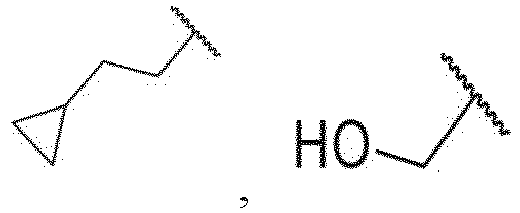 Ra4 is hydrogen or C1-6 alkyl,R5 is hydrogen,
 R6 and R7 are each independently hydrogen, halo, trifluoromethyl or trifluoromethoxy,Rc3 is hydrogen, halo, C1-6 alkyl, C3-6 cycloalkyl,W1, W2 and W3 are each independently oxygen, nitrogen, CHRw1, CRw1, NRw1 or CO,wherein, Rw1 is hydrogen, halo, C1-6 alkyl, C3-6 cycloalkyl, halo C1-6 alkyl, C1-6 alkylamine, C1-6 alkyl alcohol,
- The compound according to claim 1, whereinR3 and R4 are each independently hydrogen, halo, cyano, C1-6 alkyl, C3-6 cycloalkyl, trifluoromethyl,


 wherein, m is 1 or 2,Ra1 and Ra2 are each independently hydrogen, methyl, ethyl, isopropyl, tert-butyl, cyclopropyl, trifluoroethyl,
 Ra3 is hydrogen, methyl, ethyl, propyl, tert-butyl, cyclopropyl, trifluoromethyl,
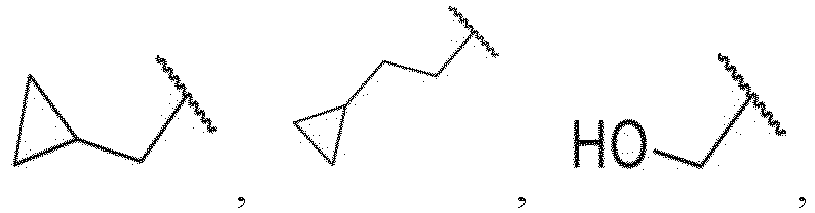 Ra4 is hydrogen or methyl,Rc3 is hydrogen or methyl,Rw1 is hydrogen, methyl, ethyl, propyl, cyclopropyl,


- The compound according to claim 1, whereinR1 and R2 are each independently hydrogen, chloro or trifluoromethyl,wherein, when the Z is
 R3 and R4 are each independently hydrogen, chloro, fluoro, iodo, cyano, methyl, ethyl, isopropyl, cyclopropyl, trifluoromethyl,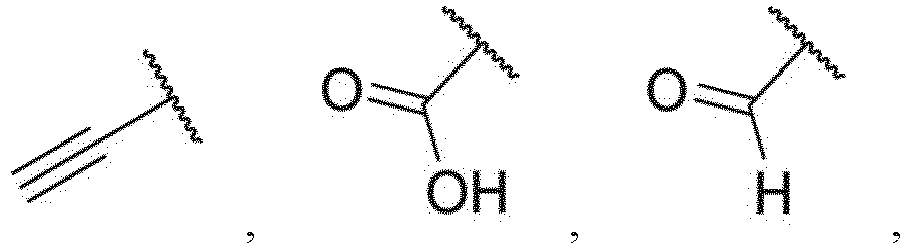
 wherein, Ra1 and Ra2 are each independently hydrogen, methyl, ethyl, isopropyl, tert-butyl, cyclopropyl, trifluoroethyl,
 Ra3 is hydrogen, methyl, ethyl, tert-butyl, cyclopropyl, trifluoromethyl,
 Ra4 is hydrogen, methyl or ethyl.
 - The compound according to claim 1, wherein R1 and R2 are each independently hydrogen, chloro or fluoro,wherein, when the Z is
 n is 0 or 1,R5 is
 W1, W2 and W3 are each independently oxygen, nitrogen, CRw1 or NRw1,wherein, Rw1 is hydrogen, methyl, ethyl, isopropyl, cyclopropyl,

- The compound according to claim 1, wherein, the compound represented by Formula I is selected from the group consisting of the following compounds:4-((4-((5-cyclopropyl-3-(2,6-dichlorophenyl)isoxazol-4-yl)methoxy)phenyl)ethynyl)benzoic acid;3-((4-((5-cyclopropyl-3-(2,6-dichlorophenyl)isoxazol-4-yl)methoxy)phenyl)ethynyl)benzoic acid;3-((4-((5-cyclopropyl-3-(2,6-dichlorophenyl)isoxazol-4-yl)methoxy)-2-(trifluoromethyl)phenyl)ethynyl)benzoic acid;4-((4-((5-cyclopropyl-3-(2,6-dichlorophenyl)isoxazol-4-yl)methoxy)-2-(trifluoromethyl)phenyl)ethynyl)benzoic acid;4-((3-chloro-4-ethynylphenoxy)methyl)-5-cyclopropyl-3-(2,6-dichlorophenyl)isoxazole4-((3-chloro-4-(phenylethynyl)phenoxy)methyl)-5-cyclopropyl-3-(2,6-dichlorophenyl)isoxazole;methyl 3-((2-chloro-4-((5-cyclopropyl-3-(2,6-dichlorophenyl)isoxazol- 4-yl)methoxy)phenyl)ethynyl)benzoate;methyl 3-((2-chloro-4-((5-cyclopropyl-3-(2,6-dichlorophenyl)isoxazol- 4-yl)methoxy)phenyl)ethynyl)-5-((ethoxycarbonyl)amino)benzoate;methyl 3-((tert-butoxycarbonyl)amino)-5-((2-chloro-4-((5-cyclopropyl- 3-(2,6-dichlorophenyl)isoxazol-4-yl)methoxy)phenyl)ethynyl)benzoate;methyl 3-((2-chloro-4-((5-cyclopropyl-3-(2,6-dichlorophenyl)isoxazol- 4-yl)methoxy)phenyl)ethynyl)-5-((ethoxycarbonyl)(methyl)amino)benzoate;ethyl (3-((2-chloro-4-((5-cyclopropyl-3-(2,6-dichlorophenyl)isoxazol- 4-yl)methoxy)phenyl)ethynyl)phenyl)carbamate;3-((2-chloro-4-((5-cyclopropyl-3-(2,6-dichlorophenyl)isoxazol-4-yl)methoxy)phenyl)ethynyl)benzenesulfonamide;N-(3-((2-chloro-4-((5-cyclopropyl-3-(2,6-dichlorophenyl)isoxazol-4-yl)methoxy)phenyl)ethynyl)phenyl)methanesulfonamide;N-(3-((2-chloro-4-((5-cyclopropyl-3-(2,6-dichlorophenyl)isoxazol-4-yl)methoxy)phenyl)ethynyl)phenyl)sulfamide;3-((2-chloro-4-((5-cyclopropyl-3-(2,6-dichlorophenyl)isoxazol-4-yl)methoxy)phenyl)ethynyl)benzoic acid;4-((2-chloro-4-((5-cyclopropyl-3-(2,6-dichlorophenyl)isoxazol-4-yl)methoxy)phenyl)ethynyl)benzoic acid;6-((2-chloro-4-((5-cyclopropyl-3-(2,6-dichlorophenyl)isoxazol-4-yl)methoxy)phenyl)ethynyl)nicotinic acid;2-((2-chloro-4-((5-cyclopropyl-3-(2,6-dichlorophenyl)isoxazol-4-yl)methoxy)phenyl)ethynyl)isonicotinic acid;6-((2-chloro-4-((5-cyclopropyl-3-(2,6-dichlorophenyl)isoxazol-4-yl)methoxy)phenyl)ethynyl)picolinic acid;5-((2-chloro-4-((5-cyclopropyl-3-(2,6-dichlorophenyl)isoxazol-4-yl)methoxy)phenyl)ethynyl)nicotinic acid;3-((2-chloro-4-((5-cyclopropyl-3-(2,6-dichlorophenyl)isoxazol-4-yl)methoxy)phenyl)ethynyl)-5-(dimethylamino)benzoic acid;4-((2-chloro-4-((5-cyclopropyl-3-(2,6-dichlorophenyl)isoxazol-4-yl)methoxy)phenyl)ethynyl)-3-(dimethylamino)benzoic acid;4-((2-chloro-4-((5-cyclopropyl-3-(2,6-dichlorophenyl)isoxazol-4-yl)methoxy)phenyl)ethynyl)-2-(dimethylamino)benzoic acid;3-((2-chloro-4-((5-cyclopropyl-3-(2,6-dichlorophenyl)isoxazol-4-yl)methoxy)phenyl)ethynyl)-5-(diethylamino)benzoic acid;3-amino-5-((2-chloro-4-((5-cyclopropyl-3-(2,6-dichlorophenyl)isoxazol-4-yl)methoxy)phenyl)ethynyl)benzoic acid;3-((2-chloro-4-((5-cyclopropyl-3-(2,6-dichlorophenyl)isoxazol-4-yl)methoxy)phenyl)ethynyl)-4-(dimethylamino)benzoic acid;3-chloro-5-((2-chloro-4-((5-cyclopropyl-3-(2,6-dichlorophenyl)isoxazol-4-yl)methoxy)phenyl)ethynyl)benzoic acid;4-chloro-3-((2-chloro-4-((5-cyclopropyl-3-(2,6-dichlorophenyl)isoxazol-4-yl)methoxy)phenyl)ethynyl)benzoic acid;2-chloro-5-((2-chloro-4-((5-cyclopropyl-3-(2,6-dichlorophenyl)isoxazol-4-yl)methoxy)phenyl)ethynyl)benzoic acid;3-((2-chloro-4-((5-cyclopropyl-3-(2,6-dichlorophenyl)isoxazol-4-yl)methoxy)phenyl)ethynyl)-5 -fluorobenzoic acid;3-((2-chloro-4-((5-cyclopropyl-3-(2,6-dichlorophenyl)isoxazol-4-yl)methoxy)phenyl)ethynyl)-5-(trifluoromethyl)benzoic acid;3-((2-chloro-4-((5-cyclopropyl-3-(2,6-dichlorophenyl)isoxazol-4-yl)methoxy)phenyl)ethynyl)-5-ethynylbenzoic acid;3-((2-chloro-4-((5-cyclopropyl-3-(2,6-dichlorophenyl)isoxazol-4-yl)methoxy)phenyl)ethynyl)-5-cyanobenzoic acid;3-((2,6-dichloro-4-((5-cyclopropyl-3-(2,6-dichlorophenyl)isoxazol-4-yl)methoxy)phenyl)ethynyl)benzoic acid;2-chloro-3-((2-chloro-4-((5-cyclopropyl-3-(2,6-dichlorophenyl)isoxazol-4-yl)methoxy)phenyl)ethynyl)benzoic acid;3-((2-chloro-4-((5-cyclopropyl-3-(2,6-dichlorophenyl)isoxazol-4-yl)methoxy)phenyl)ethynyl)-2-fluorobenzoic acid;5-((2-chloro-4-((5-cyclopropyl-3-(2,6-dichlorophenyl)isoxazol-4-yl)methoxy)phenyl)ethynyl)-2-fluorobenzoic acid;3-((2-chloro-4-((5-cyclopropyl-3-(2,6-dichlorophenyl)isoxazol-4-yl)methoxy)phenyl)ethynyl)-4-fluorobenzoic acid;3-((2-chloro-4-((5-cyclopropyl-3-(2,6-dichlorophenyl)isoxazol-4-yl)methoxy)phenyl)ethynyl)-5-(trifluoromethoxy)benzoic acid;3-((2-chloro-4-((5-cyclopropyl-3-(2,6-dichlorophenyl)isoxazol-4-yl)methoxy)phenyl)ethynyl)-5 -methoxybenzoic acid;3-((2-chloro-4-((5-cyclopropyl-3-(2,6-dichlorophenyl)isoxazol-4-yl)methoxy)phenyl)ethynyl)-5-formylbenzoic acid;3-((2-chloro-4-((5-cyclopropyl-3-(2,6-dichlorophenyl)isoxazol-4-yl)methoxy)phenyl)ethynyl)-5-((cyclopropylamino)methyl)benzoic acid;3-(azetidin-1-ylmethyl)-5-((2-chloro-4-((5-cyclopropyl-3-(2,6-dichlorophenyl)isoxazol-4-yl)methoxy)phenyl)ethynyl)benzoic acid;3-((2-chloro-4-((5-cyclopropyl-3-(2,6-dichlorophenyl)isoxazol-4-yl)methoxy)phenyl)ethynyl)-5-((methylamino)methyl)benzoic acid;3-((2-chloro-4-((5-cyclopropyl-3-(2,6-dichlorophenyl)isoxazol-4-yl)methoxy)phenyl)ethynyl)-5-((ethylamino)methyl)benzoic acid;3-((2-chloro-4-((5-cyclopropyl-3-(2,6-dichlorophenyl)isoxazol-4-yl)methoxy)phenyl)ethynyl)-5-(((2,2,2-trifluoroethyl)amino)methyl)benzoic acid;3-((2-chloro-4-((5-cyclopropyl-3-(2,6-dichlorophenyl)isoxazol-4-yl)methoxy)phenyl)ethynyl)-5-((isopropylamino)methyl)benzoic acid;3-((tert-butylamino)methyl)-5-((2-chloro-4-((5-cyclopropyl-3-(2,6-dichlorophenyl)isoxazol-4-yl)methoxy)phenyl)ethynyl)benzoic acid;3-((2-chloro-4-((5-cyclopropyl-3-(2,6-dichlorophenyl)isoxazol-4-yl)methoxy)phenyl)ethynyl)-5-((dimethylamino)methyl)benzoic acid;3-((2-chloro-4-((5-cyclopropyl-3-(2,6-dichlorophenyl)isoxazol-4-yl)methoxy)phenyl)ethynyl)-5-(morpholinomethyl)benzoic acid;3-((2-chloro-4-((5-cyclopropyl-3-(2,6-dichlorophenyl)isoxazol-4-yl)methoxy)phenyl)ethynyl)-5-((oxetan-3-ylamino)methyl)benzoic acid;3-((2-chloro-4-((5-cyclopropyl-3-(2,6-dichlorophenyl)isoxazol-4-yl)methoxy)phenyl)ethynyl)-5-(methylamino)benzoic acid;3-((2-chloro-4-((5-cyclopropyl-3-(2,6-dichlorophenyl)isoxazol-4-yl)methoxy)phenyl)ethynyl)-5-(ethylamino)benzoic acid;3-((2-chloro-4-((5-cyclopropyl-3-(2,6-dichlorophenyl)isoxazol-4-yl)methoxy)phenyl)ethynyl)-5-(isopropylamino)benzoic acid;3-(azetidin-1-yl)-5-((2-chloro-4-((5-cyclopropyl-3-(2,6-dichlorophenyl)isoxazol-4-yl)methoxy)phenyl)ethynyl)benzoic acid;3-((2-chloro-4-((5-cyclopropyl-3-(2,6-dichlorophenyl)isoxazol-4-yl)methoxy)phenyl)ethynyl)-5-(pyrrolidin-1-yl)benzoic acid;3-(azetidin-3-ylamino)-5-((2-chloro-4-((5-cyclopropyl-3-(2,6-dichlorophenyl)isoxazol-4-yl)methoxy)phenyl)ethynyl)benzoic acid hydrochloride;3-((2-chloro-4-((5-cyclopropyl-3-(2,6-dichlorophenyl)isoxazol-4-yl)methoxy)phenyl)ethynyl)-5-(piperidin-4-ylamino)benzoic acid hydrochloride;3-((2-chloro-4-((5-cyclopropyl-3-(2,6-dichlorophenyl)isoxazol-4-yl)methoxy)phenyl)ethynyl)-5-(piperazin-1-yl)benzoic acid hydrochloride;3-amino-5-((2-chloro-4-((5-cyclopropyl-3-(2,6-dichlorophenyl)isoxazol-4-yl)methoxy)phenyl)ethynyl)-4-methylbenzoic acid;3-amino-5-((2-chloro-4-((5-cyclopropyl-3-(2,6-dichlorophenyl)isoxazol-4-yl)methoxy)phenyl)ethynyl)-4-methoxybenzoic acid;3-amino-5-((2-chloro-4-((5-cyclopropyl-3-(2,6-dichlorophenyl)isoxazol-4-yl)methoxy)phenyl)ethynyl)-2-methoxybenzoic acid;3-((2-chloro-4-((5-cyclopropyl-3-(2,6-dichlorophenyl)isoxazol-4-yl)methoxy)phenyl)ethynyl)-5-methylbenzoic acid;3-((2-chloro-4-((5-cyclopropyl-3-(2,6-dichlorophenyl)isoxazol-4-yl)methoxy)phenyl)ethynyl)-5-cyclopropylbenzoic acid;3-((2-chloro-4-((5-cyclopropyl-3-(2,6-dichlorophenyl)isoxazol-4-yl)methoxy)phenyl)ethynyl)-5-ethylbenzoic acid;3-((2-chloro-4-((5-cyclopropyl-3-(2,6-dichlorophenyl)isoxazol-4-yl)methoxy)phenyl)ethynyl)-5-isopropylbenzoic acid;3-((2-chloro-4-((5-cyclopropyl-3-(2,6-dichlorophenyl)isoxazol-4-yl)methoxy)phenyl)ethynyl)-5-iodobenzoic acid;3-((2,5-dichloro-4-((5-cyclopropyl-3-(2,6-dichlorophenyl)isoxazol-4-yl)methoxy)phenyl)ethynyl)benzoic acid;3-((2,3-dichloro-4-((5-cyclopropyl-3-(2,6-dichlorophenyl)isoxazol-4-yl)methoxy)phenyl)ethynyl)benzoic acid;3-((2-chloro-4-((5-cyclopropyl-3-(2,6-dichlorophenyl)isoxazol-4-yl)methoxy)-6-fluorophenyl)ethynyl)benzoic acid;3-amino-5-((2-chloro-4-((5-cyclopropyl-3-(2,6-dichlorophenyl)isoxazol-4-yl)methoxy)phenyl)ethynyl)-2-methylbenzoic acid;3-((2-chloro-4-((5-cyclopropyl-3-(2,6-dichlorophenyl)isoxazol-4-yl)methoxy)phenyl)ethynyl)-5-(3-ethylureido)benzoic acid;3-acetamido-5-((2-chloro-4-((5-cyclopropyl-3-(2,6-dichlorophenyl)isoxazol-4-yl)methoxy)phenyl)ethynyl)benzoic acid;3-((2-chloro-4-((5-cyclopropyl-3-(2,6-dichlorophenyl)isoxazol-4-yl)methoxy)phenyl)ethynyl)-5-((ethoxycarbonyl)amino)benzoic acid;3-((2-chloro-4-((5-cyclopropyl-3-(2,6-dichlorophenyl)isoxazol-4-yl)methoxy)phenyl)ethynyl)-5-((ethoxycarbonyl)(methyl)amino)benzoic acid;3-((2-chloro-4-((5-cyclopropyl-3-(2,6-dichlorophenyl)isoxazol-4-yl)methoxy)phenyl)ethynyl)-5-((cyclopropoxycarbonyl)amino)benzoic acid;3-((tert-butoxycarbonyl)amino)-5-((2-chloro-4-((5-cyclopropyl-3-(2,6-dichlorophenyl)isoxazol-4-yl)methoxy)phenyl)ethynyl)benzoic acid;3-((tert-butoxycarbonyl)(methyl)amino)-5-((2-chloro-4-((5-cyclopropyl-3-(2,6-dichlorophenyl)isoxazol-4-yl)methoxy)phenyl)ethynyl)benzoic acid;3-((2-chloro-4-((5-cyclopropyl-3-(2,6-dichlorophenyl)isoxazol-4-yl)methoxy)phenyl)ethynyl)-5-(((cyclopropylmethoxy)carbonyl)amino)benzoic acid;3-((2-chloro-4-((5-cyclopropyl-3-(2,6-dichlorophenyl)isoxazol-4-yl)methoxy)phenyl)ethynyl)-5-(((2-cyclopropylethoxy)carbonyl)amino)benzoic acid;3-((2-chloro-4-((5-cyclopropyl-3-(2,6-dichlorophenyl)isoxazol-4-yl)methoxy)phenyl)ethynyl)-5-(((2-hydroxyethoxy)carbonyl)amino)benzoic acid;3-(((azetidin-3-yloxy)carbonyl)amino)-5-((2-chloro-4-((5-cyclopropyl-3-(2,6-dichlorophenyl)isoxazol-4-yl)methoxy)phenyl)ethynyl)benzoic acid;3-((2-chloro-4-((5-cyclopropyl-3-(2,6-dichlorophenyl)isoxazol-4-yl)methoxy)phenyl)ethynyl)-5-(2-oxooxazolidin-3-yl)benzoic acid;5-((2-chloro-4-((5-cyclopropyl-3-(2,6-dichlorophenyl)isoxazol-4-yl)methoxy)phenyl)ethynyl)isophthalic acid;3-((2-chloro-4-((5-cyclopropyl-3-(2,6-dichlorophenyl)isoxazol-4-yl)methoxy)phenyl)ethynyl)-5-(piperazine-1-carbonyl)benzoic acid hydrochloride;3-((2-chloro-4-((5-cyclopropyl-3-(2,6-dichlorophenyl)isoxazol-4-yl)methoxy)phenyl)ethynyl)-5-(methylsulfonamido)benzoic acid;3-((2-chloro-4-((5-cyclopropyl-3-(2-(trifluoromethyl)phenyl)isoxazol-4-yl)methoxy)phenyl)ethynyl)benzoic acid;3-((2-chloro-4-((5-cyclopropyl-3-(2-(trifluoromethoxy)phenyl)isoxazol-4-yl)methoxy)phenyl)ethynyl)benzoic acid;4-((2-chloro-4-((5-cyclopropyl-3-(2,6-dichlorophenyl)isoxazol-4-yl)methoxy)phenyl)ethynyl)-1H-indazole-6-carboxylic acid;4-((2-chloro-4-((5-cyclopropyl-3-(2,6-dichlorophenyl)isoxazol-4-yl)methoxy)phenyl)ethynyl)-1H-benzo[d]imidazole-6-carboxylic acid;4-((2-chloro-4-((5-cyclopropyl-3-(2,6-dichlorophenyl)isoxazol-4-yl)methoxy)phenyl)ethynyl)-1H-indole-6-carboxylic acid;4-((2-chloro-4-((5-cyclopropyl-3-(2,6-dichlorophenyl)isoxazol-4-yl)methoxy)phenyl)ethynyl)-1-(2-(dimethylamino)ethyl)-1H-indole-6-carboxylic acid;4-((2-chloro-4-((5-cyclopropyl-3-(2,6-dichlorophenyl)isoxazol-4-yl)methoxy)phenyl)ethynyl)-1-(3-(isopropylamino)propyl)-1H-indole-6-carboxylic acid;4-((2-chloro-4-((5-cyclopropyl-3-(2,6-dichlorophenyl)isoxazol-4-yl)methoxy)phenyl)ethynyl)-1-(pyridin-4-ylmethyl)-1H-indole-6-carboxylic acid;4-((2-chloro-4-((5-cyclopropyl-3-(2,6-dichlorophenyl)isoxazol-4-yl)methoxy)phenyl)ethynyl)-1-(2-morpholinoethyl)-1H-indole-6-carboxylic acid hydrochloride;4-((2-chloro-4-((5-cyclopropyl-3-(2,6-dichlorophenyl)isoxazol-4-yl)methoxy)phenyl)ethynyl)-1-(2,2-dimethoxyethyl)-1H-indole-6-carboxylic acid;4-((2-chloro-4-((5-cyclopropyl-3-(2,6-dichlorophenyl)isoxazol-4-yl)methoxy)phenyl)ethynyl)-1-(2-hydroxyethyl)-1H-indole-6-carboxylic acid;4-((2-chloro-4-((5-cyclopropyl-3-(2,6-dichlorophenyl)isoxazol-4-yl)methoxy)phenyl)ethynyl)-1-(2-hydroxy-2-methylpropyl)-1H-indole-6-carboxylic acid;6-((2-chloro-4-((5-cyclopropyl-3-(2,6-dichlorophenyl)isoxazol-4-yl)methoxy)phenyl)ethynyl)-1H-indazole-4-carboxylic acid;5-((2-chloro-4-((5-cyclopropyl-3-(2,6-dichlorophenyl) isoxazol-4-yl)methoxy)phenyl)ethynyl)-2,3-dihydrobenzofuran-7-carboxylic acid;6-((2-chloro-4-((5-cyclopropyl-3-(2,6-dichlorophenyl)isoxazol-4-yl)methoxy)phenyl)ethynyl)-1H-indole-4-carboxylic acid;5-((2-chloro-4-((5-cyclopropyl-3-(2,6-dichlorophenyl)isoxazol-4-yl)methoxy)phenyl)ethynyl)benzo[d]oxazole-7-carboxylic acid;5-((2-chloro-4-((5-cyclopropyl-3-(2,6-dichlorophenyl)isoxazol-4-yl)methoxy)phenyl)ethynyl)-2-methylbenzo[d]oxazole-7-carboxylic acid;5-((2-chloro-4-((5-cyclopropyl-3-(2,6-dichlorophenyl)isoxazol-4-yl)methoxy)phenyl)ethynyl)-2-ethylbenzo[d]oxazole-7-carboxylic acid;5-((2-chloro-4-((5-cyclopropyl-3-(2,6-dichlorophenyl)isoxazol-4-yl)methoxy)phenyl)ethynyl)-2-propylbenzo[d]oxazole-7-carboxylic acid;5-((2-chloro-4-((5-cyclopropyl-3-(2,6-dichlorophenyl)isoxazol-4-yl)methoxy)phenyl)ethynyl)-2-isopropylbenzo[d]oxazole-7-carboxylic acid;5-((2-chloro-4-((5-cyclopropyl-3-(2,6-dichlorophenyl)isoxazol-4-yl)methoxy)phenyl)ethynyl)-2-(hydroxymethyl)benzo[d]oxazole-7-carboxylic acid;7-((2-chloro-4-((5-cyclopropyl-3-(2,6-dichlorophenyl)isoxazol-4-yl)methoxy)phenyl)ethynyl)quinoxaline-5-carboxylic acid;7-((2-chloro-4-((5-cyclopropyl-3-(2,6-dichlorophenyl)isoxazol-4-yl)methoxy)phenyl)ethynyl)-2,3-dimethylquinoxaline-5-carboxylic acid;5-((2-chloro-4-((5-cyclopropyl-3-(2,6-dichlorophenyl)isoxazol-4-yl)methoxy)phenyl)ethynyl)-2-cyclopropylbenzo[d]oxazole-7-carboxylic acid;2-butyl-5-((2-chloro-4-((5-cyclopropyl-3-(2,6-dichlorophenyl)isoxazol-4-yl)methoxy)phenyl)ethynyl)benzo[d]oxazole-7-carboxylic acid;6-((2-chloro-4-((5-cyclopropyl-3-(2,6-dichlorophenyl)isoxazol-4-yl)methoxy)phenyl)ethynyl)-2-methylbenzo[d]oxazole-4-carboxylic acid;6-((2-chloro-4-((5-cyclopropyl-3-(2,6-dichlorophenyl)isoxazol-4-yl)methoxy)phenyl)ethynyl)-2-ethylbenzo[d]oxazole-4-carboxylic acid;6-((2-chloro-4-((5-cyclopropyl-3-(2,6-dichlorophenyl)isoxazol-4-yl)methoxy)phenyl)ethynyl)-2-propylbenzo[d]oxazole-4-carboxylic acid; and6-((2-chloro-4-((5-cyclopropyl-3-(2,6-dichlorophenyl)isoxazol-4-yl)methoxy)phenyl)ethynyl)-2-isopropylbenzo[d]oxazole-4-carboxylic acid.
- A pharmaceutical composition for use in the treatment, prevention, or amelioration of metabolic diseases, cholestatic liver diseases and organ fibrosis comprising the compound according to any one of claims 1-5.
- The pharmaceutical composition for use according to claim 6, wherein, the metabolic diseases, cholestatic liver diseases and organ fibrosis are treated, prevented, or ameliorated by activation of FXR receptors.
- The pharmaceutical composition for use according to claim 6,
wherein, the metabolic diseases, cholestatic liver diseases and organ fibrosis are selected from the group consisting of hypercholesterolemia, hyperlipoproteinemia, hypertriglyceridemia, dyslipidemia, lipodystrophy, cholestasis/fibrosis, cholesterol gallstone disease, gastrointestinal disease or condition, hyperglycemia, diabetes, insulin resistance, metabolic inflexibility, nephropathy, liver diseases, atherosclerosis, cancer, inflammatory disorders, osteoporosis and skin aging.
Priority Applications (5)
| Application Number | Priority Date | Filing Date | Title |
|---|---|---|---|
| SI201830504T SI3612520T1 (en) | 2017-04-12 | 2018-04-12 | Isoxazole derivatives as nuclear receptor agonists and uses thereof |
| SM20220175T SMT202200175T1 (en) | 2017-04-12 | 2018-04-12 | Isoxazole derivatives as nuclear receptor agonists and uses thereof |
| HRP20220026TT HRP20220026T1 (en) | 2017-04-12 | 2018-04-12 | Isoxazole derivatives as nuclear receptor agonists and uses thereof |
| RS20211546A RS62711B1 (en) | 2017-04-12 | 2018-04-12 | Isoxazole derivatives as nuclear receptor agonists and uses thereof |
| PL18785171T PL3612520T3 (en) | 2017-04-12 | 2018-04-12 | Isoxazole derivatives as nuclear receptor agonists and uses thereof |
Applications Claiming Priority (2)
| Application Number | Priority Date | Filing Date | Title |
|---|---|---|---|
| KR20170047393 | 2017-04-12 | ||
| PCT/KR2018/004277 WO2018190643A1 (en) | 2017-04-12 | 2018-04-12 | An isoxazole derivatives as nuclear receptor agonists and used thereof |
Publications (3)
| Publication Number | Publication Date |
|---|---|
| EP3612520A1 EP3612520A1 (en) | 2020-02-26 |
| EP3612520A4 EP3612520A4 (en) | 2020-12-09 |
| EP3612520B1 true EP3612520B1 (en) | 2021-11-10 |
Family
ID=64102389
Family Applications (1)
| Application Number | Title | Priority Date | Filing Date |
|---|---|---|---|
| EP18785171.2A Active EP3612520B1 (en) | 2017-04-12 | 2018-04-12 | Isoxazole derivatives as nuclear receptor agonists and uses thereof |
Country Status (28)
| Country | Link |
|---|---|
| US (3) | US10988449B2 (en) |
| EP (1) | EP3612520B1 (en) |
| JP (1) | JP6886074B2 (en) |
| KR (2) | KR102168543B1 (en) |
| CN (1) | CN110678450B (en) |
| AU (1) | AU2018252880B2 (en) |
| CA (1) | CA3059869C (en) |
| CL (1) | CL2019002893A1 (en) |
| CY (1) | CY1124936T1 (en) |
| DK (1) | DK3612520T3 (en) |
| ES (1) | ES2904294T3 (en) |
| HR (1) | HRP20220026T1 (en) |
| HU (1) | HUE057429T2 (en) |
| IL (1) | IL269896B (en) |
| LT (1) | LT3612520T (en) |
| MX (2) | MX394743B (en) |
| MY (1) | MY198265A (en) |
| NZ (1) | NZ758117A (en) |
| PE (1) | PE20191792A1 (en) |
| PH (1) | PH12019502326A1 (en) |
| PL (1) | PL3612520T3 (en) |
| PT (1) | PT3612520T (en) |
| RS (1) | RS62711B1 (en) |
| RU (1) | RU2741306C1 (en) |
| SG (1) | SG11201908235RA (en) |
| SI (1) | SI3612520T1 (en) |
| SM (1) | SMT202200175T1 (en) |
| ZA (1) | ZA201906541B (en) |
Families Citing this family (9)
| Publication number | Priority date | Publication date | Assignee | Title |
|---|---|---|---|---|
| CN110128432B (en) | 2018-02-02 | 2021-03-02 | 广东东阳光药业有限公司 | Nitrogen-containing tricyclic compounds and their application in medicine |
| KR102740618B1 (en) * | 2021-11-17 | 2024-12-10 | 유노비아 주식회사 | Preparation method of isoxazole derivatives and intermediates thereof |
| WO2023090859A1 (en) * | 2021-11-17 | 2023-05-25 | 일동제약(주) | Method for preparing isoxazole derivative, and novel intermediate therefor |
| WO2024005587A1 (en) * | 2022-06-30 | 2024-01-04 | 일동제약(주) | Novel use of isoxazole derivative or salt thereof |
| TW202408494A (en) * | 2022-06-30 | 2024-03-01 | 南韓商日東製藥股份有限公司 | Novel crystalline form of isoxazole derivate and salt thereof and pharmaceutical composition including the same |
| US11905260B1 (en) | 2023-10-13 | 2024-02-20 | King Faisal University | N′-(1-naphthoyloxy)-2-(benzo[d]oxazol-2-yl)acetimidamide as an antimicrobial compound |
| US11970467B1 (en) | 2023-10-13 | 2024-04-30 | King Faisal University | N′-(2-naphthoyloxy)-2-(benzo[d]oxazol-2-yl)acetimidamide as an antimicrobial compound |
| US12122770B1 (en) * | 2023-10-23 | 2024-10-22 | King Faisal University | 2-(benzo[d]oxazol-2-yl)-n'-(nicotinoyloxy)acetimidamide as an antimicrobial compound |
| CN119751356B (en) * | 2024-12-26 | 2026-04-17 | 苏州艾缇克药物化学有限公司 | A method for preparing 1H-imidazolium-4-carboxylic acid based on a supported copper-based catalyst |
Family Cites Families (25)
| Publication number | Priority date | Publication date | Assignee | Title |
|---|---|---|---|---|
| ES2326850T3 (en) * | 1998-12-23 | 2009-10-20 | Glaxo Group Limited | TESTS FOR NUCLEAR RECEPTORS LIGANDOS. |
| DE10130020A1 (en) * | 2001-06-25 | 2003-12-04 | Gruenenthal Gmbh | Substituted 1-oxa-2,8-diaza-spiro [4.5] dec-2-ene derivatives |
| EP1285914B1 (en) | 2001-08-13 | 2007-12-19 | PheneX Pharmaceuticals AG | Nr1h4 nuclear receptor binding compounds |
| US6987121B2 (en) | 2002-04-25 | 2006-01-17 | Smithkline Beecham Corporation | Compositions and methods for hepatoprotection and treatment of cholestasis |
| JP2006515838A (en) | 2002-11-22 | 2006-06-08 | スミスクライン ビーチャム コーポレーション | Farnesoid X receptor agonist |
| CA2633243C (en) | 2005-12-15 | 2014-05-27 | Exelixis, Inc. | Azepinoindole derivatives as pharmaceutical agents |
| WO2007076260A2 (en) | 2005-12-19 | 2007-07-05 | Smithkline Beecham Corporation | Farnesoid x receptor agonists |
| JP5301286B2 (en) | 2006-02-03 | 2013-09-25 | イーライ リリー アンド カンパニー | Compounds and methods for modulating FX receptors |
| JP2007230909A (en) | 2006-03-01 | 2007-09-13 | Univ Of Tokyo | Substituted isoxazole derivatives |
| AU2007267692B2 (en) * | 2006-05-24 | 2012-06-14 | Eli Lilly And Company | Compounds and methods for modulating FXR |
| DK2029547T3 (en) | 2006-05-24 | 2010-07-26 | Lilly Co Eli | FXR agonists |
| EP1894924A1 (en) | 2006-08-29 | 2008-03-05 | Phenex Pharmaceuticals AG | Heterocyclic FXR binding compounds |
| EP1894928A1 (en) | 2006-08-29 | 2008-03-05 | PheneX Pharmaceuticals AG | Heterocyclic fxr binding compounds |
| CL2007003035A1 (en) | 2006-10-24 | 2008-05-16 | Smithkline Beechman Corp | COMPOUNDS DERIVED FROM ISOXAZOL REPLACED, FARNESOID X RECEIVER AGONISTS; PREPARATION PROCEDURE; PHARMACEUTICAL COMPOSITION THAT UNDERSTANDS IT; AND USE OF THE COMPOUND IN THE TREATMENT OF OBESITY, DIABETES MELLITUS, FIBROSIS IN ORGANS, |
| EA200901512A1 (en) | 2007-06-13 | 2010-06-30 | ГЛАКСОСМИТКЛАЙН ЭлЭлСи | PHARNESIDE X-RECEPTORS AGONISTS |
| AU2008270784A1 (en) | 2007-07-02 | 2009-01-08 | Glaxosmithkline Llc | Farnesoid X receptor agonists |
| TW200906823A (en) | 2007-07-16 | 2009-02-16 | Lilly Co Eli | Compounds and methods for modulating FXR |
| EP2128158A1 (en) * | 2008-05-26 | 2009-12-02 | Phenex Pharmaceuticals AG | Heterocyclic cyclopropyl-substituted FXR binding compounds |
| EP2289883A1 (en) | 2009-08-19 | 2011-03-02 | Phenex Pharmaceuticals AG | Novel FXR (NR1H4) binding and activity modulating compounds |
| CU24152B1 (en) | 2010-12-20 | 2016-02-29 | Irm Llc | 1,2 OXAZOL-8-AZABICICLO [3,2,1] OCTANO 8 IL AS FXR MODULATORS |
| EP2545964A1 (en) | 2011-07-13 | 2013-01-16 | Phenex Pharmaceuticals AG | Novel FXR (NR1H4) binding and activity modulating compounds |
| WO2013037482A1 (en) | 2011-09-15 | 2013-03-21 | Phenex Pharmaceuticals Ag | Farnesoid x receptor agonists for cancer treatment and prevention |
| EP3034499A1 (en) | 2014-12-17 | 2016-06-22 | Gilead Sciences, Inc. | Novel FXR (NR1H4) modulating compounds |
| EP3034501A1 (en) | 2014-12-17 | 2016-06-22 | Gilead Sciences, Inc. | Hydroxy containing FXR (NR1H4) modulating compounds |
| KR20170095965A (en) | 2014-12-18 | 2017-08-23 | 노파르티스 아게 | Azabicyclooctane derivatives as fxr agonists for use in the treatment of liver and gastrointestinal diseases |
-
2018
- 2018-04-12 JP JP2020506694A patent/JP6886074B2/en active Active
- 2018-04-12 AU AU2018252880A patent/AU2018252880B2/en active Active
- 2018-04-12 DK DK18785171.2T patent/DK3612520T3/en active
- 2018-04-12 HU HUE18785171A patent/HUE057429T2/en unknown
- 2018-04-12 LT LTEPPCT/KR2018/004277T patent/LT3612520T/en unknown
- 2018-04-12 CA CA3059869A patent/CA3059869C/en active Active
- 2018-04-12 KR KR1020180042545A patent/KR102168543B1/en active Active
- 2018-04-12 SM SM20220175T patent/SMT202200175T1/en unknown
- 2018-04-12 PE PE2019002025A patent/PE20191792A1/en unknown
- 2018-04-12 CN CN201880024769.3A patent/CN110678450B/en active Active
- 2018-04-12 PL PL18785171T patent/PL3612520T3/en unknown
- 2018-04-12 SI SI201830504T patent/SI3612520T1/en unknown
- 2018-04-12 ES ES18785171T patent/ES2904294T3/en active Active
- 2018-04-12 PT PT187851712T patent/PT3612520T/en unknown
- 2018-04-12 SG SG11201908235R patent/SG11201908235RA/en unknown
- 2018-04-12 IL IL269896A patent/IL269896B/en unknown
- 2018-04-12 US US16/604,180 patent/US10988449B2/en active Active
- 2018-04-12 EP EP18785171.2A patent/EP3612520B1/en active Active
- 2018-04-12 HR HRP20220026TT patent/HRP20220026T1/en unknown
- 2018-04-12 MY MYPI2019006047A patent/MY198265A/en unknown
- 2018-04-12 NZ NZ758117A patent/NZ758117A/en unknown
- 2018-04-12 MX MX2019012167A patent/MX394743B/en unknown
- 2018-04-12 RS RS20211546A patent/RS62711B1/en unknown
- 2018-04-12 RU RU2019132135A patent/RU2741306C1/en active
-
2019
- 2019-10-04 ZA ZA2019/06541A patent/ZA201906541B/en unknown
- 2019-10-10 CL CL2019002893A patent/CL2019002893A1/en unknown
- 2019-10-10 MX MX2022006823A patent/MX2022006823A/en unknown
- 2019-10-11 PH PH12019502326A patent/PH12019502326A1/en unknown
-
2020
- 2020-10-14 KR KR1020200132983A patent/KR102301152B1/en active Active
-
2021
- 2021-03-04 US US17/191,806 patent/US11912674B2/en active Active
-
2022
- 2022-02-01 CY CY20221100082T patent/CY1124936T1/en unknown
-
2024
- 2024-01-23 US US18/420,478 patent/US20240262799A1/en not_active Abandoned
Also Published As
Similar Documents
| Publication | Publication Date | Title |
|---|---|---|
| KR102301152B1 (en) | Isoxazole derivatives as nuclear receptor agonist and uses thereof | |
| TWI606039B (en) | APZ receptor triazole agonist | |
| WO2018190643A1 (en) | An isoxazole derivatives as nuclear receptor agonists and used thereof | |
| EP2215049B1 (en) | P2x3, receptor antagonists for treatment of pain | |
| TW202200559A (en) | Glp-1 receptor agonists, pharmaceutical composition comprising the same and method for preparing the same | |
| EP1670757B1 (en) | Pyrrole and pyrazole derivatives as potentiators of glutamate receptors | |
| CN104066729A (en) | Lysophosphatidic acid receptor antagonists | |
| CN102657656A (en) | Composition and methods for modulating a kinase cascade | |
| CN106470985A (en) | Indane as soluble guanylate cyclase activators and indolin derivatives and application thereof | |
| CN106470989A (en) | Thiophene 2 yl pyridines 2 base 1H pyrazoles 4 formic acid derivates and its purposes as soluble guanylate cyclase activators | |
| WO2015024448A1 (en) | Benzo piperidine ring and benzo morpholine ring compounds, manufacturing method therefor, and medical applications thereof | |
| EP1254134A2 (en) | 1,3-dihydro-2h-indol-2-one derivatives,and their use as ligands for v1b or v1b and v1a arginine-vasopressin-receptors | |
| FR2967674A1 (en) | HETEROARYLSULFONAMIDE DERIVATIVES, THEIR PREPARATION AND THEIR APPLICATION IN HUMAN THERAPEUTICS | |
| TW200812962A (en) | New compounds I/418 | |
| CN113727973A (en) | Substituted amide compounds useful as farnesoid X receptor modulators | |
| CN108026069A (en) | 2,3,4,5- tetrahydropyridine -6- amine derivatives | |
| HK40017121A (en) | An isoxazole derivatives as nuclear receptor agonists and used thereof | |
| HK40017121B (en) | An isoxazole derivatives as nuclear receptor agonists and used thereof | |
| BR112019021320B1 (en) | COMPOUND AND PHARMACEUTICAL COMPOSITION | |
| CN113677659A (en) | Substituted amide compounds useful as farnesoid X receptor modulators | |
| WO2026051663A1 (en) | SELECTIVE THYROID HORMONE RECEPTOR-β AGONIST, PHARMACEUTICAL COMPOSITION COMPRISING SAME, AND USE THEREOF | |
| CN118546109A (en) | Nitrogen-containing heterocyclic compound and medical application thereof | |
| JP2026509368A (en) | Inhibitors of TDP-43 and tau aggregation | |
| TW201000461A (en) | New compounds useful in pain therapy |
Legal Events
| Date | Code | Title | Description |
|---|---|---|---|
| REG | Reference to a national code |
Ref country code: HR Ref legal event code: TUEP Ref document number: P20220026 Country of ref document: HR |
|
| STAA | Information on the status of an ep patent application or granted ep patent |
Free format text: STATUS: THE INTERNATIONAL PUBLICATION HAS BEEN MADE |
|
| PUAI | Public reference made under article 153(3) epc to a published international application that has entered the european phase |
Free format text: ORIGINAL CODE: 0009012 |
|
| STAA | Information on the status of an ep patent application or granted ep patent |
Free format text: STATUS: REQUEST FOR EXAMINATION WAS MADE |
|
| 17P | Request for examination filed |
Effective date: 20191008 |
|
| AK | Designated contracting states |
Kind code of ref document: A1 Designated state(s): AL AT BE BG CH CY CZ DE DK EE ES FI FR GB GR HR HU IE IS IT LI LT LU LV MC MK MT NL NO PL PT RO RS SE SI SK SM TR |
|
| AX | Request for extension of the european patent |
Extension state: BA ME |
|
| RIN1 | Information on inventor provided before grant (corrected) |
Inventor name: JEONG, JIN-AH Inventor name: HWANG, HEY-MIN Inventor name: KWON, SUNG-WOOK Inventor name: PARK, SUN-YOUNG Inventor name: KANG, JAE-HOON Inventor name: KIM, KYEO-JIN Inventor name: KIM, JEONG-GUEN Inventor name: LEE, YOON-SUK Inventor name: SONG, DONG-KEUN Inventor name: CHOI, JI-HYE Inventor name: LEE, HONG-SUB Inventor name: KIM, KYUNG-SUN |
|
| DAV | Request for validation of the european patent (deleted) | ||
| DAX | Request for extension of the european patent (deleted) | ||
| A4 | Supplementary search report drawn up and despatched |
Effective date: 20201110 |
|
| RIC1 | Information provided on ipc code assigned before grant |
Ipc: A61K 31/42 20060101ALI20201104BHEP Ipc: A61P 3/00 20060101ALI20201104BHEP Ipc: C07D 261/08 20060101AFI20201104BHEP |
|
| GRAP | Despatch of communication of intention to grant a patent |
Free format text: ORIGINAL CODE: EPIDOSNIGR1 |
|
| STAA | Information on the status of an ep patent application or granted ep patent |
Free format text: STATUS: GRANT OF PATENT IS INTENDED |
|
| INTG | Intention to grant announced |
Effective date: 20210706 |
|
| GRAS | Grant fee paid |
Free format text: ORIGINAL CODE: EPIDOSNIGR3 |
|
| GRAA | (expected) grant |
Free format text: ORIGINAL CODE: 0009210 |
|
| STAA | Information on the status of an ep patent application or granted ep patent |
Free format text: STATUS: THE PATENT HAS BEEN GRANTED |
|
| AK | Designated contracting states |
Kind code of ref document: B1 Designated state(s): AL AT BE BG CH CY CZ DE DK EE ES FI FR GB GR HR HU IE IS IT LI LT LU LV MC MK MT NL NO PL PT RO RS SE SI SK SM TR |
|
| REG | Reference to a national code |
Ref country code: GB Ref legal event code: FG4D |
|
| REG | Reference to a national code |
Ref country code: AT Ref legal event code: REF Ref document number: 1445982 Country of ref document: AT Kind code of ref document: T Effective date: 20211115 Ref country code: CH Ref legal event code: EP |
|
| REG | Reference to a national code |
Ref country code: DE Ref legal event code: R096 Ref document number: 602018026568 Country of ref document: DE |
|
| REG | Reference to a national code |
Ref country code: DK Ref legal event code: T3 Effective date: 20211203 |
|
| REG | Reference to a national code |
Ref country code: IE Ref legal event code: FG4D |
|
| REG | Reference to a national code |
Ref country code: FI Ref legal event code: FGE |
|
| REG | Reference to a national code |
Ref country code: SE Ref legal event code: TRGR |
|
| REG | Reference to a national code |
Ref country code: PT Ref legal event code: SC4A Ref document number: 3612520 Country of ref document: PT Date of ref document: 20220106 Kind code of ref document: T Free format text: AVAILABILITY OF NATIONAL TRANSLATION Effective date: 20211229 |
|
| REG | Reference to a national code |
Ref country code: NL Ref legal event code: FP |
|
| REG | Reference to a national code |
Ref country code: RO Ref legal event code: EPE |
|
| REG | Reference to a national code |
Ref country code: NO Ref legal event code: T2 Effective date: 20211110 |
|
| REG | Reference to a national code |
Ref country code: GR Ref legal event code: EP Ref document number: 20220400134 Country of ref document: GR Effective date: 20220211 |
|
| REG | Reference to a national code |
Ref country code: EE Ref legal event code: FG4A Ref document number: E021897 Country of ref document: EE Effective date: 20220118 |
|
| REG | Reference to a national code |
Ref country code: HR Ref legal event code: ODRP Ref document number: P20220026 Country of ref document: HR Payment date: 20220308 Year of fee payment: 5 |
|
| REG | Reference to a national code |
Ref country code: HR Ref legal event code: T1PR Ref document number: P20220026 Country of ref document: HR |
|
| REG | Reference to a national code |
Ref country code: ES Ref legal event code: FG2A Ref document number: 2904294 Country of ref document: ES Kind code of ref document: T3 Effective date: 20220404 |
|
| REG | Reference to a national code |
Ref country code: SK Ref legal event code: T3 Ref document number: E 39184 Country of ref document: SK |
|
| REG | Reference to a national code |
Ref country code: HU Ref legal event code: AG4A Ref document number: E057429 Country of ref document: HU |
|
| REG | Reference to a national code |
Ref country code: DE Ref legal event code: R097 Ref document number: 602018026568 Country of ref document: DE |
|
| PLBE | No opposition filed within time limit |
Free format text: ORIGINAL CODE: 0009261 |
|
| STAA | Information on the status of an ep patent application or granted ep patent |
Free format text: STATUS: NO OPPOSITION FILED WITHIN TIME LIMIT |
|
| 26N | No opposition filed |
Effective date: 20220811 |
|
| REG | Reference to a national code |
Ref country code: AT Ref legal event code: UEP Ref document number: 1445982 Country of ref document: AT Kind code of ref document: T Effective date: 20211110 |
|
| REG | Reference to a national code |
Ref country code: HR Ref legal event code: ODRP Ref document number: P20220026 Country of ref document: HR Payment date: 20230321 Year of fee payment: 6 |
|
| P01 | Opt-out of the competence of the unified patent court (upc) registered |
Effective date: 20230615 |
|
| REG | Reference to a national code |
Ref country code: HR Ref legal event code: ODRP Ref document number: P20220026 Country of ref document: HR Payment date: 20240328 Year of fee payment: 7 |
|
| PGFP | Annual fee paid to national office [announced via postgrant information from national office to epo] |
Ref country code: SI Payment date: 20250408 Year of fee payment: 8 |
|
| REG | Reference to a national code |
Ref country code: HR Ref legal event code: ODRP Ref document number: P20220026 Country of ref document: HR Payment date: 20250403 Year of fee payment: 8 |
|
| PGFP | Annual fee paid to national office [announced via postgrant information from national office to epo] |
Ref country code: NL Payment date: 20250407 Year of fee payment: 8 |
|
| PGFP | Annual fee paid to national office [announced via postgrant information from national office to epo] |
Ref country code: LU Payment date: 20250407 Year of fee payment: 8 |
|
| PGFP | Annual fee paid to national office [announced via postgrant information from national office to epo] |
Ref country code: SM Payment date: 20250410 Year of fee payment: 8 |
|
| PGFP | Annual fee paid to national office [announced via postgrant information from national office to epo] |
Ref country code: MC Payment date: 20250408 Year of fee payment: 8 |
|
| PGFP | Annual fee paid to national office [announced via postgrant information from national office to epo] |
Ref country code: FI Payment date: 20250407 Year of fee payment: 8 |
|
| PGFP | Annual fee paid to national office [announced via postgrant information from national office to epo] |
Ref country code: PL Payment date: 20250403 Year of fee payment: 8 Ref country code: DE Payment date: 20250407 Year of fee payment: 8 |
|
| PGFP | Annual fee paid to national office [announced via postgrant information from national office to epo] |
Ref country code: GB Payment date: 20250407 Year of fee payment: 8 Ref country code: ES Payment date: 20250516 Year of fee payment: 8 Ref country code: DK Payment date: 20250410 Year of fee payment: 8 |
|
| PGFP | Annual fee paid to national office [announced via postgrant information from national office to epo] |
Ref country code: LT Payment date: 20250404 Year of fee payment: 8 |
|
| PGFP | Annual fee paid to national office [announced via postgrant information from national office to epo] |
Ref country code: HU Payment date: 20250526 Year of fee payment: 8 Ref country code: IS Payment date: 20250425 Year of fee payment: 8 Ref country code: RS Payment date: 20250403 Year of fee payment: 8 Ref country code: NO Payment date: 20250422 Year of fee payment: 8 |
|
| PGFP | Annual fee paid to national office [announced via postgrant information from national office to epo] |
Ref country code: AL Payment date: 20250425 Year of fee payment: 8 Ref country code: BE Payment date: 20250407 Year of fee payment: 8 Ref country code: IT Payment date: 20250408 Year of fee payment: 8 |
|
| PGFP | Annual fee paid to national office [announced via postgrant information from national office to epo] |
Ref country code: HR Payment date: 20250403 Year of fee payment: 8 |
|
| PGFP | Annual fee paid to national office [announced via postgrant information from national office to epo] |
Ref country code: PT Payment date: 20250408 Year of fee payment: 8 Ref country code: LV Payment date: 20250408 Year of fee payment: 8 |
|
| PGFP | Annual fee paid to national office [announced via postgrant information from national office to epo] |
Ref country code: FR Payment date: 20250408 Year of fee payment: 8 Ref country code: EE Payment date: 20250407 Year of fee payment: 8 |
|
| PGFP | Annual fee paid to national office [announced via postgrant information from national office to epo] |
Ref country code: MT Payment date: 20250407 Year of fee payment: 8 Ref country code: BG Payment date: 20250404 Year of fee payment: 8 Ref country code: GR Payment date: 20250407 Year of fee payment: 8 |
|
| PGFP | Annual fee paid to national office [announced via postgrant information from national office to epo] |
Ref country code: CH Payment date: 20250501 Year of fee payment: 8 |
|
| PGFP | Annual fee paid to national office [announced via postgrant information from national office to epo] |
Ref country code: RO Payment date: 20250407 Year of fee payment: 8 Ref country code: AT Payment date: 20250407 Year of fee payment: 8 |
|
| PGFP | Annual fee paid to national office [announced via postgrant information from national office to epo] |
Ref country code: TR Payment date: 20250407 Year of fee payment: 8 Ref country code: SK Payment date: 20250408 Year of fee payment: 8 |
|
| PGFP | Annual fee paid to national office [announced via postgrant information from national office to epo] |
Ref country code: CZ Payment date: 20250403 Year of fee payment: 8 |
|
| PGFP | Annual fee paid to national office [announced via postgrant information from national office to epo] |
Ref country code: IE Payment date: 20250423 Year of fee payment: 8 |
|
| PGFP | Annual fee paid to national office [announced via postgrant information from national office to epo] |
Ref country code: SE Payment date: 20250408 Year of fee payment: 8 |
|
| PGFP | Annual fee paid to national office [announced via postgrant information from national office to epo] |
Ref country code: MK Payment date: 20250404 Year of fee payment: 8 |
|
| PGFP | Annual fee paid to national office [announced via postgrant information from national office to epo] |
Ref country code: CY Payment date: 20250404 Year of fee payment: 8 |