EP3611149A1 - Self-healing environmental barrier coating - Google Patents
Self-healing environmental barrier coating Download PDFInfo
- Publication number
- EP3611149A1 EP3611149A1 EP19192162.6A EP19192162A EP3611149A1 EP 3611149 A1 EP3611149 A1 EP 3611149A1 EP 19192162 A EP19192162 A EP 19192162A EP 3611149 A1 EP3611149 A1 EP 3611149A1
- Authority
- EP
- European Patent Office
- Prior art keywords
- phase
- article
- sio
- self
- environmental barrier
- Prior art date
- Legal status (The legal status is an assumption and is not a legal conclusion. Google has not performed a legal analysis and makes no representation as to the accuracy of the status listed.)
- Pending
Links
Images



Classifications
-
- C—CHEMISTRY; METALLURGY
- C04—CEMENTS; CONCRETE; ARTIFICIAL STONE; CERAMICS; REFRACTORIES
- C04B—LIME, MAGNESIA; SLAG; CEMENTS; COMPOSITIONS THEREOF, e.g. MORTARS, CONCRETE OR LIKE BUILDING MATERIALS; ARTIFICIAL STONE; CERAMICS; REFRACTORIES; TREATMENT OF NATURAL STONE
- C04B41/00—After-treatment of mortars, concrete, artificial stone or ceramics; Treatment of natural stone
- C04B41/80—After-treatment of mortars, concrete, artificial stone or ceramics; Treatment of natural stone of only ceramics
- C04B41/81—Coating or impregnation
- C04B41/85—Coating or impregnation with inorganic materials
-
- C—CHEMISTRY; METALLURGY
- C04—CEMENTS; CONCRETE; ARTIFICIAL STONE; CERAMICS; REFRACTORIES
- C04B—LIME, MAGNESIA; SLAG; CEMENTS; COMPOSITIONS THEREOF, e.g. MORTARS, CONCRETE OR LIKE BUILDING MATERIALS; ARTIFICIAL STONE; CERAMICS; REFRACTORIES; TREATMENT OF NATURAL STONE
- C04B35/00—Shaped ceramic products characterised by their composition; Ceramics compositions; Processing powders of inorganic compounds preparatory to the manufacturing of ceramic products
- C04B35/01—Shaped ceramic products characterised by their composition; Ceramics compositions; Processing powders of inorganic compounds preparatory to the manufacturing of ceramic products based on oxide ceramics
- C04B35/14—Shaped ceramic products characterised by their composition; Ceramics compositions; Processing powders of inorganic compounds preparatory to the manufacturing of ceramic products based on oxide ceramics based on silica
-
- C—CHEMISTRY; METALLURGY
- C04—CEMENTS; CONCRETE; ARTIFICIAL STONE; CERAMICS; REFRACTORIES
- C04B—LIME, MAGNESIA; SLAG; CEMENTS; COMPOSITIONS THEREOF, e.g. MORTARS, CONCRETE OR LIKE BUILDING MATERIALS; ARTIFICIAL STONE; CERAMICS; REFRACTORIES; TREATMENT OF NATURAL STONE
- C04B35/00—Shaped ceramic products characterised by their composition; Ceramics compositions; Processing powders of inorganic compounds preparatory to the manufacturing of ceramic products
- C04B35/622—Forming processes; Processing powders of inorganic compounds preparatory to the manufacturing of ceramic products
- C04B35/62222—Forming processes; Processing powders of inorganic compounds preparatory to the manufacturing of ceramic products obtaining ceramic coatings
-
- C—CHEMISTRY; METALLURGY
- C04—CEMENTS; CONCRETE; ARTIFICIAL STONE; CERAMICS; REFRACTORIES
- C04B—LIME, MAGNESIA; SLAG; CEMENTS; COMPOSITIONS THEREOF, e.g. MORTARS, CONCRETE OR LIKE BUILDING MATERIALS; ARTIFICIAL STONE; CERAMICS; REFRACTORIES; TREATMENT OF NATURAL STONE
- C04B35/00—Shaped ceramic products characterised by their composition; Ceramics compositions; Processing powders of inorganic compounds preparatory to the manufacturing of ceramic products
- C04B35/622—Forming processes; Processing powders of inorganic compounds preparatory to the manufacturing of ceramic products
- C04B35/626—Preparing or treating the powders individually or as batches ; preparing or treating macroscopic reinforcing agents for ceramic products, e.g. fibres; mechanical aspects section B
- C04B35/63—Preparing or treating the powders individually or as batches ; preparing or treating macroscopic reinforcing agents for ceramic products, e.g. fibres; mechanical aspects section B using additives specially adapted for forming the products, e.g.. binder binders
- C04B35/6303—Inorganic additives
-
- C—CHEMISTRY; METALLURGY
- C04—CEMENTS; CONCRETE; ARTIFICIAL STONE; CERAMICS; REFRACTORIES
- C04B—LIME, MAGNESIA; SLAG; CEMENTS; COMPOSITIONS THEREOF, e.g. MORTARS, CONCRETE OR LIKE BUILDING MATERIALS; ARTIFICIAL STONE; CERAMICS; REFRACTORIES; TREATMENT OF NATURAL STONE
- C04B41/00—After-treatment of mortars, concrete, artificial stone or ceramics; Treatment of natural stone
- C04B41/009—After-treatment of mortars, concrete, artificial stone or ceramics; Treatment of natural stone characterised by the material treated
-
- C—CHEMISTRY; METALLURGY
- C04—CEMENTS; CONCRETE; ARTIFICIAL STONE; CERAMICS; REFRACTORIES
- C04B—LIME, MAGNESIA; SLAG; CEMENTS; COMPOSITIONS THEREOF, e.g. MORTARS, CONCRETE OR LIKE BUILDING MATERIALS; ARTIFICIAL STONE; CERAMICS; REFRACTORIES; TREATMENT OF NATURAL STONE
- C04B41/00—After-treatment of mortars, concrete, artificial stone or ceramics; Treatment of natural stone
- C04B41/45—Coating or impregnating, e.g. injection in masonry, partial coating of green or fired ceramics, organic coating compositions for adhering together two concrete elements
- C04B41/50—Coating or impregnating, e.g. injection in masonry, partial coating of green or fired ceramics, organic coating compositions for adhering together two concrete elements with inorganic materials
- C04B41/5024—Silicates
-
- C—CHEMISTRY; METALLURGY
- C04—CEMENTS; CONCRETE; ARTIFICIAL STONE; CERAMICS; REFRACTORIES
- C04B—LIME, MAGNESIA; SLAG; CEMENTS; COMPOSITIONS THEREOF, e.g. MORTARS, CONCRETE OR LIKE BUILDING MATERIALS; ARTIFICIAL STONE; CERAMICS; REFRACTORIES; TREATMENT OF NATURAL STONE
- C04B41/00—After-treatment of mortars, concrete, artificial stone or ceramics; Treatment of natural stone
- C04B41/45—Coating or impregnating, e.g. injection in masonry, partial coating of green or fired ceramics, organic coating compositions for adhering together two concrete elements
- C04B41/52—Multiple coating or impregnating multiple coating or impregnating with the same composition or with compositions only differing in the concentration of the constituents, is classified as single coating or impregnation
-
- C—CHEMISTRY; METALLURGY
- C04—CEMENTS; CONCRETE; ARTIFICIAL STONE; CERAMICS; REFRACTORIES
- C04B—LIME, MAGNESIA; SLAG; CEMENTS; COMPOSITIONS THEREOF, e.g. MORTARS, CONCRETE OR LIKE BUILDING MATERIALS; ARTIFICIAL STONE; CERAMICS; REFRACTORIES; TREATMENT OF NATURAL STONE
- C04B41/00—After-treatment of mortars, concrete, artificial stone or ceramics; Treatment of natural stone
- C04B41/80—After-treatment of mortars, concrete, artificial stone or ceramics; Treatment of natural stone of only ceramics
- C04B41/81—Coating or impregnation
- C04B41/89—Coating or impregnation for obtaining at least two superposed coatings having different compositions
-
- C—CHEMISTRY; METALLURGY
- C23—COATING METALLIC MATERIAL; COATING MATERIAL WITH METALLIC MATERIAL; CHEMICAL SURFACE TREATMENT; DIFFUSION TREATMENT OF METALLIC MATERIAL; COATING BY VACUUM EVAPORATION, BY SPUTTERING, BY ION IMPLANTATION OR BY CHEMICAL VAPOUR DEPOSITION, IN GENERAL; INHIBITING CORROSION OF METALLIC MATERIAL OR INCRUSTATION IN GENERAL
- C23C—COATING METALLIC MATERIAL; COATING MATERIAL WITH METALLIC MATERIAL; SURFACE TREATMENT OF METALLIC MATERIAL BY DIFFUSION INTO THE SURFACE, BY CHEMICAL CONVERSION OR SUBSTITUTION; COATING BY VACUUM EVAPORATION, BY SPUTTERING, BY ION IMPLANTATION OR BY CHEMICAL VAPOUR DEPOSITION, IN GENERAL
- C23C26/00—Coating not provided for in groups C23C2/00 - C23C24/00
-
- C—CHEMISTRY; METALLURGY
- C23—COATING METALLIC MATERIAL; COATING MATERIAL WITH METALLIC MATERIAL; CHEMICAL SURFACE TREATMENT; DIFFUSION TREATMENT OF METALLIC MATERIAL; COATING BY VACUUM EVAPORATION, BY SPUTTERING, BY ION IMPLANTATION OR BY CHEMICAL VAPOUR DEPOSITION, IN GENERAL; INHIBITING CORROSION OF METALLIC MATERIAL OR INCRUSTATION IN GENERAL
- C23C—COATING METALLIC MATERIAL; COATING MATERIAL WITH METALLIC MATERIAL; SURFACE TREATMENT OF METALLIC MATERIAL BY DIFFUSION INTO THE SURFACE, BY CHEMICAL CONVERSION OR SUBSTITUTION; COATING BY VACUUM EVAPORATION, BY SPUTTERING, BY ION IMPLANTATION OR BY CHEMICAL VAPOUR DEPOSITION, IN GENERAL
- C23C4/00—Coating by spraying the coating material in the molten state, e.g. by flame, plasma or electric discharge
- C23C4/12—Coating by spraying the coating material in the molten state, e.g. by flame, plasma or electric discharge characterised by the method of spraying
- C23C4/134—Plasma spraying
-
- F—MECHANICAL ENGINEERING; LIGHTING; HEATING; WEAPONS; BLASTING
- F01—MACHINES OR ENGINES IN GENERAL; ENGINE PLANTS IN GENERAL; STEAM ENGINES
- F01D—NON-POSITIVE DISPLACEMENT MACHINES OR ENGINES, e.g. STEAM TURBINES
- F01D5/00—Blades; Blade-carrying members; Heating, heat-insulating, cooling or antivibration means on the blades or the members
- F01D5/12—Blades
- F01D5/28—Selecting particular materials; Particular measures relating thereto; Measures against erosion or corrosion
- F01D5/284—Selection of ceramic materials
-
- F—MECHANICAL ENGINEERING; LIGHTING; HEATING; WEAPONS; BLASTING
- F01—MACHINES OR ENGINES IN GENERAL; ENGINE PLANTS IN GENERAL; STEAM ENGINES
- F01D—NON-POSITIVE DISPLACEMENT MACHINES OR ENGINES, e.g. STEAM TURBINES
- F01D5/00—Blades; Blade-carrying members; Heating, heat-insulating, cooling or antivibration means on the blades or the members
- F01D5/12—Blades
- F01D5/28—Selecting particular materials; Particular measures relating thereto; Measures against erosion or corrosion
- F01D5/288—Protective coatings for blades
-
- C—CHEMISTRY; METALLURGY
- C04—CEMENTS; CONCRETE; ARTIFICIAL STONE; CERAMICS; REFRACTORIES
- C04B—LIME, MAGNESIA; SLAG; CEMENTS; COMPOSITIONS THEREOF, e.g. MORTARS, CONCRETE OR LIKE BUILDING MATERIALS; ARTIFICIAL STONE; CERAMICS; REFRACTORIES; TREATMENT OF NATURAL STONE
- C04B2235/00—Aspects relating to ceramic starting mixtures or sintered ceramic products
- C04B2235/02—Composition of constituents of the starting material or of secondary phases of the final product
- C04B2235/30—Constituents and secondary phases not being of a fibrous nature
- C04B2235/34—Non-metal oxides, non-metal mixed oxides, or salts thereof that form the non-metal oxides upon heating, e.g. carbonates, nitrates, (oxy)hydroxides, chlorides
- C04B2235/3418—Silicon oxide, silicic acids or oxide forming salts thereof, e.g. silica sol, fused silica, silica fume, cristobalite, quartz or flint
-
- C—CHEMISTRY; METALLURGY
- C04—CEMENTS; CONCRETE; ARTIFICIAL STONE; CERAMICS; REFRACTORIES
- C04B—LIME, MAGNESIA; SLAG; CEMENTS; COMPOSITIONS THEREOF, e.g. MORTARS, CONCRETE OR LIKE BUILDING MATERIALS; ARTIFICIAL STONE; CERAMICS; REFRACTORIES; TREATMENT OF NATURAL STONE
- C04B2235/00—Aspects relating to ceramic starting mixtures or sintered ceramic products
- C04B2235/02—Composition of constituents of the starting material or of secondary phases of the final product
- C04B2235/30—Constituents and secondary phases not being of a fibrous nature
- C04B2235/38—Non-oxide ceramic constituents or additives
- C04B2235/3895—Non-oxides with a defined oxygen content, e.g. SiOC, TiON
-
- C—CHEMISTRY; METALLURGY
- C04—CEMENTS; CONCRETE; ARTIFICIAL STONE; CERAMICS; REFRACTORIES
- C04B—LIME, MAGNESIA; SLAG; CEMENTS; COMPOSITIONS THEREOF, e.g. MORTARS, CONCRETE OR LIKE BUILDING MATERIALS; ARTIFICIAL STONE; CERAMICS; REFRACTORIES; TREATMENT OF NATURAL STONE
- C04B2235/00—Aspects relating to ceramic starting mixtures or sintered ceramic products
- C04B2235/70—Aspects relating to sintered or melt-casted ceramic products
- C04B2235/96—Properties of ceramic products, e.g. mechanical properties such as strength, toughness, wear resistance
- C04B2235/9669—Resistance against chemicals, e.g. against molten glass or molten salts
- C04B2235/9684—Oxidation resistance
-
- F—MECHANICAL ENGINEERING; LIGHTING; HEATING; WEAPONS; BLASTING
- F05—INDEXING SCHEMES RELATING TO ENGINES OR PUMPS IN VARIOUS SUBCLASSES OF CLASSES F01-F04
- F05D—INDEXING SCHEME FOR ASPECTS RELATING TO NON-POSITIVE-DISPLACEMENT MACHINES OR ENGINES, GAS-TURBINES OR JET-PROPULSION PLANTS
- F05D2220/00—Application
- F05D2220/30—Application in turbines
- F05D2220/32—Application in turbines in gas turbines
-
- F—MECHANICAL ENGINEERING; LIGHTING; HEATING; WEAPONS; BLASTING
- F05—INDEXING SCHEMES RELATING TO ENGINES OR PUMPS IN VARIOUS SUBCLASSES OF CLASSES F01-F04
- F05D—INDEXING SCHEME FOR ASPECTS RELATING TO NON-POSITIVE-DISPLACEMENT MACHINES OR ENGINES, GAS-TURBINES OR JET-PROPULSION PLANTS
- F05D2230/00—Manufacture
- F05D2230/30—Manufacture with deposition of material
- F05D2230/31—Layer deposition
- F05D2230/312—Layer deposition by plasma spraying
-
- F—MECHANICAL ENGINEERING; LIGHTING; HEATING; WEAPONS; BLASTING
- F05—INDEXING SCHEMES RELATING TO ENGINES OR PUMPS IN VARIOUS SUBCLASSES OF CLASSES F01-F04
- F05D—INDEXING SCHEME FOR ASPECTS RELATING TO NON-POSITIVE-DISPLACEMENT MACHINES OR ENGINES, GAS-TURBINES OR JET-PROPULSION PLANTS
- F05D2240/00—Components
- F05D2240/10—Stators
- F05D2240/12—Fluid guiding means, e.g. vanes
-
- F—MECHANICAL ENGINEERING; LIGHTING; HEATING; WEAPONS; BLASTING
- F05—INDEXING SCHEMES RELATING TO ENGINES OR PUMPS IN VARIOUS SUBCLASSES OF CLASSES F01-F04
- F05D—INDEXING SCHEME FOR ASPECTS RELATING TO NON-POSITIVE-DISPLACEMENT MACHINES OR ENGINES, GAS-TURBINES OR JET-PROPULSION PLANTS
- F05D2240/00—Components
- F05D2240/20—Rotors
- F05D2240/30—Characteristics of rotor blades, i.e. of any element transforming dynamic fluid energy to or from rotational energy and being attached to a rotor
-
- F—MECHANICAL ENGINEERING; LIGHTING; HEATING; WEAPONS; BLASTING
- F05—INDEXING SCHEMES RELATING TO ENGINES OR PUMPS IN VARIOUS SUBCLASSES OF CLASSES F01-F04
- F05D—INDEXING SCHEME FOR ASPECTS RELATING TO NON-POSITIVE-DISPLACEMENT MACHINES OR ENGINES, GAS-TURBINES OR JET-PROPULSION PLANTS
- F05D2300/00—Materials; Properties thereof
- F05D2300/10—Metals, alloys or intermetallic compounds
- F05D2300/15—Rare earth metals, i.e. Sc, Y, lanthanides
-
- F—MECHANICAL ENGINEERING; LIGHTING; HEATING; WEAPONS; BLASTING
- F05—INDEXING SCHEMES RELATING TO ENGINES OR PUMPS IN VARIOUS SUBCLASSES OF CLASSES F01-F04
- F05D—INDEXING SCHEME FOR ASPECTS RELATING TO NON-POSITIVE-DISPLACEMENT MACHINES OR ENGINES, GAS-TURBINES OR JET-PROPULSION PLANTS
- F05D2300/00—Materials; Properties thereof
- F05D2300/20—Oxide or non-oxide ceramics
- F05D2300/21—Oxide ceramics
- F05D2300/2102—Glass
-
- F—MECHANICAL ENGINEERING; LIGHTING; HEATING; WEAPONS; BLASTING
- F05—INDEXING SCHEMES RELATING TO ENGINES OR PUMPS IN VARIOUS SUBCLASSES OF CLASSES F01-F04
- F05D—INDEXING SCHEME FOR ASPECTS RELATING TO NON-POSITIVE-DISPLACEMENT MACHINES OR ENGINES, GAS-TURBINES OR JET-PROPULSION PLANTS
- F05D2300/00—Materials; Properties thereof
- F05D2300/20—Oxide or non-oxide ceramics
- F05D2300/21—Oxide ceramics
- F05D2300/211—Silica
-
- F—MECHANICAL ENGINEERING; LIGHTING; HEATING; WEAPONS; BLASTING
- F05—INDEXING SCHEMES RELATING TO ENGINES OR PUMPS IN VARIOUS SUBCLASSES OF CLASSES F01-F04
- F05D—INDEXING SCHEME FOR ASPECTS RELATING TO NON-POSITIVE-DISPLACEMENT MACHINES OR ENGINES, GAS-TURBINES OR JET-PROPULSION PLANTS
- F05D2300/00—Materials; Properties thereof
- F05D2300/20—Oxide or non-oxide ceramics
- F05D2300/22—Non-oxide ceramics
- F05D2300/222—Silicon
-
- F—MECHANICAL ENGINEERING; LIGHTING; HEATING; WEAPONS; BLASTING
- F05—INDEXING SCHEMES RELATING TO ENGINES OR PUMPS IN VARIOUS SUBCLASSES OF CLASSES F01-F04
- F05D—INDEXING SCHEME FOR ASPECTS RELATING TO NON-POSITIVE-DISPLACEMENT MACHINES OR ENGINES, GAS-TURBINES OR JET-PROPULSION PLANTS
- F05D2300/00—Materials; Properties thereof
- F05D2300/20—Oxide or non-oxide ceramics
- F05D2300/22—Non-oxide ceramics
- F05D2300/226—Carbides
- F05D2300/2261—Carbides of silicon
-
- F—MECHANICAL ENGINEERING; LIGHTING; HEATING; WEAPONS; BLASTING
- F05—INDEXING SCHEMES RELATING TO ENGINES OR PUMPS IN VARIOUS SUBCLASSES OF CLASSES F01-F04
- F05D—INDEXING SCHEME FOR ASPECTS RELATING TO NON-POSITIVE-DISPLACEMENT MACHINES OR ENGINES, GAS-TURBINES OR JET-PROPULSION PLANTS
- F05D2300/00—Materials; Properties thereof
- F05D2300/60—Properties or characteristics given to material by treatment or manufacturing
- F05D2300/603—Composites; e.g. fibre-reinforced
- F05D2300/6033—Ceramic matrix composites [CMC]
-
- F—MECHANICAL ENGINEERING; LIGHTING; HEATING; WEAPONS; BLASTING
- F05—INDEXING SCHEMES RELATING TO ENGINES OR PUMPS IN VARIOUS SUBCLASSES OF CLASSES F01-F04
- F05D—INDEXING SCHEME FOR ASPECTS RELATING TO NON-POSITIVE-DISPLACEMENT MACHINES OR ENGINES, GAS-TURBINES OR JET-PROPULSION PLANTS
- F05D2300/00—Materials; Properties thereof
- F05D2300/60—Properties or characteristics given to material by treatment or manufacturing
- F05D2300/611—Coating
Definitions
- the disclosure relates to an article comprising a substrate containing silicon and an environmental barrier coating (EBC) which functions as a protective environmental barrier coating and inhibits the formation of gaseous species of Si, particularly SiOH) x when the article is exposed to a high temperature, steam-laden environment.
- EBC environmental barrier coating
- Ceramic materials containing silicon and metal alloys containing silicon have been proposed for structures used in high temperature applications as, for example, gas turbine engines, heat exchangers, internal combustion engines, and the like. A particular useful application for these materials is for use in gas turbine engines which operate at high temperatures in steam-laden environments.
- silicon containing structures can recess and lose mass as a result of formation of volatile silicon species, particularly Si(OH) x and SiO when exposed to high temperature, steam-laden environments.
- an environmental barrier coating comprising a substrate containing silicon, an environmental barrier layer applied to the substrate, the environmental barrier layer comprising an oxide matrix, an oxidant getter phase interspersed throughout the oxide matrix, and a self-healing phase interspersed throughout the oxide matrix.
- an article comprising a substrate containing silicon, an environmental barrier layer applied to the substrate, the environmental barrier layer comprising an oxide matrix, an oxidant getter phase interspersed throughout the oxide matrix, and a self-healing phase interspersed throughout the oxide matrix.
- the substrate may comprise a ceramic matrix composite material.
- the environmental barrier layer may comprise a SiO 2 rich phase.
- the self-healing phase may comprise a glass phase.
- the oxidant getter phase may comprise Si x O y C z where 0.5 ⁇ x ⁇ 1; 0 ⁇ y ⁇ 2; 0 ⁇ z ⁇ 2.
- the self-healing phase may comprise a material having properties of being in thermodynamic equilibrium with SiO 2 during operation at predetermined temperatures.
- the self-healing phase may comprise a material having properties of flowing into cracks formed in the matrix during operation at predetermined temperatures.
- the self-healing phase may comprise a material having properties of flowing into cracks formed in the matrix during operation at predetermined temperatures of from 1800 (982°C) - 3000 degrees Fahrenheit (1650°C) .
- the substrate may comprise a turbine vane or a turbine blade.
- the environmental barrier coating may further comprise a protective layer applied on the environmental barrier coating.
- an environmental barrier coating 10 formed over a substrate 12 of an article 14, configured to inhibit the formation of gaseous species of silicon when the article 14 is exposed to a high temperature, steam-laden environment.
- the substrate 12 can be associated with articles 14 such as a turbine vane and a turbine blade, and particularly a gas turbine engine component, such as components in the hot section of the gas turbine engine, including static and rotating components and portions of combustors, and the like.
- the substrate 12 can be constructed from materials containing silicon and can be a ceramic matrix composite material, a monolithic ceramic, a silicon-based or silicon containing ceramic substrate or a silicon containing metal alloy.
- the substrate 12 can be silicon containing ceramic material such as, for example, silicon carbide, silicon nitride, silicon oxy-nitride and silicon aluminum oxy-nitride, alkaline earth or rare earth silicate glasses or glass ceramics and combinations thereof. Examples can include barium strontium alumino silicate, strontium alumino silicate, lithium alumino silicate, aluminosilicate, mullite, yttrium silicate, ytterbium silicate, and the like.
- the silicon containing ceramic substrate comprises a silicon containing matrix with reinforcing materials 16 such as fibers, particles and the like and, more particularly, a silicon based matrix which is fiber-reinforced.
- a silicon carbide fiber-reinforced silicon carbide matrix is a silicon carbide fiber-reinforced silicon carbide matrix, a carbon fiber-reinforced silicon carbide matrix and a silicon carbide fiber-reinforced silicon nitride matrix.
- Particularly useful silicon-metal alloys for use as substrates for the article 14 can include molybdenum-silicon alloys, niobium-silicon alloys, iron-silicon alloys, and alloys of zirconium, hafnium, titanium, chromium, tungsten, boron, platinum, and tantalum.
- an environmental barrier layer 18 can be applied to the substrate 12 of the article 14 on a surface 20.
- a protective layer 22 can be applied on the environmental barrier layer 18.
- the protective layer 22 is configured to resist recession of the Si-containing volatile species when exposed to water vapor or steam.
- the protective layer 22 can include binary or multicomponent oxides such as HfO 2 , ZrO 2 , Gd 2 Hf 2 O 7 , Gd 2 Zr 2 O 7 , or refractory metal oxides.
- the protective layer 22 can include silicates with low(er) SiO 2 activities.
- the protective layer 22 can include (rare earth) RE-monosilicates, disilicates and (alkaline earth) AE alumino silicates, and silicates of Hafnium and zirconium.
- the environmental barrier layer 18 can include an oxide matrix 24 and an oxidant getter phase 26 interspersed throughout the oxide matrix 24.
- the oxide matrix 24 can include a multi-phase mixture, such as SiO 2 rich phase and a self-healing phase 28 that can include a glass phase.
- the composition of the self-healing phase can include 15% CaO, 10%AlO 1.5 , and 75% SiO 2 .
- the thermodynamically equilibrated phase constitution of this composition is shown in Figure 3 .
- Another exemplary embodiment is 10% CaO, 5%AlO 1.5 , and 85% SiO 2 .
- the thermodynamically equilibrated phase constitution of this composition is shown in Figure 4 .
- the composition of the oxide matrix 24 dictates the mole fraction of the glass and the SiO 2 .
- the self-healing phase 28 can include a material having properties that are in thermodynamic equilibrium with SiO 2 during operation at predetermined temperatures.
- the self-healing phase 28 comprises a material having properties of flowing into cracks 30 formed in the matrix 24 during operation at those predetermined temperatures.
- the self-healing phase 28 can be sufficiently fluid at high temperatures to flow into the cracks 30 in the coating 10, which imparts a self-healing functionality.
- the self-healing phase 28 can include doped silicates, compatible metals/metal alloys, non-oxide glasses, the SiO 2 itself, as well as any representative glass/glass ceramics such as barium alumino silicate (BAS), barium-magnesium alumino silicate (BMAS), lithium alumino silicate (LAS), and strontium alumino silicate (SAS).
- barium alumino silicate BAS
- BMAS barium-magnesium alumino silicate
- LAS lithium alumino silicate
- SAS strontium alumino silicate
- the volume fraction and viscosity of the self-healing liquid phase is shown in Figures 3-6 .
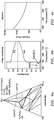
- Figs. 3a-3c show the diagram for the composition of 15% CaO, 10% AlO 1.5 and 75% SiO 2 .
- Figs. 4a-4c show the diagram for the composition 10% CaO, 5% AlO 1.5 and 85% SiO 2 .
- Figs. 5a-5c shows the diagram for the composition 2% BaO, 3% MgO, 10% AlO 1.5 and 85% SiO 2 .
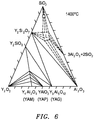
- Fig.6 shows the diagram for the composition 7% YO 1.5 , 13% AlO 1.5 and 80% SiO 2 .
- the oxidant getter phase can comprise silicon oxycarbide, Si x O y C z where 0.5 ⁇ x ⁇ 1; 0 ⁇ y ⁇ 2; 0 ⁇ z ⁇ 2.
- Figs, 3a-3c and 4a-4c show thermodynamic calculations describing the CaO-AlO 1.5 -SiO 2 (CAS) system.
- Two preferred embodiments of the self-healing matrix are considered in detail, 15% CaO, 10% AlO 1.5 and 75% SiO 2 , and 10% CaO, 5% AlO 1.5 and 85% SiO 2 .
- these compositions are 30-80% liquid phase.
- the viscosity of the liquid phase is generally greater than 100 Pa*s.
- thermodynamic equilibrium in exemplary cases greater than 2 phases will be in thermodynamic equilibrium.
- liquid-SiO 2 and CaAl 2 Si 2 O 8 in the CAS system having the composition 10% CaO, 10% AlO 1.5 and 80% SiO 2 , liquid-SiO 2 and CaAl 2 Si 2 O 8 (anorthite) will be in equilibrium at temperatures greater than 1185°C. The presence of anorthite does not interfere with the effect that the SiO 2 -liquid equilibrium has on maintaining the viscosity of the liquid at the desired level of greater than 100 Pa*s.
- Figures 5a-5c show thermodynamic calculations in the BaO-MgO-AlO 1.5 -SiO 2 system.
- a preferred embodiment of this system is 2% BaO, 3% MgO, 10% AlO 1.5 and 85% SiO 2 and is described in detail in Figs. 5a-5c .
- Similar to the CAS system a liquid+SiO 2 phase field exists, in this case BaAl 2 Si 2 O 8 and Mg 2 Al 4 Si 5 O 18 and possibly BaMg 2 Al 6 Si 9 O 30 are in equilibrium.
- the key feature is a liquid phase that is equilibrated with SiO 2 that has a viscosity of greater than 100 Pa*s.
- Figure 6 shows thermodynamic calculations in the YO 1.5 -AlO 1.5 -SiO 2 (YAS) system.
- An exemplary embodiment of this system is 7% YO 1.5 , 13% AlO 1.5 and 80% SiO 2 and is described in detail in Fig. 6 .
- a Y-Al-Si-O liquid is in equilibrium with SiO 2 .
- the environmental barrier layer 18 can be present on the substrate 12 at a thickness of greater than or equal to about 0.5 mils (0.0005 inch or 12.7 ⁇ m), preferably between about 3 to about 30 mils (76.2 to 762pm) and ideally between about 3 to about 5 mils (76.2 to 127 ⁇ m).
- the environmental barrier layer 18 can be applied by preparing a surface 20 of the substrate 12.
- the environmental barrier layer 18 can be applied to the substrate 12 by use of thermal spray methods, including air plasma spray, suspension plasma spray, low pressure or vacuum plasma spray, high velocity oxygen or air fuel spraying, and flame spraying, or vapor deposition, including atomic layer deposition, chemical vapor deposition, or electron-beam physical vapor deposition.
- thermal spray methods including air plasma spray, suspension plasma spray, low pressure or vacuum plasma spray, high velocity oxygen or air fuel spraying, and flame spraying
- vapor deposition including atomic layer deposition, chemical vapor deposition, or electron-beam physical vapor deposition.
- the environmental barrier layer 18 can be applied by slurry based methods including dip or spray coating, painting, electrophoretic deposition and the like.
- the disclosed environmental barrier coating 10 offers a robust composition for protecting components in the hot-section of gas turbine engines.
- the disclosed compositions form a multiphase matrix that consists of a liquid phase and silica at elevated temperatures.
- the compositions can be varied to create coatings with different properties for a desired application.
Landscapes
- Chemical & Material Sciences (AREA)
- Engineering & Computer Science (AREA)
- Ceramic Engineering (AREA)
- Materials Engineering (AREA)
- Organic Chemistry (AREA)
- Structural Engineering (AREA)
- Inorganic Chemistry (AREA)
- Manufacturing & Machinery (AREA)
- Mechanical Engineering (AREA)
- General Engineering & Computer Science (AREA)
- Physics & Mathematics (AREA)
- Plasma & Fusion (AREA)
- Chemical Kinetics & Catalysis (AREA)
- Metallurgy (AREA)
- Turbine Rotor Nozzle Sealing (AREA)
- Laminated Bodies (AREA)
- Other Surface Treatments For Metallic Materials (AREA)
Abstract
Description
- The disclosure relates to an article comprising a substrate containing silicon and an environmental barrier coating (EBC) which functions as a protective environmental barrier coating and inhibits the formation of gaseous species of Si, particularly SiOH)x when the article is exposed to a high temperature, steam-laden environment.
- Ceramic materials containing silicon and metal alloys containing silicon have been proposed for structures used in high temperature applications as, for example, gas turbine engines, heat exchangers, internal combustion engines, and the like. A particular useful application for these materials is for use in gas turbine engines which operate at high temperatures in steam-laden environments.
- It has been found that these silicon containing structures can recess and lose mass as a result of formation of volatile silicon species, particularly Si(OH)x and SiO when exposed to high temperature, steam-laden environments.
- It is believed that the process involves oxidation of the silicon containing structure to form silica on the surface followed by reaction of the silica with steam to form volatile species of silicon such as SiOH)x. Naturally it would be highly desirable to provide an external barrier coating for silicon containing substrates which would inhibit the formation of volatile silicon species, Si(OH)x and SiO, and thereby reduce recession and mass loss.
- In accordance with an aspect of the present disclosure, there is provided an environmental barrier coating, comprising a substrate containing silicon, an environmental barrier layer applied to the substrate, the environmental barrier layer comprising an oxide matrix, an oxidant getter phase interspersed throughout the oxide matrix, and a self-healing phase interspersed throughout the oxide matrix.
- In accordance with an aspect of the present disclosure, there is provided an article, comprising a substrate containing silicon, an environmental barrier layer applied to the substrate, the environmental barrier layer comprising an oxide matrix, an oxidant getter phase interspersed throughout the oxide matrix, and a self-healing phase interspersed throughout the oxide matrix.
- In either of the above, the substrate may comprise a ceramic matrix composite material.
- In any of the above, the environmental barrier layer may comprise a SiO2 rich phase.
- In any of the above, the self-healing phase may comprise a glass phase.
- In any of the above, the oxidant getter phase may comprise SixOyCz where 0.5 ≤ x < 1; 0 ≤ y < 2; 0 ≤ z < 2.
- In any of the above, the self-healing phase may comprise a material having properties of being in thermodynamic equilibrium with SiO2 during operation at predetermined temperatures.
- In any of the above, the self-healing phase may comprise a material having properties of flowing into cracks formed in the matrix during operation at predetermined temperatures.
- In any of the above, the self-healing phase may comprise a material having properties of flowing into cracks formed in the matrix during operation at predetermined temperatures of from 1800 (982°C) - 3000 degrees Fahrenheit (1650°C) .
- In any of the above, the substrate may comprise a turbine vane or a turbine blade.
- In any of the above, the environmental barrier coating may further comprise a protective layer applied on the environmental barrier coating.
- Other details of the coating are set forth in the following detailed description and the accompanying drawings wherein like reference numerals depict like elements.
-
-
FIG. 1 is a cross section of an exemplary coating on a substrate containing silicon according to the disclosure. -
FIG. 2 is a cross section of an exemplary coating on a substrate containing silicon according to the disclosure. -
FIGs. 3a-3c illustrate diagrams of an exemplary composition. -
FIGs. 4a-4c illustrate diagrams of an exemplary composition. -
FIGs. 5a-5c illustrate diagrams of an exemplary composition. -
Fig. 6 illustrates a diagram of an exemplary composition. - Referring now to
FIG. 1 , there is illustrated anenvironmental barrier coating 10 formed over asubstrate 12 of anarticle 14, configured to inhibit the formation of gaseous species of silicon when thearticle 14 is exposed to a high temperature, steam-laden environment. Thesubstrate 12 can be associated witharticles 14 such as a turbine vane and a turbine blade, and particularly a gas turbine engine component, such as components in the hot section of the gas turbine engine, including static and rotating components and portions of combustors, and the like. - The
substrate 12 can be constructed from materials containing silicon and can be a ceramic matrix composite material, a monolithic ceramic, a silicon-based or silicon containing ceramic substrate or a silicon containing metal alloy. In an exemplary embodiment, thesubstrate 12 can be silicon containing ceramic material such as, for example, silicon carbide, silicon nitride, silicon oxy-nitride and silicon aluminum oxy-nitride, alkaline earth or rare earth silicate glasses or glass ceramics and combinations thereof. Examples can include barium strontium alumino silicate, strontium alumino silicate, lithium alumino silicate, aluminosilicate, mullite, yttrium silicate, ytterbium silicate, and the like. In accordance with a particular embodiment, the silicon containing ceramic substrate comprises a silicon containing matrix with reinforcingmaterials 16 such as fibers, particles and the like and, more particularly, a silicon based matrix which is fiber-reinforced. Particularly suitable ceramic substrates are a silicon carbide fiber-reinforced silicon carbide matrix, a carbon fiber-reinforced silicon carbide matrix and a silicon carbide fiber-reinforced silicon nitride matrix. Particularly useful silicon-metal alloys for use as substrates for thearticle 14 can include molybdenum-silicon alloys, niobium-silicon alloys, iron-silicon alloys, and alloys of zirconium, hafnium, titanium, chromium, tungsten, boron, platinum, and tantalum. - Referring also to
FIG. 2 , anenvironmental barrier layer 18 can be applied to thesubstrate 12 of thearticle 14 on asurface 20. Aprotective layer 22 can be applied on theenvironmental barrier layer 18. Theprotective layer 22 is configured to resist recession of the Si-containing volatile species when exposed to water vapor or steam. In an exemplary embodiment, theprotective layer 22 can include binary or multicomponent oxides such as HfO2, ZrO2, Gd2Hf2O7, Gd2Zr2O7, or refractory metal oxides. In other exemplary embodiments, theprotective layer 22 can include silicates with low(er) SiO2 activities. In another exemplary embodiment theprotective layer 22 can include (rare earth) RE-monosilicates, disilicates and (alkaline earth) AE alumino silicates, and silicates of Hafnium and zirconium. - The
environmental barrier layer 18 can include anoxide matrix 24 and anoxidant getter phase 26 interspersed throughout theoxide matrix 24. Theoxide matrix 24 can include a multi-phase mixture, such as SiO2 rich phase and a self-healing phase 28 that can include a glass phase. - In an exemplary embodiment, the composition of the self-healing phase can include 15% CaO, 10%AlO1.5, and 75% SiO2. The thermodynamically equilibrated phase constitution of this composition is shown in
Figure 3 . - Another exemplary embodiment is 10% CaO, 5%AlO1.5, and 85% SiO2. The thermodynamically equilibrated phase constitution of this composition is shown in
Figure 4 . - In an exemplary embodiment, the composition of the
oxide matrix 24 dictates the mole fraction of the glass and the SiO2. The self-healing phase 28 can include a material having properties that are in thermodynamic equilibrium with SiO2 during operation at predetermined temperatures. The self-healing phase 28 comprises a material having properties of flowing intocracks 30 formed in thematrix 24 during operation at those predetermined temperatures. The self-healing phase 28 can be sufficiently fluid at high temperatures to flow into thecracks 30 in thecoating 10, which imparts a self-healing functionality. In an exemplary embodiment, the self-healing phase 28 can include doped silicates, compatible metals/metal alloys, non-oxide glasses, the SiO2 itself, as well as any representative glass/glass ceramics such as barium alumino silicate (BAS), barium-magnesium alumino silicate (BMAS), lithium alumino silicate (LAS), and strontium alumino silicate (SAS). In another exemplary embodiment, the volume fraction and viscosity of the self-healing liquid phase is shown inFigures 3-6 .Figs. 3a-3c show the diagram for the composition of 15% CaO, 10% AlO1.5 and 75% SiO2.Figs. 4a-4c show the diagram for thecomposition 10% CaO, 5% AlO1.5 and 85% SiO2.Figs. 5a-5c shows the diagram for thecomposition 2% BaO, 3% MgO, 10% AlO1.5 and 85% SiO2.Fig.6 shows the diagram for the composition 7% YO1.5, 13% AlO1.5 and 80% SiO2. - In an exemplary embodiment the oxidant getter phase can comprise silicon oxycarbide, SixOyCz where 0.5 ≤ x < 1; 0 ≤ y < 2; 0 ≤ z < 2.
-
Figs, 3a-3c and4a-4c show thermodynamic calculations describing the CaO-AlO1.5-SiO2 (CAS) system. Two preferred embodiments of the self-healing matrix are considered in detail, 15% CaO, 10% AlO1.5 and 75% SiO2, and 10% CaO, 5% AlO1.5 and 85% SiO2. In an exemplary temperature range these compositions are 30-80% liquid phase. These calculations demonstrate that the volume fraction of liquid can be varied through changes of composition in the CaO-AlO1.5-SiO2 in the range 1-25%CaO, 1-25%AlO1.5, and 50-99% SiO2. The viscosity of the liquid phase is generally greater than 100 Pa*s. - With reference to chemical databases such as E. M. Levin, C. R. Robbins, and H. F. McMurdie: "Phase Diagrams for Ceramists" (The American Ceramic Society, Columbus, 1964), or through the use of the software FactSage™, it is understood that other alkaline earth-alumina silica systems, such as MgO-AlO1.5-SiO2, BaO-AlO1.5-SiO2 and SrO-AlO1.5-SiO2 have a eutectic composition in SiO2 rich portion of the phase diagram and compositional ranges in which liquid+SiO2 are the equilibrium phases. The SiO2-liquid equilibria results in the formation of a liquid with viscosity greater than 100 Pa*s which simultaneously enables self-healing of
cracks 30 without compromising mechanical integrity of theenvironmental barrier layer 18. - Within the above specified composition range, in exemplary cases greater than 2 phases will be in thermodynamic equilibrium. For example, in the CAS system having the
composition 10% CaO, 10% AlO1.5 and 80% SiO2, liquid-SiO2 and CaAl2Si2O8 (anorthite) will be in equilibrium at temperatures greater than 1185°C. The presence of anorthite does not interfere with the effect that the SiO2-liquid equilibrium has on maintaining the viscosity of the liquid at the desired level of greater than 100 Pa*s. -
Figures 5a-5c show thermodynamic calculations in the BaO-MgO-AlO1.5-SiO2 system. A preferred embodiment of this system is 2% BaO, 3% MgO, 10% AlO1.5 and 85% SiO2 and is described in detail inFigs. 5a-5c . Similar to the CAS system a liquid+SiO2 phase field exists, in this case BaAl2Si2O8 and Mg2Al4Si5O18 and possibly BaMg2Al6Si9O30 are in equilibrium. The key feature is a liquid phase that is equilibrated with SiO2 that has a viscosity of greater than 100 Pa*s. - It can also be understood that other combinations of alkaline earth-alumino silicates in which the total alkaline earth (AE) concentration is between 1-25% AE, the 1-25% AlO1.5, and 50-99% SiO2 will form a similar distribution of phases.
-
Figure 6 shows thermodynamic calculations in the YO1.5-AlO1.5-SiO2 (YAS) system. An exemplary embodiment of this system is 7% YO1.5, 13% AlO1.5 and 80% SiO2 and is described in detail inFig. 6 . In the desired temperature range a Y-Al-Si-O liquid is in equilibrium with SiO2. - The work of U. Kolitsch, H.J. Seifert, and F. Aldinger 1998 can be referenced for one to see that other rare earth, AlO1.5-SiO2 systems have silica rich eutectics that are in equilibrium with SiO2. For viscosity greater than 100 Pa*s rare earths such as La, Gd, Nd, Sm, and the like.
- The
environmental barrier layer 18 can be present on thesubstrate 12 at a thickness of greater than or equal to about 0.5 mils (0.0005 inch or 12.7µm), preferably between about 3 to about 30 mils (76.2 to 762pm) and ideally between about 3 to about 5 mils (76.2 to 127µm). - The
environmental barrier layer 18 can be applied by preparing asurface 20 of thesubstrate 12. Theenvironmental barrier layer 18 can be applied to thesubstrate 12 by use of thermal spray methods, including air plasma spray, suspension plasma spray, low pressure or vacuum plasma spray, high velocity oxygen or air fuel spraying, and flame spraying, or vapor deposition, including atomic layer deposition, chemical vapor deposition, or electron-beam physical vapor deposition. In alternative embodiments, theenvironmental barrier layer 18 can be applied by slurry based methods including dip or spray coating, painting, electrophoretic deposition and the like. - An advantage of utilizing the disclosed
environmental barrier coating 10 is that the coating composition offers a robust composition for protecting components in the hot-section of gas turbine engines. The disclosed compositions form a multiphase matrix that consists of a liquid phase and silica at elevated temperatures. The compositions can be varied to create coatings with different properties for a desired application. - There has been provided a protective coating. While the coating has been described in the context of specific embodiments thereof, other unforeseen alternatives, modifications, and variations may become apparent to those skilled in the art having read the foregoing description. Accordingly, it is intended to embrace those alternatives, modifications, and variations which fall within the broad scope of the appended claims.
Claims (10)
- An article (14), comprising:a substrate (12) containing silicon;an environmental barrier layer (18) applied to said substrate (12), said environmental barrier layer (18) comprising an oxide matrix (24);an oxidant getter phase (26) interspersed throughout said oxide matrix (24); anda self-healing phase (28) interspersed throughout said oxide matrix (24).
- The article (14) of claim 1, wherein said substrate (12) comprises a ceramic matrix composite material (16).
- The article (14) of claim 1 or 2, wherein said environmental barrier layer (18) comprises a SiO2 rich phase.
- The article (14) of claim 1, 2 or 3, wherein said self-healing phase (28) comprises a glass phase.
- The article (14) of any preceding claim, wherein said oxidant getter phase (26) comprises SixOyCz where 0.5 ≤ x < 1; 0 ≤ y < 2; 0 ≤ z < 2.
- The article (14) of any preceding claim, wherein said self-healing phase (28) comprises a material having properties of being in thermodynamic equilibrium with SiO2 during operation at predetermined temperatures.
- The article (14) of any preceding claim, wherein said self-healing phase (28) comprises a material having properties of flowing into cracks (30) formed in said oxide matrix (24) during operation at predetermined temperatures.
- The article (14) of any preceding claim, wherein said self-healing phase (28) comprises a material having properties of flowing into cracks (30) formed in said oxide matrix (24) during operation at predetermined temperatures of from 1800 to 3000 degrees Fahrenheit (982 to 1650°C).
- The article (14) of any preceding claim, wherein said substrate (12) comprises a turbine vane or a turbine blade.
- The article (14) of any preceding claim, further comprising:
a protective layer (22) applied on said environmental barrier layer (18).
Applications Claiming Priority (1)
| Application Number | Priority Date | Filing Date | Title |
|---|---|---|---|
| US15/998,730 US11505506B2 (en) | 2018-08-16 | 2018-08-16 | Self-healing environmental barrier coating |
Publications (1)
| Publication Number | Publication Date |
|---|---|
| EP3611149A1 true EP3611149A1 (en) | 2020-02-19 |
Family
ID=67659137
Family Applications (1)
| Application Number | Title | Priority Date | Filing Date |
|---|---|---|---|
| EP19192162.6A Pending EP3611149A1 (en) | 2018-08-16 | 2019-08-16 | Self-healing environmental barrier coating |
Country Status (2)
| Country | Link |
|---|---|
| US (1) | US11505506B2 (en) |
| EP (1) | EP3611149A1 (en) |
Cited By (1)
| Publication number | Priority date | Publication date | Assignee | Title |
|---|---|---|---|---|
| EP3954806A1 (en) * | 2020-08-14 | 2022-02-16 | Raytheon Technologies Corporation | Environmental barrier coating |
Families Citing this family (2)
| Publication number | Priority date | Publication date | Assignee | Title |
|---|---|---|---|---|
| US12227463B2 (en) | 2021-05-07 | 2025-02-18 | Rtx Corporation | Environmental barrier coating and method of forming the same |
| US20250313957A1 (en) | 2024-04-05 | 2025-10-09 | Rtx Corporation | Multi-constituent environmental barrier coating |
Citations (1)
| Publication number | Priority date | Publication date | Assignee | Title |
|---|---|---|---|---|
| US20160332922A1 (en) * | 2014-01-14 | 2016-11-17 | United Technologies Corporation | Silicon oxycarbide environmental barrier coating |
Family Cites Families (92)
| Publication number | Priority date | Publication date | Assignee | Title |
|---|---|---|---|---|
| US5264297A (en) | 1990-03-09 | 1993-11-23 | Kennametal Inc. | Physical vapor deposition of titanium nitride on a nonconductive substrate |
| US5113582A (en) | 1990-11-13 | 1992-05-19 | General Electric Company | Method for making a gas turbine engine component |
| US5409871A (en) | 1993-11-02 | 1995-04-25 | Pcc Airfoils, Inc. | Ceramic material for use in casting reactive metals |
| US6228453B1 (en) | 1995-06-07 | 2001-05-08 | Lanxide Technology Company, Lp | Composite materials comprising two jonal functions and methods for making the same |
| DE69636779T2 (en) | 1995-06-12 | 2007-10-18 | Fci | ELECTRIC CONNECTOR WITH LOW TRANSMISSION AND CONTROLLED IMPEDANCE |
| US6117560A (en) | 1996-12-12 | 2000-09-12 | United Technologies Corporation | Thermal barrier coating systems and materials |
| US6924040B2 (en) | 1996-12-12 | 2005-08-02 | United Technologies Corporation | Thermal barrier coating systems and materials |
| US6177200B1 (en) | 1996-12-12 | 2001-01-23 | United Technologies Corporation | Thermal barrier coating systems and materials |
| US6284390B1 (en) | 1998-06-12 | 2001-09-04 | United Technologies Corporation | Thermal barrier coating system utilizing localized bond coat and article having the same |
| US6296941B1 (en) | 1999-04-15 | 2001-10-02 | General Electric Company | Silicon based substrate with yttrium silicate environmental/thermal barrier layer |
| JP2002087896A (en) | 2000-09-12 | 2002-03-27 | Mitsubishi Heavy Ind Ltd | Self-repairing high heat resistant and oxidation resistant coating film, and laminated body |
| US8357454B2 (en) | 2001-08-02 | 2013-01-22 | Siemens Energy, Inc. | Segmented thermal barrier coating |
| US7226672B2 (en) | 2002-08-21 | 2007-06-05 | United Technologies Corporation | Turbine components with thermal barrier coatings |
| US6730422B2 (en) | 2002-08-21 | 2004-05-04 | United Technologies Corporation | Thermal barrier coatings with low thermal conductivity |
| US7063894B2 (en) | 2003-05-22 | 2006-06-20 | United Technologies Corporation | Environmental barrier coating for silicon based substrates |
| EP1570921A1 (en) | 2004-03-02 | 2005-09-07 | Siemens Aktiengesellschaft | Process for cleaning by plasma an object |
| US7509735B2 (en) | 2004-04-22 | 2009-03-31 | Siemens Energy, Inc. | In-frame repairing system of gas turbine components |
| US7326441B2 (en) | 2004-10-29 | 2008-02-05 | General Electric Company | Coating systems containing beta phase and gamma-prime phase nickel aluminide |
| US7638178B2 (en) | 2004-11-05 | 2009-12-29 | Honeywell International Inc. | Protective coating for ceramic components |
| US20060110609A1 (en) | 2004-11-19 | 2006-05-25 | Eaton Harry E | Protective coatings |
| US7374825B2 (en) | 2004-12-01 | 2008-05-20 | General Electric Company | Protection of thermal barrier coating by an impermeable barrier coating |
| US7416788B2 (en) | 2005-06-30 | 2008-08-26 | Honeywell International Inc. | Thermal barrier coating resistant to penetration by environmental contaminants |
| WO2007005832A2 (en) | 2005-06-30 | 2007-01-11 | University Of Virginia Patent Foundation | Reliant thermal barrier coating system and related methods and apparatus of making the same |
| US7579085B2 (en) | 2005-08-19 | 2009-08-25 | General Electric Company | Coated silicon comprising material for protection against environmental corrosion |
| US7622195B2 (en) | 2006-01-10 | 2009-11-24 | United Technologies Corporation | Thermal barrier coating compositions, processes for applying same and articles coated with same |
| US7579087B2 (en) | 2006-01-10 | 2009-08-25 | United Technologies Corporation | Thermal barrier coating compositions, processes for applying same and articles coated with same |
| US7722959B2 (en) | 2006-09-06 | 2010-05-25 | United Technologies Corporation | Silicate resistant thermal barrier coating with alternating layers |
| US7951459B2 (en) | 2006-11-21 | 2011-05-31 | United Technologies Corporation | Oxidation resistant coatings, processes for coating articles, and their coated articles |
| US7862901B2 (en) | 2006-12-15 | 2011-01-04 | General Electric Company | Yttria containing thermal barrier coating topcoat layer and method for applying the coating layer |
| US20090155554A1 (en) | 2007-12-17 | 2009-06-18 | General Electric Company | Environmental barrier coating and related articles and methods |
| US8062759B2 (en) | 2007-12-27 | 2011-11-22 | General Electric Company | Thermal barrier coating systems including a rare earth aluminate layer for improved resistance to CMAS infiltration and coated articles |
| US20090186237A1 (en) | 2008-01-18 | 2009-07-23 | Rolls-Royce Corp. | CMAS-Resistant Thermal Barrier Coatings |
| EP2128299B1 (en) | 2008-05-29 | 2016-12-28 | General Electric Technology GmbH | Multilayer thermal barrier coating |
| FR2932176B1 (en) | 2008-06-06 | 2012-02-03 | Snecma Propulsion Solide | METHOD FOR PRODUCING A SELF-HEATING LAYER ON A PIECE OF COMPOSITE C / C MATERIAL |
| US8111078B1 (en) | 2008-08-18 | 2012-02-07 | Xiaodong Sun Yang | Oxidizing power sensor for corrosion monitoring |
| US8470460B2 (en) | 2008-11-25 | 2013-06-25 | Rolls-Royce Corporation | Multilayer thermal barrier coatings |
| US8124252B2 (en) | 2008-11-25 | 2012-02-28 | Rolls-Royce Corporation | Abradable layer including a rare earth silicate |
| US20100129673A1 (en) | 2008-11-25 | 2010-05-27 | Rolls-Royce Corporation | Reinforced oxide coatings |
| US8343589B2 (en) | 2008-12-19 | 2013-01-01 | General Electric Company | Methods for making environmental barrier coatings and ceramic components having CMAS mitigation capability |
| US20100154422A1 (en) | 2008-12-19 | 2010-06-24 | Glen Harold Kirby | Cmas mitigation compositions, environmental barrier coatings comprising the same, and ceramic components comprising the same |
| US8658255B2 (en) | 2008-12-19 | 2014-02-25 | General Electric Company | Methods for making environmental barrier coatings and ceramic components having CMAS mitigation capability |
| US8273470B2 (en) | 2008-12-19 | 2012-09-25 | General Electric Company | Environmental barrier coatings providing CMAS mitigation capability for ceramic substrate components |
| US8039113B2 (en) | 2008-12-19 | 2011-10-18 | General Electric Company | Environmental barrier coatings providing CMAS mitigation capability for ceramic substrate components |
| US8658291B2 (en) | 2008-12-19 | 2014-02-25 | General Electric Company | CMAS mitigation compositions, environmental barrier coatings comprising the same, and ceramic components comprising the same |
| US8119247B2 (en) | 2008-12-19 | 2012-02-21 | General Electric Company | Environmental barrier coatings providing CMAS mitigation capability for ceramic substrate components |
| FR2940278B1 (en) * | 2008-12-24 | 2011-05-06 | Snecma Propulsion Solide | ENVIRONMENTAL BARRIER FOR REFRACTORY SUBSTRATE CONTAINING SILICON |
| US8287635B2 (en) | 2009-02-10 | 2012-10-16 | Green Product Solutions, Inc. | Asphalt mix workable at ambient temperatures with only biodegradable solvents and method of manufacturing the same |
| US8852720B2 (en) | 2009-07-17 | 2014-10-07 | Rolls-Royce Corporation | Substrate features for mitigating stress |
| US8673400B2 (en) | 2009-07-31 | 2014-03-18 | General Electric Company | Methods of improving surface roughness of an environmental barrier coating and components comprising environmental barrier coatings having improved surface roughness |
| EP2524069B1 (en) | 2010-01-11 | 2018-03-07 | Rolls-Royce Corporation | Features for mitigating thermal or mechanical stress on an environmental barrier coating |
| US9315905B2 (en) | 2010-03-04 | 2016-04-19 | United Technologies Corporation | Coated article and coating process therefor |
| US8337989B2 (en) | 2010-05-17 | 2012-12-25 | United Technologies Corporation | Layered thermal barrier coating with blended transition |
| US9945036B2 (en) | 2011-03-22 | 2018-04-17 | General Electric Company | Hot corrosion-resistant coatings and components protected therewith |
| US8217087B1 (en) | 2011-04-26 | 2012-07-10 | Keller Companies, Inc. | Aerogel with reduced dust, static charge, and having reduced fluidity when in granular form |
| US9034479B2 (en) | 2011-10-13 | 2015-05-19 | General Electric Company | Thermal barrier coating systems and processes therefor |
| US9771811B2 (en) | 2012-01-11 | 2017-09-26 | General Electric Company | Continuous fiber reinforced mesh bond coat for environmental barrier coating system |
| US20150111063A1 (en) | 2012-03-23 | 2015-04-23 | Massachusetts Institute Of Technology | Hydrophobic materials incorporating rare earth elements and methods of manufacture |
| US20130260130A1 (en) | 2012-03-30 | 2013-10-03 | General Electric Company | Fiber-reinforced barrier coating, method of applying barrier coating to component and turbomachinery component |
| US9951630B2 (en) | 2012-06-12 | 2018-04-24 | Directed Vapor Technologies International, Inc. | Self-healing environmental barrier coating |
| US11047033B2 (en) | 2012-09-05 | 2021-06-29 | Raytheon Technologies Corporation | Thermal barrier coating for gas turbine engine components |
| US9428650B2 (en) | 2012-12-11 | 2016-08-30 | General Electric Company | Environmental barrier coatings and methods therefor |
| CN104838092B (en) | 2012-12-17 | 2017-07-21 | 通用电气公司 | Durable turbo blade |
| US20160160664A1 (en) | 2013-03-15 | 2016-06-09 | General Electric Company | Recession resistant ceramic matrix composites and environmental barrier coatings |
| WO2014144152A1 (en) | 2013-03-15 | 2014-09-18 | Rolls-Royce Corporation | Improved coating interface |
| WO2014144437A1 (en) | 2013-03-15 | 2014-09-18 | Rolls-Royce Corporation | Slurry-based coating restoration |
| FR3007028B1 (en) * | 2013-06-13 | 2015-07-03 | Herakles | ENVIRONMENTAL BARRIER FOR REFRACTORY SUBSTRATE CONTAINING SILICON |
| WO2014204480A1 (en) | 2013-06-21 | 2014-12-24 | United States Of America, As Represented By The Administrator Of The National Aeronautics And Space Administration | Environmental barrier coating bond coat systems |
| US20150118444A1 (en) | 2013-10-31 | 2015-04-30 | General Electric Company | Methods of manufacturing silica-forming articles having engineered surfaces to enhance resistance to creep sliding under high-temperature loading |
| US10179945B2 (en) | 2013-12-16 | 2019-01-15 | General Electric Company | CMAS resistant thermal barrier coatings |
| US9938839B2 (en) | 2014-03-14 | 2018-04-10 | General Electric Company | Articles having reduced expansion and hermetic environmental barrier coatings and methods for their manufacture |
| US20160186580A1 (en) | 2014-05-20 | 2016-06-30 | United Technologies Corporation | Calcium Magnesium Aluminosilicate (CMAS) Resistant Thermal Barrier Coating and Coating Process Therefor |
| US10399911B2 (en) | 2015-01-27 | 2019-09-03 | Rolls-Royce Corporation | Forming a surface layer of a ceramic matrix composite article |
| US20170342539A1 (en) | 2015-02-10 | 2017-11-30 | Nippon Yttrium Co., Ltd. | Powder for film formation and material for film formation |
| DE102015205807A1 (en) | 2015-03-31 | 2016-10-06 | Siemens Aktiengesellschaft | Coating system for gas turbines |
| US10822277B2 (en) * | 2015-06-17 | 2020-11-03 | National Institute For Materials Science | Oxidation-induced self-healing ceramic composition containing healing activator, method for producing same, use of same, and method for enhancing functionality of oxidation-induced self-healing ceramic compositions |
| US20170022113A1 (en) | 2015-07-24 | 2017-01-26 | University Of Virginia Patent Foundation D/B/A/ University Of Virginia Licensing & Ventures Group | Rare earth silicate environmental barrier coatings having improved cmas resistance |
| US20170044930A1 (en) | 2015-08-14 | 2017-02-16 | General Electric Company | Hot dust resistant environmental barrier coatings |
| EP3337773B1 (en) | 2015-08-18 | 2024-09-25 | General Electric Company | Dense environmental barrier coating compositions |
| US10494310B2 (en) | 2015-09-14 | 2019-12-03 | Rolls-Royce Corporation | Dense environmental barrier coatings |
| US20170121232A1 (en) | 2015-10-30 | 2017-05-04 | Rolls-Royce Corporation | Coating interface |
| US10030305B2 (en) | 2015-11-19 | 2018-07-24 | General Electric Company | Method to protect features during repair cycle |
| US10308818B2 (en) | 2016-05-19 | 2019-06-04 | United Technologies Corporation | Article having coating with glass, oxygen scavenger, and metal |
| US10934626B2 (en) | 2017-04-21 | 2021-03-02 | General Electric Company | Segmented environmental barrier coating systems and methods of forming the same |
| US10801111B2 (en) | 2017-05-30 | 2020-10-13 | Honeywell International Inc. | Sintered-bonded high temperature coatings for ceramic turbomachine components |
| US11655543B2 (en) * | 2017-08-08 | 2023-05-23 | Rolls-Royce Corporation | CMAS-resistant barrier coatings |
| FR3072091B1 (en) * | 2017-10-05 | 2020-10-02 | Safran | ROOM PROTECTED BY AN ENVIRONMENTAL BARRIER |
| US11668198B2 (en) * | 2018-08-03 | 2023-06-06 | Raytheon Technologies Corporation | Fiber-reinforced self-healing environmental barrier coating |
| US10934220B2 (en) * | 2018-08-16 | 2021-03-02 | Raytheon Technologies Corporation | Chemical and topological surface modification to enhance coating adhesion and compatibility |
| US20200080430A1 (en) * | 2018-09-11 | 2020-03-12 | United Technologies Corporation | Compositional control of protective layers |
| EP3640229B1 (en) | 2018-10-18 | 2023-04-05 | Rolls-Royce Corporation | Cmas-resistant barrier coatings |
| EP3954806A1 (en) * | 2020-08-14 | 2022-02-16 | Raytheon Technologies Corporation | Environmental barrier coating |
| US11866379B2 (en) | 2020-08-14 | 2024-01-09 | Rtx Corporation | Hafnon and zircon environmental barrier coatings for silicon-based components |
-
2018
- 2018-08-16 US US15/998,730 patent/US11505506B2/en active Active
-
2019
- 2019-08-16 EP EP19192162.6A patent/EP3611149A1/en active Pending
Patent Citations (1)
| Publication number | Priority date | Publication date | Assignee | Title |
|---|---|---|---|---|
| US20160332922A1 (en) * | 2014-01-14 | 2016-11-17 | United Technologies Corporation | Silicon oxycarbide environmental barrier coating |
Non-Patent Citations (1)
| Title |
|---|
| E. M. LEVINC. R. ROBBINSH. F. MCMURDIE: "Phase Diagrams for Ceramists", 1964, THE AMERICAN CERAMIC SOCIETY |
Cited By (2)
| Publication number | Priority date | Publication date | Assignee | Title |
|---|---|---|---|---|
| EP3954806A1 (en) * | 2020-08-14 | 2022-02-16 | Raytheon Technologies Corporation | Environmental barrier coating |
| US12291783B2 (en) | 2020-08-14 | 2025-05-06 | Rtx Corporation | Environmental barrier coating |
Also Published As
| Publication number | Publication date |
|---|---|
| US20200056488A1 (en) | 2020-02-20 |
| US11505506B2 (en) | 2022-11-22 |
Similar Documents
| Publication | Publication Date | Title |
|---|---|---|
| US12146224B2 (en) | Oxidation resistant bond coat layers, processes for coating articles, and their coated articles | |
| US6759151B1 (en) | Multilayer article characterized by low coefficient of thermal expansion outer layer | |
| US10871078B2 (en) | Low porosity abradable coating | |
| EP3623355A1 (en) | Compositional control of protective layers | |
| EP1764351A2 (en) | Silicon based substrate with hafnium silicate containing barrier layer | |
| US6352790B1 (en) | Substrate containing silicon and a barrier layer which functions as a protective/thermal barrier coating | |
| CA2938229C (en) | Hot dust resistant environmental barrier coatings | |
| US11713283B2 (en) | Part comprising a substrate and an environmental barrier | |
| EP3243808A1 (en) | High temperature coating for silicon nitride articles | |
| US11905222B2 (en) | Environmental barrier coating for enhanced resistance to attack by molten silicate deposits | |
| EP3611147A1 (en) | Chemical and topological surface modification to enhance coating adhesion and compatibility | |
| KR20030051364A (en) | Silicon based substrate with a CTE compatible layer on the substrate | |
| EP3611149A1 (en) | Self-healing environmental barrier coating | |
| EP3604257B1 (en) | Article comprising a fiber-reinforced self-healing bond coat | |
| CN106660890A (en) | Thermal and Environmental Barrier Coating Compositions | |
| JP2005325014A (en) | Article comprising substrate and top barrier layer and method of preparing it | |
| WO2014204480A1 (en) | Environmental barrier coating bond coat systems | |
| US20050064245A1 (en) | High temperature insulation utilizing zirconia-hafnia | |
| CN118159508B (en) | Environmental Isolation for Substrates Containing Free Silicon | |
| US20250313957A1 (en) | Multi-constituent environmental barrier coating |
Legal Events
| Date | Code | Title | Description |
|---|---|---|---|
| PUAI | Public reference made under article 153(3) epc to a published international application that has entered the european phase |
Free format text: ORIGINAL CODE: 0009012 |
|
| STAA | Information on the status of an ep patent application or granted ep patent |
Free format text: STATUS: THE APPLICATION HAS BEEN PUBLISHED |
|
| AK | Designated contracting states |
Kind code of ref document: A1 Designated state(s): AL AT BE BG CH CY CZ DE DK EE ES FI FR GB GR HR HU IE IS IT LI LT LU LV MC MK MT NL NO PL PT RO RS SE SI SK SM TR |
|
| AX | Request for extension of the european patent |
Extension state: BA ME |
|
| STAA | Information on the status of an ep patent application or granted ep patent |
Free format text: STATUS: REQUEST FOR EXAMINATION WAS MADE |
|
| 17P | Request for examination filed |
Effective date: 20200819 |
|
| RBV | Designated contracting states (corrected) |
Designated state(s): AL AT BE BG CH CY CZ DE DK EE ES FI FR GB GR HR HU IE IS IT LI LT LU LV MC MK MT NL NO PL PT RO RS SE SI SK SM TR |
|
| RAP1 | Party data changed (applicant data changed or rights of an application transferred) |
Owner name: RAYTHEON TECHNOLOGIES CORPORATION |
|
| STAA | Information on the status of an ep patent application or granted ep patent |
Free format text: STATUS: EXAMINATION IS IN PROGRESS |
|
| 17Q | First examination report despatched |
Effective date: 20221201 |
|
| RAP3 | Party data changed (applicant data changed or rights of an application transferred) |
Owner name: RTX CORPORATION |
|
| GRAP | Despatch of communication of intention to grant a patent |
Free format text: ORIGINAL CODE: EPIDOSNIGR1 |
|
| STAA | Information on the status of an ep patent application or granted ep patent |
Free format text: STATUS: GRANT OF PATENT IS INTENDED |
|
| INTG | Intention to grant announced |
Effective date: 20260302 |