EP3608524A1 - Gas turbine engine having a variable area fan nozzle with ice management - Google Patents
Gas turbine engine having a variable area fan nozzle with ice management Download PDFInfo
- Publication number
- EP3608524A1 EP3608524A1 EP19200757.3A EP19200757A EP3608524A1 EP 3608524 A1 EP3608524 A1 EP 3608524A1 EP 19200757 A EP19200757 A EP 19200757A EP 3608524 A1 EP3608524 A1 EP 3608524A1
- Authority
- EP
- European Patent Office
- Prior art keywords
- fan
- gas turbine
- turbine engine
- variable area
- flaps
- Prior art date
- Legal status (The legal status is an assumption and is not a legal conclusion. Google has not performed a legal analysis and makes no representation as to the accuracy of the status listed.)
- Withdrawn
Links
- 238000000034 method Methods 0.000 claims abstract description 12
- 230000004044 response Effects 0.000 claims description 4
- 239000000446 fuel Substances 0.000 description 5
- 238000004891 communication Methods 0.000 description 4
- 238000013461 design Methods 0.000 description 4
- 230000003068 static effect Effects 0.000 description 3
- 230000001010 compromised effect Effects 0.000 description 2
- 230000006870 function Effects 0.000 description 2
- 230000009467 reduction Effects 0.000 description 2
- 230000000903 blocking effect Effects 0.000 description 1
- 239000000872 buffer Substances 0.000 description 1
- 230000008859 change Effects 0.000 description 1
- 230000006835 compression Effects 0.000 description 1
- 238000007906 compression Methods 0.000 description 1
- 238000012937 correction Methods 0.000 description 1
- 238000012986 modification Methods 0.000 description 1
- 230000004048 modification Effects 0.000 description 1
- 230000003287 optical effect Effects 0.000 description 1
- 238000012545 processing Methods 0.000 description 1
- 239000004065 semiconductor Substances 0.000 description 1
Images

Classifications
-
- F—MECHANICAL ENGINEERING; LIGHTING; HEATING; WEAPONS; BLASTING
- F02—COMBUSTION ENGINES; HOT-GAS OR COMBUSTION-PRODUCT ENGINE PLANTS
- F02K—JET-PROPULSION PLANTS
- F02K1/00—Plants characterised by the form or arrangement of the jet pipe or nozzle; Jet pipes or nozzles peculiar thereto
- F02K1/06—Varying effective area of jet pipe or nozzle
- F02K1/12—Varying effective area of jet pipe or nozzle by means of pivoted flaps
-
- F—MECHANICAL ENGINEERING; LIGHTING; HEATING; WEAPONS; BLASTING
- F02—COMBUSTION ENGINES; HOT-GAS OR COMBUSTION-PRODUCT ENGINE PLANTS
- F02C—GAS-TURBINE PLANTS; AIR INTAKES FOR JET-PROPULSION PLANTS; CONTROLLING FUEL SUPPLY IN AIR-BREATHING JET-PROPULSION PLANTS
- F02C3/00—Gas-turbine plants characterised by the use of combustion products as the working fluid
- F02C3/04—Gas-turbine plants characterised by the use of combustion products as the working fluid having a turbine driving a compressor
-
- F—MECHANICAL ENGINEERING; LIGHTING; HEATING; WEAPONS; BLASTING
- F02—COMBUSTION ENGINES; HOT-GAS OR COMBUSTION-PRODUCT ENGINE PLANTS
- F02C—GAS-TURBINE PLANTS; AIR INTAKES FOR JET-PROPULSION PLANTS; CONTROLLING FUEL SUPPLY IN AIR-BREATHING JET-PROPULSION PLANTS
- F02C9/00—Controlling gas-turbine plants; Controlling fuel supply in air- breathing jet-propulsion plants
- F02C9/16—Control of working fluid flow
-
- F—MECHANICAL ENGINEERING; LIGHTING; HEATING; WEAPONS; BLASTING
- F02—COMBUSTION ENGINES; HOT-GAS OR COMBUSTION-PRODUCT ENGINE PLANTS
- F02K—JET-PROPULSION PLANTS
- F02K1/00—Plants characterised by the form or arrangement of the jet pipe or nozzle; Jet pipes or nozzles peculiar thereto
- F02K1/06—Varying effective area of jet pipe or nozzle
- F02K1/09—Varying effective area of jet pipe or nozzle by axially moving an external member, e.g. a shroud
-
- F—MECHANICAL ENGINEERING; LIGHTING; HEATING; WEAPONS; BLASTING
- F02—COMBUSTION ENGINES; HOT-GAS OR COMBUSTION-PRODUCT ENGINE PLANTS
- F02K—JET-PROPULSION PLANTS
- F02K3/00—Plants including a gas turbine driving a compressor or a ducted fan
- F02K3/02—Plants including a gas turbine driving a compressor or a ducted fan in which part of the working fluid by-passes the turbine and combustion chamber
- F02K3/04—Plants including a gas turbine driving a compressor or a ducted fan in which part of the working fluid by-passes the turbine and combustion chamber the plant including ducted fans, i.e. fans with high volume, low pressure outputs, for augmenting the jet thrust, e.g. of double-flow type
- F02K3/06—Plants including a gas turbine driving a compressor or a ducted fan in which part of the working fluid by-passes the turbine and combustion chamber the plant including ducted fans, i.e. fans with high volume, low pressure outputs, for augmenting the jet thrust, e.g. of double-flow type with front fan
-
- B—PERFORMING OPERATIONS; TRANSPORTING
- B64—AIRCRAFT; AVIATION; COSMONAUTICS
- B64D—EQUIPMENT FOR FITTING IN OR TO AIRCRAFT; FLIGHT SUITS; PARACHUTES; ARRANGEMENT OR MOUNTING OF POWER PLANTS OR PROPULSION TRANSMISSIONS IN AIRCRAFT
- B64D33/00—Arrangement in aircraft of power plant parts or auxiliaries not otherwise provided for
- B64D33/02—Arrangement in aircraft of power plant parts or auxiliaries not otherwise provided for of combustion air intakes
- B64D2033/0233—Arrangement in aircraft of power plant parts or auxiliaries not otherwise provided for of combustion air intakes comprising de-icing means
-
- F—MECHANICAL ENGINEERING; LIGHTING; HEATING; WEAPONS; BLASTING
- F05—INDEXING SCHEMES RELATING TO ENGINES OR PUMPS IN VARIOUS SUBCLASSES OF CLASSES F01-F04
- F05D—INDEXING SCHEME FOR ASPECTS RELATING TO NON-POSITIVE-DISPLACEMENT MACHINES OR ENGINES, GAS-TURBINES OR JET-PROPULSION PLANTS
- F05D2260/00—Function
- F05D2260/60—Fluid transfer
- F05D2260/605—Venting into the ambient atmosphere or the like
-
- F—MECHANICAL ENGINEERING; LIGHTING; HEATING; WEAPONS; BLASTING
- F05—INDEXING SCHEMES RELATING TO ENGINES OR PUMPS IN VARIOUS SUBCLASSES OF CLASSES F01-F04
- F05D—INDEXING SCHEME FOR ASPECTS RELATING TO NON-POSITIVE-DISPLACEMENT MACHINES OR ENGINES, GAS-TURBINES OR JET-PROPULSION PLANTS
- F05D2260/00—Function
- F05D2260/60—Fluid transfer
- F05D2260/607—Preventing clogging or obstruction of flow paths by dirt, dust, or foreign particles
-
- Y—GENERAL TAGGING OF NEW TECHNOLOGICAL DEVELOPMENTS; GENERAL TAGGING OF CROSS-SECTIONAL TECHNOLOGIES SPANNING OVER SEVERAL SECTIONS OF THE IPC; TECHNICAL SUBJECTS COVERED BY FORMER USPC CROSS-REFERENCE ART COLLECTIONS [XRACs] AND DIGESTS
- Y02—TECHNOLOGIES OR APPLICATIONS FOR MITIGATION OR ADAPTATION AGAINST CLIMATE CHANGE
- Y02T—CLIMATE CHANGE MITIGATION TECHNOLOGIES RELATED TO TRANSPORTATION
- Y02T50/00—Aeronautics or air transport
- Y02T50/60—Efficient propulsion technologies, e.g. for aircraft
Definitions
- This disclosure relates to managing gas turbine engine fan operability and operating characteristics using a variable area fan nozzle.
- One typical gas turbine engine includes low and high speed spools housed within a core nacelle.
- the low speed spool supports a low pressure compressor and turbine, and the high speed spool supports a high pressure compressor and turbine.
- a fan is coupled to the low speed spool.
- a fan nacelle surrounds the fan and core nacelle to provide a bypass flow path having a nozzle.
- the nozzle is a fixed structure providing a fixed nozzle exit area.
- the fan's operating line must be controlled to avoid undesired conditions such as fan flutter, surge or stall.
- the fan operating line can be manipulated during engine operation to ensure that the fan operability margin is sufficient.
- the fan operating line is defined, for example, by characteristics including low spool speed, bypass airflow and turbofan pressure ratio. Manipulating any one of these characteristics can change the fan operating line to meet the desired fan operability margin to avoid undesired conditions.
- the engine is designed to meet the fan operability line and optimize the overall engine performance throughout the flight envelope.
- the engine design is compromised to accommodate various engine operating conditions that may occur during the flight envelope.
- fuel consumption for some engine operating conditions may be less than desired in order to maintain the fan operating line with an adequate margin for all engine operating conditions.
- fan operating characteristics are compromised, to varying degrees, from high Mach number flight conditions to ground idle conditions for fixed nozzle area turbofan engines. This creates design challenges and/or performance penalties to manage the operability requirements.
- the presence of ice on the engine can affect operation and, thus, should be managed.
- a method of managing a gas turbine engine variable area fan nozzle includes the step of evaluating an icing condition to determine the likelihood of ice presence.
- a variable area fan nozzle position is altered if ice is likely present or actually present.
- the evaluating step includes using an algorithm that relies upon one or more icing condition inputs from at least one of a temperature sensor, air speed and a humidity sensor
- the altering step includes adjusting a fan nacelle exit area in response to an altered variable area fan nozzle position schedule.
- the adjusting step includes translating flaps to selectively block a vent in the fan nacelle.
- variable area fan nozzle position schedule corresponds to the flaps being at least partially open at air speeds below 0.55 Mach.
- the altering step includes closing the flaps below 0.55 Mach.
- variable area fan nozzle position schedule corresponds to the flaps at least partially open at air speeds below 0.55 Mach, and the altering step includes closing the flaps below 0.55 Mach.
- the flaps are fully open below 0.38 Mach in an unaltered variable area fan nozzle position schedule.
- the gas turbine engine includes a fan is arranged in a fan nacelle including a flap configured to be movable between first and second positions.
- An actuator is operative coupled to the flap.
- a compressor section is fluidly connected to the fan, and the compressor includes a high pressure compressor and a low pressure compressor.
- a combustor is fluidly connected to the compressor section, and a turbine section is fluidly connected to the combustor.
- the turbine section includes a high pressure turbine coupled to the high pressure compressor via a shaft, and a low pressure turbine.
- the gas turbine engine is a high bypass geared aircraft engine having a bypass ratio of greater than about six (6).
- the gas turbine engine includes a low Fan Pressure Ratio of less than about 1.45.
- the low pressure turbine has a pressure ratio that is greater than about 5.
- the gas turbine engine includes a fan nacelle having a flap configured to be moveable between first and second positions.
- An actuator is operatively coupled to the flap.
- a controller is configured to evaluate an icing condition to determine the likelihood of ice presence.
- the controller is configured to alter a variable area fan nozzle position schedule if ice is likely present or actually present by providing a command to the actuator to adjust the flap from the first position to the second position.
- the first position is open and the second position is closed.
- a geared architecture is coupled between a low speed spool and a fan.
- the fan is arranged within the fan nacelle.
- a compressor section is fluidly connected to the fan, and the compressor includes a high pressure compressor and a low pressure compressor.
- a combustor is fluidly connected to the compressor section, and a turbine section is fluidly connected to the combustor.
- the turbine section includes a high pressure turbine coupled to the high pressure compressor via a shaft, and a low pressure turbine.
- the gas turbine engine is a high bypass geared aircraft engine having a bypass ratio of greater than about six (6).
- the gas turbine engine includes a low Fan Pressure Ratio of less than about 1.45.
- the low pressure turbine has a pressure ratio that is greater than about 5.
- variable area fan nozzle position schedule corresponds to the flaps at least partially open at air speeds below 0.55 Mach, and the command includes closing the flaps below 0.55 Mach.
- the flaps are fully open below 0.38 Mach in an unaltered variable area fan nozzle position schedule.
- FIG. 1 schematically illustrates a gas turbine engine 20.
- the gas turbine engine 20 is disclosed herein as a two-spool turbofan that generally incorporates a fan section 22, a compressor section 24, a combustor section 26 and a turbine section 28.
- Alternative engines might include a three-spool architecture, an augmentor section, or different engine section arrangements, among other systems or features.
- the fan section 22 drives air along a bypass flowpath while the compressor section 24 drives air along a core flowpath for compression and communication into the combustor section 26 then expansion through the turbine section 28.
- FIG. 1 schematically illustrates a gas turbine engine 20.
- the gas turbine engine 20 is disclosed herein as a two-spool turbofan that generally incorporates a fan section 22, a compressor section 24, a combustor section 26 and a turbine section 28.
- Alternative engines might include a three-spool architecture, an augmentor section, or different engine section arrangements, among other systems or features.
- the fan section 22 drives air along a bypass flowpath while the compressor
- the engine 20 generally includes a low speed spool 30 and a high speed spool 32 mounted for rotation about an engine central longitudinal axis A relative to an engine static structure 36 via several bearing systems 38. It should be understood that various bearing systems 38 at various locations may alternatively or additionally be provided.
- the low speed spool 30 generally includes an inner shaft 40 that interconnects a fan 42, a low pressure compressor 44 and a low pressure turbine 46.
- the inner shaft 40 is connected to the fan 42 through a geared architecture 48 to drive the fan 42 at a lower speed than the low speed spool 30.
- the high speed spool 32 includes an outer shaft 50 that interconnects a high pressure compressor 52 and high pressure turbine 54.
- a combustor 56 is arranged between the high pressure compressor 52 and the high pressure turbine 54.
- a mid-turbine frame 57 of the engine static structure 36 is arranged generally between the high pressure turbine 54 and the low pressure turbine 46.
- the mid-turbine frame 57 supports one or more bearing systems 38 in the turbine section 28.
- the inner shaft 40 and the outer shaft 50 are concentric and rotate via bearing systems 38 about the engine central longitudinal axis A, which is collinear with their longitudinal axes.
- the core airflow is compressed by the low pressure compressor 44 then the high pressure compressor 52, mixed and burned with fuel in the combustor 56, then expanded over the high pressure turbine 54 and low pressure turbine 46.
- the mid-turbine frame 57 includes airfoils 59 which are in the core airflow path.
- the turbines 46, 54 rotationally drive the respective low speed spool 30 and high speed spool 32 in response to the expansion.
- the engine 20 in one example a high-bypass geared aircraft engine.
- the engine 20 bypass ratio is greater than about six (6), with an example embodiment being greater than ten (10)
- the geared architecture 48 is an epicyclic gear train, such as a planetary gear system or other gear system, with a gear reduction ratio of greater than about 2.3 and, for example, greater than about 2.5:1
- the low pressure turbine 46 has a pressure ratio that is greater than about 5.
- the engine 20 bypass ratio is greater than about ten (10:1)
- the fan diameter is significantly larger than that of the low pressure compressor 44
- the low pressure turbine 46 has a pressure ratio that is greater than about 5:1.
- Low pressure turbine 46 pressure ratio is pressure measured prior to inlet of low pressure turbine 46 as related to the pressure at the outlet of the low pressure turbine 46 prior to an exhaust nozzle. It should be understood, however, that the above parameters are only exemplary of one embodiment of a geared architecture engine and that the present invention is applicable to other gas turbine engines including direct drive turbofans.
- the fan section 22 of the engine 20 is designed for a particular flight condition -- typically cruise at about 0.8 Mach and about 35,000 feet.
- the flight condition of 0.8 Mach and 35,000 ft, with the engine at its best fuel consumption - also known as "bucket cruise Thrust Specific Fuel Consumption ('TSFC')" - is the industry standard parameter of lbm per hour of fuel being burned divided by lbf of thrust the engine produces at that minimum point.
- 'TSFC' Thrust Specific Fuel Consumption
- Fan pressure ratio is the pressure ratio across the fan blade alone, without a Fan Exit Guide Vane (“FEGV”) system.
- the fan pressure ratio as disclosed herein according to one non-limiting embodiment is less than about 1.45.
- Low corrected fan tip speed is the actual fan tip speed in ft/sec divided by an industry standard temperature correction of [(Tambient deg R) / 518.7) ⁇ 0.5].
- the "Low corrected fan tip speed,” as disclosed herein according to one non-limiting embodiment, is less than about 1150 ft / second.
- a core nacelle 61 surrounds the engine static structure 36.
- a fan nacelle 58 surrounds the core nacelle 61 to provide the bypass flow path.
- a nozzle exit area 60 is effectively variable to alter the bypass flow B and achieve a desired target operability line.
- the fan nacelle 58 includes moveable flaps 62 near the bypass flowpath exit, which may be provided by arcuate segments that are generally linearly translatable parallel to the axis A in response to inputs by one or more actuators 66.
- the flaps 62 are moveable between first and second positions P1, P2 and positions in between.
- the flaps 62 selectively regulate, by blocking, a size of an annular vent 64 provided between a trailing end 63 of the nacelle body and a leading edge 65 of the flaps 62.
- the vent 64 is fully open in the second position P2, in which a vent flow V from the bypass flowpath is permitted to exit through the vent 64.
- An open vent 64 increases the bypass flow B and effectively increases the nozzle exit area 60. With the flaps 62 in the first position P1, flow from the bypass flowpath is not permitted to pass through the vent 64, which is blocked by the flaps 62.
- a controller 68 is in communication with a low speed spool sensor 70, which detects a rotational speed of the low speed spool 30.
- a temperature sensor 72 detects the ambient temperature.
- Air speed 74 is provided to the controller 68, as is the ambient temperature.
- the controller 68 may store various parameters 76 relating to the engine 20, such as a gear reduction ratio of the geared architecture 48, outer diameter of the fan 22 and other information useful in calculating a corrected low fan tip speed.
- a parameter relationship 78 such as one or more data tables (such as a bivariant look-up table) and/or equations, for example, may be stored in the controller 68.
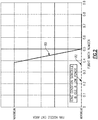
- the parameter relationship 78 includes information relating to air speed, fan speed and a desired variable area fan nozzle position, which provide a schedule illustrated in Figure 2 .
- the turbofan engine operating line is managed by detecting the air speed and other parameters, such as the fan speed, for example, by determining the low speed spool rotational speed. In should be understood, however, that the fan speed may be inferred from the low speed spool rotational speed rather than calculated.
- the controller 68 references the parameter relationship 78, which includes a desired variable area fan nozzle position relative to the air speed and fan speed. In one example, the detected air speed and fan speed are compared to the data table to provide a target variable area fan nozzle position. The controller 68 commands the actuators 66 to adjust the flaps 62 from an actual variable area fan nozzle position, or the current flap position, to the target variable area fan nozzle position.
- FIG. 2 One example schedule 80 for a target variable area fan nozzle position, corresponding to fan nozzle exit area, based upon airspeed is illustrated in Figure 2 .
- the flaps 62 are at least partially open at air speeds below 0.55 Mach, and in another example, below 0.50 Mach. In one example, the flaps 62 are fully opened below 0.38 Mach in an unaltered variable area fan nozzle position schedule.
- An icing condition input 84 communicates with and is used by the controller 68.
- the icing condition input 84 is used to predict the presence of ice in the area of the vent 62 using the parameter relationship 78, for example, which could inhibit desired operation of the flaps 62 during the flight envelope.
- an algorithm determines the likelihood of the presence of ice using data from a temperature sensor, air speed, humidity sensor and/or other devices or information determines the likelihood of ice presence near or at the vent 62.
- the normal schedule 80 is altered to provide an icing schedule 82, and the flaps 62 are moved to or maintained in a closed position (first position P1 in Figure 1 ), for the example, where the fan speed is below 65% of the fan aerodynamic design speed.
- the schedule 80 is altered by commanding the flaps 62 to the closed position.
- the variable area fan nozzle position follows schedule 80 as a function of airspeed.
- the controller 68 can include a processor, memory, and one or more input and/or output (I/O) device interface(s) that are communicatively coupled via a local interface.
- the local interface can include, for example but not limited to, one or more buses and/or other wired or wireless connections.
- the local interface may have additional elements, which are omitted for simplicity, such as controllers, buffers (caches), drivers, repeaters, and receivers to enable communications. Further, the local interface may include address, control, and/or data connections to enable appropriate communications among the aforementioned components.
- the controller 68 may be a hardware device for executing software, particularly software stored in memory.
- the controller 68 can be a custom made or commercially available processor, a central processing unit (CPU), an auxiliary processor among several processors associated with the computing device, a semiconductor based microprocessor (in the form of a microchip or chip set) or generally any device for executing software instructions.
- the memory can include any one or combination of volatile memory elements (e.g., random access memory (RAM, such as DRAM, SRAM, SDRAM, VRAM, etc.)) and/or nonvolatile memory elements (e.g., ROM, hard drive, tape, CD-ROM, etc.).
- volatile memory elements e.g., random access memory (RAM, such as DRAM, SRAM, SDRAM, VRAM, etc.)
- nonvolatile memory elements e.g., ROM, hard drive, tape, CD-ROM, etc.
- the memory may incorporate electronic, magnetic, optical, and/or other types of storage media.
- the memory can also have a distributed architecture, where various components are situated remotely from one another, but can be accessed by the processor.
- the software in the memory may include one or more separate programs, each of which includes an ordered listing of executable instructions for implementing logical functions.
- a system component embodied as software may also be construed as a source program, executable program (object code), script, or any other entity comprising a set of instructions to be performed.
- the program is translated via a compiler, assembler, interpreter, or the like, which may or may not be included within the memory.
- the Input/Output devices that may be coupled to system I/O Interface(s) may include input devices, for example but not limited to, a keyboard, mouse, scanner, microphone, camera, proximity device, etc. Further, the Input/Output devices may also include output devices, for example but not limited to, a printer, display, etc. Finally, the Input/Output devices may further include devices that communicate both as inputs and outputs, for instance but not limited to, a modulator/demodulator (modem; for accessing another device, system, or network), a radio frequency (RF) or other transceiver, a telephonic interface, a bridge, a router, etc.
- modem for accessing another device, system, or network
- RF radio frequency
- the controller 68 can be configured to execute software stored within the memory, to communicate data to and from the memory, and to generally control operations of the computing device pursuant to the software.
- Software in memory, in whole or in part, is read by the processor, perhaps buffered within the processor, and then executed.
Landscapes
- Engineering & Computer Science (AREA)
- Chemical & Material Sciences (AREA)
- Combustion & Propulsion (AREA)
- Mechanical Engineering (AREA)
- General Engineering & Computer Science (AREA)
- Physics & Mathematics (AREA)
- Fluid Mechanics (AREA)
- Structures Of Non-Positive Displacement Pumps (AREA)
Abstract
Description
- This application claims priority to United States Provisional Application No.
61/593,150 - This disclosure relates to managing gas turbine engine fan operability and operating characteristics using a variable area fan nozzle.
- One typical gas turbine engine includes low and high speed spools housed within a core nacelle. The low speed spool supports a low pressure compressor and turbine, and the high speed spool supports a high pressure compressor and turbine. A fan is coupled to the low speed spool. A fan nacelle surrounds the fan and core nacelle to provide a bypass flow path having a nozzle. Typically, the nozzle is a fixed structure providing a fixed nozzle exit area.
- The fan's operating line must be controlled to avoid undesired conditions such as fan flutter, surge or stall. The fan operating line can be manipulated during engine operation to ensure that the fan operability margin is sufficient. The fan operating line is defined, for example, by characteristics including low spool speed, bypass airflow and turbofan pressure ratio. Manipulating any one of these characteristics can change the fan operating line to meet the desired fan operability margin to avoid undesired conditions.
- The engine is designed to meet the fan operability line and optimize the overall engine performance throughout the flight envelope. As a result, the engine design is compromised to accommodate various engine operating conditions that may occur during the flight envelope. For example, fuel consumption for some engine operating conditions may be less than desired in order to maintain the fan operating line with an adequate margin for all engine operating conditions. For example, fan operating characteristics are compromised, to varying degrees, from high Mach number flight conditions to ground idle conditions for fixed nozzle area turbofan engines. This creates design challenges and/or performance penalties to manage the operability requirements. Furthermore, the presence of ice on the engine can affect operation and, thus, should be managed.
- A method of managing a gas turbine engine variable area fan nozzle includes the step of evaluating an icing condition to determine the likelihood of ice presence. A variable area fan nozzle position is altered if ice is likely present or actually present.
- In a further embodiment of any of the above, the evaluating step includes using an algorithm that relies upon one or more icing condition inputs from at least one of a temperature sensor, air speed and a humidity sensor
- In a further embodiment of any of the above, the altering step includes adjusting a fan nacelle exit area in response to an altered variable area fan nozzle position schedule.
- In a further embodiment of any of the above, the adjusting step includes translating flaps to selectively block a vent in the fan nacelle.
- In a further embodiment of any of the above, the variable area fan nozzle position schedule corresponds to the flaps being at least partially open at air speeds below 0.55 Mach. The altering step includes closing the flaps below 0.55 Mach.
- In a further embodiment of any of the above, the variable area fan nozzle position schedule corresponds to the flaps at least partially open at air speeds below 0.55 Mach, and the altering step includes closing the flaps below 0.55 Mach.
- In a further embodiment of any of the above, the flaps are fully open below 0.38 Mach in an unaltered variable area fan nozzle position schedule.
- In a further embodiment of any of the above, the gas turbine engine includes a fan is arranged in a fan nacelle including a flap configured to be movable between first and second positions. An actuator is operative coupled to the flap. A compressor section is fluidly connected to the fan, and the compressor includes a high pressure compressor and a low pressure compressor. A combustor is fluidly connected to the compressor section, and a turbine section is fluidly connected to the combustor. The turbine section includes a high pressure turbine coupled to the high pressure compressor via a shaft, and a low pressure turbine.
- In a further embodiment of any of the above, the gas turbine engine is a high bypass geared aircraft engine having a bypass ratio of greater than about six (6).
- In a further embodiment of any of the above, the gas turbine engine includes a low Fan Pressure Ratio of less than about 1.45.
- In a further embodiment of any of the above, the low pressure turbine has a pressure ratio that is greater than about 5.
- The gas turbine engine includes a fan nacelle having a flap configured to be moveable between first and second positions. An actuator is operatively coupled to the flap. A controller is configured to evaluate an icing condition to determine the likelihood of ice presence. The controller is configured to alter a variable area fan nozzle position schedule if ice is likely present or actually present by providing a command to the actuator to adjust the flap from the first position to the second position.
- In a further embodiment of any of the above, the first position is open and the second position is closed.
- In a further embodiment of any of the above, a geared architecture is coupled between a low speed spool and a fan. The fan is arranged within the fan nacelle.
- In a further embodiment of any of the above, a compressor section is fluidly connected to the fan, and the compressor includes a high pressure compressor and a low pressure compressor. A combustor is fluidly connected to the compressor section, and a turbine section is fluidly connected to the combustor. The turbine section includes a high pressure turbine coupled to the high pressure compressor via a shaft, and a low pressure turbine.
- In a further embodiment of any of the above, the gas turbine engine is a high bypass geared aircraft engine having a bypass ratio of greater than about six (6).
- In a further embodiment of any of the above, the gas turbine engine includes a low Fan Pressure Ratio of less than about 1.45.
- In a further embodiment of any of the above, the low pressure turbine has a pressure ratio that is greater than about 5.
- In a further embodiment of any of the above, the variable area fan nozzle position schedule corresponds to the flaps at least partially open at air speeds below 0.55 Mach, and the command includes closing the flaps below 0.55 Mach.
- In a further embodiment of any of the above, the flaps are fully open below 0.38 Mach in an unaltered variable area fan nozzle position schedule.
- The disclosure can be further understood by reference to the following detailed description when considered in connection with the accompanying drawings wherein:
-
Figure 1 schematically illustrates an example gas turbine engine. -
Figure 2 is an example schedule for varying a fan nacelle exit area based upon air speed and icing conditions. -
Figure 1 schematically illustrates agas turbine engine 20. Thegas turbine engine 20 is disclosed herein as a two-spool turbofan that generally incorporates afan section 22, acompressor section 24, acombustor section 26 and aturbine section 28. Alternative engines might include a three-spool architecture, an augmentor section, or different engine section arrangements, among other systems or features. Thefan section 22 drives air along a bypass flowpath while thecompressor section 24 drives air along a core flowpath for compression and communication into thecombustor section 26 then expansion through theturbine section 28. Although depicted as a turbofan gas turbine engine in the disclosed non-limiting embodiment, it should be understood that the concepts described herein are not limited to use with turbofans as the teachings may be applied to other types of turbine engines including three-spool architectures. - The
engine 20 generally includes alow speed spool 30 and ahigh speed spool 32 mounted for rotation about an engine central longitudinal axis A relative to an enginestatic structure 36 viaseveral bearing systems 38. It should be understood thatvarious bearing systems 38 at various locations may alternatively or additionally be provided. - The
low speed spool 30 generally includes aninner shaft 40 that interconnects afan 42, alow pressure compressor 44 and alow pressure turbine 46. Theinner shaft 40 is connected to thefan 42 through a gearedarchitecture 48 to drive thefan 42 at a lower speed than thelow speed spool 30. Thehigh speed spool 32 includes anouter shaft 50 that interconnects ahigh pressure compressor 52 andhigh pressure turbine 54. Acombustor 56 is arranged between thehigh pressure compressor 52 and thehigh pressure turbine 54. Amid-turbine frame 57 of the enginestatic structure 36 is arranged generally between thehigh pressure turbine 54 and thelow pressure turbine 46. Themid-turbine frame 57 supports one ormore bearing systems 38 in theturbine section 28. Theinner shaft 40 and theouter shaft 50 are concentric and rotate via bearingsystems 38 about the engine central longitudinal axis A, which is collinear with their longitudinal axes. - The core airflow is compressed by the
low pressure compressor 44 then thehigh pressure compressor 52, mixed and burned with fuel in thecombustor 56, then expanded over thehigh pressure turbine 54 andlow pressure turbine 46. Themid-turbine frame 57 includesairfoils 59 which are in the core airflow path. Theturbines low speed spool 30 andhigh speed spool 32 in response to the expansion. - The
engine 20 in one example a high-bypass geared aircraft engine. In a further example, theengine 20 bypass ratio is greater than about six (6), with an example embodiment being greater than ten (10), the gearedarchitecture 48 is an epicyclic gear train, such as a planetary gear system or other gear system, with a gear reduction ratio of greater than about 2.3 and, for example, greater than about 2.5:1 and thelow pressure turbine 46 has a pressure ratio that is greater than about 5. In one disclosed embodiment, theengine 20 bypass ratio is greater than about ten (10:1), the fan diameter is significantly larger than that of thelow pressure compressor 44, and thelow pressure turbine 46 has a pressure ratio that is greater than about 5:1.Low pressure turbine 46 pressure ratio is pressure measured prior to inlet oflow pressure turbine 46 as related to the pressure at the outlet of thelow pressure turbine 46 prior to an exhaust nozzle. It should be understood, however, that the above parameters are only exemplary of one embodiment of a geared architecture engine and that the present invention is applicable to other gas turbine engines including direct drive turbofans. - A significant amount of thrust is provided by the bypass flow B due to the high bypass ratio. The
fan section 22 of theengine 20 is designed for a particular flight condition -- typically cruise at about 0.8 Mach and about 35,000 feet. The flight condition of 0.8 Mach and 35,000 ft, with the engine at its best fuel consumption - also known as "bucket cruise Thrust Specific Fuel Consumption ('TSFC')" - is the industry standard parameter of lbm per hour of fuel being burned divided by lbf of thrust the engine produces at that minimum point. "Fan pressure ratio" is the pressure ratio across the fan blade alone, without a Fan Exit Guide Vane ("FEGV") system. The fan pressure ratio as disclosed herein according to one non-limiting embodiment is less than about 1.45. "Low corrected fan tip speed" is the actual fan tip speed in ft/sec divided by an industry standard temperature correction of [(Tambient deg R) / 518.7)^0.5]. The "Low corrected fan tip speed," as disclosed herein according to one non-limiting embodiment, is less than about 1150 ft / second. - A
core nacelle 61 surrounds the enginestatic structure 36. Afan nacelle 58 surrounds thecore nacelle 61 to provide the bypass flow path. In theexample engine 20, anozzle exit area 60 is effectively variable to alter the bypass flow B and achieve a desired target operability line. In one example, thefan nacelle 58 includesmoveable flaps 62 near the bypass flowpath exit, which may be provided by arcuate segments that are generally linearly translatable parallel to the axis A in response to inputs by one ormore actuators 66. - The
flaps 62 are moveable between first and second positions P1, P2 and positions in between. Theflaps 62 selectively regulate, by blocking, a size of an annular vent 64 provided between a trailingend 63 of the nacelle body and aleading edge 65 of theflaps 62. The vent 64 is fully open in the second position P2, in which a vent flow V from the bypass flowpath is permitted to exit through the vent 64. An open vent 64 increases the bypass flow B and effectively increases thenozzle exit area 60. With theflaps 62 in the first position P1, flow from the bypass flowpath is not permitted to pass through the vent 64, which is blocked by theflaps 62. - A
controller 68 is in communication with a lowspeed spool sensor 70, which detects a rotational speed of thelow speed spool 30. Atemperature sensor 72 detects the ambient temperature.Air speed 74 is provided to thecontroller 68, as is the ambient temperature. In the example, thecontroller 68 may storevarious parameters 76 relating to theengine 20, such as a gear reduction ratio of the gearedarchitecture 48, outer diameter of thefan 22 and other information useful in calculating a corrected low fan tip speed. - A
parameter relationship 78, such as one or more data tables (such as a bivariant look-up table) and/or equations, for example, may be stored in thecontroller 68. Theparameter relationship 78 includes information relating to air speed, fan speed and a desired variable area fan nozzle position, which provide a schedule illustrated inFigure 2 . In operation, the turbofan engine operating line is managed by detecting the air speed and other parameters, such as the fan speed, for example, by determining the low speed spool rotational speed. In should be understood, however, that the fan speed may be inferred from the low speed spool rotational speed rather than calculated. That is, only the low speed spool rotational speed could be monitored and compared to a reference low speed spool rotational speed in theparameter relationship 78, rather than a fan speed. Thecontroller 68 references theparameter relationship 78, which includes a desired variable area fan nozzle position relative to the air speed and fan speed. In one example, the detected air speed and fan speed are compared to the data table to provide a target variable area fan nozzle position. Thecontroller 68 commands theactuators 66 to adjust theflaps 62 from an actual variable area fan nozzle position, or the current flap position, to the target variable area fan nozzle position. - One
example schedule 80 for a target variable area fan nozzle position, corresponding to fan nozzle exit area, based upon airspeed is illustrated inFigure 2 . As shown in the example inFigure 2 , theflaps 62 are at least partially open at air speeds below 0.55 Mach, and in another example, below 0.50 Mach. In one example, theflaps 62 are fully opened below 0.38 Mach in an unaltered variable area fan nozzle position schedule. - An icing condition input 84 communicates with and is used by the
controller 68. The icing condition input 84 is used to predict the presence of ice in the area of thevent 62 using theparameter relationship 78, for example, which could inhibit desired operation of theflaps 62 during the flight envelope. In one example, an algorithm determines the likelihood of the presence of ice using data from a temperature sensor, air speed, humidity sensor and/or other devices or information determines the likelihood of ice presence near or at thevent 62. If an ice condition is detected, either actual or predicted ice presence, below 0.55 Mach, thenormal schedule 80 is altered to provide anicing schedule 82, and theflaps 62 are moved to or maintained in a closed position (first position P1 inFigure 1 ), for the example, where the fan speed is below 65% of the fan aerodynamic design speed. In one example, theschedule 80 is altered by commanding theflaps 62 to the closed position. In another example where the fan speed is above 70% of the fan aerodynamic design speed, the variable area fan nozzle position followsschedule 80 as a function of airspeed. - The
controller 68 can include a processor, memory, and one or more input and/or output (I/O) device interface(s) that are communicatively coupled via a local interface. The local interface can include, for example but not limited to, one or more buses and/or other wired or wireless connections. The local interface may have additional elements, which are omitted for simplicity, such as controllers, buffers (caches), drivers, repeaters, and receivers to enable communications. Further, the local interface may include address, control, and/or data connections to enable appropriate communications among the aforementioned components. - The
controller 68 may be a hardware device for executing software, particularly software stored in memory. Thecontroller 68 can be a custom made or commercially available processor, a central processing unit (CPU), an auxiliary processor among several processors associated with the computing device, a semiconductor based microprocessor (in the form of a microchip or chip set) or generally any device for executing software instructions. - The memory can include any one or combination of volatile memory elements (e.g., random access memory (RAM, such as DRAM, SRAM, SDRAM, VRAM, etc.)) and/or nonvolatile memory elements (e.g., ROM, hard drive, tape, CD-ROM, etc.). Moreover, the memory may incorporate electronic, magnetic, optical, and/or other types of storage media. Note that the memory can also have a distributed architecture, where various components are situated remotely from one another, but can be accessed by the processor.
- The software in the memory may include one or more separate programs, each of which includes an ordered listing of executable instructions for implementing logical functions. A system component embodied as software may also be construed as a source program, executable program (object code), script, or any other entity comprising a set of instructions to be performed. When constructed as a source program, the program is translated via a compiler, assembler, interpreter, or the like, which may or may not be included within the memory.
- The Input/Output devices that may be coupled to system I/O Interface(s) may include input devices, for example but not limited to, a keyboard, mouse, scanner, microphone, camera, proximity device, etc. Further, the Input/Output devices may also include output devices, for example but not limited to, a printer, display, etc. Finally, the Input/Output devices may further include devices that communicate both as inputs and outputs, for instance but not limited to, a modulator/demodulator (modem; for accessing another device, system, or network), a radio frequency (RF) or other transceiver, a telephonic interface, a bridge, a router, etc.
- The
controller 68 can be configured to execute software stored within the memory, to communicate data to and from the memory, and to generally control operations of the computing device pursuant to the software. Software in memory, in whole or in part, is read by the processor, perhaps buffered within the processor, and then executed. - Although an example embodiment has been disclosed, a worker of ordinary skill in this art would recognize that certain modifications would come within the scope of the claims. For that reason, the following claims should be studied to determine their true scope and content.
Claims (15)
- A method of managing a gas turbine engine variable area fan nozzle, comprising the steps of:evaluating an icing condition input to determine the likelihood of ice presence; andaltering a variable area fan nozzle position if ice is likely present or actually present.
- The method according to claim 1, wherein the evaluating step includes using an algorithm that relies upon one or more icing condition inputs from at least one of a temperature sensor, air speed and a humidity sensor.
- The method according to claim 1 or 2, comprising the step of altering the variable area fan nozzle position includes adjusting a fan nacelle exit area in response to an altered variable area fan nozzle position schedule.
- The method according to claim 3, wherein the adjusting step includes translating flaps to selectively block a vent in the fan nacelle, and the icing condition relates to ice present or likely present in an area of the vent.
- The method according to claim 4, wherein the variable area fan nozzle position schedule corresponds to the flaps at least partially open at air speeds below 0.55 Mach, and the altering step includes closing the flaps below 0.55 Mach, or optionally, wherein the variable area fan nozzle position schedule corresponds to the flaps at least partially open at air speeds below 0.50 Mach, and the altering step includes closing the flaps below 0.50 Mach.
- The method according to any preceding claim, wherein the gas turbine engine comprises:a fan arranged in a fan nacelle including a flap configured to be movable between first and second positions;an actuator operatively coupled to the flap;a compressor section fluidly connected to the fan, the compressor comprising a high pressure compressor and a low pressure compressor;a combustor fluidly connected to the compressor section;a turbine section fluidly connected to the combustor, the turbine section comprising:a high pressure turbine coupled to the high pressure compressor via a shaft; anda low pressure turbine.
- A gas turbine engine comprising:a fan nacelle including a flap configured to be movable between first and second positions;an actuator operatively coupled to the flap; anda controller configured to evaluate an icing condition to determine the likelihood of ice presence, and the controller configured to alter a variable area fan nozzle position schedule if ice is likely present or actually present by providing a command to the actuator to adjust the flap from the first position to the second position.
- The gas turbine engine according to claim 7, wherein the first position is open and the second position is closed.
- The gas turbine engine according to claim 7 or 8, comprising a geared architecture coupled between a low speed spool and a fan, the fan arranged within the fan nacelle.
- The gas turbine engine according to claim 9, comprising:a compressor section fluidly connected to the fan, the compressor comprising a high pressure compressor and a low pressure compressor;a combustor fluidly connected to the compressor section;a turbine section fluidly connected to the combustor, the turbine section comprising:a high pressure turbine coupled to the high pressure compressor via a shaft; anda low pressure turbine.
- The method or gas turbine engine according to any of claims 6 to 10, wherein the gas turbine engine is a high bypass geared aircraft engine having a bypass ratio of greater than six.
- The method or gas turbine engine according to any of claims 6 to 11, wherein the gas turbine engine includes a Fan Pressure Ratio of less than 1.45.
- The method or gas turbine engine according to any of claims 6 to 12, wherein the low pressure turbine has a pressure ratio that is greater than 5.
- The gas turbine engine according to any of claims 10 to 13, wherein the variable area fan nozzle position schedule corresponds to the flaps at least partially open at air speeds below 0.55 Mach, and the command includes closing the flaps below 0.55 Mach.
- The method or gas turbine engine according to any of claims 5 to 14, wherein the flaps are fully open below 0.38 Mach in an unaltered variable area fan nozzle position schedule.
Applications Claiming Priority (4)
| Application Number | Priority Date | Filing Date | Title |
|---|---|---|---|
| US201261593150P | 2012-01-31 | 2012-01-31 | |
| US13/365,481 US9593628B2 (en) | 2012-01-31 | 2012-02-03 | Gas turbine engine variable area fan nozzle with ice management |
| PCT/US2013/022476 WO2013154651A1 (en) | 2012-01-31 | 2013-01-22 | Gas turbine engine variable area fan nozzle with ice management |
| EP13775374.5A EP2809925B1 (en) | 2012-01-31 | 2013-01-22 | Gas turbine engine having a variable area fan nozzle and method for managing the nozzle |
Related Parent Applications (1)
| Application Number | Title | Priority Date | Filing Date |
|---|---|---|---|
| EP13775374.5A Division EP2809925B1 (en) | 2012-01-31 | 2013-01-22 | Gas turbine engine having a variable area fan nozzle and method for managing the nozzle |
Publications (1)
| Publication Number | Publication Date |
|---|---|
| EP3608524A1 true EP3608524A1 (en) | 2020-02-12 |
Family
ID=48869057
Family Applications (2)
| Application Number | Title | Priority Date | Filing Date |
|---|---|---|---|
| EP13775374.5A Active EP2809925B1 (en) | 2012-01-31 | 2013-01-22 | Gas turbine engine having a variable area fan nozzle and method for managing the nozzle |
| EP19200757.3A Withdrawn EP3608524A1 (en) | 2012-01-31 | 2013-01-22 | Gas turbine engine having a variable area fan nozzle with ice management |
Family Applications Before (1)
| Application Number | Title | Priority Date | Filing Date |
|---|---|---|---|
| EP13775374.5A Active EP2809925B1 (en) | 2012-01-31 | 2013-01-22 | Gas turbine engine having a variable area fan nozzle and method for managing the nozzle |
Country Status (4)
| Country | Link |
|---|---|
| US (2) | US9593628B2 (en) |
| EP (2) | EP2809925B1 (en) |
| SG (1) | SG11201402942QA (en) |
| WO (1) | WO2013154651A1 (en) |
Families Citing this family (8)
| Publication number | Priority date | Publication date | Assignee | Title |
|---|---|---|---|---|
| US8869508B2 (en) | 2012-01-31 | 2014-10-28 | United Technologies Corporation | Gas turbine engine variable area fan nozzle control |
| US9869190B2 (en) | 2014-05-30 | 2018-01-16 | General Electric Company | Variable-pitch rotor with remote counterweights |
| US10072510B2 (en) | 2014-11-21 | 2018-09-11 | General Electric Company | Variable pitch fan for gas turbine engine and method of assembling the same |
| US10495006B2 (en) * | 2015-02-06 | 2019-12-03 | United Technologies Corporation | Variable geometry gas turbine engine for use in inclement weather |
| US10100653B2 (en) | 2015-10-08 | 2018-10-16 | General Electric Company | Variable pitch fan blade retention system |
| US11674435B2 (en) | 2021-06-29 | 2023-06-13 | General Electric Company | Levered counterweight feathering system |
| US11795964B2 (en) | 2021-07-16 | 2023-10-24 | General Electric Company | Levered counterweight feathering system |
| US12601271B2 (en) | 2022-10-21 | 2026-04-14 | General Electric Company | Variable pitch fan of a gas turbine engine |
Citations (2)
| Publication number | Priority date | Publication date | Assignee | Title |
|---|---|---|---|---|
| US20100043390A1 (en) * | 2006-10-12 | 2010-02-25 | Jain Ashok K | Controlling ice buildup on aircraft engine and nacelle static and rotating components |
| US20110004388A1 (en) * | 2009-07-01 | 2011-01-06 | United Technologies Corporation | Turbofan temperature control with variable area nozzle |
Family Cites Families (62)
| Publication number | Priority date | Publication date | Assignee | Title |
|---|---|---|---|---|
| GB579657A (en) | 1943-07-02 | 1946-08-12 | Power Jets Ltd | Improvements relating to aircraft propulsion installations and landing gear |
| US2469375A (en) | 1945-09-24 | 1949-05-10 | Westinghouse Electric Corp | Deicing apparatus for compressors |
| US2663993A (en) | 1945-10-10 | 1953-12-29 | Westinghouse Electric Corp | Deicing apparatus |
| US3194487A (en) | 1963-06-04 | 1965-07-13 | United Aircraft Corp | Noise abatement method and apparatus |
| US3287906A (en) | 1965-07-20 | 1966-11-29 | Gen Motors Corp | Cooled gas turbine vanes |
| GB1350431A (en) | 1971-01-08 | 1974-04-18 | Secr Defence | Gearing |
| US3892358A (en) | 1971-03-17 | 1975-07-01 | Gen Electric | Nozzle seal |
| US3747343A (en) | 1972-02-10 | 1973-07-24 | United Aircraft Corp | Low noise prop-fan |
| US3932058A (en) * | 1974-06-07 | 1976-01-13 | United Technologies Corporation | Control system for variable pitch fan propulsor |
| US3935558A (en) | 1974-12-11 | 1976-01-27 | United Technologies Corporation | Surge detector for turbine engines |
| US4068469A (en) * | 1975-05-29 | 1978-01-17 | The United States Of America As Represented By The Administrator Of The National Aeronautics And Space Administration | Variable thrust nozzle for quiet turbofan engine and method of operating same |
| US4130872A (en) | 1975-10-10 | 1978-12-19 | The United States Of America As Represented By The Secretary Of The Air Force | Method and system of controlling a jet engine for avoiding engine surge |
| GB1516041A (en) | 1977-02-14 | 1978-06-28 | Secr Defence | Multistage axial flow compressor stators |
| GB2041090A (en) | 1979-01-31 | 1980-09-03 | Rolls Royce | By-pass gas turbine engines |
| US4397431A (en) * | 1981-11-02 | 1983-08-09 | Avco Corporation | Fail-safe, anti-icing system for aircraft engines |
| US5005015A (en) * | 1989-08-07 | 1991-04-02 | General Electric Company | Ice detection system |
| US5282719A (en) * | 1991-05-13 | 1994-02-01 | Alliedsignal Inc. | Quad mode fan pitch actuation system for a gas turbine engine |
| US5257498A (en) * | 1992-04-23 | 1993-11-02 | United Technologies Corporation | Efficient anti-ice exhaust vent |
| US5447411A (en) | 1993-06-10 | 1995-09-05 | Martin Marietta Corporation | Light weight fan blade containment system |
| US5524847A (en) | 1993-09-07 | 1996-06-11 | United Technologies Corporation | Nacelle and mounting arrangement for an aircraft engine |
| US5433674A (en) | 1994-04-12 | 1995-07-18 | United Technologies Corporation | Coupling system for a planetary gear train |
| US5778659A (en) | 1994-10-20 | 1998-07-14 | United Technologies Corporation | Variable area fan exhaust nozzle having mechanically separate sleeve and thrust reverser actuation systems |
| WO1997000381A1 (en) | 1994-12-14 | 1997-01-03 | United Technologies Corporation | Compressor stall and surge control using airflow asymmetry measurement |
| US5857836A (en) | 1996-09-10 | 1999-01-12 | Aerodyne Research, Inc. | Evaporatively cooled rotor for a gas turbine engine |
| US5975841A (en) | 1997-10-03 | 1999-11-02 | Thermal Corp. | Heat pipe cooling for turbine stators |
| US6223616B1 (en) | 1999-12-22 | 2001-05-01 | United Technologies Corporation | Star gear system with lubrication circuit and lubrication method therefor |
| US6318070B1 (en) | 2000-03-03 | 2001-11-20 | United Technologies Corporation | Variable area nozzle for gas turbine engines driven by shape memory alloy actuators |
| US6607165B1 (en) | 2002-06-28 | 2003-08-19 | General Electric Company | Aircraft engine mount with single thrust link |
| US6814541B2 (en) | 2002-10-07 | 2004-11-09 | General Electric Company | Jet aircraft fan case containment design |
| US7021042B2 (en) | 2002-12-13 | 2006-04-04 | United Technologies Corporation | Geartrain coupling for a turbofan engine |
| US7175136B2 (en) * | 2003-04-16 | 2007-02-13 | The Boeing Company | Method and apparatus for detecting conditions conducive to ice formation |
| CA2456563C (en) | 2004-01-30 | 2011-12-20 | Pratt & Whitney Canada Corp. | Anti-icing apparatus and method for aero-engine nose cone |
| DE102004016246A1 (en) | 2004-04-02 | 2005-10-20 | Mtu Aero Engines Gmbh | Turbine, in particular low-pressure turbine, a gas turbine, in particular an aircraft engine |
| US7328580B2 (en) | 2004-06-23 | 2008-02-12 | General Electric Company | Chevron film cooled wall |
| FR2875542B1 (en) * | 2004-09-21 | 2009-02-13 | Airbus France Sas | DEVICE FOR PROTECTING AGAINST AIRCRAFT ENGINES AND METHODS OF DEFROSTING THE SAME |
| US7469862B2 (en) | 2005-04-22 | 2008-12-30 | Goodrich Corporation | Aircraft engine nacelle inlet having access opening for electrical ice protection system |
| DE102006031330B4 (en) | 2005-07-14 | 2014-03-20 | Goodrich Corp. | An ice-susceptible portion of an aircraft, in particular an aircraft engine cell inlet lip, comprising an ice protection system, aircraft engine having such an inlet lip, and a method of protecting such inlet lip from icing |
| EP1928952B1 (en) | 2005-09-28 | 2014-07-09 | Entrotech Composites, LLC. | Braid-reinforced composites and processes for their preparation |
| US7591754B2 (en) | 2006-03-22 | 2009-09-22 | United Technologies Corporation | Epicyclic gear train integral sun gear coupling design |
| US20080003096A1 (en) | 2006-06-29 | 2008-01-03 | United Technologies Corporation | High coverage cooling hole shape |
| US7926260B2 (en) | 2006-07-05 | 2011-04-19 | United Technologies Corporation | Flexible shaft for gas turbine engine |
| US7694505B2 (en) | 2006-07-31 | 2010-04-13 | General Electric Company | Gas turbine engine assembly and method of assembling same |
| WO2008063154A2 (en) | 2006-10-12 | 2008-05-29 | United Technologies Corporation | Fan variable area nozzle with adaptive structure |
| US8365513B2 (en) * | 2006-10-12 | 2013-02-05 | United Technologies Corporation | Turbofan engine operation control |
| WO2008045074A1 (en) | 2006-10-12 | 2008-04-17 | United Technologies Corporation | Turbofan engine with variable bypass nozzle exit area and method of operation |
| FR2910937B1 (en) * | 2007-01-02 | 2009-04-03 | Airbus France Sas | AIRCRAFT REACTOR NACELLE AND AIRCRAFT COMPRISING SUCH A NACELLE |
| US20090067993A1 (en) * | 2007-03-22 | 2009-03-12 | Roberge Gary D | Coated variable area fan nozzle |
| US8017188B2 (en) | 2007-04-17 | 2011-09-13 | General Electric Company | Methods of making articles having toughened and untoughened regions |
| US20080257033A1 (en) * | 2007-04-20 | 2008-10-23 | Shadin, L.P. | Ice detection |
| US9062500B2 (en) | 2007-07-20 | 2015-06-23 | Schlumberger Technology Corporation | System and method to facilitate interventions from an offshore platform |
| US7762081B2 (en) * | 2007-07-25 | 2010-07-27 | Honeywell International Inc. | Compressor inlet guide vane de-ice control system and method |
| US20120124964A1 (en) | 2007-07-27 | 2012-05-24 | Hasel Karl L | Gas turbine engine with improved fuel efficiency |
| US8256707B2 (en) | 2007-08-01 | 2012-09-04 | United Technologies Corporation | Engine mounting configuration for a turbofan gas turbine engine |
| EP2479414B1 (en) | 2007-08-08 | 2015-06-10 | Rohr, Inc. | Variable area fan nozzle with bypass flow |
| US8205432B2 (en) | 2007-10-03 | 2012-06-26 | United Technologies Corporation | Epicyclic gear train for turbo fan engine |
| US7837150B2 (en) | 2007-12-21 | 2010-11-23 | Rohr, Inc. | Ice protection system for a multi-segment aircraft component |
| US7997868B1 (en) | 2008-11-18 | 2011-08-16 | Florida Turbine Technologies, Inc. | Film cooling hole for turbine airfoil |
| US8092153B2 (en) | 2008-12-16 | 2012-01-10 | Pratt & Whitney Canada Corp. | Bypass air scoop for gas turbine engine |
| US8181441B2 (en) * | 2009-02-27 | 2012-05-22 | United Technologies Corporation | Controlled fan stream flow bypass |
| US8172716B2 (en) | 2009-06-25 | 2012-05-08 | United Technologies Corporation | Epicyclic gear system with superfinished journal bearing |
| US9170616B2 (en) | 2009-12-31 | 2015-10-27 | Intel Corporation | Quiet system cooling using coupled optimization between integrated micro porous absorbers and rotors |
| US8905713B2 (en) | 2010-05-28 | 2014-12-09 | General Electric Company | Articles which include chevron film cooling holes, and related processes |
-
2012
- 2012-02-03 US US13/365,481 patent/US9593628B2/en active Active
-
2013
- 2013-01-22 WO PCT/US2013/022476 patent/WO2013154651A1/en not_active Ceased
- 2013-01-22 EP EP13775374.5A patent/EP2809925B1/en active Active
- 2013-01-22 SG SG11201402942QA patent/SG11201402942QA/en unknown
- 2013-01-22 EP EP19200757.3A patent/EP3608524A1/en not_active Withdrawn
-
2017
- 2017-01-27 US US15/417,358 patent/US10578053B2/en active Active
Patent Citations (2)
| Publication number | Priority date | Publication date | Assignee | Title |
|---|---|---|---|---|
| US20100043390A1 (en) * | 2006-10-12 | 2010-02-25 | Jain Ashok K | Controlling ice buildup on aircraft engine and nacelle static and rotating components |
| US20110004388A1 (en) * | 2009-07-01 | 2011-01-06 | United Technologies Corporation | Turbofan temperature control with variable area nozzle |
Also Published As
| Publication number | Publication date |
|---|---|
| EP2809925A4 (en) | 2015-10-21 |
| WO2013154651A1 (en) | 2013-10-17 |
| EP2809925A1 (en) | 2014-12-10 |
| US20130192247A1 (en) | 2013-08-01 |
| EP2809925B1 (en) | 2019-10-02 |
| US9593628B2 (en) | 2017-03-14 |
| US20170138303A1 (en) | 2017-05-18 |
| US10578053B2 (en) | 2020-03-03 |
| SG11201402942QA (en) | 2014-10-30 |
Similar Documents
| Publication | Publication Date | Title |
|---|---|---|
| US11401889B2 (en) | Gas turbine engine variable area fan nozzle control | |
| US10578053B2 (en) | Gas turbine engine variable area fan nozzle with ice management | |
| US9097133B2 (en) | Compressor tip clearance management for a gas turbine engine | |
| US8862362B2 (en) | Scheduling of variable area fan nozzle to optimize engine performance | |
| US10247018B2 (en) | Pylon matched fan exit guide vane for noise reduction in a geared turbofan engine | |
| EP2098704B1 (en) | Fan flutter management system in a turbofan engine with variable area fan nozzle | |
| US9074531B2 (en) | Variable area fan nozzle fan flutter management system | |
| US9957832B2 (en) | Variable area turbine | |
| US11773743B2 (en) | Model-based rotor speed keep out zone control | |
| EP3141725B1 (en) | Control system and method of controlling a variable area gas turbine engine | |
| US20100000199A1 (en) | Managing low pressure turbine maximum speed in a turbofan engine | |
| EP2809930B1 (en) | Gas turbine with a variable area fan nozzle fan flutter management system | |
| US12540558B2 (en) | Active clearance control valves and related methods |
Legal Events
| Date | Code | Title | Description |
|---|---|---|---|
| PUAI | Public reference made under article 153(3) epc to a published international application that has entered the european phase |
Free format text: ORIGINAL CODE: 0009012 |
|
| STAA | Information on the status of an ep patent application or granted ep patent |
Free format text: STATUS: THE APPLICATION HAS BEEN PUBLISHED |
|
| AC | Divisional application: reference to earlier application |
Ref document number: 2809925 Country of ref document: EP Kind code of ref document: P |
|
| AK | Designated contracting states |
Kind code of ref document: A1 Designated state(s): AL AT BE BG CH CY CZ DE DK EE ES FI FR GB GR HR HU IE IS IT LI LT LU LV MC MK MT NL NO PL PT RO RS SE SI SK SM TR |
|
| STAA | Information on the status of an ep patent application or granted ep patent |
Free format text: STATUS: REQUEST FOR EXAMINATION WAS MADE |
|
| 17P | Request for examination filed |
Effective date: 20200812 |
|
| STAA | Information on the status of an ep patent application or granted ep patent |
Free format text: STATUS: THE APPLICATION IS DEEMED TO BE WITHDRAWN |
|
| 18D | Application deemed to be withdrawn |
Effective date: 20200813 |