EP3608409A1 - Process for preparing l amino acids using improved strains of the enterobacteriaceae family - Google Patents
Process for preparing l amino acids using improved strains of the enterobacteriaceae family Download PDFInfo
- Publication number
- EP3608409A1 EP3608409A1 EP19189530.9A EP19189530A EP3608409A1 EP 3608409 A1 EP3608409 A1 EP 3608409A1 EP 19189530 A EP19189530 A EP 19189530A EP 3608409 A1 EP3608409 A1 EP 3608409A1
- Authority
- EP
- European Patent Office
- Prior art keywords
- amino acid
- gene
- dna fragment
- seq
- protein
- Prior art date
- Legal status (The legal status is an assumption and is not a legal conclusion. Google has not performed a legal analysis and makes no representation as to the accuracy of the status listed.)
- Withdrawn
Links
- 150000008575 L-amino acids Chemical class 0.000 title claims abstract description 52
- 241000588921 Enterobacteriaceae Species 0.000 title claims abstract description 29
- 238000004519 manufacturing process Methods 0.000 title claims description 25
- 230000001976 improved effect Effects 0.000 title description 4
- 230000000694 effects Effects 0.000 claims abstract description 74
- 244000005700 microbiome Species 0.000 claims abstract description 74
- 239000012634 fragment Substances 0.000 claims abstract description 72
- 108091033319 polynucleotide Proteins 0.000 claims abstract description 31
- 102000040430 polynucleotide Human genes 0.000 claims abstract description 31
- 239000002157 polynucleotide Substances 0.000 claims abstract description 31
- 108010052285 Membrane Proteins Proteins 0.000 claims abstract description 27
- 102000018697 Membrane Proteins Human genes 0.000 claims abstract description 16
- 230000003248 secreting effect Effects 0.000 claims abstract description 14
- 108090000623 proteins and genes Proteins 0.000 claims description 178
- AYFVYJQAPQTCCC-GBXIJSLDSA-N L-threonine Chemical compound C[C@@H](O)[C@H](N)C(O)=O AYFVYJQAPQTCCC-GBXIJSLDSA-N 0.000 claims description 144
- 239000004473 Threonine Substances 0.000 claims description 83
- 229960002898 threonine Drugs 0.000 claims description 83
- 235000001014 amino acid Nutrition 0.000 claims description 77
- 229940024606 amino acid Drugs 0.000 claims description 72
- 150000001413 amino acids Chemical class 0.000 claims description 72
- 102000004169 proteins and genes Human genes 0.000 claims description 64
- 235000018102 proteins Nutrition 0.000 claims description 63
- 238000000034 method Methods 0.000 claims description 56
- 230000014509 gene expression Effects 0.000 claims description 47
- 238000000855 fermentation Methods 0.000 claims description 41
- 230000004151 fermentation Effects 0.000 claims description 41
- UKAUYVFTDYCKQA-VKHMYHEASA-N L-homoserine Chemical compound OC(=O)[C@@H](N)CCO UKAUYVFTDYCKQA-VKHMYHEASA-N 0.000 claims description 40
- ROHFNLRQFUQHCH-YFKPBYRVSA-N L-leucine Chemical compound CC(C)C[C@H](N)C(O)=O ROHFNLRQFUQHCH-YFKPBYRVSA-N 0.000 claims description 40
- 239000002773 nucleotide Substances 0.000 claims description 40
- 125000003729 nucleotide group Chemical group 0.000 claims description 40
- HNDVDQJCIGZPNO-YFKPBYRVSA-N L-histidine Chemical compound OC(=O)[C@@H](N)CC1=CN=CN1 HNDVDQJCIGZPNO-YFKPBYRVSA-N 0.000 claims description 37
- KZSNJWFQEVHDMF-BYPYZUCNSA-N L-valine Chemical compound CC(C)[C@H](N)C(O)=O KZSNJWFQEVHDMF-BYPYZUCNSA-N 0.000 claims description 37
- 239000013598 vector Substances 0.000 claims description 24
- 210000004027 cell Anatomy 0.000 claims description 23
- AGPKZVBTJJNPAG-WHFBIAKZSA-N L-isoleucine Chemical compound CC[C@H](C)[C@H](N)C(O)=O AGPKZVBTJJNPAG-WHFBIAKZSA-N 0.000 claims description 21
- 229960000310 isoleucine Drugs 0.000 claims description 21
- 229960003136 leucine Drugs 0.000 claims description 21
- UKAUYVFTDYCKQA-UHFFFAOYSA-N -2-Amino-4-hydroxybutanoic acid Natural products OC(=O)C(N)CCO UKAUYVFTDYCKQA-UHFFFAOYSA-N 0.000 claims description 20
- 229930182844 L-isoleucine Natural products 0.000 claims description 20
- 229960002885 histidine Drugs 0.000 claims description 20
- 239000004395 L-leucine Substances 0.000 claims description 19
- 235000019454 L-leucine Nutrition 0.000 claims description 19
- 229960004295 valine Drugs 0.000 claims description 19
- 230000008569 process Effects 0.000 claims description 18
- WPLOVIFNBMNBPD-ATHMIXSHSA-N subtilin Chemical compound CC1SCC(NC2=O)C(=O)NC(CC(N)=O)C(=O)NC(C(=O)NC(CCCCN)C(=O)NC(C(C)CC)C(=O)NC(=C)C(=O)NC(CCCCN)C(O)=O)CSC(C)C2NC(=O)C(CC(C)C)NC(=O)C1NC(=O)C(CCC(N)=O)NC(=O)C(CC(C)C)NC(=O)C(NC(=O)C1NC(=O)C(=C/C)/NC(=O)C(CCC(N)=O)NC(=O)C(CC(C)C)NC(=O)C(C)NC(=O)CNC(=O)C(NC(=O)C(NC(=O)C2NC(=O)CNC(=O)C3CCCN3C(=O)C(NC(=O)C3NC(=O)C(CC(C)C)NC(=O)C(=C)NC(=O)C(CCC(O)=O)NC(=O)C(NC(=O)C(CCCCN)NC(=O)C(N)CC=4C5=CC=CC=C5NC=4)CSC3)C(C)SC2)C(C)C)C(C)SC1)CC1=CC=CC=C1 WPLOVIFNBMNBPD-ATHMIXSHSA-N 0.000 claims description 16
- 102000034263 Amino acid transporters Human genes 0.000 claims description 15
- 108050005273 Amino acid transporters Proteins 0.000 claims description 15
- IFGCUJZIWBUILZ-UHFFFAOYSA-N sodium 2-[[2-[[hydroxy-(3,4,5-trihydroxy-6-methyloxan-2-yl)oxyphosphoryl]amino]-4-methylpentanoyl]amino]-3-(1H-indol-3-yl)propanoic acid Chemical compound [Na+].C=1NC2=CC=CC=C2C=1CC(C(O)=O)NC(=O)C(CC(C)C)NP(O)(=O)OC1OC(C)C(O)C(O)C1O IFGCUJZIWBUILZ-UHFFFAOYSA-N 0.000 claims description 15
- FWMNVWWHGCHHJJ-SKKKGAJSSA-N 4-amino-1-[(2r)-6-amino-2-[[(2r)-2-[[(2r)-2-[[(2r)-2-amino-3-phenylpropanoyl]amino]-3-phenylpropanoyl]amino]-4-methylpentanoyl]amino]hexanoyl]piperidine-4-carboxylic acid Chemical compound C([C@H](C(=O)N[C@H](CC(C)C)C(=O)N[C@H](CCCCN)C(=O)N1CCC(N)(CC1)C(O)=O)NC(=O)[C@H](N)CC=1C=CC=CC=1)C1=CC=CC=C1 FWMNVWWHGCHHJJ-SKKKGAJSSA-N 0.000 claims description 6
- 210000000349 chromosome Anatomy 0.000 claims description 6
- 238000002955 isolation Methods 0.000 claims description 5
- 230000003362 replicative effect Effects 0.000 claims description 5
- 239000000654 additive Substances 0.000 claims description 2
- 241000588724 Escherichia coli Species 0.000 description 86
- 101150094644 rhtC gene Proteins 0.000 description 76
- 108020004414 DNA Proteins 0.000 description 52
- 239000013612 plasmid Substances 0.000 description 40
- 108700028369 Alleles Proteins 0.000 description 39
- 102000004190 Enzymes Human genes 0.000 description 36
- 108090000790 Enzymes Proteins 0.000 description 36
- 239000002609 medium Substances 0.000 description 31
- 108700026244 Open Reading Frames Proteins 0.000 description 28
- 239000000203 mixture Substances 0.000 description 28
- 239000000047 product Substances 0.000 description 28
- 230000035772 mutation Effects 0.000 description 26
- 238000003752 polymerase chain reaction Methods 0.000 description 25
- AYFVYJQAPQTCCC-UHFFFAOYSA-N Threonine Natural products CC(O)C(N)C(O)=O AYFVYJQAPQTCCC-UHFFFAOYSA-N 0.000 description 22
- 229930006000 Sucrose Natural products 0.000 description 19
- CZMRCDWAGMRECN-UGDNZRGBSA-N Sucrose Chemical compound O[C@H]1[C@H](O)[C@@H](CO)O[C@@]1(CO)O[C@@H]1[C@H](O)[C@@H](O)[C@H](O)[C@@H](CO)O1 CZMRCDWAGMRECN-UGDNZRGBSA-N 0.000 description 19
- 239000005720 sucrose Substances 0.000 description 19
- 108010055400 Aspartate kinase Proteins 0.000 description 17
- 108010064711 Homoserine dehydrogenase Proteins 0.000 description 17
- 241000588722 Escherichia Species 0.000 description 16
- 230000001965 increasing effect Effects 0.000 description 16
- 108091028043 Nucleic acid sequence Proteins 0.000 description 15
- 239000013615 primer Substances 0.000 description 15
- VTYYLEPIZMXCLO-UHFFFAOYSA-L Calcium carbonate Chemical compound [Ca+2].[O-]C([O-])=O VTYYLEPIZMXCLO-UHFFFAOYSA-L 0.000 description 14
- AVKUERGKIZMTKX-NJBDSQKTSA-N ampicillin Chemical compound C1([C@@H](N)C(=O)N[C@H]2[C@H]3SC([C@@H](N3C2=O)C(O)=O)(C)C)=CC=CC=C1 AVKUERGKIZMTKX-NJBDSQKTSA-N 0.000 description 14
- 229960000723 ampicillin Drugs 0.000 description 14
- -1 for example Chemical class 0.000 description 14
- 229910000402 monopotassium phosphate Inorganic materials 0.000 description 14
- 239000007836 KH2PO4 Substances 0.000 description 13
- WRUGWIBCXHJTDG-UHFFFAOYSA-L magnesium sulfate heptahydrate Chemical compound O.O.O.O.O.O.O.[Mg+2].[O-]S([O-])(=O)=O WRUGWIBCXHJTDG-UHFFFAOYSA-L 0.000 description 13
- GNSKLFRGEWLPPA-UHFFFAOYSA-M potassium dihydrogen phosphate Chemical compound [K+].OP(O)([O-])=O GNSKLFRGEWLPPA-UHFFFAOYSA-M 0.000 description 13
- 238000006467 substitution reaction Methods 0.000 description 13
- MTCFGRXMJLQNBG-REOHCLBHSA-N (2S)-2-Amino-3-hydroxypropansäure Chemical compound OC[C@H](N)C(O)=O MTCFGRXMJLQNBG-REOHCLBHSA-N 0.000 description 12
- WQZGKKKJIJFFOK-GASJEMHNSA-N Glucose Natural products OC[C@H]1OC(O)[C@H](O)[C@@H](O)[C@@H]1O WQZGKKKJIJFFOK-GASJEMHNSA-N 0.000 description 12
- 238000003776 cleavage reaction Methods 0.000 description 12
- 239000008103 glucose Substances 0.000 description 12
- 238000009396 hybridization Methods 0.000 description 12
- 230000007017 scission Effects 0.000 description 12
- 125000003275 alpha amino acid group Chemical group 0.000 description 11
- BFNBIHQBYMNNAN-UHFFFAOYSA-N ammonium sulfate Chemical compound N.N.OS(O)(=O)=O BFNBIHQBYMNNAN-UHFFFAOYSA-N 0.000 description 11
- 229910052921 ammonium sulfate Inorganic materials 0.000 description 11
- 238000010923 batch production Methods 0.000 description 11
- 229930027917 kanamycin Natural products 0.000 description 11
- 229960000318 kanamycin Drugs 0.000 description 11
- SBUJHOSQTJFQJX-NOAMYHISSA-N kanamycin Chemical compound O[C@@H]1[C@@H](O)[C@H](O)[C@@H](CN)O[C@@H]1O[C@H]1[C@H](O)[C@@H](O[C@@H]2[C@@H]([C@@H](N)[C@H](O)[C@@H](CO)O2)O)[C@H](N)C[C@@H]1N SBUJHOSQTJFQJX-NOAMYHISSA-N 0.000 description 11
- 229930182823 kanamycin A Natural products 0.000 description 11
- 238000011144 upstream manufacturing Methods 0.000 description 11
- 229920001817 Agar Polymers 0.000 description 10
- WHUUTDBJXJRKMK-VKHMYHEASA-N L-glutamic acid Chemical compound OC(=O)[C@@H](N)CCC(O)=O WHUUTDBJXJRKMK-VKHMYHEASA-N 0.000 description 10
- CSNNHWWHGAXBCP-UHFFFAOYSA-L Magnesium sulfate Chemical compound [Mg+2].[O-][S+2]([O-])([O-])[O-] CSNNHWWHGAXBCP-UHFFFAOYSA-L 0.000 description 10
- 239000008272 agar Substances 0.000 description 10
- 239000001963 growth medium Substances 0.000 description 10
- 108091008146 restriction endonucleases Proteins 0.000 description 10
- 241001646716 Escherichia coli K-12 Species 0.000 description 9
- 230000015572 biosynthetic process Effects 0.000 description 9
- 230000002068 genetic effect Effects 0.000 description 9
- 230000002018 overexpression Effects 0.000 description 9
- 150000003839 salts Chemical class 0.000 description 9
- NLXLAEXVIDQMFP-UHFFFAOYSA-N Ammonia chloride Chemical compound [NH4+].[Cl-] NLXLAEXVIDQMFP-UHFFFAOYSA-N 0.000 description 8
- 108091035707 Consensus sequence Proteins 0.000 description 8
- KDXKERNSBIXSRK-YFKPBYRVSA-N L-lysine Chemical compound NCCCC[C@H](N)C(O)=O KDXKERNSBIXSRK-YFKPBYRVSA-N 0.000 description 8
- FFEARJCKVFRZRR-BYPYZUCNSA-N L-methionine Chemical compound CSCC[C@H](N)C(O)=O FFEARJCKVFRZRR-BYPYZUCNSA-N 0.000 description 8
- 239000006142 Luria-Bertani Agar Substances 0.000 description 8
- QVGXLLKOCUKJST-UHFFFAOYSA-N atomic oxygen Chemical compound [O] QVGXLLKOCUKJST-UHFFFAOYSA-N 0.000 description 8
- 238000010367 cloning Methods 0.000 description 8
- 238000012217 deletion Methods 0.000 description 8
- 230000037430 deletion Effects 0.000 description 8
- 238000004255 ion exchange chromatography Methods 0.000 description 8
- 229960004452 methionine Drugs 0.000 description 8
- 239000001301 oxygen Substances 0.000 description 8
- 229910052760 oxygen Inorganic materials 0.000 description 8
- 238000002360 preparation method Methods 0.000 description 8
- 229960001153 serine Drugs 0.000 description 8
- 101150058720 tdh gene Proteins 0.000 description 8
- OKTJSMMVPCPJKN-UHFFFAOYSA-N Carbon Chemical compound [C] OKTJSMMVPCPJKN-UHFFFAOYSA-N 0.000 description 7
- 108020004705 Codon Proteins 0.000 description 7
- 108700039691 Genetic Promoter Regions Proteins 0.000 description 7
- FFEARJCKVFRZRR-UHFFFAOYSA-N L-Methionine Natural products CSCCC(N)C(O)=O FFEARJCKVFRZRR-UHFFFAOYSA-N 0.000 description 7
- DCXYFEDJOCDNAF-REOHCLBHSA-N L-asparagine Chemical compound OC(=O)[C@@H](N)CC(N)=O DCXYFEDJOCDNAF-REOHCLBHSA-N 0.000 description 7
- 229930195722 L-methionine Natural products 0.000 description 7
- COLNVLDHVKWLRT-QMMMGPOBSA-N L-phenylalanine Chemical compound OC(=O)[C@@H](N)CC1=CC=CC=C1 COLNVLDHVKWLRT-QMMMGPOBSA-N 0.000 description 7
- QIVBCDIJIAJPQS-VIFPVBQESA-N L-tryptophane Chemical compound C1=CC=C2C(C[C@H](N)C(O)=O)=CNC2=C1 QIVBCDIJIAJPQS-VIFPVBQESA-N 0.000 description 7
- OUYCCCASQSFEME-QMMMGPOBSA-N L-tyrosine Chemical compound OC(=O)[C@@H](N)CC1=CC=C(O)C=C1 OUYCCCASQSFEME-QMMMGPOBSA-N 0.000 description 7
- 229910000019 calcium carbonate Inorganic materials 0.000 description 7
- 229940041514 candida albicans extract Drugs 0.000 description 7
- 239000003795 chemical substances by application Substances 0.000 description 7
- 238000011534 incubation Methods 0.000 description 7
- 238000002703 mutagenesis Methods 0.000 description 7
- 231100000350 mutagenesis Toxicity 0.000 description 7
- 239000000523 sample Substances 0.000 description 7
- 239000012138 yeast extract Substances 0.000 description 7
- QTBSBXVTEAMEQO-UHFFFAOYSA-N Acetic acid Chemical compound CC(O)=O QTBSBXVTEAMEQO-UHFFFAOYSA-N 0.000 description 6
- IJGRMHOSHXDMSA-UHFFFAOYSA-N Atomic nitrogen Chemical compound N#N IJGRMHOSHXDMSA-UHFFFAOYSA-N 0.000 description 6
- 101000742087 Bacillus subtilis (strain 168) ATP-dependent threonine adenylase Proteins 0.000 description 6
- QNAYBMKLOCPYGJ-UHFFFAOYSA-N D-alpha-Ala Natural products CC([NH3+])C([O-])=O QNAYBMKLOCPYGJ-UHFFFAOYSA-N 0.000 description 6
- LFQSCWFLJHTTHZ-UHFFFAOYSA-N Ethanol Chemical compound CCO LFQSCWFLJHTTHZ-UHFFFAOYSA-N 0.000 description 6
- PEDCQBHIVMGVHV-UHFFFAOYSA-N Glycerine Chemical compound OCC(O)CO PEDCQBHIVMGVHV-UHFFFAOYSA-N 0.000 description 6
- QNAYBMKLOCPYGJ-UWTATZPHSA-N L-Alanine Natural products C[C@@H](N)C(O)=O QNAYBMKLOCPYGJ-UWTATZPHSA-N 0.000 description 6
- 108091000080 Phosphotransferase Proteins 0.000 description 6
- 241000607715 Serratia marcescens Species 0.000 description 6
- 108091081024 Start codon Proteins 0.000 description 6
- 101000774739 Thermus thermophilus Aspartokinase Proteins 0.000 description 6
- 229960003767 alanine Drugs 0.000 description 6
- 238000006243 chemical reaction Methods 0.000 description 6
- XLYOFNOQVPJJNP-ZSJDYOACSA-N heavy water Substances [2H]O[2H] XLYOFNOQVPJJNP-ZSJDYOACSA-N 0.000 description 6
- SQQMAOCOWKFBNP-UHFFFAOYSA-L manganese(II) sulfate Chemical compound [Mn+2].[O-]S([O-])(=O)=O SQQMAOCOWKFBNP-UHFFFAOYSA-L 0.000 description 6
- 229910000357 manganese(II) sulfate Inorganic materials 0.000 description 6
- FEMOMIGRRWSMCU-UHFFFAOYSA-N ninhydrin Chemical compound C1=CC=C2C(=O)C(O)(O)C(=O)C2=C1 FEMOMIGRRWSMCU-UHFFFAOYSA-N 0.000 description 6
- 150000007523 nucleic acids Chemical class 0.000 description 6
- 230000003287 optical effect Effects 0.000 description 6
- 230000036961 partial effect Effects 0.000 description 6
- 102000020233 phosphotransferase Human genes 0.000 description 6
- 229920001184 polypeptide Polymers 0.000 description 6
- 108090000765 processed proteins & peptides Proteins 0.000 description 6
- 102000004196 processed proteins & peptides Human genes 0.000 description 6
- 239000007858 starting material Substances 0.000 description 6
- QNAYBMKLOCPYGJ-REOHCLBHSA-N L-alanine Chemical compound C[C@H](N)C(O)=O QNAYBMKLOCPYGJ-REOHCLBHSA-N 0.000 description 5
- CKLJMWTZIZZHCS-REOHCLBHSA-N L-aspartic acid Chemical compound OC(=O)[C@@H](N)CC(O)=O CKLJMWTZIZZHCS-REOHCLBHSA-N 0.000 description 5
- ZDXPYRJPNDTMRX-VKHMYHEASA-N L-glutamine Chemical compound OC(=O)[C@@H](N)CCC(N)=O ZDXPYRJPNDTMRX-VKHMYHEASA-N 0.000 description 5
- 230000001580 bacterial effect Effects 0.000 description 5
- 229910052799 carbon Inorganic materials 0.000 description 5
- 230000000295 complement effect Effects 0.000 description 5
- 238000001514 detection method Methods 0.000 description 5
- 239000013613 expression plasmid Substances 0.000 description 5
- 229960002989 glutamic acid Drugs 0.000 description 5
- 229910052943 magnesium sulfate Inorganic materials 0.000 description 5
- 102000039446 nucleic acids Human genes 0.000 description 5
- 108020004707 nucleic acids Proteins 0.000 description 5
- 230000001105 regulatory effect Effects 0.000 description 5
- 238000012163 sequencing technique Methods 0.000 description 5
- 101150014006 thrA gene Proteins 0.000 description 5
- XLYOFNOQVPJJNP-UHFFFAOYSA-N water Substances O XLYOFNOQVPJJNP-UHFFFAOYSA-N 0.000 description 5
- QDGAVODICPCDMU-UHFFFAOYSA-N 2-amino-3-[3-[bis(2-chloroethyl)amino]phenyl]propanoic acid Chemical compound OC(=O)C(N)CC1=CC=CC(N(CCCl)CCCl)=C1 QDGAVODICPCDMU-UHFFFAOYSA-N 0.000 description 4
- 241000894006 Bacteria Species 0.000 description 4
- 239000002028 Biomass Substances 0.000 description 4
- 108091026890 Coding region Proteins 0.000 description 4
- 239000004472 Lysine Substances 0.000 description 4
- NBIIXXVUZAFLBC-UHFFFAOYSA-N Phosphoric acid Chemical compound OP(O)(O)=O NBIIXXVUZAFLBC-UHFFFAOYSA-N 0.000 description 4
- 241000607720 Serratia Species 0.000 description 4
- 101100322882 Serratia marcescens thrA gene Proteins 0.000 description 4
- 239000011543 agarose gel Substances 0.000 description 4
- 229960001230 asparagine Drugs 0.000 description 4
- 230000002759 chromosomal effect Effects 0.000 description 4
- 239000012141 concentrate Substances 0.000 description 4
- 239000000470 constituent Substances 0.000 description 4
- 238000010924 continuous production Methods 0.000 description 4
- ZPWVASYFFYYZEW-UHFFFAOYSA-L dipotassium hydrogen phosphate Chemical compound [K+].[K+].OP([O-])([O-])=O ZPWVASYFFYYZEW-UHFFFAOYSA-L 0.000 description 4
- 238000005516 engineering process Methods 0.000 description 4
- 238000001914 filtration Methods 0.000 description 4
- 239000000499 gel Substances 0.000 description 4
- 101150063051 hom gene Proteins 0.000 description 4
- 230000003834 intracellular effect Effects 0.000 description 4
- BAUYGSIQEAFULO-UHFFFAOYSA-L iron(2+) sulfate (anhydrous) Chemical compound [Fe+2].[O-]S([O-])(=O)=O BAUYGSIQEAFULO-UHFFFAOYSA-L 0.000 description 4
- 238000005259 measurement Methods 0.000 description 4
- 230000002503 metabolic effect Effects 0.000 description 4
- 230000004060 metabolic process Effects 0.000 description 4
- 235000015097 nutrients Nutrition 0.000 description 4
- 101150048892 parB gene Proteins 0.000 description 4
- 229960005190 phenylalanine Drugs 0.000 description 4
- 230000009467 reduction Effects 0.000 description 4
- 238000011160 research Methods 0.000 description 4
- 239000011734 sodium Substances 0.000 description 4
- 230000005026 transcription initiation Effects 0.000 description 4
- 230000026683 transduction Effects 0.000 description 4
- 238000010361 transduction Methods 0.000 description 4
- 230000009466 transformation Effects 0.000 description 4
- 238000013519 translation Methods 0.000 description 4
- 238000011282 treatment Methods 0.000 description 4
- 229960004799 tryptophan Drugs 0.000 description 4
- 229960004441 tyrosine Drugs 0.000 description 4
- 238000005406 washing Methods 0.000 description 4
- PWKSKIMOESPYIA-UHFFFAOYSA-N 2-acetamido-3-sulfanylpropanoic acid Chemical compound CC(=O)NC(CS)C(O)=O PWKSKIMOESPYIA-UHFFFAOYSA-N 0.000 description 3
- 108010000898 Chorismate mutase Proteins 0.000 description 3
- 102100037579 D-3-phosphoglycerate dehydrogenase Human genes 0.000 description 3
- 238000007399 DNA isolation Methods 0.000 description 3
- DHMQDGOQFOQNFH-UHFFFAOYSA-N Glycine Chemical compound NCC(O)=O DHMQDGOQFOQNFH-UHFFFAOYSA-N 0.000 description 3
- 235000019766 L-Lysine Nutrition 0.000 description 3
- ODKSFYDXXFIFQN-BYPYZUCNSA-N L-arginine Chemical compound OC(=O)[C@@H](N)CCCN=C(N)N ODKSFYDXXFIFQN-BYPYZUCNSA-N 0.000 description 3
- 229930064664 L-arginine Natural products 0.000 description 3
- 235000014852 L-arginine Nutrition 0.000 description 3
- 229930182816 L-glutamine Natural products 0.000 description 3
- 125000002842 L-seryl group Chemical group O=C([*])[C@](N([H])[H])([H])C([H])([H])O[H] 0.000 description 3
- 108091034117 Oligonucleotide Proteins 0.000 description 3
- KWYUFKZDYYNOTN-UHFFFAOYSA-M Potassium hydroxide Chemical compound [OH-].[K+] KWYUFKZDYYNOTN-UHFFFAOYSA-M 0.000 description 3
- HEMHJVSKTPXQMS-UHFFFAOYSA-M Sodium hydroxide Chemical compound [OH-].[Na+] HEMHJVSKTPXQMS-UHFFFAOYSA-M 0.000 description 3
- 102100033451 Thyroid hormone receptor beta Human genes 0.000 description 3
- JLCPHMBAVCMARE-UHFFFAOYSA-N [3-[[3-[[3-[[3-[[3-[[3-[[3-[[3-[[3-[[3-[[3-[[5-(2-amino-6-oxo-1H-purin-9-yl)-3-[[3-[[3-[[3-[[3-[[3-[[5-(2-amino-6-oxo-1H-purin-9-yl)-3-[[5-(2-amino-6-oxo-1H-purin-9-yl)-3-hydroxyoxolan-2-yl]methoxy-hydroxyphosphoryl]oxyoxolan-2-yl]methoxy-hydroxyphosphoryl]oxy-5-(5-methyl-2,4-dioxopyrimidin-1-yl)oxolan-2-yl]methoxy-hydroxyphosphoryl]oxy-5-(6-aminopurin-9-yl)oxolan-2-yl]methoxy-hydroxyphosphoryl]oxy-5-(6-aminopurin-9-yl)oxolan-2-yl]methoxy-hydroxyphosphoryl]oxy-5-(6-aminopurin-9-yl)oxolan-2-yl]methoxy-hydroxyphosphoryl]oxy-5-(6-aminopurin-9-yl)oxolan-2-yl]methoxy-hydroxyphosphoryl]oxyoxolan-2-yl]methoxy-hydroxyphosphoryl]oxy-5-(5-methyl-2,4-dioxopyrimidin-1-yl)oxolan-2-yl]methoxy-hydroxyphosphoryl]oxy-5-(4-amino-2-oxopyrimidin-1-yl)oxolan-2-yl]methoxy-hydroxyphosphoryl]oxy-5-(5-methyl-2,4-dioxopyrimidin-1-yl)oxolan-2-yl]methoxy-hydroxyphosphoryl]oxy-5-(5-methyl-2,4-dioxopyrimidin-1-yl)oxolan-2-yl]methoxy-hydroxyphosphoryl]oxy-5-(6-aminopurin-9-yl)oxolan-2-yl]methoxy-hydroxyphosphoryl]oxy-5-(6-aminopurin-9-yl)oxolan-2-yl]methoxy-hydroxyphosphoryl]oxy-5-(4-amino-2-oxopyrimidin-1-yl)oxolan-2-yl]methoxy-hydroxyphosphoryl]oxy-5-(4-amino-2-oxopyrimidin-1-yl)oxolan-2-yl]methoxy-hydroxyphosphoryl]oxy-5-(4-amino-2-oxopyrimidin-1-yl)oxolan-2-yl]methoxy-hydroxyphosphoryl]oxy-5-(6-aminopurin-9-yl)oxolan-2-yl]methoxy-hydroxyphosphoryl]oxy-5-(4-amino-2-oxopyrimidin-1-yl)oxolan-2-yl]methyl [5-(6-aminopurin-9-yl)-2-(hydroxymethyl)oxolan-3-yl] hydrogen phosphate Polymers Cc1cn(C2CC(OP(O)(=O)OCC3OC(CC3OP(O)(=O)OCC3OC(CC3O)n3cnc4c3nc(N)[nH]c4=O)n3cnc4c3nc(N)[nH]c4=O)C(COP(O)(=O)OC3CC(OC3COP(O)(=O)OC3CC(OC3COP(O)(=O)OC3CC(OC3COP(O)(=O)OC3CC(OC3COP(O)(=O)OC3CC(OC3COP(O)(=O)OC3CC(OC3COP(O)(=O)OC3CC(OC3COP(O)(=O)OC3CC(OC3COP(O)(=O)OC3CC(OC3COP(O)(=O)OC3CC(OC3COP(O)(=O)OC3CC(OC3COP(O)(=O)OC3CC(OC3COP(O)(=O)OC3CC(OC3COP(O)(=O)OC3CC(OC3COP(O)(=O)OC3CC(OC3COP(O)(=O)OC3CC(OC3COP(O)(=O)OC3CC(OC3CO)n3cnc4c(N)ncnc34)n3ccc(N)nc3=O)n3cnc4c(N)ncnc34)n3ccc(N)nc3=O)n3ccc(N)nc3=O)n3ccc(N)nc3=O)n3cnc4c(N)ncnc34)n3cnc4c(N)ncnc34)n3cc(C)c(=O)[nH]c3=O)n3cc(C)c(=O)[nH]c3=O)n3ccc(N)nc3=O)n3cc(C)c(=O)[nH]c3=O)n3cnc4c3nc(N)[nH]c4=O)n3cnc4c(N)ncnc34)n3cnc4c(N)ncnc34)n3cnc4c(N)ncnc34)n3cnc4c(N)ncnc34)O2)c(=O)[nH]c1=O JLCPHMBAVCMARE-UHFFFAOYSA-N 0.000 description 3
- 239000002253 acid Substances 0.000 description 3
- 238000005273 aeration Methods 0.000 description 3
- 230000003698 anagen phase Effects 0.000 description 3
- 230000002238 attenuated effect Effects 0.000 description 3
- 238000004113 cell culture Methods 0.000 description 3
- 230000021615 conjugation Effects 0.000 description 3
- 238000010276 construction Methods 0.000 description 3
- 239000012228 culture supernatant Substances 0.000 description 3
- 230000002950 deficient Effects 0.000 description 3
- 229910000396 dipotassium phosphate Inorganic materials 0.000 description 3
- BNIILDVGGAEEIG-UHFFFAOYSA-L disodium hydrogen phosphate Chemical compound [Na+].[Na+].OP([O-])([O-])=O BNIILDVGGAEEIG-UHFFFAOYSA-L 0.000 description 3
- 229910000397 disodium phosphate Inorganic materials 0.000 description 3
- 239000003814 drug Substances 0.000 description 3
- 235000019441 ethanol Nutrition 0.000 description 3
- 238000002474 experimental method Methods 0.000 description 3
- 230000009969 flowable effect Effects 0.000 description 3
- HNDVDQJCIGZPNO-UHFFFAOYSA-N histidine Natural products OC(=O)C(N)CC1=CN=CN1 HNDVDQJCIGZPNO-UHFFFAOYSA-N 0.000 description 3
- 235000014304 histidine Nutrition 0.000 description 3
- 108010071598 homoserine kinase Proteins 0.000 description 3
- 230000001939 inductive effect Effects 0.000 description 3
- SURQXAFEQWPFPV-UHFFFAOYSA-L iron(2+) sulfate heptahydrate Chemical compound O.O.O.O.O.O.O.[Fe+2].[O-]S([O-])(=O)=O SURQXAFEQWPFPV-UHFFFAOYSA-L 0.000 description 3
- 229910000359 iron(II) sulfate Inorganic materials 0.000 description 3
- 239000007788 liquid Substances 0.000 description 3
- 239000006166 lysate Substances 0.000 description 3
- 230000002906 microbiologic effect Effects 0.000 description 3
- 230000007935 neutral effect Effects 0.000 description 3
- 229910052757 nitrogen Inorganic materials 0.000 description 3
- 229930029653 phosphoenolpyruvate Natural products 0.000 description 3
- DTBNBXWJWCWCIK-UHFFFAOYSA-N phosphoenolpyruvic acid Chemical compound OC(=O)C(=C)OP(O)(O)=O DTBNBXWJWCWCIK-UHFFFAOYSA-N 0.000 description 3
- 108010085336 phosphoribosyl-AMP cyclohydrolase Proteins 0.000 description 3
- 239000013600 plasmid vector Substances 0.000 description 3
- 239000013587 production medium Substances 0.000 description 3
- 230000000644 propagated effect Effects 0.000 description 3
- 229920002477 rna polymer Polymers 0.000 description 3
- 230000002269 spontaneous effect Effects 0.000 description 3
- 239000000126 substance Substances 0.000 description 3
- 239000000725 suspension Substances 0.000 description 3
- 238000013518 transcription Methods 0.000 description 3
- 230000035897 transcription Effects 0.000 description 3
- OWEGMIWEEQEYGQ-UHFFFAOYSA-N 100676-05-9 Natural products OC1C(O)C(O)C(CO)OC1OCC1C(O)C(O)C(O)C(OC2C(OC(O)C(O)C2O)CO)O1 OWEGMIWEEQEYGQ-UHFFFAOYSA-N 0.000 description 2
- WIIZWVCIJKGZOK-IUCAKERBSA-N 2,2-dichloro-n-[(1s,2s)-1,3-dihydroxy-1-(4-nitrophenyl)propan-2-yl]acetamide Chemical compound ClC(Cl)C(=O)N[C@@H](CO)[C@@H](O)C1=CC=C([N+]([O-])=O)C=C1 WIIZWVCIJKGZOK-IUCAKERBSA-N 0.000 description 2
- GOJUJUVQIVIZAV-UHFFFAOYSA-N 2-amino-4,6-dichloropyrimidine-5-carbaldehyde Chemical group NC1=NC(Cl)=C(C=O)C(Cl)=N1 GOJUJUVQIVIZAV-UHFFFAOYSA-N 0.000 description 2
- KPGXRSRHYNQIFN-UHFFFAOYSA-N 2-oxoglutaric acid Chemical compound OC(=O)CCC(=O)C(O)=O KPGXRSRHYNQIFN-UHFFFAOYSA-N 0.000 description 2
- LGVJIYCMHMKTPB-UHFFFAOYSA-N 3-hydroxynorvaline Chemical compound CCC(O)C(N)C(O)=O LGVJIYCMHMKTPB-UHFFFAOYSA-N 0.000 description 2
- 108020005029 5' Flanking Region Proteins 0.000 description 2
- 108020004774 Alkaline Phosphatase Proteins 0.000 description 2
- 102000002260 Alkaline Phosphatase Human genes 0.000 description 2
- GUBGYTABKSRVRQ-XLOQQCSPSA-N Alpha-Lactose Chemical compound O[C@@H]1[C@@H](O)[C@@H](O)[C@@H](CO)O[C@H]1O[C@@H]1[C@@H](CO)O[C@H](O)[C@H](O)[C@H]1O GUBGYTABKSRVRQ-XLOQQCSPSA-N 0.000 description 2
- QGZKDVFQNNGYKY-UHFFFAOYSA-N Ammonia Chemical compound N QGZKDVFQNNGYKY-UHFFFAOYSA-N 0.000 description 2
- 108010037870 Anthranilate Synthase Proteins 0.000 description 2
- 102000003669 Antiporters Human genes 0.000 description 2
- 108090000084 Antiporters Proteins 0.000 description 2
- 102000016928 DNA-directed DNA polymerase Human genes 0.000 description 2
- 108010014303 DNA-directed DNA polymerase Proteins 0.000 description 2
- 108090000626 DNA-directed RNA polymerases Proteins 0.000 description 2
- 102000004163 DNA-directed RNA polymerases Human genes 0.000 description 2
- 101710088194 Dehydrogenase Proteins 0.000 description 2
- 101100278012 Escherichia coli (strain K12) dnaG gene Proteins 0.000 description 2
- 101100248370 Escherichia coli (strain K12) rhtC gene Proteins 0.000 description 2
- 241000701959 Escherichia virus Lambda Species 0.000 description 2
- 229930091371 Fructose Natural products 0.000 description 2
- 239000005715 Fructose Substances 0.000 description 2
- RFSUNEUAIZKAJO-ARQDHWQXSA-N Fructose Chemical compound OC[C@H]1O[C@](O)(CO)[C@@H](O)[C@@H]1O RFSUNEUAIZKAJO-ARQDHWQXSA-N 0.000 description 2
- 108010003774 Histidinol-phosphatase Proteins 0.000 description 2
- ONIBWKKTOPOVIA-BYPYZUCNSA-N L-Proline Chemical compound OC(=O)[C@@H]1CCCN1 ONIBWKKTOPOVIA-BYPYZUCNSA-N 0.000 description 2
- GGLZPLKKBSSKCX-YFKPBYRVSA-N L-ethionine Chemical compound CCSCC[C@H](N)C(O)=O GGLZPLKKBSSKCX-YFKPBYRVSA-N 0.000 description 2
- 229930195714 L-glutamate Natural products 0.000 description 2
- 125000003338 L-glutaminyl group Chemical group O=C([*])[C@](N([H])[H])([H])C([H])([H])C([H])([H])C(=O)N([H])[H] 0.000 description 2
- 229930182821 L-proline Natural products 0.000 description 2
- GUBGYTABKSRVRQ-QKKXKWKRSA-N Lactose Natural products OC[C@H]1O[C@@H](O[C@H]2[C@H](O)[C@@H](O)C(O)O[C@@H]2CO)[C@H](O)[C@@H](O)[C@H]1O GUBGYTABKSRVRQ-QKKXKWKRSA-N 0.000 description 2
- ROHFNLRQFUQHCH-UHFFFAOYSA-N Leucine Natural products CC(C)CC(N)C(O)=O ROHFNLRQFUQHCH-UHFFFAOYSA-N 0.000 description 2
- 108010022203 Leucine transaminase Proteins 0.000 description 2
- GUBGYTABKSRVRQ-PICCSMPSSA-N Maltose Natural products O[C@@H]1[C@@H](O)[C@H](O)[C@@H](CO)O[C@@H]1O[C@@H]1[C@@H](CO)OC(O)[C@H](O)[C@H]1O GUBGYTABKSRVRQ-PICCSMPSSA-N 0.000 description 2
- BVIAOQMSVZHOJM-UHFFFAOYSA-N N(6),N(6)-dimethyladenine Chemical compound CN(C)C1=NC=NC2=C1N=CN2 BVIAOQMSVZHOJM-UHFFFAOYSA-N 0.000 description 2
- 108020004485 Nonsense Codon Proteins 0.000 description 2
- 108091000041 Phosphoenolpyruvate Carboxylase Proteins 0.000 description 2
- 108010038555 Phosphoglycerate dehydrogenase Proteins 0.000 description 2
- OAICVXFJPJFONN-UHFFFAOYSA-N Phosphorus Chemical compound [P] OAICVXFJPJFONN-UHFFFAOYSA-N 0.000 description 2
- 108010015724 Prephenate Dehydratase Proteins 0.000 description 2
- 102000001253 Protein Kinase Human genes 0.000 description 2
- JUJWROOIHBZHMG-UHFFFAOYSA-N Pyridine Chemical group C1=CC=NC=C1 JUJWROOIHBZHMG-UHFFFAOYSA-N 0.000 description 2
- LCTONWCANYUPML-UHFFFAOYSA-M Pyruvate Chemical compound CC(=O)C([O-])=O LCTONWCANYUPML-UHFFFAOYSA-M 0.000 description 2
- 238000012181 QIAquick gel extraction kit Methods 0.000 description 2
- 108020004511 Recombinant DNA Proteins 0.000 description 2
- 241000607142 Salmonella Species 0.000 description 2
- 101100165173 Salmonella typhimurium (strain LT2 / SGSC1412 / ATCC 700720) basS gene Proteins 0.000 description 2
- 108050008280 Shikimate dehydrogenase Proteins 0.000 description 2
- 229920002472 Starch Polymers 0.000 description 2
- 102000011929 Succinate-CoA Ligases Human genes 0.000 description 2
- 108010075728 Succinate-CoA Ligases Proteins 0.000 description 2
- 108010024840 Sulfite Reductase (NADPH) Proteins 0.000 description 2
- QAOWNCQODCNURD-UHFFFAOYSA-N Sulfuric acid Chemical compound OS(O)(=O)=O QAOWNCQODCNURD-UHFFFAOYSA-N 0.000 description 2
- 101100421924 Thermus thermophilus (strain ATCC BAA-163 / DSM 7039 / HB27) spo0C gene Proteins 0.000 description 2
- 108010022394 Threonine synthase Proteins 0.000 description 2
- 102000006843 Threonine synthase Human genes 0.000 description 2
- XSQUKJJJFZCRTK-UHFFFAOYSA-N Urea Chemical compound NC(N)=O XSQUKJJJFZCRTK-UHFFFAOYSA-N 0.000 description 2
- 240000008042 Zea mays Species 0.000 description 2
- 235000005824 Zea mays ssp. parviglumis Nutrition 0.000 description 2
- 235000002017 Zea mays subsp mays Nutrition 0.000 description 2
- 238000009825 accumulation Methods 0.000 description 2
- 238000000246 agarose gel electrophoresis Methods 0.000 description 2
- 229910000147 aluminium phosphate Inorganic materials 0.000 description 2
- 101150037081 aroA gene Proteins 0.000 description 2
- 229960005261 aspartic acid Drugs 0.000 description 2
- 230000009286 beneficial effect Effects 0.000 description 2
- WQZGKKKJIJFFOK-VFUOTHLCSA-N beta-D-glucose Chemical compound OC[C@H]1O[C@@H](O)[C@H](O)[C@@H](O)[C@@H]1O WQZGKKKJIJFFOK-VFUOTHLCSA-N 0.000 description 2
- GUBGYTABKSRVRQ-QUYVBRFLSA-N beta-maltose Chemical compound OC[C@H]1O[C@H](O[C@H]2[C@H](O)[C@@H](O)[C@H](O)O[C@@H]2CO)[C@H](O)[C@@H](O)[C@@H]1O GUBGYTABKSRVRQ-QUYVBRFLSA-N 0.000 description 2
- 230000006696 biosynthetic metabolic pathway Effects 0.000 description 2
- 239000008280 blood Substances 0.000 description 2
- 210000004369 blood Anatomy 0.000 description 2
- 230000003197 catalytic effect Effects 0.000 description 2
- 230000001413 cellular effect Effects 0.000 description 2
- 239000001913 cellulose Substances 0.000 description 2
- 229920002678 cellulose Polymers 0.000 description 2
- 229960005091 chloramphenicol Drugs 0.000 description 2
- WIIZWVCIJKGZOK-RKDXNWHRSA-N chloramphenicol Chemical compound ClC(Cl)C(=O)N[C@H](CO)[C@H](O)C1=CC=C([N+]([O-])=O)C=C1 WIIZWVCIJKGZOK-RKDXNWHRSA-N 0.000 description 2
- 230000001276 controlling effect Effects 0.000 description 2
- 235000005822 corn Nutrition 0.000 description 2
- 238000012258 culturing Methods 0.000 description 2
- JBDSSBMEKXHSJF-UHFFFAOYSA-N cyclopentanecarboxylic acid Chemical compound OC(=O)C1CCCC1 JBDSSBMEKXHSJF-UHFFFAOYSA-N 0.000 description 2
- OPTASPLRGRRNAP-UHFFFAOYSA-N cytosine Chemical group NC=1C=CNC(=O)N=1 OPTASPLRGRRNAP-UHFFFAOYSA-N 0.000 description 2
- 230000007423 decrease Effects 0.000 description 2
- 230000008021 deposition Effects 0.000 description 2
- 235000014113 dietary fatty acids Nutrition 0.000 description 2
- 230000029087 digestion Effects 0.000 description 2
- 229940079593 drug Drugs 0.000 description 2
- 229930195729 fatty acid Natural products 0.000 description 2
- 239000000194 fatty acid Substances 0.000 description 2
- 150000004665 fatty acids Chemical class 0.000 description 2
- 238000012262 fermentative production Methods 0.000 description 2
- 101150004979 flmA gene Proteins 0.000 description 2
- ZDXPYRJPNDTMRX-UHFFFAOYSA-N glutamine Natural products OC(=O)C(N)CCC(N)=O ZDXPYRJPNDTMRX-UHFFFAOYSA-N 0.000 description 2
- 230000012010 growth Effects 0.000 description 2
- IPCSVZSSVZVIGE-UHFFFAOYSA-N hexadecanoic acid Chemical compound CCCCCCCCCCCCCCCC(O)=O IPCSVZSSVZVIGE-UHFFFAOYSA-N 0.000 description 2
- 230000006872 improvement Effects 0.000 description 2
- 230000006698 induction Effects 0.000 description 2
- 230000005764 inhibitory process Effects 0.000 description 2
- 239000002054 inoculum Substances 0.000 description 2
- 238000003780 insertion Methods 0.000 description 2
- 230000037431 insertion Effects 0.000 description 2
- 150000002519 isoleucine derivatives Chemical class 0.000 description 2
- 101150066555 lacZ gene Proteins 0.000 description 2
- 239000008101 lactose Substances 0.000 description 2
- 235000019341 magnesium sulphate Nutrition 0.000 description 2
- 108020004999 messenger RNA Proteins 0.000 description 2
- 239000002207 metabolite Substances 0.000 description 2
- 235000013379 molasses Nutrition 0.000 description 2
- 238000010369 molecular cloning Methods 0.000 description 2
- 230000037434 nonsense mutation Effects 0.000 description 2
- QKFJKGMPGYROCL-UHFFFAOYSA-N phenyl isothiocyanate Chemical compound S=C=NC1=CC=CC=C1 QKFJKGMPGYROCL-UHFFFAOYSA-N 0.000 description 2
- 229910052698 phosphorus Inorganic materials 0.000 description 2
- 239000011574 phosphorus Substances 0.000 description 2
- 238000001121 post-column derivatisation Methods 0.000 description 2
- 239000000843 powder Substances 0.000 description 2
- 229960002429 proline Drugs 0.000 description 2
- 238000000746 purification Methods 0.000 description 2
- 230000002829 reductive effect Effects 0.000 description 2
- 230000008844 regulatory mechanism Effects 0.000 description 2
- 238000004366 reverse phase liquid chromatography Methods 0.000 description 2
- 238000012552 review Methods 0.000 description 2
- 101150076849 rpoS gene Proteins 0.000 description 2
- 101150025220 sacB gene Proteins 0.000 description 2
- 125000000467 secondary amino group Chemical class [H]N([*:1])[*:2] 0.000 description 2
- 238000002741 site-directed mutagenesis Methods 0.000 description 2
- 239000008107 starch Substances 0.000 description 2
- 235000019698 starch Nutrition 0.000 description 2
- 238000012360 testing method Methods 0.000 description 2
- 150000003588 threonines Chemical class 0.000 description 2
- RWQNBRDOKXIBIV-UHFFFAOYSA-N thymine Chemical compound CC1=CNC(=O)NC1=O RWQNBRDOKXIBIV-UHFFFAOYSA-N 0.000 description 2
- 210000001519 tissue Anatomy 0.000 description 2
- 231100000419 toxicity Toxicity 0.000 description 2
- 230000001988 toxicity Effects 0.000 description 2
- 238000012546 transfer Methods 0.000 description 2
- 239000011782 vitamin Substances 0.000 description 2
- 235000013343 vitamin Nutrition 0.000 description 2
- 229940088594 vitamin Drugs 0.000 description 2
- 229930003231 vitamin Natural products 0.000 description 2
- OJCKRNPLOZHAOU-UGKRXNSESA-N (1r,2r)-2-[(2s,4e,6z,8r,9s,11r,13s,15s,16s)-7-cyano-8,16-dihydroxy-9,11,13,15-tetramethyl-18-oxo-1-oxacyclooctadeca-4,6-dien-2-yl]cyclopentane-1-carboxylic acid Chemical compound O1C(=O)C[C@H](O)[C@@H](C)C[C@@H](C)C[C@@H](C)C[C@H](C)[C@@H](O)\C(C#N)=C/C=C/C[C@H]1[C@H]1[C@H](C(O)=O)CCC1 OJCKRNPLOZHAOU-UGKRXNSESA-N 0.000 description 1
- PCTMTFRHKVHKIS-BMFZQQSSSA-N (1s,3r,4e,6e,8e,10e,12e,14e,16e,18s,19r,20r,21s,25r,27r,30r,31r,33s,35r,37s,38r)-3-[(2r,3s,4s,5s,6r)-4-amino-3,5-dihydroxy-6-methyloxan-2-yl]oxy-19,25,27,30,31,33,35,37-octahydroxy-18,20,21-trimethyl-23-oxo-22,39-dioxabicyclo[33.3.1]nonatriaconta-4,6,8,10 Chemical compound C1C=C2C[C@@H](OS(O)(=O)=O)CC[C@]2(C)[C@@H]2[C@@H]1[C@@H]1CC[C@H]([C@H](C)CCCC(C)C)[C@@]1(C)CC2.O[C@H]1[C@@H](N)[C@H](O)[C@@H](C)O[C@H]1O[C@H]1/C=C/C=C/C=C/C=C/C=C/C=C/C=C/[C@H](C)[C@@H](O)[C@@H](C)[C@H](C)OC(=O)C[C@H](O)C[C@H](O)CC[C@@H](O)[C@H](O)C[C@H](O)C[C@](O)(C[C@H](O)[C@H]2C(O)=O)O[C@H]2C1 PCTMTFRHKVHKIS-BMFZQQSSSA-N 0.000 description 1
- GMKMEZVLHJARHF-UHFFFAOYSA-N (2R,6R)-form-2.6-Diaminoheptanedioic acid Natural products OC(=O)C(N)CCCC(N)C(O)=O GMKMEZVLHJARHF-UHFFFAOYSA-N 0.000 description 1
- NZWPVDFOIUKVSJ-YFKPBYRVSA-N (2s)-2,6-diamino-n-hydroxyhexanamide Chemical compound NCCCC[C@H](N)C(=O)NO NZWPVDFOIUKVSJ-YFKPBYRVSA-N 0.000 description 1
- QNNKCRYTUGINFA-LURJTMIESA-N (2s)-2-amino-3-(2-methyl-1h-imidazol-5-yl)propanoic acid Chemical compound CC1=NC(C[C@H](N)C(O)=O)=CN1 QNNKCRYTUGINFA-LURJTMIESA-N 0.000 description 1
- OCUSNPIJIZCRSZ-ZTZWCFDHSA-N (2s)-2-amino-3-methylbutanoic acid;(2s)-2-amino-4-methylpentanoic acid;(2s,3s)-2-amino-3-methylpentanoic acid Chemical compound CC(C)[C@H](N)C(O)=O.CC[C@H](C)[C@H](N)C(O)=O.CC(C)C[C@H](N)C(O)=O OCUSNPIJIZCRSZ-ZTZWCFDHSA-N 0.000 description 1
- 101710163722 1-(5-phosphoribosyl)-5-[(5-phosphoribosylamino)methylideneamino] imidazole-4-carboxamide isomerase Proteins 0.000 description 1
- PGNYNCTUBKSHHL-UHFFFAOYSA-N 2,3-diaminobutanedioic acid Chemical compound OC(=O)C(N)C(N)C(O)=O PGNYNCTUBKSHHL-UHFFFAOYSA-N 0.000 description 1
- PAWQVTBBRAZDMG-UHFFFAOYSA-N 2-(3-bromo-2-fluorophenyl)acetic acid Chemical compound OC(=O)CC1=CC=CC(Br)=C1F PAWQVTBBRAZDMG-UHFFFAOYSA-N 0.000 description 1
- AKSIYNOQZYMJED-UHFFFAOYSA-N 2-amino-4-(aminomethoxy)butanoic acid Chemical compound NCOCCC(N)C(O)=O AKSIYNOQZYMJED-UHFFFAOYSA-N 0.000 description 1
- 108010048295 2-isopropylmalate synthase Proteins 0.000 description 1
- CDUUKBXTEOFITR-BYPYZUCNSA-N 2-methyl-L-serine Chemical compound OC[C@@]([NH3+])(C)C([O-])=O CDUUKBXTEOFITR-BYPYZUCNSA-N 0.000 description 1
- 108020005065 3' Flanking Region Proteins 0.000 description 1
- 108010080376 3-Deoxy-7-Phosphoheptulonate Synthase Proteins 0.000 description 1
- NDXGCVGKTPQXFA-UHFFFAOYSA-N 3-chloroazepan-2-one Chemical compound ClC1CCCCNC1=O NDXGCVGKTPQXFA-UHFFFAOYSA-N 0.000 description 1
- 108050006180 3-dehydroquinate synthase Proteins 0.000 description 1
- CXABZTLXNODUTD-UHFFFAOYSA-N 3-fluoropyruvic acid Chemical compound OC(=O)C(=O)CF CXABZTLXNODUTD-UHFFFAOYSA-N 0.000 description 1
- 108010028984 3-isopropylmalate dehydratase Proteins 0.000 description 1
- 108010039636 3-isopropylmalate dehydrogenase Proteins 0.000 description 1
- 108010020183 3-phosphoshikimate 1-carboxyvinyltransferase Proteins 0.000 description 1
- KEZRWUUMKVVUPT-UHFFFAOYSA-N 4-azaleucine Chemical compound CN(C)CC(N)C(O)=O KEZRWUUMKVVUPT-UHFFFAOYSA-N 0.000 description 1
- IRLPACMLTUPBCL-KQYNXXCUSA-N 5'-adenylyl sulfate Chemical compound C1=NC=2C(N)=NC=NC=2N1[C@@H]1O[C@H](COP(O)(=O)OS(O)(=O)=O)[C@@H](O)[C@H]1O IRLPACMLTUPBCL-KQYNXXCUSA-N 0.000 description 1
- XFGVJLGVINCWDP-UHFFFAOYSA-N 5,5,5-trifluoroleucine Chemical compound FC(F)(F)C(C)CC(N)C(O)=O XFGVJLGVINCWDP-UHFFFAOYSA-N 0.000 description 1
- 101150007902 ASPA gene Proteins 0.000 description 1
- 108010058756 ATP phosphoribosyltransferase Proteins 0.000 description 1
- 241000186361 Actinobacteria <class> Species 0.000 description 1
- 101000889837 Aeropyrum pernix (strain ATCC 700893 / DSM 11879 / JCM 9820 / NBRC 100138 / K1) Protein CysO Proteins 0.000 description 1
- 108010031025 Alanine Dehydrogenase Proteins 0.000 description 1
- 101100163490 Alkalihalobacillus halodurans (strain ATCC BAA-125 / DSM 18197 / FERM 7344 / JCM 9153 / C-125) aroA1 gene Proteins 0.000 description 1
- KHOITXIGCFIULA-UHFFFAOYSA-N Alophen Chemical compound C1=CC(OC(=O)C)=CC=C1C(C=1N=CC=CC=1)C1=CC=C(OC(C)=O)C=C1 KHOITXIGCFIULA-UHFFFAOYSA-N 0.000 description 1
- ATRRKUHOCOJYRX-UHFFFAOYSA-N Ammonium bicarbonate Chemical compound [NH4+].OC([O-])=O ATRRKUHOCOJYRX-UHFFFAOYSA-N 0.000 description 1
- VHUUQVKOLVNVRT-UHFFFAOYSA-N Ammonium hydroxide Chemical compound [NH4+].[OH-] VHUUQVKOLVNVRT-UHFFFAOYSA-N 0.000 description 1
- 239000004254 Ammonium phosphate Substances 0.000 description 1
- 239000004475 Arginine Substances 0.000 description 1
- 241001167018 Aroa Species 0.000 description 1
- 241000186063 Arthrobacter Species 0.000 description 1
- 241000186073 Arthrobacter sp. Species 0.000 description 1
- DCXYFEDJOCDNAF-UHFFFAOYSA-N Asparagine Natural products OC(=O)C(N)CC(N)=O DCXYFEDJOCDNAF-UHFFFAOYSA-N 0.000 description 1
- 108020004652 Aspartate-Semialdehyde Dehydrogenase Proteins 0.000 description 1
- 241000193830 Bacillus <bacterium> Species 0.000 description 1
- 101100301559 Bacillus anthracis repS gene Proteins 0.000 description 1
- 101100216993 Bacillus subtilis (strain 168) aroD gene Proteins 0.000 description 1
- 101100106362 Bacillus subtilis (strain 168) yjcG gene Proteins 0.000 description 1
- 108090000489 Carboxy-Lyases Proteins 0.000 description 1
- 108010078791 Carrier Proteins Proteins 0.000 description 1
- 101710147169 Catabolite repressor/activator Proteins 0.000 description 1
- 108010003662 Chorismate synthase Proteins 0.000 description 1
- 101100247969 Clostridium saccharobutylicum regA gene Proteins 0.000 description 1
- 244000060011 Cocos nucifera Species 0.000 description 1
- 235000013162 Cocos nucifera Nutrition 0.000 description 1
- 241000186226 Corynebacterium glutamicum Species 0.000 description 1
- 108700009288 Corynebacterium glutamicum ThrE Proteins 0.000 description 1
- 101710095468 Cyclase Proteins 0.000 description 1
- CKLJMWTZIZZHCS-UHFFFAOYSA-N D-OH-Asp Natural products OC(=O)C(N)CC(O)=O CKLJMWTZIZZHCS-UHFFFAOYSA-N 0.000 description 1
- MTCFGRXMJLQNBG-UWTATZPHSA-N D-Serine Chemical compound OC[C@@H](N)C(O)=O MTCFGRXMJLQNBG-UWTATZPHSA-N 0.000 description 1
- 229930195711 D-Serine Natural products 0.000 description 1
- 102000053602 DNA Human genes 0.000 description 1
- 102000012410 DNA Ligases Human genes 0.000 description 1
- 108010061982 DNA Ligases Proteins 0.000 description 1
- 239000003155 DNA primer Substances 0.000 description 1
- 238000001712 DNA sequencing Methods 0.000 description 1
- 102100037373 DNA-(apurinic or apyrimidinic site) endonuclease Human genes 0.000 description 1
- 108010016626 Dipeptides Proteins 0.000 description 1
- 101100491986 Emericella nidulans (strain FGSC A4 / ATCC 38163 / CBS 112.46 / NRRL 194 / M139) aromA gene Proteins 0.000 description 1
- 241000160765 Erebia ligea Species 0.000 description 1
- 241000588698 Erwinia Species 0.000 description 1
- 101100378385 Escherichia coli (strain K12) actP gene Proteins 0.000 description 1
- 101100412434 Escherichia coli (strain K12) repB gene Proteins 0.000 description 1
- 101100375580 Escherichia coli (strain K12) yaaU gene Proteins 0.000 description 1
- 101100488434 Escherichia coli (strain K12) yibD gene Proteins 0.000 description 1
- 241000702189 Escherichia virus Mu Species 0.000 description 1
- 241000702191 Escherichia virus P1 Species 0.000 description 1
- 101710088570 Flagellar hook-associated protein 1 Proteins 0.000 description 1
- 102000003983 Flavoproteins Human genes 0.000 description 1
- 108010057573 Flavoproteins Proteins 0.000 description 1
- 101150099894 GDHA gene Proteins 0.000 description 1
- WHUUTDBJXJRKMK-UHFFFAOYSA-N Glutamic acid Natural products OC(=O)C(N)CCC(O)=O WHUUTDBJXJRKMK-UHFFFAOYSA-N 0.000 description 1
- 239000004471 Glycine Substances 0.000 description 1
- 244000068988 Glycine max Species 0.000 description 1
- 235000010469 Glycine max Nutrition 0.000 description 1
- 108030002088 Histidinol-phosphate transaminases Proteins 0.000 description 1
- 108010020056 Hydrogenase Proteins 0.000 description 1
- DGAQECJNVWCQMB-PUAWFVPOSA-M Ilexoside XXIX Chemical compound C[C@@H]1CC[C@@]2(CC[C@@]3(C(=CC[C@H]4[C@]3(CC[C@@H]5[C@@]4(CC[C@@H](C5(C)C)OS(=O)(=O)[O-])C)C)[C@@H]2[C@]1(C)O)C)C(=O)O[C@H]6[C@@H]([C@H]([C@@H]([C@H](O6)CO)O)O)O.[Na+] DGAQECJNVWCQMB-PUAWFVPOSA-M 0.000 description 1
- CKLJMWTZIZZHCS-UWTATZPHSA-N L-Aspartic acid Natural products OC(=O)[C@H](N)CC(O)=O CKLJMWTZIZZHCS-UWTATZPHSA-N 0.000 description 1
- XUJNEKJLAYXESH-REOHCLBHSA-N L-Cysteine Chemical compound SC[C@H](N)C(O)=O XUJNEKJLAYXESH-REOHCLBHSA-N 0.000 description 1
- 125000003412 L-alanyl group Chemical group [H]N([H])[C@@](C([H])([H])[H])(C(=O)[*])[H] 0.000 description 1
- IXHTVNGQTIZAFS-BYPYZUCNSA-N L-arginine hydroxamate Chemical compound ONC(=O)[C@@H](N)CCCN=C(N)N IXHTVNGQTIZAFS-BYPYZUCNSA-N 0.000 description 1
- ODKSFYDXXFIFQN-BYPYZUCNSA-P L-argininium(2+) Chemical compound NC(=[NH2+])NCCC[C@H]([NH3+])C(O)=O ODKSFYDXXFIFQN-BYPYZUCNSA-P 0.000 description 1
- 239000004201 L-cysteine Substances 0.000 description 1
- QJPWUUJVYOJNMH-VKHMYHEASA-N L-homoserine lactone Chemical compound N[C@H]1CCOC1=O QJPWUUJVYOJNMH-VKHMYHEASA-N 0.000 description 1
- GHSJKUNUIHUPDF-BYPYZUCNSA-N L-thialysine Chemical compound NCCSC[C@H](N)C(O)=O GHSJKUNUIHUPDF-BYPYZUCNSA-N 0.000 description 1
- 108010043075 L-threonine 3-dehydrogenase Proteins 0.000 description 1
- 108090000364 Ligases Proteins 0.000 description 1
- 102000003960 Ligases Human genes 0.000 description 1
- KDXKERNSBIXSRK-UHFFFAOYSA-N Lysine Natural products NCCCCC(N)C(O)=O KDXKERNSBIXSRK-UHFFFAOYSA-N 0.000 description 1
- 101150058595 MDH gene Proteins 0.000 description 1
- 108010026217 Malate Dehydrogenase Proteins 0.000 description 1
- 101100435931 Methanosarcina acetivorans (strain ATCC 35395 / DSM 2834 / JCM 12185 / C2A) aroK gene Proteins 0.000 description 1
- 101710181812 Methionine aminopeptidase Proteins 0.000 description 1
- 125000001429 N-terminal alpha-amino-acid group Chemical group 0.000 description 1
- ACFIXJIJDZMPPO-NNYOXOHSSA-N NADPH Chemical compound C1=CCC(C(=O)N)=CN1[C@H]1[C@H](O)[C@H](O)[C@@H](COP(O)(=O)OP(O)(=O)OC[C@@H]2[C@H]([C@@H](OP(O)(O)=O)[C@@H](O2)N2C3=NC=NC(N)=C3N=C2)O)O1 ACFIXJIJDZMPPO-NNYOXOHSSA-N 0.000 description 1
- 235000021314 Palmitic acid Nutrition 0.000 description 1
- 235000019483 Peanut oil Nutrition 0.000 description 1
- 241000588701 Pectobacterium carotovorum Species 0.000 description 1
- 239000001888 Peptone Substances 0.000 description 1
- 108010080698 Peptones Proteins 0.000 description 1
- 102000045595 Phosphoprotein Phosphatases Human genes 0.000 description 1
- 101710083911 Phosphoribosyl isomerase A Proteins 0.000 description 1
- 208000005374 Poisoning Diseases 0.000 description 1
- 108010035004 Prephenate Dehydrogenase Proteins 0.000 description 1
- 241000588768 Providencia Species 0.000 description 1
- 101100408135 Pseudomonas aeruginosa (strain ATCC 15692 / DSM 22644 / CIP 104116 / JCM 14847 / LMG 12228 / 1C / PRS 101 / PAO1) phnA gene Proteins 0.000 description 1
- 108010053763 Pyruvate Carboxylase Proteins 0.000 description 1
- 102100039895 Pyruvate carboxylase, mitochondrial Human genes 0.000 description 1
- 108090000951 RNA polymerase sigma 70 Proteins 0.000 description 1
- 108020005091 Replication Origin Proteins 0.000 description 1
- 101710087869 Replication protein RepA Proteins 0.000 description 1
- 108091078240 Rht family Proteins 0.000 description 1
- 241001138501 Salmonella enterica Species 0.000 description 1
- 241000293869 Salmonella enterica subsp. enterica serovar Typhimurium Species 0.000 description 1
- MTCFGRXMJLQNBG-UHFFFAOYSA-N Serine Natural products OCC(N)C(O)=O MTCFGRXMJLQNBG-UHFFFAOYSA-N 0.000 description 1
- 241000607766 Shigella boydii Species 0.000 description 1
- 241000607764 Shigella dysenteriae Species 0.000 description 1
- 241000607762 Shigella flexneri Species 0.000 description 1
- 241000607760 Shigella sonnei Species 0.000 description 1
- 241000894536 Sodalis glossinidius Species 0.000 description 1
- 235000021355 Stearic acid Nutrition 0.000 description 1
- 101100114425 Streptococcus agalactiae copG gene Proteins 0.000 description 1
- 101100309436 Streptococcus mutans serotype c (strain ATCC 700610 / UA159) ftf gene Proteins 0.000 description 1
- NINIDFKCEFEMDL-UHFFFAOYSA-N Sulfur Chemical compound [S] NINIDFKCEFEMDL-UHFFFAOYSA-N 0.000 description 1
- 235000019486 Sunflower oil Nutrition 0.000 description 1
- 101100002724 Thermus thermophilus aroH gene Proteins 0.000 description 1
- JZRWCGZRTZMZEH-UHFFFAOYSA-N Thiamine Natural products CC1=C(CCO)SC=[N+]1CC1=CN=C(C)N=C1N JZRWCGZRTZMZEH-UHFFFAOYSA-N 0.000 description 1
- 108091023040 Transcription factor Proteins 0.000 description 1
- 102000040945 Transcription factor Human genes 0.000 description 1
- QIVBCDIJIAJPQS-UHFFFAOYSA-N Tryptophan Natural products C1=CC=C2C(CC(N)C(O)=O)=CNC2=C1 QIVBCDIJIAJPQS-UHFFFAOYSA-N 0.000 description 1
- 108010075344 Tryptophan synthase Proteins 0.000 description 1
- KZSNJWFQEVHDMF-UHFFFAOYSA-N Valine Natural products CC(C)C(N)C(O)=O KZSNJWFQEVHDMF-UHFFFAOYSA-N 0.000 description 1
- 238000010521 absorption reaction Methods 0.000 description 1
- 150000007513 acids Chemical class 0.000 description 1
- 230000009471 action Effects 0.000 description 1
- 239000012190 activator Substances 0.000 description 1
- QWCKQJZIFLGMSD-UHFFFAOYSA-N alpha-aminobutyric acid Chemical compound CCC(N)C(O)=O QWCKQJZIFLGMSD-UHFFFAOYSA-N 0.000 description 1
- CDUUKBXTEOFITR-UHFFFAOYSA-N alpha-methylserine Natural products OCC([NH3+])(C)C([O-])=O CDUUKBXTEOFITR-UHFFFAOYSA-N 0.000 description 1
- 150000003862 amino acid derivatives Chemical class 0.000 description 1
- 125000000539 amino acid group Chemical group 0.000 description 1
- 229910021529 ammonia Inorganic materials 0.000 description 1
- 239000001099 ammonium carbonate Substances 0.000 description 1
- 235000012501 ammonium carbonate Nutrition 0.000 description 1
- 235000019270 ammonium chloride Nutrition 0.000 description 1
- 235000011114 ammonium hydroxide Nutrition 0.000 description 1
- 229910000148 ammonium phosphate Inorganic materials 0.000 description 1
- 235000019289 ammonium phosphates Nutrition 0.000 description 1
- 235000011130 ammonium sulphate Nutrition 0.000 description 1
- 238000004458 analytical method Methods 0.000 description 1
- 235000019728 animal nutrition Nutrition 0.000 description 1
- 239000003242 anti bacterial agent Substances 0.000 description 1
- 230000000340 anti-metabolite Effects 0.000 description 1
- 229940088710 antibiotic agent Drugs 0.000 description 1
- 229940100197 antimetabolite Drugs 0.000 description 1
- 239000002256 antimetabolite Substances 0.000 description 1
- 239000004599 antimicrobial Substances 0.000 description 1
- 238000012231 antisense RNA technique Methods 0.000 description 1
- 238000013459 approach Methods 0.000 description 1
- ODKSFYDXXFIFQN-UHFFFAOYSA-N arginine Natural products OC(=O)C(N)CCCNC(N)=N ODKSFYDXXFIFQN-UHFFFAOYSA-N 0.000 description 1
- 235000009697 arginine Nutrition 0.000 description 1
- 101150090235 aroB gene Proteins 0.000 description 1
- 101150042732 aroC gene Proteins 0.000 description 1
- 101150040872 aroE gene Proteins 0.000 description 1
- 101150076125 aroG gene Proteins 0.000 description 1
- 101150007004 aroL gene Proteins 0.000 description 1
- 235000009582 asparagine Nutrition 0.000 description 1
- 229940009098 aspartate Drugs 0.000 description 1
- 235000003704 aspartic acid Nutrition 0.000 description 1
- 230000000721 bacterilogical effect Effects 0.000 description 1
- 230000037429 base substitution Effects 0.000 description 1
- 150000007514 bases Chemical class 0.000 description 1
- WTOFYLAWDLQMBZ-LURJTMIESA-N beta(2-thienyl)alanine Chemical compound OC(=O)[C@@H](N)CC1=CC=CS1 WTOFYLAWDLQMBZ-LURJTMIESA-N 0.000 description 1
- OQFSQFPPLPISGP-UHFFFAOYSA-N beta-carboxyaspartic acid Natural products OC(=O)C(N)C(C(O)=O)C(O)=O OQFSQFPPLPISGP-UHFFFAOYSA-N 0.000 description 1
- 238000010364 biochemical engineering Methods 0.000 description 1
- 230000033228 biological regulation Effects 0.000 description 1
- 238000009395 breeding Methods 0.000 description 1
- 230000001488 breeding effect Effects 0.000 description 1
- 239000006227 byproduct Substances 0.000 description 1
- 239000004202 carbamide Substances 0.000 description 1
- 150000001720 carbohydrates Chemical class 0.000 description 1
- 235000014633 carbohydrates Nutrition 0.000 description 1
- 238000005277 cation exchange chromatography Methods 0.000 description 1
- 230000032823 cell division Effects 0.000 description 1
- 210000000170 cell membrane Anatomy 0.000 description 1
- 238000005119 centrifugation Methods 0.000 description 1
- 230000008859 change Effects 0.000 description 1
- 238000002512 chemotherapy Methods 0.000 description 1
- 239000013611 chromosomal DNA Substances 0.000 description 1
- 230000002301 combined effect Effects 0.000 description 1
- 230000000052 comparative effect Effects 0.000 description 1
- 150000001875 compounds Chemical class 0.000 description 1
- 108091036078 conserved sequence Proteins 0.000 description 1
- 230000008878 coupling Effects 0.000 description 1
- 238000010168 coupling process Methods 0.000 description 1
- 238000005859 coupling reaction Methods 0.000 description 1
- 101150018621 cra gene Proteins 0.000 description 1
- 101150001544 crr gene Proteins 0.000 description 1
- 238000002425 crystallisation Methods 0.000 description 1
- 230000008025 crystallization Effects 0.000 description 1
- 101150058227 cysB gene Proteins 0.000 description 1
- 101150041643 cysH gene Proteins 0.000 description 1
- 101150036205 cysJ gene Proteins 0.000 description 1
- 101150094831 cysK gene Proteins 0.000 description 1
- 229940104302 cytosine Drugs 0.000 description 1
- 231100000433 cytotoxic Toxicity 0.000 description 1
- 230000001472 cytotoxic effect Effects 0.000 description 1
- 230000034994 death Effects 0.000 description 1
- 238000010908 decantation Methods 0.000 description 1
- 230000003247 decreasing effect Effects 0.000 description 1
- 230000007850 degeneration Effects 0.000 description 1
- 238000001212 derivatisation Methods 0.000 description 1
- 238000013461 design Methods 0.000 description 1
- 230000001627 detrimental effect Effects 0.000 description 1
- 238000011161 development Methods 0.000 description 1
- 230000018109 developmental process Effects 0.000 description 1
- MNNHAPBLZZVQHP-UHFFFAOYSA-N diammonium hydrogen phosphate Chemical compound [NH4+].[NH4+].OP([O-])([O-])=O MNNHAPBLZZVQHP-UHFFFAOYSA-N 0.000 description 1
- YEOCBTKAGVNPMO-JIZZDEOASA-N diazanium;(2s)-2-aminobutanedioate Chemical compound [NH4+].[NH4+].[O-]C(=O)[C@@H](N)CC([O-])=O YEOCBTKAGVNPMO-JIZZDEOASA-N 0.000 description 1
- AIUDWMLXCFRVDR-UHFFFAOYSA-N dimethyl 2-(3-ethyl-3-methylpentyl)propanedioate Chemical class CCC(C)(CC)CCC(C(=O)OC)C(=O)OC AIUDWMLXCFRVDR-UHFFFAOYSA-N 0.000 description 1
- 238000001962 electrophoresis Methods 0.000 description 1
- 230000008030 elimination Effects 0.000 description 1
- 238000003379 elimination reaction Methods 0.000 description 1
- 230000002708 enhancing effect Effects 0.000 description 1
- 230000007613 environmental effect Effects 0.000 description 1
- 238000011156 evaluation Methods 0.000 description 1
- 239000000284 extract Substances 0.000 description 1
- 238000000605 extraction Methods 0.000 description 1
- 239000011552 falling film Substances 0.000 description 1
- 239000003925 fat Substances 0.000 description 1
- 235000019197 fats Nutrition 0.000 description 1
- 230000002349 favourable effect Effects 0.000 description 1
- 238000005189 flocculation Methods 0.000 description 1
- 230000016615 flocculation Effects 0.000 description 1
- 235000013312 flour Nutrition 0.000 description 1
- 238000005187 foaming Methods 0.000 description 1
- 230000037433 frameshift Effects 0.000 description 1
- 238000004108 freeze drying Methods 0.000 description 1
- 101150025027 fruR gene Proteins 0.000 description 1
- 230000005021 gait Effects 0.000 description 1
- 239000007789 gas Substances 0.000 description 1
- 238000003208 gene overexpression Methods 0.000 description 1
- 102000054767 gene variant Human genes 0.000 description 1
- 238000010353 genetic engineering Methods 0.000 description 1
- 229940049906 glutamate Drugs 0.000 description 1
- 229930195712 glutamate Natural products 0.000 description 1
- 235000013922 glutamic acid Nutrition 0.000 description 1
- 239000004220 glutamic acid Substances 0.000 description 1
- 229960002743 glutamine Drugs 0.000 description 1
- 230000034659 glycolysis Effects 0.000 description 1
- 125000003630 glycyl group Chemical group [H]N([H])C([H])([H])C(*)=O 0.000 description 1
- 238000005469 granulation Methods 0.000 description 1
- 230000003179 granulation Effects 0.000 description 1
- 239000007952 growth promoter Substances 0.000 description 1
- 150000002402 hexoses Chemical class 0.000 description 1
- 238000004128 high performance liquid chromatography Methods 0.000 description 1
- 150000002410 histidine derivatives Chemical class 0.000 description 1
- 230000002209 hydrophobic effect Effects 0.000 description 1
- 125000002887 hydroxy group Chemical group [H]O* 0.000 description 1
- 101150095957 ilvA gene Proteins 0.000 description 1
- 230000000415 inactivating effect Effects 0.000 description 1
- 238000010348 incorporation Methods 0.000 description 1
- 239000000411 inducer Substances 0.000 description 1
- 238000009776 industrial production Methods 0.000 description 1
- 239000004615 ingredient Substances 0.000 description 1
- 230000000977 initiatory effect Effects 0.000 description 1
- 150000002484 inorganic compounds Chemical class 0.000 description 1
- 229910010272 inorganic material Inorganic materials 0.000 description 1
- 238000009434 installation Methods 0.000 description 1
- 230000003993 interaction Effects 0.000 description 1
- 229910000358 iron sulfate Inorganic materials 0.000 description 1
- AGPKZVBTJJNPAG-UHFFFAOYSA-N isoleucine Natural products CCC(C)C(N)C(O)=O AGPKZVBTJJNPAG-UHFFFAOYSA-N 0.000 description 1
- 150000002614 leucines Chemical class 0.000 description 1
- 230000000670 limiting effect Effects 0.000 description 1
- 238000011068 loading method Methods 0.000 description 1
- 235000018977 lysine Nutrition 0.000 description 1
- 235000013372 meat Nutrition 0.000 description 1
- 230000007246 mechanism Effects 0.000 description 1
- GMKMEZVLHJARHF-SYDPRGILSA-N meso-2,6-diaminopimelic acid Chemical compound [O-]C(=O)[C@@H]([NH3+])CCC[C@@H]([NH3+])C([O-])=O GMKMEZVLHJARHF-SYDPRGILSA-N 0.000 description 1
- 230000037353 metabolic pathway Effects 0.000 description 1
- 229910052751 metal Inorganic materials 0.000 description 1
- 239000002184 metal Substances 0.000 description 1
- 150000002739 metals Chemical class 0.000 description 1
- 229930182817 methionine Natural products 0.000 description 1
- 230000000813 microbial effect Effects 0.000 description 1
- 239000013586 microbial product Substances 0.000 description 1
- 239000006151 minimal media Substances 0.000 description 1
- 101150068477 mlc gene Proteins 0.000 description 1
- 235000019796 monopotassium phosphate Nutrition 0.000 description 1
- 231100000219 mutagenic Toxicity 0.000 description 1
- 230000003505 mutagenic effect Effects 0.000 description 1
- WQEPLUUGTLDZJY-UHFFFAOYSA-N n-Pentadecanoic acid Natural products CCCCCCCCCCCCCCC(O)=O WQEPLUUGTLDZJY-UHFFFAOYSA-N 0.000 description 1
- 238000001728 nano-filtration Methods 0.000 description 1
- QIQXTHQIDYTFRH-UHFFFAOYSA-N octadecanoic acid Chemical compound CCCCCCCCCCCCCCCCCC(O)=O QIQXTHQIDYTFRH-UHFFFAOYSA-N 0.000 description 1
- OQCDKBAXFALNLD-UHFFFAOYSA-N octadecanoic acid Natural products CCCCCCCC(C)CCCCCCCCC(O)=O OQCDKBAXFALNLD-UHFFFAOYSA-N 0.000 description 1
- 235000014593 oils and fats Nutrition 0.000 description 1
- 238000002515 oligonucleotide synthesis Methods 0.000 description 1
- 150000007524 organic acids Chemical class 0.000 description 1
- 235000005985 organic acids Nutrition 0.000 description 1
- 125000001477 organic nitrogen group Chemical group 0.000 description 1
- 238000012261 overproduction Methods 0.000 description 1
- 101150088738 pckA gene Proteins 0.000 description 1
- 239000000312 peanut oil Substances 0.000 description 1
- 239000008188 pellet Substances 0.000 description 1
- 235000019319 peptone Nutrition 0.000 description 1
- 229940066779 peptones Drugs 0.000 description 1
- 230000002093 peripheral effect Effects 0.000 description 1
- COLNVLDHVKWLRT-UHFFFAOYSA-N phenylalanine Natural products OC(=O)C(N)CC1=CC=CC=C1 COLNVLDHVKWLRT-UHFFFAOYSA-N 0.000 description 1
- 229940117953 phenylisothiocyanate Drugs 0.000 description 1
- FDIKHVQUPVCJFA-UHFFFAOYSA-N phosphohistidine Chemical compound OP(=O)(O)NC(C(=O)O)CC1=CN=CN1 FDIKHVQUPVCJFA-UHFFFAOYSA-N 0.000 description 1
- 108010028025 phosphoribosyl-ATP pyrophosphatase Proteins 0.000 description 1
- PJNZPQUBCPKICU-UHFFFAOYSA-N phosphoric acid;potassium Chemical compound [K].OP(O)(O)=O PJNZPQUBCPKICU-UHFFFAOYSA-N 0.000 description 1
- 238000007747 plating Methods 0.000 description 1
- 101150073820 pntA gene Proteins 0.000 description 1
- 101150011666 pntB gene Proteins 0.000 description 1
- 229920001522 polyglycol ester Polymers 0.000 description 1
- 101150060030 poxB gene Proteins 0.000 description 1
- 101150023641 ppc gene Proteins 0.000 description 1
- 101150043515 pps gene Proteins 0.000 description 1
- 239000002243 precursor Substances 0.000 description 1
- 230000002028 premature Effects 0.000 description 1
- 125000002924 primary amino group Chemical group [H]N([H])* 0.000 description 1
- 230000002035 prolonged effect Effects 0.000 description 1
- 101150109655 ptsG gene Proteins 0.000 description 1
- 101150045242 ptsH gene Proteins 0.000 description 1
- 101150118630 ptsI gene Proteins 0.000 description 1
- 150000003212 purines Chemical class 0.000 description 1
- 101150096049 pyc gene Proteins 0.000 description 1
- UMJSCPRVCHMLSP-UHFFFAOYSA-N pyridine Natural products COC1=CC=CN=C1 UMJSCPRVCHMLSP-UHFFFAOYSA-N 0.000 description 1
- 239000011541 reaction mixture Substances 0.000 description 1
- 230000014493 regulation of gene expression Effects 0.000 description 1
- 101150044854 repA gene Proteins 0.000 description 1
- 238000001223 reverse osmosis Methods 0.000 description 1
- 101150117659 rhtA gene Proteins 0.000 description 1
- 101150033014 rhtB gene Proteins 0.000 description 1
- JQXXHWHPUNPDRT-WLSIYKJHSA-N rifampicin Chemical compound O([C@](C1=O)(C)O/C=C/[C@@H]([C@H]([C@@H](OC(C)=O)[C@H](C)[C@H](O)[C@H](C)[C@@H](O)[C@@H](C)\C=C\C=C(C)/C(=O)NC=2C(O)=C3C([O-])=C4C)C)OC)C4=C1C3=C(O)C=2\C=N\N1CC[NH+](C)CC1 JQXXHWHPUNPDRT-WLSIYKJHSA-N 0.000 description 1
- GHSJKUNUIHUPDF-UHFFFAOYSA-N s-(2-aminoethyl)-l-cysteine Chemical compound NCCSCC(N)C(O)=O GHSJKUNUIHUPDF-UHFFFAOYSA-N 0.000 description 1
- 238000012216 screening Methods 0.000 description 1
- 238000010187 selection method Methods 0.000 description 1
- 230000035945 sensitivity Effects 0.000 description 1
- 238000000926 separation method Methods 0.000 description 1
- 229940007046 shigella dysenteriae Drugs 0.000 description 1
- 229940115939 shigella sonnei Drugs 0.000 description 1
- 108020001482 shikimate kinase Proteins 0.000 description 1
- 229910052708 sodium Inorganic materials 0.000 description 1
- 239000003549 soybean oil Substances 0.000 description 1
- 235000012424 soybean oil Nutrition 0.000 description 1
- 241000894007 species Species 0.000 description 1
- 239000007921 spray Substances 0.000 description 1
- 238000001694 spray drying Methods 0.000 description 1
- 230000000087 stabilizing effect Effects 0.000 description 1
- 239000008117 stearic acid Substances 0.000 description 1
- 238000003756 stirring Methods 0.000 description 1
- 101150111745 sucA gene Proteins 0.000 description 1
- 101150055132 sucB gene Proteins 0.000 description 1
- 101150117385 sucC gene Proteins 0.000 description 1
- 101150031436 sucD gene Proteins 0.000 description 1
- KDYFGRWQOYBRFD-UHFFFAOYSA-N succinic acid Chemical compound OC(=O)CCC(O)=O KDYFGRWQOYBRFD-UHFFFAOYSA-N 0.000 description 1
- 229910052717 sulfur Inorganic materials 0.000 description 1
- 239000011593 sulfur Substances 0.000 description 1
- 239000002600 sunflower oil Substances 0.000 description 1
- 238000003786 synthesis reaction Methods 0.000 description 1
- 230000009897 systematic effect Effects 0.000 description 1
- 235000019157 thiamine Nutrition 0.000 description 1
- KYMBYSLLVAOCFI-UHFFFAOYSA-N thiamine Chemical compound CC1=C(CCO)SCN1CC1=CN=C(C)N=C1N KYMBYSLLVAOCFI-UHFFFAOYSA-N 0.000 description 1
- 229960003495 thiamine Drugs 0.000 description 1
- 239000011721 thiamine Substances 0.000 description 1
- 239000010409 thin film Substances 0.000 description 1
- 229940113082 thymine Drugs 0.000 description 1
- 230000007704 transition Effects 0.000 description 1
- 101150044170 trpE gene Proteins 0.000 description 1
- OUYCCCASQSFEME-UHFFFAOYSA-N tyrosine Natural products OC(=O)C(N)CC1=CC=C(O)C=C1 OUYCCCASQSFEME-UHFFFAOYSA-N 0.000 description 1
- 238000010518 undesired secondary reaction Methods 0.000 description 1
- 241001515965 unidentified phage Species 0.000 description 1
- 239000004474 valine Substances 0.000 description 1
- 150000003680 valines Chemical class 0.000 description 1
- 108010062110 water dikinase pyruvate Proteins 0.000 description 1
- 238000001262 western blot Methods 0.000 description 1
Images


Classifications
-
- C—CHEMISTRY; METALLURGY
- C12—BIOCHEMISTRY; BEER; SPIRITS; WINE; VINEGAR; MICROBIOLOGY; ENZYMOLOGY; MUTATION OR GENETIC ENGINEERING
- C12N—MICROORGANISMS OR ENZYMES; COMPOSITIONS THEREOF; PROPAGATING, PRESERVING, OR MAINTAINING MICROORGANISMS; MUTATION OR GENETIC ENGINEERING; CULTURE MEDIA
- C12N15/00—Mutation or genetic engineering; DNA or RNA concerning genetic engineering, vectors, e.g. plasmids, or their isolation, preparation or purification; Use of hosts therefor
- C12N15/09—Recombinant DNA-technology
- C12N15/63—Introduction of foreign genetic material using vectors; Vectors; Use of hosts therefor; Regulation of expression
-
- C—CHEMISTRY; METALLURGY
- C12—BIOCHEMISTRY; BEER; SPIRITS; WINE; VINEGAR; MICROBIOLOGY; ENZYMOLOGY; MUTATION OR GENETIC ENGINEERING
- C12P—FERMENTATION OR ENZYME-USING PROCESSES TO SYNTHESISE A DESIRED CHEMICAL COMPOUND OR COMPOSITION OR TO SEPARATE OPTICAL ISOMERS FROM A RACEMIC MIXTURE
- C12P13/00—Preparation of nitrogen-containing organic compounds
- C12P13/04—Alpha- or beta- amino acids
-
- C—CHEMISTRY; METALLURGY
- C07—ORGANIC CHEMISTRY
- C07K—PEPTIDES
- C07K14/00—Peptides having more than 20 amino acids; Gastrins; Somatostatins; Melanotropins; Derivatives thereof
- C07K14/195—Peptides having more than 20 amino acids; Gastrins; Somatostatins; Melanotropins; Derivatives thereof from bacteria
- C07K14/24—Peptides having more than 20 amino acids; Gastrins; Somatostatins; Melanotropins; Derivatives thereof from bacteria from Enterobacteriaceae (F), e.g. Citrobacter, Serratia, Proteus, Providencia, Morganella, Yersinia
-
- C—CHEMISTRY; METALLURGY
- C12—BIOCHEMISTRY; BEER; SPIRITS; WINE; VINEGAR; MICROBIOLOGY; ENZYMOLOGY; MUTATION OR GENETIC ENGINEERING
- C12N—MICROORGANISMS OR ENZYMES; COMPOSITIONS THEREOF; PROPAGATING, PRESERVING, OR MAINTAINING MICROORGANISMS; MUTATION OR GENETIC ENGINEERING; CULTURE MEDIA
- C12N15/00—Mutation or genetic engineering; DNA or RNA concerning genetic engineering, vectors, e.g. plasmids, or their isolation, preparation or purification; Use of hosts therefor
- C12N15/09—Recombinant DNA-technology
- C12N15/63—Introduction of foreign genetic material using vectors; Vectors; Use of hosts therefor; Regulation of expression
- C12N15/67—General methods for enhancing the expression
-
- C—CHEMISTRY; METALLURGY
- C12—BIOCHEMISTRY; BEER; SPIRITS; WINE; VINEGAR; MICROBIOLOGY; ENZYMOLOGY; MUTATION OR GENETIC ENGINEERING
- C12N—MICROORGANISMS OR ENZYMES; COMPOSITIONS THEREOF; PROPAGATING, PRESERVING, OR MAINTAINING MICROORGANISMS; MUTATION OR GENETIC ENGINEERING; CULTURE MEDIA
- C12N15/00—Mutation or genetic engineering; DNA or RNA concerning genetic engineering, vectors, e.g. plasmids, or their isolation, preparation or purification; Use of hosts therefor
- C12N15/09—Recombinant DNA-technology
- C12N15/63—Introduction of foreign genetic material using vectors; Vectors; Use of hosts therefor; Regulation of expression
- C12N15/70—Vectors or expression systems specially adapted for E. coli
-
- C—CHEMISTRY; METALLURGY
- C12—BIOCHEMISTRY; BEER; SPIRITS; WINE; VINEGAR; MICROBIOLOGY; ENZYMOLOGY; MUTATION OR GENETIC ENGINEERING
- C12N—MICROORGANISMS OR ENZYMES; COMPOSITIONS THEREOF; PROPAGATING, PRESERVING, OR MAINTAINING MICROORGANISMS; MUTATION OR GENETIC ENGINEERING; CULTURE MEDIA
- C12N15/00—Mutation or genetic engineering; DNA or RNA concerning genetic engineering, vectors, e.g. plasmids, or their isolation, preparation or purification; Use of hosts therefor
- C12N15/09—Recombinant DNA-technology
- C12N15/63—Introduction of foreign genetic material using vectors; Vectors; Use of hosts therefor; Regulation of expression
- C12N15/74—Vectors or expression systems specially adapted for prokaryotic hosts other than E. coli, e.g. Lactobacillus, Micromonospora
-
- C—CHEMISTRY; METALLURGY
- C12—BIOCHEMISTRY; BEER; SPIRITS; WINE; VINEGAR; MICROBIOLOGY; ENZYMOLOGY; MUTATION OR GENETIC ENGINEERING
- C12P—FERMENTATION OR ENZYME-USING PROCESSES TO SYNTHESISE A DESIRED CHEMICAL COMPOUND OR COMPOSITION OR TO SEPARATE OPTICAL ISOMERS FROM A RACEMIC MIXTURE
- C12P13/00—Preparation of nitrogen-containing organic compounds
- C12P13/04—Alpha- or beta- amino acids
- C12P13/06—Alanine; Leucine; Isoleucine; Serine; Homoserine
-
- C—CHEMISTRY; METALLURGY
- C12—BIOCHEMISTRY; BEER; SPIRITS; WINE; VINEGAR; MICROBIOLOGY; ENZYMOLOGY; MUTATION OR GENETIC ENGINEERING
- C12P—FERMENTATION OR ENZYME-USING PROCESSES TO SYNTHESISE A DESIRED CHEMICAL COMPOUND OR COMPOSITION OR TO SEPARATE OPTICAL ISOMERS FROM A RACEMIC MIXTURE
- C12P13/00—Preparation of nitrogen-containing organic compounds
- C12P13/04—Alpha- or beta- amino acids
- C12P13/08—Lysine; Diaminopimelic acid; Threonine; Valine
-
- C—CHEMISTRY; METALLURGY
- C12—BIOCHEMISTRY; BEER; SPIRITS; WINE; VINEGAR; MICROBIOLOGY; ENZYMOLOGY; MUTATION OR GENETIC ENGINEERING
- C12P—FERMENTATION OR ENZYME-USING PROCESSES TO SYNTHESISE A DESIRED CHEMICAL COMPOUND OR COMPOSITION OR TO SEPARATE OPTICAL ISOMERS FROM A RACEMIC MIXTURE
- C12P13/00—Preparation of nitrogen-containing organic compounds
- C12P13/04—Alpha- or beta- amino acids
- C12P13/22—Tryptophan; Tyrosine; Phenylalanine; 3,4-Dihydroxyphenylalanine
-
- C—CHEMISTRY; METALLURGY
- C12—BIOCHEMISTRY; BEER; SPIRITS; WINE; VINEGAR; MICROBIOLOGY; ENZYMOLOGY; MUTATION OR GENETIC ENGINEERING
- C12P—FERMENTATION OR ENZYME-USING PROCESSES TO SYNTHESISE A DESIRED CHEMICAL COMPOUND OR COMPOSITION OR TO SEPARATE OPTICAL ISOMERS FROM A RACEMIC MIXTURE
- C12P13/00—Preparation of nitrogen-containing organic compounds
- C12P13/04—Alpha- or beta- amino acids
- C12P13/24—Proline; Hydroxyproline; Histidine
-
- C—CHEMISTRY; METALLURGY
- C12—BIOCHEMISTRY; BEER; SPIRITS; WINE; VINEGAR; MICROBIOLOGY; ENZYMOLOGY; MUTATION OR GENETIC ENGINEERING
- C12N—MICROORGANISMS OR ENZYMES; COMPOSITIONS THEREOF; PROPAGATING, PRESERVING, OR MAINTAINING MICROORGANISMS; MUTATION OR GENETIC ENGINEERING; CULTURE MEDIA
- C12N2840/00—Vectors comprising a special translation-regulating system
- C12N2840/10—Vectors comprising a special translation-regulating system regulates levels of translation
- C12N2840/105—Vectors comprising a special translation-regulating system regulates levels of translation enhancing translation
-
- C—CHEMISTRY; METALLURGY
- C12—BIOCHEMISTRY; BEER; SPIRITS; WINE; VINEGAR; MICROBIOLOGY; ENZYMOLOGY; MUTATION OR GENETIC ENGINEERING
- C12N—MICROORGANISMS OR ENZYMES; COMPOSITIONS THEREOF; PROPAGATING, PRESERVING, OR MAINTAINING MICROORGANISMS; MUTATION OR GENETIC ENGINEERING; CULTURE MEDIA
- C12N2840/00—Vectors comprising a special translation-regulating system
- C12N2840/20—Vectors comprising a special translation-regulating system translation of more than one cistron
- C12N2840/203—Vectors comprising a special translation-regulating system translation of more than one cistron having an IRES
Definitions
- the present invention relates to a process for fermentatively preparing L-amino acids such as L-threonine using a recombinant microorganism of the Enterobacteriaceae family, which comprises a specific DNA fragment having promoter activity that is functionally linked to a polynucleotide coding for a membrane protein or of an amino acid transporter, and to the respective microorganisms.
- L-amino acids in particular L-threonine, L-homoserine, L-histidine, L-lysine, L-tryptophan, L-valine, L-leucine, and L-isoleucine are used in human medicine and in the pharmaceutical industry, in the foodstuff industry and in animal nutrition.
- L-amino acids are prepared by fermenting Enterobacteriaceae strains, in particular Escherichia coli (E. coli) and Serratia marcescens. Because of the great importance, efforts are continually being made to improve the preparation processes. Methodological improvements may concern measures relating to fermentation technology, such as, for example, stirring and oxygen supply, or the composition of the nutrient media, such as, for example, selection of the sugar used or the sugar concentration during the fermentation, or the working-up to the product form, for example by means of ion exchange chromatography, or the intrinsic performance properties of the microorganism itself.
- Methods of mutagenesis, selection and mutant choice are used for removing said control mechanisms and improving the performance properties of these microorganisms.
- a strain producing L-isoleucine is characterized by resistance to the isoleucine analog thiaisoleucine.
- the protein having the activity of an amino acid exporter (gene product of the rhtC-gene) has previously been found to catalyze the export of the amino acid L-threonine.
- overexpression of rhtC results in external accumulation of this metabolite by mediating a resistance to threonine ( Zakataeva et al., FEBS Letters 452(3):228-32 (1999 ), Kruse et al., Applied Microbiological Biotechnology 59(2-3):205-10 (2002 )).
- the amino acid exporter belongs to the Rht family of amino acid exporters ( Aleshin et al., Trends in Biochemical Science 24(4):133-5 (1999 )), and is assumed to have the function of a threonine/proton antiporter.
- nucleotide sequence of the wild form of the rhtC gene coding for the Escherichia coli amino acid exporter and of the upstream region is generally accessible in the database of the National Center for Biotechnology Information (NCBI) of the National Library of Medicine (Bethesda, MD, USA) under accession number NC000913 (region: 4005780-4006400 and upstream).
- NCBI National Center for Biotechnology Information
- European Patent Application EP 1 013 765 A1 describes the beneficial effect of rhtC gene overexpression on the production and preparation of various amino acids such as L-threonine, L-homoserine, L-valine and L-leucine by strains of the genus Escherichia, said overexpression being achieved in this case by increasing the copy number of the rhtC gene or by coupling the rhtC gene to a promoter efficient in Escherichia.
- a high expression level for membrane proteins such as amino acid transporters and in particular amino acid exporters like rhtC, may result in a decreased production level of the desired amino acid.
- strong promoter systems are not suitable for expressing the aforementioned membrane proteins in the respective amino acid production systems.
- EP 1 013 765 describes a method of making a bacterium L-threonine resistant by amplifying a copy number of the rhtC gene and the L-threonine titer is increased relative to the strain in which the rhtC gene was not enhanced.
- the impact of overexpression in strains of the genus Escherichia producing commercial relevant volumes of the amino acid is not described.
- Gene expression is controlled inter alia by the promoter region within the 5' region of a gene.
- the promoter initiates transcription by way of the interaction of transcription factors and RNA polymerase.
- promoters contain a number of conserved sequence motifs which can be determined on the basis of their consensus sequences ( Fournier et al., Antimicrobial Agents and Chemotherapy 39(6):1365-1368 (1995 ); Chapon, EMBO Journal 1:369-374 (1982 ); Smith et al., Journal of Bacteriological Chemistry 257:9043-9048 (1982 )).
- RNA polymerase binds to these two regions, and said polymerase then induces transcription of the downstream gene.
- "Consensus sequences" for strong and weak promoters can be derived from comparing the DNA sequences of individual promoters. The positions of the promoter elements with respect to each other and to the transcription initiation point are also important. The distance from the -10 region to the transcription initiation point in the consensus sequence is from 5 to 7 base pairs, with the -10 and -35 regions being separated by from 16 to 18 base pairs. However, the similarity of a promoter to the consensus sequence does not necessarily provide high expression levels in every strain of the genus Escherichia and other regulatory mechanisms to control expression levels might matter more than an optimized consensus sequence.
- the present invention relates to a recombinant, L-amino acid-secreting microorganism of the Enterobacteriaceae family, comprising an DNA fragment having promoter activity that is functionally linked to a polynucleotide coding for a membrane protein, characterized in that the DNA fragment having promoter activity comprises SEQ ID NO: 8.
- the present invention further provides a new method or process for preparing L-amino acids or feedstuff additives containing L-amino acids by using the aforementioned microorganism.
- the invention pertains to a DNA fragment having promoter activity that comprises SEQ ID NO.:8, and that is functionally linked to a polynucleotide coding for a membrane protein.
- the present invention relates to the use of the DNA fragment comprising SEQ IS NO.: 8 as a promoter for modulating the expression level of genes encoding membrane proteins or amino acid transporters.
- the present invention pertains to recombinant L-amino acid-secreting microorganisms of the Enterobacteriaceae family which comprise an DNA fragment having promoter activity being functionally linked to a polynucleotide coding for a membrane protein and which secrete, i.e. produce and concentrate in the cell or in the medium, an increased amount of L-amino acids, in particular L-threonine, L-homoserine, L-histidine, L-lysine, L-tryptophan, L-valine, L-leucine, and L-isoleucine, wherein the DNA fragment having promoter activity comprises SEQ ID NO: 8.
- the polynucleotide according to SEQ ID NO.: 8 derives from the polynucleotide according to SEQ ID NO.: 7 (wt) by substitution of the nucleobase cytosine at position 24 by thymine.
- the inventors have unexpectedly found that using the specific aforementioned promoter sequence enables the modulation of the expression level of genes coding for membrane proteins, in particular for amino acid transporters such as amino acid exporters like rhtC, in a way that improves the capacity of fermentative production of the amino acid when commercial relevant concentrations accumulate in the fermentation broth.
- the term "modulation of expression level” refers to setting a balanced expression level leading to an optimized yield of the amino acid product.
- the gene expression level might be adapted to the specific needs of the abundance of transporter proteins in the cell membrane by using the aforementioned DNA fragments as promoter elements for regulating the expression level of genes encoding membrane proteins or amino acid transporters, in particular amino acid exporter genes such as rhtC in a high producer strain without affecting cellular fitness and production capacities.
- the present invention further provides microorganisms which comprise an DNA fragment having promoter activity, characterized in that said DNA fragment is linked at the 3' end to a second DNA fragment carrying a ribosome binding site.
- the aforementioned DNA fragment may be linked at the 3' end to a second DNA fragment having the nucleotide sequence of positions 174 to 204 of SEQ ID NO: 9, which is the naturally occurring 3'-flanking region of the DNA fragment.
- Said second DNA fragment having the nucleotide sequence of positions 174 to 204 of SEQ ID NO: 9 may be linked at its 3' end to a polynucleotide coding for the membrane protein.
- the membrane protein is preferably a protein having the activity of an amino acid transporter, in particular an amino acid exporter, such as rhtC.
- the DNA fragment having promoter activity according to the present invention may be linked at the 5' end to a DNA fragment having the nucleotide sequence of positions 1 to 138 of SEQ ID NO: 9, which is the naturally occurring 5'-flanking region of the DNA fragment.
- microorganisms according to the present invention include in particular microorganisms of the Enterobacteriaceae family, in which a DNA fragment having promoter activity and comprising SEQ ID NO.: 8 is functionally linked at the 3' end to a polynucleotide whose amino acid sequence is at least 70% or at least 80%, or at least 90%, in particular at least 95%, preferably at least 98%, or at least 99%, particularly preferably up to 99.6%, and very particularly preferably up to 100%, identical to the amino acid sequence of SEQ ID NO: 2.
- Said microorganisms comprise polynucleotides selected from the group consisting of:
- the amino acid exporting protein is preferably RhtC.
- the DNA fragment having promoter activity may be present in the chromosome of the microorganism. Alternatively, it may be located on an extrachromosomal replicating vector.
- genes there are two possibilities for the expression of genes.
- continuous expression the gene is continuously expressed by means of a constitutive promoter and the corresponding protein accumulates in the cell.
- an inducible promoter may be used for induced gene expression.
- the expression of the target gene is induced, that is enabled, by an inducer.
- This method is used if the (over)expression has negative effects on the production organism. causes of this can be a high loading of the metabolic resources during the growth phase. The result is slower growth and thus prolonged runtimes of the bioreactor and associated therewith an increase in the costs in the case of industrial production.
- Induced expression is also advantageous in the case of cytotoxic products.
- autointoxication and the death of the cell occurs after the induction of expression.
- it is therefore attempted to subdivide the process into a growth phase and a production phase. In the growth phase, an as large as possible amount of biomass is produced and in the production phase, the target protein is then produced by induction of the promoter. In this way, a maximal yield can be obtained, whereby the process becomes noticeably more economical.
- the invention also relates to a process for the fermentative preparation of L-amino acids, in particular L-threonine, L-homoserine, L-histidine, L-lysine, L-tryptophan, L-valine, L-leucine, and L-isoleucine using recombinant microorganisms of the Enterobacteriaceae family which secrete L-amino acids, in particular even prior to the use of the DNA fragment having promoter activity according to the invention, and in which at least one polynucleotide coding for a membrane protein or for a protein having the activity of an amino acid transporter such as an amino acid exporter like rhtC is functionally linked to said DNA fragment having promoter activity.
- L-amino acids in particular L-threonine, L-homoserine, L-histidine, L-lysine, L-tryptophan, L-valine, L-leucine, and L-isoleucine
- the process for preparing L-amino acids by fermentation of recombinant microorganisms according to the present invention comprises the following steps:
- the invention pertains to a DNA fragment having promoter activity and comprising SEQ ID NO.:8 that is functionally linked to a polynucleotide coding for a membrane protein.
- Such DNA fragment comprising SEQ IS NO.: 8 may be used as a promoter for modulating the expression level of genes encoding membrane proteins or amino acid transporters, in particular amino acid exporter genes such as rhtC.
- Microorganisms producing L-amino acids prior to the use according to the invention of the DNA fragment having promoter activity do not include here the wild-type strains and frequently used laboratory strains such as, inter alia, DH5 ⁇ , DH5 ⁇ mcr, W3110, MG1655, MC4100, Y1089, H560 and MM152.
- L-amino acids or amino acids refer to one or more amino acids including their salts, selected from the group consisting of L-asparagine, L-threonine, L-serine, L-glutamate, L-glycine, L-alanine, L-cysteine, L-valine, L-methionine, L-proline, L-isoleucine, L-leucine, L-tyrosine, L-phenylalanine, L-histidine, L-lysine, L-tryptophan, L-arginine, L-glutamine, L-aspartate and L-homoserine. Particular preference is given to L-threonine, L-homoserine, L-histidine, L-lysine, L-tryptophan, L-valine, L-leucine, and L-isoleucine.
- Substitutions in the DNA fragment having promoter activity which are used in the microorganisms employed for the process according to the invention, may be generated by using inter alia methods of directed mutagenesis described in the prior art.
- mutagenic oligonucleotides T.A. Brown: Gentechnologie für Einsteiger [Genetic engineering for beginners], Spektrum Akademischer Verlag, Heidelberg, 1993 ) or the polymerase chain reaction (PCR), as described in the manual by Gait: Oligonucleotide synthesis: A Practical Approach (IRL Press, Oxford, UK, 1984 ) or by Newton and Graham (PCR, Spektrum Akademischer Verlag, Heidelberg, 1994 ).
- the mutations generated may be determined and checked by DNA sequencing, for example by the method of Sanger et al. (Proceedings of the National Academy of Science USA 74 (12): 5463-5467 (1977 )).
- the Q5 Site-Directed Mutagenesis Kit from New England Biolabs GmbH (Frankfurt, Germany) may be used, for example.
- the region described in the prior art of approx. 200 base pairs in the 5' region of the nucleotide sequence coding for a protein having the activity of an amino acid exporter is amplified, starting from total DNA of a wild-type strain, with the aid of the polymerase chain reaction (PCR), cloned into suitable plasmid vectors, and the DNA is then subjected to the mutagenesis process.
- the point mutations may already be obtained via PCR by means of "GeneSOEing" ( Gene Splicing by Overlap Extension, Horton, Molecular Biotechnology 3: 93-98 (1995 )).
- the toxicity caused by high concentrations of amino acids and/or associated molecules enables screening and selection of spontaneous mutations in the promoter region by increasing the resistance level of the relevant strains.
- the promoter mutations generated may be incorporated into suitable strains, for example by transformation and the process of gene or allele replacement.
- a common method, described by Hamilton et al. is the method of allele replacement with the aid of a conditionally replicating pSC101 derivative, pMAK705, or with pKO3 ( Link et al., Journal of Bacteriology 179: 6228-6237 ).
- Other methods described in the prior art such as, for example, that of Martinez-Morales et al. (Journal of Bacteriology 1999, 7143-7148 (1999 )) or that of Boyd et al. (Journal of Bacteriology 182, 842-847 (2000 )) may likewise be utilized.
- the mutated DNA fragment having promoter activity can be integrated stably in the chromosome of the microorganisms, thereby enabling the downstream structural gene to be expressed constitutively.
- the mutated DNA fragment having promoter activity may also be present on an extrachromosomal replicating vector, thereby enabling the resulting protein of the downstream structural gene on expression plasmids to be overproduced.
- the concentration of the protein can be determined by 1- and 2-dimensional protein gel fractation and subsequent optical identification of the protein concentration in the gel, using appropriate evaluation software.
- a common method of preparing said protein gels and of identifying the proteins is the procedure described by Hermann et al. (Electrophoresis, 22:1712-23 (2001 )).
- the protein concentration may likewise be determined by Western blot hybridization with an antibody specific to the protein to be detected ( Sambrook et al., Molecular cloning: a laboratory manual. 2nd Ed.
- a gene or allele is a polynucleotide.
- An alternative term here is nucleic acid, in particular desoxyribonucleic acid.
- a DNA fragment refers to a section of a nucleotide sequence, which does not code for a protein or polypeptide or ribonucleic acid.
- polypeptide and protein can be used interchangeably.
- An open reading frame refers to a section of a nucleotide sequence, which codes or may code for a protein or polypeptide or ribonucleic acid to which no function can be assigned according to the prior art. After assigning a function to the section of the nucleotide sequence in question, the latter is usually referred to as a gene. Alleles mean generally alternative forms of a given gene. Said forms are distinguished by differences in the nucleotide sequence.
- a gene product refers usually to the protein or ribonucleic acid encoded by a nucleotide sequence, i.e. an ORF, a gene or an allele.
- microorganisms in particular recombinant microorganisms, which comprise an DNA fragment having promoter activity comprising SEQ ID NO.: 8 that is functionally linked to a polynucleotide coding for a membrane protein or for a protein having the activity of an amino acid transporter such as an amino acid exporter like rhtC, and which are subject matter of the present invention can produce L-amino acids from glucose, sucrose, lactose, fructose, maltose, molasses, where appropriate starch, where appropriate cellulose, or from glycerol and ethanol, where appropriate also from mixtures.
- microorganisms according to the present inventions are representatives of the Enterobacteriaceae family. They may, for example, be selected from the genera Escherichia, Erwinia, Providencia and Serratia. Preference is given to the genera Escherichia and Serratia. Special mention should be made of the species Escherichia coli of the genus Escherichia and the species Serratia marcescens of the genus Serratia.
- Recombinant microorganisms are usually generated by transformation, transduction or conjugation, or a combination of these methods, with a vector which comprises the desired gene, the desired ORF, an allele of said gene or ORFs or parts thereof and/or a promoter which enhances expression of said gene or ORFs.
- the strains employed for the inventive measures have the ability to concentrate or accumulate ⁇ (at least) 2.0 g/l, ⁇ 8.0 g/l, ⁇ 10.0 g/l, ⁇ 50 g/l, ⁇ 100 g/l or ⁇ 150 g/l of L-amino acid in the cell and/or in the nutrient medium or the fermentation broth in ⁇ (no more than) 120 hours, ⁇ 96 hours, ⁇ 48 hours, ⁇ 36 hours, ⁇ 24 hours or ⁇ 12 hours.
- Said strains may have been prepared by mutagenesis and selection, by recombinant DNA techniques or by a combination of both methods.
- L-amino acid-secreting strains produce one or more, preferably one, or essentially one, amino acid selected from the group consisting of L-asparagine, L-threonine, L-serine, L-glutamate, L-glycine, L-alanine, L-cysteine, L-valine, L-methionine, L-proline, L-isoleucine, L-leucine, L-tyrosine, L-phenylalanine, L-histidine, L-lysine, L-tryptophan, L-arginine, L-glutamine, L-aspartate and L-homoserine, preferably selected from the group consisting of L-threonine, L-homoserine, L-histidine, L-lysine, L-tryptophan, L-valine, L-leucine, and L-isoleucine.
- L-amino acid or amino acid also comprises its salts.
- one or essentially one amino acid takes into account that, in addition to the desired L-amino acid, one or more other amino acids of said L-amino acids (secondary amino acids) may be produced.
- the proportion of these secondary amino acids is ⁇ 0 to no more than 40%, preferably ⁇ 0 to no more than 20%, particularly preferably ⁇ 0 to no more than 10% and very particularly preferably ⁇ 0 to no more than 5%, based on the amount of the desired L-amino acid.
- strains which may be mentioned as examples of suitable parent strains in particular strains producing or secreting L-threonine, of the genus Escherichia, in particular of the species Escherichia coli, are:
- L-threonine-producing or secreting strains of the Enterobacteriaceae family preferably have, inter alia, one or more of the genetic or phenotypical features selected from the group consisting of: resistance to ⁇ -amino- ⁇ -hydroxyvaleric acid, resistance to thialysine, resistance to ethionine, resistance to ⁇ -methylserine, resistance to diaminosuccinic acid, resistance to ⁇ -aminobutteric acid, resistance to borrelidine, resistance to cyclopentane-carboxylic acid, resistance to rifampicine, resistance to valine analogs such as, for example, valine hydroxamate, resistance to purine analogs such as, for example, 6-dimethylaminopurine, need for L-methionine, where appropriate partial or compensable need for L-isoleucine, need for meso-diaminopimelic acid, auxotrophy with regard to threonine-containing dipeptides, resistance to L-thre
- Escherichia coli NZ10rhtA23/pAL4 US 6,960,455
- L-homoserine-producing or secreting strains of the Enterobacteriaceae family preferably have, inter alia, one or more of the genetic or phenotypical features selected from the group consisting of: need for L-threonine, need for L-methionine, need for L-isoleucine, a defective homoserine kinase, where appropriate ability to utilize sucrose, increase in homoserine dehydrogenase I/aspartate kinase I, preferably the feedback-resistant form, increase in the RhtA gene product.
- Examples which may be mentioned of a suitable parent strain which secretes or produces L-lysine, of the genus Escherichia, in particular the species Escherichia coli are: • Escherichia coli VL613 (VKPM B-3423) ( EP1149911 ) • Escherichia coli AJ11442 (FERM BP-1543) ( US4,346,170 )
- L-lysine-producing or secreting strains of the Enterobacteriaceae family preferably have, inter alia, one or more of the genetic or phenotypical features selected from the group consisting of: resistance to lysine analogues, for example oxalysine, lysine hydroxamate, (S)-2-aminoethyl-L-cysteine (AEC), gamma-methyllysine, chlorocaprolactam and the like, desensitized aspartokinase, desensitized phosphoenolpyruvate carboxylase.
- resistance to lysine analogues for example oxalysine, lysine hydroxamate, (S)-2-aminoethyl-L-cysteine (AEC), gamma-methyllysine, chlorocaprolactam and the like, desensitized aspartokinase, desensitized phosphoenolpyruv
- Examples which may be mentioned of a suitable parent strain which secretes or produces L-tryptophan, of the genus Escherichia, in particular the species Escherichia coli are: • Escherichia coli JP4735/pMU3028 (DSM10122) ( US 5,756,345 ) • Escherichia coli JP6015/pMU91 (DSM10123) ( US 5,756,345 ) • Escherichia coli AGX17 (pGX44) (NRRL B-12263) ( US 4,371,614 )
- L-tryptophan-producing or secreting strains of the Enterobacteriaceae family preferably have, inter alia, one or more of the genetic or phenotypical features selected from the group consisting of: the activity of at least one enzyme selected from the group consisting of anthranilate synthase (trpE), phosphoglycerate dehydrogenase (serA), 3-deoxy-D-arabino-heptulosonate-7-phosphate synthase (aroG), 3-dehydroquinate synthase (aroB), shikimate dehydrogenase (aroE), shikimate kinase (aroL), 5-enolpyruvylshikimate-3-phosphate synthase (aroA), chorismate synthase (aroC), prephenate dehydratase, chorismate mutase, and tryptophan synthase (trpAB), may further be enhanced, the activity of chorismate mut
- Examples which may be mentioned of a suitable parent strain which secretes or produces L-isoleucine, of the genus Escherichia, in particular the species Escherichia coli are: • Escherichia coli H-8670 (FERM BP-4051) ( US5,460,958 ) • Escherichia coli H-8683 (FERM BP-4052) ( US5,460,958 ) • Escherichia coli FERM BP-3628 ( US5,362,637 ) • Escherichia coli FERM BP-3629 ( US5,362,637 ) • Escherichia coli FERM BP-3630 ( US5,362,637 ) • Escherichia coli H-9146 (FERM BP-5055) ( US5,695,972 ) • Escherichia coli H-9156 (FERM BP-5056) ( US5,695,972 )
- L-isoleucine-producing or secreting strains of the Enterobacteriaceae family preferably have, inter alia, one or more of the genetic or phenotypical features selected from the group consisting of: resistance to isoleucine analogs such as thiaisoleucine, resistance to ethionine, resistance to arginine hydroxamate, resistance to S-(2-aminoethyl)-L-cysteine, resistance to D-serine.
- Examples which may be mentioned of a suitable parent strain which secretes or produces L-leucine, of the genus Escherichia, in particular the species Escherichia coli are: • Escherichia coli H-9070 (FERM BP-4704) ( US5,744,331 ) • Escherichia coli H-9072 (FERM BP-4706) ( US5,744,331 ).
- L-leucine-producing or secreting strains of the Enterobacteriaceae family preferably have, inter alia, one or more of the genetic or phenotypical features selected from the group consisting of: resistance to leucine analogs such as 4-azaleucine or 5,5,5-trifluoroleucine, resistance to ⁇ -2-thienylalanine, where appropriate ability to utilize sucrose, enhancement of the leucine operon, increase in 2-isopropylmalate synthase, increase in 3-isopropylmalate dehydrogenase, increase in isopropylmalate isomerase, increase in leucine transaminase, increase in leucine aminotransferase, increase in the leucine exporter.
- leucine analogs such as 4-azaleucine or 5,5,5-trifluoroleucine
- resistance to ⁇ -2-thienylalanine where appropriate ability to utilize sucrose
- enhancement of the leucine operon increase in 2-isopropylmalate syntha
- Strains of the Enterobacteriaceae family which produce or secrete L-alanine preferably have, inter alia, a heterologous L-alanine dehydrogenase gene, preferably from the genera Arthrobacter or Bacillus or actinomycetes, particularly preferably from Arthrobacter sp. HAP1.
- L-histidine-producing or secreting strains of the Enterobacteriaceae family preferably have, inter alia, one or more of the genetic or phenotypical features selected from the group consisting of: resistance to histidine analogs such as 2-thiazolalanine, 1,2,4-triazolalanine, 2-methyl histidine and histidine hydroxamate, where appropriate ability to utilize sucrose, enhancement of the histidine operon, increase in ATP phosphoribosyl transferase, increase in phosphoribosyl ATP pyrophosphohydrolase, increase in phosphoribosyl AMP cyclohydrolase, increase in cyclase HisF, increase in glutamine amidotransaminase HisH, increase in 1-(5-phosphoribosyl)-5-[(5-phosphoribosylamino)methylideneamino]imidazole-4-carboxamide isomerase, increase in imidazole glycerol phosphate dehydratas
- microorganisms of the Enterobacteriaceae family which comprise a DNA fragment having promoter activity according to the present invention, which is functionally linked to a polynucleotide coding for a membrane protein or for a protein having the activity of an amino acid transporter such as an amino acid exporter like rhtC, were found to produce increasing amounts of L-amino acids, in particular L-threonine, L-homoserine, L-histidine, L-lysine, L-tryptophan, L-valine, L-leucine, and L-isoleucine and to concentrate them in the cell or in the medium.
- L-amino acids in particular L-threonine, L-homoserine, L-histidine, L-lysine, L-tryptophan, L-valine, L-leucine, and L-isoleucine
- the nucleotide sequences of the genes or open reading frames (ORF) of Escherichia coli are part of the prior art and can be found in the Escherichia coli genome sequence published by Blattner et al. (Science 277: 1453-1462 (1997 )). Endogenous enzymes of the host (methionine aminopeptidase) are known to be able to remove the N-terminal amino acid methionine.
- nucleotide sequence of the polynucleotide coding for a protein having the activity of an amino acid exporter (rhtC gene) of Salmonella enterica and Erwinia carotovora which likewise belong to the Enterobacteriaceae family is also known (Accession No.: NC_003198 (REGION: complementary(3454404-3455024) and Accession No.: NC_004547 (REGION: complementary (4661556-4662179)).
- the rhtC gene of Escherichia coli K12 is described inter alia by the following information: Name: Amino acid exporter Function: catalyzes L-threonine amino acid export by way of a threonine/proton antiporter function Reference: Zakataeva et al., FEBS Letters 452(3):228-32 (1999 ); Kruse et al., Applied Microbiological Biotechnology 59(2-3):205-10 (2002 ) Accession No.: NC000913 (Region: 4005780-4006400)
- the encoded polypeptide is 206 amino acids in length.
- Alternative gene name (from EcoCyc: Encyclopedia of Escherichia coli K-12 Genes and Metabolism, SRI International, Menlo Park, USA): b3823, yigJ
- nucleic acid sequences can be found in the databases of the National Center for Biotechnology Information (NCBI) of the National Library of Medicine (Bethesda, MD, USA), the nucleotide sequence database of the European Molecular Biologies Laboratories (EMBL, Heidelberg, Germany and Cambridge, UK) or the DNA database of Japan (DDBJ, Mishima, Japan).
- NCBI National Center for Biotechnology Information
- EMBL European Molecular Biologies Laboratories
- EMBL European Molecular Biologies Laboratories
- DDBJ Mishima, Japan
- SEQ ID NO: 1 The protein encoded by this reading frame is depicted as SEQ ID NO: 2.
- SEQ ID NO: 10 The disclosed sequence of the rhtC gene of Escherichia coli, including the upstream and downstream nucleotide sequences, is depicted under SEQ ID NO: 10, and the protein encoded by this reading frame is depicted under SEQ ID NO: 11 (corresponds to SEQ ID NO: 2).
- genes or open reading frames described in the citations indicated may be used according to the invention. It is furthermore possible to use alleles of said genes or open reading frames, which are the result of the degeneracy of the genetic code or of functionally neutral sense mutations. Preference is given to using endogenous genes or endogenous open reading frames.
- Endogenous genes or “endogenous nucleotide sequences” mean the genes present in the population of a species or open reading frames or alleles or nucleotide sequences.
- Alleles of the rhtC gene which contain functionally neutral sense mutations include inter alia those which result in no more than 30 or no more than 20, preferably no more than 10 or no more than 5, very particularly preferably no more than 3 or no more than 2 or at least one, conservative amino acid substitution(s) in the protein encoded by them.
- the present invention refers to conservative amino acid substitutions as those in which amino acids are replaced by those having similar functionalities, charges, polarities or hydrophobicities.
- the substitutions are said to be conservative when phenylalanine, tryptophan and tyrosine are substituted for each other.
- the substitutions are said to be conservative when leucine, isoleucine and valine are substituted for each other.
- the substitutions are said to be conservative when glutamine and asparagine are substituted for each other.
- the substitutions are said to be conservative when arginine, lysine and histidine are substituted for each other.
- the substitutions are said to be conservative when aspartic acid and glutamic acid are substituted for each other.
- the substitutions are said to be conservative when serine and threonine are substituted for each other.
- nucleotide sequences which encode variants of said proteins which variants additionally contain an extension or truncation by at least one (1) amino acid at the N terminus or C terminus.
- This extension or truncation amounts to not more than 40, 30, 20, 10, 5, 3 or 2 amino acids or amino acid residues.
- the suitable alleles also include those which encode proteins in which at least one (1) amino acid has been inserted or deleted.
- the maximum number of such changes termed indels, can affect 2, 3, 5, 10, but in no case more than 20, amino acids.
- the suitable alleles furthermore include those which can be obtained by means of hybridization, in particular under stringent conditions, using SEQ ID NO: 1 or parts thereof or the sequences which are complementary thereto.
- the skilled person finds instructions for identifying DNA sequences by means of hybridization in, inter alia, the manual "The DIG System User's Guide for Filter Hybridization” supplied by Boehringer Mannheim GmbH (Mannheim, Germany, 1993 ) and Liebl et al. (International Journal of Systematic Bacteriology 41: 255-260 (1991 )).
- the hybridization takes place under stringent conditions, that is the only hybrids formed are those in which the probe and target sequence, i.e. the polynucleotides treated with the probe, are at least 70% identical.
- the stringency of the hybridization, including the washing steps is influenced and/or determined by varying the buffer composition, the temperature and the salt concentration. In general, the hybridization reaction is carried out at a stringency which is relatively low as compared with that of the washing steps ( Hybaid Hybridisation Guide, Hybaid Limited, Teddington, UK, 1996 ).
- a buffer corresponding to 5 ⁇ SSC buffer can be used for the hybridization reaction at a temperature of approx. 50°C - 68°C.
- probes can also hybridize with polynucleotides which possess less than 70% identity with the sequence of the probe. These hybrids are less stable and are removed by washing under stringent conditions. This can be achieved, for example, by lowering the salt concentration down to 2x SSC and, where appropriate, subsequently to 0.5 ⁇ SSC ( The DIG System User's Guide for Filter Hybridization, Boehringer Mannheim, Mannheim, Germany, 1995 ) with the temperature being adjusted to approx. 50°C - 68°C, approx. 52°C - 68°C, approx.
- polynucleotide fragments which, for example, possess at least 70%, or at least 80%, or at least 90%, at least 91%, at least 92%, at least 93%, at least 94%, at least 95%, at least 96%, at least 97%, at least 98%, or at least 99%, identity with the sequence of the probe employed or with the nucleotide sequences shown in SEQ ID NO: 1. Additional instructions for the hybridization can be obtained commercially in the form of what are termed kits (e.g. DIG Easy Hyb from Roche Diagnostics GmbH, Mannheim, Germany, Catalog No. 1603558).
- kits e.g. DIG Easy Hyb from Roche Diagnostics GmbH, Mannheim, Germany, Catalog No. 1603558.
- L-amino acids in particular L-threonine, L-homoserine, L-histidine, L-lysine, L-tryptophan, L-valine, L-leucine, and L-isoleucine
- endogenous genes is generally preferred.
- the term “enhancement” describes increasing the intracellular activity or concentration of one or more enzymes or proteins encoded by the corresponding DNA in a microorganism by increasing, for example, the copy number of the gene or genes or of the ORF or ORFs by at least one (1) copy, functionally linking a strong promoter to said gene or using a gene or allele or ORF which encodes a corresponding enzyme or protein having a high activity, and, where appropriate, combining these measures.
- the term “moderately increase” describes increasing the intracellular activity or concentration of the corresponding protein by no more than 10 times, 8 times, 6 times, 4 times, 3 times, 2 times or 1.5 times, based on that of the wild-type protein or on the activity or concentration of the protein in the microorganism or parent strain which is non-recombinant for the corresponding enzyme or protein.
- a non-recombinant microorganism or parent strain means the microorganism which is subjected to enhancement or overexpression according to the invention.
- Expression is likewise improved by means of measures for extending the lifespan of the mRNA. Furthermore, the enzyme activity is also potentiated by preventing the enzyme protein from being broken down.
- the ORFs, genes or gene constructs can either be present in plasmids having different copy numbers or be integrated, and amplified, in the chromosome. Alternatively, overexpression of the genes concerned can also be achieved by altering the composition of the media and the conduct of the culture.
- the vectors used can be plasmids as described, for example, in US 5,538,873 .
- the vectors used can also be phages, for example phage Mu, as described in EP 0332448 , or phage lambda ( ⁇ ).
- the copy number can also be increased by incorporating an additional copy into another site in the chromosome, for example into the att site of phage ⁇ ( Yu and Court, Gene 223, 77-81 (1998 )).
- sequences surrounding the start codon may also be optimized because combined effects of the start codon and the flanking regions have been described ( Stenstrom et al., Gene 273(2):259-65 (2001 ); Hui et al., EMBO Journal 3(3):623-9 (1984 )).
- Plasmid vectors which can be replicated in Enterobacteriaceae such as pACYC184-derived cloning vectors ( Bartolomé et al.; Gene 102: 75-78 (1991 )), pTrc99A ( Amann et al.; Gene 69: 301-315 (1988 )) or pSC101 derivatives ( Vocke and Bastia; Proceedings of the National Academy of Sciences USA 80(21): 6557-6561 (1983 )) can be used.
- pACYC184-derived cloning vectors Bartolomé et al.; Gene 102: 75-78 (1991 )
- pTrc99A Amann et al.; Gene 69: 301-315 (1988 )
- pSC101 derivatives Vocke and Bastia; Proceedings of the National Academy of Sciences USA 80(21): 6557-6561 (1983 )
- transformation is understood as meaning the uptake of an nucleic acid by a host (microorganism).
- L-threonine-producing microorganisms of the Enterobacteriaceae family typically possess a feedback-resistant or desensitized aspartate kinase I/homoserine dehydrogenase I.
- Feedback-resistant aspartate kinase/homoserine dehydrogenase means aspartate kinase/homoserine dehydrogenase enzymes (encoded by thrA, EC:2.7.2.4/EC:1.1.1.3) which, in comparison with the wild form, are less sensitive to inhibition by threonine or mixtures of threonine and the threonine analog ⁇ -amino- ⁇ - hydroxyvaleric acid (AHV) or AHV alone.
- thrA FBR alleles The genes or alleles encoding these desensitized enzymes are also referred to as thrA FBR alleles.
- the prior art describes thrA FBR alleles which encode aspartate kinase/homoserine dehydrogenase variants having amino acid substitutions in comparison with the wild-type protein.
- the coding region of the Escherichia coli thrA wild-type gene corresponding to accession number U00096.2 of the NCBI database (Bethesda, MD, USA) is depicted in SEQ ID NO: 3 and the polypeptide encoded by this gene is depicted in SEQ ID NO: 4.
- the nucleotide sequence of the Serratia marcescens thrA gene has also been disclosed and is available at the NCBI under the accession number X60821.
- the coding region of the Serratia marcescens thrA wild-type gene is depicted in SEQ ID NO: 5 and the polypeptide encoded by this gene is depicted in SEQ ID NO: 6.
- the L-threonine-producing microorganisms of the Enterobacteriaceae family which have been employed for the measures of the invention preferably have a thrA allele which encodes an aspartate kinase/homoserine dehydrogenase variant having the amino acid sequence of SEQ ID NO: 4 or SEQ ID NO: 6, which sequence comprises one or more of the amino acid substitutions selected from the group consisting of:
- thrA FBR alleles Preference is given to either of the thrA FBR alleles, thrA E253K (replacement of L-glutamic acid in position 253 of the encoded aspartate kinase/homoserine dehydrogenase enzyme with L-lysine) or S345F (replacement of L-serine in position 345 of the encoded aspartate kinase/homoserine dehydrogenase enzyme with L-phenylalanine), according to SEQ ID NO: 4.
- thrA FBR alleles described herein which encode an aspartate kinase/homoserine dehydrogenase enzyme may be overexpressed using the above-described measures.
- L-amino acids in particular L-threonine, L-homoserine, L-histidine, L-lysine, L-tryptophan, L-valine, L-leucine, and L-isoleucine
- genes coding for membrane proteins or for proteins having the activity of an amino acid transporter such as an amino acid exporter like rhtC, to eliminate undesired secondary reactions
- the term "attenuation” describes the reduction or abolition, in a microorganism, of the intracellular activity or concentration of one or more enzymes or proteins which are encoded by the corresponding DNA, by, for example, using a weaker promoter than in the parent strain or microorganism not recombinant for the corresponding enzyme or protein, or a gene or allele which encodes a corresponding enzyme or protein having a low activity, or inactivating the corresponding enzyme or protein, or the open reading frame or gene, and, where appropriate, combining these measures.
- the attenuation measures lower the activity or concentration of the corresponding protein down to from 0 to 75%, from 0 to 50%, from 0 to 25%, from 0 to 10% or from 0 to 5% of the activity or concentration of the wild-type protein or of the activity or concentration of the protein for the parent strain or microorganism which is not recombinant for the corresponding enzyme or protein.
- the parent strain or microorganism which is not recombinant is understood as being the microorganism on which the attenuation or elimination according to the invention is is performed.
- the gene expression can be reduced by carrying out the culture in a suitable manner, by genetically altering (mutating) the signal structures for the gene expression or also by means of the antisense RNA technique.
- Signal structures for the gene expression are, for example, repressor genes, activator genes, operators, promoters, attenuators, ribosome binding sites, the start codon and terminators.
- Mutations which come into consideration are transitions, transversions, insertions and deletions of at least one (1) base pair or nucleotide.
- missense mutations or to nonsense mutations are transitions, transversions, insertions and deletions of at least one (1) base pair or nucleotide.
- the missense mutation leads to a replacement of a given amino acid in a protein with a different amino acid, with the amino acid replacement in particular being non-conservative. This thereby impairs the functional ability or activity of the protein and reduces it down to a value of from 0 to 75%, 0 to 50%, 0 to 25%, 0 to 10% or 0 to 5%.
- the nonsense mutation leads to a stop codon in the coding region of the gene and thus to premature termination of the translation.
- Insertions or deletions of at least one base pair in a gene lead to frame shift mutations, which in turn result in incorrect amino acids being incorporated or in the translation being prematurely terminated. If a stop codon is formed in the coding region as a consequence of the mutation, this then also leads to translation being terminated prematurely. Deletions of at least one (1) or more codons typically also lead to complete loss of the enzyme activity.
- WO 03/074719 describes the reduction of gene expression by suppressing a stop codon mutation in the coding region, using suitable t-RNA suppressors.
- Suitable mutations in the genes can be incorporated into suitable strains by means of gene or allele exchange.
- a customary method is the method, described by Hamilton et al. (Journal of Bacteriology 171: 4617-4622 (1989 )), of gene exchange using a conditionally replicating pSC101 derivative pMAK705.
- Other methods described in the prior art such as that of Martinez-Morales et al. (Journal of Bacteriology 181: 7143-7148 (1999 )) or that of Boyd et al. (Journal of Bacteriology 182: 842-847 (2000 )), can also be used.
- the invention furthermore relates to a process for fermentatively preparing L-amino acids, in particular L-threonine, L-homoserine, L-histidine, L-lysine, L-tryptophan, L-valine, L-leucine, and L-isoleucine, using the aforementioned recombinant microorganisms of the Enterobacteriaceae family, in which additionally further enhanced, in particular overexpressed, genes of the biosynthesis pathway of the desired L-amino acid are present and/or in which the metabolic pathways that reduce the formation of the desired L-amino acid are at least partially attenuated.
- L-amino acids in particular L-threonine, L-homoserine, L-histidine, L-lysine, L-tryptophan, L-valine, L-leucine, and L-isoleucine
- the performance of the bacteria, or of the fermentation process using these bacteria is improved, with regard to one or more of the parameters selected from the group consisting of the product concentration (product per volume), the product yield (product formed per carbon source consumed) and the product formation (product formed per volume and time), or else other process parameters and combinations thereof, by at least 0.5%, at least 1%, at least 1.5% or at least 2%, based on the non-recombinant microorganism or parent strain, or the fermentation process using this microorganism or parent strain.
- the prepared microorganisms are cultured in a batch process, in a fed-batch process, in a repeated fed-batch process or in a continuous process ( DE102004028859.3 or US5,763,230 ).
- Processes of this kind are summarized in the textbook by Chmiel (Bioreaktoren und periphere bamboo [Bioreactors and peripheral installations](Vieweg Verlag, Braunschweig/Wiesbaden, 1994 )).
- the microorganism is first cultured by means of a batch process (batch phase). This is followed by adding continually or batchwise a starting material, where appropriate also a plurality of starting materials, essential to preparing the product, to the culture (feed phase).
- a starting material is a carbon source.
- a repeated fed-batch process is a fed-batch process in which, after fermentation has been completed, part of the fermentation broth obtained is used as inoculum for starting another repeated fed-batch process. This cycle may be repeated several times, where appropriate. Repeated fed-batch processes are described, for example, in WO 02/18543 and WO 05/014843 .
- a batch or fed-batch process is followed by continually adding to the culture one or more, where appropriate all, starting materials and removing fermentation broth at the same time.
- Continuous processes are described, for example, in the patent documents US 5,763,230 , WO 05/014840 , WO 05/014841 and WO 05/014842 .
- the culture medium to be used must satisfy the demands of the particular strains in a suitable manner.
- the American Society for Bacteriology Manual “Manual of Methods for General Bacteriology” (Washington D.C., USA, 1981 ) contains descriptions of media for culturing a variety of microorganisms.
- the terms culture medium, fermentation medium and nutrient medium and medium can be used interchangeably.
- a culture medium usually contains inter alia one or more carbon source(s), nitrogen source(s) and phosphorus source(s).
- Sugar and carbohydrates such as glucose, sucrose, lactose, fructose, maltose, molasses, starch and where appropriate cellulose, oils and fats, such as soybean oil, sunflower oil, peanut oil and coconut fat, fatty acids, such as palmitic acid, stearic acid and linoleic acid, alcohols, such as glycerol and ethanol, and organic acids, such as acetic acid, may be used as the carbon source. These substances may be used individually or as a mixture.
- Organic nitrogen-containing compounds such as peptones, yeast extract, meat extract, malt extract, corn steep liquor, soybean flour and urea, or inorganic compounds, such as ammonium sulfate, ammonium chloride, ammonium phosphate, ammonium carbonate and ammonium nitrate, may be used as the nitrogen source.
- the nitrogen sources may be used individually or as a mixture.
- Phosphoric acid potassium dihydrogen phosphate or dipotassium hydrogen phosphate, or the corresponding sodium-containing salts, may be used as the phosphorus source.
- the culture medium must contain salts of metals, such as magnesium sulfate or iron sulfate, which are required for growth.
- essential growth promoters such as amino acids and vitamins, may be used in addition to the abovementioned substances.
- Suitable precursors can also be added to the culture medium. Said ingredients may be added to the culture in the form of a one-off mixture or suitably fed in during the culture.
- the fermentation is generally carried out at a pH of from 5.5 to 9.0, in particular of from 6.0 to 8.0.
- Basic compounds such as sodium hydroxide, potassium hydroxide, ammonia or ammonia water, or acidic compounds, such as phosphoric acid or sulfuric acid, are used in a suitable manner for controlling the pH of the culture.
- Antifoamants such as fatty acid polyglycol esters, can be used for controlling foaming.
- Suitable selectively acting substances for example antibiotics, can be added to the medium in order to maintain the stability of plasmids.
- Oxygen or oxygen-containing gas mixtures, such as air, are passed into the culture in order to maintain aerobic conditions.
- the temperature of the culture is normally from 25°C to 45°C and preferably from 30°C to 40°C.
- the action of the microorganisms results in the L-amino acid being concentrated or accumulated in the fermentation or culture broth.
- the culture is continued until a maximum of the desired L-amino acid has been formed. This objective is normally reached within 10 to 160 hours. Longer culturing times are possible in continuous processes.
- a fermentation broth or culture broth means a fermentation medium in which a microorganism has been cultured for a certain time and at a certain temperature.
- the fermentation broth obtained accordingly comprises a) the biomass (cell mass) of the microorganism, produced due to propagation of the cells of said microorganism, b) the L-amino acid produced in the course of the fermentation, c) the organic byproducts produced in the course of the fermentation, and d) the components of the fermentation medium/fermentation media used and the starting materials such as, for example, vitamins such as thiamine or salts such as magnesium sulfate, which have not been consumed by said fermentation.
- the culture broth or fermentation broth produced may subsequently be collected, and the desired L-amino acid or the L-amino acid-containing product may be recovered or isolated.
- the fermentation broth is concentrated, where appropriate, and the L-amino acid is subsequently purified or isolated in a pure or virtually pure form.
- Ion exchange chromatography, crystallization, extraction processes and treatment with activated carbon are typical methods for purifying L-amino acids. These methods result in substantially pure L-amino acids, with a content of ⁇ 90% by weight, ⁇ 95% by weight, ⁇ 96% by weight, ⁇ 97% by weight, ⁇ 98% by weight or ⁇ 99% by weight.
- Separation methods such as centrifugation, filtration, decantation or flocculation, or a combination thereof, are used for removing or separating off the biomass.
- the resulting broth is then inspissated or concentrated using known methods, for example using a rotary evaporator, a thin film evaporator or a falling film evaporator, by means of reverse osmosis or by means of nanofiltration, or a combination of these methods.
- This concentrated broth is then worked-up into what is preferably a flowable, finely divided powder using the methods of freeze drying, spray drying or spray granulation, or using other methods.
- This flowable, finely divided powder can then in turn be converted into a coarse-grain, readily flowable, storable, and to a large extent dust-free, product using suitable compacting or granulating methods.
- a total of more than 90% of the water is removed in this connection, such that the water content in the product is less than 10% by weight, less than 5% by weight, less than 4% by weight or less than 3% by weight.
- L-amino acids may be analyzed, in order to determine the concentration at one or more points in the course of the fermentation, by separating said L-amino acids by means of ion exchange chromatography, preferably cation exchange chromatography, followed by post-column derivatization using ninhydrin, as described in Spackman et al. (Analytical Chemistry 30: 1190-1206 (1958 )). It is also possible to use ortho-phthadialdehyde rather than ninhydrin for post-column derivatization. An overview article on ion exchange chromatography can be found in Pickering (LC ⁇ GC (Magazine of Chromatographic Science) 7(6), 484-487 (1989 )).
- Detection is carried out photometrically (absorption, fluorescence).
- the process according to the invention is used for fermentatively preparing L-amino acids such as, for example, L-threonine, L-homoserine, L-histidine, L-lysine, L-tryptophan, L-valine, L-leucine, and L-isoleucine, in particular L-threonine.
- L-amino acids such as, for example, L-threonine, L-homoserine, L-histidine, L-lysine, L-tryptophan, L-valine, L-leucine, and L-isoleucine, in particular L-threonine.
- microorganism was deposited at the German Collection of Microorganisms and Cell Cultures (DSMZ, Braunschweig, Germany) as a pure culture on 29th April 1999, wherein deposition was converted into deposition in accordance with the Budapest Treaty on 31st July 2000:
- microorganism was deposited at the German Collection of Microorganisms and Cell Cultures (DSMZ, Braunschweig, Germany) in accordance with the Budapest Treaty on 15st July 2004:
- the minimal media (M9) and complete media (LB) for E. coli are described by J.H. Miller (A short course in bacterial genetics (1992), Cold Spring Harbor Laboratory Press ). Isolation of plasmid DNA from E. coli and all the techniques for restriction, Klenow treatment and alkaline phosphatase treatment were performed in accordance with Sambrook et al. (Molecular cloning. A laboratory manual (1989), Cold Spring Harbor Laboratory Press ). The transformation of E. coli, unless stated otherwise, was performed in accordance with Chung et al. (Proceedings of the National Academy of Sciences of the United States of America, USA (1989) 86: 2172-2175 ). The incubation temperature when preparing strains and transformants is 37° C.
- Example 1 Preparation of Escherichia coli K-12 strain DM1180
- DM1180 was prepared in several steps starting with strain VL334 which was purchased as CMIM B-1641 from the Russian National Collection of Industrial Microorganisms (VKPM, Moscow, Russia). The strain CMIM B-1641 is described in patent no. US-A-4,278,765 .
- the incubation temperature during preparation of the strain was 37°C.
- temperatures of 30°C and 44°C were used.
- the bacteriophage P1 was multiplied in E. coli wild type strain H155 ( Smith and Parsell, Journal of General Microbiology (1975) 87: 129-140 ) and E. coli K12 strain MG1655 ( Guyer et al., Cold Spring Harbor Symp., Quant. Biology (1981) 45: 135-140 ) was infected with the isolated phage lysate.
- MG1655 transductants which could use sucrose as a source of carbon were obtained by plating onto sucrose-containing (2 g/l) minimal medium.
- a P1 lysate was again prepared from a selected clone, called MG1655scr+, and the strain VL334 was transduced with the phage lysate.
- the strain VL334scr+ was obtained after selection on sucrose-containing minimal medium.
- pDR121 was cleaved with restriction enzymes Clal and EcoRV and the isolated 5 kbp large DNA fragment was ligated after treatment with the Klenow enzyme.
- the ligation mixture was transformed in E. coli strain DH5 ⁇ and plasmid-containing cells were selected on LB agar to which 50 ⁇ g/ml of ampicillin had been added.
- VL334scr+ was transformed with the plasmid pDM32.
- Exchange of the chromosomal tdh gene for the plasmid encoded deletion construct was performed using the selection process described by Hamilton et al. and was verified by standard PCR methods ( Innis et al. (1990), PCR protocols. A guide to methods and Applications, Academic Press ) using the following oligonucleotide primers: Tdh1: 5-TCGCGACCTATAAGTTTGGG-3' (SEQ ID NO: 15)
- Tdh2 5'-AATACCAGCCCTTGTTCGTG-3' (SEQ ID NO: 16)
- This strain was called VL334scr+ ⁇ tdh.
- the plasmid pYN7 was isolated from the strain VL334/pYN7, which is deposited as CMIM B-1684 ( US-A-4,278,765 ) at the Russian National Collection of Industrial Microorganisms (VKPM, Moscow, Russia).
- the plasmid pBR322 ( Bolivar et al., Gene 2, 95-113 (1977 )) was purchased from Pharmacia Biotech Co. (Uppsala, Sweden) and treated with the restriction enzymes Hindlll and BamHI. The 4.3 kbp long DNA fragment was isolated by preparative agarose gel electrophoresis. The two DNA fragments were mixed, treated with T4-DNA ligase and the strain DH5 ⁇ was transformed with the ligation mixture. After selection on ampicillin-containing (50 ⁇ g/ml) LB agar transformants were obtained, which contained a plasmid, the structure of which corresponded to that of the plasmid pYN7.
- the plasmid was isolated from a transformant, partly cleaved with the enzyme EcoRI and fully cleaved with the enzyme Hindlll and ligated with the isolated parB gene region.
- the plasmid pKG1022 ( Gerdes, Biotechnology (1988) 6:1402-1405 ) was cleaved with the enzymes EcoRI and Hindlll, the cleavage batch was separated out in 1% agarose gel and the 629 bp large parB fragment was isolated with the aid of the QIAquick Gel Extraction Kit (QIAGEN GmbH, Hilden, Germany).
- the ligation mixture was used to transform strain VL334scr+ ⁇ tdh.
- spontaneous mutants were isolated on threonine-containing (60 g/l) minimal agar. Selected L-threonine-resistant individual colonies were further multiplied on minimal medium with the following composition: 3.5 g/l Na 2 HPO 4 *2H 2 O, 1.5 g/l KH 2 PO 4 , 1 g/l NH 4 Cl, 0.1 g/l MgSO 4 *7H 2 O, 2 g/l glucose, 20 g/l agar, 50 mg/l ampicillin.
- a mutant called DM1180 was resistant to 60 g/l of L-threonine after this step, but in further experiments not stable in resistance and productivity. Moreover, no higher L-threonine resistance level could be achieved.
- DM1180 has many mutations that lead to resistance to ⁇ -amino- ⁇ -hydrovaleric acid, a mutation in the ilvA gene which causes an optionally partial and compensable L-isoleucine requirement, and a mutation in the tdh gene which causes threonine hydrogenase to be attenuated or switched off, and genes for using sucrose and has one resistance gene to ampicillin.
- the mutant strain DM1180 obtained was investigated by sequencing.
- threonine resistance was decoupled from threonine synthesis by excluding the plasmid to strengthen threonine biosynthesis.
- plasmid-free derivatives were isolated from DM1180.
- those clones On appropriately supplemented minimal agar, those clones were then selected which exhibited an isoleucine and threonine auxotrophy and which were able to multiply on minimal medium which contained 60 g/l of L-threonine.
- One of these clones was transformed with the plasmid pYN7parB; selection of plasmid-containing cells was performed on ampicillin-containing complete medium.
- a mutant isolated in this way was called DM1300.
- This new strain is a L-methionine prototroph having resistance to at least 80 g/l of L-threonine.
- Example 3 Threonine production by fed batch fermentation using the strains Escherichia coli DM1180 and DM1300
- Preliminary culture medium M1-439 contained the constituents listed in table 2. The culture was cultivated for 14.25 hours at a temperature of 37°C, with volume-specific aeration of 0.71 vvm, an oxygen partial pressure of 10% of air saturation and a pH of 7.0.
- preliminary culture medium A1-80 (Table 3). Batch fermentation was performed in 2 l stirred reactor fermenters from Sartorius (Sartorius Stedim Systems GmbH, Guxhagen, Germany, Model Biostat® B).. Preliminary culture medium A1-80 contained the constituents listed in table 3. The culture was cultivated for 9.25 hours at a temperature of 37°C, with volume-specific aeration of 0.71 vvm, an oxygen partial pressure of 10% of air saturation and a pH of 7.0.
- main culture medium M1-246 (Table 4), which was contained in 2 l stirred reactor fermenters from Sartorius (Sartorius Stedim Systems GmbH, Guxhagen, Germany, Model Biostat® B), 179 g of the third liquid preliminary culture in A1-80 medium were added.
- Main culture mediumM1-246 contained the constituents listed in table 4. The culture was cultivated at a temperature of 37°C, with aeration of 1 l/min., a minimum stirrer speed of 800 rpm and a pH of 7.0 and an oxygen partial pressure of 10% of air saturation, until reaching a residual sugar concentration of 5 g/l.
- the culture was then cultivated for a further 30 hours at a temperature of 37°C, an oxygen partial pressure of 10% of air saturation and a pH of 7.0. During this time, 665 g of a sucrose solution with a concentration of 550.0 g/kg were added.
- the optical density (OD) was determined with a photometer of the DR 2800 type from Hach Lange GmbH (Berlin, Germany) at a measured wavelength of 660 nm and the concentration of L-threonine formed was determined using a SYKAM S435 amino acid analyser from SYKAMmaschines GmbH (Fürstenfeldbruck, Germany) by ion-exchange chromatography and detection by post-column reaction with ninhydrin.
- the mutant strain DM1300 obtained is investigated by sequencing and the genome sequence is compared to the sequence of DM1180
- Example 5 Constructing the Expression Plasmids pMW219_P(allel)rhtC and pMW219_P(WT)rhtC
- the E. coli K12 rhtC gene including the upstream region was amplified using the polymerase chain reaction (PCR) and synthetic oligonucleotides.
- PCR primers were synthesized (Eurofins Genomics GmbH, Ebersberg, Germany) on the basis of the nucleotide sequence of the rhtC gene in E. coli K-12 MG1655 (Accession Number NC_ 000913.3 (Region: 4007757 - 4008377), Blattner et al. (Science 277:1453-1474 (1997 )):
- the E. coli K-12 MG1655 and the E. coli DM1300 chromosomal DNA used for PCR was isolated using "QIAGEN DNeasy Blood & Tissue Kit” (QIAGEN GmbH, Hilden, Germany) in accordance with the manufacturer's instructions.
- a DNA fragment of approx. 800 bp in size (SEQ ID NO: 12) was amplified under standard PCR conditions ( Innis et al. (1990) PCR Protocols. A Guide to Methods and Applications, Academic Press ) using Phusion DNA polymerase (New England Biolabs GmbH, Frankfurt, Germany) and the specific primers.
- the amplified PrhtC fragments were cleaned up with QIAquick PCR Purification Kit (QIAGEN GmbH, Hilden, Germany) and each was then ligated to the low-copy vector pMW219 (Nippon Gene, Toyama, Japan) which has been digested with the enzyme Smal.
- the E. coli strain DH5 ⁇ ( Grant et al.; Proceedings of the National Academy of Sciences USA 87:4645-4649 (1990 )) was transformed with the ligation mixture and plasmid-harboring cells were selected on LB agar containing 50 ⁇ g of kanamycin/ml.
- the fact that cloning has been successful can be demonstrated, after the plasmid DNA has been isolated, by performing a control cleavage using the enzymes Kpnl/Hindlll or BssHII.
- the plasmids are designated pMW219_P(allel)rhtC ( FIG. 1 ) and pMW219_P(WT)rhtC.
- Example 6 Preparing L-Threonine Using the Strains MG442/ pMW219_P(allel)rhtC or pMW219_P(WT)rhtC
- the L-threonine-producing E. coli strain MG442 is described in the patent specification U.S. Pat. No. 4,278,765 and is deposited in the Russian national collection of industrial microorganisms (VKPM, Moscow, Russia) as CMIM B-1628 and at the German Collection of Microorganisms and Cell Cultures (DSMZ, Braunschweig, Germany) in accordance with the Budapest Treaty as DSM 16574.
- the strain MG442 was transformed with the expression plasmids pMW219_P(allel)rhtC or pMW219_P(WT)rhtC described in example 5, and with the vector pMW219, and plasmid-harboring cells were selected on LB agar containing 50 ⁇ g of kanamycin/ml. This resulted in the strains MG442/pMW219_P(allel)rhtC, MG442/pMW219_P(WT)rhtC and MG442/pMW219.
- Selected individual colonies were then propagated further on minimal medium having the following composition: 3.5 g of Na 2 HPO 4 .2H 2 O/l, 1.5 g of KH 2 PO 4 /l, 1 g of NH 4 Cl/l, 0.1 g of MgSO 4 .7H 2 O/l, 2 g of glucose/l, 20 g of agar/l, 50 mg of kanamycin/l.
- the formation of L-threonine was checked in 10 ml batch cultures which were contained in 100 ml Erlenmeyer flasks.
- a 10 ml preculture medium of the following composition 2 g of yeast extract/l, 10 g of (NH 4 ) 2 SO 4 /l, 1 g of KH 2 PO 4 /l, 0.5 g of MgSO 4 .7H 2 O/l, 15 g of CaCO 3 /l, 20 g of glucose/l, 50 mg of kanamycin/l, was inoculated and incubated, at 37° C. and 180 rpm for 16 hours, on an Infors HT Multitron standard incubator shaker from Infors AG (Bottmingen, Switzerland).
- the optical density (OD) of the culture suspension was determined at a measurement wavelength of 660 nm using the GENiosTM plate reader from Tecan Group AG (Männedorf, Switzerland).
- a SYKAM S435 amino acid analyser from SYKAMmaschines GmbH was then used to determine, by means of ion exchange chromatography and post-column reaction involving ninhydrin detection, the concentration of the resulting L-threonine in the culture supernatant, which has been sterilized by filtration. The results of the experiment are shown in table 5.
- the effect is more pronounced than described in EP 1 013 765 , example 3.
- an accumulation of 10.2 g/L threonine with strain MG442/pVIC40,pRhtC is described whereas the control strain MG442/pVIC40 (with plasmid-bound increased expression of the thrABC genes) produces 4.9 g/L.
- the vector pRhtC is a pUC21 derivative that provides a high copy number of the rhtC gene in the bacterial cell, pMW219 derivatives are low copy plasmids.
- a moderate expression level of rhtC is more beneficial for increasing the L-threonine productivity and the point mutation in the probable promoter area of the rhtC gene improves production capacities by further modulating the expression level in a favorable way.
- Example 7 Preparing L-Threonine Using the Strains DM1300/ pMW219_P(allel)rhtC or pMW219_P(WT)rhtC
- E. coli strain DM1300 described in example 2
- E. coli strain DM1300 was transformed with the expression plasmids pMW219_P(allel)rhtC or pMW219_P(WT)rhtC described in example 5, and with the vector pMW219, and plasmid-harboring cells were selected on LB agar containing 50 ⁇ g of ampicillin/ml and 50 ⁇ g of kanamycin/ml.
- L-threonine was checked in 10 ml batch cultures which were contained in 100 ml Erlenmeyer flasks.
- a 10 ml preculture medium of the following composition: 2 g of yeast extract/l, 10 g of (NH 4 ) 2 SO 4 /l, 1 g of KH 2 PO 4 /l, 0.5 g of MgSO 4 .7H 2 O/l, 15 g of CaCO 3 /l, 20 g of sucrose/l, 50 ⁇ g of ampicillin/ml and 50 mg of kanamycin/l, was inoculated and incubated, at 37° C and 180 rpm for 16 hours, on an Infors HT Multitron standard incubator shaker from Infors AG (Bottmingen, Switzerland).
- the PrhtC allele was amplified using the polymerase chain reaction (PCR) and synthetic oligonucleotides. Based on the nucleotide sequence of the PrhtC gene in E. coli K12 MG1655 (accession number NC_ 000913.3, range: 4007757 - 4008377, Blatter et al. (Science 277:1453-1462 (1997 )) PCR primers were synthesized (Eurofins Genomics GmbH, Ebersberg, Germany).
- PCR polymerase chain reaction
- the chromosomal E. coli DM1300 DNA used for PCR was isolated according to manufacturer's data with "QIAGEN DNeasy Blood & Tissue Kit” (QIAGEN GmbH, Hilden, Germany). With the two specific primers “reqQ_1” and “rht1r” the fragment "P(allele)RhtC Insert” was amplified by PCR under standard PCR conditions ( Innis et al.: PCR protocols. A guide to methods and applications, 1990, Academic Press ) with the Phusion DNA polymerase (Thermo Fisher Scientific, Wattham, MA USA).
- the amplified "P(allele)RhtC_Insert” was ligated to the vector pCR-Blunt II-TOPO (Zero Blunt TOPO PCR Cloning Kit, Thermo Fisher Scientific, Wattham, MA USA) in accordance with the manufacturer's instructions and transformed into the E. coli strain TOP10. Plasmid-harboring cells were selected on LB Agar containing 50 ⁇ g of kanamycin/ml. After the plasmid DNA has been isolated, the vector was cleaved with the enzyme Ncol and, after the cleavage has been checked in a 0.8% agarose gel, designated pCRBI-rhtC-Pmut.
- the vector pCRBI-rhtC-Pmut was then cleaved with the enzymes Xbal and Spel and the rhtC fragment was separated in a 0.8% agarose gel; it was then isolated from the gel (QIAquick Gel Extraction Kit, QIAGEN GmbH, Hilden, Germany) and ligated to the gene replacement vector pKO3 ( Link et al, 1997, J. Bacteriol., 179, 20, 6228-6237 ).
- the vector pKO3 was also cut with Xbal and at the same time dephosphorylated with alkaline Phosphatase.
- the digestion was purified by QIAquick PCR Purification Kit (QIAGEN GmbH, Hilden, Germany).
- vector and insert were ligated in the molar ratio of 1:3 with T4 ligase.
- Chemically competent cells of the E. coli strain NEB5alpha were transformed with 1 ml of the ligation mix and plated on LB agar with 20 mg/l Chloramphenicol. The plates were incubated 40h at 30 °C.
- the ligation product can contain the insert in two orientations. Whether and in what orientation it is present can be checked with an Ncol-restriction digestion:
- the 10 plasmid clones were cut with Ncol and the products were separated on a 0.8% TAE agarose gel.
- a clone that contains the insert in orientation "A” was selected and referred to as "pKO3rhtC-Pm ut".
- the created exchange vector pKO3rhtC-Pmut is shown in Figure 2 .
- MG442 was transformed with the plasmid pKO3rhtC-Pmut.
- the gene exchange is performed using the selection procedure described by Link et al. (Journal of Bacteriology 179:6228-6237 (1997 )) and has been verified by sequencing.
- the PrhtC allele in MG442 shows the in SEQ ID NO: 7 represented form (sequencing by Eurofins Genomics GmbH, Ebersberg, Germany).
- the obtained strain is referred to as MG442_P(allele)RhtC.
- Selected individual colonies of MG442_P(allele)RhtC and MG442 can be propagated on minimal medium having the following composition: 3.5 g of Na 2 HPO 4 .2H 2 O/l, 1.5 g of KH 2 PO 4 /l, 1 g of NH 4 Cl/l, 0.1 g of MgSO 4 .7H 2 O/l, 2 g of glucose/l, 20 g of agar/l.
- the formation of L-threonine can be checked in 10 ml batch cultures which are contained in 100 ml Erlenmeyer flasks.
- a 10 ml preculture medium of the following composition 2 g of yeast extract/I, 10 g of (NH 4 ) 2 SO 4 /l, 1 g of KH 2 PO 4 /l, 0.5 g of MgSO 4 .7H 2 O/l, 15 g of CaCO 3 /l, 20 g of glucose/l, can be inoculated and incubated, at 37° C and 180 rpm for 16 hours, on an Infors HT Multitron standard incubator shaker from Infors AG (Bottmingen, Switzerland).
- 250 ⁇ l of this preliminary culture can be inoculated into 10 ml of production medium (25 g of (NH 4 ) 2 SO 4 /l, 2 g of KH 2 PO 4 /l, 1 g of MgSO 4 .7H 2 O/l, 0.03 g of FeSO 4 .7H 2 O/l, 0.018 g of MnSO 4 *1H 2 O/l, 30 g of CaCO 3 /l, 20 g of glucose/l) and incubated at 37° C for 48 hours. After the incubation, the optical density (OD) of the culture suspension can be determined at a measurement wavelength of 660 nm using the GENiosTM plate reader from Tecan Group AG (Männedorf, Switzerland).
- a SYKAM S435 amino acid analyser from SYKAMmaschines GmbH then can be used to determine, by means of ion exchange chromatography and post-column reaction involving ninhydrin detection, the concentration of the resulting L-threonine in the culture supernatant, which has been sterilized by filtration.
- SEQ ID No. Description: 1 Nucleotide sequence of the Escherichia coli rhtC gene 2 Amino acid sequence of the Escherichia coli RhtC protein 3 Nucleotide sequence of the Escherichia coli thrA gene 4 Amino acid sequence of the Escherichia coli ThrA protein 5 Nucleotide sequence of the Serratia marcescens thrA gene 6 Amino acid sequence of the Serratia marcescens ThrA protein 7 Nucleotide sequence of the wild type Escherichia coli rhtC promoter 8 Nucleotide sequence of the mutated Escherichia coli rhtC promoter 9 Nucleotide sequence of the wild type Escherichia coli rhtC promoter with naturally occurring 5'-flanking region 10 Nucleotide sequence of the rhtC gene of Escherichia coli, including the upstream and
Landscapes
- Chemical & Material Sciences (AREA)
- Organic Chemistry (AREA)
- Life Sciences & Earth Sciences (AREA)
- Health & Medical Sciences (AREA)
- Engineering & Computer Science (AREA)
- Genetics & Genomics (AREA)
- Zoology (AREA)
- Wood Science & Technology (AREA)
- General Engineering & Computer Science (AREA)
- Bioinformatics & Cheminformatics (AREA)
- Biotechnology (AREA)
- General Health & Medical Sciences (AREA)
- Biochemistry (AREA)
- Microbiology (AREA)
- Biomedical Technology (AREA)
- General Chemical & Material Sciences (AREA)
- Chemical Kinetics & Catalysis (AREA)
- Biophysics (AREA)
- Molecular Biology (AREA)
- Physics & Mathematics (AREA)
- Plant Pathology (AREA)
- Gastroenterology & Hepatology (AREA)
- Proteomics, Peptides & Aminoacids (AREA)
- Medicinal Chemistry (AREA)
- Preparation Of Compounds By Using Micro-Organisms (AREA)
- Micro-Organisms Or Cultivation Processes Thereof (AREA)
Abstract
The invention relates to a recombinant, L-amino acid-secreting microorganism of the Enterobacteriaceae family, comprising an DNA fragment having promoter activity that is functionally linked to a polynucleotide coding for a membrane protein, characterized in that the DNA fragment having promoter activity comprises the SEQ ID NO: 8.
Description
- The present invention relates to a process for fermentatively preparing L-amino acids such as L-threonine using a recombinant microorganism of the Enterobacteriaceae family, which comprises a specific DNA fragment having promoter activity that is functionally linked to a polynucleotide coding for a membrane protein or of an amino acid transporter, and to the respective microorganisms.
- L-amino acids, in particular L-threonine, L-homoserine, L-histidine, L-lysine, L-tryptophan, L-valine, L-leucine, and L-isoleucine are used in human medicine and in the pharmaceutical industry, in the foodstuff industry and in animal nutrition.
- It is known that L-amino acids are prepared by fermenting Enterobacteriaceae strains, in particular Escherichia coli (E. coli) and Serratia marcescens. Because of the great importance, efforts are continually being made to improve the preparation processes. Methodological improvements may concern measures relating to fermentation technology, such as, for example, stirring and oxygen supply, or the composition of the nutrient media, such as, for example, selection of the sugar used or the sugar concentration during the fermentation, or the working-up to the product form, for example by means of ion exchange chromatography, or the intrinsic performance properties of the microorganism itself.
- In wild-type strains, strict regulatory mechanisms prevent metabolic products such as amino acids from being produced in excess of what is needed by said strains and from being released into the medium. The construction of amino acid-overproducing strains therefore requires, from a manufacturer's point of view, these metabolic regulations to be overcome.
- Methods of mutagenesis, selection and mutant choice are used for removing said control mechanisms and improving the performance properties of these microorganisms. This results in strains which are resistant to antimetabolites such as, for example, the threonine analog α-amino-β-hydroxyvateric acid (AHV), or are auxotrophic for metabolites of regulatory importance and produce L-amino acids such as, for example, L-threonine. For example, a strain producing L-isoleucine is characterized by resistance to the isoleucine analog thiaisoleucine.
- For a number of years now, recombinant DNA methods have likewise been used for improving in a specific manner L-amino acid-producing strains of the Enterobacteriaceae family by amplifying, for example, individual amino acid biosynthesis genes or altering the properties of special genes and investigating the effect on production. Comparative information on the cell biology and molecular biology of Escherichia coli and Salmonella can be found in Neidhardt (ed): Escherichia coli and Salmonella, Cellular and Molecular Biology, 2nd edition, ASM Press, Washington, D.C., USA, (1996). A review on the metabolism and production of L-threonine has been published by Debabov (Advances in Biochemical Engineering Vol.79, 113-136 (2003)) and Rieping and Hermann (Microbiology Monographs, Vol. 5, 71-92, ISSN 1862-5576 (print) and 1862-5584 (online), Springer Verlag Berlin / Heidelberg (2007)).
- The protein having the activity of an amino acid exporter (gene product of the rhtC-gene) has previously been found to catalyze the export of the amino acid L-threonine. Thus, overexpression of rhtC results in external accumulation of this metabolite by mediating a resistance to threonine (Zakataeva et al., FEBS Letters 452(3):228-32 (1999), Kruse et al., Applied Microbiological Biotechnology 59(2-3):205-10 (2002)). The amino acid exporter belongs to the Rht family of amino acid exporters (Aleshin et al., Trends in Biochemical Science 24(4):133-5 (1999)), and is assumed to have the function of a threonine/proton antiporter.
- The nucleotide sequence of the wild form of the rhtC gene coding for the Escherichia coli amino acid exporter and of the upstream region is generally accessible in the database of the National Center for Biotechnology Information (NCBI) of the National Library of Medicine (Bethesda, MD, USA) under accession number NC000913 (region: 4005780-4006400 and upstream).
- European Patent Application
EP 1 013 765 A1 describes the beneficial effect of rhtC gene overexpression on the production and preparation of various amino acids such as L-threonine, L-homoserine, L-valine and L-leucine by strains of the genus Escherichia, said overexpression being achieved in this case by increasing the copy number of the rhtC gene or by coupling the rhtC gene to a promoter efficient in Escherichia. - The present inventors recently found that - depending on the expression system - a high expression level for membrane proteins, such as amino acid transporters and in particular amino acid exporters like rhtC, may result in a decreased production level of the desired amino acid. In particular and with regard to amino acid yields, strong promoter systems are not suitable for expressing the aforementioned membrane proteins in the respective amino acid production systems.
- Accordingly, for membrane proteins it is particularly important to adjust the correct level of (constitutive or inducible) expression during the fermentation process when high concentrations of the amino acids accumulate in the fermentation broth.
EP 1 013 765 describes a method of making a bacterium L-threonine resistant by amplifying a copy number of the rhtC gene and the L-threonine titer is increased relative to the strain in which the rhtC gene was not enhanced. However, the impact of overexpression in strains of the genus Escherichia producing commercial relevant volumes of the amino acid is not described. - Gene expression is controlled inter alia by the promoter region within the 5' region of a gene. The promoter initiates transcription by way of the interaction of transcription factors and RNA polymerase. As a result, promoters contain a number of conserved sequence motifs which can be determined on the basis of their consensus sequences (Fournier et al., Antimicrobial Agents and Chemotherapy 39(6):1365-1368 (1995); Chapon, EMBO Journal 1:369-374 (1982); Smith et al., Journal of Bacteriological Chemistry 257:9043-9048 (1982)).
- The following general bacterial promoter elements were classified on the basis of consensus sequences for genes transcribed with the aid of the sigma-70 factor in the best studied bacterial model organism, Escherichia coli (Rosenberg et al., Nature 272:414-423 (1978); Hawley and McClure, Nucleic Acids Research 11(8):2237-2255 (1983)):
- the -35-region (sequence 35 base pairs upstream of the transcription initiation point), with the consensus sequence: 5'-TTGACA-3',
- the -10-region (this sequence can be found about 10 base pairs upstream of the transcription initiation point), also called Pribnow box, with the consensus sequence: 5'-TATAAT-3'.
- The sigma factor of RNA polymerase binds to these two regions, and said polymerase then induces transcription of the downstream gene. "Consensus sequences" for strong and weak promoters can be derived from comparing the DNA sequences of individual promoters. The positions of the promoter elements with respect to each other and to the transcription initiation point are also important. The distance from the -10 region to the transcription initiation point in the consensus sequence is from 5 to 7 base pairs, with the -10 and -35 regions being separated by from 16 to 18 base pairs. However, the similarity of a promoter to the consensus sequence does not necessarily provide high expression levels in every strain of the genus Escherichia and other regulatory mechanisms to control expression levels might matter more than an optimized consensus sequence.
- In view of the above findings with regard to the membrane protein expression levels, it was a remaining need to provide improved methods and tools for modulating the expression level of membrane proteins, in particular amino acid exporters such as rhtC in order to further improve the fermentative preparation of L-amino acids, in particular L-threonine, L-homoserine, L-lysine, L-tryptophan, L-valine, L-leucine, L-isoleucine and L-histidine, by means of L-amino acid-producing microorganisms of the Enterobacteriaceae family.
- The present invention relates to a recombinant, L-amino acid-secreting microorganism of the Enterobacteriaceae family, comprising an DNA fragment having promoter activity that is functionally linked to a polynucleotide coding for a membrane protein, characterized in that the DNA fragment having promoter activity comprises SEQ ID NO: 8.
- The present invention further provides a new method or process for preparing L-amino acids or feedstuff additives containing L-amino acids by using the aforementioned microorganism.
- In addition, the invention pertains to a DNA fragment having promoter activity that comprises SEQ ID NO.:8, and that is functionally linked to a polynucleotide coding for a membrane protein.
- Finally, the present invention relates to the use of the DNA fragment comprising SEQ IS NO.: 8 as a promoter for modulating the expression level of genes encoding membrane proteins or amino acid transporters.
- The present invention pertains to recombinant L-amino acid-secreting microorganisms of the Enterobacteriaceae family which comprise an DNA fragment having promoter activity being functionally linked to a polynucleotide coding for a membrane protein and which secrete, i.e. produce and concentrate in the cell or in the medium, an increased amount of L-amino acids, in particular L-threonine, L-homoserine, L-histidine, L-lysine, L-tryptophan, L-valine, L-leucine, and L-isoleucine, wherein the DNA fragment having promoter activity comprises SEQ ID NO: 8.
- The polynucleotide according to SEQ ID NO.: 8 derives from the polynucleotide according to SEQ ID NO.: 7 (wt) by substitution of the nucleobase cytosine at position 24 by thymine.
- The inventors have unexpectedly found that using the specific aforementioned promoter sequence enables the modulation of the expression level of genes coding for membrane proteins, in particular for amino acid transporters such as amino acid exporters like rhtC, in a way that improves the capacity of fermentative production of the amino acid when commercial relevant concentrations accumulate in the fermentation broth.
- As used in the context of the present invention, the term "modulation of expression level" refers to setting a balanced expression level leading to an optimized yield of the amino acid product. As will be outlined in detail below, the gene expression level might be adapted to the specific needs of the abundance of transporter proteins in the cell membrane by using the aforementioned DNA fragments as promoter elements for regulating the expression level of genes encoding membrane proteins or amino acid transporters, in particular amino acid exporter genes such as rhtC in a high producer strain without affecting cellular fitness and production capacities.
- The present invention further provides microorganisms which comprise an DNA fragment having promoter activity, characterized in that said DNA fragment is linked at the 3' end to a second DNA fragment carrying a ribosome binding site.
- In microorganisms according to one embodiment of the present invention, the aforementioned DNA fragment may be linked at the 3' end to a second DNA fragment having the nucleotide sequence of positions 174 to 204 of SEQ ID NO: 9, which is the naturally occurring 3'-flanking region of the DNA fragment. Said second DNA fragment having the nucleotide sequence of positions 174 to 204 of SEQ ID NO: 9 may be linked at its 3' end to a polynucleotide coding for the membrane protein.
- The membrane protein is preferably a protein having the activity of an amino acid transporter, in particular an amino acid exporter, such as rhtC.
- The DNA fragment having promoter activity according to the present invention may be linked at the 5' end to a DNA fragment having the nucleotide sequence of positions 1 to 138 of SEQ ID NO: 9, which is the naturally occurring 5'-flanking region of the DNA fragment.
- The microorganisms according to the present invention include in particular microorganisms of the Enterobacteriaceae family, in which a DNA fragment having promoter activity and comprising SEQ ID NO.: 8 is functionally linked at the 3' end to a polynucleotide whose amino acid sequence is at least 70% or at least 80%, or at least 90%, in particular at least 95%, preferably at least 98%, or at least 99%, particularly preferably up to 99.6%, and very particularly preferably up to 100%, identical to the amino acid sequence of SEQ ID NO: 2.
- Said microorganisms comprise polynucleotides selected from the group consisting of:
- a) polynucleotide having a nucleotide sequence selected from SEQ ID NO: 1 and nucleotide sequences complementary thereto;
- b) polynucleotide having a nucleotide sequence corresponding to SEQ ID NO: 1 in the context of the degeneration of the genetic code;
- c) polynucleotide sequence having a sequence which hybridizes with the sequence complementary to the sequence SEQ ID NO: 1 under stringent conditions, said stringent conditions being preferably achieved by a washing step in which the temperature is within a range from 64°C to 68°C and the salt concentration of the buffer is within a range from 2 × SSC to 0.1 × SSC;
- d) polynucleotide having a sequence SEQ ID NO: 1 which comprises functionally neutral sense mutants,
- The amino acid exporting protein is preferably RhtC.
- The DNA fragment having promoter activity may be present in the chromosome of the microorganism. Alternatively, it may be located on an extrachromosomal replicating vector.
- Basically, there are two possibilities for the expression of genes. In continuous expression, the gene is continuously expressed by means of a constitutive promoter and the corresponding protein accumulates in the cell.
- On the other hand, an inducible promoter may be used for induced gene expression. The expression of the target gene is induced, that is enabled, by an inducer. This method is used if the (over)expression has negative effects on the production organism. Causes of this can be a high loading of the metabolic resources during the growth phase. The result is slower growth and thus prolonged runtimes of the bioreactor and associated therewith an increase in the costs in the case of industrial production. Induced expression is also advantageous in the case of cytotoxic products. Here, autointoxication and the death of the cell occurs after the induction of expression. With regard to the economy of a production process, it is therefore attempted to subdivide the process into a growth phase and a production phase. In the growth phase, an as large as possible amount of biomass is produced and in the production phase, the target protein is then produced by induction of the promoter. In this way, a maximal yield can be obtained, whereby the process becomes noticeably more economical.
- The invention also relates to a process for the fermentative preparation of L-amino acids, in particular L-threonine, L-homoserine, L-histidine, L-lysine, L-tryptophan, L-valine, L-leucine, and L-isoleucine using recombinant microorganisms of the Enterobacteriaceae family which secrete L-amino acids, in particular even prior to the use of the DNA fragment having promoter activity according to the invention, and in which at least one polynucleotide coding for a membrane protein or for a protein having the activity of an amino acid transporter such as an amino acid exporter like rhtC is functionally linked to said DNA fragment having promoter activity.
- The process for preparing L-amino acids by fermentation of recombinant microorganisms according to the present invention comprises the following steps:
- (i) fermentation of a microorganism according to the present invention in a medium;
- (ii) enrichment of the L-amino acid in the fermentation medium and/or in the microbial cell; and optionally
- (iii) isolation of the L-amino acid.
- In addition, the invention pertains to a DNA fragment having promoter activity and comprising SEQ ID NO.:8 that is functionally linked to a polynucleotide coding for a membrane protein.
- Such DNA fragment comprising SEQ IS NO.: 8 may be used as a promoter for modulating the expression level of genes encoding membrane proteins or amino acid transporters, in particular amino acid exporter genes such as rhtC.
- If mutations are carried out in the regulatory sequence upstream of the start codon, attention must be paid to the functionality of these elements as a function of the sequence and of the distances to the start codon. The expression "functionally linked" used herein means that a regulatory sequence such as a promoter controls expression of a gene.
- Microorganisms producing L-amino acids prior to the use according to the invention of the DNA fragment having promoter activity do not include here the wild-type strains and frequently used laboratory strains such as, inter alia, DH5α, DH5αmcr, W3110, MG1655, MC4100, Y1089, H560 and MM152.
- If L-amino acids or amino acids are mentioned herein below, these refer to one or more amino acids including their salts, selected from the group consisting of L-asparagine, L-threonine, L-serine, L-glutamate, L-glycine, L-alanine, L-cysteine, L-valine, L-methionine, L-proline, L-isoleucine, L-leucine, L-tyrosine, L-phenylalanine, L-histidine, L-lysine, L-tryptophan, L-arginine, L-glutamine, L-aspartate and L-homoserine. Particular preference is given to L-threonine, L-homoserine, L-histidine, L-lysine, L-tryptophan, L-valine, L-leucine, and L-isoleucine.
- The term "use of the DNA fragment having promoter activity" or "use of a DNA fragment comprising SEQ ID NO.: 8 as a promoter" in this connection describes the incorporation of the DNA fragment upstream of a structural gene to regulate transcription.
- Substitutions in the DNA fragment having promoter activity, which are used in the microorganisms employed for the process according to the invention, may be generated by using inter alia methods of directed mutagenesis described in the prior art.
- It is possible to use methods of site-directed mutagenesis using mutagenic oligonucleotides (T.A. Brown: Gentechnologie für Einsteiger [Genetic engineering for beginners], Spektrum Akademischer Verlag, Heidelberg, 1993) or the polymerase chain reaction (PCR), as described in the manual by Gait: Oligonucleotide synthesis: A Practical Approach (IRL Press, Oxford, UK, 1984) or by Newton and Graham (PCR, Spektrum Akademischer Verlag, Heidelberg, 1994). The mutations generated may be determined and checked by DNA sequencing, for example by the method of Sanger et al. (Proceedings of the National Academy of Science USA 74 (12): 5463-5467 (1977)).
- To construct base substitutions in the promoter region of the polynucleotide coding for a protein having the activity of an amino acid exporter, the Q5 Site-Directed Mutagenesis Kit from New England Biolabs GmbH (Frankfurt, Germany) may be used, for example. In using these methods, the region described in the prior art of approx. 200 base pairs in the 5' region of the nucleotide sequence coding for a protein having the activity of an amino acid exporter is amplified, starting from total DNA of a wild-type strain, with the aid of the polymerase chain reaction (PCR), cloned into suitable plasmid vectors, and the DNA is then subjected to the mutagenesis process. The point mutations may already be obtained via PCR by means of "GeneSOEing" (Gene Splicing by Overlap Extension, Horton, Molecular Biotechnology 3: 93-98 (1995)).
- Furthermore, the toxicity caused by high concentrations of amino acids and/or associated molecules enables screening and selection of spontaneous mutations in the promoter region by increasing the resistance level of the relevant strains.
- The promoter mutations generated may be incorporated into suitable strains, for example by transformation and the process of gene or allele replacement.
- A common method, described by Hamilton et al. (Journal of Bacteriology 174, 4617 - 4622 (1989)), is the method of allele replacement with the aid of a conditionally replicating pSC101 derivative, pMAK705, or with pKO3 (Link et al., Journal of Bacteriology 179: 6228-6237). Other methods described in the prior art, such as, for example, that of Martinez-Morales et al. (Journal of Bacteriology 1999, 7143-7148 (1999)) or that of Boyd et al. (Journal of Bacteriology 182, 842-847 (2000)) may likewise be utilized.
- It is also possible to transfer the promoter mutations generated into various strains by conjugation or transduction.
- Thus, the mutated DNA fragment having promoter activity can be integrated stably in the chromosome of the microorganisms, thereby enabling the downstream structural gene to be expressed constitutively.
- The mutated DNA fragment having promoter activity may also be present on an extrachromosomal replicating vector, thereby enabling the resulting protein of the downstream structural gene on expression plasmids to be overproduced.
- More detailed explanations of the concept of genetics and molecular biology can be found in known textbooks of genetics and molecular biology, such as, for example, the textbook by Birge (Bacterial and Bacteriophage Genetics, 4th ed., Springer Verlag, New York (USA), 2000) or the textbook by Berg, Tymoczko and Stryer (Biochemistry, 5th ed., Freeman and Company, New York (USA), 2002) or the manual by Sambrook et al. (Molekular Cloning, A Laboratory Manual, (3-Volume Set), Cold Spring Harbor Laboratory Press, Cold Spring Harbor (USA), 2001).
- The concentration of the protein can be determined by 1- and 2-dimensional protein gel fractation and subsequent optical identification of the protein concentration in the gel, using appropriate evaluation software. A common method of preparing said protein gels and of identifying the proteins is the procedure described by Hermann et al. (Electrophoresis, 22:1712-23 (2001)). The protein concentration may likewise be determined by Western blot hybridization with an antibody specific to the protein to be detected (Sambrook et al., Molecular cloning: a laboratory manual. 2nd Ed. Cold Spring Harbor Laboratory Press, Cold Spring Harbor, N.Y., 1989) and subsequent optical evaluation using appropriate software for concentration determination (Lohaus and Meyer (1998) Biospektrum 5:32-39; Lottspeich, Angewandte Chemie 38: 2630-2647 (1999)).
- Chemically, a gene or allele is a polynucleotide. An alternative term here is nucleic acid, in particular desoxyribonucleic acid.
- In this context, a DNA fragment refers to a section of a nucleotide sequence, which does not code for a protein or polypeptide or ribonucleic acid.
- The terms polypeptide and protein can be used interchangeably.
- An open reading frame (ORF) refers to a section of a nucleotide sequence, which codes or may code for a protein or polypeptide or ribonucleic acid to which no function can be assigned according to the prior art. After assigning a function to the section of the nucleotide sequence in question, the latter is usually referred to as a gene. Alleles mean generally alternative forms of a given gene. Said forms are distinguished by differences in the nucleotide sequence.
- A gene product refers usually to the protein or ribonucleic acid encoded by a nucleotide sequence, i.e. an ORF, a gene or an allele.
- The microorganisms, in particular recombinant microorganisms, which comprise an DNA fragment having promoter activity comprising SEQ ID NO.: 8 that is functionally linked to a polynucleotide coding for a membrane protein or for a protein having the activity of an amino acid transporter such as an amino acid exporter like rhtC, and which are subject matter of the present invention can produce L-amino acids from glucose, sucrose, lactose, fructose, maltose, molasses, where appropriate starch, where appropriate cellulose, or from glycerol and ethanol, where appropriate also from mixtures.
- The microorganisms according to the present inventions are representatives of the Enterobacteriaceae family. They may, for example, be selected from the genera Escherichia, Erwinia, Providencia and Serratia. Preference is given to the genera Escherichia and Serratia. Special mention should be made of the species Escherichia coli of the genus Escherichia and the species Serratia marcescens of the genus Serratia.
- Recombinant microorganisms are usually generated by transformation, transduction or conjugation, or a combination of these methods, with a vector which comprises the desired gene, the desired ORF, an allele of said gene or ORFs or parts thereof and/or a promoter which enhances expression of said gene or ORFs.
- To prepare the L-amino acid-concentrating strains of the Enterobacteriaceae family which comprise an DNA fragment having promoter activity comprising SEQ ID NO.: 8 that is functionally linked to a polynucleotide coding for a protein having the activity of an amino acid exporter, preference is given to using strains (starting strains or parent strains) which already have the ability to concentrate the desired L-amino acid in the cell and/or to secrete it into the surrounding nutrient medium or to accumulate it in the fermentation broth. The term "produce" may also be used here. More specifically, the strains employed for the inventive measures have the ability to concentrate or accumulate ≥ (at least) 2.0 g/l, ≥ 8.0 g/l, ≥ 10.0 g/l, ≥ 50 g/l, ≥ 100 g/l or ≥ 150 g/l of L-amino acid in the cell and/or in the nutrient medium or the fermentation broth in ≤ (no more than) 120 hours, ≤ 96 hours, ≤ 48 hours, ≤ 36 hours, ≤ 24 hours or ≤ 12 hours. Said strains may have been prepared by mutagenesis and selection, by recombinant DNA techniques or by a combination of both methods.
- Said L-amino acid-secreting strains produce one or more, preferably one, or essentially one, amino acid selected from the group consisting of L-asparagine, L-threonine, L-serine, L-glutamate, L-glycine, L-alanine, L-cysteine, L-valine, L-methionine, L-proline, L-isoleucine, L-leucine, L-tyrosine, L-phenylalanine, L-histidine, L-lysine, L-tryptophan, L-arginine, L-glutamine, L-aspartate and L-homoserine, preferably selected from the group consisting of L-threonine, L-homoserine, L-histidine, L-lysine, L-tryptophan, L-valine, L-leucine, and L-isoleucine. The term L-amino acid or amino acid also comprises its salts.
- The term "one or essentially one amino acid" takes into account that, in addition to the desired L-amino acid, one or more other amino acids of said L-amino acids (secondary amino acids) may be produced. The proportion of these secondary amino acids is ≥ 0 to no more than 40%, preferably ≥ 0 to no more than 20%, particularly preferably ≥ 0 to no more than 10% and very particularly preferably ≥ 0 to no more than 5%, based on the amount of the desired L-amino acid.
- Strains which may be mentioned as examples of suitable parent strains, in particular strains producing or secreting L-threonine, of the genus Escherichia, in particular of the species Escherichia coli, are:
- Escherichia coli H4581 (
EP 0 301 572 ) - Escherichia coli KY10935 (Bioscience Biotechnology and Biochemistry 61(11): 1877-1882 (1997)
- Escherichia coli VNIIgenetika MG442 (
US-A-4278,765 ) - Escherichia coli VNIIgenetika M1 (
US-A-4,321,325 ) - Escherichia coli VNIIgenetika 472T23 (
US-A-5,631,157 ) - Escherichia coli TH 14.97 (
WO 02/26993 - Escherichia coli TH 21.97 (
WO 02/26993 - Escherichia coli BKIIM B-3996 (
US-A-5,175,107 ) - Escherichia coli BKIIM B-3996ΔtdhΔpckA/pVIC40 (
WO 02/29080 - Escherichia coli kat 13 (
WO 98/04715 - Escherichia coli Kat 69.9 (
WO 02/26993 - Escherichia coli KCCM-10132 (
WO 00/09660 - Escherichia coli KCCM-10168 (
WO 01/14525 - Escherichia coli KCCM-10133 (
WO 00/09661 - Examples which may be mentioned of suitable parent strains producing or secreting L-threonine, of the genus Serratia, in particular the species Serratia marcescens, are:
- Serratia marcescens HNr21 (Applied and Environmental Microbiology 38(6): 1045-1051 (1979))
- Serratia marcescens TLr156 (Gene 57(2-3): 151-158 (1987))
- Serratia marcescens T-2000 (Applied Biochemistry and Biotechnology 37(3): 255-265 (1992)).
- L-threonine-producing or secreting strains of the Enterobacteriaceae family preferably have, inter alia, one or more of the genetic or phenotypical features selected from the group consisting of:
resistance to α-amino-β-hydroxyvaleric acid, resistance to thialysine, resistance to ethionine, resistance to α-methylserine, resistance to diaminosuccinic acid, resistance to α-aminobutteric acid, resistance to borrelidine, resistance to cyclopentane-carboxylic acid, resistance to rifampicine, resistance to valine analogs such as, for example, valine hydroxamate, resistance to purine analogs such as, for example, 6-dimethylaminopurine, need for L-methionine, where appropriate partial or compensable need for L-isoleucine, need for meso-diaminopimelic acid, auxotrophy with regard to threonine-containing dipeptides, resistance to L-threonine, resistance to threonine-raffinate, resistance to L-homoserine, resistance to L-lysine, resistance to L-methionine, resistance to L-glutamic acid, resistance to L-aspartate, resistance to L-leucine, resistance to L-phenylalanine, resistance to L-serine, resistance to L-cysteine, resistance to L-valine, sensitivity to fluoropyruvate, defective threonine dehydrogenase, where appropriate ability to utilize sucrose, enhancement of the threonine-operon, increase in homoserine dehydrogenase I-aspartate kinase I, preferably the feedback-resistant form, increase in homoserine kinase, increase in threonine synthase, increase in aspartate kinase, where appropriate the feedback resistant form, increase in aspartate semialdehyde dehydrogenase, increase in phosphoenol pyruvate carboxylase, where appropriate the feedback-resistant form, increase in phosphoenol pyruvate synthase, increase in transhydrogenase, increase in the RhtB gene product, increase in the YfiK gene product, increase in a pyruvate carboxylase, and attenuation of acetic acid formation. - An example which may be mentioned of a suitable parent strain which secretes or produces L-homoserine, of the genus Escherichia, in particular the species Escherichia coli is:
Escherichia coli NZ10rhtA23/pAL4 ( US 6,960,455 ) - L-homoserine-producing or secreting strains of the Enterobacteriaceae family preferably have, inter alia, one or more of the genetic or phenotypical features selected from the group consisting of:
need for L-threonine, need for L-methionine, need for L-isoleucine, a defective homoserine kinase, where appropriate ability to utilize sucrose, increase in homoserine dehydrogenase I/aspartate kinase I, preferably the feedback-resistant form, increase in the RhtA gene product. - Examples which may be mentioned of a suitable parent strain which secretes or produces L-lysine, of the genus Escherichia, in particular the species Escherichia coli are:
• Escherichia coli VL613 (VKPM B-3423) ( EP1149911 )• Escherichia coli AJ11442 (FERM BP-1543) ( US4,346,170 ) - L-lysine-producing or secreting strains of the Enterobacteriaceae family preferably have, inter alia, one or more of the genetic or phenotypical features selected from the group consisting of:
resistance to lysine analogues, for example oxalysine, lysine hydroxamate, (S)-2-aminoethyl-L-cysteine (AEC), gamma-methyllysine, chlorocaprolactam and the like, desensitized aspartokinase, desensitized phosphoenolpyruvate carboxylase. - Examples which may be mentioned of a suitable parent strain which secretes or produces L-tryptophan, of the genus Escherichia, in particular the species Escherichia coli are:
• Escherichia coli JP4735/pMU3028 (DSM10122) ( US 5,756,345 )• Escherichia coli JP6015/pMU91 (DSM10123) ( US 5,756,345 )• Escherichia coli AGX17 (pGX44) (NRRL B-12263) ( US 4,371,614 ) - L-tryptophan-producing or secreting strains of the Enterobacteriaceae family preferably have, inter alia, one or more of the genetic or phenotypical features selected from the group consisting of: the activity of at least one enzyme selected from the group consisting of anthranilate synthase (trpE), phosphoglycerate dehydrogenase (serA), 3-deoxy-D-arabino-heptulosonate-7-phosphate synthase (aroG), 3-dehydroquinate synthase (aroB), shikimate dehydrogenase (aroE), shikimate kinase (aroL), 5-enolpyruvylshikimate-3-phosphate synthase (aroA), chorismate synthase (aroC), prephenate dehydratase, chorismate mutase, and tryptophan synthase (trpAB), may further be enhanced, the activity of chorismate mutase/prephenate dehydratase or chorismate mutase/prephenate dehydrogenase may further be attenuated, one or more of anthranilate synthase and phosphoglycerate dehydrogenase are released from the feedback inhibition by L-tryptophan and L-serine.
- Examples which may be mentioned of a suitable parent strain which secretes or produces L-isoleucine, of the genus Escherichia, in particular the species Escherichia coli are:
• Escherichia coli H-8670 (FERM BP-4051) ( US5,460,958 )• Escherichia coli H-8683 (FERM BP-4052) ( US5,460,958 )• Escherichia coli FERM BP-3628 ( US5,362,637 )• Escherichia coli FERM BP-3629 ( US5,362,637 )• Escherichia coli FERM BP-3630 ( US5,362,637 )• Escherichia coli H-9146 (FERM BP-5055) ( US5,695,972 )• Escherichia coli H-9156 (FERM BP-5056) ( US5,695,972 ) - L-isoleucine-producing or secreting strains of the Enterobacteriaceae family preferably have, inter alia, one or more of the genetic or phenotypical features selected from the group consisting of: resistance to isoleucine analogs such as thiaisoleucine, resistance to ethionine, resistance to arginine hydroxamate, resistance to S-(2-aminoethyl)-L-cysteine, resistance to D-serine.
- An example which may be mentioned of a suitable parent strain which secretes or produces L-valine, of the genus Escherichia, in particular the species Escherichia coli is:
• Escherichia coli AJ11502 (NRRL B-12288) ( US-A-4391907 ) - Examples which may be mentioned of a suitable parent strain which secretes or produces L-leucine, of the genus Escherichia, in particular the species Escherichia coli are:
• Escherichia coli H-9070 (FERM BP-4704) ( US5,744,331 )• Escherichia coli H-9072 (FERM BP-4706) ( US5,744,331 ). - L-leucine-producing or secreting strains of the Enterobacteriaceae family preferably have, inter alia, one or more of the genetic or phenotypical features selected from the group consisting of: resistance to leucine analogs such as 4-azaleucine or 5,5,5-trifluoroleucine, resistance to β-2-thienylalanine, where appropriate ability to utilize sucrose, enhancement of the leucine operon, increase in 2-isopropylmalate synthase, increase in 3-isopropylmalate dehydrogenase, increase in isopropylmalate isomerase, increase in leucine transaminase, increase in leucine aminotransferase, increase in the leucine exporter.
- An example which may be mentioned of a suitable parent strain which secretes or produces L-alanine, of the genus Escherichia, in particular the species Escherichia coli is:
• Escherichia coli strain K88 (FERM BP-4121) ( US5,559,016 ) - Strains of the Enterobacteriaceae family which produce or secrete L-alanine preferably have, inter alia, a heterologous L-alanine dehydrogenase gene, preferably from the genera Arthrobacter or Bacillus or actinomycetes, particularly preferably from Arthrobacter sp. HAP1.
- An example which may be mentioned of a suitable parent strain which secretes or produces L-histidine, of the genus Escherichia, in particular the species Escherichia coli is:
• Escherichia coli AJ 11388 (FERM-P 5048, NRRL B-12121) ( US4,388,405 ) - L-histidine-producing or secreting strains of the Enterobacteriaceae family preferably have, inter alia, one or more of the genetic or phenotypical features selected from the group consisting of:
resistance to histidine analogs such as 2-thiazolalanine, 1,2,4-triazolalanine, 2-methyl histidine and histidine hydroxamate, where appropriate ability to utilize sucrose, enhancement of the histidine operon, increase in ATP phosphoribosyl transferase, increase in phosphoribosyl ATP pyrophosphohydrolase, increase in phosphoribosyl AMP cyclohydrolase, increase in cyclase HisF, increase in glutamine amidotransaminase HisH, increase in 1-(5-phosphoribosyl)-5-[(5-phosphoribosylamino)methylideneamino]imidazole-4-carboxamide isomerase, increase in imidazole glycerol phosphate dehydratase, increase in histidinol phosphate transaminase, increase in histidinol phosphate phosphatase, increase in histidinol dehydrogenase. - In the studies on which the invention is based, microorganisms of the Enterobacteriaceae family which comprise a DNA fragment having promoter activity according to the present invention, which is functionally linked to a polynucleotide coding for a membrane protein or for a protein having the activity of an amino acid transporter such as an amino acid exporter like rhtC, were found to produce increasing amounts of L-amino acids, in particular L-threonine, L-homoserine, L-histidine, L-lysine, L-tryptophan, L-valine, L-leucine, and L-isoleucine and to concentrate them in the cell or in the medium.
- The nucleotide sequences of the genes or open reading frames (ORF) of Escherichia coli are part of the prior art and can be found in the Escherichia coli genome sequence published by Blattner et al. (Science 277: 1453-1462 (1997)). Endogenous enzymes of the host (methionine aminopeptidase) are known to be able to remove the N-terminal amino acid methionine.
- The nucleotide sequence of the polynucleotide coding for a protein having the activity of an amino acid exporter (rhtC gene) of Salmonella enterica and Erwinia carotovora which likewise belong to the Enterobacteriaceae family is also known (Accession No.: NC_003198 (REGION: complementary(3454404-3455024) and Accession No.: NC_004547 (REGION: complementary (4661556-4662179)). Further nucleotide sequences for the rhtC gene have been found in the following Enterobacteriaceae: Shigella flexneri (Accession No.: CP000266, AE005674, AE014073); Shigella boydii (Accession No.: CP000036); Shigella dysenteriae (Accession No.: CP000034); Shigella sonnei (Accession No.: CP000038); Salmonella typhimurium (Accession No.: AE008884); Sodalis glossinidius (Accession No.: AP008232).
- The rhtC gene of Escherichia coli K12 is described inter alia by the following information:
Name: Amino acid exporter Function: catalyzes L-threonine amino acid export by way of a threonine/proton antiporter function Reference: Zakataeva et al., FEBS Letters 452(3):228-32 (1999); Kruse et al., Applied Microbiological Biotechnology 59(2-3):205-10 (2002) Accession No.: NC000913 (Region: 4005780-4006400) - The encoded polypeptide is 206 amino acids in length.
Alternative gene name (from EcoCyc: Encyclopedia of Escherichia coli K-12 Genes and Metabolism, SRI International, Menlo Park, USA): b3823, yigJ - The nucleic acid sequences can be found in the databases of the National Center for Biotechnology Information (NCBI) of the National Library of Medicine (Bethesda, MD, USA), the nucleotide sequence database of the European Molecular Biologies Laboratories (EMBL, Heidelberg, Germany and Cambridge, UK) or the DNA database of Japan (DDBJ, Mishima, Japan).
- For reasons of clarity, the disclosed sequence of the rhtC gene of Escherichia coli is depicted under SEQ ID NO: 1. The protein encoded by this reading frame is depicted as SEQ ID NO: 2. The disclosed sequence of the rhtC gene of Escherichia coli, including the upstream and downstream nucleotide sequences, is depicted under SEQ ID NO: 10, and the protein encoded by this reading frame is depicted under SEQ ID NO: 11 (corresponds to SEQ ID NO: 2).
- The genes or open reading frames described in the citations indicated may be used according to the invention. It is furthermore possible to use alleles of said genes or open reading frames, which are the result of the degeneracy of the genetic code or of functionally neutral sense mutations. Preference is given to using endogenous genes or endogenous open reading frames.
- "Endogenous genes" or "endogenous nucleotide sequences" mean the genes present in the population of a species or open reading frames or alleles or nucleotide sequences.
- Alleles of the rhtC gene which contain functionally neutral sense mutations include inter alia those which result in no more than 30 or no more than 20, preferably no more than 10 or no more than 5, very particularly preferably no more than 3 or no more than 2 or at least one, conservative amino acid substitution(s) in the protein encoded by them. The present invention refers to conservative amino acid substitutions as those in which amino acids are replaced by those having similar functionalities, charges, polarities or hydrophobicities.
- In the case of the aromatic amino acids, the substitutions are said to be conservative when phenylalanine, tryptophan and tyrosine are substituted for each other. In the case of the hydrophobic amino acids, the substitutions are said to be conservative when leucine, isoleucine and valine are substituted for each other. In the case of the polar amino acids, the substitutions are said to be conservative when glutamine and asparagine are substituted for each other. In the case of the basic amino acids, the substitutions are said to be conservative when arginine, lysine and histidine are substituted for each other. In the case of the acid amino acids, the substitutions are said to be conservative when aspartic acid and glutamic acid are substituted for each other. In the case of the hydroxyl group-containing amino acids, the substitutions are said to be conservative when serine and threonine are substituted for each other.
- In the same way, it is also possible to use nucleotide sequences which encode variants of said proteins, which variants additionally contain an extension or truncation by at least one (1) amino acid at the N terminus or C terminus. This extension or truncation amounts to not more than 40, 30, 20, 10, 5, 3 or 2 amino acids or amino acid residues.
- The suitable alleles also include those which encode proteins in which at least one (1) amino acid has been inserted or deleted. The maximum number of such changes, termed indels, can affect 2, 3, 5, 10, but in no case more than 20, amino acids.
- The suitable alleles furthermore include those which can be obtained by means of hybridization, in particular under stringent conditions, using SEQ ID NO: 1 or parts thereof or the sequences which are complementary thereto.
- The skilled person finds instructions for identifying DNA sequences by means of hybridization in, inter alia, the manual "The DIG System User's Guide for Filter Hybridization" supplied by Boehringer Mannheim GmbH (Mannheim, Germany, 1993) and Liebl et al. (International Journal of Systematic Bacteriology 41: 255-260 (1991)). The hybridization takes place under stringent conditions, that is the only hybrids formed are those in which the probe and target sequence, i.e. the polynucleotides treated with the probe, are at least 70% identical. It is known that the stringency of the hybridization, including the washing steps, is influenced and/or determined by varying the buffer composition, the temperature and the salt concentration. In general, the hybridization reaction is carried out at a stringency which is relatively low as compared with that of the washing steps (Hybaid Hybridisation Guide, Hybaid Limited, Teddington, UK, 1996).
- For example, a buffer corresponding to 5× SSC buffer can be used for the hybridization reaction at a temperature of approx. 50°C - 68°C. Under these conditions, probes can also hybridize with polynucleotides which possess less than 70% identity with the sequence of the probe. These hybrids are less stable and are removed by washing under stringent conditions. This can be achieved, for example, by lowering the salt concentration down to 2x SSC and, where appropriate, subsequently to 0.5× SSC (The DIG System User's Guide for Filter Hybridization, Boehringer Mannheim, Mannheim, Germany, 1995) with the temperature being adjusted to approx. 50°C - 68°C, approx. 52°C - 68°C, approx. 54°C - 68°C, approx. 56°C - 68°C, approx. 58°C - 68°C, approx. 60°C - 68°C, approx. 62°C - 68°C, approx. 64°C - 68°C, approx. 66°C - 68°C. Temperature ranges of approx. 64°C - 68°C or approx. 66°C - 68°C are preferred. It is possible, where appropriate, to lower the salt concentration down to a concentration corresponding to 0.2× SSC or 0.1x SSC. By means of increasing the hybridization temperature stepwise, in steps of approx. 1 - 2°C, from 50°C to 68°C, it is possible to isolate polynucleotide fragments which, for example, possess at least 70%, or at least 80%, or at least 90%, at least 91%, at least 92%, at least 93%, at least 94%, at least 95%, at least 96%, at least 97%, at least 98%, or at least 99%, identity with the sequence of the probe employed or with the nucleotide sequences shown in SEQ ID NO: 1. Additional instructions for the hybridization can be obtained commercially in the form of what are termed kits (e.g. DIG Easy Hyb from Roche Diagnostics GmbH, Mannheim, Germany, Catalog No. 1603558).
- Furthermore, when using strains of the Enterobacteriaceae family to produce L-amino acids, in particular L-threonine, L-homoserine, L-histidine, L-lysine, L-tryptophan, L-valine, L-leucine, and L-isoleucine, it may be advantageous, in addition to modulating the expression of genes coding for membrane proteins or for proteins having the activity of an amino acid transporter such as an amino acid exporter like rhtC, by any of the mutagenesis measures described above within the promoter region of said gene, to increase one or more enzymes of the known biosynthesis pathways or of amino acid transport or enzymes of anaplerotic metabolism or enzymes for producing reduced nicotinamide adenine dinucleotide phosphate or glycolysis enzymes or PTS enzymes or sulfur metabolism enzymes. The use of endogenous genes is generally preferred.
- In this connection, the term "enhancement" describes increasing the intracellular activity or concentration of one or more enzymes or proteins encoded by the corresponding DNA in a microorganism by increasing, for example, the copy number of the gene or genes or of the ORF or ORFs by at least one (1) copy, functionally linking a strong promoter to said gene or using a gene or allele or ORF which encodes a corresponding enzyme or protein having a high activity, and, where appropriate, combining these measures.
- It may be advantageous, where appropriate, to modulate also the expression or production level of one or more enzymes/proteins in a microorganism by e.g. only moderately increasing the intracellular concentration or activity of the respective enzyme/protein, since too high an increase in enzyme/protein concentration may result, for example, in defective cell division or altered cell morphology and even in toxicity (Guthrie and Wickner, Journal of Bacteriology 172(10):5555-5562 (1990); Genevaux P. et al.; EMBO Reports 5(2): 195-200 (2004)).
- The term "moderately increase" describes increasing the intracellular activity or concentration of the corresponding protein by no more than 10 times, 8 times, 6 times, 4 times, 3 times, 2 times or 1.5 times, based on that of the wild-type protein or on the activity or concentration of the protein in the microorganism or parent strain which is non-recombinant for the corresponding enzyme or protein. A non-recombinant microorganism or parent strain means the microorganism which is subjected to enhancement or overexpression according to the invention.
- To achieve an enhancement, it is possible to increase, for example, expression of the genes or open reading frames or alleles or the catalytical properties of the protein. The two measures may be combined, where appropriate.
- To achieve overexpression, it is possible to increase, for example, the copy number of the corresponding genes or open reading frames or to mutate the promoter region and regulatory region or the ribosome binding site which is located upstream of the structural gene. Expression cassettes which are incorporated upstream of the structural gene act in the same way. It is also possible to increase expression during the course of the fermentative amino acid production through inducible promoters; in addition, using promoters for gene expression which permits a different chronological gene expression can also be advantageous. At the level of the translational regulation of gene expression, it is possible to increase the frequency of initiation (binding of the ribosome to the mRNA) or the rate of elongation (elongation phase). Expression is likewise improved by means of measures for extending the lifespan of the mRNA. Furthermore, the enzyme activity is also potentiated by preventing the enzyme protein from being broken down. The ORFs, genes or gene constructs can either be present in plasmids having different copy numbers or be integrated, and amplified, in the chromosome. Alternatively, overexpression of the genes concerned can also be achieved by altering the composition of the media and the conduct of the culture.
- Methods for overexpression are adequately described in the prior art, for example in Makrides et al. (Microbiological Reviews 60 (3), 512-538 (1996)). Using vectors increases the copy number by at least one (1) copy. The vectors used can be plasmids as described, for example, in
US 5,538,873 . The vectors used can also be phages, for example phage Mu, as described inEP 0332448 , or phage lambda (λ). The copy number can also be increased by incorporating an additional copy into another site in the chromosome, for example into the att site of phage λ (Yu and Court, Gene 223, 77-81 (1998)). - Furthermore, replacing a start codon with the most common (77%) codon in Escherichia coli, ATG, can considerably improve translation because the AUG codon is two to three times more effective than, for example, the codons GUG and UUG (Khudyakov et al., FEBS Letters 232(2):369-71 (1988); Reddy et al., Proceedings of the National Academy of Sciences of the USA 82(17):5656-60 (1985)). The sequences surrounding the start codon may also be optimized because combined effects of the start codon and the flanking regions have been described (Stenstrom et al., Gene 273(2):259-65 (2001); Hui et al., EMBO Journal 3(3):623-9 (1984)).
- The skilled person can find general instructions in this regard in, inter alia, Chang and Cohen (Journal of Bacteriology 134: 1141-1156 (1978)), Hartley and Gregori (Gene 13: 347-353 (1981)), Amann and Brosius (Gene 40: 183-190 (1985)), de Broer et al. (Proceedings of the National Academy of Sciences of the United States of America 80: 21-25 (1983)), LaVallie et al. (BIO/TECHNOLOGY 11: 187-193 (1993)), in
PCT/US97/13359 - Plasmid vectors which can be replicated in Enterobacteriaceae, such as pACYC184-derived cloning vectors (Bartolomé et al.; Gene 102: 75-78 (1991)), pTrc99A (Amann et al.; Gene 69: 301-315 (1988)) or pSC101 derivatives (Vocke and Bastia; Proceedings of the National Academy of Sciences USA 80(21): 6557-6561 (1983)) can be used. In a process according to the invention, it is possible to use a strain, which is transformed with a plasmid vector which carries at least the rhtC gene, or nucleotide sequences, or alleles, which encode its gene product.
- The term "transformation" is understood as meaning the uptake of an nucleic acid by a host (microorganism).
- It is possible to use inter alia methods of directed mutagenesis described in the prior art for generating alleles used in the microorganisms employed for the process according to the invention.
- Thus it is possible, for example for producing L-threonine, at the same time to enhance, in particular overexpress, one or more of the genes selected from the group consisting of
- at least one gene of the thrABC operon encoding aspartate kinase, homoserine dehydrogenase, homoserine kinase and threonine synthase (
US-A-4,278,765 ), - the pyruvate carboxylase-encoding Corynebacterium glutamicum pyc gene (
WO 99/18228 - the phosphoenolpyruvate synthase-encoding pps gene (Molecular and General Genetics 231(2): 332-336 (1992);
WO 97/08333 - the phosphoenolpyruvate carboxylase-encoding ppc gene (
WO 02/064808 - the pntA and pntB genes encoding the subunits of pyridine transhydrogenase (European Journal of Biochemistry 158: 647-653 (1986);
WO 95/11985 - the threonine export carrier protein-encoding Corynebacterium glutamicum thrE gene (
WO 01/92545 - the glutamate dehydrogenase-encoding gdhA gene (Nucleic Acids Research 11: 5257-5266 (1983); Gene 23: 199-209 (1983);
DE19907347 ), - the ptsHIcrr operon ptsH gene encoding the phosphohistidine protein hexose phosphotransferase of the PTS phosphotransferase system (
WO 03/004674 - the ptsHIcrr operon ptsI gene encoding enzyme I of the PTS phosphotransferase system (
WO 03/004674 - the ptsHIcrr operon crr gene encoding the glucose-specific IIA component of the PTS phosphotransferase system (
WO 03/004674 - the ptsG gene encoding the glucose-specific IIBC component (
WO 03/004670 - the cysteine synthase A-encoding cysK gene (
WO 03/006666 - the cysB gene encoding the regulator of the cys regulon (
WO 03/006666 - the cysJIH operon cysJ gene encoding the NADPH sulfite reductase flavoprotein (
WO 03/006666 - the cysJIH operon cysl gene encoding the NADPH sulfite reductase hemoprotein (
WO 03/006666 - the adenylyl sulfate reductase-encoding cysJIH operon cysH gene (
WO 03/006666 - the sucABCD operon sucA gene encoding the decarboxylase subunit of 2-ketoglutarate dehydrogenase (
WO 03/008614 - the sucABCD operon sucB gene encoding the dihydrolipoyltranssuccinase E2 subunit of 2-ketoglutarate dehydrogenase (
WO 03/008614 - the suc ABCD operon sucC gene encoding the β-subunit of succinyl-CoA synthetase (
WO 03/008615 - the sucABCD operon sucD gene encoding the α-subunit of succinyl-CoA synthetase (
WO 03/008615 - the gene product of the Escherichia coli open reading frame (ORF) yjcG (Accession Number NC000913 (region 4281276-4282925) of the National Center for Biotechnology Information (NCBI, Bethesda, MD, USA),
- the gene product of the Escherichia coli open reading frame (ORF) yibD (Accession Number NC000913 (region 3787070-3788104) of the National Center for Biotechnology Information (NCBI, Bethesda, MD, USA),
- the gene product of the Escherichia coli open reading frame (ORF) yaaU (Accession Number NC000913 (region 45807-47138) of the National Center for Biotechnology Information (NCBI, Bethesda, MD, USA), which reading frame is also referred to as yaaU-ORF,
- the rhtA gene encoding the L-threonine and L-homoserine exporter (Astaurova et al., Applied Biochemical Microbiology 21:611-616 (1985);
RU Patent No. 974817 - the rhtB gene encoding the L-homoserine and homoserine-lactone exporter (Zakataeva et al., FEBS Letters 452(3):228-232 (1999);
EP 1013765B1 ). - L-threonine-producing microorganisms of the Enterobacteriaceae family typically possess a feedback-resistant or desensitized aspartate kinase I/homoserine dehydrogenase I. Feedback-resistant aspartate kinase/homoserine dehydrogenase means aspartate kinase/homoserine dehydrogenase enzymes (encoded by thrA, EC:2.7.2.4/EC:1.1.1.3) which, in comparison with the wild form, are less sensitive to inhibition by threonine or mixtures of threonine and the threonine analog α-amino-β- hydroxyvaleric acid (AHV) or AHV alone. The genes or alleles encoding these desensitized enzymes are also referred to as thrAFBR alleles. The prior art describes thrAFBR alleles which encode aspartate kinase/homoserine dehydrogenase variants having amino acid substitutions in comparison with the wild-type protein. The coding region of the Escherichia coli thrA wild-type gene, corresponding to accession number U00096.2 of the NCBI database (Bethesda, MD, USA) is depicted in SEQ ID NO: 3 and the polypeptide encoded by this gene is depicted in SEQ ID NO: 4.
- The nucleotide sequence of the Serratia marcescens thrA gene has also been disclosed and is available at the NCBI under the accession number X60821. The coding region of the Serratia marcescens thrA wild-type gene is depicted in SEQ ID NO: 5 and the polypeptide encoded by this gene is depicted in SEQ ID NO: 6.
- The L-threonine-producing microorganisms of the Enterobacteriaceae family which have been employed for the measures of the invention preferably have a thrA allele which encodes an aspartate kinase/homoserine dehydrogenase variant having the amino acid sequence of SEQ ID NO: 4 or SEQ ID NO: 6, which sequence comprises one or more of the amino acid substitutions selected from the group consisting of:
- ThrA E253K (replacement of L-glutamic acid in position 253 of the encoded aspartate kinase/homoserine dehydrogenase enzyme according to SEQ ID NO: 4 or SEQ ID NO: 6 with L-lysine; see Research Disclosure 505, 537 (2006)),
- ThrA G330D (replacement of glycine in position 330 of the encoded aspartate kinase/homoserine dehydrogenase enzyme according to SEQ ID NO: 4 or SEQ ID NO: 6 with L-aspartic acid; see Omori et al. (Journal of Bacteriology 175(3), 785-794 (1993)),
- ThrA S345F (replacement of L-serine in position 345 of the encoded aspartate kinase/homoserine dehydrogenase enzyme according to SEQ ID NO: 4 or SEQ ID NO: 6 with L-phenylalanine; see Lee et al., Journal of Bacteriology 185(18): 5442-5451 (2003)), ThrA S352, replacement of L-serine in position 352 of the encoded aspartate kinase/homoserine dehydrogenase enzyme according to SEQ ID NO: 4 or SEQ ID NO: 6 with L-phenylalanine, L-tyrosine, L-asparagine, L-alanine, L-arginine, L-glutamine, L-glutamic acid, L-histidine, L-leucine, L-methionine, L-tryptophan or L-valine, preferably with L-phenylalanine; see Omori et al. (Journal of Bacteriology 175(3), 785-794 (1993) and Omori et al. (Journal of Bacteriology 175(4), 959-965 (1993),
- ThrA A479T (replacement of L-alanine in position 479 of the encoded aspartate kinase/homoserine dehydrogenase enzyme according to SEQ ID NO: 4 or SEQ ID NO: 6 with L-threonine; see Omori et al. (Journal of Bacteriology 175(3), 785-794 (1993)).
- Preference is given to either of the thrAFBR alleles, thrA E253K (replacement of L-glutamic acid in position 253 of the encoded aspartate kinase/homoserine dehydrogenase enzyme with L-lysine) or S345F (replacement of L-serine in position 345 of the encoded aspartate kinase/homoserine dehydrogenase enzyme with L-phenylalanine), according to SEQ ID NO: 4.
- The thrAFBR alleles described herein which encode an aspartate kinase/homoserine dehydrogenase enzyme may be overexpressed using the above-described measures.
- Furthermore, for the purpose of producing L-amino acids, in particular L-threonine, L-homoserine, L-histidine, L-lysine, L-tryptophan, L-valine, L-leucine, and L-isoleucine it may be advantageous, in addition to modulating the expression of genes coding for membrane proteins or for proteins having the activity of an amino acid transporter such as an amino acid exporter like rhtC, to eliminate undesired secondary reactions (Nakayama: "Breeding of Amino Acid Producing Microorganisms", in: Overproduction of Microbial Products, Krumphanzl, Sikyta, Vanek (eds.), Academic Press, London, UK, 1982).
- Thus it is possible, for example, for the purpose of producing L-threonine, at the same time to attenuate, where appropriate eliminate or reduce expression of, one or more of the genes selected from the group consisting of
- the threonine dehydrogenase-encoding tdh gene (Journal of Bacteriology 169: 4716-4721 (1987)),
- the malate dehydrogenase (E.C. 1.1.1.37)-encoding mdh gene (Archives in Microbiology 149: 36-42 (1987)),
- the pckA gene encoding the enzyme phosphoenolpyruvate carboxykinase (
WO 02/29080 - the pyruvate oxidase-encoding poxB gene (
WO 02/36797 - the dgsA gene (
WO 02/081721 - the fruR gene (
WO 02/081698 - the rpoS gene (
WO 01/05939 - the aspartate ammonium lyase-encoding aspA gene (
WO 03/008603 - These measures are carried out, where appropriate, in addition to or in a suitable combination with the specified measures of enhancing genes to increase threonine production.
- In this context, the term "attenuation" describes the reduction or abolition, in a microorganism, of the intracellular activity or concentration of one or more enzymes or proteins which are encoded by the corresponding DNA, by, for example, using a weaker promoter than in the parent strain or microorganism not recombinant for the corresponding enzyme or protein, or a gene or allele which encodes a corresponding enzyme or protein having a low activity, or inactivating the corresponding enzyme or protein, or the open reading frame or gene, and, where appropriate, combining these measures.
- In general, the attenuation measures lower the activity or concentration of the corresponding protein down to from 0 to 75%, from 0 to 50%, from 0 to 25%, from 0 to 10% or from 0 to 5% of the activity or concentration of the wild-type protein or of the activity or concentration of the protein for the parent strain or microorganism which is not recombinant for the corresponding enzyme or protein. The parent strain or microorganism which is not recombinant is understood as being the microorganism on which the attenuation or elimination according to the invention is is performed.
- In order to achieve an attenuation, for example the expression of the genes or open reading frames, or the catalytic properties of the enzyme proteins, can be reduced or abolished. Where appropriate, both measures can be combined.
- The gene expression can be reduced by carrying out the culture in a suitable manner, by genetically altering (mutating) the signal structures for the gene expression or also by means of the antisense RNA technique. Signal structures for the gene expression are, for example, repressor genes, activator genes, operators, promoters, attenuators, ribosome binding sites, the start codon and terminators. The skilled person can find information in this regard in, inter alia and for example, Jensen and Hammer (Biotechnology and Bioengineering 58: 191-195 (1998)), in Carrier and Keasling (Biotechnology Progress 15: 58-64 (1999)), in Franch and Gerdes (Current Opinion in Microbiology 3: 159-164 (2000)), Kawano et al. (Nucleic Acids Research 33(19), 6268-6276 (2005)) and in well known textbooks of genetics and molecular biology such as the textbook by Knippers ("Molekulare Genetik [Molecular Genetics]", 6th edition, Georg Thieme Verlag, Stuttgart, Germany, 1995) or that by Winnacker ("Gene und Klone [Genes and Clones]", VCH Verlagsgesellschaft, Weinheim, Germany, 1990).
- Mutations which lead to a change or reduction in the catalytic properties of enzyme proteins are known from the prior art. Examples which may be mentioned are the articles by Qiu and Goodman (Journal of Biological Chemistry 272: 8611-8617 (1997)), Yano et al. (Proceedings of the National Academy of Sciences of the United States of America 95: 5511-5515 (1998)) and Wente and Schachmann (Journal of Biological Chemistry 266: 20833-20839 (1991)). Summaries can be found in known textbooks of genetics and molecular biology, such as that by Hagemann ("Allgemeine Genetik [General Genetics]", Gustav Fischer Verlag, Stuttgart, 1986).
- Mutations which come into consideration are transitions, transversions, insertions and deletions of at least one (1) base pair or nucleotide. Depending on the effect of the mutation-elicited amino acid substitution on the enzyme activity, reference is made to missense mutations or to nonsense mutations. The missense mutation leads to a replacement of a given amino acid in a protein with a different amino acid, with the amino acid replacement in particular being non-conservative. This thereby impairs the functional ability or activity of the protein and reduces it down to a value of from 0 to 75%, 0 to 50%, 0 to 25%, 0 to 10% or 0 to 5%. The nonsense mutation leads to a stop codon in the coding region of the gene and thus to premature termination of the translation. Insertions or deletions of at least one base pair in a gene lead to frame shift mutations, which in turn result in incorrect amino acids being incorporated or in the translation being prematurely terminated. If a stop codon is formed in the coding region as a consequence of the mutation, this then also leads to translation being terminated prematurely. Deletions of at least one (1) or more codons typically also lead to complete loss of the enzyme activity.
WO 03/074719 - Directions for generating these mutations belong to the prior art and can be obtained from known textbooks of genetics and molecular biology such as the textbook by Knippers ("Molekulare Genetik [Molecular Genetics]", 6th edition, Georg Thieme Verlag, Stuttgart, Germany, 1995), that by Winnacker ("Gene und Klone [Genes and Clones]", VCH Verlagsgesellschaft, Weinheim, Germany, 1990) or that by Hagemann ("Allgemeine Genetik [General Genetics]", Gustav Fischer Verlag, Stuttgart, 1986).
- Suitable mutations in the genes can be incorporated into suitable strains by means of gene or allele exchange.
- A customary method is the method, described by Hamilton et al. (Journal of Bacteriology 171: 4617-4622 (1989)), of gene exchange using a conditionally replicating pSC101 derivative pMAK705. Other methods described in the prior art, such as that of Martinez-Morales et al. (Journal of Bacteriology 181: 7143-7148 (1999)) or that of Boyd et al. (Journal of Bacteriology 182: 842-847 (2000)), can also be used.
- It is likewise possible to transfer mutations in the relevant genes, or mutations, which affect the expression of the relevant genes or open reading frames, into different strains by means of conjugation or transduction.
- Where appropriate, any combination of the measures of enhancement and attenuation is possible.
- The invention furthermore relates to a process for fermentatively preparing L-amino acids, in particular L-threonine, L-homoserine, L-histidine, L-lysine, L-tryptophan, L-valine, L-leucine, and L-isoleucine, using the aforementioned recombinant microorganisms of the Enterobacteriaceae family, in which additionally further enhanced, in particular overexpressed, genes of the biosynthesis pathway of the desired L-amino acid are present and/or in which the metabolic pathways that reduce the formation of the desired L-amino acid are at least partially attenuated.
- The performance of the bacteria, or of the fermentation process using these bacteria, is improved, with regard to one or more of the parameters selected from the group consisting of the product concentration (product per volume), the product yield (product formed per carbon source consumed) and the product formation (product formed per volume and time), or else other process parameters and combinations thereof, by at least 0.5%, at least 1%, at least 1.5% or at least 2%, based on the non-recombinant microorganism or parent strain, or the fermentation process using this microorganism or parent strain.
- According to the invention, the prepared microorganisms are cultured in a batch process, in a fed-batch process, in a repeated fed-batch process or in a continuous process (
DE102004028859.3 orUS5,763,230 ). Processes of this kind are summarized in the textbook by Chmiel (Bioprozesstechnik 1. Einführung in die Bioverfahrenstechnik [Bioprocess technology 1. Introduction to bioprocess technology](Gustav Fischer Verlag, Stuttgart, 1991)) or in the textbook by Storhas (Bioreaktoren und periphere Einrichtungen [Bioreactors and peripheral installations](Vieweg Verlag, Braunschweig/Wiesbaden, 1994)). - In a batch process, all starting materials, apart from a few exceptions such as, for example, oxygen and pH correctants, are introduced in the form of a single reaction mixture, and the microorganism is cultured in the resulting medium.
- In a fed-batch process, the microorganism is first cultured by means of a batch process (batch phase). This is followed by adding continually or batchwise a starting material, where appropriate also a plurality of starting materials, essential to preparing the product, to the culture (feed phase). In the case of preparing L-amino acids, said starting material is a carbon source.
- A repeated fed-batch process is a fed-batch process in which, after fermentation has been completed, part of the fermentation broth obtained is used as inoculum for starting another repeated fed-batch process. This cycle may be repeated several times, where appropriate. Repeated fed-batch processes are described, for example, in
WO 02/18543 WO 05/014843 - In a continuous process, a batch or fed-batch process is followed by continually adding to the culture one or more, where appropriate all, starting materials and removing fermentation broth at the same time. Continuous processes are described, for example, in the patent documents
US 5,763,230 ,WO 05/014840 WO 05/014841 WO 05/014842 - The culture medium to be used must satisfy the demands of the particular strains in a suitable manner. The American Society for Bacteriology Manual "Manual of Methods for General Bacteriology" (Washington D.C., USA, 1981) contains descriptions of media for culturing a variety of microorganisms. The terms culture medium, fermentation medium and nutrient medium and medium can be used interchangeably.
- A culture medium usually contains inter alia one or more carbon source(s), nitrogen source(s) and phosphorus source(s).
- Sugar and carbohydrates such as glucose, sucrose, lactose, fructose, maltose, molasses, starch and where appropriate cellulose, oils and fats, such as soybean oil, sunflower oil, peanut oil and coconut fat, fatty acids, such as palmitic acid, stearic acid and linoleic acid, alcohols, such as glycerol and ethanol, and organic acids, such as acetic acid, may be used as the carbon source. These substances may be used individually or as a mixture.
- Organic nitrogen-containing compounds, such as peptones, yeast extract, meat extract, malt extract, corn steep liquor, soybean flour and urea, or inorganic compounds, such as ammonium sulfate, ammonium chloride, ammonium phosphate, ammonium carbonate and ammonium nitrate, may be used as the nitrogen source. The nitrogen sources may be used individually or as a mixture.
- Phosphoric acid, potassium dihydrogen phosphate or dipotassium hydrogen phosphate, or the corresponding sodium-containing salts, may be used as the phosphorus source.
- In addition, the culture medium must contain salts of metals, such as magnesium sulfate or iron sulfate, which are required for growth. Finally, essential growth promoters, such as amino acids and vitamins, may be used in addition to the abovementioned substances. Suitable precursors can also be added to the culture medium. Said ingredients may be added to the culture in the form of a one-off mixture or suitably fed in during the culture.
- The fermentation is generally carried out at a pH of from 5.5 to 9.0, in particular of from 6.0 to 8.0. Basic compounds, such as sodium hydroxide, potassium hydroxide, ammonia or ammonia water, or acidic compounds, such as phosphoric acid or sulfuric acid, are used in a suitable manner for controlling the pH of the culture. Antifoamants, such as fatty acid polyglycol esters, can be used for controlling foaming. Suitable selectively acting substances, for example antibiotics, can be added to the medium in order to maintain the stability of plasmids. Oxygen or oxygen-containing gas mixtures, such as air, are passed into the culture in order to maintain aerobic conditions. The temperature of the culture is normally from 25°C to 45°C and preferably from 30°C to 40°C. The action of the microorganisms results in the L-amino acid being concentrated or accumulated in the fermentation or culture broth. The culture is continued until a maximum of the desired L-amino acid has been formed. This objective is normally reached within 10 to 160 hours. Longer culturing times are possible in continuous processes.
- A fermentation broth or culture broth means a fermentation medium in which a microorganism has been cultured for a certain time and at a certain temperature.
- After the fermentation has been completed, the fermentation broth obtained accordingly comprises a) the biomass (cell mass) of the microorganism, produced due to propagation of the cells of said microorganism, b) the L-amino acid produced in the course of the fermentation, c) the organic byproducts produced in the course of the fermentation, and d) the components of the fermentation medium/fermentation media used and the starting materials such as, for example, vitamins such as thiamine or salts such as magnesium sulfate, which have not been consumed by said fermentation.
- The culture broth or fermentation broth produced may subsequently be collected, and the desired L-amino acid or the L-amino acid-containing product may be recovered or isolated.
- In one process variant, the fermentation broth is concentrated, where appropriate, and the L-amino acid is subsequently purified or isolated in a pure or virtually pure form. Ion exchange chromatography, crystallization, extraction processes and treatment with activated carbon are typical methods for purifying L-amino acids. These methods result in substantially pure L-amino acids, with a content of ≥ 90% by weight, ≥ 95% by weight, ≥ 96% by weight, ≥ 97% by weight, ≥ 98% by weight or ≥ 99% by weight.
- It is likewise possible, in another process variant, to prepare a product from the fermentation broth produced by removing the biomass of the bacterium, which is present in the fermentation broth, completely (100%) or virtually completely, i.e. more than or greater than (>) 90%, > 95%, > 97%, > 99%, and leaving the remaining constituents of the fermentation broth largely, i.e. to an extent of 30% - 100%, 40% - 100%, 50% - 100%, 60% - 100%, 70% - 100%, 80% - 100%, or 90% - 100%, preferably greater than or equal to (≥) 50%, ≥ 60%, ≥ 70%, ≥ 80%, ≥ 90% or ≥ 95% or else completely (100%), in the product.
- Separation methods such as centrifugation, filtration, decantation or flocculation, or a combination thereof, are used for removing or separating off the biomass.
- The resulting broth is then inspissated or concentrated using known methods, for example using a rotary evaporator, a thin film evaporator or a falling film evaporator, by means of reverse osmosis or by means of nanofiltration, or a combination of these methods.
- This concentrated broth is then worked-up into what is preferably a flowable, finely divided powder using the methods of freeze drying, spray drying or spray granulation, or using other methods. This flowable, finely divided powder can then in turn be converted into a coarse-grain, readily flowable, storable, and to a large extent dust-free, product using suitable compacting or granulating methods. A total of more than 90% of the water is removed in this connection, such that the water content in the product is less than 10% by weight, less than 5% by weight, less than 4% by weight or less than 3% by weight.
- L-amino acids may be analyzed, in order to determine the concentration at one or more points in the course of the fermentation, by separating said L-amino acids by means of ion exchange chromatography, preferably cation exchange chromatography, followed by post-column derivatization using ninhydrin, as described in Spackman et al. (Analytical Chemistry 30: 1190-1206 (1958)). It is also possible to use ortho-phthadialdehyde rather than ninhydrin for post-column derivatization. An overview article on ion exchange chromatography can be found in Pickering (LC·GC (Magazine of Chromatographic Science) 7(6), 484-487 (1989)).
- It is likewise possible to carry out a pre-column derivatization, for example by using ortho-phthadialdehyde or phenylisothiocyanate and to fractionate the amino acid derivatives obtained by reversed phase chromatography (RP), preferably in the form of high performance liquid chromatography (HPLC). Such a method is described, for example, in Lindroth et al. (Analytical Chemistry 51: 1167-1174 (1979)).
- Detection is carried out photometrically (absorption, fluorescence).
- A summary on amino acid analysis can be found, inter alia, in the textbook "Bioanalytik" [Bioanalytics] by Lottspeich and Zorbas (Spektrum Akademischer Verlag, Heidelberg, Germany 1998).
- The process according to the invention is used for fermentatively preparing L-amino acids such as, for example, L-threonine, L-homoserine, L-histidine, L-lysine, L-tryptophan, L-valine, L-leucine, and L-isoleucine, in particular L-threonine.
-
-
Figure 1 : Map of expression plasmid pMW219_P(allel)rhtC. -
Figure 2 : Map of gene replacement vector pKO3rhtC-Pmut. - The base pair numbers stated are approximate values obtained in the context of reproducibility of measurements. The abbreviations and designations used have the following meaning:
BssHII: Cleavage site for the restriction enzyme BssHII HindIII: Cleavage site for the restriction enzyme HindIII KpnI: Cleavage site for the restriction enzyme Kpnl NcoI: Cleavage site for the restriction enzyme Ncol SpeI: Cleavage site for the restriction enzyme SpeI XbaI: Cleavage site for the restriction enzyme Xbal Cm: Chloramphenicol resistance gene Km: Kanamycin resistance gene lacZ": 5' part of the lacZα gene fragment 'lacZ': 3' part of the lacZα gene fragment oriC: Replication origin rhtC: Gene for the threonine exporter protein RhtC sacB: sacB gene repA: Gene for the replication protein RepA - Further details can be found in the examples.
- In the following, the invention is illustrated by non-limiting examples and exemplifying embodiments.
- The following microorganism was deposited at the German Collection of Microorganisms and Cell Cultures (DSMZ, Braunschweig, Germany) as a pure culture on 29th April 1999, wherein deposition was converted into deposition in accordance with the Budapest Treaty on 31st July 2000:
- Escherichia coli strain DM1300 as DSM 12791.
- The following microorganism was deposited at the German Collection of Microorganisms and Cell Cultures (DSMZ, Braunschweig, Germany) in accordance with the Budapest Treaty on 15st July 2004:
- Escherichia coli strain MG442 as DSM 16574.
- The minimal media (M9) and complete media (LB) for E. coli are described by J.H. Miller (A short course in bacterial genetics (1992), Cold Spring Harbor Laboratory Press). Isolation of plasmid DNA from E. coli and all the techniques for restriction, Klenow treatment and alkaline phosphatase treatment were performed in accordance with Sambrook et al. (Molecular cloning. A laboratory manual (1989), Cold Spring Harbor Laboratory Press). The transformation of E. coli, unless stated otherwise, was performed in accordance with Chung et al. (Proceedings of the National Academy of Sciences of the United States of America, USA (1989) 86: 2172-2175). The incubation temperature when preparing strains and transformants is 37° C.
- DM1180 was prepared in several steps starting with strain VL334 which was purchased as CMIM B-1641 from the Russian National Collection of Industrial Microorganisms (VKPM, Moscow, Russia). The strain CMIM B-1641 is described in patent no.
US-A-4,278,765 . - The incubation temperature during preparation of the strain was 37°C. In the case of the gene exchange process according to Hamilton et al., temperatures of 30°C and 44°C were used.
- The bacteriophage P1 was multiplied in E. coli wild type strain H155 (Smith and Parsell, Journal of General Microbiology (1975) 87: 129-140) and E. coli K12 strain MG1655 (Guyer et al., Cold Spring Harbor Symp., Quant. Biology (1981) 45: 135-140) was infected with the isolated phage lysate. MG1655 transductants which could use sucrose as a source of carbon were obtained by plating onto sucrose-containing (2 g/l) minimal medium. A P1 lysate was again prepared from a selected clone, called MG1655scr+, and the strain VL334 was transduced with the phage lysate. The strain VL334scr+ was obtained after selection on sucrose-containing minimal medium.
- To incorporate a deletion in the tdh gene, the method described by Hamilton et al. (Journal of Bacteriology (1989) 171: 4617-4622) was used, this being based on use of the plasmid pMAK705 with a temperature-sensitive replicon. The plasmid pDR121 (Ravnikar and Somerville, Journal of Bacteriology (1987) 169: 4716-4721) contains a 3.7 kilo base pair (kbp) large DNA fragment from E. coli, on which the tdh gene is encoded. To produce deletion of the tdh gene region, pDR121 was cleaved with restriction enzymes Clal and EcoRV and the isolated 5 kbp large DNA fragment was ligated after treatment with the Klenow enzyme. The ligation mixture was transformed in E. coli strain DH5α and plasmid-containing cells were selected on LB agar to which 50 µg/ml of ampicillin had been added.
- Successful deletion of the tdh gene could be demonstrated by plasmid DNA isolation and control cleavage with EcoRI. The 1.7 kbp large EcoRI fragment was isolated and ligated with the plasmid pMAK705, which had been partly digested with EcoRI. The ligation mixture was transformed in DH5α and plasmid-containing cells were selected on LB agar to which 20 µg/ml of chloramphenicol had been added. Successful cloning was demonstrated by plasmid DNA isolation and cleavage with EcoRI. The pMAK705 derivative produced was called pDM32.
- For gene exchange, VL334scr+ was transformed with the plasmid pDM32. Exchange of the chromosomal tdh gene for the plasmid encoded deletion construct was performed using the selection process described by Hamilton et al. and was verified by standard PCR methods (Innis et al. (1990), PCR protocols. A guide to methods and Applications, Academic Press) using the following oligonucleotide primers:
Tdh1: 5-TCGCGACCTATAAGTTTGGG-3' (SEQ ID NO: 15) Tdh2: 5'-AATACCAGCCCTTGTTCGTG-3' (SEQ ID NO: 16) - This strain was called VL334scr+Δtdh.
- The plasmid pYN7 was isolated from the strain VL334/pYN7, which is deposited as CMIM B-1684 (
US-A-4,278,765 ) at the Russian National Collection of Industrial Microorganisms (VKPM, Moscow, Russia). - A 6.25 kbp long DNA fragment, which contained the thrABC-operon, was isolated from plasmid pYN7 with the aid of the restriction enzymes Hindlll and BamHI by preparative agarose gel-electrophoresis.
- The plasmid pBR322 (Bolivar et al., Gene 2, 95-113 (1977)) was purchased from Pharmacia Biotech Co. (Uppsala, Sweden) and treated with the restriction enzymes Hindlll and BamHI. The 4.3 kbp long DNA fragment was isolated by preparative agarose gel electrophoresis. The two DNA fragments were mixed, treated with T4-DNA ligase and the strain DH5α was transformed with the ligation mixture. After selection on ampicillin-containing (50 µg/ml) LB agar transformants were obtained, which contained a plasmid, the structure of which corresponded to that of the plasmid pYN7.
- The plasmid was isolated from a transformant, partly cleaved with the enzyme EcoRI and fully cleaved with the enzyme Hindlll and ligated with the isolated parB gene region. For this, the plasmid pKG1022 (Gerdes, Biotechnology (1988) 6:1402-1405) was cleaved with the enzymes EcoRI and Hindlll, the cleavage batch was separated out in 1% agarose gel and the 629 bp large parB fragment was isolated with the aid of the QIAquick Gel Extraction Kit (QIAGEN GmbH, Hilden, Germany). The ligation mixture was used to transform strain VL334scr+Δtdh. Selection of pYN7parB-containing cells was performed in LB agar to which had been added 50 µg/ml of ampicillin. Successful cloning of the parB gene region could be demonstrated by plasmid DNA isolation and control cleavage with EcoRI and Hindlll.
- Starting with strain VL334scr+Δtdh/pYN7parB, spontaneous mutants were isolated on threonine-containing (60 g/l) minimal agar. Selected L-threonine-resistant individual colonies were further multiplied on minimal medium with the following composition: 3.5 g/l Na2HPO4*2H2O, 1.5 g/l KH2PO4, 1 g/l NH4Cl, 0.1 g/l MgSO4*7H2O, 2 g/l glucose, 20 g/l agar, 50 mg/l ampicillin.
- A mutant called DM1180 was resistant to 60 g/l of L-threonine after this step, but in further experiments not stable in resistance and productivity. Moreover, no higher L-threonine resistance level could be achieved. DM1180 has many mutations that lead to resistance to α-amino-β-hydrovaleric acid, a mutation in the ilvA gene which causes an optionally partial and compensable L-isoleucine requirement, and a mutation in the tdh gene which causes threonine hydrogenase to be attenuated or switched off, and genes for using sucrose and has one resistance gene to ampicillin. The mutant strain DM1180 obtained was investigated by sequencing.
- In order to maintain stable strains in the further course of strain development, threonine resistance was decoupled from threonine synthesis by excluding the plasmid to strengthen threonine biosynthesis.
- After incubation in antibiotic-free complete medium, plasmid-free derivatives were isolated from DM1180.
- On appropriately supplemented minimal agar, those clones were then selected which exhibited an isoleucine and threonine auxotrophy and which were able to multiply on minimal medium which contained 60 g/l of L-threonine. One of these clones was transformed with the plasmid pYN7parB; selection of plasmid-containing cells was performed on ampicillin-containing complete medium. Then, isolation of the transformants took place on minimal medium with the following composition: 3.5 g/l Na2HPO4*2H2O, 1.5 g/l KH2PO4, 1 g/l NH4Cl, 0.1 g/l MgSO4*7H2O, 2 g/l glucose, 20 g/l agar, 50 mg/l ampicillin. Mutants with an increased threonine-resistance were then isolated on L-threonine-containing (80 g/l) minimal agar.
- A mutant isolated in this way was called DM1300. This new strain is a L-methionine prototroph having resistance to at least 80 g/l of L-threonine.
- In order to compare capacity of the fermentative production of L-threonine an individual colony of the strains Escherichia coli DM1180 and DM1300 was multiplied on minimal agar with the following composition: 3.5 g/l Na2HPO4*2H2O, 1.5 g/l KH2PO4, 1 g/l NH4Cl, 0.1 g/l MgSO4*7H2O, 2 g/l sucrose, 20 g/l agar, 50 mg/l ampicillin. The culture was incubated for 5 days at 37°C. 10 ml of preliminary culture with the following composition: 2 g/l yeast extract, 10 g/l (NH4)2SO4, 1 g/l KH2PO4, 0.5 g/l MgSO4*7H2O, 15 g/l CaCO3, 20 g/l sucrose, 50 mg/l ampicillin, was inoculated with an inoculum and incubated for 16 hours at 37°C and 180 rpm in an Infors HT Multitron standard incubator shaker from Infors AG (Bottmingen, Switzerland). A volume of 0.5 ml of this first liquid preliminary culture was transferred into 1402 g of preliminary culture medium M1-439 (Table 2). Batch fermentation was performed in 2 l stirred reactor fermenters from Sartorius (Sartorius Stedim Systems GmbH, Guxhagen, Germany, Model Biostat® B). Preliminary culture medium M1-439 contained the constituents listed in table 2. The culture was cultivated for 14.25 hours at a temperature of 37°C, with volume-specific aeration of 0.71 vvm, an oxygen partial pressure of 10% of air saturation and a pH of 7.0.
- A volume of 0.5 ml of this second liquid preliminary culture was transferred into 1402 g of preliminary culture medium A1-80 (Table 3). Batch fermentation was performed in 2 l stirred reactor fermenters from Sartorius (Sartorius Stedim Systems GmbH, Guxhagen, Germany, Model Biostat® B).. Preliminary culture medium A1-80 contained the constituents listed in table 3. The culture was cultivated for 9.25 hours at a temperature of 37°C, with volume-specific aeration of 0.71 vvm, an oxygen partial pressure of 10% of air saturation and a pH of 7.0.
- In order to inoculate 1223 g of main culture medium M1-246 (Table 4), which was contained in 2 l stirred reactor fermenters from Sartorius (Sartorius Stedim Systems GmbH, Guxhagen, Germany, Model Biostat® B), 179 g of the third liquid preliminary culture in A1-80 medium were added. Main culture mediumM1-246 contained the constituents listed in table 4. The culture was cultivated at a temperature of 37°C, with aeration of 1 l/min., a minimum stirrer speed of 800 rpm and a pH of 7.0 and an oxygen partial pressure of 10% of air saturation, until reaching a residual sugar concentration of 5 g/l. The culture was then cultivated for a further 30 hours at a temperature of 37°C, an oxygen partial pressure of 10% of air saturation and a pH of 7.0. During this time, 665 g of a sucrose solution with a concentration of 550.0 g/kg were added.
- At different times, the optical density (OD) was determined with a photometer of the DR 2800 type from Hach Lange GmbH (Berlin, Germany) at a measured wavelength of 660 nm and the concentration of L-threonine formed was determined using a SYKAM S435 amino acid analyser from SYKAM Vertriebs GmbH (Fürstenfeldbruck, Germany) by ion-exchange chromatography and detection by post-column reaction with ninhydrin.
- The results of this fermentations are given in table 1.
Table 1 Strain Threonine Cell density Yield g/l OD660 % DM1180 93.9 35.9 43.1 DM1300 107.2 33.8 47.2 - After 47.5 hours, an L-threonine concentration of 107.2 g/l was detected in the final sample from DM1300 fermentation in comparison to 93.9 g/l in the final sample from DM1180 fermentation.
Table 2 Composition of medium M1-439 Component Concentration (per kg) Sucrose 33.6 g Yeast extract 4.8 g (NH4)2SO4 4.8 g K2HPO4 1.92 g MgSO4 · 7H2O 0.38 g FeSO4 · 7H2O 19 mg MnSO4 · H2O 12 mg Ampicillin 50 mg Structol 0.6 g Table 3 Composition of medium A1-80 Component Concentration (per kg) Sucrose 33.6 g Yeast extract 8.0 g (NH4)2SO4 4.8 g K2HPO4 1.92 g MgSO4 · 7H2O 0.38 g FeSO4 · 7H2O 19 mg MnSO4 · H2O 12 mg Structol 0.6 g Table 4 Composition of medium M1-246 Component Concentration (per kg) Sucrose 33.6 g Corn steep liquor 10.0 g (NH4)2SO4 8.2 g K2HPO4 1.00 g MgSO4 · 7H2O 0.38 g FeSO4 · 7H2O 20 mg MnSO4 · H2O 12 mg Structol 0.1 g - The mutant strain DM1300 obtained is investigated by sequencing and the genome sequence is compared to the sequence of DM1180
- In this way a point mutation could be identified in the probable promoter area of the rhtC gene. The sequence of the wildtype promoter region of rhtC (PrhtC WT) is shown in SEQ ID NO: 7. The corresponding sequence of the mutated promoter region of rhtC (PrhtC allele) is shown in SEQ ID NO: 8.
- The E. coli K12 rhtC gene including the upstream region was amplified using the polymerase chain reaction (PCR) and synthetic oligonucleotides. PCR primers were synthesized (Eurofins Genomics GmbH, Ebersberg, Germany) on the basis of the nucleotide sequence of the rhtC gene in E. coli K-12 MG1655 (Accession Number NC_ 000913.3 (Region: 4007757 - 4008377), Blattner et al. (Science 277:1453-1474 (1997)):
- PrhtC-1: 5'-GCATGTTGATGGCGATGACG-3' (SEQ ID NO: 17)
- PrhtC-2: 5'-CTGTTAGCATCGGCGAGGCA-3'. (SEQ ID NO: 18)
- The E. coli K-12 MG1655 and the E. coli DM1300 chromosomal DNA used for PCR was isolated using "QIAGEN DNeasy Blood & Tissue Kit" (QIAGEN GmbH, Hilden, Germany) in accordance with the manufacturer's instructions. A DNA fragment of approx. 800 bp in size (SEQ ID NO: 12) was amplified under standard PCR conditions (Innis et al. (1990) PCR Protocols. A Guide to Methods and Applications, Academic Press) using Phusion DNA polymerase (New England Biolabs GmbH, Frankfurt, Germany) and the specific primers.
- The amplified PrhtC fragments were cleaned up with QIAquick PCR Purification Kit (QIAGEN GmbH, Hilden, Germany) and each was then ligated to the low-copy vector pMW219 (Nippon Gene, Toyama, Japan) which has been digested with the enzyme Smal. The E. coli strain DH5α (Grant et al.; Proceedings of the National Academy of Sciences USA 87:4645-4649 (1990)) was transformed with the ligation mixture and plasmid-harboring cells were selected on LB agar containing 50 µg of kanamycin/ml.
- The fact that cloning has been successful can be demonstrated, after the plasmid DNA has been isolated, by performing a control cleavage using the enzymes Kpnl/Hindlll or BssHII. The plasmids are designated pMW219_P(allel)rhtC (
FIG. 1 ) and pMW219_P(WT)rhtC. - The L-threonine-producing E. coli strain MG442 is described in the patent specification
U.S. Pat. No. 4,278,765 and is deposited in the Russian national collection of industrial microorganisms (VKPM, Moscow, Russia) as CMIM B-1628 and at the German Collection of Microorganisms and Cell Cultures (DSMZ, Braunschweig, Germany) in accordance with the Budapest Treaty as DSM 16574. To test the effect of increasing the copy number of P(allel)rhtC and P(WT)rhtC the strain MG442 was transformed with the expression plasmids pMW219_P(allel)rhtC or pMW219_P(WT)rhtC described in example 5, and with the vector pMW219, and plasmid-harboring cells were selected on LB agar containing 50 µg of kanamycin/ml. This resulted in the strains MG442/pMW219_P(allel)rhtC, MG442/pMW219_P(WT)rhtC and MG442/pMW219. Selected individual colonies were then propagated further on minimal medium having the following composition: 3.5 g of Na2HPO4.2H2O/l, 1.5 g of KH2PO4/l, 1 g of NH4Cl/l, 0.1 g of MgSO4.7H2O/l, 2 g of glucose/l, 20 g of agar/l, 50 mg of kanamycin/l. The formation of L-threonine was checked in 10 ml batch cultures which were contained in 100 ml Erlenmeyer flasks. For this, a 10 ml preculture medium of the following composition: 2 g of yeast extract/l, 10 g of (NH4)2SO4/l, 1 g of KH2PO4/l, 0.5 g of MgSO4.7H2O/l, 15 g of CaCO3/l, 20 g of glucose/l, 50 mg of kanamycin/l, was inoculated and incubated, at 37° C. and 180 rpm for 16 hours, on an Infors HT Multitron standard incubator shaker from Infors AG (Bottmingen, Switzerland). In each case 250 µl of this preliminary culture were inoculated over into 10 ml of production medium (25 g of (NH4)2SO4/l, 2 g of KH2PO4/l, 1 g of MgSO4.7H2O/l, 0.03 g of FeSO4.7H2O/l, 0.018 g of MnSO4*1H2O/l, 30 g of CaCO3/l, 20 g of glucose/l, 50 mg of kanamycin/l) and incubated at 37° C for 48 hours. After the incubation, the optical density (OD) of the culture suspension was determined at a measurement wavelength of 660 nm using the GENios™ plate reader from Tecan Group AG (Männedorf, Switzerland). A SYKAM S435 amino acid analyser from SYKAM Vertriebs GmbH (Fürstenfeldbruck, Germany) was then used to determine, by means of ion exchange chromatography and post-column reaction involving ninhydrin detection, the concentration of the resulting L-threonine in the culture supernatant, which has been sterilized by filtration. The results of the experiment are shown in table 5.Table 5 OD Strain (660 nm) L-Threonine g/l MG442/pMW219 5.1 1.8 MG442/pMW219_P(WT)rhtC 5.6 4.6 MG442/pMW219_P(allel)rhtC 4.9 5.9 - In the L-threonine-low producer E. coli strain MG442, a significant increase in threonine production is seen through the plasmid-bound overexpression of rhtC, with the allele from DM1300 significantly more than with the WT rhtC.
- The effect is more pronounced than described in
EP 1 013 765 , example 3. Here an accumulation of 10.2 g/L threonine with strain MG442/pVIC40,pRhtC is described whereas the control strain MG442/pVIC40 (with plasmid-bound increased expression of the thrABC genes) produces 4.9 g/L. The vector pRhtC is a pUC21 derivative that provides a high copy number of the rhtC gene in the bacterial cell, pMW219 derivatives are low copy plasmids. Obviously, a moderate expression level of rhtC is more beneficial for increasing the L-threonine productivity and the point mutation in the probable promoter area of the rhtC gene improves production capacities by further modulating the expression level in a favorable way. - To test the effect of increasing the copy number of the two rhtC gene variants in a high producer strain able to synthesize more than 100 g/L L-threonine, E. coli strain DM1300, described in example 2, was transformed with the expression plasmids pMW219_P(allel)rhtC or pMW219_P(WT)rhtC described in example 5, and with the vector pMW219, and plasmid-harboring cells were selected on LB agar containing 50 µg of ampicillin/ml and 50 µg of kanamycin/ml. This resulted in the strains DM1300/pMW219_P(allel)rhtC, DM1300/pMW219_P(WT)rhtC and DM1300/pMW219. Selected individual colonies were then propagated further on minimal medium having the following composition: 3.5 g of Na2HPO4.2H2O/l, 1.5 g of KH2PO4/l, 1 g of NH4Cl/l, 0.1 g of MgSO4.7H2O/l, 2 g of sucrose/l, 20 g of agar/l, 50 µg of ampicillin/ml and 50 mg of kanamycin/l. The formation of L-threonine was checked in 10 ml batch cultures which were contained in 100 ml Erlenmeyer flasks. For this, a 10 ml preculture medium of the following composition: 2 g of yeast extract/l, 10 g of (NH4)2SO4/l, 1 g of KH2PO4/l, 0.5 g of MgSO4.7H2O/l, 15 g of CaCO3/l, 20 g of sucrose/l, 50 µg of ampicillin/ml and 50 mg of kanamycin/l, was inoculated and incubated, at 37° C and 180 rpm for 16 hours, on an Infors HT Multitron standard incubator shaker from Infors AG (Bottmingen, Switzerland). In each case 250 µl of this preliminary culture were inoculated over into 10 ml of production medium (25 g of (NH4)2SO4/l, 2 g of KH2PO4/l, 1 g of MgSO4.7H2O/l, 0.03 g of FeSO4.7H2O/l, 0.018 g of MnSO4*1H2O/l, 30 g of CaCO3/l, 20 g of sucrose/l, 50 µg of ampicillin/ml and 50 mg of kanamycin/l) and incubated at 37° C for 48 hours. After the incubation, the optical density (OD) of the culture suspension was determined at a measurement wavelength of 660 nm using the GENios™ plate reader from Tecan Group AG (Männedorf, Switzerland).
- A SYKAM S435 amino acid analyser from SYKAM Vertriebs GmbH (Fürstenfeldbruck, Germany) was then used to determine, by means of ion exchange chromatography and post-column reaction involving ninhydrin detection, the concentration of the resulting L-threonine in the culture supernatant, which has been sterilized by filtration. The results of the experiment are shown in table 6.
Table 6 OD Strain (660 nm) L-Threonine g/l DM1180 4.9 8.9 DM1300 5.2 12.6 DM1300/pMW219 4.2 11.2 DM1300/pMW219_P(WT)rhtC 4.3 10.6 DM1300/pMW219_P(allel)rhtC 4.8 10.7 - In general, the expression of a second plasmid decreases L-threonine production in the high producer strain because of the "metabolic burden" caused by the 2-plasmid system. But interestingly the same overexpression of P(WT)rhtC and P(allel)rhtC (low copy pMW219 derivative as in example 6 with basic producer strain MG442) leads to no improvement or even decrease of L-threonine production in comparison to the empty vector control DM1300/pMW219, the two alleles do not differ here.
- To exclude any plasmid specific effects, we tested a different vector system by expressing the rhtC gene on pSU9parBrhtC, a multi copy derivative with the plasmid stabilizing region parB. This leads to a further reduction of L-threonine production in DM1300: Only 8.2 g/l L-threonine with an OD (660 nm) of 4.8 were produced with the same incubation conditions described above.
- Obviously, too strong expression of rhtC is detrimental in a high producer strain.
- The PrhtC allele was amplified using the polymerase chain reaction (PCR) and synthetic oligonucleotides. Based on the nucleotide sequence of the PrhtC gene in E. coli K12 MG1655 (accession number NC_ 000913.3, range: 4007757 - 4008377, Blatter et al. (Science 277:1453-1462 (1997)) PCR primers were synthesized (Eurofins Genomics GmbH, Ebersberg, Germany).
-
reqQ_1 5 ' GCCGTTGTCTGGAAGAGAAG 3 ' (SEQ ID NO: 19) rht1r 5 ' ATCAATCCACTTCGCCAGAC 3 ' (SEQ ID NO: 20) - The chromosomal E. coli DM1300 DNA used for PCR was isolated according to manufacturer's data with "QIAGEN DNeasy Blood & Tissue Kit" (QIAGEN GmbH, Hilden, Germany). With the two specific primers "reqQ_1" and "rht1r" the fragment "P(allele)RhtC Insert" was amplified by PCR under standard PCR conditions (Innis et al.: PCR protocols. A guide to methods and applications, 1990, Academic Press) with the Phusion DNA polymerase (Thermo Fisher Scientific, Wattham, MA USA).
- The resulting product "P(allele)RhtC_Insert" has a length of 1412 bp.
- The amplified "P(allele)RhtC_Insert" was ligated to the vector pCR-Blunt II-TOPO (Zero Blunt TOPO PCR Cloning Kit, Thermo Fisher Scientific, Wattham, MA USA) in accordance with the manufacturer's instructions and transformed into the E. coli strain TOP10. Plasmid-harboring cells were selected on LB Agar containing 50 µg of kanamycin/ml. After the plasmid DNA has been isolated, the vector was cleaved with the enzyme Ncol and, after the cleavage has been checked in a 0.8% agarose gel, designated pCRBI-rhtC-Pmut.
- The vector pCRBI-rhtC-Pmut was then cleaved with the enzymes Xbal and Spel and the rhtC fragment was separated in a 0.8% agarose gel; it was then isolated from the gel (QIAquick Gel Extraction Kit, QIAGEN GmbH, Hilden, Germany) and ligated to the gene replacement vector pKO3 (Link et al, 1997, J. Bacteriol., 179, 20, 6228-6237).
- The vector pKO3 was also cut with Xbal and at the same time dephosphorylated with alkaline Phosphatase. The digestion was purified by QIAquick PCR Purification Kit (QIAGEN GmbH, Hilden, Germany).
- For ligation, vector and insert were ligated in the molar ratio of 1:3 with T4 ligase. Chemically competent cells of the E. coli strain NEB5alpha were transformed with 1 ml of the ligation mix and plated on LB agar with 20 mg/l Chloramphenicol. The plates were incubated 40h at 30 °C.
- Successful cloning is demonstrated by digesting the plasmid pKO3rhtC-Pmut with the restriction enzyme Ncol.
- 10 colonies were picked and cultivated overnight in 10 ml LB + 20 mg/l Chloramphenicol at 30 °C/180rpm.
- The next day 2 ml of the cultures were centrifuged and DNA preparations were made from the pellets.
- The ligation product can contain the insert in two orientations. Whether and in what orientation it is present can be checked with an Ncol-restriction digestion:
- Insert in orientation A: fragments 1250 bp and 5912 BP
- Insert in orientation B: fragments 930 BP and 6232 bp
- pKO3 empty vector: Fragment 5681 bp (linearized)
- The 10 plasmid clones were cut with Ncol and the products were separated on a 0.8% TAE agarose gel. A clone that contains the insert in orientation "A" was selected and referred to as "pKO3rhtC-Pm ut".
- The insert of this clone was sequenced with the primers "pKO3-L" and "PKO3-R".
PKO3-L 5' AGGGCAGGGTCGTTAAATAGC 3 ' (SEQ ID NO: 21) PKO3-R 5' TTAATGCGCCGCTACAGGGCG 3' (SEQ ID NO: 22) - The DNA sequence of the amplified fragment "P(allele) RhtC_Insert" was determined using the primer "pKO3-L" and "PKO3-R" (Eurofins Genomics GmbH, Ebersberg, Germany). The expected sequence of the PrhtC allele has been confirmed and the cloned fragment is shown in SEQ ID NO: 14.
- The created exchange vector pKO3rhtC-Pmut is shown in
Figure 2 . - To introduce the PrhtC allele into the chromosome of E. coli L-threonine production strains the following method can be applied and is described exemplary with the location-specific mutagenesis of PrhtC in the E. coli strain MG442 (example 6).
- For the exchange of the chromosomal rhtC promoter against the plasmid-encoded mutation construct, MG442 was transformed with the plasmid pKO3rhtC-Pmut. The gene exchange is performed using the selection procedure described by Link et al. (Journal of Bacteriology 179:6228-6237 (1997)) and has been verified by sequencing.
- After the exchange, the PrhtC allele in MG442 shows the in SEQ ID NO: 7 represented form (sequencing by Eurofins Genomics GmbH, Ebersberg, Germany). The obtained strain is referred to as MG442_P(allele)RhtC.
- Selected individual colonies of MG442_P(allele)RhtC and MG442 can be propagated on minimal medium having the following composition: 3.5 g of Na2HPO4.2H2O/l, 1.5 g of KH2PO4/l, 1 g of NH4Cl/l, 0.1 g of MgSO4.7H2O/l, 2 g of glucose/l, 20 g of agar/l. The formation of L-threonine can be checked in 10 ml batch cultures which are contained in 100 ml Erlenmeyer flasks. For this, a 10 ml preculture medium of the following composition: 2 g of yeast extract/I, 10 g of (NH4)2SO4/l, 1 g of KH2PO4/l, 0.5 g of MgSO4.7H2O/l, 15 g of CaCO3/l, 20 g of glucose/l, can be inoculated and incubated, at 37° C and 180 rpm for 16 hours, on an Infors HT Multitron standard incubator shaker from Infors AG (Bottmingen, Switzerland). In each case 250 µl of this preliminary culture can be inoculated into 10 ml of production medium (25 g of (NH4)2SO4/l, 2 g of KH2PO4/l, 1 g of MgSO4.7H2O/l, 0.03 g of FeSO4.7H2O/l, 0.018 g of MnSO4*1H2O/l, 30 g of CaCO3/l, 20 g of glucose/l) and incubated at 37° C for 48 hours. After the incubation, the optical density (OD) of the culture suspension can be determined at a measurement wavelength of 660 nm using the GENios™ plate reader from Tecan Group AG (Männedorf, Switzerland).
- A SYKAM S435 amino acid analyser from SYKAM Vertriebs GmbH (Fürstenfeldbruck, Germany) then can be used to determine, by means of ion exchange chromatography and post-column reaction involving ninhydrin detection, the concentration of the resulting L-threonine in the culture supernatant, which has been sterilized by filtration.
- All references cited herein are fully incorporated by reference. Having now fully described the invention, it will be understood by those of skilled in the art that the invention may be practiced within a wide and equivalent range of conditions, parameters and the like, without affecting the spirit or scope of the invention or any embodiment thereof.
- The following sequences are contained in the sequence protocol:
SEQ ID No.: Description: 1 Nucleotide sequence of the Escherichia coli rhtC gene 2 Amino acid sequence of the Escherichia coli RhtC protein 3 Nucleotide sequence of the Escherichia coli thrA gene 4 Amino acid sequence of the Escherichia coli ThrA protein 5 Nucleotide sequence of the Serratia marcescens thrA gene 6 Amino acid sequence of the Serratia marcescens ThrA protein 7 Nucleotide sequence of the wild type Escherichia coli rhtC promoter 8 Nucleotide sequence of the mutated Escherichia coli rhtC promoter 9 Nucleotide sequence of the wild type Escherichia coli rhtC promoter with naturally occurring 5'-flanking region 10 Nucleotide sequence of the rhtC gene of Escherichia coli, including the upstream and downstream nucleotide sequences 11 Amino acid sequence of the Escherichia coli RhtC protein 12 Nucleotide sequence of the DNA sequence 0.8 kbp long containing the rhtC gene (here with mutation) 13 Amino acid sequence of the RhtC protein 14 Nucleotide sequence of the DNA sequence 1.4 kbp long containing the allelic rhtC exchange fragment 15 Nucleotide sequence of the primer Tdh1 16 Nucleotide sequence of the primer Tdh2 17 Nucleotide sequence of the primer PrhtC-1 18 Nucleotide sequence of the primer PrhtC-2 19 Nucleotide sequence of the primer reqQ_1 20 Nucleotide sequence of the primer rht1r 21 Nucleotide sequence of the primer PKO3-L 22 Nucleotide sequence of the primer PKO3-R 


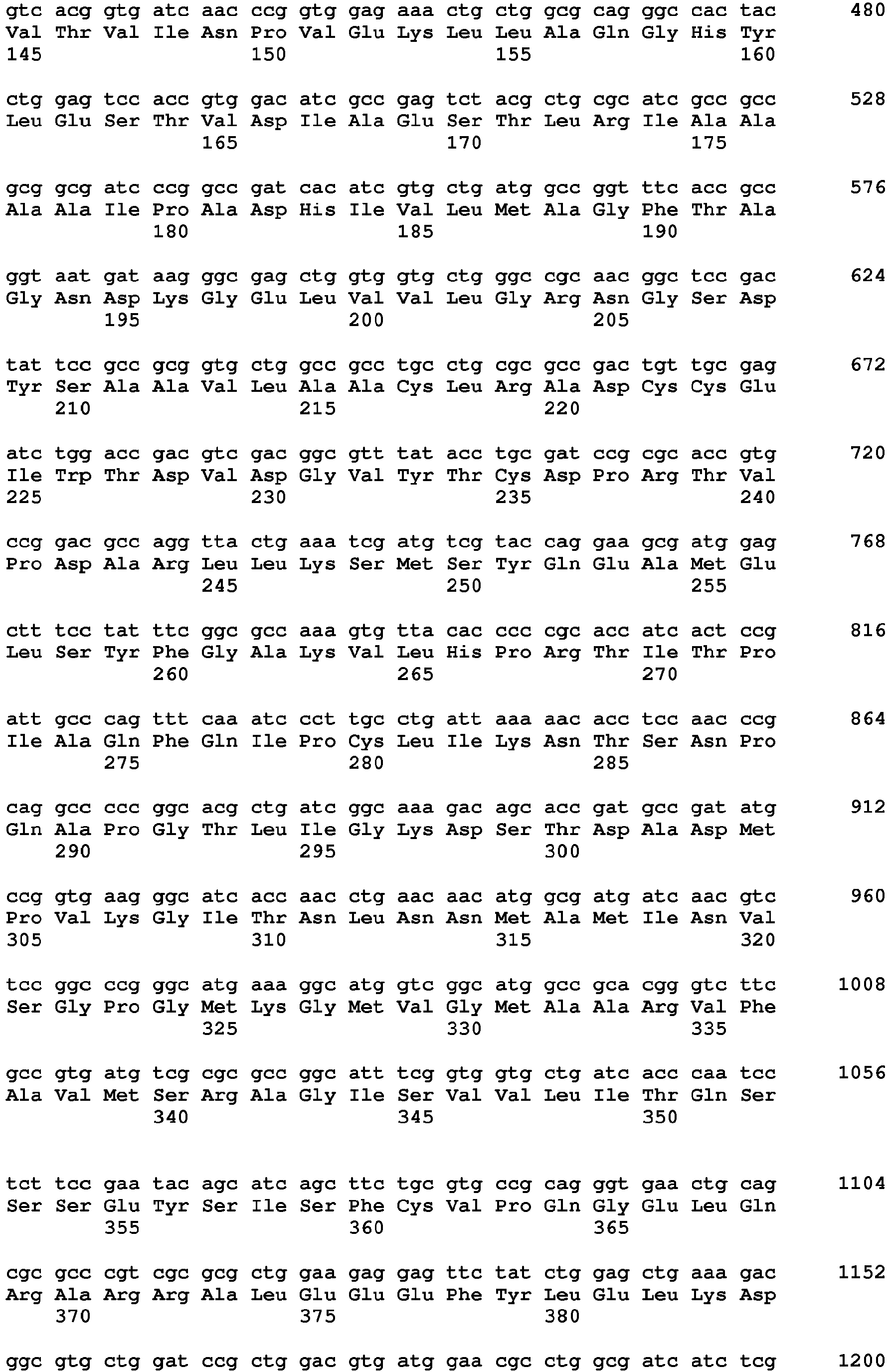


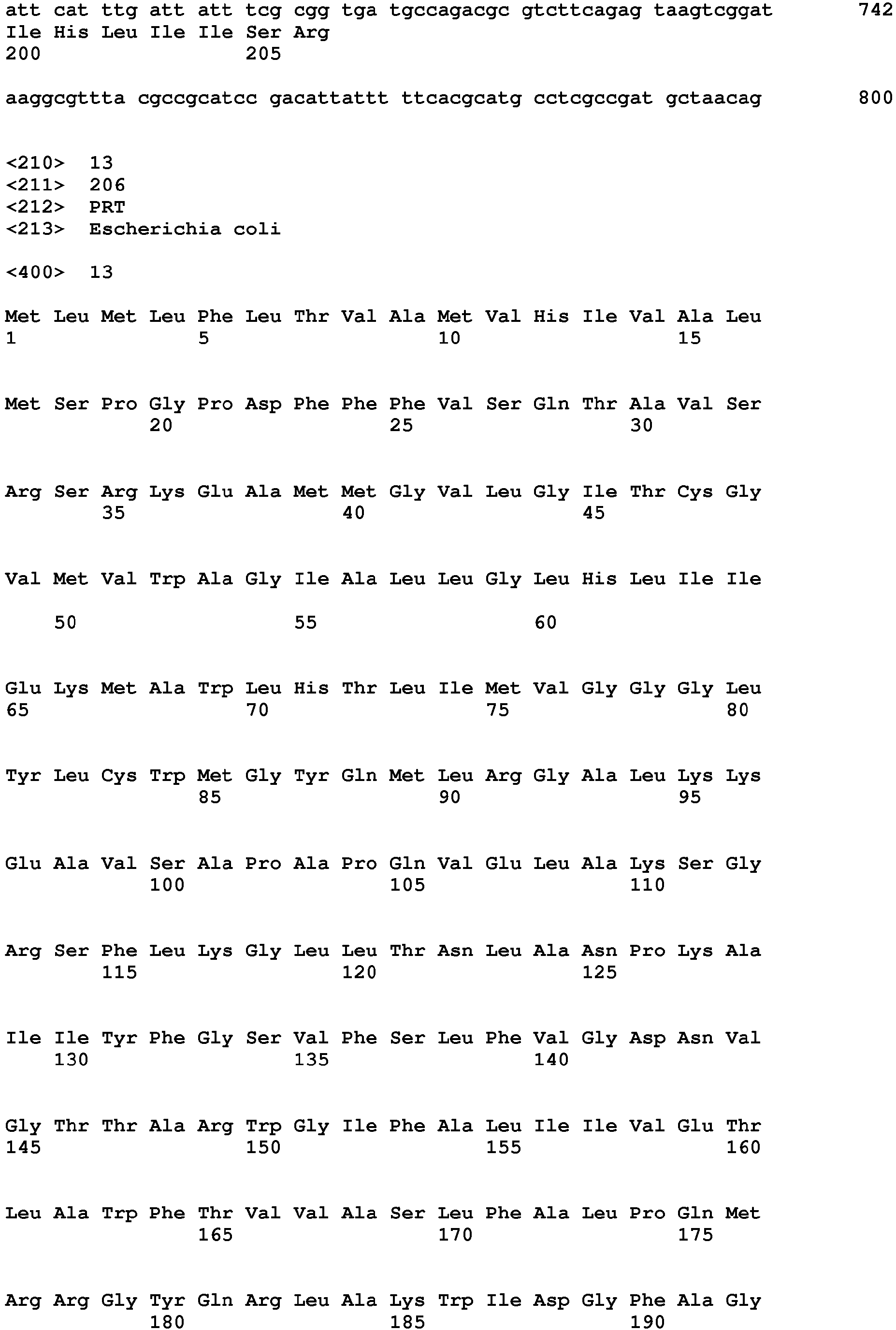
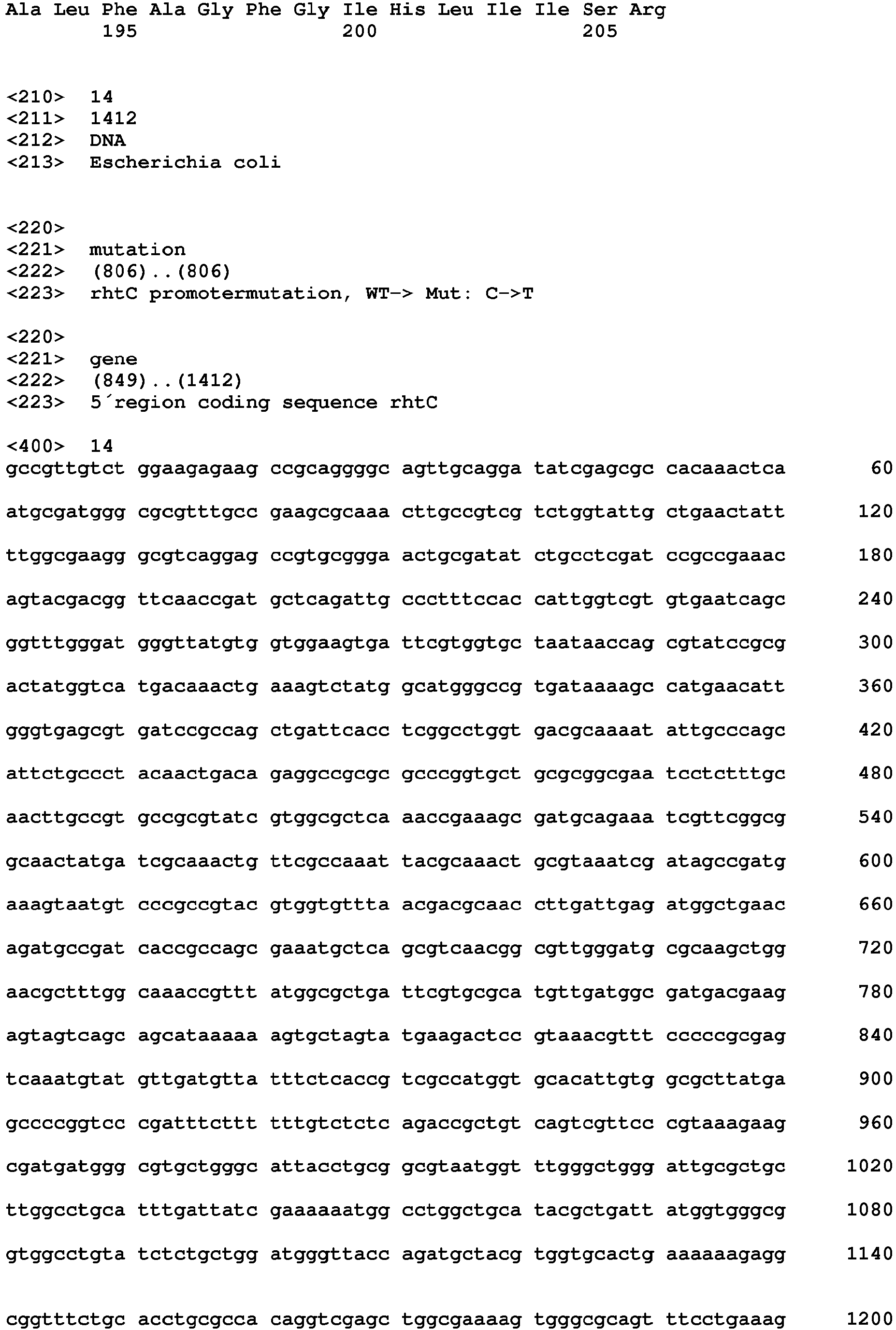


Claims (15)
- A recombinant L-amino acid-secreting microorganism of the Enterobacteriaceae family, comprising an DNA fragment having promoter activity that is functionally linked to a polynucleotide coding for a membrane protein, characterized in that the DNA fragment having promoter activity comprises SEQ ID NO: 8.
- The microorganism according to claim 1, characterized in that the DNA fragment having promoter activity is linked at the 3' end to a second DNA fragment carrying a ribosome-binding site.
- The microorganism according to claim 1, characterized in that the DNA fragment having promoter activity is linked at the 3' end to a second DNA fragment having the nucleotide sequence of positions 174 to 204 of SEQ ID NO: 9.
- The microorganism according to claim 1, characterized in that the DNA fragment having promoter activity is linked at the 3' end to a second DNA fragment having the nucleotide sequence of positions 174 to 204 of SEQ ID NO: 9 which is linked at its 3' end to a polynucleotide coding for the membrane protein.
- The microorganism according to any one of the preceding claims, characterized in that the DNA fragment having promoter activity is linked at the 5' end to a DNA fragment having the nucleotide sequence of positions 1 to 138 of SEQ ID NO: 9.
- The microorganism according to any one of the preceding claims, characterized in that the membrane protein is a protein having the activity of an amino acid transporter.
- The microorganism according to claim 6, characterized in that the protein having the activity of an amino acid transporter is a protein having the activity of an amino acid exporter.
- The microorganism according to claim 7, characterized in that the protein having the activity of an amino acid exporter has an amino acid sequence which is at least 90% identical to the sequence of SEQ ID NO: 2.
- The microorganism according to claim 8, characterized in that the protein having the activity of an amino acid exporter has an amino acid sequence, which is at least 95% identical to the sequence of SEQ ID NO: 2.
- The microorganism according to claim 9, characterized in that the protein having the activity of an amino acid exporter comprises the amino acid sequence of SEQ ID NO: 2, and/or in that the protein having the activity of an amino acid exporter is encoded by a polynucleotide comprising the nucleotide sequence of SEQ ID NO: 1.
- The microorganism according to any one of claims 1 to 9, characterized in that the DNA fragment having promoter activity is present in the chromosome of the microorganism, or, alternatively, in that the DNA fragment having promoter activity is located on an extrachromosomal replicating vector.
- The microorganism according to any one of claims 1 to 11, characterized in that it produces L-threonine, L-homoserine, L-histidine, L-lysine, L-tryptophan, L-valine, L-leucine, and L-isoleucine.
- A process for preparing L-amino acids or feedstuff additives containing L-amino acids, the process comprising(i) fermentation of a microorganism according to any one of claims 1 to 12 in a medium;(ii) enrichment of the L-amino acid in the fermentation medium and /or in the cell; and optionally(iii) isolation of the L-amino acid.
- A DNA fragment having promoter activity that is functionally linked to a polynucleotide coding for a membrane protein, characterized in that the DNA fragment having promoter activity comprises SEQ ID NO.:8.
- The use of the DNA fragment comprising SEQ IS NO.: 8 as a promoter for modulating the expression level of genes encoding membrane proteins or amino acid transporters.
Applications Claiming Priority (3)
| Application Number | Priority Date | Filing Date | Title |
|---|---|---|---|
| US201816100039A | 2018-08-09 | 2018-08-09 | |
| EP18188250 | 2018-08-09 | ||
| CN201811024315 | 2018-09-04 |
Publications (1)
| Publication Number | Publication Date |
|---|---|
| EP3608409A1 true EP3608409A1 (en) | 2020-02-12 |
Family
ID=67658372
Family Applications (1)
| Application Number | Title | Priority Date | Filing Date |
|---|---|---|---|
| EP19189530.9A Withdrawn EP3608409A1 (en) | 2018-08-09 | 2019-08-01 | Process for preparing l amino acids using improved strains of the enterobacteriaceae family |
Country Status (4)
| Country | Link |
|---|---|
| EP (1) | EP3608409A1 (en) |
| CN (1) | CN110819663A (en) |
| BR (1) | BR102019016416A2 (en) |
| PH (1) | PH12019000285A1 (en) |
Cited By (1)
| Publication number | Priority date | Publication date | Assignee | Title |
|---|---|---|---|---|
| EP3904521A4 (en) * | 2018-12-26 | 2022-03-23 | Daesang Corporation | E COLI VARIANT STRAIN OR L-AMINO ACID PRODUCING CORYNEBACTERIUM GLUTAMICUM VARIANT STRAIN, AND METHOD FOR PRODUCING L-AMINO ACIDS USING THE SAME |
Citations (46)
| Publication number | Priority date | Publication date | Assignee | Title |
|---|---|---|---|---|
| US4278765A (en) | 1978-06-30 | 1981-07-14 | Debabov Vladimir G | Method for preparing strains which produce aminoacids |
| US4321325A (en) | 1978-07-13 | 1982-03-23 | Debabov Vladimir G | Process for producing L-threonine |
| US4346170A (en) | 1979-07-23 | 1982-08-24 | Ajinomoto Company, Incorporated | Method for producing L-lysine by fermentation |
| US4371614A (en) | 1980-08-22 | 1983-02-01 | Ajinomoto Co., Inc. | E.Coli bacteria carrying recombinant plasmids and their use in the fermentative production of L-tryptophan |
| US4388405A (en) | 1979-06-25 | 1983-06-14 | Ajinomoto Company Incorporated | Method for producing L-histidine by fermentation |
| US4391907A (en) | 1979-12-13 | 1983-07-05 | Ajinomoto Company Incorporated | Method for producing L-valine by fermentation |
| EP0301572A2 (en) | 1987-07-31 | 1989-02-01 | Kyowa Hakko Kogyo Co., Ltd. | Process for producing l-threonine by fermentation |
| EP0332448A2 (en) | 1988-03-11 | 1989-09-13 | The University of Tokyo | Superconductive optoelectronic devices |
| SU974817A1 (en) | 1981-06-16 | 1990-08-23 | Всесоюзный научно-исследовательский институт генетики и селекции промышленных микроорганизмов | Method of producing l-treonin |
| US5175107A (en) | 1988-10-25 | 1992-12-29 | Ajinomoto Co., Inc. | Bacterial strain of escherichia coli bkiim b-3996 as the producer of l-threonine |
| US5362637A (en) | 1991-11-11 | 1994-11-08 | Kyowa Hakko Kogy Co., Ltd. | Process for producing L-isoleucine and ethionine by isoleucine analog resistant strains of E. coli |
| WO1995011985A1 (en) | 1993-10-28 | 1995-05-04 | Ajinomoto Co., Inc. | Process for producing substance |
| US5460958A (en) | 1992-10-27 | 1995-10-24 | Kyowa Hakko Kogyo Co., Ltd. | Process for producing L-isoleucine by S-2-aminoethyl-L-cysteine or D-Serine resistant strains of E coli |
| US5559016A (en) | 1992-12-22 | 1996-09-24 | Kyowa Hakko Kogyo Co., Ltd. | Process for producing alanine |
| WO1997008333A1 (en) | 1995-08-30 | 1997-03-06 | Ajinomoto Co., Inc. | Process for producing l-amino acids |
| US5695972A (en) | 1995-05-31 | 1997-12-09 | Kyowa Hakko Kogyo Co., Ltd. | Method for producing L-isoleucine with a fermentation process |
| WO1998004715A1 (en) | 1996-07-30 | 1998-02-05 | Archer-Daniels-Midland Company | Novel strains of escherichia coli, methods of preparing the same and use thereof in fermentation processes for l-threonine production |
| US5744331A (en) | 1994-06-30 | 1998-04-28 | Kyowa Hakko Kogyo Co., Ltd. | Process for producing L-leucine |
| US5756345A (en) | 1995-09-05 | 1998-05-26 | Degussa Aktiengesellschaft | Production of tryptophan by the bacterium Escherichia coli |
| US5763230A (en) | 1996-03-22 | 1998-06-09 | Triple-A B.V. P/A Produkschap Voor Veevoedor | Amino acid fermentation processes |
| WO1999018228A2 (en) | 1997-10-04 | 1999-04-15 | Forschungszentrum Jülich GmbH | Method for microbial production of amino acids of the aspartate and/or glutamate family and agents which can be used in said method |
| WO2000009660A1 (en) | 1998-08-14 | 2000-02-24 | Daesang Corporation | Novel microorganisms and method for producing l-threonine using the same |
| WO2000009661A1 (en) | 1998-08-14 | 2000-02-24 | Daesang Corporation | Novel microorganisms and method for producing l-threonine using the same |
| EP1013765A1 (en) | 1998-12-23 | 2000-06-28 | Ajinomoto Co., Ltd. | Gene and method for producing L-amino acids |
| DE19907347A1 (en) | 1999-02-20 | 2000-08-24 | Degussa | Preparation of L-amino acids, e.g. L-lysine, L-threonine or L-isoleucine, useful in animal nutrition and pharmaceuticals, by fermentation of coryneform bacteria |
| WO2001005939A1 (en) | 1999-07-19 | 2001-01-25 | Ajinomoto Co., Inc. | Process for producing target substance by fermentation |
| WO2001014525A1 (en) | 1999-08-26 | 2001-03-01 | Daesang Corporation | Microorganisms and methods for producing threonine |
| EP1149911A2 (en) | 2000-04-26 | 2001-10-31 | Ajinomoto Co., Ltd. | Amino acid producing strains belonging to the genus Escherichia and method for producing amino acid |
| WO2001092545A1 (en) | 2000-05-27 | 2001-12-06 | Degussa Ag | Process for the fermentative preparation of l-threonine |
| WO2002018543A2 (en) | 2000-08-31 | 2002-03-07 | Degussa Ag | Fermentation process for the preparation of l-threonine |
| WO2002026993A1 (en) | 2000-09-28 | 2002-04-04 | Archer-Daniels-Midland Company | Escherichia coli strains which over-produce l-threonine and processes for the production of l-threonine by fermentation |
| WO2002029080A2 (en) | 2000-09-30 | 2002-04-11 | Degussa Ag | Fermentation process for the preparation of l-amino acids using strains of the family enterobacteriaceae |
| WO2002036797A2 (en) | 2000-11-04 | 2002-05-10 | Degussa Ag | Process for the fermentative preparation of l-amino acids using strains of the enterobacteriaceae family |
| WO2002064808A1 (en) | 2001-02-13 | 2002-08-22 | Cheil Jedang Corporation | Method for l-threonine production |
| WO2002081698A2 (en) | 2001-04-03 | 2002-10-17 | Degussa Ag | Process for the production of l-amino acids using strains of the family enterobacteriaceae that contain an attenuated frur gene |
| WO2003004670A2 (en) | 2001-07-06 | 2003-01-16 | Degussa Ag | Process for the preparation of l-amino acids using strains of the enterobacteriaceae family with enhanced pts-g expression |
| WO2003006666A2 (en) | 2001-07-11 | 2003-01-23 | Degussa Ag | Process for the preparation of l-amino acids using strains of the enterobacteriaceae family |
| WO2003008603A2 (en) | 2001-07-18 | 2003-01-30 | Degussa Ag | Process for the preparation of l-amino acids using strains of the enterobacteri acea family which contain an attenuated aspa gene |
| WO2003008615A2 (en) | 2001-07-18 | 2003-01-30 | Degussa Ag | Process for the preparation of l-amino acids using strains of the enterobacteriaceae family which contain an enhanced succ or sucd gene |
| WO2003074719A2 (en) | 2002-03-07 | 2003-09-12 | Degussa Ag | Amino acid-producing bacteria and a process for preparing l-amino acids |
| WO2005014841A1 (en) | 2003-08-01 | 2005-02-17 | Degussa Ag | Process for the preparation of l-threonine |
| WO2005014843A2 (en) | 2003-08-12 | 2005-02-17 | Degussa Ag | A process for preparing l-threonine |
| WO2005014842A1 (en) | 2003-08-01 | 2005-02-17 | Degussa Ag | Process for the preparation of l-threonine |
| WO2005014840A1 (en) | 2003-08-01 | 2005-02-17 | Degussa Ag | Process for the preparation of l-threonine |
| DE102004028859A1 (en) | 2003-08-01 | 2005-02-24 | Degussa Ag | Preparing L-threonine by culturing bacteria of Enterobacteriaceae family in nutrient medium comprising source of carbon, nitrogen and phosphorus, to produce L-threonine |
| US9713359B2 (en) | 2015-05-06 | 2017-07-25 | Yu Hsieh Industrial Co., Ltd. | Shoe body with arch suspended support |
-
2019
- 2019-08-01 EP EP19189530.9A patent/EP3608409A1/en not_active Withdrawn
- 2019-08-08 PH PH12019000285A patent/PH12019000285A1/en unknown
- 2019-08-08 BR BR102019016416-6A patent/BR102019016416A2/en not_active Application Discontinuation
- 2019-08-09 CN CN201910733384.0A patent/CN110819663A/en active Pending
Patent Citations (52)
| Publication number | Priority date | Publication date | Assignee | Title |
|---|---|---|---|---|
| US4278765A (en) | 1978-06-30 | 1981-07-14 | Debabov Vladimir G | Method for preparing strains which produce aminoacids |
| US4321325A (en) | 1978-07-13 | 1982-03-23 | Debabov Vladimir G | Process for producing L-threonine |
| US4388405A (en) | 1979-06-25 | 1983-06-14 | Ajinomoto Company Incorporated | Method for producing L-histidine by fermentation |
| US4346170A (en) | 1979-07-23 | 1982-08-24 | Ajinomoto Company, Incorporated | Method for producing L-lysine by fermentation |
| US4391907A (en) | 1979-12-13 | 1983-07-05 | Ajinomoto Company Incorporated | Method for producing L-valine by fermentation |
| US4371614A (en) | 1980-08-22 | 1983-02-01 | Ajinomoto Co., Inc. | E.Coli bacteria carrying recombinant plasmids and their use in the fermentative production of L-tryptophan |
| SU974817A1 (en) | 1981-06-16 | 1990-08-23 | Всесоюзный научно-исследовательский институт генетики и селекции промышленных микроорганизмов | Method of producing l-treonin |
| EP0301572A2 (en) | 1987-07-31 | 1989-02-01 | Kyowa Hakko Kogyo Co., Ltd. | Process for producing l-threonine by fermentation |
| EP0332448A2 (en) | 1988-03-11 | 1989-09-13 | The University of Tokyo | Superconductive optoelectronic devices |
| US5175107A (en) | 1988-10-25 | 1992-12-29 | Ajinomoto Co., Inc. | Bacterial strain of escherichia coli bkiim b-3996 as the producer of l-threonine |
| US5631157A (en) | 1988-10-25 | 1997-05-20 | Ajinomoto Co., Inc. | Bacterial strain of Escherichia coli VNII genetika 472T23 as the producer of L-threonine |
| US5538873A (en) | 1988-10-25 | 1996-07-23 | Ajinomoto Co., Inc. | Bacterial strain of escherichia coli BKIIM B-3996 as the producer of l-threonine |
| US5362637A (en) | 1991-11-11 | 1994-11-08 | Kyowa Hakko Kogy Co., Ltd. | Process for producing L-isoleucine and ethionine by isoleucine analog resistant strains of E. coli |
| US5460958A (en) | 1992-10-27 | 1995-10-24 | Kyowa Hakko Kogyo Co., Ltd. | Process for producing L-isoleucine by S-2-aminoethyl-L-cysteine or D-Serine resistant strains of E coli |
| US5559016A (en) | 1992-12-22 | 1996-09-24 | Kyowa Hakko Kogyo Co., Ltd. | Process for producing alanine |
| WO1995011985A1 (en) | 1993-10-28 | 1995-05-04 | Ajinomoto Co., Inc. | Process for producing substance |
| US5744331A (en) | 1994-06-30 | 1998-04-28 | Kyowa Hakko Kogyo Co., Ltd. | Process for producing L-leucine |
| US5695972A (en) | 1995-05-31 | 1997-12-09 | Kyowa Hakko Kogyo Co., Ltd. | Method for producing L-isoleucine with a fermentation process |
| WO1997008333A1 (en) | 1995-08-30 | 1997-03-06 | Ajinomoto Co., Inc. | Process for producing l-amino acids |
| US5756345A (en) | 1995-09-05 | 1998-05-26 | Degussa Aktiengesellschaft | Production of tryptophan by the bacterium Escherichia coli |
| US5763230A (en) | 1996-03-22 | 1998-06-09 | Triple-A B.V. P/A Produkschap Voor Veevoedor | Amino acid fermentation processes |
| WO1998004715A1 (en) | 1996-07-30 | 1998-02-05 | Archer-Daniels-Midland Company | Novel strains of escherichia coli, methods of preparing the same and use thereof in fermentation processes for l-threonine production |
| WO1999018228A2 (en) | 1997-10-04 | 1999-04-15 | Forschungszentrum Jülich GmbH | Method for microbial production of amino acids of the aspartate and/or glutamate family and agents which can be used in said method |
| WO2000009660A1 (en) | 1998-08-14 | 2000-02-24 | Daesang Corporation | Novel microorganisms and method for producing l-threonine using the same |
| WO2000009661A1 (en) | 1998-08-14 | 2000-02-24 | Daesang Corporation | Novel microorganisms and method for producing l-threonine using the same |
| EP1013765A1 (en) | 1998-12-23 | 2000-06-28 | Ajinomoto Co., Ltd. | Gene and method for producing L-amino acids |
| DE19907347A1 (en) | 1999-02-20 | 2000-08-24 | Degussa | Preparation of L-amino acids, e.g. L-lysine, L-threonine or L-isoleucine, useful in animal nutrition and pharmaceuticals, by fermentation of coryneform bacteria |
| WO2001005939A1 (en) | 1999-07-19 | 2001-01-25 | Ajinomoto Co., Inc. | Process for producing target substance by fermentation |
| WO2001014525A1 (en) | 1999-08-26 | 2001-03-01 | Daesang Corporation | Microorganisms and methods for producing threonine |
| EP1149911A2 (en) | 2000-04-26 | 2001-10-31 | Ajinomoto Co., Ltd. | Amino acid producing strains belonging to the genus Escherichia and method for producing amino acid |
| US6960455B2 (en) | 2000-04-26 | 2005-11-01 | Ajinomoto Co., Inc. | Methods of making amino acids using E. coli transformed with csc genes |
| WO2001092545A1 (en) | 2000-05-27 | 2001-12-06 | Degussa Ag | Process for the fermentative preparation of l-threonine |
| WO2002018543A2 (en) | 2000-08-31 | 2002-03-07 | Degussa Ag | Fermentation process for the preparation of l-threonine |
| WO2002026993A1 (en) | 2000-09-28 | 2002-04-04 | Archer-Daniels-Midland Company | Escherichia coli strains which over-produce l-threonine and processes for the production of l-threonine by fermentation |
| WO2002029080A2 (en) | 2000-09-30 | 2002-04-11 | Degussa Ag | Fermentation process for the preparation of l-amino acids using strains of the family enterobacteriaceae |
| WO2002036797A2 (en) | 2000-11-04 | 2002-05-10 | Degussa Ag | Process for the fermentative preparation of l-amino acids using strains of the enterobacteriaceae family |
| WO2002064808A1 (en) | 2001-02-13 | 2002-08-22 | Cheil Jedang Corporation | Method for l-threonine production |
| WO2002081698A2 (en) | 2001-04-03 | 2002-10-17 | Degussa Ag | Process for the production of l-amino acids using strains of the family enterobacteriaceae that contain an attenuated frur gene |
| WO2002081721A2 (en) | 2001-04-03 | 2002-10-17 | Degussa Ag | Process for the production of l-amino acids using strains of the family enterobacteriaceae that contain an attenuated dgsa gene |
| WO2003004674A2 (en) | 2001-07-06 | 2003-01-16 | Degussa Ag | Process for the preparation of l-amino acids using strains of the enterobacteriaceae family |
| WO2003004670A2 (en) | 2001-07-06 | 2003-01-16 | Degussa Ag | Process for the preparation of l-amino acids using strains of the enterobacteriaceae family with enhanced pts-g expression |
| WO2003006666A2 (en) | 2001-07-11 | 2003-01-23 | Degussa Ag | Process for the preparation of l-amino acids using strains of the enterobacteriaceae family |
| WO2003008603A2 (en) | 2001-07-18 | 2003-01-30 | Degussa Ag | Process for the preparation of l-amino acids using strains of the enterobacteri acea family which contain an attenuated aspa gene |
| WO2003008615A2 (en) | 2001-07-18 | 2003-01-30 | Degussa Ag | Process for the preparation of l-amino acids using strains of the enterobacteriaceae family which contain an enhanced succ or sucd gene |
| WO2003008614A2 (en) | 2001-07-18 | 2003-01-30 | Degussa Ag | Process for the preparation of l-amino acids using strains of the enterobacteriaceae family which contain an enhanced suca or sucb gene |
| WO2003074719A2 (en) | 2002-03-07 | 2003-09-12 | Degussa Ag | Amino acid-producing bacteria and a process for preparing l-amino acids |
| WO2005014841A1 (en) | 2003-08-01 | 2005-02-17 | Degussa Ag | Process for the preparation of l-threonine |
| WO2005014842A1 (en) | 2003-08-01 | 2005-02-17 | Degussa Ag | Process for the preparation of l-threonine |
| WO2005014840A1 (en) | 2003-08-01 | 2005-02-17 | Degussa Ag | Process for the preparation of l-threonine |
| DE102004028859A1 (en) | 2003-08-01 | 2005-02-24 | Degussa Ag | Preparing L-threonine by culturing bacteria of Enterobacteriaceae family in nutrient medium comprising source of carbon, nitrogen and phosphorus, to produce L-threonine |
| WO2005014843A2 (en) | 2003-08-12 | 2005-02-17 | Degussa Ag | A process for preparing l-threonine |
| US9713359B2 (en) | 2015-05-06 | 2017-07-25 | Yu Hsieh Industrial Co., Ltd. | Shoe body with arch suspended support |
Non-Patent Citations (82)
| Title |
|---|
| "Bioprozesstechnik 1. Einfuhrung in die Bioverfahrenstechnik [Bioprocess technology 1. Introduction to bioprocess technology", 1991, GUSTAV FISCHER VERLAG |
| "Cellular and Molecular Biology", 1996, ASM PRESS, article "Escherichia coli and Salmonella" |
| "Gene Splicing by Overlap Extension, Horton", MOLECULAR BIOTECHNOLOGY, vol. 3, 1995, pages 93 - 98 |
| "NCBI", Database accession no. U00096.2 |
| "The American Society for Bacteriology Manual", MANUAL OF METHODS FOR GENERAL BACTERIOLOGY, 1981 |
| ALESHIN ET AL., TRENDS IN BIOCHEMICAL SCIENCE, vol. 24, no. 4, 1999, pages 133 - 5 |
| AMANN ET AL., GENE, vol. 69, 1988, pages 301 - 315 |
| AMANNBROSIUS, GENE, vol. 40, 1985, pages 183 - 190 |
| APPLIED AND ENVIRONMENTAL MICROBIOLOGY, vol. 38, no. 6, 1979, pages 1045 - 1051 |
| APPLIED BIOCHEMISTRY AND BIOTECHNOLOGY, vol. 37, no. 3, 1992, pages 255 - 265 |
| ARCHIVES IN MICROBIOLOGY, vol. 149, 1987, pages 36 - 42 |
| ASTAUROVA ET AL., APPLIED BIOCHEMICAL MICROBIOLOGY, vol. 21, 1985, pages 611 - 616 |
| BARTOLOME ET AL., GENE, vol. 102, 1991, pages 75 - 78 |
| BERGTYMOCZKOSTRYER: "Biochemistry", 2002, FREEMAN AND COMPANY |
| BIOSCIENCE BIOTECHNOLOGY AND BIOCHEMISTRY, vol. 61, no. 11, 1997, pages 1877 - 1882 |
| BLATTNER ET AL., SCIENCE, vol. 277, 1997, pages 1453 - 1462 |
| BOLIVAR ET AL., GENE, vol. 2, 1977, pages 95 - 113 |
| BOYD ET AL., JOURNAL OF BACTERIOLOGY, vol. 182, 2000, pages 6228 - 6237 |
| CARRIERKEASLING, BIOTECHNOLOGY PROGRESS, vol. 15, 1999, pages 58 - 64 |
| CHANGCOHEN, JOURNAL OF BACTERIOLOGY, vol. 134, 1978, pages 1141 - 1156 |
| CHAPON, EMBO JOURNAL, vol. 1, 1982, pages 369 - 374 |
| CHUNG ET AL., PROCEEDINGS OF THE NATIONAL ACADEMY OF SCIENCES OF THE UNITED STATES OF AMERICA, USA, vol. 86, 1989, pages 2172 - 2175 |
| DE BROER ET AL., PROCEEDINGS OF THE NATIONAL ACADEMY OF SCIENCES OF THE UNITED STATES OF AMERICA, vol. 80, 1983, pages 21 - 25 |
| DEBABOV, ADVANCES IN BIOCHEMICAL ENGINEERING, vol. 79, 2003, pages 113 - 136 |
| EUROPEAN JOURNAL OF BIOCHEMISTRY, vol. 158, 1986, pages 647 - 653 |
| FOURNIER ET AL., ANTIMICROBIAL AGENTS AND CHEMOTHERAPY, vol. 39, no. 6, 1995, pages 1365 - 1368 |
| FRANCHGERDES, CURRENT OPINION IN MICROBIOLOGY, vol. 3, 2000, pages 159 - 164 |
| GENE, vol. 23, 1983, pages 199 - 209 |
| GENE, vol. 57, no. 2-3, 1987, pages 151 - 158 |
| GENEVAUX P. ET AL., EMBO REPORTS, vol. 5, no. 2, 2004, pages 195 - 200 |
| GERDES, BIOTECHNOLOGY, vol. 6, 1988, pages 1402 - 1405 |
| GRANT ET AL., PROCEEDINGS OF THE NATIONAL ACADEMY OF SCIENCES USA, vol. 87, 1990, pages 4645 - 4649 |
| GUTHRIEWICKNER, JOURNAL OF BACTERIOLOGY, vol. 172, no. 10, 1990, pages 5555 - 5562 |
| GUYER ET AL., COLD SPRING HARBOR SYMP., QUANT. BIOLOGY, vol. 45, 1981, pages 135 - 140 |
| HAGEMANN: "Allgemeine Genetik [General Genetics", 1986, GUSTAV FISCHER VERLAG |
| HAMILTON ET AL., JOURNAL OF BACTERIOLOGY, vol. 171, 1989, pages 4617 - 4622 |
| HARTLEYGREGORI, GENE, vol. 13, 1981, pages 347 - 353 |
| HAWLEYMCCLURE, NUCLEIC ACIDS RESEARCH, vol. 11, no. 8, 1983, pages 5257 - 5266 |
| HERMANN ET AL., ELECTROPHORESIS, vol. 22, 2001, pages 1712 - 23 |
| HUI ET AL., EMBO JOURNAL, vol. 3, no. 3, 1984, pages 623 - 9 |
| INNIS ET AL.: "PCR protocols. A guide to methods and applications", 1990, ACADEMIC PRESS |
| J.H. MILLER: "A short course in bacterial genetics", 1992, COLD SPRING HARBOR LABORATORY PRESS |
| JENSENHAMMER, BIOTECHNOLOGY AND BIOENGINEERING, vol. 58, 1998, pages 191 - 195 |
| KAWANO ET AL., NUCLEIC ACIDS RESEARCH, vol. 33, no. 19, 2005, pages 6268 - 6276 |
| KHUDYAKOV ET AL., FEBS LETTERS, vol. 232, no. 2, 1988, pages 369 - 71 |
| KNIPPERS: "Molekulare Genetik [Molecular Genetics", 1995, GEORG THIEME VERLAG |
| KRUSE ET AL., APPLIED MICROBIOLOGICAL BIOTECHNOLOGY, vol. 59, no. 2-3, 2002, pages 205 - 10 |
| LAVALLIE ET AL., BIO/TECHNOLOGY, vol. 11, 1993, pages 187 - 193 |
| LEE ET AL., JOURNAL OF BACTERIOLOGY, vol. 185, no. 18, 2003, pages 5442 - 5451 |
| LIEBL ET AL., INTERNATIONAL JOURNAL OF SYSTEMATIC BACTERIOLOGY, vol. 41, 1991, pages 255 - 260 |
| LINDROTH ET AL., ANALYTICAL CHEMISTRY, vol. 51, 1979, pages 1167 - 1174 |
| LINK ET AL., J. BACTERIOL., vol. 179, no. 20, 1997, pages 6228 - 6237 |
| LINK ET AL., JOURNAL OF BACTERIOLOGY, vol. 179, 1997, pages 6228 - 6237 |
| LLOSA ET AL., PLASMID, vol. 26, 1991, pages 222 - 224 |
| LOHAUSMEYER, BIOSPEKTRUM, vol. 5, 1998, pages 32 - 39 |
| LOTTSPEICH, ANGEWANDTE CHEMIE, vol. 38, 1999, pages 2630 - 2647 |
| LOTTSPEICHZORBAS: "Bioanalytik'' [Bioanalytics", 1998, SPEKTRUM AKADEMISCHER VERLAG |
| MAKRIDES ET AL., MICROBIOLOGICAL REVIEWS, vol. 60, no. 3, 1996, pages 512 - 538 |
| MARTINEZ-MORALES ET AL., JOURNAL OF BACTERIOLOGY 1999, 1999, pages 7143 - 7148 |
| MARTINEZ-MORALES ET AL., JOURNAL OF BACTERIOLOGY, vol. 181, 1999, pages 7143 - 7148 |
| MOLECULAR AND GENERAL GENETICS, vol. 231, no. 2, 1992, pages 332 - 336 |
| NAKAYAMA: "Overproduction of Microbial Products", 1982, ACADEMIC PRESS, article "Breeding of Amino Acid Producing Microorganisms" |
| NEWTONGRAHAM: "Bioreaktoren und periphere Einrichtungen [Bioreactors and peripheral installations", 1994, SPEKTRUM AKADEMISCHER VERLAG |
| OMORI ET AL., JOURNAL OF BACTERIOLOGY, vol. 175, no. 4, 1993, pages 959 - 965 |
| PICKERING, LC.GC (MAGAZINE OF CHROMATOGRAPHIC SCIENCE, vol. 7, no. 6, 1989, pages 484 - 487 |
| QIUGOODMAN, JOURNAL OF BIOLOGICAL CHEMISTRY, vol. 272, 1997, pages 8611 - 8617 |
| QUANDTKLIPP, GENE, vol. 80, 1989, pages 161 - 169 |
| RAVNIKARSOMERVILLE, JOURNAL OF BACTERIOLOGY, vol. 169, 1987, pages 4716 - 4721 |
| REDDY ET AL., PROCEEDINGS OF THE NATIONAL ACADEMY OF SCIENCES OF THE USA, vol. 82, no. 17, 1985, pages 5656 - 60 |
| RIEPINGHERMANN: "Microbiology Monographs", vol. 5, 2007, SPRINGER VERLAG, pages: 71 - 92 |
| ROBERT C. BREWSTER ET AL: "Tuning Promoter Strength through RNA Polymerase Binding Site Design in Escherichia coli", PLOS COMPUTATIONAL BIOLOGY, vol. 8, no. 12, 13 December 2012 (2012-12-13), pages e1002811, XP055502686, DOI: 10.1371/journal.pcbi.1002811 * |
| ROSENBERG ET AL., NATURE, vol. 272, 1978, pages 414 - 423 |
| SANGER ET AL., PROCEEDINGS OF THE NATIONAL ACADEMY OF SCIENCE USA, vol. 74, no. 12, 1977, pages 5463 - 5467 |
| SMITH ET AL., JOURNAL OF BACTERIOLOGICAL CHEMISTRY, vol. 257, 1982, pages 9043 - 9048 |
| SMITHPARSELL, JOURNAL OF GENERAL MICROBIOLOGY, vol. 87, 1975, pages 129 - 140 |
| SPACKMAN ET AL., ANALYTICAL CHEMISTRY, vol. 30, 1958, pages 1190 - 1206 |
| STENSTROM ET AL., GENE, vol. 273, no. 2, 2001, pages 259 - 65 |
| VOCKEBASTIA, PROCEEDINGS OF THE NATIONAL ACADEMY OF SCIENCES USA, vol. 80, no. 21, 1983, pages 6557 - 6561 |
| WENTESCHACHMANN, JOURNAL OF BIOLOGICAL CHEMISTRY, vol. 266, 1991, pages 20833 - 20839 |
| YANO ET AL., PROCEEDINGS OF THE NATIONAL ACADEMY OF SCIENCES OF THE UNITED STATES OF AMERICA, vol. 95, 1998, pages 5511 - 5515 |
| YUCOURT, GENE, vol. 223, 1998, pages 77 - 81 |
| ZAKATAEVA ET AL., FEBS LETTERS, vol. 452, no. 3, 1999, pages 228 - 232 |
Cited By (3)
| Publication number | Priority date | Publication date | Assignee | Title |
|---|---|---|---|---|
| EP3904521A4 (en) * | 2018-12-26 | 2022-03-23 | Daesang Corporation | E COLI VARIANT STRAIN OR L-AMINO ACID PRODUCING CORYNEBACTERIUM GLUTAMICUM VARIANT STRAIN, AND METHOD FOR PRODUCING L-AMINO ACIDS USING THE SAME |
| EP4159866A1 (en) * | 2018-12-26 | 2023-04-05 | Daesang Corporation | E. coli variant strain or corynebacterium glutamicum variant strain producing l-amino acids, and method for producing l-amino acids using same |
| EP4159865A1 (en) * | 2018-12-26 | 2023-04-05 | Daesang Corporation | E. coli variant strain producing l-amino acids, and method for producing amino acids using same |
Also Published As
| Publication number | Publication date |
|---|---|
| CN110819663A (en) | 2020-02-21 |
| PH12019000285A1 (en) | 2021-04-26 |
| BR102019016416A2 (en) | 2020-03-03 |
Similar Documents
| Publication | Publication Date | Title |
|---|---|---|
| US7256021B2 (en) | Enterobacteriaceae strains with an attenuated aspA gene for the fermentative production of amino acids | |
| US8883458B2 (en) | Process for preparing L-amino acids using improved strains of the Enterobacteriaceae family | |
| EP1608764A1 (en) | A process for the production of l-amino acids using strains of the enterobacteriaceae family which overexpress the galp gene, coding for a galactose proton symporter | |
| EP1706482B1 (en) | Process for the preparation of l-amino acids using strains of the enterobacteriaceae family | |
| US7759094B2 (en) | Method for the production of L-amino acids using strains from the Enterobacteriaceae family which contain an enhanced lamb gene | |
| EP1706493B1 (en) | Process for producing l-threonine or l-lysine employing recombinant enterobacteriaceae with enhanced enolase activity | |
| EP1711593B1 (en) | Process for the preparation of l-amino acids using strains of the family enterobacteriaceae | |
| ZA200605220B (en) | Process for preparing l-aminoacids using strains of the enterobacteriaceae family | |
| US11053526B2 (en) | Process for preparing L amino acids using improved strains of the enterobacteriaceae family | |
| EP3608409A1 (en) | Process for preparing l amino acids using improved strains of the enterobacteriaceae family | |
| US7553645B2 (en) | Process for preparing L-amino acids using improved strains of the Enterobacteriaceae family | |
| US20050221448A1 (en) | Process for the preparation of l-amino acids using strains of the enterobacteriaceae family which contain an attenuated aceb gene | |
| EP1483388B1 (en) | Process for the preparation of l-amino acids using strains of the enterobacteriaceae family | |
| EP1382685A2 (en) | Process for the fermentative preparation of L-amino acids using strains of the enterobacteriaceae family with overexpressed rseB gene | |
| EP1697531A2 (en) | Process for preparing l-amino acids using strains of the enterobacteriaceae family | |
| EP1483394A2 (en) | Process for the preparation of l-amino acids using strains of the enterobacteriaceae family | |
| US20050153403A1 (en) | Process for preparing L-amino acids using strains of the enterobacteriaceae family |
Legal Events
| Date | Code | Title | Description |
|---|---|---|---|
| PUAI | Public reference made under article 153(3) epc to a published international application that has entered the european phase |
Free format text: ORIGINAL CODE: 0009012 |
|
| STAA | Information on the status of an ep patent application or granted ep patent |
Free format text: STATUS: REQUEST FOR EXAMINATION WAS MADE |
|
| 17P | Request for examination filed |
Effective date: 20190801 |
|
| AK | Designated contracting states |
Kind code of ref document: A1 Designated state(s): AL AT BE BG CH CY CZ DE DK EE ES FI FR GB GR HR HU IE IS IT LI LT LU LV MC MK MT NL NO PL PT RO RS SE SI SK SM TR |
|
| AX | Request for extension of the european patent |
Extension state: BA ME |
|
| STAA | Information on the status of an ep patent application or granted ep patent |
Free format text: STATUS: THE APPLICATION HAS BEEN WITHDRAWN |
|
| 18W | Application withdrawn |
Effective date: 20220111 |