EP3605714A1 - Electrode assembly and lithium secondary battery including same - Google Patents
Electrode assembly and lithium secondary battery including same Download PDFInfo
- Publication number
- EP3605714A1 EP3605714A1 EP18884817.0A EP18884817A EP3605714A1 EP 3605714 A1 EP3605714 A1 EP 3605714A1 EP 18884817 A EP18884817 A EP 18884817A EP 3605714 A1 EP3605714 A1 EP 3605714A1
- Authority
- EP
- European Patent Office
- Prior art keywords
- electrode assembly
- positive
- battery
- current collector
- outermost
- Prior art date
- Legal status (The legal status is an assumption and is not a legal conclusion. Google has not performed a legal analysis and makes no representation as to the accuracy of the status listed.)
- Granted
Links
Images


Classifications
-
- H—ELECTRICITY
- H01—ELECTRIC ELEMENTS
- H01M—PROCESSES OR MEANS, e.g. BATTERIES, FOR THE DIRECT CONVERSION OF CHEMICAL ENERGY INTO ELECTRICAL ENERGY
- H01M10/00—Secondary cells; Manufacture thereof
- H01M10/05—Accumulators with non-aqueous electrolyte
- H01M10/058—Construction or manufacture
- H01M10/0585—Construction or manufacture of accumulators having only flat construction elements, i.e. flat positive electrodes, flat negative electrodes and flat separators
-
- H—ELECTRICITY
- H01—ELECTRIC ELEMENTS
- H01M—PROCESSES OR MEANS, e.g. BATTERIES, FOR THE DIRECT CONVERSION OF CHEMICAL ENERGY INTO ELECTRICAL ENERGY
- H01M10/00—Secondary cells; Manufacture thereof
- H01M10/04—Construction or manufacture in general
- H01M10/0413—Large-sized flat cells or batteries for motive or stationary systems with plate-like electrodes
-
- H—ELECTRICITY
- H01—ELECTRIC ELEMENTS
- H01M—PROCESSES OR MEANS, e.g. BATTERIES, FOR THE DIRECT CONVERSION OF CHEMICAL ENERGY INTO ELECTRICAL ENERGY
- H01M10/00—Secondary cells; Manufacture thereof
- H01M10/05—Accumulators with non-aqueous electrolyte
- H01M10/052—Li-accumulators
- H01M10/0525—Rocking-chair batteries, i.e. batteries with lithium insertion or intercalation in both electrodes; Lithium-ion batteries
-
- H—ELECTRICITY
- H01—ELECTRIC ELEMENTS
- H01M—PROCESSES OR MEANS, e.g. BATTERIES, FOR THE DIRECT CONVERSION OF CHEMICAL ENERGY INTO ELECTRICAL ENERGY
- H01M4/00—Electrodes
- H01M4/02—Electrodes composed of, or comprising, active material
- H01M4/04—Processes of manufacture in general
- H01M4/0402—Methods of deposition of the material
- H01M4/0404—Methods of deposition of the material by coating on electrode collectors
-
- H—ELECTRICITY
- H01—ELECTRIC ELEMENTS
- H01M—PROCESSES OR MEANS, e.g. BATTERIES, FOR THE DIRECT CONVERSION OF CHEMICAL ENERGY INTO ELECTRICAL ENERGY
- H01M4/00—Electrodes
- H01M4/02—Electrodes composed of, or comprising, active material
- H01M4/13—Electrodes for accumulators with non-aqueous electrolyte, e.g. for lithium-accumulators; Processes of manufacture thereof
- H01M4/131—Electrodes based on mixed oxides or hydroxides, or on mixtures of oxides or hydroxides, e.g. LiCoOx
-
- H—ELECTRICITY
- H01—ELECTRIC ELEMENTS
- H01M—PROCESSES OR MEANS, e.g. BATTERIES, FOR THE DIRECT CONVERSION OF CHEMICAL ENERGY INTO ELECTRICAL ENERGY
- H01M4/00—Electrodes
- H01M4/02—Electrodes composed of, or comprising, active material
- H01M4/13—Electrodes for accumulators with non-aqueous electrolyte, e.g. for lithium-accumulators; Processes of manufacture thereof
- H01M4/134—Electrodes based on metals, Si or alloys
-
- H—ELECTRICITY
- H01—ELECTRIC ELEMENTS
- H01M—PROCESSES OR MEANS, e.g. BATTERIES, FOR THE DIRECT CONVERSION OF CHEMICAL ENERGY INTO ELECTRICAL ENERGY
- H01M4/00—Electrodes
- H01M4/02—Electrodes composed of, or comprising, active material
- H01M4/36—Selection of substances as active materials, active masses, active liquids
- H01M4/38—Selection of substances as active materials, active masses, active liquids of elements or alloys
- H01M4/386—Silicon or alloys based on silicon
-
- H—ELECTRICITY
- H01—ELECTRIC ELEMENTS
- H01M—PROCESSES OR MEANS, e.g. BATTERIES, FOR THE DIRECT CONVERSION OF CHEMICAL ENERGY INTO ELECTRICAL ENERGY
- H01M4/00—Electrodes
- H01M4/02—Electrodes composed of, or comprising, active material
- H01M4/36—Selection of substances as active materials, active masses, active liquids
- H01M4/48—Selection of substances as active materials, active masses, active liquids of inorganic oxides or hydroxides
- H01M4/52—Selection of substances as active materials, active masses, active liquids of inorganic oxides or hydroxides of nickel, cobalt or iron
- H01M4/525—Selection of substances as active materials, active masses, active liquids of inorganic oxides or hydroxides of nickel, cobalt or iron of mixed oxides or hydroxides containing iron, cobalt or nickel for inserting or intercalating light metals, e.g. LiNiO2, LiCoO2 or LiCoOxFy
-
- H—ELECTRICITY
- H01—ELECTRIC ELEMENTS
- H01M—PROCESSES OR MEANS, e.g. BATTERIES, FOR THE DIRECT CONVERSION OF CHEMICAL ENERGY INTO ELECTRICAL ENERGY
- H01M4/00—Electrodes
- H01M4/02—Electrodes composed of, or comprising, active material
- H01M4/62—Selection of inactive substances as ingredients for active masses, e.g. binders, fillers
- H01M4/628—Inhibitors, e.g. gassing inhibitors, corrosion inhibitors
-
- H—ELECTRICITY
- H01—ELECTRIC ELEMENTS
- H01M—PROCESSES OR MEANS, e.g. BATTERIES, FOR THE DIRECT CONVERSION OF CHEMICAL ENERGY INTO ELECTRICAL ENERGY
- H01M4/00—Electrodes
- H01M4/02—Electrodes composed of, or comprising, active material
- H01M4/64—Carriers or collectors
- H01M4/66—Selection of materials
- H01M4/665—Composites
- H01M4/667—Composites in the form of layers, e.g. coatings
-
- H—ELECTRICITY
- H01—ELECTRIC ELEMENTS
- H01M—PROCESSES OR MEANS, e.g. BATTERIES, FOR THE DIRECT CONVERSION OF CHEMICAL ENERGY INTO ELECTRICAL ENERGY
- H01M50/00—Constructional details or processes of manufacture of the non-active parts of electrochemical cells other than fuel cells, e.g. hybrid cells
- H01M50/20—Mountings; Secondary casings or frames; Racks, modules or packs; Suspension devices; Shock absorbers; Transport or carrying devices; Holders
-
- H—ELECTRICITY
- H01—ELECTRIC ELEMENTS
- H01M—PROCESSES OR MEANS, e.g. BATTERIES, FOR THE DIRECT CONVERSION OF CHEMICAL ENERGY INTO ELECTRICAL ENERGY
- H01M2220/00—Batteries for particular applications
- H01M2220/10—Batteries in stationary systems, e.g. emergency power source in plant
-
- H—ELECTRICITY
- H01—ELECTRIC ELEMENTS
- H01M—PROCESSES OR MEANS, e.g. BATTERIES, FOR THE DIRECT CONVERSION OF CHEMICAL ENERGY INTO ELECTRICAL ENERGY
- H01M2220/00—Batteries for particular applications
- H01M2220/20—Batteries in motive systems, e.g. vehicle, ship, plane
-
- H—ELECTRICITY
- H01—ELECTRIC ELEMENTS
- H01M—PROCESSES OR MEANS, e.g. BATTERIES, FOR THE DIRECT CONVERSION OF CHEMICAL ENERGY INTO ELECTRICAL ENERGY
- H01M4/00—Electrodes
- H01M4/02—Electrodes composed of, or comprising, active material
- H01M4/36—Selection of substances as active materials, active masses, active liquids
- H01M4/48—Selection of substances as active materials, active masses, active liquids of inorganic oxides or hydroxides
- H01M4/50—Selection of substances as active materials, active masses, active liquids of inorganic oxides or hydroxides of manganese
- H01M4/505—Selection of substances as active materials, active masses, active liquids of inorganic oxides or hydroxides of manganese of mixed oxides or hydroxides containing manganese for inserting or intercalating light metals, e.g. LiMn2O4 or LiMn2OxFy
-
- Y—GENERAL TAGGING OF NEW TECHNOLOGICAL DEVELOPMENTS; GENERAL TAGGING OF CROSS-SECTIONAL TECHNOLOGIES SPANNING OVER SEVERAL SECTIONS OF THE IPC; TECHNICAL SUBJECTS COVERED BY FORMER USPC CROSS-REFERENCE ART COLLECTIONS [XRACs] AND DIGESTS
- Y02—TECHNOLOGIES OR APPLICATIONS FOR MITIGATION OR ADAPTATION AGAINST CLIMATE CHANGE
- Y02E—REDUCTION OF GREENHOUSE GAS [GHG] EMISSIONS, RELATED TO ENERGY GENERATION, TRANSMISSION OR DISTRIBUTION
- Y02E60/00—Enabling technologies; Technologies with a potential or indirect contribution to GHG emissions mitigation
- Y02E60/10—Energy storage using batteries
-
- Y—GENERAL TAGGING OF NEW TECHNOLOGICAL DEVELOPMENTS; GENERAL TAGGING OF CROSS-SECTIONAL TECHNOLOGIES SPANNING OVER SEVERAL SECTIONS OF THE IPC; TECHNICAL SUBJECTS COVERED BY FORMER USPC CROSS-REFERENCE ART COLLECTIONS [XRACs] AND DIGESTS
- Y02—TECHNOLOGIES OR APPLICATIONS FOR MITIGATION OR ADAPTATION AGAINST CLIMATE CHANGE
- Y02P—CLIMATE CHANGE MITIGATION TECHNOLOGIES IN THE PRODUCTION OR PROCESSING OF GOODS
- Y02P70/00—Climate change mitigation technologies in the production process for final industrial or consumer products
- Y02P70/50—Manufacturing or production processes characterised by the final manufactured product
-
- Y—GENERAL TAGGING OF NEW TECHNOLOGICAL DEVELOPMENTS; GENERAL TAGGING OF CROSS-SECTIONAL TECHNOLOGIES SPANNING OVER SEVERAL SECTIONS OF THE IPC; TECHNICAL SUBJECTS COVERED BY FORMER USPC CROSS-REFERENCE ART COLLECTIONS [XRACs] AND DIGESTS
- Y02—TECHNOLOGIES OR APPLICATIONS FOR MITIGATION OR ADAPTATION AGAINST CLIMATE CHANGE
- Y02T—CLIMATE CHANGE MITIGATION TECHNOLOGIES RELATED TO TRANSPORTATION
- Y02T10/00—Road transport of goods or passengers
- Y02T10/60—Other road transportation technologies with climate change mitigation effect
- Y02T10/70—Energy storage systems for electromobility, e.g. batteries
Definitions
- the present invention relates an electrode assembly and a secondary lithium battery including the same, and more particularly, to an electrode assembly for a high energy secondary lithium battery and a secondary lithium battery including the same.
- the secondary lithium battery generally uses lithium-containing cobalt oxide (LiCoO 2 ) with a layered crystalline structure, lithium-containing manganese oxide such as LiMnO 2 with a layered crystalline structure, and LiMn 2 O 4 with a spinel crystalline structure, or lithium-containing nickel oxide (LiNiO 2 ), as a positive active material.
- the secondary lithium battery uses a carbon-based material as a negative active material, and recently, along with increase in demands for a high energy secondary lithium battery, use of a mixture with a silicon-based material, or a silicon oxide-based material with available capacitance of 10 times or greater than a carbon-based material has been considered.
- a negative electrode using a silicon-based material As a negative active material, it is required to use a negative electrode using a silicon-based material as a negative active material.
- a negative electrode using a silicon-based material has high non-reversible capacitance, and thus, there is a problem in terms of low charging/discharging efficiency.
- An exemplary embodiment of the present invention provides an electrode assembly including a high-capacity non-reversible material coating layer instead of a positive active material layer present at the outermost portion of a positive electrode positioned on opposite surfaces of the outermost portion of a stack structure-type electrode assembly, and a secondary lithium battery including the same, in order to overcome a problem in the case in which a positive electrode obtained by mixing a high-capacity of non-reversible additive with a positive active material is used.
- an electrode assembly is configured by alternately stacking two or more positive electrodes and one or more negative electrodes using a separator as a boundary therebetween, wherein outermost positive electrodes are positioned on outermost opposite surfaces of the electrode assembly, respectively, each of the outermost positive electrodes includes a positive electrode current collector, a positive active material layer formed on one surface of the positive electrode current collector, and a non-reversible material coating layer formed on the other surface of the positive electrode current collector and including lithium oxide, and the non-reversible material coating layer is positioned on an outermost surface of the electrode assembly.
- the non-reversible material coating layer may further include a catalyst, a conductive material, a binder, and the like in addition to lithium oxide that is a non-reversible material.
- Content of the catalyst, the conductive material, and the binder may be 10 to 50 wt%, 1 to 20 wt%, and 1 to 20 wt%, respectively, based on a total weight of the non-reversible material coating layer.
- the content may be appropriately selected according to a function thereof.
- the lithium oxide may be Li 2 O 2 , Li 2 O, Li 2 NiO 2 , or mixture thereof.
- Li 2 O 2 or Li 2 O may be removed after first charging of a battery including the electrode assembly.
- the lithium oxide may be Li 2 O 2 , or Li 2 NiO 2 , and in more detail, may be removed Li 2 O 2 .
- the negative electrode may include a silicon (Si)-based material as a negative active material.
- the silicon-based material may be a complex of silicon and silicon oxide, a silicon alloy, or a complex and silicon alloy of silicon oxide.
- Another embodiment of the present invention provides a secondary lithium battery including an electrode assembly, a non-aqueous electrolyte for impregnating the electrode assembly, and a battery case for containing the electrode assembly and the non-aqueous electrolyte therein, wherein the electrode assembly is the electrode assembly as described above.
- the present invention may provide a battery module including the secondary lithium battery as described above as a unit battery, a battery pack including the battery module, and a device including the battery pack as a power supply.
- the device may be an electric vehicle, a hybrid electric vehicle, a plug-in hybrid electric vehicle, or an electric power storage system.
- a negative electrode using a silicon-based material as a negative active material needs to be used, and in this regard, the negative electrode has low charging/discharging efficiency due to high non-reversible capacitance, and thus, to overcome this, a positive electrode with which a high-capacity of non-reversible additive is mixed has been used.
- FIG. 1 is a schematic diagram of a conventional electrode assembly 10.
- a high-capacity of non-reversible additive is mixed with a positive active material layer, and in this regard, as a high-capacity of non-reversible additive dispersed in a positive active material layer is decomposed through first charging, a void is formed in the corresponding point, and density of the positive active material layer is lowered due to the formed void, and ultimately, there is a problem in that energy density of a battery is lowered.
- a positive active material and a high-capacity of non-reversible additive are not mixed, but the aforementioned problem according to the conventional art may be overcome by forming a non-reversible material coating layer instead of a positive active material layer positioned on the outermost surface of an electrode assembly among positive electrodes positioned at the outermost portion of the electrode assembly.
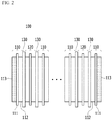
- FIG. 2 is a schematic diagram of an electrode assembly according to an exemplary embodiment of the present invention.
- FIG. 3 is a schematic diagram of an electrode assembly after charging according to an exemplary embodiment of the present invention.
- the outermost positive electrodes 110 may be positioned on the outermost opposite surfaces of the electrode assembly 100, respectively, the outermost positive electrodes 110 may each include a positive electrode current collector 111, a positive active material layer 112 formed on one surface of the positive electrode current collector 111, and a non-reversible material coating layer 113 formed on the other surface of the positive electrode current collector 111 and including lithium oxide, and the non-reversible material coating layer 113 may be positioned on the outermost surface of the electrode assembly 100.
- the non-reversible material coating layer 113 including lithium oxide is positioned on the outermost surface of the electrode assembly 100 and non-reversible material is not included in the positive active material layer, and thus, a process of mixing the positive active material and the non-reversible material may not be required.
- the lithium oxide may be Li 2 O 2 , Li 2 O, Li 2 NiO 2 , or a mixture thereof.
- Li 2 O 2 and Li 2 O may be removed after first charging of a battery including the electrode assembly. This is shown in FIG. 3 .
- the materials may be removed after first charging of a secondary lithium battery including the electrode assembly 100.
- lithium oxide may be decomposed to lithium ions and oxygen gas and may be removed.
- the drawing is merely a schematic diagram for indicating a phenomenon whereby lithium oxide is removed, and needless to say, an adduct such as a catalyst, a conductive material, and a binder remains.
- the material may remain without change along with materials such as a catalyst, a conductive material, and a binder.
- the positive active material of the positive active material layer may include a lithium transition metal oxide represented by the following formula 1 or 2 below. Li x M y Mn 2-y O 4-z A z ... (1) In the above formula,
- the positive active material layer may further include a binder and a conductive material other than a positive active material.
- the positive electrode may be manufactured by coating and then drying an electrode mixture that is a mixture of a positive active material, a conductive material, and a binder on a portion of one surface or opposite surfaces of a positive electrode current collector except for a plain portion, but not on the outermost portion on which the non-reversible material coating layer is formed, and as necessary, a filler may be further included in the mixture.
- lithium transition metal oxide represented by formula 1 or 2 above may be included in 60 wt% to 100 wt% based on a total weight of an included positive active material.
- the positive electrode current collector may be formed to a thickness of 3 to 500 ⁇ m.
- the positive electrode current collector is not particularly limited as long as a corresponding battery has high conductivity while a chemical change is not caused in the battery, and for example, may be formed of stainless steel, aluminum, nickel, titanium, bake carbon, or aluminum, or a material formed by surface-processing a surface of stainless steel with carbon, nickel, titanium, silver, or the like.
- a current collector may have fine protrusions and depressions formed on a surface thereof to enhance adherence of a positive active material, and may be formed in various forms such as a film, a sheet, a foil, a net, a porous body, a foaming body, and a non-woven fabric structure.
- the conductive material may be added in 1 to 50 wt% based on a total weight of a mixture including a positive active material.
- the conductive material is not particularly limited as long as a corresponding battery has high conductivity while a chemical change is not caused in the battery, and for example, may use a conductive material including graphite such as natural graphite or artificial graphite; carbonblack such as carbonblack, acetylene black, ketjen black, channel black, furnace black, lamp black, or thermal black; conductive finer such as carbon fiber or metal fiber; metal powder such as fluoro carbon, aluminum, or nickel powder; conductive whisky such as zinc oxide and potassium titanate; conductive metal oxide such as oxidation titanium; and polyphenylene derivative.
- graphite such as natural graphite or artificial graphite
- carbonblack such as carbonblack, acetylene black, ketjen black, channel black, furnace black, lamp black, or thermal black
- conductive finer such as carbon fiber or metal fiber
- metal powder such as fluoro carbon, aluminum, or nickel powder
- conductive whisky such as zinc oxide and potassium titanate
- conductive metal oxide such as oxidation
- the binder may be a component that facilitates coupling of an active material, a conductive material, and so on, and coupling of a current collector, and in general, may be added with 1 to 50 wt% based on a total weight of a mixture including a positive active material.
- binder may include poly vinylidene fluoride, polyvinylalcohol, carboxymethyl cellulose (CMC), starch, hydroxypropyl cellulose, regenerated cellulose, polyvinylpyrrolidone, tetrafluoroethylene, polyethylene, polypropylene, ethylenepropylene-diene terpolymer (EPDM), sulfonate EPDM, styrene butylene rubber, fluorine rubber, and various copolymers.
- CMC carboxymethyl cellulose
- EPDM ethylenepropylene-diene terpolymer
- EPDM ethylenepropylene-diene terpolymer
- EPDM ethylenepropylene-diene terpolymer
- sulfonate EPDM styrene butylene rubber
- fluorine rubber fluorine rubber
- the filler may be selectively used as a component for suppressing expansion of a positive electrode, and is not particularly limited as long as the filler is formed of any material in a fiber phase while a chemical change is not caused in the battery, and may use a material in a fiber phase, for example, an olefin-based polymer such as polyethylene or polypropylene; glass fiber, or carbonfiber.
- a material in a fiber phase for example, an olefin-based polymer such as polyethylene or polypropylene; glass fiber, or carbonfiber.
- the negative electrode may be manufactured by coating and then drying an electrode mixture that is a mixture of a negative active material, a conductive material, and a binder on a portion of one surface or opposite surfaces of a negative electrode current collector except for a plain portion, and as necessary, a filler may be further included in the mixture.
- the negative active material may include a silicon (Si)-based material, and the Si-based material may be a complex of silicon and silicon oxide and/or a silicon alloy.
- the silicon-based material may be included in 0.1 wt% to 30 wt% based on a total weight of the negative active material.
- the negative active material may further include a carbon-based material, and the carbon-based material may be included in 70 wt% or greater to 99.9 wt% or less based on a total weight of a negative active material, and accordingly, the carbon-based material may include one or more selected from the group consisting of crystalline artificial graphite, crystalline natural graphite, amorphous hard carbon, low crystalline soft carbon, carbon black, acetylene black, ketjen black, super P, graphene, and fiber-phase carbon, and in detail, may be crystalline artificial graphite and/or crystalline natural graphite.
- the negative active material may further include metal composite oxide such as Li x Fe 2 O 3 (0 ⁇ x ⁇ 1), Li x WO 2 (0 ⁇ x ⁇ 1), Sn x Me 1-x Me' y O z (Me: Mn, Fe, Pb, Ge; Me': Al, B, P, Si, group 1, 2, or 3 elements in the periodic table, halogen; 0 ⁇ x ⁇ 1; 1 ⁇ y ⁇ 3; 1 ⁇ z ⁇ 8); lithium metal; lithium alloy; silicon-based alloy; tin-based alloy; metal oxide such as SnO, SnO 2 , PbO, PbO 2 , Pb 2 O 3 , Pb 3 O 4 , Sb 2 O 3 , Sb 2 O 4 , Sb 2 O 5 , GeO, GeO 2 , Bi 2 O 3 , Bi 2 O 4 , and Bi 2 O 5 ; a conductive polymer such as polyacetylene; an Li-Co-Ni-based material; titanium
- the negative electrode current collector included in the negative electrode may be formed to a thickness of 3 to 500 ⁇ m.
- the negative electrode current collector and the extension current collector are not particularly limited as long as a corresponding battery has a conductivity while a chemical change is not caused in the battery, and for example, may be formed of copper, stainless steel, aluminum, nickel, titanium, or bake carbon, or a material formed by surface-processing a surface of copper or stainless steel with carbon, nickel, titanium, silver, or the like, or may use an aluminum-cadmium alloy or the like.
- the negative electrode current collector and the extension current collector may have fine protrusions and depressions formed on a surface thereof to enhance adherence of a negative active material, and may be formed in various forms such as a film, a sheet, a foil, a net, a porous body, a foaming body, and a non-woven fabric structure.
- the separator may be interposed between the positive electrode and the negative electrode and may be formed of an insulating thin film with high ion transmittance and mechanical strength.
- the separator may have a pore diameter of 0.01 to 10 ⁇ m and a thickness of 5 to 300 ⁇ m.
- the separator may use, for example, a sheet, non-woven fabric, or the like formed of an olefin-based polymer such as chemical resistance and hydrophobic polypropylene; glass fiber or polyethylene, and the like.
- the solid electrolyte such as a polymer
- the solid electrolyte may also function as a separator.
- a secondary lithium battery includes an electrode assembly, a non-aqueous electrolyte for impregnating the electrode assembly, and a battery case for containing the electrode assembly and the non-aqueous electrolyte therein, and the electrode assembly is the electrode assembly according to the present invention.
- the non-aqueous electrolyte may include a non-aqueous electrolyte and lithium salt, and the non-aqueous electrolyte may use a non-aqueous organic solvent, an organic solid electrolyte, an inorganic solid electrolyte, or the like, but is not limited thereto.
- the non-aqueous-based organic solvent may use an aprotic organic solvent, for example, N-methyl-2-pyrrolidinone, propylene carbonate, ethylene carbonate, butylene carbonate, dimethyl carbonate, diethyl carbonate, gamma-butilo lactone, 1,2-dimethoxy ethane, tetrahydroxy franc, 2-methyl tetrahydrofuran, dimethylsulfoxide, 1,3-dioxolane, formamide, dimethylformamide, dioxolane, acetonitrile, nitromethane, formic acid methyl, methyl acetate.
- an aprotic organic solvent for example, N-methyl-2-pyrrolidinone, propylene carbonate, ethylene carbonate, butylene carbonate, dimethyl carbonate, diethyl carbonate, gamma-butilo lactone, 1,2-dimethoxy ethane, tetrahydroxy franc, 2-methyl tetrahydrofuran
- phosphoric acid triester trimethoxy methane, dioxolane derivative, sulfolane, methyl sulfolane, 1,3-dimethyl-2-imidazolidinone, propylene carbonate derivative, tetrahydrofuran derivative, ether, pyropionic acid methyl, or ethyl propionate.
- the organic solid electrolyte may use a polymer including, for example, polyethylene derivative, polyethylene oxide derivative, polypropylene oxide derivative, phosphoric acid ester a polymer, poly agitation lysine(agitation lysine), polyester sulfide, polyvinyl alcohol, polyvinylidene fluoride, or ionic dissociable group.
- a polymer including, for example, polyethylene derivative, polyethylene oxide derivative, polypropylene oxide derivative, phosphoric acid ester a polymer, poly agitation lysine(agitation lysine), polyester sulfide, polyvinyl alcohol, polyvinylidene fluoride, or ionic dissociable group.
- the inorganic solid electrolyte may use, for example, nitride, halide, sulfate, or the like of Li such as Li 3 N, Lil, Li 5 NI 2 , Li 3 N-LiI-LiOH, LiSiO 4 , LiSiO 4 -Lil-LiOH, Li 2 SiS 3 , Li 4 SiO 4 , Li 4 SiO 4 -LiI-LiOH, and Li 3 PO 4 -Li 2 S-SiS 2 .
- Li such as Li 3 N, Lil, Li 5 NI 2 , Li 3 N-LiI-LiOH, LiSiO 4 , LiSiO 4 -Lil-LiOH, Li 2 SiS 3 , Li 4 SiO 4 , Li 4 SiO 4 -LiI-LiOH, and Li 3 PO 4 -Li 2 S-SiS 2 .
- the lithium salt may be a material that is appropriately dissolved in a non-aqueous based electrolyte and may use, for example, LiCl, LiBr, Lil, LiClO 4 , LiBF 4 , LiB 10 Cl 10 , LiPF 6 , LiCF 3 SO 3 , LiCF 3 CO 2 , LiAsF 6 , LiSbF 6 , LiAlCl 4 , CH 3 SO 3 Li, (CF 3 SO 2 ) 2 NLi, chloro borane lithium, lower aliphatic carbonic acid lithium, 4 phenyl boric acid lithium, or imide.
- pyridine, triethylphosphite, triethanolamine, cyclic ether, ethylene diamine, n-glyme(glyme), hexa phosphoric acid tri amide, nitrobenzene derivative, sulfur, quinone imine dye, N-substituted oxazolidinone, N,N-substituted imidazolidine, ethylene glycol dialkyl ether, ammonium salt, pyrrole, 2-methoxy ethanol, aluminum trichloride, or the like may be added to the lithium salt-containing non-aqueous electrolyte in order to enhance charge and discharge characteristics, flame retardant, and so on.
- the lithium salt-containing non-aqueous electrolyte may further include a halogen-containing solvent such as carbon tetrachloride or trifluoride ethylene, and to improve keeping high temperature characteristic, the lithium salt-containing non-aqueous electrolyte may further include dioxidationcarbonate gas and may further include fluoro-ethylene carbonate (FEC), propene sultone (PRS), or the like.
- a halogen-containing solvent such as carbon tetrachloride or trifluoride ethylene
- the lithium salt-containing non-aqueous electrolyte may further include dioxidationcarbonate gas and may further include fluoro-ethylene carbonate (FEC), propene sultone (PRS), or the like.
- FEC fluoro-ethylene carbonate
- PRS propene sultone
- a lithium salt-containing non-aqueous electrolyte may be manufactured by adding lithium salt such as LiPF 6 , LiClO 4 , LiBF 4 , or LiN (SO 2 CF 3 ) 2 to a mixed solvent of cyclic carbonate of EC or PC that is a high dielectric solvent and linear carbonate of DEC, DMC, or EMC that is a low viscosity solvent.
- lithium salt such as LiPF 6 , LiClO 4 , LiBF 4 , or LiN (SO 2 CF 3 ) 2
- a device may include a battery module including the secondary lithium battery as a unit battery, a battery pack including the battery module, and a device including a battery pack as a power supply.
- an example of the device may include an electric vehicle, a hybrid electric vehicle, a plug-in hybrid electric vehicle, or an electric power storage system, but is not limited thereto.
- a positive electrode formation composition was prepared by mixing a positive active material (LiNi 0.4 Co 0.3 Mn 0.3 O 2 ), a carbonblack conductive material, and a PVdF binder with an N-methylpyrrolidone solvent with a weight ratio of 90:5:5, the positive electrode formation composition was coated to a thickness of 100 ⁇ m on one surface of an aluminum current collector with a thickness of 20 ⁇ m, a non-reversible material layer formation composition was prepared by mixing a mixture obtained by Li 2 O 2 and a Pt catalyst in a ratio of 1:1, carbonblack, and PVdF in a weight ratio of 8:1:1, and the non-reversible material layer formation composition was coated to a thickness of 10 ⁇ m on the other surface of the aluminum current collector and then dried at 130°C to prepare a positive electrode.
- a negative electrode formation composition was prepared by mixing a mixture obtained by mixing mesocarbon microbead (MCMB) as artificial graphite and SiO in a weight ratio of 95:5 as a negative active material, a carbonblack conductive material, and a PVdF binder with a N-methylpyrrolidone solvent in a weight ratio of 85:10:5, was coated to a thickness of 100 ⁇ m on opposite surfaces of a copper current collector with a thickness of 20 ⁇ m, and then, was dried at 130° C to manufacture a negative electrode.
- MCMB mesocarbon microbead
- a separation membrane of porous polyethylene was interposed between the positive electrode prepared as described and a negative electrode to prepare a bicell with a positive/negative/positive electrode structure in which a non-reversible material layer is disposed at the outermost portion as shown in FIG. 2 , the electrode assembly was positioned in a case, and then, an electrolyte was injected into the case to prepare a secondary lithium battery.
- a secondary lithium battery was prepared in the same manner as in Example 1 except that Li 2 NiO 2 was used as a material included in a non-reversible material layer.
- a secondary lithium battery was prepared in the same manner as in Example 1 except that a positive electrode formation composition was coated to a thickness of 100 ⁇ m on a section area of an aluminum current collector instead of formation of a non-reversible material layer.
- a secondary lithium battery was prepared in the same manner as in Example 1 except that a positive electrode formation composition was prepared by mixing a positive active material (LiNi 0.4 Co 0.3 Mn 0.3 O 2 ), a non-reversible additive (Li 2 O 2 ), a carbonblack conductive material, and a PVdF binder with a N-methylpyrrolidone solvent in a weight ratio of 90:5:2.5:2.5 and a positive electrode was manufactured by coating the positive electrode formation composition to a thickness of 100 ⁇ m on a section of an aluminum current collector.
- a positive electrode formation composition was prepared by mixing a positive active material (LiNi 0.4 Co 0.3 Mn 0.3 O 2 ), a non-reversible additive (Li 2 O 2 ), a carbonblack conductive material, and a PVdF binder with a N-methylpyrrolidone solvent in a weight ratio of 90:5:2.5:2.5 and a positive electrode was manufactured by coating the positive electrode formation composition to a thickness of 100 ⁇ m
- a non-reversible material coating layer including lithium oxide may be included instead of a positive active material layer present at the outermost portion of a positive electrode positioned on opposite surfaces of the outermost portion of a stack structure-type electrode assembly, thereby increasing energy density of a battery.
- a positive active material layer may not include a non-reversible additive, and thus, the conventional problem in terms of a void formed in a positive electrode and a phenomenon whereby energy density of a battery is degraded due to the problem may be overcome.
Landscapes
- Chemical & Material Sciences (AREA)
- Chemical Kinetics & Catalysis (AREA)
- Electrochemistry (AREA)
- General Chemical & Material Sciences (AREA)
- Engineering & Computer Science (AREA)
- Materials Engineering (AREA)
- Manufacturing & Machinery (AREA)
- Composite Materials (AREA)
- Inorganic Chemistry (AREA)
- Secondary Cells (AREA)
- Battery Electrode And Active Subsutance (AREA)
Abstract
Description
- This application claims priority to and the benefit of Korean Patent Application No.
10-2017-0164085 10-2018-0151236 filed on November 29, 2018 - The present invention relates an electrode assembly and a secondary lithium battery including the same, and more particularly, to an electrode assembly for a high energy secondary lithium battery and a secondary lithium battery including the same.
- Along with technological development and increased demands for various devices, demands for a secondary battery as an energy source have been remarkably increased, and among such secondary batteries, a secondary lithium battery with high energy density and voltage, a long cycle lifespan, and a low self discharging rate has been commercially available and widely used.
- The secondary lithium battery generally uses lithium-containing cobalt oxide (LiCoO2) with a layered crystalline structure, lithium-containing manganese oxide such as LiMnO2 with a layered crystalline structure, and LiMn2O4 with a spinel crystalline structure, or lithium-containing nickel oxide (LiNiO2), as a positive active material. In addition, the secondary lithium battery uses a carbon-based material as a negative active material, and recently, along with increase in demands for a high energy secondary lithium battery, use of a mixture with a silicon-based material, or a silicon oxide-based material with available capacitance of 10 times or greater than a carbon-based material has been considered.
- For the development of a high energy secondary lithium battery according to a recent trend, it is required to use a negative electrode using a silicon-based material as a negative active material. However, a negative electrode using a silicon-based material has high non-reversible capacitance, and thus, there is a problem in terms of low charging/discharging efficiency.
- To overcome the problem, research has been conducted on a method of manufacturing a battery by applying a positive electrode with which a high capacitance of non-reversible additive, for example, Li2O2 is mixed. However, as Li2O2 is decomposed to discharge oxygen gas through first charging, a void is formed in the corresponding point, and density of a positive electrode is lowered after first charging due to the formed void, and accordingly, there is a problem in that energy density of a battery is lowered.
- An exemplary embodiment of the present invention provides an electrode assembly including a high-capacity non-reversible material coating layer instead of a positive active material layer present at the outermost portion of a positive electrode positioned on opposite surfaces of the outermost portion of a stack structure-type electrode assembly, and a secondary lithium battery including the same, in order to overcome a problem in the case in which a positive electrode obtained by mixing a high-capacity of non-reversible additive with a positive active material is used.
- According to an embodiment of the present invention, an electrode assembly is configured by alternately stacking two or more positive electrodes and one or more negative electrodes using a separator as a boundary therebetween, wherein outermost positive electrodes are positioned on outermost opposite surfaces of the electrode assembly, respectively, each of the outermost positive electrodes includes a positive electrode current collector, a positive active material layer formed on one surface of the positive electrode current collector, and a non-reversible material coating layer formed on the other surface of the positive electrode current collector and including lithium oxide, and the non-reversible material coating layer is positioned on an outermost surface of the electrode assembly.
- Here, the non-reversible material coating layer may further include a catalyst, a conductive material, a binder, and the like in addition to lithium oxide that is a non-reversible material.
- Content of the catalyst, the conductive material, and the binder may be 10 to 50 wt%, 1 to 20 wt%, and 1 to 20 wt%, respectively, based on a total weight of the non-reversible material coating layer.
- The content may be appropriately selected according to a function thereof.
- In this case, the lithium oxide may be Li2O2, Li2O, Li2NiO2, or mixture thereof.
- Here, Li2O2 or Li2O may be removed after first charging of a battery including the electrode assembly.
- In detail, the lithium oxide may be Li2O2, or Li2NiO2, and in more detail, may be removed Li2O2.
- The negative electrode may include a silicon (Si)-based material as a negative active material.
- In this case, the silicon-based material may be a complex of silicon and silicon oxide, a silicon alloy, or a complex and silicon alloy of silicon oxide.
- Another embodiment of the present invention provides a secondary lithium battery including an electrode assembly, a non-aqueous electrolyte for impregnating the electrode assembly, and a battery case for containing the electrode assembly and the non-aqueous electrolyte therein, wherein the electrode assembly is the electrode assembly as described above.
- The present invention may provide a battery module including the secondary lithium battery as described above as a unit battery, a battery pack including the battery module, and a device including the battery pack as a power supply.
- Here, the device may be an electric vehicle, a hybrid electric vehicle, a plug-in hybrid electric vehicle, or an electric power storage system.
- The attached drawings are for exemplary embodiments of the present invention and are for description of the principle of the present invention along with the detailed description, and the scope of the present invention is not limited thereto. Shapes, sizes, scales, ratios, or the like of the attached drawings of the specification may be exaggerated to emphasize clarity of the description.
-
FIG. 1 is a schematic diagram of a conventional electrode assembly. -
FIG. 2 is a schematic diagram of an electrode assembly according to an exemplary embodiment of the present invention. -
FIG. 3 is a schematic diagram of an electrode assembly after charging according to an exemplary embodiment of the present invention. - The meaning of the terms used in the specification and the appended claims should not be construed as being confined to common or dictionary meaning, but should be construed as concepts not departing from the spirit and scope of the present invention in order to describe the present invention in the most appropriate way. Accordingly, the configuration shown with regard to embodiments described in the specification is merely an embodiment of the present invention and does not represent every technological idea of the present invention, and thus, it would be understood that the present invention may be changed in various equivalent embodiments and modifications at a time point when the application is filed.
- To develop a high energy secondary lithium battery according to demands of requirements of the art to which the present invention pertains, a negative electrode using a silicon-based material as a negative active material needs to be used, and in this regard, the negative electrode has low charging/discharging efficiency due to high non-reversible capacitance, and thus, to overcome this, a positive electrode with which a high-capacity of non-reversible additive is mixed has been used.
-
FIG. 1 is a schematic diagram of aconventional electrode assembly 10. Referring to the drawings, a high-capacity of non-reversible additive is mixed with a positive active material layer, and in this regard, as a high-capacity of non-reversible additive dispersed in a positive active material layer is decomposed through first charging, a void is formed in the corresponding point, and density of the positive active material layer is lowered due to the formed void, and ultimately, there is a problem in that energy density of a battery is lowered. - According to the present invention, a positive active material and a high-capacity of non-reversible additive are not mixed, but the aforementioned problem according to the conventional art may be overcome by forming a non-reversible material coating layer instead of a positive active material layer positioned on the outermost surface of an electrode assembly among positive electrodes positioned at the outermost portion of the electrode assembly.
-
FIG. 2 is a schematic diagram of an electrode assembly according to an exemplary embodiment of the present invention.FIG. 3 is a schematic diagram of an electrode assembly after charging according to an exemplary embodiment of the present invention. - The present invention will be described in more detail with reference to the drawings. In an
electrode assembly 100 configured by alternately stacking two or morepositive electrodes 110 and one or morenegative electrodes 120 with aseparator 130 as a boundary, the outermostpositive electrodes 110 may be positioned on the outermost opposite surfaces of theelectrode assembly 100, respectively, the outermostpositive electrodes 110 may each include a positive electrodecurrent collector 111, a positiveactive material layer 112 formed on one surface of the positive electrodecurrent collector 111, and a non-reversiblematerial coating layer 113 formed on the other surface of the positive electrodecurrent collector 111 and including lithium oxide, and the non-reversiblematerial coating layer 113 may be positioned on the outermost surface of theelectrode assembly 100. - The non-reversible
material coating layer 113 including lithium oxide is positioned on the outermost surface of theelectrode assembly 100 and non-reversible material is not included in the positive active material layer, and thus, a process of mixing the positive active material and the non-reversible material may not be required. - In this case, the lithium oxide may be Li2O2, Li2O, Li2NiO2, or a mixture thereof.
- Here, Li2O2 and Li2O may be removed after first charging of a battery including the electrode assembly. This is shown in
FIG. 3 . - In the non-reversible
material coating layer 113 including the lithium oxide of Li2O2 or Li2O, the materials may be removed after first charging of a secondary lithium battery including theelectrode assembly 100. In this case, lithium oxide may be decomposed to lithium ions and oxygen gas and may be removed. The drawing is merely a schematic diagram for indicating a phenomenon whereby lithium oxide is removed, and needless to say, an adduct such as a catalyst, a conductive material, and a binder remains. - When Li2NiO2 is used, the material may remain without change along with materials such as a catalyst, a conductive material, and a binder.
- The positive active material of the positive active material layer may include a lithium transition metal oxide represented by the following formula 1 or 2 below.
LixMyMn2-yO4-zAz ... (1)
In the above formula, - M includes one or more elements selected from the group consisting of Al, Mg, Ni, Co, Fe, Cr, V, Ti, Cu, B, Ca, Zn, Zr, Nb, Mo, Sr, Sb, W, Ti, and Bi;
- A includes one or more minus monovalent or minus bivalent ions; and
- 0.9≤x≤1.2, 0<y<2, and 0≤z<0.2.
- M' is MnaMb;
- M includes one or more elements selected from the group consisting of Ni, Ti, Co, Al, Cu, Fe, Mg, B, Cr, Zr, Zn, and group 2 transition metals;
- A includes one or more selected from the group consisting of negative ions of PO4, BO3, CO3, F, and NO3; and
- 0<x<1, 0<y≤0.02, 0<y'≤0.02, 0.5≤a≤1.0, 0≤b≤0.5, and a + b = 1.
- The positive active material layer may further include a binder and a conductive material other than a positive active material.
- The positive electrode may be manufactured by coating and then drying an electrode mixture that is a mixture of a positive active material, a conductive material, and a binder on a portion of one surface or opposite surfaces of a positive electrode current collector except for a plain portion, but not on the outermost portion on which the non-reversible material coating layer is formed, and as necessary, a filler may be further included in the mixture.
- In addition to lithium transition metal oxide represented by formula 1 or 2 above, the positive active material may further include a layered compound such as lithium cobalt oxide (LiCoO2) or lithium nickel oxide (LiNiO2), or a compound substituted with one or more transition metals; lithium manganese oxide such as chemical formula Li1+xMn2-xO4 (wherein x is 0 to 0.33), LiMnO3, LiMn2O3, or LiMnO2; lithium copper oxide (Li2CuO2); vanadium oxide such as LiV3O8, LiFe3O4, V2O5, or Cu2V2O7; Ni site-type lithium nickel oxide represented by chemical formula LiNi1-xMxO2 (wherein M = Co, Mn, Al, Cu, Fe, Mg, B, or Ga, and x = 0.01 to 0.3); lithium manganese composite oxide represented by chemical formula LiMn2-xMxO2 (wherein M = Co, Ni, Fe, Cr, Zn, or Ta, and x = 0.01 to 0.1) or Li2Mn3MO8 (wherein M = Fe, Co, Ni, Cu, or Zn); lithium manganese composite oxide of a spinel structure represented by LiNixMn2-xO4; LiMn2O4 in which an Li portion of the chemical formula is substituted with alkaline-earth metal ions; disulfide compound; Fe2(MoO4)3, and so on, but are not limited thereto.
- In this case, lithium transition metal oxide represented by formula 1 or 2 above may be included in 60 wt% to 100 wt% based on a total weight of an included positive active material.
- In general, the positive electrode current collector may be formed to a thickness of 3 to 500 µm. The positive electrode current collector is not particularly limited as long as a corresponding battery has high conductivity while a chemical change is not caused in the battery, and for example, may be formed of stainless steel, aluminum, nickel, titanium, bake carbon, or aluminum, or a material formed by surface-processing a surface of stainless steel with carbon, nickel, titanium, silver, or the like. A current collector may have fine protrusions and depressions formed on a surface thereof to enhance adherence of a positive active material, and may be formed in various forms such as a film, a sheet, a foil, a net, a porous body, a foaming body, and a non-woven fabric structure.
- In general, the conductive material may be added in 1 to 50 wt% based on a total weight of a mixture including a positive active material.
- The conductive material is not particularly limited as long as a corresponding battery has high conductivity while a chemical change is not caused in the battery, and for example, may use a conductive material including graphite such as natural graphite or artificial graphite; carbonblack such as carbonblack, acetylene black, ketjen black, channel black, furnace black, lamp black, or thermal black; conductive finer such as carbon fiber or metal fiber; metal powder such as fluoro carbon, aluminum, or nickel powder; conductive whisky such as zinc oxide and potassium titanate; conductive metal oxide such as oxidation titanium; and polyphenylene derivative.
- The binder may be a component that facilitates coupling of an active material, a conductive material, and so on, and coupling of a current collector, and in general, may be added with 1 to 50 wt% based on a total weight of a mixture including a positive active material. An example of the binder may include poly vinylidene fluoride, polyvinylalcohol, carboxymethyl cellulose (CMC), starch, hydroxypropyl cellulose, regenerated cellulose, polyvinylpyrrolidone, tetrafluoroethylene, polyethylene, polypropylene, ethylenepropylene-diene terpolymer (EPDM), sulfonate EPDM, styrene butylene rubber, fluorine rubber, and various copolymers.
- The filler may be selectively used as a component for suppressing expansion of a positive electrode, and is not particularly limited as long as the filler is formed of any material in a fiber phase while a chemical change is not caused in the battery, and may use a material in a fiber phase, for example, an olefin-based polymer such as polyethylene or polypropylene; glass fiber, or carbonfiber.
- The negative electrode may be manufactured by coating and then drying an electrode mixture that is a mixture of a negative active material, a conductive material, and a binder on a portion of one surface or opposite surfaces of a negative electrode current collector except for a plain portion, and as necessary, a filler may be further included in the mixture.
- The negative active material may include a silicon (Si)-based material, and the Si-based material may be a complex of silicon and silicon oxide and/or a silicon alloy.
- In this case, the silicon-based material may be included in 0.1 wt% to 30 wt% based on a total weight of the negative active material.
- The negative active material may further include a carbon-based material, and the carbon-based material may be included in 70 wt% or greater to 99.9 wt% or less based on a total weight of a negative active material, and accordingly, the carbon-based material may include one or more selected from the group consisting of crystalline artificial graphite, crystalline natural graphite, amorphous hard carbon, low crystalline soft carbon, carbon black, acetylene black, ketjen black, super P, graphene, and fiber-phase carbon, and in detail, may be crystalline artificial graphite and/or crystalline natural graphite.
- In addition to the carbon-based material and the Si-based material, the negative active material may further include metal composite oxide such as LixFe2O3 (0≤x≤1), LixWO2 (0≤x≤1), SnxMe1-xMe'yOz (Me: Mn, Fe, Pb, Ge; Me': Al, B, P, Si, group 1, 2, or 3 elements in the periodic table, halogen; 0<x≤1; 1≤y≤3; 1≤z≤8); lithium metal; lithium alloy; silicon-based alloy; tin-based alloy; metal oxide such as SnO, SnO2, PbO, PbO2, Pb2O3, Pb3O4, Sb2O3, Sb2O4, Sb2O5, GeO, GeO2, Bi2O3, Bi2O4, and Bi2O5; a conductive polymer such as polyacetylene; an Li-Co-Ni-based material; titanium oxide; lithium titanium oxide, and the like, and is not limited thereto.
- In general, the negative electrode current collector included in the negative electrode may be formed to a thickness of 3 to 500 µm. The negative electrode current collector and the extension current collector are not particularly limited as long as a corresponding battery has a conductivity while a chemical change is not caused in the battery, and for example, may be formed of copper, stainless steel, aluminum, nickel, titanium, or bake carbon, or a material formed by surface-processing a surface of copper or stainless steel with carbon, nickel, titanium, silver, or the like, or may use an aluminum-cadmium alloy or the like. Like the positive electrode current collector, the negative electrode current collector and the extension current collector may have fine protrusions and depressions formed on a surface thereof to enhance adherence of a negative active material, and may be formed in various forms such as a film, a sheet, a foil, a net, a porous body, a foaming body, and a non-woven fabric structure.
- The separator may be interposed between the positive electrode and the negative electrode and may be formed of an insulating thin film with high ion transmittance and mechanical strength. In general, the separator may have a pore diameter of 0.01 to 10 µm and a thickness of 5 to 300 µm. The separator may use, for example, a sheet, non-woven fabric, or the like formed of an olefin-based polymer such as chemical resistance and hydrophobic polypropylene; glass fiber or polyethylene, and the like. When a solid electrolyte such as a polymer is used as the electrolyte, the solid electrolyte may also function as a separator.
- According to another aspect of the present invention, a secondary lithium battery includes an electrode assembly, a non-aqueous electrolyte for impregnating the electrode assembly, and a battery case for containing the electrode assembly and the non-aqueous electrolyte therein, and the electrode assembly is the electrode assembly according to the present invention.
- Here, the non-aqueous electrolyte may include a non-aqueous electrolyte and lithium salt, and the non-aqueous electrolyte may use a non-aqueous organic solvent, an organic solid electrolyte, an inorganic solid electrolyte, or the like, but is not limited thereto.
- The non-aqueous-based organic solvent may use an aprotic organic solvent, for example, N-methyl-2-pyrrolidinone, propylene carbonate, ethylene carbonate, butylene carbonate, dimethyl carbonate, diethyl carbonate, gamma-butilo lactone, 1,2-dimethoxy ethane, tetrahydroxy franc, 2-methyl tetrahydrofuran, dimethylsulfoxide, 1,3-dioxolane, formamide, dimethylformamide, dioxolane, acetonitrile, nitromethane, formic acid methyl, methyl acetate. phosphoric acid triester, trimethoxy methane, dioxolane derivative, sulfolane, methyl sulfolane, 1,3-dimethyl-2-imidazolidinone, propylene carbonate derivative, tetrahydrofuran derivative, ether, pyropionic acid methyl, or ethyl propionate.
- The organic solid electrolyte may use a polymer including, for example, polyethylene derivative, polyethylene oxide derivative, polypropylene oxide derivative, phosphoric acid ester a polymer, poly agitation lysine(agitation lysine), polyester sulfide, polyvinyl alcohol, polyvinylidene fluoride, or ionic dissociable group.
- The inorganic solid electrolyte may use, for example, nitride, halide, sulfate, or the like of Li such as Li3N, Lil, Li5NI2, Li3N-LiI-LiOH, LiSiO4, LiSiO4-Lil-LiOH, Li2SiS3, Li4SiO4, Li4SiO4-LiI-LiOH, and Li3PO4-Li2S-SiS2.
- The lithium salt may be a material that is appropriately dissolved in a non-aqueous based electrolyte and may use, for example, LiCl, LiBr, Lil, LiClO4, LiBF4, LiB10Cl10, LiPF6, LiCF3SO3, LiCF3CO2, LiAsF6, LiSbF6, LiAlCl4, CH3SO3Li, (CF3SO2)2NLi, chloro borane lithium, lower aliphatic carbonic acid lithium, 4 phenyl boric acid lithium, or imide.
- For example, pyridine, triethylphosphite, triethanolamine, cyclic ether, ethylene diamine, n-glyme(glyme), hexa phosphoric acid tri amide, nitrobenzene derivative, sulfur, quinone imine dye, N-substituted oxazolidinone, N,N-substituted imidazolidine, ethylene glycol dialkyl ether, ammonium salt, pyrrole, 2-methoxy ethanol, aluminum trichloride, or the like may be added to the lithium salt-containing non-aqueous electrolyte in order to enhance charge and discharge characteristics, flame retardant, and so on. As necessary, to achieve non-combustibility, the lithium salt-containing non-aqueous electrolyte may further include a halogen-containing solvent such as carbon tetrachloride or trifluoride ethylene, and to improve keeping high temperature characteristic, the lithium salt-containing non-aqueous electrolyte may further include dioxidationcarbonate gas and may further include fluoro-ethylene carbonate (FEC), propene sultone (PRS), or the like.
- As one detailed example, a lithium salt-containing non-aqueous electrolyte may be manufactured by adding lithium salt such as LiPF6, LiClO4, LiBF4, or LiN (SO2CF3)2 to a mixed solvent of cyclic carbonate of EC or PC that is a high dielectric solvent and linear carbonate of DEC, DMC, or EMC that is a low viscosity solvent.
- According to another aspect of the present invention, a device may include a battery module including the secondary lithium battery as a unit battery, a battery pack including the battery module, and a device including a battery pack as a power supply.
- Here, an example of the device may include an electric vehicle, a hybrid electric vehicle, a plug-in hybrid electric vehicle, or an electric power storage system, but is not limited thereto.
- Hereinafter, embodiments will be described in detail for description of the present invention. However, the embodiments of the present invention may be embodied in many different forms and should not be construed as being limited to the embodiments set forth herein. The embodiments of the present invention are provided so that this invention will be thorough and complete, and will fully convey the concept of the invention to those skilled in the art.
- A positive electrode formation composition was prepared by mixing a positive active material (LiNi0.4Co0.3Mn0.3O2), a carbonblack conductive material, and a PVdF binder with an N-methylpyrrolidone solvent with a weight ratio of 90:5:5, the positive electrode formation composition was coated to a thickness of 100 µm on one surface of an aluminum current collector with a thickness of 20 µm, a non-reversible material layer formation composition was prepared by mixing a mixture obtained by Li2O2 and a Pt catalyst in a ratio of 1:1, carbonblack, and PVdF in a weight ratio of 8:1:1, and the non-reversible material layer formation composition was coated to a thickness of 10 µm on the other surface of the aluminum current collector and then dried at 130°C to prepare a positive electrode.
- A negative electrode formation composition was prepared by mixing a mixture obtained by mixing mesocarbon microbead (MCMB) as artificial graphite and SiO in a weight ratio of 95:5 as a negative active material, a carbonblack conductive material, and a PVdF binder with a N-methylpyrrolidone solvent in a weight ratio of 85:10:5, was coated to a thickness of 100 µm on opposite surfaces of a copper current collector with a thickness of 20 µm, and then, was dried at 130° C to manufacture a negative electrode.
- A separation membrane of porous polyethylene was interposed between the positive electrode prepared as described and a negative electrode to prepare a bicell with a positive/negative/positive electrode structure in which a non-reversible material layer is disposed at the outermost portion as shown in
FIG. 2 , the electrode assembly was positioned in a case, and then, an electrolyte was injected into the case to prepare a secondary lithium battery. In this ca se, the electrolyte was prepared by dissolving lithiumhexafluorophosphate (LiPF6) with concentration of 1.15 M in an organic solvent including ethylenecarbonate/dimethylcarbonate/ethylmethylcarbonate (mixing volume ratio=3/4/3 of EC/DMC/EMC). - A secondary lithium battery was prepared in the same manner as in Example 1 except that Li2NiO2 was used as a material included in a non-reversible material layer.
- A secondary lithium battery was prepared in the same manner as in Example 1 except that a positive electrode formation composition was coated to a thickness of 100 µm on a section area of an aluminum current collector instead of formation of a non-reversible material layer.
- A secondary lithium battery was prepared in the same manner as in Example 1 except that a positive electrode formation composition was prepared by mixing a positive active material (LiNi0.4Co0.3Mn0.3O2), a non-reversible additive (Li2O2), a carbonblack conductive material, and a PVdF binder with a N-methylpyrrolidone solvent in a weight ratio of 90:5:2.5:2.5 and a positive electrode was manufactured by coating the positive electrode formation composition to a thickness of 100 µm on a section of an aluminum current collector.
- With regard to the secondary lithium batteries prepared in Examples 1 and 2 and Comparative Examples 1 and 2, an achieved capacitance value in the case of charging when an initial cycle proceeds under a current condition of C-rate of 0.1 in the range of a voltage of 2.50 V to 4.20 V.
[Table 1] Charge capacitance (mAh/g) Example 1 231.2 Example 2 230.8 Comparative Example 1 226.6 Comparative Example 2 221.5 - As seen from Table 1 above, capacitance is increased when a secondary lithium battery is manufactured according to the present invention. This means that energy density is increased.
- Particularly, when the non-reversible additive is mixed with the positive active material to form an active material layer, capacitance may be more seriously degraded.
-
- 10, 100: electrode assembly
- 11, 110: positive electrode
- 12, 120: negative electrode
- 13, 130: separator
- 111: positive electrode current collector
- 112: positive active material layer
- 113: non-reversible material coating layer
- According to the present invention, a non-reversible material coating layer including lithium oxide may be included instead of a positive active material layer present at the outermost portion of a positive electrode positioned on opposite surfaces of the outermost portion of a stack structure-type electrode assembly, thereby increasing energy density of a battery.
- Particularly, unlike in the conventional art, a positive active material layer may not include a non-reversible additive, and thus, the conventional problem in terms of a void formed in a positive electrode and a phenomenon whereby energy density of a battery is degraded due to the problem may be overcome.
(1-x)LiM'O2-yAy-xLi2MnO3-y'Ay' ... (2)
In the above formula,
Claims (10)
- An electrode assembly configured by alternately stacking two or more positive electrodes and one or more negative electrodes using a separator as a boundary therebetween, wherein:outermost positive electrodes are positioned on outermost opposite surfaces of the electrode assembly, respectively;each of the outermost positive electrodes includes a positive electrode current collector, a positive active material layer formed on one surface of the positive electrode current collector, and a non-reversible material coating layer formed on the other surface of the positive electrode current collector and including lithium oxide; andthe non-reversible material coating layer is positioned on an outermost surface of the electrode assembly.
- The electrode assembly of claim 1, wherein:
the lithium oxide is Li2O2, Li2O, Li2NiO2, or mixture thereof. - The electrode assembly of claim 2, wherein:
Li2O2 or Li2O is removed after first charging of a battery including the electrode assembly. - The electrode assembly of claim 1, wherein:
the negative electrode includes a silicon (Si)-based material as a negative active material. - The electrode assembly of claim 4, wherein:
the silicon-based material is a complex of silicon and silicon oxide; a silicon alloy; or a complex and silicon alloy of silicon oxide. - A secondary lithium battery comprising:an electrode assembly;a non-aqueous electrolyte for impregnating the electrode assembly; anda battery case for containing the electrode assembly and the non-aqueous electrolyte therein,wherein the electrode assembly is the electrode assembly of any one of claims 1 to 5.
- A battery module comprising the secondary lithium battery as a unit battery.
- A battery pack comprising the battery module of claim 7.
- A device comprising the battery pack of claim 8 as a power supply.
- The device of claim 9, wherein:
the device is an electric vehicle, a hybrid electric vehicle, a plug-in hybrid electric vehicle, or an electric power storage system.
Priority Applications (1)
| Application Number | Priority Date | Filing Date | Title |
|---|---|---|---|
| PL18884817T PL3605714T3 (en) | 2017-12-01 | 2018-11-30 | Electrode assembly and secondary lithium battery including the same |
Applications Claiming Priority (3)
| Application Number | Priority Date | Filing Date | Title |
|---|---|---|---|
| KR20170164085 | 2017-12-01 | ||
| KR1020180151236A KR102709297B1 (en) | 2017-12-01 | 2018-11-29 | Electrode assembly and lithium secondary battery including the same |
| PCT/KR2018/015111 WO2019108026A1 (en) | 2017-12-01 | 2018-11-30 | Electrode assembly and lithium secondary battery including same |
Publications (3)
| Publication Number | Publication Date |
|---|---|
| EP3605714A1 true EP3605714A1 (en) | 2020-02-05 |
| EP3605714A4 EP3605714A4 (en) | 2020-04-08 |
| EP3605714B1 EP3605714B1 (en) | 2021-04-21 |
Family
ID=66847008
Family Applications (1)
| Application Number | Title | Priority Date | Filing Date |
|---|---|---|---|
| EP18884817.0A Active EP3605714B1 (en) | 2017-12-01 | 2018-11-30 | Electrode assembly and secondary lithium battery including the same |
Country Status (6)
| Country | Link |
|---|---|
| US (2) | US11329290B2 (en) |
| EP (1) | EP3605714B1 (en) |
| JP (1) | JP7045554B2 (en) |
| KR (1) | KR102709297B1 (en) |
| CN (1) | CN110582885B (en) |
| PL (1) | PL3605714T3 (en) |
Cited By (1)
| Publication number | Priority date | Publication date | Assignee | Title |
|---|---|---|---|---|
| US20240030415A1 (en) * | 2022-07-22 | 2024-01-25 | Samsung Sdi Co., Ltd. | Lithium battery and preparation method thereof |
Families Citing this family (5)
| Publication number | Priority date | Publication date | Assignee | Title |
|---|---|---|---|---|
| KR102845564B1 (en) * | 2020-04-27 | 2025-08-12 | 주식회사 엘지에너지솔루션 | Anode for Lithium Secondary Battery Comprising Oxidized Current Collector and Manufacturing Method Thereof |
| US20240145729A1 (en) * | 2021-11-22 | 2024-05-02 | Lg Energy Solution, Ltd. | Single-Sided Electrode, Electrode Assembly Including Same, and Single-Sided Electrode Manufacturing Apparatus |
| WO2023132596A1 (en) | 2022-01-04 | 2023-07-13 | 주식회사 엘지에너지솔루션 | Electrode assembly comprising anode with extension part |
| KR20230105652A (en) | 2022-01-04 | 2023-07-11 | 주식회사 엘지에너지솔루션 | Electrode Assembly Including A Cathode Provided With An Extension Portion |
| JP2026501902A (en) * | 2023-11-20 | 2026-01-16 | エルジー エナジー ソリューション リミテッド | Method for passivating outermost negative electrode, method for manufacturing electrode assembly, and electrode assembly |
Family Cites Families (18)
| Publication number | Priority date | Publication date | Assignee | Title |
|---|---|---|---|---|
| JPS60108080A (en) * | 1983-11-16 | 1985-06-13 | ヤマトミシン製造株式会社 | Method and apparatus for differential walking of flat stitching sewing machine |
| US20070028316A1 (en) | 2005-06-02 | 2007-02-01 | Xiaoxia Li | Transgenic non-human Act1-deficient mammals and uses thereof |
| JP2007035488A (en) | 2005-07-28 | 2007-02-08 | Sanyo Electric Co Ltd | Non-aqueous electrolyte battery |
| KR101154881B1 (en) | 2007-05-11 | 2012-06-18 | 주식회사 엘지화학 | Secondary Battery Containing Bi-polar Cell |
| JP5382445B2 (en) | 2009-11-18 | 2014-01-08 | トヨタ自動車株式会社 | Lithium ion secondary battery |
| KR20130001631A (en) | 2011-06-27 | 2013-01-04 | 현대자동차주식회사 | High Capacity Lithium Secondary Battery |
| KR20130043308A (en) | 2011-10-20 | 2013-04-30 | 에스케이이노베이션 주식회사 | Secondary battery |
| US9012091B2 (en) * | 2013-01-29 | 2015-04-21 | Uchicago Argonne, Llc | Electroactive materials for rechargeable batteries |
| KR101556299B1 (en) | 2013-07-12 | 2015-10-02 | 한국과학기술연구원 | Cathode for lithium secondary battery comprising amorphous lithium transition metal oxide coating layer and manufacturing method thereof |
| WO2015016548A1 (en) | 2013-07-30 | 2015-02-05 | 주식회사 엘지화학 | Cathode mix for secondary battery having irreversible additive |
| KR101613285B1 (en) | 2013-08-02 | 2016-04-18 | 주식회사 엘지화학 | Composite electrode comprising different electrode active material and electrode assembly |
| KR101929390B1 (en) | 2013-09-09 | 2018-12-14 | 주식회사 엘지화학 | Stack-typed electrode assembly and electrochemical cell containing the same |
| JP2015122252A (en) | 2013-12-25 | 2015-07-02 | 三菱自動車工業株式会社 | Lithium ion secondary battery and manufacturing method thereof |
| KR101667520B1 (en) | 2014-05-15 | 2016-10-19 | 주식회사 엘지화학 | Electrode Assembly with Inorganic Matter Coating Layer and Secondary Battery Having the Same |
| KR101786909B1 (en) | 2014-10-06 | 2017-10-18 | 주식회사 엘지화학 | Electrode Having Alternatively-arranged Electrode Material Part and Irreversible Part and Secondary Battery Comprising the Same |
| JP6350673B2 (en) * | 2014-10-27 | 2018-07-04 | 日立化成株式会社 | Lithium ion battery |
| KR101858729B1 (en) | 2015-04-28 | 2018-05-16 | 주식회사 엘지화학 | Positive Electrode Mix Comprising Lithium Metal Sulfur Compound and Positive Electrode Prepared from the Same |
| EP3392896B1 (en) | 2016-01-22 | 2020-01-08 | Asahi Kasei Kabushiki Kaisha | Nonaqueous lithium power storage element |
-
2018
- 2018-11-29 KR KR1020180151236A patent/KR102709297B1/en active Active
- 2018-11-30 JP JP2019556901A patent/JP7045554B2/en active Active
- 2018-11-30 US US16/606,813 patent/US11329290B2/en active Active
- 2018-11-30 CN CN201880027900.1A patent/CN110582885B/en active Active
- 2018-11-30 EP EP18884817.0A patent/EP3605714B1/en active Active
- 2018-11-30 PL PL18884817T patent/PL3605714T3/en unknown
-
2022
- 2022-02-25 US US17/681,149 patent/US12224444B2/en active Active
Cited By (1)
| Publication number | Priority date | Publication date | Assignee | Title |
|---|---|---|---|---|
| US20240030415A1 (en) * | 2022-07-22 | 2024-01-25 | Samsung Sdi Co., Ltd. | Lithium battery and preparation method thereof |
Also Published As
| Publication number | Publication date |
|---|---|
| US12224444B2 (en) | 2025-02-11 |
| CN110582885B (en) | 2022-11-25 |
| US11329290B2 (en) | 2022-05-10 |
| EP3605714B1 (en) | 2021-04-21 |
| JP7045554B2 (en) | 2022-04-01 |
| EP3605714A4 (en) | 2020-04-08 |
| PL3605714T3 (en) | 2021-11-02 |
| JP2020518100A (en) | 2020-06-18 |
| CN110582885A (en) | 2019-12-17 |
| KR20190065147A (en) | 2019-06-11 |
| US20200388852A1 (en) | 2020-12-10 |
| US20220181638A1 (en) | 2022-06-09 |
| KR102709297B1 (en) | 2024-09-24 |
Similar Documents
| Publication | Publication Date | Title |
|---|---|---|
| EP3633768B1 (en) | Lithium secondary battery | |
| KR101625822B1 (en) | Mixture for Cathode for Secondary Battery having irreversible Additives | |
| KR101783445B1 (en) | Multilayer-Structured Electrode and Lithium Secondary Battery Comprising The Same | |
| US12224444B2 (en) | Electrode assembly and secondary lithium battery including the same | |
| KR101540618B1 (en) | Electrode for Secondary Battery and Method of Preparing the Same | |
| EP3012890B1 (en) | Method of manufacturing a cathode active material for secondary batteries | |
| EP2811562B1 (en) | Method of manufacturing electrode for lithium secondary cell | |
| KR20190046617A (en) | Positive Electrode Active Material Comprising Lithium Rich Lithium Manganese-based Oxide with Coating layer Comprising Lithium-Deficiency Transition Metal Oxide and Positive Electrode Comprising the Same | |
| KR20190038314A (en) | Positive Electrode Active Material Comprising Lithium Rich Lithium Manganese-based Oxide and Lithium Tungsten Compound, or Additionally Tungsten Compound and Positive Electrode for Lithium Secondary Battery Comprising the Same | |
| KR20180002055A (en) | Positive Electrode Active Material Comprising High-voltage Lithium Cobalt Oxide Having Doping element for Lithium Secondary Battery and Method of Manufacturing the Same | |
| KR102147364B1 (en) | Metal Doped-Positive Active Material for High Voltage | |
| KR102120271B1 (en) | Positive Electrode Active Material Comprising High-voltage Lithium Cobalt Oxide Having Doping element for Lithium Secondary Battery and Method of Manufacturing the Same | |
| US10505190B2 (en) | Lithium-cobalt based complex oxide having superior lifespan characteristics and cathode active material for secondary batteries including the same | |
| KR20180029306A (en) | Positive Electrode Active Material for Lithium Secondary Battery Comprising High-voltage Lithium Cobalt Oxide Particle and Method of Manufacturing the Same | |
| US20230261185A1 (en) | Sacrificial Positive Electrode Material With Reduced Gas Emissions, And Lithium Secondary Battery Comprising Same | |
| KR20180009911A (en) | Positive Electrode Active Material Comprising High-voltage Lithium Cobalt Oxide for Lithium Secondary Battery and Method of Manufacturing the Same | |
| KR20160126840A (en) | Cathode Active Material Particles Comprising One or More Coating Layer and Method for Preparation of the Same | |
| KR20130117711A (en) | Lithium battery having higher performance | |
| CN106688128B (en) | Electrode including alternately arranged electrode mixture parts and irreversible parts, and secondary battery including the same | |
| CN109314238B (en) | Metal-doped positive electrode active material for high voltage | |
| KR101499588B1 (en) | Electrode for Secondary Battery and Manufacturing Method thereof | |
| KR101572078B1 (en) | Lithium Secondary Battery Improved Storage Characteristic and Method For Manufacturing Cathode Active Material Comprised the Same | |
| KR101608635B1 (en) | Anode Electrodes for Secondary Battery having High Capacity | |
| KR20160070741A (en) | Mixture for Anode for Secondary Battery having irreversible Additives | |
| KR20150043704A (en) | Hybrid stack-folding type electrode assembly and secondary battery including the same |
Legal Events
| Date | Code | Title | Description |
|---|---|---|---|
| STAA | Information on the status of an ep patent application or granted ep patent |
Free format text: STATUS: THE INTERNATIONAL PUBLICATION HAS BEEN MADE |
|
| PUAI | Public reference made under article 153(3) epc to a published international application that has entered the european phase |
Free format text: ORIGINAL CODE: 0009012 |
|
| STAA | Information on the status of an ep patent application or granted ep patent |
Free format text: STATUS: REQUEST FOR EXAMINATION WAS MADE |
|
| 17P | Request for examination filed |
Effective date: 20191023 |
|
| AK | Designated contracting states |
Kind code of ref document: A1 Designated state(s): AL AT BE BG CH CY CZ DE DK EE ES FI FR GB GR HR HU IE IS IT LI LT LU LV MC MK MT NL NO PL PT RO RS SE SI SK SM TR |
|
| AX | Request for extension of the european patent |
Extension state: BA ME |
|
| A4 | Supplementary search report drawn up and despatched |
Effective date: 20200311 |
|
| RIC1 | Information provided on ipc code assigned before grant |
Ipc: H01M 4/38 20060101ALI20200305BHEP Ipc: H01M 10/0525 20100101ALI20200305BHEP Ipc: H01M 4/62 20060101ALI20200305BHEP Ipc: H01M 4/66 20060101ALI20200305BHEP Ipc: H01M 4/134 20100101ALI20200305BHEP Ipc: H01M 10/04 20060101ALI20200305BHEP Ipc: H01M 10/0585 20100101AFI20200305BHEP Ipc: H01M 4/131 20100101ALI20200305BHEP Ipc: H01M 2/10 20060101ALI20200305BHEP |
|
| GRAP | Despatch of communication of intention to grant a patent |
Free format text: ORIGINAL CODE: EPIDOSNIGR1 |
|
| STAA | Information on the status of an ep patent application or granted ep patent |
Free format text: STATUS: GRANT OF PATENT IS INTENDED |
|
| GRAJ | Information related to disapproval of communication of intention to grant by the applicant or resumption of examination proceedings by the epo deleted |
Free format text: ORIGINAL CODE: EPIDOSDIGR1 |
|
| STAA | Information on the status of an ep patent application or granted ep patent |
Free format text: STATUS: REQUEST FOR EXAMINATION WAS MADE |
|
| DAV | Request for validation of the european patent (deleted) | ||
| DAX | Request for extension of the european patent (deleted) | ||
| INTG | Intention to grant announced |
Effective date: 20201119 |
|
| INTC | Intention to grant announced (deleted) | ||
| REG | Reference to a national code |
Ref country code: DE Ref legal event code: R079 Ref document number: 602018016010 Country of ref document: DE Free format text: PREVIOUS MAIN CLASS: H01M0010058500 Ipc: H01M0050200000 |
|
| GRAP | Despatch of communication of intention to grant a patent |
Free format text: ORIGINAL CODE: EPIDOSNIGR1 |
|
| STAA | Information on the status of an ep patent application or granted ep patent |
Free format text: STATUS: GRANT OF PATENT IS INTENDED |
|
| RIC1 | Information provided on ipc code assigned before grant |
Ipc: H01M 4/66 20060101ALI20210114BHEP Ipc: H01M 4/131 20100101ALI20210114BHEP Ipc: H01M 4/62 20060101ALI20210114BHEP Ipc: H01M 50/20 20210101AFI20210114BHEP Ipc: H01M 10/0585 20100101ALI20210114BHEP Ipc: H01M 10/0525 20100101ALI20210114BHEP Ipc: H01M 4/134 20100101ALI20210114BHEP Ipc: H01M 4/38 20060101ALI20210114BHEP |
|
| INTG | Intention to grant announced |
Effective date: 20210212 |
|
| GRAS | Grant fee paid |
Free format text: ORIGINAL CODE: EPIDOSNIGR3 |
|
| GRAA | (expected) grant |
Free format text: ORIGINAL CODE: 0009210 |
|
| STAA | Information on the status of an ep patent application or granted ep patent |
Free format text: STATUS: THE PATENT HAS BEEN GRANTED |
|
| AK | Designated contracting states |
Kind code of ref document: B1 Designated state(s): AL AT BE BG CH CY CZ DE DK EE ES FI FR GB GR HR HU IE IS IT LI LT LU LV MC MK MT NL NO PL PT RO RS SE SI SK SM TR |
|
| REG | Reference to a national code |
Ref country code: GB Ref legal event code: FG4D |
|
| REG | Reference to a national code |
Ref country code: CH Ref legal event code: EP |
|
| REG | Reference to a national code |
Ref country code: DE Ref legal event code: R096 Ref document number: 602018016010 Country of ref document: DE |
|
| REG | Reference to a national code |
Ref country code: IE Ref legal event code: FG4D |
|
| REG | Reference to a national code |
Ref country code: AT Ref legal event code: REF Ref document number: 1385602 Country of ref document: AT Kind code of ref document: T Effective date: 20210515 |
|
| REG | Reference to a national code |
Ref country code: SE Ref legal event code: TRGR |
|
| REG | Reference to a national code |
Ref country code: LT Ref legal event code: MG9D |
|
| REG | Reference to a national code |
Ref country code: AT Ref legal event code: MK05 Ref document number: 1385602 Country of ref document: AT Kind code of ref document: T Effective date: 20210421 |
|
| REG | Reference to a national code |
Ref country code: NL Ref legal event code: MP Effective date: 20210421 |
|
| PG25 | Lapsed in a contracting state [announced via postgrant information from national office to epo] |
Ref country code: HR Free format text: LAPSE BECAUSE OF FAILURE TO SUBMIT A TRANSLATION OF THE DESCRIPTION OR TO PAY THE FEE WITHIN THE PRESCRIBED TIME-LIMIT Effective date: 20210421 Ref country code: LT Free format text: LAPSE BECAUSE OF FAILURE TO SUBMIT A TRANSLATION OF THE DESCRIPTION OR TO PAY THE FEE WITHIN THE PRESCRIBED TIME-LIMIT Effective date: 20210421 Ref country code: FI Free format text: LAPSE BECAUSE OF FAILURE TO SUBMIT A TRANSLATION OF THE DESCRIPTION OR TO PAY THE FEE WITHIN THE PRESCRIBED TIME-LIMIT Effective date: 20210421 Ref country code: NL Free format text: LAPSE BECAUSE OF FAILURE TO SUBMIT A TRANSLATION OF THE DESCRIPTION OR TO PAY THE FEE WITHIN THE PRESCRIBED TIME-LIMIT Effective date: 20210421 Ref country code: AT Free format text: LAPSE BECAUSE OF FAILURE TO SUBMIT A TRANSLATION OF THE DESCRIPTION OR TO PAY THE FEE WITHIN THE PRESCRIBED TIME-LIMIT Effective date: 20210421 Ref country code: BG Free format text: LAPSE BECAUSE OF FAILURE TO SUBMIT A TRANSLATION OF THE DESCRIPTION OR TO PAY THE FEE WITHIN THE PRESCRIBED TIME-LIMIT Effective date: 20210721 |
|
| PG25 | Lapsed in a contracting state [announced via postgrant information from national office to epo] |
Ref country code: PT Free format text: LAPSE BECAUSE OF FAILURE TO SUBMIT A TRANSLATION OF THE DESCRIPTION OR TO PAY THE FEE WITHIN THE PRESCRIBED TIME-LIMIT Effective date: 20210823 Ref country code: RS Free format text: LAPSE BECAUSE OF FAILURE TO SUBMIT A TRANSLATION OF THE DESCRIPTION OR TO PAY THE FEE WITHIN THE PRESCRIBED TIME-LIMIT Effective date: 20210421 Ref country code: LV Free format text: LAPSE BECAUSE OF FAILURE TO SUBMIT A TRANSLATION OF THE DESCRIPTION OR TO PAY THE FEE WITHIN THE PRESCRIBED TIME-LIMIT Effective date: 20210421 Ref country code: NO Free format text: LAPSE BECAUSE OF FAILURE TO SUBMIT A TRANSLATION OF THE DESCRIPTION OR TO PAY THE FEE WITHIN THE PRESCRIBED TIME-LIMIT Effective date: 20210721 Ref country code: GR Free format text: LAPSE BECAUSE OF FAILURE TO SUBMIT A TRANSLATION OF THE DESCRIPTION OR TO PAY THE FEE WITHIN THE PRESCRIBED TIME-LIMIT Effective date: 20210722 Ref country code: IS Free format text: LAPSE BECAUSE OF FAILURE TO SUBMIT A TRANSLATION OF THE DESCRIPTION OR TO PAY THE FEE WITHIN THE PRESCRIBED TIME-LIMIT Effective date: 20210821 |
|
| RAP2 | Party data changed (patent owner data changed or rights of a patent transferred) |
Owner name: LG ENERGY SOLUTION LTD. |
|
| REG | Reference to a national code |
Ref country code: DE Ref legal event code: R097 Ref document number: 602018016010 Country of ref document: DE |
|
| PG25 | Lapsed in a contracting state [announced via postgrant information from national office to epo] |
Ref country code: SK Free format text: LAPSE BECAUSE OF FAILURE TO SUBMIT A TRANSLATION OF THE DESCRIPTION OR TO PAY THE FEE WITHIN THE PRESCRIBED TIME-LIMIT Effective date: 20210421 Ref country code: ES Free format text: LAPSE BECAUSE OF FAILURE TO SUBMIT A TRANSLATION OF THE DESCRIPTION OR TO PAY THE FEE WITHIN THE PRESCRIBED TIME-LIMIT Effective date: 20210421 Ref country code: EE Free format text: LAPSE BECAUSE OF FAILURE TO SUBMIT A TRANSLATION OF THE DESCRIPTION OR TO PAY THE FEE WITHIN THE PRESCRIBED TIME-LIMIT Effective date: 20210421 Ref country code: DK Free format text: LAPSE BECAUSE OF FAILURE TO SUBMIT A TRANSLATION OF THE DESCRIPTION OR TO PAY THE FEE WITHIN THE PRESCRIBED TIME-LIMIT Effective date: 20210421 Ref country code: CZ Free format text: LAPSE BECAUSE OF FAILURE TO SUBMIT A TRANSLATION OF THE DESCRIPTION OR TO PAY THE FEE WITHIN THE PRESCRIBED TIME-LIMIT Effective date: 20210421 Ref country code: RO Free format text: LAPSE BECAUSE OF FAILURE TO SUBMIT A TRANSLATION OF THE DESCRIPTION OR TO PAY THE FEE WITHIN THE PRESCRIBED TIME-LIMIT Effective date: 20210421 Ref country code: SM Free format text: LAPSE BECAUSE OF FAILURE TO SUBMIT A TRANSLATION OF THE DESCRIPTION OR TO PAY THE FEE WITHIN THE PRESCRIBED TIME-LIMIT Effective date: 20210421 |
|
| PLBE | No opposition filed within time limit |
Free format text: ORIGINAL CODE: 0009261 |
|
| STAA | Information on the status of an ep patent application or granted ep patent |
Free format text: STATUS: NO OPPOSITION FILED WITHIN TIME LIMIT |
|
| 26N | No opposition filed |
Effective date: 20220124 |
|
| RAP4 | Party data changed (patent owner data changed or rights of a patent transferred) |
Owner name: LG ENERGY SOLUTION, LTD. |
|
| PG25 | Lapsed in a contracting state [announced via postgrant information from national office to epo] |
Ref country code: IS Free format text: LAPSE BECAUSE OF FAILURE TO SUBMIT A TRANSLATION OF THE DESCRIPTION OR TO PAY THE FEE WITHIN THE PRESCRIBED TIME-LIMIT Effective date: 20210821 Ref country code: AL Free format text: LAPSE BECAUSE OF FAILURE TO SUBMIT A TRANSLATION OF THE DESCRIPTION OR TO PAY THE FEE WITHIN THE PRESCRIBED TIME-LIMIT Effective date: 20210421 |
|
| PG25 | Lapsed in a contracting state [announced via postgrant information from national office to epo] |
Ref country code: MC Free format text: LAPSE BECAUSE OF FAILURE TO SUBMIT A TRANSLATION OF THE DESCRIPTION OR TO PAY THE FEE WITHIN THE PRESCRIBED TIME-LIMIT Effective date: 20210421 |
|
| REG | Reference to a national code |
Ref country code: CH Ref legal event code: PL |
|
| PG25 | Lapsed in a contracting state [announced via postgrant information from national office to epo] |
Ref country code: LU Free format text: LAPSE BECAUSE OF NON-PAYMENT OF DUE FEES Effective date: 20211130 Ref country code: IT Free format text: LAPSE BECAUSE OF FAILURE TO SUBMIT A TRANSLATION OF THE DESCRIPTION OR TO PAY THE FEE WITHIN THE PRESCRIBED TIME-LIMIT Effective date: 20210421 Ref country code: BE Free format text: LAPSE BECAUSE OF NON-PAYMENT OF DUE FEES Effective date: 20211130 |
|
| REG | Reference to a national code |
Ref country code: BE Ref legal event code: MM Effective date: 20211130 |
|
| PG25 | Lapsed in a contracting state [announced via postgrant information from national office to epo] |
Ref country code: LI Free format text: LAPSE BECAUSE OF NON-PAYMENT OF DUE FEES Effective date: 20211130 Ref country code: CH Free format text: LAPSE BECAUSE OF NON-PAYMENT OF DUE FEES Effective date: 20211130 |
|
| PG25 | Lapsed in a contracting state [announced via postgrant information from national office to epo] |
Ref country code: IE Free format text: LAPSE BECAUSE OF NON-PAYMENT OF DUE FEES Effective date: 20211130 |
|
| REG | Reference to a national code |
Ref country code: DE Ref legal event code: R081 Ref document number: 602018016010 Country of ref document: DE Owner name: LG ENERGY SOLUTION, LTD., KR Free format text: FORMER OWNER: LG CHEM, LTD., SEOUL, KR |
|
| P01 | Opt-out of the competence of the unified patent court (upc) registered |
Effective date: 20230512 |
|
| PG25 | Lapsed in a contracting state [announced via postgrant information from national office to epo] |
Ref country code: CY Free format text: LAPSE BECAUSE OF FAILURE TO SUBMIT A TRANSLATION OF THE DESCRIPTION OR TO PAY THE FEE WITHIN THE PRESCRIBED TIME-LIMIT Effective date: 20210421 |
|
| PG25 | Lapsed in a contracting state [announced via postgrant information from national office to epo] |
Ref country code: HU Free format text: LAPSE BECAUSE OF FAILURE TO SUBMIT A TRANSLATION OF THE DESCRIPTION OR TO PAY THE FEE WITHIN THE PRESCRIBED TIME-LIMIT; INVALID AB INITIO Effective date: 20181130 |
|
| REG | Reference to a national code |
Ref country code: GB Ref legal event code: 732E Free format text: REGISTERED BETWEEN 20230901 AND 20230906 |
|
| PG25 | Lapsed in a contracting state [announced via postgrant information from national office to epo] |
Ref country code: MK Free format text: LAPSE BECAUSE OF FAILURE TO SUBMIT A TRANSLATION OF THE DESCRIPTION OR TO PAY THE FEE WITHIN THE PRESCRIBED TIME-LIMIT Effective date: 20210421 |
|
| PG25 | Lapsed in a contracting state [announced via postgrant information from national office to epo] |
Ref country code: TR Free format text: LAPSE BECAUSE OF FAILURE TO SUBMIT A TRANSLATION OF THE DESCRIPTION OR TO PAY THE FEE WITHIN THE PRESCRIBED TIME-LIMIT Effective date: 20210421 |
|
| PG25 | Lapsed in a contracting state [announced via postgrant information from national office to epo] |
Ref country code: MT Free format text: LAPSE BECAUSE OF FAILURE TO SUBMIT A TRANSLATION OF THE DESCRIPTION OR TO PAY THE FEE WITHIN THE PRESCRIBED TIME-LIMIT Effective date: 20210421 |
|
| PGFP | Annual fee paid to national office [announced via postgrant information from national office to epo] |
Ref country code: DE Payment date: 20251020 Year of fee payment: 8 |
|
| PGFP | Annual fee paid to national office [announced via postgrant information from national office to epo] |
Ref country code: GB Payment date: 20251023 Year of fee payment: 8 |
|
| PGFP | Annual fee paid to national office [announced via postgrant information from national office to epo] |
Ref country code: FR Payment date: 20251021 Year of fee payment: 8 |
|
| PGFP | Annual fee paid to national office [announced via postgrant information from national office to epo] |
Ref country code: SE Payment date: 20251021 Year of fee payment: 8 |
|
| PGFP | Annual fee paid to national office [announced via postgrant information from national office to epo] |
Ref country code: PL Payment date: 20251020 Year of fee payment: 8 |