EP3605679A1 - Current collector, preparation method therefor, and lithium-ion battery containing same - Google Patents
Current collector, preparation method therefor, and lithium-ion battery containing same Download PDFInfo
- Publication number
- EP3605679A1 EP3605679A1 EP17934404.9A EP17934404A EP3605679A1 EP 3605679 A1 EP3605679 A1 EP 3605679A1 EP 17934404 A EP17934404 A EP 17934404A EP 3605679 A1 EP3605679 A1 EP 3605679A1
- Authority
- EP
- European Patent Office
- Prior art keywords
- current collector
- ion battery
- lithium ion
- coated
- textile
- Prior art date
- Legal status (The legal status is an assumption and is not a legal conclusion. Google has not performed a legal analysis and makes no representation as to the accuracy of the status listed.)
- Pending
Links
Images





Classifications
-
- H—ELECTRICITY
- H01—ELECTRIC ELEMENTS
- H01M—PROCESSES OR MEANS, e.g. BATTERIES, FOR THE DIRECT CONVERSION OF CHEMICAL ENERGY INTO ELECTRICAL ENERGY
- H01M10/00—Secondary cells; Manufacture thereof
- H01M10/05—Accumulators with non-aqueous electrolyte
- H01M10/052—Li-accumulators
- H01M10/0525—Rocking-chair batteries, i.e. batteries with lithium insertion or intercalation in both electrodes; Lithium-ion batteries
-
- H—ELECTRICITY
- H01—ELECTRIC ELEMENTS
- H01M—PROCESSES OR MEANS, e.g. BATTERIES, FOR THE DIRECT CONVERSION OF CHEMICAL ENERGY INTO ELECTRICAL ENERGY
- H01M4/00—Electrodes
- H01M4/02—Electrodes composed of, or comprising, active material
- H01M4/64—Carriers or collectors
- H01M4/70—Carriers or collectors characterised by shape or form
- H01M4/72—Grids
- H01M4/74—Meshes or woven material; Expanded metal
-
- D—TEXTILES; PAPER
- D06—TREATMENT OF TEXTILES OR THE LIKE; LAUNDERING; FLEXIBLE MATERIALS NOT OTHERWISE PROVIDED FOR
- D06M—TREATMENT, NOT PROVIDED FOR ELSEWHERE IN CLASS D06, OF FIBRES, THREADS, YARNS, FABRICS, FEATHERS OR FIBROUS GOODS MADE FROM SUCH MATERIALS
- D06M11/00—Treating fibres, threads, yarns, fabrics or fibrous goods made from such materials, with inorganic substances or complexes thereof; Such treatment combined with mechanical treatment, e.g. mercerising
- D06M11/83—Treating fibres, threads, yarns, fabrics or fibrous goods made from such materials, with inorganic substances or complexes thereof; Such treatment combined with mechanical treatment, e.g. mercerising with metals; with metal-generating compounds, e.g. metal carbonyls; Reduction of metal compounds on textiles
-
- D—TEXTILES; PAPER
- D06—TREATMENT OF TEXTILES OR THE LIKE; LAUNDERING; FLEXIBLE MATERIALS NOT OTHERWISE PROVIDED FOR
- D06M—TREATMENT, NOT PROVIDED FOR ELSEWHERE IN CLASS D06, OF FIBRES, THREADS, YARNS, FABRICS, FEATHERS OR FIBROUS GOODS MADE FROM SUCH MATERIALS
- D06M13/00—Treating fibres, threads, yarns, fabrics or fibrous goods made from such materials, with non-macromolecular organic compounds; Such treatment combined with mechanical treatment
- D06M13/50—Treating fibres, threads, yarns, fabrics or fibrous goods made from such materials, with non-macromolecular organic compounds; Such treatment combined with mechanical treatment with organometallic compounds; with organic compounds containing boron, silicon, selenium or tellurium atoms
- D06M13/51—Compounds with at least one carbon-metal or carbon-boron, carbon-silicon, carbon-selenium, or carbon-tellurium bond
- D06M13/513—Compounds with at least one carbon-metal or carbon-boron, carbon-silicon, carbon-selenium, or carbon-tellurium bond with at least one carbon-silicon bond
-
- D—TEXTILES; PAPER
- D06—TREATMENT OF TEXTILES OR THE LIKE; LAUNDERING; FLEXIBLE MATERIALS NOT OTHERWISE PROVIDED FOR
- D06M—TREATMENT, NOT PROVIDED FOR ELSEWHERE IN CLASS D06, OF FIBRES, THREADS, YARNS, FABRICS, FEATHERS OR FIBROUS GOODS MADE FROM SUCH MATERIALS
- D06M13/00—Treating fibres, threads, yarns, fabrics or fibrous goods made from such materials, with non-macromolecular organic compounds; Such treatment combined with mechanical treatment
- D06M13/50—Treating fibres, threads, yarns, fabrics or fibrous goods made from such materials, with non-macromolecular organic compounds; Such treatment combined with mechanical treatment with organometallic compounds; with organic compounds containing boron, silicon, selenium or tellurium atoms
- D06M13/51—Compounds with at least one carbon-metal or carbon-boron, carbon-silicon, carbon-selenium, or carbon-tellurium bond
- D06M13/513—Compounds with at least one carbon-metal or carbon-boron, carbon-silicon, carbon-selenium, or carbon-tellurium bond with at least one carbon-silicon bond
- D06M13/5135—Unsaturated compounds containing silicon atoms
-
- D—TEXTILES; PAPER
- D06—TREATMENT OF TEXTILES OR THE LIKE; LAUNDERING; FLEXIBLE MATERIALS NOT OTHERWISE PROVIDED FOR
- D06M—TREATMENT, NOT PROVIDED FOR ELSEWHERE IN CLASS D06, OF FIBRES, THREADS, YARNS, FABRICS, FEATHERS OR FIBROUS GOODS MADE FROM SUCH MATERIALS
- D06M14/00—Graft polymerisation of monomers containing carbon-to-carbon unsaturated bonds on to fibres, threads, yarns, fabrics, or fibrous goods made from such materials
- D06M14/02—Graft polymerisation of monomers containing carbon-to-carbon unsaturated bonds on to fibres, threads, yarns, fabrics, or fibrous goods made from such materials on to materials of natural origin
- D06M14/04—Graft polymerisation of monomers containing carbon-to-carbon unsaturated bonds on to fibres, threads, yarns, fabrics, or fibrous goods made from such materials on to materials of natural origin of vegetal origin, e.g. cellulose or derivatives thereof
-
- D—TEXTILES; PAPER
- D06—TREATMENT OF TEXTILES OR THE LIKE; LAUNDERING; FLEXIBLE MATERIALS NOT OTHERWISE PROVIDED FOR
- D06M—TREATMENT, NOT PROVIDED FOR ELSEWHERE IN CLASS D06, OF FIBRES, THREADS, YARNS, FABRICS, FEATHERS OR FIBROUS GOODS MADE FROM SUCH MATERIALS
- D06M14/00—Graft polymerisation of monomers containing carbon-to-carbon unsaturated bonds on to fibres, threads, yarns, fabrics, or fibrous goods made from such materials
- D06M14/08—Graft polymerisation of monomers containing carbon-to-carbon unsaturated bonds on to fibres, threads, yarns, fabrics, or fibrous goods made from such materials on to materials of synthetic origin
- D06M14/12—Graft polymerisation of monomers containing carbon-to-carbon unsaturated bonds on to fibres, threads, yarns, fabrics, or fibrous goods made from such materials on to materials of synthetic origin of macromolecular compounds obtained otherwise than by reactions only involving carbon-to-carbon unsaturated bonds
- D06M14/14—Polyesters
-
- D—TEXTILES; PAPER
- D06—TREATMENT OF TEXTILES OR THE LIKE; LAUNDERING; FLEXIBLE MATERIALS NOT OTHERWISE PROVIDED FOR
- D06M—TREATMENT, NOT PROVIDED FOR ELSEWHERE IN CLASS D06, OF FIBRES, THREADS, YARNS, FABRICS, FEATHERS OR FIBROUS GOODS MADE FROM SUCH MATERIALS
- D06M23/00—Treatment of fibres, threads, yarns, fabrics or fibrous goods made from such materials, characterised by the process
- D06M23/005—Applying monomolecular films on textile products like fibres, threads or fabrics
-
- H—ELECTRICITY
- H01—ELECTRIC ELEMENTS
- H01M—PROCESSES OR MEANS, e.g. BATTERIES, FOR THE DIRECT CONVERSION OF CHEMICAL ENERGY INTO ELECTRICAL ENERGY
- H01M4/00—Electrodes
- H01M4/02—Electrodes composed of, or comprising, active material
- H01M4/36—Selection of substances as active materials, active masses, active liquids
- H01M4/48—Selection of substances as active materials, active masses, active liquids of inorganic oxides or hydroxides
- H01M4/485—Selection of substances as active materials, active masses, active liquids of inorganic oxides or hydroxides of mixed oxides or hydroxides for inserting or intercalating light metals, e.g. LiTi2O4 or LiTi2OxFy
-
- H—ELECTRICITY
- H01—ELECTRIC ELEMENTS
- H01M—PROCESSES OR MEANS, e.g. BATTERIES, FOR THE DIRECT CONVERSION OF CHEMICAL ENERGY INTO ELECTRICAL ENERGY
- H01M4/00—Electrodes
- H01M4/02—Electrodes composed of, or comprising, active material
- H01M4/36—Selection of substances as active materials, active masses, active liquids
- H01M4/58—Selection of substances as active materials, active masses, active liquids of inorganic compounds other than oxides or hydroxides, e.g. sulfides, selenides, tellurides, halogenides or LiCoFy; of polyanionic structures, e.g. phosphates, silicates or borates
- H01M4/5825—Oxygenated metallic salts or polyanionic structures, e.g. borates, phosphates, silicates, olivines
-
- H—ELECTRICITY
- H01—ELECTRIC ELEMENTS
- H01M—PROCESSES OR MEANS, e.g. BATTERIES, FOR THE DIRECT CONVERSION OF CHEMICAL ENERGY INTO ELECTRICAL ENERGY
- H01M4/00—Electrodes
- H01M4/02—Electrodes composed of, or comprising, active material
- H01M4/64—Carriers or collectors
- H01M4/66—Selection of materials
- H01M4/661—Metal or alloys, e.g. alloy coatings
-
- H—ELECTRICITY
- H01—ELECTRIC ELEMENTS
- H01M—PROCESSES OR MEANS, e.g. BATTERIES, FOR THE DIRECT CONVERSION OF CHEMICAL ENERGY INTO ELECTRICAL ENERGY
- H01M4/00—Electrodes
- H01M4/02—Electrodes composed of, or comprising, active material
- H01M4/64—Carriers or collectors
- H01M4/66—Selection of materials
- H01M4/665—Composites
- H01M4/667—Composites in the form of layers, e.g. coatings
-
- H—ELECTRICITY
- H01—ELECTRIC ELEMENTS
- H01M—PROCESSES OR MEANS, e.g. BATTERIES, FOR THE DIRECT CONVERSION OF CHEMICAL ENERGY INTO ELECTRICAL ENERGY
- H01M4/00—Electrodes
- H01M4/02—Electrodes composed of, or comprising, active material
- H01M4/64—Carriers or collectors
- H01M4/66—Selection of materials
- H01M4/668—Composites of electroconductive material and synthetic resins
-
- H—ELECTRICITY
- H01—ELECTRIC ELEMENTS
- H01M—PROCESSES OR MEANS, e.g. BATTERIES, FOR THE DIRECT CONVERSION OF CHEMICAL ENERGY INTO ELECTRICAL ENERGY
- H01M4/00—Electrodes
- H01M4/02—Electrodes composed of, or comprising, active material
- H01M4/64—Carriers or collectors
- H01M4/70—Carriers or collectors characterised by shape or form
- H01M4/72—Grids
- H01M4/74—Meshes or woven material; Expanded metal
- H01M4/747—Woven material
-
- D—TEXTILES; PAPER
- D06—TREATMENT OF TEXTILES OR THE LIKE; LAUNDERING; FLEXIBLE MATERIALS NOT OTHERWISE PROVIDED FOR
- D06M—TREATMENT, NOT PROVIDED FOR ELSEWHERE IN CLASS D06, OF FIBRES, THREADS, YARNS, FABRICS, FEATHERS OR FIBROUS GOODS MADE FROM SUCH MATERIALS
- D06M2101/00—Chemical constitution of the fibres, threads, yarns, fabrics or fibrous goods made from such materials, to be treated
- D06M2101/02—Natural fibres, other than mineral fibres
- D06M2101/04—Vegetal fibres
- D06M2101/06—Vegetal fibres cellulosic
-
- D—TEXTILES; PAPER
- D06—TREATMENT OF TEXTILES OR THE LIKE; LAUNDERING; FLEXIBLE MATERIALS NOT OTHERWISE PROVIDED FOR
- D06M—TREATMENT, NOT PROVIDED FOR ELSEWHERE IN CLASS D06, OF FIBRES, THREADS, YARNS, FABRICS, FEATHERS OR FIBROUS GOODS MADE FROM SUCH MATERIALS
- D06M2101/00—Chemical constitution of the fibres, threads, yarns, fabrics or fibrous goods made from such materials, to be treated
- D06M2101/16—Synthetic fibres, other than mineral fibres
- D06M2101/30—Synthetic polymers consisting of macromolecular compounds obtained otherwise than by reactions only involving carbon-to-carbon unsaturated bonds
- D06M2101/32—Polyesters
-
- H—ELECTRICITY
- H01—ELECTRIC ELEMENTS
- H01M—PROCESSES OR MEANS, e.g. BATTERIES, FOR THE DIRECT CONVERSION OF CHEMICAL ENERGY INTO ELECTRICAL ENERGY
- H01M4/00—Electrodes
- H01M4/02—Electrodes composed of, or comprising, active material
- H01M2004/021—Physical characteristics, e.g. porosity, surface area
-
- H—ELECTRICITY
- H01—ELECTRIC ELEMENTS
- H01M—PROCESSES OR MEANS, e.g. BATTERIES, FOR THE DIRECT CONVERSION OF CHEMICAL ENERGY INTO ELECTRICAL ENERGY
- H01M4/00—Electrodes
- H01M4/02—Electrodes composed of, or comprising, active material
- H01M2004/026—Electrodes composed of, or comprising, active material characterised by the polarity
- H01M2004/027—Negative electrodes
-
- H—ELECTRICITY
- H01—ELECTRIC ELEMENTS
- H01M—PROCESSES OR MEANS, e.g. BATTERIES, FOR THE DIRECT CONVERSION OF CHEMICAL ENERGY INTO ELECTRICAL ENERGY
- H01M4/00—Electrodes
- H01M4/02—Electrodes composed of, or comprising, active material
- H01M2004/026—Electrodes composed of, or comprising, active material characterised by the polarity
- H01M2004/028—Positive electrodes
Definitions
- This disclosure relates to the field of electrochemical field, and in particular, to a current collector, a method for preparing the same and a lithium ion battery comprising the same.
- the present disclosure provides a method for preparing current collector.
- the method includes: (1) anchoring vinyl groups onto the surface of textiles through the silanization of the hydroxyl groups on the surface of the textile with a coupling agent; (2) synthesizing polyelectrolyte brushes on the surface of the textile through in-situ radical polymerization; and (3) forming catalyst ions on the polyelectrolyte brushes through ion-exchange and forming metal-coated layers through subsequent electroless deposition (ELD).
- ELD electroless deposition
- the coupling agent is selected form silane coupling agents.
- the catalyst ion is PdCl 4 2- .
- the metal-coated layer is a copper-coated layer or a nickel-coated layer.
- the textile is formed from at least one of cotton and polyester.
- the present disclosure further provides a current collector preparing by any of the said methods.
- the current collector has a sheet resistance of less than 0.25 ohms/square.
- the present disclosure further provides a lithium ion battery including any of the said current collectors.
- an anode material of the lithium ion battery contains Li 4 Ti 5 O 12 .
- a cathode material of the lithium ion battery contains LiFePO 4 .
- the current collector according to the present disclosure has high electrical conductivity and excellent mechanical flexibility, and thus the lithium ion battery including the same is suitable for portable and wearable electronic devices.
- Pre-cleaned textile fabrics were firstly immersed in a mixture of ethanol, acetic acid, and water (95/1/4, v/v/v). After the addition of 1 mL of KH570, the silanization was carried out at room temperature for 1 h. Subsequently, the silane-modified fabrics were immersed into a 10% (v/v) aqueous solution of METAC for 60 min at 80 °C to perform the radical polymerization by using potassium persulfate as initiator. Then, the PMETAC-grafted fabrics were immersed in a 5 mM aqueous solution of (NH 4 ) 2 PdCl 4 for 20min to immobilize PdCl 4 2- through ion exchange. Finally, the fabrics were immersed into ELD baths for different time intervals to prepare metal-coated fabric current collectors. Cu-coated and Ni-coated fabrics were prepared by using different ELD baths.
- the copper-containing ELD bath for preparing a copper-coated fabric is an aqueous solution of NaOH at a concentration of 12 g/L, CuSO 4 •5H 2 O at a concentration of 13 g/L, sodium potassium tartrate (KNaC 4 H 4 O 6 •4H 2 O) at a concentration of 29 g/L, and HCHO at a concentration of 9.5 mL/L.
- Cu-coated fabrics were prepared by electroless deposition in the said bath for 5 minutes to 2 hours at 25 °C.
- the nickel-containing ELD bath for preparing a nickel-coated fabric is an aqueous solution of nickel sulfate hexahydrate at a concentration of 40 g/L, sodium citrate at a concentration of 20 g/L, lactic acid (C 3 H 6 O 3 ) at a concentration of 10 g/L, and dimethylamine borane (DMAB) at a concentration of 1 g/L.
- Ni-coated fabrics were prepared by electroless deposition in the said bath for 5minutes to 2 hours at 25 °C.
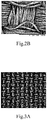
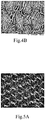
- Typical photos of resultant metal-coated fabrics are shown as Figures 2A-5B .
- High quality metal-coated fabrics are obtained by carefully controlling the fabrication process.
- the conductivity of prepared metal-coated fabrics was characterized by using a home-made clamp via the four-probe method. Fabrics were cut into pieces with the dimension of 5cm ⁇ 1cm, sheet resistance was measured using Keithley 2400 source meter.
- Cu-coated and Ni-coated polyester fabrics after 90 min of ELD have a sheet resistance as low as 0.25 ohms/square.
- the prepared metal-coated fabrics were bent at different radii of curvature to evaluate the stability of the conductivity.
- the resistance change of Ni-coated polyester fabric after bending into different angles is shown as Figure 6 .
- the resistance increased slightly under bending. It can be observed that only 20% increment in the resistance was achieved when the conductive fabric underwent folding. Furthermore, the fabric was bent for 1000 cycles to evaluate the stability.
- Figure 7 shows that the resistance increased about 20% after the cyclic tests. It is also observed that the prepared metallic fabrics show nearly no change after several times of folding. All these results indicate that the prepared conductive fabrics are suitable for the wearable lithium ion battery applications.
- Li 4 Ti 5 O 12 (LTO) and LiFePO 4 (LFP) were selected as the active materials for anode and cathode, respectively.
- the slurries were prepared by mixing active materials (Li 4 Ti 5 O 12 or LiFePO 4 ), conductive carbon black, and polymer binder polyvinylidene fluoride (PVDF) in the weight ratio of 8:1:1 in N-methylpyrrolidone (NMP).
- active materials Li 4 Ti 5 O 12 or LiFePO 4
- PVDF polymer binder polyvinylidene fluoride
- NMP N-methylpyrrolidone
- the electrodes were cut into electrodes with preset shapes.
- the electrodes were assembled into half cells by using the obtained metallic textile-based electrodes and lithium foils as work electrodes and counter electrodes, respectively.
- Porous polyethylene (PE) films with the thickness of 20 ⁇ m were utilized as the separator.
- the solution of 1M LiPF 6 in EC/DMC (1:1, v/v) was used as the electrolyte. All the cells were assembled in glove box under argon atmosphere with the water and oxygen content lower than 1 ppm.
- the electrochemical performance of LFP/Ni-Cotton electrodes is shown as Figure 8 and Figure 11 .
- the electrodes deliver good energy storage capacity under various C rates from 0.2 to 10 C.
- the discharged specific capacity of LFP on Ni-coated cotton fabric is ca. 130, 120, 100, 80, 45, 10 mAh/g under C rates of 0.2, 0.5, 1, 2, 5, 10, respectively.
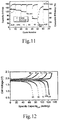
- the electrochemical performance of LTO/Cu-Cotton electrodes is shown as Figure 10 and Figure 11 .
- the electrodes also can deliver good energy storage capacity under various C rates from 0.2 to 10 C.
- the discharged specific capacity of LTO on Cu-coated cotton fabric is ca. 140, 130, 120, 100, 65, 20 mAh/g under C rates of 0.2, 0.5, 1, 2, 5, 10, respectively.
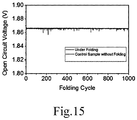
- Graphs of the open circuit voltage (OPV) versus time are shown in Fig. 15 , with the open circuit voltage of the battery sample not being folded as a reference line. As shown in the figure, the open circuit voltage of the battery only exhibited fluctuation much lower than 0.01V when folding the battery at a frequency of 0.1 Hz. After 1000 folding cycles, the battery can still work normally.
- the flexible metallic textile-based battery also showed superior stability of energy storage performance when undergoing mechanical deformations.
Landscapes
- Chemical & Material Sciences (AREA)
- Engineering & Computer Science (AREA)
- Chemical Kinetics & Catalysis (AREA)
- General Chemical & Material Sciences (AREA)
- Electrochemistry (AREA)
- Materials Engineering (AREA)
- Textile Engineering (AREA)
- Inorganic Chemistry (AREA)
- Composite Materials (AREA)
- Crystallography & Structural Chemistry (AREA)
- Manufacturing & Machinery (AREA)
- Organic Chemistry (AREA)
- Cell Electrode Carriers And Collectors (AREA)
Abstract
Description
- This disclosure relates to the field of electrochemical field, and in particular, to a current collector, a method for preparing the same and a lithium ion battery comprising the same.
- Wearable lithium ion batteries with high energy density, high power density, and robust mechanical stability are highly desired as the rapid development of portable and wearable electronic devices. However, the existing lithium ion batteries constructed on Al/Cu metal foils are bulky and hardly flexible which cannot withstand mechanical deformations such as bending, folding, crumping and the like. Many prototype flexible lithium ion batteries employed carbon materials including carbon nanotube film, graphene film, and carbonized textiles as current collectors. However, this kind of lithium ion batteries suffered from the intrinsic low electrical conductivity and brittle nature of carbon materials, showing deteriorated electrochemical energy storage capacity and relatively weak mechanical flexibility. Ideal materials with high electrical conductivity and superior mechanical flexibility for current collectors of lithium ion batteries are still missing.
- The present disclosure provides a method for preparing current collector. The method includes: (1) anchoring vinyl groups onto the surface of textiles through the silanization of the hydroxyl groups on the surface of the textile with a coupling agent; (2) synthesizing polyelectrolyte brushes on the surface of the textile through in-situ radical polymerization; and (3) forming catalyst ions on the polyelectrolyte brushes through ion-exchange and forming metal-coated layers through subsequent electroless deposition (ELD).
- According to an embodiment, the coupling agent is selected form silane coupling agents.
- According to another embodiment, the catalyst ion is PdCl4 2-.
- According to another embodiment, the metal-coated layer is a copper-coated layer or a nickel-coated layer.
- According to another embodiment, the textile is formed from at least one of cotton and polyester.
- The present disclosure further provides a current collector preparing by any of the said methods.
- According to an embodiment, the current collector has a sheet resistance of less than 0.25 ohms/square.
- The present disclosure further provides a lithium ion battery including any of the said current collectors.
- According to an embodiment, an anode material of the lithium ion battery contains Li4Ti5O12.
- According to another embodiment, a cathode material of the lithium ion battery contains LiFePO4.
- The current collector according to the present disclosure has high electrical conductivity and excellent mechanical flexibility, and thus the lithium ion battery including the same is suitable for portable and wearable electronic devices.
-
-
FIG. 1 is a schematic illustration of the preparation of current collectors according to the methods of the present disclosure. -
FIG. 2A is an optical image of a Cu-coated polyester fabric current collector. -
FIG. 2B is a SEM image of a Cu-coated polyester fabric current collector. -
FIG. 3A is an optical image of a Ni-coated polyester fabric current collector. -
FIG. 3B is a SEM image of a Ni-coated polyester fabric current collector. -
FIG. 4A is an optical image of a Cu-coated cotton fabric current collector. -
FIG. 4B is a SEM image of a Cu-coated cotton fabric current collector. -
FIG. 5A is an optical image of a Ni-coated cotton fabric current collector. -
FIG. 5B is a SEM image of a Ni-coated cotton fabric current collector. -
FIG.6 is a view showing electrical resistances of a Ni-coated polyester fabric at different bending angles. -
FIG. 7 is a view showing electrical resistance changes of a Ni-coated polyester fabric with bending radius of 1 mm. -
FIG. 8 is charging/discharging profiles of LFP/Ni-Cotton electrodes under different C rates. -
FIG. 9 shows capacity and coulombic efficiency of LFP/Ni-Cotton electrodes versus cycle number under different C rates. -
FIG. 10 is charging/discharging profiles of LTO/Cu-Cotton electrodes under different C rates. -
FIG. 11 shows capacity and coulombic efficiency of LTO/Cu-Cotton electrodes versus cycle number under different C rates. -
FIG. 12 is charge/discharge profiles under different C rates of a flexible lithium ion battery by using LFP/Ni-Cotton as the cathode and LTO/Cu-Cotton as the anode. -
FIG. 13 is discharged capacities and coulombic efficiency of a flexible lithium ion battery by using LFP/Ni-Cotton as the cathode and LTO/Cu-Cotton as the anode under different C rates. -
FIG. 14 shows Ragone plot of a flexible lithium ion battery by using LFP/Ni-Cotton as the cathode and LTO/Cu-Cotton as the anode. -
FIG. 15 is a view showing open circuit voltage (OPV) of a flexible lithium ion battery using a current collector according to the present disclosure as a function of folding cycles under 0.1 Hz. - Pre-cleaned textile fabrics were firstly immersed in a mixture of ethanol, acetic acid, and water (95/1/4, v/v/v). After the addition of 1 mL of KH570, the silanization was carried out at room temperature for 1 h. Subsequently, the silane-modified fabrics were immersed into a 10% (v/v) aqueous solution of METAC for 60 min at 80 °C to perform the radical polymerization by using potassium persulfate as initiator. Then, the PMETAC-grafted fabrics were immersed in a 5 mM aqueous solution of (NH4)2PdCl4 for 20min to immobilize PdCl4 2- through ion exchange. Finally, the fabrics were immersed into ELD baths for different time intervals to prepare metal-coated fabric current collectors. Cu-coated and Ni-coated fabrics were prepared by using different ELD baths.
- The copper-containing ELD bath for preparing a copper-coated fabric is an aqueous solution of NaOH at a concentration of 12 g/L, CuSO4•5H2O at a concentration of 13 g/L, sodium potassium tartrate (KNaC4H4O6•4H2O) at a concentration of 29 g/L, and HCHO at a concentration of 9.5 mL/L. Cu-coated fabrics were prepared by electroless deposition in the said bath for 5 minutes to 2 hours at 25 °C.
- The nickel-containing ELD bath for preparing a nickel-coated fabric is an aqueous solution of nickel sulfate hexahydrate at a concentration of 40 g/L, sodium citrate at a concentration of 20 g/L, lactic acid (C3H6O3) at a concentration of 10 g/L, and dimethylamine borane (DMAB) at a concentration of 1 g/L. Ni-coated fabrics were prepared by electroless deposition in the said bath for 5minutes to 2 hours at 25 °C.
- Typical photos of resultant metal-coated fabrics are shown as
Figures 2A-5B . High quality metal-coated fabrics are obtained by carefully controlling the fabrication process. - The conductivity of prepared metal-coated fabrics was characterized by using a home-made clamp via the four-probe method. Fabrics were cut into pieces with the dimension of 5cm∗1cm, sheet resistance was measured using Keithley 2400 source meter.
- Cu-coated and Ni-coated polyester fabrics after 90 min of ELD, have a sheet resistance as low as 0.25 ohms/square.
- The prepared metal-coated fabrics were bent at different radii of curvature to evaluate the stability of the conductivity. The resistance change of Ni-coated polyester fabric after bending into different angles is shown as
Figure 6 . The resistance increased slightly under bending. It can be observed that only 20% increment in the resistance was achieved when the conductive fabric underwent folding. Furthermore, the fabric was bent for 1000 cycles to evaluate the stability.Figure 7 shows that the resistance increased about 20% after the cyclic tests. It is also observed that the prepared metallic fabrics show nearly no change after several times of folding. All these results indicate that the prepared conductive fabrics are suitable for the wearable lithium ion battery applications. - Cu-coated/Ni-coated fabrics prepared as described above were utilized as the current collectors. Li4Ti5O12 (LTO) and LiFePO4 (LFP) were selected as the active materials for anode and cathode, respectively. The slurries were prepared by mixing active materials (Li4Ti5O12 or LiFePO4), conductive carbon black, and polymer binder polyvinylidene fluoride (PVDF) in the weight ratio of 8:1:1 in N-methylpyrrolidone (NMP). The LTO-containing slurry was then uniformly applied to the prepared Cu-coated fabric current collector, or the LFP-containing slurry was uniformly applied to the prepared Ni-coated fabric current collector. After drying at 80 °C for 4 h, the electrodes were cut into electrodes with preset shapes. The electrodes were assembled into half cells by using the obtained metallic textile-based electrodes and lithium foils as work electrodes and counter electrodes, respectively. Porous polyethylene (PE) films with the thickness of 20 µm were utilized as the separator. The solution of 1M LiPF6 in EC/DMC (1:1, v/v) was used as the electrolyte. All the cells were assembled in glove box under argon atmosphere with the water and oxygen content lower than 1 ppm.
- The electrochemical performance of LFP/Ni-Cotton electrodes is shown as
Figure 8 andFigure 11 . The electrodes deliver good energy storage capacity under various C rates from 0.2 to 10 C. The discharged specific capacity of LFP on Ni-coated cotton fabric is ca. 130, 120, 100, 80, 45, 10 mAh/g under C rates of 0.2, 0.5, 1, 2, 5, 10, respectively. - The electrochemical performance of LTO/Cu-Cotton electrodes is shown as
Figure 10 andFigure 11 . The electrodes also can deliver good energy storage capacity under various C rates from 0.2 to 10 C. The discharged specific capacity of LTO on Cu-coated cotton fabric is ca. 140, 130, 120, 100, 65, 20 mAh/g under C rates of 0.2, 0.5, 1, 2, 5, 10, respectively. - Flexible full cells with the LFP/Ni-fabric cathodes and the LTO/Cu-fabric anodes were fabricated by using the Al-plastic pouch as the encapsulation material. Other materials are the same as the fabrication of half cells. The full cells were tested over the voltage range of 0.7-2.4 V. Typical charge/discharge profiles under different C rate are shown in
Figure 12 . Results show that the discharged voltage plateau is 1.85 V. The gravimetric capacity of the full cell decreases as the increase of current densities. The specific capacity decreased from 122 mAh/g under 0.2C to 70 mAh/g under 5C. The full cells also show satisfied cycle performance and relatively high coulombic efficiency (Figure 13 ). The specific energy and specific power of such full cells are summarized asFigure 14 . It can be seen from the figure that the energy density and power density of the full battery are excellent. - Graphs of the open circuit voltage (OPV) versus time are shown in
Fig. 15 , with the open circuit voltage of the battery sample not being folded as a reference line. As shown in the figure, the open circuit voltage of the battery only exhibited fluctuation much lower than 0.01V when folding the battery at a frequency of 0.1 Hz. After 1000 folding cycles, the battery can still work normally. The flexible metallic textile-based battery also showed superior stability of energy storage performance when undergoing mechanical deformations. - The above description is only an illustration of preferred embodiments of the present disclosure. Without departing from the spirit and essence of the present disclosure, those skilled in the art can make various corresponding changes, modifications and process optimization, but these corresponding changes, variations and process optimization shall fall within the scope of the present disclosure.
Claims (10)
- A method for preparing current collector, comprising:(1) anchoring vinyl groups onto the surface of a textile through the silanization of the hydroxyl groups on the surface of the textile with a coupling agent;(2) synthesizing polyelectrolyte brushes on the surface of the textile through in-situ radical polymerization;(3) forming catalyst ions on the polyelectrolyte brushes through ion-exchange and forming a metal-coated layer through subsequent electroless deposition.
- The method according to claim 1, wherein the coupling agent is selected from silane coupling agents.
- The method according to claim 1, wherein the catalyst ion is PdCl4 2-.
- The method according to claim 1, wherein the metal-coated layer is a copper-coated layer or a nickel-coated layer.
- The method according to claim 1, wherein the textile is formed from at least one of cotton and polyester.
- A current collector, being prepared by the method according to any of claims 1-5.
- The current collector according to claim 6, wherein the current collector has a sheet resistance of less than 0.25 ohms/square.
- A lithium ion battery, comprising the current collector according to claim 6 or 7.
- The lithium ion battery according to claim 8, wherein an anode material contains Li4Ti5O12.
- The lithium ion battery according to claim 8, wherein a cathode material contains LiFePO4.
Applications Claiming Priority (1)
| Application Number | Priority Date | Filing Date | Title |
|---|---|---|---|
| PCT/CN2017/116130 WO2019113881A1 (en) | 2017-12-14 | 2017-12-14 | Current collector, preparation method therefor, and lithium-ion battery containing same |
Publications (2)
| Publication Number | Publication Date |
|---|---|
| EP3605679A1 true EP3605679A1 (en) | 2020-02-05 |
| EP3605679A4 EP3605679A4 (en) | 2020-11-18 |
Family
ID=66818891
Family Applications (1)
| Application Number | Title | Priority Date | Filing Date |
|---|---|---|---|
| EP17934404.9A Pending EP3605679A4 (en) | 2017-12-14 | 2017-12-14 | POWER COLLECTOR, MANUFACTURING PROCESS FOR IT AND LITHIUM-ION BATTERY WITH IT |
Country Status (3)
| Country | Link |
|---|---|
| US (1) | US11374228B2 (en) |
| EP (1) | EP3605679A4 (en) |
| WO (1) | WO2019113881A1 (en) |
Cited By (1)
| Publication number | Priority date | Publication date | Assignee | Title |
|---|---|---|---|---|
| CN113196533A (en) * | 2019-11-27 | 2021-07-30 | 索特利亚电池创新集团公司 | Battery with metallized film current collector having low internal resistance |
Families Citing this family (1)
| Publication number | Priority date | Publication date | Assignee | Title |
|---|---|---|---|---|
| CN121922683A (en) * | 2024-10-22 | 2026-04-24 | 通用汽车环球科技运作有限责任公司 | Composite current collectors including fiber membranes and conductive materials and/or metal coatings |
Family Cites Families (13)
| Publication number | Priority date | Publication date | Assignee | Title |
|---|---|---|---|---|
| JPH05290838A (en) | 1992-04-08 | 1993-11-05 | Mitsubishi Paper Mills Ltd | Manufacture for nickel-plated nonwoven fabric electrode |
| JP2001313038A (en) | 2000-02-21 | 2001-11-09 | Mitsubishi Materials Corp | Current collector for alkaline secondary battery, method for producing the same, and alkaline secondary battery using the same |
| CN1966765B (en) * | 2005-11-17 | 2012-07-18 | 中国科学院金属研究所 | Activation method for chemical plating of non-metallic material and chemical plating therefor |
| CN102121194B (en) | 2010-01-11 | 2013-08-14 | 香港理工大学 | Conductive fabric manufacturing method and fabric manufactured by same |
| KR101105355B1 (en) | 2010-03-26 | 2012-01-16 | 국립대학법인 울산과학기술대학교 산학협력단 | Flexible electrode current collector, manufacturing method thereof and negative electrode using same |
| US20110262813A1 (en) | 2010-04-21 | 2011-10-27 | Evt Power Inc. | Method of producing current collectors for electrochemical devices |
| CN101892470A (en) * | 2010-07-19 | 2010-11-24 | 复旦大学 | A kind of preparation method of flexible polyester nickel-coated electrode |
| MX2013013609A (en) | 2011-05-23 | 2014-01-08 | Nissan Motor | Conductive film, current collector using same, battery and bipolar battery. |
| CN102995395B (en) * | 2011-09-15 | 2014-12-17 | 香港理工大学 | Conductive textile and manufacturing method thereof |
| CN104617334A (en) * | 2014-12-25 | 2015-05-13 | 尚 | A kind of flexible battery and its manufacturing method |
| CN105762365A (en) | 2016-04-28 | 2016-07-13 | 深圳市力为锂能科技有限公司 | Current collector for lithium ion battery and preparation method of current collector |
| CN106654285B (en) * | 2016-11-18 | 2021-03-05 | 浙江大学 | Flexible current collector for lithium battery and preparation method thereof |
| CN106898729A (en) | 2017-03-27 | 2017-06-27 | 浙江大学 | Flexible current-collecting body, electrode and battery comprising the flexible current-collecting body |
-
2017
- 2017-12-14 WO PCT/CN2017/116130 patent/WO2019113881A1/en not_active Ceased
- 2017-12-14 EP EP17934404.9A patent/EP3605679A4/en active Pending
- 2017-12-14 US US16/609,253 patent/US11374228B2/en active Active
Cited By (1)
| Publication number | Priority date | Publication date | Assignee | Title |
|---|---|---|---|---|
| CN113196533A (en) * | 2019-11-27 | 2021-07-30 | 索特利亚电池创新集团公司 | Battery with metallized film current collector having low internal resistance |
Also Published As
| Publication number | Publication date |
|---|---|
| US20200259185A1 (en) | 2020-08-13 |
| EP3605679A4 (en) | 2020-11-18 |
| US11374228B2 (en) | 2022-06-28 |
| WO2019113881A1 (en) | 2019-06-20 |
Similar Documents
| Publication | Publication Date | Title |
|---|---|---|
| Jiang et al. | Robust artificial solid‐electrolyte interfaces with biomimetic ionic channels for dendrite‐free Li metal anodes | |
| JP6367390B2 (en) | Production of large capacity prism lithium ion alloy anode | |
| Cheng et al. | A facile method to improve the high rate capability of Co3O4 nanowire array electrodes | |
| JP5590581B2 (en) | Negative electrode for secondary battery and secondary battery provided with the same | |
| CN102334218B (en) | Negative electrode active material for lithium ion secondary battery and lithium ion secondary battery | |
| CN112103512A (en) | Negative current collector, and preparation method and application thereof | |
| TWI797213B (en) | Electrode for battery and fabrication method thereof | |
| JP2023513815A (en) | Anode piece, battery and electronic device employing said electrode piece | |
| CN111864181A (en) | Pre-lithiated silicon negative electrode, preparation method and application thereof | |
| JP2017130359A (en) | Method for manufacturing electrode material and method for manufacturing power storage device | |
| CN106025175A (en) | Battery slurry, battery pole piece and preparation method of battery pole piece | |
| KR20190065153A (en) | Method of Preparing Electrode for Secondary Battery | |
| CN120149332B (en) | Electrode fabrication method, electrode obtained therefrom, energy storage device including the electrode, and electrode production system. | |
| CN105514344B (en) | The method that lithium ion battery cathode surface is modified is realized by electrophoretic deposition graphene | |
| Wang et al. | Ultra-flexible lithium ion batteries fabricated by electrodeposition and solvothermal synthesis | |
| CN109962243A (en) | Current collector, method for preparing the same, and lithium ion battery including the same | |
| Yan et al. | Sandwich-structured cathodes with cross-stacked carbon nanotube films as conductive layers for high-performance lithium-ion batteries | |
| US11374228B2 (en) | Metallic textiles for flexible wearable lithium ion batteries | |
| CN114975847B (en) | Composite metal negative electrode with sandwich structure and preparation method and application thereof | |
| Zhang et al. | Freestanding manganese dioxide nanosheet network grown on nickel/polyvinylidene fluoride coaxial fiber membrane as anode materials for high performance lithium ion batteries | |
| CN118369803A (en) | Solid electrolyte and all-solid-state battery containing the same | |
| CN111354950A (en) | Foil, preparation method thereof, battery cell, battery module and energy storage equipment | |
| CN108539151B (en) | Electrode material for secondary battery and secondary battery | |
| CN119631213A (en) | Solid electrolyte composition, solid electrolyte membrane and all-solid-state battery containing the same | |
| JP2025505079A (en) | Secondary batteries and battery packs |
Legal Events
| Date | Code | Title | Description |
|---|---|---|---|
| STAA | Information on the status of an ep patent application or granted ep patent |
Free format text: STATUS: THE INTERNATIONAL PUBLICATION HAS BEEN MADE |
|
| PUAI | Public reference made under article 153(3) epc to a published international application that has entered the european phase |
Free format text: ORIGINAL CODE: 0009012 |
|
| STAA | Information on the status of an ep patent application or granted ep patent |
Free format text: STATUS: REQUEST FOR EXAMINATION WAS MADE |
|
| 17P | Request for examination filed |
Effective date: 20191028 |
|
| AK | Designated contracting states |
Kind code of ref document: A1 Designated state(s): AL AT BE BG CH CY CZ DE DK EE ES FI FR GB GR HR HU IE IS IT LI LT LU LV MC MK MT NL NO PL PT RO RS SE SI SK SM TR |
|
| AX | Request for extension of the european patent |
Extension state: BA ME |
|
| RAP1 | Party data changed (applicant data changed or rights of an application transferred) |
Owner name: THE HONG KONG RESEARCH INSTITUTE OF TEXTILES AND APPAREL LIMITED |
|
| A4 | Supplementary search report drawn up and despatched |
Effective date: 20201021 |
|
| RIC1 | Information provided on ipc code assigned before grant |
Ipc: H01M 4/485 20100101ALI20201015BHEP Ipc: H01M 4/58 20100101ALI20201015BHEP Ipc: D06M 11/83 20060101ALI20201015BHEP Ipc: H01M 4/66 20060101AFI20201015BHEP Ipc: H01M 4/02 20060101ALN20201015BHEP Ipc: H01M 4/74 20060101ALI20201015BHEP Ipc: H01M 10/0525 20100101ALI20201015BHEP |
|
| DAV | Request for validation of the european patent (deleted) | ||
| DAX | Request for extension of the european patent (deleted) | ||
| STAA | Information on the status of an ep patent application or granted ep patent |
Free format text: STATUS: EXAMINATION IS IN PROGRESS |
|
| RIC1 | Information provided on ipc code assigned before grant |
Ipc: H01M 4/02 20060101ALN20230524BHEP Ipc: D06M 101/06 20060101ALI20230524BHEP Ipc: D06M 101/32 20060101ALI20230524BHEP Ipc: D06M 23/00 20060101ALI20230524BHEP Ipc: D06M 14/14 20060101ALI20230524BHEP Ipc: D06M 14/04 20060101ALI20230524BHEP Ipc: D06M 13/513 20060101ALI20230524BHEP Ipc: H01M 10/0525 20100101ALI20230524BHEP Ipc: H01M 4/74 20060101ALI20230524BHEP Ipc: H01M 4/58 20100101ALI20230524BHEP Ipc: H01M 4/485 20100101ALI20230524BHEP Ipc: D06M 11/83 20060101ALI20230524BHEP Ipc: H01M 4/66 20060101AFI20230524BHEP |
|
| 17Q | First examination report despatched |
Effective date: 20230602 |