EP3605671A1 - Negative electrode active material for lithium ion secondary battery, negative electrode for lithium ion secondary battery, and lithium ion secondary battery - Google Patents
Negative electrode active material for lithium ion secondary battery, negative electrode for lithium ion secondary battery, and lithium ion secondary battery Download PDFInfo
- Publication number
- EP3605671A1 EP3605671A1 EP18775552.5A EP18775552A EP3605671A1 EP 3605671 A1 EP3605671 A1 EP 3605671A1 EP 18775552 A EP18775552 A EP 18775552A EP 3605671 A1 EP3605671 A1 EP 3605671A1
- Authority
- EP
- European Patent Office
- Prior art keywords
- negative electrode
- active material
- electrode active
- lithium ion
- secondary battery
- Prior art date
- Legal status (The legal status is an assumption and is not a legal conclusion. Google has not performed a legal analysis and makes no representation as to the accuracy of the status listed.)
- Withdrawn
Links
- 239000007773 negative electrode material Substances 0.000 title claims abstract description 271
- HBBGRARXTFLTSG-UHFFFAOYSA-N Lithium ion Chemical compound [Li+] HBBGRARXTFLTSG-UHFFFAOYSA-N 0.000 title claims abstract description 97
- 229910001416 lithium ion Inorganic materials 0.000 title claims abstract description 97
- 239000002245 particle Substances 0.000 claims abstract description 297
- VYPSYNLAJGMNEJ-UHFFFAOYSA-N Silicium dioxide Chemical compound O=[Si]=O VYPSYNLAJGMNEJ-UHFFFAOYSA-N 0.000 claims abstract description 168
- OKTJSMMVPCPJKN-UHFFFAOYSA-N Carbon Chemical compound [C] OKTJSMMVPCPJKN-UHFFFAOYSA-N 0.000 claims abstract description 157
- 229910052814 silicon oxide Inorganic materials 0.000 claims abstract description 124
- 229910052799 carbon Inorganic materials 0.000 claims abstract description 107
- 238000002441 X-ray diffraction Methods 0.000 claims abstract description 36
- 230000005855 radiation Effects 0.000 claims abstract description 28
- 239000000377 silicon dioxide Substances 0.000 claims abstract description 24
- 229910018906 PSiO2 Inorganic materials 0.000 claims abstract description 23
- 229910016523 CuKa Inorganic materials 0.000 claims abstract description 14
- 229910052681 coesite Inorganic materials 0.000 claims abstract 4
- 229910052906 cristobalite Inorganic materials 0.000 claims abstract 4
- 229910052682 stishovite Inorganic materials 0.000 claims abstract 4
- 229910052905 tridymite Inorganic materials 0.000 claims abstract 4
- 239000000126 substance Substances 0.000 claims description 75
- 229910002804 graphite Inorganic materials 0.000 claims description 40
- 239000010439 graphite Substances 0.000 claims description 40
- 230000001186 cumulative effect Effects 0.000 claims description 31
- 238000009826 distribution Methods 0.000 claims description 25
- ORXJMBXYSGGCHG-UHFFFAOYSA-N dimethyl 2-methoxypropanedioate Chemical compound COC(=O)C(OC)C(=O)OC ORXJMBXYSGGCHG-UHFFFAOYSA-N 0.000 claims description 12
- 238000007561 laser diffraction method Methods 0.000 claims description 9
- 238000000790 scattering method Methods 0.000 claims description 9
- 229920002678 cellulose Polymers 0.000 claims description 6
- 239000001913 cellulose Substances 0.000 claims description 6
- 239000003792 electrolyte Substances 0.000 claims description 6
- 229920001282 polysaccharide Polymers 0.000 claims description 5
- 239000005017 polysaccharide Substances 0.000 claims description 5
- 229920000881 Modified starch Polymers 0.000 claims description 4
- 235000019426 modified starch Nutrition 0.000 claims description 4
- 229920006186 water-soluble synthetic resin Polymers 0.000 claims description 4
- 239000012866 water-soluble synthetic resin Substances 0.000 claims description 4
- 150000004676 glycans Chemical class 0.000 claims 1
- 238000000034 method Methods 0.000 description 54
- 238000010438 heat treatment Methods 0.000 description 48
- XUIMIQQOPSSXEZ-UHFFFAOYSA-N Silicon Chemical compound [Si] XUIMIQQOPSSXEZ-UHFFFAOYSA-N 0.000 description 40
- 239000010703 silicon Substances 0.000 description 40
- 229910052710 silicon Inorganic materials 0.000 description 38
- 238000005259 measurement Methods 0.000 description 35
- 238000010298 pulverizing process Methods 0.000 description 21
- 239000000203 mixture Substances 0.000 description 20
- 239000007788 liquid Substances 0.000 description 18
- 238000011282 treatment Methods 0.000 description 18
- 239000011230 binding agent Substances 0.000 description 17
- 239000000843 powder Substances 0.000 description 15
- 239000000463 material Substances 0.000 description 14
- VNWKTOKETHGBQD-YPZZEJLDSA-N carbane Chemical compound [10CH4] VNWKTOKETHGBQD-YPZZEJLDSA-N 0.000 description 13
- 238000007323 disproportionation reaction Methods 0.000 description 13
- XLYOFNOQVPJJNP-UHFFFAOYSA-N water Substances O XLYOFNOQVPJJNP-UHFFFAOYSA-N 0.000 description 13
- LIVNPJMFVYWSIS-UHFFFAOYSA-N silicon monoxide Chemical class [Si-]#[O+] LIVNPJMFVYWSIS-UHFFFAOYSA-N 0.000 description 12
- 239000012298 atmosphere Substances 0.000 description 11
- 230000008859 change Effects 0.000 description 11
- 230000000052 comparative effect Effects 0.000 description 11
- 238000007599 discharging Methods 0.000 description 11
- 238000002156 mixing Methods 0.000 description 10
- 239000000523 sample Substances 0.000 description 10
- IJGRMHOSHXDMSA-UHFFFAOYSA-N Atomic nitrogen Chemical compound N#N IJGRMHOSHXDMSA-UHFFFAOYSA-N 0.000 description 9
- 239000006230 acetylene black Substances 0.000 description 9
- 238000000576 coating method Methods 0.000 description 9
- 230000000694 effects Effects 0.000 description 9
- 238000004519 manufacturing process Methods 0.000 description 9
- 238000004566 IR spectroscopy Methods 0.000 description 8
- 239000011248 coating agent Substances 0.000 description 8
- 239000006185 dispersion Substances 0.000 description 8
- 235000012239 silicon dioxide Nutrition 0.000 description 8
- 239000002904 solvent Substances 0.000 description 8
- 238000003860 storage Methods 0.000 description 8
- NIXOWILDQLNWCW-UHFFFAOYSA-M Acrylate Chemical compound [O-]C(=O)C=C NIXOWILDQLNWCW-UHFFFAOYSA-M 0.000 description 7
- SECXISVLQFMRJM-UHFFFAOYSA-N N-Methylpyrrolidone Chemical compound CN1CCCC1=O SECXISVLQFMRJM-UHFFFAOYSA-N 0.000 description 7
- 230000008602 contraction Effects 0.000 description 7
- -1 for example Substances 0.000 description 7
- 230000006872 improvement Effects 0.000 description 7
- 239000003960 organic solvent Substances 0.000 description 7
- 238000011084 recovery Methods 0.000 description 7
- 238000012360 testing method Methods 0.000 description 7
- YEJRWHAVMIAJKC-UHFFFAOYSA-N 4-Butyrolactone Chemical compound O=C1CCCO1 YEJRWHAVMIAJKC-UHFFFAOYSA-N 0.000 description 6
- UFWIBTONFRDIAS-UHFFFAOYSA-N Naphthalene Chemical compound C1=CC=CC2=CC=CC=C21 UFWIBTONFRDIAS-UHFFFAOYSA-N 0.000 description 6
- 229920002472 Starch Polymers 0.000 description 6
- 238000006243 chemical reaction Methods 0.000 description 6
- 150000001875 compounds Chemical class 0.000 description 6
- 239000013256 coordination polymer Substances 0.000 description 6
- 239000008151 electrolyte solution Substances 0.000 description 6
- 239000007789 gas Substances 0.000 description 6
- 229910052751 metal Inorganic materials 0.000 description 6
- 239000002184 metal Substances 0.000 description 6
- 229920002239 polyacrylonitrile Polymers 0.000 description 6
- 239000002994 raw material Substances 0.000 description 6
- 235000019698 starch Nutrition 0.000 description 6
- OIFBSDVPJOWBCH-UHFFFAOYSA-N Diethyl carbonate Chemical compound CCOC(=O)OCC OIFBSDVPJOWBCH-UHFFFAOYSA-N 0.000 description 5
- WHXSMMKQMYFTQS-UHFFFAOYSA-N Lithium Chemical compound [Li] WHXSMMKQMYFTQS-UHFFFAOYSA-N 0.000 description 5
- 230000006866 deterioration Effects 0.000 description 5
- 239000002612 dispersion medium Substances 0.000 description 5
- 239000008187 granular material Substances 0.000 description 5
- 229910052744 lithium Inorganic materials 0.000 description 5
- 230000014759 maintenance of location Effects 0.000 description 5
- 239000004570 mortar (masonry) Substances 0.000 description 5
- 229910021382 natural graphite Inorganic materials 0.000 description 5
- 239000008107 starch Substances 0.000 description 5
- YBYIRNPNPLQARY-UHFFFAOYSA-N 1H-indene Chemical compound C1=CC=C2CC=CC2=C1 YBYIRNPNPLQARY-UHFFFAOYSA-N 0.000 description 4
- XKRFYHLGVUSROY-UHFFFAOYSA-N Argon Chemical compound [Ar] XKRFYHLGVUSROY-UHFFFAOYSA-N 0.000 description 4
- 229920002134 Carboxymethyl cellulose Polymers 0.000 description 4
- 239000004372 Polyvinyl alcohol Substances 0.000 description 4
- PPBRXRYQALVLMV-UHFFFAOYSA-N Styrene Chemical compound C=CC1=CC=CC=C1 PPBRXRYQALVLMV-UHFFFAOYSA-N 0.000 description 4
- NINIDFKCEFEMDL-UHFFFAOYSA-N Sulfur Chemical compound [S] NINIDFKCEFEMDL-UHFFFAOYSA-N 0.000 description 4
- 239000001768 carboxy methyl cellulose Substances 0.000 description 4
- 235000010948 carboxy methyl cellulose Nutrition 0.000 description 4
- 239000008112 carboxymethyl-cellulose Substances 0.000 description 4
- 229940105329 carboxymethylcellulose Drugs 0.000 description 4
- 239000013078 crystal Substances 0.000 description 4
- 238000007580 dry-mixing Methods 0.000 description 4
- 230000001965 increasing effect Effects 0.000 description 4
- 239000002609 medium Substances 0.000 description 4
- 230000004048 modification Effects 0.000 description 4
- 238000012986 modification Methods 0.000 description 4
- 229910052757 nitrogen Inorganic materials 0.000 description 4
- 239000011295 pitch Substances 0.000 description 4
- 150000004804 polysaccharides Chemical class 0.000 description 4
- 229920002451 polyvinyl alcohol Polymers 0.000 description 4
- 229940068984 polyvinyl alcohol Drugs 0.000 description 4
- 229910052717 sulfur Inorganic materials 0.000 description 4
- 239000011593 sulfur Substances 0.000 description 4
- 239000002562 thickening agent Substances 0.000 description 4
- VAYTZRYEBVHVLE-UHFFFAOYSA-N 1,3-dioxol-2-one Chemical compound O=C1OC=CO1 VAYTZRYEBVHVLE-UHFFFAOYSA-N 0.000 description 3
- QTBSBXVTEAMEQO-UHFFFAOYSA-N Acetic acid Chemical compound CC(O)=O QTBSBXVTEAMEQO-UHFFFAOYSA-N 0.000 description 3
- UHOVQNZJYSORNB-UHFFFAOYSA-N Benzene Chemical compound C1=CC=CC=C1 UHOVQNZJYSORNB-UHFFFAOYSA-N 0.000 description 3
- RYGMFSIKBFXOCR-UHFFFAOYSA-N Copper Chemical compound [Cu] RYGMFSIKBFXOCR-UHFFFAOYSA-N 0.000 description 3
- ZMXDDKWLCZADIW-UHFFFAOYSA-N N,N-Dimethylformamide Chemical compound CN(C)C=O ZMXDDKWLCZADIW-UHFFFAOYSA-N 0.000 description 3
- 239000004962 Polyamide-imide Substances 0.000 description 3
- 239000004642 Polyimide Substances 0.000 description 3
- 238000001069 Raman spectroscopy Methods 0.000 description 3
- 238000001237 Raman spectrum Methods 0.000 description 3
- 229920002125 Sokalan® Polymers 0.000 description 3
- YXFVVABEGXRONW-UHFFFAOYSA-N Toluene Chemical compound CC1=CC=CC=C1 YXFVVABEGXRONW-UHFFFAOYSA-N 0.000 description 3
- 238000010521 absorption reaction Methods 0.000 description 3
- 238000004458 analytical method Methods 0.000 description 3
- 229910021383 artificial graphite Inorganic materials 0.000 description 3
- QVGXLLKOCUKJST-UHFFFAOYSA-N atomic oxygen Chemical compound [O] QVGXLLKOCUKJST-UHFFFAOYSA-N 0.000 description 3
- 238000003763 carbonization Methods 0.000 description 3
- 238000010000 carbonizing Methods 0.000 description 3
- 238000005229 chemical vapour deposition Methods 0.000 description 3
- 239000011300 coal pitch Substances 0.000 description 3
- 239000002270 dispersing agent Substances 0.000 description 3
- JBTWLSYIZRCDFO-UHFFFAOYSA-N ethyl methyl carbonate Chemical compound CCOC(=O)OC JBTWLSYIZRCDFO-UHFFFAOYSA-N 0.000 description 3
- 239000011888 foil Substances 0.000 description 3
- 230000014509 gene expression Effects 0.000 description 3
- VNWKTOKETHGBQD-UHFFFAOYSA-N methane Chemical compound C VNWKTOKETHGBQD-UHFFFAOYSA-N 0.000 description 3
- 239000001301 oxygen Substances 0.000 description 3
- 229910052760 oxygen Inorganic materials 0.000 description 3
- 239000004584 polyacrylic acid Substances 0.000 description 3
- 229920002312 polyamide-imide Polymers 0.000 description 3
- 229920001721 polyimide Polymers 0.000 description 3
- 229920000915 polyvinyl chloride Polymers 0.000 description 3
- 239000004800 polyvinyl chloride Substances 0.000 description 3
- 239000007774 positive electrode material Substances 0.000 description 3
- 238000000634 powder X-ray diffraction Methods 0.000 description 3
- 239000011164 primary particle Substances 0.000 description 3
- 230000008569 process Effects 0.000 description 3
- 238000007873 sieving Methods 0.000 description 3
- 239000007787 solid Substances 0.000 description 3
- 239000000243 solution Substances 0.000 description 3
- 238000001228 spectrum Methods 0.000 description 3
- SMZOUWXMTYCWNB-UHFFFAOYSA-N 2-(2-methoxy-5-methylphenyl)ethanamine Chemical compound COC1=CC=C(C)C=C1CCN SMZOUWXMTYCWNB-UHFFFAOYSA-N 0.000 description 2
- NIXOWILDQLNWCW-UHFFFAOYSA-N 2-Propenoic acid Natural products OC(=O)C=C NIXOWILDQLNWCW-UHFFFAOYSA-N 0.000 description 2
- 238000004438 BET method Methods 0.000 description 2
- LSNNMFCWUKXFEE-UHFFFAOYSA-M Bisulfite Chemical compound OS([O-])=O LSNNMFCWUKXFEE-UHFFFAOYSA-M 0.000 description 2
- XTHFKEDIFFGKHM-UHFFFAOYSA-N Dimethoxyethane Chemical compound COCCOC XTHFKEDIFFGKHM-UHFFFAOYSA-N 0.000 description 2
- VZCYOOQTPOCHFL-OWOJBTEDSA-N Fumaric acid Chemical compound OC(=O)\C=C\C(O)=O VZCYOOQTPOCHFL-OWOJBTEDSA-N 0.000 description 2
- 229910001290 LiPF6 Inorganic materials 0.000 description 2
- PXHVJJICTQNCMI-UHFFFAOYSA-N Nickel Chemical compound [Ni] PXHVJJICTQNCMI-UHFFFAOYSA-N 0.000 description 2
- 239000002033 PVDF binder Substances 0.000 description 2
- 229920001665 Poly-4-vinylphenol Chemical class 0.000 description 2
- ATUOYWHBWRKTHZ-UHFFFAOYSA-N Propane Chemical compound CCC ATUOYWHBWRKTHZ-UHFFFAOYSA-N 0.000 description 2
- 239000004373 Pullulan Substances 0.000 description 2
- 229920001218 Pullulan Polymers 0.000 description 2
- 229920006243 acrylic copolymer Polymers 0.000 description 2
- 238000013019 agitation Methods 0.000 description 2
- 229910052782 aluminium Inorganic materials 0.000 description 2
- XAGFODPZIPBFFR-UHFFFAOYSA-N aluminium Chemical compound [Al] XAGFODPZIPBFFR-UHFFFAOYSA-N 0.000 description 2
- PNEYBMLMFCGWSK-UHFFFAOYSA-N aluminium oxide Inorganic materials [O-2].[O-2].[O-2].[Al+3].[Al+3] PNEYBMLMFCGWSK-UHFFFAOYSA-N 0.000 description 2
- 229910003481 amorphous carbon Inorganic materials 0.000 description 2
- 229910021486 amorphous silicon dioxide Inorganic materials 0.000 description 2
- MWPLVEDNUUSJAV-UHFFFAOYSA-N anthracene Chemical compound C1=CC=CC2=CC3=CC=CC=C3C=C21 MWPLVEDNUUSJAV-UHFFFAOYSA-N 0.000 description 2
- 229910052786 argon Inorganic materials 0.000 description 2
- 239000011324 bead Substances 0.000 description 2
- 238000004364 calculation method Methods 0.000 description 2
- 239000006229 carbon black Substances 0.000 description 2
- 229910052802 copper Inorganic materials 0.000 description 2
- 239000010949 copper Substances 0.000 description 2
- 238000012937 correction Methods 0.000 description 2
- 230000001351 cycling effect Effects 0.000 description 2
- 238000003795 desorption Methods 0.000 description 2
- 238000001035 drying Methods 0.000 description 2
- 238000009830 intercalation Methods 0.000 description 2
- 230000002687 intercalation Effects 0.000 description 2
- 230000002427 irreversible effect Effects 0.000 description 2
- KWGKDLIKAYFUFQ-UHFFFAOYSA-M lithium chloride Chemical compound [Li+].[Cl-] KWGKDLIKAYFUFQ-UHFFFAOYSA-M 0.000 description 2
- 229920000609 methyl cellulose Polymers 0.000 description 2
- 239000001923 methylcellulose Substances 0.000 description 2
- 235000010981 methylcellulose Nutrition 0.000 description 2
- 239000013081 microcrystal Substances 0.000 description 2
- 150000004767 nitrides Chemical class 0.000 description 2
- 229920000172 poly(styrenesulfonic acid) Polymers 0.000 description 2
- 229920000767 polyaniline Polymers 0.000 description 2
- 229920000642 polymer Polymers 0.000 description 2
- 229940005642 polystyrene sulfonic acid Drugs 0.000 description 2
- 229920002981 polyvinylidene fluoride Polymers 0.000 description 2
- 238000003825 pressing Methods 0.000 description 2
- 235000019423 pullulan Nutrition 0.000 description 2
- 150000003839 salts Chemical class 0.000 description 2
- 238000001878 scanning electron micrograph Methods 0.000 description 2
- 238000000926 separation method Methods 0.000 description 2
- 235000010413 sodium alginate Nutrition 0.000 description 2
- 239000000661 sodium alginate Substances 0.000 description 2
- 229940005550 sodium alginate Drugs 0.000 description 2
- 238000001179 sorption measurement Methods 0.000 description 2
- 229920003048 styrene butadiene rubber Polymers 0.000 description 2
- 150000003460 sulfonic acids Chemical class 0.000 description 2
- VZCYOOQTPOCHFL-UHFFFAOYSA-N trans-butenedioic acid Natural products OC(=O)C=CC(O)=O VZCYOOQTPOCHFL-UHFFFAOYSA-N 0.000 description 2
- 229920002554 vinyl polymer Polymers 0.000 description 2
- HDTRYLNUVZCQOY-UHFFFAOYSA-N α-D-glucopyranosyl-α-D-glucopyranoside Natural products OC1C(O)C(O)C(CO)OC1OC1C(O)C(O)C(O)C(CO)O1 HDTRYLNUVZCQOY-UHFFFAOYSA-N 0.000 description 1
- IXPNQXFRVYWDDI-UHFFFAOYSA-N 1-methyl-2,4-dioxo-1,3-diazinane-5-carboximidamide Chemical compound CN1CC(C(N)=N)C(=O)NC1=O IXPNQXFRVYWDDI-UHFFFAOYSA-N 0.000 description 1
- JAHNSTQSQJOJLO-UHFFFAOYSA-N 2-(3-fluorophenyl)-1h-imidazole Chemical compound FC1=CC=CC(C=2NC=CN=2)=C1 JAHNSTQSQJOJLO-UHFFFAOYSA-N 0.000 description 1
- WMOXOVYJENYVRD-UHFFFAOYSA-N 2-[2-[dodecyl-[2-[2-(2-hydroxyethoxy)ethoxy]ethyl]amino]ethoxy]ethanol Chemical compound CCCCCCCCCCCCN(CCOCCO)CCOCCOCCO WMOXOVYJENYVRD-UHFFFAOYSA-N 0.000 description 1
- QTWJRLJHJPIABL-UHFFFAOYSA-N 2-methylphenol;3-methylphenol;4-methylphenol Chemical compound CC1=CC=C(O)C=C1.CC1=CC=CC(O)=C1.CC1=CC=CC=C1O QTWJRLJHJPIABL-UHFFFAOYSA-N 0.000 description 1
- JWUJQDFVADABEY-UHFFFAOYSA-N 2-methyltetrahydrofuran Chemical compound CC1CCCO1 JWUJQDFVADABEY-UHFFFAOYSA-N 0.000 description 1
- FUGYGGDSWSUORM-UHFFFAOYSA-N 4-hydroxystyrene Chemical class OC1=CC=C(C=C)C=C1 FUGYGGDSWSUORM-UHFFFAOYSA-N 0.000 description 1
- 229920000178 Acrylic resin Polymers 0.000 description 1
- 239000004925 Acrylic resin Substances 0.000 description 1
- NLHHRLWOUZZQLW-UHFFFAOYSA-N Acrylonitrile Chemical compound C=CC#N NLHHRLWOUZZQLW-UHFFFAOYSA-N 0.000 description 1
- GAWIXWVDTYZWAW-UHFFFAOYSA-N C[CH]O Chemical group C[CH]O GAWIXWVDTYZWAW-UHFFFAOYSA-N 0.000 description 1
- 239000004215 Carbon black (E152) Substances 0.000 description 1
- 238000005169 Debye-Scherrer Methods 0.000 description 1
- 229920001353 Dextrin Polymers 0.000 description 1
- 239000004375 Dextrin Substances 0.000 description 1
- OTMSDBZUPAUEDD-UHFFFAOYSA-N Ethane Chemical compound CC OTMSDBZUPAUEDD-UHFFFAOYSA-N 0.000 description 1
- LFQSCWFLJHTTHZ-UHFFFAOYSA-N Ethanol Chemical compound CCO LFQSCWFLJHTTHZ-UHFFFAOYSA-N 0.000 description 1
- VGGSQFUCUMXWEO-UHFFFAOYSA-N Ethene Chemical compound C=C VGGSQFUCUMXWEO-UHFFFAOYSA-N 0.000 description 1
- 239000001856 Ethyl cellulose Substances 0.000 description 1
- ZZSNKZQZMQGXPY-UHFFFAOYSA-N Ethyl cellulose Chemical compound CCOCC1OC(OC)C(OCC)C(OCC)C1OC1C(O)C(O)C(OC)C(CO)O1 ZZSNKZQZMQGXPY-UHFFFAOYSA-N 0.000 description 1
- 239000005977 Ethylene Substances 0.000 description 1
- KMTRUDSVKNLOMY-UHFFFAOYSA-N Ethylene carbonate Chemical compound O=C1OCCO1 KMTRUDSVKNLOMY-UHFFFAOYSA-N 0.000 description 1
- 239000004354 Hydroxyethyl cellulose Substances 0.000 description 1
- 229920000663 Hydroxyethyl cellulose Polymers 0.000 description 1
- 229920001612 Hydroxyethyl starch Polymers 0.000 description 1
- 229920002153 Hydroxypropyl cellulose Polymers 0.000 description 1
- 229910010088 LiAlO4 Inorganic materials 0.000 description 1
- 229910013690 LiClF4 Inorganic materials 0.000 description 1
- 229910032387 LiCoO2 Inorganic materials 0.000 description 1
- 229910003005 LiNiO2 Inorganic materials 0.000 description 1
- CERQOIWHTDAKMF-UHFFFAOYSA-N Methacrylic acid Chemical compound CC(=C)C(O)=O CERQOIWHTDAKMF-UHFFFAOYSA-N 0.000 description 1
- FXHOOIRPVKKKFG-UHFFFAOYSA-N N,N-Dimethylacetamide Chemical compound CN(C)C(C)=O FXHOOIRPVKKKFG-UHFFFAOYSA-N 0.000 description 1
- CTQNGGLPUBDAKN-UHFFFAOYSA-N O-Xylene Chemical compound CC1=CC=CC=C1C CTQNGGLPUBDAKN-UHFFFAOYSA-N 0.000 description 1
- 229910019142 PO4 Inorganic materials 0.000 description 1
- 241000282320 Panthera leo Species 0.000 description 1
- 229920002230 Pectic acid Polymers 0.000 description 1
- 229920003171 Poly (ethylene oxide) Polymers 0.000 description 1
- 239000004698 Polyethylene Substances 0.000 description 1
- 239000004743 Polypropylene Substances 0.000 description 1
- 239000004793 Polystyrene Substances 0.000 description 1
- OFOBLEOULBTSOW-UHFFFAOYSA-N Propanedioic acid Natural products OC(=O)CC(O)=O OFOBLEOULBTSOW-UHFFFAOYSA-N 0.000 description 1
- HDSBZMRLPLPFLQ-UHFFFAOYSA-N Propylene glycol alginate Chemical compound OC1C(O)C(OC)OC(C(O)=O)C1OC1C(O)C(O)C(C)C(C(=O)OCC(C)O)O1 HDSBZMRLPLPFLQ-UHFFFAOYSA-N 0.000 description 1
- RTAQQCXQSZGOHL-UHFFFAOYSA-N Titanium Chemical compound [Ti] RTAQQCXQSZGOHL-UHFFFAOYSA-N 0.000 description 1
- HDTRYLNUVZCQOY-WSWWMNSNSA-N Trehalose Natural products O[C@@H]1[C@@H](O)[C@@H](O)[C@@H](CO)O[C@@H]1O[C@@H]1[C@H](O)[C@@H](O)[C@@H](O)[C@@H](CO)O1 HDTRYLNUVZCQOY-WSWWMNSNSA-N 0.000 description 1
- 238000002835 absorbance Methods 0.000 description 1
- DPXJVFZANSGRMM-UHFFFAOYSA-N acetic acid;2,3,4,5,6-pentahydroxyhexanal;sodium Chemical compound [Na].CC(O)=O.OCC(O)C(O)C(O)C(O)C=O DPXJVFZANSGRMM-UHFFFAOYSA-N 0.000 description 1
- 239000002253 acid Substances 0.000 description 1
- 239000011149 active material Substances 0.000 description 1
- 238000005054 agglomeration Methods 0.000 description 1
- 235000010443 alginic acid Nutrition 0.000 description 1
- 229920000615 alginic acid Polymers 0.000 description 1
- 239000000783 alginic acid Substances 0.000 description 1
- 229960001126 alginic acid Drugs 0.000 description 1
- 150000004781 alginic acids Chemical class 0.000 description 1
- 150000001338 aliphatic hydrocarbons Chemical class 0.000 description 1
- HDTRYLNUVZCQOY-LIZSDCNHSA-N alpha,alpha-trehalose Chemical compound O[C@@H]1[C@@H](O)[C@H](O)[C@@H](CO)O[C@@H]1O[C@@H]1[C@H](O)[C@@H](O)[C@H](O)[C@@H](CO)O1 HDTRYLNUVZCQOY-LIZSDCNHSA-N 0.000 description 1
- 239000007864 aqueous solution Substances 0.000 description 1
- 150000004945 aromatic hydrocarbons Chemical class 0.000 description 1
- 239000011320 asphalt decomposition pitch Substances 0.000 description 1
- 230000008901 benefit Effects 0.000 description 1
- 230000015572 biosynthetic process Effects 0.000 description 1
- 125000000484 butyl group Chemical group [H]C([*])([H])C([H])([H])C([H])([H])C([H])([H])[H] 0.000 description 1
- 238000011088 calibration curve Methods 0.000 description 1
- 239000003575 carbonaceous material Substances 0.000 description 1
- 150000001732 carboxylic acid derivatives Chemical class 0.000 description 1
- 150000001733 carboxylic acid esters Chemical class 0.000 description 1
- 125000002057 carboxymethyl group Chemical group [H]OC(=O)C([H])([H])[*] 0.000 description 1
- 239000005018 casein Substances 0.000 description 1
- BECPQYXYKAMYBN-UHFFFAOYSA-N casein, tech. Chemical compound NCCCCC(C(O)=O)N=C(O)C(CC(O)=O)N=C(O)C(CCC(O)=N)N=C(O)C(CC(C)C)N=C(O)C(CCC(O)=O)N=C(O)C(CC(O)=O)N=C(O)C(CCC(O)=O)N=C(O)C(C(C)O)N=C(O)C(CCC(O)=N)N=C(O)C(CCC(O)=N)N=C(O)C(CCC(O)=N)N=C(O)C(CCC(O)=O)N=C(O)C(CCC(O)=O)N=C(O)C(COP(O)(O)=O)N=C(O)C(CCC(O)=N)N=C(O)C(N)CC1=CC=CC=C1 BECPQYXYKAMYBN-UHFFFAOYSA-N 0.000 description 1
- 235000021240 caseins Nutrition 0.000 description 1
- 239000011294 coal tar pitch Substances 0.000 description 1
- 239000000571 coke Substances 0.000 description 1
- 238000002485 combustion reaction Methods 0.000 description 1
- 230000006835 compression Effects 0.000 description 1
- 238000007906 compression Methods 0.000 description 1
- 239000000470 constituent Substances 0.000 description 1
- 230000001276 controlling effect Effects 0.000 description 1
- 238000007334 copolymerization reaction Methods 0.000 description 1
- 239000011889 copper foil Substances 0.000 description 1
- 230000008878 coupling Effects 0.000 description 1
- 238000010168 coupling process Methods 0.000 description 1
- 238000005859 coupling reaction Methods 0.000 description 1
- 229930003836 cresol Natural products 0.000 description 1
- 230000006378 damage Effects 0.000 description 1
- 238000009831 deintercalation Methods 0.000 description 1
- 238000011161 development Methods 0.000 description 1
- 235000019425 dextrin Nutrition 0.000 description 1
- 238000002050 diffraction method Methods 0.000 description 1
- QHGJSLXSVXVKHZ-UHFFFAOYSA-N dilithium;dioxido(dioxo)manganese Chemical compound [Li+].[Li+].[O-][Mn]([O-])(=O)=O QHGJSLXSVXVKHZ-UHFFFAOYSA-N 0.000 description 1
- 229910001873 dinitrogen Inorganic materials 0.000 description 1
- 238000003618 dip coating Methods 0.000 description 1
- 238000007606 doctor blade method Methods 0.000 description 1
- 238000010332 dry classification Methods 0.000 description 1
- 238000007610 electrostatic coating method Methods 0.000 description 1
- 238000000921 elemental analysis Methods 0.000 description 1
- 238000005516 engineering process Methods 0.000 description 1
- 230000002708 enhancing effect Effects 0.000 description 1
- 125000001033 ether group Chemical group 0.000 description 1
- 235000019325 ethyl cellulose Nutrition 0.000 description 1
- 229920001249 ethyl cellulose Polymers 0.000 description 1
- 229960004667 ethyl cellulose Drugs 0.000 description 1
- 125000001495 ethyl group Chemical group [H]C([H])([H])C([H])([H])* 0.000 description 1
- 230000005284 excitation Effects 0.000 description 1
- 239000001530 fumaric acid Substances 0.000 description 1
- 239000006232 furnace black Substances 0.000 description 1
- 239000003365 glass fiber Substances 0.000 description 1
- 239000011361 granulated particle Substances 0.000 description 1
- 238000007756 gravure coating Methods 0.000 description 1
- 239000001307 helium Substances 0.000 description 1
- 229910052734 helium Inorganic materials 0.000 description 1
- SWQJXJOGLNCZEY-UHFFFAOYSA-N helium atom Chemical compound [He] SWQJXJOGLNCZEY-UHFFFAOYSA-N 0.000 description 1
- 238000009396 hybridization Methods 0.000 description 1
- 229930195733 hydrocarbon Natural products 0.000 description 1
- 125000002768 hydroxyalkyl group Chemical group 0.000 description 1
- 235000019447 hydroxyethyl cellulose Nutrition 0.000 description 1
- 229940050526 hydroxyethylstarch Drugs 0.000 description 1
- 229920003063 hydroxymethyl cellulose Polymers 0.000 description 1
- 229940031574 hydroxymethyl cellulose Drugs 0.000 description 1
- 239000001863 hydroxypropyl cellulose Substances 0.000 description 1
- 235000010977 hydroxypropyl cellulose Nutrition 0.000 description 1
- 239000011261 inert gas Substances 0.000 description 1
- 238000003780 insertion Methods 0.000 description 1
- 230000037431 insertion Effects 0.000 description 1
- 239000012212 insulator Substances 0.000 description 1
- 230000010354 integration Effects 0.000 description 1
- 239000003273 ketjen black Substances 0.000 description 1
- 229910001547 lithium hexafluoroantimonate(V) Inorganic materials 0.000 description 1
- 229910001540 lithium hexafluoroarsenate(V) Inorganic materials 0.000 description 1
- MHCFAGZWMAWTNR-UHFFFAOYSA-M lithium perchlorate Chemical compound [Li+].[O-]Cl(=O)(=O)=O MHCFAGZWMAWTNR-UHFFFAOYSA-M 0.000 description 1
- 229910001486 lithium perchlorate Inorganic materials 0.000 description 1
- 229910001537 lithium tetrachloroaluminate Inorganic materials 0.000 description 1
- 229910001496 lithium tetrafluoroborate Inorganic materials 0.000 description 1
- ACFSQHQYDZIPRL-UHFFFAOYSA-N lithium;bis(1,1,2,2,2-pentafluoroethylsulfonyl)azanide Chemical compound [Li+].FC(F)(F)C(F)(F)S(=O)(=O)[N-]S(=O)(=O)C(F)(F)C(F)(F)F ACFSQHQYDZIPRL-UHFFFAOYSA-N 0.000 description 1
- QSZMZKBZAYQGRS-UHFFFAOYSA-N lithium;bis(trifluoromethylsulfonyl)azanide Chemical compound [Li+].FC(F)(F)S(=O)(=O)[N-]S(=O)(=O)C(F)(F)F QSZMZKBZAYQGRS-UHFFFAOYSA-N 0.000 description 1
- 230000007774 longterm Effects 0.000 description 1
- VZCYOOQTPOCHFL-UPHRSURJSA-N maleic acid Chemical compound OC(=O)\C=C/C(O)=O VZCYOOQTPOCHFL-UPHRSURJSA-N 0.000 description 1
- 239000011976 maleic acid Substances 0.000 description 1
- 238000000691 measurement method Methods 0.000 description 1
- 230000007246 mechanism Effects 0.000 description 1
- 125000002496 methyl group Chemical group [H]C([H])([H])* 0.000 description 1
- 229960002900 methylcellulose Drugs 0.000 description 1
- LVHBHZANLOWSRM-UHFFFAOYSA-N methylenebutanedioic acid Natural products OC(=O)CC(=C)C(O)=O LVHBHZANLOWSRM-UHFFFAOYSA-N 0.000 description 1
- 239000011859 microparticle Substances 0.000 description 1
- 229910052759 nickel Inorganic materials 0.000 description 1
- 239000012299 nitrogen atmosphere Substances 0.000 description 1
- 238000007254 oxidation reaction Methods 0.000 description 1
- 235000013808 oxidized starch Nutrition 0.000 description 1
- 239000001254 oxidized starch Substances 0.000 description 1
- 125000004430 oxygen atom Chemical group O* 0.000 description 1
- LCLHHZYHLXDRQG-ZNKJPWOQSA-N pectic acid Chemical compound O[C@@H]1[C@@H](O)[C@@H](O)O[C@H](C(O)=O)[C@@H]1OC1[C@H](O)[C@@H](O)[C@@H](OC2[C@@H]([C@@H](O)[C@@H](O)[C@H](O2)C(O)=O)O)[C@@H](C(O)=O)O1 LCLHHZYHLXDRQG-ZNKJPWOQSA-N 0.000 description 1
- 239000011301 petroleum pitch Substances 0.000 description 1
- 239000005011 phenolic resin Substances 0.000 description 1
- NBIIXXVUZAFLBC-UHFFFAOYSA-K phosphate Chemical compound [O-]P([O-])([O-])=O NBIIXXVUZAFLBC-UHFFFAOYSA-K 0.000 description 1
- 239000010452 phosphate Substances 0.000 description 1
- 230000000704 physical effect Effects 0.000 description 1
- 229920002755 poly(epichlorohydrin) Polymers 0.000 description 1
- 229920002627 poly(phosphazenes) Polymers 0.000 description 1
- 229920001495 poly(sodium acrylate) polymer Polymers 0.000 description 1
- 229920001467 poly(styrenesulfonates) Polymers 0.000 description 1
- 229920000058 polyacrylate Polymers 0.000 description 1
- 229920006122 polyamide resin Polymers 0.000 description 1
- 229920001225 polyester resin Polymers 0.000 description 1
- 239000004645 polyester resin Substances 0.000 description 1
- 229920000573 polyethylene Polymers 0.000 description 1
- 239000010318 polygalacturonic acid Substances 0.000 description 1
- 230000000379 polymerizing effect Effects 0.000 description 1
- 229920001155 polypropylene Polymers 0.000 description 1
- 229920002223 polystyrene Polymers 0.000 description 1
- 229920002689 polyvinyl acetate Polymers 0.000 description 1
- 239000011118 polyvinyl acetate Substances 0.000 description 1
- 238000002360 preparation method Methods 0.000 description 1
- 238000007639 printing Methods 0.000 description 1
- 239000001294 propane Substances 0.000 description 1
- 235000010409 propane-1,2-diol alginate Nutrition 0.000 description 1
- 239000000770 propane-1,2-diol alginate Substances 0.000 description 1
- RUOJZAUFBMNUDX-UHFFFAOYSA-N propylene carbonate Chemical compound CC1COC(=O)O1 RUOJZAUFBMNUDX-UHFFFAOYSA-N 0.000 description 1
- 230000009257 reactivity Effects 0.000 description 1
- 230000009467 reduction Effects 0.000 description 1
- 230000001105 regulatory effect Effects 0.000 description 1
- 229920005989 resin Polymers 0.000 description 1
- 239000011347 resin Substances 0.000 description 1
- 238000005096 rolling process Methods 0.000 description 1
- 238000005070 sampling Methods 0.000 description 1
- 238000007650 screen-printing Methods 0.000 description 1
- 239000011163 secondary particle Substances 0.000 description 1
- 239000004065 semiconductor Substances 0.000 description 1
- 238000004904 shortening Methods 0.000 description 1
- 150000003377 silicon compounds Chemical class 0.000 description 1
- NNMHYFLPFNGQFZ-UHFFFAOYSA-M sodium polyacrylate Chemical compound [Na+].[O-]C(=O)C=C NNMHYFLPFNGQFZ-UHFFFAOYSA-M 0.000 description 1
- 229940006186 sodium polystyrene sulfonate Drugs 0.000 description 1
- 125000006850 spacer group Chemical group 0.000 description 1
- 239000012798 spherical particle Substances 0.000 description 1
- 238000005507 spraying Methods 0.000 description 1
- 229910001220 stainless steel Inorganic materials 0.000 description 1
- 239000010935 stainless steel Substances 0.000 description 1
- 238000003756 stirring Methods 0.000 description 1
- 238000000859 sublimation Methods 0.000 description 1
- 230000008022 sublimation Effects 0.000 description 1
- BDHFUVZGWQCTTF-UHFFFAOYSA-M sulfonate Chemical compound [O-]S(=O)=O BDHFUVZGWQCTTF-UHFFFAOYSA-M 0.000 description 1
- 230000001629 suppression Effects 0.000 description 1
- 239000004094 surface-active agent Substances 0.000 description 1
- 238000009210 therapy by ultrasound Methods 0.000 description 1
- 239000006234 thermal black Substances 0.000 description 1
- 239000010936 titanium Substances 0.000 description 1
- 229910052719 titanium Inorganic materials 0.000 description 1
- 239000011800 void material Substances 0.000 description 1
- 239000004846 water-soluble epoxy resin Substances 0.000 description 1
- 238000010333 wet classification Methods 0.000 description 1
- 239000008096 xylene Substances 0.000 description 1
Images


Classifications
-
- H—ELECTRICITY
- H01—ELECTRIC ELEMENTS
- H01M—PROCESSES OR MEANS, e.g. BATTERIES, FOR THE DIRECT CONVERSION OF CHEMICAL ENERGY INTO ELECTRICAL ENERGY
- H01M4/00—Electrodes
- H01M4/02—Electrodes composed of, or comprising, active material
- H01M4/36—Selection of substances as active materials, active masses, active liquids
- H01M4/362—Composites
- H01M4/366—Composites as layered products
-
- H—ELECTRICITY
- H01—ELECTRIC ELEMENTS
- H01M—PROCESSES OR MEANS, e.g. BATTERIES, FOR THE DIRECT CONVERSION OF CHEMICAL ENERGY INTO ELECTRICAL ENERGY
- H01M10/00—Secondary cells; Manufacture thereof
- H01M10/05—Accumulators with non-aqueous electrolyte
- H01M10/052—Li-accumulators
- H01M10/0525—Rocking-chair batteries, i.e. batteries with lithium insertion or intercalation in both electrodes; Lithium-ion batteries
-
- H—ELECTRICITY
- H01—ELECTRIC ELEMENTS
- H01M—PROCESSES OR MEANS, e.g. BATTERIES, FOR THE DIRECT CONVERSION OF CHEMICAL ENERGY INTO ELECTRICAL ENERGY
- H01M4/00—Electrodes
- H01M4/02—Electrodes composed of, or comprising, active material
- H01M4/36—Selection of substances as active materials, active masses, active liquids
- H01M4/362—Composites
- H01M4/364—Composites as mixtures
-
- H—ELECTRICITY
- H01—ELECTRIC ELEMENTS
- H01M—PROCESSES OR MEANS, e.g. BATTERIES, FOR THE DIRECT CONVERSION OF CHEMICAL ENERGY INTO ELECTRICAL ENERGY
- H01M4/00—Electrodes
- H01M4/02—Electrodes composed of, or comprising, active material
- H01M4/36—Selection of substances as active materials, active masses, active liquids
- H01M4/38—Selection of substances as active materials, active masses, active liquids of elements or alloys
- H01M4/386—Silicon or alloys based on silicon
-
- H—ELECTRICITY
- H01—ELECTRIC ELEMENTS
- H01M—PROCESSES OR MEANS, e.g. BATTERIES, FOR THE DIRECT CONVERSION OF CHEMICAL ENERGY INTO ELECTRICAL ENERGY
- H01M4/00—Electrodes
- H01M4/02—Electrodes composed of, or comprising, active material
- H01M4/36—Selection of substances as active materials, active masses, active liquids
- H01M4/48—Selection of substances as active materials, active masses, active liquids of inorganic oxides or hydroxides
-
- H—ELECTRICITY
- H01—ELECTRIC ELEMENTS
- H01M—PROCESSES OR MEANS, e.g. BATTERIES, FOR THE DIRECT CONVERSION OF CHEMICAL ENERGY INTO ELECTRICAL ENERGY
- H01M4/00—Electrodes
- H01M4/02—Electrodes composed of, or comprising, active material
- H01M4/36—Selection of substances as active materials, active masses, active liquids
- H01M4/48—Selection of substances as active materials, active masses, active liquids of inorganic oxides or hydroxides
- H01M4/483—Selection of substances as active materials, active masses, active liquids of inorganic oxides or hydroxides for non-aqueous cells
-
- H—ELECTRICITY
- H01—ELECTRIC ELEMENTS
- H01M—PROCESSES OR MEANS, e.g. BATTERIES, FOR THE DIRECT CONVERSION OF CHEMICAL ENERGY INTO ELECTRICAL ENERGY
- H01M4/00—Electrodes
- H01M4/02—Electrodes composed of, or comprising, active material
- H01M4/36—Selection of substances as active materials, active masses, active liquids
- H01M4/58—Selection of substances as active materials, active masses, active liquids of inorganic compounds other than oxides or hydroxides, e.g. sulfides, selenides, tellurides, halogenides or LiCoFy; of polyanionic structures, e.g. phosphates, silicates or borates
- H01M4/583—Carbonaceous material, e.g. graphite-intercalation compounds or CFx
- H01M4/587—Carbonaceous material, e.g. graphite-intercalation compounds or CFx for inserting or intercalating light metals
-
- H—ELECTRICITY
- H01—ELECTRIC ELEMENTS
- H01M—PROCESSES OR MEANS, e.g. BATTERIES, FOR THE DIRECT CONVERSION OF CHEMICAL ENERGY INTO ELECTRICAL ENERGY
- H01M4/00—Electrodes
- H01M4/02—Electrodes composed of, or comprising, active material
- H01M4/62—Selection of inactive substances as ingredients for active masses, e.g. binders, fillers
-
- H—ELECTRICITY
- H01—ELECTRIC ELEMENTS
- H01M—PROCESSES OR MEANS, e.g. BATTERIES, FOR THE DIRECT CONVERSION OF CHEMICAL ENERGY INTO ELECTRICAL ENERGY
- H01M4/00—Electrodes
- H01M4/02—Electrodes composed of, or comprising, active material
- H01M4/62—Selection of inactive substances as ingredients for active masses, e.g. binders, fillers
- H01M4/624—Electric conductive fillers
- H01M4/625—Carbon or graphite
-
- H—ELECTRICITY
- H01—ELECTRIC ELEMENTS
- H01M—PROCESSES OR MEANS, e.g. BATTERIES, FOR THE DIRECT CONVERSION OF CHEMICAL ENERGY INTO ELECTRICAL ENERGY
- H01M10/00—Secondary cells; Manufacture thereof
- H01M10/05—Accumulators with non-aqueous electrolyte
- H01M10/052—Li-accumulators
-
- H—ELECTRICITY
- H01—ELECTRIC ELEMENTS
- H01M—PROCESSES OR MEANS, e.g. BATTERIES, FOR THE DIRECT CONVERSION OF CHEMICAL ENERGY INTO ELECTRICAL ENERGY
- H01M4/00—Electrodes
- H01M4/02—Electrodes composed of, or comprising, active material
- H01M2004/021—Physical characteristics, e.g. porosity, surface area
-
- H—ELECTRICITY
- H01—ELECTRIC ELEMENTS
- H01M—PROCESSES OR MEANS, e.g. BATTERIES, FOR THE DIRECT CONVERSION OF CHEMICAL ENERGY INTO ELECTRICAL ENERGY
- H01M4/00—Electrodes
- H01M4/02—Electrodes composed of, or comprising, active material
- H01M2004/026—Electrodes composed of, or comprising, active material characterised by the polarity
- H01M2004/027—Negative electrodes
-
- H—ELECTRICITY
- H01—ELECTRIC ELEMENTS
- H01M—PROCESSES OR MEANS, e.g. BATTERIES, FOR THE DIRECT CONVERSION OF CHEMICAL ENERGY INTO ELECTRICAL ENERGY
- H01M4/00—Electrodes
- H01M4/02—Electrodes composed of, or comprising, active material
- H01M4/13—Electrodes for accumulators with non-aqueous electrolyte, e.g. for lithium-accumulators; Processes of manufacture thereof
- H01M4/131—Electrodes based on mixed oxides or hydroxides, or on mixtures of oxides or hydroxides, e.g. LiCoOx
-
- Y—GENERAL TAGGING OF NEW TECHNOLOGICAL DEVELOPMENTS; GENERAL TAGGING OF CROSS-SECTIONAL TECHNOLOGIES SPANNING OVER SEVERAL SECTIONS OF THE IPC; TECHNICAL SUBJECTS COVERED BY FORMER USPC CROSS-REFERENCE ART COLLECTIONS [XRACs] AND DIGESTS
- Y02—TECHNOLOGIES OR APPLICATIONS FOR MITIGATION OR ADAPTATION AGAINST CLIMATE CHANGE
- Y02E—REDUCTION OF GREENHOUSE GAS [GHG] EMISSIONS, RELATED TO ENERGY GENERATION, TRANSMISSION OR DISTRIBUTION
- Y02E60/00—Enabling technologies; Technologies with a potential or indirect contribution to GHG emissions mitigation
- Y02E60/10—Energy storage using batteries
Definitions
- This invention relates to a negative electrode active material for a lithium ion secondary battery, a negative electrode for a lithium ion secondary battery, and a lithium ion secondary battery.
- Graphite has been mainly used currently as a negative electrode active material for a lithium ion secondary battery. It is known that graphite has a theoretical maximum discharge capacity of 372 mAh/g. In recent years, in association with an increase in the performance of mobile devices, such as cell phones, notebook computers, and tablet-type terminals, demand for development of a negative electrode active material capable of further improving capacity of a lithium ion secondary battery exists.
- Patent Literature 1 discloses a negative electrode active material, characterized in that a particle having a structure in which microcrystals of silicon are dispersed in a silicon compound is coated on the surface thereof with carbon, in which a diffraction peak derived from Si (111) is observed in x-ray diffractometry, and the silicon crystallite has a size of from 1 nm to 500 nm determined by a Scherrer method based on a half-value width of the diffraction peak.
- Patent Literature 1 it is regarded that, by dispersing microcrystals or microparticles of silicon in an inert robust substance such as, for example, silicon dioxide, and further fusing carbon to at least a part of the surface thereof for imparting conductivity, a structure that not only has stable surface conductivity but is also stable against volume changes of silicon associated with absorption and desorption of lithium can be obtained, as a result of which long-term stability and initial efficiency can be improved.
- an inert robust substance such as, for example, silicon dioxide
- Patent Literature 2 discloses a negative electrode active material, characterized in that a surface of a silicon oxide particle is coated with a graphite film, in which the amount of graphite coating is from 3% by weight to 40% by weight, a BET specific surface area is from 2 m 2 /g to 30 m 2 /g, and the graphite film has a graphite structure-intrinsic spectrum with Raman shifts of near 1330 cm -1 and near 1580 cm -1 by Raman spectroscopy.
- Patent Literature 2 it is regarded that, by adjusting the physical property of the graphite film for coating the surface of the material capable of absorbing and desorbing a lithium ion to a specific range, a negative electrode for a lithium ion secondary battery that may achieve a property level satisfying demands of the market can be obtained.
- Patent Literature 3 discloses a negative electrode active material, in which a surface of a particle of a silicon oxide represented by a formula SiO x is coated with a carbon film and the carbon film is a thermal plasma treated film.
- Patent Literature 3 it is regarded that a negative electrode active material with which the problems of cubical expansion of the electrode, which is a drawback of a silicon oxide, and cubical expansion of the battery due to gas generation can be solved, and which has excellent cycle characteristics can be obtained.
- a negative electrode active material to be applied to a lithium ion secondary battery suitable for improving the performance of mobile devices and the like can store a large amount of lithium ions (that is, required to have a higher capacity) as well as to desorb more lithium ions that have been stored therein. Therefore, with regard to a negative electrode active material that contributes to further improvement in the performance of a lithium ion secondary battery, improvements in both of the initial discharge capacity and the initial charge and discharge efficiency are important. In addition thereto, with regard to a negative electrode active material that contributes to further improvement in the performance of a lithium ion secondary battery, it is important that not only an initial characteristics but also suppressing capacity decrease due to repeated charge and discharge efficiency. Further, improvement in cycle characteristics is requested therefor. Furthermore, it is requested further improvement in a life of a lithium ion secondary battery, a recovery rate after charge and discharge and the like are used as indicators thereof.
- the invention is made in consideration of the above demands, and an object of the invention is to provide a negative electrode active material for a lithium ion secondary battery which may improve an initial discharge capacity, an initial charge and discharge efficiency, cycle characteristics and a life of a lithium ion secondary battery, a negative electrode for a lithium ion secondary battery using the same, and a lithium ion secondary battery using the same.
- a negative electrode active material for a lithium ion secondary battery which may improve an initial discharge capacity, an initial charge and discharge efficiency, cycle characteristics and a life of a lithium ion secondary battery, a negative electrode for a lithium ion secondary battery using the same, and a lithium ion secondary battery using the same.
- step encompasses not only steps discrete from other steps but also steps which cannot be clearly distinguished from other steps, as long as the intended purpose of the step is achieved.
- each numerical range specified using “(from)... to ... " represents a range including the numerical values noted before and after “to” as the minimum value and the maximum value, respectively.
- the upper limit value or the lower limit value of a numerical range may be replaced with the upper limit value or the lower limit value of other numerical range. Further, in a numerical range stated in the present specification, the upper limit value or the lower limit value of the numerical range may be replaced with a relevant value indicated in any of Examples.
- each component may include plural kinds of substances corresponding to the component.
- the indicated content ratio or amount of the component in the composition means, unless otherwise specified, the total content ratio or amount of the plural kinds of substances existing in the composition.
- each component may include plural kinds of particles corresponding to the component.
- the indicated particle diameter of the component in the composition means, unless otherwise specified, a value determined for a mixture of the plural kinds of particles existing in the composition.
- the term "layer” or “film” includes, when observing a region where the layer or the film is present, a case in which the layer or the film is formed only on a part of the region in addition to a case in which the layer or the film is formed on the entirety of the region.
- the term "layered" as used herein indicates that plural layers are piled up, in which two or more layers may be bonded to each other or detachable from each other.
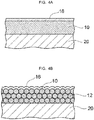
- the negative electrode active material for a lithium ion secondary battery according to the embodiment includes silicon oxide particles each having carbon present on a part of a surface of or an entire surface thereof.
- the negative electrode active material has a ratio (P Si /P SiO2 ) of an intensity of an X-ray diffraction peak at 2 ⁇ of from 27° to 29°, that is derived from Si, to an intensity of an X-ray diffraction peak at 2 ⁇ of from 20° to 25°, that is derived from SiO 2 , of from 1.0 to 2.6 when CuKa radiation with a wavelength of 0.154056 nm is employed as a radiation source.
- the negative electrode active material has a mean value of an aspect ratio (S/L) of its minor axis (S) to its major axis (L) of 0.45 ⁇ S/L ⁇ 1.
- the silicon oxide which forms the silicon oxide particles included in the negative electrode active material may be any one as long as it is an oxide containing a silicon element, and examples thereof include oxidized silicon, silicon dioxide, and silicon suboxide.
- the silicon oxide included in the silicon oxide particles may be only one kind or a combination of two or more kinds thereof.
- oxidized silicon and silicon dioxide are generally represented by silicon monoxide (SiO) and silicon dioxide (SiO 2 ), respectively.
- the silicon oxide is sometimes represented by the composition formula SiO x (x represents 0 ⁇ x ⁇ 2) as an actual measured value (or a corresponding value) of an element contained, and this case is also included in the silicon oxide according to the present disclosure.
- the value of x in the composition formula can be calculated by measuring oxygen contained in the silicon oxide by an inert gas fusion-nondispersive infrared absorption method.
- the silicon oxide is sometimes represented by the state including silicon and silicon dioxide (or in some cases, oxidized silicon) in the chemical reaction, and this case is also included in the silicon oxide according to the present disclosure.
- a mean particle diameter of the silicon oxide particles is not particularly limited.
- a volume mean particle diameter thereof is preferably from 0.1 ⁇ m to 20 ⁇ m, and more preferably from 0.5 ⁇ m to 10 ⁇ m, according to a desired final size of the negative electrode material.
- the volume mean particle diameter of the silicon oxide particles is D50%, that is a particle diameter corresponding to 50% cumulative from the smaller particle diameter side in a volume-based particle size distribution curve. The same applies to an expression of a mean particle diameter described below.
- the volume mean particle diameter is measured by a laser diffraction/scattering method by the method described in Examples below.
- Carbon is present on a part or an entire of the surface of each of the silicon oxide particles.
- the presence of carbon on a part or an entire of the surface of the silicon oxide particle imparts conductivity to the silicon oxide particle, which is an insulator, and improves the efficiency of the charge-discharge reaction. It is considered that the initial discharge capacity and the initial charge/discharge efficiency are thus improved.
- the silicon oxide particle in which carbon is present on a part or an entire of the surface is sometimes referred to as a "SiO-C particle".
- examples of the carbon present on a part or an entire of the surface of the silicon oxide particle include graphite, amorphous carbon, and the like. It is noted that an organic substance described below does not fall under the "carbon" in the present disclosure.
- the manner in which the carbon is present on a part or an entire of the surface of the silicon oxide particle is not particularly limited. For example, continuous or discontinuous coating and the like can be mentioned.
- the presence or absence of carbon in the negative electrode active material for a lithium ion secondary battery can be observed by, for example, laser Raman spectroscopy at an excitation wavelength of 532nm or the like.
- a content of the carbon is preferably from 0.5 % by mass to 10.0 % by mass in a total content of a mass of the silicon oxide particles and a mass of the carbon. With such a configuration, the initial discharge capacity and the initial charge/discharge efficiency tend to be further improved.
- the content of the carbon is more preferably from 1.0 % by mass to 9.0 % by mass, more preferably from 2.0 % by mass to 8.0 % by mass, and particularly preferably from 3.0 % by mass to 7.0 % by mass.
- a content ratio (in terms of mass) of the carbon can be determined by, for example, a high-frequency furnace combustion-infrared absorption spectrometry.
- a sulfur/carbon simultaneous analyzer (CSLS600, manufactured by LECO Japan Corporation) may be used.
- the content ratio of the carbon can be measured by removing from the negative electrode active material, in advance, a to-be-decreased mass derived from the organic substance by heating the negative electrode active material to a temperature which is higher than a temperature at which the organic substance degrades (for example, at 300°C).
- the carbon is preferably a carbon with low crystallinity.
- the expression that the carbon is with "low crystallinity" means that an R value of a negative electrode active material obtained by the following method is 0.5 or more.
- the R value of a negative electrode active material means a peak intensity ratio Id/Ig (also referred to as D/G), in which Id is a peak intensity at around 1360 cm -1 and Ig is a peak intensity at around 1580 cm -1 , in a profile of a laser Raman spectrum measurement with a wavelength of 532 nm.
- the peak at around 1360 cm -1 is a peak that is generally identified as corresponding to an amorphous structure, and for example it is a peak observed at from 1300 cm -1 to 1400 cm -1 .
- the peak at around 1580 cm -1 is a peak that generally identified as corresponding to the graphite crystal structure, and for example it is a peak observed at from 1530 cm -1 to 1630 cm -1 .
- the R value can be determined using a Raman spectrum measuring apparatus (for example, NSR 1000 manufactured by JASCO Corporation) with setting a baseline to 1050 cm -1 to 1750 cm -1 with respect to a measurement range (from 830 cm -1 to 1940 cm -1 ).
- a Raman spectrum measuring apparatus for example, NSR 1000 manufactured by JASCO Corporation
- the R value of the negative electrode active material is preferably from 0.5 to 1.5, more preferably from 0.7 to 1.3, and still more preferably from 0.8 to 1.2.
- the surface of the silicon oxide particle is sufficiently covered with low-crystallinity carbon in which carbon crystallites are randomly oriented, so that the reactivity with the electrolyte solution can be reduced and the cycle characteristics tend to be improved.
- a method of applying carbon to a surface of the silicon oxide particle is not particularly limited. Specific examples thereof include a wet mixing method, a dry mixing method, a chemical vapor deposition method and the like. From the viewpoints of application of carbon with further uniformity, easiness of the control of a reaction system and easiness of maintaining the shape of the negative electrode active material, the wet mixing method and the dry mixing method are preferable.
- examples thereof include a method which includes mixing the silicon oxide particles with a substance in which a raw material of carbon (a carbon source) is dissolved or dispersed in a solvent, attaching the carbon source solution to the surfaces of the silicon oxide particles, removing the solvent if needed, and then subjecting the resultant to a heat treatment in an inert atmosphere to carbonize the carbon source.
- a method which includes mixing the silicon oxide particles with a substance in which a raw material of carbon (a carbon source) is dissolved or dispersed in a solvent, attaching the carbon source solution to the surfaces of the silicon oxide particles, removing the solvent if needed, and then subjecting the resultant to a heat treatment in an inert atmosphere to carbonize the carbon source.
- examples thereof include a method in which a mixture is prepared by mixing the silicon oxide particles in a solid state and the carbon source in a solid state, and the mixture is subjected to a heat treatment in an inert atmosphere to carbonize the carbon source.
- a treatment for imparting mechanical energy (such as a mechanochemical treatment) may be performed when mixing the silicon oxide particles with the carbon source.
- the silicon oxide particles are subjected to a heat treatment in an atmosphere containing vaporized gas of the carbon source to carbonize the carbon source, thereby applying carbon to the surfaces of the silicon oxide particles.
- the carbon source to be used is not particularly limited as long as it is a material which can be changed to carbon by the heat treatment.
- Specific examples thereof include polymer compounds such as a phenol resin, a styrene resin, polyvinyl alcohol, polyvinyl chloride, polyvinyl acetate, or polybutyral; pitch such as ethylene heavy end pitch, coal pitch, petroleum pitch, coal tar pitch, asphalt decomposition pitch, PVC pitch obtained by pyrolyzing polyvinyl chloride or the like, or naphthalene pitch prepared by polymerizing naphthalene or the like under the presence of a super-strong acid; and polysaccharides such as starch or cellulose.
- the carbon source to be used may be only one kind or a combination of two or more kinds thereof.
- the carbon source to be used may be an aliphatic hydrocarbon, an aromatic hydrocarbon, an alicyclic hydrocarbon or the like, and preferably a compound in the form of a gas or a compound which can be easily made into a gas. Specific examples thereof include methane, ethane, propane, toluene, benzene, xylene, styrene, naphthalene, cresol, anthracene, and derivatives thereof.
- the carbon source to be used may be only one kind or a combination of two or more kinds thereof.
- the heat treatment temperature for carbonizing the carbon source is not particularly limited as long as carbonization of the carbon source can be achieved at the temperature.
- the heat treatment temperature is preferably 700°C or higher, more preferably 800°C or higher, still more preferably higher than 850°C, and even more preferably 900°C or higher. From the viewpoints of obtaining a carbon with low crystallinity and producing the silicon crystallite having a desired size by the disproportionation reaction described below, the heat treatment temperature is preferably 1300°C or lower, more preferably 1200°C or lower, and still more preferably 1100°C or lower.
- the duration of the heat treatment for carbonizing the carbon source may be selected according to the kind, amount and the like of the carbon source to be used.
- the duration of the heat treatment is preferably from 1 hour to 10 hours, and more preferably from 2 hours to 7 hours.
- the heat treatment for carbonizing the carbon source is preferably performed in an inert atmosphere such as nitrogen or argon.
- the heat treatment apparatus is not particularly limited, and examples thereof include a heating apparatus applicable to a continuous or batch treatment. Specifically, it may be selected from a fluidized bed-furnace, a revolving furnace, a vertical moving bed furnace, a tunnel furnace, a batch furnace or the like.
- a disintegration treatment may be further performed.
- a pulverization treatment may further be performed.
- the negative electrode active material has an X-ray diffractive peak intensity ratio (P Si /P SiO2 ) ranging from 1.0 to 2.6.
- the X-ray diffraction peak intensity ratio (P Si /P SiO2 ) is a ratio of an intensity of an X-ray diffraction peak at 2 ⁇ of from 27° to 29°, that is derived from Si, to an intensity of an X-ray diffraction peak at 2 ⁇ of from 20° to 25°, that is derived from SiO 2 , found when CuKa radiation having a wavelength of 0.15406 nm is used as a radiation source.
- the ratio (P Si /P SiO2 ) of the X-ray diffractive peak intensities of the negative electrode active material may be a value measured in a state where carbon, the organic substance, a conductive particle, or the like adhere to the silicon oxide particles, or a value measured in a state where these do not adhere to the silicon oxide particles.
- Examples of the negative electrode active material having the ratio of the intensities of X-ray diffracted peaks (P Si /P SiO2 ) ranging from 1.0 to 2.6 include a negative electrode active material containing a silicon oxide particle having a structure in which crystallites of silicon are present in the silicon oxide.
- the silicon oxide particle having a structure in which silicon crystallites are dispersed in silicon oxide can be produced, for example, by causing disproportionation reaction of silicon oxide (2SiO ⁇ Si+SiO 2 ) to generate silicon crystallites in the silicon oxide particle.
- disproportionation reaction of silicon oxide (2SiO ⁇ Si+SiO 2 ) to generate silicon crystallites in the silicon oxide particle.
- An advantage of achiving the presence of silicon crystallites in the silicon oxide particle by way of the disproportionation reaction of silicon oxide can be considered as follows.
- the above-mentioned SiO x (x is 0 ⁇ x ⁇ 2) tends to be inferior in the initial charge/discharge characteristics because lithium ions are trapped at the time of initial charge. This occurs because lithium ions are trapped by dangling bonds (unshared electron pair) of oxygen present in the amorphous SiO 2 phase. Therefore, it is considered that suppressing generation of dangling bonds of active oxygen atoms by reconstructing the amorphous SiO 2 phase by heat treatment is preferable from the viewpoint of improvement in charge-discharge characteristics.
- the ratio (P Si /P SiO2 ) of the intensities of the X-ray diffraction peaks of the negative electrode active material is less than 1.0, the crystallites of silicon in the silicon oxide particle do not grow sufficiently and the ratio of SiO 2 becomes large, so that the initial discharge capacity is small and the charge/discharge efficiency tends to be lowered by irreversible reactions.
- the ratio (P Si /P SiO2 ) exceeds 2.6, the crystallites of the generated silicon are too large to relieve expansion and contraction, which tends to cause a decrease in the initial discharging capacity.
- the ratio (P Si /P SiO2 ) is preferably in the range of from 1.5 to 2.0.
- the ratio of the intensities of the X-ray diffracted peaks of the negative electrode active material can be controlled by, for example, the condition of the heat treatment for causing the disproportionation reaction of the silicon oxide. For example, by increasing the temperature of the heat treatment or increasing the heat treatment time, the generation and enlargement of silicon crystallites are promoted, and the ratio of the X-ray diffraction peak intensities can be increased. On the other hand, by lowering the temperature of the heat treatment or shortening the heat treatment time, the generation of silicon crystallites can be suppressed, and the ratio of the X-ray diffraction peak intensities can be reduced.
- silicon oxide to be used as a raw material may be obtained, for example, by a known sublimation technique in which a silicon monoxide gas produced by heating a mixture of silicon dioxide and a metal silicon is cooled and precipitated. Alternatively, it is commercially available as oxidized silicon, silicon monoxide or the like.
- silicon crystallites are present in the silicon oxide particle may be observed, for example, by a powder X-ray diffraction (XRD) measurement.
- XRD powder X-ray diffraction
- a crystallite size of the silicon crystallite is preferably 8.0 nm or less, and more preferably 6.0 nm or less.
- the silicon crystallite size is 8.0 nm or less, the silicon crystallite is not apt to localize in a silicon oxide particle but rather apt to disperse in an entire of the silicon oxide particle. Therefore, lithium ions can diffuse easily in the silicon oxide particle so as to facilitate achievement of excellent discharge capacity.
- the silicon crystallite size of silicon is preferably 2.0 nm or more, and more preferably 3.0 nm or more. When the crystallite size is 2.0 nm or more, a reaction between a lithium ion and a silicon oxide of can be well controlled so as to facilitate achievement of excellent charge and discharge efficiency.
- a method to generate the silicon crystallite in the silicon oxide particle is not particularly limited.
- it can be generated by subjecting the silicon oxide particle to a heat treatment in a temperature range of from 700°C to 1300°C under an inert atmosphere to cause the disproportionation (2SiO ⁇ Si+SiO 2 ).
- the heat treatment to cause disproportionation may be performed as the same step as that for the heat treatment to provide carbon to a surface of the silicon oxide particle.
- the heat treatment conditions for causing the disproportionation reaction of the silicon oxide can be, for example, performance with the silicon oxide in an inert atmosphere in a temperature range of 700° C to 1300° C, preferably in a temperature range of 800° C to 1200° C.
- the heat treatment temperature is preferably over 900° C, and more preferably equal to or higher than 950° C.
- the heat treatment temperature is preferably less than 1150° C, and more preferably equal to or lower than 1100° C.
- the negative electrode active material has a mean value (mean aspect ratio) of an aspect ratio, which is represented by the ratio (S/L) of the major axis L and the minor axis S, of from 0.45 ⁇ S/L ⁇ 1.
- the mean aspect ratio of the negative electrode active material is in the range of 0.45 ⁇ S/L ⁇ 1, preferably in the range of 0.55 ⁇ S/L ⁇ 1, and more preferably in the range of 0.65 ⁇ S/L ⁇ 1.
- the mean aspect ratio of the negative electrode active material is 0.45 or more, there is a tendency that the difference in volume change amount for each region due to expansion and contraction as an electrode is small, and the deterioration of cycle characteristics is suppressed.
- the aspect ratio of the negative electrode active material is measured by an observation using a scanning electron microscope (Scanning Electron Microscope, SEM).
- the mean aspect ratio is calculated as an arithmetic mean value of the aspect ratios obtained by arbitrarily selecting 100 particles from an SEM image and measuring each of these particles.
- the ratio (S/L) of the major axis L to the minor axis S of the measurement target particle means the ratio of the minor axis (minimum diameter) / major axis (maximum diameter) for a spherical particle, and the ratio of the minor axis (minimum diameter or minimum diagonal length) / major axis (maximum diameter or maximum diagonal length) for a hexagonal plate-shaped or disk-shaped particle in the projected image of the particle observed from the thickness direction (observed with a surface corresponding to the thickness facing the front surface) respectively.
- the negative electrode active material contains a conductive particle described below, the conductive particle is excluded from the target of measurement of the mean aspect ratio.
- the negative electrode active material When the negative electrode active material is obtained through a heat treatment for a disproportionation reaction of silicon oxide, there may be a case that individual particles are agglomerated. It is meant that particles used in the calculation of the mean aspect ratio in this case are particles of the smallest unit (primary particles) that can exist alone as particles.
- the value of the mean aspect ratio of the negative electrode active material can be adjusted by, for example, pulverizing conditions in manufacturing the negative electrode active material.
- a generally known pulverizer can be used for pulverizing the negative electrode active material, and a pulverizer which can apply mechanical energy such as shear force, impact force, compression force, frictional force or the like can be used without any particular limitation.
- the pulverizer examples include a pulverizer (ball mill, bead mill, vibration mill or the like) which pulverizes using impact force and friction force by kinetic energy of pulverizing media, a pulverizer (jet mill or the like) which pulverizes raw material particles by effects of impact and friction among particles caused by jetting high pressure gas of several or more atmospheric pressures from a jetting nozzle and accelerating the raw material particles by this jet air flow, and a pulverizer (hammer mill, pin mill, disc mill or the like) which pulverizes raw material particles by applying impact to the raw material particles by a high-speed rotating hammer, a pin, or a disc.
- a pulverizer ball mill, bead mill, vibration mill or the like
- a pulverizer jet mill or the like
- a pulverizer hammer mill, pin mill, disc mill or the like
- the particle size distribution may be adjusted by performing a classification process after pulverizing.
- a method of the classification is not particularly limited, and can be selected from dry classification, wet classification, sieving or the like. From the viewpoint of productivity, it is preferable to perform pulverization and classification collectively.
- a coupling system of jet mill and cyclone allows the particles to be classified prior to re-agglomeration to conveniently obtain the shape having desired particle size distribution.
- the negative electrode active material may be further subject to a surface modification treatment after the pulverization to adjust the aspect ratio.
- An apparatus for performing the surface modification treatment is not particularly limited. Examples thereof include mechanofusion systems, NOBILTA, hybridization systems and the like.
- a mean particle diameter of the negative electrode active material is not particularly limited.
- the volume mean particle diameter is preferably from 0.1 ⁇ m to 20 ⁇ m, and more preferably 0.5 ⁇ m to 10 ⁇ m.
- the volume mean particle diameter of the negative electrode active material is D50%, that is a particle diameter corresponding to 50% cumulative volume from the small diameter side in a volume-based particle size distribution curve.
- a known method such as a laser diffraction particle size distributor can be employed.
- the negative electrode active material may have an SD value, which is to be described below, of 5.9 ⁇ m or less, preferably 5.0 ⁇ m or less, and more preferably 2.5 ⁇ m or less.
- an SD value of the negative electrode active material is 5.9 ⁇ m or less, a difference in a volume change amount due to expansion and contraction when forming an electrode becomes small, and deterioration of the cycle characteristic is suppressed.
- the lower limit value of the SD value of the negative electrode active material is not particularly limited, while it is preferably 0.10 ⁇ m or more from the viewpoint of manufacturing.
- the negative electrode active material may have a ratio (D10%/D90%) of D10% to D90%, which is to be described below, of 0.1 or more, preferably 0.2 or more, and more preferably 0.3 or more.
- the ratio D10%/D90% of the negative electrode active material may be 1.0 or less, preferably 0.8 or less, and more preferably 0.6 or less.
- a specific surface area of the negative electrode material is preferably from 0.1 m 2 /g to 15 m 2 /g, more preferably from 0.5 m 2 /g to 10 m 2 /g, further preferably from 1.0 m 2 /g to 7.0 m 2 /g, and particularly preferably from 1.0 m 2 /g to 4.0 m 2 /g.
- the specific surface area of the negative electrode material is 15 m 2 /g or less, increase in the initial irreversible capacity of a lithium ion secondary battery produced therewith tends to be suppressed. Further, increase in the consumption of a binder for producing a negative electrode can be suppressed.
- the specific surface area of the negative electrode material is 0.1 m 2 /g or more, the contact area of the negative electrode material with an electrolyte solution is sufficiently made and the charge/discharge efficiency tends to increase.
- Measurement of the specific surface area can be performed by a conventionally known method such as a BET method (a nitrogen gas adsorption method) or the like.
- a powder electric resistance of the negative electrode active material at a pressure of 10MPa is preferably 100 ⁇ cm or less, more preferably 80 ⁇ cm or less, and still more preferably 50 ⁇ cm or less.
- the powder electric resistance of the negative electrode active material can be measured using, for example, a powder electric resistance device (type MSP-PD51, 4 probes, Mitsubishi Chemical Analytech Co., Ltd.).
- the powder electric resistance of the negative electrode active material at a pressure of 10 MPa may be 0.1 ⁇ cm or more, preferably 1 ⁇ cm or more, and more preferably 10 ⁇ cm or more.
- the negative electrode active material contains a conductive particle to be described below.
- the conductive particle adheres to the surface of the SiO-C particle to form a protrusion structure, thereby reducing the resistivity of the entire negative electrode active material.
- the negative electrode active material may contain an organic substance.
- the initial discharge capacity, the initial charge/discharge efficiency, and the recovery rate after charge/discharge tend to be further improved. This is considered to be because inclusion of an organic substance causes reduction of the specific surface area of the negative electrode active material to result in suppression of the reaction of the negative electrode active material with the electrolyte solution.
- the organic substance contained in the negative electrode active material may be only one kind or two or more kinds thereof.
- a content of the organic substance is preferably from 0.1 mass % to 5.0 mass % with respect to the total mass of the negative electrode active material.
- the content of the organic substance with respect to the total mass of the negative electrode active material is more preferably from 0.2 mass % to 3.0 mass %, and further preferably from 0.3 mass % to 1.0 mass %.
- the negative electrode active material contains the organic substance can be observed by, for example, heating the negative electrode active material which is sufficiently dried to a temperature equal to or higher than the temperature at which the organic substance decomposes but lower than a temperature at which carbon decomposes, for example, 300° C, and measuring a mass of the negative electrode active material after the organic substance decomposes. Specifically, it can be determined that the negative electrode active material contains the organic substance if the rate of change in mass represented by ⁇ (A-B)/A ⁇ ⁇ 100 is 0.1% or more, provided that the mass of the negative electrode active material before heating is A(g) and the mass of the negative electrode active material after heating is B(g).
- the rate of change in mass is preferably from 0.1% to 5.0%, and more preferably 0.3% to 1.0%.
- the rate of change is 0.1% or more, a sufficient quantity of the organic substance exists on a surface of the SiO-C particle, so that the effects of inclusion of the organic substance tend to be sufficiently obtained.
- the kind of the organic substance is not particularly limited.
- at least one selected from the group consisting of a starch derivative having C 6 H 10 O 5 as a unit structure thereof, a viscous polysaccharide having C 6 H 10 O 5 as a unit structure thereof, a water-soluble cellulose derivative having C 6 H 10 O 5 as a unit structure thereof, polyuronides, and a water-soluble synthetic resin can be mentioned.
- starch derivative having C 6 H 10 O 5 as a unit structure thereof include hydroxyalkyl starches such as acetic acid starch, phosphate starch, carboxymethyl starch, and hydroxyethyl starch.
- specific examples of the viscous polysaccharide having C 6 H 10 O 5 as a unit structure thereof include pullulan, dextrin, and the like.
- Specific examples of the water-soluble cellulose derivatives having C 6 H 10 O 5 as a unit structure thereof include carboxymethylcellulose, methylcellulose, hydroxyethylcellulose, hydroxypropylcellulose and the like.
- polyuronide include pectic acid, alginic acid and the like.
- water-soluble synthetic resin examples include a water-soluble acrylic resin, a water-soluble epoxy resin, a water-soluble polyester resin, a water-soluble polyamide resin and the like, and more specific examples thereof include polyvinyl alcohol, polyacrylic acid, polyacrylic acid salt, polyvinyl sulfonic acid, polyvinyl sulfonic acid salt, poly 4-vinyl phenol, poly 4-vinyl phenol salt, polystyrene sulfonic acid, polystyrene sulfonic acid salt, polyaniline sulfonic acid and the like.
- the organic substance may be used in a form of a metal salt, an alkylene glycol esters or the like.
- the organic substance is in a state in which a part or an entire of the SiO-C particle (when the conductive particle to be described below is present on the surface of the SiO-C particle, the surface thereof) is coated.
- the organic substance can be attached to the SiO-C particle by introducing the SiO-C particle into a liquid in which the organic substance is dissolved or dispersed and agitating the liquid as required. Thereafter, the SiO-C particle to which the organic substance adheres are taken out from the liquid and dried as required, whereby SiO-C particle to which the organic substance adheres can be obtained.
- a temperature of the liquid at the time of agitating is not particularly limited, and can be selected, for example, from 5° C to 95° C.
- a temperature at the time of drying is not particularly limited, and can be selected, for example, from 50° C to 200° C.
- a content of the organic substance in the solution is not particularly limited, and can be selected, for example, from 0.1 mass % to 20 mass %.
- the negative electrode active material may contain a conductive particle.
- the negative electrode active material contains the conductive particle, conduction can be easily made by the conductive particles coming into contact with each other even if expansion and contraction of the silicon oxide particles occur.
- the resistance value of the entire negative electrode active material tends to be reduced. As a result, a decrease in capacity due to repetition of charge and discharge is suppressed, and the cycle characteristics tend to be satisfactorily maintained.
- the conductive particle exists on the surface of the SiO-C particle.
- the particle in which the conductive particle is present on a surface of the SiO-C particle is sometimes referred to as a "CP/SiO-C particle".
- the kind of the conductive particle is not particularly limited.
- at least one selected from the group consisting of granular graphite and carbon black is preferable, and granular graphite is preferable from the viewpoint of improving cycle characteristics.
- the granular graphite include particles of artificial graphite, particles of natural graphite, and particles of MC (mesophase carbon).
- the carbon black include acetylene black, Ketjen black, thermal black, furnace black and the like, and acetylene black is preferable from the standpoint of conductivity.
- the granular graphite preferably has higher crystallinity than carbon present on the surface of the silicon oxide particles from the viewpoint of improving both the battery capacity and the charge/discharge efficiency.
- the particulate graphite preferably has a mean interplanar spacing (d 002 ) measured according to the Gakushin method of from 0.335 nm to 0.347 nm, more preferably from 0.335nm to 0.345 nm, more preferably from 0.335nm to 0.340 nm, and particularly preferably from 0.335 nm to 0.337 nm.
- the shape of the granular graphite is not particularly limited and it may be flat graphite or spherical graphite. From the standpoint of improving cycle characteristics, flat graphite is preferable.
- Flat graphite in the present disclosure means graphite an aspect ratio of which is not 1, i.e., the length of the minor axis and the length of the major axis thereof are not equal.
- Examples of the flat graphite include graphite having a shape of a scale, a flake, a lump or the like.
- the aspect ratio of the conductive particle is not particularly limited, while from the viewpoint of easiness of ensuring the conduction between the conductive particles and improvement in cycle characteristics, a mean value of the aspect ratio is preferably 0.3 or less, and more preferably 0.2 or less. A mean value of the aspect ratio of the conductive particle is preferably 0.001 or more, and more preferably 0.01 or more.
- the aspect ratio of the conductive particle is a value measured by observation with an SEM. Specifically, it is a value calculated as B/A provided that a length in the major axis direction is A and a length in the minor axis direction (in the case of flat graphite, the length in the thickness direction) is B for each of 100 arbitrarily selected conductive particles in a SEM image.
- the mean value of the aspect ratio is an arithmetic mean value of the aspect ratio of 100 conductive particles.
- the conductive particle may be a primary particle (single particle) or a secondary particle (granulated particle) formed from a plurality of primary particles.
- the flat graphite may be a porous graphite particle.
- a content of the conductive particle with respect to a total mass of the negative electrode active material is preferably from 1.0% by mass to 10.0% by mass, more preferably 2.0% by mass to 9.0% by mass, and still more preferably 3.0% by mass to 8.0% by mass, from the viewpoint of improving the cycle characteristics.
- the content of the conductive particle can be determined by, for example, a high-frequency furnace combustion-infrared absorption spectrometry.
- a high-frequency furnace combustion-infrared absorption spectrometry for example, a sulfur/carbon simultaneous analyzer (CSLS600, Japan LECO Co., Ltd.) can be used. Since this measurement provides a result including a content of carbon in the SiO-C particle, the content of carbon may be separately measured and subtracted from the obtained content.
- a method for manufacturing the negative electrode active material containing the conductive particle is not particularly limited, while a wet method and a dry method can be mentioned.
- Examples of a method of producing the negative electrode active material containing a conductive particle by a wet method include a method which includes adding the SiO-C particle to a particle dispersion liquid in which conductive particles are dispersed in a dispersion medium, agitating the particle dispersion liquid, and then removing the dispersion medium using a dryer or the like.
- the dispersion medium used therein is not particularly limited, and water, an organic solvent or the like can be used.
- the organic solvent may be a water-soluble organic solvent such as an alcohol or may be a water-insoluble organic solvent.
- the dispersing medium may contain a dispersant from the viewpoint of enhancing dispersibility of the conductive particles and increasing uniform adherence of the conductive particles to the surface of the SiO-C particle.
- the dispersant can be selected according to the type of dispersion medium used. For example, when the dispersion medium is a water-based medium, carboxymethylcellulose is preferable as the dispersant from the viewpoint of dispersion stability
- Examples of a method of producing the negative electrode active material containing the conductive particle by the dry method include a method which includes adding the conductive particle together with a carbon source for carbon when the carbon source is applied to a surface of the silicon oxide particle. Specific examples thereof include a method including mixing the carbon source and the conductive particle with the silicon oxide particle and applying mechanical energy (for example, a mechanochemical treatment).
- classification of the obtained negative electrode active material may be further performed.
- the classification process can be performed using a sieving machine or the like.
- the negative electrode active material for a lithium ion secondary battery includes silicon oxide particles each having carbon present on a part of a surface of or an entire surface thereof.
- the negative electrode active material has a ratio (P Si /P SiO2 ) of an intensity of an X-ray diffraction peak at 2 ⁇ of from 27° to 29° derived from Si to an intensity of an X-ray diffraction peak at 2 ⁇ of from 20° to 25° derived from SiO 2 of from 1.0 to 2.6 when CuKa radiation with a wavelength of 0.154056 nm is employed as a radiation source.
- the SD value of the negative electrode active material is 5.9 ⁇ m or less, preferably 5.0 ⁇ m or less, and more preferably 2.5 ⁇ m or less.
- the lower limit value of the SD value of the negative electrode active material is not particularly limited, while it is preferably 0.10 ⁇ m or more from the viewpoint of manufacturing.
- the SD value of the negative electrode active material is an index relating to the width and narrowness of a particle size distribution of the negative electrode active material, and a small SD value means that the particle size distribution of the negative electrode active material is narrow.
- the D90% and D10% of the negative electrode active material are respectively obtained as a particle diameter when the cumulative volume from the small particle diameter side is 90% and a particle diameter when the cumulative volume from the small particle diameter side is 10% in a volume-based particle size distribution measured by a laser diffraction/scattering method using a sample in which the negative electrode active material is dispersed in water.
- the negative electrode active material for a lithium ion secondary battery includes silicon oxide particles each having carbon present on a part of a surface of or an entire surface thereof.
- the negative electrode active material has a ratio (P Si /P SiO2 ) of an intensity of an X-ray diffraction peak at 2 ⁇ of from 27° to 29°, that is derived from Si, to an intensity of an X-ray diffraction peak at 2 ⁇ of from 20° to 25°, that is derived from SiO 2 , of from 1.0 to 2.6 when CuKa radiation with a wavelength of 0.154056 nm is employed as a radiation source.
- the negative electrode active material has a ratio (D10% / D90%) of 0.1 or greater, in which D90% is a particle diameter corresponding to 90% cumulative from the smaller particle diameter side in a cumulative volume distribution curve obtained by a laser diffraction/scattering method and D10% is a particle diameter corresponding to 10% cumulative from the smaller particle diameter side in the cumulative volume distribution curve.
- the negative electrode active material may have a ratio (D10%/D90%) of D10% to D90% of 0.1 or more, preferably 0.2 or more, and more preferably 0.3 or more.
- the ratio D10%/D90% of the negative electrode active material may be 1.0 or less, preferably 0.8 or less, and more preferably 0.6 or less.
- the value of D10%/D90% of the negative electrode active material is an index relating to the width and narrowness of a particle size distribution of the negative electrode active material, and a large value of D10%/D90% means that the particle size distribution of the negative electrode active material is narrow.
- the D90% and D10% of the negative electrode active material are respectively obtained as a particle diameter when the cumulative volume from the small particle diameter side is 90% and a particle diameter when the cumulative volume from the small particle diameter side is 10% in a volume-based particle size distribution measured by a laser diffraction/scattering method using a sample in which the negative electrode active material is dispersed in water.
- Figs. 1 to 3 are schematic sectional views illustrating examples of the structure of the negative electrode active material, respectively.
- carbon 10 covers an entire surface of a silicon oxide particle 20.
- Fig. 2 carbon 10 covers, but not uniformly, the entire surface of a silicon oxide particle 20.
- Fig. 3 carbon 10 is present on a part of a surface of a silicon oxide particle 20, and thus the surface of the silicon oxide particle 20 is partially exposed.
- conductive particles 14 are present on the surface of a SiO-C particle, that is the silicon oxide particle 20 on the surface of which carbon 10 attaches in such a state as described above. Further, the surface of the silicon oxide particle 20 having the conductive particles 14 on the surface (CP/SiO-C particle) is covered with an organic substance 16.
- the shape of the silicon oxide particle 20 is schematically indicated by a spherical shape (a circle as the cross-sectional shape) in Figs. 1 to 3 , the shape may be a spherical shape, a block-like shape, a scale-like shape, a shape cross-section of which has a polygonal shape (an angular shape), or the like. While the shape of each of the conductive particles 14 is indicated by a flat shape in Figs. 1 to 3 , the shape is not limited thereto. While an entire surface of the silicon oxide particle 20 on the surface of which carbon 10 are present (SiO-C particle) is covered with the organic substance 16 in Figs. 1 to 3 , it is not limited thereto, and only a part of the surface of the SiO-C particle may be covered with the organic substance 16.
- FIG. 4A illustrates an embodiment of a state of the carbon 10 in the negative electrode active material
- Fig. 4B illustrates another embodiment of the state of the carbon 10 in the negative electrode active material.
- the carbon 10 may be in a state in which it forms a continuous layer as shown in Fig. 4A , or may be in a state of carbon granules 12, which are granules formed of the carbon 10, as shown in Fig. 4B .
- Fig. 4A illustrates an embodiment of a state of the carbon 10 in the negative electrode active material
- Fig. 4B illustrates another embodiment of the state of the carbon 10 in the negative electrode active material.
- the carbon 10 may be in a state in which it forms a continuous layer as shown in Fig. 4A , or may be in a state of carbon granules 12, which are granules formed of the carbon 10, as shown in Fig. 4B .
- Fig. 4A illustrates an embodiment of a state of the carbon 10 in the negative electrode active material
- the carbon 10 may be in a state in which, as shown in Fig. 4A , it forms a continuous layer, which may include a void in a part thereof.
- the negative electrode active material of the present embodiment may be used in combination with a carbon-based negative electrode active material conventionally known as an active material for a negative electrode of a lithium ion secondary battery.
- a carbon-based negative electrode active material conventionally known as an active material for a negative electrode of a lithium ion secondary battery.
- An effect of improving the charge and discharge efficiency, an effect of improving the cycle characteristics, an effect of suppressing the cubical expansion of the electrode, and the like are obtained depending on a kind of a carbon-based negative electrode active material used in combination.
- the carbon-based negative electrode active material to be used in combination with the negative electrode active material of the present embodiment may be only one kind or two or more kinds thereof.
- the carbon-based negative electrode active material examples include a negative electrode active material formed of a carbon material such as: natural graphite such as flake-shaped natural graphite or spherical natural graphite obtained by spheroidizing flake-shaped natural graphite; artificial graphite; or amorphous carbon.
- the carbon-based negative electrode active material may have carbon (the carbons described above) present on a part of the surface thereof or the entire surface thereof.
- a ratio (A : B) of the negative electrode active material of the present embodiment (A) to the carbon-based negative electrode active material (B) can be appropriately adjusted in accordance with the purpose.
- the ratio is preferably from 0.1:99.9 to 20:80, more preferably from 0.5:99.5 to 15:85, and still more preferably from 1:99 to 10:90, based on the mass.
- a negative electrode for a lithium ion secondary battery (hereinafter, sometimes abbreviated to a "negative electrode ”) of the present embodiment includes: a current collector; and a negative electrode material layer which is provided on the current collector and includes the above-described negative electrode active material.
- the negative electrode may be produced, for example, by forming a negative electrode material layer over a current collector using a composition containing the negative electrode active material described above.
- composition containing the negative electrode active material examples include a composition including an organic binder, a solvent, a thickener, an electroconductive auxiliary material, a carbon-based negative electrode active material, and/or the like are mixed with the negative electrode active material.
- organic binder examples include styrene-butadiene copolymers; (meth)acrylic copolymers obtained by copolymerization of an ethylenic unsaturated carboxylic acid ester (such as methyl(meth)acrylate, ethyl(meth)acrylate, butyl(meth)acrylate, (meth)acrylonitrile, or hydroxyethyl(meth)acrylate) and an ethylenic unsaturated carboxylic acid (such as acrylic acid, methacrylic acid, itaconic acid, fumaric acid, or maleic acid); and polymer compounds such as polyvinylidene fluoride, polyethylene oxide, polyepichlorohydrin, polyphosphazene, polyacrylonitrile, polyimide, or polyamide imide.
- an ethylenic unsaturated carboxylic acid ester such as methyl(meth)acrylate, ethyl(meth)acrylate, butyl(meth
- the organic binder may be one dispersed or dissolved in water, or one dissolved in an organic solvent such as N-methyl-2-pyrrolidone (NMP). Only one kind of the organic binder may be used, or alternatively, a combination of two or more kinds of the organic binder may be used.
- NMP N-methyl-2-pyrrolidone
- an organic binder having polyacrylonitrile, polyimide, or polyamide imide as a main skeleton thereof is preferable, and from the viewpoints of a low heat treatment temperature during the production of a negative electrode and excellent electrode flexibility, an organic binder having polyacrylonitrile as a main skeleton thereof is more preferable.
- the organic binder having polyacrylonitrile as a main skeleton thereof include one in that an acrylic acid for imparting adhesiveness and a straight chain ether group for imparting flexibility are added to a polyacrylonitrile skeleton.
- a content of the organic binder in a negative electrode material layer is preferably from 0.1% by mass to 20% by mass, more preferably from 0.2% by mass to 20% by mass, and still more preferably from 0.3% by mass to 15% by mass.
- the content of the organic binder in a negative electrode material layer is 0.1% by mass or more, excellent adhesiveness can achieved, and destruction of a negative electrode by cubical expansion and constriction in charging and discharging can be suppressed. Meanwhile, in a case in which the content is 20% by mass or less, increase of electrode resistance can be suppressed.
- the thickener examples include carboxymethyl cellulose, methylcellulose, hydroxymethyl cellulose, ethyl cellulose, polyvinyl alcohol, polyacrylic acid (polyacrylate), oxidized starch, phosphorylated starch, casein and the like. Only one kind of the thickener may be used, or alternatively, a combination of two or more kinds of the thickener may be used.
- the solvent examples include N-methylpyrrolidone, dimethylacetamide, dimethylformamide, ⁇ -butyrolactone and the like. Only one kind of the solvent may be used, or alternatively, a combination of two or more kinds of the solvent may be used.
- the electroconductive auxiliary material examples include carbon black, acetylene black, an oxide having electrical conductivity, a nitride having electrical conductivity and the like. Only one kind of the electroconductive auxiliary material may be used, or alternatively, a combination of two or more kinds of the electroconductive auxiliary material may be used.
- a content of the electroconductive auxiliary material is preferably from 0.1% by mass to 20% by mass with respect to the negative electrode material layer.
- Examples of a material of the current collector include aluminum, copper, nickel, titanium, stainless steel, a porous metal (a foamed metal), and a carbon paper.
- Examples of a shape of the current collector include a foil form, a perforated foil form, and a mesh form.
- Examples of a method of forming the negative electrode material layer on the current collector using the composition containing the negative electrode active material include: a method including applying a coating liquid including the negative electrode active material to the current collector, removing therefrom volatile substances such as a solvent, and subjecting the resultant to press-forming; and a method including integrating the negative electrode material layer which is made in a sheet-like shape, pellet-like shape or the like and the current collector; and the like.
- Examples of the method of applying the coating liquid to the current collector include a metal mask printing method, an electrostatic coating method, a dip coating method, a spray coating method, a roll coating method, a doctor blade method, a gravure coating method, and a screen printing method.
- a pressure treatment after the application may be performed by a flat-plate plate press, a calender roll, or the like.
- Integration of the negative electrode material layer and the current collector may be carried out by rolling, pressing, or a combination thereof.
- the negative electrode material layer formed on the current collector or the negative electrode layer integrated with the current collector may be subjected to a heat treatment which depends on the organic binder used.
- a heat treatment which depends on the organic binder used.
- the heat treatment is preferably carried out at a temperature of from 100°C to 180°C
- the heat treatment is preferably carried out at a temperature of from 150°C to 450°C.
- heat treatment By the heat treatment, the solvent is removed, the strength is highly intensified through the curing of the organic binder, and the adhesiveness between the negative electrode active materials and the adhesiveness between the negative electrode active material and the current collector can be improved.
- These heat treatments are preferably carried out in an inert atmosphere, such as helium, argon, or nitrogen, or in a vacuum atmosphere, in order to prevent oxidization of the current collector during the treatment.
- the negative electrode layer may preferably be pressed (pressure treatment) before the heat treatment.
- pressure treatment By the pressure treatment, its electrode density can be controlled.
- the electrode density is preferably from 1.4 g/cm 3 to 1.9 g/cm 3 , more preferably from 1.5 g/cm 3 to 1.85 g/cm 3 , and still more preferably from 1.6 g/cm 3 to 1.8 g/cm 3 .
- a lithium ion secondary battery includes: a positive electrode; the negative electrode described above; and an electrolyte.
- the lithium ion secondary battery may be prepared by, for example, oppositely disposing in a cell casing the negative electrode and the positive electrode with a separator therebetween, and injecting therein an electrolytic solution obtained by dissolving an electrolyte to an organic solvent.
- the positive electrode may be obtained similarly as the negative electrode, by forming a positive electrode material layer on the surface of a current collector.
- a current collector for the positive electrode a current collector similar to one usable for the negative electrode may be used.
- a material to be used for the positive electrode may be any compound as long as it enables doping or intercalation of a lithium ion, and examples thereof include lithium cobaltate (LiCoO 2 ), lithium nickelate (LiNiO 2 ), and lithium manganate (LiMnO 2 ).
- the positive electrode may be produced by, for example, preparing a positive electrode coating liquid by mixing the positive electrode material, an organic binder such as polyvinylidene fluoride, and a medium such as N-methyl-2-pyrrolidone or ⁇ -butyrolactone, applying the positive electrode coating liquid to at least one surface of a current collector such as aluminum foil, and removing the medium by drying, followed by, if necessary, a pressure treatment.
- a positive electrode coating liquid by mixing the positive electrode material, an organic binder such as polyvinylidene fluoride, and a medium such as N-methyl-2-pyrrolidone or ⁇ -butyrolactone
- An electroconductive auxiliary material may be added to the positive electrode coating liquid.
- the electroconductive auxiliary material include carbon black, acetylene black, an oxide having electrical conductivity or a nitride having electrical conductivity. Only one kind of the electroconductive auxiliary material may be used, or alternatively, a combination of two or more kinds of the electroconductive auxiliary material may be used.
- electrolyte examples include LiPF 6 , LiClO 4 , LiBF 4 , LiClF 4 , LiAsF 6 , LiSbF 6 , LiAlO 4 , LiAlCl 4 , LiN(CF 3 SO 2 ) 2 , LiN(C 2 F 5 SO 2 ) 2 , LiC(CF 3 SO 2 ) 3 , LiCl, and Lil.
- organic solvent which dissolves the electrolyte examples include propylene carbonate, ethylene carbonate, diethyl carbonate, ethyl methyl carbonate, vinyl carbonate, ⁇ -butyrolactone, 1,2-dimethoxyethane, and 2-methyltetrahydrofuran.
- separator examples include a paper separator, a polypropylene separator, a polystyrene separator, and a glass fiber separator.
- a production method of the lithium ion secondary battery is not particularly limited.
- a cylindrical lithium ion secondary battery may be produced by the processes below. First, two electrodes of the positive electrode and the second electrode are wound together with the separator placed therebetween. The obtained wound group in a spiral shape is inserted in a cell casing, and a tab terminal, which has been welded to a current collector of the negative electrode in advance, is welded to the bottom of the cell casing. An electrolytic solution is introduced into the obtained cell casing, and a tab terminal, which has been welded to a current collector of the positive electrode in advance, is welded to the lid of the cell casing. The lid is arranged on the top of the cell casing with an insulating gasket disposed therebetween, and the portion at which the lid contacts with the cell casing are swaged so as to seal them, thereby obtaining a lithium ion secondary battery.
- the shape of the lithium ion secondary battery is not particularly limited, and examples thereof include a paper battery, a button lithium ion secondary battery, a coin lithium ion secondary battery, a layered lithium ion secondary battery, a cylindrical lithium ion secondary battery, and a rectangular lithium ion secondary battery.
- the negative electrode active material according to the present embodiment is not limited to an application for a lithium ion secondary battery, and it may be applied generally to an electrochemical apparatus employing lithium-ion intercalation/deintercalation as a charge and discharge mechanism.
- Oxidized silicon having a bulk-shape (Kojundo Chemical Lab. Co., Ltd, standard 10 mm to 30 mm square) was coarsely ground in a mortar, thereby obtaining silicon oxide particles.
- the silicon oxide particles were further pulverized with a jet mill (LABO TYPE, manufactured by Nippon Pneumatic Mfg. Co., Ltd.), and then the particle diameter thereof was regulated using a 300-M (300-mesh) test screen, thereby obtaining silicon oxide particles having a volume mean particle diameter (D50%) of 5 ⁇ m.
- the mean particle diameter was measured by a method shown below.
- the measurement sample (5 mg) was added to a 0.01% by mass aqueous solution of surfactant (ETHOMEEN T/15, Lion Corporation), and the mixture was dispersed using a vibrational stirrer.
- the obtained dispersion was placed in a sample vessel of a laser diffraction particle size distribution measurement apparatus (SALD 3000J, Shimadzu Corporation), and measurement was carried out with a laser diffractometry method while circulating using a pump under an ultrasonic treatment.
- SALD 3000J laser diffraction particle size distribution measurement apparatus
- a particle diameter at which a cumulative volume reached 50% (D50%) in the obtained particle size distribution was defined as a mean particle diameter.
- the measurements of the mean particle diameters were performed in a similar manner.
- Light source red-color semiconductor laser (690 nm) Absorbance: 0.10 to 0.15
- Refractive index 2.00 to 0.20
- the obtained heat-treated product was ground in a mortar, and further subjected to sieving with a 300-M (300-mesh) test screen, thereby obtaining a negative electrode active material (SiO-C particle), in which carbon covers surfaces of the silicon oxide particles.
- a volume mean particle diameter (D50%) of the negative electrode active material was measured in a similar manner to that for the silicon oxide particles. Further, D10% and D90% were measured, and an SD value and a value of D10%/D90% were calculated therefrom.
- a content of carbon in the negative electrode active material was measured by a high-frequency furnace combustion-infrared absorption spectrometry.
- the high-frequency furnace combustion-infrared absorption spectrometry is an analysis method in which a sample is heated and combusted in a high-frequency furnace under oxygen stream to convert carbon and sulfur in the sample into CO 2 and SO 2 , respectively, and the products are quantified with an infrared absorption method.
- the measurement apparatus, the measurement condition, and the like are as follows.
- Apparatus sulfur/carbon simultaneous analyzer (CSLS600, LECO Japan Corporation) Frequency: 18 MHz High-frequency output: 1600 W Sample mass: approximately 0.05 g Analysis time: use in auto mode of the set mode of the apparatus Combustion improver: Fe + W/Sn Standard sample: LECO 501-024 (C: 3.03% ⁇ 0.04, S: 0.055% ⁇ 0.002) 97 Number of measurement: two times (the value of the content ratio shown in Table is a mean value of two measurements)
- the obtained profile was subject to removal of the background (BG) and separation of the peak using a structure analyzing software (JADE 6, Rigaku Corporation.) supplied with the above apparatus in accordance with the following settings.
- the negative electrode active material was analyzed using a powder X-ray diffractometer (MultiFlex (2kW), Rigaku Corporation) in a similar manner to that described above.
- a ratio (P Si /P SiO2 ) of an intensity of an X-ray diffraction peak at 2 ⁇ of from 27° to 29° derived from Si to an intensity of an X-ray diffraction peak at 2 ⁇ of from 20° to 25° derived from SiO 2 was calculated with respect to the negative electrode active material.
- a mean aspect ratio of each negative electrode active material was calculated by the method described above using a SEM device (TM-1000, Hitachi High Technologies, Ltd.).
- An R Value was calculated from a spectrum measured by using a Raman spectrum measurement apparatus (type NSR-1000, JASCO Corporation). The measurement conditions are as follows. Laser wavelength: 532 nm Irradiation intensity: 1.5 mW (the value measured with a laser power monitor) Irradiation time: 60 seconds Irradiation area: 4 ⁇ m 2 Measurement range: 830 cm -1 to 1940 cm -1 Base line: 1050 cm -1 to 1750 cm -1
- a wavenumber of the obtained spectrum was corrected based on a calibration curve determined by a difference between the wavenumber of the respective peaks obtained by measuring a standard substance indene (Wako first grade, Wako Pure Chemical Industries) under the same condition as above and the theoretical value of the wavenumber of the respective peaks of indene.
- a peak strength occurred at near 1360 cm -1 in the profile obtained after the correction was defined as I d
- a peak strength occurred at near 1580 cm -1 in the profile obtained after the correction was defined as I g
- a ratio of the both peak intensities I d /I g (D/G) was determined as the R value.
- Nitrogen adsorption at the liquid nitrogen temperature (77 K) was measured with a 5 point method using a high-speed specific surface area/micropore distribution measurement apparatus (ASAP 2020, Micromeritics Japan G. K.), to calculate a specific surface area of the negative electrode active material according to a BET method (relative pressure range: from 0.05 to 0.2).
- a powder electric resistance of the obtained negative electrode active material (3.0g) was measured in an atmosphere of a pressure of 10MPa at a temperature of 25° C using a powder electric resistance measuring device (type MSP-PD51, 4 probes, Mitsubishi Chemical Analytech Co., Ltd.).
- the tolerable measuring range of the powder electric resistivity measuring device used is from 10 -3 ⁇ to 10 7 ⁇ .
- composition for forming a negative electrode was applied to a glossy surface of an electrolytic copper foil such that the application amount is 10 mg/cm 2 , subjected to a predrying treatment at 90°C for 2 hours, and then a density of the resultant was adjusted to 1.65 g/cm 3 by roll pressing. Subsequently, the resultant was dried at 120°C for 4 hours in a vacuum atmosphere, thereby obtaining a negative electrode.
- the above-obtained cell was placed in a thermostat kept at 25°C, and an initial charge capacity was measured by carrying out charging at a constant current of 0.45 mA/cm 2 up to 0 V and then further charging at a constant voltage of 0 V until the current reached a value corresponding to 0.09 mA/cm 2 .
- 30-minute pause was taken and then discharging was carried out.
- the discharging was carried out at a current of 0.45 mA/cm 2 until the voltage value reached 1.5 V, and then an initial discharge capacity was measured.
- the capacity was converted to a value per the mass of the negative electrode active material used. Calculation was performed by dividing the initial discharge capacity by the initial charge capacity to obtain a value and then multiplying the obtained value by 100, to obtain another value, which is defined as an initial charge and discharge efficiency (%).
- the result is shown in Table 1.
- the above-obtained cell was placed in a thermostat kept at 25°C, charged at a constant current of 0.45 mA/cm 2 up to 0 V and then further charged at a constant voltage of 0 V until the current reached a value corresponding to 0.09 mA/cm 2 . After the charging, 30-minute pause was taken and then discharging was carried out. The discharging was carried out at a current of 0.45 mA/cm 2 until the voltage value reached 1.5 V.
- Negative electrode active materials were produced and evaluated in the same manner as in Example 1, except that the temperature of heat treatment at which the carbonization of the carbon source and the disproportionation reaction of the silicon oxide were made to occur was changed to 1000° C (Example 2), 1050° C (Example 3) and 1100° C (Example 4), respectively. The results are shown in Table 1.
- Negative electrode active materials were produced and evaluated in the same manner as in Example 1, except that the temperature of heat treatment at which the carbonization of the carbon source and the disproportionation reaction of the silicon oxide were made to occur was changed to 900° C (Comparative example 1) and 1150° C (Comparative example 2), respectively. The results are shown in Table 1.
- a negative electrode active material was produced and evaluated in the same manner as in Example 3, except that the silicon oxide particles having a volume mean particle diameter (D50%) of 5 ⁇ m obtained after the step of pulverizing the silicon oxide particle were further subject to an additional treatment of surface modification by NOBILTA (NOB-VC, Hosokawa Micron Co., Ltd.). The results are shown in Table 1.
- a negative electrode active material was produced and evaluated in the same manner as in Example 3, except that the silicon oxide particles having a volume mean particle diameter (D50%) of 5 ⁇ m obtained after the step of pulverizing the silicon oxide particles were further subject to an additional treatment of surface modification by MECHANOFUSION system (Lab, Hosokawa Micron Co., Ltd.). The results are shown in Table 1.
- a negative electrode active material was produced and evaluated in the same manner as in Example 3, except that a fine impact mill: pin mill type (UPZ, Hosokawa Micron Co., Ltd.) was used as a pulverizing apparatus in the step of pulverizing the silicon oxide particles, and the silicon oxide particles were pulverized so that a volume mean particle diameter (D50%) became 5 ⁇ m.
- a fine impact mill pin mill type (UPZ, Hosokawa Micron Co., Ltd.) was used as a pulverizing apparatus in the step of pulverizing the silicon oxide particles, and the silicon oxide particles were pulverized so that a volume mean particle diameter (D50%) became 5 ⁇ m.
- D50% volume mean particle diameter
- a negative electrode active material was produced and evaluated in the same manner as in Example 3, except that a fine mill (SF type, Nippon Coke & Engineering Co., Ltd.) was used as a pulverizing apparatus in the step of pulverizing the silicon oxide particles, and the silicon oxide particles were pulverized so that a volume mean particle diameter (D50%) became 5 ⁇ m.
- a fine mill SF type, Nippon Coke & Engineering Co., Ltd.
- a negative electrode active material was produced and evaluated in the same manner as in Example 3, except that an amount of the coal pitch used as a carbon source was changed to 200g. The results are shown in Table 1.
- a negative electrode active material was produced and evaluated in the same manner as in Example 3, except that the silicon oxide particles were pulverized in the step of pulverizing the silicon oxide particles so that a volume mean particle diameter (D50%) became 10 ⁇ m. The results are shown in Table 1.
- a negative electrode active material was produced and evaluated in the same manner as in Example 7, except that the silicon oxide particles were pulverized in the step of pulverizing the silicon oxide particles so that a volume mean particle diameter (D50%) became 10 ⁇ m. The results are shown in Table 1.
- a negative electrode active material was produced and evaluated in the same manner as in Example 3, except that a small size vibration mill (type NB-0, Nitto Kagaku Co., Ltd.) was used as a pulverizing apparatus in the step of pulverizing the silicon oxide particles, and the silicon oxide particles were pulverized so that a volume mean particle diameter (D50%) became 5 ⁇ m.
- a small size vibration mill type NB-0, Nitto Kagaku Co., Ltd.
- a negative electrode active material was produced and evaluated in the same manner as in Example 3, except that a tumbling ball mill (media: alumina ball, treatment condition: 60 rotation per minute (rpm) for 10 hours) was used as a pulverizing apparatus in the step of pulverizing the silicon oxide particles, and the silicon oxide particles were pulverized so that a volume mean particle diameter (D50%) became 5 ⁇ m.
- a tumbling ball mill (media: alumina ball, treatment condition: 60 rotation per minute (rpm) for 10 hours) was used as a pulverizing apparatus in the step of pulverizing the silicon oxide particles, and the silicon oxide particles were pulverized so that a volume mean particle diameter (D50%) became 5 ⁇ m.
- D50% volume mean particle diameter
- the lithium-ion secondary batteries of Examples 1 to 11 each of which using the negative electrode active material having the X-ray diffractive peak intensity ratio (P Si /P SiO2 ), the mean aspect ratio, the SD value, and the D10%/D90% value satisfying the specified conditions, exhibited high initial discharge capacities and initial charge/discharge efficiencies, and were excellent in cycling characteristics and life.
- the negative electrode active materials of Comparative examples 3 and 4 each of which failed to satisfy any of the specified conditions of the mean aspect ratio, the SD value, and the D10%/D90% value, were inferior to Examples in terms of any of the initial discharge capacity, the initial charge/discharge efficiency, the cycle characteristics, and the life.
- a negative electrode active material containing an organic substance present on a part of a surface of or an entire surface of the SiO-C particle was produced and evaluated.
- the obtained negative electrode active material was heated in an electric furnace under the air at 300°C for 2 hours to decompose the organic substance, and a content of the organic substance was calculated from a change in mass before and after the heating.
- the mass before the heating (A) was 1.0000 g
- the mass after the heating (B) was 0.9956 g
- its content of organic substance was 0.44% by mass.
- a negative electrode active material was produced and evaluated the same manner as in Example 12, except that the organic substance was changed to sodium alginate ester (1.0 g). The results are shown in Table 2.
- a negative electrode active material was produced and evaluated the same manner as in Example 12, except that the organic substance was changed to propylene glycol alginate (1.0 g). The results are shown in Table 2.
- a negative electrode active material was produced and evaluated the same manner as in Example 12, except that the organic substance was changed to pullulan (0.8 g) and trehalose (0.2 g). The results are shown in Table 2.
- a negative electrode active material was produced and evaluated the same manner as in Example 12, except that the organic substance was changed to polyvinyl alcohol (1.0 g). The results are shown in Table 2.
- a negative electrode active material was produced and evaluated the same manner as in Example 12, except that the organic substance was changed to sodium polyacrylate (1.0 g). The results are shown in Table 2.
- a negative electrode active material was produced and evaluated the same manner as in Example 12, except that the organic substance was changed to sodium polystyrene sulfonate (1.0 g). The results are shown in Table 2.
- a negative electrode active material was produced and evaluated the same manner as in Example 12, except that the organic substance was changed to polyaniline sulfonate (1.0 g). The results are shown in Table 2.
- Negative electrode active materials were produced and evaluated in the same manner as in Example 12, except that the amounts of the organic substances added were changed to 0.3 g (Example 20), 2.0 g (Example 21), 6.0 g (Example 22), and 10 g (Example 23), respectively. The results are shown in Table 2.
- a negative electrode active material was produced and evaluated in the same manner as in Example 12, except that the negative electrode active material produced in Comparative example 1 (SiO-C particle) was used. The results are shown in Table 2.
- the lithium ion secondary battery of Comparative Example 5 which used the negative electrode active material in which an organic substance was attached to the negative electrode active material of Comparative Example 1, was observed to have the effect of improving the characteristics thanks to the attachment of the organic substance.
- its peak intensity ratio failed to satisfy the specific condition, it was inferior to Examples in terms of the initial discharge capacity, the initial charge/discharge efficiency and the cycle characteristics.
- a negative electrode active material having an organic substance adhered on a surface of a SiO-C particle on which a conductive particle has adhered was produced and evaluated.
- Scaly graphite (KS-6, Timcal) having a volume mean particle diameter (D50%) of 3 micrometers and acetylene black (HS100, Denka Corporation) were prepared as conductive particles.
- 157 g of the scaky graphite, 39 g of acetylene black, and 4 g of carboxymethyl cellulose were added to 800g of water, and the resultant was dispersed and mixed in a bead mill to obtain a dispersion liquid of conductive particles (solid content: 20% by mass).
- the obtained liquid in which the SiO-C particle and the conductive particles were dispersed was put in a dryer and dried at 150°C for 12 hours to remove water therefrom. As a result, the conductive particles adhered to the surface of the SiO-C particle. Thereafter, the resultant was crushed in a mortar and then sieved through a 300-mesh test sieve to obtain a CP/SiO-C particle.
- a content of the conductive particles in the CP/SiO-C particle was measured by high-frequency furnace combustion-infrared absorption spectrometry.
- a value of the measured content encompassed a content of carbon. Therefore, the content of carbon was measured in advance by high-frequency furnace combustion-infrared absorption spectrometry, and the content of carbon was subtracted from the measured content. The measurement was performed in the same manner as the measurement method of the carbon content described above.
- a negative electrode active material was produced and evaluated in the same manner as in Example 24, except that the amount of the scaly graphite was changed to 137 g and the amount of the acetylene black was changed to 59 g. The results are shown in Table 3.
- a negative electrode active material was produced and evaluated in the same manner as in Example 24, except that the amount of the scaly graphite was changed to 117 g and the amount of the acetylene black was changed to 79 g. The results are shown in Table 3.
- a negative electrode active material was produced and evaluated in the same manner as in Example 24, except that only the acetylene black was used as the conductive particle. The results are shown in Table 3.
- Negative electrode active materials were produced and evaluated in the same manner as in Example 24, except that the amounts of the dispersion liquid of the conductive particles mixed with 450g of water was changed to 20g (Example 28), 60g (Example 29), and 180g (Example 30), respectively. The results are shown in Table 3.
- the lithium-ion secondary batteries of Examples 24 to 30 were superior in all properties as compared to Example 3, in which neither an organic substance nor conductive particles were attached.
Landscapes
- Chemical & Material Sciences (AREA)
- Chemical Kinetics & Catalysis (AREA)
- Electrochemistry (AREA)
- General Chemical & Material Sciences (AREA)
- Composite Materials (AREA)
- Inorganic Chemistry (AREA)
- Engineering & Computer Science (AREA)
- Materials Engineering (AREA)
- Manufacturing & Machinery (AREA)
- Battery Electrode And Active Subsutance (AREA)
Abstract
Description
- This invention relates to a negative electrode active material for a lithium ion secondary battery, a negative electrode for a lithium ion secondary battery, and a lithium ion secondary battery.
- Graphite has been mainly used currently as a negative electrode active material for a lithium ion secondary battery. It is known that graphite has a theoretical maximum discharge capacity of 372 mAh/g. In recent years, in association with an increase in the performance of mobile devices, such as cell phones, notebook computers, and tablet-type terminals, demand for development of a negative electrode active material capable of further improving capacity of a lithium ion secondary battery exists.
- Having as a background the condition set forth above, it has been studied for using, as a negative electrode active material, materials having higher theoretical capacity than graphite. Among such compounds, silicon oxides, which have a higher capacity, are inexpensive, and have excellent processability, are thus particularly intensively researched in terms of applications as negative electrode active materials.
- For example, Patent Literature 1 discloses a negative electrode active material, characterized in that a particle having a structure in which microcrystals of silicon are dispersed in a silicon compound is coated on the surface thereof with carbon, in which a diffraction peak derived from Si (111) is observed in x-ray diffractometry, and the silicon crystallite has a size of from 1 nm to 500 nm determined by a Scherrer method based on a half-value width of the diffraction peak.
- According to the technique described in Patent Literature 1, it is regarded that, by dispersing microcrystals or microparticles of silicon in an inert robust substance such as, for example, silicon dioxide, and further fusing carbon to at least a part of the surface thereof for imparting conductivity, a structure that not only has stable surface conductivity but is also stable against volume changes of silicon associated with absorption and desorption of lithium can be obtained, as a result of which long-term stability and initial efficiency can be improved.
- Patent Literature 2 discloses a negative electrode active material, characterized in that a surface of a silicon oxide particle is coated with a graphite film, in which the amount of graphite coating is from 3% by weight to 40% by weight, a BET specific surface area is from 2 m2/g to 30 m2/g, and the graphite film has a graphite structure-intrinsic spectrum with Raman shifts of near 1330 cm-1 and near 1580 cm-1 by Raman spectroscopy.
- According to the technique described in Patent Literature 2, it is regarded that, by adjusting the physical property of the graphite film for coating the surface of the material capable of absorbing and desorbing a lithium ion to a specific range, a negative electrode for a lithium ion secondary battery that may achieve a property level satisfying demands of the market can be obtained.
- Patent Literature 3 discloses a negative electrode active material, in which a surface of a particle of a silicon oxide represented by a formula SiOx is coated with a carbon film and the carbon film is a thermal plasma treated film.
- According to the technique described in Patent Literature 3, it is regarded that a negative electrode active material with which the problems of cubical expansion of the electrode, which is a drawback of a silicon oxide, and cubical expansion of the battery due to gas generation can be solved, and which has excellent cycle characteristics can be obtained.
-
- Patent Literature 1: Japanese Patent No.
3952180 - Patent Literature 2: Japanese Patent No.
4171897 - Patent Literature 3: Japanese Patent Application Laid-Open (
JP-A) No. 2011-90869 - In future, it will be required that a negative electrode active material to be applied to a lithium ion secondary battery suitable for improving the performance of mobile devices and the like can store a large amount of lithium ions (that is, required to have a higher capacity) as well as to desorb more lithium ions that have been stored therein. Therefore, with regard to a negative electrode active material that contributes to further improvement in the performance of a lithium ion secondary battery, improvements in both of the initial discharge capacity and the initial charge and discharge efficiency are important. In addition thereto, with regard to a negative electrode active material that contributes to further improvement in the performance of a lithium ion secondary battery, it is important that not only an initial characteristics but also suppressing capacity decrease due to repeated charge and discharge efficiency. Further, improvement in cycle characteristics is requested therefor. Furthermore, it is requested further improvement in a life of a lithium ion secondary battery, a recovery rate after charge and discharge and the like are used as indicators thereof.
- The invention is made in consideration of the above demands, and an object of the invention is to provide a negative electrode active material for a lithium ion secondary battery which may improve an initial discharge capacity, an initial charge and discharge efficiency, cycle characteristics and a life of a lithium ion secondary battery, a negative electrode for a lithium ion secondary battery using the same, and a lithium ion secondary battery using the same.
- The specific means to solve the problems are as follows.
- <1> A negative electrode active material for a lithium ion secondary battery, the negative electrode active material comprising silicon oxide particles each having carbon present on a part of a surface of or an entire surface thereof, the negative electrode active material having a ratio (PSi/PSiO2) of an intensity of an X-ray diffraction peak at 2θ of from 27° to 29°, that is derived from Si, to an intensity of an X-ray diffraction peak at 2θ of from 20° to 25°, that is derived from SiO2, of from 1.0 to 2.6 when CuKa radiation with a wavelength of 0.154056 nm is employed as a radiation source, and the negative electrode active material having a mean value of an aspect ratio (S/L) of its minor axis (S) to its major axis (L) of from 0.45 to 1.
- <2> A negative electrode active material for a lithium ion secondary battery, the negative electrode active material comprising silicon oxide particles each having carbon present on a part of a surface of or an entire surface thereof, the negative electrode active material having a ratio (PSi/PSiO2) of an intensity of an X-ray diffraction peak at 2θ of from 27° to 29°, that is derived from Si, to an intensity of an X-ray diffraction peak at 2θ of from 20° to 25°, that is derived from SiO2, of from 1.0 to 2.6 when CuKa radiation with a wavelength of 0.154056 nm is employed as a radiation source, and the negative electrode active material having an SD value of 5.9 µm or smaller, the SD value being calculated according to the equation set forth below using D90%, which is a particle diameter corresponding to 90% cumulative from the smaller particle diameter side in a cumulative volume distribution curve obtained by a laser diffraction/scattering method, and D10%, which is a particle diameter corresponding to 10% cumulative from the smaller particle diameter side in the cumulative volume distribution curve:

- <3> A negative electrode active material for a lithium ion secondary battery, the negative electrode active material comprising silicon oxide particles each having carbon present on a part of a surface of or an entire surface thereof, the negative electrode active material having a ratio (PSi/PSiO2) of an intensity of an X-ray diffraction peak at 2θ of from 27° to 29°, that is derived from Si, to an intensity of an X-ray diffraction peak at 2θ of from 20° to 25°, that is derived from SiO2, of from 1.0 to 2.6 when CuKa radiation with a wavelength of 0.154056 nm is employed as a radiation source, and the negative electrode active material having a ratio (D10% / D90%) of 0.1 or greater, in which D90% is a particle diameter corresponding to 90% cumulative from the smaller particle diameter side in a cumulative volume distribution curve obtained by a laser diffraction/scattering method and D10% is a particle diameter corresponding to 10% cumulative from the smaller particle diameter side in the cumulative volume distribution curve.
- <4> The negative electrode active material for a lithium ion secondary battery according to any one of <1> to <3>, further comprising an organic substance.
- <5> The negative electrode active material for a lithium ion secondary battery according to <4>, wherein the organic substance comprises at least one selected from the group consisting of a starch derivative having C6H10O5 as a unit structure thereof, a viscous polysaccharide having C6H10O5 as a unit structure thereof, a water-soluble cellulose derivative having C6H10O5 as a unit structure thereof, polyuronides, and a water-soluble synthetic resin.
- <6> The negative electrode active material for a lithium ion secondary battery according to <4> or <5>, having a content of the organic substance of from 0.1 % by mass to 5.0 % by mass with respect to a total mass of the negative electrode active material for a lithium ion secondary battery.
- <7> The negative electrode active material for a lithium ion secondary battery according to any one of <1> to <6>, further comprising a conductive particle.
- <8> The negative electrode active material for a lithium ion secondary battery according to <7>, wherein the conductive particle comprises granular graphite.
- <9> The negative electrode active material for a lithium ion secondary battery according to <8>, wherein the granular graphite is flat graphite.
- <10> The negative electrode active material for a lithium ion secondary battery according to any one of <7> to <9>, having a content of the conductive particle of from 1.0 % by mass to 10.0 % by mass with respect to a total mass of the negative electrode active material for a lithium ion secondary battery.
- <11> The negative electrode active material for a lithium ion secondary battery according to any one of <1> to <10>, having a content of the carbon of from 0.5 % by mass to 10.0 % by mass with respect to a total content of the silicon oxide particles and the carbon.
- <12> A negative electrode for a lithium ion secondary battery, the negative electrode comprising: a current collector; and a negative electrode material layer that is provided on the current collector and comprises the negative electrode active material for a lithium ion secondary battery according to any one of <1> to <11>.
- <13> A lithium ion secondary battery, comprising: a positive electrode; the negative electrode for a lithium ion secondary battery according to <12>; and an electrolyte.
- According to the invention, there can be provided a negative electrode active material for a lithium ion secondary battery which may improve an initial discharge capacity, an initial charge and discharge efficiency, cycle characteristics and a life of a lithium ion secondary battery, a negative electrode for a lithium ion secondary battery using the same, and a lithium ion secondary battery using the same.
-
-
Fig. 1 is a schematic sectional view illustrating an example of a structure of a negative electrode active material. -
Fig. 2 is a schematic sectional view illustrating another example of a structure of a negative electrode active material. -
Fig. 3 is a schematic sectional view illustrating another example of a structure of a negative electrode active material. -
Fig. 4A is an enlarged schematic sectional view of a part of the negative electrode active material shown inFigs. 1 to 3 , illustrating an aspect of the state ofcarbon 10 in the negative electrode active material. -
Fig. 4B is an enlarged schematic sectional view of a part of the negative electrode active material shown inFigs 1 to 3 , illustrating another aspect of the state ofcarbon 10 in the negative electrode active material. - Embodiments of the invention are described below in detail. It is noted here, however, that the invention is not restricted to the embodiments described below. In the below-described embodiments, the constituents thereof (including element steps and the like) are not indispensable unless otherwise specified. The same applies to the numerical values and ranges thereof, without restricting the invention.
- In the present disclosures, the term "step" encompasses not only steps discrete from other steps but also steps which cannot be clearly distinguished from other steps, as long as the intended purpose of the step is achieved.
- In the present disclosures, each numerical range specified using "(from)... to ... " represents a range including the numerical values noted before and after "to" as the minimum value and the maximum value, respectively.
- In a set of numerical ranges that are stated stepwisely in the present specification, the upper limit value or the lower limit value of a numerical range may be replaced with the upper limit value or the lower limit value of other numerical range. Further, in a numerical range stated in the present specification, the upper limit value or the lower limit value of the numerical range may be replaced with a relevant value indicated in any of Examples.
- In the present disclosures, each component may include plural kinds of substances corresponding to the component. When there are plural kinds of substances that correspond to a component of a composition, the indicated content ratio or amount of the component in the composition means, unless otherwise specified, the total content ratio or amount of the plural kinds of substances existing in the composition.
- In the present disclosures, each component may include plural kinds of particles corresponding to the component. When there are plural kinds of particles that correspond to a component of a composition, the indicated particle diameter of the component in the composition means, unless otherwise specified, a value determined for a mixture of the plural kinds of particles existing in the composition.
- In the present disclosures, the term "layer" or "film" includes, when observing a region where the layer or the film is present, a case in which the layer or the film is formed only on a part of the region in addition to a case in which the layer or the film is formed on the entirety of the region.
- In the present disclosures, the term "layered" as used herein indicates that plural layers are piled up, in which two or more layers may be bonded to each other or detachable from each other.
- In the present disclosures, when embodiments are explained with referring to any Figure, the embodiments are not restricted to the configuration shown in the Figure. Sizes of members shown in each of the Figures are conceptual, and relative relationship in size of the members is not restricted to that shown therein.
- The negative electrode active material for a lithium ion secondary battery according to the embodiment (hereinafter, also abbreviated simply to "negative electrode active material") includes silicon oxide particles each having carbon present on a part of a surface of or an entire surface thereof. The negative electrode active material has a ratio (PSi/PSiO2) of an intensity of an X-ray diffraction peak at 2θ of from 27° to 29°, that is derived from Si, to an intensity of an X-ray diffraction peak at 2θ of from 20° to 25°, that is derived from SiO2, of from 1.0 to 2.6 when CuKa radiation with a wavelength of 0.154056 nm is employed as a radiation source. The negative electrode active material has a mean value of an aspect ratio (S/L) of its minor axis (S) to its major axis (L) of 0.45 ≤ S/L ≤ 1.
- The silicon oxide which forms the silicon oxide particles included in the negative electrode active material may be any one as long as it is an oxide containing a silicon element, and examples thereof include oxidized silicon, silicon dioxide, and silicon suboxide. The silicon oxide included in the silicon oxide particles may be only one kind or a combination of two or more kinds thereof.
- Among the silicon oxides, oxidized silicon and silicon dioxide are generally represented by silicon monoxide (SiO) and silicon dioxide (SiO2), respectively. However, depending on the surface state (for example, presence of an oxide film) or the condition of composition generation, the silicon oxide is sometimes represented by the composition formula SiOx (x represents 0 < x ≤ 2) as an actual measured value (or a corresponding value) of an element contained, and this case is also included in the silicon oxide according to the present disclosure. Here, the value of x in the composition formula can be calculated by measuring oxygen contained in the silicon oxide by an inert gas fusion-nondispersive infrared absorption method. In a case in which a disproportionation reaction (2SiO → Si + SiO2) of the silicon oxide is associated with the manufacturing process of the negative electrode active material, the silicon oxide is sometimes represented by the state including silicon and silicon dioxide (or in some cases, oxidized silicon) in the chemical reaction, and this case is also included in the silicon oxide according to the present disclosure.
- A mean particle diameter of the silicon oxide particles is not particularly limited. For example, a volume mean particle diameter thereof is preferably from 0.1 µm to 20 µm, and more preferably from 0.5 µm to 10 µm, according to a desired final size of the negative electrode material. The volume mean particle diameter of the silicon oxide particles is D50%, that is a particle diameter corresponding to 50% cumulative from the smaller particle diameter side in a volume-based particle size distribution curve. The same applies to an expression of a mean particle diameter described below. The volume mean particle diameter is measured by a laser diffraction/scattering method by the method described in Examples below.
- Carbon is present on a part or an entire of the surface of each of the silicon oxide particles. The presence of carbon on a part or an entire of the surface of the silicon oxide particle imparts conductivity to the silicon oxide particle, which is an insulator, and improves the efficiency of the charge-discharge reaction. It is considered that the initial discharge capacity and the initial charge/discharge efficiency are thus improved. Hereinafter, the silicon oxide particle in which carbon is present on a part or an entire of the surface is sometimes referred to as a "SiO-C particle".
- In the present disclosure, examples of the carbon present on a part or an entire of the surface of the silicon oxide particle include graphite, amorphous carbon, and the like. It is noted that an organic substance described below does not fall under the "carbon" in the present disclosure.
- The manner in which the carbon is present on a part or an entire of the surface of the silicon oxide particle is not particularly limited. For example, continuous or discontinuous coating and the like can be mentioned.
- The presence or absence of carbon in the negative electrode active material for a lithium ion secondary battery can be observed by, for example, laser Raman spectroscopy at an excitation wavelength of 532nm or the like.
- A content of the carbon is preferably from 0.5 % by mass to 10.0 % by mass in a total content of a mass of the silicon oxide particles and a mass of the carbon. With such a configuration, the initial discharge capacity and the initial charge/discharge efficiency tend to be further improved. The content of the carbon is more preferably from 1.0 % by mass to 9.0 % by mass, more preferably from 2.0 % by mass to 8.0 % by mass, and particularly preferably from 3.0 % by mass to 7.0 % by mass.
- A content ratio (in terms of mass) of the carbon can be determined by, for example, a high-frequency furnace combustion-infrared absorption spectrometry. For example, in the high-frequency furnace combustion-infrared absorption spectrometry, a sulfur/carbon simultaneous analyzer (CSLS600, manufactured by LECO Japan Corporation) may be used. When the negative electrode active material contains the organic substance described below, the content ratio of the carbon can be measured by removing from the negative electrode active material, in advance, a to-be-decreased mass derived from the organic substance by heating the negative electrode active material to a temperature which is higher than a temperature at which the organic substance degrades (for example, at 300°C).
- The carbon is preferably a carbon with low crystallinity. In the present disclosure, the expression that the carbon is with "low crystallinity" means that an R value of a negative electrode active material obtained by the following method is 0.5 or more.
- The R value of a negative electrode active material means a peak intensity ratio Id/Ig (also referred to as D/G), in which Id is a peak intensity at around 1360 cm-1 and Ig is a peak intensity at around 1580 cm-1, in a profile of a laser Raman spectrum measurement with a wavelength of 532 nm.
- Here, the peak at around 1360 cm-1 is a peak that is generally identified as corresponding to an amorphous structure, and for example it is a peak observed at from 1300 cm-1 to 1400 cm-1. The peak at around 1580 cm-1 is a peak that generally identified as corresponding to the graphite crystal structure, and for example it is a peak observed at from 1530 cm-1 to 1630 cm-1.
- The R value can be determined using a Raman spectrum measuring apparatus (for example, NSR 1000 manufactured by JASCO Corporation) with setting a baseline to 1050 cm-1 to 1750 cm-1 with respect to a measurement range (from 830 cm-1 to 1940 cm-1).
- The R value of the negative electrode active material is preferably from 0.5 to 1.5, more preferably from 0.7 to 1.3, and still more preferably from 0.8 to 1.2. When the R value is from 0.5 to 1.5, the surface of the silicon oxide particle is sufficiently covered with low-crystallinity carbon in which carbon crystallites are randomly oriented, so that the reactivity with the electrolyte solution can be reduced and the cycle characteristics tend to be improved.
- A method of applying carbon to a surface of the silicon oxide particle is not particularly limited. Specific examples thereof include a wet mixing method, a dry mixing method, a chemical vapor deposition method and the like. From the viewpoints of application of carbon with further uniformity, easiness of the control of a reaction system and easiness of maintaining the shape of the negative electrode active material, the wet mixing method and the dry mixing method are preferable.
- When the application of carbon is performed by way of the wet mixing method, examples thereof include a method which includes mixing the silicon oxide particles with a substance in which a raw material of carbon (a carbon source) is dissolved or dispersed in a solvent, attaching the carbon source solution to the surfaces of the silicon oxide particles, removing the solvent if needed, and then subjecting the resultant to a heat treatment in an inert atmosphere to carbonize the carbon source.
- When the application of carbon is performed by way of the dry mixing method, examples thereof include a method in which a mixture is prepared by mixing the silicon oxide particles in a solid state and the carbon source in a solid state, and the mixture is subjected to a heat treatment in an inert atmosphere to carbonize the carbon source. A treatment for imparting mechanical energy (such as a mechanochemical treatment) may be performed when mixing the silicon oxide particles with the carbon source.
- When the application of carbon is performed by way of the chemical vapor deposition method, a known method may be used. For example, the silicon oxide particles are subjected to a heat treatment in an atmosphere containing vaporized gas of the carbon source to carbonize the carbon source, thereby applying carbon to the surfaces of the silicon oxide particles.
- When carbon is applied to the surfaces of the silicon oxide particles by the wet mixing method or the dry mixing method, the carbon source to be used is not particularly limited as long as it is a material which can be changed to carbon by the heat treatment. Specific examples thereof include polymer compounds such as a phenol resin, a styrene resin, polyvinyl alcohol, polyvinyl chloride, polyvinyl acetate, or polybutyral; pitch such as ethylene heavy end pitch, coal pitch, petroleum pitch, coal tar pitch, asphalt decomposition pitch, PVC pitch obtained by pyrolyzing polyvinyl chloride or the like, or naphthalene pitch prepared by polymerizing naphthalene or the like under the presence of a super-strong acid; and polysaccharides such as starch or cellulose. The carbon source to be used may be only one kind or a combination of two or more kinds thereof.
- When carbon is applied to the surfaces of the silicon oxide particles by the chemical vapor deposition method, the carbon source to be used may be an aliphatic hydrocarbon, an aromatic hydrocarbon, an alicyclic hydrocarbon or the like, and preferably a compound in the form of a gas or a compound which can be easily made into a gas. Specific examples thereof include methane, ethane, propane, toluene, benzene, xylene, styrene, naphthalene, cresol, anthracene, and derivatives thereof. The carbon source to be used may be only one kind or a combination of two or more kinds thereof.
- The heat treatment temperature for carbonizing the carbon source is not particularly limited as long as carbonization of the carbon source can be achieved at the temperature. The heat treatment temperature is preferably 700°C or higher, more preferably 800°C or higher, still more preferably higher than 850°C, and even more preferably 900°C or higher. From the viewpoints of obtaining a carbon with low crystallinity and producing the silicon crystallite having a desired size by the disproportionation reaction described below, the heat treatment temperature is preferably 1300°C or lower, more preferably 1200°C or lower, and still more preferably 1100°C or lower.
- The duration of the heat treatment for carbonizing the carbon source may be selected according to the kind, amount and the like of the carbon source to be used. For example, the duration of the heat treatment is preferably from 1 hour to 10 hours, and more preferably from 2 hours to 7 hours.
- The heat treatment for carbonizing the carbon source is preferably performed in an inert atmosphere such as nitrogen or argon. The heat treatment apparatus is not particularly limited, and examples thereof include a heating apparatus applicable to a continuous or batch treatment. Specifically, it may be selected from a fluidized bed-furnace, a revolving furnace, a vertical moving bed furnace, a tunnel furnace, a batch furnace or the like.
- When plural particles in the heat-treated product obtained by the heat treatment form aggregates, a disintegration treatment may be further performed. When the adjustment of the mean particle diameter to an intended size is required, a pulverization treatment may further be performed.
- The negative electrode active material has an X-ray diffractive peak intensity ratio (PSi/PSiO2) ranging from 1.0 to 2.6. The X-ray diffraction peak intensity ratio (PSi/PSiO2) is a ratio of an intensity of an X-ray diffraction peak at 2θ of from 27° to 29°, that is derived from Si, to an intensity of an X-ray diffraction peak at 2θ of from 20° to 25°, that is derived from SiO2, found when CuKa radiation having a wavelength of 0.15406 nm is used as a radiation source.
- The ratio (PSi/PSiO2) of the X-ray diffractive peak intensities of the negative electrode active material may be a value measured in a state where carbon, the organic substance, a conductive particle, or the like adhere to the silicon oxide particles, or a value measured in a state where these do not adhere to the silicon oxide particles.
- Examples of the negative electrode active material having the ratio of the intensities of X-ray diffracted peaks (PSi/PSiO2) ranging from 1.0 to 2.6 include a negative electrode active material containing a silicon oxide particle having a structure in which crystallites of silicon are present in the silicon oxide.
- The silicon oxide particle having a structure in which silicon crystallites are dispersed in silicon oxide can be produced, for example, by causing disproportionation reaction of silicon oxide (2SiO→Si+SiO2) to generate silicon crystallites in the silicon oxide particle. By controlling the degree of formation of silicon crystallites in the silicon oxide particle, the ratio of the X-ray diffraction peak intensities can be controlled to a desired value.
- An advantage of achiving the presence of silicon crystallites in the silicon oxide particle by way of the disproportionation reaction of silicon oxide can be considered as follows. The above-mentioned SiOx (x is 0<x≤2) tends to be inferior in the initial charge/discharge characteristics because lithium ions are trapped at the time of initial charge. This occurs because lithium ions are trapped by dangling bonds (unshared electron pair) of oxygen present in the amorphous SiO2 phase. Therefore, it is considered that suppressing generation of dangling bonds of active oxygen atoms by reconstructing the amorphous SiO2 phase by heat treatment is preferable from the viewpoint of improvement in charge-discharge characteristics.
- When the ratio (PSi/PSiO2) of the intensities of the X-ray diffraction peaks of the negative electrode active material is less than 1.0, the crystallites of silicon in the silicon oxide particle do not grow sufficiently and the ratio of SiO2 becomes large, so that the initial discharge capacity is small and the charge/discharge efficiency tends to be lowered by irreversible reactions. On the other hand, when the ratio (PSi/PSiO2) exceeds 2.6, the crystallites of the generated silicon are too large to relieve expansion and contraction, which tends to cause a decrease in the initial discharging capacity. From the viewpoint of obtaining a negative electrode active material excellent in charge-discharge characteristics, the ratio (PSi/PSiO2) is preferably in the range of from 1.5 to 2.0.
- The ratio of the intensities of the X-ray diffracted peaks of the negative electrode active material (PSi/PSiO2) can be controlled by, for example, the condition of the heat treatment for causing the disproportionation reaction of the silicon oxide. For example, by increasing the temperature of the heat treatment or increasing the heat treatment time, the generation and enlargement of silicon crystallites are promoted, and the ratio of the X-ray diffraction peak intensities can be increased. On the other hand, by lowering the temperature of the heat treatment or shortening the heat treatment time, the generation of silicon crystallites can be suppressed, and the ratio of the X-ray diffraction peak intensities can be reduced.
- When the silicon oxide particle is prepared by disproportionation reaction of silicon oxide, silicon oxide to be used as a raw material may be obtained, for example, by a known sublimation technique in which a silicon monoxide gas produced by heating a mixture of silicon dioxide and a metal silicon is cooled and precipitated. Alternatively, it is commercially available as oxidized silicon, silicon monoxide or the like.
- Whether or not silicon crystallites are present in the silicon oxide particle may be observed, for example, by a powder X-ray diffraction (XRD) measurement. When silicon crystallites are present in the silicon oxide particle, a diffraction peak derived from Si (111) is observed near 2θ=28.4° at a time of performing a powder X-ray diffraction (XRD) measurement using CuKa radiation with a wavelength of 0.154056 nm as a radiation source.
- When silicon crystallites are present in the silicon oxide particle, a crystallite size of the silicon crystallite is preferably 8.0 nm or less, and more preferably 6.0 nm or less. When the silicon crystallite size is 8.0 nm or less, the silicon crystallite is not apt to localize in a silicon oxide particle but rather apt to disperse in an entire of the silicon oxide particle. Therefore, lithium ions can diffuse easily in the silicon oxide particle so as to facilitate achievement of excellent discharge capacity. Further, the silicon crystallite size of silicon is preferably 2.0 nm or more, and more preferably 3.0 nm or more. When the crystallite size is 2.0 nm or more, a reaction between a lithium ion and a silicon oxide of can be well controlled so as to facilitate achievement of excellent charge and discharge efficiency.
- The size of the silicon crystallite is a size of a single crystal of silicon included in the silicon oxide particle and can be determined using the Scherrer equation based on the half width of a diffraction peak near 2θ=28.4° derived from Si (111) obtained by a powder X-ray diffraction analysis using a radiation source of the CuKa radiation having a wavelength of 0.154056 nm.
- A method to generate the silicon crystallite in the silicon oxide particle is not particularly limited. For example, it can be generated by subjecting the silicon oxide particle to a heat treatment in a temperature range of from 700°C to 1300°C under an inert atmosphere to cause the disproportionation (2SiO→Si+SiO2). The heat treatment to cause disproportionation may be performed as the same step as that for the heat treatment to provide carbon to a surface of the silicon oxide particle.
- The heat treatment conditions for causing the disproportionation reaction of the silicon oxide can be, for example, performance with the silicon oxide in an inert atmosphere in a temperature range of 700° C to 1300° C, preferably in a temperature range of 800° C to 1200° C. From the viewpoint of generating a silicon crystallite with a desired size, the heat treatment temperature is preferably over 900° C, and more preferably equal to or higher than 950° C. The heat treatment temperature is preferably less than 1150° C, and more preferably equal to or lower than 1100° C.
- The negative electrode active material has a mean value (mean aspect ratio) of an aspect ratio, which is represented by the ratio (S/L) of the major axis L and the minor axis S, of from 0.45≤S/L≤1.
- In general, when silicon oxide is used as a negative electrode active material, a large volume change occurs due to insertion and desorption of lithium ions during charge and discharge. Therefore, when the charging and discharging is repeated, the silicon oxide particles are cracked and micronized, and the electrode structure of the negative electrode using the silicon oxide particles is also destroyed and the conductive path may be cut. In the present embodiment, by setting the mean aspect ratio of the negative electrode active material to be within the range of 0.45≤S/L≤1, the difference in volume change amount between the expanded state and the contracted state as the electrode is averaged, and collapse of the electrode structure is suppressed. It is considered that as a result thereof conduction between adjacent particles becomes easy to be achieved even if the silicon oxide particles expand and contract.
- The mean aspect ratio of the negative electrode active material is in the range of 0.45≤S/L≤1, preferably in the range of 0.55≤S/L≤1, and more preferably in the range of 0.65≤S/L≤1. When the mean aspect ratio of the negative electrode active material is 0.45 or more, there is a tendency that the difference in volume change amount for each region due to expansion and contraction as an electrode is small, and the deterioration of cycle characteristics is suppressed.
- The aspect ratio of the negative electrode active material is measured by an observation using a scanning electron microscope (Scanning Electron Microscope, SEM). The mean aspect ratio is calculated as an arithmetic mean value of the aspect ratios obtained by arbitrarily selecting 100 particles from an SEM image and measuring each of these particles.
- The ratio (S/L) of the major axis L to the minor axis S of the measurement target particle means the ratio of the minor axis (minimum diameter) / major axis (maximum diameter) for a spherical particle, and the ratio of the minor axis (minimum diameter or minimum diagonal length) / major axis (maximum diameter or maximum diagonal length) for a hexagonal plate-shaped or disk-shaped particle in the projected image of the particle observed from the thickness direction (observed with a surface corresponding to the thickness facing the front surface) respectively.
- When the negative electrode active material contains a conductive particle described below, the conductive particle is excluded from the target of measurement of the mean aspect ratio.
- When the negative electrode active material is obtained through a heat treatment for a disproportionation reaction of silicon oxide, there may be a case that individual particles are agglomerated. It is meant that particles used in the calculation of the mean aspect ratio in this case are particles of the smallest unit (primary particles) that can exist alone as particles.
- The value of the mean aspect ratio of the negative electrode active material can be adjusted by, for example, pulverizing conditions in manufacturing the negative electrode active material. A generally known pulverizer can be used for pulverizing the negative electrode active material, and a pulverizer which can apply mechanical energy such as shear force, impact force, compression force, frictional force or the like can be used without any particular limitation. Examples of the pulverizer include a pulverizer (ball mill, bead mill, vibration mill or the like) which pulverizes using impact force and friction force by kinetic energy of pulverizing media, a pulverizer (jet mill or the like) which pulverizes raw material particles by effects of impact and friction among particles caused by jetting high pressure gas of several or more atmospheric pressures from a jetting nozzle and accelerating the raw material particles by this jet air flow, and a pulverizer (hammer mill, pin mill, disc mill or the like) which pulverizes raw material particles by applying impact to the raw material particles by a high-speed rotating hammer, a pin, or a disc.
- When the negative electrode active material is obtained through a pulverizing step, the particle size distribution may be adjusted by performing a classification process after pulverizing. A method of the classification is not particularly limited, and can be selected from dry classification, wet classification, sieving or the like. From the viewpoint of productivity, it is preferable to perform pulverization and classification collectively. For example, a coupling system of jet mill and cyclone allows the particles to be classified prior to re-agglomeration to conveniently obtain the shape having desired particle size distribution.
- When necessary, for example, when the aspect ratio of the negative electrode active material cannot be adjusted to a desired range only by the pulverizing treatment, the negative electrode active material may be further subject to a surface modification treatment after the pulverization to adjust the aspect ratio. An apparatus for performing the surface modification treatment is not particularly limited. Examples thereof include mechanofusion systems, NOBILTA, hybridization systems and the like.
- A mean particle diameter of the negative electrode active material is not particularly limited. For example, the volume mean particle diameter is preferably from 0.1µm to 20µm, and more preferably 0.5µm to 10µm. The volume mean particle diameter of the negative electrode active material is D50%, that is a particle diameter corresponding to 50% cumulative volume from the small diameter side in a volume-based particle size distribution curve. For the measurement of the volume mean particle diameter, a known method such as a laser diffraction particle size distributor can be employed.
- The negative electrode active material may have an SD value, which is to be described below, of 5.9 µm or less, preferably 5.0 µm or less, and more preferably 2.5 µm or less. When the SD value of the negative electrode active material is 5.9 µm or less, a difference in a volume change amount due to expansion and contraction when forming an electrode becomes small, and deterioration of the cycle characteristic is suppressed. The lower limit value of the SD value of the negative electrode active material is not particularly limited, while it is preferably 0.10 µm or more from the viewpoint of manufacturing.
- The negative electrode active material may have a ratio (D10%/D90%) of D10% to D90%, which is to be described below, of 0.1 or more, preferably 0.2 or more, and more preferably 0.3 or more. When the value of D10%/D90% of the negative electrode active material is 0.1 or more, a difference in an amount of change in expansion and contraction when forming an electrode becomes small, and deterioration of the cycle characteristic tends to be suppressed. The ratio D10%/D90% of the negative electrode active material may be 1.0 or less, preferably 0.8 or less, and more preferably 0.6 or less.
- A specific surface area of the negative electrode material is preferably from 0.1 m2/g to 15 m2/g, more preferably from 0.5 m2/g to 10 m2/g, further preferably from 1.0 m2/g to 7.0 m2/g, and particularly preferably from 1.0 m2/g to 4.0 m2/g. When the specific surface area of the negative electrode material is 15 m2/g or less, increase in the initial irreversible capacity of a lithium ion secondary battery produced therewith tends to be suppressed. Further, increase in the consumption of a binder for producing a negative electrode can be suppressed. When the specific surface area of the negative electrode material is 0.1 m2/g or more, the contact area of the negative electrode material with an electrolyte solution is sufficiently made and the charge/discharge efficiency tends to increase. Measurement of the specific surface area can be performed by a conventionally known method such as a BET method (a nitrogen gas adsorption method) or the like.
- A powder electric resistance of the negative electrode active material at a pressure of 10MPa is preferably 100 Ω·cm or less, more preferably 80 Ω·cm or less, and still more preferably 50 Ω·cm or less. When the powder electrical resistance is 100 Ω·cm or less, movement of electrons during charge and discharge is hardly inhibited, and occlusion and release of lithium are apt to occur, which leads superior cycle characteristics. The powder electric resistance of the negative electrode active material can be measured using, for example, a powder electric resistance device (type MSP-PD51, 4 probes, Mitsubishi Chemical Analytech Co., Ltd.). The powder electric resistance of the negative electrode active material at a pressure of 10 MPa may be 0.1 Ω·cm or more, preferably 1 Ω·cm or more, and more preferably 10 Ω·cm or more.
- From the viewpoint of reducing the powder electric resistance value of the negative electrode active material, it is preferable that the negative electrode active material contains a conductive particle to be described below. The conductive particle adheres to the surface of the SiO-C particle to form a protrusion structure, thereby reducing the resistivity of the entire negative electrode active material.
- The negative electrode active material may contain an organic substance. When the negative electrode active material contains an organic substance, the initial discharge capacity, the initial charge/discharge efficiency, and the recovery rate after charge/discharge tend to be further improved. This is considered to be because inclusion of an organic substance causes reduction of the specific surface area of the negative electrode active material to result in suppression of the reaction of the negative electrode active material with the electrolyte solution. The organic substance contained in the negative electrode active material may be only one kind or two or more kinds thereof.
- A content of the organic substance is preferably from 0.1 mass % to 5.0 mass % with respect to the total mass of the negative electrode active material. When the content of the organic substance is within the above range, the effect of improving the recovery rate after charging and discharging tends to be sufficiently obtained while suppressing the decrease in conductivity. The content of the organic substance with respect to the total mass of the negative electrode active material is more preferably from 0.2 mass % to 3.0 mass %, and further preferably from 0.3 mass % to 1.0 mass %.
- Whether or not the negative electrode active material contains the organic substance can be observed by, for example, heating the negative electrode active material which is sufficiently dried to a temperature equal to or higher than the temperature at which the organic substance decomposes but lower than a temperature at which carbon decomposes, for example, 300° C, and measuring a mass of the negative electrode active material after the organic substance decomposes. Specifically, it can be determined that the negative electrode active material contains the organic substance if the rate of change in mass represented by {(A-B)/A} × 100 is 0.1% or more, provided that the mass of the negative electrode active material before heating is A(g) and the mass of the negative electrode active material after heating is B(g).
- The rate of change in mass is preferably from 0.1% to 5.0%, and more preferably 0.3% to 1.0%. When the rate of change is 0.1% or more, a sufficient quantity of the organic substance exists on a surface of the SiO-C particle, so that the effects of inclusion of the organic substance tend to be sufficiently obtained.
- The kind of the organic substance is not particularly limited. For example, at least one selected from the group consisting of a starch derivative having C6H10O5 as a unit structure thereof, a viscous polysaccharide having C6H10O5 as a unit structure thereof, a water-soluble cellulose derivative having C6H10O5 as a unit structure thereof, polyuronides, and a water-soluble synthetic resin can be mentioned.
- Specific examples of the starch derivative having C6H10O5 as a unit structure thereof include hydroxyalkyl starches such as acetic acid starch, phosphate starch, carboxymethyl starch, and hydroxyethyl starch. Specific examples of the viscous polysaccharide having C6H10O5 as a unit structure thereof include pullulan, dextrin, and the like. Specific examples of the water-soluble cellulose derivatives having C6H10O5 as a unit structure thereof include carboxymethylcellulose, methylcellulose, hydroxyethylcellulose, hydroxypropylcellulose and the like. Examples of the polyuronide include pectic acid, alginic acid and the like. Examples of the water-soluble synthetic resin include a water-soluble acrylic resin, a water-soluble epoxy resin, a water-soluble polyester resin, a water-soluble polyamide resin and the like, and more specific examples thereof include polyvinyl alcohol, polyacrylic acid, polyacrylic acid salt, polyvinyl sulfonic acid, polyvinyl sulfonic acid salt, poly 4-vinyl phenol, poly 4-vinyl phenol salt, polystyrene sulfonic acid, polystyrene sulfonic acid salt, polyaniline sulfonic acid and the like. The organic substance may be used in a form of a metal salt, an alkylene glycol esters or the like.
- From the viewpoint of reducing the specific surface area of the negative electrode active material, it is preferable that the organic substance is in a state in which a part or an entire of the SiO-C particle (when the conductive particle to be described below is present on the surface of the SiO-C particle, the surface thereof) is coated.
- There are no particular restrictions on the manner in which the organic substance is present on a part or an entire of the surface of the SiO-C particle. For example, the organic substance can be attached to the SiO-C particle by introducing the SiO-C particle into a liquid in which the organic substance is dissolved or dispersed and agitating the liquid as required. Thereafter, the SiO-C particle to which the organic substance adheres are taken out from the liquid and dried as required, whereby SiO-C particle to which the organic substance adheres can be obtained.
- In the above method, a temperature of the liquid at the time of agitating is not particularly limited, and can be selected, for example, from 5° C to 95° C. A temperature at the time of drying is not particularly limited, and can be selected, for example, from 50° C to 200° C. A content of the organic substance in the solution is not particularly limited, and can be selected, for example, from 0.1 mass % to 20 mass %.
- The negative electrode active material may contain a conductive particle. When the negative electrode active material contains the conductive particle, conduction can be easily made by the conductive particles coming into contact with each other even if expansion and contraction of the silicon oxide particles occur. In addition, the resistance value of the entire negative electrode active material tends to be reduced. As a result, a decrease in capacity due to repetition of charge and discharge is suppressed, and the cycle characteristics tend to be satisfactorily maintained.
- From the viewpoint of ensuring electrical continuity via contacts of the negative electrode active materials with each other, it is preferable that the conductive particle exists on the surface of the SiO-C particle. Hereinafter, the particle in which the conductive particle is present on a surface of the SiO-C particle is sometimes referred to as a "CP/SiO-C particle".
- The kind of the conductive particle is not particularly limited. For example, at least one selected from the group consisting of granular graphite and carbon black is preferable, and granular graphite is preferable from the viewpoint of improving cycle characteristics. Examples of the granular graphite include particles of artificial graphite, particles of natural graphite, and particles of MC (mesophase carbon). Examples of the carbon black include acetylene black, Ketjen black, thermal black, furnace black and the like, and acetylene black is preferable from the standpoint of conductivity.
- The granular graphite preferably has higher crystallinity than carbon present on the surface of the silicon oxide particles from the viewpoint of improving both the battery capacity and the charge/discharge efficiency. Specifically, the particulate graphite preferably has a mean interplanar spacing (d002) measured according to the Gakushin method of from 0.335 nm to 0.347 nm, more preferably from 0.335nm to 0.345 nm, more preferably from 0.335nm to 0.340 nm, and particularly preferably from 0.335 nm to 0.337 nm. When the mean interplanar spacing of the granular graphite is 0.347 nm or less, the crystallinity of the granular graphite is high, and both the battery capacity and the charge/discharge efficiency tend to be improved. On the other hand, since the theoretical value of the graphite crystal is 0.335nm, both the battery capacity and the charge/discharge efficiency tend to be improved when the mean interplanar spacing of the granular graphite is close to this value.
- The shape of the granular graphite is not particularly limited and it may be flat graphite or spherical graphite. From the standpoint of improving cycle characteristics, flat graphite is preferable.
- Flat graphite in the present disclosure means graphite an aspect ratio of which is not 1, i.e., the length of the minor axis and the length of the major axis thereof are not equal. Examples of the flat graphite include graphite having a shape of a scale, a flake, a lump or the like.
- The aspect ratio of the conductive particle is not particularly limited, while from the viewpoint of easiness of ensuring the conduction between the conductive particles and improvement in cycle characteristics, a mean value of the aspect ratio is preferably 0.3 or less, and more preferably 0.2 or less. A mean value of the aspect ratio of the conductive particle is preferably 0.001 or more, and more preferably 0.01 or more.
- The aspect ratio of the conductive particle is a value measured by observation with an SEM. Specifically, it is a value calculated as B/A provided that a length in the major axis direction is A and a length in the minor axis direction (in the case of flat graphite, the length in the thickness direction) is B for each of 100 arbitrarily selected conductive particles in a SEM image. The mean value of the aspect ratio is an arithmetic mean value of the aspect ratio of 100 conductive particles.
- The conductive particle may be a primary particle (single particle) or a secondary particle (granulated particle) formed from a plurality of primary particles. The flat graphite may be a porous graphite particle.
- A content of the conductive particle with respect to a total mass of the negative electrode active material is preferably from 1.0% by mass to 10.0% by mass, more preferably 2.0% by mass to 9.0% by mass, and still more preferably 3.0% by mass to 8.0% by mass, from the viewpoint of improving the cycle characteristics.
- The content of the conductive particle can be determined by, for example, a high-frequency furnace combustion-infrared absorption spectrometry. In the high-frequency furnace combustion-infrared absorption spectrometry, for example, a sulfur/carbon simultaneous analyzer (CSLS600, Japan LECO Co., Ltd.) can be used. Since this measurement provides a result including a content of carbon in the SiO-C particle, the content of carbon may be separately measured and subtracted from the obtained content.
- A method for manufacturing the negative electrode active material containing the conductive particle is not particularly limited, while a wet method and a dry method can be mentioned.
- Examples of a method of producing the negative electrode active material containing a conductive particle by a wet method include a method which includes adding the SiO-C particle to a particle dispersion liquid in which conductive particles are dispersed in a dispersion medium, agitating the particle dispersion liquid, and then removing the dispersion medium using a dryer or the like. The dispersion medium used therein is not particularly limited, and water, an organic solvent or the like can be used. The organic solvent may be a water-soluble organic solvent such as an alcohol or may be a water-insoluble organic solvent. The dispersing medium may contain a dispersant from the viewpoint of enhancing dispersibility of the conductive particles and increasing uniform adherence of the conductive particles to the surface of the SiO-C particle. The dispersant can be selected according to the type of dispersion medium used. For example, when the dispersion medium is a water-based medium, carboxymethylcellulose is preferable as the dispersant from the viewpoint of dispersion stability.
- Examples of a method of producing the negative electrode active material containing the conductive particle by the dry method include a method which includes adding the conductive particle together with a carbon source for carbon when the carbon source is applied to a surface of the silicon oxide particle. Specific examples thereof include a method including mixing the carbon source and the conductive particle with the silicon oxide particle and applying mechanical energy (for example, a mechanochemical treatment).
- If necessary, classification of the obtained negative electrode active material may be further performed. The classification process can be performed using a sieving machine or the like.
- The negative electrode active material for a lithium ion secondary battery according to the embodiment includes silicon oxide particles each having carbon present on a part of a surface of or an entire surface thereof. The negative electrode active material has a ratio (PSi/PSiO2) of an intensity of an X-ray diffraction peak at 2θ of from 27° to 29° derived from Si to an intensity of an X-ray diffraction peak at 2θ of from 20° to 25° derived from SiO2 of from 1.0 to 2.6 when CuKa radiation with a wavelength of 0.154056 nm is employed as a radiation source. The negative electrode active material has an SD value of 5.9 µm or smaller, the SD value being calculated according to the equation of SD value = (D90% - D10%) / 2 using D90%, which is a particle diameter corresponding to 90% cumulative from the smaller particle diameter side in a cumulative volume distribution curve obtained by a laser diffraction/scattering method and D10%, which is a particle diameter corresponding to 10% cumulative from the smaller particle diameter side in the cumulative volume distribution curve.
- Details and preferable aspects of the negative electrode active material of the second embodiment and its components are the same as the details and preferable aspects of the negative electrode active material of the first embodiment and its components.
- The SD value of the negative electrode active material is 5.9 µm or less, preferably 5.0 µm or less, and more preferably 2.5µm or less. When the SD value of the negative electrode active material is 5.9µm or less, a difference in an amount of change in expansion and contraction when forming an electrode becomes small, and the deterioration of the cycle characteristic is suppressed. The lower limit value of the SD value of the negative electrode active material is not particularly limited, while it is preferably 0.10 µm or more from the viewpoint of manufacturing.
- The SD value of the negative electrode active material is an index relating to the width and narrowness of a particle size distribution of the negative electrode active material, and a small SD value means that the particle size distribution of the negative electrode active material is narrow.
- The D90% and D10% of the negative electrode active material are respectively obtained as a particle diameter when the cumulative volume from the small particle diameter side is 90% and a particle diameter when the cumulative volume from the small particle diameter side is 10% in a volume-based particle size distribution measured by a laser diffraction/scattering method using a sample in which the negative electrode active material is dispersed in water.
- The negative electrode active material for a lithium ion secondary battery according to the embodiment includes silicon oxide particles each having carbon present on a part of a surface of or an entire surface thereof. The negative electrode active material has a ratio (PSi/PSiO2) of an intensity of an X-ray diffraction peak at 2θ of from 27° to 29°, that is derived from Si, to an intensity of an X-ray diffraction peak at 2θ of from 20° to 25°, that is derived from SiO2, of from 1.0 to 2.6 when CuKa radiation with a wavelength of 0.154056 nm is employed as a radiation source. The negative electrode active material has a ratio (D10% / D90%) of 0.1 or greater, in which D90% is a particle diameter corresponding to 90% cumulative from the smaller particle diameter side in a cumulative volume distribution curve obtained by a laser diffraction/scattering method and D10% is a particle diameter corresponding to 10% cumulative from the smaller particle diameter side in the cumulative volume distribution curve.
- Details and preferable aspects of the negative electrode active material of the third embodiment and its components are the same as the details and preferable aspects of the negative electrode active material of the first embodiment and its components.
- The negative electrode active material may have a ratio (D10%/D90%) of D10% to D90% of 0.1 or more, preferably 0.2 or more, and more preferably 0.3 or more. When the value of D10%/D90% of the negative electrode active material is 0.1 or more, a difference in an amount of change in expansion and contraction when forming an electrode becomes small, and deterioration of the cycle characteristic tends to be suppressed. The ratio D10%/D90% of the negative electrode active material may be 1.0 or less, preferably 0.8 or less, and more preferably 0.6 or less.
- The value of D10%/D90% of the negative electrode active material is an index relating to the width and narrowness of a particle size distribution of the negative electrode active material, and a large value of D10%/D90% means that the particle size distribution of the negative electrode active material is narrow.
- The D90% and D10% of the negative electrode active material are respectively obtained as a particle diameter when the cumulative volume from the small particle diameter side is 90% and a particle diameter when the cumulative volume from the small particle diameter side is 10% in a volume-based particle size distribution measured by a laser diffraction/scattering method using a sample in which the negative electrode active material is dispersed in water.
- An example of a configuration of the negative electrode active material is explained hereinafter with referring to the Figures.
-
Figs. 1 to 3 are schematic sectional views illustrating examples of the structure of the negative electrode active material, respectively. InFig.1 ,carbon 10 covers an entire surface of asilicon oxide particle 20. InFig. 2 ,carbon 10 covers, but not uniformly, the entire surface of asilicon oxide particle 20. InFig. 3 ,carbon 10 is present on a part of a surface of asilicon oxide particle 20, and thus the surface of thesilicon oxide particle 20 is partially exposed. InFigs. 1 to 3 ,conductive particles 14 are present on the surface of a SiO-C particle, that is thesilicon oxide particle 20 on the surface of whichcarbon 10 attaches in such a state as described above. Further, the surface of thesilicon oxide particle 20 having theconductive particles 14 on the surface (CP/SiO-C particle) is covered with anorganic substance 16. - While the shape of the
silicon oxide particle 20 is schematically indicated by a spherical shape (a circle as the cross-sectional shape) inFigs. 1 to 3 , the shape may be a spherical shape, a block-like shape, a scale-like shape, a shape cross-section of which has a polygonal shape (an angular shape), or the like. While the shape of each of theconductive particles 14 is indicated by a flat shape inFigs. 1 to 3 , the shape is not limited thereto. While an entire surface of thesilicon oxide particle 20 on the surface of whichcarbon 10 are present (SiO-C particle) is covered with theorganic substance 16 inFigs. 1 to 3 , it is not limited thereto, and only a part of the surface of the SiO-C particle may be covered with theorganic substance 16. - Each of
Figs. 4A and 4B is an enlarged cross sectional view schematically illustrating a part of the negative electrode active material shown inFigs 1 to 3 .Fig. 4A illustrates an embodiment of a state of thecarbon 10 in the negative electrode active material, andFig. 4B illustrates another embodiment of the state of thecarbon 10 in the negative electrode active material. Thecarbon 10 may be in a state in which it forms a continuous layer as shown inFig. 4A , or may be in a state ofcarbon granules 12, which are granules formed of thecarbon 10, as shown inFig. 4B . InFig. 4B , while thegranules 12 formed of thecarbon 10 are shown in the state in which the outlines thereof are remained, thegranules 12 may be connected with one another. When thegranules 12 are connected with one another, thecarbon 10 may be in a state in which, as shown inFig. 4A , it forms a continuous layer, which may include a void in a part thereof. - If necessary, the negative electrode active material of the present embodiment (SiO-based negative electrode active material) may be used in combination with a carbon-based negative electrode active material conventionally known as an active material for a negative electrode of a lithium ion secondary battery. An effect of improving the charge and discharge efficiency, an effect of improving the cycle characteristics, an effect of suppressing the cubical expansion of the electrode, and the like are obtained depending on a kind of a carbon-based negative electrode active material used in combination. The carbon-based negative electrode active material to be used in combination with the negative electrode active material of the present embodiment may be only one kind or two or more kinds thereof.
- Examples of the carbon-based negative electrode active material include a negative electrode active material formed of a carbon material such as: natural graphite such as flake-shaped natural graphite or spherical natural graphite obtained by spheroidizing flake-shaped natural graphite; artificial graphite; or amorphous carbon. The carbon-based negative electrode active material may have carbon (the carbons described above) present on a part of the surface thereof or the entire surface thereof.
- In a case in which the negative electrode active material of the present embodiment is used in combination with the carbon-based negative electrode active material, a ratio (A : B) of the negative electrode active material of the present embodiment (A) to the carbon-based negative electrode active material (B) can be appropriately adjusted in accordance with the purpose. For example, from the viewpoint of the effect of suppressing the cubical expansion of the electrode, the ratio is preferably from 0.1:99.9 to 20:80, more preferably from 0.5:99.5 to 15:85, and still more preferably from 1:99 to 10:90, based on the mass.
- A negative electrode for a lithium ion secondary battery (hereinafter, sometimes abbreviated to a "negative electrode ") of the present embodiment includes: a current collector; and a negative electrode material layer which is provided on the current collector and includes the above-described negative electrode active material.
- The negative electrode may be produced, for example, by forming a negative electrode material layer over a current collector using a composition containing the negative electrode active material described above.
- Examples of the composition containing the negative electrode active material include a composition including an organic binder, a solvent, a thickener, an electroconductive auxiliary material, a carbon-based negative electrode active material, and/or the like are mixed with the negative electrode active material.
- Specific examples of the organic binder include styrene-butadiene copolymers; (meth)acrylic copolymers obtained by copolymerization of an ethylenic unsaturated carboxylic acid ester (such as methyl(meth)acrylate, ethyl(meth)acrylate, butyl(meth)acrylate, (meth)acrylonitrile, or hydroxyethyl(meth)acrylate) and an ethylenic unsaturated carboxylic acid (such as acrylic acid, methacrylic acid, itaconic acid, fumaric acid, or maleic acid); and polymer compounds such as polyvinylidene fluoride, polyethylene oxide, polyepichlorohydrin, polyphosphazene, polyacrylonitrile, polyimide, or polyamide imide. Here, the term "(meth)acrylate" means "acrylate" and "(meth)acrylate" corresponding thereto. The same applies to "(meth)acrylic copolymer" and other similar expressions. The organic binder may be one dispersed or dissolved in water, or one dissolved in an organic solvent such as N-methyl-2-pyrrolidone (NMP). Only one kind of the organic binder may be used, or alternatively, a combination of two or more kinds of the organic binder may be used.
- In view of adhesiveness, among the organic binders, an organic binder having polyacrylonitrile, polyimide, or polyamide imide as a main skeleton thereof is preferable, and from the viewpoints of a low heat treatment temperature during the production of a negative electrode and excellent electrode flexibility, an organic binder having polyacrylonitrile as a main skeleton thereof is more preferable. Examples of the organic binder having polyacrylonitrile as a main skeleton thereof include one in that an acrylic acid for imparting adhesiveness and a straight chain ether group for imparting flexibility are added to a polyacrylonitrile skeleton.
- A content of the organic binder in a negative electrode material layer is preferably from 0.1% by mass to 20% by mass, more preferably from 0.2% by mass to 20% by mass, and still more preferably from 0.3% by mass to 15% by mass. In a case in which the content of the organic binder in a negative electrode material layer is 0.1% by mass or more, excellent adhesiveness can achieved, and destruction of a negative electrode by cubical expansion and constriction in charging and discharging can be suppressed. Meanwhile, in a case in which the content is 20% by mass or less, increase of electrode resistance can be suppressed.
- Specific examples of the thickener include carboxymethyl cellulose, methylcellulose, hydroxymethyl cellulose, ethyl cellulose, polyvinyl alcohol, polyacrylic acid (polyacrylate), oxidized starch, phosphorylated starch, casein and the like. Only one kind of the thickener may be used, or alternatively, a combination of two or more kinds of the thickener may be used.
- Specific examples of the solvent include N-methylpyrrolidone, dimethylacetamide, dimethylformamide, γ-butyrolactone and the like. Only one kind of the solvent may be used, or alternatively, a combination of two or more kinds of the solvent may be used.
- Specific examples of the electroconductive auxiliary material include carbon black, acetylene black, an oxide having electrical conductivity, a nitride having electrical conductivity and the like. Only one kind of the electroconductive auxiliary material may be used, or alternatively, a combination of two or more kinds of the electroconductive auxiliary material may be used. A content of the electroconductive auxiliary material is preferably from 0.1% by mass to 20% by mass with respect to the negative electrode material layer.
- Examples of a material of the current collector include aluminum, copper, nickel, titanium, stainless steel, a porous metal (a foamed metal), and a carbon paper. Examples of a shape of the current collector include a foil form, a perforated foil form, and a mesh form.
- Examples of a method of forming the negative electrode material layer on the current collector using the composition containing the negative electrode active material include: a method including applying a coating liquid including the negative electrode active material to the current collector, removing therefrom volatile substances such as a solvent, and subjecting the resultant to press-forming; and a method including integrating the negative electrode material layer which is made in a sheet-like shape, pellet-like shape or the like and the current collector; and the like.
- Examples of the method of applying the coating liquid to the current collector include a metal mask printing method, an electrostatic coating method, a dip coating method, a spray coating method, a roll coating method, a doctor blade method, a gravure coating method, and a screen printing method. A pressure treatment after the application may be performed by a flat-plate plate press, a calender roll, or the like.
- Integration of the negative electrode material layer and the current collector may be carried out by rolling, pressing, or a combination thereof.
- The negative electrode material layer formed on the current collector or the negative electrode layer integrated with the current collector may be subjected to a heat treatment which depends on the organic binder used. For example, in a case in which an organic binder having a polyacrylonitrile as its main skeleton is used, the heat treatment is preferably carried out at a temperature of from 100°C to 180°C, and in a case in which an organic binder having a polyimide or polyamide-imide as its main skeleton is used, the heat treatment is preferably carried out at a temperature of from 150°C to 450°C.
- By the heat treatment, the solvent is removed, the strength is highly intensified through the curing of the organic binder, and the adhesiveness between the negative electrode active materials and the adhesiveness between the negative electrode active material and the current collector can be improved. These heat treatments are preferably carried out in an inert atmosphere, such as helium, argon, or nitrogen, or in a vacuum atmosphere, in order to prevent oxidization of the current collector during the treatment.
- The negative electrode layer may preferably be pressed (pressure treatment) before the heat treatment. By the pressure treatment, its electrode density can be controlled. The electrode density is preferably from 1.4 g/cm3 to 1.9 g/cm3, more preferably from 1.5 g/cm3 to 1.85 g/cm3, and still more preferably from 1.6 g/cm3 to 1.8 g/cm3. The higher the electrode density is, the more the volumetric capacity of the negative electrode tends to be improved and further the adhesiveness between negative electrode active materials and the adhesiveness between the negative electrode active material and the current collector tends to be improved.
- A lithium ion secondary battery according to the present embodiment includes: a positive electrode; the negative electrode described above; and an electrolyte.
- The lithium ion secondary battery may be prepared by, for example, oppositely disposing in a cell casing the negative electrode and the positive electrode with a separator therebetween, and injecting therein an electrolytic solution obtained by dissolving an electrolyte to an organic solvent.
- The positive electrode may be obtained similarly as the negative electrode, by forming a positive electrode material layer on the surface of a current collector. As a current collector for the positive electrode, a current collector similar to one usable for the negative electrode may be used.
- A material to be used for the positive electrode (also referred to as a "positive electrode material") may be any compound as long as it enables doping or intercalation of a lithium ion, and examples thereof include lithium cobaltate (LiCoO2), lithium nickelate (LiNiO2), and lithium manganate (LiMnO2).
- The positive electrode may be produced by, for example, preparing a positive electrode coating liquid by mixing the positive electrode material, an organic binder such as polyvinylidene fluoride, and a medium such as N-methyl-2-pyrrolidone or γ-butyrolactone, applying the positive electrode coating liquid to at least one surface of a current collector such as aluminum foil, and removing the medium by drying, followed by, if necessary, a pressure treatment.
- An electroconductive auxiliary material may be added to the positive electrode coating liquid. Examples of the electroconductive auxiliary material include carbon black, acetylene black, an oxide having electrical conductivity or a nitride having electrical conductivity. Only one kind of the electroconductive auxiliary material may be used, or alternatively, a combination of two or more kinds of the electroconductive auxiliary material may be used.
- Examples of the electrolyte include LiPF6, LiClO4, LiBF4, LiClF4, LiAsF6, LiSbF6, LiAlO4, LiAlCl4, LiN(CF3SO2)2, LiN(C2F5SO2)2, LiC(CF3SO2)3, LiCl, and Lil.
- Examples of the organic solvent which dissolves the electrolyte include propylene carbonate, ethylene carbonate, diethyl carbonate, ethyl methyl carbonate, vinyl carbonate, γ-butyrolactone, 1,2-dimethoxyethane, and 2-methyltetrahydrofuran.
- Examples of the separator include a paper separator, a polypropylene separator, a polystyrene separator, and a glass fiber separator.
- A production method of the lithium ion secondary battery is not particularly limited. For example, a cylindrical lithium ion secondary battery may be produced by the processes below. First, two electrodes of the positive electrode and the second electrode are wound together with the separator placed therebetween. The obtained wound group in a spiral shape is inserted in a cell casing, and a tab terminal, which has been welded to a current collector of the negative electrode in advance, is welded to the bottom of the cell casing. An electrolytic solution is introduced into the obtained cell casing, and a tab terminal, which has been welded to a current collector of the positive electrode in advance, is welded to the lid of the cell casing. The lid is arranged on the top of the cell casing with an insulating gasket disposed therebetween, and the portion at which the lid contacts with the cell casing are swaged so as to seal them, thereby obtaining a lithium ion secondary battery.
- The shape of the lithium ion secondary battery is not particularly limited, and examples thereof include a paper battery, a button lithium ion secondary battery, a coin lithium ion secondary battery, a layered lithium ion secondary battery, a cylindrical lithium ion secondary battery, and a rectangular lithium ion secondary battery.
- The negative electrode active material according to the present embodiment is not limited to an application for a lithium ion secondary battery, and it may be applied generally to an electrochemical apparatus employing lithium-ion intercalation/deintercalation as a charge and discharge mechanism.
- Hereinafter, the embodiments are described more specifically with reference to Examples, but the embodiments are not limited to the examples. Here, "%" is based on mass unless otherwise specified.
- Oxidized silicon having a bulk-shape (Kojundo Chemical Lab. Co., Ltd, standard 10 mm to 30 mm square) was coarsely ground in a mortar, thereby obtaining silicon oxide particles. The silicon oxide particles were further pulverized with a jet mill (LABO TYPE, manufactured by Nippon Pneumatic Mfg. Co., Ltd.), and then the particle diameter thereof was regulated using a 300-M (300-mesh) test screen, thereby obtaining silicon oxide particles having a volume mean particle diameter (D50%) of 5 µm. The mean particle diameter was measured by a method shown below.
- The measurement sample (5 mg) was added to a 0.01% by mass aqueous solution of surfactant (ETHOMEEN T/15, Lion Corporation), and the mixture was dispersed using a vibrational stirrer. The obtained dispersion was placed in a sample vessel of a laser diffraction particle size distribution measurement apparatus (SALD 3000J, Shimadzu Corporation), and measurement was carried out with a laser diffractometry method while circulating using a pump under an ultrasonic treatment. The measurement conditions are shown below. A particle diameter at which a cumulative volume reached 50% (D50%) in the obtained particle size distribution was defined as a mean particle diameter. In the following Examples, the measurements of the mean particle diameters were performed in a similar manner.
Light source: red-color semiconductor laser (690 nm)
Absorbance: 0.10 to 0.15
Refractive index: 2.00 to 0.20 - 1000 g of the obtained silicon oxide particles and 100 g of coal pitch (fixed carbon content: 50% by mass) as a carbon source were charged in a mixing apparatus (rocking mixer RM-10G, Aichi Electric Co. Ltd., mixed for 5 minutes, and then charged in an alumina container for a heat treatment. After the completion of the charging in the container for a heat treatment, the resultant was subjected to a heat treatment using an atmosphere furnace in a nitrogen atmosphere at 950°C for 5 hours, thereby carbonized the carbon source to obtain a heat-treated product. The heat treatment was performed under a condition at which a disproportionation reaction of silicon oxide occurs.
- The obtained heat-treated product was ground in a mortar, and further subjected to sieving with a 300-M (300-mesh) test screen, thereby obtaining a negative electrode active material (SiO-C particle), in which carbon covers surfaces of the silicon oxide particles. A volume mean particle diameter (D50%) of the negative electrode active material was measured in a similar manner to that for the silicon oxide particles. Further, D10% and D90% were measured, and an SD value and a value of D10%/D90% were calculated therefrom.
- A content of carbon in the negative electrode active material was measured by a high-frequency furnace combustion-infrared absorption spectrometry. The high-frequency furnace combustion-infrared absorption spectrometry is an analysis method in which a sample is heated and combusted in a high-frequency furnace under oxygen stream to convert carbon and sulfur in the sample into CO2 and SO2, respectively, and the products are quantified with an infrared absorption method. The measurement apparatus, the measurement condition, and the like are as follows.
Apparatus: sulfur/carbon simultaneous analyzer (CSLS600, LECO Japan Corporation)
Frequency: 18 MHz
High-frequency output: 1600 W
Sample mass: approximately 0.05 g
Analysis time: use in auto mode of the set mode of the apparatus
Combustion improver: Fe + W/Sn
Standard sample: LECO 501-024 (C: 3.03% ± 0.04, S: 0.055% ± 0.002) 97
Number of measurement: two times (the value of the content ratio shown in Table is a mean value of two measurements) - A size of a silicon crystallite was measured by measuring an intensity of an X-ray diffraction peak of the negative electrode active material using a powder X-ray diffractometer (MULTIFLEX (2 kW), Rigaku Corporation). Specifically, it was determined by a Scherrer equation based on a half-value width of a peak at 2θ = about 28.4°derived from a crystal face of Si (111). The measurement condition is as follows.
Radiation source: CuKa radiation (wavelength: 0.154056 nm)
Measurement range: 2θ = 10° to 40°
Step width of sampling: 0.02°
Scan speed: 1°/min
Tube current: 40 mA
Tube voltage: 40 kV
Divergence slit: 1°
Scatter slit: 1°
Light receiving slit: 0.3 mm - The obtained profile was subject to removal of the background (BG) and separation of the peak using a structure analyzing software (JADE 6, Rigaku Corporation.) supplied with the above apparatus in accordance with the following settings.
- Kα1/Kα2 intensity ratio: 2.0
Deviation (σ) of BG curve from BG point: 0.0 - Peak derived from Si (111): 28.4° ± 0.3°
Peak derived from SiO2: 21° ± 0.3° - Profile shape function: Pseudo-Voigt
Fixed background - The half-value width of the peak derived from Si (111) calculated by the structure analyzing software in accordance with the above settings was read, and the size of the silicon crystallite was calculated by the following Scherrer equation.


- D: size (nm) of crystallite
- K: Scherrer constant (0.94)
- λ: wavelength of irradiation source (0.15406 nm)
- θ: peak angle of measured half-value width
- Bobs: half-value width (the measured value obtained using the structure analyzing software)
- b: measured half-value width of standard silicon (Si)
- The negative electrode active material was analyzed using a powder X-ray diffractometer (MultiFlex (2kW), Rigaku Corporation) in a similar manner to that described above. A ratio (PSi/PSiO2) of an intensity of an X-ray diffraction peak at 2θ of from 27° to 29° derived from Si to an intensity of an X-ray diffraction peak at 2θ of from 20° to 25° derived from SiO2 was calculated with respect to the negative electrode active material.
- A mean aspect ratio of each negative electrode active material was calculated by the method described above using a SEM device (TM-1000, Hitachi High Technologies, Ltd.).
- For the negative electrode active material containing the conductive particle described below, only SiO-C particles were selected by EDX-based elemental analysis in advance, and the mean aspect ratio was calculated.
- An R Value was calculated from a spectrum measured by using a Raman spectrum measurement apparatus (type NSR-1000, JASCO Corporation). The measurement conditions are as follows.
Laser wavelength: 532 nm
Irradiation intensity: 1.5 mW (the value measured with a laser power monitor)
Irradiation time: 60 seconds
Irradiation area: 4 µm2
Measurement range: 830 cm-1 to 1940 cm-1
Base line: 1050 cm-1 to 1750 cm-1 - A wavenumber of the obtained spectrum was corrected based on a calibration curve determined by a difference between the wavenumber of the respective peaks obtained by measuring a standard substance indene (Wako first grade, Wako Pure Chemical Industries) under the same condition as above and the theoretical value of the wavenumber of the respective peaks of indene.
- A peak strength occurred at near 1360 cm-1 in the profile obtained after the correction was defined as Id, and a peak strength occurred at near 1580 cm-1 in the profile obtained after the correction was defined as Ig. A ratio of the both peak intensities Id/Ig (D/G) was determined as the R value.
- Nitrogen adsorption at the liquid nitrogen temperature (77 K) was measured with a 5 point method using a high-speed specific surface area/micropore distribution measurement apparatus (ASAP 2020, Micromeritics Japan G. K.), to calculate a specific surface area of the negative electrode active material according to a BET method (relative pressure range: from 0.05 to 0.2).
- A powder electric resistance of the obtained negative electrode active material (3.0g) was measured in an atmosphere of a pressure of 10MPa at a temperature of 25° C using a powder electric resistance measuring device (type MSP-PD51, 4 probes, Mitsubishi Chemical Analytech Co., Ltd.). The tolerable measuring range of the powder electric resistivity measuring device used is from 10-3 Ω to 107 Ω.
- 4.9% by mass of the powder of the negative electrode active material prepared by the above method, 92.7% by mass of an artificial graphite (manufactured by Hitachi Chemical Company, Ltd.) as the carbon-based negative electrode active material, 1.2% by mass of carboxymethy cellulose (CMC) and 1.2% by mass of styrene-butadiene rubber (SBR) were mixed and kneaded to prepare a composition for forming a negative electrode. The composition for forming a negative electrode was applied to a glossy surface of an electrolytic copper foil such that the application amount is 10 mg/cm2, subjected to a predrying treatment at 90°C for 2 hours, and then a density of the resultant was adjusted to 1.65 g/cm3 by roll pressing. Subsequently, the resultant was dried at 120°C for 4 hours in a vacuum atmosphere, thereby obtaining a negative electrode.
- A 2016-type coin cell was produced using the above-obtained negative electrode, a metal lithium as a counter electrode, a mixed liquid of 1M LiPF6 containing ethyl carbonate (EC), diethyl carbonate (DEC) and ethyl methyl carbonate (EMC) (volume ratio = 1:1:1) and vinylene carbonate (VC) (1.0% by mass) as an electrolytic solution, a polyethylene microporous film having a thickness of 25 µm as a separator, and a copper plate having a thickness of 250 µm as a spacer.
- The above-obtained cell was placed in a thermostat kept at 25°C, and an initial charge capacity was measured by carrying out charging at a constant current of 0.45 mA/cm2 up to 0 V and then further charging at a constant voltage of 0 V until the current reached a value corresponding to 0.09 mA/cm2. After the charging, 30-minute pause was taken and then discharging was carried out. The discharging was carried out at a current of 0.45 mA/cm2 until the voltage value reached 1.5 V, and then an initial discharge capacity was measured. Here, the capacity was converted to a value per the mass of the negative electrode active material used. Calculation was performed by dividing the initial discharge capacity by the initial charge capacity to obtain a value and then multiplying the obtained value by 100, to obtain another value, which is defined as an initial charge and discharge efficiency (%). The result is shown in Table 1.
- The above-obtained cell was placed in a thermostat kept at 25°C, charged at a constant current of 0.45 mA/cm2 up to 0 V and then further charged at a constant voltage of 0 V until the current reached a value corresponding to 0.09 mA/cm2. After the charging, 30-minute pause was taken and then discharging was carried out. The discharging was carried out at a current of 0.45 mA/cm2 until the voltage value reached 1.5 V. The charge and discharge was defined as one cycle. A cycle test which includes performing the one
cycle 10 times was conducted, and a cycle characteristic calculated by the following equation was evaluated. The result is shown in Table 1.
- The above-obtained cell was placed in a thermostat kept at 25°C, charged at a constant current of 0.45 mA/cm2 up to 0 V and then further charged at a constant voltage of 0 V until the current reached a value corresponding to 0.09 mA/cm2. After the charging, 30-minute pause was taken and then discharging was carried out. The discharging was carried out at a current of 0.45 mA/cm2 until the voltage value reached 1.5 V.
- After the charging of second cycle was performed under the same conditions as described above, the cell was placed in a thermostat kept at 70°C in a charged state and stored for 72 hours. Thereafter, the cell was again placed in a thermostat kept at 25° C, and discharging was carried out at a current of 0.45mA/cm2 until the voltage value reached 1.5V. A ratio of a discharge capacity immediately after storage at 70° C to an initial discharge capacity ((discharge capacity immediately after storage at 70° C/initial discharge capacity) × 100(%)) was defined as a retention rate of a storage characteristics. The result is shown in Table 1.
- Then, using a thermostat kept at 25° C, the charge/discharge test was performed in third cycle under the same conditions as described above. A ratio of a discharge capacity in the third cycle to the initial discharge capacity ((discharge capacity in the third cycle/initial discharge capacity) × 100(%)) was defined as a recovery rate of the storage characteristics. The results are given in Table 1.
- Negative electrode active materials were produced and evaluated in the same manner as in Example 1, except that the temperature of heat treatment at which the carbonization of the carbon source and the disproportionation reaction of the silicon oxide were made to occur was changed to 1000° C (Example 2), 1050° C (Example 3) and 1100° C (Example 4), respectively. The results are shown in Table 1.
- Negative electrode active materials were produced and evaluated in the same manner as in Example 1, except that the temperature of heat treatment at which the carbonization of the carbon source and the disproportionation reaction of the silicon oxide were made to occur was changed to 900° C (Comparative example 1) and 1150° C (Comparative example 2), respectively. The results are shown in Table 1.
- A negative electrode active material was produced and evaluated in the same manner as in Example 3, except that the silicon oxide particles having a volume mean particle diameter (D50%) of 5µm obtained after the step of pulverizing the silicon oxide particle were further subject to an additional treatment of surface modification by NOBILTA (NOB-VC, Hosokawa Micron Co., Ltd.). The results are shown in Table 1.
- A negative electrode active material was produced and evaluated in the same manner as in Example 3, except that the silicon oxide particles having a volume mean particle diameter (D50%) of 5µm obtained after the step of pulverizing the silicon oxide particles were further subject to an additional treatment of surface modification by MECHANOFUSION system (Lab, Hosokawa Micron Co., Ltd.). The results are shown in Table 1.
- A negative electrode active material was produced and evaluated in the same manner as in Example 3, except that a fine impact mill: pin mill type (UPZ, Hosokawa Micron Co., Ltd.) was used as a pulverizing apparatus in the step of pulverizing the silicon oxide particles, and the silicon oxide particles were pulverized so that a volume mean particle diameter (D50%) became 5µm. The results are shown in Table 1.
- A negative electrode active material was produced and evaluated in the same manner as in Example 3, except that a fine mill (SF type, Nippon Coke & Engineering Co., Ltd.) was used as a pulverizing apparatus in the step of pulverizing the silicon oxide particles, and the silicon oxide particles were pulverized so that a volume mean particle diameter (D50%) became 5µm. The results are shown in Table 1.
- A negative electrode active material was produced and evaluated in the same manner as in Example 3, except that an amount of the coal pitch used as a carbon source was changed to 200g. The results are shown in Table 1.
- A negative electrode active material was produced and evaluated in the same manner as in Example 3, except that the silicon oxide particles were pulverized in the step of pulverizing the silicon oxide particles so that a volume mean particle diameter (D50%) became 10µm. The results are shown in Table 1.
- A negative electrode active material was produced and evaluated in the same manner as in Example 7, except that the silicon oxide particles were pulverized in the step of pulverizing the silicon oxide particles so that a volume mean particle diameter (D50%) became 10µm. The results are shown in Table 1.
- A negative electrode active material was produced and evaluated in the same manner as in Example 3, except that a small size vibration mill (type NB-0, Nitto Kagaku Co., Ltd.) was used as a pulverizing apparatus in the step of pulverizing the silicon oxide particles, and the silicon oxide particles were pulverized so that a volume mean particle diameter (D50%) became 5µm. The results are shown in Table 1.
- A negative electrode active material was produced and evaluated in the same manner as in Example 3, except that a tumbling ball mill (media: alumina ball, treatment condition: 60 rotation per minute (rpm) for 10 hours) was used as a pulverizing apparatus in the step of pulverizing the silicon oxide particles, and the silicon oxide particles were pulverized so that a volume mean particle diameter (D50%) became 5µm. The results are shown in Table 1.


- As shown in Table 1, the lithium-ion secondary batteries of Examples 1 to 11, each of which using the negative electrode active material having the X-ray diffractive peak intensity ratio (PSi/PSiO2), the mean aspect ratio, the SD value, and the D10%/D90% value satisfying the specified conditions, exhibited high initial discharge capacities and initial charge/discharge efficiencies, and were excellent in cycling characteristics and life.
- The negative electrode active materials of Comparative examples 1 and 2, each of which failed to satisfy the specified condition of the X-ray diffractive peak intensity ratio (PSi/PSiO2), were inferior to Examples in terms of the initial discharge capacity.
- The negative electrode active materials of Comparative examples 3 and 4, each of which failed to satisfy any of the specified conditions of the mean aspect ratio, the SD value, and the D10%/D90% value, were inferior to Examples in terms of any of the initial discharge capacity, the initial charge/discharge efficiency, the cycle characteristics, and the life.
- Subsequently, a negative electrode active material containing an organic substance present on a part of a surface of or an entire surface of the SiO-C particle was produced and evaluated.
- After dissolving 1.0 g of carboxymethyl cellulose sodium salt as an organic substance in 1L of pure water, 200 g of the SiO-C particle produced in Example 3 were put therein, and dispersing was performed by agitation using a homogenizer for 10 minutes. Thereafter, the resultant was dried for 12 hours in a thermostat set at 150°C to remove water therefrom. As a result, a SiO-C particle having an organic substance attached to a surface thereof was obtained. Then, the particle was subject to crushing in a mortar and sieved through a 300M (300 mesh) test sieve to prepare an intended negative electrode active material. The negative electrode active material was evaluated in the same manner as in Example 3. The results are shown in Table 2.
- The obtained negative electrode active material was heated in an electric furnace under the air at 300°C for 2 hours to decompose the organic substance, and a content of the organic substance was calculated from a change in mass before and after the heating. In the case of Example 12, the mass before the heating (A) was 1.0000 g, the mass after the heating (B) was 0.9956 g, and accordingly its content of organic substance was 0.44% by mass.
- A negative electrode active material was produced and evaluated the same manner as in Example 12, except that the organic substance was changed to sodium alginate ester (1.0 g). The results are shown in Table 2.
- A negative electrode active material was produced and evaluated the same manner as in Example 12, except that the organic substance was changed to propylene glycol alginate (1.0 g). The results are shown in Table 2.
- A negative electrode active material was produced and evaluated the same manner as in Example 12, except that the organic substance was changed to pullulan (0.8 g) and trehalose (0.2 g). The results are shown in Table 2.
- A negative electrode active material was produced and evaluated the same manner as in Example 12, except that the organic substance was changed to polyvinyl alcohol (1.0 g). The results are shown in Table 2.
- A negative electrode active material was produced and evaluated the same manner as in Example 12, except that the organic substance was changed to sodium polyacrylate (1.0 g). The results are shown in Table 2.
- A negative electrode active material was produced and evaluated the same manner as in Example 12, except that the organic substance was changed to sodium polystyrene sulfonate (1.0 g). The results are shown in Table 2.
- A negative electrode active material was produced and evaluated the same manner as in Example 12, except that the organic substance was changed to polyaniline sulfonate (1.0 g). The results are shown in Table 2.
- Negative electrode active materials were produced and evaluated in the same manner as in Example 12, except that the amounts of the organic substances added were changed to 0.3 g (Example 20), 2.0 g (Example 21), 6.0 g (Example 22), and 10 g (Example 23), respectively. The results are shown in Table 2.
- A negative electrode active material was produced and evaluated in the same manner as in Example 12, except that the negative electrode active material produced in Comparative example 1 (SiO-C particle) was used. The results are shown in Table 2.
- As shown in Table 2, the lithium ion secondary batteries of Examples 12 to 23, each of which using the negative electrode active material in which an organic substance was attached to the negative electrode active material (SiO-C particle) of Example 3, had excellent storage characteristics (recovery rate) as compared to the lithium ion secondary battery of Example 3. This is considered to be because the BET specific surface area of the negative electrode active material became small due to the adhesion of the organic substance.
- The lithium ion secondary battery of Comparative Example 5, which used the negative electrode active material in which an organic substance was attached to the negative electrode active material of Comparative Example 1, was observed to have the effect of improving the characteristics thanks to the attachment of the organic substance. However, as its peak intensity ratio failed to satisfy the specific condition, it was inferior to Examples in terms of the initial discharge capacity, the initial charge/discharge efficiency and the cycle characteristics.


- Subsequently, a negative electrode active material having an organic substance adhered on a surface of a SiO-C particle on which a conductive particle has adhered was produced and evaluated.
- Scaly graphite (KS-6, Timcal) having a volume mean particle diameter (D50%) of 3 micrometers and acetylene black (HS100, Denka Corporation) were prepared as conductive particles. 157 g of the scaky graphite, 39 g of acetylene black, and 4 g of carboxymethyl cellulose were added to 800g of water, and the resultant was dispersed and mixed in a bead mill to obtain a dispersion liquid of conductive particles (solid content: 20% by mass).
- Then, 100 g of the dispersion liquid of the conductive particles obtained was put in 450 g of water, stirred well with a stirrer, and then 500 g of the SiO-C particle produced in Example 3 was added thereto, followed by further stirring, to obtain a dispersion liquid in which the SiO-C particle and the conductive particles were dispersed.
- The obtained liquid in which the SiO-C particle and the conductive particles were dispersed was put in a dryer and dried at 150°C for 12 hours to remove water therefrom. As a result, the conductive particles adhered to the surface of the SiO-C particle. Thereafter, the resultant was crushed in a mortar and then sieved through a 300-mesh test sieve to obtain a CP/SiO-C particle.
- A content of the conductive particles in the CP/SiO-C particle was measured by high-frequency furnace combustion-infrared absorption spectrometry. A value of the measured content encompassed a content of carbon. Therefore, the content of carbon was measured in advance by high-frequency furnace combustion-infrared absorption spectrometry, and the content of carbon was subtracted from the measured content. The measurement was performed in the same manner as the measurement method of the carbon content described above.
- After dissolving 1.0 g of sodium alginate as an organic substance in 1L of pure water, 200 g of the CP/SiO-C particle was put therein, and dispersing was performed by agitation using a homogenizer for 10 minutes. Thereafter, the resultant was dried for 12 hours in a thermostat set at 150°C to remove water therefrom. As a result, a CP/SiO-C particle having an organic substance attached to a surface thereof was obtained. Then, the particle was subject to crushing in a mortar and sieved through a 300M (300 mesh) test sieve to prepare a negative electrode active material. The negative electrode active material was evaluated in the same manner as in Example 3. The results are shown in Table 3.
- A negative electrode active material was produced and evaluated in the same manner as in Example 24, except that the amount of the scaly graphite was changed to 137 g and the amount of the acetylene black was changed to 59 g. The results are shown in Table 3.
- A negative electrode active material was produced and evaluated in the same manner as in Example 24, except that the amount of the scaly graphite was changed to 117 g and the amount of the acetylene black was changed to 79 g. The results are shown in Table 3.
- A negative electrode active material was produced and evaluated in the same manner as in Example 24, except that only the acetylene black was used as the conductive particle. The results are shown in Table 3.
- Negative electrode active materials were produced and evaluated in the same manner as in Example 24, except that the amounts of the dispersion liquid of the conductive particles mixed with 450g of water was changed to 20g (Example 28), 60g (Example 29), and 180g (Example 30), respectively. The results are shown in Table 3.
- As shown in Table 3, the lithium-ion secondary batteries of Examples 24 to 30, each of which using the negative electrode active material in which the conductive particles were attached to the surface of the SiO-C particle, were superior in any of the initial discharge capacity, the initial charge/discharge efficiency, and the cycling characteristics as compared to Example 13, in which the conductive particles were not attached to the surface of the SiO-C particle. In addition, the lithium-ion secondary batteries of Examples 24 to 30 were superior in all properties as compared to Example 3, in which neither an organic substance nor conductive particles were attached.
Table 3 Items Ex. 24 Ex. 25 Ex. 26 Ex. 27 Ex. 28 Ex. 29 Ex. 30 Ex. 3 Ex. 13 Heat treatment Temp. [°C] 1050 1050 1050 1050 1050 1050 1050 1050 1050 XRD intensity ratio PSi / PSiO2 [-] 1.9 1.9 2.0 1.9 2.0 1.9 2.0 1.9 1.8 Carbon content [mass%] 4.8 4.9 4.9 4.8 4.9 5.0 4.9 4.9 4.9 Conductive particle content [mass%] 4.9 4.9 4.9 4.8 0.9 2.9 8.9 - - Size of silicon crystallite [nm] 5.8 5.8 5.8 5.8 5.9 5.8 5.8 5.8 5.7 R value (D/G) 1.0 1.0 1.0 0.9 0.9 1.0 1.0 1.0 0.9 Organic substance content 0.47 0.46 0.46 0.47 0.46 0.47 0.46 - 0.46 BET specific surface area [m2/g] 2.5 3.2 3.7 6.5 1.6 2.1 3.5 2.2 1.8 Mean particle diameter [µm] 5.6 5.6 5.7 5.7 5.7 b.6 5.8 5.7 5.6 D10% diameter [µm ] 3.74 3.69 3.81 3.88 3.79 3.70 3.76 3.79 3.64 D 90% diameter [µm] 8.36 8.33 8.41 8.52 8.43 8.34 8.40 8.43 8.28 SD value [µm] 2.31 2.32 2.30 2.32 2.32 2.32 2.32 2.32 2.32 D10% /D90% [-] 0.447 0.443 0.453 0.455 0.450 0.444 0.448 0.450 0.440 Mean aspect ratio [-] 0.74 0.73 0.72 0.73 0.72 0.73 0.73 0.73 0.73 Powder electric resistance [Ω·cm] 35 41 52 56 56 43 30 67 67 Initial discharge capacity [mAh/g] 411 409 408 408 408 410 4Ub 404 407 Initial charge/discharge efficiency [%] 91.4 91.3 91.3 91.2 91.3 91.4 91.0 90.8 91.2 Storage characteristics: Retention rate [%] 95.8 95.6 95.6 95.5 95.4 95.6 95.3 95.0 95.4 Storage characteristics: Recovery rate [%] 98.1 98.0 97.9 97.9 97.8 97.9 97.6 96.6 97.8 10-cycle capacity retention rate [%] 95.0 94.9 94.8 94.7 94.6 95.1 94.6 94.1 94.5 - The disclosure of International Patent Application No.
PCT/JP2017/012745, filed on March 28, 2017 - All publications, patent applications, and technical standards mentioned in this specification are herein incorporated by reference to the same extent as if each individual publication, patent application, or technical standard was specifically and individually indicated to be incorporated by reference.
-
- 10: Carbon
- 12: Carbon granule
- 14: Conductive particle
- 16: Organic substance
- 20: Silicon oxide particle
Claims (13)
- A negative electrode active material for a lithium ion secondary battery,
the negative electrode active material comprising silicon oxide particles each having carbon present on a part of a surface of or an entire surface thereof,
the negative electrode active material having a ratio (PSi/PSiO2) of an intensity of an X-ray diffraction peak at 2θ of from 27° to 29°, that is derived from Si, to an intensity of an X-ray diffraction peak at 2θ of from 20° to 25°, that is derived from SiO2, of from 1.0 to 2.6 when CuKa radiation with a wavelength of 0.154056 nm is employed as a radiation source, and
the negative electrode active material having a mean value of an aspect ratio (S/L) of its minor axis (S) to its major axis (L) of from 0.45 to 1. - A negative electrode active material for a lithium ion secondary battery,
the negative electrode active material comprising silicon oxide particles each having carbon present on a part of a surface of or an entire surface thereof,
the negative electrode active material having a ratio (PSi/PSiO2) of an intensity of an X-ray diffraction peak at 2θ of from 27° to 29°, that is derived from Si, to an intensity of an X-ray diffraction peak at 2θ of from 20° to 25°, that is derived from SiO2, of from 1.0 to 2.6 when CuKa radiation with a wavelength of 0.154056 nm is employed as a radiation source, and
the negative electrode active material having an SD value of 5.9 µm or smaller, the SD value being calculated according to the equation set forth below using D90%, which is a particle diameter corresponding to 90% cumulative from the smaller particle diameter side in a cumulative volume distribution curve obtained by a laser diffraction/scattering method, and D10%, which is a particle diameter corresponding to 10% cumulative from the smaller particle diameter side in the cumulative volume distribution curve:
- A negative electrode active material for a lithium ion secondary battery,
the negative electrode active material comprising silicon oxide particles each having carbon present on a part of a surface of or an entire surface thereof,
the negative electrode active material having a ratio (PSi/PSiO2) of an intensity of an X-ray diffraction peak at 2θ of from 27° to 29°, that is derived from Si, to an intensity of an X-ray diffraction peak at 2θ of from 20° to 25°, that is derived from SiO2, of from 1.0 to 2.6 when CuKa radiation with a wavelength of 0.154056 nm is employed as a radiation source, and
the negative electrode active material having a ratio (D10% / D90%) of 0.1 or greater, in which D90% is a particle diameter corresponding to 90% cumulative from the smaller particle diameter side in a cumulative volume distribution curve obtained by a laser diffraction/scattering method and D10% is a particle diameter corresponding to 10% cumulative from the smaller particle diameter side in the cumulative volume distribution curve. - The negative electrode active material for a lithium ion secondary battery according to any one of claims 1 to 3, further comprising an organic substance.
- The negative electrode active material for a lithium ion secondary battery according to claim 4, wherein the organic substance comprises at least one selected from the group consisting of a starch derivative having C6H10O5 as a unit structure thereof, a viscous polysaccharide having C6H10O5 as a unit structure thereof, a water-soluble cellulose derivative having C6H10O5 as a unit structure thereof, polyuronides, and a water-soluble synthetic resin.
- The negative electrode active material for a lithium ion secondary battery according to claim 4 or 5, having a content of the organic substance of from 0.1 % by mass to 5.0 % by mass with respect to a total mass of the negative electrode active material for a lithium ion secondary battery.
- The negative electrode active material for a lithium ion secondary battery according to any one of claims 1 to 6, further comprising a conductive particle.
- The negative electrode active material for a lithium ion secondary battery according to claim 7, wherein the conductive particle comprises granular graphite.
- The negative electrode active material for a lithium ion secondary battery according to claim 8, wherein the granular graphite is flat graphite.
- The negative electrode active material for a lithium ion secondary battery according to any one of claims 7 to 9, having a content of the conductive particle of from 1.0 % by mass to 10.0 % by mass with respect to a total mass of the negative electrode active material for a lithium ion secondary battery.
- The negative electrode active material for a lithium ion secondary battery according to any one of claims 1 to 10, having a content of the carbon of from 0.5 % by mass to 10.0 % by mass with respect to a total content of the silicon oxide particles and the carbon.
- A negative electrode for a lithium ion secondary battery, the negative electrode comprising:a current collector; anda negative electrode material layer that is provided on the current collector and comprises the negative electrode active material for a lithium ion secondary battery according to any one of claims 1 to 11.
- A lithium ion secondary battery, comprising:a positive electrode;the negative electrode for a lithium ion secondary battery according to claim 12; andan electrolyte.
Applications Claiming Priority (2)
| Application Number | Priority Date | Filing Date | Title |
|---|---|---|---|
| PCT/JP2017/012745 WO2018179111A1 (en) | 2017-03-28 | 2017-03-28 | Negative electrode active material for lithium ion secondary battery, negative electrode for lithium ion secondary battery, and lithium ion secondary battery |
| PCT/JP2018/003286 WO2018179813A1 (en) | 2017-03-28 | 2018-01-31 | Negative electrode active material for lithium ion secondary battery, negative electrode for lithium ion secondary battery, and lithium ion secondary battery |
Publications (2)
| Publication Number | Publication Date |
|---|---|
| EP3605671A1 true EP3605671A1 (en) | 2020-02-05 |
| EP3605671A4 EP3605671A4 (en) | 2020-12-09 |
Family
ID=63674569
Family Applications (1)
| Application Number | Title | Priority Date | Filing Date |
|---|---|---|---|
| EP18775552.5A Withdrawn EP3605671A4 (en) | 2017-03-28 | 2018-01-31 | Negative electrode active material for lithium ion secondary battery, negative electrode for lithium ion secondary battery, and lithium ion secondary battery |
Country Status (8)
| Country | Link |
|---|---|
| US (1) | US20210075003A1 (en) |
| EP (1) | EP3605671A4 (en) |
| JP (2) | JPWO2018179813A1 (en) |
| KR (1) | KR20190125389A (en) |
| CN (1) | CN110462892A (en) |
| CA (1) | CA3058317A1 (en) |
| TW (1) | TW201841418A (en) |
| WO (2) | WO2018179111A1 (en) |
Cited By (2)
| Publication number | Priority date | Publication date | Assignee | Title |
|---|---|---|---|---|
| CN111755681A (en) * | 2020-07-06 | 2020-10-09 | 马鞍山科达普锐能源科技有限公司 | A kind of silicon carbon anode material for lithium ion battery and preparation method thereof |
| EP4123758A1 (en) * | 2021-07-21 | 2023-01-25 | Tera Technos Co., Ltd. | Negative electrode material for secondary battery |
Families Citing this family (13)
| Publication number | Priority date | Publication date | Assignee | Title |
|---|---|---|---|---|
| CN112018334A (en) * | 2019-05-28 | 2020-12-01 | 贝特瑞新材料集团股份有限公司 | A silicon oxide/carbon composite negative electrode material and its preparation method and lithium ion battery |
| WO2021019727A1 (en) * | 2019-07-31 | 2021-02-04 | 昭和電工マテリアルズ株式会社 | Negative electrode material for lithium ion secondary batteries, negative electrode for lithium ion secondary batteries, and lithium ion secondary battery |
| EP4037028A4 (en) * | 2019-09-26 | 2024-10-23 | Sekisui Chemical Co., Ltd. | NEGATIVE ELECTRODE MATERIAL FOR SECONDARY BATTERY, NEGATIVE ELECTRODE FOR SECONDARY BATTERY AND SECONDARY BATTERY |
| CN110707314B (en) * | 2019-11-21 | 2021-09-21 | 陕西煤业化工技术研究院有限责任公司 | Silicon-carbon composite lithium ion battery cathode material and preparation method thereof |
| WO2021102846A1 (en) | 2019-11-28 | 2021-06-03 | 宁德新能源科技有限公司 | Negative electrode, electrochemical device containing same and electronic device |
| KR102944450B1 (en) * | 2020-01-02 | 2026-03-25 | 닝더 엠프렉스 테크놀로지 리미티드 | Cathode and electrochemical and electronic devices including the same |
| CN113728471B (en) * | 2020-03-31 | 2023-09-05 | 宁德新能源科技有限公司 | Negative electrode material, negative electrode sheet, electrochemical device, and electronic device |
| WO2021203408A1 (en) * | 2020-04-10 | 2021-10-14 | 宁德新能源科技有限公司 | Negative electrode active material, and electrochemical device and electronic device using same |
| EP4312295A3 (en) * | 2020-04-17 | 2024-04-03 | Contemporary Amperex Technology Co., Limited | Negative electrode plate, secondary battery, and device thereof |
| JP7167119B2 (en) * | 2020-12-14 | 2022-11-08 | プライムプラネットエナジー&ソリューションズ株式会社 | Negative electrode plate for non-aqueous electrolyte secondary battery |
| CN115663181B (en) * | 2021-06-21 | 2026-01-16 | 宁德新能源科技有限公司 | Negative electrode active material, electrochemical device, and electronic device |
| CN119585884A (en) * | 2022-12-08 | 2025-03-07 | 株式会社Lg新能源 | Negative electrode active material, method for manufacturing negative electrode active material, negative electrode composition, negative electrode for lithium secondary battery comprising the negative electrode composition, and lithium secondary battery comprising the negative electrode |
| JP7731921B2 (en) * | 2023-01-24 | 2025-09-01 | プライムプラネットエナジー&ソリューションズ株式会社 | Non-aqueous electrolyte secondary battery |
Family Cites Families (18)
| Publication number | Priority date | Publication date | Assignee | Title |
|---|---|---|---|---|
| JP4104830B2 (en) * | 2001-03-02 | 2008-06-18 | 三星エスディアイ株式会社 | Carbonaceous material, lithium secondary battery, and method for producing carbonaceous material |
| JP3952180B2 (en) | 2002-05-17 | 2007-08-01 | 信越化学工業株式会社 | Conductive silicon composite, method for producing the same, and negative electrode material for nonaqueous electrolyte secondary battery |
| TWI278429B (en) * | 2002-05-17 | 2007-04-11 | Shinetsu Chemical Co | Conductive silicon composite, preparation thereof, and negative electrode material for non-aqueous electrolyte secondary cell |
| JP4171897B2 (en) | 2003-04-24 | 2008-10-29 | 信越化学工業株式会社 | Anode material for non-aqueous electrolyte secondary battery and method for producing the same |
| JP4883323B2 (en) * | 2008-08-26 | 2012-02-22 | 信越化学工業株式会社 | Non-aqueous electrolyte secondary battery negative electrode material, Si-O-Al composite manufacturing method, non-aqueous electrolyte secondary battery negative electrode and non-aqueous electrolyte secondary battery |
| JP2010086896A (en) * | 2008-10-02 | 2010-04-15 | Sanyo Electric Co Ltd | Nonaqueous electrolyte secondary battery and active material for nonaqueous electrolyte secondary battery |
| JP5390336B2 (en) | 2009-10-22 | 2014-01-15 | 信越化学工業株式会社 | Negative electrode material for nonaqueous electrolyte secondary battery, method for producing negative electrode material for nonaqueous electrolyte secondary battery, negative electrode for nonaqueous electrolyte secondary battery, and nonaqueous electrolyte secondary battery |
| US9819007B2 (en) * | 2011-11-11 | 2017-11-14 | Kabushiki Kaisha Toyota Jidoshokki | Negative-electrode material and negative electrode for use in lithium-ion secondary battery as well as lithium-ion secondary battery |
| US9972836B2 (en) * | 2013-04-27 | 2018-05-15 | Robert Bosch Gmbh | SiOx/Si/C composite material and process of producing thereof, and anode for lithium ion battery comprising said composite material |
| JP2015028855A (en) * | 2013-07-30 | 2015-02-12 | 株式会社大阪チタニウムテクノロジーズ | Powder for negative electrode material of lithium ion secondary battery, and conductive assistant used therefor |
| JP6508870B2 (en) * | 2013-08-14 | 2019-05-08 | 東ソー株式会社 | Composite active material for lithium secondary battery and method of manufacturing the same |
| CN104813522B (en) * | 2013-10-31 | 2018-12-04 | 株式会社Lg 化学 | Anode active material for lithium secondary battery and preparation method thereof |
| CN105765772A (en) * | 2013-11-27 | 2016-07-13 | 三菱化学株式会社 | Carbon material for negative electrode of nonaqueous secondary battery, negative electrode for nonaqueous secondary battery, and nonaqueous secondary battery |
| JP5956690B2 (en) * | 2014-04-16 | 2016-07-27 | 昭和電工株式会社 | Negative electrode material for lithium ion battery and its use |
| JP6511726B2 (en) * | 2014-04-25 | 2019-05-15 | 日立化成株式会社 | Negative electrode material for lithium ion secondary battery, negative electrode for lithium ion secondary battery and lithium ion secondary battery |
| KR102367610B1 (en) * | 2014-07-15 | 2022-02-28 | 신에쓰 가가꾸 고교 가부시끼가이샤 | Negative electrode material for nonaqueous electrolyte secondary battery and method for producing negative electrode active material particle |
| US10270084B2 (en) * | 2015-03-16 | 2019-04-23 | Hitachi Chemical Company, Ltd. | Lithium ion battery, negative electrode for lithium ion battery, battery module automobile, and power storage device |
| JP2016219410A (en) * | 2015-05-21 | 2016-12-22 | 日立化成株式会社 | Negative electrode active material for secondary battery, production method of negative electrode active material for secondary battery, negative electrode for lithium ion secondary battery, and lithium ion secondary battery |
-
2017
- 2017-03-28 WO PCT/JP2017/012745 patent/WO2018179111A1/en not_active Ceased
-
2018
- 2018-01-31 US US16/499,257 patent/US20210075003A1/en not_active Abandoned
- 2018-01-31 CA CA3058317A patent/CA3058317A1/en not_active Abandoned
- 2018-01-31 KR KR1020197028713A patent/KR20190125389A/en not_active Ceased
- 2018-01-31 TW TW107103532A patent/TW201841418A/en unknown
- 2018-01-31 CN CN201880022266.2A patent/CN110462892A/en active Pending
- 2018-01-31 JP JP2018553257A patent/JPWO2018179813A1/en active Pending
- 2018-01-31 WO PCT/JP2018/003286 patent/WO2018179813A1/en not_active Ceased
- 2018-01-31 EP EP18775552.5A patent/EP3605671A4/en not_active Withdrawn
-
2019
- 2019-11-13 JP JP2019205696A patent/JP7147732B2/en active Active
Cited By (4)
| Publication number | Priority date | Publication date | Assignee | Title |
|---|---|---|---|---|
| CN111755681A (en) * | 2020-07-06 | 2020-10-09 | 马鞍山科达普锐能源科技有限公司 | A kind of silicon carbon anode material for lithium ion battery and preparation method thereof |
| EP4123758A1 (en) * | 2021-07-21 | 2023-01-25 | Tera Technos Co., Ltd. | Negative electrode material for secondary battery |
| US20230033377A1 (en) * | 2021-07-21 | 2023-02-02 | Tera Technos Co, Ltd. | Negative electrode material for secondary battery |
| US12255322B2 (en) * | 2021-07-21 | 2025-03-18 | Tera Technos Co., Ltd. | Negative electrode material for secondary battery |
Also Published As
| Publication number | Publication date |
|---|---|
| CA3058317A1 (en) | 2018-10-04 |
| CN110462892A (en) | 2019-11-15 |
| JPWO2018179813A1 (en) | 2019-04-11 |
| WO2018179111A1 (en) | 2018-10-04 |
| KR20190125389A (en) | 2019-11-06 |
| TW201841418A (en) | 2018-11-16 |
| JP2020024950A (en) | 2020-02-13 |
| WO2018179813A1 (en) | 2018-10-04 |
| US20210075003A1 (en) | 2021-03-11 |
| JP7147732B2 (en) | 2022-10-05 |
| EP3605671A4 (en) | 2020-12-09 |
Similar Documents
| Publication | Publication Date | Title |
|---|---|---|
| EP3605671A1 (en) | Negative electrode active material for lithium ion secondary battery, negative electrode for lithium ion secondary battery, and lithium ion secondary battery | |
| US11063255B2 (en) | Negative electrode active material for lithium ion secondary battery, negative electrode for lithium ion secondary battery, and lithium ion secondary battery | |
| US10998546B2 (en) | Negative electrode active material for lithium ion secondary battery, negative electrode for lithium ion secondary battery, and lithium ion secondary battery | |
| EP2913872B1 (en) | Negative electrode material for lithium ion secondary battery, negative electrode for lithium ion secondary battery, and lithium ion secondary battery | |
| US11094931B2 (en) | Negative electrode active material for lithium ion secondary battery, negative electrode for lithium ion secondary battery, and lithium ion secondary battery | |
| JP6511726B2 (en) | Negative electrode material for lithium ion secondary battery, negative electrode for lithium ion secondary battery and lithium ion secondary battery | |
| JP7159840B2 (en) | Negative electrode active material for lithium ion secondary battery, negative electrode for lithium ion secondary battery and lithium ion secondary battery | |
| WO2021005689A1 (en) | Negative-electrode active material for lithium-ion secondary battery, negative electrode for lithium-ion secondary battery, lithium-ion secondary battery, and method for manufacturing negative-electrode active material for lithium-ion secondary battery | |
| JP7159839B2 (en) | Negative electrode active material for lithium ion secondary battery, negative electrode for lithium ion secondary battery and lithium ion secondary battery | |
| WO2021005688A1 (en) | Negative electrode active material for lithium ion secondary batteries, negative electrode for lithium ion secondary batteries, lithium ion secondary battery, and method for producing negative electrode active material for lithium ion secondary batteries | |
| JP7159838B2 (en) | Negative electrode active material for lithium ion secondary battery, negative electrode for lithium ion secondary battery and lithium ion secondary battery |
Legal Events
| Date | Code | Title | Description |
|---|---|---|---|
| STAA | Information on the status of an ep patent application or granted ep patent |
Free format text: STATUS: THE INTERNATIONAL PUBLICATION HAS BEEN MADE |
|
| PUAI | Public reference made under article 153(3) epc to a published international application that has entered the european phase |
Free format text: ORIGINAL CODE: 0009012 |
|
| STAA | Information on the status of an ep patent application or granted ep patent |
Free format text: STATUS: REQUEST FOR EXAMINATION WAS MADE |
|
| 17P | Request for examination filed |
Effective date: 20191017 |
|
| AK | Designated contracting states |
Kind code of ref document: A1 Designated state(s): AL AT BE BG CH CY CZ DE DK EE ES FI FR GB GR HR HU IE IS IT LI LT LU LV MC MK MT NL NO PL PT RO RS SE SI SK SM TR |
|
| AX | Request for extension of the european patent |
Extension state: BA ME |
|
| DAV | Request for validation of the european patent (deleted) | ||
| DAX | Request for extension of the european patent (deleted) | ||
| A4 | Supplementary search report drawn up and despatched |
Effective date: 20201109 |
|
| RIC1 | Information provided on ipc code assigned before grant |
Ipc: H01M 4/36 20060101ALI20201103BHEP Ipc: H01M 4/587 20100101ALI20201103BHEP Ipc: H01M 4/38 20060101ALI20201103BHEP Ipc: H01M 4/48 20100101AFI20201103BHEP |
|
| STAA | Information on the status of an ep patent application or granted ep patent |
Free format text: STATUS: THE APPLICATION IS DEEMED TO BE WITHDRAWN |
|
| 18D | Application deemed to be withdrawn |
Effective date: 20220802 |