EP3605344A1 - Information processing device, information processing system, and information processing method - Google Patents
Information processing device, information processing system, and information processing method Download PDFInfo
- Publication number
- EP3605344A1 EP3605344A1 EP18770532.2A EP18770532A EP3605344A1 EP 3605344 A1 EP3605344 A1 EP 3605344A1 EP 18770532 A EP18770532 A EP 18770532A EP 3605344 A1 EP3605344 A1 EP 3605344A1
- Authority
- EP
- European Patent Office
- Prior art keywords
- content
- transfer
- information
- user
- information processing
- Prior art date
- Legal status (The legal status is an assumption and is not a legal conclusion. Google has not performed a legal analysis and makes no representation as to the accuracy of the status listed.)
- Ceased
Links
Images








Classifications
-
- G—PHYSICS
- G06—COMPUTING OR CALCULATING; COUNTING
- G06F—ELECTRIC DIGITAL DATA PROCESSING
- G06F3/00—Input arrangements for transferring data to be processed into a form capable of being handled by the computer; Output arrangements for transferring data from processing unit to output unit, e.g. interface arrangements
- G06F3/14—Digital output to display device ; Cooperation and interconnection of the display device with other functional units
- G06F3/1423—Digital output to display device ; Cooperation and interconnection of the display device with other functional units controlling a plurality of local displays, e.g. CRT and flat panel display
-
- G—PHYSICS
- G06—COMPUTING OR CALCULATING; COUNTING
- G06F—ELECTRIC DIGITAL DATA PROCESSING
- G06F3/00—Input arrangements for transferring data to be processed into a form capable of being handled by the computer; Output arrangements for transferring data from processing unit to output unit, e.g. interface arrangements
- G06F3/14—Digital output to display device ; Cooperation and interconnection of the display device with other functional units
- G06F3/1415—Digital output to display device ; Cooperation and interconnection of the display device with other functional units with means for detecting differences between the image stored in the host and the images displayed on the displays
-
- G—PHYSICS
- G06—COMPUTING OR CALCULATING; COUNTING
- G06F—ELECTRIC DIGITAL DATA PROCESSING
- G06F3/00—Input arrangements for transferring data to be processed into a form capable of being handled by the computer; Output arrangements for transferring data from processing unit to output unit, e.g. interface arrangements
- G06F3/01—Input arrangements or combined input and output arrangements for interaction between user and computer
- G06F3/011—Arrangements for interaction with the human body, e.g. for user immersion in virtual reality
- G06F3/012—Head tracking input arrangements
-
- G—PHYSICS
- G06—COMPUTING OR CALCULATING; COUNTING
- G06F—ELECTRIC DIGITAL DATA PROCESSING
- G06F3/00—Input arrangements for transferring data to be processed into a form capable of being handled by the computer; Output arrangements for transferring data from processing unit to output unit, e.g. interface arrangements
- G06F3/01—Input arrangements or combined input and output arrangements for interaction between user and computer
- G06F3/011—Arrangements for interaction with the human body, e.g. for user immersion in virtual reality
- G06F3/013—Eye tracking input arrangements
-
- G—PHYSICS
- G06—COMPUTING OR CALCULATING; COUNTING
- G06F—ELECTRIC DIGITAL DATA PROCESSING
- G06F3/00—Input arrangements for transferring data to be processed into a form capable of being handled by the computer; Output arrangements for transferring data from processing unit to output unit, e.g. interface arrangements
- G06F3/14—Digital output to display device ; Cooperation and interconnection of the display device with other functional units
- G06F3/1423—Digital output to display device ; Cooperation and interconnection of the display device with other functional units controlling a plurality of local displays, e.g. CRT and flat panel display
- G06F3/1438—Digital output to display device ; Cooperation and interconnection of the display device with other functional units controlling a plurality of local displays, e.g. CRT and flat panel display using more than one graphics controller
-
- G—PHYSICS
- G06—COMPUTING OR CALCULATING; COUNTING
- G06F—ELECTRIC DIGITAL DATA PROCESSING
- G06F3/00—Input arrangements for transferring data to be processed into a form capable of being handled by the computer; Output arrangements for transferring data from processing unit to output unit, e.g. interface arrangements
- G06F3/14—Digital output to display device ; Cooperation and interconnection of the display device with other functional units
- G06F3/1423—Digital output to display device ; Cooperation and interconnection of the display device with other functional units controlling a plurality of local displays, e.g. CRT and flat panel display
- G06F3/1446—Digital output to display device ; Cooperation and interconnection of the display device with other functional units controlling a plurality of local displays, e.g. CRT and flat panel display display composed of modules, e.g. video walls
-
- G—PHYSICS
- G09—EDUCATION; CRYPTOGRAPHY; DISPLAY; ADVERTISING; SEALS
- G09G—ARRANGEMENTS OR CIRCUITS FOR CONTROL OF INDICATING DEVICES USING STATIC MEANS TO PRESENT VARIABLE INFORMATION
- G09G5/00—Control arrangements or circuits for visual indicators common to cathode-ray tube indicators and other visual indicators
- G09G5/003—Details of a display terminal, the details relating to the control arrangement of the display terminal and to the interfaces thereto
Definitions
- the present invention relates to an information processing apparatus, an information processing system, and an information processing method.
- FIG. 1 illustrates an exemplary usage of the above technology.
- Content C1 as notebook applications for individual work and content C2 as digital sticky notes are displayed (projected) on a desk, and content C3 as digital prompt cards and content C4 as a shared notecard application are displayed on a wall.
- the content C2 as digital sticky notes, the content C3 as the digital prompt cards, and the like are movable between screens of different displays by, for example, a swipe operation with a finger of the user, and disposed in a related theme area or disposed in a brainstorming requirement area in the process of collaborative work.
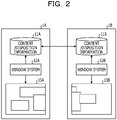
- FIG. 2 illustrates an exemplary schematic configuration of the above technology, and illustrates, for example, a case where two information processing apparatuses 1A, 1B are provided in a local environment such as a conference room.
- the information processing apparatus 1A includes: content/disposition information 11A; a window system 12A; and a display 13A
- the information processing apparatus 1B includes: content/disposition information 11B, a window system 12B, and a display 13B, respectively.
- the respective screen areas of the information processing apparatuses 1A, 1B are set to make connection mutually.
- the right end of the screen of the display 13A is in connection with the left end of the screen of the display 13B.
- the information processing apparatuses 1A, 1B share the content/disposition information 11A, 11B to draw content in the screen with which the information processing apparatuses 1A or 1B is involved (for content across the screens, the information processing apparatus 1A, 1B are in charge of the content), so that display of a linked screen is achieved.
- Patent Document 1 Japanese Laid-open Patent Publication No. 2015-56172
- FIGS. 1 and 2 illustrate the case of the screens with the plurality of displays linked in the local environment. However, it is also assumed that screens included in a plurality of displays between remote locations are used by sharing of content/disposition information through a network.
- FIG. 3 illustrates the assumed usage scene, and in each of conference rooms A, B located at mutually remote places, the conference room of the other party can be verified on a video conference screen displayed on a wall. Furthermore, one end of the screen on the desk of each conference room is linked to one end of the screen on the desk of the other party, so that content is movable.
- FIG. 4 illustrates an exemplary schematic configuration in the above assumed case.
- the information processing apparatus 1A includes: content/disposition information 11A; a window system 12A; and a display 13A
- the information processing apparatus 1B includes: a content/disposition information 11B; a window system 12B; and a display 13B, respectively.
- the content/disposition information 11A of the information processing apparatus 1A and the content/disposition information 11B of the information processing apparatus 1B are shared through a network 2 such as the Internet.
- an object of the present invention is to improve the operability of content movement in a case where a plurality of screens under management of a plurality of apparatuses forms a single logical screen.
- a display unit configured to display content on the basis of information on the content retained in a storage unit of a first apparatus; a determination unit configured to determine a possibility of transfer from the first apparatus to a second apparatus for each piece of the content being displayed at the first apparatus, with reference to the information retained in the storage unit; and a transfer unit configured to transfer the information on the content to the second apparatus that is a transfer destination, in a case where the determination unit determines that there is the possibility of transfer.
- FIG. 5 is a diagram of an exemplary configuration of a system according to the embodiment.
- information processing apparatuses 1A, 1B each having a function of screen input/output (operation input to a screen and display on the screen) and a function of shooting a user, and video conference devices 3A, 3B are provided, in mutually remote conference rooms.
- the information processing apparatuses 1A, 1B and the video conference devices 3A, 3B are mutually communicably coupled through a network 2 such as the Internet.
- a network 2 such as the Internet.
- the two information processing apparatuses 1A, 1B are illustrated; however, three or more information processing apparatuses may be coupled.
- the video conference devices 3A, 3B may be built in the information processing apparatuses 1A, 1B as one function of the information processing apparatuses 1A, 1B, respectively.
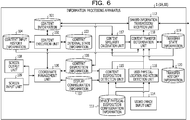
- FIG. 6 is a diagram an exemplary of functional configuration of the information processing apparatus 1 (1A, 1B).
- the information processing apparatus 1 includes: content information 101; a content execution unit 102; content internal state information 103; and content input history information 104.
- the information processing apparatus 1 includes: a coordinate management unit 105; content disposition information 106; display configuration information 107; a screen output unit 108; and a screen input unit 109.
- the information processing apparatus 1 includes: a shared information transmission/reception unit 112; a device physical-disposition configuration information 113; a video image input unit 114; a content disposition detection unit 115; a user physical-location and action detection unit 116; and a content similarity calculation unit 117. Furthermore, the information processing apparatus 1 includes: a content transfer determination unit 118; transfer status information 119; and transfer history information 120.
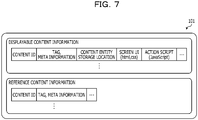
- the content information 101 includes displayable content information on content immediately displayable at a first information processing apparatus, and reference content information for calculating a content transfer tendency.
- the displayable content information also includes information on content transferred from a second information processing apparatus. It is assumed that content originally existing in the first information processing apparatus remains in the displayable content information even though the content has been transferred to the second information processing apparatus.
- the reference content information is to be used for calculating the content transfer tendency.
- the reference content information is part of information on content which is not retained by the first information processing apparatus and is retained by the second information processing apparatus.
- the displayable content information contains items such as “content ID”, “tag, meta information”, “content entity storage location”, “screen UI”, and “action script”.
- the “content ID” indicates information for identifying content.
- the “tag, meta information” indicates information that clearly represents features of the content, such as the type of content (example: “image/png” (image in png format)).
- the “content entity storage location” indicates a uniform resource Identifier (URI) or a file path in which the entity of the content such as an image or text is stored (example: “./contents/resouce1.jpg”).
- URI uniform resource Identifier
- the "screen UI” indicates a user interface that the content itself possesses, and is described by, for example, hypertext markup language (html) or cascading style sheets (css).
- the "action script” is to be used in the "screen UI” and described by Javascript or the like.
- the reference content information contains items such as “content ID” and “tag, meta information” and does not include information on, for example, an entity of content or a screen UI.
- the content execution unit 102 has a function of executing content to be displayed among pieces of displayable content information retained in the content information 101 and generating a screen of the content.
- the content execution unit 102 has, for example, a browser function, and executes the screen UI ( FIG. 7 ) described by html or the like to generate the screen of the content.
- the content execution unit 102 records a state of the content resulting from the execution of the content, in the content internal state information 103, and records input history by the user for the content, in the content input history information 104.
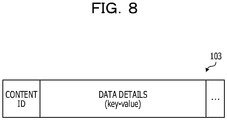
- the content internal state information 103 contains items such as "content ID" and "data details" as depicted in FIG. 8 .
- the "data details" is recorded, for example, in key-value format. Note that the content internal state information 103 may also be retained as part of the content information 101.
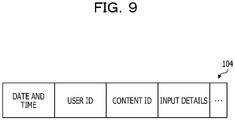
- the content input history information 104 contains items such as “date and time”, “user ID”, “content ID”, and “input details”.
- the “date and time” indicates information on date and time at the performance of an input operation.
- the "user ID” indicates information for identifying a user who has performed the input operation.
- the “content ID” indicates information for identifying content that is the target input operation.
- the “input details” indicates information on the details or overview of the input.
- the coordinate management unit 105 has a function of managing coordinates on a display that displays the screen of the content generated by the content execution unit 102, in accordance with the initial location, and the subsequent moving operation by the user, and retaining the coordinates of the content in the content disposition information 106.
- movement beyond the boundary of the display is grasped with reference to the display configuration information 107.
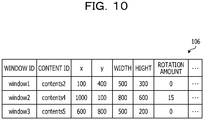
- the content disposition information 106 contains items such as "window ID”, “content ID”, "x”, “y”, “width”, “height”, and “rotation amount” for each display.
- the "window ID” indicates information for identifying a window in which content is displayed.
- the “content ID” indicates information for identifying the content displayed in the window.
- the “x” and the “y” indicate the x coordinate and the y coordinate of the representative point (e.g., upper-left corner point) of the window, respectively.
- the “width” indicates size in the width direction of the window.
- the “height” indicates size in the height direction of the window.
- the “rotation amount” indicates a rotation angle applied to the window. Note that values specifically indicated in FIG. 10 correspond to a case where windows are disposed as in FIG. 11(b) .
- the display configuration information 107 contains items such as "display ID”, “width”, “height”, "x”, and “y” as indicated in FIG. 11(a) , for example.
- the "display ID” indicates information for identifying a display.
- the “width” indicates size in the width direction of the display.
- the “height” indicates size in the height direction of the display.
- the "x” and the “y” indicate the x coordinate and the y coordinate of the representative point (e.g., upper-left corner point) of the display. Note that in a case where a single information processing apparatus is allowed to include a plurality of displays, an item “apparatus ID” for identifying the information processing apparatus to which the displays belongs is added. Furthermore, values specifically indicated in FIG. 11(a) correspond to a case where displays are disposed as illustrated in FIG. 11(b) .
- the screen output unit 108 has a function of displaying the content generated by the content execution unit 102 on the coordinates managed by the coordinate management unit 105.
- the screen input unit 109 has a function of inputting an operation to a screen by the user.
- the user's operation is also performed with a keyboard, a mouse, or the like, in addition to use of a finger or a pen.
- the shared information transmission/reception unit 112 has a function of transmitting information on content to and receiving information on content from the shared information transmission/reception unit of a different information processing apparatus.
- the shared information transmission/reception unit 112 transfers information on the corresponding content from the content information 101 and the content disposition information 106, to the information processing apparatus that is a transfer destination.
- the shared information transmission/reception unit 112 retains the received information on the content, in the content information 101 and the content disposition information 106.
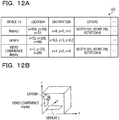
- the device physical-disposition configuration information 113 contains items such as "device ID”, “location”, “orientation”, and “others”, as indicated in FIG. 12(a) , for example.
- the "device ID” indicates information for identifying a device such as a display and a camera.
- the "location” indicates information representing the physical three-dimensional location of the representative point of the device.
- the “orientation” indicates information representing the physical three-dimensional orientation of the device.
- the “others” indicates information representing, for example, the width, height, and rotation of the device. Note that values specifically indicated in FIG. 12(a) correspond to a case where a display and a camera are disposed as illustrated in FIG. 12(b) .
- the video image input unit 114 has a function of inputting a video image from a camera that shoots a user.
- the content disposition detection unit 115 has a function of detecting the disposition of content, such as the distance between the content and the user, and the respective orientations of the content and the user, from the content disposition information 106, the display configuration information 107, the device physical-disposition configuration information 113, and the video image from the camera by the video image input unit 114. Furthermore, the content disposition detection unit 115 also transmits information on the content disposition information 106 and the display configuration information 107 to the content transfer determination unit 118.
- the user physical-location and action detection unit 116 has a function of detecting the location of the user and the direction of the user's line of sight from the video image captured by a camera, with use of, for example, a technology of tracking the entirety or the head of a person, on the basis of the device physical-disposition configuration information 113 and the video image input by the video image input unit 114
- the content similarity calculation unit 117 has a function of calculating the similarity between content to be displayed at the first information processing apparatus and content on the second information processing apparatus (content that originally exists on the second information processing apparatus and content that has been transferred from the first information processing apparatus), with reference to, for example, tag/meta information in the content information 101.
- the content transfer determination unit 118 has a function of calculating a content transfer tendency that indicates the possibility of transfer from the first information processing apparatus to the second information processing apparatus for each content, on the basis of various types of information that can be acquired in the first information processing apparatus, and determining whether the content is to be transferred in advance, on the basis of the content transfer tendency. Furthermore, the content transfer determination unit 118 also has a function of transferring information on content that has been actually moved by an operation of the user. In a case where the content transfer determination unit 118 determines that the content is to be transferred, the content transfer determination unit 118 requests transfer of the content to the shared information transmission/reception unit 112, records the transfer status in the transfer status information 119, and records the transfer history in the transfer history information 120. For example, as indicated in FIG. 13 , the transfer status information 119 records, for each display, a transfer status of untransferred or already transferred for a combination of a content ID and a different display.
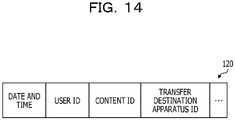
- the transfer history information 120 contains items such as “date and time”, “user ID”, “content ID”, “transfer destination apparatus ID”, as depicted in FIG. 14 .
- the “date and time” indicates information that represents a date and time at the performance of transfer.
- the "user ID” indicates information for identifying a user who has performed a content moving operation that has caused the transfer.
- the “content ID” indicates information for identifying the transferred content.
- the “transfer destination apparatus ID” indicates information for identifying an information processing apparatus that is a transfer destination.
- the content transfer determination unit 118 calculates a transfer tendency for each of viewpoints such as described below, calculates a content transfer tendency for each type of content from the individual transfer tendency, and determines the content to be transferred in a case where the result of the calculation exceeds a predetermined threshold, for example.
- FIG. 15 is a diagram of an exemplary hardware configuration of the information processing apparatus 1 (1A, 1B).
- the information processing apparatus 1 includes: a central processing unit (CPU) 1001; a read only memory (ROM) 1002; a random access memory (RAM) 1003; and a hard disk drive (HDD)/solid state drive (SSD) 1004 that are mutually coupled through a bus 1007.
- the information processing apparatus 1 includes a connection interface (I/F) 1005 and a communication I/F 1006, and a display 1008; a pointing device 1009; and a camera 1010 that are coupled to the connection I/F 1005.
- the display 1008, the pointing device 1009, and the camera 1010 may be integrally formed by the apparatus or externally attached to the apparatus. Furthermore, a plurality of displays 1008 may be provided.
- the CPU 1001 centrally controls the operation of the information processing apparatus 1 by executing a program stored in the ROM 1002, the HDD/SSD 1004, or the like, with the RAM 1003 as a work area.
- the functions of the information processing apparatus 1 described with reference to FIG. 6 are achieved by the CPU 1001 executing a predetermined program.
- the program may be acquired through a recording medium, may be acquired through a network, or may be installed in the ROM.
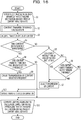
- FIG. 16 is a flowchart of exemplary processing by the content transfer determination unit 118.
- the content transfer determination unit 118 performs loop processing below on each apparatus that is a transfer destination and each piece of content being displayed (steps S1 to S11).
- the content transfer determination unit 118 calculates a content transfer tendency (step S2). The details of the processing will be described later.
- the content transfer determination unit 118 refers to the transfer status information 119 to acquire a transfer status of content (step S3).
- the content transfer determination unit 118 determines whether the content has been already transferred (step S4). In a case where it is determined that the content has not yet been transferred (NO in step S4), the content transfer determination unit 118 determines whether the content partially overlaps the area of the transfer destination (step S5).
- the content transfer determination unit 118 determines whether the previously calculated content transfer tendency exceeds a predetermined transfer threshold (step S6).
- the content transfer determination unit 118 determines whether the content transfer tendency falls below a predetermined deletion threshold (step S8). For example, for content that has been transferred at a time when the content has not yet moved actually, the content transfer determination unit 118 determines whether the state of transfer is to be maintained subsequently.
- the content transfer determination unit 118 determines that the content transfer tendency falls below the predetermined deletion threshold (YES in step S8), the content transfer determination unit 118 causes the shared information transmission/reception unit 112 to transmit a content deletion request to the apparatus that is the transfer destination (step S9).
- the apparatus received the content deletion request deletes information on the corresponding content.
- the content transfer determination unit 118 updates the transfer status information 119 (step S10) after the transmission of the content (step S7) or the transmission of the content deletion request (step S9).
- the content transfer determination unit 118 performs determination for the next loop processing (step S11), in a case where the content transfer determination unit 118 determines that:
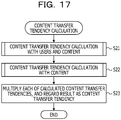
- FIG. 17 is a flowchart of exemplary processing of the content transfer tendency calculation (step S2 in FIG. 16 ).
- the content transfer determination unit 118 calculates content transfer tendencies with the users and the content (step S21). The details of the processing will be described later.
- the content transfer determination unit 118 calculates content transfer tendencies with the content (step S22). The details of the processing will be described later.
- the content transfer determination unit 118 multiplies (performs multiplication of) each of the calculated content transfer tendencies to regard the result as the overall content transfer tendency (step S23), and ends the processing.
- the overall content transfer tendency may be obtained not only with the case of multiplying (performing multiplication) but also by adding (performing addition). Furthermore, the value may be standardized.
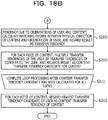
- FIG. 18 is a flowchart of exemplary processing of the content transfer tendency calculation (step S21 in FIG. 17 ) with the users and the content. Note that part of the viewpoints of the transfer tendency due to the users and the content described above is used.
- the content transfer determination unit 118 uses content disposition information and device physical-disposition information acquired from the content disposition detection unit 115 to perform projection conversion, and calculates the physical location of the content (step S2101).
- the content transfer determination unit 118 acquires the location and line of sight direction of a user from the user physical-location and action detection unit 116 (step S2102).
- the content transfer determination unit 118 initializes the content transfer tendencies of all pieces of content (step S2103).
- the content transfer determination unit 118 performs loop processing below on each of the users (steps S2104 to S2111).
- the content transfer determination unit 118 calculates what the user is viewing, from the intersection of the user's line of sight and a display (step S2105).
- the content transfer determination unit 118 refers to the transfer history information 120 as a tendency of transfer action by the user, calculates the number of times of transfer action (transfer operation) by the user within a certain period of time, and regards the result as a transfer tendency (step S2106).
- the content transfer determination unit 118 calculates, as a tendency of movement of the user's line of sight, the number of times of viewing of the screen of a transfer destination (screen of the other party at a video conference) by the user within a certain time, and regards the result as a transfer tendency (step S2107).
- the content transfer determination unit 118 calculates, as a tendency due to the location of the content, the distance between the physical location of the content and the location of the user, and regards the result as a transfer tendency (step S2108).
- the content transfer determination unit 118 calculates, as a tendency due to the orientation of the content, the matching degree between a physical direction of the content and the orientation of the user, and regards the result as a transfer tendency (step S2109).
- the content transfer determination unit 118 multiplies the transfer tendencies of the user by the transfer tendencies of the content to the user, and regards the result as a content transfer tendency candidate for the content (step S2110).
- the content transfer determination unit 118 repeats the loop processing on the next target in a case where the content transfer tendency candidate has not been calculated for all users, and completes the loop processing in a case where the calculation is completed (step S2111).
- the content transfer determination unit 118 regards, for each piece of content, the highest content transfer tendency candidate of the user as the content transfer tendency of the content (step S2112).
- the content transfer tendency candidate may be obtained not only with the case of multiplying (performing multiplication) but also by adding (performing addition). Furthermore, the value may be standardized.
- FIG. 19 is a flowchart of exemplary processing of the content transfer tendency calculation (step S22 in FIG. 17 ) with the content. Note that part of the viewpoints of the transfer tendency due to the content described above is used.
- the content transfer determination unit 118 performs loop processing below on each piece of content (steps S221 to S226).
- the content transfer determination unit 118 calculates, as a tendency due to an operation, the input frequency to the content within a certain time, and regards the result as a transfer tendency (step S222).
- the content transfer determination unit 118 calculates, as a tendency due to a contact face distance, the distance from a connection face of a display, and regards the result as a transfer tendency (step S223).
- the content transfer determination unit 118 acquires, as a tendency due to similarity with a transfer destination, similarity with content already transferred, from the content similarity calculation unit 117, and regards the acquired similarity as a transfer tendency (step S224).
- the content transfer determination unit 118 multiplies the transfer tendencies calculated with the respective techniques, and regards the result as the content transfer tendency of the content (step S225).
- the content transfer tendency may be obtained not only with the case of multiplying (performing multiplication) but also by adding (performing addition). Furthermore, the value may be standardized.
- the content transfer determination unit 118 repeats the loop processing on the next target in a case where the content transfer tendency has not been calculated for all pieces of content, completes the loop processing in a case where the calculation is completed (step S226), and ends the processing of transfer tendency calculation with the content.
- FIGS. 5 and 6 illustrate the case where the plurality of information processing apparatuses 1 (1A, 1B) having an equal relationship are coupled.
- a common server such as a cloud may be provided.
- a content transfer tendency is calculated on the server, and content determined to have the possibility of transfer is transferred in advance to an information processing apparatus that is a transfer destination.
- the present embodiment there can be improved the operability of content movement in the case where the plurality of screens under management of the plurality of apparatuses forms the single logical screen. For example, not only transfer of content is performed after an operation by the user, but also content with high possibility of transfer is estimated and transferred in advance. As a result, waiting time at transfer is reduced to improve the operability.
- An information processing apparatus including:
- the information processing apparatus determines the possibility of transfer from the first apparatus to the second apparatus for each piece of the content, from a transfer tendency based on an action of a user, a transfer tendency based on a relative relationship between the user and the content, and a transfer tendency based on the content.
- the transfer tendency based on the action of the user is calculated with intensity of movement of a face or a line of sight of the user, frequency of viewing of a screen of the transfer destination, or frequency of transfer operation in past, or any combination thereof
- the transfer tendency based on the relative relationship between the user and the content is calculated with a distance between the user and the content, matching degree in orientation between the user and the content, or frequency of viewing by the user, or any combination thereof
- the transfer tendency based on the content is calculated with location of the content, details of the content, or frequency of input of the details to the content, or any combination thereof.
- the information processing apparatus in which the transfer unit transmits a content information deletion request for an already transferred content that is determined to have no possibility of transfer by the determination unit.
- An information processing system including:
- the determination unit determines the possibility of transfer from the first apparatus to the second apparatus for each piece of the content, from a transfer tendency based on an action of a user, a transfer tendency based on a relative relationship between the user and the content, and a transfer tendency based on the content.
- the information processing system in which the transfer unit transmits a content information deletion request for an already transferred content that is determined to have no possibility of transfer by the determination unit.
- the determining includes determining the possibility of transfer from the first apparatus to the second apparatus for each piece of the content, from a transfer tendency based on an action of a user, a transfer tendency based on a relative relationship between the user and the content, and a transfer tendency based on the content.
- the transfer tendency based on the action of the user is calculated with intensity of movement of a face or a line of sight of the user, frequency of viewing of a screen of the transfer destination, or frequency of transfer operation in past, or any combination thereof
- the transfer tendency based on the relative relationship between the user and the content is calculated with a distance between the user and the content, matching degree in orientation between the user and the content, or frequency of viewing by the user, or any combination thereof
- the transfer tendency based on the content is calculated with location of the content, details of the content, or frequency of input of the details to the content, or any combination thereof.
- the information processing method in which the transferring includes transmitting a content information deletion request for an already transferred content that is determined to have no possibility of transfer by the determination unit.
- the screen output unit 108 is an example of the "display unit”.
- the content transfer determination unit 118 is an example of the “determination unit”.
- the shared information transmission/reception unit 112 is an example of the "transfer unit”.
Landscapes
- Engineering & Computer Science (AREA)
- Theoretical Computer Science (AREA)
- General Engineering & Computer Science (AREA)
- Physics & Mathematics (AREA)
- General Physics & Mathematics (AREA)
- Human Computer Interaction (AREA)
- Computer Hardware Design (AREA)
- Computer Graphics (AREA)
- Multimedia (AREA)
- Information Transfer Between Computers (AREA)
- Two-Way Televisions, Distribution Of Moving Picture Or The Like (AREA)
- Controls And Circuits For Display Device (AREA)
- User Interface Of Digital Computer (AREA)
Abstract
Description
- The present invention relates to an information processing apparatus, an information processing system, and an information processing method.
- There has been proposed a technology of projecting content onto a desk or wall of a conference room to support collaborative work (user interface (UI) technology of digitizing the entirety of the room) (Press Release: http://pr.fujitsu.com/jp/news/2015/07/27.html).
FIG. 1 illustrates an exemplary usage of the above technology. Content C1 as notebook applications for individual work and content C2 as digital sticky notes are displayed (projected) on a desk, and content C3 as digital prompt cards and content C4 as a shared notecard application are displayed on a wall. The content C2 as digital sticky notes, the content C3 as the digital prompt cards, and the like are movable between screens of different displays by, for example, a swipe operation with a finger of the user, and disposed in a related theme area or disposed in a brainstorming requirement area in the process of collaborative work. -
FIG. 2 illustrates an exemplary schematic configuration of the above technology, and illustrates, for example, a case where twoinformation processing apparatuses information processing apparatus 1A includes: content/disposition information 11A; awindow system 12A; and adisplay 13A, and theinformation processing apparatus 1B includes: content/disposition information 11B, awindow system 12B, and adisplay 13B, respectively. The respective screen areas of theinformation processing apparatuses display 13A is in connection with the left end of the screen of thedisplay 13B. Theinformation processing apparatuses disposition information information processing apparatuses information processing apparatus - Meanwhile, there has been disclosed a panel system with a plurality of displays arranged that prevents a delay in display of a drawn object across the plurality of displays (see Patent Document 1).
- Patent Document 1: Japanese Laid-open Patent Publication No.
2015-56172 -
FIGS. 1 and2 illustrate the case of the screens with the plurality of displays linked in the local environment. However, it is also assumed that screens included in a plurality of displays between remote locations are used by sharing of content/disposition information through a network.FIG. 3 illustrates the assumed usage scene, and in each of conference rooms A, B located at mutually remote places, the conference room of the other party can be verified on a video conference screen displayed on a wall. Furthermore, one end of the screen on the desk of each conference room is linked to one end of the screen on the desk of the other party, so that content is movable. -
FIG. 4 illustrates an exemplary schematic configuration in the above assumed case. InFIG. 4 , twoinformation processing apparatuses information processing apparatus 1A includes: content/disposition information 11A; awindow system 12A; and adisplay 13A, and theinformation processing apparatus 1B includes: a content/disposition information 11B; awindow system 12B; and adisplay 13B, respectively. The content/disposition information 11A of theinformation processing apparatus 1A and the content/disposition information 11B of theinformation processing apparatus 1B are shared through anetwork 2 such as the Internet. - Here, for sharing of all pieces of content generated in each conference room and pieces of location information on the content, processing and communication is time-consuming and unrealistic. Furthermore, a technique may be considered in which information is transferred only when the location of content shifts to the other party side; however, in this case, display of the content is kept waiting until the information is transferred, so that the operability lowers. Note that a similar problem may occur in a case where communication environment is insufficient even in a short distance, not only between remote locations.
- Therefore, in one aspect, an object of the present invention is to improve the operability of content movement in a case where a plurality of screens under management of a plurality of apparatuses forms a single logical screen.
- According to one mode, provided are a display unit configured to display content on the basis of information on the content retained in a storage unit of a first apparatus; a determination unit configured to determine a possibility of transfer from the first apparatus to a second apparatus for each piece of the content being displayed at the first apparatus, with reference to the information retained in the storage unit; and a transfer unit configured to transfer the information on the content to the second apparatus that is a transfer destination, in a case where the determination unit determines that there is the possibility of transfer.
- There can be improved the operability of content movement in a case where a plurality of screens under management of a plurality of apparatuses forms a single logical screen.
-
-
FIG. 1 is an illustration of an exemplary usage of an UI technology of digitizing the entirety of a room. -
FIG. 2 is a diagram of an exemplary schematic configuration of the UI technology. -
FIG. 3 is an illustration of an assumed usage scene in connection of screens between remote locations. -
FIG. 4 is a diagram of an exemplary schematic configuration of an UI technology. -
FIG. 5 is a diagram of an exemplary configuration of a system according to an embodiment. -
FIG. 6 is a diagram of an exemplary functional configuration of an information processing apparatus. -
FIG. 7 is a depiction of an exemplary data structure of content information. -
FIG. 8 is a depiction of an exemplary data structure of content internal state information. -
FIG. 9 is a depiction of an exemplary data structure of content input history information. -
FIG. 10 is a table of an exemplary data structure of content disposition information. -
FIG. 11 represents a table and an illustration of an exemplary data structure of display configuration information. -
FIG. 12 represents a table and an illustration of an exemplary data structure of device physical-disposition configuration information. -
FIG. 13 is a table of an exemplary data structure of transfer status information. -
FIG. 14 is a depiction of an exemplary data structure of transfer history information. -
FIG. 15 is a diagram of an exemplary hardware configuration of the information processing apparatus. -
FIG. 16 is a flowchart of exemplary processing by a content transfer determination unit. -
FIG. 17 is a flowchart of exemplary processing of content transfer tendency calculation. -
FIG. 18 is a flowchart of exemplary processing of content transfer tendency calculation with users and content. -
FIG. 19 is a flowchart of exemplary processing of content transfer tendency calculation with the content. - Hereinafter, a preferred embodiment of the present invention will be described with reference to the drawings.
-
FIG. 5 is a diagram of an exemplary configuration of a system according to the embodiment. InFIG. 5 ,information processing apparatuses video conference devices information processing apparatuses video conference devices network 2 such as the Internet. Note that the twoinformation processing apparatuses video conference devices information processing apparatuses information processing apparatuses -
FIG. 6 is a diagram an exemplary of functional configuration of the information processing apparatus 1 (1A, 1B). InFIG. 6 , theinformation processing apparatus 1 includes:content information 101; acontent execution unit 102; contentinternal state information 103; and contentinput history information 104. Furthermore, theinformation processing apparatus 1 includes: acoordinate management unit 105;content disposition information 106;display configuration information 107; ascreen output unit 108; and ascreen input unit 109. - Furthermore, the
information processing apparatus 1 includes: a shared information transmission/reception unit 112; a device physical-disposition configuration information 113; a videoimage input unit 114; a contentdisposition detection unit 115; a user physical-location andaction detection unit 116; and a contentsimilarity calculation unit 117. Furthermore, theinformation processing apparatus 1 includes: a contenttransfer determination unit 118;transfer status information 119; andtransfer history information 120. - For example, as depicted in
FIG. 7 , thecontent information 101 includes displayable content information on content immediately displayable at a first information processing apparatus, and reference content information for calculating a content transfer tendency. The displayable content information also includes information on content transferred from a second information processing apparatus. It is assumed that content originally existing in the first information processing apparatus remains in the displayable content information even though the content has been transferred to the second information processing apparatus. The reference content information is to be used for calculating the content transfer tendency. The reference content information is part of information on content which is not retained by the first information processing apparatus and is retained by the second information processing apparatus. - The displayable content information contains items such as "content ID", "tag, meta information", "content entity storage location", "screen UI", and "action script". The "content ID" indicates information for identifying content. The "tag, meta information" indicates information that clearly represents features of the content, such as the type of content (example: "image/png" (image in png format)). The "content entity storage location" indicates a uniform resource Identifier (URI) or a file path in which the entity of the content such as an image or text is stored (example: "./contents/resouce1.jpg"). The "screen UI" indicates a user interface that the content itself possesses, and is described by, for example, hypertext markup language (html) or cascading style sheets (css). The "action script" is to be used in the "screen UI" and described by Javascript or the like. The reference content information contains items such as "content ID" and "tag, meta information" and does not include information on, for example, an entity of content or a screen UI.
- Referring back to
FIG. 6 , thecontent execution unit 102 has a function of executing content to be displayed among pieces of displayable content information retained in thecontent information 101 and generating a screen of the content. Thecontent execution unit 102 has, for example, a browser function, and executes the screen UI (FIG. 7 ) described by html or the like to generate the screen of the content. Furthermore, thecontent execution unit 102 records a state of the content resulting from the execution of the content, in the contentinternal state information 103, and records input history by the user for the content, in the contentinput history information 104. The contentinternal state information 103 contains items such as "content ID" and "data details" as depicted inFIG. 8 . The "data details" is recorded, for example, in key-value format. Note that the contentinternal state information 103 may also be retained as part of thecontent information 101. - For example, as depicted in
FIG. 9 , the contentinput history information 104 contains items such as "date and time", "user ID", "content ID", and "input details". The "date and time" indicates information on date and time at the performance of an input operation. The "user ID" indicates information for identifying a user who has performed the input operation. The "content ID" indicates information for identifying content that is the target input operation. The "input details" indicates information on the details or overview of the input. - Referring back to
FIG. 6 , the coordinatemanagement unit 105 has a function of managing coordinates on a display that displays the screen of the content generated by thecontent execution unit 102, in accordance with the initial location, and the subsequent moving operation by the user, and retaining the coordinates of the content in thecontent disposition information 106. At this time, movement beyond the boundary of the display is grasped with reference to thedisplay configuration information 107. For example, as indicated inFIG. 10 , thecontent disposition information 106 contains items such as "window ID", "content ID", "x", "y", "width", "height", and "rotation amount" for each display. The "window ID" indicates information for identifying a window in which content is displayed. The "content ID" indicates information for identifying the content displayed in the window. The "x" and the "y" indicate the x coordinate and the y coordinate of the representative point (e.g., upper-left corner point) of the window, respectively. The "width" indicates size in the width direction of the window. The "height" indicates size in the height direction of the window. The "rotation amount" indicates a rotation angle applied to the window. Note that values specifically indicated inFIG. 10 correspond to a case where windows are disposed as inFIG. 11(b) . - The
display configuration information 107 contains items such as "display ID", "width", "height", "x", and "y" as indicated inFIG. 11(a) , for example. The "display ID" indicates information for identifying a display. The "width" indicates size in the width direction of the display. The "height" indicates size in the height direction of the display. The "x" and the "y" indicate the x coordinate and the y coordinate of the representative point (e.g., upper-left corner point) of the display. Note that in a case where a single information processing apparatus is allowed to include a plurality of displays, an item "apparatus ID" for identifying the information processing apparatus to which the displays belongs is added. Furthermore, values specifically indicated inFIG. 11(a) correspond to a case where displays are disposed as illustrated inFIG. 11(b) . - Referring back to
FIG. 6 , thescreen output unit 108 has a function of displaying the content generated by thecontent execution unit 102 on the coordinates managed by the coordinatemanagement unit 105. - The
screen input unit 109 has a function of inputting an operation to a screen by the user. The user's operation is also performed with a keyboard, a mouse, or the like, in addition to use of a finger or a pen. - The shared information transmission/reception unit 112 has a function of transmitting information on content to and receiving information on content from the shared information transmission/reception unit of a different information processing apparatus. For the transfer side, the shared information transmission/reception unit 112 transfers information on the corresponding content from the
content information 101 and thecontent disposition information 106, to the information processing apparatus that is a transfer destination. For the transfer destination side, the shared information transmission/reception unit 112 retains the received information on the content, in thecontent information 101 and thecontent disposition information 106. - The device physical-
disposition configuration information 113 contains items such as "device ID", "location", "orientation", and "others", as indicated inFIG. 12(a) , for example. The "device ID" indicates information for identifying a device such as a display and a camera. The "location" indicates information representing the physical three-dimensional location of the representative point of the device. The "orientation" indicates information representing the physical three-dimensional orientation of the device. The "others" indicates information representing, for example, the width, height, and rotation of the device. Note that values specifically indicated inFIG. 12(a) correspond to a case where a display and a camera are disposed as illustrated inFIG. 12(b) . - Referring back to
FIG. 6 , the videoimage input unit 114 has a function of inputting a video image from a camera that shoots a user. - The content
disposition detection unit 115 has a function of detecting the disposition of content, such as the distance between the content and the user, and the respective orientations of the content and the user, from thecontent disposition information 106, thedisplay configuration information 107, the device physical-disposition configuration information 113, and the video image from the camera by the videoimage input unit 114. Furthermore, the contentdisposition detection unit 115 also transmits information on thecontent disposition information 106 and thedisplay configuration information 107 to the contenttransfer determination unit 118. - The user physical-location and
action detection unit 116 has a function of detecting the location of the user and the direction of the user's line of sight from the video image captured by a camera, with use of, for example, a technology of tracking the entirety or the head of a person, on the basis of the device physical-disposition configuration information 113 and the video image input by the videoimage input unit 114 - The content
similarity calculation unit 117 has a function of calculating the similarity between content to be displayed at the first information processing apparatus and content on the second information processing apparatus (content that originally exists on the second information processing apparatus and content that has been transferred from the first information processing apparatus), with reference to, for example, tag/meta information in thecontent information 101. - The content
transfer determination unit 118 has a function of calculating a content transfer tendency that indicates the possibility of transfer from the first information processing apparatus to the second information processing apparatus for each content, on the basis of various types of information that can be acquired in the first information processing apparatus, and determining whether the content is to be transferred in advance, on the basis of the content transfer tendency. Furthermore, the contenttransfer determination unit 118 also has a function of transferring information on content that has been actually moved by an operation of the user. In a case where the contenttransfer determination unit 118 determines that the content is to be transferred, the contenttransfer determination unit 118 requests transfer of the content to the shared information transmission/reception unit 112, records the transfer status in thetransfer status information 119, and records the transfer history in thetransfer history information 120. For example, as indicated inFIG. 13 , thetransfer status information 119 records, for each display, a transfer status of untransferred or already transferred for a combination of a content ID and a different display. - The
transfer history information 120 contains items such as "date and time", "user ID", "content ID", "transfer destination apparatus ID", as depicted inFIG. 14 . The "date and time" indicates information that represents a date and time at the performance of transfer. The "user ID" indicates information for identifying a user who has performed a content moving operation that has caused the transfer. The "content ID" indicates information for identifying the transferred content. The "transfer destination apparatus ID" indicates information for identifying an information processing apparatus that is a transfer destination. - Referring back to
FIG. 6 , the contenttransfer determination unit 118 calculates a transfer tendency for each of viewpoints such as described below, calculates a content transfer tendency for each type of content from the individual transfer tendency, and determines the content to be transferred in a case where the result of the calculation exceeds a predetermined threshold, for example. - Transfer tendency due to user and content
- Transfer tendency due to user's action
- Intensity of movement of face or line of sight (as the movement is larger, preparation for transfer is made more and the transfer tendency is higher)
- Frequency of viewing of the screen of the other party at a video conference (as the screen is viewed more, the transfer tendency is higher)
- Frequency of performing transfer operation in the past (transfer action is biased to a specific user)
- Transfer tendency due to relative relationship between user and content
- Distance between user and content (content closer to the user is easier to be transferred)
- Matching degree in orientation between user and content (when the orientations matches, the content is easier to be transferred)
- Frequency of viewing by user (viewed content is easier to be transferred)
- Transfer tendency due to content
- Transfer tendency due to location of content
- Distance between content and screen connection side (content closer to the connection side is easier to be transferred)
- Transfer tendency due to details of content
- Similarity with different content that has been transferred (content similar to the transferred content is easier to be transferred)
- Similarity with different content of transfer destination (content similar to the content of the transfer destination is easier to be transferred for sharing information)
- Frequency of inputting details (content that is input with high frequency is easier to be transferred)
-
FIG. 15 is a diagram of an exemplary hardware configuration of the information processing apparatus 1 (1A, 1B). InFIG. 15 , theinformation processing apparatus 1 includes: a central processing unit (CPU) 1001; a read only memory (ROM) 1002; a random access memory (RAM) 1003; and a hard disk drive (HDD)/solid state drive (SSD) 1004 that are mutually coupled through abus 1007. Furthermore, theinformation processing apparatus 1 includes a connection interface (I/F) 1005 and a communication I/F 1006, and a display 1008; a pointing device 1009; and acamera 1010 that are coupled to the connection I/F 1005. The display 1008, the pointing device 1009, and thecamera 1010 may be integrally formed by the apparatus or externally attached to the apparatus. Furthermore, a plurality of displays 1008 may be provided. - The
CPU 1001 centrally controls the operation of theinformation processing apparatus 1 by executing a program stored in theROM 1002, the HDD/SSD 1004, or the like, with theRAM 1003 as a work area. The functions of theinformation processing apparatus 1 described with reference toFIG. 6 are achieved by theCPU 1001 executing a predetermined program. The program may be acquired through a recording medium, may be acquired through a network, or may be installed in the ROM. -
FIG. 16 is a flowchart of exemplary processing by the contenttransfer determination unit 118. InFIG. 16 , the contenttransfer determination unit 118 performs loop processing below on each apparatus that is a transfer destination and each piece of content being displayed (steps S1 to S11). - In the loop processing, the content
transfer determination unit 118 calculates a content transfer tendency (step S2). The details of the processing will be described later. - Next, the content
transfer determination unit 118 refers to thetransfer status information 119 to acquire a transfer status of content (step S3). - Then, the content
transfer determination unit 118 determines whether the content has been already transferred (step S4). In a case where it is determined that the content has not yet been transferred (NO in step S4), the contenttransfer determination unit 118 determines whether the content partially overlaps the area of the transfer destination (step S5). - In a case where the content
transfer determination unit 118 determines that the content does not partially overlap the area of the transfer destination (NO in step S5), the contenttransfer determination unit 118 determines whether the previously calculated content transfer tendency exceeds a predetermined transfer threshold (step S6). - Then, in a case where the content
transfer determination unit 118 determines that: - the content partially overlaps the area of the transfer destination (YES in step S5); or
- the content transfer tendency exceeds the predetermined transfer threshold (YES in step S6), the content
transfer determination unit 118 causes the shared information transmission/reception unit 112 to transmit (transfer) information on the corresponding content (step S7). In a case where it is determined that the content partially overlaps the area of the transfer destination and the content is transferred, the content is actually moving beyond a device (display). Thus, the device of the transfer destination that has received the information on the content immediately displays the transferred content. - Furthermore, in a case where the content
transfer determination unit 118 determines that the content has been already transferred (YES in step S4), the contenttransfer determination unit 118 determines whether the content transfer tendency falls below a predetermined deletion threshold (step S8). For example, for content that has been transferred at a time when the content has not yet moved actually, the contenttransfer determination unit 118 determines whether the state of transfer is to be maintained subsequently. - In a case where the content
transfer determination unit 118 determines that the content transfer tendency falls below the predetermined deletion threshold (YES in step S8), the contenttransfer determination unit 118 causes the shared information transmission/reception unit 112 to transmit a content deletion request to the apparatus that is the transfer destination (step S9). The apparatus received the content deletion request deletes information on the corresponding content. - The content
transfer determination unit 118 updates the transfer status information 119 (step S10) after the transmission of the content (step S7) or the transmission of the content deletion request (step S9). - The content
transfer determination unit 118 performs determination for the next loop processing (step S11), in a case where the contenttransfer determination unit 118 determines that: - the content transfer tendency does not exceed the predetermined transfer threshold (NO in step S6); or
- the content transfer tendency does not fall below the predetermined deletion threshold (NO in step S8), or
- after the update of the transfer status information 119 (step S10). For example, in a case were calculation has not been completed for all apparatuses that are the transfer destinations and all pieces of content being displayed, the loop processing is repeated; and in a case where the calculation is completed, the processing ends.
-
FIG. 17 is a flowchart of exemplary processing of the content transfer tendency calculation (step S2 inFIG. 16 ). InFIG. 17 , the contenttransfer determination unit 118 calculates content transfer tendencies with the users and the content (step S21). The details of the processing will be described later. - Next, the content
transfer determination unit 118 calculates content transfer tendencies with the content (step S22). The details of the processing will be described later. - Next, the content
transfer determination unit 118 multiplies (performs multiplication of) each of the calculated content transfer tendencies to regard the result as the overall content transfer tendency (step S23), and ends the processing. - Note that the overall content transfer tendency may be obtained not only with the case of multiplying (performing multiplication) but also by adding (performing addition). Furthermore, the value may be standardized.
-
FIG. 18 is a flowchart of exemplary processing of the content transfer tendency calculation (step S21 inFIG. 17 ) with the users and the content. Note that part of the viewpoints of the transfer tendency due to the users and the content described above is used. - In
FIG. 18 , the contenttransfer determination unit 118 uses content disposition information and device physical-disposition information acquired from the contentdisposition detection unit 115 to perform projection conversion, and calculates the physical location of the content (step S2101). - Next, the content
transfer determination unit 118 acquires the location and line of sight direction of a user from the user physical-location and action detection unit 116 (step S2102). - Next, the content
transfer determination unit 118 initializes the content transfer tendencies of all pieces of content (step S2103). - Next, the content
transfer determination unit 118 performs loop processing below on each of the users (steps S2104 to S2111). - In the loop processing, the content
transfer determination unit 118 calculates what the user is viewing, from the intersection of the user's line of sight and a display (step S2105). - Next, the content
transfer determination unit 118 refers to thetransfer history information 120 as a tendency of transfer action by the user, calculates the number of times of transfer action (transfer operation) by the user within a certain period of time, and regards the result as a transfer tendency (step S2106). - Next, the content
transfer determination unit 118 calculates, as a tendency of movement of the user's line of sight, the number of times of viewing of the screen of a transfer destination (screen of the other party at a video conference) by the user within a certain time, and regards the result as a transfer tendency (step S2107). - Next, the content
transfer determination unit 118 calculates, as a tendency due to the location of the content, the distance between the physical location of the content and the location of the user, and regards the result as a transfer tendency (step S2108). - Next, the content
transfer determination unit 118 calculates, as a tendency due to the orientation of the content, the matching degree between a physical direction of the content and the orientation of the user, and regards the result as a transfer tendency (step S2109). - Next, for each piece of content, the content
transfer determination unit 118 multiplies the transfer tendencies of the user by the transfer tendencies of the content to the user, and regards the result as a content transfer tendency candidate for the content (step S2110). - Next, the content
transfer determination unit 118 repeats the loop processing on the next target in a case where the content transfer tendency candidate has not been calculated for all users, and completes the loop processing in a case where the calculation is completed (step S2111). - In a case where the loop processing is completed, the content
transfer determination unit 118 regards, for each piece of content, the highest content transfer tendency candidate of the user as the content transfer tendency of the content (step S2112). - Note that the content transfer tendency candidate may be obtained not only with the case of multiplying (performing multiplication) but also by adding (performing addition). Furthermore, the value may be standardized.
-
FIG. 19 is a flowchart of exemplary processing of the content transfer tendency calculation (step S22 inFIG. 17 ) with the content. Note that part of the viewpoints of the transfer tendency due to the content described above is used. - In
FIG. 19 , the contenttransfer determination unit 118 performs loop processing below on each piece of content (steps S221 to S226). - In the loop processing, the content
transfer determination unit 118 calculates, as a tendency due to an operation, the input frequency to the content within a certain time, and regards the result as a transfer tendency (step S222). - Next, the content
transfer determination unit 118 calculates, as a tendency due to a contact face distance, the distance from a connection face of a display, and regards the result as a transfer tendency (step S223). - Next, the content
transfer determination unit 118 acquires, as a tendency due to similarity with a transfer destination, similarity with content already transferred, from the contentsimilarity calculation unit 117, and regards the acquired similarity as a transfer tendency (step S224). - Next, the content
transfer determination unit 118 multiplies the transfer tendencies calculated with the respective techniques, and regards the result as the content transfer tendency of the content (step S225). - Note that the content transfer tendency may be obtained not only with the case of multiplying (performing multiplication) but also by adding (performing addition). Furthermore, the value may be standardized.
- Next, the content
transfer determination unit 118 repeats the loop processing on the next target in a case where the content transfer tendency has not been calculated for all pieces of content, completes the loop processing in a case where the calculation is completed (step S226), and ends the processing of transfer tendency calculation with the content. -
FIGS. 5 and6 illustrate the case where the plurality of information processing apparatuses 1 (1A, 1B) having an equal relationship are coupled. However, in addition to theinformation processing apparatuses 1, a common server such as a cloud may be provided. In this case, a content transfer tendency is calculated on the server, and content determined to have the possibility of transfer is transferred in advance to an information processing apparatus that is a transfer destination. - As described above, according to the present embodiment, there can be improved the operability of content movement in the case where the plurality of screens under management of the plurality of apparatuses forms the single logical screen. For example, not only transfer of content is performed after an operation by the user, but also content with high possibility of transfer is estimated and transferred in advance. As a result, waiting time at transfer is reduced to improve the operability.
- Hereinabove, the preferred embodiment has been described. Although the preferred embodiment has been described with the specific examples indicated herein, it will be apparent that various modifications and changes can be added to the specific examples, without departing from the broad gist and scope defined in the claims. That is, it should not be interpreted as being limited by the details of the specific examples and the accompanying drawings.
- The following sections will be further disclosed regarding the above description.
- An information processing apparatus including:
- a display unit configured to display content on the basis of information on the content retained in a storage unit of a first apparatus;
- a determination unit configured to determine a possibility of transfer from the first apparatus to a second apparatus for each piece of the content being displayed at the first apparatus, with reference to the information retained in the storage unit; and
- a transfer unit configured to transfer the information on the content to the second apparatus that is a transfer destination, in a case where the determination unit determines that there is the possibility of transfer.
- The information processing apparatus according to
note 1,
in which the determination unit determines the possibility of transfer from the first apparatus to the second apparatus for each piece of the content, from a transfer tendency based on an action of a user, a transfer tendency based on a relative relationship between the user and the content, and a transfer tendency based on the content. - The information processing apparatus according to
note 2,
in which the transfer tendency based on the action of the user is calculated with intensity of movement of a face or a line of sight of the user, frequency of viewing of a screen of the transfer destination, or frequency of transfer operation in past, or any combination thereof,
the transfer tendency based on the relative relationship between the user and the content is calculated with a distance between the user and the content, matching degree in orientation between the user and the content, or frequency of viewing by the user, or any combination thereof, and
the transfer tendency based on the content is calculated with location of the content, details of the content, or frequency of input of the details to the content, or any combination thereof. - The information processing apparatus according to
note 1,
in which the transfer unit transmits a content information deletion request for an already transferred content that is determined to have no possibility of transfer by the determination unit. - An information processing system including:
- a display unit configured to display content on the basis of information on the content retained in a storage unit of a first apparatus;
- a determination unit configured to determine a possibility of transfer from the first apparatus to a second apparatus for each piece of the content being displayed at the first apparatus, with reference to the information retained in the storage unit; and
- a transfer unit configured to transfer the information on the content to the second apparatus that is a transfer destination, in a case where the determination unit determines that there is the possibility of transfer.
- The information processing system according to
note 5,
in which the determination unit determines the possibility of transfer from the first apparatus to the second apparatus for each piece of the content, from a transfer tendency based on an action of a user, a transfer tendency based on a relative relationship between the user and the content, and a transfer tendency based on the content. - The information processing system according to note 6,
- in which the transfer tendency based on the action of the user is calculated with intensity of movement of a face or a line of sight of the user, frequency of viewing of a screen of the transfer destination, or frequency of transfer operation in past, or any combination thereof,
- the transfer tendency based on the relative relationship between the user and the content is calculated with a distance between the user and the content, matching degree in orientation between the user and the content, or frequency of viewing by the user, or any combination thereof, and
- the transfer tendency based on the content is calculated with location of the content, details of the content, or frequency of input of the details to the content, or any combination thereof.
- The information processing system according to
note 5,
in which the transfer unit transmits a content information deletion request for an already transferred content that is determined to have no possibility of transfer by the determination unit. - An information processing method of causing a computer to execute processing of:
- displaying content on the basis of information on the content retained in a storage unit of a first apparatus;
- determining a possibility of transfer from the first apparatus to a second apparatus for each piece of the content being displayed at the first apparatus, with reference to the information retained in the storage unit; and
- transferring the information on the content to the second apparatus that is a transfer destination, in a case where the determining determines that there is the possibility of transfer.
- The information processing method according to
note 9,
in which the determining includes determining the possibility of transfer from the first apparatus to the second apparatus for each piece of the content, from a transfer tendency based on an action of a user, a transfer tendency based on a relative relationship between the user and the content, and a transfer tendency based on the content. - The information processing method according to note 10,
in which the transfer tendency based on the action of the user is calculated with intensity of movement of a face or a line of sight of the user, frequency of viewing of a screen of the transfer destination, or frequency of transfer operation in past, or any combination thereof,
the transfer tendency based on the relative relationship between the user and the content is calculated with a distance between the user and the content, matching degree in orientation between the user and the content, or frequency of viewing by the user, or any combination thereof, and
the transfer tendency based on the content is calculated with location of the content, details of the content, or frequency of input of the details to the content, or any combination thereof. - The information processing method according to
note 9,
in which the transferring includes transmitting a content information deletion request for an already transferred content that is determined to have no possibility of transfer by the determination unit. - The
screen output unit 108 is an example of the "display unit". The contenttransfer determination unit 118 is an example of the "determination unit". The shared information transmission/reception unit 112 is an example of the "transfer unit". -
- 1, 1A, 1B
- information processing apparatus
- 101
- content information
- 102
- content execution unit
- 103
- content internal state information
- 104
- content input history information
- 105
- coordinate management unit
- 106
- content disposition information
- 107
- display configuration information
- 108
- screen output unit
- 109
- screen input unit
- 112
- shared information transmission/reception unit
- 113
- device physical-disposition configuration information
- 114
- video image input unit
- 115
- content disposition detection unit
- 116
- user physical-location and action detection unit
- 117
- content similarity calculation unit
- 118
- content transfer determination unit
- 119
- transfer status information
- 120
- transfer history information
- 2
- network
- 3, 3A, 3B
- video conference device
Claims (12)
- An information processing apparatus comprising:a display unit configured to display content on a basis of information on the content retained in a storage unit of the information processing apparatus;a determination unit configured to determine a possibility of transfer from the information processing apparatus to another apparatus for each piece of the content which is displayed at the information processing apparatus, with reference to the information retained in the storage unit; anda transfer unit configured to transfer the information on the content to the another apparatus that is a transfer destination, in a case where the determination unit determines that the possibility of transfer exists.
- The information processing apparatus according to claim 1,
wherein the determination unit determines the possibility of transfer from the information processing apparatus to the another apparatus for each piece of the content, from a first transfer tendency based on an action of a user, a second transfer tendency based on a relative relationship between the user and the content, and a third transfer tendency based on the content. - The information processing apparatus according to claim 2,wherein the first transfer tendency is calculated with intensity of movement of a face or a line of sight of the user, first frequency of viewing of a screen of the transfer destination, second frequency of transfer operation in past or any combination among the intensity, the first frequency and the second frequency,the second transfer tendency is calculated with a distance between the user and the content, matching degree in orientation between the user and the content, third frequency of viewing by the user or any combination among the distance, the matching degree and the content, andthe third transfer tendency is calculated with location of the content, details of the content, fourth frequency of input of the details to the content or any combination among the location, the details and fourth frequency.
- The information processing apparatus according to claim 1,
wherein the transfer unit transmits a content information deletion request for an already transferred content that is determined to have no possibility of transfer by the determination unit. - An information processing system comprising:a display unit configured to display content on a basis of information on the content retained in a storage unit of a first apparatus;a determination unit configured to determine a possibility of transfer from the first apparatus to a second apparatus for each piece of the content which is displayed at the first apparatus, with reference to the information retained in the storage unit; anda transfer unit configured to transfer the information on the content to the second apparatus that is a transfer destination, in a case where the determination unit determines that the possibility of transfer exists.
- The information processing system according to claim 5,
wherein the determination unit determines the possibility of transfer from the first apparatus to the second apparatus for each piece of the content, from a first transfer tendency based on an action of a user, a second transfer tendency based on a relative relationship between the user and the content, and a third transfer tendency based on the content. - The information processing system according to claim 6,wherein the first transfer tendency is calculated with intensity of movement of a face or a line of sight of the user, first frequency of viewing of a screen of the transfer destination, second frequency of transfer operation in past or any combination among the intensity, the first frequency and the second frequency,the second transfer tendency is calculated with a distance between the user and the content, matching degree in orientation between the user and the content, third frequency of viewing by the user or any combination among the distance, the matching degree and the third frequency, andthe third transfer tendency is calculated with location of the content, details of the content, fourth frequency of input of the details to the content or any combination among the location, the details and the fourth frequency.
- The information processing system according to claim 5,
wherein the transfer unit transmits a content information deletion request for an already transferred content that is determined to have no possibility of transfer by the determination unit. - An information processing method of causing a computer to execute processing of:displaying content on a basis of information on the content retained in a storage unit of a first apparatus;determining a possibility of transfer from the first apparatus to a second apparatus for each piece of the content which is displayed at the first apparatus, with reference to the information retained in the storage unit; andtransferring the information on the content to the second apparatus that is a transfer destination, in a case where the determining determines that the possibility of transfer exists.
- The information processing method according to claim 9,
wherein the determining includes determining the possibility of transfer from the first apparatus to the second apparatus for each piece of the content, from a first transfer tendency based on an action of a user, a second transfer tendency based on a relative relationship between the user and the content, and a third transfer tendency based on the content. - The information processing method according to claim 10,wherein the first transfer tendency is calculated with intensity of movement of a face or a line of sight of the user, first frequency of viewing of a screen of the transfer destination, second frequency of transfer operation in past or any combination among the intensity, the first frequency and the second frequency,the second transfer tendency is calculated with a distance between the user and the content, matching degree in orientation between the user and the content, third frequency of viewing by the user, or any combination among the distance, the matching degree and the third frequency, andthe third transfer tendency is calculated with location of the content, details of the content, or fourth frequency of input of the details to the content, or any combination among the location, the details and the fourth frequency.
- The information processing method according to claim 9,
wherein the transferring includes transmitting a content information deletion request for an already transferred content that is determined to have no possibility of transfer by the determination unit.
Applications Claiming Priority (2)
| Application Number | Priority Date | Filing Date | Title |
|---|---|---|---|
| JP2017055000A JP6809323B2 (en) | 2017-03-21 | 2017-03-21 | Information processing equipment, information processing system and information processing method |
| PCT/JP2018/006033 WO2018173596A1 (en) | 2017-03-21 | 2018-02-20 | Information processing device, information processing system, and information processing method |
Publications (2)
| Publication Number | Publication Date |
|---|---|
| EP3605344A4 EP3605344A4 (en) | 2020-02-05 |
| EP3605344A1 true EP3605344A1 (en) | 2020-02-05 |
Family
ID=63586329
Family Applications (1)
| Application Number | Title | Priority Date | Filing Date |
|---|---|---|---|
| EP18770532.2A Ceased EP3605344A1 (en) | 2017-03-21 | 2018-02-20 | Information processing device, information processing system, and information processing method |
Country Status (4)
| Country | Link |
|---|---|
| US (1) | US10866777B2 (en) |
| EP (1) | EP3605344A1 (en) |
| JP (1) | JP6809323B2 (en) |
| WO (1) | WO2018173596A1 (en) |
Family Cites Families (9)
| Publication number | Priority date | Publication date | Assignee | Title |
|---|---|---|---|---|
| US8230359B2 (en) | 2003-02-25 | 2012-07-24 | Microsoft Corporation | System and method that facilitates computer desktop use via scaling of displayed objects with shifts to the periphery |
| JPWO2009128148A1 (en) | 2008-04-16 | 2011-08-04 | パイオニア株式会社 | Remote control device for driver |
| JP5300438B2 (en) | 2008-11-21 | 2013-09-25 | キヤノン株式会社 | Image processing apparatus, image processing method, and program |
| JP5923726B2 (en) * | 2012-07-25 | 2016-05-25 | パナソニックIpマネジメント株式会社 | Display control apparatus and display control system |
| JP6221214B2 (en) | 2012-09-26 | 2017-11-01 | 富士通株式会社 | System, terminal device, and image processing method |
| JP6255826B2 (en) * | 2013-09-13 | 2018-01-10 | 株式会社リコー | System, information processing apparatus, image display method, program, storage medium |
| JP2016045291A (en) * | 2014-08-21 | 2016-04-04 | 株式会社リコー | Image display system, terminal, image display device, and program |
| US9807341B2 (en) * | 2016-02-19 | 2017-10-31 | Microsoft Technology Licensing, Llc | Communication event |
| JP6093895B2 (en) * | 2016-04-18 | 2017-03-08 | シャープ株式会社 | Image display device, data transfer method, and program |
-
2017
- 2017-03-21 JP JP2017055000A patent/JP6809323B2/en not_active Expired - Fee Related
-
2018
- 2018-02-20 EP EP18770532.2A patent/EP3605344A1/en not_active Ceased
- 2018-02-20 WO PCT/JP2018/006033 patent/WO2018173596A1/en not_active Ceased
-
2019
- 2019-09-18 US US16/575,335 patent/US10866777B2/en not_active Expired - Fee Related
Also Published As
| Publication number | Publication date |
|---|---|
| US20200012471A1 (en) | 2020-01-09 |
| EP3605344A4 (en) | 2020-02-05 |
| JP2018156599A (en) | 2018-10-04 |
| JP6809323B2 (en) | 2021-01-06 |
| WO2018173596A1 (en) | 2018-09-27 |
| US10866777B2 (en) | 2020-12-15 |
Similar Documents
| Publication | Publication Date | Title |
|---|---|---|
| US20220147489A1 (en) | System, method, and computer program for enabling a user to access and edit via a virtual drive objects synchronized to a plurality of synchronization clients | |
| JP6620205B2 (en) | Provision of supplemental content related to embedded media | |
| US10067730B2 (en) | Systems and methods for enabling replay of internet co-browsing | |
| JP5325286B2 (en) | Apparatus and method for interacting with multiple forms of information between multiple types of computing devices | |
| US9477391B2 (en) | Tactile interface for social networking system | |
| CN103635901B (en) | Ways to Present Documents Using the Reading List Panel | |
| US7505038B2 (en) | Method for displaying graphical data | |
| US20090271713A1 (en) | Document collaboration by transforming and reflecting a document object model | |
| US20180020070A1 (en) | Onsite display in a location-based messaging platform | |
| US20140237357A1 (en) | Two-dimensional document navigation | |
| EP3203365A1 (en) | Cross platform annotation syncing | |
| US20150326620A1 (en) | Media presentation in a virtual shared space | |
| GB2516347A (en) | Systems, methods and media for minimizing data downloads | |
| US9378299B1 (en) | Browsing pages in an electronic document | |
| US20150149586A1 (en) | Information processing apparatus, information processing method, and information processing system | |
| US20140359415A1 (en) | Screen Scraping Method and Scraping Management Server | |
| CN117435768A (en) | Method, apparatus, device and storage medium for managing media data | |
| US20070250789A1 (en) | Method for Displaying Graphical Data | |
| CN113688336B (en) | Page data loading method and loading device | |
| EP3605344A1 (en) | Information processing device, information processing system, and information processing method | |
| US20170339246A1 (en) | Dynamic content reordering for delivery to mobile devices | |
| US20160301736A1 (en) | Systems and methods for providing remote access to an application | |
| CN110968387A (en) | Message processing method and device and electronic equipment | |
| CN116594724A (en) | Content presenting method, device, device and storage medium | |
| US11303464B2 (en) | Associating content items with images captured of meeting content |
Legal Events
| Date | Code | Title | Description |
|---|---|---|---|
| STAA | Information on the status of an ep patent application or granted ep patent |
Free format text: STATUS: THE INTERNATIONAL PUBLICATION HAS BEEN MADE |
|
| PUAI | Public reference made under article 153(3) epc to a published international application that has entered the european phase |
Free format text: ORIGINAL CODE: 0009012 |
|
| STAA | Information on the status of an ep patent application or granted ep patent |
Free format text: STATUS: REQUEST FOR EXAMINATION WAS MADE |
|
| 17P | Request for examination filed |
Effective date: 20190919 |
|
| A4 | Supplementary search report drawn up and despatched |
Effective date: 20191220 |
|
| AK | Designated contracting states |
Kind code of ref document: A1 Designated state(s): AL AT BE BG CH CY CZ DE DK EE ES FI FR GB GR HR HU IE IS IT LI LT LU LV MC MK MT NL NO PL PT RO RS SE SI SK SM TR |
|
| AX | Request for extension of the european patent |
Extension state: BA ME |
|
| DAV | Request for validation of the european patent (deleted) | ||
| DAX | Request for extension of the european patent (deleted) | ||
| STAA | Information on the status of an ep patent application or granted ep patent |
Free format text: STATUS: EXAMINATION IS IN PROGRESS |
|
| 17Q | First examination report despatched |
Effective date: 20210129 |
|
| REG | Reference to a national code |
Ref country code: DE Ref legal event code: R003 |
|
| STAA | Information on the status of an ep patent application or granted ep patent |
Free format text: STATUS: THE APPLICATION HAS BEEN REFUSED |
|
| 18R | Application refused |
Effective date: 20230202 |