EP3604782A1 - Sliding member and piston ring - Google Patents
Sliding member and piston ring Download PDFInfo
- Publication number
- EP3604782A1 EP3604782A1 EP18778329.5A EP18778329A EP3604782A1 EP 3604782 A1 EP3604782 A1 EP 3604782A1 EP 18778329 A EP18778329 A EP 18778329A EP 3604782 A1 EP3604782 A1 EP 3604782A1
- Authority
- EP
- European Patent Office
- Prior art keywords
- hard carbon
- carbon film
- amorphous hard
- ratio
- film
- Prior art date
- Legal status (The legal status is an assumption and is not a legal conclusion. Google has not performed a legal analysis and makes no representation as to the accuracy of the status listed.)
- Granted
Links
Images




Classifications
-
- C—CHEMISTRY; METALLURGY
- C23—COATING METALLIC MATERIAL; COATING MATERIAL WITH METALLIC MATERIAL; CHEMICAL SURFACE TREATMENT; DIFFUSION TREATMENT OF METALLIC MATERIAL; COATING BY VACUUM EVAPORATION, BY SPUTTERING, BY ION IMPLANTATION OR BY CHEMICAL VAPOUR DEPOSITION, IN GENERAL; INHIBITING CORROSION OF METALLIC MATERIAL OR INCRUSTATION IN GENERAL
- C23C—COATING METALLIC MATERIAL; COATING MATERIAL WITH METALLIC MATERIAL; SURFACE TREATMENT OF METALLIC MATERIAL BY DIFFUSION INTO THE SURFACE, BY CHEMICAL CONVERSION OR SUBSTITUTION; COATING BY VACUUM EVAPORATION, BY SPUTTERING, BY ION IMPLANTATION OR BY CHEMICAL VAPOUR DEPOSITION, IN GENERAL
- C23C28/00—Coating for obtaining at least two superposed coatings either by methods not provided for in a single one of groups C23C2/00 - C23C26/00 or by combinations of methods provided for in subclasses C23C and C25C or C25D
- C23C28/04—Coating for obtaining at least two superposed coatings either by methods not provided for in a single one of groups C23C2/00 - C23C26/00 or by combinations of methods provided for in subclasses C23C and C25C or C25D only coatings of inorganic non-metallic material
- C23C28/046—Coating for obtaining at least two superposed coatings either by methods not provided for in a single one of groups C23C2/00 - C23C26/00 or by combinations of methods provided for in subclasses C23C and C25C or C25D only coatings of inorganic non-metallic material with at least one amorphous inorganic material layer, e.g. DLC, a-C:H, a-C:Me, the layer being doped or not
-
- C—CHEMISTRY; METALLURGY
- C23—COATING METALLIC MATERIAL; COATING MATERIAL WITH METALLIC MATERIAL; CHEMICAL SURFACE TREATMENT; DIFFUSION TREATMENT OF METALLIC MATERIAL; COATING BY VACUUM EVAPORATION, BY SPUTTERING, BY ION IMPLANTATION OR BY CHEMICAL VAPOUR DEPOSITION, IN GENERAL; INHIBITING CORROSION OF METALLIC MATERIAL OR INCRUSTATION IN GENERAL
- C23C—COATING METALLIC MATERIAL; COATING MATERIAL WITH METALLIC MATERIAL; SURFACE TREATMENT OF METALLIC MATERIAL BY DIFFUSION INTO THE SURFACE, BY CHEMICAL CONVERSION OR SUBSTITUTION; COATING BY VACUUM EVAPORATION, BY SPUTTERING, BY ION IMPLANTATION OR BY CHEMICAL VAPOUR DEPOSITION, IN GENERAL
- C23C14/00—Coating by vacuum evaporation, by sputtering or by ion implantation of the coating forming material
- C23C14/02—Pretreatment of the material to be coated
- C23C14/024—Deposition of sublayers, e.g. to promote adhesion of the coating
- C23C14/025—Metallic sublayers
-
- C—CHEMISTRY; METALLURGY
- C23—COATING METALLIC MATERIAL; COATING MATERIAL WITH METALLIC MATERIAL; CHEMICAL SURFACE TREATMENT; DIFFUSION TREATMENT OF METALLIC MATERIAL; COATING BY VACUUM EVAPORATION, BY SPUTTERING, BY ION IMPLANTATION OR BY CHEMICAL VAPOUR DEPOSITION, IN GENERAL; INHIBITING CORROSION OF METALLIC MATERIAL OR INCRUSTATION IN GENERAL
- C23C—COATING METALLIC MATERIAL; COATING MATERIAL WITH METALLIC MATERIAL; SURFACE TREATMENT OF METALLIC MATERIAL BY DIFFUSION INTO THE SURFACE, BY CHEMICAL CONVERSION OR SUBSTITUTION; COATING BY VACUUM EVAPORATION, BY SPUTTERING, BY ION IMPLANTATION OR BY CHEMICAL VAPOUR DEPOSITION, IN GENERAL
- C23C14/00—Coating by vacuum evaporation, by sputtering or by ion implantation of the coating forming material
- C23C14/06—Coating by vacuum evaporation, by sputtering or by ion implantation of the coating forming material characterised by the coating material
- C23C14/0605—Carbon
-
- C—CHEMISTRY; METALLURGY
- C23—COATING METALLIC MATERIAL; COATING MATERIAL WITH METALLIC MATERIAL; CHEMICAL SURFACE TREATMENT; DIFFUSION TREATMENT OF METALLIC MATERIAL; COATING BY VACUUM EVAPORATION, BY SPUTTERING, BY ION IMPLANTATION OR BY CHEMICAL VAPOUR DEPOSITION, IN GENERAL; INHIBITING CORROSION OF METALLIC MATERIAL OR INCRUSTATION IN GENERAL
- C23C—COATING METALLIC MATERIAL; COATING MATERIAL WITH METALLIC MATERIAL; SURFACE TREATMENT OF METALLIC MATERIAL BY DIFFUSION INTO THE SURFACE, BY CHEMICAL CONVERSION OR SUBSTITUTION; COATING BY VACUUM EVAPORATION, BY SPUTTERING, BY ION IMPLANTATION OR BY CHEMICAL VAPOUR DEPOSITION, IN GENERAL
- C23C14/00—Coating by vacuum evaporation, by sputtering or by ion implantation of the coating forming material
- C23C14/06—Coating by vacuum evaporation, by sputtering or by ion implantation of the coating forming material characterised by the coating material
- C23C14/0605—Carbon
- C23C14/0611—Diamond
-
- C—CHEMISTRY; METALLURGY
- C23—COATING METALLIC MATERIAL; COATING MATERIAL WITH METALLIC MATERIAL; CHEMICAL SURFACE TREATMENT; DIFFUSION TREATMENT OF METALLIC MATERIAL; COATING BY VACUUM EVAPORATION, BY SPUTTERING, BY ION IMPLANTATION OR BY CHEMICAL VAPOUR DEPOSITION, IN GENERAL; INHIBITING CORROSION OF METALLIC MATERIAL OR INCRUSTATION IN GENERAL
- C23C—COATING METALLIC MATERIAL; COATING MATERIAL WITH METALLIC MATERIAL; SURFACE TREATMENT OF METALLIC MATERIAL BY DIFFUSION INTO THE SURFACE, BY CHEMICAL CONVERSION OR SUBSTITUTION; COATING BY VACUUM EVAPORATION, BY SPUTTERING, BY ION IMPLANTATION OR BY CHEMICAL VAPOUR DEPOSITION, IN GENERAL
- C23C14/00—Coating by vacuum evaporation, by sputtering or by ion implantation of the coating forming material
- C23C14/22—Coating by vacuum evaporation, by sputtering or by ion implantation of the coating forming material characterised by the process of coating
- C23C14/24—Vacuum evaporation
- C23C14/32—Vacuum evaporation by explosion; by evaporation and subsequent ionisation of the vapours, e.g. ion-plating
- C23C14/325—Electric arc evaporation
-
- C—CHEMISTRY; METALLURGY
- C23—COATING METALLIC MATERIAL; COATING MATERIAL WITH METALLIC MATERIAL; CHEMICAL SURFACE TREATMENT; DIFFUSION TREATMENT OF METALLIC MATERIAL; COATING BY VACUUM EVAPORATION, BY SPUTTERING, BY ION IMPLANTATION OR BY CHEMICAL VAPOUR DEPOSITION, IN GENERAL; INHIBITING CORROSION OF METALLIC MATERIAL OR INCRUSTATION IN GENERAL
- C23C—COATING METALLIC MATERIAL; COATING MATERIAL WITH METALLIC MATERIAL; SURFACE TREATMENT OF METALLIC MATERIAL BY DIFFUSION INTO THE SURFACE, BY CHEMICAL CONVERSION OR SUBSTITUTION; COATING BY VACUUM EVAPORATION, BY SPUTTERING, BY ION IMPLANTATION OR BY CHEMICAL VAPOUR DEPOSITION, IN GENERAL
- C23C28/00—Coating for obtaining at least two superposed coatings either by methods not provided for in a single one of groups C23C2/00 - C23C26/00 or by combinations of methods provided for in subclasses C23C and C25C or C25D
- C23C28/04—Coating for obtaining at least two superposed coatings either by methods not provided for in a single one of groups C23C2/00 - C23C26/00 or by combinations of methods provided for in subclasses C23C and C25C or C25D only coatings of inorganic non-metallic material
- C23C28/044—Coating for obtaining at least two superposed coatings either by methods not provided for in a single one of groups C23C2/00 - C23C26/00 or by combinations of methods provided for in subclasses C23C and C25C or C25D only coatings of inorganic non-metallic material coatings specially adapted for cutting tools or wear applications
-
- C—CHEMISTRY; METALLURGY
- C23—COATING METALLIC MATERIAL; COATING MATERIAL WITH METALLIC MATERIAL; CHEMICAL SURFACE TREATMENT; DIFFUSION TREATMENT OF METALLIC MATERIAL; COATING BY VACUUM EVAPORATION, BY SPUTTERING, BY ION IMPLANTATION OR BY CHEMICAL VAPOUR DEPOSITION, IN GENERAL; INHIBITING CORROSION OF METALLIC MATERIAL OR INCRUSTATION IN GENERAL
- C23C—COATING METALLIC MATERIAL; COATING MATERIAL WITH METALLIC MATERIAL; SURFACE TREATMENT OF METALLIC MATERIAL BY DIFFUSION INTO THE SURFACE, BY CHEMICAL CONVERSION OR SUBSTITUTION; COATING BY VACUUM EVAPORATION, BY SPUTTERING, BY ION IMPLANTATION OR BY CHEMICAL VAPOUR DEPOSITION, IN GENERAL
- C23C28/00—Coating for obtaining at least two superposed coatings either by methods not provided for in a single one of groups C23C2/00 - C23C26/00 or by combinations of methods provided for in subclasses C23C and C25C or C25D
- C23C28/04—Coating for obtaining at least two superposed coatings either by methods not provided for in a single one of groups C23C2/00 - C23C26/00 or by combinations of methods provided for in subclasses C23C and C25C or C25D only coatings of inorganic non-metallic material
- C23C28/048—Coating for obtaining at least two superposed coatings either by methods not provided for in a single one of groups C23C2/00 - C23C26/00 or by combinations of methods provided for in subclasses C23C and C25C or C25D only coatings of inorganic non-metallic material with layers graded in composition or physical properties
-
- C—CHEMISTRY; METALLURGY
- C23—COATING METALLIC MATERIAL; COATING MATERIAL WITH METALLIC MATERIAL; CHEMICAL SURFACE TREATMENT; DIFFUSION TREATMENT OF METALLIC MATERIAL; COATING BY VACUUM EVAPORATION, BY SPUTTERING, BY ION IMPLANTATION OR BY CHEMICAL VAPOUR DEPOSITION, IN GENERAL; INHIBITING CORROSION OF METALLIC MATERIAL OR INCRUSTATION IN GENERAL
- C23C—COATING METALLIC MATERIAL; COATING MATERIAL WITH METALLIC MATERIAL; SURFACE TREATMENT OF METALLIC MATERIAL BY DIFFUSION INTO THE SURFACE, BY CHEMICAL CONVERSION OR SUBSTITUTION; COATING BY VACUUM EVAPORATION, BY SPUTTERING, BY ION IMPLANTATION OR BY CHEMICAL VAPOUR DEPOSITION, IN GENERAL
- C23C28/00—Coating for obtaining at least two superposed coatings either by methods not provided for in a single one of groups C23C2/00 - C23C26/00 or by combinations of methods provided for in subclasses C23C and C25C or C25D
- C23C28/30—Coatings combining at least one metallic layer and at least one inorganic non-metallic layer
- C23C28/34—Coatings combining at least one metallic layer and at least one inorganic non-metallic layer including at least one inorganic non-metallic material layer, e.g. metal carbide, nitride, boride, silicide layer and their mixtures, enamels, phosphates and sulphates
- C23C28/343—Coatings combining at least one metallic layer and at least one inorganic non-metallic layer including at least one inorganic non-metallic material layer, e.g. metal carbide, nitride, boride, silicide layer and their mixtures, enamels, phosphates and sulphates with at least one DLC or an amorphous carbon based layer, the layer being doped or not
-
- C—CHEMISTRY; METALLURGY
- C23—COATING METALLIC MATERIAL; COATING MATERIAL WITH METALLIC MATERIAL; CHEMICAL SURFACE TREATMENT; DIFFUSION TREATMENT OF METALLIC MATERIAL; COATING BY VACUUM EVAPORATION, BY SPUTTERING, BY ION IMPLANTATION OR BY CHEMICAL VAPOUR DEPOSITION, IN GENERAL; INHIBITING CORROSION OF METALLIC MATERIAL OR INCRUSTATION IN GENERAL
- C23C—COATING METALLIC MATERIAL; COATING MATERIAL WITH METALLIC MATERIAL; SURFACE TREATMENT OF METALLIC MATERIAL BY DIFFUSION INTO THE SURFACE, BY CHEMICAL CONVERSION OR SUBSTITUTION; COATING BY VACUUM EVAPORATION, BY SPUTTERING, BY ION IMPLANTATION OR BY CHEMICAL VAPOUR DEPOSITION, IN GENERAL
- C23C28/00—Coating for obtaining at least two superposed coatings either by methods not provided for in a single one of groups C23C2/00 - C23C26/00 or by combinations of methods provided for in subclasses C23C and C25C or C25D
- C23C28/30—Coatings combining at least one metallic layer and at least one inorganic non-metallic layer
- C23C28/34—Coatings combining at least one metallic layer and at least one inorganic non-metallic layer including at least one inorganic non-metallic material layer, e.g. metal carbide, nitride, boride, silicide layer and their mixtures, enamels, phosphates and sulphates
- C23C28/347—Coatings combining at least one metallic layer and at least one inorganic non-metallic layer including at least one inorganic non-metallic material layer, e.g. metal carbide, nitride, boride, silicide layer and their mixtures, enamels, phosphates and sulphates with layers adapted for cutting tools or wear applications
-
- C—CHEMISTRY; METALLURGY
- C23—COATING METALLIC MATERIAL; COATING MATERIAL WITH METALLIC MATERIAL; CHEMICAL SURFACE TREATMENT; DIFFUSION TREATMENT OF METALLIC MATERIAL; COATING BY VACUUM EVAPORATION, BY SPUTTERING, BY ION IMPLANTATION OR BY CHEMICAL VAPOUR DEPOSITION, IN GENERAL; INHIBITING CORROSION OF METALLIC MATERIAL OR INCRUSTATION IN GENERAL
- C23C—COATING METALLIC MATERIAL; COATING MATERIAL WITH METALLIC MATERIAL; SURFACE TREATMENT OF METALLIC MATERIAL BY DIFFUSION INTO THE SURFACE, BY CHEMICAL CONVERSION OR SUBSTITUTION; COATING BY VACUUM EVAPORATION, BY SPUTTERING, BY ION IMPLANTATION OR BY CHEMICAL VAPOUR DEPOSITION, IN GENERAL
- C23C28/00—Coating for obtaining at least two superposed coatings either by methods not provided for in a single one of groups C23C2/00 - C23C26/00 or by combinations of methods provided for in subclasses C23C and C25C or C25D
- C23C28/30—Coatings combining at least one metallic layer and at least one inorganic non-metallic layer
- C23C28/36—Coatings combining at least one metallic layer and at least one inorganic non-metallic layer including layers graded in composition or physical properties
-
- F—MECHANICAL ENGINEERING; LIGHTING; HEATING; WEAPONS; BLASTING
- F02—COMBUSTION ENGINES; HOT-GAS OR COMBUSTION-PRODUCT ENGINE PLANTS
- F02F—CYLINDERS, PISTONS OR CASINGS, FOR COMBUSTION ENGINES; ARRANGEMENTS OF SEALINGS IN COMBUSTION ENGINES
- F02F5/00—Piston rings, e.g. associated with piston crown
-
- F—MECHANICAL ENGINEERING; LIGHTING; HEATING; WEAPONS; BLASTING
- F16—ENGINEERING ELEMENTS AND UNITS; GENERAL MEASURES FOR PRODUCING AND MAINTAINING EFFECTIVE FUNCTIONING OF MACHINES OR INSTALLATIONS; THERMAL INSULATION IN GENERAL
- F16J—PISTONS; CYLINDERS; SEALINGS
- F16J9/00—Piston-rings, e.g. non-metallic piston-rings, seats therefor; Ring sealings of similar construction
- F16J9/26—Piston-rings, e.g. non-metallic piston-rings, seats therefor; Ring sealings of similar construction characterised by the use of particular materials
Definitions
- the present disclosure relates to a sliding member whose sliding surface is coated with an amorphous hard carbon film and particularly to one used in vehicle parts or mechanical parts.
- a piston ring is exemplified.
- amorphous hard carbon film is also referred to as a diamond like carbon (DLC) film (or simply a hard carbon film).
- DLC diamond like carbon
- the amorphous hard carbon film is a mixture of diamond bond (sp 3 bond) and graphite bond (sp 2 bond) as a carbon bond.
- the amorphous hard carbon film is suitable as a protective film of the sliding member because it has hardness, wear resistance, and chemical stability similar to those of diamond as well as solid lubricity and a low friction coefficient similar to those of graphite.
- Patent Literature 1 relates to a piston ring which includes a hard carbon film formed on at least an outer peripheral sliding surface of a piston ring base material.
- This hard carbon film has a feature that a sp 2 component ratio is in the range of 40% to 80%, a hydrogen content is in the range of 0.1 atomic% to 5 atomic%, and the amount of macroparticles appearing on a surface is in the range of 0.1% to 10% in proportion to the area.
- the piston ring with the above-described configuration readily forms a film and wear resistance is excellent.
- the "sp 2 component ratio" of Patent Literature 1 indicates a component ratio (sp 2 /(sp 2 + sp 3 )) of a graphite component (sp 2 ) with respect to a graphite component (sp 2 ) and a diamond component (sp 3 ) of the hard carbon film and is measured by TEM-EELS spectrum obtained by combining a transmission electron microscope (TEM) with electron energy loss spectroscopy (EELS) (see Paragraphs [0054] to [0056] of Patent Literature 1).
- TEM transmission electron microscope
- EELS electron energy loss spectroscopy
- Patent Literature 1 WO2015/115601
- the amorphous hard carbon film substantially without hydrogen (for example, the film having a hydrogen content smaller than 5 atomic%) can be formed to have a film thickness of about 30 ⁇ m by adjusting a film forming condition.
- a film having a high sp 3 ratio has large residual stress when forming the film.
- the adhesion with the base material becomes insufficient and hence the film is readily peeled off therefrom.
- a relatively soft film having a low sp 3 ratio has a problem that the film is readily peeled off due to plastic deformation of the base material or the wear due to sliding under a high surface pressure.
- the surface pressure at the time of sliding tends to cause chipping or peeling of the film due to the deformation of the interface with the base material.
- the amorphous hard carbon film has the following two essential properties and the low adhesion to the base material is a major obstacle to a practical use due to these properties.
- An object of the disclosure is to provide a sliding member and a piston ring capable of sufficiently suppressing an amorphous hard carbon film from being peeled off from a base material and having sufficiently high wear resistance.
- the inventors have carried out a careful examination in order to solve the above-described problems and have found that a sliding member with an amorphous hard carbon film having excellent wear resistance and preventing chipping or peeling of a film due to an excellent adhesion with a base material can be obtained by a graded structure in which a sp 2 ratio increases continuously or stepwisely in a film thickness direction of the amorphous hard carbon film formed on a sliding surface of the sliding member. As a result, the following invention is completed.
- a sliding member of the disclosure includes a base material, and an amorphous hard carbon film formed on a surface of the base material, in which the amorphous hard carbon film has a graded structure in which a sp 2 ratio increases from an inner surface side corresponding to the base material side toward an outer surface side.
- a graded structure is useful for achieving both excellent peel resistance and wear resistance at a sufficiently high level. That is, a relatively low sp 2 ratio of the base material side in the amorphous hard carbon film (hereinafter, referred to as a "film") of the sliding member means that the amorphous hard carbon film in the vicinity of the base material has relatively high strength.
- the surface of the film serves as a cushion and hence the peeling due to a crack in the film can be prevented.
- the sp 2 ratio of the entire film is high, the strength of the film decreases. Meanwhile, when the sp 2 ratio has a gradation between the inner surface side and the outer surface side, the adhesion can be secured while maintaining the film strength (the wear resistance).
- the contact area with an adjacent member is narrow in an initial sliding state in which the film is not worn out.
- the sp 2 ratio may be high on the surface layer side.
- the surface pressure gradually decreases as the film wears out with use, the sp 2 ratio may decrease toward the inner surface side in relation to the outer surface side. That is, as the film wears out with the use of the piston ring, an area (a relatively hard area) having a low sp 2 ratio is exposed to the surface due to the graded structure of the film. In a state in which the relatively hard area is exposed, since the surface pressure of the piston ring is normally lower than the initial state, the crack due to, for example, the locally high surface pressure tends to rarely occur.
- the "sp 2 ratio” indicates a ratio (sp 2 /(sp 2 + sp 3 )) of sp 2 bond with respect to sp 2 bond and sp 3 bond of the amorphous hard carbon film and means a value calculated on the basis of spectrum obtained by electron energy loss spectroscopy (EELS).
- a basic condition of the invention is a condition related to the amorphous hard carbon film. When such a condition is satisfied, the amorphous hard carbon film having excellent peel resistance and wear resistance can be obtained.
- a configuration in which a wear resistant surface treatment layer is further formed on the outer surface side of the amorphous hard carbon film and a base film is formed on the inner surface side thereof does not deviate from the scope of the invention.
- a configuration in which an intermediate layer formed of a specific metal or its carbide or nitride is formed between the base material and the amorphous hard carbon film does not deviate from the scope of the invention.
- a value of (B - A) may be 20 or more. Further, the sp 2 ratio (A%) of the inner surface side of the amorphous hard carbon film may be smaller than 40% and the sp 2 ratio (B%) of the outer surface side of the amorphous hard carbon film may be larger than 65%. From the viewpoint of achieving a friction coefficient in which the hydrogen content of the amorphous hard carbon film is low, a value smaller than 5 atomic% can be used.
- a thickness of the amorphous hard carbon film is, for example, 3 ⁇ m to 40 ⁇ m.
- a density of droplets of 300 ⁇ m 2 or more in size existing on the surface of the amorphous hard carbon film may be 600 pieces/mm 2 or less.
- the droplet is a concave portion or a convex portion formed on the surface of the amorphous hard carbon film due to the incorporation of droplet particles or the separation of particles.
- a steel material having a thermal conductivity of 30 W/(m ⁇ K) or more can be employed from the viewpoint of achieving excellent thermal conductivity of the sliding member.
- downsizing of the engine has been promoted in order to achieve further improvement in fuel efficiency and performance from the viewpoint of environmental protection and, for example, a system in which a direct injection engine is combined with a turbocharger has been developed.
- sliding members such as piston rings are required to fully function in a very severe environment such as high temperature and a high surface pressure.
- an increase in engine temperature tends to cause knocking leading to a decrease in engine output.
- the piston ring is required to have excellent wear resistance and high thermal conductivity capable of efficiently releasing heat in the combustion chamber from the piston to the cylinder wall surface through the piston ring.
- the disclosure provides a piston ring which includes the sliding member. Since the amorphous hard carbon film has the graded structure, this piston ring can sufficiently suppress the amorphous hard carbon film from being peeled off from the base material and have sufficiently high wear resistance.
- a sliding member and a piston ring capable of sufficiently suppressing an amorphous hard carbon film from being peeled off from a base material and having sufficiently high wear resistance are provided.
- FIG. 1 is a cross-sectional view schematically illustrating a structure of a sliding member according to an embodiment.
- a sliding member 10 includes a base material 1, an amorphous hard carbon film 3 which is formed on a surface of the base material 1, and an intermediate layer 5 which is formed between the base material 1 and the amorphous hard carbon film 3. That is, the sliding member 10 is manufactured by forming the amorphous hard carbon film 3 on the surface of the base material 1 with the intermediate layer 5 interposed therebetween.
- the shading indicates a sp 2 ratio. Specifically, a portion with a low sp 2 ratio is indicated by a light color and a portion with a high sp 2 ratio is indicated by a dark color. That is, the amorphous hard carbon film 3 has a graded structure in which the sp 2 ratio increases from a side of an inner surface F1 corresponding to a side of the base material 1 toward a side of an outer surface F2.
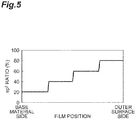
- FIGS. 2 to 5 are graphs respectively showing an example of the sp 2 ratio profile of the amorphous hard carbon film 3, in which a horizontal axis indicates a film position (a left side is the base material side and a right side is the outer surface side) and a vertical axis indicates a value of the sp 2 ratio.
- FIGS. 2 to 4 show a case in which the sp 2 ratio of the amorphous hard carbon film 3 increases continuously from the inner surface F1 (the side of the base material 1) toward the outer surface F2.
- FIG. 2 shows a linear increase case
- FIG. 3 shows a case in which an increasing curve has an upward convex shape
- FIG. 4 shows a case in which an increasing curve has a downward convex shape.
- FIG. 5 shows a case in which the sp 2 ratio increases stepwisely from the inner surface F1 (the side of the base material 1) toward the outer surface F2 in the amorphous hard carbon film 3. Additionally, here, a case in which the sp 2 ratio increases continuously or stepwisely has been exemplified, but a combination shape thereof may be used.
- an area on the side of the inner surface F1 is formed of amorphous hard carbon having a low sp 2 ratio (a high sp 3 ratio) and a relatively small deformability.
- An area having a low sp 2 ratio existing on the side of the inner surface F1 serves as a base film. That is, even when a material not subjected to a thermosetting treatment or surface modification for securing adhesion on its surface or a material having a relatively high thermal conductivity (for example, 30 W/(m ⁇ K) or more) is used as the base material 1, an area having a low sp 2 ratio suppresses the deformation of the interface and prevents the chipping or peeling of the amorphous hard carbon film 3. Additionally, the amorphous hard carbon having a low sp 2 ratio (a high sp 3 ratio) has a high thermal conductivity as compared with the amorphous hard carbon having a high sp 2 ratio (a low sp 3 ratio).
- an area on the side of the outer surface F2 is formed of amorphous hard carbon having a high sp 2 ratio (a low sp 3 ratio) and relative deformability.
- An area existing on the side of the outer surface F2 and having a high sp 2 ratio means that the bond strength of carbon atoms is relatively weak, that is, the film is relatively deformable. For example, when foreign substances such as wear powder and dust generated by sliding pass through the sliding surface, the surface of the film serves as a cushion and hence the peeling due to the cracking of the film can be prevented.
- the contact area with an adjacent member is narrow in an initial sliding state in which the film is not worn out.
- the sp 2 ratio may be high on the surface layer side.
- the surface pressure gradually decreases as the film wears out with use, the sp 2 ratio may decrease toward the inner surface side in relation to the outer surface side. For the sp 2 ratio, the strength of the film is low when the sp 2 ratio of the entire film is high.
- the outer surface F2 is formed of a material having a high sp 2 ratio, there is an advantage that a finishing process is facilitated.
- a value of (B - A) is preferably 20 or more, more preferably 20 to 60, and further preferably 40 to 60. Since the value of (B - A) is 20 or more, it is easy to sufficiently secure the adhesion of the amorphous hard carbon film 3 with respect to the base material 1. Accordingly, it is possible to highly suppress the chipping or peeling of the amorphous hard carbon film 3 and to readily achieve excellent wear resistance of the amorphous hard carbon film 3. Meanwhile, there is an advantage that the amorphous hard carbon film 3 of which the value of (B - A) is 60 or less can be readily formed, the film does not become excessively inhomogeneous, and minute chipping or peeling rarely occurs.
- the sp 2 ratio (A%) on the side of the inner surface F1 of the amorphous hard carbon film 3 is preferably smaller than 40%, more preferably 10 to 35%, and further preferably 15 to 30%. Since the sp 2 ratio (A%) on the side of the inner surface F1 is smaller than 40%, it is easy to sufficiently secure the adhesion of the amorphous hard carbon film 3 with respect to the base material 1, for example, even when a thermosetting treatment or surface modification for securing the adhesion is not performed on the surface of the base material 1. Meanwhile, there is an advantage that the amorphous hard carbon film 3 of which the sp 2 ratio (A%) on the side of the inner surface F1 is 10% or more can be readily formed and chipping rarely occurs.
- the sp 2 ratio (B%) on the side of the outer surface F2 of the amorphous hard carbon film 3 is preferably larger than 65%, more preferably 65% to 80%, and further preferably 70 to 75%. Since the sp 2 ratio (B%) on the side of the outer surface F2 is larger than 65%, the initial conformability with an adjacent member is excellent, the chipping or peeling of the amorphous hard carbon film 3 can be highly suppressed, and the excellent wear resistance of the amorphous hard carbon film 3 can be readily achieved. In addition, there is an advantage that the finishing processability of the amorphous hard carbon film 3 is excellent. Meanwhile, there is an advantage that the amorphous hard carbon film 3 of which the sp 2 ratio (B%) on the side of the outer surface F2 is 80% or less can be readily formed, an excessive decrease in strength does not occur, and durability can be secured.
- the thickness of the amorphous hard carbon film 3 is, for example, in the range of 3 to 40 ⁇ m. The wear rarely occurs when the thickness of the amorphous hard carbon film 3 is 3 ⁇ m or more. Meanwhile, when the thickness of the amorphous hard carbon film 3 is 40 ⁇ m or less, an excessive increase in internal stress of the film can be suppressed and the occurrence of the chipping or peeling can be readily suppressed. From the viewpoint of the productivity or durability of the sliding member 10, the thickness of the amorphous hard carbon film 3 is preferably 3 to 20 ⁇ m and more preferably 5 to 12 ⁇ m.
- the amorphous hard carbon film 3 has the graded structure of the sp 2 ratio, it is possible to sufficiently secure the adhesion with the base material 1 even when the amorphous hard carbon film 3 is relatively thick.
- the lower limit value of the thickness of the amorphous hard carbon film 3 may be 8 ⁇ m or 10 ⁇ m and may be 16 ⁇ m or 22 ⁇ m, for example, when excellent durability is required.
- the amorphous hard carbon film 3 does not substantially include hydrogen from the viewpoint of achieving the low friction coefficient.
- the hydrogen content of the amorphous hard carbon film 3 is preferably smaller than 5 atomic%, more preferably smaller than 3 atomic%, further preferably smaller than 2 atomic%, and particularly preferably smaller than 1 atomic%.
- the amorphous hard carbon which substantially does not include hydrogen has excellent thermal conductivity.
- the hydrogen content of the amorphous hard carbon film 3 can be measured by Rutherford Backscattering Spectrometry (RBS) and Hydrogen Forward Scattering (HFS).
- the density of the relatively large droplets (for example, a size of 300 ⁇ m 2 or more) existing on the surface of the amorphous hard carbon film 3 be 600 pieces/mm 2 or less. Since the density is set to 600 pieces/mm 2 or less, the initial conformability with an adjacent member is excellent, the chipping of the amorphous hard carbon film 3 or the peeling of the surface layer can be suppressed, and the wear resistance is excellent.
- the density of droplets is more preferably 300 pieces/mm 2 or less.
- the density of droplets can be calculated by visually counting the number of the concave portions or the convex portions having a size of 300 ⁇ m 2 or more due to the incorporation of droplet particles or the separation of particles existing within a predetermined range of the surface by using a microscope. Of course, this may be counted by using an image process or the like.
- a suitable material may be employed in response to the application of the sliding member 10.
- the sliding member 10 is required to have high thermal conductivity, for example, the piston ring having a configuration illustrated in FIG. 1 is manufactured, it is preferable to employ a material (for example, a steel material) having a thermal conductivity of 30 W/(m ⁇ K) or more as the base material 1.
- the thermal conductivity of the base material 1 is more preferably 35 W/(m ⁇ K) or more and further preferably 38 W/(m ⁇ K) or more.
- the piston ring has an important function of transmitting the heat received by the piston top portion to the cooled cylinder wall in addition to a gas sealing function of maintaining the air-tightness between the piston and the cylinder wall and an oil control function of maintaining an appropriate lubricant film on the cylinder wall.
- the thermal conductivity of the steel material becomes higher as the content of the alloy component becomes smaller.
- the high temperature characteristics are inferior, the material cannot be used as a sliding member of an automobile engine in a high heat load environment.
- it is possible to achieve both of thermal conductivity and high temperature characteristics by performing system control of improving high temperature characteristics by reinforcing particle dispersion of spheroidized cementite, or the like.
- material symbols SUP9, SUP10, and the like defined in JIS G4801 can be exemplified.
- the intermediate layer 5 is used to further improve the adhesion between the base material 1 and the amorphous hard carbon film 3.
- the intermediate layer 5 is preferably formed of a component which has lattice matching with the metal of the base material 1 and which is more likely to form carbon and carbide of the amorphous hard carbon film 3 as compared with the metal of the base material 1.
- the intermediate layer 5 is preferably formed of at least one metal selected from a group consisting of Ti, Cr, Si, Co, V, Mo, and W or its metal carbide.
- the intermediate layer 5 is preferably formed of a nitride of at least one metal selected from the group consisting of Ti, Zr, Cr, Si, and V. In this case, even when the amorphous hard carbon film 3 is worn away, the sliding property can be maintained by the presence of the intermediate layer 5.
- the thickness of the intermediate layer 5 be thin to a degree that the deformation of the intermediate layer 5 does not influence the adhesion of the amorphous hard carbon film 3.
- the thickness of the intermediate layer 5 is preferably 0.01 to 0.4 ⁇ m, more preferably 0.03 to 0.3 ⁇ m, and further preferably 0.05 to 0.2 ⁇ m.
- the intermediate layer 5 may not be provided.
- the amorphous hard carbon film 3 substantially does not include hydrogen, it is easy to secure sufficient adhesion even when the intermediate layer 5 is not provided if scale, oil, or the like does not adhere to the base material 1.
- the amorphous hard carbon film 3 can be formed by using, for example, an arc ion plating device equipped with a graphite cathode as an evaporation source. According to this device, the amorphous hard carbon film 3 is formed in such a manner that a vacuum arc discharge is generated between a graphite cathode and an anode in a vacuum atmosphere to evaporate and ionize a carbon material from a surface of a carbon cathode and carbon ions are deposited on a sliding surface of a base material (the sliding member to be provided with an amorphous hard carbon film) to which a negative bias voltage is applied.
- a base material the sliding member to be provided with an amorphous hard carbon film
- the distribution of the sp 2 ratio of the amorphous hard carbon film 3 can be adjusted according to, for example, the following method. That is, it is possible to obtain a target sp 2 ratio distribution (a graded structure) by appropriately adjusting the bias voltage applied to the sliding member during the formation of the film in the arc ion plating device.
- the film may be formed without introducing a carbon-based gas. Additionally, hydrogen may be included at less than 5 atomic% due to the moisture remaining on the wall surface in the device. Since the droplets characteristically formed in the arc ion plating are incorporated into the amorphous hard carbon film 3 to reduce the film strength, a filtered arc system equipped with a magnetic filter for removing the droplets may be used. In this case, it is possible to form the amorphous hard carbon film 3 which is very homogeneous and has excellent wear resistance with fewer droplets.
- the sliding member 10 including the intermediate layer 5 formed between the base material 1 and the amorphous hard carbon film 3 if necessary has been exemplified.
- a wear resistant surface treatment layer may be further formed on the outer surface side of the amorphous hard carbon film 3 or a base film may be formed on the inner surface side thereof.
- a piston ring was manufactured as below by using an arc ion plating device.
- a pre-cleaned piston ring base material (SUP10 equivalent material) was set in a jig.
- the inside of a chamber of the device was set to a vacuum atmosphere of 1 ⁇ 10 -3 Pa or less.
- An Ar gas was introduced into the chamber, a bias voltage was applied to the base material, and the surface of the base material was cleaned by a glow discharge.
- an intermediate layer was formed of Cr.
- the evaporation source of the graphite cathode was discharged to form an amorphous hard carbon film on the surface of the intermediate layer.
- a piston ring was manufactured similarly to Example 1 except that a film was formed by adjusting a pulse bias voltage in order to obtain a sp 2 ratio profile shown in FIG. 3 .
- a piston ring was manufactured similarly to Example 1 except that a film was formed by adjusting a pulse bias voltage in order to obtain a sp 2 ratio profile shown in FIG. 4 .
- a piston ring was manufactured similarly to Example 1 except that a film was formed so that a value of B - A was smaller than 20% by reducing a change width of a pulse bias voltage.
- a piston ring was manufactured similarly to Example 1 except that an amorphous hard carbon film was formed while maintaining a constant bias voltage without continuously changing the bias voltage with the elapse of the film forming time.
- the profile of the sp 2 ratio of the hard carbon film in the film thickness direction was evaluated as below. That is, the sp 2 ratio was measured at the interval of about 2 ⁇ m from the inner surface side of the amorphous hard carbon film toward the outer surface side thereof while observing the cross-section of the amorphous hard carbon film using a transmission electron microscope (TEM).
- TEM transmission electron microscope
- the vicinity of the inner surface of Table 1 is a measurement value of the sp 2 ratio at a position of about 0.2 ⁇ m within the amorphous carbon film from the interface with the intermediate layer.
- the vicinity of the inner surface may be a measurement value of the sp 2 ratio at a position of about 0.2 ⁇ m within the amorphous carbon film from the interface with the base material.
- the vicinity of the outer surface is a measurement value of the sp 2 ratio at a position about 0.2 ⁇ m within the amorphous carbon film from the surface.
- the sp 2 ratio was calculated on the basis of the spectrum obtained according to electron energy loss spectroscopy (EELS).
- the hard carbon layer of the thin sample is observed by TEM-EELS and the obtained observation value is subjected to the correction of the influence of the background signal, and the like.
- the sp 2 ratio is calculated as below by the analysis based on the corrected data.
- the hydrogen content of the amorphous hard carbon film was obtained by Rutherford Backscattering Spectroscopy (RBS) and Hydrogen Forward Scattering (HFS).
- the hydrogen content for the outer surface side of the amorphous hard carbon film was measured.
- RBS made by CEA was used as a measurement device and the measurement conditions were set as below.
- the thickness of the amorphous hard carbon film was measured by so-called CALOTEST (dimension measurement of polishing marks) according to a spherical polishing method.
- the peel resistance was measured by a reciprocation sliding test.
- a test device one having a configuration illustrated in FIG. 6 was used.
- An FC (cast iron) plate 21 illustrated in FIG. 6 corresponds to a cylinder and a piston ring piece 22 fixed to a jig (not illustrated) moves in a reciprocating manner on the FC plate 21 in the thickness direction of the piston ring piece 22 (the left and right direction of FIG. 6 ) under the presence of the lubricant 23.
- the FC plate 21 one having surface roughness R zjis adjusted to 1.1 ⁇ m by polishing process was used.
- the piston ring piece 22 was prepared by cutting the piston ring into a length of about 30 mm.
- the test conditions were set such that a vertical load (F) was 500 N, 600 N, 700 N, 800 N, or 900 N, a stroke was 3 mm, a speed was 3000 rpm, a plate temperature was 120°C, a lubrication was performed by dropping 3 drops of engine oil 0W-20, and a test time was 30 minutes.
- the evaluation of the peel resistance of the amorphous hard carbon film was performed by visually observing the presence of the peeling in the periphery of the oval sliding portion 24 generated in the piston ring piece 22 after the test illustrated in FIG. 7 . Further, the evaluation of the wear resistance was performed on the basis of the amount of wear of Example 1 (vertical load: 500 N).
- Example 1 Example 2
- Example 3 Example 4 Comparative Example 1 2 sp 2 Ratio (%) Vicinity of inner surface A 24 45 23 21 45 Distance from inner surface 1.0 ⁇ m 27 47 24 24 45 3.0 ⁇ m 40 55 28 28 47 5.0 ⁇ m 51 60 32 31 45 7.0 ⁇ m 59 62 40 34 45 9.0 ⁇ m 73 65 50 38 46 Vicinity of outer surface B 78 66 55 39 46 B-A 54 21 32 18 2 Hydrogen content (atomic %) 1.2 2.4 0.8 3.2 1.0 Thickness of amorphous hard carbon film ( ⁇ m) 9.8 9.7 9.8 9.9 11.8 Presence of peeling Vertical load 500 N No No No No No No 600 N No No No No No No 700 N No No No Yes Yes 800 N No Yes No Yes Yes 900 N No Yes Yes Yes Yes Wear amount ratio (Based on vertical load of 500 N of Example 1) 1 0.9 0.8 1.5 2.1
- a sliding member and a piston ring capable of sufficiently suppressing an amorphous hard carbon film from being peeled off from a base material and having sufficiently high wear resistance are provided.
Landscapes
- Chemical & Material Sciences (AREA)
- Engineering & Computer Science (AREA)
- Mechanical Engineering (AREA)
- Organic Chemistry (AREA)
- Materials Engineering (AREA)
- Metallurgy (AREA)
- Chemical Kinetics & Catalysis (AREA)
- Inorganic Chemistry (AREA)
- General Engineering & Computer Science (AREA)
- Combustion & Propulsion (AREA)
- Physical Vapour Deposition (AREA)
- Pistons, Piston Rings, And Cylinders (AREA)
- Sliding-Contact Bearings (AREA)
Abstract
Description
- The present disclosure relates to a sliding member whose sliding surface is coated with an amorphous hard carbon film and particularly to one used in vehicle parts or mechanical parts. As an example, a piston ring is exemplified.
- Automobile engines are required to improve fuel efficiency. For example, in order to reduce friction loss, piston rings whose sliding surfaces are coated with an amorphous hard carbon film having a low friction coefficient are applied to some engines. The amorphous hard carbon film is also referred to as a diamond like carbon (DLC) film (or simply a hard carbon film). The amorphous hard carbon film is a mixture of diamond bond (sp3 bond) and graphite bond (sp2 bond) as a carbon bond. The amorphous hard carbon film is suitable as a protective film of the sliding member because it has hardness, wear resistance, and chemical stability similar to those of diamond as well as solid lubricity and a low friction coefficient similar to those of graphite.
-
Patent Literature 1 relates to a piston ring which includes a hard carbon film formed on at least an outer peripheral sliding surface of a piston ring base material. This hard carbon film has a feature that a sp2 component ratio is in the range of 40% to 80%, a hydrogen content is in the range of 0.1 atomic% to 5 atomic%, and the amount of macroparticles appearing on a surface is in the range of 0.1% to 10% in proportion to the area. According toPatent Literature 1, the piston ring with the above-described configuration readily forms a film and wear resistance is excellent. Additionally, the "sp2 component ratio" ofPatent Literature 1 indicates a component ratio (sp2/(sp2 + sp3)) of a graphite component (sp2) with respect to a graphite component (sp2) and a diamond component (sp3) of the hard carbon film and is measured by TEM-EELS spectrum obtained by combining a transmission electron microscope (TEM) with electron energy loss spectroscopy (EELS) (see Paragraphs [0054] to [0056] of Patent Literature 1). - Patent Literature 1:
WO2015/115601 - As an initial matter, the amorphous hard carbon film substantially without hydrogen (for example, the film having a hydrogen content smaller than 5 atomic%) can be formed to have a film thickness of about 30 µm by adjusting a film forming condition. However, a film having a high sp3 ratio has large residual stress when forming the film. When a thick film is formed, the adhesion with the base material becomes insufficient and hence the film is readily peeled off therefrom. Meanwhile, a relatively soft film having a low sp3 ratio has a problem that the film is readily peeled off due to plastic deformation of the base material or the wear due to sliding under a high surface pressure.
- There is a room for improvement in that the hard carbon film is readily peeled off from the base material (the piston ring base material) even when the sp2 component ratio of the hard carbon film is in the range of 40 to 80% as in the piston ring described in
Patent Literature 1. That is, when a film (a relatively hard film) having a relatively low sp2 component ratio is formed thick, the adhesion with the base material is not sufficient. Meanwhile, in a film (a relatively soft film) having a relatively high sp2 component ratio, the peeling due to the plastic deformation of the base material or the wear due to the sliding under a high surface pressure is not sufficiently prevented. Particularly, when a high thermal conductive material without a thermosetting treatment or surface modification is applied to the base material in order to efficiently release heat inside a combustion chamber to a cylinder wall surface, the surface pressure at the time of sliding tends to cause chipping or peeling of the film due to the deformation of the interface with the base material. - According to the examination of the inventors, the amorphous hard carbon film has the following two essential properties and the low adhesion to the base material is a major obstacle to a practical use due to these properties.
- (1) The large residual stress exists due to the film formation.
- (2) The carbon bond is chemically stable.
- An object of the disclosure is to provide a sliding member and a piston ring capable of sufficiently suppressing an amorphous hard carbon film from being peeled off from a base material and having sufficiently high wear resistance.
- The inventors have carried out a careful examination in order to solve the above-described problems and have found that a sliding member with an amorphous hard carbon film having excellent wear resistance and preventing chipping or peeling of a film due to an excellent adhesion with a base material can be obtained by a graded structure in which a sp2 ratio increases continuously or stepwisely in a film thickness direction of the amorphous hard carbon film formed on a sliding surface of the sliding member. As a result, the following invention is completed.
- A sliding member of the disclosure includes a base material, and an amorphous hard carbon film formed on a surface of the base material, in which the amorphous hard carbon film has a graded structure in which a sp2 ratio increases from an inner surface side corresponding to the base material side toward an outer surface side. According to the examination of the inventors, such a graded structure is useful for achieving both excellent peel resistance and wear resistance at a sufficiently high level. That is, a relatively low sp2 ratio of the base material side in the amorphous hard carbon film (hereinafter, referred to as a "film") of the sliding member means that the amorphous hard carbon film in the vicinity of the base material has relatively high strength. Accordingly, it is possible to prevent the peeling of the film due to the breakage of the film caused by the load applied to the film in the vicinity of the interface with the base material at the time of sliding in a high load state. Further, even when the soft base material is used, it is possible to suppress the deformation of the base material and to prevent the peeling of the film caused by the deformation. That is, it is possible to secure a sufficient adhesion with the base material. Meanwhile, a case in which the sp2 ratio of the outer surface side is relatively high means that the bond strength of carbon atoms is relatively weak, that is, the film is flexible. For example, when foreign substances such as wear powder and dust generated by sliding pass through the sliding surface, the surface of the film serves as a cushion and hence the peeling due to a crack in the film can be prevented. When the sp2 ratio of the entire film is high, the strength of the film decreases. Meanwhile, when the sp2 ratio has a gradation between the inner surface side and the outer surface side, the adhesion can be secured while maintaining the film strength (the wear resistance).
- In particular, in the case of the application to a part such as a piston ring having a curved sliding surface, the contact area with an adjacent member is narrow in an initial sliding state in which the film is not worn out. Additionally, since there is a risk that a crack is generated due to a high local surface pressure when foreign substances leak, the sp2 ratio may be high on the surface layer side. Additionally, since the surface pressure gradually decreases as the film wears out with use, the sp2 ratio may decrease toward the inner surface side in relation to the outer surface side. That is, as the film wears out with the use of the piston ring, an area (a relatively hard area) having a low sp2 ratio is exposed to the surface due to the graded structure of the film. In a state in which the relatively hard area is exposed, since the surface pressure of the piston ring is normally lower than the initial state, the crack due to, for example, the locally high surface pressure tends to rarely occur.
- In the disclosure, the "sp2 ratio" indicates a ratio (sp2/(sp2 + sp3)) of sp2 bond with respect to sp2 bond and sp3 bond of the amorphous hard carbon film and means a value calculated on the basis of spectrum obtained by electron energy loss spectroscopy (EELS).
- Additionally, the sp2 ratio in the thickness direction of the amorphous hard carbon film may increase continuously or stepwisely or a combination thereof may be used. Further, a basic condition of the invention is a condition related to the amorphous hard carbon film. When such a condition is satisfied, the amorphous hard carbon film having excellent peel resistance and wear resistance can be obtained. Thus, a configuration in which a wear resistant surface treatment layer is further formed on the outer surface side of the amorphous hard carbon film and a base film is formed on the inner surface side thereof does not deviate from the scope of the invention. Further, a configuration in which an intermediate layer formed of a specific metal or its carbide or nitride is formed between the base material and the amorphous hard carbon film does not deviate from the scope of the invention.
- When the sp2 ratio of the inner surface side of the amorphous hard carbon film is indicated by A% and the sp2 ratio of the outer surface side of the amorphous hard carbon film is indicated by B%, a value of (B - A) may be 20 or more. Further, the sp2 ratio (A%) of the inner surface side of the amorphous hard carbon film may be smaller than 40% and the sp2 ratio (B%) of the outer surface side of the amorphous hard carbon film may be larger than 65%. From the viewpoint of achieving a friction coefficient in which the hydrogen content of the amorphous hard carbon film is low, a value smaller than 5 atomic% can be used. A thickness of the amorphous hard carbon film is, for example, 3 µm to 40 µm.
- A density of droplets of 300 µm2 or more in size existing on the surface of the amorphous hard carbon film may be 600 pieces/mm2 or less. The droplet is a concave portion or a convex portion formed on the surface of the amorphous hard carbon film due to the incorporation of droplet particles or the separation of particles.
- As a material forming the base material, for example, a steel material having a thermal conductivity of 30 W/(m·K) or more can be employed from the viewpoint of achieving excellent thermal conductivity of the sliding member. In recent years, downsizing of the engine has been promoted in order to achieve further improvement in fuel efficiency and performance from the viewpoint of environmental protection and, for example, a system in which a direct injection engine is combined with a turbocharger has been developed. As a result, since the engine temperature rises, sliding members such as piston rings are required to fully function in a very severe environment such as high temperature and a high surface pressure. Further, an increase in engine temperature tends to cause knocking leading to a decrease in engine output. In order to suppress this knocking, the piston ring is required to have excellent wear resistance and high thermal conductivity capable of efficiently releasing heat in the combustion chamber from the piston to the cylinder wall surface through the piston ring.
- The disclosure provides a piston ring which includes the sliding member. Since the amorphous hard carbon film has the graded structure, this piston ring can sufficiently suppress the amorphous hard carbon film from being peeled off from the base material and have sufficiently high wear resistance.
- According to the disclosure, a sliding member and a piston ring capable of sufficiently suppressing an amorphous hard carbon film from being peeled off from a base material and having sufficiently high wear resistance are provided.
-
-
FIG. 1 is a cross-sectional view schematically illustrating an embodiment of a sliding member according to the disclosure. -
FIG. 2 is a graph showing an example of a sp2 ratio profile of an amorphous hard carbon film. -
FIG. 3 is a graph showing another example of the sp2 ratio profile of the amorphous hard carbon film. -
FIG. 4 is a graph showing another example of the sp2 ratio profile of the amorphous hard carbon film. -
FIG. 5 is a graph showing another example of the sp2 ratio profile of the amorphous hard carbon film. -
FIG. 6 is a perspective view schematically illustrating a case of performing a method of a reciprocation sliding test. -
FIG. 7 is a plan view illustrating a surface of a piston ring piece subjected to the reciprocation sliding test. - Hereinafter, embodiments of the disclosure will be described with reference to the drawings. The invention is not limited to the following embodiments.
-
FIG. 1 is a cross-sectional view schematically illustrating a structure of a sliding member according to an embodiment. As illustrated in the drawing, a slidingmember 10 includes abase material 1, an amorphoushard carbon film 3 which is formed on a surface of thebase material 1, and anintermediate layer 5 which is formed between thebase material 1 and the amorphoushard carbon film 3. That is, the slidingmember 10 is manufactured by forming the amorphoushard carbon film 3 on the surface of thebase material 1 with theintermediate layer 5 interposed therebetween. - In a cross-section of the amorphous
hard carbon film 3 illustrated inFIG. 1 , the shading indicates a sp2 ratio. Specifically, a portion with a low sp2 ratio is indicated by a light color and a portion with a high sp2 ratio is indicated by a dark color. That is, the amorphoushard carbon film 3 has a graded structure in which the sp2 ratio increases from a side of an inner surface F1 corresponding to a side of thebase material 1 toward a side of an outer surface F2. - In the amorphous
hard carbon film 3, the sp2 ratio may increase continuously or stepwisely.FIGS. 2 to 5 are graphs respectively showing an example of the sp2 ratio profile of the amorphoushard carbon film 3, in which a horizontal axis indicates a film position (a left side is the base material side and a right side is the outer surface side) and a vertical axis indicates a value of the sp2 ratio.FIGS. 2 to 4 show a case in which the sp2 ratio of the amorphoushard carbon film 3 increases continuously from the inner surface F1 (the side of the base material 1) toward the outer surface F2.FIG. 2 shows a linear increase case,FIG. 3 shows a case in which an increasing curve has an upward convex shape, andFIG. 4 shows a case in which an increasing curve has a downward convex shape.FIG. 5 shows a case in which the sp2 ratio increases stepwisely from the inner surface F1 (the side of the base material 1) toward the outer surface F2 in the amorphoushard carbon film 3. Additionally, here, a case in which the sp2 ratio increases continuously or stepwisely has been exemplified, but a combination shape thereof may be used. - In the amorphous
hard carbon film 3, an area on the side of the inner surface F1 is formed of amorphous hard carbon having a low sp2 ratio (a high sp3 ratio) and a relatively small deformability. An area having a low sp2 ratio existing on the side of the inner surface F1 serves as a base film. That is, even when a material not subjected to a thermosetting treatment or surface modification for securing adhesion on its surface or a material having a relatively high thermal conductivity (for example, 30 W/(m·K) or more) is used as thebase material 1, an area having a low sp2 ratio suppresses the deformation of the interface and prevents the chipping or peeling of the amorphoushard carbon film 3. Additionally, the amorphous hard carbon having a low sp2 ratio (a high sp3 ratio) has a high thermal conductivity as compared with the amorphous hard carbon having a high sp2 ratio (a low sp3 ratio). - In the amorphous
hard carbon film 3, an area on the side of the outer surface F2 is formed of amorphous hard carbon having a high sp2 ratio (a low sp3 ratio) and relative deformability. An area existing on the side of the outer surface F2 and having a high sp2 ratio means that the bond strength of carbon atoms is relatively weak, that is, the film is relatively deformable. For example, when foreign substances such as wear powder and dust generated by sliding pass through the sliding surface, the surface of the film serves as a cushion and hence the peeling due to the cracking of the film can be prevented. Particularly, in the case of the application to a part such as a piston ring having a curved sliding surface, the contact area with an adjacent member is narrow in an initial sliding state in which the film is not worn out. Additionally, since there is a risk that a crack is generated due to a locally high surface pressure when foreign substances leak, the sp2 ratio may be high on the surface layer side. Additionally, since the surface pressure gradually decreases as the film wears out with use, the sp2 ratio may decrease toward the inner surface side in relation to the outer surface side. For the sp2 ratio, the strength of the film is low when the sp2 ratio of the entire film is high. However, when there is a gradation between the inner surface side and the outer surface side, it is possible to secure the adhesion while maintaining the film strength (the wear resistance). Further, since the outer surface F2 is formed of a material having a high sp2 ratio, there is an advantage that a finishing process is facilitated. - When the sp2 ratio on the side of the inner surface F1 of the amorphous
hard carbon film 3 is indicated by A% and the sp2 ratio on the side of the outer surface F2 of the amorphoushard carbon film 3 is indicated by B%, a value of (B - A) is preferably 20 or more, more preferably 20 to 60, and further preferably 40 to 60. Since the value of (B - A) is 20 or more, it is easy to sufficiently secure the adhesion of the amorphoushard carbon film 3 with respect to thebase material 1. Accordingly, it is possible to highly suppress the chipping or peeling of the amorphoushard carbon film 3 and to readily achieve excellent wear resistance of the amorphoushard carbon film 3. Meanwhile, there is an advantage that the amorphoushard carbon film 3 of which the value of (B - A) is 60 or less can be readily formed, the film does not become excessively inhomogeneous, and minute chipping or peeling rarely occurs. - The sp2 ratio (A%) on the side of the inner surface F1 of the amorphous
hard carbon film 3 is preferably smaller than 40%, more preferably 10 to 35%, and further preferably 15 to 30%. Since the sp2 ratio (A%) on the side of the inner surface F1 is smaller than 40%, it is easy to sufficiently secure the adhesion of the amorphoushard carbon film 3 with respect to thebase material 1, for example, even when a thermosetting treatment or surface modification for securing the adhesion is not performed on the surface of thebase material 1. Meanwhile, there is an advantage that the amorphoushard carbon film 3 of which the sp2 ratio (A%) on the side of the inner surface F1 is 10% or more can be readily formed and chipping rarely occurs. - The sp2 ratio (B%) on the side of the outer surface F2 of the amorphous
hard carbon film 3 is preferably larger than 65%, more preferably 65% to 80%, and further preferably 70 to 75%. Since the sp2 ratio (B%) on the side of the outer surface F2 is larger than 65%, the initial conformability with an adjacent member is excellent, the chipping or peeling of the amorphoushard carbon film 3 can be highly suppressed, and the excellent wear resistance of the amorphoushard carbon film 3 can be readily achieved. In addition, there is an advantage that the finishing processability of the amorphoushard carbon film 3 is excellent. Meanwhile, there is an advantage that the amorphoushard carbon film 3 of which the sp2 ratio (B%) on the side of the outer surface F2 is 80% or less can be readily formed, an excessive decrease in strength does not occur, and durability can be secured. - The thickness of the amorphous
hard carbon film 3 is, for example, in the range of 3 to 40 µm. The wear rarely occurs when the thickness of the amorphoushard carbon film 3 is 3 µm or more. Meanwhile, when the thickness of the amorphoushard carbon film 3 is 40 µm or less, an excessive increase in internal stress of the film can be suppressed and the occurrence of the chipping or peeling can be readily suppressed. From the viewpoint of the productivity or durability of the slidingmember 10, the thickness of the amorphoushard carbon film 3 is preferably 3 to 20 µm and more preferably 5 to 12 µm. Additionally, since the amorphoushard carbon film 3 has the graded structure of the sp2 ratio, it is possible to sufficiently secure the adhesion with thebase material 1 even when the amorphoushard carbon film 3 is relatively thick. The lower limit value of the thickness of the amorphoushard carbon film 3 may be 8 µm or 10 µm and may be 16 µm or 22 µm, for example, when excellent durability is required. - It is preferable that the amorphous
hard carbon film 3 does not substantially include hydrogen from the viewpoint of achieving the low friction coefficient. Specifically, the hydrogen content of the amorphoushard carbon film 3 is preferably smaller than 5 atomic%, more preferably smaller than 3 atomic%, further preferably smaller than 2 atomic%, and particularly preferably smaller than 1 atomic%. When the amorphoushard carbon film 3 does not substantially include hydrogen, dangling bonds of surface carbon atoms of the amorphoushard carbon film 3 are not terminated by hydrogen. For this reason, since an oil agent constituent molecule having an OH group in the lubricant is readily adsorbed to the surface of the amorphoushard carbon film 3, it is observed that a very low friction coefficient is exhibited. Further, the amorphous hard carbon which substantially does not include hydrogen has excellent thermal conductivity. The hydrogen content of the amorphoushard carbon film 3 can be measured by Rutherford Backscattering Spectrometry (RBS) and Hydrogen Forward Scattering (HFS). - It is preferable that the density of the relatively large droplets (for example, a size of 300 µm2 or more) existing on the surface of the amorphous
hard carbon film 3 be 600 pieces/mm2 or less. Since the density is set to 600 pieces/mm2 or less, the initial conformability with an adjacent member is excellent, the chipping of the amorphoushard carbon film 3 or the peeling of the surface layer can be suppressed, and the wear resistance is excellent. The density of droplets is more preferably 300 pieces/mm2 or less. The density of droplets can be calculated by visually counting the number of the concave portions or the convex portions having a size of 300 µm2 or more due to the incorporation of droplet particles or the separation of particles existing within a predetermined range of the surface by using a microscope. Of course, this may be counted by using an image process or the like. - As the
base material 1, a suitable material may be employed in response to the application of the slidingmember 10. When the slidingmember 10 is required to have high thermal conductivity, for example, the piston ring having a configuration illustrated inFIG. 1 is manufactured, it is preferable to employ a material (for example, a steel material) having a thermal conductivity of 30 W/(m·K) or more as thebase material 1. The thermal conductivity of thebase material 1 is more preferably 35 W/(m·K) or more and further preferably 38 W/(m·K) or more. The piston ring has an important function of transmitting the heat received by the piston top portion to the cooled cylinder wall in addition to a gas sealing function of maintaining the air-tightness between the piston and the cylinder wall and an oil control function of maintaining an appropriate lubricant film on the cylinder wall. - In general, the thermal conductivity of the steel material becomes higher as the content of the alloy component becomes smaller. In contrast, since the high temperature characteristics are inferior, the material cannot be used as a sliding member of an automobile engine in a high heat load environment. However, for example, it is possible to achieve both of thermal conductivity and high temperature characteristics by performing system control of improving high temperature characteristics by reinforcing particle dispersion of spheroidized cementite, or the like. As such a steel material, material symbols SUP9, SUP10, and the like defined in JIS G4801 can be exemplified.
- The
intermediate layer 5 is used to further improve the adhesion between thebase material 1 and the amorphoushard carbon film 3. Theintermediate layer 5 is preferably formed of a component which has lattice matching with the metal of thebase material 1 and which is more likely to form carbon and carbide of the amorphoushard carbon film 3 as compared with the metal of thebase material 1. Specifically, theintermediate layer 5 is preferably formed of at least one metal selected from a group consisting of Ti, Cr, Si, Co, V, Mo, and W or its metal carbide. Further, when the slidingmember 10 is used in a severe environment such as high surface pressure, theintermediate layer 5 is preferably formed of a nitride of at least one metal selected from the group consisting of Ti, Zr, Cr, Si, and V. In this case, even when the amorphoushard carbon film 3 is worn away, the sliding property can be maintained by the presence of theintermediate layer 5. - It is preferable that the thickness of the
intermediate layer 5 be thin to a degree that the deformation of theintermediate layer 5 does not influence the adhesion of the amorphoushard carbon film 3. Specifically, the thickness of theintermediate layer 5 is preferably 0.01 to 0.4 µm, more preferably 0.03 to 0.3 µm, and further preferably 0.05 to 0.2 µm. - When sufficient adhesion can be secured even when the amorphous
hard carbon film 3 is directly formed on the surface of thebase material 1, theintermediate layer 5 may not be provided. For example, when the amorphoushard carbon film 3 substantially does not include hydrogen, it is easy to secure sufficient adhesion even when theintermediate layer 5 is not provided if scale, oil, or the like does not adhere to thebase material 1. For the excellent adhesion, it is preferable to clean the surface of thebase material 1 before the formation of the amorphoushard carbon film 3. For example, it is preferable to remove the oxide film on the surface of thebase material 1 by a mechanical pre-processing and to clean the surface by a hydrocarbon type cleaning agent. - The amorphous
hard carbon film 3 can be formed by using, for example, an arc ion plating device equipped with a graphite cathode as an evaporation source. According to this device, the amorphoushard carbon film 3 is formed in such a manner that a vacuum arc discharge is generated between a graphite cathode and an anode in a vacuum atmosphere to evaporate and ionize a carbon material from a surface of a carbon cathode and carbon ions are deposited on a sliding surface of a base material (the sliding member to be provided with an amorphous hard carbon film) to which a negative bias voltage is applied. - The distribution of the sp2 ratio of the amorphous
hard carbon film 3 can be adjusted according to, for example, the following method. That is, it is possible to obtain a target sp2 ratio distribution (a graded structure) by appropriately adjusting the bias voltage applied to the sliding member during the formation of the film in the arc ion plating device. - In order to form the amorphous
hard carbon film 3 which substantially does not include hydrogen, the film may be formed without introducing a carbon-based gas. Additionally, hydrogen may be included at less than 5 atomic% due to the moisture remaining on the wall surface in the device. Since the droplets characteristically formed in the arc ion plating are incorporated into the amorphoushard carbon film 3 to reduce the film strength, a filtered arc system equipped with a magnetic filter for removing the droplets may be used. In this case, it is possible to form the amorphoushard carbon film 3 which is very homogeneous and has excellent wear resistance with fewer droplets. - As described above, the embodiments of the disclosure have been described in detail, but the invention is not limited to the above-described embodiments. For example, in an above-described embodiment, the sliding
member 10 including theintermediate layer 5 formed between thebase material 1 and the amorphoushard carbon film 3 if necessary has been exemplified. However, for example, a wear resistant surface treatment layer may be further formed on the outer surface side of the amorphoushard carbon film 3 or a base film may be formed on the inner surface side thereof. - Hereinafter, Examples and Comparative Examples of the disclosure will be described. The invention is not limited to the following examples.
- A piston ring was manufactured as below by using an arc ion plating device. First, a pre-cleaned piston ring base material (SUP10 equivalent material) was set in a jig. An arc ion plating device with a graphite cathode and a Cr cathode was prepared in an evaporation source. After the above-described jig was attached to a rotation shaft of a rotation table of this device, the inside of a chamber of the device was set to a vacuum atmosphere of 1 × 10⁻³ Pa or less. An Ar gas was introduced into the chamber, a bias voltage was applied to the base material, and the surface of the base material was cleaned by a glow discharge. Then, an intermediate layer was formed of Cr. Next, the evaporation source of the graphite cathode was discharged to form an amorphous hard carbon film on the surface of the intermediate layer.
- In this example, at the time of forming the amorphous hard carbon film, an arc current was made constant and a pulse bias voltage was linearly decreased from 1500 V to 100 V as the film forming time elapsed. Accordingly, the piston ring according to Example 1 having a graded structure in which the sp2 ratio increases from the inner surface side toward the outer surface side was manufactured. Additionally, a relationship between the pulse bias voltage and the sp2 ratio was measured in a separately conducted preliminary test.
- A piston ring was manufactured similarly to Example 1 except that a film was formed by adjusting a pulse bias voltage in order to obtain a sp2 ratio profile shown in
FIG. 3 . - A piston ring was manufactured similarly to Example 1 except that a film was formed by adjusting a pulse bias voltage in order to obtain a sp2 ratio profile shown in
FIG. 4 . - A piston ring was manufactured similarly to Example 1 except that a film was formed so that a value of B - A was smaller than 20% by reducing a change width of a pulse bias voltage.
- A piston ring was manufactured similarly to Example 1 except that an amorphous hard carbon film was formed while maintaining a constant bias voltage without continuously changing the bias voltage with the elapse of the film forming time.
- The piston rings according to Examples 1 to 4 and Comparative Example 1 were measured and evaluated as below. The result is shown in Table 1.
- The profile of the sp2 ratio of the hard carbon film in the film thickness direction was evaluated as below. That is, the sp2 ratio was measured at the interval of about 2 µm from the inner surface side of the amorphous hard carbon film toward the outer surface side thereof while observing the cross-section of the amorphous hard carbon film using a transmission electron microscope (TEM). The vicinity of the inner surface of Table 1 is a measurement value of the sp2 ratio at a position of about 0.2 µm within the amorphous carbon film from the interface with the intermediate layer. Additionally, when the intermediate layer is not formed, the vicinity of the inner surface may be a measurement value of the sp2 ratio at a position of about 0.2 µm within the amorphous carbon film from the interface with the base material. The vicinity of the outer surface is a measurement value of the sp2 ratio at a position about 0.2 µm within the amorphous carbon film from the surface. The sp2 ratio was calculated on the basis of the spectrum obtained according to electron energy loss spectroscopy (EELS).
- The hard carbon layer of the thin sample is observed by TEM-EELS and the obtained observation value is subjected to the correction of the influence of the background signal, and the like. The sp2 ratio is calculated as below by the analysis based on the corrected data.
- (1) Based on the energy loss spectrum, data is acquired in an area of 240 eV to 550 eV.
- (2) An approximate curve is calculated for data with an energy loss of 320 eV or more.
- (3) The observed values are normalized on the basis of the obtained approximate curve.
- (4) Peaks are separated by using a Gaussian function in the range of 280 to 295 eV using normalized data, the peak area on the low energy side is obtained, and the value is set as Sπ.
- (5) In the normalized data, an area of 280 to 310 eV is calculated and is set as Sπ + σ.
- (6) Similarly, diamond and graphite samples are observed in order from (1) to (5) and each of an area of a peak in the vicinity of 285 eV and an area of 280 to 310 eV is calculated. An area obtained for diamond is set as Sdπ and Sd (π + σ) and an area for graphite is set as Sgπ and Sg (π + σ). Then, the sp2 ratio is calculated by the following equation.
- The hydrogen content of the amorphous hard carbon film was obtained by Rutherford Backscattering Spectroscopy (RBS) and Hydrogen Forward Scattering (HFS). The hydrogen content for the outer surface side of the amorphous hard carbon film was measured. As a measurement device, RBS made by CEA was used and the measurement conditions were set as below.
- Incident Ion: 2.275 MeV 4He++ (RBS, HFS)
- Beam Diameter: 1 to 2 mmφ
- RBS Detection Angle: 160°
- Grazing Angle: 110°
- HFS Detection Angle: 130°
- The thickness of the amorphous hard carbon film was measured by so-called CALOTEST (dimension measurement of polishing marks) according to a spherical polishing method.
- The peel resistance was measured by a reciprocation sliding test. As a test device, one having a configuration illustrated in
FIG. 6 was used. An FC (cast iron)plate 21 illustrated inFIG. 6 corresponds to a cylinder and apiston ring piece 22 fixed to a jig (not illustrated) moves in a reciprocating manner on theFC plate 21 in the thickness direction of the piston ring piece 22 (the left and right direction ofFIG. 6 ) under the presence of thelubricant 23. Additionally, as theFC plate 21, one having surface roughness Rzjis adjusted to 1.1 µm by polishing process was used. Thepiston ring piece 22 was prepared by cutting the piston ring into a length of about 30 mm. The test conditions were set such that a vertical load (F) was 500 N, 600 N, 700 N, 800 N, or 900 N, a stroke was 3 mm, a speed was 3000 rpm, a plate temperature was 120°C, a lubrication was performed by dropping 3 drops of engine oil 0W-20, and a test time was 30 minutes. The evaluation of the peel resistance of the amorphous hard carbon film was performed by visually observing the presence of the peeling in the periphery of theoval sliding portion 24 generated in thepiston ring piece 22 after the test illustrated inFIG. 7 . Further, the evaluation of the wear resistance was performed on the basis of the amount of wear of Example 1 (vertical load: 500 N).[Table 1] Example 1 Example 2 Example 3 Example 4 Comparative Example 1 2 sp2 Ratio (%) Vicinity of inner surface A 24 45 23 21 45 Distance from inner surface 1.0 µm 27 47 24 24 45 3.0 µm 40 55 28 28 47 5.0 µm 51 60 32 31 45 7.0 µm 59 62 40 34 45 9.0 µm 73 65 50 38 46 Vicinity of outer surface B 78 66 55 39 46 B-A 54 21 32 18 2 Hydrogen content (atomic %) 1.2 2.4 0.8 3.2 1.0 Thickness of amorphous hard carbon film (µm) 9.8 9.7 9.8 9.9 11.8 Presence of peeling Vertical load 500 N No No No No No 600 N No No No No No 700 N No No No Yes Yes 800 N No Yes No Yes Yes 900 N No Yes Yes Yes Yes Wear amount ratio (Based on vertical load of 500 N of Example 1) 1 0.9 0.8 1.5 2.1 - According to the disclosure, a sliding member and a piston ring capable of sufficiently suppressing an amorphous hard carbon film from being peeled off from a base material and having sufficiently high wear resistance are provided.
- 1: base material, 3: amorphous hard carbon film, 5: intermediate layer, 10: sliding member (piston ring), 21: FC (cast iron) plate, 22: piston ring piece, 23: lubricant, 24: sliding portion, F1: inner surface of amorphous hard carbon film, F2: outer surface of amorphous hard carbon film.

Claims (9)
- A sliding member comprising:a base material; andan amorphous hard carbon film formed on a surface of the base material,wherein the amorphous hard carbon film has a graded structure in which a sp2 ratio increases from an inner surface side corresponding to the base material side toward an outer surface side.
- The sliding member according to claim 1, wherein when a sp2 ratio of the inner surface side of the amorphous hard carbon film is indicated by A% and a sp2 ratio of the outer surface side of the amorphous hard carbon film is indicated by B%, a value of (B - A) is 20 or more.
- The sliding member according to claim 1 or 2, wherein the sp2 ratio of the inner surface side of the amorphous hard carbon film is smaller than 40%, and the sp2 ratio of the outer surface side of the amorphous hard carbon film is larger than 65%.
- The sliding member according to any one of claims 1 to 3, wherein a hydrogen content of the amorphous hard carbon film is smaller than 5 atomic%.
- The sliding member according to any one of claims 1 to 4, wherein a thickness of the amorphous hard carbon film is 3 µm to 40 µm.
- The sliding member according to any one of claims 1 to 5, wherein a density of droplets of 300 µm2 or more in size existing on a surface of the amorphous hard carbon film is 600 pieces/mm2 or less.
- The sliding member according to any one of claims 1 to 6, wherein the base material is formed of a steel material having a thermal conductivity of 30 W/(m·K) or more.
- The sliding member according to any one of claims 1 to 7, further comprising an intermediate layer provided between the base material and the amorphous hard carbon film.
- A piston ring comprising the sliding member according to any one of claims 1 to 8.
Applications Claiming Priority (2)
| Application Number | Priority Date | Filing Date | Title |
|---|---|---|---|
| JP2017070929 | 2017-03-31 | ||
| PCT/JP2018/001768 WO2018179708A1 (en) | 2017-03-31 | 2018-01-22 | Sliding member and piston ring |
Publications (3)
| Publication Number | Publication Date |
|---|---|
| EP3604782A1 true EP3604782A1 (en) | 2020-02-05 |
| EP3604782A4 EP3604782A4 (en) | 2020-12-23 |
| EP3604782B1 EP3604782B1 (en) | 2024-07-03 |
Family
ID=63674732
Family Applications (1)
| Application Number | Title | Priority Date | Filing Date |
|---|---|---|---|
| EP18778329.5A Active EP3604782B1 (en) | 2017-03-31 | 2018-01-22 | Sliding member, piston ring and method of manufacturing a sliding member |
Country Status (5)
| Country | Link |
|---|---|
| US (1) | US10823288B2 (en) |
| EP (1) | EP3604782B1 (en) |
| JP (1) | JP6357606B1 (en) |
| CN (1) | CN110462198B (en) |
| WO (1) | WO2018179708A1 (en) |
Cited By (1)
| Publication number | Priority date | Publication date | Assignee | Title |
|---|---|---|---|---|
| WO2021019084A1 (en) * | 2019-07-31 | 2021-02-04 | Oerlikon Surface Solutions Ag, Pfäffikon | Graded hydrogen-free carbon-based hard material layer coated onto a substrate |
Families Citing this family (10)
| Publication number | Priority date | Publication date | Assignee | Title |
|---|---|---|---|---|
| BR112020025012B1 (en) | 2018-06-29 | 2022-02-08 | Tpr Co., Ltd | PISTON RING |
| US11560808B2 (en) * | 2018-09-19 | 2023-01-24 | Raytheon Technologies Corporation | Seal assembly for gas turbine engine |
| EP3650583A1 (en) * | 2018-11-08 | 2020-05-13 | Nanofilm Technologies International Pte Ltd | Ta-c based coatings with improved hardness |
| EP4031690A1 (en) * | 2019-09-19 | 2022-07-27 | Oerlikon Surface Solutions AG, Pfäffikon | Substrate with a molybdenum nitride layer system, and coating method for producing a layer system |
| JP7067690B2 (en) * | 2020-04-24 | 2022-05-16 | 住友電工ハードメタル株式会社 | Cutting tools |
| DE102020124180A1 (en) * | 2020-09-16 | 2022-03-17 | Federal-Mogul Burscheid Gmbh | Sliding element, in particular a piston ring |
| JP7268901B2 (en) * | 2020-12-22 | 2023-05-08 | 日本アイ・ティ・エフ株式会社 | SLIDING MEMBER AND METHOD FOR MANUFACTURING SLIDING MEMBER |
| EP4202199A4 (en) * | 2021-09-30 | 2023-12-06 | TPR Co., Ltd. | SLIDING ELEMENT |
| EP4435139A4 (en) * | 2021-11-16 | 2025-04-23 | Idemitsu Kosan Co., Ltd. | SOLID LUBRICATING MATERIAL, SLIDING MEMBER, AND METHOD FOR FORMING SOLID LUBRICATING MATERIAL |
| CN120041784A (en) * | 2025-02-21 | 2025-05-27 | 仪征亚新科双环活塞环有限公司 | Anti-ablation wear-resistant antifriction coating piston ring, preparation method and engine |
Family Cites Families (31)
| Publication number | Priority date | Publication date | Assignee | Title |
|---|---|---|---|---|
| US6080470A (en) | 1996-06-17 | 2000-06-27 | Dorfman; Benjamin F. | Hard graphite-like material bonded by diamond-like framework |
| US6066399A (en) | 1997-03-19 | 2000-05-23 | Sanyo Electric Co., Ltd. | Hard carbon thin film and method of forming the same |
| JP3609591B2 (en) | 1997-09-25 | 2005-01-12 | 三洋電機株式会社 | Hard carbon thin film and manufacturing method thereof |
| JP3714471B2 (en) | 2002-04-24 | 2005-11-09 | 学校法人慶應義塾 | Medical covering material |
| US7727589B2 (en) | 2005-04-22 | 2010-06-01 | Tetsuya Suzuki | Method of producing esthetically pleasing ornaments from bone components |
| JP2007056721A (en) | 2005-08-23 | 2007-03-08 | Sanden Corp | Swash plate compressor |
| JP4784248B2 (en) | 2005-10-05 | 2011-10-05 | トヨタ自動車株式会社 | Sliding structure and sliding method |
| JP2007162099A (en) * | 2005-12-15 | 2007-06-28 | Toyota Motor Corp | Hard carbon film, method for producing the same, and sliding member |
| US20100211180A1 (en) | 2006-03-21 | 2010-08-19 | Jet Engineering, Inc. | Tetrahedral Amorphous Carbon Coated Medical Devices |
| JP4066440B2 (en) | 2006-05-17 | 2008-03-26 | トーヨーエイテック株式会社 | MEDICAL DEVICE WITH DIAMOND-LIKE THIN FILM AND MANUFACTURING METHOD THEREOF |
| JP5109320B2 (en) | 2006-09-28 | 2012-12-26 | ブラザー工業株式会社 | Sliding member |
| CN101627457B (en) | 2007-02-13 | 2012-07-18 | 燃烧太阳能有限公司 | A method and device of diamond like carbon multi-layer doping growth |
| JP2009040927A (en) | 2007-08-10 | 2009-02-26 | Nissan Motor Co Ltd | Sliding member |
| JP4944706B2 (en) | 2007-08-24 | 2012-06-06 | サンデン株式会社 | Swash plate compressor |
| DE102008042747A1 (en) | 2008-10-10 | 2010-04-15 | Federal-Mogul Burscheid Gmbh | Sliding element in an internal combustion engine, in particular piston ring |
| JP2010111935A (en) | 2008-11-10 | 2010-05-20 | Ntn Corp | Rocker arm assembly |
| DE102009003232A1 (en) | 2009-05-19 | 2010-12-02 | Federal-Mogul Burscheid Gmbh | Sliding element of an internal combustion engine, in particular piston ring |
| DE102009028504C5 (en) * | 2009-08-13 | 2014-10-30 | Federal-Mogul Burscheid Gmbh | Piston ring with a coating |
| JP2011173164A (en) | 2010-02-25 | 2011-09-08 | Renesas Electronics Corp | Press apparatus and method of manufacturing semiconductor device |
| DE102012219930A1 (en) * | 2012-10-31 | 2014-04-30 | Federal-Mogul Burscheid Gmbh | Sliding element, in particular piston ring, with a coating |
| JP5564099B2 (en) * | 2012-12-28 | 2014-07-30 | 株式会社リケン | Combination of cylinder and piston ring |
| EP2963317B1 (en) | 2013-02-28 | 2019-03-27 | Nippon Piston Ring Co., Ltd. | Hard carbon coating film |
| JP6327915B2 (en) * | 2013-04-25 | 2018-05-23 | 株式会社豊田中央研究所 | Sliding machine |
| WO2015045745A1 (en) | 2013-09-30 | 2015-04-02 | 株式会社リケン | Piston ring |
| EP3101315B1 (en) | 2014-01-31 | 2021-11-24 | Nippon Piston Ring Co., Ltd. | Piston ring and manufacturing method therefor |
| CN106795619B (en) | 2014-09-17 | 2019-10-01 | 日本Itf株式会社 | Coating film, manufacturing method thereof, and PVD device |
| CN104630708B (en) | 2015-03-06 | 2017-04-12 | 重庆大学 | Diamond-like thick film, preparation method of diamond-like thick film and work-piece |
| CN110397735B (en) * | 2015-08-10 | 2020-12-22 | 日本Itf株式会社 | Piston ring |
| WO2017104822A1 (en) | 2015-12-18 | 2017-06-22 | 日本アイ・ティ・エフ株式会社 | Coating film, manufacturing method therefor, and pvd apparatus |
| BR102015032127B8 (en) * | 2015-12-21 | 2022-09-27 | Mahle Metal Leve Sa | SLIDING ELEMENT |
| CN110770362B (en) | 2017-06-20 | 2022-03-22 | 日本活塞环株式会社 | Sliding member and covering film |
-
2018
- 2018-01-22 EP EP18778329.5A patent/EP3604782B1/en active Active
- 2018-01-22 CN CN201880019769.4A patent/CN110462198B/en active Active
- 2018-01-22 WO PCT/JP2018/001768 patent/WO2018179708A1/en not_active Ceased
- 2018-01-22 US US16/497,804 patent/US10823288B2/en active Active
- 2018-01-22 JP JP2018521333A patent/JP6357606B1/en active Active
Cited By (1)
| Publication number | Priority date | Publication date | Assignee | Title |
|---|---|---|---|---|
| WO2021019084A1 (en) * | 2019-07-31 | 2021-02-04 | Oerlikon Surface Solutions Ag, Pfäffikon | Graded hydrogen-free carbon-based hard material layer coated onto a substrate |
Also Published As
| Publication number | Publication date |
|---|---|
| JP6357606B1 (en) | 2018-07-11 |
| CN110462198A (en) | 2019-11-15 |
| EP3604782A4 (en) | 2020-12-23 |
| WO2018179708A1 (en) | 2018-10-04 |
| JPWO2018179708A1 (en) | 2019-04-04 |
| CN110462198B (en) | 2020-07-24 |
| US20200284345A1 (en) | 2020-09-10 |
| US10823288B2 (en) | 2020-11-03 |
| EP3604782B1 (en) | 2024-07-03 |
Similar Documents
| Publication | Publication Date | Title |
|---|---|---|
| US10823288B2 (en) | Sliding member and piston ring | |
| EP3604867B1 (en) | Sliding member, piston ring and method of manufacturing a sliding member | |
| EP2826983B1 (en) | Combination of cylinder and piston ring | |
| EP3026302B1 (en) | Piston ring and manufacturing method therefor | |
| EP2940350B1 (en) | Combination of cylinder and piston ring | |
| CN106661717A (en) | Coated slide member | |
| EP3663430B1 (en) | Sliding member and piston ring | |
| EP3054137A1 (en) | Piston ring | |
| EP3330578A1 (en) | Piston ring | |
| CN112469930A (en) | Piston ring | |
| EP4015809B1 (en) | Combination of cylinder and piston ring | |
| JP7115849B2 (en) | sliding member | |
| EP4095375A1 (en) | Piston ring and manufacturing method therefor |
Legal Events
| Date | Code | Title | Description |
|---|---|---|---|
| STAA | Information on the status of an ep patent application or granted ep patent |
Free format text: STATUS: THE INTERNATIONAL PUBLICATION HAS BEEN MADE |
|
| PUAI | Public reference made under article 153(3) epc to a published international application that has entered the european phase |
Free format text: ORIGINAL CODE: 0009012 |
|
| STAA | Information on the status of an ep patent application or granted ep patent |
Free format text: STATUS: REQUEST FOR EXAMINATION WAS MADE |
|
| 17P | Request for examination filed |
Effective date: 20190923 |
|
| AK | Designated contracting states |
Kind code of ref document: A1 Designated state(s): AL AT BE BG CH CY CZ DE DK EE ES FI FR GB GR HR HU IE IS IT LI LT LU LV MC MK MT NL NO PL PT RO RS SE SI SK SM TR |
|
| AX | Request for extension of the european patent |
Extension state: BA ME |
|
| DAV | Request for validation of the european patent (deleted) | ||
| DAX | Request for extension of the european patent (deleted) | ||
| A4 | Supplementary search report drawn up and despatched |
Effective date: 20201125 |
|
| RIC1 | Information provided on ipc code assigned before grant |
Ipc: C23C 14/06 20060101ALI20201119BHEP Ipc: C23C 28/00 20060101ALI20201119BHEP Ipc: F02F 5/00 20060101AFI20201119BHEP Ipc: C23C 28/04 20060101ALI20201119BHEP Ipc: F16J 9/26 20060101ALI20201119BHEP |
|
| STAA | Information on the status of an ep patent application or granted ep patent |
Free format text: STATUS: EXAMINATION IS IN PROGRESS |
|
| 17Q | First examination report despatched |
Effective date: 20210723 |
|
| REG | Reference to a national code |
Ref country code: DE Ref legal event code: R079 Free format text: PREVIOUS MAIN CLASS: F02F0005000000 Ipc: C23C0028000000 Ref country code: DE Ref legal event code: R079 Ref document number: 602018071321 Country of ref document: DE Free format text: PREVIOUS MAIN CLASS: F02F0005000000 Ipc: C23C0028000000 |
|
| GRAP | Despatch of communication of intention to grant a patent |
Free format text: ORIGINAL CODE: EPIDOSNIGR1 |
|
| STAA | Information on the status of an ep patent application or granted ep patent |
Free format text: STATUS: GRANT OF PATENT IS INTENDED |
|
| RIC1 | Information provided on ipc code assigned before grant |
Ipc: F16J 9/26 20060101ALI20240229BHEP Ipc: F02F 5/00 20060101ALI20240229BHEP Ipc: C23C 14/32 20060101ALI20240229BHEP Ipc: C23C 14/06 20060101ALI20240229BHEP Ipc: C23C 14/02 20060101ALI20240229BHEP Ipc: C23C 28/04 20060101ALI20240229BHEP Ipc: C23C 28/00 20060101AFI20240229BHEP |
|
| INTG | Intention to grant announced |
Effective date: 20240315 |
|
| GRAS | Grant fee paid |
Free format text: ORIGINAL CODE: EPIDOSNIGR3 |
|
| GRAA | (expected) grant |
Free format text: ORIGINAL CODE: 0009210 |
|
| STAA | Information on the status of an ep patent application or granted ep patent |
Free format text: STATUS: THE PATENT HAS BEEN GRANTED |
|
| AK | Designated contracting states |
Kind code of ref document: B1 Designated state(s): AL AT BE BG CH CY CZ DE DK EE ES FI FR GB GR HR HU IE IS IT LI LT LU LV MC MK MT NL NO PL PT RO RS SE SI SK SM TR |
|
| REG | Reference to a national code |
Ref country code: CH Ref legal event code: EP |
|
| P01 | Opt-out of the competence of the unified patent court (upc) registered |
Free format text: CASE NUMBER: APP_35949/2024 Effective date: 20240617 |
|
| REG | Reference to a national code |
Ref country code: DE Ref legal event code: R096 Ref document number: 602018071321 Country of ref document: DE |
|
| REG | Reference to a national code |
Ref country code: LT Ref legal event code: MG9D |
|
| REG | Reference to a national code |
Ref country code: NL Ref legal event code: MP Effective date: 20240703 |
|
| PG25 | Lapsed in a contracting state [announced via postgrant information from national office to epo] |
Ref country code: PT Free format text: LAPSE BECAUSE OF FAILURE TO SUBMIT A TRANSLATION OF THE DESCRIPTION OR TO PAY THE FEE WITHIN THE PRESCRIBED TIME-LIMIT Effective date: 20241104 |
|
| REG | Reference to a national code |
Ref country code: AT Ref legal event code: MK05 Ref document number: 1699868 Country of ref document: AT Kind code of ref document: T Effective date: 20240703 |
|
| PG25 | Lapsed in a contracting state [announced via postgrant information from national office to epo] |
Ref country code: NL Free format text: LAPSE BECAUSE OF FAILURE TO SUBMIT A TRANSLATION OF THE DESCRIPTION OR TO PAY THE FEE WITHIN THE PRESCRIBED TIME-LIMIT Effective date: 20240703 |
|
| PG25 | Lapsed in a contracting state [announced via postgrant information from national office to epo] |
Ref country code: PT Free format text: LAPSE BECAUSE OF FAILURE TO SUBMIT A TRANSLATION OF THE DESCRIPTION OR TO PAY THE FEE WITHIN THE PRESCRIBED TIME-LIMIT Effective date: 20241104 Ref country code: NL Free format text: LAPSE BECAUSE OF FAILURE TO SUBMIT A TRANSLATION OF THE DESCRIPTION OR TO PAY THE FEE WITHIN THE PRESCRIBED TIME-LIMIT Effective date: 20240703 |
|
| PG25 | Lapsed in a contracting state [announced via postgrant information from national office to epo] |
Ref country code: NO Free format text: LAPSE BECAUSE OF FAILURE TO SUBMIT A TRANSLATION OF THE DESCRIPTION OR TO PAY THE FEE WITHIN THE PRESCRIBED TIME-LIMIT Effective date: 20241003 |
|
| PG25 | Lapsed in a contracting state [announced via postgrant information from national office to epo] |
Ref country code: FI Free format text: LAPSE BECAUSE OF FAILURE TO SUBMIT A TRANSLATION OF THE DESCRIPTION OR TO PAY THE FEE WITHIN THE PRESCRIBED TIME-LIMIT Effective date: 20240703 Ref country code: GR Free format text: LAPSE BECAUSE OF FAILURE TO SUBMIT A TRANSLATION OF THE DESCRIPTION OR TO PAY THE FEE WITHIN THE PRESCRIBED TIME-LIMIT Effective date: 20241004 Ref country code: PL Free format text: LAPSE BECAUSE OF FAILURE TO SUBMIT A TRANSLATION OF THE DESCRIPTION OR TO PAY THE FEE WITHIN THE PRESCRIBED TIME-LIMIT Effective date: 20240703 |
|
| PG25 | Lapsed in a contracting state [announced via postgrant information from national office to epo] |
Ref country code: BG Free format text: LAPSE BECAUSE OF FAILURE TO SUBMIT A TRANSLATION OF THE DESCRIPTION OR TO PAY THE FEE WITHIN THE PRESCRIBED TIME-LIMIT Effective date: 20240703 |
|
| PG25 | Lapsed in a contracting state [announced via postgrant information from national office to epo] |
Ref country code: LV Free format text: LAPSE BECAUSE OF FAILURE TO SUBMIT A TRANSLATION OF THE DESCRIPTION OR TO PAY THE FEE WITHIN THE PRESCRIBED TIME-LIMIT Effective date: 20240703 |
|
| PG25 | Lapsed in a contracting state [announced via postgrant information from national office to epo] |
Ref country code: IS Free format text: LAPSE BECAUSE OF FAILURE TO SUBMIT A TRANSLATION OF THE DESCRIPTION OR TO PAY THE FEE WITHIN THE PRESCRIBED TIME-LIMIT Effective date: 20241103 Ref country code: AT Free format text: LAPSE BECAUSE OF FAILURE TO SUBMIT A TRANSLATION OF THE DESCRIPTION OR TO PAY THE FEE WITHIN THE PRESCRIBED TIME-LIMIT Effective date: 20240703 |
|
| PG25 | Lapsed in a contracting state [announced via postgrant information from national office to epo] |
Ref country code: CZ Free format text: LAPSE BECAUSE OF FAILURE TO SUBMIT A TRANSLATION OF THE DESCRIPTION OR TO PAY THE FEE WITHIN THE PRESCRIBED TIME-LIMIT Effective date: 20240703 Ref country code: HR Free format text: LAPSE BECAUSE OF FAILURE TO SUBMIT A TRANSLATION OF THE DESCRIPTION OR TO PAY THE FEE WITHIN THE PRESCRIBED TIME-LIMIT Effective date: 20240703 |
|
| PG25 | Lapsed in a contracting state [announced via postgrant information from national office to epo] |
Ref country code: ES Free format text: LAPSE BECAUSE OF FAILURE TO SUBMIT A TRANSLATION OF THE DESCRIPTION OR TO PAY THE FEE WITHIN THE PRESCRIBED TIME-LIMIT Effective date: 20240703 Ref country code: RS Free format text: LAPSE BECAUSE OF FAILURE TO SUBMIT A TRANSLATION OF THE DESCRIPTION OR TO PAY THE FEE WITHIN THE PRESCRIBED TIME-LIMIT Effective date: 20241003 |
|
| PG25 | Lapsed in a contracting state [announced via postgrant information from national office to epo] |
Ref country code: RS Free format text: LAPSE BECAUSE OF FAILURE TO SUBMIT A TRANSLATION OF THE DESCRIPTION OR TO PAY THE FEE WITHIN THE PRESCRIBED TIME-LIMIT Effective date: 20241003 Ref country code: PL Free format text: LAPSE BECAUSE OF FAILURE TO SUBMIT A TRANSLATION OF THE DESCRIPTION OR TO PAY THE FEE WITHIN THE PRESCRIBED TIME-LIMIT Effective date: 20240703 Ref country code: NO Free format text: LAPSE BECAUSE OF FAILURE TO SUBMIT A TRANSLATION OF THE DESCRIPTION OR TO PAY THE FEE WITHIN THE PRESCRIBED TIME-LIMIT Effective date: 20241003 Ref country code: LV Free format text: LAPSE BECAUSE OF FAILURE TO SUBMIT A TRANSLATION OF THE DESCRIPTION OR TO PAY THE FEE WITHIN THE PRESCRIBED TIME-LIMIT Effective date: 20240703 Ref country code: IS Free format text: LAPSE BECAUSE OF FAILURE TO SUBMIT A TRANSLATION OF THE DESCRIPTION OR TO PAY THE FEE WITHIN THE PRESCRIBED TIME-LIMIT Effective date: 20241103 Ref country code: HR Free format text: LAPSE BECAUSE OF FAILURE TO SUBMIT A TRANSLATION OF THE DESCRIPTION OR TO PAY THE FEE WITHIN THE PRESCRIBED TIME-LIMIT Effective date: 20240703 Ref country code: GR Free format text: LAPSE BECAUSE OF FAILURE TO SUBMIT A TRANSLATION OF THE DESCRIPTION OR TO PAY THE FEE WITHIN THE PRESCRIBED TIME-LIMIT Effective date: 20241004 Ref country code: FI Free format text: LAPSE BECAUSE OF FAILURE TO SUBMIT A TRANSLATION OF THE DESCRIPTION OR TO PAY THE FEE WITHIN THE PRESCRIBED TIME-LIMIT Effective date: 20240703 Ref country code: ES Free format text: LAPSE BECAUSE OF FAILURE TO SUBMIT A TRANSLATION OF THE DESCRIPTION OR TO PAY THE FEE WITHIN THE PRESCRIBED TIME-LIMIT Effective date: 20240703 Ref country code: CZ Free format text: LAPSE BECAUSE OF FAILURE TO SUBMIT A TRANSLATION OF THE DESCRIPTION OR TO PAY THE FEE WITHIN THE PRESCRIBED TIME-LIMIT Effective date: 20240703 Ref country code: BG Free format text: LAPSE BECAUSE OF FAILURE TO SUBMIT A TRANSLATION OF THE DESCRIPTION OR TO PAY THE FEE WITHIN THE PRESCRIBED TIME-LIMIT Effective date: 20240703 Ref country code: AT Free format text: LAPSE BECAUSE OF FAILURE TO SUBMIT A TRANSLATION OF THE DESCRIPTION OR TO PAY THE FEE WITHIN THE PRESCRIBED TIME-LIMIT Effective date: 20240703 |
|
| REG | Reference to a national code |
Ref country code: DE Ref legal event code: R097 Ref document number: 602018071321 Country of ref document: DE |
|
| PG25 | Lapsed in a contracting state [announced via postgrant information from national office to epo] |
Ref country code: DK Free format text: LAPSE BECAUSE OF FAILURE TO SUBMIT A TRANSLATION OF THE DESCRIPTION OR TO PAY THE FEE WITHIN THE PRESCRIBED TIME-LIMIT Effective date: 20240703 Ref country code: SM Free format text: LAPSE BECAUSE OF FAILURE TO SUBMIT A TRANSLATION OF THE DESCRIPTION OR TO PAY THE FEE WITHIN THE PRESCRIBED TIME-LIMIT Effective date: 20240703 Ref country code: RO Free format text: LAPSE BECAUSE OF FAILURE TO SUBMIT A TRANSLATION OF THE DESCRIPTION OR TO PAY THE FEE WITHIN THE PRESCRIBED TIME-LIMIT Effective date: 20240703 |
|
| PG25 | Lapsed in a contracting state [announced via postgrant information from national office to epo] |
Ref country code: EE Free format text: LAPSE BECAUSE OF FAILURE TO SUBMIT A TRANSLATION OF THE DESCRIPTION OR TO PAY THE FEE WITHIN THE PRESCRIBED TIME-LIMIT Effective date: 20240703 |
|
| PG25 | Lapsed in a contracting state [announced via postgrant information from national office to epo] |
Ref country code: SK Free format text: LAPSE BECAUSE OF FAILURE TO SUBMIT A TRANSLATION OF THE DESCRIPTION OR TO PAY THE FEE WITHIN THE PRESCRIBED TIME-LIMIT Effective date: 20240703 |
|
| PLBE | No opposition filed within time limit |
Free format text: ORIGINAL CODE: 0009261 |
|
| STAA | Information on the status of an ep patent application or granted ep patent |
Free format text: STATUS: NO OPPOSITION FILED WITHIN TIME LIMIT |
|
| 26N | No opposition filed |
Effective date: 20250404 |
|
| REG | Reference to a national code |
Ref country code: CH Ref legal event code: PL |
|
| PG25 | Lapsed in a contracting state [announced via postgrant information from national office to epo] |
Ref country code: SE Free format text: LAPSE BECAUSE OF FAILURE TO SUBMIT A TRANSLATION OF THE DESCRIPTION OR TO PAY THE FEE WITHIN THE PRESCRIBED TIME-LIMIT Effective date: 20240703 |
|
| PG25 | Lapsed in a contracting state [announced via postgrant information from national office to epo] |
Ref country code: MC Free format text: LAPSE BECAUSE OF FAILURE TO SUBMIT A TRANSLATION OF THE DESCRIPTION OR TO PAY THE FEE WITHIN THE PRESCRIBED TIME-LIMIT Effective date: 20240703 Ref country code: LU Free format text: LAPSE BECAUSE OF NON-PAYMENT OF DUE FEES Effective date: 20250122 |
|
| GBPC | Gb: european patent ceased through non-payment of renewal fee |
Effective date: 20250122 |
|
| PG25 | Lapsed in a contracting state [announced via postgrant information from national office to epo] |
Ref country code: GB Free format text: LAPSE BECAUSE OF NON-PAYMENT OF DUE FEES Effective date: 20250122 Ref country code: BE Free format text: LAPSE BECAUSE OF NON-PAYMENT OF DUE FEES Effective date: 20250131 |
|
| PG25 | Lapsed in a contracting state [announced via postgrant information from national office to epo] |
Ref country code: CH Free format text: LAPSE BECAUSE OF NON-PAYMENT OF DUE FEES Effective date: 20250131 |
|
| REG | Reference to a national code |
Ref country code: BE Ref legal event code: MM Effective date: 20250131 |
|
| PGFP | Annual fee paid to national office [announced via postgrant information from national office to epo] |
Ref country code: FR Payment date: 20251128 Year of fee payment: 9 |
|
| PG25 | Lapsed in a contracting state [announced via postgrant information from national office to epo] |
Ref country code: IE Free format text: LAPSE BECAUSE OF NON-PAYMENT OF DUE FEES Effective date: 20250122 |
|
| PGFP | Annual fee paid to national office [announced via postgrant information from national office to epo] |
Ref country code: DE Payment date: 20251203 Year of fee payment: 9 |
|
| PGFP | Annual fee paid to national office [announced via postgrant information from national office to epo] |
Ref country code: IT Payment date: 20251219 Year of fee payment: 9 |