EP3604293A1 - Method for stabilizing high-purity ethylene carbonate-containing composition - Google Patents
Method for stabilizing high-purity ethylene carbonate-containing composition Download PDFInfo
- Publication number
- EP3604293A1 EP3604293A1 EP18772518.9A EP18772518A EP3604293A1 EP 3604293 A1 EP3604293 A1 EP 3604293A1 EP 18772518 A EP18772518 A EP 18772518A EP 3604293 A1 EP3604293 A1 EP 3604293A1
- Authority
- EP
- European Patent Office
- Prior art keywords
- ethylene carbonate
- containing composition
- formic acid
- mass
- purity
- Prior art date
- Legal status (The legal status is an assumption and is not a legal conclusion. Google has not performed a legal analysis and makes no representation as to the accuracy of the status listed.)
- Pending
Links
- KMTRUDSVKNLOMY-UHFFFAOYSA-N Ethylene carbonate Chemical compound O=C1OCCO1 KMTRUDSVKNLOMY-UHFFFAOYSA-N 0.000 title claims abstract description 285
- 239000000203 mixture Substances 0.000 title claims abstract description 230
- 238000000034 method Methods 0.000 title claims abstract description 82
- 230000000087 stabilizing effect Effects 0.000 title claims abstract description 19
- BDAGIHXWWSANSR-UHFFFAOYSA-N methanoic acid Natural products OC=O BDAGIHXWWSANSR-UHFFFAOYSA-N 0.000 claims abstract description 235
- 235000019253 formic acid Nutrition 0.000 claims abstract description 87
- OSWFIVFLDKOXQC-UHFFFAOYSA-N 4-(3-methoxyphenyl)aniline Chemical compound COC1=CC=CC(C=2C=CC(N)=CC=2)=C1 OSWFIVFLDKOXQC-UHFFFAOYSA-N 0.000 claims abstract description 72
- SZIFAVKTNFCBPC-UHFFFAOYSA-N 2-chloroethanol Chemical compound OCCCl SZIFAVKTNFCBPC-UHFFFAOYSA-N 0.000 claims abstract description 68
- UQSXHKLRYXJYBZ-UHFFFAOYSA-N Iron oxide Chemical compound [Fe]=O UQSXHKLRYXJYBZ-UHFFFAOYSA-N 0.000 claims description 62
- 238000006243 chemical reaction Methods 0.000 claims description 30
- HBBGRARXTFLTSG-UHFFFAOYSA-N Lithium ion Chemical compound [Li+] HBBGRARXTFLTSG-UHFFFAOYSA-N 0.000 claims description 26
- 239000008151 electrolyte solution Substances 0.000 claims description 26
- 229910001416 lithium ion Inorganic materials 0.000 claims description 26
- IAYPIBMASNFSPL-UHFFFAOYSA-N Ethylene oxide Chemical compound C1CO1 IAYPIBMASNFSPL-UHFFFAOYSA-N 0.000 claims description 25
- CURLTUGMZLYLDI-UHFFFAOYSA-N Carbon dioxide Chemical compound O=C=O CURLTUGMZLYLDI-UHFFFAOYSA-N 0.000 claims description 24
- 238000004519 manufacturing process Methods 0.000 claims description 16
- 239000001569 carbon dioxide Substances 0.000 claims description 12
- 229910002092 carbon dioxide Inorganic materials 0.000 claims description 12
- 238000004925 denaturation Methods 0.000 abstract description 10
- 230000036425 denaturation Effects 0.000 abstract description 10
- 230000006641 stabilisation Effects 0.000 abstract description 6
- 238000011105 stabilization Methods 0.000 abstract description 6
- LYCAIKOWRPUZTN-UHFFFAOYSA-N Ethylene glycol Chemical class OCCO LYCAIKOWRPUZTN-UHFFFAOYSA-N 0.000 description 96
- -1 monoethylene glycol formic acid ester Chemical class 0.000 description 55
- XLYOFNOQVPJJNP-UHFFFAOYSA-N water Substances O XLYOFNOQVPJJNP-UHFFFAOYSA-N 0.000 description 36
- 239000007789 gas Substances 0.000 description 29
- 238000004587 chromatography analysis Methods 0.000 description 25
- 239000012535 impurity Substances 0.000 description 25
- 239000006227 byproduct Substances 0.000 description 19
- 239000003054 catalyst Substances 0.000 description 19
- 238000001514 detection method Methods 0.000 description 19
- 238000005259 measurement Methods 0.000 description 16
- 239000013078 crystal Substances 0.000 description 13
- 230000000694 effects Effects 0.000 description 12
- 238000006460 hydrolysis reaction Methods 0.000 description 12
- 238000002425 crystallisation Methods 0.000 description 10
- WEVYAHXRMPXWCK-UHFFFAOYSA-N Acetonitrile Chemical compound CC#N WEVYAHXRMPXWCK-UHFFFAOYSA-N 0.000 description 9
- 230000007062 hydrolysis Effects 0.000 description 9
- 239000007788 liquid Substances 0.000 description 9
- 238000004458 analytical method Methods 0.000 description 8
- 239000002904 solvent Substances 0.000 description 8
- 238000003860 storage Methods 0.000 description 8
- 239000000126 substance Substances 0.000 description 8
- 239000002253 acid Substances 0.000 description 7
- 239000012295 chemical reaction liquid Substances 0.000 description 7
- 239000002994 raw material Substances 0.000 description 7
- MTHSVFCYNBDYFN-UHFFFAOYSA-N diethylene glycol Chemical compound OCCOCCO MTHSVFCYNBDYFN-UHFFFAOYSA-N 0.000 description 6
- 150000002148 esters Chemical class 0.000 description 6
- 238000000746 purification Methods 0.000 description 6
- 229910000288 alkali metal carbonate Inorganic materials 0.000 description 5
- 150000008041 alkali metal carbonates Chemical class 0.000 description 5
- 229910052784 alkaline earth metal Inorganic materials 0.000 description 5
- 150000001875 compounds Chemical class 0.000 description 5
- 238000001816 cooling Methods 0.000 description 5
- 238000004821 distillation Methods 0.000 description 5
- 229910052783 alkali metal Inorganic materials 0.000 description 4
- 150000001339 alkali metal compounds Chemical class 0.000 description 4
- 230000015556 catabolic process Effects 0.000 description 4
- 239000003795 chemical substances by application Substances 0.000 description 4
- 238000006731 degradation reaction Methods 0.000 description 4
- 230000006866 deterioration Effects 0.000 description 4
- SZVJSHCCFOBDDC-UHFFFAOYSA-N ferrosoferric oxide Chemical compound O=[Fe]O[Fe]O[Fe]=O SZVJSHCCFOBDDC-UHFFFAOYSA-N 0.000 description 4
- 238000002347 injection Methods 0.000 description 4
- 239000007924 injection Substances 0.000 description 4
- BWHMMNNQKKPAPP-UHFFFAOYSA-L potassium carbonate Chemical compound [K+].[K+].[O-]C([O-])=O BWHMMNNQKKPAPP-UHFFFAOYSA-L 0.000 description 4
- 239000000047 product Substances 0.000 description 4
- 150000003839 salts Chemical class 0.000 description 4
- 238000000926 separation method Methods 0.000 description 4
- VGGSQFUCUMXWEO-UHFFFAOYSA-N Ethene Chemical compound C=C VGGSQFUCUMXWEO-UHFFFAOYSA-N 0.000 description 3
- 239000005977 Ethylene Substances 0.000 description 3
- ZLMJMSJWJFRBEC-UHFFFAOYSA-N Potassium Chemical compound [K] ZLMJMSJWJFRBEC-UHFFFAOYSA-N 0.000 description 3
- 229910001508 alkali metal halide Inorganic materials 0.000 description 3
- 150000008045 alkali metal halides Chemical class 0.000 description 3
- 150000001340 alkali metals Chemical class 0.000 description 3
- 239000012298 atmosphere Substances 0.000 description 3
- YXIDSOCDWLQVAZ-UHFFFAOYSA-N ethane-1,2-diol;formic acid Chemical compound OC=O.OCCO YXIDSOCDWLQVAZ-UHFFFAOYSA-N 0.000 description 3
- 238000000605 extraction Methods 0.000 description 3
- 238000004817 gas chromatography Methods 0.000 description 3
- 150000004714 phosphonium salts Chemical class 0.000 description 3
- 229910052700 potassium Inorganic materials 0.000 description 3
- 239000011591 potassium Substances 0.000 description 3
- NLKNQRATVPKPDG-UHFFFAOYSA-M potassium iodide Chemical compound [K+].[I-] NLKNQRATVPKPDG-UHFFFAOYSA-M 0.000 description 3
- 239000000243 solution Substances 0.000 description 3
- 238000005406 washing Methods 0.000 description 3
- XKRFYHLGVUSROY-UHFFFAOYSA-N Argon Chemical compound [Ar] XKRFYHLGVUSROY-UHFFFAOYSA-N 0.000 description 2
- IJGRMHOSHXDMSA-UHFFFAOYSA-N Atomic nitrogen Chemical compound N#N IJGRMHOSHXDMSA-UHFFFAOYSA-N 0.000 description 2
- CPELXLSAUQHCOX-UHFFFAOYSA-M Bromide Chemical compound [Br-] CPELXLSAUQHCOX-UHFFFAOYSA-M 0.000 description 2
- RTZKZFJDLAIYFH-UHFFFAOYSA-N Diethyl ether Chemical compound CCOCC RTZKZFJDLAIYFH-UHFFFAOYSA-N 0.000 description 2
- LFQSCWFLJHTTHZ-UHFFFAOYSA-N Ethanol Chemical compound CCO LFQSCWFLJHTTHZ-UHFFFAOYSA-N 0.000 description 2
- QAOWNCQODCNURD-UHFFFAOYSA-N Sulfuric acid Chemical compound OS(O)(=O)=O QAOWNCQODCNURD-UHFFFAOYSA-N 0.000 description 2
- 239000000654 additive Substances 0.000 description 2
- 239000003463 adsorbent Substances 0.000 description 2
- 230000002528 anti-freeze Effects 0.000 description 2
- 239000003125 aqueous solvent Substances 0.000 description 2
- 238000001636 atomic emission spectroscopy Methods 0.000 description 2
- QVGXLLKOCUKJST-UHFFFAOYSA-N atomic oxygen Chemical compound [O] QVGXLLKOCUKJST-UHFFFAOYSA-N 0.000 description 2
- 125000002091 cationic group Chemical group 0.000 description 2
- 239000007810 chemical reaction solvent Substances 0.000 description 2
- 238000001914 filtration Methods 0.000 description 2
- 239000004088 foaming agent Substances 0.000 description 2
- 239000011521 glass Substances 0.000 description 2
- 239000001307 helium Substances 0.000 description 2
- 229910052734 helium Inorganic materials 0.000 description 2
- SWQJXJOGLNCZEY-UHFFFAOYSA-N helium atom Chemical compound [He] SWQJXJOGLNCZEY-UHFFFAOYSA-N 0.000 description 2
- 238000009616 inductively coupled plasma Methods 0.000 description 2
- 238000002354 inductively-coupled plasma atomic emission spectroscopy Methods 0.000 description 2
- 238000005461 lubrication Methods 0.000 description 2
- 150000005309 metal halides Chemical class 0.000 description 2
- 239000003607 modifier Substances 0.000 description 2
- 239000001301 oxygen Substances 0.000 description 2
- 229910052760 oxygen Inorganic materials 0.000 description 2
- 239000000825 pharmaceutical preparation Substances 0.000 description 2
- 229940127557 pharmaceutical product Drugs 0.000 description 2
- 230000000704 physical effect Effects 0.000 description 2
- 229920000728 polyester Polymers 0.000 description 2
- 229920000642 polymer Polymers 0.000 description 2
- IOLCXVTUBQKXJR-UHFFFAOYSA-M potassium bromide Chemical compound [K+].[Br-] IOLCXVTUBQKXJR-UHFFFAOYSA-M 0.000 description 2
- 229910000027 potassium carbonate Inorganic materials 0.000 description 2
- 239000011347 resin Substances 0.000 description 2
- 229920005989 resin Polymers 0.000 description 2
- 239000012488 sample solution Substances 0.000 description 2
- 239000002689 soil Substances 0.000 description 2
- 239000003381 stabilizer Substances 0.000 description 2
- 230000001629 suppression Effects 0.000 description 2
- 239000004094 surface-active agent Substances 0.000 description 2
- RLZMYANQLOCZOB-UHFFFAOYSA-M tributyl(methyl)phosphanium;iodide Chemical compound [I-].CCCC[P+](C)(CCCC)CCCC RLZMYANQLOCZOB-UHFFFAOYSA-M 0.000 description 2
- VCEVTCDKSHGBSX-UHFFFAOYSA-N 3,3,3-triphenylpropylphosphanium;iodide Chemical compound [I-].C=1C=CC=CC=1C(C=1C=CC=CC=1)(CC[PH3+])C1=CC=CC=C1 VCEVTCDKSHGBSX-UHFFFAOYSA-N 0.000 description 1
- BVKZGUZCCUSVTD-UHFFFAOYSA-M Bicarbonate Chemical compound OC([O-])=O BVKZGUZCCUSVTD-UHFFFAOYSA-M 0.000 description 1
- 239000004215 Carbon black (E152) Substances 0.000 description 1
- BVKZGUZCCUSVTD-UHFFFAOYSA-L Carbonate Chemical compound [O-]C([O-])=O BVKZGUZCCUSVTD-UHFFFAOYSA-L 0.000 description 1
- UFHFLCQGNIYNRP-UHFFFAOYSA-N Hydrogen Chemical compound [H][H] UFHFLCQGNIYNRP-UHFFFAOYSA-N 0.000 description 1
- DGAQECJNVWCQMB-PUAWFVPOSA-M Ilexoside XXIX Chemical compound C[C@@H]1CC[C@@]2(CC[C@@]3(C(=CC[C@H]4[C@]3(CC[C@@H]5[C@@]4(CC[C@@H](C5(C)C)OS(=O)(=O)[O-])C)C)[C@@H]2[C@]1(C)O)C)C(=O)O[C@H]6[C@@H]([C@H]([C@@H]([C@H](O6)CO)O)O)O.[Na+] DGAQECJNVWCQMB-PUAWFVPOSA-M 0.000 description 1
- 229910013188 LiBOB Inorganic materials 0.000 description 1
- 229910001290 LiPF6 Inorganic materials 0.000 description 1
- GRYLNZFGIOXLOG-UHFFFAOYSA-N Nitric acid Chemical compound O[N+]([O-])=O GRYLNZFGIOXLOG-UHFFFAOYSA-N 0.000 description 1
- BQCADISMDOOEFD-UHFFFAOYSA-N Silver Chemical compound [Ag] BQCADISMDOOEFD-UHFFFAOYSA-N 0.000 description 1
- ATJFFYVFTNAWJD-UHFFFAOYSA-N Tin Chemical compound [Sn] ATJFFYVFTNAWJD-UHFFFAOYSA-N 0.000 description 1
- 230000000996 additive effect Effects 0.000 description 1
- 229910001513 alkali metal bromide Inorganic materials 0.000 description 1
- 150000008044 alkali metal hydroxides Chemical class 0.000 description 1
- 229910001516 alkali metal iodide Inorganic materials 0.000 description 1
- 150000003973 alkyl amines Chemical class 0.000 description 1
- 229910052786 argon Inorganic materials 0.000 description 1
- WTEPWWCRWNCUNA-UHFFFAOYSA-M benzyl(triphenyl)phosphanium;bromide Chemical compound [Br-].C=1C=CC=CC=1[P+](C=1C=CC=CC=1)(C=1C=CC=CC=1)CC1=CC=CC=C1 WTEPWWCRWNCUNA-UHFFFAOYSA-M 0.000 description 1
- JOZHCQBYRBGYAJ-UHFFFAOYSA-M benzyl(triphenyl)phosphanium;iodide Chemical compound [I-].C=1C=CC=CC=1[P+](C=1C=CC=CC=1)(C=1C=CC=CC=1)CC1=CC=CC=C1 JOZHCQBYRBGYAJ-UHFFFAOYSA-M 0.000 description 1
- 238000004364 calculation method Methods 0.000 description 1
- 150000007942 carboxylates Chemical class 0.000 description 1
- 239000012159 carrier gas Substances 0.000 description 1
- 239000007795 chemical reaction product Substances 0.000 description 1
- 238000005352 clarification Methods 0.000 description 1
- 230000008025 crystallization Effects 0.000 description 1
- 150000005676 cyclic carbonates Chemical class 0.000 description 1
- 238000000354 decomposition reaction Methods 0.000 description 1
- 230000003247 decreasing effect Effects 0.000 description 1
- 230000001687 destabilization Effects 0.000 description 1
- 150000002009 diols Chemical class 0.000 description 1
- 238000009826 distribution Methods 0.000 description 1
- 238000003487 electrochemical reaction Methods 0.000 description 1
- 238000011156 evaluation Methods 0.000 description 1
- 229910052732 germanium Inorganic materials 0.000 description 1
- GNPVGFCGXDBREM-UHFFFAOYSA-N germanium atom Chemical compound [Ge] GNPVGFCGXDBREM-UHFFFAOYSA-N 0.000 description 1
- 150000002334 glycols Chemical class 0.000 description 1
- 238000010438 heat treatment Methods 0.000 description 1
- 229930195733 hydrocarbon Natural products 0.000 description 1
- 150000002430 hydrocarbons Chemical class 0.000 description 1
- 239000001257 hydrogen Substances 0.000 description 1
- 229910052739 hydrogen Inorganic materials 0.000 description 1
- XMBWDFGMSWQBCA-UHFFFAOYSA-N hydrogen iodide Chemical compound I XMBWDFGMSWQBCA-UHFFFAOYSA-N 0.000 description 1
- 238000010348 incorporation Methods 0.000 description 1
- 239000011261 inert gas Substances 0.000 description 1
- 230000000977 initiatory effect Effects 0.000 description 1
- JEIPFZHSYJVQDO-UHFFFAOYSA-N iron(III) oxide Inorganic materials O=[Fe]O[Fe]=O JEIPFZHSYJVQDO-UHFFFAOYSA-N 0.000 description 1
- 230000002427 irreversible effect Effects 0.000 description 1
- 229910003002 lithium salt Inorganic materials 0.000 description 1
- 159000000002 lithium salts Chemical class 0.000 description 1
- 239000000155 melt Substances 0.000 description 1
- 238000002844 melting Methods 0.000 description 1
- 230000008018 melting Effects 0.000 description 1
- 229910052751 metal Inorganic materials 0.000 description 1
- 239000002184 metal Substances 0.000 description 1
- VUZPPFZMUPKLLV-UHFFFAOYSA-N methane;hydrate Chemical compound C.O VUZPPFZMUPKLLV-UHFFFAOYSA-N 0.000 description 1
- 238000002156 mixing Methods 0.000 description 1
- 229910017604 nitric acid Inorganic materials 0.000 description 1
- 229910052757 nitrogen Inorganic materials 0.000 description 1
- 150000002894 organic compounds Chemical class 0.000 description 1
- PMOIAJVKYNVHQE-UHFFFAOYSA-N phosphanium;bromide Chemical group [PH4+].[Br-] PMOIAJVKYNVHQE-UHFFFAOYSA-N 0.000 description 1
- LSMAIBOZUPTNBR-UHFFFAOYSA-N phosphanium;iodide Chemical group [PH4+].[I-] LSMAIBOZUPTNBR-UHFFFAOYSA-N 0.000 description 1
- 239000004810 polytetrafluoroethylene Substances 0.000 description 1
- 229920001343 polytetrafluoroethylene Polymers 0.000 description 1
- 239000002244 precipitate Substances 0.000 description 1
- 230000001376 precipitating effect Effects 0.000 description 1
- 238000001556 precipitation Methods 0.000 description 1
- 150000003242 quaternary ammonium salts Chemical class 0.000 description 1
- 238000001953 recrystallisation Methods 0.000 description 1
- 238000010992 reflux Methods 0.000 description 1
- 239000000523 sample Substances 0.000 description 1
- 238000005070 sampling Methods 0.000 description 1
- 229920006395 saturated elastomer Polymers 0.000 description 1
- 229910052709 silver Inorganic materials 0.000 description 1
- 239000004332 silver Substances 0.000 description 1
- 229910052708 sodium Inorganic materials 0.000 description 1
- 239000011734 sodium Substances 0.000 description 1
- 239000007787 solid Substances 0.000 description 1
- 150000003457 sulfones Chemical class 0.000 description 1
- 150000003498 tellurium compounds Chemical class 0.000 description 1
- XKFPGUWSSPXXMF-UHFFFAOYSA-N tributyl(methyl)phosphanium Chemical compound CCCC[P+](C)(CCCC)CCCC XKFPGUWSSPXXMF-UHFFFAOYSA-N 0.000 description 1
- XMQSELBBYSAURN-UHFFFAOYSA-M triphenyl(propyl)phosphanium;bromide Chemical compound [Br-].C=1C=CC=CC=1[P+](C=1C=CC=CC=1)(CCC)C1=CC=CC=C1 XMQSELBBYSAURN-UHFFFAOYSA-M 0.000 description 1
- ADZJWYULTMTLQZ-UHFFFAOYSA-N tritylphosphane;hydrobromide Chemical compound [Br-].C=1C=CC=CC=1C(C=1C=CC=CC=1)([PH3+])C1=CC=CC=C1 ADZJWYULTMTLQZ-UHFFFAOYSA-N 0.000 description 1
- IZYFBZDLXRHRLF-UHFFFAOYSA-N tritylphosphane;hydroiodide Chemical compound [I-].C=1C=CC=CC=1C(C=1C=CC=CC=1)([PH3+])C1=CC=CC=C1 IZYFBZDLXRHRLF-UHFFFAOYSA-N 0.000 description 1
- 238000010792 warming Methods 0.000 description 1
Images


Classifications
-
- H—ELECTRICITY
- H01—ELECTRIC ELEMENTS
- H01M—PROCESSES OR MEANS, e.g. BATTERIES, FOR THE DIRECT CONVERSION OF CHEMICAL ENERGY INTO ELECTRICAL ENERGY
- H01M10/00—Secondary cells; Manufacture thereof
- H01M10/05—Accumulators with non-aqueous electrolyte
- H01M10/056—Accumulators with non-aqueous electrolyte characterised by the materials used as electrolytes, e.g. mixed inorganic/organic electrolytes
- H01M10/0564—Accumulators with non-aqueous electrolyte characterised by the materials used as electrolytes, e.g. mixed inorganic/organic electrolytes the electrolyte being constituted of organic materials only
-
- C—CHEMISTRY; METALLURGY
- C07—ORGANIC CHEMISTRY
- C07C—ACYCLIC OR CARBOCYCLIC COMPOUNDS
- C07C31/00—Saturated compounds having hydroxy or O-metal groups bound to acyclic carbon atoms
- C07C31/34—Halogenated alcohols
- C07C31/36—Halogenated alcohols the halogen not being fluorine
-
- C—CHEMISTRY; METALLURGY
- C07—ORGANIC CHEMISTRY
- C07D—HETEROCYCLIC COMPOUNDS
- C07D317/00—Heterocyclic compounds containing five-membered rings having two oxygen atoms as the only ring hetero atoms
- C07D317/08—Heterocyclic compounds containing five-membered rings having two oxygen atoms as the only ring hetero atoms having the hetero atoms in positions 1 and 3
- C07D317/10—Heterocyclic compounds containing five-membered rings having two oxygen atoms as the only ring hetero atoms having the hetero atoms in positions 1 and 3 not condensed with other rings
- C07D317/32—Heterocyclic compounds containing five-membered rings having two oxygen atoms as the only ring hetero atoms having the hetero atoms in positions 1 and 3 not condensed with other rings with hetero atoms or with carbon atoms having three bonds to hetero atoms with at the most one bond to halogen, e.g. ester or nitrile radicals, directly attached to ring carbon atoms
- C07D317/34—Oxygen atoms
- C07D317/36—Alkylene carbonates; Substituted alkylene carbonates
- C07D317/38—Ethylene carbonate
-
- H—ELECTRICITY
- H01—ELECTRIC ELEMENTS
- H01M—PROCESSES OR MEANS, e.g. BATTERIES, FOR THE DIRECT CONVERSION OF CHEMICAL ENERGY INTO ELECTRICAL ENERGY
- H01M10/00—Secondary cells; Manufacture thereof
- H01M10/05—Accumulators with non-aqueous electrolyte
- H01M10/052—Li-accumulators
- H01M10/0525—Rocking-chair batteries, i.e. batteries with lithium insertion or intercalation in both electrodes; Lithium-ion batteries
-
- H—ELECTRICITY
- H01—ELECTRIC ELEMENTS
- H01M—PROCESSES OR MEANS, e.g. BATTERIES, FOR THE DIRECT CONVERSION OF CHEMICAL ENERGY INTO ELECTRICAL ENERGY
- H01M10/00—Secondary cells; Manufacture thereof
- H01M10/05—Accumulators with non-aqueous electrolyte
- H01M10/056—Accumulators with non-aqueous electrolyte characterised by the materials used as electrolytes, e.g. mixed inorganic/organic electrolytes
- H01M10/0564—Accumulators with non-aqueous electrolyte characterised by the materials used as electrolytes, e.g. mixed inorganic/organic electrolytes the electrolyte being constituted of organic materials only
- H01M10/0566—Liquid materials
- H01M10/0569—Liquid materials characterised by the solvents
-
- H—ELECTRICITY
- H01—ELECTRIC ELEMENTS
- H01M—PROCESSES OR MEANS, e.g. BATTERIES, FOR THE DIRECT CONVERSION OF CHEMICAL ENERGY INTO ELECTRICAL ENERGY
- H01M10/00—Secondary cells; Manufacture thereof
- H01M10/05—Accumulators with non-aqueous electrolyte
- H01M10/058—Construction or manufacture
-
- H—ELECTRICITY
- H01—ELECTRIC ELEMENTS
- H01M—PROCESSES OR MEANS, e.g. BATTERIES, FOR THE DIRECT CONVERSION OF CHEMICAL ENERGY INTO ELECTRICAL ENERGY
- H01M2300/00—Electrolytes
- H01M2300/0017—Non-aqueous electrolytes
- H01M2300/0025—Organic electrolyte
- H01M2300/0028—Organic electrolyte characterised by the solvent
-
- Y—GENERAL TAGGING OF NEW TECHNOLOGICAL DEVELOPMENTS; GENERAL TAGGING OF CROSS-SECTIONAL TECHNOLOGIES SPANNING OVER SEVERAL SECTIONS OF THE IPC; TECHNICAL SUBJECTS COVERED BY FORMER USPC CROSS-REFERENCE ART COLLECTIONS [XRACs] AND DIGESTS
- Y02—TECHNOLOGIES OR APPLICATIONS FOR MITIGATION OR ADAPTATION AGAINST CLIMATE CHANGE
- Y02E—REDUCTION OF GREENHOUSE GAS [GHG] EMISSIONS, RELATED TO ENERGY GENERATION, TRANSMISSION OR DISTRIBUTION
- Y02E60/00—Enabling technologies; Technologies with a potential or indirect contribution to GHG emissions mitigation
- Y02E60/10—Energy storage using batteries
-
- Y—GENERAL TAGGING OF NEW TECHNOLOGICAL DEVELOPMENTS; GENERAL TAGGING OF CROSS-SECTIONAL TECHNOLOGIES SPANNING OVER SEVERAL SECTIONS OF THE IPC; TECHNICAL SUBJECTS COVERED BY FORMER USPC CROSS-REFERENCE ART COLLECTIONS [XRACs] AND DIGESTS
- Y02—TECHNOLOGIES OR APPLICATIONS FOR MITIGATION OR ADAPTATION AGAINST CLIMATE CHANGE
- Y02P—CLIMATE CHANGE MITIGATION TECHNOLOGIES IN THE PRODUCTION OR PROCESSING OF GOODS
- Y02P70/00—Climate change mitigation technologies in the production process for final industrial or consumer products
- Y02P70/50—Manufacturing or production processes characterised by the final manufactured product
Definitions
- the present invention relates to a method for stabilizing a high-purity ethylene carbonate-containing composition, and a stabilized high-purity ethylene carbonate-containing composition, a method for storing the composition, an electrolytic solution for a lithium-ion battery, and the like.
- Ethylene carbonate is widely used in solvents for various polymer compounds, reaction solvents for various chemical reactions, extraction solvents, foaming agents, lubrication stabilizers, surfactants, soil modifiers, and the like.
- use of ethylene carbonate has been increasingly expanded also in the fields of resist agents, resist stripping agents, pharmaceutical products, and the like.
- high-purity ethylene carbonate are industrially useful organic compounds as raw materials of electrolytic solutions for lithium-ion secondary batteries because of their high dielectric constant characteristics.
- Ethylene carbonate can also be hydrolyzed to selectively produce ethylene glycols useful for raw materials of polyesters, antifreeze solutions, and the like.
- ethylene carbonate is known to be able to produce ethylene carbonate by a reaction of ethylene oxide and carbon dioxide.
- products after the reaction include, in addition to ethylene carbonate as a main product, a catalyst used in the reaction and reaction by-products such as glycols including monoethylene glycol and diethylene glycol, and further include water and a hydrolysis catalyst in the case where hydrolysis is performed.
- ethylene carbonate is purified by a reduced-pressure distillation method, a cooling crystallization method, or the like (see, for example, Patent Literature 1 to 3).
- ethylene carbonate as an electrolytic solution for a lithium-ion battery over a long period of time
- ethylene carbonate is denatured by an electrochemical reaction to cause a precipitate on the surface of an electrode and/or generation of a decomposed gas
- degradation of a lithium-ion battery proceeds.
- the first cause is an irreversible exchange reaction of a solvent due to the change in the composition of such an electrolytic solution
- the second cause is precipitation of a reaction product and the like on the surface of an electrode due to increase of a resistant component
- the third cause is increase in inner pressure of the battery according to generation of any gas of hydrocarbon or the like.
- Such degradation can also be promoted due to the change in the composition of the electrolytic solution and the changes in viscosity, density and the like caused by the change in the composition, and the like.
- an urgent challenge is that the denaturation mechanism of an ethylene carbonate not used is clarified and such denaturation is suppressed, not only from the viewpoint that a high-quality ethylene carbonate is simply provided, but also from the viewpoint that high quality is maintained for a long period in use for various applications.
- the present invention has been made in view of the above problems, and an object of a first embodiment and a second embodiment thereof is to provide a novel stabilization method for suppressing over-time denaturation of a high-purity ethylene carbonate-containing composition. Another object of the first embodiment and the second embodiment is to provide a stabilized high-purity ethylene carbonate-containing composition with suppressed over-time denaturation and a method for storing the composition, as well as an electrolytic solution for a lithium-ion battery, using the same, and the like. An object of a third embodiment is to provide a stabilized high-purity ethylene carbonate-containing composition, a method for storing the composition, an electrolytic solution for a lithium-ion battery, using the same, and the like. Another object of the third embodiment of the invention is to provide a production method which enables such a stabilized high-purity ethylene carbonate-containing composition to be stably produced.
- the present inventors have made intensive studies in order to solve the above problems, and as a result, have found that the above problems can be solved by clarification of the denaturation mechanism in a high-purity ethylene carbonate-containing composition and adjustment of the composition to a predetermined composition, thus the present invention has been achieved.
- the first embodiment of the present invention provides various specific aspects indicated below.
- the step of adjustment in each of [A1] to [A4] preferably comprises a step of measuring content of the total of formic acid and the formic acid salt in the high-purity ethylene carbonate-containing composition, and a step of selecting the high-purity ethylene carbonate-containing composition having the content of 500 ppm by mass or less.
- the second embodiment of the present invention provides various specific aspects indicated below.
- the step of adjustment in each of [B1] to [B4] also preferably comprises a step of measuring content of 2-chloroethanol in the high-purity ethylene carbonate-containing composition, and a step of selecting the high-purity ethylene carbonate-containing composition having the content of 500 ppm by mass or less.
- the third embodiment of the present invention provides various specific aspects indicated below.
- the methods according to [C11] to [C14] each preferably provide a high-purity ethylene carbonate-containing composition having any one or more of [C4] to [C8], preferably a plurality of such features.
- [D] A method for producing a high-purity ethylene carbonate-containing composition comprising 90% by mass or more ethylene carbonate, wherein the method comprises the following steps:
- a novel stabilization method for suppressing over-time denaturation of a high-purity ethylene carbonate-containing composition can be realized.
- a stabilized high-purity ethylene carbonate-containing composition with suppressed over-time denaturation and a method for storing the composition, as well as an electrolytic solution for a lithium-ion battery, using the same, and the like can also be realized.
- a stabilized high-purity ethylene carbonate-containing composition with suppressed over-time denaturation and a method for storing the composition, as well as an electrolytic solution for a lithium-ion battery, using the same, and the like can be realized.
- a production method which enables such a stabilized high-purity ethylene carbonate-containing composition to be stably produced can also be realized.
- a method for stabilizing a high-purity ethylene carbonate-containing composition of a first embodiment includes adjustment of the content of the total of formic acid and a formic acid salt to 500 ppm by mass or less in a high-purity ethylene carbonate-containing composition comprising 90% by mass or more ethylene carbonate.
- a stabilized high-purity ethylene carbonate-containing composition of the present embodiment comprises 90% by mass or more ethylene carbonate and 500 ppm by mass or less in total of formic acid and a formic acid salt.
- a method for stabilizing a high-purity ethylene carbonate-containing composition of a second embodiment includes adjustment of the content of 2-chloroethanol to 500 ppm by mass or less in a high-purity ethylene carbonate-containing composition comprising 90% by mass or more ethylene carbonate.
- a stabilized high-purity ethylene carbonate-containing composition of the present embodiment comprises 90% by mass or more ethylene carbonate and 500 ppm by mass or less of 2-chloroethanol.
- a stabilized high-purity ethylene carbonate-containing composition of a third embodiment comprises 90% by mass or more ethylene carbonate, and monoethylene glycol and/or monoethylene glycol formic acid ester, in which the total content of the monoethylene glycol and the monoethylene glycol formic acid ester after a lapse of 125 days at 50°C in a closed vessel or a sealed vessel is 3.0% by area or less in gas chromatographic analysis.
- the stabilized high-purity ethylene carbonate-containing composition of the present embodiment comprises 90% by mass or more ethylene carbonate, and monoethylene glycol and/or monoethylene glycol formic acid ester, in which the total content of the monoethylene glycol and the monoethylene glycol formic acid ester after a lapse of 100 days at 50°C in a closed vessel or a sealed vessel is 2.0% by area or less in gas chromatographic analysis.
- the stabilized high-purity ethylene carbonate-containing composition of the present embodiment comprises 90% by mass or more ethylene carbonate, and monoethylene glycol and/or monoethylene glycol formic acid ester, in which the total content of the monoethylene glycol and the monoethylene glycol formic acid ester after a lapse of 50 days at 50°C in a closed vessel or a sealed vessel is 1.0% by area or less in gas chromatographic analysis.
- a method including reacting ethylene oxide with carbon dioxide is known as a method for producing ethylene carbonate, and is progressively put in practical use.
- Formic acid and 2-chloroethanol are known to be able to be included, as impurities, in ethylene oxide in a step of generating such ethylene oxide, and such formic acid as impurities included in ethylene oxide can be incorporated into a high-purity ethylene carbonate-containing composition.
- formic acid and a formic acid salt contained in a high-purity ethylene carbonate-containing composition unexpectedly each serve as a trigger substance which increases monoethylene glycol (MEG), formic acid esters such as ethylene glycol monoformic acid ester, or the like (sometimes collectively referred them to as "by-product impurities".) over time and increase in such by-product impurities causes over-time deterioration in quality of the high-purity ethylene carbonate-containing composition.
- the present inventors simultaneously newly have found that there are acceptable amounts of formic acid and a formic acid salt in the high-purity ethylene carbonate-containing composition from the viewpoint that the composition is maintained at a high quality for a predetermined period.
- the present inventors have also found that 2-chloroethanol contained in a high-purity ethylene carbonate-containing composition unexpectedly serves as a trigger substance which increases by-product impurities including monoethylene glycol (MEG), formic acid esters such as ethylene glycol monoformic acid ester, or the like over time and increase in such by-product impurities causes over-time deterioration in quality of the high-purity ethylene carbonate-containing composition.
- the present inventors simultaneously newly have found that there is an acceptable amount of 2-chloroethanol in the high-purity ethylene carbonate-containing composition from the viewpoint that the composition is maintained at a high quality for a predetermined period.
- the present inventors further have also found that formic acid and a formic acid salt, and 2-chloroethanol contained in a high-purity ethylene carbonate-containing composition unexpectedly each serve as a trigger substance which increases by-product impurities including monoethylene glycol (MEG), formic acid esters such as ethylene glycol monoformic acid ester, or the like over time and increase in such by-product impurities causes over-time deterioration in quality of the high-purity ethylene carbonate-containing composition.
- the present inventors simultaneously newly have found that there are acceptable increase rates with respect to such increases of by-product impurities in the high-purity ethylene carbonate-containing composition from the viewpoint that the composition is maintained at a high quality for a predetermined period.
- the content of ethylene carbonate in the high-purity ethylene carbonate-containing composition of the first embodiment and the second embodiment is not particularly limited, and the content based on the total amount of the high-purity ethylene carbonate-containing composition is usually 90.00% by mass or more, preferably 95.00% by mass or more, more preferably 99.00% by mass or more, further preferably 99.50% by mass or more, particularly preferably 99.90% by mass or more, most preferably 99.95% by mass or more, further most preferably 99.99% by mass or more.
- the content of the ethylene carbonate is equal to or more than such a preferable lower limit value, then a destabilization phenomenon due to other impurities is relatively decreased and the stabilization effect of the present invention tends to be relatively actualized.
- any ethylene carbonate (hereinafter, sometimes simply referred as "ethylene carbonate obtained by carbonation method”.) is preferable which is obtained through a reaction step of providing an ethylene carbonate-containing composition by reacting ethylene oxide with carbon dioxide (hereinafter, sometimes simply referred as "carbonation reaction step”.) and a purification step of purifying the ethylene carbonate-containing composition.
- An ethylene carbonate obtained by carbonation method, obtained by such a production method can include formic acid and/or 2-chloroethanol serving as impurities in relatively large amount(s), and thus the stabilization effect of the present invention tends to be relatively actualized in the case of use of such an ethylene carbonate. It is further preferable to obtain an ethylene carbonate-containing composition by use of a carbonation catalyst described below, in the carbonation reaction.
- Ethylene oxide is industrially produced by, usually, allowing ethylene and oxygen to react in the presence of a silver catalyst.
- the rate of selection of ethylene to ethylene oxide is usually about 80%, and the residue, about 20% of such ethylene, is completely oxidized and transformed into carbon dioxide and water.
- Ethylene oxide for use as a raw material of ethylene carbonate to be industrially produced usually includes about 40% of water.
- such ethylene oxide may include diols such as monoethylene glycol and diethylene glycol due to partial hydrolysis of ethylene carbonate.
- the purity of the ethylene oxide for use as a raw material is not particularly limited, and is usually 50% by mass or more, preferably 55% by mass or more, more preferably 60% by mass or more.
- the upper limit is not particularly limited, and is preferably 95% by mass or less, more preferably 90% by mass or less, further preferably 85% by mass or less from the viewpoint of economic efficiency, availability, and the like.
- the molar ratio of raw materials fed in the carbonation reaction step is not particularly limited, and is usually 0.5 or more as a rough standard.
- the upper limit of the molar ratio thereof fed is also not particularly limited, and is usually 5 or less, preferably 3.0 or less.
- the carbonation reaction step of the ethylene oxide is usually performed in the presence of a catalyst.
- a carbonation catalyst may be appropriately selected from known catalysts, and used, and the type is not particularly limited. Specific examples include alkali metal halide; alkali earth metal halide; alkylamine; a quaternary ammonium salt; organic tin; germanium; a tellurium compound; a halogenated organic phosphonium salt, and alkali metal carbonate, but are not particularly limited thereto. Among them, alkali metal halide and a halogenated organic phosphonium salt are preferable. Alkali metal carbonate is preferable because generation of by-products can be easily suppressed.
- alkali metal halide examples include alkali metal iodides such as potassium iodide and alkali metal bromides such as potassium bromide.
- the alkali metal here is preferably potassium high in solubility.
- alkali earth metal halide examples include alkali earth metal iodide and alkali earth metal bromide.
- halogenated organic phosphonium salt examples include quaternary phosphonium iodides such as triphenylmethylphosphonium iodide, triphenylpropylphosphonium iodide, triphenylbenzylphosphonium iodide and tributylmethylphosphonium iodide, and quaternary phosphonium bromides such as triphenylmethylphosphonium bromide, triphenylpropylphosphonium bromide, triphenylbenzylphosphonium bromide and tributylmethylphosphonium bromide.
- alkali metal carbonate examples include potassium carbonate.
- the amount of the catalyst used in the carbonation reaction step is not particularly limited, and is preferably 1/1000 or more, more preferably 1/200 or more in terms of the molar ratio thereof to the ethylene oxide.
- the upper limit is not particularly limited, and is preferably 1/20 or less, more preferably 1/50 or less.
- the carbonation catalyst can be used singly or in any combination of two or more kinds at any ratio.
- the amount thereof in the case of use of a plurality of the carbonation catalysts preferably falls within the above range as the total amount.
- the temperature at which the carbonation reaction step of the ethylene oxide is performed is not particularly limited, and is usually 70°C or more, preferably 100°C or more.
- the upper limit is usually 200°C or less, preferably 170°C or less.
- the reaction pressure is also not particularly limited, and is usually 0.6 MPa or more, preferably 1.0 MPa or more.
- the upper limit is usually 5.0 MPa or less, preferably 3.0 MPa or less.
- the carbonation reaction step of the ethylene oxide can be performed using any apparatus.
- the carbonation reaction step can be performed in either a batch manner or a continuous feeding manner, and is preferably performed in a continuous feeding manner in terms of industry.
- the reaction can be performed by control of the reaction temperature by circulating a reaction liquid in a tower through a liquid circulation conduit using a bubble tower having a heat exchanger and the liquid circulation conduit provided with a circulation pump, and by continuous supply of ethylene oxide and carbon dioxide which are raw materials and a catalyst from the tower bottom.
- a reactor provided with an ejector type nozzle is also preferably used.
- a tube reactor is preferably disposed following the bubble tower to allow unreacted ethylene oxide to further react in terms of reaction efficiency.
- the ethylene carbonate obtained by carbonation method can include formic acid and a formic acid salt, 2-chloroethanol, and the like as impurities in relatively large amounts.
- Such formic acid and formic acid salt, and 2-chloroethanol each serve as a trigger substance which causes by-product impurities such as monoethylene glycol and formic acid ester of monoethylene glycol to be increased over time, and increase in such by-product impurities causes over-time deterioration in quality of the high-purity ethylene carbonate-containing composition. Therefore, a step of reducing the contents of 2-chloroethanol and a formic acid and a formic acid salt in the ethylene carbonate obtained by carbonation method is preferably further performed.
- the contents of 2-chloroethanol and a formic acid and a formic acid salt in the ethylene carbonate obtained by carbonation method are not particularly limited, and are each desirably adjusted to less than 0.1 ppm by mass.
- the contents of 2-chloroethanol and a formic acid and a formic acid salt in the ethylene carbonate obtained by carbonation method are more preferably lower, and preferably 0 ppm in view of effects of the present invention.
- a measurement apparatus for detecting formic acid and a formic acid salt is limited in terms of technique (detection limit, lower limit of quantitation), and thus the contents of 2-chloroethanol and a formic acid and a formic acid salt in the ethylene carbonate obtained by carbonation method is preferably less than the detection limit of such a measurement apparatus.
- Such a reduction in contents of 2-chloroethanol, and formic acid and a formic acid salt can be performed according to an ordinary method, and the method therefor is not particularly limited.
- the method for such a reduction include any separation method by recrystallization, crystallization, extraction by suspending and washing, concentration, washing with water, dewatering, filtration, distillation, distillation off, rectification, chromatography, a cationic exchange resin, or an alcohol adsorbent.
- Such a reduction in contents of 2-chloroethanol, and formic acid and a formic acid salt may also be performed in a purification step described below.
- the purification step is to purify the ethylene carbonate obtained in the carbonation reaction step.
- the purification can be performed by a crystallization method, a distillation method, or the like.
- the purification is preferably performed by a crystallization method, more preferably a countercurrent contact type crystallization method, from the viewpoint of excellent energy efficiency.
- an ethylene carbonate crystal is usually produced by cooling a reaction liquid.
- a wall surface falling type crystallization method obtains a high-purity ethylene carbonate by precipitating a crystal on a wall surface cooled, thereafter warming the crystal and melting it, and allowing it to flow down.
- a countercurrent contact type crystallization method obtains a high-purity ethylene carbonate by generating a crude crystal of ethylene carbonate by cooling or the like of a reaction liquid, and countercurrently contacting a crystal melt liquid obtained by heating the crude crystal, with such a crude crystal not molten.
- the crude crystal of ethylene carbonate can be precipitated by a method including adding a poor solvent to the reaction liquid subjected to the carbonation reaction, a method including cooling the reaction liquid subjected to the carbonation reaction, or the like. It is preferable in terms of industry to precipitate the crude crystal of ethylene carbonate by cooling of the reaction liquid.
- the crude crystal of ethylene carbonate can be taken out by solid-liquid separation of a liquid including the unreacted ethylene oxide and the catalyst.
- such a hydrolysis reaction is preferably performed in the presence of a known hydrolysis catalyst such as an alkali metal compound.
- a known hydrolysis catalyst such as an alkali metal compound.
- the hydrolysis catalyst include compounds of alkali metals such as sodium and potassium.
- the alkali metal contained in such an alkali metal compound is preferably potassium.
- the alkali metal compound include alkali metal hydroxide; and alkali metal carbonate and bicarbonate. Among them, the alkali metal compound is preferable and alkali metal carbonate is further preferable as the hydrolysis catalyst.
- the hydrolysis catalyst here used is preferably present at a molar ratio thereof to the carbonation catalyst, of 0.01 to 1.0.
- the hydrolysis catalyst can be used singly or in any combination of two or more kinds at any ratio.
- the amount thereof use in the case of a plurality of the hydrolysis catalysts preferably falls within the above range as the total amount.
- formic acid serving as the trigger substance may be present in the form of a salt.
- the salt of formic acid serving as the trigger substance include metal salts such as an alkali metal salt or an alkali earth metal salt.
- the content of the formic acid and the formic acid salt in the high-purity ethylene carbonate-containing composition of the present embodiment is 500 ppm by mass or less in total, preferably 100 ppm by mass or less in total, more preferably 50 ppm by mass or less in total, further preferably 10 ppm by mass or less in total based on the total amount of the high-purity ethylene carbonate-containing composition.
- the lower limit value of the total content of the formic acid and the formic acid salt is not particularly limited, and is 0 ppm as a rough standard in view of the effects of the present invention.
- the lower limit is preferably set to a value equal to or more than the detection limit of the measurement apparatus, more preferably 0.1 ppm by mass or more in total, further preferably 0.5 ppm by mass in total, particularly preferably 1.0 ppm by mass or more in total.
- the total content of the formic acid and the formic acid salt is equal to or less than the upper limit value, then increase in monoethylene glycol and formic acid ester of monoethylene glycol (such as monoethylene glycol monoformic acid ester) over time can be suppressed.
- monoethylene glycol and formic acid ester of monoethylene glycol such as monoethylene glycol monoformic acid ester
- the contents of the formic acid and the formic acid salt can be herein measured by gas chromatography.
- the procedure for adjusting the total content of the formic acid and the formic acid salt is not particularly limited, and can be performed by, for example, removal of the formic acid or the formic acid salt included in the high-purity ethylene carbonate-containing composition, addition of the formic acid or the formic acid salt to the high-purity ethylene carbonate-containing composition, or no shipping of one which contains the formic acid and the formic acid salt in amounts measured, out of the specification defined as the respective standard values of the amounts of the formic acid and the formic acid salt.
- Such an adjustment may include a step of measuring the total content of formic acid and the formic acid salt and a step of selecting one where the total content is equal to or less than a specific amount.
- the content of 2-chloroethanol in the high-purity ethylene carbonate-containing composition of the second embodiment is 500 ppm by mass or less, preferably 100 ppm by mass or less, more preferably 50 ppm by mass or less, further preferably 10 ppm by mass or less based on the total amount of the high-purity ethylene carbonate-containing composition.
- the lower limit value of the content of the 2-chloroethanol is not particularly limited, and is 0 ppm as a rough standard in view of the effects of the present invention.
- the lower limit is preferably set to a value equal to or more than the detection limit of the measurement apparatus, more preferably 0.1 ppm by mass or more, further preferably 0.5 ppm by mass, particularly preferably 1.0 ppm by mass or more.
- the content of the 2-chloroethanol is equal to or less than the upper limit value, then increase in monoethylene glycol and a formic acid ester of monoethylene glycol (such as monoethylene glycol monoformic acid ester) over time can be suppressed.
- the content of the 2-chloroethanol can be herein measured by gas chromatography.
- the adjustment of the content of the 2-chloroethanol is not particularly limited, and can be performed by, for example, removal of the 2-chloroethanol included in the high-purity ethylene carbonate-containing composition, addition of the 2-chloroethanol to the high-purity ethylene carbonate-containing composition, or no shipping of one which contains the 2-chloroethanol in an amount measured, out of the specification defined as the standard value of the amount of the 2-chloroethanol.
- Examples of removal of the trigger substance include any separation method by a cationic exchange resin, an alcohol adsorbent, or distillation.
- the adjustment may include a step of measuring the content of the 2-chloroethanol and a step of selecting one where the total content is equal to or less than a specific amount.
- the contents of monoethylene glycol and monoethylene glycol formic acid ester in the high-purity ethylene carbonate-containing composition of the third embodiment are increased due to the trigger substance over time, and the amounts thereof to be increased are varied depending on the storage period and the storage temperature.
- the amounts are defined as the total content of the monoethylene glycol and the monoethylene glycol formic acid ester in predetermined conditions, namely, after a lapse of a certain period at 50°C in a closed vessel or a sealed vessel.
- the total content of the monoethylene glycol and the monoethylene glycol formic acid ester after a lapse of 125 days at 50°C in a closed vessel or a sealed vessel is 3.0% by area or less, preferably 2.5% by area or less, more preferably 2.0% by area or less, further preferably 1.75% by area or less, particularly preferably 1.5% by area or less in gas chromatographic analysis.
- the total content of the monoethylene glycol and the monoethylene glycol formic acid ester in the case of a lapse of 100 days is preferably 2.0% by area or less, more preferably 1.75% by area or less, further preferably 1.5% by area or less, particularly preferably 1.25% by area or less in gas chromatographic analysis.
- the total content of the monoethylene glycol and the monoethylene glycol formic acid ester in the case of a lapse of 50 days is preferably 1.0% by area or less, more preferably 0.75% by area or less, further preferably 0.5% by area or less, particularly preferably 0.25% by area or less in gas chromatographic analysis.
- the total content of the monoethylene glycol and the monoethylene glycol formic acid ester after a lapse of a certain period at 50°C in a closed vessel or a sealed vessel is equal to or less than such a preferable upper limit value, then the quality reliability of the high-purity ethylene carbonate-containing composition which is exposed in various environments from production through distribution to use tends to be further ensured.
- the lower limit value of the total content of the monoethylene glycol and the monoethylene glycol formic acid ester after a lapse of a certain period at 50°C in a closed vessel or a sealed vessel is not particularly limited, and is 0% by area as a rough standard in view of the effects of the present invention.
- gas chromatographic analysis is limited in terms of technique (detection limit, lower limit of quantitation), and thus an enhancement in analysis technique is required for supporting any behavior of a measurement apparatus at a value less than the detection limit.
- the lower limit is preferably set to a value equal to or more than the detection limit of a gas chromatographic analyzer, more preferably 0.001% by area or more, further preferably 0.01% by area or more, particularly preferably 0.1% by area or more.
- the adjustment of the total content of the monoethylene glycol and the monoethylene glycol formic acid ester is not particularly limited, and can be performed by, for example, removal of the formic acid or the formic acid salt, or the 2-chloroethanol, water or iron oxide, included in the high-purity ethylene carbonate-containing composition, or addition thereof to the high-purity ethylene carbonate-containing composition.
- the initiation in such lapsed days is usually defined as the point of time of production of high-purity ethylene carbonate
- the lapsed days are not necessarily needed to be counted severely from the time of point of the production because of a tendency of increase in the contents of the monoethylene glycol and the monoethylene glycol formic acid ester over time, and the total content of the monoethylene glycol and the monoethylene glycol formic acid ester can be determined to be within the present embodiment as long as at least the total content after a predetermined lapsed days is equal to or less than the above predetermined value.
- the high-purity ethylene carbonate-containing compositions of the first embodiment to the third embodiment may each further include iron oxide in impurities.
- the content of the iron oxide is preferably 200 ppm by mass or less, more preferably 150 ppm by mass or less, more preferably less than 100 ppm by mass, more preferably 50 ppm by mass or less, more preferably 25 ppm by mass or less, more preferably 10 ppm by mass or less, more preferably 5 ppm by mass or less based on the total amount of the high-purity ethylene carbonate-containing composition.
- the content of the iron oxide herein means a value obtained by measurement according to inductively coupled plasma optical emission spectroscopy (ICP/OES).
- the content of iron oxide in ethylene carbonate can be quantitatively determined by, for example, ICP/OES after decomposition of the ethylene carbonate by use of any acid such as nitric acid or sulfuric acid.
- the lower limit value of the content of the iron oxide is not particularly limited, and is 0 ppm as a rough standard in view of the effects of the present invention.
- the lower limit value is preferably equal to or more than the detection limit in the inductively coupled plasma optical emission spectroscopy, more preferably 0.1 ppm by mass or more, further preferably 0.5 ppm by mass, particularly preferably 1.0 ppm by mass or more for the reason of the presence of the detection limit of the measurement apparatus, as in the above formic acid and the formic acid salt, and the 2-chloroethanol.
- the iron oxide of interest here encompasses three components of FeO, Fe 2 O 3 , and Fe 3 O 4 .
- both the formic acid or the formic acid salt and/or the 2-chloroethanol and the iron oxide are included, a remarkable increase in the monoethylene glycol and the formic acid ester thereof (for example, monoethylene glycol monoformic acid ester) over time may occur, but, not only the contents of the formic acid and the formic acid salt, and the 2-chloroethanol are adjusted as described above, but also the content of the iron oxide is adjusted to less than the above preferable upper limit value, then increase in the monoethylene glycol and the formic acid ester of monoethylene glycol over time tends to be stably suppressed.
- the adjustment of the content of the iron oxide is not particularly limited, and can be performed by, for example, removal of the iron oxide included in the high-purity ethylene carbonate-containing composition or addition of to the iron oxide to the high-purity ethylene carbonate-containing composition.
- the high-purity ethylene carbonate-containing compositions of the first embodiment to the third embodiment may each include water in impurities.
- the content of the water in the first embodiment is preferably less than 100 ppm by mass, more preferably 50 ppm by mass or less, further preferably 25 ppm by mass or less, particularly preferably 10 ppm by mass or less based on the total amount of the high-purity ethylene carbonate-containing composition.
- the content of the water in the second embodiment to the third embodiment is preferably less than 200 ppm by mass, more preferably 100 ppm by mass or less, further preferably 50 ppm by mass or less, particularly preferably 25 ppm by mass or less, most preferably 10 ppm by mass or less based on the total amount of the high-purity ethylene carbonate-containing composition.
- the content of the water herein means a value obtained by measurement with a Karl Fischer moisture titrator.
- the lower limit value of the content of the water is not particularly limited, and is 0 ppm as a rough standard in view of the effects of the present invention.
- the lower limit value is preferably equal to or more than the detection limit of the Karl Fischer moisture titrator, more preferably 0.1 ppm by mass or more, further preferably 0.5 ppm by mass, particularly preferably 1.0 ppm by mass or more for the reason of the presence of the detection limit of the measurement apparatus, as in the above formic acid or the formic acid salt, and the 2-chloroethanol and the iron oxide.
- the high-purity ethylene carbonate-containing compositions of the first embodiment to the third embodiment may be each prepared by mixing respective components, or prepared by appropriately separating and removing any component from respective mixed components so that the contents of the respective components fall within predetermined ranges.
- the method for separating any component is not particularly limited, and can be selected with respect to each of the components.
- the contents of the formic acid and the formic acid salt, and the 2-chloroethanol may be adjusted to 500 ppm by mass or less, and, if necessary, the contents of the iron oxide and the water may be adjusted to less than 100 ppm by mass in the first embodiment, and to 200 ppm by mass or less in the second embodiment and the third embodiment.
- the high-purity ethylene carbonate-containing composition of the first embodiment thus obtained by adjustment of the contents of the formic acid and the formic acid salt, and, if necessary, the contents of the iron oxide and the water to predetermined rates is hardly increased in by-product impurities such as monoethylene glycol (MEG) and formic acid ester of MEG even after a lapse of time, is excellent in storage stability, and is high in purity and high in quality.
- by-product impurities such as monoethylene glycol (MEG) and formic acid ester of MEG even after a lapse of time
- the high-purity ethylene carbonate-containing composition of the second embodiment thus obtained by adjustment of the content of the 2-chloroethanol, and, if necessary, the contents of the iron oxide and the water to predetermined rates is hardly increased in by-product impurities such as monoethylene glycol (MEG) and formic acid ester of MEG even after a lapse of time, is excellent in storage stability, and is high in purity and high in quality.
- by-product impurities such as monoethylene glycol (MEG) and formic acid ester of MEG even after a lapse of time
- the high-purity ethylene carbonate-containing composition of the third embodiment having such a composition, is hardly increased in by-product impurities such as monoethylene glycol (MEG) and formic acid ester of MEG even after a lapse of time, is excellent in storage stability, and is high in purity and high in quality.
- by-product impurities such as monoethylene glycol (MEG) and formic acid ester of MEG even after a lapse of time
- the ethylene carbonate-containing compositions of the first embodiment to the third embodiment are each preferably stored with being not contact with air and water, specifically, preferably stored in a closed vessel or a sealed vessel from the viewpoint of suppression of increase in by-product impurities due to incorporation of moisture in the air.
- the compositions are each more preferably stored under a low oxygen partial pressure atmosphere and/or a low steam partial pressure atmosphere, for example, a vacuum or inert gas (nitrogen, argon, helium) atmosphere.
- the storage temperature is not particularly limited, and is preferably 10 to 70°C, more preferably 10 to 60°C, further preferably 10 to 55°C.
- the storage temperature falls within the above range, then the effect of suppression of increase in by-product impurities such as monoethylene glycol (MEG) and formic acid ester of MEG over time tends to be favorably exerted.
- the closed vessel or the sealed vessel including each of the ethylene carbonate-containing compositions of the first embodiment to the third embodiment is also one of embodiments of the present invention.
- the high-purity ethylene carbonate-containing compositions comprising 90% by mass or more ethylene carbonate of the first embodiment to the third embodiment can be each produced by a method including the following steps:
- the high-purity ethylene carbonate-containing compositions comprising 90% by mass or more ethylene carbonate of the first embodiment to the third embodiment can be each managed in quality by a method including the following steps:
- the electrolytic solutions for a lithium-ion battery of the first embodiment to the third embodiment each include the above high-purity ethylene carbonate-containing composition.
- the high-purity ethylene carbonate-containing composition of the present embodiment includes less by-product impurities such as monoethylene glycol (MEG) or formic acid ester of MEG and has suppressed increase in such by-product impurities over time, and thus use thereof in an electrolytic solution for a lithium-ion battery can allow undesirable degradation in performance of a lithium-ion battery, caused by such by-product impurities, to be suppressed, then the battery capacity and the battery performance of a lithium-ion battery can be maintained for a longer period and a lithium-ion battery having high reliability during use for a long period of time.
- MEG monoethylene glycol
- MEG monoethylene glycol
- formic acid ester of MEG formic acid ester of MEG
- Lithium-ion batteries are expected to be demanded in applications of not only small batteries, but also large batteries, and furthermore industrial batteries, and the field thereof is expected to be increasingly grown. Therefore, it can be said that the high-purity ethylene carbonate-containing composition of the present embodiment, which can enhance reliability during use for a long period of time, is extremely useful as a solvent of an electrolytic solution also from the viewpoint that a need for a higher-performance lithium-ion battery is expected in future.
- the electrolytic solution for a lithium-ion battery may include any component(s) known in the art, and the composition thereof is not particularly limited.
- an electrolytic solution for a lithium-ion battery is commercially available, which includes a lithium salt such as LiPF 6 or LiBOB, a non-aqueous solvent such as saturated cyclic carbonate, linear carbonate, linear carboxylate, cyclic carboxylate, an ether-based compound or a sulfone-based compound, and various additives known in the art.
- the high-purity ethylene carbonate-containing composition is particularly preferably used as an additive or a non-aqueous solvent for an electrolytic solution for a lithium-ion battery.
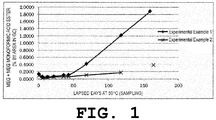
- the resulting high-purity ethylene carbonate-containing composition was placed in a 20-mL glass vial and sealed, and further placed in an open drum and then stored in an oven SPH-100 set to 50°C, manufactured by Tabai ESPEC Corporation.
- each sample solution for gas chromatography After a lapse of a predetermined period from the start of storing, 0.8 mL of the high-purity ethylene carbonate-containing composition was sampled from the glass vial, and 0.2 mL of acetonitrile was added to prepare each sample solution for gas chromatography. In the case where any solid content was found in the sampling, the sample was, if necessary, subjected to filtration by 0.2- ⁇ m PTFE disc filter. The sample solution prepared was used to perform gas chromatographic analysis in the following conditions, and the percentage by area of each peak derived from ethylene glycol and ethylene glycol monoformic acid ester was calculated.
- a high-purity ethylene carbonate-containing composition of Experimental Example 2 was prepared in the same manner as in Experimental Example 1 except that the amount of formic acid compounded was changed to 0.001 parts by mass (10 ppm by mass based on the total amount of the composition).
- a high-purity ethylene carbonate-containing composition of Experimental Example 3 was prepared in the same manner as in Experimental Example 1 except that 0.0001 parts by mass of water (1 ppm by mass based on the total amount of the composition) was further added to 100 parts by mass of the high-purity ethylene carbonate.
- a high-purity ethylene carbonate-containing composition of Experimental Example 4 was prepared in the same manner as in Experimental Example 3 except that the amount of formic acid compounded was changed to 0.001 parts by mass (10 ppm by mass based on the total amount of the composition).
- a high-purity ethylene carbonate-containing composition of Experimental Example 5 was prepared in the same manner as in Experimental Example 3 except that the amount of formic acid compounded was changed to 0.0001 parts by mass (1 ppm by mass based on the total amount of the composition).
- a high-purity ethylene carbonate-containing composition of Experimental Example 6 was prepared in the same manner as in Experimental Example 1 except that 0.01 parts by mass of 2-chloroethanol (100 ppm by mass based on the total amount of the composition) was added instead of formic acid.
- a high-purity ethylene carbonate-containing composition of Experimental Example 7 was prepared in the same manner as in Experimental Example 6 except that 0.001 parts by mass of water (10 ppm by mass based on the total amount of the composition) and 0.01 parts by mass of iron oxide (Fe 3 O 4 ) (100 ppm by mass based on the total amount of the composition) were further added to 100 parts by mass of the high-purity ethylene carbonate.
- a high-purity ethylene carbonate-containing composition of Experimental Example 8 was prepared in the same manner as in Experimental Example 7 except that the amount of water compounded was changed to 0.01 parts by mass (100 ppm by mass based on the total amount of the composition).
- a high-purity ethylene carbonate-containing composition of Experimental Example 9 was prepared in the same manner as in Experimental Example 7 except that the amount of 2-chloroethanol compounded was changed to 0.001 parts by mass (10 ppm by mass based on the total amount of the composition).
- a high-purity ethylene carbonate-containing composition of Experimental Example 10 was prepared in the same manner as in Experimental Example 7 except that the amount of 2-chloroethanol compounded was changed to 0.1 parts by mass (1000 ppm by mass based on the total amount of the composition).
- a high-purity ethylene carbonate-containing composition of Experimental Example 11 was prepared in the same manner as in Experimental Example 8 except that the amount of 2-chloroethanol compounded was changed to 0.1 parts by mass (1000 ppm by mass based on the total amount of the composition).
- the high-purity ethylene carbonate-containing composition, the stabilization method thereof, and the like of the present invention can be widely and effectively utilized in various applications such as solvents for various polymer compounds, reaction solvents for various chemical reactions, extraction solvents, foaming agents, lubrication stabilizers, surfactants, soil modifiers, resist agents, resist stripping agents, pharmaceutical products, raw materials of polyesters, antifreeze solutions, and the like, and among them, can be specially effectively utilized in an electrolytic solution for a lithium-ion battery.
Landscapes
- Chemical & Material Sciences (AREA)
- Organic Chemistry (AREA)
- Engineering & Computer Science (AREA)
- Electrochemistry (AREA)
- Manufacturing & Machinery (AREA)
- Chemical Kinetics & Catalysis (AREA)
- General Chemical & Material Sciences (AREA)
- Inorganic Chemistry (AREA)
- Materials Engineering (AREA)
- Physics & Mathematics (AREA)
- Condensed Matter Physics & Semiconductors (AREA)
- General Physics & Mathematics (AREA)
- Organic Low-Molecular-Weight Compounds And Preparation Thereof (AREA)
- Secondary Cells (AREA)
Abstract
Description
- The present invention relates to a method for stabilizing a high-purity ethylene carbonate-containing composition, and a stabilized high-purity ethylene carbonate-containing composition, a method for storing the composition, an electrolytic solution for a lithium-ion battery, and the like.
- Ethylene carbonate is widely used in solvents for various polymer compounds, reaction solvents for various chemical reactions, extraction solvents, foaming agents, lubrication stabilizers, surfactants, soil modifiers, and the like. In recent years, use of ethylene carbonate has been increasingly expanded also in the fields of resist agents, resist stripping agents, pharmaceutical products, and the like. In particular, high-purity ethylene carbonate are industrially useful organic compounds as raw materials of electrolytic solutions for lithium-ion secondary batteries because of their high dielectric constant characteristics. Ethylene carbonate can also be hydrolyzed to selectively produce ethylene glycols useful for raw materials of polyesters, antifreeze solutions, and the like.
- Methods for producing ethylene carbonate are known to be able to produce ethylene carbonate by a reaction of ethylene oxide and carbon dioxide. In the case where such a reaction is performed, products after the reaction include, in addition to ethylene carbonate as a main product, a catalyst used in the reaction and reaction by-products such as glycols including monoethylene glycol and diethylene glycol, and further include water and a hydrolysis catalyst in the case where hydrolysis is performed. In order to remove such impurities described above, ethylene carbonate is purified by a reduced-pressure distillation method, a cooling crystallization method, or the like (see, for example,
Patent Literature 1 to 3). -
- Patent Literature 1:
JP H07-89905 A - Patent Literature 2:
JP 2014-51484 A - Patent Literature 3:
WO 2007/108213 A1 - In the case of use of ethylene carbonate as an electrolytic solution for a lithium-ion battery over a long period of time, such ethylene carbonate is denatured by an electrochemical reaction to cause a precipitate on the surface of an electrode and/or generation of a decomposed gas, thus degradation of a lithium-ion battery proceeds. Such degradation of a lithium-ion battery is considered to be caused specifically by the following phenomena. The first cause is an irreversible exchange reaction of a solvent due to the change in the composition of such an electrolytic solution, the second cause is precipitation of a reaction product and the like on the surface of an electrode due to increase of a resistant component, and the third cause is increase in inner pressure of the battery according to generation of any gas of hydrocarbon or the like. Such degradation can also be promoted due to the change in the composition of the electrolytic solution and the changes in viscosity, density and the like caused by the change in the composition, and the like.
- It has been recently increasingly demanded to provide a high-purity ethylene carbonate, for example, one having a purity of 90% by mass or more. Meanwhile, there has not been heretofore focused on any specific behavior of minor components contained in a high-purity ethylene carbonate at all. However, it has been found according to studies by the present inventors that a high-purity ethylene carbonate not used (ethylene carbonate before use thereof as the electrolytic solution for a lithium-ion battery, in the above example) is undesirably denatured and/or changed in the composition over time (hereinafter, sometimes simply referred as "denaturation".).
- Therefore, an urgent challenge is that the denaturation mechanism of an ethylene carbonate not used is clarified and such denaturation is suppressed, not only from the viewpoint that a high-quality ethylene carbonate is simply provided, but also from the viewpoint that high quality is maintained for a long period in use for various applications.
- The present invention has been made in view of the above problems, and an object of a first embodiment and a second embodiment thereof is to provide a novel stabilization method for suppressing over-time denaturation of a high-purity ethylene carbonate-containing composition. Another object of the first embodiment and the second embodiment is to provide a stabilized high-purity ethylene carbonate-containing composition with suppressed over-time denaturation and a method for storing the composition, as well as an electrolytic solution for a lithium-ion battery, using the same, and the like. An object of a third embodiment is to provide a stabilized high-purity ethylene carbonate-containing composition, a method for storing the composition, an electrolytic solution for a lithium-ion battery, using the same, and the like. Another object of the third embodiment of the invention is to provide a production method which enables such a stabilized high-purity ethylene carbonate-containing composition to be stably produced.
- There is not herein limited to the objects here mentioned, and exertion of any effects to be derived from each constitution indicated in modes for carrying out the invention, described below, the effects being not obtained by any conventional arts, can also be regarded as other objects of the present invention.
- The present inventors have made intensive studies in order to solve the above problems, and as a result, have found that the above problems can be solved by clarification of the denaturation mechanism in a high-purity ethylene carbonate-containing composition and adjustment of the composition to a predetermined composition, thus the present invention has been achieved.
- That is, the first embodiment of the present invention provides various specific aspects indicated below.
- [A1] A method for stabilizing a high-purity ethylene carbonate-containing composition, wherein the method comprises a step of adjustment of content (content rate) of the total of formic acid and a formic acid salt to 500 ppm by mass or less in the high-purity ethylene carbonate-containing composition comprising 90% by mass or more ethylene carbonate.
- [A2] The method for stabilizing a high-purity ethylene carbonate-containing composition according to [A1], wherein the method further comprises a step of adjustment of content of iron oxide to less than 100 ppm by mass in the high-purity ethylene carbonate-containing composition.
- [A3] The method for stabilizing a high-purity ethylene carbonate-containing composition according to [A1] or [A2], wherein the method further comprises a step of adjustment of content of water oxide to less than 100 ppm by mass in the high-purity ethylene carbonate-containing composition.
- [A4] The method for stabilizing a high-purity ethylene carbonate-containing composition according to any one of [A1] to [A3], wherein the content of the ethylene carbonate in the high-purity ethylene carbonate-containing composition is 99.90% by mass or more.
- [A5] A stabilized high-purity ethylene carbonate-containing composition comprising 90% by mass or more ethylene carbonate and 500 ppm by mass or less in total of formic acid and a formic acid salt.
- [A6] The stabilized high-purity ethylene carbonate-containing composition according to [A5], wherein the content of the total of the formic acid and the formic acid salt is 100 ppm by mass or less.
- [A7] The stabilized high-purity ethylene carbonate-containing composition according to [A5] or [A6], wherein the content of the total of the formic acid and the formic acid salt is 50 ppm by mass or less.
- [A8] The stabilized high-purity ethylene carbonate-containing composition according to any one of [A5] to [A7], wherein the content of the total of the formic acid and the formic acid salt is 10 ppm by mass or less.
- [A9] The stabilized high-purity ethylene carbonate-containing composition according to any one of [A5] to [A8], further comprising iron oxide, wherein the content of the iron oxide is less than 100 ppm by mass.
- [A10] The stabilized high-purity ethylene carbonate-containing composition according to any one of [A5] to [A9], further comprising water, wherein the content of the water is less than 100 ppm by mass.
- [A11] A method for storing a high-purity ethylene carbonate-containing composition, wherein the method comprises storing the high-purity ethylene carbonate-containing composition according to any one of [A5] to [A10], in a closed vessel or a sealed vessel.
- [A12] An electrolytic solution for a lithium-ion battery, wherein the electrolytic solution comprises the high-purity ethylene carbonate-containing composition according to any one of [A5] to [A10].
- The step of adjustment in each of [A1] to [A4] preferably comprises a step of measuring content of the total of formic acid and the formic acid salt in the high-purity ethylene carbonate-containing composition, and a step of selecting the high-purity ethylene carbonate-containing composition having the content of 500 ppm by mass or less.
- That is, the second embodiment of the present invention provides various specific aspects indicated below.
- [B1] A method for stabilizing a high-purity ethylene carbonate-containing composition, wherein the method comprises a step of adjustment of content (content rate) of 2-chloroethanol to 500 ppm by mass or less in the high-purity ethylene carbonate-containing composition comprising 90% by mass or more ethylene carbonate.
- [B2] The method for stabilizing a high-purity ethylene carbonate-containing composition according to [B1], wherein the method further comprises a step of adjustment of content of iron oxide to less than 200 ppm by mass in the high-purity ethylene carbonate-containing composition.
- [B3] The method for stabilizing a high-purity ethylene carbonate-containing composition according to [B1] or [B2], wherein the method further comprises a step of adjustment of content of water to less than 200 ppm by mass in the high-purity ethylene carbonate-containing composition.
- [B4] The method for stabilizing a high-purity ethylene carbonate-containing composition according to any one of [B1] to [B3], wherein the content of the ethylene carbonate in the high-purity ethylene carbonate-containing composition is 99.90% by mass or more.
- [B5] A stabilized high-purity ethylene carbonate-containing composition comprising 90% by mass or more ethylene carbonate and 500 ppm by mass or less of 2-chloroethanol.
- [B6] The stabilized high-purity ethylene carbonate-containing composition according to [B5], wherein the content of the 2-chloroethanol is 100 ppm by mass or less.
- [B7] The stabilized high-purity ethylene carbonate-containing composition according to [B5] or [B6], wherein the content of the 2-chloroethanol is 50 ppm by mass or less.
- [B8] The stabilized high-purity ethylene carbonate-containing composition according to any one of [B5] to [B7], wherein the content of the 2-chloroethanol is 10 ppm by mass or less.
- [B9] The stabilized high-purity ethylene carbonate-containing composition according to any one of [B5] to [B8], further comprising iron oxide, wherein the content of the iron oxide is less than 200 ppm by mass.
- [B10] The stabilized high-purity ethylene carbonate-containing composition according to any one of [B5] to [9], further comprising water, wherein the content of the water is less than 200 ppm by mass.
- [B11] A method for storing a high-purity ethylene carbonate-containing composition, wherein the method comprises storing the high-purity ethylene carbonate-containing composition according to any one of [B5] to [B10], in a closed vessel or a sealed vessel.
- [B12] An electrolytic solution for a lithium-ion battery, wherein the electrolytic solution comprises the high-purity ethylene carbonate-containing composition according to any one of [B5] to [B10].
- The step of adjustment in each of [B1] to [B4] also preferably comprises a step of measuring content of 2-chloroethanol in the high-purity ethylene carbonate-containing composition, and a step of selecting the high-purity ethylene carbonate-containing composition having the content of 500 ppm by mass or less.
- That is, the third embodiment of the present invention provides various specific aspects indicated below.
- [C1] A stabilized high-purity ethylene carbonate-containing composition comprising 90% by mass or more ethylene carbonate, and monoethylene glycol and/or monoethylene glycol formic acid ester, wherein the total content (total content rate) of the monoethylene glycol and the monoethylene glycol formic acid ester after a lapse of 125 days at 50°C in a closed vessel or a sealed vessel is 3.0% by area or less in gas chromatographic analysis.
- [C2] A stabilized high-purity ethylene carbonate-containing composition comprising 90% by mass or more ethylene carbonate, and monoethylene glycol and/or monoethylene glycol formic acid ester, wherein the total content of the monoethylene glycol and the monoethylene glycol formic acid ester after a lapse of 100 days at 50°C in a closed vessel or a sealed vessel is 2.0% by area or less in gas chromatographic analysis.
- [C3] A stabilized high-purity ethylene carbonate-containing composition comprising 90% by mass or more ethylene carbonate, and monoethylene glycol and/or monoethylene glycol formic acid ester, wherein the total content of the monoethylene glycol and the monoethylene glycol formic acid ester after a lapse of 50 days at 50°C in a closed vessel or a sealed vessel is 1.0% by area or less in gas chromatographic analysis.
- [C4] The stabilized high-purity ethylene carbonate-containing composition according to any one of [C1] to [C3], further comprising formic acid and a formic acid salt, wherein the content of the total of the formic acid and the formic acid salt is 500 ppm by mass or less.
- [C5] The stabilized high-purity ethylene carbonate-containing composition according to any one of [C1] to [C4], further comprising 2-chloroethanol, wherein the content of the 2-chloroethanol is 500 ppm by mass or less.
- [C6] The stabilized high-purity ethylene carbonate-containing composition according to any one of [C1] to [C5], further comprising iron oxide, wherein the content of the iron oxide is less than 200 ppm by mass.
- [C7] The stabilized high-purity ethylene carbonate-containing composition according to any one of [C1] to [C6], further comprising water, wherein the content of the water is less than 200 ppm by mass.
- [C8] The stabilized high-purity ethylene carbonate-containing composition according to any one of [C1] to [C7], wherein the ethylene carbonate is ethylene carbonate which is obtained by carbonation method and which has a concentration of 2-chloroethanol of less than 0.1 ppm by mass and a content of formic acid and a formic acid salt of 0.1 ppm by mass.
- [C9] A method for storing a high-purity ethylene carbonate-containing composition, wherein the method comprises storing the high-purity ethylene carbonate-containing composition according to any one of [C1] to [C8], in a closed vessel or a sealed vessel.
- [C10] An electrolytic solution for a lithium-ion battery, wherein the electrolytic solution comprises the high-purity ethylene carbonate-containing composition according to any one of [C1] to [C8].
- [C11] A method for producing a high-purity ethylene carbonate-containing composition, wherein the method comprises a reaction step of providing ethylene carbonate by reacting ethylene oxide and carbon dioxide, and a step of adjustment of the concentration of 2-chloroethanol and the content of formic acid and a formic acid salt to less than 0.1 ppm by mass in the resulting ethylene carbonate.
- [C12] The method for producing a high-purity ethylene carbonate-containing composition according to [C11], wherein the method comprises providing a stabilized high-purity ethylene carbonate-containing composition comprising 90% by mass or more ethylene carbonate, and monoethylene glycol and/or monoethylene glycol formic acid ester, in which the total content of the monoethylene glycol and the monoethylene glycol formic acid ester is 3.0% by area or less in gas chromatographic analysis after a lapse of 125 days at 50°C in a closed vessel or a sealed vessel.
- [C13] The method for producing a high-purity ethylene carbonate-containing composition according to [C11] or [C12], wherein the method comprises providing a stabilized high-purity ethylene carbonate-containing composition comprising 90% by mass or more ethylene carbonate, and monoethylene glycol and/or monoethylene glycol formic acid ester, in which the total content of the monoethylene glycol and the monoethylene glycol formic acid ester is 2.0% by area or less in gas chromatographic analysis after a lapse of 100 days at 50°C in a closed vessel or a sealed vessel.
- [C14] The method for producing a high-purity ethylene carbonate-containing composition according to any one of [C11] to [C13], wherein the method comprises providing a stabilized high-purity ethylene carbonate-containing composition comprising 90% by mass or more ethylene carbonate, and monoethylene glycol and/or monoethylene glycol formic acid ester, in which the total content of the monoethylene glycol and the monoethylene glycol formic acid ester is 1.0% by area or less in gas chromatographic analysis after a lapse of 50 days at 50°C in a closed vessel or a sealed vessel.
- The methods according to [C11] to [C14] each preferably provide a high-purity ethylene carbonate-containing composition having any one or more of [C4] to [C8], preferably a plurality of such features.
- [D] A method for producing a high-purity ethylene carbonate-containing composition comprising 90% by mass or more ethylene carbonate, wherein the method comprises the following steps:
- (1) A reaction step of providing an ethylene carbonate-containing composition by reacting ethylene oxide with carbon dioxide;
- (2) A step of measuring content of the total (total content rate) of formic acid and a formic acid salt, or content (content rate) of 2-chloroethanol in the ethylene carbonate-containing composition; and
- (3) A step of selecting the high-purity ethylene carbonate-containing composition having the content of the total of formic acid and the formic acid salt or the content of the 2-chloroethanol, of 500 ppm by mass or less.
- According to the first embodiment or the second embodiment of the present invention, a novel stabilization method for suppressing over-time denaturation of a high-purity ethylene carbonate-containing composition can be realized. According to the first embodiment or the second embodiment of the present invention, a stabilized high-purity ethylene carbonate-containing composition with suppressed over-time denaturation and a method for storing the composition, as well as an electrolytic solution for a lithium-ion battery, using the same, and the like can also be realized.
- According to the third embodiment of the present invention, a stabilized high-purity ethylene carbonate-containing composition with suppressed over-time denaturation and a method for storing the composition, as well as an electrolytic solution for a lithium-ion battery, using the same, and the like can be realized. A production method which enables such a stabilized high-purity ethylene carbonate-containing composition to be stably produced can also be realized.
-
-
Figure 1 is a graph illustrating the analysis results of Experimental Examples 1 to 2. -
Figure 2 is a graph illustrating the analysis results of Experimental Examples 3 to 5. -
Figure 3 is a graph illustrating the analysis results of Experimental Examples 6 to 9. -
Figure 4 is a graph illustrating the analysis results of Experimental Examples 10 to 11. - Hereinafter, embodiments of the present invention will be described in detail. The following embodiments are examples (representative examples) of aspects of the present invention, and the present invention is not intended to be limited thereto. The present invention can be arbitrarily modified and carried out without departing from the gist thereof. In the case of expression by use of "to" sandwiched between numerical values or physical property values described before and after such "to", the numerical values or physical property values used are assumed to be encompassed. For example, the expression of a numerical value range of "1 to 100" is intended to encompass both a lower limit value "1" and an upper limit value "100". Much the same is true on the expression of other numerical value range. The "monoethylene glycol" may be designated as "ethylene glycol" and the "monoethylene glycol formic acid ester" may be designated as "ethylene glycol formic acid ester" herein.
- A method for stabilizing a high-purity ethylene carbonate-containing composition of a first embodiment includes adjustment of the content of the total of formic acid and a formic acid salt to 500 ppm by mass or less in a high-purity ethylene carbonate-containing composition comprising 90% by mass or more ethylene carbonate. A stabilized high-purity ethylene carbonate-containing composition of the present embodiment comprises 90% by mass or more ethylene carbonate and 500 ppm by mass or less in total of formic acid and a formic acid salt.
- A method for stabilizing a high-purity ethylene carbonate-containing composition of a second embodiment includes adjustment of the content of 2-chloroethanol to 500 ppm by mass or less in a high-purity ethylene carbonate-containing composition comprising 90% by mass or more ethylene carbonate. A stabilized high-purity ethylene carbonate-containing composition of the present embodiment comprises 90% by mass or more ethylene carbonate and 500 ppm by mass or less of 2-chloroethanol.
- A stabilized high-purity ethylene carbonate-containing composition of a third embodiment comprises 90% by mass or more ethylene carbonate, and monoethylene glycol and/or monoethylene glycol formic acid ester, in which the total content of the monoethylene glycol and the monoethylene glycol formic acid ester after a lapse of 125 days at 50°C in a closed vessel or a sealed vessel is 3.0% by area or less in gas chromatographic analysis.
- In other words, the stabilized high-purity ethylene carbonate-containing composition of the present embodiment comprises 90% by mass or more ethylene carbonate, and monoethylene glycol and/or monoethylene glycol formic acid ester, in which the total content of the monoethylene glycol and the monoethylene glycol formic acid ester after a lapse of 100 days at 50°C in a closed vessel or a sealed vessel is 2.0% by area or less in gas chromatographic analysis.
- In still other words, the stabilized high-purity ethylene carbonate-containing composition of the present embodiment comprises 90% by mass or more ethylene carbonate, and monoethylene glycol and/or monoethylene glycol formic acid ester, in which the total content of the monoethylene glycol and the monoethylene glycol formic acid ester after a lapse of 50 days at 50°C in a closed vessel or a sealed vessel is 1.0% by area or less in gas chromatographic analysis.
- As described above, a method including reacting ethylene oxide with carbon dioxide is known as a method for producing ethylene carbonate, and is progressively put in practical use. Formic acid and 2-chloroethanol are known to be able to be included, as impurities, in ethylene oxide in a step of generating such ethylene oxide, and such formic acid as impurities included in ethylene oxide can be incorporated into a high-purity ethylene carbonate-containing composition. However, there has not been heretofore focused on any specific behavior caused by formic acid and/or 2-chloroethanol contained in a high-purity ethylene carbonate-containing composition, at all.
- On the contrary, the present inventors have found that formic acid and a formic acid salt contained in a high-purity ethylene carbonate-containing composition unexpectedly each serve as a trigger substance which increases monoethylene glycol (MEG), formic acid esters such as ethylene glycol monoformic acid ester, or the like (sometimes collectively referred them to as "by-product impurities".) over time and increase in such by-product impurities causes over-time deterioration in quality of the high-purity ethylene carbonate-containing composition. The present inventors simultaneously newly have found that there are acceptable amounts of formic acid and a formic acid salt in the high-purity ethylene carbonate-containing composition from the viewpoint that the composition is maintained at a high quality for a predetermined period.
- The present inventors have also found that 2-chloroethanol contained in a high-purity ethylene carbonate-containing composition unexpectedly serves as a trigger substance which increases by-product impurities including monoethylene glycol (MEG), formic acid esters such as ethylene glycol monoformic acid ester, or the like over time and increase in such by-product impurities causes over-time deterioration in quality of the high-purity ethylene carbonate-containing composition. The present inventors simultaneously newly have found that there is an acceptable amount of 2-chloroethanol in the high-purity ethylene carbonate-containing composition from the viewpoint that the composition is maintained at a high quality for a predetermined period.
- The present inventors further have also found that formic acid and a formic acid salt, and 2-chloroethanol contained in a high-purity ethylene carbonate-containing composition unexpectedly each serve as a trigger substance which increases by-product impurities including monoethylene glycol (MEG), formic acid esters such as ethylene glycol monoformic acid ester, or the like over time and increase in such by-product impurities causes over-time deterioration in quality of the high-purity ethylene carbonate-containing composition. The present inventors simultaneously newly have found that there are acceptable increase rates with respect to such increases of by-product impurities in the high-purity ethylene carbonate-containing composition from the viewpoint that the composition is maintained at a high quality for a predetermined period.
- Hereinafter, the present invention will be described in more detail.
- The content of ethylene carbonate in the high-purity ethylene carbonate-containing composition of the first embodiment and the second embodiment is not particularly limited, and the content based on the total amount of the high-purity ethylene carbonate-containing composition is usually 90.00% by mass or more, preferably 95.00% by mass or more, more preferably 99.00% by mass or more, further preferably 99.50% by mass or more, particularly preferably 99.90% by mass or more, most preferably 99.95% by mass or more, further most preferably 99.99% by mass or more. The content of the ethylene carbonate is equal to or more than such a preferable lower limit value, then a destabilization phenomenon due to other impurities is relatively decreased and the stabilization effect of the present invention tends to be relatively actualized.
- While the ethylene carbonate here used is not particularly limited and a new synthetic product or a commercially available product can be used without any distinction, any ethylene carbonate (hereinafter, sometimes simply referred as "ethylene carbonate obtained by carbonation method".) is preferable which is obtained through a reaction step of providing an ethylene carbonate-containing composition by reacting ethylene oxide with carbon dioxide (hereinafter, sometimes simply referred as "carbonation reaction step".) and a purification step of purifying the ethylene carbonate-containing composition. An ethylene carbonate obtained by carbonation method, obtained by such a production method, can include formic acid and/or 2-chloroethanol serving as impurities in relatively large amount(s), and thus the stabilization effect of the present invention tends to be relatively actualized in the case of use of such an ethylene carbonate. It is further preferable to obtain an ethylene carbonate-containing composition by use of a carbonation catalyst described below, in the carbonation reaction.
- Ethylene oxide is industrially produced by, usually, allowing ethylene and oxygen to react in the presence of a silver catalyst. The rate of selection of ethylene to ethylene oxide is usually about 80%, and the residue, about 20% of such ethylene, is completely oxidized and transformed into carbon dioxide and water. Ethylene oxide for use as a raw material of ethylene carbonate to be industrially produced usually includes about 40% of water. Alternatively, such ethylene oxide may include diols such as monoethylene glycol and diethylene glycol due to partial hydrolysis of ethylene carbonate.
- The purity of the ethylene oxide for use as a raw material is not particularly limited, and is usually 50% by mass or more, preferably 55% by mass or more, more preferably 60% by mass or more. The upper limit is not particularly limited, and is preferably 95% by mass or less, more preferably 90% by mass or less, further preferably 85% by mass or less from the viewpoint of economic efficiency, availability, and the like.
- The molar ratio of raw materials fed in the carbonation reaction step (carbon dioxide/ethylene oxide) is not particularly limited, and is usually 0.5 or more as a rough standard. The upper limit of the molar ratio thereof fed is also not particularly limited, and is usually 5 or less, preferably 3.0 or less.
- The carbonation reaction step of the ethylene oxide is usually performed in the presence of a catalyst. Such a carbonation catalyst may be appropriately selected from known catalysts, and used, and the type is not particularly limited. Specific examples include alkali metal halide; alkali earth metal halide; alkylamine; a quaternary ammonium salt; organic tin; germanium; a tellurium compound; a halogenated organic phosphonium salt, and alkali metal carbonate, but are not particularly limited thereto. Among them, alkali metal halide and a halogenated organic phosphonium salt are preferable. Alkali metal carbonate is preferable because generation of by-products can be easily suppressed.
- Specific examples of the alkali metal halide include alkali metal iodides such as potassium iodide and alkali metal bromides such as potassium bromide. The alkali metal here is preferably potassium high in solubility. Specific examples of the alkali earth metal halide include alkali earth metal iodide and alkali earth metal bromide.
- Specific examples of the halogenated organic phosphonium salt include quaternary phosphonium iodides such as triphenylmethylphosphonium iodide, triphenylpropylphosphonium iodide, triphenylbenzylphosphonium iodide and tributylmethylphosphonium iodide, and quaternary phosphonium bromides such as triphenylmethylphosphonium bromide, triphenylpropylphosphonium bromide, triphenylbenzylphosphonium bromide and tributylmethylphosphonium bromide. Specific examples of the alkali metal carbonate include potassium carbonate.
- The amount of the catalyst used in the carbonation reaction step is not particularly limited, and is preferably 1/1000 or more, more preferably 1/200 or more in terms of the molar ratio thereof to the ethylene oxide. The upper limit is not particularly limited, and is preferably 1/20 or less, more preferably 1/50 or less. The carbonation catalyst can be used singly or in any combination of two or more kinds at any ratio. The amount thereof in the case of use of a plurality of the carbonation catalysts preferably falls within the above range as the total amount.
- The temperature at which the carbonation reaction step of the ethylene oxide is performed is not particularly limited, and is usually 70°C or more, preferably 100°C or more. On the other hand, the upper limit is usually 200°C or less, preferably 170°C or less. The reaction pressure is also not particularly limited, and is usually 0.6 MPa or more, preferably 1.0 MPa or more. On the other hand, the upper limit is usually 5.0 MPa or less, preferably 3.0 MPa or less.
- The carbonation reaction step of the ethylene oxide can be performed using any apparatus. The carbonation reaction step can be performed in either a batch manner or a continuous feeding manner, and is preferably performed in a continuous feeding manner in terms of industry. Specifically, for example, the reaction can be performed by control of the reaction temperature by circulating a reaction liquid in a tower through a liquid circulation conduit using a bubble tower having a heat exchanger and the liquid circulation conduit provided with a circulation pump, and by continuous supply of ethylene oxide and carbon dioxide which are raw materials and a catalyst from the tower bottom. A reactor provided with an ejector type nozzle is also preferably used. In the case where the reaction is performed by use of the bubble tower, a tube reactor is preferably disposed following the bubble tower to allow unreacted ethylene oxide to further react in terms of reaction efficiency.
- The ethylene carbonate obtained by carbonation method, obtained by such a production method, can include formic acid and a formic acid salt, 2-chloroethanol, and the like as impurities in relatively large amounts. Such formic acid and formic acid salt, and 2-chloroethanol each serve as a trigger substance which causes by-product impurities such as monoethylene glycol and formic acid ester of monoethylene glycol to be increased over time, and increase in such by-product impurities causes over-time deterioration in quality of the high-purity ethylene carbonate-containing composition. Therefore, a step of reducing the contents of 2-chloroethanol and a formic acid and a formic acid salt in the ethylene carbonate obtained by carbonation method is preferably further performed. The contents of 2-chloroethanol and a formic acid and a formic acid salt in the ethylene carbonate obtained by carbonation method are not particularly limited, and are each desirably adjusted to less than 0.1 ppm by mass. The contents of 2-chloroethanol and a formic acid and a formic acid salt in the ethylene carbonate obtained by carbonation method are more preferably lower, and preferably 0 ppm in view of effects of the present invention. However, for example, a measurement apparatus for detecting formic acid and a formic acid salt is limited in terms of technique (detection limit, lower limit of quantitation), and thus the contents of 2-chloroethanol and a formic acid and a formic acid salt in the ethylene carbonate obtained by carbonation method is preferably less than the detection limit of such a measurement apparatus.
- Such a reduction in contents of 2-chloroethanol, and formic acid and a formic acid salt can be performed according to an ordinary method, and the method therefor is not particularly limited. Examples of the method for such a reduction include any separation method by recrystallization, crystallization, extraction by suspending and washing, concentration, washing with water, dewatering, filtration, distillation, distillation off, rectification, chromatography, a cationic exchange resin, or an alcohol adsorbent. Such a reduction in contents of 2-chloroethanol, and formic acid and a formic acid salt may also be performed in a purification step described below.
- The purification step is to purify the ethylene carbonate obtained in the carbonation reaction step. The purification can be performed by a crystallization method, a distillation method, or the like. The purification is preferably performed by a crystallization method, more preferably a countercurrent contact type crystallization method, from the viewpoint of excellent energy efficiency. In the case where the purification is performed by a crystallization method, an ethylene carbonate crystal is usually produced by cooling a reaction liquid. For example, a wall surface falling type crystallization method obtains a high-purity ethylene carbonate by precipitating a crystal on a wall surface cooled, thereafter warming the crystal and melting it, and allowing it to flow down. A countercurrent contact type crystallization method obtains a high-purity ethylene carbonate by generating a crude crystal of ethylene carbonate by cooling or the like of a reaction liquid, and countercurrently contacting a crystal melt liquid obtained by heating the crude crystal, with such a crude crystal not molten.
- The crude crystal of ethylene carbonate can be precipitated by a method including adding a poor solvent to the reaction liquid subjected to the carbonation reaction, a method including cooling the reaction liquid subjected to the carbonation reaction, or the like. It is preferable in terms of industry to precipitate the crude crystal of ethylene carbonate by cooling of the reaction liquid. The crude crystal of ethylene carbonate can be taken out by solid-liquid separation of a liquid including the unreacted ethylene oxide and the catalyst.
- It is specifically preferable in the countercurrent contact type crystallization method in terms of industry to allow the crude crystal of ethylene carbonate to fall from the upper portion of the tower, melt the crude crystal of ethylene carbonate at the bottom of the tower, extract a part of the resulting melt liquid from the tower, and allow the balance of the melt liquid to rise as a reflux liquid and countercurrently contact it with the falling crude crystal of ethylene carbonate.
- In the case where a hydrolysis reaction of ethylene carbonate is performed, such a hydrolysis reaction is preferably performed in the presence of a known hydrolysis catalyst such as an alkali metal compound. Specific examples of the hydrolysis catalyst include compounds of alkali metals such as sodium and potassium. The alkali metal contained in such an alkali metal compound is preferably potassium. Examples of the alkali metal compound include alkali metal hydroxide; and alkali metal carbonate and bicarbonate. Among them, the alkali metal compound is preferable and alkali metal carbonate is further preferable as the hydrolysis catalyst. In the case where the carbonation reaction and the hydrolysis reaction are simultaneously performed, the hydrolysis catalyst here used is preferably present at a molar ratio thereof to the carbonation catalyst, of 0.01 to 1.0. The hydrolysis catalyst can be used singly or in any combination of two or more kinds at any ratio. The amount thereof use in the case of a plurality of the hydrolysis catalysts preferably falls within the above range as the total amount.
- In the first embodiment, formic acid serving as the trigger substance may be present in the form of a salt. Examples of the salt of formic acid serving as the trigger substance include metal salts such as an alkali metal salt or an alkali earth metal salt.
- The content of the formic acid and the formic acid salt in the high-purity ethylene carbonate-containing composition of the present embodiment is 500 ppm by mass or less in total, preferably 100 ppm by mass or less in total, more preferably 50 ppm by mass or less in total, further preferably 10 ppm by mass or less in total based on the total amount of the high-purity ethylene carbonate-containing composition. On the other hand, the lower limit value of the total content of the formic acid and the formic acid salt is not particularly limited, and is 0 ppm as a rough standard in view of the effects of the present invention. In fact, however, a measurement apparatus for detecting the formic acid and the formic acid salt is limited in terms of technique (detection limit, detection ability), and thus an enhancement in analysis technique is required for supporting any behavior of the measurement apparatus at a value less than the detection limit. Thus, in the case where gas chromatograph is used in the measurement apparatus for detecting the formic acid and the formic acid salt, the lower limit is preferably set to a value equal to or more than the detection limit of the measurement apparatus, more preferably 0.1 ppm by mass or more in total, further preferably 0.5 ppm by mass in total, particularly preferably 1.0 ppm by mass or more in total.
- The total content of the formic acid and the formic acid salt is equal to or less than the upper limit value, then increase in monoethylene glycol and formic acid ester of monoethylene glycol (such as monoethylene glycol monoformic acid ester) over time can be suppressed. The contents of the formic acid and the formic acid salt can be herein measured by gas chromatography. The procedure for adjusting the total content of the formic acid and the formic acid salt is not particularly limited, and can be performed by, for example, removal of the formic acid or the formic acid salt included in the high-purity ethylene carbonate-containing composition, addition of the formic acid or the formic acid salt to the high-purity ethylene carbonate-containing composition, or no shipping of one which contains the formic acid and the formic acid salt in amounts measured, out of the specification defined as the respective standard values of the amounts of the formic acid and the formic acid salt. Such an adjustment may include a step of measuring the total content of formic acid and the formic acid salt and a step of selecting one where the total content is equal to or less than a specific amount.
- The content of 2-chloroethanol in the high-purity ethylene carbonate-containing composition of the second embodiment is 500 ppm by mass or less, preferably 100 ppm by mass or less, more preferably 50 ppm by mass or less, further preferably 10 ppm by mass or less based on the total amount of the high-purity ethylene carbonate-containing composition. On the other hand, the lower limit value of the content of the 2-chloroethanol is not particularly limited, and is 0 ppm as a rough standard in view of the effects of the present invention. In fact, however, a measurement apparatus for detecting the 2-chloroethanol is limited in terms of technique (detection limit, detection ability), and thus an enhancement in analysis technique is required for supporting any behavior of the measurement apparatus at a value less than the detection limit. Thus, in the case where gas chromatograph is used in the measurement apparatus for detecting the 2-chloroethanol, the lower limit is preferably set to a value equal to or more than the detection limit of the measurement apparatus, more preferably 0.1 ppm by mass or more, further preferably 0.5 ppm by mass, particularly preferably 1.0 ppm by mass or more.
- The content of the 2-chloroethanol is equal to or less than the upper limit value, then increase in monoethylene glycol and a formic acid ester of monoethylene glycol (such as monoethylene glycol monoformic acid ester) over time can be suppressed. The content of the 2-chloroethanol can be herein measured by gas chromatography. The adjustment of the content of the 2-chloroethanol is not particularly limited, and can be performed by, for example, removal of the 2-chloroethanol included in the high-purity ethylene carbonate-containing composition, addition of the 2-chloroethanol to the high-purity ethylene carbonate-containing composition, or no shipping of one which contains the 2-chloroethanol in an amount measured, out of the specification defined as the standard value of the amount of the 2-chloroethanol. Examples of removal of the trigger substance include any separation method by a cationic exchange resin, an alcohol adsorbent, or distillation. The adjustment may include a step of measuring the content of the 2-chloroethanol and a step of selecting one where the total content is equal to or less than a specific amount.
- The contents of monoethylene glycol and monoethylene glycol formic acid ester in the high-purity ethylene carbonate-containing composition of the third embodiment are increased due to the trigger substance over time, and the amounts thereof to be increased are varied depending on the storage period and the storage temperature. Thus, in the present embodiment, the amounts are defined as the total content of the monoethylene glycol and the monoethylene glycol formic acid ester in predetermined conditions, namely, after a lapse of a certain period at 50°C in a closed vessel or a sealed vessel.
- Specifically, the total content of the monoethylene glycol and the monoethylene glycol formic acid ester after a lapse of 125 days at 50°C in a closed vessel or a sealed vessel is 3.0% by area or less, preferably 2.5% by area or less, more preferably 2.0% by area or less, further preferably 1.75% by area or less, particularly preferably 1.5% by area or less in gas chromatographic analysis. The total content of the monoethylene glycol and the monoethylene glycol formic acid ester in the case of a lapse of 100 days is preferably 2.0% by area or less, more preferably 1.75% by area or less, further preferably 1.5% by area or less, particularly preferably 1.25% by area or less in gas chromatographic analysis. The total content of the monoethylene glycol and the monoethylene glycol formic acid ester in the case of a lapse of 50 days is preferably 1.0% by area or less, more preferably 0.75% by area or less, further preferably 0.5% by area or less, particularly preferably 0.25% by area or less in gas chromatographic analysis.
- The total content of the monoethylene glycol and the monoethylene glycol formic acid ester after a lapse of a certain period at 50°C in a closed vessel or a sealed vessel is equal to or less than such a preferable upper limit value, then the quality reliability of the high-purity ethylene carbonate-containing composition which is exposed in various environments from production through distribution to use tends to be further ensured.
- On the other hand, the lower limit value of the total content of the monoethylene glycol and the monoethylene glycol formic acid ester after a lapse of a certain period at 50°C in a closed vessel or a sealed vessel is not particularly limited, and is 0% by area as a rough standard in view of the effects of the present invention. In fact, gas chromatographic analysis is limited in terms of technique (detection limit, lower limit of quantitation), and thus an enhancement in analysis technique is required for supporting any behavior of a measurement apparatus at a value less than the detection limit. Thus, the lower limit is preferably set to a value equal to or more than the detection limit of a gas chromatographic analyzer, more preferably 0.001% by area or more, further preferably 0.01% by area or more, particularly preferably 0.1% by area or more.
- The adjustment of the total content of the monoethylene glycol and the monoethylene glycol formic acid ester is not particularly limited, and can be performed by, for example, removal of the formic acid or the formic acid salt, or the 2-chloroethanol, water or iron oxide, included in the high-purity ethylene carbonate-containing composition, or addition thereof to the high-purity ethylene carbonate-containing composition. While the initiation in such lapsed days is usually defined as the point of time of production of high-purity ethylene carbonate, the lapsed days are not necessarily needed to be counted severely from the time of point of the production because of a tendency of increase in the contents of the monoethylene glycol and the monoethylene glycol formic acid ester over time, and the total content of the monoethylene glycol and the monoethylene glycol formic acid ester can be determined to be within the present embodiment as long as at least the total content after a predetermined lapsed days is equal to or less than the above predetermined value.
- The high-purity ethylene carbonate-containing compositions of the first embodiment to the third embodiment may each further include iron oxide in impurities. In such a case, the content of the iron oxide is preferably 200 ppm by mass or less, more preferably 150 ppm by mass or less, more preferably less than 100 ppm by mass, more preferably 50 ppm by mass or less, more preferably 25 ppm by mass or less, more preferably 10 ppm by mass or less, more preferably 5 ppm by mass or less based on the total amount of the high-purity ethylene carbonate-containing composition. The content of the iron oxide herein means a value obtained by measurement according to inductively coupled plasma optical emission spectroscopy (ICP/OES). The content of iron oxide in ethylene carbonate can be quantitatively determined by, for example, ICP/OES after decomposition of the ethylene carbonate by use of any acid such as nitric acid or sulfuric acid. The lower limit value of the content of the iron oxide is not particularly limited, and is 0 ppm as a rough standard in view of the effects of the present invention. In fact, however, the lower limit value is preferably equal to or more than the detection limit in the inductively coupled plasma optical emission spectroscopy, more preferably 0.1 ppm by mass or more, further preferably 0.5 ppm by mass, particularly preferably 1.0 ppm by mass or more for the reason of the presence of the detection limit of the measurement apparatus, as in the above formic acid and the formic acid salt, and the 2-chloroethanol.
- The iron oxide of interest here encompasses three components of FeO, Fe2O3, and Fe3O4. In the case where both the formic acid or the formic acid salt and/or the 2-chloroethanol and the iron oxide are included, a remarkable increase in the monoethylene glycol and the formic acid ester thereof (for example, monoethylene glycol monoformic acid ester) over time may occur, but, not only the contents of the formic acid and the formic acid salt, and the 2-chloroethanol are adjusted as described above, but also the content of the iron oxide is adjusted to less than the above preferable upper limit value, then increase in the monoethylene glycol and the formic acid ester of monoethylene glycol over time tends to be stably suppressed. The adjustment of the content of the iron oxide is not particularly limited, and can be performed by, for example, removal of the iron oxide included in the high-purity ethylene carbonate-containing composition or addition of to the iron oxide to the high-purity ethylene carbonate-containing composition.
- The high-purity ethylene carbonate-containing compositions of the first embodiment to the third embodiment may each include water in impurities. In such a case, the content of the water in the first embodiment is preferably less than 100 ppm by mass, more preferably 50 ppm by mass or less, further preferably 25 ppm by mass or less, particularly preferably 10 ppm by mass or less based on the total amount of the high-purity ethylene carbonate-containing composition. The content of the water in the second embodiment to the third embodiment is preferably less than 200 ppm by mass, more preferably 100 ppm by mass or less, further preferably 50 ppm by mass or less, particularly preferably 25 ppm by mass or less, most preferably 10 ppm by mass or less based on the total amount of the high-purity ethylene carbonate-containing composition. The content of the water herein means a value obtained by measurement with a Karl Fischer moisture titrator. The lower limit value of the content of the water is not particularly limited, and is 0 ppm as a rough standard in view of the effects of the present invention. In fact, however, the lower limit value is preferably equal to or more than the detection limit of the Karl Fischer moisture titrator, more preferably 0.1 ppm by mass or more, further preferably 0.5 ppm by mass, particularly preferably 1.0 ppm by mass or more for the reason of the presence of the detection limit of the measurement apparatus, as in the above formic acid or the formic acid salt, and the 2-chloroethanol and the iron oxide.
- In the case where both the formic acid or the formic acid salt and/or the 2-chloroethanol and the water are included, a remarkable increase in the monoethylene glycol and the formic acid ester of monoethylene glycol (for example, monoethylene glycol monoformic acid ester) over time may occur, but, not only the contents of the formic acid and the formic acid salt, and the 2-chloroethanol are adjusted as described above, but also the content of the water is adjusted to less than the above preferable upper limit value, then increase in the monoethylene glycol and the formic acid ester of monoethylene glycol over time tends to be stably suppressed. The adjustment of the content of the water is not particularly limited, and can be performed by, for example, removal of the water included in the high-purity ethylene carbonate-containing composition or addition of to the water to the high-purity ethylene carbonate-containing composition.
- The high-purity ethylene carbonate-containing compositions of the first embodiment to the third embodiment may be each prepared by mixing respective components, or prepared by appropriately separating and removing any component from respective mixed components so that the contents of the respective components fall within predetermined ranges. The method for separating any component is not particularly limited, and can be selected with respect to each of the components. Here, the contents of the formic acid and the formic acid salt, and the 2-chloroethanol may be adjusted to 500 ppm by mass or less, and, if necessary, the contents of the iron oxide and the water may be adjusted to less than 100 ppm by mass in the first embodiment, and to 200 ppm by mass or less in the second embodiment and the third embodiment.
- The high-purity ethylene carbonate-containing composition of the first embodiment, thus obtained by adjustment of the contents of the formic acid and the formic acid salt, and, if necessary, the contents of the iron oxide and the water to predetermined rates is hardly increased in by-product impurities such as monoethylene glycol (MEG) and formic acid ester of MEG even after a lapse of time, is excellent in storage stability, and is high in purity and high in quality.
- The high-purity ethylene carbonate-containing composition of the second embodiment, thus obtained by adjustment of the content of the 2-chloroethanol, and, if necessary, the contents of the iron oxide and the water to predetermined rates is hardly increased in by-product impurities such as monoethylene glycol (MEG) and formic acid ester of MEG even after a lapse of time, is excellent in storage stability, and is high in purity and high in quality.
- The high-purity ethylene carbonate-containing composition of the third embodiment, having such a composition, is hardly increased in by-product impurities such as monoethylene glycol (MEG) and formic acid ester of MEG even after a lapse of time, is excellent in storage stability, and is high in purity and high in quality.
- The ethylene carbonate-containing compositions of the first embodiment to the third embodiment are each preferably stored with being not contact with air and water, specifically, preferably stored in a closed vessel or a sealed vessel from the viewpoint of suppression of increase in by-product impurities due to incorporation of moisture in the air. The compositions are each more preferably stored under a low oxygen partial pressure atmosphere and/or a low steam partial pressure atmosphere, for example, a vacuum or inert gas (nitrogen, argon, helium) atmosphere.
- The storage temperature is not particularly limited, and is preferably 10 to 70°C, more preferably 10 to 60°C, further preferably 10 to 55°C. The storage temperature falls within the above range, then the effect of suppression of increase in by-product impurities such as monoethylene glycol (MEG) and formic acid ester of MEG over time tends to be favorably exerted.
- The closed vessel or the sealed vessel including each of the ethylene carbonate-containing compositions of the first embodiment to the third embodiment is also one of embodiments of the present invention.
- The high-purity ethylene carbonate-containing compositions comprising 90% by mass or more ethylene carbonate of the first embodiment to the third embodiment can be each produced by a method including the following steps:
- (1) A reaction step of providing an ethylene carbonate-containing composition by reacting ethylene oxide with carbon dioxide;
- (2) A step of measuring content of the total of formic acid and a formic acid salt, or content of 2-chloroethanol in the ethylene carbonate-containing composition in the ethylene carbonate-containing composition; and
- (3) A step of selecting the high-purity ethylene carbonate-containing composition having the content of the total of the formic acid and the formic acid salt or the content of the 2-chloroethanol, of 500 ppm by mass or less.
- The high-purity ethylene carbonate-containing compositions comprising 90% by mass or more ethylene carbonate of the first embodiment to the third embodiment can be each managed in quality by a method including the following steps:
- (1) A step of providing an ethylene carbonate-containing composition by reacting ethylene oxide with carbon dioxide;
- (2) A step of measuring content of the total of formic acid and a formic acid salt, or content of 2-chloroethanol in the ethylene carbonate-containing composition; and
- (3) A step of selecting the high-purity ethylene carbonate-containing composition having the content of the total of the formic acid and the formic acid salt or the content of the 2-chloroethanol, of 500 ppm by mass or less.
- The electrolytic solutions for a lithium-ion battery of the first embodiment to the third embodiment each include the above high-purity ethylene carbonate-containing composition. The high-purity ethylene carbonate-containing composition of the present embodiment includes less by-product impurities such as monoethylene glycol (MEG) or formic acid ester of MEG and has suppressed increase in such by-product impurities over time, and thus use thereof in an electrolytic solution for a lithium-ion battery can allow undesirable degradation in performance of a lithium-ion battery, caused by such by-product impurities, to be suppressed, then the battery capacity and the battery performance of a lithium-ion battery can be maintained for a longer period and a lithium-ion battery having high reliability during use for a long period of time.
- Lithium-ion batteries are expected to be demanded in applications of not only small batteries, but also large batteries, and furthermore industrial batteries, and the field thereof is expected to be increasingly grown. Therefore, it can be said that the high-purity ethylene carbonate-containing composition of the present embodiment, which can enhance reliability during use for a long period of time, is extremely useful as a solvent of an electrolytic solution also from the viewpoint that a need for a higher-performance lithium-ion battery is expected in future.
- The electrolytic solution for a lithium-ion battery may include any component(s) known in the art, and the composition thereof is not particularly limited. For example, an electrolytic solution for a lithium-ion battery is commercially available, which includes a lithium salt such as LiPF6 or LiBOB, a non-aqueous solvent such as saturated cyclic carbonate, linear carbonate, linear carboxylate, cyclic carboxylate, an ether-based compound or a sulfone-based compound, and various additives known in the art. In particular, the high-purity ethylene carbonate-containing composition is particularly preferably used as an additive or a non-aqueous solvent for an electrolytic solution for a lithium-ion battery.
- Hereinafter, the content of the present invention will be more specifically described with reference to Experimental Examples, but the present invention is not intended to be limited to such Experimental Examples at all. Herein, various values in production conditions or as evaluation results in Experimental Examples each have the meaning as a preferable value of an upper limit or a lower limit in embodiments of the present invention, and a preferable range may be any range defined by a combination of the value of the upper limit or the lower limit with a value in the following Experimental Examples, or a combination of values in such Experimental Examples.
- First, carbon dioxide, ethylene oxide, water, tributylmethylphosphonium iodide, and potassium carbonate were continuously fed to a reactor, and the resulting reaction liquid was purified by a countercurrent contact type crystallization method and then subjected to solid-liquid separation to provide a high-purity ethylene carbonate having a purity of 99.999%, including formic acid and a formic acid salt, 2-chloroethanol, and iron oxide at each rate less than the detection limit, and about 5 ppm by mass of water.
- Next, 0.01 parts by mass of formic acid (100 ppm by mass based on the total amount of the composition) was added to 100 parts by mass of the resulting high-purity ethylene carbonate to prepare a high-purity ethylene carbonate-containing composition of Experimental Example 1.
- Thereafter, the resulting high-purity ethylene carbonate-containing composition was placed in a 20-mL glass vial and sealed, and further placed in an open drum and then stored in an oven SPH-100 set to 50°C, manufactured by Tabai ESPEC Corporation.
- After a lapse of a predetermined period from the start of storing, 0.8 mL of the high-purity ethylene carbonate-containing composition was sampled from the glass vial, and 0.2 mL of acetonitrile was added to prepare each sample solution for gas chromatography. In the case where any solid content was found in the sampling, the sample was, if necessary, subjected to filtration by 0.2-µm PTFE disc filter. The sample solution prepared was used to perform gas chromatographic analysis in the following conditions, and the percentage by area of each peak derived from ethylene glycol and ethylene glycol monoformic acid ester was calculated.
-
- Apparatus: GC-2010 plus manufactured by Shimadzu Corporation
- Inlet temperature: 130°C
- Amount of injection: 1.0 µL
- Column: Agilent DB-WAXetr 123-7364
- Column temperature: kept at 60°C for 2 minutes, thereafter raised to 200°C at a rate of rise of 20°C/min and kept for 16 minutes, and thereafter raised to 230°C at a rate of rise of 20°C/min and kept for 5 minutes
- Carrier gas: helium,
flow rate 50 cm/sec - Injection method: splitless (1:20 split after one minute of injection)
- Detector: hydrogen flame ionization detector (FID) at 250°C
- Post-treatment: ejection at an injection temperature of 230°C and a column temperature of 230°C for 5 minutes with respect to one measurement
- Washing solvent: acetonitrile
- Area calculation method: area percentage method excluding any peak derived from acetonitrile
- Detection limit: 7 ppm by mass
- A high-purity ethylene carbonate-containing composition of Experimental Example 2 was prepared in the same manner as in Experimental Example 1 except that the amount of formic acid compounded was changed to 0.001 parts by mass (10 ppm by mass based on the total amount of the composition).
- Gas chromatographic analysis was performed in the same manner as in Experimental Example 1 except that the high-purity ethylene carbonate-containing composition of Experimental Example 2 was used instead of the high-purity ethylene carbonate-containing composition of Experimental Example 1.
- A high-purity ethylene carbonate-containing composition of Experimental Example 3 was prepared in the same manner as in Experimental Example 1 except that 0.0001 parts by mass of water (1 ppm by mass based on the total amount of the composition) was further added to 100 parts by mass of the high-purity ethylene carbonate.
- Gas chromatographic analysis was performed in the same manner as in Experimental Example 1 except that the high-purity ethylene carbonate-containing composition of Experimental Example 3 was used instead of the high-purity ethylene carbonate-containing composition of Experimental Example 1.
- A high-purity ethylene carbonate-containing composition of Experimental Example 4 was prepared in the same manner as in Experimental Example 3 except that the amount of formic acid compounded was changed to 0.001 parts by mass (10 ppm by mass based on the total amount of the composition).
- Gas chromatographic analysis was performed in the same manner as in Experimental Example 1 except that the high-purity ethylene carbonate-containing composition of Experimental Example 4 was used instead of the high-purity ethylene carbonate-containing composition of Experimental Example 1.
- A high-purity ethylene carbonate-containing composition of Experimental Example 5 was prepared in the same manner as in Experimental Example 3 except that the amount of formic acid compounded was changed to 0.0001 parts by mass (1 ppm by mass based on the total amount of the composition).
- Gas chromatographic analysis was performed in the same manner as in Experimental Example 1 except that the high-purity ethylene carbonate-containing composition of Experimental Example 5 was used instead of the high-purity ethylene carbonate-containing composition of Experimental Example 1.
- A high-purity ethylene carbonate-containing composition of Experimental Example 6 was prepared in the same manner as in Experimental Example 1 except that 0.01 parts by mass of 2-chloroethanol (100 ppm by mass based on the total amount of the composition) was added instead of formic acid.
- Gas chromatographic analysis was performed in the same manner as in Experimental Example 1 except that the high-purity ethylene carbonate-containing composition of Experimental Example 6 was used instead of the high-purity ethylene carbonate-containing composition of Experimental Example 1.
- A high-purity ethylene carbonate-containing composition of Experimental Example 7 was prepared in the same manner as in Experimental Example 6 except that 0.001 parts by mass of water (10 ppm by mass based on the total amount of the composition) and 0.01 parts by mass of iron oxide (Fe3O4) (100 ppm by mass based on the total amount of the composition) were further added to 100 parts by mass of the high-purity ethylene carbonate.
- Gas chromatographic analysis was performed in the same manner as in Experimental Example 1 except that the high-purity ethylene carbonate-containing composition of Experimental Example 7 was used instead of the high-purity ethylene carbonate-containing composition of Experimental Example 1.
- A high-purity ethylene carbonate-containing composition of Experimental Example 8 was prepared in the same manner as in Experimental Example 7 except that the amount of water compounded was changed to 0.01 parts by mass (100 ppm by mass based on the total amount of the composition).
- Gas chromatographic analysis was performed in the same manner as in Experimental Example 1 except that the high-purity ethylene carbonate-containing composition of Experimental Example 8 was used instead of the high-purity ethylene carbonate-containing composition of Experimental Example 1.
- A high-purity ethylene carbonate-containing composition of Experimental Example 9 was prepared in the same manner as in Experimental Example 7 except that the amount of 2-chloroethanol compounded was changed to 0.001 parts by mass (10 ppm by mass based on the total amount of the composition).
- Gas chromatographic analysis was performed in the same manner as in Experimental Example 1 except that the high-purity ethylene carbonate-containing composition of Experimental Example 9 was used instead of the high-purity ethylene carbonate-containing composition of Experimental Example 1.
- A high-purity ethylene carbonate-containing composition of Experimental Example 10 was prepared in the same manner as in Experimental Example 7 except that the amount of 2-chloroethanol compounded was changed to 0.1 parts by mass (1000 ppm by mass based on the total amount of the composition).
- Gas chromatographic analysis was performed in the same manner as in Experimental Example 6 except that the high-purity ethylene carbonate-containing composition of Experimental Example 10 was used instead of the high-purity ethylene carbonate-containing composition of Experimental Example 1.
- A high-purity ethylene carbonate-containing composition of Experimental Example 11 was prepared in the same manner as in Experimental Example 8 except that the amount of 2-chloroethanol compounded was changed to 0.1 parts by mass (1000 ppm by mass based on the total amount of the composition).
- Gas chromatographic analysis was performed in the same manner as in Experimental Example 6 except that the high-purity ethylene carbonate-containing composition of Experimental Example 11 was used instead of the high-purity ethylene carbonate-containing composition of Experimental Example 1.
- The results of each of Experimental Examples are shown in Tables 1 to 3 and illustrated in
Figures 1 to 4 . - Herein, the amounts of formic acid, 2-chloroethanol, water, and iron oxide in Tables 1 to 3 each represent the amount before storage of the high-purity ethylene carbonate of each of Experimental Examples.
[Table 1] Experimental Example 1 Experimental Example 2 Experimental Example 3 Experimental Example 4 Experimental Example 5 Formic acid (ppm by mass) 100 10 100 10 1 Water (ppm by mass) 0 0 1 1 1 MEG and MEG monoformic acid ester (% by area) 1 day 0.136 0.0858 0.1096 0.0495 0.0769 43 day 0.1103 0.0617 0.1224 0.077 0.1077 69 day 0.4242 0.107 0.7129 0.1175 0.1188 118 day 1.2166 0.1786 2.0541 0.2832 0.307 159 day 1.8895 2.8241 164 day 0.3885 0.4562 0.6102 MEG: ethylene glycol
MEG monoformic acid ester: ethylene glycol monoformic acid[Table 2] Experimental Example 6 Experimental Example 7 Experimental Example 8 Experimental Example 9 2-Chloroethanol (ppm by mass) 100 100 100 10 Water (ppm by mass) 0 10 100 10 Iron oxide (ppm by mass) 0 100 100 100 MEG and MEG monoformic acid ester (% by area) 1 day 0.0136 0.0133 0.0132 0.0124 44 day 0.0529 0.1043 0.1466 0.1066 95 day 0.0819 0.2801 0.4347 0.3247 125 day 0.1374 0.4099 0.7344 0.5682 MEG: ethylene glycol
MEG monoformic acid ester: ethylene glycol monoformic acid[Table 3] Experimental Example 10 Experimental Example 11 2-Chloroethanol (ppm by mass) 1000 1000 Water (ppm by mass) 10 100 Iron oxide (ppm by mass) 100 100 MEG and MEG monoformic acid ester (% by area) 1 day 0.0137 0.025 37 day 0.1138 0.1707 58 day 0.2139 0.3744 84 day 0.3991 0.7802 155 day 1.1256 1.7915 185 day 1.5201 MEG: ethylene glycol
MEG monoformic acid ester: ethylene glycol monoformic acid - The high-purity ethylene carbonate-containing composition, the stabilization method thereof, and the like of the present invention can be widely and effectively utilized in various applications such as solvents for various polymer compounds, reaction solvents for various chemical reactions, extraction solvents, foaming agents, lubrication stabilizers, surfactants, soil modifiers, resist agents, resist stripping agents, pharmaceutical products, raw materials of polyesters, antifreeze solutions, and the like, and among them, can be specially effectively utilized in an electrolytic solution for a lithium-ion battery.
Claims (9)
- A method for stabilizing a high-purity ethylene carbonate-containing composition,
wherein the method comprises
a step of adjustment of content of the total of formic acid and a formic acid salt to 500 ppm by mass or less in the high-purity ethylene carbonate-containing composition comprising 90% by mass or more ethylene carbonate. - A method for stabilizing a high-purity ethylene carbonate-containing composition,
wherein the method comprises
a step of adjustment of content of 2-chloroethanol to 500 ppm by mass or less in the high-purity ethylene carbonate-containing composition comprising 90% by mass or more ethylene carbonate. - The method for stabilizing a high-purity ethylene carbonate-containing composition according to claim 1 or 2,
wherein the step of adjustment comprises
a step of measuring the content of the total of formic acid and the formic acid salt, or the content of 2-chloroethanol in the high-purity ethylene carbonate-containing composition, and
a step of selecting the high-purity ethylene carbonate-containing composition having the content of 500 ppm by mass or less. - The method for stabilizing a high-purity ethylene carbonate-containing composition according to any one of claims 1 to 3,
wherein the method further comprises
a step of adjustment of content of iron oxide to less than 100 ppm by mass in the high-purity ethylene carbonate-containing composition. - The method for stabilizing a high-purity ethylene carbonate-containing composition according to any one of claims 1 to 4,
wherein the content of the ethylene carbonate in the high-purity ethylene carbonate-containing composition is 99.90% by mass or more. - A stabilized high-purity ethylene carbonate-containing composition comprising
90% by mass or more ethylene carbonate, and
500 ppm by mass or less in total of formic acid and a formic acid salt. - A stabilized high-purity ethylene carbonate-containing composition,
wherein the composition comprises
90% by mass or more ethylene carbonate, and
500 ppm by mass or less of 2-chloroethanol. - A method for producing a high-purity ethylene carbonate-containing composition comprising 90% by mass or more ethylene carbonate,
wherein the method comprises the following steps:(1) a reaction step of providing an ethylene carbonate-containing composition by reacting ethylene oxide with carbon dioxide;(2) a step of measuring content of the total of formic acid and a formic acid salt, or content of 2-chloroethanol in the ethylene carbonate-containing composition; and(3) a step of selecting the high-purity ethylene carbonate-containing composition having the content of the total of formic acid and the formic acid salt or the content of 2-chloroethanol, of 500 ppm by mass or less. - An electrolytic solution for a lithium-ion battery,
wherein the electrolytic solution comprises:
the high-purity ethylene carbonate-containing composition according to claim 6 or 7.
Applications Claiming Priority (4)
| Application Number | Priority Date | Filing Date | Title |
|---|---|---|---|
| JP2017056663 | 2017-03-22 | ||
| JP2017056662 | 2017-03-22 | ||
| JP2017056664 | 2017-03-22 | ||
| PCT/JP2018/011520 WO2018174196A1 (en) | 2017-03-22 | 2018-03-22 | Method for stabilizing high-purity ethylene carbonate-containing composition |
Publications (2)
| Publication Number | Publication Date |
|---|---|
| EP3604293A1 true EP3604293A1 (en) | 2020-02-05 |
| EP3604293A4 EP3604293A4 (en) | 2020-02-26 |
Family
ID=63585616
Family Applications (1)
| Application Number | Title | Priority Date | Filing Date |
|---|---|---|---|
| EP18772518.9A Pending EP3604293A4 (en) | 2017-03-22 | 2018-03-22 | METHOD FOR STABILIZING A HIGHLY PURE ETHYLENE CARBON COMPOSITION |
Country Status (8)
| Country | Link |
|---|---|
| US (1) | US20200020979A1 (en) |
| EP (1) | EP3604293A4 (en) |
| JP (1) | JP7120213B2 (en) |
| KR (2) | KR20190131044A (en) |
| CN (2) | CN110431132A (en) |
| SG (1) | SG11201908728PA (en) |
| TW (1) | TWI762605B (en) |
| WO (1) | WO2018174196A1 (en) |
Families Citing this family (2)
| Publication number | Priority date | Publication date | Assignee | Title |
|---|---|---|---|---|
| US11710854B2 (en) * | 2020-10-30 | 2023-07-25 | Enevate Corporation | Functional epoxides in catalyst-based electrolyte compositions for Li-ion batteries |
| JP2023086457A (en) * | 2021-12-10 | 2023-06-22 | 三菱ケミカル株式会社 | Method for producing ethylene carbonate |
Family Cites Families (8)
| Publication number | Priority date | Publication date | Assignee | Title |
|---|---|---|---|---|
| DE4325016A1 (en) * | 1993-07-26 | 1995-02-02 | Bayer Ag | Process for the production of purified ethylene glycol carbonate (EGC) |
| DE19855911A1 (en) * | 1998-12-03 | 2000-06-08 | Basf Ag | Separation of glycol from a mixture of glycol, water and salt arising from the catalytic conversion of ethylene with oxygen, is carried out using a thin film evaporator. |
| JP4023117B2 (en) * | 2000-10-27 | 2007-12-19 | 三菱化学株式会社 | Method for producing ethylene glycol |
| JP4811758B2 (en) * | 2005-07-19 | 2011-11-09 | 独立行政法人産業技術総合研究所 | Process for producing alkylene carbonate using ionic liquid as reaction medium |
| CN101400667B (en) | 2006-03-20 | 2013-12-04 | 三菱化学株式会社 | Method for purifying ethylene carbonate, method for producing purified ethylene carbonate, and ethylene carbonate |
| SG181079A1 (en) * | 2009-11-30 | 2012-07-30 | Mitsubishi Chem Corp | Method for producing ethylene carbonate and ethylene glycol |
| US8829135B2 (en) * | 2011-06-03 | 2014-09-09 | Basf Se | Process for continuously producing water-absorbing polymer particles |
| JP2014051484A (en) | 2012-08-09 | 2014-03-20 | Mitsubishi Chemicals Corp | Process for purifying ethylene carbonate, process for producing ethylene carbonate, and crystallizer for purifying ethylene carbonate |
-
2018
- 2018-03-22 CN CN201880019317.6A patent/CN110431132A/en active Pending
- 2018-03-22 JP JP2019506995A patent/JP7120213B2/en active Active
- 2018-03-22 EP EP18772518.9A patent/EP3604293A4/en active Pending
- 2018-03-22 TW TW107110175A patent/TWI762605B/en active
- 2018-03-22 SG SG11201908728P patent/SG11201908728PA/en unknown
- 2018-03-22 KR KR1020197028431A patent/KR20190131044A/en not_active Ceased
- 2018-03-22 CN CN202411662307.8A patent/CN119518105A/en active Pending
- 2018-03-22 WO PCT/JP2018/011520 patent/WO2018174196A1/en not_active Ceased
- 2018-03-22 KR KR1020247005081A patent/KR20240027847A/en active Pending
-
2019
- 2019-09-20 US US16/577,065 patent/US20200020979A1/en not_active Abandoned
Also Published As
| Publication number | Publication date |
|---|---|
| WO2018174196A1 (en) | 2018-09-27 |
| CN119518105A (en) | 2025-02-25 |
| TWI762605B (en) | 2022-05-01 |
| KR20190131044A (en) | 2019-11-25 |
| TW201840547A (en) | 2018-11-16 |
| US20200020979A1 (en) | 2020-01-16 |
| SG11201908728PA (en) | 2019-10-30 |
| KR20240027847A (en) | 2024-03-04 |
| JP7120213B2 (en) | 2022-08-17 |
| EP3604293A4 (en) | 2020-02-26 |
| CN110431132A (en) | 2019-11-08 |
| JPWO2018174196A1 (en) | 2020-01-23 |
Similar Documents
| Publication | Publication Date | Title |
|---|---|---|
| KR100655225B1 (en) | Method and apparatus for producing 4-fluoroethylene carbonate | |
| EP3507273B1 (en) | Production of tert- butyl hydroperoxide solution and process to form products therefrom | |
| KR20120081168A (en) | Continuous preparation of carbonates | |
| EP3398930B1 (en) | Method for producing acetic acid | |
| CN107176902A (en) | A kind of CF3I process for separating and purifying | |
| US20200020979A1 (en) | Method for stabilizing high-purity ethylene carbonate-containing composition | |
| US20120253058A1 (en) | Manufacture of difluoroethylene carbonate, trifluoroethylene carbonate and tetrafluoroethylene carbonate | |
| EP2271637A1 (en) | Process for the removal of hf from hf containing organic carbonates | |
| KR20150064073A (en) | Preparation of purified fluorosubstituted organic carbonates | |
| EP3878845B1 (en) | Perfluoro(2-methylene-4-methyl-1,3-dioxolane) production method | |
| JP6144077B2 (en) | Carbonate purification method | |
| EP3954651A1 (en) | Alkali metal bis(fluorosulfonyl)imide aqueous solution, container having said aqueous solution therein, and method for storing or transporting said aqueous solution | |
| WO2011020830A1 (en) | Process for the destillative purification of fluoroethylene carbonate | |
| EP3170814B1 (en) | High-purity vinylene carbonate, nonaqueous electrolytic solution, and electricity storage device including same | |
| EP3133056A1 (en) | Production method of fatty acid chloride and fatty acid chloride | |
| AU2012272145B2 (en) | Process for separating monochloroacetic acid and dichloroacetic acid via extractive distillation | |
| KR102927216B1 (en) | Method for manufacturing compositions comprising vinylene carbonate and vinylene carbonate compounds | |
| EP2530186A1 (en) | Process for producing perfluorobutanesulfonic acid salt | |
| AU2013244998B2 (en) | Process for separating monochloroacetic acid and dichloroacetic acid via extractive distillation using an organic solvent | |
| EP2321248B1 (en) | Process for preparing fluorocarboxylic acid | |
| US12319571B2 (en) | Bis(fluorosulfonyl)imide compound and method for producing same | |
| CN100394634C (en) | Lithium battery electrolyte and lithium battery including the same | |
| CN119317593A (en) | Method for producing high-purity hydrochloric acid | |
| KR20230134987A (en) | Method for manufacturing fluoroethylene carbonate |
Legal Events
| Date | Code | Title | Description |
|---|---|---|---|
| STAA | Information on the status of an ep patent application or granted ep patent |
Free format text: STATUS: THE INTERNATIONAL PUBLICATION HAS BEEN MADE |
|
| PUAI | Public reference made under article 153(3) epc to a published international application that has entered the european phase |
Free format text: ORIGINAL CODE: 0009012 |
|
| STAA | Information on the status of an ep patent application or granted ep patent |
Free format text: STATUS: REQUEST FOR EXAMINATION WAS MADE |
|
| 17P | Request for examination filed |
Effective date: 20191008 |
|
| AK | Designated contracting states |
Kind code of ref document: A1 Designated state(s): AL AT BE BG CH CY CZ DE DK EE ES FI FR GB GR HR HU IE IS IT LI LT LU LV MC MK MT NL NO PL PT RO RS SE SI SK SM TR |
|
| AX | Request for extension of the european patent |
Extension state: BA ME |
|
| A4 | Supplementary search report drawn up and despatched |
Effective date: 20200124 |
|
| RIC1 | Information provided on ipc code assigned before grant |
Ipc: H01M 10/0525 20100101ALI20200120BHEP Ipc: H01M 10/0569 20100101ALI20200120BHEP Ipc: C07D 317/38 20060101AFI20200120BHEP |
|
| DAV | Request for validation of the european patent (deleted) | ||
| DAX | Request for extension of the european patent (deleted) | ||
| STAA | Information on the status of an ep patent application or granted ep patent |
Free format text: STATUS: EXAMINATION IS IN PROGRESS |
|
| 17Q | First examination report despatched |
Effective date: 20210906 |