EP3604276A1 - New components for electrolyte compositions - Google Patents
New components for electrolyte compositions Download PDFInfo
- Publication number
- EP3604276A1 EP3604276A1 EP18186648.4A EP18186648A EP3604276A1 EP 3604276 A1 EP3604276 A1 EP 3604276A1 EP 18186648 A EP18186648 A EP 18186648A EP 3604276 A1 EP3604276 A1 EP 3604276A1
- Authority
- EP
- European Patent Office
- Prior art keywords
- group
- compound
- formula
- denotes
- halogen atom
- Prior art date
- Legal status (The legal status is an assumption and is not a legal conclusion. Google has not performed a legal analysis and makes no representation as to the accuracy of the status listed.)
- Withdrawn
Links
- 239000000203 mixture Substances 0.000 title claims abstract description 114
- 239000003792 electrolyte Substances 0.000 title claims abstract description 106
- 239000002904 solvent Substances 0.000 claims abstract description 38
- 150000003839 salts Chemical class 0.000 claims abstract description 25
- 150000001875 compounds Chemical class 0.000 claims description 214
- -1 cyanide compound Chemical class 0.000 claims description 90
- 125000000217 alkyl group Chemical group 0.000 claims description 68
- 125000005843 halogen group Chemical group 0.000 claims description 62
- 238000000034 method Methods 0.000 claims description 58
- 238000006243 chemical reaction Methods 0.000 claims description 52
- 125000003709 fluoroalkyl group Chemical group 0.000 claims description 42
- 125000001188 haloalkyl group Chemical group 0.000 claims description 34
- 229910052744 lithium Inorganic materials 0.000 claims description 32
- 125000005010 perfluoroalkyl group Chemical group 0.000 claims description 32
- 230000008569 process Effects 0.000 claims description 32
- 125000004432 carbon atom Chemical group C* 0.000 claims description 30
- 125000001153 fluoro group Chemical group F* 0.000 claims description 30
- 125000002947 alkylene group Chemical group 0.000 claims description 27
- 125000004178 (C1-C4) alkyl group Chemical group 0.000 claims description 24
- WHXSMMKQMYFTQS-UHFFFAOYSA-N Lithium Chemical compound [Li] WHXSMMKQMYFTQS-UHFFFAOYSA-N 0.000 claims description 24
- 229910052731 fluorine Inorganic materials 0.000 claims description 21
- 229910052760 oxygen Inorganic materials 0.000 claims description 21
- 229910052717 sulfur Inorganic materials 0.000 claims description 21
- 125000002496 methyl group Chemical group [H]C([H])([H])* 0.000 claims description 19
- 229920006395 saturated elastomer Polymers 0.000 claims description 19
- 125000005842 heteroatom Chemical group 0.000 claims description 18
- 229910052799 carbon Inorganic materials 0.000 claims description 16
- 229910052751 metal Inorganic materials 0.000 claims description 15
- 239000002184 metal Substances 0.000 claims description 15
- 229910052783 alkali metal Inorganic materials 0.000 claims description 14
- 150000001340 alkali metals Chemical class 0.000 claims description 14
- 125000004209 (C1-C8) alkyl group Chemical group 0.000 claims description 12
- 239000002585 base Substances 0.000 claims description 12
- 238000004821 distillation Methods 0.000 claims description 12
- 238000001914 filtration Methods 0.000 claims description 12
- RTZKZFJDLAIYFH-UHFFFAOYSA-N Diethyl ether Chemical compound CCOCC RTZKZFJDLAIYFH-UHFFFAOYSA-N 0.000 claims description 11
- 125000002015 acyclic group Chemical group 0.000 claims description 11
- 239000000460 chlorine Substances 0.000 claims description 11
- 125000003545 alkoxy group Chemical group 0.000 claims description 10
- 229910052801 chlorine Inorganic materials 0.000 claims description 10
- 239000011737 fluorine Substances 0.000 claims description 10
- 229910052739 hydrogen Inorganic materials 0.000 claims description 10
- 125000004648 C2-C8 alkenyl group Chemical group 0.000 claims description 9
- 125000004649 C2-C8 alkynyl group Chemical group 0.000 claims description 9
- 229910052736 halogen Inorganic materials 0.000 claims description 9
- 150000002367 halogens Chemical class 0.000 claims description 9
- 125000001424 substituent group Chemical group 0.000 claims description 9
- 125000004399 C1-C4 alkenyl group Chemical group 0.000 claims description 8
- 125000000041 C6-C10 aryl group Chemical group 0.000 claims description 8
- 125000000304 alkynyl group Chemical group 0.000 claims description 8
- 125000002915 carbonyl group Chemical group [*:2]C([*:1])=O 0.000 claims description 8
- 125000003178 carboxy group Chemical group [H]OC(*)=O 0.000 claims description 8
- 150000001768 cations Chemical class 0.000 claims description 8
- 125000002887 hydroxy group Chemical group [H]O* 0.000 claims description 8
- BVKZGUZCCUSVTD-UHFFFAOYSA-L Carbonate Chemical compound [O-]C([O-])=O BVKZGUZCCUSVTD-UHFFFAOYSA-L 0.000 claims description 7
- KMTRUDSVKNLOMY-UHFFFAOYSA-N Ethylene carbonate Chemical compound O=C1OCCO1 KMTRUDSVKNLOMY-UHFFFAOYSA-N 0.000 claims description 7
- 239000003054 catalyst Substances 0.000 claims description 7
- 238000004064 recycling Methods 0.000 claims description 7
- 229910052784 alkaline earth metal Inorganic materials 0.000 claims description 6
- 150000005676 cyclic carbonates Chemical class 0.000 claims description 6
- JBTWLSYIZRCDFO-UHFFFAOYSA-N ethyl methyl carbonate Chemical compound CCOC(=O)OC JBTWLSYIZRCDFO-UHFFFAOYSA-N 0.000 claims description 6
- QSZMZKBZAYQGRS-UHFFFAOYSA-N lithium;bis(trifluoromethylsulfonyl)azanide Chemical compound [Li+].FC(F)(F)S(=O)(=O)[N-]S(=O)(=O)C(F)(F)F QSZMZKBZAYQGRS-UHFFFAOYSA-N 0.000 claims description 6
- 125000004665 trialkylsilyl group Chemical group 0.000 claims description 6
- 229910052727 yttrium Inorganic materials 0.000 claims description 6
- 125000004400 (C1-C12) alkyl group Chemical group 0.000 claims description 5
- SBLRHMKNNHXPHG-UHFFFAOYSA-N 4-fluoro-1,3-dioxolan-2-one Chemical compound FC1COC(=O)O1 SBLRHMKNNHXPHG-UHFFFAOYSA-N 0.000 claims description 5
- 150000001342 alkaline earth metals Chemical class 0.000 claims description 5
- IEJIGPNLZYLLBP-UHFFFAOYSA-N dimethyl carbonate Chemical compound COC(=O)OC IEJIGPNLZYLLBP-UHFFFAOYSA-N 0.000 claims description 5
- 229910052710 silicon Inorganic materials 0.000 claims description 5
- BTBUEUYNUDRHOZ-UHFFFAOYSA-N Borate Chemical compound [O-]B([O-])[O-] BTBUEUYNUDRHOZ-UHFFFAOYSA-N 0.000 claims description 4
- 229910013880 LiPF4 Inorganic materials 0.000 claims description 4
- VUPKGFBOKBGHFZ-UHFFFAOYSA-N dipropyl carbonate Chemical compound CCCOC(=O)OCCC VUPKGFBOKBGHFZ-UHFFFAOYSA-N 0.000 claims description 4
- ODCCJTMPMUFERV-UHFFFAOYSA-N ditert-butyl carbonate Chemical compound CC(C)(C)OC(=O)OC(C)(C)C ODCCJTMPMUFERV-UHFFFAOYSA-N 0.000 claims description 4
- 229910003473 lithium bis(trifluoromethanesulfonyl)imide Inorganic materials 0.000 claims description 4
- PQXKHYXIUOZZFA-UHFFFAOYSA-M lithium fluoride Chemical compound [Li+].[F-] PQXKHYXIUOZZFA-UHFFFAOYSA-M 0.000 claims description 4
- 229910003002 lithium salt Inorganic materials 0.000 claims description 4
- 159000000002 lithium salts Chemical group 0.000 claims description 4
- ACFSQHQYDZIPRL-UHFFFAOYSA-N lithium;bis(1,1,2,2,2-pentafluoroethylsulfonyl)azanide Chemical compound [Li+].FC(F)(F)C(F)(F)S(=O)(=O)[N-]S(=O)(=O)C(F)(F)C(F)(F)F ACFSQHQYDZIPRL-UHFFFAOYSA-N 0.000 claims description 4
- VDVLPSWVDYJFRW-UHFFFAOYSA-N lithium;bis(fluorosulfonyl)azanide Chemical compound [Li+].FS(=O)(=O)[N-]S(F)(=O)=O VDVLPSWVDYJFRW-UHFFFAOYSA-N 0.000 claims description 4
- 125000004434 sulfur atom Chemical group 0.000 claims description 4
- 229910052723 transition metal Inorganic materials 0.000 claims description 4
- 150000003624 transition metals Chemical class 0.000 claims description 4
- DSMUTQTWFHVVGQ-UHFFFAOYSA-N 4,5-difluoro-1,3-dioxolan-2-one Chemical compound FC1OC(=O)OC1F DSMUTQTWFHVVGQ-UHFFFAOYSA-N 0.000 claims description 3
- 239000007983 Tris buffer Substances 0.000 claims description 3
- XYFCBTPGUUZFHI-UHFFFAOYSA-O phosphonium Chemical compound [PH4+] XYFCBTPGUUZFHI-UHFFFAOYSA-O 0.000 claims description 3
- VAYTZRYEBVHVLE-UHFFFAOYSA-N 1,3-dioxol-2-one Chemical compound O=C1OC=CO1 VAYTZRYEBVHVLE-UHFFFAOYSA-N 0.000 claims description 2
- VUZHZBFVQSUQDP-UHFFFAOYSA-N 4,4,5,5-tetrafluoro-1,3-dioxolan-2-one Chemical compound FC1(F)OC(=O)OC1(F)F VUZHZBFVQSUQDP-UHFFFAOYSA-N 0.000 claims description 2
- CRJXZTRTJWAKMU-UHFFFAOYSA-N 4,4,5-trifluoro-1,3-dioxolan-2-one Chemical compound FC1OC(=O)OC1(F)F CRJXZTRTJWAKMU-UHFFFAOYSA-N 0.000 claims description 2
- ZTTYKFSKZIRTDP-UHFFFAOYSA-N 4,4-difluoro-1,3-dioxolan-2-one Chemical compound FC1(F)COC(=O)O1 ZTTYKFSKZIRTDP-UHFFFAOYSA-N 0.000 claims description 2
- RMYFSKOGEWSTQR-UHFFFAOYSA-N 4,5-difluoro-4,5-dimethyl-1,3-dioxolan-2-one Chemical compound CC1(F)OC(=O)OC1(C)F RMYFSKOGEWSTQR-UHFFFAOYSA-N 0.000 claims description 2
- AQJSPWIJMNBRJR-UHFFFAOYSA-N 4,5-difluoro-4-methyl-1,3-dioxolan-2-one Chemical compound CC1(F)OC(=O)OC1F AQJSPWIJMNBRJR-UHFFFAOYSA-N 0.000 claims description 2
- QYIOFABFKUOIBV-UHFFFAOYSA-N 4,5-dimethyl-1,3-dioxol-2-one Chemical compound CC=1OC(=O)OC=1C QYIOFABFKUOIBV-UHFFFAOYSA-N 0.000 claims description 2
- BJWMSGRKJIOCNR-UHFFFAOYSA-N 4-ethenyl-1,3-dioxolan-2-one Chemical compound C=CC1COC(=O)O1 BJWMSGRKJIOCNR-UHFFFAOYSA-N 0.000 claims description 2
- OGMQUNHKGPQIGR-UHFFFAOYSA-N 4-fluoro-4,5-dimethyl-1,3-dioxolan-2-one Chemical compound CC1OC(=O)OC1(C)F OGMQUNHKGPQIGR-UHFFFAOYSA-N 0.000 claims description 2
- PYKQXOJJRYRIHH-UHFFFAOYSA-N 4-fluoro-4-methyl-1,3-dioxolan-2-one Chemical compound CC1(F)COC(=O)O1 PYKQXOJJRYRIHH-UHFFFAOYSA-N 0.000 claims description 2
- LECKFEZRJJNBNI-UHFFFAOYSA-N 4-fluoro-5-methyl-1,3-dioxolan-2-one Chemical compound CC1OC(=O)OC1F LECKFEZRJJNBNI-UHFFFAOYSA-N 0.000 claims description 2
- OIFBSDVPJOWBCH-UHFFFAOYSA-N Diethyl carbonate Chemical compound CCOC(=O)OCC OIFBSDVPJOWBCH-UHFFFAOYSA-N 0.000 claims description 2
- 229910010915 Li2B12F12-xHx Inorganic materials 0.000 claims description 2
- 229910010088 LiAlO4 Inorganic materials 0.000 claims description 2
- 229910013884 LiPF3 Inorganic materials 0.000 claims description 2
- BKDHZLJIIXYFST-UHFFFAOYSA-N OC(O)=O.CCCC#CCC Chemical compound OC(O)=O.CCCC#CCC BKDHZLJIIXYFST-UHFFFAOYSA-N 0.000 claims description 2
- 125000004429 atom Chemical group 0.000 claims description 2
- DISYGAAFCMVRKW-UHFFFAOYSA-N butyl ethyl carbonate Chemical compound CCCCOC(=O)OCC DISYGAAFCMVRKW-UHFFFAOYSA-N 0.000 claims description 2
- FWBMVXOCTXTBAD-UHFFFAOYSA-N butyl methyl carbonate Chemical compound CCCCOC(=O)OC FWBMVXOCTXTBAD-UHFFFAOYSA-N 0.000 claims description 2
- VASVAWIFVXAQMI-UHFFFAOYSA-N butyl propyl carbonate Chemical compound CCCCOC(=O)OCCC VASVAWIFVXAQMI-UHFFFAOYSA-N 0.000 claims description 2
- 125000001309 chloro group Chemical group Cl* 0.000 claims description 2
- QLVWOKQMDLQXNN-UHFFFAOYSA-N dibutyl carbonate Chemical compound CCCCOC(=O)OCCCC QLVWOKQMDLQXNN-UHFFFAOYSA-N 0.000 claims description 2
- 150000003949 imides Chemical class 0.000 claims description 2
- MHCFAGZWMAWTNR-UHFFFAOYSA-M lithium perchlorate Chemical compound [Li+].[O-]Cl(=O)(=O)=O MHCFAGZWMAWTNR-UHFFFAOYSA-M 0.000 claims description 2
- 229910001486 lithium perchlorate Inorganic materials 0.000 claims description 2
- 229910001537 lithium tetrachloroaluminate Inorganic materials 0.000 claims description 2
- 229910001496 lithium tetrafluoroborate Inorganic materials 0.000 claims description 2
- FEDFHMISXKDOJI-UHFFFAOYSA-M lithium;1,1,2,2,3,3,4,4,4-nonafluorobutane-1-sulfonate Chemical compound [Li+].[O-]S(=O)(=O)C(F)(F)C(F)(F)C(F)(F)C(F)(F)F FEDFHMISXKDOJI-UHFFFAOYSA-M 0.000 claims description 2
- QVXQYMZVJNYDNG-UHFFFAOYSA-N lithium;bis(trifluoromethylsulfonyl)methylsulfonyl-trifluoromethane Chemical compound [Li+].FC(F)(F)S(=O)(=O)[C-](S(=O)(=O)C(F)(F)F)S(=O)(=O)C(F)(F)F QVXQYMZVJNYDNG-UHFFFAOYSA-N 0.000 claims description 2
- MCVFFRWZNYZUIJ-UHFFFAOYSA-M lithium;trifluoromethanesulfonate Chemical compound [Li+].[O-]S(=O)(=O)C(F)(F)F MCVFFRWZNYZUIJ-UHFFFAOYSA-M 0.000 claims description 2
- KKQAVHGECIBFRQ-UHFFFAOYSA-N methyl propyl carbonate Chemical compound CCCOC(=O)OC KKQAVHGECIBFRQ-UHFFFAOYSA-N 0.000 claims description 2
- MPDOUGUGIVBSGZ-UHFFFAOYSA-N n-(cyclobutylmethyl)-3-(trifluoromethyl)aniline Chemical compound FC(F)(F)C1=CC=CC(NCC2CCC2)=C1 MPDOUGUGIVBSGZ-UHFFFAOYSA-N 0.000 claims description 2
- 125000005151 nonafluorobutanesulfonyl group Chemical group FC(C(C(S(=O)(=O)*)(F)F)(F)F)(C(F)(F)F)F 0.000 claims description 2
- RUOJZAUFBMNUDX-UHFFFAOYSA-N propylene carbonate Chemical compound CC1COC(=O)O1 RUOJZAUFBMNUDX-UHFFFAOYSA-N 0.000 claims description 2
- JFZKOODUSFUFIZ-UHFFFAOYSA-N trifluoro phosphate Chemical compound FOP(=O)(OF)OF JFZKOODUSFUFIZ-UHFFFAOYSA-N 0.000 claims description 2
- PXGOKWXKJXAPGV-UHFFFAOYSA-N Fluorine Chemical compound FF PXGOKWXKJXAPGV-UHFFFAOYSA-N 0.000 claims 1
- 229910001416 lithium ion Inorganic materials 0.000 abstract description 32
- HBBGRARXTFLTSG-UHFFFAOYSA-N Lithium ion Chemical compound [Li+] HBBGRARXTFLTSG-UHFFFAOYSA-N 0.000 abstract description 25
- 239000000126 substance Substances 0.000 abstract description 14
- 239000000654 additive Substances 0.000 abstract description 8
- 238000004519 manufacturing process Methods 0.000 abstract 1
- YMWUJEATGCHHMB-UHFFFAOYSA-N Dichloromethane Chemical compound ClCCl YMWUJEATGCHHMB-UHFFFAOYSA-N 0.000 description 55
- 239000007788 liquid Substances 0.000 description 54
- 210000004027 cell Anatomy 0.000 description 42
- 238000000926 separation method Methods 0.000 description 39
- 239000012429 reaction media Substances 0.000 description 30
- 230000015572 biosynthetic process Effects 0.000 description 23
- 239000011572 manganese Substances 0.000 description 22
- 239000007787 solid Substances 0.000 description 18
- RFFLAFLAYFXFSW-UHFFFAOYSA-N 1,2-dichlorobenzene Chemical compound ClC1=CC=CC=C1Cl RFFLAFLAYFXFSW-UHFFFAOYSA-N 0.000 description 15
- ZMANZCXQSJIPKH-UHFFFAOYSA-N Triethylamine Chemical compound CCN(CC)CC ZMANZCXQSJIPKH-UHFFFAOYSA-N 0.000 description 15
- 238000003786 synthesis reaction Methods 0.000 description 15
- 229910052748 manganese Inorganic materials 0.000 description 14
- 239000000243 solution Substances 0.000 description 14
- PXHVJJICTQNCMI-UHFFFAOYSA-N nickel Substances [Ni] PXHVJJICTQNCMI-UHFFFAOYSA-N 0.000 description 13
- 229910052782 aluminium Inorganic materials 0.000 description 12
- 239000006182 cathode active material Substances 0.000 description 10
- 229910052742 iron Inorganic materials 0.000 description 10
- XEEYBQQBJWHFJM-UHFFFAOYSA-N iron Substances [Fe] XEEYBQQBJWHFJM-UHFFFAOYSA-N 0.000 description 10
- WEVYAHXRMPXWCK-UHFFFAOYSA-N Acetonitrile Chemical compound CC#N WEVYAHXRMPXWCK-UHFFFAOYSA-N 0.000 description 9
- 239000000376 reactant Substances 0.000 description 9
- 239000010936 titanium Substances 0.000 description 9
- OKTJSMMVPCPJKN-UHFFFAOYSA-N Carbon Chemical compound [C] OKTJSMMVPCPJKN-UHFFFAOYSA-N 0.000 description 8
- YCKRFDGAMUMZLT-UHFFFAOYSA-N Fluorine atom Chemical compound [F] YCKRFDGAMUMZLT-UHFFFAOYSA-N 0.000 description 8
- 229910052749 magnesium Inorganic materials 0.000 description 8
- 239000011777 magnesium Substances 0.000 description 8
- 229910052759 nickel Inorganic materials 0.000 description 8
- FYSNRJHAOHDILO-UHFFFAOYSA-N thionyl chloride Chemical compound ClS(Cl)=O FYSNRJHAOHDILO-UHFFFAOYSA-N 0.000 description 8
- 229910052719 titanium Inorganic materials 0.000 description 8
- NJKNTCJZOHYIIM-UHFFFAOYSA-N trifluoromethylsulfonylformonitrile Chemical compound FC(F)(F)S(=O)(=O)C#N NJKNTCJZOHYIIM-UHFFFAOYSA-N 0.000 description 8
- 229910052720 vanadium Inorganic materials 0.000 description 8
- 229910052804 chromium Inorganic materials 0.000 description 7
- 238000001704 evaporation Methods 0.000 description 7
- 230000008020 evaporation Effects 0.000 description 7
- 125000004435 hydrogen atom Chemical group [H]* 0.000 description 7
- GRGCWBWNLSTIEN-UHFFFAOYSA-N trifluoromethanesulfonyl chloride Chemical compound FC(F)(F)S(Cl)(=O)=O GRGCWBWNLSTIEN-UHFFFAOYSA-N 0.000 description 7
- PFJLHSIZFYNAHH-UHFFFAOYSA-N 2,2-difluoroethyl acetate Chemical compound CC(=O)OCC(F)F PFJLHSIZFYNAHH-UHFFFAOYSA-N 0.000 description 6
- YXFVVABEGXRONW-UHFFFAOYSA-N Toluene Chemical compound CC1=CC=CC=C1 YXFVVABEGXRONW-UHFFFAOYSA-N 0.000 description 6
- 150000001721 carbon Chemical group 0.000 description 6
- 229910052802 copper Inorganic materials 0.000 description 6
- 239000010949 copper Substances 0.000 description 6
- 229910052698 phosphorus Inorganic materials 0.000 description 6
- 229910052761 rare earth metal Inorganic materials 0.000 description 6
- 230000035484 reaction time Effects 0.000 description 6
- 229910052708 sodium Inorganic materials 0.000 description 6
- 239000011734 sodium Substances 0.000 description 6
- 239000000725 suspension Substances 0.000 description 6
- 229910052726 zirconium Inorganic materials 0.000 description 6
- QGZKDVFQNNGYKY-UHFFFAOYSA-O Ammonium Chemical compound [NH4+] QGZKDVFQNNGYKY-UHFFFAOYSA-O 0.000 description 5
- PWHULOQIROXLJO-UHFFFAOYSA-N Manganese Chemical compound [Mn] PWHULOQIROXLJO-UHFFFAOYSA-N 0.000 description 5
- XAGFODPZIPBFFR-UHFFFAOYSA-N aluminium Chemical compound [Al] XAGFODPZIPBFFR-UHFFFAOYSA-N 0.000 description 5
- 230000001351 cycling effect Effects 0.000 description 5
- 229910002804 graphite Inorganic materials 0.000 description 5
- 239000010439 graphite Substances 0.000 description 5
- 239000012535 impurity Substances 0.000 description 5
- 239000000463 material Substances 0.000 description 5
- 239000003960 organic solvent Substances 0.000 description 5
- 230000003647 oxidation Effects 0.000 description 5
- 238000007254 oxidation reaction Methods 0.000 description 5
- NNFCIKHAZHQZJG-UHFFFAOYSA-N potassium cyanide Chemical compound [K+].N#[C-] NNFCIKHAZHQZJG-UHFFFAOYSA-N 0.000 description 5
- 239000000047 product Substances 0.000 description 5
- 230000009467 reduction Effects 0.000 description 5
- JEEZHXPMAJVONT-UHFFFAOYSA-N 1,1,1-trifluoro-N-propylidenemethanesulfonamide Chemical compound FC(S(=O)(=O)N=CCC)(F)F JEEZHXPMAJVONT-UHFFFAOYSA-N 0.000 description 4
- 0 CCC[C@@](C*)C[C@@]1NC1C Chemical compound CCC[C@@](C*)C[C@@]1NC1C 0.000 description 4
- HEDRZPFGACZZDS-UHFFFAOYSA-N Chloroform Chemical compound ClC(Cl)Cl HEDRZPFGACZZDS-UHFFFAOYSA-N 0.000 description 4
- JNCMHMUGTWEVOZ-UHFFFAOYSA-N F[CH]F Chemical compound F[CH]F JNCMHMUGTWEVOZ-UHFFFAOYSA-N 0.000 description 4
- KDLHZDBZIXYQEI-UHFFFAOYSA-N Palladium Chemical compound [Pd] KDLHZDBZIXYQEI-UHFFFAOYSA-N 0.000 description 4
- 239000006183 anode active material Substances 0.000 description 4
- 125000003118 aryl group Chemical group 0.000 description 4
- 229910052791 calcium Inorganic materials 0.000 description 4
- 150000004649 carbonic acid derivatives Chemical class 0.000 description 4
- 238000005119 centrifugation Methods 0.000 description 4
- 239000002131 composite material Substances 0.000 description 4
- 238000002425 crystallisation Methods 0.000 description 4
- 230000008025 crystallization Effects 0.000 description 4
- 125000001495 ethyl group Chemical group [H]C([H])([H])C([H])([H])* 0.000 description 4
- 238000000605 extraction Methods 0.000 description 4
- 229910052733 gallium Inorganic materials 0.000 description 4
- 125000001072 heteroaryl group Chemical group 0.000 description 4
- 239000012433 hydrogen halide Substances 0.000 description 4
- 229910000039 hydrogen halide Inorganic materials 0.000 description 4
- 230000016507 interphase Effects 0.000 description 4
- 239000003456 ion exchange resin Substances 0.000 description 4
- 229920003303 ion-exchange polymer Polymers 0.000 description 4
- 238000000622 liquid--liquid extraction Methods 0.000 description 4
- BASFCYQUMIYNBI-UHFFFAOYSA-N platinum Chemical compound [Pt] BASFCYQUMIYNBI-UHFFFAOYSA-N 0.000 description 4
- 229910052700 potassium Inorganic materials 0.000 description 4
- BWHMMNNQKKPAPP-UHFFFAOYSA-L potassium carbonate Chemical compound [K+].[K+].[O-]C([O-])=O BWHMMNNQKKPAPP-UHFFFAOYSA-L 0.000 description 4
- 238000002360 preparation method Methods 0.000 description 4
- 238000001223 reverse osmosis Methods 0.000 description 4
- 239000007784 solid electrolyte Substances 0.000 description 4
- 238000000638 solvent extraction Methods 0.000 description 4
- 239000007858 starting material Substances 0.000 description 4
- 229910052712 strontium Inorganic materials 0.000 description 4
- XLYOFNOQVPJJNP-UHFFFAOYSA-N water Substances O XLYOFNOQVPJJNP-UHFFFAOYSA-N 0.000 description 4
- 229910052725 zinc Inorganic materials 0.000 description 4
- 238000004293 19F NMR spectroscopy Methods 0.000 description 3
- ZOWSJJBOQDKOHI-UHFFFAOYSA-N 2,2,2-trifluoroethyl acetate Chemical compound CC(=O)OCC(F)(F)F ZOWSJJBOQDKOHI-UHFFFAOYSA-N 0.000 description 3
- VAXZXQURAFVHFF-UHFFFAOYSA-N 2,2-difluoroethyl formate Chemical compound FC(F)COC=O VAXZXQURAFVHFF-UHFFFAOYSA-N 0.000 description 3
- QOARFWDBTJVWJG-UHFFFAOYSA-N 2,2-difluoroethyl methyl carbonate Chemical compound COC(=O)OCC(F)F QOARFWDBTJVWJG-UHFFFAOYSA-N 0.000 description 3
- TUECBVIMNWXUIZ-UHFFFAOYSA-N 2,2-difluoroethyl propanoate Chemical compound CCC(=O)OCC(F)F TUECBVIMNWXUIZ-UHFFFAOYSA-N 0.000 description 3
- UHOVQNZJYSORNB-UHFFFAOYSA-N Benzene Chemical compound C1=CC=CC=C1 UHOVQNZJYSORNB-UHFFFAOYSA-N 0.000 description 3
- VEXZGXHMUGYJMC-UHFFFAOYSA-M Chloride anion Chemical compound [Cl-] VEXZGXHMUGYJMC-UHFFFAOYSA-M 0.000 description 3
- ZAMOUSCENKQFHK-UHFFFAOYSA-N Chlorine atom Chemical compound [Cl] ZAMOUSCENKQFHK-UHFFFAOYSA-N 0.000 description 3
- XEKOWRVHYACXOJ-UHFFFAOYSA-N Ethyl acetate Chemical compound CCOC(C)=O XEKOWRVHYACXOJ-UHFFFAOYSA-N 0.000 description 3
- 229910008557 LiaNi1-b-cCob Inorganic materials 0.000 description 3
- 229910014968 LiaNi1−b−cCob Inorganic materials 0.000 description 3
- ZMXDDKWLCZADIW-UHFFFAOYSA-N N,N-Dimethylformamide Chemical compound CN(C)C=O ZMXDDKWLCZADIW-UHFFFAOYSA-N 0.000 description 3
- CDBYLPFSWZWCQE-UHFFFAOYSA-L Sodium Carbonate Chemical compound [Na+].[Na+].[O-]C([O-])=O CDBYLPFSWZWCQE-UHFFFAOYSA-L 0.000 description 3
- RTAQQCXQSZGOHL-UHFFFAOYSA-N Titanium Chemical compound [Ti] RTAQQCXQSZGOHL-UHFFFAOYSA-N 0.000 description 3
- PXAJQJMDEXJWFB-UHFFFAOYSA-N acetone oxime Chemical compound CC(C)=NO PXAJQJMDEXJWFB-UHFFFAOYSA-N 0.000 description 3
- 230000000996 additive effect Effects 0.000 description 3
- QPJDMGCKMHUXFD-UHFFFAOYSA-N cyanogen chloride Chemical compound ClC#N QPJDMGCKMHUXFD-UHFFFAOYSA-N 0.000 description 3
- 238000000354 decomposition reaction Methods 0.000 description 3
- 238000004146 energy storage Methods 0.000 description 3
- 230000007613 environmental effect Effects 0.000 description 3
- VUWZPRWSIVNGKG-UHFFFAOYSA-N fluoromethane Chemical compound F[CH2] VUWZPRWSIVNGKG-UHFFFAOYSA-N 0.000 description 3
- 239000007789 gas Substances 0.000 description 3
- 125000000623 heterocyclic group Chemical group 0.000 description 3
- 239000001257 hydrogen Substances 0.000 description 3
- 229910052750 molybdenum Inorganic materials 0.000 description 3
- 125000002950 monocyclic group Chemical group 0.000 description 3
- 229910052758 niobium Inorganic materials 0.000 description 3
- 125000004433 nitrogen atom Chemical group N* 0.000 description 3
- XDAGXZXKTKRFMT-UHFFFAOYSA-N propan-2-imine Chemical compound CC(C)=N XDAGXZXKTKRFMT-UHFFFAOYSA-N 0.000 description 3
- 230000002441 reversible effect Effects 0.000 description 3
- 229910052596 spinel Inorganic materials 0.000 description 3
- 239000011029 spinel Substances 0.000 description 3
- 125000005497 tetraalkylphosphonium group Chemical group 0.000 description 3
- XOLBLPGZBRYERU-UHFFFAOYSA-N tin dioxide Chemical compound O=[Sn]=O XOLBLPGZBRYERU-UHFFFAOYSA-N 0.000 description 3
- 125000005270 trialkylamine group Chemical group 0.000 description 3
- 239000008096 xylene Substances 0.000 description 3
- CAFROQYMUICGNO-UHFFFAOYSA-N 2,2,2-trifluoroethyl formate Chemical compound FC(F)(F)COC=O CAFROQYMUICGNO-UHFFFAOYSA-N 0.000 description 2
- WXVCMUWGHFXASO-UHFFFAOYSA-N 2,2-difluoroethyl ethyl carbonate Chemical compound CCOC(=O)OCC(F)F WXVCMUWGHFXASO-UHFFFAOYSA-N 0.000 description 2
- GGUJLVPQFOPIJU-UHFFFAOYSA-N 2-methyl-1,2-thiazolidine 1,1-dioxide Chemical compound CN1CCCS1(=O)=O GGUJLVPQFOPIJU-UHFFFAOYSA-N 0.000 description 2
- NHQDETIJWKXCTC-UHFFFAOYSA-N 3-chloroperbenzoic acid Chemical compound OOC(=O)C1=CC=CC(Cl)=C1 NHQDETIJWKXCTC-UHFFFAOYSA-N 0.000 description 2
- VRWIOXNAJVBAFQ-UHFFFAOYSA-N 3-fluorofuran-2,5-dione Chemical compound FC1=CC(=O)OC1=O VRWIOXNAJVBAFQ-UHFFFAOYSA-N 0.000 description 2
- CSCPPACGZOOCGX-UHFFFAOYSA-N Acetone Chemical compound CC(C)=O CSCPPACGZOOCGX-UHFFFAOYSA-N 0.000 description 2
- CPELXLSAUQHCOX-UHFFFAOYSA-M Bromide Chemical compound [Br-] CPELXLSAUQHCOX-UHFFFAOYSA-M 0.000 description 2
- IAZDPXIOMUYVGZ-UHFFFAOYSA-N Dimethylsulphoxide Chemical compound CS(C)=O IAZDPXIOMUYVGZ-UHFFFAOYSA-N 0.000 description 2
- YNQLUTRBYVCPMQ-UHFFFAOYSA-N Ethylbenzene Chemical compound CCC1=CC=CC=C1 YNQLUTRBYVCPMQ-UHFFFAOYSA-N 0.000 description 2
- DGAQECJNVWCQMB-PUAWFVPOSA-M Ilexoside XXIX Chemical compound C[C@@H]1CC[C@@]2(CC[C@@]3(C(=CC[C@H]4[C@]3(CC[C@@H]5[C@@]4(CC[C@@H](C5(C)C)OS(=O)(=O)[O-])C)C)[C@@H]2[C@]1(C)O)C)C(=O)O[C@H]6[C@@H]([C@H]([C@@H]([C@H](O6)CO)O)O)O.[Na+] DGAQECJNVWCQMB-PUAWFVPOSA-M 0.000 description 2
- 239000002841 Lewis acid Substances 0.000 description 2
- WMFOQBRAJBCJND-UHFFFAOYSA-M Lithium hydroxide Chemical compound [Li+].[OH-] WMFOQBRAJBCJND-UHFFFAOYSA-M 0.000 description 2
- CTQNGGLPUBDAKN-UHFFFAOYSA-N O-Xylene Chemical compound CC1=CC=CC=C1C CTQNGGLPUBDAKN-UHFFFAOYSA-N 0.000 description 2
- OAICVXFJPJFONN-UHFFFAOYSA-N Phosphorus Chemical compound [P] OAICVXFJPJFONN-UHFFFAOYSA-N 0.000 description 2
- GWEVSGVZZGPLCZ-UHFFFAOYSA-N Titan oxide Chemical compound O=[Ti]=O GWEVSGVZZGPLCZ-UHFFFAOYSA-N 0.000 description 2
- 239000011149 active material Substances 0.000 description 2
- BTGRAWJCKBQKAO-UHFFFAOYSA-N adiponitrile Chemical compound N#CCCCCC#N BTGRAWJCKBQKAO-UHFFFAOYSA-N 0.000 description 2
- 229910052787 antimony Inorganic materials 0.000 description 2
- WATWJIUSRGPENY-UHFFFAOYSA-N antimony atom Chemical compound [Sb] WATWJIUSRGPENY-UHFFFAOYSA-N 0.000 description 2
- 238000013459 approach Methods 0.000 description 2
- QVGXLLKOCUKJST-UHFFFAOYSA-N atomic oxygen Chemical compound [O] QVGXLLKOCUKJST-UHFFFAOYSA-N 0.000 description 2
- 125000002619 bicyclic group Chemical group 0.000 description 2
- 229910052796 boron Inorganic materials 0.000 description 2
- 239000010406 cathode material Substances 0.000 description 2
- 239000004020 conductor Substances 0.000 description 2
- 125000000753 cycloalkyl group Chemical group 0.000 description 2
- NIQAXIMIQJNOKY-UHFFFAOYSA-N ethyl 2,2,2-trifluoroethyl carbonate Chemical compound CCOC(=O)OCC(F)(F)F NIQAXIMIQJNOKY-UHFFFAOYSA-N 0.000 description 2
- FKRCODPIKNYEAC-UHFFFAOYSA-N ethyl propionate Chemical compound CCOC(=O)CC FKRCODPIKNYEAC-UHFFFAOYSA-N 0.000 description 2
- 230000001747 exhibiting effect Effects 0.000 description 2
- 239000011888 foil Substances 0.000 description 2
- 230000008570 general process Effects 0.000 description 2
- LELOWRISYMNNSU-UHFFFAOYSA-N hydrogen cyanide Chemical compound N#C LELOWRISYMNNSU-UHFFFAOYSA-N 0.000 description 2
- XLYOFNOQVPJJNP-UHFFFAOYSA-M hydroxide Chemical compound [OH-] XLYOFNOQVPJJNP-UHFFFAOYSA-M 0.000 description 2
- 239000004615 ingredient Substances 0.000 description 2
- 150000007529 inorganic bases Chemical class 0.000 description 2
- 150000002500 ions Chemical class 0.000 description 2
- 239000010410 layer Substances 0.000 description 2
- 239000002931 mesocarbon microbead Substances 0.000 description 2
- 150000002739 metals Chemical class 0.000 description 2
- GBPVMEKUJUKTBA-UHFFFAOYSA-N methyl 2,2,2-trifluoroethyl carbonate Chemical compound COC(=O)OCC(F)(F)F GBPVMEKUJUKTBA-UHFFFAOYSA-N 0.000 description 2
- LDTVHHNIXCBROE-UHFFFAOYSA-N methyl 2,2,3,3-tetrafluoropropyl carbonate Chemical compound COC(=O)OCC(F)(F)C(F)F LDTVHHNIXCBROE-UHFFFAOYSA-N 0.000 description 2
- 238000002156 mixing Methods 0.000 description 2
- 238000012544 monitoring process Methods 0.000 description 2
- 239000002114 nanocomposite Substances 0.000 description 2
- 239000010955 niobium Substances 0.000 description 2
- 239000001301 oxygen Substances 0.000 description 2
- 125000004430 oxygen atom Chemical group O* 0.000 description 2
- 229910052763 palladium Inorganic materials 0.000 description 2
- 229910052697 platinum Inorganic materials 0.000 description 2
- 229910000027 potassium carbonate Inorganic materials 0.000 description 2
- GKGQDSCIRJPRAT-UHFFFAOYSA-N potassium;trifluoromethanesulfinic acid Chemical compound [K].OS(=O)C(F)(F)F GKGQDSCIRJPRAT-UHFFFAOYSA-N 0.000 description 2
- 239000002243 precursor Substances 0.000 description 2
- HFDMBEFNGXRQFH-UHFFFAOYSA-N propane-1,3-disulfonyl fluoride Chemical compound FS(=O)(=O)CCCS(F)(=O)=O HFDMBEFNGXRQFH-UHFFFAOYSA-N 0.000 description 2
- 150000003222 pyridines Chemical class 0.000 description 2
- 150000002910 rare earth metals Chemical class 0.000 description 2
- 230000002829 reductive effect Effects 0.000 description 2
- 229910052709 silver Inorganic materials 0.000 description 2
- LFAGQMCIGQNPJG-UHFFFAOYSA-N silver cyanide Chemical compound [Ag+].N#[C-] LFAGQMCIGQNPJG-UHFFFAOYSA-N 0.000 description 2
- 229940098221 silver cyanide Drugs 0.000 description 2
- 229910000029 sodium carbonate Inorganic materials 0.000 description 2
- 229910052718 tin Inorganic materials 0.000 description 2
- JOXIMZWYDAKGHI-UHFFFAOYSA-N toluene-4-sulfonic acid Chemical compound CC1=CC=C(S(O)(=O)=O)C=C1 JOXIMZWYDAKGHI-UHFFFAOYSA-N 0.000 description 2
- 229910000314 transition metal oxide Inorganic materials 0.000 description 2
- ARUIMKUOHIINGI-UHFFFAOYSA-N trifluoro(methylsulfonyl)methane Chemical compound CS(=O)(=O)C(F)(F)F ARUIMKUOHIINGI-UHFFFAOYSA-N 0.000 description 2
- GETQZCLCWQTVFV-UHFFFAOYSA-N trimethylamine Chemical compound CN(C)C GETQZCLCWQTVFV-UHFFFAOYSA-N 0.000 description 2
- 125000000026 trimethylsilyl group Chemical group [H]C([H])([H])[Si]([*])(C([H])([H])[H])C([H])([H])[H] 0.000 description 2
- ZMQDTYVODWKHNT-UHFFFAOYSA-N tris(2,2,2-trifluoroethyl) phosphate Chemical compound FC(F)(F)COP(=O)(OCC(F)(F)F)OCC(F)(F)F ZMQDTYVODWKHNT-UHFFFAOYSA-N 0.000 description 2
- 238000005292 vacuum distillation Methods 0.000 description 2
- VIBKTVCPCBWLGP-UHFFFAOYSA-N (2-oxo-1,3-dioxolan-4-yl) 3-fluoro-2-(fluoromethyl)propanoate Chemical compound O=C1OCC(O1)OC(C(CF)CF)=O VIBKTVCPCBWLGP-UHFFFAOYSA-N 0.000 description 1
- 125000006833 (C1-C5) alkylene group Chemical group 0.000 description 1
- 125000003161 (C1-C6) alkylene group Chemical group 0.000 description 1
- PGGBMUDDLYWKJB-UHFFFAOYSA-N 1,1-difluoro-2-methylsulfonylethane Chemical compound CS(=O)(=O)CC(F)F PGGBMUDDLYWKJB-UHFFFAOYSA-N 0.000 description 1
- YGABUCCNCBMODG-UHFFFAOYSA-N 1-(trifluoromethylsulfonyl)imidazole Chemical compound FC(F)(F)S(=O)(=O)N1C=CN=C1 YGABUCCNCBMODG-UHFFFAOYSA-N 0.000 description 1
- DPPAXYRAVQEMFM-UHFFFAOYSA-N 2,2-dimethyl-1,3,2-dioxasilolane-4,5-dione Chemical compound C[Si]1(OC(C(O1)=O)=O)C DPPAXYRAVQEMFM-UHFFFAOYSA-N 0.000 description 1
- KEQTWHPMSVAFDA-UHFFFAOYSA-N 2,3-dihydro-1h-pyrazole Chemical compound C1NNC=C1 KEQTWHPMSVAFDA-UHFFFAOYSA-N 0.000 description 1
- UKSQJTVURJOVDK-UHFFFAOYSA-N 2-dimethylsilyloxy-2-oxoacetic acid Chemical compound C[SiH](C)OC(=O)C(=O)O UKSQJTVURJOVDK-UHFFFAOYSA-N 0.000 description 1
- LFXDZEWZNBZMRB-UHFFFAOYSA-N 3,3-difluoropropyl acetate Chemical compound CC(=O)OCCC(F)F LFXDZEWZNBZMRB-UHFFFAOYSA-N 0.000 description 1
- LVTJQWGHKKVDST-UHFFFAOYSA-N 3,3-difluoropropyl propanoate Chemical compound CCC(=O)OCCC(F)F LVTJQWGHKKVDST-UHFFFAOYSA-N 0.000 description 1
- 229910000838 Al alloy Inorganic materials 0.000 description 1
- DJBMXYRLOOOSBZ-UHFFFAOYSA-N CCCC(C1C)C1=N Chemical compound CCCC(C1C)C1=N DJBMXYRLOOOSBZ-UHFFFAOYSA-N 0.000 description 1
- 229910052684 Cerium Inorganic materials 0.000 description 1
- RYGMFSIKBFXOCR-UHFFFAOYSA-N Copper Chemical compound [Cu] RYGMFSIKBFXOCR-UHFFFAOYSA-N 0.000 description 1
- 229910019421 CoxAly Inorganic materials 0.000 description 1
- XFXPMWWXUTWYJX-UHFFFAOYSA-N Cyanide Chemical compound N#[C-] XFXPMWWXUTWYJX-UHFFFAOYSA-N 0.000 description 1
- XTHFKEDIFFGKHM-UHFFFAOYSA-N Dimethoxyethane Chemical compound COCCOC XTHFKEDIFFGKHM-UHFFFAOYSA-N 0.000 description 1
- 238000001159 Fisher's combined probability test Methods 0.000 description 1
- KRHYYFGTRYWZRS-UHFFFAOYSA-M Fluoride anion Chemical compound [F-] KRHYYFGTRYWZRS-UHFFFAOYSA-M 0.000 description 1
- UFHFLCQGNIYNRP-UHFFFAOYSA-N Hydrogen Chemical compound [H][H] UFHFLCQGNIYNRP-UHFFFAOYSA-N 0.000 description 1
- RAXXELZNTBOGNW-UHFFFAOYSA-O Imidazolium Chemical compound C1=C[NH+]=CN1 RAXXELZNTBOGNW-UHFFFAOYSA-O 0.000 description 1
- 239000002879 Lewis base Substances 0.000 description 1
- 229910000733 Li alloy Inorganic materials 0.000 description 1
- 229910002986 Li4Ti5O12 Inorganic materials 0.000 description 1
- 229910032387 LiCoO2 Inorganic materials 0.000 description 1
- 229910011279 LiCoPO4 Inorganic materials 0.000 description 1
- 229910052493 LiFePO4 Inorganic materials 0.000 description 1
- 229910000668 LiMnPO4 Inorganic materials 0.000 description 1
- 229910002099 LiNi0.5Mn1.5O4 Inorganic materials 0.000 description 1
- 229910013210 LiNiMnCoO Inorganic materials 0.000 description 1
- 229910003005 LiNiO2 Inorganic materials 0.000 description 1
- 229910012616 LiTi2O4 Inorganic materials 0.000 description 1
- 229910012970 LiV3O8 Inorganic materials 0.000 description 1
- 229910001319 LiVPO4F Inorganic materials 0.000 description 1
- 229910021462 LiaCoGbO2 Inorganic materials 0.000 description 1
- 229910008690 LiaMnb Inorganic materials 0.000 description 1
- 229910014638 LiaNib Inorganic materials 0.000 description 1
- 229910002097 Lithium manganese(III,IV) oxide Inorganic materials 0.000 description 1
- 229910014553 LixNiyMz Inorganic materials 0.000 description 1
- 229910052765 Lutetium Inorganic materials 0.000 description 1
- ZOKXTWBITQBERF-UHFFFAOYSA-N Molybdenum Chemical compound [Mo] ZOKXTWBITQBERF-UHFFFAOYSA-N 0.000 description 1
- SECXISVLQFMRJM-UHFFFAOYSA-N N-Methylpyrrolidone Chemical compound CN1CCCC1=O SECXISVLQFMRJM-UHFFFAOYSA-N 0.000 description 1
- 229910019142 PO4 Inorganic materials 0.000 description 1
- 229910000978 Pb alloy Inorganic materials 0.000 description 1
- 239000004952 Polyamide Substances 0.000 description 1
- 239000004698 Polyethylene Substances 0.000 description 1
- 239000004642 Polyimide Substances 0.000 description 1
- 239000004743 Polypropylene Substances 0.000 description 1
- XBDQKXXYIPTUBI-UHFFFAOYSA-M Propionate Chemical compound CCC([O-])=O XBDQKXXYIPTUBI-UHFFFAOYSA-M 0.000 description 1
- 229910006124 SOCl2 Inorganic materials 0.000 description 1
- 229910000676 Si alloy Inorganic materials 0.000 description 1
- 229910007161 Si(CH3)3 Inorganic materials 0.000 description 1
- XUIMIQQOPSSXEZ-UHFFFAOYSA-N Silicon Chemical group [Si] XUIMIQQOPSSXEZ-UHFFFAOYSA-N 0.000 description 1
- 229910001128 Sn alloy Inorganic materials 0.000 description 1
- ATJFFYVFTNAWJD-UHFFFAOYSA-N Tin Chemical compound [Sn] ATJFFYVFTNAWJD-UHFFFAOYSA-N 0.000 description 1
- 241000364021 Tulsa Species 0.000 description 1
- MDCHJYBTPQIRQU-UHFFFAOYSA-N [C-]#N.C(CCCCCC)[N+](CCCCCCC)(CCCCCCC)CCCCCCC Chemical compound [C-]#N.C(CCCCCC)[N+](CCCCCCC)(CCCCCCC)CCCCCCC MDCHJYBTPQIRQU-UHFFFAOYSA-N 0.000 description 1
- JFBZPFYRPYOZCQ-UHFFFAOYSA-N [Li].[Al] Chemical compound [Li].[Al] JFBZPFYRPYOZCQ-UHFFFAOYSA-N 0.000 description 1
- ZVLDJSZFKQJMKD-UHFFFAOYSA-N [Li].[Si] Chemical compound [Li].[Si] ZVLDJSZFKQJMKD-UHFFFAOYSA-N 0.000 description 1
- 150000001242 acetic acid derivatives Chemical class 0.000 description 1
- KXKVLQRXCPHEJC-UHFFFAOYSA-N acetic acid trimethyl ester Natural products COC(C)=O KXKVLQRXCPHEJC-UHFFFAOYSA-N 0.000 description 1
- 150000007513 acids Chemical class 0.000 description 1
- 239000003513 alkali Substances 0.000 description 1
- 229910000290 alkaline earth metals carbonate Inorganic materials 0.000 description 1
- 229910045601 alloy Inorganic materials 0.000 description 1
- 239000000956 alloy Substances 0.000 description 1
- 150000001412 amines Chemical class 0.000 description 1
- 239000010405 anode material Substances 0.000 description 1
- 239000000010 aprotic solvent Substances 0.000 description 1
- 239000008346 aqueous phase Substances 0.000 description 1
- 239000012431 aqueous reaction media Substances 0.000 description 1
- 239000007864 aqueous solution Substances 0.000 description 1
- 239000003125 aqueous solvent Substances 0.000 description 1
- 150000004945 aromatic hydrocarbons Chemical class 0.000 description 1
- 239000011230 binding agent Substances 0.000 description 1
- 239000006227 byproduct Substances 0.000 description 1
- 239000003990 capacitor Substances 0.000 description 1
- 239000003575 carbonaceous material Substances 0.000 description 1
- 210000003850 cellular structure Anatomy 0.000 description 1
- 239000007810 chemical reaction solvent Substances 0.000 description 1
- 239000011651 chromium Substances 0.000 description 1
- 230000001143 conditioned effect Effects 0.000 description 1
- 239000002322 conducting polymer Substances 0.000 description 1
- 229920001940 conductive polymer Polymers 0.000 description 1
- 229920001577 copolymer Polymers 0.000 description 1
- 239000011889 copper foil Substances 0.000 description 1
- DOBRDRYODQBAMW-UHFFFAOYSA-N copper(i) cyanide Chemical compound [Cu+].N#[C-] DOBRDRYODQBAMW-UHFFFAOYSA-N 0.000 description 1
- 230000003247 decreasing effect Effects 0.000 description 1
- 210000001787 dendrite Anatomy 0.000 description 1
- 125000005131 dialkylammonium group Chemical group 0.000 description 1
- CSJLBAMHHLJAAS-UHFFFAOYSA-N diethylaminosulfur trifluoride Chemical compound CCN(CC)S(F)(F)F CSJLBAMHHLJAAS-UHFFFAOYSA-N 0.000 description 1
- 125000001028 difluoromethyl group Chemical group [H]C(F)(F)* 0.000 description 1
- 239000011263 electroactive material Substances 0.000 description 1
- 239000007772 electrode material Substances 0.000 description 1
- 150000002148 esters Chemical class 0.000 description 1
- 150000002170 ethers Chemical class 0.000 description 1
- JFKMVZYYHWLTKZ-UHFFFAOYSA-N ethyl 4,4-difluorobutanoate Chemical compound CCOC(=O)CCC(F)F JFKMVZYYHWLTKZ-UHFFFAOYSA-N 0.000 description 1
- 238000003682 fluorination reaction Methods 0.000 description 1
- KFXGXNSOGZKZMS-UHFFFAOYSA-N fluoro(methylsulfonyl)methane Chemical compound CS(=O)(=O)CF KFXGXNSOGZKZMS-UHFFFAOYSA-N 0.000 description 1
- 125000004428 fluoroalkoxy group Chemical group 0.000 description 1
- XUCNUKMRBVNAPB-UHFFFAOYSA-N fluoroethene Chemical compound FC=C XUCNUKMRBVNAPB-UHFFFAOYSA-N 0.000 description 1
- 125000004216 fluoromethyl group Chemical group [H]C([H])(F)* 0.000 description 1
- 125000004438 haloalkoxy group Chemical group 0.000 description 1
- 239000008240 homogeneous mixture Substances 0.000 description 1
- 150000002430 hydrocarbons Chemical group 0.000 description 1
- 230000006872 improvement Effects 0.000 description 1
- AMGQUBHHOARCQH-UHFFFAOYSA-N indium;oxotin Chemical compound [In].[Sn]=O AMGQUBHHOARCQH-UHFFFAOYSA-N 0.000 description 1
- 238000002955 isolation Methods 0.000 description 1
- 229910052747 lanthanoid Inorganic materials 0.000 description 1
- 150000002602 lanthanoids Chemical class 0.000 description 1
- 229910052746 lanthanum Inorganic materials 0.000 description 1
- JWZCKIBZGMIRSW-UHFFFAOYSA-N lead lithium Chemical compound [Li].[Pb] JWZCKIBZGMIRSW-UHFFFAOYSA-N 0.000 description 1
- 150000007517 lewis acids Chemical class 0.000 description 1
- 150000007527 lewis bases Chemical class 0.000 description 1
- 239000001989 lithium alloy Substances 0.000 description 1
- 229910000103 lithium hydride Inorganic materials 0.000 description 1
- UIDWHMKSOZZDAV-UHFFFAOYSA-N lithium tin Chemical compound [Li].[Sn] UIDWHMKSOZZDAV-UHFFFAOYSA-N 0.000 description 1
- CUONGYYJJVDODC-UHFFFAOYSA-N malononitrile Chemical compound N#CCC#N CUONGYYJJVDODC-UHFFFAOYSA-N 0.000 description 1
- WPBNNNQJVZRUHP-UHFFFAOYSA-L manganese(2+);methyl n-[[2-(methoxycarbonylcarbamothioylamino)phenyl]carbamothioyl]carbamate;n-[2-(sulfidocarbothioylamino)ethyl]carbamodithioate Chemical compound [Mn+2].[S-]C(=S)NCCNC([S-])=S.COC(=O)NC(=S)NC1=CC=CC=C1NC(=S)NC(=O)OC WPBNNNQJVZRUHP-UHFFFAOYSA-L 0.000 description 1
- 238000005259 measurement Methods 0.000 description 1
- 229910044991 metal oxide Inorganic materials 0.000 description 1
- 150000004706 metal oxides Chemical class 0.000 description 1
- LGRLWUINFJPLSH-UHFFFAOYSA-N methanide Chemical compound [CH3-] LGRLWUINFJPLSH-UHFFFAOYSA-N 0.000 description 1
- 238000012986 modification Methods 0.000 description 1
- 230000004048 modification Effects 0.000 description 1
- 239000011733 molybdenum Substances 0.000 description 1
- 239000007773 negative electrode material Substances 0.000 description 1
- 150000002825 nitriles Chemical group 0.000 description 1
- 229910052757 nitrogen Inorganic materials 0.000 description 1
- 239000012454 non-polar solvent Substances 0.000 description 1
- 239000011255 nonaqueous electrolyte Substances 0.000 description 1
- 150000007530 organic bases Chemical class 0.000 description 1
- 239000012044 organic layer Substances 0.000 description 1
- 239000007800 oxidant agent Substances 0.000 description 1
- 239000002245 particle Substances 0.000 description 1
- 230000037361 pathway Effects 0.000 description 1
- 230000035515 penetration Effects 0.000 description 1
- 239000012071 phase Substances 0.000 description 1
- 125000001997 phenyl group Chemical group [H]C1=C([H])C([H])=C(*)C([H])=C1[H] 0.000 description 1
- NBIIXXVUZAFLBC-UHFFFAOYSA-K phosphate Chemical compound [O-]P([O-])([O-])=O NBIIXXVUZAFLBC-UHFFFAOYSA-K 0.000 description 1
- 239000010452 phosphate Substances 0.000 description 1
- 125000005496 phosphonium group Chemical group 0.000 description 1
- 239000011574 phosphorus Substances 0.000 description 1
- 239000003880 polar aprotic solvent Substances 0.000 description 1
- 229920002647 polyamide Polymers 0.000 description 1
- 229920000573 polyethylene Polymers 0.000 description 1
- 229920001721 polyimide Polymers 0.000 description 1
- 229920000642 polymer Polymers 0.000 description 1
- 229920005596 polymer binder Polymers 0.000 description 1
- 239000002491 polymer binding agent Substances 0.000 description 1
- 229920001155 polypropylene Polymers 0.000 description 1
- 229920000128 polypyrrole Polymers 0.000 description 1
- 229920002981 polyvinylidene fluoride Polymers 0.000 description 1
- 239000011148 porous material Substances 0.000 description 1
- 239000007774 positive electrode material Substances 0.000 description 1
- YJPOHGDCIPEPET-UHFFFAOYSA-M potassium;trifluoromethanesulfinate Chemical compound [K+].[O-]S(=O)C(F)(F)F YJPOHGDCIPEPET-UHFFFAOYSA-M 0.000 description 1
- GLGXXYFYZWQGEL-UHFFFAOYSA-M potassium;trifluoromethanesulfonate Chemical compound [K+].[O-]S(=O)(=O)C(F)(F)F GLGXXYFYZWQGEL-UHFFFAOYSA-M 0.000 description 1
- 239000002244 precipitate Substances 0.000 description 1
- JUJWROOIHBZHMG-UHFFFAOYSA-O pyridinium Chemical compound C1=CC=[NH+]C=C1 JUJWROOIHBZHMG-UHFFFAOYSA-O 0.000 description 1
- 125000001453 quaternary ammonium group Chemical group 0.000 description 1
- 239000002994 raw material Substances 0.000 description 1
- 238000011084 recovery Methods 0.000 description 1
- 229910052701 rubidium Inorganic materials 0.000 description 1
- 229910052706 scandium Inorganic materials 0.000 description 1
- MNWBNISUBARLIT-UHFFFAOYSA-N sodium cyanide Chemical compound [Na+].N#[C-] MNWBNISUBARLIT-UHFFFAOYSA-N 0.000 description 1
- 238000003980 solgel method Methods 0.000 description 1
- 238000003746 solid phase reaction Methods 0.000 description 1
- 239000011877 solvent mixture Substances 0.000 description 1
- 230000008961 swelling Effects 0.000 description 1
- 238000012360 testing method Methods 0.000 description 1
- 125000005207 tetraalkylammonium group Chemical group 0.000 description 1
- KRRBFUJMQBDDPR-UHFFFAOYSA-N tetrabutylazanium;cyanide Chemical compound N#[C-].CCCC[N+](CCCC)(CCCC)CCCC KRRBFUJMQBDDPR-UHFFFAOYSA-N 0.000 description 1
- BJQWBACJIAKDTJ-UHFFFAOYSA-N tetrabutylphosphanium Chemical compound CCCC[P+](CCCC)(CCCC)CCCC BJQWBACJIAKDTJ-UHFFFAOYSA-N 0.000 description 1
- VZOZMYIAKPQSPT-UHFFFAOYSA-N tetrabutylphosphanium;cyanide Chemical compound N#[C-].CCCC[P+](CCCC)(CCCC)CCCC VZOZMYIAKPQSPT-UHFFFAOYSA-N 0.000 description 1
- PCZOZSATUTWXIC-UHFFFAOYSA-N tetraethylazanium;cyanide Chemical compound N#[C-].CC[N+](CC)(CC)CC PCZOZSATUTWXIC-UHFFFAOYSA-N 0.000 description 1
- DGVCADUVSKQUBL-UHFFFAOYSA-N tetraethylphosphanium;cyanide Chemical compound N#[C-].CC[P+](CC)(CC)CC DGVCADUVSKQUBL-UHFFFAOYSA-N 0.000 description 1
- PIWFFOQTRMAZKV-UHFFFAOYSA-N tetrahexylazanium;cyanide Chemical compound N#[C-].CCCCCC[N+](CCCCCC)(CCCCCC)CCCCCC PIWFFOQTRMAZKV-UHFFFAOYSA-N 0.000 description 1
- OSXXGBUMRXAAFP-UHFFFAOYSA-N tetramethylazanium;cyanide Chemical compound N#[C-].C[N+](C)(C)C OSXXGBUMRXAAFP-UHFFFAOYSA-N 0.000 description 1
- URHWNLMBNVIUBB-UHFFFAOYSA-N tetramethylphosphanium;cyanide Chemical compound N#[C-].C[P+](C)(C)C URHWNLMBNVIUBB-UHFFFAOYSA-N 0.000 description 1
- MKMYMQUWUMDRAP-UHFFFAOYSA-N tetraoctylazanium;cyanide Chemical compound N#[C-].CCCCCCCC[N+](CCCCCCCC)(CCCCCCCC)CCCCCCCC MKMYMQUWUMDRAP-UHFFFAOYSA-N 0.000 description 1
- KKICQTHGBVGJCD-UHFFFAOYSA-N tetrapentylazanium cyanide Chemical compound [C-]#N.CCCCC[N+](CCCCC)(CCCCC)CCCCC KKICQTHGBVGJCD-UHFFFAOYSA-N 0.000 description 1
- UOJLYQHYJJGUDV-UHFFFAOYSA-N tetrapropylazanium;cyanide Chemical compound N#[C-].CCC[N+](CCC)(CCC)CCC UOJLYQHYJJGUDV-UHFFFAOYSA-N 0.000 description 1
- 229910001887 tin oxide Inorganic materials 0.000 description 1
- QHGNHLZPVBIIPX-UHFFFAOYSA-N tin(II) oxide Inorganic materials [Sn]=O QHGNHLZPVBIIPX-UHFFFAOYSA-N 0.000 description 1
- JMXKSZRRTHPKDL-UHFFFAOYSA-N titanium ethoxide Chemical compound [Ti+4].CC[O-].CC[O-].CC[O-].CC[O-] JMXKSZRRTHPKDL-UHFFFAOYSA-N 0.000 description 1
- 125000005208 trialkylammonium group Chemical group 0.000 description 1
- DLAUFOGMVZDAFU-UHFFFAOYSA-N trifluoromethanesulfinamide Chemical compound NS(=O)C(F)(F)F DLAUFOGMVZDAFU-UHFFFAOYSA-N 0.000 description 1
- GWBNYWVYPASUBM-UHFFFAOYSA-N trifluoromethanesulfinyl chloride Chemical compound FC(F)(F)S(Cl)=O GWBNYWVYPASUBM-UHFFFAOYSA-N 0.000 description 1
- KAKQVSNHTBLJCH-UHFFFAOYSA-N trifluoromethanesulfonimidic acid Chemical compound NS(=O)(=O)C(F)(F)F KAKQVSNHTBLJCH-UHFFFAOYSA-N 0.000 description 1
- 125000000025 triisopropylsilyl group Chemical group C(C)(C)[Si](C(C)C)(C(C)C)* 0.000 description 1
- LEIMLDGFXIOXMT-UHFFFAOYSA-N trimethylsilyl cyanide Chemical compound C[Si](C)(C)C#N LEIMLDGFXIOXMT-UHFFFAOYSA-N 0.000 description 1
- QJMMCGKXBZVAEI-UHFFFAOYSA-N tris(trimethylsilyl) phosphate Chemical compound C[Si](C)(C)OP(=O)(O[Si](C)(C)C)O[Si](C)(C)C QJMMCGKXBZVAEI-UHFFFAOYSA-N 0.000 description 1
- 150000003738 xylenes Chemical class 0.000 description 1
Classifications
-
- H—ELECTRICITY
- H01—ELECTRIC ELEMENTS
- H01M—PROCESSES OR MEANS, e.g. BATTERIES, FOR THE DIRECT CONVERSION OF CHEMICAL ENERGY INTO ELECTRICAL ENERGY
- H01M10/00—Secondary cells; Manufacture thereof
- H01M10/05—Accumulators with non-aqueous electrolyte
- H01M10/056—Accumulators with non-aqueous electrolyte characterised by the materials used as electrolytes, e.g. mixed inorganic/organic electrolytes
- H01M10/0564—Accumulators with non-aqueous electrolyte characterised by the materials used as electrolytes, e.g. mixed inorganic/organic electrolytes the electrolyte being constituted of organic materials only
- H01M10/0566—Liquid materials
- H01M10/0567—Liquid materials characterised by the additives
-
- C—CHEMISTRY; METALLURGY
- C07—ORGANIC CHEMISTRY
- C07C—ACYCLIC OR CARBOCYCLIC COMPOUNDS
- C07C311/00—Amides of sulfonic acids, i.e. compounds having singly-bound oxygen atoms of sulfo groups replaced by nitrogen atoms, not being part of nitro or nitroso groups
- C07C311/01—Sulfonamides having sulfur atoms of sulfonamide groups bound to acyclic carbon atoms
- C07C311/02—Sulfonamides having sulfur atoms of sulfonamide groups bound to acyclic carbon atoms of an acyclic saturated carbon skeleton
- C07C311/03—Sulfonamides having sulfur atoms of sulfonamide groups bound to acyclic carbon atoms of an acyclic saturated carbon skeleton having the nitrogen atoms of the sulfonamide groups bound to hydrogen atoms or to acyclic carbon atoms
-
- C—CHEMISTRY; METALLURGY
- C07—ORGANIC CHEMISTRY
- C07C—ACYCLIC OR CARBOCYCLIC COMPOUNDS
- C07C311/00—Amides of sulfonic acids, i.e. compounds having singly-bound oxygen atoms of sulfo groups replaced by nitrogen atoms, not being part of nitro or nitroso groups
- C07C311/01—Sulfonamides having sulfur atoms of sulfonamide groups bound to acyclic carbon atoms
- C07C311/11—Sulfonamides having sulfur atoms of sulfonamide groups bound to acyclic carbon atoms of an acyclic unsaturated carbon skeleton
-
- C—CHEMISTRY; METALLURGY
- C07—ORGANIC CHEMISTRY
- C07C—ACYCLIC OR CARBOCYCLIC COMPOUNDS
- C07C381/00—Compounds containing carbon and sulfur and having functional groups not covered by groups C07C301/00 - C07C337/00
-
- H—ELECTRICITY
- H01—ELECTRIC ELEMENTS
- H01M—PROCESSES OR MEANS, e.g. BATTERIES, FOR THE DIRECT CONVERSION OF CHEMICAL ENERGY INTO ELECTRICAL ENERGY
- H01M10/00—Secondary cells; Manufacture thereof
- H01M10/05—Accumulators with non-aqueous electrolyte
- H01M10/052—Li-accumulators
- H01M10/0525—Rocking-chair batteries, i.e. batteries with lithium insertion or intercalation in both electrodes; Lithium-ion batteries
-
- H—ELECTRICITY
- H01—ELECTRIC ELEMENTS
- H01M—PROCESSES OR MEANS, e.g. BATTERIES, FOR THE DIRECT CONVERSION OF CHEMICAL ENERGY INTO ELECTRICAL ENERGY
- H01M10/00—Secondary cells; Manufacture thereof
- H01M10/05—Accumulators with non-aqueous electrolyte
- H01M10/056—Accumulators with non-aqueous electrolyte characterised by the materials used as electrolytes, e.g. mixed inorganic/organic electrolytes
- H01M10/0564—Accumulators with non-aqueous electrolyte characterised by the materials used as electrolytes, e.g. mixed inorganic/organic electrolytes the electrolyte being constituted of organic materials only
- H01M10/0566—Liquid materials
- H01M10/0568—Liquid materials characterised by the solutes
-
- H—ELECTRICITY
- H01—ELECTRIC ELEMENTS
- H01M—PROCESSES OR MEANS, e.g. BATTERIES, FOR THE DIRECT CONVERSION OF CHEMICAL ENERGY INTO ELECTRICAL ENERGY
- H01M10/00—Secondary cells; Manufacture thereof
- H01M10/05—Accumulators with non-aqueous electrolyte
- H01M10/056—Accumulators with non-aqueous electrolyte characterised by the materials used as electrolytes, e.g. mixed inorganic/organic electrolytes
- H01M10/0564—Accumulators with non-aqueous electrolyte characterised by the materials used as electrolytes, e.g. mixed inorganic/organic electrolytes the electrolyte being constituted of organic materials only
- H01M10/0566—Liquid materials
- H01M10/0569—Liquid materials characterised by the solvents
-
- Y—GENERAL TAGGING OF NEW TECHNOLOGICAL DEVELOPMENTS; GENERAL TAGGING OF CROSS-SECTIONAL TECHNOLOGIES SPANNING OVER SEVERAL SECTIONS OF THE IPC; TECHNICAL SUBJECTS COVERED BY FORMER USPC CROSS-REFERENCE ART COLLECTIONS [XRACs] AND DIGESTS
- Y02—TECHNOLOGIES OR APPLICATIONS FOR MITIGATION OR ADAPTATION AGAINST CLIMATE CHANGE
- Y02E—REDUCTION OF GREENHOUSE GAS [GHG] EMISSIONS, RELATED TO ENERGY GENERATION, TRANSMISSION OR DISTRIBUTION
- Y02E60/00—Enabling technologies; Technologies with a potential or indirect contribution to GHG emissions mitigation
- Y02E60/10—Energy storage using batteries
-
- Y—GENERAL TAGGING OF NEW TECHNOLOGICAL DEVELOPMENTS; GENERAL TAGGING OF CROSS-SECTIONAL TECHNOLOGIES SPANNING OVER SEVERAL SECTIONS OF THE IPC; TECHNICAL SUBJECTS COVERED BY FORMER USPC CROSS-REFERENCE ART COLLECTIONS [XRACs] AND DIGESTS
- Y02—TECHNOLOGIES OR APPLICATIONS FOR MITIGATION OR ADAPTATION AGAINST CLIMATE CHANGE
- Y02P—CLIMATE CHANGE MITIGATION TECHNOLOGIES IN THE PRODUCTION OR PROCESSING OF GOODS
- Y02P20/00—Technologies relating to chemical industry
- Y02P20/50—Improvements relating to the production of bulk chemicals
- Y02P20/582—Recycling of unreacted starting or intermediate materials
Definitions
- the present invention relates to the field of chemical components for electrolyte compositions which are useful in electrochemical cells, such as lithium-ion batteries.
- the invention provides new solvents, additives and/or electrolyte salts and their combinations, which are suitable to improve various characteristics of electrolyte compositions and, in fine , of the electrochemical cells in which said electrolyte compositions are incorporated.
- lithium-ion batteries are rechargeable batteries that are commonly used in various devices, such as portable home electronics, energy storage systems or electric vehicles. Depending on their final usage, the expectations of lithium-ion batteries in terms of safety, performance and cost are more and more challenging.
- Various approaches have been investigated to overcome the limitations of commonly used lithium-ion batteries. For example, new electrode materials have been developed to improve capacity.
- Another approach has and still consists in formulating electrolyte compositions with specific chemical solvents, additives and electrolyte salts to improve various characteristics of the battery such as cycling performance, reversible capacity and bulging limitation.
- the electrolyte solvents can decompose, which can result in a loss of battery performance. Electrolyte decomposition can also occur, generating gas which can cause swelling of the battery. There remains a need for an electrolyte composition that, when used in a lithium ion battery, can exhibit high cycle performance at low and high temperature, storage performance at high temperature, and power at low temperature.
- the Applicant discovered new chemical components and/or new combinations of chemical components that are useful ingredients for electrolyte compositions intended to be used in electrochemical cells, especially in lithium ion batteries.
- the chemical components according to the present invention can be used as solvents, additives or electrolyte salts depending on their chemical structure and their amount in the electrolyte composition. They can notably improve various performance characteristics of an electrolyte composition to be used in an electrochemical cell, such as quality of the solid electrolyte interphase (SEI) that will forms on the electrodes surface in use, chemical stability, ionic conductivity, thermal stability, reversible capacity, cycle characteristics and gas generation.
- SEI solid electrolyte interphase
- electrochemical cell refers to a non-aqueous liquid chemical composition suitable for use as an electrolyte in an electrochemical cell.
- solvent in connection with said electrolyte composition typically refers to a compound that is present in the electrolyte composition in an amount of at least 20% wt relative to the total weight of the electrolyte composition.
- additive in connection with said electrolyte composition typically refers to a compound that is present in the electrolyte composition in an amount of less than 20% wt relative to the total weight of the electrolyte composition.
- electrolyte salt refers to an ionic salt that is at least partially soluble in the electrolyte composition and that at least partially dissociates into ions in the electrolyte composition to form a conductive electrolyte composition.
- an “electrolyte solvent” as defined herein is a solvent or a solvent mixture for an electrolyte composition.
- alkyl refers to a linear or branched, saturated or unsaturated, substituted or unsubstituted, hydrocarbon chain, which comprises or not heteroatoms such as P, B, N, O, and/or S.
- heteroatoms such as P, B, N, O, and/or S.
- a cycloalkyl group may contain up to 8 carbon atoms.
- An aryl group may be a monocyclic or bicyclic aromatic group.
- the aryl group may contain from 5 to 12 carbon atoms.
- a heteroaryl group may be a monocyclic or bicyclic group.
- the heteroaryl group may contain from 1 to 12 carbon atoms and one or more N, O or S atoms.
- the heteroaryl group may be a 5 or 6-membered ring containing one or more N atoms.
- a heterocyclyl group may be a monocyclic or bicyclic group.
- the heterocyclyl group may contain from 1 to 12 carbon atoms and one or more N, O or S atoms.
- said "alkyl” group is linear.
- said "alkyl” group is a C 1 to C 4 alkyl group.
- said "alkyl” group is saturated.
- said "alkyl” group is unsubstituted.
- said "alkyl” group does not comprise heteroatoms. Any of these embodiments can be combined with one another.
- “alkyl” means a saturated, unsubstituted group comprising only carbon and hydrogen atoms, preferably 1 to 4 carbon atoms.
- halogenoalkyl specifically refers to an alkyl group as defined above comprising at least one halogen atom.
- fluoroalkyl refers to an alkyl group comprising at least one fluorine atom.
- perhalogenoalkyl refers to an alkyl group comprising only halogen atoms, in addition to the carbon atoms, and devoid of hydrogen atoms.
- perfluoroalkyl especially refers to an alkyl group comprising only fluorine atoms, in addition to the carbon atoms, and devoid of hydrogen atoms.
- halogenoalkoxy specifically refers to an alkoxy group (well known to those skilled in the art) wherein at least one hydrogen atom is substituted by a halogen atom.
- fluoroalkoxy especially refers to an alkoxy group wherein at least one hydrogen atom is substituted by fluorine.
- reaction medium refers to the medium in which the reaction takes place.
- the reaction medium comprises the reaction solvent when the reaction is performed in a solvent, the catalyst when a catalyst is used, and, depending on the progression of the reaction, the reactants and/or the products of the reaction. In addition, it can comprise additives and impurities.
- anode refers to the electrode of an electrochemical cell, at which oxidation occurs.
- the anode is the electrode at which oxidation occurs during discharge and reduction occurs during charging.
- cathode refers to the electrode of an electrochemical cell, at which reduction occurs.
- the cathode is the electrode at which reduction occurs during discharge and oxidation occurs during charging.
- lithium ion battery refers to a type of rechargeable battery in which lithium ions move from the anode to the cathode during discharge and from the cathode to the anode during charge.
- the equilibrium potential between lithium and lithium ion is the potential of a reference electrode using lithium metal in contact with the non-aqueous electrolyte containing lithium salt at a concentration sufficient to give about 1 mole/liter of lithium ion concentration, and subjected to sufficiently small currents so that the potential of the reference electrode is not significantly altered from its equilibrium value (Li/Li + ).
- the potential of such a Li/Li + reference electrode is assigned here the value of 0.0V.
- Potential of an anode or cathode means the potential difference between the anode or cathode and that of a Li/Li + reference electrode.
- voltage means the voltage difference between the cathode and the anode of a cell, neither electrode of which may be operating at a potential of 0.0V.
- An “energy storage device” is a device that is designed to provide electrical energy on demand, such as a battery or a capacitor. Energy storage devices contemplated herein at least in part provide energy from electrochemical sources.
- SEI solid electrolyte interphase layer formed on the active material of an electrode.
- a lithium-ion secondary electrochemical cell is assembled in an uncharged state and must be charged (a process called formation) for use.
- components of the electrolyte are reduced or otherwise decomposed or incorporated onto the surface of the negative active material and oxidized or otherwise decomposed or incorporated onto the surface of the positive active material, electrochemically forming a solid-electrolyte interphase on the active materials.
- these layers which are electrically insulating but ionically conducting, help prevent decomposition of the electrolyte and can extend the cycle life and improve the performance of the battery.
- the SEI can suppress the reductive decomposition of the electrolyte; on the cathode, the SEI can suppress the oxidation of the electrolyte components.
- One subject matter of the invention is a compound of formula (VI) wherein R 1 denotes H, a halogen atom, an alkyl group or an halogenoalkyl group; and W denotes a group selected from groups (A), (B) and (C) provided that R 1 is different from -CH 3 when W is (A) or (C).
- R 1 is different from -CH 3 when W is (A) or (C)
- R 1 denotes H or an alkyl group, preferably a C 1 to C 4 alkyl group, more preferably a C 1 to C 3 alkyl group, a C 1 to C 2 alkyl group, especially a C 1 alkyl group.
- W is (B)
- R 1 denotes CH 3 .
- R 1 denotes a halogen atom being preferably fluorine, or a halogenoalkyl group being preferably a fluoroalkyl group.
- R 1 denotes more preferably a halogenoalkyl group, still more preferably a C 1 to C 4 halogenoalkyl group and even more preferably a C 1 to C 4 fluoroalkyl group; the latter can be perfluorinated. More preferably, R 1 denotes a C 1 to C 3 fluoro- or perfluoroalkyl group, still more preferably a C 1 to C 2 fluoro- or perfluoroalkyl group.
- R 1 can especially be selected from: -CH 2 F, -CHF 2 , -CF 3 , -CH 2 -CH 2 F, -CH 2 -CHF 2 , -CH 2 -CF 3 , -CHF-CH 3 , -CHF-CH 2 F, -CHF-CHF 2 , -CHF-CF 3 , -CF 2 -CH 3 , -CF 2 -CH 2 F, -CF 2 -CHF 2 , and -CF 2 -CF 3 .
- R 1 is a C 1 fluoro- or perfluoroalkyl group.
- R 1 is -CF 3 .
- R 1 is -CHF 2 .
- R 1 is -CH 2 F.
- W is (A) or (B). More preferably, W is (A) or (B) and R 1 denotes a halogen atom or a C 1 to C 4 fluoro- or perfluoroalkyl group, preferably a C 1 to C 3 fluoro or perfluoroalkyl group, more preferably a C 1 to C 2 fluoro or perfluoroalkyl group, even more preferably a -CF3 group.
- W is (C). More preferably, W is (C) and R 1 denotes a halogen atom or a C 1 to C 4 fluoro- or perfluoroalkyl group, preferably a C 1 to C 3 fluoro or perfluoroalkyl group, more preferably a C 1 to C 2 fluoro or perfluoroalkyl group, even more preferably a -CF3 group.
- Preferred compounds of formula (VI) are given in table 6. Among these compounds, compounds (VI).1, (VI).5 and (VI).9 are particularly preferred. Table 1: preferred compounds of formula (VI) R 1 W (VI).1 CF 3 A (VI).2 CHF 2 A (VI).3 CH 2 F A (VI).4 F A (VI).5 CF 3 B (VI).6 CHF 2 B (VI).7 CH 2 F B (VI).8 F B (VI).9 CF 3 C (VI).10 CHF 2 C (VI).11 CH 2 F C (VI).12 F C
- One subject matter of the invention is a process for making a compound of formula (VI) wherein R 1 denotes H, a halogen atom, an alkyl group or an halogenoalkyl group; and W denotes a group selected from groups (A), (B) and (C) which comprises:
- the process for making compounds (VI) is more specifically a process for making compound(s) of formula (VIA) and/or (VIB)
- the process for making compounds (VI) is more specifically a process for making compound of formula (VIC)
- R 1 in compound of formula (i 5 ) preferably denotes hydrogen, a C 2 to C 4 alkyl group, a halogen atom, or a C 1 to C 4 fluoroalkyl group.
- R 1 can more particularly be selected from hydrogen or a C 2 to C 4 alkyl group.
- R 1 can more particularly be selected from a halogen atom or a C 1 to C 4 fluoroalkyl group; the latter can be perfluorinated.
- R 1 denotes a C 1 to C 3 fluoro- or perfluoroalkyl group, still more preferably a C 1 to C 2 fluoro- or perfluoroalkyl group.
- R 1 can especially be selected from: -CH 2 F, -CHF 2 , -CF 3 , -CH 2 -CH 2 F, -CH 2 -CHF 2 , -CH 2 -CF 3 , -CHF-CH 3 , -CHF-CH 2 F, -CHF-CHF 2 , -CHF-CF 3 , -CF 2 -CH 3 , -CF 2 -CH 2 F, -CF 2 -CHF 2 , and -CF 2 -CF 3 .
- R 1 is a C 1 fluoro- or perfluoroalkyl group.
- R 1 can especially be selected from -CH 2 F, -CHF 2 , and -CF 3 .
- R 1 is -CF 3 .
- R 1 is -CHF 2 .
- R 1 is -CH 2 F.
- compound of formula (i 5 ) used in step (1) among possible halogen atoms denoted by Y, chlorine is preferred.
- compound of formula (i 5 ) used in step (1) is such as n is equal to 1 and compound of formula (iv) used in step (1) is such as Z denotes NOH.
- compound of formula (i 5 ) used in step (1) is such as n is equal to 2 and compound of formula (iv) used in step (1) is such as Z denotes NH. Both of these sub-embodiments enable the formation of compound (VI) wherein W denotes the group A.
- the initial molar ratio (compound of formula (i 5 )/compound of formula (iv)) preferably ranges from 0.70 to 1.40, preferably from 0.80 to 1.20.
- a solvent can be used as reaction medium to perform the reaction between compound of formula (i 5 ) with compound of formula (iv).
- An organic solvent preferably an aprotic one, can advantageously be used. Mention can be made of chlorinated solvents, such as dichloromethane, chloroform, o-dichlorobenzene, being preferably dichloromethane.
- the reaction can alternatively be performed without solvent. In this case, one or both of the reactants can serve as reaction medium.
- a hydrogen halide by-product may be formed during the reaction between compound (i 5 ) and compound (iv).
- a base can be added in the reaction medium.
- suitable base mention can be made of organic bases, especially trialkylamines, and pyridines, and inorganic bases, especially those selected from alkali metals and alkaline earth metals carbonates such as Na 2 CO 3 , K 2 CO 3 , being preferably a trialkylamine and more preferably triethylamine.
- the amount of base depends of the one of compound (i 5 ); the molar ratio (base/compound (i 5 )) preferably ranges from 1:1 to 1.2:1.
- the base In contact with the hydrogen halide, the base will form the corresponding hydrohalide (for instance, triethylamine will form triethylamine hydrohalide). It can be easily removed from the reaction medium by known methods, for instance by liquid-liquid extraction. Hydrogen halide can be eliminated by stripping.
- the reaction step between compound of formula (i 5 ) with compound of formula (iv) can be performed at a temperature ranging from 5°C to 50°C, preferably from 10°C to 30°C. It can advantageously be performed at ambient temperature (20°C to 25°C). It is advantageous to perform this reaction step in two stages, by first contacting compound (i 5 ) with compound of formula (iv) (and optionally the base) at a temperature ranging from -5°C to 10°C, preferably from 0°C to 5°C, and preferably by maintaining the temperature below 10°C until completion of this contacting stage, and then by raising the temperature to a temperature ranging from 15°C to 50°C, preferably from 20°C to 25°C for the time necessary to complete the reaction.
- the reaction is preferably performed at atmospheric pressure.
- Reaction time can vary widely as a function of the reaction temperature chosen. It can range from 1 hour to one day, especially from 1 hour to 12 hours, more particularly from 1 hour to 5 hours.
- the progress of the reaction can be monitored by the degree of conversion of the compound of formula (i 5 ), which is the molar ratio of the amount of compound of formula (i 5 ) which has been consumed to the initial amount of compound of formula (i 5 ) in the reaction medium, this degree being readily calculated after dosing compound of formula (i 5 ) remaining in the reaction medium.
- the reaction medium can then be treated in a way known per se in order to separate the different compounds present, especially to isolate the compound of formula (VI) obtained. It makes it possible for the remaining starting materials to be recycled in order to produce an additional amount of the targeted compound of formula (VI).
- One or more liquid/solid separation operations can be carried out, for example in order to separate possible solid impurities from the reaction medium.
- the techniques used can be crystallization, filtration on different types of supports, centrifugation, separation on settling and evaporation, this list not being exhaustive.
- one or more liquid/liquid separation operations can be carried out in order to separate and/or purify the product obtained.
- the process for making compound of formula (VI) can additionally comprise a step which consists in isolating said compound (VI), for instance by performing at least one liquid/solid separation and/or at least one liquid/liquid separation.
- said at least one liquid/solid separation is a filtration and said at least one liquid/liquid separation is a distillation.
- isolated compound of formula (VI) has a purity degree of at least 94% wt, 95% wt, 96% wt, 97% wt, 98 % wt, or even 99 % wt.
- the process for making compound of formula (VI) can additionally comprise a step which consists in separating part or all of the unreacted compound of formula (i 5 ), (vi) and in recycling these compounds in the process.
- M" preferably denotes Na or K, more preferably K.
- X 5 and X 6 which can be the same or different, preferably denote Cl.
- the initial molar ratio (compound of formula (i 6 )/compound of formula (vi)) preferably ranges from 0.70 to 1.40, preferably from 0.90 to 1.30.
- a solvent can be used as reaction medium to perform the reaction between compound of formula (i 6 ) with compound of formula (vi).
- An organic solvent more preferably selected from non-polar and polar aprotic organic solvents, is more preferably used. Mention can be made of chlorinated solvents, such as dichloromethane, chloroform, o-dichlorobenzene, thionyl chloride, being preferably dichloromethane.
- the reaction can alternatively be performed without solvent. In this case, one or both of the reactants can serve as reaction medium.
- compound (i 6 ) is first suspended in said solvent and then the obtained suspension is contacted with compound (vi) in order to perform the reaction step (1).
- reaction step between compound of formula (i 6 ) with compound of formula (vi) can be performed at a temperature ranging from 5°C to 80°C, preferably from 10°C to 70°C, more preferably from 15°C to 50°C. It can advantageously be performed at ambient temperature (20°C to 25°C).
- this reaction step it is advantageous to perform this reaction step in two stages, by first contacting compound (i 6 ) with compound of formula (vi) at a temperature ranging from -5°C to 10°C, preferably from 0°C to 5°C, and preferably by maintaining the temperature below 10°C until completion of this contacting stage, and then by raising the temperature to a temperature ranging from 15°C to 50°C, preferably from 20°C to 25°C for the time necessary to complete the reaction.
- reaction between compound of formula (i 6 ) with compound of formula (vi) is preferably performed at atmospheric pressure.
- Reaction time can vary widely as a function of the reaction temperature chosen. It can range from 1 hour to one day, especially from 1 hour to 12 hours, more particularly from 1 hour to 5 hours.
- the progress of the reaction can be monitored by the degree of conversion of the compound of formula (i 6 ), which is the molar ratio of the amount of compound of formula (i 6 ) which has been consumed to the initial amount of compound of formula (i 6 ) in the reaction medium, this degree being readily calculated after dosing compound of formula (i 6 ) remaining in the reaction medium.
- the reaction medium can then be treated in a way known per se in order to separate the different compounds present, especially to isolate the compound of formula (i 5 ) wherein n is equal to 1 obtained. It makes it possible for the remaining starting materials to be recycled in order to produce an additional amount of the targeted compound of formula (i 5 ) wherein n is equal to 1.
- One or more liquid/solid separation operations can be carried out, for example in order to separate possible solid impurities from the reaction medium.
- the techniques used can be crystallization, filtration on different types of supports, centrifugation, separation on settling and evaporation, this list not being exhaustive.
- one or more liquid/liquid separation operations can be carried out in order to separate and/or purify the product obtained.
- the process for making compound of formula (i 5 ) wherein n is equal to 1 can additionally comprise a step which consists in isolating said compound (i 5 ), for instance by performing at least one liquid/solid separation and/or at least one liquid/liquid separation.
- said liquid/solid separation is a filtration and said liquid/liquid separation is a distillation.
- isolated compound of formula formula (i 5 ) wherein n is equal to 1 has a purity degree of at least 94% wt, 95% wt, 96% wt, 97% wt, 98 % wt, or even 99 % wt.
- the process for making compound of formula (i 5 ) wherein n is equal to 1 can additionally comprise a step which consists in separating part or all of the unreacted compound of formula (i 6 ), (vi) and in recycling these compounds in the process.
- step (1) ratio of reactants, temperature, pressure, reaction time, monitoring of the degree of conversion, separation of the compounds present in the reaction medium after completion of the reaction, isolating of compound (VI), purity degree of compound (VI), recycling of the reactants.
- the other conditions are as follows.
- the reaction can be performed in a solvent, advantageously a non polar solvent. Mention can be made of aromatic hydrocarbons such as benzene, toluene, xylenes, and ethylbenzene. Toluene is preferred.
- the reaction can alternatively be performed without solvent. In this case, compound (iv) can advantageously play the role of a solvent. It can therefore be added in slight excess relative to compound (i 5 ).
- a catalyst can advantageously be used. It is preferably selected, from Lewis acids, such as, without limitation, titanium ethoxide (Ti(OEt) 4 ) or p-toluenesulfonic acid.
- Lewis acids such as, without limitation, titanium ethoxide (Ti(OEt) 4 ) or p-toluenesulfonic acid.
- step (Ibis) Before performing step (Ibis), it is possible to make the sulfone compound of formula (i 5 ) from the corresponding sulfoxide compound by performing an oxidation step by use of an oxidizing agent such as meta-chloroperoxybenzoic acid (mCPBA) .
- an oxidizing agent such as meta-chloroperoxybenzoic acid (mCPBA)
- step (1) ratio of reactants, solvent, temperature, pressure, reaction time, monitoring of the degree of conversion, separation of the compounds present in the reaction medium after completion of the reactions, isolating of compound (VI), purity degree of compound (VI), recycling of the reactants.
- ratio of reactants, solvent, temperature, pressure, reaction time monitoring of the degree of conversion, separation of the compounds present in the reaction medium after completion of the reactions, isolating of compound (VI), purity degree of compound (VI), recycling of the reactants.
- the other conditions are as follows.
- Said base is preferably selected from trialkylamines, pyridines; and inorganic bases especially those selected from carbonates of alkali or alkaline earth metals, more preferably from carbonates of alkali metals, still more preferably from sodium or potassium carbonate.
- the amount of base to be added depends on the amount of compound (iv") formed. Typically, the molar ratio of base relative to compound (iv") ranges from 1:1 to 2:1, preferably from 1:1 to 1.6:1, more preferably from 1:1 to 1.3:1.
- trialkylsilyl group in connection with the cyanide compound used in step (1quater), it is covalently bonded to the carbon atom of the cyanide function by its silicon atom.
- the alkyl chains in said trialkylsilyl group can be the same or different. They are preferably selected from C 1 to C 4 alkyl chains.
- Said trialkylsilyl group can be more specifically selected from trimethylsilyl, triethylsilyl, triisopropylsilyl, being preferably trimethylsilyl.
- the cyanide compound used in step (1quater) is in a salified form.
- the salt of cyanide compound can be represented by the formula M' q+ (C ⁇ N - ) q wherein M' q+ is selected from metals and onium cations and q denotes the valency of said cation.
- suitable onium cations mention can be made of ammonium, phosphonium, pyridinium, pyrazolinium, imidazolium, and arsenium cations.
- Ammonium cations can be especially selected from ammonium (NH 4 + ) and primary, secondary, tertiary, and quaternary ammonium cations, such as monoalkylammonium, dialkylammonium, trialkylammonium, tetraalkylammonium, trialkylbenzylammonium, and tetraarylammonium.
- Phosphonium cations can be especially selected from phosphonium (PH 4 + ) and quaternary phosphonium cations such as tetraalkylphosphonium, trialkylbenzylphosphonium, alkyltriarylphosphonium, and tetraarylphosphonium.
- said alkyl which can be the same or different, preferably denotes C 1 -C 12 alkyl, more preferably C 4 -C 6 alkyl; said aryl, which can be the same or different, preferably denotes phenyl or naphtalenyl.
- the salt of cyanide compound possibly used in step (1quater) is an onium salt.
- M' q+ is therefore selected from onium cations such as the ones described above.
- M' q+ is a quaternary phosphonium or ammonium cation, more preferably a tetraalkylphosphonium or ammonium cation and even more preferably a tetrabutylphosphonium or ammonium cation. Phosphonium cations are preferred.
- the salt of the cyanide compound possibly used in step (1quater) is a metal salt.
- M' is therefore at least one metal.
- Said metal or combination of metals can advantageously be selected from alkali metals, alkaline earth metals, and transition metals, more preferably from Li, Na, K, Mg, Ca, Fe, Co, Ag, Cu, even more preferably from K, Ag and Cu.
- the cyanide compound possibly used in step (1quater) is of formula M'CN such as M is selected from -Si(CH 3 ) 3 or is of formula M' q+ (CN - ) q wherein M' q+ is selected from alkali metal, alkaline earth metal, transition metal, tetraalkyl phosphonium, and tetraalkylammonium cations with q denoting the valency of said cation.
- the initial molar ratio (compound of formula (i 5 )/cyanide compound) preferably ranges from 0.70 to 1.40, preferably from 0.80 to 1.20.
- a catalyst can optionally be used to perform the reaction.
- suitable catalysts mention can be made of Lewis bases and acids or any source of chloride, fluoride, bromide or cyanide.
- a bromide catalyst is particularly suitable when the cyanide compound M'CN is such as M' is a trialkylsilyl group.
- a solvent is preferably used as reaction medium to perform the reaction between compound of formula (i 5 ) with the cyanide compound.
- An organic solvent is preferably used. Mention can be made of N,N-dimethylformamide, acetonitrile, dimethoxyethane, dichloromethane, being preferably dichloromethane.
- the reaction can alternatively be performed without solvent. In this case, one or both of the reactants can serve as reaction medium.
- Temperature of the reaction step compound of formula (i 5 ) and the cyanide compound preferably ranges from 50°C to 150°C, preferably from 75°C to 125°C, more preferably from 90°C to 110°C, even more preferably from 95°C to 105°C.
- the reaction is preferably performed at atmospheric pressure.
- Reaction time can vary widely as a function of the reaction temperature chosen. It can range from 1 hour to one day, especially from 1 hour to 12 hours, more particularly from 1 hour to 5 hours.
- the progress of the reaction can be monitored by the degree of conversion of the compound of formula (i 5 ), which is the molar ratio of the amount of compound of formula (i 5 ) which has been consumed to the initial amount of compound of formula (i 5 ) in the reaction medium, this degree being readily calculated after dosing compound of formula (i 5 ) remaining in the reaction medium.
- the reaction medium can then be treated in a way known per se in order to separate the different compounds present, especially to isolate the compound of formula (VI) obtained. It makes it possible for the remaining starting materials to be recycled in order to produce an additional amount of the targeted compound of formula (VI).
- One or more liquid/solid separation operations can be carried out, for example in order to separate possible solid impurities from the reaction medium.
- the techniques used can be crystallization, filtration on different types of supports, centrifugation, separation on settling and evaporation, this list not being exhaustive.
- one or more liquid/liquid separation operations can be carried out in order to separate and/or purify the product obtained.
- the process for making compound of formula (VI) can additionally comprise a step which consists in isolating said compound (VI), for instance by performing at least one liquid/solid separation and/or at least one liquid/liquid separation.
- said liquid/solid separation is a filtration and said liquid/liquid separation is a distillation.
- temperature of the reaction medium is preferably cooled to a temperature ranging from 10 to 30 °C, preferably from 15°C to 25°C after the reaction step between compound of formula (i 5 ) and the cyanide compound.
- the process can additionally comprise a step which consists in separating part or all of the unreacted compound of formula (i 5 ) and/or the cyanide compound and in recycling these compounds in the process.
- R m is preferably selected from K and Na, being more preferably K.
- the initial molar ratio (compound of formula (i 5 )/cyanide compound) preferably ranges from 0.30 to 0.70, preferably from 0.40 to 0.60.
- a solvent is preferably used as reaction medium to perform the reaction between compound of formula (i 5 ) with the cyanide compound.
- it is an aqueous solvent. Water is particularly suitable.
- compound (i 5 ) prior to the reaction step between compound (i 5 ) and the cyanide compound, compound (i 5 ) is first dissolved in water.
- the solution obtained is preferably cooled to a temperature below 10°C, preferably below 5°C, more preferably below 0°C, and still more preferably below -1°C, at about -2°C.
- the cooled solution is then contacted with the cyanide compound.
- temperature For contacting of compound (i 5 ) (optionally in the form of the cooled aqueous solution described above) with the cyanide compound, it is preferable to maintain temperature from about - 5°C to about 5°C, preferably from about -2°C to about 1°C until completion of the contacting stage. Temperature can be maintained from about -5°C to about 5°C, preferably from about -2°C to about 1°C, and more preferably at about 0°C, for the time necessary to complete the reaction.
- the reaction is preferably performed at atmospheric pressure.
- Reaction time can vary widely as a function of the reaction temperature chosen. It can range from 1 hour to one day, especially from 1 hour to 12 hours, more particularly from 1 hour to 5 hours.
- the progress of the reaction can be monitored by the degree of conversion of the compound of formula (i 5 ), which is the molar ratio of the amount of compound of formula (i 5 ) which has been consumed to the initial amount of compound of formula (i 5 ) in the reaction medium, this degree being readily calculated after dosing compound of formula (i 5 ) remaining in the reaction medium.
- the reaction medium can then be treated in a way known per se in order to separate the different compounds present, especially to isolate the compound of formula (VI) obtained. It makes it possible for the remaining starting materials to be recycled in order to produce an additional amount of the targeted compound of formula (VI).
- One or more liquid/solid separation operations can be carried out, for example in order to separate possible solid impurities from the reaction medium.
- the techniques used can be crystallization, filtration on different types of supports, centrifugation, separation on settling and evaporation, this list not being exhaustive.
- one or more liquid/liquid separation operations can be carried out in order to separate and/or purify the product obtained.
- the process for making compound of formula (VI) can additionally comprise a step which consists in isolating said compound (VI), for instance by performing at least one liquid/liquid separation.
- the process comprises a liquid-liquid extraction and/or a distillation. Performing at least one liquid-liquid extraction is recommended if the reaction between compound (i5) and the cyanide compound is carried out in an aqueous reaction medium.
- a (polar or non-polar) aprotic solvent is preferably used.
- esters such as ethyl acetate, methyl acetate, ethyl propionate; chlorinated solvents such as dichloromethane; ethers such as diethyl ether; being preferably a chlorinated solvent and more preferably dichloromethane.
- isolated compound of formula (VI) has a purity degree of at least 94% wt, 95% wt, 96% wt, 97% wt, 98 % wt, or even 99 % wt.
- the process can additionally comprise a step which consists in separating part or all of the unreacted compound of formula (i 5 ) and/or the cyanide compound and in recycling these compounds in the process.
- trifluoromethanesulfinic chloride trifluoromethanesulfonyl chloride, trifluoromethanesulfinamide, trifluoromethanesulfonamide, potassium trifluoromethanesulfinate and potassium trifluoromethanesulfonate.
- cyanic chloride or any of cyanosodium, cyanopotassium, hydrogen cyanide, trimethylsilyl cyanide, tetramethylammonium cyanide, tetraethylammonium cyanide, tetrapropylammonium cyanide, tetrabutylammonium cyanide, tetrapentylammonium cyanide, tetrahexylammonium cyanide, tetraheptylammonium cyanide, tetraoctylammonium cyanide, tetranonylammonium cyanide, tetradecylammonium cyanide, tetramethylphosphonium cyanide, tetraethylphosphonium cyanide, tetrapropylphosphonium cyanide, tetrabutylphosphonium cyanide, tetrap
- Another subject-matter of the invention is the use as component for in an electrolyte composition, especially one suitable for electrochemical cells such as lithium ion batteries, of at least one compound of formula (VI) as described above.
- Compound(s) of formula (VI) can advantageously be used for said electrolyte composition as solvent(s) or additive(s), depending on the amount added in the electrolyte composition.
- One object of the present invention is accordingly an electrolyte composition, especially one suitable for an electrochemical cell such as a lithium-ion battery, comprising at least one compound selected from compounds (VI) described above or a mixture thereof and at least one electrolyte salt.
- Said at least one compound of formula (VI) or mixtures thereof can advantageously be present in the electrolyte composition in an amount ranging from 0.05% to 95%, preferably from 0.8% to 70%, more preferably from 1% to 50%, more preferably from 2% to 20%, even more preferably from 3% to 10%, by weight relative to the total weight of the electrolyte composition.
- said compound of formula (VI) is an additive, it may be present in the electrolyte composition in the range from 0.05 to about 20 percent by weight, based on the total weight of the electrolyte composition, for example in the range of from 0.05 to about 10 percent by weight, or from 0.1 to about 5.0 percent by weight, or from 0.3 to about 4.0 percent by weight, or from 0.5 to 2.0 percent by weight.
- said compound of formula (VI) is a solvent
- it may be present in the electrolyte composition in the range from about 20% to about 99,95% by weight of the electrolyte composition.
- the electrolyte composition according to the invention can further comprise at least one of the following compounds:
- A is Si.
- L 1 , L 2 , and L 3 which can be the same or different, preferably independently denote a simple bond or a substituted or unsubstituted, linear or branched, saturated or unsaturated, C 1 -C 4 alkylene, being more preferably a simple bond.
- Ri 1 , Ri 2 and Ri 3 which can be the same or different, preferably independently denote a linear or branched C 1 -C 8 alkyl, C 2 -C 8 alkenyl, C 2 -C 8 alkynyl, more preferably a linear or branched C 1 -C 4 alkyl and still more preferably methyl.
- A is C.
- L 1 , L 2 , and L 3 which can be the same or different, preferably independently denote a substituted or unsubstituted, linear or branched, saturated or unsaturated, C 1 -C 4 alkylene, more preferably a C 1 -C 3 alkylene, still more preferably a C 1 -C 2 alkylene, even more preferably - CH 2 -.
- Ri 1 , Ri 2 and Ri 3 which can be the same or different, preferably independently denote a fluorine atom or a linear or branched C 1 -C 4 fluoro or perfluoroalkyl group, being preferably F.
- L 4 denotes preferably a substituted or unsubstituted, linear or branched, saturated or unsaturated, C 1 -C 4 alkylene, more preferably a C 1 -C 3 alkylene, still more preferably a C 1 -C 2 alkylene, even more preferably CH 2 .
- Ri 4 preferably denotes a linear or branched C 1 -C 8 alkyl, more preferably a C 1 -C 4 alkyl, still more preferably a C 1 -C 2 alkyl and even more preferably CH 3 .
- R 1 preferably denotes a C 1 -C 4 fluoro or perfluoroalkyl group, more preferably a C 1 -C 3 fluoro or perfluoroalkyl group, still more preferably a C 1 -C 2 fluoro or perfluoroalkyl group and even more preferably a C 1 fluoro or perfluoroalkyl group, such as in particular CF 3 .
- L 5 denotes preferably a simple bond or a substituted or unsubstituted, linear or branched, saturated or unsaturated, C 1 -C 4 alkylene, more preferably a simple bond or a C 1 -C 3 alkylene, still more preferably a simple bond or a C 1 -C 2 alkylene, even more preferably a simple bond or CH 2 .
- R 1 preferably denotes a C 1 -C 4 fluoro or perfluoroalkyl group, more preferably a C 1 -C 3 fluoro or perfluoroalkyl group, still more preferably a C 1 -C 2 fluoro or perfluoroalkyl group and even more preferably a C 1 fluoro or perfluoroalkyl group.
- L 5 is a simple bond and R 1 is CH 2 F or CF 3 .
- L 5 is CH 2 and R 1 is CHF 2 .
- Ri 5 preferably denotes a linear or branched C 1 -C 8 alkyl, more preferably a C 1 -C 4 alkyl, still more preferably a C 1 -C 2 alkyl and even more preferably CH 3 .
- M 3 is preferably a metal selected from alkali metals and rare earth metals; more preferably from alkali metals, especially Li and Na; and still more preferably Li.
- Ri 10 and Ri 11 which can be the same or different, preferably independently denote a C 1 -C 8 alkyl, more preferably a C 1 -C 4 alkyl, still more preferably a C 1 -C 2 alkyl and even more preferably CH 3 .
- R 1 preferably denotes a C 1 -C 4 fluoro or perfluoroalkyl group, more preferably a C 1 -C 8 fluoro or perfluoroalkyl group, still more preferably a C 1 -C 2 fluoro or perfluoroalkyl group and even more preferably a C 1 fluoro or perfluoroalkyl group, such as in particular CF 3 .
- L 6 preferably denotes a simple bond or a substituted or unsubstituted, linear or branched, saturated or unsaturated, C 1 -C 4 alkylene, being more preferably a simple bond.
- M 4 is preferably a metal selected from alkali metals and rare earth metals; more preferably from alkali metals, especially Li and Na; and still more preferably Li.
- X 3 is NRi 12 where Ri 12 is H, a C 1 -C 4 alkyl group, a C 1 -C 4 alkenyl group or a C 1 -C 4 alkynyl group.
- Ri 12 is a C 1 -C 4 alkyl group, more preferably a C 1 -C 2 alkyl group and more preferably CH 3 .
- X 4 is preferably CRi 13 Ri 14 where Ri 13 and Ri 14 , which can be the same or different, are independently H, a C 1 -C 4 alkyl group, a C 1 -C 4 alkenyl group or a C 1 -C 4 alkynyl group.
- Ri 13 and Ri 14 are preferably independently H or a C 1 -C 4 alkyl group, and more preferably both H.
- Ri 15 , Ri 16 , Ri 17 and Ri 18 which can be the same or different, are preferably independently selected from H and a C 1 -C 4 alkyl group, being more preferably H.
- X 3 is O.
- X 4 is preferably O.
- Ri 15 , Ri 16 , Ri 17 and Ri 18 which can be the same or different, are preferably independently selected from H and a halogen atom, more preferably from H and fluorine. In one sub-embodiment, Ri 15 , Ri 16 and Ri 17 are both H and Ri 18 is fluorine.
- y is preferably equal to 0 such as (L 7 ) 0 stands for a simple bond.
- R 1 preferably denotes a C 1 -C 4 fluoro or perfluoroalkyl group, more preferably a C 1 -C 3 fluoro or perfluoroalkyl group, still more preferably a C 1 -C 2 fluoro or perfluoroalkyl group and even more preferably a C 1 fluoroalkyl group, such as in particular CHF 2 .
- L 8 preferably denotes a substituted or unsubstituted, linear or branched, saturated or unsaturated, C 1 -C 4 alkylene, being more preferably a C 1 -C 3 alkylene, still more preferably a C 1 -C 2 alkylene, even more preferably CH 2 .
- R 1 denotes preferably a halogen atom or a C 1 -C 4 halogenoalkyl group, more preferably F or a C 1 -C 4 fluoro or perfluoroalkyl group and still preferably R 1 is F.
- the index n i preferably denotes an integer equal to 2 so that Ri 23 denotes a divalent linkage.
- Ri 23 preferably denotes an alkylene, more preferably a C 1 -C 6 alkylene, a C 1 -C 5 alkylene, a C 1 -C 4 alkylene and more preferably a C 3 alkylene, especially C 3 H 6 .
- Ri 24 and Ri 25 are preferably selected from H, F, a C 1 -C 4 alkyl group, and a C 1 -C 4 fluoroalkyl group.
- Ri 24 is preferably selected from F and a C 1 -C 4 fluoroalkyl group, being preferably F.
- Ri 25 is preferably selected from H, F and a C 1 -C 4 fluoroalkyl group, being more preferably selected from H and F. In one sub-embodiment, Ri 24 is F and Ri 25 is H. In another sub-embodiment, Ri 24 and Ri 25 are both F.
- Said at least one compound of formula (VIII), (IX), (X), (XI), (XII), (XIII), (XIV), (XV), (XVI) or mixture thereof can be present in the electrolyte composition in an amount ranging from 0.05% to 94.5%, preferably from 0.8% to 70%, more preferably from 1% to 50%, more preferably from 2% to 20%, even more preferably from 3% to 10%, by weight relative to the total weight of the electrolyte composition.
- the electrolyte composition according to the invention can further comprise at least one non-fluorinated cyclic carbonate, preferably selected from ethylene carbonate, propylene carbonate, vinylene carbonate, ethyl propyl vinylene carbonate, vinyl ethylene carbonate, dimethylvinylene carbonate, and mixtures thereof.
- at least one non-fluorinated cyclic carbonate preferably selected from ethylene carbonate, propylene carbonate, vinylene carbonate, ethyl propyl vinylene carbonate, vinyl ethylene carbonate, dimethylvinylene carbonate, and mixtures thereof.
- Said non-fluorinated cyclic carbonate can be present in the electrolyte composition in an amount ranging from 5% to 50%, preferably from 10% to 45%, more preferably from 12% to 40%, more preferably from 15% to 35%, even more preferably from 17% to 30%, by weight relative to the total weight of the electrolyte composition.
- the electrolyte composition according to the invention can further comprise at least one non-fluorinated acyclic carbonate, preferably selected from ethyl methyl carbonate, dimethyl carbonate, diethyl carbonate, di-tert-butyl carbonate, dipropyl carbonate, di-tert-butyl carbonate, dipropyl carbonate, methyl propyl carbonate, methyl butyl carbonate, ethyl butyl carbonate, propyl butyl carbonate, dibutyl carbonate, and mixtures thereof.
- acyclic carbonate preferably selected from ethyl methyl carbonate, dimethyl carbonate, diethyl carbonate, di-tert-butyl carbonate, dipropyl carbonate, di-tert-butyl carbonate, dipropyl carbonate, methyl propyl carbonate, methyl butyl carbonate, ethyl butyl carbonate, propyl butyl carbonate, dibutyl carbonate, and mixture
- Said non-fluorinated acyclic carbonate can be present in the electrolyte composition in an amount ranging from 5% to 50%, preferably from 10% to 45%, more preferably from 12% to 40%, more preferably from 15% to 35%, even more preferably from 17% to 30%, by weight relative to the total weight of the electrolyte composition.
- the electrolyte composition according to the invention can further comprise at least one fluorinated carbonate, preferably selected from 4-fluoro-1,3-dioxolan-2-one; 4-fluoro-4-methyl-1,3-dioxolan-2-one; 4-fluoro-5-methyl-1,3-dioxolan-2-one; 4-fluoro-4,5-dimethyl-1,3-dioxolan-2-one; 4,5-difluoro-1,3-dioxolan-2-one; 4,5-difluoro-4-methyl-1,3-dioxolan-2-one; 4,5-difluoro-4,5-dimethyl-1,3-dioxolan-2-one; 4,4-difluoro-1,3-dioxolan-2-one; 4,4,5-trifluoro-1,3-dioxolan-2-one; 4,4,5,5-tetrafluoro-1,3-dioxolan-2-one;
- Said fluorinated carbonate can be present in the electrolyte composition in an amount ranging from 0.05% to 20%, preferably from 0.8% to 15%, more preferably from 1% to 10%, more preferably from 2% to 10%, even more preferably from 3% to 10%, by weight relative to the total weight of the electrolyte composition.
- the electrolyte composition according to the invention can further comprise at least one compound selected from:
- none of R 13 , R 14 , R 15 , R 16 , R 17 , nor R 18 contains a FCH 2 - group or a -FCH-group.
- R 13 and R 15 in the formula above do not contain fluorine, and R 14 and R 16 contain fluorine.
- Suitable fluorinated acyclic carboxylic acid esters are represented by the formula: R 13 -COO-R 14 wherein
- R 13 is H and R 14 is a fluoroalkyl group. In one embodiment, R 13 is an alkyl group and R 14 is a fluoroalkyl group. In one embodiment, R 13 is a fluoroalkyl group and R 14 is an alkyl group. In one embodiment, R 13 is a fluoroalkyl group and R 14 is a fluoroalkyl group, and R 13 and R 14 can be either the same as or different from each other. In one embodiment, R 13 comprises one carbon atom. In one embodiment, R 13 comprises two carbon atoms.
- R 13 and R 14 are as defined herein above, and R 13 and R 14 , taken as a pair, comprise at least two carbon atoms but not more than seven carbon atoms and further comprise at least two fluorine atoms, with the proviso that neither R 13 nor R 14 contains a FCH 2 -group or a -FCH- group.
- the number of carbon atoms in R 13 in the formula above is 1, 3, 4, or 5.
- the number of carbon atoms in R 13 in the formula above is 1.
- fluorinated acyclic carboxylic acid esters include without limitation CH 3 -COO-CH 2 CF 2 H (2,2-difluoroethyl acetate, CAS No. 1550-44-3 ), CH 3 -COO-CH 2 CF 3 (2,2,2-trifluoroethyl acetate, CAS No. 406-95-1 ), CH 3 CH 2 -COO-CH 2 CF 2 H (2,2-difluoroethyl propionate, CAS No.
- the fluorinated acyclic carboxylic acid ester comprises 2,2-difluoroethyl acetate (CH 3 -COO-CH 2 CF 2 H).
- the fluorinated acyclic carboxylic acid ester comprises 2,2-difluoroethyl propionate (CH 3 CH 2 -COO-CH 2 CF 2 H).
- the fluorinated acyclic carboxylic acid ester comprises 2,2,2-trifluoroethyl acetate (CH 3 -COO-CH 2 CF 3 ). According to another preferred embodiment, the fluorinated acyclic carboxylic acid ester comprises 2,2-difluoroethyl formate (H-COO-CH 2 CF 2 H).
- Suitable fluorinated acyclic carbonates are represented by the formula R 15 -OCOO-R 16 wherein
- R 15 is a fluoroalkyl group and R 16 is an alkyl group. In one embodiment, R 15 is a fluoroalkyl group and R 16 is a fluoroalkyl group, and R 15 and R 16 can be either the same as or different from each other. In one embodiment, R 15 comprises one carbon atom. In one embodiment, R 15 comprises two carbon atoms.
- R 15 and R 16 are as defined herein above, and R 15 and R 16 , taken as a pair, comprise at least two carbon atoms but not more than seven carbon atoms and further comprise at least two fluorine atoms, with the proviso that neither R 15 nor R 16 contains a FCH 2 -group or a -FCH- group.
- fluorinated acyclic carbonates include without limitation CH 3 -OC(O)O-CH 2 CF 2 H (methyl 2,2-difluoroethyl carbonate, CAS No. 916678-13-2 ), CH 3 -OC(O)O-CH 2 CF 3 (methyl 2,2,2-trifluoroethyl carbonate, CAS No. 156783-95-8 ), CH 3 -OC(O)O-CH 2 CF 2 CF 2 H (methyl 2,2,3,3-tetrafluoropropyl carbonate, CAS No.156783-98-1 ), HCF 2 CH 2 -OCOO-CH 2 CH 3 (ethyl 2,2-difluoroethyl carbonate, CAS No. 916678-14-3 ), and CF 3 CH 2 -OCOO-CH 2 CH 3 (ethyl 2,2,2-trifluoroethyl carbonate, CAS No. 156783-96-9 ).
- Suitable fluorinated acyclic ethers are represented by the formula R 17 -O-R 18 wherein
- R 17 is a fluoroalkyl group and R 18 is an alkyl group. In one embodiment, R 17 is a fluoroalkyl group and R 18 is a fluoroalkyl group, and R 17 and R 18 can be either the same as or different from each other. In one embodiment, R 17 comprises one carbon atom. In one embodiment, R 17 comprises two carbon atoms.
- R 17 and R 18 are as defined herein above, and R 17 and R 18 , taken as a pair, comprise at least two carbon atoms but not more than seven carbon atoms and further comprise at least two fluorine atoms, with the proviso that neither R 17 nor R 18 contains a FCH 2 -group or a -FCH- group.
- fluorinated acyclic ethers examples include without limitation HCF 2 CF 2 CH 2 -O-CF 2 CF 2 H ( CAS No. 16627-68-2 ) and HCF 2 CH 2 -O-CF 2 CF 2 H ( CAS No. 50807-77-7 ).
- the electrolyte composition according to the invention may comprise, advantageously as solvent, a fluorinated acyclic carboxylic acid ester, a fluorinated acyclic carbonate, a fluorinated acyclic ether, or mixtures thereof.
- a fluorinated acyclic carboxylic acid ester a fluorinated acyclic carbonate
- fluorinated acyclic ether a fluorinated acyclic ether
- mixtures thereof encompasses both mixtures within and mixtures between solvent classes, for example mixtures of two or more fluorinated acyclic carboxylic acid esters, and also mixtures of fluorinated acyclic carboxylic acid esters and fluorinated acyclic carbonates, for example.
- Non-limiting examples include a mixture of 2,2-difluoroethyl acetate and 2,2-difluoroethyl propionate; and a mixture of 2,2-difluoroethyl acetate and 2,2 difluoroethyl methyl carbonate.
- the fluorinated acyclic carboxylic acid ester, the fluorinated acyclic carbonate and/or the fluorinated acyclic ether can be present in the electrolyte composition in an amount ranging from 5% to 95%, preferably from 10% to 80%, more preferably from 20% to 75%, more preferably from 30% to 70%, even more preferably from 50% to 70%, by weight relative to the total weight of the electrolyte composition.
- the electrolyte composition according to the invention further comprises at least one electrolyte salt.
- Said electrolyte salt is preferably a lithium salt when the electrolyte composition is to be used in a lithium-ion battery.
- the lithium electrolyte salt is preferably selected from hexafluorophosphate (LiPF 6 ), lithium bis(trifluoromethyl)tetrafluorophosphate (LiPF 4 (CF 3 ) 2 ), lithium bis(pentafluoroethyl)tetrafluorophosphate (LiPF 4 (C 2 F 5 ) 2 ), lithium tris(pentafluoroethyl)trifluorophosphate (LiPF 3 (C 2 F 5 ) 3 ), lithium bis(trifluoromethanesulfonyl)imide (LiN(CF 3 SO 2 ) 2 ), lithium bis(perfluoroethanesulfonyl)imide LiN(C 2 F 5 SO 2 ) 2
- the lithium electrolyte salt is preferably selected from lithium hexafluorophosphate, lithium bis(fluorosulfonyl)imide and lithium bis(trifluoromethanesulfonyl)imide, and is preferably hexafluorophosphate.
- the electrolyte salt is present in the electrolyte composition of the invention in an amount ranging from 5% to 20%, preferably from 6% to 18%, more preferably from 8% to 17%, more preferably from 9% to 16%, even more preferably from 11% to 16%, by weight relative to the total weight of the electrolyte composition.
- One further object of the invention is the use of at least one compound of formula (VI) such as defined above, eventually in combination with at least one compound of formula (VIII) to (XVII) such as defined above, as component(s) of an electrolyte composition, especially one suitable for an electrochemical cells such as a lithium-ion battery.
- One other object of the present invention is an electrochemical cell comprising:
- an electrochemical cell comprising a housing, an anode and a cathode disposed in the housing and in ionically conductive contact with one another, an electrolyte composition, as described herein above providing an ionically conductive pathway between the anode and the cathode, and a porous or microporous separator between the anode and the cathode.
- the electrochemical cell is a lithium ion battery.
- the housing may be any suitable container to house the electrochemical cell components.
- Housing materials are well-known in the art and can include, for example, metal and polymeric housings. While the shape of the housing is not particularly important, suitable housings can be fabricated in the shape of a small or large cylinder, a prismatic case, or a pouch.
- the anode and the cathode may be comprised of any suitable conducting material depending on the type of electrochemical cell. Suitable examples of anode materials include without limitation lithium metal, lithium metal alloys, lithium titanate, aluminum, platinum, palladium, graphite, transition metal oxides, and lithiated tin oxide. Suitable examples of cathode materials include without limitation graphite, aluminum, platinum, palladium, electroactive transition metal oxides comprising lithium or sodium, indium tin oxide, and conducting polymers such as polypyrrole and polyvinylferrocene.
- the porous separator serves to prevent short circuiting between the anode and the cathode.
- the porous separator typically consists of a single-ply or multi-ply sheet of a microporous polymer such as polyethylene, polypropylene, polyamide, polyimide or a combination thereof.
- the pore size of the porous separator is sufficiently large to permit transport of ions to provide ionically conductive contact between the anode and the cathode, but small enough to prevent contact of the anode and cathode either directly or from particle penetration or dendrites which can form on the anode and cathode. Examples of porous separators suitable for use herein are disclosed in U.S. Application SN 12/963,927 (filed 09 Dec 2010 , U.S. Patent Application Publication No. 2012/0149852 , now U.S. Patent No. 8,518,525 ).
- the cathode can include, for example, cathode electroactive materials comprising lithium and transition metals, such as LiCoO 2 , LiNiO 2 , LiMn 2 O 4 , LiCo 0.2 Ni 0.2 O 2 , LiV 3 O 8 , LiNi 0.5 Mn 1.5 O 4 ; LiFePO 4 , LiMnPO 4 , LiCoPO 4 , and LiVPO 4 F.
- the cathode active materials can include, for example:
- Suitable cathodes include those disclosed in U.S. Patent Nos.
- rare earth element is meant the lanthanide elements from La to Lu, and Y and Sc.
- the cathode material is an NMC cathode; that is, a LiNiMnCoO cathode, more specifically, cathodes in which
- the cathode comprises a material of the formula Li a Mn b J c O 4 Z d , wherein J is Ni, Co, Mn, Cr, Fe, Cu, V, Ti, Zr, Mo, B, Al, Ga, Si, Li, Mg, Ca, Sr, Zn, Sn, a rare earth element, or a combination thereof; Z is F, S, P, or a combination thereof; and 0.9 ⁇ a ⁇ 1.2, 1.3 ⁇ b ⁇ 2.2, 0 ⁇ c ⁇ 0.7, 0 ⁇ d ⁇ 0.4.
- the cathode in the electrochemical cell or lithium ion battery disclosed herein comprises a cathode active material exhibiting greater than 30 mAh/g capacity in the potential range greater than 4.6 V versus a Li/Li + reference electrode.
- a cathode active material exhibiting greater than 30 mAh/g capacity in the potential range greater than 4.6 V versus a Li/Li + reference electrode.
- a cathode is a stabilized manganese cathode comprising a lithium-containing manganese composite oxide having a spinel structure as cathode active material.
- the lithium-containing manganese composite oxide in a cathode suitable for use herein comprises oxides of the formula Li x Ni y M z Mn 2-y-z O 4-d , wherein x is 0.03 to 1.0; x changes in accordance with release and uptake of lithium ions and electrons during charge and discharge; y is 0.3 to 0.6; M comprises one or more of Cr, Fe, Co, Li, Al, Ga, Nb, Mo, Ti, Zr, Mg, Zn, V, and Cu; z is 0.01 to 0.18; and d is 0 to 0.3. In one embodiment in the above formula, y is 0.38 to 0.48, z is 0.03 to 0.12, and d is 0 to 0.1.
- M is one or more of Li, Cr, Fe, Co and Ga.
- Stabilized manganese cathodes may also comprise spinel-layered composites which contain a manganese-containing spinel component and a lithium rich layered structure, as described in U.S. Patent No. 7,303,840 .
- the cathode comprises a composite material represented by the structure of Formula: x(Li 2-w A 1-v Q w+v O 3-e )•(1-x)(Li y Mn 2-z M z O 4-d ) wherein:
- x can be preferably about 0 to about 0.1.
- the cathode in the lithium ion battery disclosed herein comprises Li a A 1-x R x DO 4-f Z f , wherein:
- the cathode in the lithium ion battery ore electrochemical cell disclosed herein comprises a cathode active material which is charged to a potential greater than or equal to about 4.1 V, or greater than or equal to 4.35 V, or greater than 4.5 V, or greater than or equal to 4.6 V versus a Li/Li + reference electrode.
- a cathode active material which is charged to a potential greater than or equal to about 4.1 V, or greater than or equal to 4.35 V, or greater than 4.5 V, or greater than or equal to 4.6 V versus a Li/Li + reference electrode.
- Other examples are layered-layered high-capacity oxygen-release cathodes such as those described in U.S. Patent No. 7,468,223 charged to upper charging potentials above 4.5 V.
- the cathode comprises a cathode active material exhibiting greater than 30 mAh/g capacity in the potential range greater than 4.6 V versus a Li/Li + reference electrode, or a cathode active material which is charged to a potential greater than or equal to 4.35 V versus a Li/Li + reference electrode.
- a cathode active material suitable for use herein can be prepared using methods such as the hydroxide precursor method described by Liu et al (J. Phys. Chem. C 13:15073-15079, 2009 ). In that method, hydroxide precursors are precipitated from a solution containing the required amounts of manganese, nickel and other desired metal(s) acetates by the addition of KOH. The resulting precipitate is oven-dried and then fired with the required amount of LiOH•H 2 0 at about 800 to about 1000°C in oxygen for 3 to 24 hours.
- the cathode active material can be prepared using a solid phase reaction process or a sol-gel process as described in U.S. Patent No. 5,738,957 (Amine ).
- a cathode, in which the cathode active material is contained, suitable for use herein may be prepared by methods such as mixing an effective amount of the cathode active material (e.g. about 70 wt% to about 97 wt%), a polymer binder, such as polyvinylidene difluoride, and conductive carbon in a suitable solvent, such as N-methylpyrrolidone, to generate a paste, which is then coated onto a current collector such as aluminum foil, and dried to form the cathode.
- a suitable solvent such as N-methylpyrrolidone
- An electrochemical cell or lithium ion battery as disclosed herein further contains an anode, which comprises an anode active material that is capable of storing and releasing lithium ions.
- suitable anode active materials include, for example, lithium alloys such as lithium-aluminum alloy, lithium-lead alloy, lithium-silicon alloy, and lithium-tin alloy; carbon materials such as graphite and mesocarbon microbeads (MCMB); phosphorus-containing materials such as black phosphorus, MnP 4 and CoP 3 ; metal oxides such as SnO 2 , SnO and TiO 2 ; nanocomposites containing antimony or tin, for example nanocomposites containing antimony, oxides of aluminum, titanium, or molybdenum, and carbon, such as those described by Yoon et al (Chem.
- the anode active material is lithium titanate or graphite. In another embodiment, the anode is graphite.
- An anode can be made by a method similar to that described above for a cathode wherein, for example, a binder such as a vinyl fluoride-based copolymer is dissolved or dispersed in an organic solvent or water, which is then mixed with the active, conductive material to obtain a paste.
- the paste is coated onto a metal foil, preferably aluminum or copper foil, to be used as the current collector.
- the paste is dried, preferably with heat, so that the active mass is bonded to the current collector.
- Suitable anode active materials and anodes are available commercially from companies such as Hitachi, NEI Inc. (Somerset, NJ), and Farasis Energy Inc. (Hayward, CA).
- the electrochemical cell as disclosed herein can be used in a variety of applications.
- the electrochemical cell can be used for grid storage or as a power source in various electronically powered or assisted devices ("Electronic Device") such as a computer, a camera, a radio, a power tool, a telecommunications device, or a transportation device (including a motor vehicle, automobile, truck, bus or airplane).
- Electronic Device such as a computer, a camera, a radio, a power tool, a telecommunications device, or a transportation device (including a motor vehicle, automobile, truck, bus or airplane).
- One other object of the present invention is an electronic device, a transportation device, or a telecommunications device, comprising an electrochemical cell according to the invention.
- One other object of the present invention is a method for forming an electrolyte composition.
- the method comprises combining a) at least one compound selected from those of formula (VI), b) at least one electrolyte salt, c) optionally at least one compound selected from those of formula (VIII) to (XVII), to form the electrolyte composition.
- other components especially such as those described above in connection with the electrolyte composition of the invention, are combined according to this method.
- the components can be combined in any suitable order.
- the step of combining can be accomplished by adding the individual components of the electrolyte composition sequentially or at the same time.
- the components a) and c) are combined to make a first solution. After the formation of the first solution, an amount of the electrolyte salt is added to the first solution in order to produce the electrolyte composition having the desired concentration of electrolyte salt.
- the components a) and b) are combined to make a first solution, and after the formation of the first solution an amount of component c) and/or the other optional components is added to produce the electrolyte composition.
- the electrolyte composition is stirred during and/or after the addition of the components in order to form a homogeneous mixture.
- the raw materials used are commercially available. Mention can be made especially of: o-dichlorobenzene (Sigma-Aldrich, Germany), dichloromethane (DCM) (Sigma-Aldrich, Germany), xylene (Sigma-Aldrich, Germany), trimethylamine (Sigma-Aldrich, Germany), acetone oxime (Sigma-Aldrich, Germany), potassium cyanide (Sigma-Aldrich, Germany), silver cyanide (Sigma-Aldrich, Germany), thionyl chloride (Sigma-Aldrich, Germany), cyanogen chloride (prepared according to Journal of the American Chemical Society, 1919, vol. 41, p. 1241-1248 ), adiponitrile (Sigma-Aldrich, Germany), acetonitrile (Sigma-Aldrich, Germany).
- DCM dichloromethane
- xylene Sigma-Aldrich, Germany
- trimethylamine Sigma-Aldrich,
- Example 1.1 synthesis of N-trifluoromethylsulfonylpropaneimine (compound (VI).1)
- Potassium triflinate CF 3 SO 2 K (200g, 1.16 mol) obtained by reduction of triflyl chloride according to a known method described by R.M. Scribner, J. Org. Chem., 31, 3671 (1966 ), is suspended in DCM (500ml) maintained at 0-5°C; thionyl chloride SOCl 2 (119g, 1mol) is added to this suspension maintained at 0-5°C; the temperature is then raised to 20°C and the corresponding suspension is stirred during 1h; After filtration of the crude mixture and evaporation of the solvent, triflinyl chloride is isolated by distillation (120g, yield 68%, purity > 95% by quantitative 19 F NMR).
- Triflyl chloride CF 3 SO 2 Cl (169g, 1mol) is dissolved o -dichlorobenzene (ODCB, 0.5L) containing potassium cyanide (80g, 1.2 equivalents) ; the resulting suspension is heated to 100°C during 5h, then cooled to 20°C and filtered. Distillation under vacuum of the solution thus obtained leads to the isolation of triflyl cyanide as a colorless liquid (127g, yield 80%, purity > 95% by 19 F NMR).
- 2,2-difluoroethyl acetate (DFEA) was purchased at Solvay.
- Electrolyte compositions are prepared by first mixing the solvents EC, EMC, DMC in their respective volume ratios EC/EMC/DMC (2:2:6) and dissolving the lithium salt LiPF 6 in the appropriate amount to yield 1.5 M composition.
- Compounds obtained from examples 1.1 to 1.8 are respectively added to each electrolyte composition in an amount of 2% (For each electrolyte composition prepared, the amount of added compound is given in weight relative to the total weight of the composition).
- Other electrolyte compositions are prepared in the same manner but by adding further at least one of the compounds C in an amount of 2% in weight relative to the total weight of the composition.
- the moisture content of all the electrolytes compositions is under 10 mg/kg of composition (Karl Fisher method).
- Pouch cells are purchased from Pred Materials (New York, N.Y.) and are 600 mAh cells containing an NMC 532 cathode and a graphitic anode. Before use, the pouch cells are dried in the antechamber of a dry box under vacuum 4 days at 55°C and vacuum -100kPa. Approximately 2.0 gram of electrolyte composition is injected through the bottom, and the bottom edge sealed in a vacuum sealer. For each example, two pouch cells are prepared using the same electrolyte composition.
- the cells are held in an environmental chamber (model BTU-433, Espec North America, Hudsonville, Michigan) and evaluated using a battery tester (Series 4000, Maccor, Tulsa, OK) for the formation procedures (at 25 °C, 60 °C) and the high temperature cycling (at 45 °C).
- the pouch cells are conditioned using the following cycling procedure. In a first cycle, the cell is charged for 3 hours at 0.1 C, corresponding to approximately 30 % state of charge; this is followed by 24 hour rest at 60 °C.
- the pouch cell is degassed and resealed in a vacuum sealer. The cell is pressed using hot press at 70 °C during 3 sec.
- the cell is charged at constant current (CC charge) of 0.5 C to 4.35 V followed by a CV voltage-hold step at 4.35 V until current dropped below 0.05C and rested 10min. This is followed by a CC discharge at 0.5C to 3.0 V and rested 10min. This cycle is repeated 3 times and it is used as a check of the capacity of the cell.
- the final step for formation of pouch cell is charged at constant current (CC charge) of 0.5C to SOC30. For the 25 °C cycles and the 45 °C cycling described below, the cells also have a 10 min rest following each charge and each discharge step.
- the cells are placed in an environmental chamber at 25°C and 45 °C and cycled: CC charge 1C to 4.35 V and CV charge to 0.05C, and CC discharge at 1C to 3.0 V.
- the cells are placed in an environmental chamber at 70 °C with SOC 100, CC charge 1C to 4.35 V and CV charge to 0.05C, initial thickness checked. After 1 week later, they are put out from oven, the thickness is measured by Vernier calipers, the residual and recovery capacity is measured with CC discharge at 1C to 3.0V, and DC-IR is checked.
- the electrolytes are measured by LCR meter in temperature control chamber at -20°C even 60°C.
- the tests show that the cells containing the electrolyte compositions according to the invention comprising at least one compound selected from those of formulae (VI) optionally in combination with at least one compound selected from those of formulae (VIII) to (XVII) have improved performance characteristics, especially regarding quality of the solid electrolyte interphase (SEI) formed on the electrodes surface, chemical stability, ionic conductivity, thermal stability, reversible capacity, cycle characteristics and/or gas generation.
- SEI solid electrolyte interphase
Landscapes
- Chemical & Material Sciences (AREA)
- Organic Chemistry (AREA)
- Engineering & Computer Science (AREA)
- Electrochemistry (AREA)
- Manufacturing & Machinery (AREA)
- Chemical Kinetics & Catalysis (AREA)
- General Chemical & Material Sciences (AREA)
- General Physics & Mathematics (AREA)
- Inorganic Chemistry (AREA)
- Condensed Matter Physics & Semiconductors (AREA)
- Physics & Mathematics (AREA)
- Materials Engineering (AREA)
- Secondary Cells (AREA)
Abstract
The present invention relates to the field of chemical components for electrolyte compositions which are useful in electrochemical cells, such as lithium-ion batteries.
More specifically, the invention provides new components and their combinations, which can be used as solvents, additives and/or electrolyte salts. These components are suitable to improve various characteristics of electrolyte compositions and, in fine, of the electrochemical cells in which said electrolyte compositions are incorporated. The invention also relates to the manufacturing processes of these components.
Description
- The present invention relates to the field of chemical components for electrolyte compositions which are useful in electrochemical cells, such as lithium-ion batteries.
- More specifically, the invention provides new solvents, additives and/or electrolyte salts and their combinations, which are suitable to improve various characteristics of electrolyte compositions and, in fine, of the electrochemical cells in which said electrolyte compositions are incorporated.
- Among the electrochemical cells, lithium-ion batteries are rechargeable batteries that are commonly used in various devices, such as portable home electronics, energy storage systems or electric vehicles. Depending on their final usage, the expectations of lithium-ion batteries in terms of safety, performance and cost are more and more challenging. Various approaches have been investigated to overcome the limitations of commonly used lithium-ion batteries. For example, new electrode materials have been developed to improve capacity. Another approach has and still consists in formulating electrolyte compositions with specific chemical solvents, additives and electrolyte salts to improve various characteristics of the battery such as cycling performance, reversible capacity and bulging limitation.
- Despite the efforts in the art, we believe that there is still room for improvement for providing electrolyte compositions ingredients capable of fulfilling the required specifications of electrolyte compositions, especially those intended to be used in lithium-ion batteries.
- Especially, at cathode potentials above about 4.35 V, the electrolyte solvents can decompose, which can result in a loss of battery performance. Electrolyte decomposition can also occur, generating gas which can cause swelling of the battery. There remains a need for an electrolyte composition that, when used in a lithium ion battery, can exhibit high cycle performance at low and high temperature, storage performance at high temperature, and power at low temperature.
- The above technical problems are solved thanks to the invention such as recited in the claims. The Applicant discovered new chemical components and/or new combinations of chemical components that are useful ingredients for electrolyte compositions intended to be used in electrochemical cells, especially in lithium ion batteries. The chemical components according to the present invention can be used as solvents, additives or electrolyte salts depending on their chemical structure and their amount in the electrolyte composition. They can notably improve various performance characteristics of an electrolyte composition to be used in an electrochemical cell, such as quality of the solid electrolyte interphase (SEI) that will forms on the electrodes surface in use, chemical stability, ionic conductivity, thermal stability, reversible capacity, cycle characteristics and gas generation.
- In the present disclosure, the expression "ranging from ... to ..." should be understood has including the limits.
- The term "electrolyte composition" as used herein, refers to a non-aqueous liquid chemical composition suitable for use as an electrolyte in an electrochemical cell.
- The term "solvent" in connection with said electrolyte composition typically refers to a compound that is present in the electrolyte composition in an amount of at least 20% wt relative to the total weight of the electrolyte composition.
- The term "additive" in connection with said electrolyte composition typically refers to a compound that is present in the electrolyte composition in an amount of less than 20% wt relative to the total weight of the electrolyte composition.
- The term "electrolyte salt" as used herein, refers to an ionic salt that is at least partially soluble in the electrolyte composition and that at least partially dissociates into ions in the electrolyte composition to form a conductive electrolyte composition.
- An "electrolyte solvent" as defined herein is a solvent or a solvent mixture for an electrolyte composition.
- The term "alkyl" refers to a linear or branched, saturated or unsaturated, substituted or unsubstituted, hydrocarbon chain, which comprises or not heteroatoms such as P, B, N, O, and/or S. For illustrative purposes and without being exhaustive, as possible substituents, mention can be made of halogens, alkyl, cycloalkyl, aryl, heteroaryl and/or heterocyclyl groups. A cycloalkyl group may contain up to 8 carbon atoms. An aryl group may be a monocyclic or bicyclic aromatic group. The aryl group may contain from 5 to 12 carbon atoms. A heteroaryl group may be a monocyclic or bicyclic group. The heteroaryl group may contain from 1 to 12 carbon atoms and one or more N, O or S atoms. The heteroaryl group may be a 5 or 6-membered ring containing one or more N atoms. A heterocyclyl group may be a monocyclic or bicyclic group. The heterocyclyl group may contain from 1 to 12 carbon atoms and one or more N, O or S atoms. According to an embodiment, said "alkyl" group is linear. According to an embodiment, said "alkyl" group is a C1 to C4 alkyl group. According to an embodiment, said "alkyl" group is saturated. According to an embodiment, said "alkyl" group is unsubstituted. According to an embodiment, said "alkyl" group does not comprise heteroatoms. Any of these embodiments can be combined with one another. Preferably "alkyl" means a saturated, unsubstituted group comprising only carbon and hydrogen atoms, preferably 1 to 4 carbon atoms.
- The term "halogenoalkyl" specifically refers to an alkyl group as defined above comprising at least one halogen atom. Especially the term "fluoroalkyl" refers to an alkyl group comprising at least one fluorine atom. The term "perhalogenoalkyl" refers to an alkyl group comprising only halogen atoms, in addition to the carbon atoms, and devoid of hydrogen atoms. The term "perfluoroalkyl" especially refers to an alkyl group comprising only fluorine atoms, in addition to the carbon atoms, and devoid of hydrogen atoms.
- The term "halogenoalkoxy" specifically refers to an alkoxy group (well known to those skilled in the art) wherein at least one hydrogen atom is substituted by a halogen atom. The term "fluoroalkoxy" especially refers to an alkoxy group wherein at least one hydrogen atom is substituted by fluorine.
- The term "reaction medium" refers to the medium in which the reaction takes place. The reaction medium comprises the reaction solvent when the reaction is performed in a solvent, the catalyst when a catalyst is used, and, depending on the progression of the reaction, the reactants and/or the products of the reaction. In addition, it can comprise additives and impurities.
- The term "anode" refers to the electrode of an electrochemical cell, at which oxidation occurs. In a secondary (i.e. rechargeable) battery, the anode is the electrode at which oxidation occurs during discharge and reduction occurs during charging.
- The term "cathode" refers to the electrode of an electrochemical cell, at which reduction occurs. In a secondary (i.e. rechargeable) battery, the cathode is the electrode at which reduction occurs during discharge and oxidation occurs during charging.
- The term "lithium ion battery" refers to a type of rechargeable battery in which lithium ions move from the anode to the cathode during discharge and from the cathode to the anode during charge.
- The equilibrium potential between lithium and lithium ion is the potential of a reference electrode using lithium metal in contact with the non-aqueous electrolyte containing lithium salt at a concentration sufficient to give about 1 mole/liter of lithium ion concentration, and subjected to sufficiently small currents so that the potential of the reference electrode is not significantly altered from its equilibrium value (Li/Li+). The potential of such a Li/Li+ reference electrode is assigned here the value of 0.0V. Potential of an anode or cathode means the potential difference between the anode or cathode and that of a Li/Li+ reference electrode. Herein voltage means the voltage difference between the cathode and the anode of a cell, neither electrode of which may be operating at a potential of 0.0V.
- An "energy storage device" is a device that is designed to provide electrical energy on demand, such as a battery or a capacitor. Energy storage devices contemplated herein at least in part provide energy from electrochemical sources.
- The term "SEI", as used herein, refers to a solid electrolyte interphase layer formed on the active material of an electrode. A lithium-ion secondary electrochemical cell is assembled in an uncharged state and must be charged (a process called formation) for use. During the first few charging events (battery formation) of a lithium-ion secondary electrochemical cell, components of the electrolyte are reduced or otherwise decomposed or incorporated onto the surface of the negative active material and oxidized or otherwise decomposed or incorporated onto the surface of the positive active material, electrochemically forming a solid-electrolyte interphase on the active materials. These layers, which are electrically insulating but ionically conducting, help prevent decomposition of the electrolyte and can extend the cycle life and improve the performance of the battery. On the anode, the SEI can suppress the reductive decomposition of the electrolyte; on the cathode, the SEI can suppress the oxidation of the electrolyte components.
- One subject matter of the invention is a compound of formula (VI)


- In one embodiment (and still provided that R1 is different from -CH3 when W is (A) or (C)), R1 denotes H or an alkyl group, preferably a C1 to C4 alkyl group, more preferably a C1 to C3 alkyl group, a C1 to C2 alkyl group, especially a C1 alkyl group. In one sub-embodiment wherein W is (B), R1 denotes CH3.
- In one alternative embodiment, R1 denotes a halogen atom being preferably fluorine, or a halogenoalkyl group being preferably a fluoroalkyl group. R1 denotes more preferably a halogenoalkyl group, still more preferably a C1 to C4 halogenoalkyl group and even more preferably a C1 to C4 fluoroalkyl group; the latter can be perfluorinated. More preferably, R1 denotes a C1 to C3 fluoro- or perfluoroalkyl group, still more preferably a C1 to C2 fluoro- or perfluoroalkyl group. R1 can especially be selected from: -CH2F, -CHF2, -CF3, -CH2-CH2F, -CH2-CHF2, -CH2-CF3, -CHF-CH3, -CHF-CH2F, -CHF-CHF2, -CHF-CF3, -CF2-CH3, -CF2-CH2F, -CF2-CHF2, and -CF2-CF3. In a sub-embodiment, R1 is a C1 fluoro- or perfluoroalkyl group. It can especially be selected from -CH2F, -CHF2, and -CF3. In one sub-embodiment R1 is -CF3. In another sub-embodiment R1 is -CHF2. In one sub-embodiment, R1 is -CH2F.
- In one embodiment, which can be combined with any of the previous ones concerning the choice of R1, W is (A) or (B). More preferably, W is (A) or (B) and R1 denotes a halogen atom or a C1 to C4 fluoro- or perfluoroalkyl group, preferably a C1 to C3 fluoro or perfluoroalkyl group, more preferably a C1 to C2 fluoro or perfluoroalkyl group, even more preferably a -CF3 group.
- In one alternative embodiment, which can be combined with any of the previous ones concerning the choice of R1, W is (C). More preferably, W is (C) and R1 denotes a halogen atom or a C1 to C4 fluoro- or perfluoroalkyl group, preferably a C1 to C3 fluoro or perfluoroalkyl group, more preferably a C1 to C2 fluoro or perfluoroalkyl group, even more preferably a -CF3 group.
- Preferred compounds of formula (VI) are given in table 6. Among these compounds, compounds (VI).1, (VI).5 and (VI).9 are particularly preferred.
Table 1: preferred compounds of formula (VI) R1 W (VI).1 CF3 A (VI).2 CHF2 A (VI).3 CH2F A (VI).4 F A (VI).5 CF3 B (VI).6 CHF2 B (VI).7 CH2F B (VI).8 F B (VI).9 CF3 C (VI).10 CHF2 C (VI).11 CH2F C (VI).12 F C - One subject matter of the invention is a process for making a compound of formula (VI)


- either a step (1) of reacting a compound of formula (i5)

with a compound of formula (iv)
- either a step (Ibis) of reacting a compound of formula (i5)

with a compound of formula (iv)
- either a step (Iter) of reacting a compound of formula (i5)

with a compound of formula (iv')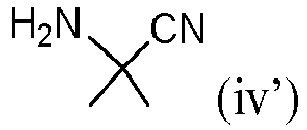

- either a step (1quater) of reacting a compound of formula (i5)

- wherein R1 denotes H, a halogen atom, an alkyl group or an halogenoalkyl group; Y denotes a halogen atom; and n is an integer equal to 2;
- with a cyanide compound of formula M'C=N wherein M' is selected from H and a trialkylsilyl group, or a salt thereof,
- or a step (1quinquies) of reacting a compound of formula (i5)

- wherein R1 denotes H, a halogen atom, an alkyl group or an halogenoalkyl group; Y denotes a-ORm group wherein Rm is an alkali metal; and n is an integer equal to 1;
- with a cyanide compound of formula M'C=N wherein M' is an halogen atom.
- provided that R1 is different from -CH3 when Z is NOH, Y is Cl and n is equal to 1 or when M is Cl, Y is OK and n is equal to 1.
- In one embodiment, the process for making compounds (VI) is more specifically a process for making compound(s) of formula (VIA) and/or (VIB)

- wherein R1 denotes H, a halogen atom, an alkyl group or a halogenoalkyl group; preferably H, a C1 to C4 alkyl group, a halogen atom, or a C1 to C4 fluoroalkyl group. This process comprises either the step (1), either the step (Ibis) or the step (Iter) of the general process for making compounds of formula (VI),
- provided that R1 is different from -CH3 when Z is NOH, Y is -Cl and n is equal to 1.
- In another embodiment, the process for making compounds (VI) is more specifically a process for making compound of formula (VIC)

- wherein R1 denotes H, a halogen atom, an alkyl group or a halogenoalkyl group; preferably R1 denotes hydrogen, a C1 to C4 alkyl group, a halogen atom, or a C1 to C4 fluoroalkyl group. This process therefore comprises either the step (1quater) or the step (1 quinquies) of the general process for making compounds of formula (VI) described above,
- provided that R1 is different from CH3 when M is Cl, Y is OK and n is equal to 1.
- Each of the alternative steps (1) to (1quinquies) will now be described in details.
- For each of these, R1 in compound of formula (i5) preferably denotes hydrogen, a C2 to C4 alkyl group, a halogen atom, or a C1 to C4 fluoroalkyl group. R1 can more particularly be selected from hydrogen or a C2 to C4 alkyl group. Alternatively, R1 can more particularly be selected from a halogen atom or a C1 to C4 fluoroalkyl group; the latter can be perfluorinated. More preferably, R1 denotes a C1 to C3 fluoro- or perfluoroalkyl group, still more preferably a C1 to C2 fluoro- or perfluoroalkyl group. R1 can especially be selected from: -CH2F, -CHF2, -CF3, -CH2-CH2F, -CH2-CHF2, -CH2-CF3, -CHF-CH3, -CHF-CH2F, -CHF-CHF2, -CHF-CF3, -CF2-CH3, -CF2-CH2F, -CF2-CHF2, and -CF2-CF3. In a sub-embodiment, R1 is a C1 fluoro- or perfluoroalkyl group. It can especially be selected from -CH2F, -CHF2, and -CF3. In one sub-embodiment R1 is -CF3. In another sub-embodiment R1 is -CHF2. In another sub-embodiment R1 is -CH2F.
- Referring to compound of formula (i5) used in step (1), among possible halogen atoms denoted by Y, chlorine is preferred. In one sub-embodiment, compound of formula (i5) used in step (1) is such as n is equal to 1 and compound of formula (iv) used in step (1) is such as Z denotes NOH. In an alternative sub-embodiment compound of formula (i5) used in step (1) is such as n is equal to 2 and compound of formula (iv) used in step (1) is such as Z denotes NH. Both of these sub-embodiments enable the formation of compound (VI) wherein W denotes the group A.
- The initial molar ratio (compound of formula (i5)/compound of formula (iv)) preferably ranges from 0.70 to 1.40, preferably from 0.80 to 1.20.
- A solvent can be used as reaction medium to perform the reaction between compound of formula (i5) with compound of formula (iv). An organic solvent, preferably an aprotic one, can advantageously be used. Mention can be made of chlorinated solvents, such as dichloromethane, chloroform, o-dichlorobenzene, being preferably dichloromethane. The reaction can alternatively be performed without solvent. In this case, one or both of the reactants can serve as reaction medium.
- A hydrogen halide by-product may be formed during the reaction between compound (i5) and compound (iv). To avoid that the hydrogen halide inhibits the reaction by decreasing pH or protonates the reactants, a base can be added in the reaction medium. As suitable base, mention can be made of organic bases, especially trialkylamines, and pyridines, and inorganic bases, especially those selected from alkali metals and alkaline earth metals carbonates such as Na2CO3, K2CO3, being preferably a trialkylamine and more preferably triethylamine. The amount of base depends of the one of compound (i5); the molar ratio (base/compound (i5)) preferably ranges from 1:1 to 1.2:1. In contact with the hydrogen halide, the base will form the corresponding hydrohalide (for instance, triethylamine will form triethylamine hydrohalide). It can be easily removed from the reaction medium by known methods, for instance by liquid-liquid extraction. Hydrogen halide can be eliminated by stripping.
- The reaction step between compound of formula (i5) with compound of formula (iv) can be performed at a temperature ranging from 5°C to 50°C, preferably from 10°C to 30°C. It can advantageously be performed at ambient temperature (20°C to 25°C). It is advantageous to perform this reaction step in two stages, by first contacting compound (i5) with compound of formula (iv) (and optionally the base) at a temperature ranging from -5°C to 10°C, preferably from 0°C to 5°C, and preferably by maintaining the temperature below 10°C until completion of this contacting stage, and then by raising the temperature to a temperature ranging from 15°C to 50°C, preferably from 20°C to 25°C for the time necessary to complete the reaction.
- The reaction is preferably performed at atmospheric pressure.
- Reaction time can vary widely as a function of the reaction temperature chosen. It can range from 1 hour to one day, especially from 1 hour to 12 hours, more particularly from 1 hour to 5 hours.
- The progress of the reaction can be monitored by the degree of conversion of the compound of formula (i5), which is the molar ratio of the amount of compound of formula (i5) which has been consumed to the initial amount of compound of formula (i5) in the reaction medium, this degree being readily calculated after dosing compound of formula (i5) remaining in the reaction medium.
- The reaction medium can then be treated in a way known per se in order to separate the different compounds present, especially to isolate the compound of formula (VI) obtained. It makes it possible for the remaining starting materials to be recycled in order to produce an additional amount of the targeted compound of formula (VI). One or more liquid/solid separation operations can be carried out, for example in order to separate possible solid impurities from the reaction medium. The techniques used can be crystallization, filtration on different types of supports, centrifugation, separation on settling and evaporation, this list not being exhaustive. Alternatively or in addition, one or more liquid/liquid separation operations can be carried out in order to separate and/or purify the product obtained. The techniques used can be distillation, liquid/liquid extraction, separation by reverse osmosis or separation by ion-exchange resins, this list not being exhaustive. These liquid/solid and liquid/liquid separation operations can be carried out under continuous or batch conditions, it being possible for a person skilled in the art to choose the most appropriate conditions.
- Accordingly, the process for making compound of formula (VI) can additionally comprise a step which consists in isolating said compound (VI), for instance by performing at least one liquid/solid separation and/or at least one liquid/liquid separation. In one specific embodiment, said at least one liquid/solid separation is a filtration and said at least one liquid/liquid separation is a distillation.
- Preferably, isolated compound of formula (VI) has a purity degree of at least 94% wt, 95% wt, 96% wt, 97% wt, 98 % wt, or even 99 % wt.The process for making compound of formula (VI) can additionally comprise a step which consists in separating part or all of the unreacted compound of formula (i5), (vi) and in recycling these compounds in the process.
- Compound of formula (i5) wherein n is equal to 1 can advantageously be obtained by a reaction step between a compound of formula (i6)
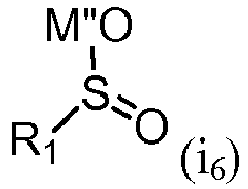
- wherein R1 such as described above in connection with compound of formula (i5) and M" denotes an alkali metal,
- and a compound (vi) of formula X5-S(O)-X6, wherein X5 and X6, which can be the same or different, denote respectively a halogen atom.
- M" preferably denotes Na or K, more preferably K.
- X5 and X6, which can be the same or different, preferably denote Cl.
- The initial molar ratio (compound of formula (i6)/compound of formula (vi)) preferably ranges from 0.70 to 1.40, preferably from 0.90 to 1.30.
- A solvent can be used as reaction medium to perform the reaction between compound of formula (i6) with compound of formula (vi). An organic solvent, more preferably selected from non-polar and polar aprotic organic solvents, is more preferably used. Mention can be made of chlorinated solvents, such as dichloromethane, chloroform, o-dichlorobenzene, thionyl chloride, being preferably dichloromethane. The reaction can alternatively be performed without solvent. In this case, one or both of the reactants can serve as reaction medium.
- In a sub-embodiment, compound (i6) is first suspended in said solvent and then the obtained suspension is contacted with compound (vi) in order to perform the reaction step (1).
- The reaction step between compound of formula (i6) with compound of formula (vi) can be performed at a temperature ranging from 5°C to 80°C, preferably from 10°C to 70°C, more preferably from 15°C to 50°C. It can advantageously be performed at ambient temperature (20°C to 25°C). It is advantageous to perform this reaction step in two stages, by first contacting compound (i6) with compound of formula (vi) at a temperature ranging from -5°C to 10°C, preferably from 0°C to 5°C, and preferably by maintaining the temperature below 10°C until completion of this contacting stage, and then by raising the temperature to a temperature ranging from 15°C to 50°C, preferably from 20°C to 25°C for the time necessary to complete the reaction.
- The reaction between compound of formula (i6) with compound of formula (vi) is preferably performed at atmospheric pressure.
- Reaction time can vary widely as a function of the reaction temperature chosen. It can range from 1 hour to one day, especially from 1 hour to 12 hours, more particularly from 1 hour to 5 hours.
- The progress of the reaction can be monitored by the degree of conversion of the compound of formula (i6), which is the molar ratio of the amount of compound of formula (i6) which has been consumed to the initial amount of compound of formula (i6) in the reaction medium, this degree being readily calculated after dosing compound of formula (i6) remaining in the reaction medium.
- The reaction medium can then be treated in a way known per se in order to separate the different compounds present, especially to isolate the compound of formula (i5) wherein n is equal to 1 obtained. It makes it possible for the remaining starting materials to be recycled in order to produce an additional amount of the targeted compound of formula (i5) wherein n is equal to 1. One or more liquid/solid separation operations can be carried out, for example in order to separate possible solid impurities from the reaction medium. The techniques used can be crystallization, filtration on different types of supports, centrifugation, separation on settling and evaporation, this list not being exhaustive. Alternatively or in addition, one or more liquid/liquid separation operations can be carried out in order to separate and/or purify the product obtained. The techniques used can be distillation, liquid/liquid extraction, separation by reverse osmosis or separation by ion-exchange resins, this list not being exhaustive. These liquid/solid and liquid/liquid separation operations can be carried out under continuous or batch conditions, it being possible for a person skilled in the art to choose the most appropriate conditions.
- Accordingly, the process for making compound of formula (i5) wherein n is equal to 1 can additionally comprise a step which consists in isolating said compound (i5), for instance by performing at least one liquid/solid separation and/or at least one liquid/liquid separation. In one specific embodiment, said liquid/solid separation is a filtration and said liquid/liquid separation is a distillation.
- Preferably, isolated compound of formula formula (i5) wherein n is equal to 1 has a purity degree of at least 94% wt, 95% wt, 96% wt, 97% wt, 98 % wt, or even 99 % wt.
- The process for making compound of formula (i5) wherein n is equal to 1 can additionally comprise a step which consists in separating part or all of the unreacted compound of formula (i6), (vi) and in recycling these compounds in the process.
- The following conditions are identical to the ones described in connection with step (1): ratio of reactants, temperature, pressure, reaction time, monitoring of the degree of conversion, separation of the compounds present in the reaction medium after completion of the reaction, isolating of compound (VI), purity degree of compound (VI), recycling of the reactants. The other conditions are as follows.
- The reaction can be performed in a solvent, advantageously a non polar solvent. Mention can be made of aromatic hydrocarbons such as benzene, toluene, xylenes, and ethylbenzene. Toluene is preferred. The reaction can alternatively be performed without solvent. In this case, compound (iv) can advantageously play the role of a solvent. It can therefore be added in slight excess relative to compound (i5).
- A catalyst can advantageously be used. It is preferably selected, from Lewis acids, such as, without limitation, titanium ethoxide (Ti(OEt)4) or p-toluenesulfonic acid.
- Before performing step (Ibis), it is possible to make the sulfone compound of formula (i5) from the corresponding sulfoxide compound by performing an oxidation step by use of an oxidizing agent such as meta-chloroperoxybenzoic acid (mCPBA) .
- The following conditions are identical to the ones described in connection with step (1): ratio of reactants, solvent, temperature, pressure, reaction time, monitoring of the degree of conversion, separation of the compounds present in the reaction medium after completion of the reactions, isolating of compound (VI), purity degree of compound (VI), recycling of the reactants. The other conditions are as follows.
- Compound (i5) is reacted with compound (iv') so as to form a compound of formula

- Said base is preferably selected from trialkylamines, pyridines; and inorganic bases especially those selected from carbonates of alkali or alkaline earth metals, more preferably from carbonates of alkali metals, still more preferably from sodium or potassium carbonate. The amount of base to be added depends on the amount of compound (iv") formed. Typically, the molar ratio of base relative to compound (iv") ranges from 1:1 to 2:1, preferably from 1:1 to 1.6:1, more preferably from 1:1 to 1.3:1.
- Referring to compound of formula (i5) used in step (1quater), among possible halogen atoms denoted by Y, chlorine is preferred.
- Referring to said trialkylsilyl group in connection with the cyanide compound used in step (1quater), it is covalently bonded to the carbon atom of the cyanide function by its silicon atom. The alkyl chains in said trialkylsilyl group can be the same or different. They are preferably selected from C1 to C4 alkyl chains. Said trialkylsilyl group can be more specifically selected from trimethylsilyl, triethylsilyl, triisopropylsilyl, being preferably trimethylsilyl.
- In one embodiment, the cyanide compound used in step (1quater) is in a salified form. In one sub-embodiment, the salt of cyanide compound can be represented by the formula M'q+(C≡N-)q wherein M'q+ is selected from metals and onium cations and q denotes the valency of said cation. Among suitable onium cations, mention can be made of ammonium, phosphonium, pyridinium, pyrazolinium, imidazolium, and arsenium cations. Ammonium cations can be especially selected from ammonium (NH4 +) and primary, secondary, tertiary, and quaternary ammonium cations, such as monoalkylammonium, dialkylammonium, trialkylammonium, tetraalkylammonium, trialkylbenzylammonium, and tetraarylammonium. Phosphonium cations can be especially selected from phosphonium (PH4 +) and quaternary phosphonium cations such as tetraalkylphosphonium, trialkylbenzylphosphonium, alkyltriarylphosphonium, and tetraarylphosphonium. In such quaternary ammonium and quaternary phosphonium cations, said alkyl, which can be the same or different, preferably denotes C1-C12 alkyl, more preferably C4-C6 alkyl; said aryl, which can be the same or different, preferably denotes phenyl or naphtalenyl.
- According to an embodiment, the salt of cyanide compound possibly used in step (1quater) is an onium salt. In the sub-embodiment wherein the latter is represented by the formula M'q+(C≡N- )q defined above, M'q+ is therefore selected from onium cations such as the ones described above. Preferably, M'q+ is a quaternary phosphonium or ammonium cation, more preferably a tetraalkylphosphonium or ammonium cation and even more preferably a tetrabutylphosphonium or ammonium cation. Phosphonium cations are preferred.
- According to another embodiment, the salt of the cyanide compound possibly used in step (1quater) is a metal salt. In the sub-embodiment wherein the latter is represented by the formula M'q+(-C≡N)q defined above, M' is therefore at least one metal. Said metal or combination of metals can advantageously be selected from alkali metals, alkaline earth metals, and transition metals, more preferably from Li, Na, K, Mg, Ca, Fe, Co, Ag, Cu, even more preferably from K, Ag and Cu.
- In one embodiment, the cyanide compound possibly used in step (1quater) is of formula M'CN such as M is selected from -Si(CH3)3 or is of formula M'q+(CN-)q wherein M'q+ is selected from alkali metal, alkaline earth metal, transition metal, tetraalkyl phosphonium, and tetraalkylammonium cations with q denoting the valency of said cation.
- The initial molar ratio (compound of formula (i5)/cyanide compound) preferably ranges from 0.70 to 1.40, preferably from 0.80 to 1.20.
- A catalyst can optionally be used to perform the reaction. As suitable catalysts, mention can be made of Lewis bases and acids or any source of chloride, fluoride, bromide or cyanide. A bromide catalyst is particularly suitable when the cyanide compound M'CN is such as M' is a trialkylsilyl group.
- A solvent is preferably used as reaction medium to perform the reaction between compound of formula (i5) with the cyanide compound. A solvent that can solve, at least partly, the cyanide compound M'CN, especially selected from polar aprotic solvents, is preferable. An organic solvent is preferably used. Mention can be made of N,N-dimethylformamide, acetonitrile, dimethoxyethane, dichloromethane, being preferably dichloromethane. The reaction can alternatively be performed without solvent. In this case, one or both of the reactants can serve as reaction medium.
- Temperature of the reaction step compound of formula (i5) and the cyanide compound preferably ranges from 50°C to 150°C, preferably from 75°C to 125°C, more preferably from 90°C to 110°C, even more preferably from 95°C to 105°C.
- The reaction is preferably performed at atmospheric pressure.
- Reaction time can vary widely as a function of the reaction temperature chosen. It can range from 1 hour to one day, especially from 1 hour to 12 hours, more particularly from 1 hour to 5 hours.
- The progress of the reaction can be monitored by the degree of conversion of the compound of formula (i5), which is the molar ratio of the amount of compound of formula (i5) which has been consumed to the initial amount of compound of formula (i5) in the reaction medium, this degree being readily calculated after dosing compound of formula (i5) remaining in the reaction medium.
- The reaction medium can then be treated in a way known per se in order to separate the different compounds present, especially to isolate the compound of formula (VI) obtained. It makes it possible for the remaining starting materials to be recycled in order to produce an additional amount of the targeted compound of formula (VI). One or more liquid/solid separation operations can be carried out, for example in order to separate possible solid impurities from the reaction medium. The techniques used can be crystallization, filtration on different types of supports, centrifugation, separation on settling and evaporation, this list not being exhaustive. Alternatively or in addition, one or more liquid/liquid separation operations can be carried out in order to separate and/or purify the product obtained. The techniques used can be distillation, liquid/liquid extraction, separation by reverse osmosis or separation by ion-exchange resins, this list not being exhaustive. These liquid/solid and liquid/liquid separation operations can be carried out under continuous or batch conditions, it being possible for a person skilled in the art to choose the most appropriate conditions.
- Accordingly, the process for making compound of formula (VI) can additionally comprise a step which consists in isolating said compound (VI), for instance by performing at least one liquid/solid separation and/or at least one liquid/liquid separation. In one specific embodiment, said liquid/solid separation is a filtration and said liquid/liquid separation is a distillation. For performing the filtration, temperature of the reaction medium is preferably cooled to a temperature ranging from 10 to 30 °C, preferably from 15°C to 25°C after the reaction step between compound of formula (i5) and the cyanide compound.
- The process can additionally comprise a step which consists in separating part or all of the unreacted compound of formula (i5) and/or the cyanide compound and in recycling these compounds in the process.
- Referring to Y in compound (i5) used in step (1quinquies), among possible -ORm groups wherein Rm is an alkali metal, Rm is preferably selected from K and Na, being more preferably K.
- Referring to M' in the cyanide compound used in step (1quinquies), among possible halogen atoms, chlorine is preferred.
- The initial molar ratio (compound of formula (i5)/cyanide compound) preferably ranges from 0.30 to 0.70, preferably from 0.40 to 0.60.
- A solvent is preferably used as reaction medium to perform the reaction between compound of formula (i5) with the cyanide compound. Preferably it is an aqueous solvent. Water is particularly suitable.
- According to one embodiment, prior to the reaction step between compound (i5) and the cyanide compound, compound (i5) is first dissolved in water. The solution obtained is preferably cooled to a temperature below 10°C, preferably below 5°C, more preferably below 0°C, and still more preferably below -1°C, at about -2°C. The cooled solution is then contacted with the cyanide compound.
- For contacting of compound (i5) (optionally in the form of the cooled aqueous solution described above) with the cyanide compound, it is preferable to maintain temperature from about - 5°C to about 5°C, preferably from about -2°C to about 1°C until completion of the contacting stage. Temperature can be maintained from about -5°C to about 5°C, preferably from about -2°C to about 1°C, and more preferably at about 0°C, for the time necessary to complete the reaction.
- The reaction is preferably performed at atmospheric pressure.
- Reaction time can vary widely as a function of the reaction temperature chosen. It can range from 1 hour to one day, especially from 1 hour to 12 hours, more particularly from 1 hour to 5 hours.
- The progress of the reaction can be monitored by the degree of conversion of the compound of formula (i5), which is the molar ratio of the amount of compound of formula (i5) which has been consumed to the initial amount of compound of formula (i5) in the reaction medium, this degree being readily calculated after dosing compound of formula (i5) remaining in the reaction medium.
- The reaction medium can then be treated in a way known per se in order to separate the different compounds present, especially to isolate the compound of formula (VI) obtained. It makes it possible for the remaining starting materials to be recycled in order to produce an additional amount of the targeted compound of formula (VI). One or more liquid/solid separation operations can be carried out, for example in order to separate possible solid impurities from the reaction medium. The techniques used can be crystallization, filtration on different types of supports, centrifugation, separation on settling and evaporation, this list not being exhaustive. Alternatively or in addition, one or more liquid/liquid separation operations can be carried out in order to separate and/or purify the product obtained. The techniques used can be distillation, liquid/liquid extraction, separation by reverse osmosis or separation by ion-exchange resins, this list not being exhaustive. These liquid/solid and liquid/liquid separation operations can be carried out under continuous or batch conditions, it being possible for a person skilled in the art to choose the most appropriate conditions.
- Accordingly, the process for making compound of formula (VI) can additionally comprise a step which consists in isolating said compound (VI), for instance by performing at least one liquid/liquid separation. In one specific embodiment, the process comprises a liquid-liquid extraction and/or a distillation. Performing at least one liquid-liquid extraction is recommended if the reaction between compound (i5) and the cyanide compound is carried out in an aqueous reaction medium. For the liquid-liquid extraction, a (polar or non-polar) aprotic solvent is preferably used. Mention can be made of esters such as ethyl acetate, methyl acetate, ethyl propionate; chlorinated solvents such as dichloromethane; ethers such as diethyl ether; being preferably a chlorinated solvent and more preferably dichloromethane.
- Preferably, isolated compound of formula (VI) has a purity degree of at least 94% wt, 95% wt, 96% wt, 97% wt, 98 % wt, or even 99 % wt. The process can additionally comprise a step which consists in separating part or all of the unreacted compound of formula (i5) and/or the cyanide compound and in recycling these compounds in the process.
- As examples of suitable compounds of formula (i5), mention can be made of trifluoromethanesulfinic chloride, trifluoromethanesulfonyl chloride, trifluoromethanesulfinamide, trifluoromethanesulfonamide, potassium trifluoromethanesulfinate and potassium trifluoromethanesulfonate.
- As examples of suitable compounds of formula (iv), mention can be made of propan-2-one oxime, propan-2-imine, propan-2-one.
- As examples of suitable compounds of formula M'CN, mention can be made of cyanic chloride, or any of cyanosodium, cyanopotassium, hydrogen cyanide, trimethylsilyl cyanide, tetramethylammonium cyanide, tetraethylammonium cyanide, tetrapropylammonium cyanide, tetrabutylammonium cyanide, tetrapentylammonium cyanide, tetrahexylammonium cyanide, tetraheptylammonium cyanide, tetraoctylammonium cyanide, tetranonylammonium cyanide, tetradecylammonium cyanide, tetramethylphosphonium cyanide, tetraethylphosphonium cyanide, tetrapropylphosphonium cyanide, tetrabutylphosphonium cyanide, tetrapentylphosphonium cyanide, tetrahexylphosphonium cyanide, tetraheptylphosphonium cyanide, tetraoctylphosphonium cyanide, tetranonylphosphonium cyanide, tetradecylphosphonium cyanide.
- Another subject-matter of the invention is the use as component for in an electrolyte composition, especially one suitable for electrochemical cells such as lithium ion batteries, of at least one compound of formula (VI) as described above.
- Compound(s) of formula (VI) can advantageously be used for said electrolyte composition as solvent(s) or additive(s), depending on the amount added in the electrolyte composition.
- One object of the present invention is accordingly an electrolyte composition, especially one suitable for an electrochemical cell such as a lithium-ion battery, comprising at least one compound selected from compounds (VI) described above or a mixture thereof and at least one electrolyte salt.
- Said at least one compound of formula (VI) or mixtures thereof can advantageously be present in the electrolyte composition in an amount ranging from 0.05% to 95%, preferably from 0.8% to 70%, more preferably from 1% to 50%, more preferably from 2% to 20%, even more preferably from 3% to 10%, by weight relative to the total weight of the electrolyte composition.
- According to an embodiment wherein said compound of formula (VI) is an additive, it may be present in the electrolyte composition in the range from 0.05 to about 20 percent by weight, based on the total weight of the electrolyte composition, for example in the range of from 0.05 to about 10 percent by weight, or from 0.1 to about 5.0 percent by weight, or from 0.3 to about 4.0 percent by weight, or from 0.5 to 2.0 percent by weight.
- According to an embodiment wherein said compound of formula (VI) is a solvent, it may be present in the electrolyte composition in the range from about 20% to about 99,95% by weight of the electrolyte composition.
- The electrolyte composition according to the invention can further comprise at least one of the following compounds:
- a compound of formula (VIII)

- wherein A is Si or C;
- L1, L2 and L3, which can be the same or different, independently denote a substituted or unsubstituted, linear or branched, saturated or unsaturated, C1-C4 alkylene, C3-C12 cycloalkylene, C3-C12 arylene, or C4-C16 arylenealkylene group, optionally comprising at least one heteroatom selected from N, O and S;
- Ri1, Ri2 and Ri3, which can be the same or different, independently denote H, a halogen atom, a linear or branched C1-C8 alkyl, C2-C8 alkenyl, C2-C8 alkynyl, or C6-C10 aryl group, optionally comprising at least one substituent selected from a halogens, hydroxyl, alkoxy, carbonyl, and carboxyl groups, and/or optionnaly comprising at least one heteroatom selected from N, O and S;
- a compound of formula (IX)

- wherein R1 denotes H, a halogen atom, an alkyl group or a fluoroalkyl group;
- L4 denotes a simple bond or a substituted or unsubstituted, linear or branched, saturated or unsaturated, C1-C4 alkylene, C3-C12 cycloalkylene, C3-C12 arylene, or C4-C16 arylenealkylene group, optionnaly comprising at least one heteroatom selected from N, O and S;
- Ri4 denotes H, a linear or branched C1-C8 alkyl, C2-C8 alkenyl, C2-C8 alkynyl, or C6-C10 aryl group, optionally comprising at least one substituent selected from a halogens, hydroxyl, alkoxy, carbonyl, and carboxyl groups, and/or optionally comprising at least one heteroatom selected from N, O and S;
- a compound of formula (X)

- wherein R1 denotes H, a halogen atom, an alkyl group or a halogenoalkyl group;
- L5 denotes a simple bond or a substituted or unsubstituted, linear or branched, saturated or unsaturated, C1-C4 alkylene, C3-C12 cycloalkylene, C3-C12 arylene, or C4-C16 arylenealkylene group, optionnaly comprising at least one heteroatom selected from N, O and S;
- Ri5 denotes H, a linear or branched C1-C8 alkyl, C2-C8 alkenyl, C2-C8 alkynyl, or C6-C10 aryl group, optionally comprising at least one substituent selected from a halogens, hydroxyl, alkoxy, carbonyl, and carboxyl groups, and/or optionally comprising at least one heteroatom selected from N, O and S;
- a compound of formula (XI)

- a compound of formula (XII)

- a compound of formula (XIII)

- wherein R1 denotes H, a halogen atom, an alkyl group or a halogenoalkyl group;
- L6 is a simple bond or a substituted or unsubstituted, linear or branched, saturated or unsaturated, C1-C4 alkylene, C3-C12 cycloalkylene, C3-C12 arylene, or C4-C16 arylenealkylene group, optionally comprising at least one heteroatom selected from N, O and S;
- M4 is H, a metal or N(Ri6Ri7Ri8Ri9), wherein Ri6, Ri7, Ri8 and Ri9, which can be the same or different, independently denote H or a C1-C12 alkyl group;
- a compound of formula (XIV)

- ▪ NRi12 where Ri12 is H, a C1-C4 alkyl group, a C1-C4 alkenyl group or a C1-C4 alkynyl group;
- ▪ CRi13Ri14 where Ri13 and Ri14, which can be the same or different, are independently H, a C1-C4 alkyl group, a C1-C4 alkenyl group or a C1-C4 alkynyl group;
- ▪ and O;
Ri15, Ri16, Ri17 and Ri18, which can be the same or different, are independently selected from H, a halogen atom, a C1-C4 alkyl group and a C1-C4 halogenoalkyl group;
y is an integer ranging from 0 to 2 such as (L7)0 stands for a simple bond and when y is 1 or 2, L7 stands for a CRi19Ri20 group where Ri19 and Ri20, which can be the same or different, are H, a C1-C4 alkyl group, a C1-C4 alkenyl group or a C1-C4 alkynyl group;
- a compound of formula (XV)

- wherein R1 denotes H, a halogen atom, a C1-C4 alkyl group or a C1-C4 halogenoalkyl group;
- L8 is a simple bond or a substituted or unsubstituted, linear or branched, saturated or unsaturated, C1-C4 alkylene, C3-C12 cycloalkylene, C3-C12 arylene, or C4-C16 arylenealkylene group, optionnaly comprising at least one heteroatom selected from N, O and S;
- a compound of formula (XVI)

- wherein R1 denotes H, a halogen atom, a C1-C4 alkyl group or a C1-C4 halogenoalkyl group; ni denotes an integer greater than or equal to 2,
- Ri23 denotes a ni-valent linkage group comprising at least one carbon atom and atoms selected from C, H, a halogen atom and O, and the S atom of the -SO2R1 group is bound to a carbon atom of the Ri23 group;
- a compound of formula (XVII)

- and mixtures thereof.
- In connection with compound of formula (VIII), according to an embodiment, A is Si. In this case, L1, L2, and L3 which can be the same or different, preferably independently denote a simple bond or a substituted or unsubstituted, linear or branched, saturated or unsaturated, C1-C4 alkylene, being more preferably a simple bond. Also according to this embodiment, Ri1, Ri2 and Ri3, which can be the same or different, preferably independently denote a linear or branched C1-C8 alkyl, C2-C8 alkenyl, C2-C8 alkynyl, more preferably a linear or branched C1-C4 alkyl and still more preferably methyl.
- Still in connection with compound of formula (VIII), according to another embodiment, A is C. In this case, L1, L2, and L3 which can be the same or different, preferably independently denote a substituted or unsubstituted, linear or branched, saturated or unsaturated, C1-C4 alkylene, more preferably a C1-C3 alkylene, still more preferably a C1-C2 alkylene, even more preferably - CH2-. Also according to this embodiment, Ri1, Ri2 and Ri3, which can be the same or different, preferably independently denote a fluorine atom or a linear or branched C1-C4 fluoro or perfluoroalkyl group, being preferably F.
- In connection with compound of formula (IX), L4 denotes preferably a substituted or unsubstituted, linear or branched, saturated or unsaturated, C1-C4 alkylene, more preferably a C1-C3 alkylene, still more preferably a C1-C2 alkylene, even more preferably CH2. Ri4 preferably denotes a linear or branched C1-C8 alkyl, more preferably a C1-C4 alkyl, still more preferably a C1-C2 alkyl and even more preferably CH3. R1 preferably denotes a C1-C4 fluoro or perfluoroalkyl group, more preferably a C1-C3 fluoro or perfluoroalkyl group, still more preferably a C1-C2 fluoro or perfluoroalkyl group and even more preferably a C1 fluoro or perfluoroalkyl group, such as in particular CF3.
- In connection with compound of formula (X), L5 denotes preferably a simple bond or a substituted or unsubstituted, linear or branched, saturated or unsaturated, C1-C4 alkylene, more preferably a simple bond or a C1-C3 alkylene, still more preferably a simple bond or a C1-C2 alkylene, even more preferably a simple bond or CH2. R1 preferably denotes a C1-C4 fluoro or perfluoroalkyl group, more preferably a C1-C3 fluoro or perfluoroalkyl group, still more preferably a C1-C2 fluoro or perfluoroalkyl group and even more preferably a C1 fluoro or perfluoroalkyl group. In one sub-embodiment, L5 is a simple bond and R1 is CH2F or CF3. In another sub-embodiment, L5 is CH2 and R1 is CHF2. In any cases, Ri5 preferably denotes a linear or branched C1-C8 alkyl, more preferably a C1-C4 alkyl, still more preferably a C1-C2 alkyl and even more preferably CH3.
- In connection with compound of formula (XI), M3 is preferably a metal selected from alkali metals and rare earth metals; more preferably from alkali metals, especially Li and Na; and still more preferably Li.
- In connection with compound of formula (XII), Ri10 and Ri11, which can be the same or different, preferably independently denote a C1-C8 alkyl, more preferably a C1-C4 alkyl, still more preferably a C1-C2 alkyl and even more preferably CH3.
- In connection with compound of formula (XIII), R1 preferably denotes a C1-C4 fluoro or perfluoroalkyl group, more preferably a C1-C8 fluoro or perfluoroalkyl group, still more preferably a C1-C2 fluoro or perfluoroalkyl group and even more preferably a C1 fluoro or perfluoroalkyl group, such as in particular CF3. L6 preferably denotes a simple bond or a substituted or unsubstituted, linear or branched, saturated or unsaturated, C1-C4 alkylene, being more preferably a simple bond. M4 is preferably a metal selected from alkali metals and rare earth metals; more preferably from alkali metals, especially Li and Na; and still more preferably Li.
- In connection with compound of formula (XIV), according to one embodiment, X3 is NRi12 where Ri12 is H, a C1-C4 alkyl group, a C1-C4 alkenyl group or a C1-C4 alkynyl group. Preferably Ri12 is a C1-C4 alkyl group, more preferably a C1-C2 alkyl group and more preferably CH3. In this case, X4 is preferably CRi13Ri14 where Ri13 and Ri14, which can be the same or different, are independently H, a C1-C4 alkyl group, a C1-C4 alkenyl group or a C1-C4 alkynyl group. Ri13 and Ri14, are preferably independently H or a C1-C4 alkyl group, and more preferably both H. According to the same embodiment, Ri15, Ri16, Ri17 and Ri18, which can be the same or different, are preferably independently selected from H and a C1-C4 alkyl group, being more preferably H.
- According to another embodiment, X3 is O. In this case, X4 is preferably O. According to the same embodiment, Ri15, Ri16, Ri17 and Ri18, which can be the same or different, are preferably independently selected from H and a halogen atom, more preferably from H and fluorine. In one sub-embodiment, Ri15, Ri16 and Ri17 are both H and Ri18 is fluorine.
- Still in connection with compound of formula (XIV), y is preferably equal to 0 such as (L7)0 stands for a simple bond.
- In connection with compound of formula (XV), R1 preferably denotes a C1-C4 fluoro or perfluoroalkyl group, more preferably a C1-C3 fluoro or perfluoroalkyl group, still more preferably a C1-C2 fluoro or perfluoroalkyl group and even more preferably a C1 fluoroalkyl group, such as in particular CHF2. L8 preferably denotes a substituted or unsubstituted, linear or branched, saturated or unsaturated, C1-C4 alkylene, being more preferably a C1-C3 alkylene, still more preferably a C1-C2 alkylene, even more preferably CH2.
- In connection with compound of formula (XVI), R1 denotes preferably a halogen atom or a C1-C4 halogenoalkyl group, more preferably F or a C1-C4 fluoro or perfluoroalkyl group and still preferably R1 is F. The index ni preferably denotes an integer equal to 2 so that Ri23 denotes a divalent linkage. Ri23 preferably denotes an alkylene, more preferably a C1-C6 alkylene, a C1-C5 alkylene, a C1-C4 alkylene and more preferably a C3 alkylene, especially C3H6.
- In connection with compound of formula (XVII), Ri24 and Ri25, which can be the same or different, are preferably selected from H, F, a C1-C4 alkyl group, and a C1-C4 fluoroalkyl group. Ri24 is preferably selected from F and a C1-C4 fluoroalkyl group, being preferably F. Ri25 is preferably selected from H, F and a C1-C4 fluoroalkyl group, being more preferably selected from H and F. In one sub-embodiment, Ri24 is F and Ri25 is H. In another sub-embodiment, Ri24 and Ri25 are both F.
- Said at least one compound of formula (VIII), (IX), (X), (XI), (XII), (XIII), (XIV), (XV), (XVI) or mixture thereof can be present in the electrolyte composition in an amount ranging from 0.05% to 94.5%, preferably from 0.8% to 70%, more preferably from 1% to 50%, more preferably from 2% to 20%, even more preferably from 3% to 10%, by weight relative to the total weight of the electrolyte composition.
- The electrolyte composition according to the invention can further comprise at least one non-fluorinated cyclic carbonate, preferably selected from ethylene carbonate, propylene carbonate, vinylene carbonate, ethyl propyl vinylene carbonate, vinyl ethylene carbonate, dimethylvinylene carbonate, and mixtures thereof.
- Said non-fluorinated cyclic carbonate can be present in the electrolyte composition in an amount ranging from 5% to 50%, preferably from 10% to 45%, more preferably from 12% to 40%, more preferably from 15% to 35%, even more preferably from 17% to 30%, by weight relative to the total weight of the electrolyte composition.
- The electrolyte composition according to the invention can further comprise at least one non-fluorinated acyclic carbonate, preferably selected from ethyl methyl carbonate, dimethyl carbonate, diethyl carbonate, di-tert-butyl carbonate, dipropyl carbonate, di-tert-butyl carbonate, dipropyl carbonate, methyl propyl carbonate, methyl butyl carbonate, ethyl butyl carbonate, propyl butyl carbonate, dibutyl carbonate, and mixtures thereof.
- Said non-fluorinated acyclic carbonate can be present in the electrolyte composition in an amount ranging from 5% to 50%, preferably from 10% to 45%, more preferably from 12% to 40%, more preferably from 15% to 35%, even more preferably from 17% to 30%, by weight relative to the total weight of the electrolyte composition.
- The electrolyte composition according to the invention can further comprise at least one fluorinated carbonate, preferably selected from 4-fluoro-1,3-dioxolan-2-one; 4-fluoro-4-methyl-1,3-dioxolan-2-one; 4-fluoro-5-methyl-1,3-dioxolan-2-one; 4-fluoro-4,5-dimethyl-1,3-dioxolan-2-one; 4,5-difluoro-1,3-dioxolan-2-one; 4,5-difluoro-4-methyl-1,3-dioxolan-2-one; 4,5-difluoro-4,5-dimethyl-1,3-dioxolan-2-one; 4,4-difluoro-1,3-dioxolan-2-one; 4,4,5-trifluoro-1,3-dioxolan-2-one; 4,4,5,5-tetrafluoro-1,3-dioxolan-2-one; and mixtures thereof; being preferably 4-fluoro-1,3-dioxolan-2-one.
- Said fluorinated carbonate can be present in the electrolyte composition in an amount ranging from 0.05% to 20%, preferably from 0.8% to 15%, more preferably from 1% to 10%, more preferably from 2% to 10%, even more preferably from 3% to 10%, by weight relative to the total weight of the electrolyte composition.
- The electrolyte composition according to the invention can further comprise at least one compound selected from:
- a fluorinated acyclic carboxylic acid ester represented by the formula:
R13-COO-R14,
- a fluorinated acyclic carbonate represented by the formula:
R15-OCOO-R16,
- a fluorinated acyclic ether represented by the formula:
R17-O-R18,
- and mixtures thereof,
- i) R13 is H, an alkyl group, or a fluoroalkyl group;
- ii) R15 and R17 is each independently a fluoroalkyl group and can be either the same as or different from each other;
- iii) R14, R16, and R18 is each independently an alkyl group or a fluoroalkyl group and can be either the same as or different from each other;
- iv) either or both of R13 and R14 comprises fluorine; and
- v) R13 and R14, R15 and R16, R17 and R18, each taken as a pair, comprise at least two carbon atoms but not more than seven carbon atoms.
- Preferably, none of R13, R14, R15, R16, R17, nor R18 contains a FCH2- group or a -FCH-group.
- In another embodiment, R13 and R15 in the formula above do not contain fluorine, and R14 and R16 contain fluorine.
- Suitable fluorinated acyclic carboxylic acid esters are represented by the formula:
R13-COO-R14
wherein - i) R13 is H, an alkyl group, or a fluoroalkyl group;
- ii) R14 is an alkyl group or a fluoroalkyl group;
- iii) either or both of R13 and R14 comprises fluorine; and
- iv) R13 and R14, taken as a pair, comprise at least two carbon atoms but not more than seven carbon atoms.
- In one embodiment, R13 is H and R14 is a fluoroalkyl group. In one embodiment, R13 is an alkyl group and R14 is a fluoroalkyl group. In one embodiment, R13 is a fluoroalkyl group and R14 is an alkyl group. In one embodiment, R13 is a fluoroalkyl group and R14 is a fluoroalkyl group, and R13 and R14 can be either the same as or different from each other. In one embodiment, R13 comprises one carbon atom. In one embodiment, R13 comprises two carbon atoms.
- In another embodiment, R13 and R14 are as defined herein above, and R13 and R14, taken as a pair, comprise at least two carbon atoms but not more than seven carbon atoms and further comprise at least two fluorine atoms, with the proviso that neither R13 nor R14 contains a FCH2-group or a -FCH- group.
- In one embodiment, the number of carbon atoms in R13 in the formula above is 1, 3, 4, or 5.
- In another embodiment, the number of carbon atoms in R13 in the formula above is 1.
- Examples of suitable fluorinated acyclic carboxylic acid esters include without limitation CH3-COO-CH2CF2H (2,2-difluoroethyl acetate, CAS No. 1550-44-3), CH3-COO-CH2CF3 (2,2,2-trifluoroethyl acetate, CAS No. 406-95-1), CH3CH2-COO-CH2CF2H (2,2-difluoroethyl propionate, CAS No. 1133129-90-4), CH3-COO-CH2CH2CF2H (3,3-difluoropropyl acetate), CH3CH2-COO-CH2CH2CF2H (3,3-difluoropropyl propionate), F2CHCH2-COO-CH3, F2CHCH2-COO-CH2CH3, and F2CHCH2CH2-COO-CH2CH3 (ethyl 4,4-difluorobutanoate, CAS No. 1240725-43-2), H-COO-CH2CF2H (difluoroethyl formate, CAS No. 1137875-58-1), H-COO-CH2CF3 (trifluoroethyl formate, CAS No. 32042-38-9), and mixtures thereof. According to a preferred embodiment, the fluorinated acyclic carboxylic acid ester comprises 2,2-difluoroethyl acetate (CH3-COO-CH2CF2H). According to another preferred embodiment, the fluorinated acyclic carboxylic acid ester comprises 2,2-difluoroethyl propionate (CH3CH2-COO-CH2CF2H). According to another preferred embodiment, the fluorinated acyclic carboxylic acid ester comprises 2,2,2-trifluoroethyl acetate (CH3-COO-CH2CF3). According to another preferred embodiment, the fluorinated acyclic carboxylic acid ester comprises 2,2-difluoroethyl formate (H-COO-CH2CF2H).
- Suitable fluorinated acyclic carbonates are represented by the formula
R15-OCOO-R16
wherein - i) R15 is a fluoroalkyl group;
- ii) R16 is an alkyl group or a fluoroalkyl group; and
- iii) R15 and R16 taken as a pair comprise at least two carbon atoms but not more than seven carbon atoms.
- In one embodiment, R15 is a fluoroalkyl group and R16 is an alkyl group. In one embodiment, R15 is a fluoroalkyl group and R16 is a fluoroalkyl group, and R15 and R16 can be either the same as or different from each other. In one embodiment, R15 comprises one carbon atom. In one embodiment, R15 comprises two carbon atoms.
- In another embodiment, R15 and R16 are as defined herein above, and R15 and R16, taken as a pair, comprise at least two carbon atoms but not more than seven carbon atoms and further comprise at least two fluorine atoms, with the proviso that neither R15 nor R16 contains a FCH2-group or a -FCH- group.
- Examples of suitable fluorinated acyclic carbonates include without limitation CH3-OC(O)O-CH2CF2H (methyl 2,2-difluoroethyl carbonate, CAS No. 916678-13-2), CH3-OC(O)O-CH2CF3 (methyl 2,2,2-trifluoroethyl carbonate, CAS No. 156783-95-8), CH3-OC(O)O-CH2CF2CF2H (methyl 2,2,3,3-tetrafluoropropyl carbonate, CAS No.156783-98-1), HCF2CH2-OCOO-CH2CH3 (ethyl 2,2-difluoroethyl carbonate, CAS No. 916678-14-3), and CF3CH2-OCOO-CH2CH3 (ethyl 2,2,2-trifluoroethyl carbonate, CAS No. 156783-96-9).
- Suitable fluorinated acyclic ethers are represented by the formula
R17-O-R18
wherein - i) R17 is a fluoroalkyl group;
- ii) R18 is an alkyl group or a fluoroalkyl group; and
- iii) R17 and R18 taken as a pair comprise at least two carbon atoms but not more than seven carbon atoms.
- In one embodiment, R17 is a fluoroalkyl group and R18 is an alkyl group. In one embodiment, R17 is a fluoroalkyl group and R18 is a fluoroalkyl group, and R17 and R18 can be either the same as or different from each other. In one embodiment, R17 comprises one carbon atom. In one embodiment, R17 comprises two carbon atoms.
- In another embodiment, R17 and R18 are as defined herein above, and R17 and R18, taken as a pair, comprise at least two carbon atoms but not more than seven carbon atoms and further comprise at least two fluorine atoms, with the proviso that neither R17 nor R18 contains a FCH2-group or a -FCH- group.
- Examples of suitable fluorinated acyclic ethers include without limitation HCF2CF2CH2-O-CF2CF2H (CAS No. 16627-68-2) and HCF2CH2-O-CF2CF2H (CAS No. 50807-77-7).
- As explained above, the electrolyte composition according to the invention may comprise, advantageously as solvent, a fluorinated acyclic carboxylic acid ester, a fluorinated acyclic carbonate, a fluorinated acyclic ether, or mixtures thereof. As used herein, the term "mixtures thereof" encompasses both mixtures within and mixtures between solvent classes, for example mixtures of two or more fluorinated acyclic carboxylic acid esters, and also mixtures of fluorinated acyclic carboxylic acid esters and fluorinated acyclic carbonates, for example. Non-limiting examples include a mixture of 2,2-difluoroethyl acetate and 2,2-difluoroethyl propionate; and a mixture of 2,2-difluoroethyl acetate and 2,2 difluoroethyl methyl carbonate.
- The fluorinated acyclic carboxylic acid ester, the fluorinated acyclic carbonate and/or the fluorinated acyclic ether can be present in the electrolyte composition in an amount ranging from 5% to 95%, preferably from 10% to 80%, more preferably from 20% to 75%, more preferably from 30% to 70%, even more preferably from 50% to 70%, by weight relative to the total weight of the electrolyte composition.
- The electrolyte composition according to the invention further comprises at least one electrolyte salt. Said electrolyte salt is preferably a lithium salt when the electrolyte composition is to be used in a lithium-ion battery. The lithium electrolyte salt is preferably selected from hexafluorophosphate (LiPF6), lithium bis(trifluoromethyl)tetrafluorophosphate (LiPF4(CF3)2), lithium bis(pentafluoroethyl)tetrafluorophosphate (LiPF4(C2F5)2), lithium tris(pentafluoroethyl)trifluorophosphate (LiPF3(C2F5)3), lithium bis(trifluoromethanesulfonyl)imide (LiN(CF3SO2)2), lithium bis(perfluoroethanesulfonyl)imide LiN(C2F5SO2)2, LiN(C2F5SO3)2, lithium (fluorosulfonyl) (nonafluorobutanesulfonyl)imide, lithium bis(fluorosulfonyl)imide, lithium tetrafluoroborate, lithium perchlorate, lithium hexafluoroarsenate, lithium hexafluoroantimonate, lithium tetrachloroaluminate, LiAlO4, lithium trifluoromethanesulfonate, lithium nonafluorobutanesulfonate, lithium tris(trifluoromethanesulfonyl)methide, lithium bis(oxalato)borate, lithium difluoro(oxalato)borate, Li2B12F12-xHx where x is an integer equal to 0 to 8, and mixtures of lithium fluoride and anion receptors such as B(OC6F5)3. The lithium electrolyte salt is preferably selected from lithium hexafluorophosphate, lithium bis(fluorosulfonyl)imide and lithium bis(trifluoromethanesulfonyl)imide, and is preferably hexafluorophosphate.
- The electrolyte salt is present in the electrolyte composition of the invention in an amount ranging from 5% to 20%, preferably from 6% to 18%, more preferably from 8% to 17%, more preferably from 9% to 16%, even more preferably from 11% to 16%, by weight relative to the total weight of the electrolyte composition.
- One further object of the invention is the use of at least one compound of formula (VI) such as defined above, eventually in combination with at least one compound of formula (VIII) to (XVII) such as defined above, as component(s) of an electrolyte composition, especially one suitable for an electrochemical cells such as a lithium-ion battery.
- One other object of the present invention is an electrochemical cell comprising:
- (a) a housing;
- (b) an anode and a cathode disposed in the housing and in ionically conductive contact with one another;
- (c) an electrolyte composition according to the invention.
- Especially, there is provided herein an electrochemical cell comprising a housing, an anode and a cathode disposed in the housing and in ionically conductive contact with one another, an electrolyte composition, as described herein above providing an ionically conductive pathway between the anode and the cathode, and a porous or microporous separator between the anode and the cathode. According to a preferred embodiment, the electrochemical cell is a lithium ion battery.
- The housing may be any suitable container to house the electrochemical cell components. Housing materials are well-known in the art and can include, for example, metal and polymeric housings. While the shape of the housing is not particularly important, suitable housings can be fabricated in the shape of a small or large cylinder, a prismatic case, or a pouch. The anode and the cathode may be comprised of any suitable conducting material depending on the type of electrochemical cell. Suitable examples of anode materials include without limitation lithium metal, lithium metal alloys, lithium titanate, aluminum, platinum, palladium, graphite, transition metal oxides, and lithiated tin oxide. Suitable examples of cathode materials include without limitation graphite, aluminum, platinum, palladium, electroactive transition metal oxides comprising lithium or sodium, indium tin oxide, and conducting polymers such as polypyrrole and polyvinylferrocene.
- The porous separator serves to prevent short circuiting between the anode and the cathode. The porous separator typically consists of a single-ply or multi-ply sheet of a microporous polymer such as polyethylene, polypropylene, polyamide, polyimide or a combination thereof. The pore size of the porous separator is sufficiently large to permit transport of ions to provide ionically conductive contact between the anode and the cathode, but small enough to prevent contact of the anode and cathode either directly or from particle penetration or dendrites which can form on the anode and cathode. Examples of porous separators suitable for use herein are disclosed in
U.S. Application SN 12/963,927 (filed 09 Dec 2010 U.S. Patent Application Publication No. 2012/0149852 , nowU.S. Patent No. 8,518,525 ). - Many different types of materials are known that can function as the anode or the cathode. In some embodiments, the cathode can include, for example, cathode electroactive materials comprising lithium and transition metals, such as LiCoO2, LiNiO2, LiMn2O4, LiCo0.2Ni0.2O2, LiV3O8, LiNi0.5Mn1.5O4; LiFePO4, LiMnPO4, LiCoPO4, and LiVPO4F. In other embodiments, the cathode active materials can include, for example:
- LiaCoGbO2, where 0.90 ≤ a ≤ 1.8, and 0.001 ≤ b ≤ 0.1;
- LiaNibMncCodReO2-fZf, where 0.8 ≤ a ≤ 1.2, 0.1 ≤ b ≤ 0.9, 0.0 ≤ c ≤ 0.7, 0.05 ≤ d ≤ 0.4, 0 ≤ e ≤ 0.2, wherein the sum of b+c+d+e is about 1, and 0≤f≤0.08;
- LiaA1-b,RbD2, where 0.90 ≤ a ≤ 1.8 and 0 ≤ b ≤ 0.5;
- LiaE1-bRbO2-cDc, where 0.90 ≤ a ≤ 1.8, 0 ≤ b ≤ 0.5 and 0 ≤ c ≤ 0.05;
- LiaNi1-b-cCObRcO2-dZd, where 0.9 ≤ a ≤ 1.8, 0 ≤ b ≤ 0.4, 0 ≤ c ≤ 0.05, and 0 ≤ d ≤ 0.05;
- Li1+zNi1-x-yCoxAlyO2, where 0 < x < 0.3, 0 < y <0.1, and 0 < z < 0.06.
- In the above chemical formulas, A is Ni, Co, Mn, or a combination thereof; D is O, F, S, P, or a combination thereof; E is Co, Mn, or a combination thereof; G is Al, Cr, Mn, Fe, Mg, La, Ce, Sr, V, or a combination thereof; R is Al, Ni, Co, Mn, Cr, Fe, Mg, Sr, V, Zr, Ti, a rare earth element, or a combination thereof; Z is F, S, P, or a combination thereof. Suitable cathodes include those disclosed in
U.S. Patent Nos. 5,962,166 ;6,680,145 ;6,964,828 ;7,026,070 ;7,078,128 ;7,303,840 ;7,381,496 ;7,468,223 ;7,541,114 ;7,718,319 ;7,981,544 ;8,389,160 ;8,394,534 ; and8,535,832 , and the references therein. By "rare earth element" is meant the lanthanide elements from La to Lu, and Y and Sc. - In another embodiment the cathode material is an NMC cathode; that is, a LiNiMnCoO cathode, more specifically, cathodes in which
- the atomic ratio of Ni:Mn:Co is 1:1:1 (LiaNi1-b-cCObRcO2-dZd where 0.98 ≤ a ≤ 1.05, 0 ≤ d ≤ 0.05, b = 0.333, c = 0.333, where R comprises Mn); or
- the atomic ratio of Ni:Mn:Co is 5:3:2 (LiaNi1-b-cCObRcO2-dZd where 0.98 ≤ a ≤ 1.05, 0 ≤ d ≤ 0.05, c = 0.3, b = 0.2, where R comprises Mn).
- In another embodiment, the cathode comprises a material of the formula LiaMnbJcO4Zd, wherein J is Ni, Co, Mn, Cr, Fe, Cu, V, Ti, Zr, Mo, B, Al, Ga, Si, Li, Mg, Ca, Sr, Zn, Sn, a rare earth element, or a combination thereof; Z is F, S, P, or a combination thereof; and 0.9 ≤ a ≤ 1.2, 1.3 ≤ b ≤ 2.2, 0 ≤ c ≤ 0.7, 0 ≤ d ≤ 0.4.
- In another embodiment, the cathode in the electrochemical cell or lithium ion battery disclosed herein comprises a cathode active material exhibiting greater than 30 mAh/g capacity in the potential range greater than 4.6 V versus a Li/Li+ reference electrode. One example of such a cathode is a stabilized manganese cathode comprising a lithium-containing manganese composite oxide having a spinel structure as cathode active material. The lithium-containing manganese composite oxide in a cathode suitable for use herein comprises oxides of the formula LixNiyMzMn2-y-zO4-d, wherein x is 0.03 to 1.0; x changes in accordance with release and uptake of lithium ions and electrons during charge and discharge; y is 0.3 to 0.6; M comprises one or more of Cr, Fe, Co, Li, Al, Ga, Nb, Mo, Ti, Zr, Mg, Zn, V, and Cu; z is 0.01 to 0.18; and d is 0 to 0.3. In one embodiment in the above formula, y is 0.38 to 0.48, z is 0.03 to 0.12, and d is 0 to 0.1. In one embodiment in the above formula, M is one or more of Li, Cr, Fe, Co and Ga. Stabilized manganese cathodes may also comprise spinel-layered composites which contain a manganese-containing spinel component and a lithium rich layered structure, as described in
U.S. Patent No. 7,303,840 . - In another embodiment, the cathode comprises a composite material represented by the structure of Formula:
x(Li2-wA1-vQw+vO3-e)•(1-x)(LiyMn2-zMzO4-d)
wherein: - x is about 0.005 to about 0.1;
- A comprises one or more of Mn or Ti;
- Q comprises one or more of Al, Ca, Co, Cr, Cu, Fe, Ga, Mg, Nb, Ni, Ti, V, Zn, Zr or Y;
- e is 0 to about 0.3;
- v is 0 to about 0.5.
- w is 0 to about 0.6;
- M comprises one or more of Al, Ca, Co, Cr, Cu, Fe, Ga, Li, Mg, Mn, Nb, Ni, Si, Ti, V, Zn, Zr or Y;
- d is 0 to about 0.5;
- y is about 0 to about 1; and
- z is about 0.3 to about 1; and
- In the above formula, x can be preferably about 0 to about 0.1.
- In another embodiment, the cathode in the lithium ion battery disclosed herein comprises
LiaA1-xRxDO4-fZf,
wherein: - A is Fe, Mn, Ni, Co, V, or a combination thereof;
- R is Al, Ni, Co, Mn, Cr, Fe, Mg, Sr, V, Zr, Ti, a rare earth element, or a combination thereof;
- D is P, S, Si, or a combination thereof;
- Z is F, Cl, S, or a combination thereof;
- 0.8 ≤ a ≤ 2.2;
- 0 ≤x≤0.3; and
- 0≤f≤0.1.
- In another embodiment, the cathode in the lithium ion battery ore electrochemical cell disclosed herein comprises a cathode active material which is charged to a potential greater than or equal to about 4.1 V, or greater than or equal to 4.35 V, or greater than 4.5 V, or greater than or equal to 4.6 V versus a Li/Li+ reference electrode. Other examples are layered-layered high-capacity oxygen-release cathodes such as those described in
U.S. Patent No. 7,468,223 charged to upper charging potentials above 4.5 V. - In some embodiments, the cathode comprises a cathode active material exhibiting greater than 30 mAh/g capacity in the potential range greater than 4.6 V versus a Li/Li+ reference electrode, or a cathode active material which is charged to a potential greater than or equal to 4.35 V versus a Li/Li+ reference electrode.
- A cathode active material suitable for use herein can be prepared using methods such as the hydroxide precursor method described by Liu et al (J. Phys. Chem. C 13:15073-15079, 2009). In that method, hydroxide precursors are precipitated from a solution containing the required amounts of manganese, nickel and other desired metal(s) acetates by the addition of KOH. The resulting precipitate is oven-dried and then fired with the required amount of LiOH•H20 at about 800 to about 1000°C in oxygen for 3 to 24 hours. Alternatively, the cathode active material can be prepared using a solid phase reaction process or a sol-gel process as described in
U.S. Patent No. 5,738,957 (Amine ). - A cathode, in which the cathode active material is contained, suitable for use herein may be prepared by methods such as mixing an effective amount of the cathode active material (e.g. about 70 wt% to about 97 wt%), a polymer binder, such as polyvinylidene difluoride, and conductive carbon in a suitable solvent, such as N-methylpyrrolidone, to generate a paste, which is then coated onto a current collector such as aluminum foil, and dried to form the cathode.
- An electrochemical cell or lithium ion battery as disclosed herein further contains an anode, which comprises an anode active material that is capable of storing and releasing lithium ions. Examples of suitable anode active materials include, for example, lithium alloys such as lithium-aluminum alloy, lithium-lead alloy, lithium-silicon alloy, and lithium-tin alloy; carbon materials such as graphite and mesocarbon microbeads (MCMB); phosphorus-containing materials such as black phosphorus, MnP4 and CoP3; metal oxides such as SnO2, SnO and TiO2; nanocomposites containing antimony or tin, for example nanocomposites containing antimony, oxides of aluminum, titanium, or molybdenum, and carbon, such as those described by Yoon et al (Chem. Mater. 21, 3898-3904, 2009); and lithium titanates such as Li4Ti5O12 and LiTi2O4. In one embodiment, the anode active material is lithium titanate or graphite. In another embodiment, the anode is graphite.
- An anode can be made by a method similar to that described above for a cathode wherein, for example, a binder such as a vinyl fluoride-based copolymer is dissolved or dispersed in an organic solvent or water, which is then mixed with the active, conductive material to obtain a paste. The paste is coated onto a metal foil, preferably aluminum or copper foil, to be used as the current collector. The paste is dried, preferably with heat, so that the active mass is bonded to the current collector. Suitable anode active materials and anodes are available commercially from companies such as Hitachi, NEI Inc. (Somerset, NJ), and Farasis Energy Inc. (Hayward, CA).
- The electrochemical cell as disclosed herein can be used in a variety of applications. For example, the electrochemical cell can be used for grid storage or as a power source in various electronically powered or assisted devices ("Electronic Device") such as a computer, a camera, a radio, a power tool, a telecommunications device, or a transportation device (including a motor vehicle, automobile, truck, bus or airplane).
- One other object of the present invention is an electronic device, a transportation device, or a telecommunications device, comprising an electrochemical cell according to the invention.
- One other object of the present invention is a method for forming an electrolyte composition. The method comprises combining a) at least one compound selected from those of formula (VI), b) at least one electrolyte salt, c) optionally at least one compound selected from those of formula (VIII) to (XVII), to form the electrolyte composition. In some embodiments, other components, especially such as those described above in connection with the electrolyte composition of the invention, are combined according to this method. Mention can be made of non-fluorinated cyclic carbonates, non-fluorinated acyclic carbonates, fluorinated cyclic carbonates, fluorinated acyclic carboxylic acids, fluorinated acyclic carbonates and/or fluorinated acyclic ethers described above. The components can be combined in any suitable order. The step of combining can be accomplished by adding the individual components of the electrolyte composition sequentially or at the same time. In some embodiments, the components a) and c) are combined to make a first solution. After the formation of the first solution, an amount of the electrolyte salt is added to the first solution in order to produce the electrolyte composition having the desired concentration of electrolyte salt. Alternatively, the components a) and b) are combined to make a first solution, and after the formation of the first solution an amount of component c) and/or the other optional components is added to produce the electrolyte composition. Typically, the electrolyte composition is stirred during and/or after the addition of the components in order to form a homogeneous mixture.
- Should the disclosure of any patents, patent applications, and publications which are incorporated herein by reference conflict with the description of the present application to the extent that it may render a term unclear, the present description shall take precedence.
- The claims are integral part of the description of the present application.
- The invention will now be further described in examples without intending to limit it.
- The present invention is further defined in the following examples. It should be understood that these examples, while indicating preferred embodiments of the invention, are given by way of illustration only. From the above discussion and these examples, one skilled in the art can ascertain the essential characteristics of this invention, and without departing from the spirit and scope thereof, can make various changes and modifications of the invention to adapt it to various uses and conditions.
- Otherwise indicated, the raw materials used are commercially available. Mention can be made especially of: o-dichlorobenzene (Sigma-Aldrich, Germany), dichloromethane (DCM) (Sigma-Aldrich, Germany), xylene (Sigma-Aldrich, Germany), trimethylamine (Sigma-Aldrich, Germany), acetone oxime (Sigma-Aldrich, Germany), potassium cyanide (Sigma-Aldrich, Germany), silver cyanide (Sigma-Aldrich, Germany), thionyl chloride (Sigma-Aldrich, Germany), cyanogen chloride (prepared according to Journal of the American Chemical Society, 1919, vol. 41, p. 1241-1248), adiponitrile (Sigma-Aldrich, Germany), acetonitrile (Sigma-Aldrich, Germany).
-

- To a solution of triflyl chloride CF3SO2Cl (168.5g, 1 mol) and triethylamine (102g, 1mol) in methylene chloride (DCM, 500ml) maintained at 0-5°C is added a solution of 2-propaneimine* (50g, 0.88 mol) in DCM (200ml); the temperature is maintained at 5-10°C during the addition and then raised to 20°C; the corresponding suspension is stirred during 1h.
After filtration of the crude mixture, N-trifluoromethylsulfonylpropaneimine is isolated by vacuum distillation (115g, yield 60%, purity > 95% by GC).
* 2-propaneimine is prepared according to the literature: Bock, Hans; Dammel, Ralph - Chemische Berichte, 1987, vol. 120, p. 1961 - 1970 - Potassium triflinate CF3SO2K (200g, 1.16 mol) obtained by reduction of triflyl chloride according to a known method described by R.M. Scribner, J. Org. Chem., 31, 3671 (1966), is suspended in DCM (500ml) maintained at 0-5°C; thionyl chloride SOCl2 (119g, 1mol) is added to this suspension maintained at 0-5°C; the temperature is then raised to 20°C and the corresponding suspension is stirred during 1h; After filtration of the crude mixture and evaporation of the solvent, triflinyl chloride is isolated by distillation (120g, yield 68%, purity > 95% by quantitative 19F NMR).
To a solution of acetone oxime (44g, 0,6 mol) and triethylamine (61g, 0,6mol) in methylene chloride (DCM, 300ml) maintained at 0-5°C is added triflinyl chloride ((80g, 0,52 mol) in DCM (300ml); the temperature is maintained at 5-10°C during the addition and then raised to 20°C; the corresponding suspension is stirred during 1h.
After filtration of the crude mixture and evaporation of the solvent, N-trifluoromethylsulfonylpropaneimine is isolated by vacuum distillation (75g, yield 67%, purity > 95% by quantitative 19F NMR). -

- Triflyl chloride CF3SO2Cl (169g, 1mol) is dissolved o-dichlorobenzene (ODCB, 0.5L) containing potassium cyanide (80g, 1.2 equivalents) ; the resulting suspension is heated to 100°C during 5h, then cooled to 20°C and filtered.
Distillation under vacuum of the solution thus obtained leads to the isolation of triflyl cyanide as a colorless liquid (127g, yield 80%, purity > 95% by 19F NMR). - The synthesis was performed as in example 6.3 except that acetonitrile was used instead of o-dichlorobenzene.
- The synthesis was performed as in example 6.3 except that adiponitrile was used instead of o-dichlorobenzene.
- The synthesis was performed as in example 6.3 except that xylene was used instead of o-dichlorobenzene.
- The synthesis was performed as in example 6.3 except that silver cyanide was used instead of potassium cyanide.
- The synthesis was performed as in example 6.3 except that copper cyanide was used instead of potassium cyanide.
- Pure potassium triflinate CF3SO2K (172g, 1 mol), obtained by reduction of triflyl chloride according to a known method described by R.M. Scribner, J. Org. Chem., 31, 3671 (1966), is dissolved in water (0.5L) and the resulting solution is cooled to -2 °C. Gaseous cyanogen chloride (123g, 2 mol) was passed into the solution over 25 min at -2 to +1 °C, and the cloudy mixture was stirred for 45 min at 0 °C before addition of CH2Cl2 (200 mL). The phases were separated, and the aqueous phase was extracted with CH2Cl2 (2 X 150 mL). Evaporation of the solvent from the combined organic layers and distillation of the residue gave CF3SO2CN (119 g, 75%).
- In addition to the compounds synthesized in examples 1.1 to 1.8, the following battery grades compounds (called hereinafter compounds C) are used for the preparation of the electrolytes composition:
- tris(trimethylsilyl) phosphate (CAS 10497-05-09) (Sigma-Aldrich, Germany),
- tris(trifluoroethyl)phosphate (CAS 358-63-4) (Tokyo Chemical Industry, Japan),
- methyl 3,3,3-trifluoropropanonate (CAS 18830-44-9) (TCI Chemicals, India),
- 1,1-difluoro-2-(methylsulfonyl)ethane (CAS 1214268-07-1), prepared by the method described in
WO 2015/051141 - (fluoromethylsulfonyl)methane (CAS 94404-44-1), prepared from dimethylsulfoxide and (diethylamino)sulfur trifluoride according to the method described in J-R. McCarthy, J. Am. Soc., 107, 735-736 (1985),
- trifluoro(methylsulfonyl)methane (CAS 421-82-9) (Apolloscientific, UK),
- lithium biscyano(trifluoromethylsulfonyl)methide (CAS 210043-24-6), prepared according to example 2 of
US6576159 from malononitrile, lithium hydride and 1-(trifluoromethanesulfonyl)imidazole, - lithium tris (oxalato)phosphate (CAS 321201-33-6), prepared according to examples 1 and 2 of
EP1203001 , - 2,2-dimethyl-1,3,2-dioxasilolane-4,5-dione, prepared according to example "synthesis of dimethylsilyl oxalate" of
WO2018/033357 from Solvay, - 2-methylisothiazolidine-1,1-dioxide (CAS 83634-83-7) (Parchem, USA)
- 4-fluoro-1,
- 3,2-dioxathiolane-2,2-dioxide (CAS 23910-98-7) prepared according to example 2 of
CN105541789 , - (2-oxo-1,3-dioxolan-4-yl)-2,2-difluoromethylacetate (CAS 1337958-06-1), prepared according to example 2 of
US8735005 , - 1,3-Propanedisulfonyl difluoride (CAS 110073-91-1) prepared according to Journal of Fluorine Chemistry, 1997, vol. 83, # 2, p. 145-149,
- 3-Fluoro-2,5-furandione (CAS 2714-23-0) (Angene, UK)
- 3,4-Diffluoro-2,5-furandione (CAS 669-78-3) (Carbosynth)
- Ethylene carbonate (EC), ethyl methyl carbonate (EMC), and dimethyl carbonate (DMC), all battery grade, were purchased at ENchem. Lithium hexafluorophosphate (LiPF6), battery grade, was purchased at ENchem. 4-fluoro-1,3-dioxolane-2-one (FEC), battery grade, was purchased at Solvay. 2,2-difluoroethyl acetate (DFEA) was purchased at Solvay. 4,5-difluoro-1,3-dioxolane-2-one, battery grade, was provided by Solvay. It was obtained by a fluorination process of ethylene carbonate such as described in
EP 2483231 . - Electrolyte compositions are prepared by first mixing the solvents EC, EMC, DMC in their respective volume ratios EC/EMC/DMC (2:2:6) and dissolving the lithium salt LiPF6 in the appropriate amount to yield 1.5 M composition. Compounds obtained from examples 1.1 to 1.8 are respectively added to each electrolyte composition in an amount of 2% (For each electrolyte composition prepared, the amount of added compound is given in weight relative to the total weight of the composition). Other electrolyte compositions are prepared in the same manner but by adding further at least one of the compounds C in an amount of 2% in weight relative to the total weight of the composition. As the results of moisture measurement, the moisture content of all the electrolytes compositions is under 10 mg/kg of composition (Karl Fisher method).
- Pouch cells are purchased from Pred Materials (New York, N.Y.) and are 600 mAh cells containing an NMC 532 cathode and a graphitic anode.
Before use, the pouch cells are dried in the antechamber of a dry box under vacuum 4 days at 55°C and vacuum -100kPa. Approximately 2.0 gram of electrolyte composition is injected through the bottom, and the bottom edge sealed in a vacuum sealer. For each example, two pouch cells are prepared using the same electrolyte composition. - The cells are held in an environmental chamber (model BTU-433, Espec North America, Hudsonville, Michigan) and evaluated using a battery tester (Series 4000, Maccor, Tulsa, OK) for the formation procedures (at 25 °C, 60 °C) and the high temperature cycling (at 45 °C).
The pouch cells are conditioned using the following cycling procedure. In a first cycle, the cell is charged for 3 hours at 0.1 C, corresponding to approximately 30 % state of charge; this is followed by 24 hour rest at 60 °C. The pouch cell is degassed and resealed in a vacuum sealer. The cell is pressed using hot press at 70 °C during 3 sec.
For the second cycle, the cell is charged at constant current (CC charge) of 0.5 C to 4.35 V followed by a CV voltage-hold step at 4.35 V until current dropped below 0.05C and rested 10min. This is followed by a CC discharge at 0.5C to 3.0 V and rested 10min. This cycle is repeated 3 times and it is used as a check of the capacity of the cell.
The final step for formation of pouch cell is charged at constant current (CC charge) of 0.5C to SOC30.
For the 25 °C cycles and the 45 °C cycling described below, the cells also have a 10 min rest following each charge and each discharge step. - The cells are placed in an environmental chamber at 25°C and 45 °C and cycled: CC charge 1C to 4.35 V and CV charge to 0.05C, and CC discharge at 1C to 3.0 V.
- The cells are placed in an environmental chamber at 70 °C with SOC 100, CC charge 1C to 4.35 V and CV charge to 0.05C, initial thickness checked. After 1 week later, they are put out from oven, the thickness is measured by Vernier calipers, the residual and recovery capacity is measured with CC discharge at 1C to 3.0V, and DC-IR is checked.
- The electrolytes are measured by LCR meter in temperature control chamber at -20°C even 60°C.
- The tests show that the cells containing the electrolyte compositions according to the invention comprising at least one compound selected from those of formulae (VI) optionally in combination with at least one compound selected from those of formulae (VIII) to (XVII) have improved performance characteristics, especially regarding quality of the solid electrolyte interphase (SEI) formed on the electrodes surface, chemical stability, ionic conductivity, thermal stability, reversible capacity, cycle characteristics and/or gas generation.
Claims (15)
- Compound of formula (VI)


- Compound according to claim 1 wherein R1 denotes H, F, an alkyl group or a fluoroalkyl group; preferably F, an alkyl group or a fluoroalkyl group; more preferably F or a fluoroalkyl group; still more preferably a C1-C4 fluoro or perfluoroalkyl group and even more preferably CF3.
- Process for making a compound of formula (VI)

 - a step (1) of reacting a compound of formula (i5)
with a compound of formula (iv) - or a step (Ibis) of reacting a compound of formula (i5)
with a compound of formula (iv) - or a step (Iter) of reacting a compound of formula (i5)
with a compound of formula (iv')
 - or a step (1quater) of reacting a compound of formula (i5)
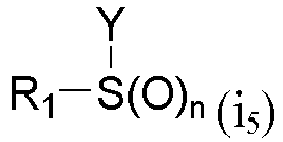 wherein R1 denotes H, a halogen atom, an alkyl group or a halogenoalkyl group; Y denotes a halogen atom different from R1 ; and n is an integer equal to 2;with a cyanide compound of formula M'C=N wherein M' is selected from H and a trialkylsilyl group or a salt thereof,- or a step (1quinquies) of reacting a compound of formula (i5)
 wherein R1 denotes H, a halogen atom, an alkyl group or a halogenoalkyl group; Y denotes a-ORm group wherein Rm is an alkali metal or an alkaline earth metal; and n is an integer equal to 1;with a cyanide compound of formula M'C=N wherein M' is a halogen atom,provided that R1 is different from -CH3 when Z is NOH, Y is Cl and n is equal to 1 or when M is Cl, Y is OK and n is equal to 1.
 - Process according to claim 3 wherein R1 denotes H, F, an alkyl group or a fluoroalkyl group; preferably F, an alkyl group or a fluoroalkyl group; more preferably F or a fluoroalkyl group; still more preferably a C1-C4 fluoro or perfluoroalkyl group and even more preferably CF3.
- Process according to claim 3 or 4, wherein, said halogen atom in connection with Y and/or M' is chlorine.
- Process according to any of claims 3 to 5, wherein said salt of the cyanide compound is of formula M'q+(-C≡N)q wherein M'q+ is selected from metal and onium cations and q denotes the valency of said cation; preferably M'q+ is selected from alkali metal, alkaline earth metal, transition metal, phosphonium and ammonium cations.
- Process according to any of claims 3 to 6, wherein the reaction is performed in a solvent.
- Process according to any of claims 3 to 7, wherein the reaction is performed by means of a catalyst.
- Process according to any of claims 3 to 8, wherein compound of formula (i5) wherein n is equal to 1 and Y is a halogen atom is obtained by a reaction step between a compound of formula (i6)
 wherein R1 denotes H, a halogen atom, an alkyl group or a halogenoalkyl group and M" denotes an alkali metal,and a compound (vi) of formula X5-S(O)-X6, wherein X5 and X6, which can be the same or different, denote respectively a halogen atom different from R1.
 - Process according to any of claims 3 to 9, further comprising at least one step of :- recovering and/or purifying compound (VI), preferably by at least one filtration and/or distillation; and/or- separating part or all of the unreacted compound (i5), (iv), (iv') (iv") and/or the cyanide compound M'CN and in recycling these compounds in the process.
- Electrolyte composition, comprising at least one electrolyte salt and at least one compound of formula (VI) according to any of claims 1 or 2 or obtained according to any of claims 3 to 10.
- Electrolyte composition according to claim 11, further comprising at least one of the following compounds:- compound of formula (VIII)
 wherein A is Si or C;L1, L2 and L3, which can be the same or different, independently denote a simple bond, a substituted or unsubstituted, linear or branched, saturated or unsaturated, C1-C4 alkylene, C3-C12 cycloalkylene, C3-C12 arylene, or C4-C16 arylenealkylene group, optionally comprising at least one heteroatom selected from N, O and S;Ri1, Ri2 and Ri3, which can be the same or different, independently denote H, a halogen atom, a linear or branched C1-C8 alkyl, C2-C8 alkenyl, C2-C8 alkynyl, or C6-C10 aryl group, optionally comprising at least one substituent selected from a halogens, hydroxyl, alkoxy, carbonyl, and carboxyl groups, and/or optionnaly comprising at least one heteroatom selected from N, O and S;- compound of formula (IX)
 wherein R1 denotes H, a halogen atom, an alkyl group or a fluoroalkyl group;L4 denotes a simple bond or a substituted or unsubstituted, linear or branched, saturated or unsaturated, C1-C4 alkylene, C3-C12 cycloalkylene, C3-C12 arylene, or C4-C16 arylenealkylene group, optionnaly comprising at least one heteroatom selected from N, O and S;Ri4 denotes H, a linear or branched C1-C8 alkyl, C2-C8 alkenyl, C2-C8 alkynyl, or C6-C10 aryl group, optionally comprising at least one substituent selected from a halogens, hydroxyl, alkoxy, carbonyl, and carboxyl groups, and/or optionally comprising at least one heteroatom selected from N, O and S;- compound of formula (X)
 wherein R1 denotes H, a halogen atom, an alkyl group or a halogenoalkyl group;L5 denotes a simple bond or a substituted or unsubstituted, linear or branched, saturated or unsaturated, C1-C4 alkylene, C3-C12 cycloalkylene, C3-C12 arylene, or C4-C16 arylenealkylene group, optionnaly comprising at least one heteroatom selected from N, O and S;Ri5 denotes H, a linear or branched C1-C8 alkyl, C2-C8 alkenyl, C2-C8 alkynyl, or C6-C10 aryl group, optionally comprising at least one substituent selected from a halogens, hydroxyl, alkoxy, carbonyl, and carboxyl groups, and/or optionally comprising at least one heteroatom selected from N, O and S;- compound of formula (XI)
 - compound of formula (XII)
 - compound of formula (XIII)
 wherein R1 denotes H, a halogen atom, an alkyl group or a halogenoalkyl group;L6 is a simple bond or a substituted or unsubstituted, linear or branched, saturated or unsaturated, C1-C4 alkylene, C3-C12 cycloalkylene, C3-C12 arylene, or C4-C16 arylenealkylene group, optionally comprising at least one heteroatom selected from N, O and S;M4 is H, a metal or N(Ri6Ri7Ri8Ri9), wherein Ri6, Ri7, Ri8 and Ri9, which can be the same or different, independently denote H or a C1-C12 alkyl group;- compound of formula (XIV)
 wherein X3 and X4, which can be the same or different, are independently selected from:▪ NRi12 where Ri12 is H, a C1-C4 alkyl group, a C1-C4 alkenyl group or a C1-C4 alkynyl group;▪ CRi13Ri14 where Ri13 and Ri14, which can be the same or different, are independently H, a C1-C4 alkyl group, a C1-C4 alkenyl group or a C1-C4 alkynyl group;▪ and O;Ri15, Ri16, Ri17 and Ri18, which can be the same or different, are independently selected from H, a halogen atom, a C1-C4 alkyl group and a C1-C4 halogenoalkyl group;y is an integer ranging from 0 to 2 such as (L7)0 stands for a simple bond and when y is 1 or 2, L7 stands for a CRi19Ri20 group where Ri19 and Ri20, which can be the same or different, are H, a C1-C4 alkyl group, a C1-C4 alkenyl group or a C1-C4 alkynyl group;- compound of formula (XV)
 - compound of formula (XVI)
 wherein R1 denotes H, a halogen atom, a C1-C4 alkyl group or a C1-C4 halogenoalkyl group; ni denotes an integer greater than or equal to 2,Ri23 denotes a ni-valent linkage group comprising at least one carbon atom and atoms selected from C, H, a halogen atom and O, and the S atom of the -SO2R1 group is bound to a carbon atom of the Ri23 group;- compound of formula (XVII)
 - and mixtures thereof.
 - Electrolyte composition according to claim 11 or 12 further comprising:- at least one non-fluorinated cyclic carbonate, preferably selected from ethylene carbonate, propylene carbonate, vinylene carbonate, ethyl propyl vinylene carbonate, vinyl ethylene carbonate, dimethylvinylene carbonate, and mixtures thereof; and/or- at least one non-fluorinated acyclic carbonate, preferably selected from ethyl methyl carbonate, dimethyl carbonate, diethyl carbonate, di-tert-butyl carbonate, dipropyl carbonate, di-tert-butyl carbonate, dipropyl carbonate, methyl propyl carbonate, methyl butyl carbonate, ethyl butyl carbonate, propyl butyl carbonate, dibutyl carbonate, and mixtures thereof; and/or- at least one fluorinated cyclic carbonate, preferably selected from 4-fluoro-1,3-dioxolan-2-one; 4-fluoro-4 -methyl-1,3-dioxolan-2-one; 4-fluoro-5-methyl-1,3-dioxolan-2-one; 4-fluoro-4,5-dimethyl-1,3-dioxolan-2-one; 4,5-difluoro-1,3-dioxolan-2-one; 4,5-difluoro-4-methyl-1,3-dioxolan-2-one; 4,5-difluoro-4,5-dimethyl-1,3-dioxolan-2-one; 4,4-difluoro-1,3-dioxolan-2-one; 4,4,5-trifluoro-1,3-dioxolan-2-one; 4,4,5,5-tetrafluoro-1,3-dioxolan-2-one; and mixtures thereof; being preferably 4-fluoro-1,3-dioxolan-2-one.
- Electrolyte composition according to any of claims 11 to 13, further comprising at least one compound selected from:- a fluorinated acyclic carboxylic acid ester represented by the formula:
R13-COO-R14,
- a fluorinated acyclic carbonate represented by the formula:
R15-OCOO-R16,
- a fluorinated acyclic ether represented by the formula:
R17-O-R18,
- and mixtures thereof,whereini) R13 is H, an alkyl group, or a fluoroalkyl group;ii) R15 and R17 is each independently a fluoroalkyl group and can be either the same as or different from each other;iii) R14, R16, and R18 is each independently an alkyl group or a fluoroalkyl group and can be either the same as or different from each other;iv) either or both of R13 and R14 comprises fluorine; andv) R13 and R14, R15 and R16, R17 and R18, each taken as a pair, comprise at least two carbon atoms but not more than seven carbon atoms. - Electrolyte composition according to any of claims 11 to 14, wherein said electrolyte salt is a lithium salt, preferably selected from hexafluorophosphate (LiPF6), lithium bis(trifluoromethyl)tetrafluorophosphate (LiPF4(CF3)2), lithium bis(pentafluoroethyl)tetrafluorophosphate (LiPF4(C2F5)2), lithium tris(pentafluoroethyl)trifluorophosphate (LiPF3(C2F5)3), lithium bis(trifluoromethanesulfonyl)imide (LiN(CF3SO2)2), lithium bis(perfluoroethanesulfonyl)imide LiN(C2F5SO2)2, LiN(C2F5SO3)2, lithium (fluorosulfonyl) (nonafluorobutanesulfonyl)imide, lithium bis(fluorosulfonyl)imide, lithium tetrafluoroborate, lithium perchlorate, lithium hexafluoroarsenate, lithium hexafluoroantimonate, lithium tetrachloroaluminate, LiAlO4, lithium trifluoromethanesulfonate, lithium nonafluorobutanesulfonate, lithium tris(trifluoromethanesulfonyl)methide, lithium bis(oxalato)borate, lithium difluoro(oxalato)borate, Li2B12F12-xHx where x is an integer equal to 0 to 8, and mixtures of lithium fluoride and anion receptors such as B(OC6F5)3, being preferably selected from lithium hexafluorophosphate, lithium bis(fluorosulfonyl)imide and lithium bis(trifluoromethanesulfonyl)imide, and preferably being hexafluorophosphate.
Priority Applications (1)
| Application Number | Priority Date | Filing Date | Title |
|---|---|---|---|
| EP18186648.4A EP3604276A1 (en) | 2018-07-31 | 2018-07-31 | New components for electrolyte compositions |
Applications Claiming Priority (1)
| Application Number | Priority Date | Filing Date | Title |
|---|---|---|---|
| EP18186648.4A EP3604276A1 (en) | 2018-07-31 | 2018-07-31 | New components for electrolyte compositions |
Publications (1)
| Publication Number | Publication Date |
|---|---|
| EP3604276A1 true EP3604276A1 (en) | 2020-02-05 |
Family
ID=63113385
Family Applications (1)
| Application Number | Title | Priority Date | Filing Date |
|---|---|---|---|
| EP18186648.4A Withdrawn EP3604276A1 (en) | 2018-07-31 | 2018-07-31 | New components for electrolyte compositions |
Country Status (1)
| Country | Link |
|---|---|
| EP (1) | EP3604276A1 (en) |
Cited By (2)
| Publication number | Priority date | Publication date | Assignee | Title |
|---|---|---|---|---|
| WO2022260373A1 (en) * | 2021-06-07 | 2022-12-15 | 주식회사 엘지에너지솔루션 | Non-aqueous electrolyte solution for lithium secondary battery, and lithium secondary battery comprising same |
| US20240021877A1 (en) * | 2022-07-12 | 2024-01-18 | Sk On Co., Ltd. | Electrolyte Solution for Lithium Secondary Battery and Lithium Secondary Battery Including the Same |
Citations (25)
| Publication number | Priority date | Publication date | Assignee | Title |
|---|---|---|---|---|
| US5738957A (en) | 1995-04-26 | 1998-04-14 | Japan Storage Battery Co., Ltd. | Positive electrode active material for lithium battery |
| US5962166A (en) | 1997-08-18 | 1999-10-05 | Covalent Associates, Inc. | Ultrahigh voltage mixed valence materials |
| EP1203001A1 (en) | 1999-07-22 | 2002-05-08 | Chemetall GmbH | Tris(oxalato)phosphates, method for their preparation and their use |
| US6576159B1 (en) | 1996-12-30 | 2003-06-10 | Hydro-Quebec | Malononitrile-derivative anion salts, and their uses as ionic conducting materials |
| US6680145B2 (en) | 2001-08-07 | 2004-01-20 | 3M Innovative Properties Company | Lithium-ion batteries |
| US6964828B2 (en) | 2001-04-27 | 2005-11-15 | 3M Innovative Properties Company | Cathode compositions for lithium-ion batteries |
| US7026070B2 (en) | 2001-10-18 | 2006-04-11 | Nec Corporation | Positive electrode active material, positive electrode and non-aqueous electrolyte secondary battery using thereof |
| US7303840B2 (en) | 2004-09-03 | 2007-12-04 | Uchicago Argonne, Llc | Manganese oxide composite electrodes for lithium batteries |
| US7381496B2 (en) | 2004-05-21 | 2008-06-03 | Tiax Llc | Lithium metal oxide materials and methods of synthesis and use |
| US7468223B2 (en) | 2000-06-22 | 2008-12-23 | Uchicago Argonne, Llc | Lithium metal oxide electrodes for lithium cells and batteries |
| US7541114B2 (en) | 2002-03-01 | 2009-06-02 | Panasonic Corporation | Anode active material, manufacturing method thereof, and non-aqueous electrolyte secondary battery |
| JP2009259472A (en) * | 2008-04-14 | 2009-11-05 | Sony Corp | Electrolyte solution and secondary battery |
| US7718319B2 (en) | 2006-09-25 | 2010-05-18 | Board Of Regents, The University Of Texas System | Cation-substituted spinel oxide and oxyfluoride cathodes for lithium ion batteries |
| US7981544B2 (en) | 2007-02-13 | 2011-07-19 | Sanyo Electric Co., Ltd. | Positive electrode for nonaqueous electrolyte secondary battery, and production method thereof |
| US20120149852A1 (en) | 2010-12-09 | 2012-06-14 | E. I. Du Pont De Nemours And Company | Polyimide nanoweb with amidized surface and method for preparing |
| EP2483231A1 (en) | 2009-09-28 | 2012-08-08 | Solvay Fluor GmbH | Continuous preparation of carbonates |
| US8389160B2 (en) | 2008-10-07 | 2013-03-05 | Envia Systems, Inc. | Positive electrode materials for lithium ion batteries having a high specific discharge capacity and processes for the synthesis of these materials |
| WO2013033579A1 (en) * | 2011-09-02 | 2013-03-07 | E. I. Du Pont De Nemours And Company | Fluorinated electrolyte compositions |
| US8394534B2 (en) | 2009-08-27 | 2013-03-12 | Envia Systems, Inc. | Layer-layer lithium rich complex metal oxides with high specific capacity and excellent cycling |
| US8535832B2 (en) | 2009-08-27 | 2013-09-17 | Envia Systems, Inc. | Metal oxide coated positive electrode materials for lithium-based batteries |
| US8735005B2 (en) | 2010-04-02 | 2014-05-27 | E I Du Pont De Nemours And Company | Fluorinated cyclic carbonates and compositions thereof |
| WO2015051141A1 (en) | 2013-10-04 | 2015-04-09 | E. I. Du Pont De Nemours And Company | Methods for preparation of fluorinated sulfur-containing compounds |
| KR20160009427A (en) * | 2014-07-16 | 2016-01-26 | 동우 화인켐 주식회사 | Electrolyte solution for lithium secondary battery and lithium secondary battery comprising the same |
| CN105541789A (en) | 2015-12-31 | 2016-05-04 | 石家庄圣泰化工有限公司 | Method for preparing ethylene sulfate derivative |
| WO2018033357A1 (en) | 2016-08-19 | 2018-02-22 | Solvay Sa | Nonaqueous electrolyte compositions comprising silyl oxalates |
-
2018
- 2018-07-31 EP EP18186648.4A patent/EP3604276A1/en not_active Withdrawn
Patent Citations (27)
| Publication number | Priority date | Publication date | Assignee | Title |
|---|---|---|---|---|
| US5738957A (en) | 1995-04-26 | 1998-04-14 | Japan Storage Battery Co., Ltd. | Positive electrode active material for lithium battery |
| US6576159B1 (en) | 1996-12-30 | 2003-06-10 | Hydro-Quebec | Malononitrile-derivative anion salts, and their uses as ionic conducting materials |
| US5962166A (en) | 1997-08-18 | 1999-10-05 | Covalent Associates, Inc. | Ultrahigh voltage mixed valence materials |
| EP1203001A1 (en) | 1999-07-22 | 2002-05-08 | Chemetall GmbH | Tris(oxalato)phosphates, method for their preparation and their use |
| US7468223B2 (en) | 2000-06-22 | 2008-12-23 | Uchicago Argonne, Llc | Lithium metal oxide electrodes for lithium cells and batteries |
| US6964828B2 (en) | 2001-04-27 | 2005-11-15 | 3M Innovative Properties Company | Cathode compositions for lithium-ion batteries |
| US7078128B2 (en) | 2001-04-27 | 2006-07-18 | 3M Innovative Properties Company | Cathode compositions for lithium-ion batteries |
| US6680145B2 (en) | 2001-08-07 | 2004-01-20 | 3M Innovative Properties Company | Lithium-ion batteries |
| US7026070B2 (en) | 2001-10-18 | 2006-04-11 | Nec Corporation | Positive electrode active material, positive electrode and non-aqueous electrolyte secondary battery using thereof |
| US7541114B2 (en) | 2002-03-01 | 2009-06-02 | Panasonic Corporation | Anode active material, manufacturing method thereof, and non-aqueous electrolyte secondary battery |
| US7381496B2 (en) | 2004-05-21 | 2008-06-03 | Tiax Llc | Lithium metal oxide materials and methods of synthesis and use |
| US7303840B2 (en) | 2004-09-03 | 2007-12-04 | Uchicago Argonne, Llc | Manganese oxide composite electrodes for lithium batteries |
| US7718319B2 (en) | 2006-09-25 | 2010-05-18 | Board Of Regents, The University Of Texas System | Cation-substituted spinel oxide and oxyfluoride cathodes for lithium ion batteries |
| US7981544B2 (en) | 2007-02-13 | 2011-07-19 | Sanyo Electric Co., Ltd. | Positive electrode for nonaqueous electrolyte secondary battery, and production method thereof |
| JP2009259472A (en) * | 2008-04-14 | 2009-11-05 | Sony Corp | Electrolyte solution and secondary battery |
| US8389160B2 (en) | 2008-10-07 | 2013-03-05 | Envia Systems, Inc. | Positive electrode materials for lithium ion batteries having a high specific discharge capacity and processes for the synthesis of these materials |
| US8394534B2 (en) | 2009-08-27 | 2013-03-12 | Envia Systems, Inc. | Layer-layer lithium rich complex metal oxides with high specific capacity and excellent cycling |
| US8535832B2 (en) | 2009-08-27 | 2013-09-17 | Envia Systems, Inc. | Metal oxide coated positive electrode materials for lithium-based batteries |
| EP2483231A1 (en) | 2009-09-28 | 2012-08-08 | Solvay Fluor GmbH | Continuous preparation of carbonates |
| US8735005B2 (en) | 2010-04-02 | 2014-05-27 | E I Du Pont De Nemours And Company | Fluorinated cyclic carbonates and compositions thereof |
| US20120149852A1 (en) | 2010-12-09 | 2012-06-14 | E. I. Du Pont De Nemours And Company | Polyimide nanoweb with amidized surface and method for preparing |
| US8518525B2 (en) | 2010-12-09 | 2013-08-27 | E I Du Pont De Nemours And Company | Polyimide nanoweb with amidized surface and method for preparing |
| WO2013033579A1 (en) * | 2011-09-02 | 2013-03-07 | E. I. Du Pont De Nemours And Company | Fluorinated electrolyte compositions |
| WO2015051141A1 (en) | 2013-10-04 | 2015-04-09 | E. I. Du Pont De Nemours And Company | Methods for preparation of fluorinated sulfur-containing compounds |
| KR20160009427A (en) * | 2014-07-16 | 2016-01-26 | 동우 화인켐 주식회사 | Electrolyte solution for lithium secondary battery and lithium secondary battery comprising the same |
| CN105541789A (en) | 2015-12-31 | 2016-05-04 | 石家庄圣泰化工有限公司 | Method for preparing ethylene sulfate derivative |
| WO2018033357A1 (en) | 2016-08-19 | 2018-02-22 | Solvay Sa | Nonaqueous electrolyte compositions comprising silyl oxalates |
Non-Patent Citations (11)
| Title |
|---|
| ATETEGEB MEAZAH HAREGEWOIN ET AL: "Electrolyte additives for lithium ion battery electrodes: progress and perspectives", ENERGY & ENVIRONMENTAL SCIENCE, vol. 9, no. 6, 1 January 2016 (2016-01-01), Cambridge, pages 1955 - 1988, XP055534654, ISSN: 1754-5692, DOI: 10.1039/C6EE00123H * |
| DAMMEL, RALPH, CHEMISCHE BERICHTE, vol. 120, 1987, pages 1961 - 1970 |
| J. M. COX ET AL: "A Simple Synthesis of Sulfhonyl Cyanides", TETRAHEDRON LETTERS J. BRACKNELL, BERKSHIRE. JULY, vol. 39, no. 4, 17 July 1969 (1969-07-17), pages 3351 - 3352, XP055536192 * |
| JOURNAL OF FLUORINE CHEMISTRY, vol. 83, no. 2, 1997, pages 145 - 149 |
| JOURNAL OF THE AMERICAN CHEMICAL SOCIETY, vol. 41, 1919, pages 1241 - 1248 |
| J-R. MCCARTHY, J. AM. SOC., vol. 107, 1985, pages 735 - 736 |
| LIU ET AL., J. PHYS. CHEM. C, vol. 13, 2009, pages 15073 - 15079 |
| PROSYANIK, A. V.; KOL'TSOV, N. YU.; ROMANCHENKO, V. A.; BELOV, V. V.; BURMISTROV, K. S.; LOBAN, S. V.: "Thermal Z,E-isomerization of imines. VI. N-(Arylsulfonyl)imines of acetone and 2,6-di-tert-butyl-1,4-benzoquinone", ZHURNAL ORGANICHESKOI KHIMII, vol. 23, no. 2, 27 October 1987 (1987-10-27), pages 375 - 382, XP009510140 * |
| R.M. SCRIBN, J. ORG. CHEM., vol. 31, no. 3671, 1966 |
| R.M. SCRIBNER, J. ORG. CHEM., vol. 31, 1966, pages 3671 |
| YOON ET AL., CHEM. MATER., vol. 21, 2009, pages 3898 - 3904 |
Cited By (3)
| Publication number | Priority date | Publication date | Assignee | Title |
|---|---|---|---|---|
| WO2022260373A1 (en) * | 2021-06-07 | 2022-12-15 | 주식회사 엘지에너지솔루션 | Non-aqueous electrolyte solution for lithium secondary battery, and lithium secondary battery comprising same |
| US20240021877A1 (en) * | 2022-07-12 | 2024-01-18 | Sk On Co., Ltd. | Electrolyte Solution for Lithium Secondary Battery and Lithium Secondary Battery Including the Same |
| US11923508B2 (en) * | 2022-07-12 | 2024-03-05 | Sk On Co., Ltd. | Electrolyte solution for lithium secondary battery and lithium secondary battery including the same |
Similar Documents
| Publication | Publication Date | Title |
|---|---|---|
| EP3738167B1 (en) | Non-aqueous electrolyte compositions comprising lithium bis(fluorosulfonyl)imide | |
| US11476502B2 (en) | Nonaqueous electrolyte compositions comprising cyclic carbonate and non-fluorinated acyclic carbonate | |
| US10673096B2 (en) | Nonaqueous electrolyte compositions comprising sultone and fluorinated solvent | |
| US10559850B2 (en) | Nonaqueous electrolyte compositions comprising cyclic sulfates | |
| US11038196B2 (en) | Electrolytes containing six membered ring cyclic sulfates | |
| US10044066B2 (en) | Fluorinated electrolyte compositions | |
| US11289738B2 (en) | Nonaqueous electrolyte compositions comprising lithium oxalato phosphates | |
| US12046717B2 (en) | Nonaqueous electrolyte compositions comprising a fluorinated solvent and a 2-furanone | |
| US11362368B2 (en) | Nonaqueous electrolyte compositions | |
| US20150111112A1 (en) | Fluorine-containing esters and methods of preparation thereof | |
| EP3604276A1 (en) | New components for electrolyte compositions | |
| EP3605699A1 (en) | New components for electrolyte compositions | |
| EP3605698A1 (en) | New components for electrolyte compositions | |
| WO2020025499A1 (en) | New components for electrolyte compositions | |
| EP3605700A1 (en) | New components for electrolyte compositions | |
| WO2020025502A1 (en) | New components for electrolyte compositions | |
| WO2020025501A1 (en) | New components for electrolyte compositions |
Legal Events
| Date | Code | Title | Description |
|---|---|---|---|
| PUAI | Public reference made under article 153(3) epc to a published international application that has entered the european phase |
Free format text: ORIGINAL CODE: 0009012 |
|
| AK | Designated contracting states |
Kind code of ref document: A1 Designated state(s): AL AT BE BG CH CY CZ DE DK EE ES FI FR GB GR HR HU IE IS IT LI LT LU LV MC MK MT NL NO PL PT RO RS SE SI SK SM TR |
|
| AX | Request for extension of the european patent |
Extension state: BA ME |
|
| STAA | Information on the status of an ep patent application or granted ep patent |
Free format text: STATUS: THE APPLICATION IS DEEMED TO BE WITHDRAWN |
|
| 18D | Application deemed to be withdrawn |
Effective date: 20200806 |