EP3604218A1 - Titanium phosphate powder, production method therefor, and white pigment for cosmetics - Google Patents
Titanium phosphate powder, production method therefor, and white pigment for cosmetics Download PDFInfo
- Publication number
- EP3604218A1 EP3604218A1 EP18774847.0A EP18774847A EP3604218A1 EP 3604218 A1 EP3604218 A1 EP 3604218A1 EP 18774847 A EP18774847 A EP 18774847A EP 3604218 A1 EP3604218 A1 EP 3604218A1
- Authority
- EP
- European Patent Office
- Prior art keywords
- titanium phosphate
- titanium
- plate
- crystalline particles
- phosphate powder
- Prior art date
- Legal status (The legal status is an assumption and is not a legal conclusion. Google has not performed a legal analysis and makes no representation as to the accuracy of the status listed.)
- Granted
Links
Images
Classifications
-
- C—CHEMISTRY; METALLURGY
- C09—DYES; PAINTS; POLISHES; NATURAL RESINS; ADHESIVES; COMPOSITIONS NOT OTHERWISE PROVIDED FOR; APPLICATIONS OF MATERIALS NOT OTHERWISE PROVIDED FOR
- C09C—TREATMENT OF INORGANIC MATERIALS, OTHER THAN FIBROUS FILLERS, TO ENHANCE THEIR PIGMENTING OR FILLING PROPERTIES ; PREPARATION OF CARBON BLACK ; PREPARATION OF INORGANIC MATERIALS WHICH ARE NO SINGLE CHEMICAL COMPOUNDS AND WHICH ARE MAINLY USED AS PIGMENTS OR FILLERS
- C09C1/00—Treatment of specific inorganic materials other than fibrous fillers; Preparation of carbon black
- C09C1/36—Compounds of titanium
-
- A—HUMAN NECESSITIES
- A61—MEDICAL OR VETERINARY SCIENCE; HYGIENE
- A61K—PREPARATIONS FOR MEDICAL, DENTAL OR TOILETRY PURPOSES
- A61K8/00—Cosmetics or similar toiletry preparations
- A61K8/02—Cosmetics or similar toiletry preparations characterised by special physical form
- A61K8/0241—Containing particulates characterized by their shape and/or structure
- A61K8/0254—Platelets; Flakes
-
- A—HUMAN NECESSITIES
- A61—MEDICAL OR VETERINARY SCIENCE; HYGIENE
- A61K—PREPARATIONS FOR MEDICAL, DENTAL OR TOILETRY PURPOSES
- A61K8/00—Cosmetics or similar toiletry preparations
- A61K8/18—Cosmetics or similar toiletry preparations characterised by the composition
- A61K8/19—Cosmetics or similar toiletry preparations characterised by the composition containing inorganic ingredients
- A61K8/24—Phosphorous; Compounds thereof
-
- A—HUMAN NECESSITIES
- A61—MEDICAL OR VETERINARY SCIENCE; HYGIENE
- A61K—PREPARATIONS FOR MEDICAL, DENTAL OR TOILETRY PURPOSES
- A61K8/00—Cosmetics or similar toiletry preparations
- A61K8/18—Cosmetics or similar toiletry preparations characterised by the composition
- A61K8/19—Cosmetics or similar toiletry preparations characterised by the composition containing inorganic ingredients
- A61K8/29—Titanium; Compounds thereof
-
- A—HUMAN NECESSITIES
- A61—MEDICAL OR VETERINARY SCIENCE; HYGIENE
- A61Q—SPECIFIC USE OF COSMETICS OR SIMILAR TOILETRY PREPARATIONS
- A61Q1/00—Make-up preparations; Body powders; Preparations for removing make-up
-
- A—HUMAN NECESSITIES
- A61—MEDICAL OR VETERINARY SCIENCE; HYGIENE
- A61Q—SPECIFIC USE OF COSMETICS OR SIMILAR TOILETRY PREPARATIONS
- A61Q19/00—Preparations for care of the skin
-
- B—PERFORMING OPERATIONS; TRANSPORTING
- B82—NANOTECHNOLOGY
- B82Y—SPECIFIC USES OR APPLICATIONS OF NANOSTRUCTURES; MEASUREMENT OR ANALYSIS OF NANOSTRUCTURES; MANUFACTURE OR TREATMENT OF NANOSTRUCTURES
- B82Y40/00—Manufacture or treatment of nanostructures
-
- C—CHEMISTRY; METALLURGY
- C01—INORGANIC CHEMISTRY
- C01B—NON-METALLIC ELEMENTS; COMPOUNDS THEREOF; METALLOIDS OR COMPOUNDS THEREOF NOT COVERED BY SUBCLASS C01C
- C01B25/00—Phosphorus; Compounds thereof
- C01B25/16—Oxyacids of phosphorus; Salts thereof
- C01B25/26—Phosphates
- C01B25/37—Phosphates of heavy metals
- C01B25/372—Phosphates of heavy metals of titanium, vanadium, zirconium, niobium, hafnium or tantalum
-
- A—HUMAN NECESSITIES
- A61—MEDICAL OR VETERINARY SCIENCE; HYGIENE
- A61K—PREPARATIONS FOR MEDICAL, DENTAL OR TOILETRY PURPOSES
- A61K2800/00—Properties of cosmetic compositions or active ingredients thereof or formulation aids used therein and process related aspects
- A61K2800/10—General cosmetic use
-
- A—HUMAN NECESSITIES
- A61—MEDICAL OR VETERINARY SCIENCE; HYGIENE
- A61K—PREPARATIONS FOR MEDICAL, DENTAL OR TOILETRY PURPOSES
- A61K2800/00—Properties of cosmetic compositions or active ingredients thereof or formulation aids used therein and process related aspects
- A61K2800/40—Chemical, physico-chemical or functional or structural properties of particular ingredients
- A61K2800/41—Particular ingredients further characterized by their size
- A61K2800/412—Microsized, i.e. having sizes between 0.1 and 100 microns
-
- A—HUMAN NECESSITIES
- A61—MEDICAL OR VETERINARY SCIENCE; HYGIENE
- A61K—PREPARATIONS FOR MEDICAL, DENTAL OR TOILETRY PURPOSES
- A61K2800/00—Properties of cosmetic compositions or active ingredients thereof or formulation aids used therein and process related aspects
- A61K2800/40—Chemical, physico-chemical or functional or structural properties of particular ingredients
- A61K2800/41—Particular ingredients further characterized by their size
- A61K2800/413—Nanosized, i.e. having sizes below 100 nm
-
- A—HUMAN NECESSITIES
- A61—MEDICAL OR VETERINARY SCIENCE; HYGIENE
- A61K—PREPARATIONS FOR MEDICAL, DENTAL OR TOILETRY PURPOSES
- A61K2800/00—Properties of cosmetic compositions or active ingredients thereof or formulation aids used therein and process related aspects
- A61K2800/40—Chemical, physico-chemical or functional or structural properties of particular ingredients
- A61K2800/42—Colour properties
- A61K2800/43—Pigments; Dyes
- A61K2800/432—Direct dyes
-
- A—HUMAN NECESSITIES
- A61—MEDICAL OR VETERINARY SCIENCE; HYGIENE
- A61K—PREPARATIONS FOR MEDICAL, DENTAL OR TOILETRY PURPOSES
- A61K2800/00—Properties of cosmetic compositions or active ingredients thereof or formulation aids used therein and process related aspects
- A61K2800/40—Chemical, physico-chemical or functional or structural properties of particular ingredients
- A61K2800/60—Particulates further characterized by their structure or composition
- A61K2800/65—Characterized by the composition of the particulate/core
- A61K2800/651—The particulate/core comprising inorganic material
-
- A—HUMAN NECESSITIES
- A61—MEDICAL OR VETERINARY SCIENCE; HYGIENE
- A61Q—SPECIFIC USE OF COSMETICS OR SIMILAR TOILETRY PREPARATIONS
- A61Q1/00—Make-up preparations; Body powders; Preparations for removing make-up
- A61Q1/02—Preparations containing skin colorants, e.g. pigments
-
- A—HUMAN NECESSITIES
- A61—MEDICAL OR VETERINARY SCIENCE; HYGIENE
- A61Q—SPECIFIC USE OF COSMETICS OR SIMILAR TOILETRY PREPARATIONS
- A61Q17/00—Barrier preparations; Preparations brought into direct contact with the skin for affording protection against external influences, e.g. sunlight, X-rays or other harmful rays, corrosive materials, bacteria or insect stings
- A61Q17/04—Topical preparations for affording protection against sunlight or other radiation; Topical sun tanning preparations
-
- C—CHEMISTRY; METALLURGY
- C01—INORGANIC CHEMISTRY
- C01P—INDEXING SCHEME RELATING TO STRUCTURAL AND PHYSICAL ASPECTS OF SOLID INORGANIC COMPOUNDS
- C01P2002/00—Crystal-structural characteristics
- C01P2002/20—Two-dimensional structures
-
- C—CHEMISTRY; METALLURGY
- C01—INORGANIC CHEMISTRY
- C01P—INDEXING SCHEME RELATING TO STRUCTURAL AND PHYSICAL ASPECTS OF SOLID INORGANIC COMPOUNDS
- C01P2004/00—Particle morphology
- C01P2004/01—Particle morphology depicted by an image
- C01P2004/03—Particle morphology depicted by an image obtained by SEM
-
- C—CHEMISTRY; METALLURGY
- C01—INORGANIC CHEMISTRY
- C01P—INDEXING SCHEME RELATING TO STRUCTURAL AND PHYSICAL ASPECTS OF SOLID INORGANIC COMPOUNDS
- C01P2004/00—Particle morphology
- C01P2004/20—Particle morphology extending in two dimensions, e.g. plate-like
-
- C—CHEMISTRY; METALLURGY
- C01—INORGANIC CHEMISTRY
- C01P—INDEXING SCHEME RELATING TO STRUCTURAL AND PHYSICAL ASPECTS OF SOLID INORGANIC COMPOUNDS
- C01P2004/00—Particle morphology
- C01P2004/54—Particles characterised by their aspect ratio, i.e. the ratio of sizes in the longest to the shortest dimension
-
- C—CHEMISTRY; METALLURGY
- C01—INORGANIC CHEMISTRY
- C01P—INDEXING SCHEME RELATING TO STRUCTURAL AND PHYSICAL ASPECTS OF SOLID INORGANIC COMPOUNDS
- C01P2004/00—Particle morphology
- C01P2004/60—Particles characterised by their size
- C01P2004/61—Micrometer sized, i.e. from 1-100 micrometer
-
- C—CHEMISTRY; METALLURGY
- C01—INORGANIC CHEMISTRY
- C01P—INDEXING SCHEME RELATING TO STRUCTURAL AND PHYSICAL ASPECTS OF SOLID INORGANIC COMPOUNDS
- C01P2004/00—Particle morphology
- C01P2004/60—Particles characterised by their size
- C01P2004/62—Submicrometer sized, i.e. from 0.1-1 micrometer
-
- C—CHEMISTRY; METALLURGY
- C01—INORGANIC CHEMISTRY
- C01P—INDEXING SCHEME RELATING TO STRUCTURAL AND PHYSICAL ASPECTS OF SOLID INORGANIC COMPOUNDS
- C01P2004/00—Particle morphology
- C01P2004/60—Particles characterised by their size
- C01P2004/64—Nanometer sized, i.e. from 1-100 nanometer
Definitions
- the present invention relates to a titanium phosphate powder, a production method therefor, and a white pigment for cosmetics.
- titanium phosphate powder one composed of amorphous titanium phosphate (for example, see PTL 1) and one composed of plate-shaped crystalline particles of titanium phosphate (for example, see PTL 2) are disclosed.
- PTL 1 describes the use of, as an ultraviolet blocking agent, amorphous phosphate of Ce and/or Ti, containing one or more elements of B, Al, Si, Zn, Ga, Zr, Nb, Mo, Ta, and W as a crystallization inhibiting component.
- the ultraviolet blocking agent is amorphous phosphate having excellent heat resistance, and suitable applications of the ultraviolet blocking agent include a cosmetic product, a resin molded article, a paint, and the like.
- PTL 2 describes a method of producing a titanium phosphate powder composed of plate-shaped crystalline particles of titanium phosphate by causing a raw material containing titanium and phosphorus to react by a hydrothermal synthesis method. PTL 2 further describes that plate-shaped crystalline particles of titanium phosphate, corresponding to the structural formula of Ti(HPO 4 ) 2 ⁇ H 2 O are obtained by this method.
- PTL 2 describes that hexagonal plate-shaped crystalline particles of titanium phosphate, having a particle diameter of 0.25 to 0.5 ⁇ m and 0.4 to 0.7 ⁇ m and a thickness of 0.1 to 0.2 ⁇ m are obtained. PTL 2 further describes that the obtained plate-shaped crystalline particles of titanium phosphate are useful as a reinforcing agent of a building material, a pigment of a paint, and the like.
- PTL 2 does not describe an example of using a mixture of titanium sulfate and phosphoric acid as a raw material in the method for producing a titanium phosphate powder composed of plate-shaped crystalline particles of titanium phosphate.
- each of particles constituting the powder preferably has a thin plate shape because slipperiness among particles becomes favorable.
- An object of the present invention is to provide a powder suitable for applications such as additives and pigments.
- the titanium phosphate powder according to one aspect of the present invention is a titanium phosphate powder that includes plate-shaped crystalline particles of titanium phosphate, wherein an average thickness of the plate-shaped crystalline particles is 0.01 ⁇ m or more and less than 0.10 ⁇ m, and an aspect ratio that is a value obtained by dividing an average primary particle diameter of the plate-shaped crystalline particles by the average thickness is 5 or more.
- the method for producing a titanium phosphate powder according to one aspect of the present invention is a method for producing a titanium phosphate powder including plate-shaped crystalline particles of titanium phosphate, the method including causing a raw material containing titanium and phosphorus to react by a hydrothermal synthesis method, wherein the raw material is a mixture of titanium sulfate and phosphoric acid.
- the titanium phosphate powder of the present invention can be suitably used as an additive, a pigment, or the like.
- a powder suitable for applications such as additives and pigments can be obtained.
- the titanium phosphate powder according to the present embodiment includes plate-shaped crystalline particles of titanium phosphate.
- the average thickness of the plate-shaped crystalline particles is 0. 01 ⁇ m or more and less than 0.10 ⁇ m, and an aspect ratio, which is a value obtained by dividing the average primary particle diameter of the plate-shaped crystalline particles by the average thickness, is 5 or more.
- An average primary particle diameter of the plate-shaped crystalline particles of titanium phosphate is not particularly limited and can be 0.05 ⁇ m or more and 1.5 ⁇ m or less.
- the plate-shaped crystalline particles of titanium phosphate may be hexagonal plate-shaped crystalline particles.
- the titanium phosphate powder according to the present embodiment is a titanium phosphate powder including thin plate-shaped crystalline particles having a high aspect ratio, which is a value obtained by dividing the particle diameter by the thickness, and a thickness of less than 0.1 ⁇ m (i.e., particles of titanium phosphate each having a shape controlled to be a thin plate shape).
- the titanium phosphate powder according to the present embodiment is suitable as an additive added to a cosmetic agent such as a sunscreen cosmetic agent or a pigment added to a paint.
- the titanium phosphate powder according to the present embodiment is also suitable as a white pigment for cosmetics.
- the titanium phosphate powder according to the present embodiment can be produced by causing a raw material containing titanium and phosphorus to react by a hydrothermal synthesis method.
- This raw material is a mixture of titanium sulfate (Ti(SO 4 ) 2 ) and phosphoric acid (H 3 PO 4 ).
- Ti(SO 4 ) 2 titanium sulfate
- H 3 PO 4 phosphoric acid
- the reaction conditions of the hydrothermal synthesis method are not particularly limited.
- the reaction temperature can be 100°C or more and 160°C or less.
- a reaction vessel made of a glass lining material can be used in production of titanium phosphate powder, and the titanium phosphate powder can be produced by a general-purpose facility. Thus, the production cost can be reduced.
- the titanium phosphate powder When the reaction temperature is 160°C or less, the titanium phosphate powder can be produced in a first-class pressure vessel (pressure: 1 MPa or less) . Further, when the temperature is 160°C or less, the chemical concentration in production of titanium phosphate powder can be set under a wider range of conditions. On the other hand, when the reaction temperature is 100°C or more, highly-crystalline plate-shaped crystalline particles of titanium phosphate can be easily obtained, and further, the titanium phosphate powder can be produced by a simple production facility because the viscosity of the product is low.
- the reaction temperature is 100°C or less, the crystallinity of the plate-shaped crystalline particles of titanium phosphate may be slightly reduced, and the viscosity of the product may be slightly increased, which may affect the design of the production facility. Therefore, it is more preferable that the reaction temperature be 110°C or more and 160°C or less. In the reaction temperature range of 100°C or more and 160°C or less, there is no significant difference in the crystallinity of the plate-shaped crystalline particles of titanium phosphate.
- the ratio [P] / [Ti] of the concentration [P] of phosphorus by mole to the concentration [Ti] of titanium by mole in the raw material may be 3 or more and 21 or less.
- the ratio [P]/[Ti] is 3 or more, preferably 5 or more, plate-shaped crystalline particles of titanium phosphate are easily generated.
- the concentration of titanium in the raw material is the same, the larger the ratio [P]/[Ti] is, the smaller the average primary particle diameter of the plate-shaped crystalline particles of titanium phosphate tends to be, but even if the ratio [P]/[Ti] exceeds 21, further reduction in average primary particle diameter does not occur, and the average primary particle diameter is almost constant.
- the concentration of titanium in the raw material may be 0.05 mol/L or more and 1.0 mol/L or less.
- the concentration of titanium in the raw material is preferably 0.05 mol/L or more, more preferably 0.2 mol/L or more.
- the concentration of titanium in the raw material is preferably 1.0 mol/L or less, more preferably 0.6 mol/L or less.
- Production Examples 1 to 11 shown in Table 1 are examples where titanium phosphate powders each including hexagonal plate-shaped crystalline particles of titanium phosphate were produced by causing titanium (IV) sulfate and phosphoric acid to react with each other by a hydrothermal synthesis method.
- the hydrothermal synthesis method is described in detail. First, titanium(IV) sulfate as a titanium source and phosphoric acid as a phosphorus source were mixed to obtain a mixture, and the mixture was then heated at a predetermined temperature to cause hydrothermal synthesis. The pressurization at this time was natural pressurization. The concentration of titanium in the mixture of titanium(IV) sulfate and phosphoric acid was 0.2 mol/L or more and 0.6 mol/L or less. After the reaction was performed for a predetermined period of time, a slurry-like product was cooled and cleaned with water to obtain a titanium phosphate powder. [Table 1] Prod. Ex.
- the concentration of titanium (by mole) [Ti] and the concentration of phosphorus (by mole) [P] in each mixture of titanium(IV) sulfate and phosphoric acid and each concentration ratio [P]/[Ti] are as shown in Table 1.
- Each reaction temperature and each reaction time in the hydrothermal synthesis method are also shown in Table 1.
- the average primary particle diameter and the average thickness of each of the obtained titanium phosphate powders of Production Examples 1 to 11 were measured, and the aspect ratio was calculated from these numerical values.
- the average primary particle diameter was obtained by analyzing an image obtained by a scanning electron microscope using an image analysis software Mac-View ver. 4 manufactured by MOUNTECH Co. Ltd. Table 1 summarizes the results obtained.
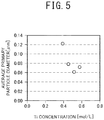
- a relationship between the average thickness and the average primary particle diameter of hexagonal plate-shaped crystalline particles of titanium phosphate, obtained from the results shown in Table 1, is shown in the graph of FIG. 3 .
- Each titanium phosphate powder was produced by a hydrothermal synthesis method under the conditions where the concentration ratio [P]/[Ti] was constant (16.5) and the concentration of titanium was 0.22 mol/L or 0.26 mol/L.
- the reaction temperature was 110°C, 120°C, 130°C, or 160°C.
- each titanium phosphate powder was produced by a hydrothermal synthesis method under the conditions where the concentration ratio [P]/[Ti] was constant (13.4) and the concentration of titanium was 0.39 mol/L, 0.45 mol/L, 0.52 mol/L, or 0.58 mol/L.
- the reaction temperature was set to be constant (110°C).
- each titanium phosphate powder was produced by a hydrothermal synthesis method under the conditions where the concentration of titanium was 0.22 mol/L, 0. 41 mol/L, or 0.60 mol/L and the concentration ratio [P] / [Ti] and the concentration of phosphorus were changed variously.
- the reaction temperature was 160°C when the concentration of titanium was 0.22 mol/L, and the reaction temperature was 110°C when the concentration of titanium was 0.41 mol/L and 0.60 mol/L.
- FIG. 6 is an SEM image of the titanium phosphate powder obtained in Production Example 2
- FIG. 7 is an SEM image of the titanium phosphate powder obtained in Production Example 11 corresponding to the comparative example.
- each of the particles constituting the titanium phosphate powder obtained in Production Example 2 has a hexagonal plate shape, while each of the particles constituting the titanium phosphate powder obtained in Production Example 11 does not have a plate shape but has a rod shape.
Landscapes
- Health & Medical Sciences (AREA)
- Life Sciences & Earth Sciences (AREA)
- Chemical & Material Sciences (AREA)
- Public Health (AREA)
- Animal Behavior & Ethology (AREA)
- Veterinary Medicine (AREA)
- General Health & Medical Sciences (AREA)
- Inorganic Chemistry (AREA)
- Organic Chemistry (AREA)
- Birds (AREA)
- Epidemiology (AREA)
- Dermatology (AREA)
- Engineering & Computer Science (AREA)
- Nanotechnology (AREA)
- Physics & Mathematics (AREA)
- Crystallography & Structural Chemistry (AREA)
- Manufacturing & Machinery (AREA)
- General Physics & Mathematics (AREA)
- Condensed Matter Physics & Semiconductors (AREA)
- Cosmetics (AREA)
- Inorganic Compounds Of Heavy Metals (AREA)
Abstract
Description
- The present invention relates to a titanium phosphate powder, a production method therefor, and a white pigment for cosmetics.
- As a titanium phosphate powder, one composed of amorphous titanium phosphate (for example, see PTL 1) and one composed of plate-shaped crystalline particles of titanium phosphate (for example, see PTL 2) are disclosed.
-
PTL 1 describes the use of, as an ultraviolet blocking agent, amorphous phosphate of Ce and/or Ti, containing one or more elements of B, Al, Si, Zn, Ga, Zr, Nb, Mo, Ta, and W as a crystallization inhibiting component.PTL 1 further describes that the ultraviolet blocking agent is amorphous phosphate having excellent heat resistance, and suitable applications of the ultraviolet blocking agent include a cosmetic product, a resin molded article, a paint, and the like. - PTL 2 describes a method of producing a titanium phosphate powder composed of plate-shaped crystalline particles of titanium phosphate by causing a raw material containing titanium and phosphorus to react by a hydrothermal synthesis method. PTL 2 further describes that plate-shaped crystalline particles of titanium phosphate, corresponding to the structural formula of Ti(HPO4)2·H2O are obtained by this method.
- As a specific example, PTL 2 describes that hexagonal plate-shaped crystalline particles of titanium phosphate, having a particle diameter of 0.25 to 0.5 µm and 0.4 to 0.7 µm and a thickness of 0.1 to 0.2 µm are obtained. PTL 2 further describes that the obtained plate-shaped crystalline particles of titanium phosphate are useful as a reinforcing agent of a building material, a pigment of a paint, and the like.
- PTL 2 does not describe an example of using a mixture of titanium sulfate and phosphoric acid as a raw material in the method for producing a titanium phosphate powder composed of plate-shaped crystalline particles of titanium phosphate.
-
- PTL 1:
JP 4649102 B2 - PTL 2:
JP S49-1720 A - As mentioned above, in the case where the powder is an additive, a pigment, or the like which is used by adding it to cosmetics, a paint, and the like, each of particles constituting the powder preferably has a thin plate shape because slipperiness among particles becomes favorable.
- However, the method described in PTL 2 is susceptible to improvement in terms of obtaining a powder suitable for applications such as additives and pigments.
- An object of the present invention is to provide a powder suitable for applications such as additives and pigments.
- The titanium phosphate powder according to one aspect of the present invention is a titanium phosphate powder that includes plate-shaped crystalline particles of titanium phosphate, wherein an average thickness of the plate-shaped crystalline particles is 0.01 µm or more and less than 0.10 µm, and an aspect ratio that is a value obtained by dividing an average primary particle diameter of the plate-shaped crystalline particles by the average thickness is 5 or more.
- The method for producing a titanium phosphate powder according to one aspect of the present invention is a method for producing a titanium phosphate powder including plate-shaped crystalline particles of titanium phosphate, the method including causing a raw material containing titanium and phosphorus to react by a hydrothermal synthesis method, wherein the raw material is a mixture of titanium sulfate and phosphoric acid.
- The titanium phosphate powder of the present invention can be suitably used as an additive, a pigment, or the like.
- According to the method for producing a titanium phosphate powder of the present invention, a powder suitable for applications such as additives and pigments can be obtained.
-
-
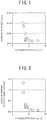
FIG. 1 is a graph illustrating a relationship between the concentration of phosphorus in a mixture of titanium (IV) sulfate and phosphoric acid and the average thickness of hexagonal plate-shaped crystalline particles of titanium phosphate, obtained from the results of Production Examples 1 to 10. -
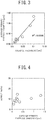
FIG. 2 is a graph illustrating a relationship between the concentration of phosphorus in a mixture of titanium (IV) sulfate and phosphoric acid and the average primary particle diameter of hexagonal plate-shaped crystalline particles of titanium phosphate, obtained from the results of Production Examples 1 to 10. -
FIG. 3 is a graph illustrating a relationship between the average thickness and the average primary particle diameter of hexagonal plate-shaped crystalline particles of titanium phosphate, obtained from the results of Production Examples 1 to 10. -
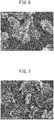
FIG. 4 is a graph illustrating a relationship between the average primary particle diameter and the aspect ratio of hexagonal plate-shaped crystalline particles of titanium phosphate, obtained from the results of Production Examples 1 to 10. -
FIG. 5 is a graph illustrating a relationship between the concentration of titanium in a mixture of titanium(IV) sulfate and phosphoric acid and the average primary particle diameter of hexagonal plate-shaped crystalline particles of titanium phosphate, obtained from a production experiment. -
FIG. 6 is an SEM image of a titanium phosphate powder of Production Example 2. -
FIG. 7 is an SEM image of a titanium phosphate powder of Production Example 11. - An embodiment of the present invention will be described in detail below. The following embodiment merely shows an example of the present invention, and the present invention is not limited to the present embodiment. Various variations and modifications can be made to the following embodiment, and embodiments with such variations and modifications can be included in the scope of the present invention.
- The titanium phosphate powder according to the present embodiment includes plate-shaped crystalline particles of titanium phosphate. The average thickness of the plate-shaped crystalline particles is 0. 01 µm or more and less than 0.10 µm, and an aspect ratio, which is a value obtained by dividing the average primary particle diameter of the plate-shaped crystalline particles by the average thickness, is 5 or more.
- An average primary particle diameter of the plate-shaped crystalline particles of titanium phosphate is not particularly limited and can be 0.05 µm or more and 1.5 µm or less. The plate-shaped crystalline particles of titanium phosphate may be hexagonal plate-shaped crystalline particles.
- The titanium phosphate powder according to the present embodiment is a titanium phosphate powder including thin plate-shaped crystalline particles having a high aspect ratio, which is a value obtained by dividing the particle diameter by the thickness, and a thickness of less than 0.1 µm (i.e., particles of titanium phosphate each having a shape controlled to be a thin plate shape). Thus, slipperiness among particles of titanium phosphate is favorable. Therefore, the titanium phosphate powder according to the present embodiment is suitable as an additive added to a cosmetic agent such as a sunscreen cosmetic agent or a pigment added to a paint. The titanium phosphate powder according to the present embodiment is also suitable as a white pigment for cosmetics.
- The titanium phosphate powder according to the present embodiment can be produced by causing a raw material containing titanium and phosphorus to react by a hydrothermal synthesis method. This raw material is a mixture of titanium sulfate (Ti(SO4)2) and phosphoric acid (H3PO4). The use of titanium sulfate as a titanium source facilitates the formation of thin plate-shaped crystalline particles of titanium phosphate having a higher aspect ratio.
- The reaction conditions of the hydrothermal synthesis method are not particularly limited. However, the reaction temperature can be 100°C or more and 160°C or less. When the reaction temperature is 160°C or less, a reaction vessel made of a glass lining material can be used in production of titanium phosphate powder, and the titanium phosphate powder can be produced by a general-purpose facility. Thus, the production cost can be reduced.
- When the reaction temperature is 160°C or less, the titanium phosphate powder can be produced in a first-class pressure vessel (pressure: 1 MPa or less) . Further, when the temperature is 160°C or less, the chemical concentration in production of titanium phosphate powder can be set under a wider range of conditions. On the other hand, when the reaction temperature is 100°C or more, highly-crystalline plate-shaped crystalline particles of titanium phosphate can be easily obtained, and further, the titanium phosphate powder can be produced by a simple production facility because the viscosity of the product is low.
- If the reaction temperature is 100°C or less, the crystallinity of the plate-shaped crystalline particles of titanium phosphate may be slightly reduced, and the viscosity of the product may be slightly increased, which may affect the design of the production facility. Therefore, it is more preferable that the reaction temperature be 110°C or more and 160°C or less. In the reaction temperature range of 100°C or more and 160°C or less, there is no significant difference in the crystallinity of the plate-shaped crystalline particles of titanium phosphate.
- The ratio [P] / [Ti] of the concentration [P] of phosphorus by mole to the concentration [Ti] of titanium by mole in the raw material may be 3 or more and 21 or less. When the ratio [P]/[Ti] is 3 or more, preferably 5 or more, plate-shaped crystalline particles of titanium phosphate are easily generated. On the other hand, in the case where the concentration of titanium in the raw material is the same, the larger the ratio [P]/[Ti] is, the smaller the average primary particle diameter of the plate-shaped crystalline particles of titanium phosphate tends to be, but even if the ratio [P]/[Ti] exceeds 21, further reduction in average primary particle diameter does not occur, and the average primary particle diameter is almost constant.
- The concentration of titanium in the raw material may be 0.05 mol/L or more and 1.0 mol/L or less. When the ratio [P] / [Ti] is the same, the higher the concentration of titanium in the raw material is, the smaller the average primary particle diameter and the average secondary particle diameter of the plate-shaped crystalline particles of titanium phosphate tend to be. Further, by increasing the concentration of titanium in the raw material, the production cost can be reduced. Therefore, the concentration of titanium in the raw material is preferably 0.05 mol/L or more, more preferably 0.2 mol/L or more. However, if the concentration of titanium in the raw material is too high, the viscosity of the product may increase, and the uniformity of the product may decrease, so that the concentration of titanium in the raw material is preferably 1.0 mol/L or less, more preferably 0.6 mol/L or less.
- The present invention will be described in further detail below with reference to production examples of the titanium phosphate powder shown below.
- Production Examples 1 to 11 shown in Table 1 are examples where titanium phosphate powders each including hexagonal plate-shaped crystalline particles of titanium phosphate were produced by causing titanium (IV) sulfate and phosphoric acid to react with each other by a hydrothermal synthesis method.
- The hydrothermal synthesis method is described in detail. First, titanium(IV) sulfate as a titanium source and phosphoric acid as a phosphorus source were mixed to obtain a mixture, and the mixture was then heated at a predetermined temperature to cause hydrothermal synthesis. The pressurization at this time was natural pressurization. The concentration of titanium in the mixture of titanium(IV) sulfate and phosphoric acid was 0.2 mol/L or more and 0.6 mol/L or less. After the reaction was performed for a predetermined period of time, a slurry-like product was cooled and cleaned with water to obtain a titanium phosphate powder.
[Table 1] Prod. Ex. Concentration of titanium (mol/L) Concentration of phosphorous (mol/L) Concentration ratio ([P]/[Ti]) Reaction temperature (°C) Reaction time (h) Average primary particle diameter (µm) Average thickness (µm) Aspect ratio 1 0.30 3.96 13 160 5 0.35 0.048 7 2 0.30 3.96 13 110 5 0.24 0.017 14 3 0.30 3.96 13 100 5 0.21 0.019 11 4 0.22 3.27 15 160 5 1.33 0.099 13 5 0.22 4.55 21 160 5 0.24 0.026 9 6 0.26 4.29 17 130 5 0.19 0.025 8 7 0.39 5.24 13 110 5 0.12 0.014 9 8 0.45 6.08 14 110 5 0.078 0.012 7 9 0.58 7.75 13 110 5 0.072 0.014 5 10 0.60 3.32 6 110 5 0.886 0.084 11 11 0.60 2.58 4 110 5 - - - - The concentration of titanium (by mole) [Ti] and the concentration of phosphorus (by mole) [P] in each mixture of titanium(IV) sulfate and phosphoric acid and each concentration ratio [P]/[Ti] are as shown in Table 1. Each reaction temperature and each reaction time in the hydrothermal synthesis method are also shown in Table 1.
- The average primary particle diameter and the average thickness of each of the obtained titanium phosphate powders of Production Examples 1 to 11 were measured, and the aspect ratio was calculated from these numerical values. The average primary particle diameter was obtained by analyzing an image obtained by a scanning electron microscope using an image analysis software Mac-View ver. 4 manufactured by MOUNTECH Co. Ltd. Table 1 summarizes the results obtained.
- A relationship between the concentration of phosphorus in the mixture of titanium(IV) sulfate and phosphoric acid and the average thickness of hexagonal plate-shaped crystalline particles of titanium phosphate, obtained from the results of Production Examples 1 to 10, is shown in the graph of
FIG. 1 . A relationship between the concentration of phosphorus in a mixture of titanium(IV) sulfate and phosphoric acid and the average primary particle diameter of hexagonal plate-shaped crystalline particles of titanium phosphate, obtained from these results, is shown in the graph ofFIG. 2 . A relationship between the average thickness and the average primary particle diameter of hexagonal plate-shaped crystalline particles of titanium phosphate, obtained from the results shown in Table 1, is shown in the graph ofFIG. 3 . A relationship between the average primary particle diameter and the aspect ratio of hexagonal plate-shaped crystalline particles of titanium phosphate, obtained from the results shown in Table 1, is shown in the graph ofFIG. 4 . - Each titanium phosphate powder was produced by a hydrothermal synthesis method under the conditions where the concentration ratio [P]/[Ti] was constant (16.5) and the concentration of titanium was 0.22 mol/L or 0.26 mol/L. The reaction temperature was 110°C, 120°C, 130°C, or 160°C.
- The results demonstrate that the higher the concentration of titanium is, the smaller the average primary particle diameter of the plate-shaped crystalline particles of titanium phosphate is.
- Subsequently, each titanium phosphate powder was produced by a hydrothermal synthesis method under the conditions where the concentration ratio [P]/[Ti] was constant (13.4) and the concentration of titanium was 0.39 mol/L, 0.45 mol/L, 0.52 mol/L, or 0.58 mol/L. The reaction temperature was set to be constant (110°C).
- The results demonstrate that the higher the concentration of titanium is, the lower the production cost is. A relationship between the concentration of titanium and the average primary particle diameter of the obtained plate-shaped crystalline particles of titanium phosphate is shown in the graph of
FIG. 5 . As can be seen from this graph, the higher the concentration of titanium is, the smaller the average primary particle diameter of the plate-shaped crystalline particles of titanium phosphate is. - These results demonstrate that the average primary particle diameter of the plate-shaped crystalline particles of titanium phosphate can be controlled to a desired size by reducing the concentration of phosphorus and increasing the concentration of titanium.
- The effect of the concentration of phosphorus in the case where the concentration of titanium is high (e.g., 0.4 mol/L or more) was examined. Each titanium phosphate powder was produced by a hydrothermal synthesis method under the conditions where the concentration of titanium was 0.22 mol/L, 0. 41 mol/L, or 0.60 mol/L and the concentration ratio [P] / [Ti] and the concentration of phosphorus were changed variously. The reaction temperature was 160°C when the concentration of titanium was 0.22 mol/L, and the reaction temperature was 110°C when the concentration of titanium was 0.41 mol/L and 0.60 mol/L.
- As a result, at any concentration of titanium, when the concentration of phosphorus was 2.6 mol/L or less, the crystallinity of titanium phosphate was reduced, and plate-shaped crystalline particles were not formed, but when the concentration of phosphorus was 3.3 mol/L or more, the plate-shaped crystalline particles of titanium phosphate were formed. Similar to the case where the concentration of titanium was low (e.g., 0.2 mol/L), the average primary particle diameter of plate-shaped crystalline particles of titanium phosphate tended to be smaller as the concentration of phosphorus was higher.
- In addition, the results of the examination under the conditions where the concentration of titanium was constant (0.60 mol/L) and the concentration of phosphorus was changed variously (3.3, 4.09, 4.91 mol/L) demonstrate that the average primary particle diameter of the plate-shaped crystalline particles of titanium phosphate changes depending on the concentration of phosphorus.
-
FIG. 6 is an SEM image of the titanium phosphate powder obtained in Production Example 2, andFIG. 7 is an SEM image of the titanium phosphate powder obtained in Production Example 11 corresponding to the comparative example. As can be seen fromFIGS. 6 and 7 , each of the particles constituting the titanium phosphate powder obtained in Production Example 2 has a hexagonal plate shape, while each of the particles constituting the titanium phosphate powder obtained in Production Example 11 does not have a plate shape but has a rod shape.
Claims (11)
- A titanium phosphate powder comprising plate-shaped crystalline particles of titanium phosphate, wherein
the plate-shaped crystalline particles have an average thickness of 0.01 µm or more and less than 0.10 µm, and
an aspect ratio that is a value obtained by dividing an average primary particle diameter of the plate-shaped crystalline particles by the average thickness is 5 or more. - The titanium phosphate powder according to claim 1, wherein
the average primary particle diameter is 0.05 µm or more and 1.5 µm or less. - The titanium phosphate powder according to claim 1 or 2, wherein
the plate-shaped crystalline particles are hexagonal plate-shaped crystalline particles. - A method for producing a titanium phosphate powder comprising plate-shaped crystalline particles of titanium phosphate, the method comprising
causing a raw material containing titanium and phosphorus to react by a hydrothermal synthesis method, wherein
a mixture of titanium sulfate and phosphoric acid is used as the raw material. - The method for producing a titanium phosphate powder according to claim 4, wherein
a titanium phosphate powder comprising plate-shaped crystalline particles having an average thickness of 0.01 µm or more and less than 0.10 µm and an aspect ratio that is a value obtained by dividing an average primary particle diameter of the plate-shaped crystalline particles by the average thickness of 5 or more is produced. - The method for producing a titanium phosphate powder according to claim 4 or 5, wherein
a titanium phosphate powder comprising the plate-shaped crystalline particles having an average primary particle diameter of 0.05 µm or more and 1.5 µm or less is produced. - The method for producing a titanium phosphate powder according to any one of claims 4 to 6, wherein
a titanium phosphate powder comprising hexagonal plate-shaped crystalline particles as the plate-shaped crystalline particles is produced. - The method for producing a titanium phosphate powder according to any one of claims 4 to 7, wherein
a reaction temperature in the hydrothermal synthesis method is set to 100°C or more and 160°C or less. - The method for producing a titanium phosphate powder according to any one of claims 4 to 8, wherein
a ratio ([P]/[Ti]) of a concentration [P] of the phosphorus by mole to a concentration [Ti] of the titanium by mole in the raw material is set to be 5 or more and 21 or less. - The method for producing a titanium phosphate powder according to any one of claims 4 to 9, wherein a concentration of the titanium in the raw material is set to be 0.2 mol/L or more and 0.6 mol/L or less.
- A white pigment for cosmetics, the white pigment comprising the titanium phosphate powder according to any one of claims 1 to 3.
Priority Applications (1)
| Application Number | Priority Date | Filing Date | Title |
|---|---|---|---|
| EP21214767.2A EP3984950A1 (en) | 2017-03-30 | 2018-03-20 | Production method for titanium phosphate powder |
Applications Claiming Priority (2)
| Application Number | Priority Date | Filing Date | Title |
|---|---|---|---|
| JP2017068350 | 2017-03-30 | ||
| PCT/JP2018/011098 WO2018180797A1 (en) | 2017-03-30 | 2018-03-20 | Titanium phosphate powder, production method therefor, and white pigment for cosmetics |
Related Child Applications (2)
| Application Number | Title | Priority Date | Filing Date |
|---|---|---|---|
| EP21214767.2A Division-Into EP3984950A1 (en) | 2017-03-30 | 2018-03-20 | Production method for titanium phosphate powder |
| EP21214767.2A Division EP3984950A1 (en) | 2017-03-30 | 2018-03-20 | Production method for titanium phosphate powder |
Publications (3)
| Publication Number | Publication Date |
|---|---|
| EP3604218A1 true EP3604218A1 (en) | 2020-02-05 |
| EP3604218A4 EP3604218A4 (en) | 2020-03-25 |
| EP3604218B1 EP3604218B1 (en) | 2022-01-26 |
Family
ID=63677539
Family Applications (2)
| Application Number | Title | Priority Date | Filing Date |
|---|---|---|---|
| EP18774847.0A Active EP3604218B1 (en) | 2017-03-30 | 2018-03-20 | White pigment titanium phosphate powder for cosmetics |
| EP21214767.2A Pending EP3984950A1 (en) | 2017-03-30 | 2018-03-20 | Production method for titanium phosphate powder |
Family Applications After (1)
| Application Number | Title | Priority Date | Filing Date |
|---|---|---|---|
| EP21214767.2A Pending EP3984950A1 (en) | 2017-03-30 | 2018-03-20 | Production method for titanium phosphate powder |
Country Status (8)
| Country | Link |
|---|---|
| US (2) | US11345596B2 (en) |
| EP (2) | EP3604218B1 (en) |
| JP (2) | JP6660078B2 (en) |
| KR (3) | KR102181987B1 (en) |
| CN (3) | CN110461765A (en) |
| ES (1) | ES2908725T3 (en) |
| PL (1) | PL3604218T3 (en) |
| WO (1) | WO2018180797A1 (en) |
Cited By (6)
| Publication number | Priority date | Publication date | Assignee | Title |
|---|---|---|---|---|
| EP3777819A4 (en) * | 2018-03-30 | 2021-06-09 | Fujimi Incorporated | WHITE PIGMENT FOR COSMETIC PRODUCTS, AND COSMETIC PRODUCTS |
| EP3854753A4 (en) * | 2018-09-20 | 2021-11-17 | Fujimi Incorporated | WHITE PIGMENT FOR COSMETICS AND COSMETICS |
| EP3919440A4 (en) * | 2019-01-29 | 2022-03-23 | Fujimi Incorporated | Titanium phosphate powder and white pigment for cosmetic preparations |
| CN116367807A (en) * | 2020-10-08 | 2023-06-30 | 福吉米株式会社 | Soft focus fillers, cosmetics |
| EP4215176A4 (en) * | 2020-09-18 | 2024-03-13 | Fujimi Incorporated | POWDER, WHITE PIGMENT FOR COSMETIC PRODUCT, AND COSMETIC PRODUCT |
| US12378116B2 (en) | 2017-03-30 | 2025-08-05 | Fujimi Incorporated | Titanium phosphate powder, production method therefor, and white pigment for cosmetics |
Families Citing this family (7)
| Publication number | Priority date | Publication date | Assignee | Title |
|---|---|---|---|---|
| JP7177170B2 (en) * | 2018-09-20 | 2022-11-22 | 株式会社フジミインコーポレーテッド | White pigment for cosmetics, cosmetics |
| EP4023595A4 (en) | 2019-08-28 | 2022-11-02 | Fujimi Incorporated | Method for increasing specific surface area of titanium phosphate plate-particles, and powder comprising plate-particles derived from titanium phosphate |
| JP7776261B2 (en) * | 2021-03-04 | 2025-11-26 | 株式会社フジミインコーポレーテッド | Powder, filler, composition, and method for producing filler |
| JP7829551B2 (en) * | 2021-03-31 | 2026-03-13 | 株式会社フジミインコーポレーテッド | Plate-shaped titanium pyrophosphate and method for producing the same |
| CN113773672A (en) * | 2021-09-30 | 2021-12-10 | 福建坤彩材料科技股份有限公司 | White pearlescent pigment and preparation method and application thereof |
| KR20240002915A (en) | 2022-06-30 | 2024-01-08 | 가부시키가이샤 후지미인코퍼레이티드 | Titanium phosphate powder and production method thereof |
| JP2025076643A (en) | 2023-11-02 | 2025-05-16 | 株式会社フジミインコーポレーテッド | Manufacturing method of titanium phosphate powder |
Family Cites Families (39)
| Publication number | Priority date | Publication date | Assignee | Title |
|---|---|---|---|---|
| US3556720A (en) * | 1969-03-05 | 1971-01-19 | Dow Chemical Co | Preparation of titanium phosphate fibers |
| US3558273A (en) * | 1969-03-05 | 1971-01-26 | Dow Chemical Co | Preparation of titanium phosphate platelets |
| US3914381A (en) | 1969-03-18 | 1975-10-21 | Mizusawa Industrial Chem | Process for the preparation of substantially pure phosphorus oxyacid salts of metals of group IV b{41 |
| JPS4919520B1 (en) | 1969-03-18 | 1974-05-17 | ||
| GB1282594A (en) * | 1969-07-02 | 1972-07-19 | Dow Chemical Co | Preparation of titanium phosphate crystals |
| JPS491720B1 (en) | 1969-07-23 | 1974-01-16 | ||
| FR2054705A5 (en) * | 1969-07-23 | 1971-05-07 | Dow Chemical Co | Titanium phosphates as crystalline, hexa-gonal plates |
| JPS502731B2 (en) | 1972-04-26 | 1975-01-29 | ||
| SU1611906A1 (en) | 1989-01-13 | 1990-12-07 | Предприятие П/Я Г-4855 | Method of producing titanium phosphate |
| JPH1046135A (en) | 1996-08-07 | 1998-02-17 | Toagosei Co Ltd | UV shielding agent |
| JPH10167929A (en) | 1996-12-10 | 1998-06-23 | Catalysts & Chem Ind Co Ltd | Amber-white pigment particulate compounded cosmetic |
| CN1202456A (en) * | 1997-06-13 | 1998-12-23 | 柯如 | Manufacturing method of titanium phosphate |
| JP2005505669A (en) | 2002-10-16 | 2005-02-24 | ロディア エレクトロニクス アンド カタリシス | Ultraviolet protective agent containing phosphate of cerium and titanium and method for producing the same |
| CN1202006C (en) * | 2003-01-30 | 2005-05-18 | 复旦大学 | Kinds of materials with multiple constituents of big bores oxide media and its preparing method |
| JP4649102B2 (en) | 2003-09-16 | 2011-03-09 | 阿南化成株式会社 | Amorphous phosphate, and ultraviolet blocking agent, cosmetic, resin molded article and paint containing the same |
| FR2871792B1 (en) | 2004-06-22 | 2007-02-09 | Rhodia Chimie Sa | HIGH SHAPE FACTORY CRYSTALLINE ZIRCONIUM PHOSPHATE, PROCESS FOR PREPARING THE SAME, AND USE THEREOF IN MACROMOLECULAR MATERIAL |
| CN1333107C (en) * | 2005-07-18 | 2007-08-22 | 北京工业大学 | Preparation method for discoloration tolerant antibacterial material of silver-loaded titanium phosphate |
| JP2007291090A (en) | 2006-03-31 | 2007-11-08 | Kose Corp | Powdery cosmetic |
| JP4684970B2 (en) | 2006-08-31 | 2011-05-18 | チタン工業株式会社 | Rutile-type titanium oxide aggregated particles and cosmetics containing the same |
| CN101033062A (en) * | 2007-02-26 | 2007-09-12 | 清华大学 | Method of preparing layered alpha-titanium phosphate |
| CN101176468B (en) * | 2007-11-28 | 2010-04-07 | 暨南大学 | Inorganic composite antibacterial agent containing zinc-rare earth and its preparation method and application |
| JP5843431B2 (en) * | 2010-08-12 | 2016-01-13 | 株式会社 東北テクノアーチ | Petal-like cerium oxide powder, method for producing the same, and cosmetics |
| CA2814490C (en) | 2010-11-02 | 2016-06-14 | Colgate-Palmolive Company | Antiperspirant active compositions and manufacture thereof |
| CN102139869B (en) * | 2011-03-09 | 2012-10-17 | 超威电源有限公司 | Method for preparing spherical iron phosphate by combining sedimentation method and hydrothermal method |
| JP5907167B2 (en) | 2011-04-28 | 2016-04-20 | 堺化学工業株式会社 | Hexagonal columnar zinc oxide particles, method for producing the same, and cosmetics, heat dissipating filler, heat dissipating resin composition, heat dissipating grease and heat dissipating coating composition containing the same |
| CA2834252C (en) | 2011-04-28 | 2019-04-30 | Sakai Chemical Industry Co., Ltd. | Zinc oxide particles for use in cosmetics and heat releasing fillers and compositions, and methods for producing the same |
| US9120681B2 (en) | 2011-04-28 | 2015-09-01 | Sakai Chemical Industry Co., Ltd. | Method for production of zinc oxide particles |
| EP2703352B1 (en) | 2011-04-28 | 2020-03-18 | Sakai Chemical Industry Co., Ltd. | Hexagonal-plate-shaped zinc oxide particles, production method therefor, and cosmetic material, heat-dissipating filler, heat-dissipating resin composition, heat-dissipating grease, and heat-dissipating coating composition having same blended therein |
| JP5896688B2 (en) | 2011-11-04 | 2016-03-30 | 日揮触媒化成株式会社 | Method for producing pigment-encapsulated silica-based particles |
| CN102641214A (en) * | 2012-05-07 | 2012-08-22 | 汕头市雪琪化妆品有限公司 | Application of titanium phosphate for preparing facial beautifiers |
| CN103173098B (en) * | 2013-04-12 | 2016-01-20 | 东莞旭光五金氧化制品有限公司 | Heat loss through radiation High tailored coating and production technique thereof |
| CN104577111B (en) * | 2013-10-21 | 2017-12-26 | 中国科学院物理研究所 | A composite material containing fluorine-containing titanium phosphate compound and its preparation method and application |
| CN103626145B (en) * | 2013-12-04 | 2016-02-24 | 中国科学院化学研究所 | Titanium phosphate nano material and preparation method thereof and application |
| CN104003365B (en) * | 2014-05-15 | 2015-11-18 | 昆明理工大学 | Phosphoric acid by wet process deposition slag prepares the method for titanium phosphate |
| CN104600276B (en) * | 2015-01-28 | 2017-09-22 | 中国科学院上海硅酸盐研究所 | A kind of microspheroidal titanium phosphorous oxides and preparation method thereof |
| CN110461765A (en) | 2017-03-30 | 2019-11-15 | 福吉米株式会社 | Titanium phosphate powder, method for producing the same, and white pigment for cosmetics |
| EP3777819A4 (en) | 2018-03-30 | 2021-06-09 | Fujimi Incorporated | WHITE PIGMENT FOR COSMETIC PRODUCTS, AND COSMETIC PRODUCTS |
| JP7177170B2 (en) | 2018-09-20 | 2022-11-22 | 株式会社フジミインコーポレーテッド | White pigment for cosmetics, cosmetics |
| CN112739647B (en) | 2018-09-20 | 2023-11-21 | 福吉米株式会社 | White pigment for cosmetics, cosmetics |
-
2018
- 2018-03-20 CN CN201880020862.7A patent/CN110461765A/en active Pending
- 2018-03-20 JP JP2019509607A patent/JP6660078B2/en active Active
- 2018-03-20 CN CN202011539436.XA patent/CN112499611A/en active Pending
- 2018-03-20 WO PCT/JP2018/011098 patent/WO2018180797A1/en not_active Ceased
- 2018-03-20 PL PL18774847.0T patent/PL3604218T3/en unknown
- 2018-03-20 CN CN202011020708.5A patent/CN111994888B/en active Active
- 2018-03-20 KR KR1020197027752A patent/KR102181987B1/en active Active
- 2018-03-20 EP EP18774847.0A patent/EP3604218B1/en active Active
- 2018-03-20 EP EP21214767.2A patent/EP3984950A1/en active Pending
- 2018-03-20 ES ES18774847T patent/ES2908725T3/en active Active
- 2018-03-20 US US16/498,140 patent/US11345596B2/en active Active
- 2018-03-20 KR KR1020217002462A patent/KR102561503B1/en active Active
- 2018-03-20 KR KR1020207033109A patent/KR102299912B1/en active Active
-
2020
- 2020-02-06 JP JP2020018438A patent/JP7165469B2/en active Active
-
2022
- 2022-01-26 US US17/585,134 patent/US12378116B2/en active Active
Cited By (8)
| Publication number | Priority date | Publication date | Assignee | Title |
|---|---|---|---|---|
| US12378116B2 (en) | 2017-03-30 | 2025-08-05 | Fujimi Incorporated | Titanium phosphate powder, production method therefor, and white pigment for cosmetics |
| EP3777819A4 (en) * | 2018-03-30 | 2021-06-09 | Fujimi Incorporated | WHITE PIGMENT FOR COSMETIC PRODUCTS, AND COSMETIC PRODUCTS |
| EP3854753A4 (en) * | 2018-09-20 | 2021-11-17 | Fujimi Incorporated | WHITE PIGMENT FOR COSMETICS AND COSMETICS |
| US11638681B2 (en) | 2018-09-20 | 2023-05-02 | Fujimi Incorporated | White pigment for cosmetics, and cosmetic |
| EP3919440A4 (en) * | 2019-01-29 | 2022-03-23 | Fujimi Incorporated | Titanium phosphate powder and white pigment for cosmetic preparations |
| EP4215176A4 (en) * | 2020-09-18 | 2024-03-13 | Fujimi Incorporated | POWDER, WHITE PIGMENT FOR COSMETIC PRODUCT, AND COSMETIC PRODUCT |
| CN116367807A (en) * | 2020-10-08 | 2023-06-30 | 福吉米株式会社 | Soft focus fillers, cosmetics |
| EP4226909A4 (en) * | 2020-10-08 | 2024-04-10 | Fujimi Incorporated | Soft focus filler, cosmetic |
Also Published As
| Publication number | Publication date |
|---|---|
| PL3604218T3 (en) | 2022-07-18 |
| EP3604218B1 (en) | 2022-01-26 |
| WO2018180797A1 (en) | 2018-10-04 |
| KR20190113990A (en) | 2019-10-08 |
| JP6660078B2 (en) | 2020-03-04 |
| JP7165469B2 (en) | 2022-11-04 |
| US20220144639A1 (en) | 2022-05-12 |
| CN112499611A (en) | 2021-03-16 |
| KR20210012061A (en) | 2021-02-02 |
| KR102299912B1 (en) | 2021-09-09 |
| EP3604218A4 (en) | 2020-03-25 |
| US11345596B2 (en) | 2022-05-31 |
| US20200377369A1 (en) | 2020-12-03 |
| CN111994888B (en) | 2023-11-17 |
| JPWO2018180797A1 (en) | 2019-11-07 |
| CN111994888A (en) | 2020-11-27 |
| US12378116B2 (en) | 2025-08-05 |
| KR20200133007A (en) | 2020-11-25 |
| KR102181987B1 (en) | 2020-11-25 |
| KR102561503B1 (en) | 2023-08-01 |
| JP2020079284A (en) | 2020-05-28 |
| ES2908725T3 (en) | 2022-05-03 |
| CN110461765A (en) | 2019-11-15 |
| EP3984950A1 (en) | 2022-04-20 |
Similar Documents
| Publication | Publication Date | Title |
|---|---|---|
| US12378116B2 (en) | Titanium phosphate powder, production method therefor, and white pigment for cosmetics | |
| EP4011852B1 (en) | Mixed powder, spray-granulation powder granules and green body for use in production of colored translucent zirconia sintered body | |
| US20210163288A1 (en) | Hexagonal boron nitride powder and method for producing hexagonal boron nitride powder | |
| Candidato Jr et al. | Development of hydroxyapatite coatings by solution precursor plasma spray process and their microstructural characterization | |
| KR101263086B1 (en) | Plate type zirconium phosphate and preparation method thereof | |
| EP3121150A1 (en) | Plate-like aluminum oxide and preparation method therefor | |
| EP4303180A1 (en) | Hexagonal boron nitride agglomerated particles, hexagonal boron nitride powder, resin composition, and resin sheet | |
| EP3187483B1 (en) | Novel magnesium hydroxide-based solid solution, and resin composition and precursor for highly active magnesium oxide which include same | |
| JP7548824B2 (en) | Method for producing hydrophobic titanium phosphate powder | |
| JPH0741311A (en) | Method for producing hexagonal boron nitride powder | |
| Deepa et al. | Preparation and antimicrobial observations of zinc doped nanohydroxyapatite | |
| EP1484282B1 (en) | Cerium based composite oxide, sintered product thereof and method for preparation thereof | |
| JP7592181B2 (en) | Hexagonal boron nitride powder for fillers | |
| JP2002249315A (en) | Flaky α-alumina particles and method for producing the same | |
| KR102347578B1 (en) | Manufacturing method of light absorbing single crystal alumina powders having hexagonal plate type structure | |
| EP4303182A1 (en) | Powder, filler, composition, and filler production method | |
| KR20180130695A (en) | Method for producing potassium titanate | |
| Nasiri-Tabrizi et al. | Crystallinity evaluation of cluster-like fluorapatite–titania nanocomposites | |
| US20220402759A1 (en) | Hexagonal boron nitride powder | |
| US20220194797A1 (en) | Hydroxyapatite powder and method for producing same | |
| Senna | Chemical powder technology—A new insight into atomic processes on the surface of fine particles | |
| HK40076993B (en) | Phosphate-containing anti-corrosive pigment |
Legal Events
| Date | Code | Title | Description |
|---|---|---|---|
| STAA | Information on the status of an ep patent application or granted ep patent |
Free format text: STATUS: THE INTERNATIONAL PUBLICATION HAS BEEN MADE |
|
| PUAI | Public reference made under article 153(3) epc to a published international application that has entered the european phase |
Free format text: ORIGINAL CODE: 0009012 |
|
| STAA | Information on the status of an ep patent application or granted ep patent |
Free format text: STATUS: REQUEST FOR EXAMINATION WAS MADE |
|
| 17P | Request for examination filed |
Effective date: 20190927 |
|
| AK | Designated contracting states |
Kind code of ref document: A1 Designated state(s): AL AT BE BG CH CY CZ DE DK EE ES FI FR GB GR HR HU IE IS IT LI LT LU LV MC MK MT NL NO PL PT RO RS SE SI SK SM TR |
|
| AX | Request for extension of the european patent |
Extension state: BA ME |
|
| A4 | Supplementary search report drawn up and despatched |
Effective date: 20200221 |
|
| RIC1 | Information provided on ipc code assigned before grant |
Ipc: A61K 8/29 20060101ALI20200217BHEP Ipc: A61Q 17/04 20060101ALI20200217BHEP Ipc: C01B 25/37 20060101AFI20200217BHEP Ipc: C01G 23/00 20060101ALI20200217BHEP Ipc: C09C 1/36 20060101ALI20200217BHEP |
|
| DAV | Request for validation of the european patent (deleted) | ||
| DAX | Request for extension of the european patent (deleted) | ||
| STAA | Information on the status of an ep patent application or granted ep patent |
Free format text: STATUS: EXAMINATION IS IN PROGRESS |
|
| 17Q | First examination report despatched |
Effective date: 20201218 |
|
| RIC1 | Information provided on ipc code assigned before grant |
Ipc: A61Q 19/00 20060101ALI20210819BHEP Ipc: A61Q 1/02 20060101ALI20210819BHEP Ipc: A61K 8/02 20060101ALI20210819BHEP Ipc: C09C 1/36 20060101ALI20210819BHEP Ipc: C01G 23/00 20060101ALI20210819BHEP Ipc: A61Q 17/04 20060101ALI20210819BHEP Ipc: A61K 8/29 20060101ALI20210819BHEP Ipc: C01B 25/37 20060101AFI20210819BHEP |
|
| GRAP | Despatch of communication of intention to grant a patent |
Free format text: ORIGINAL CODE: EPIDOSNIGR1 |
|
| STAA | Information on the status of an ep patent application or granted ep patent |
Free format text: STATUS: GRANT OF PATENT IS INTENDED |
|
| INTG | Intention to grant announced |
Effective date: 20210924 |
|
| RIN1 | Information on inventor provided before grant (corrected) |
Inventor name: MIWA, NAOYA Inventor name: ASHITAKA, KEIJI Inventor name: IWAKUNI, MAYUMI |
|
| GRAS | Grant fee paid |
Free format text: ORIGINAL CODE: EPIDOSNIGR3 |
|
| GRAA | (expected) grant |
Free format text: ORIGINAL CODE: 0009210 |
|
| STAA | Information on the status of an ep patent application or granted ep patent |
Free format text: STATUS: THE PATENT HAS BEEN GRANTED |
|
| AK | Designated contracting states |
Kind code of ref document: B1 Designated state(s): AL AT BE BG CH CY CZ DE DK EE ES FI FR GB GR HR HU IE IS IT LI LT LU LV MC MK MT NL NO PL PT RO RS SE SI SK SM TR |
|
| REG | Reference to a national code |
Ref country code: GB Ref legal event code: FG4D |
|
| REG | Reference to a national code |
Ref country code: CH Ref legal event code: EP |
|
| REG | Reference to a national code |
Ref country code: AT Ref legal event code: REF Ref document number: 1465157 Country of ref document: AT Kind code of ref document: T Effective date: 20220215 |
|
| REG | Reference to a national code |
Ref country code: IE Ref legal event code: FG4D |
|
| REG | Reference to a national code |
Ref country code: DE Ref legal event code: R096 Ref document number: 602018030132 Country of ref document: DE |
|
| REG | Reference to a national code |
Ref country code: ES Ref legal event code: FG2A Ref document number: 2908725 Country of ref document: ES Kind code of ref document: T3 Effective date: 20220503 |
|
| REG | Reference to a national code |
Ref country code: LT Ref legal event code: MG9D |
|
| REG | Reference to a national code |
Ref country code: NL Ref legal event code: MP Effective date: 20220126 |
|
| REG | Reference to a national code |
Ref country code: AT Ref legal event code: MK05 Ref document number: 1465157 Country of ref document: AT Kind code of ref document: T Effective date: 20220126 |
|
| PG25 | Lapsed in a contracting state [announced via postgrant information from national office to epo] |
Ref country code: NL Free format text: LAPSE BECAUSE OF FAILURE TO SUBMIT A TRANSLATION OF THE DESCRIPTION OR TO PAY THE FEE WITHIN THE PRESCRIBED TIME-LIMIT Effective date: 20220126 |
|
| PG25 | Lapsed in a contracting state [announced via postgrant information from national office to epo] |
Ref country code: SE Free format text: LAPSE BECAUSE OF FAILURE TO SUBMIT A TRANSLATION OF THE DESCRIPTION OR TO PAY THE FEE WITHIN THE PRESCRIBED TIME-LIMIT Effective date: 20220126 Ref country code: RS Free format text: LAPSE BECAUSE OF FAILURE TO SUBMIT A TRANSLATION OF THE DESCRIPTION OR TO PAY THE FEE WITHIN THE PRESCRIBED TIME-LIMIT Effective date: 20220126 Ref country code: PT Free format text: LAPSE BECAUSE OF FAILURE TO SUBMIT A TRANSLATION OF THE DESCRIPTION OR TO PAY THE FEE WITHIN THE PRESCRIBED TIME-LIMIT Effective date: 20220526 Ref country code: NO Free format text: LAPSE BECAUSE OF FAILURE TO SUBMIT A TRANSLATION OF THE DESCRIPTION OR TO PAY THE FEE WITHIN THE PRESCRIBED TIME-LIMIT Effective date: 20220426 Ref country code: LT Free format text: LAPSE BECAUSE OF FAILURE TO SUBMIT A TRANSLATION OF THE DESCRIPTION OR TO PAY THE FEE WITHIN THE PRESCRIBED TIME-LIMIT Effective date: 20220126 Ref country code: HR Free format text: LAPSE BECAUSE OF FAILURE TO SUBMIT A TRANSLATION OF THE DESCRIPTION OR TO PAY THE FEE WITHIN THE PRESCRIBED TIME-LIMIT Effective date: 20220126 Ref country code: BG Free format text: LAPSE BECAUSE OF FAILURE TO SUBMIT A TRANSLATION OF THE DESCRIPTION OR TO PAY THE FEE WITHIN THE PRESCRIBED TIME-LIMIT Effective date: 20220426 |
|
| PG25 | Lapsed in a contracting state [announced via postgrant information from national office to epo] |
Ref country code: LV Free format text: LAPSE BECAUSE OF FAILURE TO SUBMIT A TRANSLATION OF THE DESCRIPTION OR TO PAY THE FEE WITHIN THE PRESCRIBED TIME-LIMIT Effective date: 20220126 Ref country code: GR Free format text: LAPSE BECAUSE OF FAILURE TO SUBMIT A TRANSLATION OF THE DESCRIPTION OR TO PAY THE FEE WITHIN THE PRESCRIBED TIME-LIMIT Effective date: 20220427 Ref country code: FI Free format text: LAPSE BECAUSE OF FAILURE TO SUBMIT A TRANSLATION OF THE DESCRIPTION OR TO PAY THE FEE WITHIN THE PRESCRIBED TIME-LIMIT Effective date: 20220126 Ref country code: AT Free format text: LAPSE BECAUSE OF FAILURE TO SUBMIT A TRANSLATION OF THE DESCRIPTION OR TO PAY THE FEE WITHIN THE PRESCRIBED TIME-LIMIT Effective date: 20220126 |
|
| PG25 | Lapsed in a contracting state [announced via postgrant information from national office to epo] |
Ref country code: IS Free format text: LAPSE BECAUSE OF FAILURE TO SUBMIT A TRANSLATION OF THE DESCRIPTION OR TO PAY THE FEE WITHIN THE PRESCRIBED TIME-LIMIT Effective date: 20220526 |
|
| REG | Reference to a national code |
Ref country code: DE Ref legal event code: R097 Ref document number: 602018030132 Country of ref document: DE |
|
| PG25 | Lapsed in a contracting state [announced via postgrant information from national office to epo] |
Ref country code: SM Free format text: LAPSE BECAUSE OF FAILURE TO SUBMIT A TRANSLATION OF THE DESCRIPTION OR TO PAY THE FEE WITHIN THE PRESCRIBED TIME-LIMIT Effective date: 20220126 Ref country code: SK Free format text: LAPSE BECAUSE OF FAILURE TO SUBMIT A TRANSLATION OF THE DESCRIPTION OR TO PAY THE FEE WITHIN THE PRESCRIBED TIME-LIMIT Effective date: 20220126 Ref country code: RO Free format text: LAPSE BECAUSE OF FAILURE TO SUBMIT A TRANSLATION OF THE DESCRIPTION OR TO PAY THE FEE WITHIN THE PRESCRIBED TIME-LIMIT Effective date: 20220126 Ref country code: MC Free format text: LAPSE BECAUSE OF FAILURE TO SUBMIT A TRANSLATION OF THE DESCRIPTION OR TO PAY THE FEE WITHIN THE PRESCRIBED TIME-LIMIT Effective date: 20220126 Ref country code: EE Free format text: LAPSE BECAUSE OF FAILURE TO SUBMIT A TRANSLATION OF THE DESCRIPTION OR TO PAY THE FEE WITHIN THE PRESCRIBED TIME-LIMIT Effective date: 20220126 Ref country code: DK Free format text: LAPSE BECAUSE OF FAILURE TO SUBMIT A TRANSLATION OF THE DESCRIPTION OR TO PAY THE FEE WITHIN THE PRESCRIBED TIME-LIMIT Effective date: 20220126 Ref country code: CZ Free format text: LAPSE BECAUSE OF FAILURE TO SUBMIT A TRANSLATION OF THE DESCRIPTION OR TO PAY THE FEE WITHIN THE PRESCRIBED TIME-LIMIT Effective date: 20220126 |
|
| PG25 | Lapsed in a contracting state [announced via postgrant information from national office to epo] |
Ref country code: AL Free format text: LAPSE BECAUSE OF FAILURE TO SUBMIT A TRANSLATION OF THE DESCRIPTION OR TO PAY THE FEE WITHIN THE PRESCRIBED TIME-LIMIT Effective date: 20220126 |
|
| PLBE | No opposition filed within time limit |
Free format text: ORIGINAL CODE: 0009261 |
|
| STAA | Information on the status of an ep patent application or granted ep patent |
Free format text: STATUS: NO OPPOSITION FILED WITHIN TIME LIMIT |
|
| REG | Reference to a national code |
Ref country code: BE Ref legal event code: MM Effective date: 20220331 |
|
| GBPC | Gb: european patent ceased through non-payment of renewal fee |
Effective date: 20220426 |
|
| 26N | No opposition filed |
Effective date: 20221027 |
|
| PG25 | Lapsed in a contracting state [announced via postgrant information from national office to epo] |
Ref country code: LU Free format text: LAPSE BECAUSE OF NON-PAYMENT OF DUE FEES Effective date: 20220320 Ref country code: IE Free format text: LAPSE BECAUSE OF NON-PAYMENT OF DUE FEES Effective date: 20220320 Ref country code: GB Free format text: LAPSE BECAUSE OF NON-PAYMENT OF DUE FEES Effective date: 20220426 |
|
| PG25 | Lapsed in a contracting state [announced via postgrant information from national office to epo] |
Ref country code: SI Free format text: LAPSE BECAUSE OF FAILURE TO SUBMIT A TRANSLATION OF THE DESCRIPTION OR TO PAY THE FEE WITHIN THE PRESCRIBED TIME-LIMIT Effective date: 20220126 Ref country code: BE Free format text: LAPSE BECAUSE OF NON-PAYMENT OF DUE FEES Effective date: 20220331 |
|
| PG25 | Lapsed in a contracting state [announced via postgrant information from national office to epo] |
Ref country code: MK Free format text: LAPSE BECAUSE OF FAILURE TO SUBMIT A TRANSLATION OF THE DESCRIPTION OR TO PAY THE FEE WITHIN THE PRESCRIBED TIME-LIMIT Effective date: 20220126 Ref country code: CY Free format text: LAPSE BECAUSE OF FAILURE TO SUBMIT A TRANSLATION OF THE DESCRIPTION OR TO PAY THE FEE WITHIN THE PRESCRIBED TIME-LIMIT Effective date: 20220126 |
|
| PG25 | Lapsed in a contracting state [announced via postgrant information from national office to epo] |
Ref country code: HU Free format text: LAPSE BECAUSE OF FAILURE TO SUBMIT A TRANSLATION OF THE DESCRIPTION OR TO PAY THE FEE WITHIN THE PRESCRIBED TIME-LIMIT; INVALID AB INITIO Effective date: 20180320 |
|
| PG25 | Lapsed in a contracting state [announced via postgrant information from national office to epo] |
Ref country code: TR Free format text: LAPSE BECAUSE OF FAILURE TO SUBMIT A TRANSLATION OF THE DESCRIPTION OR TO PAY THE FEE WITHIN THE PRESCRIBED TIME-LIMIT Effective date: 20220126 |
|
| PG25 | Lapsed in a contracting state [announced via postgrant information from national office to epo] |
Ref country code: MT Free format text: LAPSE BECAUSE OF FAILURE TO SUBMIT A TRANSLATION OF THE DESCRIPTION OR TO PAY THE FEE WITHIN THE PRESCRIBED TIME-LIMIT Effective date: 20220126 |
|
| REG | Reference to a national code |
Ref country code: CH Ref legal event code: U11 Free format text: ST27 STATUS EVENT CODE: U-0-0-U10-U11 (AS PROVIDED BY THE NATIONAL OFFICE) Effective date: 20260401 |
|
| PGFP | Annual fee paid to national office [announced via postgrant information from national office to epo] |
Ref country code: DE Payment date: 20260128 Year of fee payment: 9 |
|
| PGFP | Annual fee paid to national office [announced via postgrant information from national office to epo] |
Ref country code: IT Payment date: 20260220 Year of fee payment: 9 |
|
| PGFP | Annual fee paid to national office [announced via postgrant information from national office to epo] |
Ref country code: FR Payment date: 20260209 Year of fee payment: 9 |
|
| PGFP | Annual fee paid to national office [announced via postgrant information from national office to epo] |
Ref country code: PL Payment date: 20260216 Year of fee payment: 9 |
|
| PGFP | Annual fee paid to national office [announced via postgrant information from national office to epo] |
Ref country code: ES Payment date: 20260402 Year of fee payment: 9 |
|
| PGFP | Annual fee paid to national office [announced via postgrant information from national office to epo] |
Ref country code: CH Payment date: 20260401 Year of fee payment: 9 |