EP3603119B1 - Systeme und verfahren zur erkennung der sprachaktivität eines kopfhörerbenutzers - Google Patents
Systeme und verfahren zur erkennung der sprachaktivität eines kopfhörerbenutzers Download PDFInfo
- Publication number
- EP3603119B1 EP3603119B1 EP18716725.9A EP18716725A EP3603119B1 EP 3603119 B1 EP3603119 B1 EP 3603119B1 EP 18716725 A EP18716725 A EP 18716725A EP 3603119 B1 EP3603119 B1 EP 3603119B1
- Authority
- EP
- European Patent Office
- Prior art keywords
- signal
- user
- microphone
- principal
- derived
- Prior art date
- Legal status (The legal status is an assumption and is not a legal conclusion. Google has not performed a legal analysis and makes no representation as to the accuracy of the status listed.)
- Active
Links
Images




Classifications
-
- G—PHYSICS
- G10—MUSICAL INSTRUMENTS; ACOUSTICS
- G10L—SPEECH ANALYSIS TECHNIQUES OR SPEECH SYNTHESIS; SPEECH RECOGNITION; SPEECH OR VOICE PROCESSING TECHNIQUES; SPEECH OR AUDIO CODING OR DECODING
- G10L25/00—Speech or voice analysis techniques not restricted to a single one of groups G10L15/00 - G10L21/00
- G10L25/78—Detection of presence or absence of voice signals
-
- G—PHYSICS
- G10—MUSICAL INSTRUMENTS; ACOUSTICS
- G10L—SPEECH ANALYSIS TECHNIQUES OR SPEECH SYNTHESIS; SPEECH RECOGNITION; SPEECH OR VOICE PROCESSING TECHNIQUES; SPEECH OR AUDIO CODING OR DECODING
- G10L25/00—Speech or voice analysis techniques not restricted to a single one of groups G10L15/00 - G10L21/00
- G10L25/03—Speech or voice analysis techniques not restricted to a single one of groups G10L15/00 - G10L21/00 characterised by the type of extracted parameters
- G10L25/21—Speech or voice analysis techniques not restricted to a single one of groups G10L15/00 - G10L21/00 characterised by the type of extracted parameters the extracted parameters being power information
-
- G—PHYSICS
- G10—MUSICAL INSTRUMENTS; ACOUSTICS
- G10L—SPEECH ANALYSIS TECHNIQUES OR SPEECH SYNTHESIS; SPEECH RECOGNITION; SPEECH OR VOICE PROCESSING TECHNIQUES; SPEECH OR AUDIO CODING OR DECODING
- G10L25/00—Speech or voice analysis techniques not restricted to a single one of groups G10L15/00 - G10L21/00
- G10L25/48—Speech or voice analysis techniques not restricted to a single one of groups G10L15/00 - G10L21/00 specially adapted for particular use
- G10L25/51—Speech or voice analysis techniques not restricted to a single one of groups G10L15/00 - G10L21/00 specially adapted for particular use for comparison or discrimination
-
- H—ELECTRICITY
- H04—ELECTRIC COMMUNICATION TECHNIQUE
- H04R—LOUDSPEAKERS, MICROPHONES, GRAMOPHONE PICK-UPS OR LIKE ACOUSTIC ELECTROMECHANICAL TRANSDUCERS; ELECTRIC HEARING AIDS; PUBLIC ADDRESS SYSTEMS
- H04R1/00—Details of transducers, loudspeakers or microphones
- H04R1/10—Earpieces; Attachments therefor ; Earphones; Monophonic headphones
- H04R1/1041—Mechanical or electronic switches, or control elements
-
- H—ELECTRICITY
- H04—ELECTRIC COMMUNICATION TECHNIQUE
- H04R—LOUDSPEAKERS, MICROPHONES, GRAMOPHONE PICK-UPS OR LIKE ACOUSTIC ELECTROMECHANICAL TRANSDUCERS; ELECTRIC HEARING AIDS; PUBLIC ADDRESS SYSTEMS
- H04R1/00—Details of transducers, loudspeakers or microphones
- H04R1/20—Arrangements for obtaining desired frequency or directional characteristics
- H04R1/32—Arrangements for obtaining desired frequency or directional characteristics for obtaining desired directional characteristic only
- H04R1/40—Arrangements for obtaining desired frequency or directional characteristics for obtaining desired directional characteristic only by combining a number of identical transducers
- H04R1/406—Arrangements for obtaining desired frequency or directional characteristics for obtaining desired directional characteristic only by combining a number of identical transducers microphones
-
- H—ELECTRICITY
- H04—ELECTRIC COMMUNICATION TECHNIQUE
- H04R—LOUDSPEAKERS, MICROPHONES, GRAMOPHONE PICK-UPS OR LIKE ACOUSTIC ELECTROMECHANICAL TRANSDUCERS; ELECTRIC HEARING AIDS; PUBLIC ADDRESS SYSTEMS
- H04R3/00—Circuits for transducers
- H04R3/005—Circuits for transducers for combining the signals of two or more microphones
-
- G—PHYSICS
- G10—MUSICAL INSTRUMENTS; ACOUSTICS
- G10L—SPEECH ANALYSIS TECHNIQUES OR SPEECH SYNTHESIS; SPEECH RECOGNITION; SPEECH OR VOICE PROCESSING TECHNIQUES; SPEECH OR AUDIO CODING OR DECODING
- G10L25/00—Speech or voice analysis techniques not restricted to a single one of groups G10L15/00 - G10L21/00
- G10L25/78—Detection of presence or absence of voice signals
- G10L2025/783—Detection of presence or absence of voice signals based on threshold decision
-
- G—PHYSICS
- G10—MUSICAL INSTRUMENTS; ACOUSTICS
- G10L—SPEECH ANALYSIS TECHNIQUES OR SPEECH SYNTHESIS; SPEECH RECOGNITION; SPEECH OR VOICE PROCESSING TECHNIQUES; SPEECH OR AUDIO CODING OR DECODING
- G10L25/00—Speech or voice analysis techniques not restricted to a single one of groups G10L15/00 - G10L21/00
- G10L25/93—Discriminating between voiced and unvoiced parts of speech signals
-
- H—ELECTRICITY
- H04—ELECTRIC COMMUNICATION TECHNIQUE
- H04R—LOUDSPEAKERS, MICROPHONES, GRAMOPHONE PICK-UPS OR LIKE ACOUSTIC ELECTROMECHANICAL TRANSDUCERS; ELECTRIC HEARING AIDS; PUBLIC ADDRESS SYSTEMS
- H04R1/00—Details of transducers, loudspeakers or microphones
- H04R1/10—Earpieces; Attachments therefor ; Earphones; Monophonic headphones
- H04R1/1008—Earpieces of the supra-aural or circum-aural type
-
- H—ELECTRICITY
- H04—ELECTRIC COMMUNICATION TECHNIQUE
- H04R—LOUDSPEAKERS, MICROPHONES, GRAMOPHONE PICK-UPS OR LIKE ACOUSTIC ELECTROMECHANICAL TRANSDUCERS; ELECTRIC HEARING AIDS; PUBLIC ADDRESS SYSTEMS
- H04R2201/00—Details of transducers, loudspeakers or microphones covered by H04R1/00 but not provided for in any of its subgroups
- H04R2201/10—Details of earpieces, attachments therefor, earphones or monophonic headphones covered by H04R1/10 but not provided for in any of its subgroups
- H04R2201/107—Monophonic and stereophonic headphones with microphone for two-way hands free communication
-
- H—ELECTRICITY
- H04—ELECTRIC COMMUNICATION TECHNIQUE
- H04R—LOUDSPEAKERS, MICROPHONES, GRAMOPHONE PICK-UPS OR LIKE ACOUSTIC ELECTROMECHANICAL TRANSDUCERS; ELECTRIC HEARING AIDS; PUBLIC ADDRESS SYSTEMS
- H04R2430/00—Signal processing covered by H04R, not provided for in its groups
- H04R2430/20—Processing of the output signals of the acoustic transducers of an array for obtaining a desired directivity characteristic
Definitions
- aspects and examples are directed to headphone systems and methods that detect voice activity of a user.
- the systems and methods detect when a user is actively speaking, while ignoring audible sounds that are not due to the user speaking, such as other speakers or background noise.
- Detection of voice activity by the user may be beneficially applied to further functions or operational characteristics. For example, detecting voice activity by the user may be used to cue an audio recording, to cue a voice recognition system, activate a virtual personal assistant (VPA), trigger automatic gain control (AGC), acoustic echo processing or cancellation, noise suppression, sidetone gain adjustment, or other voice operated switch (VOX) applications.
- Aspects and examples disclosed herein may improve headphone use and reduce false-triggering by noise or other people talking by targeting voice activity detection of the wearer of the headphones.
- a headphone system includes a left and right earpiece, a left microphone is coupled to the left earpiece to receive a left acoustic signal and to provide a left signal derived from the left acoustic signal, a right microphone is coupled to the right earpiece to receive a right acoustic signal and to provide a right signal derived from the right acoustic signal, and a detection circuit is coupled to the left microphone and the right microphone and is configured to compare a principal signal to a reference signal, the principal signal derived from a sum of the left signal and the right signal and the reference signal derived from a difference between the left signal and the right signal, and to selectively indicate that the user is speaking based at least in part upon the comparison.
- the detection circuit is configured to indicate the user is speaking when the principal signal exceeds the reference signal by a threshold. In some examples the detection circuit is configured to compare the principal signal to the reference signal by comparing a power content of each of the principal signal and the reference signal.
- the principal signal and the reference signal are each band filtered.
- At least one of the left microphone and the right microphone comprises a plurality of microphones and the respective left signal or right signal is derived from the plurality of microphones, at least in part, as a combination of outputs from one or more of the plurality of microphones.
- the front and rear signals are band filtered.
- Some examples include a second earpiece and a third microphone coupled to the second earpiece to receive a third acoustic signal and provide a third signal, and the detection circuit is further configured to combine the third signal with a selected signal, the selected signal being one of the front signal and the rear signal, determine a difference between the third signal and the selected signal, perform a second comparison comprising comparing the combined signal to the determined signal, and selectively indicate that the user is speaking based at least in part upon the second comparison.
- a method of determining that a headphone user is speaking includes receiving a first signal derived from a first microphone, receiving a second signal derived from a second microphone, providing a principal signal derived from a sum of the first signal and the second signal, providing a reference signal derived from a difference between the first signal and the second signal, comparing the principal signal to the reference signal, and selectively indicating that a user is speaking based at least in part upon the comparison.
- comparing the principal signal to the reference signal comprises comparing whether the principal signal exceeds the reference signal by a threshold. In some examples, comparing the principal signal to the reference signal comprises comparing a power content of each of the principal signal and the reference signal.
- Some examples include filtering at least one of the first signal, the second signal, the principal signal, and the reference signal.
- Some examples further include receiving a third signal derived from a third microphone, comparing the third signal to at least one of the first signal and the second signal to generate a second comparison, and selectively indicating that the user is speaking based at least in part upon the second comparison.
- the headphone systems disclosed herein may include, in some examples, aviation headsets, telephone headsets, media headphones, and network gaming headphones, or any combination of these or others.
- headset “headphone,” and “headphone set” are used interchangeably, and no distinction is meant to be made by the use of one term over another unless the context clearly indicates otherwise.
- aspects and examples in accord with those disclosed herein, in some circumstances, may be applied to earphone form factors (e.g., in-ear transducers, earbuds), and are therefore also contemplated by the terms “headset,” “headphone,” and “headphone set.”
- Advantages of some examples include low power consumption while monitoring for user voice activity, high accuracy of detecting the user's voice, and rejection of voice activity of others.
- references to "or” may be construed as inclusive so that any terms described using “or” may indicate any of a single, more than one, and all of the described terms. Any references to front and back, left and right, top and bottom, upper and lower, and vertical and horizontal are intended for convenience of description, not to limit the present systems and methods or their components to any one positional or spatial orientation.
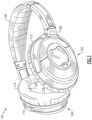
- FIG. 1 illustrates one example of a headphone set.
- the headphones 100 include two earpieces, e.g., a right earcup 102 and a left earcup 104, coupled to a right yoke assembly 108 and a left yoke assembly 110, respectively, and intercoupled by a headband 106.
- the right earcup 102 and left earcup 104 include a right circumaural cushion 112 and a left circumaural cushion 114, respectively. Visible on the left earcup 104 is a left interior surface 116.
- each of the earcups 102, 104 include one or more microphones, such as one or more front microphones, one or more rear microphones, and/or one or more interior microphones.
- the example headphones 100 illustrated in FIG. 1 include two earpieces, some examples may include only a single earpiece for use on one side of the head only. Additionally, although the example headphones 100 illustrated in FIG.
- an earbud may include a shape and/or materials configured to hold the earbud within a portion of a user's ear.
- the right earcup 102 may additionally or alternatively have a similar arrangement of front and rear microphones, though in examples the two earcups may have a differing arrangement in number or placement of microphones. Additionally, various examples may have more or fewer front microphones 202 and may have more, fewer, or no rear microphones 206. While the reference numerals 120, 202, and 206 are used to refer to one or more microphones, the visual element illustrated in the figures may, in some examples, represent an acoustic port wherein acoustic signals enter to ultimately reach the microphones 120, 202, 206, which may be internal and not physically visible from the exterior.
- one or more of the microphones 120, 202, 206 may be immediately adjacent to the interior of an acoustic port, or may be removed from an acoustic port by a distance, and may include an acoustic waveguide between an acoustic port and an associated microphone.
- VAD voice activity detection
- Examples disclosed herein to detect user voice activity may operate or rely on various principles of the environment, acoustics, vocal characteristics, and unique aspects of use, e.g., an earpiece worn or placed on each side of the head of a user whose voice activity is to be detected.
- a user's voice generally originates at a point symmetric to the left and right sides of the headset and will arrive at both a right front microphone and a left front microphone with substantially the same amplitude at substantially the same time and substantially the same phase, whereas background noise and vocalizations of other people will tend to be asymmetrical between the left and right, having variation in amplitude, phase, and time.
- a user's voice originates in a near-field of the headphones and will arrive at a front microphone with more acoustic energy than it will arrive at a rear microphone.
- Background noise and vocalizations of other people originating farther away may tend to arrive with substantially the same acoustic energy at front and rear microphones.
- background noise and vocalizations from people that originate farther away than the user's mouth will generally cause acoustic energy received at any of the microphones to be at a particular level, and the acoustic energy level will increase when the user's voice activity is added to these other acoustic signals.
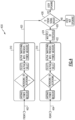
- FIG. 3 illustrates a method 300 of processing microphone signals to detect a likelihood that a headphone user is actively speaking.
- the example method 300 shown in FIG. 3 relies on processing and comparing characteristics of binaural, i.e., left and right, signals.
- left and right vocal signals due to the user's voice are substantially symmetric with each other and may be substantially identical due to the substantially equidistant position of left and right microphones from the user's mouth.
- the method of FIG. 3 processes a left signal 302 and a right signal 304 by adding them together to provide a principal signal 306.
- the method of FIG. 3 also processes the left signal 302 and the right signal 304 by subtracting them to provide a reference signal 308.
- the left and right signals 302, 304 are each provided by, and received from, microphones on the left and right sides of the headphones, respectively, and may come from multiple microphones on each side.
- a left side may have one microphone or may have multiple microphones, as discussed above, and the left signal 302 may be provided by a single microphone on the left side or may be a combination of signals from multiple microphones on the left side.
- the left signal 302 may be provided from a steered beam formed by processing the multiple microphones, e.g., as a phased array, or may be a simple combination (e.g., addition) of signals from the multiple microphones, or may be provided through other signal processing.
- the right signal 304 may be provided by a single microphone, a combination of multiple microphones, or an array of microphones, all on the right side.
- the smoothing algorithm 310 processes the signals to measure a power of each signal, at block 312, and calculates a decaying weighted average of each signal's power measurements over time, at block 318.
- the weighted average of current and previous power measurements may be based upon some characteristic value, e.g., an alpha value or time constant, selected at block 316, that impacts the weighting, and the selection of the alpha value may be dependent upon whether the current power measure is increasing or decreasing, determined at block 314.
- the smoothing algorithm 310 acting upon each of the principal signal 306 and the reference signal 308 provides a principal power signal 320 and a reference power signal 322, respectively.
- the principal signal 306 may be directly compared to the reference signal 308, and if the principal signal 306 has larger amplitude a conclusion is made that the user is talking.
- the principal power signal 320 and the reference power signal 322 are compared, and a determination that the user is talking is made if the principal power signal 320 has larger amplitude.
- a threshold is applied to require a minimum signal differential, to provide a confidence level that the user is in fact talking. In the example method 300 shown in FIG. 3 , a threshold is applied by multiplying the reference power signal 322 by a threshold value at block 324.
- filtering may require additional circuit components at additional cost, and/or may require additional computational power or processing resources, therefore consuming more energy from a power source, e.g., a battery.
- filtering may provide a good compromise between accuracy and power consumption.
- An acoustic shadow is also created by the user's head and the existence of the earcup and yoke assembly, which further contribute to a lower acoustic intensity arriving at the rear microphone. Acoustic energy from background noise and from other talkers will tend to have substantially the same acoustic intensity arriving at the front and rear microphones, and therefore a difference in signal energy between the front and rear may be used to detect that a user is speaking.
- the example method 400 accordingly processes and compares the energy in the front signal 402 to the energy in the rear signal 404 in a similar manner to how the example method 300 processes and compares a principal signal 306 and a reference signal 308.
- One or more of the above described methods may be used to detect that a headphone user is actively talking, e.g., to provide voice activity detection.
- Any of the methods described may be implemented with varying levels of reliability based on, e.g., microphone quality, microphone placement, acoustic ports, headphone frame design, threshold values, selection of smoothing algorithms, weighting factors, window sizes, etc., as well as other criteria that may accommodate varying applications and operational parameters.
- Any example of the methods described above may be sufficient to adequately detect a user's voice activity for certain applications. Improved detection may be achieved, however, by a combination of methods, such as examples of those described above, to incorporate concurrence and/or confidence level among multiple methods or approaches.
- FIG. 7 illustrates an example of a system 700 incorporating multiple examples of the various detection methods and combinatorial logic discussed above.
- the example system 700 there are one or more front, rear, and interior microphones 702 in each of the left and right earcups of a headphone set. Signals from any of the microphones 702 may be processed by a filter 704 to, e.g., remove non-vocal frequency bands, or to limit a frequency range expected to have substantial differentials as discussed above.
- a threshold detector 706 may monitor any one or more of the microphones 702 and enable any of the detectors 710, 720, 730, and/or 740, when there is sufficient sound level, or change in sound level, that indicate a user may be speaking.
Landscapes
- Engineering & Computer Science (AREA)
- Signal Processing (AREA)
- Physics & Mathematics (AREA)
- Acoustics & Sound (AREA)
- Health & Medical Sciences (AREA)
- Computational Linguistics (AREA)
- Audiology, Speech & Language Pathology (AREA)
- Human Computer Interaction (AREA)
- Multimedia (AREA)
- Otolaryngology (AREA)
- General Health & Medical Sciences (AREA)
- Headphones And Earphones (AREA)
Claims (8)
- Kopfhörersystem, umfassend:ein linkes Ohrstück;ein rechtes Ohrstück;ein linkes Mikrofon, das mit dem linken Ohrstück gekoppelt ist, um ein linkes akustisches Signal zu empfangen und ein aus dem linken akustischen Signal abgeleitetes linkes Signal bereitzustellen;ein rechtes Mikrofon, das mit dem rechten Ohrstück gekoppelt ist, um ein rechtes akustisches Signal zu empfangen und ein aus dem rechten akustischen Signal abgeleitetes rechtes Signal bereitzustellen; undein hinteres Mikrofon, das mit einem der beiden Ohrstücke gekoppelt und so positioniert ist, dass es ein hinteres akustisches Signal empfängt, wobei das hintere akustische Signal in Richtung der Rückseite des Kopfes des Benutzers in Bezug auf eines oder beide der linken akustischen Signale und das rechte akustische Signal verläuft;eine mit dem linken Mikrofon, dem rechten Mikrofon und dem hinteren Mikrofon gekoppelte Detektionsschaltung, wobei die Detektionsschaltung für Folgendes eingerichtet ist:- Vergleichen eines Hauptsignals mit einem Referenzsignal, wobei das Hauptsignal aus der Summe des linken Signals und des rechten Signals und das Referenzsignal aus der Differenz zwischen dem linken Signal und dem rechten Signal abgeleitet wird,- Vergleichen des vom hinteren Mikrofon abgeleiteten hinteren Signals mit mindestens einem des linken Signals und des rechten Signals, um einen hinteren Vergleich zu generieren, und- Erzeugen eines binären Ausgangs, der selektiv anzeigt, dass der Benutzer spricht oder nicht, zumindest teilweise auf der Grundlage dieser Vergleiche,wobei die Detektionsschaltung anzeigt, dass der Benutzer spricht, wenn das Hauptsignal das Referenzsignal um eine erste Schwelle überschreitet und das mindestens ein des linken Signals und des rechten Signals das hintere Signal um eine zweite Schwelle überschreitet.
- Kopfhörersystem nach Anspruch 1, wobei die Detektionsschaltung so eingerichtet ist, dass sie das Hauptsignal mit dem Referenzsignal vergleicht, indem sie einen Leistungsinhalt jedes der Hauptsignale und des Referenzsignals vergleicht.
- Kopfhörersystem nach einem der Ansprüche 1-2, wobei das Hauptsignal und das Referenzsignal jeweils in einem Band gefiltert werden.
- Kopfhörersystem nach einem der Ansprüche 1 bis 3, wobei mindestens eines des linken Mikrofons und des rechten Mikrofons eine Vielzahl von Mikrofonen umfasst und das jeweilige linke Signal oder rechte Signal zumindest teilweise aus der Vielzahl von Mikrofonen als Kombination von Ausgängen von einem oder mehreren der Vielzahl von Mikrofonen abgeleitet wird.
- Verfahren zum Bestimmen, dass ein Kopfhörerbenutzer spricht, wobei das Verfahren Folgendes umfasst:Empfangen eines ersten Signals, das von einem ersten linken Mikrofon abgeleitet wird; Empfangen eines zweiten Signals, das von einem zweiten rechten Mikrofon abgeleitet wird;Empfangen eines von einem hinteren Mikrofon abgeleiteten hinteren Signals;Bereitstellen eines Hauptsignals, das aus einer Summe des ersten Signals und des zweiten Signals abgeleitet wird;Bereitstellen eines Referenzsignals, das aus einer Differenz zwischen dem ersten Signal und dem zweiten Signal abgeleitet wird;Vergleichen des Hauptsignals mit dem Referenzsignal;Vergleichen des vom hinteren Mikrofon abgeleiteten hinteren Signals mit mindestens einem des linken Signals und des rechten Signals, um einen hinteren Vergleich zu generieren;wobei die Vergleichsschritte das Bestimmen umfassen, ob das Hauptsignal das Referenzsignal um eine erste Schwelle überschreitet und das mindestens eine des linken Signals und des rechten Signals das hintere Signal um eine zweite Schwelle überschreitet; undErzeugung eines binären Ausgangs, der selektiv anzeigt, dass ein Benutzer spricht oder nicht, zumindest teilweise auf der Grundlage der beiden Vergleiche.
- Verfahren nach Anspruch 5, wobei das Vergleichen des Hauptsignals mit dem Referenzsignal das Vergleichen eines Leistungsinhalts jedes der Hauptsignale und des Referenzsignals umfasst.
- Verfahren nach einem der Ansprüche 5-6, ferner umfassend das Filtern mindestens eines des ersten Signals, des zweiten Signals, des Hauptsignals und des Referenzsignals.
- Verfahren nach einem der Ansprüche 5-7, wobei das erste Signal von einer Vielzahl von ersten Mikrofonen abgeleitet wird, mindestens teilweise als eine Kombination von Ausgangssignalen von einem oder mehreren der Vielzahl von ersten Mikrofonen.
Priority Applications (1)
| Application Number | Priority Date | Filing Date | Title |
|---|---|---|---|
| EP25172561.0A EP4604582A1 (de) | 2017-03-20 | 2018-03-19 | System zur erkennung der sprachaktivität eines kopfhörerbenutzers |
Applications Claiming Priority (2)
| Application Number | Priority Date | Filing Date | Title |
|---|---|---|---|
| US15/463,259 US10366708B2 (en) | 2017-03-20 | 2017-03-20 | Systems and methods of detecting speech activity of headphone user |
| PCT/US2018/023072 WO2018175283A1 (en) | 2017-03-20 | 2018-03-19 | Systems and methods of detecting speech activity of headphone user |
Related Child Applications (2)
| Application Number | Title | Priority Date | Filing Date |
|---|---|---|---|
| EP25172561.0A Division EP4604582A1 (de) | 2017-03-20 | 2018-03-19 | System zur erkennung der sprachaktivität eines kopfhörerbenutzers |
| EP25172561.0A Division-Into EP4604582A1 (de) | 2017-03-20 | 2018-03-19 | System zur erkennung der sprachaktivität eines kopfhörerbenutzers |
Publications (2)
| Publication Number | Publication Date |
|---|---|
| EP3603119A1 EP3603119A1 (de) | 2020-02-05 |
| EP3603119B1 true EP3603119B1 (de) | 2025-07-02 |
Family
ID=61913552
Family Applications (2)
| Application Number | Title | Priority Date | Filing Date |
|---|---|---|---|
| EP25172561.0A Pending EP4604582A1 (de) | 2017-03-20 | 2018-03-19 | System zur erkennung der sprachaktivität eines kopfhörerbenutzers |
| EP18716725.9A Active EP3603119B1 (de) | 2017-03-20 | 2018-03-19 | Systeme und verfahren zur erkennung der sprachaktivität eines kopfhörerbenutzers |
Family Applications Before (1)
| Application Number | Title | Priority Date | Filing Date |
|---|---|---|---|
| EP25172561.0A Pending EP4604582A1 (de) | 2017-03-20 | 2018-03-19 | System zur erkennung der sprachaktivität eines kopfhörerbenutzers |
Country Status (4)
| Country | Link |
|---|---|
| US (2) | US10366708B2 (de) |
| EP (2) | EP4604582A1 (de) |
| CN (1) | CN110754096B (de) |
| WO (1) | WO2018175283A1 (de) |
Families Citing this family (7)
| Publication number | Priority date | Publication date | Assignee | Title |
|---|---|---|---|---|
| US10237654B1 (en) | 2017-02-09 | 2019-03-19 | Hm Electronics, Inc. | Spatial low-crosstalk headset |
| JP1602513S (de) * | 2017-10-03 | 2018-04-23 | ||
| CN113571053B (zh) | 2020-04-28 | 2024-07-30 | 华为技术有限公司 | 语音唤醒方法和设备 |
| US11521643B2 (en) * | 2020-05-08 | 2022-12-06 | Bose Corporation | Wearable audio device with user own-voice recording |
| US11482236B2 (en) | 2020-08-17 | 2022-10-25 | Bose Corporation | Audio systems and methods for voice activity detection |
| CN117641172A (zh) * | 2022-08-09 | 2024-03-01 | 北京小米移动软件有限公司 | 耳机控制方法及装置、电子设备、存储介质 |
| SE547594C2 (en) * | 2024-07-30 | 2025-10-21 | Marshall Group Ab Publ | Audio capture device selection |
Family Cites Families (61)
| Publication number | Priority date | Publication date | Assignee | Title |
|---|---|---|---|---|
| US6453291B1 (en) | 1999-02-04 | 2002-09-17 | Motorola, Inc. | Apparatus and method for voice activity detection in a communication system |
| US6363349B1 (en) | 1999-05-28 | 2002-03-26 | Motorola, Inc. | Method and apparatus for performing distributed speech processing in a communication system |
| US6339706B1 (en) | 1999-11-12 | 2002-01-15 | Telefonaktiebolaget L M Ericsson (Publ) | Wireless voice-activated remote control device |
| GB2364480B (en) | 2000-06-30 | 2004-07-14 | Mitel Corp | Method of using speech recognition to initiate a wireless application (WAP) session |
| US7953447B2 (en) | 2001-09-05 | 2011-05-31 | Vocera Communications, Inc. | Voice-controlled communications system and method using a badge application |
| US7315623B2 (en) * | 2001-12-04 | 2008-01-01 | Harman Becker Automotive Systems Gmbh | Method for supressing surrounding noise in a hands-free device and hands-free device |
| EP1524879B1 (de) | 2003-06-30 | 2014-05-07 | Nuance Communications, Inc. | Freisprechanlage zur Verwendung in einem Fahrzeug |
| US20050015255A1 (en) * | 2003-07-18 | 2005-01-20 | Pitney Bowes Incorporated | Assistive technology for disabled people and others utilizing a remote service bureau |
| DE20311718U1 (de) * | 2003-07-30 | 2004-12-09 | Stryker Trauma Gmbh | Kombination aus intramedulärem Nagel und Ziel und/oder Einschlaginstrument |
| US7412070B2 (en) | 2004-03-29 | 2008-08-12 | Bose Corporation | Headphoning |
| EP2030476B1 (de) * | 2006-06-01 | 2012-07-18 | Hear Ip Pty Ltd | Verfahren und system zur verbesserung der verständlichkeit von lauten |
| US20080031475A1 (en) | 2006-07-08 | 2008-02-07 | Personics Holdings Inc. | Personal audio assistant device and method |
| WO2008090544A2 (en) | 2007-01-22 | 2008-07-31 | Silentium Ltd. | Quiet fan incorporating active noise control (anc) |
| US8611560B2 (en) | 2007-04-13 | 2013-12-17 | Navisense | Method and device for voice operated control |
| US8625819B2 (en) | 2007-04-13 | 2014-01-07 | Personics Holdings, Inc | Method and device for voice operated control |
| WO2008134642A1 (en) | 2007-04-27 | 2008-11-06 | Personics Holdings Inc. | Method and device for personalized voice operated control |
| CN102077607B (zh) | 2008-05-02 | 2014-12-10 | Gn奈康有限公司 | 组合至少两个音频信号的方法和包括至少两个麦克风的麦克风系统 |
| JP5223576B2 (ja) | 2008-10-02 | 2013-06-26 | 沖電気工業株式会社 | エコーキャンセラ、エコーキャンセル方法及びプログラム |
| JP5386936B2 (ja) | 2008-11-05 | 2014-01-15 | ヤマハ株式会社 | 放収音装置 |
| US8184822B2 (en) | 2009-04-28 | 2012-05-22 | Bose Corporation | ANR signal processing topology |
| WO2011133924A1 (en) * | 2010-04-22 | 2011-10-27 | Qualcomm Incorporated | Voice activity detection |
| US8880396B1 (en) | 2010-04-28 | 2014-11-04 | Audience, Inc. | Spectrum reconstruction for automatic speech recognition |
| US8965546B2 (en) | 2010-07-26 | 2015-02-24 | Qualcomm Incorporated | Systems, methods, and apparatus for enhanced acoustic imaging |
| US9025782B2 (en) * | 2010-07-26 | 2015-05-05 | Qualcomm Incorporated | Systems, methods, apparatus, and computer-readable media for multi-microphone location-selective processing |
| JP5573517B2 (ja) | 2010-09-07 | 2014-08-20 | ソニー株式会社 | 雑音除去装置および雑音除去方法 |
| US8620650B2 (en) | 2011-04-01 | 2013-12-31 | Bose Corporation | Rejecting noise with paired microphones |
| US20140009309A1 (en) * | 2011-04-18 | 2014-01-09 | Information Logistics, Inc. | Method And System For Streaming Data For Consumption By A User |
| FR2976111B1 (fr) * | 2011-06-01 | 2013-07-05 | Parrot | Equipement audio comprenant des moyens de debruitage d'un signal de parole par filtrage a delai fractionnaire, notamment pour un systeme de telephonie "mains libres" |
| CN102300140B (zh) | 2011-08-10 | 2013-12-18 | 歌尔声学股份有限公司 | 一种通信耳机的语音增强方法及降噪通信耳机 |
| US9438985B2 (en) * | 2012-09-28 | 2016-09-06 | Apple Inc. | System and method of detecting a user's voice activity using an accelerometer |
| US9516442B1 (en) * | 2012-09-28 | 2016-12-06 | Apple Inc. | Detecting the positions of earbuds and use of these positions for selecting the optimum microphones in a headset |
| US8798283B2 (en) | 2012-11-02 | 2014-08-05 | Bose Corporation | Providing ambient naturalness in ANR headphones |
| US9124965B2 (en) | 2012-11-08 | 2015-09-01 | Dsp Group Ltd. | Adaptive system for managing a plurality of microphones and speakers |
| CN104247280A (zh) | 2013-02-27 | 2014-12-24 | 视听公司 | 话音控制的通信连接 |
| US20140278393A1 (en) | 2013-03-12 | 2014-09-18 | Motorola Mobility Llc | Apparatus and Method for Power Efficient Signal Conditioning for a Voice Recognition System |
| CN105229737B (zh) | 2013-03-13 | 2019-05-17 | 寇平公司 | 噪声消除麦克风装置 |
| CN104050971A (zh) | 2013-03-15 | 2014-09-17 | 杜比实验室特许公司 | 声学回声减轻装置和方法、音频处理装置和语音通信终端 |
| US9767819B2 (en) | 2013-04-11 | 2017-09-19 | Nuance Communications, Inc. | System for automatic speech recognition and audio entertainment |
| CN103269465B (zh) | 2013-05-22 | 2016-09-07 | 歌尔股份有限公司 | 一种强噪声环境下的耳机通讯方法和一种耳机 |
| US9288570B2 (en) * | 2013-08-27 | 2016-03-15 | Bose Corporation | Assisting conversation while listening to audio |
| US9402132B2 (en) | 2013-10-14 | 2016-07-26 | Qualcomm Incorporated | Limiting active noise cancellation output |
| US9502028B2 (en) | 2013-10-18 | 2016-11-22 | Knowles Electronics, Llc | Acoustic activity detection apparatus and method |
| US20150139428A1 (en) | 2013-11-20 | 2015-05-21 | Knowles IPC (M) Snd. Bhd. | Apparatus with a speaker used as second microphone |
| US20150172807A1 (en) | 2013-12-13 | 2015-06-18 | Gn Netcom A/S | Apparatus And A Method For Audio Signal Processing |
| CN105981409B (zh) | 2014-02-10 | 2019-06-14 | 伯斯有限公司 | 会话辅助系统 |
| US9681246B2 (en) | 2014-02-28 | 2017-06-13 | Harman International Industries, Incorporated | Bionic hearing headset |
| DE112015004522T5 (de) | 2014-10-02 | 2017-06-14 | Knowles Electronics, Llc | Akustische Vorrichtung mit niedrigem Leistungsverbrauch und Verfahren für den Betrieb |
| JP6201949B2 (ja) | 2014-10-08 | 2017-09-27 | 株式会社Jvcケンウッド | エコーキャンセル装置、エコーキャンセルプログラム及びエコーキャンセル方法 |
| EP3007170A1 (de) | 2014-10-08 | 2016-04-13 | GN Netcom A/S | Robustes Lärmunterdrückungssystem mit nichtkalibrierten Mikrofonen |
| US20160162469A1 (en) | 2014-10-23 | 2016-06-09 | Audience, Inc. | Dynamic Local ASR Vocabulary |
| US20160165361A1 (en) | 2014-12-05 | 2016-06-09 | Knowles Electronics, Llc | Apparatus and method for digital signal processing with microphones |
| WO2016094418A1 (en) | 2014-12-09 | 2016-06-16 | Knowles Electronics, Llc | Dynamic local asr vocabulary |
| US20160189220A1 (en) | 2014-12-30 | 2016-06-30 | Audience, Inc. | Context-Based Services Based on Keyword Monitoring |
| EP3040984B1 (de) | 2015-01-02 | 2022-07-13 | Harman Becker Automotive Systems GmbH | Schallzonenanordnung mit zonenweiser sprachunterdrückung |
| CN107112012B (zh) | 2015-01-07 | 2020-11-20 | 美商楼氏电子有限公司 | 用于音频处理的方法和系统及计算机可读存储介质 |
| WO2016118480A1 (en) | 2015-01-21 | 2016-07-28 | Knowles Electronics, Llc | Low power voice trigger for acoustic apparatus and method |
| US9905216B2 (en) | 2015-03-13 | 2018-02-27 | Bose Corporation | Voice sensing using multiple microphones |
| US9554210B1 (en) | 2015-06-25 | 2017-01-24 | Amazon Technologies, Inc. | Multichannel acoustic echo cancellation with unique individual channel estimations |
| US9401158B1 (en) | 2015-09-14 | 2016-07-26 | Knowles Electronics, Llc | Microphone signal fusion |
| US9997173B2 (en) | 2016-03-14 | 2018-06-12 | Apple Inc. | System and method for performing automatic gain control using an accelerometer in a headset |
| US9843861B1 (en) | 2016-11-09 | 2017-12-12 | Bose Corporation | Controlling wind noise in a bilateral microphone array |
-
2017
- 2017-03-20 US US15/463,259 patent/US10366708B2/en active Active
-
2018
- 2018-03-19 EP EP25172561.0A patent/EP4604582A1/de active Pending
- 2018-03-19 WO PCT/US2018/023072 patent/WO2018175283A1/en not_active Ceased
- 2018-03-19 CN CN201880019495.9A patent/CN110754096B/zh active Active
- 2018-03-19 EP EP18716725.9A patent/EP3603119B1/de active Active
-
2019
- 2019-06-17 US US16/442,956 patent/US10762915B2/en active Active
Also Published As
| Publication number | Publication date |
|---|---|
| CN110754096B (zh) | 2022-08-16 |
| US20180268845A1 (en) | 2018-09-20 |
| US20190304487A1 (en) | 2019-10-03 |
| CN110754096A (zh) | 2020-02-04 |
| WO2018175283A1 (en) | 2018-09-27 |
| EP4604582A1 (de) | 2025-08-20 |
| EP3603119A1 (de) | 2020-02-05 |
| US10762915B2 (en) | 2020-09-01 |
| US10366708B2 (en) | 2019-07-30 |
Similar Documents
| Publication | Publication Date | Title |
|---|---|---|
| US11594240B2 (en) | Audio signal processing for noise reduction | |
| US10762915B2 (en) | Systems and methods of detecting speech activity of headphone user | |
| EP3769305B1 (de) | Echosteuerung in binauralen adaptiven rauschunterdrückungssystemen in headsets | |
| US10499139B2 (en) | Audio signal processing for noise reduction | |
| US10244306B1 (en) | Real-time detection of feedback instability | |
| US10319392B2 (en) | Headset having a microphone | |
| JP6675414B2 (ja) | 複数のマイクロホンを使用する音声感知 | |
| US10424315B1 (en) | Audio signal processing for noise reduction | |
| US10249323B2 (en) | Voice activity detection for communication headset | |
| US11688411B2 (en) | Audio systems and methods for voice activity detection | |
| EP3840402B1 (de) | Elektronische wearable vorrichtung mit tief-frequenz-rauschverminderung |
Legal Events
| Date | Code | Title | Description |
|---|---|---|---|
| STAA | Information on the status of an ep patent application or granted ep patent |
Free format text: STATUS: UNKNOWN |
|
| STAA | Information on the status of an ep patent application or granted ep patent |
Free format text: STATUS: THE INTERNATIONAL PUBLICATION HAS BEEN MADE |
|
| PUAI | Public reference made under article 153(3) epc to a published international application that has entered the european phase |
Free format text: ORIGINAL CODE: 0009012 |
|
| STAA | Information on the status of an ep patent application or granted ep patent |
Free format text: STATUS: REQUEST FOR EXAMINATION WAS MADE |
|
| 17P | Request for examination filed |
Effective date: 20190912 |
|
| AK | Designated contracting states |
Kind code of ref document: A1 Designated state(s): AL AT BE BG CH CY CZ DE DK EE ES FI FR GB GR HR HU IE IS IT LI LT LU LV MC MK MT NL NO PL PT RO RS SE SI SK SM TR |
|
| AX | Request for extension of the european patent |
Extension state: BA ME |
|
| DAV | Request for validation of the european patent (deleted) | ||
| DAX | Request for extension of the european patent (deleted) | ||
| STAA | Information on the status of an ep patent application or granted ep patent |
Free format text: STATUS: EXAMINATION IS IN PROGRESS |
|
| 17Q | First examination report despatched |
Effective date: 20211029 |
|
| GRAP | Despatch of communication of intention to grant a patent |
Free format text: ORIGINAL CODE: EPIDOSNIGR1 |
|
| STAA | Information on the status of an ep patent application or granted ep patent |
Free format text: STATUS: GRANT OF PATENT IS INTENDED |
|
| GRAJ | Information related to disapproval of communication of intention to grant by the applicant or resumption of examination proceedings by the epo deleted |
Free format text: ORIGINAL CODE: EPIDOSDIGR1 |
|
| GRAP | Despatch of communication of intention to grant a patent |
Free format text: ORIGINAL CODE: EPIDOSNIGR1 |
|
| GRAJ | Information related to disapproval of communication of intention to grant by the applicant or resumption of examination proceedings by the epo deleted |
Free format text: ORIGINAL CODE: EPIDOSDIGR1 |
|
| STAA | Information on the status of an ep patent application or granted ep patent |
Free format text: STATUS: EXAMINATION IS IN PROGRESS |
|
| GRAP | Despatch of communication of intention to grant a patent |
Free format text: ORIGINAL CODE: EPIDOSNIGR1 |
|
| STAA | Information on the status of an ep patent application or granted ep patent |
Free format text: STATUS: GRANT OF PATENT IS INTENDED |
|
| GRAJ | Information related to disapproval of communication of intention to grant by the applicant or resumption of examination proceedings by the epo deleted |
Free format text: ORIGINAL CODE: EPIDOSDIGR1 |
|
| GRAP | Despatch of communication of intention to grant a patent |
Free format text: ORIGINAL CODE: EPIDOSNIGR1 |
|
| STAA | Information on the status of an ep patent application or granted ep patent |
Free format text: STATUS: EXAMINATION IS IN PROGRESS |
|
| GRAJ | Information related to disapproval of communication of intention to grant by the applicant or resumption of examination proceedings by the epo deleted |
Free format text: ORIGINAL CODE: EPIDOSDIGR1 |
|
| GRAP | Despatch of communication of intention to grant a patent |
Free format text: ORIGINAL CODE: EPIDOSNIGR1 |
|
| STAA | Information on the status of an ep patent application or granted ep patent |
Free format text: STATUS: GRANT OF PATENT IS INTENDED |
|
| INTG | Intention to grant announced |
Effective date: 20250225 |
|
| INTG | Intention to grant announced |
Effective date: 20250303 |
|
| INTG | Intention to grant announced |
Effective date: 20250310 |
|
| INTC | Intention to grant announced (deleted) | ||
| INTG | Intention to grant announced |
Effective date: 20250324 |
|
| GRAS | Grant fee paid |
Free format text: ORIGINAL CODE: EPIDOSNIGR3 |
|
| GRAA | (expected) grant |
Free format text: ORIGINAL CODE: 0009210 |
|
| STAA | Information on the status of an ep patent application or granted ep patent |
Free format text: STATUS: THE PATENT HAS BEEN GRANTED |
|
| AK | Designated contracting states |
Kind code of ref document: B1 Designated state(s): AL AT BE BG CH CY CZ DE DK EE ES FI FR GB GR HR HU IE IS IT LI LT LU LV MC MK MT NL NO PL PT RO RS SE SI SK SM TR |
|
| REG | Reference to a national code |
Ref country code: GB Ref legal event code: FG4D |
|
| REG | Reference to a national code |
Ref country code: CH Ref legal event code: EP |
|
| REG | Reference to a national code |
Ref country code: DE Ref legal event code: R096 Ref document number: 602018083163 Country of ref document: DE |
|
| REG | Reference to a national code |
Ref country code: IE Ref legal event code: FG4D |
|
| REG | Reference to a national code |
Ref country code: NL Ref legal event code: MP Effective date: 20250702 |
|
| PG25 | Lapsed in a contracting state [announced via postgrant information from national office to epo] |
Ref country code: PT Free format text: LAPSE BECAUSE OF FAILURE TO SUBMIT A TRANSLATION OF THE DESCRIPTION OR TO PAY THE FEE WITHIN THE PRESCRIBED TIME-LIMIT Effective date: 20251103 |
|
| PG25 | Lapsed in a contracting state [announced via postgrant information from national office to epo] |
Ref country code: NL Free format text: LAPSE BECAUSE OF FAILURE TO SUBMIT A TRANSLATION OF THE DESCRIPTION OR TO PAY THE FEE WITHIN THE PRESCRIBED TIME-LIMIT Effective date: 20250702 |
|
| REG | Reference to a national code |
Ref country code: AT Ref legal event code: MK05 Ref document number: 1810677 Country of ref document: AT Kind code of ref document: T Effective date: 20250702 |
|
| PG25 | Lapsed in a contracting state [announced via postgrant information from national office to epo] |
Ref country code: IS Free format text: LAPSE BECAUSE OF FAILURE TO SUBMIT A TRANSLATION OF THE DESCRIPTION OR TO PAY THE FEE WITHIN THE PRESCRIBED TIME-LIMIT Effective date: 20251102 |
|
| PG25 | Lapsed in a contracting state [announced via postgrant information from national office to epo] |
Ref country code: NO Free format text: LAPSE BECAUSE OF FAILURE TO SUBMIT A TRANSLATION OF THE DESCRIPTION OR TO PAY THE FEE WITHIN THE PRESCRIBED TIME-LIMIT Effective date: 20251002 |
|
| REG | Reference to a national code |
Ref country code: LT Ref legal event code: MG9D |
|
| PG25 | Lapsed in a contracting state [announced via postgrant information from national office to epo] |
Ref country code: AT Free format text: LAPSE BECAUSE OF FAILURE TO SUBMIT A TRANSLATION OF THE DESCRIPTION OR TO PAY THE FEE WITHIN THE PRESCRIBED TIME-LIMIT Effective date: 20250702 |
|
| PG25 | Lapsed in a contracting state [announced via postgrant information from national office to epo] |
Ref country code: FI Free format text: LAPSE BECAUSE OF FAILURE TO SUBMIT A TRANSLATION OF THE DESCRIPTION OR TO PAY THE FEE WITHIN THE PRESCRIBED TIME-LIMIT Effective date: 20250702 |
|
| PG25 | Lapsed in a contracting state [announced via postgrant information from national office to epo] |
Ref country code: HR Free format text: LAPSE BECAUSE OF FAILURE TO SUBMIT A TRANSLATION OF THE DESCRIPTION OR TO PAY THE FEE WITHIN THE PRESCRIBED TIME-LIMIT Effective date: 20250702 |
|
| PG25 | Lapsed in a contracting state [announced via postgrant information from national office to epo] |
Ref country code: GR Free format text: LAPSE BECAUSE OF FAILURE TO SUBMIT A TRANSLATION OF THE DESCRIPTION OR TO PAY THE FEE WITHIN THE PRESCRIBED TIME-LIMIT Effective date: 20251003 |
|
| PG25 | Lapsed in a contracting state [announced via postgrant information from national office to epo] |
Ref country code: SE Free format text: LAPSE BECAUSE OF FAILURE TO SUBMIT A TRANSLATION OF THE DESCRIPTION OR TO PAY THE FEE WITHIN THE PRESCRIBED TIME-LIMIT Effective date: 20250702 Ref country code: CZ Free format text: LAPSE BECAUSE OF FAILURE TO SUBMIT A TRANSLATION OF THE DESCRIPTION OR TO PAY THE FEE WITHIN THE PRESCRIBED TIME-LIMIT Effective date: 20250702 |
|
| PG25 | Lapsed in a contracting state [announced via postgrant information from national office to epo] |
Ref country code: LV Free format text: LAPSE BECAUSE OF FAILURE TO SUBMIT A TRANSLATION OF THE DESCRIPTION OR TO PAY THE FEE WITHIN THE PRESCRIBED TIME-LIMIT Effective date: 20250702 |
|
| PG25 | Lapsed in a contracting state [announced via postgrant information from national office to epo] |
Ref country code: PL Free format text: LAPSE BECAUSE OF FAILURE TO SUBMIT A TRANSLATION OF THE DESCRIPTION OR TO PAY THE FEE WITHIN THE PRESCRIBED TIME-LIMIT Effective date: 20250702 Ref country code: BG Free format text: LAPSE BECAUSE OF FAILURE TO SUBMIT A TRANSLATION OF THE DESCRIPTION OR TO PAY THE FEE WITHIN THE PRESCRIBED TIME-LIMIT Effective date: 20250702 |
|
| PG25 | Lapsed in a contracting state [announced via postgrant information from national office to epo] |
Ref country code: RS Free format text: LAPSE BECAUSE OF FAILURE TO SUBMIT A TRANSLATION OF THE DESCRIPTION OR TO PAY THE FEE WITHIN THE PRESCRIBED TIME-LIMIT Effective date: 20251002 |
|
| PG25 | Lapsed in a contracting state [announced via postgrant information from national office to epo] |
Ref country code: ES Free format text: LAPSE BECAUSE OF FAILURE TO SUBMIT A TRANSLATION OF THE DESCRIPTION OR TO PAY THE FEE WITHIN THE PRESCRIBED TIME-LIMIT Effective date: 20250702 |
|
| PG25 | Lapsed in a contracting state [announced via postgrant information from national office to epo] |
Ref country code: SM Free format text: LAPSE BECAUSE OF FAILURE TO SUBMIT A TRANSLATION OF THE DESCRIPTION OR TO PAY THE FEE WITHIN THE PRESCRIBED TIME-LIMIT Effective date: 20250702 |
|
| PGFP | Annual fee paid to national office [announced via postgrant information from national office to epo] |
Ref country code: GB Payment date: 20260220 Year of fee payment: 9 |
|
| PG25 | Lapsed in a contracting state [announced via postgrant information from national office to epo] |
Ref country code: DK Free format text: LAPSE BECAUSE OF FAILURE TO SUBMIT A TRANSLATION OF THE DESCRIPTION OR TO PAY THE FEE WITHIN THE PRESCRIBED TIME-LIMIT Effective date: 20250702 |
|
| PGFP | Annual fee paid to national office [announced via postgrant information from national office to epo] |
Ref country code: DE Payment date: 20260219 Year of fee payment: 9 |
|
| PG25 | Lapsed in a contracting state [announced via postgrant information from national office to epo] |
Ref country code: IT Free format text: LAPSE BECAUSE OF FAILURE TO SUBMIT A TRANSLATION OF THE DESCRIPTION OR TO PAY THE FEE WITHIN THE PRESCRIBED TIME-LIMIT Effective date: 20250702 |
|
| PGFP | Annual fee paid to national office [announced via postgrant information from national office to epo] |
Ref country code: FR Payment date: 20260219 Year of fee payment: 9 |
|
| PG25 | Lapsed in a contracting state [announced via postgrant information from national office to epo] |
Ref country code: EE Free format text: LAPSE BECAUSE OF FAILURE TO SUBMIT A TRANSLATION OF THE DESCRIPTION OR TO PAY THE FEE WITHIN THE PRESCRIBED TIME-LIMIT Effective date: 20250702 Ref country code: SK Free format text: LAPSE BECAUSE OF FAILURE TO SUBMIT A TRANSLATION OF THE DESCRIPTION OR TO PAY THE FEE WITHIN THE PRESCRIBED TIME-LIMIT Effective date: 20250702 |