EP3602885B1 - Systeme und verfahren zum entfernen von duplizierten paketen zur übertragung - Google Patents
Systeme und verfahren zum entfernen von duplizierten paketen zur übertragung Download PDFInfo
- Publication number
- EP3602885B1 EP3602885B1 EP17818507.0A EP17818507A EP3602885B1 EP 3602885 B1 EP3602885 B1 EP 3602885B1 EP 17818507 A EP17818507 A EP 17818507A EP 3602885 B1 EP3602885 B1 EP 3602885B1
- Authority
- EP
- European Patent Office
- Prior art keywords
- pdcp pdu
- rlc
- link
- pdcp
- rlc entity
- Prior art date
- Legal status (The legal status is an assumption and is not a legal conclusion. Google has not performed a legal analysis and makes no representation as to the accuracy of the status listed.)
- Active
Links
Images



Classifications
-
- H—ELECTRICITY
- H04—ELECTRIC COMMUNICATION TECHNIQUE
- H04L—TRANSMISSION OF DIGITAL INFORMATION, e.g. TELEGRAPHIC COMMUNICATION
- H04L1/00—Arrangements for detecting or preventing errors in the information received
- H04L1/12—Arrangements for detecting or preventing errors in the information received by using return channel
- H04L1/16—Arrangements for detecting or preventing errors in the information received by using return channel in which the return channel carries supervisory signals, e.g. repetition request signals
- H04L1/18—Automatic repetition systems, e.g. Van Duuren systems
- H04L1/1867—Arrangements specially adapted for the transmitter end
- H04L1/1874—Buffer management
-
- H—ELECTRICITY
- H04—ELECTRIC COMMUNICATION TECHNIQUE
- H04L—TRANSMISSION OF DIGITAL INFORMATION, e.g. TELEGRAPHIC COMMUNICATION
- H04L1/00—Arrangements for detecting or preventing errors in the information received
- H04L1/12—Arrangements for detecting or preventing errors in the information received by using return channel
- H04L1/16—Arrangements for detecting or preventing errors in the information received by using return channel in which the return channel carries supervisory signals, e.g. repetition request signals
- H04L1/18—Automatic repetition systems, e.g. Van Duuren systems
- H04L1/1867—Arrangements specially adapted for the transmitter end
-
- H—ELECTRICITY
- H04—ELECTRIC COMMUNICATION TECHNIQUE
- H04L—TRANSMISSION OF DIGITAL INFORMATION, e.g. TELEGRAPHIC COMMUNICATION
- H04L1/00—Arrangements for detecting or preventing errors in the information received
- H04L1/12—Arrangements for detecting or preventing errors in the information received by using return channel
- H04L1/16—Arrangements for detecting or preventing errors in the information received by using return channel in which the return channel carries supervisory signals, e.g. repetition request signals
- H04L1/18—Automatic repetition systems, e.g. Van Duuren systems
- H04L1/1867—Arrangements specially adapted for the transmitter end
- H04L1/187—Details of sliding window management
-
- H—ELECTRICITY
- H04—ELECTRIC COMMUNICATION TECHNIQUE
- H04L—TRANSMISSION OF DIGITAL INFORMATION, e.g. TELEGRAPHIC COMMUNICATION
- H04L1/00—Arrangements for detecting or preventing errors in the information received
- H04L1/12—Arrangements for detecting or preventing errors in the information received by using return channel
- H04L1/16—Arrangements for detecting or preventing errors in the information received by using return channel in which the return channel carries supervisory signals, e.g. repetition request signals
- H04L1/18—Automatic repetition systems, e.g. Van Duuren systems
- H04L1/1867—Arrangements specially adapted for the transmitter end
- H04L1/188—Time-out mechanisms
-
- H—ELECTRICITY
- H04—ELECTRIC COMMUNICATION TECHNIQUE
- H04L—TRANSMISSION OF DIGITAL INFORMATION, e.g. TELEGRAPHIC COMMUNICATION
- H04L1/00—Arrangements for detecting or preventing errors in the information received
- H04L1/12—Arrangements for detecting or preventing errors in the information received by using return channel
- H04L1/16—Arrangements for detecting or preventing errors in the information received by using return channel in which the return channel carries supervisory signals, e.g. repetition request signals
- H04L1/18—Automatic repetition systems, e.g. Van Duuren systems
- H04L1/1867—Arrangements specially adapted for the transmitter end
- H04L1/1887—Scheduling and prioritising arrangements
-
- H—ELECTRICITY
- H04—ELECTRIC COMMUNICATION TECHNIQUE
- H04L—TRANSMISSION OF DIGITAL INFORMATION, e.g. TELEGRAPHIC COMMUNICATION
- H04L1/00—Arrangements for detecting or preventing errors in the information received
- H04L1/12—Arrangements for detecting or preventing errors in the information received by using return channel
- H04L1/16—Arrangements for detecting or preventing errors in the information received by using return channel in which the return channel carries supervisory signals, e.g. repetition request signals
- H04L1/18—Automatic repetition systems, e.g. Van Duuren systems
- H04L1/1867—Arrangements specially adapted for the transmitter end
- H04L1/1896—ARQ related signaling
-
- H—ELECTRICITY
- H04—ELECTRIC COMMUNICATION TECHNIQUE
- H04L—TRANSMISSION OF DIGITAL INFORMATION, e.g. TELEGRAPHIC COMMUNICATION
- H04L1/00—Arrangements for detecting or preventing errors in the information received
- H04L2001/0092—Error control systems characterised by the topology of the transmission link
- H04L2001/0096—Channel splitting in point-to-point links
-
- H—ELECTRICITY
- H04—ELECTRIC COMMUNICATION TECHNIQUE
- H04W—WIRELESS COMMUNICATION NETWORKS
- H04W80/00—Wireless network protocols or protocol adaptations to wireless operation
- H04W80/02—Data link layer protocols
-
- H—ELECTRICITY
- H04—ELECTRIC COMMUNICATION TECHNIQUE
- H04W—WIRELESS COMMUNICATION NETWORKS
- H04W92/00—Interfaces specially adapted for wireless communication networks
- H04W92/16—Interfaces between hierarchically similar devices
- H04W92/20—Interfaces between hierarchically similar devices between access points
Definitions
- the present disclosure relates, in general, to wireless communications and, more particularly, methods and systems for removal of duplicated packets for transmission.
- Dual Connectivity (DC) in downlink (DL) and uplink (UL) are two of the features which will be standardized. These features are also available in Long Term Evolution (LTE).
- LTE Long Term Evolution
- PDCP Packet Data Convergence Protocol
- PDU protocol data unit
- FIGURE 1 illustrates the DC architecture between LTE and NR.
- the same PDCP PDU is transmitted by each radio access technology (RAT).
- the radio link control (RLC) entity requests data from PDCP
- the PDCP layer delivers the PDCP PDU to the requesting RLC entity.
- RLC Acknowledge Mode When RLC Acknowledge Mode (AM) is configured, each RLC entity will perform retransmissions until the data has been successfully acknowledged or the maximum number of RLC retransmissions has been reached. In the latter case, the UE triggers the Radio Link Failure (RLF) procedure. In limited-coverage situations, the maximum number of RLC retransmissions may be reached.
- RLF Radio Link Failure
- WO2015/008962A1 discloses a method and a device for reporting an RLC (Radio Link Control) re-transmission failure in a Wireless communication system, the method comprising: receiving, from a base station (BS), an indicator indicating a radio bearer (RB) Which the UE reports a RLC re-transmission error to the BS; and reporting, to a BS, an Radio Link Control (RLC) retransmission error if the RLC retransmission error occurs in the RB indicated by the indicator.
- BS base station
- RB radio bearer
- RLC Radio Link Control
- the RLC entity of the link with problems may be performing RLC retransmissions of the RLC PDU(s) containing the PDCP PDU. If the RLC entity reaches the maximum number of retransmissions, the UE will trigger a RLF procedure though such a procedure is not really necessary. Further, triggering a RLF procedure may not be desirable when there is, at least, one link which is performing and in which data is transmitted/received correctly.
- a mechanism is provided for removing radio link control (RLC) protocol data units (PDUs), which contained a certain Packet Data Convergence Protocol (PDCP) PDU, from the RLC buffer when the RLC PDU(s) are being transmitted or retransmitted to a receiver by one link though the PDCP PDU was received by the receiver via a second link.
- RLC radio link control
- PDCP Packet Data Convergence Protocol
- a method is provided according to claim 1.
- Certain embodiments of the present disclosure may provide one or more technical advantages. For example, certain embodiments may avoid the unnecessary triggering of a Radio Link Failure (RLF) procedure in response to a maximum number of RLC transmissions when data is duplicated and transmitted via two different links and a successful transmission is received via one of the two links. Accordingly, certain embodiments save network resources. Additionally, certain embodiments avoid RLC reestablishments.
- RLF Radio Link Failure
- Particular embodiments of the present disclosure may provide methods and systems for controlling gap sharing between intra-frequency measurements of different types. Particular embodiments are described in FIGURES 2 -15 of the drawings, like numerals being used for like and corresponding parts of the various drawings.
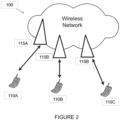
- FIGURE 2 illustrates a wireless network 100 for removal of duplicated packets for transmission, in accordance with certain embodiments.
- Network 100 includes one or more wireless devices 110A-C, which may be interchangeably referred to as wireless devices 110 or UEs 110, and network nodes 115A-C, which may be interchangeably referred to as network nodes 115 or eNodeBs 115.
- a wireless device 110 may communicate with network nodes 115 over a wireless interface.
- wireless device 110A may transmit wireless signals to one or more of network nodes 115, and/or receive wireless signals from one or more of network nodes 115.
- the wireless signals may contain voice traffic, data traffic, control signals, and/or any other suitable information.
- wireless devices 110 may have D2D capability. Thus, wireless devices 110 may be able to receive signals from and/or transmit signals directly to another wireless device 110. For example, wireless device 110A may be able to receive signals from and/or transmit signals to wireless device 110B.
- network nodes 115 may interface with a radio network controller (not depicted in FIGURE 2 ).
- the radio network controller may control network nodes 115 and may provide certain radio resource management functions, mobility management functions, and/or other suitable functions.
- the functions of the radio network controller may be included in network node 115.
- the radio network controller may interface with a core network node.
- the radio network controller may interface with the core network node via an interconnecting network.
- the interconnecting network may refer to any interconnecting system capable of transmitting audio, video, signals, data, messages, or any combination of the preceding.
- the interconnecting network may include all or a portion of a public switched telephone network (PSTN), a public or private data network, a local area network (LAN), a metropolitan area network (MAN), a wide area network (WAN), a local, regional, or global communication or computer network such as the Internet, a wireline or wireless network, an enterprise intranet, or any other suitable communication link, including combinations thereof.
- PSTN public switched telephone network
- LAN local area network
- MAN metropolitan area network
- WAN wide area network
- Internet a local, regional, or global communication or computer network
- wireline or wireless network such as the Internet
- enterprise intranet an enterprise intranet, or any other suitable communication link, including combinations thereof.
- the core network node may manage the establishment of communication sessions and various other functionalities for wireless devices 110.
- Wireless devices 110 may exchange certain signals with the core network node using the non-access stratum layer.
- signals between wireless devices 110 and the core network node may be transparently passed through the radio access network.
- network nodes 115 may interface with one or more network nodes over an internode interface. For example, network nodes 115A and 115B may interface over an X2 interface.
- example embodiments of network 100 may include one or more wireless devices 110, and one or more different types of network nodes capable of communicating (directly or indirectly) with wireless devices 110.
- Wireless device 110 may refer to any type of wireless device communicating with a node and/or with another wireless device in a cellular or mobile communication system.
- wireless device 110 examples include a target device, a device-to-device (D2D) capable device, a machine type communication (MTC) device or other UE capable of machine-to-machine (M2M) communication, a mobile phone or other terminal, a smart phone, a PDA (Personal Digital Assistant), a portable computer (e.g., laptop, tablet), a sensor, a modem, laptop embedded equipment (LEE), laptop mounted equipment (LME), USB dongles, ProSe UE, V2V UE, V2X UE, MTC UE, eMTC UE, FeMTC UE, UE Cat 0, UE Cat M1, narrowband Internet of Things (NB-IoT) UE, UE Cat NB1, or another device that can provide wireless communication.
- D2D device-to-device
- MTC machine type communication
- M2M machine-to-machine
- M2M machine-to-machine
- a wireless device 110 may also be referred to as UE, a station (STA), a device, or a terminal in some embodiments.
- radio network node (or simply “network node”) is used. It can be any kind of network node, which may comprise a Node B, base station (BS), multi-standard radio (MSR) radio node such as MSR BS, eNode B, MeNB, SeNB, a network node belonging to MCG or SCG, network controller, radio network controller (RNC), base station controller (BSC), relay donor node controlling relay, base transceiver station (BTS), access point (AP), transmission points, transmission nodes, RRU, RRH, nodes in distributed antenna system (DAS), core network node (e.g.
- Example embodiments of wireless devices 110, network nodes 115, and other network nodes are described in more detail with respect to FIGURES 3 , 4 , and 15, respectively.
- FIGURE 2 illustrates a particular arrangement of network 100
- network 100 may include any suitable number of wireless devices 110 and network nodes 115, as well as any additional elements suitable to support communication between wireless devices or between a wireless device and another communication device (such as a landline telephone).
- LTE long term evolution
- the embodiments may be implemented in any appropriate type of telecommunication system supporting any suitable communication standards and using any suitable components, and are applicable to any LTE based systems such as MTC, eMTC, and NB-IoT.
- MTC UE MTC UE
- eMTC UE eMTC UE
- NB-IoT UE may also be called UE category 0, UE category M1 and UE category NB1, respectively.
- the embodiments are applicable to any radio access technology (RAT) or multi-RAT systems in which the wireless device receives and/or transmits signals (e.g., data).
- RAT radio access technology
- the various embodiments described herein may also be applicable to, LTE-Advanced, and LTE-U UMTS, LTE FDD/TDD, WCDMA/HSPA, GSM/GERAN, WiFi, WLAN, cdma2000, WiMax, 5G, New Radio (NR), another suitable radio access technology, or any suitable combination of one or more radio access technologies.
- 5G the fifth generation of mobile telecommunications and wireless technology is not yet fully defined but in an advanced draft stage with 3GPP. It includes work on 5G New Radio (NR) Access Technology.
- LTE terminology is used herein in a forward looking sense, to include equivalent 5G entities or functionalities although a different term may be specified in 5G.
- a general description of the agreements on 5G NR Access Technology is contained in most recent versions of the 3GPP 38-series Technical Reports.
- certain embodiments may be described in the context of wireless transmissions in the downlink, the present disclosure contemplates that the various embodiments are equally applicable in the uplink and vice versa.
- the described techniques are generally applicable for transmissions from both network nodes 115 and wireless devices 110.
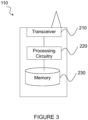
- FIGURE 3 illustrates an example wireless device 110 for controlling gap sharing between intra-frequency measurements of different types, in accordance with certain embodiments.
- wireless device 210 includes transceiver 210, processing circuitry 220, and memory 230.
- transceiver 210 facilitates transmitting wireless signals to and receiving wireless signals from network node 115 (e.g., via an antenna), processing circuitry 220 executes instructions to provide some or all of the functionality described above as being provided by wireless device 110, and memory 230 stores the instructions executed by processing circuitry 220. Examples of a wireless device 110 are provided above.
- Processing circuitry 220 may include any suitable combination of hardware and software implemented in one or more modules to execute instructions and manipulate data to perform some or all of the described functions of wireless device 110.
- processing circuitry 220 may include, for example, one or more computers, one or more central processing units (CPUs), one or more processors, one or more microprocessors, one or more applications, and/or other logic.
- Memory 230 is generally operable to store instructions, such as a computer program, software, an application including one or more of logic, rules, algorithms, code, tables, etc. and/or other instructions capable of being executed by processing circuitry.
- Examples of memory 230 include computer memory (for example, Random Access Memory (RAM) or Read Only Memory (ROM)), mass storage media (for example, a hard disk), removable storage media (for example, a Compact Disk (CD) or a Digital Video Disk (DVD)), and/or or any other volatile or non-volatile, non-transitory computer-readable and/or computer-executable memory devices that store information.
- RAM Random Access Memory
- ROM Read Only Memory
- mass storage media for example, a hard disk
- removable storage media for example, a Compact Disk (CD) or a Digital Video Disk (DVD)
- CD Compact Disk
- DVD Digital Video Disk
- wireless device 110 may include additional components beyond those shown in FIGURE 3 that may be responsible for providing certain aspects of the wireless device's functionality, including any of the functionality described above and/or any additional functionality (including any functionality necessary to support the solution described above).
- FIGURE 4 illustrate an example network node 115 for controlling gap sharing between intra-frequency measurements of different types, according to certain embodiments.
- network node 115 may be any type of radio network node or any network node that communicates with a wireless device and/or with another network node. Examples of a network node 115 are provided above.
- Network nodes 115 may be deployed throughout network 100 as a homogenous deployment, heterogeneous deployment, or mixed deployment.
- a homogeneous deployment may generally describe a deployment made up of the same (or similar) type of network nodes 115 and/or similar coverage and cell sizes and inter-site distances.
- a heterogeneous deployment may generally describe deployments using a variety of types of network nodes 115 having different cell sizes, transmit powers, capacities, and inter-site distances.
- a heterogeneous deployment may include a plurality of low-power nodes placed throughout a macro-cell layout.
- Mixed deployments may include a mix of homogenous portions and heterogeneous portions.
- Network node 115 may include one or more of transceiver 310, processing circuitry 320, memory 330, and network interface 340.
- transceiver 310 facilitates transmitting wireless signals to and receiving wireless signals from wireless device 110 (e.g., via an antenna)
- processing circuitry 320 executes instructions to provide some or all of the functionality described above as being provided by a network node 115
- memory 330 stores the instructions executed by processing circuitry 320
- network interface 340 communicates signals to backend network components, such as a gateway, switch, router, Internet, Public Switched Telephone Network (PSTN), core network nodes or radio network controllers, etc.
- PSTN Public Switched Telephone Network
- network node 115 may be capable of using multi-antenna techniques, and may be equipped with multiple antennas and capable of supporting MIMO techniques.
- the one or more antennas may have controllable polarization.
- each element may have two co-located sub elements with different polarizations (e.g., 90 degree separation as in cross-polarization), so that different sets of beamforming weights will give the emitted wave different polarization.
- Processing circuitry 320 may include any suitable combination of hardware and software implemented in one or more modules to execute instructions and manipulate data to perform some or all of the described functions of network node 115.
- processing circuitry 320 may include, for example, one or more computers, one or more central processing units (CPUs), one or more microprocessors, one or more applications, and/or other logic.
- Memory 330 is generally operable to store instructions, such as a computer program, software, an application including one or more of logic, rules, algorithms, code, tables, etc. and/or other instructions capable of being executed by a processor.
- Examples of memory 330 include computer memory (for example, Random Access Memory (RAM) or Read Only Memory (ROM)), mass storage media (for example, a hard disk), removable storage media (for example, a Compact Disk (CD) or a Digital Video Disk (DVD)), and/or or any other volatile or non-volatile, non-transitory computer-readable and/or computer-executable memory devices that store information.
- RAM Random Access Memory
- ROM Read Only Memory
- mass storage media for example, a hard disk
- removable storage media for example, a Compact Disk (CD) or a Digital Video Disk (DVD)
- CD Compact Disk
- DVD Digital Video Disk
- network interface 340 is communicatively coupled to processing circuitry 320 and may refer to any suitable device operable to receive input for network node 115, send output from network node 115, perform suitable processing of the input or output or both, communicate to other devices, or any combination of the preceding.
- Network interface 340 may include appropriate hardware (e.g., port, modem, network interface card, etc.) and software, including protocol conversion and data processing capabilities, to communicate through a network.
- network node 115 may include additional components beyond those shown in FIGURE 4 that may be responsible for providing certain aspects of the radio network node's functionality, including any of the functionality described above and/or any additional functionality (including any functionality necessary to support the solutions described above).
- the various different types of network nodes may include components having the same physical hardware but configured (e.g., via programming) to support different radio access technologies, or may represent partly or entirely different physical components. Additionally, the terms first and second are provided for example purposes only and may be interchanged.
- wireless devices 110 and network node 115 may cooperate to result in the removal of duplicated packets for transmission.
- wireless device 110 may be configured by network node 115 to remove duplicated packets from transmission when configured for Radio Link Control (RLC) Acknowledge Mode (AM) / Unacknowledge Mode (UM).
- RLC Radio Link Control
- AM Acknowledge Mode
- UM Unacknowledge Mode
- PDCP Packet Data Convergence Protocol
- PDUs Packet Data Convergence Protocol
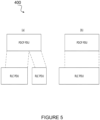
- Each RLC entity will transmit the PDCP PDU in one or more than one RLC PDU(s) or RLC PDU segments.
- FIGURE 5 illustrates an example mapping 400 of PDCP PDUs to RLC PDUs.
- FIGURE 6 illustrates a PDCP PDU 500 transmitted independently by two RLC entities, according to certain embodiments.
- the receiving entity may transmit a positive acknowledgment within a RLC status report for each RLC PDU that is successfully received.
- the RLC entity will indicate to the PDCP entity that the PDCP packet was received by the peer entity.
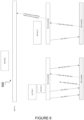
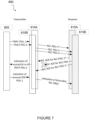
- FIGURE 7 illustrates an example transmission sequence 600 for removal of duplicate packets for transmission when duplicate PDCP PDUs are transmitted via two links.
- the PDCP entity 605 receives an indication by a first one of the RLC entities 610A that a certain PDCP PDU has been received by the peer entity:
- the second RLC entity 610B may be assumed that the second RLC entity 610B had not yet indicated that the PDCP PDU was received by the peer entity.
- the indication from PDCP 605 to this second RLC entity 610B may be optional, according to certain embodiments, and only transmitted if this second RLC entity 610B did not yet indicate successful transmission of the PDCP PDU.
- the PDCP 605 and the second RLC entity 610B may not be co-located.
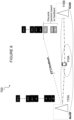
- communication of the indication to discard PDCP PDUs in the second RLC may 610B be communicated via a backhaul channel.
- the indication may be communicated via the X2 (or evolution thereof).
- the indication may be included in flow control signaling from a node implementing PDCP to a node implementing RLC.
- FIGURE 8 illustrates an example wireless network 700 for the discarding of packets based on feedback transmitted on the X2 channel.
- the second RLC entity 610B should stop the transmissions of the RLC PDU(s) mapping to the PDCP PDU.
- the second RLC entity 610B may remove the PDCP PDU from the queuing buffer, which may include an RLC SDU, and discard those RLC PDUs (or RLC PDU segments).
- the second RLC entity may then update the RLC status variables. For example, the second RLC entity 610B may move the transmission window beyond those discarded PDUs when the second RLC entity 610B considers the discarded PDUs as successfully transmitted.
- the counter for transmission + retransmissions of the RLC PDU may be reset so that for the particular RLC PDU, the indication of the maximum number of retransmissions reached, cannot be reached.
- the second RLC entity 610B may inform the peer RLC entity (receiving RLC entity 615B) of which RLC PDU(s) should be discarded.
- transmission of this indication (“RLC control PDU") may be prioritized over other RLC data to be transmitted.
- the step of the second RLC entity 610B informing the peer RLC entity 615B of which RLC PDU(s) to discard may be difficult since it may be assumed that the link is broken. However, such information allows the receiver to move the reception window beyond the discarded PDUs. According to certain embodiments, the reordering timer does not affect the delivery to PDCP and, thus, does not present a big issue, but may lead to status report transmission.
- the link over this second RLC 610B is eventually again available for transmission, so that the receiver side can indeed be informed of discarded PDUs.
- this link is available for transmission again, due to the earlier discard, already received data via the other RLC, does not need to be retransmitted redundantly via the second RLC 610B anymore.
- the peer RLC entity (receiving RLC entity 615B) of this second RLC 610B discards the RLC PDU(s) indicated in this received indication from the transmitting RLC 610B and updates the RLC status variables and timers accordingly (e.g. reordering timer).
- the peer RLC entity 610B would consider these RLC PDUs as "successfully received" PDUs, and move the reception window beyond these PDUs.
- a PDCP transmission timeout RLF may be provided.
- an operator may choose to deactivate the indication for both RLCs.
- a method on PDCP can be considered.
- a maximum transmission time limit to acknowledge may be defined for each PDCP PDU. If the maximum transmission time limit is reached, an indication may be triggered to higher layers, which then trigger RLF.
- the timer may be reset and RLF may not be triggered.
- a single timer can be defined for the PDCP lower transmit window edge.
- the PDCP PDU with the lowest SN may not be acknowledged.
- the RLF indication is triggered to higher layers.
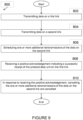
- FIGURE 9 illustrates an example method 800 by a wireless device for removal of duplicated packets for transmission, according to certain embodiments.
- the method may be performed by a PDCP layer of wireless device 110.
- the method may begin at an step 802 when data is transmitted on a first link.
- the data may include a PDCP PDU.
- the data may include a PDCP PDU segment.
- the data may be further transmitted on a second link, at step 804.
- first and second copies of the data may be transmitted on first and second links, respectively, in steps 802 and 804.
- the transmission on the first link is performed by a first RLC entity of the wireless device 110 and the transmission on the second link is performed by a second RLC entity of the wireless device 110.
- the first link and/or first RLC entity may be associated with a first radio access technology and the second link and/or second RLC entity may be associated with a second radio access technology.
- scheduling the at least one additional retransmission of the data may include storing a plurality of copies of the data as PDUs in a RLC SDU buffer.
- a positive acknowledgement indicating a successful receipt of the protocol data unit on the first link is received from the receiver.
- the positive acknowledgement is received in an RLC status report.
- the positive acknowledgement is received via a first RLC entity associated with wireless device 110.
- the first RLC entity may thereafter transmit an indication to a PDCP entity of wireless device 110 that identifies that the data was successfully received by the receiver.
- the second RLC entity associated with the second link is not co-located with the PDCP, such an indication may be transmitted and received via a backhaul channel, in a particular embodiment.
- the second RLC entity may transmit an indication to a receiver side RLC entity on the second link. The indication may identify one or more retransmissions of the data to be discarded.
- a maximum transmission time threshold may be defined for receiving the positive acknowledgment.
- the maximum transmission time threshold triggering a radio layer failure procedure.
- a timer associated with the maximum transmission time threshold may be reset in response to receiving the positive acknowledgment to prevent triggering of the RLF procedure.
- the one or more additional retransmissions of the data on the second link are cancelled.
- the copies of the data may be removed from the RLC SDU buffer and discarded.
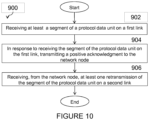
- FIGURE 10 illustrates an example method 900 by a receiver for removal of duplicated packets, according to certain embodiments.
- the method may be performed by a PDCP layer of the receiver.
- the receiver may include a wireless device, which may include a UE.
- the receiver may include a network node.
- the method may begin at an step 902 when the receiver receives, from a wireless device 110, a PDU or segment of a PDU on a first link.
- the PDU or the segment of the PDU may be received by a first RLC entity 615A of the receiver from a first RLC entity 610A of the wireless
- the receiver transmits a positive acknowledgment to the wireless device.
- the positive acknowledgement may be transmitted in a radio link control, RLC, status report.
- the positive acknowledgment may be transmitted by the first RLC entity 615A of the receiver to a first RLC entity 610A of the wireless device.
- the receiver receives, from the wireless device, at least one retransmission of the PDU or the segment of the PDU on a second link.
- the first link may be associated with a first radio access technology and the second link is associated with a second radio access technology.
- the PDU or the segment of the PDU may be received by a second RLC entity 615B of the receiver from a second RLC entity 610A of the wireless device.
- the receiver may store the PDU or the segment of the PDU in a RLC SDU buffer.
- the receiver may also receive, from the wireless device, a first indication identifying that the at least one retransmission of the PDU or the segment of the PDU received on the second link should be discarded.
- the receiver may then discard the at least one retransmission of the PDU or the segment of the PDU that was received on the second link. For example, in a particular embodiment, the receiver may remove the PDU or the segment of the PDU from the RLC SDU buffer.
- FIGURE 11 illustrates an exemplary radio network controller or core network node 1400, in accordance with certain embodiments.
- network nodes can include a mobile switching center (MSC), a serving GPRS support node (SGSN), a mobility management entity (MME), a radio network controller (RNC), a base station controller (BSC), and so on.
- the radio network controller or core network node 1000 includes processing circuitry 1020, memory 1030, and network interface 1040.
- processing circuitry 1020 executes instructions to provide some or all of the functionality described above as being provided by the network node
- memory 1030 stores the instructions executed by processing circuitry 1020
- network interface 1040 communicates signals to any suitable node, such as a gateway, switch, router, Internet, Public Switched Telephone Network (PSTN), network nodes 115, radio network controllers or core network nodes 1000, etc.
- PSTN Public Switched Telephone Network
- Processing circuitry 1020 may include any suitable combination of hardware and software implemented in one or more modules to execute instructions and manipulate data to perform some or all of the described functions of the radio network controller or core network node 1000.
- processing circuitry 1020 may include, for example, one or more computers, one or more central processing units (CPUs), one or more microprocessors, one or more applications, and/or other logic.
- CPUs central processing units
- microprocessors one or more applications, and/or other logic.
- Memory 1030 is generally operable to store instructions, such as a computer program, software, an application including one or more of logic, rules, algorithms, code, tables, etc. and/or other instructions capable of being executed by a processor.
- Examples of memory 1030 include computer memory (for example, Random Access Memory (RAM) or Read Only Memory (ROM)), mass storage media (for example, a hard disk), removable storage media (for example, a Compact Disk (CD) or a Digital Video Disk (DVD)), and/or or any other volatile or non-volatile, non-transitory computer-readable and/or computer-executable memory devices that store information.
- RAM Random Access Memory
- ROM Read Only Memory
- mass storage media for example, a hard disk
- removable storage media for example, a Compact Disk (CD) or a Digital Video Disk (DVD)
- CD Compact Disk
- DVD Digital Video Disk
- network interface 1040 is communicatively coupled to processing circuitry 1020 and may refer to any suitable device operable to receive input for the network node, send output from the network node, perform suitable processing of the input or output or both, communicate to other devices, or any combination of the preceding.
- Network interface 1040 may include appropriate hardware (e.g., port, modem, network interface card, etc.) and software, including protocol conversion and data processing capabilities, to communicate through a network.
- network node may include additional components beyond those shown in FIGURE 11 that may be responsible for providing certain aspects of the network node's functionality, including any of the functionality described above and/or any additional functionality (including any functionality necessary to support the solution described above).
- duplication in UL in dual connectivity is provided. Accordingly, several aspects of UL data duplication for Dual Connectivity such as configuration, activation/deactivation, and data duplication operation are discussed.
- Data duplication may be more useful for ultra-reliable devices and services.
- UL user plane data duplication might also be an interesting option to cope with situations in which radio links are not stable, e.g. coverage limited situations, while trying to sustain the certain UL bit rate. It could also be an option to help to achieve the 0 ms interruption time requirement.
- the RLC will be performing retransmissions which might not be longer needed (as it has been received through the other leg). If the leg recovers, the RLC may still transmit the data pending in the RLC/MAC (i.e. the retransmissions). All this data, however, will be discarded by the NW. Thus, it is preferable if the UE does not transmit it.
- the PDCP layer at the UE can know if a PDCP PDU was received by the NW if RLC AM was used.
- the PDCP layer also knows in which leg the data was successfully received.
- the PDCP entity could indicate to the other RLC entity to stop the transmission of those PDCP PDUs.
- the peer RLC entity (at the NW side) would also need to be informed of this, so that the receiver window can be moved forward.
- Certain embodiments of the present disclosure may provide one or more technical advantages. For example, certain embodiments may avoid the unnecessary triggering of a Radio Link Failure (RLF) procedure in response to a maximum number of RLC transmissions when data is duplicated and transmitted via two different links and a successful transmission is received via one of the two links. Accordingly, certain embodiments save network resources. Additionally, certain embodiments avoid RLC reestablishments.
- RLF Radio Link Failure
Landscapes
- Engineering & Computer Science (AREA)
- Computer Networks & Wireless Communication (AREA)
- Signal Processing (AREA)
- Mobile Radio Communication Systems (AREA)
- Detection And Prevention Of Errors In Transmission (AREA)
Claims (9)
- Verfahren in einem Netzwerk (100), das Folgendes umfasst:Übertragen einer Protokolldateneinheit (PDU) eines Paketdatenkonvergenzprotokolls (PDCP) oder eines Segments einer PDCP-PDU auf einer ersten Verbindung durch eine erste Instanz (610A) einer Funkverbindungssteuerung (RLC), wobei die erste RLC-Instanz (610A) der ersten Verbindung zugeordnet ist;Übertragen der PDCP-PDU oder des Segments der PDCP-PDU auf einer zweiten Verbindung durch eine zweite RLC-Instanz (610B), wobei die zweite RLC-Instanz (610B) der zweiten Verbindung zugeordnet ist;Planen einer oder mehrerer erneuter Übertragungen der PDCP-PDU oder des Segments der PDCP-PDU auf der zweiten Verbindung durch die zweite RLC-Instanz (610B);Empfangen einer positiven Bestätigung, die einen erfolgreichen Empfang der PDCP-PDU oder des Segments der PDCP-PDU auf der ersten Verbindung angibt, von einem Empfänger und über die erste RLC-Instanz (610A);Übertragen einer Angabe, dass die PDCP-PDU durch den Empfänger empfangen wurde, an eine Instanz (605) eines Paketdatenkonvergenzprotokolls (PDCP) durch die erste RLC-Instanz (610A);Kommunizieren einer Angabe zum Verwerfen der PDCP-PDU oder des Segments der PDCP-PDU an die zweite RLC-Instanz (610B) über einen Backhaul-Kanal, wobei die PDCP-Instanz (605) nicht an derselben Position wie die zweite RLC-Instanz (610B) befindlich ist; undals Reaktion auf das Empfangen der Angabe zum Verwerfen der PDCP-PDU oder des Segments der PDCP-PDU, Annullieren der einen oder der mehreren erneuten Übertragungen der PDCP-PDU oder des Segments der PDCP-PDU auf der zweiten Verbindung durch die zweite RLC-Instanz (610B).
- Verfahren nach Anspruch 1, wobei die positive Bestätigung in einem Statusbericht der Funkverbindungssteuerung (RLC) empfangen wird.
- Verfahren nach Anspruch 1 oder 2, wobei die positive Bestätigung, die über die erste RLC-Instanz empfangen wird, welche der ersten Verbindung zugeordnet ist, empfangen wird, bevor eine positive Bestätigung über die zweite RLC-Instanz, welche der zweiten Verbindung zugeordnet ist, empfangen wird.
- Verfahren nach einem der Ansprüche 1 bis 3, wobei die zweite RLC-Instanz eine Angabe an eine empfängerseitige RLC-Instanz, die der zweiten Verbindung zugeordnet ist, überträgt, wobei die Angabe eine oder mehrere erneute Übertragungen der zu verwerfenden Daten identifiziert.
- Verfahren nach einem der Ansprüche 1 bis 4, wobei das Planen der mindestens einen erneuten Übertragung der PDCP-PDU oder des Segments der PDCP-PDU Speichern einer Vielzahl von Kopien der PDCP-PDU oder des Segments der PDCP-PDU in einem Puffer einer RLC-Dienstdateneinheit (SDU) umfasst.
- Verfahren nach Anspruch 5, wobei das Annullieren der einen oder der mehreren erneuten Übertragungen der PDCP-PDU oder des Segments der PDCP-PDU auf der zweiten Verbindung Entfernen der Vielzahl von Kopien der PDCP-PDU oder des Segments der PDCP-PDU aus dem RLC-SDU-Puffer und Verwerfen der entfernten Vielzahl von Kopien der PDCP-PDU oder des Segments der PDCP-PDU umfasst.
- Verfahren nach einem der Ansprüche 1 bis 6, wobei die erste Verbindung einer ersten Funkzugangstechnologie zugeordnet ist und die zweite Verbindung einer zweiten Funkzugangstechnologie zugeordnet ist.
- Verfahren nach einem der Ansprüche 1 bis 7, wobei ein Schwellenwert für die maximale Übertragungszeit zum Empfangen der positiven Bestätigung definiert ist, wobei der Schwellenwert für die maximale Übertragungszeit eine Prozedur für einen Funkschichtausfall (RLF) auslöst.
- Verfahren nach Anspruch 8, ferner umfassend, als Reaktion auf das Empfangen der positiven Bestätigung, Zurücksetzen eines Zeitgebers, der dem Schwellenwert für die maximale Übertragungszeit zugeordnet ist, um das Auslösen der RLF-Prozedur zu verhindern.
Applications Claiming Priority (2)
| Application Number | Priority Date | Filing Date | Title |
|---|---|---|---|
| US201762476505P | 2017-03-24 | 2017-03-24 | |
| PCT/EP2017/082577 WO2018171922A1 (en) | 2017-03-24 | 2017-12-13 | Systems and methods for removal of duplicated packets for transmission |
Publications (2)
| Publication Number | Publication Date |
|---|---|
| EP3602885A1 EP3602885A1 (de) | 2020-02-05 |
| EP3602885B1 true EP3602885B1 (de) | 2023-11-22 |
Family
ID=60788585
Family Applications (1)
| Application Number | Title | Priority Date | Filing Date |
|---|---|---|---|
| EP17818507.0A Active EP3602885B1 (de) | 2017-03-24 | 2017-12-13 | Systeme und verfahren zum entfernen von duplizierten paketen zur übertragung |
Country Status (11)
| Country | Link |
|---|---|
| US (3) | US11005606B2 (de) |
| EP (1) | EP3602885B1 (de) |
| JP (1) | JP7000450B2 (de) |
| KR (1) | KR102240627B1 (de) |
| CN (2) | CN110431785B (de) |
| BR (1) | BR112019019718A2 (de) |
| ES (1) | ES2969210T3 (de) |
| MA (1) | MA46986B1 (de) |
| RU (1) | RU2733281C1 (de) |
| WO (1) | WO2018171922A1 (de) |
| ZA (1) | ZA201905973B (de) |
Families Citing this family (27)
| Publication number | Priority date | Publication date | Assignee | Title |
|---|---|---|---|---|
| EP3602885B1 (de) * | 2017-03-24 | 2023-11-22 | Telefonaktiebolaget LM Ericsson (PUBL) | Systeme und verfahren zum entfernen von duplizierten paketen zur übertragung |
| CN109150415B (zh) * | 2017-06-15 | 2022-01-21 | 夏普株式会社 | 基站、用户设备和相关方法 |
| EP3422767A1 (de) | 2017-06-26 | 2019-01-02 | Panasonic Intellectual Property Corporation of America | Benutzergerät und basisstation, die während der übergabe an nr an einer paketduplikation teilnimmt |
| CN109391639B (zh) * | 2017-08-02 | 2021-01-08 | 维沃移动通信有限公司 | 一种激活及去激活数据复制的方法及终端 |
| DE102018121528A1 (de) * | 2017-09-19 | 2019-03-21 | Hanon Systems | Heiz-/Klimagerät für ein Kraftfahrzeug |
| KR102638708B1 (ko) * | 2018-06-21 | 2024-02-21 | 삼성전자주식회사 | 무선 통신 시스템에서 데이터를 송수신하는 방법 및 장치 |
| WO2020032127A1 (ja) * | 2018-08-08 | 2020-02-13 | 京セラ株式会社 | 中継装置 |
| WO2020061912A1 (en) * | 2018-09-27 | 2020-04-02 | Lenovo (Beijing) Limited | Discarding radio link control service data units |
| US11032189B2 (en) * | 2018-09-28 | 2021-06-08 | Lg Electronics Inc. | Method for transmitting packet when radio link failure is detected in wireless communication system and apparatus therefor |
| CN110972335B (zh) * | 2018-09-29 | 2022-04-12 | 华为技术有限公司 | 一种模式切换方法、数据流分流方法及装置 |
| US20200266932A1 (en) * | 2019-02-14 | 2020-08-20 | Qualcomm Incorporated | Acknowledgment feedback techniques in wireless communications |
| US20200351680A1 (en) * | 2019-04-30 | 2020-11-05 | Lg Electronics Inc. | Method for transmitting data units when radio link problem occurs by relay node in wireless communication system and apparatus therefor |
| WO2020231040A1 (en) * | 2019-05-10 | 2020-11-19 | Lg Electronics Inc. | Method and apparatus for transmitting status report by user equipment in wireless communication system |
| US11108672B2 (en) * | 2019-07-15 | 2021-08-31 | Qualcomm Incorporated | Measuring and verifying layer 2 sustained downlink maximum data rate decoding performance |
| CN112235731B (zh) * | 2019-07-15 | 2022-12-27 | 华为技术有限公司 | 一种通信方法、装置和系统 |
| US11240696B2 (en) | 2019-07-15 | 2022-02-01 | Qualcomm Incorporated | Measuring and verifying layer 2 sustained downlink maximum data rate decoding performance |
| CN110602786A (zh) * | 2019-08-24 | 2019-12-20 | 江苏久鑫铜业有限公司 | 一种下行超可靠低时延数据传输方法 |
| WO2021071401A1 (en) * | 2019-10-11 | 2021-04-15 | Telefonaktiebolaget Lm Ericsson (Publ) | Method and apparatus for multi-connection flow control in a wireless communication network |
| US12245303B2 (en) * | 2020-11-05 | 2025-03-04 | Toyota Jidosha Kabushiki Kaisha | Radio link control (RLC) enhancements for multicast and broadcast services |
| EP4258732A4 (de) * | 2021-01-04 | 2024-05-15 | Kyocera Corporation | Kommunikationssteuerungsverfahren |
| US11677511B2 (en) * | 2021-11-10 | 2023-06-13 | Qualcomm Incorporated | Mechanism to recover receiver radio link control after multiple unsuccessful automatic repeat query attempts |
| CN114640725B (zh) * | 2022-05-08 | 2022-09-27 | 荣耀终端有限公司 | 数据传输方法及电子设备 |
| US20260088943A1 (en) * | 2022-09-22 | 2026-03-26 | Nec Corporation | Method, device and computer storage medium of communication |
| CN117835296A (zh) * | 2022-09-28 | 2024-04-05 | 上海朗帛通信技术有限公司 | 一种被用于无线通信中的方法和装置 |
| WO2025063481A1 (en) * | 2023-09-20 | 2025-03-27 | Lg Electronics Inc. | Method and apparatus of performing transmissions by considering discard indication in wireless communication system |
| WO2025065231A1 (en) * | 2023-09-26 | 2025-04-03 | Nokia Shanghai Bell Co., Ltd. | Communication link control |
| WO2025170520A1 (en) * | 2024-02-05 | 2025-08-14 | Telefonaktiebolaget Lm Ericsson (Publ) | Flexible radio link control retransmissions for radio link control acknowledged mode for time critical services |
Family Cites Families (20)
| Publication number | Priority date | Publication date | Assignee | Title |
|---|---|---|---|---|
| WO2005086520A1 (ja) | 2004-03-09 | 2005-09-15 | Matsushita Electric Industrial Co., Ltd. | ランダムアクセス方法及び無線通信端末装置 |
| KR101000699B1 (ko) * | 2004-04-19 | 2010-12-10 | 엘지전자 주식회사 | 무선링크 제어계층에서의 데이터 처리방법 |
| US8228917B2 (en) | 2005-04-26 | 2012-07-24 | Qualcomm Incorporated | Method and apparatus for ciphering and re-ordering packets in a wireless communication system |
| EP1871034A1 (de) * | 2006-06-22 | 2007-12-26 | Innovative Sonic Limited | Verfahren und Vorrichtung zum Verwerfen von Datenpaketen in einem drahtlosen Kommunikationssystem |
| GB0616682D0 (en) | 2006-08-22 | 2006-10-04 | Nec Corp | Mobile telecommunications |
| CN101652949A (zh) * | 2007-04-06 | 2010-02-17 | 株式会社Ntt都科摩 | 分组通信方法以及接收端装置 |
| WO2009045945A2 (en) * | 2007-10-01 | 2009-04-09 | Interdigital Patent Holdings, Inc. | Method and apparatus for pcdp discard |
| CN105721120B (zh) * | 2007-12-10 | 2019-12-06 | 交互数字专利控股公司 | 用于触发无线电链路控制rlc重建的方法和设备 |
| KR101577451B1 (ko) * | 2008-01-30 | 2015-12-14 | 엘지전자 주식회사 | Rlc 무한 재전송 오류를 검출하고 처리하는 방법 |
| US8989004B2 (en) | 2010-11-08 | 2015-03-24 | Qualcomm Incorporated | System and method for multi-point HSDPA communication utilizing a multi-link PDCP sublayer |
| US8977268B2 (en) * | 2011-07-21 | 2015-03-10 | Alcatel Lucent | Methods and systems for controlling handovers in a co-channel network |
| WO2013122163A1 (ja) | 2012-02-14 | 2013-08-22 | 京セラ株式会社 | 移動通信システム、基地局、及び通信制御方法 |
| WO2013147490A1 (ko) * | 2012-03-26 | 2013-10-03 | 엘지전자 주식회사 | 무선 통신 시스템에서 무선 자원의 동적 자원 변경을 위한 harq 수행 방법 및 이를 위한 장치 |
| WO2015008962A1 (en) * | 2013-07-17 | 2015-01-22 | Lg Electronics Inc. | Method for reporting a radio link control re-transmission failure and a device therefor |
| EP2830352A1 (de) * | 2013-07-24 | 2015-01-28 | Panasonic Intellectual Property Corporation of America | Effizienter Verwerfungsmechanismus in kleinzelligem Einsatz |
| EP3031281B1 (de) * | 2013-08-09 | 2021-04-14 | Nokia Solutions and Networks Oy | Verwendung von paketstatusberichten aus einer sekundären basisstation an eine primäre basisstation in einem drahtlosen netzwerk |
| US9648514B2 (en) * | 2013-08-09 | 2017-05-09 | Blackberry Limited | Method and system for protocol layer enhancements in data offload over small cells |
| US10142799B2 (en) | 2014-08-19 | 2018-11-27 | Qualcomm Incorporated | Multicasting traffic using multi-connectivity |
| US20160066222A1 (en) * | 2014-09-02 | 2016-03-03 | Nokia Solutions And Networks Oy | Multi-connectivity in a wireless network |
| EP3602885B1 (de) * | 2017-03-24 | 2023-11-22 | Telefonaktiebolaget LM Ericsson (PUBL) | Systeme und verfahren zum entfernen von duplizierten paketen zur übertragung |
-
2017
- 2017-12-13 EP EP17818507.0A patent/EP3602885B1/de active Active
- 2017-12-13 ES ES17818507T patent/ES2969210T3/es active Active
- 2017-12-13 CN CN201780088910.1A patent/CN110431785B/zh active Active
- 2017-12-13 JP JP2019552544A patent/JP7000450B2/ja active Active
- 2017-12-13 CN CN202210513400.7A patent/CN115150032B/zh active Active
- 2017-12-13 RU RU2019133668A patent/RU2733281C1/ru active
- 2017-12-13 KR KR1020197026648A patent/KR102240627B1/ko active Active
- 2017-12-13 MA MA46986A patent/MA46986B1/fr unknown
- 2017-12-13 BR BR112019019718A patent/BR112019019718A2/pt unknown
- 2017-12-13 WO PCT/EP2017/082577 patent/WO2018171922A1/en not_active Ceased
- 2017-12-13 US US15/754,072 patent/US11005606B2/en active Active
-
2019
- 2019-09-10 ZA ZA2019/05973A patent/ZA201905973B/en unknown
-
2021
- 2021-05-07 US US17/314,802 patent/US11552745B2/en active Active
-
2022
- 2022-11-30 US US18/060,015 patent/US11870593B2/en active Active
Also Published As
| Publication number | Publication date |
|---|---|
| JP2020516145A (ja) | 2020-05-28 |
| CN110431785B (zh) | 2022-06-03 |
| US20200235869A1 (en) | 2020-07-23 |
| MA46986A1 (fr) | 2019-11-29 |
| CN115150032A (zh) | 2022-10-04 |
| MA46986B1 (fr) | 2020-03-31 |
| ZA201905973B (en) | 2021-01-27 |
| WO2018171922A1 (en) | 2018-09-27 |
| RU2733281C1 (ru) | 2020-10-01 |
| ES2969210T3 (es) | 2024-05-17 |
| US20210266115A1 (en) | 2021-08-26 |
| BR112019019718A2 (pt) | 2020-04-14 |
| KR102240627B1 (ko) | 2021-04-14 |
| US11005606B2 (en) | 2021-05-11 |
| US20230224098A1 (en) | 2023-07-13 |
| JP7000450B2 (ja) | 2022-01-19 |
| CN115150032B (zh) | 2023-11-17 |
| EP3602885A1 (de) | 2020-02-05 |
| KR20190113957A (ko) | 2019-10-08 |
| US11552745B2 (en) | 2023-01-10 |
| CN110431785A (zh) | 2019-11-08 |
| US11870593B2 (en) | 2024-01-09 |
Similar Documents
| Publication | Publication Date | Title |
|---|---|---|
| US11870593B2 (en) | Systems and methods for removal of duplicated packets for transmission | |
| US11121831B2 (en) | Methods and nodes for packet duplication relating to carrier aggregation in a wireless communication network | |
| US10505829B2 (en) | PDCP and flow control for split bearer | |
| US20200322094A1 (en) | Submitting a PDCP PDU for Transmission | |
| US11234120B2 (en) | Systems and methods for triggering connection status reporting for a wireless local area network | |
| CN114365531A (zh) | 主节点、辅节点及其方法 | |
| US11973715B2 (en) | Transmitting device and method performed therein for handling communication | |
| EP3272024B1 (de) | Verfahren zur übertragung von signalisierungsfunkträgernachrichten in einem drahtloskommunikationssystem mit mehreren antennen | |
| CN112789879A (zh) | 一种无线链路失败处理方法、网络设备、终端设备 | |
| US10165616B2 (en) | MCI transmission for MAC handshake | |
| OA19805A (en) | Systems and methods for removal of duplicated packets for transmission. | |
| CN118785268A (zh) | 移动性方法、装置以及存储介质 |
Legal Events
| Date | Code | Title | Description |
|---|---|---|---|
| STAA | Information on the status of an ep patent application or granted ep patent |
Free format text: STATUS: UNKNOWN |
|
| STAA | Information on the status of an ep patent application or granted ep patent |
Free format text: STATUS: THE INTERNATIONAL PUBLICATION HAS BEEN MADE |
|
| PUAI | Public reference made under article 153(3) epc to a published international application that has entered the european phase |
Free format text: ORIGINAL CODE: 0009012 |
|
| STAA | Information on the status of an ep patent application or granted ep patent |
Free format text: STATUS: REQUEST FOR EXAMINATION WAS MADE |
|
| 17P | Request for examination filed |
Effective date: 20190823 |
|
| AK | Designated contracting states |
Kind code of ref document: A1 Designated state(s): AL AT BE BG CH CY CZ DE DK EE ES FI FR GB GR HR HU IE IS IT LI LT LU LV MC MK MT NL NO PL PT RO RS SE SI SK SM TR |
|
| AX | Request for extension of the european patent |
Extension state: BA ME |
|
| DAV | Request for validation of the european patent (deleted) | ||
| DAX | Request for extension of the european patent (deleted) | ||
| STAA | Information on the status of an ep patent application or granted ep patent |
Free format text: STATUS: EXAMINATION IS IN PROGRESS |
|
| 17Q | First examination report despatched |
Effective date: 20211029 |
|
| GRAP | Despatch of communication of intention to grant a patent |
Free format text: ORIGINAL CODE: EPIDOSNIGR1 |
|
| STAA | Information on the status of an ep patent application or granted ep patent |
Free format text: STATUS: GRANT OF PATENT IS INTENDED |
|
| RIC1 | Information provided on ipc code assigned before grant |
Ipc: H04L 1/1867 20230101ALI20230713BHEP Ipc: H04L 1/00 20060101ALI20230713BHEP Ipc: H04L 1/18 20060101AFI20230713BHEP |
|
| INTG | Intention to grant announced |
Effective date: 20230811 |
|
| GRAS | Grant fee paid |
Free format text: ORIGINAL CODE: EPIDOSNIGR3 |
|
| GRAA | (expected) grant |
Free format text: ORIGINAL CODE: 0009210 |
|
| STAA | Information on the status of an ep patent application or granted ep patent |
Free format text: STATUS: THE PATENT HAS BEEN GRANTED |
|
| AK | Designated contracting states |
Kind code of ref document: B1 Designated state(s): AL AT BE BG CH CY CZ DE DK EE ES FI FR GB GR HR HU IE IS IT LI LT LU LV MC MK MT NL NO PL PT RO RS SE SI SK SM TR |
|
| P01 | Opt-out of the competence of the unified patent court (upc) registered |
Effective date: 20231013 |
|
| REG | Reference to a national code |
Ref country code: GB Ref legal event code: FG4D |
|
| REG | Reference to a national code |
Ref country code: CH Ref legal event code: EP Ref country code: DE Ref legal event code: R096 Ref document number: 602017076803 Country of ref document: DE |
|
| REG | Reference to a national code |
Ref country code: IE Ref legal event code: FG4D |
|
| REG | Reference to a national code |
Ref country code: NL Ref legal event code: FP |
|
| REG | Reference to a national code |
Ref country code: LT Ref legal event code: MG9D |
|
| PG25 | Lapsed in a contracting state [announced via postgrant information from national office to epo] |
Ref country code: GR Free format text: LAPSE BECAUSE OF FAILURE TO SUBMIT A TRANSLATION OF THE DESCRIPTION OR TO PAY THE FEE WITHIN THE PRESCRIBED TIME-LIMIT Effective date: 20240223 |
|
| PG25 | Lapsed in a contracting state [announced via postgrant information from national office to epo] |
Ref country code: IS Free format text: LAPSE BECAUSE OF FAILURE TO SUBMIT A TRANSLATION OF THE DESCRIPTION OR TO PAY THE FEE WITHIN THE PRESCRIBED TIME-LIMIT Effective date: 20240322 |
|
| PG25 | Lapsed in a contracting state [announced via postgrant information from national office to epo] |
Ref country code: LT Free format text: LAPSE BECAUSE OF FAILURE TO SUBMIT A TRANSLATION OF THE DESCRIPTION OR TO PAY THE FEE WITHIN THE PRESCRIBED TIME-LIMIT Effective date: 20231122 |
|
| REG | Reference to a national code |
Ref country code: AT Ref legal event code: MK05 Ref document number: 1634845 Country of ref document: AT Kind code of ref document: T Effective date: 20231122 |
|
| PG25 | Lapsed in a contracting state [announced via postgrant information from national office to epo] |
Ref country code: AT Free format text: LAPSE BECAUSE OF FAILURE TO SUBMIT A TRANSLATION OF THE DESCRIPTION OR TO PAY THE FEE WITHIN THE PRESCRIBED TIME-LIMIT Effective date: 20231122 |
|
| PG25 | Lapsed in a contracting state [announced via postgrant information from national office to epo] |
Ref country code: LT Free format text: LAPSE BECAUSE OF FAILURE TO SUBMIT A TRANSLATION OF THE DESCRIPTION OR TO PAY THE FEE WITHIN THE PRESCRIBED TIME-LIMIT Effective date: 20231122 Ref country code: IS Free format text: LAPSE BECAUSE OF FAILURE TO SUBMIT A TRANSLATION OF THE DESCRIPTION OR TO PAY THE FEE WITHIN THE PRESCRIBED TIME-LIMIT Effective date: 20240322 Ref country code: GR Free format text: LAPSE BECAUSE OF FAILURE TO SUBMIT A TRANSLATION OF THE DESCRIPTION OR TO PAY THE FEE WITHIN THE PRESCRIBED TIME-LIMIT Effective date: 20240223 Ref country code: BG Free format text: LAPSE BECAUSE OF FAILURE TO SUBMIT A TRANSLATION OF THE DESCRIPTION OR TO PAY THE FEE WITHIN THE PRESCRIBED TIME-LIMIT Effective date: 20240222 Ref country code: AT Free format text: LAPSE BECAUSE OF FAILURE TO SUBMIT A TRANSLATION OF THE DESCRIPTION OR TO PAY THE FEE WITHIN THE PRESCRIBED TIME-LIMIT Effective date: 20231122 Ref country code: PT Free format text: LAPSE BECAUSE OF FAILURE TO SUBMIT A TRANSLATION OF THE DESCRIPTION OR TO PAY THE FEE WITHIN THE PRESCRIBED TIME-LIMIT Effective date: 20240322 |
|
| REG | Reference to a national code |
Ref country code: ES Ref legal event code: FG2A Ref document number: 2969210 Country of ref document: ES Kind code of ref document: T3 Effective date: 20240517 |
|
| PG25 | Lapsed in a contracting state [announced via postgrant information from national office to epo] |
Ref country code: SE Free format text: LAPSE BECAUSE OF FAILURE TO SUBMIT A TRANSLATION OF THE DESCRIPTION OR TO PAY THE FEE WITHIN THE PRESCRIBED TIME-LIMIT Effective date: 20231122 Ref country code: RS Free format text: LAPSE BECAUSE OF FAILURE TO SUBMIT A TRANSLATION OF THE DESCRIPTION OR TO PAY THE FEE WITHIN THE PRESCRIBED TIME-LIMIT Effective date: 20231122 Ref country code: PL Free format text: LAPSE BECAUSE OF FAILURE TO SUBMIT A TRANSLATION OF THE DESCRIPTION OR TO PAY THE FEE WITHIN THE PRESCRIBED TIME-LIMIT Effective date: 20231122 Ref country code: NO Free format text: LAPSE BECAUSE OF FAILURE TO SUBMIT A TRANSLATION OF THE DESCRIPTION OR TO PAY THE FEE WITHIN THE PRESCRIBED TIME-LIMIT Effective date: 20240222 Ref country code: LV Free format text: LAPSE BECAUSE OF FAILURE TO SUBMIT A TRANSLATION OF THE DESCRIPTION OR TO PAY THE FEE WITHIN THE PRESCRIBED TIME-LIMIT Effective date: 20231122 Ref country code: HR Free format text: LAPSE BECAUSE OF FAILURE TO SUBMIT A TRANSLATION OF THE DESCRIPTION OR TO PAY THE FEE WITHIN THE PRESCRIBED TIME-LIMIT Effective date: 20231122 |
|
| PG25 | Lapsed in a contracting state [announced via postgrant information from national office to epo] |
Ref country code: DK Free format text: LAPSE BECAUSE OF FAILURE TO SUBMIT A TRANSLATION OF THE DESCRIPTION OR TO PAY THE FEE WITHIN THE PRESCRIBED TIME-LIMIT Effective date: 20231122 |
|
| PG25 | Lapsed in a contracting state [announced via postgrant information from national office to epo] |
Ref country code: CZ Free format text: LAPSE BECAUSE OF FAILURE TO SUBMIT A TRANSLATION OF THE DESCRIPTION OR TO PAY THE FEE WITHIN THE PRESCRIBED TIME-LIMIT Effective date: 20231122 |
|
| PG25 | Lapsed in a contracting state [announced via postgrant information from national office to epo] |
Ref country code: SK Free format text: LAPSE BECAUSE OF FAILURE TO SUBMIT A TRANSLATION OF THE DESCRIPTION OR TO PAY THE FEE WITHIN THE PRESCRIBED TIME-LIMIT Effective date: 20231122 |
|
| PG25 | Lapsed in a contracting state [announced via postgrant information from national office to epo] |
Ref country code: SM Free format text: LAPSE BECAUSE OF FAILURE TO SUBMIT A TRANSLATION OF THE DESCRIPTION OR TO PAY THE FEE WITHIN THE PRESCRIBED TIME-LIMIT Effective date: 20231122 Ref country code: SK Free format text: LAPSE BECAUSE OF FAILURE TO SUBMIT A TRANSLATION OF THE DESCRIPTION OR TO PAY THE FEE WITHIN THE PRESCRIBED TIME-LIMIT Effective date: 20231122 Ref country code: RO Free format text: LAPSE BECAUSE OF FAILURE TO SUBMIT A TRANSLATION OF THE DESCRIPTION OR TO PAY THE FEE WITHIN THE PRESCRIBED TIME-LIMIT Effective date: 20231122 Ref country code: IT Free format text: LAPSE BECAUSE OF FAILURE TO SUBMIT A TRANSLATION OF THE DESCRIPTION OR TO PAY THE FEE WITHIN THE PRESCRIBED TIME-LIMIT Effective date: 20231122 Ref country code: EE Free format text: LAPSE BECAUSE OF FAILURE TO SUBMIT A TRANSLATION OF THE DESCRIPTION OR TO PAY THE FEE WITHIN THE PRESCRIBED TIME-LIMIT Effective date: 20231122 Ref country code: DK Free format text: LAPSE BECAUSE OF FAILURE TO SUBMIT A TRANSLATION OF THE DESCRIPTION OR TO PAY THE FEE WITHIN THE PRESCRIBED TIME-LIMIT Effective date: 20231122 Ref country code: CZ Free format text: LAPSE BECAUSE OF FAILURE TO SUBMIT A TRANSLATION OF THE DESCRIPTION OR TO PAY THE FEE WITHIN THE PRESCRIBED TIME-LIMIT Effective date: 20231122 |
|
| REG | Reference to a national code |
Ref country code: CH Ref legal event code: PL |
|
| PG25 | Lapsed in a contracting state [announced via postgrant information from national office to epo] |
Ref country code: LU Free format text: LAPSE BECAUSE OF NON-PAYMENT OF DUE FEES Effective date: 20231213 |
|
| REG | Reference to a national code |
Ref country code: DE Ref legal event code: R097 Ref document number: 602017076803 Country of ref document: DE |
|
| PG25 | Lapsed in a contracting state [announced via postgrant information from national office to epo] |
Ref country code: MC Free format text: LAPSE BECAUSE OF FAILURE TO SUBMIT A TRANSLATION OF THE DESCRIPTION OR TO PAY THE FEE WITHIN THE PRESCRIBED TIME-LIMIT Effective date: 20231122 |
|
| REG | Reference to a national code |
Ref country code: BE Ref legal event code: MM Effective date: 20231231 |
|
| PG25 | Lapsed in a contracting state [announced via postgrant information from national office to epo] |
Ref country code: MC Free format text: LAPSE BECAUSE OF FAILURE TO SUBMIT A TRANSLATION OF THE DESCRIPTION OR TO PAY THE FEE WITHIN THE PRESCRIBED TIME-LIMIT Effective date: 20231122 Ref country code: LU Free format text: LAPSE BECAUSE OF NON-PAYMENT OF DUE FEES Effective date: 20231213 |
|
| PLBE | No opposition filed within time limit |
Free format text: ORIGINAL CODE: 0009261 |
|
| STAA | Information on the status of an ep patent application or granted ep patent |
Free format text: STATUS: NO OPPOSITION FILED WITHIN TIME LIMIT |
|
| REG | Reference to a national code |
Ref country code: IE Ref legal event code: MM4A |
|
| PG25 | Lapsed in a contracting state [announced via postgrant information from national office to epo] |
Ref country code: IE Free format text: LAPSE BECAUSE OF NON-PAYMENT OF DUE FEES Effective date: 20231213 |
|
| PG25 | Lapsed in a contracting state [announced via postgrant information from national office to epo] |
Ref country code: BE Free format text: LAPSE BECAUSE OF NON-PAYMENT OF DUE FEES Effective date: 20231231 |
|
| PG25 | Lapsed in a contracting state [announced via postgrant information from national office to epo] |
Ref country code: FR Free format text: LAPSE BECAUSE OF NON-PAYMENT OF DUE FEES Effective date: 20240122 |
|
| PG25 | Lapsed in a contracting state [announced via postgrant information from national office to epo] |
Ref country code: CH Free format text: LAPSE BECAUSE OF NON-PAYMENT OF DUE FEES Effective date: 20231231 |
|
| PG25 | Lapsed in a contracting state [announced via postgrant information from national office to epo] |
Ref country code: SI Free format text: LAPSE BECAUSE OF FAILURE TO SUBMIT A TRANSLATION OF THE DESCRIPTION OR TO PAY THE FEE WITHIN THE PRESCRIBED TIME-LIMIT Effective date: 20231122 |
|
| 26N | No opposition filed |
Effective date: 20240823 |
|
| PG25 | Lapsed in a contracting state [announced via postgrant information from national office to epo] |
Ref country code: SI Free format text: LAPSE BECAUSE OF FAILURE TO SUBMIT A TRANSLATION OF THE DESCRIPTION OR TO PAY THE FEE WITHIN THE PRESCRIBED TIME-LIMIT Effective date: 20231122 Ref country code: IE Free format text: LAPSE BECAUSE OF NON-PAYMENT OF DUE FEES Effective date: 20231213 Ref country code: FR Free format text: LAPSE BECAUSE OF NON-PAYMENT OF DUE FEES Effective date: 20240122 Ref country code: CH Free format text: LAPSE BECAUSE OF NON-PAYMENT OF DUE FEES Effective date: 20231231 Ref country code: BE Free format text: LAPSE BECAUSE OF NON-PAYMENT OF DUE FEES Effective date: 20231231 |
|
| PGFP | Annual fee paid to national office [announced via postgrant information from national office to epo] |
Ref country code: DE Payment date: 20241227 Year of fee payment: 8 |
|
| PGFP | Annual fee paid to national office [announced via postgrant information from national office to epo] |
Ref country code: ES Payment date: 20250102 Year of fee payment: 8 |
|
| PG25 | Lapsed in a contracting state [announced via postgrant information from national office to epo] |
Ref country code: FI Free format text: LAPSE BECAUSE OF FAILURE TO SUBMIT A TRANSLATION OF THE DESCRIPTION OR TO PAY THE FEE WITHIN THE PRESCRIBED TIME-LIMIT Effective date: 20231122 |
|
| PG25 | Lapsed in a contracting state [announced via postgrant information from national office to epo] |
Ref country code: CY Free format text: LAPSE BECAUSE OF FAILURE TO SUBMIT A TRANSLATION OF THE DESCRIPTION OR TO PAY THE FEE WITHIN THE PRESCRIBED TIME-LIMIT; INVALID AB INITIO Effective date: 20171213 |
|
| PG25 | Lapsed in a contracting state [announced via postgrant information from national office to epo] |
Ref country code: HU Free format text: LAPSE BECAUSE OF FAILURE TO SUBMIT A TRANSLATION OF THE DESCRIPTION OR TO PAY THE FEE WITHIN THE PRESCRIBED TIME-LIMIT; INVALID AB INITIO Effective date: 20171213 |
|
| PG25 | Lapsed in a contracting state [announced via postgrant information from national office to epo] |
Ref country code: TR Free format text: LAPSE BECAUSE OF FAILURE TO SUBMIT A TRANSLATION OF THE DESCRIPTION OR TO PAY THE FEE WITHIN THE PRESCRIBED TIME-LIMIT Effective date: 20231122 |
|
| PGFP | Annual fee paid to national office [announced via postgrant information from national office to epo] |
Ref country code: GB Payment date: 20251229 Year of fee payment: 9 |
|
| PGFP | Annual fee paid to national office [announced via postgrant information from national office to epo] |
Ref country code: NL Payment date: 20251226 Year of fee payment: 9 |