EP3601389B1 - Polar additive for the synthesis of copolymers of vinylaromatic monomer and conjugated diene monomer having high vinylaromatic and low vinyl contents - Google Patents
Polar additive for the synthesis of copolymers of vinylaromatic monomer and conjugated diene monomer having high vinylaromatic and low vinyl contents Download PDFInfo
- Publication number
- EP3601389B1 EP3601389B1 EP18716170.8A EP18716170A EP3601389B1 EP 3601389 B1 EP3601389 B1 EP 3601389B1 EP 18716170 A EP18716170 A EP 18716170A EP 3601389 B1 EP3601389 B1 EP 3601389B1
- Authority
- EP
- European Patent Office
- Prior art keywords
- rubber
- copolymer
- weight percent
- content
- monomer
- Prior art date
- Legal status (The legal status is an assumption and is not a legal conclusion. Google has not performed a legal analysis and makes no representation as to the accuracy of the status listed.)
- Active
Links
- 0 *C(N(*)C(*)N1*)N(*)C1S Chemical compound *C(N(*)C(*)N1*)N(*)C1S 0.000 description 1
Classifications
-
- C—CHEMISTRY; METALLURGY
- C08—ORGANIC MACROMOLECULAR COMPOUNDS; THEIR PREPARATION OR CHEMICAL WORKING-UP; COMPOSITIONS BASED THEREON
- C08K—Use of inorganic or non-macromolecular organic substances as compounding ingredients
- C08K5/00—Use of organic ingredients
- C08K5/16—Nitrogen-containing compounds
- C08K5/34—Heterocyclic compounds having nitrogen in the ring
- C08K5/3467—Heterocyclic compounds having nitrogen in the ring having more than two nitrogen atoms in the ring
- C08K5/3477—Six-membered rings
- C08K5/3492—Triazines
-
- B—PERFORMING OPERATIONS; TRANSPORTING
- B60—VEHICLES IN GENERAL
- B60C—VEHICLE TYRES; TYRE INFLATION; TYRE CHANGING; CONNECTING VALVES TO INFLATABLE ELASTIC BODIES IN GENERAL; DEVICES OR ARRANGEMENTS RELATED TO TYRES
- B60C1/00—Tyres characterised by the chemical composition or the physical arrangement or mixture of the composition
-
- B—PERFORMING OPERATIONS; TRANSPORTING
- B60—VEHICLES IN GENERAL
- B60C—VEHICLE TYRES; TYRE INFLATION; TYRE CHANGING; CONNECTING VALVES TO INFLATABLE ELASTIC BODIES IN GENERAL; DEVICES OR ARRANGEMENTS RELATED TO TYRES
- B60C1/00—Tyres characterised by the chemical composition or the physical arrangement or mixture of the composition
- B60C1/0016—Compositions of the tread
-
- C—CHEMISTRY; METALLURGY
- C08—ORGANIC MACROMOLECULAR COMPOUNDS; THEIR PREPARATION OR CHEMICAL WORKING-UP; COMPOSITIONS BASED THEREON
- C08F—MACROMOLECULAR COMPOUNDS OBTAINED BY REACTIONS ONLY INVOLVING CARBON-TO-CARBON UNSATURATED BONDS
- C08F2/00—Processes of polymerisation
- C08F2/04—Polymerisation in solution
- C08F2/06—Organic solvent
-
- C—CHEMISTRY; METALLURGY
- C08—ORGANIC MACROMOLECULAR COMPOUNDS; THEIR PREPARATION OR CHEMICAL WORKING-UP; COMPOSITIONS BASED THEREON
- C08F—MACROMOLECULAR COMPOUNDS OBTAINED BY REACTIONS ONLY INVOLVING CARBON-TO-CARBON UNSATURATED BONDS
- C08F212/00—Copolymers of compounds having one or more unsaturated aliphatic radicals, each having only one carbon-to-carbon double bond, and at least one being terminated by an aromatic carbocyclic ring
- C08F212/02—Monomers containing only one unsaturated aliphatic radical
- C08F212/04—Monomers containing only one unsaturated aliphatic radical containing one ring
- C08F212/06—Hydrocarbons
- C08F212/08—Styrene
-
- C—CHEMISTRY; METALLURGY
- C08—ORGANIC MACROMOLECULAR COMPOUNDS; THEIR PREPARATION OR CHEMICAL WORKING-UP; COMPOSITIONS BASED THEREON
- C08F—MACROMOLECULAR COMPOUNDS OBTAINED BY REACTIONS ONLY INVOLVING CARBON-TO-CARBON UNSATURATED BONDS
- C08F236/00—Copolymers of compounds having one or more unsaturated aliphatic radicals, at least one having two or more carbon-to-carbon double bonds
- C08F236/02—Copolymers of compounds having one or more unsaturated aliphatic radicals, at least one having two or more carbon-to-carbon double bonds the radical having only two carbon-to-carbon double bonds
- C08F236/04—Copolymers of compounds having one or more unsaturated aliphatic radicals, at least one having two or more carbon-to-carbon double bonds the radical having only two carbon-to-carbon double bonds conjugated
- C08F236/06—Butadiene
-
- C—CHEMISTRY; METALLURGY
- C08—ORGANIC MACROMOLECULAR COMPOUNDS; THEIR PREPARATION OR CHEMICAL WORKING-UP; COMPOSITIONS BASED THEREON
- C08F—MACROMOLECULAR COMPOUNDS OBTAINED BY REACTIONS ONLY INVOLVING CARBON-TO-CARBON UNSATURATED BONDS
- C08F236/00—Copolymers of compounds having one or more unsaturated aliphatic radicals, at least one having two or more carbon-to-carbon double bonds
- C08F236/02—Copolymers of compounds having one or more unsaturated aliphatic radicals, at least one having two or more carbon-to-carbon double bonds the radical having only two carbon-to-carbon double bonds
- C08F236/04—Copolymers of compounds having one or more unsaturated aliphatic radicals, at least one having two or more carbon-to-carbon double bonds the radical having only two carbon-to-carbon double bonds conjugated
- C08F236/10—Copolymers of compounds having one or more unsaturated aliphatic radicals, at least one having two or more carbon-to-carbon double bonds the radical having only two carbon-to-carbon double bonds conjugated with vinyl-aromatic monomers
-
- C—CHEMISTRY; METALLURGY
- C08—ORGANIC MACROMOLECULAR COMPOUNDS; THEIR PREPARATION OR CHEMICAL WORKING-UP; COMPOSITIONS BASED THEREON
- C08F—MACROMOLECULAR COMPOUNDS OBTAINED BY REACTIONS ONLY INVOLVING CARBON-TO-CARBON UNSATURATED BONDS
- C08F297/00—Macromolecular compounds obtained by successively polymerising different monomer systems using a catalyst of the ionic or coordination type without deactivating the intermediate polymer
- C08F297/02—Macromolecular compounds obtained by successively polymerising different monomer systems using a catalyst of the ionic or coordination type without deactivating the intermediate polymer using a catalyst of the anionic type
- C08F297/04—Macromolecular compounds obtained by successively polymerising different monomer systems using a catalyst of the ionic or coordination type without deactivating the intermediate polymer using a catalyst of the anionic type polymerising vinyl aromatic monomers and conjugated dienes
-
- C—CHEMISTRY; METALLURGY
- C08—ORGANIC MACROMOLECULAR COMPOUNDS; THEIR PREPARATION OR CHEMICAL WORKING-UP; COMPOSITIONS BASED THEREON
- C08F—MACROMOLECULAR COMPOUNDS OBTAINED BY REACTIONS ONLY INVOLVING CARBON-TO-CARBON UNSATURATED BONDS
- C08F4/00—Polymerisation catalysts
- C08F4/42—Metals; Metal hydrides; Metallo-organic compounds; Use thereof as catalyst precursors
- C08F4/44—Metals; Metal hydrides; Metallo-organic compounds; Use thereof as catalyst precursors selected from light metals, zinc, cadmium, mercury, copper, silver, gold, boron, gallium, indium, thallium, rare earths or actinides
- C08F4/46—Metals; Metal hydrides; Metallo-organic compounds; Use thereof as catalyst precursors selected from light metals, zinc, cadmium, mercury, copper, silver, gold, boron, gallium, indium, thallium, rare earths or actinides selected from alkali metals
-
- C—CHEMISTRY; METALLURGY
- C08—ORGANIC MACROMOLECULAR COMPOUNDS; THEIR PREPARATION OR CHEMICAL WORKING-UP; COMPOSITIONS BASED THEREON
- C08F—MACROMOLECULAR COMPOUNDS OBTAINED BY REACTIONS ONLY INVOLVING CARBON-TO-CARBON UNSATURATED BONDS
- C08F4/00—Polymerisation catalysts
- C08F4/42—Metals; Metal hydrides; Metallo-organic compounds; Use thereof as catalyst precursors
- C08F4/44—Metals; Metal hydrides; Metallo-organic compounds; Use thereof as catalyst precursors selected from light metals, zinc, cadmium, mercury, copper, silver, gold, boron, gallium, indium, thallium, rare earths or actinides
- C08F4/46—Metals; Metal hydrides; Metallo-organic compounds; Use thereof as catalyst precursors selected from light metals, zinc, cadmium, mercury, copper, silver, gold, boron, gallium, indium, thallium, rare earths or actinides selected from alkali metals
- C08F4/48—Metals; Metal hydrides; Metallo-organic compounds; Use thereof as catalyst precursors selected from light metals, zinc, cadmium, mercury, copper, silver, gold, boron, gallium, indium, thallium, rare earths or actinides selected from alkali metals selected from lithium, rubidium, caesium or francium
-
- C—CHEMISTRY; METALLURGY
- C08—ORGANIC MACROMOLECULAR COMPOUNDS; THEIR PREPARATION OR CHEMICAL WORKING-UP; COMPOSITIONS BASED THEREON
- C08K—Use of inorganic or non-macromolecular organic substances as compounding ingredients
- C08K3/00—Use of inorganic substances as compounding ingredients
- C08K3/02—Elements
- C08K3/04—Carbon
-
- C—CHEMISTRY; METALLURGY
- C08—ORGANIC MACROMOLECULAR COMPOUNDS; THEIR PREPARATION OR CHEMICAL WORKING-UP; COMPOSITIONS BASED THEREON
- C08K—Use of inorganic or non-macromolecular organic substances as compounding ingredients
- C08K3/00—Use of inorganic substances as compounding ingredients
- C08K3/34—Silicon-containing compounds
- C08K3/36—Silica
-
- C—CHEMISTRY; METALLURGY
- C08—ORGANIC MACROMOLECULAR COMPOUNDS; THEIR PREPARATION OR CHEMICAL WORKING-UP; COMPOSITIONS BASED THEREON
- C08L—COMPOSITIONS OF MACROMOLECULAR COMPOUNDS
- C08L21/00—Compositions of unspecified rubbers
-
- C—CHEMISTRY; METALLURGY
- C08—ORGANIC MACROMOLECULAR COMPOUNDS; THEIR PREPARATION OR CHEMICAL WORKING-UP; COMPOSITIONS BASED THEREON
- C08L—COMPOSITIONS OF MACROMOLECULAR COMPOUNDS
- C08L23/00—Compositions of homopolymers or copolymers of unsaturated aliphatic hydrocarbons having only one carbon-to-carbon double bond; Compositions of derivatives of such polymers
- C08L23/02—Compositions of homopolymers or copolymers of unsaturated aliphatic hydrocarbons having only one carbon-to-carbon double bond; Compositions of derivatives of such polymers not modified by chemical after-treatment
- C08L23/04—Homopolymers or copolymers of ethene
- C08L23/08—Copolymers of ethene
- C08L23/0807—Copolymers of ethene with unsaturated hydrocarbons only containing four or more carbon atoms
- C08L23/0815—Copolymers of ethene with unsaturated hydrocarbons only containing four or more carbon atoms with aliphatic 1-olefins containing one carbon-to-carbon double bond
-
- C—CHEMISTRY; METALLURGY
- C08—ORGANIC MACROMOLECULAR COMPOUNDS; THEIR PREPARATION OR CHEMICAL WORKING-UP; COMPOSITIONS BASED THEREON
- C08L—COMPOSITIONS OF MACROMOLECULAR COMPOUNDS
- C08L7/00—Compositions of natural rubber
-
- C—CHEMISTRY; METALLURGY
- C08—ORGANIC MACROMOLECULAR COMPOUNDS; THEIR PREPARATION OR CHEMICAL WORKING-UP; COMPOSITIONS BASED THEREON
- C08L—COMPOSITIONS OF MACROMOLECULAR COMPOUNDS
- C08L9/00—Compositions of homopolymers or copolymers of conjugated diene hydrocarbons
- C08L9/06—Copolymers with styrene
-
- C—CHEMISTRY; METALLURGY
- C08—ORGANIC MACROMOLECULAR COMPOUNDS; THEIR PREPARATION OR CHEMICAL WORKING-UP; COMPOSITIONS BASED THEREON
- C08F—MACROMOLECULAR COMPOUNDS OBTAINED BY REACTIONS ONLY INVOLVING CARBON-TO-CARBON UNSATURATED BONDS
- C08F2410/00—Features related to the catalyst preparation, the catalyst use or to the deactivation of the catalyst
- C08F2410/01—Additive used together with the catalyst, excluding compounds containing Al or B
-
- C—CHEMISTRY; METALLURGY
- C08—ORGANIC MACROMOLECULAR COMPOUNDS; THEIR PREPARATION OR CHEMICAL WORKING-UP; COMPOSITIONS BASED THEREON
- C08F—MACROMOLECULAR COMPOUNDS OBTAINED BY REACTIONS ONLY INVOLVING CARBON-TO-CARBON UNSATURATED BONDS
- C08F2800/00—Copolymer characterised by the proportions of the comonomers expressed
- C08F2800/20—Copolymer characterised by the proportions of the comonomers expressed as weight or mass percentages
Definitions
- the present invention relates to the use of a specific polar additive for the production of a copolymer of vinylaromatic monomer and conjugated diene monomer having high vinylaromatic content, via anionic polymerization.
- the polar additive leads to a copolymer with especially high vinylaromatic and low vinyl contents and with a well-defined blockiness of vinylaromatic in the copolymer.
- the copolymer of the invention has the following characteristics: (a) a vinylaromatic content from about 35 to about 55 weight percent, based on total weight of polymer; (b) a content of vinylaromatic blocks with more than 4 repeating units from about 0.01 to about 12 weight percent, based on total vinylaromatic content; and (c) a vinyl content from more than 8 to about 35 weight percent, based on total conjugated diene polymerized fraction.
- copolymers of conjugated diene monomer e.g. 1,3-butadiene
- a randomized and high vinylaromatic content e.g. 30 to 50 weight percent of styrene, based on total weight of polymer
- a partially blocked ultra-high styrene content 55 to 78 weight percent of styrene, based on total weight of polymer
- standard randomizing agents such as N,N,N',N' -tetramethylethylenediamine (TMEDA) if one wants to obtain copolymers having a low vinyl content (of 45% or less).
- TEDA N,N,N',N' -tetramethylethylenediamine
- US 8,927,644 B2 teaches the production of a polymer having a) a block styrene content of more than four consecutive units from about 40 to about 70 weight percent based on total styrene content in the polymer, b) a vinyl content from about 25 to about 80 weight percent based on total amount of polymerized 1,3-butadiene, c) a styrene content from about 20 to about 75 weight percent based on total weight of polymer, and d) molecular weight distribution (M w /M n ) of 1.5 or less.
- the process involves polymerisation in the presence of i) an initiator, ii) a potassium alcoholate, and iii) a polar agent which is a ditetrahydrofurylpropane (more specifically 2,2-di(2-oxolanyl)propane).
- a polar agent which is a ditetrahydrofurylpropane (more specifically 2,2-di(2-oxolanyl)propane).
- US2013/0345379 A1 teaches a polymerization process requiring two polar agents.
- the first polar agent is a bis-aminoalkylene, such as tetramethylethylenediamine.
- the second polar agent is ditetrahydrofurylpropane (more specifically 2,2-di(2-oxolanyl)propane).
- the polymers obtained have a) a styrene content from about 40 to about 70 weight percent and b) a vinyl content from about 30 to about 80 weight percent based on polymerized 1,3-butadiene.
- the content of block styrene consisting of more than 6 consecutive styrene units given in the examples is from 6 to 17%.
- US 6,521,712 B1 teaches block copolymers comprising at least two hard blocks S 1 and S 2 made from vinylaromatic monomers and, between these, at least one random soft block B/S made from vinylaromatic monomer and diene monomer, where the proportion of the hard blocks is above 40% by weight, based on the total block copolymer.
- EP 0 798 339 A2 teaches the production of styrene-butadiene copolymers having, e.g., a content of styrene sequences having 4 to 20 styrene units of 40 to 65%, by weight of the total styrene content.
- US 8,927,645 B2 teaches the production of a polymer having a) a block styrene content of more than six consecutive units from about 15 to about 35 weight percent based on total styrene content in the polymer, b) a vinyl content from about 25 to about 80 weight percent based on total amount of polymerized 1,3-butadiene, c) a styrene content from about 35 to about 75 weight percent based on total weight of polymer, and d) molecular weight distribution (M w /M n )of 1.5 or less.
- the process involves polymerisation in the presence of an initiator, a potassium alcoholate, and a polar agent which is a dialkylether.
- the block styrene content of more than four consecutive units may be from 60 to 80 weight percent, based on total styrene content.
- Antkowiak et al. J. Polym. Sci., Part A-1, 1972, 10, 1319 ) teach that the application of polar additives (modifiers) promotes the randomization of styrene in styrene-butadiene copolymer and increases the content of vinyl groups.
- the homopolymerization rate constant of styrene is higher than that of 1,3-butadiene.
- polar additives modifiers
- Lewis bases of Lewis acids ( US 3,787,377 ), of mixtures of Lewis bases and acids, or of ⁇ donor groups, to the polymerization system leads to an equalization of the reactivity of styrene and butadiene, and this allows random styrene-butadiene copolymer to be obtained.
- US 6,583,244 B1 discloses that metal salts of e. g. cyclic alcohols (such as sodium dodecylbenzene sulfonate, SDBS) can be used in the lithium-initiated solution polymerization of diene monomers (styrene, isoprene), provided polar additives such as Lewis acids are absent. Rubbers having low vinyl contents are thus obtained.
- cyclic alcohols such as sodium dodecylbenzene sulfonate, SDBS
- US 2016/0096912 A1 teaches a process for the continuous polymerization of a polymer comprising monomeric units derived from styrene and 1,3-butadiene, wherein ditetrahydrofurylpropane and 1,2-butadiene are used as co-agents.
- EP 2 495 266 A1 discloses high styrene high vinyl solution-based styrene-butadiene rubber (SSBR), particularly high styrene high vinyl SSBR with a defined incorporation of styrene, and methods for the preparation thereof.
- SSBR styrene high vinyl solution-based styrene-butadiene rubber
- US 9,000,109 B2 discloses that a polar additive system consisting of two Lewis bases, namely ditetrahydrofurylpropane (DOP) and tetramethylethylenediamine (TMEDA), leads to high styrene, high vinyl SBR with narrow molecular weight distribution, high monomer conversion, in a short reaction time and with increased livingness of polymer chains, as compared to the use of TMEDA alone.
- DOP ditetrahydrofurylpropane
- TEDA tetramethylethylenediamine
- WO2011/157742 A1 and US 8,981,000 B2 teach that the use of ditetrahydrofurylpropane in batch, semi-batch or continuous processes may (depending on reaction conditions and concentration of polar additive applied) vary broadly and may give low vinyl or high vinyl styrene-butadiene polymer, where the styrene content may generally vary from 10 to 70 weight percent, block styrene may be less than 8 weight percent or between 27 and 50 weight percent, based on the weight of polymer, and vinyl content may be in a range from 12 to 40 or from 30 to 80 weight percent (per butadiene fraction).
- the polymers typically have a low styrene content of 10 to 30 weight percent.
- US 3,498,960 B teaches that one can use triazines as randomizing agents in the copolymerization of butadiene with styrene in the presence of n-butyllithium as the catalyst.
- the triazine randomizing agents gives vinyl contents in the range of 13.5 to 33.2 weight percent, based on diene polymerized fraction, in low styrene copolymers (namely 25 wt.% of styrene, 75 wt.% of 1,3-butadiene).
- a high styrene, low vinyl vinylaromatic (e. g. styrene) - conjugated diene (e. g. butadiene) rubber is obtained by anionic polymerization of vinylaromatic and conjugated diene monomers in the presence of organometallic initiator and a specific polar modifier.
- the polar modifier is an N,N',N" -substituted hexahydro-1,3,5-triazine, having the following formula (I): wherein each of R 1 , R 3 , and R 5 is independently an alkyl, alkenyl, cycloalkyl, cycloalkenyl or an aryl group, or a combination thereof, and R 1 , R 3 , and R 5 each have 1 to 20 carbon atoms; and wherein each of R 2 , R 4 , and R 6 is independently H, an alkyl, alkenyl, cycloalkyl, cycloalkenyl or an aryl group, or a combination thereof, and R 2 , R 4 , and R 6 may each have up to 20 carbon atoms.
- R 1 , R 3 , and R 5 is independently an alkyl, alkenyl, cycloalkyl, cycloalkenyl or an aryl group, or a combination thereof, and R
- the hexahydro-1,3,5-triazine according to formula (I) acts as a polar modifier, despite being a Lewis base, and has no strong influence on vinyl content, whilst providing excellent randomization.
- the hexahydro-1,3,5-triazine according to the invention is typically used in an amount so that the molar ratio of polar modifier to initiator is in the range from 0.01 to 50:1.
- the copolymer of the present invention as produced via anionic polymerization using the hexahydro-1,3,5-triazine according to formula (I), is a rubbery copolymer of vinylaromatic monomer and conjugated diene monomer, and is characterized by a content of about 35 to about 55 weight percent of vinylaromatic monomer.
- the invention relates to the use of the hexahydro-1,3,5-triazine according to formula (I) as defined above, in the production of an elastomeric copolymer.
- the invention relates to a method for producing an elastomeric copolymer.
- the invention relates to an elastomeric copolymer having a) a content of vinylaromatic monomer from about 35 to about 55 weight percent, based on total weight of polymer; b) a content of vinylaromatic monomer blocks with more than 4 repeating units from about 0.01 to about 12 weight percent, based on total vinylaromatic monomer content; and c) a vinyl content from more than 8 to about 35 weight percent, based on total conjugated diene polymerized fraction.
- the invention relates to a method for preparing a rubber comprising vulcanizing the elastomeric copolymer according to the third aspect in the presence of one or more vulcanizing agents.
- the invention relates to a rubber as obtainable according to the method of the fourth aspect.
- the invention relates to a rubber composition comprising a rubber component comprising the rubber according to the fifth aspect.
- the invention relates to a tire component comprising the rubber composition according to the sixth aspect.
- the invention relates to a tire comprising the tire component according to the seventh aspect.
- the present invention is based on the surprising finding that a copolymer having a content of about 35 to about 55 weight percent of vinylaromatic monomer can easily be produced by use of the hexahydro-1,3,5-triazine additive of formula (I), without the need for a complicated two-stage process, or the need to perform polymerization at low conversion (compare US 6,372,863 B1 ).
- the copolymer of vinylaromatic monomer (in particular styrene) and conjugated diene monomer (in particular 1,3-butadiene) can be classified as high styrene, low vinyl styrene butadiene rubber (HS-LV-SBR, for total styrene content in a range of from 35 to 50 wt%), and ultra-high styrene, low vinyl styrene butadiene rubber (UHS-LV-SBR, for a total styrene content in a range of from 50 to 55 wt%).
- high styrene low vinyl styrene butadiene rubber
- UHS-LV-SBR ultra-high styrene, low vinyl styrene butadiene rubber
- total vinyl content is in a range of from more than 8 to about 35 weight percent, based on total conjugated diene polymerized fraction. It is thus easily possible to obtain HS-LV-SBR and UHS-LV-SBR with controllable styrene block content under the following typical polymerization conditions: a styrene wt% content from 35 to 55%, a hexahydro-1,3,5-triazine/initiator molar ratio in a range of from 0.01 to 50:1, and a polymerization temperature below 100°C.
- the invention relates to the use of an N,N',N" -substituted hexahydro-1,3,5-triazine having the following formula (I):
- R 1 , R 3 and R 5 are the same and are selected from alkyl, alkenyl, cycloalkyl, cycloalkenyl and aryl groups. More preferably, R 1 , R 3 and R 5 are the same and are alkyl groups having 1 to 20 carbon atoms, more preferably 1 to 6 carbon atoms. Most preferably, R 1 , R 3 and R 5 are each methyl.
- R 2 , R 4 and R 6 are preferably the same and are selected from H, alkyl, alkenyl, cycloalkyl, cycloalkenyl and aryl groups. Most preferably, R 2 , R 4 and R 6 are each H.
- R 1 , R 3 and R 5 are each methyl, and R 2 , R 4 and R 6 are each H (hexahydro- N,N',N" -trimethyltriazine).
- the molar ratio of hexahydro-1,3,5-triazine of formula (I) to anionic initiator is in a range of from 0.01 to 50, more preferably in a range of from 0.1 to 30 (if more than one hexahydro-1,3,5-triazine of formula (I) is used, the amount of hexahydro-1,3,5-triazine so as to calculate this ratio is the total amount of hexahydro-1,3,5-triazines of formula (I) as present).
- Preferred anionic initiators are organic lithium compounds.
- organic lithium compound those having a hydrocarbon group having 1 to 20 carbon atoms are preferred.
- examples are methyl lithium, ethyl lithium, n-propyl lithium, isopropyl lithium, n-butyl lithium, sec-butyl lithium, tert-octyl lithium, n-decyl lithium, phenyl lithium, 2-naphthyl lithium, 2-butylphenyl lithium, 4-phenylbutyl lithium, cyclohexyl lithium, cyclopentyl lithium, and a reaction product of diisopropenylbenzene with butyl lithium.
- n-butyl lithium and sec-butyl lithium are preferred.
- lithium amide compound examples include lithium hexamethyleneimide, lithium pyrrolidide, lithium piperidide, lithium heptamethyleneimide, lithium dodecamethyleneimide, lithium dimethylamide, lithium diethylamide, lithium dibutylamide, lithium dipropylamide, lithium diheptylamide, lithium dihexylamide, lithium dioctylamide, lithium di-2-ethylhexylamide, lithium didecylamide, lithium N-methyl-piperadide, lithium ethylpropylamide, lithium ethylbutylamide, lithium ethylbenzylamide and lithium methylphenethylamide.
- cyclic lithium amides such as lithium hexamethyleneimide, lithium pyrrolidide, lithium piperidide, lithium heptamethyleneimide and lithium dodecamethyleneimide; and particularly preferred are lithium hexamethyleneimide, lithium pyrrolidide and lithium piperidide.
- the total molar amount is used for calculating molar ratios as referred to herein.
- the preparation of copolymers of the invention is possible by using the hexahydro-1,3,5-triazine of formula (I) as a single polar modifier, of by application of a combination of hexahydro-1,3,5-triazine of formula (I) with a further polar modifier (such as a Lewis base and/or a Lewis acid) which also promotes formation of vinyl groups.
- a further polar modifier such as a Lewis base and/or a Lewis acid
- one or more further polar modifiers are used in the anionic polymerisation.
- the further polar modifier is selected from one or more of Lewis bases and Lewis acids. More preferably, the further polar modifier is selected from ditetrahydrofurylpropane, tetramethylethylenediamine, sodium mentholate, and tetrahydrofurane.
- the polymerization process of this invention is thus typically conducted in the presence of polar modifiers, such as tertiary amines, alcoholates or alkyltetrahydrofurfuryl ethers.
- polar modifiers such as tertiary amines, alcoholates or alkyltetrahydrofurfuryl ethers.
- polar modifiers that can be used include methyltetrahydrofurfuryl ether, ethyltetra-hydrofurfuryl ether, propyltetrahydrofurfuryl ether, butyl-tetrahydrofurfuryl ether, hexyltetrahydrofurfuryl ether, octyl-tetrahydrofurfuryl ether, dodecyltetrahydrofurfuryl ether, diethyl ether, di-n-propyl ether, diisopropyl ether, di-n-butyl ether, tetrahydrofuran, dioxane, ethylene glycol dimethyl ether, ethylene glycol diethyl ether, diethylene glycol dimethyl ether, diethylene glycol diethyl ether, triethylene glycol dimethyl ether, trimethylamine, triethylamine, N,N,N',N' -tetra
- a potassium or sodium compound may be added together with the polymerization initiator when it is intended to increase the reactivity of the polymerization initiator or when it is intended to arrange the aromatic vinyl compound at random in the polymer obtained or to allow the obtained polymer to contain the aromatic vinyl compound as a single chain.
- potassium or sodium added together with the polymerization initiator there can be used, for example: alkoxides and phenoxides, typified by isopropoxide, tert-butoxide, tert-amyloxide, n-heptaoxide, benzyloxide and phenoxide; potassium or sodium salts of organic sulfonic acids, such as dodecylbenzensulfonic acid, tetradecylbenzenesulfonic acid, hexadecylbenzenesulfonic acid, and octadecylbenzenesulfonic acid.
- alkoxides and phenoxides typified by isopropoxide, tert-butoxide, tert-amyloxide, n-heptaoxide, benzyloxide and phenoxide
- potassium or sodium salts of organic sulfonic acids such as dodecylbenzensulfonic acid,
- the molar ratio of further polar modifier to anionic initiator is in a range of from about 0.01 to about 50, more preferably in a range of from about 0.1 to about 10. If more than one further polar modifier is used, the total molar amount of further polar modifiers is used for calculating molar ratios as referred to herein.
- the conjugated diene monomer as used according to the invention is preferably selected from 1,3-butadiene, isoprene, 1,3-pentadiene, 2,3-dimethyl-1,3-butadiene, 2-methyl-1,3-pentadiene, 2,3-dimethyl-1,3-pentadiene, 2-phenyl-1,3-butadiene, and 4,5-diethyl-1,3-octadiene. More preferably, the conjugated diene monomer is selected from 1,3-butadiene and isoprene. In particular, the conjugated diene monomer as used in accordance with the invention is 1,3-butadiene.
- the vinylaromatic monomer as used in accordance with the invention is preferably selected from styrene, 1-vinylnaphthalene, 3-methylstyrene, 3,5-diethylstyrene, 4-propylstyrene, 2,4,6-trimethylstyrene, 4-dodecylstyrene, 3-methyl-5-n-hexylstyrene, 4-phenylstyrene, 2-ethyl-4-benzylstyrene, 3,5-diphenylstyrene, 2,3,4,5-tetraethylstyrene, 3-ethyl-1-vinylnaphthalene, 6-isopropyl-1-vinylnaphthalene, 6-cyclohexyl-1-vinylnaphthalene, 7-dodecyl-2-vinylnaphthalene, and ⁇ -methylstyrene.
- the vinylaromatic monomer is selected from styrene, 3-methylstyrene and ⁇ -methylstyrene.
- the vinylaromatic monomer as used in accordance with the invention is styrene.
- the invention relates to a process for the preparation of a copolymer of conjugated diene monomer and vinylaromatic monomer, the process comprising the following steps:
- the coupling agent is a tin halide coupling agent, or silicon halide coupling agent.
- the silicon halide coupling agent is selected from silicon tetrachloride, silicon tetrabromide, silicon tetrafluoride, silicon tetraiodide, hexachlorodisilane, hexabromodisilane, hexafluorodisilane, hexa-iododisilane, octachlorotrisilane, octabromotrisilane, octa-fluorotrisilane, octaiodotrisilane, hexachlorodisiloxane, 2,2,4,4,6,6-hexachloro-2,4,6-trisilaheptane, 1,2,3,4,5,6-hexa-kis[2-(methyldichlorosilyl)ethyl]benzene, and alky
- fraction of units having star structure is between 0% and 75%, by weight of the copolymer of the invention.
- the invention relates to a copolymer based on conjugated diene monomer and vinylaromatic monomer, the copolymer having
- the copolymer preferably has (a) a content of vinylaromatic monomer from about 40 to about 55 weight percent.
- the copolymer preferably has (b) a content of vinylaromatic monomer blocks with more than 4 repeating units from about 0.05 to about 12 weight percent, more preferably from about 0.1 to about 12 weight percent, in particular from about 0.1 to about 6 weight percent, e.g. from about 0.1 to about 3 weight percent, or from about 0.1 to about 2.5 weight percent, each based on total vinylaromatic monomer content.
- the copolymer of the invention preferably has (c) a vinyl content from about 10 to about 35 weight percent, preferably from about 14 to about 30 weight percent, in particular from about 18 to about 27 weight percent, each based on total conjugated diene polymerized fraction.
- the copolymer of the invention preferably has a ratio Mw/Mn of the uncoupled product in a range of from about 1.01 to about 3.0, preferably in a range of from about 1.01 to about 1.2.
- the invention relates to a method for preparing a rubber comprising vulcanizing the elastomeric copolymer according to the third aspect in the presence of one or more vulcanizing agents.
- auxiliaries for the crosslinking of the elastomeric copolymer may be present, or auxiliaries for coupling of the rubber to the filler, or auxiliaries for better dispersion of the filler, or auxiliaries for improvement of the chemical and/or physical properties of the rubbers produced from the elastomeric copolymer.
- Particular crosslinking agents used are sulphur and sulphur-donor compounds.
- the invention relates to a rubber as obtainable according to the method of the fourth aspect.
- the invention relates to a rubber composition
- a rubber composition comprising x) a rubber component comprising the rubber according to the fifth aspect.
- the rubber composition preferably further comprises y) one or more fillers, more preferably the filler is selected from the group consisting of silica and carbon black, most preferably the filler component y) comprises both silica and carbon black.
- the rubbers compositions can be used in the production of highly reinforced rubber mouldings, principally for the production of tires.
- the inventive rubber compositions may furthermore comprise other auxiliaries, such as the known reaction accelerators, heat stabilizers, light stabilizers, antiozonants, antioxidants, processing aids, plasticizers, tackifiers, blowing agents, dyes, pigments, waxes, extenders, organic acids, retarders, metal oxides, and activators.
- Fillers that can be used for the rubber compositions comprise all the known fillers used in the rubber industry. These comprise not only active fillers, but also non-active fillers. Examples are: fine-particle silicas, produced for example via precipitation from solutions of silicates, or flame hydrolysis of silicon halides with specific surface areas of from 10 to 1000 m 2 /g (BET and CTAB surface area), preferably from 30 to 400 m 2 /g, and with a primary particle sizes of from 10 to 1000 nm.
- the silicas can, if relevant, also take the form of mixed oxides with other metal oxides, such as oxides of Al, of Mg, of Ca, of Ba, of Zn, of Ti, or of Zr; synthetic silicates, such as aluminium silicate, or alkaline earth metal silicate, e.g. magnesium silicate or calcium silicate, with BET surface areas of from 20 to 400 m 2 /g and with primary particle diameters of from 10 to 1000 nm; natural silicates, such as kaolin and any other naturally occurring form of silica; metal oxides, such as calcium oxide, zinc oxide, magnesium oxide, or aluminium oxide; metal carbonates, such as magnesium carbonate, calcium carbonate, or zinc carbonate; metal hydroxides, e.g.
- aluminium hydroxide or magnesium hydroxide aluminium hydroxide or magnesium hydroxide; carbon blacks prepared by the flame-black process, channel-black process, furnace-black process, gas black process, thermal-black process, acetylene-black process, or arc process, their BET surface areas being from 10 to 250 m 2 /g, e.g.: conductive furnace (CF), super conductive furnace (SCF), super abrasion furnace (SAF), intermediate super abrasion furnace (ISAF), intermediate super abrasion furnace low structure (lSAF-LS), intermediate super abrasion furnace high modulus (ISAF-HM), intermediate super abrasion furnace low modulus (lSAF-LM), intermediate super abrasion furnace high structure (lSAF-HS), high abrasion furnace (HAF), high abrasion furnace low structure (HAP-LS), high abrasion furnace high structure (HAP-HS), fine furnace high structure (FF-HS), semi reinforcing furnace (SRF), extra conductive furnace (XCF), fast
- the rubbers comprise, as further filler constituents, a mixture composed of pale-colored fillers, such as fine-particle silicas, and of carbon blacks, where the mixing ratio (by weight) of pale-colored fillers to carbon blacks is from 0.05:1 to 25:1, preferably from 0.1:1 to 22:1.
- the amount of the fillers is typically in a range of from 10 to 500 parts by weight of filler, based on 100 parts by weight of rubber component x). It is preferable to use from 10 to 200 parts by weight.
- the rubber composition according to the sixth aspect has an amount of filler component y) in a range of from 10 to 150 parts by mass relative to 100 parts by mass of the rubber component x) (phr), more preferably the amount of component y) is 20 to 140 phr, most preferably the amount of component y) is 30 to 130 phr.
- the rubber composition according to the sixth aspect has a rubber component x) which comprises one or more further rubbery polymers, more preferably the further rubbery polymer is selected from the group consisting of natural rubber, synthetic isoprene rubber, butadiene rubber, ethylene- ⁇ -olefin copolymer rubber, ethylene- ⁇ -olefin-diene copolymer rubber, acrylonitrile-butadiene copolymer rubber, chloroprene rubber and halogenated butyl rubber.
- a rubber component x which comprises one or more further rubbery polymers, more preferably the further rubbery polymer is selected from the group consisting of natural rubber, synthetic isoprene rubber, butadiene rubber, ethylene- ⁇ -olefin copolymer rubber, ethylene- ⁇ -olefin-diene copolymer rubber, acrylonitrile-butadiene copolymer rubber, chloroprene rubber and halogenated butyl rubber.
- the further rubbery polymer may be a natural rubber, or some synthetic rubber other than the rubber according to the fifth aspect.
- the amount of further rubbery polymer is usually in the range from 0.5 to 90% by weight, preferably from 10 to 70% by weight, based on the entire amount of rubber in the rubber mixture.
- the amount of further rubbery polymer depends on the respective intended use of the rubber composition.
- Examples of further rubbery polymer are natural rubbers, and also synthetic rubbers. Synthetic rubbers known from the literature are presented as an example. They comprise: BR - polybutadiene, ABR - butadiene-C 1-4 -alkyl acrylate copolymers, CR - polychloroprene, IR - polyisoprene, SBR - styrene-butadiene copolymers having styrene contents of from 1 to 60% by weight, preferably from 10 to 50% by weight, IIR - isobutylene-isoprene copolymers, NBR - butadiene-acrylonitrile copolymers having acrylonitrile contents of from 3 to 60% by weight, preferably from 15 to 40% by weight, HNBR - partially hydrogenated or fully hydrogenated NBR rubber, EPDM - ethylene-propylene-diene terpolymers, and also mixtures of these further rubbery polymers.
- Materials of interest for the production of vehicle tires are more particularly natural rubber, emulsion SBR, and also solution SBR, with glass transition temperatures above -100°C, polybutadiene rubber with a high cis content (>90%), produced using catalysts based on Ni, Co, Ti or Nd, and also polybutadiene rubbers having a vinyl content of up to 85%, as well as mixtures of these.
- a tire component comprises the rubber composition according to the sixth aspect.
- the tire component is a tire tread.
- a tire comprises the tire component of the seventh aspect.
- the present invention relates to diene rubbers having a high styrene content, and to the use thereof for the production of rubber vulcanizates which serve in particular for the production of highly reinforced rubber mouldings, particularly preferably for the production of tires, where these have particularly high wet skid resistance, low rolling resistance when functionalized and very good handling properties.
- the very high styrene content in the rubbers of the invention imparts very good tensile properties as well as high tear resistance to the rubber compositions.
- a low content of styrene blocks prevents the creation of styrene domains in the rubber matrix.
- Block styrene content ( % ) was determined by 600 MHz 1 H-NMR.
- the content of block styrene consisting of 4 and more consecutive styrene units was determined according to the method described in German Patent Document No. DE69712962 using the relative intensity of the ortho Ph-proton signals resonating in the range between 6.94 and 6 ppm.
- the content of block styrene consisting of 4 to 6 consecutive units was calculated from the difference between both of the above-described block styrene contents.
- Cyclohexane (10 kg) was added to a nitrogen-purged twenty-two liter reactor and treated with 2 g of 1.6 M n-butyl lithium solution in cyclohexane. The solution was heated up under the reflux conditions (80-82°C) and vigorously stirred for 10 minutes, to perform cleaning and inertization of the reactor. After that, solvent was removed via a drain valve and nitrogen was purged again.
- Cyclohexane was charged to the inerted reactor, followed by addition of styrene and butadiene monomers, where the mass ratio of styrene to butadiene (ST/BD) depended on the desired styrene content (30 - 80 wt%).
- ST/BD mass ratio of styrene to butadiene
- TMT 1, 3, 5-trimethylhexahydro-1,3, 5-triazine
- TMT was introduced into the reactor, in order to provide the desired content of styrene blocks (blockiness), where the molar ratio of TMT to initiator was in a range from 0.01 to 50:1 depending on total styrene content.
- Amounts of solvent, monomers, and additives depended on the scale of the reaction and are given in Tables 1 and 2.
- the solution inside the reactor was heated and continuously stirred during the whole process.
- the temperature of the reaction mixture was kept between 60 and 90°C, where the exact temperature determined the vinyl unit content and partially influenced blockiness of styrene units.
- n-butyl lithium (BuLi) was added to initiate the polymerization process, where the exact amount of n-BuLi determined the molecular weight of polymer.
- the reaction was carried out as an isothermic process, up to 120 minutes.
- reaction solution was terminated, using nitrogen-purged isopropyl alcohol in the double molar amount as compared to n-butyl lithium, and was rapidly stabilized by the addition of 2-methyl-4,6-bis(octylsulfanylmethyl)phenol (at 1.0 phr polymer).
- the polymer solution was transferred to a stripper.
- the reactor was flushed with portions of fresh cyclohexane and its contents were also transferred to the stripper.
- Distilled water was added to the polymer solution, in an amount of double of the total mass of polymer solution, and the stripper contents were then treated with steam. Steam-stripping was carried out until the entire amount of cyclohexane had been removed, and rubber crumbs were obtained. Then, the rubber crumbs were removed from the stripper, cooled to room temperature, milled and dried in a stream of hot air.
- Examples 1-8 in Table 1 show the influence of increasing content of TMT/n-BuLi expressed as molar ratios on the formation of vinyl groups and the blockiness of styrene in a HS-LV-SBR containing about 40% of styrene.
- Examples 9-15 in Table 1 show the influence of a constant molar ratio of TMT/n-BuLi (of about 5/1) on the blockiness of styrene in an UHS-LV-SBR containing from 45% to 80% of styrene.
- Examples 16-21 in Table 2 show the influence of the use of a mixture of TMT and TMEDA on the formation of vinyl groups and the blockiness of styrene in a HS-LV-SBR containing about 40% of styrene.
- Table 1 Application of TMT as a polar modifier in the synthesis of HS-LV-SBR and UHS-LV-SBR rubber. Reaction conditions GPC results 1 H NMR results DSC results Ex.
Landscapes
- Chemical & Material Sciences (AREA)
- Organic Chemistry (AREA)
- Health & Medical Sciences (AREA)
- Chemical Kinetics & Catalysis (AREA)
- Medicinal Chemistry (AREA)
- Polymers & Plastics (AREA)
- Engineering & Computer Science (AREA)
- Mechanical Engineering (AREA)
- Materials Engineering (AREA)
- Inorganic Chemistry (AREA)
- Compositions Of Macromolecular Compounds (AREA)
- Addition Polymer Or Copolymer, Post-Treatments, Or Chemical Modifications (AREA)
- Tires In General (AREA)
- Polymerisation Methods In General (AREA)
- Graft Or Block Polymers (AREA)
Description
- The present invention relates to the use of a specific polar additive for the production of a copolymer of vinylaromatic monomer and conjugated diene monomer having high vinylaromatic content, via anionic polymerization. The polar additive leads to a copolymer with especially high vinylaromatic and low vinyl contents and with a well-defined blockiness of vinylaromatic in the copolymer. The copolymer of the invention has the following characteristics: (a) a vinylaromatic content from about 35 to about 55 weight percent, based on total weight of polymer; (b) a content of vinylaromatic blocks with more than 4 repeating units from about 0.01 to about 12 weight percent, based on total vinylaromatic content; and (c) a vinyl content from more than 8 to about 35 weight percent, based on total conjugated diene polymerized fraction.
- The production of copolymers of conjugated diene monomer (e.g. 1,3-butadiene) having a randomized and high vinylaromatic content (e.g. 30 to 50 weight percent of styrene, based on total weight of polymer), or having a partially blocked ultra-high styrene content (55 to 78 weight percent of styrene, based on total weight of polymer) is not possible with standard randomizing agents such as N,N,N',N'-tetramethylethylenediamine (TMEDA) if one wants to obtain copolymers having a low vinyl content (of 45% or less). This is because these types of agents strongly promote the 1,2-addition of diene monomer, i.e. lead to copolymers having a high vinyl content. Additionally, the content of vinylaromatic monomer and the block length of vinylaromatic repeating units tend to decrease with an increasing amount of polar additive.
-
US 8,927,644 B2 teaches the production of a polymer having a) a block styrene content of more than four consecutive units from about 40 to about 70 weight percent based on total styrene content in the polymer, b) a vinyl content from about 25 to about 80 weight percent based on total amount of polymerized 1,3-butadiene, c) a styrene content from about 20 to about 75 weight percent based on total weight of polymer, and d) molecular weight distribution (Mw/Mn) of 1.5 or less. The process involves polymerisation in the presence of i) an initiator, ii) a potassium alcoholate, and iii) a polar agent which is a ditetrahydrofurylpropane (more specifically 2,2-di(2-oxolanyl)propane). Similarly,US2013/0345379 A1 teaches a polymerization process requiring two polar agents. The first polar agent is a bis-aminoalkylene, such as tetramethylethylenediamine. The second polar agent is ditetrahydrofurylpropane (more specifically 2,2-di(2-oxolanyl)propane). The polymers obtained have a) a styrene content from about 40 to about 70 weight percent and b) a vinyl content from about 30 to about 80 weight percent based on polymerized 1,3-butadiene. The content of block styrene consisting of more than 6 consecutive styrene units given in the examples is from 6 to 17%. -
US 6,521,712 B1 teaches block copolymers comprising at least two hard blocks S1 and S2 made from vinylaromatic monomers and, between these, at least one random soft block B/S made from vinylaromatic monomer and diene monomer, where the proportion of the hard blocks is above 40% by weight, based on the total block copolymer.EP 0 798 339 A2 teaches the production of styrene-butadiene copolymers having, e.g., a content of styrene sequences having 4 to 20 styrene units of 40 to 65%, by weight of the total styrene content. -
US 8,927,645 B2 teaches the production of a polymer having a) a block styrene content of more than six consecutive units from about 15 to about 35 weight percent based on total styrene content in the polymer, b) a vinyl content from about 25 to about 80 weight percent based on total amount of polymerized 1,3-butadiene, c) a styrene content from about 35 to about 75 weight percent based on total weight of polymer, and d) molecular weight distribution (Mw/Mn)of 1.5 or less. The process involves polymerisation in the presence of an initiator, a potassium alcoholate, and a polar agent which is a dialkylether. The block styrene content of more than four consecutive units may be from 60 to 80 weight percent, based on total styrene content. - Antkowiak et al. (J. Polym. Sci., Part A-1, 1972, 10, 1319) teach that the application of polar additives (modifiers) promotes the randomization of styrene in styrene-butadiene copolymer and increases the content of vinyl groups. The homopolymerization rate constant of styrene is higher than that of 1,3-butadiene. However, if styrene and butadiene are mixed, the reactivity is reversed and 1,3-butadiene tends to polymerize more rapidly than styrene. This phenomenon is observed because 1,3-butadiene, in comparison to styrene, tends to create a more stable π bond with the living center and thus 1,3-butadiene polymerization is favored. If the concentration of butadiene in a styrene/butadiene mixture is very low, then styrene starts to polymerize and a tapered or block copolymer is obtained (
US 3,558,575 ). This document also teaches that one can obtain copolymers of styrene and butadiene having very low blockiness if one performs the reaction at an elevated temperature. The copolymers typically have low styrene contents, of 25% or less. Also, the addition of Lewis bases, of Lewis acids (US 3,787,377 ), of mixtures of Lewis bases and acids, or of π donor groups, to the polymerization system leads to an equalization of the reactivity of styrene and butadiene, and this allows random styrene-butadiene copolymer to be obtained. -
US 6,583,244 B1 discloses that metal salts of e. g. cyclic alcohols (such as sodium dodecylbenzene sulfonate, SDBS) can be used in the lithium-initiated solution polymerization of diene monomers (styrene, isoprene), provided polar additives such as Lewis acids are absent. Rubbers having low vinyl contents are thus obtained. -
US 2016/0096912 A1 teaches a process for the continuous polymerization of a polymer comprising monomeric units derived from styrene and 1,3-butadiene, wherein ditetrahydrofurylpropane and 1,2-butadiene are used as co-agents. -
EP 2 495 266 A1 discloses high styrene high vinyl solution-based styrene-butadiene rubber (SSBR), particularly high styrene high vinyl SSBR with a defined incorporation of styrene, and methods for the preparation thereof. -
US 9,000,109 B2 WO2011/157742 A1 andUS 8,981,000 B2 teach that the use of ditetrahydrofurylpropane in batch, semi-batch or continuous processes may (depending on reaction conditions and concentration of polar additive applied) vary broadly and may give low vinyl or high vinyl styrene-butadiene polymer, where the styrene content may generally vary from 10 to 70 weight percent, block styrene may be less than 8 weight percent or between 27 and 50 weight percent, based on the weight of polymer, and vinyl content may be in a range from 12 to 40 or from 30 to 80 weight percent (per butadiene fraction). - It is also possible to randomize styrene along the polymer chain by performing the copolymerization of styrene and butadiene with varying monomer (styrene, butadiene) charging ratio, and by performing the process under styrene-enriched conditions (
US 6,372,863 ). Polymerization is performed in two polymerization zones and results in a cement of living styrene-butadiene rubber having a vinyl content of less than 10%, wherein less than 5% of the total quantity of repeat units derived from styrene in the polymer chains are in blocks containing five or more styrene repeat units. However, in order to obtain low vinyl polymer having low blockiness, conversion in the second reactor must be kept below 95% and preferably below 93%, resulting in a product from which substantial amounts of residual monomer must be removed. The polymers typically have a low styrene content of 10 to 30 weight percent. -
US 3,498,960 B teaches that one can use triazines as randomizing agents in the copolymerization of butadiene with styrene in the presence of n-butyllithium as the catalyst. The triazine randomizing agents gives vinyl contents in the range of 13.5 to 33.2 weight percent, based on diene polymerized fraction, in low styrene copolymers (namely 25 wt.% of styrene, 75 wt.% of 1,3-butadiene). - There was therefore a need in the art for a process that provides for copolymers of vinylaromatic monomer and conjugated diene monomer, the copolymers having 1) a high vinylaromatic content, 2) a low vinyl content, and 3) low blockiness. This should be a simple and effective process, i.e. should not necessarily require polymerization to be performed in two stages, or with low conversion.
- As stated in
US 8,981,000 , the use of randomizers can result in high vinyl SSBR having a low block styrene content (>6 successive units of styrene) below 10%. Long block styrene can worsen hysteresis as reported, for example, by S. Futamura and G. Day who observed a worsening by about 18% of the tan delta at 60° C when increasing block styrene content from 2 to about 7% in a carbon black-filled compound (Kautschuk Gummi Kunststoffe, 1987, 40, No. 1, 39-43). By contrast, incorporation of small styrene blocks can result in improved abrasion and tensile strengths, particularly in silica compounds, as reported by I. Hattori et al, (143rd Meeting of the Rubber Division of the ACS, Spring 1993, paper 22). - It has now surprisingly been found that a high styrene, low vinyl vinylaromatic (e. g. styrene) - conjugated diene (e. g. butadiene) rubber is obtained by anionic polymerization of vinylaromatic and conjugated diene monomers in the presence of organometallic initiator and a specific polar modifier. The polar modifier (additive) is an N,N',N"-substituted hexahydro-1,3,5-triazine, having the following formula (I):

and wherein each of R2, R4, and R6 is independently H, an alkyl, alkenyl, cycloalkyl, cycloalkenyl or an aryl group, or a combination thereof, and R2, R4, and R6 may each have up to 20 carbon atoms. - The hexahydro-1,3,5-triazine according to formula (I) acts as a polar modifier, despite being a Lewis base, and has no strong influence on vinyl content, whilst providing excellent randomization. Depending on the total styrene content, desired block styrene content, desired vinyl content and temperature of the polymerization, the hexahydro-1,3,5-triazine according to the invention is typically used in an amount so that the molar ratio of polar modifier to initiator is in the range from 0.01 to 50:1.
- The copolymer of the present invention, as produced via anionic polymerization using the hexahydro-1,3,5-triazine according to formula (I), is a rubbery copolymer of vinylaromatic monomer and conjugated diene monomer, and is characterized by a content of about 35 to about 55 weight percent of vinylaromatic monomer.
- According to a first aspect, the invention relates to the use of the hexahydro-1,3,5-triazine according to formula (I) as defined above, in the production of an elastomeric copolymer.
- According to a second aspect, the invention relates to a method for producing an elastomeric copolymer.
- According to a third aspect, the invention relates to an elastomeric copolymer having a) a content of vinylaromatic monomer from about 35 to about 55 weight percent, based on total weight of polymer; b) a content of vinylaromatic monomer blocks with more than 4 repeating units from about 0.01 to about 12 weight percent, based on total vinylaromatic monomer content; and c) a vinyl content from more than 8 to about 35 weight percent, based on total conjugated diene polymerized fraction.
- According to a fourth aspect, the invention relates to a method for preparing a rubber comprising vulcanizing the elastomeric copolymer according to the third aspect in the presence of one or more vulcanizing agents.
- According to a fifth aspect, the invention relates to a rubber as obtainable according to the method of the fourth aspect.
- According to a sixth aspect, the invention relates to a rubber composition comprising a rubber component comprising the rubber according to the fifth aspect.
- According to a seventh aspect, the invention relates to a tire component comprising the rubber composition according to the sixth aspect.
- Finally, and according to an eighth aspect, the invention relates to a tire comprising the tire component according to the seventh aspect.
- The present invention is based on the surprising finding that a copolymer having a content of about 35 to about 55 weight percent of vinylaromatic monomer can easily be produced by use of the hexahydro-1,3,5-triazine additive of formula (I), without the need for a complicated two-stage process, or the need to perform polymerization at low conversion (compare
US 6,372,863 B1 ). - The copolymer of vinylaromatic monomer (in particular styrene) and conjugated diene monomer (in particular 1,3-butadiene) can be classified as high styrene, low vinyl styrene butadiene rubber (HS-LV-SBR, for total styrene content in a range of from 35 to 50 wt%), and ultra-high styrene, low vinyl styrene butadiene rubber (UHS-LV-SBR, for a total styrene content in a range of from 50 to 55 wt%). For both HS-LV-SBR and UHS-LV-SBR as obtained in accordance with the invention, total vinyl content is in a range of from more than 8 to about 35 weight percent, based on total conjugated diene polymerized fraction. It is thus easily possible to obtain HS-LV-SBR and UHS-LV-SBR with controllable styrene block content under the following typical polymerization conditions: a styrene wt% content from 35 to 55%, a hexahydro-1,3,5-triazine/initiator molar ratio in a range of from 0.01 to 50:1, and a polymerization temperature below 100°C.
- According to a first aspect, the invention relates to the use of an N,N',N"-substituted hexahydro-1,3,5-triazine having the following formula (I):
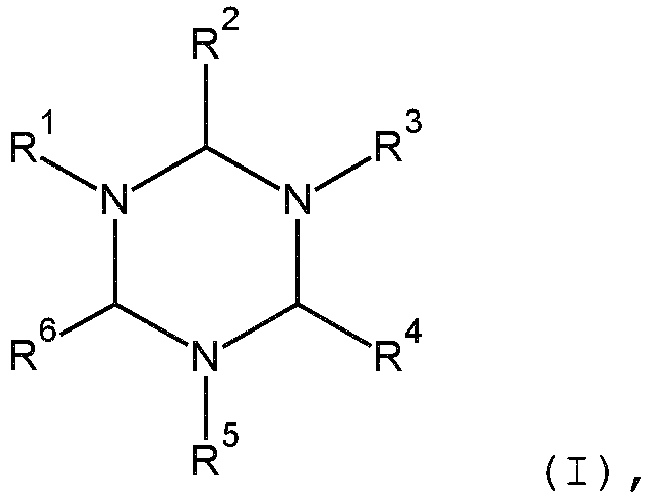
- wherein each of R1, R3, and R5 is independently an alkyl, alkenyl, cycloalkyl, cycloalkenyl or an aryl group, or a combination thereof, and R1, R3, and R5 each have 1 to 20 carbon atoms;
- and wherein each of R2, R4, and R6 is independently H, an alkyl, alkenyl, cycloalkyl, cycloalkenyl or an aryl group, or a combination thereof, and R2, R4, and R6 may each have up to 20 carbon atoms;
- in the production of copolymers of one or more conjugated diene monomers and one or more vinylaromatic monomers, wherein the production is by anionic polymerisation and in the presence of one or more anionic initiators, and wherein the copolymer has a content of about 35 to about 55 weight percent of vinylaromatic monomer, based on total weight of copolymer.
- Preferably, R1, R3 and R5 are the same and are selected from alkyl, alkenyl, cycloalkyl, cycloalkenyl and aryl groups. More preferably, R1, R3 and R5 are the same and are alkyl groups having 1 to 20 carbon atoms, more preferably 1 to 6 carbon atoms. Most preferably, R1, R3 and R5 are each methyl.
- Also, R2, R4 and R6 are preferably the same and are selected from H, alkyl, alkenyl, cycloalkyl, cycloalkenyl and aryl groups. Most preferably, R2, R4 and R6 are each H.
- Thus, it is most preferred for the compound of formula (I) that R1, R3 and R5 are each methyl, and R2, R4 and R6 are each H (hexahydro-N,N',N"-trimethyltriazine).
- Preferably, the molar ratio of hexahydro-1,3,5-triazine of formula (I) to anionic initiator is in a range of from 0.01 to 50, more preferably in a range of from 0.1 to 30 (if more than one hexahydro-1,3,5-triazine of formula (I) is used, the amount of hexahydro-1,3,5-triazine so as to calculate this ratio is the total amount of hexahydro-1,3,5-triazines of formula (I) as present).
- Preferred anionic initiators are organic lithium compounds.
- As to the organic lithium compound, those having a hydrocarbon group having 1 to 20 carbon atoms are preferred. Examples are methyl lithium, ethyl lithium, n-propyl lithium, isopropyl lithium, n-butyl lithium, sec-butyl lithium, tert-octyl lithium, n-decyl lithium, phenyl lithium, 2-naphthyl lithium, 2-butylphenyl lithium, 4-phenylbutyl lithium, cyclohexyl lithium, cyclopentyl lithium, and a reaction product of diisopropenylbenzene with butyl lithium. Of these compounds, n-butyl lithium and sec-butyl lithium are preferred.
- Examples for the lithium amide compound are lithium hexamethyleneimide, lithium pyrrolidide, lithium piperidide, lithium heptamethyleneimide, lithium dodecamethyleneimide, lithium dimethylamide, lithium diethylamide, lithium dibutylamide, lithium dipropylamide, lithium diheptylamide, lithium dihexylamide, lithium dioctylamide, lithium di-2-ethylhexylamide, lithium didecylamide, lithium N-methyl-piperadide, lithium ethylpropylamide, lithium ethylbutylamide, lithium ethylbenzylamide and lithium methylphenethylamide. Of these compounds, preferred from the standpoint of the polymerization initiation ability are cyclic lithium amides such as lithium hexamethyleneimide, lithium pyrrolidide, lithium piperidide, lithium heptamethyleneimide and lithium dodecamethyleneimide; and particularly preferred are lithium hexamethyleneimide, lithium pyrrolidide and lithium piperidide.
- Also, if more than one anionic initiator is used, the total molar amount is used for calculating molar ratios as referred to herein.
- The preparation of copolymers of the invention is possible by using the hexahydro-1,3,5-triazine of formula (I) as a single polar modifier, of by application of a combination of hexahydro-1,3,5-triazine of formula (I) with a further polar modifier (such as a Lewis base and/or a Lewis acid) which also promotes formation of vinyl groups. It is preferred that, together with the hexahydro-1,3, 5-triazine of formula (I), one or more further polar modifiers are used in the anionic polymerisation. Preferably, the further polar modifier is selected from one or more of Lewis bases and Lewis acids. More preferably, the further polar modifier is selected from ditetrahydrofurylpropane, tetramethylethylenediamine, sodium mentholate, and tetrahydrofurane.
- The polymerization process of this invention is thus typically conducted in the presence of polar modifiers, such as tertiary amines, alcoholates or alkyltetrahydrofurfuryl ethers.
- Some representative examples of specific polar modifiers that can be used include methyltetrahydrofurfuryl ether, ethyltetra-hydrofurfuryl ether, propyltetrahydrofurfuryl ether, butyl-tetrahydrofurfuryl ether, hexyltetrahydrofurfuryl ether, octyl-tetrahydrofurfuryl ether, dodecyltetrahydrofurfuryl ether, diethyl ether, di-n-propyl ether, diisopropyl ether, di-n-butyl ether, tetrahydrofuran, dioxane, ethylene glycol dimethyl ether, ethylene glycol diethyl ether, diethylene glycol dimethyl ether, diethylene glycol diethyl ether, triethylene glycol dimethyl ether, trimethylamine, triethylamine, N,N,N',N'-tetramethyl-ethylenediamine, N-methylmorpholine, N-ethylmorpholine, and N-phenylmorpholine.
- A potassium or sodium compound may be added together with the polymerization initiator when it is intended to increase the reactivity of the polymerization initiator or when it is intended to arrange the aromatic vinyl compound at random in the polymer obtained or to allow the obtained polymer to contain the aromatic vinyl compound as a single chain. As the potassium or sodium added together with the polymerization initiator, there can be used, for example: alkoxides and phenoxides, typified by isopropoxide, tert-butoxide, tert-amyloxide, n-heptaoxide, benzyloxide and phenoxide; potassium or sodium salts of organic sulfonic acids, such as dodecylbenzensulfonic acid, tetradecylbenzenesulfonic acid, hexadecylbenzenesulfonic acid, and octadecylbenzenesulfonic acid.
- Preferably, the molar ratio of further polar modifier to anionic initiator is in a range of from about 0.01 to about 50, more preferably in a range of from about 0.1 to about 10. If more than one further polar modifier is used, the total molar amount of further polar modifiers is used for calculating molar ratios as referred to herein.
- The conjugated diene monomer as used according to the invention is preferably selected from 1,3-butadiene, isoprene, 1,3-pentadiene, 2,3-dimethyl-1,3-butadiene, 2-methyl-1,3-pentadiene, 2,3-dimethyl-1,3-pentadiene, 2-phenyl-1,3-butadiene, and 4,5-diethyl-1,3-octadiene. More preferably, the conjugated diene monomer is selected from 1,3-butadiene and isoprene. In particular, the conjugated diene monomer as used in accordance with the invention is 1,3-butadiene.
- Also, the vinylaromatic monomer as used in accordance with the invention is preferably selected from styrene, 1-vinylnaphthalene, 3-methylstyrene, 3,5-diethylstyrene, 4-propylstyrene, 2,4,6-trimethylstyrene, 4-dodecylstyrene, 3-methyl-5-n-hexylstyrene, 4-phenylstyrene, 2-ethyl-4-benzylstyrene, 3,5-diphenylstyrene, 2,3,4,5-tetraethylstyrene, 3-ethyl-1-vinylnaphthalene, 6-isopropyl-1-vinylnaphthalene, 6-cyclohexyl-1-vinylnaphthalene, 7-dodecyl-2-vinylnaphthalene, and α-methylstyrene. More preferably, the vinylaromatic monomer is selected from styrene, 3-methylstyrene and α-methylstyrene. In particular, the vinylaromatic monomer as used in accordance with the invention is styrene.
- In a second aspect, the invention relates to a process for the preparation of a copolymer of conjugated diene monomer and vinylaromatic monomer, the process comprising the following steps:
- (1) contacting a monomer component comprising (i) one or more conjugated diene monomers and (ii) one or more vinylaromatic monomers with
- a) an initiator component comprising one or more alkali metal salt derivatives and b) one or more N,N',N"-substituted hexahydro-1,3,5-triazines having the following formula (I):
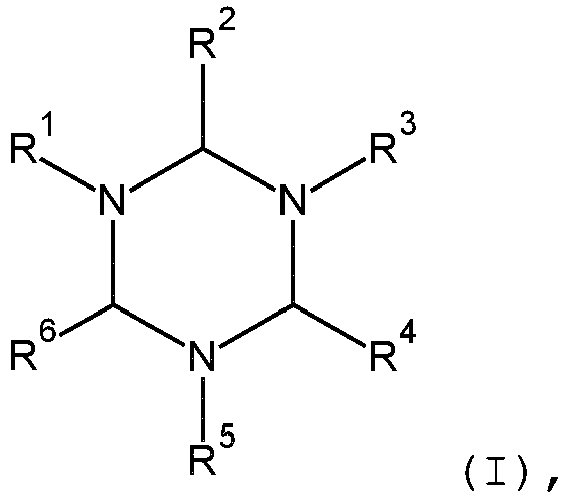
- wherein each of R1, R3, and R5 is independently an alkyl, alkenyl, cycloalkyl, cycloalkenyl or an aryl group, or a combination thereof, and R1, R3, and R5 each have 1 to 20 carbon atoms,
- and wherein each of R2, R4, and R6 is independently H, an alkyl, alkenyl, cycloalkyl, cycloalkenyl or an aryl group, or a combination thereof, and R2, R4, and R6 may each have up to 20 carbon atoms,
- b) optionally one or more further polar additives selected from the group of Lewis bases and Lewis acids,
- a) an initiator component comprising one or more alkali metal salt derivatives and b) one or more N,N',N"-substituted hexahydro-1,3,5-triazines having the following formula (I):
- (2) continuing copolymerization; and
- (3) optionally coupling;
- Further specifics of the process for the preparation of a copolymer of conjugated diene monomer and vinylaromatic monomer are given in
US 8,927,644 B2 . - Preferably, the coupling agent is a tin halide coupling agent, or silicon halide coupling agent. More preferably, the silicon halide coupling agent is selected from silicon tetrachloride, silicon tetrabromide, silicon tetrafluoride, silicon tetraiodide, hexachlorodisilane, hexabromodisilane, hexafluorodisilane, hexa-iododisilane, octachlorotrisilane, octabromotrisilane, octa-fluorotrisilane, octaiodotrisilane, hexachlorodisiloxane, 2,2,4,4,6,6-hexachloro-2,4,6-trisilaheptane, 1,2,3,4,5,6-hexa-kis[2-(methyldichlorosilyl)ethyl]benzene, and alkyl silicon halides of general formula (III)
R7 n-Si-X4-n (III),
wherein R7 is a monovalent aliphatic hydrocarbon group having 1 to 20 carbon atoms or a monovalent aromatic hydrocarbon group having 6 to 18 carbon atoms; n is an integer of 0 to 2; and X is a chlorine, bromine, fluorine, or an iodine atom. - Also, the fraction of units having star structure is between 0% and 75%, by weight of the copolymer of the invention.
- According to a third aspect, the invention relates to a copolymer based on conjugated diene monomer and vinylaromatic monomer, the copolymer having
- (a) a content of vinylaromatic monomer from about 35 to about 55 weight percent, based on total weight of polymer;
- (b) a content of vinylaromatic monomer blocks with more than 4 repeating units from about 0.01 to about 12 weight percent, based on total vinylaromatic monomer content; and
- (c) a vinyl content from more than 8 to about 35 weight percent, based on total conjugated diene polymerized fraction.
- The copolymer preferably has (a) a content of vinylaromatic monomer from about 40 to about 55 weight percent.
- The copolymer preferably has (b) a content of vinylaromatic monomer blocks with more than 4 repeating units from about 0.05 to about 12 weight percent, more preferably from about 0.1 to about 12 weight percent, in particular from about 0.1 to about 6 weight percent, e.g. from about 0.1 to about 3 weight percent, or from about 0.1 to about 2.5 weight percent, each based on total vinylaromatic monomer content.
- Moreover, the copolymer of the invention preferably has (c) a vinyl content from about 10 to about 35 weight percent, preferably from about 14 to about 30 weight percent, in particular from about 18 to about 27 weight percent, each based on total conjugated diene polymerized fraction.
- Also, the copolymer of the invention preferably has a ratio Mw/Mn of the uncoupled product in a range of from about 1.01 to about 3.0, preferably in a range of from about 1.01 to about 1.2.
- According to a fourth aspect, the invention relates to a method for preparing a rubber comprising vulcanizing the elastomeric copolymer according to the third aspect in the presence of one or more vulcanizing agents. In this method, auxiliaries for the crosslinking of the elastomeric copolymer (crosslinking agents) may be present, or auxiliaries for coupling of the rubber to the filler, or auxiliaries for better dispersion of the filler, or auxiliaries for improvement of the chemical and/or physical properties of the rubbers produced from the elastomeric copolymer. Particular crosslinking agents used are sulphur and sulphur-donor compounds.
- Moreover, and according to a fifth aspect, the invention relates to a rubber as obtainable according to the method of the fourth aspect.
- Also, and according to a sixth aspect, the invention relates to a rubber composition comprising x) a rubber component comprising the rubber according to the fifth aspect.
- The rubber composition preferably further comprises y) one or more fillers, more preferably the filler is selected from the group consisting of silica and carbon black, most preferably the filler component y) comprises both silica and carbon black. The rubbers compositions can be used in the production of highly reinforced rubber mouldings, principally for the production of tires. The inventive rubber compositions may furthermore comprise other auxiliaries, such as the known reaction accelerators, heat stabilizers, light stabilizers, antiozonants, antioxidants, processing aids, plasticizers, tackifiers, blowing agents, dyes, pigments, waxes, extenders, organic acids, retarders, metal oxides, and activators.
- Fillers that can be used for the rubber compositions comprise all the known fillers used in the rubber industry. These comprise not only active fillers, but also non-active fillers. Examples are: fine-particle silicas, produced for example via precipitation from solutions of silicates, or flame hydrolysis of silicon halides with specific surface areas of from 10 to 1000 m2/g (BET and CTAB surface area), preferably from 30 to 400 m2/g, and with a primary particle sizes of from 10 to 1000 nm. The silicas can, if relevant, also take the form of mixed oxides with other metal oxides, such as oxides of Al, of Mg, of Ca, of Ba, of Zn, of Ti, or of Zr; synthetic silicates, such as aluminium silicate, or alkaline earth metal silicate, e.g. magnesium silicate or calcium silicate, with BET surface areas of from 20 to 400 m2/g and with primary particle diameters of from 10 to 1000 nm; natural silicates, such as kaolin and any other naturally occurring form of silica; metal oxides, such as calcium oxide, zinc oxide, magnesium oxide, or aluminium oxide; metal carbonates, such as magnesium carbonate, calcium carbonate, or zinc carbonate; metal hydroxides, e.g. aluminium hydroxide or magnesium hydroxide; carbon blacks prepared by the flame-black process, channel-black process, furnace-black process, gas black process, thermal-black process, acetylene-black process, or arc process, their BET surface areas being from 10 to 250 m2/g, e.g.: conductive furnace (CF), super conductive furnace (SCF), super abrasion furnace (SAF), intermediate super abrasion furnace (ISAF), intermediate super abrasion furnace low structure (lSAF-LS), intermediate super abrasion furnace high modulus (ISAF-HM), intermediate super abrasion furnace low modulus (lSAF-LM), intermediate super abrasion furnace high structure (lSAF-HS), high abrasion furnace (HAF), high abrasion furnace low structure (HAP-LS), high abrasion furnace high structure (HAP-HS), fine furnace high structure (FF-HS), semi reinforcing furnace (SRF), extra conductive furnace (XCF), fast extruding furnace (FEE), fast extruding furnace low structure (FEE-LS), fast extruding furnace high structure (FEE-HS), general purpose furnace (GPF), general purpose furnace high structure (GPF-HS), all-purpose furnace (APP), semi reinforcing furnace low structure (SRF-LS), semi reinforcing furnace low modulus (SRF-LM), semi reinforcing furnace high structure (SRF-HS), semi reinforcing furnace high modulus (SRF-HM) and medium thermal (MT) carbon blacks, or the following types according to ASTM classification: N110, N219, N220, N231, N234, N242, N294, N326, N327, N330, N332, N339, N347, N351, N356, N358, N375, N472, N539, N550, N568, N650, N660, N754, N762, N765, N774, N787 and N990 carbon blacks.
- The fillers mentioned can be used alone or in admixture. In a particularly preferred embodiment, the rubbers comprise, as further filler constituents, a mixture composed of pale-colored fillers, such as fine-particle silicas, and of carbon blacks, where the mixing ratio (by weight) of pale-colored fillers to carbon blacks is from 0.05:1 to 25:1, preferably from 0.1:1 to 22:1. The amount of the fillers is typically in a range of from 10 to 500 parts by weight of filler, based on 100 parts by weight of rubber component x). It is preferable to use from 10 to 200 parts by weight.
- Preferably, the rubber composition according to the sixth aspect has an amount of filler component y) in a range of from 10 to 150 parts by mass relative to 100 parts by mass of the rubber component x) (phr), more preferably the amount of component y) is 20 to 140 phr, most preferably the amount of component y) is 30 to 130 phr.
- It is also preferred that the rubber composition according to the sixth aspect has a rubber component x) which comprises one or more further rubbery polymers, more preferably the further rubbery polymer is selected from the group consisting of natural rubber, synthetic isoprene rubber, butadiene rubber, ethylene-α-olefin copolymer rubber, ethylene-α-olefin-diene copolymer rubber, acrylonitrile-butadiene copolymer rubber, chloroprene rubber and halogenated butyl rubber.
- The further rubbery polymer may be a natural rubber, or some synthetic rubber other than the rubber according to the fifth aspect. The amount of further rubbery polymer is usually in the range from 0.5 to 90% by weight, preferably from 10 to 70% by weight, based on the entire amount of rubber in the rubber mixture. The amount of further rubbery polymer depends on the respective intended use of the rubber composition.
- Examples of further rubbery polymer are natural rubbers, and also synthetic rubbers. Synthetic rubbers known from the literature are presented as an example. They comprise: BR - polybutadiene, ABR - butadiene-C1-4-alkyl acrylate copolymers, CR - polychloroprene, IR - polyisoprene, SBR - styrene-butadiene copolymers having styrene contents of from 1 to 60% by weight, preferably from 10 to 50% by weight, IIR - isobutylene-isoprene copolymers, NBR - butadiene-acrylonitrile copolymers having acrylonitrile contents of from 3 to 60% by weight, preferably from 15 to 40% by weight, HNBR - partially hydrogenated or fully hydrogenated NBR rubber, EPDM - ethylene-propylene-diene terpolymers, and also mixtures of these further rubbery polymers. Materials of interest for the production of vehicle tires are more particularly natural rubber, emulsion SBR, and also solution SBR, with glass transition temperatures above -100°C, polybutadiene rubber with a high cis content (>90%), produced using catalysts based on Ni, Co, Ti or Nd, and also polybutadiene rubbers having a vinyl content of up to 85%, as well as mixtures of these.
- According to a seventh aspect of the invention, a tire component comprises the rubber composition according to the sixth aspect. Preferably, the tire component is a tire tread.
- Finally, and according to an eighth aspect, a tire comprises the tire component of the seventh aspect.
- In particular, the present invention relates to diene rubbers having a high styrene content, and to the use thereof for the production of rubber vulcanizates which serve in particular for the production of highly reinforced rubber mouldings, particularly preferably for the production of tires, where these have particularly high wet skid resistance, low rolling resistance when functionalized and very good handling properties. The very high styrene content in the rubbers of the invention imparts very good tensile properties as well as high tear resistance to the rubber compositions. Additionally, a low content of styrene blocks prevents the creation of styrene domains in the rubber matrix.
- The advantages of the present invention are particularly apparent from the following examples.
- Determined by 600 MHz 1H-NMR, based on BS ISO 21561:2005.
- Determined by 600 MHz 1H-NMR, based on BS ISO 21561:2005.
- Block styrene content (%) was determined by 600 MHz 1H-NMR.
- The content of block styrene consisting of more than 6 consecutive styrene units was determined according to the method reported by Y. Tanaka et al. in Rubber Chemistry and Technology, 1981, 54, No. 4,685-691 using the relative intensity of ortho Ph-proton signals resonating higher than 6.7 ppm.
- The content of block styrene consisting of 4 and more consecutive styrene units was determined according to the method described in German Patent Document No.
DE69712962 using the relative intensity of the ortho Ph-proton signals resonating in the range between 6.94 and 6 ppm. - The content of block styrene consisting of 4 to 6 consecutive units was calculated from the difference between both of the above-described block styrene contents.
- Gel permeation chromatography was performed via PSS Polymer Standards Service multiple columns (with guard column), using THF as the eluent and for sample preparation. Multi-angle laser light scattering measurements were carried out using a Wyatt Technologies Dawn Heleos II light scattering detector, DAD (PDA) Agilent 1260 Infinity UV-VIS detector and Agilent 1260 Infinity refractive index detector.
- Determined according to PN-EN ISO 11357-1:2009.
- Determined based on ASTM D 1646-07, using an L rotor under the following conditions: preheating = 1 minute, rotor operating time = 4 minutes, and temperature = 100°C,
- All experiments were performed at the same preparation manner where different reaction conditions were applied. Examples 13 to 15 are comparative.
- Cyclohexane (10 kg) was added to a nitrogen-purged twenty-two liter reactor and treated with 2 g of 1.6 M n-butyl lithium solution in cyclohexane. The solution was heated up under the reflux conditions (80-82°C) and vigorously stirred for 10 minutes, to perform cleaning and inertization of the reactor. After that, solvent was removed via a drain valve and nitrogen was purged again.
- Cyclohexane was charged to the inerted reactor, followed by addition of styrene and butadiene monomers, where the mass ratio of styrene to butadiene (ST/BD) depended on the desired styrene content (30 - 80 wt%). Next, 1, 3, 5-trimethylhexahydro-1,3, 5-triazine (TMT) was introduced into the reactor, in order to provide the desired content of styrene blocks (blockiness), where the molar ratio of TMT to initiator was in a range from 0.01 to 50:1 depending on total styrene content. Amounts of solvent, monomers, and additives depended on the scale of the reaction and are given in Tables 1 and 2.
- The solution inside the reactor was heated and continuously stirred during the whole process. The temperature of the reaction mixture was kept between 60 and 90°C, where the exact temperature determined the vinyl unit content and partially influenced blockiness of styrene units. Then, n-butyl lithium (BuLi) was added to initiate the polymerization process, where the exact amount of n-BuLi determined the molecular weight of polymer. The reaction was carried out as an isothermic process, up to 120 minutes. The reaction solution was terminated, using nitrogen-purged isopropyl alcohol in the double molar amount as compared to n-butyl lithium, and was rapidly stabilized by the addition of 2-methyl-4,6-bis(octylsulfanylmethyl)phenol (at 1.0 phr polymer).
- The polymer solution was transferred to a stripper. The reactor was flushed with portions of fresh cyclohexane and its contents were also transferred to the stripper. Distilled water was added to the polymer solution, in an amount of double of the total mass of polymer solution, and the stripper contents were then treated with steam. Steam-stripping was carried out until the entire amount of cyclohexane had been removed, and rubber crumbs were obtained. Then, the rubber crumbs were removed from the stripper, cooled to room temperature, milled and dried in a stream of hot air.
- Details of the reaction conditions, of the used recipes and characteristics of the obtained polymers are included in Table 1 and Table 2. Examples 1-8 in Table 1 show the influence of increasing content of TMT/n-BuLi expressed as molar ratios on the formation of vinyl groups and the blockiness of styrene in a HS-LV-SBR containing about 40% of styrene. Examples 9-15 in Table 1 show the influence of a constant molar ratio of TMT/n-BuLi (of about 5/1) on the blockiness of styrene in an UHS-LV-SBR containing from 45% to 80% of styrene.
- Examples 16-21 in Table 2 show the influence of the use of a mixture of TMT and TMEDA on the formation of vinyl groups and the blockiness of styrene in a HS-LV-SBR containing about 40% of styrene.
Table 1. Application of TMT as a polar modifier in the synthesis of HS-LV-SBR and UHS-LV-SBR rubber. Reaction conditions GPC results 1H NMR results DSC results Ex. T [°C] Cyclohexane [g] styrene [g] 1,3-butadiene [g] TMT/BuLi molar ratio Mn [kg/mol] Mw [kg/mol] Mw/Mn Vinyl styrene styrene block Tg, 0C 1 60 800 56 84 5.11 238.6 241.7 1.01 26.3% 40.4% 0.1% -31 2 60 800 56 84 1.38 276.6 284.0 1.03 18.6% 40.1% 1.7% -39 3 60 800 56 84 0.91 229.9 236.3 1.03 17.1% 40.1% 4.2% -45 4 60 800 56 84 0.72 246.4 252.8 1.03 15.4% 40.2% 7.3% -50 5 60 800 56 84 0.75 325.7 333.6 1.02 14.4% 40.1% 10.0% -54 6 60 800 56 84 0.66 197.8 201.6 1.02 13.1% 40.2% 14.0% -64 7 60 800 56 84 0.27 160.0 162.2 1.01 11.0% 40.2% 19.5% -70 8 60 800 56 84 0.13 226.2 231.6 1.02 10.0% 40.3% 27.4% -77 9 70 800 63 77 5.5 408.2 448.6 1.10 25.4% 45.3% 0.4% -24 10 70 800 68 72 5.9 482.1 572.5 1.19 22.1% 48.3% 0.5% -19 11 70 800 71 69 5.1 263.1 266.4 1.01 26.5% 50.5% 0.6% -14 12 70 800 76 64 5.2 270.1 278.2 1.03 21.7% 54.1% 2.5% -11 13 70 800 83 57 5.5 241.4 265.5 1.10 21.8% 59.0% 5.7% -5 14 70 800 91 49 5.4 249.3 269.2 1.08 20.7% 64.7% 15.5% 4 15 70 800 108 32 5.3 233.7 247.7 1.06 27.4% 77.4% 31.1% 14 Table 2. Application of TMT with addition of TMEDA as polar modifiers in the synthesis of HS-LV-SBR and UHS-LV-SBR rubber. Reaction conditions GPC results 1H NMR results DSC results Ex T[°C] Cyclohexane [g] Styrene [g] 1,3-butadiene [g] TMT/ BuLi molar ratio TMEDA/ BuLi molar ratio Mn [kg/mol] Mw [kg/mol] Mw/Mn Vinyl styrene styrene block Tg [°C] 16 70 800 55 85 8.0 0.9 300.7 325.7 1.08 26.0% 39.5% 0.8% -34,05 17 70 800 55 85 8.0 2.0 297.8 350.5 1.18 29.3% 39.5% 1.0% -32,53 18 70 800 55 85 8.0 3.5 293.5 312.2 1.06 32.2% 39.4% 0.9% -30,41 19 70 800 55 85 8.0 4.2 293.7 315.5 1.07 36.2% 39.1% 1.0% -26,85 20 70 800 54 86 8.0 6.0 256.0 309.4 1.21 40.1% 38.6% 1.1% -24,28 21 70 800 53 87 8.0 8.8 292.1 324.6 1.11 42.9% 38.1% 1.1% -23,95
wherein the copolymer has a content of about 35 to about 55 weight percent of vinylaromatic monomer, based on total weight of copolymer.
Claims (20)
- Use of an N,N',N"-substituted hexahydro-1,3,5-triazine having the following formula (I):
 wherein each of R1, R3, and R5 is independently an alkyl, alkenyl, cycloalkyl, cycloalkenyl or an aryl group, or a combination thereof, and R1, R3, and R5 each have 1 to 20 carbon atoms,and wherein each of R2, R4, and R6 is independently H, an alkyl, alkenyl, cycloalkyl, cycloalkenyl or an aryl group, or a combination thereof, and R2, R4, and R6 may each have up to 20 carbon atoms,in the production of copolymers of one or more conjugated diene monomers and one or more vinylaromatic monomers, wherein the production is by anionic polymerisation and in the presence of one or more anionic initiators, and wherein the copolymer has a content of about 35 to about 55 weight percent of vinylaromatic monomer, based on total weight of copolymer.
 - The use of claim 1, wherein the molar ratio of hexahydro-1,3,5-triazine of formula (I) to anionic initiator is in a range of from 0.01 to 50,
more preferably in a range of from 0.1 to 30. - The use of claim 1 or claim 2, wherein one or more further polar modifiers are used in the anionic polymerisation,
preferably wherein the further polar modifier is selected from one or more of Lewis bases and Lewis acids. - The use of claim 3, wherein the molar ratio of further polar modifier to anionic initiator is in a range of from about 0.01 to about 50,
preferably in a range of from about 0.1 to about 10. - The use of any of the preceding claims, wherein the conjugated diene monomer is selected from 1,3-butadiene, isoprene, 1,3-pentadiene, 2,3-dimethyl-1,3-butadiene, 2-methyl-1,3-pentadiene, 2,3-dimethyl-1,3-pentadiene, 2-phenyl-1,3-butadiene, and 4,5-diethyl-1,3-octadiene,
preferably wherein the conjugated diene monomer is selected from 1,3-butadiene and isoprene,
in particular wherein the conjugated diene monomer is 1,3-butadiene. - The use of any of the preceding claims, wherein the vinylaromatic monomer is selected from styrene, 1-vinylnaphthalene, 3-methylstyrene, 3,5-diethylstyrene, 4-propylstyrene, 2,4,6-trimethylstyrene, 4-dodecylstyrene, 3-methyl-5-n-hexylstyrene, 4-phenylstyrene, 2-ethyl-4-benzylstyrene, 3,5-diphenylstyrene, 2,3,4,5-tetraethylstyrene, 3-ethyl-1-vinylnaphthalene, 6-isopropyl-1-vinylnaphthalene, 6-cyclohexyl-1-vinylnaphthalene, 7-dodecyl-2-vinylnaphthalene, and α-methylstyrene,
preferably wherein the vinylaromatic monomer is selected from styrene, 3-methylstyrene and α-methylstyrene,
in particular wherein the vinylaromatic monomer is styrene. - A process for the preparation of a copolymer of conjugated diene monomer and vinylaromatic monomer, the process comprising the following steps:(1) contacting a monomer component comprising (i) one or more conjugated diene monomers and (ii) one or more vinylaromatic monomers witha) an initiator component comprising one or more alkali metal salt derivatives and b) one or more N,N',N"-substituted hexahydro-1,3,5-triazines having the following formula (I):
 wherein each of R1, R3, and R5 is independently an alkyl, alkenyl, cycloalkyl, cycloalkenyl or an aryl group, or a combination thereof, and R1, R3, and R5 each have 1 to 20 carbon atoms,and wherein each of R2, R4, and R6 is independently H, an alkyl, alkenyl, cycloalkyl, cycloalkenyl or an aryl group, or a combination thereof, and R2, R4, and R6 may each have up to 20 carbon atoms,b) optionally one or more further polar additives selected from the group of Lewis bases and Lewis acids,
to initiate anionic copolymerization;(2) continuing copolymerization; and(3) optionally coupling;to give the copolymer,
wherein the copolymer has a content of about 35 to about 55 weight percent of vinylaromatic monomer, based on total weight of copolymer. - A copolymer based on conjugated diene monomer and vinylaromatic monomer, the copolymer having(a) a content of vinylaromatic monomer from about 35 to about 55 weight percent, based on total weight of polymer;(b) a content of vinylaromatic monomer blocks with more than 4 repeating units from about 0.01 to about 12 weight percent, based on total vinylaromatic monomer content; and(c) a vinyl content from more than 8 to about 35 weight percent, based on total conjugated diene polymerized fraction.
- The copolymer of claim 8, wherein the (a) content of vinylaromatic monomer is from about 40 to about 55 weight percent.
- The copolymer of any of claims 8 and 9, wherein the (b) content of vinylaromatic monomer blocks with more than 4 repeating units is from about 0.05 to about 12 weight percent, preferably from about 0.1 to about 12 weight percent, in particular from about 0.1 to about 6 weight percent, e.g. from about 0.1 to about 3 weight percent, or from about 0.1 to about 2.5 weight percent, each based on total vinylaromatic monomer content.
- The copolymer of any of claims 8 to 10, wherein the (c) vinyl content is from about 10 to about 35 weight percent, preferably from about 14 to about 30 weight percent, in particular from about 18 to about 27 weight percent, each based on total conjugated diene polymerized fraction.
- The copolymer of any of claims 8 to 11, wherein Mw/Mn of the uncoupled product is in a range of from about 1.01 to about 3.0, preferably in a range of from about 1.01 to about 1.2.
- A method for preparing a rubber comprising vulcanizing the elastomeric copolymer according to any one of claims 8 to 12 in the presence of one or more vulcanizing agents.
- A rubber as obtainable according to the method of claim 13.
- A rubber composition comprising x) a rubber component comprising the rubber according to claim 14.
- The rubber composition according to claim 15, further comprising y) one or more fillers,
preferably wherein the filler is selected from the group consisting of silica and carbon black,
more preferably wherein the filler component y) comprises both silica and carbon black. - The rubber composition according to claim 16, wherein the amount of filler component y) is 10 to 150 parts by mass relative to 100 parts by mass of the rubber component x) (phr), preferably wherein the amount of component y) is 20 to 140 phr, more preferably wherein the amount of component y) is 30 to 130 phr.
- The rubber composition according to any of claims 15 to 17 wherein the rubber component x) also comprises one or more further rubbery polymers,
preferably wherein the further rubbery polymer is selected from the group consisting of natural rubber, synthetic isoprene rubber, butadiene rubber, ethylene-α-olefin copolymer rubber, ethylene-α-olefin-diene copolymer rubber, acrylonitrile-butadiene copolymer rubber, chloroprene rubber and halogenated butyl rubber. - A tire component comprising the rubber composition according to any of claims 15 to 18,
preferably wherein the tire component is a tire tread. - A tire comprising the tire component of claim 19.
Priority Applications (1)
| Application Number | Priority Date | Filing Date | Title |
|---|---|---|---|
| PL18716170T PL3601389T3 (en) | 2017-03-29 | 2018-03-28 | Polar additive for the synthesis of copolymers of vinylaromatic monomer and conjugated diene monomer having high vinylaromatic and low vinyl contents |
Applications Claiming Priority (2)
| Application Number | Priority Date | Filing Date | Title |
|---|---|---|---|
| EP17461514 | 2017-03-29 | ||
| PCT/EP2018/058014 WO2018178199A1 (en) | 2017-03-29 | 2018-03-28 | Polar additive for the synthesis of copolymers of vinylaromatic monomer and conjugated diene monomer having high vinylaromatic and low vinyl contents |
Publications (2)
| Publication Number | Publication Date |
|---|---|
| EP3601389A1 EP3601389A1 (en) | 2020-02-05 |
| EP3601389B1 true EP3601389B1 (en) | 2021-11-17 |
Family
ID=58461256
Family Applications (1)
| Application Number | Title | Priority Date | Filing Date |
|---|---|---|---|
| EP18716170.8A Active EP3601389B1 (en) | 2017-03-29 | 2018-03-28 | Polar additive for the synthesis of copolymers of vinylaromatic monomer and conjugated diene monomer having high vinylaromatic and low vinyl contents |
Country Status (9)
| Country | Link |
|---|---|
| US (1) | US11525049B2 (en) |
| EP (1) | EP3601389B1 (en) |
| JP (2) | JP2020515687A (en) |
| KR (1) | KR102574992B1 (en) |
| CN (1) | CN110678492A (en) |
| BR (1) | BR112019020104A2 (en) |
| EA (1) | EA201992291A1 (en) |
| PL (1) | PL3601389T3 (en) |
| WO (1) | WO2018178199A1 (en) |
Families Citing this family (1)
| Publication number | Priority date | Publication date | Assignee | Title |
|---|---|---|---|---|
| CN118159601A (en) * | 2021-10-11 | 2024-06-07 | 日本弹性体株式会社 | Cross-linked rubber composition and method for producing the cross-linked rubber composition |
Family Cites Families (18)
| Publication number | Priority date | Publication date | Assignee | Title |
|---|---|---|---|---|
| US3558575A (en) | 1966-10-03 | 1971-01-26 | Firestone Tire & Rubber Co | Process for the production of copolymers free of block polystyrene |
| US3498960A (en) * | 1967-09-28 | 1970-03-03 | Phillips Petroleum Co | Production of random copolymers in organolithium polymerization systems |
| US3787377A (en) | 1971-12-16 | 1974-01-22 | Firestone Tire & Rubber Co | Continuous process of copolymerizing butadiene and styrene |
| JPH0627122B2 (en) * | 1984-04-09 | 1994-04-13 | 日本エラストマ−株式会社 | Random styrene-butadiene copolymer rubber with high styrene content |
| JPH0629284B2 (en) | 1985-01-16 | 1994-04-20 | 日本エラストマ−株式会社 | Rubber composition for tires |
| DE69712962T2 (en) | 1996-03-29 | 2002-11-14 | Bridgestone Corp., Tokio/Tokyo | Styrene-butadiene copolymer and rubber compound containing this copolymer |
| DE19914075A1 (en) | 1999-03-27 | 2000-09-28 | Basf Ag | Transparent high-impact styrene-butadiene block copolymers comprises at least two hard blocks and a soft block with a low 1,2-vinyl content for improved thermal stability |
| US6372863B1 (en) | 1999-08-12 | 2002-04-16 | The Goodyear Tire & Rubber Company | Synthesis of styrene-butadiene rubber |
| US6583244B1 (en) | 2001-10-31 | 2003-06-24 | The Goodyear Tire & Rubber Company | Synthesis of rubber having a low vinyl content |
| JP5545800B2 (en) | 2009-06-08 | 2014-07-09 | 住友化学株式会社 | Jet-fluidized bed type olefin polymerization reactor, polyolefin production system, and polyolefin production method |
| TW201211083A (en) * | 2010-06-15 | 2012-03-16 | Styron Europe Gmbh | Low vinyl styrene-butadiene polymers and methods of making the same |
| CN101906187B (en) * | 2010-07-26 | 2012-05-16 | 中国科学院长春应用化学研究所 | Application of rare earth compound with constrained geometry configuration in high-selectivity conjugated diolefin-styrene random or block copolymerization |
| EP2495266A1 (en) * | 2011-03-04 | 2012-09-05 | Styron Deutschland GmbH | High styrene high vinyl styrene-butadiene rubber and methods for preparation thereof |
| EP2537872B1 (en) | 2011-06-22 | 2015-08-12 | Trinseo Europe GmbH | High styrene high vinyl styrene-butadiene rubber with narrow molecular weight distribution and methods for preparation thereof |
| ES2598035T3 (en) | 2011-03-04 | 2017-01-24 | Trinseo Europe Gmbh | Styrene-butadiene rubber with high styrene content and high vinyl content and methods for preparing it |
| ES2695042T3 (en) | 2011-06-22 | 2018-12-28 | Trinseo Europe Gmbh | Styrene-butadiene rubber with high styrene and vinyl content with narrow molecular weight distribution and procedures for its preparation |
| CN103374101B (en) | 2012-04-18 | 2015-11-25 | 中国石油化工股份有限公司 | The preparation method of a kind of irregular agent and styrene-butadiene rubber(SBR) |
| US9458362B2 (en) | 2014-04-02 | 2016-10-04 | Kraton Polymers U.S. Llc | Adhesive compositions containing a block copolymer with polymyrcene |
-
2018
- 2018-03-28 EA EA201992291A patent/EA201992291A1/en unknown
- 2018-03-28 PL PL18716170T patent/PL3601389T3/en unknown
- 2018-03-28 JP JP2019553501A patent/JP2020515687A/en active Pending
- 2018-03-28 BR BR112019020104A patent/BR112019020104A2/en not_active Application Discontinuation
- 2018-03-28 US US16/497,929 patent/US11525049B2/en active Active
- 2018-03-28 CN CN201880035506.2A patent/CN110678492A/en active Pending
- 2018-03-28 KR KR1020197031880A patent/KR102574992B1/en active Active
- 2018-03-28 EP EP18716170.8A patent/EP3601389B1/en active Active
- 2018-03-28 WO PCT/EP2018/058014 patent/WO2018178199A1/en not_active Ceased
-
2023
- 2023-01-26 JP JP2023010231A patent/JP7667190B2/en active Active
Also Published As
| Publication number | Publication date |
|---|---|
| KR20190130011A (en) | 2019-11-20 |
| PL3601389T3 (en) | 2022-02-07 |
| JP7667190B2 (en) | 2025-04-22 |
| WO2018178199A1 (en) | 2018-10-04 |
| US11525049B2 (en) | 2022-12-13 |
| BR112019020104A2 (en) | 2020-05-05 |
| EA201992291A1 (en) | 2020-02-28 |
| JP2023052652A (en) | 2023-04-11 |
| KR102574992B1 (en) | 2023-09-05 |
| EP3601389A1 (en) | 2020-02-05 |
| CN110678492A (en) | 2020-01-10 |
| US20200255625A1 (en) | 2020-08-13 |
| JP2020515687A (en) | 2020-05-28 |
Similar Documents
| Publication | Publication Date | Title |
|---|---|---|
| CN111201255B (en) | Modified conjugated diene polymer and rubber composition containing the same | |
| US7504457B2 (en) | Functionalized polymers and improved tires therefrom | |
| EP2813523B1 (en) | Modified conjugated diene polymer and method for producing same | |
| CN104507974B (en) | Modified conjugated diene polymer and preparation method thereof | |
| JP5831461B2 (en) | Conjugated diene rubber, rubber composition, rubber cross-linked product, and tire | |
| CN108350118A (en) | Modified conjugated diene polymer and preparation method thereof | |
| CN101910279A (en) | tire | |
| US10829627B2 (en) | Polymer compound, method for preparing modified and conjugated diene-based polymer using the same, and modified and conjugated diene-based polymer | |
| JP2019522061A (en) | [Bis (trihydrocarbylsilyl) aminosilyl] functionalized styrene based elastomeric copolymers and their use in the production of rubber | |
| EP2582735A1 (en) | Low vinyl styrene-butadiene polymers and methods of making the same | |
| JP2018513897A (en) | [Bis (trihydrocarbylsilyl) aminosilyl] functionalized styrene based elastomeric copolymers and their use in the production of rubber | |
| JP6962046B2 (en) | Rubber composition for tires | |
| TWI849256B (en) | Modifying agent and modified conjugated diene polymer prepared by using the same | |
| EP3347381B1 (en) | Methods for preparation of functionalized polymers | |
| KR101889156B1 (en) | Modified diene polymer, preparation method thereof and rubber composition comprising the same | |
| JP7667190B2 (en) | Polar additive for the synthesis of copolymers of vinyl aromatic monomers and conjugated diene monomers with high vinyl aromaticity and low vinyl content | |
| JP4348795B2 (en) | Diolefin polymer composition, process for producing the same, and rubber composition for vulcanization | |
| JP2001131227A (en) | Modified conjugated diene polymer, and rubber composition and tire both prepared by using same | |
| KR102754128B1 (en) | Mixtures of styrenes with aminosilyl-functional groups, their preparation and their use in the preparation of elastic copolymers | |
| EA043817B1 (en) | POLAR ADDITIVE FOR SYNTHESIS OF COPOLYMERS OF VINYLAROMATIC MONOMER AND CONJUGIATED DIENE MONOMER, HAVING HIGH VINYLAROMATIC CONTENT AND LOW VINYL CONTENT | |
| JPWO2014132899A1 (en) | Method for producing terminal-modified polymer | |
| JPWO2019065662A1 (en) | Copolymer rubber and its production method, and crosslinked rubber composition | |
| JP5034297B2 (en) | Modified diene polymer rubber and rubber composition |
Legal Events
| Date | Code | Title | Description |
|---|---|---|---|
| STAA | Information on the status of an ep patent application or granted ep patent |
Free format text: STATUS: UNKNOWN |
|
| STAA | Information on the status of an ep patent application or granted ep patent |
Free format text: STATUS: THE INTERNATIONAL PUBLICATION HAS BEEN MADE |
|
| PUAI | Public reference made under article 153(3) epc to a published international application that has entered the european phase |
Free format text: ORIGINAL CODE: 0009012 |
|
| STAA | Information on the status of an ep patent application or granted ep patent |
Free format text: STATUS: REQUEST FOR EXAMINATION WAS MADE |
|
| 17P | Request for examination filed |
Effective date: 20191029 |
|
| AK | Designated contracting states |
Kind code of ref document: A1 Designated state(s): AL AT BE BG CH CY CZ DE DK EE ES FI FR GB GR HR HU IE IS IT LI LT LU LV MC MK MT NL NO PL PT RO RS SE SI SK SM TR |
|
| AX | Request for extension of the european patent |
Extension state: BA ME |
|
| DAV | Request for validation of the european patent (deleted) | ||
| DAX | Request for extension of the european patent (deleted) | ||
| STAA | Information on the status of an ep patent application or granted ep patent |
Free format text: STATUS: EXAMINATION IS IN PROGRESS |
|
| 17Q | First examination report despatched |
Effective date: 20210122 |
|
| RIC1 | Information provided on ipc code assigned before grant |
Ipc: C08F 236/10 20060101AFI20210430BHEP Ipc: B60C 1/00 20060101ALI20210430BHEP Ipc: C08F 212/08 20060101ALI20210430BHEP Ipc: C08L 9/06 20060101ALI20210430BHEP Ipc: C08F 297/04 20060101ALI20210430BHEP |
|
| GRAP | Despatch of communication of intention to grant a patent |
Free format text: ORIGINAL CODE: EPIDOSNIGR1 |
|
| STAA | Information on the status of an ep patent application or granted ep patent |
Free format text: STATUS: GRANT OF PATENT IS INTENDED |
|
| INTG | Intention to grant announced |
Effective date: 20210621 |
|
| GRAS | Grant fee paid |
Free format text: ORIGINAL CODE: EPIDOSNIGR3 |
|
| GRAA | (expected) grant |
Free format text: ORIGINAL CODE: 0009210 |
|
| STAA | Information on the status of an ep patent application or granted ep patent |
Free format text: STATUS: THE PATENT HAS BEEN GRANTED |
|
| AK | Designated contracting states |
Kind code of ref document: B1 Designated state(s): AL AT BE BG CH CY CZ DE DK EE ES FI FR GB GR HR HU IE IS IT LI LT LU LV MC MK MT NL NO PL PT RO RS SE SI SK SM TR |
|
| REG | Reference to a national code |
Ref country code: GB Ref legal event code: FG4D |
|
| REG | Reference to a national code |
Ref country code: IE Ref legal event code: FG4D |
|
| REG | Reference to a national code |
Ref country code: DE Ref legal event code: R096 Ref document number: 602018026791 Country of ref document: DE |
|
| REG | Reference to a national code |
Ref country code: AT Ref legal event code: REF Ref document number: 1448008 Country of ref document: AT Kind code of ref document: T Effective date: 20211215 |
|
| REG | Reference to a national code |
Ref country code: LT Ref legal event code: MG9D |
|
| REG | Reference to a national code |
Ref country code: NL Ref legal event code: MP Effective date: 20211117 |
|
| REG | Reference to a national code |
Ref country code: AT Ref legal event code: MK05 Ref document number: 1448008 Country of ref document: AT Kind code of ref document: T Effective date: 20211117 |
|
| PG25 | Lapsed in a contracting state [announced via postgrant information from national office to epo] |
Ref country code: RS Free format text: LAPSE BECAUSE OF FAILURE TO SUBMIT A TRANSLATION OF THE DESCRIPTION OR TO PAY THE FEE WITHIN THE PRESCRIBED TIME-LIMIT Effective date: 20211117 Ref country code: LT Free format text: LAPSE BECAUSE OF FAILURE TO SUBMIT A TRANSLATION OF THE DESCRIPTION OR TO PAY THE FEE WITHIN THE PRESCRIBED TIME-LIMIT Effective date: 20211117 Ref country code: FI Free format text: LAPSE BECAUSE OF FAILURE TO SUBMIT A TRANSLATION OF THE DESCRIPTION OR TO PAY THE FEE WITHIN THE PRESCRIBED TIME-LIMIT Effective date: 20211117 Ref country code: BG Free format text: LAPSE BECAUSE OF FAILURE TO SUBMIT A TRANSLATION OF THE DESCRIPTION OR TO PAY THE FEE WITHIN THE PRESCRIBED TIME-LIMIT Effective date: 20220217 Ref country code: AT Free format text: LAPSE BECAUSE OF FAILURE TO SUBMIT A TRANSLATION OF THE DESCRIPTION OR TO PAY THE FEE WITHIN THE PRESCRIBED TIME-LIMIT Effective date: 20211117 |
|
| PG25 | Lapsed in a contracting state [announced via postgrant information from national office to epo] |
Ref country code: IS Free format text: LAPSE BECAUSE OF FAILURE TO SUBMIT A TRANSLATION OF THE DESCRIPTION OR TO PAY THE FEE WITHIN THE PRESCRIBED TIME-LIMIT Effective date: 20220317 Ref country code: SE Free format text: LAPSE BECAUSE OF FAILURE TO SUBMIT A TRANSLATION OF THE DESCRIPTION OR TO PAY THE FEE WITHIN THE PRESCRIBED TIME-LIMIT Effective date: 20211117 Ref country code: PT Free format text: LAPSE BECAUSE OF FAILURE TO SUBMIT A TRANSLATION OF THE DESCRIPTION OR TO PAY THE FEE WITHIN THE PRESCRIBED TIME-LIMIT Effective date: 20220317 Ref country code: NO Free format text: LAPSE BECAUSE OF FAILURE TO SUBMIT A TRANSLATION OF THE DESCRIPTION OR TO PAY THE FEE WITHIN THE PRESCRIBED TIME-LIMIT Effective date: 20220217 Ref country code: NL Free format text: LAPSE BECAUSE OF FAILURE TO SUBMIT A TRANSLATION OF THE DESCRIPTION OR TO PAY THE FEE WITHIN THE PRESCRIBED TIME-LIMIT Effective date: 20211117 Ref country code: LV Free format text: LAPSE BECAUSE OF FAILURE TO SUBMIT A TRANSLATION OF THE DESCRIPTION OR TO PAY THE FEE WITHIN THE PRESCRIBED TIME-LIMIT Effective date: 20211117 Ref country code: HR Free format text: LAPSE BECAUSE OF FAILURE TO SUBMIT A TRANSLATION OF THE DESCRIPTION OR TO PAY THE FEE WITHIN THE PRESCRIBED TIME-LIMIT Effective date: 20211117 Ref country code: GR Free format text: LAPSE BECAUSE OF FAILURE TO SUBMIT A TRANSLATION OF THE DESCRIPTION OR TO PAY THE FEE WITHIN THE PRESCRIBED TIME-LIMIT Effective date: 20220218 Ref country code: ES Free format text: LAPSE BECAUSE OF FAILURE TO SUBMIT A TRANSLATION OF THE DESCRIPTION OR TO PAY THE FEE WITHIN THE PRESCRIBED TIME-LIMIT Effective date: 20211117 |
|
| PGFP | Annual fee paid to national office [announced via postgrant information from national office to epo] |
Ref country code: LU Payment date: 20220322 Year of fee payment: 5 |
|
| PG25 | Lapsed in a contracting state [announced via postgrant information from national office to epo] |
Ref country code: SM Free format text: LAPSE BECAUSE OF FAILURE TO SUBMIT A TRANSLATION OF THE DESCRIPTION OR TO PAY THE FEE WITHIN THE PRESCRIBED TIME-LIMIT Effective date: 20211117 Ref country code: SK Free format text: LAPSE BECAUSE OF FAILURE TO SUBMIT A TRANSLATION OF THE DESCRIPTION OR TO PAY THE FEE WITHIN THE PRESCRIBED TIME-LIMIT Effective date: 20211117 Ref country code: RO Free format text: LAPSE BECAUSE OF FAILURE TO SUBMIT A TRANSLATION OF THE DESCRIPTION OR TO PAY THE FEE WITHIN THE PRESCRIBED TIME-LIMIT Effective date: 20211117 Ref country code: EE Free format text: LAPSE BECAUSE OF FAILURE TO SUBMIT A TRANSLATION OF THE DESCRIPTION OR TO PAY THE FEE WITHIN THE PRESCRIBED TIME-LIMIT Effective date: 20211117 Ref country code: DK Free format text: LAPSE BECAUSE OF FAILURE TO SUBMIT A TRANSLATION OF THE DESCRIPTION OR TO PAY THE FEE WITHIN THE PRESCRIBED TIME-LIMIT Effective date: 20211117 |
|
| REG | Reference to a national code |
Ref country code: DE Ref legal event code: R097 Ref document number: 602018026791 Country of ref document: DE |
|
| PLBE | No opposition filed within time limit |
Free format text: ORIGINAL CODE: 0009261 |
|
| STAA | Information on the status of an ep patent application or granted ep patent |
Free format text: STATUS: NO OPPOSITION FILED WITHIN TIME LIMIT |
|
| REG | Reference to a national code |
Ref country code: DE Ref legal event code: R082 Ref document number: 602018026791 Country of ref document: DE Representative=s name: HOFFMANN - EITLE PATENT- UND RECHTSANWAELTE PA, DE Ref country code: DE Ref legal event code: R082 Ref document number: 602018026791 Country of ref document: DE Representative=s name: HOFFMANN EITLE PATENT- UND RECHTSANWAELTE PART, DE |
|
| 26N | No opposition filed |
Effective date: 20220818 |
|
| PG25 | Lapsed in a contracting state [announced via postgrant information from national office to epo] |
Ref country code: MC Free format text: LAPSE BECAUSE OF FAILURE TO SUBMIT A TRANSLATION OF THE DESCRIPTION OR TO PAY THE FEE WITHIN THE PRESCRIBED TIME-LIMIT Effective date: 20211117 Ref country code: AL Free format text: LAPSE BECAUSE OF FAILURE TO SUBMIT A TRANSLATION OF THE DESCRIPTION OR TO PAY THE FEE WITHIN THE PRESCRIBED TIME-LIMIT Effective date: 20211117 |
|
| REG | Reference to a national code |
Ref country code: CH Ref legal event code: PL |
|
| PG25 | Lapsed in a contracting state [announced via postgrant information from national office to epo] |
Ref country code: SI Free format text: LAPSE BECAUSE OF FAILURE TO SUBMIT A TRANSLATION OF THE DESCRIPTION OR TO PAY THE FEE WITHIN THE PRESCRIBED TIME-LIMIT Effective date: 20211117 |
|
| REG | Reference to a national code |
Ref country code: BE Ref legal event code: MM Effective date: 20220331 |
|
| PG25 | Lapsed in a contracting state [announced via postgrant information from national office to epo] |
Ref country code: LI Free format text: LAPSE BECAUSE OF NON-PAYMENT OF DUE FEES Effective date: 20220331 Ref country code: IE Free format text: LAPSE BECAUSE OF NON-PAYMENT OF DUE FEES Effective date: 20220328 Ref country code: CH Free format text: LAPSE BECAUSE OF NON-PAYMENT OF DUE FEES Effective date: 20220331 |
|
| PG25 | Lapsed in a contracting state [announced via postgrant information from national office to epo] |
Ref country code: BE Free format text: LAPSE BECAUSE OF NON-PAYMENT OF DUE FEES Effective date: 20220331 |
|
| PG25 | Lapsed in a contracting state [announced via postgrant information from national office to epo] |
Ref country code: LU Free format text: LAPSE BECAUSE OF NON-PAYMENT OF DUE FEES Effective date: 20230328 |
|
| PG25 | Lapsed in a contracting state [announced via postgrant information from national office to epo] |
Ref country code: MK Free format text: LAPSE BECAUSE OF FAILURE TO SUBMIT A TRANSLATION OF THE DESCRIPTION OR TO PAY THE FEE WITHIN THE PRESCRIBED TIME-LIMIT Effective date: 20211117 Ref country code: CY Free format text: LAPSE BECAUSE OF FAILURE TO SUBMIT A TRANSLATION OF THE DESCRIPTION OR TO PAY THE FEE WITHIN THE PRESCRIBED TIME-LIMIT Effective date: 20211117 |
|
| PG25 | Lapsed in a contracting state [announced via postgrant information from national office to epo] |
Ref country code: HU Free format text: LAPSE BECAUSE OF FAILURE TO SUBMIT A TRANSLATION OF THE DESCRIPTION OR TO PAY THE FEE WITHIN THE PRESCRIBED TIME-LIMIT; INVALID AB INITIO Effective date: 20180328 |
|
| PG25 | Lapsed in a contracting state [announced via postgrant information from national office to epo] |
Ref country code: TR Free format text: LAPSE BECAUSE OF FAILURE TO SUBMIT A TRANSLATION OF THE DESCRIPTION OR TO PAY THE FEE WITHIN THE PRESCRIBED TIME-LIMIT Effective date: 20211117 |
|
| PG25 | Lapsed in a contracting state [announced via postgrant information from national office to epo] |
Ref country code: MT Free format text: LAPSE BECAUSE OF FAILURE TO SUBMIT A TRANSLATION OF THE DESCRIPTION OR TO PAY THE FEE WITHIN THE PRESCRIBED TIME-LIMIT Effective date: 20211117 |
|
| PGFP | Annual fee paid to national office [announced via postgrant information from national office to epo] |
Ref country code: IT Payment date: 20250326 Year of fee payment: 8 |
|
| PGFP | Annual fee paid to national office [announced via postgrant information from national office to epo] |
Ref country code: GB Payment date: 20260324 Year of fee payment: 9 |
|
| PGFP | Annual fee paid to national office [announced via postgrant information from national office to epo] |
Ref country code: DE Payment date: 20260320 Year of fee payment: 9 |
|
| PGFP | Annual fee paid to national office [announced via postgrant information from national office to epo] |
Ref country code: FR Payment date: 20260325 Year of fee payment: 9 |
|
| PGFP | Annual fee paid to national office [announced via postgrant information from national office to epo] |
Ref country code: CZ Payment date: 20260316 Year of fee payment: 9 |
|
| PGFP | Annual fee paid to national office [announced via postgrant information from national office to epo] |
Ref country code: PL Payment date: 20260320 Year of fee payment: 9 |