EP3601284B1 - Naphthyridines as inhibitors of hpk1 - Google Patents
Naphthyridines as inhibitors of hpk1 Download PDFInfo
- Publication number
- EP3601284B1 EP3601284B1 EP18726551.7A EP18726551A EP3601284B1 EP 3601284 B1 EP3601284 B1 EP 3601284B1 EP 18726551 A EP18726551 A EP 18726551A EP 3601284 B1 EP3601284 B1 EP 3601284B1
- Authority
- EP
- European Patent Office
- Prior art keywords
- amino
- naphthyridin
- methyl
- alkyl
- carboxamide
- Prior art date
- Legal status (The legal status is an assumption and is not a legal conclusion. Google has not performed a legal analysis and makes no representation as to the accuracy of the status listed.)
- Active
Links
Classifications
-
- C—CHEMISTRY; METALLURGY
- C07—ORGANIC CHEMISTRY
- C07D—HETEROCYCLIC COMPOUNDS
- C07D471/00—Heterocyclic compounds containing nitrogen atoms as the only ring hetero atoms in the condensed system, at least one ring being a six-membered ring with one nitrogen atom, not provided for by groups C07D451/00 - C07D463/00
- C07D471/02—Heterocyclic compounds containing nitrogen atoms as the only ring hetero atoms in the condensed system, at least one ring being a six-membered ring with one nitrogen atom, not provided for by groups C07D451/00 - C07D463/00 in which the condensed system contains two hetero rings
- C07D471/04—Ortho-condensed systems
-
- A—HUMAN NECESSITIES
- A61—MEDICAL OR VETERINARY SCIENCE; HYGIENE
- A61K—PREPARATIONS FOR MEDICAL, DENTAL OR TOILETRY PURPOSES
- A61K31/00—Medicinal preparations containing organic active ingredients
- A61K31/33—Heterocyclic compounds
- A61K31/395—Heterocyclic compounds having nitrogen as a ring hetero atom, e.g. guanethidine or rifamycins
- A61K31/435—Heterocyclic compounds having nitrogen as a ring hetero atom, e.g. guanethidine or rifamycins having six-membered rings with one nitrogen as the only ring hetero atom
- A61K31/4353—Heterocyclic compounds having nitrogen as a ring hetero atom, e.g. guanethidine or rifamycins having six-membered rings with one nitrogen as the only ring hetero atom ortho- or peri-condensed with heterocyclic ring systems
- A61K31/4375—Heterocyclic compounds having nitrogen as a ring hetero atom, e.g. guanethidine or rifamycins having six-membered rings with one nitrogen as the only ring hetero atom ortho- or peri-condensed with heterocyclic ring systems the heterocyclic ring system containing a six-membered ring having nitrogen as a ring heteroatom, e.g. quinolizines, naphthyridines, berberine, vincamine
-
- A—HUMAN NECESSITIES
- A61—MEDICAL OR VETERINARY SCIENCE; HYGIENE
- A61K—PREPARATIONS FOR MEDICAL, DENTAL OR TOILETRY PURPOSES
- A61K31/00—Medicinal preparations containing organic active ingredients
- A61K31/33—Heterocyclic compounds
- A61K31/395—Heterocyclic compounds having nitrogen as a ring hetero atom, e.g. guanethidine or rifamycins
- A61K31/435—Heterocyclic compounds having nitrogen as a ring hetero atom, e.g. guanethidine or rifamycins having six-membered rings with one nitrogen as the only ring hetero atom
- A61K31/44—Non condensed pyridines; Hydrogenated derivatives thereof
- A61K31/4427—Non condensed pyridines; Hydrogenated derivatives thereof containing further heterocyclic ring systems
- A61K31/444—Non condensed pyridines; Hydrogenated derivatives thereof containing further heterocyclic ring systems containing a six-membered ring with nitrogen as a ring heteroatom, e.g. amrinone
-
- A—HUMAN NECESSITIES
- A61—MEDICAL OR VETERINARY SCIENCE; HYGIENE
- A61K—PREPARATIONS FOR MEDICAL, DENTAL OR TOILETRY PURPOSES
- A61K31/00—Medicinal preparations containing organic active ingredients
- A61K31/33—Heterocyclic compounds
- A61K31/395—Heterocyclic compounds having nitrogen as a ring hetero atom, e.g. guanethidine or rifamycins
- A61K31/435—Heterocyclic compounds having nitrogen as a ring hetero atom, e.g. guanethidine or rifamycins having six-membered rings with one nitrogen as the only ring hetero atom
- A61K31/44—Non condensed pyridines; Hydrogenated derivatives thereof
- A61K31/445—Non condensed piperidines, e.g. piperocaine
- A61K31/4523—Non condensed piperidines, e.g. piperocaine containing further heterocyclic ring systems
- A61K31/4545—Non condensed piperidines, e.g. piperocaine containing further heterocyclic ring systems containing a six-membered ring with nitrogen as a ring hetero atom, e.g. pipamperone, anabasine
-
- A—HUMAN NECESSITIES
- A61—MEDICAL OR VETERINARY SCIENCE; HYGIENE
- A61K—PREPARATIONS FOR MEDICAL, DENTAL OR TOILETRY PURPOSES
- A61K31/00—Medicinal preparations containing organic active ingredients
- A61K31/33—Heterocyclic compounds
- A61K31/395—Heterocyclic compounds having nitrogen as a ring hetero atom, e.g. guanethidine or rifamycins
- A61K31/435—Heterocyclic compounds having nitrogen as a ring hetero atom, e.g. guanethidine or rifamycins having six-membered rings with one nitrogen as the only ring hetero atom
- A61K31/47—Quinolines; Isoquinolines
- A61K31/472—Non-condensed isoquinolines, e.g. papaverine
- A61K31/4725—Non-condensed isoquinolines, e.g. papaverine containing further heterocyclic rings
-
- A—HUMAN NECESSITIES
- A61—MEDICAL OR VETERINARY SCIENCE; HYGIENE
- A61K—PREPARATIONS FOR MEDICAL, DENTAL OR TOILETRY PURPOSES
- A61K31/00—Medicinal preparations containing organic active ingredients
- A61K31/33—Heterocyclic compounds
- A61K31/395—Heterocyclic compounds having nitrogen as a ring hetero atom, e.g. guanethidine or rifamycins
- A61K31/495—Heterocyclic compounds having nitrogen as a ring hetero atom, e.g. guanethidine or rifamycins having six-membered rings with two or more nitrogen atoms as the only ring heteroatoms, e.g. piperazine or tetrazines
- A61K31/496—Non-condensed piperazines containing further heterocyclic rings, e.g. rifampin, thiothixene or sparfloxacin
-
- A—HUMAN NECESSITIES
- A61—MEDICAL OR VETERINARY SCIENCE; HYGIENE
- A61K—PREPARATIONS FOR MEDICAL, DENTAL OR TOILETRY PURPOSES
- A61K31/00—Medicinal preparations containing organic active ingredients
- A61K31/33—Heterocyclic compounds
- A61K31/395—Heterocyclic compounds having nitrogen as a ring hetero atom, e.g. guanethidine or rifamycins
- A61K31/495—Heterocyclic compounds having nitrogen as a ring hetero atom, e.g. guanethidine or rifamycins having six-membered rings with two or more nitrogen atoms as the only ring heteroatoms, e.g. piperazine or tetrazines
- A61K31/50—Pyridazines; Hydrogenated pyridazines
- A61K31/5025—Pyridazines; Hydrogenated pyridazines ortho- or peri-condensed with heterocyclic ring systems
-
- A—HUMAN NECESSITIES
- A61—MEDICAL OR VETERINARY SCIENCE; HYGIENE
- A61K—PREPARATIONS FOR MEDICAL, DENTAL OR TOILETRY PURPOSES
- A61K31/00—Medicinal preparations containing organic active ingredients
- A61K31/33—Heterocyclic compounds
- A61K31/395—Heterocyclic compounds having nitrogen as a ring hetero atom, e.g. guanethidine or rifamycins
- A61K31/495—Heterocyclic compounds having nitrogen as a ring hetero atom, e.g. guanethidine or rifamycins having six-membered rings with two or more nitrogen atoms as the only ring heteroatoms, e.g. piperazine or tetrazines
- A61K31/505—Pyrimidines; Hydrogenated pyrimidines, e.g. trimethoprim
- A61K31/506—Pyrimidines; Hydrogenated pyrimidines, e.g. trimethoprim not condensed and containing further heterocyclic rings
-
- A—HUMAN NECESSITIES
- A61—MEDICAL OR VETERINARY SCIENCE; HYGIENE
- A61K—PREPARATIONS FOR MEDICAL, DENTAL OR TOILETRY PURPOSES
- A61K31/00—Medicinal preparations containing organic active ingredients
- A61K31/33—Heterocyclic compounds
- A61K31/395—Heterocyclic compounds having nitrogen as a ring hetero atom, e.g. guanethidine or rifamycins
- A61K31/535—Heterocyclic compounds having nitrogen as a ring hetero atom, e.g. guanethidine or rifamycins having six-membered rings with at least one nitrogen and one oxygen as the ring hetero atoms, e.g. 1,2-oxazines
- A61K31/5375—1,4-Oxazines, e.g. morpholine
- A61K31/5377—1,4-Oxazines, e.g. morpholine not condensed and containing further heterocyclic rings, e.g. timolol
-
- A—HUMAN NECESSITIES
- A61—MEDICAL OR VETERINARY SCIENCE; HYGIENE
- A61K—PREPARATIONS FOR MEDICAL, DENTAL OR TOILETRY PURPOSES
- A61K31/00—Medicinal preparations containing organic active ingredients
- A61K31/33—Heterocyclic compounds
- A61K31/395—Heterocyclic compounds having nitrogen as a ring hetero atom, e.g. guanethidine or rifamycins
- A61K31/535—Heterocyclic compounds having nitrogen as a ring hetero atom, e.g. guanethidine or rifamycins having six-membered rings with at least one nitrogen and one oxygen as the ring hetero atoms, e.g. 1,2-oxazines
- A61K31/5375—1,4-Oxazines, e.g. morpholine
- A61K31/5383—1,4-Oxazines, e.g. morpholine ortho- or peri-condensed with heterocyclic ring systems
-
- A—HUMAN NECESSITIES
- A61—MEDICAL OR VETERINARY SCIENCE; HYGIENE
- A61K—PREPARATIONS FOR MEDICAL, DENTAL OR TOILETRY PURPOSES
- A61K31/00—Medicinal preparations containing organic active ingredients
- A61K31/33—Heterocyclic compounds
- A61K31/395—Heterocyclic compounds having nitrogen as a ring hetero atom, e.g. guanethidine or rifamycins
- A61K31/55—Heterocyclic compounds having nitrogen as a ring hetero atom, e.g. guanethidine or rifamycins having seven-membered rings, e.g. azelastine, pentylenetetrazole
-
- A—HUMAN NECESSITIES
- A61—MEDICAL OR VETERINARY SCIENCE; HYGIENE
- A61K—PREPARATIONS FOR MEDICAL, DENTAL OR TOILETRY PURPOSES
- A61K31/00—Medicinal preparations containing organic active ingredients
- A61K31/33—Heterocyclic compounds
- A61K31/395—Heterocyclic compounds having nitrogen as a ring hetero atom, e.g. guanethidine or rifamycins
- A61K31/55—Heterocyclic compounds having nitrogen as a ring hetero atom, e.g. guanethidine or rifamycins having seven-membered rings, e.g. azelastine, pentylenetetrazole
- A61K31/551—Heterocyclic compounds having nitrogen as a ring hetero atom, e.g. guanethidine or rifamycins having seven-membered rings, e.g. azelastine, pentylenetetrazole having two nitrogen atoms, e.g. dilazep
-
- A—HUMAN NECESSITIES
- A61—MEDICAL OR VETERINARY SCIENCE; HYGIENE
- A61K—PREPARATIONS FOR MEDICAL, DENTAL OR TOILETRY PURPOSES
- A61K31/00—Medicinal preparations containing organic active ingredients
- A61K31/33—Heterocyclic compounds
- A61K31/395—Heterocyclic compounds having nitrogen as a ring hetero atom, e.g. guanethidine or rifamycins
- A61K31/55—Heterocyclic compounds having nitrogen as a ring hetero atom, e.g. guanethidine or rifamycins having seven-membered rings, e.g. azelastine, pentylenetetrazole
- A61K31/551—Heterocyclic compounds having nitrogen as a ring hetero atom, e.g. guanethidine or rifamycins having seven-membered rings, e.g. azelastine, pentylenetetrazole having two nitrogen atoms, e.g. dilazep
- A61K31/5513—1,4-Benzodiazepines, e.g. diazepam or clozapine
- A61K31/5517—1,4-Benzodiazepines, e.g. diazepam or clozapine condensed with five-membered rings having nitrogen as a ring hetero atom, e.g. imidazobenzodiazepines, triazolam
-
- A—HUMAN NECESSITIES
- A61—MEDICAL OR VETERINARY SCIENCE; HYGIENE
- A61K—PREPARATIONS FOR MEDICAL, DENTAL OR TOILETRY PURPOSES
- A61K45/00—Medicinal preparations containing active ingredients not provided for in groups A61K31/00 - A61K41/00
- A61K45/06—Mixtures of active ingredients without chemical characterisation, e.g. antiphlogistics and cardiaca
-
- A—HUMAN NECESSITIES
- A61—MEDICAL OR VETERINARY SCIENCE; HYGIENE
- A61P—SPECIFIC THERAPEUTIC ACTIVITY OF CHEMICAL COMPOUNDS OR MEDICINAL PREPARATIONS
- A61P35/00—Antineoplastic agents
-
- C—CHEMISTRY; METALLURGY
- C07—ORGANIC CHEMISTRY
- C07D—HETEROCYCLIC COMPOUNDS
- C07D487/00—Heterocyclic compounds containing nitrogen atoms as the only ring hetero atoms in the condensed system, not provided for by groups C07D451/00 - C07D477/00
- C07D487/02—Heterocyclic compounds containing nitrogen atoms as the only ring hetero atoms in the condensed system, not provided for by groups C07D451/00 - C07D477/00 in which the condensed system contains two hetero rings
- C07D487/04—Ortho-condensed systems
-
- C—CHEMISTRY; METALLURGY
- C07—ORGANIC CHEMISTRY
- C07D—HETEROCYCLIC COMPOUNDS
- C07D487/00—Heterocyclic compounds containing nitrogen atoms as the only ring hetero atoms in the condensed system, not provided for by groups C07D451/00 - C07D477/00
- C07D487/12—Heterocyclic compounds containing nitrogen atoms as the only ring hetero atoms in the condensed system, not provided for by groups C07D451/00 - C07D477/00 in which the condensed system contains three hetero rings
- C07D487/14—Ortho-condensed systems
-
- C—CHEMISTRY; METALLURGY
- C07—ORGANIC CHEMISTRY
- C07D—HETEROCYCLIC COMPOUNDS
- C07D491/00—Heterocyclic compounds containing in the condensed ring system both one or more rings having oxygen atoms as the only ring hetero atoms and one or more rings having nitrogen atoms as the only ring hetero atoms, not provided for by groups C07D451/00 - C07D459/00, C07D463/00, C07D477/00 or C07D489/00
- C07D491/02—Heterocyclic compounds containing in the condensed ring system both one or more rings having oxygen atoms as the only ring hetero atoms and one or more rings having nitrogen atoms as the only ring hetero atoms, not provided for by groups C07D451/00 - C07D459/00, C07D463/00, C07D477/00 or C07D489/00 in which the condensed system contains two hetero rings
- C07D491/04—Ortho-condensed systems
- C07D491/044—Ortho-condensed systems with only one oxygen atom as ring hetero atom in the oxygen-containing ring
- C07D491/052—Ortho-condensed systems with only one oxygen atom as ring hetero atom in the oxygen-containing ring the oxygen-containing ring being six-membered
-
- C—CHEMISTRY; METALLURGY
- C07—ORGANIC CHEMISTRY
- C07D—HETEROCYCLIC COMPOUNDS
- C07D497/00—Heterocyclic compounds containing in the condensed system at least one hetero ring having oxygen and sulfur atoms as the only ring hetero atoms
- C07D497/02—Heterocyclic compounds containing in the condensed system at least one hetero ring having oxygen and sulfur atoms as the only ring hetero atoms in which the condensed system contains two hetero rings
- C07D497/04—Ortho-condensed systems
-
- C—CHEMISTRY; METALLURGY
- C07—ORGANIC CHEMISTRY
- C07D—HETEROCYCLIC COMPOUNDS
- C07D519/00—Heterocyclic compounds containing more than one system of two or more relevant hetero rings condensed among themselves or condensed with a common carbocyclic ring system not provided for in groups C07D453/00 or C07D455/00
Definitions
- This invention pertains to compounds that modulate the function of HPK1 and are useful for treatment of HPK1 mediated diseases and conditions such as cancer.
- the major treatment modalities used by oncologists to treat cancer are surgical resection, radiation therapy, and classical chemotherapeutic drugs.
- surgical resection is not a viable option for many tumors or forms of cancers.
- radiation therapy and chemotherapeutic drugs do not target only diseased cells and therefore, end up damaging healthy cells.
- Therapeutics that more specifically target tumor cells are being developed by taking advantage of tumor-specific expression of antigens or inappropriate overexpression or activation of specific proteins within tumor cells, but tumor cells are prone to mutation and can become resistant to drugs that specifically target tumor cells.
- a new cancer treatment paradigm has emerged that harnesses the patient's own immune system to overcome immunoevasive strategies utilized by many cancers and to enhance anti-tumor immunity.
- One such strategy is to inhibit negative regulators of immune responses that normally function to maintain peripheral tolerance, allowing tumor antigens to be recognized as non-self entities.
- HPK1 The hematopoietic progenitor kinase 1 (HPK1) is an example of a negative regulator of dendritic cell activation, and T and B cell responses that can be targeted to enhance anti-tumor immunity.
- HPK1 is expressed predominantly by hematopoietic cells, including early progenitors. In T cells, it is believed that HPK1 negatively regulates T cell activation by reducing the persistence of signaling microclusters by phosphorylating SLP76 at Ser376 ( Di Bartolo et al.
- HPK1 can also become activated in response to prostaglandin E2, which is often secreted by tumors, contributing to the escape of tumor cells from the immune system.
- WO 2016/205942 discloses compounds that are shown to inhibit HPK1 kinase activity and to have in vivo antitumor activity.
- Antagonists of the enzyme HPK1 are provided herein.
- the compounds have a structure set forth in Formula I or Ia or are pharmaceutically acceptable salts, thereof. Also provided are Further provided are methods of preparing the compounds of Formula I or Ia.
- compositions comprising a compound of Formula I or Ia or a pharmaceutically acceptable salt thereof and a pharmaceutically acceptable carrier are also provided.
- Methods of inhibiting HPK1 comprise contacting HPK1 with an effective amount of a compound of Formula I or Ia or a pharmaceutically acceptable salt, thereof are provided.
- Methods of treating a HPK1-dependent disorder comprise administering to a subject in need thereof a compound of Formula I or Ia or a pharmaceutical formulation thereof are provided.
- kit for treating a HPK1-dependent disorder the kit comprising a pharmaceutical composition comprising a compound of Formula I or Ia; and instructions for use.
- compositions thereof that are inhibitors or modulators of HPK1 (hematopoietic progenitor kinase 1).
- HPK1 hematopoietic progenitor kinase 1
- the compounds and compositions are useful in treating diseases and disorders mediated by HPK1.
- An example of a method of treating is in the case of a subject who is suffering from cancer.
- the compounds can be used not only to combat cancer, but can also advantageously be used to enhance an immune response in a subject in need thereof.
- references to the methods of treatment by therapy in the subsequent paragraphs of this description are to be interpreted as references to compounds, pharmaceutical compositions and medicaments of the present invention for use in those methods.
- substituted refers to an atom or a group of atoms that replaces a hydrogen atom on a molecule.
- substituted denotes that a specified molecule bears one or more substituents.
- a compound of the formula or “a compound of formula” or “compounds of the formula” or “compounds of formula” refers to any compound selected from the genus of compounds as defined by Formula I or Ia.
- alkyl refers to a straight-chained or branched hydrocarbon group containing 1 to 12 carbon atoms.
- the term “lower alkyl” refers to a C 1 -C 6 alkyl chain. Examples of alkyl groups include methyl, ethyl, n-propyl, isopropyl, tert-butyl, and n-pentyl. Alkyl groups may be optionally substituted with one or more substituents.
- alkoxy refers to an -O-alkyl radical. Alkoxy groups may be optionally substituted with one or more substituents.
- haloalkoxy refers to an -O-alkyl group that is substituted by one or more halo substituents.
- haloalkoxy groups include trifluoromethoxy, and 2,2,2-trifluoroethoxy.
- haloalkyl refers to an alkyl radical that is substituted by one or more halo substituents.
- haloalkyl groups include difluoromethyl (CHF 2 ), trifluoromethyl (CF 3 ), and 2,2,2-trifluoroethyl.
- halogen means -F, -Cl, -Br or -I.
- carbonyl moieties include, but are not limited to, ketone and aldehyde moieties.
- cycloalkyl refers to a hydrocarbon with 3-8 members or 3-7 members or 3-6 members or 3-5 members or 3-4 members and can be monocyclic or bicyclic.
- the ring may be saturated or may have some degree of unsaturation.
- Cycloalkyl groups may be optionally substituted with one or more substituents. In one embodiment, 0, 1, 2, 3, or 4 atoms of each ring of a cycloalkyl group may be substituted by a substituent.
- cycloalkyl group examples include cyclopropyl, cyclopentyl, cyclohexyl, cyclobutyl, cycloheptyl, cyclopentenyl, cyclopentadienyl, cyclohexenyl, cyclohexadienyl, and the like.
- aryl refers to a hydrocarbon monocyclic, bicyclic or tricyclic aromatic ring system.
- Aryl groups may be optionally substituted with one or more substituents. In one embodiment, 0, 1, 2, 3, 4, 5 or 6 atoms of each ring of an aryl group may be substituted by a substituent. Examples of aryl groups include phenyl, naphthyl, anthracenyl, fluorenyl, indenyl, azulenyl, and the like.
- heteroaryl refers to an aromatic 5-10 membered ring systems where the heteroatoms are selected from O, N, or S, and the remainder ring atoms being carbon (with appropriate hydrogen atoms unless otherwise indicated). Heteroaryl groups may be optionally substituted with one or more substituents. In one embodiment, 0, 1, 2, 3, or 4 atoms of each ring of a heteroaryl group may be substituted by a substituent.
- heteroaryl groups include pyridyl, furanyl, thienyl, pyrrolyl, oxazolyl, oxadiazolyl, imidazolyl, thiazolyl, isoxazolyl, quinolinyl, pyrazolyl, isothiazolyl, pyridazinyl, pyrimidinyl, pyrazinyl, triazinyl, isoquinolinyl, indazolyl, and the like.
- heterocyclyl or “heterocycloalkyl” refers to a nonaromatic 3-8 membered monocyclic, 7-12 membered bicyclic, or 10-14 membered tricyclic ring system comprising 1-3 heteroatoms if monocyclic, 1-6 heteroatoms if bicyclic, or 1-9 heteroatoms if tricyclic, said heteroatoms selected from O, N, S, B, P or Si, wherein the nonaromatic ring system is completely saturated.
- Heterocycloalkyl groups may be optionally substituted with one or more substituents. In one embodiment, 0, 1, 2, 3, or 4 atoms of each ring of a heterocycloalkyl group may be substituted by a substituent.
- heterocycloalkyl groups include piperidinyl, piperazinyl, tetrahydropyranyl, morpholinyl, thiomorpholinyl, 1,3-dioxolanyl, THFyl, tetrahydrothienyl, thienyl, and the like.
- alkylamino refers to an amino substituent which is further substituted with one or two alkyl groups.
- aminoalkyl refers to an alkyl substituent which is further substituted with one or more amino groups.
- hydroxyalkyl refers to an alkyl substituent which is further substituted with one or more hydroxyl groups.
- alkyl or aryl portion of alkylamino, aminoalkyl, mercaptoalkyl, hydroxyalkyl, mercaptoalkoxy, sulfonylalkyl, sulfonylaryl, alkylcarbonyl, and alkylcarbonylalkyl may be optionally substituted with one or more substituents.
- hydroxyalkyl refers to an alkyl substituent which is further substituted with one or more hydroxyl groups.
- the alkyl portion may be further optionally substituted with one or more substituents.
- tautomer or “tautomeric form” refers to structural isomers of different energies which are interconvertible via a low energy barrier.
- proton tautomers also known as prototropic tautomers
- Valence tautomers include interconversions by reorganization of some of the bonding electrons.
- chiral refers to molecules which have the property of non-superimposability of the mirror image partner, while the term “achiral” refers to molecules which are superimposable on their mirror image partner.
- diastereomers refers to stereoisomers with two or more centers of dissymmetry and whose molecules are not minor images of one another.
- enantiomers refers to two stereoisomers of a compound which are non-superimposable mirror images of one another.
- An equimolar mixture of two enantiomers is called a “racemic mixture” or a “racemate.”
- isomers or “stereoisomers” refers to compounds which have identical chemical constitution, but differ with regard to the arrangement of the atoms or groups in space.
- the compounds described herein may include olefins having either geometry: "Z” refers to what is referred to as a “cis” (same side) configuration whereas “E” refers to what is referred to as a “trans” (opposite side) configuration.
- a “solvate” refers to an association or complex of one or more solvent molecules and a compound of the invention.
- solvents that form solvates include, but are not limited to, water, isopropanol, ethanol, methanol, DMSO, ethyl acetate, acetic acid, and ethanolamine.
- hydrate refers to the complex where the solvent molecule is water.
- a “metabolite” is a product produced through metabolism in the body of a specified compound or salt thereof. Metabolites of a compound may be identified using routine techniques known in the art and their activities determined using tests such as those described herein. Such products may result, for example, from the oxidation, hydroxylation, reduction, hydrolysis, amidation, deamidation, esterification, deesterification, enzymatic cleavage, and the like, of the administered compound.
- phrases "pharmaceutically acceptable” indicates that the substance or composition must be compatible chemically and/or toxicologically, with the other ingredients comprising a formulation, and/or the subject being treated therewith.
- phrases "pharmaceutically acceptable salt” as used herein, refers to pharmaceutically acceptable organic or inorganic salts of a compound of the invention.
- Exemplary salts include, but are not limited, to sulfate, citrate, acetate, oxalate, chloride, bromide, iodide, nitrate, bisulfate, phosphate, acid phosphate, isonicotinate, lactate, salicylate, acid citrate, tartrate, oleate, tannate, pantothenate, bitartrate, ascorbate, succinate, maleate, gentisinate, fumarate, gluconate, glucuronate, saccharate, formate, benzoate, glutamate, methanesulfonate "mesylate", ethanesulfonate, benzenesulfonate, p-toluenesulfonate, pamoate (i.e., 1,1'-methylene-bis-(
- a pharmaceutically acceptable salt may involve the inclusion of another molecule such as an acetate ion, a succinate ion or other counter ion.
- the counter ion may be any organic or inorganic moiety that stabilizes the charge on the parent compound.
- a pharmaceutically acceptable salt may have more than one charged atom in its structure. Instances where multiple charged atoms are part of the pharmaceutically acceptable salt, the salt can have multiple counter ions. Hence, a pharmaceutically acceptable salt can have one or more charged atoms and/or one or more counter ion.
- Carriers as used herein include pharmaceutically acceptable carriers, excipients, or stabilizers that are nontoxic to the cell or mammal being exposed thereto at the dosages and concentrations employed. Often the physiologically acceptable carrier is an aqueous pH buffered solution.
- physiologically acceptable carriers include buffers such as phosphate, citrate, and other organic acids; antioxidants including ascorbic acid; low molecular weight (less than about 10 residues) polypeptide; proteins, such as serum albumin, gelatin, or immunoglobulins; hydrophilic polymers such as polyvinylpyrrolidone; amino acids such as glycine, glutamine, asparagine, arginine or lysine; monosaccharides, disaccharides, and other carbohydrates including glucose, mannose, or dextrins; chelating agents such as EDTA; sugar alcohols such as mannitol or sorbitol; salt-forming counterions such as sodium; and/or nonionic surfactants such as TWEEN TM , polyethylene glycol (PEG), and PLURONICS TM .
- the pharmaceutically acceptable carrier is a non-naturally occurring pharmaceutically acceptable carrier.
- inhibitor herein is meant to mean a molecule that inhibits activity of HPK1.
- inhibit herein is meant to decrease the activity of the target enzyme, as compared to the activity of that enzyme in the absence of the inhibitor.
- the term “inhibit” means a decrease in HPK1 activity of at least about 5%, at least about 10%, at least about 20%, at least about 25%, at least about 50%, at least about 60%, at least about 70%, at least about 80%, at least about 90%, or at least about 95%.
- inhibit means a decrease in HPK1 activity of about 5% to about 25%, about 25% to about 50%, about 50% to about 75%, or about 75% to 100%.
- inhibit means a decrease in HPK1 activity of about 95% to 100%, e.g., a decrease in activity of 95%, 96%, 97%, 98%, 99%, or 100%.
- decreases can be measured using a variety of techniques that would be recognizable by one of skill in the art, including in vitro kinase assays.
- HPK1 antagonist or a “HPK1 inhibitor” is a molecule that reduces, inhibits, or otherwise diminishes one or more of the biological activities of HPK1 (e.g., serine/threonine kinase activity, recruitment to the TCR complex upon TCR activation, interaction with a protein binding partner, such as SLP76).
- Antagonism using the HPK1 antagonist does not necessarily indicate a total elimination of the HPK1 activity.
- the activity could decrease by a statistically significant amount including, for example, a decrease of at least about 5%, 10%, 15%, 20%, 25%, 30%, 35%, 40%, 45%, 50%, 55%, 60%, 65%, 70%, 75%, 80%, 85%, 95% or 100% of the activity of HPK1 compared to an appropriate control.
- the HPK1 antagonist reduces, inhibits, or otherwise diminishes the serine/threonine kinase activity of HPK1.
- the HPK1 antagonist reduces, inhibits, or otherwise diminishes the HPK1-mediated phosphorylation of SLP76 and/or Gads.
- the presently disclosed compounds bind directly to HPK1 and inhibit its kinase activity.
- a HPK1 specific antagonist reduces at least one biological activity of HPK1 by an amount that is statistically greater than the inhibitory effect of the antagonist on any other protein (e.g., other serine/threonine kinases).
- the IC 50 of the antagonist for the target is about 90%, 80%, 70%, 60%, 50%, 40%, 30%, 20%, 10%, 5%, 1%, 0.1%, 0.01%, 0.001% or less of the IC 50 of the antagonist for a non-target.
- the presently disclosed compounds may or may not be a specific HPK1 antagonist.
- a specific HPK1 antagonist reduces the biological activity of HPK1 by an amount that is statistically greater than the inhibitory effect of the antagonist on any other protein (e.g., other serine/threonine kinases).
- the HPK1 antagonist specifically inhibits the serine/threonine kinase activity of HPK1.
- the IC 50 of the HPK1 antagonist for HPK1 is about 90%, 80%, 70%, 60%, 50%, 40%, 30%, 20%, 10%, 0.1%, 0.01%, 0.001%, or less of the IC 50 of the HPK1 antagonist for another serine/threonine kinase or other type of kinase (e.g., tyrosine kinase).
- beneficial or desired clinical results include, but are not limited to, alleviation of symptoms, diminishment of extent of disease, stabilized (i.e., not worsening) state of disease, delay or slowing of disease progression, amelioration or palliation of the disease state, and remission (whether partial or total), whether detectable or undetectable.
- Treatment can also mean prolonging survival as compared to expected survival if not receiving treatment.
- Those in need of treatment include those already with the condition or disorder as well as those prone to have the condition or disorder or those in which the condition or disorder is to be prevented.
- administration includes routes of introducing the compound(s) to a subject to perform their intended function.
- routes of administration include injection (subcutaneous, intravenous, parenterally, intraperitoneally, intrathecal), topical, oral, inhalation, rectal and transdermal.
- an effective amount includes an amount effective, at dosages and for periods of time necessary, to achieve the desired result.
- An effective amount of compound may vary according to factors such as the disease state, age, and weight of the subject, and the ability of the compound to elicit a desired response in the subject. Dosage regimens may be adjusted to provide the optimum therapeutic response.
- systemic administration means the administration of a compound(s), drug or other material, such that it enters the patient's system and, thus, is subject to metabolism and other like processes.
- terapéuticaally effective amount means an amount of a compound of the present invention that (i) treats or prevents the particular disease, condition, or disorder, (ii) attenuates, ameliorates, or eliminates one or more symptoms of the particular disease, condition, or disorder, or (iii) prevents or delays the onset of one or more symptoms of the particular disease, condition, or disorder described herein.
- the therapeutically effective amount of the drug may reduce the number of cancer cells; reduce the tumor size; inhibit (i.e., slow to some extent and preferably stop) cancer cell infiltration into peripheral organs; inhibit (i.e., slow to some extent and preferably stop) tumor metastasis; inhibit, to some extent, tumor growth; and/or relieve to some extent one or more of the symptoms associated with the cancer.
- the drug may prevent growth and/or kill existing cancer cells, it may be cytostatic and/or cytotoxic.
- efficacy can be measured, for example, by assessing the time to disease progression (TTP) and/or determining the response rate (RR).
- subject refers to animals such as mammals, including, but not limited to, primates (e.g., humans), cows, sheep, goats, horses, dogs, cats, rabbits, rats, mice and the like. In certain embodiments, the subject is a human.
- abnormal cell growth refers to cell growth that is independent of normal regulatory mechanisms (e.g., loss of contact inhibition).
- cancer refers to the condition in a subject that is characterized by unregulated cell growth, wherein the cancerous cells are capable of local invasion and/or metastasis to noncontiguous sites.
- cancer cells cancer cells
- cancer cells cancer cells
- cancer cells cancer cells
- tumor cells cancer cells
- tumor cells cancer cells that are characterized by this unregulated cell growth and invasive property.
- cancer encompasses all types of cancers, including, but not limited to, all forms of carcinomas, melanomas, blastomas, sarcomas, lymphomas and leukemias, including without limitation, bladder cancer, bladder carcinoma, brain tumors, breast cancer, cervical cancer, colorectal cancer, esophageal cancer, endometrial cancer, hepatocellular carcinoma, laryngeal cancer, lung cancer, osteosarcoma, ovarian cancer, pancreatic cancer, prostate cancer, renal carcinoma and thyroid cancer, acute lymphocytic leukemia, acute myeloid leukemia, ependymoma, Ewing's sarcoma, glioblastoma, medulloblastoma, neuroblastoma, osteosarcoma, rhabdomyosarcoma, rhabdoid cancer, and nephroblastoma (Wilm's tumor).
- bladder cancer bladder carcinoma
- brain tumors breast cancer
- cervical cancer colorectal cancer
- chemotherapeutic agent is a chemical compound or biologic useful in the treatment of cancer.
- examples of chemotherapeutic agents include alkylating agents such as thiotepa and cyclophosphamide (CYTOXAN ® ); alkyl sulfonates such as busulfan, improsulfan, and piposulfan; aziridines such as benzodopa, carboquone, meturedopa, and uredopa; ethylenimines and methylamelamines including altretamine, triethylenemelamine, trietylenephosphoramide, triethiylenethiophosphoramide and trimethylolomelamine; acetogenins (especially bullatacin and bullatacinone); delta-9-tetrahydrocannabinol (dronabinol, MARINOL ® ); beta-lapachone; lapachol; colchicines; betulinic acid; a camptothecin (including the synthetic
- calicheamicin especially calicheamicin gammalI and calicheamicin omegaI1 (see, e.g., Nicolaou et al., Angew. Chem Intl. Ed. Engl., 33: 183-186 (1994 )); dynemicin, including dynemicin A; an esperamicin; as well as neocarzinostatin chromophore and related chromoprotein enediyne antibiotic chromophores), aclacinomysins, actinomycin, authramycin, azaserine, bleomycins, cactinomycin, carabicin, carminomycin, carzinophilin, chromomycinis, dactinomycin, daunorubicin, detorubicin, 6-diazo-5-oxo-L-norleucine, doxorubicin (including ADRIAMYCIN ® ,
- chemotherapeutic agents include anti-hormonal agents that act to regulate, reduce, block, or inhibit the effects of hormones that can promote the growth of cancer, and are often in the form of systemic, or whole-body treatment. They may be hormones themselves. Examples include anti-estrogens and selective estrogen receptor modulators (SERMs), including, for example, tamoxifen (including NOLVADEX ® tamoxifen), raloxifene (EVISTA ® ), droloxifene, 4-hydroxytamoxifen, trioxifene, keoxifene, LY117018, onapristone, and toremifene (FARESTON ® ); anti-progesterones; estrogen receptor down-regulators (ERDs); estrogen receptor antagonists such as fulvestrant (FASLODEX ® ); agents that function to suppress or shut down the ovaries, for example, leutinizing hormone-releasing hormone (LHRH) agonists such as leuprolide
- chemotherapeutic agents includes bisphosphonates such as clodronate (for example, BONEFOS ® or OSTAC ® ), etidronate (DIDROCAL ® ), NE-58095, zoledronic acid/zoledronate (ZOMETA ® ), alendronate (FOSAMAX ® ), pamidronate (AREDIA ® ), tiludronate (SKELID ® ), or risedronate (ACTONEL ® ); as well as troxacitabine (a 1,3-dioxolane nucleoside cytosine analog); antisense oligonucleotides, particularly those that inhibit expression of genes in signaling pathways implicated in abherant cell proliferation, such as, for example, PKC-alpha, Raf, H-Ras, and epidermal growth factor receptor (EGF-R); vaccines such as THERATOPE ® vaccine and gene therapy vaccines, for example, ALLOVECTIN ® vaccine
- chemotherapeutic agent include: (i) anti-hormonal agents that act to regulate or inhibit hormone action on tumors such as anti-estrogens and selective estrogen receptor modulators (SERMs), including, for example, tamoxifen (including NOLVADEX ® ; tamoxifen citrate), raloxifene, droloxifene, 4-hydroxytamoxifen, trioxifene, keoxifene, LY117018, onapristone, and FARESTON ® (toremifine citrate); (ii) aromatase inhibitors that inhibit the enzyme aromatase, which regulates estrogen production in the adrenal glands, such as, for example, 4(5)-imidazoles, aminoglutethimide, MEGASE ® (megestrol acetate), AROMASIN ® (exemestane; Pfizer), formestanie, fadrozole, RIVISOR ® (vorozole), FEMARA
- SERMs selective
- the chemotherapeutic agent is an immunotherapeutic agent.
- an "immunotherapeutic agent” is a compound that enhances the immune system to help fight cancer, specifically or non-specifically.
- Immunotherapeutics include monoclonal antibodies and non-specific immunotherapies that boost the immune system, such as cytokines, interleukins (e.g., IL-2, IL-7, IL-12, IL-15, IL-21), interferons (e.g., IFN- ⁇ , IFN- ⁇ , IFN- ⁇ ), GM-CSF, thalidomide, (THALOMID ® , Celgene), lenalidomide (REVLIMID ® , Celgene), pomalidomide (POMALYST ® , Celgene), imiquimod (ZYCLARA ® , Valeant).
- cytokines e.g., IL-2, IL-7, IL-12, IL-15, IL-21
- interferons e.g
- Non-limiting examples of monoclonal antibodies that are useful as a chemotherapeutic agent include trastuzumab (HERCEPTIN ® , Genentech), bevacizumab (AVASTIN ® , Genentech), cetuximab (ERBITUX ® , Bristol-Myers Squibb), panitumumab (VECTIBIX ® , Amgen), ipilimumab (YERVOY ® , Bristol-Myers Squibb), rituximab (RITUXAN ® , Genentech), alemtuzumab (CAMPATH ® , Genzyme), ofatumumab (ARZERRA ® , Genmab), gemtuzumab ozogamicin (MYLOTARG ® , Wyeth), brentuximab vedotin (ADCETRIS ® , Seattle Genetics), 90 Y-labelled ibritumomab tiux
- the compounds of the invention are compounds of Formula I or Ia, or salts (e.g., pharmaceutically acceptable salts), thereof. These compounds are useful inhibitors of HPK1.
- a compound of formula Ia or salt (e.g., a pharmaceutically acceptable salt), solvate, thereof, wherein:
- the alkyl, alkenyl, alkynyl, cycloalkyl, aryl, heteroaryl and heterocyclyl are optionally substituted with one to five substituents.
- C 1-6 alkyl, C 2-6 alkenyl, C 2-6 alkynyl, C 3-9 cycloalkyl, C 6-10 aryl, C 2-9 heteroaryl or C 2-9 heterocyclyl may be independently optionally substituted with one to five R 30 .
- R 1 useful values of R 1 are an optionally substituted C 2-9 heteroaryl, or an optionally substituted C 3-7 heterocyclyl. In some embodiments, R 1 is an optionally substituted C 2-9 heteroaryl, or an optionally substituted C 2-9 heterocyclyl. In embodiments where all other variables are as defined in any embodiment above, R 1 is selected from the group consisting of each of which can be optionally substituted with one, two, three or four substituents. In some embodiments, each of the above moieties can be optionally substituted with one, two or three substituents, R 6 , R 7 and R 8 .
- R 1 is selected from the group consisting of and each of which can be optionally substituted with one, two, three or four substituents. In some embodiments, each of the above moieties can be optionally substituted with one, two or three substituents, R 6 , R 7 and R 8 .
- R 1 is selected from the group consisting of each of which can be optionally substituted with one, two, three or four substituents.
- each of the above moieties can be optionally substituted with one, two or three substituents, R 6 , R 7 and R 8 .
- R 1 In embodiments where all other variables are as defined in any embodiment above, useful values of R 1 are:
- R 1 is:
- R 1 is:
- R 1 is:
- R 6 , R 7 , and R 8 are each independently selected from the group consisting of:
- R 6 , R 7 , and R 8 are independently selected from the group consisting of branched or linear C 1-6 alkyl, C 1-6 alkenyl, C 1-6 alkenylene, and C 3-9 cycloalkyl, wherein said alkyl, alkenyl, alkenylene, and cycloalkyl are optionally substituted with one to four substituents independently selected from the group consisting of hydroxyl, halogen, -CHF 2 , -CF 3 , amino, di(C 1-6 alkyl)amino, mono(C 1-6 alkyl)amino, cyano, C 3-7 cycloalkyl, optionally substituted C 6-10 aryl, optionally substituted C 2-9 heteroaryl, optionally substituted C 2-9 heterocyclyl, C 1-6 alkoxy, -S(O)R', -SO 2 R', -SO 2 NR′′′R", -C(O)NR′′′R", and
- R 6 , R 7 , and R 8 are independently -C(O)NR a R b , -NR c C(O)R d , -C(O)OR e ; -NR c C(O)OR e ; -NR c C(O)R a R b ; wherein R a and R b are each independently hydrogen, optionally substituted C 1-6 alkyl, optionally substituted C 6-10 aryl, optionally substituted C 2-9 heterocyclyl, or optionally substituted C 2-9 heteroaryl; or R a and R b are taken together with the nitrogen to which they are attached to form an optionally substituted heterocyclyl; wherein R c and R d are independently H, optionally substituted C 1-6 alkyl, optionally substituted C 6-10 aryl, optionally substituted C 2-9 heterocyclyl, or optionally substituted C 2-9 heteroaryl; wherein R e is H, C 1-6 alky
- one or more of R 6 , R 7 , and R 8 are independently selected from the group consisting of iii. halogen, cyano, hydroxyl, C 1-6 alkoxy, amino, mono(C 1-6 alkyl)amino, or di(C 1-6 alkyl)amino.
- R 6 , R 7 , and R 8 are independently -SO 2 R', -SO 2 NR"R′′′, -NR'SO 2 NR"R′′′, -NR'S(O)R” or -NR'SO 2 R"; wherein R' and R′′′ are independently H or optionally substituted C 1-6 alkyl; and R" is independently C 1-6 alkyl, halo(C 1-6 alkyl) or C 6-10 aryl optionally substituted with C 1-6 alkyl; or R" and R'" are taken together with the nitrogen to which they are attached to form optionally substituted C 2-9 heterocyclyl.
- R 1 is wherein R 6 , R 7 , and R 8 are each independently selected from the group consisting of hydrogen, hydroxyl, amino, C 1-6 alkyl, C 1-6 alkoxy, and mono(C 1-6 alkyl)amino; or two of R 6 , R 7 , and R 8 can form a bicyclic.
- R 6 is C 1-6 alkyl; R 7 is hydrogen, amino, or mono(C 1-6 alkyl)amino; and R 8 is hydrogen, hydroxyl, or C 1-6 alkoxy; or R 6 and R 7 together form a bicyclic; or R 7 and R 8 together form a bicyclic.
- R 6 is methyl.
- R 7 is amino.
- R 6 is methyl and R 7 is amino.
- R 1 is wherein R 6 and R 7 are selected from the group consisting of hydrogen, amino, and C 1-6 alkyl.
- R 6 is C 1-6 alkyl (e.g., methyl).
- R 7 is hydrogen or amino.
- R 7 is hydrogen.
- R 7 is amino.
- R 6 is C 1-6 alkyl (e.g., methyl) and R 7 is hydrogen or amino.
- R 1 is wherein, R 6 is C 1-6 alkyl, optionally substituted with hydroxyl, -CF 2 , - CF 3 , or halogen.
- R 6 is methyl
- R 1 is In some embodiments, R 1 is or In some embodiments, R 1 is In some embodiments, R 1 is In some embodiments, R 1 is In some embodiments, R 1 is
- R 2 is -A-C(O)-.
- A is optionally substituted C 1-6 alkyl, optionally substituted C 3-9 cycloalkyl, optionally substituted C 6-10 aryl, optionally substituted C 2-9 heteroaryl, optionally substituted C 2-9 heterocyclyl, -NR g R h or -OR h .
- A is:
- A is (C 3-7 cycloalkyl)(C 1-6 alkyl) j - or (C 2-9 heterocyclyl)(C 1-6 alkyl) j -, wherein, j is 1 or 0; and wherein said cycloalkyl or heterocyclyl can be optionally substituted with one, two, three or four of R 5 ,
- A is -NR g R h or -OR h , wherein R g is H or optionally substituted C 1-6 alkyl; and R h is optionally substituted C 1-6 alkyl, optionally substituted C 3-9 cycloalkyl, optionally substituted C 6-10 aryl, optionally substituted C 2-9 heteroaryl, or optionally substituted C 2-9 heterocyclyl.
- the C 1-6 alkyl of R g is optionally substituted with one to four substituents independently selected from the group consisting of hydroxyl, halogen, cyano, amino, di(C 1-6 alkyl)amino, mono(C 1-6 alkyl)amino; -CHF 2 , and -CF 3 .
- R h examples include, but are not limited to,
- A is (C 3-7 cycloalkyl)(C 1-6 alkyl) j -, (C 2-9 heterocyclyl)(C 1-6 alkyl) j -, (C 6-10 aryl) q' -(C 1-6 alkyl) n -O-, or (C 2-7 heterocyclyl)-O-, wherein said cycloalkyl, alkyl, aryl or heterocyclyl can be optionally substituted; j is 1 or 0; and n is 1 or 0 and q' is 1 or 0, provided that one of n and q' is 1.
- A is optionally substituted C 3-7 cycloalkyl (e.g., cyclopropyl).
- A is i (as listed above).
- useful values of A include optionally substituted C 3-7 cycloalkyl(C 1-6 ) j alkyl-. In embodiments, j is 0.
- R 2 is: wherein, v is zero, one, two, three or four; X, Y and Z are each independently absent or -CH 2 -, and wherein, if present, zero, one or two of H on each of X, Y and Z can be R 5 .
- R 2 is: wherein, v is zero, one, two, three or four; X, Y and Z are each independently absent or -CH 2 -, and wherein, if present, zero, one or two of H on each of X, Y and Z can be R 5 .
- R 2 is wherein, v is 0, 1, 2 or 3; and R 5 , in each instance, is independently selected from the group consisting of C 1-6 alkyl, halogen, cyano, cyano(C 1-6 alkyl)-, -CF 3 , -CHF 2 , hydroxy(C 1-6 alkyl), halo(C 1-6 alkyl), hydroxyl, (C 1-6 alkyl)-O-(C 1-6 alkyl)-, -(C 1-6 alkyl)-NHC(O)-(C 1-6 alkyl), amino, -NR'C(O)R", acetyl, di(C 1-6 alkyl)amino, mono(C 1-6 alkyl)amino, amino(C 1-6 alkyl), C 1-6 alkoxy, CH 3 CO 2 -(C 1-6 alkyl)-, -NR'SO 2 R", -SO 2 R', -SO 2
- R 2 is and v is zero, one or two:
- R 2 is:
- R 5 is other than hydrogen and R 2 is:
- R 2 is:
- R 5 is other than hydrogen and R 2 is:
- the cycloalkyl when A is a cycloalkyl, can be bicyclic, spiro or unsaturated.
- R 5 is selected from the group consisting of hydrogen, fluorine, cyano, NH 2 -C(O)-, alkyl-(C 1-6 )alkoxy-, optionally substituted C 2-9 heteroaryl, and cyano(C 1-6 )alkyl.
- R 5 is fluoro or cyano.
- R 5 is hydrogen.
- R 5 is optionally substituted C 2-9 heteroaryl or cyano(C 1-6 )alkyl.
- R 5 is cyano-CH 2 -.
- at least one R 5 is C 1-6 alkyl (e.g., methyl).
- the compound wherein at least one R 5 is optionally substituted C 2-9 heteroaryl.
- the compound wherein the at least one R 5 is optionally substituted C 2-9 heteroaryl is an optionally substituted 5-member heteroaryl containing 1 or 2 nitrogen atoms.
- the compound wherein the optionally substituted 5-member heteroaryl is an optionally substituted pyrazole.
- the compound wherein the optionally substituted pyrazole is wherein the wavy line denotes the point of attachment to the cyclopropyl ring; and wherein R B1 is branched or linear C 1-6 alkyl, wherein the alkyl can be optionally substituted with one to four hydroxyl, halogen, nitrile, amino, -O-(C 1-6 )alkyl, -O-(C 1-6 )alkylamino-, di(C 1-6 )alkylamino-, or -NR y (CO)R z , wherein R y and R z , in each instance, is independently hydrogen or C 1-6 alkyl; or - SO 2 R', wherein R' is C 1-6 alkyl.
- the compound wherein the optionally substituted linear C 1-6 alkyl is methyl.
- R 2 is wherein v is 2, one R 5 is methyl and the second R 5 is 1-methylpyrazol-4-yl.
- R 2 is or In some embodiments, R 2 is In some embodiments, R 2 is In some embodiments, R 2 is In some embodiments, R 2 is In some embodiments, R 2 is
- A is -NR g R h .
- R g is H or methyl.
- R g is H.
- m is 0.
- A is R 9 -(C 1-6 alkyl)-.
- particular values of R 9 -(C 1-6 alkyl)- is R 9 -(C 1-4 alkyl)-, wherein the alkyl is linear or branched and can be optionally substituted.
- A is B-(C 1-6 alkyl)t-.
- a particular value of t is 0.
- a particular value of B is C 3-9 heteroaryl.
- B is selected from the group consisting of each of which can be optionally substituted with one, two, three or four substituents.
- each of the above moieties can be optionally substituted with one, two or three substituents, R 10 , R 10' and R 10" .
- useful values of B are selected from the group consisting of each of which can be optionally substituted with one, two, three or four substituents.
- each of the above moieties can be optionally substituted with one, two or three substituents, R 10 , R 10' and R 10" .
- B is selected from the group consisting of
- B is: wherein, R 10 is C 1-6 alkyl.
- R 2 is D.
- D is:
- D is C 3-9 heteroaryl-(C 1-6 alkyl) z -.
- a particular value of z is 0.
- particular values of the heteroaryl are: each of which can be optionally substituted with one, two, three or four substituents.
- each of the above moieties can be optionally substituted with one, two or three substituents, R 14 , R 15 and R 16 .
- useful values of D are selected from the group consisting of each of which can be optionally substituted with one, two, three or four substituents.
- each of the above moieties can be optionally substituted with one, two or three substituents, R 14 , R 15 and R 16 .
- useful values of D are selected from the group consisting of each of which can be optionally substituted with one, two, three substituents.
- the three substituents are R 14 , R 15 and R 16 .
- heteroaryl of D is In some embodimnets, D is
- each of R 14 , R 15 , and R 16 is independently selected from the group consisting of
- R 14 , R 15 , and R 16 attached to different atoms are taken together with the atom to which each is attached to form a bicyclic or tricyclic.
- D is a bicyclic (or tricyclic where further ring fusion is present) which is wherein X' and Y' are each independently C, N, S, or O; and wherein said bicyclic is optionally substituted with R 17 , R 18 , R 19 , and R 20 , wherein R 17 , R 18 , R 19 , and R 20 , are each independently selected from the group consisting of hydrogen, hydroxyl, amino, and C 1-6 alkyl, and where two of R 17 , R 18 , R 19 , and R 20 taken together with the carbon to which they are attached can form a C 3 -C 5 spiro or C 2-9 heteroaryl ring.
- at least one of X' or Y' is N.
- D is a bicyclic which is
- heteroaryl of D is:
- the compound wherein D is optionally substituted C 6-10 aryl.
- the compound wherein the optionally substituted C 6-10 aryl is an optionally substituted phenyl.
- the compound wherein the optionally substituted phenyl is substituted with an optionally substituted branched or linear C 1-6 alkyl or a C 3-7 heterocyclyl.
- the compound wherein D is is a 5-membered heteroaryl having the formula or a 6-membered heteroaryl having the formula wherein:
- D is: wherein q is 0, 1, 2, 3, 4, 5 or 6; R 36 is independently hydrogen or R 30 ; and R 20 and R 30 are as detailed herein.
- R 20 is hydrogen, C 1-6 alkyl (e.g., methyl), halogen (e.g., fluoro), hydroxyl, or C 1-6 alkoxy (e.g., methoxy).
- R 20 is H, Me, F or OH.
- R 36 is hydrogen or C 1-6 alkyl (e.g., methyl).
- q is 0.
- D is: wherein q is 0, 1, 2, 3, 4, 5 or 6; and R 20 and R 30 are as detailed herein. In some of these embodiments, q is 0. In some of these embodiments, R 20 is hydrogen, C 1-6 alkyl (e.g., methyl), halogen (e.g., fluoro), hydroxyl, or C 1-6 alkoxy (e.g., methoxy). In some embodiments, R 20 is H, Me, F or OH.
- D is: wherein R 36 is independently hydrogen or R 30 ; and R 20 and R 30 are as detailed herein.
- R 36 is hydrogen or C 1-6 alkyl (e.g., methyl); and R 20 is hydrogen.
- D is wherein p is 0, 1, 2, 3 or 4; R 36 is independently hydrogen or R 30 ; and R 20 and R 30 are as detailed herein. In some embodiments, p is 0. In some embodiments, R 36 is hydrogen or C 1-6 alkyl (e.g., methyl); and R 20 is hydrogen.
- D is wherein X is CH 2 , N, O or S; n is 1, 2, 3 or 4; p is 0, 1, 2, 3 or 4; R 36 is hydrogen or R 30 ; and R 20 and R 30 are as detailed herein.
- X is CH 2 and n is 1.
- R 36 is hydrogen or C 1-6 alkyl (e.g., methyl); and R 20 is hydrogen.
- D is wherein q is 0, 1, 2, 3, 4, 5 or 6; G is independently C or N; G' is independently N, NR 46 , CR 47 , S or O; R 46 and R 47 are independently hydrogen or R 40 , and R 20 and R 40 are as detailed herein.
- two groups R 46 and R 47 are taken together to form a ring.
- one of G is C and the other one of G is N.
- each G is C.
- at least one of G' is N.
- at least one of G' is CR 47 .
- R 47 is H.
- R 20 is hydrogen.
- R 46 is hydrogen or C 1-6 alkyl (e.g., methyl); and R 20 is hydrogen.
- D is wherein Q is NR 20 , O or S; X is CR 38a R 38b , NR 36 , S or O; X' is CR 39a R 39b , NR 36 , S, SO 2 or O; R 36 , R 37a , R 37b , R 38a and R 31b are independently hydrogen or R 30 ; R 39a and R 39b are independently hydrogen or R 30 , or R 39a and R 39b are taken together with the carbon atom to which they are attached to form a C 3-7 cycloalkyl or C 3-7 heterocyclyl; and R 20 and R 30 are as detailed herein.
- Q is NR 20 .
- Q is S.
- X is CH 2 or NR 36 . In some embodiments, X' is CH 2 . In some embodiments, X' is SO 2 . In some embodiments, X' is CR 39a R 39b where R 39a and R 39b are taken together with the carbon atom to which they are attached to form a cyclopropyl. In some embodiments, R 36 is hydrogen or C 1-6 alkyl (e.g., methyl); and R 20 is hydrogen.
- D is wherein X, X', R 20 and R 36 are as detailed herein.
- X is CH 2 or NR 36 .
- X' is CH 2 .
- X' is SO 2 .
- X' is CR 39a R 39b where R 39a and R 39b are taken together with the carbon atom to which they are attached to form a cyclopropyl.
- R 36 is hydrogen or C 1-6 alkyl (e.g., methyl).
- R 20 is hydrogen.
- the compound wherein the optionally substituted C 2-9 heteroaryl is an optionally substituted 5-member heteroaryl containing 1 or 2 nitrogen atoms.
- the compound wherein the 5-member heteroaryl is a pyrazole.
- the compound wherein the halogen is fluoro or chloro.
- the compound wherein R 1' is optionally substituted C 1-6 alkyl, C 2-6 alkenyl, or C 3-6 cycloalkyl.
- the compound wherein the optionaly substituted C 6-10 aryl is optionially substituted phenyl.
- a compound including compound number 1, 2, 3, 4, 5, 6, 7, 8, 9, 10, 11, 12, 13, 14, 15, 16, 17, 18, 19, 20, 21, 22, 24, 25, 26, 27, 28, 29, 30, 31, 32, 33, 34, 35, 36, 37, 38, 39, 40, 42, 43, 44, 45, 46, 47, 48, 49, 50, 51, 52, 53, 54, 55, 56, 57, 58, 59, 60, 61, 62, 63, 64, 65, 66, 67, 68, 70, 71, 72, 73, 74, 75, 76, 77, 78, 79, 80, 81, 82, 83, 84, 85, 86, 87, 88, 89, 90, 91, 92, 93, 94, 96, 97, 98, 99, 100, 101, 102, 103, 104, 105, 106, 107, 108, 109, 110, 111, 112, 113, 114,
- the disclosure provides a compound of formula I or Ia, or a pharmaceutically acceptable salt thereof, wherein the compound is selected from the group consisting of one or more compounds in Table 1, Table 2 and Table 3.
- the compound is selected from Compound Nos. 1-348 in Table 1, or a pharmaceutically acceptable salt thereof.
- the compound is selected from Compound Nos. 349-429 in Table 2, or a pharmaceutically acceptable salt thereof.
- the compound is selected from Compound Nos. 430-572 in Table 3, or a pharmaceutically acceptable salt thereof.
- the compound is selected from the group consisting of Compound Nos. 1-348 in Table 1, or a pharmaceutically acceptable salt thereof. In some embodiments, the compound is selected from the group consisting of Compound Nos. 349-429 in Table 2, or a pharmaceutically acceptable salt thereof. In some embodiments, the compound is selected from the group consisting of Compound Nos. 430-572 in Table 3, or a pharmaceutically acceptable salt thereof.
- the subject matter disclosed herein also includes isotopically-labelled forms of the compounds described herein, but for the fact that one or more atoms are replaced by an atom having an atomic mass or mass number different from the atomic mass or mass number usually found in nature.
- isotopes that can be incorporated into compounds described herein and pharmaceutically acceptable salts thereof include isotopes of hydrogen, carbon, nitrogen, oxygen, phosphorous, sulphur, fluorine, iodine, and chlorine, such as 2 H, 3 H, 11 C, 13 C, 14 C, 15 N, 17 O, 18 O, 31 P, 32 P, 35 S, 18 F, 36 Cl, 123 I and 125 I.
- a pharmaceutical composition comprising a compound where all variables are as defined in any embodiment above, and a pharmaceutically acceptable carrier.
- the desired pharmaceutically acceptable salt may be prepared by any suitable method available in the art, for example, treatment of the free base with an inorganic acid, such as hydrochloric acid, hydrobromic acid, sulfuric acid, nitric acid, methanesulfonic acid, phosphoric acid and the like, or with an organic acid, such as acetic acid, maleic acid, succinic acid, mandelic acid, fumaric acid, malonic acid, pyruvic acid, oxalic acid, glycolic acid, salicylic acid, a pyranosidyl acid, such as glucuronic acid or galacturonic acid, an alpha hydroxy acid, such as citric acid or tartaric acid, an amino acid, such as aspartic acid or glutamic acid, an aromatic acid, such as benzoic acid or cinnamic acid, a sulfonic acid, such as p-toluenesulfonic acid or ethanesul
- an inorganic acid such as hydrochloric
- the desired pharmaceutically acceptable salt may be prepared by any suitable method, for example, treatment of the free acid with an inorganic or organic base, such as an amine (primary, secondary or tertiary), an alkali metal hydroxide or alkaline earth metal hydroxide, or the like.
- an inorganic or organic base such as an amine (primary, secondary or tertiary), an alkali metal hydroxide or alkaline earth metal hydroxide, or the like.
- suitable salts include, but are not limited to, organic salts derived from amino acids, such as glycine and arginine, ammonia, primary, secondary, and tertiary amines, and cyclic amines, such as piperidine, morpholine and piperazine, and inorganic salts derived from sodium, calcium, potassium, magnesium, manganese, iron, copper, zinc, aluminum and lithium.
- amino acids such as glycine and arginine
- ammonia such as glycine and arginine
- primary, secondary, and tertiary amines such as piperidine, morpholine and piperazine
- inorganic salts derived from sodium, calcium, potassium, magnesium, manganese, iron, copper, zinc, aluminum and lithium.
- a compound of Formula I or Ia can be in the form of a "prodrug,” which includes compounds with moieties which can be metabolized in vivo.
- the prodrugs are metabolized in vivo by esterases or by other mechanisms to active drugs. Examples of prodrugs and their uses are well known in the art (See, e.g., Berge et al. (1977) "Pharmaceutical Salts", J. Pharm. Sci. 66:1-19 ).
- the prodrugs can be prepared in situ during the final isolation and purification of the compounds, or by separately reacting the purified compound in its free acid form or hydroxyl with a suitable esterifying agent. Hydroxyl groups can be converted into esters via treatment with a carboxylic acid.
- prodrug moieties include substituted and unsubstituted, branch or unbranched lower alkyl ester moieties, (e.g., propionoic acid esters), lower alkenyl esters, di-lower alkyl-amino lower-alkyl esters (e.g., dimethylaminoethyl ester), acylamino lower alkyl esters (e.g., acetyloxymethyl ester), acyloxy lower alkyl esters (e.g., pivaloyloxymethyl ester), aryl esters (phenyl ester), aryl-lower alkyl esters (e.g., benzyl ester), substituted (e.g., with methyl, halo, or methoxy substituents) aryl and aryl-lower alkyl esters, amides, lower-alkyl amides, di-lower alkyl amides, and hydroxy amides.
- Scheme 1 shows a general synthetic method for preparing a compound of Formula I or Ia wherein R 2 is A-C(O)-.
- Reaction of 6,8-dichloro-2,7-naphthyridin-3-amine with an amine precursor HNRR' affords compound A, where R and R' are amine protecting groups (e.g., 4-methoxybenzyl or PMB).
- R and R' are amine protecting groups (e.g., 4-methoxybenzyl or PMB).
- Acylation of the 3-amino group of compound A using an activated acyl compound e.g., A-C(O)-X, where X is a leaving group such as Cl, Br or I
- Pd-catalysed coupling of compound B with a boronic ester R 1 -B(OR) 2 gives compound C.
- Deprotection of compound C yields the product of Formula (I-A), where A and R 1 are as defined for Formula I or Ia.
- a method for making a compound of Formula (I-A) comprising reacting a compound B with a boronic ester R 1 -B(OR) 2 (where R is an alkyl or aryl, or the two OR groups together with the boron atom to form a ring) and a Pd catalyst to form a compound C, and subjecting compound C to a condition for amine deprotection.
- the method may further comprise acylating a compound A (comprising reacting compound A with A-C(O)-X, where X is a leaving group such as Cl, Br or I) to form compound B.
- Scheme 2 shows a general synthetic method for preparing a compound of Formula I or Ia wherein R 2 is D.
- Reaction of 6,8-dichloro-2,7-naphthyridin-3-amine with an amine precursor HNRR' affords compound A, where R and R' are amine protecting groups (e.g., 4-methoxybenzyl).
- R and R' are amine protecting groups (e.g., 4-methoxybenzyl).
- Pd-catalysed coupling of compound A with a boronic ester R 1 -B(OR) 2 give compound D.
- Pd-catalysed coupling of compound D with a compound D-X gives compound E.
- Deprotection of compound C yields the product of Formula (I-D), where D and R 1 are as defined for Formula I or Ia.
- a method for making a compound of Formula (I-D) comprising reacting a compound A with a boronic ester R 1 -B(OR) 2 (where R is an alkyl or aryl, or the two OR groups together with the boron atom to form a ring) and a Pd catalyst to form a compound D; reacting a compound D with a compound D-X (where X is a leaving group such as Cl, Br or I) and a Pd catalyst to form a compound E, and subjecting compound E to a condition for amine deprotection.
- the presently disclosed compounds can be formulated into pharmaceutical compositions along with a pharmaceutically acceptable carrier.
- Compounds of Formula I or Ia can be formulated in accordance with standard pharmaceutical practice as a pharmaceutical composition. According to this aspect, there is provided a pharmaceutical composition comprising a compound of Formula I or Ia in association with a pharmaceutically acceptable diluent or carrier.
- a typical formulation is prepared by mixing a Formula I or Ia compound and a carrier, diluent or excipient.
- Suitable carriers, diluents and excipients are well known to those skilled in the art and include materials such as carbohydrates, waxes, water soluble and/or swellable polymers, hydrophilic or hydrophobic materials, gelatin, oils, solvents, water and the like.
- the particular carrier, diluent or excipient used will depend upon the means and purpose for which the compound of Formula I or Ia is being applied.
- Solvents are generally selected based on solvents recognized by persons skilled in the art as safe (GRAS) to be administered to a mammal.
- safe solvents are non-toxic aqueous solvents such as water and other non-toxic solvents that are soluble or miscible in water.
- Suitable aqueous solvents include water, ethanol, propylene glycol, polyethylene glycols (e.g., PEG 400, PEG 300), etc. and mixtures thereof.
- the formulations may also include one or more buffers, stabilizing agents, surfactants, wetting agents, lubricating agents, emulsifiers, suspending agents, preservatives, antioxidants, opaquing agents, glidants, processing aids, colorants, sweeteners, perfuming agents, flavoring agents and other known additives to provide an elegant presentation of the drug (i.e., a compound of Formula I or Ia or pharmaceutical composition thereof) or aid in the manufacturing of the pharmaceutical product (i.e., medicament).
- buffers stabilizing agents, surfactants, wetting agents, lubricating agents, emulsifiers, suspending agents, preservatives, antioxidants, opaquing agents, glidants, processing aids, colorants, sweeteners, perfuming agents, flavoring agents and other known additives to provide an elegant presentation of the drug (i.e., a compound of Formula I or Ia or pharmaceutical composition thereof) or aid in the manufacturing of the pharmaceutical product (i.e.
- the formulations may be prepared using conventional dissolution and mixing procedures.
- the bulk drug substance i.e., compound of Formula I or Ia or stabilized form of the Formula I or Ia compound (e.g., complex with a cyclodextrin derivative or other known complexation agent) is dissolved in a suitable solvent in the presence of one or more of the excipients described above.
- the compound of Formula I or Ia is typically formulated into pharmaceutical dosage forms to provide an easily controllable dosage of the drug and to enable patient compliance with the prescribed regimen.
- the pharmaceutical composition (or formulation) for application may be packaged in a variety of ways depending upon the method used for administering the drug.
- an article for distribution includes a container having deposited therein the pharmaceutical formulation in an appropriate form.
- Suitable containers are well known to those skilled in the art and include materials such as bottles (plastic and glass), sachets, ampoules, plastic bags, metal cylinders, and the like.
- the container may also include a tamper-proof assemblage to prevent indiscreet access to the contents of the package.
- the container has deposited thereon a label that describes the contents of the container. The label may also include appropriate warnings.
- compositions may be prepared for various routes and types of administration.
- a compound of Formula I or Ia having the desired degree of purity may optionally be mixed with pharmaceutically acceptable diluents, carriers, excipients or stabilizers ( Remington's Pharmaceutical Sciences (1980) 16th edition, Osol, A. Ed .), in the form of a lyophilized formulation, milled powder, or an aqueous solution.
- Formulation may be conducted by mixing at ambient temperature at the appropriate pH, and at the desired degree of purity, with physiologically acceptable carriers, i.e., carriers that are non-toxic to recipients at the dosages and concentrations employed.
- the pH of the formulation depends mainly on the particular use and the concentration of compound, but may range from about 3 to about 8.
- Formulation in an acetate buffer at pH 5 is a suitable embodiment.
- the compounds of Formula I or Ia can be sterile.
- formulations to be used for in vivo administration should be sterile. Such sterilization is readily accomplished by filtration through sterile filtration membranes.
- the compound ordinarily can be stored as a solid composition, a lyophilized formulation or as an aqueous solution.
- compositions comprising a compound of Formula I or Ia can be formulated, dosed and administered in a fashion, i.e., amounts, concentrations, schedules, course, vehicles and route of administration, consistent with good medical practice.
- Factors for consideration in this context include the particular disorder being treated, the particular mammal being treated, the clinical condition of the individual patient, the cause of the disorder, the site of delivery of the agent, the method of administration, the scheduling of administration, and other factors known to medical practitioners.
- the "therapeutically effective amount" of the compound to be administered will be governed by such considerations, and is the minimum amount necessary to prevent, ameliorate, or treat the coagulation factor mediated disorder. Such amount is preferably below the amount that is toxic to the host or renders the host significantly more susceptible to bleeding.
- Acceptable diluents, carriers, excipients and stabilizers are nontoxic to recipients at the dosages and concentrations employed, and include buffers such as phosphate, citrate and other organic acids; antioxidants including ascorbic acid and methionine; preservatives (such as octadecyldimethylbenzyl ammonium chloride; hexamethonium chloride; benzalkonium chloride, benzethonium chloride; phenol, butyl or benzyl alcohol; alkyl parabens such as methyl or propyl paraben; catechol; resorcinol; cyclohexanol; 3-pentanol; and m-cresol); low molecular weight (less than about 10 residues) polypeptides; proteins, such as serum albumin, gelatin, or immunoglobulins; hydrophilic polymers such as polyvinylpyrrolidone; amino acids such as glycine, glutamine, asparagine,
- the active pharmaceutical ingredients may also be entrapped in microcapsules prepared, for example, by coacervation techniques or by interfacial polymerization, for example, hydroxymethylcellulose or gelatin-microcapsules and poly-(methylmethacylate) microcapsules, respectively, in colloidal drug delivery systems (for example, liposomes, albumin microspheres, microemulsions, nano-particles and nanocapsules) or in macroemulsions.
- colloidal drug delivery systems for example, liposomes, albumin microspheres, microemulsions, nano-particles and nanocapsules
- Sustained-release preparations of Formula I or Ia compounds may be prepared. Suitable examples of sustained-release preparations include semipermeable matrices of solid hydrophobic polymers containing a compound of Formula I or Ia, which matrices are in the form of shaped articles, e.g., films, or microcapsules.
- sustained-release matrices examples include polyesters, hydrogels (for example, poly(2-hydroxyethyl-methacrylate), or poly(vinyl alcohol)), polylactides ( US 3773919 ), copolymers of L-glutamic acid and gamma-ethyl-L-glutamate, non-degradable ethylene-vinyl acetate, degradable lactic acid-glycolic acid copolymers such as the LUPRON DEPOT TM (injectable microspheres composed of lactic acid-glycolic acid copolymer and leuprolide acetate) and poly-D-(-)-3-hydroxybutyric acid.
- polyesters for example, poly(2-hydroxyethyl-methacrylate), or poly(vinyl alcohol)
- polylactides US 3773919
- copolymers of L-glutamic acid and gamma-ethyl-L-glutamate non-degradable ethylene-vinyl acetate
- the formulations include those suitable for the administration routes detailed herein.
- the formulations may conveniently be presented in unit dosage form and may be prepared by any of the methods well known in the art of pharmacy. Techniques and formulations generally are found in Remington's Pharmaceutical Sciences (Mack Publishing Co., Easton, PA ). Such methods include the step of bringing into association the active ingredient with the carrier which constitutes one or more accessory ingredients. In general the formulations are prepared by uniformly and intimately bringing into association the active ingredient with liquid carriers or finely divided solid carriers or both, and then, if necessary, shaping the product.
- Formulations of a compound of Formula I or Ia suitable for oral administration may be prepared as discrete units such as pills, capsules, cachets or tablets each containing a predetermined amount of a compound of Formula I or Ia.
- Compressed tablets may be prepared by compressing in a suitable machine the active ingredient in a free-flowing form such as a powder or granules, optionally mixed with a binder, lubricant, inert diluent, preservative, surface active or dispersing agent. Molded tablets may be made by molding in a suitable machine a mixture of the powdered active ingredient moistened with an inert liquid diluent. The tablets may optionally be coated or scored and optionally are formulated so as to provide slow or controlled release of the active ingredient therefrom.
- Tablets, troches, lozenges, aqueous or oil suspensions, dispersible powders or granules, emulsions, hard or soft capsules, e.g., gelatin capsules, syrups or elixirs may be prepared for oral use.
- Formulations of compounds of Formula I or Ia intended for oral use may be prepared according to any method known to the art for the manufacture of pharmaceutical compositions and such compositions may contain one or more agents including sweetening agents, flavoring agents, coloring agents and preserving agents, in order to provide a palatable preparation. Tablets containing the active ingredient in admixture with non-toxic pharmaceutically acceptable excipient which are suitable for manufacture of tablets are acceptable.
- excipients may be, for example, inert diluents, such as calcium or sodium carbonate, lactose, calcium or sodium phosphate; granulating and disintegrating agents, such as maize starch, or alginic acid; binding agents, such as starch, gelatin or acacia; and lubricating agents, such as magnesium stearate, stearic acid or talc. Tablets may be uncoated or may be coated by known techniques including microencapsulation to delay disintegration and adsorption in the gastrointestinal tract and thereby provide a sustained action over a longer period. For example, a time delay material such as glyceryl monostearate or glyceryl distearate alone or with a wax may be employed.
- inert diluents such as calcium or sodium carbonate, lactose, calcium or sodium phosphate
- granulating and disintegrating agents such as maize starch, or alginic acid
- binding agents such as starch, ge
- the formulations are preferably applied as a topical ointment or cream containing the active ingredient(s) in an amount of, for example, 0.075 to 20% w/w.
- the active ingredients may be employed with either a paraffinic or a water-miscible ointment base.
- the active ingredients may be formulated in a cream with an oil-in-water cream base.
- the aqueous phase of the cream base may include a polyhydric alcohol, i.e., an alcohol having two or more hydroxyl groups such as propylene glycol, butane 1,3-diol, mannitol, sorbitol, glycerol and polyethylene glycol (including PEG 400), and mixtures thereof.
- the topical formulations may desirably include a compound which enhances absorption or penetration of the active ingredient through the skin or other affected areas. Examples of such dermal penetration enhancers include dimethyl sulfoxide and related analogs.
- the oily phase of the emulsions may be constituted from known ingredients in a known manner. While the phase may comprise solely an emulsifier, it may also comprise a mixture of at least one emulsifier and a fat or oil, or both a fat and an oil.
- a hydrophilic emulsifier included together with a lipophilic emulsifier may act as a stabilizer. Together, the emulsifier(s) with or without stabilizer(s) make up the so-called emulsifying wax, and the wax together with the oil and fat make up the so-called emulsifying ointment base which forms the oily dispersed phase of the cream formulations.
- Emulsifiers and emulsion stabilizers suitable for use in the formulation include Tween ® 60, Span ® 80, cetostearyl alcohol, benzyl alcohol, myristyl alcohol, glyceryl mono-stearate and sodium lauryl sulfate.
- Aqueous suspensions of Formula I or Ia compounds contain the active materials in admixture with excipients suitable for the manufacture of aqueous suspensions.
- excipients include a suspending agent, such as sodium carboxymethylcellulose, croscarmellose, povidone, methylcellulose, hydroxypropyl methylcellulose, sodium alginate, polyvinylpyrrolidone, gum tragacanth and gum acacia, and dispersing or wetting agents such as a naturally occurring phosphatide (e.g., lecithin), a condensation product of an alkylene oxide with a fatty acid (e.g., polyoxyethylene stearate), a condensation product of ethylene oxide with a long chain aliphatic alcohol (e.g., heptadecaethyleneoxycetanol), a condensation product of ethylene oxide with a partial ester derived from a fatty acid and a hexitol anhydride (e.g., polyoxyethylene sorbitan mono
- the aqueous suspension may also contain one or more preservatives such as ethyl or n-propyl p-hydroxybenzoate, one or more coloring agents, one or more flavoring agents and one or more sweetening agents, such as sucrose or saccharin.
- preservatives such as ethyl or n-propyl p-hydroxybenzoate
- coloring agents such as a coloring agent
- flavoring agents such as sucrose or saccharin.
- sweetening agents such as sucrose or saccharin.
- compositions of compounds of Formula I or Ia may be in the form of a sterile injectable preparation, such as a sterile injectable aqueous or oleaginous suspension.
- a sterile injectable preparation such as a sterile injectable aqueous or oleaginous suspension.
- This suspension may be formulated according to the known art using those suitable dispersing or wetting agents and suspending agents which have been mentioned above.
- the sterile injectable preparation may also be a sterile injectable solution or suspension in a non-toxic parenterally acceptable diluent or solvent, such 1,3-butanediol.
- the sterile injectable preparation may also be prepared as a lyophilized powder.
- the acceptable vehicles and solvents that may be employed are water, Ringer's solution and isotonic sodium chloride solution.
- sterile fixed oils may conventionally be employed as a solvent or suspending medium.
- any bland fixed oil may be employed including synthetic mono- or diglycerides.
- fatty acids such as oleic acid may likewise be used in the preparation of injectables.
- a time-release formulation intended for oral administration to humans may contain approximately 1 to 1000 mg of active material compounded with an appropriate and convenient amount of carrier material which may vary from about 5 to about 95% of the total compositions (weight:weight).
- the pharmaceutical composition can be prepared to provide easily measurable amounts for administration.
- an aqueous solution intended for intravenous infusion may contain from about 3 to 500 ⁇ g of the active ingredient per milliliter of solution in order that infusion of a suitable volume at a rate of about 30 mL/hr can occur.
- Formulations suitable for parenteral administration include aqueous and non-aqueous sterile injection solutions which may contain anti-oxidants, buffers, bacteriostats and solutes which render the formulation isotonic with the blood of the intended recipient; and aqueous and non-aqueous sterile suspensions which may include suspending agents and thickening agents.
- Formulations suitable for topical administration to the eye also include eye drops wherein the active ingredient is dissolved or suspended in a suitable carrier, especially an aqueous solvent for the active ingredient.
- the active ingredient is preferably present in such formulations in a concentration of about 0.5 to 20% w/w, for example about 0.5 to 10% w/w, for example about 1.5% w/w.
- Formulations suitable for topical administration in the mouth include lozenges comprising the active ingredient in a flavored basis, usually sucrose and acacia or tragacanth; pastilles comprising the active ingredient in an inert basis such as gelatin and glycerin, or sucrose and acacia; and mouthwashes comprising the active ingredient in a suitable liquid carrier.
- Formulations for rectal administration may be presented as a suppository with a suitable base comprising for example cocoa butter or a salicylate.
- Formulations suitable for intrapulmonary or nasal administration have a particle size for example in the range of 0.1 to 500 microns (including particle sizes in a range between 0.1 and 500 microns in increments microns such as 0.5, 1, 30 microns, 35 microns, etc.), which is administered by rapid inhalation through the nasal passage or by inhalation through the mouth so as to reach the alveolar sacs.
- Suitable formulations include aqueous or oily solutions of the active ingredient.
- Formulations suitable for aerosol or dry powder administration may be prepared according to conventional methods and may be delivered with other therapeutic agents such as compounds heretofore used in the treatment or prophylaxis disorders as described below.
- Formulations suitable for vaginal administration may be presented as pessaries, tampons, creams, gels, pastes, foams or spray formulations containing in addition to the active ingredient such carriers as are known in the art to be appropriate.
- the formulations may be packaged in unit-dose or multi-dose containers, for example sealed ampoules and vials, and may be stored in a freeze-dried (lyophilized) condition requiring only the addition of the sterile liquid carrier, for example water, for injection immediately prior to use.
- sterile liquid carrier for example water
- Extemporaneous injection solutions and suspensions are prepared from sterile powders, granules and tablets of the kind previously described.
- Preferred unit dosage formulations are those containing a daily dose or unit daily sub-dose, as herein above recited, or an appropriate fraction thereof, of the active ingredient.
- compositions comprising at least one active ingredient as above defined together with a veterinary carrier therefore.
- Veterinary carriers are materials useful for the purpose of administering the composition and may be solid, liquid or gaseous materials which are otherwise inert or acceptable in the veterinary art and are compatible with the active ingredient. These veterinary compositions may be administered parenterally, orally or by any other desired route.
- the pharmaceutical composition comprising the presently disclosed compounds further comprise a chemotherapeutic agent.
- the chemotherapeutic agent is an immunotherapeutic agent.
- HPK1 also referred to as mitogen activated protein kinase kinase kinase kinase 1 or MAP4K1
- HPK1 functions as a MAP4K by phosphorylating and activating MAP3K proteins, including MEKK1, MLK3 and TAK1, leading to the activation of the MAPK Jnk.
- the subject matter disclosed herein is directed to a method of inhibiting HPK1, the method comprising contacting HPK1 with an effective amount of a compound of Formula I or Ia or a pharmaceutical composition described herein.
- the subject matter disclosed herein is directed to a method for enhancing an immune response in a subject in need thereof, wherein the method comprises administering to the subject an effective amount of a compound of Formula I or Ia or a pharmaceutical composition described herein.
- the T cells in the subject have at least one of enhanced priming, enhanced activation, enhanced migration, enhanced proliferation, enhanced survival, and enhanced cytolytic activity relative to prior to the administration of the compound or pharmaceutical composition.
- the T cell activation is characterized by an elevated frequency of ⁇ -IFN+ CD8 T cells or enhanced levels of IL-2 or granzyme B production by T cells relative to prior to administration of the compound or pharmaceutical composition.
- the number of T cells is elevated relative to prior to administration of the compound or pharmaceutical composition.
- the T cell is an antigen-specific CD8 T cell.
- the antigen presenting cells in the subject have enhanced maturation and activation relative prior to the administration of the compound or pharmaceutical composition.
- the antigen presenting cells are dendritic cells.
- the maturation of the antigen presenting cells is characterized by increased frequency of CD83+ dendritic cells.
- the activation of the antigen presenting cells is characterized by elevated expression of CD80 and CD86 on dendritic cells.
- a compound of Formula I or Ia or a pharmaceutical composition thereof is administered to a subject that has cancer as described elsewhere herein.
- the subject matter disclosed herein is directed to a method for treating a HPK1-dependent disorder, the method comprising administering to a subject in need thereof an effective amount of a compound of Formula I or Ia or a pharmaceutical composition described herein.
- the HPK1-dependent disorder is a cancer.
- the cancer comprises at least one cancer selected from the group consisting of colorectal cancer, melanoma, non-small cell lung cancer, ovarian cancer, breast cancer, pancreatic cancer, a hematological malignancy, and a renal cell carcinoma.
- the cancer has elevated levels of T-cell infiltration.
- the cancer cells in the subject selectively have elevated expression of MHC class I antigen expression relative to prior to the administration of the compound or composition.
- the method can further comprise administering a chemotherapeutic agent to the subject.
- the chemotherapeutic agent is administered to the subject simultaneously with the compound or the composition.
- the chemotherapeutic agent is administered to the subject prior to administration of the compound or the composition.
- the chemotherapeutic agent is administered to the subject after administration of the compound or the composition.
- HPK1 polynucleotides and polypeptides are known in the art ( Hu et al. (1996) Genes Dev. 10: 2251-2264 ).
- Non-limiting examples of HPK1 polynucleotides and polypeptides comprise the human HPK1 polynucleotide as set forth in SEQ ID NO: 1 (nucleotides 141-2642 of GenBank Accession No. NM_007181.5) and the encoded human HPK1 polypeptide (Accession No. NP_009112.1) as set forth in SEQ ID NO: 2.
- HPK1 polypeptides comprise a variety of conserved structural motifs. For ease of reference, such motifs will be discussed as they relate to the longer human HPK1 isoform, which is set forth in SEQ ID NO:2, comprises 833 amino acid residues.
- HPK1 polypeptides comprise an amino-terminal Ste20-like kinase domain that spans amino acid residues 17-293, which includes the ATP-binding site from amino acid residues 23-46.
- the kinase domain is followed by four proline-rich (PR) motifs that serve as binding sites for SH3-containing proteins, such as CrkL, Grb2, HIP-55, Gads, Nck, and Crk.
- PR proline-rich
- HPK1 becomes phosphorylated and activated in response to TCR or BCR stimulation.
- TCR- and BCR-induced phosphorylation of the tyrosine at position 381, located between PR1 and PR2 mediates binding to SLP-76 in T cells or BLNK in B cells via a SLP-76 or BLNK SH2 domain, and is required for activation of the kinase.
- a citron homology domain found in the C-terminus of HPK1, approximately spanning residues 495-800, may act as a regulatory domain and may be involved in macromolecular interactions.
- the presently disclosed compounds bind directly to HPK1 and inhibit its kinase activity. In some embodiments, the presently disclosed compounds reduce, inhibit, or otherwise diminish the HPK1-mediated phosphorylation of SLP76 and/or Gads.
- the presently disclosed compounds may or may not be a specific HPK1 antagonist.
- a specific HPK1 antagonist reduces the biological activity of HPK1 by an amount that is statistically greater than the inhibitory effect of the antagonist on any other protein (e.g., other serine/threonine kinases).
- the presently disclosed compounds specifically inhibit the serine/threonine kinase activity of HPK1.
- the IC 50 of the HPK1 antagonist for HPK1 is about 90%, 80%, 70%, 60%, 50%, 40%, 30%, 20%, 10%, 0.1%, 0.01%, 0.001%, or less of the IC 50 of the HPK1 antagonist for another serine/threonine kinase or other type of kinase (e.g., tyrosine kinase).
- the presently disclosed compounds can be used in a method for inhibiting HPK1.
- Such methods comprise contacting HPK1 with an effective amount of a presently disclosed compound.
- contact is intended bringing the compound within close enough proximity to an isolated HPK1 enzyme or a cell expressing HPK1 (e.g., T cell, B cell, dendritic cell) such that the compound is able to bind to and inhibit the activity of HPK1.
- the compound can be contacted with HPK1 in vitro or in vivo via administration of the compound to a subject.
- any method known in the art to measure the kinase activity of HPK1 may be used to determine if HPK1 has been inhibited, including in vitro kinase assays, immunoblots with antibodies specific for phosphorylated targets of HPK1, such as SLP76 and Gads, or the measurement of a downstream biological effect of HPK1 kinase activity, such as the recruitment of 14-3-3 proteins to phosphorylated SLP7 and Gads, release of the SLP76-Gads-14-3-3 complex from LAT-containing microclusters, or T or B cell activation.
- in vitro kinase assays immunoblots with antibodies specific for phosphorylated targets of HPK1, such as SLP76 and Gads
- a downstream biological effect of HPK1 kinase activity such as the recruitment of 14-3-3 proteins to phosphorylated SLP7 and Gads, release of the SLP76-Gads-14-3-3 complex from LAT-containing microclusters, or
- HPK1-dependent disorder is a pathological condition in which HPK1 activity is necessary for the genesis or maintenance of the pathological condition.
- the HPK1-dependent disorder is cancer.
- the presently disclosed compounds also find use in enhancing an immune response in a subject in need thereof.
- Such methods comprise administering an effective amount of a presently disclosed compound (i.e., compound of Formula I or Ia or a pharmaceutically acceptable salt thereof).
- enhancing an immune response refers to an improvement in any immunogenic response to an antigen.
- improvements in an immunogenic response to an antigen include enhanced maturation or migration of dendritic cells, enhanced activation of T cells (e.g., CD4 T cells, CD8 T cells), enhanced T cell (e.g., CD4 T cell, CD8 T cell) proliferation, enhanced B cell proliferation, increased survival of T cells and/or B cells, improved antigen presentation by antigen presenting cells (e.g., dendritic cells), improved antigen clearance, increase in production of cytokines by T cells (e.g., interleukin-2), increased resistance to prostaglandin E2-induced immune suppression, and enhanced priming and/or cytolytic activity of CD8 T cells.
- the CD8 T cells in the subject have enhanced priming, activation, proliferation and/or cytolytic activity relative to prior to the administration of the compound of Formula I or Ia or a pharmaceutically acceptable salt thereof.
- the CD8 T cell priming is characterized by elevated CD44 expression and/or enhanced cytolytic activity in CD8 T cells.
- the CD8 T cell activation is characterized by an elevated frequency of ⁇ -IFN + CD8 T cells.
- the CD8 T cell is an antigen-specific T-cell.
- the antigen presenting cells in the subject have enhanced maturation and activation relative to prior to the administration of the compound of Formula I or Ia or a pharmaceutically acceptable salt thereof.
- the antigen presenting cells are dendritic cells.
- the maturation of the antigen presenting cells is characterized by an increased frequency of CD83 + dendritic cells.
- the activation of the antigen presenting cells is characterized by elevated expression of CD80 and CD86 on dendritic cells.
- the serum levels of cytokine IL-10 and/or chemokine IL-8, a human homolog of murine KC, in the subject are reduced relative to prior to the administration of the compound of Formula I or Ia or a pharmaceutically acceptable salt thereof.
- HPK1 activation which functions as a negative regulator of TCR-induced AP-1 response pathway. It is believed that HPK1 negatively regulates T cell activation by reducing the persistence of signaling microclusters by phosphorylating SLP76 at Ser376 ( Di Bartolo et al. (2007) JEM 204:681-691 ) and Gads at Thr254, which leads to the recruitment of 14-3-3 proteins that bind to the phosphorylated SLP76 and Gads, releasing the SLP76-Gads-14-3-3 complex from LAT-containing microclusters, which leads to T cell dysfunction, including anergy and exhaustion ( Lasserre et al. (2011) J Cell Biol 195(5):839-853 ).
- disfunction in the context of immune dysfunction, refers to a state of reduced immune responsiveness to antigenic stimulation.
- the term includes the common elements of both exhaustion and/or anergy in which antigen recognition may occur, but the ensuing immune response is ineffective to control infection or tumor growth.
- disfunctional also includes refractory or unresponsive to antigen recognition, specifically, impaired capacity to translate antigen recognition into downstream T-cell effector functions, such as proliferation, cytokine production (e.g., IL-2, ⁇ -IFN) and/or target cell killing.
- cytokine production e.g., IL-2, ⁇ -IFN
- the term "anergy” refers to the state of unresponsiveness to antigen stimulation resulting from incomplete or insufficient signals delivered through the T-cell receptor (e.g. increase in intracellular Ca +2 in the absence of ras-activation). T cell anergy can also result upon stimulation with antigen in the absence of co-stimulation, resulting in the cell becoming refractory to subsequent activation by the antigen even in the context of costimulation.
- the unresponsive state can often be overriden by the presence of Interleukin-2. Anergic T-cells do not undergo clonal expansion and/or acquire effector functions.
- exhaustion refers to T cell exhaustion as a state of T cell dysfunction that arises from sustained TCR signaling that occurs during many chronic infections and cancer. It is distinguished from anergy in that it arises not through incomplete or deficient signaling, but from sustained signaling. It is defined by poor effector function, sustained expression of inhibitory receptors and a transcriptional state distinct from that of functional effector or memory T cells. Exhaustion prevents optimal control of infection and tumors. Exhaustion can result from both extrinsic negative regulatory pathways (e.g., immunoregulatory cytokines) as well as cell intrinsic negative regulatory (costimulatory) pathways (PD-1, B7-H3, B7-H4, etc.).
- extrinsic negative regulatory pathways e.g., immunoregulatory cytokines
- costimulatory costimulatory
- administration of a compound of Formula I or Ia or a pharmaceutically acceptable salt thereof to a subject results in an enhancement of T cell function.
- Enhancing T cell function means to induce, cause or stimulate a T cell to have a sustained or amplified biological function, or renew or reactivate exhausted or inactive T cells.
- enhancing T cell function include: increased secretion of cytokines (e.g., ⁇ -interferon, IL-2, IL-12, and TNFa), increased proliferation, increased antigen responsiveness (e.g., viral, pathogen, or tumor clearance) relative to such levels before the intervention, and increased effector granule production by CD8 T cells, such as granzyme B.
- the level of enhancement is as least 50%, alternatively 60%, 70%, 80%, 90%, 100%, 120%, 150%, 200%. The manner of measuring this enhancement is known to one of ordinary skill in the art.
- T cell dysfunctional disorder is a disorder or condition of T cells characterized by decreased responsiveness to antigenic stimulation.
- a T cell dysfunctional disorder is a disorder that is specifically associated with increased kinase activity of HPK1.
- a T cell dysfunctional disorder is one in which T cells are anergic or have decreased ability to secrete cytokines, proliferate, or execute cytolytic activity.
- the decreased responsiveness results in ineffective control of a pathogen or tumor expressing an immunogen.
- T cell dysfunctional disorders characterized by T-cell dysfunction include unresolved acute infection, chronic infection and tumor immunity.
- the presently disclosed compounds can be used in treating conditions where enhanced immunogenicity is desired, such as increasing tumor immunogenicity for the treatment of cancer.
- Immunogenecity refers to the ability of a particular substance to provoke an immune response. Tumors are immunogenic and enhancing tumor immunogenicity aids in the clearance of the tumor cells by the immune response.
- Tumor immunity refers to the process in which tumors evade immune recognition and clearance. Thus, as a therapeutic concept, tumor immunity is “treated” when such evasion is attenuated, and the tumors are recognized and attacked by the immune system. Examples of tumor recognition include tumor binding, tumor shrinkage and tumor clearance.
- a method for treating of cancer in a subject in need thereof comprising administering to the subject an effective amount of a compound of Formula I or Ia or a pharmaceutically acceptable salt thereof.
- the subject has melanoma.
- the melanoma may be at early stage or at late stage.
- the subject has colorectal cancer.
- the colorectal cancer may be at early stage or at late stage.
- the subject has non-small cell lung cancer.
- the non-small cell lung cancer may be at early stage or at late stage.
- the subject has pancreatic cancer.
- the pancreatic cancer may be at early stage or late state.
- the subject has a hematological malignancy.
- the hematological malignancy may be at early stage or late stage.
- the subject has ovarian cancer.
- the ovarian cancer may be at early stage or at late stage.
- the subject has breast cancer.
- the breast cancer may be at early stage or at late stage.
- the subject has renal cell carcinoma.
- the renal cell carcinoma may be at early stage or at late stage.
- the cancer has elevated levels of T-cell infiltration.
- the presently disclosed compounds may be administered in any suitable manner known in the art.
- the compound of Formula I or Ia or a pharmaceutically acceptable salt thereof is administered intravenously, intramuscularly, subcutaneously, topically, orally, transdermally, intraperitoneally, intraorbitally, by implantation, by inhalation, intrathecally, intraventricularly, intratumorally, or intranasally.
- the HPK1 antagonist is administered continuously. In other embodiments, the HPK1 antagonist is administered intermittently. Moreover, treatment of a subject with an effective amount of a HPK1 antagonist can include a single treatment or can include a series of treatments.
- doses of the active compound depends upon a number of factors within the knowledge of the ordinarily skilled physician or veterinarian.
- the dose(s) of the active compound will vary, for example, depending upon the age, body weight, general health, gender, and diet of the subject, the time of administration, the route of administration, the rate of excretion, and any drug combination.
- the effective dosage of a compound of Formula I or Ia or a pharmaceutically acceptable salt thereof used for treatment may increase or decrease over the course of a particular treatment. Changes in dosage may result and become apparent from the results of diagnostic assays.
- the HPK1 antagonist is administered to the subject at a dose of between about 0.001 ⁇ g/kg and about 1000 mg/kg, including but not limited to about 0.001 ⁇ g/kg, 0.01 ⁇ g/kg, 0.05 ⁇ g/kg, 0.1 ⁇ g/kg, 0.5 ⁇ g/kg, 1 ⁇ g/kg, 10 ⁇ g/kg, 25 ⁇ g/kg, 50 ⁇ g/kg, 100 ⁇ g/kg, 250 ⁇ g/kg, 500 ⁇ g/kg, 1 mg/kg, 5 mg/kg, 10 mg/kg, 25 mg/kg, 50 mg/kg, 100 mg/kg, and 200 mg/kg.
- a method for treating a cancer in a subject in need thereof comprising administering to the subject an effective amount of a compound of Formula I or Ia or a pharmaceutically acceptable salt thereof, further comprising administering an additional therapy.
- the additional therapy may be radiation therapy, surgery (e.g., lumpectomy and a mastectomy), chemotherapy, gene therapy, DNA therapy, viral therapy, RNA therapy, immunotherapy, bone marrow transplantation, nanotherapy, monoclonal antibody therapy, or a combination of the foregoing.
- the additional therapy may be in the form of adjuvant or neoadjuvant therapy.
- the additional therapy is the administration of an anti-metastatic agent.
- the additional therapy is the administration of side-effect limiting agents (e.g., agents intended to lessen the occurrence and/or severity of side effects of treatment, such as anti-nausea agents, etc.).
- the additional therapy is radiation therapy.
- the additional therapy is surgery.
- the additional therapy is a combination of radiation therapy and surgery.
- the additional therapy is gamma irradiation.
- the additional therapy is therapy targeting the PI3K/AKT/mTOR pathway, HSP90 inhibitor, tubulin inhibitor, apoptosis inhibitor, and/or chemopreventative agent.
- the additional therapy may be one or more of a chemotherapeutic agent.
- the method of treating cancer can comprise administering the presently disclosed HPK1 antagonists in conjunction with at least one chemotherapeutic agent.
- conjunction with refers to administration of one treatment modality in addition to another treatment modality.
- in conjunction with refers to administration of one treatment modality before, during, or after administration of the other treatment modality to the subject.
- the HPK1 antagonist and chemotherapeutic agent may be administered sequentially (at different times) or concurrently (at the same time).
- the HPK1 antagonist and chemotherapeutic agent may be administered by the same route of administration or by different routes of administration.
- the HPK1 antagonist is administered in conjunction with another immunotherapy.
- the HPK1 antagonist can be combined with a chemotherapeutic agent or biologic that targets the PDL1/PD1 pathway.
- a known inhibitory checkpoint pathway involves signaling through PD-1 receptors.
- the programmed-death 1 (PD-1) receptor and its ligands PD-L1 and PD-L2 are part of the same family of coregulatory molecules as CTLA-4.
- PD-L1 Programmed cell death ligand-1
- APC antigen-presenting cells
- PD-L1 is a cell surface protein that binds to the receptors PD-1 and CD80 on activated T cells, B cells, and other myeloid cells. PD-L1 binding to PD-1 on activated T-cells has been found to interfere with T-cell proliferation and inhibit immune responses. Overexpression of PD-L1 on cancer cells may allow these cells to avoid immune detection and elimination. High levels of PD-L1 expression on tumor cells have been associated with increased tumor aggressiveness and a poor prognosis.
- Chemotherapeutic agents or biologics that block PD-L1 binding to PD-1 include anti-PD-L1 antibodies, such as durvalumab, nivolumab, pidlizumab, MPDL3280A, MK-3475 and BMS-936559, among others.
- the HPK1 antagonist can be combined with a chemotherapeutic agent or biologic that targets OX40 and its ligand, OX40L, are members of the TNF superfamily.
- OX40 is expressed on activated CD4(+) and CD8(+) T cells as well as on a number of other lymphoid and non-lymphoid cells. Costimulatory signals from OX40 to a conventional T cell promote division and survival, augmenting the clonal expansion of effector and memory populations as they are being generated to antigen.
- OX40 additionally suppresses the differentiation and activity of T-regulatory cells, further amplifying this process.
- OX40 and OX40L also regulate cytokine production from T cells, antigen-presenting cells, natural killer cells, and natural killer T cells, and modulate cytokine receptor signaling.
- stimulating OX40 has been shown be a target for therapeutic immunization strategies for cancer.
- Certain OX40 agonists include GBR 830, and those disclosed in Linch, et al., Frontiers in Oncology, v. 5, pp. 1-10 (2015 ).
- the invention also provides compounds of Formula I or Ia described herein or pharmaceutical compositions described herein for use in a method for inhibiting HPK1 as described herein, in a method for enhancing an immune response in a subject in need thereof as described herein and/or in a method for treating a HPK1-dependent disorder as described herein.
- the invention also provides compounds of Formula I or Ia described herein or pharmaceutical compositions described herein for use in a method for inhibiting HPK1 as described herein.
- the invention also provides compounds of Formula I or Ia described herein or pharmaceutical compositions described herein for use in a method for enhancing an immune response in a subject in need thereof as described herein.
- the invention also provides compounds of Formula I or Ia described herein or pharmaceutical compositions described herein for use in a method for treating a HPK1-dependent disorder as described herein.
- the invention also provides the use of a compound of Formula I or Ia described herein or a pharmaceutical composition described herein for the manufacture of a medicament for inhibiting HPK1, a medicament for enhancing an immune response in a subject in need thereof and/or a medicament for treating a HPK1-dependent disorder.
- the invention also provides the use of a compound of Formula I or Ia described herein or a pharmaceutical composition described herein for the manufacture of a medicament for inhibiting HPK1.
- the invention also provides the use of a compound of Formula I or Ia described herein or a pharmaceutical composition described herein for the manufacture of a medicament for enhancing an immune response in a subject in need thereof.
- the invention also provides the use of a compound of Formula I or Ia described herein or a pharmaceutical composition described herein for the manufacture of a medicament treating a HPK1-dependent disorder.
- the invention also provides the use of compounds of Formula I or Ia described herein or pharmaceutical compositions described herein in a method for inhibiting HPK1 as described herein, in a method for enhancing an immune response in a subject in need thereof as described herein and/or in a method for treating a HPK1-dependent disorder as described herein.
- the invention also provides the use of compounds of Formula I or Ia described herein or pharmaceutical compositions described herein in a method for inhibiting HPK1 as described herein.
- the invention also provides the use of compounds of Formula I or Ia described herein or pharmaceutical compositions described herein in a method for enhancing an immune response in a subject in need thereof as described herein.
- the invention also provides the use of compounds of Formula I or Ia described herein or pharmaceutical compositions described herein in a method for treating a HPK1-dependent disorder as described herein.
- the treatment results in a sustained response in the subject after cessation of the treatment.
- sustained response refers to the sustained effect on reducing tumor growth after cessation of a treatment.
- the tumor size may remain the same or smaller as compared to the size at the beginning of the administration phase.
- the sustained response has a duration at least the same as the treatment duration, at least 1.5X, 2.0X, 2.5X, or 3.0X length of the treatment duration.
- CR complete response
- PR partial response
- SD stable disease
- progression free survival refers to the length of time during and after treatment during which the disease being treated (e.g., cancer) does not get worse. Progression-free survival may include the amount of time patients have experienced a complete response or a partial response, as well as the amount of time patients have experienced stable disease.
- all survival refers to the percentage of subjects in a group who are likely to be alive after a particular duration of time.
- the subject that is administered a HPK1 antagonist is a mammal, such as domesticated animals (e.g., cows, sheep, cats, dogs, and horses), primates (e.g., humans and non-human primates such as monkeys), rabbits, and rodents (e.g., mice and rats).
- the subject treated is a human.
- the subject in need of treatment for cancer may be a person demonstrating symptoms of cancer, one that has been diagnosed with cancer, a subject that is in remission from cancer, or a subject having an increased risk for developing cancer (e.g., a genetic predisposition, certain dietary or environmental exposures).
- Method A Experiments performed on an Agilent 1100 HPLC with Agilent MSD mass spectrometer using ESI as ionization source using an Agilent SunFire-C18 3.5 ⁇ m, 4.6x50 column and a 2.0 ml / minute flow rate.
- the solvent system was a gradient starting with 95% water with 0.05% TFA (solvent A) and 5% acetonitrile with 0.05% TFA (solvent B), ramping up to 100% solvent B over 1.3 minutes. The final solvent system was held constant for a further 1.2 minutes.
- Method B Experiments performed on an Agilent 1200 HPLC with Agilent MSD mass spectrometer using ESI as ionization source using an Agilent SunFire-C18 3.5 ⁇ m, 4.6x50 column and a 2.0 ml / minute flow rate.
- the solvent system was a gradient starting with 95% water with 0.01% TFA (solvent A) and 5% acetonitrile with 0.01% TFA (solvent B), ramping up to 5% solvent A and 95% solvent B over 1.4 minutes. The final solvent system was held constant for a further 1.0 minute.
- Method C Experiments performed on an Agilent 1200 HPLC with Agilent MSD mass spectrometer using ESI as ionization source using an Agilent Xbridge-C18, 3.5 ⁇ m, 4.6x50 mm column and a 1.8 ml / minute flow rate.
- the solvent system was a gradient starting with 95% water with 10 mM NH 4 HCO 3 (solvent A) and 5% acetonitrile (solvent B), ramping up to 5% solvent A and 95% solvent B over 1.3 minutes. The final solvent system was held constant for a further 1.2 minutes.
- Method D Experiments performed on an Agilent 1200 HPLC with Agilent MSD mass spectrometer using ESI as ionization source using an Agilent Xbridge-C18, 3.5 ⁇ m, 4.6x50 mm column and a 1.8 ml / minute flow rate.
- the solvent system was a gradient starting with 95% water with 10 mM NH 4 HCO 3 (solvent A) and 5% acetonitrile (solvent B), ramping up to 5% solvent A and 95% solvent B over 1.6 minutes. The final solvent system was held constant for a further 1.0 minute.
- Method E Experiments performed on an Agilent 1200 HPLC with Agilent MSD mass spectrometer using ESI as ionization source using an Agilent SunFire-C18 3.5 ⁇ m, 4.6x50 column and a 2.0 ml / minute flow rate.
- the solvent system was a gradient starting with 95% water with 0.01% TFA (solvent A) and 5% acetonitrile with 0.01% TFA (solvent B), ramping up to 5% solvent A and 95% solvent B over 1.5 minutes. The final solvent system was held constant for a further 1.0 minute.
- Method F Experiments performed on an Agilent 1200 HPLC with Agilent MSD mass spectrometer using ESI as ionization source using an Agilent Xbridge-C18, 3.5 um, 4.6x50 mm column and a 1.8 ml / minute flow rate.
- the solvent system was a gradient starting with 90% water with 10 mM NH 4 HCO 3 (solvent A) and 10% acetonitrile (solvent B), ramping up to 5% solvent A and 95% solvent B over 1.5 minutes. The final solvent system was held constant for a further 1.0 minute.
- Method G Experiments performed on an Agilent 1200 HPLC with Agilent MSD mass spectrometer using ESI as ionization source using an Agilent Xbridge-C18, 3.5 ⁇ m, 4.6x50 mm column and a 1.8 ml / minute flow rate.
- the solvent system was a gradient starting with 95% water with 10 mM NH 4 HCO 3 (solvent A) and 5% acetonitrile (solvent B), ramping up to 5% solvent A and 95% solvent B over 1.4 minutes. The final solvent system was held constant for a further 1.0 minute.
- Method H Experiments performed on an Agilent 1200 HPLC with Agilent MSD mass spectrometer using ESI as ionization source using Gemini-Nx 3 ⁇ , C18, 3 ⁇ m, 4.6x50 mm column and a 1.8 ml / minute flow rate.
- the solvent system was a gradient starting with 90% water with 10 mM NH 4 HCO 3 (solvent A) and 10% acetonitrile (solvent B), ramping up to 5% solvent A and 95% solvent B over 1.5 minutes. The final solvent system was held constant for a further 1.0 minute.
- Method I Experiments performed on a Waters QDa mass spectrometer linked to a Waters Acquity H-Class UPLC system with a PDA detector.
- the spectrometer has an electrospray source operating in positive and negative ion mode.
- This system uses an Acquity BEH C18 1.7 ⁇ m, 50 ⁇ 2.1 mm column, maintained at 50 °C and a 1.0 mL / minute flow rate.
- the solvent system was a gradient from 97% water containing 0.1% formic acid (solvent A) and 3% acetonitrile containing 0.1% formic acid (solvent B) up to 1% solvent A and 99% solvent B over 1.5 minutes. This was maintained for 0.4 minutes before returning to 97% solvent A and 3% solvent B over the next 0.1 minutes. Total run time was 2.5 minutes.
- Method I-1 Experiments performed on an Agilent 1200 HPLC with Agilent MSD mass spectrometer using ESI as ionization source using XBridge-C18, 3.5 ⁇ m, 4.6x50 mm column and a 1.8 ml / minute flow rate.
- the solvent system was a gradient starting with 95% water with 10 mM NH 4 HCO 3 (solvent A) and 5% acetonitrile (solvent B), ramping up to 5% solvent A and 95% solvent B over 1.6 minutes. The final solvent system was held constant for a further 1.0 minute.
- Method J Experiments performed on a Waters Micromass ZQ mass spectrometer linked to a Waters Acquity UPLC system with a PDA detector.
- the spectrometer has an electrospray source operating in positive and negative ion mode.
- This system uses an Acquity BEH C18 1.7 ⁇ m 100 ⁇ 2.1 mm column, maintained at 40 °C and a 0.4 mL / minute flow rate.
- the initial solvent system was 95% water containing 0.1% formic acid (solvent A) and 5% acetonitrile containing 0.1% formic acid (solvent B) for the first 0.4 minute followed by a gradient up to 5% solvent A and 95% solvent B over the next 5.6 minutes. This was maintained for 0.8 minutes before returning to 95% solvent A and 5% solvent B over the next 0.2 minutes. Total run time was 8 minutes.
- Method K Experiments performed on a Waters Micromass ZQ mass spectrometer linked to an Agilent HP1100 HPLC system with a PDA detector.
- the spectrometer has an electrospray source operating in positive and negative ion mode. This system uses a Phenomenex Luna C18 3 ⁇ m, 30 ⁇ 4.6 mm column, and a 2.0 mL / minute flow rate.
- the initial solvent system was 95% water containing 0.1% formic acid (solvent A) and 5% acetonitrile containing 0.1% formic acid (solvent B) for the first 0.3 minute followed by a gradient up to 5% solvent A and 95% solvent B over the next 4 minutes. This was maintained for 1.0 minutes before returning to 95% solvent A and 5% solvent B over the next 0.5 minutes. Total run time was 6 minutes.
- Method K-1 Experiments performed on a Shimadzu LC-20AD with LCMS-2020 mass spectrometer using ESI as ionization source using a Shim-Pack XR-ODS 2.2 ⁇ m, 3.0x50 column and a 1.2 ml / minute flow rate.
- the solvent system was a gradient starting with 95% water with 0.05% TFA (solvent A) and 5% acetonitrile with 0.05% TFA (solvent B), ramping up to 5% solvent A and 95% solvent B over 2.0 minutes. The final solvent system was held constant for a further 0.7 minute.
- Method L Experiments performed on a Shimadzu LC-30AD with LCMS-2020 mass spectrometer using ESI as ionization source using an Ascentis Express C18 2.7 ⁇ m, 3.0x50 mm column and a 1.0 ml / minute flow rate.
- the solvent system was a gradient starting with 95% water with 0.05% TFA (solvent A) and 5% acetonitrile with 0.05% TFA (solvent B), ramping up to 5% solvent A and 95% solvent B over 2.0 minutes. The final solvent system was held constant for a further 0.7minute.
- Method M Experiments performed on a Shimadzu LC-20ADXR with LCMS-2020 mass spectrometer using ESI as ionization source using a poroshell HPH-C18, 2.7um, 3.0x50 column and a 1.2ml / minute flow rate.
- the solvent system was a gradient starting with 95% water with 5mM NH 4 HCO 3 (solvent A) and 5% acetonitrile (solvent B), ramping up to 95% solvent B over 2.0 minutes. The final solvent system was held constant for a further 0.7 minutes.
- Method N Experiments performed on a Shimadzu LC-30AD with LCMS-2020 mass spectrometer using ESI as ionization source using a CAPCELL CORE C18, 2.7 ⁇ m, 2.1x50 mm column and a 1.0 ml / minute flow rate.
- the solvent system was a gradient starting with 95% water with 0.1% FA (solvent A) and 5% acetonitrile with 0.1% FA (solvent B), ramping up to 5% solvent A and 95% solvent B over 2.0 minutes. The final solvent system was held constant for a further 0.7 minute.
- Method O Experiments performed on a Shimadzu LC-30AD with LCMS-2020 mass spectrometer using ESI as ionization source using a kinetex EVO C18, 2.7 ⁇ m, 2.1x50 column and a 1.2ml / minute flow rate.
- the solvent system was a gradient starting with 95% water with 6.5mM NH 4 HCO 3 (solvent A) and 5% acetonitrile (solvent B), ramping up to 95% solvent B over 2.0 minutes. The final solvent system was held constant for a further 0.7 minutes.
- Method P Experiments performed on a Shimadzu LC-20AD with LCMS-2010 mass spectrometer using ESI as ionization source using a Shim-Pack XR-ODS 2.2um, 3.0x50 column and a 1.2 ml / minute flow rate.
- the solvent system was a gradient starting with 95% water with 0.05% TFA (solvent A) and 5% acetonitrile with 0.05% TFA (solvent B), ramping up to 5% solvent A and 95% solvent B over 2.0 minutes. The final solvent system was held constant for a further 0.7 minute.
- Method Q Experiments performed on an Agilent 1290 UHPLC coupled with Agilent MSD (6140) mass spectrometer using ESI as ionization source.
- the LC separation was using a Phenomenex XB-C18, 1.7 ⁇ m, 50 ⁇ 2.1 mm column with a 0.4 ml / minute flow rate.
- Solvent A is water with 0.1% FA and solvent B is acetonitrile with 0.1% FA.
- the gradient consisted with 2 - 98% solvent B over 7 min and hold 98%B for 1.5 min following equilibration for 1.5 min.
- LC column temperature is 40 0 C. UV absorbance was collected at 220nm and 254nm and mass spec full scan was applied to all experiment.
- Step 4 (E)- N-tert-butyl-1-(2,6-dichloro-4-iodopyridin-3-yl)methanimine
- Step 5 6-((tert-butyldimethylsilyloxy)methyl)-1,3-dichloro-2,7-naphthyridine
- Step 8 6,8-dichloro-2,7-naphthyridine-3-carboxylic acid
- Step 9 tert-butyl N-(6,8-dichloro-2,7-naphthyridin-3-yl)carbamate
- N-(6,8-dichloro-2,7-naphthyridin-3-yl)-2-fluoro-cyclopropanecarboxamide 100 mg, 0.33 mmol
- NH 4 OH 1.0 mL
- 1,4-dioxane 2 mL
- N-(6,8-dichloro-2,7-naphthyridin-3-yl)-2,2-difluoro-cyclopropanecarboxamide 100 mg, 0.31 mmol
- NH 4 OH 1.0 mL
- 1,4-dioxane 2 mL
- Step 2 N-(6-chloro-8-(diphenylmethyleneamino)-2,7-naphthyridin-3-yl)cyclopropanecarboxamide
- Step 1 ( ⁇ )-cis-2-cyano-N-(6, 8-dichloro-2,7-naphthyridin-3-yl)cyclopropanecarboxamide
- Step 2 ( ⁇ )-cis-N-(6-chloro-8-(2,4-dimethoxybenzylamino)-2,7-naphthyridin-3-yl)-2-cyanocyclopropanecarboxamide
- Step 3 ( ⁇ )-cis-N-(8-amino-6-chloro-2,7-naphthyridin-3-yl)-2-cyanocyclopropanecarboxamide
- Step 1 ethyldiphenylsulfanium tetrafluoroboranuide
- Step 3 trans- tert -butyl 2-methyl-3-(1-methylpyrazol-4-yl)cyclopropanecarboxylate
- Step 1 Diphenyl(propyl)sulfonium tetrafluoroborate
- Step 2 tert -butyl 2-ethyl-3-(1-methylpyrazol-4-yl)cyclopropanecarboxylate
- Product mixture consists of 4 stereoisomers where pyrazole is trans to carboxylic acid and 2,2-dimethyl-3-(1-methyl-1H-pyrazol-4-yl)cyclopropane-1-carboxylic acid as a contaminant.
- LCMS (ESI) [M+H] + 195.
- the two reactions were combined and the reaction mixture was poured into water (1000 mL) at 0°C and the pH value of the solution was acidified to 4 ⁇ 5 with 2N HCl.
- the resulting solution was extracted with ethyl acetate (1000 mL, 800 mL, 400 mL).
- the combined organic phase was washed with brine (800 mL), dried with anhydrous Na 2 SO 4 and concentrated under vacuum to give the title compound (284 g, 1.26 mol, 95.8% yield) as a yellow solid.
- the crude product was directly used to the next step without further purification.
- Step 2 tert-butyl 2-(3,5-dibromo-1H-pyrazol-1-yl)acetate
- Step 6 2-bromo-6-(4-methoxybenzyl)-4-methylene-5,6-dihydro-4H-pyrazolo[1,5-d][1.4]diazepin-7(8H)-one
- Step 7 2-bromo-4-methylene-5,6-dihydro-4H-pyrazolo[1,5-d][1,4]diazepin-7(8H)-one
- Step 1 tert-butyl 7-bromo-8-methyl-2,3-dihydropyrido[2,3-b][1,4]oxazine-1-carboxylate
- Step 2 tert-butyl 8-methyl-7-(4,4,5,5-tetramethyl-1,3,2-dioxaborolan-2-yl)-2,3-dihydropyrido[2,3-b][1,4]oxazine-1-carboxylate
- N-(8-amino-6-chloro-2,7-naphthyridin-3-yl)-2-fluoro-cyclopropanecarboxamide 50 mg, 0.18 mmol
- 4-methyl-3-(4,4,5,5-tetramethyl-1,3,2-dioxaborolan-2-yl)pyridine 50 mg, 0.23 mmol
- Xphos Pd G2 14 mg, 0.02 mmol
- Xphos (17 mg, 0.04 mmol)
- potassium acetate 52 mg, 0.53 mmol
- 1,4-dioxane (1 mL) and water (0.2 mL).
- N-(8-amino-6-chloro-2,7-naphthyridin-3-yl)-2-fluoro-cyclopropanecarboxamide (30 mg, 0.11 mmol), 1,5-dimethyl-1H-pyrazole-4-boronic acid pinacol ester (31 mg, 0.14 mmol), XphosPdG2 (8 mg, 0.01mmol), Xphos (10 mg, 0.02 mmol), potassium acetate (31 mg, 0.32 mmol), 1,4-dioxane (1mL) and water (0.4 mL).
- the mixture was stirred at 100°C for 4 hours.
- N-(8-amino-6-chloro-2,7-naphthyridin-3-yl)-2-fluoro-cyclopropanecarboxamide (20 mg, 0.07 mmol), 1,3,5-trimethyl-4-(4,4,5,5-tetramethyl-1,3,2-dioxaborolan-2-yl)-1H-pyrazole (22 mg, 0.09 mmol), Xphos Pd G2 (6 mg, 0.01mmol), Xphos (7 mg, 0.01 mmol), potassium acetate (21 mg, 0.21 mmol), 1,4-dioxane (1 mL) and water (0.20 mL). The mixture was stirred at 100°C for 5 hours.
- the yellow solid was then purified by reverse phase flash chromatography (Biotage, ODS, 50 g column, uv 254 nm) eluting with methanol/water (+0.5% NH 4 HCO 3 ) to give cis-N-[8-amino-6-(1,3,5-trimethylpyrazol-4-yl)-2,7-naphthyridin-3-yl]-2-fluoro-cyclopropanecarboxamide (9 mg, 35% yield) as a white solid.
- N-(8-amino-6-chloro-2,7-naphthyridin-3-yl)-2-fluoro-cyclopropanecarboxamide (20 mg, 0.07 mmol), 1-methyl-4-(4,4,5,5-tetramethyl-1,3,2-dioxaborolan-2-yl)-1H-pyrazole (19 mg, 0.09 mmol), Xphos Pd G2 (6 mg, 0.01 mmol), Xphos (7 mg, 0.01 mmol), potassium acetate (21 mg, 0.21 mmol), 1,4-dioxane (1 mL) and water (0.2 mL). The mixture was stirred at 100°C for 4 hours.
- N-(8-amino-6-chloro-2,7-naphthyridin-3-yl)-2-cyano-cyclopropanecarboxamide (220 mg, 0.46 mmol), X-phos (43 mg, 0.09 mmol), XPhos Pd G2 (54 mg, 0.07 mmol), potassium acetate (135 mg, 1.38 mmol), (4-ethyl-3-pyridyl)boronic acid (69 mg, 0.46 mmol), water (1 mL) and 1,4-dioxane (10 mL).
- the reaction mixture was degassed by N 2 bubbling and then stirred at 100°C for 6 hours.
- the yellow solid was purified by reverse phase flash chromatography (Biotage, 40.0 g column, ODS, uv 254nm) eluting with methanol/water (+0.5 % NH 4 HCO 3 ) to give trans-N-[8-amino-6-(1-methylpyrazol-4-yl)-2,7-naphthyridin-3-yl]-2-fluoro-cyclopropanecarboxamide (32 mg, 37% yield) as a white solid.
- Step 3 1-(8-amino-6-(1-methyl-1H-pyrazol-4-yl)-2,7-naphthyridin-3-yl)-3-methylurea.
- the reaction mixture was filtered and concentrated to give a yellow residue, which was purified by silica gel flash chromatography (dichloromethane/ methanol,20:1 to 8:1) to give a yellow solid.
- the yellow solid was purified by reverse phase flash chromatography (Biotage, 50 g column, ODS, uv 254 nm) eluting with methanol/water (+0.5% NH 4 HCO 3 ) to give 1-[8-amino-6-(1-methylpyrazol-4-yl)-2,7-naphthyridin-3-yl]-3-methyl-urea (19 mg, 32% yield) as a light yellow solid.
- Step 2 (1S,2S)-N-(8-amino-6-(4-methoxypyridin-3-yl)-2,7-naphthyridin-3-yl)-2-fluorocyclopropanecarboxamide
- N-(8-amino-6-chloro-2,7-naphthyridin-3-yl)-2,2-difluoro-cyclopropanecarboxamide 55 mg, 0.18 mmol
- 4-methyl-3-(4,4,5,5-tetramethyl-1,3,2-dioxaborolan-2-yl)pyridine 52 mg, 0.24 mmol
- XphosPdG 2 14 mg, 0.02 mmol
- Xphos (17 mg, 0.04 mmol
- potassium acetate 54 mg, 0.55 mmol
- 1,4-dioxane 1.0 mL
- water 0.20 mL
- reaction mixture was filtered and concentrated in vacuum to give a yellow residue, which was then purified by silica gel flash chromatography (dichloromethane/methanol, 20:1 to 10:1) to give a yellow solid.
- the yellow solid was then purified by reverse phase flash chromatography (Biotage, 40.0 gcolumn, ODS, uv 254 nm) eluting with methanol/Water (+0.5% NH 4 HCO 3 ) to give N-[8-amino-6-(4-methyl-3-pyridyl)-2,7-naphthyridin-3-yl]-2,2-difluoro-cyclopropanecarboxamide (23 mg, 34% yield) as a yellow solid.
- Step 2 (1S,2S)-N-(8-amino-6-(4-methylpyrimidin-5-yl)-2,7-naphthyridin-3-yl)-2-fluorocyclopropanecarboxamide
- reaction mixture was filtered and concentrated in vacuum to give a yellow residue, which was then purified by silica gel flash chromatography (dichloromethane/ methanol, 20:1 to 10:1) to give a yellow solid.
- the solid was purified by reverse phase flash chromatography (Biotage, 40.0 g column, sillica gel, uv 254 nm) eluting with methanol/water to give (1S,2S)-N-[8-amino-6-(4-methylpyrimidin-5-yl)-2,7-naphthyridin-3-yl]-2-fluoro-cyclopropane carboxamide (32 mg, 35% yield) as a white solid.
- Step 2 (1S,2S)-N-(8-amino-6-(4-ethylpyrimidin-5-yl)-2,7-naphthyridin-3-yl)-2-fluorocyclopropanecarboxamide
- Step 1 3-bromo-4-(difluoromethyl)pyridine.
- Step 2 4-(difluoromethyl)pyridin-3-ylboronic acid.
- Step 3 (1S.2S)-N-(8-amino-6-(4-(difluoromethyl)pyridin-3-yl)-2,7-naphthyridin-3-yl)-2-fluorocyclopropanecarboxamide.
- reaction mixture was concentrated in vacuum and purified by silica gel flash chromatography (dichloromethane/methanol,20:1 to 10:1) to give a yellow solid.
- the yellow solid was then purified by reverse phase flash chromatography (Biotage, 40.0 g column, ODS, uv 254 nm) eluting with methanol/water (+0.5% NH 4 HCO 3 ) to give (1S,2S)-N-[8-amino-6-[4-(difluoromethyl)-3-pyridyl]-2,7-naphthyridin-3-yl]-2-fluoro-cyclopropanecarboxamide (18 mg, 26% yield) as a white solid.
- Step 1 tert-butyl 5-bromo-4-methylpyridin-2-ylcarbamate
- Step 2 tert-butyl 4-methyl-5-(4,4,5,5-tetramethyl-1,3,2-dioxaborolan-2-yl)pyridin-2- ylcarbamate
- Step 3 ( ⁇ )-tert-butyl 5-(1-amino-6-(cis-2-fluorocyclopropanecarboxamido)-2,7-naphthyridin-3-yl)-4-methylpyridin-2-ylcarbamate
- Step 4 ( ⁇ )-cis-N-(8-amino-6-(6-amino-4-methylpyridin-3-yl)-2,7-naphthyridin-3-yl)-2-fluorocyclopropanecarboxamide
- Step 1 N-[8-[bis[(4-methoxyphenyl)methyl]amino]-6-(4-ethyl-3-pyridyl)-2,7-naphthyridin-3-yl]cyclobutanecarboxamide
- Step 2 N-[8-amino-6-(4-ethyl-3-pyridyl)-2,7-naphthyridin-3-yl]cyclobutanecarboxamide
- Step 2 ( ⁇ )-cis-N-(8-amino-6-(1H-pyrrolo[2,3-c]pyridin-4-yl)-2,7-naphthyridin-3-yl)-2-cyanocyclopropanecarboxamide
- Step 1 3-methyl-4-(4,4,5,5-tetramethyl-1,3,2-dioxaborolan-2-yl)pyridine
- Step 2 ( ⁇ )-cis-N-(8-amino-6-(3-methylpyridin-4-yl)-2,7-naphthyridin-3-yl)-2-fluorocyclopropanecarboxamide
- Step 1 N-(8-(diphenylmethyleneamino)-6-(6-(hydroxymethyl)-4-methylpyridin-3-yl)-2.7-naphthyridin-3-yl)cyclopropanecarboxamide
- Step 2 N-(8-amino-6-(6-(hydroxymethyl)-4-methylpyridin-3-yl)-2.7-naphthyridin-3-yl)cyclopropanecarboxamide
- Step 1 N-(8-(diphenylmethyleneamino)-6-(4-ethylpyridin-3-yl)-2,7-naphthyridin-3-yl)cyclopropanecarboxamide
- Step 2 N-(8-amino-6-(4-ethylpyridin-3-yl)-2.7-naphthyridin-3-yl)cyclopropanecarboxamide
- Step 1 N-(8-(diphenylmethyleneamino)-6-(1-methyl-1H-pyrazol-4-yl)-2,7-naphthyridin-3-yl)cyclopropanecarboxamide
- N-[8-(benzhydrylideneamino)-6-(1-methylpyrazol-4-yl)-2,7-naphthyridin-3-yl]cyclopropanecarboxamide (68 mg, 0.10 mmol) in THF (5 mL) was added HCl in 1,4-dioxane (1 mL, 4 M, 4 mmol). The mixture was stirred for 1 hour. The reaction mixture was concentrated and purified by reverse phase prep-HPLC to afford N-[8-amino-6-(1-methylpyrazol-4-yl)-2,7-naphthyridin-3-yl]cyclopropanecarboxamide (18 mg, 59% yield) as white solid.
- Step 1 N-[8-[bis[(4-methoxyphenyl)methyl]amino]-6-(4-ethyl-3-pyridyl)-2,7-naphthyridin-3-yl] -3 -cyano-propanamide
- Step 2 N-[8-amino-6-(4-ethyl-3-pyridyl)-2,7-naphthyridin-3-yl]-3-cyano-propanamide and N'-[8-amino-6-(4-ethyl-3-pyridyl)-2,7-naphthyridin-3-yl]butanediamide
- Step 1 1-[8-[bis[(4-methoxyphenyl)methyl]amino]-6-(4-ethyl-3-pyridyl)-2,7-naphthyridin-3-yl]-3-(thiazol-5-ylmethyl)urea
- Step 2 1-[8-amino-6-(4-ethyl-3-pyridyl)-2,7-naphthyridin-3-yl]-3-(thiazol-5-ylmethyl)urea
- Step 1 1-[8-[bis[(4-methoxyphenyl)methyl]amino]-6-(4-ethyl-3-pyridyl)-2,7-naphthyridin-3-yl]-3-isopropyl-urea
- Step 2 1-[8-amino-6-(4-ethyl-3-pyridyl)-2,7-naphthyridin-3-yl]-3-isopropyl-urea
- Step 3 N-[8-amino-6-(4-ethyl-3-pyridyl)-2,7-naphthyridin-3-yl]-2-cyano-acetamide
- Step 1 3-[8-[bis[(4-methoxyphenyl)methyl]amino]-6-(4-ethyl-3-pyridyl)-2,7-naphthyridin-3-yl]-1,1-dimethyl-urea
- Step 2 3-[8-amino-6-(4-ethyl-3-pyridyl)-2,7-naphthyridin-3-yl]-1,1-dimethyl-urea
- Step 1 2-[[8-[bis[(2,4-dimethoxyphenyl)methyl]amino]-6-(4-ethyl-3-pyridyl)-2,7-naphthyridin-3-yllcarbamoylaminolpropanamide
- Step 2 2-[[8-amino-6-(4-ethyl-3-pyridyl)-2,7-naphthyridin-3-yl]carbamoylamino]propanamide
- Step 4 N-(8-amino-6-chloro-2,7-naphthyridin-3-yl)-2-cyano-2-methylpropanamide
- Step 5 N-(8-amino-6-(4-methylpyridin-3-yl)-2,7-naphthyridin-3-yl)-2-cyano-2-methylpropanamide
- N-(8-amino-6-chloro-2,7-naphthyridin-3-yl)-2-cyano-2-methyl-propanamide (86 mg, 0.3 mmol)
- 4-methyl-3-(4,4,5,5-tetramethyl-1,3,2-dioxaborolan-2-yl)pyridine (84 mg, 0.39 mmol)
- XPhos Pd G2 35 mg, 0.04 mmol
- X-phos 28 mg, 0.06 mmol
- potassium acetate 87 mg, 0.89 mmol
- water 0.5 mL
- 1,4-dioxane (20 mL).
- reaction mixture was degassed by bubbling with nitrogen and then stirred at 100°C for 6 hours.
- the reaction mixture was concentrated and purified by silica gel chromatography (dichloromethane/methanol, 20:1 to 10:1) to give N-[8-amino-6-(4-methyl-3-pyridyl)-2,7-naphthyridin-3-yl]-2-cyano-2-methyl-propanamide (73 mg, 71% yield) as a yellow solid.
- Step 3 N-(8-(bis(4-methoxybenzyl)amino)-6-(4-methylpyridin-3-yl)-2,7-naphthyridin-3-yl)-2-methoxy-2-methylpropanamide
- Step 4 N-(8-amino-6-(4-methylpyridin-3-yl)-2,7-naphthyridin-3-yl)-2-methoxy-2-methylpropanamide
- N-[8-[bis[(4-methoxyphenyl)methyl]amino]-6-(4-methyl-3-pyridyl)-2,7-naphthyridin-3-yl]-2-methoxy-2-methyl-propanamide 300 mg, 0.10 mmol
- TFA 5 mL
- the mixture was stirred at 80°C for 2 hours.
- the mixture was then concentrated, and NH 3 (7 N in methanol, 5 mL) was added.
- N-(6,8-dichloro-2,7-naphthyridin-3-yl)-2-methyl-propanamide 150 mg, 0.53 mmol
- ammonium hydroxide 5 mL, 130 mmol
- the mixture was stirred at 100°C for 6 hours.
- the mixture was concentrated in vacuo to give N-(8-amino-6-chloro-2,7-naphthyridin-3-yl)-2-methyl-propanamide (180 mg, 96% yield) as a pale-yellow solid.
- LCMS (ESI) [M+H] + 265.1.
- Step 3 N-(8-amino-6-(4-methylpyridin-3-yl)-2,7-naphthyridin-3-yl)isobutyramide
- N-(8-amino-6-chloro-2,7-naphthyridin-3-yl)-2-methyl-propanamide (139 mg, 0.53 mmol), XPhos Pd G 2 (50 mg, 0.06 mmol), X-phos (45 mg, 0.1mmol), potassium acetate (124 mg, 1.27mmol), 4-methyl-3-(4,4,5,5-tetramethyl-1,3,2-dioxaborolan-2-yl)pyridine (172 mg, 0.79 mmol), 1,4-dioxane (5 mL), and water (0.3 mL). The reaction was stirred under N 2 at 110°C for 16 hours.
- Step 4 N-(8-amino-6-chloro-2,7-naphthyridin-3-yl)-2-cyanopropanamide
- Step 5 N-(8-amino-6-(4-methylpyridin-3-yl)-2,7-naphthyridin-3-yl)-2-cyanopropanamide
- N-(8-amino-6-chloro-2,7-naphthyridin-3-yl)-2-cyano-propanamide 50 mg, 0.18 mmol
- 4-methyl-3-(4,4,5,5-tetramethyl-1,3,2-dioxaborolan-2-yl)pyridine 52 mg, 0.24 mmol
- XPhos Pd G2 21 mg, 0.03 mmol
- X-phos (17 mg, 0.04 mmol)
- potassium acetate 53 mg, 0.54 mmol
- water 2 mL
- 1,4-dioxane 20 mL
- Step 2 1-(6.8-dichloro-2,7-naphthyridin-3-ylamino)-2-methyl-1-oxopropan-2-yl formate
- Step 4 N-(8-amino-6-(4-methylpyridin-3-yl)-2,7-naphthyridin-3-yl)-2-hydroxy-2-methylpropanamide
- N-(8-amino-6-chloro-2,7-naphthyridin-3-yl)-2-hydroxy-2-methyl-propanamide 150 mg, 0.53 mmol
- XPhos Pd G2 54 mg, 0.07 mmol
- X-phos 49 mg, 0.1 mmol
- potassium acetate 134 mg, 1.37 mmol
- 4-methyl-3-(4,4,5,5-tetramethyl-1,3,2-dioxaborolan-2-yl)pyridine (175 mg, 0.80 mmol
- 1,4-dioxane 5 mL
- water 0.3 mL
Landscapes
- Health & Medical Sciences (AREA)
- Chemical & Material Sciences (AREA)
- Organic Chemistry (AREA)
- Medicinal Chemistry (AREA)
- Pharmacology & Pharmacy (AREA)
- Life Sciences & Earth Sciences (AREA)
- Animal Behavior & Ethology (AREA)
- General Health & Medical Sciences (AREA)
- Public Health (AREA)
- Veterinary Medicine (AREA)
- Epidemiology (AREA)
- Chemical Kinetics & Catalysis (AREA)
- General Chemical & Material Sciences (AREA)
- Nuclear Medicine, Radiotherapy & Molecular Imaging (AREA)
- Pharmaceuticals Containing Other Organic And Inorganic Compounds (AREA)
- Nitrogen Condensed Heterocyclic Rings (AREA)
- Nitrogen And Oxygen Or Sulfur-Condensed Heterocyclic Ring Systems (AREA)
- Medicines That Contain Protein Lipid Enzymes And Other Medicines (AREA)
Description
- This invention pertains to compounds that modulate the function of HPK1 and are useful for treatment of HPK1 mediated diseases and conditions such as cancer.
- The major treatment modalities used by oncologists to treat cancer are surgical resection, radiation therapy, and classical chemotherapeutic drugs. Unfortunately, surgical resection is not a viable option for many tumors or forms of cancers. Further, radiation therapy and chemotherapeutic drugs do not target only diseased cells and therefore, end up damaging healthy cells. Therapeutics that more specifically target tumor cells are being developed by taking advantage of tumor-specific expression of antigens or inappropriate overexpression or activation of specific proteins within tumor cells, but tumor cells are prone to mutation and can become resistant to drugs that specifically target tumor cells.
- A new cancer treatment paradigm has emerged that harnesses the patient's own immune system to overcome immunoevasive strategies utilized by many cancers and to enhance anti-tumor immunity. One such strategy is to inhibit negative regulators of immune responses that normally function to maintain peripheral tolerance, allowing tumor antigens to be recognized as non-self entities.
- The hematopoietic progenitor kinase 1 (HPK1) is an example of a negative regulator of dendritic cell activation, and T and B cell responses that can be targeted to enhance anti-tumor immunity. HPK1 is expressed predominantly by hematopoietic cells, including early progenitors. In T cells, it is believed that HPK1 negatively regulates T cell activation by reducing the persistence of signaling microclusters by phosphorylating SLP76 at Ser376 (Di Bartolo et al. (2007) JEM 204:681-691) and Gads at Thr254, which leads to the recruitment of 14-3-3 proteins that bind to the phosphorylated SLP76 and Gads, releasing the SLP76-Gads-14-3-3 complex from LAT-containing microclusters (Lasserre et al. (2011) J Cell Biol 195(5):839-853). HPK1 can also become activated in response to prostaglandin E2, which is often secreted by tumors, contributing to the escape of tumor cells from the immune system.
-
WO 2016/205942 discloses compounds that are shown to inhibit HPK1 kinase activity and to have in vivo antitumor activity. - Antagonists of the enzyme HPK1 are provided herein. The compounds have a structure set forth in Formula I or Ia or are pharmaceutically acceptable salts, thereof. Also provided are Further provided are methods of preparing the compounds of Formula I or Ia.
- The compounds find use in inhibiting HPK1 kinase activity, enhancing an immune response, and in the treatment of HPK1-dependent disorders. Accordingly, pharmaceutical compositions comprising a compound of Formula I or Ia or a pharmaceutically acceptable salt thereof and a pharmaceutically acceptable carrier are also provided. Methods of inhibiting HPK1 comprise contacting HPK1 with an effective amount of a compound of Formula I or Ia or a pharmaceutically acceptable salt, thereof are provided. Methods of treating a HPK1-dependent disorder comprise administering to a subject in need thereof a compound of Formula I or Ia or a pharmaceutical formulation thereof are provided. Also provided is a kit for treating a HPK1-dependent disorder, the kit comprising a pharmaceutical composition comprising a compound of Formula I or Ia; and instructions for use.
- Disclosed herein, are compounds of Formula I or Ia and pharmaceutical compositions thereof that are inhibitors or modulators of HPK1 (hematopoietic progenitor kinase 1). As such, the compounds and compositions are useful in treating diseases and disorders mediated by HPK1. An example of a method of treating is in the case of a subject who is suffering from cancer. The compounds can be used not only to combat cancer, but can also advantageously be used to enhance an immune response in a subject in need thereof.
- The references to the methods of treatment by therapy in the subsequent paragraphs of this description are to be interpreted as references to compounds, pharmaceutical compositions and medicaments of the present invention for use in those methods.
- The presently disclosed subject matter will now be described more fully hereinafter. However, many modifications and other embodiments of the presently disclosed subject matter set forth herein will come to mind to one skilled in the art to which the presently disclosed subject matter pertains having the benefit of the teachings presented in the foregoing descriptions. Therefore, it is to be understood that the presently disclosed subject matter is not to be limited to the specific embodiments disclosed and that modifications and other embodiments are intended to be included within the scope of the appended claims. In other words, the subject matter described herein covers all alternatives, modifications, and equivalents. In the event that one or more of the incorporated literature, patents, and similar materials differs from or contradicts this application, including but not limited to defined terms, term usage, described techniques, or the like, this application controls. Unless otherwise defined, all technical and scientific terms used herein have the same meaning as commonly understood by one of ordinary skill in this field.
- The term "substituent" refers to an atom or a group of atoms that replaces a hydrogen atom on a molecule. The term "substituted" denotes that a specified molecule bears one or more substituents. The term "a compound of the formula" or "a compound of formula" or "compounds of the formula" or "compounds of formula" refers to any compound selected from the genus of compounds as defined by Formula I or Ia.
- As used herein, the term "alkyl" refers to a straight-chained or branched hydrocarbon group containing 1 to 12 carbon atoms. The term "lower alkyl" refers to a C1-C6 alkyl chain. Examples of alkyl groups include methyl, ethyl, n-propyl, isopropyl, tert-butyl, and n-pentyl. Alkyl groups may be optionally substituted with one or more substituents.
- The term "alkenyl" refers to linear or branched-chain monovalent hydrocarbon radical of two to eight carbon atoms (C2-C8), preferably (C2-6), with at least one site of unsaturation, i.e., a carbon-carbon, sp2 double bond, wherein the alkenyl radical may be optionally substituted independently with one or more substituents described herein, and includes radicals having "cis" and "trans" orientations, or alternatively, "E" and "Z" orientations. Examples include, but are not limited to, ethylenyl or vinyl (-CH=CH2), allyl (-CH2CH=CH2), and the like.
- The term "alkenylene" refers to linear or branched-chain divalent hydrocarbon radical of two to eight carbon atoms (C2-C8), preferably (C2-6), with at least one site of unsaturation, i.e., a carbon-carbon, sp2 double bond, wherein the alkenylene radical may be optionally substituted substituted independently with one or more substituents described herein, and includes radicals having "cis" and "trans" orientations, or alternatively, "E" and "Z" orientations. Examples include, but are not limited to, ethylenylene or vinylene (-CH=CH-), allyl (-CH2CH=CH-), and the like.
- The term "alkoxy" refers to an -O-alkyl radical. Alkoxy groups may be optionally substituted with one or more substituents.
- The term "haloalkoxy" refers to an -O-alkyl group that is substituted by one or more halo substituents. Examples of haloalkoxy groups include trifluoromethoxy, and 2,2,2-trifluoroethoxy.
- The term "haloalkyl" refers to an alkyl radical that is substituted by one or more halo substituents. Examples of haloalkyl groups include difluoromethyl (CHF2), trifluoromethyl (CF3), and 2,2,2-trifluoroethyl.
- As used herein, the term "halogen", "hal" or "halo" means -F, -Cl, -Br or -I.
- As used herein, the designations "(CO)" and "C(O)" are used to indicate a carbonyl moiety. Examples of suitable carbonyl moieties include, but are not limited to, ketone and aldehyde moieties.
- The term "cycloalkyl" refers to a hydrocarbon with 3-8 members or 3-7 members or 3-6 members or 3-5 members or 3-4 members and can be monocyclic or bicyclic. The ring may be saturated or may have some degree of unsaturation. Cycloalkyl groups may be optionally substituted with one or more substituents. In one embodiment, 0, 1, 2, 3, or 4 atoms of each ring of a cycloalkyl group may be substituted by a substituent. Representative examples of cycloalkyl group include cyclopropyl, cyclopentyl, cyclohexyl, cyclobutyl, cycloheptyl, cyclopentenyl, cyclopentadienyl, cyclohexenyl, cyclohexadienyl, and the like.
- The term "aryl" refers to a hydrocarbon monocyclic, bicyclic or tricyclic aromatic ring system. Aryl groups may be optionally substituted with one or more substituents. In one embodiment, 0, 1, 2, 3, 4, 5 or 6 atoms of each ring of an aryl group may be substituted by a substituent. Examples of aryl groups include phenyl, naphthyl, anthracenyl, fluorenyl, indenyl, azulenyl, and the like.
- The term "heteroaryl" refers to an aromatic 5-10 membered ring systems where the heteroatoms are selected from O, N, or S, and the remainder ring atoms being carbon (with appropriate hydrogen atoms unless otherwise indicated). Heteroaryl groups may be optionally substituted with one or more substituents. In one embodiment, 0, 1, 2, 3, or 4 atoms of each ring of a heteroaryl group may be substituted by a substituent. Examples of heteroaryl groups include pyridyl, furanyl, thienyl, pyrrolyl, oxazolyl, oxadiazolyl, imidazolyl, thiazolyl, isoxazolyl, quinolinyl, pyrazolyl, isothiazolyl, pyridazinyl, pyrimidinyl, pyrazinyl, triazinyl, isoquinolinyl, indazolyl, and the like.
- The term "heterocyclyl" or "heterocycloalkyl" refers to a nonaromatic 3-8 membered monocyclic, 7-12 membered bicyclic, or 10-14 membered tricyclic ring system comprising 1-3 heteroatoms if monocyclic, 1-6 heteroatoms if bicyclic, or 1-9 heteroatoms if tricyclic, said heteroatoms selected from O, N, S, B, P or Si, wherein the nonaromatic ring system is completely saturated. Heterocycloalkyl groups may be optionally substituted with one or more substituents. In one embodiment, 0, 1, 2, 3, or 4 atoms of each ring of a heterocycloalkyl group may be substituted by a substituent. Representative heterocycloalkyl groups include piperidinyl, piperazinyl, tetrahydropyranyl, morpholinyl, thiomorpholinyl, 1,3-dioxolanyl, THFyl, tetrahydrothienyl, thienyl, and the like.
- The term "alkylamino" refers to an amino substituent which is further substituted with one or two alkyl groups. The term "aminoalkyl" refers to an alkyl substituent which is further substituted with one or more amino groups. The term "hydroxyalkyl" refers to an alkyl substituent which is further substituted with one or more hydroxyl groups. The alkyl or aryl portion of alkylamino, aminoalkyl, mercaptoalkyl, hydroxyalkyl, mercaptoalkoxy, sulfonylalkyl, sulfonylaryl, alkylcarbonyl, and alkylcarbonylalkyl may be optionally substituted with one or more substituents.
- The term "hydroxyalkyl" refers to an alkyl substituent which is further substituted with one or more hydroxyl groups. The alkyl portion may be further optionally substituted with one or more substituents.
- Combinations of substituents and/or variables are permissible only if such combinations result in correct valences. Unless otherwise indicated by context, a hyphen (-) designates the point of attachment of the pendant group or radical.
- The term "tautomer" or "tautomeric form" refers to structural isomers of different energies which are interconvertible via a low energy barrier. For example, proton tautomers (also known as prototropic tautomers) include interconversions via migration of a proton, such as keto-enol and imine-enamine isomerizations. Valence tautomers include interconversions by reorganization of some of the bonding electrons.
- The term "chiral" refers to molecules which have the property of non-superimposability of the mirror image partner, while the term "achiral" refers to molecules which are superimposable on their mirror image partner.
- The term "diastereomers" refers to stereoisomers with two or more centers of dissymmetry and whose molecules are not minor images of one another.
- The term "enantiomers" refers to two stereoisomers of a compound which are non-superimposable mirror images of one another. An equimolar mixture of two enantiomers is called a "racemic mixture" or a "racemate."
- The term "isomers" or "stereoisomers" refers to compounds which have identical chemical constitution, but differ with regard to the arrangement of the atoms or groups in space.
- With respect to the nomenclature of a chiral center, the terms "d" and "1" (or plus and minus) configuration are as defined by the IUPAC Recommendations.
- Furthermore the compounds described herein may include olefins having either geometry: "Z" refers to what is referred to as a "cis" (same side) configuration whereas "E" refers to what is referred to as a "trans" (opposite side) configuration.
- A "solvate" refers to an association or complex of one or more solvent molecules and a compound of the invention. Examples of solvents that form solvates include, but are not limited to, water, isopropanol, ethanol, methanol, DMSO, ethyl acetate, acetic acid, and ethanolamine. The term "hydrate" refers to the complex where the solvent molecule is water.
- A "metabolite" is a product produced through metabolism in the body of a specified compound or salt thereof. Metabolites of a compound may be identified using routine techniques known in the art and their activities determined using tests such as those described herein. Such products may result, for example, from the oxidation, hydroxylation, reduction, hydrolysis, amidation, deamidation, esterification, deesterification, enzymatic cleavage, and the like, of the administered compound.
- The phrase "pharmaceutically acceptable" indicates that the substance or composition must be compatible chemically and/or toxicologically, with the other ingredients comprising a formulation, and/or the subject being treated therewith.
- The phrase "pharmaceutically acceptable salt" as used herein, refers to pharmaceutically acceptable organic or inorganic salts of a compound of the invention. Exemplary salts include, but are not limited, to sulfate, citrate, acetate, oxalate, chloride, bromide, iodide, nitrate, bisulfate, phosphate, acid phosphate, isonicotinate, lactate, salicylate, acid citrate, tartrate, oleate, tannate, pantothenate, bitartrate, ascorbate, succinate, maleate, gentisinate, fumarate, gluconate, glucuronate, saccharate, formate, benzoate, glutamate, methanesulfonate "mesylate", ethanesulfonate, benzenesulfonate, p-toluenesulfonate, pamoate (i.e., 1,1'-methylene-bis-(2-hydroxy-3-naphthoate)) salts, alkali metal (e.g., sodium and potassium) salts, alkaline earth metal (e.g., magnesium) salts, and ammonium salts. A pharmaceutically acceptable salt may involve the inclusion of another molecule such as an acetate ion, a succinate ion or other counter ion. The counter ion may be any organic or inorganic moiety that stabilizes the charge on the parent compound. Furthermore, a pharmaceutically acceptable salt may have more than one charged atom in its structure. Instances where multiple charged atoms are part of the pharmaceutically acceptable salt, the salt can have multiple counter ions. Hence, a pharmaceutically acceptable salt can have one or more charged atoms and/or one or more counter ion.
- "Carriers" as used herein include pharmaceutically acceptable carriers, excipients, or stabilizers that are nontoxic to the cell or mammal being exposed thereto at the dosages and concentrations employed. Often the physiologically acceptable carrier is an aqueous pH buffered solution. Non-limiting examples of physiologically acceptable carriers include buffers such as phosphate, citrate, and other organic acids; antioxidants including ascorbic acid; low molecular weight (less than about 10 residues) polypeptide; proteins, such as serum albumin, gelatin, or immunoglobulins; hydrophilic polymers such as polyvinylpyrrolidone; amino acids such as glycine, glutamine, asparagine, arginine or lysine; monosaccharides, disaccharides, and other carbohydrates including glucose, mannose, or dextrins; chelating agents such as EDTA; sugar alcohols such as mannitol or sorbitol; salt-forming counterions such as sodium; and/or nonionic surfactants such as TWEEN™, polyethylene glycol (PEG), and PLURONICS™. In certain embodiments, the pharmaceutically acceptable carrier is a non-naturally occurring pharmaceutically acceptable carrier.
- Use of the word "inhibitor" herein is meant to mean a molecule that inhibits activity of HPK1. By "inhibit" herein is meant to decrease the activity of the target enzyme, as compared to the activity of that enzyme in the absence of the inhibitor. In some embodiments, the term "inhibit" means a decrease in HPK1 activity of at least about 5%, at least about 10%, at least about 20%, at least about 25%, at least about 50%, at least about 60%, at least about 70%, at least about 80%, at least about 90%, or at least about 95%. In other embodiments, inhibit means a decrease in HPK1 activity of about 5% to about 25%, about 25% to about 50%, about 50% to about 75%, or about 75% to 100%. In some embodiments, inhibit means a decrease in HPK1 activity of about 95% to 100%, e.g., a decrease in activity of 95%, 96%, 97%, 98%, 99%, or 100%. Such decreases can be measured using a variety of techniques that would be recognizable by one of skill in the art, including in vitro kinase assays.
- As used herein, a "HPK1 antagonist" or a "HPK1 inhibitor" is a molecule that reduces, inhibits, or otherwise diminishes one or more of the biological activities of HPK1 (e.g., serine/threonine kinase activity, recruitment to the TCR complex upon TCR activation, interaction with a protein binding partner, such as SLP76). Antagonism using the HPK1 antagonist does not necessarily indicate a total elimination of the HPK1 activity. Instead, the activity could decrease by a statistically significant amount including, for example, a decrease of at least about 5%, 10%, 15%, 20%, 25%, 30%, 35%, 40%, 45%, 50%, 55%, 60%, 65%, 70%, 75%, 80%, 85%, 95% or 100% of the activity of HPK1 compared to an appropriate control. In some embodiments, the HPK1 antagonist reduces, inhibits, or otherwise diminishes the serine/threonine kinase activity of HPK1. In some of these embodiments, the HPK1 antagonist reduces, inhibits, or otherwise diminishes the HPK1-mediated phosphorylation of SLP76 and/or Gads. The presently disclosed compounds bind directly to HPK1 and inhibit its kinase activity.
- By "specific antagonist" is intended an agent that reduces, inhibits, or otherwise diminishes the activity of a defined target greater than that of an unrelated target. For example, a HPK1 specific antagonist reduces at least one biological activity of HPK1 by an amount that is statistically greater than the inhibitory effect of the antagonist on any other protein (e.g., other serine/threonine kinases). In some embodiments, the IC50 of the antagonist for the target is about 90%, 80%, 70%, 60%, 50%, 40%, 30%, 20%, 10%, 5%, 1%, 0.1%, 0.01%, 0.001% or less of the IC50 of the antagonist for a non-target. The presently disclosed compounds may or may not be a specific HPK1 antagonist. A specific HPK1 antagonist reduces the biological activity of HPK1 by an amount that is statistically greater than the inhibitory effect of the antagonist on any other protein (e.g., other serine/threonine kinases). In certain embodiments, the HPK1 antagonist specifically inhibits the serine/threonine kinase activity of HPK1. In some of these embodiments, the IC50 of the HPK1 antagonist for HPK1 is about 90%, 80%, 70%, 60%, 50%, 40%, 30%, 20%, 10%, 0.1%, 0.01%, 0.001%, or less of the IC50 of the HPK1 antagonist for another serine/threonine kinase or other type of kinase (e.g., tyrosine kinase).
- The terms "treat" and "treatment" refer to both therapeutic treatment and prophylactic or preventative measures, wherein the object is to prevent or slow down (lessen) an undesired physiological change or disorder, such as the development or spread of cancer. For purposes of this invention, beneficial or desired clinical results include, but are not limited to, alleviation of symptoms, diminishment of extent of disease, stabilized (i.e., not worsening) state of disease, delay or slowing of disease progression, amelioration or palliation of the disease state, and remission (whether partial or total), whether detectable or undetectable. "Treatment" can also mean prolonging survival as compared to expected survival if not receiving treatment. Those in need of treatment include those already with the condition or disorder as well as those prone to have the condition or disorder or those in which the condition or disorder is to be prevented.
- The term "administration" or "administering" includes routes of introducing the compound(s) to a subject to perform their intended function. Examples of routes of administration which can be used include injection (subcutaneous, intravenous, parenterally, intraperitoneally, intrathecal), topical, oral, inhalation, rectal and transdermal.
- The term "effective amount" includes an amount effective, at dosages and for periods of time necessary, to achieve the desired result. An effective amount of compound may vary according to factors such as the disease state, age, and weight of the subject, and the ability of the compound to elicit a desired response in the subject. Dosage regimens may be adjusted to provide the optimum therapeutic response.
- The phrases "systemic administration," "administered systemically", "peripheral administration" and "administered peripherally" as used herein mean the administration of a compound(s), drug or other material, such that it enters the patient's system and, thus, is subject to metabolism and other like processes.
- The phrase "therapeutically effective amount" means an amount of a compound of the present invention that (i) treats or prevents the particular disease, condition, or disorder, (ii) attenuates, ameliorates, or eliminates one or more symptoms of the particular disease, condition, or disorder, or (iii) prevents or delays the onset of one or more symptoms of the particular disease, condition, or disorder described herein. In the case of cancer, the therapeutically effective amount of the drug may reduce the number of cancer cells; reduce the tumor size; inhibit (i.e., slow to some extent and preferably stop) cancer cell infiltration into peripheral organs; inhibit (i.e., slow to some extent and preferably stop) tumor metastasis; inhibit, to some extent, tumor growth; and/or relieve to some extent one or more of the symptoms associated with the cancer. To the extent the drug may prevent growth and/or kill existing cancer cells, it may be cytostatic and/or cytotoxic. For cancer therapy, efficacy can be measured, for example, by assessing the time to disease progression (TTP) and/or determining the response rate (RR).
- The term "subject" refers to animals such as mammals, including, but not limited to, primates (e.g., humans), cows, sheep, goats, horses, dogs, cats, rabbits, rats, mice and the like. In certain embodiments, the subject is a human.
- The terms "abnormal cell growth," "unregulated cell growth," and "hyperproliferative disorder" are used interchangeably in this application. "Abnormal cell growth", as used herein, unless otherwise indicated, refers to cell growth that is independent of normal regulatory mechanisms (e.g., loss of contact inhibition).
- The term "cancer" refers to the condition in a subject that is characterized by unregulated cell growth, wherein the cancerous cells are capable of local invasion and/or metastasis to noncontiguous sites. As used herein, "cancer cells," "cancerous cells," or "tumor cells" refer to the cells that are characterized by this unregulated cell growth and invasive property. The term "cancer" encompasses all types of cancers, including, but not limited to, all forms of carcinomas, melanomas, blastomas, sarcomas, lymphomas and leukemias, including without limitation, bladder cancer, bladder carcinoma, brain tumors, breast cancer, cervical cancer, colorectal cancer, esophageal cancer, endometrial cancer, hepatocellular carcinoma, laryngeal cancer, lung cancer, osteosarcoma, ovarian cancer, pancreatic cancer, prostate cancer, renal carcinoma and thyroid cancer, acute lymphocytic leukemia, acute myeloid leukemia, ependymoma, Ewing's sarcoma, glioblastoma, medulloblastoma, neuroblastoma, osteosarcoma, rhabdomyosarcoma, rhabdoid cancer, and nephroblastoma (Wilm's tumor).
- A "chemotherapeutic agent" is a chemical compound or biologic useful in the treatment of cancer. Examples of chemotherapeutic agents include alkylating agents such as thiotepa and cyclophosphamide (CYTOXAN®); alkyl sulfonates such as busulfan, improsulfan, and piposulfan; aziridines such as benzodopa, carboquone, meturedopa, and uredopa; ethylenimines and methylamelamines including altretamine, triethylenemelamine, trietylenephosphoramide, triethiylenethiophosphoramide and trimethylolomelamine; acetogenins (especially bullatacin and bullatacinone); delta-9-tetrahydrocannabinol (dronabinol, MARINOL®); beta-lapachone; lapachol; colchicines; betulinic acid; a camptothecin (including the synthetic analogue topotecan (HYCAMTIN®), CPT-11 (irinotecan, CAMPTOSAR®), acetylcamptothecin, scopolectin, and 9-aminocamptothecin); bryostatin; pemetrexed; callystatin; CC-1065 (including its adozelesin, carzelesin and bizelesin synthetic analogues); podophyllotoxin; podophyllinic acid; teniposide; cryptophycins (particularly cryptophycin 1 and cryptophycin 8); dolastatin; duocarmycin (including the synthetic analogues, KW-2189 and CB1-TM1); eleutherobin; pancratistatin; TLK-286; CDP323, an oral alpha-4 integrin inhibitor; a sarcodictyin; spongistatin; nitrogen mustards such as chlorambucil, chlornaphazine, cholophosphamide, estramustine, ifosfamide, mechlorethamine, mechlorethamine oxide hydrochloride, melphalan, novembichin, phenesterine, prednimustine, trofosfamide, uracil mustard; nitrosureas such as carmustine, chlorozotocin, fotemustine, lomustine, nimustine, and ranimnustine; antibiotics such as the enediyne antibiotics (e.g., calicheamicin, especially calicheamicin gammalI and calicheamicin omegaI1 (see, e.g., Nicolaou et al., Angew. Chem Intl. Ed. Engl., 33: 183-186 (1994)); dynemicin, including dynemicin A; an esperamicin; as well as neocarzinostatin chromophore and related chromoprotein enediyne antibiotic chromophores), aclacinomysins, actinomycin, authramycin, azaserine, bleomycins, cactinomycin, carabicin, carminomycin, carzinophilin, chromomycinis, dactinomycin, daunorubicin, detorubicin, 6-diazo-5-oxo-L-norleucine, doxorubicin (including ADRIAMYCIN®, morpholino-doxorubicin, cyanomorpholino-doxorubicin, 2-pyrrolino-doxorubicin, doxorubicin HCl liposome injection (DOXIL®) and deoxydoxorubicin), epirubicin, esorubicin, idarubicin, marcellomycin, mitomycins such as mitomycin C, mycophenolic acid, nogalamycin, olivomycins, peplomycin, potfiromycin, puromycin, quelamycin, rodorubicin, streptonigrin, streptozocin, tubercidin, ubenimex, zinostatin, zorubicin; anti-metabolites such as methotrexate, gemcitabine (GEMZAR®), tegafur (UFTORAL®), capecitabine (XELODA®), an epothilone, and 5-fluorouracil (5-FU); folic acid analogues such as denopterin, methotrexate, pteropterin, trimetrexate; purine analogs such as fludarabine, 6-mercaptopurine, thiamiprine, thioguanine; pyrimidine analogs such as ancitabine, azacitidine, 6-azauridine, carmofur, cytarabine, dideoxyuridine, doxifluridine, enocitabine, and floxuridine; anti-adrenals such as aminoglutethimide, mitotane, trilostane; folic acid replenisher such as frolinic acid; aceglatone; aldophosphamide glycoside; aminolevulinic acid; eniluracil; amsacrine; bestrabucil; bisantrene; edatraxate; defofamine; demecolcine; diaziquone; elfornithine; elliptinium acetate; etoglucid; gallium nitrate; hydroxyurea; lentinan; lonidainine; maytansinoids such as maytansine and ansamitocins; mitoguazone; mitoxantrone; mopidanmol; nitraerine; pentostatin; phenamet; pirarubicin; losoxantrone; 2-ethylhydrazide; procarbazine; PSK® polysaccharide complex (JHS Natural Products, Eugene, OR); razoxane; rhizoxin; sizofiran; spirogermanium; tenuazonic acid; triaziquone; 2,2',2"-trichlorotriethylamine; trichothecenes (especially T-2 toxin, verracurin A, roridin A and anguidine); urethan; vindesine (ELDISINE®, FILDESIN®); dacarbazine; mannomustine; mitobronitol; mitolactol; pipobroman; gacytosine; arabinoside ("Ara-C"); thiotepa; taxoids, e.g., paclitaxel (TAXOL®), albumin-engineered nanoparticle formulation of paclitaxel (ABRAXANE™), and doxetaxel (TAXOTERE®); chloranbucil; 6-thioguanine; mercaptopurine; methotrexate; platinum analogs such as cisplatin and carboplatin; vinblastine (VELBAN®); platinum; etoposide (VP-16); ifosfamide; mitoxantrone; vincristine (ONCOVIN®); oxaliplatin; leucovovin; vinorelbine (NAVELBINE®); novantrone; edatrexate; daunomycin; aminopterin; ibandronate; topoisomerase inhibitor RFS 2000; difluorometlhylornithine (DMFO); retinoids such as retinoic acid; pharmaceutically acceptable salts, or acids of any of the above; as well as combinations of two or more of the above such as CHOP, an abbreviation for a combined therapy of cyclophosphamide, doxorubicin, vincristine, and prednisolone, and FOLFOX, an abbreviation for a treatment regimen with oxaliplatin (ELOXATIN™) combined with 5-FU and leucovovin.
- Additional examples of chemotherapeutic agents include anti-hormonal agents that act to regulate, reduce, block, or inhibit the effects of hormones that can promote the growth of cancer, and are often in the form of systemic, or whole-body treatment. They may be hormones themselves. Examples include anti-estrogens and selective estrogen receptor modulators (SERMs), including, for example, tamoxifen (including NOLVADEX® tamoxifen), raloxifene (EVISTA®), droloxifene, 4-hydroxytamoxifen, trioxifene, keoxifene, LY117018, onapristone, and toremifene (FARESTON®); anti-progesterones; estrogen receptor down-regulators (ERDs); estrogen receptor antagonists such as fulvestrant (FASLODEX®); agents that function to suppress or shut down the ovaries, for example, leutinizing hormone-releasing hormone (LHRH) agonists such as leuprolide acetate (LUPRON® and ELIGARD®), goserelin acetate, buserelin acetate and tripterelin; anti-androgens such as flutamide, nilutamide and bicalutamide; and aromatase inhibitors that inhibit the enzyme aromatase, which regulates estrogen production in the adrenal glands, such as, for example, 4(5)-imidazoles, aminoglutethimide, megestrol acetate (MEGASE®), exemestane (AROMASIN®), formestanie, fadrozole, vorozole (RIVISOR®), letrozole (FEMARA®), and anastrozole (ARIMIDEX®). In addition, such definition of chemotherapeutic agents includes bisphosphonates such as clodronate (for example, BONEFOS® or OSTAC®), etidronate (DIDROCAL®), NE-58095, zoledronic acid/zoledronate (ZOMETA®), alendronate (FOSAMAX®), pamidronate (AREDIA®), tiludronate (SKELID®), or risedronate (ACTONEL®); as well as troxacitabine (a 1,3-dioxolane nucleoside cytosine analog); antisense oligonucleotides, particularly those that inhibit expression of genes in signaling pathways implicated in abherant cell proliferation, such as, for example, PKC-alpha, Raf, H-Ras, and epidermal growth factor receptor (EGF-R); vaccines such as THERATOPE® vaccine and gene therapy vaccines, for example, ALLOVECTIN® vaccine, LEUVECTIN® vaccine, and VAXID® vaccine; topoisomerase 1 inhibitor (e.g., LURTOTECAN®); an anti-estrogen such as fulvestrant; EGFR inhibitor such as erlotinib or cetuximab; an anti-VEGF inhibitor such as bevacizumab; arinotecan; rmRH (e.g., ABARELIX®); 17AAG (geldanamycin derivative that is a heat shock protein (Hsp) 90 poison), and pharmaceutically acceptable salts, or acids of any of the above.
- Also included in the definition of "chemotherapeutic agent" are: (i) anti-hormonal agents that act to regulate or inhibit hormone action on tumors such as anti-estrogens and selective estrogen receptor modulators (SERMs), including, for example, tamoxifen (including NOLVADEX®; tamoxifen citrate), raloxifene, droloxifene, 4-hydroxytamoxifen, trioxifene, keoxifene, LY117018, onapristone, and FARESTON® (toremifine citrate); (ii) aromatase inhibitors that inhibit the enzyme aromatase, which regulates estrogen production in the adrenal glands, such as, for example, 4(5)-imidazoles, aminoglutethimide, MEGASE® (megestrol acetate), AROMASIN® (exemestane; Pfizer), formestanie, fadrozole, RIVISOR® (vorozole), FEMARA® (letrozole; Novartis), and ARIMIDEX® (anastrozole; AstraZeneca); (iii) anti-androgens such as flutamide, nilutamide, bicalutamide, leuprolide, and goserelin; as well as troxacitabine (a 1,3-dioxolane nucleoside cytosine analog); (iv) protein kinase inhibitors; (v) lipid kinase inhibitors; (vi) antisense oligonucleotides, particularly those which inhibit expression of genes in signaling pathways implicated in aberrant cell proliferation, such as, for example, PKC-alpha, Ralf and H-Ras; (vii) ribozymes such as VEGF expression inhibitors (e.g., ANGIOZYME®) and HER2 expression inhibitors; (viii) vaccines such as gene therapy vaccines, for example, ALLOVECTIN®, LEUVECTIN®, and VAXID®; PROLEUKEN® rIL-2; a topoisomerase 1 inhibitor such as LURTOTECAN®; ABARELIX® rmRH; (ix) anti-angiogenic agents such as bevacizumab (AVASTIN®, Genentech); and (x) pharmaceutically acceptable salts, and acids of any of the above.
- In some embodiments, the chemotherapeutic agent is an immunotherapeutic agent. As used herein, an "immunotherapeutic agent" is a compound that enhances the immune system to help fight cancer, specifically or non-specifically. Immunotherapeutics include monoclonal antibodies and non-specific immunotherapies that boost the immune system, such as cytokines, interleukins (e.g., IL-2, IL-7, IL-12, IL-15, IL-21), interferons (e.g., IFN-α, IFN-β, IFN-γ), GM-CSF, thalidomide, (THALOMID®, Celgene), lenalidomide (REVLIMID®, Celgene), pomalidomide (POMALYST®, Celgene), imiquimod (ZYCLARA®, Valeant). Non-limiting examples of monoclonal antibodies that are useful as a chemotherapeutic agent include trastuzumab (HERCEPTIN®, Genentech), bevacizumab (AVASTIN®, Genentech), cetuximab (ERBITUX®, Bristol-Myers Squibb), panitumumab (VECTIBIX®, Amgen), ipilimumab (YERVOY®, Bristol-Myers Squibb), rituximab (RITUXAN®, Genentech), alemtuzumab (CAMPATH®, Genzyme), ofatumumab (ARZERRA®, Genmab), gemtuzumab ozogamicin (MYLOTARG®, Wyeth), brentuximab vedotin (ADCETRIS®, Seattle Genetics), 90Y-labelled ibritumomab tiuxetan (ZEVALIN®, Biogen Idec), 131I-labelled tositumomab (BEXXAR®, GlaxoSmithKline), ado-trastuzumab emtansine (KADCYLA®, Genentech) blinatumomab (BLINCYTO®, Amgen), pertuzumab (PERJETA®, Genentech), obinutuzumab (GAZYVA®, Genentech), nivolumab (OPDIVO®, ) Bristol-Myers Squibb), pembrolizumab (KEYTRUDA®, Merck), pidilizumab (CureTech), MPDL3280A (described in
WO2010/077634 ), MDX-1105 (described inWO2007/005874 ), and MEDI4736 (described inWO2011/066389 andUS2013/034559 ). Another useful immunotherapeutic agent is AMP-224 (described inWO2010/027827 andWO2011/066342 ). - Other definitions are also provided elsewhere herein.
- The compounds of the invention are compounds of Formula I or Ia, or salts (e.g., pharmaceutically acceptable salts), thereof. These compounds are useful inhibitors of HPK1.
- In one aspect, provided is a compound of Formula I:

- R1 is C2-9 heteroaryl, C2-9 heterocyclyl, C6-10 aryl, C3-9 cycloalkyl, C1-6 alkyl, C2-6 alkenyl, C2-6 alkynyl, -C≡C-(C2-9 heteroaryl), -C≡C-(C6-10 aryl), -CH(Rj')-O-(C2-9 heteroaryl), -CH(Rj')-O-(C2-9 heterocyclyl), -CH(Rj')-O-(C6-10 aryl), -CH(Rj')-O-(C3-9 cycloalkyl), -CH(Rj')-O-(C1-6 alkyl), -C(O)N(Rj')(C2-9 heteroaryl), -C(O)N(Rj')(C2-9 heterocyclyl), -C(O)NR24R25, -C(O)OR26, -C(=NR29)R27, -C(=NR29)NR24R25, -C(=NOR29)R27, cyano, hydrogen, halogen, -R24R25, -NR28C(O)R27, -NR28C(O)NR24R25, -NR28C(O)OR26, - NR28S(O)R29; -NR28SO2R29, -NR28SO2NR24R25, -OR26, -OC(O)R27, -OC(O)NR24R25, -S(O)R29; -SO2R29, or -SO2NR24R25;
- wherein the C2-9 heteroaryl and C2-9 heterocyclyl of R1 independently have 1-4 heteroatoms selected from O, S and N; and wherein the C1-6 alkyl, C2-6 alkenyl, C2-6 alkynyl, C3-9 cycloalkyl, C6-10 aryl, C2-9 heteroaryl and C2-9 heterocyclyl of R1 are optionally substituted independently with one, two, three, four or five substituents;
- wherein the C3-9 cycloalkyl, C6-10 aryl, C2-9 heteroaryl or C2-9 heterocyclyl of R1 together with two of said substituents can form a bicyclic which is optionally substituted;
- wherein a carbon embedded in said cycloalkyl, aryl, heteroaryl or heterocyclyl taken together with an oxygen to which it is bound can form a carbonyl;
- each Rj' is independently hydrogen or optionally substituted C1-6 alkyl;
- each R24 and R25 is independently hydrogen or optionally substituted C1-6 alkyl; or R24 and R25 are taken together with the nitrogen atom to which they are attached to form a C3-7 heterocyclyl optionally substituted with one to four substituents [e.g., optionally substituted pyrrolidine or pyrrolidinone];
- each R26, R27 and R28 is independently hydrogen or optionally substituted C1-6 alkyl;
- each R29 is independently optionally substituted C1-6 alkyl;
- R1' is hydrogen, C1-6 alkyl, C2-6 alkenyl, C3-6 cycloalkyl, C6-10 aryl, C2-9 heteroaryl, or halogen, wherein said alkyl, alkenyl, cycloalkyl, aryl and heteroaryl can be optionally substituted with one, two, three, four or five substituents; provided at least one of R1 and R1' is other than hydrogen;
- R2 is A-C(O)- or D;
- A is C1-6 alkyl, C2-6 alkenyl, C2-6 alkynyl, C3-7 cycloalkyl, C6-10 aryl, C2-9 heteroaryl, C2-9 heterocyclyl, (C3-7 cycloalkyl)-(C1-6 alkylene)-, (C6-10 aryl)-(C1-6 alkylene)-, (C2-9 heteroaryl)-(C1-6 alkylene)-, (C2-9 heterocyclyl)-(C1-6 alkylene)-, -NRgRh or -ORh;
- wherein the C1-6 alkyl, C3-9 cycloalkyl, C6-10 aryl, C2-9 heteroaryl and C2-9 heterocyclyl of A are optionally substituted independently with one, two, three, four or five substituents;
- Rg is H or C1-6 alkyl optionally substituted with one to four substituents independently selected from the group consisting of hydroxyl, halogen, cyano, amino, di(C1-6 alkyl)amino, mono(C1-6 alkyl)amino; -CHF2, and -CF3;
- Rh is C1-6 alkyl, C3-7 cycloalkyl, C6-10 aryl, C2-9 heteroaryl, C2-9 heterocyclyl, (C3-7 cycloalkyl)-(C1-6 alkylene)-, (C6-10 aryl)-(C1-6 alkylene)-, (C2-9 heteroaryl)-(C1-6 alkylene)-, or (C2-9 heterocyclyl)-(C1-6 alkylene)-;
wherein the C1-6 alkyl, C3-7 cycloalkyl, C6-10 aryl, C2-9 heteroaryl and C2-9 heterocyclyl of Rh are optionally substituted independently with one, two, three, four or five substituents;
- D is H, C1-6 alkyl, C3-7 cycloalkyl, C6-10 aryl, C2-9 heteroaryl, C2-9 heterocyclyl, (C3-7 cycloalkyl)-(C1-6 alkylene)-, (C6-10 aryl)-(C1-6 alkylene)-, (C2-9 heteroaryl)-(C1-6 alkylene)-, (C2-9 heterocyclyl)-(C1-6 alkylene)-, or (C3-7 cycloalkyl)-S(O)2-;
- wherein the C2-9 heteroaryl and C2-9 heterocyclyl of D independently have 1-4 heteroatoms selected from O, S and N; and wherein the C1-6 alkyl, C3-7 cycloalkyl, C6-10 aryl, C2-9 heteroaryl and C2-9 heterocyclyl of D are optionally substituted independently with one, two, three, four or five substituents;
- wherein two of the substituents attached to different atoms are taken together with the atoms to which they attached to form a bicyclic or tricyclic, wherein said bicyclic or tricyclic is optionally substituted; and wherein a carbon embedded in said heteroaryl or heterocyclyl taken together with an oxygen to which it is bound can form a carbonyl;
- and R2' is H or optionally substituted C1-6 alkyl.
- In some embodiments of the general structure of Formula (I):
- R1 is C2-9 heteroaryl, C2-9 heterocyclyl, C6-10 aryl, -C≡C-C2-9 heteroaryl, -C(O)N(Rj')(C2-9 heteroaryl), -C(O)N(Rj')(C2-9 heterocyclyl), -CH(Rj')-O-(C2-9 heteroaryl), C3-9 cycloalkyl, C1-6 alkyl or hydrogen; wherein each Rj' is independently hydrogen or C1-6 alkyl;
wherein the C2-9 heteroaryl and C2-9 heterocyclyl of R1 independently have 1-4 heteroatoms selected from O, S and N; and wherein the C1-6 alkyl, C3-9 cycloalkyl, C6-10 aryl, C2-9 heteroaryl and C2-9 heterocyclyl of R1 are optionally substituted independently with one, two, three, four or five substituents;- wherein the C6-10 aryl, C2-9 heteroaryl or C2-9 heterocyclyl of R1 together with two of said substituents can form a bicyclic which is optionally substituted; and
- wherein a carbon embedded in said aryl, heteroaryl or heterocyclyl taken together with an oxygen to which it is bound can form a carbonyl;
- R1' is hydrogen, C1-6 alkyl, C2-6 alkenyl, C3-6 cycloalkyl, C2-9 heteroaryl, or halogen, wherein said alkyl, alkenyl, cycloalkyl, and heteroaryl are optionally substituted (e.g., with hydroxyl, halogen, and/or amino); provided at least one of R1 and R1' is other than hydrogen;
- and R2 and R2' are as detailed above.
- In one aspect of the general structure of Formula (I):
- R1 is:
- C2-9 heteroaryl, C2-9 heterocyclyl, or C6-10 aryl, wherein said heteroaryl or heterocyclyl has 1-4 heteroatoms selected from O, S and N; and wherein said aryl, heteroaryl and heterocyclyl can be optionally substituted with one, two, three or four substituents, R6, R7 R8 and R8', each of which is independently selected from the group consisting of
- i. branched or linear C1-6 alkyl, C1-6 alkenyl, C1-6 alkenylene, and C3-9 cycloalkyl, wherein said alkyl, alkenyl, alkenylene, and cycloalkyl can be optionally substituted with hydroxyl, halogen, -CF2, -CF3, amino, di(C1-6)alkylamino, mono(C1-6)alkylamino, cyano, C3-7 cycloalkyl, C1-6 alkoxy, -SO2R', -SO2NR'R", -(CO)NR'R", or -NR'(CO)R", wherein R' and R" are independently H or C1-6 alkyl;
- ii. NRaRb-C(O)-,
- wherein, Ra and Rb are each independently hydrogen or C1-6 alkyl, wherein said alkyl can optionally be substituted with hydroxyl, halogen, -CF2, or -CF3;
- iii. C1-6 alkoxy;
- iv. halogen;
- v. cyano;
- vi. hydroxyl;
- vii. amino;
- viii. di(C1-6)alkylamino;
- ix. mono(C1-6)alkylamino;
- x. -NRc(CO)Rd, wherein Rc and Rd are independently H or C1-6 alkyl;
- xi. -CF3;
- xii. -CF2;
- xiii. -SO2R', wherein R' is as described above;
- xiv. -SO2NR'R", wherein R' and R" are as described above;
- xv. -(CO)NRcRd; wherein Rc and Rd are as described above;
- xvi. -(CO)ORe; wherein Re is H, C1-6 alkyl, or CH2-aryl;
- xvii. substituted or unsubstituted C3-5 heterocyclyl; and
- wherein a carbon embedded in said aryl, heteroaryl or heterocyclyl taken together with an oxygen to which it is bound can form a carbonyl;
- C2-9 heteroaryl, C2-9 heterocyclyl, or C6-10 aryl, wherein said heteroaryl or heterocyclyl has 1-4 heteroatoms selected from O, S and N; and wherein said aryl, heteroaryl and heterocyclyl can be optionally substituted with one, two, three or four substituents, R6, R7 R8 and R8', each of which is independently selected from the group consisting of
- R1' is:
H, C1-6 alkyl, C2-6 alkenyl, C3-6 cycloalkyl, C2-9 heteroaryl, or halogen, wherein said alkyl, alkenyl, cycloalkyl, and heteroaryl can be optionally substituted with hydroxyl, halogen, or amino; - R2 is A-C(O)-, wherein, A is:
- i. C3-7 cycloalkyl(C1-6)jalkyl- or C2-9 heterocyclyl(C1-6)jalkyl-, wherein, j is 1 or 0; and wherein said cycloalkyl or heterocyclyl can be optionally substituted with one, two, three or four of R5, wherein R5, in each instance, is independently selected from the group consisting of branched or linear C1-6 alkyl, halogen, cyano, cyano(C1-6)alkyl-, -CF3, -CF2, hydroxy(C1-6)alkyl, halo(C1-6)alkyl, hydroxyl, (C1-6 alkyl)-O-(C1-6 alkyl)-, amino, di(C1-6)alkylamino, mono(C1-6)alkylamino, amino(C1-6)alkyl, C1-6 alkoxy, CH3CO2-(C1-6 alkyl)-, -SO2R', -SO2NR'R", -(CO)NR'R", -NR'(CO)R", wherein, in each instance, R' and R" are as decribed above, optionally substituted C2-9 heteroaryl, optionally substituted C2-9 heterocyclyl, optionally substituted C6-10 aryl and NReRf-C(O)-(C1-6 alkyl)k-,
- wherein Re and Rf are each independently selected from the group consisting of hydrogen and branched or linear C1-6 alkyl, or Re and Rf together with the nitrogen to which each is bound can form a C3-7 cycloalkyl, which can be optionally substituted with branched or linear C1-6 alkyl, C3-4 cycloalkyl, halogen, cyano, -CF3, -CF2, or hydroxyl;
- and k is 1 or 0;
- or, said cycloalkyl or heterocyclyl together with two of R5 form a bicyclic or spiro ring, wherein two of R5 attached to different carbons are taken together with the carbon to which each is attached to form a bicyclic, or two of R5 attached to the same carbon are taken together with the carbon to which each is attached to form a spiro ring;
- ii. -NRgRh, wherein
- Rg is H or branched or linear C1-6 alkyl, wherein said alkyl can be optionally substituted with hydroxyl, halogen, cyano, amino, di(C1-6)alkylamino, mono(C1-6)alkylamino; -CF2, or -CF3;
- Rh is selected from the group consisting of
- a. branched or linear C1-6 alkyl, wherein said alkyl can be optionally substituted with hydroxyl, halogen, cyano, amino, di(C1-6)alkylamino, mono(C1-6)alkylamino, -CF2, -CF3, or NRe'Rf'-C(O)-, wherein Re' and Rf' are each independently hydrogen or branched or linear C1-6 alkyl; and,
- b. C3-7 cycloalkyl(C1-6 alkyl)m-, C2-9 heteroaryl(C1-6 alkyl)m-, C6-10 aryl(C1-6 alkyl)m- or C2-9 heterocyclyl(C1-6 alkyl)m-, wherein, m is 1 or 0; and wherein said cycloalkyl, heteroaryl, aryl or heterocyclyl can be optionally substituted with one or two of R5',
- wherein R5', in each instance, is independently selected from the group consisting of branched or linear C1-6 alkyl, halogen, cyano, -CF3, -CF2, hydroxy(C1-6)alkyl, halo(C1-6)alkyl, hydroxyl, C1-6 alkoxy, amino, amino(C1-6)alkyl, and NRiRj-C(O)-(C1-6 alkyl)k'-,
- wherein Ri and Rj are independently selected from the group consisting of hydrogen and branched or linear C1-6 alkyl, and k' is 1 or 0;
- iii. R9-(C1-6 alkyl)-, wherein R9 is selected from the group consisting of hydroxyl, halogen, -CF2, -CF3, cyano, C1-6 alkoxy, -NRoRp, wherein, Ro and Rp are each independently H or branched or linear C1-6 alkyl, NRo'Rp'-CO-, wherein Ro' and Rp' are each independently hydrogen or branched or linear C1-6 alkyl;
- iv. B-(C1-6 alkyl)t-, wherein, B is C3-9 heteroaryl or C3-7 heterocyclyl, wherein, said heteroaryl or heterocyclyl has 1-3 heteroatoms selected from O, S and N; and wherein said heteroaryl or heterocyclyl can be optionally substituted with one, two or three of R10, R10' and R10", each of which is independently selected from the group consisting of
- a. branched or linear C1-6 alkyl or C3-4 cycloalkyl, wherein said alkyl or cycloalkyl can be optionally substituted with hydroxyl, halogen, -CF2, -CF3, amino, di(C1-6)alkylamino, mono(C1-6)alkylamino, cyano, -(CO)NRqRr or - NRq(CO)Rr, wherein Rq and Rr are independently H or C1-6 alkyl;
- b. C3-7 cycloalkyl; and
- c. C3-7 heterocyclyl;
- d. hydroxyl;
- e. halogen;
- f. -CF2;
- g. -CF3;
- h. amino;
- i. di(C1-6)alkylamino;
- j. mono(C1-6)alkylamino;
- k. cyano;
- l. - (CO)NRsRt, wherein Rs and Rt are independently H or C1-6 alkyl; and
- m. - NRs(CO)Rt, wherein Rs and Rt are independently H or C1-6 alkyl; and, t is 1 or 0;
- v. (C6-10 aryl)q'-(C1-6 alkyl)n-O- or pyrrolidinyl-O-, wherein, the aryl can be optionally substituted with one, two or three of R11, R12 and R13, each of which is selected from the group consisting of branched or linear C1-6 alkyl, hydroxyl, halogen, - CF2, -CF3, cyano, C1-6 alkoxy, and NRuRv-, wherein Ru and Rv are each independently H or branched or linear C1-6 alkyl,
and, n is 1 or 0, q' is 1 or 0, provided that one of n and q' is 1; - vi. branched or linear C1-6 alkyl, C1-6 alkenyl, C1-6 alkenylene, wherein said alkyl, alkenyl, and alkenylene, can be optionally substituted with hydroxyl, halogen, - CF2, -CF3, amino, di(C1-6)alkylamino, mono(C1-6)alkylamino, cyano, C3-7 cycloalkyl, C1-6 alkoxy, -SO2R', -SO2NR'R", -(CO)NR'R", or -NR'(CO)R", wherein R' and R" are independently H or C1-6 alkyl;
- i. C6-10 aryl-(C1-6 alkyl)z-, or C3-9 heteroaryl-(C1-6 alkyl)z-, wherein, said heteroaryl has 1-4 heteroatoms selected from O, S and N; and wherein said aryl or heteroaryl can be optionally substituted with one, two,three or four of R14, R15, R16' and R16, each of which is independently selected from the group consisting of
- a. branched or linear C1-6 alkyl, wherein said alkyl can be optionally substituted with hydroxyl, halogen, -CF2, -CF3, amino, di(C1-6)alkylamino, mono(C1-6)alkylamino, cyano C1-6 alkoxy, -SO2R', -SO2NR'R", -(CO)NRwRx, or - NRw(CO)Rx, wherein Rw and Rx are independently H or C1-6 alkyl, wherein two of R14, R15, R16 and R16 attached to different atoms are taken together with the atom to which each is attached to form a bicyclic;
- b. C3-7 cycloalkyl;
- c. C3-7 heterocyclyl;
- d. hydroxyl;
- e. halogen;
- f. -CF2;
- g. -CF3;
- h. amino;
- i. di(C1-6)alkylamino;
- j. mono(C1-6)alkylamino;
- k. cyano;
- l. -NRy(CO)Rz, wherein Ry and Rz are independently H or C1-6 alkyl;
- m. -(CO)NRyRz, wherein Ry and Rz are independently H or C1-6 alkyl;
- n. -SO2NRyRz, wherein Ry and Rz are independently H or C1-6 alkyl; and
- o. -(CO)ORy, wherein Ry is H or C1-6 alkyl;
- ii. C3-7 cycloalkyl-(SO2)-, wherein said cycloalkyl can be optionally substituted with one or two of R6', wherein R6', in each instance, is independently selected from the group consisting of branched or linear C1-6 alkyl, halogen, cyano, -CF3, -CF2, hydroxy(C1-6)alkyl, halo(C1-6)alkyl, hydroxyl, (C1-6 alkyl)-O-(C1-6 alkyl)-, C1-6 alkoxy, amino, di(C1-6)alkylamino, mono(C1-6)alkylamino, amino(C1-6)alkyl, and NRe'Rf'-C(O)-(C1-6 alkyl)n-, wherein Re' and Rf' are independently selected from the group consisting of hydrogen and branched or linear C1-6 alkyl, and n is 1 or 0; and
- iii. C1-6 alkyl or pyrrolidine, wherein said alkyl is optionally substituted with halogen;
- i. C3-7 cycloalkyl(C1-6)jalkyl- or C2-9 heterocyclyl(C1-6)jalkyl-, wherein, j is 1 or 0; and wherein said cycloalkyl or heterocyclyl can be optionally substituted with one, two, three or four of R5, wherein R5, in each instance, is independently selected from the group consisting of branched or linear C1-6 alkyl, halogen, cyano, cyano(C1-6)alkyl-, -CF3, -CF2, hydroxy(C1-6)alkyl, halo(C1-6)alkyl, hydroxyl, (C1-6 alkyl)-O-(C1-6 alkyl)-, amino, di(C1-6)alkylamino, mono(C1-6)alkylamino, amino(C1-6)alkyl, C1-6 alkoxy, CH3CO2-(C1-6 alkyl)-, -SO2R', -SO2NR'R", -(CO)NR'R", -NR'(CO)R", wherein, in each instance, R' and R" are as decribed above, optionally substituted C2-9 heteroaryl, optionally substituted C2-9 heterocyclyl, optionally substituted C6-10 aryl and NReRf-C(O)-(C1-6 alkyl)k-,
- In one aspect, provided is a compound of formula Ia:

- R1 is:
- C2-9 heteroaryl, C2-9 heterocyclyl, C6-10 aryl, -C≡C-C2-9 heteroaryl, -C(O)N(Rj')(C2-9 heteroaryl), -C(O)N(Rj')(C2-9 heterocyclyl), -CH(Rj")-O-(C2-9 heteroaryl), or C1-6 alkyl; wherein each Rj' is independently hydrogen or C1-6 alkyl;
- wherein the C2-9 heteroaryl and C2-9 heterocyclyl of R1 independently have 1-4 heteroatoms selected from O, S and N; and wherein the C1-6 alkyl, C6-10 aryl, C2-9 heteroaryl and C2-9 heterocyclyl of R1 are optionally substituted with one, two, three or four substituents, R6, R7 R8 and R8', each of which is independently selected from the group consisting of
- i. branched or linear C1-6 alkyl, C1-6 alkenyl, C1-6 alkenylene, and C3-9 cycloalkyl, wherein said alkyl, alkenyl, alkenylene, and cycloalkyl are optionally substituted with one to four substituents independently selected from the group consisting of hydroxyl, halogen, -CHF2, -CF3, amino, di(C1-6 alkyl)amino, mono(C1-6 alkyl)amino, cyano, C3-7 cycloalkyl, C1-6 alkoxy, -S(O)R', -SO2R', -SO2NR'R", -C(O)NR'R", and -NR'C(O)R", wherein R' and R" are independently H or C1-6 alkyl;
- ii. NRaRb-C(O)-, wherein, Ra and Rb are each independently hydrogen or C1-6 alkyl, wherein said alkyl can optionally be substituted with hydroxyl, halogen, -CHF2, or -CF3;
- iii. C1-6 alkoxy;
- iv. halogen;
- v. cyano;
- vi. hydroxyl;
- vii. amino;
- viii. di(C1-6 alkyl)amino;
- ix. mono(C1-6 alkyl)amino;
- x. -NRcC(O)Rd, wherein Rc and Rd are independently H or C1-6 alkyl;
- xi. -CF3;
- xii. -CHF2;
- xiii. -SO2R', wherein R' is H or C1-6 alkyl;
- xiv. -SO2NR'R", wherein R' and R" are independently H or C1-6 alkyl;
- xv. -C(O)NRcRd; wherein Rc and Rd are independently H or C1-6 alkyl;
- xvi. -C(O)ORe; wherein Re is H, C1-6 alkyl, or CH2-aryl;
- xvii. C3-5 heterocyclyl, C6-10 aryl, -(C1-6 alkyl)(C6-10 aryl), or C2-9 heteroaryl, wherein said heterocyclyl, aryl, or heteroaryl can be optionally substituted with C1-6 alkyl, C6-10 aryl, or -C(O)ORe; wherein Re is H, C1-6 alkyl, or CH2-aryl;
- xviii. -O-(C2-9 heteroaryl);
- xix. -NR'S(O)k,R", wherein k' is 1 or 2 and R' and R" are independently H or C1-6 alkyl;
- wherein the C6-10 aryl, C2-9 heteroaryl or C2-9 heterocyclyl of R1 together with two of R6, R7, R8 and R8' can form a bicyclic; and
- wherein a carbon embedded in said aryl, heteroaryl or heterocyclyl taken together with an oxygen to which it is bound can form a carbonyl;
- R1' is:
hydrogen, C1-6 alkyl, C2-6 alkenyl, C3-6 cycloalkyl, C2-9 heteroaryl, or halogen, wherein said alkyl, alkenyl, cycloalkyl, and heteroaryl can be optionally substituted with hydroxyl, halogen, or amino; - R2 is A-C(O)- or D, wherein, A is:
- i. (C3-7 cycloalkyl)(C1-6 alkyl)j- or (C2-9 heterocyclyl)(C1-6 alkyl)j-, wherein, j is 1 or 0; and wherein said cycloalkyl or heterocyclyl can be optionally substituted with one, two, three or four of R5, wherein R5, in each instance, is independently selected from the group consisting of branched or linear C1-6 alkyl, halogen, cyano, cyano(C1-6 alkyl)-, -CF3, -CHF2, hydroxy(C1-6 alkyl), halo(C1-6 alkyl), hydroxyl, (C1-6 alkyl)-O-(C1-6 alkyl)-, -(C1-6 alkyl)-NHC(O)-(C1-6 alkyl), amino, -NR'C(O)R", acetyl, di(C1-6 alkyl)amino, mono(C1-6 alkyl)amino, amino(C1-6 alkyl), C1-6 alkoxy, CH3CO2-(C1-6 alkyl)-, -NR'SO2R", -SO2R', -SO2NR'R", -C(O)NR'R", -NR'C(O)R", optionally substituted C2-9 heteroaryl, optionally substituted C2-9 heterocyclyl, optionally substituted C6-10 aryl, optionally substituted C3-9 cycloalkyl-C(O)-, and NReRf-C(O)-(C1-6 alkyl)k-,
- wherein said C2-9 heteroaryl, C2-9 heterocyclyl, and C6-10 aryl can be optionally substituted with C1-6 alkyl or (C1-6 alkyl)-O-(C1-6 alkyl)-, wherein said (C1-6 alkyl)-O-(C1-6 alkyl)- may be optionally substituted with amino,
- wherein, in each instance, R' and R" are independently H or C1-6 alkyl,
- wherein Re and Rf are each independently selected from the group consisting of hydrogen and branched or linear C1-6 alkyl, or Re and Rf together with the nitrogen to which each is bound can form a C3-7 cycloalkyl, which can be optionally substituted with branched or linear C1-6 alkyl, C3-4 cycloalkyl, halogen, cyano, -CF3, -CHF2, or hydroxyl;
- and k is 1 or 0;
- or, said cycloalkyl or heterocyclyl together with two of R5 form a bicyclic or spiro ring, wherein two of R5 attached to different carbons are taken together with the carbon to which each is attached to form a bicyclic, or two of R5 attached to the same carbon are taken together with the carbon to which each is attached to form a spiro ring, wherein said bicyclic or spiro rings may be substituted with one, two, three or four of R5 as described above;
- ii. -NRgRh, wherein
- Rg is H or branched or linear C1-6 alkyl, wherein said alkyl can be optionally substituted with one to four substituents independently selected from the group consisting of hydroxyl, halogen, cyano, amino, di(C1-6 alkyl)amino, mono(C1-6 alkyl)amino; -CHF2, and -CF3;
- Rh is selected from the group consisting of
- a. branched or linear C1-6 alkyl, wherein said alkyl can be optionally substituted with hydroxyl, halogen, cyano, amino, di(C1-6 alkyl)amino, mono(C1-6 alkyl)amino, - CHF2, -CF3, or NRe'Rf'-C(O)-, wherein Re' and Rf' are each independently hydrogen or branched or linear C1-6 alkyl;
and, - b. (C3-7 cycloalkyl)(C1-6 alkyl)m-, (C2-9 heteroaryl)(C1-6 alkyl)m-, (C6-10 aryl)(C1-6 alkyl)m- or (C2-9 heterocyclyl)(C1-6 alkyl)m-, wherein, m is 1 or 0; and wherein said cycloalkyl, heteroaryl, aryl or heterocyclyl can be optionally substituted with one or two of R5',
- wherein R5', in each instance, is independently selected from the group consisting of branched or linear C1-6 alkyl, halogen, cyano, cyano(C1-6 alkyl)-, -CF3, -CHF2, hydroxy(C1-6 alkyl), halo(C1-6 alkyl), hydroxyl, C1-6 alkoxy, amino, amino(C1-6 alkyl), and NRiRj-C(O)-(C1-6 alkyl)k'-,
- wherein Ri and Rj are independently selected from the group consisting of hydrogen and branched or linear C1-6 alkyl, and k' is 1 or 0;
- a. branched or linear C1-6 alkyl, wherein said alkyl can be optionally substituted with hydroxyl, halogen, cyano, amino, di(C1-6 alkyl)amino, mono(C1-6 alkyl)amino, - CHF2, -CF3, or NRe'Rf'-C(O)-, wherein Re' and Rf' are each independently hydrogen or branched or linear C1-6 alkyl;
- iii. R9-(C1-6 alkyl)-, wherein R9 is selected from the group consisting of hydroxyl, halogen, -CHF2, -CF3, cyano, C1-6 alkoxy, -NRoRp, NRo'Rp'-C(O)-; wherein Ro, Rp, Ro' and Rp' are each independently hydrogen or branched or linear C1-6 alkyl;
- iv. B-(C1-6 alkyl)t-, wherein, B is C3-9 heteroaryl or C3-7 heterocyclyl, wherein, said heteroaryl or heterocyclyl has 1-3 heteroatoms selected from O, S and N; and wherein said heteroaryl or heterocyclyl can be optionally substituted with one, two or three of R10, R10' and R10", each of which is independently selected from the group consisting of
- a. branched or linear C1-6 alkyl or C3-4 cycloalkyl, wherein said alkyl or cycloalkyl can be optionally substituted with hydroxyl, halogen, -CHF2, -CF3, amino, di(C1-6 alkyl)amino, mono(C1-6 alkyl)amino, cyano, -C(O)NRqRr or - NRqC(O)Rr, wherein Rq and Rr are independently H or C1-6 alkyl;
- b. C3-7 cycloalkyl;
- c. C3-7 heterocyclyl;
- d. hydroxyl;
- e. halogen;
- f. -CHF2;
- g. -CF3;
- h. amino;
- i. di(C1-6 alkyl)amino;
- j. mono(C1-6 alkyl)amino;
- k. cyano;
- l. - C(O)NRsRt, wherein Rs and Rt are independently H or C1-6 alkyl; and
- m. - NRsC(O)Rt, wherein Rs and Rt are independently H or C1-6 alkyl; and, t is 1 or 0;
- v. (C6-10 aryl)q'-(C1-6 alkyl)n-O- or (C2-7 heterocyclyl)-O-, wherein, said aryl or heterocyclyl can be optionally substituted with one, two or three of R11, R12 and R13, each of which is selected from the group consisting of branched or linear C1-6 alkyl, hydroxyl, halogen, -CHF2, -CF3, cyano, C1-6 alkoxy, acetyl, and NRuRv-; wherein Ru and Rv are each independently H or branched or linear C1-6 alkyl; wherein, if present, a sulfur embedded in said heterocyclyl taken together with one oxygen can form a sulfoxide, or taken together with two oxygens can form a sulfone;
and, n is 1 or 0, q' is 1 or 0, provided that one of n and q' is 1; - vi. branched or linear C1-6 alkyl, C1-6 alkenyl, C1-6 alkenylene, wherein said alkyl, alkenyl, and alkenylene, can be optionally substituted with hydroxyl, halogen, - CHF2, -CF3, amino, di(C1-6 alkyl)amino, mono(C1-6 alkyl)amino, cyano, C3-7 cycloalkyl, C1-6 alkoxy, -SO2R', -SO2NR'R", -C(O)NR'R", or -NR'C(O)R", wherein R' and R" are independently H or C1-6 alkyl;
- i. (C3-7 cycloalkyl)(C1-6 alkyl)j- or (C2-9 heterocyclyl)(C1-6 alkyl)j-, wherein, j is 1 or 0; and wherein said cycloalkyl or heterocyclyl can be optionally substituted with one, two, three or four of R5, wherein R5, in each instance, is independently selected from the group consisting of branched or linear C1-6 alkyl, halogen, cyano, cyano(C1-6 alkyl)-, -CF3, -CHF2, hydroxy(C1-6 alkyl), halo(C1-6 alkyl), hydroxyl, (C1-6 alkyl)-O-(C1-6 alkyl)-, -(C1-6 alkyl)-NHC(O)-(C1-6 alkyl), amino, -NR'C(O)R", acetyl, di(C1-6 alkyl)amino, mono(C1-6 alkyl)amino, amino(C1-6 alkyl), C1-6 alkoxy, CH3CO2-(C1-6 alkyl)-, -NR'SO2R", -SO2R', -SO2NR'R", -C(O)NR'R", -NR'C(O)R", optionally substituted C2-9 heteroaryl, optionally substituted C2-9 heterocyclyl, optionally substituted C6-10 aryl, optionally substituted C3-9 cycloalkyl-C(O)-, and NReRf-C(O)-(C1-6 alkyl)k-,
- D is:
- i. (C6-10 aryl)(C1-6 alkyl)z-, (C3-7 cycloalkyl)(C1-6 alkyl)z-, or (C3-9 heteroaryl)(C1-6 alkyl)z-, wherein, said heteroaryl has 1-4 heteroatoms selected from O, S and N; and wherein said aryl, cycloalkyl or heteroaryl can be optionally substituted with one, two,three or four of R14, R15, R16' and R16, each of which is independently selected from the group consisting of
- a. branched or linear C1-6 alkyl or C2-6 alkenyl, wherein said alkyl or alkenyl can be optionally substituted with one to four substituents independently selected from the group consisting of hydroxyl, halogen, -CHF2, -CF3, amino, di(C1-6 alkyl)amino, mono(C1-6 alkyl)amino, cyano C1-6 alkoxy, -SO2R', - SO2NR'R", -C(O)NRwRx, and -NRwC(O)Rx, wherein Rw and Rx are independently H or C1-6 alkyl; wherein two of R14, R15, R16 and R16 attached to different atoms are taken together with the atom to which each is attached to form a bicyclic bicyclic or tricyclic, wherein said bicyclic or tricyclic may be substituted with one, two, three or four of R14, R15, R16 and R16 as described above;
- b. C3-7 cycloalkyl;
- c. C3-7 heterocyclyl, wherein said heterocyclyl can be optionally substituted by hydroxyl, acetyl, or oxetane;
- d. hydroxyl;
- e. halogen;
- f. -CHF2;
- g. -CF3;
- h. amino;
- i. di(C1-6 alkyl)amino;
- j. mono(C1-6 alkyl)amino;
- k. cyano;
- l. -NRyC(O)Rz, wherein Ry and Rz are independently H or C1-6 alkyl;
- m. -C(O)NRyRz, wherein Ry and Rz are independently H or C1-6 alkyl;
- n. -SO2NRyRz, wherein Ry and Rz are independently H or C1-6 alkyl; and
- o. -C(O)ORy, wherein Ry is H or C1-6 alkyl; and, z is 1 or 0;
- ii. C3-7 cycloalkyl-SO2-, wherein said cycloalkyl can be optionally substituted with one or two of R6', wherein R6', in each instance, is independently selected from the group consisting of branched or linear C1-6 alkyl, halogen, cyano, -CF3, -CHF2, hydroxy(C1-6 alkyl), halo(C1-6 alkyl), hydroxyl, (C1-6 alkyl)-O-(C1-6 alkyl)-, C1-6 alkoxy, amino, di(C1-6 alkyl)amino, mono(C1-6 alkyl)amino, amino(C1-6 alkyl), and NRe'Rf'-C(O)-(C1-6 alkyl)n-, wherein Re' and Rf' are independently selected from the group consisting of hydrogen and branched or linear C1-6 alkyl, and n is 1 or 0; or
- iii. H, C1-6 alkyl or pyrrolidine, wherein said alkyl is optionally substituted with halogen;
- i. (C6-10 aryl)(C1-6 alkyl)z-, (C3-7 cycloalkyl)(C1-6 alkyl)z-, or (C3-9 heteroaryl)(C1-6 alkyl)z-, wherein, said heteroaryl has 1-4 heteroatoms selected from O, S and N; and wherein said aryl, cycloalkyl or heteroaryl can be optionally substituted with one, two,three or four of R14, R15, R16' and R16, each of which is independently selected from the group consisting of
- In various embodiments of the compounds of Formula I or Ia, the alkyl, alkenyl, alkynyl, cycloalkyl, aryl, heteroaryl and heterocyclyl are optionally substituted with one to five substituents. In some embodiments, C1-6 alkyl, C2-6 alkenyl, C2-6 alkynyl, C3-9 cycloalkyl, C6-10 aryl, C2-9 heteroaryl or C2-9 heterocyclyl may be independently optionally substituted with one to five R30.
- In some embodiments, R30, in each instance, is independently C1-6 alkyl, C2-6 alkenyl, C2-6 alkynyl, C3-9 cycloalkyl, C6-10 aryl, C2-9 heteroaryl, C2-9 heterocyclyl, halogen, cyano, oxo, -C(O)NR31R32, -C(O)OR33, -C(=NR36)R34, -C(=NR36)NR31R32 -C(=NOR36)R34, cyano, hydrogen, halogen, -R31R32, -NR35C(O)R34, -NR35C(O)NR31R32, -NR35C(O)OR33,-NR35S(O)R36; -NR35SO2R36, -NR35SO2NR31R32, -OR33, -OC(O)R34,-OC(O)NR31R32, -S(O)R36; -SO2R36, or -SO2NR31R32; wherein the C1-6 alkyl, C2-6 alkenyl, C2-6 alkynyl, C3-9 cycloalkyl, C6-10 aryl, C2-9 heteroaryl, C2-9 heterocyclyl of R30 are optionally substituted with one to four R40; or two R30 groups are taken together with the parent moiety to with they are attached to form a ring which is optionally substituted with one to four R40;
- each R31 and R32 is independently hydrogen, C1-6 alkyl, C2-6 alkenyl, C2-6 alkynyl, C3-9 cycloalkyl, C6-10 aryl, C2-9 heteroaryl or C2-9 heterocyclyl, each is independently optionally substituted with one to four R40; or R31 and R32 are taken together with the nitrogen atom to which they are attached to form a C3-7 heterocyclyl optionally substituted with one to four R40;
- each R33, R34 and R35 are independently hydrogen, C1-6 alkyl, C2-6 alkenyl, C2-6 alkynyl, C3-9 cycloalkyl, C6-10 aryl, C2-9 heteroaryl or C2-9 heterocyclyl, each is independently optionally substituted with one to four R40;
- R36 is C1-6 alkyl optionally substituted with one to four R40
- R40 in each instance is independently selected from the group consisting of halogen, cyano, oxo, -NR41R42, -SO2NR41R42, -C(O)NR41R42, -C(O)OR43, -OR43, -NR43C(O)R44, -NR43C(O)OR43, -NR43C(O)NR41R42, -NR43SO2R45, -SO2R45, C1-6 alkyl, C3-7 cycloalkyl, C6-10 aryl, C2-9 heteroaryl, or C2-9 heterocyclyl; or two R40 groups are taken together with the parent moiety to with they are attached to form a ring which is optionally substituted with one to three substituents selected from C1-6 alkyl, C1-6 haloalkyl, hydroxyl and oxo; the C1-6 alkyl, C3-7 cycloalkyl, C6-10 aryl, C2-9 heteroaryl, or C2-9 heterocyclyl of R40 are independently optionally substituted with one to three substituents selected from C1-6 alkyl, C1-6 haloalkyl, hydroxyl and oxo.
- each R41 and R42 is independently hydrogen or C1-6 alkyl; or R41 and R42 are taken together with the nitrogen atom to which they are attached to form a C3-7 heterocyclyl optionally substituted with one to three substituents selected from C1-6 alkyl, C1-6 haloalkyl, hydroxyl and oxo;
- each R43 and R44 are independently hydrogen or C1-6 alkyl; and
- R45 is C1-6 alkyl.
- In embodiments where all other variables are as defined above, useful values of R1 are an optionally substituted C2-9 heteroaryl, or an optionally substituted C3-7 heterocyclyl. In some embodiments, R1 is an optionally substituted C2-9 heteroaryl, or an optionally substituted C2-9 heterocyclyl. In embodiments where all other variables are as defined in any embodiment above, R1 is selected from the group consisting of


- In embodiments where all other variables are as defined in any embodiment above, useful values of R1 are selected from the group consisting of


- In embodiments where all other variables are as defined in any embodiment above, useful values of R1 are selected from the group consisting of

- In embodiments where all other variables are as defined in any embodiment above, useful values of R1 are:

- In embodiments where all other variables are as defined in any embodiment above, R1 is:

- In embodiments where all other variables are as defined in any embodiment above, wherein R1 is:
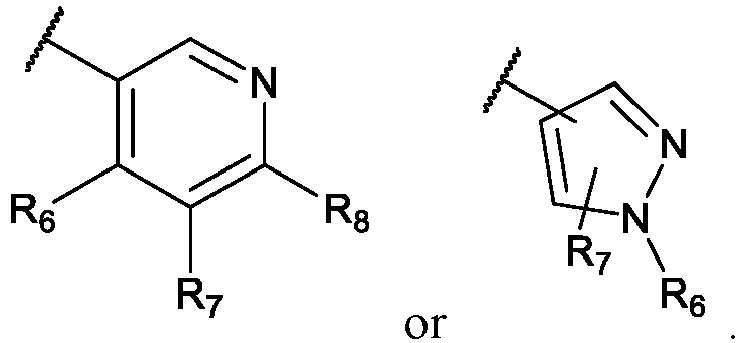
- In embodiments where all other variables are as defined in any embodiment above, wherein R1 is:

- In some embodiments, R6, R7, and R8 are each independently selected from the group consisting of:
- i. branched or linear C1-6 alkyl, C1-6 alkenyl, C1-6 alkenylene, and C3-9 cycloalkyl, wherein said alkyl, alkenyl, alkenylene, and cycloalkyl are optionally substituted with one to four substituents independently selected from the group consisting of hydroxyl, halogen, -CHF2, -CF3, amino, di(C1-6 alkyl)amino, mono(C1-6 alkyl)amino, cyano, C3-7 cycloalkyl, C1-6 alkoxy, -S(O)R', -SO2R', -SO2NR'R", -C(O)NR'R", and -NR'C(O)R", wherein R' and R" are independently H or C1-6 alkyl;
- ii. NRaRb-C(O)-, wherein, Ra and Rb are each independently hydrogen or C1-6 alkyl, wherein said alkyl can optionally be substituted with hydroxyl, halogen, -CHF2, or -CF3;
- iii. C1-6 alkoxy;
- iv. halogen;
- v. cyano;
- vi. hydroxyl;
- vii. amino;
- viii. di(C1-6 alkyl)amino;
- ix. mono(C1-6 alkyl)amino;
- x. -NRcC(O)Rd, wherein Rc and Rd are independently H or C1-6 alkyl;
- xi. -CF3;
- xii. -CHF2;
- xiii. -SO2R', wherein R' is H or C1-6 alkyl;
- xiv. -SO2NR'R", wherein R' and R" are independently H or C1-6 alkyl;
- xv. C(O)NRcRd; wherein Rc and Rd are independently H or C1-6 alkyl;
- xvi. -C(O)ORe; wherein Re is H, C1-6 alkyl, or CH2-aryl;
- xvii. C3-5 heterocyclyl, C6-10 aryl, -(C1-6 alkyl)(C6-10 aryl), or C2-9 heteroaryl, wherein said heterocyclyl, aryl, or heteroaryl can be optionally substituted with C1-6 alkyl, C6-10 aryl, or -C(O)ORe; wherein Re is H, C1-6 alkyl, or CH2-aryl;
- xviii. -O-(C2-9 heteroaryl);
- xix. -NR'S(O)k'R", wherein k' is 1 or 2 and R' and R" are independently H or C1-6 alkyl;
- wherein the C6-10 aryl, C2-9 heteroaryl or C2-9 heterocyclyl of R1 together with two of R6, R7, and R8 can form a bicyclic; and
- wherein a carbon embedded in said aryl, heteroaryl or heterocyclyl taken together with an oxygen to which it is bound can form a carbonyl.
- In some embodiments, one or more of R6, R7, and R8 are independently selected from the group consisting of branched or linear C1-6 alkyl, C1-6 alkenyl, C1-6 alkenylene, and C3-9 cycloalkyl, wherein said alkyl, alkenyl, alkenylene, and cycloalkyl are optionally substituted with one to four substituents independently selected from the group consisting of hydroxyl, halogen, -CHF2, -CF3, amino, di(C1-6 alkyl)amino, mono(C1-6 alkyl)amino, cyano, C3-7 cycloalkyl, optionally substituted C6-10 aryl, optionally substituted C2-9 heteroaryl, optionally substituted C2-9 heterocyclyl, C1-6 alkoxy, -S(O)R', -SO2R', -SO2NR‴R", -C(O)NR‴R", and -NR'C(O)R", -NR'C(O)OR", -NR'C(O)NR"R‴, -NR'SO2NR"R‴ or -NR'S(O)R", wherein R' and R‴ are independently H or C1-6 alkyl and R" is independently C1-6 alkyl, halo(C1-6 alkyl) or C6-10 aryl optionally substituted with C1-6 alkyl; or R" and R'" are taken together with the nitrogen to which they are attached to form a substituted or unsubstituted heterocyclyl. In some embodiments, one or more of R6, R7, and R8 are independently C1-6 haloalkyl (e.g., CHF2 or CF3).
- In some embodiments, one or more of R6, R7, and R8 are independently -C(O)NRaRb, -NRcC(O)Rd, -C(O)ORe; -NRcC(O)ORe; -NRcC(O)RaRb; wherein Ra and Rb are each independently hydrogen, optionally substituted C1-6 alkyl, optionally substituted C6-10 aryl, optionally substituted C2-9 heterocyclyl, or optionally substituted C2-9 heteroaryl; or Ra and Rb are taken together with the nitrogen to which they are attached to form an optionally substituted heterocyclyl; wherein Rc and Rd are independently H, optionally substituted C1-6 alkyl, optionally substituted C6-10 aryl, optionally substituted C2-9 heterocyclyl, or optionally substituted C2-9 heteroaryl; wherein Re is H, C1-6 alkyl, or CH2-aryl. Examples of the optional substituents include, but are not limited to hydroxyl, halogen, -CHF2, and -CF3.
- In some embodiments, one or more of R6, R7, and R8 are independently selected from the group consisting of iii. halogen, cyano, hydroxyl, C1-6 alkoxy, amino, mono(C1-6 alkyl)amino, or di(C1-6 alkyl)amino.
- In some embodiments, one or more of R6, R7, and R8 are independently -SO2R', -SO2NR"R‴, -NR'SO2NR"R‴, -NR'S(O)R" or -NR'SO2R"; wherein R' and R‴ are independently H or optionally substituted C1-6 alkyl; and R" is independently C1-6 alkyl, halo(C1-6 alkyl) or C6-10 aryl optionally substituted with C1-6 alkyl; or R" and R'" are taken together with the nitrogen to which they are attached to form optionally substituted C2-9 heterocyclyl.
- In some embodiments, R1 is

- In some of these embodiments, R6 is C1-6 alkyl; R7 is hydrogen, amino, or mono(C1-6 alkyl)amino; and R8 is hydrogen, hydroxyl, or C1-6 alkoxy; or R6 and R7 together form a bicyclic; or R7 and R8 together form a bicyclic. In some embodiments, R6 is methyl. In some embodiments, R7 is amino. In some embodiments, R6 is methyl and R7 is amino.
- In some embodiments, R1 is

- In embodiments where all other variables are as defined in any embodiment above, R1 is

- In embodiments where all other variables are as defined in any embodiment above, R6 is methyl.
- In some embodiments, R1 is


- In embodiments where all other variables are as defined in any embodiment above, R2 is -A-C(O)-. In some embodiments, A is optionally substituted C1-6 alkyl, optionally substituted C3-9 cycloalkyl, optionally substituted C6-10 aryl, optionally substituted C2-9 heteroaryl, optionally substituted C2-9 heterocyclyl, -NRgRh or -ORh.
- In some embodiments, A is:
- i. (C3-7 cycloalkyl)(C1-6 alkyl)j- or (C2-9 heterocyclyl)(C1-6 alkyl)j-, wherein, j is 1 or 0; and wherein said cycloalkyl or heterocyclyl can be optionally substituted with one, two, three or four of R5, wherein R5, in each instance, is independently selected from the group consisting of branched or linear C1-6 alkyl, halogen, cyano, cyano(C1-6 alkyl)-, -CF3, -CHF2, hydroxy(C1-6 alkyl), halo(C1-6 alkyl), hydroxyl, (C1-6 alkyl)-O-(C1-6 alkyl)-, -(C1-6 alkyl)-NHC(O)-(C1-6 alkyl), amino, -NR'C(O)R", acetyl, di(C1-6 alkyl)amino, mono(C1-6 alkyl)amino, amino(C1-6 alkyl), C1-6 alkoxy, CH3CO2-(C1-6 alkyl)-, -NR'SO2R", -SO2R', -SO2NR'R", -C(O)NR'R", - NR'C(O)R", optionally substituted C2-9 heteroaryl, optionally substituted C2-9 heterocyclyl, optionally substituted C6-10 aryl, optionally substituted C3-9 cycloalkyl-C(O)-, and NReRf-C(O)-(C1-6 alkyl)k-,
- wherein said C2-9 heteroaryl, C2-9 heterocyclyl, and C6-10 aryl can be optionally substituted with C1-6 alkyl or (C1-6 alkyl)-O-(C1-6 alkyl)-, wherein said (C1-6 alkyl)-O-(C1-6 alkyl)- may be optionally substituted with amino,
- wherein, in each instance, R' and R" are independently H or C1-6 alkyl,
- wherein Re and Rf are each independently selected from the group consisting of hydrogen and branched or linear C1-6 alkyl, or Re and Rf together with the nitrogen to which each is bound can form a C3-7 cycloalkyl, which can be optionally substituted with branched or linear C1-6 alkyl, C3-4 cycloalkyl, halogen, cyano, -CF3, -CHF2, or hydroxyl;
- and k is 1 or 0;
- or, said cycloalkyl or heterocyclyl together with two of R5 form a bicyclic or spiro ring, wherein two of R5 attached to different carbons are taken together with the carbon to which each is attached to form a bicyclic, or two of R5 attached to the same carbon are taken together with the carbon to which each is attached to form a spiro ring, wherein said bicyclic or spiro rings may be substituted with one, two, three or four of R5 as described above;
- ii. -NRgRh, wherein
- Rg is H or branched or linear C1-6 alkyl, wherein said alkyl can be optionally substituted with one to four substituents independently selected from the group consisting of hydroxyl, halogen, cyano, amino, di(C1-6 alkyl)amino, mono(C1-6 alkyl)amino; -CHF2, and -CF3;
- Rh is selected from the group consisting of
- a. branched or linear C1-6 alkyl, wherein said alkyl can be optionally substituted with hydroxyl, halogen, cyano, amino, di(C1-6 alkyl)amino, mono(C1-6 alkyl)amino, -CHF2, -CF3, or NRe'Rf'-C(O)-, wherein Re' and Rf' are each independently hydrogen or branched or linear C1-6 alkyl;
and, - b. (C3-7 cycloalkyl)(C1-6 alkyl)m-, (C2-9 heteroaryl)(C1-6 alkyl)m-, (C6-10 aryl)(C1-6 alkyl)m- or (C2-9 heterocyclyl)(C1-6 alkyl)m-, wherein, m is 1 or 0; and wherein said cycloalkyl, heteroaryl, aryl or heterocyclyl can be optionally substituted with one or two of R5',
- a. branched or linear C1-6 alkyl, wherein said alkyl can be optionally substituted with hydroxyl, halogen, cyano, amino, di(C1-6 alkyl)amino, mono(C1-6 alkyl)amino, -CHF2, -CF3, or NRe'Rf'-C(O)-, wherein Re' and Rf' are each independently hydrogen or branched or linear C1-6 alkyl;
- wherein Ri and Rj are independently selected from the group consisting of hydrogen and branched or linear C1-6 alkyl, and k' is 1 or 0;
- iii. R9-(C1-6 alkyl)-, wherein R9 is selected from the group consisting of hydroxyl, halogen, -CHF2, -CF3, cyano, C1-6 alkoxy, -NRoRp, NRo'Rp'-C(O)-; wherein Ro, Rp, Ro' and Rp' are each independently hydrogen or branched or linear C1-6 alkyl;
- iv. B-(C1-6 alkyl)t-, wherein, B is C3-9 heteroaryl or C3-7 heterocyclyl, wherein, said heteroaryl or heterocyclyl has 1-3 heteroatoms selected from O, S and N; and wherein said heteroaryl or heterocyclyl can be optionally substituted with one, two or three of R10, R10' and R10", each of which is independently selected from the group consisting of
- a. branched or linear C1-6 alkyl or C3-4 cycloalkyl, wherein said alkyl or cycloalkyl can be optionally substituted with hydroxyl, halogen, -CHF2, -CF3, amino, di(C1-6 alkyl)amino, mono(C1-6 alkyl)amino, cyano, -C(O)NRqRr or -NRqC(O)Rr, wherein Rq and Rr are independently H or C1-6 alkyl;
- b. C3-7 cycloalkyl;
- c. C3-7 heterocyclyl;
- d. hydroxyl;
- e. halogen;
- f. -CHF2;
- g. -CF3;
- h. amino;
- i. di(C1-6 alkyl)amino;
- j. mono(C1-6 alkyl)amino;
- k. cyano;
- l. - C(O)NRsRt, wherein Rs and Rt are independently H or C1-6 alkyl; and
- m. - NRsC(O)Rt, wherein Rs and Rt are independently H or C1-6 alkyl;
- v. (C6-10 aryl)q'-(C1-6 alkyl)n-O- or (C2-7 heterocyclyl)-O-, wherein, said aryl or heterocyclyl can be optionally substituted with one, two or three of R11, R12 and R13, each of which is selected from the group consisting of branched or linear C1-6 alkyl, hydroxyl, halogen, -CHF2, -CF3, cyano, C1-6 alkoxy, acetyl, and NRuRv-; wherein Ru and Rv are each independently H or branched or linear C1-6 alkyl; wherein, if present, a sulfur embedded in said heterocyclyl taken together with one oxygen can form a sulfoxide, or taken together with two oxygens can form a sulfone;
and, n is 1 or 0, q' is 1 or 0, provided that one of n and q' is 1;
or - vi. branched or linear C1-6 alkyl, C1-6 alkenyl, C1-6 alkenylene, wherein said alkyl, alkenyl, and alkenylene, can be optionally substituted with hydroxyl, halogen, -CHF2, -CF3, amino, di(C1-6 alkyl)amino, mono(C1-6 alkyl)amino, cyano, C3-7 cycloalkyl, C1-6 alkoxy, - SO2R', -SO2NR'R", -C(O)NR'R", or -NR'C(O)R", wherein R' and R" are independently H or C1-6 alkyl.
- In some embodiments, A is (C3-7 cycloalkyl)(C1-6 alkyl)j- or (C2-9 heterocyclyl)(C1-6 alkyl)j-, wherein, j is 1 or 0; and wherein said cycloalkyl or heterocyclyl can be optionally substituted with one, two, three or four of R5,
- wherein R5, in each instance, is independently selected from the group consisting of branched or linear C1-6 alkyl, halogen, cyano, cyano(C1-6 alkyl)-, -CF3, -CHF2, hydroxy(C1-6 alkyl), halo(C1-6 alkyl), hydroxyl, (C1-6 alkyl)-O-(C1-6 alkyl)-, -(C1-6 alkyl)-NHC(O)-(C1-6 alkyl), amino, -NR'C(O)R", acetyl, di(C1-6 alkyl)amino, mono(C1-6 alkyl)amino, amino(C1-6 alkyl), C1-6 alkoxy, CH3CO2-(C1-6 alkyl)-, -NR'SO2R", -SO2R', -SO2NR'R", -C(O)NR'R", - NR'C(O)OR", -NR'C(O)NR'R", optionally substituted C2-9 heteroaryl, optionally substituted C2-9 heterocyclyl, optionally substituted C6-10 aryl, optionally substituted C3-9 cycloalkyl, optionally substituted C3-9 cycloalkyl-C(O)-, and NReRf-C(O)-(C1-6 alkyl)k-;
- wherein said C2-9 heteroaryl, C2-9 heterocyclyl, and C6-10 aryl can be optionally substituted with C1-6 alkyl or (C1-6 alkyl)-O-(C1-6 alkyl)-, wherein said (C1-6 alkyl)-O-(C1-6 alkyl)- may be optionally substituted with amino,
- wherein, in each instance, R' and R" are independently H or C1-6 alkyl, wherein Re and Rf are each independently selected from the group consisting of hydrogen and branched or linear C1-6 alkyl, or Re and Rf together with the nitrogen to which each is bound can form a C3-7 cycloalkyl, which can be optionally substituted (e.g., with branched or linear C1-6 alkyl, C3-4 cycloalkyl, halogen, cyano, -CF3, -CHF2, or hydroxyl);
- and k is 1 or 0;
- or, said cycloalkyl or heterocyclyl together with two of R5 form a bicyclic or spiro ring, wherein two of R5 attached to different carbons are taken together with the carbon to which each is attached to form a bicyclic, or two of R5 attached to the same carbon are taken together with the carbon to which each is attached to form a spiro ring, wherein said bicyclic or spiro rings may be substituted with one, two, three or four substituents (e.g., R5 as described above when not taken together).
- In some embodiments, A is -NRgRh or -ORh, wherein Rg is H or optionally substituted C1-6 alkyl; and Rh is optionally substituted C1-6 alkyl, optionally substituted C3-9 cycloalkyl, optionally substituted C6-10 aryl, optionally substituted C2-9 heteroaryl, or optionally substituted C2-9 heterocyclyl.
- In some embodiments, the C1-6 alkyl of Rg is optionally substituted with one to four substituents independently selected from the group consisting of hydroxyl, halogen, cyano, amino, di(C1-6 alkyl)amino, mono(C1-6 alkyl)amino; -CHF2, and -CF3.
- Examples of Rh include, but are not limited to,
- a. branched or linear C1-6 alkyl, wherein said alkyl can be optionally substituted with hydroxyl, halogen, cyano, amino, di(C1-6 alkyl)amino, mono(C1-6 alkyl)amino, -CHF2, -CF3, -S(O)R', -SO2R', -SO2NR‴R", -C(O)NR‴R", -NR'C(O)R", -NR'C(O)OR", -NR'C(O)NR"R‴, -NR'SO2NR"R‴ or -NR'S(O)R", wherein R' and R‴ are independently H or C1-6 alkyl and R" is independently C1-6 alkyl, halo(C1-6 alkyl) or C6-10 aryl optionally substituted with C1-6 alkyl; or R" and R'" are taken together with the nitrogen to which they are attached to form a substituted or unsubstituted heterocyclyl; and
- b. (C3-7 cycloalkyl)(C1-6 alkyl)m-, (C2-9 heteroaryl)(C1-6 alkyl)m-, (C6-10 aryl)(C1-6 alkyl)m- or (C2-9 heterocyclyl)(C1-6 alkyl)m-, wherein, m is 1 or 0; and wherein said cycloalkyl, heteroaryl, aryl or heterocyclyl can be optionally substituted with one or two of R5'; wherein R5', in each instance, is independently selected from the group consisting of branched or linear C1-6 alkyl, halogen, cyano, cyano(C1-6 alkyl)-, -CF3, -CHF2, hydroxy(C1-6 alkyl), halo(C1-6 alkyl), hydroxyl, C1-6 alkoxy, amino, amino(C1-6 alkyl), and NRiRj-C(O)-(C1-6 alkyl)k'-; wherein Ri and Rj are independently selected from the group consisting of hydrogen and branched or linear C1-6 alkyl, and k' is 1 or 0.
- In some embodiments, A is (C3-7 cycloalkyl)(C1-6 alkyl)j-, (C2-9 heterocyclyl)(C1-6 alkyl)j-, (C6-10 aryl)q'-(C1-6 alkyl)n-O-, or (C2-7 heterocyclyl)-O-, wherein said cycloalkyl, alkyl, aryl or heterocyclyl can be optionally substituted; j is 1 or 0; and n is 1 or 0 and q' is 1 or 0, provided that one of n and q' is 1. In some embodiments, A is optionally substituted C3-7 cycloalkyl (e.g., cyclopropyl).
- In embodiments where all other variables are as defined in any embodiment above, A is i (as listed above). In this embodiment, useful values of A include optionally substituted C3-7 cycloalkyl(C1-6)jalkyl-. In embodiments, j is 0.
- In some embodiments, R2 is:

- In embodiments where all other variables are as defined in any embodiment above, R2 is:

- In embodiments where all other variables are as defined in any embodiment above,
R2 is
R5, in each instance, is independently selected from the group consisting of C1-6 alkyl, halogen, cyano, cyano(C1-6 alkyl)-, -CF3, -CHF2, hydroxy(C1-6 alkyl), halo(C1-6 alkyl), hydroxyl, (C1-6 alkyl)-O-(C1-6 alkyl)-, -(C1-6 alkyl)-NHC(O)-(C1-6 alkyl), amino, -NR'C(O)R", acetyl, di(C1-6 alkyl)amino, mono(C1-6 alkyl)amino, amino(C1-6 alkyl), C1-6 alkoxy, CH3CO2-(C1-6 alkyl)-, -NR'SO2R", -SO2R', -SO2NR'R", -C(O)NR'R", -NR'C(O)OR", -NR'C(O)NR'R", optionally substituted C2-9 heteroaryl, optionally substituted C2-9 heterocyclyl, optionally substituted C6-10 aryl, optionally substituted C3-9 cycloalkyl, optionally substituted C3-9 cycloalkyl-C(O)-, and NReRf-C(O)-(C1-6 alkyl)k-, - wherein said C2-9 heteroaryl, C2-9 heterocyclyl, and C6-10 aryl can be optionally substituted with C1-6 alkyl or (C1-6 alkyl)-O-(C1-6 alkyl)-, wherein said (C1-6 alkyl)-O-(C1-6 alkyl)- may be optionally substituted with amino,
- wherein, in each instance, R' and R" are independently H or C1-6 alkyl,
- wherein Re and Rf are each independently selected from the group consisting of hydrogen and branched or linear C1-6 alkyl, or Re and Rf together with the nitrogen to which each is bound can form a C3-7 cycloalkyl, which can be optionally substituted (e.g., with branched or linear C1-6 alkyl, C3-4 cycloalkyl, halogen, cyano, -CF3, -CHF2, or hydroxyl);
- and k is 1 or 0.
- In embodiments where all other variables are as defined in any embodiment above, R2 is and v is zero, one or two:

- In embodiments where all other variables are as defined in any embodiment above, R2 is:

- In embodiments where all other variables are as defined in any embodiment above, R5 is other than hydrogen and R2 is:

- In embodiments where all other variables are as defined in any embodiment above, R2 is:

- In embodiments where all other variables are as defined in any embodiment above, R5 is other than hydrogen and R2 is:

- In embodiments where all other variables are as defined in any embodiment above, when A is a cycloalkyl, the cycloalkyl can be bicyclic, spiro or unsaturated.
- In embodiments where all other variables are as defined in any embodiment above, R5 is selected from the group consisting of hydrogen, fluorine, cyano, NH2-C(O)-, alkyl-(C1-6)alkoxy-, optionally substituted C2-9 heteroaryl, and cyano(C1-6)alkyl. In these embodiments, R5 is fluoro or cyano. In these embodiments, R5 is hydrogen. In these embodiments, R5 is optionally substituted C2-9 heteroaryl or cyano(C1-6)alkyl. In these embodiments, R5 is cyano-CH2-. In some embodiments, at least one R5 is C1-6 alkyl (e.g., methyl).
- In embodiments where all other variables are as defined in any embodiment above, the compound wherein at least one R5 is optionally substituted C2-9 heteroaryl.
- In embodiments where all other variables are as defined in any embodiment above, the compound wherein the at least one R5 is optionally substituted C2-9 heteroaryl is an optionally substituted 5-member heteroaryl containing 1 or 2 nitrogen atoms.
- In embodiments where all other variables are as defined in any embodiment above, the compound wherein the optionally substituted 5-member heteroaryl is an optionally substituted pyrazole.
- In embodiments where all other variables are as defined in any embodiment above, the compound wherein the optionally substituted pyrazole is

- In embodiments where all other variables are as defined in any embodiment above, the compound wherein RB1 is optionally substituted linear C1-6 alkyl.
- In embodiments where all other variables are as defined in any embodiment above, the compound wherein the optionally substituted linear C1-6 alkyl is methyl.
- In some embodiments, R2 is

- In some embodiments, R2 is
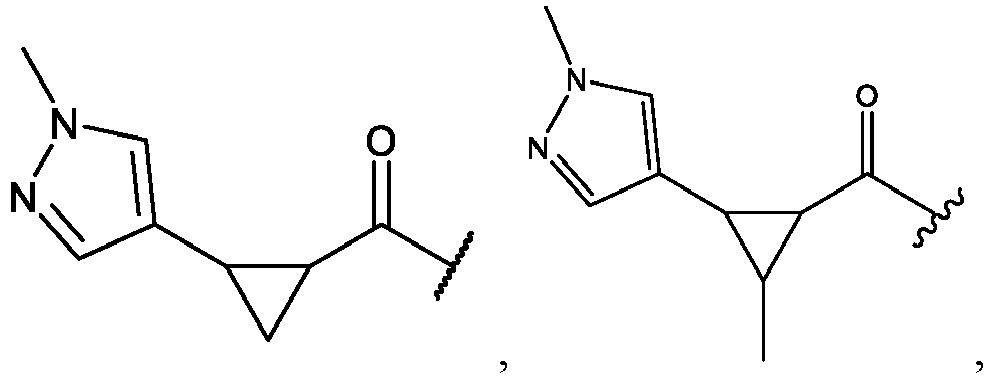


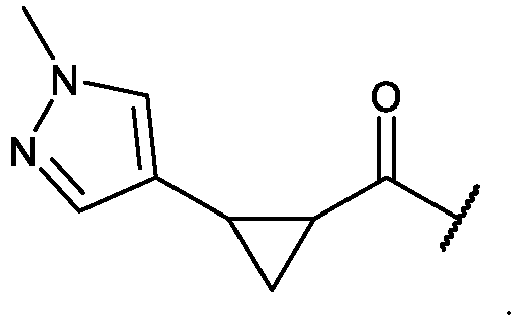


- In embodiments where all other variables are as defined in any embodiment above, A is -NRgRh. In these embodiments, Rg is H or methyl. In particular embodiments, Rg is H. In particular embodiments, m is 0.
- In embodiments where all other variables are as defined in any embodiment above, A is R9-(C1-6 alkyl)-. In these embodiments, particular values of R9-(C1-6 alkyl)- is R9-(C1-4 alkyl)-, wherein the alkyl is linear or branched and can be optionally substituted.
- In embodiments where all other variables are as defined in any embodiment above, A is B-(C1-6 alkyl)t-. In these embodiments, a particular value of t is 0. In these embodiments, a particular value of B is C3-9 heteroaryl. In these embodiments, B is selected from the group consisting of


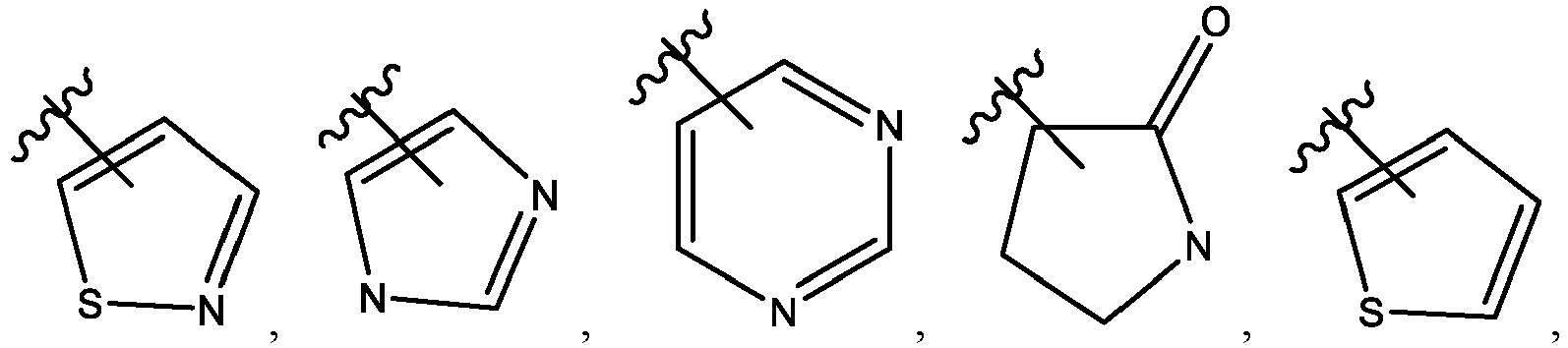


- In embodiments where all other variables are as defined in any embodiment above, useful values of B are selected from the group consisting of

- In embodiments where all other variables are as defined in any embodiment above, B is selected from the group consisting of

- In embodiments where all other variables are as defined in any embodiment above, B is:

- In embodiments where all other variables are as defined in any embodiment above, R2 is D. In some embodiments, D is:
- i. (C6-10 aryl)(C1-6 alkyl)z-, (C3-7 cycloalkyl)(C1-6 alkyl)z-, or (C3-9 heteroaryl)(C1-6 alkyl)z-, wherein, said heteroaryl has 1-4 heteroatoms selected from O, S and N; and wherein said aryl, cycloalkyl or heteroaryl can be optionally substituted with one, two,three or four of R14, R15, R16' and R16, each of which is independently selected from the group consisting of:
- a. branched or linear C1-6 alkyl or C2-6 alkenyl, wherein said alkyl or alkenyl can be optionally substituted with one to four substituents independently selected from the group consisting of hydroxyl, halogen, -CHF2, -CF3, amino, di(C1-6 alkyl)amino, mono(C1-6 alkyl)amino, cyano C1-6alkoxy, -SO2R', -SO2NR'R", -NR"SO2R', haloalkyl, heteroaryl, aryl, oxo, spiro alkyl, fused alkyl,-C(O)NRwRx, and - NRwC(O)Rx, wherein Rw and Rx are independently H or C1-6 alkyl, or taken together to form a ring; wherein two of R14, R15, R16 and R16 attached to different atoms are taken together with the atom to which each is attached to form a bicyclic or tricyclic, wherein said bicyclic or tricyclic may be substituted with one, two, three or four of R14, R15, R16' and R16 as described above;
- b. C3-7 cycloalkyl;
- c. optionally substituted C3-7 heterocyclyl, [e.g., heterocyclyl can be optionally substituted by hydroxyl, acetyl, or oxetane];
- d. hydroxyl;
- e. halogen;
- f. -CHF2;
- g. -CF3;
- h. amino;
- i. di(C1-6 alkyl)amino;
- j. mono(C1-6 alkyl)amino;
- k. cyano;
- l. -NRyC(O)Rz or -NRySO2Rz, wherein Ry and Rz are independently H or C1-6 alkyl, or taken together to form a ring;
- m. -C(O)NRyRz, wherein Ry and Rz are independently H or C1-6 alkyl, or taken together to form a ring;
- n. -SO2NRyRz, wherein Ry and Rz are independently H or C1-6 alkyl; and
- o. -C(O)ORy, wherein Ry is H or C1-6 alkyl, or taken together to form a ring;
- ii. C3-7 cycloalkyl-SO2-, wherein said cycloalkyl can be optionally substituted with one or two of R6', wherein R6', in each instance, is independently selected from the group consisting of branched or linear C1-6 alkyl, halogen, cyano, -CF3, -CHF2, hydroxy(C1-6 alkyl), halo(C1-6 alkyl), hydroxyl, (C1-6 alkyl)-O-(C1-6 alkyl)-, C1-6 alkoxy, amino, di(C1-6 alkyl)amino, mono(C1-6 alkyl)amino, amino(C1-6 alkyl), and NRe'Rf'-C(O)-(C1-6 alkyl)n-, wherein Re' and Rf' are independently selected from the group consisting of hydrogen and branched or linear C1-6 alkyl, and n is 1 or 0; and
- iii. H, optionally substituted C1-6 alkyl (e.g., haloalkyl) or optionally substituted C3-9 cycloalkyl, optionally substituted C6-10 aryl, optionally substituted C2-9 heteroaryl, or optionally substituted C2-9 heterocyclyl (e.g. pyrrolidine).
- In some embodiments, D is C3-9 heteroaryl-(C1-6 alkyl)z-. In these embodiments, a particular value of z is 0. In these embodiments, particular values of the heteroaryl are:


- In embodiments where all other variables are as defined in any embodiment above, useful values of D are selected from the group consisting of

- In embodiments where all other variables are as defined in any embodiment above, useful values of D are selected from the group consisting of

- In embodiments where all other variables are as defined in any embodiment above, the heteroaryl of D is


- In some of these embodiments, each of R14, R15, and R16 is independently selected from the group consisting of
- a. branched or linear C1-6 alkyl, wherein said alkyl can be optionally substituted with hydroxyl, halogen, -CF2, -CF3, amino, di(C1-6)alkylamino, mono(C1-6)alkylamino, cyano C1-6 alkoxy, -SO2R', -SO2NR'R", -(CO)NRwRx, or - NRw(CO)Rx, wherein Rw and Rx are independently H or C1-6 alkyl, or wherein two of R14, R15, and R16, as described herein, when attached to different atoms are taken together with the atom to which each is attached to form a bicyclic;
- b. C3-7 cycloalkyl;
- c. C3-7 heterocyclyl;
- d. hydroxyl;
- e. halogen;
- f. -CF2;
- g. -CF3;
- h. amino;
- i. di(C1-6)alkylamino;
- j. mono(C1-6)alkylamino;
- k. cyano;
- l. -NRy(CO)Rz, wherein Ry and Rz are independently H or C1-6 alkyl;
- m. -(CO)NRyRz, wherein Ry and Rz are independently H or C1-6 alkyl;
- n. -SO2NRyRz, wherein Ry and Rz are independently H or C1-6 alkyl; and
- o. -(CO)ORy, wherein Ry is H or C1-6 alkyl;
- In some of these embodiments, two of R14, R15, and R16 attached to different atoms are taken together with the atom to which each is attached to form a bicyclic or tricyclic. In some embodiments, D is a bicyclic (or tricyclic where further ring fusion is present) which is

- In some embodiments, D is a bicyclic which is

- In embodiments where all other variables are as defined in any embodiment above, the heteroaryl of D is:

- In embodiments where all other variables are as defined in any embodiment above, the compound wherein D is optionally substituted C6-10 aryl.
- In embodiments where all other variables are as defined in any embodiment above, the compound wherein the optionally substituted C6-10 aryl is an optionally substituted phenyl.
- In embodiments where all other variables are as defined in any embodiment above, the compound wherein the optionally substituted phenyl is substituted with an optionally substituted branched or linear C1-6 alkyl or a C3-7 heterocyclyl.
- In embodiments where all other variables are as defined in any embodiment above, the compound wherein D is is a 5-membered heteroaryl having the formula


- Q is NR20, CR20, O or S;
- each T is independently N or CR21;
- each Z is independently N or C, provided that only one Z is N;
- each R20 and R21 is independently hydrogen, alkyl, haloalkyl, alkoxy, halogen, hydroxy, or cyano; and
- R22 and R23 are taken together with the atoms to which they are attached to form a bicyclic; wherein the bicyclic may contain one or more heteroatoms selected from N, S and O; and wherein the bicyclic is optionally substituted with one, two, three, four or five R30;
- wherein each R30 is independently C1-6 alkyl, C2-6 alkenyl, C3-7 cycloalkyl, C3-7 heterocyclyl, halogen, cyano, oxo, -NR31R32, -SO2NR31R32, -C(O)NR31R32, -C(O)OR33, -OR33, -NR33C(O)R34, -NR33SO2R35 or -SO2R35; wherein the C1-6 alkyl, C2-6 alkenyl, C3-7 cycloalkyl and C3-7 heterocyclyl of R30 are optionally substituted with one to four R40; or two R30 groups are taken together with the parent moiety to with they are attached to form a ring which is optionally substituted with one to four R40;
- each R31 and R32 is independently hydrogen or C1-6 alkyl; or R31 and R32 are taken together with the nitrogen atom to which they are attached to form a C3-7 heterocyclyl optionally substituted with one to four R40;
- each R33 and R34 are independently hydrogen or C1-6 alkyl;
- R35 is C1-6 alkyl;
- each R40 is independently selected from the group consisting of halogen, cyano, oxo, -NR41R42, -SO2NR41R42, -C(O)NR41R42, -C(O)OR43, -OR43, -NR43C(O)R44, -NR43SO2R45 or -SO2R45; C1-6 alkyl, C1-6 haloalkyl [e.g., -CHF2, or -CF3], C2-9 heteroaryl, C6-10 aryl, oxo; or two R40 groups are taken together with the parent moiety to with they are attached to form a ring which is optionally substituted with one to three substituents selected from C1-6 alkyl, C1-6 haloalkyl, hydroxyl and oxo;
- each R41 and R42 is independently hydrogen or C1-6 alkyl; or R41 and R42 are taken together with the nitrogen atom to which they are attached to form a C3-7 heterocyclyl optionally substituted with one to three substituents selected from C1-6 alkyl, C1-6 haloalkyl, hydroxyl and oxo;
- each R43 and R44 are independently hydrogen or C1-6 alkyl; and
- R45 is C1-6 alkyl.
- In some embodiments, D is:

- In some embodiments, D is:

- In some embodiments, D is:

- In some embodiments, wherein D is

- In some embodiments, wherein D is

- In some embodiments, wherein D is

- In some embodiments, wherein D is

- In some embodiments, wherein D is

- In some embodiments, wherein D is

- In some embodiments, wherein D is

- In embodiments where all other variables are as defined in any embodiment above, the compound wherein R1' is optionally substituted C2-9 heteroaryl.
- In embodiments where all other variables are as defined in any embodiment above, the compound wherein the optionally substituted C2-9 heteroaryl is an optionally substituted 5-member heteroaryl containing 1 or 2 nitrogen atoms.
- In embodiments where all other variables are as defined in any embodiment above, the compound wherein the 5-member heteroaryl is a pyrazole.
- In embodiments where all other variables are as defined in any embodiment above, the compound wherein R1' is halogen.
- In embodiments where all other variables are as defined in any embodiment above, the compound wherein the halogen is fluoro or chloro.
- In embodiments where all other variables are as defined in any embodiment above, the compound wherein R1' is optionally substituted C1-6 alkyl, C2-6 alkenyl, or C3-6 cycloalkyl.
- In embodiments where all other variables are as defined in any embodiment above, the compound wherein R1' is optionally substituted C1-6 alkyl.
- In embodiments where all other variables are as defined in any embodiment above, the compound wherein R1' is optionally substituted methyl or ethyl.
- In embodiments where all other variables are as defined in any embodiment above, the compound wherein R1' is methyl.
- In embodiments where all other variables are as defined in any embodiment above, the compound wherein R1 is optionally substituted C6-10 aryl.
- In embodiments where all other variables are as defined in any embodiment above, the compound wherein the optionaly substituted C6-10 aryl is optionially substituted phenyl.
- In embodiments where all other variables are as defined in any embodiment above, the compound wherein the optionally substituted phenyl is substituted with optionally substituted branched or linear C1-6 alkyl, C1-6 alkoxy, halogen, cyano, hydroxyl, amino, -CF3, or -(CO)NRcRd; wherein Rc and Rd are as described above.
- In embodiments, where all other variables are as defined in any embodiment above, a compound including compound number 1, 2, 3, 4, 5, 6, 7, 8, 9, 10, 11, 12, 13, 14, 15, 16, 17, 18, 19, 20, 21, 22, 24, 25, 26, 27, 28, 29, 30, 31, 32, 33, 34, 35, 36, 37, 38, 39, 40, 42, 43, 44, 45, 46, 47, 48, 49, 50, 51, 52, 53, 54, 55, 56, 57, 58, 59, 60, 61, 62, 63, 64, 65, 66, 67, 68, 70, 71, 72, 73, 74, 75, 76, 77, 78, 79, 80, 81, 82, 83, 84, 85, 86, 87, 88, 89, 90, 91, 92, 93, 94, 96, 97, 98, 99, 100, 101, 102, 103, 104, 105, 106, 107, 108, 109, 110, 111, 112, 113, 114, 115, 116, 117, 118, 119, 120, 121, 122, 123, 124, 125, 126, 127, 128, 129, 130, 131, 132, 133, 134, 135, 136, 137, 138, 139, 140, 141, 142, 143, 144, 145, 146, 147, 148, 149, 150, 151, 152, 153, 154, 155, 156, 157, 158, 159, 160, 161, 162, 163, 164, 165, 166, 167, 168, 169, 170, 171, 172, 173, 174, 175, 176, 177, 178, 179, 180, 181, 182, 183, 184, 185, 186, 187, 188, 189, 190, 191, 192, 193, 194, 195, 196, 197, 198, 199, 200, 201, 202, 203, 204, 205, 206, 207, 208, 209, 210, 211, 212, 213, 214, 215, 216, 217, 218, 219, 220, 221, 222, 223, 224, 225, 226, 227, 228, 229, 230, 231, 232, 233, 234, 235, 236, 237, 238, 239, 240, 241, 242, 243, 244, 245, 246, 247, 248, 249, 250, 251, 252, 253, 254, 255, 256, 257, 258, 259, 260, 261, 262, 263, 264, 265, 266, 267, 268, 269, 270, 271, 272, 273, 274, 275, 276, 277, 278, 279, 280, 281, 282, 283, 284, 285, 286, 287, 288, 289, 290, 291, 292, 293, 294, 295, 296, 297, 298, 299, 300, 301, 302, 303, 304, 305, 306, 307, 308, 309, 310, 311, 312, 313, 314, 315, 316, 317, 318, 319, 320, 321, 322, 323, 324, 325, 326, 327, 328, 329, 330, 331, 332, 333, 334, 335, 336, 337, 338, 339, 340, 341, 342, 343, 344, 345, 346, 347, and 348.
- In some embodiments, the disclosure provides a compound of formula I or Ia, or a pharmaceutically acceptable salt thereof, wherein the compound is selected from the group consisting of one or more compounds in Table 1, Table 2 and Table 3. In some embodiments, the compound is selected from Compound Nos. 1-348 in Table 1, or a pharmaceutically acceptable salt thereof. In some embodiments, the compound is selected from Compound Nos. 349-429 in Table 2, or a pharmaceutically acceptable salt thereof. In some embodiments, the compound is selected from Compound Nos. 430-572 in Table 3, or a pharmaceutically acceptable salt thereof.
Table 1 Cmpd No. Structure Name 1 
cis-N-[8-amino-6-(4-methyl-3-pyridyl)-2,7-naphthyridin-3-yl]-2-fluoro-cyclopropanecarboxamide 
2 
cis-N-(8-amino-6-(1,5-dimethyl-1H-pyrazol-4-yl)-2,7-naphthyridin-3-yl)-2-fluorocyclopropanecarboxamide 
3 
cis-N-(8-amino-6-(1,3,5-trimethyl-1H-pyrazol-4-yl)-2,7-naphthyridin-3-yl)-2-fluorocyclopropanecarboxamide 
4 
cis-N-(8-amino-6-(1-methyl-1H-pyrazol-4-yl)-2,7-naphthyridin-3-yl)-2-fluorocyclopropanecarboxamide 
5 
trans-N-(8-amino-6-(4-ethylpyridin-3-yl)-2,7-naphthyridin-3-yl)-2-cyanocyclopropanecarboxamide 
6 
(1S,2S)-N-(8-amino-6-(4-methylpyridin-3-yl)-2,7-naphthyridin-3-yl)-2-fluorocyclopropanecarboxamide 7 
(1S,2S)-N-(8-amino-6-(1-methyl-1H-pyrazol-4-yl)-2,7-naphthyridin-3-yl)-2-fluorocyclopropanecarboxamide 8 
trans-N-(8-amino-6-(1-methyl-1H-pyrazol-4-yl)-2, 7-naphthyridin-3 -yl)-2-fluorocyclopropanecarboxamide 
9 
1-(8-amino-6-(1-methyl-1H-pyrazol-4-yl)-2,7-naphthyridin-3 -yl)-3 -methylurea 10 
(1S,2S)-N-(8-amino-6-(4-methoxypyridin-3-yl)-2,7-naphthyridin-3-yl)-2-fluorocyclopropanecarboxamide 11 
N-(8-amino-6-(4-methylpyridin-3-yl)-2,7-naphthyridin-3 -yl)-2,2-difluorocyclopropanecarboxamide 12 
(1S,2S)-N-(8-amino-6-(4-methylpyrimidin-5-yl)-2,7-naphthyridin-3-yl)-2-fluorocyclopropanecarboxamide 13 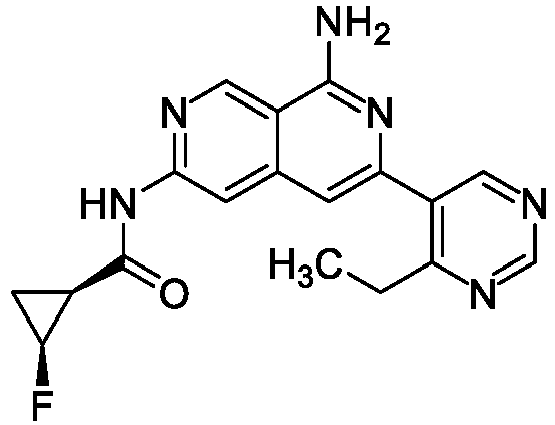
(1S,2S)-N-(8-amino-6-(4-ethylpyrimidin-5-yl)-2,7-naphthyridin-3-yl)-2-fluorocyclopropanecarboxamide 14 
(1S,2S)-N-(8-amino-6-(4-(difluoromethyl)pyridin-3-yl)-2,7-naphthyridin-3 -yl)-2-fluorocyclopropanecarboxamide 15 
(1S,2S)-N-(8-amino-6-(4-cyanopyridin-3-yl)-2,7-naphthyridin-3-yl)-2-fluorocyclopropanecarboxamide 16 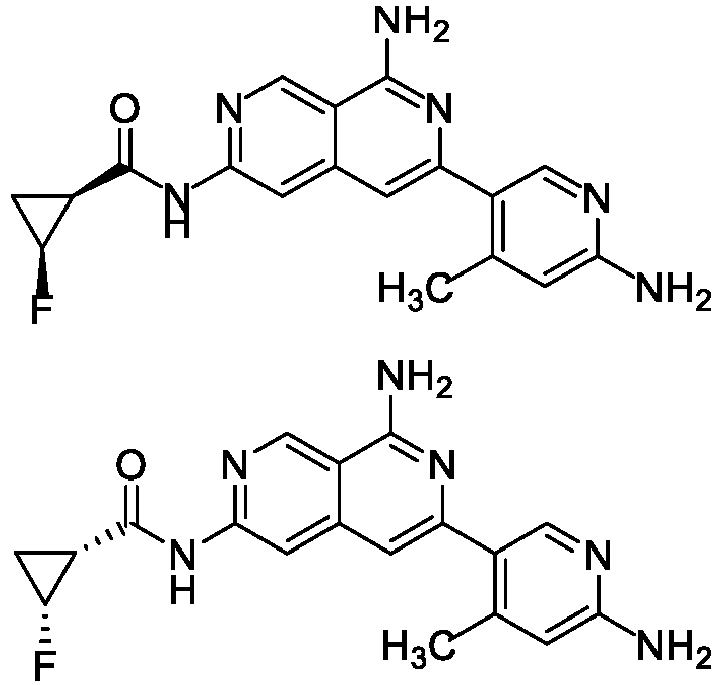
cis-N-(8-amino-6-(6-amino-4-methylpyridin-3-yl)-2,7-naphthyridin-3-yl)-2-fluorocyclopropanecarboxamide 17 
(1S,2S)-N-(8-amino-6-(5-fluoro-4-methylpyridin-3-yl)-2,7-naphthyridin-3-yl)-2-fluorocyclopropanecarboxamide 18 
(1S,2S)-N-(8-amino-6-(1-methyl-1H-pyrazol-5-yl)-2,7-naphthyridin-3-yl)-2-fluorocyclopropanecarboxamide 19 
cis-N-(8-amino-6-(6-methyl-1H-benzo [d]imidazol-5 -yl)-2,7-naphthyridin-3 - yl)-2-fluorocyclopropanecarboxamide 
20 
N-[8-amino-6-(4-ethyl-3-pyridyl)-2,7-naphthyridin-3 -yl] cyclobutanecarboxamide 21 
cis-N-(8-amino-6-(1H-pyrrolo[2,3-c]pyridin-4-yl)-2,7-naphthyridin-3-yl)-2-cyanocyclopropanecarboxamide 22 
cis-N-(8-amino-6-(3-methylpyridin-4-yl)-2,7-naphthyridin-3-yl)-2-fluorocyclopropanecarboxamide 
24 
N-(8-amino-6-(4-methylpyridin-3-yl)-2,7-naphthyridin-3-yl)cyclopropanecarboxamide 25 
N-(8-amino-6-(6-(hydroxymethyl)-4-methylpyridin-3-yl)-2,7-naphthyridin-3-yl)cyclopropanecarboxamide 26 
N-(8-amino-6-(4-ethylpyridin-3 -yl)-2, 7-naphthyridin-3-yl)cyclopropanecarboxamide 27 
N-[8-amino-6-(1-methylpyrazol-4-yl)-2,7-naphthyridin-3-yl]cyclopropanecarboxamide 28 
N-[8-amino-6-(4-ethyl-3-pyridyl)-2,7-naphthyridin-3 -yl] -3 -cyano-propanamide and N'-[8-amino-6-(4-ethyl-3-pyridyl)-2,7-naphthyridin-3 -yl]butanediamide 29 
N'-[8-amino-6-(4-ethyl-3-pyridyl)-2,7-naphthyridin-3 -yl]butanediamide 30 
1-[8-amino-6-(4-ethyl-3-pyridyl)-2,7-naphthyridin-3 -yl] -3 -(thiazol-5 - ylmethyl)urea 31 
1-[8-amino-6-(4-ethyl-3-pyridyl)-2,7-naphthyridin-3 -yl] -3 -isopropyl-urea 32 
N-[8-amino-6-(4-ethyl-3-pyridyl)-2,7-naphthyridin-3 -yl] -2-cyano-acetamide 33 
3-[8-amino-6-(4-ethyl-3-pyridyl)-2,7-naphthyridin-3-yl]-1,1-dimethyl-urea 34 
2-[[8-amino-6-(4-ethyl-3-pyridyl)-2,7-naphthyridin-3-yl]carbamoylamino]propanamide 
35 
N-(8-amino-6-(4-methylpyridin-3-yl)-2,7-naphthyridin-3 -yl)-2-cyano-2-methylpropanamide 36 
N-(8-amino-6-(4-methylpyridin-3-yl)-2,7-naphthyridin-3 -yl)-2-methoxy-2-methylpropanamide 37 
N-(8-amino-6-(4-methylpyridin-3-yl)-2,7-naphthyridin-3 -yl)isobutyramide 38 
N-(8-amino-6-(4-methylpyridin-3-yl)-2,7-naphthyridin-3 -yl)-2-cyanopropanamide 
39 
N-(8-amino-6-(4-methylpyridin-3-yl)-2,7-naphthyridin-3 -yl)-2-hydroxy-2-methylpropanamide 40 
N-(8-amino-6-(2-oxooxazolidin-3-yl)-2,7-naphthyridin-3 - yl)cyclopropanecarboxamide 42 
N-(8-amino-6-(2-oxo-1,2-dihydropyridin-3-yl)-2,7-naphthyridin-3-yl)cyclopropanecarboxamide 43 
trans-N-(8-amino-6-(4-methylpyridin-3-yl)-2,7-naphthyridin-3-yl)-2-cyanocyclopropanecarboxamide 
44 
(1S,2S)-N-(8-amino-6-(4-(hydroxymethyl)pyridin-3-yl)-2,7-naphthyridin-3 -yl)-2-fluorocyclopropanecarboxamide 45 
(1S,2S)-N-(8-amino-6-(2-ethylpyrrolidin-1-yl)-2,7-naphthyridin-3-yl)-2-fluorocyclopropanecarboxamide 46 
cis-N-(8-amino-6-(4-cyclopropylpyridin-3-yl)-2,7-naphthyridin-3-yl)-2-fluorocyclopropanecarboxamide 
47 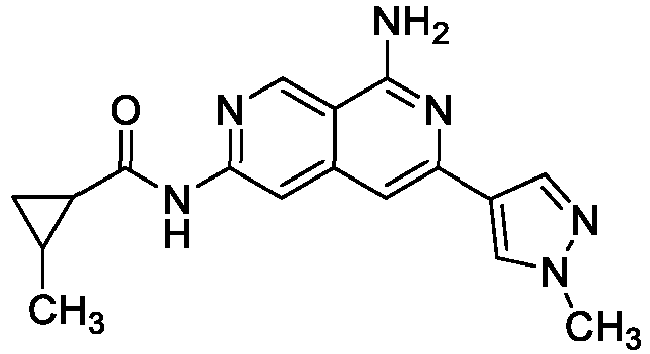
N-(8-amino-6-(1-methyl-1H-pyrazol-4-yl)-2,7-naphthyridin-3-yl)-2-methylcyclopropanecarboxamide (3:1 ratio of trans/cis) 48 
4-(1-amino-6-((cis)-2-fluorocyclopropanecarboxamido)-2,7-naphthyridin-3 -yl)-3 -methylbenzamide 
49 
4-(1-amino-6-((cis)-2-fluorocyclopropanecarboxamido)-2,7-naphthyridin-3-yl)-N,3-dimethylbenzamide 
50 
trans-N-(8-amino-6-(4-isopropylpyridin-3-yl)-2,7-naphthyridin-3-yl)-2-cyanocyclopropanecarboxamide 
51 
trans-N-(8-amino-6-(4-methylpyridin-3-yl)-2, 7-naphthyridin-3-yl)-2-fluorocyclopropanecarboxamide 
52 
cis-N-(8-amino-6-(7-methyl-1H-imidazo [4, 5-b] pyridin-6-yl)-2, 7-naphthyridin-3-yl)-2-fluorocyclopropanecarboxamide 
53 
trans-N-(8-amino-6-(4-ethylpyridin-3-yl)-2,7-naphthyridin-3-yl)-2-(methoxymethyl) cyclo propane carboxamide 
54 
cis-N-(8-amino-6-(2-(2-hydroxyethyl)pyrrolidin-1-yl)-2,7-naphthyridin-3 -yl)-2-fluorocyclopropanecarboxamide 
55 
cis-N-(8-amino-6-(2-methoxy-5-methylpyridin-4-yl)-2,7-naphthyridin-3-yl)-2-fluorocyclopropanecarboxamide 
56 
cis-N-[8-amino-6-(5-methyl-2-oxo-1H-pyridin-4-yl)-2,7-naphthyridin-3-yl]-2-fluoro-cyclopropanecarboxamide 
57 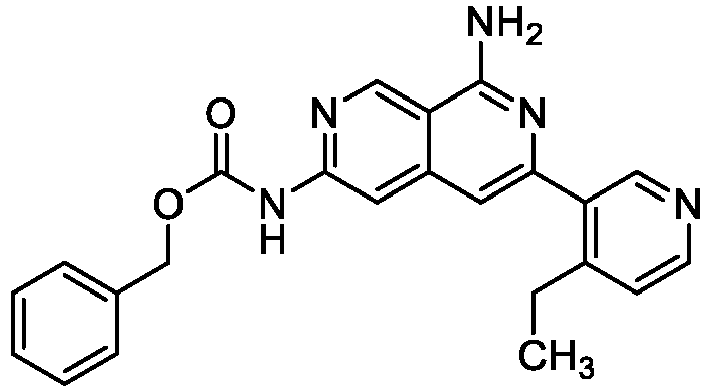
benzyl 8-amino-6-(4-ethylpyridin-3 -yl)-2, 7-naphthyridin-3 -ylcarbamate 58 
cis-N-(8-amino-6-(6-methyl-2-oxoindolin-5-yl)-2,7-naphthyridin-3-yl)-2-fluorocyclopropanecarboxamide 
59 
cis-N-(8-amino-6-(6-methyl-2-oxoindolin-5-yl)-2,7-naphthyridin-3-yl)-2-fluorocyclopropanecarboxamide 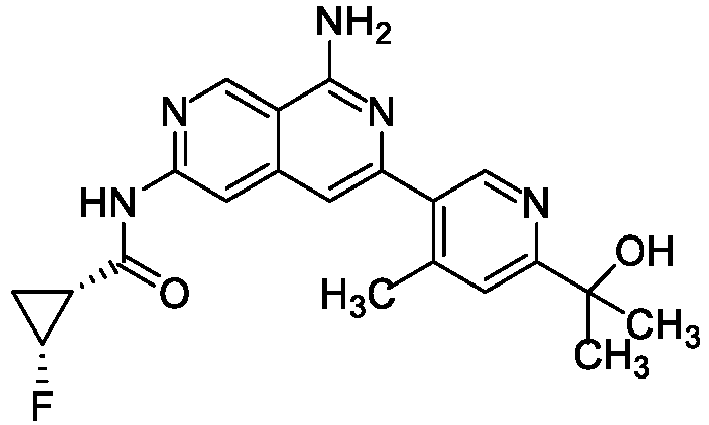
60 
cis-N-(8-amino-6-(4-ethylpyridin-3-yl)-2,7-naphthyridin-3 -yl)-2-cyanocyclopropanecarboxamide 
61 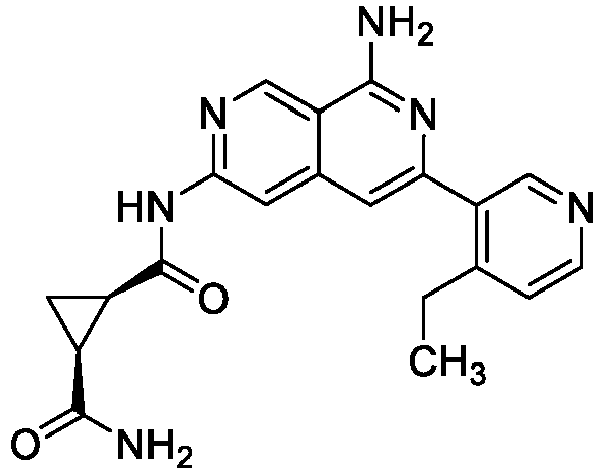
cis-N 1-(8-amino-6-(4-ethylpyridin-3-yl)-2,7-naphthyridin-3-yl)cyclopropane-1,2-dicarboxamide 
62 
cis-N-(8-amino-6-(2,4-dimethylpyridin-3-yl)-2,7-naphthyridin-3-yl)-2-fluorocyclopropanecarboxamide 
63 
cis-N-(8-amino-6-(1-methyl-1H-pyrrolo[3,2-c]pyridin-7-yl)-2,7-naphthyridin-3 -yl)-2-fluorocyclopropanecarboxamide 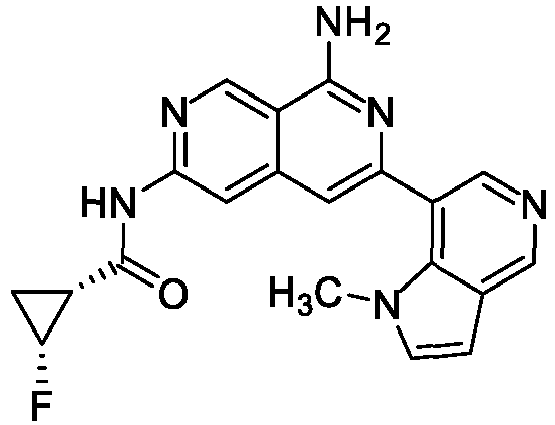
64 
cis-N-[8-amino-6-(4-ethyl-1-methyl-6-oxo-3-pyridyl)-2,7-naphthyridin-3-yl]-2-fluoro-cyclopropanecarboxamide 
65 
(R)-1-(8-amino-6-(4-ethylpyridin-3-yl)-2,7-naphthyridin-3-yl)-3-(1-methyl-2-oxopyrrolidin-3 -yl)urea 66 
cis-N-(8-amino-6-(4-ethyl-6-methoxypyridin-3-yl)-2,7-naphthyridin-3 - yl)-2-fluorocyclopropanecarboxamide 
67 
cis-N-(8-amino-6-(6-amino-4-ethylpyridin-3-yl)-2,7-naphthyridin-3-yl)-2-fluorocyclopropanecarboxamide 
68 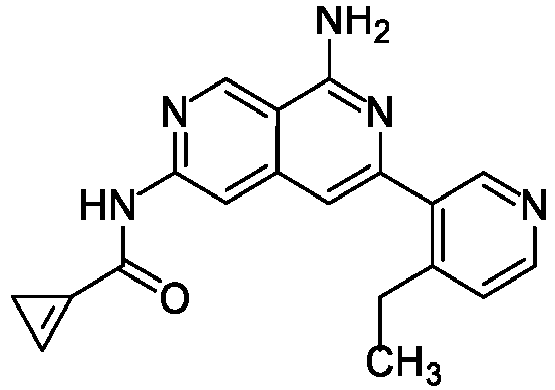
N-[8-amino-6-(4-ethyl-3-pyridyl)-2,7-naphthyridin-3 -yl]cyclopropene-1 - carboxamide 70 
5-Methyl-1H-pyrazole-3-carboxylic acid [8-amino-6-(4-ethylpyridin-3-yl)-[2,7]naphthyridin-3-yl]amide 71 
2H-Pyrazole-3-carboxylic acid [8-amino-6-(4-ethylpyridin-3-yl)-[2,7]naphthyridin-3-yl]amide 72 
2-Methyl-2H-pyrazole-3-carboxylic acid [8-amino-6-(4-ethylpyridin-3-yl)-[2,7]naphthyridin-3-yl]amide 73 
1-Methyl-1H-pyrazole-4-carboxylic acid [8-amino-6-(4-ethylpyridin-3-yl)-[2,7]naphthyridin-3-yl]amide 74 
3-(4-Ethylpyridin-3-yl)-N6-(1-methyl-1H-pyrazol-4-yl)-[2,7]naphthyridine-1,6-diamine 75 
3-(4-Ethylpyridin-3-yl)-N6-(1H-pyrazol-4-yl)-[2,7]naphthyridine-1,6-diamine 76 
3-(4-Ethylpyridin-3-yl)-N6-(1-methyl-1H-pyrazol-3-yl)-[2,7]naphthyridine-1,6-diamine 77 
3-(4-Ethylpyridin-3-yl)-N6-(1H-pyrazol-3-yl)-[2,7]naphthyridine-1,6-diamine 78 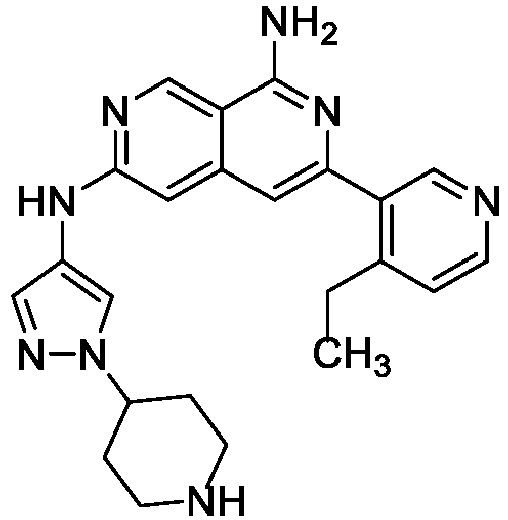
3-(4-Ethylpyridin-3-yl)-N6-(1-piperidin-4-yl-1H-pyrazol-4-yl)-[2,7]naphthyridine-1,6-diamine 79 
Cyclopropanesulfonic acid [8-amino-6-(4-ethylpyridin-3-yl)-[2,7]naphthyridin-3-yl]amide 80 
3-(4-Ethylpyridin-3-yl)-N6-(6-methylpyrimidin-4-yl)-[2,7]naphthyridine-1,6-diamine 81 
2-[8-Amino-6-(4-ethylpyridin-3-yl)-[2,7]naphthyridin-3-ylamino]-N-ethyl-N-methylisonicotinamide 82 
1-{2-[8-Amino-6-(4-ethylpyridin-3-yl)-[2,7]naphthyridin-3-ylamino]-pyridin-4-yl}propan-1-ol 
83 
{6-[8-amino-6-(4-ethylpyridin-3-yl)-[2,7]naphthyridin-3-ylamino]pyridin-2-yl}methanol 84 
N-(8-amino-6-(4-ethylpyridin-3 -yl)-2, 7-naphthyridin-3-yl)-1-(piperidin-4-yl)-1H-pyrazole-4-carboxamide 85 
2-{4-[8-Amino-6-(4-ethylpyridin-3-yl)-[2,7]naphthyridin-3-ylamino]pyrazol-1-yl} ethanol 86 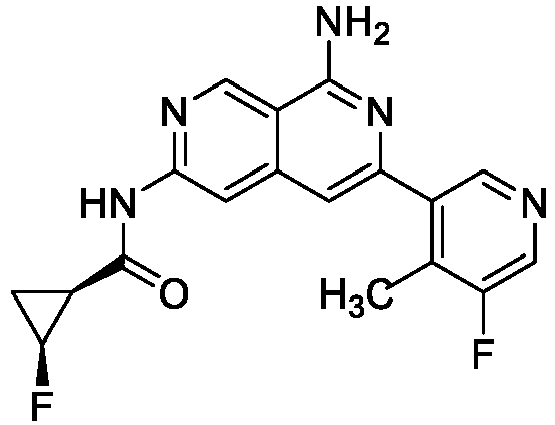
(1S,2S)-N-(8-amino-6-(5-fluoro-4-methylpyridin-3-yl)-2,7-naphthyridin-3-yl)-2-fluorocyclopropane-1 -carboxamide 87, 88 
cis-N-(8-amino-6-(2-ethylpyrrolidin-1-yl)-2,7-naphthyridin-3-yl)-2-fluorocyclopropane-1-carboxamide 


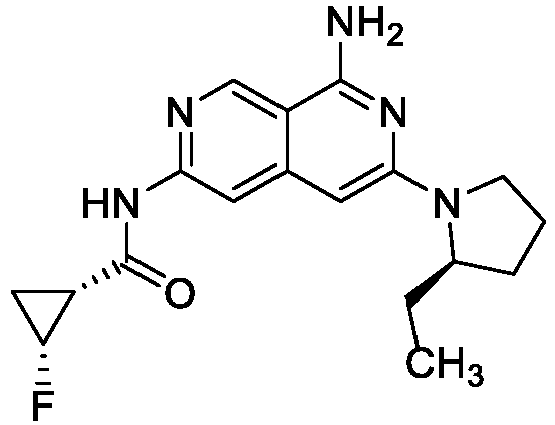
89 
cis-N-(8-amino-6-(4-ethyl-6-methoxypyridin-3 -yl)-2, 7-naphthyridin-3 - yl)-2-fluorocyclopropane-1 -carboxamide 
90 
cis-N-(8-amino-6-(1-methyl-1H-pyrrolo[3,2-c]pyridin-7-yl)-2,7-naphthyridin-3-yl)-2-fluorocyclopropane-1-carboxamide 
91, 92, 93, 94 
N-(8-amino-6-(4-ethylpyridin-3 -yl)-2, 7-naphthyridin-3 -yl)-2-cyanocyclopropane-1 - carboxamide trans-N-(8-amino-6-(4-ethylpyridin-3-yl)-2,7-naphthyridin-3-yl)-2-cyanocyclopropane-1-carboxamide cis-N-(8-amino-6-(4-ethylpyridin-3-yl)-2,7-naphthyridin-3 -yl)-2-cyanocyclopropane-1 - carboxamide 


96, 97 
trans-N-(8-amino-6-(4-methylpyridin-3-yl)-2,7-naphthyridin-3-yl)-2-cyanocyclopropane-1-carboxamide 98 
trans-N-(8-amino-6-(4-ethylpyridin-3-yl)-2,7-naphthyridin-3-yl)-2-(3-hydroxycyclobutane-1 - carbonyl)cyclopropane-1 -carboxamide 
99 
trans-N-(8-amino-6-(8-hydroxy-5,6,7,8-tetrahydroisoquinolin-4-yl)-2,7-naphthyridin-3 -yl)-2-cyanocyclopropane-1 - carboxamide 
100 
cis-N-(8-amino-6-(2-(hydroxymethyl)-5-methylpyridin-4-yl)-2,7-naphthyridin-3-yl)-2-fluorocyclopropane-1 -carboxamide 
101 
cis-N-(8-amino-6-(2-cyano-5-methylpyridin-4-yl)-2,7-naphthyridin-3-yl)-2-fluorocyclopropane-1 -carboxamide 
102 
N-(8-amino-6-(4-ethylpyridin-3 -yl)-2, 7-naphthyridin-3-yl)-2-(1H-pyrazol-5-yl)acetamide 103 
cis-N-(8-amino-6-(3,5-dimethyl-1H-pyrazol-4-yl)-2,7-naphthyridin-3-yl)-2-fluorocyclopropane-1 -carboxamide 
104 
trans-N-(8-amino-6-(1,2-dimethyl-1H-imidazol-5 -yl)-2, 7-naphthyridin-3 -yl)-2-cyanocyclopropane-1-carboxamide 
105 
N6-((1H-pyrazol-5-yl)methyl)-3-(4-ethylpyridin-3 -yl)-2, 7 -naphthyridine -1,6-diamine 106 
cis-N-(8-amino-6-(pyridin-3-yl)-2,7-naphthyridin-3 -yl)-2-fluorocyclopropane-1 - carboxamide 
107, 108 
trans-N-(8-amino-6-(4-methylpyridin-3-yl)-2,7-naphthyridin-3-yl)-2-fluorocyclopropane-1-carboxamide 
109 
1-[8-amino-6-(4-ethyl-3-pyridyl)-2,7-naphthyridin-3 -yl] -3 -(cis-3 - hydroxycyclobutyl)urea 110 
trans-N-(8-amino-6-(4-(trifluoromethyl)pyridin-3-yl)-2,7-naphthyridin-3 -yl)-2-cyanocyclopropane-1 - carboxamide 
111 
N-[8-amino-6-(4-methyl-3-pyridyl)-2,7-naphthyridin-3 -yl]-3-azabicyclo[3.1.0]hexane-6-carboxamide 112 
trans-N-(8-amino-6-(1H-pyrazol-4-yl)-2,7-naphthyridin-3 -yl)-2-cyanocyclopropane-1 - carboxamide 
113 
N-[8-amino-6-(4-methyl-3-pyridyl)-2,7-naphthyridin-3-yl]-5-azaspiro[2.3]hexane-2-carboxamide 114 
trans-N-(8-amino-6-(5-isopropyl-1H-pyrazol-4-yl)-2,7-naphthyridin-3-yl)-2-cyanocyclopropane-1 -carboxamide 
115 
rac-(1R,5S)-N-[8-amino-6-(4-methyl-3-pyridyl)-2,7-naphthyridin-3-yl]-3-oxabicyclo[3.1.0]hexane-6-carboxamide 116 
1-[8-amino-6-(4-methyl-3-pyridyl)-2,7-naphthyridin-3-yl]-3-[rac-(1S,2S)-2-hydroxycyclopentyl]urea 117 
1-(8-amino-6-(4-methylpyridin-3-yl)-2,7-naphthyridin-3-yl)-3-(1-hydroxypropan-2-yl)urea 
118 
trans-N-(8-amino-6-(4-methylpyridin-3-yl)-2,7-naphthyridin-3-yl)-2-methylcyclopropane-1 -carboxamide 
119 
trans-N-(8-amino-6-(4-methylpyridin-3-yl)-2,7-naphthyridin-3-yl)-2-(trifluoromethyl)cyclopropane-1 - carboxamide 
120 
3-(4-methyl-3-pyridyl)-N6-pyrrolidin-3-yl-2,7-naphthyridine-1,6-diamine 
121 
trans-N-[8-amino-6-(4-methyl-3-pyridyl)-2,7-naphthyridin-3-yl]-2-(1H-pyrazol-3-yl)cyclopropanecarboxamide 
122 
trans-N-[8-amino-6-(4-methyl-3-pyridyl)-2,7-naphthyridin-3-yl]-2-(1H-pyrazol-4-yl)cyclopropanecarboxamide 
123 
(1R,5 S,6R)-N-[8-amino-6-(4-methyl-3-pyridyl)-2,7-naphthyridin-3-yl]-3-oxabicyclo[3.1.0]hexane-6-carboxamide 124 
exo-N-[8-amino-6-(4-methyl-3-pyridyl)-2,7-naphthyridin-3 -yl] -3 -(2-methoxyethyl)-3-azabicyclo[3 .1.0]hexane-6-carboxamide 125 
trans-N-(8-amino-6-(4-methylpyridin-3-yl)-2,7-naphthyridin-3-yl)-5-azaspiro[2.4]heptane-1 -carboxamide 
126 
cis-N-(8-amino-6-(4-methylpyridin-3-yl)-2,7-naphthyridin-3-yl)-5-azaspiro[2.4]heptane-1-carboxamide 
127 
trans-N-(8-amino-6-(4-methylpyridin-3-yl)-2,7-naphthyridin-3-yl)-5-(2-methoxyethyl)-5-azaspiro[2.4]heptane-1-carboxamide 
128 
cis-N-(8-amino-6-(4-methylpyridin-3-yl)-2,7-naphthyridin-3-yl)-5-(2-methoxyethyl)-5-azaspiro[2.4]heptane-1-carboxamide 
129 
trans-N-[8-amino-6-(4-ethoxy-3-pyridyl)-2,7-naphthyridin-3-yl]-2-cyano-cyclopropanecarboxamide 
130 
1-[8-amino-6-(4-methyl-3-pyridyl)-2,7-naphthyridin-3 -yl] -3 -methyl-urea 131 
trans-N-[8-amino-6-(4-methyl-3-pyridyl)-2,7-naphthyridin-3-yl]-2-(3-pyridyl)cyclopropanecarboxamide 
132 
trans-N-[8-amino-6-[5-(trifluoromethyl)-1H-pyrazol-4-yl]-2,7-naphthyridin-3-yl]-2-cyano-cyclopropanecarboxamide 
133 
[(3R)-2-oxopyrrolidin-3-yl] N-[8-amino-6-(4-methyl-3-pyridyl)-2,7-naphthyridin-3-yl] carbamate 134 
1-[8-amino-6-(4-methyl-3-pyridyl)-2, 7-naphthyridin-3-yl]-3-[(1S,2S)-2-hydroxycyclopentyl]urea 135 
trans-N-(8-amino-6-(5-methyl-2-oxo-2,3-dihydrobenzo[d]oxazol-6-yl)-2,7-naphthyridin-3 -yl)-2-cyanocyclopropanecarboxamide 
136 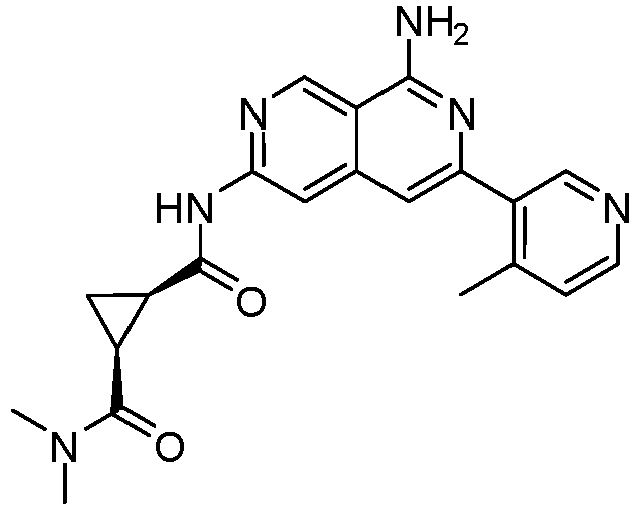
cis-N 1-(8-amino-6-(4-methylpyridin-3-yl)-2,7-naphthyridin-3-yl)-N2,N2-dimethylcyclopropane-1,2-dicarboxamide 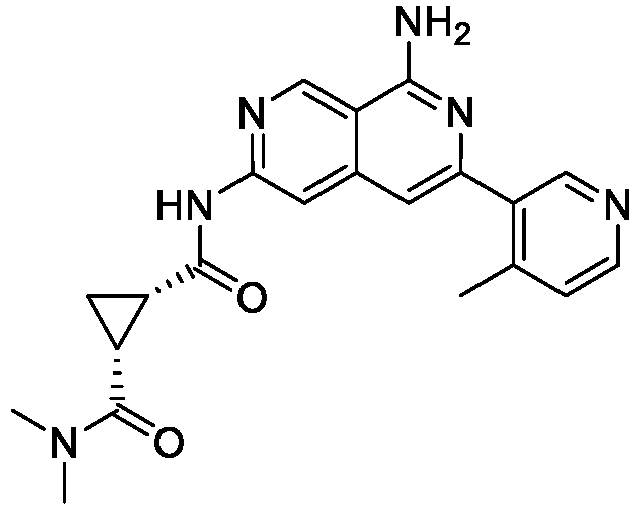
137 
cis-N 1-(8-amino-6-(4-methylpyridin-3-yl)-2,7-naphthyridin-3-yl)-N2-ethylcyclopropane-1,2-dicarboxamide 
138 
trans-N1-(8-amino-6-(4-methylpyridin-3-yl)-2,7-naphthyridin-3-yl)-N2,N2-dimethylcyclopropane-1,2-dicarboxamide 
139 
trans-N-(8-amino-6-(4-methylpyridin-3-yl)-2,7-naphthyridin-3-yl)-2-methylcyclopropanecarboxamide 
140 
trans-N-(8-amino-6-(4-methylpyridin-3-yl)-2,7-naphthyridin-3-yl)-2-(trifluoromethyl)cyclopropane carboxamide 
141 
cis-N-(8-amino-6-(4-methylpyridin-3-yl)-2,7-naphthyridin-3-yl)-2-methylcyclopropanecarboxamide 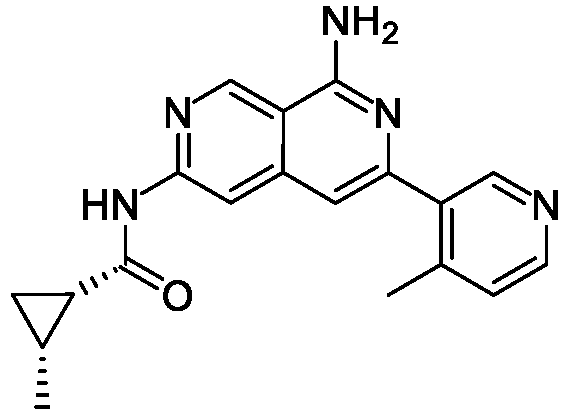
142 
trans-N-(8-amino-6-(3,5-dimethyl-2-oxo-2,3-dihydrobenzo[d]oxazol-6-yl)-2,7-naphthyridin-3 -yl)-2-cyanocyclopropanecarboxamide 
143 
exo-3 -acetyl-N-[8-amino-6-(4-methyl-3 - pyridyl)-2,7-naphthyridin-3-yl]-3-azabicyclo[3.1.0]hexane-6-carboxamide 144 
trans-N-[8-amino-6-(5-methyl-2-oxo-3H-1,3-benzoxazol-6-yl)-2,7-naphthyridin-3-yl]-2-(1H-pyrazol-4-yl)cyclopropanecarboxamide 
145 
trans-N-[8-amino-6-(4-methyl-3-pyridyl)-2,7-naphthyridin-3-yl]-2-[3-[(4-methoxyphenyl)methyl] imidazol-4-yl]cyclopropanecarboxamide 
146 
trans-N-[8-amino-6-(4-methyl-3-pyridyl)-2,7-naphthyridin-3-yl]-2-(1-ethylsulfonylpyrazol-4-yl)cyclopropanecarboxamide 
147 
trans-N-(8-amino-6-(5 -(difluoromethyl)-4-methylpyridin-3-yl)-2,7-naphthyridin-3-yl)-2-cyanocyclopropanecarboxamide 
148 
trans-N-(8-amino-6-(4-methylpyridin-3-yl)-2,7-naphthyridin-3-yl)-5-(methylsulfonyl)-5-azaspiro[2.4]heptane-1-carboxamide 
149 
cis-N-(8-amino-6-(4-methylpyridin-3-yl)-2, 7-naphthyridin-3 -yl)-5 -(methylsulfonyl)-5-azaspiro[2.4]heptane-1-carboxamide 
150 
N-(8-amino-6-(4-methylpyridin-3-yl)-2,7-naphthyridin-3-yl)-5-(3-cyanopyridin-2-yl)-5-azaspiro[2.3]hexane-1-carboxamide 
151 
exo-N-[8-amino-6-(4-methyl-3-pyridyl)-2,7-naphthyridin-3 -yl] -3 -methylsulfonyl-3 - azabicyclo[3.1.0]hexane-6-carboxamide 152 
trans-N-[8-amino-6-(4-methyl-3-pyridyl)-2,7-naphthyridin-3-yl]-2-isothiazol-4-yl-cyclopropanecarboxamide 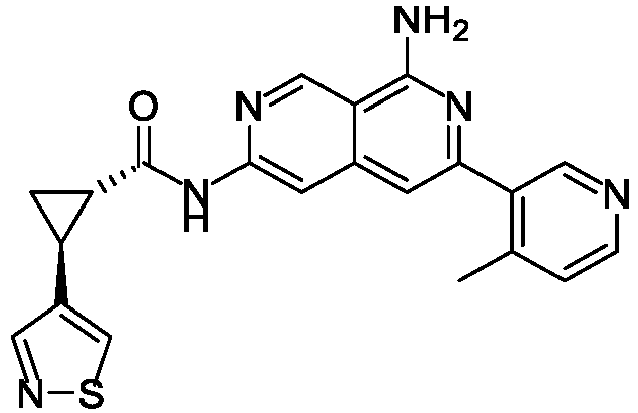
153 
trans-N-(8-amino-5-fluoro-6-(4-methylpyridin-3-yl)-2,7-naphthyridin-3-yl)-2-cyanocyclopropanecarboxamide 
154 
trans-N-(8-amino-6-(4-methylpyridin-3-yl)-2,7-naphthyridin-3-yl)-2-(hydroxymethyl)cyclopropanecarboxamide 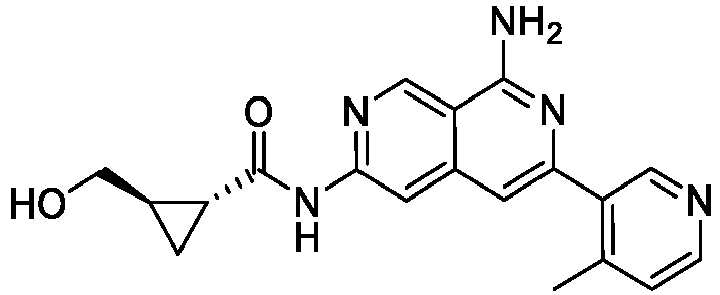
155 
trans-N-(8-amino-6-(4-methylpyridin-3-yl)-2,7-naphthyridin-3-yl)-2-(aminomethyl)cyclopropanecarboxamide 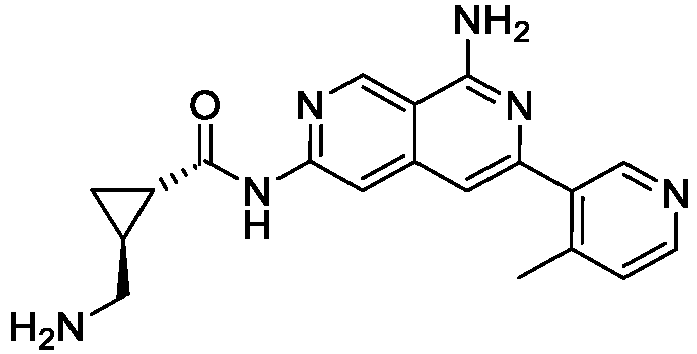
156 
N-(8-amino-5-fluoro-6-(4-methylpyridin-3-yl)-2,7-naphthyridin-3-yl)acetamide 157 
trans-N-[8-amino-6-(4-methyl-3-pyridyl)-2,7-naphthyridin-3-yl]-2-(cyanomethyl)cyclopropane carboxamide 
158 
exo-N-[8-amino-6-(4-methyl-3-pyridyl)-2,7-naphthyridin-3-yl]-4-oxo-3-azabicyclo[3.1.0]hexane-6-carboxamide 
159 
trans-N-[8-amino-6-(4-methyl-3-pyridyl)-2,7 -naphthyridin-3 -yl] -2 -(1 -methylpyrazol-4-yl)cyclopropane carboxamide 
160 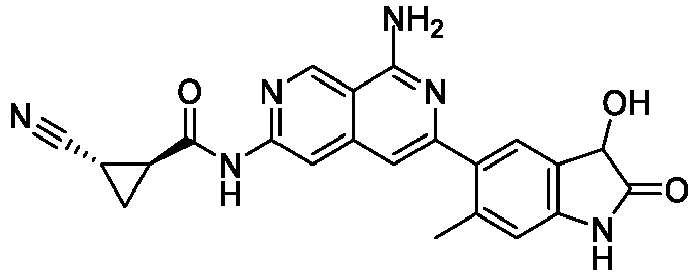
trans-N-[8-amino-6-(3-hydroxy-6-methyl-2-oxo-indolin-5-yl)-2,7-naphthyridin-3-yl]-2-cyano-cyclopropane carboxamide 
161 
1-[3-[4-[[8-amino-6-(4-methyl-3-pyridyl)-2,7-naphthyridin-3-yl]amino]pyrazol-1-yl]azetidin-1-yl]ethanone 162 
1-[8-amino-5-fluoro-6-(4-methyl-3-pyridyl)-2,7-naphthyridin-3-yl]-3-(1-methylpyrazol-4-yl)urea 163 
1-[8-amino-5-chloro-6-(4-methyl-3-pyridyl)-2,7-naphthyridin-3-yl]-3-(1-methylpyrazol-4-yl)urea 164 
trans-4-(1-amino-6-((trans)-2-cyanocyclopropanecarboxamido)-2,7-naphthyridin-3-yl)-3-methyl-N-(2,2,2-trifluoroethyl)benzamide) 
165 
trans-N-(8-amino-6-(5 -amino-4-methylpyridin-3-yl)-2,7-naphthyridin-3-yl)-2-cyanocyclopropane carboxamide 
166 
trans-2-(1-acetylpiperidin-4-yl)-N-(8-amino-6-(4-methylpyridin-3-yl)-2,7-naphthyridin-3-yl)cyclopropanecarboxamide 
167 
cis-N-(8-amino-6-(4-methyl-6-(2-oxo-1,2-dihydropyridin-3-yl)pyridin-3-yl)-2,7-naphthyridin-3 -yl)-2-fluorocyclopropanecarboxamide 
168 
2-[4-[[8-amino-6-(4-ethyl-3-pyridyl)-2,7-naphthyridin-3-yl]amino]pyrazol-1-yl] ethanol 169 
2-[4-[[8-amino-6-(4-methyl-3-pyridyl)-2,7-naphthyridin-3-yl]amino]pyrazol-1-yl] ethanol 170 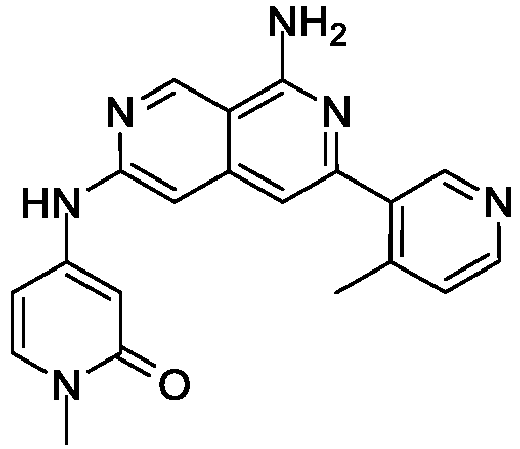
4-[[8-amino-6-(4-methyl-3-pyridyl)-2,7-naphthyridin-3-yl]amino]-1-methyl-pyridin-2-one 171 
1-[8-amino-6-(4-methyl-3-pyridyl)-2,7-naphthyridin-3 -yl] -3 -(2-cyanophenyl)urea 172 
trans-N-(8-amino-5-fluoro-6-(4-methylpyridin-3-yl)-2,7-naphthyridin-3-yl)-2-(1H-pyrazol-4-yl)cyclopropanecarboxamide 
173 
trans-N-(8-amino-5-chloro-6-(4-methylpyridin-3-yl)-2,7-naphthyridin-3-yl)-2-(1H-pyrazol-4-yl)cyclopropanecarboxamide 
174 
1-(8-amino-6-(4-methylpyridin-3-yl)-2,7-naphthyridin-3-yl)-3-(1-(2-methoxyethyl)azetidin-3 -yl)urea 175 
1-(8-amino-6-(4-methylpyridin-3-yl)-2,7-naphthyridin-3 -yl)-3 -(azetidin-3 -yl)urea 176 
(R)-1-(8-amino-6-(4-ethylpyridin-3-yl)-2,7-naphthyridin-3-yl)-3-(1-methyl-2-oxopyrrolidin-3 -yl)urea 177 
1-(8-amino-6-(4-methylpyridin-3-yl)-2,7-naphthyridin-3-yl)-3-(1-hydroxypropan-2-yl)urea 
178 
1-[8-amino-6-(4-methyl-3-pyridyl)-2,7-naphthyridin-3-yl]-3-[1-(1-cyanoethyl)pyrazol-4-yl]urea 
179 
cis-N-[8-amino-6-[6-[(3S)-3-aminopyrrolidin-1-yl]-4-methyl-3-pyridyl]-2,7-naphthyridin-3-yl]-2-fluoro-cyclopropanecarboxamide 
180 
trans-4-[1-amino-6-[[trans-2-cyanocyclopropanecarbonyl]amino]-2,7-naphthyridin-3-yl]-N,1,3,5-tetramethyl-pyrrole-2-carboxamide 
181 
trans-N-[8-amino-6-(5-amino-2,4-dimethyl-3-pyridyl)-2,7-naphthyridin-3-yl]-2-methyl-cyclopropanecarboxamide 
182 
2-[4-[[8-amino-6-(4-methyl-3-pyridyl)-2,7-naphthyridin-3 -yl] amino] pyrazol- 1-yl] -N,2-dimethyl-propanamide 183 
2-[4-[[8-amino-6-(4-methyl-3-pyridyl)-2,7-naphthyridin-3 -yl] amino] pyrazol- 1-yl] - N,N,2-trimethyl-propanamide 184 
2-[4-[[8-amino-6-(4-methyl-3-pyridyl)-2,7-naphthyridin-3 -yl] amino] pyrazol- 1-yl] -N-methyl-acetamide 185 
trans-5 -(1-amino-6-(trans-2-cyanocyclopropanecarboxamido)-2,7-naphthyridin-3-yl)-2,4-dimethylbenzamide 
186 
trans-N-(8-amino-6-((S)-4-methyl-2-oxooxazolidin-3 -yl)-2, 7-naphthyridin-3 -yl)-2-cyanocyclopropane carboxamide 
187 
trans-N-(8-amino-6-(5 -methyl- 1H-pyrazol-4-yl)-2,7-naphthyridin-3-yl)-2-(trifluoromethyl)cyclopropane carboxamide 
188 
trans-N-(8-amino-6-(1,3,5-trimethyl-1H-pyrazol-4-yl)-2,7-naphthyridin-3-yl)-2-(trifluoromethyl)cyclopropanecarboxamide 
189 
trans-N-(8-amino-6-(4-methylpyridin-3-yl)-2,7-naphthyridin-3-yl)-2-(pyrimidin-2-yl)cyclopropanecarboxamide 
190 
trans-N-(8-amino-6-(5 -amino-4-methylpyridin-3-yl)-2,7-naphthyridin-3-yl)-2-(trifluoromethyl) cyclopropanecarboxamide 
191 
trans-N-(8-amino-6-(4-(2-hydroxyethyl)pyridin-3-yl)-2,7-naphthyridin-3 -yl)-2-cyanocyclopropanecarboxamide 
192 
trans-N-(8-amino-6-(4-(2-hydroxyethyl)pyridin-3-yl)-2,7-naphthyridin-3 -yl)-2-(cyanomethyl)cyclopropanecarboxamide 
193 
(1S,2R)-N-(8-amino-6-(4-methylpyridin-3-yl)-2,7-naphthyridin-3-yl)-2-(cyanomethyl)cyclopropane-1-carboxamide 194 
(1R,2S)-N-(8-amino-6-(4-methylpyridin-3-yl)-2,7-naphthyridin-3-yl)-2-(cyanomethyl)cyclopropane-1 -carboxamide 195 
(1S,2S)-N-(8-amino-5-fluoro-6-(4-methylpyridin-3-yl)-2,7-naphthyridin-3-yl)-2-(1H-pyrazol-4-yl)cyclopropane-1-carboxamide 196 
(1R,2R)-N-(8-amino-5-fluoro-6-(4-methylpyridin-3-yl)-2,7-naphthyridin-3-yl)-2-(1H-pyrazol-4-yl)cyclopropane-1-carboxamide 197 
(1S,2S)-N-(8-amino-6-(4-methylpyridin-3-yl)-2,7-naphthyridin-3-yl)-2-(1-methyl-1H-pyrazol-4-yl)cyclopropane-1 -carboxamide 198 
(1R,2R)-N-(8-amino-6-(4-methylpyridin-3-yl)-2,7-naphthyridin-3-yl)-2-(1-methyl-1H-pyrazol-4-yl)cyclopropane-1 -carboxamide 199 
(1R,2R)-N-(8-amino-6-(5-amino-4-methylpyridin-3-yl)-2,7-naphthyridin-3-yl)-2-cyanocyclopropane-1 -carboxamide 200 
(1S,2S)-N-(8-amino-6-(5-amino-4-methylpyridin-3-yl)-2,7-naphthyridin-3-yl)-2-cyanocyclopropane-1 -carboxamide 201 
trans-N-(8-amino-6-(4-(trifluoromethyl)pyridin-3-yl)-2,7-naphthyridin-3 -yl)-2-cyanocyclopropane-1 - carboxamide 
202 
(1S,2S)-N-(8-amino-6-(4-methylpyridin-3-yl)-2,7-naphthyridin-3-yl)-2-cyanocyclopropane-1-carboxamide 203 
(1R,2R)-N-(8-amino-6-(4-methylpyridin-3-yl)-2,7-naphthyridin-3-yl)-2-cyanocyclopropane-1-carboxamide 204 
N-(8-amino-5-(3-hydroxycyclopent-1-enyl)-6-(4-methylpyridin-3-yl)- 2,7-naphthyridin-3-yl)cyclopropanecarboxamide 
205 
trans-N-(8-amino-5-methyl-6-(4-methylpyridin-3-yl)-2,7-naphthyridin-3-yl)-2-(cyanomethyl)cyclopropanecarboxamide 
206 
trans-N-(8-amino-6-(4-methyl-2-phenylpyridin-3-yl)-2,7-naphthyridin-3-yl)-2-(cyanomethyl)cyclopropanecarboxamide 
207, 208 
2-(8-amino-6-(4-methylpyridin-3-yl)-2,7-naphthyridin-3 -ylcarbamoyl)-1 - methylcyclopropyl)methyl acetate 


209 
N-(8-amino-6-(4-methylpyridin-3-yl)-2,7-naphthyridin-3 -yl)-2-(hydroxymethyl) -2-methylcyclopropanecarboxamide 210 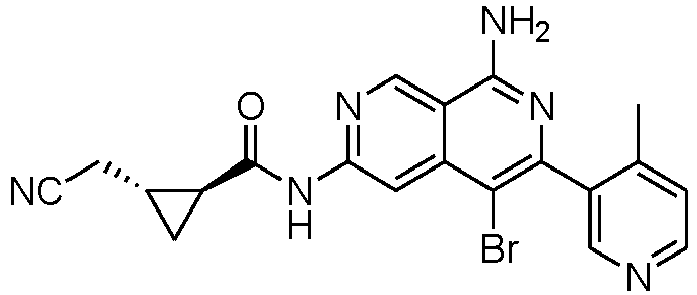
trans-N-(8-amino-5-bromo-6-(4-methylpyridin-3-yl)-2,7-naphthyridin-3-yl)-2-(cyanomethyl)cyclopropanecarboxamide 
211 
cis-N-(8-amino-6-(2,3-dihydro-1H-pyrrolo[2,3 -c]pyridin-4-yl)-2,7-naphthyridin-3 -yl)-2-fluorocyclopropanecarboxamide 
212 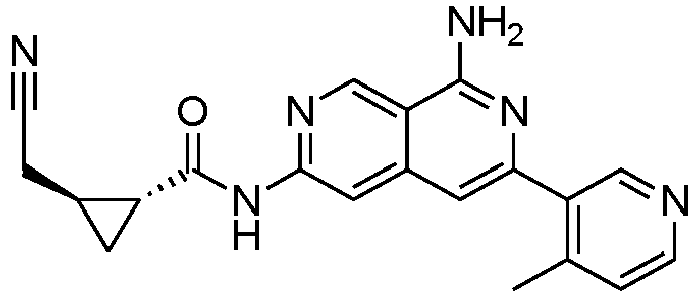
trans-N-(8-amino-6-(4-methylpyridin-3-yl)-2,7-naphthyridin-3-yl)-2-(cyanomethyl)cyclopropanecarboxamide 
213 
2-(4-(8-amino-6-(4-methylpyridin-3 -yl)-2, 7-naphthyridin-3 -ylamino)- 1H-pyrazol-1-yl)propan-1-ol 
214, 215 
trans-N-(8-amino-6-(4-(2-hydroxyethyl)pyridin-3-yl)-2,7-naphthyridin-3 -yl)-2-(1 -methyl- 1H-pyrazol-4-yl)cyclopropanecarboxamide 
216 
cis-N-(8-amino-6-(4-methyl-5-(methylamino)pyridin-3-yl)-2,7-naphthyridin-3 -yl)-2-fluorocyclopropanecarboxamide 
217 
2-(4-(8-amino-6-(4-methylpyridin-3 -yl)-2, 7-naphthyridin-3 -ylamino)- 1H-pyrazol-1-yl)propanenitrile 218 
1-(3-(4-(8-amino-6-(4-methylpyridin-3-yl)-2, 7-naphthyridin-3 -ylamino)- 1H-pyrazol-1 - yl)pyrrolidin-1 -yl)ethanone 
219 
(trans)-3-(4-(8-amino-6-(4-methylpyridin-3-yl)-2,7-naphthyridin-3 -ylamino)- 1H-pyrazol-1 -yl)-1 -(oxetan-3 -yl)piperidin-4-ol 
220 
(trans)-4-(4-(8-amino-6-(4-methylpyridin-3-yl)-2,7-naphthyridin-3-ylamino)-1H-pyrazol-1 -yl)-1 -(oxetan-3 -yl)piperidin-3 -ol 
221 
1-(3-(8-amino-6-(4-methylpyridin-3-yl)-2,7-naphthyridin-3-ylamino)-1-methyl-1H-pyrazol-5-yl)ethanol 
222 
cis-N-(8-amino-6-(3-oxo-3,4-dihydro-2H-pyrido[4,3-b] [1,4]oxazin-8-yl)-2,7-naphthyridin-3 -yl)-2-fluorocyclopropanecarboxamide 
223 
cis-N-(8-amino-6-(3,4-dihydro-2H-pyrido[4,3-b] [1,4]oxazin-8-yl)-2,7-naphthyridin-3 -yl)-2-fluorocyclopropanecarboxamide 
224 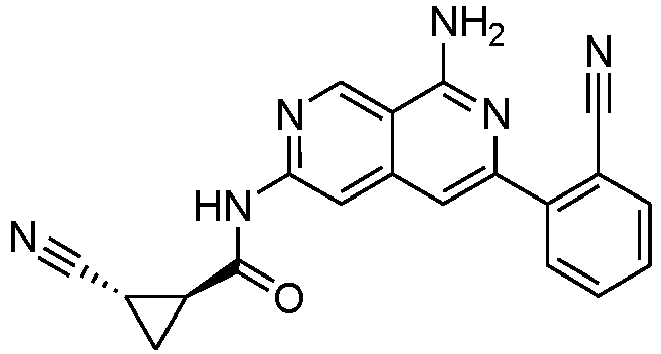
trans-N-(8-amino-6-(2-cyanophenyl)-2,7-naphthyridin-3 -yl)-2-cyanocyclopropanecarboxamide 
225 
trans-N-(8-amino-6-(4-(2-hydroxy-2-methylpropyl)pyridin-3-yl)-2,7-naphthyridin-3 -yl)-2-cyanocyclopropanecarboxamide 
226 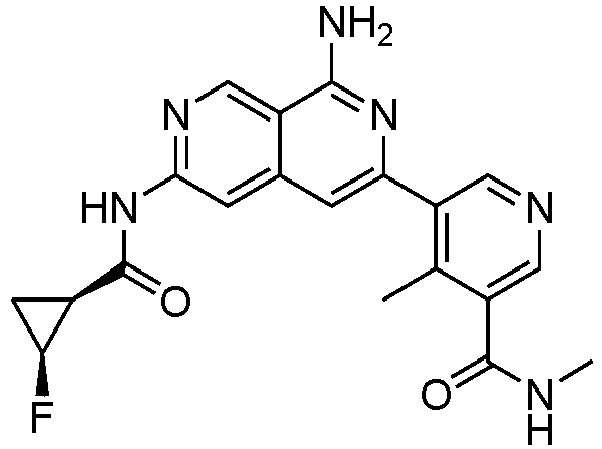
cis-5 -(1-amino-6-(-2-fluorocyclopropanecarboxamido)-2,7-naphthyridin-3 -yl)-N,4-dimethylnicotinamide 
227 
trans-N-(8-amino-6-(4-(cyanomethyl)pyridin-3-yl)-2,7-naphthyridin-3 -yl)-2-cyanocyclopropanecarboxamide 
228 
trans-N-(8-amino-6-(4-(methoxymethyl)pyridin-3-yl)-2,7-naphthyridin-3 -yl)-2-cyanocyclopropanecarboxamide 
229 
trans-N-(8-amino-6-(4-(2-methoxyethyl)pyridin-3-yl)-2,7-naphthyridin-3 -yl)-2-cyanocyclopropanecarboxamide 
230 
(exo)-N-(8-amino-6-(4-methylpyridin-3-yl)-2,7-naphthyridin-3-yl)- 2-cyanobicyclo[3.1.0]hexane-6-carboxamide 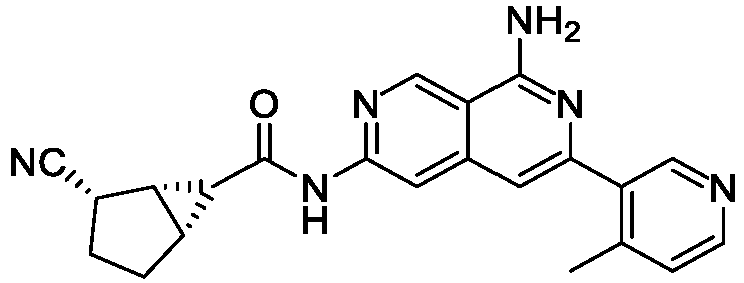
231 
trans-N-(8-amino-6-(4-methylpyridin-3-yl)-2,7-naphthyridin-3-yl)-2-(2-oxooxazolidin-5 -yl)cyclopropanecarboxamide 
232 
trans-N-(8-amino-6-(4-(2-hydroxypropyl)pyridin-3-yl)-2,7-naphthyridin-3 -yl)-2-cyanocyclopropanecarboxamide 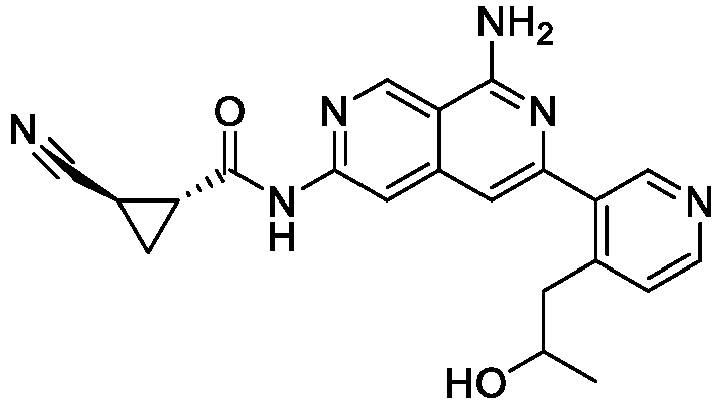
233, 234 
trans-N-(8-amino-5-chloro-6-(4-methylpyridin-3-yl)-2,7-naphthyridin-3-yl)-2-(1-methyl-1H-pyrazol-4-yl)cyclopropanecarboxamide 
235, 236 
trans-N-(6-(4-(1H-pyrazol-4-yl)pyridin-3-yl)-8-amino-2,7-naphthyridin-3-yl)-2-cyanocyclopropanecarboxamide 
237, 238 
trans-N-(8-amino-6-(4-methyl-6-(1-methyl-1H-pyrazol-4-yl)pyridin-3-yl)-2,7-naphthyridin-3-yl)-2-(cyanomethyl)cyclopropanecarboxamide 
239, 240 
trans-N-[8-amino-6-(4-methylpyridin-3-yl)-2,7-naphthyridin-3-yl]-2-(2-methoxypropan-2-yl)cyclopropane-1 - carboxamide 
241, 242 
trans-N-[8-amino-6-(4-methylpyridin-3-yl)-2,7-naphthyridin-3-yl]-2-(2-hydroxypropan-2-yl)cyclopropane-1 - carboxamide 
243, 244 
trans-N-(6-(4-(1H-pyrazol-3-yl)pyridin-3-yl)-8-amino-2,7-naphthyridin-3-yl)-2-cyanocyclopropanecarboxamide 
245, 246 
trans-N-(8-amino-6-(4-(2-hydroxyethyl)pyridin-3-yl)-2,7-naphthyridin-3 -yl)-2-(isothiazol-4-yl)cyclopropanecarboxamide 
247, 248 
trans-N-[8-amino-6-(5-amino-4-methylpyridin-3-yl)-2,7-naphthyridin-3-yl]-2-(cyanomethyl)cyclopropane-1 - carboxamide 
249, 250 
3-(4-[[8-amino-6-(4-methylpyridin-3-yl)-2,7-naphthyridin-3 -yl] amino] -1H-pyrazol-1-yl)-1-methylpyrrolidin-2-one 
251, 252 
3-(4-[[8-amino-6-(4-methylpyridin-3-yl)-2,7-naphthyridin-3 -yl] amino] -1H-pyrazol-1-yl)-1-methylpiperidin-2-one 
253, 254 
trans-N-[8-amino-6-[4-(2-hydroxyethyl)pyridin-3-yl]-2,7-naphthyridin-3 -yl] -2-(pyridin-3 - yl)cyclopropane-1 -carboxamide 
255 
Exo-N-[8-amino-6-(4-methylpyridin-3-yl)-2,7-naphthyridin-3-yl] -3 -(oxetan-3 -yl)-3 - azabicyclo[3.1.0]hexane-6-carboxamide 256 
2-[[8-amino-6-(4-methylpyridin-3-yl)-2,7-naphthyridin-3 -yl] amino] -6-methyl-4H,5H,6H,7H,8H-pyrazolo[1,5-d][1,4]diazepin-7-one 257 
6-N-[1-(2,2-difluoroethyl)-1H-pyrazol-4-yl]-3-(4-methylpyridin-3-yl)-2,7-naphthyridine-1,6-diamine 258 
N-(8-amino-6-(4-methylpyridin-3-yl)-5-(1H-pyrazol-4-yl)-2,7-naphthyridin-3-yl)cyclopropanecarboxamide 259 
2-(3-[[8-amino-6-(4-methylpyridin-3-yl)-2,7-naphthyridin-3 -yl] amino]-5-cyclopropyl-1H-pyrazol-1-yl)ethan-1-ol 260 
1-(4-[[8-amino-6-(4-methylpyridin-3-yl)-2,7-naphthyridin-3-yl]amino]-1H-pyrazol-1-yl)-2-methylpropan-2-ol 261 
2-(5-[[8-amino-6-(4-methylpyridin-3-yl)-2,7-naphthyridin-3-yl]amino]-3-methyl-1H-pyrazol-1 -yl)ethan-1 -ol 262 
2-(3-[[8-amino-6-(4-methylpyridin-3-yl)-2,7-naphthyridin-3-yl]amino]-5-methyl-1H-pyrazol-1 -yl)ethan-1 -ol 263 
3-[[8-Amino-6-(4-methylpyridin-3-yl)-2,7-naphthyridin-3 -yl] amino] -N, 1-dimethyl-1H-pyrazole-5-carboxamide 264 
(4-[[8-Amino-6-(4-methylpyridin-3-yl)-2,7-naphthyridin-3-yl]amino]phenyl)methanesulfonamide 265 
1-(4-[[8-amino-6-(4-methylpyridin-3-yl)-2,7-naphthyridin-3-yl]amino]phenyl)piperazin-2-one 266 
2-(4-[[8-amino-6-(4-methylpyridin-3-yl)-2,7-naphthyridin-3 -yl] amino] -1H-pyrazol-1-yl)-2-methylpropan-1-ol 267 
trans-N-(8-amino-6-(5 -fluoro-2-methylphenyl)-2,7-naphthyridin-3-yl)-2-(1-methyl-1H-pyrazol-4-yl)cyclopropanecarboxamide 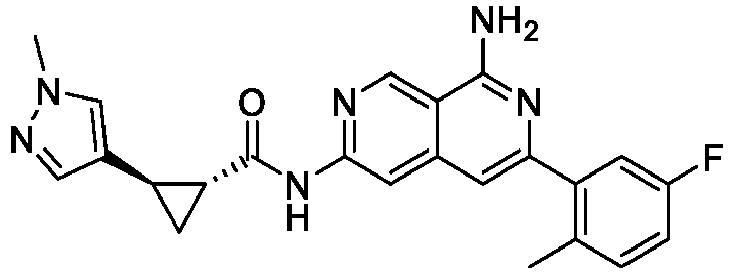
268 
trans-N-[8-amino-6-(5-hydroxy-2-methylphenyl)-2,7-naphthyridin-3-yl]-2-(1-methyl-1H-pyrazol-4-yl)cyclopropane-1-carboxamide 269, 270 
trans-N-[8-amino-5-chloro-6-(4-methylpyridin-3 -yl)-2,7-naphthyridin-3 -yl] - 2-(cyanomethyl)cyclopropane-1 - carboxamide 
271, 272 
trans-N-[8-amino-5-ethyl-6-(4-methylpyridin-3-yl)-2,7-naphthyridin-3-yl]-2-(cyanomethyl)cyclopropane-1 - carboxamide 
273 
(R)-2-(4-(8-amino-6-(4-methylpyridin-3-yl)-2,7-naphthyridin-3-ylamino)-1H-pyrazol -1 -yl)propanenitrile 274 
(S)-2-(4-(8-amino-6-(4-methylpyridin-3-yl)-2,7-naphthyridin-3-ylamino)-1H-pyrazol-1-yl)propanenitrile 275 
trans-N-[8-amino-5-ethenyl-6-(4-methylpyridin-3-yl)-2,7-naphthyridin-3-yl]-2-(cyanomethyl)cyclopropane-1 - carboxamide 
276, 277, 278, 279 
(1,2)trans-N-[8-amino-6-(4-methylpyridin-3-yl)-2,7-naphthyridin-3-yl]-2-(cyanomethyl)-3 -methylcyclopropane-1 - carboxamide 


280, 281 
trans-N-[8-amino-6-(2-fluoro-6-methylphenyl)-2,7-naphthyridin-3-yl]-2-(1-methyl-1H-pyrazol-4-yl)cyclopropane-1-carboxamide 
282, 283 
trans-N-[8-amino-6- [5 -(hydroxymethyl) -2-methylphenyl] -2,7-naphthyridin-3-yl] -2-(1 - methyl-1H-pyrazol-4-yl)cyclopropane-1-carboxamide 
284, 285 
trans-N-[8-amino-6-(3-amino-2-methylphenyl)-2,7-naphthyridin-3-yl]-2-(1-methyl-1H-pyrazol-4-yl)cyclopropane-1-carboxamide 
286 
(1S,2S)-N-[8-amino-6-(5-hydroxy-2-methylphenyl)-2,7-naphthyridin-3-yl]-2-(1-methyl-1H-pyrazol-4-yl)cyclopropane-1-carboxamide 287 
(1R,2R)-N-[8-amino-6-(5-hydroxy-2-methylphenyl)-2,7-naphthyridin-3-yl]-2-(1-methyl-1H-pyrazol-4-yl)cyclopropane-1-carboxamide 288, 289 
trans-N-[8-amino-6-(5-methoxy-2-methylphenyl)-2,7-naphthyridin-3-yl]-2-(1-methyl-1H-pyrazol-4-yl)cyclopropane-1-carboxamide 
290, 291 
trans-3-(1-amino-6-[[2-(1-methyl-1H-pyrazol-4-yl)cyclopropane]amido] -2,7-naphthyridin-3 -yl)-N,N,4-trimethylbenzamide 
292, 293 
trans-N-[8-amino-6-(4-methylpyridin-3-yl)-2,7-naphthyridin-3-yl]-2-[1-[2-(2-aminoethoxy) ethyl] -1H-pyrazol-4-yl]cyclopropane-1-carboxamide 
294 
(1R,3r,5S,6s)-N-[8-amino-6-(4-methylpyridin-3 -yl)-2,7-naphthyridin-3 -yl] - 3 -(3 -methoxyazetidin-1 - yl)bicyclo[3.1.0]hexane-6-carboxamide 295, 296 
trans-N-[8-amino-6-(2,6-dichlorophenyl)-2,7-naphthyridin-3-yl]-2-[1-[2-(2-aminoethoxy) ethyl] -1 H-pyrazol-4-yl]cyclopropane-1-carboxamide 
297 
exo-N-[8-amino-6-(4-methylpyridin-3-yl)-2,7-naphthyridin-3 -yl] -3 -(morpholin-4-yl)bicyclo[3.1.0]hexane-6-carboxamide 298, 299 
trans-N-[8-amino-6-(2-methylphenyl)-2,7-naphthyridin-3 -yl] -2-(1 -methyl- 1H-pyrazol-4-yl)cyclopropane-1 -carboxamide 
300, 301 
trans-N-[8-amino-6-(5-cyano-2-methylphenyl)-2,7-naphthyridin-3-yl]-2-(1-methyl-1H-pyrazol-4-yl)cyclopropane-1-carboxamide 
302, 303 
trans-N-(8-amino-6-(2-chloro-6-fluorophenyl)-2,7-naphthyridin-3-yl)-2-(1-methyl-1H-pyrazol-4-yl)cyclopropanecarboxamide 
304, 305 
trans-N-[8-amino-6-(2-chlorophenyl)-2,7-naphthyridin-3 -yl] -2-(1 -methyl- 1H-pyrazol-4-yl)cyclopropane-1 -carboxamide 
306, 307 
trans-N-[8-amino-6-(2,6-difluorophenyl)-2,7-naphthyridin-3-yl]-2-(1-methyl-1H-pyrazol-4-yl)cyclopropane-1 -carboxamide 
308, 309 
trans-N-[8-amino-6-[4-methyl-6-(1,3-oxazol-2-yl)pyridin-3-yl]-2,7-naphthyridin-3 -yl] -2-(1-methyl- 1H-pyrazol-4-yl)cyclopropane-1 -carboxamide 
310, 311 
trans-N-(8-amino-6-(2,6-dichlorophenyl)-2,7-naphthyridin-3-yl)-2-(cyanomethyl)cyclopropane-1 -carboxamide 
312, 313, 314, 315 
N-[8-amino-6-(4-methylpyridin-3-yl)-2,7-naphthyridin-3 -yl] -5 -oxo-6-azaspiro [2.5]octane-1-carboxamide 


316, 317 
trans-N-(8-amino-5 -cyclopropyl-6-(4-methylpyridin-3-yl)-2,7-naphthyridin-3-yl)-2-(cyanomethyl)cyclopropane-1 - carboxamide 
318, 319 
trans-N-(8-amino-6-(4-methyl-2-phenylpyridin-3-yl)-2,7-naphthyridin-3-yl)-2-(1-methyl- 1H-pyrazol-4-yl)cyclopropanecarboxamide 
320, 321, 322, 323 
N-(8-amino-6-(4-methylpyridin-3-yl)-2,7-naphthyridin-3 -yl)-2-methylcyclobutanecarboxamide 


324, 325 
trans-N-[8-amino-6-(4-methylpyridin-3-yl)-2,7-naphthyridin-3-yl]-2-(oxan-4-yl)cyclopropane-1 -carboxamide 
326, 327, 328, 329 
(1,3)trans-N-[8-amino-6-(4-methylpyridin-3-yl)-2,7-naphthyridin-3-yl]-2-methyl-3-(1-methyl-1H-pyrazol-4-yl)cyclopropane-1-carboxamide 


330 
(1R,2R)-N-(8-amino-6-(4-methylpyridin-3-yl)-2,7-naphthyridin-3-yl)-2-(1-(2-methoxyethyl) -1H-pyrazol-4-yl)cyclopropanecarboxamide 331 
(1S,2S)-N-(8-amino-6-(4-methylpyridin-3-yl)-2,7-naphthyridin-3-yl)-2-(1-(2-methoxyethyl) -1H-pyrazol-4-yl)cyclopropanecarboxamide 332 
(1S,2S)-N-(8-amino-5-chloro-6-(4-(2-hydroxyethyl)pyridin-3-yl)-2,7-naphthyridin-3 -yl)-2-(1 -methyl- 1H-pyrazol-4-yl)cyclopropane-1 -carboxamide 333 
(1R,2R)-N-(8-amino-5-chloro-6-(4-(2-hydroxyethyl)pyridin-3-yl)-2,7-naphthyridin-3 -yl)-2-(1 -methyl- 1H-pyrazol-4-yl)cyclopropane-1 -carboxamide 334, 335 
trans-N-(8-amino-6-(4-methyl-6-phenylpyridin-3-yl)-2,7-naphthyridin-3-yl)-2-(cyanomethyl)cyclopropane-1 - carboxamide 
336 
N-(8-amino-6-(4-methylpyridin-3-yl)-2,7-naphthyridin-3 -yl)spiro[2.2]pentane-1 - carboxamide 337 
N6-((2,2-difluorocyclopropyl)methyl)-3-(4-methylpyridin-3 -yl)-2, 7-naphthyridine-1, 6-diamine 338 
N6-(2,2-difluoroethyl)-3-(4-methylpyridin-3-yl)-2,7-naphthyridine-1,6-diamine 339 
trans-N-(8-amino-6-(7-methyl-8-oxo-7,8-dihydropyrido [2, 3 -d] pyridazin-3 -yl)-2, 7-naphthyridin-3 -yl)-2-(1 -methyl- 1H-pyrazol-4-yl)cyclopropane-1 -carboxamide 
340 
5-(1-amino-6-(trans-2-(1-methyl-1H-pyrazol-4-yl)cyclopropane-1 - carboxamido)-2,7-naphthyridin-3-yl)-N,N,4-trimethylpicolinamide 
341 
methyl 5 -(1 -amino-6-(trans-2-(1 -methyl-1H-pyrazol-4-yl)cyclopropane-1-carboxamido)-2,7-naphthyridin-3-yl)-4-methylpicolinate 
342 
5-(1-amino-6-(trans-2-(1-methyl-1H-pyrazol-4-yl)cyclopropane-1 - carboxamido)-2,7-naphthyridin-3-yl)-4-methylpicolinic acid 
343 
trans-N-(8-amino-6-(4-methyl-6-(2-oxoazetidin-1-yl)pyridin-3-yl)-2,7-naphthyridin-3 -yl)-2-(1 -methyl- 1H-pyrazol-4-yl)cyclopropane-1 -carboxamide 
344 
trans-N-(8-amino-6-(4-methyl-6-(1-methyl-1H-pyrazol-3-yl)pyridin-3-yl)-2,7-naphthyridin-3 -yl)-2-(1 -methyl- 1H-pyrazol-4-yl)cyclopropane-1 -carboxamide 
345 
trans-N-(8-amino-6-(4-methyl-6-(1H-pyrazol-1-yl)pyridin-3-yl)-2,7-naphthyridin-3 -yl)-2-(1 -methyl- 1H-pyrazol-4-yl)cyclopropane-1 -carboxamide 
346 
5-(1-amino-6-(trans-2-(1-methyl-1H-pyrazol-4-yl)cyclopropane-1 - carboxamido)-2,7-naphthyridin-3-yl)-N,4-dimethylpicolinamide 
347 
trans-N-(8-amino-6-(6-amino-5-(trifluoromethyl)pyridin-3-yl)-2,7-naphthyridin-3 -yl)-2-(1 -methyl- 1H-pyrazol-4-yl)cyclopropane-1 -carboxamide 
348 
5-(1-amino-6-(trans-2-(1-methyl-1H-pyrazol-4-yl)cyclopropane-1 - carboxamido)-2,7-naphthyridin-3-yl)-4-methylpicolinate 
Table 2 Cmpd No. Structure Name 349 
N-(8-amino-6-(2-fluoro-6-methyl-4-(oxazol-2-yl)phenyl)-2,7-naphthyridin-3-yl)-2-methyl-3-(1-methyl-1H-pyrazol-4-yl)cyclopropane-1- carboxamide 350 
(1S,2S,3S)-N-(8-amino-6-(2-fluoro-6-methyl-4-(oxazol-2-yl)phenyl)-2,7-naphthyridin-3-yl)-2-methyl-3-(1- methyl-1H-pyrazol-4-yl)cyclopropane-1-carboxamide 351 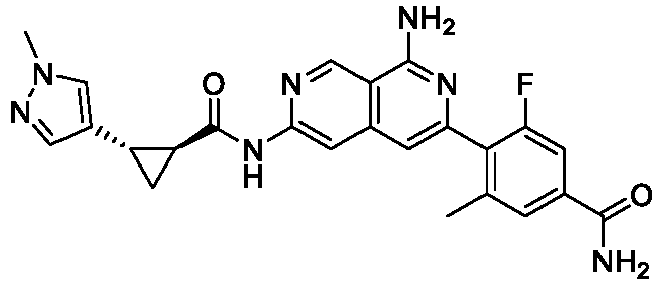
4-(1-amino-6-((1S,2S)-2-(1-methyl-1H-pyrazol-4-yl)cyclopropane-1- carboxamido)-2,7-naphthyridin-3-yl)-3-fluoro-5-methylbenzamide 352 
4-(1-amino-6-((1R,2R)-2-(1-methyl-1H-pyrazol-4-yl)cyclopropane-1-carboxamido)-2,7-naphthyridin-3-yl)-3-fluoro-5-methylbenzamide 353 
(1S,2R)-N-(8-amino-6-((R)-1-hydroxy-1,5-dimethyl-2,3-dihydro-1H-inden-4-yl)-2,7-naphthyridin-3-yl)-2-(cyanomethyl)cyclopropane-1-carboxamide 354 
(1R,2S,3R)-N-(8-amino-6-(2-fluoro-6-methylphenyl)-2,7-naphthyridin-3-yl)-2-methyl-3-(1-methyl-1H-pyrazol-4-yl)cyclopropane-1-carboxamide 355 
(1S,2S,3S)-N-(8-amino-6-(2-fluoro-6-methylphenyl)-2,7-naphthyridin-3-yl)-2-methyl-3-(1-methyl-1H-pyrazol-4-yl)cyclopropane-1-carboxamide 356 
(1R,2R,3R)-N-(8-amino-6-(2-fluoro-6-methylphenyl)-2,7-naphthyridin-3-yl)-2-methyl-3-(1-methyl-1H-pyrazol-4-yl)cyclopropane-1-carboxamide 357 
(1S,2R,3S)-N-(8-amino-6-(2-fluoro-6-methylphenyl)-2,7-naphthyridin-3-yl)-2-methyl-3-(1-methyl-1H-pyrazol-4-yl)cyclopropane-1-carboxamide 358 
(1S,2R,3S)-N-(8-amino-6-(3-amino-2-methylphenyl)-2,7-naphthyridin-3-yl)-2-methyl-3-(1-methyl-1H-pyrazol-4-yl)cyclopropane-1-carboxamide 359 
(1R,2S)-N-(8-amino-6-(2-fluoro-6-methylphenyl)-2,7-naphthyridin-3-yl)-2-(cyanomethyl)cyclopropane-1-carboxamide 360 
(1S,2R)-N-(8-amino-6-(2-fluoro-6-methylphenyl)-2,7-naphthyridin-3-yl)-2-(cyanomethyl)cyclopropane-1-carboxamide 361 
(1R,2S)-N-(8-amino-6-(2-chloro-6-methylphenyl)-2,7-naphthyridin-3-yl)-2-(cyanomethyl)cyclopropane-1-carboxamide 362 
(1S,2R)-N-(8-amino-6-(2-chloro-6-methylphenyl)-2,7-naphthyridin-3-yl)-2-(cyanomethyl)cyclopropane-1-carboxamide 363 
(1S,2R)-N-(8-amino-6-(3-amino-6-chloro-2-methylphenyl)-2,7-naphthyridin-3-yl)-2-(cyanomethyl)cyclopropane-1-carboxamide 364 
(1R,2S)-N-(8-amino-6-(3-amino-6-chloro-2-methylphenyl)-2,7-naphthyridin-3-yl)-2-(cyanomethyl)cyclopropane-1-carboxamide 365 
(1R,2S)-N-(8-amino-6-(3-amino-2-methylphenyl)-2,7-naphthyridin-3-yl)-2-(cyanomethyl)cyclopropane-1-carboxamide 366 
(1S,2R)-N-(8-amino-6-(3-amino-2-methylphenyl)-2,7-naphthyridin-3-yl)-2-(cyanomethyl)cyclopropane-1-carboxamide 367 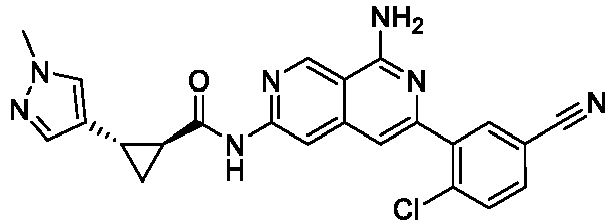
(+/-)-trans-N-(8-amino-6-(2-chloro-5-cyanophenyl)-2,7-naphthyridin-3-yl)-2-(1-methyl-1H-pyrazol-4-yl)cyclopropane-1-carboxamide 368 
(1R,2S)-N-(8-amino-6-(o-tolyl)-2,7-naphthyridin-3-yl)-2-(cyanomethyl)cyclopropane-1-carboxamide 369 
(1S,2R)-N-(8-amino-6-(o-tolyl)-2,7-naphthyridin-3-yl)-2-(cyanomethyl)cyclopropane-1-carboxamide 370 
(1R,2S)-N-(8-amino-6-(5-cyano-2-methylphenyl)-2,7-naphthyridin-3-yl)-2-(cyanomethyl)cyclopropane-1-carboxamide 371 
(1S,2R)-N-(8-amino-6-(5-cyano-2-methylphenyl)-2,7-naphthyridin-3-yl)-2-(cyanomethyl)cyclopropane-1-carboxamide 372 
trans-N-(8-amino-6-(2-chloro-6-methylphenyl)-2,7-naphthyridin-3-yl)-2-(cyanomethyl)cyclopropane-1- carboxamide 
373 
(1S,2S)-N-(8-amino-6-(2-methyl-4-(4-phenyloxazol-2-yl)phenyl)-2,7-naphthyridin-3-yl)-2-(1-methyl-1H-pyrazol-4-yl)cyclopropane-1- carboxamide 374 
(1R,2R)-N-(8-amino-6-(2-methyl-4-(4-phenyloxazol-2-yl)phenyl)-2,7-naphthyridin-3-yl)-2-(1-methyl-1H-pyrazol-4-yl)cyclopropane-1- carboxamide 375 
(1S,2S)-N-(8-amino-6-(4-(4-isopropyloxazol-2-yl)-2-methylphenyl)-2,7-naphthyridin-3-yl)-2-(1-methyl-1H-pyrazol-4-yl)cyclopropane-1-carboxamide 376 
(1R,2R)-N-(8-amino-6-(4-(4-isopropyloxazol-2-yl)-2-methylphenyl)-2,7-naphthyridin-3-yl)-2-(1-methyl-1H-pyrazol-4-yl)cyclopropane-1-carboxamide 377 
(1R,2R)-N-(8-amino-6-(2,6-dichlorophenyl)-2,7-naphthyridin-3-yl)-2-(1-methyl-1H-pyrazol-4-yl)cyclopropane-1-carboxamide 378 
(1S,2S)-N-(8-amino-6-(2,6-dichlorophenyl)-2,7-naphthyridin-3-yl)-2-(1-methyl-1H-pyrazol-4-yl)cyclopropane-1-carboxamide 379 
(1S,2S)-N-(8-amino-6-(2-methyl-4-(oxazol-2-yl)phenyl)-2,7-naphthyridin-3-yl)-2-(1-methyl-1H-pyrazol-4-yl)cyclopropane-1-carboxamide 380 
(1R,2R)-N-(8-amino-6-(2-methyl-4-(oxazol-2-yl)phenyl)-2,7-naphthyridin-3-yl)-2-(1-methyl-1H-pyrazol-4-yl)cyclopropane-1-carboxamide 381 
(1R,2R)-N-(8-amino-6-(2-(cyanomethyl)-6-methylphenyl)-2,7-naphthyridin-3-yl)-2-(1-methyl-1H-pyrazol-4-yl)cyclopropane-1- carboxamide 382 
trans-N-(8-amino-6-(2-(cyanomethyl)-6-methylphenyl)-2,7-naphthyridin-3- yl)-2-(1-methyl-1H-pyrazol-4-yl)cyclopropane-1-carboxamide 
383 
(1R,2R)-N-(8-amino-6-(2-fluoro-6-methylphenyl)-2,7-naphthyridin-3-yl)-2-(1-methyl-1H-pyrazol-4-yl)cyclopropane-1-carboxamide 384 
trans-N-(8-amino-6-(6-((S)-4-isopropyl-4,5-dihydrooxazol-2-yl)-4-methylpyridin-3-yl)-2,7-naphthyridin-3-yl)-2-(1-methyl-1H-pyrazol-4-yl)cyclopropane-1-carboxamide 
385 
methyl (S)-2-(5-(1-amino-6-((1S,2S)-2-(1-methyl-1H-pyrazol-4-yl)cyclopropane-1-carboxamido)-2,7-naphthyridin-3-yl)-4-methylpyridin-2-yl)-4,5-dihydrooxazole-4-carboxylate 386 
methyl (S)-2-(5-(1-amino-6-((1R,2R)-2-(1-methyl-1H-pyrazol-4-yl)cyclopropane-1-carboxamido)-2,7-naphthyridin-3-yl)-4-methylpyridin-2-yl)-4,5-dihydrooxazole-4-carboxylate 387 
(1S,2S)-N-(8-amino-6-(6-(methoxymethyl)-4-methylpyridin-3-yl)-2,7-naphthyridin-3-yl)-2-(1-methyl-1H-pyrazol-4-yl)cyclopropane-1-carboxamide 388 
(1R,2R)-N-(8-amino-6-(6-(methoxymethyl)-4-methylpyridin-3-yl)-2,7-naphthyridin-3-yl)-2-(1-methyl-1H-pyrazol-4-yl)cyclopropane-1-carboxamide 389 
2-[6-[[8-amino-6-(4-methyl-3-pyridyl)-2,7-naphthyridin-3-yl] amino]-3-pyridyl]acetonitrile 391 
(1S,2S)-N-(8-amino-6-((4-methylpyridin-3-yl)ethynyl)-2,7-naphthyridin-3-yl)-2-(1-methyl-1H-pyrazol-4-yl)cyclopropane-1- carboxamide 392 
(1R,2R)-N-(8-amino-6-((4-methylpyridin-3-yl)ethynyl)-2,7-naphthyridin-3-yl)-2-(1-methyl-1H-pyrazol-4-yl)cyclopropane-1- carboxamide 393 
(1S,2S)-N-(8-amino-6-(5-methoxy-4-methylpyridin-3-yl)-2,7-naphthyridin-3-yl)-2-(1-methyl-1H-pyrazol-4-yl)cyclopropane-1-carboxamide 394 
(1R,2R)-N-(8-amino-6-(5-methoxy-4-methylpyridin-3-yl)-2,7-naphthyridin-3-yl)-2-(1-methyl-1H-pyrazol-4-yl)cyclopropane-1-carboxamide 395 
(1S,2S)-N-(8-amino-6-(6-methoxy-4-methylpyridin-3-yl)-2,7-naphthyridin-3-yl)-2-(1-methyl-1H-pyrazol-4-yl)cyclopropane-1-carboxamide 396 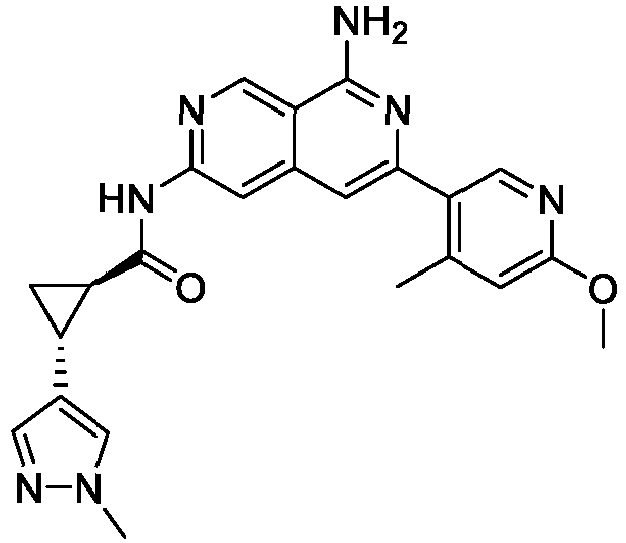
(1R,2R)-N-(8-amino-6-(6-methoxy-4-methylpyridin-3-yl)-2,7-naphthyridin-3-yl)-2-(1-methyl-1H-pyrazol-4-yl)cyclopropane-1-carboxamide 397 
(1R,2R)-N-(8-amino-6-(2-benzyl-4-methylpyridin-3-yl)-2,7-naphthyridin-3-yl)-2-(1-methyl-1H-pyrazol-4-yl)cyclopropane-1-carboxamide 398 
(1S,2S)-N-(8-amino-6-(4-methyl-6-(1H-pyrazol-1-yl)pyridin-3-yl)-2,7-naphthyridin-3-yl)-2-(1-methyl-1H-pyrazol-4-yl)cyclopropane-1-carboxamide 399 
(1R,2R)-N-(8-amino-6-(4-methyl-6-(1H-pyrazol-1-yl)pyridin-3-yl)-2,7-naphthyridin-3-yl)-2-(1-methyl-1H-pyrazol-4-yl)cyclopropane-1- carboxamide 400 
(1S,2S)-N-(8-amino-6-(4-methyl-6-(2-oxoazetidin-1-yl)pyridin-3-yl)-2,7-naphthyridin-3-yl)-2-(1-methyl-1H-pyrazol-4-yl)cyclopropane-1-carboxamide 401 
(1R,2R)-N-(8-amino-6-(4-methyl-6-(2-oxoazetidin-1-yl)pyridin-3-yl)-2,7-naphthyridin-3-yl)-2-(1-methyl-1H-pyrazol-4-yl)cyclopropane-1- carboxamide 402 
methyl 5-(1-amino-6-((1S,2S)-2-(1-methyl-1H-pyrazol-4-yl)cyclopropane-1 -carboxamido)-2,7-naphthyridin-3 -yl)-4-methylpicolinate 403 
methyl 5-(1-amino-6-((1R,2R)-2-(1-methyl-1H-pyrazol-4-yl)cyclopropane-1-carboxamido)-2,7-naphthyridin-3-yl)-4-methylpicolinate 404 
(1S,2S)-N-(8-amino-6-(4-methyl-6-(1-methyl-1H-pyrazol-3-yl)pyridin-3-yl)-2,7-naphthyridin-3-yl)-2-(1-methyl-1H-pyrazol-4-yl)cyclopropane-1- carboxamide 405 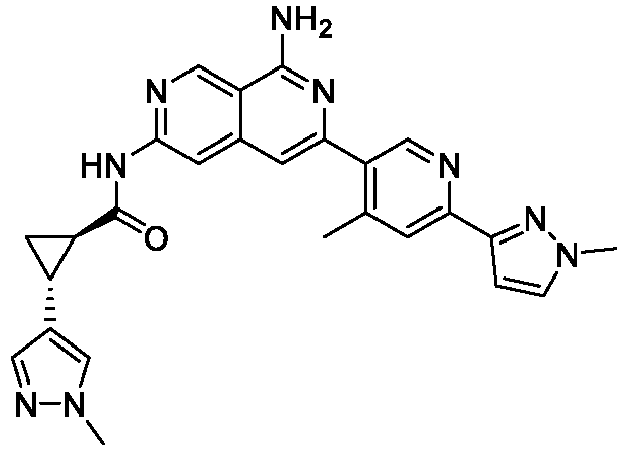
(1R,2R)-N-(8-amino-6-(4-methyl-6-(1-methyl-1H-pyrazol-3-yl)pyridin-3-yl)-2,7-naphthyridin-3-yl)-2-(1-methyl-1H-pyrazol-4-yl)cyclopropane-1-carboxamide 406 
(1S,2S)-N-(8-amino-6-(2,7-dimethyl-8-oxo-7,8-dihydropyrido[2,3-d]pyridazin-3-yl)-2,7-naphthyridin-3-yl)-2-(1-methyl-1H-pyrazol-4-yl)cyclopropane-1-carboxamide 407 
(1R,2R)-N-(8-amino-6-(2,7-dimethyl-8-oxo-7,8-dihydropyrido[2,3-d]pyridazin-3-yl)-2,7-naphthyridin-3- yl)-2-(1-methyl-1H-pyrazol-4-yl)cyclopropane-1-carboxamide 408 
(1S,2S)-N-(8-amino-6-(4,7-dimethyl-8-oxo-7,8-dihydropyrido[2,3-d]pyridazin-3-yl)-2,7-naphthyridin-3-yl)-2-(1-methyl-1H-pyrazol-4-yl)cyclopropane-1-carboxamide 409 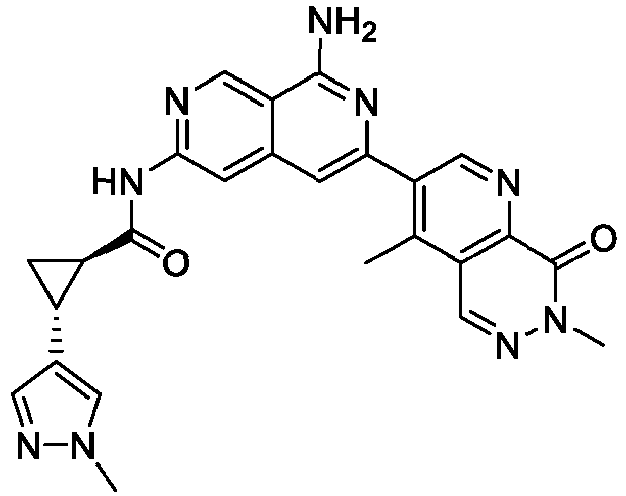
(1R,2R)-N-(8-amino-6-(4,7-dimethyl-8-oxo-7,8-dihydropyrido[2,3-d]pyridazin-3-yl)-2,7-naphthyridin-3- yl)-2-(1-methyl-1H-pyrazol-4-yl)cyclopropane-1-carboxamide 410 
(1S,2S)-N-(8-amino-6-(2,4,7-trimethyl-8-oxo-7,8-dihydropyrido[2,3-d]pyridazin-3-yl)-2,7-naphthyridin-3- yl)-2-(1-methyl-1H-pyrazol-4-yl)cyclopropane-1-carboxamide 411 
(1R,2R)-N-(8-amino-6-(2,4,7-trimethyl-8-oxo-7,8-dihydropyrido[2,3-d]pyridazin-3-yl)-2,7-naphthyridin-3- yl)-2-(1-methyl-1H-pyrazol-4-yl)cyclopropane-1-carboxamide 412 
N-(8-amino-6-(4-methylpyridin-3-yl)-2,7-naphthyridin-3-yl)-3-(methylsulfonamido)bicyclo[3.1.0] hexane-6-carboxamide 413 
N-(8-amino-6-(4-methylpyridin-3-yl)-2,7-naphthyridin-3-yl)spiro[2.2]pentane-1-carboxamide 414 
2'-((8-amino-6-(5-amino-4-methylpyridin-3-yl)-2,7-naphthyridin-3-yl)amino)-6'-methyl-5',6'-dihydrospiro[cyclopropane-1,4'-pyrazolo[1,5-d][1,4]diazepin]-7'(8'H)-one 415 
2-((8-amino-6-(5-amino-4-methylpyridin-3-yl)-2,7-naphthyridin-3-yl)amino)-6-methyl-5,6-dihydro-4H-pyrazolo[1,5-d][1,4]diazepin-7(8H)-one 416 
(S)-2-((8-amino-6-(4-methylpyridin-3-yl)-2,7-naphthyridin-3-yl)amino)-6,7-dihydro-4H-pyrazolo[5,1- c][1,4]oxazine-7-carbonitrile 417 
(R)-2-((8-amino-6-(4-methylpyridin-3-yl)-2,7-naphthyridin-3-yl)amino)-6,7-dihydro-4H-pyrazolo[5,1- c][1,4]oxazine-7-carbonitrile 418 
2-((8-amino-6-(4-methylpyridin-3-yl)-2,7-naphthyridin-3-yl)amino)-5,7-dimethyl-7,9-dihydro-8H-pyrido[2,3-d]azepin-8-one 419 
2-((8-amino-6-(1-(pyridin-2-yloxy)ethyl)-2,7-naphthyridin-3-yl)amino)-6-isopropyl-5,6-dihydro-4H-pyrazolo[1,5-d][1,4]diazepin-7(8H)-one 
420 
2-((8-amino-6-(1-(2-oxopyridin-1(2H)-yl)ethyl)-2,7-naphthyridin-3-yl)amino)-6-isopropyl-5,6-dihydro-4H-pyrazolo[1,5-d][1,4]diazepin-7(8H)-one 
421 
(1S,2R)-N-(8-amino-6-((R)-1-hydroxy-1,5-dimethyl-2,3-dihydro-1H-inden-4-yl)-2,7-naphthyridin-3-yl)-2-(cyanomethyl)cyclopropane-1-carboxamide 422 
(1S,2R)-N-(8-amino-6-((S)-1-hydroxy-1,5-dimethyl-2,3-dihydro-1H-inden-4-yl)-2,7-naphthyridin-3-yl)-2-(cyanomethyl)cyclopropane-1-carboxamide 423 
(1S,2S,3S)-N-(8-amino-6-(3-amino-2-methylphenyl)-2,7-naphthyridin-3-yl)-2-methyl-3-(1-methyl-1H-pyrazol-4-yl)cyclopropane-1-carboxamide 424 
(1R,2S,3R)-N-(8-amino-6-(3-amino-2-methylphenyl)-2,7-naphthyridin-3-yl)-2-methyl-3-(1-methyl-1H-pyrazol-4-yl)cyclopropane-1-carboxamide 425 
(1R,2R,3R)-N-(8-amino-6-(3-amino-2-methylphenyl)-2,7-naphthyridin-3-yl)-2-methyl-3-(1-methyl-1H-pyrazol-4-yl)cyclopropane-1-carboxamide 426 
2-((8-amino-6-(2-fluoro-6-methylphenyl)-2,7-naphthyridin-3- yl)amino)-6-methyl-5,6-dihydro-4H-pyrazolo[1,5-d][1,4]diazepin-7(8H)-one 427 
trans-N-(8-amino-6-(2-benzyl-4-methylpyridin-3-yl)-2,7-naphthyridin-3-yl)-2-(1-methyl-1H-pyrazol-4-yl)cyclopropane-1-carboxamide 
428 
(1R,2R)-N-(8-amino-6-(2-(methoxymethyl)-6-methylphenyl)-2,7-naphthyridin-3-yl)-2-(1-methyl-1H-pyrazol-4-yl)cyclopropane-1- carboxamide 429 
(1S,2S)-N-(8-amino-6-(2-(methoxymethyl)-6-methylphenyl)-2,7-naphthyridin-3-yl)-2-(1-methyl-1H-pyrazol-4-yl)cyclopropane-1- carboxamide Table 3 Cmpd No. Structure Name 430 
3 -methyltetrahydrofuran-3-yl(8-amino-6-(5- amino-4-methylpyridin-3-yl)-2,7-naphthyridin-3-yl)carbamate 
431 
3-methyltetrahydrofuran-3-yl(8-amino-6-(8-methyl-2,3-dihydro-1H-pyrido[2,3-b][1,4]oxazin-7-yl)-2,7-naphthyridin-3-yl)carbamate 
432 
3-methyloxetan-3-yl (8-amino-6-(5-amino-4-methylpyridin-3-yl)-2,7-naphthyridin-3-yl)carbamate 433 
3-methyloxetan-3-yl (8-amino-6-(8-methyl-2,3-dihydro-1H-pyrido[2,3-b][1,4]oxazin-7-yl)-2,7-naphthyridin-3-yl)carbamate 434 
1,1-dioxidotetrahydrothiophen-3-yl (8-amino-6-(5-amino-4-methylpyridin-3-yl)-2,7-naphthyridin-3-yl)carbamate 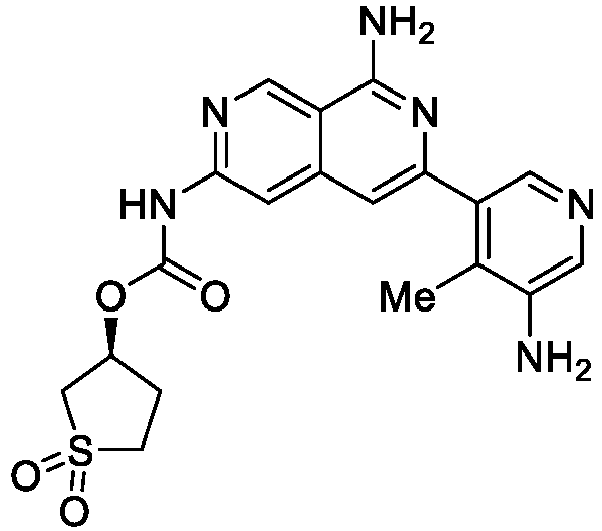
435 
1,1-dioxidotetrahydrothiophen-3-yl (8-amino-6-(8-methyl-2,3-dihydro-1H-pyrido[2,3-b][1,4]oxazin-7-yl)-2,7-naphthyridin-3-yl)carbamate 
436 
1,3-dimethyl-5-oxopyrrolidin-3-yl (8-amino-6-(5-amino-4-methylpyridin-3-yl)-2,7-naphthyridin-3-yl)carbamate 
437 
1,3-dimethyl-5-oxopyrrolidin-3-yl (8-amino-6-(8-methyl-2,3-dihydro-1H-pyrido[2,3-b][1,4]oxazin-7-yl)-2,7-naphthyridin-3-yl)carbamate 
438 
1-acetyl-3-methylazetidin-3-yl (8-amino-6-(5-amino-4-methylpyridin-3-yl)-2,7-naphthyridin-3-yl)carbamate 439 
1-acetyl-3-methylazetidin-3-yl (8-amino-6-(8-methyl-2,3-dihydro-1H-pyrido[2,3-b][1,4]oxazin-7-yl)-2,7-naphthyridin-3-yl)carbamate 440 
1-(8-amino-6-(5-amino-4-methylpyridin-3-yl)-2,7-naphthyridin-3-yl)-3-methylurea 441 
1-(8-amino-6-(8-methyl-2,3-dihydro-1H-pyrido[2,3-b][1,4]oxazin-7-yl)-2,7-naphthyridin-3-yl)-3-methylurea 442 
2-((8-amino-6-(5-amino-4-methylpyridin-3-yl)-2,7-naphthyridin-3-yl)amino)-6-methyl-4H,6H-pyrazolo[1,5-e][1,2,5]oxadiazepin-7(8H)-one 443 
2-((8-amino-6-(8-methyl-2,3-dihydro-1H-pyrido[2,3-b][1,4]oxazin-7-yl)-2,7-naphthyridin-3-yl)amino)-6-methyl-4H,6H-pyrazolo[1,5-e][1,2,5]oxadiazepin-7(8H)-one 444 
2'-((8-amino-6-(5-amino-4-methylpyridin-3-yl)-2,7-naphthyridin-3-yl)amino)-6'-methyl-6'H-spiro[cyclopropane-1,4'-pyrazolo[1,5-e][1,2,5]oxadiazepin]-7'(8'H)-one 445 
2-((8-amino-6-(5-amino-4-methylpyridin-3-yl)-2,7-naphthyridin-3-yl)amino)-4,4,6-trimethyl-4H,6H-pyrazolo[1,5-e] [1,2,5]oxadiazepin-7(8H)-one 446 
2-((8-amino-6-(5-amino-4-methylpyridin-3-yl)-2,7-naphthyridin-3-yl)amino)-4,6-dimethyl-4H,6H-pyrazolo[1,5-e][1,2,5]oxadiazepin-7(8H)-one 
447 
2-((8-amino-6-(4-hydroxy-5-methyl-3,4-dihydro-2H-pyrano[2,3-b]pyridin-6-yl)-2,7-naphthyridin-3-yl)amino)-5,6-dihydro-4H-pyrazolo[1,5-d][1,4]diazepin-7(8H)-one 

448 
2-((8-amino-6-(4-hydroxy-5-methyl-3,4-dihydro-2H-pyrano[2,3-b]pyridin-6-yl)-2,7-naphthyridin-3-yl)amino)-6-methyl-5 ,6-dihydro-4H-pyrazolo[1,5-d][1,4]diazepin-7(8H)-one 

449 
6-(1-amino-6-((5,6-dihydro-11H-imidazo[1,2-a]pyrazolo[1,5-d][1,4]diazepin-8-yl)amino)-2,7-naphthyridin-3-yl)-5-methyl-3,4-dihydro-2H-pyrano[2,3-b]pyridin-4-ol 

450 
2-((8-amino-6-(5-methyl-3,4-dihydro-2H-pyrano[2,3-b]pyridin-6-yl)-2,7-naphthyridin-3-yl)amino)-5,6-dihydro-4H-pyrazolo[1,5-d][1,4]diazepin-7(8H)-one 451 
N6-(5,6-dihydro-11H-imidazo[1,2-a]pyrazolo[1,5-d][1,4]diazepin-8-yl)-3-(5-methyl-3,4-dihydro-2H-pyrano[2,3-b]pyridin-6-yl)-2,7-naphthyridine-1,6-diamine 452 
2-((8-amino-6-(5-methyl-3,4-dihydro-2H-pyrano[2,3-b]pyridin-6-yl)-2,7-naphthyridin-3-yl)amino)-6-methyl-5,6-dihydro-4H-pyrazolo[1,5-d][1,4]diazepin-7(8H)-one 453 
2-((8-amino-6-(4-fluoro-5-methyl-3,4-dihydro-2H-pyrano[2,3-b]pyridin-6-yl)-2,7-naphthyridin-3-yl)amino)-5,6-dihydro-4H-pyrazolo[1,5-d][1,4]diazepin-7(8H)-one 

454 
2-((8-amino-6-(4-fluoro-5-methyl-3,4-dihydro-2H-pyrano[2,3-b]pyridin-6-yl)-2,7-naphthyridin-3-yl)amino)-6-methyl-5,6-dihydro-4H-pyrazolo[1,5-d][1,4]diazepin-7(8H)-one 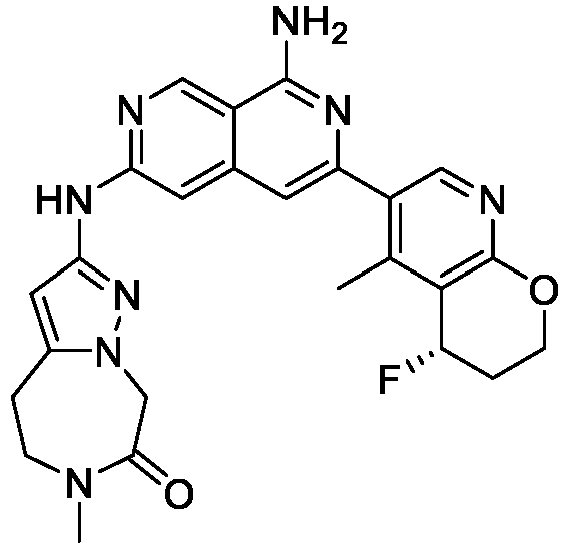

455 
N6-(5,6-dihydro-11H-imidazo[1,2-a]pyrazolo[1,5-d][1,4]diazepin-8-yl)-3-(4-fluoro-5-methyl-3,4-dihydro-2H-pyrano[2,3-b]pyridin-6-yl)-2,7-naphthyridine-1,6-diamine 

456 
2-((8-amino-6-(4-methyl-5,6,7,8-tetrahydro-1,5-naphthyridin-3-yl)-2,7-naphthyridin-3-yl)amino)-5,6-dihydro-4H-pyrazolo[1,5-d][1,4]diazepin-7(8H)-one 457 
2-((8-amino-6-(4-methyl-5,6,7,8-tetrahydro-1,5-naphthyridin-3-yl)-2,7-naphthyridin-3-yl)amino)-6-methyl-5,6-dihydro-4H-pyrazolo[1,5-d][1,4]diazepin-7(8H)-one 458 
N6-(5,6-dihydro-11H-imidazo[1,2-a]pyrazolo[1,5-d][1,4]diazepin-8-yl)-3-(4-methyl-5,6,7,8-tetrahydro-1,5-naphthyridin-3-yl)-2,7-naphthyridine-1,6-diamine 459 
2-((8-amino-6-(4-methyl-8-oxo-5,6,7,8-tetrahydro-1,5-naphthyridin-3-yl)-2,7-naphthyridin-3-yl)amino)-6-methyl-5 ,6-dihydro-4H-pyrazolo[1,5-d][1,4]diazepin-7(8H)-one 460 
8-(1-amino-6-((6-methyl-7-oxo-5,6,7,8-tetrahydro-4H-pyrazolo[1,5-d][1,4]diazepin-2-yl)amino)-2,7-naphthyridin-3-yl)-4,9-dimethyl-1,2,3,4-tetrahydro-5H-pyrido[3,2-e][1,4]diazepin-5-one 461 
8-(1-amino-6-((7-oxo-5,6,7,8-tetrahydro-4H-pyrazolo[1,5-d][1,4]diazepin-2-yl)amino)-2,7-naphthyridin-3-yl)-4,9-dimethyl-1,2,3,4-tetrahydro-5H-pyrido[3,2-e][1,4]diazepin-5-one 462 
8-(1-amino-6-((5,6-dihydro-11H-imidazo[1,2-a]pyrazolo[1,5-d][1,4]diazepin-8-yl)amino)-2,7-naphthyridin-3-yl)-4,9-dimethyl-1,2,3,4-tetrahydro-5H-pyrido[3,2-e][1,4]diazepin-5-one 463 
2-((8-amino-6-(8,8-difluoro-4-methyl-5,6,7,8-tetrahydro-1,5-naphthyridin-3-yl)-2,7-naphthyridin-3-yl)amino)-5,6-dihydro-4H-pyrazolo[1,5-d][1,4]diazepin-7(8H)-one 464 
2-((8-amino-6-(8,8-difluoro-4-methyl-5,6,7,8-tetrahydro-1,5-naphthyridin-3-yl)-2,7-naphthyridin-3-yl)amino)-6-methyl-5,6-dihydro-4H-pyrazolo[1,5-d][1,4]diazepin-7(8H)-one 465 
3-(8,8-difluoro-4-methyl-5,6,7,8-tetrahydro-1,5-naphthyridin-3-yl)-N6-(5,6-dihydro-11H-imidazo[1,2-a]pyrazolo[1,5-d][1,4]diazepin-8-yl)-2,7-naphthyridine-1,6-diamine 466 
N6-(5,6-dihydro-11H-imidazo[1,2-a]pyrazolo[1,5-d][1,4]diazepin-8-yl)-3-(8-fluoro-4-methyl-5,6,7,8-tetrahydro-1,5-naphthyridin-3-yl)-2,7-naphthyridine-1,6-diamine 
467 
2-((8-amino-6-(8-fluoro-4-methyl-5,6,7,8-tetrahydro-1,5-naphthyridin-3-yl)-2,7-naphthyridin-3-yl)amino)-6-methyl-5,6-dihydro-4H-pyrazolo[1,5-d][1,4]diazepin-7(8H)-one 
468 
2-((8-amino-6-(8-fluoro-4-methyl-5,6,7,8-tetrahydro-1,5-naphthyridin-3-yl)-2,7-naphthyridin-3-yl)amino)-5,6-dihydro-4H-pyrazolo[1,5-d][1,4]diazepin-7(8H)-one 
469 
7-(1-amino-6-((6-methyl-7-oxo-5,6,7,8-tetrahydro-4H-pyrazolo[1,5-d][1,4]diazepin-2-yl)amino)-2,7-naphthyridin-3-yl)-3,8-dimethyl-2,3-dihydropyrido[3,2-d]pyrimidin-4(1H)-one 470 
7-(1-amino-6-((7-oxo-5,6,7,8-tetrahydro-4H-pyrazolo[1,5-d][1,4]diazepin-2-yl)amino)-2,7-naphthyridin-3-yl)-3,8-dimethyl-2,3-dihydropyrido[3,2-d]pyrimidin-4(1H)-one 471 
7-(8-amino-3-((5,6-dihydro-11H-imidazo[1,2-a]pyrazolo[1,5-d][1,4]diazepin-8-yl)amino)-7-fluoroisoquinolin-6-yl)-3, 8-dimethyl-2,3-dihydropyrido[3,2-d]pyrimidin-4(1H)-one 472 
2-((8-amino-6-(3-hydroxy-5-methyl-3,4-dihydro-2H-pyrano[2,3-b]pyridin-6-yl)-2,7-naphthyridin-3-yl)amino)-6-methyl-5,6-dihydro-4H-pyrazolo[1,5-d][1,4]diazepin-7(8H)-one 
473 
2-((8-amino-6-(3-hydroxy-5-methyl-3,4-dihydro-2H-pyrano[2,3-b]pyridin-6-yl)-2,7-naphthyridin-3-yl)amino)-5,6-dihydro-4H-pyrazolo[1,5-d][1,4]diazepin-7(8H)-one 
474 
2-((8-amino-6-(3-hydroxy-5-methyl-3,4-dihydro-2H-pyrano[2,3-b]pyridin-6-yl)-2,7-naphthyridin-3-yl)amino)-6-methyl-5,6-dihydro-4H-pyrazolo[1,5-d][1,4]diazepin-7(8H)-one 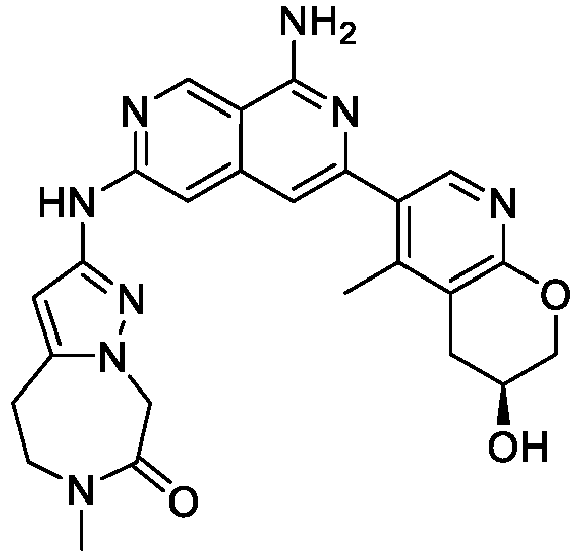
475 
6-(1-amino-6-((5,6-dihydro-11H-imidazo[1,2-a]pyrazolo[1,5-d][1,4]diazepin-8-yl)amino)-2,7-naphthyridin-3-yl)-5-methyl-3,4-dihydro-2H-pyrano[2,3-b]pyridin-3-ol 
476 
7-(1-amino-6-((5,6-dihydro-11H-imidazo[1,2-a]pyrazolo[1,5-d][1,4]diazepin-8-yl)amino)-2,7-naphthyridin-3-yl)-8-methyl-1,2,3,4-tetrahydro-1,5-naphthyridin-4-ol 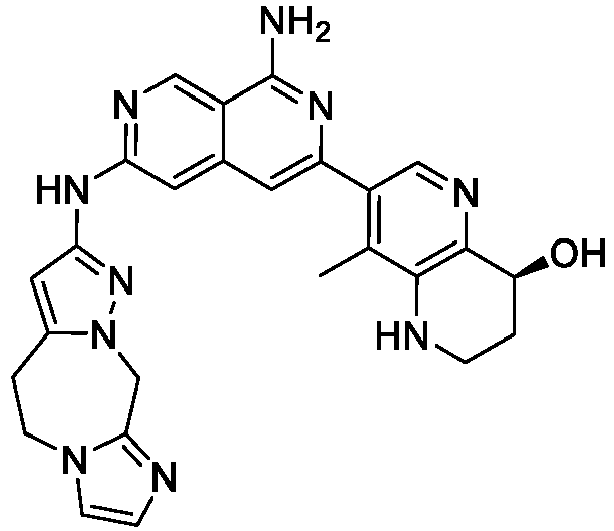
477 
2-((8-amino-6-(8-hydroxy-4-methyl-5,6,7,8-tetrahydro-1,5-naphthyridin-3-yl)-2,7-naphthyridin-3-yl)amino)-6-methyl-5,6-dihydro-4H-pyrazolo[1,5-d][1,4]diazepin-7(8H)-one 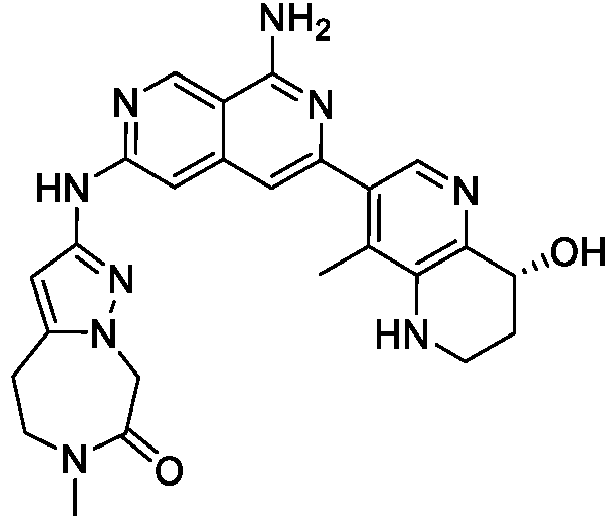
478 
2-((8-amino-6-(8-hydroxy-4-methyl-5,6,7,8-tetrahydro-1,5-naphthyridin-3-yl)-2,7-naphthyridin-3-yl)amino)-5,6-dihydro-4H-pyrazolo[1,5-d][1,4]diazepin-7(8H)-one 
479 
7-(1-amino-6-((5,6-dihydro-11H-imidazo[1,2-a]pyrazolo[1,5-d][1,4]diazepin-8-yl)amino)-2,7-naphthyridin-3-yl)-8-methyl-1,2,3,4-tetrahydro-1,5-naphthyridine-4-carbonitrile 
480 
7-(1-amino-6-((6-methyl-7-oxo-5,6,7,8-tetrahydro-4H-pyrazolo[1,5-d][1,4]diazepin-2-yl)amino)-2,7-naphthyridin-3-yl)-8-methyl-1,2,3,4-tetrahydro-1,5-naphthyridine-4-carbonitrile 
481 
7-(1-amino-6-((7-oxo-5,6,7,8-tetrahydro-4H-pyrazolo[1,5-d][1,4]diazepin-2-yl)amino)-2,7-naphthyridin-3-yl)-8-methyl-1,2,3,4-tetrahydro-1,5-naphthyridine-4-carbonitrile 
482 
3-(1-amino-6-((6-methyl-7-oxo-5,6,7,8-tetrahydro-4H-pyrazolo[1,5-d][1,4]diazepin-2-yl)amino)-2,7-naphthyridin-3-yl)-4-methylpyridine 1-oxide 483 
3-(1-amino-6-((5,6-dihydro-11H-imidazo[1,2-a]pyrazolo[1,5-d][1,4]diazepin-8-yl)amino)-2,7-naphthyridin-3-yl)-4-methylpyridine 1-oxide 484 
N-(5-(1-amino-6-((6-methyl-7-oxo-5,6,7,8-tetrahydro-4H-pyrazolo[1,5-d][1,4]diazepin-2-yl)amino)-2,7-naphthyridin-3-yl)-4-methylpyridin-3-yl)methanesulfonamide 485 
N-(5-(1-amino-6-((7-oxo-5,6,7,8-tetrahydro-4H-pyrazolo[1,5-d][1,4]diazepin-2-yl)amino)-2,7-naphthyridin-3-yl)-4-methylpyridin-3-yl)methanesulfonamide 486 
N-(5-(1-amino-6-((5,6-dihydro-11H-imidazo[1,2-a]pyrazolo[1,5-d][1,4]diazepin-8-yl)amino)-2,7-naphthyridin-3-yl)-4-methylpyridin-3-yl)methanesulfonamide 487 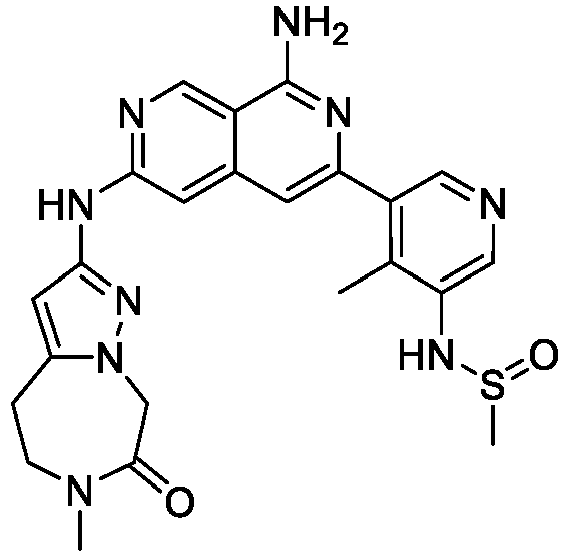
N-(5-(1-amino-6-((6-methyl-7-oxo-5,6,7,8-tetrahydro-4H-pyrazolo[1,5-d][1,4]diazepin-2-yl)amino)-2,7-naphthyridin-3-yl)-4-methylpyridin-3-yl)methanesulfinamide 488 
N-(5-(1-amino-6-((5,6-dihydro-11H-imidazo[1,2-a]pyrazolo[1,5-d][1,4]diazepin-8-yl)amino)-2,7-naphthyridin-3-yl)-4-methylpyridin-3-yl)methanesulfinamide 489 
N-(5-(1-amino-6-((7-oxo-5,6,7,8-tetrahydro-4H-pyrazolo[1,5-d][1,4]diazepin-2-yl)amino)-2,7-naphthyridin-3-yl)-4-methylpyridin-3-yl)methanesulfinamide 490 
2-((8-amino-6-(7-methyl-2-oxo-2,3-dihydro-1H-pyrrolo[3,2-b]pyridin-6-yl)-2,7-naphthyridin-3-yl)amino)-6-methyl-5,6-dihydro-4H-pyrazolo[1,5-d][1,4]diazepin-7(8H)-one 491 
2-((8-amino-6-(7-methyl-2-oxo-2,3-dihydro-1H-pyrrolo[3,2-b]pyridin-6-yl)-2,7-naphthyridin-3-yl)amino)-5,6-dihydro-4H-pyrazolo[1,5-d][1,4]diazepin-7(8H)-one 492 
6-(1-amino-6-((5,6-dihydro-11H-imidazo[1,2-a]pyrazolo[1,5-d][1,4]diazepin-8-yl)amino)-2,7-naphthyridin-3-yl)-7-methyl-1,3-dihydro-2H-pyrrolo[3,2-b]pyridin-2-one 493 
2-((8-amino-6-(2,7-dimethyl-3-oxo-2,3-dihydro-1H-pyrazolo[4,3-b]pyridin-6-yl)-2,7-naphthyridin-3-yl)amino)-6-methyl-5,6-dihydro-4H-pyrazolo[1,5-d][1,4]diazepin-7(8H)-one 494 
2-((8-amino-6-(2,7-dimethyl-3-oxo-2,3-dihydro-1H-pyrazolo[4,3-b]pyridin-6-yl)-2,7-naphthyridin-3-yl)amino)-5,6-dihydro-4H-pyrazolo[1,5-d][1,4]diazepin-7(8H)-one 495 
6-(1-amino-6-((5,6-dihydro-11H-imidazo[1,2-a]pyrazolo[1,5-d][1,4]diazepin-8-yl)amino)-2,7-naphthyridin-3-yl)-2,7-dimethyl-1,2-dihydro-3H-pyrazolo[4,3-b]pyridin-3-one 496 
2-((8-amino-6-(7-methyl-2,2-dioxido-1,3-dihydroisothiazolo[4,3-b]pyridin-6-yl)-2,7-naphthyridin-3-yl)amino)-6-methyl-5,6-dihydro-4H-pyrazolo[1,5-d][1,4]diazepin-7(8H)-one 497 
2-((8-amino-6-(7-methyl-2,2-dioxido-1,3-dihydroisothiazolo[4,3-b]pyridin-6-yl)-2,7-naphthyridin-3-yl)amino)-5,6-dihydro-4H-pyrazolo[1,5-d][1,4]diazepin-7(8H)-one 498 
6-(1-amino-6-((5,6-dihydro-11H-imidazo[1,2-a]pyrazolo[1,5-d][1,4]diazepin-8-yl)amino)-2,7-naphthyridin-3-yl)-7-methyl-1,3-dihydroisothiazolo[4,3-b]pyridine 2,2-dioxide 499 
2-((8-amino-6-(7-methyl-2-oxido-1,3-dihydroisothiazolo[4,3-b]pyridin-6-yl)-2,7-naphthyridin-3-yl)amino)-6-methyl-5,6-dihydro-4H-pyrazolo[1,5-d][1,4]diazepin-7(8H)-one 500 
2-((8-amino-6-(7-methyl-2-oxido-1,3-dihydroisothiazolo[4,3-b]pyridin-6-yl)-2,7-naphthyridin-3-yl)amino)-5,6-dihydro-4H-pyrazolo[1,5-d][1,4]diazepin-7(8H)-one 501 
6-(1-amino-6-((5,6-dihydro-11H-imidazo[1,2-a]pyrazolo[1,5-d][1,4]diazepin-8-yl)amino)-2,7-naphthyridin-3-yl)-7-methyl-1,3-dihydroisothiazolo[4,3-b]pyridine 2-oxide 502 
6-(1-amino-6-((5,6-dihydro-11H-imidazo[1,2-a]pyrazolo[1,5-d][1,4]diazepin-8-yl)amino)-2,7-naphthyridin-3-yl)-2,2,7-trimethyl-2,3-dihydro-1H-pyrrolo[3,2-b]pyridin-3-ol 
503 
2-((8-amino-6-(3-hydroxy-2,2,7-trimethyl-2,3-dihydro-1H-pyrrolo[3,2-b]pyridin-6-yl)-2,7-naphthyridin-3-yl)amino)-6-methyl-5,6-dihydro-4H-pyrazolo[1,5-d][1,4]diazepin-7(8H)-one 
504 
2-((8-amino-6-(3-hydroxy-2,2,7-trimethyl-2,3-dihydro-1H-pyrrolo[3,2-b]pyridin-6-yl)-2,7-naphthyridin-3-yl)amino)-5,6-dihydro-4H-pyrazolo[1,5-d][1,4]diazepin-7(8H)-one 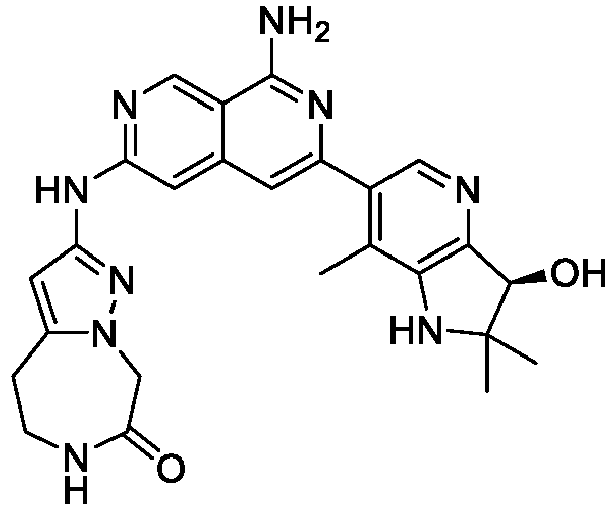
505 
6-(1-amino-6-((5,6-dihydro-11H-imidazo[1,2-a]pyrazolo[1,5-d][1,4]diazepin-8-yl)amino)-2,7-naphthyridin-3-yl)-3-hydroxy-3,7-dimethyl-1,3-dihydro-2H-pyrrolo[3,2-b]pyridin-2-one 
506 
2-((8-amino-6-(3-hydroxy-3,7-dimethyl-2-oxo-2,3-dihydro-1H-pyrrolo[3,2-b]pyridin-6-yl)-2,7-naphthyridin-3-yl)amino)-6-methyl-5,6-dihydro-4H-pyrazolo[1,5-d][1,4]diazepin-7(8H)-one 
507 
2-((8-amino-6-(3-hydroxy-3,7-dimethyl-2-oxo-2,3-dihydro-1H-pyrrolo[3,2-b]pyridin-6-yl)-2,7-naphthyridin-3-yl)amino)-5,6-dihydro-4H-pyrazolo[1,5-d][1,4]diazepin-7(8H)-one 
508 
2-((8-amino-6-(4,6-dimethyl-7-oxo-6,7-dihydro-5H-pyrrolo[3,4-b]pyridin-3-yl)-2,7-naphthyridin-3-yl)amino)-6-methyl-5,6-dihydro-4H-pyrazolo[1,5-d][1,4]diazepin-7(8H)-one 509 
3-(1-amino-6-((5,6-dihydro-11H-imidazo[1,2-a]pyrazolo[1,5-d][1,4]diazepin-8-yl)amino)-2,7-naphthyridin-3-yl)-4,6-dimethyl-5,6-dihydro-7H-pyrrolo[3,4-b]pyridin-7-one 510 
2-((8-amino-6-(4,6-dimethyl-7-oxo-6,7-dihydro-5H-pyrrolo[3,4-b]pyridin-3-yl)-2,7-naphthyridin-3-yl)amino)-5,6-dihydro-4H-pyrazolo[1,5-d][1,4]diazepin-7(8H)-one 511 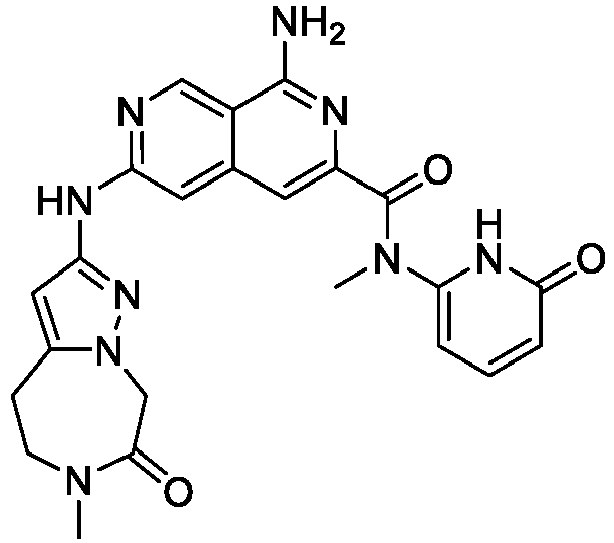
8-1-amino-N-methyl-6-((6-methyl-7-oxo-5,6,7,8-tetrahydro-4H-pyrazolo[1,5-d] [1,4]diazepin-2-yl)amino)-N-(6-oxo-1,6-dihydropyridin-2-yl)-2,7-naphthyridine-3-carboxamide 512 
8-amino-3-((5,6-dihydro-11H-imidazo[1,2-a]pyrazolo[1,5-d][1,4]diazepin-8-yl)amino)-7-fluoro-N-methyl-N-(6-oxo-1,6-dihydropyridin-2-yl)isoquinoline-6-carboxamide 513 
1-amino-N-methyl-N-(6-oxo-1,6-dihydropyridin-2-yl)-6-((7-oxo-5,6,7,8-tetrahydro-4H-pyrazolo[1,5-d][1,4]diazepin-2-yl)amino)-2,7-naphthyridine-3-carboxamide 514 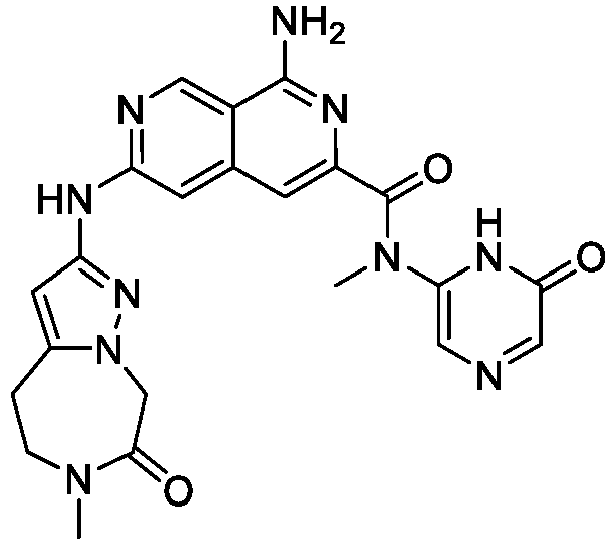
1-amino-N-methyl-6-((6-methyl-7-oxo-5,6,7,8-tetrahydro-4H-pyrazolo[1,5-d] [1,4]diazepin-2-yl)amino)-N-(6-oxo-1,6-dihydropyrazin-2-yl)-2,7-naphthyridine-3-carboxamide 515 
1-amino-6-((5,6-dihydro-11H-imidazo[1,2-a]pyrazolo[1,5-d][1,4]diazepin-8-yl)amino)-N-methyl-N-(6-oxo-1,6-dihydropyrazin-2-yl)-2,7-naphthyridine-3-carboxamide 516 
1-amino-N-methyl-N-(6-oxo-1,6-dihydropyrazin-2-yl)-6-((7-oxo-5,6,7,8-tetrahydro-4H-pyrazolo[1,5-d][1,4]diazepin-2-yl)amino)-2,7-naphthyridine-3-carboxamide 517 
2-((8-amino-6-(difluoromethyl)-2,7-naphthyridin-3-yl)amino)-6-methyl-5,6-dihydro-4H-pyrazolo[1,5-d][1,4]diazepin-7(8H)-one 518 
2-((8-amino-6-(difluoromethyl)-2,7-naphthyridin-3-yl)amino)-5,6-dihydro-4H-pyrazolo[1,5-d][1,4]diazepin-7(8H)-one 519 
3-(difluoromethyl)-N6-(5,6-dihydro-11H-imidazo[1,2-a]pyrazolo[1,5-d][1,4]diazepin-8-yl)-2,7-naphthyridine-1,6-diamine 520 
2-(1-amino-6-((6-methyl-7-oxo-5,6,7,8-tetrahydro-4H-pyrazolo[1,5-d][1,4]diazepin-2-yl)amino)-2,7-naphthyridin-3-yl)propanenitrile 
521 
2-(1-amino-6-((5,6-dihydro-11H-imidazo[1,2-a]pyrazolo[1,5-d][1,4]diazepin-8-yl)amino)-2,7-naphthyridin-3-yl)propanenitrile 
522 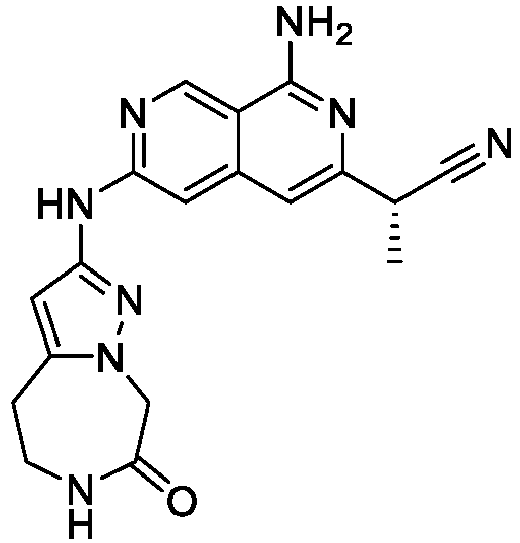
2-(1-amino-6-((7-oxo-5,6,7,8-tetrahydro-4H-pyrazolo[1,5-d][1,4]diazepin-2-yl)amino)-2,7-naphthyridin-3-yl)propanenitrile 
523 
2-((8-amino-6-(3-amino-9-methyl-3,4-dihydro-2H-[1,4]dioxepino[2,3-b]pyridin-8-yl)-2,7-naphthyridin-3-yl)amino)-6-methyl-5,6-dihydro-4H-pyrazolo[1,5-d][1,4]diazepin-7(8H)-one 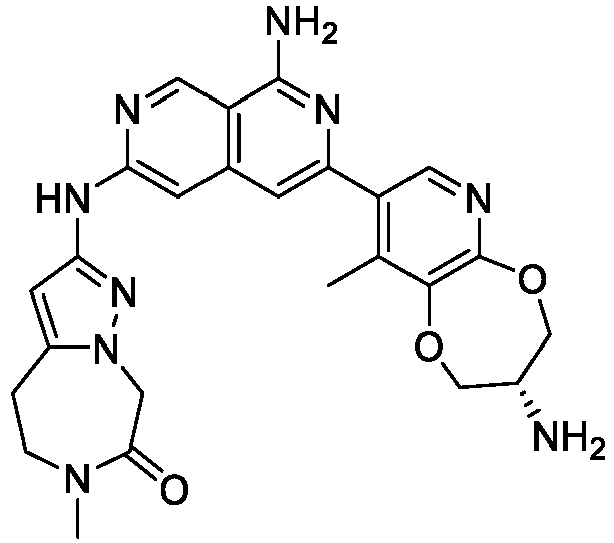
524 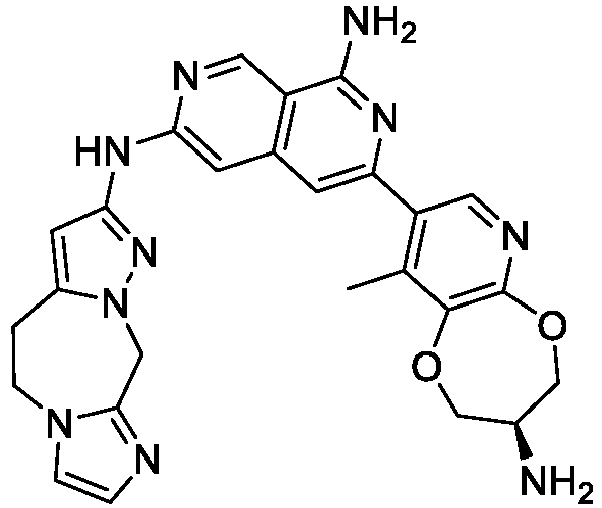
3-(3-amino-9-methyl-3,4-dihydro-2H-[1,4]dioxepino[2,3-b]pyridin-8-yl)-N6-(5,6-dihydro-11H-imidazo[1,2-a]pyrazolo[1,5-d][1,4]diazepin-8-yl)-2,7-naphthyridine-1,6-diamine 
525 
2-((8-amino-6-(9-methyl-3,3-dioxido-1,2-dihydro-4H-pyrido[3,2-f][1,3,5]oxathiazepin-5-yl)-2,7-naphthyridin-3-yl)amino)-5,6-dihydro-4H-pyrazolo[1,5-d][1,4]diazepin-7(8H)-one 526 
2-((8-amino-6-(9-methyl-3,3-dioxido-1,2-dihydro-4H-pyrido[3,2-f][1,3,5]oxathiazepin-8-yl)-2,7-naphthyridin-3-yl)amino)-6-methyl-5,6-dihydro-4H-pyrazolo[1,5-d][1,4]diazepin-7(8H)-one 527 
8-(1-amino-6-((5,6-dihydro-11H-imidazo[1,2-a]pyrazolo[1,5-d][1,4]diazepin-8-yl)amino)-2,7-naphthyridin-3-yl)-9-methyl-1,2-dihydro-4H-pyrido[3,2-f][1,3,5]oxathiazepine3,3-dioxide 528 
2-((8-amino-6-(4-methyl-5-(1H-pyrazol-1-yl)pyridin-3-yl)-2,7-naphthyridin-3-yl)amino)-6-methyl-5,6-dihydro-4H-pyrazolo[1,5-d][1,4]diazepin-7(8H)-one 529 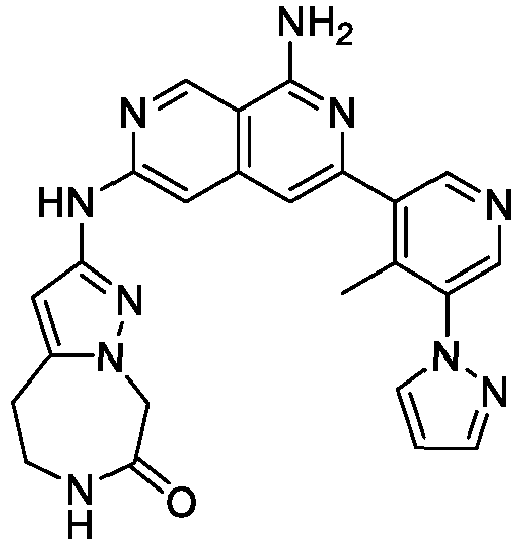
2-((8-amino-6-(4-methyl-5-(1H-pyrazol-1-yl)pyridin-3-yl)-2,7-naphthyridin-3-yl)amino)-5,6-dihydro-4H-pyrazolo[1,5-d][1,4]diazepin-7(8H)-one 530 
2-((6-(5-(1H-imidazol-1-yl)-4-methylpyridin-3-yl)-2,7-naphthyridin-3-yl)amino)-6-methyl-5,6-dihydro-4H-pyrazolo[1,5-d][1,4]diazepin-7(8H)-one 531 
2-((6-(5-(1H-imidazol-1-yl)-4-methylpyridin-3-yl)-8-amino-2,7-naphthyridin-3-yl)amino)-5,6-dihydro-4H-pyrazolo[1,5-d][1,4]diazepin-7(8H)-one 532 
2-((8-amino-6-(4-methyl-5-(1H-pyrazol-5-yl)pyridin-3-yl)-2,7-naphthyridin-3-yl)amino)-6-methyl-5,6-dihydro-4H-pyrazolo[1,5-d][1,4]diazepin-7(8H)-one 533 
2-((8-amino-6-(4-methyl-5-(1H-pyrazol-5-yl)pyridin-3-yl)-2,7-naphthyridin-3-yl)amino)-5,6-dihydro-4H-pyrazolo[1,5-d][1,4]diazepin-7(8H)-one 534 
2-((6-(5-(1H-imidazol-5-yl)-4-methylpyridin-3-yl)-8-amino-2,7-naphthyridin-3-yl)amino)-6-methyl-5,6-dihydro-4H-pyrazolo[1,5-d][1,4]diazepin-7(8H)-one 535 
2-((6-(5-(1H-imidazol-5-yl)-4-methylpyridin-3-yl)-8-amino-2,7-naphthyridin-3-yl)amino)-5,6-dihydro-4H-pyrazolo[1,5-d][1,4]diazepin-7(8H)-one 536 
2-((8-amino-6-(5-amino-4-methylpyridin-3-yl)-2,7-naphthyridin-3-yl)amino)-6-(1-methoxypropan-2-yl)-5,6-dihydro-4H-pyrazolo[1,5-d][1,4]diazepin-7(8H)-one 
537 
2-((8-amino-6-(8-methyl-2,3-dihydro-1H-pyrido[2,3-b][1,4]oxazin-7-yl)-2,7-naphthyridin-3-yl)amino)-6-(1-methoxypropan-2-yl)-5,6-dihydro-4H-pyrazolo[1,5-d][1,4]diazepin-7(8H)-one 
538 
2-((8-amino-6-(8-methyl-2,3-dihydro-1H-pyrido[2,3-b][1,4]oxazin-7-yl)-2,7-naphthyridin-3-yl)amino)-6-(tetrahydrofuran-3-yl)-5,6-dihydro-4H-pyrazolo[1,5-d][1,4]diazepin-7(8H)-one 
539 
2-((8-amino-6-(5-amino-4-methylpyridin-3-yl)-2,7-naphthyridin-3-yl)amino)-6-(tetrahydrofuran-3-yl)-5,6-dihydro-4H-pyrazolo[1,5-d][1,4]diazepin-7(8H)-one 
540 
4-(1-amino-6-((6-methyl-7-oxo-5,6,7,8-tetrahydro-4H-pyrazolo[1,5-d][1,4]diazepin-2-yl)amino)-2,7-naphthyridin-3-yl)-3-fluoro-5-methylbenzamide 541 
4-(1-amino-6-((7-oxo-5,6,7,8-tetrahydro-4H-pyrazolo[1,5-d][1,4]diazepin-2-yl)amino)-2,7-naphthyridin-3-yl)-3-fluoro-5-methylbenzamide 542 
1-(1-amino-6-((5,6-dihydro-11H-imidazo[1,2-a]pyrazolo[1,5-d][1,4]diazepin-8-yl)amino)-2,7-naphthyridin-3-yl)-5,6-dimethylpyrimidin-4(1H)-one 543 
2-((8-amino-6-(5,6-dimethyl-4-oxopyrimidin-1(4H)-yl)-2,7-naphthyridin-3-yl)amino)-5,6-dihydro-4H-pyrazolo[1,5-d][1,4]diazepin-7(8H)-one 544 
2-((8-amino-6-(5,6-dimethyl-4-oxopyrimidin-1(4H)-yl)-2,7-naphthyridin-3-yl)amino)-6-methyl-5,6-dihydro-4H-pyrazolo[1,5-d][1,4]diazepin-7(8H)-one 545 
1-(1-amino-6-((5,6-dihydro-11H-imidazo[1,2-a]pyrazolo[1,5-d][1,4]diazepin-8-yl)amino)-2,7-naphthyridin-3-yl)-5-(hydroxymethyl)-6-methylpyrimidin-4(1H)-one 546 
2-((8-amino-6-(5-(hydroxymethyl)-6-methyl-4-oxopyrimidin-1(4H)-yl)-2,7-naphthyridin-3-yl)amino)-5,6-dihydro-4H-pyrazolo[1,5-d][1,4]diazepin-7(8H)-one 547 
2-((8-amino-6-(5-(hydroxymethyl)-6-methyl-4-oxopyrimidin-1(4H)-yl)-2,7-naphthyridin-3-yl)amino)-6-methyl-5,6-dihydro-4H-pyrazolo[1,5-d][1,4]diazepin-7(8H)-one 548 
5-(1-amino-6-((5,6-dihydro-11H-imidazo[1,2-a]pyrazolo[1,5-d][1,4]diazepin-8-yl)amino)-2,7-naphthyridin-3-yl)-1,6-dimethylpyrimidin-2(1H)-one 549 
2-((8-amino-6-(1,6-dimethyl-2-oxo-1,2-dihydropyrimidin-5-yl)-2,7-naphthyridin-3-yl)amino)-6-methyl-5,6-dihydro-4H-pyrazolo[1,5-d][1,4]diazepin-7(8H)-one 550 
2-((8-amino-6-(1,6-dimethyl-2-oxo-1,2-dihydropyrimidin-5-yl)-2,7-naphthyridin-3-yl)amino)-5,6-dihydro-4H-pyrazolo[1,5-d][1,4]diazepin-7(8H)-one 551 
5-amino-1-(1-amino-6-((5,6-dihydro-11H-imidazo[1,2-a]pyrazolo[1,5-d][1,4]diazepin-8-yl)amino)-2,7-naphthyridin-3-yl)-6-methylpyrimidin-4(1H)-one 552 
2-((8-amino-6-(5-amino-6-methyl-4-oxopyrimidin-1(4H)-yl)-2,7-naphthyridin-3-yl)amino)-6-methyl-5,6-dihydro-4H-pyrazolo[1,5-d][1,4]diazepin-7(8H)-one 553 
2-((8-amino-6-(5-amino-6-methyl-4-oxopyrimidin-1(4H)-yl)-2,7-naphthyridin-3-yl)amino)-5,6-dihydro-4H-pyrazolo[1,5-d][1,4]diazepin-7(8H)-one 554 
cis-N-(8-amino-6-(8-methyl-2,3-dihydro-1H-pyrido[2,3-b][1,4]oxazin-7-yl)-2,7-naphthyridin-3-yl)-2-(2-hydroxyethyl)cyclopropane-1-carboxamide 
555 
cis-2-(2-acetamidoethyl)-N-(8-amino-6-(8-methyl-2,3-dihydro-1H-pyrido[2,3-b][1,4]oxazin-7-yl)-2,7-naphthyridin-3-yl)cyclopropane-1-carboxamide 
556 
(1R,3R,6S,7S)-3-acetamido-N-(8-amino-6-(8-methyl-2,3-dihydro-1H-pyrido[2,3-b][1,4]oxazin-7-yl)-2,7-naphthyridin-3-yl)bicyclo[4.1.0]heptane-7-carboxamide 557 
cis-N-(8-amino-6-(8-methyl-2,3-dihydro-1H-pyrido[2,3-b][1,4]oxazin-7-yl)-2,7-naphthyridin-3-yl)-2-(hydroxymethyl)cyclopropane-1-carboxamide 
558 
7-(1-amino-6-((5,6-dihydro-11H-imidazo[1,2-a]pyrazolo[1,5-d][1,4]diazepin-8-yl)amino)-2,7-naphthyridin-3-yl)-3,8-dimethyl-3,4-dihydro-1H-pyrido[3,2-c][1,2,6]thiadiazine 2-oxide 559 
2-((8-amino-6-(3,8-dimethyl-2-oxido-3,4-dihydro-1H-pyrido[3,2-c][1,2,6]thiadiazin-7-yl)-2,7-naphthyridin-3-yl)amino)-6-methyl-5,6-dihydro-4H-pyrazolo[1,5-d][1,4]diazepin-7(8H)-one 560 
2-((8-amino-6-(8-methyl-2,3-dihydro-1H-pyrido[2,3-b][1,4]oxazin-7-yl)-2,7-naphthyridin-3-yl)amino)-6-isopropyl-5,6-dihydro-4H-pyrazolo[1,5-d][1,4]diazepin-7(8H)-one 561 
2-((8-amino-6-(8-methyl-2,3-dihydro-1H-pyrido[2,3-b][1,4]oxazin-7-yl)-2,7-naphthyridin-3-yl)amino)-6-methyl-5,6-dihydro-4H-pyrazolo[1,5-d][1,4]diazepin-7(8H)-one 562 
2-((8-amino-6-(5-amino-4-methylpyridin-3-yl)-2,7-naphthyridin-3-yl)amino)-6-isopropyl-5,6-dihydro-4H-pyrazolo[1,5-d][1,4]diazepin-7(8H)-one 563 
2-((8-amino-6-(5-methyl-3,4-dihydro-2H-benzo[b][1,4]oxazin-6-yl)-2,7-naphthyridin-3-yl)amino)-6-methyl-5,6-dihydro-4H-pyrazolo[1,5-d][1,4]diazepin-7(8H)-one 564 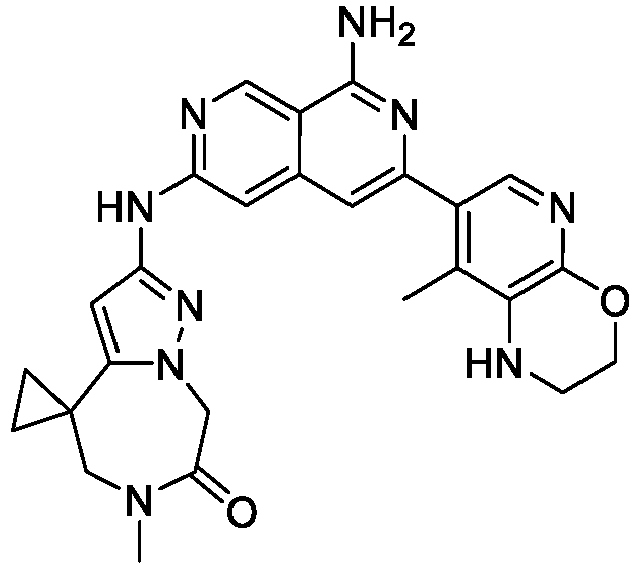
2'-((8-amino-6-(8-methyl-2,3-dihydro-1H-pyrido[2,3-b][1,4]oxazin-7-yl)-2,7-naphthyridin-3-yl)amino)-6'-methyl-5',6'-dihydrospiro[cyclopropane-1,4'-pyrazolo[1,5-d][1,4]diazepin]-7'(8'H)-one 565 
2-((8-amino-6-(8-methyl-2,3-dihydro-1H-pyrido[2,3-b][1,4]oxazin-7-yl)-2,7-naphthyridin-3-yl)amino)-5,6-dihydro-4H-pyrazolo[1,5-d][1,4]diazepin-7(8H)-one 566 
N6-(5,6-dihydro-11H-imidazo[1,2-a]pyrazolo[1,5-d][1,4]diazepin-8-yl)-3-(8-methyl-2,3-dihydro-1H-pyrido[2,3-b][1,4]oxazin-7-yl)-2,7-naphthyridine-1,6-diamine 567 
N-(8-amino-6-(8-methyl-2,3-dihydro-1H-pyrido[2,3-b][1,4]oxazin-7-yl)-2,7-naphthyridin-3-yl)-2-methyl-3-(1-methyl-1H-pyrazol-4-yl)cyclopropane-1-carboxamide 568 
N-(8-amino-6-(8-methyl-2,3-dihydro-1H-pyrido[2,3-b][1,4]oxazin-7-yl)-2,7-naphthyridin-3-yl)-2-ethyl-3-(1-methyl-1H-pyrazol-4-yl)cyclopropane-1-carboxamide 569 
N-(8-amino-6-(5-amino-4-methylpyridin-3-yl)-2,7-naphthyridin-3-yl)-2-ethyl-3-(1-methyl-1H-pyrazol-4-yl)cyclopropane-1-carboxamide 570 
N6-(5,6-dihydro-11H-imidazo[1,2-a]pyrazolo[1,5-d][1,4]diazepin-8-yl)-3-(5-methyl-3,4-dihydro-2H-benzo[b][1,4]oxazin-6-yl)-2,7-naphthyridine-1,6-diamine 571 
2-((8-amino-6-(5-amino-4-(trifluoromethyl)pyridin-3-yl)-2,7-naphthyridin-3-yl)amino)-6-methyl-5,6-dihydro-4H-pyrazolo[1,5-d][1,4]diazepin-7(8H)-one 572 
3-(5-amino-4-(trifluoromethyl)pyridin-3-yl)-N6-(5,6-dihydro-11H-imidazo[1,2-a]pyrazolo[1,5-d][1,4]diazepin-8-yl)-2,7-naphthyridine-1,6-diamine - In some embodiments, the compound is selected from the group consisting of Compound Nos. 1-348 in Table 1, or a pharmaceutically acceptable salt thereof. In some embodiments, the compound is selected from the group consisting of Compound Nos. 349-429 in Table 2, or a pharmaceutically acceptable salt thereof. In some embodiments, the compound is selected from the group consisting of Compound Nos. 430-572 in Table 3, or a pharmaceutically acceptable salt thereof.
- Compounds of Formula I or Ia described herein or a salt thereof may exist in stereoisomeric forms (e.g., it contains one or more asymmetric carbon atoms). The individual stereoisomers (enantiomers and diastereomers) and mixtures of these are included within the scope of the subject matter disclosed herein. Likewise, it is understood that a compound or salt of Formulas I or Ia may exist in tautomeric forms other than that shown in the formula and these are also included within the scope of the subject matter disclosed herein. It is to be understood that the subject matter disclosed herein includes combinations and subsets of the particular groups described herein. The scope of the subject matter disclosed herein includes mixtures of stereoisomers as well as purified enantiomers or enantiomerically/diastereomerically enriched mixtures. It is to be understood that the subject matter disclosed herein includes combinations and subsets of the particular groups defined herein.
- The subject matter disclosed herein also includes isotopically-labelled forms of the compounds described herein, but for the fact that one or more atoms are replaced by an atom having an atomic mass or mass number different from the atomic mass or mass number usually found in nature. Examples of isotopes that can be incorporated into compounds described herein and pharmaceutically acceptable salts thereof include isotopes of hydrogen, carbon, nitrogen, oxygen, phosphorous, sulphur, fluorine, iodine, and chlorine, such as 2H, 3H, 11C, 13C, 14C, 15N, 17O, 18O, 31P, 32P, 35S, 18F, 36Cl, 123I and 125I.
- In embodiments, a pharmaceutical composition comprising a compound where all variables are as defined in any embodiment above, and a pharmaceutically acceptable carrier.
- If the compound of Formula I or Ia is a base, the desired pharmaceutically acceptable salt may be prepared by any suitable method available in the art, for example, treatment of the free base with an inorganic acid, such as hydrochloric acid, hydrobromic acid, sulfuric acid, nitric acid, methanesulfonic acid, phosphoric acid and the like, or with an organic acid, such as acetic acid, maleic acid, succinic acid, mandelic acid, fumaric acid, malonic acid, pyruvic acid, oxalic acid, glycolic acid, salicylic acid, a pyranosidyl acid, such as glucuronic acid or galacturonic acid, an alpha hydroxy acid, such as citric acid or tartaric acid, an amino acid, such as aspartic acid or glutamic acid, an aromatic acid, such as benzoic acid or cinnamic acid, a sulfonic acid, such as p-toluenesulfonic acid or ethanesulfonic acid, or the like.
- If the compound of Formula I or Ia is an acid, the desired pharmaceutically acceptable salt may be prepared by any suitable method, for example, treatment of the free acid with an inorganic or organic base, such as an amine (primary, secondary or tertiary), an alkali metal hydroxide or alkaline earth metal hydroxide, or the like. Illustrative examples of suitable salts include, but are not limited to, organic salts derived from amino acids, such as glycine and arginine, ammonia, primary, secondary, and tertiary amines, and cyclic amines, such as piperidine, morpholine and piperazine, and inorganic salts derived from sodium, calcium, potassium, magnesium, manganese, iron, copper, zinc, aluminum and lithium.
- A compound of Formula I or Ia can be in the form of a "prodrug," which includes compounds with moieties which can be metabolized in vivo. Generally, the prodrugs are metabolized in vivo by esterases or by other mechanisms to active drugs. Examples of prodrugs and their uses are well known in the art (See, e.g., Berge et al. (1977) "Pharmaceutical Salts", J. Pharm. Sci. 66:1-19). The prodrugs can be prepared in situ during the final isolation and purification of the compounds, or by separately reacting the purified compound in its free acid form or hydroxyl with a suitable esterifying agent. Hydroxyl groups can be converted into esters via treatment with a carboxylic acid. Examples of prodrug moieties include substituted and unsubstituted, branch or unbranched lower alkyl ester moieties, (e.g., propionoic acid esters), lower alkenyl esters, di-lower alkyl-amino lower-alkyl esters (e.g., dimethylaminoethyl ester), acylamino lower alkyl esters (e.g., acetyloxymethyl ester), acyloxy lower alkyl esters (e.g., pivaloyloxymethyl ester), aryl esters (phenyl ester), aryl-lower alkyl esters (e.g., benzyl ester), substituted (e.g., with methyl, halo, or methoxy substituents) aryl and aryl-lower alkyl esters, amides, lower-alkyl amides, di-lower alkyl amides, and hydroxy amides. Prodrugs which are converted to active forms through other mechanisms in vivo are also included.
- Compounds of Formula I or Ia can be prepared by precedures in the Examples and generally by Schemes 1 and 2, where R groups are as described in Formula I or Ia, or precursors thereof.

- Scheme 1 shows a general synthetic method for preparing a compound of Formula I or Ia wherein R2 is A-C(O)-. Reaction of 6,8-dichloro-2,7-naphthyridin-3-amine with an amine precursor HNRR' affords compound A, where R and R' are amine protecting groups (e.g., 4-methoxybenzyl or PMB). Acylation of the 3-amino group of compound A using an activated acyl compound (e.g., A-C(O)-X, where X is a leaving group such as Cl, Br or I) gives compound B. Pd-catalysed coupling of compound B with a boronic ester R1-B(OR)2 gives compound C. Deprotection of compound C yields the product of Formula (I-A), where A and R1 are as defined for Formula I or Ia.
- Provided is a method for making a compound of Formula (I-A) comprising reacting a compound B with a boronic ester R1-B(OR)2 (where R is an alkyl or aryl, or the two OR groups together with the boron atom to form a ring) and a Pd catalyst to form a compound C, and subjecting compound C to a condition for amine deprotection. The method may further comprise acylating a compound A (comprising reacting compound A with A-C(O)-X, where X is a leaving group such as Cl, Br or I) to form compound B.

- Scheme 2 shows a general synthetic method for preparing a compound of Formula I or Ia wherein R2 is D. Reaction of 6,8-dichloro-2,7-naphthyridin-3-amine with an amine precursor HNRR' affords compound A, where R and R' are amine protecting groups (e.g., 4-methoxybenzyl). Pd-catalysed coupling of compound A with a boronic ester R1-B(OR)2 give compound D. Pd-catalysed coupling of compound D with a compound D-X gives compound E. Deprotection of compound C yields the product of Formula (I-D), where D and R1 are as defined for Formula I or Ia.
- Provided is a method for making a compound of Formula (I-D) comprising reacting a compound A with a boronic ester R1-B(OR)2 (where R is an alkyl or aryl, or the two OR groups together with the boron atom to form a ring) and a Pd catalyst to form a compound D; reacting a compound D with a compound D-X (where X is a leaving group such as Cl, Br or I) and a Pd catalyst to form a compound E, and subjecting compound E to a condition for amine deprotection.
- The presently disclosed compounds can be formulated into pharmaceutical compositions along with a pharmaceutically acceptable carrier.
- Compounds of Formula I or Ia can be formulated in accordance with standard pharmaceutical practice as a pharmaceutical composition. According to this aspect, there is provided a pharmaceutical composition comprising a compound of Formula I or Ia in association with a pharmaceutically acceptable diluent or carrier.
- A typical formulation is prepared by mixing a Formula I or Ia compound and a carrier, diluent or excipient. Suitable carriers, diluents and excipients are well known to those skilled in the art and include materials such as carbohydrates, waxes, water soluble and/or swellable polymers, hydrophilic or hydrophobic materials, gelatin, oils, solvents, water and the like. The particular carrier, diluent or excipient used will depend upon the means and purpose for which the compound of Formula I or Ia is being applied. Solvents are generally selected based on solvents recognized by persons skilled in the art as safe (GRAS) to be administered to a mammal. In general, safe solvents are non-toxic aqueous solvents such as water and other non-toxic solvents that are soluble or miscible in water. Suitable aqueous solvents include water, ethanol, propylene glycol, polyethylene glycols (e.g., PEG 400, PEG 300), etc. and mixtures thereof. The formulations may also include one or more buffers, stabilizing agents, surfactants, wetting agents, lubricating agents, emulsifiers, suspending agents, preservatives, antioxidants, opaquing agents, glidants, processing aids, colorants, sweeteners, perfuming agents, flavoring agents and other known additives to provide an elegant presentation of the drug (i.e., a compound of Formula I or Ia or pharmaceutical composition thereof) or aid in the manufacturing of the pharmaceutical product (i.e., medicament).
- The formulations may be prepared using conventional dissolution and mixing procedures. For example, the bulk drug substance (i.e., compound of Formula I or Ia or stabilized form of the Formula I or Ia compound (e.g., complex with a cyclodextrin derivative or other known complexation agent) is dissolved in a suitable solvent in the presence of one or more of the excipients described above. The compound of Formula I or Ia is typically formulated into pharmaceutical dosage forms to provide an easily controllable dosage of the drug and to enable patient compliance with the prescribed regimen.
- The pharmaceutical composition (or formulation) for application may be packaged in a variety of ways depending upon the method used for administering the drug. Generally, an article for distribution includes a container having deposited therein the pharmaceutical formulation in an appropriate form. Suitable containers are well known to those skilled in the art and include materials such as bottles (plastic and glass), sachets, ampoules, plastic bags, metal cylinders, and the like. The container may also include a tamper-proof assemblage to prevent indiscreet access to the contents of the package. In addition, the container has deposited thereon a label that describes the contents of the container. The label may also include appropriate warnings.
- Pharmaceutical formulations may be prepared for various routes and types of administration. For example, a compound of Formula I or Ia having the desired degree of purity may optionally be mixed with pharmaceutically acceptable diluents, carriers, excipients or stabilizers (Remington's Pharmaceutical Sciences (1980) 16th edition, Osol, A. Ed.), in the form of a lyophilized formulation, milled powder, or an aqueous solution. Formulation may be conducted by mixing at ambient temperature at the appropriate pH, and at the desired degree of purity, with physiologically acceptable carriers, i.e., carriers that are non-toxic to recipients at the dosages and concentrations employed. The pH of the formulation depends mainly on the particular use and the concentration of compound, but may range from about 3 to about 8. Formulation in an acetate buffer at pH 5 is a suitable embodiment.
- The compounds of Formula I or Ia can be sterile. In particular, formulations to be used for in vivo administration should be sterile. Such sterilization is readily accomplished by filtration through sterile filtration membranes.
- The compound ordinarily can be stored as a solid composition, a lyophilized formulation or as an aqueous solution.
- The pharmaceutical compositions comprising a compound of Formula I or Ia can be formulated, dosed and administered in a fashion, i.e., amounts, concentrations, schedules, course, vehicles and route of administration, consistent with good medical practice. Factors for consideration in this context include the particular disorder being treated, the particular mammal being treated, the clinical condition of the individual patient, the cause of the disorder, the site of delivery of the agent, the method of administration, the scheduling of administration, and other factors known to medical practitioners. The "therapeutically effective amount" of the compound to be administered will be governed by such considerations, and is the minimum amount necessary to prevent, ameliorate, or treat the coagulation factor mediated disorder. Such amount is preferably below the amount that is toxic to the host or renders the host significantly more susceptible to bleeding.
- Acceptable diluents, carriers, excipients and stabilizers are nontoxic to recipients at the dosages and concentrations employed, and include buffers such as phosphate, citrate and other organic acids; antioxidants including ascorbic acid and methionine; preservatives (such as octadecyldimethylbenzyl ammonium chloride; hexamethonium chloride; benzalkonium chloride, benzethonium chloride; phenol, butyl or benzyl alcohol; alkyl parabens such as methyl or propyl paraben; catechol; resorcinol; cyclohexanol; 3-pentanol; and m-cresol); low molecular weight (less than about 10 residues) polypeptides; proteins, such as serum albumin, gelatin, or immunoglobulins; hydrophilic polymers such as polyvinylpyrrolidone; amino acids such as glycine, glutamine, asparagine, histidine, arginine, or lysine; monosaccharides, disaccharides and other carbohydrates including glucose, mannose, or dextrins; chelating agents such as EDTA; sugars such as sucrose, mannitol, trehalose or sorbitol; salt-forming counter-ions such as sodium; metal complexes (e.g., Zn-protein complexes); and/or non-ionic surfactants such as TWEEN™, PLURONICS™ or polyethylene glycol (PEG). The active pharmaceutical ingredients may also be entrapped in microcapsules prepared, for example, by coacervation techniques or by interfacial polymerization, for example, hydroxymethylcellulose or gelatin-microcapsules and poly-(methylmethacylate) microcapsules, respectively, in colloidal drug delivery systems (for example, liposomes, albumin microspheres, microemulsions, nano-particles and nanocapsules) or in macroemulsions. Such techniques are disclosed in Remington's Pharmaceutical Sciences 16th edition, Osol, A. Ed. (1980).
- Sustained-release preparations of Formula I or Ia compounds may be prepared. Suitable examples of sustained-release preparations include semipermeable matrices of solid hydrophobic polymers containing a compound of Formula I or Ia, which matrices are in the form of shaped articles, e.g., films, or microcapsules. Examples of sustained-release matrices include polyesters, hydrogels (for example, poly(2-hydroxyethyl-methacrylate), or poly(vinyl alcohol)), polylactides (
US 3773919 ), copolymers of L-glutamic acid and gamma-ethyl-L-glutamate, non-degradable ethylene-vinyl acetate, degradable lactic acid-glycolic acid copolymers such as the LUPRON DEPOT™ (injectable microspheres composed of lactic acid-glycolic acid copolymer and leuprolide acetate) and poly-D-(-)-3-hydroxybutyric acid. - The formulations include those suitable for the administration routes detailed herein. The formulations may conveniently be presented in unit dosage form and may be prepared by any of the methods well known in the art of pharmacy. Techniques and formulations generally are found in Remington's Pharmaceutical Sciences (Mack Publishing Co., Easton, PA). Such methods include the step of bringing into association the active ingredient with the carrier which constitutes one or more accessory ingredients. In general the formulations are prepared by uniformly and intimately bringing into association the active ingredient with liquid carriers or finely divided solid carriers or both, and then, if necessary, shaping the product.
- Formulations of a compound of Formula I or Ia suitable for oral administration may be prepared as discrete units such as pills, capsules, cachets or tablets each containing a predetermined amount of a compound of Formula I or Ia.
- Compressed tablets may be prepared by compressing in a suitable machine the active ingredient in a free-flowing form such as a powder or granules, optionally mixed with a binder, lubricant, inert diluent, preservative, surface active or dispersing agent. Molded tablets may be made by molding in a suitable machine a mixture of the powdered active ingredient moistened with an inert liquid diluent. The tablets may optionally be coated or scored and optionally are formulated so as to provide slow or controlled release of the active ingredient therefrom.
- Tablets, troches, lozenges, aqueous or oil suspensions, dispersible powders or granules, emulsions, hard or soft capsules, e.g., gelatin capsules, syrups or elixirs may be prepared for oral use. Formulations of compounds of Formula I or Ia intended for oral use may be prepared according to any method known to the art for the manufacture of pharmaceutical compositions and such compositions may contain one or more agents including sweetening agents, flavoring agents, coloring agents and preserving agents, in order to provide a palatable preparation. Tablets containing the active ingredient in admixture with non-toxic pharmaceutically acceptable excipient which are suitable for manufacture of tablets are acceptable. These excipients may be, for example, inert diluents, such as calcium or sodium carbonate, lactose, calcium or sodium phosphate; granulating and disintegrating agents, such as maize starch, or alginic acid; binding agents, such as starch, gelatin or acacia; and lubricating agents, such as magnesium stearate, stearic acid or talc. Tablets may be uncoated or may be coated by known techniques including microencapsulation to delay disintegration and adsorption in the gastrointestinal tract and thereby provide a sustained action over a longer period. For example, a time delay material such as glyceryl monostearate or glyceryl distearate alone or with a wax may be employed.
- For treatment of the eye or other external tissues, e.g., mouth and skin, the formulations are preferably applied as a topical ointment or cream containing the active ingredient(s) in an amount of, for example, 0.075 to 20% w/w. When formulated in an ointment, the active ingredients may be employed with either a paraffinic or a water-miscible ointment base. Alternatively, the active ingredients may be formulated in a cream with an oil-in-water cream base.
- If desired, the aqueous phase of the cream base may include a polyhydric alcohol, i.e., an alcohol having two or more hydroxyl groups such as propylene glycol, butane 1,3-diol, mannitol, sorbitol, glycerol and polyethylene glycol (including PEG 400), and mixtures thereof. The topical formulations may desirably include a compound which enhances absorption or penetration of the active ingredient through the skin or other affected areas. Examples of such dermal penetration enhancers include dimethyl sulfoxide and related analogs.
- The oily phase of the emulsions may be constituted from known ingredients in a known manner. While the phase may comprise solely an emulsifier, it may also comprise a mixture of at least one emulsifier and a fat or oil, or both a fat and an oil. A hydrophilic emulsifier included together with a lipophilic emulsifier may act as a stabilizer. Together, the emulsifier(s) with or without stabilizer(s) make up the so-called emulsifying wax, and the wax together with the oil and fat make up the so-called emulsifying ointment base which forms the oily dispersed phase of the cream formulations. Emulsifiers and emulsion stabilizers suitable for use in the formulation include Tween® 60, Span® 80, cetostearyl alcohol, benzyl alcohol, myristyl alcohol, glyceryl mono-stearate and sodium lauryl sulfate.
- Aqueous suspensions of Formula I or Ia compounds contain the active materials in admixture with excipients suitable for the manufacture of aqueous suspensions. Such excipients include a suspending agent, such as sodium carboxymethylcellulose, croscarmellose, povidone, methylcellulose, hydroxypropyl methylcellulose, sodium alginate, polyvinylpyrrolidone, gum tragacanth and gum acacia, and dispersing or wetting agents such as a naturally occurring phosphatide (e.g., lecithin), a condensation product of an alkylene oxide with a fatty acid (e.g., polyoxyethylene stearate), a condensation product of ethylene oxide with a long chain aliphatic alcohol (e.g., heptadecaethyleneoxycetanol), a condensation product of ethylene oxide with a partial ester derived from a fatty acid and a hexitol anhydride (e.g., polyoxyethylene sorbitan monooleate). The aqueous suspension may also contain one or more preservatives such as ethyl or n-propyl p-hydroxybenzoate, one or more coloring agents, one or more flavoring agents and one or more sweetening agents, such as sucrose or saccharin.
- The pharmaceutical compositions of compounds of Formula I or Ia may be in the form of a sterile injectable preparation, such as a sterile injectable aqueous or oleaginous suspension. This suspension may be formulated according to the known art using those suitable dispersing or wetting agents and suspending agents which have been mentioned above. The sterile injectable preparation may also be a sterile injectable solution or suspension in a non-toxic parenterally acceptable diluent or solvent, such 1,3-butanediol. The sterile injectable preparation may also be prepared as a lyophilized powder. Among the acceptable vehicles and solvents that may be employed are water, Ringer's solution and isotonic sodium chloride solution. In addition, sterile fixed oils may conventionally be employed as a solvent or suspending medium. For this purpose any bland fixed oil may be employed including synthetic mono- or diglycerides. In addition, fatty acids such as oleic acid may likewise be used in the preparation of injectables.
- The amount of active ingredient that may be combined with the carrier material to produce a single dosage form will vary depending upon the host treated and the particular mode of administration. For example, a time-release formulation intended for oral administration to humans may contain approximately 1 to 1000 mg of active material compounded with an appropriate and convenient amount of carrier material which may vary from about 5 to about 95% of the total compositions (weight:weight). The pharmaceutical composition can be prepared to provide easily measurable amounts for administration. For example, an aqueous solution intended for intravenous infusion may contain from about 3 to 500 µg of the active ingredient per milliliter of solution in order that infusion of a suitable volume at a rate of about 30 mL/hr can occur.
- Formulations suitable for parenteral administration include aqueous and non-aqueous sterile injection solutions which may contain anti-oxidants, buffers, bacteriostats and solutes which render the formulation isotonic with the blood of the intended recipient; and aqueous and non-aqueous sterile suspensions which may include suspending agents and thickening agents.
- Formulations suitable for topical administration to the eye also include eye drops wherein the active ingredient is dissolved or suspended in a suitable carrier, especially an aqueous solvent for the active ingredient. The active ingredient is preferably present in such formulations in a concentration of about 0.5 to 20% w/w, for example about 0.5 to 10% w/w, for example about 1.5% w/w.
- Formulations suitable for topical administration in the mouth include lozenges comprising the active ingredient in a flavored basis, usually sucrose and acacia or tragacanth; pastilles comprising the active ingredient in an inert basis such as gelatin and glycerin, or sucrose and acacia; and mouthwashes comprising the active ingredient in a suitable liquid carrier.
- Formulations for rectal administration may be presented as a suppository with a suitable base comprising for example cocoa butter or a salicylate.
- Formulations suitable for intrapulmonary or nasal administration have a particle size for example in the range of 0.1 to 500 microns (including particle sizes in a range between 0.1 and 500 microns in increments microns such as 0.5, 1, 30 microns, 35 microns, etc.), which is administered by rapid inhalation through the nasal passage or by inhalation through the mouth so as to reach the alveolar sacs. Suitable formulations include aqueous or oily solutions of the active ingredient. Formulations suitable for aerosol or dry powder administration may be prepared according to conventional methods and may be delivered with other therapeutic agents such as compounds heretofore used in the treatment or prophylaxis disorders as described below.
- Formulations suitable for vaginal administration may be presented as pessaries, tampons, creams, gels, pastes, foams or spray formulations containing in addition to the active ingredient such carriers as are known in the art to be appropriate.
- The formulations may be packaged in unit-dose or multi-dose containers, for example sealed ampoules and vials, and may be stored in a freeze-dried (lyophilized) condition requiring only the addition of the sterile liquid carrier, for example water, for injection immediately prior to use. Extemporaneous injection solutions and suspensions are prepared from sterile powders, granules and tablets of the kind previously described. Preferred unit dosage formulations are those containing a daily dose or unit daily sub-dose, as herein above recited, or an appropriate fraction thereof, of the active ingredient.
- The subject matter further provides veterinary compositions comprising at least one active ingredient as above defined together with a veterinary carrier therefore. Veterinary carriers are materials useful for the purpose of administering the composition and may be solid, liquid or gaseous materials which are otherwise inert or acceptable in the veterinary art and are compatible with the active ingredient. These veterinary compositions may be administered parenterally, orally or by any other desired route.
- In particular embodiments the pharmaceutical composition comprising the presently disclosed compounds further comprise a chemotherapeutic agent. In some of these embodiments, the chemotherapeutic agent is an immunotherapeutic agent.
- The presently disclosed compounds find use in inhibiting the activity of the enzyme HPK1. HPK1, also referred to as mitogen activated protein kinase kinase kinase kinase 1 or MAP4K1, is a member of the germinal center kinase subfamily of Ste20-related serine/threnonine kinases. HPK1 functions as a MAP4K by phosphorylating and activating MAP3K proteins, including MEKK1, MLK3 and TAK1, leading to the activation of the MAPK Jnk.
- In an embodiment, the subject matter disclosed herein is directed to a method of inhibiting HPK1, the method comprising contacting HPK1 with an effective amount of a compound of Formula I or Ia or a pharmaceutical composition described herein.
- In an embodiment, the subject matter disclosed herein is directed to a method for enhancing an immune response in a subject in need thereof, wherein the method comprises administering to the subject an effective amount of a compound of Formula I or Ia or a pharmaceutical composition described herein. In certain aspects of this embodiment, the T cells in the subject have at least one of enhanced priming, enhanced activation, enhanced migration, enhanced proliferation, enhanced survival, and enhanced cytolytic activity relative to prior to the administration of the compound or pharmaceutical composition. In certain aspects of this embodiment, the T cell activation is characterized by an elevated frequency of γ-IFN+ CD8 T cells or enhanced levels of IL-2 or granzyme B production by T cells relative to prior to administration of the compound or pharmaceutical composition. In certain aspects of this embodiment, the number of T cells is elevated relative to prior to administration of the compound or pharmaceutical composition. In certain aspects of this embodiment, the T cell is an antigen-specific CD8 T cell. In certain aspects of this embodiment, the antigen presenting cells in the subject have enhanced maturation and activation relative prior to the administration of the compound or pharmaceutical composition. In certain aspects of this embodiment, the antigen presenting cells are dendritic cells. In certain aspects of this embodiment, the maturation of the antigen presenting cells is characterized by increased frequency of CD83+ dendritic cells. In certain aspects of this embodiment, the activation of the antigen presenting cells is characterized by elevated expression of CD80 and CD86 on dendritic cells.
- In the methods described herein, a compound of Formula I or Ia or a pharmaceutical composition thereof is administered to a subject that has cancer as described elsewhere herein.
- In an embodiment, the subject matter disclosed herein is directed to a method for treating a HPK1-dependent disorder, the method comprising administering to a subject in need thereof an effective amount of a compound of Formula I or Ia or a pharmaceutical composition described herein. In certain aspects of this embodiment, the HPK1-dependent disorder is a cancer. In certain aspects of this embodiment, the cancer comprises at least one cancer selected from the group consisting of colorectal cancer, melanoma, non-small cell lung cancer, ovarian cancer, breast cancer, pancreatic cancer, a hematological malignancy, and a renal cell carcinoma. In certain aspects of this embodiment, the cancer has elevated levels of T-cell infiltration. In certain aspects of this embodiment, the cancer cells in the subject selectively have elevated expression of MHC class I antigen expression relative to prior to the administration of the compound or composition.
- In the methods described herein, the method can further comprise administering a chemotherapeutic agent to the subject. In certain aspects of this embodiment, the chemotherapeutic agent is administered to the subject simultaneously with the compound or the composition. In certain aspects of this embodiment, the chemotherapeutic agent is administered to the subject prior to administration of the compound or the composition. In certain aspects of this embodiment, the chemotherapeutic agent is administered to the subject after administration of the compound or the composition.
- HPK1 polynucleotides and polypeptides are known in the art (Hu et al. (1996) Genes Dev. 10: 2251-2264). Non-limiting examples of HPK1 polynucleotides and polypeptides comprise the human HPK1 polynucleotide as set forth in SEQ ID NO: 1 (nucleotides 141-2642 of GenBank Accession No. NM_007181.5) and the encoded human HPK1 polypeptide (Accession No. NP_009112.1) as set forth in SEQ ID NO: 2. A shorter 821 amino acid isoform of HPK1 exists in humans, the coding sequence and amino acid sequence of which is set forth in SEQ ID NOs: 3 and 1, respectively (nucleotides 141-2606 of GenBank Accession No. NM_001042600.2 and GenBank Accession No. NP_001036065.1, respectively).
- HPK1 polypeptides comprise a variety of conserved structural motifs. For ease of reference, such motifs will be discussed as they relate to the longer human HPK1 isoform, which is set forth in SEQ ID NO:2, comprises 833 amino acid residues. HPK1 polypeptides comprise an amino-terminal Ste20-like kinase domain that spans amino acid residues 17-293, which includes the ATP-binding site from amino acid residues 23-46. The kinase domain is followed by four proline-rich (PR) motifs that serve as binding sites for SH3-containing proteins, such as CrkL, Grb2, HIP-55, Gads, Nck, and Crk. The four PR motifs span amino acid residues 308-407, 394-402, 432-443, and 468-477, respectively. HPK1 becomes phosphorylated and activated in response to TCR or BCR stimulation. TCR- and BCR-induced phosphorylation of the tyrosine at position 381, located between PR1 and PR2, mediates binding to SLP-76 in T cells or BLNK in B cells via a SLP-76 or BLNK SH2 domain, and is required for activation of the kinase. A citron homology domain found in the C-terminus of HPK1, approximately spanning residues 495-800, may act as a regulatory domain and may be involved in macromolecular interactions.
- The presently disclosed compounds bind directly to HPK1 and inhibit its kinase activity. In some embodiments, the presently disclosed compounds reduce, inhibit, or otherwise diminish the HPK1-mediated phosphorylation of SLP76 and/or Gads.
- The presently disclosed compounds may or may not be a specific HPK1 antagonist. A specific HPK1 antagonist reduces the biological activity of HPK1 by an amount that is statistically greater than the inhibitory effect of the antagonist on any other protein (e.g., other serine/threonine kinases). In certain embodiments, the presently disclosed compounds specifically inhibit the serine/threonine kinase activity of HPK1. In some of these embodiments, the IC50 of the HPK1 antagonist for HPK1 is about 90%, 80%, 70%, 60%, 50%, 40%, 30%, 20%, 10%, 0.1%, 0.01%, 0.001%, or less of the IC50 of the HPK1 antagonist for another serine/threonine kinase or other type of kinase (e.g., tyrosine kinase).
- The presently disclosed compounds can be used in a method for inhibiting HPK1. Such methods comprise contacting HPK1 with an effective amount of a presently disclosed compound. By "contact" is intended bringing the compound within close enough proximity to an isolated HPK1 enzyme or a cell expressing HPK1 (e.g., T cell, B cell, dendritic cell) such that the compound is able to bind to and inhibit the activity of HPK1. The compound can be contacted with HPK1 in vitro or in vivo via administration of the compound to a subject.
- Any method known in the art to measure the kinase activity of HPK1 may be used to determine if HPK1 has been inhibited, including in vitro kinase assays, immunoblots with antibodies specific for phosphorylated targets of HPK1, such as SLP76 and Gads, or the measurement of a downstream biological effect of HPK1 kinase activity, such as the recruitment of 14-3-3 proteins to phosphorylated SLP7 and Gads, release of the SLP76-Gads-14-3-3 complex from LAT-containing microclusters, or T or B cell activation.
- The presently disclosed compounds can be used to treat a HPK1-dependent disorder. As used herein, a "HPK1-dependent disorder" is a pathological condition in which HPK1 activity is necessary for the genesis or maintenance of the pathological condition. In some embodiments, the HPK1-dependent disorder is cancer.
- The presently disclosed compounds also find use in enhancing an immune response in a subject in need thereof. Such methods comprise administering an effective amount of a presently disclosed compound (i.e., compound of Formula I or Ia or a pharmaceutically acceptable salt thereof).
- As used herein, "enhancing an immune response" refers to an improvement in any immunogenic response to an antigen. Non-limiting examples of improvements in an immunogenic response to an antigen include enhanced maturation or migration of dendritic cells, enhanced activation of T cells (e.g., CD4 T cells, CD8 T cells), enhanced T cell (e.g., CD4 T cell, CD8 T cell) proliferation, enhanced B cell proliferation, increased survival of T cells and/or B cells, improved antigen presentation by antigen presenting cells (e.g., dendritic cells), improved antigen clearance, increase in production of cytokines by T cells (e.g., interleukin-2), increased resistance to prostaglandin E2-induced immune suppression, and enhanced priming and/or cytolytic activity of CD8 T cells.
- In some embodiments, the CD8 T cells in the subject have enhanced priming, activation, proliferation and/or cytolytic activity relative to prior to the administration of the compound of Formula I or Ia or a pharmaceutically acceptable salt thereof. In some embodiments, the CD8 T cell priming is characterized by elevated CD44 expression and/or enhanced cytolytic activity in CD8 T cells. In some embodiments, the CD8 T cell activation is characterized by an elevated frequency of γ-IFN+ CD8 T cells. In some embodiments, the CD8 T cell is an antigen-specific T-cell.
- In some embodiments, the antigen presenting cells in the subject have enhanced maturation and activation relative to prior to the administration of the compound of Formula I or Ia or a pharmaceutically acceptable salt thereof. In some embodiments, the antigen presenting cells are dendritic cells. In some embodiments, the maturation of the antigen presenting cells is characterized by an increased frequency of CD83+ dendritic cells. In some embodiments, the activation of the antigen presenting cells is characterized by elevated expression of CD80 and CD86 on dendritic cells.
- In some embodiments, the serum levels of cytokine IL-10 and/or chemokine IL-8, a human homolog of murine KC, in the subject are reduced relative to prior to the administration of the compound of Formula I or Ia or a pharmaceutically acceptable salt thereof.
- Engagement of the TCR leads to HPK1 activation, which functions as a negative regulator of TCR-induced AP-1 response pathway. It is believed that HPK1 negatively regulates T cell activation by reducing the persistence of signaling microclusters by phosphorylating SLP76 at Ser376 (Di Bartolo et al. (2007) JEM 204:681-691) and Gads at Thr254, which leads to the recruitment of 14-3-3 proteins that bind to the phosphorylated SLP76 and Gads, releasing the SLP76-Gads-14-3-3 complex from LAT-containing microclusters, which leads to T cell dysfunction, including anergy and exhaustion (Lasserre et al. (2011) J Cell Biol 195(5):839-853).
- The term "dysfunction" in the context of immune dysfunction, refers to a state of reduced immune responsiveness to antigenic stimulation. The term includes the common elements of both exhaustion and/or anergy in which antigen recognition may occur, but the ensuing immune response is ineffective to control infection or tumor growth.
- The term "dysfunctional", as used herein, also includes refractory or unresponsive to antigen recognition, specifically, impaired capacity to translate antigen recognition into downstream T-cell effector functions, such as proliferation, cytokine production (e.g., IL-2, γ-IFN) and/or target cell killing.
- The term "anergy" refers to the state of unresponsiveness to antigen stimulation resulting from incomplete or insufficient signals delivered through the T-cell receptor (e.g. increase in intracellular Ca+2 in the absence of ras-activation). T cell anergy can also result upon stimulation with antigen in the absence of co-stimulation, resulting in the cell becoming refractory to subsequent activation by the antigen even in the context of costimulation. The unresponsive state can often be overriden by the presence of Interleukin-2. Anergic T-cells do not undergo clonal expansion and/or acquire effector functions.
- The term "exhaustion" refers to T cell exhaustion as a state of T cell dysfunction that arises from sustained TCR signaling that occurs during many chronic infections and cancer. It is distinguished from anergy in that it arises not through incomplete or deficient signaling, but from sustained signaling. It is defined by poor effector function, sustained expression of inhibitory receptors and a transcriptional state distinct from that of functional effector or memory T cells. Exhaustion prevents optimal control of infection and tumors. Exhaustion can result from both extrinsic negative regulatory pathways (e.g., immunoregulatory cytokines) as well as cell intrinsic negative regulatory (costimulatory) pathways (PD-1, B7-H3, B7-H4, etc.).
- In some embodiments, administration of a compound of Formula I or Ia or a pharmaceutically acceptable salt thereof to a subject results in an enhancement of T cell function.
- "Enhancing T cell function" means to induce, cause or stimulate a T cell to have a sustained or amplified biological function, or renew or reactivate exhausted or inactive T cells. Examples of enhancing T cell function include: increased secretion of cytokines (e.g., γ-interferon, IL-2, IL-12, and TNFa), increased proliferation, increased antigen responsiveness (e.g., viral, pathogen, or tumor clearance) relative to such levels before the intervention, and increased effector granule production by CD8 T cells, such as granzyme B. In one embodiment, the level of enhancement is as least 50%, alternatively 60%, 70%, 80%, 90%, 100%, 120%, 150%, 200%. The manner of measuring this enhancement is known to one of ordinary skill in the art.
- Accordingly, the presently disclosed compounds of Formula I or Ia or pharmaceutically acceptable salts thereof are useful in treating T cell dysfunctional disorders. A "T cell dysfunctional disorder" is a disorder or condition of T cells characterized by decreased responsiveness to antigenic stimulation. In a particular embodiment, a T cell dysfunctional disorder is a disorder that is specifically associated with increased kinase activity of HPK1. In another embodiment, a T cell dysfunctional disorder is one in which T cells are anergic or have decreased ability to secrete cytokines, proliferate, or execute cytolytic activity. In a specific aspect, the decreased responsiveness results in ineffective control of a pathogen or tumor expressing an immunogen. Examples of T cell dysfunctional disorders characterized by T-cell dysfunction include unresolved acute infection, chronic infection and tumor immunity.
- Thus, the presently disclosed compounds can be used in treating conditions where enhanced immunogenicity is desired, such as increasing tumor immunogenicity for the treatment of cancer.
- "Immunogenecity" refers to the ability of a particular substance to provoke an immune response. Tumors are immunogenic and enhancing tumor immunogenicity aids in the clearance of the tumor cells by the immune response.
- "Tumor immunity" refers to the process in which tumors evade immune recognition and clearance. Thus, as a therapeutic concept, tumor immunity is "treated" when such evasion is attenuated, and the tumors are recognized and attacked by the immune system. Examples of tumor recognition include tumor binding, tumor shrinkage and tumor clearance.
- In one aspect, provided herein is a method for treating of cancer in a subject in need thereof comprising administering to the subject an effective amount of a compound of Formula I or Ia or a pharmaceutically acceptable salt thereof. In some embodiments, the subject has melanoma. The melanoma may be at early stage or at late stage. In some embodiments, the subject has colorectal cancer. The colorectal cancer may be at early stage or at late stage. In some embodiments, the subject has non-small cell lung cancer. The non-small cell lung cancer may be at early stage or at late stage. In some embodiments, the subject has pancreatic cancer. The pancreatic cancer may be at early stage or late state. In some embodiments, the subject has a hematological malignancy. The hematological malignancy may be at early stage or late stage. In some embodiments, the subject has ovarian cancer. The ovarian cancer may be at early stage or at late stage. In some embodiments, the subject has breast cancer. The breast cancer may be at early stage or at late stage. In some embodiments, the subject has renal cell carcinoma. The renal cell carcinoma may be at early stage or at late stage. In some embodiments, the cancer has elevated levels of T-cell infiltration.
- The presently disclosed compounds may be administered in any suitable manner known in the art. In some embodiments, the compound of Formula I or Ia or a pharmaceutically acceptable salt thereof is administered intravenously, intramuscularly, subcutaneously, topically, orally, transdermally, intraperitoneally, intraorbitally, by implantation, by inhalation, intrathecally, intraventricularly, intratumorally, or intranasally.
- In some embodiments, the HPK1 antagonist is administered continuously. In other embodiments, the HPK1 antagonist is administered intermittently. Moreover, treatment of a subject with an effective amount of a HPK1 antagonist can include a single treatment or can include a series of treatments.
- It is understood that appropriate doses of the active compound depends upon a number of factors within the knowledge of the ordinarily skilled physician or veterinarian. The dose(s) of the active compound will vary, for example, depending upon the age, body weight, general health, gender, and diet of the subject, the time of administration, the route of administration, the rate of excretion, and any drug combination.
- It will also be appreciated that the effective dosage of a compound of Formula I or Ia or a pharmaceutically acceptable salt thereof used for treatment may increase or decrease over the course of a particular treatment. Changes in dosage may result and become apparent from the results of diagnostic assays.
- In some embodiments, the HPK1 antagonist is administered to the subject at a dose of between about 0.001 µg/kg and about 1000 mg/kg, including but not limited to about 0.001 µg/kg, 0.01 µg/kg, 0.05 µg/kg, 0.1 µg/kg, 0.5 µg/kg, 1 µg/kg, 10 µg/kg, 25 µg/kg, 50 µg/kg, 100 µg/kg, 250 µg/kg, 500 µg/kg, 1 mg/kg, 5 mg/kg, 10 mg/kg, 25 mg/kg, 50 mg/kg, 100 mg/kg, and 200 mg/kg.
- In some embodiments, provided is a method for treating a cancer in a subject in need thereof comprising administering to the subject an effective amount of a compound of Formula I or Ia or a pharmaceutically acceptable salt thereof, further comprising administering an additional therapy. The additional therapy may be radiation therapy, surgery (e.g., lumpectomy and a mastectomy), chemotherapy, gene therapy, DNA therapy, viral therapy, RNA therapy, immunotherapy, bone marrow transplantation, nanotherapy, monoclonal antibody therapy, or a combination of the foregoing. The additional therapy may be in the form of adjuvant or neoadjuvant therapy. In some embodiments, the additional therapy is the administration of an anti-metastatic agent. In some embodiments, the additional therapy is the administration of side-effect limiting agents (e.g., agents intended to lessen the occurrence and/or severity of side effects of treatment, such as anti-nausea agents, etc.). In some embodiments, the additional therapy is radiation therapy. In some embodiments, the additional therapy is surgery. In some embodiments, the additional therapy is a combination of radiation therapy and surgery. In some embodiments, the additional therapy is gamma irradiation. In some embodiments, the additional therapy is therapy targeting the PI3K/AKT/mTOR pathway, HSP90 inhibitor, tubulin inhibitor, apoptosis inhibitor, and/or chemopreventative agent.
- The additional therapy may be one or more of a chemotherapeutic agent. Thus, the method of treating cancer can comprise administering the presently disclosed HPK1 antagonists in conjunction with at least one chemotherapeutic agent.
- As used herein, "in conjunction with" refers to administration of one treatment modality in addition to another treatment modality. As such, "in conjunction with" refers to administration of one treatment modality before, during, or after administration of the other treatment modality to the subject.
- For example, the HPK1 antagonist and chemotherapeutic agent may be administered sequentially (at different times) or concurrently (at the same time). The HPK1 antagonist and chemotherapeutic agent may be administered by the same route of administration or by different routes of administration.
- In certain embodiments, the HPK1 antagonist is administered in conjunction with another immunotherapy. For example, the HPK1 antagonist can be combined with a chemotherapeutic agent or biologic that targets the PDL1/PD1 pathway. A known inhibitory checkpoint pathway involves signaling through PD-1 receptors. The programmed-death 1 (PD-1) receptor and its ligands PD-L1 and PD-L2 are part of the same family of coregulatory molecules as CTLA-4. - See more at: http://www.onclive.com/web-exclusives/the-role-of-anti-pd-l1-immunotherapy-in-cancer/2#sthash.cGfYa1T1.dpuf Chemotherapeutic agents or biologics that block PD-L1 binding to PD-1 and CD80 can prevent PD-L1-mediated inhibition/suppression of T-cell activation. Programmed cell death ligand-1 (PD-L1) is widely expressed on antigen-presenting cells (APC) and other immune cells. It is upregulated on tumor cells from a broad range of human cancers, and has been implicated with inhibition of antitumor T-cell immunity. PD-L1 is a cell surface protein that binds to the receptors PD-1 and CD80 on activated T cells, B cells, and other myeloid cells. PD-L1 binding to PD-1 on activated T-cells has been found to interfere with T-cell proliferation and inhibit immune responses. Overexpression of PD-L1 on cancer cells may allow these cells to avoid immune detection and elimination. High levels of PD-L1 expression on tumor cells have been associated with increased tumor aggressiveness and a poor prognosis. Chemotherapeutic agents or biologics that block PD-L1 binding to PD-1 include anti-PD-L1 antibodies, such as durvalumab, nivolumab, pidlizumab, MPDL3280A, MK-3475 and BMS-936559, among others.
- In another example, the HPK1 antagonist can be combined with a chemotherapeutic agent or biologic that targets OX40 and its ligand, OX40L, are members of the TNF superfamily. OX40 is expressed on activated CD4(+) and CD8(+) T cells as well as on a number of other lymphoid and non-lymphoid cells. Costimulatory signals from OX40 to a conventional T cell promote division and survival, augmenting the clonal expansion of effector and memory populations as they are being generated to antigen. OX40 additionally suppresses the differentiation and activity of T-regulatory cells, further amplifying this process. OX40 and OX40L also regulate cytokine production from T cells, antigen-presenting cells, natural killer cells, and natural killer T cells, and modulate cytokine receptor signaling. As one of the most prominent costimulatory molecules known to control T cells, stimulating OX40 has been shown be a target for therapeutic immunization strategies for cancer. Certain OX40 agonists include GBR 830, and those disclosed in Linch, et al., Frontiers in Oncology, v. 5, pp. 1-10 (2015).
- In some embodiments, the invention also provides compounds of Formula I or Ia described herein or pharmaceutical compositions described herein for use in a method for inhibiting HPK1 as described herein, in a method for enhancing an immune response in a subject in need thereof as described herein and/or in a method for treating a HPK1-dependent disorder as described herein.
- In some embodiments, the invention also provides compounds of Formula I or Ia described herein or pharmaceutical compositions described herein for use in a method for inhibiting HPK1 as described herein.
- In some embodiments, the invention also provides compounds of Formula I or Ia described herein or pharmaceutical compositions described herein for use in a method for enhancing an immune response in a subject in need thereof as described herein.
- In some embodiments, the invention also provides compounds of Formula I or Ia described herein or pharmaceutical compositions described herein for use in a method for treating a HPK1-dependent disorder as described herein.
- In some embodiments, the invention also provides the use of a compound of Formula I or Ia described herein or a pharmaceutical composition described herein for the manufacture of a medicament for inhibiting HPK1, a medicament for enhancing an immune response in a subject in need thereof and/or a medicament for treating a HPK1-dependent disorder.
- In some embodiments, the invention also provides the use of a compound of Formula I or Ia described herein or a pharmaceutical composition described herein for the manufacture of a medicament for inhibiting HPK1.
- In some embodiments, the invention also provides the use of a compound of Formula I or Ia described herein or a pharmaceutical composition described herein for the manufacture of a medicament for enhancing an immune response in a subject in need thereof.
- In some embodiments, the invention also provides the use of a compound of Formula I or Ia described herein or a pharmaceutical composition described herein for the manufacture of a medicament treating a HPK1-dependent disorder.
- In some embodiments, the invention also provides the use of compounds of Formula I or Ia described herein or pharmaceutical compositions described herein in a method for inhibiting HPK1 as described herein, in a method for enhancing an immune response in a subject in need thereof as described herein and/or in a method for treating a HPK1-dependent disorder as described herein.
- In some embodiments, the invention also provides the use of compounds of Formula I or Ia described herein or pharmaceutical compositions described herein in a method for inhibiting HPK1 as described herein.
- In some embodiments, the invention also provides the use of compounds of Formula I or Ia described herein or pharmaceutical compositions described herein in a method for enhancing an immune response in a subject in need thereof as described herein.
- In some embodiments, the invention also provides the use of compounds of Formula I or Ia described herein or pharmaceutical compositions described herein in a method for treating a HPK1-dependent disorder as described herein.
- In some embodiments, the treatment results in a sustained response in the subject after cessation of the treatment. "Sustained response" refers to the sustained effect on reducing tumor growth after cessation of a treatment. For example, the tumor size may remain the same or smaller as compared to the size at the beginning of the administration phase. In some embodiments, the sustained response has a duration at least the same as the treatment duration, at least 1.5X, 2.0X, 2.5X, or 3.0X length of the treatment duration.
- The treatment methods disclosed herein may result in a partial or complete response. As used herein, "complete response" or "CR" refers to disappearance of all target lesions; "partial response" or "PR" refers to at least a 30% decrease in the sum of the longest diameters (SLD) of target lesions, taking as reference the baseline SLD; and "stable disease" or "SD" refers to neither sufficient shrinkage of target lesions to qualify for PR, nor sufficient increase to qualify for PD, taking as reference the smallest SLD since the treatment started. As used herein, "overall response rate" (ORR) refers to the sum of complete response (CR) rate and partial response (PR) rate.
- The treatment methods disclosed herein can lead to an increase in progression free survival and overall survival of the subject administered the HPK1 antagonist. As used herein, "progression free survival" (PFS) refers to the length of time during and after treatment during which the disease being treated (e.g., cancer) does not get worse. Progression-free survival may include the amount of time patients have experienced a complete response or a partial response, as well as the amount of time patients have experienced stable disease.
- As used herein, "overall survival" refers to the percentage of subjects in a group who are likely to be alive after a particular duration of time.
- In some embodiments, the subject that is administered a HPK1 antagonist is a mammal, such as domesticated animals (e.g., cows, sheep, cats, dogs, and horses), primates (e.g., humans and non-human primates such as monkeys), rabbits, and rodents (e.g., mice and rats). In some embodiments, the subject treated is a human.
- The subject in need of treatment for cancer may be a person demonstrating symptoms of cancer, one that has been diagnosed with cancer, a subject that is in remission from cancer, or a subject having an increased risk for developing cancer (e.g., a genetic predisposition, certain dietary or environmental exposures).
- The following examples are offered by way of illustration and not by way of limitation.
- Method A: Experiments performed on an Agilent 1100 HPLC with Agilent MSD mass spectrometer using ESI as ionization source using an Agilent SunFire-C18 3.5 µm, 4.6x50 column and a 2.0 ml / minute flow rate. The solvent system was a gradient starting with 95% water with 0.05% TFA (solvent A) and 5% acetonitrile with 0.05% TFA (solvent B), ramping up to 100% solvent B over 1.3 minutes. The final solvent system was held constant for a further 1.2 minutes.
- Method B: Experiments performed on an Agilent 1200 HPLC with Agilent MSD mass spectrometer using ESI as ionization source using an Agilent SunFire-C18 3.5 µm, 4.6x50 column and a 2.0 ml / minute flow rate. The solvent system was a gradient starting with 95% water with 0.01% TFA (solvent A) and 5% acetonitrile with 0.01% TFA (solvent B), ramping up to 5% solvent A and 95% solvent B over 1.4 minutes. The final solvent system was held constant for a further 1.0 minute.
- Method C: Experiments performed on an Agilent 1200 HPLC with Agilent MSD mass spectrometer using ESI as ionization source using an Agilent Xbridge-C18, 3.5 µm, 4.6x50 mm column and a 1.8 ml / minute flow rate. The solvent system was a gradient starting with 95% water with 10 mM NH4HCO3 (solvent A) and 5% acetonitrile (solvent B), ramping up to 5% solvent A and 95% solvent B over 1.3 minutes. The final solvent system was held constant for a further 1.2 minutes.
- Method D: Experiments performed on an Agilent 1200 HPLC with Agilent MSD mass spectrometer using ESI as ionization source using an Agilent Xbridge-C18, 3.5 µm, 4.6x50 mm column and a 1.8 ml / minute flow rate. The solvent system was a gradient starting with 95% water with 10 mM NH4HCO3 (solvent A) and 5% acetonitrile (solvent B), ramping up to 5% solvent A and 95% solvent B over 1.6 minutes. The final solvent system was held constant for a further 1.0 minute.
- Method E: Experiments performed on an Agilent 1200 HPLC with Agilent MSD mass spectrometer using ESI as ionization source using an Agilent SunFire-C18 3.5 µm, 4.6x50 column and a 2.0 ml / minute flow rate. The solvent system was a gradient starting with 95% water with 0.01% TFA (solvent A) and 5% acetonitrile with 0.01% TFA (solvent B), ramping up to 5% solvent A and 95% solvent B over 1.5 minutes. The final solvent system was held constant for a further 1.0 minute.
- Method F: Experiments performed on an Agilent 1200 HPLC with Agilent MSD mass spectrometer using ESI as ionization source using an Agilent Xbridge-C18, 3.5 um, 4.6x50 mm column and a 1.8 ml / minute flow rate. The solvent system was a gradient starting with 90% water with 10 mM NH4HCO3 (solvent A) and 10% acetonitrile (solvent B), ramping up to 5% solvent A and 95% solvent B over 1.5 minutes. The final solvent system was held constant for a further 1.0 minute.
- Method G: Experiments performed on an Agilent 1200 HPLC with Agilent MSD mass spectrometer using ESI as ionization source using an Agilent Xbridge-C18, 3.5 µm, 4.6x50 mm column and a 1.8 ml / minute flow rate. The solvent system was a gradient starting with 95% water with 10 mM NH4HCO3 (solvent A) and 5% acetonitrile (solvent B), ramping up to 5% solvent A and 95% solvent B over 1.4 minutes. The final solvent system was held constant for a further 1.0 minute.
- Method H: Experiments performed on an Agilent 1200 HPLC with Agilent MSD mass spectrometer using ESI as ionization source using Gemini-Nx 3µ, C18, 3 µm, 4.6x50 mm column and a 1.8 ml / minute flow rate. The solvent system was a gradient starting with 90% water with 10 mM NH4HCO3 (solvent A) and 10% acetonitrile (solvent B), ramping up to 5% solvent A and 95% solvent B over 1.5 minutes. The final solvent system was held constant for a further 1.0 minute.
- Method I: Experiments performed on a Waters QDa mass spectrometer linked to a Waters Acquity H-Class UPLC system with a PDA detector. The spectrometer has an electrospray source operating in positive and negative ion mode. This system uses an Acquity BEH C18 1.7 µm, 50 × 2.1 mm column, maintained at 50 °C and a 1.0 mL / minute flow rate. The solvent system was a gradient from 97% water containing 0.1% formic acid (solvent A) and 3% acetonitrile containing 0.1% formic acid (solvent B) up to 1% solvent A and 99% solvent B over 1.5 minutes. This was maintained for 0.4 minutes before returning to 97% solvent A and 3% solvent B over the next 0.1 minutes. Total run time was 2.5 minutes.
- Method I-1: Experiments performed on an Agilent 1200 HPLC with Agilent MSD mass spectrometer using ESI as ionization source using XBridge-C18, 3.5 µm, 4.6x50 mm column and a 1.8 ml / minute flow rate. The solvent system was a gradient starting with 95% water with 10 mM NH4HCO3 (solvent A) and 5% acetonitrile (solvent B), ramping up to 5% solvent A and 95% solvent B over 1.6 minutes. The final solvent system was held constant for a further 1.0 minute.
- Method J: Experiments performed on a Waters Micromass ZQ mass spectrometer linked to a Waters Acquity UPLC system with a PDA detector. The spectrometer has an electrospray source operating in positive and negative ion mode. This system uses an Acquity BEH C18 1.7 µm 100 × 2.1 mm column, maintained at 40 °C and a 0.4 mL / minute flow rate. The initial solvent system was 95% water containing 0.1% formic acid (solvent A) and 5% acetonitrile containing 0.1% formic acid (solvent B) for the first 0.4 minute followed by a gradient up to 5% solvent A and 95% solvent B over the next 5.6 minutes. This was maintained for 0.8 minutes before returning to 95% solvent A and 5% solvent B over the next 0.2 minutes. Total run time was 8 minutes.
- Method K: Experiments performed on a Waters Micromass ZQ mass spectrometer linked to an Agilent HP1100 HPLC system with a PDA detector. The spectrometer has an electrospray source operating in positive and negative ion mode. This system uses a Phenomenex Luna C18 3 µm, 30 × 4.6 mm column, and a 2.0 mL / minute flow rate. The initial solvent system was 95% water containing 0.1% formic acid (solvent A) and 5% acetonitrile containing 0.1% formic acid (solvent B) for the first 0.3 minute followed by a gradient up to 5% solvent A and 95% solvent B over the next 4 minutes. This was maintained for 1.0 minutes before returning to 95% solvent A and 5% solvent B over the next 0.5 minutes. Total run time was 6 minutes.
- Method K-1: Experiments performed on a Shimadzu LC-20AD with LCMS-2020 mass spectrometer using ESI as ionization source using a Shim-Pack XR-ODS 2.2 µm, 3.0x50 column and a 1.2 ml / minute flow rate. The solvent system was a gradient starting with 95% water with 0.05% TFA (solvent A) and 5% acetonitrile with 0.05% TFA (solvent B), ramping up to 5% solvent A and 95% solvent B over 2.0 minutes. The final solvent system was held constant for a further 0.7 minute.
- Method L: Experiments performed on a Shimadzu LC-30AD with LCMS-2020 mass spectrometer using ESI as ionization source using an Ascentis Express C18 2.7 µm, 3.0x50 mm column and a 1.0 ml / minute flow rate. The solvent system was a gradient starting with 95% water with 0.05% TFA (solvent A) and 5% acetonitrile with 0.05% TFA (solvent B), ramping up to 5% solvent A and 95% solvent B over 2.0 minutes. The final solvent system was held constant for a further 0.7minute.
- Method M: Experiments performed on a Shimadzu LC-20ADXR with LCMS-2020 mass spectrometer using ESI as ionization source using a poroshell HPH-C18, 2.7um, 3.0x50 column and a 1.2ml / minute flow rate. The solvent system was a gradient starting with 95% water with 5mM NH4HCO3 (solvent A) and 5% acetonitrile (solvent B), ramping up to 95% solvent B over 2.0 minutes. The final solvent system was held constant for a further 0.7 minutes.
- Method N: Experiments performed on a Shimadzu LC-30AD with LCMS-2020 mass spectrometer using ESI as ionization source using a CAPCELL CORE C18, 2.7 µm, 2.1x50 mm column and a 1.0 ml / minute flow rate. The solvent system was a gradient starting with 95% water with 0.1% FA (solvent A) and 5% acetonitrile with 0.1% FA (solvent B), ramping up to 5% solvent A and 95% solvent B over 2.0 minutes. The final solvent system was held constant for a further 0.7 minute.
- Method O: Experiments performed on a Shimadzu LC-30AD with LCMS-2020 mass spectrometer using ESI as ionization source using a kinetex EVO C18, 2.7 µm, 2.1x50 column and a 1.2ml / minute flow rate. The solvent system was a gradient starting with 95% water with 6.5mM NH4HCO3 (solvent A) and 5% acetonitrile (solvent B), ramping up to 95% solvent B over 2.0 minutes. The final solvent system was held constant for a further 0.7 minutes.
- Method P: Experiments performed on a Shimadzu LC-20AD with LCMS-2010 mass spectrometer using ESI as ionization source using a Shim-Pack XR-ODS 2.2um, 3.0x50 column and a 1.2 ml / minute flow rate. The solvent system was a gradient starting with 95% water with 0.05% TFA (solvent A) and 5% acetonitrile with 0.05% TFA (solvent B), ramping up to 5% solvent A and 95% solvent B over 2.0 minutes. The final solvent system was held constant for a further 0.7 minute.
- Method Q: Experiments performed on an Agilent 1290 UHPLC coupled with Agilent MSD (6140) mass spectrometer using ESI as ionization source. The LC separation was using a Phenomenex XB-C18, 1.7µm, 50 × 2.1 mm column with a 0.4 ml / minute flow rate. Solvent A is water with 0.1% FA and solvent B is acetonitrile with 0.1% FA. The gradient consisted with 2 - 98% solvent B over 7 min and hold 98%B for 1.5 min following equilibration for 1.5 min. LC column temperature is 40 0C. UV absorbance was collected at 220nm and 254nm and mass spec full scan was applied to all experiment.
-

-

- To a solution of 2,6-dichloro-3-iodo-pyridine (13.69 g, 50 mmol) in dry THF (150 mL) was added dropwise LDA (2.0 M in THF, 27.5 mL, 55 mmol) at -78°C under N2. After the addition was completed, the reaction solution was stirred at -78°C for 2 hours. After CO2 was bubbled through for 5 min, the reaction mixture was stirred at room temperature for 2 hours. The reaction solution was quenched with conc. HCl and extracted with dichloromethane. The combined organic layer was dried over Na2SO4, filtered and concentrated to give 2,6-dichloro-4-iodo-pyridine-3-carboxylic acid (8.1 g, 51% yield) as a light yellow solid. LCMS (ESI) [M+H]+ = 317.8.
-

- A mixture of 2,6-dichloro-4-iodo-pyridine-3-carboxylic acid (6 g, 18.87 mmol) in THF (10 mL) was cooled to 0°C. BH3-THF (1 M in THF, 94 mL, 94.37 mmol) was added slowly and then stirred at 85 °C for 16 hours. The mixture was poured into ice water and K2CO3 was added to adjust the pH to 8. The mixture was extracted with ethyl acetate (30 mL × 2). The combined organic layer was dried over Na2SO4, filtered and concentrated. The crude product was purified by flash chromatography (petroleum ether/ethyl acetate = 10/1) to give (2,6-dichloro-4-iodo-3-pyridyl)methanol (4 g, 69% yield) as a yellow solid. LCMS (ESI)
[M+H]+ = 303.9. -

- To a solution of (2,6-dichloro-4-iodo-3-pyridyl)methanol (2.5 g, 8.23 mmol) in dichloromethane (100 mL) was added PCC (5 g, 23.26 mmol). The reaction mixture was stirrred at 25 °C for 1 hour. The reaction mixture was filtered through a silica gel column and concentrated. The residue was purified by flash chromatography (petroleum ether/ethyl acetate = 20/1) to give 2,6-dichloro-4-iodo-pyridine-3-carbaldehyde (1.6 g, 64% yield) as a yellow solid. 1H NMR (400 MHz, CDCl3) δ 10.17 (s, 1H), 7.99 (s, 1H).
-

- A mixture of 2,6-dichloro-4-iodo-pyridine-3-carbaldehyde (6.2 g, 20 mmol) and tert-butylamine (7.51 g, 103 mmol) in water (50 mL) was stirred at room temperature for 18 hours. The reaction mixture was extracted with ethyl acetate. The combined organic layer was dried over Na2SO4, filtered and concentrated to give N-tert-butyl-1-(2,6-dichloro-4-iodo-3-pyridyl) methanimine (7.2 g, 96% yield) as a white solid. LCMS (ESI) [M+H]+ = 356.9.
-
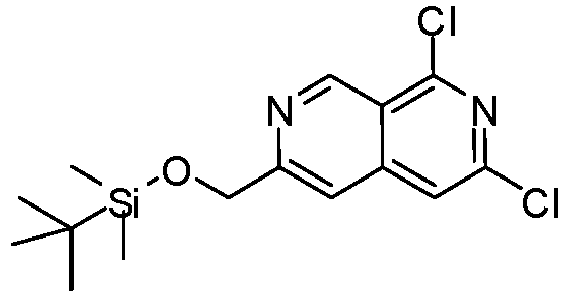
- A mixture of N-tert-butyl-1-(2,6-dichloro-4-iodo-3-pyridyl)methanimine (7.2 g, 20 mmol), tert-butyldimethyl(prop-2-ynyloxy)silane (3.78 g, 22 mmol), NiCl2(DPPP) (546 mg, 1.01 mmol), Zn (196 mg, 3.03 mmol) in acetonitrile (40 mL) was heated to 85°C for 18 hours under N2. The reaction mixture was filtered. The filtrate was diluted with ethyl acetate, washed with water, dried over Na2SO4, filtered and concentrated. The crude was purified by flash chromatography (petroleum ether/ethyl acetate = 15/1) to give tert-butyl-[(6,8-dichloro-2,7-naphthyridin-3-yl)methoxy]-dimethyl-silane (4 g, 44% yield) as a light yellow solid. LCMS (ESI) [M+H]+ = 343.0.
-
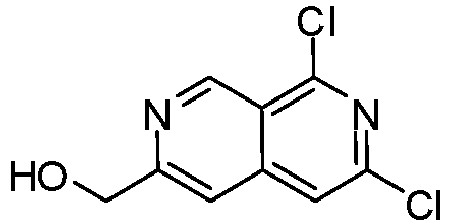
- A solution of tert-butyl-[(6,8-dichloro-2,7-naphthyridin-3-yl)methoxy]-dimethylsilane (4 g, 11.65 mmol) in a solution of HCl in ethanol (20 mL, 40 mmol) was stirred at 25°C for 4 hours. The reaction mixture was filtered. The solid was collected, dissolved in aqueous NaHCO3, and extracted with dichloromethane. The combined organic layers were dried over Na2SO4, filtered and concentrated to give (6,8-dichloro-2,7-naphthyridin-3-yl)methanol (2.5 g, 81% yield) as a yellow solid. LCMS (ESI) [M+H]+ = 343.0.
-

- To a solution of (6,8-dichloro-2,7-naphthyridin-3-yl)methanol (2.8 g, 12 mmol) in dichloromethane (100 mL) and DMSO (25 mL) was added IBX (5.13 g, 18 mmol) at 0°C. The reaction solution was stirred at room temperature for 18 hours. The reaction mixture was diluted with dichloromethane, washed with 10% aqueous K2CO3 and brine, dried over MgSO4, filtered and concentrated to give 6,8-dichloro-2,7-naphthyridine-3-carbaldehyde (2.2 g, 78% yield) as a white solid. LCMS (ESI) [M+H]+ = 226.9.
-

- To a solution of 6,8-dichloro-2,7-naphthyridine-3-carbaldehyde (2.2 g, 9.69 mmol) in 1,4-dioxane (80 mL) and water (30 mL) was added NH2SO3H (1.13 g, 11.63 mmol) and NaClO2 (1.05 g, 11.63 mmol) at room temperature. The reaction solution was stirred at room temperature for 18 hours. Water was then added. The precipitate was collected by filtration, washed with water and acetone to give 6,8-dichloro-2,7-naphthyridine-3-carboxylic acid (2.2 g, 74% yield) as a white solid. LCMS (ESI) [M+H]+ = 242.9.
-

- To a solution of 6,8-dichloro-2,7-naphthyridine-3-carboxylic acid (230 mg, 0.94 mmol), t-BuOH (1.4 g, 18.93 mmol) and DIPEA (158 mg, 1.23 mmol) in toluene (20 mL) was added a solution of DPPA (338 mg, 1.23 mmol) in toluene (2 mL) at 90°C under N2. The reaction solution was refluxed for 2 hours. The reaction solution was cooled to room temperature and methanol (40 mL) was added. The resulting solution was stirred at room temperature for 20 minutes, then concentrated. The residue was washed with methanol and dried to give tert-butyl N-(6,8-dichloro-2,7-naphthyridin-3-yl)carbamate (250 mg, 75% yield) as a white solid. LCMS (ESI) [M-55]+ = 257.9. 1H NMR (400 MHz, DMSO-d 6) δ 10.56 (s, 1H), 9.37 (s, 1H), 8.23 (s, 1H), 8.10 (s, 1H), 1.52 (s, 9H).
-

- To a vial was added tert-butyl N-(6,8-dichloro-2,7-naphthyridin-3-yl)carbamate (1.05 g, 3.34 mmol), HCl in 1,4-dioxane (10 mL, 4 N, 40 mmol), and dichloromethane (5 mL). The mixture was stirred at 40°C for 4 hours. The mixture was concentrated and dried under vacuum to give 6,8-dichloro-2,7-naphthyridin-3-amine hydrochloride (823 mg, 96% yield) as yellow solid. LCMS (ESI) [M+H]+ = 214.1.
-

- To a microwave tube was added 6,8-dichloro-2,7-naphthyridin-3-amine hydrochloride (800 mg, 3.19 mmol), 1-(4-methoxyphenyl)-N-[(4-methoxyphenyl)methyl]methanamine (2.47 g, 9.58 mmol), DIPEA (1.0 mL, 6.39 mmol), and 1,4-dioxane (4 mL). The mixture was stirred at 140°C for 48 hours. The mixture was cooled, concentrated and purified by silica gel chromatography ( dichloromethane/methanol/7N NH3-methanol, 200/5/1) to afford 3-chloro-N1,N1-bis[(4-methoxyphenyl)methyl]-2,7-naphthyridine-1,6-diamine (1.02 g, 73 % yield) as yellow solid. LCMS (ESI) [M+H]+ = 435.1.
-

- To a solution of (±)-cis-2-fluorocyclopropanecarboxylic acid (200 mg, 1.92 mmol) in dichloromethane (10 mL) and DMF (0.10 mL) was added drop wise oxalyl dichloride (489 mg, 3.84 mmol). The mixture was stirred at 20°C for 1 hour. The reaction mixture was then concentrated in vacuum to give a crude product of (±)-cis-2-fluorocyclopropanecarbonyl chloride as a yellow solid.
- To a solution of 6,8-dichloro-2,7-naphthyridin-3-amine hydrochloride (400 mg, 1.6 mmol) in dichloromethane (15 mL) and pyridine (3 mL) was added (±)-cis-2-fluorocyclopropanecarbonyl chloride (220 mg, 1.8 mmol). The mixture was stirred at 20 °C for 2 hours. The reaction mixture was then washed with water (50 mL) and extracted with dichloromethane (100 mL × 3). The organic extracts were combined and concentrated. The residue was purified by silica gel flash chromatography (petroleum ether/ethyl acetate = 10:1 to 3:1) to afford (±)-cis- N-(6,8-dichloro-2,7-naphthyridin-3-yl)-2-fluoro-cyclopropanecarboxamide (350 mg, 66% yield) as a light yellow solid. LCMS (ESI) [M+H]+ = 300.2.
-

- To a sealed tube was added N-(6,8-dichloro-2,7-naphthyridin-3-yl)-2-fluoro-cyclopropanecarboxamide (100 mg, 0.33 mmol), NH4OH (1.0 mL) and 1,4-dioxane (2 mL). The mixture was stirred at 80 °C for 6 hours. The reaction mixture was then concentrated in vacuum and the residue was purified by silica gel flash chromatography (petroleum ether/ethyl acetate = 3:1 to 1:5) to give N-(8-amino-6-chloro-2,7-naphthyridin-3-yl)-2-fluoro-cyclopropanecarboxamide (70 mg, 71% yield) as a white solid. LCMS (ESI) [M+H]+ = 281.1.
-

- To a solution of 6,8-dichloro-2,7-naphthyridin-3-amine hydrochloride (250 mg, 1.0 mmol) in pyridine (5 mL) was added drop-wise a solution of (±)-trans-2-cyanocyclopropanecarbonyl chloride (200 mg, 1.8 mmol) in dichloromethane (5 mL) at 0 °C. The mixture was stirred at 20°C for 2 hours and then solvent was removed under reduced pressure. The resulting residue was purified by silica gel chromatography (petroleum ether/ethyl acetate from 10:1 to 1:2) to give (±)- trans-2-cyano-N-(6,8-dichloro-2,7-naphthyridin-3-yl)cyclopropanecarboxamide (255 mg, 79% yield) as a white solid. LCMS (ESI) [M+H]+ = 307.2.
-

- To a sealed tube was added (±)-trans-2-cyano-N-(6,8-dichloro-2,7-naphthyridin-3-yl) cyclopropane carboxamide (150 mg, 0.49 mmol), 1,4-dioxane (8 mL), and ammonium hydroxide (6 mL). The mixture was stirred at 100°C for 4 hours and then concentrated to afford N-(8-amino-6-chloro-2,7-naphthyridin-3-yl)-2-cyano-cyclopropanecarboxamide (220 mg, 94% yield) as a white solid. LCMS (ESI) [M+H]+ = 288.2.
-

- To a solution of (1S,2S)-2-fluorocyclopropanecarboxylic acid (200 mg, 1.92 mmol) in dichloromethane (15 mL) and DMF (3 mL) was added dropwise oxalyl dichloride (0.24 mL, 2.88 mmol). The mixture was stirred at 20 °C for 2 hours. The reaction mixture was then concentrated under vaccum to give a yellow residue, which was then used in the next step directly.
- To a solution of 6,8-dichloro-2,7-naphthyridin-3-amine hydrochloride (300 mg, 1.2 mmol) in dichloromethane (15 mL) and pyridine (3 mL) was added a solution of (1R,2S)-2-fluorocyclopropane carbonyl chloride (220 mg, 1.8 mmol) dissolved in dichloromethane (2 mL). The mixture was stirred at 20°C for 2 hours. The reaction mixtrure was washed with water (50 mL) and extracted with dichloromethane (100 mL × 3). The organic extracts were combined, concentrated in vacuum and the residue was purified by silica gel flash chromatography (petroleum ether/ethyl acetate = 10:1 to 1:1) to give (1S,2S)-N-(6,8-dichloro-2,7-naphthyridin-3-yl)-2-fluoro-cyclopropanecarboxamide (330 mg, 71% yield) as a light yellow solid. LCMS (ESI) [M+H]+ = 300.2.
-

- To a sealed tube was added (1S,2S)-N-(6,8-dichloro-2,7-naphthyridin-3-yl)-2-fluoro-cyclopropanecarboxamide (80 mg, 0.27 mmol), NH4OH (1.0 mL) and 1,4-dioxane (2 mL). The mixture was stirred at 85 °C for 16 hours. The reaction mixture was then concentrated under vacuum. The residue was purified by silica gel flash chromatography (petroleum ether/ethyl acetate = 3:1 to 1:5) to give (1S,2S)-N-(8-amino-6-chloro-2,7-naphthyridin-3-yl)-2-fluoro-cyclopropanecarboxamide (51 mg, 63% yield) as a white solid. LCMS (ESI) [M+H]+ = 281.2.
-

- To a solution of (±)-trans-2-fluorocyclopropanecarboxylic acid (250 mg, 2.4 mmol) in dichloromethane (5 mL) and DMF (0.1 mL) was added dropwise oxalyl dichloride (375 mg, 2.95 mmol). The mixture was stirred at 20°C for 2 hours. The reaction mixture was then concentrated under vacuum to give a yellow residue, which was then used in the next step directly.
- To a solution of 6,8-dichloro-2,7-naphthyridin-3-amine hydrochloride (250 mg, 1.0 mmol) in pyridine (5 mL) was added a solution of (±)-trans-2-fluorocyclopropanecarbonyl chloride (240 mg, 1.96 mmol) dissolved in dichloromethane (2mL). The mixture was stirred at 20 °C for 2 hours. The reaction was then concentrated under vacuum. The residue was purified by silica gel flash chromatography ( petroleum ether/ethyl acetate = 10:1 to 3:1) to give(±)-trans-N-(6,8-dichloro-2,7-naphthyridin-3-yl)-2-fluoro-cyclopropanecarboxamide (225 mg, 71% yield) as a light yellow solid. LCMS (ESI) [M+H]+ = 300.0.
-

- To a sealed tube was added (±)-trans-N-(6,8-dichloro-2,7-naphthyridin-3-yl)-2-fluoro-cyclopropanecarboxamide (125 mg, 0.42 mmol), NH4OH (1.0 mL) and 1,4-dioxane (2 mL). The mixture was stirred at 90 °C for 16 hours. After 16 hours, the reaction mixture was concentrated under vacuum. The residue was purified by silica gel flash chromatography (petroleum ether/ethyl acetate = 3:1 to 1:5) to give (1S,2R)-N-(8-amino-6-chloro-2,7-naphthyridin-3-yl)-2-fluoro-cyclopropanecarboxamide (75 mg, 64% yield) as a white solid. LCMS (ESI) [M+H]+ = 281.2.
-

- To a solution of 2,2-difluorocyclopropanecarboxylic acid (200 mg, 1.64 mmol) in dichloromethane (3 mL) and DMF (0.05 mL) was added dropwise oxalyl dichloride (0.21 mL, 2.46 mmol). The mixture was stirred at 20°C for 2 hours. The reaction mixture was used in the next step directly without concentration.
To a solution of 6,8-dichloro-2,7-naphthyridin-3-amine hydrochloride (200 mg, 0.80 mmol) in pyridine (3 mL) was added 2,2-difluorocyclopropanecarbonyl chloride (200 mg, 1.42 mmol) dissolved in DMA (1 mL). The mixture was stirred at 20 °C for 2 hours. The reaction mixtrure was then concentrated. The residue was purified by silica gel flash chromatography (petroleum ether/ethyl acetate = 20:1 to 3:1) to give N-(6,8-dichloro-2,7-naphthyridin-3-yl)-2,2-difluoro-cyclopropanecarboxamide (150 mg, 58% yield) as a yellow solid. LCMS (ESI) [M+H]+ = 318.2. -

- To a sealed tube was added N-(6,8-dichloro-2,7-naphthyridin-3-yl)-2,2-difluoro-cyclopropanecarboxamide (100 mg, 0.31 mmol), NH4OH (1.0 mL) and 1,4-dioxane (2 mL). The mixture was stirred at 95 °C for 6 hours. After 6 hours, the reaction mixture was concentrated in vacuum and the residue was purified by silica gel flash chromatography (petroleum ether/ethyl acetate = 3:1 to 1:5) to give N-(8-amino-6-chloro-2,7-naphthyridin-3-yl)-2,2-difluoro-cyclopropanecarboxamide (55 mg, 59% yield) as a white solid. LCMS (ESI)
[M+H]+ = 299.2. -

- A solution of n-BuLi (2.5 M in hexane, 25 mL, 62.5 mmol) was added dropwise to a solution of 3-bromo-4-ethyl-pyridine (9.8 g, 52.69 mmol) and triisopropyl borate (12.0 g, 63.81 mmol) in THF (150 mL) at -78 °C over 0.5 h. The reaction mixture was stirred at - 78°C for another 0.5 h, then warmed slowly to room temperature and stirred for 0.5 hours. The reaction was quenched with water (120 mL). The aqueous layer was separated, washed with ethyl acetate (150 mL), and acidified with 3N HCl to pH 4-5. A light yellow solid precipitated. The precipitatewas collected by filtration, and dried to give (4-ethyl-3-pyridyl)boronic acid (1.8 g, 23% yield) as a light yellow solid. LCMS (ESI) [M+H]+ = 152.1.
-

- A mixture of 3-bromo-4-ethyl-pyridine (5.0 g, 26.88 mmol), bis(pinacolato)diboron (8.5 g, 33.47 mmol), PdCl2dppf (1.0 g, 1.37 mmol), potassium acetate (8.0 g, 81.63 mmol) in 1,4-dioxane (150 mL) was stirred overnight at 90 °C under Ar. The reaction mixture was cooled to room temperature. Then bis(pinacolato)diboron (12.0 g, 47.26 mmol), PdCl2dppf (1.0 g, 1.37 mmol) and 1,4-dioxane (150 mL) were added and the reaction mixture stirred overnight at 90°C under Ar . The reaction mixture was cooled to room temperature and evaporated. The residue was purified with silica chromatography (petroleum ether/ethyl acetate = 1/1) to afford 4-ethyl-3-(4,4,5,5-tetramethyl-1,3,2-dioxaborolan-2-yl)pyridine (4.3 g, 69% yield) as a black oil. LCMS (ESI) [M+H]+ = 234.1.
-
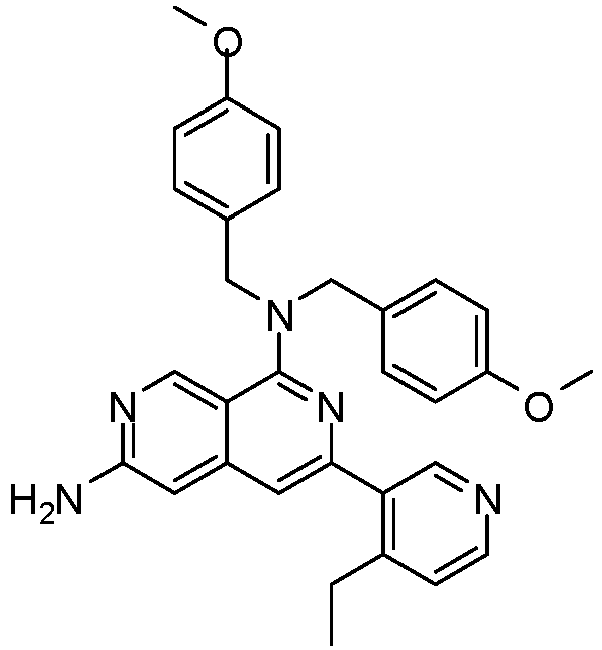
- A mixture 3-chloro-N1,N1-bis[(4-methoxyphenyl)methyl]-2,7-naphthyridine-1,6-diamine (2.8 g, 6.44 mmol), 4-ethyl-3-(4,4,5,5-tetramethyl-1,3,2-dioxaborolan-2-yl)pyridine (2.5 g, 10.73 mol), XPhos Pd G2 (250 mg, 0.32 mmol), XPhos (250 mg, 0.53 mmol), K2CO3 (2 g, 14.49 mmol) in 1,4-dioxane (100 mL) and water (25 mL) was stirred at 100°C under Ar for 2 hours. The reaction mixture was cooled to room temperature, diluted with ethyl acetate (200 mL), and washed with brine (100 mL). The organic layer was separated, dried over Na2SO4, filtered and concentrated. The residue was purified with silica gel chromatography (petroleum ether/ethyl acetate = 1:2) to afford 3-(4-ethyl-3-pyridyl)-N1,N1-bis[(4-methoxyphenyl)methyl]-2,7-naphthyridine-1,6-diamine (1 g, 31% yield) as a brown solid. LCMS (ESI) [M+H]+ = 506.2.
-

- To a vial was added XPhos Pd G2 (120 mg, 0.15 mmol), X-phos (100 mg, 0.21 mmol), 3-chloro-N1,N1-bis[(4-methoxyphenyl)methyl]-2,7-naphthyridine-1,6-diamine(600 mg, 1.38 mmol), potassium acetate (300 mg, 3 mmol), 4-methyl-3-(4,4,5,5-tetramethyl-1,3,2-dioxaborolan-2-yl)pyridine (360 mg, 1.64 mmol), water (5 mL), and 1,4-dioxane (50 mL). The reaction mixture was bubbled with N2 and stirred at 100°C for 6 hours. The mixture was concentrated and purified by silica gel chromotagraphy (dichloromethane/methanol from 30:1 to 10:1) to give N1,N1-bis[(4-methoxyphenyl)methyl]-3-(4-methyl-3-pyridyl)-2,7-naphthyridine-1,6-diamine (340 mg, 50 % yield) as a yellow solid. LCMS (ESI) [M+H]+ = 492.1.
-

-
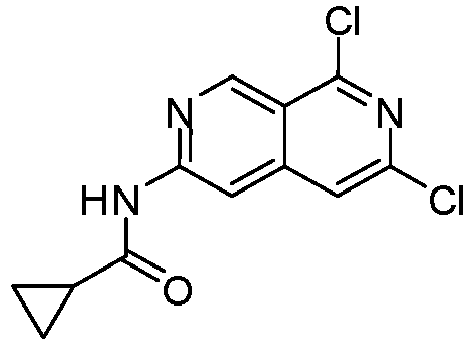
- To a mixture of 6,8-dichloro-2,7-naphthyridin-3-amine (270 mg, 1.26 mmol) in pyridine (5 mL) was added cyclopropanecarbonyl chloride (197 mg, 1.89 mmol) at 0°C. The mixture was stirred at room temperature for 2 hours. Water (10 mL) was added and the mixture extracted with dichloromethane (10 mL × 2). The organic layer was washed with water (20 mL × 3), brine (20 mL × 1), dried over Na2SO4, filtered and concentrated. The crude product was purified by flash chromatography (petroleum ether/ethyl acetate = 3/1) to give N-(6,8-dichloro-2,7-naphthyridin-3-yl)cyclopropanecarboxamide (240 mg, 59% yield) as a yellow solid. LCMS (ESI) [M-55]+ = 282.0.
-

- A mixture ofN-(6,8-dichloro-2,7-naphthyridin-3-yl)cyclopropanecarboxamide (200 mg, 0.71 mmol), benzophenone immine (128 mg, 0.71 mmol), Pd(OAc)2 (15 mg, 0.07 mmol), Xantphos (40 mg, 0.07 mmol), Cs2CO3 (462 mg, 1.42 mmol), DMF (1 mL) and toluene (1 mL) was heated to 145°C for 1 hours in the microwave reactor. The reaction mixture was cooled to room temperature, diluted with ethyl acetate, and filtered through celite. The filtrate was washed with brine, dried over Na2SO4, filtered and concentrated. The residue was purified by prep-TLC (normal phase silica gel, dichloromethane/methanol = 50/1) to give N-(6-chloro-8-(diphenylmethyleneamino)-2,7-naphthyridin-3-yl)cyclopropanecarboxamide (45 mg, 12% yield) as a yellow solid. LCMS (ESI) [M-55]+ = 427.1.
-

- A mixture of 6,8-dichloro-2,7-naphthyridin-3-amine hydrochloride (2.5 g, 9.98 mmol), bis(2,4-dimethoxybenzyl)amine (12.67 g, 39.92 mmol) and Et3N (5.04 g, 49.9 mmol) in 1,4-dioxane (100 mL) was stirred at 120°C for 24 hours. The mixture was concentrated and purified by column chromatography (ethyl acetate/hexane = 2:3) to afford 3-chloro-N1,N1-bis[(2,4-dimethoxyphenyl)methyl]-2,7-naphthyridine-1,6-diamine (3.8 g, 73% yield) as a white solid. LCMS (ESI) [M+H]+ = 495.1.
-

- A mixture of 3-chloro-N1,N1-bis[(2,4-dimethoxyphenyl)methyl]-2,7-naphthyridine-1,6-diamine (2.6 g, 5.25 mmol), 4-ethyl-3-(4,4,5,5-tetramethyl-1,3,2-dioxaborolan-2-yl)pyridine (1.42 g, 5.78 mmol), XPhos Pd G2 (0.41 g, 0.53 mmol), potassium acetate (1.03 g, 10.51 mmol) and XPhos (0.5 g, 1.05 mmol) in 1,4-dioxane (100 mL) and water (10 mL) was stirred under Ar at 100°C for 3 hours. The mixture was concentrated and purified by reverse phase preparative HPLC (C-18, acetonitrile/water + 0.05% NH4HCO3) to give N1,N1-bis[(2,4-dimethoxyphenyl)methyl]-3-(4-ethyl-3-pyridyl)-2,7-naphthyridine-1,6-diamine (1.1 g, 27% yield) as a white solid. LCMS (ESI) [M+H]+ = 566.3.
-

- To a cooled (-78°C) solution of (3-bromo-4-pyridyl)methanol (960 mg, 5.11mmol) in THF (40 mL) was added n-BuLi (2.5 M in hexane, 7.5 mL, 12 mmol) drop wise. The mixture was stirred for 2 hours at -78°C prior to the addition of triisopropyl borate (1.6 mL, 6.91 mmol). The mixture was stirred at -78°C for 30 minutes, then allowed warm to room temperature slowly, and stirred for an additional 1 hours. The reaction was then re-cooled to - 78°C and quenched by the addition of water (10 mL). The mixture was acidified to pH = 5 with 2 N HCl and washed with ethyl acetate (30 ml × 2). The aqueous phase was concentrated in vacuo to get the crude 1-hydroxy-3H-oxaborolo[3,4-c]pyridine (1.8 g, 52% yield) as pale brown solid which was used for the next step directly. LCMS (ESI) [M+H]+ = 136.2.
-

-

- A mixture of (±)-cis -2-cyanocyclopropanecarboxylic acid (1500.0 mg, 13.5 mmol) and oxalyl dichloride (2.0 mL, 23.48 mmol) in dichloromethane (30 mL) was stirred at room temperature for 1 hours. The excess oxalyl dichloride was removed by rotary evaporation at room temperature. Then dichloromethane (30 mL), 6, 8-dichloro-2, 7-naphthyridin-3-amine (850.0 mg, 3.97 mmol), and pyridine (5.0 mL, 61.82 mmol) were added. The reaction mixture was stirred at 0°C for 1hour. The solvent was removed by rotary evaporation and the residue was washed with water and filtered to get the crude (±)-cis-2-cyano-N-(6,8-dichloro-2,7-naphthyridin-3-yl)cyclopropanecarboxamide (1100 mg, 80% yield) as a yellow solid. LCMS (ESI): [M+H]+ =307.0.
-

- A mixture of (±)-cis-2-cyano-N-(6, 8-dichloro-2, 7-naphthyridin-3-yl) cyclopropanecarbox amide (1.0 g, 3.26 mmol), 2,4-dimethoxybenzylamine (1.5 g, 8.97 mmol) in 1,4-dioxane (10 mL) was stirred at 80°C for 4 hours. The reaction was concentrated to dryness. The crude product was purified by silica gel column chromatography ( dichloromethane: methanol, 15:1) to afford crude (±)-cis-N-(6-chloro-8-(2, 4-dimethoxy benzylamino)-2, 7-naphthyridin-3-yl)-2-cyanocyclopropanecarboxamide (1.5 g) LCMS (ESI):
[M+H]+ = 438.1. -

- A solution of (±)-cis-N-[6-chloro-8-[(2,4-dimethoxyphenyl)methylamino]-2,7-naphthyridin-3-yl]-2-cyano-cyclopropanecarboxamide (400 mg, 0.91 mmol) in trifluoroacetic acid (2.0 mL) was stirred at room temperature for 4 hours. The reaction was concentrated to dryness and the crude product was purified by silica gel column chromatography (ethyl acetate) to afford (±)-cis-N-(8-amino-6-chloro-2,7-naphthyridin-3-yl)-2-cyano-cyclopropanecarboxamide (170 mg, 58% yield) as yellow solid. LCMS (ESI): [M+H]+ =288.1.
-

-
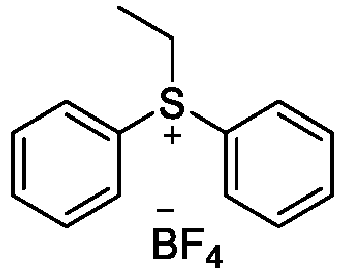
- To a solution of AgBF4 (37.48 g, 192.53 mmol) in dichloromethane (450 mL) was added iodoethane (30 g, 192.35 mmol) under nitrogen. The solution was stirred for 30 minutes at room temperature. Phenylsulfanyl)benzene (106.92 g, 573.99 mmol) was added and then stirred for 16 hours at 35°C. The mixture was filtered and the filtrate was concentrated under vacuum. The residue was washed with dichloromethane/ether (1/1) to afford ethyldiphenylsulfanium tetrafluoroboranuide (25 g, 116.28 mmol) as off-white solid. LCMS (ESI) [M+H]+ = 215.
-

- To a solution of ethyl(diphenyl)sulfonium (1.55 g, 7.2 mmol) in dichloromethane (2 mL) and 1,2-dimethoxyethane (20 mL) was added lithium diisopropylamide (4.2 mL, 8.4 mmol) at -78°C. The resulting solution was stirred for 1 hour at -78°C. tert-Butyl (E)-3-(1-methylpyrazol-4-yl)prop-2-enoate (500 mg, 2.4 mmol) was added at -78 °C. The mixture was stirred at 25°C for 6 hours. The reaction was quenched with water and then extracted with dichloromethane. The organic layers were combined, dried over anhydrous sodium sulfate and concentrated under vacuum to afford trans-tert-butyl 2-methyl-3-(1-methylpyrazol-4-yl)cyclopropanecarboxylate (550 mg, crude) as a yellow oil. LCMS (ESI) [M+H]+ = 237.
-

- A solution of trans-tert-butyl 2-methyl-3-(1-methylpyrazol-4-yl)cyclopropanecarboxylate (500 mg, crude) in dichloromethane (3 mL) and 2,2,2-trifluoroacetic acid (4 mL) was stirred at 25°C for 2 hours. The solvent was concentrated under vacuum. The reaction mixture was adjusted to pH 7 with ammonia in methanol (7 mol/L). The residue was purified by reverse phase chromatography (acetonitrile 0-40/0.1% HCl in water) to afford 4 stereoisomers of 2-methyl-3-(1-methylpyrazol-4-yl)cyclopropanecarboxylic acid (180 mg, 0.99 mmol) as a yellow oil. LCMS (ESI) [M+H]+ = 181. (Cyclopropane stereochemistry for isomers: pyrazole trans to carboxylic acid; All absolute stereochemistry arbitrarily assigned)
-

- To a solution of silver tetrafluoroborate (2 g, 10.31 mmol) in dichloromethane (20 mL) was added 1-iodopropane (1.75 g, 10.31 mmol) and diphenyl sulfide (5.76 g, 30.93 mmol) at 0 °C. The reaction was stirred at 35 °C for 15 hours. The mixture was filtered and the filtrate was concentrated under vacuum. The residue was washed with dichloromethane-ether to afford diphenyl(propyl)sulfonium tetrafluoroborate (2 g, 6.32 mmol) as a white solid. LCMS (ESI)
[M+H]+= 229. -

- To a solution of diphenyl(propyl)sulfonium tetrafluoroborate (1.50 g, 4.75 mmol) in 1,2-dimethoxyethane (30 mL) and dichloromethane (3 mL) was added lithium diisopropylamide (5.54 ml, 11.09 mmol) at -78 °C. The resulting mixture was stirred for 1 hour at -78 °C. Then tert-butyl (Z)-3-(1-methylpyrazol-4-yl)prop-2-enoate (330 mg, 1.58 mmol) was added and stirred at -78 °C to 25°C for 15 hours. The reaction was quenched with water. The resulting mixture was extracted with dichloromethane and dried with anhydrous sodium sulfate. After filtration, the filtrate was concentrated under vacuum to afford tert-butyl 2-ethyl-3-(1-methylpyrazol-4-yl)cyclopropanecarboxylate (350 mg, 1.40 mmol) as a brown oil. LCMS (ESI) [M+H]+= 251.
-

- A solution of trans-tert-butyl 2-ethyl-3-(1-methylpyrazol-4-yl)cyclopropanecarboxylate (350 mg, 1.4 mmol) and 2,2,2-trifluoroacetic acid (8 mL) in dichloromethane (3 mL) was stirred at 25 °C for 1 hour. The mixture was concentrated under vacuum. The resulting residue was purified by reverse phase chromatography (acetonitrile 0-40/0.1% HCl in water) to afford 2-ethyl-3-(1-methylpyrazol-4-yl)cyclopropanecarboxylic acid (260 mg, 1.34 mmol) as a brown oil. Product mixture consists of 4 stereoisomers where pyrazole is trans to carboxylic acid and 2,2-dimethyl-3-(1-methyl-1H-pyrazol-4-yl)cyclopropane-1-carboxylic acid as a contaminant. LCMS (ESI) [M+H]+= 195.
-
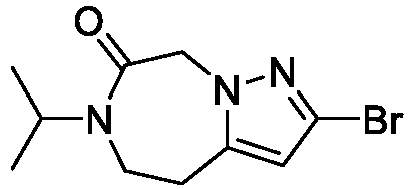
- A solution of 2-bromo-4,5,6,8-tetrahydropyrazolo[1,5-d][1,4]diazepin-7-one (3.0 g, 13.04 mmol) and NaH (1.56 g, 39.12 mmol) in N,N-dimethylformamide(75 mL) was stirred at 0 °C for 10 min. Then 2-iodopropane (11.08 g, 65.2 mmol) was added. The mixture was stirred at 25 °C for 1 hour. The reaction was quenched with water. The mixture was concentrated under vacuum. The resulting residue was purified by reverse phase chromatography (acetonitrile 0-40/0.1% NH4HCO3 in water) to afford 2-bromo-6-isopropyl-5,8-dihydro-4H-pyrazolo[1,5-d][1,4]diazepin-7-one (2.1g,7.7166mmol, 59.2% yield) as a white solid. LCMS (ESI) [M+H]+ = 272.
-

-

- A mixture of 3,5-dibromo-1H-pyrazole (1.0 g, 4.43 mmol) and potassium carbonate (1.22 g, 8.85 mmol) in N,N-dimethylformamide (20 mL) was stirred at 25 °C for 10 min. Bromoacetonitrile (796.59 mg, 6.64 mmol) was added and the reaction was stirred at 25 °C for 2 h. After filtration, the filtrate was diluted with ethyl acetate (30 mL). The reaction was washed with water. The organic phase was dried with anhydrous sodium sulfate. After filtration, the filtrate was concentrated under vacuum. The residue was purified by flash chromatography on silica gel eluting with petroleum ether/dichloromethanol (1/1) to afford 2-(3,5-dibromopyrazol-1-yl)acetonitrile (950 mg,3.59 mmol) as a white solid. LCMS (ESI)
[M+H]+=264. -

- A mixture of 2-(3,5-dibromopyrazol-1-yl)acetonitrile (1.0 g, 3.77 mmol), 4,4,5,5-tetramethyl-2-(2-methylprop-1-en-1-yl)-1,3,2-dioxaborolane (687.29 mg, 3.77 mmol), Pd(dppf)Cl2 (552.64 mg, 0.75 mmol), and potassium carbonate (1.56 g, 11.32 mmol) in 1,4-dioxane (20 mL) and water (2 mL) was stirred under nitrogen for 1 h at 100 °C. After filtration, the filtrate was concentrated under vacuum. The residue was purified by silica gel flash chromatography eluting with ethyl acetate/ petroleum ether (1/3) to afford 2-[3-bromo-5-(2-methylprop-1-enyl)pyrazol-1-yl]acetonitrile (700 mg, 2.92 mmol) as a white solid. LCMS (ESI) [M+H]+=240.
-

- A mixture of 2-[3-bromo-5-(2-methylprop-1-enyl)pyrazol-1-yl]acetonitrile (700 mg, 2.92 mmol) in methylsulfonic acid (15 mL) was stirred at 65 °C for 3 d. The reaction was quenched with ice water. The reaction mixture was adjusted to pH 9-10 with an aqueous sodium hydroxide solution. The resulting solution was extracted with dichloromethane and dried with anhydrous sodium sulfate. After filtration, the filtrate was concentrated under vacuum. The residue was purified by reverse phase chromatography (acetonitrile 0-40/0.1% NH4HCO3 in water) to afford 2-bromo-5,5-dimethyl-6,8-dihydro-4H-pyrazolo[1,5-d][1,4]diazepin-7-one (300 mg, 1.16 mmol) as a white solid. LCMS (ESI) [M+H]+=258.
-

- A mixture of 2-bromo-5,5-dimethyl-6,8-dihydro-4H-pyrazolo[1,5-d][1,4]diazepin-7-one (100 mg, 0.39 mmol) and potassium tert-butoxide (52.07 mg, 0.46 mmol) in tetrahydrofuran (10 mL) was stirred at 25 °C for 10 min. Iodomethane (82.52 mg, 0.58 mmol) was added. The reaction was stirred at 25 °C for 1 h. The reaction was concentrated under vacuum and purified by flash chromatography on silica gel eluting with dichloromethane/methanol (95/5) to afford 2-bromo-5,5,6-trimethyl-4,8-dihydropyrazolo[1,5-d][1,4]diazepin-7-one (80 mg, 0.29 mmol) as a white solid. LCMS (ESI) [M+H]+=272.
-

-

- To a 3L 3-necked round-bottom flask was added compound 1 (200 g, 656 mmol, 1.0 eq) in dimethyl tetrahydrofuran (1000 mL) under N2 and then the solution was cooled to - 78°C. n-BuLi (2.5 M, 525 mL, 2.0 eq) was added dropwise to the above solution for 1 hour at -78°C and the mixture was stirred at -78°C for 3 hours. TLC (Petroleum ether/Ethyl acetate = 3/1, Rf= 0.51) showed the reaction was completed and one main new spot formed. The two reactions were combined and the reaction mixture was poured into water (1000 mL) at 0°C and the pH value of the solution was acidified to 4∼5 with 2N HCl. The resulting solution was extracted with ethyl acetate (1000 mL, 800 mL, 400 mL). The combined organic phase was washed with brine (800 mL), dried with anhydrous Na2SO4 and concentrated under vacuum to give the title compound (284 g, 1.26 mol, 95.8% yield) as a yellow solid. The crude product was directly used to the next step without further purification.
-

- To the solution of 3,5-dibromo-1H-pyrazole (137 g, 607 mmol, 1.0 eq) in MeCN (959 mL) was added tert-butyl 2-chloroacetate (137 g, 910 mmol, 131 mL, 1.5 eq), K2CO3 (137 g, 989 mmol, 1.63 eq) and TBAI (11.0 g, 29.7 mmol, 0.049 eq). The resulting solution was stirred at 25°C for 12 hours. TLC (Petroleum ether/Ethyl acetate = 5/1, Rf= 0.74) showed the reaction was complete and one main new spot formed. The reaction mixture was filtered, the filter cake was washed with EtOAc (500 mL x3, 300 mL, 200 mL). The combined filtrate was concentrated to give a residue. The residue was dissolved in EtOAc (2.0 L), washed with water (1.0 L), brine (1.0 L). The organic phase was dried with anhydrous Na2SO4, filtered and concentrated in vacuum to give the title compound (744 g, crude) as a brown oil. 1H NMR: (400MHz, CDCl3): δ 6.35 (s, 1 H), 4.80 (s, 2 H), 1.46 (s, 9 H).
-
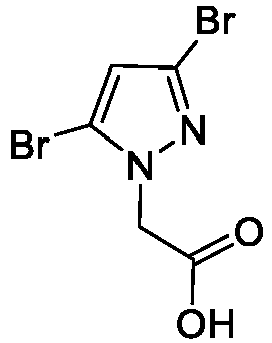
- To the solution of compound tert-butyl 2-(3,5-dibromo-1H-pyrazol-1-yl)acetate (248 g, 729 mmol, 1.0 eq) in DCM (140 mL) was added TFA (2.08 kg, 18.2 mol, 1.35 L, 25 eq) and the resulting solution was heated to 80°C and stirred for 2 hours. TLC (Petroleum ether/Ethyl acetate = 5/1, Rf = 0.03) showed the reaction was complete and one main new spot formed. The reaction was repeated twice. The combined reaction mixtures were concentrated under reduced pressure to give a crude product. The crude product was diluted with petroleum ether/ethyl acetate (4/1, 1.0 L) and the resulting suspension was stirred at 25°C for 1 hour, then filtered. The filter cake was collected and dried in vacuum to give the title compound (471 g, 1.66 mol, 75.8% yield) as a creamy white solid. 1H NMR: (400 MHz, DMSO) δ 13.3 (br s, 1 H), 6.70 (s, 1 H), 4.96 (s, 2 H).
-

- To the solution of 2-(3,5-dibromo-1H-pyrazol-1-yl)acetic acid (157 g, 553 mmol, 1.0 eq) in DMF (1.10 L) was added DIPEA (357 g, 2.77 mol, 482 mL, 5.0 eq) and EDCI (138 g, 719 mmol, 1.3 eq) at 0°C, the resulting solution was stirred at 0°C for 30 min. Then HOBt (97.1 g, 719 mmol, 1.3 eq) was added and the mixture was stirred at 0°C for another 30 min. Then prop-2-en-1-amine (47.4 g, 830 mmol, 62.2 mL, 1.5 eq) was added at 0°C and the mixture was warmed to 25°C and stirred for 16 hours. TLC (Petroleum ether/Ethyl acetate = 1/1, Rf= 0.60) showed the reaction was completed and one main new spot formed. The reaction was repeated two more times. The three batches of reactions were combined and the reaction mixture was poured into ice water (12.0 L), extracted with ethyl acetate (2.00 L, 2.00 L, 1.00 L). The combined organic phase was washed with brine (2.0 L), and then concentrated in vacuum to give a crude product. The crude product was purified by column chromatography on silica gel (Petroleum ether/Ethyl acetate = 3/1) to afford the title compound (340 g, 1.05 mol, 63.5% yield) as a white solid. 1H NMR: (400MHz, CDCl3) δ 6.41 (s, 1 H), 5.89 (br s, 1 H), 5.79 (m, 1 H), 5.08 - 5.17 (m, 2 H), 4.85 (s, 2 H), 3.86 - 3.93 (m, 2 H).
-

- To a solution of N-allyl-2-(3,5-dibromo-1H-pyrazol-1-yl)acetamide (103 g, 319 mmol, 1.0 eq) in THF (721 mL) was added KOH (32.2 g, 574 mmol, 1.8 eq), 18-Crown-6 (3.37 g, 12.8 mmol, 0.04 eq) and 1-(chloromethyl)-4-methoxy-benzene (64.9 g, 415 mmol, 56.5 mL, 1.3 eq), then the mixture was stirred at 25°C for 64 h. TLC (Petroleum ether/Ethyl acetate = 2/1, Rf= 0.50) showed one main new spot formed. The reaction was repeated two more times. The three batches reactions were combined and the reaction mixture was added water (1.00 L), and the pH value was adjusted to 7∼8 with 1M HCl, then extracted with EtOAc (1.00 L, 800 mL × 3). The combined organic phase was washed with brine (800 mL), dried with anhydrous Na2SO4, filtered and concentrated in vacuum to give a crude product. The crude product was purified by column chromatography on silica gel (Petroleum ether/Ethyl acetate = 2/1) to afford the title compound (320 g, 722 mmol, 75.5% yield) as a yellow oil.
-

- To a solution of N-allyl-2-(3,5-dibromo-1H-pyrazol-1-yl)-N-(4-methoxybenzyl)acetamide (50.0 g, 113 mmol, 1.0 eq) in DMF (1.0 L) was added K2CO3 (31.2 g, 226 mmol, 2.0 eq), Pd(PPh3)4 (17.0 g, 14.7 mmol, 0.13 eq) under Ar, then the mixture was stirred at 120°C for 16 hours. The reaction was repeated six more times. The seven batches of reactions were combined and the reaction mixture was concentrated in vacuum to remove the solvent to give a residue. Then the residue was added water (2.0 L), extracted with ethyl acetate (2.0 L, 1.0 L, 1.0 L). The combined organic phase was washed with brine (1.0 L) and concentrated to give a crude product. The crude product was purified by column chromatography on silica gel (Petroleum ether/Ethyl acetate = 2/1) to afford the title compound compound (74.1 g, 204 mmol, 25.9% yield, 98.7% purity) as a white solid. 1H NMR: (400MHz, CDCl3) δ 7.21 (d, J = 8.8 Hz, 2 H), 6.86 - 6.92 (m, 2 H), 6.52 (s, 1 H), 5.50 (s, 1 H), 5.20 (s, 2 H), 5.02 (s, 1 H), 4.58 (s, 2 H), 4.13 (s, 2 H), 3.83 (s, 3 H).
-

- A solution of 2-bromo-6-(4-methoxybenzyl)-4-methylene-5,6-dihydro-4H-pyrazolo[1,5-d][1,4]diazepin-7(8H)-one- (3.90 g, 10.8 mmol, 1.0 eq), TFA (38.4 g, 336 mmol, 24.9 mL, 31.3 eq) and trifluoromethanesulfonic acid (16.2 g, 108 mmol, 9.5 mL, 10 eq) in DCM (28 mL) was stirred at 25°C for 12 hours. The reaction mixture was concentrated to give a residue. To the residue was added water (100 mL), then the pH value was adjusted to 6∼7 with saturated aqueous NaHCO3 solution, extracted with EtOAc (100 mL × 3, 60 mL × 3). The combined organic phase was dried with anhydrous Na2SO4, filtered and concentrated in vacuum to give a crude product. The crude product was purified by column chromatography on silica gel (Petroleum ether/Ethyl acetate=1/1) to afford the title compound (1.90 g, 7.85 mmol, 72.9% yield) as a gray solid. 1H NMR: (400MHz, CDCl3) δ 6.88 (s, 1 H), 6.54 (s, 1 H), 5.55 (s, 1 H), 5.21 (s, 1 H), 5.08 (s, 2 H), 4.15 (d, J = 6.0 Hz, 2 H).
-

- A solution of 2-(3,5-dibromo-1H-pyrazol-1-yl)acetic acid (15 g, 52.84 mmol), methyl(prop-2-en-1-yl)amine (5.7 g, 80.15 mmol), N,N-diisopropylethylamine (27 g, 208.9 mmol) and HATU (30 g, 78.9 mmol) in N,N-dimethylformamide (500 mL) was stirred for 16 hours at room temperature. The resulting mixture was diluted with ethyl acetate and then washed with sodium chloride solution. The organic phase was dried with anhydrous sodium sulfate. After filtration, the filtrate was concentrated under vacuum. The residue was purified by flash chromatography on silica gel eluting with ethyl acetate/petroleum ether (2/3) to afford 2-(3,5-dibromo-1H-pyrazol-1-yl)-N-methyl-N-(prop-2-en-1-yl)acetamide (16.3 g, 92%) as a yellow oil. LCMS (ESI) [M+H]+ = 338.0.
-

- A mixture of 2-(3,5-dibromo-1H-pyrazol-1-yl)-N-methyl-N-(prop-2-en-1-yl)acetamide (5 g, 14.84 mmol), palladium acetate (166 mg, 0.74 mmol), triphenylphosphine (388 mg, 1.48 mmol), TBAB (4.8 g, 14.890 mmol) and potassium acetate (4.2 g, 42.80 mmol) in N,N-dimethylformamide (100 mL) was stirred for 10 h at 80 °C. After filtration, the filtrate was concentrated under vacuum. The residue was purified on a silica gel column eluted with ethyl acetate/petroleum ether (2/1) to afford 2-bromo-6-methyl-4-methylidene-4H,5H,6H,7H,8H-pyrazolo[1,5-d][1,4]diazepin-7-one(3.2 g, 84%) as a brown oil. LCMS (ESI) [M+H]+ = 258.1.
-
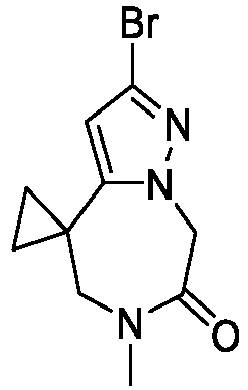
- A mixture of trimethylsulfoxonium iodide (1.29 g, 5.86 mmol) and potassium tert-butoxide (656 mg, 5.85 mmol) in dimethyl sulfoxide (30 mL) was stirred for 30 min at room temperature. Then a solution of 2-bromo-6-methyl-4-methylidene-4H,5H,6H,7H,8H-pyrazolo[1,5-d][1,4]diazepin-7-one (500 mg, 1.95 mmol) in dimethyl sulfoxide (3 mL) was added. The mixture was then stirred for 12 h at 50 °C. The reaction mixture was diluted with ethyl acetate and then washed with water. The organic layer was dried over anhydrous sodium sulfate, filtered and concentrated under vacuum. The residue was purified by silica gel column with dichloromethane/methanol (10/1) to afford 2'-bromo-6'-methyl-5',6'-dihydrospiro[cyclopropane-1,4'-pyrazolo[1,5-d][1,4]diazepin]-7'(8'H)-one (120 mg, 23%) as a white solid. LCMS (ESI) [M+H]+ = 270.
-

-

- A mixture of 2-bromo-4,5,6,8-tetrahydropyrazolo[1,5-d][1,4]diazepin-7-one (314 mg, 1.36 mmol) and Lawsson reagent (551.4 mg, 1.36 mmol) in 1,4-dioxane (10 mL) was stirred at 90 °C for 1 h. The reaction was concentrated under vacuum. The residue was purified by flash chromatography on silica gel eluting with dichloromethane/methanol (96/4) to afford 2-bromo-4,5,6,8-tetrahydropyrazolo[1,5-d][1,4]diazepine-7-thione (265 mg, 78.9%) as a white solid. LCMS (ESI) [M+H]+ = 246.0.
-

- A mixture of 2-bromo-5,6-dihydro-4H-pyrazolo[1,5-d][1,4]diazepine-7(8H)-thione (265.0 mg, 1.07 mmol), 2,2-diethoxyethan-1-amine(1.42 g, 10.7 mmol) and silver carbonate (590 mg, 2.14 mmol) in tetrahydrofuran (10 mL) was stirred at 80 °C for 1 h. The solvent was concentrated under vacuum. The residue was purified by reverse-phase column eluting with water (0.05%TFA)/CH3CN (85/15) to afford 2-bromo-N-(2,2-diethoxyethyl)-5,8-dihydro-4H-pyrazolo[1,5-d][1,4]diazepin-7-amine (295 mg, 80%) as a brown oil. LCMS (ESI) [M+H]+ = 345.0.
-

- A solution of 2-bromo-N-(2,2-diethoxyethyl)-5,8-dihydro-4H-pyrazolo[1,5-d][1,4]diazepin-7-amine (228 mg, 0.66 mmol) and concentrated hydrochloric acid (0.17 mL, 0.66 mmol) in acetic acid (5 mL) was stirred at 80 °C for 1 h. The reaction was concentrated under vacuum. The residue was purified by reverse-phase column eluting with water (0.05%TFA)/ACN (85/15) to afford 8-bromo-5,6-dihydro-11H-imidazo[1,2-a]pyrazolo[1,5-d][1,4]diazepine (150 mg, 89.7%) as a brown oil. LCMS (ESI) [M+H]+ = 253.0.
-

-

- To a solution of 7-bromo-8-methyl-2,3-dihydro-1H-pyrido[2,3-b][1,4]oxazine (1 g, 4.37 mmol) in tetrahydrofuran (2 mL) was added dropwise LiHMDS (8.73 mL, 8.73 mmol, 1 mol/L) at 0°C. The resulting solution was stirred under nitrogen for 0.5 h at 0°C. Then di-tert-butyl dicarbonate (2.85 g, 13.07 mmol) was added and the reaction was stirred at room temperature for 2 h. The reaction was quenched by methanol (50 mL). The solvent was concentrated under vacuum. The residue was purified by silica gel flash chromatography (ethyl acetate/ petroleum ether, 1/4) to afford tert-butyl 7-bromo-8-methyl-2,3-dihydropyrido[2,3-b][1,4]oxazine-1-carboxylate (800 mg,2.43 mmol) as a yellow oil. LCMS (ESI) [M+H]+ = 329.2.
-

- A mixture of tert-butyl 7-bromo-8-methyl-2,3-dihydropyrido[2,3-b][1,4]oxazine-1-carboxylate (6.2 g, 18.83 mmol), dipinacoldiboron (23.93 g, 94.22 mmol), [1,1'-bis(diphenylphosphino)ferrocene]dichloropalladium(II) (2.76 g, 3.77 mmol) and potassium acetate (5.55 g, 56.62 mmol) in 1,4-dioxane (2 mL) was stirred under nitrogen for 2.5 h at 90 °C. The solvent was concentrated under vacuum. The residue was purified by flash chromatography on silica gel eluting with ethyl acetate/ petroleum ether (30%) to afford tert-butyl 8-methyl-7-(4,4,5,5-tetramethyl-1,3,2-dioxaborolan-2-yl)-2,3-dihydropyrido[2,3-b][1,4]oxazine-1-carboxylate (5 g, 13.29 mmol) as a yellow oil. LCMS (ESI) [M+H]+ = 376.3.
-

- To a sealed tube was added N-(8-amino-6-chloro-2,7-naphthyridin-3-yl)-2-fluoro-cyclopropanecarboxamide (50 mg, 0.18 mmol), 4-methyl-3-(4,4,5,5-tetramethyl-1,3,2-dioxaborolan-2-yl)pyridine (50 mg, 0.23 mmol), Xphos Pd G2 (14 mg, 0.02 mmol), Xphos (17 mg, 0.04 mmol), potassium acetate (52 mg, 0.53 mmol), 1,4-dioxane (1 mL) and water (0.2 mL). The mixture was stirred at 100°C for 2 hours. The reaction mixture was then filtered. The filtrate was concentrated to give a yellow residue, which was purified by silica flash chromatography (dichloromethane/methanol,gradient from 20:1 to 10:1) to give N-[8-amino-6-(4-methyl-3-pyridyl)-2,7-naphthyridin-3-yl]-2-fluoro-cyclopropanecarboxamide (21 mg, 35% yield) as a white solid. LCMS (ESI): RT (min) = 0.974, [M+H]+ = 338.1, method = B; 1H NMR (400 MHz, CD3OD) δ 9.30 (s,1 H), 8.54 (s, 1H), 8.43 (d, J = 5.2 Hz, 1H), 8.33 (s, 1H), 7.40 (d, J = 5.2 Hz, 1H), 6.70 (s, 1H), 4.99-4.80 (m, 1H), 2.46 (s, 3H), 2.19-2.15 (m, 1H), 1.87-1.80 (m, 1H), 1.26-1.21 (m, 1H).
-

- To a sealed tube was added N-(8-amino-6-chloro-2,7-naphthyridin-3-yl)-2-fluoro-cyclopropanecarboxamide (30 mg, 0.11 mmol), 1,5-dimethyl-1H-pyrazole-4-boronic acid pinacol ester (31 mg, 0.14 mmol), XphosPdG2 (8 mg, 0.01mmol), Xphos (10 mg, 0.02 mmol), potassium acetate (31 mg, 0.32 mmol), 1,4-dioxane (1mL) and water (0.4 mL). The mixture was stirred at 100°C for 4 hours. The reaction mixture was concentrated and the residue was purified by silica gel flash chromatography (dichloromethane /methanol,gradient = 20:1 to 10:1) to give cis-N-[8-amino-6-(1,5-dimethylpyrazol-4-yl)-2,7-naphthyridin-3-yl]-2-fluoro-cyclopropanecarboxamide (8 mg, 21% yield) as a light yellow solid. LCMS (ESI): RT(min) = 1.051, [M+H]+ = 341.2, method = B; 1H NMR (400 MHz, CD3OD) δ 9.18 (s, 1H), 8.23 (s, 1H), 7.85 (s, 1H), 7.00 (s, 1H), 4.99-4.83 (m, 1H), 3.86 (s, 3H), 2.64 (s, 3H), 2.18-2.15 (m, 1H), 1.86-1.80 (m, 1H), 1.25-1.20 (m, 1H).
-

- To a sealed tube was added N-(8-amino-6-chloro-2,7-naphthyridin-3-yl)-2-fluoro-cyclopropanecarboxamide (20 mg, 0.07 mmol), 1,3,5-trimethyl-4-(4,4,5,5-tetramethyl-1,3,2-dioxaborolan-2-yl)-1H-pyrazole (22 mg, 0.09 mmol), Xphos Pd G2 (6 mg, 0.01mmol), Xphos (7 mg, 0.01 mmol), potassium acetate (21 mg, 0.21 mmol), 1,4-dioxane (1 mL) and water (0.20 mL). The mixture was stirred at 100°C for 5 hours. The reaction mixture was then filtered and concentrated to give a yellow residue which was purified by silica gel flash chromatography (dichloromethane/ methanol, gradient = 20:1 to 8:1) to give a yellow solid. The yellow solid was then purified by reverse phase flash chromatography (Biotage, ODS, 50 g column, uv 254 nm) eluting with methanol/water (+0.5% NH4HCO3) to give cis-N-[8-amino-6-(1,3,5-trimethylpyrazol-4-yl)-2,7-naphthyridin-3-yl]-2-fluoro-cyclopropanecarboxamide (9 mg, 35% yield) as a white solid. LCMS (ESI): RT (min) = 1.055, [M+H]+ = 355.2, method = B; 1H NMR (400 MHz, CD3OD) δ 9.21 (s, 1H), 8.24 (s, 1H), 6.82 (s, 1H), 4.98-4.80 (m, 1H), 3.78 (s, 3H), 2.42 (s, 3H), 2.33 (s, 3H), 2.19-2.13 (m, 1H), 1.88-1.78 (m, 1H), 1.27-1.18 (m, 1H).
-

- To a sealed tube was added N-(8-amino-6-chloro-2,7-naphthyridin-3-yl)-2-fluoro-cyclopropanecarboxamide (20 mg, 0.07 mmol), 1-methyl-4-(4,4,5,5-tetramethyl-1,3,2-dioxaborolan-2-yl)-1H-pyrazole (19 mg, 0.09 mmol), Xphos Pd G2 (6 mg, 0.01 mmol), Xphos (7 mg, 0.01 mmol), potassium acetate (21 mg, 0.21 mmol), 1,4-dioxane (1 mL) and water (0.2 mL). The mixture was stirred at 100°C for 4 hours. The reaction mixture was then filtered and concentrated to give a yellow residue, which was then purified by silica flash chromatography (dichloromethane/ methanol, gradient = 20:1 to 10:1) to give N-[8-amino-6-(1-methylpyrazol-4-yl)-2,7-naphthyridin-3-yl]-2-fluoro-cyclopropanecarboxamide (9 mg, 37% yield) as a white solid. LCMS (ESI): RT(min) = 1.027, [M+H]+ = 327.1, method = B; 1H NMR (400 MHz, CD3OD) δ 9.16 (s,1 H), 8.22 (s, 1H), 8.14 (s, 1H), 8.03 (s, 1H), 7.13 (s, 1H), 4.99-4.82 (m, 1H), 3.96 (s, 3H), 2.18-2.15 (m, 1H), 1.86-1.80 (m, 1H), 1.26-1.21 (m, 1H).
-

- To a vial was added N-(8-amino-6-chloro-2,7-naphthyridin-3-yl)-2-cyano-cyclopropanecarboxamide (220 mg, 0.46 mmol), X-phos (43 mg, 0.09 mmol), XPhos Pd G2 (54 mg, 0.07 mmol), potassium acetate (135 mg, 1.38 mmol), (4-ethyl-3-pyridyl)boronic acid (69 mg, 0.46 mmol), water (1 mL) and 1,4-dioxane (10 mL). The reaction mixture was degassed by N2 bubbling and then stirred at 100°C for 6 hours. The mixture was concentrated and purified by silica gel chromatography (dichloromethane/methanol from 100:1 to 10:1) to afford (±)-trans-N-[8-amino-6-(4-ethyl-3-pyridyl)-2,7-naphthyridin-3-yl]-2- cyano-cyclopropanecarboxamide (102 mg, 64% yield) as a pale-yellow solid. LCMS (ESI): RT (min) = 1.112, [M+H]+ = 359.0, method = B; 1H-NMR (400 MHz, DMSO-d 6): δ 11.28 (s, 1H), 9.41 (s, 1H), 8.50 (s, 1H), 8.49 (d, J = 5.2 Hz, 1H), 8.20 (s, 1H), 7.38-7.36 (m, 2H), 7.35 (d, J = 5.2 Hz, 1H), 6.95 (s, 1H), 2.80-2.72 (m, 1H), 2.78 (q, J = 7.6 Hz, 2H), 2.20-2.12 (m, 1H), 1.65-1.57 (m, 1H), 1.48-1.39 (m, 1H), 1.09 (t, J = 7.6 Hz, 3H).
-

- To a sealed tube was added (1S,2S)-N-(8-amino-6-chloro-2,7-naphthyridin-3-yl)-2-fluoro-cyclopropanecarboxamide (50 mg, 0.18 mmol), 4-methyl-3-(4,4,5,5-tetramethyl-1,3,2-dioxaborolan-2-yl)pyridine (51 mg, 0.23 mmol), Xphos Pd G2 (14 mg, 0.02 mmol), Xphos (178 mg, 0.04 mmol), potassium acetate (52 mg, 0.53 mmol), 1,4-dioxane (1 mL) and water (0.20 mL). The mixture was stirred at 100°C for 2 hours and then filtered. The filtrate was concentrated to give a yellow residue, which was then purified by silica gel flash chromatography (dichloromethane/methanol,gradient = 20:1 to 10:1) to give a yellow solid. The yellow solid was then purified by reverse phase flash chromatography (Biotage, ODS, 40.0 g column, uv 254 nm) eluting with methanol/water (+0.5% NH4HCO3) to give (1S,2S)-N-[8-amino-6-(4-methyl-3-pyridyl)-2,7-naphthyridin-3-yl]-2-fluoro-cyclopropanecarboxamide (12 mg, 20% yield) as a white solid. LCMS (ESI): RT (min) = 0.990, [M+H]+ = 338.1, method = B;1H NMR (400 MHz, CD3OD) δ 9.30 (s,1 H), 8.54 (s, 1H), 8.44 (d, J = 4.8 Hz, 1H), 8.34 (s, 1H), 7.40 (d, J = 4.8 Hz, 1H), 7.00 (s, 1H), 4.98-4.80 (m, 1H), 2.46 (s, 3H), 2.19-2.16 (m, 1H), 1.87-1.80 (m, 1H), 1.26-1.21 (m, 1H).
-

- To a sealed tube was added (1S,2S)-N-(8-amino-6-chloro-2,7-naphthyridin-3-yl)-2-fluoro-cyclopropanecarboxamide (50 mg, 0.18 mmol), 1-methyl-4-(4,4,5,5-tetramethyl-1,3,2-dioxaborolan-2-yl)-1H-pyrazole (48 mg, 0.23 mmol), Xphos Pd G2 (14 mg, 0.02 mmol), Xphos (17 mg, 0.04 mmol), potassium acetate (52 mg, 0.53 mmol), 1,4-dioxane (1 mL) and water (0.20 mL). The mixture was stirred at 100°C for 4 hours. The reaction mixture was filtered and concentrated to give a yellow residue, which was then purified by silica gel flash chromatography (dichloromethane/ methanol, gradient =20:1 to 10:1) to give a yellow solid. The yellow solid was then purified by reverse phase flash chromatography (Biotage, 40.0 g column, ODS, uv 254nm) eluting with methanol/water (+0.5 % NH4HCO3) to give (1S,2S)-N-[8-amino-6-(1-methylpyrazol-4-yl)-2,7-naphthyridin-3-yl]-2-fluoro-cyclopropanecarboxamide (29 mg, 50% yield) as a white solid. LCMS (ESI): RT (min) = 1.038, [M+H]+ = 327.1, method = B; 1H NMR (400 MHz, CD3OD) δ 9.16 (s,1 H), 8.22 (s, 1H), 8.14 (s, 1H), 8.03 (s, 1H), 7.12 (s, 1H), 4.99-4.79 (m, 1H), 3.96 (s, 3H), 2.18-2.15 (m, 1H), 1.88-1.78 (m, 1H), 1.27-1.19 (m, 1H).
-

- To a sealed tube was added (±)-trans-N-(8-amino-6-chloro-2,7-naphthyridin-3-yl)-2-fluoro-cyclopropanecarboxamide (75 mg, 0.27 mmol), 1-methyl-4-(4,4,5,5-tetramethyl-1,3,2-dioxaborolan-2-yl)-1H-pyrazole (72 mg, 0.35 mmol), Xphos Pd G2 (21 mg, 0.03 mmol), Xphos (25 mg, 0.05 mmol), potassium acetate (79 mg, 0.80 mmol), 1,4-dioxane (1 mL) and water (0.20 mL). The mixture was stirred at 100 °C for 4 hours. The reaction mixture was filtered and concentrated to give a yellow residue, which was then purified by silica gel flash chromatography (dichloromethane/ methanol, gradient = 20:1 to 10:1) to give a yellow solid. The yellow solid was purified by reverse phase flash chromatography (Biotage, 40.0 g column, ODS, uv 254nm) eluting with methanol/water (+0.5 % NH4HCO3) to give trans-N-[8-amino-6-(1-methylpyrazol-4-yl)-2,7-naphthyridin-3-yl]-2-fluoro-cyclopropanecarboxamide (32 mg, 37% yield) as a white solid. LCMS (ESI): RT (min) = 1.063, [M+H]+ = 327.1, method = B; 1H NMR (400 MHz, CD3OD) δ 9.16 (s,1 H), 8.17 (s, 1H), 8.13 (s, 1H), 8.02 (s, 1H), 7.10 (s, 1H), 4.97-4.79 (m, 1H), 3.96 (s, 3H), 2.49-2.40 (m, 1H), 1.59-1.50 (m, 1H), 1.49-1.38 (m, 1H).
-

-

- To a solution of 6,8-dichloro-2,7-naphthyridin-3-amine hydrochloride (200 mg, 0.8 mmol) in THF (15 mL) was added Et3N (403 mg, 3.99 mmol) and triphosgene (308 mg, 1.04 mmol). The mixture was stirred at 20°C for 0.5 hour. Methylamine hydrochloride (108 mg, 1.6 mmol) was added. The resultant mixture was stirred at 20 °C for another 1 hour. The reaction mixture was quenched by water (10 mL) and extracted by dichloromethane (80 mL x 3). The organic extracts were combined, concentrated and purified by silica gel flash chromatography (petroleum ether/ethyl acetate = 5:1 to 1:2) to give 1-(6,8-dichloro-2,7-naphthyridin-3-yl)-3-methyl-urea (120 mg, 55% yield) as a light yellow solid. LCMS (ESI): [M+H]+ = 271.1.
-

- To a sealed tube was added 1-(6,8-dichloro-2,7-naphthyridin-3-yl)-3-methyl-urea (120 mg, 0.44 mmol), NH4OH (0.5 mL) and 1,4-dioxane (1.5 mL). The mixture was stirred at 80°C for 6 hours. The reaction mixture was concentrated and purified by silica gel flash chromatography (petroleum ether/ethyl acetate = 3:1 to 1:5) to give 1-(8-amino-6-chloro-2,7-naphthyridin-3-yl)-3-methyl-urea (80 mg, 62% yield) as a white solid. LCMS (ESI): [M+H]+ = 252.2.
-

- To a sealed tube was added 1-(8-amino-6-chloro-2,7-naphthyridin-3-yl)-3-methyl-urea (50 mg, 0.20 mmol), 1-methyl-4-(4,4,5,5-tetramethyl-1,3,2-dioxaborolan-2-yl)-1H-pyrazole (54 mg, 0.26 mmol), Xphos Pd G2 (16 mg, 0.02 mmol), Xphos (19 mg, 0.04 mmol), potassium acetate (58 mg, 0.60 mmol), 1,4-dioxane (1 mL) and water (0.20 mL). The mixture was stirred at 100°C for 4 hours. The reaction mixture was filtered and concentrated to give a yellow residue, which was purified by silica gel flash chromatography (dichloromethane/ methanol,20:1 to 8:1) to give a yellow solid. The yellow solid was purified by reverse phase flash chromatography (Biotage, 50 g column, ODS, uv 254 nm) eluting with methanol/water (+0.5% NH4HCO3) to give 1-[8-amino-6-(1-methylpyrazol-4-yl)-2,7-naphthyridin-3-yl]-3-methyl-urea (19 mg, 32% yield) as a light yellow solid. LCMS (ESI): RT (min) = 0.934, [M+H]+ = 298.2, method = B; 1H NMR (400 MHz, CD3OD) δ 9.10 (s, 1H), 8.12 (s, 1H), 8.00 (s, 1H), 7.32 (s, 1H), 7.02 (s, 1H), 3.96 (s, 3H), 2.90 (s, 3 H).
-

-

- To a sealed tube was added 3-bromo-4-methoxy-pyridine (350 mg, 1.86 mmol), bis(pinacolato)diboron (709 mg, 2.79 mmol), Pd(dppf)Cl2 (136 mg, 0.19 mmol), potassium acetate (548 mg, 5.58 mmol) and 1,4-dioxane (10 mL). The mixture was heated in a microwave reactor at 130°C for 2 hours. The reaction mixture was used in the next step directly. LCMS (ESI): [M+H]+= 154.2.
-

- To a sealed tube was added (1S,2S)-N-(8-amino-6-chloro-2,7-naphthyridin-3-yl)-2-fluoro-cyclopropanecarboxamide (50 mg, 0.18 mmol), crude 4-methoxypyridin-3-ylboronic acid (35 mg, 0.23 mmol), Xphos Pd G2 (14 mg, 0.02 mmol), Xphos (17 mg, 0.04 mmol), potassium acetate (52 mg, 0.53 mmol), 1,4-dioxane (1.0 mL) and water (0.20 mL). The mixture was stirred at 95°C for 5 hours. The reaction mixture was filtered and concentrated in vacuum to give a yellow residue, which was then purified by silica gel flash chromatography (dichloromethane/ methanol,20:1 to 10:1) to give a yellow solid. The yellow solid was then purified by reverse phase flash chromatography (Biotage, 40.0 g column, ODS, uv 254 nm) eluting with methanol /water (+0.5% NH4HCO3) to give (1S,2S)-N-[8-amino-6-(4-methoxy-3-pyridyl)-2,7-naphthyridin-3-yl]-2-fluoro-cyclopropanecarboxamide (4 mg, 6.4% yield) as an off-white solid. LCMS (ESI): RT (min) = 0.790, [M+H]+ = 354.1, method = B; 1H NMR (CD3OD, 400 MHz) δ 9.24 (s,1H), 8.78 (s, 1H), 8.43 (d, J = 5.6 Hz, 1H), 7.35 (s, 1H), 7.19 (d, J = 4.2 Hz, 1H), 4.97-4.77 (m, 1H), 4.00 (s, 3H), 2.17-2.15 (m, 1H), 1.90-1.78 (m,1H), 1.28-1.18 (m, 1H).
-

- To a sealed tube was added N-(8-amino-6-chloro-2,7-naphthyridin-3-yl)-2,2-difluoro-cyclopropanecarboxamide (55 mg, 0.18 mmol), 4-methyl-3-(4,4,5,5-tetramethyl-1,3,2-dioxaborolan-2-yl)pyridine (52 mg, 0.24 mmol), XphosPdG2 (14 mg, 0.02 mmol), Xphos (17 mg, 0.04 mmol), potassium acetate (54 mg, 0.55 mmol), 1,4-dioxane (1.0 mL) and water (0.20 mL). The reaction mixture was stirred at 95°C for 4 hours. The reaction mixture was filtered and concentrated in vacuum to give a yellow residue, which was then purified by silica gel flash chromatography (dichloromethane/methanol, 20:1 to 10:1) to give a yellow solid. The yellow solid was then purified by reverse phase flash chromatography (Biotage, 40.0 gcolumn, ODS, uv 254 nm) eluting with methanol/Water (+0.5% NH4HCO3) to give N-[8-amino-6-(4-methyl-3-pyridyl)-2,7-naphthyridin-3-yl]-2,2-difluoro-cyclopropanecarboxamide (23 mg, 34% yield) as a yellow solid. LCMS (ESI): RT (min) = 1.074, [M+H]+ = 356.1, method = B; 1H NMR (400 MHz, CD3OD) δ 9.31 (s,1 H), 8.55 (s, 1H), 8.44 (d, J = 5.2 Hz, 1H), 8.34 (s, 1H), 7.41 (d, J = 5.2 Hz, 1H), 7.01 (s, 1H), 2.95-2.87 (m, 1H), 2.47 (s, 3H), 2.19-2.13 (m, 1H), 1.93-1.86 (m, 1H).
-
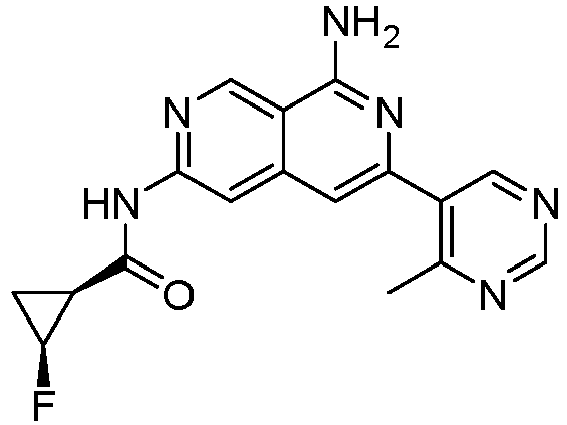
-

- To a sealed tube was added bis(pinacolato)diboron (220 mg, 0.87 mmol), 5-bromo-4-methyl-pyrimidine (100 mg, 0.58 mmol), Pd(dppf)Cl2 (42 mg, 0.06 mmol), potassium acetate (170 mg, 1.73 mmol) and 1,4-dioxane (1.5 mL). The mixture was stirred at 90°C for 2 hours. LCMS showed the reaction was finished. The reaction mixture was used in the next step directly. LCMS (ESI): [M+H]+ = 139.2.
-

- To a sealed tube was added (1S,2S)-N-(8-amino-6-chloro-2,7-naphthyridin-3-yl)-2-fluoro-cyclopropanecarboxamide (70 mg, 0.25 mmol), (4-methylpyrimidin-5-yl)boronic acid (45 mg, 0.32 mmol) (the reaction mixture), Xphos Pd G2 (20 mg, 0.02 mmol), Xphos (24 mg, 0.05 mmol), potassium acetate (73 mg, 0.75 mmol), 1,4-dioxane (1.0 mL) and water (0.20 mL). The mixture was stirred at 95°C for 2 hours. The reaction mixture was filtered and concentrated in vacuum to give a yellow residue, which was then purified by silica gel flash chromatography (dichloromethane/ methanol, 20:1 to 10:1) to give a yellow solid. The solid was purified by reverse phase flash chromatography (Biotage, 40.0 g column, sillica gel, uv 254 nm) eluting with methanol/water to give (1S,2S)-N-[8-amino-6-(4-methylpyrimidin-5-yl)-2,7-naphthyridin-3-yl]-2-fluoro-cyclopropane carboxamide (32 mg, 35% yield) as a white solid. LCMS (ESI): RT (min) = 0.973, [M+H]+ = 339.1, method = B; 1H NMR (400 MHz, CD3OD) δ 9.31 (s, 1H), 9.05 (s, 1H), 8.80 (s, 1H), 9.36 (s, 1H), 7.09 (s, 1H), 4.97-4.81 (m, 1H), 2.63 (s, 3H), 2.19-2.16 (m, 1H), 1.87-1.80 (m, 1H), 1.26-1.21 (m, 1H).
-

-
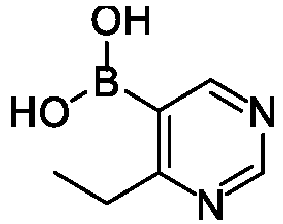
- To a sealed tube was added bis(pinacolato)diboron (203 mg, 0.80 mmol), 5-bromo-4-ethyl-pyrimidine (100 mg, 0.53 mmol), Pd(dppf)Cl2 (39 mg, 0.05 mmol), potassium acetate (157 mg, 1.6 mmol) and 1,4-dioxane (1.5 mL). The mixture was stirred at 100°C for 2 hours. LCMS showed the reaction was finished. The reaction mixture was filtered and used in the next step directly. LCMS (ESI): [M+H]+ = 153.1.
-

- To a sealed tube was added (1S,2S)-N-(8-amino-6-chloro-2,7-naphthyridin-3-yl)-2-fluoro-cyclopropanecarboxamide (60 mg, 0.21 mmol), crude (4-ethylpyrimidin-5-yl)boronic acid (49 mg, 0.32 mmol), Xphos Pd G2(17 mg, 0.02 mmol), Xphos (20 mg, 0.04 mmol), potassium acetate (63 mg, 0.64 mmol), 1,4-dioxane (1.0 mL) and water (0.20 mL). The mixture was stirred at 100°C for 4 hours. The reaction mixture was filtered and concentrated in vacuum to give a yellow residue, which was then purified by silica gel flash chromatography (dichloromethane/ methanol,20:1 to 10:1) to give a yellow solid. The yellow solid was then purified by reverse phase flash chromatography (Biotage, 40.0 g column, ODS, uv 254 nm) eluting with methanol/water (+0.5% NH4HCO3) to give (1S,2S)-N-[8-amino-6-(4-ethylpyrimidin-5-yl)-2,7-naphthyridin-3-yl]-2-fluoro-cyclopropanecarboxamide (22 mg, 27% yield) as a white solid. LCMS (ESI): RT (min) = 1.065, [M+H]+ = 353.1, method = B;1H NMR (400MHz, CD3OD) δ 9.31 (s, 1H), 9.09 (s, 1H), 8.76 (s, 1H), 8.35 (s, 1H), 7.05 (s, 1H), 4.98-4.81 (m, 1H), 2.98 (q, J = 7.6 Hz, 2H), 2.19-2.16 (m, 1H), 1.87-1.80 (m, 1H), 1.29-1.21 (m, 4H).
-
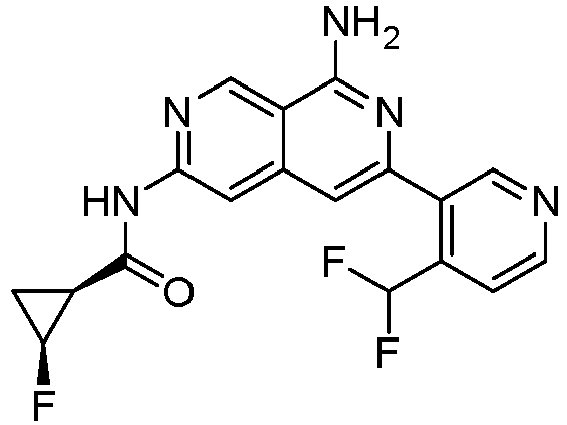
-

- To a solution of 3-bromoisonicotinaldehyde (200 mg, 1.08 mmol) in dichloromethane (10 mL) was added dropwise DAST (693 mg, 4.3 mmol) at 0°C. The mixture was stirred at 0°C for 2 hours. The reaction mixture was quenched with aqueous saturated NaHCO3 (5 mL) and extracted with dichloromethane (50 mL x 3). The organic extracts were combined, concentrated and purified by silica gel flash chromatography (petroleum ether/ethyl acetate = 10:1 to 3:1) to give 3-bromo-4-(difluoromethyl)pyridine (150 mg, 67% yield) as a colorless oil. LCMS (ESI): [M+H]+ = 208.2.
-

- To a sealed tube was added bis(pinacolato)diboron (183 mg, 0.72 mmol), 3-bromo-4-(difluoromethyl)pyridine (100 mg, 0.48 mmol), potassium acetate (141 mg, 1.44 mmol), Pd(dppf)Cl2 (35 mg, 0.05 mmol) and 1,4-dioxane (1.5 mL). The mixture was stirred at 100°C for 2 hours. The reaction mixture was filtered and the filtrate was used in the next step directly. LCMS (ESI): [M+H]+ = 174.1.
-

- To a sealed tube was added (1S,2S)-N-(8-amino-6-chloro-2,7-naphthyridin-3-yl)-2-fluoro-cyclopropanecarboxamide (50 mg, 0.18 mmol), crude [4-(difluoromethyl)-3-pyridyl]boronic acid (46 mg, 0.27 mmol), Xphos Pd G2 (14 mg, 0.02 mmol), Xphos (17 mg, 0.04 mmol), potassium acetate (52 mg, 0.53 mmol), 1,4-dioxane (1.0 mL) and water (0.20 mL). The mixture was stirred at 100°C for 4 hours. The reaction mixture was concentrated in vacuum and purified by silica gel flash chromatography (dichloromethane/methanol,20:1 to 10:1) to give a yellow solid. The yellow solid was then purified by reverse phase flash chromatography (Biotage, 40.0 g column, ODS, uv 254 nm) eluting with methanol/water (+0.5% NH4HCO3) to give (1S,2S)-N-[8-amino-6-[4-(difluoromethyl)-3-pyridyl]-2,7-naphthyridin-3-yl]-2-fluoro-cyclopropanecarboxamide (18 mg, 26% yield) as a white solid. LCMS (ESI): RT (min) = 1.142, [M+H]+ = 374.1, method = B; 1H NMR (400 MHz, CD3OD) δ 9.30 (s, 1H), 8.89 (s, 1H), 8.77 (d, J = 5.2 Hz, 1H), 8.37 (s, 1H), 7.79 (d, J = 5.2 Hz, 1H), 7.54 (t, J = 14.8 Hz, 1H), 7.15 (s, 1H), 5.00-4.79 (m, 1H), 2.19-2.14 (m, 1H), 1.88-1.78 (m, 1H), 1.28-1.21 (m, 1H).
-

- To a sealed tube was added (1S,2S)-N-(8-amino-6-chloro-1,7-naphthyridin-3-yl)-2-fluoro-cyclopropanecarboxamide (60 mg, 0.21 mmol), 3-(4,4,5,5-tetramethyl-1,3,2-dioxaborolan-2-yl)pyridine-4-carbonitrile (59 mg, 0.26 mmol), Xphos Pd G2 (17 mg, 0.02 mmol), potassium acetate (63 mg, 0.64 mmol), Xphos (20 mg, 0.04 mmol), 1,4-dioxane (3.0 mL) and water (0.50 mL). The mixture was stirred at 100°C for 2 hours. The reaction mixture was concentrated and purified by silica gel flash chromatography (dichloromethane/methanol, 20:1 to 10:1) to give (1S,2S)-N-(8-amino-6-(4-cyanopyridin-3-yl)-2,7-naphthyridin-3-yl)-2-fluorocyclopropanecarboxamide (8 mg, 10.7% yield) as a yellow solid. LCMS (ESI): RT (min) = 1.603, [M+H]+ = 349.1, method = C; 1H NMR (400 MHz, CD3OD) δ 9.32 (s, 1H), 9.18 (s, 1H), 8.80 (d, J = 5.2 Hz, 1H), 8.40 (s, 1H), 7.87 (d, J = 4.8 Hz, 1H), 7.40 (s, 1H), 5.00-4.79 (m, 1H), 2.21-2.15 (m, 1H), 1.89-1.79 (m, 1H), 1.30-1.19 (m, 1H).
-

-

- To a solution of 5-bromo-4-methyl-2-pyridinamine (2.0 g, 10.69 mmol) in dichloromethane (100 mL) was added Boc2O (2.8 g, 12.83 mmol) and DMAP (3.26 g, 26.73 mmol). The mixture was stirred at 20°C for 16 hours. The reaction mixture was concentrated in vacuum and the residue was purifed by silica gel flash chromatography (petroleum ether/ethyl acetate, 20:1 to 5:1) to give tert-butyl N-(5-bromo-4-methyl-2-pyridyl)carbamate (1.6 g, 47% yield) as a white solid. LCMS (ESI): [M+H]+ = 289.1.
-

- To a sealed tube was added tert-butyl N-(5-bromo-4-methyl-2-pyridyl)carbamate (1.0 g, 3.48 mmol), bis(pinacolato)diboron (1.06 g, 4.18 mmol), Pd(dppf)Cl2 (254 mg, 0.35 mmol), potassium acetate (682 mg, 6.97 mmol) and 1,4-dioxane (10 mL). The mixture was stirred at 100°C for 2 hours. The reaction mixture was concentrated and purified by silica gel flash chromatography (petroleum ether/ethyl acetate, 20:1 to 5:1) to give tert-butyl N-[4-methyl-5-(4,4,5,5-tetramethyl-1,3,2-dioxaborolan-2-yl)-2-pyridyl]carbamate (800 mg, 52% yield) as a white solid. LCMS (ESI): [M+H]+ = 335.2.
-

- To a sealed tube was added tert-butyl N-[4-methyl-5-(4,4,5,5-tetramethyl-1,3,2-dioxaborolan-2-yl)-2-pyridyl]carbamate (200 mg, 0.60 mmol), Pd(PPh3)4 (69 mg, 0.06 mmol), (±)-cis-N-(8-amino-6-chloro-2,7-naphthyridin-3-yl)-2-fluoro-cyclopropanecarboxamide (184 mg, 0.66 mmol), K3PO4 (117 mg, 1.2 mmol), water (0.2 mL) and 1,4-dioxane (2 mL). The mixture was stirred at 100°C for 4 hours. The reaction mixture was concentrated was and purified by silica gel flash chromatography (dichloromethane/methanol,50:1 to 10:1) to give (±)-tert-butyl N-[5-[1-amino-6-[[2-fluorocyclopropanecarbonyl] amino] -2,7-naphthyridin-3 -yl] - 4-methyl-2-pyridyl]carbamate (151 mg, 42% yield) as a yellow solid. LCMS (ESI): [M+H]+ = 453.0.
-

- To a solution of (±)-tert-butyl N-[5-[1-amino-6-[[cis-2-fluorocyclopropanecarbonyl]amino]-2,7-naphthyridin-3-yl]-4-methyl-2-pyridyl]carbamate (150 mg, 0.33 mmol) in dichloromethane (5 mL) was added TFA (2.0 mL, 0.33 mmol). The mixture was stirred at 20°C for 3 hours. The reaction mixture was concentrated in vacuum and the residue was adjusted to pH 8.0 by adding a solution of NH3 (7 M in methanol). The resultant mixture was concentrated in vacuum and the residue was purified by silica gel flash chromatography (dichloromethane/methanol,20:1 to 10: 1) to give a yellow solid, which was then purfied by reverse phase flash chromatography (Biotage, 40.0 g column, ODS, uv 254 nm) eluting with methanol/water (+0.5% NH4HCO3) to give cis-N-[8-amino-6-(6-amino-4-methyl-3-pyridyl)-2,7-naphthyridin-3-yl]-2-fluoro-cyclopropanecarboxamide (60 mg, 49% yield) as a white solid. LCMS (ESI): RT (min) = 1.408, [M+H]+ = 353.2, method = G; 1H NMR (400 MHz, DMSO-d 6) δ 10.94 (s, 1H), 9.31 (s, 1H), 8.18 (s, 1H), 8.02 (s, 1H), 7.17 (s, 2H), 6.84 (s, 1H), 6.31 (s, 1H), 5.96 (s, 2H), 5.03-4.86 (m, 1H), 2.30 (s, 3H), 2.28-2.24 (m, 1H), 1.70-1.63 (m, 1H), 1.21-1.14 (m, 1H).
-

- A mixture of (1S,2S)-N-(8-amino-6-chloro-2,7-naphthyridin-3-yl)-2-fluoro-cyclopropanecarboxamide (184 mg, 0.66 mmol), 3-fluoro-4-methyl-5-(4,4,5,5-tetramethyl-1,3,2-dioxaborolan-2-yl)pyridine (120 mg, 0.51 mmol), XPhos Pd G2 (40mg, 0.05 mmol), X-phos (48 mg, 0.1 mmol) and acetoxypotassium (149 mg, 1.52 mmol) in 1,4-dioxane (5 mL) and water (0.5 mL) was stirred at 100°C under the N2 for 8 hours. The mixture was concentrated and the residue was purified by reversed phase flash chromatography (C18 gel, 0-30% acetonitrile in water with0.1% formic acid) to give the (1S,2S)-N-[8-amino-6-(5-fluoro-4-methyl-3-pyridyl)-2,7-naphthyridin-3-yl]-2-fluoro-cyclopropanecarboxamide (42 mg, 23% yield) as a yellow solid. LCMS (ESI): RT (min) = 1.099, [M+H]+ = 356.1, method = B; 1H NMR (400 MHz, DMSO-d 6) δ 11.05 (s, 1H), 8.52 (s, 1H), 8.48 (s, 1H), 8.27 (s, 1H), 8.15 (s, 1H), 7.40 (s, 2H), 7.03 (s, 1H), 5.09-4.83 (m, 1H), 4.35 (d, J = 2.0 Hz, 3H), 2.32-2.21(m, 1H), 1.75-1.62 (m, 1H), 1.25-1.14 (m, 1H).
-

- To a mixture of (1S,2S)-N-(8-amino-6-chloro-2,7-naphthyridin-3-yl)-2-fluoro-cyclopropanecarboxamide (150 mg, 0.53 mmol), 1-methyl-1H-pyrazole-5-boronic acid pinacol ester (166 mg, 0.8 mmol), potassium acetate (157 mg, 1.6 mmol), X-phos (51 mg, 0.11 mmol) and XPhos Pd G2 (42 mg, 0.05 mmol) in 1,4-dioxane (5 mL) and water (0.5 mL) was stirred at 100°C under the N2 for 4 hours. The mixture was concentrated and the residue was purified by reverse phase preparative HPLC (C-18), eluting with 0-33% acetonitrile in water (with 0.1% formic acid) to give the desired product (1S,2S)-N-[8-amino-6-(2-methylpyrazol-3-yl)-2,7-naphthyridin-3-yl]-2-fluoro-cyclopropanecarboxamide (27 mg, 15% yield) as a yellow solid. LCMS (ESI): RT (min) = 1.055, [M+H]+ = 327.1, method = B; 1H NMR (400 MHz, DMSO-d 6) δ 11.02 (s, 1H), 8.24 (s, 1H), 8.15 (s, 1H), 7.45 (d, J = 2.0 Hz, 1H), 7.40 (s, 2H), 7.21 (s, 1H), 6.73 (d, J = 2.0 Hz, 1H), 5.07-4.84 (m, 1H), 4.19 (s, 3H), 2.32-2.21(m, 1H), 1.75-1.62 (m, 1H), 1.25-1.14 (m, 1H).
-

- A mixture of cis-N-(8-amino-6-chloro-2,7-naphthyridin-3-yl)-2-fluoro-cyclopropanecarboxamide (50 mg, 0.18 mmol), tert-butyl 6-methyl-5-(4,4,5,5-tetramethyl-1,3,2-dioxaborolan-2-yl)benzimidazole-1-carboxylate (70 mg, 0.20 mmol), Pd(dppf)Cl2 (13 mg, 0.02 mmol) and K2CO3 (73 mg, 0.53 mmol) in 1,4-dioxane (6 mL) and water (1 mL) was heated to 110°C for 16 hours. The reaction mixture was concentrated. The residue was purified by prep-TLC (normal phase silica gel, dichloromethane/methanol, 10/1) to afford a yellow oil, which was further purified by prep-HPLC (Column Xbridge 21.2*250mm c18, 10 µm Mobile Phase A:water(10mmol/L NH4HCO3) B:acetonitrile) to give (±)--N-[8-amino-6-(6-methyl-1H-benzimidazol-5-yl)-2,7-naphthyridin-3-yl]-2-fluoro-cyclopropanecarboxamide (17 mg, 25% yield) as a white solid. LCMS (ESI): RT (min) = 1.269, [M+H]+ = 377.1, method = A; 1H NMR (400 MHz, CD3OD) δ 9.29 (s, 1H), 8.32 (s, 1H), 8.18 (s, 1H), 7.66 (s, 1H), 7.53 (s, 1H), 6.95 (s, 1H), 4.95-4.84 (m, 1H), 2.45 (s, 3H), 2.22-2.14 (m, 1H), 1.88-1.78 (m, 1H), 1.26-1.18 (m, 1H).
-

-
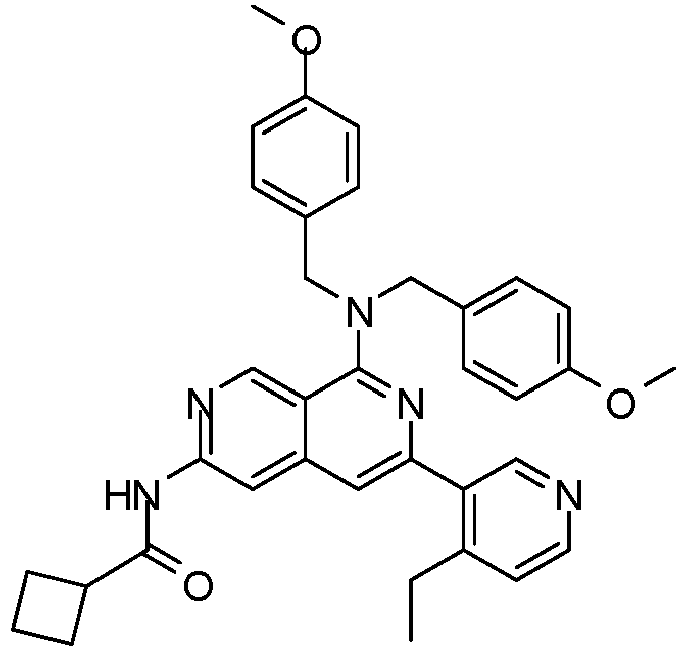
- A solution of cyclobutanecarbonyl chloride (60 mg, 0.51 mmol) in dichloromethane (0.3 mL) was added dropwise to a solution of 3-(4-ethyl-3-pyridyl)-N1,N1-bis[(4-methoxyphenyl) methyl]-2,7-naphthyridine-1,6-diamine (300 mg, 0.59 mmol), triethylamine (200.0mg, 1.98mmol) in dichloromethane (5mL) at 0°C and stirred at 0°C for 1hour. The reaction mixture was evaporated to give a residue that was purified with silica gel chromatography (petroleum ether/ethyl acetate = 1:1 to 1:2) to afford N-[8-[bis[(4-methoxyphenyl)methyl] amino] -6-(4-ethyl-3 -pyridyl)-2,7-naphthyridin-3 - yl]cyclobutanecarboxamide (90 mg, 25% yield) as a brown solid. LCMS (ESI) [M+H]+ = 588.3.
-

- A mixture of N-[8-[bis[(4-methoxyphenyl)methyl]amino]-6-(4-ethyl-3-pyridyl)-2,7-naphthyridin-3-yl]cyclobutanecarboxamide (90 mg, 0.15 mmol) in TFA (3 mL) was stirred at 25°C for 1 hour and stirred at 80°C for an additional 2 hours. The reaction mixture was evaporated. The residue was suspended in methanol (1 mL) and 7N NH3-methanol was added until pH=10-11 (brown suspension). The solid was collected by filtration and the crude product purified by reverse phase flash chromatography (C18, methanol/water to formic acid/methanol/water) to givethe formic acid salt of N-[8-amino-6-(4-ethyl-3-pyridyl)-2,7-naphthyridin-3-yl]cyclobutanecarboxamide (21 mg, 35% yield) as a brown solid. LCMS (ESI): RT (min) = 1.752, [M+H]+ = 348.2, method = C; 1H NMR (400 MHz, CD3OD) δ 9.30 (s, 1H), 8.51 - 8.49 (m, 2H), 8.37 (s, 1H), 8.30 (brs, 1H), 7.46 (d, J = 5.2 Hz, 1H), 7.00 (s, 1H), 3.45 - 3.41 (m, 1H), 2.85 (q, J = 7.6 Hz, 2H), 2.43 - 2.36 (m, 2H), 2.31 - 2.23 (m, 2H), 2.12 - 2.05 (m, 1H), 1.98 - 1.93 (m, 1H), 1.20 (t, J = 7.6 Hz, 3H).
-

-

- A mixture of 4-bromo-1h-pyrrolo[2,3-c]pyridine (500 mg, 2.54 mmol), bis(pinacolato)diboron (6.4 g, 25.2 mmol), PdCl2dppf (371 mg, 0.51mmol), and potassium acetate (746 mg, 7.61 mmol) in 1,4-dioxane (20 mL) was heated at 120°C for 16 hours under Ar. The reaction was filtered and concentrated to dryness. The residue was taken up in ethyl acetate (10 mL) and adjusted to pH 7-8 with NaOH. The water layer was adjusted pH to 3-4 with conc. HCl and ethyl acetate (20mL) added. The water layer were then separated and concentrated to dryness. The residue was taken up in ethyl acetate:ethanol (1:1) and filtered. The resulting liquid was concentrated to dryness. This provided the title compound as a brown solid (350 mg, 85% yield). LCMS (ESI) [M+H]+ = 163.1.
-

- A mixture of 1H-pyrrolo[2,3-c]pyridin-4-ylboronic acid (200 mg, 1.23 mmol), cis-N-(8-amino-6-chloro-2,7-naphthyridin-3-yl)-2-cyano-cyclopropanecarboxamide (100 mg, 0.35 mmol), Pd(PPh3)4 (40 mg, 0.03 mmol), K2CO3 (144 mg, 1.04 mmol) in 1,4-dioxane (4 mL) and water (1 mL) was heated at 100°C for 3 hours under Ar. The reaction was concentrated to dryness. The residue was purified with silica chromatography (ethyl acetate to ethyl acetate/methanol=10:1) to give the title compound as a yellow solid (14.7 mg, 11.4% yield). LCMS (ESI): RT(min) = 1.035, [M+H]+ = 370.1, method = B. 1H NMR (400 MHz, CD3OD) δ 9.30 (s, 1H), 8.91 (s, 1H), 8.67 (s, 1H), 8.03 (s, 1H), 7.47 (s, 1H), 7.32 (s, 1H), 7.31 (s, 1H), 2.56-2.54 (m, 1H), 2.19-2.17 (m, 1H), 1.72-1.70 (m, 1H), 1.55-1.53 (m, 1H).
-

-

- A mixture of 4-bromo-3-methyl-pyridine (5.0 g, 29.07 mmol), bis(pinacolato)diboron (7.38 g, 29.06 mmol), PdCl2dppf (2.12 g, 2.9 mmol) and potassium acetate (8.54 g, 87.14 mmol) in 1,4-dioxane (100 mL) was heated at 110°C for 3 hours under Ar. The reaction mixture was filtered and concentrated to dryness. The residue was taken up in water (40 mL) and adjusted pH to 11-12 with aqueous NaOH. The liquid was washed with ethyl acetate (100 ml). The aqueous layer was adjusted pH to 5-6 with HCl. The organics were then separated and dried (NaSO4) before concentration to dryness. The product is brown solid (4 g, 60% yield) in the end. LCMS (ESI) [M+H]+ = 220.2.
-

- A mixture of 3-methyl-4-(4,4,5,5-tetramethyl-1,3,2-dioxaborolan-2-yl)pyridine (100 mg, 0.46 mmol), (±)-cis- N-(8-amino-6-chloro-2,7-naphthyridin-3-yl)-2-fluoro-cyclopropanecarboxamide (128 mg, 0.46 mmol), XPhos Pd G2 (36 mg, 0.05 mmol), XPhos (22 mg, 0.05 mmol), and potassium acetate (134 mg, 1.37 mmol) in 1,4-dioxane (8 mL) and water (2 mL) was heated at 110°C for 3 hours under Ar. The reaction was concentrated to dryness and the resulting residue was purified by silica gel chromatography (petroleum ether/ethyl acetate=1:1). This provided the title compound as a white solid (25.1 mg, 16% yield). LCMS (ESI): RT(min) = 1.059, [M+H]+ = 338.1, method = B. 1H NMR (400 MHz, CD3OD) δ 8.51 (s, 1H), 8.47 (s, 1H), 8.35 (s, 1H), 8.21 (s, 1H), 7.51 (d, J = 4.8 Hz, 1H), 7.03 (s, 1H), 2.43 (s, 3H), 4.99-4.97 (m, 0.5 H), 4.83-4.80 (m, 0.5H), 2.19-2.16 (m, 1H), 1.87-1.80 (m, 1H), 1.28-1.21 (m, 1H).
-

- A mixture of N-(6-chloro-8-(diphenylmethyleneamino)-2,7-naphthyridin-3-yl)cyclopropanecarboxamide (45 mg, 0.11 mmol), 4-methyl-3-(4,4,5,5-tetramethyl-1,3,2-dioxaborolan-2-yl)pyridine (34 mg, 0.16 mmol), Pd(PPh3)4 (12 mg, 0.01 mmol) and Cs2CO3 (68 mg, 0.21 mmol) in 1,4-dioxane (10 mL) was heated to 100°C for 18 hours in a glovebox. The reaction mixture was cooled to room temperature and filtered through celite. The filtrate was then concentrated and the resulting residue was dissolved in THF (5 mL). A HCl in dioxane solution (4 mL, 4 M, 16 mmol) was added and the reaction mixture was stirred at 25°C for 2 hours. The reaction mixture was concentrated. The residue was diluted with ethyl acetate, adjusted pH to >7 with a 7N NH3 inmethanol solution and concentrated. The residue was extracted with dichloromethane/methanol (25/1) to give the crude product. The crude product was purified by prep-HPLC to give the product N-(8-amino-6-(4-methylpyridin-3-yl)-2,7-naphthyridin-3-yl)cyclopropanecarboxamide (12 mg, 30% yield) as a white solid. LCMS (ESI): RT (min) = 1.580, [M+H]+ = 320.1, method = F; 1H NMR (400 MHz, CD3OD) δ 9.29 (s, 1H), 8.56 (s, 1H), 8.43 (d, 1H, J = 5.2Hz), 8.31 (s, 1H), 7.39 (d, 1H, J = 5.2 Hz), 6.98 (s, 1H), 2.46 (s, 3H), 1.92-2.00 (m, 1H), 1.01-1.06 (m, 2H), 0.92-0.97 (m, 2H).
-

-

- A mixture of N-[8-(benzhydrylideneamino)-6-chloro-2,7-naphthyridin-3-yl]cyclopropanecarboxamide (78 mg, 0.18 mmol), [4-methyl-5-(4,4,5,5-tetramethyl-1,3,2-dioxaborolan-2-yl)-2-pyridyl]methanol (200 mg, 0.80 mmol), X-phos (8.7 mg, 0.02 mmol), Xphos Pd G2 (14 mg, 0.02 mmol) and potassium acetate (53 mg, 0.55 mmol) in 1,4-dioxane (10 mL) and water (1 mL) was heated to 100°C under N2 for 16 hours. The reaction mixture was then concentrated. The residue was purified by prep-TLC (normal phase silica gel, dichloromethane/methanol=25/1) to give the product N-[8-(benzhydrylideneamino)-6-[6-(hydroxymethyl)-4-methyl-3-pyridyl]-2,7-naphthyridm-3yl]cyclopropanecarboxamide (30 mg, 23.3% yield) as a yellow solid. LCMS (ESI) [M+H]+ = 514.2.
-

- A solution of N-[8-(benzhydrylideneamino)-6-[6-(hydroxymethyl)-4-methyl-3-pyridyl]-2,7-naphthyridin-3-yl]cyclopropanecarboxamide (30 mg, 0.06 mmol) in HCl/dioxane (4 mL, 4 M, 16 mmol) was stirred at room temperature for 2 h. The reaction mixture was concentrated. The pH of the residue was adjusted to >7 by adding 7N NH3 in methanol, then concentrated. The residue was purified by reverse phase prep-HPLC to give the product N-[8-amino-6-[6-(hydroxymethyl)-4-methyl-3-pyridyl]-2,7-naphthyridin-3-yl]cyclopropanecarboxamide (6 mg, 27.6% yield) as a white solid. LCMS (ESI): RT (min) = 1.627, [M+H]+ = 350.1, method = G; 1H NMR (400 MHz, CD3OD) δ 9.30 (s, 1H), 8.49 (s, 1H), 8.30 (s, 1H), 7.52 (s, 1H), 6.99 (s, 1H), 4.74 (s, 2H), 2.48 (s, 3H), 1.92-2.03 (m, 1H), 1.01-1.04 (m, 2H), 0.88-0.90 (m, 2H).
-

-
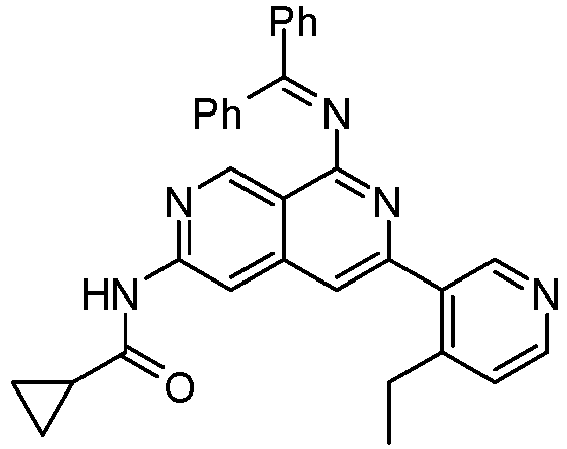
- A mixture of N-[8-(benzhydrylideneamino)-6-chloro-2,7-naphthyridin-3-yl]cyclopropanecarboxamide (200 mg, 0.47 mmol), 4-ethyl-3-(4,4,5,5-tetramethyl-1,3,2-dioxaborolan-2-yl)pyridine (655 mg, 2.81 mmol), Pd(PPh3)4 (54 mg, 0.05 mmol) and Cs2CO3 (305 mg, 0.94 mmol) in 1,4-dioxane (1 mL) was heated at 100°C in a glovebox for 18 hours. The reaction mixture was diluted with ethyl acetate, washed with water, dried over Na2SO4, filtered and concentrated to give the crude product, which was used in the next step without purification. LCMS (ESI) [M+H]+ = 498.3.
-

- A solution of N-[8-(benzhydrylideneamino)-6-(4-ethyl-3-pyridyl)-2,7-naphthyridin-3-yl]cyclopropanecarboxamide (150 mg, 0.17 mmol) in HCl/dioxane (3.3 mL, 4 M, 13.2 mmol) was stirred at 25°C for 2 hours, then concentrated. The pH of the residue was adjusted to >7 with 7 N NH3 in methanol, then concentrated. The residue was purified by reverse phase prep-HPLC to give N-[8-amino-6-(4-ethyl-3-pyridyl)-2,7-naphthyridin-3-yl]cyclopropanecarboxamide (10 mg, 18.1% yield) as a white solid. LCMS (ESI): RT (min) = 1.623, [M+H]+ = 334.2, method = G; 1H NMR (400 MHz, CD3OD) δ 9.18 (s, 1H), 8.39 (s, 1H), 8.37 (d, 1H, J = 5.6 Hz), 8.17 (s, 1H), 7.33 (d, 1H, J = 5.6 Hz), 6.81 (s, 1H), 2.72 (q, 2 H, J = 7.6 Hz), 1.78-1.88 (m, 1H), 1.07 (t, 3H, J = 7.6 Hz), 0.87-0.95 (m, 2H), 0.74-0.82 (m, 2H).
-

-

- A mixture of N-[8-(benzhydrylideneamino)-6-chloro-2,7-naphthyridin-3-yl]cyclopropanecarboxamide (50 mg, 0.12 mmol), 1-methyl-4-(4,4,5,5-tetramethyl-1,3,2-dioxaborolan-2-yl)-1H-pyrazole (36 mg, 0.18 mmol), Pd(PPh3)4 (14 mg, 0.01 mmol) and Cs2CO3 (76 mg, 0.23 mmol) in 1,4-dioxane (5 mL) was heated to 100°C for 4 hours in a glovebox. Ethyl acetate (50 mL) was added, the mixture was filtered and concentrated to give N-(8-(diphenylmethyleneamino)-6-(1-methyl-1H-pyrazol-4-yl)-2,7-naphthyridin-3-yl)cyclopropanecarboxamide (68 mg, 59% yield) as yellow oil, which was used in the next step without further purification. LCMS (ESI) [M+H]+ = 473.2.
-
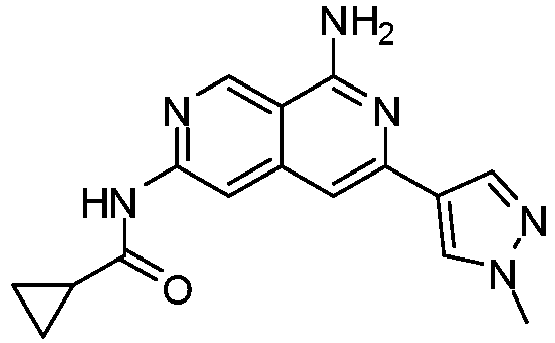
- To a solution of N-[8-(benzhydrylideneamino)-6-(1-methylpyrazol-4-yl)-2,7-naphthyridin-3-yl]cyclopropanecarboxamide (68 mg, 0.10 mmol) in THF (5 mL) was added HCl in 1,4-dioxane (1 mL, 4 M, 4 mmol). The mixture was stirred for 1 hour. The reaction mixture was concentrated and purified by reverse phase prep-HPLC to afford N-[8-amino-6-(1-methylpyrazol-4-yl)-2,7-naphthyridin-3-yl]cyclopropanecarboxamide (18 mg, 59% yield) as white solid. LCMS (ESI): RT (min) = 1.646, [M+H]+ = 309.1, method = G; 1H NMR (400 MHz, CD3OD-d4) δ 9.15(s, 1H), 8.19(s, 1H), 8.14(s, 1H), 8.02(s, 1H), 7.11(s, 1H), 3.96 (s, 3H), 1.98-1.92(m, 1H), 1.05-1.02(m, 2H), 0.96-0.91(m, 2H).
-

-

- To a solution of 3-cyanopropanoic acid (64 mg, 0.64 mmol) and DMF (1 drop) in dichloromethane (6 mL) was added oxalyl chloride (125 mg, 0.98 mmol) at 0°C and then stirred at room temperature for 1 hours. The mixture was concentrated and dissolved in dichloromethane (3 mL). The mixture was then added to a solution of 3-(4-ethyl-3-pyridyl)-N1,N1-bis[(4-methoxyphenyl)methyl]-2,7-naphthyridine-1,6-diamine (216 mg, 0.43 mmol) and Et3N (216 mg, 2.14 mmol) in dichloromethane (5 mL) at 0°C, and stirred at room temperature for 1 hour. The mixture was concentrated and purified by column chromatography eluting with ethyl acetate/hexane (1:1) to afford N-[8-[bis[(4-methoxyphenyl)methyl]amino]-6-(4-ethyl-3-pyridyl)-2,7-naphthyridin-3-yl]-3-cyano-propanamide (160 mg, 29% yield) as a yellow solid. LCMS (ESI) [M+H]+ = 587.3.
-

- A mixture of N-[8-[bis[(4-methoxyphenyl)methyl]amino]-6-(4-ethyl-3-pyridyl)-2,7-naphthyridin-3-yl]-3-cyano-propanamide (160 mg, 0.13 mmol) in TFA (10 mL) was stirred at 80°C for 1 hour. The reaction mixture was concentrated and neutralized with NH4OH (37% yield) to pH = 7-8. The mixture was concentrated and purified by preparative reverse phase HPLC (C-18), eluting with acetonitrile/water + 0.05% NH4HCO3, to give N-[8-amino-6-(4-ethyl-3-pyridyl)-2,7-naphthyridin-3-yl]-3-cyano-propanamide (24 mg, 55% yield). LCMS (ESI) RT (min) = 1.57, [M+H]+ = 347.2, method = F. 1H NMR (400 MHz, DMSO-d 6) δ 10.85 (s, 1H), 9.39 (s, 1H), 8.51 (s, 1H), 8.49 (d, J = 5.2 Hz, 1H), 8.26 (s, 1H), 7.36 (s, 1H), 7.34 (s, 2H), 6.98 (s, 1H), 2.86-2.74 (m, 6H), 1.10 (t, J = 7.6 Hz, 3H).
-

- A mixture of N-[8-[bis[(4-methoxyphenyl)methyl]amino]-6-(4-ethyl-3-pyridyl)-2,7-naphthyridin-3-yl]-3-cyano-propanamide (160 mg, 0.13 mmol) in TFA (10 mL) was stirred at 80°C for 1 hour. The reaction mixture was concentrated and neutralized with NH4OH (37% yield) to pH 7-8. The mixture was concentrated and purified by preparative reverse phase HPLC (C-18), eluting with acetonitrile/water + 0.05% NH4HCO3, to afford N'-[8-amino-6-(4-ethyl-3-pyridyl)-2,7-naphthyridin-3-yl]butanediamide (11 mg, 22% yield) as a white solid. LCMS (ESI) RT (min) = 1.372, [M+H]+ = 365.2, method = G. 1H NMR (400 MHz, DMSO-d 6) δ 10.65 (s, 1H), 9.36 (s, 1H), 8.50 (s, 1H), 8.48 (d, J = 4.8 Hz, 1H), 8.23 (s, 1H), 7.35 (s, 1H), 7.34 (d, J = 5.2 Hz, 1H), 7.31 (s, 2H), 6.93 (s, 1H), 6.79 (s, 1H), 2.78 (q, J = 7.6 Hz, 2H), 2.65 (t, J = 7.0 Hz, 2H), 2.41 (t, J = 7.0 Hz, 2H), 1.10 (t, J = 7.6 Hz, 3H).
-

-

- To a solution of triphosgene (183 mg, 0.62 mmol) in THF (8 mL) was added 3-(4-ethyl-3-pyridyl)-N1,N1-bis[(4-methoxyphenyl)methyl]-2,7-naphthyridine-1,6-diamine (260 mg, 0.31 mmol) and Et3N (1.24 g, 12.34 mmol) in THF (3 ml). The mixture was stirred at 0°C for 1 hour. Thiazol-5-ylmethanamine hydrochloride (930 mg, 6.17 mmol) was added and warmed to room temperature overnight. The mixture was concentrated and purified by silica gel chromatography eluting with dichloromethane/methanol (20:1) to afford 1-[8-[bis[(4-methoxyphenyl)methyl]amino]-6-(4-ethyl-3-pyridyl)-2,7-naphthyridin-3-yl]-3-(thiazol-5-ylmethyl)urea (35 mg, 15% yield) as a yellow solid. LCMS (ESI) [M+H]+ = 646.3.
-

- A mixture of 1-[8-[bis[(4-methoxyphenyl)methyl]amino]-6-(4-ethyl-3-pyridyl)-2,7-naphthyridin-3-yl]-3-(thiazol-5-ylmethyl)urea (35 mg, 0.05 mmol) in TFA (5mL) was stirred at 80°C for 3 hours. The mixture was concentrated and neutralized with NH4OH (purity: 37% yield) to pH 7-8. The mixture was purified by preparative reverse phase HPLC (C-18), eluting with acetonitrile/water + 0.05% NH4HCO3, to give 1-[8-amino-6-(4-ethyl-3-pyridyl)-2,7-naphthyridin-3-yl]-3-(thiazol-5-ylmethyl)urea (13 mg, 59% yield) as a yellow solid. LCMS (ESI) RT (min) = 1.56, [M+H]+ = 406.1, method = C. 1H NMR (400 MHz, DMSO-d 6) δ 9.41 (s, 1H), 9.28 (s, 1H), 8.99 (d, J = 0.8 Hz, 1H), 8.49 (s, 1H), 8.48 (d, J = 5.2 Hz, 1H), 7.83 (s, 1H), 7.82 (s, 1H), 7.80 (s, 1H), 7.34 (d, J = 5.2 Hz, 1H), 7.27 (s, 2H), 6.87 (s, 1H), 4.61 (d, J = 6.0 Hz, 2H), 2.79 (q, J = 7.6 Hz, 2H), 2.65 (t, J = 7.6 Hz, 3H).
-

-

- A mixture of 3-(4-ethyl-3-pyridyl)-N1,N1-bis[(4-methoxyphenyl)methyl]-2,7-naphthyridine-1,6-diamine (150 mg, 0.15 mmol), isopropyl isocyanate (114 mg, 1.34 mmol) and DBU (113 mg, 0.74 mmol) in 1,4-dioxane (8 mL) was stirred at 110°C for 16 hours. The mixture was concentrated and purified by reverse phase preparative HPLC (C-18), eluting with acetonitrile/water + 0.05% NH4HCO3, to give 1-[8-[bis[(4-methoxyphenyl)methyl] amino]-6-(4-ethyl-3-pyridyl)-2,7-naphthyridin-3-yl]-3-isopropyl-urea (50 mg, 43% yield) as a yellow solid. LCMS (ESI) [M+H]+ = 591.3.
-

- A mixture of 1-[8-[bis[(4-methoxyphenyl)methyl]amino]-6-(4-ethyl-3-pyridyl)-2,7-naphthyridin-3-yl]-3-isopropyl-urea (50 mg, 0.08 mmol) in TFA (8 mL) was stirred at 80°C for 3 hours. The reaction mixture was concentrated and neutralized with NH4OH (37% yield) to pH 7-8. The mixture was concentrated and purified by preparative reverse phase HPLC (C-18), eluting with acetonitrile/water + 0.05% NH4HCO3, to give 1-[8-amino-6-(4-ethyl-3-pyridyl)-2,7-naphthyridin-3-yl]-3-isopropyl-urea (17 mg, 57% yield) as a yellow solid. LCMS (ESI) RT (min) = 1.581, [M+H]+ = 351.2, method = G. 1H NMR (400 MHz, DMSO-d 6) δ 9.33 (s, 1H), 9.11 (s, 1H), 8.55 (s, 1H), 8.54 (d, J = 5.2 Hz, 1H), 7.86 (s, 1H), 8.39 (d, J = 5.2 Hz, 1H), 7.30 (s, 2H), 7.16 (d, J = 6.8 Hz, 1H), 6.89 (s, 1H), 3.91-3.83 (m, 1H), 2.84 (q, J = 7.6 Hz, 2H), 1.20 (d, J = 6.4 Hz, 6H), 1.15 (t, J = 7.6 Hz, 3H).
-

-

- To a solution of cyanoacetic acid (340 mg, 3.99 mmol) and DMF (1 drop) in dichloromethane (20 mL) at 0 °C was added oxalyl chloride (0.34 mL, 3.99 mmol) and stirred at room temperature for 2 h. The mixture was added to a solution of 6,8-dichloro-2,7-naphthyridin-3-amine hydrochloride (500 mg, 2 mmol) in pyridine (10 mL) and dichloromethane (20 mL) at 0°C. The reaction mixture was stirred at 0°C for 1 hour. The mixture was concentrated and purified by silica gel chromatography, eluting with THF to afford 2-cyano-N-(6,8-dichloro-2,7-naphthyridin-3-yl)acetamide (600 mg, 60% yield) as a yellow solid. LCMS (ESI) [M+H]+ = 281.0.
-

- A mixture of 2-cyano-N-(6,8-dichloro-2,7-naphthyridin-3-yl)acetamide (600 mg, 1.19 mmol) in 0.5 M NH3 in dioxane (40 mL, 20 mmol) was stirred at 110°C for 24 hours. The mixture was concentrated and purified by preparative reverse phase HPLC (C18), eluting with acetonitrile/water + 0.05% NH4HCO3, to give N-(8-amino-6-chloro-2,7-naphthyridin-3-yl)-2-cyano-acetamide (130 mg, 32% yield) as a yellow solid. LCMS (ESI) [M+H]+ = 262.3.
-

- A mixture of N-(8-amino-6-chloro-2,7-naphthyridin-3-yl)-2-cyano-acetamide (100 mg, 0.38 mmol), 4-ethyl-3-(4,4,5,5-tetramethyl-1,3,2-dioxaborolan-2-yl)pyridine (216 mg, 0.76 mmol), XPhos Pd G2 (45 mg, 0.06 mmol), potassium acetate (75 mg, 0.76 mmol) and XPhos (55 mg, 0.11 mmol) in 1,4-dioxane (10 mL) and water (0.4 mL) under Ar was stirred at 100°C for 8 hours. The mixture was concentrated and purified by preparative reverse phase HPLC (C-18), eluting with acetonitrile/water + 0.05% NH4HCO3, to give N-[8-amino-6-(4-ethyl-3-pyridyl)-2,7-naphthyridin-3-yl]-2-cyano-acetamide (5 mg, 4% yield) as a yellow solid. LCMS (ESI) RT (min) = 1.568, [M+H]+ = 333.1, method = C. 1H NMR (400 MHz, DMSO-d 6) δ 11.02 (s, 1H), 9.39 (s, 1H), 8.51 (s, 1H), 8.49 (d, J = 5.2 Hz, 1H), 8.19 (s, 1H), 7.36 (s, 2H), 7.35 (s, 1H), 7.01 (s, 1H), 4.04 (s, 2H), 2.79 (q, J = 7.6 Hz, 2H), 1.10 (t, J= 7.6 Hz, 3H).
-

-

- To a solution of triphosgene (293 mg, 0.99 mmol) in THF (6 mL) was added 3-(4-ethyl-3-pyridyl)-N1,N1-bis[(4-methoxyphenyl)methyl]-2,7-naphthyridine-1,6-diamine (500 mg, 0.49 mmol) and Et3N (10.0 g, 9.89 mmol) in THF (10 ml). The mixture was stirred at 0°C for 1 hour. N,N-dimethylamine (446 mg, 9.89 mmol) was added. The reaction was then stirred atroom temperature for 2 hours. The mixture was concentrated and purified by silica gel chromatography (ethyl acetate/hexane,9: 1) to afford 3-[8-[bis[(4-methoxyphenyl)methyl]amino]-6-(4-ethyl-3-pyridyl)-2,7-naphthyridin-3-yl]-1,1-dimethyl-urea (42 mg, 13% yield) as a yellow solid. LCMS (ESI) [M+H]+ = 577.3.
-

- A mixture of 3-[8-[bis[(4-methoxyphenyl)methyl]amino]-6-(4-ethyl-3-pyridyl)-2,7-naphthyridin-3-yl]-1,1-dimethyl-urea (42 mg, 0.07 mmol) in TFA (8 mL) was stirred at 80°C for 3 hours. The mixture was concentrated and neutralized with NH4OH (37% yield) to pH 7-8. The mixture was concentrated and purified by preparative reverse phase HPLC (C-18), eluting with acetonitrile/water + 0.05% NH4HCO3, to give 3-[8-amino-6-(4-ethyl-3-pyridyl)-2,7-naphthyridin-3-yl]-1,1-dimethyl-urea (15 mg, 57% yield) as a yellow solid. LCMS (ESI) RT (min) = 1.567, [M+H]+ = 337.1, method = C. 1H NMR (400 MHz, DMSO-d 6) δ 9.33 (s, 1H), 8.98 (s, 1H), 8.49 (s, 1H), 8.48 (d, J = 4.8 Hz, 1H), 7.96 (s, 1H), 7.34 (d, J = 4.8 Hz, 1H), 7.25 (s, 2H), 6.87 (s, 1H), 2.98 (s, 6H), 2.78 (q, J = 7.6 Hz, 2H), 1.10 (t, J = 7.6 Hz, 3H).
-

-

- To a solution of triphosgene (210 mg, 0.71 mmol) in THF (6 mL) was added N1,N1-bis[(2,4-dimethoxyphenyl)methyl]-3-(4-ethyl-3-pyridyl)-2,7-naphthyridine-1,6-diamine (200 mg, 0.35 mmol) and Et3N (714 mg, 7.07 mmol) in THF (10 ml). The mixture was stirred at 0°C for 1 hour. 2-aminopropanamide hydrochloride (881 mg, 7.07 mmol) was added and stirred at room temperature for 2 hours. The mixture was concentrated and purified bysilica gel chromatography eluting with ethyl acetate to afford 2-[[8-[bis[(2,4-dimethoxyphenyl)methyl]amino]-6-(4-ethyl-3-pyridyl)-2,7-naphthyridin-3-yl]carbamoylamino]propanamide (57 mg, 18% yield) as a yellow solid. LCMS (ESI) [M+H]+ = 680.3.
-

- A mixture of 2-[[8-[bis[(2,4-dimethoxyphenyl)methyl]amino]-6-(4-ethyl-3-pyridyl)-2,7-naphthyridin-3-yl]carbamoylamino]propanamide (57 mg, 0.06 mmol) in TFA (5 mL) was stirred at 26°C for 6 hours. The reaction mixture was concentrated and neutralized with NH4OH (37% yield) to pH 7-8. The mixture was concentrated and purified by preparative reverse phase HPLC (C-18), eluting with acetonitrile/water + 0.05% NH4HCO3, to give 2-[[8-amino-6-(4-ethyl-3-pyridyl)-2,7-naphthyridin-3-yl]carbamoylamino]propanamide (10 mg, 46% yield) as a yellow solid. LCMS (ESI) RT (min) = 1.378, [M+H]+ = 380.2, method = G. 1H NMR (400 MHz, DMSO-d 6) δ 9.33 (s, 1H), 9.28 (s, 1H), 8.49 (s, 1H), 8.48 (d, J = 5.2 Hz, 1H), 7.78 (s, 1H), 7.58 (s, 1H), 7.53 (s, 1H), 7.30 (d, J = 1.2 Hz, 1H), 7.25 (s, 2H), 7.06 (s, 1H), 6.84 (s, 1H), 4.29-4.22 (m, 1H), 2.78 (q, J = 7.6 Hz, 2H), 1.28 (d, J = 6.8 Hz, 3H), 1.10 (t, J= 7.6 Hz, 3H).
-

-

- To a vial was added ethyl 2-cyano-2-methylpropanoate (1.0 g, 7.08 mmol), water (5 mL) and KOH (795 mg, 14.1 mmol). The mixture was stirred at 40°C for 2 hours. The reaction mixture was concentrated to remove methanol, acidified to pH 5 with 1 N HCl and extracted with ethyl acetate (50 ml x 2). The combined organic layers were washed with brine (10 mL), dried over Na2SO4, filtered and concentrated in vacuo to give 2-cyano-2-methyl-propanoic acid (600 mg, 73% yield) as a pale-yellow solid. 1H NMR (400 MHz, DMSO-d 6) δ 13.59 (br, 1H), 1.52 (s, 6H).
-

- To a vial was added 2-cyano-2-methyl-propanoic acid (600 mg, 5.3 mmol) and dichloromethane (20 mL). Oxalyl chloride (1 mL, 11.72 mmol) was added drop-wise at 0°C. DMF (0.01mL) was then added. The mixture was stirred at room temperature for 3 hours. The reaction mixture was concentrated in vacuo to get crude product and used for the next step directly.
-

- To a vial was added 6,8-dichloro-2,7-naphthyridin-3-amine hydrochloride (200 mg, 0.80 mmol), 2-cyano-2-methyl-propanoyl chloride (720 mg, 4.38 mmol) and pyridine (5 mL). The mixture was stirred at 20°C for 2 hours. The mixture was poured into water (10 mL) and adjusted to pH=6 with 1N HCl, extracted with ethyl acetate (80 mL x 2), dried over Na2SO4, filtered and concentrated. The residue was purified by silica gel chromatography (petroleum ether/ethyl acetate, 10:1 to 3:1) to give 2-cyano-N-(6,8-dichloro-2,7-naphthyridin-3-yl)-2-methyl-propanamide (230 mg, 93% yield) as a pale-yellow solid. LCMS (ESI) [M+H]+ = 309.1.
-
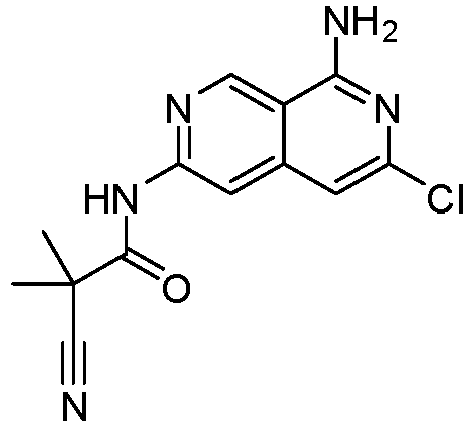
- To a microwave tube was added 2-cyano-N-(6,8-dichloro-2,7-naphthyridin-3-yl)-2-methyl-propanamide (130 mg, 0.42 mmol) and NH3 (0.5 N in dioxane, 15 mL, 7.5 mmol). The mixture was stirred at 80°C for 40 hours. The mixture was then concentrated in vacuo and purified by silica gel chromatography (petroleum ether/ethyl acetate, 1:1 to 0:100) to give N-(8-amino-6-chloro-2,7-naphthyridin-3-yl)-2-cyano-2-methyl-propanamide (86 mg, 70 % yield) as a pale-yellow solid. LCMS (ESI) [M+H]+ = 290.1.
-

- To a vial was added N-(8-amino-6-chloro-2,7-naphthyridin-3-yl)-2-cyano-2-methyl-propanamide (86 mg, 0.3 mmol), 4-methyl-3-(4,4,5,5-tetramethyl-1,3,2-dioxaborolan-2-yl)pyridine (84 mg, 0.39 mmol), XPhos Pd G2 (35 mg, 0.04 mmol), X-phos (28 mg, 0.06 mmol), potassium acetate (87 mg, 0.89 mmol), water (0.5 mL) and 1,4-dioxane (20 mL). The reaction mixture was degassed by bubbling with nitrogen and then stirred at 100°C for 6 hours. The reaction mixture was concentrated and purified by silica gel chromatography (dichloromethane/methanol, 20:1 to 10:1) to give N-[8-amino-6-(4-methyl-3-pyridyl)-2,7-naphthyridin-3-yl]-2-cyano-2-methyl-propanamide (73 mg, 71% yield) as a yellow solid. LCMS (ESI): RT (min) = 1.041, [M+H]+ = 347.1, method = B; 1H NMR (400 MHz, CD3OD) δ 9.30 (s, 1H), 8.53, (s, 1H), 8.41 (d, J = 5.2 Hz, 1H), 8.09 (s, 1H), 7.37 (d, J = 5.2 Hz, 1H), 7.00 (s, 1H), 2.44 (s, 3H), 1.74 (s, 6H).
-

-

- To a vial was added methyl 2-methoxy-2-methyl-propanoate (3.6 g, 27.24 mmol), methanol (5 mL), water (3 mL) and NaOH (1.28 g, 31.97 mmol). The mixture was stirred at 40°C for 2 hours and concentrated in vacuo to remove the methanol. The mixture was then acidified to pH 4-5 with 2 N HCl, extracted with ethyl acetate (100 ml x 2), washed with brine (30 ml), dried over Na2SO4, filtered and concentrated in vacuo to give 2-methoxy-2-methyl-propanoic acid (2.5 g, 77% yield) as a pale-yellow oil. 1H NMR (400 MHz, CDCl3) δ 3.35 (s, 3H), 1.47 (s, 6H).
-

- To a vial was added 2-methoxy-2-methyl-propanoic acid (300 mg, 2.54 mmol) and dichloromethane (10 mL). The mixture was then cooled to 0°C and oxalyl chloride (0.5 mL, 5.61 mmol) was added drop-wise. DMF (0.01mL, 0.07mmol) was then added. The mixture was stirred at 40°C for 1 hour. The reaction mixture was concentrated in vacuo to give a crude product which was used for the next step directly.
-

- To vial was added N1,N1-bis[(4-methoxyphenyl)methyl]-3-(4-methyl-3-pyridyl)-2,7-naphthyridine-1,6-diamine (70 mg, 0.14mmol), 2-methoxy-2-methyl-propanoyl chloride (300 mg, 2.2 mmol) and pyridine (5 mL). The mixture was stirred at 20°C for 2 hours and then concentrated. The residue was purified by silica gel chromatography (petroleum ether/ethyl acetate, 10:1 to 3:1) to give N-[8-[bis[(4-methoxyphenyl)methyl]amino]-6-(4-methyl-3-pyridyl)-2,7-naphthyridin-3-yl]-2-methoxy-2-methyl-propanamide (300 mg, 71% yield) as a yellow solid. LCMS (ESI) [M+H]+ = 592.1.
-

- To a vial was added N-[8-[bis[(4-methoxyphenyl)methyl]amino]-6-(4-methyl-3-pyridyl)-2,7-naphthyridin-3-yl]-2-methoxy-2-methyl-propanamide (300 mg, 0.10 mmol) and TFA (5 mL). The mixture was stirred at 80°C for 2 hours. The mixture was then concentrated, and NH3 (7 N in methanol, 5 mL) was added. The mixture was then concentrated and the residue was purified by silica gel chromatography (dichloromethane/methanol,10:1) to give N-[8-amino-6-(4-methyl-3-pyridyl)-2,7-naphthyridin-3-yl]-2-methoxy-2-methyl-propanamide (26 mg, 73% yield) as a pale-yellow solid. LCMS (ESI): RT (min) = 1.071, [M+H]+ = 352.1, method = B; 1H NMR (400 MHz, CD3OD) δ 9.30 (s, 1H), 8.54 (s, 1H), 8.43 (d, J = 5.6 Hz, 1H), 8.37 (s, 1H), 7.28 (d, J = 5.6 Hz, 1H), 6.99 (s, 1H), 3.41(s, 3H), 2.45 (s, 3H), 1.49 (s, 6H).
-

-

- To a vial was added 6,8-dichloro-2,7-naphthyridin-3-amine hydrochloride (310.0mg, 1.24mmol), isobutyryl chloride (0.2 mL, 1.9 mmol), and pyridine (5 mL). The mixture was stirred at 20°C for 2 hours. The mixture was then poured into water (10 mL) and pH adjusted to 6 with 1N HCl. The mixture was extracted with dichloromethane (50 ml x 2), dried over Na2SO4, filtered and concentrated. The residue was purified by silica gel chromatography (petroleum ether/ethyl acetate, 10: 1 to 3:1) to get N-(6,8-dichloro-2,7-naphthyridin-3-yl)-2-methyl-propanamide (345 mg, 98% yield) as a pale-yellow solid. LCMS (ESI) [M+H]+ = 284.1.
-

- To a microwave tube was added N-(6,8-dichloro-2,7-naphthyridin-3-yl)-2-methyl-propanamide (150 mg, 0.53 mmol) and ammonium hydroxide (5 mL, 130 mmol). The mixture was stirred at 100°C for 6 hours. The mixture was concentrated in vacuo to give N-(8-amino-6-chloro-2,7-naphthyridin-3-yl)-2-methyl-propanamide (180 mg, 96% yield) as a pale-yellow solid. LCMS (ESI) [M+H]+ = 265.1.
-

- To a vial was added N-(8-amino-6-chloro-2,7-naphthyridin-3-yl)-2-methyl-propanamide (139 mg, 0.53 mmol), XPhos Pd G2 (50 mg, 0.06 mmol), X-phos (45 mg, 0.1mmol), potassium acetate (124 mg, 1.27mmol), 4-methyl-3-(4,4,5,5-tetramethyl-1,3,2-dioxaborolan-2-yl)pyridine (172 mg, 0.79 mmol), 1,4-dioxane (5 mL), and water (0.3 mL). The reaction was stirred under N2 at 110°C for 16 hours. The mixture was concentrated and purified by silica gel chromatography (dichloromethane/methanol, 100:1 to 100:7) to give N-[8-amino-6-(4-methyl-3-pyridyl)-2,7-naphthyridin-3-yl]-2-methyl-propanamide (82 mg, 49% yield) as a pale-yellow solid. LCMS (ESI): RT (min) = 1.221, [M+H]+ = 322.1, method = B; 1H NMR (400 MHz, CDCl3) δ 9.00 (s, 1H), 8.65 (s, 1H), 8.50 (d, J = 5.2 Hz, 1H), 8.47 (s, 1H), 8.05 (br, 1H), 7.21 (d, J = 5.2 Hz, 1H), 7.06 (s, 1H), 5.42 (br, 2H), 2.62 (heptet, J = 6.8 Hz, 1H), 2.43 (s, 3H), 1.31 (d, J = 6.8 Hz, 6H).
-

-

- To a vial was added 2-cyanopropionic acid ethylester (1.0 g, 7.87 mmol), methanol (4 mL) and water (4 mL). The mixture was then cooled to 0°C and KOH (882 mg, 16 mmol) was added. The mixture was stirred at 40°C for 2 hours. The reaction mixture was concentrated to remove methanol, acidified to pH 5 with 1N HCl, and extracted with ethyl acetate (50 ml x 2). The combined organic layers were washed with brine, dried over Na2SO4, filtered and concentrated in vacuo to give 2-cyanopropanoic acid (660 mg, 85 % yield) as a violet oil.. 1H NMR (400 MHz, DMSO-d 6) δ 13.59 (br, 1H), 4.03 (q, J = 7.2 Hz, 1H), 1.41 (d, J = 7.2 Hz, 3H).
-

- To a vial was added 2-cyanopropanoic acid (660 mg, 6.66 mmol) and dichloromethane (20 mL). The solution was cooled to 0°C. Oxalyl chloride (1.3 mL, 14.72 mmol) was added drop-wise and then DMF (0.01 mL) was added. The mixture was stirred at room temperature for 3 hours. The reaction mixture was concentrated in vacuo to get a crude product and used for the next step directly.
-

- To a vial was added 6,8-dichloro-2,7-naphthyridin-3-amine hydrochloride (400 mg, 1.6 mmol), 2-cyanopropanoyl chloride (1.6 g, 10.89 mmol) and pyridine (5 mL). The mixture was stirred at 20°C for 2 hours. The mixture was poured into water (10 mL), and pH adjusted to 6 with 1N HCl, extracted with ethyl acetate (50 ml x 2), dried over Na2SO4, filtered and concentrated. The residue was purified by silica gel chromatography (petroleum ether/ethyl acetate, 10:1 to 3:1) to give 2-cyano-N-(6,8-dichloro-2,7-naphthyridin-3-yl)propanamide (450 mg, 96% yield) as pale-yellow solid. LCMS (ESI) [M+H]+ = 295.1.
-

- To a microwave tube was added 2-cyano-N-(6,8-dichloro-2,7-naphthyridin-3-yl)propanamide (150 mg, 0.51 mmol) and 0.5 N NH3 in dioxane (12.5 mL, 6.25 mmol). The mixture was stirred at 80°C for 40 hours. The mixture was concentrated and purified by silica gel chromatrography (petroleum ether/ethyl acetate, 1:1 to 0:100) to give N-(8-amino-6-chloro-2,7-naphthyridin-3-yl)-2-cyano-propanamide (50 mg, 36% yield) as a yellow solid. LCMS (ESI) [M+H]+ = 276.1.
-

- To a vial was added N-(8-amino-6-chloro-2,7-naphthyridin-3-yl)-2-cyano-propanamide (50 mg, 0.18 mmol), 4-methyl-3-(4,4,5,5-tetramethyl-1,3,2-dioxaborolan-2-yl)pyridine (52 mg, 0.24 mmol), XPhos Pd G2 (21 mg, 0.03 mmol), X-phos (17 mg, 0.04 mmol), potassium acetate (53 mg, 0.54 mmol), water (2 mL) and 1,4-dioxane (20 mL). The reaction mixture was bubbled through with nitrogen and then stirred at 100°C for 6 hours. The mixture was concentrated and purified by silica gel chromatography (dichloromethane/methanol,100:1 to 10:1) to give N-[8-amino-6-(4-methyl-3-pyridyl)-2,7-naphthyridin-3-yl]-2-cyano-propanamide (15 mg, 25 % yield) as a pale-yellow solid. LCMS (ESI): RT (min) = 1.541, [M+H]+ = 333.2, method = F; 1H NMR (400 MHz, CD3OD) δ 9.31 (s, 1H), 8.54 (s, 1H), 8.43 (d, J = 5.2 Hz, 1H), 8.33 (s, 1H), 7.39 (d, J = 5.2 Hz, 1H), 7.01 (s,1H), 2.45 (s, 3H), 1.64 (s, 3H).
-

-

- To a vial was added 2-hydroxy-2-methyl-propanoic acid (0.5 g, 4.8 mmol) and dichloromethane (20 mL) and the solution was cooled to 0°C. Oxalyl chloride (0.61mL, 7.2 mmol) and DMF (0.1mL, 1.30 mmol) were added dropwise. The mixture was stirred at room temperature for 3 hours. The reaction mixture was concentrated in high vacuo to get a crude product and used for the next step directly.
-

- To a vial was added 6,8-dichloro-2,7-naphthyridin-3-amine hydrochloride (200 mg, 0.80 mmol), (2-chloro-1,1-dimethyl-2-oxo-ethyl) formate (1.3 mL, 2.16 mmol) and pyridine (5 mL). The mixture was stirred at 20 °C for 2 hours. The mixture was poured into water (10 mL), pH adjusted to 6 with 1N HCl, extracted with dichloromethane (50 ml x 2), dried over Na2SO4, filtered and concentrated. The residue was purified by silica gel chromatography (petroleum ether/ethyl acetate, 10:1 to 3:1) to give [2-[(6,8-dichloro-2,7-naphthyridin-3-yl)amino]-1,1-dimethyl-2-oxo-ethyl] formate (160 mg, 61% yield) as a pale-yellow solid. LCMS (ESI) [M+H]+ = 328.0.
-

- To a microwave tube was added [2-[(6,8-dichloro-2,7-naphthyridin-3-yl)amino]-1,1-dimethyl-2-oxo-ethyl] formate (150 mg, 0.46 mmol) and ammonium hydroxide (17 mL, 112 mmol). The mixture was stirred at 80°C for 6 hours. The mixture was then concentrated in vacuo to give crude product N-(8-amino-6-chloro-2,7-naphthyridin-3-yl)-2-hydroxy-2-methyl-propanamide (100 mg, 57% yield) as a pale-yellow solid. LCMS (ESI) [M+H]+ = 281.1.
-
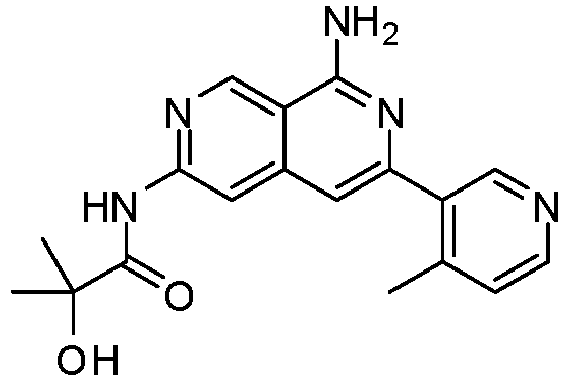
- To a vial was added N-(8-amino-6-chloro-2,7-naphthyridin-3-yl)-2-hydroxy-2-methyl-propanamide (150 mg, 0.53 mmol), XPhos Pd G2 (54 mg, 0.07 mmol), X-phos (49 mg, 0.1 mmol), potassium acetate (134 mg, 1.37 mmol), 4-methyl-3-(4,4,5,5-tetramethyl-1,3,2-dioxaborolan-2-yl)pyridine (175 mg, 0.80 mmol), 1,4-dioxane (5 mL), and water (0.3 mL). The reaction was then stirred at 110°C for 16 hours under nitrogen. The reaction was then cooled to 0°C and HCl in dioxane (10 mL, 4 M, 40 mmol) was added. The mixture was stirred at room temperature for 30 minutes. The mixture was concentrated and NH3 (7N in methanol, 30 mL) was added. The mixture was then concentrated and purified by silica gel chromatography (dichloromethane/methanol, 100:1 to 10:1) to give N-[8-amino-6-(4-methyl-3-pyridyl)-2,7-naphthyridin-3-yl]-2-hydroxy-2-methyl-propanamide (7 mg, 4% yield) as a pale-yellow solid. LCMS (ESI): RT (min) = 0.9660, [M+H]+ = 338.1, method = B; 1H NMR (400 MHz, CD3OD) δ 9.29 (s, 1H), 8.53 (s, 1H), 8.42 (d, J = 5.2 Hz 1H), 8.38 (s, 1H), 7.37 (d, J = 5.2 Hz, 1H), 6.99 (s, 1H), 2.45 (s, 3H), 1.50(s, 6H).
-

- To a vial was added N-[8-(benzhydrylideneamino)-6-chloro-2,7-naphthyridin-3-yl]cyclopropanecarboxamide (100 mg, 0.23 mmol), Pd2(dba)3 (21.45mg, 0.0200mmol), Xantphos (20 mg, 0.04 mmol), Cs2CO3 (152 mg, 0.47 mmol), 1,3-oxazolidin-2-one (30 mg, 0.35mmol) and 1,4-dioxane (5 mL). The reaction was stirred at 110°C for 8 hours under nitrogen. The reaction was concentrated and purified by silica gel chromatography (dichloromethane/methanol,100:1 to 10:1) to give N-[8-amino-6-(2-oxooxazolidin-3-yl)-2,7-naphthyridin-3-yl]cyclopropanecarboxamide (45 mg, 60% yield) as a pale-yellow solid. LCMS (ESI): RT (min) = 1.092, [M+H]+ = 314.1, method =B; 1H NMR (400 MHz, DMSO-d 6) δ: 10.86 (s, 1H), 9.24 (s, 1H), 8.05 (s, 1H), 7.36-7.33 (m, 3H), 4.42 (t, J = 8.0 Hz, 2H), 4.17 (t, J = 8.0 Hz, 2H), 2.08-2.01 (m, 1H), 0.85-0.80 (m, 4H).
-
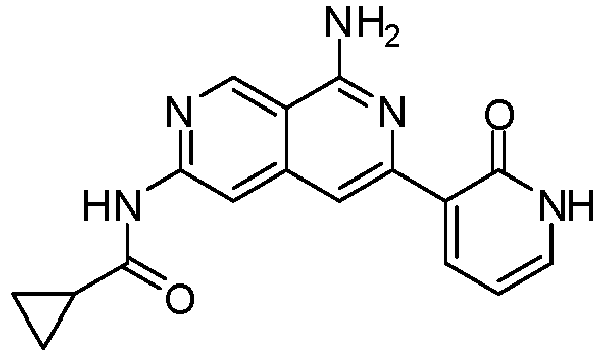
-

- A mixture of 3-bromo-1H-pyridin-2-one (0.5 g, 2.87 mmol), bis(pinacolato)diboron (0.77 g, 3.02 mmol), potassium acetate (0.83 g, 8.49 mmol) and Pd(dppf)2Cl2 (0.23 g, 0.29 mmol) in 1,4-dioxane (10 mL) was stirred at 130°C for 2 hours in a microwave reactor. The mixture was used for the next step directly. LCMS (ESI) [M+H]+ = 140.1.
-

- To a vial was added 3-chloro-N1,N1-bis[(4-methoxyphenyl)methyl]-2,7-naphthyridine-1,6-diamine (165 mg, 0.38 mmol), cyclopropanecarbonyl chloride (0.1 mL, 1.13 mmol) and pyridine (5 mL). The mixture was stirred at 20°C for 2 hours. The mixture was concentrated. The residue was purified by silica chromatography (petroleum ether/ethyl acetate,10:1 to 3:1) to get N-[8-[bis[(4-methoxyphenyl)methyl]amino]-6-chloro-2,7-naphthyridin-3-yl]cyclopropanecarboxamide (188 mg, 97% yield) as a pale-yellow solid. LCMS (ESI) [M+H]+ = 503.1.
-

- To a vial was added XPhos Pd G2 (24 mg, 0.03 mmol), X-phos (21 mg, 0.04 mmol), N-[8-[bis[(4-methoxyphenyl)methyl]amino]-6-chloro-2,7-naphthyridin-3-yl]cyclopropanecarboxamide (150 mg, 0.3 mmol), potassium acetate (150 mg, 1.53 mmol), (2-oxo-1H-pyridin-3-yl)boronic acid (300 mg, 1.08 mmol), water (2 mL) and 1,4-dioxane (20 mL). The reaction mixture was degassed by bubbling with nitogen and then stirred at 100°C for 16 hours. The mixture was then concentrated and purified by silica gel chromatography (ethyl acetate) to give N-[8-[bis[(4-methoxyphenyl)methyl]amino]-6-(2-oxo-1H-pyridin-3-yl)-2,7-naphthyridin-3-yl]cyclopropanecarboxamide (180 mg, 43% yield) as a yellow solid. LCMS (ESI) [M+H]+ = 562.2.
-

- To a vial was added N-[8-[bis[(4-methoxyphenyl)methyl]amino]-6-(2-oxo-1H-pyridin-3-yl)-2,7-naphthyridin-3-yl]cyclopropanecarboxamide (180 mg, 0.1300mmol) and TFA (5 mL). The mixture was stirred at 80°C for 48 hours and then concentrated in vacuo. To this NH3 (7 N in methanol, 3 mL) was added and the reaction mixture was concentrated in vacuo. The residue was purified by silica gel chromatography (dichloromethane/methanol/NH3-water, 100:5:1) to give N-[8-amino-6-(2-oxo-1H-pyridin-3-yl)-2,7-naphthyridin-3-yl]cyclopropanecarboxamide (24 mg, 58 % yield) as a yellow solid. LCMS (ESI): RT (min) = 1.034, [M+H]+ = 322.1, method = B; 1H NMR (400 MHz, DMSO-d 6) δ 12.01 (br, 1H), 10.95 (s, 1H), 9.31 (s, 1H), 8.60 (d, J = 6.4 Hz, 1H), 8.26 (s, 1H), 8.17 (s, 1H), 7.52 (br, 1H), 7.15 (br, 2H), 6.47-6.35 (m, 1H), 2.12-2.02 (m 1H), 0.91-076 (m, 4H).
-
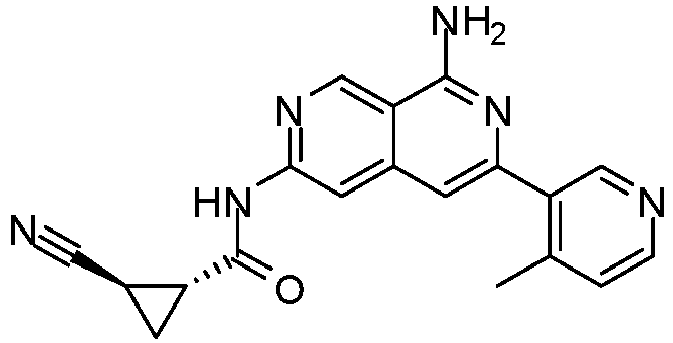
- To a vial was added (±)-trans-N-(8-amino-6-chloro-2,7-naphthyridin-3-yl)-2-cyano-cyclopropanecarboxamide (78 mg, 0.27 mmol), K2CO3 (60 mg, 0.61 mmol), Pd(dppf)Cl2 (30 mg, 0.04 mmol), 4-methyl-3-(4,4,5,5-tetramethyl-1,3,2-dioxaborolan-2-yl)pyridine (89 mg, 0.41 mmol), water (1 mL) and 1,4-dioxane (10 mL). The mixture was bubbled through with nitrogen for 20 min and then stirred at 100°C for 2 hours. The mixture was concentrated and purified by silica gel chromatography (dichloromethane/methanol, 100:1 to 10:1) followed by reverse phase chromatrography (Boston 40 g ODS column, eluted with NaHCO3 10 mmol/L : acetonitrile from 100:0 to 1: 4, uv 254 nm, 214 nm) to give (±)-trans-N-[8-amino-6-(4-methyl-3-pyridyl)-2,7-naphthyridin-3-yl]-2-cyano-cyclopropanecarboxamide (25 mg, 29% yield) as a pale-yellow solid. LCMS (ESI): RT (min) = 1.094, [M+H]+ = 345.2, method = B; 1H NMR (400 MHz, CD3OD) δ 9.28 (s, 1H), 8.51 (s, 1H), 8.41 (d, J = 5.2 Hz, 1H), 8.28 (s, 1H), 7.37 (d, J = 5.2 Hz, 1H), 6.95 (s, 1H), 2.68-2.59 (m, 1H), 2.44 (s, 3H), 2.14-2.07 (m, 1H), 1.63-1.51 (m, 2H).
-

-

- To a vial was added Pd(Ph3P)4 (80 mg, 0.07 mmol), Cs2CO3 (300 mg, 0.92 mmol), 3-chloro-N1,N1-bis[(4-methoxyphenyl)methyl]-2,7-naphthyridine-1,6-diamine (200 mg, 0.46 mmol), 1-hydroxy-3H-oxaborolo[3,4-c]pyridine (1.0 g, 2.22 mmol), water (1 mL) and 1,4-dioxane (10 mL). The reaction mixture was degassed by bubbled through with nitrogen for 20 min and then stirred at 100°C for 16 hours. The mixture was concentrated and purified by silica gel chromatography (dichloromethane/methanol,100:1 to 10:1) to give [3-[6-amino-1-[bis[(4-methoxyphenyl)methyl]amino]-2,7-naphthyridin-3-yl]-4-pyridyl]methanol (205 mg, 88% yield) as a yellow solid. LCMS (ESI) [M+H]+ = 508.2.
-
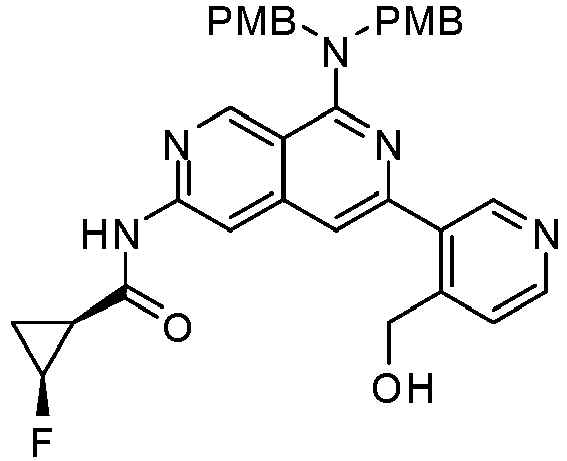
- To a vial was added [3-[6-amino-1-[bis[(4-methoxyphenyl)methyl]amino]-2,7-naphthyridin-3-yl]-4-pyridyl]methanol (150 mg, 0.3 mmol), dichloromethane (3 mL), and pyridine (2 mL). A solution of (1S, 2S)-2-fluorocyclopropanecarbonyl chloride (181 mg, 1.48 mmol) was added drop wise. The mixture was stirred at room temperature for 2 h. The mixture was concentrated, dissolved in methanol (10 mL), and K2CO3 (300 mg, 2.17 mmol) was added. The mixture was stirred at 80°C for 30 minutes. The mixture was then concentrated in vacuo to get a crude product, (1S,2S)-N-[8-[bis[(4-methoxyphenyl)methyl]amino]-6-[4-(hydroxymethyl)-3-pyridyl]-2,7-naphthyridin-3-yl]-2-fluoro-cyclopropanecarboxamide (560 mg, 96% yield) which was used for the next step directly. LCMS (ESI) [M+H]+ = 594.2.
-

- To a vial was added (1S,2S)-N-[8-[bis[(4-methoxyphenyl)methyl]amino]-6-[4-(hydroxymethyl)-3-pyridyl]-2,7-naphthyridin-3-yl]-2-fluoro-cyclopropanecarboxamide (560 mg, 0.28 mmol) and TFA (5 mL). The mixture was stirred at 80°C for 16 hours and then concentrated in vacuo. The residue was dissolved in NH3 (7 N in methanol, 10 mL), concentrated and purified by prep-TLC (silica-gel, dichloromethane/methanol/NH3-water, 100:10:1) to give (1S,2S)-N-[8-amino-6-[4-(hydroxymethyl)-3-pyridyl]-2,7-naphthyridin-3-yl]-2-fluoro-cyclopropanecarboxamide (95 mg, 90% yield) as a pale-yellow solid. LCMS (ESI): RT (min) = 1.414, [M+H]+ = 354.2, method = F; 1H NMR (400 MHz, DMSO-d 6) δ: 11.08 (s, 1H), 9.45 (s, 1H), 8.70 (s, 1H), 8.64 (d, J = 5.2 Hz, 1H), 8.32 (s, 1H), 7.67 (d, J = 5.2 Hz, 1H), 7.44 (br, 2H), 7.11 (s, 1H), 5.52 (t, J = 5.6 Hz, 1H), 5.13-4.90 (m, 1H), 4.74 (d, J = 5.6 Hz, 2H), 2.40-2.29 (m, 1H), 1.80-1.68 (m, 1H), 1.32-1.20 (m, 1H).
-

-

- To a sealed tube was added 3-chloro-N1,N1-bis[(4-methoxyphenyl)methyl]-2,7-naphthyridine-1,6-diamine (200 mg, 0.46mmol), 1-methyl-2-pyrrolidinone (3 mL) and (±)-2-ethylpyrrolidine (400 mg, 4 mmol). The reaction was heated to 200°C in a microwave reactor for 8 hours. The reaction mixture was poured into water (30 mL) and extracted with ethyl acetate (50 mL x 2). The combined organic extracts were washed with brine (30 ml), 1 N HCl (5 mL), brine (20 mL), dried over Na2SO4, filtered and concentrated in vacuo. The residue was purified by silica gel chromatography (dichloromethane/methanol, 100:1 to 20:1) to give (±)-3-(2-ethylpyrrolidin-1-yl)-N1,N1-bis[(4-methoxyphenyl)methyl]-2,7-naphthyridine-1,6-diamine (130 mg, 57 % yield) as a yellow solid. LCMS (ESI) [M+H]+ = 498.2.
-

- To a vial was added (±)-3-(2-ethylpyrrolidin-1-yl)-N1,N1-bis[(4-methoxyphenyl)methyl]-2,7-naphthyridine-1,6-diamine (130 mg, 0.24 mmol), pyridine (96 mg, 1.22mmol) and dichloromethane (5 mL). A solution of (1S,2S)-2-fluorocyclopropanecarbonyl chloride (89 mg, 0.7300 mmol) in dichloromethane (5 mL) was added drop wise. The mixture was stirred at room temperature for 2 hours. The mixture was concentrated and purified by silica gel chromatography (dichloromethane/methanol/NH3-water, 100:5:1) to give (1S,2S)-N-[8-[bis[(4-methoxyphenyl)methyl]amino]-6-(2-ethylpyrrolidin-1-yl)-2,7-naphthyridin-3-yl]-2-fluoro-cyclopropanecarboxamide (60 mg, 40% yield) as a yellow oil. LCMS (ESI) [M+H]+ = 584.3.
-

- To a vial was added (1S,2S)-N-[8-[bis[(4-methoxyphenyl)methyl]amino]-6-(2-ethylpyrrolidin-1-yl)-2,7-naphthyridin-3-yl]-2-fluoro-cyclopropanecarboxamide (60 mg, 0.1 mmol) and TFA (5 mL). The mixture was stirred at 80°C for 16 hours. The mixture was concentrated and NH3 (7 N in methanol, 10 mL) was added. The reaction mixture was concentrated and purified by prep-TLC (silica, dichloromethane/methanol/NH3.water = 100:10:1, uv 254 nm) to give (±)- (1S,2S)-N-[8-amino-6-(2-ethylpyrrolidin-1-yl)-2,7-naphthyridin-3-yl]-2-fluoro-cyclopropanecarboxamide (20 mg, 60% yield) as a pale-yellow solid. LCMS (ESI): RT (min) = 1.223, [M+H]+ = 344.2, method = B; 1H NMR (400 MHz, CD3OD) δ: 8.68 (s, 1H), 7.69 (s, 1H), 5.57 (s, 1H), 4.87-4.63 (m, 1H), 3.93-3.84 (m, 1H), 3.45-3.37 (m, 1H), 3.35-3.27 (m, 1H), 2.03-1.81 (m, 4H), 1.80-1.60 (m, 3H), 1.36-1.23 (m, 1H), 1.14-1.03 (m, 1H), 0.84 (t, J = 7.6 Hz, 3H).
-

-

- To a round botton flask was added LiCl (644 mg, 15 mmol) and cyclopropylmagnesiumbromide (30 mL, 15mmol). The mixture was stirred at room temperature for 30 min under nitrogen. In another flask, 3-bromopyridine (2.0 g, 12.66 mmol), THF (50 mL) and boron trifluoride diethyl etherate (1.8 mL, 14 mmol) was mixed at 0°C. The mixture was stirred at room temperature for 30 min. The solution was then re-cooled to -55°C before the solution of cyclopropylmagnesiumbromide and LiCl complex was added drop wise. The mixture was stirred at -55°C for 30 minutes, and then allow warmed to room temperature slowly. After stirring overnight at room temperature, the reaction was quenched with aqueous NaHCO3 (10 mL) and water (20 mL). The mixture was extracted with ethyl acetate (50 ml x 3), dried over Na2SO4, filtered and concentrated in vacuo. The residue was purified by silica gel chromatography (petroleum ether/ethyl acetate from 10:1 to 3:1) to give 3-bromo-4-cyclopropyl-pyridine (220 mg, 9% yield) as a colourless oil. LCMS (ESI) [M+H]+ = 198.0.
-

- To a vial was added 3-bromo-4-cyclopropyl-pyridine (120 mg, 0.61 mmol), triisopropyl borate (230 mg, 1.22 mmol) and THF (5 mL). The mixture was then cooled to - 78°C before n-BuLi (2.5 M in hexane, 0.5 mL, 1.25 mmol) was added dropwise. The mixture was allowed to warm to room temperature slowly. After stirring for 2 h at room temperature, the mixture was quenched by water (10 mL), washed with ethyl acetate (20 mL x 2), acified to pH 5 with 2N HCl, and concentrated in vacuo. The residue was re-suspended in ethanol (30 mL), filtered and concentrated in vacuo to give (4-cyclopropyl-3-pyridyl)boronic acid (120 mg, 97% yield) as a pale-yellow oil. LCMS (ESI) [M+H]+ = 164.2
-

- To a vial was added cis-N-(8-amino-6-chloro-2,7-naphthyridin-3-yl)-2-fluoro-cyclopropanecarboxamide (120 mg, 0.43 mmol), X-phos (40 mg, 0.09 mmol), XPhos Pd G2 (50 mg, 0.06 mmol), potassium acetate (126 mg, 1.28 mmol), (4-cyclopropyl-3-pyridyl)boronic acid (80 mg, 0.39 mmol), water (1 mL), and 1,4-dioxane (10 mL). The reaction mixture was degassed by bubbling with nitrogen for 20 min and then stirred at 100°C for 6 hours. The mixture was concentrated and purified by silica gel chromatography (dichloromethane/methanol, 100:1 to 10:1) to give (±)-cis-N-[8-amino-6-(4-cyclopropyl-3-pyridyl)-2,7-naphthyridin-3-yl]-2-fluoro-cyclopropanecarboxamide (39 mg, 24 % yield) as a pale-yellow solid. LCMS (ESI): RT (min) = 1.104, [M+H]+ = 364.1, method = B; 1H NMR (400 MHz, CD3OD) δ: 9.38 (s, 1H), 8.47 (s, 1H), 8.39 (d, J = 5.6 Hz, 1H), 8.32 (s, 1H), 7.04 (s, 1H), 6.97 (d, J = 5.6 Hz, 1H), 4.98--4.76 (m, 1H), 2.22-2.11 (m, 2H), 1.89-1.77 (m, 1H), 1.24-1.18 (m, 1H), 1.11-1.04 (m, 2H), 0.92-0.85 (m, 2H).
-

-

- To a vial was added (±)-trans-2-methylcyclopropanecarboxylic acid (200 mg, 2.0 mmol) and dichloromethane (10 mL). The mixture was cooled to 0°C before oxalyl chloride (0.3 mL, 4 mmol) and DMF (0.01 mL) were added drop wise. The mixture was stirred at 20°C for 2 hours. The reaction mixture was concentrated in vacuo to get a crude product and used for the next step directly.
-

- To a vial was added 6,8-dichloro-2,7-naphthyridin-3-amine (60 mg, 0.28 mmol), pyridine (2 mL), and a solution of (±)-trans-2-methylcyclopropanecarbonyl chloride (166 mg, 1.4 mmol) in dichloromethane (3 mL). The reaction was stirred at room temperature for 2 hours. The mixture was concentrated in vacuo and purified by silica gel chromatography (dichloromethane/methanol, 20:1) to give (±)-trans-N-(6,8-dichloro-2,7-naphthyridin-3-yl)-2-methyl-cyclopropanecarboxamide (80 mg, 93% yield). LCMS (ESI) [M+H]+ = 296.0.
-
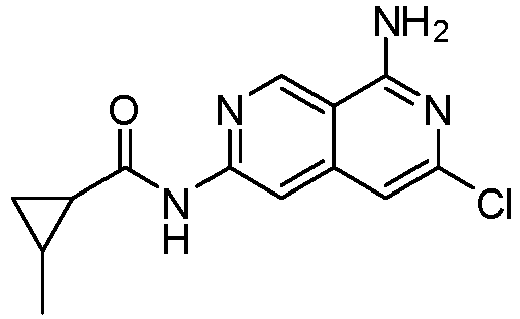
- To a 10 mL microwave tube was added (±)-trans-N-(6,8-dichloro-2,7-naphthyridin-3-yl)-2-methyl-cyclopropanecarboxamide (80 mg, 0.27 mmol), NH3-water (2 mL, 13.51mmol) and 1,4-dioxane (2 mL) . The mixture was stirred at 80°C for 16 hours. The mixture was concentrated in vacuo and purified by silica gel chromatography (dichloromethane/methanol/NH3-water, 100:5:1) to get (±)-trans-N-(8-amino-6-chloro-2,7-naphthyridin-3-yl)-2-methyl-cyclopropanecarboxamide (80 mg, 99% yield) as a white solid. LCMS (ESI) [M+H]+ = 277.1.
-
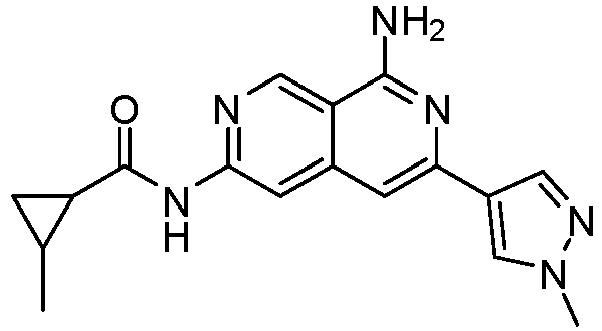
- To a vial was added XPhos Pd G2 (20 mg, 0.03 mmol), X-phos (18 mg, 0.04 mmol), N-(8-amino-6-chloro-2,7-naphthyridin-3-yl)-2-methyl-cyclopropanecarboxamide (80 mg, 0.26 mmol), potassium acetate (51 mg, 0.52 mmol), 1-methyl-4-(4,4,5,5-tetramethyl-1,3,2-dioxaborolan-2-yl)-1h-pyrazole (81 mg, 0.39 mmol), water (0.5 mL) and 1,4-dioxane (5 mL). The reaction was degassed by bubbling through with N2 and then stirred at 100°C for 16 hours. The mixture was concentrated and purified by silica gel chromatrography (dichloromethane/methanol, 30:1 to 10:1) to give a mixture of the (±)-cis and (±)-trans-isomers of N-[8-amino-6-(1-methylpyrazol-4-yl)-2,7-naphthyridin-3-yl]-2-methyl-cyclopropanecarboxamide (42 mg, 50 %yield, 1H NMR shows 3:1 trans:cis) as a yellow solid. LCMS (ESI): RT (min) = 1.661, [M+H]+ = 323.2, method = F; 1H NMR (400 MHz, DMSO-d 6) δ: 10.77 (s, 1H), 9.24 (s, 1H), 8.15 (s, 1H), 8.11 (s,1H), 7.96 (s, 1H), 7.12 (br, 2H), 7.04 (s, 1H), 3.88 (s, 3H), 2.12-2.02 (m, 0.3H), 1.86-1.77 (m, 0.7H), 1.34-1.20 (m, 1H), 1.18-0.94 (m, 4H), 0.85-0.79 (m, 0.3H), 0.72-0.63 (m, 0.7H).
-

-

- To a sealed tube was added 4-bromo-3-methyl-benzamide (1.0 g, 4.67 mmol), bis(pinacolato)diboron (1.4 g, 5.61 mol), potassium acetate (1.4 g, 14.01 mmol), Pd(dppf)Cl2 (341 mg, 0.47 mmol) and 1,4-dioxane (10 mL). The mixture was bubbled through with N2 for 2 minutes and stirred at 100°C for 3 hours. The mixture was concentrated in vacuo and purified by silica gel chromatography (petroleum ether/ethyl acetate, 1: 1 to 0:100) to afford 3 -methyl-4-(4,4,5,5-tetramethyl-1,3,2-dioxaborolan-2-yl)benzamide (920 mg, 71% yield) as a white solid. LCMS (ESI) [M+H]+ = 262.2.
-

- To a vial was added (±)-cis-N-(8-amino-6-chloro-2,7-naphthyridin-3-yl)-2-fluoro-cyclopropanecarboxamide (70 mg, 0.25 mmol), K2CO3 (49 mg, 0.5 mmol), Pd(dppf)Cl2 (30 mg, 0.04 mmol), 3-methyl-4-(4,4,5,5-tetramethyl-1,3,2-dioxaborolan-2-yl)benzamide (98 mg, 0.37mmol), water (0.5 mL) and 1,4-dioxane (5 mL). The reaction was bubbled through with N2 for 20 minutes and then stirred at 90°C for 5 hours. The mixture was then concentrated and purified by silica gel chromatography (dichloromethane/methanol, 100:1 to 10:1) and then reverse phase chromatography (Boston 40 g ODS column, eluted with NaHCO3 10 mmol/L : acetonitrile from 100:0 to 1:4, uv 254 nm, 214nm) to give (±)-4-[1-amino-6-[[(cis)-2-fluorocyclopropanecarbonyl]amino]-2,7-naphthyridin-3-yl]-3-methyl-benzamide (35 mg, 37% yield) as a white solid. LCMS (ESI): RT (min) = 1.086, [M+H]+ = 380.2, method = B; 1H NMR (400 MHz, DMSO-d 6) δ: 10.99 (s, 1H), 9.37 (s, 1H), 8.24 (s, 1H), 7.97 (s, 1H), 7.79 (s, 1H), 7.75 (d, J = 8.0 Hz, 1H), 7.48 (d, J = 8.0 Hz, 1H), 7.35 (br, 1H), 7.28 (br, 2H), 6.92 (s, 1H), 5.07-4.83 (m, 1H), 2.41 (s, 3H), 2.32-2.22 (m, 1H), 1.74-1.61 (m, 1H), 1.24-1.14 (m 1H).
-

-

- To a vial was added 4-bromo-3-methylbenzoic acid (1.0 g, 4.65 mmol), dichloromethane (10 mL) and DMF (0.1 mL, 4.65 mmol). Oxalyl chloride (1.2 mL, 13.95 mmol) was added drop-wise. The mixture was stirred at room temperature for 2 hours. The reaction was concentrated in vacuo and re-dissolved in dichloromethane (10 mL). Methylamine (30% in ethanol, 10 mL) was added and stirred at room temperaturefor 30 minutes. The mixture was concentrated in vacuo. The residue was purified by silica gel chromatography (petroleum ether/ethyl acetate, 1:1 to 0:100) to get 4-bromo-N,3-dimethyl-benzamide (1 g, 94% yield) as a white solid. LCMS (ESI) [M+H]+ = 228.0.
-

- To a sealed tube was added 4-bromo-N,3-dimethyl-benzamide (0.99 g, 4.34 mmol), bis(pinacolato)diboron (1.32 g, 5.21mmol), potassium acetate (1.28 g, 13 mmol) and Pd(dppf)Cl2 (317 mg, 0.43 mmol) and 1,4-dioxane (100 mL). The mixture was degassed by bubbling through with N2 for 2 minutes and stirred at 100°C for 3 hours. The mixture was concentrated and purified by silica gel chromatography (petroleum ether/ethyl acetate, 3:1 to 1:1) to get N,3-dimethyl-4-(4,4,5,5-tetramethyl-1,3,2-dioxaborolan-2-yl)benzamide (1.05 g, 77 % yield) as an off-white solid. LCMS (ESI) [M+H]+ = 276.2.
-
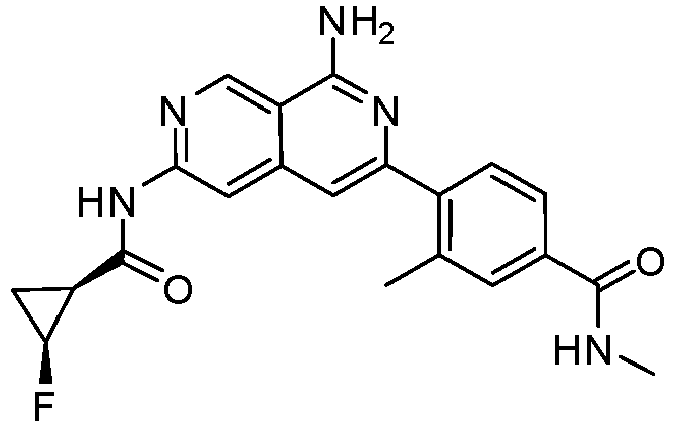
- To a vial was added (±)-cis-N-(8-amino-6-chloro-2,7-naphthyridin-3-yl)-2-fluoro-cyclopropanecarboxamide (70 mg, 0.25 mmol), K2CO3 (50 mg, 0.51 mmol), Pd(dppf)Cl2 (40 mg, 0.05 mmol), N,3-dimethyl-4-(4,4,5,5-tetramethyl-1,3,2-dioxaborolan-2-yl)benzamide (150 mg, 0.55 mmol), water (0.5 mL) and 1,4-dioxane (5 mL). The mixture was degassed by bubbling through with N2 for 2 minutes and then stirred at 100°C for 2 hours. The mixture was concentrated and purified by silica gel chromatography (dichloromethane/methanol, 100:1 to 10:1) and reverse phase chromatography (Boston 40 g ODS column, eluted with NaHCO3 10 mmol/L: acetonitrile from 2:1 to 1: 2) to give 4-[1-amino-6-[[cis-2-fluorocyclopropanecarbonyl]amino]-2,7-naphthyridin-3-yl]-N,3-dimethyl-benzamide (35 mg, 35% yield) as white solid. LCMS (ESI): RT (min) = 1.124, [M+H]+ = 394.1, method = B; 1H NMR (400 MHz, DMSO-d 6) δ: 10.99 (s, 1H), 9.37 (s, 1H), 8.44 (q, J= 4.4 Hz, 1H), 8.23 (s, 1H), 7.75 (s, 1H), 7.71 (d, J = 8.0 Hz, 1H), 7.48 (d, J = 8.0 Hz, 1H), 7.28 (br, 2H), 6.92 (s, 1H), 5.06-4.83 (m, 1H), 2.80 (d, J= 4.4 Hz, 3H), 2.41 (s, 3H), 2.32-2.22 (m, 1H), 1.73-1.60 (m, 1H), 1.24-1.15 (m, 1H).
-

-

- To a flask was added 3-bromopyridine (3.0 g, 18.99 mmol) and boron trifluoride diethyl etherate (3 mL, 23.55 mmol) was added dropwise. After stirring at room temperature for 30 min under N2, the mixture was cooled to -55°C and chloro(isopropyl)magnesium chlorolithium complex (18 mL, 23.4 mmol) was added dropwise. The mixture was stirred at - 55°C for 2 hours. The reaction was allowed to warm to room temperature and stirred at room temperature for 2 hours. The reaction was quenched with aqueous NaHCO3 (10 mL), water (20 mL) added, extracted with ethyl acetate (50 ml x 3), dried over Na2SO4, filtered and concentrated in vacuo. The residue was purified by silica gel chromatography (petroleum ether/ethyl acetate, 10:1 to 3:1) to get 3-bromo-4-isopropyl-pyridine (600 mg, 16 % yield) as pale-yellow oil. LCMS (ESI) [M+H]+ = 200.0.
-

- To a vial was added triisopropyl borate (1.2 g, 6.38 mmol), 3-bromo-4-isopropyl-pyridine (600 mg, 3 mmol) and THF (20 mL). The mixture was cooled to -78°C. A solution of n-BuLi (1.5 mL, 3.75 mmol, 2.5 M in hexane) was added dropwise. The mixture was allowed to warm to room temperature slowly, and stirred at room temperature for 2 hours. The mixture was quenched by water (10 mL), washed with ethyl acetate (20 mL x 2), acidified to pH=5 with 2N HCl, and concentrated in vacuo. The residue was extracted with ethanol (30 mL), filtered and concentrated in vacuo to give (4-isopropyl-3-pyridyl)boronic acid (600 mg, 36% yield) as a pale-yellow solid, and used for the next step directly. LCMS (ESI) [M+H]+ = 166.1.
-

- To a vial was added (±)-trans-N-(8-amino-6-chloro-2,7-naphthyridin-3-yl)-2-cyano-cyclopropanecarboxamide (120 mg, 0.42 mmol), X-phos (40 mg, 0.08 mmol), XPhos Pd G2 (49 mg, 0.06 mmol), (4-isopropyl-3-pyridyl)boronic acid (70 mg, 0.42 mmol), water (1 mL) and 1,4-dioxane (10 mL). The reaction was degassed by bubbling with nitrogen for 2 min and then stirred at 100°C for 6 hours. The mixture was concentrated and purified by silica gel chromatography (dichloromethane/methanol, 100:1 to 10:1) to give (±)-trans-N-[8-amino-6-(4-isopropyl-3-pyridyl)-2,7-naphthyridin-3-yl]-2-cyano-cyclopropanecarboxamide (17 mg, 11% yield) as a pale-yellow solid. LCMS (ESI): RT (min) = 1.696, [M+H]+ = 373.2, method = F; 1H NMR (400 MHz, CD3OD) δ: 9.30 (s, 1H), 8.50 (d, J= 5.6 Hz, 1H), 8.44 (s, 1H), 8.28 (s, 1H), 7.49 (d, J = 5.6 Hz, 1H), 6.91 (s,1H), 3.40-3.20 (m, 1H), 2.70-2.60 (m, 1H), 2.15-2.05 (m, 1H), 1.65-1.50 (m, 2H), 1.22 (d, J= 6.8 Hz, 6 H).
-

- A mixture of (±)-trans-N-(8-amino-6-chloro-2,7-naphthyridin-3-yl)-2-fluoro-cyclopropane carboxamide (500 mg, 1.78 mmol), 4-methyl-3-(4,4,5,5-tetramethyl-1,3,2-dioxa borolan-2-yl)pyridine (450 mg, 2.05 mmol), X-Phos (90 mg, 0.19 mmol), X-Phos-Pd-G2 (90mg, 0.11 mmol), K2CO3 (800 mg, 5.8 mmol) in 1,4-dioxane (6 mL) and water (1 mL) was stirred under inert Ar atmosphere at 110 °C for 2 hours. The reaction was concentrated and the resulting residue was purified by reverse phase chromatography (methyl alcohol 45-55/0.05% formic acid in water) to afford (±)-trans-N-[8-amino-6-(4-methyl-3-pyridyl)-2, 7-naphthyridin-3-yl]-2-fluoro-cyclopropanecarboxamide (57 mg, 9.5% yield) as a white solid. LCMS (ESI): RT (min) = 1.440, [M+H]+ = 338.1, method = E; 1H NMR (400 MHz, DMSO-d 6) δ 11.13 (s, 1H), 9.39 (s, 1H),8.56 (s, 1H), 8.43 (d, J = 4.8 Hz, 1H), 8.19 (s, 1H), 7.34 (s, 2H), 7.30 (d, J= 5.2 Hz, 1 H), 6.97 (s, 1H), 5.00-4.83 (m, 1H), 2.66-2.57 (m,1H), 2.41 (s, 3H), 1.60-1.51 (m,1H), 1.31-1.23 (m,1H).
-

-

- A mixture of 6-bromo-7-methyl-3H-imidazo[4,5-b]pyridine (320 mg, 1.51 mmol), Pd(dppf)Cl2 (100 mg, 0.14 mmol), potassium acetate (600 mg, 6.12 mmol), and bis(pinacolato)diboron (3.8 g, 14.96 mmol) in DMF (10 mL) was stirred under a nitrogen atmosphere at 100°C for 3 hours. To this brine (40mL) was added and the mixture extracted with ethyl acetate (20 mL x 3). The combined organic layers were dried with MgSO4 and concentrated to dryness. The crude product was purified by column chromatography on silica gel eluting with ethyl acetate to afford 7-methyl-6-(4,4,5,5-tetramethyl-1,3,2-dioxaborolan-2-yl)-3H-imidazo[4,5-b]pyridine (180 mg, 35% yield) as a white solid. LCMS (ESI): [M+H]+ =260.2.
-

- A mixture of 7-methyl-6-(4,4,5,5-tetramethyl-1,3,2-dioxaborolan-2-yl)-3H-imidazo[4,5-b]pyridine (60 mg, 0.23 mmol), (±)-cis-N-(8-amino-6-chloro-2,7-naphthyridin-3-yl)-2-fluorocyclopropanecarboxamide (60 mg, 0.21 mmol), Pd(dppf)Cl2 (15 mg, 0.02 mmol), K2CO3 (100 mg, 0.72 mmol) in 1,4-dioxane (5 mL) and water (1mL) was stirred under anAr atmosphere at 110°C for 3 hours. The reaction was concentrated to dryness. The resulting residue was purified by reverse phase chromatography (acetonitrile 0-45/0.1% NH4HCO3 in water) to afford (±)-cis-N-[8-amino-6-(7-methyl-1H-imidazo[4,5-b] pyridin-6-yl)-2,7-naphthyridin-3-yl]-2-fluoro-cyclopropanecarboxamide (10.6 mg, 13.1% yield) as a white solid. LCMS:(ESI): RT(min)= 1.03, [M+H]+ =378.1, method = B; 1H NMR (400 MHz, CD3OD) δ 9.31 (s, 1H), 8.48 (s, 1H), 8.44 (s, 1H),8.34 (s, 1H), 7.05 (s, 1H), 5.00-4.80 (m, 1H), 2.71 (s, 3H), 2.20-2.16 (m, 1H), 1.88-1.81 (m, 1H), 1.26-1.21 (m, 1H).
-

-

- To a solution of (±)-trans-ethyl 2-(hydroxymethyl) cyclopropanecarboxylate (1.4 g, 9.71 mmol) in THF (10 mL) was added sodium hydride (60% in mine oil, 350 mg, 8.75 mmol) at room temperature. The reaction mixture was stirred at room temperature for 20 minutes. Then iodomethane (1.0 mL, 15.5 mmol) was added. The reaction mixture was stirred at room temperature for 3 h and monitored by LCMS. The reaction was quenched with a saturated NaCl solution. The reaction mixture was extracted with ethyl acetate (30 mL x 3), dried over anhydrous sodium sulfate, and concentrated in vacuo to afford trans-ethyl 2-(methoxymethyl)cyclopropanecarboxylate (1.0 g, 91% yield) as a yellow liquid. LCMS: (ESI)
[M+H]+ =159.1. -

- A mixture of (±)-trans-ethyl 2-(methoxymethyl)cyclopropanecarboxylate (1.0 g, 6.32 mmol), sodium hydroxide (800 mg, 20 mmol) in THF (20mL) and water (5 mL) was stirred at 70°C for 6 hours. THF was removed by rotary evaporation and the pH was adjusted to 1 with a 2 M HCl solution. The mixture was extracted with ethyl acetate (20 x 3 mL). The organic extracts were combined, dried over anhydrous sodium sulfate, and then concentrated in vacuo to afford (±)-trans-2-(methoxymethyl)cyclopropanecarboxylic acid (700 mg, 85% yield ) as a colourless liquid.
-

- To a solution of (±)-trans-2-(methoxymethyl)cyclopropanecarboxylic acid (700 mg, 5.38 mmol) and DMF (1 drop) in dichloromethane (20 mL) was added excess oxalyl chloride. The mixture was stirred at room temperature for 1 hour. The mixture was concentrated to remove excess oxalyl chloride and dichloromethane (10 mL) was added. The solution was added drop-wise to a solution of 6,8-dichloro-2,7-naphthyridin-3-amine (400 mg, 1.87 mmol), triethylamine (2.0 mL, 14.85 mmol) in dichloromethane (10mL). The mixture was stirred at room temperature for 1 hour. The reaction mixture was then concentrated to afford the crude (±)-trans-N-(6,8-dichloro-2,7-naphthyridin-3-yl)-2-(methoxymethyl)cyclopropanecarboxamide (400 mg, 17.1% yield) as a yellow solid. LCMS (ESI): [M+H]+ =326.0.
-

- A mixture of (±)-trans- N-(6, 8-dichloro-2, 7-naphthyridin-3-yl)-2-(methoxymethyl)cyclopropanecarboxamide (400.0 mg, 0.3200 mmol), and ammonia (25% in water) (2.0 mL, 105.88 mmol) in 1,4-dioxane (4 mL) was stirred at 110°C for 2 hours. The reaction was concentrated to dryness. The crude product was then purified by column chromatography on silica gel eluting with dichloromethane/methanol (10:1) to afford N-(8-amino-6-chloro-2,7-naphthyridin-3-yl)-2-(methoxymethyl)cyclopropanecarboxamide (90 mg, 71% yield) as a yellow solid. LCMS (ESI): [M+H]+ = 307.1.
-

- To a pressure reaction tube was added (±)-trans-N-(8-amino-6-chloro-2,7-naphthyridin-3-yl)-2-(methoxymethyl) cyclopropanecarboxamide (84 mg, 0.27 mmol), (4-ethyl-3-pyridyl)boronic acid (60 mg, 0.4 mmol), Pd(PPh3)4 (40 mg, 0.03 mmol), K2CO3 (120 mg, 0.87 mmol), 1,4-dioxane (5 mL) and water (1 mL). The reaction mixture was stirred under an Ar atmosphere at 110°C for 6hours and then concentrated to dryness. The resulting residue was purified by reverse phase chromatography (acetonitrile 0-40/0.1% NH4HCO3 in water) to afford (±)-trans-N-[8-amino-6-(4-ethyl-3-pyridyl)-2,7-naphthyridin-3-yl]-2-(methoxymethyl) cyclopropanecarboxamide (12 mg, 11.6% yield) as a white solid. LCMS (ESI): RT (min) = 1.16, [M+H]+ = 378.2, method = B;1H NMR (400 MHz,CD3OD) δ 9.18 (s, 1H), 8.38 (s, 1H), 8.36 (s, 1H), 8.17 (s, 1H), 7.32(d, J= 4.0 Hz, 1H), 6.83 (s, 1H), 3.42-3.39 (m, 1H), 3.22-3.18 (m, 4H), 2.72 (q, J= 6.0 Hz, 2H), 1.80-1.79 (m, 1H), 1.64-1.60 (m, 1H), 1.17-1.13 (m, 1H), 1.06(t, J = 6.0 Hz, 3H), 0.86-0.82 (m, 1H).
-

-
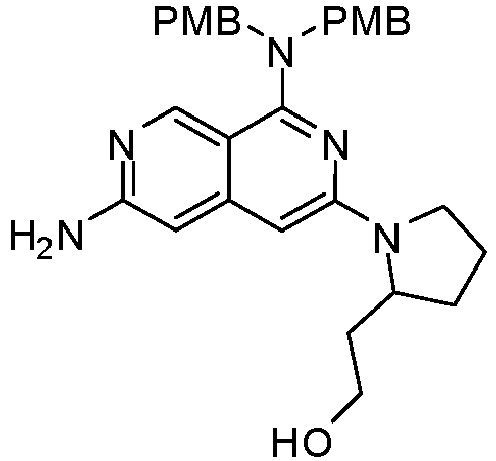
- To a microwave tube was added 3-chloro-N1,N1-bis[(4-methoxyphenyl)methyl]-2,7-naphthyridine-1,6-diamine (200 mg, 0.46 mmol), (±)-2-pyrrolidin-2-ylethanol (450 mg, 3.91 mmol), and 1-methyl-2-pyrrolidinone (3 mL). The mixture was heated at 200°C in a microwave reactor for 4 hours. The mixture was poured into water 20 mL and extracted with ethyl acetate (30 ml x 2). The combined extracts were washed with 1 N HCl (10 mL), brine (20 ml x 2), dried over Na2SO4, filtered and concentrated. The residue was purified by silica gel chromatography (dichloromethane/methanol/NH3-water, 100:5:1) to give 2-[1-[6-amino-1-[bis[(4-methoxyphenyl)methyl]amino]-2,7-naphthyridin-3-yl]pyrrolidin-2-yl]ethanol (140 mg, 56% yield) as a pale-yellow solid. LCMS (ESI) [M+H]+ = 514.2.
-

- To a vial was added 2-[1-[6-amino-1-[bis[(4-methoxyphenyl)methyl]amino]-2,7-naphthyridin-3-yl]pyrrolidin-2-yl]ethanol (140 mg, 0.27 mmol), dichloromethane (5 mL) and pyridine (215 mg, 2.73mmol). A solution of 2-[1-[6-amino-1-[bis[(4-methoxyphenyl)methyl]amino]-2,7-naphthyridin-3-yl]pyrrolidin-2-yl]ethanol (140 mg, 0.27 mmol) in dichloromethane (5 mL) was added dropwise. The mixture was stirred at room temperature for 2 hours. The mixture was concentrated in vacuo to get a crude product that was used directly for in next step. LCMS (ESI) [M+H]+ = 772.2.
-

- To a microwave tube was added 2-[1-[6-[bis[cis-2-fluorocyclopropanecarbonyl]amino]-1-[bis[(4-methoxyphenyl)methyl]amino]-2,7-naphthyridin-3-yl]pyrrolidin-2-yl]ethyl cis-2-fluorocyclopropanecarboxylate (300 mg, 0.27 mmol), 1,4-dioxane (4 mL), and ammonium hydroxide (3.6 mL, 47.62 mmol). The mixture was heated at 100°C for 48 hours. The mixture was concentrated in vacuo, and purified by prep-TLC (silica-gel, dichloromethane/methanol, 10:1) to give (±)-cis-N-[8-[bis[(4-methoxyphenyl)methyl] amino] -6- [2-(2-hydroxyethyl)pyrrolidin-1-yl] -2,7-naphthyridin-3 -yl]-2-fluoro-cyclopropanecarboxamide (180 mg, 55% yield) as a yellow oil. LCMS (ESI) [M+H]+ = 600.3.
-

- To a vial was added (±)-cis-N-[8-[bis[(4-methoxyphenyl)methyl]amino]-6-[2-(2-hydroxyethyl)pyrrolidin-1-yl]-2,7-naphthyridin-3-yl]-2-fluoro-cyclopropanecarboxamide (180 mg, 0.15 mmol) and TFA (5 mL). The reaction was stirred at 90°C for 16 hours. The mixture was concentrated and dissolved in a solution of NH3 (7N in methanol, 10 mL). K2CO3 (200 mg) was added. The reaction was stirred at 60°C for 30 minutes, filtered and concentrated in vacuo. The residue was purified by prep-TLC (silica-gel, dichloromethane/methanol = 10:1) to give (±)-cis-N-[8-amino-6-[2-(2-hydroxyethyl)pyrrolidin-1-yl]-2,7-naphthyridin-3-yl]-2-fluoro-cyclopropanecarboxamide (35 mg, 65 % yield) as a yellow solid. LCMS (ESI): RT (min) = 1.100, [M+H]+ = 360.2, method = B; 1H NMR (400 MHz, CD3OD) δ: 8.80 (s, 1H), 7.84 (s, 1H), 5.75 (s, 1H), 4.96-4.73 (m, 1H), 4.45-4.35 (m, 1H), 3.65-3.55 (m, 2H), 3.53-3.45 (m, 1H), 3.39-3.31 (m, 1H), 2.16-1.93 (m, 4H), 1.93-1.73 (m, 3H), 1.70-1.58 (m, 1H), 1.24-1.12 (m, 1H).
-

-

- A mixture of 2-fluoro-4-iodo-5-methylpyridine (2.37 g, 10 mmol), sodium methoxide (1.0 g, 18.51 mmol) in dimethyl sulfoxide (10 mL) was stirred at room temperature for 2 hours. To this mixture was added saturated NaCl solution (20 mL) and then the mixture was extracted with ethyl acetate (15 mL x 3). The organic extracts were combined, dried with MgSO4, and concentrated to get the crude product. The crude product was purified by column chromatography on silica gel eluting with petroleum ether:ethyl acetate (10:1) to afford 4-iodo-2-methoxy-5-methyl-pyridine (2.3 g, 81% yield) as a colorless solid. LCMS (ESI): [M+H]+ =249.9.
-

- A mixture of 4-iodo-2-methoxy-5-methyl-pyridine (830 mg, 3.33 mmol), Pd(dppf)Cl2 (200 mg, 0.27 mmol), potassium acetate (1.0 g, 10.2 mmol), and bis(pinacolato) diboron (6.0 g, 23.63 mmol) in anhydrous 1,4-dioxane (30 mL) was stirred under Ar at 100°C for 5 hours. The reaction was concentrated to dryness. The crude product was purified by column chromatography on silica gel eluting with petroleum ether: ethyl acetate (10:1) to afford crude 2-methoxy-5-methyl-4-(4,4,5,5-tetramethyl-1,3,2-dioxaborolan-2-yl)pyridine (1.1 g) as a yellow liquid. LCMS (ESI): [M+H]+ = 250.1.
-

- A mixture of 2-methoxy-5-methyl-4-(4,4,5,5-tetramethyl-1,3,2-dioxaborolan-2-yl)pyridine (600 mg, 2.41 mmol), (±)-cis-N-(8-amino-6-chloro-2,7-naphthyridin-3-yl)-2-fluorocyclo propanecarboxamide (280 mg, 1.0 mmol), Pd(dppf)Cl2 (70 mg, 0.10 mmol), K2CO3 (420 mg, 3.04 mmol) in 1,4-dioxane (5 mL) and water (1 mL) was stirred under Ar at 110°C for 3 hours. The reaction was concentrated to dryness. The resulting residue was purified by reverse phase chromatography (acetonitrile 0-45/0.1% NH4HCO3 in water) to afford (±)-cis-N-[8-amino-6-(2-methoxy-5-methyl-4-pyridyl)-2,7-naphthyridin-3-yl]-2-fluoro-cyclopropanecarboxamide (55 mg, 14.6% yield) as a white solid. LCMS (ESI): RT (min) = 1.20, [M+H]+ = 368.2, method = B; 1H NMR (400 MHz, DMSO-d 6) δ 11.02 (s, 1H), 9.38 (s, 1H), 8.25 (s, 1H),8.05 (s, 1H), 7.34 (s, 2H), 6.98 (s, 1H),6.85 (s, 1H), 5.04-4.86 (m, 1H), 3.85 (s, 3H), 2.30-2.23 (m, 4H), 1.70-1.64 (m,1H), 1.22-1.17 (m, 1H).
-

- To a solution of (±)-cis-N-[8-amino-6-(2-methoxy-5-methyl-4-pyridyl)-2, 7-naphthyridin-3-yl]-2-fluoro-cyclopropanecarboxamide (45 mg, 0.12 mmol), iodotrimethylsilane (200 mg, 1.0 mmol) in acetonitrile (5 mL) was stirred at 80°C for 2 hours. The reaction was concentrated andpurified by reverse phase chromatography (acetonitrile 0-40/0.1% formic acid in water) to afford cis-N-[8-amino-6-(5-methyl-2-oxo-1H-pyridin-4-yl)-2,7-naphthyridin-3-yl]-2-fluoro-cyclopropanecarboxamide (13.3 mg, 30.7% yield) as a yellow solid, as the formic acid salt. LCMS (ESI): RT (min) = 1.02, [M+H]+ = 354.1, method = B; 1H NMR (400 MHz, CD3OD) δ 9.30 (s, 1H), 8.34 (s, 1H), 7.35 (s, 1H), 6.98 (s, 1H), 6.63 (s, 1H), 5.00-4.79 (m, 1H), 2.19-2.16 (m, 1H), 2.114 (s, 3H), 1.87-1.80 (m, 1H), 1.28-1.19 (m, 1H).
-

-

- A mixture of 6,8-dichloro-2,7-naphthyridin-3-amine (100 mg, 0.47 mmol), benzyl chloroformate (1.0 mL, 7.33 mmol) and pyridine (1.0 mL, 12.36 mmol) in dichloromethane (10 mL) was stirred overnight at room temperature. The reaction was concentrated and the resulting residue was washed with water and filtered to afford benzyl N-(6,8-dichloro-2,7-naphthyridin-3-yl)carbamate (120 mg, 53% yield) as a yellow solid. LCMS (ESI): [M+H]+ =348.0.
-

- A mixture of benzyl N-(6,8-dichloro-2,7-naphthyridin-3-yl)carbamate (120 mg, 0.34 mmol) and ammonia (25% in water, 2.0 mL, 105.88 mmol) in 1,4-dioxane (2 mL) was stirred at 110°C for 2 hours. The reaction was concentrated to afford benzyl N-(8-amino-6-chloro-2,7-naphthyridin-3-yl)carbamate (110 mg, 89% yield) as a yellow solid. LCMS (ESI): [M+H]+ =329.1.
-

- A mixture of benzyl N-(8-amino-6-chloro-2,7-naphthyridin-3-yl)carbamate (105 mg, 0.32 mmol), 4-ethyl-3-(4,4,5,5-tetramethyl-1,3,2-dioxaborolan-2-yl)pyridine (150 mg, 0.64 mmol), X-Phos (20 mg, 0.04 mmol), XPhos Pd G2 (20 mg, 0.03 mmol) and K2CO3 (150 mg, 1.09 mmol) in 1,4-dioxane (6 mL) and water (1 mL) was stirred under Ar at 110°C for 2 hours. The reaction was concentrated and purified by reverse phase chromatography (methanol 45-55/0.05% formic acid in water) to afford benzyl N-[8-amino-6-(4-ethyl-3-pyridyl)-2,7-naphthyridin-3-yl]carbamate (9 mg, 7% yield) as a white solid (formic acid salt). LCMS (ESI): RT (min) = 1.53, [M+H]+ = 400.2, method = B; 1H NMR (400 MHz, CD3OD) δ 9.26 (s, 1H), 8.48 (s, 1H), 8.50 (s, 1H), 8.10 (s, 1H), 7.48-7.34 (m, 6H),6.97 (s, 1H), 5.27 (s, 2H), 2.83 (q, J= 7.6 Hz, 2H), 1.19 (t, J = 7.6 Hz, 3H).
-

-
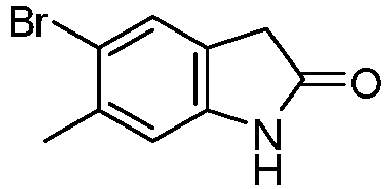
- A mixture of 5-methyl-3H-1,3-benzoxazol-2-one (500 mg, 3.35 mmol) and 1-bromo-2,5-pyrrolidinedione (656 mg, 3.69 mmol) in acetic acid (10mL) was stirred at 20°C for 16 hours. The reaction mixture was diluted with water (25 mL) and stirred for further 15 minutes. The mixture was then filtered and washed with water (5 mL x 2) to afford 6-bromo-5-methyl-3H-1,3-benzoxazol-2-one (600 mg, 77% yield) as a white solid. LCMS (ESI): [M+H]+ = 228.2.
-

- A mixture of 5-bromo-6-methyl-indolin-2-one (200 mg, 0.88 mmol), 4,4,4',4',5,5,5',5'-octamethyl-2,2'-bi(1,3,2-dioxaborolane) (336 mg, 1.33 mmol), Pd(dppf)Cl2 (64 mg, 0.09 mmol), potassium acetate (86 mg, 0.88 mmol) and 1,4-dioxane (10 mL) was stirred at 100°C under N2 for 3 hours. The reaction mixture was concentrated and purified by silica gel chromatography eluting with 0-30% ethyl acetate in petroleum ether to give 6-methyl-5-(4,4,5,5-tetramethyl-1,3,2-dioxaborolan-2-yl)indolin-2-one (150 mg, 56% yield) as a yellow solid. LCMS (ESI): [M+H]+ = 274.2.
-

- A mixture of 6-methyl-5-(4,4,5,5-tetramethyl-1,3,2-dioxaborolan-2-yl)indolin-2-one (100 mg, 0.33 mmol), cis-N-(8-amino-6-chloro-2,7-naphthyridin-3-yl)-2-fluoro-cyclopropanecarboxamide (93 mg, 0.33 mmol), Pd(PPh3)4 (38 mg, 0.03mmol), K2CO3 (91mg, 0.67 mmol) in 1,4-dioxane (10 mL) and water (1 mL) was stirred at 105°C under N2 for 5 hours. The reaction mixture was concentrated and purified by silica gel chromatography eluting with 0-10% methanol in dichloromethane to give (±)-cis-N-[8-amino-6-(6-methyl-2-oxo-indolin-5-yl)-2,7-naphthyridin-3-yl]-2-fluoro-cyclopropanecarboxamide (20 mg 15% yield) as a white solid. LCMS (ESI): RT (min) = 1.535, [M+H]+ = 392.1, method = C;1HNMR (400 MHz,DMSO-d 6) δ 10.95(s, 1H), 10.42 (s, 1H), 9.33 (s, 1H),8.19(s, 1H), 7.28 (s, 1H), 7.20 (s, 2H), 6.82(s, 1H), 6.70(s, 1H), 5.05-4.83 (m, 1H), 3.46 (s 2H), 2.35 (s, 3H), 2.30-2.21(m,1H), 1.71-1.59(m,1H),1.23-1.13(m,1H).
-

-

- To a solution of 2,5-dibromo-4-methylpyridine (2 g, 7.97 mmol) in toluene (30 mL) was added a solution of n-BuLi (2.5 M in hexane, 4.8 mL, 11.96 mmol) at -78°C under N2. The mixture was stirred at -78°C for 30 min. Acetone (1.85 g, 31.88 mmol) was added dropwise at -78°C. The mixture was stirred at 20°C for 2 hours. The reaction mixture was washed with saturated NH4Cl aqueous solution (100 mL) and the mixture was extracted with ethyl acetate (100 mL x 3). The organic extracts were combined, concentrated under vacuum. The residue was purified by silica gel flash chromatography eluting with petroleum ether/ethyl acetate (20:1 to 3:1) to give 2-(5-bromo-4-methyl-2-pyridyl)propan-2-ol (1.5 g, 82% yield) as a white solid. LCMS (ESI): [M+H]+ = 230.2.
-

- To a pressure reaction tube was added 2-(5-bromo-4-methyl-2-pyridyl)propan-2-ol (200 mg, 0.87 mmol), bis(pinacolato)diboron (264 mg, 1.04 mmol), Pd(dppf)Cl2 (63 mg, 0.09 mmol), potassium acetate (170 mg, 1.74 mmol), and 1,4-dioxane (8 mL). The mixture was stirred at 95°C for 4 hours. The crude product was used in the next step without further purification. LCMS (ESI): [M+H]+ = 278.2.
-

- A mixture of 2-[4-methyl-5-(4,4,5,5-tetramethyl-1,3,2-dioxaborolan-2-yl)-2-pyridyl]propan-2-ol (100 mg, 0.36 mmol), Pd(t-Bu3P)2 (18 mg, 0.04 mmol), (±)-cis-N-(8-amino-6-chloro-2,7-naphthyridin-3-yl)-2-fluoro-cyclopropanecarboxamide (101 mg, 0.36 mmol) and K2CO3 (99 mg, 0.72 mmol) in 1,4-dioxane (10 mL) and water (1 mL) was stirred at 100°C under nitrogen for 3 hours. The reaction mixture was concentrated and the residue was purified by silica gel chromatography eluting with 0-100% ethyl acetate in petroleum ether to give (±)-cis-N-[8-amino-6-[6-(1-hydroxy-1-methyl-ethyl)-4-methyl-3-pyridyl]-2,7-naphthyridin-3-yl]-2-fluoro-cyclopropanecarboxamide (61mg, 43% yield) as a white solid. LCMS (ESI): RT (min) = 1.309, [M+H]+ = 396.1, method = A; 1H NMR (400 MHz,CD3OD) δ 9.29 (s, 1H), 8.48 (s, 1H), 8.32 (s, 1H),7.65 (s, 1H), 6.98 (s, 1H), 4.99-4.78 (m, 1H), 2.46 (s, 3H), 2.19-2.15 (m, 1H), 1.86-1.80 (m, 1H),1.59 (s 6H), 1.26-1.20 (m,1H).
-

-

- To a solution of (±)-cis-2-cyanocyclopropanecarboxylic acid (100 mg, 0.77 mmol) and DMF (0.01mL) in dichloromethane (10 mL) was added ethanedioyl dichloride (0.09 mL, 0.93 mmol), the mixture was stirred at room temperature for 2 hours. The mixture was concentrated and the residue was added to a mixture of 3-(4-ethyl-3-pyridyl)-N1,N1-bis[(4-methoxyphenyl)methyl]-2,7-naphthyridine-1,6-diamine (390 mg, 0.77 mmol) and pyridine (2 mL) in dichloromethane (10 mL) at 0°C drop-wise. The resulting mixture was stirred at room temperature for 2 hours, then diluted with dichloromethane (40 mL), and washed with water (10 mL x 2). The combined organic layers were combined, concentrated and the residue purified by silica gel chromatography eluting with 0-100% ethyl acetate in petroleum ether to give (±)-trans-N-[8-[bis[(4-methoxyphenyl)methyl]amino]-6-(4-ethyl-3-pyridyl)-2,7-naphthyridin-3-yl]-2-cyano-cyclopropanecarboxamide (200 mg, 43% yield) as a brown solid. LCMS (ESI): [M+H]+ = 599.2.
-

- A mixture of (±)-trans-N-[8-[bis[(4-methoxyphenyl)methyl]amino]-6-(4-ethyl-3-pyridyl)-2,7-naphthyridin-3-yl]-2-cyano-cyclopropanecarboxamide (200 mg, 0.33 mmol) and TFA (8 mL) was stirred at 80°C for 1hour. The mixture was concentrated and basified with NH3 in methanol(7N). The residue was purified by silica gel chromatography eluting with 0-100% ethyl acetate in petroleum ether to give (±)-trans-N-[8-amino-6-(4-ethyl-3-pyridyl)-2,7-naphthyridin-3-yl]-2-cyano-cyclopropanecarboxamide (60 mg, 50% yield) as a white solid. LCMS (ESI): RT (min) = 1.593, [M+H]+ = 359.1, method = C; 1H NMR (400 MHz, CD3OD) δ 9.32(s, 1H), 8.50 (s, 1H), 8.48 (d, J= 5.2 Hz,1H), 8.37(s, 1H), 7.44 (d, J= 5.2 Hz, 1H), 7.00 (s, 1H), 2.83(q, J= 7.6 Hz, 2H), 2.56-2.50 (m, 1H), 2.18-2.12 (m, 1H), 1.71-1.67 (m, 1H),1.55-1.50 (m,1H), 1.19(t, J = 7.2 Hz, 3H).
-

- A mixture of (±)-cis-N-[8-[bis[(4-methoxyphenyl)methyl]amino]-6-(4-ethyl-3-pyridyl)-2,7-naphthyridin-3-yl]-2-cyano-cyclopropanecarboxamide (200 mg, 0.33 mmol) and TFA (8 mL) was stirred at 80°C for 1hour. The mixture was concentrated and basified with NH3 in methanol (7N). The residue was purified by silica gel chromatrography eluting with 0-100% ethyl acetate in petroleum ether to give (±)-cis-N1-(8-amino-6-(4-ethylpyridin-3-yl)-2,7-naphthyridin-3-yl)cyclopropane-1,2-dicarboxamide (23 mg, 18.4% yield) as a white solid. LCMS (ESI): RT (min) = 1.449, [M+H]+ = 377.1, method = C; 1H NMR (400 MHz,CD3OD) δ 9.28(s, 1H), 8.49 (s, 1H), 8.47 (d, J= 5.2 Hz,1H),8.37(s, 1H), 7.44 (d, J= 5.2 Hz, 1H), 6.95(s,1H), 2.83 (q, J= 7.6 Hz, 2H), 2.35-2.29 (m, 1H), 2.19-2.13 (m, 1H), 1.73-1.68 (m, 1H), 1.37-1.32 (m,1H), 1.18 (t, J= 7.2 Hz, 3H).
-

-

- A mixture of 3-bromo-2,4-dimethyl-pyridine (500 mg, 2.69 mmol), 4,4,4',4',5,5,5',5'-octamethyl-2,2'-bi(1,3,2-dioxaborolane) (1023 mg, 4.03 mmol), Pd(dppf)Cl2 (219 mg, 0.27 mmol), and potassium acetate (526 mg, 5.37 mmol) in 1,4-dioxane (15 mL) was stirred at 110°C under N2 for 5 hours. The mixture was used in the next step directly without any purification. LCMS (ESI): [M+H]+ = 234.1.
-
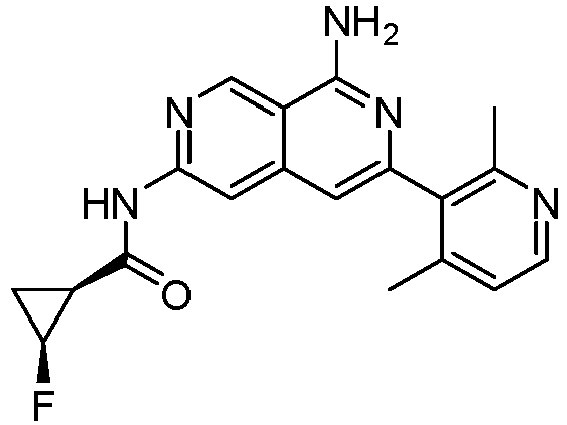
- A mixture of 2,4-dimethyl-3-(4,4,5,5-tetramethyl-1,3,2-dioxaborolan-2-yl)pyridine (100 mg, 0.43 mmol), (±)-cis-N-(8-amino-6-chloro-2,7-naphthyridin-3-yl)-2-fluoro-cyclopropanecarboxamide (120 mg, 0.43mmol), Pd(PPh3)4 (49 mg, 0.04 mmol) and K2CO3 (118 mg, 0.86 mmol) in 1,4-dioxane (10mL) containing water (1 mL) was stirred at 110°C under N2 for 5 hours. The reaction mixture was concentrated and the residue was purified by silica gel chromatographyeluting with 0-15% methanol in dichloromethane to give (±)-cis-N-[8-amino-6-(2,4-dimethyl-3-pyridyl)-2,7-naphthyridin-3-yl]-2-fluoro-cyclopropanecarboxamide (25 mg, 16.6% yield) as a white solid. LCMS (ESI): RT (min) = 1.556, [M+H]+ = 352.1, method = C; 1H NMR (400 MHz,CD3OD) δ 9.32(s, 1H), 8.32 (d, J= 5.2 Hz,1H), 8.31 (s, 1H), 7.25 (d, J = 5.2 Hz, 1H), 6.86 (s,1H), 4.98-4.80 (m,1H), 2.35(s, 3H), 2.20(s, 3H), 2.18-2.15 (m, 1H),1.87-1.79(m,1H), 1.26-1.20 (m,1H).
-

-

- To a solution of 7-bromo-1H-pyrrolo[3,2-C]pyridine (700 mg, 3.55 mmol) in DMF (7 mL) was added sodium hydride (171 mg, 4.26 mmol). The resulting mixture was stirred for 0.5 hours at 25°C. Methyl iodide (656 mg, 4.62 mmol) was added and stirred for 1 hour. The reaction mixture was quenched with water (30 mL) and extracted with ethyl acetate (30 mL x 2). The combined ethyl acetate layers were washed with water and brine, dried over Na2SO4, and concentrated in vacuo to give 7-bromo-1-methyl-pyrrolo[3,2-c]pyridine (640 mg, 81% yield) as a yellow solid. LCMS (ESI): [M+H]+ = 211.0.
-

- To a solution of 7-bromo-1-methyl-pyrrolo[3,2-c]pyridine (640 mg, 3.03 mmol) in THF (15 mL) was added n-BuLi (2.5 M in hexane) (1.8mL, 4.55mmol) at -78°C. The resulting mixture was stirred for 0.5 hour. Tri-isopropyl borate (855 mg, 4.55 mmol) was added and the reaction was slowly warmed to room temperature. The reaction mixture was quenched with water. The THF was removed in vacuo. The mixture was washed with ethyl acetate. The aqueous phase was adjusted to pH=5 with 1M HCl and filtered. The wet cake was washed with water and ethyl acetate and dried in vacuo to give (1-methylpyrrolo[3,2-c]pyridin-7-yl)boronic acid (520 mg, 97% yield) as a beige solid. LCMS (ESI): [M+H]+ = 177.1.
-

- A mixture of (±)-cis-N-(8-amino-6-chloro-2,7-naphthyridin-3-yl)-2-fluoro-cyclopropanecarboxamide (70 mg, 0.25 mmol), (1-methylpyrrolo[3,2-c]pyridin-7-yl)boronic acid (110 mg, 0.62 mmol), XPhos Pd G2 (10 mg, 0.01 mmol), X-phos (12 mg, 0.02 mmol) and potassium acetate (73 mg, 0.75 mmol) in 1,4-dioxane (2 mL) and water (0.2 mL) was stirred for 2 hours at 100°C. The reaction mixture was diluted with ethyl acetate (10 mL) and filtered. The filtrate was concentrated and the residue was prurified by prep-TLC and reverse phase flash chromatography (ODS,acetonitrile/water +0.5% NH4HCO3, 0:1 to 1:1) to give (±)-cis-N-[8-amino-6-(1-methylpyrrolo[3,2-c]pyridin-7-yl)-2,7-naphthyridin-3-yl]-2-fluoro-cyclopropanecarboxamide (9 mg, 9.6% yield) as a yellow solid. LCMS (ESI): RT (min) = 1.58, [M+H]+ = 377.1, method = C; 1H NMR (400 MHz, CD3OD): 9.28 (s, 1H), 8.84 (s, 1H), 8.35 (s, 1H), 8.25 (d, J= 6.0 Hz, 1H), 7.55 (d, J= 6.0 Hz, 1H), 7.32 (s, 1H), 7.06 (s, 1H), 4.99-4.82 (m, 1H), 4.07 (s, 3H), 2.20-2.16 (m, 1H), 1.88-1.81 (m, 1H), 1.27-1.23 (m, 1H).
-

-

- To a stirred solution of 2-amino-4-ethylpyridine (5.0 g, 40.9 mmol) in chloroform (200 mL) was added portionwise NBS (8.7 g, 48.9 mmol) at 0°C over 15 minutes. After the reaction was complete, the mixture was directly purified by silica gel chromatography (ethyl acetate:petroleum ether = 1:5 to 1:2) to give 5-bromo-4-ethyl-pyridin-2-amine (7 g,72% yield) as a light yellow solid. LCMS (ESI): [M+H]+ = 201.1.
-

- To a solution of 5-bromo-4-ethyl-pyridin-2-amine (7.0 g, 33.8 mmol) in concentrated hydrochloric acid (70mL) at -20°C was added portionwise an aqueous solution of NaNO2 (4.8 g, 69.6 mmol) in water. After stirring for 1 hour, the reaction mixture was warmed to room temperature over a period of 3 hours. A 10 M aqueous NaOH solution (16 g of NaOH in 40 mL water) was added to adjust the pH to 12 while maintaining the temperature at 0°C. The reaction mixture was extracted with dichloromethane (3 x 25 mL). The combined extracts were thenwashed with water, dried and concentrated to afford 5-bromo-4-ethyl-pyridin-2-ol (2.0 g, 24% yield) as a white solid. LCMS (ESI): [M+H]+ = 202.1.
-

- In a flask, K2CO3 (1.4 g, 10.1 mmol) and methyl iodide (1.1 g, 7.8 mmol) were added to a solution 5-bromo-4-ethyl-pyridin-2-ol (1.0 g, 4.9 mmol) in acetonitrile (20 mL). The reaction mixture was stirred at 25 °C overnight and then filtered. The filtrate was partitioned between H2O (15 mL) and CH2Cl2 (2 x 10 mL).The combined organic layers were dried over Na2SO4 and concentrated. The residue was purified by silica gel chromatogragphy (petroleum ether:ethyl acetate = 9:1 ) to afford 5-bromo-4-ethyl-1-methyl-pyridin-2-one (754 mg, 71% yield) as a white solid. LCMS (ESI): [M+H]+ = 216.1.
-

- A solution of 5-bromo-4-ethyl-1-methyl-pyridin-2-one (700 mg, 3.2 mmol), bis(pinacolato)diboron (2060 mg, 8.1 mmol), Pd(dppf)Cl2 (470 mg, 0.6 mmol) and potassium acetate (1270 mg, 13 mmol) in 1,4-dioxane (20 mL) was heated to 70°C for 2 hours. The mixture was then filtered and purified by silica gel chromatography (ethyl acetate: petroleum ether= 1:4) to give 4-ethyl-1-methyl-5-(4,4,5,5-tetramethyl-1,3,2-dioxaborolan-2-yl)pyridin-2-one (600 mg, 70% yield) as a white solid. LCMS (ESI): [M+H]+ = 264.1.
-

- (±)-cis-N-(8-amino-6-chloro-2,7-naphthyridin-3-yl)-2-fluoro-cyclopropanecarboxamide (100 mg, 0.4 mmol), Pd(PPh3)4 (41 mg, 0.04 mmol) and K3PO4 (151 mg, 0.7 mmol) were added sequentially to a solution of 4-ethyl-1-methyl-5-(4,4,5,5-tetramethyl-1,3,2-dioxaborolan-2-yl)pyridin-2-one (375 mg, 1.4 mmol) in 1,4-dioxane (8 mL) and water (1.5 mL). The reaction mixture was stirred at 100°C for 2 hours. The reaction mixture was concentrated in vacuo and purified on silica gel chromatography (methanol/dichloromethane, 1:9) to afford (±)-cis-N-[8-amino-6-(4-ethyl-1-methyl-6-oxo-3-pyridyl)-2,7-naphthyridin-3-yl]-2-fluoro-cyclopropanecarboxamide (6 mg, 4.4% yield) as a white solid. LCMS (ESI): RT (min) = 1.43, [M+H]+ = 382.1, method = G; 1H NMR (400 MHz, CD3OD) δ 9.16 (s, 1H), 8.19 (s, 1H), 7.65 (s, 1H), 6.84 (s, 1H), 6.40 (s, 1H), 4.88-4.67 (m, 1H), 3.50 (s, 3H), 2.64 (q, J= 7.6 Hz, 2H), 2.12-1.99 (m, 1H), 1.79-1.63 (m, 1H), 1.12-1.10 (m, 1H), 0.98 (t, J= 7.6 Hz, 3H).
-

-

- To a solution of triphosgene (108 mg, 0.36 mmol) in THF (4 mL) was added 3-(4-ethyl-3-pyridyl)-N1,N1-bis[(4-methoxyphenyl)methyl]-2,7-naphthyridine-1,6-diamine (180 mg, 0.18 mmol) and Et3N (0.5 mL, 3.56 mmol) in THF (5 mL) at 0°C. The mixture was stirred at 0°C for 1 hour. To this was added (3R)-3-amino-1-methyl-pyrrolidin-2-one (450 mg, 3.94 mmol). The mixture warmed to room temperature overnight. The mixture was directly purified by silica gel chromatography (dichloromethane/methanol, 20:1) to give 1-[8-[bis[(4-methoxyphenyl)methyl]amino]-6-(4-ethyl-3-pyridyl)-2,7-naphthyridin-3-yl]-3-[(3R)-1-methyl-2-oxo-pyrrolidin-3-yl]urea (32 mg, 28% yield) as a light yellow solid. LCMS (ESI): [M+H]+ = 646.3.
-

- A solution of 1-[8-[bis[(4-methoxyphenyl)methyl]amino]-6-(4-ethyl-3-pyridyl)-2,7-naphthyridin-3-yl]-3-[(3R)-1-methyl-2-oxo-pyrrolidin-3-yl]urea (27 mg, 0.04 mmol) in TFA (3 mL) was heated to reflux for 3 hours. The mixture was evaporated and neutralized by ammonium in methanol. The resulting residue was purified by reverse phase chromatography (acetonitrile 0-40/0.1% NH4HCO3 in water) to afford 1-[8-amino-6-(4-ethyl-3-pyridyl)-2,7-naphthyridin-3-yl]-3-[(3R)-1-methyl-2-oxo-pyrrolidin-3-yl]urea (5.5 mg, 33% yield) as a white solid. LCMS (ESI): RT (min) = 1.501, [M+H]+ = 406.2, Method = C; 1H NMR (400 MHz, CD3OD): δ 9.29 (s, 1H), 8.50 (s, 2H), 7.52 (s, 1H), 7.45 (d, J= 5.2 Hz, 1H), 6.89 (s, 1H), 4.49 (t, J = 9.2 Hz, 1H), 3.47 (dd, J = 4.0, 9.2 Hz, 2H), 2.93 (s, 3H), 2.83 (q, J = 7.6 Hz, 2H), 2.62-2.57 (m, 1H), 2.09-2.04 (m, 1H), 1.19 (t, J = 7.6 Hz, 3H).
-

-

- A solution of 5-bromo-4-ethyl-2-methoxy-pyridine (400 mg, 1.85 mmol), bis(pinacolato)diboron (940 mg, 3.7 mmol), Pd(dppf)Cl2 (270 mg, 0.37 mmol) and potassium acetate (560 mg, 5.71 mmol) in 1,4-dioxane (30 mL) was heated to 70°C for 2 hours. After the mixture was filtered and evaporated to give 4-ethyl-2-methoxy-5-(4,4,5,5-tetramethyl-1,3,2-dioxaborolan-2-yl)pyridine (400 mg, 82% yield) as a black solid, which was used directly in the next reaction. LCMS (ESI): [M+H]+ = 264.2.
-

- A solution of 4-ethyl-2-methoxy-5-(4,4,5,5-tetramethyl-1,3,2-dioxaborolan-2-yl)pyridine (380 mg, 1.44 mmol), (±)-cis-N-(8-amino-6-chloro-2,7-naphthyridin-3-yl)-2-fluoro-cyclopropanecarboxamide (100 mg, 0.36 mmol), K3PO4 (630 mg, 2.99 mmol), Pd2(dba)3 (140 mg, 0.15 mmol) and X-phos (76 mg, 0.16 mmol) in 1,4-dioxane (24 mL) and water (4 mL) was heated to 80°C for 3 hours under an Ar atmosphere. The mixture was purified by reverse phase chromatography (acetonitrile 17-47/0.05% ammonium bicarbonate) to give (1S,2S)-N-[8-amino-6-(4-ethyl-6-methoxy-3-pyridyl)-2,7-naphthyridin-3-yl]-2-fluoro-cyclopropanecarboxamide (6 mg, 1.1% yield) as a white solid. LCMS (ESI): RT (min) = 1.782, [M+H]+ = 382.1, Method = C; 1H NMR (400 MHz, CD3OD): δ 9.29 (s, 1H), 8.30 (s, 1H), 8.11 (s, 1H), 6.94 (s, 1H), 6.79 (s, 1H), 4.98-4.87 (m, 1H), 3.96 (s, 3H), 2.81 (q, J= 6.0 Hz, 2H), 2.19-2.16 (m, 1H), 1.86-1.81 (m, 1H), 1.26-1.22 (m, 1H), 1.14 (t, J= 6.0 Hz, 3H).
-

-

- A solution of 5-bromo-4-ethyl-pyridin-2-amine (500 mg, 2.49 mmol), bis(pinacolato)diboron (750 mg, 2.95 mmol), Pd(dppf)Cl2 (200 mg, 0.27 mmol) and potassium acetate (750 mg, 7.65 mmol) in 1,4-dioxane (30 mL) was heated to 120°C for 2 hours. The mixture was filtered and evaporated to give 4-ethyl-5-(4,4,5,5-tetramethyl-1,3,2-dioxaborolan-2-yl)pyridin-2-amine (500 mg, 35% yield) as a black slurry, which was used directly in the next reaction. LCMS (ESI) [M+H]+ = 249.1.
-

- A solution of 4-ethyl-5-(4,4,5,5-tetramethyl-1,3,2-dioxaborolan-2-yl)pyridin-2-amine (400 mg, 0.64 mmol), (±)-cis-N-(8-amino-6-chloro-2,7-naphthyridin-3-yl)-2-fluoro-cyclopropanecarboxamide (100 mg, 0.36 mmol), Pd(PPh3)4 (80 mg, 0.07 mmol) and K3PO4 (280 mg, 1.33 mmol) in 1,4-dioxane (24 mL) and water (4 mL) was heated to 100°C for 3 hours. The mixture was purified by silica gel chromatography (dichloromethane: methanol, 10:1) to give (1S,2S)-N-[8-amino-6-(6-amino-4-ethyl-3-pyridyl)-2,7-naphthyridin-3-yl]-2-fluoro-cyclopropanecarboxamide (30 mg, 13% yield) as a white solid. LCMS (ESI): RT (min) = 1.476, [M+H]+ = 367.2, Method = G; 1H NMR (400 MHz, CD3OD): δ 9.26 (s, 1H), 8.28 (s, 1H), 7.90 (s, 1H), 6.90 (s, 1H), 6.57 (s, 1H), 5.00-4.79 (m, 1H), 2.74 (q, J= 7.6 Hz, 2H), 2.19-2.13 (m, 1H), 1.88-1.80 (m, 1H), 1.29-1.19 (m, 1H), 1.11 (t, J= 7.6 Hz, 3H).
-

-

- Oxalyl chloride (0.2 mL, 2.35 mmol) was added dropwise to a suspension of 2-nitrocyclopropanecarboxylic acid (200 mg, 1.53 mmol) and DMF (20 mg, 0.27 mmol) in dichloromethane (4 mL) at 25°C and the mixture was stirred at 25°C for 1 hour. The reaction mixture turned from a suspension to a solution. The mixture was concentrated at room temperature to remove the excess oxalyl chloride. The residue was dissolved in dichloromethane (1 mL) andadded dropwise to a solution of 3-(4-ethyl-3-pyridyl)-N1,N1-bis[(4-methoxyphenyl)methyl]-2,7-naphthyridine-1,6-diamine (800 mg, 1.58 mmol) and triethylamine (700 mg, 6.93 mmol) in dichloromethane (8 mL) at 0°C and stirred at 0°C for 1 hour. The reaction mixture was evaporated and the resulting residue purified by silica gel chromatography (petroleum ether/ethyl acetate = 1:1 to 1:2, Rf = 0.8 at petroleum ether/ethyl acetate 1/2) to give N-[8-[bis[(4-methoxyphenyl)methyl]amino]-6-(4-ethyl-3-pyridyl)-2,7-naphthyridin-3-yl]-2-nitro-cyclopropanecarboxamide (240 mg, 25% yield) as brown solid. LCMS (ESI) [M+H]+ = 619.2.
-

- A mixture of N-[8-[bis[(4-methoxyphenyl)methyl]amino]-6-(4-ethyl-3-pyridyl)-2,7-naphthyridin-3-yl]-2-nitro-cyclopropanecarboxamide (230 mg, 0.37 mmol) and iron (400 mg, 7.14 mmol) in acetic acid (5 mL) was stirred at 50°C for 1 hour. The reaction mixture was cooled to room temperature. A 5:1 mixture of ethyl acetat and /methanol (150 mL) was added. The mixture was then filtered and concentrated. To the residue was added water (20 mL), adjusted to pH 7-8 by saturated NaHCO3 and extracted with ethyl acetate (50 mL x 3). The ethyl acetate layers were combined, dried over Na2SO4, filtered and evaporated. The residue was purified with prep-TLC (petroleum ether/ethyl acetate 1/2, Rf = 0.2 at petroleum ether/ethyl acetate 1/2) to give N-[8-[bis[(4-methoxyphenyl)methyl]amino]-6-(4-ethyl-3-pyridyl)-2,7-naphthyridin-3-yl]-2-hydroxy-cyclopropanecarboxamide (45 mg, 20% yield) as a brown solid. LCMS (ESI) [M+H]+ = 590.2.
-

- A mixture of N-[8-[bis[(4-methoxyphenyl)methyl]amino]-6-(4-ethyl-3-pyridyl)-2,7-naphthyridin-3-yl]-2-hydroxy-cyclopropanecarboxamide (42 mg, 0.071 mmol) in TFA (4 mL) was stirred at 80°C for 1.5 hours and then evaporated. The residue was suspended in methanol (1 mL).A7N NH3-methanol solution was added until the pH was between 9-10. The mixture was then purified with flash chromatography (C18, methanol/water to formic acid/methanol/water) to give the formic acid salt of N-[8-amino-6-(4-ethyl-3-pyridyl)-2,7-naphthyridin-3-yl]cyclopropene-1-carboxamide (15 mg, 56% yield) as a light brown solid. LCMS (ESI): RT (min) = 1.336, [M+H]+ = 332.1, method = A; 1H NMR (400 MHz, DMSO-d 6) δ 9.42 (s, 1H), 8.52-8.48 (m, 3H), 8.4 (brs, 1H), 7.58 (dd, J= 1.6, 5.6 Hz, 1H), 7.39 (s, 2H), 7.35 (d, J = 4.8 Hz, 1H), 7.01 (s, 1H), 6.34 (dd, J = 1.6, 4.4 Hz, 1H), 4.79 (s, 2H), 2.80 (q, J= 7.6 Hz, 2H), 1.10 (t, J = 7.6 Hz, 3H).
-

-

- To a suspension of 5-methyl-1H-pyrazole-3-carboxylic acid (126 mg, 1 mmol) in anhydrous dichloromethane (5 mL) was added oxalyl chloride (0.423 mL, 5 mmol) and DMF (2 drops). The mixture was stirred at room temperature for 4.5 hour and then concentrated. The residue was azeotroped twice with dry chloroform then concentrated under vacuum to give crude acid chloride. This was dissolved in dry dichloromethane (2 mL). Half of this solution (0.5 mmol) was added to a solution of 3-(4-ethylpyridin-3-yl)-N1,N1-bis-(4-methoxybenzyl)-[2,7]naphthyridine-1,6-diamine (126 mg, 0.25 mmol) in dichloromethane (2 mL), followed by the addition of pyridine (0.1 mL, 1.24 mmol). The mixture was stirred at room temperature for 4.5 hours, then water (approx. 5 mL) was added and the phases separated. The aqueous phase was extracted with dichloromethane (3x). The combined organic extracts were dried (Na2SO4) and evaporated. The crude product was purified by silica gel chromatography ( 50-100% ethyl acetate/cyclohexane) to give the title compound (47 mg, 31% yield). LCMS (ESI): RT (min) = 1.51, [M+H]+ = 614, method = I.
-

- A solution of 5-methyl-1H-pyrazole-3-carboxylic acid [8-[bis-(4-methoxybenzyl)amino]-6-(4-ethylpyridin-3yl)-[2,7]naphyridin-3-yl]amide (47 mg, 0.077 mmol) in TFA (2 mL) was heated at 80°C for 2.5 hours, then evaporated. The residue was slurried in a 2M ammonia/methanol solution. Addition methanol was added to dissolve all material. This solution was absorbed onto a Isolute® HM-N, loaded onto a silica gel column and eluted with 0-10% methanol/dichloromethane to give the title compound (27 mg, 94% yield). LCMS (ESI): RT (min) = 2.47, [M+H]+ = 374, method = J; 1H NMR (400 MHz, DMSO-d 6) δ 13.28 (broad s, 1H), 9.65 (broad s, 1H), 9.43 (s, 1H), 8.54 (s, 1H), 8.52 (d, J= 5.1 Hz, 1H), 8.35, (s, 1H), 7.49 (broad s, 2H), 7.38 (d, J= 5.1 Hz, 1H), 7.04 (s, 1H), 6.62 (s, 1H), 2.80 (q, J = 7.2 Hz, 2H), 2.31 (s, 3H), 1.11 (t, J = 7.2 Hz, 3H).
-

-

- To a suspension of 1H-pyrazole-3-carboxylic acid (224 mg, 2 mmol) in dry dichloromethane (10 mL) was added oxalyl chloride (0.846 mL, 10 mmol) and DMF (2 drops). The mixture was stirred at room temperature for 4.5 hours and then evaporated. The residue was azeotroped twice with dry chloroform then dried under vacuum to give the crude acid chloride. To a mixture of this material (80 mg, 0.6 mmol) and 3-(4-ethylpyridin-3-yl)-N1,N1-bis-(4-methoxybenzyl)-[2,7]naphthyridine-1,6-diamine (150 mg, 0.29 mmol) in dichloromethane (2.5 mL) was added pyridine (0. 12mL, 1.44 mmol). The mixture was stirred at room temperature for 5 hour Water was then added and the phases separated. The aqueous phase was extracted three times with dichloromethane. The combined organic extracts were dried (Na2SO4) and evaporated. The crude product was chromatographed on silica gel (eluted with 50-100% ethyl acetate/cyclohexane) to give the title compound (66 mg, 38% yield). LCMS (ESI): RT (min) = 3.10, [M+H]+ = 600, method = K.
-

- A solution of 2H-pyrazole-3-carboxylic acid [8-[bis-(4-methoxybenzyl)amino-6-(4-ethylpyridin-3-yl)-[2,7]naphthyridin-3-yl]amide (66 mg, 0.11 mmol) in TFA (2 mL) was heated at 80°C for 3.5 hours, then evaporated. The residue was slurried in a 2M solution of ammonia/methanol. Additional dichloromethane and methanol was added to dissolve all material. This solution was evaporated onto Isolute® HM-N, loaded onto a silica gel column and eluted with 0-10% methanol/dichloromethane. The product obtained was triturated with water and the solid was filtered off, washed with water and dried (vacuum, 60°C) to give the title compound (17 mg, 43% yield). LCMS (ESI): RT (min) = 2.28, [M+H]+ = 360, method = J; 1H NMR (400 MHz, DMSO-d 6) δ 10.05 (broad, s, 1H), 9.59 (s, 1H), 8.65 (m,2H), 8.47, (s, 1H), 8.31 (broad, s,1H), 7.94 (s, 1H), 7.58 (d, J= 5.2 Hz, 1H), 7.25 (s, 1H), 6.96 (s, 1H), 2.80 (q, J = 7.2 Hz, 2H), 1.16 (t, J = 7.2 Hz, 3H).
-
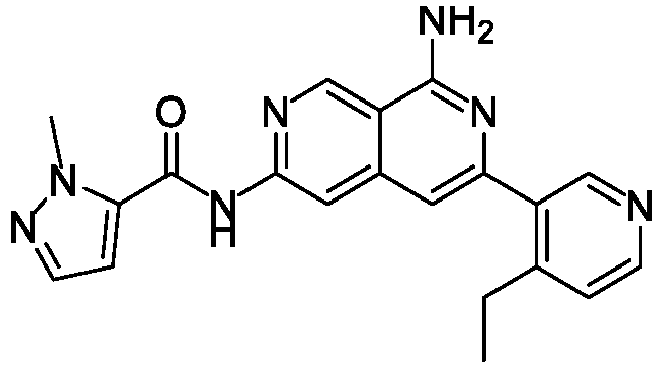
-

- To a suspension of 2-methyl-1H-pyrazole-3-carboxylic acid (126 mg, 1 mmol) in dry dichloromethane (5 mL) was added oxalyl chloride (0.423 mL, 5 mmol) and DMF (2 drops). The mixture was stirred at room temperature for 4.5 hours andevaporated. The residue was azeotroped twice with dry chloroform then dried under vacuum to give crude acid chloride. This was dissolved in dry dichloromethane (2 mL). Half of this solution (0.5 mmol) was added to a solution of 3-(4-ethylpyridin-3-yl)-N1,N1-bis-(4-methoxybenzyl)-[2,7]naphthyridine-1,6-diamine (126 mg, 0.25 mmol) in dichloromethane (2 mL), followed by pyridine (0.1 mL, 1.24 mmol). The mixture was stirred at room temperature for 4.5 hours, then water (approx. 5 mL) was added and the phases separated. The aqueous phase was extracted with dichloromethane (3x). The combined organic fractions were dried (Na2SO4) and evaporated. The crude product was chromatographed on silica gel eluted with 50-100% ethyl acetate/cyclohexane to give the title compound (61 mg, 40% yield). LCMS (ESI): RT (min) = 3.26, [M+H]+ = 614, method = K.
-

- A solution of 2-methyl-1H-pyrazole-3-carboxylic acid [8-[bis-(4-methoxybenzyl)amino]-6-(4-ethylpyridin-3yl)-[2,7]naphyridin-3-yl]amide (61 mg, 0.1 mmol) in TFA (2 mL) was heated at 80°C for 2.5 hours, then evaporated. The residue was slurried with 2M ammonia/methanol. Additional methanol was added to dissolve all material. This solution was evaporated onto Isolute® HM-N, loaded onto a silica gel column and eluted with 0-7% methanol/dichloromethane to give the title compound (35 mg, 94% yield). LCMS (ESI): RT (min) = 2.44, [M+H]+ = 374, method = J; 1H NMR (400 MHz, DMSO-d 6) δ 11.06 (s, 1H), 9.52 (s, 1H), 8.56 (s, 1H), 8.55 (d, J= 5.4 Hz, 1H), 8.42 (s, 1H), 7.69 (broad s, 2H), 7.55 (d, J = 2.1 Hz, 1H), 7.43 (d, J = 5.4 Hz, 1H), 7.38 (d, J= 2.1 Hz, 1H), 7.10 (s,1H), 4.14 (s, 3H), 2.81 (q, J= 7.5 Hz, 2H), 1.13 (t, J= 7.5 Hz, 3H).
-

-

- To a suspension of 1-methyl-1H-pyrazole-4-carboxylic acid (126 mg, 1 mmol) in dry dichloromethane (3 mL) was added oxalyl chloride (0.43 mL, 5 mmol) and DMF (2 drops). The mixture was stirred at room temperature for 16 hours and then evaporated. The residue was azeotroped twice with toluene to give crude acid chloride. This was dissolved in dry dichloromethane (1 mL). Half of this solution (0.5 mmol) was added to a solution of 3-(4-ethylpyridin-3-yl)-N1,N1-bis-(4-methoxybenzyl)-[2,7]naphthyridine-1,6-diamine (100 mg, 0.20 mmol) in dichloromethane (2 mL), followed by pyridine (0.1 mL, 1.24 mmol). The mixture was stirred at room temperature for 1 hour and thenevaporated. The residue was re-dissolved in dichloromethane and washed with water. The organic phase was dried (PTFE cartridge) and evaporated. The crude product was chromatographed on silica gel (eluted with 0-100% ethyl acetate/dichloromethane) to give the title compound (100 mg, 80% yield). LCMS (ESI): RT (min) = 1.57, [M+H]+ = 614, method = I.
-

- A solution of 1-methyl-1H-pyrazole-4-carboxylic acid [8-bis-(4-methoxybenzyl)amino-6-(4-ethylpyridin-3-yl)-[2,7]naphthyridin-3-yl]amide (98 mg, 0.155 mmol) in TFA (3 mL) was heated at 80°C for 1 hour, then evaporated. The residue was taken up in 2M ammonia/methanol. The mixture was then evaporated. The residue was dissolved in hot chloroform/methanol and the solution was evaporated onto Isolute® HM-N, loaded onto a silica column and eluted with 0-10% methanol/dichloromethane to give the title compound which was recrystallized from ethyl acetate. LCMS (ESI): RT (min) = 2.21, [M+H]+ = 374, method = J; 1H NMR (400 MHz, DMSO-d 6) δ 10.64 (s, 1H), 9.43 (s, 1H), 8.51 (s, 1H), 8.49 (d, J= 5.1 Hz, 1H), 8.47 (s, 1H), 8.36 (s, 1H), 8.18 (s, 1H), 7.35 (d, J= 5.1 Hz, 1H), 7.33 (broad, 2H), 6.97 (s, 1H), 3.90 (s, 3H), 2.80 (q, J= 7.3 Hz, 2H), 1.11 (t, J= 7.3 Hz, 3H).
-

-

- A mixture of 3-(4-ethylpyridin-3-yl)-N1,N1-bis-(4-methoxybenzyl)-[2,7]naphthyridine-1,6-diamine (126 mg, 0.25 mmol), 4-bromo-1-methyl-1H-pyrazole (56 mg, 0.35 mmol), 2-(di-tert-butylphosphino)-2',4',6'-triisopropyl-3,6-dimethoxybiphenyl (3.5 mg, 0.007 mmol) and t-BuBrettPhos Palladacycle Gen. 3 (6 mg, 0.007 mmol) in dry THF (3 mL) was purged with argon. Lithium bis(trimethylsilyl)amide (1 M in toluene, 0.77 mL, 0.77 mmol) was added and the mixture was heated at 80°C for 18 hours. Further quantities of 4-bromo-1-methyl-1H-pyrazole (56 mg), 2-(di-tert-butylphosphino)-2',4',6'-triisopropyl-3,6-dimethoxybiphenyl (7 mg) and t-BuBrettPhos Palladacycle Gen. 3 (12 mg) were added and heating continued for 24 hours. The cooled mixture was diluted with water and extracted with ethyl acetate three times. The extracts were dried (Na2SO4) and evaporated. The crude product was chromatographed on silica eluted with 50-100% ethyl acetate/cyclohexane to give the title compound (27 mg, 18% yield). LCMS (ESI): RT (min) = 2.88, [M+H]+ = 586, method = K.
-

- A solution of 3-(4-ethylpyridin-3-yl)-N1,N1-bis-(4-methoxybenzyl)-N6-(1-methyl-1H-pyrazol-4-yl)-[2,7]naphthyridine-1,6-diamine (27 mg, 0.046 mmol) in TFA (1.5 mL) was heated at 80°C for 4 hours, then evaporated. The residue was loaded onto a 2 g SCX-2 cartridge and eluted with methanol, then with 2M ammonia in methanol. Ammoniacal fractions were evaporated to give the title compound (14 mg, 88% yield). LCMS (ESI): RT (min) = 2.10, [M+H]+ = 346, method = J; 1H NMR (400 MHz, DMSO-d 6) δ 9.21 (s, 1H), 8.84 (s, 1H), 8.46 (s, 1H & d, J= 5.0 Hz, 1H), 7.87 (s, 1H), 7.45 (s, 1H), 7.32 (d, J= 5.0Hz, 1H), 7.07 (broad, 2H), 6.72 (s, 1H), 6.62 (s, 1H), 3.83 (s, 3H), 2.78 (q, J = 7.1 Hz, 2H), 1.10 (t, J = 7.1 Hz, 3H).
-

-

- A mixture of 3-(4-ethylpyridin-3-yl)-N1,N1-bis-(4-methoxybenzyl)-[2,7]naphthyridine-1,6-diamine (126 mg, 0.25 mmol), 4-bromo-1H-pyrazole (74 mg, 0.50 mmol), 2-(di-tert-butylphosphino)-2',4',6'-triisopropyl-3,6-dimethoxybiphenyl (12 mg, 0.025 mmol) and t-BuBrettPhos Palladacycle Gen. 3 (21 mg, 0.025 mmol) in dry 1,4-dioxane (3 mL) was purged with argon. Lithium bis(trimethylsilyl)amide (1 M in toluene, 1.0 mL, 1.0 mmol) was added and the mixture was heated at 100°C for 16 hours. The cooled mixture was diluted with water and extracted with ethyl acetate three times. The extracts were dried (Na2SO4) and evaporated. The crude product was chromatographed on silica (eluted with 0-5% methanol/ethyl acetate) to give the title compound (63 mg, 44% yield). LCMS (ESI): RT (min) = 2.72, [M+H]+ = 572, method = K.
-

- A solution of 3-(4-ethylpyridin-3-yl)-N1,N1-bis-(4-methoxybenzyl)-N6-(1H-pyrazol-4-yl)-[2,7]naphthyridine-1,6-diamine (63 mg, 0.11 mmol) in TFA (2 mL) was heated at 80°C for 3 hours, then evaporated. The residue was slurried with 2M ammonia in methanol. Additional methanol was added to dissolve all solid. The solution was evaporated onto Isolute® HM-N, loaded onto a silica column and eluted with 0-10% methanol/dichloromethane to give a solid which was triturated with water, filtered off and dried (vacuum, 50°C) to give the title compound (23 mg, 63% yield). LCMS (ESI): RT (min) = 1.92, [M+H]+ = 332, method = J; 1H NMR (400 MHz, DMSO-d 6) δ 12.83 (v. broad, 1H), 9.66 (broad, 1H), 9.47 (s, 1H), 8.65 (d, J= 5.3 Hz, 1H), 8.58 (s, 1H), 7.79 (broad, 2H), 7.50 (d, J= 5.3Hz, 1H), 6.99 (s, 1H), 6.78 (s, 1H), 2.68 (q, J = 7.4 Hz, 2H), 1.14 (t, J = 7.4 Hz, 3H).
-

-

- A mixture of 3-(4-ethylpyridin-3-yl)-N1,N1-bis-(4-methoxybenzyl)-[2,7]naphthyridine-1,6-diamine (126 mg, 0.25 mmol), 3-bromo-1-methyl-1H-pyrazole (81 mg, 0.50 mmol), 2-(di-tert-butylphosphino)-2',4',6'-triisopropyl-3,6-dimethoxybiphenyl (12 mg, 0.025 mmol) and t-BuBrettPhos Palladacycle Gen. 3 (21 mg, 0.025 mmol) in dry 1,4-dioxane (3 mL) was purged with argon. Lithium bis(trimethylsilyl)amide (1 M in toluene, 1.0 mL, 1.0 mmol) was added and the mixture was heated at 100°C for 16 hours. The cooled mixture was diluted with water and extracted with ethyl acetate three times. The extracts were dried (Na2SO4) and evaporated. The crude product was chromatographed on silica (eluted with 0-5% methanol/ethyl acetate) to give the title compound (60 mg, 41% yield). LCMS (ESI): RT (min) = 2.94, [M+H]+ = 586, method = K.
-

- A solution of 3-(4-ethylpyridin-3-yl)-N1,N1-bis-(4-methoxybenzyl)-N6-(1-methyl-1H-pyrazol-3-yl)-[2,7]naphthyridine-1,6-diamine (60 mg, 0.10 mmol) in TFA (2 mL) was heated at 80°C for 4.25 hours, then evaporated. The residue was loaded onto a 2 g SCX-2 cartridge and eluted with methanol, then with 2M ammonia in methanol. Ammoniacal fractions were evaporated to give the title compound (23 mg, 67% yield). LCMS (ESI): RT (min) = 2.24, [M+H]+ = 346, method = J; 1H NMR (400 MHz, DMSO-d 6) δ 9.37 (s, 1H), 9.22 (s, 1H), 8.48 (s, 1H), 8.47 (d, J = 5.1 Hz, 1H), 7.55 (d, J = 2.1 Hz, 1H), 7.49 (s, 1H), 7.32 (d, J= 5.1Hz, 1H), 7.07 (broad, 2H), 6.74 (s, 1H), 6.10 (d, J= 2.1 Hz, 1H), 3.80 (s, 3H), 2.79 (q, J= 7.0 Hz, 2H), 1.10 (t, J = 7.0 Hz, 3H).
-

-

- A mixture of 3-(4-ethylpyridin-3-yl)-N1,N1-bis-(4-methoxybenzyl)-[2,7]naphthyridine-1,6-diamine (140 mg, 0.28 mmol), 3-bromo-1-methyl-1H-pyrazole (82 mg, 0.56 mmol), 2-(di-tert-butylphosphino)-2',4',6'-triisopropyl-3,6-dimethoxybiphenyl (13 mg, 0.028 mmol) and t-BuBrettPhos Palladacycle Gen. 3 (24 mg, 0.028 mmol) in dry dioxane (3 mL) was purged with argon. Lithium bis(trimethylsilyl)amide (1 M in toluene, 1.16 mL, 1.16 mmol) was added and the mixture was heated at 100°C for 16 hours. Further portions of 3-bromo-1-methyl-1H-pyrazole (82 mg, 0.56 mmol) and lithium bis(trimethylsilyl)amide (1.16 mL, 1.16 mmol) were added and the mixture was heated at 100°C for 22 hours. The cooled mixture was diluted with water and the phases separated. The aqueous phase was extracted with ethyl acetate three times. The organic fractions were dried (Na2SO4) and evaporated. The crude product was chromatographed on silica (eluted with 0-5% methanol/ethyl acetate) to give a slightly impure product which was purified by mass-directed HPLC (C18 column, 10-95% acetonitrile/water + 0.1% formic acid) to give the title compound (44 mg, 28% yield). LCMS (ESI): RT (min) = 1.57, [M+H]+ = 572, method = I.
-

- A solution of 3-(4-ethylpyridin-3-yl)-N1,N1-bis-(4-methoxybenzyl)-N6-(1H-pyrazol-3-yl)-[2,7]naphthyridine-1,6-diamine (44 mg, 0.077 mmol) in TFA (0.5 mL) was heated at 80°C for 1 hour. The cooled mixture, diluted with methanol and dichloromethane, was loaded onto a 2 g SCX-2 cartridge and eluted with methanol, then with 2M ammonia in methanol. Ammonia fractions were evaporated and the residue was triturated with diethyl ether to give the title compound (20 mg, 80% yield). LCMS (ESI): RT (min) = 2.09, [M+H]+ = 332, method = J; 1H NMR (400 MHz, DMSO-d 6) δ 12.17 (broad, 1H), 9.40 (s, 1H), 9.23 (s, 1H), 8.49 (s, 1H), 8.47 (d, J= 5.2 Hz, 1H), 7.61 (broad, 2H), 7.33 (d, J= 5.2 Hz, 1H), 7.10 (broad s, 2H), 6.74 (s, 1H), 6.12 (d, J = 2.1 Hz, 1H), 2.79 (q, J = 7.5 Hz, 2H), 1.10 (t, J= 7.5 Hz, 3H).
-

-

- A mixture of 3-(4-ethylpyridin-3-yl)-N1,N1-bis-(4-methoxybenzyl)-[2,7]naphthyridine-1,6-diamine (150 mg, 0.29 mmol), 4-(4-bromopyrazol-1-yl)piperidine-1-carboxylic acid tert-butyl ester (195 mg, 0.59 mmol), 2-(di-tert-butylphosphino)-2',4',6'-triisopropyl-3,6-dimethoxybiphenyl (14 mg, 0.029 mmol) and t-BuBrettPhos Palladacycle Gen. 3 (24 mg, 0.029 mmol) in dry 1,4-dioxane (3 mL) was purged with argon. Lithium bis(trimethylsilyl)amide (1 M in toluene, 1.16 mL, 1.16 mmol) was added and the mixture was heated at 100°C for 5.5 hours. The cooled mixture was diluted with water and extracted with ethyl acetate three times. The extracts were dried (Na2SO4) and evaporated. The crude product was chromatographed on silica eluted with 0-100% ethyl acetate/cyclohexane to give the title compound (89 mg, 41% yield). LCMS (ESI): RT (min) = 3.50, [M+H]+ = 755, method = K.
-

- A solution of 4-{4-[8-[bis-(4-methoxybenzyl)amino]-6-(4-ethylpyridin-3-yl)-[2,7]naphthyridin-3-ylamino]pyrazol-1-yl}piperidine-1-carboxylic acid tert-butyl ester (89 mg, 0.118 mmol) in TFA (2 mL) was heated at 80°C for 4 hours, then evaporated. The residue was loaded onto a 2g SCX-2 cartridge and eluted with methanol, then with 2M ammonia in methanol. Ammonia fractions were evaporated to give the title compound (43 mg, 88% yield). LCMS (ESI): RT (min) = 1.72, [M+H]+ = 415, method = J; 1H NMR (400 MHz, DMSO-d 6) δ 9.21 (s, 1H), 8.87 & 8.82 (2x s*, 1H), 8.46 (m, 2H), 7.94 & 7.93 (2x s*, 1H), 7.52 & 7.49 (2x s*, 1H), 7.32 (d, J = 5.1Hz, 1H), 7.06 (broad, 2H), 6.72 (s, 1H), 6.64 (s, 1H), 4.32 & 4.13 (2x m*, 1H), 3.23 & 3.10 (2x m*, 2H), 2.84 (m, 2H), 2.79 (q, J= 7.5 Hz, 2H), 2.08 (m, 2H), 1.97 (m, 2H) 1.09 (t, J= 7.5 Hz, 3H). * = major & minor conformers.
-

-

- Triethylamine (0.21 mL, 1.50 mmol) was added to a mixture of 4-bromo-1H-pyrazole (200 mg, 1.36 mmol) and cyclopropanesulfonyl chloride (0.15 mL, 1.50 mmol) in dry dichloromethane (2 mL). The mixture was stirred at room temperature for 19 hours, then further portions of cyclopropanesulfonyl chloride (0.075 mL) and triethylamine (0.105 mL) were added and stirring was continued for 6.5 hours. Water was added and the phases were separated. The aqueous phase was extracted twice with dichloromethane. Organic fractions were dried (Na2SO4) and evaporated, and the crude product was chromatographed on silica gel (eluted with 0-20% ethyl acetate/cyclohexane) to give the title compound (226 mg, 66% yield). LCMS (ESI): RT (min) = 2.79, [M+H]+ = 251/253, method = K.
-

- A mixture of 3-(4-ethylpyridin-3-yl)-N1,N1-bis-(4-methoxybenzyl)-[2,7]naphthyridine-1,6-diamine (150 mg, 0.29 mmol), 4-bromo-1-cyclopropanesulfonyl-1H-pyrazole (149 mg, 0.59 mmol), 2-(di-tert-butylphosphino)-2',4',6'-triisopropyl-3,6-dimethoxybiphenyl (14 mg, 0.029 mmol) and t-BuBrettPhos Palladacycle Gen. 3 (24 mg, 0.029 mmol) in dry dioxane (3 mL) was purged with argon. Lithium bis(trimethylsilyl)amide (1 M in toluene, 1.16 mL, 1.16 mmol) was added and the mixture was heated at 100°C for 17.5 hours. The cooled mixture was diluted with water and extracted with ethyl acetate five times. The extracts were dried (Na2SO4) and evaporated. The crude product was chromatographed on silica gel (eluted with 50-100% ethyl acetate/cyclohexane) to give the title compound (45 mg, 25% yield). LCMS (ESI): RT (min) = 2.75, [M+H]+ = 572, method = K.
-

- A solution of cyclopropanesulfonic acid [8-[bis-(4-methoxybenzyl)amino-6-(4-ethylpyridin-3-yl)-[2,7]naphthyridin-3-yl]amide (45 mg, 0.074 mmol) in TFA (2 mL) was heated at 80°C for 4 hours, then evaporated. The residue was slurried with 2M ammonia in methanol, then methanol and dichloromethane added to dissolve all solid. The solution was evaporated onto Isolute® HM-N, loaded onto a silica column and eluted with 0-10% methanol/dichloromethane to give the title compound (26 mg, 95% yield). LCMS (ESI): RT (min) = 2.23, [M+H]+ = 370, method = J; 1H NMR (400 MHz, DMSO-d 6) δ 10.84 (broad s, 1H), 9.38 (s, 1H), 8.52 (s, 1H & d, J = 5.1 Hz, 1H), 7.58 (broad, 2H), 7.38 (d, J = 5.1 Hz, 1H), 7.23 (s, 1H), 6.97 (s, 1H), 3.08 (m, 1H), 2.78 (q, J= 7.2 Hz, 2H), 1.10 (m, 5H), 1.03 (m, 2H).
-

-

- A mixture of 3-(4-ethylpyridin-3-yl)-N1,N1-bis-(4-methoxybenzyl)-[2,7]naphthyridine-1,6-diamine (150 mg, 0.29 mmol), 4-chloro-6-methylpyimidine (58 mg, 0.45 mmol), tris(dibenzylideneacetone)dipalladium(0) (13 mg, 0.015 mmol), X-Phos (15 mg, 0.03 mmol) and cesium carbonate (189 mg, 0.58 mmol) in dry 1,4-dioxane (2 mL) was purged with argon and heated at 120°C for 18 hours. The cooled mixture was diluted with water and extracted with ethyl acetate five times. The organic extracts were dried (Na2SO4) and evaporated. The crude product was purified by mass-directed HPLC (C18 column, 10-95% acetonitrile/water + 0.1% ammonia) to give the title compound (40 mg, 23% yield). LCMS (ESI): RT (min) = 2.64, [M+H]+ = 598, method = K.
-

- A solution of 3-(4-ethylpyridin-3-yl)-N1,N1-bis-(4-methoxybenzyl)-N6-(6-methylpyrimidin-4-yl)-[2,7]naphthyridine-1,6-diamine (40 mg, 0.067 mmol) in TFA (2 mL) was heated at 80°C for 4.5 hours, then evaporated. The residue was loaded onto a 2 g SCX-2 cartridge and eluted with methanol, then with 2M ammonia in methanol. Ammonia fractions were evaporated to give the title compound (25 mg, 100% yield). LCMS (ESI): RT (min) = 1.86, [M+H]+ = 358, method = J; 1H NMR (400 MHz, DMSO-d 6) δ 10.33 (s, 1H), 9.39 (s, 1H), 8.65 (s, 1H), 8.51 (s, 1H), 8.49 ( d, J= 5.1 Hz, 1H), 8.19 (s, 1H), 7.35 (d, J= 5.1 Hz, 1H), 7.31 (broad, 2H), 7.28 (s, 1H), 6.92 (s, 1H), 2.80 (q, J = 7.5 Hz, 2H), 2.36 (s, 3H), 1.10 (t, 3H).
-

-

- To a solution of 2-chloroisonicotinic acid (0.29 g, 1.85 mmol) in DMF (15 mL) was added O-(7-azabenzotriazol-1-yl)-N,N,N'N'-tetramethyluronium hexafluorophosphate (1.06 g, 2.78 mmol), N-ethylmethylamine (0.24 mL, 2.78 mmol), and N,N-diisopropylethylamine (1,25 mL, 7.4 mmol). The mixture was stirred at room temperature for 18 hours, then diluted with water and extracted with ethyl acetate four times. The extracts were washed with water and brine, dried (Na2SO4) and evaporated. The crude product was chromatographed on silica eluted with 0-50% ethyl acetate/cyclohexane to give the title compound (273 mg, 75% yield). LCMS (ESI): RT (min) = 1.99, [M+H]+ = 199, method = K.
-
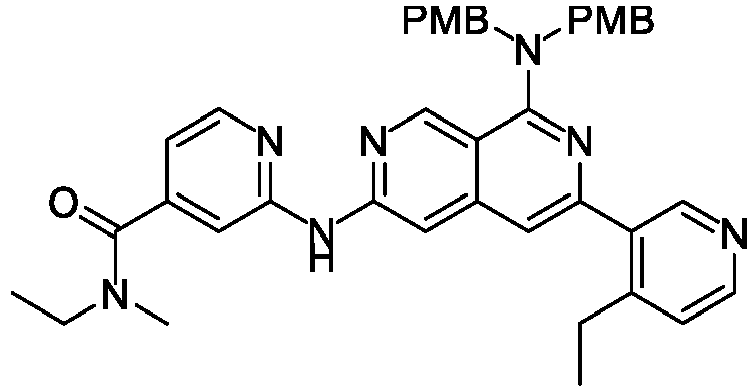
- A mixture of 3-(4-ethylpyridin-3-yl)-N1,N1-bis-(4-methoxybenzyl)-[2,7]naphthyridine-1,6-diamine (150 mg, 0.29 mmol), 2-chloro-N-ethyl-N-methylisonicotinamide (115 mg, 0.58 mmol), tris(dibenzylideneacetone)dipalladium(0) (13 mg, 0.015 mmol), X-Phos (15 mg, 0.03 mmol) and cesium carbonate (189 mg, 0.58 mmol) in dry dioxane (2 mL) was purged with Argon and heated at 120°C for 18 hours. The cooled mixture was diluted with water and extracted with ethyl acetate three times. The organic extracts were dried (Na2SO4) and evaporated. Crude product was chromatographed on silica (eluted with 50-100% ethyl acetate/cyclohexane) to give the title compound (85 mg, 44% yield). LCMS (ESI): RT (min) = 2.67, [M+H]+ = 668, method = K.
-

- A solution of 2-[8-[bis-(4-methoxybenzyl)amino]-6-(4-ethylpyridin-3-yl)-[2,7]naphthyridin-3-ylamino]-N-ethyl-N-methylisonicotinamide (85 mg, 0.13 mmol) in TFA (2 mL) was heated at 80°C for 4 hours, then evaporated. The residue was loaded onto a 2 g SCX-2 cartridge and eluted with methanol, then with 2M ammonia in methanol. Ammonia fractions were evaporated and the residue was chromatographed on silica (eluted with 0-7% methanol/dichloromethane) to give the title compound (46 mg, 83% yield). LCMS (ESI): RT (min) = 2.30, [M+H]+ = 428, method = J; 1H NMR (400 MHz, DMSO-d 6, 80°C) δ 9.73 (broad s, 1H), 9.32 (s, 1H), 8.50 (s, 1H), 8.46 (d, J = 5.5 Hz, 1H), 8.31 (d, J= 5.0 Hz, 1H), 8.07 (s, 1H), 7.43 (s, 1H), 7.29 (d, J= 5.5 Hz, 1H), 6.91 (broad, 2H), 6.84 (s, 1H), 6.82 (d, J= 5.1 Hz, 1H), 3.34 (broad, 2H), 2.93 (s, 3H), 2.80 (q, J = 7.5 Hz, 2H), 1.12 (m, 6H).
-

-

- To a solution of 2-chloropyridine-4-carbaldehyde (0.71 g, 5.06 mmol) in anhydrous THF (16 mL) was added a solution of lanthanum(III) chloride bis(lithium chloride) complex (0.6M in THF, 16.7 mL, 10.03 mmol) and the mixture was stirred at room temperature for 0.75 hours, then cooled to 0°C. Ethyl magnesium bromide (3M in diethyl ether, 3.34 mL, 10.03 mmol) was added dropwise over 5-10 minutes. The mixture was stirred at 0°C for 80 minutes, then quenched with aqueous ammonium chloride, diluted with water and extracted with ethyl acetate (3x). The organic extracts were dried (Na2SO4) and evaporated. The crude product was chromatographed on silica gel (eluted with 0-50% ethyl acetate/cyclohexane) to give the title compound (423 mg, 49% yield). LCMS (ESI): RT (min) = 2.14, [M+H]+ = 172, method = K. Further elution gave (2-chloropyridin-4-yl)methanol (191 mg, 26% yield). LCMS (ESI): RT (min) = 1.46, [M+H]+ = 144, method = K.
-

- A mixture of 3-(4-ethylpyridin-3-yl)-N1,N1-bis-(4-methoxybenzyl)-[2,7]naphthyridine-1,6-diamine (150 mg, 0.29 mmol), (±)-1-(2-chloropyridin-4-yl)propan-1-ol (100 mg, 0.58 mmol), tris(dibenzylideneacetone)dipalladium(0) (13 mg, 0.015 mmol), X-Phos (15 mg, 0.03 mmol) and cesium carbonate (189 mg, 0.58 mmol) in dry dioxane (2 mL) was purged with argon and heated at 120°C for 16 hours. The cooled mixture was diluted with water and extracted with ethyl acetate (5x). The organic extracts were dried (Na2SO4) and evaporated. The crude product was purified by mass-directed HPLC (C18 column, 10-95% acetonitrile/water + 0.1% formic acid) to give the title compound (68 mg, 36% yield). LCMS (ESI): RT (min) = 2.47, [M+H]+ = 641, method = K.
-

- A solution of (±)-1-{2-[8-[bis-(4-methoxybenzyl)amino]-6-(4-ethylpyridin-3-yl)-[2,7]naphthyridin-3-ylamino]pyridin-4-yl}propan-1-ol (68 mg, 0.106 mmol) in TFA (2 mL) was heated at 80°C for 4.5 hours, then evaporated. The residue was loaded onto a 2 g SCX-2 cartridge and eluted with methanol, then with 2M ammonia in methanol. Ammonia fractions were evaporated and the residue was chromatographed on silica (eluted with 0-10% methanol/dichloromethane) to give the title compound (26 mg, 61% yield). LCMS (ESI): RT (min) = 2.04, [M+H]+ = 401, method = J; 1H NMR (400 MHz, DMSO-d 6) δ 9.94 (broad s, 1H), 9.35 (s, 1H), 8.51 (s, 1H), 8.50 (d, J= 5.1 Hz, 1H), 8.25 (s, 1H), 8.20 (d, J= 5.1 Hz, 1H), 7.35 (broad m, 4H), 6.87 (broad m, 2H), 5.33 (d, J= 4.2 Hz, 1H), 4.43 (m, 1H), 2.79 (q, J= 7.5 Hz, 2H), 1.61 (m, 2H), 1.11 (t, J= 7.5 Hz, 3H), 0.87 (t, J= 7.3 Hz, 3H)
-

-

- A mixture of 3-(4-ethylpyridin-3-yl)-N1,N1-bis-(4-methoxybenzyl)-[2,7]naphthyridine-1,6-diamine (150 mg, 0.29 mmol), (6-chloropyridin-2-yl)methanol (83 mg, 0.58 mmol), tris(dibenzylideneacetone)dipalladium(0) (13 mg, 0.015 mmol), X-Phos (15 mg, 0.03 mmol) and cesium carbonate (189 mg, 0.58 mmol) in dry dioxane (2 mL) was purged with argon and heated at 120°C for 16 hours. The cooled mixture was diluted with water and extracted with ethyl acetate four times. The organic extracts were dried (Na2SO4) and evaporated. The crude product was chromatographed on silica (eluted with 50-100% ethyl acetate/cyclohexane) to give the title compound (56 mg, 32% yield). LCMS (ESI): RT (min) = 2.36, [M+H]+ = 613, method = K.
-

- A solution of {6-[8-[bis-(4-methoxybenzyl)amino]-6-(4-ethylpyridin-3-yl)-[2,7]naphthyridin-3-ylamino]pyridin-2-yl}methanol (56 mg, 0.092 mmol) in TFA (2 mL) was heated at 80°C for 4 hours, then evaporated. The residue was loaded onto a 2 g SCX-2 cartridge and eluted with methanol, then with 2M ammonia in methanol. Ammonia fractions were evaporated and the residue was chromatographed on silica (eluted with 0-10% methanol/dichloromethane) to give the title compound (25 mg, 73% yield). LCMS (ESI): RT (min) = 1.81, [M+H]+ = 373, method = J; 1H NMR (400 MHz, DMSO-d 6) δ 9.86 (s, 1H), 9.31 (s, 1H), 8.50 (s, 1H), 8.48 (d, J = 5.1 Hz, 1H), 8.27 (s, 1H), 7.66 (t, J = 7.7 Hz, 1H), 7.34 ( d, J = 5.1 Hz, 1H), 7.25 (d, J = 7.7 Hz, 1H), 7.16 (broad, 2H), 6.97 (d, J = 5.1 Hz, 1H)), 6.86 (s, 1H), 5.34 (t, J = 6.0 Hz, 1H), 4.55 (d, J = 6.0 Hz, 2H), 2.80 (q, J = 7.5 Hz, 2H), 1.11 (t, J = 7.5 Hz, 3H).
-

-

- A mixture of ethyl 1H-pyrazole-4-carboxylate (0.20 g, 1.40 mmol) and 4-methanesulfonyloxypiperidine-1-carboxylic acid tert-butyl ester (0.36 g, 1.30 mmol) in dry DMF (5 mL) was cooled to 0°C. Sodium hydride (60% in mineral oil, 78 mg, 1.95 mmol) was added and the mixture was stirred at 0°C for 0.5 hours, then heated at 50°C for 16 hours. The cooled mixture was diluted with diethyl ether and water and the phases separated. The aqueous phase was extracted again with ether. The combined organic fractions were washed with water (4x) and brine, dried (Na2SO4) and evaporated. The crude product was chromatographed on silica (eluted with 0-40% ethyl acetate/cyclohexane) to give the title compound (0.183 g, 44% yield). LCMS (ESI): RT (min) = 3.27, [M+H]+- C4H8 - ethanol = 222, method = K.
-

- A mixture of 4-(4-ethoxycarbonylpyrazol-1-yl)piperidine-1-carboxylic acid tert-butyl ester (0.183 g, 0.57 mmol) and potassium hydroxide (0.127 g, 2.27 mmol) in methanol (2 mL) and water (0.5 mL) was stirred at room temperature for 16 hours. The solvent was removed under vacuum and the residue was treated with 5% aqueous potassium hydrogensulfate to acidify, then extracted with ethyl acetate (5x). The extracts were dried (Na2SO4) and evaporated to give the title compound (0.158 g, 94% yield). LCMS (ESI): RT (min) = 2.58, [M+H]+- C4H8 = 240, [M-H]- = 294, method = K.
-

- To a solution of 4-(4-carboxypyrazol-1-yl)piperidine-1-carboxylic acid tert-butyl ester (158 mg, 0.54 mmol) in dry dichloromethane (10 mL) was added oxalyl chloride (0.091 mL, 1.07 mmol) and DMF (2 drops). The mixture was stirred at room temperature for 3 hours. A further portion of oxalyl chloride (0.09 mL) was added and stirring continued for 2 hours. The mixture was then evaporated. The residue was azeotroped twice with dry chloroform then dried under vacuum to give crude acid chloride. A mixture of this material (0.54 mmol crude), 3-(4-ethylpyridin-3-yl)-N1,N1-bis-(4-methoxybenzyl)-[2,7]naphthyridine-1,6-diamine (150 mg, 0.29 mmol) and pyridine (0.12 mL, 1.44 mmol) in dry dichloromethane (2.5 mL) was stirred at room temperature for 22 hours, then water was added and the phases separated. The aqueous phase was extracted with dichloromethane (4x). The combined organic fractions were treated with methanol, dried (Na2SO4) and evaporated. The crude product was purified by mass-directed HPLC (C18 column, 10-95% acetonitrile/water + 0.1% formic acid) to give the title compound (34 mg, 8% yield). LCMS (ESI): RT(min) = 3.69, [M+H]+ = 783, method = K.
-

- A solution of 4-{4-[8-[bis-(4-methoxybenzyl)amino]-6-(4-ethylpyridin-3-yl)-[2,7]naphthyridin-3-ylcarbamoyl]pyrazol-1-yl}piperidine-1-carboxylic acid tert-butyl ester (34 mg, 0.043 mmol) in TFA (2 mL) was heated at 80°C for 2.5 hours, then evaporated. The residue was loaded onto a 2 g SCX-2 cartridge and eluted with methanol, then with 2M ammonia in methanol. Ammonia fractions were evaporated and the residue was triturated with dichloromethane and dried under vacuum to give the title compound (12 mg, 63% yield). LCMS (ESI): RT (min) = 1.81, [M+H]+ = 443, method = J; 1H NMR (400 MHz, DMSO-d 6) δ 10.28 (broad s, 1H), 9.40 (s, 1H), 8.55 (s, 1H), 8.51 (s, 1H), 8.47 (d, J = 5.1Hz, 1H), 8.32 (s, 1H), 8.11 (s, 1H), 7.30 (d, J = 5.1Hz, 1H), 7.04 (broad, 2H), 6.95 (s, 1H), 4.25 (m, 1H), 3.07 (m, 2H, masked by water), 2.80 (q, J = 7.5 Hz, 2H), 2.64 (m, 2H), 2.02 (m, 2H), 1.80 (m, 2H), 1.11 (t, J = 7.5 Hz, 3H).
-

-

- Sodium hydride (60% in mineral oil, 0.65 g, 16.3 mmol) was added to a solution of 4-bromo-1H-pyrazole (0.80 g, 5.44 mmol) in dry DMF (20 mL) at 0°C. The mixture was stirred at 0°C for 0.5 hours, then 2-(2-bromoethoxy)tetrahydropyran (1.71 g, 8.16 mmol) was added dropwise. The mixture was stirred at 0°C for another 1 hours, then allowed to warm to room temperature overnight. Water was added cautiously, followed by ethyl acetate and more water. The phases were separated and the aqueous phase was extracted with ethyl acetate (2x). The combined organic fractions were washed with brine, dried (Na2SO4) and evaporated. The residue was chromatographed on silica (eluted with 0-50% ethyl acetate/cyclohexane) to give the title compound (1.40 g, 94% yield). LCMS (ESI): RT (min) = 2.96, [M+H-THP]+ = 191/193, method = K.
-

- A mixture of 3-(4-ethylpyridin-3-yl)-N1,N1-bis-(4-methoxybenzyl)-[2,7]naphthyridine-1,6-diamine (160 mg, 0.32 mmol), 4-bromo-1-[2-(tetrahydropyran-2-yloxy)ethyl]-1H-pyrazole (176 mg, 0.64 mmol), 2-(di-tert-butylphosphino)-2',4',6'-triisopropyl-3,6-dimethoxybiphenyl (15 mg, 0.03 mmol) and t-BuBrettPhos Palladacycle Gen. 3 (27 mg, 0.03 mmol) in dry 1,4-dioxane (3 mL) was purged with argon. Lithium bis(trimethylsilyl)amide (1 M in toluene, 1.32 mL, 1.32 mmol) was added and the mixture was heated at 100°C for 16 hours. The cooled mixture was diluted with water and extracted with ethyl acetate (5x). The extracts were dried (Na2SO4) and evaporated. The crude product was chromatographed on silica (eluted with 0-100% ethyl acetate/cyclohexane) to give the title compound (70 mg, 31% yield). LCMS (ESI): RT (min) = 3.14, [M+H]+ = 700, method = K.
-

- A solution of 3-(4-ethylpyridin-3-yl)-N1,N1-bis-(4-methoxybenzyl)-N6-{1-[2-(tetrahydropyran-2-yloxy)ethyl]-1H-pyrazol-4-yl}-[2,7]naphthyridine-1,6-diamine (70 mg, 0.10 mmol) in TFA (2 mL) was heated at 80°C for 4 hours, then evaporated. The residue was loaded onto a 2 g SCX-2 cartridge and eluted with methanol, then with 2M ammonia in methanol. Ammonia fractions were evaporated and the residue was chromatographed on silica (eluted with 0-10% methanol/dichloromethane) to give the title compound (22 mg, 59% yield). LCMS (ESI): RT (min) = 1.93, [M+H]+ = 376, method = J; 1H NMR (400 MHz, DMSO-d 6) δ 9.21 (s, 1H), 8.84 (s, 1H), 8.46 (s, 1H & d, J = 5.1 Hz, 1H), 7.91 (s, 1H), 7.49 (s, 1H), 7.32 (d, J = 5.1Hz, 1H), 7.04 (broad, 2H), 6.71 (s, 1H), 6.63 (s, 1H), 4.89 (t, J = 5.5 Hz, 1H), 4.12 (t, J = 5.8 Hz, 2H), 3.74 (q, J = 5.8 Hz, 2H), 2.78 (q, J = 7.5 Hz, 2H), 1.09 (t, J = 7.5 Hz, 3H).
-

-

- NaBH4 (0.3 g, 7.9 mmol) was added portionwise to a solution of N-Boc-3-pyrrolidinone (1.2 g, 6.48 mmol) in methyl alcohol (15 mL). The resultant mixture was stirred at 25 °C for 1h. To the reaction mixture was added H2O (3 mL) and the mixture was concentrated. The residue was purified with silica-gel chromatography (PE:EA = 1 : 1 to EA) to give (±)-tert-butyl 3-hydroxypyrrolidine-1-carboxylate (1.1 g, 91% yield) as a colorless oil. LCMS (ESI) [M+23]+ = 210.1.
-

- DIAD (550 mg, 2.72 mmol) was added to a mixture of tert-butyl N-(6,8-dichloro-2,7-naphthyridin-3-yl)carbamate (300 mg, 0.95 mmol), (±)-tert-butyl 3-hydroxypyrrolidine-1-carboxylate (400 mg, 2.14 mmol), and PPh3 (550 mg, 2.1 mmol) in tetrahydrofuran (15 mL). The resultant mixture was stirred at 50 °C under Ar for 18h. The reaction mixture was concentrated and the residue was purified by silica-gel chromatography (PE:EA = 4:1) to give (±)-tert-butyl 3-[tert-butoxycarbonyl-(6,8-dichloro-2,7-naphthyridin-3-yl)amino]pyrrolidine-1-carboxylate (crude, 600 mg, mixed with some DIAD+2) as a yellow oil. LCMS (ESI) [M-Boc]+ = 383.1.
-

- A mixture of (±)-tert-butyl 3-[tert-butoxycarbonyl-(6,8-dichloro-2,7-naphthyridin-3-yl)amino]pyrrolidine-1-carboxylate (600 mg, crude) in ammonium hydroxide (10 mL), 1,4-dioxane (10 mL) was stirred at 90 °C in sealed tube for 3h. The reaction mixture was cooled to room temperature and evaporated. The residue was purified with silica-gel chromatography (PE:EA = 1 : 2 to 1 : 3) to give (±)-tert-butyl 3-[(8-amino-6-chloro-2,7-naphthyridin-3-yl)-tert-butoxycarbonyl-amino]pyrrolidine-1-carboxylate (310 mg, 70% yield for two steps) as a colorless oil. LCMS (ESI) [M+H]+ = 464.2.
-

- A mixture of (±)-tert-butyl 3-[(8-amino-6-chloro-2,7-naphthyridin-3-yl)-tert-butoxycarbonyl-amino]pyrrolidine-1-carboxylate (310 mg, 0.67 mmol), 4-methyl-3-(4,4,5,5-tetramethyl-1,3,2-dioxaborolan-2-yl)pyridine (170 mg, 0.78 mmol), XPhos Pd G2 (70 mg, 0.09 mmol), XPhos (70 mg, 0.15 mmol) and K2CO3 (310 mg, 2.25 mmol) in 1,4-dioxane (16 mL) and water (4 mL) was stirred at 100 °C under Ar for 2h. The reaction mixture was cooled to room temperature and diluted with ethyl acetate (100 mL) and washed with brine (30 mL). The organic layer was separated, dried over Na2SO4, filtered and evaporated. The residue was purified with silica-gel chromatography (EA to EA : MeOH = 20 : 1) to give (±)-tert-butyl 3-[[8-amino-6-(4-methyl-3-pyridyl)-2,7-naphthyridin-3-yl]-tert-butoxycarbonylamino]pyrrolidine-1-carboxylate (250 mg, 72% yield) as a brown solid. LCMS (ESI) [M+H]+ = 521.3.
-

- A mixture of (±)-tert-butyl 3-[[8-amino-6-(4-methyl-3-pyridyl)-2,7-naphthyridin-3-yl]-tert-butoxycarbonyl-amino]pyrrolidine-1-carboxylate (250 mg, 0.48 mmol) in 2,2,2-trifluoroacetic acid (4 mL), dichloromethane (12 mL) was stirred at 25 °C for 1h. The reaction mixture was evaporated. The residue was dissolved in MeOH (2 mL) and pH adjusted to 9-10 by adding 7N NH3/MeOH. The mixture was purified by flash chromatography (C18, HCOOH/ MeOH/ H2O) to give the bis-formate salt of (±)-3-(4-methyl-3-pyridyl)-N6-pyrrolidin-3-yl-2,7-naphthyridine-1,6-diamine (140 mg, 71% yield) as a yellow solid. LCMS (ESI): RT (min) = 1.34, [M+H]+ = 321.1, method = C; 1H NMR (400 MHz, CD3OD): δ 9.20 (s, 1H), 8.52 (s, 1H), 8.47 (d, J = 5.2 Hz, 1H), 8.41 (brs, 2H), 7.42 (d, J = 5.2 Hz, 1H), 6.78 (s, 1H), 6.65 (s, 1H), 4.69-4.66 (m, 1H), 3.66-3.54 (m, 2H), 3.48-3.37 (m, 2H), 2.48-2.41 (m, 1H), 2.44 (s, 3H), 2.20-2.15 (m, 1H).
-

-

- A mixture of 3-iodo-1H-pyrazole (5 g, 25.78 mmol), 3,4-dihydro-2H-pyran (10 g, 118.88 mmol), p-TsOH (900 mg, 5.23 mmol) in tetrahydrofuran (100 mL) was refluxed overnight. The reaction mixture was cooled to room temperature and washed with sat. NaHCO3 (20 mL). The organic layer was separated, dried over Na2SO4, filtered and evaporated. The residue was purified with silica-gel column chromatography (PE:EA = 20 : 1 to 10 : 1) to give 3-iodo-1-tetrahydropyran-2-yl-pyrazole (7 g, 98% yield) as a light yellow oil. LCMS (ESI) [M+Na]+ = 300.9. 1H NMR (400 MHz, CDCl3) δ 7.45 (d, J = 2.4 Hz, 1H), 6.46 (d, J = 2.4 Hz, 1H), 5.39-5.36 (m, 1H), 4.08-4.04 (m, 1H), 3.72-3.66 (m, 1H), 2.10-2.01 (m, 2H), 1.73-1.54 (m, 4H).
-

- A mixture of 3-iodo-1-tetrahydropyran-2-yl-pyrazole (6.6 g, 23.73 mmol), methyl acrylate (7.5 mL, 83.29 mmol), Pd(OAc)2 (660 mg, 2.95 mmol), tris-(o-tolyl)phosphine (2 g, 6.58 mmol), TEA (7 g, 69.31 mmol) in acetonitrile (80 mL) was refluxed vigorously under Ar at 110 oC for 2h. The reaction mixture was cooled to room temperature and evaporated. The residue was purified with silica-gel column chromatography (PE:EA = 8:1 to 6:1 to 4:1) to give methyl (E)-3-(1-tetrahydropyran-2-ylpyrazol-3-yl)prop-2-enoate (4.6 g, 82% yield) as a brown oil. LCMS (ESI) [M+H]+ = 237.1. 1H NMR (400 MHz, CDCl3) δ 7.71 (d, J = 16.0 Hz, 1H), 7.61 (d, J = 2.4 Hz, 1H), 6.55 (d, J = 2.4 Hz, 1H), 6.44 (d, J = 16.0 Hz, 1H), 5.42-5.38 (m, 1H), 4.10-4.07 (m, 1H), 3.76-3.69 (m, 1H), 2.15-2.04 (m, 2H), 1.74-1.62 (m, 4H).
-

- t-BuOK (3.87 g, 34.55 mmol) was added portionwise to a solution of trimethyl sulfoxoniumiodide (7.74 g, 35.17 mmol) in dimethyl sulfoxide (50 mL) at 25 °. The mixture was stirred at 25 °C for 0.5h. Then a solution of methyl (E)-3-(1-tetrahydropyran-2-ylpyrazol-3-yl)prop-2-enoate (3.87 g, 16.38 mmol) in dimethyl sulfoxide (10 mL) was added dropwise to the reaction mixture at 25 °C. The mixture was stirred at 25 °C for 2h. The reaction mixture was neutralized with sat. NH4Cl (150 mL) and extracted with EA (50 mL × 3). The combined EA layers were combined, dried over Na2SO4, filtered and evaporated. The residue was purified with silica-gel column chromatography (PE:EA = 4:1) to give methyl trans-2-(1-tetrahydropyran-2-ylpyrazol-3-yl)cyclopropanecarboxylate (1.1 g, 27% yield) as a light yellow oil. LCMS (ESI) [M+H]+ = 251.1.
-

- A mixture of methyl (±)-trans-2-(1-tetrahydropyran-2-ylpyrazol-3-yl)cyclopropanecarboxylate (1.07 g, 4.28 mmol) and LiOH H2O (1.07 g, 25.48 mmol) in tetrahydrofuran (20 mL) and water (20 mL) was stirred at 20 °C for 3h. The reaction mixture was evaporated to remove the organic solvent. The residue aqueous layer was acidified with conc. HCl to pH = 4 and extracted with EA (50 mL × 3). The combined EA layers were combined, dried over Na2SO4, filtered and evaporated to give crude (±)-trans-2-(1-tetrahydropyran-2-ylpyrazol-3-yl)cyclopropanecarboxylic acid (1 g, 99% yield) as a light yellow oil. LCMS (ESI) [M+Na]+ = 259.1.
-

- POCl3 (500 mg, 3.27 mmol) was added dropwise to a mixture of (±)-trans-2-(1-tetrahydropyran-2-ylpyrazol-3-yl)cyclopropanecarboxylic acid (350 mg, 1.48 mmol), 6,8-dichloro-2,7-naphthyridin-3-amine hydrochloride (250 mg, 1 mmol) and pyridine (2 mL, 24.73 mmol) in dichloromethane (40 mL) at 0 °C. The mixture was stirred at 20 °C for 1h. The reaction mixture diluted with H2O (15 mL). The organic layer was separated, dried over Na2SO4, filtered and concentrated. The residue was purified by silica-gel column chromatography (PE:EA : DCM = 4:2 : 1 to 2:2:1) to give (±)-trans-N-(6,8-dichloro-2,7-naphthyridin-3-yl)-2-(1-tetrahydropyran-2-ylpyrazol-3-yl)cyclopropanecarboxamide (340 mg, 79% yield) as a white solid. LCMS (ESI) [M+Na]+ = 454.0.
-

- A mixture of (±)-trans-N-(6,8-dichloro-2,7-naphthyridin-3-yl)-2-(1-tetrahydropyran-2-ylpyrazol-3-yl)cyclopropanecarboxamide (340 mg, 0.79 mmol) and ammonium hydroxide (10 mL) in 1,4-dioxane (10 mL) was stirred at 90 °C in sealed tube for 3.5h. The reaction mixture was cooled to room temperature and evaporated to yield crude (±)-trans-N-(8-amino-6-chloro-2,7-naphthyridin-3-yl)-2-(1-tetrahydropyran-2-ylpyrazol-3 - yl)cyclopropanecarboxamide (320 mg, 99% yield) as a light yellow solid. The crude product was used directly in next step. LCMS (ESI) [M+H]+ = 413.1.
-

- A mixture of (±)-trans-N-(8-amino-6-chloro-2,7-naphthyridin-3-yl)-2-(1-tetrahydropyran-2-ylpyrazol-3-yl)cyclopropanecarboxamide (320 mg, 0.78 mmol), 4-methyl-3-(4,4,5,5-tetramethyl-1,3,2-dioxaborolan-2-yl)pyridine (200 mg, 0.91 mmol), XPhos Pd G2 (50 mg, 0.06 mmol), XPhos (60 mg, 0.13 mmol) and K2CO3 (350 mg, 2.54 mmol) in 1,4-dioxane (16 mL), water (4 mL) was stirred under Ar at 100 °C for 2 h. The reaction mixture was cooled to room temperature and diluted with EA (50 mL). The mixture was washed with brine (20 mL), dried over Na2SO4, filtered and evaporated. The residue was purified by silica-gel column chromatography (EA to EA : MeOH = 10:1) to give (±)-trans-N-[8-amino-6-(4-methyl-3 -pyridyl)-2, 7-naphthyridin-3-yl]-2-(1-tetrahydropyran-2-ylpyrazol-3 - yl)cyclopropanecarboxamide (340 mg, 93% yield) as a brown solid. LCMS (ESI) [M+H]+ = 470.2.
-

- A mixture of (±)-trans-N-[8-amino-6-(4-methyl-3-pyridyl)-2,7-naphthyridin-3-yl]-2-(1-tetrahydropyran-2-ylpyrazol-3-yl)cyclopropanecarboxamide (340 mg, 0.72 mmol) and 2,2,2-trifluoroacetic acid (2 mL) in dichloromethane (10 mL) was stirred at 20 °C for 3h. The reaction mixture was concentrated. The residue was re-dissolved in MeOH (3 mL). A 7N NH3 inMeOH solution was added until pH = 9-10. The mixture was purified with flash chromatography (C18, NH4HCO3/ MeOH/ H2O) to give (±)-trans-N-[8-amino-6-(4-methyl-3-pyridyl)-2,7-naphthyridin-3-yl]-2-(1H-pyrazol-3-yl)cyclopropane carboxamide (110 mg, 39% yield) as a light yellow solid. LCMS (ESI): RT (min) = 1.54, [M+H]+ = 386.1, method = C; 1H NMR (400 MHz, CD3OD): δ 9.29 (s, 1H), 8.54 (s, 1H), 8.43 (d, J = 5.2 Hz, 1H), 8.34 (s, 1H), 7.54 (s, 1H), 7.40 (d, J = 5.2 Hz, 1H), 6.99 (s, 1H), 6.16 (d, J = 1.6 Hz, 1H), 2.62-2.57 (m, 1H), 2.46 (s, 3H), 2.31-2.27 (m, 1H), 1.67-1.62 (m, 1H), 1.46-1.41 (m, 1H).
-

-

- To a stirred solution of 4-iodopyrazole (5.0 g, 25.8 mmol) in dichloromethane (10 mL) was added TsOH H2O (0.5 g, 2.9 mmol) and 3,4-dihydro-2h-pyran (4.5 g, 53.5 mmol). The resulting mixture was stirred at room temperature for 2 h. The reaction mixture was concentrated in vacuo. The residue was purified by silica gel column eluted ethyl acetate/petroleum ether (1:3) to afford desired product 4-iodo-1-tetrahydropyran-2-yl-pyrazole (7 g, 93 % yield) as a colorless oil. LCMS (ESI): [M-84+H]+ = 195.1.
-

- A solution of 4-iodo-1-tetrahydropyran-2-yl-pyrazole (6.7 g, 24.1 mmol), methyl acrylate (7.0g, 81.3 mmol), TEA (4 mL, 28.8 mmol), Pd(OAc)2 (550 mg, 2.5 mmol) and trimethyl phosphite (600 mg, 4.8 mmol) in N,N-dimethylformamide (50 mL) was stirred under N2 at 110 °C for 3h. The reaction was filtered and concentrated. The reaction mixture was diluted with H2O (50 mL) and EtOAc (100 ml). The organic layer was then washed with water and brine solution, dried (MgSO4) and concentrated. The crude was then purified by flash column chromatography eluting with 50% EtOAc in isohexane to give methyl (E)-3-(1-tetrahydropyran-2-ylpyrazol-4-yl)prop-2-enoate (4 g, 70 % yield) as a yellow oil. LCMS (ESI): [M+23]+ = 259.1.
-

- A mixture of trimethyloxosulfonium iodide (2.7 g, 12.3 mmol), NaH (500 mg, 12.5 mmol, 60% in oil) in dimethyl sulfoxide (25 mL) was stirred under N2 at rt for 0.5 h. Methyl (E)-3-(1-tetrahydropyran-2-ylpyrazol-4-yl)prop-2-enoate (2.5 g, 10.6 mmol) in dimethyl sulfoxide (50 ml) was added. The mixture was stirred under N2 under complete disappareance of the starting olefin. Saturated aqueous ammonium chloride solution and water were added and the product was extracted with ethyl acetate. The organic layer was washed with water and brine, dried over anhydrous magnesium sulfate, and filtrated, and concentrated. The residue was purified by silica gel column chromatography (hexane-ethyl acetate 100:0-60:40) to give methyl 2-(1-tetrahydropyran-2-ylpyrazol-4-yl)cyclopropanecarboxylate (750 mg, 25.5 % yield) as a colorless oil. LCMS (ESI): [M+23]+ = 273.1.
-

- To a solution of methyl 2-(1-tetrahydropyran-2-ylpyrazol-4-yl)cyclopropanecarboxylate (300 mg, 1.2 mmol) in tetrahydrofuran (27 mL) and water (9 mL) was added lithium hydroxide monohydrate (300 mg, 7.2 mmol) at rt and the reaction mixture was stirred for 8 h. The resulting reaction mixture was concentrated to dryness, diluted with water (10 mL) and washed with EtOAc (3 × 80 mL). The aqueous phase was acidified to pH = 4 with concentrated aqueous HCl and extracted with DCM (3 × 20 mL). The DCM extracts were combined and dried under reduced pressure to give the title compound (270 mg, 95% yield) as a colorless oil.LCMS (ESI): [M+H]+ = 237.2.
-
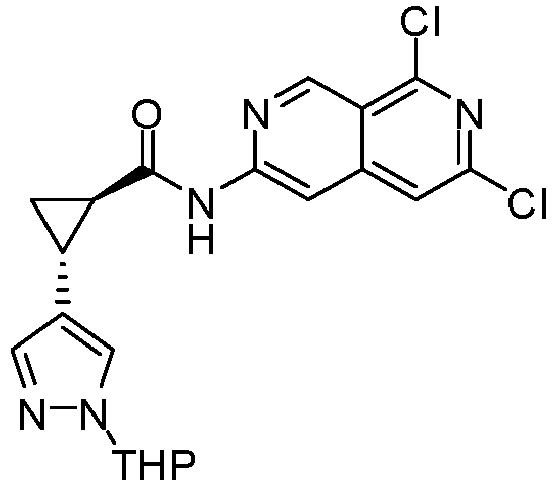
- To a mixture of 6,8-dichloro-2,7-naphthyridin-3-amine (270 mg, 1.3 mmol) and (±)-trans-2-(1-tetrahydropyran-2-ylpyrazol-4-yl)cyclopropanecarboxylic acid (270 mg, 1.1 mmol) in pyridine (10 mL) was added phosphorus oxychloride (270 mg, 1.8 mmol) at 0 °C. The resulting mixture was stirred for 1 h at 0 °C. The reaction was then quenched with sataurated aq.NaHCO3 and extracted with EA (20 mL× 2). The combined EA extracts were concentrated in vacuo. The residue was purified by flash column chromatography (PE:EA=3:1 - 1:3) to give (±)-trans-N-(6,8-dichloro-2,7-naphthyridin-3-yl)-2-(1-tetrahydropyran-2-ylpyrazol-4-yl)cyclopropanecarboxamide (300 mg, 61% yield) as acolorless oil. LCMS (ESI): [M+H]+ = 432.1.
-

- A mixture of (±)-trans-N-(6,8-dichloro-2,7-naphthyridin-3-yl)-2-(1-tetrahydropyran-2-ylpyrazol-4-yl)cyclopropanecarboxamide (300 mg, 0.69 mmol) and NH4OH (8 mL, 0.69 mmol) in 1,4-dioxane (8 mL) was heated at 90 °C for 4 h under Ar. The reaction was concentrated to dryness. The crude material was used directly without further purification. LCMS (ESI): [M+H]+ = 413.1.
-

- A mixture of (±)-trans-N-(8-amino-6-chloro-2,7-naphthyridin-3-yl)-2-(1-tetrahydropyran-2-ylpyrazol-4-yl)cyclopropanecarboxamide (240 mg, 0.58 mmol), 4-methyl-3-(4,4,5,5-tetramethyl-1,3,2-dioxaborolan-2-yl)pyridine (160 mg, 0.73 mmol), Pd(dppf)Cl2 (80 mg, 0.11 mmol) and Na2CO3 (200 mg, 1.89 mmol) in 1,4-dioxane (8 mL) and water (1 mL) was heated at 100 °C for 1 h under Ar. The crude (±)-trans-N-[8-amino-6-(4-methyl-3-pyridyl)-2,7-naphthyridin-3-yl]-2-(1-tetrahydropyran-2-ylpyrazol-4-yl)cyclopropanecarboxamide (300 mg, 88 % yield) was used directly in the next step without further purification. LCMS (ESI): [M+H]+ = 470.2.
-

- The mixture of (±)-trans-N-[8-amino-6-(4-methyl-3-pyridyl)-2,7-naphthyridin-3-yl]-2-(1-tetrahydropyran-2-ylpyrazol-4-yl)cyclopropanecarboxamide (300 mg, 0.64 mmol) and TFA (10 mL, 134.6 mmol) in dichloromethane (20 mL) was stirred at rt for 1h. The mixture was neutralized by NH3 in MeOH and concentrated. The residue was purified by prep-HPLC to give (±)-trans-N-[8-amino-6-(4-methyl-3-pyridyl)-2,7-naphthyridin-3-yl]-2-(1H-pyrazol-4-yl)cyclopropanecarboxamide (68 mg, 28% yield) as a white solid. LCMS (ESI): RT (min) = 1.240, [M+H]+ = 386.1, method = G; 1H NMR (400 MHz, DMSO-d 6) δ 12.62 (s, 1H), 10.94 (s, 1H), 9.37 (s, 1H), 8.57 (s, 1H), 8.44 (d, J = 5.2 Hz, 1H), 8.26 (s, 1H), 7.62 (s, 1H), 7.37 (s, 1H), 7.32-7.31 (m, 3H), 6.97 (s, 1H), 2.41 (s, 3H), 2.27-2.19 (m, 2H), 1.50-1.36 (m, 1H), 1.27-1.11 (m, 1H).
-
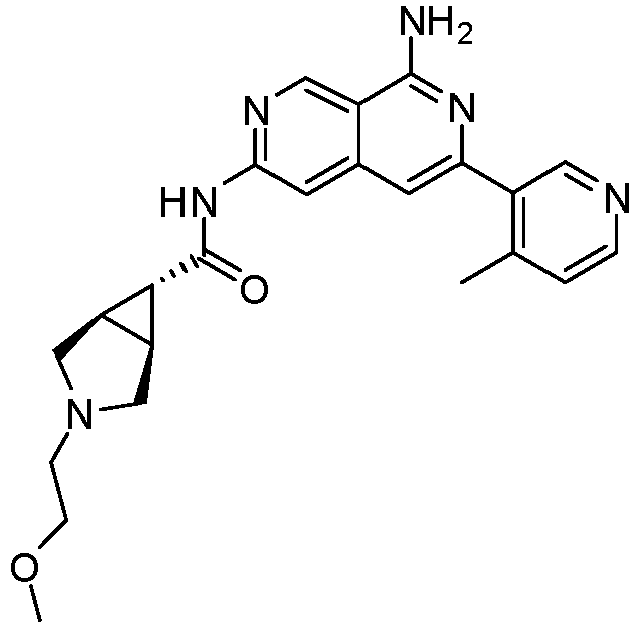
- To a mixture of exo-N-[8-amino-6-(4-methyl-3-pyridyl)-2,7-naphthyridin-3-yl]-3-azabicyclo[3.1.0]hexane-6-carboxamide (100 mg, 0.28 mmol) in N,N-dimethylformamide (1 mL) was added 2-bromoethyl methyl ether (50 mg, 0.36 mmol) and DIPEA (107 mg, 0.83 mmol). The mixture was stirred at 25 °C for 3 d. The mixture was purified by prep-HPLC to give exo-N-[8-amino-6-(4-methyl-3-pyridyl)-2,7-naphthyridin-3-yl]-3-(2-methoxyethyl)-3-azabicyclo[3.1.0]hexane-6-carboxamide (39 mg, 34% yield) as a yellow solid. LCMS (ESI): RT(min) = 1.775, [M+H]+ = 419.2, method = I-1; 1H NMR (400 MHz,CD3OD) δ 9.28 (s, 1H), 8.53 (s, 1H), 8.43 (d, J = 5.2 Hz, 1H), 8.27 (s, 1H), 7.39 (d, J = 5.2 Hz, 1H), 6.96 (s, 1H), 3.51 (t, J = 5.6Hz, 2H), 3.37 (s, 3H), 3.20- 3.18 (m, 2H), 2.70 (t, J = 5.6 Hz, 2H), 2.56- 2.63 (m, 2H), 2.45 (s, 3H), 2.24- 2.22 (m, 1H), 2.05 (s, 2H).
-

-

- To a mixture of 6,8-dichloro-2,7-naphthyridin-3-amine (270 mg, 1.26 mmol), 5-tert-butoxycarbonyl-5-azaspiro[2.4]heptane-2-carboxylic acid (365 mg, 1.51 mmol) and pyridine (1.0 mL, 12.61 mmol) in DCM (5mL) was added POCl3 (212 mg, 1.39 mmol) at 0 °C. After the addition was completed, the reaction solution was stirred for 1h at rt. The reaction was concentrated to dryness and purified by flash column chromatography eluting 20% EA in PE to give (±)-trans-tert-butyl 1-(6,8-dichloro-2,7-naphthyridin-3-ylcarbamoyl)-5-azaspiro[2.4]heptane-5-carboxylate (290 mg, 52% yield) as a white solid. LCMS (ESI): [M-56]+ = 381.1.
-

- A mixture of (±)-trans-tert-butyl 1-(6,8-dichloro-2,7-naphthyridin-3-ylcarbamoyl)-5-azaspiro[2.4]heptane-5-carboxylate (290 mg, 0.66 mmol) and NH4OH (2 mL) in 1,4-dioxane (5 mL) was heated in a sealed tube at 80 °C for 3 h. The mixture was concentrated and the crude product was washed with water and PE to give trans-tert-butyl 1-(8-amino-6-chloro-2,7-naphthyridin-3-ylcarbamoyl)-5-azaspiro[2.4]heptane-5-carboxylate (213 mg, 77% yield) as a white solid. LCMS (ESI): [M+H]+ = 418.2.
-

- To a sealed tube was added (±)-trans-tert-butyl 1-(8-amino-6-chloro-2,7-naphthyridin-3-ylcarbamoyl)-5-azaspiro[2.4]heptane-5-carboxylate (340 mg, ), K2CO3 (3eq), Pd(dppf)Cl2 (0.2eq), 4-methyl-3-(4,4,5,5-tetramethyl-1,3,2-dioxaborolan-2-yl)pyridine (1.3eq), 1,4-dioxane (20 mL) and water (1mL). The mixture was bubbled with N2 for 2 min and stirred at 110 °C for 3 h. The reaction was concentrated and to the resulting residue was added DCM (3mL) and TFA (0.5mL). The mixture was stirred at rt for 2h. The mixture was concentrated and purified by prep-HPLC to give (±)-trans-N-(8-amino-6-(4-methylpyridin-3-yl)-2,7-naphthyridin-3-yl)-5-azaspiro[2.4]heptane-1-carboxamide (47mg, 37% yield) as a white solid. LCMS (ESI): RT (min) = 1.390, [M+H]+ = 375.2, method = G; 1H NMR (400 MHz,CD3OD) δ 9.29 (s, 1H), 8.53 (s, 1H), 8.43 (d, J = 4.8 Hz, 1H), 8.33 (s, 1H), 7.40 (d, J = 4.8 Hz, 1H), 6.97 (s, 1H), 3.29-3.20 (m, 4H), 2.45 (s, 3H), 2.25-2.22 (m, 1H), 2.11-2.04 (m, 1H), 2.00-1.1.94 (m, 1H), 1.45-1.43 (m, 1H), 1.34-1.31 (m, 1H).
-

-

- To a mixture of 6,8-dichloro-2,7-naphthyridin-3-amine (270 mg, 1.26 mmol), 5-tert-butoxycarbonyl-5-azaspiro[2.4]heptane-2-carboxylic acid (365 mg, 1.51 mmol) and pyridine (1.0 mL, 12.61 mmol) in DCM (5mL) was added POCl3 (212 mg, 1.39 mmol) at 0 °C. The reaction solution was stirred for 1h at rt. The reaction was concentrated to dryness and purified by flash column chromatography eluting with 20% EA in PE to give (±)-cis-tert-butyl 1-(6,8-dichloro-2,7-naphthyridin-3-ylcarbamoyl)-5-azaspiro[2.4]heptane-5-carboxylate (210 mg, 38% yield) as a white solid. LCMS (ESI): [M-56]+ = 381.1.
-

- A mixture of (±)-cis-tert-butyl 1-(6,8-dichloro-2,7-naphthyridin-3-ylcarbamoyl)-5-azaspiro[2.4]heptane-5-carboxylate (210 mg, 0.48 m(±)-mol) and NH4OH (2 mL) in 1,4-dioxane (5 mL) was heated to 80 °C for 3 h in a sealed tube. The mixture was concentrated and the crude product was washed with water and PE to give (±)-cis-tert-butyl 1-(8-amino-6-chloro-2,7-naphthyridin-3-ylcarbamoyl)-5-azaspiro[2.4]heptane-5-carboxylate (155 mg, 77% yield) as a white solid. LCMS (ESI): [M+H]+ = 418.2.
-

- To a sealed tube was added (±)-cis-tert-butyl 1-(8-amino-6-chloro-2,7-naphthyridin-3-ylcarbamoyl)-5-azaspiro[2.4]heptane-5-carboxylate (340 mg, ), K2CO3 (3eq), Pd(dppf)Cl2 (0.2eq), and 4-methyl-3-(4,4,5,5-tetramethyl-1,3,2-dioxaborolan-2-yl)pyridine (1.3eq), 1,4-dioxane (20 mL) and water (1mL). The mixture was bubbled with N2 for 2 min and stirred at 110 °C for 3 h. The reaction mixture was concentrated and to the residue was added DCM (3mL) and TFA (0.5mL). The mixture was stirred at rt for 2h. The mixture was concentrated and purified by prep-HPLC to give (±)-cis-N-(8-amino-6-(4-methylpyridin-3-yl)-2,7-naphthyridin-3-yl)-5-azaspiro[2.4]heptane-1-carboxamide (44 mg, 31% yield) as a white solid. LCMS (ESI): RT(min) = 1.413, [M+H]+ = 375.2, method = G; 1H NMR (400 MHz,CD3OD) δ 9.30 (s, 1H), 8.54 (s, 1H), 8.43 (d, J = 5.2 Hz, 1H), 8.33 (s, 1H), 7.40 (d, J = 5.2 Hz, 1H), 6.98 (s, 1H), 3.15-3.08 (m, 2H), 3.03-2.91 (m, 2H), 2.46 (s, 3H), 2.16-2.13 (m, 1H), 2.03-1.98 (m, 2H), 1.48-1.45 (m, 1H), 1.26-1.24 (m, 1H).
-

- A mixture of (±)-trans-N-(8-amino-6-(4-methylpyridin-3-yl)-2,7-naphthyridin-3-yl)-5-azaspiro[2.4]heptane-1-carboxamide (30 mg, 0.08 mmol) in N,N-dimethylformamide (1 mL) was added 2-bromoethyl methyl ether (14 mg, 0.10 mmol) and DIPEA (31 mg, 0.24 mmol). The mixture was stirred at 25 °C for 3 days. The mixture was concentrated and purified by prep-HPLC to give (±)-trans-N-(8-amino-6-(4-methylpyridin-3-yl)-2,7-naphthyridin-3-yl)-5-(2-methoxyethyl)-5-azaspiro[2.4]heptane-1-carboxamide_(13 mg, 38% yield) as a white solid. LCMS (ESI): RT(min) = 1.723, [M+H]+ = 433.2, method = I-1; 1H NMR (400 MHz,CD3OD) δ 9.29 (s, 1H), 8.54 (s, 1H), 8.43 (d, J= 5.2 Hz, 1H), 8.32 (s, 1H), 7.40 (d, J = 5.2 Hz, 1H), 6.98 (s, 1H), 3.53- 3.50 (m, 2H), 3.33 (s, 3H), 2.87- 2.69 (m, 6H), 2.45 (s, 3H), 2.13- 1.92 (m, 3H), 1.43- 1.41 (m, 1H), 1.22-1.19 (m, 1H).
-

- To a mixture of (±)-cis-N-(8-amino-6-(4-methylpyridin-3-yl)-2,7-naphthyridin-3-yl)-5-azaspiro[2.4]heptane-1-carboxamide (30 mg, 0.08 mmol) in N,N-dimethylformamide (1 mL) was added 2-bromoethyl methyl ether (14 mg, 0.10 mmol) and DIPEA (31 mg, 0.24 mmol). The mixture was stirred at 25 °C for 3 days. The mixture was concentrated and purified by prep-HPLC to give (±)-cis-N-(8-amino-6-(4-methylpyridin-3-yl)-2,7-naphthyridin-3-yl)-5-(2-methoxyethyl)-5-azaspiro[2.4]heptane-1-carboxamide (22 mg, 64% yield) as a white solid. LCMS (ESI): RT(min) = 1.763, [M+H]+ = 433.3, method = I-1; 1H NMR (400 MHz,CD3OD) δ 9.29 (s, 1H), 8.54 (s, 1H), 8.43 (d, J = 5.2 Hz, 1H), 8.32 (s, 1H), 7.39 (d, J = 5.2 Hz, 1H), 6.97 (s, 1H), 3.56- 3.53 (m, 2H), 3.36 (s, 3H), 2.91- 2.60 (m, 6H), 2.45 (s, 3H), 2.12- 1.96 (m, 3H), 1.40- 1.37 (m, 1H), 1.21- 1.18 (m, 1H).
-

-

- A solution of n-BuLi (2.5 M in hexane, 1.1 mL, 2.75 mmol) was added dropwise to a solution of 3-bromo-4-ethoxy-pyridine (500 mg, 2.47 mmol), triisopropyl borate (930 mg, 4.94 mmol) in tetrahydrofuran (5 mL) at -78 °C. The mixture was stirred at -78 °C for 0.5 h then warmed to 20 °C and stirred for 0.5 h. The reaction mixture was quenched with H2O (5 mL) and the aqueous layer separated and washed with EA (10 mL). The aqueous layer was acidified to pH 4-5 by conc. HCl and washed with EA (10 mL × 3). The aqueous layer was separated and evaporated and the residue was purified with flash chromatography (C18, HCOOH/ MeOH/ H2O) to give (4-ethoxy-3-pyridyl)boronic acid (110 mg, 27% yield) as a white solid. LCMS (ESI) [M+H]+ = 168.1.
-

- A mixture of (±)-trans-N-(8-amino-6-chloro-2,7-naphthyridin-3-yl)-2-cyano-cyclopropanecarboxamide (100 mg, 0.35 mmol), (4-ethoxy-3-pyridyl)boronic acid (110 mg, 0.66 mmol), XPhos Pd G2 (30 mg, 0.04 mmol), XPhos (40 mg, 0.08 mmol) and K2CO3 (150 mg, 1.09mmol) in 1,4-dioxane (16 mL) and water (4 mL) was stirred at 100 °C under Ar for 2h. The reaction mixture was cooled to room temperature and diluted with EA (100 mL). The mixture was washed with brine (20 mL). The organic layer was separated, dried over Na2SO4, filtered and evaporated. The residue was purified by silica-gel column chromatography (EA to EA : MeOH = 10:1) to give (±)-trans-N-[8-amino-6-(4-ethoxy-3-pyridyl)-2,7-naphthyridin-3-yl]-2-cyano-cyclopropane carboxamide (75 mg, 58% yield) as a light yellow solid. LCMS (ESI): RT (min) = 1.639, [M+H]+ = 375.1, method = C; 1H NMR (400 MHz, DMSO-d 6): δ11.28 (brs, 1H), 9.37 (s, 1H), 8.95 (s, 1H), 8.42 (d, J = 5.6 Hz, 1H), 8.15 (s, 1H), 7.42 (s, 1H), 7.31 (brs, 2H), 7.14 (d, J = 5.6 Hz, 1H), 4.23 (q, J =7.2 Hz, 2H), 2.78-2.74 (m, 1H), 2.19-2.15 (m, 1H), 1.64-1.59 (m, 1H), 1.47-1.42 (m, 1H), 1.39 (t, J = 7.2 Hz, 3H).
-

-

- To a mixture of 6, 8-dichloro-2,7-naphthyridin-3-amine hydrochloride (500 mg, 2.0 mmol) in tetrahydrofuran (30 mL) was added in triethylamine (8 mL, 57.4 mmol) and triphosgene (600 mg, 2.02 mmol). The mixture was stirred at room temperature for 10 min before methanamine hydrochloride (1400 mg, 20.73 mmol) was added. The reaction mixture was stirred at room temperature for 1h. The reaction mixture was concentrated to dryness and purified by column chromatography eluting with ethyl acetate/petroleum ether (1/1) to afford 1-(6, 8-dichloro-2,7-naphthyridin-3-yl)-3-methyl-urea (190 mg, 31% yield) as a yellow solid. LCMS(ESI): [M+H]+=271.0.
-

- A mixture of 1-(6, 8-dichloro-2, 7-naphthyridin-3-yl)-3-methyl-urea (170 mg, 0.63 mmol) in 1, 4-dioxane (4 mL) and ammonium hydroxide(25%, 4 mL, 212.71 mmol) was stirred at 90 °C for 4h. The mixture was concentrated to dryness to afford crude 1-(8-amino-6-chloro-2, 7-naphthyridin-3-yl)-3-methyl-urea (220 mg) as a yellow solid. LCMS (ESI):[M+H]+=252.1.
-

- A mixture of 1-(8-amino-6-chloro-2,7-naphthyridin-3-yl)-3-methyl-urea (220 mg, 0.87 mmol), 4-methyl-3-(4,4,5,5-tetramethyl-1,3,2-dioxaborolan-2-yl)pyridine (176 mg, 0.80 mmol), X-Phos-Pd-G2 (48 mg, 0.06 mmol), X-Phos (56 mg, 0.12 mmol) and K2CO3 (180 mg, 1.3 mmol) in 1,4-dioxane (6mL) and water (1mL) was stirred under Ar at 90 °C for 1h. The reaction was concentrated to dryness and purified by column chromatography on silica gel eluting with ethyl methanol/dichloromethane (1/10-1/7) to afford 1-[8-amino-6-(4-methyl-3-pyridyl)-2, 7-naphthyridin-3-yl]-3-methyl-urea (64 mg, 24% yield) as a yellow solid. LCMS(ESI):[M+H]+= 309.2, RT(min) = 1.35, Method = E; 1H NMR (400 MHz, DMSO-d 6) δ 9.26 (s, 2H), 8.56 (s, 1H), 8.43(d, J = 4.8 Hz, 1H), 7.76 (s, 1H), 7.30 (d, J = 4.8 Hz, 1H), 7.26 (s, 2H), 7.13 (d, J = 4.4 Hz, 1H), 6.88 (s, 1H), 2.72 (d, J = 4.8 Hz, 3H), 2.41 (s, 3H).
-

-

- A mixture of tert-butyl acrylate (12 mL, 81.92 mmol), 3-iodopyridine (6.15 g, 30 mmol), tris-(o-tolyl)phosphine (2.1 g, 6.91 mmol), Pd(OAc)2 (767 mg, 3.42 mmol) and triethylamine (12 mL, 86.1mmol) in acetonitrile (50 mL) was stirred under Ar at 95 °C for 2h. The mixture was concentrated and purified by column chromatography (ethyl acetate/petroleum 1/3 to 1/1) to afford tert-butyl (E)-3-(3-pyridyl)prop-2-enoate (5.55 g, 90% yield) as a yellow solid. LCMS(ESI):[M+H]+=206.1.
-

- Sodium tert-butoxide (520 mg, 5.41 mmol) was added to a solution of trimethyl sulfoxoniumiodide (1.1 g, 5 mmol) in dimethyl sulfoxide (10mL) at room temperature. The mixture was stirred under Ar at room temperature for 20 min. The reaction mixture was added slowly dropwise to a solution of tert-butyl (E)-3-(3-pyridyl)prop-2-enoate (1.0 g, 4.87 mmol) in dimethyl sulfoxide (10 mL). The mixture was stirred under Ar at room temperature for 1h. The reaction mixture was diluted with sat. NH4Cl and extracted with ethyl acetate. The organic layer was concentrated and purified by silica gel column chromatography (ethyl acetate/petroleum ether) to afford (±)-tert-butyl (trans)-2-(3-pyridyl)cyclopropanecarboxylate (550 mg, 43% yield) as a yellow liquid.
LCMS(ESI):[M+H]+=220.2. -

- A solution of (±)-tert-butyl (trans)-2-(3-pyridyl)cyclopropanecarboxylate (550 mg, 2.51mmol) in trifluoroacetic acid (2 mL, 25.96 mmol) was stirred at room temperature for 1h. The solution was concentrated to dryness to afford (±)-crude trans-2-(3-pyridyl)cyclopropanecarboxylic acid (300 mg) as a colorless liquid.
LCMS(ESI):[M+H]+=164.1. -

- A mixture of (±)-trans-2-(3-pyridyl)cyclopropanecarboxylic acid (300 mg, 1.84 mmol), 6,8-dichloro-2,7-naphthyridin-3-amine (400 mg, 1.87 mmol) and pyridine (3 mL, 37.09 mmol) in dichloromethane (10 mL) was stirred at room temperature. POCl3 (0.5 mL, 5.36 mmol) was added dropwise to the mixture at room temperature. The mixture was stirred at room temperature for 1h and then diluted with 1ml of water. The mixture was concentrated and purified by column chromatography (ethyl acetate/petroleum ether 30-100%) to afford (±)-trans-N-(6,8-dichloro-2,7-naphthyridin-3-yl)-2-(3-pyridyl)cyclopropanecarboxamide (220 mg, 31% yield) as a yellow solid. LCMS(ESI):[M+H]+=359.0.
-

- A mixture of (±)-trans-N-(6,8-dichloro-2,7-naphthyridin-3-yl)-2-(3-pyridyl)cyclopropane carboxamide (220 mg, 0.61 mmol) in 1,4-dioxane (4 mL) and ammonium hydroxide (25%, 3 mL, 159.53 mmol) was stirred at 95 °C for 3h. The mixture was concentrated to dryness to afford (±)-trans-N-(8-amino-6-chloro-2,7-naphthyridin-3-yl)-2-(3-pyridyl)cyclopropanecarboxamide (250mg) as a yellow solid. LCMS(ESI):[M+H]+=340.1.
-

- A mixture of (±)-trans-N-(8-amino-6-chloro-2,7-naphthyridin-3-yl)-2-(3-pyridyl) cyclopropanecarboxamide (250 mg, 0.74 mmol), 4-methyl-3-(4,4,5,5-tetramethyl-1,3,2-dioxaborolan-2-yl)pyridine (180 mg, 0.82 mmol), X-Phos-Pd-G2 (46 mg, 0.06 mmol), X-Phos (68 mg, 0.14 mmol) and K2CO3 (266 mg, 1.93 mmol) in 1,4-dioxane (7 mL) and water (1 mL) was stirred under Ar at 100 °C for 1h. The reaction was concentrated and purified by column chromatography (ethyl methanol/dichloromethane, 1/10-1/7) to afford (±)-trans-N-[8-amino-6-(4-methyl-3-pyridyl)-2, 7-naphthyridin-3-yl]-2-(3-pyridyl) cyclopropanecarboxamide (130 mg, 45% yield) as a yellow solid. LCMS(ESI):[M+H]+= 397.2, RT(min)=1.27, Method = B; 1H NMR (400 MHz, DMSO-d 6) δ 11.00 (s, 1H), 9.37 (s, 1H), 8.57 (s, 1H), 8.51 (d, J = 2.0 Hz, 1H), 8.45-8.42(m, 2H), 8.28 (s, 1H), 7.57(d, J = 8.0 Hz, 1H), 7.35-7.31(m, 4H), 6.99 (s, 1H), 2.48-2.46 (m, 1H), 2.46-2.45 (m, 1H), 2.42(s, 3H), 1.59-1.54 (m, 1H), 1.50-1.46(m, 1H).
-

- A sealed tube containing (±)-trans-N-(8-amino-6-chloro-2,7-naphthyridin-3-yl)-2-cyano-cyclopropanecarboxamide (120 mg, 0.42 mmol), 4-(4,4,5,5-tetramethyl-1,3,2-dioxaborolan-2-yl)-5-(trifluoromethyl)-1H-pyrazole (130 mg, 0.50 mmol), X-Phos-Pd-G2 (22 mg, 0.03 mmol), X-Phos (27 mg, 0.06 mmol) and potassium acetate (100 mg, 1.02 mmol) was heated to 130 °C in a microwave reactor for 1h. The reaction was concentrated to dryness and purified by reverse phase chromatography (methanol 0-60/0.1% amonia in water) to afford (±)-trans-N-[8-amino-6-[5-(trifluoromethyl)-1H-pyrazol-4-yl]-2, 7-naphthyridin-3-yl]-2-cyano-cyclopropanecarboxamide (28 mg, 17% yield) as a yellow solid. LCMS (ESI): [M+H]+ = 388.0, RT(min) = 1.76, method = E; 1H NMR (400 MHz, CD3OD) δ 9.11 (s, 1H), 8.09 (s, 2H), 6.93 (s, 1H), 2.55-2.50 (m, 1H), 2.06-2.01 (m, 1H), 1.52-1.42 (m, 2H).
-
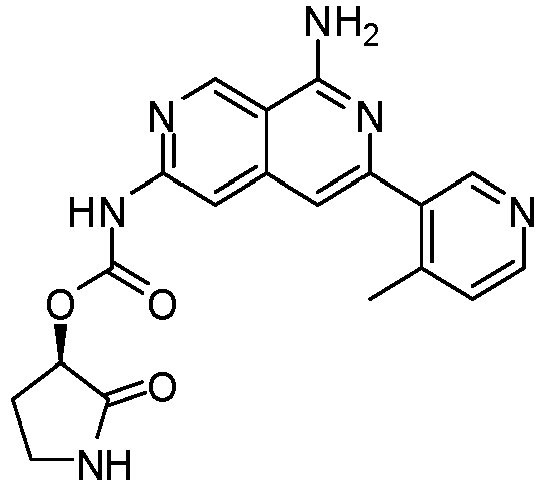
-

- A solution of triphosgene (110 mg, 0.37 mmol) in tetrahydrofuran (5 mL) was added to a mixture of 3-chloro-N1,N1-bis[(2,4-dimethoxyphenyl)methyl]-2,7-naphthyridine-1,6-diamine (100 mg, 0.2 mmol) and triethylamine (0.5 mL, 3.59 mmol). The mixture was stirred at room temperature for 10 min before (3R)-3-hydroxypyrrolidin-2-one (200 mg, 1.98 mmol) was added. The reaction mixture was stirred at room temperature for 1h. The reaction mixture was concentrated to dryness and purified by column chromatography (ethyl acetate then methanol/dichloromethane, 1/15) to afford [(3R)-2-oxopyrrolidin-3-yl] N-[8-[bis[(2,4-dimethoxyphenyl)methyl]amino]-6-chloro-2,7-naphthyridin-3-yl]carbamate (52 mg, 31% yield) as a yellow solid. LCMS (ESI): [M+H] +=622.2.
-

- A sealed tube containing [(3R)-2-oxopyrrolidin-3-yl] N-[8-[bis[(2,4-dimethoxyphenyl) methyl]amino]-6-chloro-2,7-naphthyridin-3-yl]carbamate (52 mg, 0.08 mmol), 4-methyl-3-(4,4,5,5-tetramethyl-1,3,2-dioxaborolan-2-yl)pyridine (30 mg, 0.14 mmol), X-Phos-Pd-G2 (8.0 mg, 0.01 mmol), X-Phos (10.0 mg, 0.02 mmol) and potassium acetate (30 mg, 0.31 mmol) was stirred under Ar at 100 °C for 1h. The reaction was concentrated to dryness and purified by column chromatography (methanol/dichloromethane 1/15) to afford [(3R)-2-oxopyrrolidin-3-yl] N-[8-[bis[(2,4-dimethoxyphenyl)methyl]amino]-6-(4-methyl-3-pyridyl)-2,7-naphthyridin-3-yl]carbamate (47 mg, 44.5% yield) as a yellow solid. LCMS (ESI): [M+H]+ = 679.3.
-

- A solution of [(3R)-2-oxopyrrolidin-3-yl] N-[8-[bis[(2,4-dimethoxyphenyl)methyl]amino]-6-(4-methyl-3-pyridyl)-2,7-naphthyridin-3-yl]carbamate (47 mg, 0.07 mmol) in trifluoroacetic acid (3.0 mL, 38.94 mmol) was stirred at 55 °C for 1 h. The reaction was concentrated to dryness and purified by reverse phase chromatography (methanol 50% in 0.05% ammonia in water) to afford [(3R)-2-oxopyrrolidin-3-yl] N-[8-amino-6-(4-methyl-3-pyridyl)-2,7-naphthyridin-3-yl]carbamate (8 mg, 30% yield) as a white solid. LCMS(ESI): [M+H]+ = 379.2, RT(min) = 1.45, method = F; 1H NMR (400 MHz, DMSO-d 6) δ 10.50 (s, 1H), 9.33 (s, 1H), 8.57 (s, 1H), 8.44 (d, J = 4.8 Hz, 1H), 8.09 (s, 1H), 7.97 (s, 1H), 7.32-7.27 (m, 3H), 6.99(s, 1H), 5.24 (t, J = 4.4 Hz, 1H), 3.29 - 3.24 (m, 2H), 2.42 (s, 3H), 2.06-1.88 (m, 2H).
-

-

- A solution of phenyl N-[8-[bis[(2,4-dimethoxyphenyl)methyl]amino]-6-chloro-2,7-naphthyridin-3-yl]carbamate (500 mg, 0.81mmol), (1S,2S)-2-aminocyclopentanol (300 mg, 2.97 mmol) and triethylamine (1.0 mL) in N,N-dimethylformamide (5 mL) was stirred at 90 °C for 2 h. To the reaction mixture 20 mL of brine was added and the mixture was extracted with ethyl acetate (20 mL). The organics were then separated, concentrated to dryness, and the resulting residue purified by column chromatography (ethyl ethyl acetate) to afford 1-[8-[bis[(2,4-dimethoxyphenyl)methyl]amino]-6-chloro-2,7-naphthyridin-3-yl]-3-[(1S,2S)-2-hydroxycyclopentyl]urea (148 mg, 25% yield) as a white solid. LCMS(ESI): [M+H]+ = 622.2.
-

- A sealed tube containing 1-[8-[bis[(2,4-dimethoxyphenyl)methyl]amino]-6-chloro-2,7-naphthyridin-3-yl]-3-[(1S,2S)-2-hydroxycyclopentyl]urea (148 mg, 0.24 mmol), 4-methyl-3-(4,4,5,5-tetramethyl-1,3,2-dioxaborolan-2-yl)pyridine (70 mg, 0.32 mmol), X-Phos-Pd-G2 (20 mg, 0.03 mmol), X-Phos (24 mg, 0.05 mmol) and K2CO3 (100.0 mg, 0.72 mmol) was stirred under Ar at 100 °C for 1h. The reaction was concentrated to dryness and purified by column chromatography (methanol/dichloromethane, 1/10) to afford 1-[8-[bis[(2,4-dimethoxyphenyl)methyl]amino]-6-(4-methyl-3-pyridyl)-2,7-naphthyridin-3-yl]-3-[(1S,2S)-2-hydroxycyclopentyl]urea (140 mg, 59% yield) as a yellow solid. LCMS(ESI): [M+H]+ = 679.3.
-

- A solution of 1-[8-[bis [(2, 4-dimethoxyphenyl) methyl] amino]-6-(4-methyl-3-pyridyl)-2,7-naphthyridin-3-yl]-3-[(1S,2S)-2-hydroxycyclopentyl]urea (140 mg, 0.21 mmol) in trifluoroacetic acid (3.0 mL, 38.94 mmol) was stirred at 55 °C for 1h. The reaction was concentrated to dryness and purified by prep-HPLC (acetonitrile/0.1% HCOOH in water) to afford the formate salt of 1-[8-amino-6-(4-methyl-3-pyridyl)-2,7-naphthyridin-3-yl]-3-[(1S,2S)-2-hydroxycyclopentyl]urea (14 mg, 18% yield) as a white solid. LCMS(ESI): [M+H]+ = 379.1, RT(min) = 1.64, method = E; 1H NMR (400 MHz,DMSO-d 6) δ 9.26 (s, 1H), 9.09 (s, 1H), 8.56 (s, 1H), 8.43 (d, J = 4.8 Hz, 1H), 8.20 (s, 1H), 7.79 (s, 1H), 7.30 (d, J = 4.8 Hz, 1H), 7.24 (s, 3H), 3.87-3.83 (m, 1H), 3.78 - 3.72 (m, 1H), 2.41 (s, 3H), 2.05-2.00 (m, 1H), 1.85-1.78 (m, 1H), 1.71-1.60 (m, 2H), 1.53-1.46 (m, 1H), 1.42-1.35 (m, 1H).
-

-

- A mixture of (±)-trans-N-(8-amino-6-chloro-2,7-naphthyridin-3-yl)-2-cyano-cyclopropanecarboxamide (130 mg, 0.45 mmol), 3-[(4-methoxyphenyl)methyl]-5-methyl-6-(4,4,5,5-tetramethyl-1,3,2-dioxaborolan-2-yl)-1,3-benzoxazol-2-one (178 mg, 0.45 mmol), K2CO3 (146 mg, 0.45 mmol) and Pd(dppf)Cl2 (33 mg, 0.045 mmol) in 1,4-dioxane (10 mL) and water (1 mL) was stirred at 100 °C for 2 h. The mixture was concentrated and purified by flash column chromatography ( 0-100% EA in PE) to give (±)-trans-N-[8-amino-6-[3-[(4-methoxyphenyl)methyl]-5-methyl-2-oxo-1,3-benzoxazol-6-yl]-2,7-naphthyridin-3-yl]-2-cyano-cyclopropanecarboxamide (120 mg, 51% yield) as a brown solid. LCMS (ESI): [M+H]+ = 521.2
-

- A mixture of (±)-trans-N-[8-amino-6-[3-[(4-methoxyphenyl)methyl]-5-methyl-2-oxo-1,3-benzoxazol-6-yl]-2,7-naphthyridin-3-yl]-2-cyano-cyclopropanecarboxamide (100 mg, 0.19 mmol), TFA (1mL) and TfOH (1 mL) was stirred at 25 °C for 2 hours. The mixture was concentrated and basified with NH3 in methanol (7M). The resulting residue was purified by reverse phase chromatography (acetonitrile 17-47% in 0.05% HCOOH in water) to give (±)-trans-N-[8-amino-6-(5-methyl-2-oxo-3H-1,3-benzoxazol-6-yl)-2,7-naphthyridin-3-yl]-2-cyano-cyclopropanecarboxamide (18 mg, 24% yield) as a white solid. LCMS (ESI): RT (min) = 1.419, [M+H]+ = 401.1, method = B; 1H NMR (400 MHz, DMSO-d 6) δ 11.24 (s, 1H), 9.37 (s, 1H), 8.17 (s, 1H), 8.15 (s, 1H), 7.31 (s, 1H), 7.27 (s, 2H), 6.98 (s, 1H), 6.88 (s, 1H), 2.78-2.73 (m, 1H), 2.37(s, 3H), 2.17-2.12(m, 1H), 1.63-1.58(m,1H), 1.45-1.41(m, 1H).
-

-

- To a solution of (±)-cis-2-(methoxycarbonyl)cyclopropanecarboxylic acid (263 mg, 1.83 mmol) and DMF (10 mg) in dichloromethane (10mL) was added ethanedioyl dichloride (278 mg, 2.2 mmol). The mixture was stirred at 25 ° C for 1 h. The mixture was concentrated and added to a solution of N1,N1-bis[(4-methoxyphenyl)methyl]-3-(4-methyl-3-pyridyl)-2,7-naphthyridine-1,6-diamine (900 mg, 1.83 mmol) and pyridine (2 mL) in dichloromethane (10 mL). The mixture was stirred at 25 °C for 1 h. The mixture was concentrated and purified by flash column chromatography (0-100% EA in PE) to give N1,N1-bis[(4-methoxyphenyl)methyl]-3-(4-methyl-3-pyridyl)-2,7-naphthyridine-1,6-diamine (700 mg, 75% yield) as a brown solid. LCMS (ESI): [M+H]+ = 618.2
-
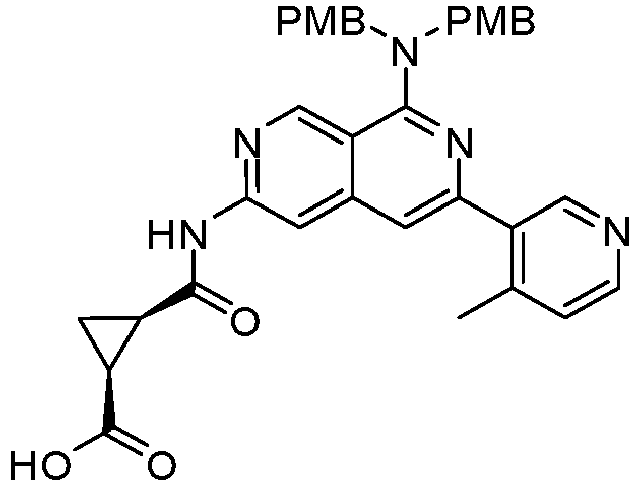
- To a solution of methyl (±)- cis-2-[[8-[bis[(4-methoxyphenyl)methyl]amino]-6-(4-methyl-3-pyridyl)-2,7-naphthyridin-3-yl]carbamoyl]cyclopropanecarboxylate (100 mg, 0.16 mmol) in THF (10 mL) was added 1N NaOH (0.32mL). The mixture was stirred at 25 °C for 16 hours. The mixture was acidified with 2 N HCl, extracted with EA (30 mLx2), dried over Na2SO4 and concentrated to afford crude (±)-cis-2-[[8-[bis[(4-methoxyphenyl)methyl]amino]-6-(4-methyl-3-pyridyl)-2,7-naphthyridin-3-yl]carbamoyl]cyclopropanecarboxylic acid (70 mg, 72% yield) as a brown solid. LCMS (ESI): [M+H]+ = 604.2
-

- To a solution of (±)-cis-2-[[8-[bis[(4-methoxyphenyl)methyl]amino]-6-(4-methyl-3-pyridyl)-2,7-naphthyridin-3-yl]carbamoyl]cyclopropanecarboxylic acid (200 mg, 0.33 mmol), HATU (125 mg, 0.33 mmol) and DIPEA (128 mg, 0.99 mmol) in dichloromethane (10 mL) was added N,N-dimethylamine hydrochloride (135 mg, 1.66 mmol). The mixture was stirred at 25° C for 16 hours. The mixture was washed with water (5mL) and concentrated to give the crude (±)-cis-N2-[8-[bis[(4-methoxyphenyl) methyl]amino]-6-(4-methyl-3-pyridyl)-2,7-naphthyridin-3-yl]-N1,N1-dimethyl-cyclopropane-1,2-dicarboxamide (160 mg, 51% yield) as a brown solid. LCMS (ESI): [M+H]+ = 631.3
-

- A mixture of (±)-cis-N2-[8-[bis[(4-methoxyphenyl)methyl]amino]-6-(4-methyl-3-pyridyl)-2,7-naphthyridin-3-yl]-N1,N1-dimethyl-cyclopropane-1,2-dicarboxamide (80 mg, 0.13 mmol) in TFA (3 mL) was stirred at 25 °C for 4 hours. The mixture was concentrated and basified with NH3 in methanol (7M). The resulting residue was purified by reverse phase chromatography (acetonitrile 0-70 in 0.05% NH4HCO3 in water) to afford (±)-cis-N2-[8-amino-6-(4-methyl-3-pyridyl)-2,7-naphthyridin-3-yl]-N1,N1-dimethyl-cyclopropane-1,2-dicarboxamide (3 mg, 6.1% yield) as a white solid. LCMS (ESI): RT (min) = 1.402, [M+H]+ = 391.2, method = C; 1H NMR (400MHz, CD3OD) δ 9.26 (s, 1H), 8.53 (s, 1H), 8.43 (d, J = 4.8 Hz, 1H), 8.28 (s, 1H), 7.40 (d, J = 4.8 Hz, 1H), 6.98 (s, 1H), 3.18(s, 3H), 2.93 (s, 3H), 2.45 (s, 3H),2.43 - 2.41 (m, 1H), 2.35-2.29 (m,1H), 1.73-1.69 (m,1H), 1.38-1.33 (m,1H).
-

-

- To a solution of (±)-cis-2-[[8-[bis[(4-methoxyphenyl)methyl]amino]-6-(4-methyl-3-pyridyl)-2,7-naphthyridin-3-yl]carbamoyl]cyclopropanecarboxylic acid (200 mg, 0.33 mmol), HATU (125 mg, 0.33 mmol) and DIPEA (128 mg, 0.99 mmol) in dichloromethane (10 mL) was added ethanamine hydrochloride (135 mg, 1.66 mmol). The mixture was stirred at 25°C for 16 hours. The mixture was washed with water and extracted with DCM (15mLx2). The organics were concentrated to give crude (±)-cis-N1-[8-[bis[(4-methoxyphenyl)methyl]amino]-6-(4-methyl-3-pyridyl)-2,7-naphthyridin-3-yl]-N2-ethyl-cyclopropane-1,2-dicarboxamide (150 mg, 72% yield) as a brown solid. LCMS (ESI): [M+H]+ = 631.2
-

- A mixture of (±)-cis-N1-[8-[bis[(4-methoxyphenyl)methyl]amino]-6-(4-methyl-3-pyridyl)-2,7-naphthyridin-3-yl]-N2-ethyl-cyclopropane-1,2-dicarboxamide (80 mg, 0.13 mmol) and TFA (2 mL) was stirred at 60 °C for 2 hours. The mixture was concentrated and basified with NH3 in methanol (7M). The resulting residue was purified by reverse phase chromatography (acetonitrile 0-70% in 0.05% NH4HCO3 in water) to obtain (±)-cis-N1-[8-amino-6-(4-methyl-3-pyridyl)-2,7-naphthyridin-3-yl]-N2-ethyl-cyclopropane-1,2-dicarboxamide (6 mg, 12.1% yield) as a white solid. LCMS (ESI): RT (min) = 1.428, [M+H]+ = 391.1, method = C; 1H NMR (400 MHz, CD3OD) δ 9.28 (s, 1H), 8.54 (s, 1H), 8.43 (d, J = 5.2 Hz, 1H), 8.31(s, 1H), 7.40 (d, J = 5.2 Hz, 1H), 6.98(s, 1H), 3.24-3.18 (m, 2H), 2.45 (s, 3H), 2.30-2.26 (m, 1H), 2.14-2.12 (m,1H), 1.72-1.69(m,1H), 1.34-1.30 (m,1H), 1.11(t, J = 7.2 Hz, 3H).
-

-

- To a solution of (±)-trans-2-methoxycarbonylcyclopropanecarboxylic acid (109 mg, 0.76 mmol) and DMF (10 mg) in dichloromethane (15 mL) was added ethanedioyl dichloride (120 mg, 0.95 mmol).The mixture was stirred at 25°C for 1 hour and then concentrated. The residue was added to a solution of N1,N1-bis[(2,4-dimethoxyphenyl)methyl]-3-(4-methyl-3-pyridyl)-2,7-naphthyridine-1,6-diamine (350 mg, 0.63 mmol) and pyridine (0.5 mL) in dichloromethane (15 mL). The mixture was stirred at 25 °C for another 1 h. The mixture was concentrated to give methyl (±)-trans-2-[[8-[bis[(2,4-dimethoxyphenyl)methyl]amino]-6-(4-methyl-3-pyridyl)-2,7-naphthyridin-3-yl]carbamoyl] cyclopropanecarboxylate (560 mg, 29% yield). LCMS (ESI): [M+H]+ = 678.3.
-

- A mixture of methyl (trans)-2-[[8-[bis[(2,4-dimethoxyphenyl)methyl]amino]-6-(4-methyl-3-pyridyl)-2,7-naphthyridin-3-yl]carbamoyl]cyclopropanecarboxylate (560 mg, 0.18 mmol) and 1N LiOH (0.73 mL) in tetrahydrofuran (10 mL) was stirred at 25°C for 16 hours. The mixture was diluted with ethyl acetate (10 mL). The aqueous layer was acidified with 1 N HCl and extracted with ethyl acetate (15 mLx2). The organic layer was concentrated to give (±)-(trans-)-2-[[8-[bis[(2,4-dimethoxyphenyl)methyl]amino]-6-(4-methyl-3-pyridyl)-2,7-naphthyridin-3-yl]carbamoyl]cyclopropanecarboxylic acid (120 mg, 40% yield) as a brown solid. LCMS (ESI): [M+H]+ = 664.3.
-

- A mixture of (±)-trans-2-[[8-[bis[(2,4-dimethoxyphenyl)methyl]amino]-6-(4-methyl-3-pyridyl)-2,7-naphthyridin-3-yl]carbamoyl]cyclopropanecarboxylic acid (120 mg, 0.07 mmol), N,N-dimethylamine hydrochloride (29 mg, 0.36 mmol), HATU (27 mg, 0.07 mmol) and DIPEA (27 mg, 0.22 mmol) in dichloromethane (10 mL) was stirred at 25 °C for 16 h. The mixture was washed with H2O (10 mL), concentrated and the residue was used for next step directly without further purification. LCMS (ESI): [M+H]+ = 691.3
-

- A mixture of (±)-trans-N2-[8-[bis[(2,4-dimethoxyphenyl)methyl]amino]-6-(4-methyl-3-pyridyl)-2,7-naphthyridin-3-yl]-N1,N1-dimethyl-cyclopropane-1,2-dicarboxamide (150 mg, 0.22 mmol) in TFA (8 mL) was stirred at 50 °C for 3 hours. The mixture was concentrated and basified with NH3 in methanol (7M). The resulting residue was purified by reverse phase chromatography (acetonitrile 0-70/ 0.5% NH4HCO3 in water) to afford (±)- trans-N2-[8-amino-6-(4-methyl-3-pyridyl)-2,7-naphthyridin-3-yl]-N1,N1-dimethyl-cyclopropane-1,2-dicarboxamide (40 mg, 47% yield) as a white solid. LCMS (ESI): RT (min) = 1.522, [M+H]+ = 391.2, method = C; 1H NMR (400 MHz, DMSO-d 6) δ 11.05 (s, 1H), 9.37 (s, 1H), 8.56 (s, 1H), 8.44 (d, J = 4.8 Hz, 1H), 8.25 (s, 1H), 7.32 (d, J = 4.8 Hz, 1H), 7.30 (s, 2H), 6.97 (s, 1H), 3.12 (s, 3H), 2.86 (s, 3H), 2.48-2.45 (m, 1H), 2.41 (s, 3H), 2.39- 2.35 (m, 1H), 1.28-1.25(m, 1H).
-

-

- A mixture of 6,8-dichloro-2,7-naphthyridin-3-amine (200 mg, 0.93 mmol), (±)-(trans)-2-methylcyclopropanecarboxylic acid (113 mg, 1.13 mmol) in pyridine (0.5 mL) and dichloromethane (4 mL) was stirred at 0°C for 0.5 h. POCl3 (0.1 mL, 1.07 mmol) was added in portions. The mixture stirred for 1 h at room temperature. The reaction was diluted with EtOAc (10 mL) and the pH adjusted to 7-8 with sat NaHCO3. The organics were then separated, dried (NaSO4) and concentrated to dryness. The residue was purified with silica gel column chromatography (PE:EA=10:1 to PE:EA=4:1) to give the title compound as a solid (200 mg, 70% yield. LCMS (ESI) [M+H]+ = 296.1.
-

- A mixture of (±)-trans-N-(6,8-dichloro-2,7-naphthyridin-3-yl)-2-methyl-cyclopropanecarboxamide (195 mg, 0.66 mmol), NH4OH (2 mL, 0.66 mmol) in 1,4-dioxane (2 mL) was heated at 90 °C for 3 h under Ar. The reaction was concentrated and purified by silica gel chromatography (PE:EA=2:1 to PE:EA=1:1) to give the title compound as a white solid (150 mg, 82% yield). LCMS (ESI) [M+H]+ = 277.1.
-

- A mixture of (±)-trans-N-(8-amino-6-chloro-2,7-naphthyridin-3-yl)-2-methyl-cyclopropanecarboxamide (80 mg, 0.29 mmol), 4-methyl-3-(4,4,5,5-tetramethyl-1,3,2-dioxaborolan-2-yl)pyridine (76 mg, 0.35 mmol), XPhos Pd G2 (23 mg, 0.03 mmol), XPhos (14 mg, 0.03 mmol) and K2CO3 (120 mg, 0.87 mmol) in 1,4-dioxane (4 mL) and water (1 mL) was heated at 100 °C for 3 h under Ar. The reaction was concentrated to dryness and purified by silica gel chromatography (PE:EA=1:1 to EA) to give the title compound as a white solid (67.3 mg, 70% yield). LCMS (ESI): RT(min) = 1.39, [M+H]+ = 334.2, method = B. 1H NMR (400 MHz, DMSO-d 6) δ 10.87 (s, 1H), 9.36 (s, 1H), 8.56 (s, 1H), 8.43 (d, J = 4.8Hz, 1H), 8.22 (s, 1H), 7.31-7.30 (m, 3H), 6.95 (s, 1H), 2.40 (s, 3H), 1.85- 1.81 (m, 1H), 1.29 -1.24 (m, 1H), 1.10 (d, J = 6.0 Hz, 3H), 1.07-1.02 (m, 1H), 0.71- 0.66 (m, 1H).
-

-

- A mixture of 6,8-dichloro-2,7-naphthyridin-3-amine (200 mg, 0.93 mmol), (±)-trans-2-(trifluoromethyl)cyclopropane carboxylic acid (173 mg, 1.12 mmol) in pyridine (0.5 mL) and dichloromethane (4 mL) was stirred at 0 °C for 0.5 h. POCl3 (0.1 mL, 1.07 mmol) was then added to the reaction mixture and the mixture stirred at room temperature for 1 h. The reaction mixture was diluted with EtOAc (20 mL) and adjusted pH to 7-8 with sat NaHCO3. The organics were separated, dried (NaSO4) and concentrated to dryness. The residue was purified with silica column chromatography (PE:EA=10:1 to PE:EA=4:1) to give the title compound as a white solid (220 mg, 65% yield). LCMS (ESI) [M+H]+ = 350.0.
-

- A mixture of (±)-trans-N-(6,8-dichloro-2,7-naphthyridin-3-yl)-2-(trifluoromethyl)cyclopropanecarboxamide (215 mg, 0.61 mmol) and NH4OH (2 mL, 0.61 mmol) in 1,4-dioxane (2 mL) was heated at 90 °C for 3 h under Ar. The reaction was concentrated and purified with silica column chromatography (PE:EA=4:1 PE:EA=2:1) to give the title compound as a white solid (180 mg, 88% yield) . LCMS (ESI) [M+H]+ = 331.1.
-

- A mixture of 4-methyl-3-(4,4,5,5-tetramethyl-1,3,2-dioxaborolan-2-yl)pyridine (64 mg, 0.29 mmol), (trans)-N-(8-amino-6-chloro-2,7-naphthyridin-3-yl)-2-(trifluoromethyl) cyclopropanecarboxamide (80 mg, 0.24 mmol), XPhos Pd G2 (19 mg, 0.02 mmol), XPhos (12 mg, 0.03 mmol) and K2CO3 (101 mg, 0.73 mmol) in 1,4-dioxane (4 mL) and water (1 mL) was heated at 100 °C for 3 h under Ar. The reaction was concentrated and purified by silica gel chromatography (PE:EA=3:1) to give the title compound as a white solid (50.3 mg, 54% yield). LCMS (ESI): RT(min) = 1.46, [M+H]+ = 388.2, method = B. 1H NMR (400 MHz, DMSO-d 6) δ 11.20 (s, 1H), 9.39 (s, 1H), 8.56 (s, 1H), 8.43 (d, J = 4.8Hz, 1H), 8.23 (s, 1H), 7.35 (s, 2H), 7.31 (d, J = 4.8Hz, 1H), 6.99 (s, 1H), 2.32- 2.59 (m, 1H), 2.41 (s, 3H), 2.33- 2.30 (m, 1H), 1.35-1.31 (m, 2H).
-

-

- A mixture of 6,8-dichloro-2,7-naphthyridin-3-amine (200 mg, 0.93 mmol), (±)-cis-2-methylcyclopropanecarboxylic acid (113 mg, 1.13 mmol) in pyridine (0.5 mL) and dichloromethane (4 mL) was stirred at 0 °C for 0.5 h. POCl3 (0.1 mL, 1.07 mmol) was then added in portions. The mixture was stirred for 1h at room temperature. The reaction mixture was diluted with EtOAc (10 ml) and adjusted pH to 7-8 with sat NaHCO3. The organics were then separated, dried (Na2SO4), concentrated and purified by silica gel chromatography (PE:EA = 10:1 to PE:EA = 4:1) to give (±)-cis-N-(6,8-dichloro-2,7-naphthyridin-3-yl)-2-methyl-cyclopropanecarboxamide (200 mg, 72% yield) as a white solid. LCMS (ESI) [M+H]+ = 296.1.
-

- A mixture of (±)-cis-N-(6,8-dichloro-2,7-naphthyridin-3-yl)-2-methyl-cyclopropanecarboxamide (180 mg, 0.61 mmol), NH4OH (4 mL, 0.61 mmol) in 1,4-dioxane (4 mL) was heated at 90 °C for 3h under Ar. The reaction was concentrated and purified by silica gel chromatography (PE:EA = 2:1 to PE:EA = 1:1) to give (±)-cis-N-(8-amino-6-chloro-2,7-naphthyridin-3-yl)-2-methyl-cyclopropanecarboxamide (150 mg, 89% yield) as a white solid. LCMS (ESI) [M+H]+ = 277.1.
-

- A mixture of (±)-cis-N-(8-amino-6-chloro-2,7-naphthyridin-3-yl)-2-methyl-cyclopropanecarboxamide (130 mg, 0.47 mmol), 4-methyl-3-(4,4,5,5-tetramethyl-1,3,2-dioxaborolan-2-yl)pyridine (124 mg, 0.57 mmol), XPhos Pd G2 (74 mg, 0.09 mmol), XPhos (90 mg, 0.19 mmol) and K2CO3 (195 mg, 1.41 mmol) in 1,4-dioxane (15 mL) and water (3 mL) was heated at 100 °C for 3h under Ar. The reaction was concentrated and purified by silica gel chromatography (PE:EA = 1 : 1 to EA to DCM : MeOH = 20)) to give (±)-cis-N-[8-amino-6-(4-methyl-3-pyridyl)-2,7-naphthyridin-3-yl]-2-methyl-cyclopropanecarboxamide (71 mg, 46% yield) as a white solid. LCMS (ESI): RT(min) = 1.72, [M+H]+ = 334.1, method = C; 1H NMR (CD3OD, 400 MHz): δ 9.29 (s, 1H), 8.54 (s, 1H), 8.43 (d, J = 5.2 Hz, 1H), 8.32 (s, 1H), 7.41 (d, J = 5.2 Hz, 1H), 7.00 (s, 1H), 2.46 (s, 3H), 2.03-1.98 (m, 1H), 1.45-1.38 (m, 1H), 1.22 (d, J = 6.0 Hz, 3H), 1.10-1.05 (m, 1H), 1.02-0.98 (m, 1H).
-

-

- A mixture of 5-methyl-3H-1,3-benzoxazol-2-one (1.0 g, 6.70 mmol) and 1-bromo-2,5-pyrrolidinedione (1.3 g, 7.30 mmol) in acetic acid (15 mL) was stirred at 20 °C for 16 hours. The mixture was diluted with water (50 mL) and stirred for an additional 15 minutes. The mixture was then filtered and washed with water (10 mL) to gave 6-bromo-5-methyl-3H-1,3-benzoxazol-2-one (1.2 g, 79% yield) as a white solid. LCMS (ESI) [M+H]+ = 228.1.
-

- To a solution of 6-bromo-5-methyl-3H-1,3-benzoxazol-2-one (200 mg, 0.88 mmol) in N,N-dimethylformamide (4 mL) was added in sodium hydride (60% in mine oil, 50 mg, 1.25 mmol) at 0°C.The mixture was stirred at 0°C for 15 min. Iodomethane (0.1 mL, 1.61 mmol) was added. The reaction mixture was stirred at 0°C for 1 h before diluting with 20 mL of brine. The mixture was extracted with ethyl acetate (10 mL) and the organics were washed with brine. The organics were separated, concentrated and purified by silica gel column chromatography (EA : PE = 1 : 4) to give 6-bromo-3,5-dimethyl-1,3-benzoxazol-2-one (190 mg, 0.78 mmol, 89.5% yield) as a white solid. LCMS (ESI) [M+H]+ = 242.1.
-

- To a sealed tube was added 6-bromo-3,5-dimethyl-1,3-benzoxazol-2-one (180 mg, 0.74 mmol), bis(pinacolato)diboron (220 mg, 0.87 mmol), Pd(dppf)Cl2 (52 mg, 0.07 mmol), acetoxypotassium (220 mg, 2.24 mmol) and 1,4-dioxane (10 mL). The mixture was bubbled with N2 for 2 min, and stirred at 100 °C for 3 h. The mixture was then directly purified by silica gel column chromatography (EA : PE = 1 : 4) to give 3,5-dimethyl-6-(4,4,5,5-tetramethyl-1,3,2-dioxaborolan-2-yl)-1,3-benzoxazol-2-one (180 mg, 84% yield) as a white solid. LCMS (ESI) [M+H]+ = 290.1.
-

- A mixture of (±)-trans-N-(8-amino-6-chloro-2,7-naphthyridin-3-yl)-2-cyano-cyclopropanecarboxamide (100 mg, 0.35 mmol), 3,5-dimethyl-6-(4,4,5,5-tetramethyl-1,3,2-dioxaborolan-2-yl)-1,3-benzoxazol-2-one (207.0 mg, 0.72 mmol), XPhos Pd G2 (60 mg, 0.08 mmol), AcOK (80 mg, 0.82 mmol) and XPhos (70 mg, 0.15 mmol) in 1,4-dioxane (15 mL) and water (3mL) was stirred under Ar at 100 °C for 2 h. The mixture was directly purified by silica gel column chromatography (EA : PE = 1 : 1 to EA to DCM : MeOH = 20 : 1) followed by reverse phase chromatography (acetonitrile 0-50/0.1% NH4HCO3 in water) to afford (±)-trans-N- [8-amino-6-(3,5 -dimethyl-2-oxo-1,3 -benzoxazol-6-yl)-2,7-naphthyridin-3 -yl] -2-cyano-cyclopropanecarboxamide (7.7 mg, 5.3% yield) as a white solid. LCMS (ESI): RT (min) = 1.76, [M+H]+ = 415.1, method = C; 1HNMR (400 MHz, DMSO-d 6): δ 11.24 (s, 1H), 9.37 (s, 1H), 8.18 (s, 1H), 7.36 (s, 1H), 7.29 (s, 2H), 7.17 (s, 1H), 6.89 (s, 1H), 3.36 (s, 3H), 2.79-2.73 (m, 1H), 2.42 (s, 3H), 2.18-2.13 (m, 1H), 1.63-1.59 (m, 1H), 1.46-1.41 (m, 1H).
-

- A mixture of exo-N-[8-amino-6-(4-methyl-3-pyridyl)-2,7-naphthyridin-3-yl]-3-azabicyclo[3.1.0]hexane-6-carboxamide (80 mg, 0.22 mmol), TEA (67 mg, 0.66 mmol) and CH3COCl (22 mg, 0.28 mmol) in dichloromethane (6 mL) was stirred at 25 °C for 2 h. The reaction mixture was concentrated and purified by prep-HPLC (Column Xbridge 21.2x250mm C18, 10 um, Mobile Phase A: water (10 mmol/L NH4HCO3) B: ACN) to give exo-3-acetyl-N-[8-amino-6-(4-methyl-3-pyridyl)-2,7-naphthyridin-3-yl]-3-azabicyclo[3.1.0]hexane-6-carboxamide (4 mg, 4.5% yield) as a white solid. LCMS (ESI): RT (min)= 1.436, [M+H]+ = 403.1, method = H; 1H NMR (400 MHz, DMSO-d 6) δ 10.82 (s, 1H), 9.36 (s, 1H), 8.56 (s, 1H), 8.43 (d, J = 5.2 Hz, 1H), 8.22 (s, 1H), 7.32-7.31 (m, 3H), 6.95 (s, 1H), 3.70-3.66 (m, 2H), 3.38-3.33 (m, 2H), 2.41 (s, 3H), 2.14-2.12 (m, 1H), 2.07-2.05 (m, 1H), 1.95-1.93 (m, 4H).
-

-

- A mixture of (±)-trans-N-(8-amino-6-chloro-2,7-naphthyridin-3-yl)-2-(1-tetrahydropyran-2-ylpyrazol-4-yl)cyclopropanecarboxamide (280 mg, 0.7 mmol), X-phos-Pd-G2 (98 mg, 0.12 mmol), K2CO3 (280 mg, 2 mmol) and 3-[(4-methoxyphenyl)methyl]-5-methyl-6-(4,4,5,5-tetramethyl-1,3,2-dioxaborolan-2-yl)-1,3-benzoxazol-2-one (280 mg, 0.7 mmol) in 1,4-dioxane (2 mL) and water (0.5 mL) was heated at 100°C for 3h under Ar. The reaction was concentrated and purified by flash column chromatography to give (±)-trans-N-[8-amino-6-[3-[(4-methoxyphenyl)methyl]-5-methyl-2-oxo-1,3-benzoxazol-6-yl]-2,7-naphthyridin-3-yl]-2-(1-tetrahydropyran-2-ylpyrazol-4-yl)cyclopropanecarboxamide (180 mg, 33 % yield) as a yellow solid. LCMS (ESI): [M+H]+ = 645.1.
-

- A mixture of (±)-trans-N-[8-amino-6-[3-[(4-methoxyphenyl)methyl]-5-methyl-2-oxo-1,3-benzoxazol-6-yl]-2,7-naphthyridin-3-yl]-2-(1-tetrahydropyran-2-ylpyrazol-4-yl)cyclopropanecarboxamide (140 mg, 0.2 mmol), TFA (3 mL, 0.2 mmol) and TfDH (3 mL, 0.2 mmol) was stirred at 25 °C for 2h. The mixture was neutralized by NH3 in MeOH, concentrated and purified by prep-HPLC to give (±)-trans-N-[8-amino-6-(5-methyl-2-oxo-3H-1,3 -benzoxazol-6-yl)-2,7-naphthyridin-3-yl]-2-(1H-pyrazol-4-yl)cyclopropanecarboxamide (7 mg, 7.3 % yield) as a yellow solid. LCMS (ESI): RT (min) = 1.504, [M+H]+ =442.1, method = E; 1H NMR (400 MHz, DMSO-d 6) δ 9.27 (s, 1H), 8.30 (s, 1H), 7.27 (s, 1H), 7.03 (s, 1H), 6.91 (s, 1H), 2.46 - 2.41 (m, 1H), 2.38 (s, 3H), 2.15-2.13 (m, 1H), 1.63 -1.56 (m, 1H), 1.31-1.28 (m, 1H).
-

-

- To a solution of (E)-3-(1H-imidazol-5-yl)prop-2-enoic acid (5 g, 36 mmol) in methanol (50 mL) was added thionyl chloride (5.5 mL, 75 mmol) at 0°C. The mixture was allowed to heat to 70°C and refluxed overnight. The mixture was then concentrated and the resulting residue dissolved in ethyl acetate and washed with water. The organic layer was concentated to afford methyl (E)-3-(1H-imidazol-5-yl)prop-2-enoate (6 g, 98% yield) as a white solid. LCMS (ESI): [M+H]+ = 153.1.
-

- To the mixture of methyl (E)-3-(1H-imidazol-5-yl)prop-2-enoate (6 g, 39 mmol) in N,N-dimethylformamide (50 mL) was added NaH (1.6 g, 40 mmol) at 0°C. The reaction was stirred for 0.5 h before the addition of 4-methoxybenzyl chloride (6.2 g, 39 mmol). The reaction was stirred overnight at 25°C. The mixture was diluted with ethyl acetate (200 mL), washed with brine (10 mLx3), and the organics were dried and concentrated. The resulting residue was purified by flash column chromatography (10 % EtOAc in PE) to give methyl (E)-3-[3-[(4-methoxyphenyl)methyl]imidazol-4-yl]prop-2-enoate (10 g, 74 % yield) as a white solid. LCMS (ESI): [M+H]+ = 273.1.
-

- To a mixture of trimethyloxosulfonium iodide (10.5 g, 47 mmol) in dimethyl sulfoxide (100 mL) was added NaH (2 g, 50 mmol). The mixture was stirred under N2 at rt for 0.5 h before the addition of methyl (E)-3-[3-[(4-methoxyphenyl)methyl] imidazol-4-yl]prop-2-enoate (10 g, 36 mmol) in dimethyl sulfoxide (150 mL). The mixture was stirred under N2 at rt for 1h. A saturated aqueous ammonium chloride solution and water were added to the reaction mixture and the mixture was extracted with ethyl acetate. The organic layer was washed with water and saturated brine, dried over anhydrous magnesium sulfate, filtrated, and concentrated. The residue was purified by silica gel column chromatography (hexane-ethyl acetate 100:0-60:40, v/v) to give methyl 2-[3-[(4-methoxyphenyl)methyl] imidazol-4-yl]cyclopropanecarboxylate (1.8 g, 10 % yield) as a colorless oil. LCMS (ESI): [M+H]+ = 287.1.
-

- To a solution of methyl 2-[3-[(4-methoxyphenyl)methyl]imidazol-4-yl]cyclopropanecarboxylate (2 g, 7 mmol) in tetrahydrofuran (60 mL) and water (20 mL) was added lithium hydroxide monohydrate (2 g, 47 mmol) at rt. The reaction was stirred for 3 h. The resulting reaction was concentrated to dryness. The residue was diluted with water (10 mL) and then extracted with EtOAc (3 × 80 mL). The aqueous phase was acidified to pH = 4 with concentrated aqueous HCl and dried under reduced pressure to give the title compound 2-[3-[(4-methoxyphenyl)methyl]imidazol-4-yl]cyclopropanecarboxylic acid (1.6 g, 73 % yield) as a white solid.LCMS (ESI): [M+H]+ = 272.2,
-

- To a mixture of 6,8-dichloro-2,7-naphthyridin-3-amine (200 mg, 0.9 mmol) and phosphorus oxychloride (120 mg, 0.8 mmol) in pyridine (8 mL) was added (±)-trans-2-[3-[(4-methoxyphenyl)methyl]imidazol-4-yl]cyclopropanecarboxylic acid (200 mg, 0.7 mmol) at 0°C. The resulting mixture was stirred for 1 h at 0 °C. The reaction was then diluted with sataurated aq.NaHCO3 and extracted with ethyl acetate (20 mLx2). The combined ethyl acetate layers were concentrated and purified by flash column chromatrography (PE:EA=3:1- 1:3) to give (±)-trans-N-(6,8-dichloro-2,7-naphthyridin-3 -yl)-2- [3 - [(4-methoxyphenyl)methyl]imidazol-4-yl]cyclopropanecarboxamide (400 mg, 81 % yield) as a light yellow solid.LCMS (ESI): [M+H]+ = 467.1.
-

- A mixture of (±)-trans-N-(6,8-dichloro-2,7-naphthyridin-3-yl)-2-(1-tetrahydropyran-2-ylpyrazol-4-yl)cyclopropanecarboxamide (300 mg, 0.69 mmol), NH4OH (8 mL, 0.69 mmol) in 1,4-dioxane (8 mL) was heated at 90 °C for 4h under Ar. The reaction was concentrated to dryness. The crude was used directly without further purification. LCMS (ESI): [M+H]+ = 449.1
-

- A mixture of 4-methyl-3-(4,4,5,5-tetramethyl-1,3,2-dioxaborolan-2-yl)pyridine (175 mg, 0.8 mmol), (±)-trans-N-(8-amino-6-chloro-2,7-naphthyridin-3-yl)-2-[3-[(4-methoxyphenyl)methyl]imidazol-4-yl]cyclopropanecarboxamide (250 mg, 0.5 mmol), XPhos Pd G2 (50 mg, 0.06 mmol), XPhos (60 mg, 0.1 mmol) and K2CO3 (250 mg, 1.8 mmol) in 1,4-dioxane (10 mL) and water (2 mL) was heated at 100 °C for 3h under Ar. The reaction mixture was concentrated and purified on silica gel column (ethyl acetate/petroleum ether, 1:1) to afford (±)-trans-N-[8-amino-6-(4-methyl-3-pyridyl)-2,7-naphthyridin-3-yl]-2-[3-[(4-methoxyphenyl)methyl]imidazol-4-yl]cyclopropane carboxamide (69 mg, 24.5 % yield) as a light yellow solid. LCMS (ESI): RT (min) = 1.40, [M+H]+ = 506.1, method = B; 1H NMR (400 MHz, DMSO-d 6) δ 9.28 (s, 1H), 8.54 (s, 1H), 8.43 (d, J= 5.2 Hz, 1H), 8.32 (s, 1H), 7.63 (s, 1H), 7.40 (d, J = 5.2 Hz, 1H), 7.23 (d, J= 8.5 Hz, 2H), 7.01- 6.89 (m, 4H), 5.09 (s, 2H), 3.80 (s, 3H), 2.54- 2.39 (m, 4H), 2.26- 2.15 (m, 1H), 1.57-1.52 (m, 1H), 1.42-1.38 (m, 1H).
-

-

- To a mixture of (±)-trans-N-(6,8-dichloro-2,7-naphthyridin-3-yl)-2-(1-tetrahydropyran-2-ylpyrazol-4-yl)cyclopropanecarboxamide (290 mg, 0.6 mmol) in dichloromethane (5 mL) was added TFA (5 mL, 67.3mmol). The mixture was stirred at rt for 1h. The crude was used directly without further purification. LCMS (ESI): [M+H]+ = 348.1.
-

- To a solution of ethanesulfonyl chloride (2 mL) and (±)-trans-N-(6,8-dichloro-2,7-naphthyridin-3-yl)-2-(1H-pyrazol-4-yl)cyclopropanecarboxamide (190 mg, 0.5 mmol) in dichloromethane (10 mL) was added NEt3 (2 mL, 0.5 mmol). The mixture was stirred at 20 °C for 2 h. The reaction mixture was concentrated and purified on silica gel column chromatography eluted with ethyl acetate/petroleum ether (1:1) to afford (±)-trans-N-(6,8-dichloro-2,7-naphthyridin-3-yl)-2-(1-ethylsulfonylpyrazol-4-yl)cyclopropanecarboxamide (150 mg, 56 % yield) as a light yellow solid. LCMS (ESI): [M+H]+ = 440.1.
-

- A mixture of NH4OH (8 mL, 0.6 mmol), (±)-trans-N-(6,8-dichloro-2,7-naphthyridin-3-yl)-2-(1-ethylsulfonylpyrazol-4-yl)cyclopropanecarboxamide (290 mg, 0.6 mmol) in 1,4-dioxane (8 mL) was heated at 90 °C for 4h under Ar. The reaction was concentrated and used directly without further purification. LCMS (ESI): [M+H]+ = 329.1.
-

- To a solution of ethanesulfonyl chloride (2 mL) and (±)-trans-N-(8-amino-6-chloro-2,7-naphthyridin-3-yl)-2-(1H-pyrazol-4-yl)cyclopropanecarboxamide (140 mg, 0.4 mmol) in dichloromethane (2 mL) was added NEt3 (2 mL, 0.5 mmol). The mixture was stirred at 20°C for 2h. The reaction mixture concentrated and purified by flash chromatography to give (±)-trans-N-(8-amino-6-chloro-2,7-naphthyridin-3-yl)-2-(1-ethylsulfonylpyrazol-4-yl)cyclopropanecarboxamide (100 mg, 50 % yield) as a white solid. LCMS (ESI): [M+H]+ = 420.1.
-

- A mixture of 4-methyl-3-(4,4,5,5-tetramethyl-1,3,2-dioxaborolan-2-yl)pyridine (80 mg, 0.3 mmol), XPhos Pd G2 (20 mg, 0.03 mmol), XPhos (30 mg, 0.06 mmol), K2CO3 (110 mg, 0.8 mmol) and (±)-trans-N-(8-amino-6-chloro-2,7-naphthyridin-3-yl)-2-(1-ethylsulfonylpyrazol-4-yl)cyclopropanecarboxamide (100 mg, 0.2 mmol) in 1,4-dioxane (10 mL) and water (2 mL) was heated at 100 °C for 3h under Ar. The reaction mixture was concentrated and purified by prep-HPLC to afford (±)-trans-N-[8-amino-6-(4-methyl-3-pyridyl)-2,7-naphthyridin-3-yl]-2-(1-ethylsulfonylpyrazol-4-yl)cyclopropanecarboxamide (40 mg, 35 % yield) as a white solid. LCMS (ESI): RT (min) = 1.560, [M+H]+ = 478.1, method = B; 1H NMR (400 MHz, CD3OD) δ 9.30 (s, 1H), 8.55 (s, 1H), 8.44 (d, J= 5.2 Hz, 1H), 8.34 (s, 1H), 8.12 (s, 1H), 7.85 (s, 1H), 7.41 (d, J = 5.2 Hz, 1H), 7.00 (s, 1H), 3.56 (q, J = 7.6 Hz, 2H), 2.48-2.47 (m, 4H), 2.28-2.13 (m, 1H), 1.67-1.62 (m, 1H), 1.39-1.34 (m, 1H), 1.21 (t, J= 7.6 Hz, 3H).
-

-
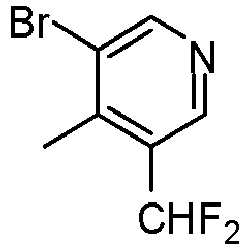
- To a solution of 5-bromo-4-methyl-pyridine-3-carbaldehyde (300 mg, 1.50 mmol) in dichloromethane (20 mL) was added diethylamino sulfur trifluoride (290 mg, 1.80 mmol) under argon, the reaction mixture was stirred for 16 h under argon. The mixture was quenched with sat NaHCO3 (5 mL) and the phases were separated. The organic layer was collected, washed with brine (5 mL × 3), dried over Na2SO4, filtered and concentrated in vacuo. The residue was purified by prep-TLC (EtOAc / PE = 1:5) to give 3-bromo-5-(difluoromethyl)-4-methylpyridine (220 mg, 63% yield) as a yellow oil. LCMS (ESI) [M+H]+ = 221.7.
-

- To a reaction tube was added 3-bromo-5-(difluoromethyl)-4-methyl-pyridine (80 mg, 0.36 mmol), KOAc (70 mg, 0.72 mmol), Pd(dppf)Cl2 (13 mg, 0.02 mmol), bis(pinacolato)diboron (183 mg, 0.72 mmol) and 1,4-dioxane (10 mL). The mixture was stirred at 100 °C for 16 h under N2. The reaction mixture was filtered and concentrated in vacuo. The crude material was be used directly in the next step without further purification. LCMS (ESI) [M+H]+ =187.7.
-

- To a mixture of 3-(difluoromethyl)-4-methyl-5-(4,4,5,5-tetramethyl-1,3,2-dioxaborolan-2-yl)pyridine (84 mg, 0.31 mmol) in 1,4-dioxane (10 mL) and water (2 mL) were added (±)-trans-N-(8-amino-6-chloro-2,7-naphthyridin-3-yl)-2-cyano-cyclopropanecarboxamide (60 mg, 0.21 mmol), XphosPdG2 (16 mg, 0.02 mmol), Xphos (20 mg, 0.04 mmol) and KOAc (61 mg, 0.63 mmol). The mixture was heated to 100 °C for 2 h. This reaction mixture was concentrated in vacuo and purified by prep-TLC (DCM / MeOH = 20 / 1) followed by prep-HPLC to give (±)-trans-N-[8-amino-6-[5-(difluoromethyl)-4-methyl-3-pyridyl]-2,7-naphthyridin-3-yl]-2-cyano-cyclopropanecarboxamide (14 mg, 16.8% yield) as a white solid. LCMS (ESI) [M+H]+ = 394.7, RT (min) = 1.591, Method = G; 1H NMR (400 MHz, DMSO-d 6) δ 11.29 (s, 1H), 9.42 (s, 1H), 8.69 (s, 1H), 8.68 (s, 1H), 8.22 (s, 1H), 7.21-7.48 (m, 3H), 7.00 (s, 1H), 2.74-2.79 (m, 1H), 2.40 (s, 3H), 2.13-2.18 (m, 1H), 1.59-1.64 (m, 1H), 1.41-1.46 (m, 1H).
-

- To a suspension of N,N-diethylamine (0.50 mL, 4.65 mmol) in dichloromethane (15 mL) was added methanesulfonyl chloride (0.17 mL, 2.20 mmol) and (±)-trans-N-[8-amino-6-(4-methyl-3-pyridyl)-2,7-naphthyridin-3-yl]-5-azaspiro[2.4]heptane-2-carboxamide hydrochloride (50 mg, 0.12 mmol) at 0 °C. The mixture was stirred for 30 min at 0 °C. Methanesulfonyl chloride (84 mg) was added to the mixture at 0 °C. The reaction mixture was stirred for another 30 min and then diluted with water (3 mL). The mixture was concentrated and purified by Prep-HPLC to give (±)-trans-N-[8-amino-6-(4-methyl-3-pyridyl)-2,7-naphthyridin-3-yl]-5-methylsulfonyl-5-azaspiro[2.4]heptane-2-carboxamide (29 mg, 51% yield) as a white solid. LCMS (ESI) [M+H]+ = 452.7, RT (min) = 1.494, Method = G. 1H NMR (400 MHz, DMSO-d 6) δ 11.00 (s, 1H), 9.37 (s, 1H), 8.56 (s, 1H), 8.43 (d, J = 4.8 Hz, 1H), 8.27 (s, 1H), 7.30-7.32 (m, 3H), 6.99 (s, 1H), 3.33-3.39 (m, 4H), 2.84 (s, 3H), 2.41 (s, 3H), 2.26-2.30 (m, 1H), 1.88-2.01 (m, 2H), 1.22-1.29 (m, 2H).
-

- To a suspension of (±)-cis-N-[8-amino-6-(4-methyl-3-pyridyl)-2,7-naphthyridin-3-yl]-5-azaspiro[2.4]heptane-2-carboxamide hydrochloride (25 mg, 0.06 mmol) in dichloromethane (10 mL) was added N,N-diethylamine (0.29 mL, 2.79 mmol) and methanesulfonyl chloride (140 mg) at 0 °C. The mixture was stirred for 30 min at 0 °C. Methanesulfonyl chloride (84 mg) was added to the mixture at 0 °C and the reaction mixture was stirred for another 30 min at 0 °C. The reaction mixture was diluted with water (3 mL) and concentrated. The crude material was purified by Prep-HPLC to give (±)-cis-N-[8-amino-6-(4-methyl-3 -pyridyl)-2,7-naphthyridin-3-yl]-5-methylsulfonyl-5-azaspiro[2.4]heptane-2-carboxamide (9 mg, 33% yield) as a white solid. LCMS (ESI) [M+H]+ = 452.7, RT (min) = 1.504, Method = G. 1HNMR (400 MHz, CD3OD) δ 9.30 (s, 1H), 8.54 (s, 1H), 8.43 (d, J= 5.2Hz, 1H), 8.34 (s, 1H), 7.40 (d, J= 4.8 Hz, 1H), 6.99 (s, 1H), 3.35-3.54 (m, 4H), 2.94 (s, 3H), 2.46 (s, 3H), 2.12-2.23 (m, 3H), 1.45-1.48 (m, 1H), 1.28-1.32 (m, 1H).
-

-

- A solution of 5-tert-butoxycarbonyl-5-azaspiro[2.3]hexane-2-carboxylic acid (590 mg, 2.6 mmol) in HCl/dioxane (5 mL, 20 mmol) was stirred for 1 h at 25 °C. The mixture was concentrated in vacuo and the residue was dissolved in MeOH. The product was precipitated by the addition of EtOA and collected by filtration to give 5-azaspiro[2.3]hexane-2-carboxylic acid hydrochloride as a white solid (420 mg, 99%): 1H NMR (400 MHz, DMSO-d 6) δ 12.60 (bs, 1H), 4.09-3.96 (m, 4H), 1.94-1.92 (m, 1H), 1.37-1.29 (m, 1H), 1.09-1.05 (m, 1H).
-

- To a mixture of 5-azaspiro[2.3]hexane-2-carboxylic acid (400 mg, 3.15 mmol), 3-cyano-2-fluoropyridine (640 mg, 5.24 mmol) in N,N-dimethylformamide (3 ml) was added K2CO3 (1.6 g, 11.59 mmol). The mixture was stirred for 15 h at 85°C. The pH was adjusted to around 6 by adding 1N HCl solution. The product was extracted with ethyl acetate (20 ml × 3). The organic layer was dried, concentrated, and purified by prep-TLC (DCM/MeOH = 20/1) to give 5-(3-cyano-2-pyridyl)-5-azaspiro[2.3]hexane-2-carboxylic acid as a yellow solid (400 mg, 55% yield): LCMS (ESI) [M+H]+=230.1
-

- To a mixture of pyridine (0.76 mL, 9.34 mmol), 6,8-dichloro-2,7-naphthyridin-3-amine (200 mg, 0.93 mmol) and 5-(3-cyano-2-pyridyl)-5-azaspiro[2.3]hexane-2-carboxylic acid (350 mg, 1.53 mmol) in dichloromethane (5 mL) at 0°C was added POCl3 (186 mg, 1.21 mmol). The mixture was stirred for 1h at rt, quenched with aq. NaHCO3, and extracted with DCM (50 mL × 3). The combined organics were dried, concentrated, and the resulting crude residue purified by prep-TLC (EA/PE = 1/1) to give 5-(3-cyano-2-pyridyl)-N-(6,8-dichloro-2,7-naphthyridin-3-yl)-5-azaspiro[2.3]hexane-2-carboxamide as a yellow solid (200 mg, 50% yield). LCMS (ESI) [M+H]+=425.2. 1H NMR (400 MHz, CDCl3) δ 9.39 (s, 1H), 8.50-8.46 (m, 2H), 8.28 (d, J= 4.8 Hz, 1H), 7.69-7.59 (m, 2H), 6.66-6.63 (m, 1H), 4.58-4.48 (m, 4H), 3.19-3.18 (m, 1H), 1.42-1.26 (m, 2H).
-

- A solution of 5-(3-cyano-2-pyridyl)-N-(6,8-dichloro-2,7-naphthyridin-3-yl)-5-azaspiro[2.3]hexane-2-carboxamide (180 mg, 0.42 mmol) in NH3.H2O (5 mL, 18 mmol) and 1,4-dioxane (5 mL) was stirred at 90°C for 3 h. The solution was concentrated. The crude mixture was washed with a mixture of ethyl acetate (3 mL) and PE (10 mL) to give crude N-(8-amino-6-chloro-2,7-naphthyridin-3-yl)-5-(3-cyano-2-pyridyl)-5-azaspiro[2.3]hexane-2-carboxamide (200 mg, 37% yield) as a yellow solid. LCMS (ESI) [M+H]+=406.2
-

- To a sealed tube was added Na2CO3 (50 mg, 0.47 mmol), Pd(dppf)Cl2 (23 mg, 0.03 mmol), 4-methyl-3-(4,4,5,5-tetramethyl-1,3,2-dioxaborolan-2-yl)pyridine (69 mg, 0.32mmol) and N-(8-amino-6-chloro-2,7-naphthyridin-3-yl)-5-(3-cyano-2-pyridyl)-5-azaspiro[2.3]hexane-2-carboxamide (200 mg, 0.16 mmol) in 1,4-dioxane (20 mL) and water (4 mL). The mixture was bubbled with N2 for 2 min, and stirred at 100°C for 4 h. The reaction was concentrated to dryness and purified by Prep-HPLC (C18) to give N-[8-amino-6-(4-methyl-3-pyridyl)-2,7-naphthyridin-3-yl]-5-(3-cyano-2-pyridyl)-5-azaspiro[2.3]hexane-2-carboxamide as a yellow solid (15 mg, 21% yield). (ESI): RT (min) = 1.641, [M+H]+ = 463.2, method = G; 1H NMR (400 MHz,DMSO-d 6) δ 11.05 (s, 1H), 9.38 (s, 1H), 8.57 (s, 1H), 8.43 (d, J= 4.8 Hz, 1H), 8.32 (dd, J= 2.0, 4.8 Hz, 1H), 8.28 (s, 1H), 7.96 (dd, J = 1.6, 7.6 Hz, 1H), 7.32-7.31 (m, 3H), 7.00 (s, 1H), 6.78 (dd, J= 4.8, 7.6 Hz, 1H), 4.39-4.30 (m, 4H), 2.41-2.36 (m, 4H), 1.39-1.27 (m, 2H).
-

- A mixture of exo-N-[8-amino-6-(4-methyl-3-pyridyl)-2,7-naphthyridin-3-yl]-3-azabicyclo[3.1.0]hexane-6-carboxamide (78 mg, 0.22 mmol), TEA (110 mg, 1.09 mmol) and MsCl (28 mg, 0.25 mmol) in dichloromethane (10 mL) was stirred at 25 °C for 2 h. The reaction mixture was concentrated and the residue purified by Prep-HPLC (C18) to give exoN-[8-amino-6-(4-methyl-3-pyridyl)-2,7-naphthyridin-3-yl]-3-methylsulfonyl-3-azabicyclo[3.1.0]hexane-6-carboxamide (27 mg, 29 % yield) as a white solid. LCMS (ESI): RT (min)= 1.467, [M+H]+ = 439.1, method = H; 1H NMR (400 MHz, DMSO-d 6) δ 10.95 (s, 1 H), 9.37 (s, 1 H), 8.56 (s, 1 H), 8.43 (d, J = 5.2 Hz, 1 H), 8.22 (s, 1 H), 7.32-7.30 (m, 3 H), 6.96 (s, 1 H), 3.45-3.43 (m, 4 H), 2.95 (s, 3 H), 2.41 (s, 3 H), 2.19-2.17 (m,1H), 2.11-2.09 (m, 2H).
-

-

- A mixture of 4-bromo-isothiazole (4.7 g, 28.66 mmol), tert-butyl acrylate (13 mL, 96.96 mmol), Pd(OAc)2 (700 mg, 3.13 mmol), tris-(o-tolyl)phosphine (2.1 g, 6.91 mmol), and TEA (10 g, 99.01 mmol) in 1,4-dioxane (100 mL) was refluxed vigorously under Ar at 125 °C for 2h. The reaction mixture was cooled to room temperature and concentrated. The residue was purified by silica gel chromatography (PE:EA = 15 : 1 to 10 : 1) to give tert-butyl (E)-3-isothiazol-4-ylprop-2-enoate (2.7 g, 44.6% yield) as a light yellow solid. LCMS (ESI) [M+Na]+ = 212.1. 1H NMR (400 MHz, CDCl3): δ 8.72 (s, 1H), 8.69 (s, 1H), 7.63 (d, J= 16.0 Hz, 1H), 6.36 (d, J= 16.0 Hz, 1H), 1.55 (s, 9H).
-

- t-BuOK (3 g, 26.79 mmol) was added portionwise to a solution of trimethylsulfoxoniumiodide (6.1 g, 27.72 mmol) in dimethyl sulfoxide (30 mL) at 25 °C and the mixture was stirred at 25 °C for 0.5h. A solution of tert-butyl (E)-3-isothiazol-4-ylprop-2-enoate (2.7 g, 12.78 mmol) in dimethyl sulfoxide (10 mL) was added dropwise to the reaction mixture at 25 °C. The mixture was stirred at 25 °C for 1h. The reaction mixture was diluted with sat. NH4Cl (150 mL) and extracted with EA (50 mLx3). The ethyl acetate layers were combined, dried over Na2SO4, filtered and evaporated. The residue was purified with silica gel chromatography (PE:EA = 10 : 1) to give tert-butyl trans-2-isothiazol-4-ylcyclopropanecarboxylate (1.94 g, 67.4% yield) as a light yellow oil. LCMS (ESI) [M+H]+ = 226.1.
-

- A mixture of tert-butyl (±)-trans-2-isothiazol-4-ylcyclopropanecarboxylate (1.94 g, 8.61 mmol) in 2,2,2-trifluoroacetic acid (15 mL) was stirred at 20 °C for 1h. The reaction mixture was evaporated and the resulting residue purified by silica gel chromatography (PE:EA = 1 : 1 to 1 : 2) to give (±)-trans-2-isothiazol-4-ylcyclopropanecarboxylic acid (1.37 g, 94% yield) as a light brown oil. LCMS (ESI) [M+H]+ = 170.0.
-

- POCl3 (150 mg, 0.98 mmol) was added dropwise to a mixture of 6,8-dichloro-2,7-naphthyridin-3-amine hydrochloride (200 mg, 0.80 mmol), (±)-trans-2-isothiazol-4-ylcyclopropanecarboxylic acid (250 mg, 1.48 mmol) and pyridine (1 mL, 12.36 mmol) in dichloromethane (10 mL) at 0 °C. Then the reaction mixture was warmed to 20 °C and stirred for 1h. To the reaction mixture was added DCM (20 mL) and the mixture washed with H2O (10 mL). The DCM layer was separated, dried over Na2SO4, filtered and evaporated. The residue was purified by silica gel chromatography (PE:EA = 3 : 1 PE:EA : THF = 3 : 1: 1) to give (±)-trans-N-(6,8-dichloro-2,7-naphthyridin-3-yl)-2-isothiazol-4-yl-cyclopropanecarboxamide (220 mg, 75 % yield) as a light yellow solid. LCMS (ESI) [M+Na]+ = 365.0.
-

- A mixture of (±)-trans-N-(6,8-dichloro-2,7-naphthyridin-3-yl)-2-isothiazol-4-yl-cyclopropanecarboxamide (220 mg, 0.60 mmol) in ammonium hydroxide (10 mL) in 1,4-dioxane (10 mL) was stirred at 90 °C in sealed tube for 3h. The reaction mixture was cooled to room temperature and evaporated to give trans-N-(8-amino-6-chloro-2,7-naphthyridin-3-yl)-2-isothiazol-4-yl-cyclopropanecarboxamide (230 mg) as a brown solid. The crude product was used directly in next step. LCMS (ESI) [M+Na]+ = 346.1/348.1.
-

- A mixture of (±)-trans-N-(8-amino-6-chloro-2,7-naphthyridin-3-yl)-2-isothiazol-4-yl-cyclopropanecarboxamide (crude 230 mg, about 0.60 mmol), 4-methyl-3-(4,4,5,5-tetramethyl-1,3,2-dioxaborolan-2-yl)pyridine (250 mg, 1.14 mmol), XPhos Pd G2 (50 mg, 0.06 mmol), XPhos (60 mg, 0.13 mmol) and K2CO3 (250 mg, 1.81 mmol) in 1,4-dioxane (16 mL) and water (4 mL) was stirred at 100 °C under Ar for 2h. The reaction mixture was cooled to room temperature and diluted with ethyl acetate (100 mL). The organic layer was washed with brine (30 mL). Organic layer was separated, dried over Na2SO4, filtered and evaporated. The residue was purified with silica gel chromatography (PE : THF = 1 : 3) followed by flash chromatography (C18, NH4HCO3/ MeOH/ H2O) to give (±)-trans-N-[8-amino-6-(4-methyl-3-pyridyl)-2,7-naphthyridin-3-yl]-2-isothiazol-4-yl-cyclopropanecarboxamide (45 mg, 18.6% yield of two steps) as a light yellow solid. LCMS (ESI): RT (min) = 1.67, [M+H]+ = 403.1, method = C; 1H NMR (400 MHz, DMSO-d 6): δ 11.00 (brs, 1H), 9.37 (s, 1H), 8.77 (s, 1H), 8.57 (s, 1H), 8.53 (s, 1H), 8.44 (d, J = 4.8 Hz, 1H), 8.27 (s, 1H), 7.32 (brs, 2H), 7.31 (s, 1H), 6.98 (s, 1H), 2.60-2.55 (m, 1H), 2.41 (s, 3H), 2.44-2.40 (m, 1H), 1.56-1.51 (m, 1H), 1.47-1.44 (m, 1H).
-

- To a sealed tube was added (±)-trans-N-[8-amino-6-(4-methyl-3-pyridyl)-2,7-naphthyridin-3-yl]-2-cyano-cyclopropanecarboxamide (160 mg, 0.46 mmol), acetonitrile (20 mL) and Selectfluor (105 mg, 0.28 mmol). The mixture was stirred at 75°C for 2 hours. The mixture was filtered, concentrated and purified by silica-gel column chromatography (eluted with DCM/MeOH=30:1 to 10:1) followed by prep-HPLC (acetonitrile 30-80% / 0.1% NH4HCO3 in water) to give (±)-trans-N-[8-amino-5-fluoro-6-(4-methyl-3-pyridyl)-2,7-naphthyridin-3-yl]-2-cyano-cyclopropanecarboxamide (25 mg, 15% yield) as a white solid. LCMS (ESI): RT (min) = 1.546, [M+H]+ = 363.2, method = G; 1H NMR (400 MHz, CD3OD) δ 9.32 (s, 1H), 8.51 (s, 1H), 8.47 (s, 1H), 8.45 (d, J= 5.2 Hz, 1H), 7.41 (d, J= 5.2 Hz, 1H), 2.70-2.62 (m, 1H), 2.37 (s, 3H), 2.15-2.09 (m, 1H), 1.65-1.52 (m, 2H).
-

-

- To a vial was added methyl (trans)-2-(hydroxymethyl)cyclopropanecarboxylate (520 mg, 4 mmol), water (5 mL), tetrahydrofuran (5 mL), methyl alcohol (5 mL) and NaOH (728 mg, 18.2 mmol). The mixture was stirred at 40°C for 2 hours. The reaction was concentrated to remove the organic solvent, and acidified to pH=3~4 with 2 N HCl. The product was extracted with ethyl acetateA (50 mL x2) The combined extracts were washed with brine (20 mL), dried over Na2SO4, filtered and concentrated in vacuo to give (±)-trans-2-(hydroxymethyl)cyclopropanecarboxylic acid (320 mg, 69% yield) as a pale-yellow oil.
-

- To a vial was added (±)-trans-2-(hydroxymethyl)cyclopropanecarboxylic acid (320 mg, 2.76 mmol), dichloromethane (20 mL) and acetyl chloride (1.5 mL, 21mmol). The mixture was stirred at 40°C for 2 hours. The mixture was concentrated in vacuo to give the crude title compound as a pale-yellow oil.
-

- To a vial was added (±)-trans-2-(acetoxymethyl)cyclopropanecarboxylic acid (430 mg, 2.7 mmol) and DCM (30 mL). Oxalyl chloride (0.5 mL, 5.4 mmol) was added dropwise at 0 °C. N,N-Dimethylformamide (0.01mL) was added. The mixture was stirred at 20°C for 2 hours. The reaction mixture was concentrated to give the title compound.
-

- To a vial was added 6,8-dichloro-2,7-naphthyridin-3-amine hydrochloride (300 mg, 1.2 mmol), pyridine (1 mL, 12 mmol) and DCM (5 mL). A solution of (±)-[trans-2-chlorocarbonylcyclopropyl]methyl acetate (430 mg, 2.43 mmol) in DCM (5 mL) was added dropwise. The mixture was stirred at rt for 2 hours. The mixture was concentrated and purified by silica-gel chromatography (eluted with PE/EA from 1:1 to 0:100) to give (±)-[trans-2-[(6,8-dichloro-2,7-naphthyridin-3-yl)carbamoyl]cyclopropyl] methyl acetate (430 mg, 61% yield) as a yellow solid. LCMS (ESI) [M+H]+ = 354.0.
-

- To a sealed tube was added (±)-[trans-2-[(6,8-dichloro-2,7-naphthyridin-3-yl)carbamoyl]cyclopropyl]methyl acetate (430 mg, 0.73 mmol), NH3 (0.5 N in dioxane, 18 mL, 9 mmol) and ammonium hydrxide (14 mL). The mixture was stirred at 90 °C for 4 hours. The mixture was concentrated to get crude (±)-[trans-2-[(8-amino-6-chloro-2,7-naphthyridin-3-yl)carbamoyl]cyclopropyl]methyl acetate (440 mg, 90% yield) as a yellow solid. LCMS (ESI) [M+H]+ = 335.1.
-

- To a sealed tube was added Na2CO3 (215 mg, 2.0 mmol), Pd(dppf)Cl2 (112 mg, 0.15 mmol), (±)- [trans-2- [(8-amino-6-chloro-2,7-naphthyridin-3 -yl)carbamoyl] cyclopropyl] methyl acetate (440 mg, 0.66 mmol) and 4-methyl-3-(4,4,5,5-tetramethyl-1,3,2-dioxaborolan-2-yl)pyridine (292 mg, 1.33 mmol), 1,4-dioxane (10 mL) and water (1 mL). The mixture was bubbled with N2 for 2 min, and stirred at 100 °C for 4 h. The mixture filtered and concentrated to give crude (±)-[trans-2-[[8-amino-6-(4-methyl-3-pyridyl)-2,7-naphthyridin-3-yl]carbamoyl]cyclopropyl]methyl acetate (500 mg, 58% yield) as a brown solid. The crude product was used for the next step directly. LCMS (ESI) [M+H]+ = 392.2.
-

- To a vial was added (±)-[trans-2-[[8-amino-6-(4-methyl-3-pyridyl)-2,7-naphthyridin-3-yl]carbamoyl]cyclopropyl]methyl acetate (500 mg, 0.38 mmol), Na2CO3 (500 mg, 4.7 mmol) and MeOH (10mL). The mixture was stirred at rt for 2 hours. The mixture was filtered and concentrated. The residue was purified by silica-gel column chromatography (DCM/MeOH from 50:1 to 10:1,) followed by prep-HPLC (Mobile Phase: A: Water (10mmol NH4HCO3), B: Acetonitrile) to give (±)-trans-N-[8-amino-6-(4-methyl-3-pyridyl)-2,7-naphthyridin-3-yl]-2-(hydroxymethyl)cyclopropanecarboxamide (21mg,16% yield) as a white solid. LCMS (ESI): RT (min) = 1.285, [M+H]+ = 350.2, method = B; 1H NMR (400 MHz, CD3OD) δ 9.27 (s, 1H), 8.52 (s, 1H), 8.41 (d, J = 5.2 Hz, 1H), 8.28 (s, 1H), 7.37 (d, J = 5.2 Hz, 1H), 6.94 (s, 1H), 3.64 (dd, J = 6.0, 11.6 Hz, 1H), 3.46 (dd, J = 6.4, 11.6 Hz, 1H), 2.44 (s, 3H), 1.90-1.84 (m, 1H), 1.76-1.68 (m, 1H), 1.29-1.21 (m, 1H), 0.97-0.91 (m, 1H).
-

-

- To a vial was added (±)-trans-N-[8-amino-6-(4-methyl-3-pyridyl)-2,7-naphthyridin-3-yl]-2-cyano-cyclopropanecarboxamide (230 mg, 0.67 mmol) and dichloromethane (20 mL). The mixture was cooled to -30°C before adding DIBAL-H (1 N in toluene, 4 mL, 4 mmol) dropwise. The mixture was stirred at -30°C for 2 hours. The reaction was quenched by adding saturated NH4Cl aq. (2 mL) at -30°C and then concentrated. The solid was re-dissolved in DCM/MeOH=10:1 (50 mL), filtered and concentrated to give crude (±)-trans-N-[8-amino-6-(4-methyl-3-pyridyl)-2,7-naphthyridin-3-yl]-2-formyl-cyclopropanecarboxamide (300 mg, 26% yield). LCMS (ESI) [M+H]+ = 348.1.
-

- To a vial was added (±)-trans-N-[8-amino-6-(4-methyl-3-pyridyl)-2,7-naphthyridin-3-yl]-2-formyl-cyclopropanecarboxamide (300 mg, 0.17 mmol) and NH3 (7N in MeOH, 10 mL, 70 mmol). The mixture was stirred at rt for 60 min. After cooling to 0°C, NaBH4 (200 mg, 5.29 mmol) was added in portions and stirred for 10 min. The mixture was quenched by adding saturated NH4Cl aq. (1 mL). Na2SO4 (5 g) was added, the reaction mixture was stirred at rt for 5 min, filtered and concentrated in vacuo. The residue was purified by prep-TLC (DCM/MeOH/NH4OH=100:10:1) to give (±)-trans-2-(aminomethyl)-N-[8-amino-6-(4-methyl-3-pyridyl)-2,7-naphthyridin-3-yl]cyclopropanecarboxamide (23 mg, 36% yield) as a brown solid. LCMS (ESI): RT (min) = 1.373, [M+H]+ = 349.2, method = G; 1H NMR (400 MHz, CD3OD) δ: 9.18 (s, 1H), 8.42 (s, 1H), 8.31 (d, J = 5.2 Hz, 1H), 8.17 (s, 1H), 7.28 (d, J = 5.2 Hz, 1H), 6.86 (s, 1H), 2.66 (dd, J = 6.8, 13.2 Hz, 1H), 2.55 (dd, J = 7.2, 13.2 Hz, 1H), 2.34 (s, 3H), 1.77-1.71 (m, 1H), 1.56-1.51 (m, 1H), 1.20-1.15 (m, 1H), 0.86-0.79 (m, 1H).
-

-

- To a vial was added 6,8-dichloro-2,7-naphthyridin-3-amine hydrochloride (615 mg, 2.45 mmol), 1,2-dichloroethane (30 mL), pyridine (2 mL, 24.93 mmol) and acetyl chloride (1 mL, 14.18 mmol) The mixture was stirred at rt for 2 hours. The mixture was concentrated and purified by silica gel column chromatgraphy (PE/EA from 1:1 to 0:100) to give N-(6,8-dichloro-2,7-naphthyridin-3-yl)acetamide (780 mg, 99% yield) as a yellow solid. LCMS (ESI) [M+H]+ = 256.0.
-

- To a sealed tube was added NH3 (0.5 N in dioxane, 6 mL, 3mmol), NH3.H2O (6 mL, 39mmol) and N-(6,8-dichloro-2,7-naphthyridin-3-yl)acetamide (780 mg, 2.44 mmol). The mixture was stirred at 90°C for 4 hours. The mixture was concentrated to give crude N-(8-amino-6-chloro-2,7-naphthyridin-3-yl)acetamide (810 mg, 98% yield) as a yellow solid. LCMS (ESI) [M+H]+ = 237.1.
-

- To a vial was added Pd(dppf)Cl2 (120 mg, 0.17 mmol), 4-methyl-3-(4,4,5,5-tetramethyl-1,3,2-dioxaborolan-2-yl)pyridine (606 mg, 2.77 mmol), Na2CO3 (746 mg, 7 mmol), N-(8-amino-6-chloro-2,7-naphthyridin-3-yl)acetamide (810 mg, 2.4 mmol), 1,4-dioxane (50 mL) and water (5 mL) The mixture was stirred at 100°C for 1.5 h under N2. The mixture was concentrated and purified by silica-gel column chromatography (DCM/MeOH from 100:1 to 10:1) to give N-[8-amino-6-(4-methyl-3-pyridyl)-2,7-naphthyridin-3-yl]acetamide (665 mg, 85% yield) as a yellow solid. LCMS (ESI) [M+H]+ = 294.1.
-

- To a vial was added N-[8-amino-6-(4-methyl-3-pyridyl)-2,7-naphthyridin-3-yl]acetamide (600 mg, 2.05 mmol), acetonitrile (70 mL) and Selectfluor (600 mg, 1.61 mmol). The mixture was stirred at 60 °C for 16 hours. The mixture was filtered and concentrated. The residue was purified by prep-HPLC (acetonitrile 30-70% / 0.1% NH4OH in water) to giveN-[8-amino-5-fluoro-6-(4-methyl-3-pyridyl)-2,7-naphthyridin-3-yl]acetamide (120 mg, 17% yield) as a white solid. LCMS (ESI): RT (min) = 1.489, [M+H]+ = 312.0, method = C; 1H NMR (400 MHz, DMSO-d 6) δ 10.88 (s, 1H), 9.42 (s, 1H), 8.52 (s, 1H), 8.49 (d, J = 4.8 Hz, 1H), 8.37 (s, 1H), 7.37 (d, J = 4.8 Hz, 1H), 7.30 (br, 2H), 2.28 (s, 3H), 2.17 (s, 3H).
-

-

- To a solution of ethyl trans-2-(cyanomethyl)cyclopropanecarboxylate (500 mg, 3.26 mmol) in tetrahydrofuran (8mL), water (8 mL) was added LiOH·H2O (268 mg, 6.53 mmol). The reaction mixture was stirred at 25°C for overnight. The solution was concentrated and the residue was diluted with H2O (20 mL) and washed with ethyl acetate (20 mL). The aqueous layer was acidified with 4N HCl to pH = 3 and extracted with ethyl acetate (30 mLx3). The combined organic layers were washed with brine, dried over Na2SO4 and concentrated under reduced pressure to give (±)-trans-2-(cyanomethyl)cyclopropane carboxylic acid (380 mg, 3.04 mmol, 95% yield) as a colorless oil. 1H NMR (400 MHz, DMSO-d 6) δ 12.28 (s, 1H), 2.67-2.64 (m, 2H), 1.59-1.50 (m, 2H), 1.07-1.03 (m, 1H), 0.91-0.88 (m, 1H).
-

- To a mixture of (±)-trans-2-(cyanomethyl)cyclopropanecarboxylic acid (342 mg, 2.73 mmol), 6,8-dichloro-2,7-naphthyridin-3-amine(450 mg, 2.1 mmol) and pyridine (1.7 mL, 21.02 mmol) in dichloromethane (20 mL) was added POCl3 (419 mg, 2.73mmol) 0°C. The mixture was stirred for 1h at rt. The mixture was concentrated and purified by flash column chromatography (EtOAc /PE=1/1) to give (±)-trans-2-(cyanomethyl)-N-(6,8-dichloro-2,7-naphthyridin-3-yl)cyclopropanecarboxamide (536 mg, 79% yield) as a yellow solid. LCMS (ESI): [M+H-100]+=321.0;
-

- A mixture of (±)-trans-2-(cyanomethyl)-N-(6,8-dichloro-2,7-naphthyridin-3-yl)cyclopropanecarboxamide (486 mg, 1.51mmol) and NH3·H2O (5 mL, 1.51 mmol) in 1,4-dioxane (20 mL) was heated to 80 °C for 5h in a sealed tube. The solution was concentrated and the crude product was washed with EA/PE=1:1 to give (±)-trans-N-(8-amino-6-chloro-2,7-naphthyridin-3-yl)-2-(cyanomethyl) cyclopropanecarboxamide (435 mg, 95% yield) as a yellow solid. LCMS (ESI): [M+H]+=302.0.
-

- A mixture of (±)-trans-N-(8-amino-6-chloro-2,7-naphthyridin-3-yl)-2-(cyanomethyl) cyclopropanecarboxamide(250 mg, 0.83 mmol), 4-methyl-3-(4,4,5,5-tetramethyl-1,3,2-dioxaborolan-2-yl)pyridine(236 mg, 1.08 mmol), Pd(dppf)Cl2(61 mg, 0.08 mmol) and Na2CO3 (263 mg, 2.49mmol) in 1,4-dioxane (12 mL) and water (3 mL) was stirred at 110°C for 2h. The mixture was diluted with water (20 ml) and extracted with EA (30 mLx3). The organics were washed with a saturated NaCl solution (50 ml), dried with anhydrous Na2SO4, fitered and concentrated. The crude product was purified by Prep-HPLC (Mobile phase: A water( 0.01% NH3) +10mm (NH4HCO3), B Acetonitrile) to give (±)-trans-N-[8-amino-6-(4-methyl-3-pyridyl)-2,7-naphthyridin-3-yl]-2-(cyanomethyl)cyclopropanecarboxamide (62 mg, 20.9% yield) as a white solid. LCMS (ESI): RT (min) =1.543, [M+H]+=359.1, method = C; 1H NMR (400 MHz, DMSO-d 6) δ 9.45 (s, 1H), 8.58 (s, 1H), 8.44 (d, J = 5.2 Hz, 1H), 8.38 (s, 1H), 7.45 (s, 2H), 7.32 (d, J = 4.8 Hz, 1H), 7.08 (s, 1H), 5.04 (d, J = 3.6 Hz, 1H), 3.14-3.11 (m, 2H), 2.91-2.86 (m, 1H), 2.59-2.55 (m, 1H), 2.47-2.45 (m, 4H), 2.01-2.00 (m, 1H).
-

-

- A mixture of exo-3-tert-butoxycarbonyl-3-azabicyclo[3.1.0]hexane-6-carboxylic acid (360 mg, 1.58 mmol), NaIO4 (847 mg, 3.96 mmol) and RuCl3·3H2O(36 mg, 0.17 mmol) in ethyl acetate (10 mL) and water (10 mL) was stirred at 25°C overnight. Then the mixture was filtered, ethyl acetate (30 mL) was added. The mixture was washed with water (30 mL×1), brine (30 mLx1), dried over anhydrous Na2SO4, filtered and concentrated by rotavap to give crude exo-3-tert-butoxycarbonyl-4-oxo-3-azabicyclo[3.1.0]hexane-6-carboxylic acid (287 mg, 75% yield) as a yellow oil. LCMS (ESI): [M+H-56]+=186.1.
-

- To a mixture of 6,8-dichloro-2,7-naphthyridin-3-amine (45 mg, 0.21 mmol), exo-3-tert-butoxycarbonyl-4-oxo-3-azabicyclo[3.1.0]hexane-6-carboxylic acid (80 mg, 0.33 mmol) and pyridine (0.34 mL, 4.2 mmol) in dichloromethane (10 mL) being cooled to 0°C was added the POCl3 (97 mg, 0.63 mmol). The mixture was stirred for 1h at rt. Then the mixture was concentrated and purity by flash column chromatography (eluting EtOAc /PE=1/1) to give exo-tert-butyl 6-(6,8-dichloro-2,7-naphthyridin-3-ylcarbamoyl)-2-oxo-3-azabicyclo[3.1.0]hexane-3-carboxylate (90 mg, 98% yield) as a yellow solid. LCMS (ESI): [M+H-100]+=337.0.
-

- A mixture of tert-butyl exo-6-[(6,8-dichloro-2,7-naphthyridin-3-yl)carbamoyl]-4-oxo-3-azabicyclo[3.1.0] hexane-3-carboxylate (52 mg, 0.12 mmol) and NH3·H2O (2.0 mL, 0.12 mmol) in 1,4-dioxane (6 mL) was heated to 80°C overnight in a sealed tube. The mixture was concentrated. The residue was taken up in EtOAc (20 mL) and washed with water (10 mLx2), saturated NaCl solution (10 mL), dried with anhydrous Na2SO4, filtered and concentrated. The crude product exo-N-(8-amino-6-chloro-2,7-naphthyridin-3-yl)-4-oxo-3-azabicyclo[3.1.0]hexane-6-carboxamide (35 mg, 94% yield) was used in the next step without purification. LCMS (ESI): [M+H]+=318.0.
-

- A mixture of exo-N-(8-amino-6-chloro-2,7-naphthyridin-3-yl)-4-oxo-3-azabicyclo[3.1.0] hexane-6-carboxamide (35 mg, 0.11 mmol), 4-methyl-3-(4,4,5,5-tetramethyl-1,3,2-dioxaborolan-2-yl)pyridine(31 mg, 0.14 mmol), Pd(dppf)Cl2 (8.0 mg, 0.011 mmol), K2CO3 (46 mg, 0.33 mmol) in 1,4-dioxane (4.0 mL) and water (0.8mL) was stirred at 110 °C for 2 hours. The reaction was filtered through a pad of silica gel, and the filtrate was concentrated in vacuo. The crude product was further purified by Prep-HPLC (Mobile phase: A water( 0.01% NH3) +10mm (NH4HCO3), B Acetonitrile) to give exo-N-[8-amino-6-(4-methyl-3-pyridyl)-2,7-naphthyridin-3-yl]-4-oxo-3-azabicyclo[3.1.0]hexane-6-carboxamide (6 mg, 14.6% yield) as a white solid. LCMS (ESI): RT (min) =1.326, [M+H]+=375.1, method=G; 1H NMR (400 MHz, DMSO-d 6) δ 11.08 (s, 1H), 9.38 (s, 1H), 8.56 (s, 1H), 8.43 (d, J = 4.8 Hz, 1H), 8.21 (s, 1H), 7.43 (s, 1H), 7.34-7.31 (m, 3H), 6.98 (s, 1H), 3.51-3.48 (m, 2H), 2.41-2.40 (m, 4H), 2.18-2.16 (m, 1H), 2.09-2.08 (m, 1H).
-

-

- A mixture of 1-methyl-4-iodo-1h-pyrazole (12 g, 57.69 mmol), tert-butyl acrylate (30 g, 234.06 mmol), Pd(OAc)2 (0.9 g, 4.02 mmol), tri-p-tolylphosphine (3.45 g, 11.35 mmol) and TEA (58 g, 574.26 mmol) in acetonitrile (100 mL) under Ar was stirred at 110 °C for 3 h. The mixture was concentrated and purified by column chromatography eluting with EtOAc/hexane = 1:2 to afford tert-butyl (E)-3-(1-methylpyrazol-4-yl)prop-2-enoate (4.6 g, 21.87 mmol, 38% yield) as a brown oil. LCMS (ESI) [M+H]+ = 209.2.
-

- To a solution of trimethylsulfoxoniumiodide (5.96 g, 27.08 mmol) in dimethyl sulfoxide (60 mL) was added sodium tert-butoxide (2.71 g, 28.23 mmol). The mixture was stirred at 25 °C for 0.5 h. tert-butyl (E)-3-(1-methylpyrazol-4-yl)prop-2-enoate (4.7 g, 22.57 mmol) in DMSO (40 mL) was added to the mixture and stirred at rt overnight. Saturated NH4Cl (80 mL) was added. The mixture was extracted with EtOAc (3 × 200 mL). The combined extracts were washed with brine (3 × 100 mL), dried with Na2SO4, filtered and concentrated to give crude (±)-tert-butyl trans-2-(1-methylpyrazol-4-yl)cyclopropanecarboxylate (3.2 g, 13.25 mmol, 59% yield) as a brown oil. LCMS (ESI) [M+H]+ = 223.1.
-

- A mixture of (±)-tert-butyl trans-2-(1-methylpyrazol-4-yl)cyclopropanecarboxylate (3.2 g, 14.4 mmol) in 2,2,2-trifluoroacetic acid (30 mL) was stirred at 25 °C for 1 h. The reaction mixture was neutralized with sat NaHCO3 (aq.) to pH = 8. The mixture was the readjusted to pH 4. The mixture was concentrated and purified by preparative HPLC Reverse phase (C-18), eluting with Acetonitrile/Water + 0.05% NH4HCO3, to give (±)-trans-2-(1-methylpyrazol-4-yl)cyclopropanecarboxylic acid (1.7 g, 10.23 mmol, 71% yield) as a white solid. LCMS (ESI) [M+H]+ = 167.1.
-

- To a solution of (±)-trans-2-(1-methylpyrazol-4-yl)cyclopropanecarboxylic acid (300 mg, 1.81 mmol), pyridine (3 mL, 37.09 mmol) and 6,8-dichloro-2,7-naphthyridin-3-amine hydrochloride (452 mg, 1.8 mmol) in dichloromethane (25 mL) at 0°C was added POCl3 (900 mg, 5.88 mmol). The mixture was warmed up to rt and stirred at rt for 2 h. H2O (100 mL) was added and the mixture extracted with DCM (3 × 150 mL). The combined extracts were washed with brine (150 mL), dried with Na2SO4, filtered and concentrated to give crude (±)-(trans)-N-(6,8-dichloro-2,7-naphthyridin-3-yl)-2-(1-methylpyrazol-4-yl)cyclopropanecarboxamide (700 mg, 1.39 mmol, 77% yield) as a yellow solid. LCMS (ESI) [M+H]+ = 362.1.
-

- A mixture of (±)-trans-N-(6,8-dichloro-2,7-naphthyridin-3-yl)-2-(1-methylpyrazol-4-yl)cyclopropanecarboxamide (500 mg, 1.38 mmol) and NH4OH (12 mL, 1.38 mmol) in 1,4-dioxane (12 mL) was stirred at 90 °C for 3 h. The mixture was concentrated and purified by column chromatography eluting with EtOAc to afford (±)-trans-N-(6,8-dichloro-2,7-naphthyridin-3-yl)-2-(1-methylpyrazol-4-yl)cyclopropanecarboxamide (500 mg, 1.38 mmol) as a yellow solid. LCMS (ESI) [M+H]+ = 343.1.
-

- A mixture of (±)-trans-N-(8-amino-6-chloro-2,7-naphthyridin-3-yl)-2-(1-methylpyrazol-4-yl)cyclopropanecarboxamide (180 mg, 0.53 mmol), 4-methyl-3-(4,4,5,5-tetramethyl-1,3,2-dioxaborolan-2-yl)pyridine (138 mg, 0.63 mmol), x-Phos-Pd-G2 (83 mg, 0.11 mmol), X-Phos (100 mg, 0.21 mmol) and K2CO3 (145 mg, 1.05 mmol) in 1,4-dioxane (7 mL) and water (1 mL) under Ar was stirred at 100 °C for 1 h. The mixture was concentrated and purified by column chromatography eluting with DCM/MeOH = 10:1 to afford (±)-trans-N-[8-amino-6-(4-methyl-3-pyridyl)-2,7-naphthyridin-3-yl]-2-(1-methylpyrazol-4-yl)cyclopropanecarboxamide (105 mg, 0.26 mmol, 50% yield) as a yellow solid. LCMS (ESI) RT (min) = 1.497, [M+H]+ = 400.2, method = G. 1H NMR (400 MHz, DMSO-d 6) δ 10.95 (s, 1H), 9.37 (s, 1H), 8.57 (s, 1H), 8.44(d, J= 5.2 Hz, 1H), 8.26 (s, 1H), 7.56 (s, 1H), 7.32 (s, 2H), 7.31 (d, J= 5.2 Hz, 1H), 7.30 (s, 1H), 6.97 (s, 1H), 3.77 (s, 3H), 2.41 (s, 3H), 2.23-2.19 (m, 2H), 1.40-1.38 (m, 1H), 1.23-1.18 (m, 1H).
-
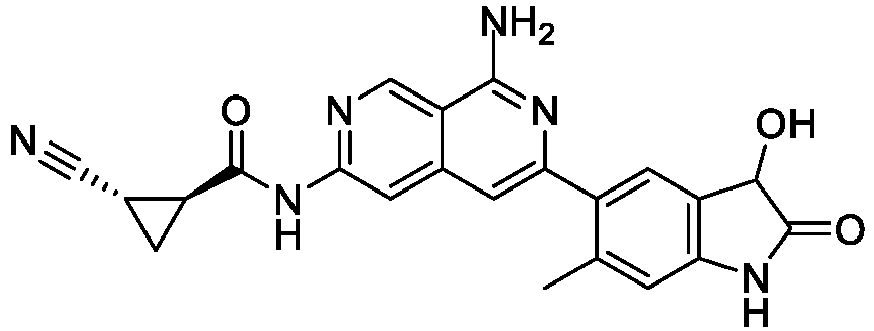
-

- To a solution of 5-bromo-6-methyl-indoline-2,3-dione (980 mg, 4.08 mmol) in tetrahydrofuran (50 mL) at 0°C was added NaBH4 (124 mg, 3.26 mmol). The mixture was stirred at 0°C for 10 min. H2O (50 mL) was added and the mixture extracted with EtOAc (3 × 200 mL). The combined extracts were washed with brine (100 mL), dried with Na2SO4, filtered and concentrated to give crude 5-bromo-3-hydroxy-6-methyl-indolin-2-one (650 mg, 2.5 mmol, 61% yield) as a brown solid. LCMS (ESI) [M+ Na]+ = 265.9.
-

- A mixture of 5-bromo-3-hydroxy-6-methyl-indolin-2-one (630 mg, 2.6 mmol), bis(pinacolato)diboron (331 mg, 13.01 mmol), Pd(dppf)Cl2 (380 mg, 0.52 mmol) and AcOK (510 mg, 5.2 mmol) in 1,4-dioxane (12 mL) under Ar was stirred at 95 °C for 2 h. The mixture was concentrated and purified by column chromatography eluting with EtOAc/hexane = 5:1 to afford 6-methyl-5-(4,4,5,5-tetramethyl-1,3,2-dioxaborolan-2-yl)indoline-2,3-dione (650 mg, 1.45 mmol, 56% yield) as a brown solid. LCMS (ESI) [M+H]+ = 288.1.
-

- A mixture of (±)-trans-N-(8-amino-6-chloro-2,7-naphthyridin-3-yl)-2-cyano-cyclopropanecarboxamide (300 mg, 1.04 mmol), 6-methyl-5-(4,4,5,5-tetramethyl-1,3,2-dioxaborolan-2-yl)indoline-2,3-dione (449 mg, 1.56 mmol), X-Phos (199 mg, 0.42 mmol), X-Phos-Pd-G2 (164 mg, 0.21 mmol) and K2CO3 (288 mg, 2.09 mmol) in 1,4-dioxane (12 mL) and water (1mL) under Ar atmosphere was stirred at 100 °C for 1 h. The mixture was concentrated and purified by column chromatography eluting with DCM/MeOH = 10:1 to afford trans-N-[8-amino-6-(6-methyl-2,3-dioxo-indolin-5-yl)-2,7-naphthyridin-3-yl]-2-cyano-cyclopropanecarboxamide (300 mg, 0.27 mmol, 26% yield) as a brown solid. LCMS (ESI) [M+H]+ = 413.2.
-

- To a solution of trans-N-[8-amino-6-(6-methyl-2,3-dioxo-indolin-5-yl)-2,7-naphthyridin-3-yl]-2-cyano-cyclopropanecarboxamide (300 mg, 0.27 mmol) in tetrahydrofuran (15 mL) at 0 °C was added NaBH4 (4 mg, 0.11 mmol). The mixture was stirred at 0°C for 10 min. The mixture was concentrated and purified by column chromatography eluting with DCM/MeOH= 10:1 to afford trans-N-[8-amino-6-(3-hydroxy-6-methyl-2-oxo-indolin-5-yl)-2,7-naphthyridin-3-yl]-2-cyano-cyclopropanecarboxamide (38 mg, 0.085 mmol, 32% yield) as a yellow solid. LCMS (ESI) RT (min) = 1.437, [M+H]+ = 415.1, method = C. 1H NMR (400 MHz, DMSO-d 6) δ 11.23 (s, 1H), 10.3 (s, 1H), 9.35 (s, 1H), 8.16 (s, 1H), 7.37 (s, 1H), 7.26 (s, 2H), 6.84 (s, 1H), 6.68 (s, 1H), 6.16 (d, J = 7.6 Hz, 1H), 4.84 (d, J = 7.6 Hz, 1H), 2.78-2.74 (m, 1H), 2.36 (s, 3H), 2.17-2.13 (m, 1H), 1.63-1.59 (m, 1H), 1.46-1.41 (m, 1H).
-

-

- To a solution of 4-bromo-1H-pyrazole (2.0 g, 13.61 mmol) in N,N-dimethylformamide (40 mL) at 0 °C was added NaH (1.63 g, 40.75 mmol). The mixture was stirred at 0°C for 0.5 h. 1-Boc-3-iodoazetidine (5.0 g, 17.66 mmol) was added and stirred at 0 °C for 1h. The mixture was warmed up to ambient temperature and stirred overnight. H2O (100 mL) was added. The mixture was extracted with EtOAc (3 × 200 mL). The combined extracts were washed with brine (3 × 100 mL), dried with Na2SO4, filtered and evaporated under reduced pressure. The residue was purified by column chromatography eluting with EtOAc/hexane = 1:5 to afford tert-butyl 3-(4-bromopyrazol-1-yl)azetidine-1-carboxylate (1.8 g, 4.38 mmol, 32% yield) as a colourless oil. LCMS (ESI) [M+H-56]+ = 247.9.
-

- A mixture of tert-butyl 3-(4-bromopyrazol-1-yl)azetidine-1-carboxylate (1.8 g, 4.35 mmol) and 2,2,2-trifluoroacetic acid (8 mL) in dichloromethane (15 mL) was stirred at 25 °C for 2 h. The reaction mixture was neutralized with sat. NaHCO3 (aq.) to pH = 7-8. The mixture was concentrated and purified by preparative HPLC Reverse phase (C-18), eluting with acetonitrile/water + 0.05% NH4HCO3, to give 1-(azetidin-3-yl)-4-bromo-pyrazole (875 mg, 3.55 mmol, 82% yield) as a white solid. LCMS (ESI) [M+H]+ = 202.0.
-

- To a solution of 1-(azetidin-3-yl)-4-bromo-pyrazole (400 mg, 1.98 mmol) and pyridine (1.61 mL, 19.85 mmol) in dichloromethane (20 mL) at 0 °C was added acetyl chloride (466 mg, 5.94 mmol). The mixture was stirred at 0°C for 3 h, The mixture was concentrated and purified by column chromatography eluting with DCM/MeOH = 20:1 to afford 1-[3-(4-bromopyrazol-1-yl)azetidin-1-yl]ethanone (400 mg, 1.27 mmol, 64% yield) as a brown solid. LCM (ESI) [M+H]+ = 244.0.
-

- A mixture of N1,N1-bis[(2,4-dimethoxybenzyl)]-3-(4-methyl-3-pyridyl)-2,7-naphthyridine-1,6-diamine (250 mg, 0.45 mmol), 1-[3-(4-bromopyrazol-1-yl)azetidin-1-yl]ethanone (359 mg, 1.13 mmol), t-BuBrettPhos Palladacycle Gen. 3 (82 mg, 0.09 mmol), t-BuBrettPhos (44 mg, 0.09 mmol) and LiHMDS (1.8 mL, 1.8 mmol) in 1,4-dioxane (10 mL) was stirred under Ar at 100 °C for 20 h. The mixture was concentrated and purified by column chromatography eluting with MeOH/DCM = 1:25 to afford 1-[3-[4-[[8-[bis[(2,4-dimethoxybenzyl)]amino]-6-(4-methyl-3-pyridyl)-2,7-naphthyridin-3-yl]amino]pyrazol-1-yl]azetidin-1-yl]ethanone (120 mg, 0.12 mmol, 26% yield) as a yellow solid. LCMS (ESI) [M+H]+ = 715.4.
-

- A mixture of 1-[3-[4-[[8-[bis[(2,4-dimethoxybenzyl)]amino]-6-(4-methyl-3-pyridyl)-2,7-naphthyridin-3-yl]amino]pyrazol-1-yl]azetidin-1-yl]ethanone (120 mg, 0.12 mmol) in 2,2,2-trifluoroacetic acid (5 mL) was stirred at 50°C for 1 h. The reaction mixture was concentrated and neutralized with 7 N NH3 in MeOH to pH = 7-8. The mixture was concentrated and purified by preparative HPLC reverse phase (C-18), eluting with Acetonitrile/Water + 0.05% NH4HCO3, to give 1-[3-[4-[[8-amino-6-(4-methyl-3-pyridyl)-2,7-naphthyridin-3-yl]amino]pyrazol-1-yl]azetidin-1-yl]ethanone (35 mg, 0.084 mmol, 73% yield) as a yellow solid. LC-MS (ESI) RT (min) = 1.413, [M+H]+ = 415.2, method = C. 1H NMR (400 MHz, DMSO-d 6) δ 9.23 (s, 1H), 8.98 (s, 1H), 8.53 (s, 1H), 8.42 (d, J = 4.8 Hz, 1H), 8.09 (s, 1H), 7.63 (s, 1H), 7.29 (d, J = 5.2 Hz, 1H), 7.10 (s, 2H), 6.77 (s, 1H), 6.68 (s, 1H), 5.27-5.21 (m, 1H), 4.55 (t, J = 13.8 Hz, 1H), 4.41 (q, J = 4.8 Hz, 1H), 4.29 (t, J = 9.0 Hz, 1H), 4.14-4.09 (m, 1H), 2.40 (s, 3H), 1.83 (s, 3H).
-

-

- To a solution of 3-chloro-N1,N1-bis[(2,4-dimethoxybenzyl)]-2,7-naphthyridine-1,6-diamine (2.0 g, 4.04 mmol) and pyridine (10 mL, 123.64 mmol) in dichloromethane (40 mL) at 0°C was added phenyl chloroformate (0.65 mL, 5.18 mmol). The mixture was stirred 0°C °C for 2 h. The mixture was concentrated and purified by column chromatography eluting with EtOAc/hexane = 1:2 to afford phenyl N-[8-[bis[(2,4-dimethoxybenzyl)]amino]-6-chloro-2,7-naphthyridin-3-yl]carbamate (1.8 g, 2.9 mmol, 72% yield) as a yellow solid. LCMS (ESI) [M+H]+ = 615.2.
-

- A mixture of phenyl N-[8-[bis[(2,4-dimethoxybenzyl)]amino]-6-chloro-2,7-naphthyridin-3-yl]carbamate (1.8 g, 2.93 mmol), 1-methyl-1h-pyrazol-4-amine (1.42 g, 14.62 mmol) and Et3N (3.0 g, 29.7 mmol) in 1,4-dioxane (80 mL) was stirred at 90 °C for 2 h. The mixture was concentrated and purified by column chromatography eluting with EtOAc/hexane = 4:1 to afford 1-[8-[bis[(2,4-dimethoxybenzyl)]amino]-6-chloro-2,7-naphthyridin-3-yl]-3-(1-methylpyrazol-4-yl)urea (1.6 g, 2.59 mmol, 89% yield) as a white solid. LCMS (ESI) [M+H]+ = 618.1.
-

- A mixture of 1-[8-[bis[(2,4-dimethoxybenzyl)]amino]-6-chloro-2,7-naphthyridin-3-yl]-3-(1-methylpyrazol-4-yl)urea (1.6 g, 2.59 mmol), 4-methyl-3-(4,4,5,5-tetramethyl-1,3,2-dioxaborolan-2-yl)pyridine (0.68 g, 3.1 mmol), x-Phos-Pd-G2 (407 mg, 0.52 mmol), x-Phos (493 mg, 1.04 mmol) and K2CO3 (0.74 g, 5.36 mmol) in 1,4-dioxane (80 mL) and water (10 mL) was stirred under Ar at 100 °C for 1.5 h. The mixture was concentrated and purified by column chromatography eluting with DCM/MeOH = 20:1 to afford 1-[8-[bis[(2,4-dimethoxybenzyl)]amino]-6-(4-methyl-3-pyridyl)-2,7-naphthyridin-3-yl]-3-(1-methylpyrazol-4-yl)urea (1.7 g, 2.29 mmol, 89% yield) as a yellow solid. LCMS (ESI) [M+H]+ = 675.3.
-

- A mixture of 1-[8-[bis[(2,4-dimethoxybenzyl)]amino]-6-(4-methyl-3-pyridyl)-2,7-naphthyridin-3-yl]-3-(1-methylpyrazol-4-yl)urea (1.7 g, 2.29 mmol) in 2,2,2-trifluoroacetic acid (30 mL) was stirred at 50 °C for 1 h. The mixture was concentrated and neutralized with 7N NH3 in MeOH to pH = 9-10. The mixture was concentrated, filtered, washed with DCM (200 ml) and H2O (100 ml), and dried to give crude 1-[8-amino-6-(4-methyl-3-pyridyl)-2,7-naphthyridin-3-yl]-3-(1-methylpyrazol-4-yl)urea (1.7 g) as a yellow solid. LCMS (ESI) [M+H]+ = 375.2.
-

- To a solution of 1-[8-amino-6-(4-methyl-3-pyridyl)-2,7-naphthyridin-3-yl]-3-(1-methylpyrazol-4-yl)urea (300 mg, 0.8 mmol) in N,N-dimethylformamide (20 mL) was added Selectfluor (149 mg, 0.4 mmol). The mixture was stirred at 50 °C for 3 h. The mixture was concentrated and purified by preparative HPLC (C-18), eluting with acetonitrile/Water + 0.05% NH4HCO3, to give 1-[8-amino-5-fluoro-6-(4-methyl-3-pyridyl)-2,7-naphthyridin-3-yl]-3-(1-methylpyrazol-4-yl)urea (2.7 mg, 0.0063 mmol, 0.8% yield) as a yellow solid. LC-MS (ESI) RT (min) = 1.713, [M+H]+ = 393.2, method = G. 1H NMR (400 MHz, DMSO-d 6) δ 9.48 (s, 1H), 9.27 (s, 1H), 9.19 (s, 1H), 8.43 (s, 1H), 8.40 (d, J = 5.2 Hz, 1H), 7.97 (s, 1H), 7.77 (s, 1H), 7.34 (s, 1H), 7.29 (d, J = 4.8 Hz, 1H), 7.19 (s, 2H), 3.71 (s, 3H), 2.20 (s, 3H).
-

- To a solution of 1-[8-amino-6-(4-methyl-3-pyridyl)-2,7-naphthyridin-3-yl]-3-(1-methylpyrazol-4-yl)urea (100 mg, 0.27 mmol) in N,N-dimethylformamide (10 mL) was added NCS (178 mg, 1.34 mmol). The mixture was stirred at 25 °C overnight. The mixture was purified by preparative HPLC (C-18), eluting with acetonitrile/Water + 0.05% NH4HCO3, to give 1-[8-amino-5-chloro-6-(4-methyl-3-pyridyl)-2,7-naphthyridin-3-yl]-3-(1-methylpyrazol-4-yl)urea (44 mg, 0.11 mmol, 40% yield) as a yellow solid. LC-MS (ESI) RT (min) = 1.765, [M+H]+ = 409.2, method = G. 1H NMR (400 MHz, DMSO-d 6) δ 9.57 (s, 1H), 9.38 (s, 1H), 9.26 (s, 1H), 8.49 (d, J = 4.8 Hz, 1H), 8.42 (s, 1H), 8.26 (s, 1H), 7.90 (s, 1H), 7.56 (s, 2H), 7.44 (s, 1H), 7.37 (d, J = 5.2 Hz, 1H), 3.81 (s, 3H), 2.19 (s, 3H).
-

-

- To a solution of 4-bromo-3-methylbenzoic acid (500.0mg, 2.33mmol) and 2,2,2-trifluoroethylamine (210.0 mg, 2.12 mmol) in pyridine (5 mL) was added phosphorus oxychloride (1300 mg, 8.48 mmol) at 0 °C . The resulting mixture was stirred for 1 h. The reaction was quenched with sat. NaHCO3 (aq) and extracted with ethyl acetate (40 mLx2). The combined ethyl acetate extracts were concentrated in vacuo and purified by flash column chromatography (PE:EA=3:1-1:3) to give 4-bromo-3-methyl-N-(2,2,2-trifluoroethyl)benzamide (490 mg, 72.7% yield) as a yellow solid. LCMS (ESI): [M+H]+ = 296.0.
-

- A mixture of 4-bromo-3-methyl-N-(2,2,2-trifluoroethyl)benzamide (200 mg, 0.680 mmol), KOAc (133 mg, 1.35 mmol), bis(pinacolato)diboron (206 mg, 0.810 mmol) and Pd(dppf)Cl2 (49 mg, 0.07 mmol) in 1,4-dioxane (5 mL) was stirred for 3 hr at 80 °C. Mixture was concentrated and purified by flash column chromatography (PE/EA=10%-50%) to give 3-methyl-4-(4,4,5,5-tetramethyl-1,3,2-dioxaborolan-2-yl)-N-(2,2,2-trifluoroethyl)benzamide (200 mg, 86% yield) as a white solid. LCMS (ESI): [M+H]+ = 344.1.
-

- A mixture of (±)- trans-N-(8-amino-6-chloro-2,7-naphthyridin-3-yl)-2-cyano-cyclopropanecarboxamide (168 mg, 0.58 mmol), 3-methyl-4-(4,4,5,5-tetramethyl-1,3,2-dioxaborolan-2-yl)-N-(2,2,2-trifluoroethyl)benzamide (100 mg, 0.29 mmol), acetoxypotassium (86 mg, 0.87 mmol), XphosPdG2 (23 mg, 0.03 mmol) and Xphos (28 mg, 0.06 mmol) in 1,4-dioxane (4 mL) and H2O (0.4 mL) was stirred for 48 h at 100 °C. The mixture was concentrated and purified by by reverse phase chromatography (acetonitrile 10-45% in 0.05% NH4HCO3 in water) to give 4-[1-amino-6-[[(trans)-2-cyanocyclopropanecarbonyl]amino]-2,7-naphthyridin-3-yl]-3-methyl-N-(2,2,2-trifluoroethyl)benzamide (6.2mg, 4.5% yield) as a yellow solid. LCMS (ESI): RT (min) = 1.75, [M+H]+ = 469.1, method = C; 1H NMR (400 MHz, CD3OD): 9.30 (s, 1H), 8.29 (s, 2H), 7.31(s, 1H), 7.79 (dd, J = 1.2, 8.0 Hz, 1H), 7.53 (d, J = 8.0 Hz, 1H), 4.16 (q, J = 9.2 Hz, 2H), 2.66-2.64 (m,1H), 2.16-2.11(m,1H), 1.62-1.55 (m, 2H).
-

-

- A mixture of iron (3.1 g, 55.3 mmol) and 3-bromo-4-methyl-5-nitropyridine (2.0 g, 9.22 mmol) in ethanol (20 mL) and sat. NH4Cl (4 mL) was stirred for 4 h at 70 °C . The reaction was cooled to rt and diluted with ethyl acetate (200 mL). Na2SO4 was added and the reaction was stirred for 0.5 h before being filtered. The filtrate was concentrated to give 5-bromo-4-methyl-pyridin-3-amine (1.4 g, 74.5% yield) as a yellow solid. LCMS (ESI): [M+H]+ = 187.1.
-

- To a solution of 5-bromo-4-methyl-pyridin-3-amine (600 mg, 3.21 mmol) in tetrahydrofuran (10 mL) was added NaHMDS (6.5 mL, 6.5 mmol) and stirred for 0.5 h at 0 °C. Di-tert-butyldicarbonate (770 mg, 3.53 mmol) was added. The mixture was stirred for 2 hr at rt. The reaction was then diluted with water (0.5 mL) and concentrated The residue was purified by flash column chromatography (PE/EA=20%) to give tert-butyl N-(5-bromo-4-methyl-3-pyridyl)carbamate (710 mg, 66.7% yield) as a white solid. LCMS (ESI): [M+H]+ = 287.0.
-

- A mixture of tert-butyl N-(5-bromo-4-methyl-3-pyridyl)carbamate (710 mg, 2.47 mmol), acetoxypotassium (486 mg, 4.95 mmol) and bis(pinacolato)diboron (756 mg, 2.98 mmol) and Pd(dppf)Cl2 (91mg, 0.12 mmol) in 1,4-dioxane (10 mL) was stirred for 18 h at 90 °C. The mixture was concentrated and purified by flash column chromatography (PE/EA=30%-70%) to give tert-butyl N-[4-methyl-5-(4,4,5,5-tetramethyl-1,3,2-dioxaborolan-2-yl)-3-pyridyl]carbamate (510 mg, 56.9% yield) as a yellow solid. LCMS (ESI): [M+H]+ = 335.2.
-

- A mixture of tert-butyl N-[4-methyl-5-(4,4,5,5-tetramethyl-1,3,2-dioxaborolan-2-yl)-3-pyridyl]carbamate (140 mg, 0.42 mmol), (±)-trans-N-(8-amino-6-chloro-2,7-naphthyridin-3-yl)-2-cyano-cyclopropane carboxamide (100 mg, 0.35 mmol), Pd(dppf)Cl2 (13 mg, 0.02 mmol) and Na2CO3 (74.0mg, 0.7 mmol) in 1,4-dioxane (4mL) and H2O (0.4 mL) was stirred for 18 h at 100 °C. The mixture was cooled to rt and diluted with water (10 mL). The mixture was then extracted with ethyl acetate (30 mL × 2). The combined ethyl acetate extracts were dried over Na2SO4 and concentrated in vacuo to give (±)-tert-butyl N-[5-[1-amino-6-[[(trans)-2-cyanocyclopropanecarbonyl]amino]-2,7-naphthyridin-3-yl]-4-methyl-3-pyridyl]carbamate (160 mg, 41.6% yield) as a brown oil. LCMS (ESI): [M+H]+ = 460.2.
-

- A solution of (±)-tert-butyl N-[5-[1-amino-6-[[(trans)-2-cyanocyclopropanecarbonyl] amino] -2,7-naphthyridin-3 -yl] -4-methyl-3 -pyridyl] carbamate (160 mg, 0.14 mmol) in dichloromethane (1 mL) and 2,2,2-trifluoroacetic acid (1 mL) was stirred for 4 h at 25 °C. The mixture was concentrated and the purified by prep-HPLC (acetonitrile 5-40% in 0.05% NH4HCO3 in water) to give (±)- trans-N-[8-amino-6-(5-amino-4-methyl-3-pyridyl)-2,7-naphthyridin-3-yl]-2-cyano-cyclopropanecarboxamide (34.5 mg, 66.4% yield) as a yellow solid. LCMS (ESI): RT (min) = 1.43, [M+H]+ = 360.1, method = C; 1H NMR (400 MHz, CD3OD): 9.30 (s, 1H), 8.23 (s, 1H), 8.00 (s, 1H), 7.85 (s, 1H), 6.95 (s, 1H), 2.66-2.64 (m, 1H), 2.17 (s, 3H), 2.15-2.11 (m, 1H), 1.62-1.55 (m, 2H).
-
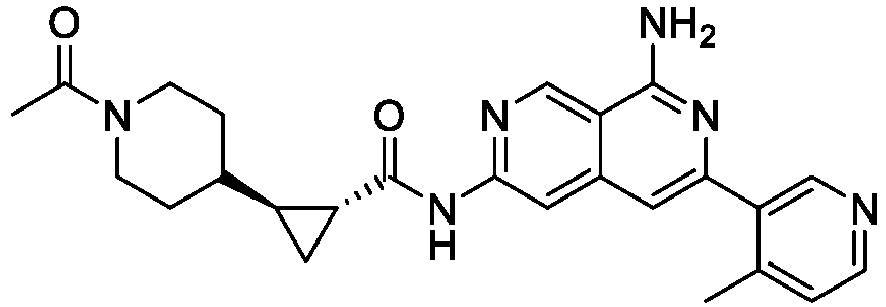
-

- To a solution of tert-butyl diethylphosphonoacetate (2.6 g, 10.32 mmol) in tetrahydrofuran (20 mL) was added methylmagnesiumbromide (3.44 mL, 10.32 mmol) at 0°C. The mixture was stirred for 0.5 h. To the reaction solution was then added tert-butyl 4-formyl-1-piperidinecarboxylate (2. 0 g, 9.38 mmol). The mixture was stirred for 5 h at 25 °C. The mixture was diluted with sat. NH4Cl, and concentrated. The residue was purified by flash column chromatography (PE/EA=1%-10%) to give tert-butyl 4-[(E)-3-tert-butoxy-3-oxo-prop-1-enyl]piperidine-1-carboxylate (2.4 g, 82.2% yield) as a yellow solid. LCMS (ESI): [M+H]+ = 334.2 .
-

- To solution of trimethylsulfoxonium iodide (1979 mg, 8.99mmol) in dimethyl sulfoxide (10 mL) was added tert-butoxypotassium (1009 mg, 8.99 mmol). The mixture was stirred for 0.5 h. tert-Butyl 4-[(E)-3-tert-butoxy-3-oxo-prop-1-enyl]piperidine-1-carboxylate (1.4 g, 4.5 mmol) was added and the mixture was stirred for 4 h at 25 °C. The mixture was diluted with water (50 mL) and extracted with PE (50 mLx3). The combined PE was dried over Na2SO4 and concentrated in vacuo to give tert-butyl 4-[(trans)-2-tert-butoxycarbonylcyclopropyl]piperidine-1-carboxylate (830 mg, 56.7% yield) as a colorless oil.
-

- A mixture of (±)-tert-butyl 4-[(trans)-2-tert-butoxycarbonylcyclopropyl]piperidine-1-carboxylate (830 mg, 1.99 mmol) in 5 mL of 4M HCl in dioxane was stirred for 18 h at 25 °C. The reaction was concentrated to give (±)-trans-2-(4-piperidyl)cyclopropanecarboxylic acid (640 mg, 90% yield) as a white solid. LCMS (ESI): [M+H]+ = 170.1
-

- A mixture of (±)-trans-2-(4-piperidyl)cyclopropanecarboxylic acid (640 mg, 3.78 mmol), Ac2O (1158.0 mg, 11.35 mmol) and TEA (574 mg, 5.67 mmol) in methyl alcohol (5 mL) was stirred for 18 h at 25 °C. The mixture was then concentrated and purified by flash column chromatography (MeOH 5%-40% /0.02% HCOOH in water) to give (±)-trans-2-(1-acetyl-4-piperidyl)cyclopropanecarboxylic acid (450 mg, 56.3% yield) as whit solid. LCMS (ESI): [M+H]+ = 212.2
-
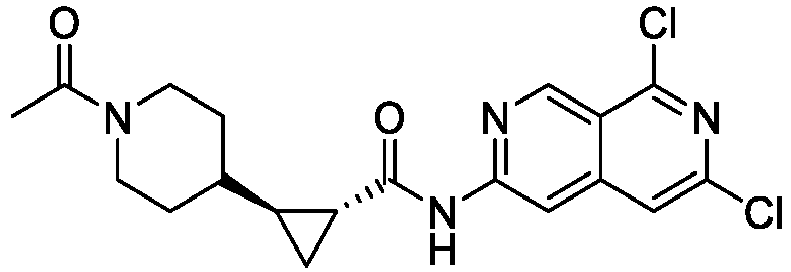
- To a mixture of (±)-trans-2-(1-acetyl-4-piperidyl)cyclopropanecarboxylic acid (430 mg, 2.04 mmol), 6,8-dichloro-2,7-naphthyridin-3-amine (436 mg, 2.04 mmol), pyridine (644 mg, 8.14 mmol) in dichloromethane (4 mL) was added POCl3 (1248 mg, 8.14 mmol). The reaction was stirred for 1 h at 25 °C. The mixture was diluted with sat. NaHCO3 and extracted with ethyl acetate (30 mLx2). The combined ethyl acetate extracts were dried over Na2SO4 and concentrated in vacuo to give (±)-trans-2-(1-acetyl-4-piperidyl)-N-(6,8-dichloro-2,7-naphthyridin-3-yl)cyclopropanecarboxamide (720 mg, 54.3% yield) as a crude yellow solid. LCMS (ESI): [M+H]+ = 407.1.
-

- A mixture of (±)-trans-2-(1-acetyl-4-piperidyl)-N-(6,8-dichloro-2,7-naphthyridin-3-yl)cyclopropane carboxamide (700 mg, 1.72 mmol) in 1,4-dioxane (5 mL) and ammonium hydroxide (25%, 10 mL) was stirred at 90 °C for 2 h. The mixture was diluted with 2 mL MeOH and ethyl acetate (20 mL). The suspension was stirred for 0.5 h at rt. The suspension was then filtered. The wet cake was washed with ethyl acetate and dried in vacuo to give at (±)-trans-2-(1-acetyl-4-piperidyl)-N-(8-amino-6-chloro-2,7-naphthyridin-3-yl)cyclopropanecarboxamide (580 mg, 82.7% yield) as a yellow solid. LCMS (ESI): [M+H]+ = 288.2.
-
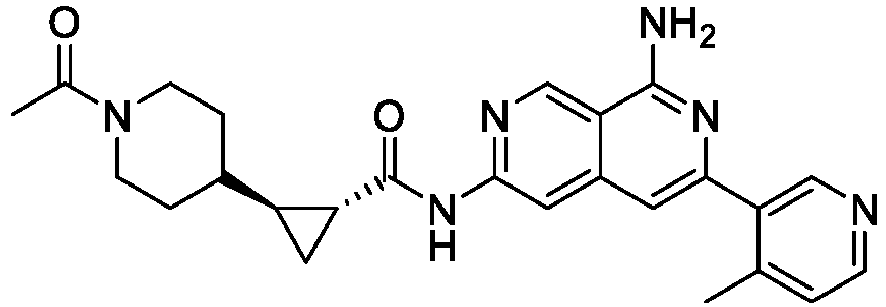
- A mixture of (±)-trans-2-(1-acetyl-4-piperidyl)-N-(8-amino-6-chloro-2,7-naphthyridin-3-yl)cyclopropanecarboxamide (380 mg, 0.98 mmol), 4-methyl-3-(4,4,5,5-tetramethyl-1,3,2-dioxaborolan-2-yl)pyridine (322 mg, 1.47 mmol), Pd(dppf)Cl2 (36 mg, 0.05 mmol) and Na2CO3 (312 mg, 2.94mmol) in 1,4-dioxane (15 mL) and water (2 mL) was stirred for 5 h at 100 °C. The mixture was then cooled to rt and filtered. The filtrate was concentrated and purified by prep-HPLC (acetonitrile 10-60% / 0.1% NH4HCO3 in water) to give (±)-trans-2-(1-acetyl-4-piperidyl)-N-[8-amino-6-(4-methyl-3-pyridyl)-2,7-naphthyridin-3-yl]cyclopropanecarboxamide (169 mg, 38.8% yield) as a white solid. LCMS (ESI): RT (min) = 1.49, [M+H]+ = 445.3, method = C; 1H NMR (400 MHz, CD3OD): 9.29 (s, 1H), 8.54 (s, 1H), 8.44 (d, J = 4.8 Hz, 1H), 8.29 (s, 1H), 7.40 (d, J = 4.8 Hz, 1H), 6.97 (s, 1H), 6.26 (s, 1H), 4.54-4.52 (m,1H), 3.96-3.94 (m, 1H), 3.09-3.07 (m, 1H), 2.63-2.61 (m,1H), 2.45 (s, 3H), 2.12 (s, 3H), 1.90-1.86 (m, 3H), 1.31-1.14 (m, 5H), 1.01-0.99 (s, 1H).
-

-

- A mixture of 2,5-dibromo-4-methylpyridine (500 mg, 1.99 mmol), (2-oxo-1H-pyridin-3-yl)boronic acid (415 mg, 2.99 mmol), Na2CO3 (422 mg, 3.99 mmol) and Pd(dppf)Cl2 (73 mg, 0.10 mmol) in 1,4-dioxane (10 mL) and water (0.4 mL) was stirred at 90 °C for 18 h. The mixture was cooled to rt and diluted with water. The product was extracted with ethyl acetate (50 mLx3). The combined ethyl acetate was dried over Na2SO4 and concentrated in vacuo. The residue was purified by flash column chromatography (PE/EA=50%-80%) to give 3-(5-bromo-4-methyl-2-pyridyl)-1H-pyridin-2-one (320 mg, 60.6% yield) as a white solid. LCMS (ESI): [M+H]+ = 267.0.
-

- A mixture of 3-(5-bromo-4-methyl-2-pyridyl)-1H-pyridin-2-one (350 mg, 1.32 mmol), bis(pinacolato)diboron (402 mg, 1.58 mmol), acetoxypotassium (259 mg, 2.64 mmol) and Pd(dppf)Cl2 (48 mg, 0.070 mmol) in 1,4-dioxane (10 mL) was stirred for 18 h at 110 °C. The reaction was cooled to rt and diluted with water. The mixture was extracted with ethyl acetate (50 mLx3). The combined ethyl acetate layers were dried over Na2SO4 and concentrated in vacuo. The residue was washed with PE (20 mL) and filtered. The collected solid cake was dried in vacuo to give 3-[4-methyl-5-(4,4,5,5-tetramethyl-1,3,2-dioxaborolan-2-yl)-2-pyridyl]-1H-pyridin-2-one (620 mg, 48.3% yield) as a black solid. This crude material was used in the next step without purification. LCMS (ESI): [M+H]+ = 313.2
-

- A mixture of 3-[4-methyl-5-(4,4,5,5-tetramethyl-1,3,2-dioxaborolan-2-yl)-2-pyridyl]-1H-pyridin-2-one (620 mg, 0.87 mmol), (±)-cis-N-(8-amino-6-chloro-2,7-naphthyridin-3-yl)-2-fluoro-cyclopropane carboxamide (180 mg, 0.64 mmol), Na2CO3 (170 mg, 1.6 mmol) and Pd(dppf)Cl2 (23 mg, 0.030 mmol) in 1,4-dioxane (2 mL) and H2O (0.2 mL) was stirred for 4 h at 100 °C. The reaction was cooled to rt and filtered. The filtrate was concentrated purified by prep-HPLC( acetonitrile 10-70% / 0.1% NH4HCO3 in water) to give (±)-cis-N-[8-amino-6-[4-methyl-6-(2-oxo-1H-pyridin-3-yl)-3-pyridyl]-2,7-naphthyridin-3-yl]-2-fluoro-cyclopropanecarboxamide (42.5 mg, 14.7% yield) as a yellow solid. LCMS (ESI): RT (min) = 1.43, [M+H]+ = 431.2, method =C; 1H NMR (400 MHz, DMSO-d 6): 11.99 (s, 1H), 10.02 (s, 1H), 9.39 (s, 1H), 8.65 (s, 1H), 8.56 (s, 1H), 8.51 (d, J = 5.2 Hz, 1H), 8.26 (s, 1H), 7.54 (d, J = 5.2 Hz, 1H), 7.34 (s, 1H), 7.03 (s, 2H), 6.43-6.40 (m, 0.5H), 5.05-4.87 (m, 0.5H), 2.40 (s, 3H), 2.28-2.45 (m, 1H), 1.71-1.64 (m, 1H), 1.23-1.18 (m, 1H).
-

-

- A mixture of N1,N1-bis[(2,4-dimethoxyphenyl)methyl]-3-(4-ethyl-3-pyridyl)-2,7-naphthyridine-1,6-diamine (600 mg, 1.06 mmol), 4-bromo-1-(2-tetrahydropyran-2-yloxyethyl)pyrazole (1200 mg, 4.36 mmol), t-BuBrettPhos Pd G3 (150 mg, 0.18 mmol), t-BuBrettPhos (120 mg, 0.25 mmol), t-BuONa (400 mg, 4.17 mmol) in toluene (20 mL) was stirred under Ar in sealed tube at 100 °C for 24 h. The reaction mixture was cooled to room temperature and diluted with ethyl acetate (100 mL). The mixture was washed with sat. NH4Cl (20 mL). The organic layer was separated, dried over Na2SO4, filtered and evaporated. The residue was purified with silica chromatography (PE:EA = 1 : 3) to give N1,N1-bis[(2,4-dimethoxyphenyl)methyl]-3-(4-ethyl-3-pyridyl)-N6-[1-(2-tetrahydropyran-2-yloxyethyl)pyrazol-4-yl]-2,7-naphthyridine-1,6-diamine (470 mg, 58.3% yield) as a brown solid. LCMS (ESI) [M+H]+ = 760.3.
-

- A mixture of N1,N1-bis[(2,4-dimethoxyphenyl)methyl]-3-(4-ethyl-3-pyridyl)-N6-[1-(2-tetrahydropyran-2-yloxyethyl)pyrazol-4-yl]-2,7-naphthyridine-1,6-diamine (470 mg, 0.62 mmol) in 2,2,2-trifluoroacetic acid (5 mL) was stirred at 80 °C for 1h. The reaction mixture was concentrated. The residue was re-dissolved in MeOH (3 mL) and basified with 7N NH3/MeOH to pH 9-10. The material was purified with flash chromatography (C18, NH4HCO3/ MeOH/ H2O) to give 2-[4-[[8-amino-6-(4-ethyl-3-pyridyl)-2,7-naphthyridin-3-yl]amino]pyrazol-1-yl]ethanol (125 mg, 53.8% yield) as a yellow solid. LCMS (ESI): RT (min) = 1.45, [M+H]+ = 376.1, method = C; 1H NMR (400 MHz, DMSO-d 6): δ 9.22 (s, 1H), 8.85 (brs, 1H), 8.47-8.46 (m, 2H), 7.91 (s, 1H), 7.49 (s, 1H), 7.32 (d, J = 5.2 Hz, 1H), 7.06 (brs, 2H), 6.71 (s, 1H), 6.64 (s, 1H), 4.92-4.89 (m, 1H), 4.14-4.09 (m, 2H), 3.76-3.72 (m, 2H), 2.79 (q, J = 7.6 Hz, 2H), 1.10 (t, J = 7.6 Hz, 3H).
-

-

- NaH (60% in oil, 580 mg, 14.5 mmol) was added portionwise to a solution of 4-bromo-1H-pyrazole (2 g, 13.61 mmol) in N,N-Dimethylformamide (25 mL) at 0 °C. The mixture was stirred at 0 °C for 2h. 2-(2-bromoethoxy)tetrahydro-2h-pyran (3 g, 14.35 mmol) was added to the reaction mixture. The resulting mixture was stirred at 15 °C for 2h. The reaction mixture was diluted with water (20 mL) and NH4Cl (50 mL). The product was extracted with ethyl acetate (100 mL × 3). The ethyl acetate layers were combined, washed with brine (100 mL × 2), dried over Na2SO4, filtered and evaporated. The residue was purified with silica chromatography (PE:EA = 4 : 1) to give 4-bromo-1-(2-tetrahydropyran-2-yloxyethyl)pyrazole (3 g, 80.1% yield) as a colorless oil. LCMS (ESI) [M+23]+ = 297.0.
-

- A mixture of N1,N1-bis[(2,4-dimethoxyphenyl)methyl]-3-(4-methyl-3-pyridyl)-2,7-naphthyridine-1,6-diamine (200 mg, 0.36 mmol), 4-bromo-1-(2-tetrahydropyran-2-yloxyethyl)pyrazole (400 mg, 1.45 mmol), t-BuBrettPhos Pd G3 (40 mg, 0.05 mmol), t-BuBrettPhos (40 mg, 0.08 mmol), t-BuONa (120 mg, 1.25 mmol) in toluene (10 mL) was stirred at 100 °C under Ar in sealed tube for 16h. The reaction mixture was cooled to room temperature and diluted with ethyl acetate (30 mL). The mixture was washed with sat. NH4Cl (10 mL). The organic layer was separated, dried over Na2SO4, filtered and evaporated. The residue was purified by silica chromatography (PE:EA = 1 : 3 to EA) to give N1,N1-bis[(2,4-dimethoxyphenyl)methyl]-3-(4-methyl-3-pyridyl)-N6-[1-(2-tetrahydropyran-2-yloxyethyl)pyrazol-4-yl]-2,7-naphthyridine-1,6-diamine (90 mg, 33.3% yield) as a brown solid. LCMS (ESI) [M+H]+ = 746.4.
-

- A mixture of N1,N1-bis[(2,4-dimethoxyphenyl)methyl]-3-(4-methyl-3-pyridyl)-N6-[1-(2-tetrahydropyran-2-yloxyethyl)pyrazol-4-yl]-2,7-naphthyridine-1,6-diamine (90 mg, 0.12 mmol) in 2,2,2-trifluoroacetic acid (5 mL) was stirred at 80 °C for 1h. The reaction mixture was evaporated. The residue was diluted with CH3CN (1 mL) and DMF (1 mL) before being purified by prep-HPLC to give 2-[4-[[8-amino-6-(4-methyl-3-pyridyl)-2,7-naphthyridin-3-yl]amino]pyrazol-1-yl]ethanol (23.4 mg, 53.7% yield) as a light yellow solid. LCMS (ESI): RT (min) = 1.39, [M+H]+ = 362.1, method = C; 1H NMR (400 MHz, CD3OD): δ 9.14 (s, 1H), 8.50 (s, 1H), 8.42 (d, J = 5.2 Hz, 1H), 7.93 (s, 1H), 7.60 (s, 1H), 7.39 (d, J = 5.2 Hz, 1H), 6.75 (s, 1H), 6.71 (s, 1H), 4.24 (t, J = 5.2 Hz, 2H), 3.93 (t, J = 5.2 Hz, 2H), 2.44 (s, 3H).
-

-

- A mixture of N1,N1-bis[(2,4-dimethoxyphenyl)methyl]-3-(4-methyl-3-pyridyl)-2,7-naphthyridine-1,6-diamine (300 mg, 0.54 mmol), 4-bromo-1-methyl-pyridin-2-one (300 mg, 1.6 mmol), Pd2dba3 (100 mg, 0.11 mmol), t-BuBrettPhos (140 mg, 0.29 mmol), and Cs2CO3 (300 mg, 0.92 mmol) in 1,4-dioxane (15 mL) was stirred at 100 °C under Ar in sealed tube for 16h. The reaction mixture was cooled to room temperature and diluted with ethyl acetate (50 mL). The mixture was washed with brine (20 mL), dried over Na2SO4, filtered and evaporated. The residue was purified with silica gel chromatography (EA to EA : MeOH = 10 : 1) to give 4-[[8-[bis[(2,4-dimethoxyphenyl)methyl]amino]-6-(4-methyl-3-pyridyl)-2,7-naphthyridin-3-yl]amino]-1-methyl-pyridin-2-one (140 mg, 39.1% yield) as a brown solid. LCMS (ESI) [M+H]+ = 659.3.
-

- A mixture of 4-[[8-[bis[(2,4-dimethoxyphenyl)methyl]amino]-6-(4-methyl-3-pyridyl)-2,7-naphthyridin-3-yl]amino]-1-methyl-pyridin-2-one (140 mg, 0.21 mmol) in 2,2,2-trifluoroacetic acid (5 mL) was stirred at 80 °C for 1h. The reaction mixture was concentrated and purified byflash chromatography (C18, NH4HCO3/ MeOH/ H2O) to yield 4-[[8-amino-6-(4-methyl-3-pyridyl)-2,7-naphthyridin-3-yl]amino]-1-methyl-pyridin-2-one (48 mg, 63% yield) as a white solid. LCMS (ESI): RT (min) = 1.36, [M+H]+ = 359.2, method = G; 1H NMR (400 MHz, DMSO-d 6+D2O): δ 9.34 (s, 1H), 8.54 (s, 1H), 8.42 (d, J = 4.8 Hz, 1H), 7.52 (d, J = 7.6 Hz, 1H), 7.32 (d, J = 4.8 Hz, 1H), 7.05 (s, 1H), 6.91 (s, 1H), 6.89 (d, J = 2.0 Hz, 1H), 6.38 (dd, J = 2.0, 7.6 Hz, 1H), 3.34 (s, 3H), 2.40 (s, 3H).
-

-

- Me3Al (2 M in toluene, 0.8 mL, 1.6 mmol) was added dropwise to a solution of 2-aminobenzonitrile (200 mg, 1.69 mmol) in toluene (10 mL) at 15 °C. The mixture was stirred at 15 °C for 1h. Phenyl N-[8-[bis[(2,4-dimethoxyphenyl)methyl]amino]-6-chloro-2,7-naphthyridin-3-yl]carbamate (170 mg, 0.28 mmol) was added to the reaction mixture in one portion The mixture was stirred at 15 °C for 1h. The reaction mixture was diluted with H2O (1 mL) and ethyl acetate (100 mL). The organic layer was washed with sat. NH4Cl (30 mL), dried over Na2SO4, filtered and evaporated. The residue was purified with silica gel chromatography (PE:EA = 2 : 1 to EA) to give 1-[8-[bis[(2,4-dimethoxyphenyl)methyl]amino]-6-chloro-2,7-naphthyridin-3-yl]-3-(2-cyanophenyl)urea (130 mg, 73.6% yield) as a light yellow solid. LCMS (ESI) [M+H]+ = 639.3.
-

- A mixture of 1-[8-[bis[(2,4-dimethoxyphenyl)methyl]amino]-6-chloro-2,7-naphthyridin-3-yl]-3-(2-cyanophenyl)urea (110 mg, 0.17 mmol), 4-methyl-3-(4,4,5,5-tetramethyl-1,3,2-dioxaborolan-2-yl)pyridine (110 mg, 0.50 mmol), XPhos Pd G2 (40 mg, 0.05 mmol), XPhos (40 mg, 0.08 mmol) and K2CO3 (110 mg, 0.80 mmol) in 1,4-dioxane (16 mL) and water (4 mL) was stirred at 100 °C under Ar in sealed tube for 3h. The reaction mixture was cooled to room temperature and diluted with ethyl acetate (100 mL). The organic layer was washed with brine (20 mL), dried over Na2SO4, filtered and evaporated. The residue was purified by silica gel chromatography (PE:EA = 1 : 2 to EA to EA : MeOH = 10 : 1) to give 1-[8-[bis[(2,4-dimethoxyphenyl)methyl]amino]-6-(4-methyl-3-pyridyl)-2,7-naphthyridin-3-yl]-3-(2-cyanophenyl)urea (80 mg, 66.8% yield) as a brown solid. LCMS (ESI) [M+H]+ = 696.3.
-

- A mixture of 1-[8-[bis[(2,4-dimethoxyphenyl)methyl]amino]-6-(4-methyl-3-pyridyl)-2,7-naphthyridin-3-yl]-3-(2-cyanophenyl)urea (80 mg, 0.11 mmol) in 2,2,2-trifluoroacetic acid (5 mL) was stirred at 50 °C for 1h. The reaction mixture was concentrated and purified by prep-HPLC (NH4HCO3/ CH3CN/ H2O) to give 1-[8-amino-6-(4-methyl-3-pyridyl)-2,7-naphthyridin-3-yl]-3-(2-cyanophenyl)urea (12.4 mg, 27.3% yield) as a white solid. LCMS (ESI): RT (min) = 1.43, [M+H]+ = 396.1, method = C; 1H NMR (400 MHz, CD3OD): δ 9.60 (s, 1H), 8.60 (s, 1H), 8.45 (d, J = 4.0 Hz, 1H), 8.13 (s, 1H), 7.84 (s, 1H), 7.65-7.61 (m, 1H), 7.42 (d, J = 4.0 Hz, 1H), 7.28-7.19 (m, 3H), 2.50 (s, 3H).
-

- To a solution of (±)-trans-N-[8-amino-6-(4-methyl-3-pyridyl)-2,7-naphthyridin-3-yl]-2-(1H-pyrazol-4-yl)cyclopropanecarboxamide (190 mg, 0.49 mmol) in N,N-dimethylformamide (10 mL) was added Selectfluor (95 mg, 0.25mmol). The mixture was stirred at 50°C for 3 h. The mixture was directly purified by reverse phase chromatography (acetonitrile 17-47% in 0.05% ammonia in water) to give (±)-trans-N-[8-amino-5-fluoro-6-(4-methyl-3-pyridyl)-2,7-naphthyridin-3-yl]-2-(1H-pyrazol-4-yl)cyclopropanecarboxamide (33 mg, 16.6% yield). LCMS (ESI): RT (min) = 1.538, [M+H]+ = 404.1, method = C; 1H NMR (400 MHz, DMSO-d 6): δ 12.64 (s, 1H), 11.19 (s, 1H), 9.43 (s, 1H), 8.52 (s, 1H), 8.49 (d, J = 5.2 Hz, 1H), 8.41 (s, 1H), 7.63 (s, 1H), 7.38 (s, 1H), 7.37 (d, J = 5.2 Hz, 1H), 7.32 (s, 2H), 2.28 (s, 3H), 2.25-2.21 (m, 2H), 1.45-1.40 (m, 1H), 1.29-1.24 (m, 1H).
-

- To a stirred solution of (±)-trans-N-[8-amino-6-(4-methyl-3-pyridyl)-2,7-naphthyridin-3-yl]-2-(1H-pyrazol-4-yl)cyclopropanecarboxamide (100 mg, 0.26 mmol) in N,N-dimethylformamide (8 mL) was added N-chlorosuccinimide (180 mg, 1.35mmol). The resulting mixture was stirred overnight at room temperature. The mixture was directly purified by reverse phase chromatography (acetonitrile 17-47% in 0.05% ammonia in water) to give (±)-trans-N-[8-amino-5-chloro-6-(4-methyl-3-pyridyl)-2,7-naphthyridin-3-yl]-2-(1H-pyrazol-4-yl)cyclopropanecarboxamide (38 mg, 35% yield) as a white solid. LCMS (ESI): RT (min) = 1.486, [M+H]+ = 420.1, method = G; 1H NMR (400 MHz, DMSO-d 6): δ 12.65 (s, 1H), 11.19 (s, 1H), 9.44 (s, 1H), 8.61 (s, 1H), 8.48 (d, J = 5.2 Hz, 1H), 8.41 (s, 1H), 7.60 (br, 4H), 7.36 (d, J = 5.2 Hz, 1H), 2.30-2.21 (m, 2H), 2.17 (s, 3H), 1.45-1.42 (m, 1H), 1.29-1.26 (m, 1H).
-
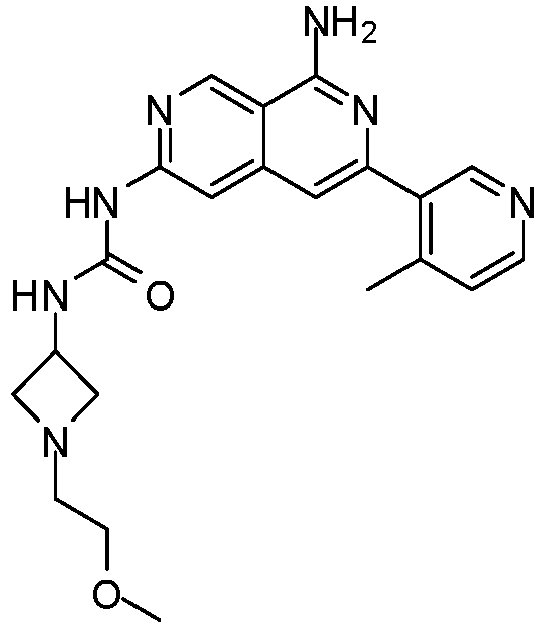
-

- A solution of 3-boc-aminoazetidinehydrochloride (900 mg, 4.31mmol), 2-bromoethyl methyl ether (1.26 g, 9.07mmol) and potassium carbonate (1.26 g, 9.13mmol) in acetonitrile (50 mL) was heated to 80 °C for 24h. The mixture was filtered and concentrated in vacuo to give tert-butyl N-[1-(2-methoxyethyl)azetidin-3-yl]carbamate (800 mg, 81% yield) as an orange solid. LCMS (ESI) [M+H]+ = 231.1.
-

- A solution of tert-butyl N-[1-(2-methoxyethyl)azetidin-3-yl]carbamate (800 mg, 3.47mmol) in HCl/dioxane (4M, 16.mL, 64mmol) was stirred for 1 h at room temperature. The mixture was evaporated and the resulting solid was washed with (EA:PE=1:1) to give 1-(2-methoxyethyl)azetidin-3-amine hydrochloride (600 mg, 51.8% yield) as a yellow solid. LCMS (ESI) [M+H]+ = 261.2.
-

- A mixture of phenyl N-[8-[bis[(2,4-dimethoxyphenyl)methyl]amino]-6-chloro-2,7-naphthyridin-3-yl]carbamate (800 mg, 30% purity, 0.39 mmol), 1-(2-methoxyethyl)azetidin-3-amine hydrochloride (600 mg, 1.8 mmol) and Et3N (0.8 g, 7.92 mmol) in N,N-dimethylformamide (15 mL) was stirred at 90°C for 3 h. The mixture was diluted with ethyl acetate (50 mL), washed with water (30 mLx3) and brine (30 mLx2). The organic layer was dried over sodium sulfate, filtered and concentrated in vacuo. The residue was purified by silica gel column (EA:PE=1:1 to DCM:MeOH = 20 : 1) to give 1-[8-[bis[(2,4-dimethoxyphenyl)methyl]amino]-6-chloro-2,7-naphthyridin-3-yl]-3-[1-(2-methoxyethyl)azetidin-3-yl]urea (150 mg, 39.6% yield) as a white solid. LCMS (ESI) [M+H]+ = 651.3.
-

- A solution of 1-[8-[bis[(2,4-dimethoxyphenyl)methyl]amino]-6-chloro-2,7-naphthyridin-3-yl]-3-[1-(2-methoxyethyl)azetidin-3-yl]urea (140 mg, 0.14 mmol), 4-methyl-3-(4,4,5,5-tetramethyl-1,3,2-dioxaborolan-2-yl)pyridine (60 mg, 0.27 mmol), Pd(dppf)Cl2 (25 mg, 0.03 mmol) and K2CO3 (50 mg, 0.36 mmol) in 1,4-dioxane (10 mL) and water (2 mL) was heated to 105 °C for 3h. The mixture was directly purified by silica gel column (EA to DCM : MeOH = 10: 1) to give 1-[8-[bis[(2,4-dimethoxyphenyl)methyl]amino]-6-(4-methyl-3-pyridyl)-2,7-naphthyridin-3-yl]-3-[1-(2-methoxyethyl)azetidin-3-yl]urea (80 mg, 75% yield) as a grey solid. LCMS (ESI) [M+H]+ = 708.3.
-

- A solution of 1-[8-[bis[(4-methoxyphenyl)methyl]amino]-6-(4-methyl-3-pyridyl)-2,7-naphthyridin-3-yl]-3-[1-(2-methoxyethyl)azetidin-3-yl]urea (80 mg, 0.12 mmol) in 2,2,2-trifluoroacetic acid (5 mL) was heated to 45 °C for 1h. After the solvent was evaporated, the residue was neutralized by ammona in MeOH. The resulting mixture was purified by reverse phase chromatography (acetonitrile 17-47% in 0.05% ammonia in water) to give 1-[8-amino-6-(4-methyl-3-pyridyl)-2,7-naphthyridin-3-yl]-3-[1-(2-methoxyethyl)azetidin-3-yl]urea (23.1mg, 46% yield) as a white solid. LCMS (ESI): RT (min) = 1.473, [M+H]+ = 408.3, method = F; 1HNMR (400 MHz, CD3OD): δ 9.24 (s, 1H), 8.52 (s, 1H), 8.42 (d, J = 5.2 Hz, 1H), 7.54 (s, 1H), 7.39 (d, J = 5.2 Hz, 1H), 6.89 (s, 1H), 4.50 (t, J = 6.8 Hz, 1H), 3.79 (dt, J = 2.0, 6.8 Hz, 2H), 3.45 (t, J = 5.6 Hz, 2H), 3.35 (s, 3H), 3.15 (dt, J = 2.0, 6.8 Hz, 2H), 2.74 (t, J = 5.6 Hz, 2H), 2.45 (s, 3H).
-

-

- A mixture of phenyl N-[8-[bis[(2,4-dimethoxyphenyl)methyl]amino]-6-chloro-2,7-naphthyridin-3-yl]carbamate (240 mg, 0.39 mmol), 1-Boc-3-(amino)azetidine (400 mg, 2.32 mmol) and Et3N (0.8 g, 7.92 mmol) in N,N-dimethylformamide (15 mL) was stirred at 90°C for 3 h. The mixture was diluted with ethyl acetate (50 mL), washed with water (30 mLx3) and brine (30 mLx2). The organic layer was dried over sodium sulfate, filtered and concentrated in vacuo. The residue was purified by silica gel column (EA:PE=1:2 to 1:1) to give tert-butyl 3-[[8-[bis[(2,4-dimethoxyphenyl)methyl]amino]-6-chloro-2,7-naphthyridin-3-yl]carbamoylamino]azetidine-1-carboxylate (110 mg, 27 % yield) as a white solid. LCMS (ESI) [M+H]+ = 693.3.
-

- A mixture of tert-butyl 3-[[8-[bis[(2,4-dimethoxyphenyl)methyl]amino]-6-chloro-2,7-naphthyridin-3-yl]carbamoylamino]azetidine-1-carboxylate (100 mg, 0.10 mmol), 4-methyl-3-(4,4,5,5-tetramethyl-1,3,2-dioxaborolan-2-yl)pyridine (28 mg, 0.13 mmol), XPhos Pd G2 (12 mg, 0.02 mmol), AcOK (23 mg, 0.23mmol) and XPhos (18 mg, 0.04 mmol) in 1,4-dioxane (10 mL) and water (2 mL) was stirred under Ar at 100 °C for 2 h. The mixture was concentrated and purified by silica gel column (EA:PE=1:1 to 100% EA to DCM:MeOH=10:1) to give tert-butyl 3-[[8-[bis[(2,4-dimethoxyphenyl)methyl]amino]-6-(4-methyl-3-pyridyl)-2,7-naphthyridin-3-yl]carbamoylamino]azetidine-1-carboxylate (80 mg, 88% yield) as a light yellow solid. LCMS (ESI) [M+H]+ = 750.3.
-

- A solution of tert-butyl 3-[[8-[bis[(2,4-dimethoxyphenyl)methyl]amino]-6-(4-methyl-3-pyridyl)-2,7-naphthyridin-3-yl]carbamoylamino]azetidine-1-carboxylate (75 mg, 0.08 mmol) in 2,2,2-trifluoroacetic acid (5 mL) was heated to 45 °C for 1 h. After the solvent was evaporated, the mixture was neutralized by ammonia in MeOH. The resulting residue was purified by reverse phase chromatography (acetonitrile 17-47% in 0.05% ammonia bicarbonate in water) to give 1-[8-amino-6-(4-methyl-3-pyridyl)-2,7-naphthyridin-3-yl]-3-(azetidin-3-yl)urea (14.3 mg, 51 % yield) as a white solid. LCMS (ESI): RT (min) = 1.366, [M+H]+ = 350.1, method = C; 1HNMR (400 MHz, DMSO-d 6) δ 9.26 (s, 1H), 9.17 (s, 1H), 8.56 (s, 1H), 8.42 (d, J = 5.2 Hz, 1H), 7.80 (s, 1H), 7.67(d, J = 5.2 Hz, 1H), 7.30 (d, J = 5.2 Hz, 1H), 7.26 (s, 2H), 6.88 (s, 1H), 4.5-4.47 (m, 1H), 3.63-3.59 (m, 2H), 3.40-3.32 (m, 2H), 2.41 (s, 3H).
-

-

- To a solution of triphosgene (108 mg, 0.36 mmol) in tetrahydrofuran (4 mL) was added 3-(4-ethyl-3-pyridyl)-N1,N1-bis[(4-methoxyphenyl)methyl]-2,7-naphthyridine-1,6-diamine (180 mg, 0.18 mmol) and Et3N (0.5 mL, 3.56 mmol) in tetrahydrofuran (5 mL) at 0 °C. The mixture was stirred at 0 °C for 1h. (3R)-3-amino-1-methyl-pyrrolidin-2-one (450 mg, 3.94 mmol) was added. The mixture was warmed up to rt overnight. The mixture was directly purified by silica gel column chromatography (DCM : MeOH = 20:1) to give 1-[8-[bis[(4-methoxyphenyl)methyl]amino]-6-(4-ethyl-3-pyridyl)-2,7-naphthyridin-3-yl]-3-[(3R)-1-methyl-2-oxo-pyrrolidin-3-yl]urea (32 mg, 28% yield) as a light yellow solid. LCMS (ESI) [M+H]+ = 646.3.
-

- A solution of 1-[8-[bis[(4-methoxyphenyl)methyl]amino]-6-(4-ethyl-3-pyridyl)-2,7-naphthyridin-3-yl]-3-[(3R)-1-methyl-2-oxo-pyrrolidin-3-yl]urea (27 mg, 0.0400 mmol) in 2,2,2-trifluoroacetic acid (3 mL) was heated to reflux for 3 h. The mixture was evaporated and neutralized by ammonia in MeOH. The resulting residue was purified by reverse phase chromatography (acetonitrile 0-40/0.1% NH4HCO3 in water) to afford 1-[8-amino-6-(4-ethyl-3-pyridyl)-2,7-naphthyridin-3-yl]-3-[(3R)-1-methyl-2-oxo-pyrrolidin-3-yl]urea (5.5 mg, 33% yield) as a white solid. LCMS (ESI): RT (min) = 1.50, [M+H]+ = 406.2, method = C; 1HNMR (400 MHz, CD3OD) δ 9.29 (s, 1H), 8.50 (s, 2H), 7.52 (s, 1H), 7.45 (d, J= 5.2 Hz, 1H), 6.89 (s, 1H), 4.49 (t, J = 9.2 Hz, 1H), 3.47 (dd, J = 4.0, 9.2 Hz, 2H), 2.93 (s, 3H), 2.83 (q, J = 7.6 Hz, 2H), 2.62-2.57 (m, 1H), 2.09-2.04 (m, 1H), 1.19 (t, J = 7.6 Hz, 3H).
-

-

- A mixture of phenyl N-[8-[bis[(2,4-dimethoxyphenyl)methyl]amino]-6-chloro-2,7-naphthyridin-3-yl]carbamate (150 mg, 0.24 mmol), DL-alaninol(75 mg, 1 mmol) and Et3N (500 mg, 4.95 mmol) in N,N-dimethylformamide (10 mL) was stirred at 90 °C for 2 h. The mixture was diluted with ethyl acetate (80 mL), washed with water (30 mL × 3) and brine (30 mL x2). The organic layer was dried over sodium sulfate, filtered and concentrated in vacuo. The residue was purified by silica gel column (EA:PE=1:1 to 4:1) to give 1-[8-[bis[(2,4-dimethoxyphenyl)methyl]amino]-6-chloro-2,7-naphthyridin-3-yl]-3-(2-hydroxy-1-methylethyl)urea (110 mg,0.18 mmol, 76% yield) as a white solid. LCMS (ESI) [M+H]+ = 596.2.
-
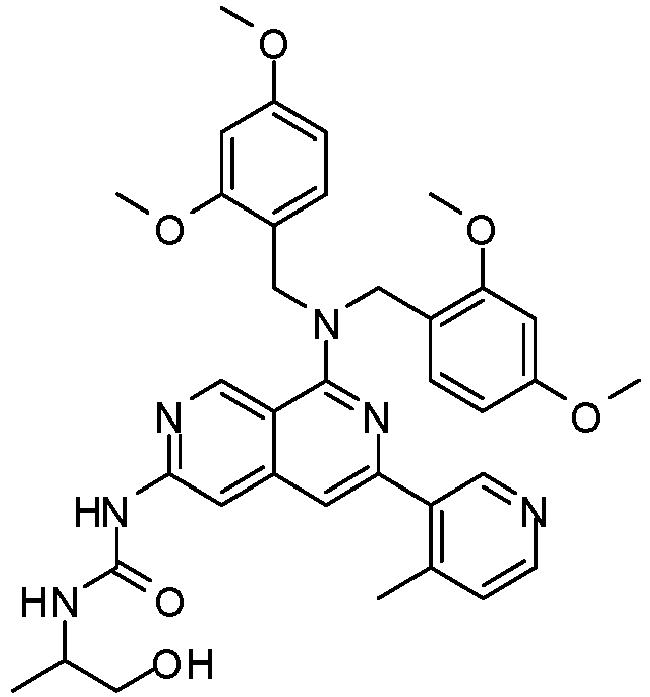
- A mixture of 1-[8-[bis[(2,4-dimethoxyphenyl)methyl]amino]-6-chloro-2,7-naphthyridin-3-yl]-3-(2-hydroxy-1-methyl-ethyl)urea (100 mg, 0.17 mmol), 4-methyl-3-(4,4,5,5-tetramethyl-1,3,2-dioxaborolan-2-yl)pyridine (50 mg, 0.23 mmol), XPhos Pd G2 (20 mg, 0.03mmol), AcOK (40 mg, 0.41 mmol) and XPhos (30 mg, 0.06 mmol) in 1,4-dioxane (10 mL) and water (2 mL) was stirred under Ar at 100 °C for 2 h. The mixture was concentrated and purified by silica gel column chromatography (DCM:MeOH =10:1) to give 1-[8-[bis[(2,4-dimethoxyphenyl)methyl]amino]-6-(4-methyl-3-pyridyl)-2,7-naphthyridin-3-yl]-3-(2-hydroxy-1-methyl-ethyl)urea (85 mg, 78% yield) as a light yellow solid. LCMS (ESI) [M+H]+ = 653.3.
-

- A solution of 1-[8-[bis[(2,4-dimethoxyphenyl)methyl]amino]-6-(4-methyl-3-pyridyl)-2,7-naphthyridin-3-yl]-3-(2-hydroxy-1-methyl-ethyl)urea (80 mg, 0.12 mmol) in 2,2,2-trifluoroacetic acid (5 mL) was heated to 45 °C for 1 h. After the solvent was evaporated, the residue was neutralized by ammonia in methanol. The mixture was directly purified by reverse phase HPLC (acetonitrile 17-47% in 0.05% ammonia bicarbonate in water) to give 1-[8-amino-6-(4-methyl-3-pyridyl)-2,7-naphthyridin-3-yl]-3-(2-hydroxy-1-methyl-ethyl)urea (28.9 mg, 67% yield) as a white solid. LCMS (ESI): RT (min) = 1.432, [M+H]+ = 353.1, method = C; 1HNMR (400 MHz, DMSO-d 6) δ 9.26 (s, 1H), 9.16 (s, 1H), 8.56 (s, 1H), 8.42 (d, J = 5.2 Hz, 1H), 7.78 (s, 1H), 7.29 (d, J = 5.2 Hz, 1H), 7.23-7.21 (m, 3H), 6.87 (s, 1H), 4.83 (t, J = 5.2 Hz, 1H), 3.79-3.70 (m, 1H), 3.43-3.32 (m, 2H), 2.41 (s, 3H), 1.11 (d, J = 6.8 Hz, 3H).
-

-

- A mixture of 4-nitro-1H-pyrazole (500 mg, 4.42 mmol), 2-bromopropionitrile (1185 mg, 8.85 mmol) and potassium carbonate (610 mg, 4.42 mmol) in N,N-dimethylformamide (15 mL) was stirred at 80 °C for 2 h. The reaction mixture was concentrated and the residue was purified by flash column chromatography eluting with PE/EA (5 /1) to give (±)-2-(4-nitropyrazol-1-yl)propanenitrile (720 mg, 4.334 mmol, 98% yield) as a yellow solid. LCMS (ESI): [M+H]+ = 167.1.
-

- A mixture of (±)-2-(4-nitropyrazol-1-yl)propanenitrile (720 mg, 4.33 mmol) and iron (1230 mg, 21.96 mmol) in acetic acid (20 mL) was stirred at 25 °C overnight. The reaction mixture was filtered and concentrated. The residue was purified by flash column chromatography eluting with DCM / MeOH (20 / 1) to give (±)-2-(4-aminopyrazol-1-yl)propanenitrile (200 mg, 33.9% yield) as a yellow solid. LCMS (ESI): [M+H]+ = 137.1.
-

- A mixture of (±)-2-(4-aminopyrazol-1-yl)propanenitrile (176 mg, 1.29 mmol), phenyl N [8-[bis[(2,4-dimethoxyphenyl)methyl]amino]-6-chloro-2,7-naphthyridin-3-yl]carbamate (160 mg, 0.26 mmol) and triethylamine (100 mg, 0.99 mmol) in 1,4-dioxane (5 mL) was stirred at 110 °C overnight. The reaction mixture was concentrated and purified by prep-TLC (DCM / MeOH = 10/1) to give 1-[8-[bis[(2,4-dimethoxyphenyl)methyl]amino]-6-chloro-2,7-naphthyridin-3-yl]-3-[1-(1-cyanoethyl)pyrazol-4-yl]urea (165 mg, 96.5% yield) as a yellow solid. LCMS (ESI): [M+H]+ = 657.1.
-

- A mixture of (±)-1-[8-[bis[(2,4-dimethoxyphenyl)methyl]amino]-6-chloro-2,7-naphthyridin-3-yl]-3-[1-(1-cyanoethyl)pyrazol-4-yl]urea (200 mg, 0.3 mmol), 4-methyl-3-(4,4,5,5-tetramethyl-1,3,2-dioxaborolan-2-yl)pyridine(80 mg, 0.37 mmol), Xphos-Pd-G2 (24 mg, 0.030 mmol), Xphos (28 mg, 0.06 mmol) and potassium carbonate (84 mg, 0.61 mmol) in 1,4-dioxane (8 mL) and water (0.8 mL) was stirred at 100 °C for 2 h. The reaction mixture was concentrated and purified by prep-TLC(DCM/MeOH = 10 / 1) to give (±)-1-[8-[bis[(2,4-dimethoxyphenyl)methyl]amino]-6-(4-methyl-3-pyridyl)-2,7-naphthyridin-3-yl]-3-[1-(1-cyanoethyl)pyrazol-4-yl]urea(200 mg, 92.1% yield) as a yellow solid. LCMS (ESI): [M+H]+ = 714.1.
-

- A solution of (±)-1-[8-[bis[(2,4-dimethoxyphenyl)methyl]amino]-6-(4-methyl-3-pyridyl)-2,7-naphthyridin-3-yl]-3-[1-(1-cyanoethyl)pyrazol-4-yl]urea(220 mg, 0.31 mmol) in 2,2,2-trifluoroacetic acid (10 mL) was stirred at 50 °C for 3h. The reaction mixture was concentrated and was purified by prep-HPLC (Mobile Phase A: water (10 mmol/L NH4HCO3) B: ACN) to give (±)-1-[8-amino-6-(4-methyl-3-pyridyl)-2,7-naphthyridin-3-yl]-3-[1-(1-cyanoethyl)pyrazol-4-yl]urea (60 mg, 47.1% yield) as a white solid. LCMS (ESI): RT (min)= 1.532, [M+H]+ = 414.1, method = H; 1H NMR (400 MHz, DMSO-d 6) δ 9.44 (s, 2H), 9.32 (s, 1H), 8.56 (s, 1H), 8.43 (d, J = 5.2 Hz, 1H), 8.07 (s, 1H), 7.87 (s, 1H), 7.65 (s, 1H), 7.32-7.31 (m, 2H), 6.94 (s, 1H), 5.82-5.83 (m, 1H), 2.42 (s, 3H), 1.78 (d, J = 6.8 Hz, 3H).
-

-

- A mixture of 5-bromo-2-fluoro-4-methyl-pyridine (1000 mg, 5.26 mmol), tert-butyl (3S)-3-pyrrolidinylcarbamate(1200 mg, 6.44 mmol) and potassium carbonate (2200 mg, 15.94 mmol) in dimethyl sulfoxide (15 mL) was stirred at 100 °C overnight. The reaction mixture was diluted with water (30 mL) and extracted with ethyl acetate (3x20 mL). The combined organic layers was washed with brine, dried over sodium sulfate and concentrated. The residue was purified by flash column chromatography eluting with PE / EA (10 / 1) to give tert-butyl N-[(3S)-1-(5-bromo-4-methyl-2-pyridyl)pyrrolidin-3-yl]carbamate (1700 mg, 90.7% yield) as a white solid. LCMS (ESI): [M+H]+ = 356.1.
-

- A mixture of tert-butyl N-[(3S)-1-(5-bromo-4-methyl-2-pyridyl)pyrrolidin-3-yl]carbamate (1000 mg, 2.81 mmol), bis(pinacolato)diboron (3500 mg, 13.78 mmol), [1,1'-bis(diphenylphosphino)ferrocene]dichloropalladium(II) (229 mg, 0.28 mmol) and potassium acetate (835 mg, 8.52 mmol) in 1,4-dioxane (20 mL) was stirred at 90 °C overnight. The reaction mixture was concentrated and purified by prep-TLC (PE / EA = 1 / 1) to give tert-butyl N-[(3 S)-1-[4-methyl-5-(4,4,5,5-tetramethyl-1,3,2-dioxaborolan-2-yl)-2-pyridyl]pyrrolidin-3-yl]carbamate (1000 mg, 1.24 mmol, 44.2% yield) as a yellow oil. LCMS (ESI): [M+H]+ = 404.1.
-

- A mixture of (±)-cis-N-(8-amino-6-chloro-2,7-naphthyridin-3-yl)-2-fluoro-cyclopropanecarboxamide (70 mg, 0.25 mmol), tert-butyl N-[(3S)-1-[4-methyl-5-(4,4,5,5-tetramethyl-1,3,2-dioxaborolan-2-yl)-2-pyridyl]pyrrolidin-3-yl]carbamate(100 mg, 0.25 mmol), Xphos-Pd-G2 (19 mg, 0.02 mmol), Xphos (24 mg, 0.05 mmol) and potassium carbonate (68 mg, 0.49 mmol) in 1,4-dioxane (8 mL) and water (2 mL) was stirred at 100 °C for 2 h. The reaction mixture was concentrated and purified by Prep-TLC(PE / EA = 1 / 1) to give tert-butyl N-[(3S)-1-[5-[1-amino-6-[[(1R,2R)-2-fluorocyclopropanecarbonyl]amino]-2,7-naphthyridin-3-yl]-4-methyl-2-pyridyl]pyrrolidin-3-yl]carbamate (100 mg, 77.3% yield) as a yellow oil. LCMS (ESI): [M+H]+ = 522.1.
-

- A solution of tert-butyl N-[(3S)-1-[5-[1-amino-6-[[cis-2-fluorocyclopropanecarbonyl]amino]-2,7-naphthyridin-3-yl]-4-methyl-2-pyridyl]pyrrolidin-3-yl]carbamate (100 mg, 0.19 mmol) and hydrogen chloride in 1,4-dioxane (4N, 0.5 mL, 1.9 mmol) in 1,4-dioxane (5 mL) was stirred at 25 °C for 1 h. The reaction mixture was concentrated before ammonia in methanol was added. The solution was concentrated and purified by prep-HPLC (Mobile Phase A: water (10 mmol/L NH4HCO3) B: ACN) to give (±)-cis-N-[8-amino-6-[6-[(3S)-3-aminopyrrolidin-1-yl]-4-methyl-3-pyridyl]-2,7-naphthyridin-3-yl]-2-fluoro-cyclopropanecarboxamide(45 mg, 55.7% yield) as a yellow solid. LCMS (ESI): RT (min)= 1.407, [M+H]+ = 422.1, method = H; 1HNMR (400 MHz, CD3OD) δ 9.24 (s, 1H), 8.26 (s, 1H), 8.07 (s, 1H), 6.88 (s, 1H), 6.41 (s, 1H), 4.98-4.95 (m, 1H), 4.81-4.79 (m, 1H), 3.72-3.63 (m, 3H), 3.54-3.48 (m, 1H), 3.27-3.25 (m, 1H), 2.38 (s, 3H), 2.30-2.25 (m, 1H), 2.18-2.15 (m, 1H), 1.96-1.80 (m, 2H), 1.26-1.20 (m, 1 H).
-

-

- N-Bromosuccinimide (385 mg, 2.16 mmol) was added in portions to a mixture of ethyl-3,5-dimethyl-1H-pyrrole-2-carboxylate (350 mg, 2.09 mmol) and potassium carbonate (307 mg, 2.22 mmol) in acetonitrile (20 mL) at 0°C. The mixture was warmed to room temperature, diluted with water and then stirred for 30 mins. The precipitate was collected by vacuum filtration, washed with ethanol:water (1:2) and dried to give ethyl 4-bromo-3,5-dimethyl-1H-pyrrole-2-carboxylate (450 mg, 1.8285mmol, 87.4% yield) as a white solid. LCMS (ESI): [M+H]+ = 246.1.
-

- A mixture of ethyl 4-bromo-3,5-dimethyl-1H-pyrrole-2-carboxylate (450 mg, 1.83 mmol) in tetrahydrofuran (20 mL) was stirred at 0 °C for 10 min. Sodium hydride (60 mg, 2.5 mmol) was added at 0 °C. The reaction mixture was stirred at 0 °C for 10 min. Iodomethane (312 mg, 2.2 mmol) was then added. The reaction mixture was warmed to 25 °C and stirred for 2 h. The reaction mixture was concentrated and purified by flash column chromatography (PE / EA = 20 / 1) to give ethyl 4-bromo-1,3,5-trimethyl-pyrrole-2-carboxylate (320 mg, 1.23 mmol, 67.3% yield) as a yellow solid. LCMS (ESI): [M+H]+ = 260.1.
-

- A mixture of ethyl 4-bromo-1,3,5-trimethyl-pyrrole-2-carboxylate (320 mg, 1.23mmol) and potassium hydroxide (138 mg, 2.46 mmol) in ethanol (10 mL) and water (5 mL) was stirred at 100 °C for 4 h. The reaction was concentrated and then diluted with water (20 mL). The mixture was washed with ethyl acetate (2×20 mL). The water phase was adjusted to pH 4 and extracted with ethyl acetate (2×20 mL). The organic layer was dried over sodium sulfate, filtered and concentrated to 4-bromo-1,3,5-trimethyl-pyrrole-2-carboxylic acid (270 mg, 1.1634 mmol, 94.6% yield) as a white solid. LCMS (ESI):[M+H]+ = 232.1.
-

- A mixture of 4-bromo-1,3,5-trimethyl-pyrrole-2-carboxylic acid (260 mg, 1.12 mmol), 2-(7-Aza-1H-benzotriazole-1-yl)-1,1,3,3-tetramethyluronium hexafluorophosphate(0.64 g, 1.68 mmol), potassium carbonate (462.0mg, 3.35mmol) and methanamine (105.0mg, 3.38mmol) in dichloromethane (10 mL) was stirred at 25 °C for 1h. The reaction mixture was concentrated and purified by flash column chromatography (50% ethyl acetate in petroleum ether) to give 4-bromo-N,1,3,5-tetramethyl-pyrrole-2-carboxamide (250 mg, 1.02 mmol, 91% yield) as a white solid. LCMS (ESI): [M+H]+ = 245.1.
-

- A mixture of 4-bromo-N,1,3,5-tetramethyl-pyrrole-2-carboxamide (100 mg, 0.41 mmol), bis(pinacolato)diboron (510 mg, 2.01 mmol), [1,1'-bis(diphenylphosphino)ferrocene]dichloropalladium(II) (34 mg, 0.04 mmol) and potassium phosphate (260 mg, 1.23 mmol) in 1,4-dioxane (10 mL) was stirred at 85 °C overnight. The reaction mixture was concentrated and purified by prep-TLC (PE/EA, 1/1) to give N,1,3,5-tetramethyl-4-(4,4,5,5-tetramethyl-1,3,2-dioxaborolan-2-yl)pyrrole-2-carboxamide (120 mg, 49.3% yield) as a yellow solid. LCMS (ESI):[M+H]+ = 245.1.
-

- A solution of (±)-trans-N-(8-amino-6-chloro-2,7-naphthyridin-3-yl)-2-cyano-cyclopropanecarboxamide (95 mg, 0.33 mmol), N,1,3,5-tetramethyl-4-(4,4,5,5-tetramethyl-1,3,2-dioxaborolan-2-yl)pyrrole-2-carboxamide (100 mg, 0.34 mmol), Xphos-Pd-G2(27 mg, 0.03 mmol), Xphos (32 mg, 0.07 mmol) and potassium carbonate (95 mg, 0.69 mmol) in 1,4-dioxane (5 mL) and water (1 mL) was stirred at 82 °C overnight. The reaction mixture was as concentrated and purified by prep-HPLC (Mobile Phase A: water (10 mmol/L NH4HCO3) B: ACN) to give 4-[1-amino-6-[[(1S,2S)-2-cyanocyclopropanecarbonyl]amino]-2,7-naphthyridin-3-yl]-N,1,3,5-tetramethyl-pyrrole-2-carboxamide (11 mg, 0.0250 mmol, 7.3% yield) as a yellow solid. LCMS (ESI): RT (min)=1.47, [M+H]+ = 418.1, method = H; 1H NMR (400 MHz,CD3OD) δ 9.23 (s, 1H), 8.21 (s, 1H), 6.75 (s, 1H), 6.41 (s, 2H), 3.68 (s, 3H), 2.93 (s, 3H), 2.63-2.62 (m, 1H), 2.31 (s, 3 H), 2.22 (s, 3H), 2.16-2.11 (m, 1H), 1.62-1.54 (m, 2H).
-

-

- A mixture of 3,5-dibromo-2,4-dimethyl-pyridine (670 mg, 2.53 mmol), tert-butyl carbamate (300 mg, 2.56 mmol), Pd2(dba)3 (183 mg, 0.2 mmol), xantphos (235 mg, 0.41 mmol), Cs2CO3 (1500 mg, 4.62 mmol) in 1,4-dioxane (10 mL) was stirred under Ar at 90 °C for 16 hr. The reaction mixture was concentrated and purified by column chromatography on silica gel (ethyl acetate/petroleum ether, 1/5) to afford tert-butyl N-(5-bromo-4,6-dimethyl-3-pyridyl)carbamate (470 mg, 60.4% yield) as a yellow solid. LCMS(ESI):[M+H]+=303.0.
-

- A mixture of tert-butyl N-(5-bromo-4,6-dimethyl-3-pyridyl)carbamate (600 mg, 1.99 mmol), bis(pinacolato)diboron (1000 mg, 3.94 mmol), potassium acetate (400 mg, 4.08mmol), Pd(dppf)Cl2 (150 mg, 0.2 mmol) in 1,4-dioxane (10mL) was stirred under Ar at 100 °C for 2h. The reaction mixture was concentrated and purified by column chromatography on silica gel (ethyl acetate/petroleum ether 20=50%) to afford tert-butyl N-[4,6-dimethyl-5-(4,4,5,5-tetramethyl-1,3,2-dioxaborolan-2-yl)-3-pyridyl]carbamate (620 mg, 63.6% yield) as a yellow solid. LCMS(ESI):[M+H]+=349.2.
-

- A mixture of 6,8-dichloro-2,7-naphthyridin-3-amine (320 mg, 1.49 mmol), pyridine (2 mL, 24.73 mmol) and POCl3 (0.4 mL, 5.87 mmol) was stirred at room temperature. (±)-trans-2-methylcyclopropanecarboxylic acid (160 mg, 1.6 mmol) was then added. The reaction mixture was stirred at room temperature for 1h. The reaction mixture was concentrated purified by reverse phase chromatography (methanol 0-80% in 0.05% ammonia in water) to afford (±)-trans-N-(6,8-dichloro-2,7-naphthyridin-3-yl)-2-methyl-cyclopropanecarboxamide (270 mg, 59% yield) as a yellow solid. LCMS(ESI):[M+H]+=296.0.
-

- A mixture of (±)-trans-N-(6,8-dichloro-2,7-naphthyridin-3-yl)-2-methyl-cyclopropanecarboxamide (270 mg, 0.91mmol) in ammonium hydroxide (25%, 4 mL) and 1,4-dioxane (4 mL) was stirred at 90 °C for 4 h. The mixture was concentrated to dryness to afford crude (±)-trans-N-(8-amino-6-chloro-2,7-naphthyridin-3-yl)-2-methyl-cyclopropanecarboxamide (310 mg) as a yellow liquid. LCMS(ESI):[M+H]+=277.1.
-

- A mixture of X-Phos-Pd-G2 (40 mg, 0.05 mmol), K2CO3 (200 mg, 1.45mmol), X-Phos (50 mg, 0.11mmol), tert-butyl N-[4,6-dimethyl-5-(4,4,5,5-tetramethyl-1,3,2-dioxaborolan-2-yl)-3-pyridyl]carbamate (300 mg, 0.86 mmol), and (±)-trans-N-(8-amino-6-chloro-2,7-naphthyridin-3-yl)-2-methyl-cyclopropanecarboxamide (150 mg, 0.54 mmol) in 1,4-dioxane (6 mL) and water (1mL) was stirred under Ar at 100 °C for 1h. The reaction was concentrated and purified by column chromatography on (methanol /dichloromethane, 1/10) to afford (±)-tert-butyl N-[5-[1-amino-6-[[(trans)-2-methylcyclo propanecarbonyl]amino]-2,7-naphthyridin-3-yl]-4,6-dimethyl-3-pyridyl]carbamate (80 mg, 21.8% yield) as a yellow solid. LCMS(ESI): [M+H]+=463.3.
-

- A solution of (±)-tert-butyl N-[5-[1-amino-6-[[(trans)-2-methylcyclopropanecarbonyl]amino]-2,7-naphthyridin-3 -yl] -4,6-dimethyl-3 -pyridyl] carbamate (80 mg, 0.17 mmol) in HCl in dioxane (4M, 2 mL, 8 mmol) was stirred at room temperature for 1h. The reaction solution was concentrated and purified by reverse phase chromatography (methanol 0-30%% in 0.05% ammonia in water) to afford (±)-trans-N-[8-amino-6-(5-amino-2,4-dimethyl-3-pyridyl)-2,7-naphthyridin-3-yl]-2-methyl-cyclopropanecarboxamide (27 mg, 42.6% yield) as a yellow solid. LCMS(ESI):[M+H]+=363.2, RT(min)=1.56, Method = F; 1H NMR (400 MHz,CD3OD) δ 9.30 (s, 1H), 8.25 (s, 1H), 7.92 (s, 1H), 6.78 (s, 1H), 2.19 (s, 3H), 1.97 (s, 3H), 1.72-1.67 (m, 1H), 1.48-1.45 (m, 1H), 1.25-1.22 (m, 1H), 1.19(d, J= 6.0 Hz, 3H), 0.79-0.75 (m, 1H).
-

-

- To a solution of methanamine (2M in THF, 10.mL, 20mmol) 0 °C was added 2-bromo-2-methylpropionyl bromide (1 mL, 8.09 mmol). The mixture was warmed to room temperature for 30 min. The reaction was concentrated and washed with 1 N sodium bicarbonate. The aqueous layer was extracted with dichloromethane (15 mLx2) and separated. The organics was dried over sodium sulfate, filtered and concentrated to afforded 2-bromo-N,2-dimethyl-propanamide (1.2g, 82.4% yield) as colorless crystals.
LCMS(ESI):[M+H]+=182.0. -

- A mixture of 4-bromo-1H-pyrazole (735 mg, 5 mmol), NaH (60% in mine oil, 310 mg, 7.75 mmol) in N,N-dimethylformamide (5mL) was stirred at room temperature for 10 min. A solution of 2-bromo-N,2-dimethyl-propanamide (1130 mg, 6.28 mmol) in N,N-dimethyl formamide (5 mL) was added. The reaction mixture was stirred at room temperature for 1h. The reaction was diluted with saturated NH4Cl aqueous (5ml) and 50 mL of brine. The mixture was extracted with ethyl acetate (20mL×3). The organics was separated and dried with Na2SO4, concentrated and purified by column chromatography (ethyl acetate/petroleum ether 1/1) to afford 2-(4-bromopyrazol-1-yl)-N,2-dimethyl-propanamide (1400 mg, 92.9% yield) as a colorless liquid. LCMS (ESI):[M+H]+=246.0.
-

- A mixture of N1,N1-bis[(2,4-dimethoxyphenyl)methyl]-3-(4-methyl-3-pyridyl)-2,7-naphthyridine-1,6-diamine (220 mg, 0.4 mmol), t-BuONa (250 mg, 2.6 mmol), t-BuXPhos (200 mg, 0.42 mmol), Pd2(dba)3 (183 mg, 0.2 mmol), 2-(4-bromopyrazol-1-yl)-N,2-dimethyl-propanamide (600 mg, 2.44 mmol) in 1,4-dioxane (10 mL) was stirred under Ar at 130 °C for 16 hr. The reaction mixture was concentrated and purified by column chromatography ( methanol/dichloromethane, 1/10) to afford 2-[4-[[8-[bis[(2,4-dimethoxyphenyl)methyl]amino]-6-(4-methyl-3-pyridyl)-2,7-naphthyridin-3-yl]amino]pyrazol-1-yl]-N,2-dimethyl-propanamide (130 mg, 41.7% yield) as a yellow solid .LCMS(ESI):[M+H]+=717.4.
-

- A solution of 2-[4-[[8-[bis[(2,4-dimethoxyphenyl)methyl]amino]-6-(4-methyl-3-pyridyl)-2,7-naphthyridin-3-yl]amino]pyrazol-1-yl]-N,2-dimethyl-propanamide (130 mg, 0.18 mmol) in trifluoroacetic acid (2 mL) was stirred at 80 °C for 1h. The reaction was concentrated and purified by reverse phase chromatography (acetonitrile 26-35% in 0.05% ammonia in water) to afford 2-[4-[[8-amino-6-(4-methyl-3-pyridyl)-2,7-naphthyridin-3-yl]amino]pyrazol-1-yl]-N,2-dimethyl-propanamide (40 mg, 48.7% yield) as a yellow solid. LCMS(ESI):[M+H]+= 417.2, RT(min)=1.40, Method = F; 1H NMR (400 MHz,CD3OD) δ 9.16 (s, 1H), 8.51 (s, 1H), 8.43 (d, J = 5.2 Hz,1H), 8.05 (s, 1H), 7.68 (s, 1H), 7.39 (d, J = 5.2 Hz,1H), 6.77 (s, 1H), 6.75 (s, 1H), 2.74 (s, 3H), 2.45 (s, 3H), 1.83 (s, 6H).
-

-

- To a solution of 4-bromo-1H-pyrazole (3.0 g, 20.4 mmol) in N,N-dimethylformamide (10 mL) was added NaH (60% in mineral oil, 1.0 g, 25 mmol) at 0 °C. The reaction mixture was stirred at 0 °C for 10 min. Methyl 2-bromo-2-methylpropanoate (5 mL, 38.67 mmol) was added. The reaction mixture was stirred at room temperature for 1h before 50 mL of brine was added. The mixture was extracted with ethyl acetate (20mL×3). The organics were dried with Na2SO4, concentrated and purified by column chromatography (ethyl acetate/petroleum ether, 1:3) to afford methyl 2-(4-bromopyrazol-1-yl)-2-methyl-propanoate (4.7 g, 93.2% yield) as a colorless liquid. LCMS(ESI): [M+H]+ = 249.0.
-

- A mixture of methyl 2-(4-bromopyrazol-1-yl)-2-methyl-propanoate (2.0 g, 8.09 mmol), NaOH (600 mg, 15 mmol) in methyl alcohol (10 mL) and water (1 mL) was stirred at room temperature for 4h. The reaction was neutralized with a solution of HCl (3mL, 36 mmol). The reaction was concentrated to dryness and purified by column chromatography (ethyl acetate/petroleum ether 30-50%) to afford 2-(4-bromopyrazol-1-yl)-2-methyl-propanoic acid (1.42 g, 75.3% yield) as a white solid. LCMS(ESI): [M+H]+=233.1.
-

- A solution of 2-(4-bromopyrazol-1-yl)-2-methyl-propanoic acid (700 mg, 3 mmol), N,N-dimethylamine (2M in THF, 6 mL, 12 mmol) in dichloromethane (20 mL) was stirred at 0 °C. POCl3 (0.5 mL, 5.38 mmol) was added dropwise and the reaction mixture stirred at room temperature overnight. The reaction mixture was diluted with 20 mL water. The organics were then separated, concentrated and purified by column chromatography (ethyl acetate/petroleum ether, 30-50%) to afford 2-(4-bromopyrazol-1-yl)-N,N,2-trimethyl-propanamide (400 mg, 51.2% yield) as a white solid. LCMS (ESI): [M+H]+ = 262.0.
-

- A mixture of N1,N1-bis[(2,4-dimethoxyphenyl)methyl]-3-(4-methyl-3-pyridyl)-2,7-naphthyridine-1,6-diamine (200 mg, 0.36 mmol), t-BuONa (150 mg, 1.56 mmol), t-BuXPhos (150 mg, 0.31 mmol), Pd2(dba)3 (140 mg, 0.15 mmol), and 2-(4-bromopyrazol-1-yl)-N,N,2-trimethyl-propanamide (370 mg, 1.42 mmol) in 1,4-dioxane (10mL) was stirred under Ar at 130 °C for 7 h. The reaction was concentrated to dryness and purified by column chromatography (ethyl acetate to 5% methanol/dichloromethane) to afford 2-[4-[[8-[bis[(2,4-dimethoxyphenyl)methyl]amino]-6-(4-methyl-3-pyridyl)-2,7-naphthyridin-3-yl]amino]pyrazol-1-yl]-N,N,2-trimethyl-propanamide (220 mg, 70.5% yield) as a yellow solid. LCMS (ESI): [M+H]+=731.4.
-

- A solution of 2-[4-[[8-[bis[(2,4-dimethoxyphenyl)methyl]amino]-6-(4-methyl-3-pyridyl)-2,7-naphthyridin-3-yl]amino]pyrazol-1-yl]-N,N,2-trimethyl-propanamide (220 mg, 0.3 mmol) in trifluoroacetic acid (2 mL) was stirred at 80 °C for 1h. The reaction was concentrated to dryness and purified by reverse phase chromatography (methanol 45-55%% in 0.05% ammonia in water) to afford 2-[4-[[8-amino-6-(4-methyl-3-pyridyl)-2,7-naphthyridin-3-yl]amino]pyrazol-1-yl]-N,N,2-trimethyl-propanamide (73 mg, 56.3% yield) as a yellow solid. LCMS(ESI): [M+H]+ = 431.2, RT(min)=1.29, Method = A; 1H NMR (400 MHz, CD3OD) δ 9.18 (s, 1H), 8.50 (s, 1H), 8.42 (d, J = 5.2 Hz,1H), 8.06 (s, 1H), 7.67 (s, 1H), 7.39 (d, J = 5.2 Hz, 1H), 6.77 (s, 1H), 6.72 (s, 1H), 2.99 (s, 3H), 2.54 (s, 3H), 2.45 (s, 3H), 1.82 (s, 6H).
-

-

- A mixture of 4-bromo-1H-pyrazole (735 mg, 5 mmol), NaH (60% in mine oil, 330 mg, 8.25 mmol) in N,N-dimethylformamide (5 mL) was stirred at room temperature for 10 min. A solution of 2-bromo-N-methyl-acetamide (910 mg, 5.99 mmol) in N,N-dimethylformamide (5 mL) was then added. The reaction mixture was stirred at room temperature for 1h. The reaction was diluted with saturated NH4Cl solution (5 ml) and brine (50 mL). Tthe mixture was extracted with ethyl acetate (20 mL×3). The organics was separated and dried with Na2SO4. The organics was concentrated to dryness and purified by column chromatography (methanol/DCM, 1:10) to afford 2-(4-bromopyrazol-1-yl)-N-methyl-acetamide (870 mg, 79.8% yield) as a white solid. LCMS(ESI):[M+H]+=220.0.
-

- A mixture t-BuONa (500 mg, 5.2 mmol), t-BuXPhos (180 mg, 0.37 mmol), Pd2(dba)3 (183.0 mg, 0.2 mmol), 2-(4-bromopyrazol-1-yl)-N-methyl-acetamide (440 mg, 2.02 mmol), and N1,N1-bis[(2,4-dimethoxyphenyl)methyl]-3-(4-methyl-3-pyridyl)-2,7-naphthyridine-1,6-diamine (220 mg, 0.4 mmol) in 1,4-dioxane (10 mL) was stirred under an Ar atmosphere at 130 °C for 7h. The reaction was concentrated to dryness and the crude residue was then purified by column chromatography on silica gel eluting with ethyl acetate/methanol 1/10 to afford 2-[4-[[8-[bis[(2,4-dimethoxyphenyl) methyl] amino]-6-(4-methyl-3-pyridyl)-2,7-naphthyridin-3-yl]amino]pyrazol-1-yl]-N-methyl-acetamide (40 mg, 10.7% yield) as a yellow solid. LCMS(ESI): [M+H]+ = 689.4.
-

- A solution of 2-[4-[[8-[bis[(2,4-dimethoxyphenyl)methyl]amino]-6-(4-methyl-3-pyridyl)-2,7-naphthyridin-3-yl]amino]pyrazol-1-yl]-N-methyl-acetamide (40 mg, 0.06 mmol) in trifluoroacetic acid (1mL) was stirred at 80 °C for 1h. The reaction was concentrated to dryness and purified by reverse phase chromatography (methanol 45-55%% in 0.05% ammonia in water) to afford 2-[4-[[8-amino-6-(4-methyl-3-pyridyl)-2,7-naphthyridin-3-yl]amino]pyrazol-1-yl]-N-methyl-acetamide (8 mg, 35.5% yield) as a yellow solid. LCMS(ESI):[M+H]+=389.2, RT(min)=1.18, Method = A;1H NMR (400 MHz, CD3OD) δ 9.15 (s, 1H), 8.50 (s, 1H), 8.42 (d, J = 5.2 Hz,1H), 7.98 (s, 1H), 7.64 (s, 1H), 7.39 (d, J = 5.2 Hz,1H), 6.76 (s, 1H), 6.75 (s, 1H), 4.86 (s, 2H), 2.80 (s, 3H), 2.44 (s, 3H).
-

-

- A mixture of methyl 5-bromo-2,4-dimethyl-benzoate (400 mg, 1.65 mmol), LiOH (197 mg, 8.21 mmol) in tetrahydrofuran (3 mL) and water (3 mL) was stirred under N2 at 70 °C for 3 h. The reaction was then diluted with 30 mL of water and 20 mL of EtOAc. The mixture was then adjusted pH to 4-5 with 1N HCl. The organic layer was concentrated to dryness to give the title compound as a white solid (350 mg, 92.9% yield). LCMS (ESI) [M+H]+ = 230.9.
-

- A mixture of 5-bromo-2,4-dimethyl-benzoic acid (350 mg, 1.53 mmol), ammoniumchloride (162 mg, 3.03 mmol), DIEA (798 mg, 6.19 mmol), HATU (754 mg, 1.98 mmol) in dichloromethane (20 mL) was stirred at room temperature for 2 h. The reaction was concentrated to dryness. The residue was taken up in EtOAc (10 mL), washed with 150 mL of brine, dried (NaSO4) and concentrated. The residue was purified with column chromatography (PE:EA=5:1 to PE:EA=1:1) to afford the title compound as a white solid (340 mg, 92% yield). LCMS (ESI) [M+H]+ = 230.1.
-

- A mixture of 5-bromo-2,4-dimethyl-benzamide (340 mg, 1.49 mmol), bis(pinacolato)diboron (567 mg, 2.23 mmol), PdCl2dppf (218 mg, 0.3 mmol), KOAc (438 mg, 4.47 mmol) in 1,4-dioxane (15 mL) was stirred under Ar at 100 °C for 3 h. The reaction was concentrated and purified by silica chromatography (PE:EA=4:1 to PE:EA=2:1) to give the title compound as a white solid (370 mg, 62.1% yield). LCMS (ESI) [M+H]+ = 276.2.
-

- A mixture of 2,4-dimethyl-5-(4,4,5,5-tetramethyl-1,3,2-dioxaborolan-2-yl)benzamide (300 mg, 1.09mmol), trans-N-(8-amino-6-chloro-2,7-naphthyridin-3-yl)-2-cyano-cyclopropanecarboxamide (100 mg, 0.35 mmol), PdCl2dppf (80 mg, 0.11 mmol), K2CO3 (450 mg, 3.26 mmol) in 1,4-dioxane (10 mL) was heated at 100 °C for 3 h under Ar gas. The reaction was concentrated to dryness. The residue was purified with silica chromatography (PE:EA=4:1 to PE:EA=1:1, Rf = 0.4 at PE/EA 1/1). The product is a white solid (50.9 mg, 11.7% yield) . LCMS (ESI): RT(min) = 1.45, [M+H]+ = 401.2, method = B. 1HNMR (400 MHz, DMSO-d 6) δ 11.25 (s, 1H), 9.37 (s, 1H), 8.18 (s, 1H), 7.69 (s, 1H), 7.50 (s, 1H), 7.28-7.26 (m, 3H), 7.12 (s, 1H), 6.94 (s, 1H), 2.77-2.75 (m, 1H), 2.38 (s, 6H), 2.15-2.13 (m, 1H), 1.61-1.57 (m, 1H), 1.43-1.41 (m, 1H).
-

-

- A mixture of at (±)-trans-2-cyano-N-(6,8-dichloro-2,7-naphthyridin-3-yl)cyclopropanecarboxamide (1 g, 3.26 mmol), bis(2,4-dimethoxybenzyl)amine (5 g, 15.75 mmol), TEA (2.5 mL, 18.07 mmol) in 1,4-dioxane (40 mL) was stirred under Ar at 120 °C for 16 h. The reaction was concentrated to dryness and purified by silica gel chromatography (PE:EA=4:1 to PE:EA=2:1) to give the title compound as a yellow solid (520 mg, 21.8% yield. LCMS (ESI) [M+H]+ = 588.2.
-

- A mixture of (±)-trans-N-[8-[bis[(2,4-dimethoxybenzyl)methyl]amino]-6-chloro-2,7-naphthyridin-3-yl]-2-cyano-cyclopropanecarboxamide (470 mg, 0.8 mmol), (4S)-4-methyloxazolidin-2-one (300 mg, 2.97 mmol), Xantphos (200 mg, 0.35 mmol), Pd2(dba)3 (300 mg, 0.33 mmol) and K2CO3 (330 mg, 2.39 mmol) in 1,4-dioxane (40 mL) was stirred under Ar at 100 °C for 3 h. The reaction was concentrated and purified by silica gel chromatography (PE:EA=4:1) followed by prep-HPLC (eluent: 5% - 95% methanol and 0.1mL/L%TFA in water) to give the title compound as a yellow solid (190 mg, 24.3% yield). LCMS (ESI) [M+H]+ = 653.3.
-

- A mixture of trans-N-[8-[bis[(2,4-dimethoxybenzyl)]amino]-6-[(4S)-4-methyl-2-oxo-oxazolidin-3-yl]-2,7-naphthyridin-3-yl]-2-cyano-cyclopropanecarboxamide (180 mg, 0.28 mmol) in TFA (4 mL, 0.28 mmol) was heated under Ar at 70 °C for 4 h. The reaction was concentrated and purified by prep-HPLC (eluent: 5%-95% methanol and 0.8g/L NH4HCO3 in water) to give the title compound as a white solid (43.3 mg, 42.6% yield). LCMS (ESI): RT(min) = 1.60, [M+H]+ = 353.2, method = B. 1HNMR (400 MHz, DMSO-d 6) δ 11.17 (s, 1H), 9.26 (s, 1H), 8.01 (s, 1H), 7.38 (s, 2H), 7.30 (s, 1H), 4.85-4.81 (m, 1H), 4.50 (t, J = 8.4 Hz, 1H), 4.06-4.03 (m, 1H), 2.76-2.71 (m, 1H), 2.17-2.13 (m, 1H), 1.61-1.57 (m, 1H), 1.45-1.40 (m, 1H), 1.38 (d, J = 6.4 Hz, 3H).
-

-
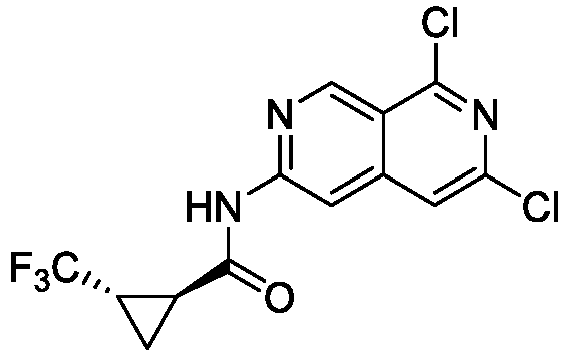
- A mixture of (±)-trans-2-(trifluoromethyl)cyclopropanecarboxylic acid (734 mg, 4.76 mmol), 6,8-dichloro-2,7-naphthyridin-3-amine (850 mg, 3.97 mmol) in pyridine (1 mL) and dichloromethane (20 mL) was stirred at room temperature for 0.5 h. POCl3 (0.4 mL, 4.29 mmol) was added in portions at room temperature. The mixture was stirred for 1 h. The reaction was neutralized with sat NaHCO3. The organics were then separated and dried (NaSO4) before concentrationand purified by silica gel chromatography (PE:EA=10:1 to PE:EA=4: 1) to give the title compound as a white solid (1.1 g, 76.7% yield). LCMS (ESI) [M+H]+ = 350.0.
-

- A mixture of (±)-trans-N-(6,8-dichloro-2,7-naphthyridin-3-yl)-2-(trifluoromethyl)cyclopropanecarboxamide (1.1 g, 3.14 mmol), NH4OH (10 mL, 3.14 mmol) in 1,4-dioxane (10 mL) was stirred under Ar at 90 °C for 3 h. The reaction was concentrated and purified by silica gel chromatography (PE:EA=4:1) to give the title compound as a white solid (0.9 g, 85.3% yield). LCMS (ESI) [M+H]+ = 331.1.
-

- A mixture of (±)-trans-N-(8-amino-6-chloro-2,7-naphthyridin-3-yl)-2-(trifluoromethyl)cyclopropanecarboxamide (150 mg, 0.45 mmol), 5-methyl-4-(4,4,5,5-tetramethyl-1,3,2-dioxaborolan-2-yl)-1H-pyrazole (113 mg, 0.54 mmol), XPhos (22 mg, 0.05 mmol), XPhos Pd G2 (36 mg, 0.05 mmol) and K2CO3 (187 mg, 1.36 mmol) in 1,4-dioxane (8 mL) and water (2 mL) was stirred under Ar at 120 °C for 3 h. The reaction was concentrated and purified by silica gel chromatography (PE:EA=1:1) to give the title compound as a white solid (58.1 mg, 33.8% yield). LCMS (ESI): RT(min) = 1.56, [M+H]+ = 377.2, method = B. 1HNMR (400 MHz, DMSO-d 6) δ 12.64 (s, 1H), 11.09 (s, 1H), 9.26 (s, 1H), 8.12 (s, 1H), 7.96 (d, J = 8.4 Hz, 1H), 7.12 (s, 2H), 6.98 (s, 1H), 2.62-2.56 (m, 4H), 2.33- 2.27 (m, 1H), 1.32-1.30 (m, 2H).
-

- A mixture of 1,3,5-trimethyl-4-(4,4,5,5-tetramethyl-1,3,2-dioxaborolan-2-yl)-1h-pyrazole (161 mg, 0.68 mmol), (±)-trans-N-(8-amino-6-chloro-2,7-naphthyridin-3-yl)-2-(trifluoromethyl)cyclopropanecarboxamide (150 mg, 0.45 mmol), Pd(PPh3)4 (104 mg, 0.09 mmol) and K2CO3 (186 mg, 1.35 mmol) in 1,4-dioxane (8 mL) and water (2 mL) was stirred under Ar at 100 °C for 3 h. The reaction was concentrated and purified by silica gel chromatography (PE:EA=1:1 to EA:DCM = 4:1) to give the title compound as a white solid (72.3 mg, 39.1% yield). LCMS (ESI): RT(min) = 1.57, [M+H]+ = 405.2, method = B. 1HNMR (400 MHz, CD3OD) δ 9.21 (s, 1H), 8.23 (s, 1H), 6.81 (s, 1H), 3.77 (s, 3H), 2.46- -2.43 (m, 1H), 2.41 (s, 3H), 2.33 (s, 3H), 2.30-2.26 (m, 1H), 1.45-1.41 (m, 1H), 1.37-1.32 (m, 1H).
-

-

- A mixture of tert-butyl diethylphosphonoacetate (4.5 g, 17.84 mmol), NaH (0.84 g, 35 mmol) in tetrahydrofuran (50 mL) was stirred at 0 °C for 0.5 h. 2-pyrimidinecarboxaldehyde (1.9 g, 17.58 mmol) was added at room temperature. The mixture was stirred for 2 h. The reaction diluted with EtOAc (50 mL) and the pH adjusted to 7-8 with sat. NH4Cl. The organics were then separated, dried (NaSO4) and concentrated to dryness. The residue was purified by silica gel chromatography (PE:EA=2:1) to give the title compound as a colorless oil (2.5 g, 67.9% yield). LCMS (ESI) [M+H]+ = 207.1. 1H NMR (400 MHz, DMSO-d 6) δ 8.88 (s, 1H), 8.87 (s, 1H), 7.48 (t, J = 4.8Hz, 1H), 7.41 (d, J = 15.6 Hz, 1H), 6.94 (d, J = 15.6 Hz, 1H), 1.48 (s, 9H).
-

- A mixture of trimethyloxosulfonium iodide (2.7 g, 11.64 mmol) and tBuOK (1.3 g, 11.61 mmol) in dimethyl sulfoxide (50 mL) was stirred at room temperature for 0.5 h. tert-Butyl (E)-3-pyrimidin-2-ylprop-2-enoate (2.4 g, 11.64 mmol) was then added. The mixture was stirred for 2h. The reaction was diluted with EtOAc (50 mL) and adjusted pH to 7-8 with sat NH4Cl. The organics were then separated, dried (NaSO4) and concentrated to dryness. The residue was purified with silica gel chromatography (PE:EA=10:1 to PE:EA=4:1) to give the title compound as a colorless oil (370 mg, 14.4% yield). LCMS (ESI) [M+H]+ = 165.2.
-

- A mixture of tert-butyl (±)-trans-2-pyrimidin-2-ylcyclopropanecarboxylate (370 mg, 1.68 mmol) in a solution of HCl in dioxane (4 mL, 1.68 mmol) and one drop of water was stirred at room temperature for 1 h. The reaction was concentrated to give the title compound as a white solid (380 mg, crude). LCMS (ESI) [M+H]+ = 165.1.
-

- A mixture of (±)-trans-2-pyrimidin-2-ylcyclopropanecarboxylic acid (370 mg, 2.25 mmol), 6,8-dichloro-2,7-naphthyridin-3-amine (200 mg, 0.93 mmol) in pyridine (1.5 mL) in dichloromethane (20 mL) was stirred at room temperature for 0.5 h. POCl3 (0.3 mL, 2.25 mmol) was added to the reaction in portions at room temperature. The mixture was stirred for 1 h at rt. The reaction was diluted with EtOAc (50 mL) and adjusted pH to 7-8 with sat NaHCO3. The organics were then separated, dried (Na2SO4) and concentrated to dryness. The residue was purified by silica gel chromatography (PE:EA=2:1 to PE:EA=1:1) to give the title compound a white solid (330 mg, 39.8% yield). LCMS (ESI) [M+H]+ = 360.0.
-

- A mixture of (±)-trans-N-(6,8-dichloro-2,7-naphthyridin-3-yl)-2-pyrimidin-2-yl-cyclopropanecarboxamide (330 mg, 0.92 mmol) and NH4OH (5 mL, 0.92 mmol) in 1,4-dioxane (5 mL) was heated under Ar at 90 °C for 3 h. The reaction was concentrated to dryness to give the title compound as a yellow solid (380 mg, crude). LCMS (ESI) [M+H]+ = 341.1.
-

- A mixture of (±)-trans-N-(8-amino-6-chloro-2,7-naphthyridin-3-yl)-2-pyrimidin-2-yl-cyclopropanecarboxamide (187 mg, 0.55 mmol), 4-methyl-3-(4,4,5,5-tetramethyl-1,3,2-dioxaborolan-2-yl)pyridine (144 mg, 0.66 mmol), XPhos Pd G2 (45 mg, 0.06 mmol), XPhos (27 mg, 0.06 mmol) and K2CO3 (228 mg, 1.65 mmol) in 1,4-dioxane (8 mL) and water (2 mL) was stirred under Ar at 100 °C for 3 h. The reaction was concentrated and purified by silica gel chromatography (PE:EA=2:1 to PE:EA = 1:2) to give the title compound as a white solid (92.1 mg, 42.2% yield). LCMS (ESI): RT(min) = 1.38, [M+H]+ = 398.2, method = B. 1HNMR (400 MHz, DMSO-d 6) δ 11.09 (s, 1H), 9.36 (s, 1H), 8.72 (s, 1H), 8.71 (s, 1H), 8.57 (s, 1H), 8.44 (d, J = 4.8 Hz, 1H), 8.27 (s, 1H), 7.37-7.31 (m, 4H), 6.99 (s, 1H), 2.76-2.71 (m, 1H), 2.65-2.61 (m, 1H), 2.41 (s, 3H), 1.59-1.57 (m, 2H).
-

-

- A mixture of bis(pinacolato)diboron (2.2 g, 8.66 mmol), tert-butyl N-(5-bromo-4-methyl-3-pyridyl)carbamate (500 mg, 1.74 mmol), PdCl2dppf (254 mg, 0.35 mmol) and KOAc (340 mg, 3.47 mmol) in 1,4-dioxane (15 mL) was heated under Ar at 85 °C for 16 h. The reaction was filterred and concentrated to give the title compound as a black solid (3.2 g, crude). LCMS (ESI) [M+H]+ = 335.2.
-

- A mixture of (±)-trans-N-(8-amino-6-chloro-2,7-naphthyridin-3-yl)-2-(trifluoromethyl)cyclopropanecarboxamide (200 mg, 0.6 mmol), tert-butyl N-[4-methyl-5-(4,4,5,5-tetramethyl-1,3,2-dioxaborolan-2-yl)-3-pyridyl]carbamate (1.5 g, 4.49 mmol), Pd(PPh3)4 (140 mg, 0.12 mmol) and K2CO3 (250 mg, 1.81 mmol) in 1,4-dioxane (16 mL) and water (4 mL) was heated under Ar at 100 °C for 3 h. The reaction was concentrated and purified by silica gel chromatography (PE:EA=1:1 to EA:MeOH = 20:1) to give the title compound as a white solid (190 mg, 40.8% yield). LCMS (ESI) [M+H]+ = 503.2.
-

- A mixture of (±)-trans-tert-butyl N-[5-[1-amino-6-[[(trans)-2-(trifluoromethyl)cyclopropanecarbonyl]amino]-2,7-naphthyridin-3-yl]-4-methyl-3-pyridyl]carbamate (190 mg, 0.38 mmol), TFA (1 mL, 0.38 mmol) in dichloromethane (4 mL) was stirred at room temperature for 2 h. The reaction was concentrated to dryness. The residue was taken up in MeOH (2 mL) and adjusted pH to 7-8 with sat NaHCO3.The mixture was purified by prep-HPLC (eluent: 5%-95% methanol and 0.8g/L NH4HCO3 in water) to give the title compound as a white solid (92.8 mg, 57.4% yield). LCMS (ESI): RT(min) = 1.57, [M+H]+ = 403.2, method = G. 1HNMR (400 MHz, DMSO-d 6) δ 11.19 (s, 1H), 9.37 (s, 1H), 8.19 (s, 1H), 7.93 (s, 1H), 7.77 (s, 1H), 7.30 (s, 2H), 6.85 (s, 1H), 5.16 (s, 2H), 2.60-2.58 (m, 1H), 2.32-2.30 (m, 1H), 2.06 (s, 3H), 1.33-1.30 (m, 2H).
-

-

- To a stirred solution of 2-(3-bromo-4-pyridyl)ethanol (1.0 g, 4.95 mmol) and triisopropyl borate (1.1g, 5.85 mmol) in tetrahydrofuran (30 mL) was added dropwise n-BuLi (4 mL, 10 mmol) at -78 °C. The resulting mixture was stirred at -78 °C for 0.5 h. The mixture was warmed slowly to room temperature and stirred for 1h. The reaction mixture was then diluted with water (10 mL) and washed with EA (10 mLx2). The aqueous layer was acidified to pH 4-5 by adding 6 N HCl and concentrated to dryness. The residue was suspended in a 1:1 solution of ethyl acetate and EtOH (10 mL) and filtered. The filtrate was concentrated to give 1-hydroxy-3,4-dihydrooxaborinino[3,4-c]pyridine (700 mg, 95% yield) as a yellow oil. LCMS (ESI) [M+H]+ =150.1.
-

- A mixture of 1-hydroxy-3,4-dihydrooxaborinino[3,4-c]pyridine (700 mg, 4.7 mmol), (±)-trans-N-(8-amino-6-chloro-2,7-naphthyridin-3-yl)-2-cyano-cyclopropanecarboxamide (140 mg, 0.49 mmol), XPhos Pd G2 (56 mg, 0.07 mmol), XPhos (65mg, 0.14 mmol) and K2CO3 (140 mg, 1.01mmol) in 1,4-dioxane (10 mL) and water (2 mL) was heated under Ar to 100 °C for 3 h. The mixture was directly purified by reverse phase HPLC (acetonitrile 0-40/0.1% NH4HCO3 in water) to afford (±)-trans-N-[8-amino-6-[4-(2-hydroxyethyl)-3-pyridyl]-2,7-naphthyridin-3-yl]-2-cyano-cyclopropanecarboxamide (72 mg, 39.5% yield) as a white solid. LCMS (ESI): RT(min) = 1.169, [M+H]+ = 375.1, method = A. 1HNMR (400 MHz, DMSO-d 6) δ 11.29 (s, 1H), 9.41 (s, 1H), 8.51 (s, 1H), 8.47 (d, J = 5.2 Hz, 1H), 8.20 (s, 1H), 7.36 (d, J = 5.2 Hz, 1H), 7.34 (s, 2H), 6.98 (s, 1H), 4.77 (t, J = 4.8 Hz, 1H), 3.57-3.55 (m, 2H), 2.93 (t, J = 6.8 Hz, 2H), 2.78-2.74 (m, 1H), 2.18-2.14(m, 1H), 1.64-1.59 (m, 1H), 1.46-1.41(m, 1H).
-

- A solution of (±)-trans-N-(8-amino-6-chloro-2,7-naphthyridin-3-yl)-2-(cyanomethyl) cyclopropanecarboxamide (140 mg, 0.46 mmol), 1-hydroxy-3,4-dihydro-2H-borinino[2,3-c]pyridine (800 mg, 5.44mmol), XPhos (56 mg, 0.12 mmol), XPhos Pd G2 (56 mg, 0.07 mmol) and K2CO3 (140 mg, 1.01mmol) in water (2 mL) and 1,4-dioxane (10 mL) was heated under Ar at 100°C for 3h. The mixture was directly purified by silica gel column chromatography (DCM:MeOH=10:1) and reverse phase HPLC (acetonitrile 17-47% in 0.05% ammonia in water) to give the title compound (36 mg, 20% yield) as a white solid. LCMS (ESI): RT(min) = 1.404, [M+H]+ = 389.0, method = C. 1HNMR (400 MHz, DMSO-d 6) δ 11.08 (s, 1H), 9.39 (s, 1H), 8.52 (s, 1H), 8.47 (d, J = 5.2 Hz, 1H), 8.23 (s, 1H), 7.36 (d, J = 5.2 Hz, 1H), 7.34 (s, 2H), 6.97 (s, 1H), 4.80 (t, J = 4.8 Hz, 1H), 3.60-3.56 (m, 2H), 2.93 (t, J = 6.8 Hz, 2H), 2.76-2.73 (m, 2H), 2.12-2.09 (m, 1H), 1.59-1.58 (m, 1H), 1.16-1.13 (m, 1H), 0.99-0.96 (m, 1H).
-

- The title compounds were prepared according to the procedure described for (±)-trans-N-[8-amino-6-(4-methyl-3-pyridyl)-2,7-naphthyridin-3-yl]-2-(cyanomethyl)cyclopropane carboxamide (Compound 157). The single stereoisomers were isolated by chiral SFC. (Compound 193): 1HNMR (400 MHz, DMSO-d 6) δ 11.04 (s, 1 H), 9.37 (s, 1H), 8.56 (s, 1H), 8.43 (d, J = 5.0 Hz, 1H), 8.22 (s, 1H), 7.30-7.31 (m, 3H), 6.97 (s, 1H), 3.74 (m, 2 H), 2.41 (s, 3H), 2.11 (m, 1H), 1.58 (m, 1H), 1.13 (m, 1H), 0.96 (m, 1H). (Compound 194): 1HNMR (400 MHz, DMSO-d 6) δ 11.04 (s, 1 H), 9.37 (s, 1H), 8.56 (s, 1H), 8.43 (d, J = 5.0 Hz, 1H), 8.22 (s, 1H), 7.30-7.31 (m, 3H), 6.97 (s, 1H), 3.74 (m, 2 H), 2.41 (s, 3H), 2.11 (m, 1H), 1.58 (m, 1H), 1.13 (m, 1H), 0.96 (m, 1H).
-

- The title compounds were prepared according to the procedure described for (±)-trans-N-(8-amino-5-fluoro-6-(4-methylpyridin-3-yl)-2,7-naphthyridin-3-yl)-2-(1H-pyrazol-4-yl)cyclopropanecarboxamide (Compound 172). The single stereoisomers were isolated by chiral SFC. (Compound 195): 1HNMR (400 MHz, DMSO-d 6) δ 12.63 (br s, 1 H), 11.19 (s, 1H), 9.42 (s, 1H), 8.51 (s, 1H), 8.48 (d, J = 5.1 Hz, 1H), 8.40 (s, 1H), 7.61 (br s, 1H), 7.38 (d, J = 5.1 Hz, 2H), 7.32 (br s, 2H), 2.27 (s, 3H), 2.19-2.26 (m, 2H), 1.41 (m, 1H), 1.26 (m, 1H). (Compound 196): 1HNMR (400 MHz, DMSO-d 6) δ 12.63 (br s, 1 H), 11.19 (s, 1H), 9.42 (s, 1H), 8.51 (s, 1H), 8.48 (d, J = 5.1 Hz, 1H), 8.40 (s, 1H), 7.61 (br s, 1H), 7.38 (d, J = 5.1 Hz, 2H), 7.32 (br s, 2H), 2.27 (s, 3H), 2.19-2.26 (m, 2H), 1.41 (m, 1H), 1.26 (m, 1H).
-

- The title compounds were prepared according to the procedure described for (±)-trans-N-[8-amino-6-(4-methyl-3-pyridyl)-2,7-naphthyridin-3-yl]-2-(1-methylpyrazol-4-yl)cyclopropane carboxamide (Compound 159). The single stereoisomers were isolated by chiral SFC. (Compound 197): 1HNMR (400 MHz, DMSO-d 6) δ 10.93 (s, 1 H), 9.36 (s, 1H), 8.57 (br s, 1H), 8.43 (br s, 1H), 8.25 (s, 1H), 7.56 (s, 1H), 7.29-7.32 (m, 4H), 6.97 (s, 1H), 3.77 (s, 3H), 2.41 (s, 3H), 2.19-2.22 (m, 2H), 1.39 (m, 1H), 1.19 (m, 1H). (Compound 198): 1HNMR (400 MHz, DMSO-d 6) δ 10.93 (s, 1 H), 9.36 (s, 1H), 8.57 (br s, 1H), 8.43 (br s, 1H), 8.25 (s, 1H), 7.56 (s, 1H), 7.29-7.32 (m, 4H), 6.97 (s, 1H), 3.77 (s, 3H), 2.41 (s, 3H), 2.19-2.22 (m, 2H), 1.39 (m, 1H), 1.19 (m, 1H).
-

- The title compounds were prepared according to the procedure described for (±)-(trans)-N-(8-amino-6-(5-amino-4-methylpyridin-3-yl)-2,7-naphthyridin-3-yl)-2-cyanocyclopropane carboxamide (Compound 165). The single stereoisomers were isolated by chiral SFC. (Compound 199): 1HNMR (400 MHz, DMSO-d 6) δ 11.24 (s, 1 H), 9.38 (s, 1H), 8.17 (s, 1H), 7.93 (s, 1H), 7.76 (s, 1H), 7.29 (s, 2H), 6.84 (s, 1H), 5.13 (br s, 2H), 2.76 (m, 1 H), 2.15 (m, 1 H), 2.06 (s, 3H), 1.61 (m, 1H), 1.43 (m, 1H). (Compound 200): 1HNMR (400 MHz, DMSO-d 6) δ 11.24 (s, 1 H), 9.38 (s, 1H), 8.17 (s, 1H), 7.93 (s, 1H), 7.76 (s, 1H), 7.29 (s, 2H), 6.84 (s, 1H), 5.13 (br s, 2H), 2.76 (m, 1 H), 2.15 (m, 1 H), 2.06 (s, 3H), 1.61 (m, 1H), 1.43 (m, 1H).
-

- The title compound was prepared in a fashion that is analogeous to (±)-trans-N-[8-amino-6-(4-ethoxy-3-pyridyl)-2,7-naphthyridin-3-yl]-2-cyano-cyclopropanecarboxamide (Compound 129). LCMS (ESI): RT(min) = 1.55, [M+H]+ = 399.1, method = B. 1HNMR (400 MHz, DMSO-d 6) δ 11.3 (s, 1H), 9.43 (s, 1H), 8.89 (d, 1H), 8.83 (s, 1H), 8.20 (s, 1H), 7.85 (d, 1H), 7.42 (s, 2H), 6.97 (s, 1H), 2.74-2.79 (m, 1H), 2.13-2.18 (m, 1H), 1.59-1.64 (m, 1H), 1.41-1.46 (m, 1H).
-

- The title compounds were prepared according to the procedure described for (±)-trans-N-(8-amino-6-(4-methylpyridin-3-yl)-2,7-naphthyridin-3-yl)-2-cyanocyclopropane-1-carboxamide. (Compound 43). The single stereoisomers were isolated by chiral SFC. (Compound 202): 1HNMR (400 MHz, DMSO-d 6) δ 11.26 (s, 1H), 9.39 (s, 1 H), 8.56 (s, 1H), 8.43 (d, J = 5.0 Hz, 1H), 8.20 (s, 1H), 7.34 (br s, 2H), 7.30 (d, J = 5.0 Hz, 1H), 6.98 (s, 1H), 2.76 (m, 1H), 2.40 (s, 3H), 2.15 (m, 1H), 1.61 (m, 1H), 1.44 (m, 1H). (Compound 203): 1HNMR (400 MHz, DMSO-d 6) δ 11.26 (s, 1H), 9.39 (s, 1 H), 8.56 (s, 1H), 8.43 (d, J = 5.0 Hz, 1H), 8.20 (s, 1H), 7.34 (br s, 2H), 7.30 (d, J = 5.0 Hz, 1H), 6.98 (s, 1H), 2.76 (m, 1H), 2.40 (s, 3H), 2.15 (m, 1H), 1.61 (m, 1H), 1.44 (m, 1H).
-

-

- A solution of cyclopentane-1,3-dione (3 g, 30.58 mmol), Tf2O (8.6 g, 30.48 mmol) and TEA (9.3 g, 91.90 mmol) in dichloromethane (30 mL) was stirred for 1 h at 0°C. The reaction was diluted with water and extracted with DCM. The collected organic was dried over Na2SO4, filtered, and concentrated under vacuum. The residue was purified by silica-gel chromatography eluted with PE/EA (10:1) to afford 3-oxocyclopent-1-en-1-yl trifluoromethanesulfonate (2.8 g, 40%) as a yellowish oil. LCMS (ESI): [M+H]+ = 231.1.
-

- A solution of 3-oxocyclopent-1-en-1-yl trifluoromethanesulfonate (2.5 g, 10.86 mmol) in dioxane (50 mL) was added 4,4,5,5-tetramethyl-2-(tetramethyl-1,3,2-dioxaborolan-2-yl) -1,3,2-dioxaborolane (5.5 g, 21.65 mmol), Pd(dppf)Cl2 (720 mg, 0.98 mmol), KOAc (2.1 g, 21.39 mmol). The resultant solution was stirred for 1 h at 100 °C under nitrogen. The solution was cooled to room temperature, diluted with water and extracted with dichloromethane. The collected organic was dried over Na2SO4, filtered, and concentrated under vacuum. The residue was purified by a silica-gel column eluted with PE/EA (10/1) to afford 3-(4,4,5,5-tetramethyl-1,3,2-dioxaborolan-2-yl)cyclopent-2-enone (2 g, crude product) as a yellow oil. LCMS (ESI): [M+H]+ = 127.1.
-

- A solution of N-[8-amino-5-bromo-6-(4-methylpyridin-3-yl)-2,7-naphthyridin-3-yl] cyclopropanecarboxamide (500 mg, 1.25 mmol) in dioxane (10 mL) / water (2 mL) was added to a mixture of 3-(4,4,5,5-tetramethyl-1,3,2-dioxaborolan -2-yl)cyclopent-2-enone (320 mg, 2.54 mmol), Pd(dppf)Cl2 (280 mg, 0.38 mmol), and sodium bicarbonate (220 mg, 2.61 mmol). The mixture was stirred 100 °C under nitrogen. After 6 h, the reaction mixture was concentrated. The residue was purified with silica gel chromatography eluted with DCM/MeOH (10:1). This resulted in N-[8-amino-6-(4-methylpyridin-3-yl)-5-(3-oxocyclopent-1-en-1-yl)-2,7-naphthyridin-3-yl]cyclopropanecarboxamide (200 mg, 40%) as a yellow solid. LCMS (ESI): [M+H]+ = 400.1.
-

- NaBH4 (50 mg, 1.32 mmol) was added to a solution of N-[8-amino-6-(4-methylpyridin-3-yl) -5-(3-oxocyclopent-1-en-1-yl)-2,7-naphthyridin- 3-yl]cyclopropanecarboxamide (50 mg, 0.12 mmol) in methanol (10 mL) at room temperature. After 1 h, the reaction mixture was concentrated. The residue was purified by silica gel chromatography eluted with DCM/MeOH (10:1) to provide N-[8-amino-5-(3-hydroxycyclopent-1-en-1-yl)-6-(4-methylpyridin-3-yl)-2,7-naphthyridin-3-yl]cyclopropanecarboxamide (2.8 mg, 6%) as a yellow solid. LCMS (ESI): RT (min) = 1.52, [M+H]+ = 402.1, method = M; 1H NMR (300 MHz, DMSO-d 6) δ 10.96 (s, 1H), 9.38 (s, 1H), 8.37 (d, J = 4.8 Hz, 1H), 8.31 (s, 1H), 8.24 (s, 1H), 7.30 (s, 2H), 7.25 (d, J = 4.8 Hz, 1H), 5.49 (s, 1H), 4.71 (d, J = 4.5 Hz, 1H), 4.65 (s, 1H), 2.30 (s, 1H), 2.14 (s, 3H), 2.07 - 2.03 (m, 3H), 1.48 - 1.45 (m, 1H), 0.85 - 0.80 (m, 4H).
-

-
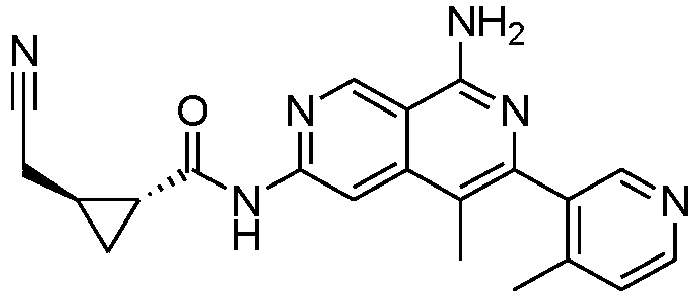
- A mixture of trans-N-[8-amino-5-bromo-6-(4-methylpyridin-3-yl)-2,7-naphthyridin-3-yl]-2-(cyanomethyl)cyclopropane-1-carboxamide (120 mg, 0.27 mmol), trimethyl-1,3,5,2,4,6-trioxatriborinane (52 mg, 0.41 mmol), Pd(PPh3)4 (32 mg, 0.03 mmol), and K3PO4 (175 mg, 0.82 mmol) in dioxane (5 mL) / water (1 mL) was stirred for 15 h at 100°C under nitrogen. The reaction mixture was concentrated, and the residue was purified by Prep-HPLC to afford trans-N-(8-amino-5-methyl-6-(4-methylpyridin-3-yl)-2,7-naphthyridin-3-yl)-2-(cyanomethyl)cyclopropanecarboxamide (3.0 mg, 3%) as a white solid. LCMS (ESI): RT (min) = 1.69, [M+H]+ = 373.3, method = K-1-1; 1H NMR (400 MHz, CD3OD) δ 9.32 (s, 1H), 8.48 (s, 1H), 8.46 (d, J = 5.2 Hz, 1H), 8.37 (s, 1H),7.45 (d, J = 5.2 Hz, 1H), 2.78 - 2.65 (m, 2H), 2.23 (s, 3H), 2.14 (s, 3H), 2.06 - 2.00 (m, 1H), 1.81 - 1.70 (m,1H), 1.41 - 1.30 (m,1H), 1.12 - 1.02 (m, 1H).
-

- A mixture of trans-N-(8-amino-6-chloro-2,7-naphthyridin-3-yl)-2-(cyanomethyl)cyclopropane-1-carboxamide (10 mg, 0.03 mmol), 4-methyl-2-phenyl-3-(tetramethyl-1,3,2-dioxaborolan-2-yl)pyridine (20 mg, 0.07 mmol), Pd(amphos)Cl2 (3 mg, 0.01 mmol), K3PO4 (21 mg, 0.10 mmol) in dioxane (0.9 mL) / water (0.3 mL) was stirred for 20 min at 100°C under nitrogen. The solids were filtered, and the filtrate was concentrated. The residue was purified by silica gel chromatography eluted with dichloromethane/methanol (15:1). The collected fractions were combined and concentrated. The product was further purified by Prep-HPLC to afford trans- N-[8-amino-6-(4-methyl-2-phenylpyridin-3-yl)-2,7-naphthyridin-3-yl]-2-(cyanomethyl)cyclopropane-1-carboxamide (3 mg, 21%) as a green solid. LCMS (ESI): RT (min) = 1.14, [M+H]+ = 435.3, method = K-1-1; 1H NMR (400 MHz, DMSO-d 6) δ 11.01 (s,1H), 9.33 (s,1H), 8.54 (d, J = 4.7 Hz, 1H), 7.96 (s, 1H), 7.48 - 7.28 (m, 5H), 7.23 -7.10 (m, 3H), 6.48 (s, 1H),2.81 - 2.71(m, 2H), 2.17 (s, 3H), 2.11 - 2.03 (m, 1H), 1.61 - 1.51 (m, 1H), 1.10 - 1.06 (m, 1H), 1.03 - 0.93 (m, 1H).
-

-

- A mixture of 2-methylprop-2-en-1-yl acetate (10 g, 87.61 mmol), Cu(OAc)2 (950 mg, 5.23 mmol), and tert-butyl 2-diazoacetate (20 g, 140.69 mmol) in toluene (300 mL) was stirred for 3 h at 95 °C. The solids were filtered, and the filtrate was concentrated to afford tert-butyl 2-[(acetyloxy)methyl]-2-methylcyclopropane-1-carboxylate(18 g, crude) as a brown oil.
-

- A solution of tert-butyl 2-[(acetyloxy)methyl]-2-methylcyclopropane-1-carboxylate (18 g, 78.85 mmol) in dichloromethane (80 mL) / trifluoroacetic acid (150 mL) was stirred for 16 hours. The resulting mixture was concentrated. The residue was dissolved in water, and the pH of the solution was adjusted to 11 with 20% aqueous sodium hydroxide solution. The resulting mixture was extracted with ethyl acetate. The pH of the aqueous layer was adjusted to 3 with hydrochloric acid (2 M). The resulting solution was extracted with ethyl acetate, and the organic layer dried over Na2SO4 and concentrated under vacuum to afford 2-[(acetyloxy)methyl]-2-methylcyclopropane-1-carboxylic acid (10 g, 74%) as a red oil. LCMS (ESI): [M-H]+ =171.1.
-

- POCl3 (4 g, 26.09 mmol) was added dropwise to a solution of 6, 8-dichloro-2,7-naphthyridin-3-amine (2 g, 9.34 mmol), 2-[(acetyloxy)methyl]-2-methylcyclopropane-1-carboxylic acid (4 g, 23.23 mmol) in pyridine (5 mL) / dichloromethane (50 mL) at room temperature under nitrogen. After, 30 min, the reaction was diluted with iced water, and the resulting solution was extracted with dichloromethane. The collected organic extract was dried over Na2SO4, filtered and concentrated under vacuum. The residue was purified by silica gel chromatography eluted with ethyl acetate/petroleum ether (1:3) to afford [2-[(6,8-dichloro-2,7-naphthyridin-3-yl)carbamoyl]-1-methylcyclopropyl]methyl acetate (2.2 g, 64%) as a red oil. LCMS (ESI): [M+H]+ =368.1.
-

- A solution of [2-[(6,8-dichloro-2,7-naphthyridin-3-yl)carbamoyl]-1-methylcyclopropyl]methyl acetate (2.2 g, 5.98 mmol) in ammonium hydroxide (20 mL), and 1,4-dioxane (27 mL) was heated at 90 °C. After 3 h, the reaction mixture was concentrated under vacuum to afford (2-(8-amino-6-chloro-2,7-naphthyridin-3-ylcarbamoyl)-1-methylcyclopropyl)methyl acetate (2.4 g, crude) as a yellow solid. LCMS (ESI): [M+H]+ =349.1.
-

- A mixture of [2-[(8-amino-6-chloro-2,7-naphthyridin-3-yl)carbamoyl]-1-methylcyclopropyl]methyl acetate (2.4 g, 6.88 mmol), (4-methylpyridin-3-yl)boronic acid (1.8 g, 13.14 mmol), Pd(dppf)Cl2 (600 mg, 0.82 mmol) and sodium carbonate (1.6 g, 15.10 mmol) in 1,4-dioxane (80 mL) / water (13 mL) was heated at 100 °C under nitrogen. After 2 h, the solids were filtered, and the filtrate was concentrated under vacuum. The resulting residue was purified by Prep-HPLC and chiral SFC to afford two diastereoisomers. (Compound 207): LCMS (ESI): RT (min) = 1.13, [M+H]+ = 406.2, method = K-1; 1H NMR (300 MHz, CD3OD) δ 9.29 (s, 1H), 8.54 (s, 1H), 8.43 (d, J = 5.1 Hz, 1H), 8.33 (s, 1H), 7.40 (d, J = 5.1 Hz, 1H), 6.99 (s, 1H), 4.07 - 3.95 (m, 2H), 2.46 (s, 3H), 2.11 (s, 3H), 2.09 - 2.04 (m, 1H), 1.31 (s, 3H), 1.27 - 1.24 (m, 1H), 1.06 - 1.01 (m, 1H). (Compound 208): LCMS (ESI): RT (min) = 1.28, [M+H]+ = 406.2, method = M; 1H NMR (300 MHz, CD3OD) δ 1H NMR (300 MHz, CD3OD) δ 9.29 (s, 1H), 8.54 (s, 1H), 8.43 (d, J = 5.1 Hz, 1H), 8.29 (s, 1H), 7.40 (d, J = 5.1 Hz, 1H), 6.99 (s, 1H), 4.38 (d, J = 11.4 Hz, 1H), 4.19 (d, J = 11.4 Hz, 1H), 2.46 (s, 3H), 2.03 - 1.99 (m, 1H), 1.94 (s, 3H), 1.42 - 1.39 (m, 1H), 1.32 (s, 3H), 1.06-1.01 (m, 1H).
-

- LiOH•H2O (930 mg, 22.16 mmol) in water (50 mL) was added dropwise to a solution of (2-[[8-amino-6-(4-methylpyridin-3-yl)-2,7-naphthyridin-3-yl]carbamoyl]-1-methylcyclopropyl)methyl acetate (3 g, 7.40 mmol) in tetrahydrofuran (150 mL) at room temperature. After 4 h, the reaction was filtered, and the filtrate was concentrated under vacuum. The resulting residue was purified by Prep-HPLC to afford N-[8-amino-6-(4-methylpyridin-3-yl)-2,7-naphthyridin-3-yl]-2-(hydroxymethyl)-2-methylcyclopropane-1-carboxamide (282.5 mg, 11%) as a white solid. LCMS (ESI): RT (min) = 1.13, [M+H]+ = 364.2, method = M; 1H NMR (300 MHz, DMSO-d 6) δ 10.69(s, 1H), 9.35(s, 1H), 8.56(s, 1H), 8.43(d, J = 5.1 Hz, 1H), 8.25(s, 1H), 7.31(d, J = 5.1 Hz, 1H), 7.30(s, 2H), 6.97(s, 1H), 4.65(t, J = 9.0 Hz, 1H), 3.31 - 3.29(m, 2H), 2.41(s, 3H), 2.06 - 1.95(m, 1H), 1.18(s, 3H), 0.99 - 0.91(m, 2H).
-

- A mixture of trans-N-[8-amino-6-(4-methylpyridin-3-yl)-2,7-naphthyridin-3-yl]-2-(cyanomethyl)cyclopropane-1-carboxamide (160 mg, 0.44 mmol) and NBS (210 mg, 1.18 mmol) in dichloromethane (10 mL) was stirred for 2 h at room temperature under nitrogen. The reaction solution was concentrated under vacuum. The resulting residue was purified by Flash-Prep-HPLC to afford trans-N-[8-amino-5-bromo-6-(4-methylpyridin-3-yl)-2,7-naphthyridin-3-yl]-2-(cyanomethyl)cyclopropane-1-carboxamide (31 mg, 16%) as a brown solid. LCMS (ESI): RT (min) = 1.54, [M+H]+ = 437.1, method = K-1; 1H NMR (400 MHz, DMSO-d 6) δ 11.25 (s, 1H), 9.40 (s, 1H), 8.58 (s, 1H), 8.47 (d, J = 6.0 Hz, 1H), 8.36 (s, 1H), 7.59 (s, 2H), 7.35 (d, J = 6.0 Hz, 1H), 2.76 - 2.73 (m, 2H), 2.14 - 2.10 (m, 4H), 1.64 - 1.58 (m, 1H), 1.19 - 1.14 (m, 1H), 1.02 - 0.95 (m, 1H).
-

-

- To a solution of tert-butyl 4-[(trifluoromethane)sulfonyloxy]-1H,2H,3H-pyrrolo[2,3-c]pyridine-1-carboxylate (1 g, 2.71 mmol( (J.Med. Chem. 2014, 57, 2462) in dioxane (40 mL) was added 4,4,5,5-tetramethyl-2-(tetramethyl-1,3,2-dioxaborolan-2-yl)-1,3,2-dioxaborolane (2 g, 7.87 mmol), Pd(dppf)Cl2 (400 mg, 0.54 mmol) and KOAc (800 mg, 8.15 mmol). The reaction was stirred for 3 h at 100 °C under nitrogen and then cooled to room temperature. The pH of the resulting mixture was adjusted to 14 with sodium hydroxide. The resulting solution was washed with ethyl acetate and the aqueous layer was collected. The pH of the aqueous layer was adjusted to 1 with 2 N HCl. The resulting solution was extracted with ethyl acetate. The collected organic was dried over Na2SO4, filtered, and concentrated under vacuum to afford [1-[(tert-butoxy)carbonyl]-1H,2H,3H-pyrrolo[2,3-c]pyridin-4-yl]boronic acid (500 mg, 70%) as a yellow solid. LCMS (ESI): [M+H]+ = 265.1.
-

- A suspension of cis-N-(8-amino-6-chloro-2,7-naphthyridin-3-yl)-2-fluorocyclopropane-1-carboxamide (200 mg, 0.71 mmol), 1-[(tert-butoxy)carbonyl]-1H,2H,3H-pyrrolo[2,3-c]pyridin-4-ylboronic acid (200 mg, 0.75 mmol), Pd(PPh3)4 (164 mg, 0.14 mmol) and Cs2CO3 (464 mg, 1.42 mmol) in dioxane (10 mL) / water (1 mL) was stirred at 100 °C. After 3 h, the reaction mixture was concentrated under vacuum to afford crude cis-tert-butyl 4-(1-amino-6-[[(1S,2S)-2-fluorocyclopropane]amido]-2,7-naphthyridin-3-yl)-1H,2H,3H-pyrrolo[2,3-c]pyridine-1-carboxylate (200 mg) as a white solid. LCMS (ESI): [M+H]+ = 253.1.
-

- A solution of cis-tert-butyl 4-(1-amino-6-[[(1S,2S)-2-fluorocyclopropane]amido]-2,7-naphthyridin-3-yl)-1H,2H,3H-pyrrolo[2,3-c]pyridine-1-carboxylate (200 mg, 0.43 mmol) and trifluoroacetic acid (10 mL) in dichloromethane (50 mL) was stirred for 3 h at room temperature. The reaction mixture was then concentrated under vacuum, and the resulting residue was purified by Prep-HPLC to afford cis-N-(8-amino-6-[1H,2H,3H-pyrrolo[2,3-c]pyridin-4-yl]-2,7-naphthyridin-3-yl)-2-fluorocyclopropane-1-carboxamide formic acid salt (9.1 mg, 5%) as a yellow solid. LCMS (ESI): RT (min) = 1.68, [M+H]+ = 365.1, method = K-1; 1H NMR (300 MHz, DMSO-d 6) δ 11.07 (s, 1H), 9.41 (s, 1H),8.41 (s, 1H), 8.35 (s, 1H), 7.83 (s, 1H), 7.48 (s, 2H), 7.31 (s, 1H), 6.54 (s, 1H), 5.08 - 5.11 (m, 1H), 4.86 - 4.89 (m, 1H), 3.66 - 3.49 (m, 4H), 2.32 (s, 1H), 1.76 - 1.62 (m, 1H), 1.21 - 1.26 (m, 1H).
-

- A suspension of trans-N-(8-amino-6-chloro-2,7-naphthyridin-3-yl)-2-(cyanomethyl)cyclopropane-1-carboxamide (250 mg, 0.83 mmol), (4-methylpyridin-3-yl)boronic acid (170 mg, 1.24 mmol), Pd(dppf)Cl2 (61 mg, 0.08 mmol) and potassium carbonate (343 mg, 2.48 mmol) in dioxane (8 mL)/ water (2 mL) was stirred for 2 h at 110°C under nitrogen. The solids were filtered, and the filtrate was concentrated under vacuum. The resulting residue was purified by Prep-HPLC to afford trans-N-(8-amino-6-(4-methylpyridin-3-yl)-2,7-naphthyridin-3-yl)-2-(cyanomethyl)cyclopropanecarboxamide (101 mg, 34%) as a white solid. LCMS (ESI): RT (min) = 0.96, [M+H]+ = 359.2, method = K-1; 1H NMR (400 MHz, CD3OD) δ 9.30 (s, 1H), 8.54 (s, 1H), 8.43 (d, J = 5.1 Hz, 1H), 8.30 (s, 1H), 7.40 (d, J = 5.1 Hz, 1H), 6.99 (s, 1H), 2.80 - 2.63 (m, 2H), 2.46 (s, 3H), 2.02 - 1.98 (m,1H), 1.81 - 1.69 (m, 1H), 1.35 - 1.20 (m, 1H), 1.10 - 0.98 (m,1H).
-

-

- A suspension of 4-bromo-1H-pyrazole (5 g, 34.02 mmol), methyl 2-bromopropanoate (6.82 g, 40.85 mmol), and potassium carbonate (9.43 g, 68.30 mmol) in N,N-dimethylformamide (10 mL) was stirred for 5 h at 80 °C. The reaction was quenched by water (30 mL), and the resulting solution was extracted with ethyl acetate. The combined organic extracts were dried over Na2SO4, filtered, and concentrated under vacuum to provide methyl 2-(4-bromo-1H-pyrazol-1-yl)propanoate (7.1 g, 90%) as a colorless oil. LCMS(ESI): [M+H]+ = 233.1.
-

- NaBH4 (489 mg, 12.92 mmol) was added portionwise to a stirred solution of methyl 2-(4-bromo-1H-pyrazol-1-yl) propanoate (1 g, 4.29 mmol) in methanol (10 mL) at 25 °C. After 3 h, the reaction was quenched by water (30 mL), and the resulting solution was extracted with ethyl acetate (100 mL). The collected organic was dried over Na2SO4, filtered, and concentrated under vacuum to afford 2-(4-bromo-1H-pyrazol-1-yl)propan-1-ol (716 mg, 81%) as a colorless oil. LCMS (ESI): [M+H]+ = 205.2.
-
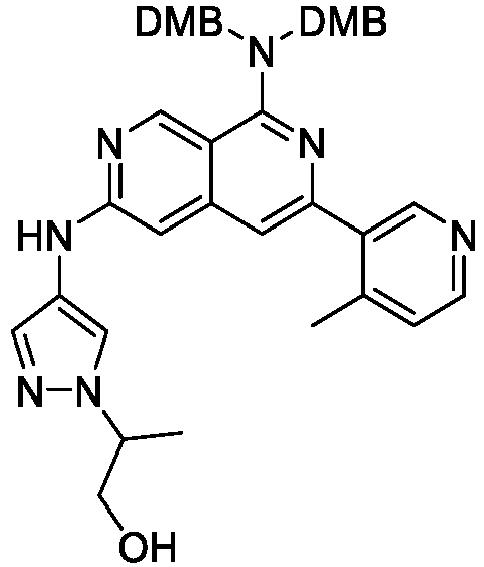
- A suspension of 1-N,1-N-bis[(2,4-dimethoxyphenyl)methyl]-3-(4-methylpyridin-3-yl)-2,7-naphthyridine-1,6-diamine (300 mg, 0.54 mmol), 2-(4-bromo-1H-pyrazol-1-yl)propan-1-ol (223 mg, 1.09 mmol), Cs2CO3 (1.062 g, 3.26 mmol), t-BuBrettPhos (131 mg, 0.27 mmol) and 3rd Generation t-BuBrettPhos precatalyst (232 mg, 0.27 mmol) in dioxane (5 mL) was stirred for 2 h at 120 °C under nitrogen. The solids were filtered, and the filtrate was concentrated under vacuum. The resulting residue was purified by silica gel chromatography (20:1 dichloromethane/methanol) to provide 2-[4-[(8-[bis[(2,4-dimethoxyphenyl)methyl]amino]-6-(4-methylpyridin-3-yl)-2,7-naphthyridin-3-yl)amino]-1H-pyrazol-1-yl]propan-1-ol (288 mg, 8%) as a brown solid. LCMS (ESI): [M+H]+ = 676.2.
-
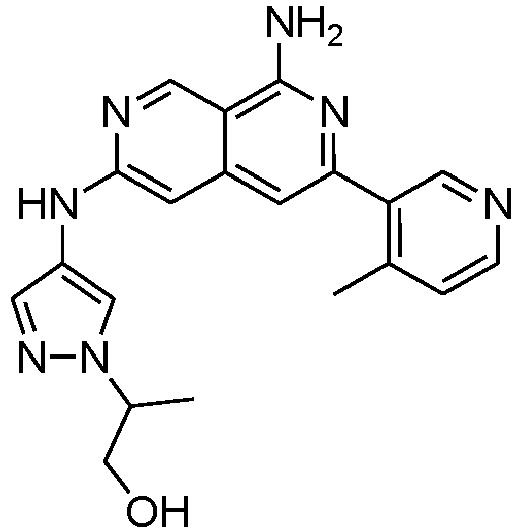
- A solution of 2-[4-[(8-[bis[(2,4-dimethoxyphenyl)methyl]amino]-6-(4-methylpyridin-3-yl)-2,7-naphthyridin-3-yl)amino]-1H-pyrazol-1-yl]propan-1-ol (278 mg, 0.41 mmol) in trifluoroacetic acid (8 mL) was heated at 50 °C. After 2 h, the reaction was concentrated under vacuum. The residue was diluted with ammonium hydroxide to pH=13, and the resulting solution was purified by Prep-HPLC to afford 2-(4-(8-amino-6-(4-methylpyridin-3-yl)-2,7-naphthyridin-3-ylamino)-1H-pyrazol-1-yl)propan-1-ol (3 mg, 2%) as a white solid. LCMS (ESI): RT (min) = 1.58, [M+H]+ = 376.4, method = N; 1H NMR (400 MHz, DMSO-d 6) δ 9.22 (s, 1H), 8.83 (s, 1H), 8.53 (s, 1H), 8.42 (d, J = 5.0 Hz, 1H), 7.90(s, 1H), 7.50 (s,1H), 7.29 (d, J = 5.0 Hz, 1H), 7.06 (s, 2H), 6.75 (s, 1H), 6.64 (s, 1H), 4.92 (t, J = 5.5 Hz,1H), 4.45 - 4.32 (m, 1H), 3.73 - 3.55 (m, 2H), 2.40 (s, 3H), 1.40 (d, J = 6.8 Hz, 3H).
-

-

- Oxalyl chloride (1.16 g, 9.14 mmol) was added dropwise to a solution of trans-2-(1-methyl-1H-pyrazol-4-yl)cyclopropane-1-carboxylic acid (1.00 g, 6.01 mmol) and N,N-dimethylformamide (3 drop, cat) in 2:1 dichloromethane / pyridine (30 mL) at 0 °C. The reaction was stirred for 30 mins at room temperature. The reaction solution was then added dropwise to a stirred solution of 6,8-dichloro-2,7-naphthyridin-3-amine hydrochloride (1.25 g, 4.99 mmol) in dichloromethane (50 mL) at 0 °C. The mixture was warmed to room temperature for 2 h under nitrogen. The reaction was diluted with water (30 mL), and the resulting solution was extracted with dichloromethane (100 mL). The organic extract was dried over Na2SO4, filtered, and concentrated under vacuum. Purified by silica-gel column chromatography (20:1 DCM/ MeOH) afforded trans-N-(6,8-dichloro-2,7-naphthyridin-3-yl)-2-(1-methyl-1H-pyrazol-4-yl)cyclopropane-1-carboxamide (800 mg, 40%) as an off-white solid. LCMS (ESI): [M+H]+ = 362.0.
-

- A solution of trans-N-(6,8-dichloro-2,7-naphthyridin-3-yl)-2-(1-methyl-1H-pyrazol-4-yl)cyclopropane-1-carboxamide (300 mg, 0.83 mmol) and ammonium hydroxide (8 mL) in dioxane (8 mL) was heated at 100 °C under nitrogen. After 16 h, the reaction mixture was concentrated under vacuum, and the resulting residue was purified by silica-gel column chromatography (10: 1 DCM/MeOH) to provide trans-N-(8-amino-6-chloro-2,7-naphthyridin-3-yl)-2-(1-methyl-1H-pyrazol-4-yl)cyclopropane-1-carboxamide(250 mg, 88%) as an off-white solid. LCMS (ESI): [M+H]+ = 343.0.
-

- A suspension of trans-N-(8-amino-6-chloro-2,7-naphthyridin-3-yl)-2-(1-methyl-1H-pyrazol-4-yl)cyclopropane-1-carboxamide (300 mg, 0.87 mmol), 1H,3H,4H-[1,2]oxaborinino[3,4-c]pyridin-1-ol (390.05 mg, 2.61 mmol), XPhos (83.86 mg, 0.17 mmol), XPhos-PdCl-2nd G (71.81 mg, 0.09 mmol), and KOAc (258.02 mg, 2.62 mmol) in 10:1 dioxane / water (16.5 mL) was stirred for 2 h at 100 °C under nitrogen. The reaction was concentrated under vacuum, and the resulting residue was purified by silica-gel column chromatography (15:1 dichloromethane / methanol) to afford trans-N-[8-amino-6-[4-(2-hydroxyethyl)pyridin-3-yl]-2,7-naphthyridin-3-yl]-2-(1-methyl-1H-pyrazol-4-yl)cyclopropane-1-carboxamide (70 mg, 18%) as a white solid. The enantiomers were separated by chiral SFC. Compound 214: LCMS (ESI): RT(min) = 1.04, [M+H]+ = 430.0, method = M; 1H NMR (400 MHz, DMSO-d 6) δ 10.95 (s, 1H), 9.38 (s, 1H), 8.52 (s, 1H), 8.48 (d, J = 4.8 Hz, 1H), 8.25 (s, 1H), 7.56 (s, 1H), 7.37 (d, J = 4.8 Hz, 1H), 7.32(s, 2H), 7.29 (s, 1H), 6.97 (s, 1H), 4.78 (t, J = 5.2Hz, 1H), 3.77 (s, 3H), 3.60 - 3.55 (m, 2H), 2.95 - 2.91 (m, 2H), 2.23 - 2.19 (m, 2H), 1.41 - 1.37 (m, 1H),1.22 - 1.19 (m, 1H). Compound 215: LCMS (ESI): RT(min) = 1.04, [M+H]+ = 430.0, method = M; 1H NMR (400 MHz, CD3OD) δ10.95 (s, 1H), 9.38 (s, 1H), 8.52 (s, 1H), 8.48 (d, J = 4.8Hz, 1H), 8.25 (s, 1H), 7.56 (s, 1H), 7.37 (d, J = 4.8 Hz, 1H), 7.32(s, 2H), 7.29 (s, 1H), 6.97 (s, 1H), 4.78 (t, J = 5.2Hz, 1H), 3.77 (s, 3H), 3.60 - 3.55 (m, 2H), 2.95 - 2.91 (m, 2H), 2.23 - 2.19 (m, 2H), 1.41 - 1.37 (m, 1H), 1.22 - 1.19 (m, 1H).
-

-

- A mixture of 3,5-dibromo-4-methylpyridine (1 g, 3.98 mmol), Cu (52 mg, 0.81 mmol) and CH3NH2 (8 mL) in dioxane (5 mL) was heated at 100 °C. After 5 h, the mixture was concentrated under vacuum, and the resulting residue was purified by silica gel chromatography (10:1 dichloromethane / methanol) to afford 5-bromo-N,4-dimethylpyridin-3-amine (400 mg, 50%) as a light yellow solid. LCMS (ESI): M+H+ =201.0.
-

- A suspension of 5-bromo-N,4-dimethylpyridin-3-amine (1.648 g, 8.19 mmol), 4,4,5,5-tetramethyl-2-(tetramethyl-1,3,2-dioxaborolan-2-yl)-1,3,2-dioxaborolane (8.3 g, 32.68 mmol), Pd(dppf)Cl2 (599 mg, 0.81 mmol), KOAc (2.41 g, 24.55 mmol) in dioxane (80 mL) was stirred for 3 h at 100 °C under nitrogen. The solid were filtered, and the filtrate was concentrated under vacuum. The resulting residue was diluted with water (30 mL) and the pH of the solution was adjusted to 10 with aqueous NaOH. The basic solution was washed with ethyl acetate. The aqueous layer was collected and acidified to pH = 3 with HCl. The acidic solution was extracted with ethyl acetate, and the collected extracts were dried over Na2SO4, filtered, and concentrated under vacuum. The resulting residue was dissolved in 1:1 ethyl acetate / ethanol and filtered. The filtrate was concentrated under vacuum to afford [4-methyl-5-(methylamino)pyridin-3-yl]boronic acid (595 mg, 44%) as a brown oil. LCMS (ESI):[M+H]+ =167.1.
-

- A suspension of cis-N-(8-amino-6-chloro-2,7-naphthyridin-3-yl)-2-fluorocyclopropane-1-carboxamide (506 mg, 1.80 mmol), [4-methyl-5-(methylamino)pyridin-3-yl]boronic acid (1.09 g, 6.56 mmol), X-Phos (86 mg, 0.18 mmol), XPhos palladium(II) biphenyl-2-amine chloride (142 mg, 0.18 mmol) and potassium carbonate (745 mg, 5.39 mmol) in 4:1 dioxane / water (25 mL) was stirred for 2 h at 100 °C under nitrogen. The solids were filtered, and the filtrate was concentrated under vacuum. The crude product was purified by Flash-Prep-HPLC to afford cis-N-[8-amino-6-[4-methyl-5-(methylamino)pyridin-3-yl]-2,7-naphthyridin-3-yl]-2-fluorocyclopropane-1-carboxamide (60 mg, 9%) as a light brown solid. LCMS (ESI): RT(min) = 1.46, [M+H]+ = 367.2, method = M; 1H NMR (400 MHz, DMSO- d6) δ 10.99 (s, 1H), 9.37 (s, 1H), 8.21 (s, 1H), 7.87 (s, 1H), 7.83 (s, 1H), 7.28 (s, 2H), 6.85 (s, 1H), 5.33 - 5.03 (m, 1H), 5.09 - 4.82 (m, 1H), 2.82 (d, J = 6.0 Hz, 3H), 2.30 - 2.23 (m, 1H), 2.09(s, 3H), 1.76 - 1.61 (m, 1H), 1.25 - 1.14 (m, 1H).
-

-

- A suspension of 4-bromo-1H-pyrazole (1 g, 6.80 mmol), 2-chloropropanenitrile (612 mg, 6.83 mmol), Cs2CO3 (2.43 g, 7.45 mmol) in tetrahydrofuran (10 mL) was heated at 100 °C. After 2 h, the solids were filtered, and the filtrate was concentrated under vacuum. Purification by silica gel chromatography (10:1 dichloromethane / methanol) afforded 2-(4-bromo-1H-pyrazol-1-yl)propanenitrile (952 mg, 70%) as a white solid. LCMS (ESI): [M+H]+ = 200.0.
-

- A suspension of 1-N,1-N-bis[(2,4-dimethoxyphenyl)methyl]-3-(4-methylpyridin-3-yl)-2,7-naphthyridine-1,6-diamine (552 mg, 1.00 mmol), 2-(4-bromo-1H-pyrazol-1-yl)propanenitrile (800 mg, 3.99 mmol), t-BuBrettPhos (97 mg, 0.20 mmol), 3rd Generation t-BuBrettPhos precatalyst (171 mg, 0.20 mmol), and potassium carbonate (828 mg, 5.99 mmol) in dioxane (15 mL) was heated at 120°C. After 5 h, the reaction was concentrated under vacuum. The resulting residue was purified by silica gel chromatography (10:1 dichloromethane / methanol) to yield 2-[4-[(8-[bis[(2,4-dimethoxyphenyl)methyl]amino]-6-(4-methylpyridin-3-yl)-2,7-naphthyridin-3-yl)amino]-1H-pyrazol-1-yl]propanenitrile (302 mg, 45%) as a brown oil. LCMS (ESI): [M+H]+ = 671.3.
-

- A solution of 2-[4-[(8-[bis[(2,4-dimethoxyphenyl)methyl]amino]-6-(4-methylpyridin-3-yl)-2,7-naphthyridin-3-yl)amino]-1H-pyrazol-1-yl]propanenitrile (248 mg, 0.37 mmol) in TFA (20 mL) was headed at 80 °C. After 45 min, the reaction was concentrated under vacuum, and the residue was diluted with methanol. The solution was basified to pH = 8 with ammonium hydroxide and purified by Prep-HPLC to provide 2-(4-[[8-amino-6-(4-methylpyridin-3 -yl)-2,7-naphthyridin-3-yl] amino]-1H-pyrazol-1-yl)propanenitrile (65.4 mg, 48%) as a yellow solid. LCMS (ESI): RT (min) = 2.00, [M+H]+ = 371.2, method = M; 1H NMR (400 MHz,CD3OD) δ 9.19 (s, 1H), 8.50 (s, 1H), 8.42 (d, J = 6.0 Hz, 1H), 8.13 (s, 1H), 7.70 (s, 1H), 7.39 (d, J = 6.0 Hz, 1H), 6.78 (s, 1H), 6.74 (s, 1H), 5.64 (q, J = 6.0 Hz, 1H), 2.44 (s, 3H), 1.91 (d, J = 6.0 Hz, 3H).
-

-

- A suspension of 4-bromo-1H-pyrazole (200 mg, 1.36 mmol), tert-butyl 3-bromopyrrolidine-1-carboxylate (409 mg, 1.64 mmol), and potassium carbonate (567 mg, 4.10 mmol) in N,N-dimethylformamide (4 mL) was heated at 100 °C. After 12 h, the reaction mixture was concentrated under vacuum, and the resulting residue was purified by silica gel chromatography (100:1 dichloromethane/methanol) to afford tert-butyl 3-(4-bromo-1H-pyrazol-1-yl)pyrrolidine-1-carboxylate (310 mg, 72%) as a yellow oil. LCMS (ESI): [M+H]+ = 316.2
-

- A solution of tert-butyl 3-(4-bromo-1H-pyrazol-1-yl)pyrrolidine-1-carboxylate (3.0 g, 9.49 mmol) in trifluoroacetic acid (5 mL) and dichloromethane (15 mL) was stirred for 2 h at 25 °C. The resulting mixture was concentrated under vacuum to afford crude 4-bromo-1-(pyrrolidin-3-yl)-1H-pyrazole (2.6 g). LCMS (ESI):[M+H]+ = 216.1.
-

- To an ice-cooled solution of 4-bromo-1-(pyrrolidin-3-yl)-1H-pyrazole (2 g, 9.25 mmol) and triethylamine (5 mL, 35.97 mmol) in dichloromethane (15 mL) was added acetyl chloride (1.1 g, 14.01 mmol) dropwise. The reaction was warmed to 25 °C. After 1 h, the reaction was diluted with water (30 mL), and the solution was extracted with ethyl acetate. The organic extract was dried over Na2SO4, filtered, and concentrated under vacuum. Purification by silica gel chromatography (98:1 dichloromethane / methanol) provided 1-[3-(4-bromo-1H-pyrazol-1-yl)pyrrolidin-1-yl]ethan-1-one (1.2 g, 50%) as a yellow oil. LCMS (ESI): [M+H]+ = 258.2.
-

- A suspension of 1-N,1-N-bis[(2,4-dimethoxyphenyl)methyl]-3-(4-methylpyridin-3-yl)-2,7-naphthyridine-1,6-diamine (350 mg, 0.63 mmol), 1-[3-(4-bromo-1H-pyrazol-1-yl)pyrrolidin-1-yl]ethan-1-one (409 mg, 1.58 mmol), potassium carbonate (525 mg, 3.79 mmol), t-BuBrettPhos (154 mg, 0.32 mmol) and 3rd generation t-BuBrettPhos precatalyst (271 mg, 0.32mmol) in dioxane (5 mL) was heated at 120 °C. After 2 h, the reaction was cooled to room temperature and filtered. The filtrate was concentrated under vacuum, and the resulting residue was purified by silica gel chromatography (25:1 dichloromethane / methanol) to provide 1-(3-[4-[(8-[bis[(2,4-dimethoxyphenyl)methyl]amino]-6-(4-methylpyridin-3-yl)-2,7-naphthyridin-3-yl)amino]-1H-pyrazol-1-yl]pyrrolidin-1-yl)ethan-1-one (349 mg, 30%) as a brown solid. LCMS (ESI):[M+H]+ = 729.8.
-

- A solution of 1-(3-[4-[(8-[bis[(2,4-dimethoxyphenyl)methyl]amino]-6-(4-methylpyridin-3-yl)-2,7-naphthyridin-3-yl)amino]-1H-pyrazol-1-yl]pyrrolidin-1-yl)ethan-1-one (299 mg, 0.41 mmol) in trifluoroacetic acid (6 ml) was heated at 50 °C. After 2 h, the reaction solution was concentrated under vacuum. The resulting residue was dissolved in methanol, and the solution was basified to pH = 9 with aqueous ammonium hydroxide. Purification by Prep-HPLC afforded 1-(3-(4-(8-amino-6-(4-methylpyridin-3-yl)-2,7-naphthyridin-3-ylamino)-1H-pyrazol-1-yl)pyrrolidin-1-yl)ethanone (40 mg, 23%) as a white solid. LCMS (ESI): RT (min) = 1.51, [M+H]+ = 429.2, method = K-1; 1H NMR (400 MHz, DMSO-d 6) δ 9.22 (s,1H), 8.91(d, J = 6.6 Hz, 1H), 8.53 (s, 1H), 8.42 (d, J= 5.0 Hz, 1H), 8.00 (d, J= 11.7 Hz,1H), 7.55 (d, J= 5.0 Hz, 1H), 7.29 (d, J= 6.6 Hz, 1H), 7.08 (s, 2H), 6.76 (s, 1H), 6.66 (s, 1H), 5.10 - 4.90 (m,0.5H), 3.98-3.90 (m, 1H), 3.81 - 3.71 (m, 1H), 3.71 - 3.58 (m, 1.5H), 3.54 - 3.40 (m, 1H), 2.40 (s, 4H), 2.34 - 2.26 (m, 1H), 1.97 (d, J= 5.3 Hz, 3H).
-
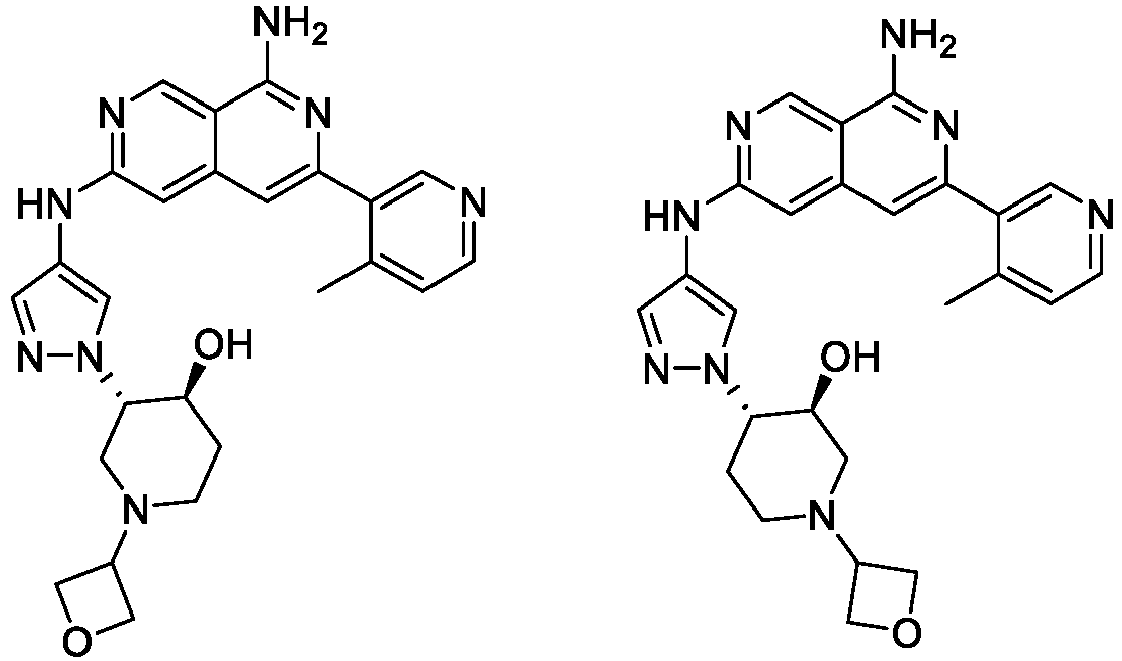
-

- To an ice-cooled a solution of 4-bromo-1H-pyrazole (10.0 g, 68.04 mmol) in tetrahydrofuran (100 mL) was added sodium hydride (2.28 g, 95.01 mmol) portionwise. The reaction was warmed to room temperature. After 1 h, tert-butyl 7-oxa-3-azabicyclo[4.1.0]heptane-3-carboxylate (20.0 g, 100.38 mmol) was added to the reaction, and the resulting solution was heated at 70 °C for 16 h. The reaction was diluted with water, and the mixture was extracted with dichloromethane. The organic extract was dried over Na2SO4, filtered, and concentrated under vacuum. Purification by silica gel chromatography (1:2 ethyl acetate / petroleum ether) afforded a mixture of tert-butyl trans-4-(4-bromo-1H-pyrazol-1-yl)-3-hydroxypiperidine-1-carboxylate and tert-butyl trans-3-(4-bromo-1H-pyrazol-1-yl)-4-hydroxypiperidine-1-carboxylate (1.4 g, 6%) as a white solid. LCMS (ESI): [M+H]+ =346.1.
-

- A solution of 4 M hydrogen chloride in 1,4-dioxane (20 mL) was added dropwise to a solution of tert-butyl 4-(4-bromo-1H-pyrazol-1-yl)-3-hydroxypiperidine-1-carboxylate and tert-butyl trans-3-(4-bromo-1H-pyrazol-1-yl)-4-hydroxypiperidine-1-carboxylate (650 mg, 1.88 mmol) in dichloromethane (10 mL) at room temperature. After 2 h, the reaction was concentrated under vacuum to afford a mixture of 4-(4-bromo-1H-pyrazol-1-yl)piperidin-3-ol hydrochloride and 3-(4-bromo-1H-pyrazol-1-yl)piperidin-4-ol hydrochloride (670 mg) as a white solid. LCMS (ESI): [M+H]+ =248.0.
-

- NaBH3CN (250 mg, 3.98 mmol) was added to a solution of the above mixture of 4-(4-bromo-1H-pyrazol-1-yl)piperidin-3-ol and 3-(4-bromo-1H-pyrazol-1-yl)piperidin-4-ol (650 mg, 2.64 mmol) and oxetan-3-one (250 mg, 3.47 mmol) in methanol (20 mL) at room temperature. After 16 h, the reaction was diluted with water and concentrated under vacuum. The resulting residue was purified by silica gel chromatography (10:1 dichloromethane / methanol) to provide a mixture of 4-(4-bromo-1H-pyrazol-1-yl)-1-(oxetan-3-yl)piperidin-3-ol and 3-(4-bromo-1H-pyrazol-1-yl)-1-(oxetan-3-yl)piperidin-4-ol (600 mg, 75%) as a light yellow oil. LCMS (ESI): [M+H]+ =302.2.
-

- A mixture of 1-N,1-N-bis[(2,4-dimethoxyphenyl)methyl]-3-(4-methylpyridin-3-yl)-2,7-naphthyridine-1,6-diamine (100 mg, 0.18 mmol), 4-(4-bromo-1H-pyrazol-1-yl)-1-(oxetan-3-yl)piperidin-3-ol / 3-(4-bromo-1H-pyrazol-1-yl)-1-(oxetan-3-yl)piperidin-4-ol (218 mg, 0.72 mmol), LiHMDS (226 mg, 1.35 mmol), 3rd generation t-BuBrett Phos precatalyst (80 mg, 0.09 mmol) and t-BuBrettPhos (43 mg, 0.09 mmol) in 1,4-dioxane (3.5 mL) was heated with microwave radiation for 2 h at 135 °C. The solids were filtered, and the filtrate was concentrated. The resulting residue was purified by silica gel chromatography (10:1 dichloromethane/methanol) to afford 4-[4-[(8-[bis[(2,4-dimethoxyphenyl)methyl]amino]-6-(4-methylpyridin-3 -yl)-2,7-naphthyridin-3-yl)amino]-1H-pyrazol-1-yl]-1-(oxetan-3-yl)piperidin-3-ol and 3-(4-((8-(bis(3,4-dimethylbenzyl)amino)-6-(4-methylpyridin-3-yl)-2,7-naphthyridin-3-yl)amino)-1H-pyrazol-1-yl)-1-(oxetan-3-yl)piperidin-4-ol (72.5 mg, 52%) as a yellow solid. LCMS (ESI): [M+H]+ =773.0.
-

- A solution of 4-[4-[(8-[bis[(2,4-dimethoxyphenyl)methyl]amino]-6-(4-methylpyridin-3-yl)-2,7-naphthyridin-3-yl)amino]-1H-pyrazol-1-yl]-1-(oxetan-3-yl)piperidin-3-ol / 3-(4-(8-amino-6-(4-methylpyridin-3-yl)-2,7-naphthyridin-3-ylamino)-1H-pyrazol-1-yl)-1-(oxetan-3-yl)piperidin-4-ol (300 mg, 0.39 mmol) in trifluoroacetic acid (15 mL) was heated at 80 °C. After 2 h, the reaction solution was concentrated under vacuum. The resulting residue was dissolved in methanol, and the pH of the solution was adjusted to 9 with ammonium hydroxide. Purification by Prep-HPLC provided a mixture of regioisomers (32 mg). The regioisomers were separated by chiral-Prep-HPLC. Compound 219: LCMS (ESI): RT (min) = 2.12, [M+H]+ = 473.2, method = M; 1H NMR (300 MHz, CD3OD) δ 9.15 (s, 1H), 8.50 (s, 1H), 8.43 (d, J= 5.1 Hz, 1H), 8.00 (s, 1H), 7.61 (s, 1H), 7.40 (d, J = 5.1 Hz, 1H), 6.80 (s, 1H), 6.70 (s, 1H), 4.88 - 4.60 (m, 4H), 4.18 - 4.11 (m, 1H), 4.05 - 3.96 (m, 1H), 3.66 - 3.55 (m, 1H), 3.04 - 3.00 (m, 1H), 2.87 - 2.84 (m, 1H), 2.44 - 2.38 (m, 4H), 2.14 - 2.07 (m, 2H), 1.78 - 1.73 (m, 1H). Compound 220: LCMS (ESI): RT (min) = 0.92, [M+H]+ = 473.2, method = K-1; 1H NMR (300 MHz, CD3OD) δ 9.15 (s, 1H), 8.51 (s, 1H), 8.45 (d, J = 5.1 Hz, 1H), 7.96 (s, 1H), 7.62 (s, 1H), 7.41 (d, J = 5.1 Hz, 1H), 6.80 (s, 1H), 6.70 (s, 1H), 4.88 - 4.60 (m, 4H), 4.07 - 4.00 (m, 1H), 3.98 - 3.94 (m, 1H), 3.65 - 3.55 (m, 1H), 3.09 - 3.03 (m, 1H), 2.92 - 2.89 (m, 1H), 2.44 (s, 3H), 2.23 - 2.20 (m, 1H), 2.13 - 2.06 (m, 2H), 1.95 - 1.88 (m, 1H).
-
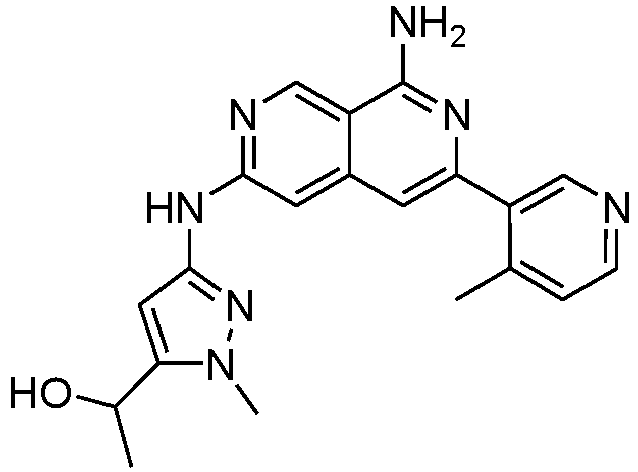
-

- n-BuLi (3.1 mL, 2.5M in hexane) was added dropwise to a solution of 3,5-dibromo-1-methyl-1H-pyrazole (1.70 g, 7.09 mmol) in tetrahydrofuran (30 mL) at -70 °C under nitrogen. After 1 h, acetaldehyde (374 mg, 8.49 mmol) was added. The temperature of the reaction was slowly raised to room temperature. After 1 h, the reaction was diluted with water, and the resulting mixture was extracted with ethyl acetate. The collected organic was concentrated under vacuum. Purification by silica gel chromatography (1:1 dichloromethane / ethyl acetate) afforded 1-(3-bromo-1-methyl-1H-pyrazol-5-yl)ethan-1-ol (370 mg, 25%) as a yellow oil. 1H NMR (300 MHz, DMSO-d 6) δ 6.25 (s, 1H), 5.38 (d, J= 5.7 Hz, 1H), 4.82 - 4.74 (m, 1H), 3.77 (s, 3H), 1.38 (d, J= 6.6 Hz, 3H).
-

- A mixture of 1-N,1-N-bis[(2,4-dimethoxyphenyl)methyl]-3-(4-methylpyridin-3-yl)-2,7-naphthyridine-1,6-diamine (200 mg, 0.36 mmol), 1-(3-bromo-1-methyl-1H-pyrazol-5-yl)ethan-1-ol (185 mg, 0.90 mmol), LiHMDS (450 mg, 2.69 mmol), 3rd generation t-BuBrettPhos precatalyst (155 mg, 0.18 mmol) and t-BuBrettPhos (87 mg, 0.18 mmol) in 1,4-dioxane (10 mL) was heated with microwave radiation for 2 h at 130 °C. The solids were filtered, and the filtrate was concentrated under vacuum. The resulting residue was purified by silica gel chromatography (10:1 dichloromethane/methanol) to provide 1-[3-[(8-[bis[(2,4-dimethoxyphenyl)methyl]amino]-6-(4-methylpyridin-3-yl)-2,7-naphthyridin-3-yl)amino]-1-methyl-1H-pyrazol-5-yl]ethan-1-ol (170 mg, 69%) as a yellow solid. LCMS (ESI): [M+H]+ =676.3.
-

- A solution of 1-[3-[(8-[bis[(2,4-dimethoxyphenyl)methyl]amino]-6-(4-methylpyridin-3-yl)-2,7-naphthyridin-3-yl)amino]-1-methyl-1H-pyrazol-5-yl]ethan-1-ol (250 mg, 0.37 mmol) in trifluoroacetic acid (12 mL) was stirred for 2 h at 80 °C. The reaction solution was then concentrated under vacuum. The resulting residue was dissolved in methanol, and the pH of the solution was adjust to 9 with ammonium hydroxide. Purification by Prep-HPLC provided 1-(3-(8-amino-6-(4-methylpyridin-3-yl)-2,7-naphthyridin-3-ylamino)-1-methyl-1H-pyrazol-5-yl)ethanol (32.5 mg, 23%) as a yellow solid. LCMS (ESI): RT (min) = 1.72, [M+H]+ = 376.2, method = M; 1H NMR (300 MHz, DMSO-d 6) δ 9.34 (s, 1H), 9.21 (s, 1H), 8.54 (s, 1H), 8.41 (d, J= 4.8 Hz, 1H), 7.48 (s, 1H), 7.29 (d, J= 4.8 Hz, 1H), 7.08 (s, 2H), 6.76 (s, 1H), 6.06 (s, 1H), 5.30 (d, J= 6.6 Hz, 1H), 4.82 - 4.74 (m, 1H), 3.74 (s, 3H), 2.40 (s, 3H), 1.41 (d, J= 6.6 Hz, 3H).
-

-

- A mixture of 8-bromo-2H,3H,4H-pyrido[4,3-b][1,4]oxazin-3-one (500 mg, 2.18 mmol), 4,4,5,5-tetramethyl-2-(tetramethyl-1,3,2-dioxaborolan-2-yl)-1,3,2-dioxaborolane (1.7 g, 6.69 mmol), Pd(dppf)Cl2 (320 mg, 0.43 mmol), and KOAc (640 mg, 6.52 mmol) in 1,4-dioxane (15 mL) was heated at 100 °C for 12 h under nitrogen. The solids were filtered, and the pH of the filtrate was adjusted to ~9 with NaOH. The resulting solution was washed with ethyl acetate. The aqueous layer was acidified to pH value ~3 with diluted aqueous HCl. The resulting solution was extracted with ethyl acetate. The collected organic was dried over Na2SO4, filtered, and concentrated under vacuum to provide [3-oxo-2H,3H,4H-pyrido[4,3-b][1,4]oxazin-8-yl]boronic acid (300 mg, 71%) as a yellow oil.
-

- A mixture of cis-N-(8-amino-6-chloro-2,7-naphthyridin-3-yl)-2-fluorocyclopropane-1-carboxamide (200 mg, 0.71 mmol), [3-oxo-2H,3H,4H-pyrido[4,3-b][1,4]oxazin-8-yl]boronic acid (277 mg, 1.42 mmol), Pd(dppf)Cl2 (104 mg, 0.14 mmol), and potassium carbonate (197 mg, 1.42 mmol) in dioxane (10 mL) and water (1 mL) was heated at 100 °C for 2 h under nitrogen. The solids were filtered, and the filtrate was concentrated under vacuum. The resulting residue was sequentially purified by flash column chromatography and Prep-HPLC to afford cis-N-(8-amino-6-[3-oxo-2H,3H,4H-pyrido[4,3-b][1,4]oxazin-8-yl]-2,7-naphthyridin-3-yl)-2-fluorocyclopropane-1-carboxamide (4.9 mg, 2%) as a yellow solid. LCMS (ESI): RT (min) = 1.08, [M+H]+ = 395.1, method = K-1; 1H NMR (400 MHz, DMSO-d 6) δ 11.02 (s, 1H), 10.99 (s, 1H), 9.37 (s, 1H), 8.72 (s, 1H), 8.23 (s, 1H), 8.09 (s, 1H), 7.42 (s, 1H), 7.33 (s, 2H), 4.86 (s, 3H), 2.36 - 2.17 (m, 1H), 1.79 - 1.59 (m, 1H), 1.32 - 1.11 (m, 1H).
-
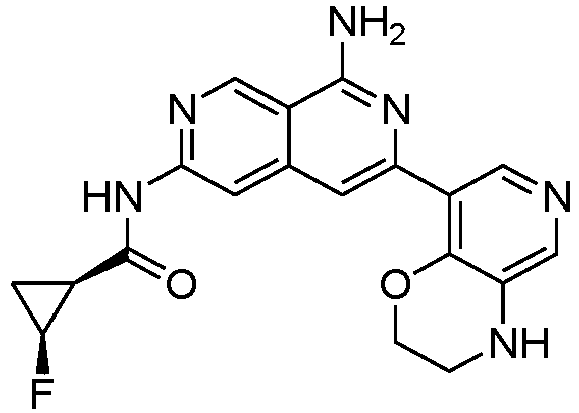
-

- A mixture of 3-amino-5-bromopyridin-4-ol (1 g, 5.29 mmol), 2-chloroacetyl chloride (658 mg, 5.82 mmol), potassium carbonate (1.82 g, 13.16 mmol) in N,N-dimethylformamide (25 mL) was stirred overnight at room temperature under nitrogen. The reaction was diluted with water, and the resulting solution was extracted with ethyl acetate. The collected organic was dried over Na2SO4, filtered, and concentrated under vacuum to afford 8-bromo-2H-pyrido[4,3-b][1,4]oxazin-3(4H)-one (500 mg, 39%) as a white solid. LCMS (ESI): [M+H]+ = 230.0, 232.0.
-

- 1 M Borane-tetrahydrofuran solution (19.6 mL, 19.6 mmol) was added dropwise to a solution of 8-bromo-2H,3H,4H-pyrido[4,3-b][1,4]oxazin-3-one (1.5 g, 6.54 mmol) in tetrahydrofuran (30 mL) and methanol (10 mL). The reaction mixture was stirred for 1 h at room temperature and another 1 h at 65 °C. The reaction mixture was concentrated under vacuum. The resulting residue was dissolved in water and the pH of the solution was adjust to 8-9 with aqueous NaOH (1 mol/L). The basic solution was extracted with ethyl acetate. The collected organic was dried over Na2SO4, filtered, and concentrated under vacuum to provide 8-bromo-2H,3H,4H-pyrido[4,3-b][1,4]oxazine (900 mg, 64%) as a white solid. LCMS (ESI): [M+H]+ = 215.0, 217.0.
-

- A mixture of 8-bromo-2H,3H,4H-pyrido[4,3-b][1,4]oxazine (400 mg, 1.86 mmol), Pd(dppf)Cl2 (272 mg, 0.37 mmol), KOAc (547 mg, 5.57 mmol) and 4,4,5,5-tetramethyl-2-(tetramethyl-1,3,2-dioxaborolan-2-yl)-1,3,2-dioxaborolane (1.42 g, 5.59 mmol) in dioxane (10 mL) was stirred for 12 h at 100 °C under nitrogen. The solids were filtered, and the pH of the filtrate was adjusted to 9-10 with aqueous NaOH. The resulting solution was washed with ethyl acetate. The pH of the aqueous layer was adjusted to 3-4 with aqueous HCl. The acidic solution was then extracted with ethyl acetate. The collected organic was dried over Na2SO4, filtered, and concentrated under vacuum to afford 3,4-dihydro-2H-pyrido[4,3-b][1,4]oxazin-8-ylboronic acid (350 mg) as a brown solid. LCMS (ESI): [M+H]+ = 181.0, 183.0.
-

- Oxalyl chloride (414 mg, 3.26 mmol) was added dropwise to an ice-cooled solution of cis-2-fluorocyclopropane-1-carboxylic acid (228 mg, 2.19 mmol), pyridine (3 mL), and N,N-dimethylformamide (0.05 mL) in dichloromethane (15 mL) under nitrogen. After 30 mins the reactopm was added to a solution of 6,8-dichloro-2,7-naphthyridin-3-amine hydrochloride (500 mg, 2.33 mmol) in dichloromethane (20 mL) at room temperature. After 2 h, the reaction was then diluted by water, and the resulting mixture was extracted with dichloromethane. The collected organic was dried over Na2SO4, filtered, and concentrated under vacuum. Purification by flash column chromatography (15:1 dichloromethane / methanol) afforded cis-N-(6,8-dichloro-2,7-naphthyridin-3-yl)-2-fluorocyclopropane-1-carboxamidee (300 mg, 39%) as a light yellow solid. LCMS (ESI): [M+H]+ = 301.1.
-

- A solution of cis-N-(6,8-dichloro-2,7-naphthyridin-3-yl)-2-fluorocyclopropane-1-carboxamide (100 mg, 0.33 mmol) and ammonium hydroxide (2 mL) in 1,4-dioxane (4 mL) was heated at 90 °C for 16 h. The reaction mixture was concentrated under vacuum. Purification of the resulting residue by flash column chromatography (8:1 dichloromethane / methanol) provided cis-N-(8-amino-6-chloro-2,7-naphthyridin-3-yl)-2-fluorocyclopropane-1-carboxamide (60 mg, 58%) as a light yellow solid. LCMS (ESI):[M+H]+ = 281.6.
-

- A suspension of cis-N-(8-amino-6-chloro-2,7-naphthyridin-3-yl)-2-fluorocyclopropane-1-carboxamide (200 mg, 0.71 mmol), [2H,3H,4H-pyrido[4,3-b][1,4]oxazin-8-yl]boronic acid (258 mg, 1.43 mmol), Pd(PPh3)4 (165 mg, 0.14 mmol), and Cs2CO3 (466 mg, 1.43 mmol) in 10:1 1,4-dioxane / water (11 mL) was heated at 100 °C for 12 h under nitrogen. The solids were filtered, and the filtrate was concentrated under vacuum. The resulting residue was purified by flash column chromatography (10:1 dichloromethane / methanol) to afford cis-N-(8-amino-6-[2H,3H,4H-pyrido[4,3-b][1,4]oxazin-8-yl]-2,7-naphthyridin-3-yl)-2-fluorocyclopropane-1-carboxamide (18.4 mg, 7%) as a yellow solid. LCMS (ESI): RT(min) = 1.16, [M+H]+ = 381.1, method = M; 1H NMR (300 MHz,CD3OD) δ 9.24 (s, 1H), 8.32 - 8.22 (s, 1H), 8.16 (s, 1H), 7.83 (s, 1H), 7.34 (s, 1H), 5.02-4.97 (m, 1H), 4.80 - 4.75 (m, 1H), 4.45 - 4.33 (m, 2H), 3.51 - 3.41 (m, 2H), 2.21 - 2.11 (m, 1H), 1.90 - 1.76 (m, 1H), 1.28 - 1.17 (m, 1H).
-

-

- A solution of trans-2-cyano-N-(6,8-dichloro-2,7-naphthyridin-3-yl)cyclopropane-1-carboxamide (200 mg, 0.65 mmol) in 1,4-dioxane (8 mL) and ammonium hydroxide (6 mL) was heated at 100 °C for 1 h under nitrogen. The reaction solution was concentrated under vacuum to afford crude trans-N-(8-amino-6-chloro-2,7-naphthyridin-3-yl)-2-cyanocyclopropane-1-carboxamide (208 mg) as a yellow solid. LCMS (ESI): [M+H]+ =288.1.
-

- A mixture of trans-N-(8-amino-6-chloro-2,7-naphthyridin-3-yl)-2-cyanocyclopropane-1-carboxamide (200 mg, 0.70 mmol), (2-cyanophenyl)boronic acid (256 mg, 1.74 mmol), 2nd generation XPhos precatalyst (82 mg, 0.11 mmol), XPhos (66 mg, 0.14 mmol) and KOAc (204 mg, 2.08 mmol) in 5:1 1,4-dioxane / water (12 mL) was heated at 100 °C for 6 h under nitrogen. The solids were filtered, and the filtrate was concentrated under vacuum. The resulting residue was purified by Prep-HPLC to afford trans-N-[8-amino-6-(2-cyanophenyl)-2,7-naphthyridin-3-yl]-2-cyanocyclopropane-1-carboxamide (40.5 mg, 16%) as a yellow solid. LCMS (ESI): RT (min) = 2.32, [M+H]+ = 355.1, method = M; 1H NMR (300 MHz, DMSO-d 6) δ 11.32 (s, 1H), 9.43 (s, 1H), 8.24 (s, 1H), 7.94 - 7.89 (m, 2H), 7.87 - 7.81 (m, 1H), 7.63 - 7.58 (m, 1H), 7.43 (s, 2H), 7.22 (s, 1H), 2.79 - 2.72 (m, 1H), 2.20 - 2.13 (m, 1H), 1.65 - 1.61 (m, 1H), 1.60 - 1.47 (m, 1H).
-

-

- LDA in tetrahydrofuran (4.3 mL, 31.71 mmol) was added dropwise to a solution of 3-bromo-4-methylpyridine (1 g, 5.81 mmol) in tetrahydrofuran (30 mL) at -78 °C. After 30 min, acetone (405 mg, 6.973 mmol) was added at -78 °C, and the reaction mixture was stirred for another 2 hour under nitrogen. The reaction was diluted with water, and the resulting mixture was extracted with ethyl acetate. The collected organic was dried over Na2SO4, filtered, and concentrated under vacuum. Purification by flash column chromatography (10:1 ethyl acetate / petroleum ether) provided 1-(3-bromopyridin-4-yl)-2-methylpropan-2-ol (1.0 g, 74% yield) as a yellow solid. LCMS (ESI) : [M+H]+ = 230.1.
-

- A mixture of 1-(3-bromopyridin-4-yl)-2-methylpropan-2-ol (500 mg, 2.17 mmol), 4,4,5,5-tetramethyl-2-(tetramethyl-1,3,2-dioxaborolan-2-yl)-1,3,2-dioxaborolane, Pd(dppf)Cl2 (360 mg, 0.44 mmol) and KOAc (660 mg, 6.72 mmol) in dioxane (10 mL) was heated at 100 °C for 4 h under nitrogen. The reaction mixture was concentrated under vacuum, and the residue was dissolved in water. The pH of the solution was adjusted to ~10 with aqueous sodium hydroxide (1 mol/L). The resulting solution was then washed with ethyl acetate. The basic aqueous layer was acidifed to pH = 4 with aqueous HCl (1 mol/L). The resulting acidic solution was extracted with ethyl acetate. The collected organic was dried over Na2SO4, filtered, and concentrated under vacuum to afford 3,3-dimethyl-1H,3H,4H-[1,2]oxaborinino[3,4-c]pyridin-1-ol (260 mg, 68%) as a yellow solid. LCMS (ESI): [M+H]+ = 178.1.
-

- A suspension of trans-N-(8-amino-6-chloro-2,7-naphthyridin-3-yl)-2-cyanocyclopropane-1-carboxamide (200 mg, 0.69 mmol), 3,3-dimethyl-1H,3H,4H-[1,2]oxaborinino[3,4-c]pyridin-1-ol (600 mg, 3.39 mmol), Pd(PPh3)4 (120 mg, 0.10 mmol) and Cs2CO3 (452 mg, 1.38 mmol) in 10:1 dioxane / water (11 mL) was heated at 100 °C for 4 h under nitrogen. The reaction mixture was concentrated under vacuum. Purification by silica gel chromatography (10:1 dichloromethane / methanol) provided trans-N-[8-amino-6-[4-(2-hydroxy-2-methylpropyl)pyridin-3-yl]-2,7-naphthyridin-3-yl]-2-cyanocyclopropane-1-carboxamide (13.3 mg 5%) as a yellow solid. LCMS (ESI): RT (min) = 1.85, [M+H]+ = 403.1, method = K-1; 1H NMR (300 MHz, DMSO-d 6) δ 9.34 (s, 1H), 8.56 (s, 1H), 8.50 (d, J= 1.8 Hz, 1H), 8.30(s, 1H), 7.46 (d, J= 1.8 Hz, 1H), 7.00(s, 1H), 3.02 (s, 2H), 2.70 - 2.59 (m, 1H), 2.14 - 2.12 (m, 1H), 1.67 - 1.53 (m, 2H), 1.26 (s, 6H).
-

-

- n-BuLi (0.72 mL, 7.64 mmol, 11M in hexanes) was added dropwise to a solution of 3,5-dibromo-4-methylpyridine (500 mg, 1.99 mmol) in tetrahydrofuran (10 mL) at -78°C under nitrogen. After 1 h, CO2 (g) was introduced in the solution at -78°C, and the resulting solution was warmed to room temperature. After 1 h, the reaction was diluted with 1M aqueous HCl. The resulting solution was extracted with ethyl acetate. The combined organic extract was dried over Na2SO4, filtered, and concentrated under vacuum to provide 5-bromo-4-methylpyridine-3-carboxylic acid (0.23 g, 53%) as a white solid.
-

- A solution of 5-bromo-4-methylpyridine-3-carboxylic acid (1 g, 4.62 mmol), HATU (2.64 g, 6.94 mmol), triethylamine (1.4 g, 13.83 mmol), and methylamine (2.6 mL, 167.43 mmol) in dichloromethane (50 mL) was stirred for 8 h at room temperature. The reaction was diluted with water, and the resulting mixture was extracted with dichloromethane. The collected organic was dried over Na2SO4, filtered, and concentrated under vacuum. Purification by silica-gel column chromatography (10: 1 dichloromethane / methanol) provided 5-bromo-N,4-dimethylpyridine-3-carboxamide (0.6 g, 57%) as a white solid.
-

- A mixture of 5-bromo-N,4-dimethylpyridine-3-carboxamide (400 mg, 1.74 mmol), Pd(dppf)Cl2 (255 mg, 0.34 mmol), KOAc (513 mg, 5.22 mmol) and 4,4,5,5-tetramethyl-2-(tetramethyl-1,3,2-dioxaborolan-2-yl)-1,3,2-dioxaborolane (2.22 g, 8.74 mmol) in 1,4-dioxane (15 mL) was heated at 100 °C for 5 h under nitrogen. The solids were filtered, and the filtrate was acidified to pH = 3-4 with aqueous HCl. The acidic solution was extracted with ethyl acetate. The organic extract was dried over Na2SO4, filtered, and concentrated under vacuum to afford [4-methyl-5-(methylcarbamoyl)pyridin-3-yl]boronic acid (280 mg, crude) as a white solid.
-

- A mixture of cis-N-(8-amino-6-chloro-2,7-naphthyridin-3-yl)-2-fluorocyclopropane-1-carboxamide (200 mg, 0.71 mmol), [4-methyl-5-(methylcarbamoyl)pyridin-3-yl]boronic acid (277 mg, 1.42 mmol), Pd(dppf)Cl2 (104 mg, 0.14 mmol), and potassium carbonate (197 mg, 1.42 mmol) in 10:1 1,4-dioxane / water (16.5 mL) was heated at 100 °C for 2 h under nitrogen. The solids were filtered, and the filtrate was concentrated under vacuum. Purification by silica-gel column chromatography (10:1 dichloromethane / methanol) yielded cis-5-(1-amino-6-[[-2-fluorocyclopropane]amido]-2,7-naphthyridin-3-yl)-N,4-dimethylpyridine-3-carboxamide (35.6 mg, 13%) as a white solid. LCMS (ESI): RT (min) = 0.95, [M+H]+ = 395.2, method = M; 1H NMR (300 MHz, CD3OD) δ 9.38 (s, 1H), 8.58 (s, 1H), 8.50 (s, 1H), 8.33(s, 1H), 6.98 (s, 1H), 5.02 - 4.97 (m, 1H), 4.80 - 4.75 (m, 1H), 2.96 (s, 3H), 2.44 (s, 3H), 2.21 - 2.12 (m, 1H), 1.89 - 1.76 (m, 1H), 1.30 - 1.17 (m, 1H).
-

-

- A mixture of (3-bromopyridin-4-yl)methanol (3.0 g, 15.95 mmol) and thionyl chloride (3.8 g, 31.94 mmol) in dichloromethane (80 mL) was stirred for 2 h at room temperature. The reaction mixture was concentrated under vacuum to afford crude 3 -bromo-4-(chloromethyl)pyridine hydrochloride (3.7 g, 95%) as a white solid. LCMS (ESI): [M+H]+ = 206.0.
-

- A mixture of 3-bromo-4-(chloromethyl)pyridine hydrochloride (4.1 g, 16.88 mmol), KCN (2.2 g, 33.79 mmol) in 1:1 ethanol / water (100 mL) was heated at 100 °C for 3 h. The reaction was concentrated under vacuum, and the resulting residue was dissolved with H2O (50 mL). The aqueous solution was extracted with ethyl acetate. The organic extract was dried over Na2SO4, filtered, and concentrated under vacuum. Purification by silica gel chromatography (1:2 ethyl acetate / petroleum ether) afforded 2-(3-bromopyridin-4-yl)acetonitrile (2.4 g, 72%) as a light yellow solid. LCMS (ESI): [M+H]+ = 197.0.
-

- A mixture of 2-(3-bromopyridin-4-yl)acetonitrile (1 g, 5.08 mmol), 4,4,5,5-tetramethyl-2-(tetramethyl-1,3,2-dioxaborolan-2-yl)-1,3,2-dioxaborolane (1.93 g, 7.6 mmol), Pd(dppf)Cl2 (371 mg, 0.51 mmol) and KOAc (1.49 g, 15.18 mmol) in dioxane (30 mL) was heated at 100 °C for 3 h under nitrogen. The solids were filtered, and the filtrate was concentrated under vacuum. The resulting residue was dissolved in H2O, and the solution was basified to pH = 10 with aqueous NaOH. The basic solution was washed with ethyl acetate. The aqueous layer was acidified to pH = 5-6 with aqueous HCl and concentrated under high vacuum. The resulting residue was suspended in 1:1 ethyl acetate / ethanol and filtered. The filtrate was concentrated under vacuum to afford [4-(cyanomethyl)pyridin-3-yl]boronic acid (658 mg, 80%) as a brown solid. LCMS (ESI): [M+H]+ =163.1.
-

- A mixture of trans-N-(8-amino-6-chloro-2,7-naphthyridin-3-yl)-2-cyanocyclopropane-1-carboxamide (440 mg, 1.53 mmol), [4-(cyanomethyl)pyridin-3-yl]boronic acid (495 mg, 3.06 mmol), XPhos (73 mg, 0.15), XPhos palladium(II) biphenyl-2-amine chloride (121 mg, 0.15), potassium carbonate (633 mg, 4.58), and 5:1 dioxane / water (12 mL) was heated at 100 °C for 1 h under nitrogen. The reaction was concentrated, and the crude product was purified by Flash-Prep-HPLC to afford trans-N-[8-amino-6-[4-(cyanomethyl)pyridin-3-yl]-2,7-naphthyridin-3-yl]-2-cyanocyclopropane-1-carboxamide (160, 28%) as a brown solid. LCMS (ESI): RT (min) = 1.12, [M+H]+ = 370.1, method = M; 1H NMR (300 MHz, DMSO-d 6) δ 11.31 (s, 1H), 9.41 (s, 1H), 8.77 (s, 1H), 8.64 (d, J= 6.0 Hz, 1H), 8.25 (s, 1H), 7.54 (d, J = 6.0 Hz, 1H), 7.44 (s, 2H), 7.16 (s, 1H), 4.48 (s, 2H), 2.80 - 2.74 (m, 1H), 2.21 - 2.14 (m, 1H), 1.66 - 1.59 (m, 1H), 1.48 - 1.42 (m, 1H).
-

-

- To an ice-cooled solution of sodium hydride (255 mg, 10.62 mmol) in tetrahydrofuran (30 mL) was added (3-bromopyridin-4-yl)methanol (1 g, 5.31 mmol). After 30 min, CH3I (0.336 mL, 5.39 mmol) was added at 0 °C, and the reaction temperature was maintained at 0 °C for another 30 min before warming to room temperature. After 12 h, the reaction was diluted with water, and the resulting solution was extracted with dichloromethane. The organic extract was dried over Na2SO4, filtered, and concentrated under vacuum. Purification by silica gel chromatography (5:1 ethyl acetate / petroleum ether) provided 3-bromo-4-(methoxymethyl)pyridine (500 mg, 47%) as a yellow oil. LCMS (ESI): [M+H]+ = 202.1.
-
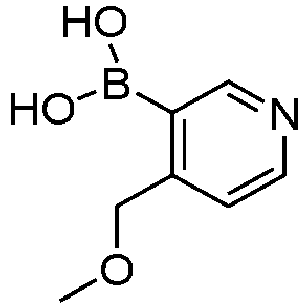
- A mixture of 3-bromo-4-(methoxymethyl)pyridine (500 mg, 2.47 mmol), 4,4,5,5-tetramethyl-2-(tetramethyl-1,3,2-dioxaborolan-2-yl)-1,3,2-dioxaborolane (1.8 g, 7.08 mmol), Pd(dppf)Cl2 (406 mg, 0.49 mmol) and KOAc (731 mg, 7.44 mmol) in dioxane (10 mL) was heated at 100 °C for 4 h under nitrogen. The reaction was concentrated under vacuum, and the resulting residue was dissolve in H2O. The pH of the solution was adjusted to 10 with aqueous NaOH, and the basic solution was washed with ethyl acetate. The aqueous layer was then acidified to pH = 5-6 with aqueous HCl and concentrated under vacuum. The residue was suspended in 1:1 ethyl acetate / ethanol and filtered. The filtrate was concentrated under vacuum to afford crude [4-(methoxymethyl)pyridin-3-yl]boronic acid (400, mg 97%) as a yellow solid. LCMS (ESI): [M+H]+ = 168.1.
-

- A solution of trans-2-cyano-N-(6,8-dichloro-2,7-naphthyridin-3-yl)cyclopropane-1-carboxamide (200 mg, 0.65 mmol) and ammonium hydroxide (6 mL) in dioxane (8 mL) was heated at 100 °C for 1 h. The reaction mixture was concentrated to afford crude trans-N-(8-amino-6-chloro-2,7-naphthyridin-3-yl)-2-cyanocyclopropane-1-carboxamide (200 mg) as a white solid. LCMS (ESI): [M+H]+ = 288.1.
-

- A suspension of trans-N-(8-amino-6-chloro-2,7-naphthyridin-3-yl)-2-cyanocyclopropane-1-carboxamide (200 mg, 0.69 mmol), [4-(methoxymethyl)pyridin-3-yl]boronic acid (139 mg, 0.83 mmol), XPhos-PdCl-2nd generation (55 mg, 0.07 mmol), XPhos (32 mg, 0.06 mmol) and potassium carbonate (200 mg, 1.44 mmol) in 10:1 dioxane / water(11 mL) was heated at 100 °C for 4 h under nitrogen. The reaction mixture was concentrated under vacuum, and the resulting residue was purified by flash column chromatography (10:1 dichloromethane / methanol) to provide trans-N-[8-amino-6-[4-(methoxymethyl)pyridin-3-yl]-2,7-naphthyridin-3-yl]-2-cyanocyclopropane-1-carboxamide (54.7 mg, 18%) as a yellow solid. LCMS (ESI): RT (min) = 1.02, [M+H]+ = 375.1, method = K-1; 1H NMR (300 MHz, DMSO-d 6) δ 11.31 (s, 1H), 9.41 (s, 1H), 8.69 (s, 1H), 8.59 (d, J= 5.1Hz, 1H), 8.23 (s, 1H), 7.54 (d, J= 5.2 Hz, 1H), 7.40 (s, 2H), 7.06 (d, J = 2.2 Hz, 1H), 4.69 (s, 2H), 3.31(s, 3H), 2.78 - 2.75 (m, 1H), 2.22 - 2.13 (m, 1H), 1.68 - 1.55 (m, 1H), 1.52 - 1.34 (m, 1H).
-

-

- To an ice-cooled solution of 2-(3-bromopyridin-4-yl)ethan-1-ol (4.83 g, 23.91 mmol) in tetrahydrofuran (100 mL) was added sodium hydride (1.44 g, 60.0 mmol). The reaction was warmed to room temperature. After 4 h, CH3I (5.11 g, 36.0) was added, and the reaction was maintained at room temperature for 12 h. Excess sodium hydride was quenched with methanol, and the reaction mixture was concentrated. Purification by flash column chromatography (1:5 ethyl acetate / petroleum ether) provided 3-bromo-4-(2-methoxyethyl)pyridine (2.3 g, 45%) as a light yellow oil. LCMS: (ESI) [M+H]+ = 216.0
-

- A mixture of 3-bromo-4-(2-methoxyethyl)pyridine (2.11 g, 9.77 mmol), 4,4,5,5-tetramethyl-2-(tetramethyl-1,3,2-dioxaborolan-2-yl)-1,3,2-dioxaborolane (7.44 g, 29.29), Pd(dppf)Cl2 (715 mg, 0.98 mmol) and KOAc (2.87 g, 29.24 mmol) in dioxane (50 mL) was heated at 100 °C for 12 h. The solids were filtered, and the filtrate was concentrated under vacuum. The resulting residue was dissolved in H2O and the solution was basified to pH = 7 -8 with aqueous NaOH. The basic solution was washed with ethyl acetate. The aqueous was then acidified to pH = 3-4 with HCl. The acidic solution was concentrated under vacuum. The resulting residue was suspended in 1:1 ethyl acetate / ethanol and filtered. The filtrate was concentrated under vacuum to afford [4-(2-methoxyethyl)pyridin-3-yl]boronic acid (1.6 g, 91%) as a light yellow solid. LCMS: (ESI) [M+H]+ = 182.1.
-

- A mixture of trans-N-(8-amino-6-chloro-2,7-naphthyridin-3-yl)-2-cyanocyclopropane-1-carboxamide (205 mg, 0.71 mmol), [4-(2-methoxyethyl)pyridin-3-yl]boronic acid (155 mg, 0.86 mmol), XPhos (34 mg, 0.07 mmol), potassium carbonate (209 mg, 1.51 mmol) and XPhos palladium(II) biphenyl-2-amine chloride (56 mg, 0.07 mmol) in 4:1 dioxane / water (5 mL) was heated at 100 °C for 3 h under nitrogen. The solids were filtered, and the filtrate was concentrated under vacuum. The resulting residue was purified by Flash-Prep-HPLC to afford trans-N-[8-amino-6-[4-(2-methoxyethyl)pyridin-3-yl]-2,7-naphthyridin-3-yl]-2-cyanocyclopropane-1-carboxamide (70.9 mg, 26%) as a white solid. LCMS (ESI): RT (min) = 1.14, [M+H]+ = 389.2, method = M; 1H NMR (300 MHz, DMSO-d 6) δ 11.29 (s, 1H), 9.41 (s, 1H), 8.53 (s, 1H), 8.48 (d, J= 6.0 Hz, 1H), 8.20 (s, 1H), 7.37 - 7.36(m, 3H), 6.98 (s, 1H), 3.50 (t, J = 6.0 Hz, 2H), 3.15 (s, 3H), 3.03 (t, J = 6.0 Hz, 2H), 2.80 - 2.74 (m, 1H), 2.20 - 2.13 (m, 1H), 1.65 - 1.59 (m, 1H), 1.48 - 1.41(m, 1H).
-

-

- NaBH4 (550 mg, 14.54 mmol) was added portionwise to a solution of (exo)-N-(8-[bis [(2,4-dimethoxyphenyl)methyl]amino]-6-chloro-2,7-naphthyridin-3-yl)-2-oxobicyclo[3.1.0]hexane-6-carboxamide (1.5 g, 2.43 mmol) in methanol (20 mL), dichloromethane (10 mL), and tetrahydrofuran (5 mL) at room temperature. After 1 h, excess sodium borohydride was quenched with H2O, and the suspension was concentrated under vacuum. Purification of the residue by silica-gel chromatography (10:1 dichloromethane / methanol) provided (exo)-N-(8-[bis[(2,4-dimethoxyphenyl)methyl]amino]-6-chloro-2,7-naphthyridin -3-yl)-2-hydroxybicyclo[3.1.0]hexane-6-carboxamide (1.3 g, 86%) as a yellow solid. LCMS (ESI) [M+H]+ = 619.3.
-

- To a solution of (exo)-N-(8-[bis[(2,4-dimethoxyphenyl)methyl]amino]-6-chloro-2,7-naphthyridin-3-yl)-2-hydroxybicyclo[3.1.0]hexane-6-carboxamide (600 mg, 0.96 mmol), triethylamine (980 mg, 9.691 mmol) in dichloromethane (5 mL) was added MsCl (555 mg, 4.84 mmol) at room temperature. After 30 min, the reaction was diluted with water, and the solution was extracted with dichloromethane. The organic extract was dried over Na2SO4, filtered, and concentrated under vacuum. To a solution of the crude mesylate in tetrahydrofuran (5 mL) was added KCN (504 mg, 7.75 mmol) and 18-crown-6 (256 mg, 0.96 mmol). The reaction was heated at 60 °C for 16 h before concentration. Purification of the resulting residue by silica-gel chromatography (1:3 petroleum ether / ethyl acetate) afforded (exo)-N-(8-[bis[(2,4-dimethoxyphenyl) methyl]amino]-6-chloro-2,7-naphthyridin-3-yl)-2-cyanobicyclo[3.1.0]hexane-6-carboxamide (100 mg, 16%) as a brown solid. LCMS: (ESI) [M+H]+ = 628.3.
-

- A mixture of (exo)-N-(8-[bis[(2,4-dimethoxyphenyl)methyl]amino]-6-chloro-2,7-naphthyridin -3-yl)-2-cyanobicyclo[3.1.0]hexane-6-carboxamide (100 mg, 0.16 mmol), 4-methylpyridin-3-yl) boronic acid (65 mg, 0.47 mmol), X-phos G2 Pd(25 mg, 0.03 mmol), X-phos (22 mg, 0.05 mmol), and KOAc (78 mg, 0.79 mmol) in 9:1 1,4-dioxane / water (2 mL) was heated at 100 °C. After 2.5 h, the reaction was concentrated under vacuum, and the resulting residue was purified by silica-gel chromatography (10:1 dichloromethane / methanol) to afford (exo)-N-(8-[bis [(2,4-dimethoxyphenyl)methyl]amino]-6-(4-methylpyridin-3-yl)-2,7-naphthyridin-3-yl)-2-cyanobicyclo[3.1.0]hexane-6-carboxamide (80 mg, 73%) as a brown solid. LCMS: (ESI) [M+H]+ = 685.4.
-

- A solution of (exo)-N-(8-[bis[(2,4-dimethoxyphenyl)methyl]amino]-6-(4-methylpyridin-3-yl)-2,7-naphthyridin-3-yl)-2-cyanobicyclo[3.1.0]hexane-6-carboxamide (60 mg, 0.08 mmol) in dichloromethane (2 mL) was added trifluoroacetic acid (4 mL) at room temperature. After 4 h, the reaction was concentrated under vacuum. Purification by flash column chromatography (10:1 dichloromethane / methanol) followed by Prep-HPLC afforded (exo)-N-[8-amino-6-(4-methyl pyridin-3-yl)-2,7-naphthyridin-3-yl]-2-cyanobicyclo[3.1.0] hexane-6-carboxamide (6 mg, 18%) as an off-white solid. LCMS (ESI): RT (min) = 2.34, [M+H]+ = 385.2, method = K-1; 1H NMR (300 MHz, DMSO-d 6) δ 10.80 (s, 1H), 9.35 (s, 1H), 8.55 (s, 1H), 8.43 (d, J= 5.0 Hz, 1H), 8.20 (s, 1H), 7.40 - 7.22 (m, 3H), 6.97 (s, 1H), 3.36 (d, J = 5.0 Hz, 1H), 2.40 (s, 3H), 2.14 - 2.02 (m, 2H), 2.02 - 1.80 (m, 4H), 1.55 - 1.45 (m, 1H).
-
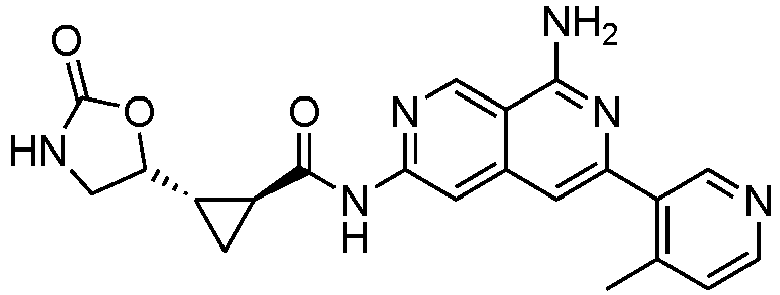
-

- A mixture of 5-(hydroxymethyl)-1,3-oxazolidin-2-one (3 g, 25.61 mmol), imidazole (3.49 g, 51.26 mmol), and TBSCl (4.65 g, 30.85 mmol) in N,N-dimethylformamide (120 mL) was stirred for 4 h at room temperature. The reaction was diluted with H2O, and the resulting mixture was extracted with ethyl acetate. The collected organic extract was dried over Na2SO4, filtered, and concentrated under vacuum to provide 5-[[(tertbutyldimethylsilyl)oxy]methyl]-1,3-oxazolidin-2-one (5.03 g, 85%) as a light yellow oil. LCMS(ESI): [M+H]+ = 232.1.
-

- Sodium hydride (2.4 g, 100.01 mmol) was added to a solution of 5-[[(tertbutyldimethylsilyl)oxy]methyl]-1,3-oxazolidin-2-one (4.6 g, 19.88 mmol) in N,N-dimethylformamide (100 mL) at room temperature under nitrogen for 30 min. para-Methoxybenzyl chloride (PMBCl) (3.1 g, 19.79 mmol) was added to the reaction, and the mixture was stirred for 2 h at room temperature. Excess sodium hydride was quenched by water, and the resulting solution was extracted with ethyl acetate. The collected organic was dried over Na2SO4, filtered, and concentrated under vacuum. Purification by flash column chromatography (10:1 dichloromethane / methanol) afforded 5-[[(tertbutyldimethylsilyl)oxy]methyl]-3-[(4-methoxyphenyl)methyl]-1,3-oxazolidin-2-one (6.3 g, 90%) as a light yellow oil. LCMS(ESI): [M+H]+ = 352.2.
-

- A mixture of 5-[[(tert-butyldimethylsilyl)oxy]methyl]-3-[(4-methoxyphenyl)methyl]-1,3-oxazolidin-2-one (6.2 g, 17.63 mmol) and TBAF (9.12 g, 34.88 mmol) in tetrahydrofuran (100 mL) was stirred for 3 h at room temperature. The reaction was diluted with H2O, and the resulting mixture was extracted with dichloromethane. The organic extract was dried over Na2SO4, filtered, and concentrated under vacuum. Purification by flash column chromatography (10:1 dichloromethane / methanol) afforded 5-(hydroxymethyl)-3-[(4-methoxyphenyl)methyl]-1,3-oxazolidin-2-one (93.7 g, 88%) as a light yellow oil. LCMS(ESI): [M+H]+ = 238.1.
-

- A solution of DMSO (1.56 g, 19.96 mmol) in dichloromethane (20 mL) was added dropwise to oxalyl chloride (1.27 g, 10.00 mmol) in dichloromethane (20 mL) at -78 °C. After 30 min 5-(hydroxymethyl)-3-[(4-methoxyphenyl)methyl]-1,3-oxazolidin-2-one (1.98 g, 8.34 mmol) was added to the reaction at -78 °C. After 1 h, triethylamine (1.69 g, 16.70 mmol) was added, and the reaction mixture was warmed to room temperature for 16 h. The mixture was concentrated under vacuum to afford 3-[(4-methoxyphenyl)methyl]-2-oxo-1,3-oxazolidine-5-carbaldehyde (1.2 g, crude) as a light yellow solid.
-

- A mixture of 3-[(4-methoxyphenyl)methyl]-2-oxo-1,3-oxazolidine-5-carbaldehyde (1.2 g, 5.10 mmol) and ethyl 2-(triphenylphosphanylidene)acetate (2.67 g, 7.66 mmol) in tetrahydrofuran (50 mL) was stirred for 12 h at room temperature. The reaction mixture was concentrated under vacuum. The residue was purified by flash column chromatography (1: 1 ethyl acetate / petroleum ether) to provide ethyl (2E)-3-[3-[(4-methoxyphenyl)methyl]-2-oxo-1,3-oxazolidin-5-yl]prop-2-enoate (1.14 g, 73%) as a light yellow solid. LCMS (ESI): [M+H]+ = 306.1.
-
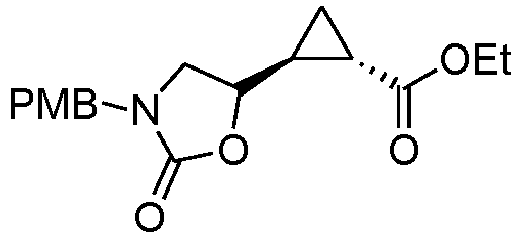
- A mixture of trimethylsulfoxonium iodide (1.5 g, 6.81 mmol) and t-BuOK (762 mg, 6.79 mmol) in DMSO (15 mL) was stirred for 30 min at room temperature. Ethyl (2E)-3-[3-[(4-methoxyphenyl)methyl]-2-oxo-1,3-oxazolidin-5-yl]prop-2-enoate (1.04 g, 3.40 mmol) was added. The mixture was allowed to react for 12 h at room temperature before dilution with water. The solution was extracted with ethyl acetate, and the extracts were combined and concentrated. Purification by silica gel chromatography (1:1 ethyl acetate / petroleum ether) afforded ethyl trans-2-[3-[(4-methoxyphenyl)methyl]-2-oxo-1,3-oxazolidin-5-yl] cyclopropane-1-carboxylate (278 mg, 26%) as a colorless oil. LCMS (ESI):[ M+H]+ = 320.1;
-

- A mixture of ethyl trans-2-[3-[(4-methoxyphenyl)methyl]-2-oxo-1,3-oxazolidin-5-yl]cyclopropane-1-carboxylate (241 mg, 0.75 mmol) and LiOH (55 mg, 2.29 mmol) in 1:1 tetrahydrofuran / water (10 mL) was stirred for 1 h at room temperature. The reaction solution was diluted with water and acidified to pH 5 with 2 M aqueous hydrogen chloride. The solution was extracted with DCM. The extracts were dried with Na2SO4, filtered, and concentrated under vacuum to afford crude trans-2-[3-[(4-methoxyphenyl)methyl]-2-oxo-1,3-oxazolidin-5-yl]cyclopropane-1-carboxylic acid (260 mg) as a light yellow solid.
-

- To an ice-cooled solution of trans-2-[3-[(4-methoxyphenyl)methyl]-2-oxo-1,3-oxazolidin-5-yl]cyclopropane-1-carboxylic acid (216 mg, 0.74 mmol), 1-N,1-N-bis[(2,4-dimethoxyphenyl)methyl]-3-(4-methylpyridin-3-yl)-2,7-naphthyridine-1,6-diamine (341 mg, 0.62 mmol) and pyridine (1 mL) in dichloromethane (5 mL) was added POCl3 (285 mg, 1.85 mmol) dropwise. After 1 h the reaction mixture was diluted with water, and the solution was extracted with dichloromethane. The collected organic was dried over Na2SO4, filtered and concentrated under vacuum to provide crude trans-N-(8-[bis[(2,4-dimethoxyphenyl)methyl]amino]-6-(4-methylpyridin-3-yl)-2,7-naphthyridin-3-yl)-2-[3-[(4-methoxyphenyl)methyl]-2-oxo-1,3-oxazolidin-5-yl]cyclopropane-1-carboxamide (200 mg) as a brown solid. LCMS (ESI): [M+H]+ = 825.4.
-

- A mixture of trans-N-(8-[bis[(2,4-dimethoxyphenyl)methyl]amino]-6-(4-methylpyridin-3-yl)-2,7-naphthyridin-3-yl)-2-[3-[(4-methoxyphenyl)methyl]-2-oxo-1,3-oxazolidin-5-yl]cyclopropane-1-carboxamide (241 mg, 0.29 mmol) in trifluoroacetic acid (5 mL) was heated at 80 °C for 1 h. The solution was then cooled to room temperature. CF3SO3H (3 mL) was added, and the reaction mixture was stirred for an additional hour at room temperature. The mixture was concentrated under vacuum to provide a residue that was dissolved in MeOH. The solution was basified to pH 8~9 with ammonium hydroxide and purified by Prep-HPLC to afford trans-N-[8-amino-6-(4-methylpyridin-3-yl)-2,7-naphthyridin-3-yl]-2-(2-oxo-1,3-oxazolidin-5-yl)cyclopropane-1-carboxamide (7.7 mg, 7%) as a light yellow solid. LCMS (ESI): RT (min) = 1.40, [M+H]+ = 405.2, method = M; 1H NMR (300 MHz, DMSO-d 6) δ 11.07 - 11.0 (m, 1H), 9.38 (s, 1H), 8.57(s, 1H), 8.44 (d, J= 6.0 Hz, 1H), 8.23 (s, 1H), 7.55 (s, 1H), 7.34 (s, 2H), 7.30 (d, J= 6.0 Hz, 1H), 6.98 (s, 1H), 4.42 - 4.18 (m, 1H),3.64 - 3.58 (m, 1H), 3.32 - 3.23 (m, 1H), 2.41 (s, 3H), 2.25 - 2.12 (m, 1H), 1.67 - 1.62 (m, 1H), 1.17 - 0.96 (m, 2H).
-
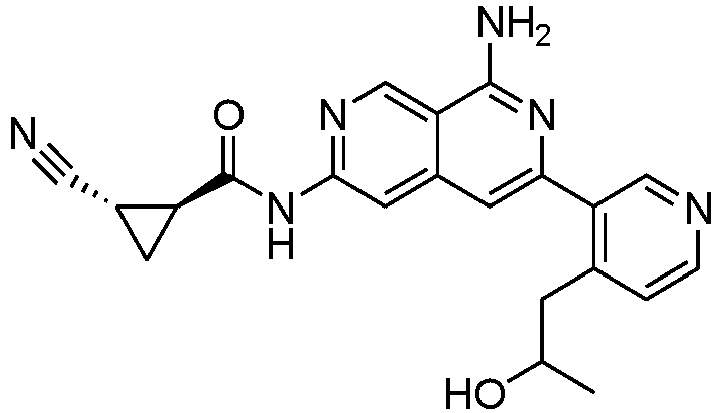
-

- LDA (4.4 mL, 32.44 mmol) was added dropwise to a solution of 3-bromo-4-methylpyridine (1 g, 5.81 mmol) in tetrahydrofuran (30 mL) at -78 °C. After 1 h, acetaldehyde (386 mg, 8.762 mmol) was added and the reaction solution was stirred for an additional 2 h at - 78 °C. The reaction was then diluted with water, and the resulting solution was extracted with ethyl acetate. The collected organic was dried over Na2SO4, filtered, and concentrated under vacuum. The residue was purified by flash column chromatography (10:1 dichloromethane / methanol) to provide 1-(3-bromopyridin-4-yl)propan-2-ol (100 mg, 8%) as a yellow oil. LCMS (ESI): [M+H]+ = 216.1.
-

- A mixture of 1-(3-bromopyridin-4-yl)propan-2-ol (500 mg, 2.31 mmol), 4,4,5,5-tetramethyl-2-(tetramethyl-1,3,2-dioxaborolan-2-yl)-1,3,2-dioxaborolane (2.9 g, 10.74 mmol), Pd(dppf)Cl2 (380 mg, 0.46 mmol), KOAc (684 mg, 6.96 mmol) in dioxane (10 mL) was heated at 100 °C for 4 h under nitrogen. The reaction mixture was concentrated under vacuum, and the resulting residue was dissolved in H2O. The aqueous solution was basified to pH ~10 with aqueous NaOH and then washed with ethyl acetate. The aqueous layer was acidified to pH 5-6 with HCl and concentrated in vacuo. The residue was suspended in 1:1 ethyl acetate / ethanol and filtered. The filtrate was concentrated under vacuum to afford crude 3 -methyl-1H,3H,4H-[1,2]oxaborinino[3,4-c]pyridin-1-ol (300 mg, 80%) as a yellow solid. LCMS (ESI): [M+H]+ = 164.1.
-

- A mixture of trans-2-cyano-N-(6,8-dichloro-2,7-naphthyridin-3-yl)cyclopropane-1-carboxamide (200 mg, 0.65 mmol) and ammonium hydroxide (0.17 mmol) in dioxane (8 mL) was heated at 100 °C for 1 h under nitrogen. The reaction mixture was concentrated under vacuum to afford crude trans-N-(8-amino-6-chloro-2,7-naphthyridin-3-yl)-2-cyanocyclopropane-1-carboxamide (200 mg) as a white solid. LCMS (ESI): [M+H]+ = 288.1.
-

- A mixture of trans-N-(8-amino-6-chloro-2,7-naphthyridin-3-yl)-2-cyanocyclopropane-1-carboxamide (200 mg, 0.69 mmol), 3-methyl-1H,3H,4H-[1,2]oxaborinino[3,4-c]pyridin-1-ol (546 mg, 3.35 mmol), Pd(PPh3)4 (120 mg, 0.10 mmol), and Cs2CO3 (452 mg, 1.38 mmol) in 10:1 dioxane / water (11 mL) was heated at 100 °C for 4 h under nitrogen. The reaction mixture was concentrated under vacuum, and the resulting residue was purified by flash column chromatography (10:1 dichloromethane / methanol) to provide trans-N-[8-amino-6-[4-(2-hydroxypropyl)pyridin-3-yl]-2,7-naphthyridin-3-yl]-2-cyanocyclopropane-1-carboxamide (80.1 mg 30%) as a yellow solid. LCMS (ESI): RT (min) = 1.71, [M+H]+ = 389.1, method = K-1; 1H NMR (300 MHz, DMSO-d 6) δ 11.31 (s, 1H), 9.41 (s, 1H), 8.69 (s, 1H), 8.59 (d, J= 2.2 Hz, 1H), 8.23 (s, 1H), 7.54 (d, J= 2.2 Hz, 1H), 7.40 (s, 2H), 7.06 (s, 1H), 4.82 - 4.80 (m, 1H), 3.81 - 3.79 (m, 1H), 2.92 - 2.77 (m, 3H), 2.22 - 2.13 (m, 1H), 1.68 - 1.55 (m, 1H), 1.52 - 1.34 (m, 1H), 0.98 (d, J= 4.8 Hz, 3H).
-

-

- A mixture of trans-N-(6,8-dichloro-2,7-naphthyridin-3-yl)-2-(1-methyl-1H-pyrazol-4-yl)cyclopropane-1-carboxamide (1.8 g, 4.97 mmol) and ammonium hydroxide (36 mL) in 1,4-dioxane (36 mL) was heated at 100 °C for 15 h. The resulting mixture was concentrated under vacuum to afford crude trans-N-(8-amino-6-chloro-2,7-naphthyridin-3-yl)-2-(1-methyl-1H-pyrazol-4-yl)cyclopropanecarboxamide as a white solid (1.7g, crude). LCMS (ESI)[M+H]+ = 343.1.
-

- A mixture of trans-N-(8-amino-6-chloro-2,7-naphthyridin-3-yl)-2-(1-methyl-1H-pyrazol-4-yl)cyclopropane-1-carboxamide (280 mg, 0.82 mmol), (4-methylpyridin-3-yl)boronic acid (168 mg, 1.23 mmol), XPhos (78 mg, 0.16 mmol), XPhos-PdCl-2nd G (62 mg, 0.08 mmol) and potassium carbonate (339 mg, 2.45 mmol) in 10:1 1,4-dioxane / water (11 mL) was heated at 100 °C for 1 h under nitrogen. The solids were filtered, and the filtrate was concentrated. Purification by flash column chromatography (15:1 dichloromethane / methanol) afforded trans-N-[8-amino-6-(4-methylpyridin-3-yl)-2,7-naphthyridin-3-yl]-2-(1-methyl-1H-pyrazol-4-yl)cyclopropane-1-carboxamide (122 mg, 37% yield) as a yellow solid. LCMS(ESI)[M+H]+= 400.2.
-

- To a solution of trans-N-[8-amino-6-(4-methylpyridin-3-yl)-2,7-naphthyridin-3-yl]-2-(1-methyl-1H-pyrazol-4-yl)cyclopropane-1-carboxamide (50 mg, 0.125 mmol) in N,N-dimethylformamide (10 mL) was added NCS (20.06 mg, 0.150 mmol) in 2 portions at room temperature. After 5 h, the reaction was concentrated under vacuum, and the residue was purified by flash column chromatography (20:1 dichloromethane / methanol) to afford racemic product (15 mg, 26% yield) as a light yellow solid. The enantiomers were isolated by chiral SFC. Compound 233: LCMS (ESI): RT(min) = 1.15, [M+H]+ = 434.1, method = K-1; 1H NMR (300 MHz, CD3OD) δ 9.34 (d, J = 0.9 Hz, 1H), 8.72 (d, J = 0.9 Hz, 1H), 8.48 (d, J = 5.2 Hz, 1H), 8.41 (s,1H), 7.51 (s, 1H), 7.44 (d, J = 5.3 Hz, 1H), 7.38 (d, J = 0.8 Hz, 1H), 3.86 (s, 3H), 2.41 - 2.39 (m, 1H), 2.29 (s, 3H), 2.14 - 2.11 (m, 1H), 1.60 - 1.58 (m, 1H), 1.29 - 1.26 (m, 1H). Compound 234: LCMS (ESI): RT(min) = 1.16, [M+H]+ = 434.1, method = K-1; 1H NMR (400 MHz, CD3OD) δ 9.34 (d, J = 0.9 Hz, 1H), 8.72 (d, J = 0.9 Hz, 1H), 8.48 (d, J = 5.2 Hz, 1H), 8.41 (s,1H), 7.51 (s, 1H), 7.44 (d, J= 5.3 Hz, 1H), 7.38 (d, J = 0.8 Hz, 1H), 3.86 (s, 3H), 2.41 - 2.39 (m, 1H), 2.29 (s, 3H), 2.14 - 2.11 (m, 1H), 1.60 - 1.58 (m, 1H), 1.29 - 1.26 (m, 1H).
-

-

- A mixture of 1-(oxan-2-yl)-4-(tetramethyl-1,3,2-dioxaborolan-2-yl)-1H-pyrazole (2.94 g, 10.57 mmol), 3-bromo-4-iodopyridine (2.00 g, 7.05 mmol), potassium carbonate (2.92 g, 21.12 mmol) and Pd(dppf)Cl2.CH2Cl2 (580 mg, 0.710 mmol) in N,N-dimethylformamide (20 mL) / water (4 mL) was heated at 80 °C for 6 h under nitrogen. The resulting solution was extracted with ethyl acetate, and the combined extracts were dried over Na2SO4, filtered, and concentrated under vacuum. Purification by silica gel chromatography (7:3 ethyl acetate / petroleum ether) provided 3-bromo-4-[1-(oxan-2-yl)-1H-pyrazol-4-yl]pyridine (2.75 g) as a yellow oil. LCMS (ESI): [M+H] +=308.2.
-

- A mixture of 3-bromo-4-[1-(oxan-2-yl)-1H-pyrazol-4-yl]pyridine (2.70 g, 8.76 mmol), 4,4,5,5-tetramethyl-2-(tetramethyl-1,3,2-dioxaborolan-2-yl)-1,3,2-dioxaborolane (8.90 g, 35.04 mmol), Pd(dppf)Cl2 dichloromethane (720 mg, 0.88 mmol) and KOAc (3.44 g, 35.05 mmol) in 1,4-dioxane (40 mL) was heated at 100 °C for 4 h under nitrogen. The mixture was concentrated under vacuum, and the resulting residue was purified by silica gel chromatography (9:1 dichloromethane / methanol) to afford [4-[1-(oxan-2-yl)-1H-pyrazol-4-yl]-1,3-azaborinin-5-yl]boronic acid (1.5 g, 63% yield) as a black solid. LCMS (ESI): [M+H] +=274.1.
-
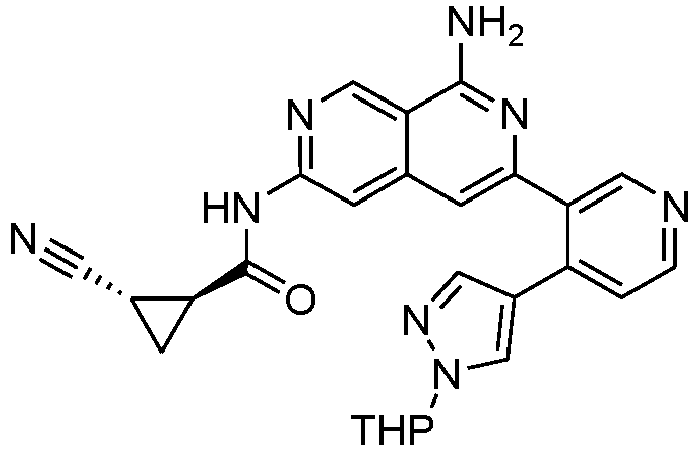
- A mixture of trans-N-(8-amino-6-chloro-2,7-naphthyridin-3-yl)-2-cyanocyclopropane-1-carboxamide (400 mg, 1.39 mmol), [4-[1-(oxan-2-yl)-1H-pyrazol-4-yl]pyridin-3-yl]boronic acid (1139.07 mg, 4.17 mmol), X-Phos (66.28 mg, 0.13 mmol), XPhos-PdOMs (111.14 mg, 0.13 mmol), and potassium carbonate (576 mg, 4.17 mmol) in 5:1 dioxane / water (36 mL) was heated at 100 °C for 6 h under nitrogen. The reaction was concentrated under vacuum, and the resulting residue was purified by silica gel chromatography (9:1 dichloromethane / methanol) to afford trans-N-(8-amino-6-[4-[1-(oxan-2-yl)-1H-pyrazol-4-yl]pyridin-3-yl]-2,7-naphthyridin-3-yl)-2-cyanocyclopropane-1-carboxamide (510 mg, 76% yield) as a brown oil. LCMS53 (ESI): [M+H] +=481.1
-

- A mixture of (1S,2S)-N-(8-amino-6-[4-[1-(oxan-2-yl)-1H-pyrazol-4-yl]pyridin-3-yl]-2,7-naphthyridin-3-yl)-2-cyanocyclopropane-1-carboxamide (510 mg, 1.06 mmol) and trifluoroacetic acid (4 mL) in dichloromethane (10 mL) was stirred for 5 h at 25 °C. The resulting mixture was concentrated under vacuum. The crude product was purified by Prep-HPLC and chiral SFC to afford two enantiomers. Compound 235: LCMS (ESI): [M+H]+ = 397.15, RT (min) = 1.46, method = K-1; 1H NMR (300 MHz, DMSO-d 6) δ 12.91 (s, 1H), 11.28 (s, 1H), 9.41 (s, 1H), 8.52 (d, J = 5.3 Hz, 1H), 8.46 (s, 1H), 8.12 (s, 1H), 7.61 - 7.58 (m, 3H), 7.40 (s, 2H), 6.83 (s, 1H), 2.81 - 2.69 (m, 1H), 2.14 - 2.12 (m, 1H), 1.60 - 1.58 (m, 1H), 1.42 - 1.40 (m, 1H). Compound 236: LCMS (ESI): [M+H]+ = 397.15, RT(min) = 0.92, method = K-1; 1H NMR (300 MHz, DMSO-d 6) δ 12.91 (s, 1H), 11.28 (s, 1H), 9.41 (s, 1H), 8.52 (d, J= 5.3 Hz, 1H), 8.46 (s, 1H), 8.12 (s, 1H), 7.61 - 7.58 (m, 3H), 7.40 (s, 2H), 6.83 (s, 1H), 2.81 - 2.69 (m, 1H), 2.14 - 2.12 (m, 1H), 1.60 - 1.58 (m, 1H), 1.42 - 1.40 (m, 1H).
-


- The title compound was prepared using a procedure as described for (1R,2R)-N-(6-(4-(1H-pyrazol-4-yl)pyridin-3-yl)-8-amino-2,7-naphthyridin-3-yl)-2-cyanocyclopropanecarboxamide (Compound 235). The enantiomers were isolated by chiral SFC. Compound 237:LCMS (ESI): RT(min) = 1.09, [M+H]+ =439.2, method = M; 1H NMR (400 MHz, DMSO-d 6) δ 11.05 (s, 1H), 9.37 (s, 1H), 8.51 (s, 1H), 8.30 (s, 1H), 8.23 (s, 1H), 8.02 (s, 1H), 7.59 (s, 1H), 7.31 (s, 1H), 6.98 (s, 2H), 3.97 (s, 3H), 2.74 (d, J = 9.0 Hz, 2H), 2.45 (s, 3H), 2.14 - 2.09 (m, 1H), 1.62 - 1.55 (m, 1H), 1.17 - 1.11 (m, 1H), 1.00 - 0.94 (m, 1H). Compound 238: LCMS (ESI): RT(min) = 1.09, [M+H]+ =439.2, method = M; 1H NMR (400 MHz, DMSO-d 6) δ 11.05 (s, 1H), 9.37 (s, 1H), 8.51 (s, 1H), 8.30 (s, 1H), 8.23 (s, 1H), 8.02 (s, 1H), 7.59 (s, 1H), 7.31 (s, 1H), 6.98 (s, 2H), 3.97 (s, 3H), 2.74 (d, J = 9.0 Hz, 2H), 2.45 (s, 3H), 2.14 - 2.09 (m, 1H), 1.62 - 1.55 (m, 1H), 1.17 - 1.11 (m, 1H), 1.00 - 0.94 (m, 1H).
-

- The title compounds were prepared using a procedure as described for (1R,2R)-N-[8-amino-6-(4-methylpyridin-3-yl)-2,7-naphthyridin-3-yl]-2-(2-hydroxypropan-2-yl)cyclopropane-1-carboxamide (Compound 241). Compound 239): LCMS (ESI): RT (min) = 1.08, [M+H]+ = 392.2, method = K-1; 1H NMR (300 MHz, CD3OD) δ 9.30 (s, 1H), 8.54 (s, 1H), 8.43 (d, J = 5.1 Hz, 1H), 8.31 (s, 1H), 7.40 (d, J = 5.1 Hz, 1H), 6.98 (s, 1H), 3.28 (s, 3H), 2.46 (s, 3H), 2.10 - 2.02 (m, 1H), 1.67 - 1.58 (m, 1H), 1.24 (s, 3H), 1.21 (s, 3H), 1.24 - 1.15 (m, 1H), 1.10 - 1.01 (m, 1H). Compound 240: LCMS (ESI): RT(min) = 1.08, [M+H]+ = 392.2, method = K-1; 1H NMR (300 MHz, CD3OD) δ 9.30 (s, 1H), 8.54 (s, 1H), 8.43 (d, J = 5.1 Hz, 1H), 8.31 (s, 1H), 7.40 (d, J = 5.1 Hz, 1H), 6.98 (s, 1H), 3.28 (s, 3H), 2.46 (s, 3H), 2.10 - 2.02 (m, 1H), 1.67 - 1.58 (m, 1H), 1.24 (s, 3H), 1.21 (s, 3H), 1.24 - 1.15 (m, 1H), 1.10 - 1.01 (m, 1H).
-

-

- To an ice-cooled solution of trans-2-(methoxycarbonyl)cyclopropane-1-carboxylic acid (210 mg, 1.46 mmol), pyridine (3 mL, 37.271 mmol), and N,N-dimethylformamide (0.05 mL) in dichloromethane (6 mL) was added oxalyl chloride (320 mg, 2.521 mmol). The reaction mixture was warmed to room temperature for 30 min. 1-N,1-N-bis[(2,4-dimethoxyphenyl)methyl]-3-(4-methylpyridin-3-yl)-2,7-naphthyridine-1,6-diamine (0.5 g, 0.906 mmol) was added. After 1.5 h, the reaction mixture was concentrated under vacuum, and the resulting residue was purified by silica gel chromatography (1:6 ethyl acetate / petroleum ether) to afford methyl 2-[(8-[bis[(2,4-dimethoxyphenyl)methyl]amino]-6-(4-methylpyridin-3-yl)-2,7-naphthyridin-3-yl)carbamoyl]cyclopropane-1-carboxylate (0.56 g, 91%) as a yellow solid. LCMS (ESI) [M+H]+ 402.1.
-

- To an ice-cooled solution of methyl 2-[(8-[bis[(2,4-dimethoxyphenyl)methyl]amino]-6-(4-methylpyridin-3-yl)-2,7-naphthyridin-3-yl)carbamoyl]cyclopropane-1-carboxylate (650 mg, 0.959 mmol) in tetrahydrofuran (15.00 mL) was added methyllithium (1.51 mL, 2.405 mmol). The reaction was warmed to 25 °C for 3 h and then concentrated in vacuo. Purification by silica gel chromatography (15:1 dichloromethane / methanol) afforded N-(8-[[(2,4-dimethoxyphenyl)methyl][(2-methoxyphenyl)methyl]amino]-6-(4-methylpyridin-3-yl)-2,7-naphthyridin-3-yl)-2-(2-hydroxypropan-2-yl)cyclopropane-1-carboxamide (0.36 g, 58%) as a yellow solid. LCMS (ESI) [M+H]+ 402.2.
-

- A solution of N-(8-[bis[(2,4-dimethoxyphenyl)methyl]amino]-6-(4-methylpyridin-3-yl)-2,7-naphthyridin-3-yl)-2-(2-hydroxypropan-2-yl)cyclopropane-1-carboxamide (100 mg, 0.148 mmol) in trifluoroacetic acid (4 mL) was heated at 50 °C. After 1 h, the reaction was concentrated under vacuum, and the crude product (70 mg) was separated by Chiral-Prep-HPLC to afford (1S,2S)-N-[8-amino-6-(4-methylpyridin-3-yl)-2,7-naphthyridin-3-yl]-2-(2-hydroxypropan-2-yl)cyclopropane-1-carboxamide(18.7 mg, 27%) as a white solid and (1R,2R)-N-[8-amino-6-(4-methylpyridin-3-yl)-2,7-naphthyridin-3-yl]-2-(2-hydroxypropan-2-yl)cyclopropane-1-carboxamide(19.6 mg, 28%) as a white solid. Compound 241: LCMS (ESI): RT (min) = 0.98, [M+H]+ = 378, method = K-1; 1H NMR (300 MHz, CD3OD) δ 9.29 (s, 1H), 8.53 (s, 1H), 8.42 (d, J= 5.1 Hz, 1H), 8.29 (s, 1H), 7.39 (d, J= 5.1 Hz, 1H), 6.97 (s, 1H), 2.45 (s, 3H), 2.04 - 1.95 (m, 1H), 1.65 - 1.55 (m, 1H), 1.28 (d, J = 3.0 Hz, 6H), 1.17 - 1.06 (m, 2H). Compound 242: LCMS (ESI): RT (min) = 0.98, [M+H]+ = 378, method = K-1; 1H NMR (300 MHz, CD3OD) δ 9.29 (s, 1H), 8.53 (s, 1H), 8.42 (d, J = 5.1 Hz, 1H), 8.29 (s, 1H), 7.39 (d, J= 5.1 Hz, 1H), 6.97 (s, 1H), 2.45 (s, 3H), 2.04 - 1.95 (m, 1H), 1.65 - 1.55 (m, 1H), 1.28 (d, J = 3.0 Hz, 6H), 1.17 - 1.06 (m, 2H).
-

- The title compounds were prepared using a procedure as described for (1R,2R)-N-(6-(4-(1H-pyrazol-4-yl)pyridin-3-yl)-8-amino-2,7-naphthyridin-3-yl)-2-cyanocyclopropanecarboxamide (Compound 235). The enantiomers were separated by chiral SFC. Compound 243: LCMS (ESI): RT(min) = 1.01, [M+H]+ =397.2, method = K-1; 1H NMR (300 MHz, DMSO-d 6) δ 13.02 (s, 1H), 11.26 (s, 1H), 9.39 (s, 1H), 8.73 - 8.45 (m, 2H), 8.08 (s, 1H), 7.81 (d, J = 5.2 Hz, 1H), 7.59 (s, 1H), 7.35 (s, 2H), 6.77 (s, 1H), 5.80 (d, J = 2.5 Hz, 1H), 2.75 - 2.73 (m, 1H), 2.14 - 2.12 (m, 1H), 1.60 - 1.58 (m, 1H), 1.49 - 1.32 (m, 1H). Compound 244: LCMS (ESI): RT(min) = 1.01, [M+H]+ =397.2, method = K-1; 1H NMR (300 MHz, DMSO-d 6) δ 13.02 (s, 1H), 11.26 (s, 1H), 9.39 (s, 1H), 8.73 - 8.45 (m, 2H), 8.08 (s, 1H), 7.81 (d, J= 5.2 Hz, 1H), 7.59 (s, 1H), 7.35 (s, 2H), 6.77 (s, 1H), 5.80 (d, J= 2.5 Hz, 1H), 2.75 - 2.73 (m, 1H), 2.14 - 2.12 (m, 1H), 1.60 - 1.58 (m, 1H), 1.49 - 1.32 (m, 1H).
-

-

- To a solution of 4-bromo-1,2-thiazole (5.0 g, 30.5 mmol) in dioxane (100 mL) was added tert-butyl prop-2-enoate (13.7 g, 107 mmol), Pd(OAc)2 (67 mg, 0.298 mmol), P(o-Tol)3 (2.3 g, 7.6 mmol) and triethylamine (9.3 g, 91.9 mmol). The reaction was heated at 125 °C for 2 h and then concentrated under vacuum. Purified by flash column chromatography (10:1 ethyl acetate / petroleum ether) afforded tert-butyl (2E)-3-(1,2-thiazol-4-yl)prop-2-enoate ( 2.7 g 42%) as a yellow solid. LCMS (ESI): [M+H]+ = 212.1.
-

- To a solution of tert-butyl (2E)-3-(1,2-thiazol-4-yl)prop-2-enoate (1.3 g, 6.2 mmol) in DMSO (10 mL) was added trimethyloxosulfonium iodide (3 g, 13.6 mmol) and t-BuOK (1.5 g, 13.368 mmol) at 25 °C. After 1 h, the resulting solution was extracted with ethyl acetate, and the extracts were concentrated under vacuum. Purification by flash column chromatography (10: ethyl acetate / petroleum ether) afforded trans-tert-butyl-2-(1,2-thiazol-4-yl)cyclopropane-1-carboxylate (510 mg, 37%) as a yellow oil. LCMS (ESI): [M+H]+ = 226.1.
-

- A solution of trans-tert-butyl-2-(1,2-thiazol-4-yl)cyclopropane-1-carboxylate (0.50 g, 2.22 mmol) in trifluoroacetic acid (4 mL) was stirred for 1 h at 25 °C. The resulting mixture was concentrated, and the residue was purified by flash column chromatography (1:1 ethyl acetate / petroleum ether) to provide trans-2-(1,2-thiazol-4-yl)cyclopropane-1-carboxylic acid (346 mg, 92%) as a brown oil. LCMS (ESI): [M+H]+ = 170.1
-

- To a solution of 6,8-dichloro-2,7-naphthyridin-3-amine (232 mg, 1.08 mmol) in dichloromethane (10 mL) was added (1R,2R)-2-(1,2-thiazol-4-yl)cyclopropane-1-carboxylic acid (290 mg, 1.71 mmol), POCl3 (174 mg, 1.14 mmol) and pyridine (1 mL, 12 mmol) at 25 °C. After 1 h, the reaction was concentrated under vacuum. Purified by flash column chromatography (1: 1 ethyl acetate / petroleum ether) yielded (trans)-N-(6,8-dichloro-2,7-naphthyridin-3-yl)-2-(1,2-thiazol-4-yl)cyclopropane-1-carboxamide (330 mg, 83%) as a yellow solid. LCMS (ESI): [M+H]+ = 365.1.
-

- A mixture of trans-N-(6,8-dichloro-2,7-naphthyridin-3-yl)-2-(1,2-thiazol-4-yl)cyclopropane-1-carboxamide (110 mg, 0.301 mmol) and ammonium hydroxide (5 mL) in 1,4-dioxane (5 mL) was heated at 90 °C for 3 h. The mixture was concentrated under vacuum to afford crude trans-N-(8-amino-6-chloro-2,7-naphthyridin-3-yl)-2-(1,2-thiazol-4-yl)cyclopropane-1-carboxamide (120 mg) as a yellow solid. LCMS (ESI): [M+H]+ = 346.1.
-

- To a solution of trans-N-(8-amino-6-chloro-2,7-naphthyridin-3-yl)-2-(1,2-thiazol-4-yl)cyclopropane-1-carboxamide (350 mg, 1.01 mmol) in 10:1 dioxane / water (11 mL) was added 1H,3H,4H-[1,2]oxaborinino[3,4-c]pyridin-1-ol (605 mg, 4.06 mmol), 2nd Generation XPhos precatalyst (84 mg, 0.107 mmol), XPhos (50 mg, 0.105 mmol) and potassium carbonate (420 mg, 3.039 mmol). The resulting suspension was heated at 100 °C. After 1 h, the reaction was concentrated under vacuum. Purification by flash column chromatography (10:1 dichloromethane / methanol) afforded racemic product. The enantiomers were separated by chiral SFC. Compound 245: LCMS (ESI): RT (min) = 1.17, [M+H]+ = 433.1, method = K-1; 1H NMR (300 MHz, DMSO-d 6) δ 11.00 (s, 1H), 9.37 (s, 1H), 8.76 (s, 1H), 8.49 (d, J= 18.5 Hz, 3H), 8.26 (s, 1H), 7.40-7.28 (m, 3H), 6.97 (s, 1H), 4.77 - 4.66 (m, 1H), 3.58 - 3.52 (m, 2H), 2.93 - 2.85 (m, 2H), 2.57 - 2.50 (m, 1H), 2.48 - 2.35 (m, 1H), 1.59 - 1.39 (m, 2H). Compound 246: LCMS (ESI): RT (min) = 1.17, [M+H]+ = 433.1, method = K-1; 1H NMR (300 MHz, DMSO-d 6) δ 11.00 (s, 1H), 9.37 (s, 1H), 8.76 (s, 1H), 8.49 (d, J = 18.5 Hz, 3H), 8.26 (s, 1H), 7.40-7.28 (m, 3H), 6.97 (s, 1H), 4.77 - 4.66 (m, 1H), 3.58 - 3.52 (m, 2H), 2.93 - 2.85 (m, 2H), 2.57 - 2.50 (m, 1H), 2.48 - 2.35 (m, 1H), 1.59 - 1.39 (m, 2H).
-

-

- To an ice-cooled solution of 5-bromo-4-methylpyridin-3-amine (8.10 g, 43.31 mmol) in tetrahydrofuran (165 mL) was added NaHMDS (94.5 mL, 1M in tetrahydrofuran). After 30 min, Boc2O (12.2 g, 55.90 mmol) was added, and the reaction was warmed to room temperature for 3.5 h. The reaction was then diluted with methanol and concentrated under vacuum. Purification by silica gel chromatography (3:1 dichloromethane / ethyl acetate) provided tert-butyl N-(5-bromo-4-methylpyridin-3-yl)carbamate (8.0 g, 64%) as a light yellow solid. LCMS (ESI): [M+H]+ =287.0.
-

- To a solution of tert-butyl N-(5-bromo-4-methylpyridin-3-yl)carbamate (5 g, 17.41 mmol) in 1,4-dioxane (200 mL) was added 4,4,5,5-tetramethyl-2-(tetramethyl-1,3,2-dioxaborolan-2-yl)-1,3,2-dioxaborolane (39 g, 153.58 mmol), Pd(dppf)Cl2 (3.77 g, 5.15 mmol) and KOAc (5.1 g, 51.97 mmol). The resulting solution was heated at 100 °C. After 6 h, the reaction was filtered, and the filtrate was concentrated under vacuum. The residue was dissolved in water, and the aqueous solution was basified to pH 10 with aqueous NaOH. The basic solution was washed with ethyl acetate. The aqueous was acidified to pH = 4 with 1N HCl. The aqueous solution was concentrated under vacuum, and the resulting residue was suspended in 1:1 ethyl acetate / ethanol. The solids were filtered, and the filtrate was concentrated under vacuum to afford (5-[[(tert-butoxy)carbonyl]amino]-4-methylpyridin-3-yl)boronic acid (2.5 g, 57%) as a reddish oil. LCMS (ESI): [M+H]+ =253.2.
-
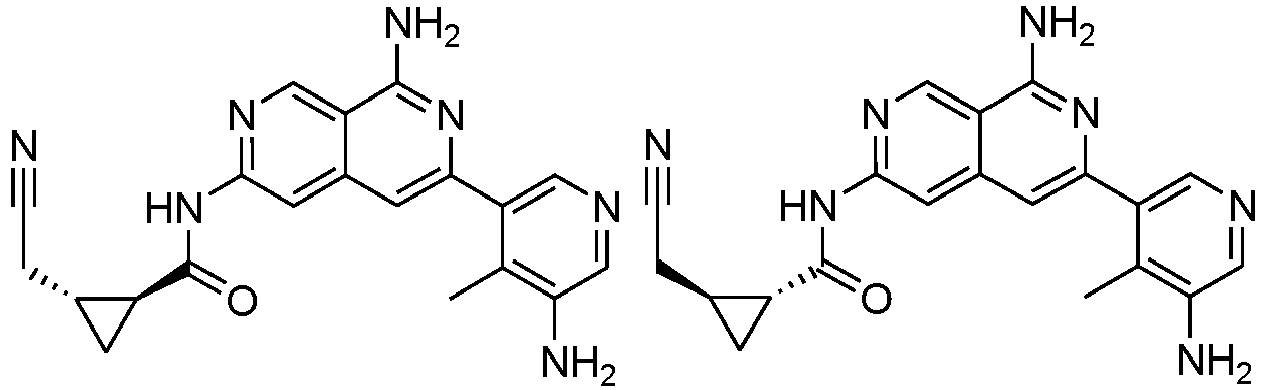
- To a solution of trans-N-(8-amino-6-chloro-2,7-naphthyridin-3-yl)-2-(cyanomethyl)cyclopropane-1-carboxamide (200 mg, 0.66 mmol) in 1,4-dioxane (12 mL)/water (2 mL) was added (5-[[(tert-butoxy)carbonyl]amino]-4-methylpyridin-3-yl)boronic acid (834 mg, 3.31 mmol), potassium carbonate (320 mg, 2.32 mmol) and Pd(dppf)Cl2 (120 mg, 0.16 mmol). The resulting solution was stirred for 3 h at 120 °C. The reaction was filtered, and the filtrate was concentrated under vacuum. Purification by Prep-HPLC followed by chiral SFC provided enantiomerically pure products. Compound 247: LCMS (ESI): RT (min) =0.99, [M+H]+ = 374.1, method = M; 1H NMR (300 MHz, DMSO-d 6) δ 11.03 (s, 1H), 9.35 (s, 1H), 8.20 (s, 1H), 7.93 (s, 1H), 7.76 (s, 1H), 7.26 (s, 2H), 6.82 (s, 1H), 5.14 (s, 2H), 2.73 (d, J= 6.9 Hz, 2H), 2.13 - 2.06 (m, 4H), 1.60 - 1.54 (m, 1H), 1.15 - 1.11 (m, 1H), 0.98 - 0.95 (m, 1H). Compound 248: LCMS (ESI): RT (min) =1.58, [M+H]+ = 374.1, method = M; 1H NMR (300 MHz, DMSO-d 6) δ 11.03 (s, 1H), 9.35 (s, 1H), 8.20 (s, 1H), 7.93 (s, 1H), 7.76 (s, 1H), 7.26 (s, 2H), 6.82 (s, 1H), 5.14 (s, 2H), 2.73 (d, J = 6.9 Hz, 2H), 2.13 - 2.06 (m, 4H), 1.60 - 1.54 (m, 1H), 1.15 - 1.11 (m, 1H), 0.98 - 0.95 (m, 1H).
-

-

- A suspension of 4-bromo-1H-pyrazole (1.00 g, 6.80 mmol), 3-bromo-1-methylpyrrolidin-2-one (1.33 g, 7.47 mmol), and potassium carbonate (1.88 g, 13.60 mmol) in N,N-dimethylformamide (12 mL) was heated at 60 °C. After 1 h, the reaction was diluted with water (35 mL), and the solution was extracted with ethyl acetate (3 × 70 mL). The combined extracts were dried over Na2SO4, filtered, and concentrated under vacuum to afford 3-(4-bromo-1H-pyrazol-1-yl)-1-methylpyrrolidin-2-one as an off-white solid (930 mg, 56%). LCMS (ESI)[M+H]+ 244,246.
-

- A solution of 1-N,1-N-bis[(2,4-dimethoxyphenyl)methyl]-3-(4-methylpyridin-3-yl)-2,7-naphthyridine-1,6-diamine (0.40 g, 0.725 mmol), 3-(4-bromo-1H-pyrazol-1-yl)-1-methylpyrrolidin-2-one (360 mg, 1.47 mmol), Cs2CO3 (1.42 g, 4.36 mmol), t-BuBrettPhos (179.95 mg, 0.37 mmol) and 3rd generation t-BuBrettPhos precatalyst (300 mg, 0.35 mmol) in dioxane (16.00 mL, 188.86 mmol) was heated at 100 °C. After 2 h, the reaction was concentrated under vacuum, and the resulting residue was purified by silica gel chromatography (15:1 dichloromethane / methanol) to afford 3-[4-[(8-[bis[(2,4-dimethoxyphenyl)methyl] amino] -6-(4-methylpyridin-3 -yl)-2,7-naphthyridin-3-yl)amino] -1H-pyrazol-1-yl]-1-methylpyrrolidin-2-one as a yellow solid (470 mg, 45%). LCMS (ESI) [M+H]+ = 715.
-

- A solution of 3-[4-[(8-[[(3,4-dimethoxyphenyl)methyl][(3,5-dimethoxyphenyl)methyl] amino] -6-(4-methylpyridin-3 -yl)-2,7-naphthyridin-3-yl)amino]-1H-pyrazol-1-yl]-1-methylpyrrolidin-2-one (250 mg, 0.35 mmol) in trifluoroacetic acid (25 mL) was heated at 70 °C for 2 h. The reaction was concentrated, and the resulting residue was purified by silica gel chromatography (15:1 dichloromethane / methanol) to afford the titled compound (110 mg, 74%) as a yellow solid. LCMS (ESI)[M+H]+ 415.2.
-

- Racemic 3-(4-[[8-amino-6-(4-methylpyridin-3-yl)-2,7-naphthyridin-3-yl]amino]-1H-pyrazol-1-yl)-1-methylpyrrolidin-2-one was separated by chiral SFC. Compound 249: LCMS (ESI): RT (min) = 1.01, [M+H]+ = 415.2, method = K-1; 1H NMR (300 MHz, DMSO-d 6) δ 9.23 (s, 1H), 8.94 (s, 1H), 8.53 (s, 1H), 8.42 (d, J= 5.2 Hz, 1H), 7.99 (s, 1H), 7.54 (s, 1H), 7.29 (d, J = 5.2 Hz, 1H), 6.76 (s, 2H), 6.76 (s, 1H), 6.66 (s, 1H), 5.11 - 5.07 (m, 1H), 3.53 - 3.47 (m, 1H), 3.44 - 3.38 (m, 1H), 2.82 (s, 3H), 2.60 - 2.57 (m, 1H), 2.50 - 2.43 (m, 1H), 3.40 (m, 3H). Compound 250:LCMS (ESI): RT (min) = 1.01, [M+H]+ = 415.2, method = K-1; 1H NMR (300 MHz, DMSO-d 6) δ 9.23 (s, 1H), 8.94 (s, 1H), 8.53 (s, 1H), 8.42 (d, J= 5.2 Hz, 1H), 7.99 (s, 1H), 7.54 (s, 1H), 7.29 (d, J= 5.2 Hz, 1H), 6.76 (s, 2H), 6.76 (s, 1H), 6.66 (s, 1H), 5.11 - 5.07 (m, 1H), 3.53 - 3.47 (m, 1H), 3.44 - 3.38 (m, 1H), 2.82 (s, 3H), 2.60 - 2.57 (m, 1H), 2.50 - 2.43 (m, 1H), 3.40 (m, 3H).
-

- The title compounds were prepared using a procedure as described for (3R)-3-(4-[[8-amino-6-(4-methylpyridin-3-yl)-2,7-naphthyridin-3-yl]amino]-1H-pyrazol-1-yl)-1-methylpyrrolidin-2-one (Compound 249). The enantiomers were isolated by chiral SFC. Compound 251: LCMS (ESI): [M+H]+ = 429.3, RT (min) = 1.04, Method = K-1; 1H NMR (400 MHz, DMSO-d 6) δ 9.22 (s, 1H), 8.92 (s, 1H), 8.54 (s, 1H), 8.42 (d, J = 5.0 Hz, 1H), 7.91 (s, 1H), 7.49 (s, 1H), 7.29 (d, J = 5.0Hz, 1H), 7.10 (s, 2H), 6.76 (s, 1H), 6.65 (s, 1H), 4.95 - 4.92 (m, 1H), 3.44 - 3.42 (m, 1H), 3.32 (s, 1H), 2.87 (s, 3H), 2.41(s, 3H), 2.37 - 2.27 (m, 1H), 2.25 - 2.13 (m, 1H), 2.02 - 2.00 (m, 1H), 1.92 - 1.90 (m, 1H). Compound 252: LCMS (ESI): [M+H]+ = 429.2, RT (min) = 1.05, Method = K-1; 1H NMR (400 MHz, DMSO-d 6) δ 9.22 (s, 1H), 8.92 (s, 1H), 8.54 (s, 1H), 8.42 (d, J = 5.0 Hz, 1H), 7.91 (s, 1H), 7.49 (s, 1H), 7.29 (d, J = 5.0Hz, 1H), 7.10 (s, 2H), 6.76 (s, 1H), 6.65 (s, 1H), 4.95 - 4.92 (m, 1H), 3.44 - 3.42 (m, 1H), 3.32 (s, 1H), 2.87 (s, 3H), 2.41(s, 3H), 2.37 - 2.27 (m, 1H), 2.25 - 2.13 (m, 1H), 2.02 - 2.00 (m, 1H), 1.92 - 1.90 (m, 1H).
-

-

- A mixture of 2-(2-bromopyridin-3-yl)ethan-1-ol (5.0 g, 24.7 mmol), 4,4,5,5-tetramethyl-2-(tetramethyl-1,3,2-dioxaborolan-2-yl)-1,3,2-dioxaborolane (25.1 g, 98.8 mmol), KOAc (7.28 g, 74.17 mmol), Pd(dppf)Cl2 (1.8 g, 2.46 mmol) in dioxane (120 mL) was heated at 100 °C. After 1 h, the reaction was filtered, and the filtrate was concentrated under vacuum. The resulting residue was dissolved in water and the pH of the solution was adjusted to 7-8 with aqueous NaOH. The basic solution was washed with ethyl acetate. The aqueous layer was then acidified to pH 5-6 with HCl. The acidic solution was concentrated under vacuum. The resulting residue was suspended in 1:1 ethyl acetae / ethanol and filtered. The filtrate was concentrated under vacuum to afford crude 1H,3H,4H-[1,2]oxaborinino[3,4-c]pyridin-1-ol (3.34 g, 91%) as a brown oil. LCMS (ESI): [M+H]+=150.1
-

- A mixture of trans-N-(8-amino-6-chloro-2,7-naphthyridin-3-yl)-2-(pyridin-3-yl)cyclopropane-1-carboxamide (0.40 g, 1.17 mmol), 1H,3H,4H-[1,2]oxaborinino[3,4-c]pyridin-1-ol (701 mg, 4.70 mmol), XPhos palladium(II) biphenyl-2-amine chloride (93 mg, 0.11 mmol), X-Phos (56 mg, 0.11 mmol), and potassium carbonate (489 mg, 3.53 mmol) in 5:1 dixoane / water (12 mL) was heated at 100 °C for 1 h. The reaction mixture was concentrated under vacuum, and the crude material was purified by Flash-Prep-HPLC to afford racemic product. The enantiomers were separated by chiral SFC. Compound 253: LCMS (ESI): [M+H]+ = 427.2, RT (min) = 1.88, Method = M; 1H NMR (400 MHz, DMSO-d 6) δ 11.03 (s, 1H), 9.38 (s, 1H), 8.53 (s, 1H), 8.52 - 8.51 (m, 1H), 8.48 (d, J = 6 Hz, 1H), 8.45 - 8.42 (m, 1H), 8.28 (s, 1H), 7.59 - 7.55 (m, 1H), 7.43 - 7.32 (m, 4H), 6.99 (s, 1H), 4.79 (t, J = 6 Hz, 1H), 3.62 - 3.55 (m, 2H), 2.94 (t, J = 6 Hz, 2H), 2.55 - 2.45 (m, 2H), 1.60 - 1.46 (m, 2H). Compound 254: LCMS (ESI): [M+H]+ = 427.2, RT (min)= 1.24, Method = M; 1H NMR (400 MHz, DMSO-d 6) δ 11.03 (s, 1H), 9.38 (s, 1H), 8.53 (s, 1H), 8.52 - 8.51 (m, 1H), 8.48 (d, J = 6 Hz, 1H), 8.45 - 8.42 (m, 1H), 8.28 (s, 1H), 7.59 - 7.55 (m, 1H), 7.43 - 7.32 (m, 4H), 6.99 (s, 1H), 4.79 (t, J = 6 Hz, 1H), 3.62 - 3.55 (m, 2H), 2.94 (t, J = 6 Hz, 2H), 2.55 - 2.45 (m, 2H), 1.60 - 1.46 (m, 2H).
-

-

- A mixture of (exo)-3-[(tert-butoxy)carbonyl]-3-azabicyclo[3.1.0]hexane-6-carboxylic acid (2.0 g, 8.8 mmol), 6,8-dichloro-2,7-naphthyridin-3-amine hydrochloride (1.8 g, 7.2 mmol), pyridine (10 mL), and POCl3 (1.67 g, 10.891 mmol) in dichloromethane (100 mL) was stirred for 1 h at room temperature. The reaction was quenched by the slow addition of saturated aqueous sodium bicarbonate solution. The resulting solution was extracted with dichloromethane, and the combined organic was concentrated under vacuum. Puridfication by flash column chromatography (10:1 dichloromethane/methanol) afforded tert-butyl (exo)-6-[(6,8-dichloro-2,7-naphthyridin-3 -yl)carbamoyl] -3 -azabicyclo [3.1.0]hexane-3 -carboxylate (2 g, 66%) as a yellow solid. LCMS (ESI): [M+H]+=423.1.
-
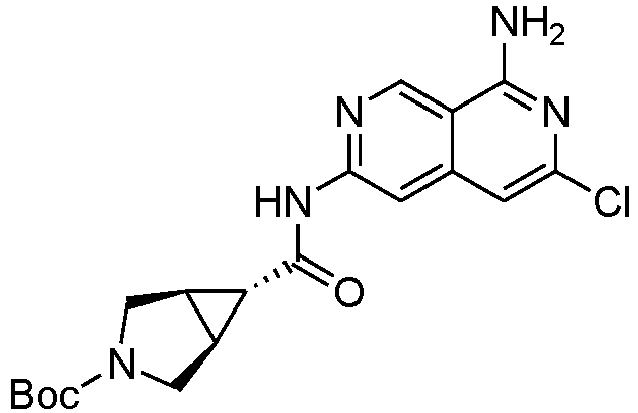
- A mixture of tert-butyl (1R,5S,6R)-6-[(6,8-dichloro-2,7-naphthyridin-3-yl)carbamoyl]-3-azabicyclo[3.1.0]hexane-3-carboxylate (2 g, 4.725 mmol) and ammonium hydroxide (20 mL) in dioxane (20 mL) was heated at 90 °C for 3 h. The reaction was concentrated to afford crude tert-butyl (exo)-6-[(8-amino-6-chloro-2,7-naphthyridin-3-yl)carbamoyl]-3-azabicyclo[3.1.0]hexane-3-carboxylate(2 g) as a yellow solid. LCMS (ESI): [M+H]+=404.1.
-

- A mixture of (4-methylpyridin-3-yl)boronic acid (510 mg, 3.72 mmol), tert-butyl (exo)-6-[(8-amino-6-chloro-2,7-naphthyridin-3-yl)carbamoyl]-3-azabicyclo[3.1.0]hexane-3-carboxylate (0.50 g, 1.24 mmol), Pd(dppf)Cl2 (90 mg, 0.12 mmol) and sodium carbonate (400 mg, 3.77 mmol) in 10:1 dioxane / water (16.5 mL) heated at 100 °C for 12 h under nitrogen. The reaction was filtered, and the filtrate was concentrated. Purification by flash column chromatography (10:1 dichloromethane / methanol) yielded tert-butyl (exo)-6-[[8-amino-6-(4-methylpyridin-3-yl)-2,7-naphthyridin-3-yl]carbamoyl]-3-azabicyclo[3.1.0]hexane-3-carboxylate (380 mg, 67%) as a yellow solid. LCMS (ESI): [M+H] +=461.2.
-

- A solution of tert-butyl(exo)-6-[[8-amino-6-(4-methylpyridin-3-yl)-2,7-naphthyridin-3-yl]carbamoyl]-3-azabicyclo[3.1.0]hexane-3-carboxylate (380 mg, 0.825 mmol) and CF3COOH (4 mL) in dichloromethane (20 mL) was stirred for 1 h at room temperature. The reaction was concentrated to afford crude (exo)-N-[8-amino-6-(4-methylpyridin-3-yl)-2,7-naphthyridin-3-yl]-3-azabicyclo[3.1.0]hexane-6-carboxamide (0.3 g) as a yellow oil. LCMS (ESI): [M+H] +=361.2.
-

- To a solution of (exo)-N-[8-amino-6-(4-methylpyridin-3-yl)-2,7-naphthyridin-3-yl]-3-azabicyclo[3.1.0]hexane-6-carboxamide (0.30 g, 0.83 mmol), oxetan-3-one (180 mg, 2.5 mmol) in methanol (20 mL) was added NaBH3CN (157 mg, 2.5 mmol) at room temperature. After 2 h, the reaction was concentrated under vacuum, and the resulting residue was purified by Prep-HPLC to afford (exo)-N-[8-amino-6-(4-methylpyridin-3-yl)-2,7-naphthyridin-3-yl]-3-(oxetan-3-yl)-3-azabicyclo[3.1.0]hexane-6-carboxamide (125 mg, 36%) as a white solid. LCMS (ESI): RT (min) = 1.25, [M+H]+ = 417.2, method = K-1; 1H NMR (300 MHz, DMSO-d 6) δ 10.79 (s, 1H), 9.35 (s, 1H), 8.57 (s, 1H), 8.44 (d, J = 5.0 Hz, 1H), 8.23 (s, 1H), 7.48 - 7.21 (m, 3H), 6.96 (s, 1H), 4.56 (t, J = 6.6 Hz, 2H), 4.44 (t, J = 6.0 Hz, 2H), 3.73 (m, 1H), 3.05 (d, J = 8.9 Hz, 2H), 2.47 - 2.42 (m, 3H), 2.41 (s, 3H), 1.95 (t, J = 2.2 Hz, 2H).
-

-

- A mixture of methyl 3-bromo-1H-pyrazole-5-carboxylate (10.0 g, 48.8 mmol), TsOH (830 mg, 4.82 mmol), 3,4-dihydro-2H-pyran (12.2 g, 145 mmol) in ethyl acetate (150 mL) was refluxed for 4 h. The reaction mixture was concentrated, and the resulting residue was purified by flash chromatography (1:3 ethyl acetate / petroleum ether) to afford methyl 3-bromo-1-(oxan-2-yl)-1H-pyrazole-5-carboxylate (8 g, 57%) as an oil. LCMS (ESI): [M+H]+ = 289.0.
-

- To an ice-cooled solution of methyl 3-bromo-1-(oxan-2-yl)-1H-pyrazole-5-carboxylate (7.4 g, 25.6 mmol) in dichloromethane (100 mL) was added diisobutylaluminum hydride (102 mL, 608 mmol) dropwise under nitrogen. After 1 h, the reaction was diluted with H2O (100 mL), and the resulting solution was extracted with dichloromethane. The combined organic was dried over Na2SO4, filtered, and concentrated under vacuum to provide crude [3-bromo-1-(oxan-2-yl)-1H-pyrazol-5-yl]methanol (5.2 g) as a light yellow oil. LCMS (ESI): [M+H]+ = 261.0.
-

- To an ice-cooled solution of [3-bromo-1-(oxan-2-yl)-1H-pyrazol-5-yl]methanol (5.5 g, 21 mmol), triethylamine (6.38 g, 63.0 mmol) in dichloromethane (100 mL) was added MsCl (5.3 g, 46 mmol). After 15 min, the reaction was diluted with water, and resulting solution was extracted with dichloromethane. The collected organic was dried over Na2SO4, filtered, and concentrated under vacuum to yield crude [3-bromo-1-(oxan-2-yl)-1H-pyrazol-5-yl]methyl methanesulfonate (6.3 g) as a colorless oil. LCMS (ESI): [M+H]+ = 339.0.
-

- A mixture of [3-bromo-1-(oxan-2-yl)-1H-pyrazol-5-yl]methyl methanesulfonate (4.0 g, 11.8 mmol) and KCN (2.3 g, 35 mmol) in DMSO (100 mL) was heated at 50 °C. After 2 h, the reaction was diluted with H2O (500 mL), and the rsulting solution was extracted with ethyl acetate. The combined extract was dried over Na2SO4, filtered, and concentrated under vacuum. Purification by flash column chromatography (10:1 dichloromethane / methanol) afforded 2-[3-bromo-1-(oxan-2-yl)-1H-pyrazol-5-yl]acetonitrile (2.1 g, 66%) as colorless oil. LCMS (ESI): [M+H]+ =270.0.
-

- A solution of 2-[3-bromo-1-(oxan-2-yl)-1H-pyrazol-5-yl]acetonitrile (2.2 g, 8.1 mmol) in dichloromethane (30 mL) was added trifluoroacetic acid (6 mL) at room termperature. After 2 h, the reaction was concentrated, and the resulting residue was diluted with dichloromethane (20 mL). The solution was basified to pH = 8 with 7 M NH3 in methanol. The solution was concentrated under vacuum, and the crude product was purified by flash column chromatography (10:1 dichloromethane / methanol) to afford 2-(3-bromo-1H-pyrazol-5-yl)acetonitrile (1.44 g, 95%) as a light yellow oil. LCMS (ESI): [M+H]+ = 186.0.
-

- To a suspension of 2-(3-bromo-1H-pyrazol-5-yl)acetonitrile (1.66 g, 8.92 mmol), tetrabutylammonium iodide (328 mg, 0.88 mmol), potassium carbonate (1.2 g, 8.68 mmol) in N,N-dimethylformamide (80 mL) was added methyl 2-chloroacetate (961 mg, 8.85 mmol) at room temperature. After 1 h, the reaction mixture was diluted with H2O (100 mL), and the resulting solution was extracted with ethyl acetate. The combined organics were concentrated. Purification by Flash-Prep-HPLC afforded methyl 2-[3-bromo-5-(cyanomethyl)-1H-pyrazol-1-yl]acetate (760 mg, 33%) as a colorless oil. LCMS (ESI): [M+H]+ = 258.0.
-

- A mixture of methyl 2-[3-bromo-5-(cyanomethyl)-1H-pyrazol-1-yl]acetate (394 mg, 1.52 mmol) and PtO2 (173 mg, 0.762 mmol) in methanol (20 mL) was stirred for 2 h at room temperature under hydrogen (2 atm). The reaction was filtered, and the filtrate was concentrated. Purification by flash column chromatography (10:1 dichloromethane / methanol) to give 2-bromo-4H,5H,6H,7H,8H-pyrazolo[1,5-d][1,4]diazepin-7-one (155 mg, 44%) as a white solid. LCMS (ESI): [M+H]+ = 230.0.
-

- To a mixture of 2-bromo-4H -pyrazolo[1,5-d][1,4]diazepin-7-one (105 mg, 0.45 mmol) and t-BuOK (56 mg, 0.50 mmol) in tetrahydrofuran (5 mL) was added CH3I (98 mg, 0.69 mmol) at room temperature. After 2 h, the solution was concentrated under vacuum. Purification by flash column chromatography (10:1 dichloromethane / methanol) afforded 2-bromo-6-methyl-4H-pyrazolo[1,5-d][1,4]diazepin-7-one (90 mg, 81%) as a white solid. LCMS (ESI): [M+H]+ = 244.0
-

- A suspension of 1-N,1-N-bis[(2,4-dimethoxyphenyl)methyl]-3-(4-methylpyridin-3-yl)-2,7-naphthyridine-1,6-diamine (380 mg, 0.68 mmol), 2-bromo-6-methyl-4H -pyrazolo[1,5-d][1,4]diazepin-7-one (112 mg, 0.45 mmol), 3rd generation t-BuBrettPhos precatalyst (157 mg, 0.18 mmol), t-BuBrettPhos (87 mg, 0.17 mmol) and Cs2CO3 (747 mg, 2.29 mmol) in dioxane (8 mL) was heated at 130 °C for 4 h. The reaction mixture was concentrated under vacuum, and the crude product was purified by flash column chromatography (10:1 dichloromethane / methanol) to afford 2-[(8-[bis[(2,4-dimethoxyphenyl)methyl]amino]-6-(4-methylpyridin-3-yl)-2,7-naphthyridin-3-yl)amino]-6-methyl-4H-pyrazolo[1,5-d][1,4]diazepin-7-one (0.20 g, 41%) as a light yellow oil. LCMS (ESI): [M+H]+ = 715.3.
-

- A solution of 2-[(8-[bis[(2,4-dimethoxyphenyl)methyl]amino]-6-(4-methylpyridin-3-yl)-2,7-naphthyridin-3-yl)amino]-6-methyl-4H-pyrazolo[1,5-d][1,4]diazepin-7-one (190 mg, 0.26 mmol) and trifluoroacetic acid (5 mL) was heated at 80 °C for 30 min. The mixture was concentrated under vacuum, and resulting residue was purified by Prep-HPLC to afford 2-[[8-amino-6-(4-methylpyridin-3-yl)-2,7-naphthyridin-3-yl]amino]-6-methyl-4H-pyrazolo [1,5-d][1,4]diazepin-7-one (36.7 mg, 33%) as a yellow solid. LCMS (ESI): RT (min) = 1.10, [M+H]+ = 415.2, method = K-1; 1H NMR (300 MHz, DMSO-d 6) δ 9.43 (s, 1H), 9.22 (s, 1H), 8.56 (s, 1H), 8.42 (d, J = 6.0 Hz, 1H), 7.55 (s, 1H), 7.30 (d, J = 6.0 Hz, 1H), 7.10 (s, 2H), 6.82 (s, 1H), 6.05 (s, 1H), 4.99 (s, 2H), 3.84 (t, J = 6.0 Hz, 2H), 3.06 (t, J = 6.0 Hz, 2H), 2.96 (s, 3H), 2.42 (s, 3H).
-

- The title compound was prepared using a procedure as described for (3R)-3-(4-[[8-amino-6-(4-methylpyridin-3-yl)-2,7-naphthyridin-3-yl]amino]-1H-pyrazol-1-yl)-1-methylpyrrolidin-2-one (Compound 249) LCMS (ESI): RT (min) = 1.05, [M+H]+ = 382.2, method = M; 1H NMR (300 MHz, CD3OD) δ 9.22 - 9.15 (m, 1H), 8.51 (s, 1H), 8.43 (d, J = 5.1 Hz, 1H), 8.04 (s, 1H), 7.67 (d, J = 0.8 Hz, 1H), 7.44 - 7.36 (m, 1H), 6.75 (dd, J = 13.6, 0.9 Hz, 2H), 6.49 - 5.95 (m, 1H), 4.58 (td, J = 14.4, 3.9 Hz, 2H), 2.45 (s, 3H).
-

-

- A mixture of N-(8-amino-6-chloro-2,7-naphthyridin-3-yl)cyclopropanecarboxamide (0.50 g, 1.9 mmol), (4-methylpyridin-3-yl)boronic acid (391 mg, 2.86 mmol), XPhos (181 mg, 0.38 mmol), XPhos-PdCl-2nd G (144 mg, 0.19 mmol) and potassium carbonate (787 mg, 5.69 mmol) in 10:1 1,4-dioxane / water (11 mL) was heated at 100 °C for 1 h. The reaction was filtered, and the filtrate was concentrated under vacuum. Purification by silica gel chromatography (20:1 dichloromethane / methanol) afforded N-[8-amino-6-(4-methylpyridin-3-yl)-2,7-naphthyridin-3-yl]cyclopropanecarboxamide(534 mg, 88%) as a brown solid. LCMS (ESI): [M+H] +=320.1.
-
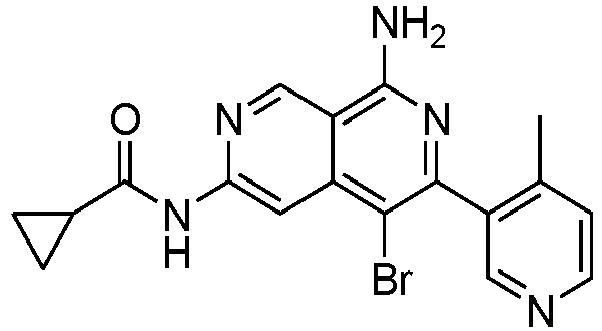
- A mixture of N-[8-amino-6-(4-methylpyridin-3-yl)-2,7-naphthyridin-3-yl]cyclopropanecarboxamide (524 mg, 1.64 mmol), NBS (350 mg, 1.97 mmol) and dichloromethane (20 mL) was stirred for 30 min at 25 °C. The reaction mixture was extracted with dichloromethane, the combined extracts were dried over anhydrous sodium sulfate, filtered, and concentrated under vacuum. Purification by silica gel chromatography (20:1 dichloromethane / methanol) afforded N-[8-amino-5-bromo-6-(4-methylpyridin-3-yl)-2,7-naphthyridin-3-yl]cyclopropanecarboxamide (427 mg, 65%) as a brown solid. LCMS (ESI): [M+H] +=398.2.
-

- A mixture of N-[8-amino-5-bromo-6-(4-methylpyridin-3-yl)-2,7-naphthyridin-3-yl]cyclopropanecarboxamide (0.10 g, 0.25 mmol), (1H-pyrazol-4-yl)boronic acid (42 mg, 0.38 mmol), Pd(dppf)Cl2 (19 mg, 0.03 mmol), and potassium carbonate (104 mg, 0.75 mmol) in 4:1 dioxane / water (10 mL) was heated at 100 °C. After 15 h, the reaction was filtered, and the filtrate was concentrated under vacuum. Purification by Prep-HPLC afforded N-[8-amino-6-(4-methylpyridin-3-yl)-5-(1H-pyrazol-4-yl)-2,7-naphthyridin-3-yl]cyclopropanecarboxamide (27.6 mg, 29%) as a green solid. LCMS (ESI): RT(min) = 0.91, [M+H]+ = 386.2, method = K-1; 1H NMR (400 MHz, DMSO-d 6) δ 12.72 (s, 1H), 10.95 (s, 1H), 9.41 (d, J = 0.9 Hz, 1H), 8.39 - 8.22 (m, 2H), 8.20 (s, 1H), 7.45 (s, 1H), 7.33 (s, 2H), 7.14 (d, J = 4.4 Hz, 2H), 2.03 (s, 4H), 1.01 - 0.51 (m, 4H).
-

-

- To an ice-cooled solution of 3-cyclopropyl-5-iodo-1H-pyrazole (950 mg, 4.06 mmol) in N,N-dimethylformamide (10 mL) was added sodium hydride (292 mg, 12.168 mmol). After 2 h, 2-(2-bromoethoxy)oxane (1.242 g, 5.940 mmol) was added to the reaction, and the reaction mixture was warmed to 25 °C for 3 h. The reaction was diluted with water, and the resulting solution was extracted with ethyl acetate. The combined organic extracts were dried over Na2SO4, filtered, and concentrated under vacuum. Purification by silica gel chromatography (1:4 ethyl acetate / petroleum ether) afforded 3-cyclopropyl-5-iodo-1-[2-(oxan-2-yloxy)ethyl]-1H-pyrazole (1.30 g, 89%) as a yellow oil. LCMS (ESI): [M+H] +=363.0.
-

- A suspension of 1-N,1-N-bis[(2,4-dimethoxyphenyl)methyl]-3-(4-methylpyridin-3-yl)-2,7-naphthyridine-1,6-diamine (0.30 g, 0.54 mmol), 5-cyclopropyl-3-iodo-1-[2-(oxan-2-yloxy)ethyl]-1H-pyrazole (394 mg, 1.09 mmol), Cs2CO3 (1.06 g, 3.25 mmol), 3rd generation t-BuBrettPhos precatalyst (93 mg, 0.11 mmol), and t-BuBrettPhos (132 mg, 0.27 mmol) in dioxane (8 mL) was heated at 110 °C under nitrogen for 12 h. The reaction mixture was cooled to room temperature and concentrated under vacuum. Purification by silica gel chromatography (25:1 dichloromethane / methanol) afforded 6-N-[5-cyclopropyl-1-[2-(oxan-2-yloxy)ethyl]-1H-pyrazol-3-yl]-1-N,1-N-bis[(2,4-dimethoxyphenyl)methyl]-3-(4-methylpyridin-3-yl)-2,7-naphthyridine-1,6-diamine (0.24 g, 56%) as a yellow solid. LCMS (ESI): [M+H] +=786.4.
-

- A solution of 6-N-[5-cyclopropyl-1-[2-(oxan-2-yloxy)ethyl]-1H-pyrazol-3-yl]-1-N,1-N-bis[(2,4-dimethoxyphenyl)methyl]-3-(4-methylpyridin-3-yl)-2,7-naphthyridine-1,6-diamine (320 mg, 0.41 mmol) in trifluoroacetic acid (10 mL) was heated at 50 °C. After 1 h, the reaction was concentrated under vacuum, and the resulting residue was purified by silica gel chromatography (15:1 dichloromethane / methanol) to afford 2-(3-[[8-amino-6-(4-methylpyridin-3-yl)-2,7-naphthyridin-3-yl]amino]-5-cyclopropyl-1H-pyrazol-1-yl)ethan-1-ol (0.136 g, 83%) as a yellow solid. LCMS (ESI): RT(min) = 1.07, [M+H]+ = 402.2, method = K-1; 1H NMR (300 MHz, CD3OD) δ 9.32 (s, 1H), 8.56 (s, 1H), 8.54 (d, J = 5.4 Hz, 1H), 7.78 (s, 1H), 7.47 (d, J = 5.4 Hz, 1H), 6.85 (s, 1H), 6.71 (s, 1H), 4.15 (t, J = 5.2 Hz, 2H), 3.87 (t, J = 5.2 Hz, 2H), 2.44 (s, 3H), 1.84 - 1.75 (m, 1H), 0.85 - 0.83 (m, 4H).
-

- The title compound was prepared using a procedure as described for 2-(3-[[8-amino-6-(4-methylpyridin-3-yl)-2,7-naphthyridin-3-yl]amino]-5-cyclopropyl-1H-pyrazol-1-yl)ethan-1-ol (Compound 259) LCMS (ESI): RT (min) = 1.50, [M+H]+ = 390.1, method = K-1; 1H NMR (300 MHz, DMSO-d 6) δ 9.20 (s, 1H), 8.86 (s, 1H), 8.52 (s, 1H), 8.40 (d, J = 5.0 Hz, 1H), 7.88 (s, 1H), 7.48 (s, 1H), 7.28(d, J = 5.0 Hz, 1H), 7.06 (s, 2H), 6.73 (s, 1H), 6.62 (s, 1H), 4.69 (s, 1H), 3.98 (s, 2H), 2.39 (s, 3H), 1.07 (s, 6H).
-

- The title compound was prepared using a procedure as described for : 2-(3-[[8-amino-6-(4-methylpyridin-3 -yl)-2, 7-naphthyridin-3 -yl] amino]-5-cyclopropyl-1H-pyrazol-1-yl)ethan-1-ol (Compound 259) LCMS (ESI): RT (min) = 1.01, [M+H]+ = 376.1, method = K-1; 1H NMR (300 MHz, CD3OD) δ 9.17 (t, J = 0.9 Hz, 1H), 8.51 (s, 1H), 8.42 (d, J = 5.1 Hz, 1H), 7.49 - 7.30 (m, 1H), 6.84 (dd, J = 7.3, 0.9 Hz, 2H), 6.16 (d, J = 0.6 Hz, 1H), 4.16 (t, J = 5.4 Hz, 2H), 3.89 (dd, J = 5.7, 5.0 Hz, 2H), 2.44 (d, J = 0.6 Hz, 3H), 2.27 (d, J = 0.5 Hz, 3H).
-

- The title compound was prepared using a procedure as described for : 2-(3-[[8-amino-6-(4-methylpyridin-3-yl)-2,7-naphthyridin-3-yl]amino]-5-cyclopropyl-1H-pyrazol-1-yl)ethan-1-ol (Compound 259) LCMS (ESI): RT (min) = 1.01, [M+H]+ = 376.1, method = K-1; 1H NMR (300 MHz, CD3OD) δ 9.16 (t, J = 0.8 Hz, 1H), 8.52 (s, 1H), 8.43 (d, J = 5.1 Hz, 1H), 7.48 - 7.34 (m, 2H), 6.89 - 6.78 (m, 1H), 6.03 (d, J = 0.8 Hz, 1H), 4.13 (t, J = 5.4 Hz, 2H), 3.93 (t, J = 5.4 Hz, 2H), 2.46 (s, 3H), 2.36 (d, J = 0.8 Hz, 3H).
-

-

- To a solution of 3-bromo-1-methyl-1H-pyrazole-5-carboxylic acid (0.50 g, 2.44 mmol) in N,N-dimethylformamide (8 mL) at 25 °C was sequentially added methylamine hydrochloride (0.30 g, 4.44 mmol), diisopropylethylamine (2.5 mL, 15 mmol), and HATU (1.1 g, 2.9 mmol). After 12 h, the reaction mixture was concentrated, and the resulting residue was purified by silica gel chromatography (1:3 ethyl acetate / petroleum ether) to afford 3-bromo-N,1-dimethyl-1H-pyrazole-5-carboxamide (480 mg, 90%) as a white solid. LCMS (ESI): [M+H]+ =218.1.
-
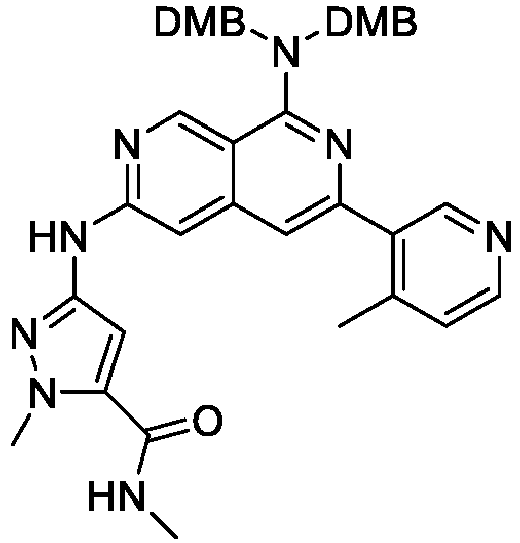
- A suspension of 1-N,1-N-bis[(2,4-dimethoxyphenyl)methyl]-3-(4-methylpyridin-3-yl)-2,7-naphthyridine-1,6-diamine (0.50 g, 0.906 mmol), 3-bromo-N,1-dimethyl-1H-pyrazole-5-carboxamide (0.50 g, 2.293 mmol), t-BuBrettPhos (225 mg, 0.464 mmol), 3rd generation t-BuBrettPhos precatalyst (120 mg, 0.140 mmol) and Cs2CO3 (1.78 g, 5.463 mmol) in dioxane (12 mL) was heated at 110 °C for 2 h under nitrogen. The reaction was filtered, and the filtrate was concentrated under vacuum to afford crude 3-[(8-[bis[(2,4-dimethoxyphenyl)methyl] amino] -6-(4-methylpyridin-3 -yl)-2,7-naphthyridin-3-yl)amino]-N,1-dimethyl-1H-pyrazole-5-carboxamide(0.58 g, 93%) as a yellow solid. LCMS (ESI): [M+H]+ =689.3.
-
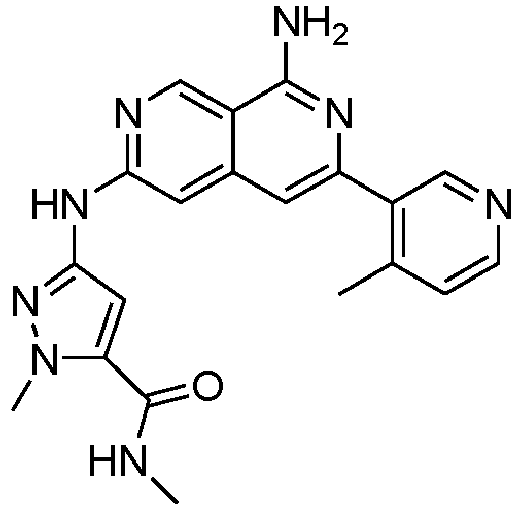
- A solution of 3-[(8-[bis[(2,4-dimethoxyphenyl)methyl]amino]-6-(4-methylpyridin-3-yl)-2,7-naphthyridin-3-yl)amino]-N,1-dimethyl-1H-pyrazole-5-carboxamide (0.50 g, 0.73 mmol) in trifluoroacetic acid (8 mL) was heated at 50 °C. After 2h, the reaction was concentrated under vacuum, and the resulting residue was purified by Prep-HPLC to afford 3-[[8-amino-6-(4-methylpyridin-3-yl)-2,7-naphthyridin-3-yl]amino]-N,1-dimethyl-1H-pyrazole-5-carboxamide (75.1 mg, 27%) as a yellow solid. LCMS (ESI): RT (min) = 0.91, [M+H]+ = 389.2, method = K-1; 1H NMR (300 MHz, CD3OD) δ 9.19 (s, 1H), 8.52 (s, 1H), 8.43 (d, J = 5.1 Hz, 1H), 7.42 (s, 1H), 7.39 (d, J = 5.1 Hz, 1H), 6.85 (s, 1H), 6.72 (s, 1H), 4.07 (s, 3H), 2.89 (s, 3H), 2.45 (s, 3H).
-

-

- A solution of NH3 in 1,4-dioxane (80 mL, 0.5 M) was added dropwise to an ice-cooled solution of (4-bromophenyl)methanesulfonyl chloride (2.00 g, 7.42 mmol) in dichloromethane (20 mL). The resulting mixture was warmed to room temperature for 30 min. The reaction was concentrated under vacuum, and the resulting residue was suspended with 10:1 dichloromethane / ethyl acetate (20 mL), and the solids were collected by filtration to afford (4-bromophenyl)methanesulfonamide (1.6 g, 86%) as a white solid. 1H NMR (300 MHz, DMSO-d 6) δ 7.58 (d, J = 8.4 Hz, 2H), 7.32 (d, J = 8.4 Hz, 2H), 6.85 (s, 2H), 4.25 (s, 2H).
-

- To a solution of 1-N,1-N-bis[(2,4-dimethoxyphenyl)methyl]-3-(4-methylpyridin-3-yl)-2,7-naphthyridine-1,6-diamine (0.25 g, 0.45 mmol) in 1,4-dioxane (12.5 mL) was sequentially added (4-bromophenyl)methanesulfonamide (453 mg, 1.81 mmol), Pd2(dba)3 (41.5 mg, 0.045 mmol), XPhos (43 mg, 0.091 mmol) and t-BuONa (261 mg, 2.72 mmol). The reaction mixture was heated with microwave radiation at 110 °C for 1 h. The reaction was filtered, and the filtrate was concentrated under vacuum. Purification by silica gel chromatography (15:1 dichloromethane / methanol) afforded [4-[(8-[bis[(2,4-dimethoxyphenyl)methyl]amino]-6-(4-methylpyridin-3 -yl)-2,7-naphthyridin-3 - yl)amino]phenyl]methanesulfonamide (160 mg, 49%) as a yellow solid. LCMS (ESI): [M+H]+ =721.0.
-

- A solution of [4-[(8-[bis[(2,4-dimethoxyphenyl)methyl]amino]-6-(4-methylpyridin-3-yl)-2,7-naphthyridin-3-yl)amino]phenyl]methanesulfonamide (130 mg, 0.18 mmol) in trifluoroacetic acid (10 mL) was heated at 45 °C for 5 h. The reaction mixture was concentrated under vacuum, and the resulting residue was purified by Prep-HPLC to afford (4-[[8-amino-6-(4-methylpyridin-3-yl)-2,7-naphthyridin-3-yl]amino]phenyl)methanesulfonamide (36.6 mg, 48%) as a yellow solid. LCMS (ESI): RT (min) = 1.07, [M+H]+ = 421.1, method = M; 1H NMR (300 MHz, DMSO-d 6) δ 13.07 - 12.83 (m, 1H), 9.97 (s, 1H), 9.58 (s, 1H), 8.98 - 8.42 (m, 3H), 7.60 (d, J = 8.4 Hz, 2H), 7.54 (s, 1H), 7.48 (d, J = 4.8 Hz, 2H), 7.07 (s, 1H), 7.01 (s, 1H), 6.82 (s, 2H), 4.24 (s, 2H), 2.38 (s, 3H).
-

-

- A suspension of 1-bromo-4-iodobenzene (5.0 g, 17.7 mmol), tert-butyl 3-oxopiperazine-1-carboxylate (3.53 g, 17.6 mmol), methyl[2-(methylamino)ethyl]amine (310 mg, 3.52 mmol), CuI (670 mg, 3.52 mmol), and K3PO4 (11.2 g, 52.8 mmol) in N,N-dimethylformamide (100 mL) was heated at 100 °C. After 3 h, the reaction was cooled to room temperature and diluted with water. The resulting solution was extracted with ethyl acetate, and the combined organic extracts were concentrated under vacuum. Purification by silica gel chromatography (1:1 ethyl acetate / petroleum ether) afforded tert-butyl 4-(4-bromophenyl)-3-oxopiperazine-1-carboxylate (2.8 g, 45%) as a white solid. LCMS (ESI): [M+H]+ =355.1.
-

- A mixture of 1-N,1-N-bis[(2,4-dimethoxyphenyl)methyl]-3-(4-methylpyridin-3-yl)-2,7-naphthyridine-1,6-diamine (20 mg, 0.036 mmol), tert-butyl 4-(4-bromophenyl)-3-oxopiperazine-1-carboxylate (32 mg, 0.090 mmol), Pd2(dba)3 (1.6 mg, 0.002 mmol), XPhos (1.7 mg, 0.004 mmol), and Cs2CO3 (23.6 mg, 0.072 mmol) in dioxane (2 mL) was heated at 100 °C for 12 h. The reaction was filtered, and the filtrate was concentrated under vacuum. Purification by silica gel chromatography (15:1 dichloromethane / methanol) yielded 4-[4-[(8-[bis[(2,4-dimethoxyphenyl)methyl]amino]-6-(4-methylpyridin-3-yl)-2,7-naphthyridin-3-yl)amino]phenyl]-3-oxopiperazine-1-carboxylate (10 mg, 34%) as a yellow solid. LCMS (ESI): [M+H]+ =826.9.
-

- A solution of tert-butyl 4-[4-[(8-[bis[(2,4-dimethoxyphenyl)methyl]amino]-6-(4-methylpyridin-3-yl)-2,7-naphthyridin-3-yl)amino]phenyl]-3-oxopiperazine-1-carboxylate (0.20 g, 0.242 mmol) in trifluoroacetic acid (5 mL) was heated at 80 °C for 2 h. The mixture was concentrated under vacuum, and the resulting residue was purified by Prep-HPLC to afford 1-(4-[[8-amino-6-(4-methylpyridin-3-yl)-2,7-naphthyridin-3-yl]amino]phenyl)piperazin-2-one(57.1 mg,55%) as a white solid. LCMS (ESI): RT(min) = 1.67, [M+H]+ = 426.2, method = M; 1H NMR (300 MHz, CD3OD) δ 9.19 (t, J = 0.9 Hz, 1H), 8.50 (s, 1H), 8.41 (d, J = 5.1 Hz, 1H), 7.65 - 7.55 (m, 2H), 7.38 (d, J = 5.2 Hz, 1H), 7.31 - 7.23 (m, 2H), 6.95 (d, J = 0.9 Hz, 1H), 6.79 (d, J = 0.8 Hz, 1H), 3.72 (t, J = 5.5 Hz, 2H), 3.57 (s, 2H), 3.19 (t, J = 5.5 Hz, 2H), 2.44 (s, 3H).
-

- The title compound was prepared using a procedure as described for (3R)-3-(4-[[8-amino-6-(4-methylpyridin-3 -yl)-2,7-naphthyridin-3 -yl] amino]-1H-pyrazol-1-yl)-1-methylpyrrolidin-2-one (Compound 249) LCMS (ESI): RT (min) = 1.83, [M+H]+ = 390.2, method = M; 1H NMR (400 MHz, DMSO-d 6) δ 9.21 (s, 1H), 8.78 (s, 1H), 8.52 (s, 1H), 8.42 - 8.40 (m, 1H), 7.91 (s, 1H), 7.51 (s, 1H), 7.29 - 7.27 (m,1H), 7.04 (m, 2H), 6.74 (s, 1H), 6.62 (s, 1H), 4.97 (t, J = 5.7 Hz, 1H), 5.58 (d, J = 5.7 Hz, 2H), 2.39 (s, 3H), 1.47 (s, 6H).
-

-

- A mixture of trans-N-(8-amino-6-(5-fluoro-2-methylphenyl)-2,7-naphthyridin-3-yl)-2-(1-methyl-1H-pyrazol-4-yl)cyclopropanecarboxamide (0.20 g, 0.58mmol), 5-fluoro-2-methylphenylboronic acid (269 mg, 1.75 mmol), Pd(PPh3)4 (135 mg, 0.11 mmol) and K3PO4 (372 mg, 1.75 mmol) in 4:1 1,4-dioxane / water (10 mL) was heated at 100 °C for 6 h. The resulting mixture was concentrated under vacuum, and the resulting residue was purified by silica gel chromatography (ethyl acetate) followed by Prep-HPLC to afford trans -N-(8-amino-6-(5-fluoro-2-methylphenyl)-2,7-naphthyridin-3-yl)-2-(1-methyl-1H-pyrazol-4-yl) cyclopropanecarboxamide (3mg) as a white solid. LCMS (ESI): RT (min) = 1.67, [M+H]+ = 417.2, method = K-1; 1H NMR (300 MHz, CD3OD) δ 9.27 (t, J = 0.9 Hz, 1H), 8.32 - 8.26 (m, 1H), 7.50 (s, 1H), 7.36 (d, J = 0.8 Hz, 1H), 7.30 - 7.28 (m, 1H), 7.14 - 7.11 (m, 1H), 7.05 - 7.03 (m, 1H), 6.90 (d, J = 0.8 Hz, 1H), 3.84 (s, 3H), 2.37 - 2.35 (m, 1H), 2.32 (s, 3H), 2.15 - 2.03 (m, 1H), 1.56 - 1.53 (m, 1H), 1.25 - 1.22 (m, 1H).
-

- To a solution of trans-N-(8-amino-6-chloro-2,7-naphthyridin-3-yl)-2-(1-methyl-1H-pyrazol-4-yl)cyclopropane-1-carboxamide (0.20 g, 0.58 mmol) in 5:1 1,4-dioxane / water (12 mL) was sequentially added (5-hydroxy-2-methylphenyl)boronic acid (134 mg, 0.88 mmol), Pd(PPh3)4 (135 mg, 0.12 mmol) and K3PO4 (372 mg, 1.75 mmol). The resulting solution was heated at 100 °C. After 5 h, the reaction was filtered, and the filtrate was concentrated under vacuum. Purification by Prep-HPLC provided trans-N-[8-amino-6-(5-hydroxy-2-methylphenyl)-2,7-naphthyridin-3-yl]-2-(1-methyl-1H-pyrazol-4-yl)cyclopropane-1-carboxamide (120 mg, 50%) as a white solid. LCMS (ESI): RT(min) = 1.26, [M+H]+ = 415.2, method = K-1; 1H NMR (400 MHz, CD3OD) δ 9.26 (s, 1H), 8.27 (s, 1H), 7.50 (s, 1H), 7.37 (s, 1H), 7.10 (d, J = 8.0 Hz, 1H), 6.84 (d, J = 8.0 Hz, 2H), 6.77 - 6.75 (m, 1H), 3.85 (s, 3H), 2.40 - 2.35 (m, 1H), 2.24 (s, 3H), 2.13 - 2.08 (m, 1H), 1.59 - 1.55 (m, 1H), 1.28 - 1.26 (m, 1H).
-
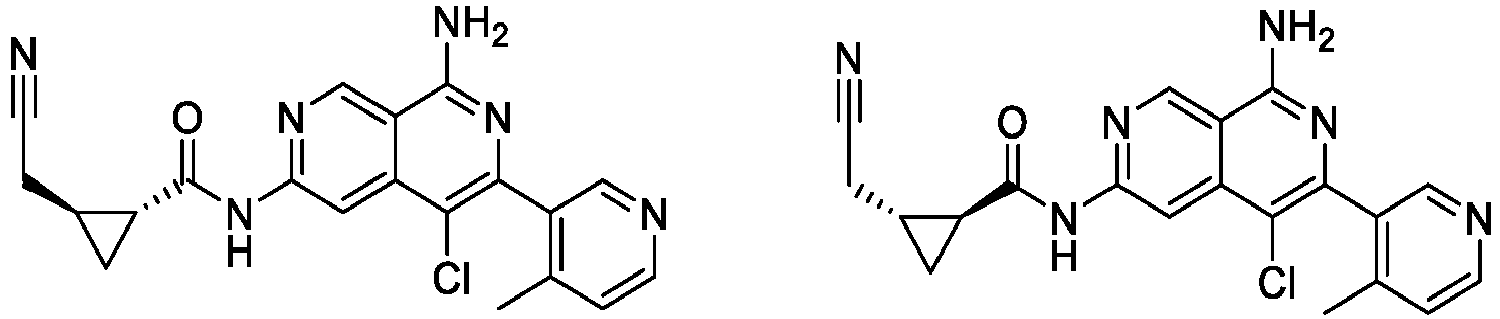
- To a solution of trans-N-[8-amino-6-(4-methylpyridin-3-yl)-2,7-naphthyridin-3-yl]-2-(cyanomethyl)cyclopropane-1-carboxamide (210 mg, 0.59 mmol) in N,N-dimethylformamide (7 mL) at 25 °C was added NCS (156 mg, 1.17 mmol). After 15 h, the reaction was concentrated and purified by Prep-HPLC to afford racemic product (0.10 g, 43%) as a white solid. The enantiomers were separated by chiral SFC. Compound 269: LCMS (ESI): RT (min) = 2.06, [M+H]+ = 393, method = K-1; 1H NMR (400 MHz, CD3OD) δ 9.34 (s, 1H), 8.69 (s, 1H), 8.48 (d, J = 5.2 Hz, 1H), 8.41 (s, 1H), 7.44 (d, J = 5.2 Hz, 1H), 2.81 - 2.62 (m, 2H), 2.29 (s, 3H), 2.07 - 2.02 (m, 1H), 1.79 - 1.75 (m, 1H), 1.39 - 1.33 (m,1H), 1.09 - 1.05 (m, 1H). Compound 270: LCMS (ESI): RT (min) = 1.14, [M+H]+ = 393, method = K-1; 1H NMR (400 MHz, CD3OD) δ 9.34 (s, 1H), 8.69 (s, 1H), 8.48 (d, J = 5.2 Hz, 1H), 8.41 (s,1H), 7.44 (d, J = 5.2 Hz, 1H), 2.81 - 2.62 (m, 2H), 2.29 (s, 3H), 2.07 - 2.02 (m, 1H), 1.79 - 1.75 (m,1H), 1.39 - 1.35 (m,1H), 1.10 - 1.05 (m, 1H).
-

- A suspension of trans-N-[8-amino-5-ethenyl-6-(4-methylpyridin-3-yl)-2,7-naphthyridin-3-yl]-2-(cyanomethyl)cyclopropane-1-carboxamide (68 mg, 0.18 mmol) (Compound 275) and palladium on carbon (50 mg, 0.47 mmol) in methanol (6 mL) was stirred for 30 min at 25 °C under hydrogen (1 atm). The reaction mixture was filtered, and the filtrate was concentrated under vacuum. Purification by Prep-HPLC afforded racemic product (11 mg, 16%) as a yellow solid. The enantiomers were separated by chiral SFC. Compound 271: LCMS (ESI): RT(min) = 1.06, [M+H]+ = 387, method = K-1; 1H NMR(400 MHz, CD3OD) δ 9.34 (s, 1H), 8.57 (s, 1H), 8.49 (d, J = 5.2 Hz, 1H), 8.38 (s, 1H), 7.46 (d, J = 5.2 Hz, 1H), 2.78 - 2.68 (m, 3H), 2.52 - 2.39 (m, 1H), 2.22 (s, 3H), 2.07 - 2.02 (m, 1H), 1.79 - 1.74 (m, 1H), 1.39 - 1.36 (m, 1H), 1.12 - 1.02 (m, 4H). Compound 272: LCMS (ESI): RT (min) = 1.05, [M+H]+ = 387, method = K-1; 1H NMR (300 MHz, CD3OD) δ 9.34 (s, 1H), 8.58 (s, 1H), 8.49 (d, J = 5.2 Hz, 1H), 8.38 (s, 1H), 7.46 (d, J = 5.2 Hz, 1H), 2.78 - 2.68 (m, 3H), 2.52 - 2.39 (m,1H), 2.22 (s, 3H), 2.07 - 2.02 (m, 1H), 1.79 - 1.74 (m, 1H), 1.39 - 1.36 (m, 1H), 1.12 - 1.02 (m, 4H).
-
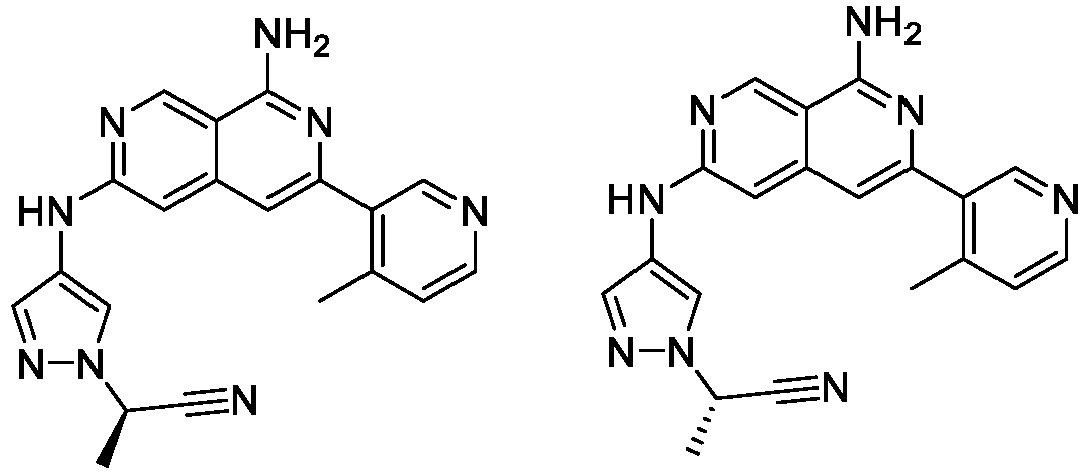
-

- A suspension of 4-bromo-1H-pyrazole (1 g, 6.80 mmol), 2-chloropropanenitrile (612 mg, 6.83 mmol), Cs2CO3 (2.43 g, 7.45 mmol) in tetrahydrofuran (10 mL) was heated at 100 °C. After 2 h, the reaction was filtered, and the filtrate was concentrated under vacuum. Purification by silica gel chromatography (10:1 dichloromethane / methanol) afforded 2-(4-bromo-1H-pyrazol-1-yl)propanenitrile (952 mg,70%) as a white solid. LCMS (ESI): [M+H]+ = 200.0.
-

- A mixture of 1-N,1-N-bis[(2,4-dimethoxyphenyl)methyl]-3-(4-methylpyridin-3-yl)-2,7-naphthyridine-1,6-diamine (552 mg, 1.00 mmol), 2-(4-bromo-1H-pyrazol-1-yl)propanenitrile (800 mg, 3.99 mmol), t-BuBrettPhos (97 mg, 0.20 mmol), 3rd generation t-BuBrettPhos precatalyst (171 mg, 0.20 mmol), and potassium carbonate (828 mg, 5.99 mmol) in dioxane (15 mL) was heated at 120 °C under nitrogen. After 5 h, the mixture was concentrated under vacuum. Purification by silica gel chromatography (10:1 dichloromethane/methanol) afforded 2-[4-[(8-[bis[(2,4-dimethoxyphenyl)methyl]amino]-6-(4-methylpyridin-3-yl)-2,7-naphthyridin-3-yl)amino]-1H-pyrazol-1-yl]propanenitrile (302 mg, 45%) as a brown oil. LCMS (ESI): [M+H]+ =671.3.
-

- A solution of 2-[4-[(8-[bis[(2,4-dimethoxyphenyl)methyl]amino]-6-(4-methylpyridin-3-yl)-2,7-naphthyridin-3-yl)amino]-1H-pyrazol-1-yl]propanenitrile (248 mg, 0.37 mmol) and CF3COOH (20 mL) was heated at 80 °C for 45 min. The mixture was concentrated under vacuum, and the resulting residue was dissolved with DCM (10 mL). The solution was adjusted to pH = 8 with NH3 in methanol. Purification by Prep-HPLC to afford racemic product (65.4 mg, 48%) as a yellow solid. The enantiomers were separated by chiral SFC. Compound 273: LCMS (ESI): RT(min) = 1.62, [M+H]+ = 371, method = K-1; 1H NMR (300 MHz, CD3OD) δ 9.19 (s, 1H), 8.50 (s, 1H), 8.42 (d, J = 6.0 Hz, 1H), 8.13 (s, 1H), 7.70 (s, 1H), 7.39 (d, J = 6.0 Hz, 1H), 6.78 (s, 1H), 6.74 (s, 1H), 5.64 (q, J = 6.0 Hz, 1H), 2.44 (s, 3H), 1.91 (d, J = 6.0 Hz, 3H). Compound 274: LCMS (ESI): RT(min) = 1.61, [M+H]+ = 371, method = K-1; 1H NMR (300 MHz, CD3OD) δ 9.19 (s, 1H), 8.50 (s, 1H), 8.42 (d, J = 6.0 Hz, 1H), 8.13(s, 1H), 7.70(s, 1H), 7.39(d, J = 6.0 Hz, 1H),6.78 (s, 1H), 6.74 (s, 1H), 5.64 (q, J = 6 Hz, 1H), 2.44 (s, 3H), 1.91(d, J = 6 Hz, 3H).
-

- To a solution of trans-N-[8-amino-5-bromo-6-(4-methylpyridin-3-yl)-2,7-naphthyridin-3-yl]-2-(cyanomethyl)cyclopropane-1-carboxamide (0.050 g, 0.11 mmol) in dioxane (2 mL) and water (0.1 mL) was sequentially added potassium vinyltrifluoroborate (23 mg, 0.17 mmol), Pd(PPh3)4 (13 mg, 0.01 mmol), and sodium carbonate (37 mg, 0.35 mmol). The resulting mixture was heated at 85 °C for 15 h. The reaction was filtered and concentrated under vacuum. Purification by silica gel (15:1 dichloromethane / methanol) followed by Prep-HPLC afforded racemic product (2.5 mg, 6%) as a white solid. Compound 275: LCMS (ESI): RT (min) = 1.86 min [M+H]+ = 385.2, method = K-1; 1H NMR (300 MHz, CD3OD) δ 9.34 (s,1H), 8.71 (s, 1H), 8.44 (d, J = 5.2 Hz, 1H), 8.35 (s, 1H), 7.40 (d, J = 5.2 Hz,1H), 6.59 - 6.52 (m, 1H), 5.40 - 5.37 (m, 1H), 5.25 - 5.21 (m, 1H), 2.82 - 2.63 (m, 2H), 2.23 (s, 3H), 2.05 - 2.01 (m, 1H), 1.77 - 1.72 (m, 1H), 1.37 - 1.34 (m, 1H), 1.08 - 1.03 (m, 1H).
-


-

- A mixture of 2-(benzyloxy)acetaldehyde (10.0 g, 66.6 mmol), tert-butyl 2-(diethoxyphosphoryl)acetate (16.8 g, 66.6 mmol), LiCl (16.7 g, 394 mmol), THF (200 mL) and diisopropylethylamine (8.5 g, 66 mmol) was stirred for 1 day at room temperature. The reaction was diluted with water (10 mL) and concentrated under vacuum. Purification by silica gel chromatography (100:1 → 10:1 petroleum ether / ethyl acetate) afforded tert-butyl (2E)-4-(benzyloxy)but-2-enoate (3.5 g, 21%) as a light yellow solid. LCMS (ESI): [M+H]+ =249.3.
-

- To a solution of ethyldiphenylsulfonium tetrafluoroborate (10.5 g, 34.75 mmol) in 1,2-dimethoxyethane (250 mL) and dichloromethane (25 mL) at -30 °C was added LDA (41 mL, 2M in THF). After 1 h, tert-butyl (2E)-4-(benzyloxy)but-2-enoate (2.9 g, 11.68 mmol) was added, and the reation was warmed to room temperature for 16 h. The reaction was diluted with water (100 mL), and the resulting solution was extracted with ethyl acetate. The collected organic was concentrated. Purification by silica gel chromatography (100:1 → 10:1 petroleum ether / ethyl acetate) afforded tert-butyl-2-[(benzyloxy)methyl]-3-methylcyclopropane-1-carboxylate (1.5 g, 46%) as a light yellow solid. LCMS (ESI): [M+H]+ =277.0.
-

- A solution of tert-butyl-2-[(benzyloxy)methyl]-3-methylcyclopropane-1-carboxylate (1.2 g, 4.34 mmol) in dichloromethane (5 mL) and trifluoroacetic acid (5 mL) was stirred for 16 h at room temperature. The mixture was concentrated under vacuum, and the resulting residue was purified by silica gel chromatography to afford 2-[(benzyloxy)methyl]-3-methylcyclopropane-1-carboxylic acid (700 mg, 73%) as light yellow oil.
-

- A mixture of 2-[(benzyloxy)methyl]-3-methylcyclopropane-1-carboxylic acid (1.1 g, 4.99 mmol), 1-N,1-N-bis[(3,4-dimethoxyphenyl)methyl]-3-(4-methylpyridin-3-yl)-2,7-naphthyridine-1,6-diamine (0.390 g, 0.71 mmol), pyridine (2 mL) and POCl3 (2 mL) in dichloromethane (20 mL) was stirred for 1 h at room temperature. The reaction was diluted with water, and the resulting solution was extracted with ethyl acetate. The organic layers were combined and concentrated under vacuum. Purification by silica gel chromatography eluted with (100:1 → 1:1 petroleum ether / ethyl acetate) provided 2-[(benzyloxy)methyl]-N-(8-[bis[(3,4-dimethoxyphenyl)methyl]amino]-6-(4-methylpyridin-3-yl)-2,7-naphthyridin-3-yl)-3-methylcyclopropane-1-carboxamide (700 mg) as a light yellow solid. LCMS (ESI): [M+H]+ =754.4.
-

- A suspension of 2-[(benzyloxy)methyl]-N-(8-[bis[(2,4-dimethoxyphenyl)methyl]amino]-6-(4-methylpyridin-3-yl)-2,7-naphthyridin-3-yl)-3-methylcyclopropane-1-carboxamide (0.60 g, 0.80 mmol) and palladium on carbon (3 g, 28.19 mmol) in methanol (30 mL) was stirred at room temperature under hydrogen (2 atm). After 16 h, the reaction was filtered, and the filtrate was concentrated under vacuum. Purification by silica gel chromatography 100:1 petroleum ether / ethyl acetate → ethyl acetate afforded N-(8-[bis[(2,4-dimethoxyphenyl)methyl]amino]-6-(4-methylpyridin-3-yl)-2,7-naphthyridin-3-yl)-2-(hydroxymethyl)-3-methylcyclopropane-1-carboxamide (0.50 g, 95%) as a light yellow solid. LCMS (ESI): [M+H]+ =664.8.
-

- To an ice-cooled solution of N-(8-[bis[(3,4-dimethoxyphenyl)methyl]amino]-6-(4-methylpyridin-3 -yl)-2, 7-nap hthyridin-3 -yl)-2-(hydroxymethyl)-3 -methylcycloprop ane-1-carboxamide (0.10 g, 0.15 mmol) and triethylamine (45 mg, 0.45 mmol) in dichloromethane (10 mL) was added MsCl (34 mg, 0.30 mmol). The resulting solution was warmed to room temperature. After 1 h, the reaction was diluted with water, and the solution was extracted with ethyl acetate. The collected organic layers concentrated under vacuum to yield crude [2-[(8-[bis[(3,4-dimethoxyphenyl)methyl]amino]-6-(4-methylpyridin-3-yl)-2,7-naphthyridin-3-yl)carbamoyl]-3-methylcyclopropyl]methyl methane sulfonate (90 mg, 81%) as light yellow oil.
-

- A mixture of N-(8-[bis[(2,4-dimethoxyphenyl)methyl]amino]-6-(4-methylpyridin-3-yl)-2,7-naphthyridin-3-yl)-2-(hydroxymethyl)-3-methylcyclopropane-1-carboxamide (550 mg, 0.83 mmol) and and KCN (234 mg, 3.59 mmol) in DMSO (15 mL) was heated at 50 °C for 3 h. The reaction was diluted with H2O, and the resulting solution was extracted with ethyl acetate. The combined organic layers were dried over Na2SO4, filtered, and concentrated under vacuum to provide N-(8-[bis[(2,4-dimethoxyphenyl)methyl]amino]-6-(4-methylpyridin-3-yl)-2,7-naphthyridin-3-yl)-2-(cyanomethyl)-3-methylcyclopropane-1-carboxamide (0.50 g, 90%) as a light yellow solid.
-


- A solution of N-[8-[1,3-bis(2,4-dimethoxyphenyl)propan-2-yl]-6-(4-methylpyridin-3-yl)-2,7-naphthyridin-3-yl]-2-(cyanomethyl)-3-methylcyclopropane-1-carboxamide (0.20 g, 0.30 mmol) in trifluoroacetic acid (10 mL) was stirred for 16 h at room temperature. The reaction mixture was concentrated under vacuum. Sequential purification by Prep-HPLC follwedby chiral SFC afforded 4 compounds. Compound 276: LCMS (ESI): RT(min) = 3.24, [M+H]+ = 372, method = M; 1H NMR (300 MHz, CD3OD) δ 9.32 (s, 1H), 8.55 (s, 1H), 8.42 (d, J = 5.2 Hz, 1H), 8.34 (s, 1H), 7.42 (d, J = 5.2 Hz, 1H), 7.01 (s, 1H), 2.74 - 2.68 (m, 2H), 2.46 (s, 3H), 2.07 - 2.03 (m, 1H), 1.73 - 1.68 (m, 1H), 1.51 - 1.44 (m, 1H), 1.27 (d, J = 8.0 Hz, 3H). Compound 277:LCMS (ESI): RT (min) = 0.85, [M+H]+ = 372, method = K-1; 1H NMR (300 MHz, CD3OD) δ 9.32 (s, 1H), 8.55 (s, 1H), 8.42 (d, J = 5.2 Hz, 1H), 8.34 (s, 1H), 7.42 (d, J = 5.2 Hz, 1H), 7.01 (s, 1H), 2.74 - 2.68 (m, 2H), 2.46 (s, 3H), 2.07 - 2.03 (m, 1H), 1.73 - 1.68 (m, 1H), 1.51 - 1.44 (m, 1H), 1.27 (d, J = 8.0 Hz, 3H). Compound 278: LCMS (ESI): RT (min) = 0.99, [M+H]+ = 372, method = K-1; 1H NMR (300 MHz, CD3OD) δ 9.30 (s, 1H), 8.54 (s, 1H), 8.43 (d, J = 5.2 Hz, 1H), 8.30 (s, 1H), 7.41 (d, J = 5.2 Hz, 1H), 6.98 (s, 1H), 2.74 - 2.67 (m, 2H), 2.46 (s, 3H), 1.88 - 1.81 (m, 1H), 1.73 - 1.68 (m, 2H), 1.28 (d, J = 8.0 Hz, 3H). Compound 279:LCMS (ESI): RT (min) = 1.79, [M+H]+ = 372, method = M; 1H NMR (300 MHz, CD3OD) δ 9.30 (s, 1H), 8.54 (s, 1H), 8.43 (d, J = 5.2 Hz, 1H), 8.30 (s, 1H), 7.41 (d, J = 5.2 Hz, 1H), 6.98 (s, 1H), 2.74 - 2.67 (m, 2H), 2.46 (s, 3H), 1.88 - 1.81 (m, 1H), 1.73 - 1.68 (m, 2H), 1.28 (d, J = 8.0 Hz, 3H).
-

- To a solution of trans-N-(8-amino-6-chloro-2,7-naphthyridin-3-yl)-2-(1-methyl-1H-pyrazol-4-yl)cyclopropane-1-carboxamide (0.20 g, 0.58 mmol) in 4:1 dioxane / water (10 mL) was sequentially added (2-fluoro-6-methylphenyl)boronic acid (0.270 g, 1.75 mmol), Pd(PPh3)4 (135 mg, 0.117 mmol) and K3PO4 (371.55 mg, 1.75 mmol). The resulting solution was heated at 100 °C for 16 h under nitrogen. The reaction was concentrated, and the resulting residue was purified by silica gel chromatography (ethyl acetate). The product was further purified by Prep-HPLC followed by chiral SFC to afford the titled compounds. Compound 280: LCMS (ESI): RT (min) = 2.89, [M+H]+ = 417.2, method = K-1; 1H NMR (300 MHz, CD3OD) δ 9.28 (s, 1H), 8.28 (s, 1H), 7.48 (s, 1H), 7.35 - 7.27 (m, 2H), 7.12 (d, J = 7.8 Hz, 1H), 7.01 (t, J = 9.0 Hz, 1H), 6.85 (s, 1H), 3.83 (s, 3H), 2.39 - 2.32 (m, 1H), 2.22 (s, 3H), 2.12 - 2.06 (m, 1H), 1.58 - 1.52 (m, 1H), 1.27 - 1.20 (m, 1H). Compound 281: LCMS (ESI): RT (min) = 1.67, [M+H]+ = 417.20, method = K-1; 1H NMR (300 MHz, CD3OD) δ 9.28 (s, 1H), 8.28 (s, 1H), 7.48 (s, 1H), 7.35 - 7.27 (m, 2H), 7.12 (d, J = 7.8 Hz, 1H), 7.01 (t, J = 9.0 Hz, 1H), 6.85 (s, 1H), 3.83 (s, 3H), 2.39 - 2.32 (m, 1H), 2.22 (s, 3H), 2.12 - 2.06 (m, 1H), 1.58 - 1.52 (m, 1H), 1.27 - 1.20 (m, 1H).
-

- To a solution of trans-N-(8-amino-6-chloro-2,7-naphthyridin-3-yl)-2-(1-methyl-1H-pyrazol-4-yl)cyclopropane-1-carboxamide (150 mg, 0.44 mmol) in 5:1 dioxane / water (12 mL) was sequentially added [4-methyl-3-(tetramethyl-1,3,2-dioxaborolan-2-yl)phenyl]methanol (162.87 mg, 0.66 mmol), K3PO4 (278.66 mg, 1.31 mmol) and Pd(PPh3)4 (101.13 mg, 0.09 mmol). The resulting solution was heated at 100 °C for 2 h under nitrogen. The reaction was concentrated, and the resulting residue was sequentially purified by silica gel chromatography (15:1 dichloromethane / methanol), Prep-HPLC, and chiral SFC to afford the titled compounds. Compound 282: LCMS (ESI): RT (min) = 1.59, [M+H]+ = 429.2, method = K-1; 1H NMR (400 MHz, CD3OD) δ 9.30 (s, 1H), 8.28 (s, 1H), 7.50 (s, 1H), 7.38 - 7.37 (m, 2H), 7.34 - 7.27 (m, 2H), 6.89 (s, 1H), 4.64 (s, 2H), 3.85 (s, 3H), 2.41 - 2.37 (m, 1H), 2.35 (s, 3H), 2.13 - 2.09 (m, 1H), 1.60 - 1.55 (m, 1H), 1.29 - 1.24 (m, 1H). Compound 283:LCMS (ESI): RT (min) = 1.52, [M+H]+ = 429.3, method = K-1; 1H NMR (400 MHz, CD3OD) δ 9.30 (s, 1H), 8.28 (s, 1H), 7.50 (s, 1H), 7.38 - 7.37 (m, 2H), 7.34 - 7.27 (m, 2H), 6.89 (s, 1H), 4.64 (s, 2H), 3.85 (s, 3H), 2.41 - 2.37 (m, 1H), 2.35 (s, 3H), 2.13 - 2.09 (m, 1H), 1.60 - 1.55 (m, 1H), 1.29 - 1.24 (m, 1H).
-
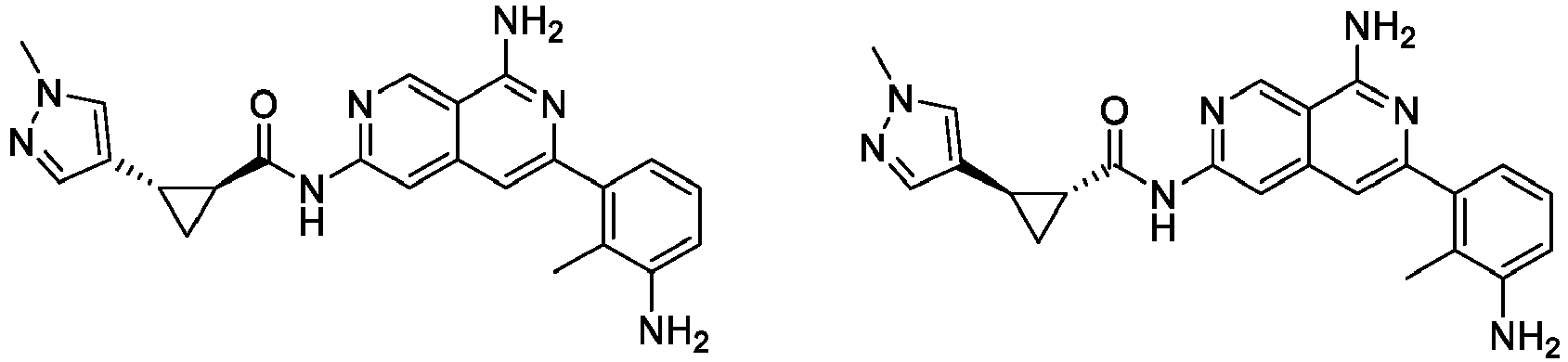
- To a solution of trans-N-(8-amino-6-chloro-2,7-naphthyridin-3-yl)-2-(1-methyl-1H-pyrazol-4-yl)cyclopropane-1-carboxamide (250 mg, 0.729 mmol) in 5:1 dioxane / water (12 mL) was sequentially added 2-methyl-3-(tetramethyl-1,3,2-dioxaborolan-2-yl)aniline (425 mg, 1.82 mmol), Pd(PPh3)4 (170 mg, 0.147 mmol) and K3PO4 (465 mg, 2.19 mmol). The resulting solution was heated at 100 °C for 12 h under nitrogen. The reaction was concentrated, and the resulting residue was sequentially purified by flash column chromatography (30:1 dichloromethane / methanol), Prep-HPLC, and chiral SFC to afford the titled compounds. Compound 284: LCMS (ESI): RT (min) = 2.09, [M+H]+ = 414.3, method = K-1; 1H NMR (300 MHz, DMSO-d 6) δ 10.89 (s, 1H), 9.32 (s, 1H), 8.18 (s, 1H), 7.56 (s, 1H), 7.29 (s, 1H), 7.17 (s, 2H), 6.92 (t, J =7.8 Hz, 1H), 6.72 (s,1H), 6.65 (d, J=7.2Hz, 1H), 6.57 (t, J =7.2 Hz, 1H), 4.87 (s, 2H), 3.76 (s, 3H), 2.22-2.17 (m, 2H), 2.00 (s, 3H), 1.41 - 1.35 (m, 1H), 1.23 - 1.16 (m, 1H). Compound 285: LCMS (ESI): RT (min) = 2.09, [M+H]+ = 414.3, method = K-1; 1H NMR (300 MHz, DMSO-d 6) δ 10.89 (s, 1H), 9.32 (s, 1H), 8.18 (s, 1H), 7.56 (s, 1H), 7.29 (s, 1H), 7.17 (s, 2H), 6.92 (t, J =7.8 Hz, 1H), 6.72 (s,1H), 6.65 (d, J=7.2Hz, 1H), 6.57 (t, J =7.2 Hz, 1H), 4.87 (s, 2H), 3.76 (s, 3H), 2.22 - 2.17 (m, 2H), 2.00 (s, 3H), 1.41 - 1.35 (m, 1H), 1.23 - 1.16 (m, 1H).
-

- To a solution of trans-N-(8-amino-6-chloro-2,7-naphthyridin-3-yl)-2-(1-methyl-1H-pyrazol-4-yl)cyclopropane-1-carboxamide (0.20 g, 0.58 mmol) in 5:1 1,4-dioxane / water (12 mL) was sequentially added (5-hydroxy-2-methylphenyl)boronic acid (134 mg, 0.88 mmol), Pd(PPh3)4 (135 mg, 0.12 mmol) and K3PO4 (372 mg, 1.75 mmol). The resulting solution was heated at 100 °C for 5 h under nitrogen. The reaction was filtered, and the filtrate was concentrated under vacuum. Purification by Prep-HPLC followed by chiral SFC afforded the titled compounds. Compound 286: LCMS (ESI): RT(min) = 2.22, [M+H]+ = 415.3, method = K-1; 1H NMR (300 MHz, CD3OD) δ 9.26 (s, 1H), 8.27 (s, 1H), 7.50 (s, 1H), 7.37 (s, 1H), 7.10 (d, J = 8.0 Hz, 1H), 6.84 (d, J = 8.0 Hz, 2H), 6.77 - 6.75 (m, 1H), 3.85 (s, 3H), 2.40 - 2.35 (m, 1H), 2.24 (s, 3H), 2.13 - 2.08 (m, 1H), 1.59 - 1.55 (m, 1H), 1.28 - 1.26 (m, 1H). Compound 287: LCMS (ESI): RT (min) = 1.26, [M+H]+ = 415.3, method = K-1; 1H NMR (300 MHz, CD3OD) δ 9.26 (s, 1H), 8.27 (s, 1H), 7.50 (s, 1H), 7.37 (s, 1H), 7.10 (d, J = 8.0 Hz, 1H), 6.84 (d, J = 8.0 Hz, 2H), 6.77 - 6.75 (m, 1H), 3.85 (s, 3H), 2.40 - 2.35 (m, 1H), 2.24 (s, 3H), 2.13 - 2.08 (m, 1H), 1.59 - 1.55 (m, 1H), 1.28 - 1.26 (m, 1H).
-

- To a solution of trans-N-(8-amino-6-chloro-2,7-naphthyridin-3-yl)-2-(1-methyl-1H-pyrazol-4-yl)cyclopropane-1-carboxamide (216 mg, 0.63 mmol) in 5:1 1,4-dioxane / water (12 mL) was added 2-(5-methoxy-2-methylphenyl)-4,4,5,5-tetramethyl-1,3,2-dioxaborolane (0.20 g, 0.81 mmol), Pd(PPh3)4 (136 mg, 0.12 mmol) and K3PO4 (372 mg, 1.75 mmol). The resulting solution was heated at 100 °C for 12 h under nitrogen. The reaction was filtered, and the filtrate was concentrated under vacuum. Purification by Prep-HPLC followed by chiral SFC afforded the titled compounds. Compound 288: LCMS (ESI): RT (min) = 2.29, [M+H]+ = 429.3, method = K-1; 1H NMR (300 MHz, DMSO-d 6) δ 10.93 (s, 1H), 9.34 (s, 1H), 8.22 (s, 1H), 7.56 (s, 1H), 7.29 - 7.16 (m, 4H), 6.96 (d, J = 2.7 Hz, 1H), 6.88 - 6.85 (m, 2H), 3.76 (d, J = 3.9 Hz, 6H), 2.27 (s, 3H), 2.22 - 2.17 (m, 2H), 1.40 - 1.38 (m, 1H), 1.19 - 1.18 (m, 1H). Compound 289: LCMS (ESI): RT (min) = 2.30, [M+H]+ = 429.3, method = K-1; 1H NMR (300 MHz, DMSO-d 6) δ 10.93 (s, 1H), 9.34 (s, 1H), 8.22 (s, 1H), 7.56 (s, 1H), 7.29 - 7.16 (m, 4H), 6.96 (d, J = 2.7 Hz, 1H), 6.88 - 6.85 (m, 2H), 3.76 (d, J = 3.9 Hz, 6H), 2.27 (s, 3H), 2.22 - 2.17 (m, 2H), 1.40 - 1.38 (m, 1H), 1.19 - 1.18 (m, 1H).
-

-

- To a solution of 3-bromo-4-methylbenzoic acid (5.00 g, 23.2 mmol) in dichloromethane (100 mL) was added diisopropylethylamine (12.02 g, 93.00 mmol), HATU (13.26 g, 34.87 mmol) and dimethylamine (2.10 g, 46.6 mmol) at room temperature. After 16 h, the reaction was concentrated under vacuum, and the resulting residue was purified by silica gel chromatography (1:1 ethyl acetate / petroleum ether) to afford 3-bromo-N,N,4-trimethylbenzamide (4.7 g, 83%) as a white solid. LCMS (ESI): [M+H]+ =242.1
-

- To a solution of 3-bromo-N,N,4-trimethylbenzamide (2.50 g, 10.3 mmol) in dioxane (100 mL) was added 4,4,5,5-tetramethyl-2-(tetramethyl-1,3,2-dioxaborolan-2-yl)-1,3,2-dioxaborolane (5.24 g, 20.6 mmol), KOAc (3.04 g, 30.97 mmol) and Pd(dppf)Cl2 (755.54 mg, 1.03 mmol). The resulting solution was heated at 100 °C under nitrogen. After 16 h, the reaction was concentrated under vacuum, and the resulting residue was purified by silica gel chromatography (10:1 dichloromethane / methanol) to afford N,N,4-trimethyl-3-(tetramethyl-1,3,2-dioxaborolan-2-yl)benzamide (1.1 g, 37%) as a orange oil. LCMS (ESI): [M+H]+ =290.2.
-

- To a solution of trans-N-(8-amino-6-chloro-2,7-naphthyridin-3-yl)-2-(1-methyl-1H-pyrazol-4-yl)cyclopropane-1-carboxamide (0.20 g, 0.58 mmol) in 5:1 dioxane / water (12 mL) was added K3PO4 (372 mg, 1.75 mmol,), N,N,4-trimethyl-3-(tetramethyl-1,3,2-dioxaborolan-2-yl)benzamide (506 mg, 1.75 mmol) and Pd(PPh3)4 (134.84 mg, 0.11 mmol). The resulting solution was heated at 100 °C for 2 h under nitrogen. The reaction was concentrated, and the resulting residue was sequentially purified by silica gel chromatography (20:1 dichloromethane / methanol and chiral SFC to afford the titled compounds. Compound 290: LCMS (ESI): RT (min) = 1.25, [M+H]+ = 470.3, method = K-1; 1H NMR (300 MHz, CD3OD) δ 9.30 (s, 1H), 8.33 (s, 1H), 7.55 - 7.47 (m, 2H), 7.46 - 7.36 (m, 3H), 6.95 (s, 1H), 3.86 (s, 3H), 3.12 (d, J =10.1Hz, 6H), 2.43 - 2.30 (m, 4H), 2.18 - 2.05 (m, 1H), 1.65 - 1.50 (m, 1H), 1.35 - 1.20 (m, 1H). Compound 291: LCMS (ESI): RT (min) = 1.25, [M+H]+ = 470.3, method = K-1; 1H NMR (300 MHz, CD3OD) δ 9.30 (s, 1H), 8.33 (s, 1H), 7.55 - 7.47 (m, 2H), 7.46 - 7.36 (m, 3H), 6.95 (s, 1H), 3.86 (s, 3H), 3.12 (d, J =10.1 Hz, 6H), 2.43 - 2.30 (m, 4H), 2.18 - 2.05 (m, 1H), 1.65 - 1.50 (m, 1H), 1.35 - 1.20 (m, 1H).
-

-

- To a solution of 4-iodo-1H-pyrazole (50.0 g, 258 mmol), 3,4-dihydro-2H-pyran (65.05 g, 773.3 mmol), and p-toluensulfonic acid (3.11 g, 18.1 mmol) in ethyl acetate (300 mL) was heated at 90 °C. After 2 h, the reaction was concentrated, and the residue was purified by silica gel chromatography (95:5 petroleum ether / ethyl acetate) to afford 4-iodo-1-(oxan-2-yl)-1H-pyrazole (65 g, 91%) as a yellow oil. LCMS (ESI): [M+H]+ =279.1.
-

- A mixture of 4-iodo-1-(oxan-2-yl)-1H-pyrazole (50.0 g, 180 mmol), ethyl prop-2-enoate (72 g, 720mmol), Pd(OAc)2 (6.05 g, 27.0 mmol), P(o-Tol)3 (16.4 g, 54 mmol) and triethylamine (109 g, 1.08 mol) in CH3CN (250 mL) was heated at 110 °C for 3 h under nitrogen. The reaction was concentrated, and the resulting residue was purified by silica gel chromatography (9:1 petroleum ether / ethyl acetate) to afford ethyl (2E)-3-[1-(oxan-2-yl)-1H-pyrazol-4-yl]prop-2-enoate (35 g, 78%) as a yellow oil. LCMS (ESI): [M+H]+ =251.3.
-

- To a solution of trimethylsulfoxonium iodide (21 g, 95 mmol) in DMSO (300 mL) at room temperature was added sodium hydride (3.68 g, 153.35 mmol). After 30 min, ethyl (2E)-3-[1-(oxan-2-yl)-1H-pyrazol-4-yl]prop-2-enoate (20.0 g, 79.9 mmol) was added, and the resulting solution was maintained at 25 °C for 16 h. The reaction was diluted with H2O, and the solution was extracted with ethyl acetate. The collected organic layer was concentrated. Purification by flash column chromatography (99:1 dichloromethane / methanol) provided trans-ethyl 2-(1-(tetrahydro-2H-pyran-2-yl)-1H-pyrazol-4-yl)cyclopropanecarboxylate (5.7 g, 27%) as a yellow oil. LCMS (ESI): [M+H]+ =265.3.
-

- A solution of trans-ethyl 2-(1-(tetrahydro-2H-pyran-2-yl)-1H-pyrazol-4-yl)cyclopropanecarboxylate (5.7 g, 21.6 mmol) in trifluoroacetic acid (10 mL) and dichloromethane (50 mL) was stirred for 3 h at 25 °C. The reaction was concentrated, and the resulting residue was purified by flash column chromatography (97:3 dichloromethane / methanol) to afford trans-ethyl 2-(1H-pyrazol-4-yl)cyclopropanecarboxylate (2.4 g, 62%) as a yellow oil. LCMS (ESI): [M+H]+ =181.2
-

- To an ice-cooled solution of tert-butyl N-[2-(2-hydroxyethoxy)ethyl]carbamate (12.0g, 58.5 mmol) and triethylamine (17.8 g, 175 mmol) in dichloromethane (100 mL) was added MsCl (10.05 g, 87.73 mmol). After 15 min, the reaction mixture was washed with H2O. The aqueous layer was extracted with dichloromethane. The combined organic layers were concentrated under vacuum to afford crude tert-butyl N-[2-[2-(methanesulfonyloxy)ethoxy]ethyl]carbamate (20 g) as a yellow oil.
-

- A suspension of tert-butyl N-[2-[2-(methanesulfonyloxy)ethoxy]ethyl]carbamate (16.04 g, 56.61 mmol), trans-ethyl-2-(1H-pyrazol-4-yl)cyclopropane-1-carboxylate (6.80 g, 37.7 mmol), Cs2CO3 (12.29 g, 37.72 mmol) and N,N-dimethylformamide (120 mL) was heated at 80 °C. After 4 h, the resulting mixture was diluted with H2O. The aqueous solution was extracted with ethyl acetate, and the combined organic extracts were concentrated. Purification by flash column chromatography (96:4 dichloromethane / methanol) provided trans-ethyl-2-[1-[2-(2-[[(tert-butoxy)carbonyl]amino]ethoxy)ethyl]-1H-pyrazol-4-yl]cyclopropane-1-carboxylate (12.2 g, 88%) as a yellow oil. LCMS (ESI): [M+H]+ =368.4.
-

- To a solution oftrans-ethyl-2-[1-[2-(2-[[(tert-butoxy)carbonyl]amino]ethoxy)ethyl]-1H-pyrazol-4-yl]cyclopropane-1-carboxylate (12.2 g, 33.2 mmol) in tetrahydrofuran (100 mL) / ethanol (100 mL) / water (40 mL) was added LiOH•H2O (9.75 g, 232 mmol) at 25 °C. After 16 h, the reaction mixture was washed with H2O. The aqueous solution was washed with dichloromethane. The aqueous was acidified to pH = 5 with 12% hydrogen chloride aqueous solution. The acidic solution was extracted with ethyl acetate, and the extract was concentrated to afford crude trans-2-[1-[2-(2-[[(tert-butoxy)carbonyl]amino]ethoxy)ethyl]-1H-pyrazol-4-yl]cyclopropane-1-carboxylic acid (4 g, 35%) as a yellow oil. LCMS (ESI): [M-H]- =338.1.
-

- A mixture of 1-N,1-N-bis[(2,4-dimethoxyphenyl)methyl]-3-(4-methylpyridin-3-yl)-2,7-naphthyridine-1,6-diamine (55 mg, 0.10 mmol), trans-2-[1-[2-(2-[[(tert-butoxy)carbonyl]amino]ethoxy)ethyl]-1H-pyrazol-4-yl]cyclopropane-1-carboxylic acid (0.040 g, 0.12 mmol), pyridine (1 mL) and POCl3 (30 mg, 0.196 mmol) in dichloromethane (5 mL) was stirred for 30 min at room temperature. The reaction was then diluted with water, and the resulting solution was extracted with ethyl acetate. The combined organic was concentrated and purified by flash column chromatography (10:1 dichloromethane / methanol) afforded trans-tert-butyl 2-(2-(4-(2-(8-(bis(2,4-dimethoxybenzyl)amino)-6-(4-methylpyridin-3-yl)-2,7-naphthyridin-3-ylcarbamoyl)cyclopropyl)-1H-pyrazol-1-yl)ethoxy)ethylcarbamate (60 mg) as a yellow solid. LCMS (ESI): [M-H]- =873.6
-

- A solution of tert-butyl N-[2-(2-[4-[(1S,2S)-2-[(8-[bis[(2,4-dimethoxyphenyl)methyl]amino]-6-(4-methylpyridin-3-yl)-2,7-naphthyridin-3-yl)carbamoyl]cyclopropyl]-1H-pyrazol-1-yl]ethoxy)ethyl]carbamate (0.20 g, 0.23 mmol) in trifluoroacetic acid (4 mL) and dichloromethane (4 mL) was stirred for 6 h at 25 °C. The resulting mixture was concentrated under vacuum, and the crude product was purified by Prep-HPLC followed by chiral SFC to afford the titled compounds. Compound 292: LCMS (ESI): RT(min) = 1.94, [M+H]+ = 473.3, method = K-1; 1H NMR (400 MHz, CD3OD) δ 9.30 (s, 1H), 8.54 (s, 1H), 8.44 (d, J = 5.1 Hz,1H), 8.33 (s, 1H), 7.61(s, 1H), 7.48 - 7.36 (m, 2H), 6.99 (m, 1H), 4.30 - 4.28 (m, 2H), 3.82 - 3.80 (m, 2H), 3.66 - 3.49 (m, 2H), 2.85 - 2.82 (m, 2H), 2.46 (s, 3H), 2.42 - 2.37 (m, 1H), 2.14 - 2.10 (m, 1H), 1.61 - 1.56 (m, 1H), 1.29 - 1.26 (m, 1H). Compound 293: LCMS (ESI): RT (min) = 1.94, [M+H]+ = 473.2, method = K-1; 1H NMR (400 MHz, CD3OD) δ 9.30 (s, 1H), 8.54 (s, 1H), 8.44 (d, J = 5.1 Hz,1H), 8.33 (s, 1H), 7.61(s, 1H), 7.48 - 7.36 (m, 2H), 6.99 (m,1H), 4.30 - 4.28 (m, 2H), 3.82 - 3.80 (m, 2H), 3.66 - 3.49 (m, 2H), 2.85 - 2.82 (m, 2H), 2.46 (s, 3H), 2.42 - 2.37 (m, 1H), 2.14 - 2.10 (m, 1H), 1.61 - 1.56 (m, 1H), 1.29 - 1.26 (m, 1H).
-

-

- A mixture of (1R,5S,6R)-N-(8-[bis[(2,4-dimethoxyphenyl)methyl]amino]-6-(4-methylpyridin-3-yl)-2,7-naphthyridin-3-yl)-3-oxobicyclo[3.1.0]hexane-6-carboxamide (0.20 g, 0.29 mmol) (see Example 226), 3-methoxyazetidine hydrochloride (183 mg, 1.48 mmol), NaBH3CN (55.96 mg, 0.89 mmol), and AcOH (0.89 mg, 0.01 mmol) in methanol (10 mL) was heated at 60 °C. After 16 h, the reaction mixture was concentrated, and the resulting residue was purified by silica gel chromatography (92:8 dichloromethane / methanol) to provide (1R,3r,5S,6S)-N-[8-[(2,4-dimethoxyphenyl)amino]-6-(4-methylpyridin-3-yl)-2,7-naphthyridin-3-yl]-3-(3-methoxyazetidin-1-yl)bicyclo[3.1.0]hexane-6-carboxamide (0.20 g) as a yellow solid. LCMS (ESI): [M+H]+ =595.4.
-

- A solution of (1R,3r,5S,6S)-N-(8-[[(2,4-dimethoxyphenyl)methyl]amino]-6-(4-methylpyridin-3-yl)-2,7-naphthyridin-3-yl)-3-(3-methoxyazetidin-1-yl)bicyclo[3.1.0]hexane-6-carboxamide (0.20 g, 0.33 mmol) in trifluoroacetic acid (10 mL) / dichloromethane (5 mL) was stirred for 6 h at 25 °C. The reaction mixture was concentrated, and the crude product was purified by Prep-HPLC to afford (1R,3r,5S,6S)-N-[8-amino-6-(4-methylpyridin-3-yl)-2,7-naphthyridin-3-yl]-3-(3-methoxyazetidin-1-yl)bicyclo[3.1.0]hexane-6-carboxamide formic acid salt (4.4 mg, 3%) as an off-white solid. LCMS (ESI): RT (min) = 1.91, [M+H]+ = 445.2, method = K-1; 1H NMR (400 MHz, CD3OD) δ 9.29 (s, 1H), 8.53 (s, 1H), 8.44 (d, J = 5.1 Hz, 1H), 8.26 (s, 1H), 7.40 (d, J = 5.1 Hz, 1H), 6.97 (s, 1H), 4.08 - 4.02 (m, 1H), 3.69 - 3.49 (m, 2H), 3.32 (s, 3H), 3.24 (s, 1H), 3.18 - 3.07 (m, 2H), 2.46 (s, 3H), 2.30 (t, J = 3.0 Hz, 1H), 2.18 - 2.16 (m, 2H), 2.01 - 1.92 (m, 2H), 1.73 - 1.69 (m, 2H).
-

-

- To an ice-cooled solution of trans-2-[1-[2-(2-[[(tert-butoxy)carbonyl]amino]ethoxy)ethyl]-1H-pyrazol-4-yl]cyclopropane-1-carboxylic acid (1.73 g, 5.09 mmol), 6,8-dichloro-2,7-naphthyridin-3-amine (1.28 g, 5.98 mmol), and pyridine (5 mL) in dichloromethane (25 mL) was added POCl3 (2.34 g, 15.26 mmol). The resulting solution was warmed to room temperature for 30 min. The reaction was slowly diluted with water, and the aqueous solution was extracted with ethyl acetate. The collected organic was concentrated under vacuum, and the residue was purified by silica gel chromatography (10:1 dichloromethane / methanol) to afford 2-hydroxypropan-2-yl trans-N-[2-(2-[4-[2-[(6,8-dichloro-2,7-naphthyridin-3 -yl)carbamoyl] cyclopropyl]-1H-pyrazol-1 - yl]ethoxy)ethyl]carbamate (2.0 g, 73%) as a light yellow solid. LCMS (ESI): [M+H]+ =535.4.
-
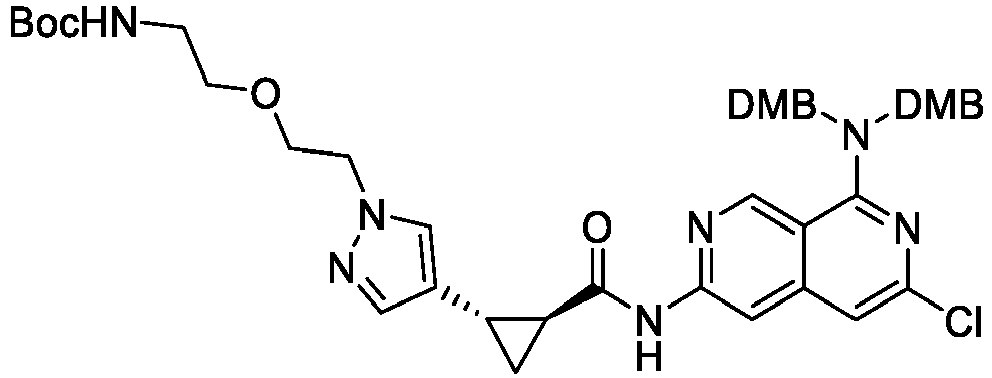
- A mixture of trans-tert-butyl N-[2-(2-[4-[2-[(6,8-dichloro-2,7-naphthyridin-3-yl)carbamoyl]cyclopropyl]-1H-pyrazol-1-yl]ethoxy)ethyl]carbamate (2.0 g, 3.73 mmol), bis[(2,4-dimethoxyphenyl)methyl]amine (4.74 g, 14.9 mmol) and triethylamine (1.89 g, 18.7 mmol) in dioxane (40 mL) was heated at 110 °C. After 12 h, the reaction was concentrated, and the resulting residue was purified by silica gel chromatography (10:1 dichloromethane / methanol) to provide trans-tert-butyl N-[2-(2-[4-[2-[(8-[bis[(2,4-dimethoxyphenyl)methyl] amino] -6-chloro-2,7-naphthyridin-3 -yl)carbamoyl] cyclopropyl] -1H-pyrazol-1-yl]ethoxy)ethyl]carbamate (2.5 g, 82%) as a light yellow solid. LCMS (ESI): [M+H]+ =816.3.
-

- A mixture of trans-tert-butyl N-[2-(2-[4-[2-[(8-[bis[(2,4-dimethoxyphenyl)methyl]amino]-6-chloro-2,7-naphthyridin-3-yl)carbamoyl]cyclopropyl]-1H-pyrazol-1-yl]ethoxy)ethyl]carbamate (2.28 g, 2.79 mmol), (2,6-dichlorophenyl)boronic acid (6.39 g, 33.48 mmol), Pd(PPh3)4 (645 mg, 0.55 mmol), and sodium bicarbonate (2.81 g, 33.45 mmol) in ethanol (60 mL) / water(6 mL) / toluene (60 mL) was heated at 100 °C under nitrogen. After 12 h, the reaction was concentrated, and the resulting residue was purified by silica gel chromatography (10:1 dichloromethane / methanol) to yield tert-butyl 2-(2-(4-((1S,2S)-2-(8-(bis(2,4-dimethoxybenzyl)amino)-6-(2,6-dichlorophenyl)-2,7-naphthyridin-3-ylcarbamoyl)cyclopropyl)-1H-pyrazol-1-yl)ethoxy)ethylcarbamate (2.0 g, 77%) as a brown oil. LCMS (ESI): [M+H]+ = 926.9.
-

- A solution of trans-tert-butyl N-[2-(2-[4-[2-[(8-[bis[(2,4-dimethoxyphenyl)methyl] amino] -6-(2,6-dichlorophenyl)-2,7-naphthyridin-3 - yl)carbamoyl]cyclopropyl]-1H-pyrazol-1-yl]ethoxy)ethyl]carbamate (2.55 g, 2.75 mmol) in trifluoroacetic acid (10 mL) was heated at 80 °C. After 20 min, the mixture was concentrated under vacuum, and the resulting residue was diluted with dichloromethane. The solution was basified to pH = 8 with 7M NH3 / methanol and concentrated. Purification by Prep-HPLC followed by chiral SFC afforded the titled compounds. Compound 295: LCMS (ESI): RT (min) = 1.43, [M+H]+ = 526.1, method = K-1; 1H NMR (300 MHz, DMSO-d 6) δ 10.98 (s, 1H), 9.38 (s, 1H), 8.23 (s, 1H), 7.62 (s, 1H), 7.58 - 7.55 (m, 2H), 7.48 - 7.42 (m, 3H), 7.32 (s, 1H), 6.80 (s, 1H), 4.19 (t, J = 6.0 Hz, 2H), 3.71 (t, J = 6.0 Hz, 2H), 3.35 - 3.26 (m, 2H), 2.62 (t, J = 6.0 Hz, 2H), 2.22 (t, J = 6.0 Hz, 2H), 2.00 - 1.80 (m, 2H), 1.42 - 1.36 (m, 1H), 1.24 - 1.17 (m, 1H). Compound 296: LCMS (ESI): RT (min) = 1.43, [M+H]+ = 526.1, method = K-1; 1H NMR (300 MHz, DMSO-d 6) δ 10.98 (s, 1H), 9.38 (s, 1H), 8.23 (s, 1H), 7.62 (s, 1H), 7.58 - 7.55 (m, 2H), 7.48 - 7.42 (m, 3H), 7.32 (s, 1H), 6.80 (s, 1H), 4.19 (t, J = 6.0 Hz, 2H), 3.71 (t, J = 6.0 Hz, 2H), 3.35 - 3.26 (m, 2H), 2.62 (t, J = 6.0 Hz, 2H), 2.22 (t, J = 6.0 Hz, 2H), 2.00 - 1.80 (m, 2H), 1.42 - 1.36 (m, 1H), 1.24 - 1.17 (m, 1H).
-

-

- To a solution of ethyl (exo)-3-[(tert-butyldiphenylsilyl)oxy]bicyclo[3.1.0]hexane-6-carboxylate (3.20 g, 7.83 mmol) in ethanol (30 mL) and water (30 mL) was added sodium hydroxide (1.88 g, 47.0 mmol) at 25 °C. After 6 h, the organic removed under vacuum. The remaining aqueous solution was washed with ethyl acetate. The aqueous solution was acidified to pH = 3 with concentrated hydrochloric acid and concentrated under vacuum to afford crude (exo)-3-[(tert-butyldiphenylsilyl)oxy]bicyclo[3.1.0]hexane-6-carboxylic acid (3 g) as a white solid. LCMS (ESI): [M+H]+ =379.2.
-

- A mixture of (exo)-3-[(tert-butyldiphenylsilyl)oxy]bicyclo[3.1.0]hexane-6-carboxylic acid (3.00 g, 7.88 mmol), 6,8-dichloro-2,7-naphthyridin-3-amine (1.69 g, 7.90 mmol), POCl3 (3.63 g, 23.67 mmol), and pyridine (4 mL) in dichloromethane (40 mL) was stirred for 30 min at 25 °C. The reaction was slowly diluted with water, and the resulting mixture was extracted with dichloromethane. The organic extracts were concentrated, and the resulting residue was purified by silica gel chromatography (1:9 ethyl acetate / petroleum ether) to afford (1R,5S,6R)-3-[(tert-butyldiphenylsilyl)oxy]-N-(6,8-dichloro-2,7-naphthyridin-3-yl)bicyclo[3.1.0]hexane-6-carboxamide (3.7 g, 81%) as a yellow oil. LCMS (ESI): [M+H]+ =576.3.
-

- A mixture of (exo)-3-[(tert-butyldiphenylsilyl)oxy]-N-(6,8-dichloro-2,7-naphthyridin-3-yl)bicyclo[3.1.0]hexane-6-carboxamide (3.60 g, 6.24 mmol), bis[(2,4-dimethoxyphenyl)methyl]amine (7.93 g, 25.0 mmol), triethylamine (3.16 g, 31.2 mmol) and dioxane (100 mL) was heated at 110 °C. After 16 h, the reaction was concentrated, and the resulting residue was purified by silica gel chromatography (3:7 ethyl acetate/petroleum ether) to provide (exo)-N-(8-[bis[(2,4-dimethoxyphenyl)methyl]amino]-6-chloro-2,7-naphthyridin-3-yl)-3-[(tert-butyldiphenylsilyl)oxy]bicyclo[3.1.0]hexane-6-carboxamide (4.0 g, 75%) as a yellow oil. LCMS (ESI): [M+H]+ =857.5.
-

- To a solution of (exo)-N-(8-[bis[(2,4-dimethoxyphenyl)methyl]amino]-6-chloro-2,7-naphthyridin-3-yl)-3-[(tert-butyldiphenylsilyl)oxy]bicyclo[3.1.0]hexane-6-carboxamide (4.0 g, 4.7 mmol) in dioxane (50 mL) / water (8 mL) was added (4-methylpyridin-3-yl)boronic acid (1.15 g, 8.40 mmol), XPhos palladium(II) biphenyl-2-amine chloride (730 mg, 0.93 mmol), XPhos (670 mg, 1.41 mmol) and KOAc (1.60 g, 16.3 mmol). The resulting solution was heated at 100 °C under nitrogen. After 2 h, the reaction was filtered, and the filtrate was concentrated under vacuum. Purification by silica gel chromatography (20:1 dichloromethane / methanol) provided (exo)-N-(8-[bis[(2,4-dimethoxyphenyl)methyl]amino]-6-(4-methylpyridin-3-yl)-2,7-naphthyridin-3-yl)-3-[(tert-butyldiphenylsilyl)oxy]bicyclo[3.1.0]hexane-6-carboxamide (4 g, 94%) as a yellow oil. LCMS (ESI): [M+H]+ =913.5.
-

- To a solution of (exo)-N-(8-[bis[(2,4-dimethoxyphenyl)methyl]amino]-6-(4-methylpyridin-3 -yl)-2, 7-naphthyridin-3 -yl)-3 - [(tert-butyldiphenylsilyl)oxy]bicyclo[3.1.0]hexane-6-carboxamide (3.2 g, 3.5 mmol) in tetrahydrofuran (40 mL) was added TBAF trihydrate (5.5 g, 17.5 mmol) at 25 °C. After 4 h, the reaction was diluted with water, and the resulting solution was extracted with dichloromethane. The combined organic was washed with saturated aqueous sodium chloride solution, dried over Na2SO4, filtered, and concentrated under vacuum. Purification by silica gel (10:1 dichloromethane / methanol) afforded (1R,5S,6R)-N-(8-[bis[(2,4-dimethoxyphenyl)methyl]amino]-6-(4-methylpyridin-3-yl)-2,7-naphthyridin-3-yl)-3-hydroxybicyclo[3.1.0]hexane-6-carboxamide (2.1 g, 89%) as a light yellow solid. LCMS (ESI): [M+H]+ = 676.4.
-

- To a solution of (exo)-N-(8-[bis[(2,4-dimethoxyphenyl)methyl]amino]-6-(4-methylpyridin-3-yl)-2,7-naphthyridin-3-yl)-3-hydroxybicyclo[3.1.0]hexane-6-carboxamide (0.80 g, 1.18 mmol) in dichloromethane (20 mL) was added Dess-Martin Periodinane (3.51 g, 8.29 mmol) at room temperature. The resulting solution was warmed to 45 °C. After 3 h, the reaction was concentrated under vacuum, and the resulting residue was purified by silica gel chromatography (95:5 dichloromethane / methanol) to provide (exo)-N-(8-[bis[(2,4-dimethoxyphenyl)methyl]amino]-6-(4-methylpyridin-3-yl)-2,7-naphthyridin-3-yl)-3-oxobicyclo[3.1.0]hexane-6-carboxamide (0.80 g) as a yellow solid. LCMS (ESI): [M+H]+ =674.4.
-
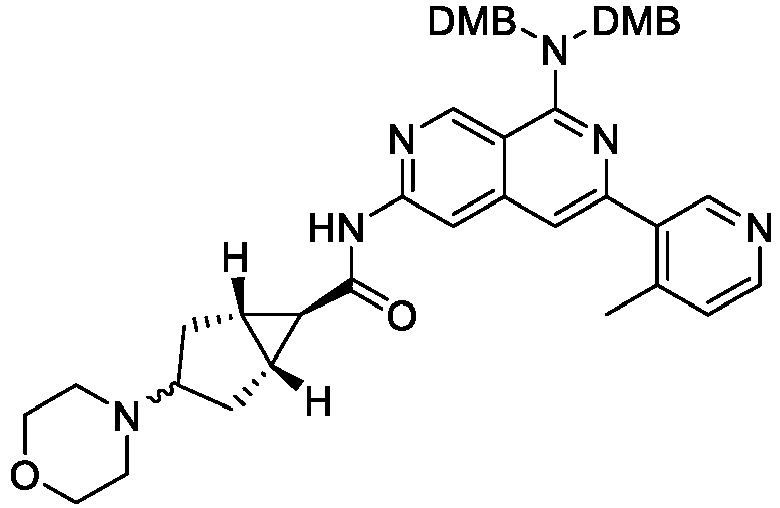
- A mixture of (exo)-N-(8-[bis[(2,4-dimethoxyphenyl)methyl]amino]-6-(4-methylpyridin-3-yl)-2,7-naphthyridin-3-yl)-3-oxobicyclo[3.1.0]hexane-6-carboxamide (0.20 g, 0.30 mmol), morpholine (129 mg, 1.48 mmol), NaBH3CN (56 mg, 0.89 mmol), and AcOH (0.89 mg, 0.02 mmol) in methanol (10 mL) was heated at 60 °C . After 6 h, the reaction was concentrated under vacuum, and the resulting residue was purified by silica gel chromatography (95:5 dichloromethane / methanol) to give(exo)-N-(8-[bis[(2,4-dimethoxyphenyl)methyl]amino]-6-(4-methylpyridin-3-yl)-2,7-naphthyridin-3-yl)-3-(morpholin-4-yl)bicyclo[3.1.0]hexane-6-carboxamide (0.20 g, 90%) as a yellow oil. LCMS (ESI): [M+H]+ =745.5.
-

- A solution of (exo)-N-(8-[bis[(2,4-dimethoxyphenyl)methyl]amino]-6-(4-methylpyridin-3-yl)-2,7-naphthyridin-3-yl)-3-(morpholin-4-yl)bicyclo[3.1.0]hexane-6-carboxamide (0.20 g, 0.27 mmol) in trifluoroacetic acid (10 mL) and dichloromethane (10 mL) was stirred for 6 h at 25 °C. The resulting mixture was concentrated under vacuum. The crude product was purified by Prep-HPLC to afford (exo)-N-[8-amino-6-(4-methylpyridin-3-yl)-2,7-naphthyridin-3-yl]-3-(morpholin-4-yl)bicyclo[3.1.0]hexane-6-carboxamide (17.2 mg, 14%) as an off-white solid. LCMS (ESI): RT (min) = 1.75, [M+H]+ = 445.2, method = K-1; 1H NMR (400 MHz, DMSO-d 6) δ 10.87 (s, 1H), 9.37 (s, 1H), 8.56 (s, 1H), 8.43 (d, J = 5.1Hz, 1H), 8.21 (s,1H), 7.31 (d, J = 5.3Hz, 3H), 6.95 (s,1H), 3.59 - 3.57 (m, 4H), 2.89 - 2.72 (m, 1H), 2.41 (s, 3H), 2.32 (d, J = 5.5 Hz, 4H), 2.16 - 2.06 (m, 3H), 1.77 - 1.74 (m, 2H),1.59 - 1.56 (m, 2H).
-

- To a solution of trans-N-(8-amino-6-chloro-2,7-naphthyridin-3-yl)-2-(1-methyl-1H-pyrazol-4-yl)cyclopropane-1-carboxamide (0.10 g, 0.29 mmol) in dioxane (5 mL) and water (1 mL) was added (2-methylphenyl)boronic acid (0.060 g, 0.44 mmol), Pd(PPh3)4 (68 mg, 0.06 mmol) and K3PO4 (186 mg, 0.87 mmol). The solution was stirred was heated at 100 °C under nitrogen. After 12 h, the reaction was concentrated under vacuum, and the crude product was purified by Prep-HPLC to afford trans-N-[8-amino-6-(2-methylphenyl)-2,7-naphthyridin-3-yl]-2-(1-methyl-1H-pyrazol-4-yl)cyclopropane-1-carboxamide (50 mg, 43%) as a white solid. The enantiomers were separated by chiral SFC. Compound 298: LCMS (ESI): RT (min) =1.33 [M+H]+ = 399.1, method = K-1; 1H NMR (400 MHz, CD3OD) δ 9.28 (s, 1H), 8.29 (s, 1H), 7.51 (s, 1H), 7.41 - 7.35 (m, 2H), 7.35 - 7.25 (m, 3H), 6.89 (d, J = 0.9Hz, 1H), 3.86 (s, 3H), 2.41 - 2.37 (m, 1H), 2.36 (s, 3H), 2.14 - 2.09 (m, 1H), 1.60 - 1.55 (m, 1H), 1.33 - 1.23 (m, 1H). Compound 299: LCMS (ESI): RT (min) =1.84 [M+H]+ = 399.1, method =K; 1H NMR (400 MHz, CD3OD) δ 9.28 (s, 1H), 8.29 (s, 1H), 7.51 (s, 1H), 7.41 - 7.35 (m, 2H), 7.35 - 7.25 (m, 3H), 6.89 (d, J = 0.9 Hz, 1H), 3.86 (s, 3H), 2.41 - 2.37 (m, 1H), 2.36 (s, 3H), 2.14 - 2.09 (m, 1H), 1.60 - 1.55 (m, 1H), 1.33 - 1.23 (m, 1H).
-

- To a solution of trans-N-(8-amino-6-chloro-2,7-naphthyridin-3-yl)-2-(1-methyl-1H-pyrazol-4-yl)cyclopropane-1-carboxamide (0.15 g, 0.44 mmol) in dioxane (5 mL) and water (1 mL) was added 4-methyl-3-(tetramethyl-1,3,2-dioxaborolan-2-yl)benzonitrile (532 mg, 2.19 mmol), Cs2CO3 (428 mg, 1.31 mmol), XPhos (21 mg, 0.04 mmol), and XPhos-PdCl-2nd G (33 mg, 0.04 mmol). The mixture was heated at 100 °C under nitrogen. After 12 h, the solution was concentrated under vacuum, and the crude product was purified by Prep-HPLC to afford trans-N-[8-amino-6-(5-cyano-2-methylphenyl)-2,7-naphthyridin-3-yl]-2-(1-methyl-1H-pyrazol-4-yl)cyclopropane-1-carboxamide (68 mg, 37%) as a yellow solid. The enantiomers were separated by chiral SFC. Compound 300: LCMS (ESI): RT (min) =1.33 [M+H]+ = 424.2, method = K-1; 1H NMR (300 MHz, DMSO-d 6) δ 10.97 (s, 1H), 9.38 (s, 1H), 8.27 (s, 1H), 7.87 (s, 1H), 7.77 (d, J = 9.0 Hz, 1H), 7.58 (s, 1H), 7.52 (d, J = 9.0 Hz, 1H), 7.35 (s, 2H), 7.31 (s, 1H), 6.99 (s, 1H), 3.77 (s, 3H), 2.46 (s, 3H), 2.24 - 2.20 (m, 2H), 1.43 - 1.37 (m, 1H), 1.23 - 1.18 (m, 1H). Compound 301: LCMS (ESI): RT (min) = 1.33, [M+H]+ =424.2, method =K; 1H NMR (300 MHz, DMSO-d 6) δ 10.97 (s, 1H), 9.38 (s, 1H), 8.27 (s, 1H), 7.87 (s, 1H), 7.77 (d, J = 9.0 Hz, 1H), 7.58 (s, 1H), 7.52 (d, J = 9.0 Hz, 1H), 7.35 (s, 2H), 7.31 (s, 1H), 6.99 (s, 1H), 3.77 (s, 3H), 2.46 (s, 3H), 2.24 - 2.20 (m, 2H), 1.43 - 1.37 (m, 1H), 1.23 - 1.18 (m, 1H).
-

- A mixture of KHF2 (91 mg, 1.17 mmol), (2-chloro-6-fluorophenyl)boronic acid (122 mg, 0.70 mmol) in water (1.5 mL) and tert-butanol (6 mL) was stirred for 15 min at 25°C under nitrogen. A mixture of trans-N-(8-amino-6-chloro-2,7-naphthyridin-3-yl)-2-(1-methyl-1H-pyrazol-4-yl)cyclopropane-1-carboxamide (0.20 g, 0.58 mmol), Pd(PPh3)4 (68 mg, 0.06 mmol), and K3PO4 (149 mg, 0.70 mmol) was added to the above solution, and the combined mixture was heated to 120 °C under nitrogen. After 45 min, the reaction was concentrated under vacuum, and the crude product was purified by Prep-HPLC to afford trans-N-[8-amino-6-(2-chloro-6-fluorophenyl)-2,7-naphthyridin-3-yl] -2-(1-methyl-1H-pyrazol-4-yl)cyclopropane-1-carboxamide (50 mg, 20%) as a white solid. The enantiomers were separated by chiral SFC. Compound 302: LCMS (ESI): RT (min) =1.34, [M+H]+ =437.2, method = K-1; 1H NMR (400 MHz, CD3OD) δ 9.55 (s, 1H), 8.55 (s, 1H), 7.68 - 7.62 (m, 1H), 7.55 - 7.51 (m, 2H), 7.40 - 7.33 (m, 2H), 7.24 (s, 1H), 3.86 (s, 3H), 2.45 - 2.39 (m, 1H), 2.18 - 2.12 (m, 1H), 1.63 - 1.58 (m, 1H), 1.34 - 1.27 (m, 1H). Compound 303: LCMS (ESI): RT (min) =1.35, [M+H]+ =437.2, method = K-1; 1H NMR (400 MHz, CD3OD) δ 9.55 (s, 1H), 8.55 (s, 1H), 7.68 - 7.62 (m, 1H), 7.55 - 7.51 (m, 2H), 7.40 - 7.33 (m, 2H), 7.24 (s, 1H), 3.86 (s, 3H), 2.45 - 2.39 (m, 1H), 2.18 - 2.12 (m, 1H), 1.63 - 1.58 (m, 1H), 1.34 - 1.27 (m, 1H).
-

- A suspension of trans-N-(8-amino-6-chloro-2,7-naphthyridin-3-yl)-2-(1-methyl-1H-pyrazol-4-yl)cyclopropane-1-carboxamide (190 mg, 0.55 mmol), (2-chlorophenyl)boronic acid (433 mg, 2.76 mmol), Pd(PPh3)4 (63 mg, 0.06 mmol), and potassium carbonate (117 mg, 0.84 mmol) in dioxane (3 mL) / water (0.3 mL) was heatedat 100 °C under nitrogen. After 3 h, the reaction was concentrated under vacuum, and the resulting residue was purified by Prep-HPLC to give trans-N-[8-amino-6-(2-chlorophenyl)-2,7-naphthyridin-3-yl]-2-(1-methyl-1H-pyrazol-4-yl)cyclopropane-1-carboxamide (60 mg, 23%) as a light yellow solid. The enantiomers were separated by chiral SFC. Compound 304: LCMS (ESI): RT (min) =0.95, [M+H]+ = 419, method = K-1; 1H NMR (400 MHz, DMSO-d 6) δ 10.98 (s, 1H), 9.39 (s, 1H), 8.25 (s, 1H), 7.61 - 7.54 (m, 3H), 7.45 - 7.42 (m, 2H), 7.35 (s, 2H), 7.31 (s, 1H), 7.00 (s, 1H), 3.78 (s, 3H), 2.24 - 2.18 (m, 2H), 1.14 - 1.37 (m, 1H), 1.24 - 1.17 (m, 1H). Compound 305: LCMS (ESI): RT (min) = 1.31 [M+H]+ =419, method = K-1; 1H NMR (400 MHz, DMSO-d 6) δ 10.98 (s, 1H), 9.39 (s, 1H), 8.25 (s, 1H), 7.61 - 7.54 (m, 3H), 7.45 - 7.42 (m, 2H), 7.35 (s, 2H), 7.31 (s, 1H), 7.00 (s, 1H), 3.78 (s, 3H), 2.24 - 2.18 (m, 2H), 1.14 - 1.37 (m, 1H), 1.24 - 1.17 (m, 1H).
-

- A mixture of trans-N-(8-amino-6-chloro-2,7-naphthyridin-3-yl)-2-(1-methyl-1H-pyrazol-4-yl)cyclopropane-1-carboxamide (455 mg, 1.32 mmol), (2,6-difluorophenyl)boronic acid (0.20 g, 1.26 mmol), X-Phos (27 mg, 0.08 mmol), XPhos palladium(II) biphenyl-2-amine chloride (45 mg, 0.05 mmol), and AcOK (171 mg, 1.74 mmol) in dioxane (5 mL) / water(0.5 mL) was heated at 110 °C under nitrogen. After 3 h, the reaction was concentrated under vacuum, and the resulting residue was purified by Prep-HPLC to give racemic (trans)-N-[8-amino-6-(2,6-difluorophenyl)-2,7-naphthyridin-3-yl]-2-(1-methyl-1H-pyrazol-4-yl)cyclopropane-1-carboxamide (60 mg, 11%) as a light yellow solid. The enantiomers were separated by chiral SFC. Compound 306: LCMS (ESI): RT (min) =1.280, [M+H]+ =421, method = K-1; 1H NMR (400 MHz, CD3OD) δ 9.30 (s, 1H), 8.31 (s, 1H), 7.52 - 7.44 (m, 2H), 7.37 (s, 1H), 7.13 - 7.05 (m, 2H), 6.99 (s, 1H), 3.02 (s, 3H), 2.41 - 2.34 (m, 1H), 2.13 - 2.10 (m, 1H), 1.61 - 1.56 (m, 1H), 1.29 - 1.25 (m, 1H). Compound 307: LCMS (ESI): RT (min) =1.272, [M+H]+= 421, method = K-1; 1H NMR (400 MHz, CD3OD) δ 9.30 (s, 1H), 8.31 (s, 1H), 7.52 - 7.44 (m, 2H), 7.37 (s, 1H), 7.13 - 7.05 (m, 2H), 6.99 (s, 1H), 3.02 (s, 3H), 2.41 - 2.34 (m, 1H), 2.13 - 2.10 (m, 1H), 1.61 - 1.56 (m, 1H), 1.29 - 1.25 (m, 1H).
-

-

- A mixture of 2,5-dibromo-4-methylpyridine (0.60 g, 2.39 mmol), 2-(tributylstannyl)-1,3-oxazole (1.02 g, 2.86 mmol), and Pd(PPh3)4 (276.32 mg, 0.23 mmol) in dioxane (15 mL) was heated at 90 °C under nitrogen. After 16 h, the mixture was concentrated under vacuum, and the resulting residue was purified by flash column chromatography (1:3 ethyl acetate / petroleum ether) to afford 5-bromo-4-methyl-2-(1,3-oxazol-2-yl)pyridine (0.20 g, 35%) as a light yellow solid. LCMS (ESI) [M+H]+ =239.0.
-

- A mixture of 5-bromo-4-methyl-2-(1,3-oxazol-2-yl)pyridine (0.10 g, 0.41 mmol), 4,4,5,5-tetramethyl-2-(tetramethyl-1,3,2-dioxaborolan-2-yl)-1,3, 2-dioxaborolane (1.06 g, 4.18 mmol), Pd(dppf)Cl2 (31 mg, 0.04 mmol), and KOAc (103 mg, 1.05 mmol) in dioxane (5 mL) was heated at 90 °C under nitrogen. After 2 h, the solids were filtered, and the filtrate was concentrated under vacuum to afford crude 4-methyl-2-(1,3-oxazol-2-yl)-5-(tetramethyl-1,3,2-dioxaborolan-2-yl)pyridine(0.10 g) as a white solid. LCMS (ESI) [M+H]+ =287.0.
-

- A mixture of 4-methyl-2-(1,3-oxazol-2-yl)-5-(tetramethyl-1,3,2-dioxaborolan-2-yl)pyridine (167 mg, 0.58 mmol), trans-N-(8-amino-6-chloro-2,7-naphthyridin-3-yl)-2-(1-methyl-1H-pyrazol-4-yl)cyclopropane-1-carboxamide (0.10 g, 0.29 mmol), 2nd generation XPhos precatalyst (22 mg, 0.028 mmol), X-Phos (13 mg, 0.03 mmol), and potassium carbonate (80 mg, 0.57 mmol) in water (1 mL) /dioxane (5 mL) was heated at 90 °C under nitrogen. After 2 h, the mixture was concentrated under vacuum, and the crude product was purified by Prep-HPLC to give racemic (trans)-N-[8-amino-6-[4-methyl-6-(1,3-oxazol-2-yl)pyridin-3-yl]-2,7-naphthyridin-3-yl]-2-(1-methyl-1H-pyrazol-4-yl)cyclopropane-1-carboxamide (45 mg, 17%) as a brown solid. The enantiomers were separated by chiral-Prep-HPLC. Compound 308: LCMS (ESI): [M+H]+ = 467, RT (min) =1.272, method = K-1; 1H NMR (400 MHz, CD3OD) δ 9.33 (s, 1H), 8.70 (s, 1H), 8.38 (s, 1H), 8.15 - 8.14 (m, 2H), 7.51 (s, 1H), 7.45 - 7.44 (m, 1H), 7.38 (s, 1H), 7.09 (s, 1H), 3.86 (s, 3H), 2.57 (s, 3H), 2.42 - 2.37 (m, 1H), 2.14 - 2.10 (m, 1H), 1.61 - 1.56 (m, 1H), 1.34 -1.25 (m, 1H). Compound 309: LCMS (ESI): [M+H]+ = 467, RT (min) =1.280, method = K-1; 1H NMR (400 MHz, CD3OD) δ 9.33 (s, 1H), 8.70 (s, 1H), 8.38 (s, 1H), 8.15 - 8.14 (m, 2H), 7.51 (s, 1H), 7.45 - 7.44 (m, 1H), 7.38 (s, 1H), 7.09 (s, 1H), 3.86 (s, 3H), 2.57 (s, 3H), 2.42 - 2.37 (m, 1H), 2.14 - 2.10 (m, 1H), 1.61 - 1.56 (m, 1H), 1.34 -1.25 (m, 1H).
-

- A mixture of trans-N-(8-amino-6-chloro-2,7-naphthyridin-3-yl)-2-(cyanomethyl)cyclopropane-1-carboxamide (160 mg, 2.7 mmol), (2,6-dichlorophenyl)boronic acid (2.52 g, 13.2 mmol), Pd(PPh3)4 (310 mg, 0.23 mmol), and sodium bicarbonate (1.12 g, 13.30 mmol) in water (2 mL) / ethanol (20 mL) / toluene (20 mL) was heated at 110 °C under nitrogen. After 15 h, the solids were filtered, and the filtrate was concentrated under vacuum. The crude product was purified by Prep-HPLC to give racemic product (110 mg, 10%) as a white solid. The enantiomers were separated by chiral SFC. Compound 310: LCMS (ESI): RT = 2.46 min, [M+H]+ = 412.1, method = K-1 ; 1H NMR (400 MHz, CD3OD) δ 9.33 (s, 1H), 8.29 (s, 1H), 7.56 - 7.48 (m, 2H), 7.42 (dd, J = 8.0, 8.0 Hz, 1H), 6.86 (s, 1H), 2.79 - 2.64 (m, 2H), 2.03 (m, 1H), 1.81 - 1.70 (m, 1H), 1.35 (m, 1H), 1.06 (m, 1H). Compound 311: LCMS (ESI): RT = 1.37 min, [M+H]+= 412.1, method = K-1; 1H NMR (400 MHz, CD3OD) δ 9.33 (s, 1H), 8.29 (s, 1H), 7.56 - 7.48 (m, 2H), 7.42 (dd, J = 8.0, 8.0 Hz, 1H), 6.86 (s, 1H), 2.79 - 2.64 (m, 2H), 2.03 (m, 1H), 1.81 - 1.70 (m, 1H), 1.35 (m, 1H), 1.06 (m, 1H).
-


-

- To an ice-cooled solution of 6-[(tert-butoxy)carbonyl]-5-oxo-6-azaspiro[2.5]octane-1-carboxylic acid (740 mg, 2.74 mmol) and 1-N,1-N-bis[(2,4-dimethoxyphenyl)methyl]-3-(4-methylpyridin-3-yl)-2,7-naphthyridine-1,6-diamine (1.16 g, 2.10 mmol) in pyridine (3 mL) / dichloromethane (15 mL) was added POCl3 (643 mg, 4.19 mmol). After 30 min, excess POCl3 was quenched with water. The resulting mixture was concentrated under vacuum to afford crude tert-butyl 1-[(8-[bis[(2,4-dimethoxyphenyl)methyl]amino]-6-(4-methylpyridin-3-yl)-2,7-naphthyridin-3-yl)carbamoyl]-5-oxo-6-azaspiro[2.5]octane-6-carboxylate (660 mg) as a brown solid. LCMS (ESI): [M+H]+ = 803.4.
-


- A mixture of tert-butyl 1-[(8-[bis[(2,4-dimethoxyphenyl)methyl]amino]-6-(4-methylpyridin-3-yl)-2,7-naphthyridin-3-yl)carbamoyl]-5-oxo-6-azaspiro[2.5]octane-6-carboxylate (660 mg, 0.82 mmol) and trifluoroacetic acid (10 mL) was heated at 80 °C. After 40 min, the mixture was concentrated, and the resulting residue was diluted with MeOH (10 mL). The solution was basified to pH = 8 with an NH3 methanol solution (7mol/L). The crude product was purified by Prep-HPLC followed by chiral SFC. Compound 315: LCMS (ESI): RT (min) = 1.007, [M+H]+ = 403.2, method = K-1; 1H NMR (300 MHz, CD3OD) δ 9.30 (s, 1H), 8.54 (s, 1H), 8.44 (d, J = 6.0 Hz, 1H), 8.32 (s, 1H), 7.41 (d, J = 6.0 Hz, 1H), 6.99 (s, 1H), 3.27 - 3.21 (m, 2H), 2.46 - 2.30 (m, 5H), 2.06 -1.99 (m, 3H), 1.47 - 1.39 (m, 1H), 1.11 - 1.07 (m, 1H). Compound 314: LCMS (ESI): RT = 1.014 min, [M+H]+ = 403.2, method = K-1; 1H NMR (300 MHz, DMSO-d 6) δ 10.96 (s, 1H), 9.37(s, 1H), 8.57 (s, 1H), 8.43 (d, J = 6.0 Hz, 1H), 8.25 (s, 1H), 7.58 (s, 1H), 7.32 - 7.30 (m, 3H), 6.97 (s, 1H), 3.15 - 3.12 (m, 1H), 3.02 - 2.99 (m, 1H), 2.41 (s, 3H), 2.31 - 2.25 (m, 1H), 2.11 - 2.04 (m, 2H), 1.92 - 1.78(m, 2H), 1.19-1.16 (m, 1H), 1.10 - 0.96 (m, 1H). Compound 313: LCMS (ESI): RT (min) = 0.903, [M+H]+ = 403.2, method = K-1; 1H NMR (300 MHz, DMSO-d 6) δ 10.97 (s, 1H), 9.39 (s, 1H), 8.58 (s, 1H), 8.45 (d, J = 6.0 Hz,1H), 8.27 (s, 1H), 7.53 (s, 1H), 7.41 (s, 2H), 7.33 (d, J = 6.0 Hz,1H), 7.01 (s, 1H), 3.21 -3.16 (m, 2H), 2.42 (s, 3H), 2.38 - 2.36 (m, 2H), 2.12 - 2.08 (m, 1H), 1.97 - 1.70 (m, 1H), 1.53 - 1.45(m, 1H), 1.12 - 1.05 (m, 2H). Compound 312: LCMS (ESI): RT (min) = 0.903, [M+H]+ = 403.2, method = K-1; 1H NMR (300 MHz, DMSO-d 6) δ 10.95 (s, 1H), 9.37 (s, 1H), 8.57 (s, 1H), 8.43 (d, J = 6.0 Hz, 1H), 8.25 (s, 1H), 7.53 (s, 1H), 7.32 - 7.31 (m, 3H), 6.99 (s, 1H), 3.22 - 3.20 (m, 2H), 2.42 (s, 3H), 2.38 - 2.36 (m, 2H), 2.12 - 2.08 (m, 1H), 1.76 - 1.74 (m, 1H), 1.52 - 1.49 (m, 1H), 1.10 - 1.06 (m, 2H).
-

- A mixture of trans-N-[8-amino-5-bromo-6-(4-methylpyridin-3-yl)-2,7-naphthyridin-3-yl]-2-(cyanomethyl)cyclopropane-1-carboxamide (0.30 g, 0.69 mmol), potassium cyclopropyl trifluoroborate (153 mg, 1.03 mmol), Pd(OAc)2 (15 mg, 0.07 mmol), PCy3 (39 mg, 0.14 mmol), and potassium carbonate (285 mg, 2.06 mmol) in water (0.5 mL) / toluene (5 mL) was heated at 90 °C under nitrogen. After 15 h, the solids were filtered, and the filtrate was concentrated under vacuum. The crude product was purified by Prep-HPLC to afford N-[8-amino-5-cyclopropyl-6-(4-methylpyridin-3-yl)-2,7-naphthyridin-3-yl]-2-(cyanomethyl)cyclopropane-1-carboxamide formic acid (20 mg, 7%) as a white solid. The enantiomers were separated by chiral SFC. Compound 316: LCMS (ESI): RT (min) =2.182, [M+H]+ =399.2, method = K-1; 1H NMR (400 MHz, CD3OD) δ 9.39 (s, 1H), 9.04 (s, 1H), 8.51 (d, J = 4 Hz, 1H), 8.50 (s, 1H), 8.51 (d, J = 4 Hz, 1H), 2.81 - 2.66 (m, 2H), 2.34 (s, 3H), 2.09 - 2.03 (m, 1H), 1.90 - 1.75 (m, 2H), 1.41 - 1.36 (m, 1H), 1.11 - 1.07 (m, 1H), 0.88 - 0.77 (s, 2H), 0.17 - 0.07 (m, 2H). Compound 317: LCMS (ESI): RT (min) =1.079, [M+H]+ = 399.2, method = K-1; 1H NMR (400 MHz, CD3OD) δ 9.39 (s, 1H), 9.04 (s, 1H), 8.51 (d, J = 4 Hz, 1H), 8.50 (s, 1H), 8.51 (d, J = 4 Hz, 1H), 2.81 - 2.66 (m, 2H), 2.34 (s, 3H), 2.09 - 2.03 (m, 1H), 1.90 - 1.75 (m, 2H), 1.41 - 1.36 (m, 1H), 1.11 - 1.07 (m, 1H), 0.88 - 0.77 (s, 2H), 0.17 - 0.07 (m, 2H).
-

- A mixture of trans-N-(8-amino-6-chloro-2,7-naphthyridin-3-yl)-2-(1-methyl-1H-pyrazol-4-yl)cyclopropane-1-carboxamide (311 mg, 0.91 mmol), 4-methyl-2-phenyl-3-(tetramethyl-1,3,2-dioxaborolan-2-yl)pyridine (402 mg, 1.36 mmol), Pd-AMPHOS (64 mg, 0.09 mmol), and K3PO4 (577 mg, 2.72 mmol) in water (2 mL) / dioxane (6 mL) was heated at 100 °C under nitrogen. After 20 min, the solids were filtered, and the filtrate was concentrated under vacuum. The crude product was purified by Prep-HPLC to give N-[8-amino-6-(4-methyl-2-phenylpyridin-3-yl)-2,7-naphthyridin-3-yl]-2-(1-methyl-1H-pyrazol-4-yl)cyclopropane-1-carboxamide (2.4 mg, 1%) as a white solid. The enantiomers were separated by chiral SFC. Compound 318; LCMS (ESI): RT (min) = 1.196, [M+H]+ = 476.3, method = K-1; 1H NMR (400 MHz, CD3OD) δ 9.22 (s, 1H), 8.52 (d, J = 4 Hz, 1H), 8.05 (s, 1H), 7.48 (s, 1H), 7.42 (d, J = 4.0 Hz, 1H), 7.40 - 7.38 (m, 2H), 7.35 (s, 1H), 7.23 -7.20 (m, 3H), 6.57 (s, 1H), 3.85 (s, 3H), 2.37 - 2.33 (m, 1H), 2.31 (s, 3H), 2.09 - 2.058 (m, 1H), 1.56 - 1.51 (m, 1H), 1.26 - 1.21 (m, 1H). Compound 319: LCMS (ESI): [M+H]+ = 476.3, RT (min) = 1.197, method = K-1; 1H NMR (400 MHz, CD3OD) δ 9.22 (s, 1H), 8.52 (d, J = 4 Hz, 1H), 8.05(s, 1H), 7.48 (s, 1H), 7.42 (d, J = 4.0 Hz, 1H), 7.40 - 7.38 (m, 2H), 7.35 (s, 1H), 7.23 - 7.20 (m, 3H), 6.57 (s, 1H), 3.85 (s, 3H), 2.37 - 2.33 (m, 1H), 2.31 (s, 3H), 2.09 - 2.06 (m, 1H), 1.56 - 1.51 (m, 1H), 1.26 - 1.21 (m, 1H).
-


-

- To a mixture of 6,8-dichloro-2,7-naphthyridin-3-amine hydrochloride (847 mg, 3.38 mmol) and 2-methylcyclobutane-1-carboxylic acid (0.50 g, 4.38 mmol) in pyridine (8 mL) / dichloromethane (40 mL) was added POCL3 (1.03 g, 6.72 mmol) at 0 °C. The reaction was stirred for 30 min at room temperature and diluted with water. The solution was extracted with dichloromethane. The combined organic was dried over anhydrous sodium sulfate, filtered, and concentrated under vacuum to afford N-(6,8-dichloro-2,7-naphthyridin-3-yl)-2-methylcyclobutane-1-carboxamide (890 mg, 85%) as a yellow solid. LCMS (ESI): [M+H]+ = 310.2.
-

- A mixture ofN-(6,8-dichloro-2,7-naphthyridin-3-yl)-2-methylcyclobutane-1-carboxamide (490 mg, 1.58 mmol) in ammonium hydroxide (10 mL, 257 mmol) and dioxane (10 mL) was heated at 80 °C for 2 h. The reaction was concentrated under vacuum to afford crude N-(8-amino-6-chloro-2,7-naphthyridin-3-yl)-2-methylcyclobutane-1-carboxamide (910 mg) as a yellow solid. LCMS (ESI): [M+H]+ = 291.1
-


- A mixture of N-(8-amino-6-chloro-2,7-naphthyridin-3-yl)-2-methylcyclobutane-1-carboxamide (440 mg, 1.51 mmol), (4-methylpyridin-3-yl)boronic acid (311 mg, 2.27 mmol), XPhos (144 mg, 0.30 mmol), XPhos-PdCl-2nd G (115 mg, 0.15 mmol), and potassium carbonate (626 mg, 4.53 mmol) in 10:1 dioxane water (11 mL) was heated at 100 °C under nitrogen. After 1 h, the solids were filtered, and the filtrate was concentrated under vacuum. The crude product was purified by chiral-Prep-HPLC followed by chiral SFC. Compound 320: LCMS (ESI): RT (min) = 1.29, [M+H]+ = 348.1, method = K-1; 1H NMR (400 MHz, CD3OD) δ 9.29 (s, 1H), 8.55 (s, 1H), 8.44 (d, J = 4.0 Hz, 1H), 8.37 (s, 1H), 7.41 (d, J = 4 Hz, 1H), 7.01 (s, 1H), 2.99 - 2.92 (m, 1H), 2.76 - 2.68 (m, 1H), 2.47 (s, 3H), 2.25 - 2.05 (m, 3H), 1.69 - 1.60 (m, 1H), 1.19 (d, J = 8.0 Hz, 3H). Compound 321: LCMS (ESI): RT (min) = 1.42, [M+H]+ = 348.1, method = K-1; 1H NMR (400 MHz, CD3OD) δ 9.29 (s, 1H), 8.56 (s, 1H), 8.44 (d, J = 4.0 Hz, 1H), 8.39 (s, 1H), 7.41 (d, J= 4.0 Hz, 1H), 7.01 (s, 1H), 3.51 - 3.45 (m, 1H), 2.96 - 2.89 (m, 1H), 2.55 - 2.48 (m, 1H), 2.47 (s, 3H), 2.27 - 2.18 (m, 1H), 2.09 - 2.00 (m, 1H), 1.73 - 1.65 (m, 1H), 1.11 (d, J = 8.0 Hz, 3H). Compound 322: LCMS (ESI) : [M+H]+ = 348.1, RT (min) = 0.98, method = K-1; 1H NMR (400 MHz, CD3OD) δ 9.29 (s, 1H), 8.55 (s, 1H), 8.44 (d, J = 4.0 Hz, 1H), 8.37 (s, 1H), 7.41 (d, J = 4.0 Hz, 1H), 7.01 (s, 1H), 2.99 - 2.92 (m, 1H), 2.76 - 2.68 (m, 1H), 2.47 (s, 3H), 2.25 - 2.05 (m, 3H), 1.69 - 1.60 (m, 1H), 1.19 (d, J = 8.0 Hz, 3H). Compound 323: LCMS (ESI) : [M+H]+ = 348.1, RT (min) = 0.98, method = K-1; 1H NMR (400 MHz, CD3OD) δ 9.29 (s, 1H), 8.56 (s, 1H), 8.44 (d, J = 4.0 Hz, 1H), 8.39 (s, 1H), 7.41 (d, J = 4.0 Hz, 1H), 7.01 (s, 1H), 3.51 - 3.45 (m, 1H), 2.96 - 2.89 (m, 1H), 2.55 - 2.48 (m, 1H), 2.47 (s, 3H), 2.27 - 2.18 (m, 1H), 2.09 - 2.00 (m, 1H), 1.73 -1.65 (m, 1H), 1.11 (d, J= 8.0 Hz, 3H).
-

-

- A solution of oxane-4-carbaldehyde (2.0 g, 17.5 mmol) and tert-butyl 2-(triphenylphosphoranylidene)acetate (7.2 g, 19 mmol) in tetrahydrofuran (100 mL) was stirred for 6 h at room temperature. The resulting mixture was concentrated under vacuum, and the resulting residue was purified by silica gel chromatography (3:1 petroleum ether / ethyl acetate) to afford tert-butyl (2E)-3-(oxan-4-yl)prop-2-enoate (3 g, 81%) as a white solid.
-

- A mixture of trimethylsulfonium iodide (5.5 g, 24.99 mmol), t-BuOK (2.78 g, 24.77 mmol), tert-butyl (2E)-3-(oxan-4-yl)prop-2-enoate (2.5 g, 11.77 mmol) in DMSO (30 mL) was stirred for 3 h at room temperature under N2. The reaction was diluted with water, and the aqueous layer was extracted with ethyl acetate. The combined organic layers were dried over Na2SO4, filtered, and concentrated under vacuum to afford trans-tert-butyl 2-(tetrahydro-2H-pyran-4-yl)cyclopropanecarboxylate (1.5 g, 56%) as a white solid.
-

- A solution of trans-tert-butyl-2-(oxan-4-yl)cyclopropane-1-carboxylate (1.5 g, 6.62 mmol) in dichloromethane (20 mL) / trifluoroacetic acid (20 mL) was stirred for 6 h at room temperature. The reaction solution was basified to pH 8 with 1M aqueous NaOH. The aqueous solution was washed with ethyl acetate and acidified to pH 2-3 with aqueous HCl. The acidic solution was extracted with ethyl acetate. The collected extracts were dried over Na2SO4, filtered, and concentrated under vacuum to yield crude trans-2-(tetrahydro-2H-pyran-4-yl)cyclopropanecarboxylic acid (1 g, 89%) as an oil.
-

- POCl3 (1.49 g, 9.71 mmol) was added dropwise to an ice-cooled solution of trans-2-(oxan-4-yl)cyclopropane-1-carboxylic acid (1.0 g, 5.87 mmol) and 6,8-dichloro-2,7-naphthyridin-3-amine hydrochloride (1.23 g, 4.91 mmol) and pyridine (2 mL, 24.84 mmol) in dichloromethane (20 mL). The reaction mixture was warmed to room temperature for 1h. The reaction was washed with H2O (15 mL), and the organic layer was dried over Na2SO4, filtered, and concentrated under vacuum. Purification by flash column chromatography (1:1 petroleum ether / ethyl acetate) afforded trans-N-(6,8-dichloro-2,7-naphthyridin-3-yl)-2-(oxan-4-yl)cyclopropane-1-carboxamide (0.60 g, 28%) as a yellow solid. LCMS (ESI): [M+H]+ = 367.2.
-

- A solution of trans-N-(6,8-dichloro-2,7-naphthyridin-3-yl)-2-(oxan-4-yl)cyclopropane-1-carboxamide (500 mg, 1.36 mmol) in ammonium hydroxide (6 mL) and dioxane (6 mL) was heated at 100 °C. After 1 h, the reaction mixture was concentrated under vacuum to afford trans-N-(8-amino-6-chloro-2,7-naphthyridin-3-yl)-2-(oxan-4-yl)cyclopropane-1-carboxamide (550 mg, 93%) as a yellow solid.
-

- A mixture of trans-N-(8-amino-6-chloro-2,7-naphthyridin-3-yl)-2-(oxan-4-yl)cyclopropane-1-carboxamide (0.50 g, 1.44 mmol), (4-methylpyridin-3-yl)boronic acid (590 mg, 4.30 mmol), Pd(dppf)Cl2 (110 mg, 0.15 mmol), and sodium carbonate (460 mg, 4.34 mmol) in 10:1 dioxane / water(16.5 mL) was heated at 100 °C under nitrogen. After 4 h, the reaction mixture was concentrated under vacuum, and the residue was purified by flash column chromatography (10:1 dichloromethane / methanol) to afford trans-N-[8-amino-6-(4-methylpyridin-3-yl)-2,7-naphthyridin-3-yl]-2-(oxan-4-yl)cyclopropane-1-carboxamide(200 mg, 34%) as a white solid. The enantiomers were separated by chiral-Prep-HPLC. Compound 324: LCMS (ESI): [M+H]+ = 404.2, RT (min) = 1.10, method = K-1; 1H NMR (400 MHz, CD3OD) δ 9.32 (s, 1H), 8.55 (s, 1H), 8.46 (d, J = 5.1 Hz, 1H), 8.32 (s, 1H), 7.43 (d, J = 5.1 Hz, 1H), 7.01 (s, 1H), 4.03 - 3.92 (m, 2H), 3.47 - 3.37 (m, 2H), 2.47 (s, 3H), 1.87 - 1.83 (m, 1H), 1.76 (t, J = 14.6 Hz, 2H), 1.57 - 1.42 (m, 2H), 1.38 - 1.31 (m, 1H), 1.25 - 1.21 (m, 1H), 1.19 - 1.07 (m, 1H), 0.93 - 0.89 (m, 1H). Compound 325: LCMS (ESI) : [M+H]+ = 404.2, RT (min) = 1.08 min, method = K-1; 1H NMR (400 MHz, CD3OD) δ 9.32 (s, 1H), 8.55 (s, 1H), 8.46 (d, J = 5.1 Hz, 1H), 8.32 (s, 1H), 7.43 (d, J = 5.1 Hz, 1H), 7.01 (s, 1H), 4.03 - 3.92 (m, 2H), 3.47 - 3.37 (m, 2H), 2.47 (s, 3H), 1.87 - 1.83 (m, 1H), 1.76 (t, J = 14.6 Hz, 2H), 1.57 - 1.42 (m, 2H), 1.38 - 1.31 (m, 1H), 1.25 - 1.21 (m, 1H), 1.19 - 1.07 (m, 1H), 0.93 - 0.89 (m, 1H).
-


-

- To a solution of iodoethane (3.00 g, 19.23 mmol) in dichloromethane (45 mL) was added diphenyl sulfide (10.69 g, 57.39 mmol) and AgBF4 (3.75 g, 19.26 mmol). The resulting solution was stirred for 30 min at room temperature and overnight at 35 °C. The solids were filtered, and the filtrate was concentrated under vacuum. The resulting residue were triturated with dichloromethane / ether (3 × 50 mL) to afford ethyldiphenylsulfanium tetrafluoroboranuide as an off-white solid (2.5 g, 34%). LCMS (ESI): [M+H]+ = 215.0;
-

- To a solution of 4-iodo-1-methyl-1H-pyrazole (5.0 g, 24 mmol) in N,N-dimethylformamide (20 mL) was added tert-butyl prop-2-enoate (9.23 g, 72.0 mmol), triethylamine (2.91 g, 28.8 mmol), Pd(OAc)2 (538 mg, 2.40 mmol) and P(o-Tol)3 (1.46 g, 4.80 mmol). The resulting mixture was heated overnight at 110 °C under nitrogen. The reaction was concentrated, and the resulting residue was purified by flash column chromatography (1:3 ethyl acetate / petroleum ether) to provide tert-butyl (2E)-3-(1-methyl-1H-pyrazol-4-yl)prop-2-enoate as a light yellow oil (3.9 g, 74%). LCMS (ESI): [M+H]+ = 209.0.
-

- To a solution of diphenylehylsulfonium tetrafluoroborate (1.45 g, 4.80 mmol) in 1,2-dimethoxyethane (75 mL) and dichloromethane (12.5 mL) at -78 °C was added dropwise LDA (1.06 mL, 19.79 mmol). After 30 min, tert-butyl (2E)-3-(1-methyl-1H-pyrazol-4-yl)prop-2-enoate (0.50 g, 2.4 mmol) was added, and the resulting solution was stirred overnight at room temperature. The reaction was diluted with water and extracted with dichloromethane. The combined organic layers were dried over Na2SO4, filtered, and concentrated under vacuum to provide crude tert-butyl-2-methyl-3-(1-methyl-1H-pyrazol-4-yl)cyclopropane-1-carboxylate as a yellow solid (0.60 g). LCMS (ESI): [M+H]+ = 237.0.
-

- To a solution of tert-butyl-2-methyl-3-(1-methyl-1H-pyrazol-4-yl)cyclopropane-1-carboxylate (0.60 g, 2.5 mmol) in dichloromethane (10 mL) was added trifluoroacetic acid (10 mL).The resulting solution was stirred for 5 h at room temperature. The reaction was concentrated under vacuum, and the resulting residue was dissolved in water (45 mL). The aqueous solution was basified to pH = 9-10 with 10 M aqueous sodium hydroxide. The basic solution was washed with ether. The aqueous was then acidified to pH =3-4 with 1M aqueous hydrochloric acid. The acific solution was extracted with ethyl acetate, and the organic wasa concentrated under vacuum to provide crude 2-methyl-3-(1-methyl-1H-pyrazol-4-yl)cyclopropane-1-carboxylic acid as an off-white solid (0.50 g). LCMS [M+H]+ = 181.0.
-

- To an ice-cooled solution of 6,8-dichloro-2,7-naphthyridin-3-amine hydrochloride (0.50 g, 2.0 mmol) and trans-2-methyl-3-(1-methyl-1H-pyrazol-4-yl)cyclopropane-1-carboxylic acid (432 mg, 2.39 mmol) in pyridine (8.00 mL) / dichloromethane (45 mL) was added POCl3 (612 mg, 3.99 mmol). The reaction was warmed to room temperature. After 30 min, the reaction was diluted with water (30 mL), and the resulting solution was extracted with dichloromethane (3×70 mL). The combined organic layers were dried over anhydrous sodium sulfate, filtered, and concentrated. Purification by flash column chromatography (1:2 ethyl acetate / petroleum ether) provided N-(6,8-dichloro-2,7-naphthyridin-3-yl)-2-methyl-3-(1-methyl-1H-pyrazol-4-yl)cyclopropane-1-carboxamide as a light yellow solid (350 mg, 42%). LCMS (ESI) [M+H]+ = 376.0.
-

- To a solution ofN-(6,8-dichloro-2,7-naphthyridin-3-yl)-2-methyl-3-(1-methyl-1H-pyrazol-4-yl)cyclopropane-1-carboxamide (0.60 g, 1.59 mmol) in dioxane (10 mL) was added ammonium hydroxide (10 mL). The solution was heated at 100 °C. After 2 h, the mixture was concentrated under vacuum to afford crude N-(8-amino-6-chloro-2,7-naphthyridin-3-yl)-2-methyl-3-(1-methyl-1H-pyrazol-4-yl)cyclopropane-1-carboxamide as an off-white solid (550 mg, 77%). LCMS (ESI) [M+H]+ = 357.0.
-
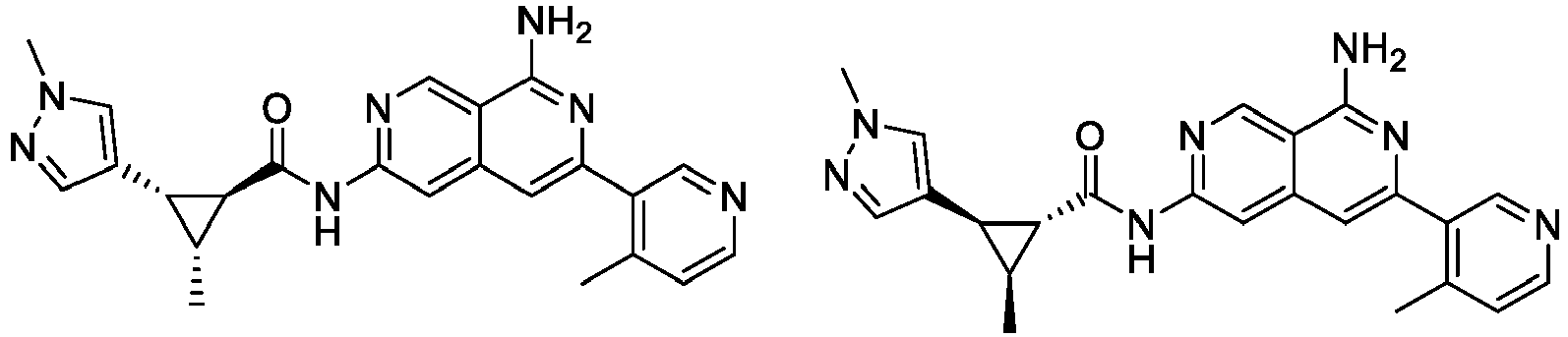

- To a solution of N-(8-amino-6-chloro-2,7-naphthyridin-3-yl)-2-methyl-3-(1-methyl-1H-pyrazol-4-yl)cyclopropane-1-carboxamide (550 mg, 1.54 mmol) in dioxane (16 mL) / water (4 mL) was added (4-methylpyridin-3-yl)boronic acid (422 mg, 3.08 mmol), KOAc (454 mg, 4.62 mmol), 2nd generation XPhos precatalyst (121 mg, 0.15 mmol) and XPhos (147 mg, 0.31 mmol). The resulting solution was heated at 100 °C under nitrogen. After 2 h, the reaction was concentrated under vacuum, and the resulting residue was purified by silica gel chromatography (15:1 dichloromethane / methanol) followed by chiral-Prep-HPLC. Compound 326: LCMS (ESI): RT (min) = 1.98, [M+H]+ = 414.2, method = K-1; 1H NMR (400 MHz, CD3OD) δ 9.29 (s, 1H), 8.53 (s, 1H), 8.43 - 8.41 (m, 1H), 8.32 (s, 1H), 7.50 (s, 1H), 7.40 - 7.38 (m, 1H), 7.33 (s, 1H), 6.98 (s, 1H), 3.87 (s, 3H), 2.54 - 2.49 (m, 1H), 2.45 (s, 3H), 2.00 - 1.97 (m, 1H), 1.79 - 1.72 (m, 1H), 1.06 - 1.04 (m, 3H). (Pyrazole trans to amide; methyl relative stereochemistry arbitrarily assigned; Absolute stereochemistry arbitrarily assigned). Compound 327: LCMS (ESI): [M+H]+ = 414.2; RT (min) = 1.09 min, method = K-1; 1H NMR (400 MHz, CD3OD) δ 9.28 (s, 1H), 8.54 (s, 1H), 8.43 - 8.41 (m, 1H), 8.34 (s, 1H), 7.45 (s, 1H), 7.40 - 7.38 (m, 1H), 7.33 (s, 1H), 6.99 (s, 1H), 3.84 (s, 3H), 2.45 (s, 3H), 2.31 - 2.35 (m, 1H), 2.14 - 2.18 (m, 1H), 1.63- 1.67(m, 1H), 1.33- 1.35 (m, 3H). (Pyrazole trans to amide; methyl relative stereochemistry arbitrarily assigned; Absolute stereochemistry arbitrarily assigned). Compound 328: LCMS (ESI): [M+H]+ = 414.2; RT (min) = 1.08, method = K-1; 1H NMR (400 MHz, CD3OD) δ 9.29 (s, 1H), 8.53 (s, 1H), 8.43 - 8.41 (m, 1H), 8.32 (s, 1H), 7.50 (s, 1H), 7.40 - 7.38 (m, 1H), 7.33 (s, 1H), 6.98 (s, 1H), 3.93 (s, 3H), 2.54 - 2.49 (m, 1H), 2.45 (s, 3H), 2.00 - 1.97 (m, 1H), 1.79 - 1.72 (m, 1H), 1.06 - 1.04 (m, 3H). (Pyrazole trans to amide; methyl relative stereochemistry arbitrarily assigned; Absolute stereochemistry arbitrarily assigned). Compound 329: LCMS (ESI): [M+H]+ = 414.2; RT (min) = 1.07, method = K-1; 1H NMR (400 MHz, CD3OD) δ 9.29 (s, 1H), 8.53 (s, 1H), 8.43 - 8.41 (m, 1H), 8.34 (s, 1H), 7.45 (s, 1H), 7.40 - 7.38 (m, 1H), 7.33 (s, 1H), 6.98 (s, 1H), 3.84 (s, 3H), 2.45 (s, 3H), 2.31 - 2.35 (m, 1H), 2.14 - 2.18 (m, 1H), 1.63- 1.67(m, 1H), 1.33- 1.35 (m, 3H). (Pyrazole trans to amide; methyl relative stereochemistry arbitrarily assigned; Absolute stereochemistry arbitrarily assigned).
-

-

- A mixture of 4-iodo-1H-pyrazole (10.00 g, 51.553 mmol), 1-chloro-2-methoxyethane (14.62 g, 154.64 mmol), potassium hydroxide (5.78 g, 103.02 mmol), and KBr (610 mg, 5.12 mmol) in ethanol (200 mL) was heated at 100 °C. After 16 h, the mixture was concentrated under vacuum, and the resulting residue was purified by silica gel chromatography (95:5 dichloromethane / methanol) to afford 4-iodo-1-(2-methoxyethyl)-1H-pyrazole (12 g, 92%) as a yellow oil. LCMS (ESI): [M+H] +=292.95.
-

- A mixture of 4-iodo-1-(2-methoxyethyl)-1H-pyrazole (11.0 g, 43.6 mmol), methyl prop-2-enoate (15.03 g, 174.5 mmol), Pd(OAc)2 (1.47 g, 6.54 mmol), P(p-Tol)3 (3.98 g, 13.1 mmol), and triethylamine (26.5 g, 262 mmol) in CH3CN (200 mL) was heated at 110 °C under nitrogen. After 2 h, the reaction was concentrated under vacuum, and the residue was purified by silica gel chromatography 3:2 ethyl acetate / petroleum ether) to provide methyl (2E)-3-[1-(2-methoxyethyl)-1H-pyrazol-4-yl]prop-2-enoate (6.95 g, 76%) as a yellow oil. LCMS (ESI): [M+H]+=211.15.
-

- A freshly prepared solution of diazomethane in ether was added to an ice-cooled mixture of (2E)-3-[1-(2-methoxyethyl)-1H-pyrazol-4-yl]prop-2-enoate (0.50 g, 2.37 mmol), Pd(OAc)2 (53 mg, 0.23 mmol) in dichloromethane (40 mL). After 30 min, the reaction was quenched with acetic acid (1 mL) and concentrated. The resulting residue was diluted with water, and the aqueous solution was extracted with ethyl acetate. The collected organic was washed with saturated aqueous NaHCO3 solution, dried over Na2SO4, filtered, and concentrated to afford crude trans-methyl 2-[1-(2-methoxyethyl)-1H-pyrazol-4-yl]cyclopropane-1-carboxylate (230 mg) as a light brown oil. LCMS (ESI): [M+H] +=225.2.
-

- A mixture of trans-2-[1-(2-methoxyethyl)-1H-pyrazol-4-yl]cyclopropane-1-carboxylate (1.3 g, 5.8 mmol), LiOH•H2O (1.46 g, 34.8 mmol) in tetrahydrofuran (5 mL) / water (5 mL) was stirred for 3 h at 25 °C. The reaction was concentrated under vacuum, and the residue was dissolved with water. The aqueous solution was acidified to pH = 3 with hydrochloric acid. The acidic solution was extracted with ethyl acetate. The combined organic layers were concentrated under vacuum to afford crude trans-2-[1-(2-methoxyethyl)-1H-pyrazol-4-yl]cyclopropane-1-carboxylic acid (1.0 g, 82%) as a yellow solid. LCMS (ESI): [M+H]+ = 211.10.
-

- To an ice-cooled solution of trans-2-[1-(2-methoxyethyl)-1H-pyrazol-4-yl]cyclopropane-1-carboxylic acid (0.90 g, 4.28 mmol), 6,8-dichloro-2,7-naphthyridin-3-amine hydrochloride (896 mg, 3.58 mmol) and pyridine (4 mL) in dichloromethane (20 mL) was added POCl3 (2.73 g, 17.8 mmol). The solution was warmed to 25 °C. After 1 h, saturated aqueous sodium bicarbonate solution (100 mL) was added to the reaction, and the mixture was extracted with dichloromethane. The combined organic layers were dried over Na2SO4, filtered, and concentrated under vacuum. Purification by flash solumn chromatography (97:3 dichloromethane / methanol) to afford trans-N-(6,8-dichloro-2,7-naphthyridin-3-yl)-2-[1-(2-methoxyethyl)-1H-pyrazol-4-yl]cyclopropane-1-carboxamide (0.70 g, 48%) as a yellow solid. LCMS (ESI): [M+H]+ = 405.9.
-

- A mixture ofN-(6,8-dichloro-2,7-naphthyridin-3-yl)-2-[1-(2-methoxyethyl)-1H-pyrazol-4-yl]cyclopropane-1-carboxamide (0.60 g, 1.47 mmol) and NH4OH (18 mL) in dioxane (18 mL) was heated at 100 °C. After 4 h, the mixture was concentrated under vacuum to afford crude trans-N-(8-amino-6-chloro-2,7-naphthyridin-3-yl)-2-[1-(2-methoxyethyl)-1H-pyrazol-4-yl]cyclopropane-1-carboxamide (0.60 g) as a light yellow solid, LCMS (ESI): [M+H] +=387.10.
-

- A mixture of trans-N-(8-amino-6-chloro-2,7-naphthyridin-3-yl)-2-[1-(2-methoxyethyl)-1H-pyrazol-4-yl]cyclopropane-1-carboxamide (550 mg, 1.42 mmol), (4-methylpyridin-3-yl)boronic acid (389 mg, 2.84 mmol), potassium carbonate (786 mg, 5.68 mmol), Pd(dppf)Cl2 (116 mg, 0.14 mmol) in dioxane (20 mL) / water(4 mL) was heated at 100 °C under nitrogen. After 3 h, the mixture was concentrated under vacuum. Purification by Prep-HPLC afforded trans-N-[8-amino-6-(4-methylpyridin-3-yl)-2,7-naphthyridin-3-yl]-2-[1-(2-methoxyethyl)-1H-pyrazol-4-yl]cyclopropane-1-carboxamide (270 mg) as a white solid. The enantiomers were separated by chiral-Prep-HPLC. Compound 330: LCMS (ESI): [M+H]+ = 444.2; RT (min) = 1.06, method = K-1; 1H NMR (300 MHz, DMSO-d 6) δ 10.97 (s, 1H), 9.38 (s, 1H), 8.57 (s, 1H), 8.45 (d, J = 6.0 Hz, 1H), 8.26 (s, 1H), 7.59 (s, 1H), 7.41 (s, 2H), 7.38 - 7.22 (m, 2H), 6.99 (s, 1H), 4.17 (t, J = 6.0 Hz, 2H), 3.64 (t, J = 6.0 Hz, 2H), 3.22 (s, 3H), 2.41 (s, 3H), 2.22 (t, J= 6.0 Hz, 2H), 1.52 - 1.33 (m, 1H), 1.23 - 1.27 (m, 1H). Compound 331: LCMS (ESI): [M+H]+ = 444.2; RT (min) = 1.05, method = K-1; 1H NMR (300 MHz, DMSO-d 6) δ 10.97 (s, 1H), 9.38 (s, 1H), 8.57 (s, 1H), 8.45 (d, J = 6.0 Hz, 1H), 8.26 (s, 1H), 7.59 (s, 1H), 7.41 (s, 2H), 7.38 - 7.22 (m, 2H), 6.99 (s, 1H), 4.17 (t, J = 6.0 Hz, 2H), 3.64 (t, J = 6.0 Hz, 2H), 3.22 (s, 3H), 2.41 (s, 3H), 2.22 (t, J = 6.0 Hz, 2H), 1.52 - 1.33 (m, 1H), 1.23 - 1.27 (m, 1H).
-

-

- A mixture of trans-N-(8-amino-6-chloro-2,7-naphthyridin-3-yl)-2-(1-methyl-1H-pyrazol-4-yl)cyclopropane-1-carboxamide (280 mg, 0.82 mmol), 1H,3H,4H-[1,2]oxaborinino[3,4-c]pyridin-1-ol (183 mg, 1.23 mmol), XPhos (78 mg, 0.16 mmol), XPhos-PdCl-2nd G (63 mg, 0.08 mmol), and KOAc (241 mg, 2.46 mmol) in dioxane (10 mL) / water(1 mL) was heated at 110 °C under nitrogen. After 15 h, the solids were filtered, and the filtrate was concentrated under vacuum. Purification by silica gel chromatography (15: 1 dichloromethane / methanol) afforded trans-N-[8-amino-6-[4-(2-hydroxyethyl)pyridin-3-yl]-2,7-naphthyridin-3-yl]-2-(1-methyl-1H-pyrazol-4-yl)cyclopropane-1-carboxamide (61 mg, 17%) as a yellow solid. LCMS (ESI): [M+H]+ = 430.3.
-

- A mixture of trans-N-[8-amino-6-[4-(2-hydroxyethyl)pyridin-3-yl]-2,7-naphthyridin-3-yl]-2-(1-methyl-1H-pyrazol-4-yl)cyclopropane-1-carboxamide (79 mg, 0.18 mmol) and NCS (49 mg, 0.37 mmol) in N,N-dimethylformamide (6 mL) was stirred for 5 h at 25 °C. The reaction was concentrated, and the crude product was purified by Prep-HPLC to afford trans-N-[8-amino-5-chloro-6-[4-(2-hydroxyethyl)pyridin-3-yl]-2,7-naphthyridin-3-yl]-2-(1-methyl-1H-pyrazol-4-yl)cyclopropane-1-carboxamide (3 mg, 4%) as a yellow solid. The enantiomers were separated by chiral-Prep-HPLC. Compound 332: LCMS (ESI): [M+H]+ = 464.2, RT (min) = 1.09, method = K-1; 1H NMR (400 MHz, CD3OD) δ 9.36 (s, 1H), 8.74 (s, 1H), 8.59 (d, J = 8.0 Hz, 1H), 8.53 (s, 1H), 7.65 (d, J = 8.0 Hz, 1H), 7.51 (s, 1H), 7.38 (s, 1H), 3.86 (s, 3H), 3.75 (t, J = 8.0 Hz, 2H), 2.89 (t, J = 8.0 Hz, 2H), 2.44 - 2.39 (m, 1H), 2.16 - 2.12 (m, 1H), 1.62 - 1.58 (m, 1H), 1.32 - 1.27 (m, 1H). Compound 333: LCMS (ESI): [M+H]+ = 464.2, RT (min) = 1.09, method = K-1. 1H NMR (400 MHz, CD3OD) δ 9.36 (s, 1H), 8.74 (s, 1H), 8.59 (d, J = 8.0 Hz, 1H), 8.53 (s, 1H), 7.65 (d, J = 8.0 Hz, 1H), 7.51 (s, 1H), 7.38 (s, 1H), 3.86 (s, 3H), 3.75 (t, J = 8.0 Hz, 2H), 2.89 (t, J = 8.0 Hz, 2H), 2.44 - 2.39 (m, 1H), 2.16 - 2.12 (m, 1H), 1.62 - 1.58 (m, 1H), 1.32 - 1.27 (m, 1H).
-
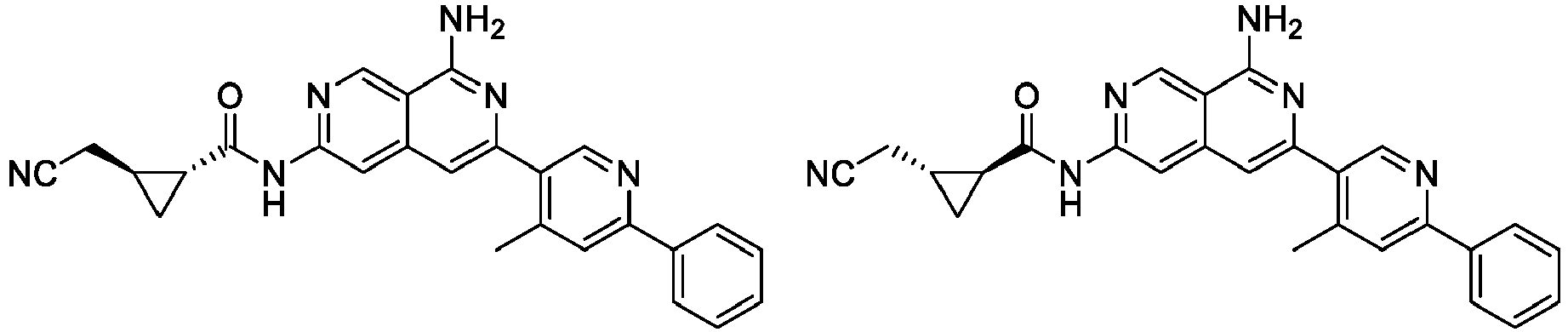
-

- A mixture of 2,5-dibromo-4-methylpyridine (2.0 g, 8.0 mmol), phenylboronic acid (1.069 g, 8.77 mmol), Pd(PPh3)4 (921 mg, 0.79 mmol), and potassium carbonate (3.3 g, 23.87 mmol) in water (10 mL) / 1,2-dimethoxyethane (40 mL) was heated at 90 °C under nitrogen. After 12 h, the reaction mixture was diluted with H2O, and the resulting solution was extracted with ethyl acetate. The combined extracts were dried over Na2SO4, filtered, and concentrated under vacuum. Purification by flash column chromatography (1% ethyl acetate in petroleum ether) provided 5-bromo-4-methyl-2-phenylpyridine (1.78 g, 90%) as a colorless oil. LCMS (ESI): [M+H]+ = 248.0.
-

- A mixture of 5-bromo-4-methyl-2-phenylpyridine (1.68 g, 6.77 mmol), 4,4,5,5-tetramethyl-2-(tetramethyl-1,3,2-dioxaborolan-2-yl)-1,3,2-dioxaborolane (5.16 g, 20.3 mmol), Pd(dppf)Cl2 (494 g, 675 mmol), and KOAc (1.99 g, 20.3 mmol) in dioxane (30 mL) was heated at 100 °C under nitrogen. After 3 h, the solids were filtered, and the filtrate was concentrated under vacuum. Purification by flash column chromatography (1:5 ethyl acetate / petroleum ether) gave (4-methyl-6-phenylpyridin-3-yl)boronic acid (1.25 g, 87%) as a light brown solid.
LCMS (ESI): M+H+ = 214.1. -

- A mixture of trans-N-(8-amino-6-chloro-2,7-naphthyridin-3-yl)-2-(cyanomethyl)cyclopropane-1-carboxamide (0.30 g, 0.99 mmol), (4-methyl-6-phenylpyridin-3-yl)boronic acid (852 mg, 3.99 mmol), XPhos palladium(II) biphenyl-2-amine chloride (79 mg, 0.10 mmol), X-Phos (48 mg, 0.10 mmol), and potassium carbonate (414 mg, 2.99 mmol) in water (2 mL) / dioxane (10 mL) was heated at 100 °C under nitrogen. After 1 h, the solids were filtered, and the filtrate was concentrated under vacuum. Purification by Prep-HPLC gave trans-N-[8-amino-6-(4-methyl-6-phenylpyridin-3-yl)-2,7-naphthyridin-3-yl]-2-(cyanomethyl)cyclopropane-1-carboxamide (50 mg, 12%) as a white solid. The enantiomers were separated by chiral-Prep-HPLC. Compound 334: LCMS (ESI): [M+H]+ = 435.2; RT (min) = 1.37, method = K-1; 1H NMR (300 MHz, CD3OD) δ 9.31 (s, 1H), 8.62 (s, 1H), 8.32 (s, 1H), 8.02 - 7.98 (m, 2H), 7.82 (s, 1H), 7.56 - 7.54 (m, 3H), 7.03 (s, 1H), 2.79 - 2.69 (m, 2H), 2.54 (s, 3H), 2.06 - 2.00 (m, 1H), 1.97 - 1.72 (m, 1H), 1.39 - 1.31 (m, 1H), 1.09 - 1.02 (m, 1H). Compound 335: LCMS (ESI): [M+H]+ = 435.2; RT (min) = 1.37, method = K-1; 1H NMR (300 MHz, CD3OD) δ 9.31 (s, 1H), 8.62 (s, 1H), 8.32 (s, 1H), 8.02 - 7.98 (m, 2H), 7.82 (s, 1H), 7.56 - 7.54 (m, 3H), 7.03 (s, 1H), 2.79 - 2.69 (m, 2H), 2.54 (s, 3H), 2.06 - 2.00 (m, 1H), 1.97 - 1.72 (m, 1H), 1.39 - 1.31 (m, 1H), 1.09 - 1.02 (m, 1H).
-

- To a solution of spiro[2.2]pentane-1-carboxylic acid (32 mg, 0.0272 mmol), N1,N1-bis(2,4-dimethoxybenzyl)-3-(4-methylpyridin-3-yl)-2,7-naphthyridine-1,6-diamine (150 mg, 0.272 mmol) in pyridine (2.7 mL) was added POCl3 (0.050 mL, 0.54 mmol). After 2 days, saturated aqueous sodium bicarbonate solution was added to the reaction, and the mixture was extracted with dichloromethane. The combined organic was dried over MgSO4, filtered, and concentrated under vacuum. Purification by flash column chromatography (100:0 - 95:5 dichloromethane / methanol) to afford the intermediate compound, which was dissolved in a mixture of dichloromethane (3 mL) and TFA (0.2 mL). The reaction was stirred for 20 h, neutralized with ammonia in methanol (7 M), the solvent removed and the residue purified by HPLC to afford the target compound as a white solid (7.9 mg, 5% over 2 steps); 1H NMR (400 MHz, DMSO-d 6) δ 10.75 (s, 1H), 9.35 (s, 1H), 8.56 (s, 1H), 8.43 (d, J = 5.0 Hz, 1H), 8.26 (s, 1H), 7.28 (br s, 2H), 7.33 - 7.21 (m, 1H), 6.95 (s, 1H), 2.43 - 2.40 (m, 1H), 2.41 (s, 3H), 1.42 (t, J = 3.8 Hz, 1H), 1.35 (dd, J = 7.4, 3.4 Hz, 1H), 0.95 - 0.73 (m, 4H).
-

-

- To a solution of tert-butyl (8-(bis(2,4-dimethoxybenzyl)amino)-6-chloro-2,7-naphthyridin-3-yl)carbamate (200 mg, 0.336 mmol) in DMF (1.7 mL) was added 1-bromomethyl-2,2-difluorocyclopropane (182 mg, 1.01 mmol). The reaction mixture was stirred under nitrogen at 80 °C for 3 h. The reaction mixture was diluted with dichloromethane and filtered. After concentration, onto the crude intermediate residue was weighed 4-methyl-3-(4,4,5,5-tetramethyl-1,3,2-dioxaborolan-2-yl)pyridine (81.0 mg, 0.370 mmol), chloro(2-dicyclohexylphosphino-2',4',6'-triisopropyl-1,1'-biphenyl)[2-(2'-amino-1,1'-biphenyl)]palladium(II) (14.2 mg, 0.0168 mmol), 2-dicyclohexylphosphino-2',4',6'-triisopropylbiphenyl (8.2 mg, 0.018 mmol), and potassium carbonate (139 mg, 1.01 mmol). The vial was purged with nitrogen gas, charged with degassed tetrahydrofuran (1.7 mL) and distilled water (0.3 mL), then sealed, and the reaction mixture was stirred at 80 °C for 1 h. After cooling to rt, the mixture was concentrated to dryness. The reaction residue thus obtained was purified by flash column chromatography (heptane/iPrOAc, 100:0-0:100) to afford the title compound as a yellow foam (175 mg, 70% over 2 steps); 1H NMR (400 MHz, Chloroform-d) δ 9.25 (s, 1H), 8.57 (s, 1H), 8.43 (d, J = 5.0 Hz, 1H), 7.88 (s, 1H), 7.24 - 7.19 (m, 2H), 7.11 (d, J = 5.1 Hz, 1H), 7.08 (s, 1H), 6.45 - 6.37 (m, 4H), 4.78 (s, 4H), 4.24 - 4.11 (m, 2H), 3.79 (s, 6H), 3.64 (s, 6H), 2.21 (s, 3H), 2.15 - 2.04 (m, 1H), 1.56 (s, 9H), 1.44 - 1.26 (m, 2H).
-

- To a solution of (±)-tert-butyl (8-(bis(2,4-dimethoxybenzyl)amino)-6-(4-methylpyridin-3-yl)-2,7-naphthyridin-3-yl)((2,2-difluorocyclopropyl)methyl)carbamate (175 mg, 0.236 mmol) in dichloromethane (0.7 mL) was added trifluoroacetic acid (0.7 mL) and the mixture was stirred at rt for 22 h. Then, 0.4 mL trifluoroacetic acid was added and the mixture stirred at 40 °C for 22 h. The mixture was concentrated to dryness and then purified by HPLC to afford the target compound as a yellow solid (60.3 mg, 75%); 1H NMR (400 MHz, DMSO-d 6) δ 9.20 (s, 1H), 8.54 (s, 1H), 8.46 (d, J = 5.0 Hz, 1H), 7.33 (d, J = 5.0 Hz, 1H), 7.25 (br s, 2H), 6.75 (s, 1H), 6.51 (s, 1H), 3.53 - 3.39 (m, 2H), 2.38 (s, 3H), 2.14 - 1.98 (m, 1H), 1.66 - 1.52 (m, 1H), 1.39 - 1.28 (m, 1H).
-

- Procedure was the same as for (±)-N6-((2,2-difluorocyclopropyl)methyl)-3-(4-methylpyridin-3-yl)-2,7-naphthyridine-1,6-diamine (Compound 337), except that 1,1-difluoro-2-iodoethane was used as alkylating agent, and the reaction was carried directly forward into the Suzuki reaction and deprotection. Thus, reaction of tert-butyl (8-(bis(2,4-dimethoxybenzyl)amino)-6-chloro-2,7-naphthyridin-3-yl)carbamate (162 mg, 0.272 mmol) afforded the target compound as a white solid (58.9 mg, 68% over 3 steps); 1H NMR (400 MHz, DMSO-d 6) δ 9.14 (s, 1H), 8.52 (s, 1H), 8.41 (d, J = 5.0 Hz, 1H), 7.28 (d, J = 5.0 Hz, 1H), 7.14 (t, J = 6.4 Hz, 1H), 7.04 (br s, 2H), 6.69 (s, 1H), 6.56 (s, 1H), 6.13 (tt, J = 56.3, 4.0 Hz, 1H), 3.84 - 3.69 (m, 2H), 2.39 (s, 3H).
-

-
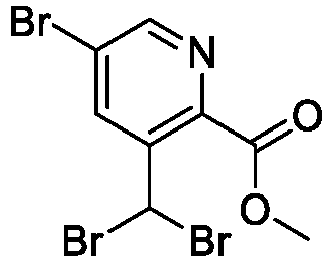
- To a solution of N-bromosuccinimide (20.89 g, 117.4 mmol) and benzoylperoxide (2.84g, 11.74mmol) in carbon tetrachloride (150 mL) was added methyl 5-bromo-3-methylpyridine-2-carboxylate (9.0 g, 39 mmol). The mixture was stirred at 80 C for 16 h under nitrogen. The solution was then concentrated and the residue was purified by flash chromatography (5%-10%-20% ethyl acetate in petroleum ether) to afford methyl 5-bromo-3-(dibromomethyl)pyridine-2-carboxylate as a yellow oil (12 g, 79% yield); LCMS (ESI) [M+H]+ = 385.8.
-
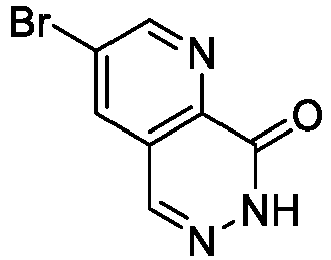
- To a solution of methyl 5-bromo-3-(dibromomethyl) pyridine-2-carboxylate (1.0 g, 2.58 mmol) in ethanol (15mL) was added of hydrazine hydrate (0.77 mL, 15.47 mmol). The reaction mixture was stirred at 80 °C for 1.5h and then cooled to 15 °C. The solids were filtered, washed with MeOH and dried to give one batch of desired product. The filtrate was concentrated and triturated with MeOH. The solids were filtered, rinsed with MeOH and dried to give another batch desired product. The two batches were combined to give 3-bromo-7H-pyrido[2,3-d]pyridazin-8-one as a yellow solid (500 mg, 2.2121 mmol, 86% yield); LCMS (ESI) [M+H]+ = 226.0.
-

- To a suspension of 3-bromo-7H-pyrido[2,3-d]pyridazin-8-one (500 mg, 2.21 mmol) and cesium carbonate (2.52 g, 7.74 mmol) in N,N-Dimethylformamide (5 mL) at 0 °C was added iodomethane (0.59 mL, 9.51 mmol). The reaction mixture was stirred at 15 °C for 16 h. The solvent was removed and the residue was diluted with water (15 mL). The suspension was extracted with ethyl acetate (15 mL × 4). The organic layers were washed with brine, dried over sodium sulfate, filtered and concentrated to afford 3-bromo-7-methyl-pyrido[2,3-d]pyridazin-8-one as a yellow solid (140 mg, 26% yield); LCMS (ESI) [M+H]+ = 240.0.
-

- Into a vial was weighed 3-bromo-7-methylpyrido[2,3-d]pyridazin-8(7H)-one (80.0 mg, 0.333 mmol), [1,1'-bis(diphenylphosphino)ferrocene]dichloropalladium(II)-dichloromethane complex (13.9 mg, 0.0167 mmol), bis(pinacolato)diboron (102 mg, 0.400 mmol), and potassium acetate (98.1 mg, 1.00 mmol). Under nitrogen, anhydrous 1,4-dioxane (1.7 mL) was added and the vial was sealed. The reaction mixture was stirred at 100 °C for 3 days. After cooling to rt, under nitrogen, to the reaction vessel was added (±)-(trans)-N-(8-(bis(2,4-dimethoxybenzyl)amino)-6-chloro-2,7-naphthyridin-3-yl)-2-(1-methyl-1H-pyrazol-4-yl)cyclopropane-1-carboxamide (214 mg, 0.333 mmol), chloro(2-dicyclohexylphosphino-2',4',6'-triisopropyl-1,1'-biphenyl)[2-(2'-amino-1,1'-biphenyl)]palladium(II) (14.1 mg, 0.0168 mmol), 2-dicyclohexylphosphino-2',4',6'-triisopropylbiphenyl (8.1 mg, 0.0168 mmol), and potassium phosphate tribasic monohydrate (237 mg, 1.00 mmol), and water (0.3 mL). The vial was sealed and stirred at 100 °C for 2 h. The reaction mixture was concentrated to dryness and residue purified by flash column chromatography (CH2Cl2/MeOH, 100:0-90:10). The crude compound thus obtained was then dissolved in thioanisole (0.4 mL) and trifluoroacetic acid added (1.7 mL). After stirring for 18 h, the mixture was concentrated and purified by HPLC to afford the target compound as a yellow solid (68.0 mg, 44% over 2 steps); 1H NMR (400 MHz, DMSO-d 6) δ 11.01 (s, 1H), 9.77 (d, J = 2.3 Hz, 1H), 9.41 (s, 1H), 9.00 (d, J = 2.3 Hz, 1H), 8.50 (s, 1H), 8.37 (s, 1H), 7.75 (s, 1H), 7.57 (s, 1H), 7.50 (s, 2H), 7.30 (s, 1H), 3.78 (s, 3H), 3.77 (s, 3H), 2.28 - 2.18 (m, 2H), 1.46 - 1.36 (m, 1H), 1.28 - 1.15 (m, 1H).
-

-

- Into a vial was weighed methyl 5-bromo-4-methylpicolinate (1.00 g, 4.35 mmol), [1,1'-bis(diphenylphosphino)ferrocene]dichloropalladium(II)-dichloromethane complex (181 mg, 0.217 mmol), bis(pinacolato)diboron (1.21 g, 4.78 mmol), and potassium acetate (1.28 g, 13.0 mmol). Under nitrogen, anhydrous 1,4-dioxane (11 mL) was added and the vial was sealed. The reaction mixture was stirred at 100 °C for 18 h. After cooling to rt, the reaction mixture was concentrated and the residue purified by flash column chromatography (CH2Cl2/MeOH, 100:0-90:10) to afford 756 mg of crude aryl pinacolboranate intermediate (contaminated with pinacolborane by 1H NMR). Combining this intermediate (323 mg, ∼1.17 mmol) with (±)-(1S,2S)-N-(8-(bis(2,4-dimethoxybenzyl)amino)-6-chloro-2,7-naphthyridin-3-yl)-2-(1-methyl-1H-pyrazol-4-yl)cyclopropane-1-carboxamide (500 mg, 0.777 mmol), chloro(2-dicyclohexylphosphino-2',4',6'-triisopropyl-1,1'-biphenyl)[2-(2'-amino-1,1'-biphenyl)]palladium(II) (32.8 mg, 0.0389 mmol), 2-dicyclohexylphosphino-2',4',6'-triisopropylbiphenyl (18.9 mg, 0.0389 mmol), and potassium phosphate tribasic monohydrate (554 mg, 2.33 mmol) in a vial, tetrahydrofuran (3.9 mL) and water (0.7 mL) were added under nitrogen and the vial was sealed and stirred at 80 °C for 19 h. The reaction mixture still contained starting material and so an equal aliquot of catalyst, ligand and water, as well as potassium phosphate tribasic monohydrate (184 mg, 0.777 mmol) and crude aryl pinacolboranate (215 mg, -0.77 mmol) were added and stirred at 80 °C for 3 days. The mixture was concentrated to dryness and residue purified by flash column chromatography (CH2Cl2/MeOH, 100:0-90:10). The crude compound thus obtained was a yellow oil that contained the product according to HPLC-MS.
-

- To a solution of crude (±)-5-(1-(bis(2,4-dimethoxybenzyl)amino)-6-((trans)-2-(1-methyl-1H-pyrazol-4-yl)cyclopropane-1-carboxamido)-2,7-naphthyridin-3-yl)-4-methylpicolinic acid (100 mg, -0.13 mmol) and HATU (104 mg, 0.269 mmol) in DMF (0.5 mL) was added dimethylamine hydrochloride (16.4 mg, 0.201 mmol) and triethylamine (0.094 mL, 0.672 mmol). The reaction mixture was stirred for 18 h before being diluted with iPrOAc, washed with sat. NaHCO3 and dried over MgSO4. After concentration, the reaction residue obtained was purified by flash column chromatography (CH2Cl2/MeOH, 100:0-90:10) to afford 44 mg of crude amide, which was then dissolved in thioanisole (0.033 mL). To that solution was added TFA (0.300 mL), and stirred for 22 h, before being concentrated and purified by HPLC to afford the target compound as a white solid (9.6 mg, 36% over 2 steps); 1H NMR (400 MHz, DMSO-d 6) δ 10.96 (s, 1H), 9.38 (s, 1H), 8.58 (s, 1H), 8.25 (s, 1H), 7.56 (s, 1H), 7.48 (s, 1H), 7.34 (br s, 2H), 7.29 (s, 1H), 7.03 (s, 1H), 3.76 (s, 3H), 3.02 (s, 3H), 2.99 (s, 3H), 2.46 (s, 3H), 2.24 - 2.16 (m, 2H), 1.44 - 1.33 (m, 1H), 1.24 - 1.12 (m, 1H).
-

- Into a vial was weighed methyl 5-bromo-4-methylpicolinate (300 mg, 1.30 mmol), [1,1'-bis(diphenylphosphino)ferrocene]dichloropalladium(II)-dichloromethane complex (54.3 mg, 0.0652 mmol), bis(pinacolato)diboron (364 mg, 1.43 mmol), and potassium acetate (384 mg, 3.91 mmol). Under nitrogen, anhydrous 1,4-dioxane (6.5 mL) was added and the vial was sealed. The reaction mixture was stirred at 120 °C for 18 h. After cooling to rt, under nitrogen, to the reaction vessel was added (±)-(trans)-N-(8-amino-6-chloro-2,7-naphthyridin-3-yl)-2-(1-methyl-1H-pyrazol-4-yl)cyclopropane-1-carboxamide (447 mg, 1.30 mmol), [1,1'-bis(diphenylphosphino)ferrocene]dichloropalladium(II)-dichloromethane complex (54.3 mg, 0.0652 mmol), and potassium carbonate (540 mg, 3.91 mmol), and water (1.3 mL). The vial was sealed and stirred at 100 °C for 23 h. The reaction mixture was concentrated to dryness and residue purified by flash column chromatography (CH2Cl2/MeOH, 100:0-85:15) to afford the target compound as a brown solid (126 mg, 21% over 2 steps); 1H NMR (400 MHz, DMSO-d 6) δ 10.95 (s, 1H), 9.38 (s, 1H), 8.71 (s, 1H), 8.28 (s, 1H), 8.01 (s, 1H), 7.56 (s, 1H), 7.37 (br s, 2H), 7.29 (s, 1H), 7.05 (s, 1H), 3.91 (s, 3H), 3.77 (s, 3H), 2.25 - 2.16 (m, 2H), 1.90 (s, 3H), 1.43 - 1.34 (m, 1H), 1.24 - 1.14 (m, 1H).
-

- A solution of (±)-methyl 5-(1-amino-6-((1S,2S)-2-(1-methyl-1H-pyrazol-4-yl)cyclopropane-1-carboxamido)-2,7-naphthyridin-3-yl)-4-methylpicolinate (95.6 mg, 0.209 mmol) and lithium hydroxide hydrate (29.4 mg, 0.700 mmol) in tetrahydrofuran (2.1 mL) and water (0.7 mL) was stirred for 2 days. Hydrochloric acid in dioxane (0.162 mL, 0.648 mmol, 4.0 M) was added and the product precipitated from the reaction mixture and was collected by filtration, rinsing with iPrOAc and 1,4-dioxane to afford a grey solid (92.5 mg, 99%); 1H NMR (400 MHz, DMSO-d 6) δ 10.94 (s, 1H), 9.37 (s, 1H), 8.59 (s, 1H), 8.27 (s, 1H), 7.90 (s, 1H), 7.56 (s, 1H), 7.34 (br s, 2H), 7.29 (s, 1H), 7.01 (s, 1H), 3.77 (s, 3H), 2.46 (s, 3H), 2.25 - 2.16 (m, 2H), 1.43 - 1.34 (m, 1H), 1.23 - 1.13 (m, 1H).
-

-

- Into a vial was weighed 2,5-dibromo-4-methylpyridine (1.22 g, 4.84 mmol), 2-azetidinone (421 mg, 5.81 mmol), tris(dibenzylideneacetone)dipalladium(0) (111 mg, 0.121 mmol), 4,5-bis(diphenylphosphino)-9,9-dimethylxanthene (140 mg, 0.242 mmol), 3 Å molecular sieves (600 mg), and cesium carbonate (3.16 g, 9.69 mmol). Under a stream of nitrogen gas, the vessel was charged with anhydrous toluene (16 mL) and the vial was sealed. The reaction mixture was stirred at 120 °C for 19.5 h before cooling to rt. The reaction mixture was filtered through Celite rinsing with dichloromethane. After concentration, the crude residue was purified by flash chromatography (100:0 - 70:30 heptanes/iPrOAc) to afford the title compound as a white solid (828 mg, 71%); 1H NMR (400 MHz, Chloroform-d) δ 8.31 (s, 1H), 7.66 (s, 1H), 3.77 (dd, J = 4.7, 4.7 Hz, 2H), 3.12 (dd, J = 4.7, 4.7 Hz, 2H), 2.39 (s, 3H).
-

- Into a vial was weighed 1-(5-bromo-4-methylpyridin-2-yl)azetidin-2-one (50 mg, 0.207 mmol), [1,1'-bis(diphenylphosphino)ferrocene]dichloropalladium(II)-dichloromethane complex (8.6 mg, 0.0103 mmol), bis(pinacolato)diboron (52.7 mg, 0.207 mmol), and potassium acetate (61.1 mg, 0.622 mmol). Under nitrogen, anhydrous 1,4-dioxane (1.0 mL) was added and the vial was sealed. The reaction mixture was stirred at 100 °C for 17 h. After cooling to rt, under nitrogen, to the reaction vessel was added (±)-(1S,2S)-N-(8-amino-6-chloro-2,7-naphthyridin-3-yl)-2-(1-methyl-1H-pyrazol-4-yl)cyclopropane-1-carboxamide (71.1 mg, 0.207 mmol), chloro(2-dicyclohexylphosphino-2',4',6'-triisopropyl-1,1'-biphenyl)[2-(2'-amino-1,1'-biphenyl)]palladium(II) (8.8 mg, 0.0104 mmol), 2-dicyclohexylphosphino-2',4',6'-triisopropylbiphenyl (5.0 mg, 0.0104 mmol), potassium carbonate (86 mg, 0.622 mmol), and water (0.2 mL). The vial was sealed and stirred at 100 °C for 19 h. The reaction mixture was concentrated to dryness and residue purified by flash column chromatography (CH2Cl2/MeOH, 100:0-85:15) and then by HPLC to afford the target compound as a white solid (29.6 mg, 31% over 2 steps); 1H NMR (400 MHz, DMSO-d 6) δ 10.92 (s, 1H), 9.35 (s, 1H), 8.34 (s, 1H), 8.24 (s, 1H), 7.56 (s, 1H), 7.52 (s, 1H), 7.29 (s, 1H), 7.28 (br s, 2H), 6.93 (s, 1H), 3.77 (s, 3H), 3.73 (dd, J = 4.7, 4.7 Hz, 2H), 3.12 (dd, J = 4.7, 4.7 Hz, 2H), 2.44 (s, 3H), 2.24 - 2.17 (m, 2H), 1.43 - 1.33 (m, 1H), 1.23 - 1.14 (m, 1H).
-

-

- Into a vial was weighed 2,5-dibromo-4-methylpyridine (300 mg, 1.20 mmol), 1-Methyl-1H-pyrazole-3-boronic acid pinacol ester (251 mg, 1.20 mmol), [1,1'-bis(diphenylphosphino)ferrocene]dichloropalladium(II)-dichloromethane complex (49.3 mg, 0.0600 mmol), and sodium carbonate (380 mg, 3.59 mmol) . Under nitrogen, anhydrous 1,4-dioxane (6.0 mL) and water (1.2 mL) was added and the vial was sealed. The reaction mixture was stirred at 100 °C for 18 h. After cooling to rt, the reaction mixture was concentrated and the residue purified by flash column chromatography (100:0 - 40:60 heptanes/iPrOAc) to afford the target compound as a white solid (144 mg, 48%); 1H NMR (400 MHz, Chloroform-d) δ 8.62 (s, 1H), 7.81 (s, 1H), 7.40 (d, J = 2.4 Hz, 1H), 6.84 (d, J = 2.4 Hz, 1H), 3.97 (s, 3H), 2.43 (s, 3H).
-

- Procedure was the same as for (±)- (trans)-N-(8-amino-6-(4-methyl-6-(2-oxoazetidin-1-yl)pyridin-3-yl)-2,7-naphthyridin-3-yl)-2-(1-methyl-1H-pyrazol-4-yl)cyclopropane-1-carboxamide (Compound 343) except that 5-bromo-4-methyl-2-(1-methyl-1H-pyrazol-3-yl)pyridine (53 mg, 0.210 mmol) was used as starting material, affording the target compound as a white solid (27.3 mg, 27% over 2 steps); 1H NMR (400 MHz, DMSO-d 6) δ 10.93 (s, 1H), 9.36 (s, 1H), 8.56 (s, 1H), 8.26 (s, 1H), 7.83 (s, 1H), 7.78 (d, J = 2.1 Hz, 1H), 7.56 (s, 1H), 7.30 (br s, 2H), 7.29 (d, J = 2.1 Hz, 1H), 7.00 (s, 1H), 6.81 (s, 1H), 3.93 (s, 3H), 3.77 (s, 3H), 2.47 (s, 3H), 2.26 - 2.14 (m, 2H), 1.45 - 1.32 (m, 1H), 1.28 - 1.15 (m, 1H).
-

-

- To a stirring solution of pyrazole (81.4 mg, 1.20 mmol) in anhydrous DMF (2.4 mL) was added sodium hydride (71.7 mg, 1.79 mmol, [60% in mineral oil]). After 20 min, 2,5-dibromo-4-methylpyridine (300 mg, 1.19 mmol) was added and the vial sealed. The reaction mixture was stirred at 100 °C for 20.5 h and then cooled to rt, diluted with isopropyl acetate, washed with water (1x), brine (1x), and dried over magnesium sulfate. Following concentration, the crude residue was subjected to flash column chromatography (100:0 - 95:5 heptanes/iPrOAc) to afford the title compound as a white solid (141 mg, 49%);1H NMR (400 MHz, Chloroform-d) δ 8.51 (d, J = 2.7 Hz, 1H), 8.42 (s, 1H), 7.90 (s, 1H), 7.73 (d, J = 1.8 Hz, 1H), 6.46 (dd, J = 2.7, 1.8 Hz 1H), 2.47 (s, 3H).
-
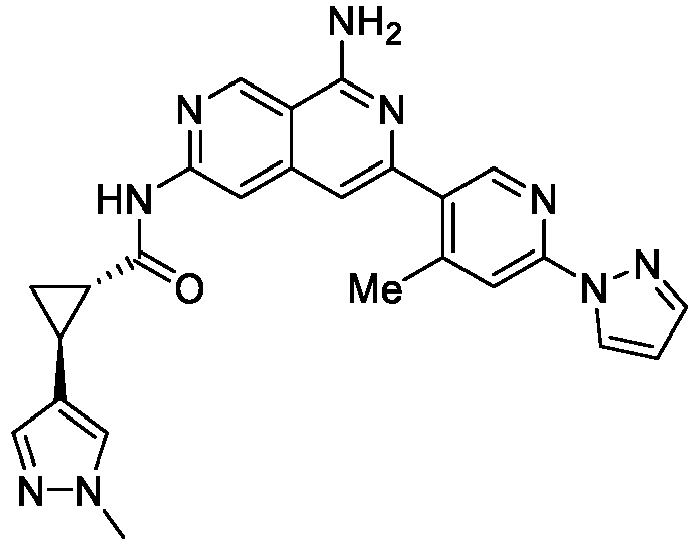
- Procedure was the same as for (±)- (trans)-N-(8-amino-6-(4-methyl-6-(2-oxoazetidin-1-yl)pyridin-3-yl)-2,7-naphthyridin-3-yl)-2-(1-methyl-1H-pyrazol-4-yl)cyclopropane-1-carboxamide (Compound 343) except that 5-bromo-4-methyl-2-(1H-pyrazol-1-yl)pyridine (50 mg, 0.210 mmol) was used as starting material, affording the target compound as a white solid (32.4 mg, 33% over 2 steps); 1H NMR (400 MHz, DMSO-d 6) δ 10.94 (s, 1H), 9.37 (s, 1H), 8.65 (d, J = 3.0 Hz, 1H), 8.48 (s, 1H), 8.27 (s, 1H), 7.88 (s, 1H), 7.85 (d, J = 3.0 Hz, 1H), 7.56 (s, 1H), 7.33 (br s, 2H), 7.29 (s, 1H), 7.03 (s, 1H), 6.60 (s, 1H), 3.77 (s, 3H), 2.54 (s, 3H), 2.25 - 2.16 (m, 2H), 1.43 - 1.34 (m, 1H), 1.23 - 1.16 (m, 1H).
-

- To a solution of (±)-5-(1-amino-6-((1S,2S)-2-(1-methyl-1H-pyrazol-4-yl)cyclopropane-1-carboxamido)-2,7-naphthyridin-3-yl)-4-methylpicolinic acid (37.1 mg, 0.0837 mmol) and HATU (64.9 mg, 0.167 mmol) in DMF (0.8 mL) was added methylamine hydrochloride (11.3 mg, 0.167 mmol) and triethylamine (0.070 mL, 0.50 mmol). The reaction mixture was stirred for 18 h before being diluted with dichloromethane, washed with sat. NaHCO3 and dried over MgSO4. After concentration, the reaction residue obtained was purified by flash column chromatography (CH2Cl2/MeOH, 100:0-85:15) and HPLC to afford the target compound as a white solid (10.2 mg, 27%); 1H NMR (400 MHz, DMSO-d 6) δ 10.95 (s, 1H), 9.38 (s, 1H), 8.79 (q, J = 4.9 Hz, 1H), 8.61 (s, 1H), 8.27 (s, 1H), 7.96 (s, 1H), 7.56 (s, 1H), 7.36 (br s, 2H), 7.29 (s, 1H), 7.04 (s, 1H), 3.77 (s, 3H), 2.84 (d, J = 4.9 Hz, 3H), 2.26 - 2.16 (m, 2H), 1.43 - 1.32 (m, 1H), 1.23 - 1.15 (m, 1H).
-

- Into a vial was weighed (±)-(1S,2S)-N-(8-amino-6-chloro-2,7-naphthyridin-3-yl)-2-(1-methyl-1H-pyrazol-4-yl)cyclopropane-1-carboxamide (60.0 mg, 0.175 mmol), 5-(4,4,5,5-tetramethyl-1,3,2-dioxaborolan-2-yl)-3-(trifluoromethyl)pyridin-2-amine (50.4 mg, 0.175 mmol), chloro(2-dicyclohexylphosphino-2',4',6'-triisopropyl-1,1'-biphenyl)[2-(2'-amino-1,1'-biphenyl)]palladium(II) (7.4 mg, 0.0088 mmol), 2-dicyclohexylphosphino-2',4',6'-triisopropylbiphenyl (4.3 mg, 0.0088 mmol), and potassium carbonate (73 mg, 0.53 mmol). Under nitrogen, anhydrous tetrahydrofuran (0.9 mL) and water (0.2 mL) were added and the vial was sealed. The reaction mixture was stirred at 80 °C for 17 h. After cooling to rt, the reaction mixture was filtered through celite, rinsing with dichloromethane and methanol. After concentrating to dryness, the residue was purified by HPLC to afford the target compound as a white solid (17.2 mg, 21%); 1H NMR (400 MHz, DMSO-d 6) δ 10.87 (s, 1H), 9.28 (s, 1H), 8.98 (d, J = 2.3 Hz, 1H), 8.47 (d, J = 2.3 Hz, 1H), 8.24 (s, 1H), 7.56 (s, 1H), 7.42 (s, 1H), 7.29 (s, 1H), 7.28 (br s, 2H), 6.75 (br s, 2H), 3.77 (s, 3H), 2.26 - 2.15 (m, 2H), 1.44 - 1.30 (m, 1H), 1.24 - 1.16 (m, 1H).
-

- To a suspension of (±)-5-(1-amino-6-((1S,2S)-2-(1-methyl-1H-pyrazol-4-yl)cyclopropane-1-carboxamido)-2,7-naphthyridin-3-yl)-4-methylpicolinic acid (33.3 mg, 0.0751 mmol) in anhydrous dimethylsulfoxide (0.8 mL) was added potassium carbonate (21 mg, 0.11 mmol) and benzyl bromide (0.013 mL, 0.11 mmol). The reaction vessel was sealed and stirred at 80 °C for 24 h. The mixture was filtered and concentrated. Purification of the residue obtained by HPLC afforded the target compound as a yellow solid (8.3 mg, 21%); 1H NMR (400 MHz, DMSO-d 6) δ 10.95 (s, 1H), 9.38 (s, 1H), 8.71 (s, 1H), 8.27 (s, 1H), 8.04 (s, 1H), 7.56 (s, 1H), 7.53 - 7.47 (m, 2H), 7.45 - 7.34 (m, 5H), 7.29 (s, 1H), 7.04 (s, 1H), 5.41 (s, 2H), 3.77 (s, 3H), 2.25 - 2.16 (m, 2H), 1.45 - 1.33 (m, 1H), 1.26 - 1.16 (m, 1H).
-


-

- To a solution of 4-iodo-1-methyl-1H-pyrazole (20 g, 96.15 mmol) in N,N-dimethylformamide (100 mL) was added tert-butyl prop-2-enoate (40.6 g, 316.77 mmol), triethylamine (13.6 g, 134.40 mmol), palladium diacetate (3.23 g, 14.39 mmol) and tri(2-methylphenyl)phosphine (5.85 g, 19.22 mmol). The reaction was stirred for 16 h at 110 °C. The resulting mixture was cooled to room temperature and then concentrated under vacuum. The residue was purified on a silica gel column eluted with ethyl acetate/petroleum ether (1/2) to afford tert-butyl (2E)-3-(1-methyl-1H-pyrazol-4-yl)prop-2-enoate (14.5 g, 69.38 mmol) as a red oil. LCMS (ESI) [M+H]+ = 209.1.
-

- To a solution of ethyldiphenylsulfanium tetrafluoroboranuide (13.7 g, 45.34 mmol) in ethylene glycol dimethyl ether (150 mL) and dichloromethane (10 mL) was added LDA (23 ml, 2 mmol in THF) dropwise over 10 min at -65 °C. The reaction was stirred for 1 h at -65°C. A solution of tert-butyl (2E)-3-(1-methyl-1H-pyrazol-4-yl)prop-2-enoate (3 g, 14.41 mmol) in ethylene glycol dimethyl ether (5 mL) was added dropwised for 5 mins at -65 °C. The resulting solution was stirred for 5 h at room temperature. The reaction was quenched by the addition of water. The resulting mixture was extracted with dichloromethane and dried with anhydrous sodium sulfate. After filtration, the filtrate was concentrated under vacuum to afford trans-tert-butyl-2-methyl-3-(1-methyl-1H-pyrazol-4-yl)cyclopropane-1-carboxylate (4.5 g, crude) as a brown oil. LCMS (ESI) [M+H]+ = 237.1.
-
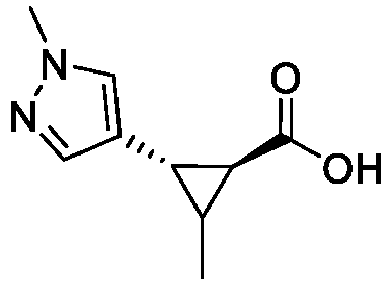
- A solution of trans-tert-butyl-2-methyl-3-(1-methyl-1H-pyrazol-4-yl)cyclopropane-1-carboxylate (4.5 g, 19.04 mmol) in trifluoroacetic acid (10 mL) and dichloromethane (10 mL) was stirred for 3 h at room temperature. The resulting mixture was concentrated under vacuum. The pH value of the solution was adjusted to pH 11 with 12% aqueous sodium hydroxide solution. The resulting solution was extracted with dichloromethane, and the aqueous layer was adjusted to pH 3 with 12% aqueous hydrogen chloride. The resulting solution was extracted with ethyl acetate, dried with anhydrous sodium sulfate. After filtration, the filtrate was concentrated under vacuum to afford trans-2-methyl-3-(1-methyl-1H-pyrazol-4-yl)cyclopropane-1-carboxylic acid (3 g, 16.57 mmol) as a light yellow oil. LCMS (ESI) [M+H]+ =181.1.
-

- To a solution of 1-N,1-N-bis[(2,4-dimethoxyphenyl)methyl]-3-(2-fluoro-6-methylphenyl)-2,7-naphthyridine-1,6-diamine (600 mg, 1.05 mmol), trans-2-methyl-3-(1-methyl-1H-pyrazol-4-yl)cyclopropane-1-carboxylic acid (247 mg, 1.37 mmol) in dichloromethane (20 mL) and pyridine (4 mL) was added POCl3 (323 mg, 2.10 mmol) over 5 mins at 0 °C. The reaction was stirred for 30 min at 25°C. The reaction was then quenched by the addition of water. The resulting solution was extracted with 3x100 mL of dichloromethane and the organic layers combined and dried over anhydrous sodium sulfate and concentrated under vacuum to afford trans-N-(8-[bis[(2,4-dimethoxyphenyl)methyl]amino]-6-(2-fluoro-6-methylphenyl)-2,7-naphthyridin-3-yl)-2-methyl-3-(1-methyl-1H-pyrazol-4-yl)cyclopropane-1-carboxamide(700 mg, 0.96 mmol) as a brown solid. LCMS (ESI) [M+H]+= 731.
-


- A mixture of trans-N-(8-[[(2,4-dimethoxyphenyl)methyl][(3,5-dimethoxyphenyl)methyl]amino]-6-(2-fluoro-6-methylphenyl)-2,7-naphthyridin-3-yl)-2-methyl-3-(1-methyl-1H-pyrazol-4-yl)cyclopropane-1-carboxamide (700 mg, 0.96 mmol) in trifluoroacetic acid (10 mL) was stirred for 1 h at 25 °C. The mixture was concentrated under vacuum. The reaction mixture was adjusted to pH 10 with ammonia in methanol (7 mol/L). The crude product was purified by Prep-HPLC (C18 OBD Column; 0.5% NH4HCO3 in water:ACN=30%-60% in 9 min) to afford trans-N-[8-amino-6-(2-fluoro-6-methylphenyl)-2,7-naphthyridin-3-yl]-2-methyl-3-(1-methyl-1H-pyrazol-4-yl)cyclopropane-1-carboxamide (400 mg, 0.93 mmol) as a white solid. The racemate was separated by chiral SFC to afford four isomers: (Cyclopropane stereochemistry for the isomers: pyrazole trans to amide; methyl relative stereochemistry arbitrarily assigned; All absolute stereochemistry arbitrarily assigned) Isomer 1: (109.1 mg, 0.25 mmol) as a white solid. Retention time: 1.823 min (Lux 3u Cellulose-3 100*4.6 mm, 2um; MeOH (20 nM NH3);4 mL/min); LCMS(ESI) [M+H]+= 431; 1H NMR (400 MHz,CD3OD) δ 9.31 (s, 1H), 8.29 (s, 1H), 7.51 (s, 1H), 7.40 (s, 1H), 7.33-7.31 (m, 1H), 7.13 (d, J = 7.6 Hz, 1H), 7.03 (t, J = 8.9 Hz, 1H), 6.86 (s, 1H), 3.88 (s, 3H), 2.53-2.50(m, 1H), 2.23 (s, 3H), 2.01-2.00 (m, 1H), 1.82-1.71 (m, 1H), 1.06 (d, J = 6.3 Hz, 3H); Isomer 2: (19.4 mg, 0.045 mmol) as a white solid. Retention time: 2.833 min (CHIRALPAK AD-3, 3*100 mm, 3um; ACN:EtOH =1:1(0.1%DEA);2 mL/min); LCMS(ESI) [M+H]+= 431; 1H NMR (400 MHz, CD3OD) δ 9.30 (s, 1H), 8.31 (s, 1H), 7.47 (s, 1H), 7.35-7.30 (m, 2H), 7.14 (d, J = 7.6 Hz, 1H), 7.04 (t, J = 8.8 Hz, 1H), 6.87 (s, 1H), 3.85 (s, 3H), 2.35-2.32 (m, 1H), 2.24 (s, 3H), 2.18-2.15 (m, 1H), 1.69-1.63 (m, 1H), 1.35 (d, J= 6.2 Hz, 3H); Isomer 3: (26.5 mg, 0.061 mmol) as a white solid. Retention time: 2.031 min (Lux 3u Cellulose-3 100*4.6 mm, 2um; MeOH (20 nM NH3);4 mL/min); LCMS(ESI) [M+H]+= 431; 1H NMR (400 MHz, CD3OD) δ 9.30 (s, 1H), 8.31 (s, 1H), 7.47 (s, 1H), 7.35-7.30 (m, 2H), 7.14 (d, J = 7.6 Hz, 1H), 7.04 (t, J = 8.8 Hz, 1H), 6.87 (s, 1H), 3.85 (s, 3H), 2.35-2.32 (m, 1H), 2.24 (s, 3H), 2.18-2.15 (m, 1H), 1.69-1.63 (m, 1H), 1.35 (d, J = 6.2 Hz, 3H); Isomer 4: (93.7 mg, 0.22 mmol) as a white solid. Retention time: 3.994 min (CHIRALPAK AD-3, 3*100 mm, 3um; ACN:EtOH =1:1(0.1%DEA);2 mL/min); LCMS(ESI) [M+H]+= 431; 1H NMR (400 MHz,CD3OD) δ 9.31 (s, 1H), 8.29 (s, 1H), 7.51 (s, 1H), 7.40 (s, 1H), 7.33-7.31 (m, 1H), 7.13 (d, J = 7.6 Hz, 1H), 7.03 (t, J = 8.9 Hz, 1H), 6.86 (s, 1H), 3.88 (s, 3H), 2.53-2.50(m, 1H), 2.23 (s, 3H), 2.01-2.00 (m, 1H), 1.82-1.71 (m, 1H), 1.06 (d, J = 6.3 Hz, 3H).
- Compound Nos. 349, 350, 351, 352, 353, 358, 359, 360, 361, 362, 363, 364, 365, 366, 367, 368, 369, 370, 371, 372, 373, 374, 375, 376, 377, 378, 379, 380, 381, 382, 383, 421, 422, 423, 424, 425, 428, and 429 were prepared in a fashion analogous to Example 256.
-

-
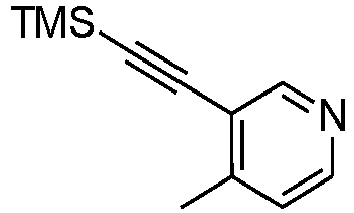
- A mixture of 3-bromo-4-methylpyridine (3 g, 17.44 mmol), ethynyltrimethylsilane (2.56 g, 26.06 mmol), Pd(PPh3)2Cl2 (612 mg, 0.87 mmol), CuI (165 mg, 0.86 mmol), TEA (7 g, 69.17 mmol) in N,N-dimethylformamide (200 mL) was stirred for 12 h at 100 °C under nitrogen. The resulting solution was diluted with ethyl acetate (300 mL) and then washed with water. The resulting mixture was concentrated under vacuum. The residue was purified by flash chromatography on a silica gel column eluted with petroleum ether / ethyl acetate (10/1) to afford 4-methyl-3-[2-(trimethylsilyl)ethynyl]pyridine (1 g, 5.26 mmol) as a colorless oil. LCMS (ESI) [M+H]+ = 190.
-

- A mixture of 4-methyl-3-[2-(trimethylsilyl)ethynyl]pyridine (1 g, 5.28 mmol) and potassium carbonate (2.2 g, 15.91 mmol) in methanol (30 mL) was stirred for 3 h at room temperature. After filtration the filtrate was concentrated under vacuum. The residue was purified by flash chromatography on a silica gel column eluted with petroleum ether / ethyl acetate (10/1) to afford 3-ethynyl-4-methylpyridine (500 mg, 4.23 mmol) as colorless oil. LCMS (ESI) [M+H]+ = 118.
-

- A mixture of 3-ethynyl-4-methylpyridine (855 mg, 7.30 mmol), (1R,2R)-N-(8-amino-6-chloro-2,7-naphthyridin-3-yl)-2-(1-methyl-1H-pyrazol-4-yl)cyclopropane-1-carboxamide (500 mg, 1.46 mmol), potassium carbonate (404 mg, 2.92 mmol), Pd(AcO)2 (33 mg, 0.15 mmol) and PPh3 (77 mg, 0.29 mmol) in N,N-dimethylformamide (10 mL) was stirred for 12 h at 110 °C under nitrogen. After filtration the filtrate was concentrated under vacuum. The residue was purified by Prep-HPLC (XBridge Prep C18 OBD, 19x150 mm 5um; water (0.05% NH3H2O):ACN=0% ACN up to 50% in 7 min) to afford the racemic product (40 mg). The racemic product was separated by Chiral-HPLC to afford two isomers: (Cyclopropane stereochemistry for isomers: pyrazole trans to amide; All absolute stereochemistry arbitrarily assigned) Isomer 1: (51.4 mg,0.1215 mmol, 8% yield) (assumed) as a yellow solid. Retention time: 2.527 min (CHIRALPAK IC-3. 0.46*5cm;3um; Hex(0.1%DEA):EtOH=50:50; 1.0ml/min); LCMS (53) [M+H]+ = 424.3, 1H NMR (400 MHz, DMSO-d 6) δ 11.01 (s, 1H), 9.34 (s, 1H), 8.67 (s, 1H), 8.47 (d, J= 5.0 Hz, 1H), 8.23 (s, 1H), 7.57 (s, 1H), 7.48-7.37 (m, 3H), 7.30 (s, 1H), 7.20 (s, 1H), 3.77 (s, 3H), 2.49 (s, 3H), 2.28-2.12 (m, 2H), 1.50-1.36 (m, 1H), 1.26-1.12 (m, 1H); Isomer 2: (51.2 mg,0.1210 mmol, 8% yield) (assumed) as a yellow solid. Retention time: 3.588 min (CHIRALPAK IC-3. 0.46*5cm;3um; Hex(0.1%DEA):EtOH=50:50; 1.0ml/min); LCMS (53) [M+H]+ = 424.2, 1H NMR (400 MHz, DMSO-d 6) δ 11.01 (s, 1H), 9.34 (s, 1H), 8.67 (s, 1H), 8.47 (d, J = 5.0 Hz, 1H), 8.23 (s, 1H), 7.57 (s, 1H), 7.48-7.37 (m, 3H), 7.30 (s, 1H), 7.20 (s, 1H), 3.77 (s, 3H), 2.49 (s, 3H), 2.28-2.12 (m, 2H), 1.50-1.36 (m, 1H), 1.26-1.12 (m, 1H).
-

-

- A mixture of N-(8-[bis[(2,4-dimethoxyphenyl)methyl]amino]-6-(4-methylpyridin-3-yl)-2,7-naphthyridin-3-yl)-3-oxobicyclo[3.1.0]hexane-6-carboxamide (200.00 mg, 0.29 mmol), NH4OAc (228.81 mg, 2.96 mmol), NaBH3CN (27.98 mg, 0.44 mmol) in methanol (5 mL) was stirred for 2 h at 60 °C. The reaction mixture was concentrated under vacuum. The residue was purified with silica-gel chromatography (DCM : MeOH = 10 : 1 ) to give 3-amino-N (8-(bis(2,4-dimethoxybenzyl)amino)-6-(4-methylpyridin-3-yl)-2,7-naphthyridin-3-yl)bicyclo[3.1.0]hexane-6-carboxamide was got(80 mg, 40%) as brown oil, LCMS (ESI) [M+H]+ = 675.3
-

- To a mixture of 3-amino-N-(8-[bis[(2,4-dimethoxyphenyl)methyl]amino]-6-(4-methylpyridin-3 -yl)-2,7-naphthyridin-3 -yl)bicyclo [3.1.0]hexane-6-carboxamide (80.00 mg, 0.12 mmol) and TEA (59.98 mg, 0.59 mmol) in dichloromethane was added Ms2O at 0°C. The reaction solution was stirred for 10 min at 0°C. The reaction was quenched by the addition of water, extracted with dichloromethane and the organic layers combined and dried in an oven under reduced pressure as yellow solid. This solid was used in the next step. LCMS (ESI) [M+H]+ = 753.3.
-

- To a solution of N-(8-[bis[(2,4-dimethoxyphenyl)methyl]amino]-6-(4-methylpyridin-3-yl)-2,7-naphthyridin-3-yl)-3-methanesulfonamidobicyclo[3.1.0]hexane-6-carboxamide (60 mg, 0.08 mmol) in dichloromethane was added trifluoroacetic acid (2.5 mL). The reaction solution was stirred for 4 h at 25°C, then concentrated under vacuum. The residue was purified by Prep-HPLC (XBridge Prep C18 OBD, 19x150 mm 5um; water (0.05% NH3H2O):CH3CN=0% ACN up to 50% in 7 min) to afford (1R,5S,6R)-N-(8-amino-6-(4-methylpyridin-3-yl)-2,7-naphthyridin-3-yl)-3-(methylsulfonamido)bicyclo[3.1.0]hexane-6-carboxamide as a white solid. LCMS (ESI) [M+H]+ = 453.3, 1H NMR (300 MHz, CD3OD) δ 9.35 (s, 1H), 8.52 (s, 1H), 8.46-8.40 (m, 2H), 7.38 (d, J = 5.1 Hz, 1H), 7.01 (s, 1H), 5.32-5.00 (m, 1H), 3.98-3.72 (m, 1H), 3.22-3.02 (m, 1H), 3.01-2.94 (m, 1H), 2.92 (s, 3H), 2.90-2.71 (m, 1H), 2.62-2.49 (m, 1H), 2.41 (s, 3H), 2.19-1.98 (m, 1H), 1.70-1.50 (m, 1H).
-

- Into a pressure flask was weighed 3-bromo-7-methyl-pyrido[2,3-d]pyridazin-8-one (400 mg, 1.67 mmol) and (4,4'-di-tert-butyl-2,2'-bipyridine)bis[(2-pyridinyl)phenyl]iridium(III) hexafluorophosphate [Ir(ppy)2(dtbpy)]PF6 (27.7 mg, 2 mol %). Under a stream of nitrogen gas was added acetonitrile (8.3 mL), trifluoroacetic acid (8.3 mL) and tert-butyl peroxyacetate (0.640 mL, 2.00 mmol) and the flask was sealed. The reaction mixture was stirred for 20 h while irradiating with a Kessil H150B blue LED light with a fan directed at the airspace between the light and the mixture. The mixture was diluted with dichloromethane and washed with sat. aq. sodium bicarbonate, then organics dried (MgSO4) and concentrated. The residue was purified by flash column chromatography (CH2Cl2/MeOH, 100:0-95:5) to afford a mixture of mono- and dimethylated products (410 mg crude). Onto this mixture in a vial was weighed [1,1'-bis(diphenylphosphino)ferrocene]dichloropalladium(II)-dichloromethane complex (63.7 mg, 0.0764 mmol), bis(pinacolato)diboron (388 mg, 1.53 mmol), and potassium acetate (450 mg, 4.59 mmol). Under nitrogen, anhydrous 1,4-dioxane (5.1 mL) was added and the vial was sealed. The reaction mixture was stirred at 100 °C for 25 h. After cooling to rt, under nitrogen, to the reaction vessel was added (±)-(1R,2R)-N-(8-amino-6-chloro-2,7-naphthyridin-3-yl)-2-(1-methyl-1H-pyrazol-4-yl)cyclopropane-1-carboxamide (524 mg, 1.53 mmol), chloro(2-dicyclohexylphosphino-2',4',6'-triisopropyl-1,1'-biphenyl)[2-(2'-amino-1,1'-biphenyl)]palladium(II) (61.4 mg, 0.0765 mmol), 2-dicyclohexylphosphino-2',4',6'-triisopropylbiphenyl (37.2 mg, 0.0765 mmol), and potassium carbonate (634 mg, 4.59 mmol), and water (1.5 mL). The vial was sealed and stirred at 80 °C for 69 h. The reaction mixture was concentrated to dryness and residue purified by flash column chromatography (CH2Cl2/MeOH, 100:0-85:15) and by enantiodiscriminatory SFC to afford the dimethyl target compounds as red solids (3.1 mg, 0.4% over 3 steps and 3.4 mg, 0.4% over 3 steps), and the C5- and C7-monomethylated products as white and red solids (8.0 mg, 1.0% over 3 steps; 8.8 mg, 1.0% over 3 steps; 6.9 mg, 0.8% over 3 steps; 6.6 mg, 0.8% over 3 steps). The 5- and 7- assignment was not determined and is assigned arbitrarily (Cyclopropane stereochemistry for isomers: pyrazole trans to amide; All absolute stereochemistry arbitrarily assigned.) Data for dimethyl: 1H NMR (400 MHz, DMSO-d 6) δ 10.97 (s, 1H), 9.40 (s, 1H), 8.57 (s, 1H), 8.24 (s, 1H), 7.56 (s, 1H), 7.45 (br s, 2H), 7.29 (s, 1H), 6.85 (s, 1H), 3.77 (s, 3H), 3.77 (s, 3H), 2.45 (s, 3H), 2.41 (s, 3H), 2.20 (dd, J = 6.9, 6.9 Hz, 2H), 1.42 - 1.33 (m, 1H), 1.22 - 1.15 (m, 1H). Data for 5-methyl (assignment arbitrary): 1H NMR (400 MHz, DMSO-d 6) δ 10.98 (s, 1H), 9.41 (s, 1H), 8.45 (s, 1H), 8.40 (s, 1H), 8.29 (s, 1H), 7.56 (s, 1H), 7.44 (br s, 2H), 7.29 (s, 1H), 7.12 (s, 1H), 3.77 (s, 6H), 2.78 (s, 3H), 2.26 - 2.17 (m, 2H), 1.45 - 1.34 (m, 1H), 1.27 - 1.13 (m, 1H). Data for 7-methyl (assignment arbitrary): 1H NMR (400 MHz, DMSO-d 6) δ 10.98 (s, 1H), 9.41 (s, 1H), 9.03 (s, 1H), 8.67 (s, 1H), 8.30 (s, 1H), 7.56 (s, 1H), 7.45 (br s, 2H), 7.29 (s, 1H), 7.08 (s, 1H), 3.79 (s, 3H), 3.77 (s, 3H), 2.71 (s, 3H), 2.21 (dd, J = 7.2, 7.2 Hz, 2H), 1.44 - 1.36 (m, 1H), 1.23 - 1.14 (m, 1H).
-

- Into a vial was weighed (±)-(1S,2S)-N-(8-amino-6-chloro-2,7-naphthyridin-3-yl)-2-(1-methyl-1H-pyrazol-4-yl)cyclopropane-1-carboxamide (100.0 mg, 0.292 mmol), (6-methoxy-4-methylpyridin-3-yl)boronic acid (51.3 mg, 0.292 mmol), chloro(2-dicyclohexylphosphino-2',4',6'-triisopropyl-1,1'-biphenyl)[2-(2'-amino-1,1'-biphenyl)]palladium(II) (12.3 mg, 0.0146 mmol), 2-dicyclohexylphosphino-2',4',6'-triisopropylbiphenyl (7.1 mg, 0.0146 mmol), and potassium carbonate (121 mg, 0.875 mmol). Under nitrogen, anhydrous tetrahydrofuran (1.5 mL) and water (0.3 mL) were added and the vial was sealed. The reaction mixture was stirred at 100 °C for 17 h. After cooling to rt, the reaction mixture was filtered through celite, rinsing with dichloromethane and methanol. After concentrating to dryness, the residue was purified by HPLC and chiral SFC to afford the target compounds as white solids (23.9 mg, 19% and 29.4 mg, 24%); 1H NMR (400 MHz, DMSO-d 6) δ 10.91 (s, 1H), 9.34 (s, 1H), 8.23 (s, 1H), 8.19 (s, 1H), 7.56 (s, 1H), 7.29 (s, 1H), 7.24 (br s, 2H), 6.91 (s, 1H), 6.74 (s, 1H), 3.87 (s, 3H), 3.77 (s, 3H), 2.38 (s, 3H), 2.26 - 2.14 (m, 2H), 1.46 - 1.32 (m, 1H), 1.27 - 1.05 (m, 1H). (Cyclopropane stereochemistry for isomers: pyrazole trans to amide; All absolute stereochemistry arbitrarily assigned.)
-

- Into a vial was weighed 3-bromo-5-methoxy-4-methylpyridine (120 mg, 0.594 mmol), [1,1'-bis(diphenylphosphino)ferrocene]dichloropalladium(II)-dichloromethane complex (24.7 mg, 0.0297 mmol), bis(pinacolato)diboron (151 mg, 0.594 mmol), and potassium acetate (175 mg, 1.78 mmol). Under nitrogen, anhydrous 1,4-dioxane (3.0 mL) was added and the vial was sealed. The reaction mixture was stirred at 100 °C for 40.5 h. After cooling to rt, under nitrogen, to the reaction vessel was added (±)-(1S,2S)-N-(8-amino-6-chloro-2,7-naphthyridin-3-yl)-2-(1-methyl-1H-pyrazol-4-yl)cyclopropane-1-carboxamide (447 mg, 1.30 mmol), [1,1'-bis(diphenylphosphino)ferrocene]dichloropalladium(II)-dichloromethane complex (24.7 mg, 0.0297 mmol), and potassium carbonate (246 mg, 1.78 mmol), and water (0.6 mL). The vial was sealed and stirred at 80 °C for 4.5 days. The reaction mixture was concentrated to dryness and residue purified by flash column chromatography (CH2Cl2/MeOH, 100:0-85:15) to afford the target compound as a brown solid (85 mg, 33% over 2 steps). Further separation of the enantiomers by chiral SFC afforded the target compounds as white solids; 1H NMR (400 MHz, DMSO-d 6) δ 10.93 (s, 1H), 9.36 (s, 1H), 8.29 (s, 1H), 8.24 (s, 1H), 8.23 (s, 1H), 7.56 (s, 1H), 7.31 (br s, 2H), 7.29 (s, 1H), 6.91 (s, 1H), 3.94 (s, 3H), 3.77 (s, 3H), 2.25 - 2.14 (m, 2H), 2.21 (s, 3H), 1.45 - 1.33 (m, 1H), 1.23 - 1.12 (m, 1H). (Cyclopropane stereochemistry for isomers: pyrazole trans to amide; All absolute stereochemistry arbitrarily assigned.)
-

- Procedure was the same as for (±)- (1S,2S)-N-(8-amino-6-(4-methyl-6-(2-oxoazetidin-1-yl)pyridin-3-yl)-2,7-naphthyridin-3-yl)-2-(1-methyl-1H-pyrazol-4-yl)cyclopropane-1-carboxamide ((Compound 343)) except that methyl 5-bromo-4-methylpyridine-2-carboxylate (140 mg, 0.648 mmol) was used as starting material, affording the target compounds as white solids after column chromatography (CH2Cl2/MeOH, 100:0-85:15) and chiral SFC separation (28.0 mg, 10% over 2 steps and 24.5 mg, 9% over 2 steps); 1H NMR (400 MHz, DMSO-d 6) δ 10.93 (s, 1H), 9.36 (s, 1H), 8.51 (s, 1H), 8.25 (s, 1H), 7.56 (s, 1H), 7.35 - 7.21 (m, 4H), 6.96 (s, 1H), 4.51 (s, 2H), 3.77 (s, 3H), 3.39 (s, 3H), 2.43 (s, 3H), 2.24 - 2.13 (m, 2H), 1.44 - 1.32 (m, 1H), 1.24 - 1.13 (m, 1H). (Cyclopropane stereochemistry for isomers: pyrazole trans to amide; All absolute stereochemistry arbitrarily assigned.)
-

-

- To a solution of 5-bromo-4-methylpicolinic acid (3.00 g, 13.9 mmol) in anhydrous tetrahydrofuran (46 mL) under nitrogen and at 0 °C, was added anhydrous DMF (0.10 mL, 1.4 mmol) followed by dropwise addition of oxalyl chloride over 10 min (1.80 mL, 20.8 mmol). After 5 minutes of stirring, the ice bath was removed, allowing the mixture to come to rt. After 19 h, the mixture was concentrated to dryness. In a separate flask, a solution of L-serine methyl ester hydrochloride (2.38 g, 15.3 mmol) in anhydrous tetrahydrofuran (25 mL) was charged with triethylamine (2.3 mL, 17 mmol) and stirred for 1 h before being poured onto the dried acyl chloride prepared above. The combined reaction mixture was stirred for a further 1.5 h and then poured into sat. aq. sodium bicarbonate and extracted with isopropyl acetate. The organics were washed with brine, dried over magnesium sulfate and then concentrated to dryness. The residue thus obtained was purified by flash column chromatography (CH2Cl2/MeOH, 100:0-95: 5) to afford the title compound as a yellow solid (1.457 g, 33%); 1H NMR (400 MHz, Chloroform-d) δ 8.69 (br d, J = 7.9 Hz, 1H), 8.60 (s, 1H), 8.04 (s, 1H), 4.85 (dt, J = 7.9, 3.9 Hz, 1H), 4.17 - 3.98 (m, 2H), 3.83 (s, 3H), 2.57 (t, J = 6.1 Hz, 1H), 2.47 (s, 3H).
- To a solution of methyl (5-bromo-4-methylpicolinoyl)-L-serinate (400 mg, 1.26 mmol) in anhydrous dichloromethane (6.3 mL) under nitrogen and at -78 °C, was added anhydrous diethylaminosulfur trifluoride (0.33 mL, 2.5 mmol) and allowed to warm to rt. After stirring for 1 h, the reaction was carefully quenched by the addition of sat. aq. sodium bicarbonate and extracted with dichloromethane. The organics were dried over magnesium sulfate and concentrated to a crude orange solid. Onto this crude solid in a vial was weighed [1,1'-bis(diphenylphosphino)ferrocene]dichloropalladium(II)-dichloromethane complex (52.5 mg, 0.0630 mmol), bis(pinacolato)diboron (320 mg, 1.26 mmol), and potassium acetate (371 mg, 3.78 mmol). Under nitrogen, anhydrous 1,4-dioxane (6.3 mL) was added and the vial was sealed. The reaction mixture was stirred at 100 °C for 22 h. After cooling to rt, under nitrogen, to the reaction vessel was added (±)-(1R,2R)-N-(8-amino-6-chloro-2,7-naphthyridin-3-yl)-2-(1-methyl-1H-pyrazol-4-yl)cyclopropane-1-carboxamide (432 mg, 1.26 mmol), chloro(2-dicyclohexylphosphino-2',4',6'-triisopropyl-1,1'-biphenyl)[2-(2'-amino-1,1'-biphenyl)]palladium(II) (53.2 mg, 0.0630 mmol), 2-dicyclohexylphosphino-2',4',6'-triisopropylbiphenyl (30.7 mg, 0.0630 mmol), and potassium carbonate (523 mg, 3.78 mmol), and water (1.3 mL). The vial was sealed and stirred at 100 °C for 18.5 h. The reaction mixture was concentrated to dryness and residue purified by flash column chromatography (CH2Cl2/MeOH, 100:0-85:15) to afford the racemic compound as a white solid (62.2 mg, 9% over 3 steps). Further separation of the enantiomers by chiral SFC afforded the target compounds as white solids; 1H NMR (400 MHz, DMSO-d 6) δ 10.96 (s, 1H), 10.36 (s, 1H), 9.39 (s, 1H), 8.71 (s, 1H), 8.28 (s, 1H), 8.08 (s, 1H), 7.56 (s, 1H), 7.37 (br s, 2H), 7.29 (s, 1H), 7.07 (s, 1H), 6.63 (s, 1H), 5.90 (d, J = 1.5 Hz, 1H), 3.86 (s, 3H), 3.77 (s, 3H), 2.54 (s, 3H), 2.24 - 2.17 (m, 2H), 1.44 - 1.34 (m, 1H), 1.29 - 1.06 (m, 1H). (Pyrazole trans to amide; All absolute stereochemistry arbitrarily assigned).
-

-

- To a solution of 5-bromo-4-methylpicolinic acid (2.00 g, 9.26 mmol) and anhydrous DMF (0.14 mL, 1.9 mmol) in anhydrous tetrahydrofuran (31 mL) under nitrogen and at 0 °C, was added oxalyl chloride over 10 min (1.61 mL, 18.5 mmol). The ice bath was removed, allowing the mixture to come to rt. After 42 h, the mixture was concentrated to dryness. The crude acid chloride was then dissolved in anhydrous tetrahydrofuran (31 mL) and L-valinol (1.1 mL, 9.3 mmol) was added. The reaction mixture was stirred for 7 days and then poured into sat. aq. sodium bicarbonate and extracted with isopropyl acetate. The organics were washed with brine, dried over magnesium sulfate and then concentrated to dryness. The residue thus obtained was purified by flash column chromatography (heptane/iPrOAc, 100:0-0: 100) to afford the title compound as a yellow liquid (1.08 g, 39%); 1H NMR (400 MHz, DMSO-d 6) δ 8.73 (s, 1H), 8.24 (br d, J = 9.7 Hz, 1H), 8.03 (s, 1H), 4.73 (t, J = 5.4 Hz, 1H), 3.78 - 3.70 (m, 1H), 3.63 - 3.54 (m, 1H), 3.54 - 3.44 (m, 1H), 2.46 (s, 3H), 1.96 - 1.87 (m, 1H), 0.91 (d, J = 6.6 Hz, 3H), 0.86 (d, J = 6.9 Hz, 3H).
- Procedure was the same as for Example 264, except that (S)-5-bromo-N-(1-hydroxy-3-methylbutan-2-yl)-4-methylpicolinamide (118 mg, 0.417 mmol) was used as starting material, affording the target compound as a white solid after column chromatography (CH2Cl2/MeOH, 100:0-85:15) and HPLC purification (10.8 mg, 5% over 2 steps); 1H NMR (400 MHz, DMSO-d 6) δ 10.95 (s, 1H), 9.38 (s, 1H), 8.65 (s, 1H), 8.27 (s, 1H), 7.93 (s, 1H), 7.56 (s, 1H), 7.36 (br s, 2H), 7.29 (s, 1H), 7.03 (s, 1H), 4.54 - 4.37 (m, 1H), 4.22 - 4.05 (m, 2H), 3.77 (s, 3H), 2.25 - 2.13 (m, 2H), 1.87 - 1.71 (m, 1H), 1.45 - 1.30 (m, 1H), 1.24 - 1.10 (m, 1H), 0.98 (d, J = 6.7 Hz, 3H), 0.91 (d, J = 6.7 Hz, 3H). (Cyclopropane stereochemistry for isomers: pyrazole trans to amide; absolute stereochemistry arbitrarily assigned.)
- Compound Nos. 397, 398, 399, 400, 401, 402, 403, 404, 405, 413, 419, 420, and 427 were prepared in a fashion analogous to the procedures in Example 263 or Example 265.
-

-

- A solution of 2-(3,5-dibromo-1H-pyrazol-1-yl)acetic acid (15 g, 52.84 mmol), methyl(prop-2-en-1-yl)amine (5.7 g, 80.15 mmol), N,N-diisopropylethylamine (27 g, 208.9 mmol) and HATU (30 g, 78.9 mmol) in N,N-dimethylformamide (500 mL) was stirred for 16 hours at room temperature. The resulting mixture was diluted with ethyl acetate and. The organic layer was washed with sodium chloride solution, dried with anhydrous sodium sulfate, filtered and concentrated under vacuum. The residue was purified by flash chromatography on silica gel eluting with ethyl acetate/petroleum ether (2/3) to afford 2-(3,5-dibromo-1H-pyrazol-1-yl)-N-methyl-N-(prop-2-en-1-yl)acetamide (16.3 g, 92%) as a yellow oil. LCMS (ESI) [M+H]+ = 338.0.
-

- A mixture of 2-(3,5-dibromo-1H-pyrazol-1-yl)-N-methyl-N-(prop-2-en-1-yl)acetamide (5 g, 14.84 mmol), palladium acetate (166 mg, 0.74 mmol), triphenylphosphine (388 mg, 1.48 mmol), TBAB (4.8 g, 14.890 mmol) and potassium acetate (4.2 g, 42.80 mmol) in N,N-dimethylformamide (100 mL) was stirred for 10 h at 80 °C. After filtration, the filtrate was concentrated under vacuum. The residue was purified on a silica gel column eluted with ethyl acetate/petroleum ether (2/1) to afford 2-bromo-6-methyl-4-methylidene-4H,5H,6H,7H,8H-pyrazolo[1,5-d][1,4]diazepin-7-one (3.2 g, 84%) as a brown oil. LCMS (ESI) [M+H]+ = 258.1.
-

- A mixture of trimethylsulfoxonium iodide (1.29 g, 5.86 mmol) and potassium tert-butoxide (656 mg, 5.85 mmol) in dimethyl sulfoxide (30 mL) was stirred for 30 min at room temperature. Then a solution of 2-bromo-6-methyl-4-methylidene-4H,5H,6H,7H,8H-pyrazolo[1,5-d][1,4]diazepin-7-one (500 mg, 1.95 mmol) in dimethyl sulfoxide (3 mL) was added. The mixture was then stirred for 12 h at 50 °C. The reaction mixture was diluted with ethyl acetate and then washed with water. The organic layer was dried over anhydrous sodium sulfate, filtered and concentrated under vacuum. The residue was purified by silica gel column with dichloromethane/methanol (10/1) to afford 2'-bromo-6'-methyl-5',6'-dihydrospiro[cyclopropane-1,4'-pyrazolo[1,5-d][1,4]diazepin]-7'(8'H)-one (120 mg, 23%) as a white solid. LCMS (ESI) [M+H]+ = 270.
-

- A mixture of 3-chloro-N1,N1-bis[(2,4-dimethoxyphenyl)methyl]-2,7-naphthyridine-1,6-diamine (560 mg, 1.13 mmol), tert-butyl N-tert-butoxycarbonyl-N-[4-methyl-5-(4,4,5,5-tetramethyl-1,3,2-dioxaborolan-2-yl)-3-pyridyl]carbamate (737 mg, 1.7 mmol), XPhosPdG2 (171 mg, 0.23 mmol), XPhos (215 mg, 0.45 mmol) and KOAc (332 mg, 3.39 mmol) in 1,4-dioxane (15 mL) and water (1.5 mL) was stirred at 100 °C for 1 hour. The mixture was concentrated under vacuum. The residue was purified by reverse phase chromatography with water/CH3CN(15/85) to afford tert-butyl N-[5-[6-amino-1-[bis[(2,4-dimethoxyphenyl)methyl]amino]-2,7-naphthyridin-3-yl]-4-methyl-3-pyridyl]-N-tert-butoxycarbonyl-carbamate (220 mg,0.28 mmol) as a brown solid. LCMS (ESI) [M+H]+= 767.
-

- A mixture of tert-butyl N-[5-[6-amino-1-[bis[(2,4-dimethoxyphenyl)methyl]amino]-2,7-naphthyridin-3-yl]-4-methyl-3-pyridyl]-N-tert-butoxycarbonyl-carbamate (215.0mg, 0.2800mmol), 2-bromo-6-methyl-spiro[5,8-dihydropyrazolo[1,5-d][1,4]diazepine-4,1'-cyclopropane]-7-one (90 mg, 0.34 mmol), t-BuBrettphos Pd G3 (95 mg, 0.11 mmol), t-BuBrettphos (54 mg, 0.11 mmol) and Cs2CO3 (456 mg, 1.4 mmol) in 1,4-dioxane (15 mL) was stirred at 130 °C for 2 hours. The reaction was concentrated under vacuum. The residue was purified by flash chromatography on silica gel eluting with DCM/MeOH (97/3) to afford tert-butyl N-[5-[1-[bis[(2,4-dimethoxyphenyl)methyl]amino]-6-[(6-methyl-7-oxo-spiro[5,8-dihydropyrazolo[1,5-d][1,4]diazepine-4,1'-cyclopropane]-2-yl)amino]-2,7-naphthyridin-3-yl]-4-methyl-3-pyridyl]-N-tert-butoxycarbonyl-carbamate (140 mg,0.14 mmol) as a brown solid. LCMS (ESI) [M+H]+= 956.
-

- A solution of tert-butyl N-[5-[1-[bis[(2,4-dimethoxyphenyl)methyl]amino]-6-[(6-methyl-7-oxo-spiro[5,8-dihydropyrazolo[1,5-d][1,4]diazepine-4,1'-cyclopropane]-2-yl)amino]-2,7-naphthyridin-3-yl]-4-methyl-3-pyridyl]-N-tert-butoxycarbonyl-carbamate (140 mg, 0.15 mmol) and TFA (5 mL) in dichloromethane (0.5 mL) was stirred at 80 °C for 0.5 hour. The mixture was concentrated under vacuum. The reaction mixture was adjusted to pH 10 with NH3.H2O. The crude product was purified by Prep-HPLC with the following conditions: Column: XBridge Shield RP18 OBD Column 30*150mm,5um ; mobile phase A:Water(10 mmol/L NH4HCO3), Mobile Phase B: ACN; Flow rate: 60 mL/min; Gradient: 20% B to 27% B in 7 min; 254 nm; Rt: 5.9 min to afford 2-[[8-amino-6-(5-amino-4-methyl-3-pyridyl)-2,7-naphthyridin-3-yl]amino]-6-methyl-spiro[5,8-dihydropyrazolo[1,5-d][1,4]diazepine-4,1'-cyclopropane]-7-one (20.4 mg,0.044 mmol) as a white solid. LCMS (ESI) [M+H]+= 456.3; 1H NMR (300 MHz, DMSO-d 6) δ 9.31 (s, 1H), 9.19 (s, 1H), 7.92 (s, 1H), 7.75 (s, 1H), 7.45 (s, 1H), 7.02 (s, 2H), 6.68 (s, 1H), 5.67 (s, 1H), 5.10-5.06 (m, 4H), 3.72 (s, 2H), 2.99 (s, 3H), 2.06 (s, 3H), 1.23-1.16 (m, 2H), 0.96-0.92 (m, 2H).
-

-

- A solution of 3-bromo-5-methyl-1H-pyrazole (100 g, 621.12 mmol), methyl 2-chloroacetate (101.11 g, 931.68 mmol) and K2CO3 (154.29g, 1118 mmol) in N,N-dimethylformamide (1 L) was added TBAI (11.46 g, 31.06 mmol). The resulting solution was stirred for 12 h at 20 °C. The reaction mixture was diluted with EA (5000 mL). The solution was washed with water (300 mLx3) and the organic layers were combined. The organic layer was dried over anhydrous sodium sulfate and concentrated under vacuum. The residue was purified by flash chromatography on silica gel eluting with PE/DCM (60/40) to afford methyl 2-(3-bromo-5-methyl-pyrazol-1-yl)acetate (120g, 82.9% yield) as a white solid.
-

- A solution of methyl 2-(3-bromo-5-methyl-pyrazol-1-yl)acetate (50.0 g, 214.54 mmol) and AIBN (3.52 g, 21.45 mmol) in carbon tetrachloride (1500 mL) was stirred at RT for 5 mins. 1-Bromo-2,5-pyrrolidinedione (40.09 g, 225.26 mmol) was added. The mixture was stirred at 80 °C for 1 hour. The reaction mixture was concentrated under vacuum. The residue was purified by flash chromatography on silica gel eluting with PE/EA (92/8) to afford methyl 2-[3-bromo-5-(bromomethyl)pyrazol-1-yl]acetate (35.5 g, 53% yield) as a white solid.
-

- A solution of methyl 2-[3-bromo-5-(bromomethyl)pyrazol-1-yl]acetate (35.4 g, 113.48 mmol) and sodium cyanide (8.87 g, 181.02 mmol) in dimethyl sulfoxide (550mL) was stirred at RT for 1 hour. The reaction solution was diluted with EA (2.5 L). The solution was washed with water (200 mLx5) and the organic layers were combined. The organic layer was dried over anhydrous sodium sulfate, filtered and concentrated under vacuum. The residue was purified by flash chromatography on silica gel eluting with DCM/MeOH (99/1) to afford methyl 2-(3-bromo-5-(cyanomethyl)-1H-pyrazol-1-yl)acetate (17.6 g, 60% yield) as a white solid.
-

- To a solution of methyl 2-[3-bromo-5-(cyanomethyl)pyrazol-1-yl]acetate (3.0 g, 11.62 mmol) in methanol (600 mL) was added PtO2 (600 mg, 2.64 mmol). The mixture was stirred under 10 atm of hydrogen gas at 25 °C for 15 hours. The mixture was filtrated. The filtrate would be directly used in the next step without purification.
-

- To a solution (600 mL) of methyl 2-[5-(2-aminoethyl)-3-bromo-pyrazol-1-yl]acetate was added TEA (70 mL). The mixture was stirred at 25 °C for 15 hours. The resulting solution was concentrated under vacuum. The residue was purified by flash chromatography on silica gel eluting with DCM/MeOH (98/2) to afford 2-bromo-4,5,6,8-tetrahydropyrazolo[1,5-d][1,4]diazepin-7-one (1.12g, 41.9% yield in two steps) as a white solid.
-

- To a mixture of 2-bromo-5,6,7,8-tetrahydro-4H-pyrazolo[1,5-d][1,4]diazepine (469.53 mg, 2.17 mmol) and potassium tert-butoxide (365.74 mg, 3.26 mmol) in tetrahydrofuran (20mL) was added iodomethane (616.86 mg, 4.35 mmol) at 20 °C. The resulting solution was stirred at 20 °C for 1 h. The mixture was concentrated under vacuum. The residue was purified by flash chromatography on silica gel eluting with dichloromethane/methanol (20/1) to afford 2-bromo-6-methyl-4,5,7,8-tetrahydropyrazolo[1,5-d][1,4]diazepine (400 mg,1.74 mmol, 80% yield). LCMS (ESI) [M+H]+ = 244.
-

- A mixture of tert-butyl N-[5-[6-amino-1-[bis[(2,6-dimethoxyphenyl)methyl]amino]-2,7-naphthyridin-3-yl]-4-methyl-3-pyridyl]-N-tert-butoxycarbonyl-carbamate (130 mg, 0.17 mmol), 2-bromo-6-methyl-5,8-dihydro-4H-pyrazolo[1,5-d][1,4]diazepin-7-one (67 mg, 0.26 mmol), tBuBrettphos Pd G3 (60 mg, 0.07 mmol), tBuBrettphos (41 mg, 0.09 mmol) and Cs2CO3 (166 mg, 0.51 mmol) in 1,4-dioxane (10 mL) was stirred at 120 °C for 1 hour. The mixture was concentrated under vacuum. The residue was purified by flash chromatography on silica gel eluting with MeOH/DCM(1/10) to afford tert-butyl N-[5-[1-[bis[(2,6-dimethoxyphenyl)methyl]amino]-6-[(6-methyl-7-oxo-5,8-dihydro-4H-pyrazolo[1,5 - d][1,4]diazepin-2-yl)amino]-2,7-naphthyridin-3-yl]-4-methyl-3-pyridyl]-N-tert-butoxycarbonyl-carbamate (50 mg, 0.05 mmol) as a yellow solid. LCMS (ESI) [M+H]+ = 931.
-

- A mixture of tert-butyl N-[5-[1-[bis[(2,6-dimethoxyphenyl)methyl]amino]-6-[(6-methyl-7-oxo-5,8-dihydro-4H-pyrazolo[1,5-d][1,4]diazepin-2-yl)amino]-2,7-naphthyridin-3-yl]-4-methyl-3-pyridyl]-N-tert-butoxycarbonyl-carbamate (50.0 mg, 0.05 mmol) in CF3COOH (1.0mL) was stirred at 80 °C for 30 min. The mixture was concentrated under vacuum. The reaction mixture was adjusted to pH =8 with a solution of NH3 in methanol. The crude product was purified by Prep-HPLC with the following conditions: Column, XBridge Prep C18 OBD Column19x150mm; mobile phase: water (0.05% NH3H2O) and ACN (10%-50%); Detector, UV 254 nm. RT:[7 min] to afford 2-[[8-amino-6-(5-amino-4-methyl-3-pyridyl)-2,7-naphthyridin-3-yl]amino]-6-methyl-5,8-dihydro-4H-pyrazolo[1,5-d][1,4]diazepin-7-one (10 mg, 0.023 mmol) as a yellow solid. LCMS (ESI) [M+H]+= 430.2. 1H NMR (400 MHz, DMSO-d6 ) δ 9.37(s, 1H), 9.20(s, 1H), 7.93 (s, 1H), 7.77 (s, 1H), 7.51 (s, 1H), 7.03 (s, 2H), 6.68 (s, 1H), 6.06 (s, 1H), 5.11 (s, 2H), 4.99 (s, 2H), 3.84 (t, J = 6Hz, 2H), 3.06 (t, J = 6Hz, 2H), 2.96 (s, 3H), 2.08 (s, 3H).
-

-

- A mixture of methyl 3-bromo-1H-pyrazole-5-carboxylate (10 g, 48.77 mmol), 4-methylbenzene-1-sulfonic acid (500 mg, 2.90mmol) and 3,4-dihydro-2H-pyran (12.2 g, 145.03mmol) in ethyl acetate (150 mL) was stirred for 4 h at 80°C. The reaction was concentrated under vacuum. The residue was purified by silica gel column with dichloromethane/methanol (10/1) to afford methyl 3-bromo-1-(oxan-2-yl)-1H-pyrazole-5-carboxylate (9 g, 31.14 mmol) as yellow oil. LCMS (ESI) [M+H]+=289.
-

- To a solution of methyl 3-bromo-1-(oxan-2-yl)-1H-pyrazole-5-carboxylate (7.5 g, 25.94mmol) in dichloromethane (200 mL) was added DIBALH (103 mL, 51.88 mmol) at 0°C. The resulting solution was stirred for 1 h at 0°C in a water/ice bath. The reaction was quenched with ice water. After filtration, the resulting solution was extracted with dichloromethane and the organic layers combined and dried over anhydrous sodium sulfate. The solids were filtered out. The resulting mixture was concentrated under vacuum to afford [3-bromo-1-(oxan-2-yl)-1H-pyrazol-5-yl]methanol(6 g, 23.07 mmol) as colorless oil. LCMS (ESI) [M+H]+=261.
-

- A mixture of [3-bromo-1-(oxan-2-yl)-1H-pyrazol-5-yl]methanol (200 mg, 0.76 mmol), sodium hydride (62 mg, 2.58 mmol), ethyl oxirane-2-carboxylate (134 mg, 1.15 mmol) in tetrahydrofuran (10 mL) was stirred for 12 h at room temperature under nitrogen. The reaction was then quenched with water. The reaction mixture was adjusted to pH 4 with hydrogen chloride. The resulting solution was extracted with ethyl acetate and dried with anhydrous sodium sulfate. After filtration, the filtrate was concentrated under vacuum. The residue was purified by reverse phase chromatography (acetonitrile 0-40/0.1% HCl in water) to afford 3-[[3-bromo-1-(oxan-2-yl)-1H-pyrazol-5-yl]methoxy]-2-hydroxypropanoic acid(130 mg, 0.37mmol ) as a white solid. LCMS (ESI) [M+H]+= 349.
-

- To a solution of 3-[[3-bromo-1-(oxan-2-yl)-1H-pyrazol-5-yl]methoxy]-2-hydroxypropanoic acid (130 mg, 0.37mmol) in tetrahydrofuran (10 mL) and methanol (2 mL) was added TMSCHN2 (0.22 mL, 3.852 mmol). The resulting solution was stirred for 2 h at room temperature. The resulting mixture was concentrated under vacuum to afford methyl 3 - [[3-bromo-1-(oxan-2-yl)-1H-pyrazol-5-yl]methoxy]-2-hydroxypropanoate(140 mg, crude) as a white solid. LCMS (ESI) [M+H]+= 363.
-

- A mixture of methyl 3-[[3-bromo-1-(oxan-2-yl)-1H-pyrazol-5-yl]methoxy]-2-hydroxypropanoate (130 mg, 0.35 mmol) in dichloromethane (4 mL) and trifluoroacetic acid (2 mL) was stirred for 3 h at room temperature. The resulting mixture was concentrated under vacuum to afford methyl 3-[(3-bromo-1H-pyrazol-5-yl)methoxy]-2-hydroxypropanoate(50 mg, 0.18 mmol) as a white solid. LCMS (ESI) [M+H]+=279.
-

- A mixture of methyl 3-[(3-bromo-1H-pyrazol-5-yl)methoxy]-2-hydroxypropanoate (100 mg, 0.35mmol) and thionyl chloride (1 mL) in dichloromethane (10 mL) was stirred for 5 h at 70°C. The resulting mixture was concentrated under vacuum to afford methyl 3-[(3-bromo-1H-pyrazol-5-yl)methoxy]-2-chloropropanoate (80 mg, 0.27 mmol)as a white solid. LCMS (ESI) [M+H]+=297.
-

- A mixture of methyl 3-[(3-bromo-1H-pyrazol-5-yl)methoxy]-2-chloropropanoate (650 mg, 2.18 mmol) and potassium carbonate (909 mg, 6.57 mmol) in N,N-dimethylformamide (10 mL) was stirred for 12 h at room temperature. The resulting solution was diluted with H2O and extracted with ethyl acetate and the organic layers combined and concentrated under vacuum. The residue was purified by flash chromatography on silica gel eluting with dichloromethane/methanol (10/1) to afford methyl 2-bromo-4H,6H,7H-pyrazolo[3,2-c][1,4]oxazine-7-carboxylate(300 mg, 1.15 mmol) as a gray solid. LCMS (ESI) [M+H]+=261.
-

- A mixture of methyl 2-bromo-4H,6H,7H-pyrazolo[3,2-c][1,4]oxazine-7-carboxylate (300 mg, 1.15 mmol) and NH3 in methanol (10 mL, 7M) was stirred for 6 h at 90°C. The resulting mixture was concentrated under vacuum to afford 2-bromo-4H,6H,7H-pyrazolo[3,2-c][1,4]oxazine-7-carboxamide(200 mg, 0.81mmol) as a white solid. LCMS (ESI) [M+H]+ =246.
-

- To a solution of 2-bromo-4H,6H,7H-pyrazolo[3,2-c][1,4]oxazine-7-carboxamide (200 mg, 0.81 mmol) and TEA (247 mg, 2.44 mmol) in dichloromethane (10 mL) was added TFAA (343 mg, 1.63 mmol) at 0 °C and then was stirred for 2 h at room temperature. The resulting mixture was concentrated under vacuum. The residue was purified by silica gel column with dichloromethane/methanol (98/2) to afford 2-bromo-4H,6H,7H-pyrazolo[3,2-c][1,4]oxazine-7-carbonitril(100 mg, 0.44 mmol) as a white solid. LCMS (ESI) [M+H]+=228.
-

- A mixture of 1-N,1-N-bis[(3,4-dimethoxyphenyl)methyl]-3-(4-methylpyridin-3-yl)-2,7-naphthyridine-1,6-diamine (242 mg, 0.44 mmol), 2-bromo-4H,6H,7H-pyrazolo[3,2-c][1,4]oxazine-7-carbonitrile (100 mg, 0.44 mmol), BrettPhos Pd G3 (75 mg, 0.08 mmol), t-BuBrettPhos (85 mg, 0.17 mmol) and Cs2CO3 (575 mg, 1.76 mmol) in dioxane (10 mL) was stirred for 0.5 h at 120°C. After filtration, the filtrate was concentrated under vacuum. The residue was purified by flash chromatography on silica gel eluting with dichloromethane/methanol (10/1) to afford 2-[(8-[bis[(3,4-dimethoxyphenyl)methyl]amino]-6-(4-methylpyridin-3-yl)-2,7-naphthyridin-3-yl)amino]-4H,6H,7H-pyrazolo[3,2-c][1,4]oxazine-7-carbonitrile(100 mg, 0.25 mmol) as a white solid. LCMS (ESI) [M+H]+= 699.
-

- A mixture of 2-[(8-[bis[(3,4-dimethoxyphenyl)methyl]amino]-6-(4-methylpyridin-3-yl)-2,7-naphthyridin-3-yl)amino]-4H,6H,7H-pyrazolo[3,2-c][1,4]oxazine-7-carbonitrile (100 mg, 0.14 mmol) in trifluoroacetic acid (5 mL) was stirred for 30 min at 80°C. The resulting mixture was concentrated under vacuum. The residue was purified by reverse phase chromatography (acetonitrile 0-50/0.1% NH4HCO3 in water) to afford 2-[[8-amino-6-(4-methylpyridin-3-yl)-2,7-naphthyridin-3-yl]amino]-4H,6H,7H-pyrazolo[3,2-c][1,4]oxazine-7-carbonitrile (50 mg,0.12 mmol ) as a yellow solid. The racemate was separated by Chiral-HPLC to afford two isomers: Isomer 1: Retention time:3.37 min(CHIRAL Cellulose-SB, 0.46*15cm;5um; 100% MeOH (0.1%DEA); 1 ml/min); LCMS (ESI) [M+H]+ = 399; 1H NMR (400 MHz, CD3OD) δ 9.17 (s, 1H), 8.51 (s, 1H), 8.41 (d, J = 4 Hz, 1H), 7.67 (s, 1H), 7.37 (d, J=8 Hz, 1H), 6.85 (s, 1H), 6.14 (s, 1H), 5.33-5.32 (m, 1H),4.98 (d, J = 12 Hz, 1H), 4.77 (s, 1H), 4.45 (d, J = 4 Hz, 1H), 4.29-4.25 (m, 1H), 2.44 (s, 3H); Isomer 2: Retention time:4.13 min(CHIRAL Cellulose-SB, 0.46*15cm;5um; 100% MeOH (0.1%DEA); 1 ml/min); LCMS (ESI) [M+H]+ = 399; 1H NMR (400 MHz, CD3OD) δ 9.17 (s, 1H), 8.51 (s, 1H), 8.41 (d, J = 4 Hz, 1H), 7.67 (s, 1H), 7.37 (d, J=8 Hz, 1H), 6.85 (s, 1H), 6.14 (s, 1H), 5.33-5.32 (m, 1H),4.98 (d, J = 12 Hz, 1H), 4.77 (s, 1H), 4.45 (d, J = 4 Hz, 1H), 4.29-4.25 (m, 1H), 2.44 (s, 3H).
- Compound Nos. 418 and 426 were prepared in a fashion analogous to the procedures in Example 166.
- Compound Nos. 430, 431, 432, 433, 434, 435, 436, 437, 438, 439, 440, 441, 442, 443, 444, 445, 446, 447, 448, 449, 450, 451, 452, 453, 454, 455, 456, 457, 458, 459, 460, 461, 462, 463, 464, 465, 466, 467, 468, 469, 470, 471, 472, 473, 474, 475, 476, 477, 478, 479, 480, 481, 482, 483, 484, 485, 486, 487, 488, 489, 490, 491, 492, 493, 494, 495, 496, 497, 498, 499, 500, 501, 502, 503, 504, 505, 506, 507, 508, 509, 510, 511, 512, 513, 514, 515, 516, 517, 518, 519, 520, 521, 522, 523, 524, 525, 526, 527, 528, 529, 530, 531, 532, 533, 534, 535, 536, 537, 538, 539, 540, 541, 542, 543, 544, 545, 546, 547, 548, 549, 550, 551, 552, 553, 554, 555, 556, 557, 558, 559, 560, 561, 562, 563, 564, 565, 566, 567, 568, 569, 570, 571, and 572 are prepared using procedures similar to those described herein or methods known in the art.
- Compound Nos. 86, 87, 88, 89, 90, 91, 92, 93, 94, 96, 97, 98, 99, 100, 101, 102, 103, 104, 105, 106, 107, 108, 109, 110, 111, 112, 113, 114, 115, 116, 117, 118, 119, 123, 160, and 389 were prepared using procedures similar to those described herein or methods known in the art.
- Exemplary compounds of Formula I or Ia. Tables A-1 and A-2 include preparation and characterization of certain compounds.
Table A-1 Comp d No. Structure/Name LCMS RT(min) M+H+, Method 1H NMR (ppm) 1 
0.974 1H NMR (400 MHz, CD3OD) δ 9.30 (s,1H), 8.54 (s, 1H), 8.43 (d, J = 5.2 Hz, 1H), 8.33 (s, 1H), 7.40 (d, J = 5.2 Hz, 1H), 6.70 (s, 1H), 4.99-4.80 (m, 1H), 2.46 (s, 3H), 2.19-2.15 (m, 1H), 1.87-1.80 (m, 1H), 1.26-1.21 (m, 1H). 338.1 B 2 
1.051 1H NMR (400 MHz, CD3OD) δ 9.18 (s, 1H), 8.23 (s, 1H), 7.85 (s, 1H), 7.00 (s, 1H), 4.99-4.83 (m, 1H), 3.86 (s, 3H), 2.64 (s, 3H), 2.18-2.15 (m, 1H), 1.86-1.80 (m, 1H), 1.25-1.20 (m, 1H). 341.2 B 3 
1.055 1H NMR (400 MHz, CD3OD) δ 9.21 (s, 1H), 8.24 (s, 1H), 6.82 (s, 1H), 4.98-4.80 (m, 1H), 3.78 (s, 3H), 2.42 (s, 3H), 2.33 (s, 3H), 2.19-2.13 (m, 1H), 1.88-1.78 (m, 1H), 1.27-1.18 (m, 1H). 355.2 B 4 
1.027 1H NMR (400 MHz, CD3OD) δ 9.16 (s,1 H), 8.22 (s, 1H), 8.14 (s, 1H), 8.03 (s, 1H), 7.13 (s, 1H), 4.99-4.82 (m, 1H), 3.96 (s, 3H), 2.18-2.15 (m, 1H), 1.86-1.80 (m, 1H), 1.26-1.21 (m, 1H). 327.1 B 5 
1.112 1H NMR (400 MHz, DMSO-d 6): δ 11.28 (s, 1H), 9.41 (s, 1H), 8.50 (s, 1H), 8.49 (d, J = 5.2 Hz, 1H), 8.20 (s, 1H), 7.38-7.36 (m, 2H), 7.35 (d, J = 5.2 Hz, 1H), 6.95 (s, 1H), 2.80-2.72 (m, 1H), 2.78 (q, J = 7.6 Hz, 2H), 2.20-2.12 (m, 1H), 1.65-1.57 (m, 1H), 1.48-1.39 (m, 1H), 1.09 (t, J = 7.6 Hz, 3H). 359.0 B 6 
0.990 1H NMR (400 MHz, CD3OD) δ 9.30 (s, 1 H), 8.54 (s, 1H), 8.44 (d, J = 4.8 Hz, 1H), 8.34 (s, 1H), 7.40 (d, J = 4.8 Hz, 1H), 7.00 (s, 1H), 4.98-4.80 (m, 1H), 2.46 (s, 3H), 2.19-2.16 (m, 1H), 1.87-1.80 (m, 1H), 1.26-1.21 (m, 1H). 338.1 B 7 
1.038 1H NMR (400 MHz, CD3OD) δ 9.16 (s,1 H), 8.22 (s, 1H), 8.14 (s, 1H), 8.03 (s, 1H), 7.12 (s, 1H), 4.99-4.79 (m, 1H), 3.96 (s, 3H), 2.18-2.15 (m, 1H), 1.88-1.78 (m, 1H), 1.27-1.19 (m, 1H). 327.1 B 8 
1.063 1H NMR (400 MHz, CD3OD) δ 9.16 (s,1 H), 8.17 (s, 1H), 8.13 (s, 1H), 8.02 (s, 1H), 7.10 (s, 1H), 4.97-4.79 (m, 1H), 3.96 (s, 3H), 2.49-2.40 (m, 1H), 1.59-1.50 (m, 1H), 1.49-1.38 (m, 1H). 327.1 B 9 
0.934 1H NMR (400 MHz, CD3OD) δ 9.10 (s, 1H), 8.12 (s, 1H), 8.00 (s, 1H), 7.32 (s, 1H), 7.02 (s, 1H), 3.96 (s, 3H), 2.90 (s, 3H). 298.2 B 10 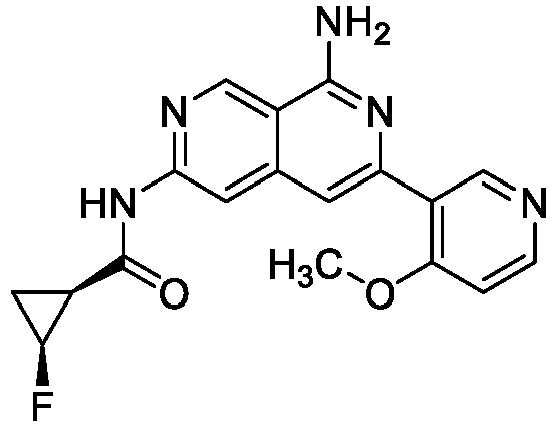
0.790 1H NMR (CD3OD, 400 MHz) δ 9.24 (s, 1H), 8.78 (s, 1H), 8.43 (d, J = 5.6 Hz, 1H), 7.35 (s, 1H), 7.19 (d, J = 4.2 Hz, 1H), 4.97-4.77 (m, 1 H), 4.00 (s, 3H), 2.17-2.15 (m, 1H), 1.90-1.78 (m,1H), 1.28-1.18 (m, 1H). 354.1 B 11 
1.074 1H NMR (400 MHz, CD3OD) δ 9.31 (s, 1H), 8.55 (s, 1H), 8.44 (d, J = 5.2 Hz, 1H), 8.34 (s, 1H), 7.41 (d, J = 5.2 Hz, 1H), 7.01 (s, 1H), 2.95-2.87 (m, 1H), 2.47 (s, 3H), 2.19-2.13 (m, 1H), 1.93-1.86 (m, 1H). 356.1 B 12 
0.973 1H NMR (400 MHz, CD3OD) δ 9.31 (s, 1H), 9.05 (s, 1H), 8.80 (s, 1H), 9.36 (s, 1H), 7.09 (s, 1H), 4.97-4.81 (m, 1 H), 2.63 (s, 3H), 2.19-2.16 (m, 1H), 1.87-1.80 (m, 1H), 1.26-1.21 (m, 1H). 339.1 B 13 
1.065 1H NMR (400MHz, CD3OD) δ 9.31 (s, 1H), 9.09 (s, 1H), 8.76 (s, 1H), 8.35 (s, 1H), 7.05 (s, 1H), 4.984.81 (m, 1H), 2.98 (q, J = 7.6 Hz, 2H), 2.19-2.16 (m, 1H), 1.87-1.80 (m, 1H), 1.29-1.21 (m, 4H). 353.1 B 14 
1.142 1H NMR (400 MHz, CD3OD) δ 9.30 (s, 1H), 8.89 (s, 1H), 8.77 (d, J = 5.2 Hz, 1H), 8.37 (s, 1H), 7.79 (d, J = 5.2 Hz, 1H), 7.54 (t, J = 14.8 Hz, 1H), 7.15 (s, 1H), 5.00-4.79 (m, 1H), 2.19-2.14 (m, 1H), 1.88-1.78 (m, 1H), 1.28-1.21 (m, 1H). 374.1 B 15 
1.603 1H NMR (400 MHz, CD3OD) δ 9.32 (s, 1H), 9.18 (s, 1H), 8.80 (d, J = 5.2 Hz, 1H), 8.40 (s, 1H), 7.87 (d, J = 4.8 Hz, 1H), 7.40 (s, 1H), 5.00-4.79 (m, 1H), 2.21-2.15 (m, 1H), 1.89-1.79 (m, 1H), 1.30-1.19 (m, 1H). 349.1 C 16 
1.408 1H NMR (400 MHz, DMSO-d 6) δ 10.94 (s, 1H), 9.31 (s, 1H), 8.18 (s, 1H), 8.02 (s, 1H), 7.17 (s, 2H), 6.84 (s, 1H), 6.31 (s, 1H), 5.96 (s, 2H), 5.03-4.86 (m, 1H), 2.30 (s, 3H), 2.28-2.24 (m, 1H), 1.70-1.63 (m, 1H), 1.21-1.14 (m, 1H). 353.2 G 17 
1.099 1H NMR (400 MHz, DMSO-d 6) δ 11.05 (s, 1H), 9.40 (s, 1H), 8.52 (s, 1H), 8.48 (s, 1H), 8.27 (s, 1H), 8.15 (s, 1H), 7.40 (s, 2H), 7.03 (s, 1H), 5.09-4.83 (m, 1H), 4.35 (d, J = 2.0 Hz, 3H), 2.32-2.21(m, 1H), 1.75-1.62 (m, 1H), 1.25-1.14 (m, 1H). 356.1 B 18 
1.055 1H NMR (400 MHz, DMSO-d 6) δ 11.02 (s, 1H), 8.24 (s, 1H), 8.15 (s, 1H), 7.45 (d, J = 2.0 Hz, 1H), 7.40 (s, 2H), 7.21 (s, 1H), 6.73 (d, J = 2.0 Hz, 1H), 5.07-4.84 (m, 1H), 4.19 (s, 3H), 2.32-2.21(m, 1H), 1.75-1.62 (m, 1H), 1.25-1.14 (m, 1H). 327.1 B 19 
1.269 1H NMR (400 MHz, CD3OD) δ 9.29 (s, 1H), 8.32 (s, 1H), 8.18 (s, 1H), 7.66 (s, 1H), 7.53 (s, 1H), 6.95 (s, 1H), 4.954.84 (m, 1H), 2.45 (s, 3H), 2.22-2.14 (m, 1H), 1.88-1.78 (m, 1H), 1.26-1.18 (m, 1H). 377.1 A 20 
1.752 1H NMR (400 MHz, CD3OD) δ 9.30 (s, 1H), 8.51 - 8.49 (m, 2H), 8.37 (s, 1H), 8.30 (brs, 1H), 7.46 (d, J = 5.2 Hz, 1H), 7.00 (s, 1H), 3.45 - 3.41 (m, 1H), 2.85 (q, J = 7.6 Hz, 2H), 2.43 - 2.36 (m, 2H), 2.31 - 2.23 (m, 2H), 2.12 - 2.05 (m, 1H), 1.98 - 1.93 (m, 1H), 1.20 (t, J = 7.6 Hz, 3H). 348.2 C 21 
1.035 1H NMR (400 MHz, CD3OD) δ 9.30 (s, 1H), 8.91 (s, 1H), 8.67 (s, 1H), 8.03 (s, 1H), 7.47 (s, 1H), 7.32 (s, 1H), 7.31 (s, 1H), 2.56-2.54 (m, 1H), 2.19-2.17 (m, 1H), 1.72-1.70 (m, 1H), 1.55-1.53 (m, 1H). 370.1 B 22 
1.059 1H NMR (400 MHz, CD3OD) δ 8.51 (s, 1H), 8.47 (s, 1H), 8.35 (s, 1H), 8.21 (s, 1H), 7.51 (d, J = 4.8 Hz, 1H), 7.03 (s, 1H), 2.43 (s, 3H), 4.99-4.80 (m, 1H), 2.19-2.16 (m, 1H), 1.87-1.80 (m, 1H), 1.28-1.21 (m, 1H). 338.1 B 24 
1.580 1H NMR (400 MHz, CD3OD) δ 9.29 (s, 1H), 8.56 (s, 1H), 8.43 (d, J = 5.2Hz, 1H), 8.31 (s, 1H), 7.39 (d, J = 5.2 Hz, 1H), 6.98 (s, 1H), 2.46 (s, 3H), 1.92-2.00 (m, 1H), 1.01-1.06 (m, 2H), 0.92-0.97 (m, 2H). 320.1 F 25 
1.627 1H NMR (400 MHz, CD3OD) δ 9.30 (s, 1H), 8.49 (s, 1H), 8.30 (s, 1H), 7.52 (s, 1H), 6.99 (s, 1H), 4.74 (s, 2H), 2.48 (s, 3H), 1.92-2.03 (m, 1H), 1.01-1.04 (m, 2H), 0.88-0.90 (m, 2H). 350.1 G 26 
1.623 1H NMR (400 MHz, CD3OD) δ 9.18 (s, 1H), 8.39 (s, 1H), 8.37 (d, J = 5.6 Hz, 1H), 8.17 (s, 1H), 7.33 (d, J = 5.6 Hz, 1H), 6.81 (s, 1H), 2.72 (q, J = 7.6 Hz, 2 H), 1.88-1.78 (m, 1H), 1.07 (t, J = 7.6 Hz, 3H), 0.95-0.87 (m, 2H), 0.82-0.74 (m, 2H). 334.2 G 27 
1.646 1H NMR (400 MHz, CD3OD) δ 9.15(s, 1H), 8.19(s, 1H), 8.14(s, 1H), 8.02(s, 1H), 7.11(s, 1H), 3.96 (s, 3H), 1.98-1.92(m, 1H), 1.05-1.02(m, 2H), 0.96-0.91(m, 2H). 309.1 G 28 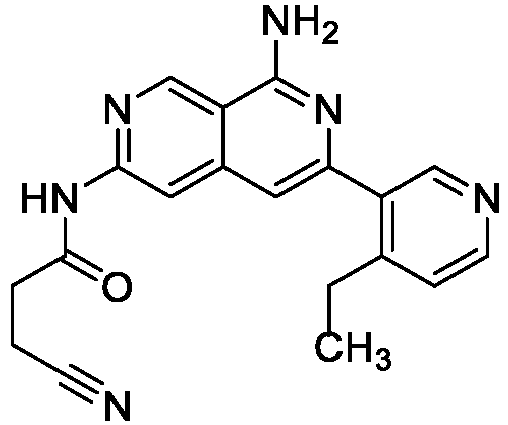
1.57 1H NMR (400 MHz, DMSO-d 6) δ 10.85 (s, 1H), 9.39 (s, 1H), 8.51 (s, 1H), 8.49 (d, J = 5.2 Hz, 1H), 8.26 (s, 1H), 7.36 (s, 1H), 7.34 (s, 2H), 6.98 (s, 1H), 2.86-2.74 (m, 6H), 1.10 (t, J = 7.6 Hz, 3H). 347.2 F 29 
1.372 1H NMR (400 MHz, DMSO-d 6) δ 10.65 (s, 1H), 9.36 (s, 1H), 8.50 (s, 1H), 8.48 (d, J = 4.8 Hz, 1H), 8.23 (s, 1H), 7.35 (s, 1H), 7.34 (d, J = 5.2 Hz, 1H), 7.31 (s, 2H), 6.93 (s, 1H), 6.79 (s, 1H), 2.78 (q, J = 7.6 Hz, 2H), 2.65 (t, J = 7.0 Hz, 2H), 2.41 (t, J = 7.0 Hz, 2H), 1.10 (t, J = 7.6 Hz, 3H). 365.2 G 30 
1.56 1H NMR (400 MHz, DMSO-d 6) δ 9.41 (s, 1H), 9.28 (s, 1H), 8.99 (d, J = 0.8 Hz, 1H), 8.49 (s, 1H), 8.48 (d, J = 5.2 Hz, 1H), 7.83 (s, 1H), 7.82 (s, 1H), 7.80 (s, 1H), 7.34 (d, J = 5.2 Hz, 1H), 7.27 (s, 2H), 6.87 (s, 1H), 4.61 (d, J = 6.0 Hz, 2H), 2.79 (q, J = 7.6 Hz, 2H), 2.65 (t, J = 7.6 Hz, 3H). 406.1 C 31 
1.581 1H NMR (400 MHz, DMSO-d 6) δ 9.33 (s, 1H), 9.11 (s, 1H), 8.55 (s, 1H), 8.54 (d, J = 5.2 Hz, 1H), 7.86 (s, 1H), 8.39 (d, J = 5.2 Hz, 1H), 7.30 (s, 2H), 7.16 (d, J = 6.8 Hz, 1H), 6.89 (s, 1H), 3.91-3.83 (m, 1H), 2.84 (q, J = 7.6 Hz, 2H), 1.20 (d, J = 6.4 Hz, 6H), 1.15 (t, J = 7.6 Hz, 3H). 351.2 G 32 
1.568 1H NMR (400 MHz, DMSO-d 6) δ 11.02 (s, 1H), 9.39 (s, 1H), 8.51 (s, 1H), 8.49 (d, J = 5.2 Hz, 1H), 8.19 (s, 1H), 7.36 (s, 2H), 7.35 (s, 1H), 7.01 (s, 1H), 4.04 (s, 2H), 2.79 (q, J = 7.6 Hz, 2H), 1.10 (t, J = 7.6 Hz, 3H). 333.1 C 33 
1.567 1H NMR (400 MHz, DMSO-d 6) δ 9.33 (s, 1H), 8.98 (s, 1H), 8.49 (s, 1H), 8.48 (d, J = 4.8 Hz, 1H), 7.96 (s, 1H), 7.34 (d, J = 4.8 Hz, 1H), 7.25 (s, 2H), 6.87 (s, 1H), 2.98 (s, 6H), 2.78 (q, J = 7.6 Hz, 2H), 1.10 (t, J = 7.6 Hz, 3H). 337.1 C 34 
1.378 1H NMR (400 MHz, DMSO-d 6) δ 9.33 (s, 1H), 9.28 (s, 1H), 8.49 (s, 1H), 8.48 (d, J = 5.2 Hz, 1H), 7.78 (s, 1H), 7.58 (s, 1H), 7.53 (s, 1H), 7.30 (d, J = 1.2 Hz, 1H), 7.25 (s, 2H), 7.06 (s, 1H), 6.84 (s, 1H), 4.29-4.22 (m, 1H), 2.78 (q, J = 7.6 Hz, 2H), 1.28 (d, J = 6.8 Hz, 3H), 1.10 (t, J = 7.6 Hz, 3H). 380.2 G 35 
1.041 1H NMR (400 MHz, CD3OD) δ 9.30 (s, 1H), 8.53, (s, 1H), 8.41 (d, J = 5.2 Hz, 1H), 8.09 (s, 1H), 7.37 (d, J = 5.2 Hz, 1H), 7.00 (s, 1H), 2.44 (s, 3H), 1.74 (s, 6H). 347.1 B 36 
1.071 1H NMR (400 MHz, CD3OD) δ 9.30 (s, 1H), 8.54 (s, 1H), 8.43 (d, J = 5.6 Hz, 1H), 8.37 (s, 1H), 7.28 (d, J = 5.6 Hz, 1H), 6.99 (s, 1H), 3.41(s, 3H), 2.45 (s, 3H), 1.49 (s, 6H). 352.1 B 37 
1.221 1H NMR (400 MHz, CDCl3) δ 9.00 (s, 1H), 8.65 (s, 1H), 8.50 (d, J = 5.2 Hz, 1H), 8.47 (s, 1H), 8.05 (br, 1H), 7.21 (d, J = 5.2 Hz, 1H), 7.06 (s, 1H), 5.42 (br, 2H), 2.62 (heptet, J = 6.8 Hz, 1H), 2.43 (s, 3H), 1.31 (d, J = 6.8 Hz, 6H). 332.1 B 38 
1.541 1H NMR (400 MHz, CD3OD) δ 9.31 (s, 1H), 8.54 (s, 1H), 8.43 (d, J = 5.2 Hz, 1H), 8.33 (s, 1H), 7.39 (d, J = 5.2 Hz, 1H), 7.01 (s, 1H), 2.45 (s, 3H), 1.64 (s, 3H). 333.1 F 39 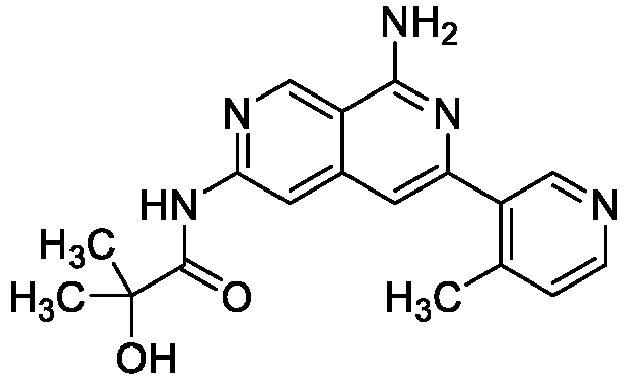
0.996 1H NMR (400 MHz, CD3OD) δ 9.29 (s, 1H), 8.53 (s, 1H), 8.42 (d, J = 5.2 Hz, 1H), 8.38 (s, 1H), 7.37 (d, J = 5.2 Hz, 1H), 6.99 (s, 1H), 2.45 (s, 3H), 1.50(s, 6H). 338.1 B 40 
1.092 1H NMR (400 MHz, DMSO-d 6) δ: 10.86 (s, 1H), 9.24 (s, 1H), 8.05 (s, 1H), 7.36-7.33 (m, 3H), 4.42 (t, J = 8.0 Hz, 2H), 4.17 (t, J = 8.0 Hz, 2H), 2.08-2.01 (m, 1H), 0.85-0.80 (m, 4H). 314.2 B 42 
1.034 1H NMR (400 MHz, DMSO-d 6) δ 12.01 (br, 1H), 10.95 (s, 1H), 9.31 (s, 1H), 8.60 (d, J = 6.4 Hz, 1H), 8.26 (s, 1H), 8.17 (s, 1H), 7.52 (br, 1H), 7.15 (br, 2H), 6.47-6.35 (m, 1H), 2.12-2.02 (m 1H), 0.91-076 (m, 4H). 322.1 B 43 
1.094 1H NMR (400 MHz, CD3OD) δ 9.28 (s, 1H), 8.51 (s, 1H), 8.41 (d, J = 5.2 Hz, 1H), 8.28 (s, 1H), 7.37 (d, J = 5.2 Hz, 1H), 6.95 (s, 1H), 2.68-2.59 (m, 1H), 2.44 (s, 3H), 2.14-2.07 (m, 1H), 1.63-1.51 (m, 2H). 345.2 B 44 
1.414 1H NMR (400 MHz, DMSO-d 6) δ: 9.45 (s, 1H), 8.70 (s, 1H), 8.64 (d, J = 5.2 Hz, 1H), 8.32 (s, 1H), 7.67 (d, J = 5.2 Hz, 1H), 7.44 (br, 2H), 7.11 (s, 1H), 5.52 (t, J = 5.6 Hz, 1H), 5.134.90 (m, 1H), 4.74 (d, J = 5.6 Hz, 2H), 2.40-2.29 (m, 1H), 1.80-1.68 (m, 1H), 1.32-1.20 (m, 1H). 354.2 F 45 
1.223 1H NMR (400 MHz, CD3OD) δ: 8.68 (s, 1H), 7.69 (s, 1H), 5.57 (s, 1H), 4.87-4.63 (m, 1H), 3.93-3.84 (m, 1H), 3.45-3.37 (m, 1H), 3.35-3.27 (m, 1H), 2.03-1.81 (m, 4H), 1.80-1.60 (m, 3H), 1.36-1.23 (m, 1H), 1.14-1.03 (m, 1H), 0.84 (t, J = 7.6 Hz, 3H). 344.2 B 46 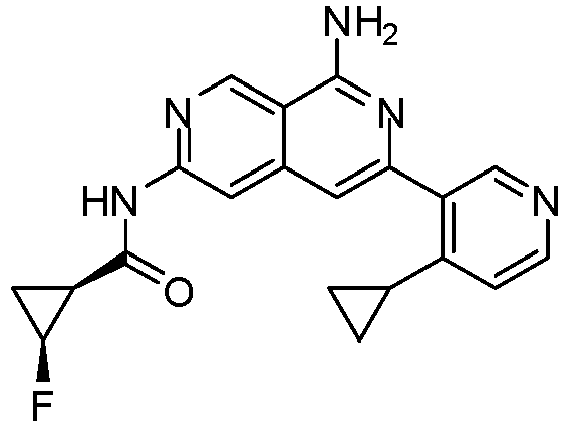
1.104 1H NMR (400 MHz, CD3OD) δ: 9.38 (s, 1H), 8.47 (s, 1H), 8.39 (d, J = 5.6 Hz, 1H), 8.32 (s, 1H), 7.04 (s, 1H), 6.97 (d, J = 5.6 Hz, 1H), 4.98-4.76 (m, 1H), 2.22-2.11 (m, 2H), 1.89-1.77 (m, 1H), 1.24-1.18 (m, 1H), 1.11-1.04 (m, 2H), 0.92-0.85 (m, 2H). 346.1 B 47 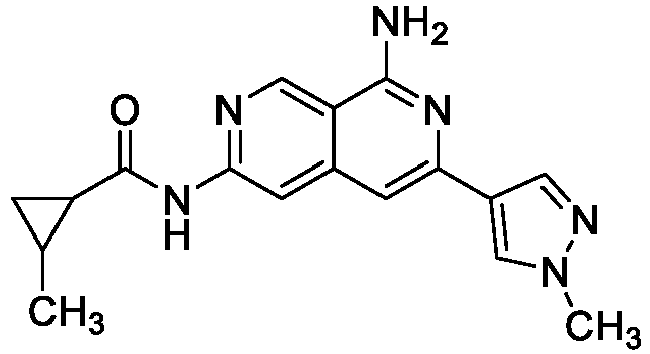
1.661 1H NMR of mixture of isomers (400 MHz, DMSO-d 6) δ: 10.77 (s, 1H), 9.24 (s, 1H), 8.15 (s, 1H), 8.11 (s,1H), 7.96 (s, 1H), 7.12 (br, 2H), 7.04 (s, 1H), 3.88 (s, 3H), 2.12-2.02 (m, 0.3H), 1.86-1.77 (m, 0.7H), 1.34-1.20 (m, 1H), 1.18-0.94 (m, 4H), 0.85-0.79 (m, 0.3H), 0.72-0.63 (m, 0.7H). 323.2 F 48 
1.086 1H NMR (400 MHz, DMSO-d 6) δ: 10.99 (s, 1H), 9.37 (s, 1H), 8.24 (s, 1H), 7.97 (s, 1H), 7.79 (s, 1H), 7.75 (d, J = 8.0 Hz, 1H), 7.48 (d, J = 8.0 Hz, 1H), 7.35 (br, 1H), 7.28 (br, 2H), 6.92 (s, 1H), 5.07-5.00 (m, 0.5 H), 4.90-4.83 (m, 0.5 H), 2.41 (s, 3H), 2.32-2.22 (m, 1H), 1.74-1.61 (m, 1H), 1.24-1.14 (m 1H). 380.2 B 49 
1.124 1H NMR (400 MHz, DMSO-d 6) δ: 10.99 (s, 1H), 9.37 (s, 1H), 8.44 (q, J = 4.4 Hz, 1H), 8.23 (s, 1H), 7.75 (s, 1H), 7.71 (d, J = 8.0 Hz, 1H), 7.48 (d, J = 8.0 Hz, 1H), 7.28 (br, 2H), 6.92 (s, 1H), 5.06-4.99 (m, 0.5H), 4.90-4.83 (m, 0.5H), 2.80 (d, J = 4.4 Hz, 3H), 2.41 (s, 3H), 2.32-2.22 (m, 1H), 1.73-1.60 (m, 1H), 1.24-1.15 (m, 1H). 394.1 B 50 
1.696 1H NMR (400 MHz, CD3OD) δ: 9.30 (s, 1H), 8.50 (d, J = 5.6 Hz, 1H), 8.44 (s, 1H), 8.28 (s, 1H), 7.49 (d, J = 5.6 Hz, 1H), 6.91 (s,1H), 3.40-3.20 (m, 1H), 2.70-2.60 (m, 1H), 2.15-2.05 (m, 1H), 1.65-1.50 (m, 2H), 1.22 (d, J = 6.8 Hz, 6 H). 373.2 F 51 
1.440 1H NMR (400 MHz, DMSO-d 6) δ 11.13 (s, 1H), 9.39 (s, 1H),8.56 (s, 1H), 8.43 (d, J = 4.8 Hz, 1H), 8.19 (s, 1H), 7.34 (s, 2H), 7.30 (d, J = 5.2 Hz,1 H), 6.97 (s, 1H), 5.00 (s, 0.5 H), 4.83 (m, 0.5 H), 2.66-2.57 (m,1H), 2.41 (s, 3H), 1.60-1.51 (m,1H), 1.31-1.23 (m,1H). 338.1 E 52 
1.03 1H NMR (400 MHz,CD3OD) δ 9.31 (s, 1H), 8.48 (s, 1H), 8.44 (s, 1H),8.34 (s, 1H), 7.05 (s, 1H), 5.00-4.80 (m, 1H), 2.71 (s, 3H), 2.20-2.16 (m, 1H), 1.88-1.81 (m, 1H), 1.26-1.21 (m, 1H). 378.1 B 53 
1.16 1H NMR (400 MHz, CD3OD) δ 9.18 (s, 1H), 8.38 (s, 1H), 8.36 (s, 1H), 8.17 (s, 1H), 7.32(d, J = 4.0 Hz, 1H), 6.83 (s, 1H), 3.42-3.39 (m, 1H), 3.22-3.18 (m, 4H), 2.72 (q, J = 6.0 Hz, 2H), 1.80-1.79 (m, 1H), 1.64-1.60 (m, 1H), 1.17-1.13 (m, 1H), 1.06 (t, J = 6.0 Hz, 3H), 0.86-0.82 (m, 1H). 378.2 B 54 
1.100 1H NMR (400 MHz, CD3OD) δ: 8.80 (s, 1H), 7.84 (s, 1H), 5.75 (s, 1H), 4.96-4.73 (m, 1H), 4.45-4.35 (m, 1H), 3.65-3.55 (m, 2H), 3.53-3.45 (m, 1H), 3.39-3.31 (m, 1H), 2.16-1.93 (m, 4H), 1.93-1.73 (m, 3H), 1.70-1.58 (m, 1H), 1.24-1.12 (m, 1H). 360.2 B 55 
1.20 1H NMR (400 MHz,DMSO-d 6) δ 11.02 (s, 1H), 9.38 (s, 1H), 8.25 (s, 1H),8.05 (s, 1H), 7.34 (s, 2H), 6.98 (s, 1H),6.85 (s, 1H), 5.04-4.86 (m, 1H), 3.85 (s, 3H), 2.30-2.23 (m, 4H), 1.70-1.64 (m,1H), 1.22-1.17 (m, 1H). 368.2 B 56 
1.02 1H NMR (400 MHz, CD3OD) δ 9.30 (s, 1H), 8.34 (s, 1H), 7.35 (s, 1H), 6.98 (s, 1H), 6.63 (s, 1H), 5.00-4.79 (m, 1H), 2.19-2.16 (m, 1H), 2.114 (s, 3H), 1.87-1.80 (m, 1H), 1.28-1.19 (m, 1H). 354.1 B 57 
1.53 1H NMR (400 MHz, CD3OD) δ 9.26 (s, 1H), 8.48 (s, 1H), 8.50 (s, 1H), 8.10 (s, 1H), 7.48-7.34 (m, 6 H), 6.97 (s, 1H), 5.27 (s, 2H), 2.83 (q, J = 7.6 Hz, 2H), 1.19 (t, J = 7.6 Hz, 3H). 400.2 B 58 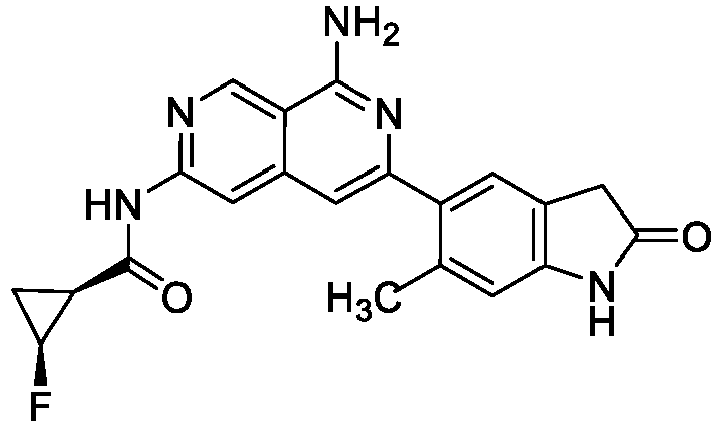
1.535 1H NMR (400 MHz, DMSO-d 6) δ 10.95(s, 1H), 10.42 (s, 1H), 9.33 (s, 1H), 8.19(s, 1H), 7.28 (s, 1H), 7.20 (s, 2H), 6.82(s, 1H), 6.70(s, 1H), 5.05-4.83 (m, 1H), 3.46 (s, 2H), 2.35 (s, 3H), 2.30-2.21(m, 1H), 1.71-1.59(m, 1H), 1.23-1.13(m, 1H). 392.1 C 59 
1.309 1H NMR (400 MHz, CD3OD) δ 9.29 (s, 1H), 8.48 (s, 1H), 8.32 (s, 1H), 7.65 (s, 1H), 6.98 (s, 1H), 4.99-4.78 (m, 1H), 2.46 (s, 3H), 2.19-2.15 (m, 1H), 1.86-1.80 (m, 1H), 1.59 (s, 6H), 1.26-1.20 (m, 1H). 396.1 A 60 
1.593 1H NMR (400 MHz, CD3OD) δ 9.32(s, 1H), 8.50 (s, 1H), 8.48 (d, J = 5.2 Hz,1H), 8.37(s, 1H), 7.44 (d, J = 5.2 Hz, 1H), 7.00 (s, 1H), 2.83(q, J = 7.6 Hz, 2H), 2.56-2.50 (m, 1H), 2.18-2.12 (m, 1H), 1.71-1.67 (m, 1H), 1.55-1.50 (m,1H), 1.19 (t, J = 7.2 Hz, 3H). 359.1 C 61 
1.449 1H NMR (400 MHz, CD3OD) δ 9.28(s, 1H), 8.49 (s, 1H), 8.47 (d, J = 5.2 Hz,1H), 8.37(s, 1H), 7.44 (d, J = 5.2 Hz, 1H), 6.95 (s,1H), 2.83 (q, J = 7.6 Hz, 2H), 2.35-2.29 (m, 1H), 2.19-2.13 (m, 1H), 1.73-1.68 (m, 1H), 1.37-1.32 (m,1H), 1.18 (t, J = 7.2 Hz, 3H). 377.1 C 62 
1.556 1H NMR (400 MHz, CD3OD) δ 9.32(s, 1H), 8.32 (d, J = 5.2 Hz, 1H), 8.31 (s, 1H), 7.25 (d, J = 5.2 Hz, 1H), 6.86 (s, 1H), 4.98-4.80 (m, 1H), 2.35(s, 3H), 2.20(s, 3H), 2.18-2.15 (m, 1H),1.87-1.79(m,1H), 1.26-1.20 (m, 1H). 352.1 C 63 
1.58 1H NMR (400 MHz, CD3OD): 9.28 (s, 1H), 8.84 (s, 1H), 8.35 (s, 1H), 8.25 (d, J = 6.0 Hz, 1H), 7.55 (d, J = 6.0 Hz, 1H), 7.32 (s, 1H), 7.06 (s, 1H), 4.99-4.82 (m, 1H), 4.07 (s, 3H), 2.20-2.16 (m, 1H), 1.88-1.81 (m, 1H), 1.27-1.23 (m, 1H). 377.1 C 64 
1.43 1H NMR (400 MHz, CD3OD) δ 9.16 (s, 1H), 8.19 (s, 1H), 7.65 (s, 1H), 6.84 (s, 1H), 6.40 (s, 1H), 4.88-4.67 (m, 1H), 3.50 (s, 3H), 2.64 (q, J = 7.6 Hz, 2H), 2.12-1.99 (m, 1H), 1.79-1.63 (m, 1H), 1.12-1.10 (m, 1H), 0.98 (t, J = 7.6 Hz, 3H). 382.1 G 65 
1.501 1H NMR (400 MHz, CD3OD): δ 9.29 (s, 1H), 8.50 (s, 2H), 7.52 (s, 1H), 7.45 (d, J = 5.2 Hz, 1H), 6.89 (s, 1H), 4.49 (t, J = 9.2 Hz, 1H), 3.47 (dd, J = 4.0, 9.2 Hz, 2H), 2.93 (s, 3H), 2.83 (q, J = 7.6 Hz, 2H), 2.62-2.57 (m, 1H), 2.09-2.04 (m, 1H), 1.19 (t, J = 7.6 Hz, 3H). 406.2 C 66 
1.782 1H NMR (400 MHz, CD3OD): δ 9.29 (s, 1H), 8.30 (s, 1H), 8.11 (s, 1H), 6.94 (s, 1H), 6.79 (s, 1H), 4.98-4.87 (m, 1H), 3.96 (s, 3H), 2.81 (q, J = 6.0 Hz, 2H), 2.19-2.16 (m, 1H), 1.86-1.81 (m, 1H), 1.26-1.22 (m, 1H), 1.14 (t, J = 6.0 Hz, 3H). 382.1 C 67 
1.476 1H NMR (400 MHz, CD3OD): δ 9.26 (s, 1H), 8.28 (s, 1H), 7.90 (s, 1H), 6.90 (s, 1H), 6.57 (s, 1H), 5.00-4.79 (m, 1H), 2.74 (q, J = 7.6 Hz, 2H), 2.19-2.13 (m, 1H),1.88-1.80 (m, 1H), 1.29-1.19 (m, 1H), 1.11 (t, J = 7.6 Hz, 3H). 367.2 G 68 
1.336 1H NMR (400 MHz, DMSO-d 6) δ 9.42 (s, 1H), 8.52-8.48 (m, 3H), 8.4 (brs, 1H), 7.58 (dd, J = 1.6, 5.6 Hz, 1H), 7.39 (s, 2H), 7.35 (d, J = 4.8 Hz, 1H), 7.01 (s, 1H), 6.34 (dd, J = 1.6, 4.4 Hz, 1H), 4.79 (s, 2H), 2.80 (q, J = 7.6 Hz, 2H), 1.10 (t, J = 7.6 Hz, 3H). 332.1 A 70 
2.47 1H NMR (400 MHz, DMSO-d 6) δ 13.28 (broad s, 1H), 9.65 (broad s, 1H), 9.43 (s, 1H), 8.54 (s, 1H), 8.52 (d, J = 5.1 Hz, 1H), 8.35, (s, 1H), 7.49 (broad s, 2H), 7.38 (d, J = 5.1 Hz, 1H), 7.04 (s, 1H), 6.62 (s, 1H), 2.80 (q, J = 7.2 Hz, 2H), 2.31 (s, 3H), 1.11 (t, J = 7.2 Hz, 3H). 374 J 71 
2.28 1H NMR (400 MHz, DMSO-d 6) δ 10.05 (v. broad), 9.59 (s, 1H), 8.65 (s, 1H & d, J = 5.2 Hz, 1H), 8.47, (s, 1H), 8.31 (v.broad), 7.94 (s, 1H), 7.58 (d, J = 5.2 Hz, 1H), 7.25 (s, 1H), 6.96 (s, 1H), 2.80 (q, J = 7.2 Hz, 2H), 1.16 (t, J = 7.2 Hz, 3H). 360 J 72 
2.44 1H NMR (400 MHz, DMSO-d 6) δ 11.06 (s, 1H), 9.52 (s, 1H), 8.56 (s, 1H), 8.55 (d, J = 5.4 Hz, 1H), 8.42 (s, 1H), 7.69 (broad, 2H), 7.55 (d, J = 2.1 Hz, 1H), 7.43 (d, J = 5.4 Hz, 1H), 7.38 (d, J = 2.1 Hz, 1H), 7.10 (s,1H), 4.14 (s, 3H), 2.81 (q, J = 7.5 Hz, 2H), 1.13 (t, J = 7.5 Hz, 3H). 374 J 73 
2.21 1H NMR (400 MHz, DMSO-d 6) δ 10.64 (s, 1H), 9.43 (s, 1H), 8.51 (s, 1H), 8.49 (d, J = 5.1 Hz, 1H), 8.47 (s, 1H), 8.36 (s, 1H), 8.18 (s, 1H), 7.35 (d, J = 5.1 Hz, 1H), 7.33 (broad, 2H), 6.97 (s, 1H), 3.90 (s, 3H), 2.80 (q, J = 7.3 Hz, 2H), 1.11 (t, J = 7.3 Hz, 3H). 374 J 74 
2.10 1H NMR (400 MHz, DMSO-d 6) δ 9.21 (s, 1H), 8.84 (s, 1H), 8.46 (s, 1H & d, J = 5.0 Hz, 1H), 7.87 (s, 1H), 7.45 (s, 1H), 7.32 (d, J = 5.0Hz, 1H), 7.07 (broad, 2H), 6.72 (s, 1H), 6.62 (s, 1H), 3.83 (s, 3H), 2.78 (q, J = 7.1 Hz, 2H), 1.10 (t, J = 7.1 Hz, 3H). 346 J 75 
1.92 1H NMR (400 MHz, DMSO-d 6) δ 12.83 (v. broad, 1H), 9.66 (broad, 1H), 9.47 (s, 1H), 8.65 (d, J = 5.3 Hz, 1H), 8.58 (s, 1H), 7.79 (broad, 2H), 7.50 (d, J = 5.3Hz, 1H), 6.99 (s, 1H), 6.78 (s, 1H), 2.68 (q, J = 7.4 Hz, 2H), 1.14 (t, J = 7.4 Hz, 3H). 332 J 76 
2.24 1H NMR (400 MHz, DMSO-d 6) δ 9.37 (s, 1H), 9.22 (s, 1H), 8.48 (s, 1H), 8.47 (d, J = 5.1 Hz, 1H), 7.55 (d, J = 2.1 Hz, 1H), 7.49 (s, 1H), 7.32 (d, J = 5.1Hz, 1H), 7.07 (broad, 2H), 6.74 (s, 1H), 6.10 (d, J = 2.1 Hz, 1H), 3.80 (s, 3H), 2.79 (q, J = 7.0 Hz, 2H), 1.10 (t, J = 7.0 Hz, 3H). 346 J 77 
2.09 1H NMR (400 MHz, DMSO-d 6) δ 12.17 (broad, 1H), 9.40 (s, 1H), 9.23 (s, 1H), 8.49 (s, 1H), 8.47 (d, J = 5.2 Hz, 1H), 7.61 (broad, 2H), 7.33 (d, J = 5.2 Hz, 1H), 7.10 (broad s, 2H), 6.74 (s, 1H), 6.12 (d, J = 2.1 Hz, 1H), 2.79 (q, J = 7.5 Hz, 2H), 1.10 (t, J = 7.5 Hz, 3H). 332 J 78 
1.72 1H NMR (400 MHz, DMSO-d 6) δ 9.21 (s, 1H), 8.87 & 8.82 (2x s*, 1H), 8.46 (m, 2H), 7.94 & 7.93 (2x s*, 1H), 7.52 & 7.49 (2x s*, 1H), 7.32 (d, J = 5.1Hz, 1H), 7.06 (broad, 2H), 6.72 (s, 1H), 6.64 (s, 1H), 4.32 & 4.13 (2x m*, 1H), 3.23 & 3.10 (2x m*, 2H), 2.84 (m, 2H), 2.79 (q, J = 7.5 Hz, 2H), 2.08 (m, 2H), 1.97 (m, 2H), 1.09 (t, J= 7.5 Hz, 3H). *Major & minor conformers 415 J 79 
2.23 1H NMR (400 MHz, DMSO-d 6) δ 10.84 (broad s, 1H), 9.38 (s, 1H), 8.52 (s, 1H & d, J = 5.1 Hz, 1H), 7.58 (broad, 2H), 7.38 (d, J = 5.1 Hz, 1H), 7.23 (s, 1H), 6.97 (s, 1H), 3.08 (m, 1H), 2.78 (q, J = 7.2 Hz, 2H), 1.10 (m, 5H), 1.03 (m, 2H). 370 J 80 
1.86 1H NMR (400 MHz, DMSO-d 6) δ 10.33 (s, 1H), 9.39 (s, 1H), 8.65 (s, 1H), 8.51 (s, 1H), 8.49 (d, J = 5.1 Hz, 1H), 8.19 (s, 1H), 7.35 (d, J = 5.1 Hz, 1H), 7.31 (broad, 2H), 7.28 (s, 1H), 6.92 (s, 1H), 2.80 (q, J = 7.5 Hz, 2H), 2.36 (s, 3H), 1.10 (t, 3H). 358 J 81 
2.30 1H NMR (400 MHz, DMSO-d6, 80°C) δ 9.73 (broad s, 1H), 9.32 (s, 1H), 8.50 (s, 1H), 8.46 (d, J = 5.5 Hz, 1H), 8.31 (d, J = 5.0 Hz, 1H), 8.07 (s, 1H), 7.43 (s, 1H), 7.29 (d, J = 5.5 Hz, 1H), 6.91 (broad, 2H), 6.84 (s, 1H), 6.82 (d, J = 5.1 Hz, 1H), 3.34 (broad, 2H), 2.93 (s, 3H), 2.80 (q, J = 7.5 Hz, 2H), 1.12 (m, 6H). 428 J 82 
2.04 1H NMR (400 MHz, DMSO-d 6) δ 9.94 (broad s, 1H), 9.35 (s, 1H), 8.5 1 (s, 1H), 8.50 (d, J = 5.1 Hz, 1H), 8.25 (s, 1H), 8.20 (d, J = 5.1 Hz, 1H), 7.35 (broad m, 4H), 6.87 (broad m, 2H), 5.33 (d, J = 4.2 Hz, 1H), 4.43 (m, 1H), 2.79 (q, J = 7.5 Hz, 2H), 1.61 (m, 2H), 1.11 (t, J = 7.5 Hz, 3H), 0.87 (t, J = 7.3 Hz, 3H). 401 J 83 
1.81 1H NMR (400 MHz, DMSO-d 6) δ 9.86 (s, 1H), 9.31 (s, 1H), 8.50 (s, 1H), 8.48 (d, J = 5.1 Hz, 1H), 8.27 (s, 1H), 7.66 (t, J = 7.7 Hz, 1H), 7.34 (d, J = 5.1 Hz, 1H), 7.25 (d, J = 7.7 Hz, 1H), 7.16 (broad, 2H), 6.97 (d, J = 5.1 Hz, 1H)), 6.86 (s, 1H), 5.34 (t, J = 6.0 Hz, 1H), 4.55 (d, J = 6.0 Hz, 2H), 2.80 (q, J = 7.5 Hz, 2H), 1.11 (t, J= 7.5 Hz, 3H). 373 J 84 
1.81 1H NMR (400 MHz, DMSO-d 6) δ 10.28 (broad s, 1H), 9.40 (s, 1H), 8.55 (s, 1H), 8.51 (s, 1H), 8.47 (d, J = 5.1Hz, 1H), 8.32 (s, 1H), 8.11 (s, 1H), 7.30 (d, J = 5.1Hz, 1H), 7.04 (broad, 2H), 6.95 (s, 1H), 4.25 (m, 1H), 3.07 (m, 2H, masked by water), 2.80 (q, J = 7.5 Hz, 2H), 2.64 (m, 2H), 2.02 (m, 2H), 1.80 (m, 2H), 1.11 (t, J = 7.5 Hz, 3H). 443 J 85 
1.93 1H NMR (400 MHz, DMSO-d 6) δ 9.21 (s, 1H), 8.84 (s, 1H), 8.46 (s, 1H & d, J = 5.1 Hz, 1H), 7.91 (s, 1H), 7.49 (s, 1H), 7.32 (d, J = 5.1Hz, 1H), 7.04 (broad, 2H), 6.71 (s, 1H), 6.63 (s, 1H), 4.89 (t, J = 5.5 Hz, 1H), 4.12 (t, J = 5.8 Hz, 2H), 3.74 (q, J = 5.8 Hz, 2H), 2.78 (q, J = 7.5 Hz, 2H), 1.09 (t, J = 7.5 Hz, 3H). 376 J 86 
1.10 - 356.1 P 87 
3.47, 344.2 - Q 88 
3.45, 344.2 - Q 89 
n/a - 
90 
- 
1.48, 377.1 C 91 
2.68, 360.1 - Q 92 
2.68, 360.1 - Q 93 
2.68, 360.1 - Q 94 
2.68, 360.1 - Q 96 
2.52, 345.1 - Q 97 
2.52, 345.1 - Q 98 
1.43, 433.2 - 
C 99 
1.30 - 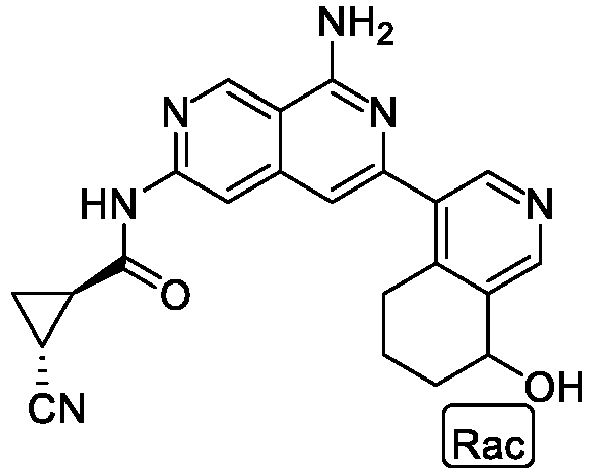
401.1 A 100 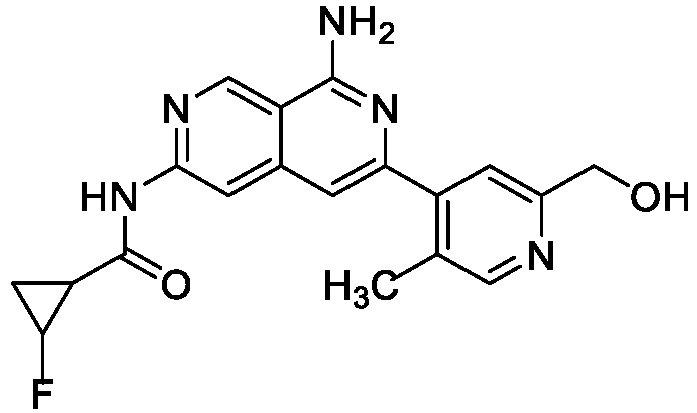
1.48 - 
368.2 F 101 
1.52 - 
363.2 B 102 
1.54 - 374.2 C 103 
1.31, 341.1 - 
B 104 
1.50 - 
348.2 F 105 
1.53, 346.1 - F 106 
324.1 - 
107 
2.69, 338.1 - Q 108 
2.69, 338.1 - Q 109 
1.48 - 379.2 F 110 
1.55 - 399.1 E 111 
1.17 - 361.1 E 112 
1.32, 320.1 - E 113 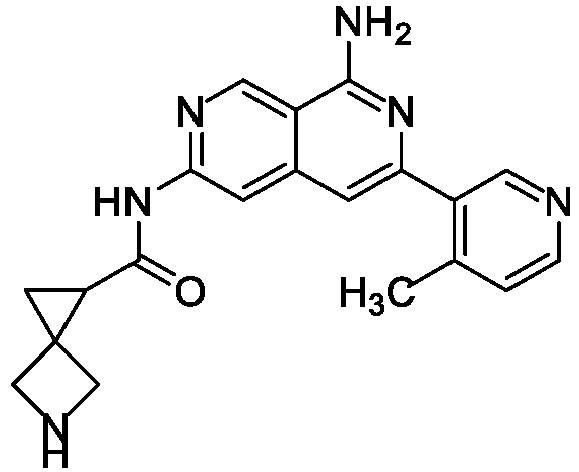
1.38, 361.1 - F 114 
n/a - 115 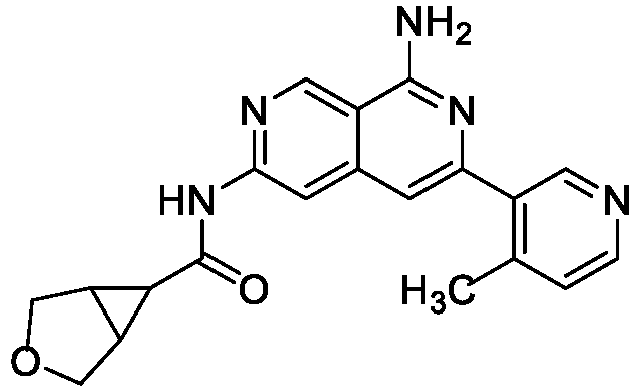
n/a - 116 
n/a - 117 
n/a - 118 
n/a - 119 
n/a - 120 
1.34 1H NMR (400 MHz, CD3OD): δ 9.20 (s, 1H), 8.52 (s, 1H), 8.47 (d, J = 5.2 Hz, 1H), 8.41 (brs, 2H), 7.42 (d, J = 5.2 Hz, 1H), 6.78 (s, 1H), 6.65 (s, 1H), 4.69-4.66 (m, 1H), 3.66-3.54 (m, 2H), 3.48-3.37 (m, 2H), 2.48-2.41 (m, 1H), 2.44 (s, 3H), 2.20-2.15 (m, 1H). 321.1 C 121 
1.54 1H NMR (400 MHz, CD3OD): δ 9.29 (s, 1H), 8.54 (s, 1H), 8.43 (d, J = 5.2 Hz, 1H), 8.34 (s, 1H), 7.54 (s, 1H), 7.40 (d, J = 5.2 Hz, 1H), 6.99 (s, 1H), 6.16 (d, J = 1.6 Hz, 1H), 2.62-2.57 (m, 1H), 2.46 (s, 3H), 2.31-2.27 (m, 1H), 1.67-1.62 (m, 1H), 1.46-1.41 (m, 1H). 386.1 C 122 
1.240 1H NMR (400 MHz, DMSO-d 6) δ 12.62 (s, 1H), 10.94 (s, 1H), 9.37 (s, 1H), 8.57 (s, 1H), 8.44 (d, J = 5.2 Hz, 1H), 8.26 (s, 1H), 7.62 (s, 1H), 7.37 (s, 1H), 7.32-7.31 (m, 3H), 6.97 (s, 1H), 2.41 (s, 3H), 2.27-2.19 (m, 2H), 1.50-1.36 (m, 1H), 1.27-1.11 (m, 1H). 386.1 G 123 
1.262 1H NMR (400 MHz,CD3OD) δ 9.28 (s, 1H), 8.53 (s, 1H), 8.43 (d, J = 5.2 Hz, 1H), 8.28 (s, 1H), 7.40 (d, J = 5.2 Hz, 1H), 6.97 (s, 1H), 3.98 (d, J = 8.8 Hz, 2H), 3.81 (d, J = 8.8 Hz, 2H), 2.45 (s, 3H), 2.26-2.26 (m, 2H), 1.91-1.89 (m, 1H). 362.1 A 124 
1.775 1H NMR (400 MHz,CD3OD) δ 9.28 (s, 1H), 8.53 (s, 1H), 8.43 (d, J = 5.2 Hz, 1H), 8.27 (s, 1H), 7.39 (d, J = 5.2 Hz, 1H), 6.96 (s, 1H), 3.51 (t, J = 5.6Hz, 2H), 3.37 (s, 3H), 3.20- 3.18 (m, 2H), 2.70 (t, J = 5.6 Hz, 2H), 2.56- 2.63 (m, 2H), 2.45 (s, 3H), 2.24- 2.22 (m, 1H), 2.05 (s, 2H). 419.2 1-1 125 
1.390 1H NMR (400 MHz,CD3OD) δ 9.29 (s, 1H), 8.53 (s, 1H), 8.43 (d, J = 4.8 Hz, 1H), 8.33 (s, 1H), 7.40 (d, J = 4.8 Hz, 1H), 6.97 (s, 1H), 3.29-3.20 (m, 4H), 2.45 (s, 3H), 2.25-2.22 (m, 1H), 2.11-2.04 (m, 1H), 2.00-1.1.94 (m, 1H), 1.45-1.43 (m, 1H), 1.34-1.31 (m, 1H). 375.2 G 126 
1.413 1H NMR (400 MHz,CD3OD) δ 9.30 (s, 1H), 8.54 (s, 1H), 8.43 (d, J = 5.2 Hz, 1H), 8.33 (s, 1H), 7.40 (d, J = 5.2 Hz, 1H), 6.98 (s, 1H), 3.15-3.08 (m, 2H), 3.03-2.91 (m, 2H), 2.46 (s, 3H), 2.16-2.13 (m, 1H), 2.03-1.98 (m, 2H), 1.48-1.45 (m, 1H), 1.26-1.24 (m, 1H). 375.2 G 127 
1.723 1H NMR (400 MHz,CD3OD) δ 9.29 (s, 1H), 8.54 (s, 1H), 8.43 (d, J = 5.2 Hz, 1H), 8.32 (s, 1H), 7.40 (d, J = 5.2 Hz, 1H), 6.98 (s, 1H), 3.53- 3.50 (m, 2H), 3.33 (s, 3H), 2.87- 2.69 (m, 6H), 2.45 (s, 3H), 2.13- 1.92 (m, 3H), 1.43- 1.41 (m, 1H), 1.22-1.19 (m, 1H). 433.2 1-1 128 
1.763 1H NMR (400 MHz,CD3OD) δ 9.29 (s, 1H), 8.54 (s, 1H), 8.43 (d, J = 5.2 Hz, 1H), 8.32 (s, 1H), 7.39 (d, J = 5.2 Hz, 1H), 6.97 (s, 1H), 3.56- 3.53 (m, 2H), 3.36 (s, 3H), 2.91- 2.60 (m, 6H), 2.45 (s, 3H), 2.12- 1.96 (m, 3H), 1.40- 1.37 (m, 1H), 1.21- 1.18 (m, 1H). 433.3 1-1 129 
1.639 1H NMR (400 MHz, DMSO-d 6): δ11.28 (brs, 1H), 9.37 (s, 1H), 8.95 (s, 1H), 8.42 (d, J = 5.6 Hz, 1H), 8.15 (s, 1H), 7.42 (s, 1H), 7.31 (brs, 2H), 7.14 (d, J = 5.6 Hz, 1H), 4.23 (q, J =7.2 Hz, 2H), 2.78-2.74 (m, 1H), 2.19-2.15 (m, 1H), 1.64-1.59 (m, 1H), 1.47-1.42 (m, 1H), 1.39 (t, J = 7.2 Hz, 3H). 375.1 C 130 
1.35 1H NMR (400 MHz, DMSO-d 6) δ 9.26 (s, 2H), 8.56 (s, 1H), 8.43(d, J = 4.8 Hz, 1H), 7.76 (s, 1H), 7.30 (d, J = 4.8 Hz, 1H), 7.26 (s, 2H), 7.13 (d, J = 4.4 Hz, 1H), 6.88 (s, 1H), 2.72 (d, J = 4.8 Hz, 3H), 2.41 (s, 3H). 309.2 E 131 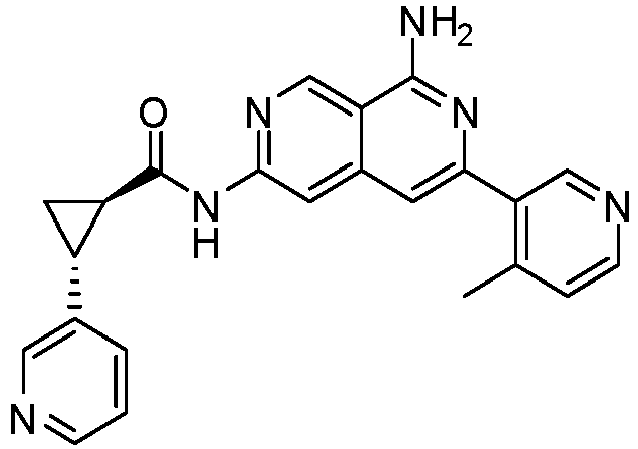
1.27 1H NMR (400 MHz, DMSO-d 6) δ 11.00 (s, 1H), 9.37 (s, 1H), 8.57 (s, 1H), 8.51 (d, J = 2.0 Hz, 1H), 8.45-8.42(m, 2H), 8.28 (s, 1H), 7.57(d, J = 8.0 Hz, 1H), 7.35-7.31(m, 4H), 6.99 (s, 1H), 2.48-2.46 (m, 1H), 2.46-2.45 (m, 1H), 2.42(s, 3H), 1.59-1.54 (m, 1H), 1.50-1.46(m, 1H). 397.2 B 132 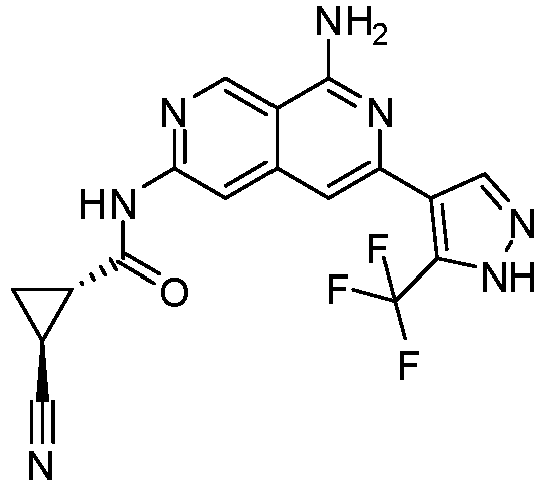
1.76 1H NMR (400 MHz, CD3OD) δ 9.11 (s, 1H), 8.09 (s, 2H), 6.93 (s, 1H), 2.55-2.50 (m, 1H), 2.06-2.01 (m, 1H), 1.52-1.42 (m, 2H). 388.0 E 133 
1.45 1H NMR (400 MHz, DMSO-d 6) δ 10.50 (s, 1H), 9.33 (s, 1H), 8.57 (s, 1H), 8.44 (d, J = 4.8 Hz, 1H), 8.09 (s, 1H), 7.97 (s, 1H), 7.32-7.27 (m, 3H), 6.99(s, 1H), 5.24 (t, J = 4.4 Hz, 1H), 3.29 - 3.24 (m, 2H), 2.42 (s, 3H), 2.06-1.88 (m, 2H). 379.2 F 134 
1.64 1H NMR (400 MHz,DMSO-d6) δ 9.26 (s, 1H), 9.09 (s, 1H), 8.56 (s, 1H), 8.43 (d, J = 4.8 Hz, 1H), 8.20 (s, 1H), 7.79 (s, 1H), 7.30 (d, J = 4.8 Hz, 1H), 7.24 (s, 3H), 3.87-3.83 (m, 1H), 3.78 - 3.72 (m, 1H), 2.41 (s, 3H), 2.05-2.00 (m, 1H), 1.85-1.78 (m, 1H), 1.71-1.60 (m, 2H), 1.53-1.46 (m, 1H), 1.42-1.35 (m, 1H). 379.1 E 135 
1.419 1H NMR (400 MHz, DMSO-d 6) δ 11.24 (s, 1H), 9.37 (s, 1H), 8.17 (s, 1H), 8.15 (s, 1H), 7.31 (s, 1H), 7.27 (s, 2H), 6.98 (s, 1H), 6.88 (s, 1H), 2.78-2.73 (m, 1H), 2.37 (s, 3H), 2.17-2.12 (m, 1H), 1.63-1.58 (m,1H), 1.45-1.41 (m, 1H). 401.1 B 136 
1.402 1H NMR (400MHz, CD3OD) δ 9.26 (s, 1H), 8.53 (s, 1H), 8.43 (d, J = 4.8 Hz, 1H), 8.28 (s, 1H), 7.40 (d, J = 4.8 Hz, 1H), 6.98 (s, 1H), 3.18(s, 3H), 2.93 (s, 3H), 2.453 (s, 3H), 2.432 - 2.411(m, 1H), 2.357-2.296(m,1H), 1.738-1.694(m,1H), 1.383-1.330(m,1H). 391.2 C 137 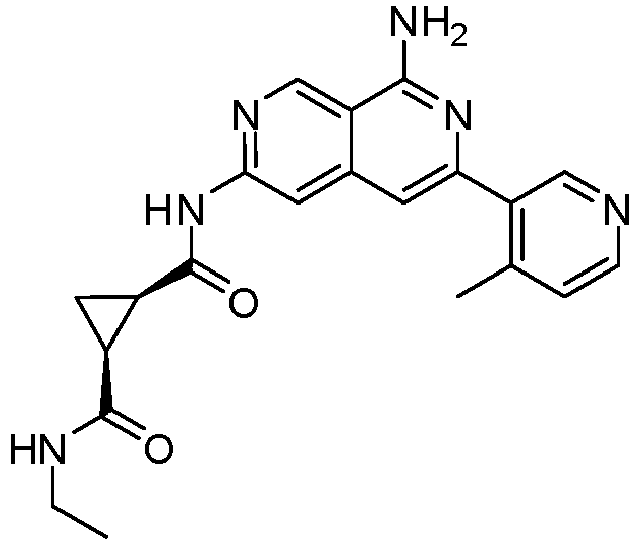
1.428 1H NMR (400 MHz, CD3OD) δ 9.28 (s, 1H), 8.54 (s, 1H), 8.43 (d, J = 5.2 Hz, 1H), 8.31(s, 1H), 7.40 (d, J = 5.2 Hz, 1H), 6.98(s, 1H), 3.24-3.18 (m, 2H), 2.45 (s, 3H), 2.30-2.26 (m, 1H), 2.14-2.12 (m,1H), 1.72-1.69(m,1H), 1.34-1.30 (m,1H), 1.11(t, J = 7.2Hz, 3H). 391.1 C 138 
1.522 1H NMR (400 MHz, DMSO-d 6) δ 11.05 (s, 1H), 9.37 (s, 1H), 8.56 (s, 1H), 8.44 (d, J = 4.8 Hz, 1H), 8.25 (s, 1H), 7.32 (d, J =4.8 Hz, 1H), 7.30 (s, 2H), 6.97 (s, 1H), 3.12 (s, 3H), 2.86 (s, 3H), 2.48-2.45 (m,1H), 2.41 (s, 3H), 2.39- 2.35 (m, 1H), 1.28-1.25(m, 1H). 391.2 C 139 
1.39 1H NMR (400 MHz, DMSO-d 6) δ 10.87 (s, 1H), 9.36 (s, 1H), 8.56 (s, 1H), 8.43 (d, J = 4.8Hz, 1H), 8.22 (s, 1H), 7.31-7.30 (m, 3H), 6.95 (s, 1H), 2.40 (s, 3H), 1.85- 1.81 (m, 1H), 1.29 -1.24 (m, 1H), 1.10 (d, J = 6.0 Hz, 3H), 1.07-1.02 (m, 1H), 0.71- 0.66 (m, 1H). 334.2 B 140 
1.46 1H NMR (400 MHz, DMSO-d 6) δ 11.20 (s, 1H), 9.39 (s, 1H), 8.56 (s, 1H), 8.43 (d, J = 4.8Hz, 1H), 8.23 (s, 1H), 7.35 (s, 2H), 7.31 (d, J = 4.8Hz, 1H), 6.99 (s, 1H), 2.32-2.59 (m, 1H), 2.41 (s, 3H), 2.33-2.30 (m,1H), 1.35-1.31 (m, 2H). 388.2 B 141 
1.72 1.72, [M+H]+ = 334.1, method = C; 1H NMR (CD3OD, 400 MHz): δ 9.29 (s, 1H), 8.54 (s, 1H), 8.43 (d, J = 5.2 Hz, 1H), 8.32 (s, 1H), 7.41 (d, J = 5.2 Hz, 1H), 7.00 (s, 1H), 2.46 (s, 3H), 2.03-1.98 (m, 1H), 1.45-1.38 (m, 1H), 1.22 (d, J = 6.0 Hz, 3H), 1.10-1.05 (m, 1H), 1.02-0.98 (m, 1H). 334.1 C 142 
1.76 1HNMR (400 MHz, DMSO-d 6): δ 11.24 (s, 1H), 9.37 (s, 1H), 8.18 (s, 1H), 7.36 (s, 1H), 7.29 (s, 2H), 7.17 (s, 1H), 6.89 (s, 1H), 3.36 (s, 3H), 2.79-2.73 (m, 1H), 2.42 (s, 3H), 2.18-2.13 (m, 1H), 1.63-1.59 (m, 1H), 1.46-1.41 (m, 1H). 415.1 C 143 
1.436 1H NMR (400 MHz, DMSO-d 6) δ 10.82 (s, 1H), 9.36 (s, 1H), 8.56 (s, 1H), 8.43 (d, J = 5.2 Hz, 1H), 8.22 (s, 1H), 7.32-7.31 (m, 3H), 6.95 (s, 1H), 3.70-3.66 (m, 2H), 3.38-3.33 (m, 2H), 2.41 (s, 3H), 2.14-2.12 (m,1H), 2.07-2.05 (m, 1H), 1.95-1.93 (m, 4H). 403.1 H 144 
1.504 1H NMR (400 MHz, DMSO-d 6) δ 9.27 (s, 1H), 8.30 (s, 1H), 7.27 (s, 1H), 7.03 (s, 1H), 6.91 (s, 1H), 2.46 - 2.41 (m, 1H), 2.38 (s, 3H), 2.15-2.13 (m, 1H), 1.63 -1.56 (m, 1H), 1.31-1.28 (m, 1H). 442.1 E 145 
1.40 1H NMR (400 MHz, DMSO-d 6) δ 9.28 (s, 1H), 8.54 (s, 1H), 8.43 (d, J = 5.2 Hz, 1H), 8.32 (s, 1H), 7.63 (s, 1H), 7.40 (d, J = 5.2 Hz, 1H), 7.23 (d, J = 8.5 Hz, 2H), 7.01- 6.89 (m, 4H), 5.09 (s, 2H), 3.80 (s, 3H), 2.54- 2.39 (m, 4H), 2.26- 2.15 (m, 1H), 1.57-1.52 (m, 1H), 1.42-1.38 (m, 1H). 506.1 B 146 
1.560 1H NMR (400 MHz, CD3OD) δ 9.30 (s, 1H), 8.55 (s, 1H), 8.44 (d, J = 5.2 Hz, 1H), 8.34 (s, 1H), 8.12 (s, 1H), 7.85 (s, 1H), 7.41 (d, J = 5.2 Hz, 1H), 7.00 (s, 1H), 3.56 (q, J = 7.6 Hz, 2H), 2.48-2.47 (m, 4H), 2.28-2.13 (m, 1H), 1.67-1.62 (m, 1H), 1.39-1.34 (m, 1H), 1.21 (t, J = 7.6 Hz, 3H). 478.1 B 147 
1.591 1H NMR (400 MHz, DMSO-d 6) δ 11.29 (s, 1H), 9.42 (s, 1H), 8.69 (s, 1H), 8.68 (s, 1H), 8.22 (s, 1H), 7.21-7.48 (m, 3H), 7.00 (s, 1H), 2.74-2.79 (m, 1H), 2.40 (s, 3H), 2.13-2.18 (m, 1H), 1.59-1.64 (m, 1H), 1.41-1.46 (m, 1H). 394.7 G 148 
1.494 1H NMR (400 MHz, DMSO-d 6) δ 11.00 (s, 1H), 9.37 (s, 1H), 8.56 (s, 1H), 8.43 (d, J = 4.8 Hz, 1H), 8.27 (s, 1H), 7.30-7.32 (m, 3H), 6.99 (s, 1H), 3.33-3.39 (m, 4H), 2.84 (s, 3H), 2.41 (s, 3H), 2.26-2.30 (m, 1H), 1.88-2.01 (m, 2H), 1.22-1.29 (m, 2H). 452.7 G 149 
1.504 1HNMR (400 MHz, CD3OD) δ 9.30 (s, 1H), 8.54 (s, 1H), 8.43 (d, J = 5.2Hz, 1H), 8.34 (s, 1H), 7.40 (d, J = 4.8 Hz, 1H), 6.99 (s, 1H), 3.35-3.54 (m, 4H), 2.94 (s, 3H), 2.46 (s, 3H), 2.12-2.23 (m, 3H), 1.45-1.48 (m, 1H), 1.28-1.32 (m, 1H). 452.7 G 150 
1.641 1H NMR (400 MHz,DMSO-d 6) δ 11.05 (s, 1H), 9.38 (s, 1H), 8.57 (s, 1H), 8.43 (d, J = 4.8 Hz, 1H), 8.32 (dd, J = 2.0, 4.8 Hz, 1H), 8.28 (s, 1H), 7.96 (dd, J = 1.6, 7.6 Hz, 1H), 7.32-7.31 (m, 3H), 7.00 (s, 1H), 6.78 (dd, J = 4.8, 7.6 Hz, 1H), 4.39-4.30 (m, 4H), 2.41-2.36 (m, 4H), 1.39-1.27 (m, 2H). 463.2 G 151 
1.467 1H NMR (400 MHz, DMSO-d 6) δ 10.95 (s, 1 H), 9.37 (s, 1 H), 8.56 (s, 1 H), 8.43 (d, J = 5.2 Hz, 1 H), 8.22 (s, 1 H), 7.32-7.30 (m, 3 H), 6.96 (s, 1 H), 3.45-3.43 (m, 4 H), 2.95 (s, 3 H), 2.41 (s, 3 H), 2.19-2.17 (m,1H), 2.11-2.09 (m, 2H). 439.1 H 152 
1.67 1H NMR (400 MHz, DMSO-d 6): δ 11.00 (brs, 1H), 9.37 (s, 1H), 8.77 (s, 1H), 8.57 (s, 1H), 8.53 (s, 1H), 8.44 (d, J = 4.8 Hz, 1H), 8.27 (s, 1H), 7.32 (brs, 2H), 7.31 (s, 1H), 6.98 (s, 1H), 2.60-2.55 (m, 1H), 2.41 (s, 3H), 2.44-2.40 (m, 1H), 1.56-1.51 (m, 1H), 1.47-1.44 (m, 1H). 403.1 C 153 
1.546 1H NMR (400 MHz, CD3OD) δ 9.32 (s, 1H), 8.51 (s, 1H), 8.47 (s, 1H), 8.45 (d, J = 5.2 Hz, 1H), 7.41 (d, J = 5.2 Hz, 1H), 2.70-2.62 (m, 1H), 2.37 (s, 3H), 2.15-2.09 (m, 1H), 1.65-1.52 (m, 2H). 363.2 G 154 
1.285 Racemate: 1H NMR (400 MHz, CD3OD) δ 9.27 (s, 1H), 8.52 (s, 1H), 8.41 (d, J = 5.2 Hz, 1H), 8.28 (s, 1H), 7.37 (d, J = 5.2 Hz, 1H), 6.94 (s, 1H), 3.64 (dd, J = 6.0, 11.6 Hz, 1H), 3.46 (dd, J = 6.4, 11.6 Hz, 1H), 2.44 (s, 3H), 1.90-1.84 (m, 1H), 1.76-1.68 (m, 1H), 1.29-1.21 (m, 1H), 0.97-0.91 (m, 1H). 350.2 B 155 
1.373 1H NMR (400 MHz, CD3OD) δ: 9.18 (s, 1H), 8.42 (s, 1H), 8.31 (d, J = 5.2 Hz, 1H), 8.17 (s, 1H), 7.28 (d, J = 5.2 Hz, 1H), 6.86 (s, 1H), 2.66 (dd, J = 6.8, 13.2 Hz, 1H), 2.55 (dd, J = 7.2, 13.2 Hz, 1H), 2.34 (s, 3H), 1.77-1.71 (m, 1H), 1.56-1.51 (m, 1H), 1.20-1.15 (m, 1H), 0.86-0.79 (m, 1H). 349.2 G 156 
1.489 1H NMR (400 MHz, DMSO-d 6) δ 10.88 (s, 1H), 9.42 (s, 1H), 8.52 (s, 1H), 8.49 (d, J = 4.8 Hz, 1H), 8.37 (s, 1H), 7.37 (d, J = 4.8 Hz, 1H), 7.30 (br, 2H), 2.28 (s, 3H), 2.17 (s, 3H). 312.0 C 157 
1.543 1H NMR (400 MHz, DMSO-d 6) δ 9.45 (s, 1H), 8.58 (s, 1H), 8.44 (d, J = 5.2 Hz, 1H), 8.38 (s, 1H), 7.45 (s, 2H), 7.32 (d, J = 4.8 Hz, 1H), 7.08 (s, 1H), 5.04 (d, J = 3.6 Hz, 1H), 3.14-3.11 (m, 2H), 2.91-2.86 (m, 1H), 2.59-2.55 (m, 1H), 2.47-2.45 (m, 4H), 2.01-2.00 (m, 1H). 359.1 C 158 
1.326 1H NMR (400 MHz, DMSO-d 6) δ 11.08 (s, 1H), 9.38 (s, 1H), 8.56 (s, 1H), 8.43 (d, J = 4.8 Hz, 1H), 8.21 (s, 1H), 7.43 (s, 1H), 7.34-7.31 (m, 3H), 6.98 (s, 1H), 3.51-3.48 (m, 2H), 2.41-2.40 (m, 4H), 2.18-2.16 (m, 1H), 2.09-2.08 (m, 1H). 375.1 G 159 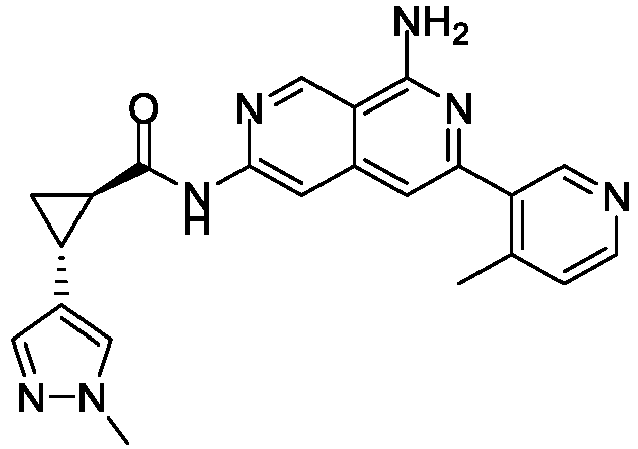
1.497 1H NMR (400 MHz, DMSO-d 6) δ 10.95 (s, 1H), 9.37 (s, 1H), 8.57 (s, 1H), 8.44(d, J = 5.2 Hz, 1H), 8.26 (s, 1H), 7.56 (s, 1H), 7.32 (s, 2H), 7.31 (d, J = 5.2 Hz, 1H), 7.30 (s, 1H), 6.97 (s, 1H), 3.77 (s, 3H), 2.41 (s, 3H), 2.23-2.19 (m, 2H), 1.40-1.38 (m, 1H), 1.23-1.18 (m, 1H). 400.2 G 160 
1.437 1H NMR (400 MHz, DMSO-d 6) δ 11.23 (s, 1H), 10.3 (s, 1H), 9.35 (s, 1H), 8.16 (s, 1H), 7.37 (s, 1H), 7.26 (s, 2H), 6.84 (s, 1H), 6.68 (s, 1H), 6.16 (d, J = 7.6 Hz, 1H), 4.84 (d, J = 7.6 Hz, 1H), 2.78-2.74 (m, 1H), 2.36 (s, 3H), 2.17-2.13 (m, 1H), 1.63-1.59 (m, 1H), 1.46-1.41 (m, 1H). 415.1 C 161 
1.413 1H NMR (400 MHz, DMSO-d 6) δ 9.23 (s, 1H), 8.98 (s, 1H), 8.53 (s, 1H), 8.42 (d, J = 4.8 Hz, 1H), 8.09 (s, 1H), 7.63 (s, 1H), 7.29 (d, J = 5.2 Hz, 1H), 7.10 (s, 2H), 6.77 (s, 1H), 6.68 (s, 1H), 5.27-5.21 (m, 1H), 4.55 (t, J = 13.8 Hz, 1H), 4.41 (q, J = 4.8 Hz, 1H), 4.29 (t, J = 9.0 Hz, 1H), 4.14-4.09 (m, 1H), 2.40 (s, 3H), 1.83 (s, 3H). 415.2 C 162 
1.713 1H NMR (400 MHz, DMSO-d 6) δ 9.48 (s, 1H), 9.27 (s, 1H), 9.19 (s, 1H), 8.43 (s, 1H), 8.40 (d, J = 5.2 Hz, 1H), 7.97 (s, 1H), 7.77 (s, 1H), 7.34 (s, 1H), 7.29 (d, J = 4.8 Hz, 1H), 7.19 (s, 2H), 3.71 (s, 3H), 2.20 (s, 3H). 393.2 G 163 
1.765 1H NMR (400 MHz, DMSO-d 6) δ 9.57 (s, 1H), 9.38 (s, 1H), 9.26 (s, 1H), 8.49 (d, J = 4.8 Hz, 1H), 8.42 (s, 1H), 8.26 (s, 1H), 7.90 (s, 1H), 7.56 (s, 2H), 7.44 (s, 1H), 7.37 (d, J = 5.2 Hz, 1H), 3.81 (s, 3H), 2.19 (s, 3H). 409.2 G 164 
1.75 1H NMR (400 MHz, CD3OD): 9.30 (s, 1H), 8.29 (s, 2H), 7.31(s, 1H), 7.79 (dd, J = 1.2, 8.0 Hz, 1H), 7.53 (d, J = 8.0 Hz, 1H), 4.16 (q, J = 9.2 Hz, 2H), 2.66-2.64 (m,1H), 2.16-2.11(m,1H), 1.62-1.55 (m, 2H). 469.1 C 165 
1.43 1H NMR (400 MHz, CD3OD): 9.30 (s, 1H), 8.23 (s, 1H), 8.00 (s, 1H), 7.85 (s, 1H), 6.95 (s, 1H), 2.66-2.64 (m, 1H), 2.17 (s, 3H), 2.15-2.11 (m, 1H), 1.62-1.55 (m, 2H). 360.1 C 166 
1.49 1H NMR (400 MHz, CD3OD): 9.29 (s, 1H), 8.54 (s, 1H), 8.44 (d, J = 4.8 Hz, 1H), 8.29 (s, 1H), 7.40 (d, J = 4.8 Hz, 1H), 6.97 (s, 1H), 6.26 (s, 1H), 4.54-4.52 (m,1H), 3.96-3.94 (m, 1H), 3.09-3.07 (m, 1H), 2.63-2.61 (m,1H), 2.45 (s, 3H), 2.12 (s, 3H), 1.90-1.86 (m, 3H), 1.31-1.14 (m, 5H), 1.01-0.99 (s, 1H). 445.3 C 167 
1.43 1H NMR (400 MHz, DMSO-d 6): 11.99 (s, 1H), 10.02 (s, 1H), 9.39 (s, 1H), 8.65 (s, 1H), 8.56 (s, 1H), 8.5 1 (d, J = 5.2 Hz, 1H), 8.26 (s, 1H), 7.54 (d, J = 5.2 Hz, 1H), 7.34 (s, 1H), 7.03 (s, 2H), 6.43-6.40 (m, 0.5H), 5.05-4.87 (m, 0.5H), 2.40 (s, 3H), 2.28-2.45 (m, 1H), 1.71-1.64 (m, 1H), 1.23-1.18 (m, 1H) 431.2 C 168 
1.45 1H NMR (400 MHz, DMSO-d 6): δ 9.22 (s, 1H), 8.85 (brs, 1H), 8.47-8.46 (m, 2H), 7.91 (s, 1H), 7.49 (s, 1H), 7.32 (d, J = 5.2 Hz, 1H), 7.06 (brs, 2H), 6.71 (s, 1H), 6.64 (s, 1H), 4.92-4.89 (m, 1H), 4.14-4.09 (m, 2H), 3.76-3.72 (m, 2H), 2.79 (q, J = 7.6 Hz, 2H), 1.10 (t, J = 7.6 Hz, 3H). 376.1 C 169 
1.39 1H NMR (400 MHz, CD3OD): δ 9.14 (s, 1H), 8.50 (s, 1H), 8.42 (d, J= 5.2 Hz, 1H), 7.93 (s, 1H), 7.60 (s, 1H), 7.39 (d, J= 5.2 Hz, 1H), 6.75 (s, 1H), 6.71 (s, 1H), 4.24 (t, J = 5.2 Hz, 2H), 3.93 (t, J= 5.2 Hz, 2H), 2.44 (s, 3H). 362.1 C 170 
1.36 1H NMR (400 MHz, DMSO-d 6+D2O): δ 9.34 (s, 1H), 8.54 (s, 1H), 8.42 (d, J = 4.8 Hz, 1H), 7.52 (d, J = 7.6 Hz, 1H), 7.32 (d, J = 4.8 Hz, 1H), 7.05 (s, 1H), 6.91 (s, 1H), 6.89 (d, J = 2.0 Hz, 1H), 6.38 (dd, J = 2.0, 7.6 Hz, 1H), 3.34 (s, 3H), 2.40 (s, 3H). 359.2 G 171 
1.43 1H NMR (400 MHz, CD3OD): δ 9.60 (s, 1H), 8.60 (s, 1H), 8.45 (d, J = 4.0 Hz, 1H), 8.13 (s, 1H), 7.84 (s, 1H), 7.65-7.61 (m, 1H), 7.42 (d, J = 4.0 Hz, 1H), 7.28-7.19 (m, 3H), 2.50 (s, 3H). 396.1 C 172 
1.538 1H NMR (400 MHz, DMSO-d 6): δ 12.64 (s, 1H), 11.19 (s, 1H), 9.43 (s, 1H), 8.52 (s, 1H), 8.49 (d, J = 5.2 Hz, 1H), 8.41 (s, 1H), 7.63 (s, 1H), 7.38 (s, 1H), 7.37 (d, J = 5.2 Hz, 1H), 7.32 (s, 2H), 2.28 (s, 3H), 2.25-2.21 (m, 2H), 1.45-1.40 (m, 1H), 1.29-1.24 (m, 1H). 404.1 C 173 
1.486 1H NMR (400 MHz, DMSO-d 6): δ 12.65 (s, 1H), 11.19 (s, 1H), 9.44 (s, 1H), 8.61 (s, 1H), 8.48 (d, J = 5.2 Hz, 1H), 8.41 (s, 1H), 7.60 (br, 4H), 7.36 (d, J = 5.2 Hz, 1H), 2.30-2.21 (m, 2H), 2.17 (s, 3H), 1.45-1.42 (m, 1H), 1.29-1.26 (m, 1H). 420.1 G 174 
1.473 1HNMR (400 MHz, CD3OD): δ 9.24 (s, 1H), 8.52 (s, 1H), 8.42 (d, J = 5.2 Hz, 1H), 7.54 (s, 1H), 7.39 (d, J = 5.2 Hz, 1H), 6.89 (s, 1H), 4.50 (t, J = 6.8 Hz, 1H), 3.79 (dt, J = 2.0, 6.8 Hz, 2H), 3.45 (t, J = 5.6 Hz, 2H), 3.35 (s, 3H), 3.15 (dt, J = 2.0, 6.8 Hz, 2H), 2.74 (t, J = 5.6 Hz, 2H), 2.45 (s, 3H). 408.3 F 175 
1.366 1HNMR (400 MHz, DMSO-d 6) δ 9.26 (s, 1H), 9.17 (s, 1H), 8.56 (s, 1H), 8.42 (d, J = 5.2 Hz, 1H), 7.80 (s, 1H), 7.67(d, J = 5.2 Hz, 1H), 7.30 (d, J = 5.2 Hz, 1H), 7.26 (s, 2H), 6.88 (s, 1H), 4.5-4.47 (m, 1H), 3.63-3.59 (m, 2H), 3.40-3.32 (m, 2H), 2.41 (s, 3H). 350.1 C 176 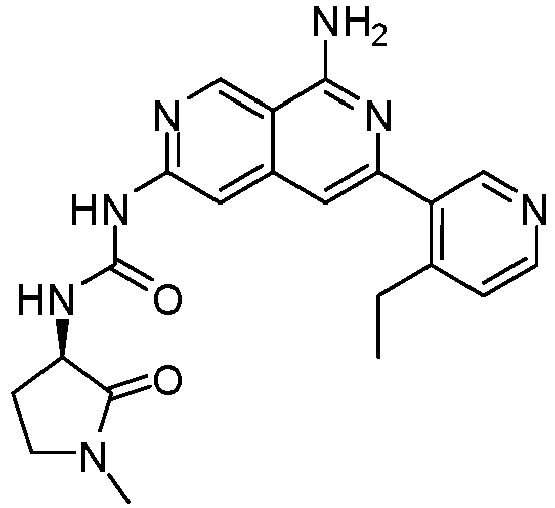
1.50 1HNMR (400 MHz, CD3OD) δ 9.29 (s, 1H), 8.50 (s, 2H), 7.52 (s, 1H), 7.45 (d, J = 5.2 Hz, 1H), 6.89 (s, 1H), 4.49 (t, J = 9.2 Hz, 1H), 3.47 (dd, J = 4.0, 9.2 Hz, 2H), 2.93 (s, 3H), 2.83 (q, J = 7.6 Hz, 2H), 2.62-2.57 (m, 1H), 2.09-2.04 (m, 1H), 1.19 (t, J = 7.6 Hz, 3H). 406.2 C 177 
1.432 1HNMR (400 MHz, DMSO-d 6) δ 9.26 (s, 1H), 9.16 (s, 1H), 8.56 (s, 1H), 8.42 (d, J = 5.2 Hz, 1H), 7.78 (s, 1H), 7.29 (d, J = 5.2 Hz, 1H), 7.23-7.21 (m, 3H), 6.87 (s, 1H), 4.83 (t, J = 5.2 Hz, 1H), 3.79-3.70 (m, 1H), 3.43-3.32 (m, 2H), 2.41 (s, 3H), 1.11 (d, J = 6.8 Hz, 3H). 353.1 C 178 
1.532 1H NMR (400 MHz, DMSO-d 6) δ 9.44 (s, 2H), 9.32 (s, 1H), 8.56 (s, 1H), 8.43 (d, J = 5.2 Hz, 1H), 8.07 (s, 1H), 7.87 (s, 1H), 7.65 (s, 1H), 7.32-7.31 (m, 2H), 6.94 (s, 1H), 5.82-5.83 (m, 1H), 2.42 (s, 3H), 1.78 (d, J = 6.8 Hz, 3H). 414.2 H 179 
1.407 1HNMR (400 MHz, CD3OD) δ 9.24 (s, 1H), 8.26 (s, 1H), 8.07 (s, 1H), 6.88 (s, 1H), 6.41 (s, 1H), 4.98-4.95 (m, 1H), 4.81-4.79 (m, 1H), 3.72-3.63 (m, 3H), 3.54-3.48 (m, 1H), 3.27-3.25 (m, 1H), 2.38 (s, 3H), 2.30-2.25 (m, 1H), 2.18-2.15 (m, 1H), 1.96-1.80 (m, 2H), 1.26-1.20 (m, 1 H). 422.1 H 180 
1.47 1H NMR (400 MHZ,CD3OD) δ 9.23 (s, 1H), 8.21 (s, 1H), 6.75 (s, 1H), 6.41 (s, 2H), 3.68 (s, 3H), 2.93 (s, 3H), 2.63-2.62 (m, 1H), 2.31 (s, 3H), 2.22 (s, 3H), 2.16-2.11 (m, 1H), 1.62-1.54 (m, 2H). 418.1 H 181 
1.56 1HNMR (400 MHZ,CD3OD) δ 9.30 (s, 1H), 8.25 (s, 1H), 7.92 (s, 1H), 6.78 (s, 1H), 2.19 (s, 3H), 1.97 (s, 3H), 1.72-1.67 (m, 1H), 1.48-1.45 (m, 1H), 1.25-1.22 (m, 1H), 1.19(d, J = 6.0 Hz, 3H), 0.79-0.75 (m, 1H). 363.2 F 182 
1.40 417.2, RT(min)=1.40, Method = F; 1H NMR (400 MHZ,CD3OD) δ 9.16 (s, 1H), 8.51 (s, 1H), 8.43 (d, J = 5.2 Hz,1H), 8.05 (s, 1H), 7.68 (s, 1H), 7.39 (d, J = 5.2 Hz,1H), 6.77 (s, 1H), 6.75 (s, 1H), 2.74 (s, 3H), 2.45 (s, 3H), 1.83 (s, 6H). 417.2 F 183 
1.29 1H NMR (400 MHz, CD3OD) δ 9.18 (s, 1H), 8.50 (s, 1H), 8.42 (d, J = 5.2 Hz,1H), 8.06 (s, 1H), 7.67 (s, 1H), 7.39 (d, J = 5.2 Hz, 1H), 6.77 (s, 1H), 6.72 (s, 1H), 2.99 (s, 3H), 2.54 (s, 3H), 2.45 (s, 3H), 1.82 (s, 6H). 431.2 A 184 
1.18 1H NMR (400 MHz, CD3OD) δ 9.15 (s, 1H), 8.50 (s, 1H), 8.42 (d, J = 5.2 Hz,1H), 7.98 (s, 1H), 7.64 (s, 1H), 7.39 (d, J = 5.2 Hz,1H), 6.76 (s, 1H), 6.75 (s, 1H), 4.86 (s, 2H), 2.80 (s, 3H), 2.44 (s, 3H). 389.2 A 185 
1.45 1HNMR (400 MHz, DMSO-d 6) δ 11.25 (s, 1H), 9.37 (s, 1H), 8.18 (s, 1H), 7.69 (s, 1H), 7.50 (s, 1H), 7.28-7.26 (m, 3H), 7.12 (s, 1H), 6.94 (s, 1H), 2.77-2.75 (m, 1H), 2.38 (s, 6H), 2.15-2.13 (m, 1H), 1.61-1.57 (m, 1H), 1.43-1.41 (m, 1H). 401.2 B 186 
1.60 1HNMR (400 MHz, DMSO-d 6) δ 11.17 (s, 1H), 9.26 (s, 1H), 8.01 (s, 1H), 7.38 (s, 2H), 7.30 (s, 1H), 4.85-4.81 (m, 1H), 4.50 (t, J = 8.4 Hz, 1H), 4.06-4.03 (m, 1H), 2.76-2.71 (m, 1H), 2.17-2.13 (m, 1H), 1.61-1.57 (m, 1H), 1.45-1.40 (m, 1H), 1.38 (d, J = 6.4 Hz, 3H). 353.2 B 187 
1.56 1HNMR (400 MHz, DMSO-d 6) δ 12.64 (s, 1H), 11.09 (s, 1H), 9.26 (s, 1H), 8.12 (s, 1H), 7.96 (d, J = 8.4 Hz, 1H), 7.12 (s, 2H), 6.98 (s, 1H), 2.62-2.56 (m, 4H), 2.33- 2.27 (m, 1H), 1.32-1.30 (m, 2H). 377.2 B 188 
1.57 1HNMR (400 MHz, CD3OD) δ 9.21 (s, 1H), 8.23 (s, 1H), 6.81 (s, 1H), 3.77 (s, 3H), 2.46- -2.43 (m, 1H), 2.41 (s, 3H), 2.33 (s, 3H), 2.30-2.26 (m, 1H), 1.45-1.41 (m, 1H), 1.37-1.32 (m, 1H). 405.2 B 189 
1.38 1HNMR (400 MHz, DMSO-d 6) δ 11.09 (s, 1H), 9.36 (s, 1H), 8.72 (s, 1H), 8.71 (s, 1H), 8.57 (s, 1H), 8.44 (d, J = 4.8 Hz, 1H), 8.27 (s, 1H), 7.37-7.31 (m, 4H), 6.99 (s, 1H), 2.76-2.71 (m, 1H), 2.65-2.61 (m, 1H), 2.41 (s, 3H), 1.59-1.57 (m, 2H). 398.2 B 190 
1.57 1HNMR (400 MHz, DMSO-d 6) δ 11.19 (s, 1H), 9.37 (s, 1H), 8.19 (s, 1H), 7.93 (s, 1H), 7.77 (s, 1H), 7.30 (s, 2H), 6.85 (s, 1H), 5.16 (s, 2H), 2.60-2.58 (m, 1H), 2.32-2.30 (m, 1H), 2.06 (s, 3H), 1.33-1.30 (m, 2H). 403.2 G 191 
1.169 1HNMR (400 MHz, DMSO-d 6) δ 11.29 (s, 1H), 9.41 (s, 1H), 8.51 (s, 1H), 8.47 (d, J = 5.2 Hz, 1H), 8.20 (s, 1H), 7.36 (d, J = 5.2 Hz, 1H), 7.34 (s, 2H), 6.98 (s, 1H), 4.77 (t, J = 4.8 Hz, 1H), 3.57-3.55 (m, 2H), 2.93 (t, J = 6.8 Hz, 2H), 2.78-2.74 (m, 1H), 2.18-2.14(m, 1H), 1.64-1.59 (m, 1H), 1.46-1.41(m, 1H). 375.1 A 192 
1.404 1HNMR (400 MHz, DMSO-d 6) δ 11.08 (s, 1H), 9.39 (s, 1H), 8.52 (s, 1H), 8.47 (d, J = 5.2 Hz, 1H), 8.23 (s, 1H), 7.36 (d, J = 5.2 Hz, 1H), 7.34 (s, 2H), 6.97 (s, 1H), 4.80 (t, J = 4.8 Hz, 1H), 3.60-3.56 (m, 2H), 2.93 (t, J = 6.8 Hz, 2H), 2.76-2.73 (m, 2H), 2.12-2.09 (m, 1H), 1.59-1.58 (m, 1H), 1.16-1.13 (m, 1H), 0.99-0.96 (m, 1H). 389.0 C 193 
2.62 1HNMR (400 MHz, DMSO-d 6) δ 11.04 (s, 1 H), 9.37 (s, 1H), 8.56 (s, 1H), 8.43 (d, J = 5.0 Hz, 1H), 8.22 (s, 1H), 7.30-7.31 (m, 3H), 6.97 (s, 1H), 3.74 (m, 2 H), 2.41 (s, 3H), 2.11 (m, 1H), 1.58 (m, 1H), 1.13 (m, 1H), 0.96 (m, 1H). 359.1 J 194 
2.66 1HNMR (400 MHz, DMSO-d 6) δ 11.04 (s, 1 H), 9.37 (s, 1H), 8.56 (s, 1H), 8.43 (d, J = 5.0 Hz, 1H), 8.22 (s, 1H), 7.30-7.31 (m, 3H), 6.97 (s, 1H), 3.74 (m, 2 H), 2.41 (s, 3H), 2.11 (m, 1H), 1.58 (m, 1H), 1.13 (m, 1H), 0.96 (m, 1H). 359.1 J 195 
3.05 1HNMR (400 MHz, DMSO-d 6) δ 12.63 (br s, 1 H), 11.19 (s, 1H), 9.42 (s, 1H), 8.51 (s, 1H), 8.48 (d, J = 5.1 Hz, 1H), 8.40 (s, 1H), 7.61 (br s, 1H), 7.38 (d, J = 5.1 Hz, 2H), 7.32 (br s, 2H), 2.27 (s, 3H), 2.19-2.26 (m, 2H), 1.41 (m, 1H), 1.26 (m, 1H). 404.1 J 196 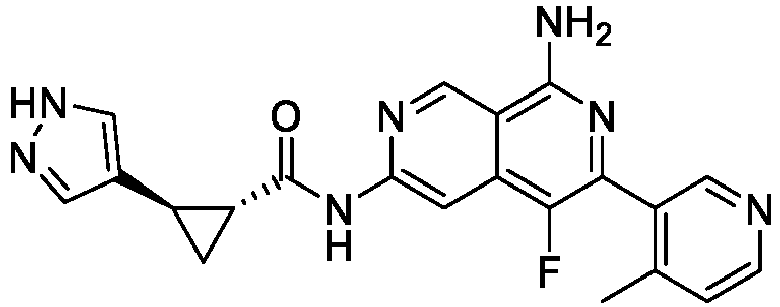
3.06 1HNMR (400 MHz, DMSO-d 6) δ 12.63 (br s, 1 H), 11.19 (s, 1H), 9.42 (s, 1H), 8.51 (s, 1H), 8.48 (d, J = 5.1 Hz, 1H), 8.40 (s, 1H), 7.61 (br s, 1H), 7.38 (d, J = 5.1 Hz, 2H), 7.32 (br s, 2H), 2.27 (s, 3H), 2.19-2.26 (m, 2H), 1.41 (m, 1H), 1.26 (m, 1H). 404.1 J 197 
2.86 1HNMR (400 MHz, DMSO-d 6) δ 10.93 (s, 1 H), 9.36 (s, 1H), 8.57 (br s, 1H), 8.43 (br s, 1H), 8.25 (s, 1H), 7.56 (s, 1H), 7.29-7.32 (m, 4H), 6.97 (s, 1H), 3.77 (s, 3H), 2.41 (s, 3H), 2.19-2.22 (m, 2H), 1.39 (m, 1H), 1.19 (m, 1H). 400.2 J 198 
2.87 1HNMR (400 MHz, DMSO-d 6) δ 10.93 (s, 1 H), 9.36 (s, 1H), 8.57 (br s, 1H), 8.43 (br s, 1H), 8.25 (s, 1H), 7.56 (s, 1H), 7.29-7.32 (m, 4H), 6.97 (s, 1H), 3.77 (s, 3H), 2.41 (s, 3H), 2.19-2.22 (m, 2H), 1.39 (m, 1H), 1.19 (m, 1H). 400.2 J 199 
2.20 1HNMR (400 MHz, DMSO-d 6) δ 11.24 (s, 1H), 9.38 (s, 1H), 8.17 (s, 1H), 7.93 (s, 1H), 7.76 (s, 1H), 7.29 (s, 2H), 6.84 (s, 1H), 5.13 (br s, 2H), 2.76 (m, 1 H), 2.15 (m, 1 H), 2.06 (s, 3H), 1.61 (m, 1H), 1.43 (m, 1H). 360.2 J 200 
2.21 1HNMR (400 MHz, DMSO-d 6) δ 11.24 (s, 1H), 9.38 (s, 1H), 8.17 (s, 1H), 7.93 (s, 1H), 7.76 (s, 1H), 7.29 (s, 2H), 6.84 (s, 1H), 5.13 (br s, 2H), 2.76 (m, 1 H), 2.15 (m, 1 H), 2.06 (s, 3H), 1.61 (m, 1H), 1.43 (m, 1H). 360.2 J 201 
1.55 1HNMR (400 MHz, DMSO-d 6) δ 11.3 (s, 1H), 9.43 (s, 1H), 8.89 (d, 1H), 8.83 (s, 1H), 8.20 (s, 1H), 7.85 (d, 1H), 7.42 (s, 2H), 6.97 (s, 1H), 2.74-2.79 (m, 1H), 2.13-2.18 (m, 1H), 1.59-1.64 (m, 1H), 1.41-1.46 (m, 1H). 399.1 B 202 
2.50 1HNMR (400 MHz, DMSO-d 6) δ 11.26 (s, 1H), 9.39 (s, 1 H), 8.56 (s, 1H), 8.43 (d, J = 5.0 Hz, 1H), 8.20 (s, 1H), 7.34 (br s, 2H), 7.30 (d, J = 5.0 Hz, 1H), 6.98 (s, 1H), 2.76 (m, 1H), 2.40 (s, 3H), 2.15 (m, 1H), 1.61 (m, 1H), 1.44 (m, 1H). 345.1 J 203 
2.50 1HNMR (400 MHz, DMSO-d 6) δ 11.26 (s, 1H), 9.39 (s, 1 H), 8.56 (s, 1H), 8.43 (d, J = 5.0 Hz, 1H), 8.20 (s, 1H), 7.34 (br s, 2H), 7.30 (d, J = 5.0 Hz, 1H), 6.98 (s, 1H), 2.76 (m, 1H), 2.40 (s, 3H), 2.15 (m, 1H), 1.61 (m, 1H), 1.44 (m, 1H). 345.1 J 204 
1.52 1H NMR (300 MHz, DMSO-d 6) δ 10.96 (s, 1H), 9.38 (s, 1H), 8.37 (d, J = 4.8 Hz, 1H), 8.31 (s, 1H), 8.24 (s, 1H), 7.30 (s, 2H), 7.25 (d, J = 4.8 Hz, 1H), 5.49 (s, 1H), 4.71 (d, J = 4.5 Hz, 1H), 4.65 (s, 1H), 2.30 (s, 1H), 2.14 (s, 3H), 2.07 - 2.03 (m, 3H), 1.48 - 1.45 (m, 1H), 0.85 - 0.80 (m, 4H). 402 M 205 
1.69 1H NMR (400 MHz, CD3OD) δ 9.32 (s, 1H), 8.48 (s, 1H), 8.46 (d, J = 5.2 Hz, 1H), 8.37 (s, 1H),7.45 (d, J = 5.2 Hz, 1H), 2.78 - 2.65 (m, 2H), 2.23 (s, 3H), 2.14 (s, 3H), 2.06 - 2.00 (m, 1H), 1.81 - 1.70 (m,lH), 1.41 - 1.30 (m,1H), 1.12 - 1.02 (m, 1H). 373 K-1 206 
1.14 1H NMR (400 MHz, DMSO-d 6) δ 11.01 (s,1H), 9.33 (s,1H), 8.54 (d, J = 4.7 Hz, 1H), 7.96 (s, 1H), 7.48 - 7.28 (m, 5H), 7.23 - 7.10 (m, 3H), 6.48 (s, 1H),2.81 - 2.71(m, 2H), 2.17 (s, 3H), 2.11 - 2.03 (m, 1H), 1.61 - 1.51 (m, 1H), 1.10 - 1.06 (m, 1H),1.03 - 0.93 (m, 1H). 435 K-1 207 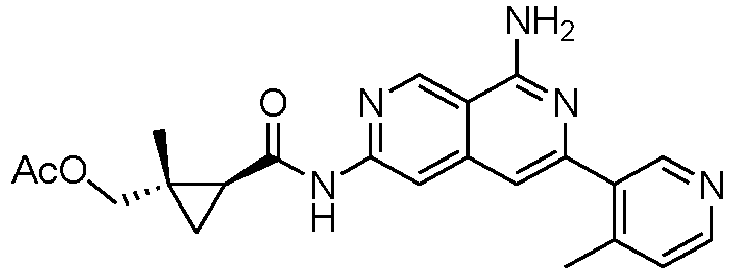
1.13 1H NMR (300 MHz, CD3OD) δ 9.29 (s, 1H), 8.54 (s, 1H), 8.43 (d, J = 5.1 Hz, 1H), 8.33 (s, 1H), 7.40 (d, J = 5.1 Hz, 1H), 6.99 (s, 1H), 4.07 - 3.95 (m, 2H), 2.46 (s, 3H), 2.11 (s, 3H), 2.09 - 2.04 (m, 1H), 1.31 (s, 3H), 1.27 - 1.24 (m, 1H), 1.06 - 1.01 (m, 1H). 406 K-1 208 
1.28 1H NMR (300 MHz, CD3OD) δ 9.29 (s, 1H), 8.54 (s, 1H), 8.43 (d, J = 5.1 Hz, 1H), 8.29 (s, 1H), 7.40 (d, J = 5.1 Hz, 1H), 6.99 (s, 1H), 4.38 (d, J = 11.4 Hz, 1H), 4.19 (d, J = 11.4 Hz, 1H), 2.46 (s, 3H), 2.03 - 1.99 (m, 1H), 1.94 (s, 3H), 1.42 - 1.39 (m, 1H), 1.32 (s, 3H), 1.06-1.01 (m, 1H). 406 M 209 
1.13 1H NMR (300 MHz, DMSO-d 6) δ 10.69 (s, 1H), 9.35 (s, 1H), 8.56 (s, 1H), 8.43 (d, J = 5.1 Hz, 1H), 8.25 (s, 1H), 7.31 (d, J = 5.1 Hz, 1H), 7.30 (s, 2H), 6.97 (s, 1H), 4.65 (t, J = 9.0 Hz, 1H), 3.31 - 3.29 (m, 2H), 2.41 (s, 3H), 2.06 - 1.95 (m, 1H), 1.18 (s, 3H), 0.99 - 0.91 (m, 2H). 364 M 210 
1.54 1H NMR (400 MHz, DMSO-d 6): δ 11.25 (s, 1H), 9.40 (s, 1H), 8.58 (s, 1H), 8.47 (d, J = 6.0 Hz,1H), 8.36 (s, 1H), 7.59 (s, 2H), 7.35 (d, J = 6.0 Hz, 1H), 2.76 - 2.73 (m, 2H), 2.14 - 2.10 (m, 4H), 1.64 - 1.58 (m, 1H), 1.19 - 1.14 (m, 1H), 1.02 - 0.95 (m, 1H). 437 K-1 211 
1.68 1H NMR (300 MHz, DMSO-d 6): δ 11.07 (s, 1H), 9.41 (s, 1H),8.41 (s, 1H), 8.35 (s, 1H), 7.83 (s, 1H), 7.48 (s, 2H), 7.31 (s, 1H), 6.54 (s, 1H), 5.08 - 5.11 (m, 1H), 4.86 - 4.89 (m, 1H), 3.66 - 3.49 (m, 4H), 2.32 (s, 1H), 1.76 - 1.62 (m, 1H), 1.21 - 1.26 (m, 1H). 365 K-1 212 
0.96 1H NMR (400 MHz, CD3OD) δ 9.30 (s, 1H), 8.54 (s, 1H), 8.43 (d, J = 5.1 Hz, 1H), 8.30 (s, 1H), 7.40 (d, J = 5.1 Hz, 1H), 6.99 (s, 1H), 2.80 - 2.63 (m, 2H), 2.46 (s, 3H), 2.02 - 1.98 (m,1H), 1.81 - 1.69 (m, 1H), 1.35 - 1.20 (m, 1H), 1.10 - 0.98 (m,1H). 359 K-1 213 
1.58 1H NMR (400 MHz, DMSO-d 6) δ 9.22 (s, 1H), 8.83 (s, 1H), 8.53 (s, 1H), 8.42 (d, J = 5.0 Hz, 1H), 7.90(s, 1H), 7.50 (s,1H), 7.29 (d, J = 5.0 Hz, 1H), 7.06 (s, 2H), 6.75 (s, 1H), 6.64 (s, 1H), 4.92 (t, J = 5.5 Hz,1H), 4.45 - 4.32 (m, 1H), 3.73 - 3.55 (m, 2H), 2.40 (s, 3H), 1.40 (d, J = 6.8 Hz, 3H). 376 N 214 
1.04 1H NMR (400 MHz, DMSO-d 6) δ 10.95 (s, 1H), 9.38 (s, 1H), 8.52 (s, 1H), 8.48 (d, J = 4.8 Hz, 1H), 8.25 (s, 1H), 7.56 (s, 1H), 7.37 (d, J = 4.8 Hz, 1H), 7.32(s, 2H), 7.29 (s, 1H), 6.97 (s, 1H), 4.78 (t, J = 5.2Hz, 1H), 3.77 (s, 3H), 3.60 - 3.55 (m, 2H), 2.95 - 2.91 (m, 2H),2.23 - 2.19 (m, 2H), 1.41 - 1.37 (m, 1H), 1.22 - 1.19 (m, 1H). 430 M 215 
1.04 1H NMR (400 MHz, CD3OD) δ 10.95 (s, 1H), 9.38 (s, 1H), 8.52 (s, 1H), 8.48 (d, J = 4.8Hz, 1H), 8.25 (s, 1H), 7.56 (s, 1H), 7.37 (d, J = 4.8 Hz, 1H), 7.32(s, 2H), 7.29 (s, 1H), 6.97 (s, 1H), 4.78 (t, J = 5.2Hz, 1H), 3.77 (s, 3H), 3.60 - 3.55 (m, 2H), 2.95 - 2.91 (m, 2H), 2.23 - 2.19 (m, 2H),1.41 - 1.37 (m, 1H), 1.22 - 1.19 (m, 1H). 430 M 216 
1.46 1H NMR (400 MHz, DMSO-d 6) δ 10.99 (s, 1H), 9.37 (s, 1H), 8.21 (s, 1H), 7.87 (s, 1H), 7.83 (s, 1H), 7.28 (s, 2H), 6.85 (s, 1H), 5.33 - 5.03 (m, 1H), 5.09 - 4.82 (m, 1H), 2.82 (d, J = 6.0 Hz, 3H), 2.30 - 2.23 (m, 1H), 2.09(s, 3H), 1.76 - 1.61 (m, 1H), 1.25 - 1.14 (m, 1H). 367 M 217 
2.00 1H NMR (400 MHZ,CD3OD) δ 9.19 (s, 1H), 8.50 (s, 1H), 8.42 (d, J = 6.0 Hz, 1H), 8.13 (s, 1H), 7.70 (s, 1H), 7.39 (d, J = 6.0 Hz, 1H), 6.78 (s, 1H), 6.74 (s, 1H), 5.64 (q, J = 6.0 Hz, 1H), 2.44 (s, 3H), 1.91 (d, J = 6.0 Hz, 3H). 371 M 218 
1.51 1H NMR (400 MHz, DMSO-d 6) δ 9.22 (s,1H), 8.91(d, J = 6.6 Hz, 1H), 8.53 (s, 1H), 8.42 (d, J = 5.0 Hz, 1H), 8.00 (d, J = 11.7 Hz,1H), 7.55 (d, J = 5.0 Hz, 1H), 7.29 (d, J = 6.6 Hz, 1H), 7.08 (s, 2H), 6.76 (s, 1H), 6.66 (s, 1H), 5.10 - 4.90 (m,0.5H), 3.98-3.90 (m, 1H), 3.81 - 3.71 (m, 1H), 3.71 - 3.58 (m, 1.5H), 3.54 - 3.40 (m, 1H), 2.40 (s, 4H), 2.34 - 2.26 (m, 1H), 1.97 (d, J = 5.3 Hz, 3H). 492 K-1 219 
0.92 1H NMR (300 MHz, CD3OD) δ 9.15 (s, 1H), 8.51 (s, 1H), 8.45 (d, J = 5.1 Hz, 1H), 7.96 (s, 1H), 7.62 (s, 1H), 7.41 (d, J = 5.1 Hz, 1H), 6.80 (s, 1H), 6.70 (s, 1H), 4.88 - 4.60 (m, 4H), 4.07 - 4.00 (m, 1H), 3.98 - 3.94 (m, 1H), 3.65 - 3.55 (m, 1H), 3.09 - 3.03 (m, 1H), 2.92 - 2.89 (m, 1H), 2.44 (s, 3H), 2.23 - 2.20 (m, 1H), 2.13 - 2.06 (m, 2H), 1.95 - 1.88 (m, 1H). 473 K-1 220 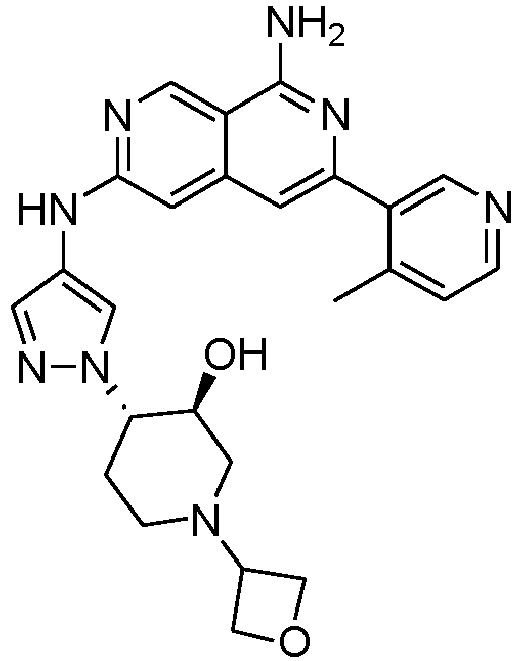
2.12 1H NMR (300 MHz, CD3OD) δ 9.15 (s, 1H), 8.50 (s, 1H), 8.43 (d, J = 5.1 Hz, 1H), 8.00 (s, 1H), 7.61 (s, 1H), 7.40 (d, J = 5.1 Hz, 1H), 6.80 (s, 1H), 6.70 (s, 1H), 4.88 - 4.60 (m, 4H), 4.18 - 4.11 (m, 1H), 4.05 - 3.96 (m, 1H), 3.66 - 3.55 (m, 1H), 3.04 - 3.00 (m, 1H), 2.87 - 2.84 (m, 1H), 2.44 - 2.38 (m, 4H), 2.14 - 2.07 (m, 2H), 1.78 - 1.73 (m, 1H). 473 M 221 
1.72 1H NMR (300 MHz, DMSO-d 6) δ 9.34 (s, 1H), 9.21 (s, 1H), 8.54 (s, 1H), 8.41 (d, J = 4.8 Hz, 1H), 7.48 (s, 1H), 7.29 (d, J= 4.8 Hz, 1H), 7.08 (s, 2H), 6.76 (s, 1H), 6.06 (s, 1H), 5.30 (d, J = 6.6 Hz, 1H), 4.82 - 4.74 (m, 1H), 3.74 (s, 3H), 2.40 (s, 3H), 1.41 (d, J = 6.6 Hz, 3H). 376 M 222 
1.08 1H NMR (400 MHz, DMSO-d 6) δ 11.02 (s, 1H), 10.99 (s, 1H), 9.37 (s, 1H), 8.72 (s, 1H), 8.23 (s, 1H), 8.09 (s, 1H), 7.42 (s, 1H), 7.33 (s, 2H), 4.86 (s, 3H), 2.36 - 2.17 (m, 1H), 1.79 - 1.59 (m, 1H), 1.32 - 1.11 (m, 1H). 395 K-1 223 
1.16 1H NMR (300 MHz,CD3OD) δ 9.24 (s, 1H), 8.32 - 8.22 (s, 1H), 8.16 (s, 1H), 7.83 (s, 1H), 7.34 (s, 1H), 5.02-4.97 (m, 1H), 4.80 - 4.75 (m, 1H), 4.45 - 4.33 (m, 2H), 3.51 - 3.41 (m, 2H), 2.21 - 2.11 (m, 1H), 1.90 - 1.76 (m, 1H), 1.28 - 1.17 (m, 1H). 381 M 224 
2.32 1H NMR (300 MHz, DMSO-d 6) δ 11.32 (s, 1H), 9.43 (s, 1H), 8.24 (s, 1H), 7.94 - 7.89 (m, 2H), 7.87 - 7.81 (m, 1H), 7.63 - 7.58 (m, 1H), 7.43 (s, 2H), 7.22 (s, 1H), 2.79 - 2.72 (m, 1H), 2.20 - 2.13 (m, 1H), 1.65 - 1.61 (m, 1H), 1.60 - 1.47 (m, 1H) 355 M 225 
1.85 1H NMR (300 MHz,DMSO-d 6) δ 9.34 (s, 1H), 8.56 (s, 1H), 8.50 (d, J = 1.8 Hz, 1H), 8.30(s, 1H), 7.46 (d, J = 1.8 Hz, 1H), 7.00(s, 1H), 3.02 (s, 2H), 2.70 - 2.59 (m, 1H), 2.14 - 2.12 (m, 1H), 1.67 - 1.53 (m, 2H), 1.26 (s, 6H). 403 K-1 226 
0.95 1H NMR (300 MHz, CD3OD): δ 9.38 (s, 1H), 8.58 (s, 1H), 8.50 (s, 1H), 8.33(s, 1H), 6.98 (s, 1H), 5.02 - 4.97 (m, 1H), 4.80 - 4.75 (m, 1H), 2.96 (s, 3H), 2.44 (s, 3H), 2.21 - 2.12 (m, 1H), 1.89 - 1.76 (m, 1H), 1.30 - 1.17 (m, 1H). 395 M 227 
1.12 1H NMR (300 MHz, DMSO-d 6) δ 11.31 (s, 1H), 9.41 (s, 1H), 8.77 (s, 1H), 8.64 (d, J = 6.0 Hz, 1H), 8.25 (s, 1H), 7.54(d, J = 6.0 Hz, 1H), 7.44 (s, 2H), 7.16 (s, 1H), 4.48 (s, 2H), 2.80 - 2.74 (m, 1H), 2.21 - 2.14 (m, 1H), 1.66 - 1.59 (m, 1H), 1.48 - 1.42 (m, 1H). 370 M 228 
1.02 1H NMR (300 MHz, DMSO-d 6): δ 11.31 (s, 1H), 9.41 (s, 1H), 8.69 (s, 1H), 8.59 (d, J = 5.1Hz, 1H), 8.23 (s, 1H), 7.54 (d, J = 5.2 Hz, 1H), 7.40 (s, 2H), 7.06 (d, J = 2.2 Hz, 1H), 4.69(s, 2H), 3.31(s, 3H), 2.78 - 2.75 (m, 1H), 2.22 - 2.13 (m, 1H), 1.68 - 1.55 (m, 1H), 1.52 - 1.34 (m, 1H). 375 K-1 229 
1.14 1H NMR (300 MHz, DMSO-d 6) δ 11.29 (s, 1H), 9.41 (s, 1H), 8.53 (s, 1H), 8.48 (d, J = 6.0 Hz, 1H), 8.20 (s, 1H), 7.37 - 7.36(m, 3H), 6.98 (s, 1H), 3.50 (t, J = 6.0 Hz, 2H), 3.15 (s, 3H), 3.03 (t, J = 6.0 Hz, 2H), 2.80 - 2.74 (m, 1H), 2.20 - 2.13 (m, 1H), 1.65 - 1.59 (m, 1H), 1.48 - 1.41(m, 1H). 389 M 230 
2.34 1H NMR (300 MHz, DMSO-d 6) δ 10.80 (s, 1H), 9.35 (s, 1H), 8.55 (s, 1H), 8.43 (d, J = 5.0 Hz, 1H), 8.20 (s, 1H), 7.40 - 7.22 (m, 3H), 6.97 (s, 1H), 3.36 (d, J = 5.0 Hz, 1H), 2.40 (s, 3H), 2.14 - 2.02 (m, 2H), 2.02 - 1.80 (m, 4H), 1.55 - 1.45 (m, 1H). 385 K-1 231 
1.40 1H NMR (300 MHz, DMSO-d 6) δ 11.07 - 11.0 (m, 1H), 9.38 (s, 1H), 8.57 (s, 1H), 8.44 (d, J = 6.0 Hz, 1H), 8.23 (s, 1H), 7.55 (s, 1H), 7.34 (s, 2H), 7.30 (d, J = 6.0 Hz, 1H), 6.98 (s, 1H), 4.42 - 4.18 (m, 1H),3.64 - 3.58 (m, 1H), 3.32 - 3.23 (m, 1H), 2.41 (s, 3H), 2.25 - 2.12 (m, 1H), 1.67 - 1.62 (m, 1H), 1.17 - 0.96 (m, 2H). 405 M 232 
1.71 1H NMR (300 MHz, DMSO-d 6) δ 11.31 (s, 1H), 9.41 (s, 1H), 8.69 (s, 1H), 8.59 (d, J = 2.2 Hz, 1H), 8.23 (s, 1H), 7.54 (d, J = 2.2 Hz, 1H), 7.40 (s, 2H), 7.06 (s, 1H), 4.82 - 4.80 (m, 1H), 3.81 - 3.79 (m, 1H), 2.92 - 2.77 (m, 3H), 2.22 - 2.13 (m, 1H), 1.68 - 1.55 (m, 1H), 1.52 - 1.34 (m, 1H), 0.98 (d, J = 4.8 Hz, 3H). 389 K-1 233 
1.15 1H NMR (300 MHz, CD3OD) δ 9.34 (d, J = 0.9 Hz, 1H), 8.72 (d, J = 0.9 Hz, 1H), 8.48 (d, J = 5.2 Hz, 1H), 8.41 (s,1H), 7.51 (s, 1H), 7.44 (d, J = 5.3 Hz, 1H), 7.38 (d, J = 0.8 Hz, 1H), 3.86 (s, 3H), 2.41 - 2.39 (m, 1H), 2.29 (s, 3H), 2.14 - 2.11 (m, 1H), 1.60 - 1.58(m, 1H), 1.29 - 1.26 (m, 1H). 434.1 K-1 234 
1.16 1H NMR (400 MHz, CD3OD) δ 9.34 (d, J = 0.9 Hz, 1H), 8.72 (d, J = 0.9 Hz, 1H), 8.48 (d, J = 5.2 Hz, 1H), 8.41 (s,1H), 7.51 (s, 1H), 7.44 (d, J = 5.3 Hz, 1H), 7.38 (d, J = 0.8 Hz, 1H), 3.86 (s, 3H), 2.41 - 2.39 (m, 1H), 2.29 (s, 3H), 2.14 - 2.11 (m, 1H), 1.60 - 1.58 (m, 1H), 1.29 - 1.26 (m, 1H). 434.1 K-1 235 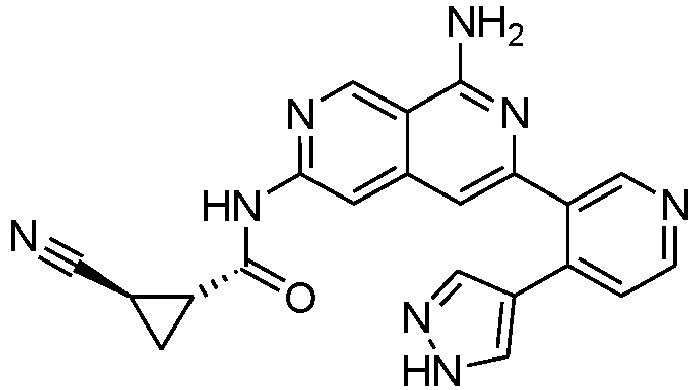
1.46 1H NMR (300 MHz, DMSO-d 6) δ 12.91 (s, 1H), 11.28 (s, 1H), 9.41 (s, 1H), 8.52 (d, J = 5.3 Hz, 1H), 8.46 (s, 1H), 8.12 (s, 1H), 7.61 - 7.58 (m, 3H), 7.40 (s, 2H), 6.83 (s, 1H), 2.81 - 2.69 (m, 1H), 2.14 - 2.12 (m, 1H), 1.60 - 1.58 (m, 1H), 1.42 - 1.40 (m, 1H). 397.15 K-1 236 
0.92 1H NMR (300 MHz, DMSO-d 6) δ 12.91 (s, 1H), 11.28 (s, 1H), 9.41 (s, 1H), 8.52 (d, J = 5.3 Hz, 1H), 8.46 (s, 1H), 8.12 (s, 1H), 7.61 - 7.58 (m, 3H), 7.40 (s, 2H), 6.83 (s, 1H), 2.81 - 2.69 (m, 1H), 2.14 - 2.12 (m, 1H), 1.60 - 1.58 (m, 1H), 1.42 - 1.40 (m, 1H). 397.15 K-1 237 
1.09 1H NMR (400 MHz, DMSO-d 6) δ 11.05 (s, 1H), 9.37 (s, 1H), 8.51 (s, 1H), 8.30 (s, 1H), 8.23 (s, 1H), 8.02 (s, 1H), 7.59 (s, 1H), 7.31 (s, 1H), 6.98 (s, 2H), 3.97 (s, 3H), 2.74 (d, J = 9.0 Hz, 2H), 2.45 (s, 3H), 2.14 - 2.09 (m, 1H), 1.62 - 1.55 (m, 1H), 1.17 - 1.11 (m, 1H), 1.00 - 0.94 (m, 1H). 439.2 M 238 
1.09 1H NMR (400 MHz, DMSO-d 6) δ 11.05 (s, 1H), 9.37 (s, 1H), 8.51 (s, 1H), 8.30 (s, 1H), 8.23 (s, 1H), 8.02 (s, 1H), 7.59 (s, 1H), 7.31 (s, 1H), 6.98 (s, 2H), 3.97 (s, 3H), 2.74 (d, J = 9.0 Hz, 2H), 2.45 (s, 3H), 2.14 - 2.09 (m, 1H), 1.62 - 1.55 (m, 1H), 1.17 - 1.11 (m, 1H), 1.00 - 0.94 (m, 1H). 439.2 M 239 
1.08 1H NMR (300 MHz, CD3OD) δ 9.30 (s, 1H), 8.54 (s, 1H), 8.43 (d, J = 5.1 Hz, 1H), 8.31 (s, 1H), 7.40 (d, J = 5.1 Hz, 1H), 6.98 (s, 1H), 3.28 (s, 3H), 2.46 (s, 3H), 2.10 - 2.02 (m, 1H), 1.67 - 1.58 (m, 1H), 1.24 (s, 3H), 1.21 (s, 3H), 1.24 - 1.15 (m, 1H), 1.10- 1.01 (m, 1H). 392.2 K-1 240 
1.08 1H NMR (300 MHz, CD3OD) δ 9.30 (s, 1H), 8.54 (s, 1H), 8.43 (d, J = 5.1 Hz, 1H), 8.31 (s, 1H), 7.40 (d, J = 5.1 Hz, 1H), 6.98 (s, 1H), 3.28 (s, 3H), 2.46 (s, 3H), 2.10 - 2.02 (m, 1H), 1.67 - 1.58 (m, 1H), 1.24 (s, 3H), 1.21 (s, 3H), 1.24 - 1.15 (m, 1H), 1.10- 1.01 (m, 1H). 392.2 K-1 241 
0.98 1H NMR (300 MHz, CD3OD) δ 9.29 (s, 1H), 8.53 (s, 1H), 8.42 (d, J = 5.1 Hz, 1H), 8.29 (s, 1H), 7.39 (d, J = 5.1 Hz, 1H), 6.97 (s, 1H), 2.45 (s, 3H), 2.04 - 1.95 (m, 1H), 1.65 - 1.55 (m, 1H), 1.28 (d, J = 3.0 Hz, 6H), 1.17 - 1.06 (m, 2H). 378 K-1 242 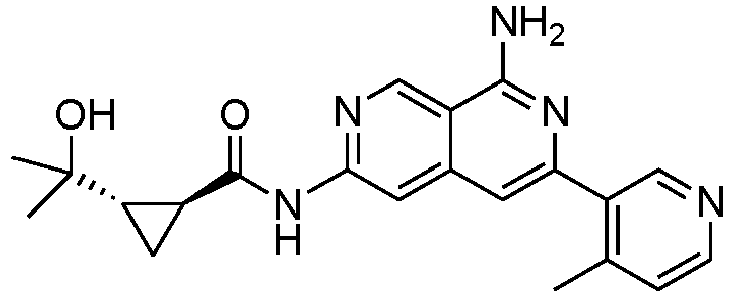
0.98 1H NMR (300 MHz, CD3OD) δ 9.29 (s, 1H), 8.53 (s, 1H), 8.42 (d, J = 5.1 Hz, 1H), 8.29 (s, 1H), 7.39 (d, J = 5.1 Hz, 1H), 6.97 (s, 1H), 2.45 (s, 3H), 2.04 - 1.95 (m, 1H), 1.65 - 1.55 (m, 1H), 1.28 (d, J = 3.0 Hz, 6H), 1.17 - 1.06 (m, 2H). 378 K-1 243 
1.01 1H NMR (300 MHz, DMSO-d 6) δ 13.02 (s, 1H), 11.26 (s, 1H), 9.39 (s, 1H), 8.73 - 8.45 (m, 2H), 8.08 (s, 1H), 7.81 (d, J = 5.2 Hz, 1H), 7.59 (s, 1H), 7.35 (s, 2H), 6.77 (s, 1H), 5.80 (d, J = 2.5 Hz, 1H), 2.75 - 2.73 (m, 1H), 2.14 - 2.12 (m, 1H), 1.60 - 1.58 (m, 1H), 1.49 - 1.32 (m, 1H). 397.2 K-1 244 
1.01 1H NMR (300 MHz, DMSO-d 6) δ 13.02 (s, 1H), 11.26 (s, 1H), 9.39 (s, 1H), 8.73 - 8.45 (m, 2H), 8.08 (s, 1H), 7.81 (d, J = 5.2 Hz, 1H), 7.59 (s, 1H), 7.35 (s, 2H), 6.77 (s, 1H), 5.80 (d, J = 2.5 Hz, 1H), 2.75 - 2.73 (m, 1H), 2.14 - 2.12 (m, 1H), 1.60 - 1.58 (m, 1H), 1.49 - 1.32 (m, 1H). 397.2 K-1 245 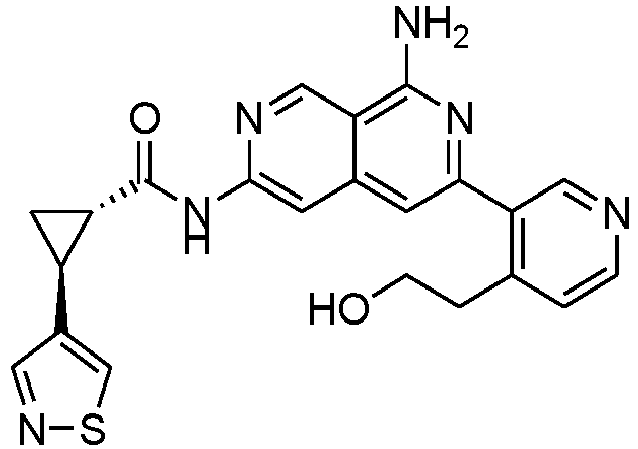
1.17 1H NMR (300 MHz, DMSO-d 6) δ 11.00 (s, 1H), 9.37 (s, 1H), 8.76 (s, 1H), 8.49 (d, J = 18.5 Hz, 3H), 8.26 (s, 1H), 7.40-7.28 (m, 3H), 6.97 (s, 1H), 4.77 - 4.66 (m, 1H), 3.58 - 3.52 (m, 2H), 2.93 - 2.85 (m, 2H), 2.57 - 2.50 (m, 1H), 2.48 - 2.35 (m, 1H), 1.59 - 1.39 (m, 2H). 433.1 K-1 246 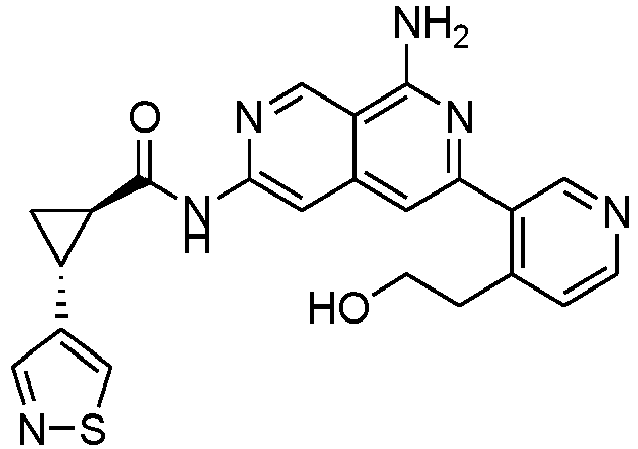
1.17 1H NMR (300 MHz, DMSO-d 6) δ 11.00 (s, 1H), 9.37 (s, 1H), 8.76 (s, 1H), 8.49 (d, J = 18.5 Hz, 3H), 8.26 (s, 1H), 7.40-7.28 (m, 3H), 6.97 (s, 1H), 4.77 - 4.66 (m, 1H), 3.58 - 3.52 (m, 2H), 2.93 - 2.85 (m, 2H), 2.57 - 2.50 (m, 1H), 2.48 - 2.35 (m, 1H), 1.59 - 1.39 (m, 2H). 433.1 K-1 247 
0.99 1H NMR (300 MHz, DMSO-d 6) δ 11.03 (s, 1H), 9.35 (s, 1H), 8.20 (s, 1H), 7.93 (s, 1H), 7.76 (s, 1H), 7.26 (s, 2H), 6.82 (s, 1H), 5.14 (s, 2H), 2.73 (d, J = 6.9 Hz, 2H), 2.13 - 2.06 (m, 4H), 1.60 - 1.54 (m, 1H), 1.15 - 1.11 (m, 1H), 0.98 - 0.95 (m, 1H). 374.1 M 248 
1.48 1H NMR (300 MHz, DMSO-d 6) δ 11.03 (s, 1H), 9.35 (s, 1H), 8.20 (s, 1H), 7.93 (s, 1H), 7.76 (s, 1H), 7.26 (s, 2H), 6.82 (s, 1H), 5.14 (s, 2H), 2.73 (d, J = 6.9 Hz, 2H), 2.13 - 2.06 (m, 4H), 1.60 - 1.54 (m, 1H), 1.15 - 1.11 (m, 1H), 0.98 - 0.95 (m, 1H). 374.1 M 249 
1.01 1H NMR (300 MHz, DMSO-d 6) δ 9.23 (s, 1H), 8.94 (s, 1H), 8.53 (s, 1H), 8.42 (d, J = 5.2 Hz, 1H), 7.99 (s, 1H), 7.54 (s, 1H), 7.29 (d, J = 5.2 Hz, 1H), 6.76 (s, 2H), 6.76 (s, 1H), 6.66 (s, 1H), 5.11 - 5.07 (m, 1H), 3.53 - 3.47 (m, 1H), 3.44 - 3.38 (m, 1H), 2.82 (s, 3H), 2.60 - 2.57 (m, 1H), 2.50 - 2.43 (m, 1H), 3.40 (m, 3H). 415.2 K-1 250 
1.01 1H NMR (300 MHz, DMSO-d 6) δ 9.23 (s, 1H), 8.94 (s, 1H), 8.53 (s, 1H), 8.42 (d, J = 5.2 Hz, 1H), 7.99 (s, 1H), 7.54 (s, 1H), 7.29 (d, J = 5.2 Hz, 1H), 6.76 (s, 2H), 6.76 (s, 1H), 6.66 (s, 1H), 5.11 - 5.07 (m, 1H), 3.53 - 3.47 (m, 1H), 3.44 - 3.38 (m, 1H), 2.82 (s, 3H), 2.60 - 2.57 (m, 1H), 2.50 - 2.43 (m, 1H), 3.40 (m, 3H). 415.2 K-1 251 
1.04 1H NMR (400 MHz, DMSO-d 6) δ 9.22 (s, 1H), 8.92 (s, 1H), 8.54 (s, 1H), 8.42 (d, J = 5.0 Hz, 1H), 7.91 (s, 1H), 7.49 (s, 1H), 7.29 (d, J = 5.0Hz, 1H), 7.10 (s, 2H), 6.76 (s, 1H), 6.65 (s, 1H), 4.95 - 4.92 (m, 1H), 3.44 - 3.42 (m, 1H), 3.32 (s, 1H), 2.87 (s, 3H), 2.41(s, 3H), 2.37 - 2.27 (m, 1H), 2.25 - 2.13 (m, 1H), 2.02 - 2.00 (m, 1H), 1.92 - 1.90 (m, 1H). 429.3 K-1 252 
1.05 1H NMR (400 MHz, DMSO-d 6) δ 9.22 (s, 1H), 8.92 (s, 1H), 8.54 (s, 1H), 8.42 (d, J = 5.0 Hz, 1H), 7.91 (s, 1H), 7.49 (s, 1H), 7.29 (d, J = 5.0Hz, 1H), 7.10 (s, 2H), 6.76 (s, 1H), 6.65 (s, 1H), 4.95 - 4.92 (m, 1H), 3.44 - 3.42 (m, 1H), 3.32 (s, 1H), 2.87 (s, 3H), 2.41(s, 3H), 2.37 - 2.27 (m, 1H), 2.25 - 2.13 (m, 1H), 2.02 - 2.00 (m, 1H), 1.92 - 1.90 (m, 1H). 429.2 K-1 253 
1.88 1H NMR (400 MHz, DMSO-d 6) δ 11.03 (s, 1H), 9.38 (s, 1H), 8.53 (s, 1H), 8.52 - 8.51 (m, 1H), 8.48 (d, J = 6 Hz, 1H), 8.45 - 8.42 (m, 1H), 8.28 (s, 1H), 7.59 - 7.55 (m, 1H), 7.43 - 7.32 (m, 4H), 6.99 (s, 1H), 4.79 (t, J = 6 Hz, 1H), 3.62 - 3.55 (m, 2H), 2.94 (t, J = 6 Hz, 2H), 2.55 - 2.45 (m, 2H), 1.60 - 1.46 (m, 2H). 427.2 M 254 
1.24 1H NMR (400 MHz, DMSO-d 6) δ 11.03 (s, 1H), 9.38 (s, 1H), 8.53 (s, 1H), 8.52 - 8.51 (m, 1H), 8.48 (d, J = 6 Hz, 1H), 8.45 - 8.42 (m, 1H), 8.28 (s, 1H), 7.59 - 7.55 (m, 1H), 7.43 - 7.32 (m, 4H), 6.99 (s, 1H), 4.79 (t, J = 6 Hz, 1H), 3.62 - 3.55 (m, 2H), 2.94 (t, J = 6 Hz, 2H), 2.55 - 2.45 (m, 2H), 1.60 - 1.46 (m, 2H). 427.2 M 255 
1.25 1H NMR (300 MHz, DMSO-d 6) δ 10.79 (s, 1H), 9.35 (s, 1H), 8.57 (s, 1H), 8.44 (d, J = 5.0 Hz, 1H), 8.23 (s, 1H), 7.48 - 7.21 (m, 3H), 6.96 (s, 1H), 4.56 (t, J = 6.6 Hz, 2H), 4.44 (t, J = 6.0 Hz, 2H), 3.73 (m, 1H), 3.05 (d, J = 8.9 Hz, 2H), 2.47 - 2.42 (m, 3H), 2.41 (s, 3H), 1.95 (t, J = 2.2 Hz, 2H). 417.2 K-1 256 
1.10 1H NMR (300 MHz, DMSO-d 6) δ 9.43 (s, 1H), 9.22 (s, 1H), 8.56 (s, 1H),8.42 (d, J = 6.0 Hz, 1H), 7.55 (s, 1H), 7.30 (d, J = 6.0 Hz, 1H), 7.10 (s, 2H), 6.82 (s, 1H), 6.05 (s, 1H), 4.99 (s, 2H), 3.84(t, J = 6.0 Hz, 2H), 3.06 (t, J = 6.0 Hz, 2H), 2.96 (s, 3H), 2.42 (s, 3H). 415.2 K-1 257 
1.05 1H NMR (300 MHz, CD3OD) δ 9.22 - 9.15 (m, 1H), 8.51 (s, 1H), 8.43 (d, J = 5.1 Hz, 1H), 8.04 (s, 1H), 7.67 (d, J= 0.8 Hz, 1H), 7.44 - 7.36 (m, 1H), 6.75 (dd, J = 13.6, 0.9 Hz, 2H), 6.49 - 5.95 (m, 1H), 4.58 (td, J = 14.4, 3.9 Hz, 2H), 2.45 (s, 3H). 382.2 M 258 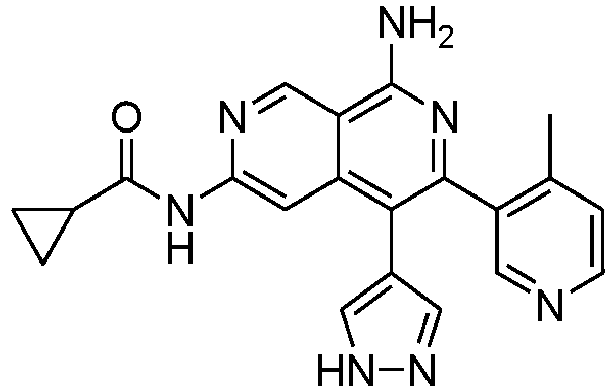
0.91 1H NMR (400 MHz, DMSO-d 6) δ 12.72 (s, 1H), 10.95 (s, 1H), 9.41 (d, J = 0.9 Hz, 1H), 8.39 - 8.22 (m, 2H), 8.20 (s, 1H), 7.45 (s, 1H), 7.33 (s, 2H), 7.14 (d, J = 4.4 Hz, 2H), 2.03 (s, 4H), 1.01 - 0.51 (m, 4H). 386.2 K-1 259 
1.07 1H NMR (300 MHz, CD3OD) δ 9.32 (s, 1H), 8.56 (s, 1H), 8.54 (d, J = 5.4 Hz, 1H), 7.78 (s, 1H), 7.47 (d, J = 5.4 Hz, 1H), 6.85 (s, 1H), 6.71 (s, 1H), 4.15 (t, J = 5.2 Hz, 2H), 3.87 (t, J = 5.2 Hz, 2H), 2.44 (s, 3H), 1.84 - 1.75 (m, 1H), 0.85 - 0.83 (m, 4H). 402.2 K-1 260 
1.05 1H NMR (300 MHz, DMSO-d 6) δ 9.20 (s, 1H), 8.86 (s, 1H), 8.52 (s, 1H), 8.40 (d, J = 5.0 Hz, 1H), 7.88 (s, 1H), 7.48 (s, 1H), 7.28(d, J = 5.0 Hz, 1H), 7.06 (s, 2H), 6.73 (s, 1H), 6.62 (s, 1H), 4.69 (s, 1H), 3.98 (s, 2H), 2.39 (s, 3H), 1.07 (s, 6H). 390.1 K-1 261 
1.01 1H NMR (300 MHz, CD3OD) δ 9.17 (t, J = 0.9 Hz, 1H), 8.51 (s, 1H), 8.42 (d, J = 5.1 Hz, 1H), 7.49 -7.30 (m, 1H), 6.84 (dd, J = 7.3, 0.9 Hz, 2H), 6.16 (d, J = 0.6 Hz, 1H), 4.16 (t, J = 5.4 Hz, 2H), 3.89 (dd, J = 5.7, 5.0 Hz, 2H), 2.44 (d, J = 0.6 Hz, 3H), 2.27 (d, J = 0.5 Hz, 3H). 376.1 K-1 262 
1.01 1H NMR (300 MHz, CD3OD) δ 9.16 (t, J = 0.8 Hz, 1H), 8.52 (s, 1H), 8.43 (d, J = 5.1 Hz, 1H), 7.48 - 7.34 (m, 2H), 6.89 - 6.78 (m, 1H), 6.03 (d, J = 0.8 Hz, 1H), 4.13 (t, J = 5.4 Hz, 2H), 3.93 (t, J = 5.4 Hz, 2H), 2.46 (s, 3H), 2.36 (d, J = 0.8 Hz, 3H). 376.1 K-1 263 
0.91 1H NMR (300 MHz, CD3OD) δ 9.19 (s, 1H), 8.52 (s, 1H), 8.43 (d, J = 5.1 Hz, 1H), 7.42 (s, 1H), 7.39 (d, J = 5.1 Hz, 1H), 6.85 (s, 1H), 6.72 (s, 1H), 4.07 (s, 3H), 2.89 (s, 3H), 2.45 (s, 3H). 389.2 K-1 264 
1.07 1H NMR (300 MHz, DMSO-d 6) δ 13.07 - 12.83 (m, 1H), 9.97 (s, 1H), 9.58 (s, 1H), 8.98 - 8.42 (m, 3H), 7.60 (d, J = 8.4 Hz, 2H), 7.54 (s, 1H), 7.48 (d, J = 4.8 Hz, 2H), 7.07 (s, 1H), 7.01 (s, 1H), 6.82 (s, 2H), 4.24 (s, 2H), 2.38 (s, 3H). 421.1 M 265 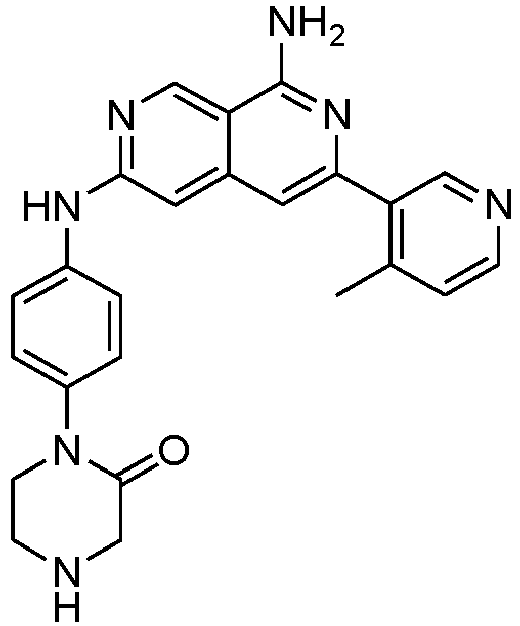
1.67 1H NMR (300 MHz, CD3OD) δ 9.19 (t, J = 0.9 Hz, 1H), 8.50 (s, 1H), 8.41 (d, J = 5.1 Hz, 1H), 7.65 - 7.55 (m, 2H), 7.38 (d, J = 5.2 Hz, 1H), 7.31 - 7.23 (m, 2H), 6.95 (d, J = 0.9 Hz, 1H), 6.79 (d, J= 0.8 Hz, 1H), 3.72 (t, J = 5.5 Hz, 2H), 3.57 (s, 2H), 3.19 (t, J = 5.5 Hz, 2H), 2.44 (s, 3H). 426.2 M 266 
1.83 1H NMR (400 MHz, DMSO-d 6) δ 9.21 (s, 1H), 8.78 (s, 1H), 8.52 (s, 1H), 8.42 - 8.40 (m, 1H), 7.91 (s, 1H), 7.51 (s, 1H), 7.29 - 7.27 (m,1H), 7.04 (m, 2H), 6.74 (s, 1H), 6.62 (s, 1H), 4.97 (t, J = 5.7 Hz, 1H), 5.58 (d, J = 5.7 Hz, 2H), 2.39 (s, 3H), 1.47 (s, 6H). 390.2 M 267 
1.67 1H NMR (300 MHz, CD3OD) δ 9.27 (t, J = 0.9 Hz, 1H), 8.32 - 8.26 (m, 1H), 7.50 (s, 1H), 7.36 (d, J = 0.8 Hz, 1H), 7.30 - 7.28 (m, 1H), 7.14 - 7.11 (m, 1H), 7.05 - 7.03 (m, 1H), 6.90 (d, J = 0.8 Hz, 1H), 3.84 (s, 3H), 2.37 - 2.35 (m, 1H), 2.32 (s, 3H), 2.15 - 2.03 (m, 1H), 1.56 - 1.53 (m, 1H), 1.25 - 1.22 (m, 1H). 417.2 K-1 268 
1.26 1H NMR (400 MHz, CD3OD) δ 9.26 (s, 1H), 8.27 (s, 1H), 7.50 (s, 1H), 7.37 (s, 1H), 7.10 (d, J = 8.0 Hz, 1H), 6.84 (d, J = 8.0 Hz, 2H), 6.77 - 6.75 (m, 1H), 3.85 (s, 3H), 2.40 - 2.35 (m, 1H), 2.24 (s, 3H), 2.13 - 2.08 (m, 1H), 1.59 - 1.55 (m, 1H), 1.28 - 1.26 (m, 1H). 415.2 K-1 269 
2.06 1H NMR (400 MHz, CD3OD) δ 9.34 (s, 1H), 8.69 (s, 1H), 8.48 (d, J = 5.2 Hz, 1H), 8.41 (s, 1H), 7.44 (d, J = 5.2 Hz, 1H), 2.81 - 2.62 (m, 2H), 2.29 (s, 3H), 2.07 - 2.02 (m, 1H), 1.79 - 1.75 (m, 1H), 1.39 - 1.33 (m,1H), 1.09 - 1.05 (m, 1H). 393, K-1 270 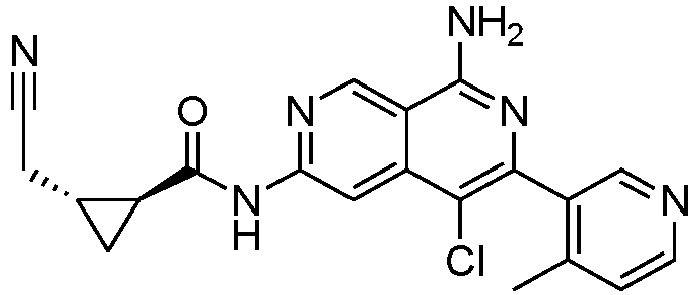
1.14 1H NMR (400 MHz, CD3OD) δ 9.34 (s, 1H), 8.69 (s, 1H), 8.48 (d, J = 5.2 Hz, 1H), 8.41 (s,1H), 7.44 (d, J = 5.2 Hz, 1H), 2.81 -2.62 (m, 2H), 2.29 (s, 3H), 2.07 - 2.02 (m, 1H), 1.79 - 1.75 (m,lH), 1.39 - 1.35 (m,1H), 1.10 - 1.05 (m, 1H). 393, K-1 271 
1.06 1H NMR (400MHz, CD3OD) δ 9.34 (s, 1H), 8.57 (s, 1H), 8.49 (d, J = 5.2 Hz, 1H), 8.38 (s, 1H), 7.46 (d, J = 5.2 Hz, 1H), 2.78 - 2.68 (m, 3H), 2.52 - 2.39 (m,1H), 2.22 (s, 3H), 2.07 - 2.02 (m, 1H), 1.79 - 1.74 (m, 1H), 1.39 - 1.36 (m, 1H), 1.12 - 1.02 (m, 4H). 387, K-1 272 
1.05 1H NMR (300MHz, CD3OD) δ 9.34 (s, 1H), 8.58 (s, 1H), 8.49 (d, J = 5.2 Hz, 1H), 8.38 (s, 1H), 7.46 (d, J = 5.2 Hz, 1H), 2.78 - 2.68 (m, 3H), 2.52 - 2.39 (m,1H), 2.22 (s, 3H), 2.07 - 2.02 (m, 1H), 1.79 - 1.74 (m, 1H), 1.39 - 1.36 (m, 1H), 1.12 - 1.02 (m, 4H). 387, K-1 273 
1.62 1H NMR (300MHz, CD3OD) δ 9.19 (s, 1H), 8.50 (s, 1H), 8.42 (d, J = 6.0 Hz, 1H), 8.13 (s, 1H), 7.70 (s, 1H), 7.39 (d, J = 6.0 Hz, 1H), 6.78 (s, 1H), 6.74 (s, 1H), 5.64 (q, J = 6.0 Hz, 1H), 2.44(s, 3H), 1.91 (d, J = 6.0 Hz, 3H). 371, K-1 274 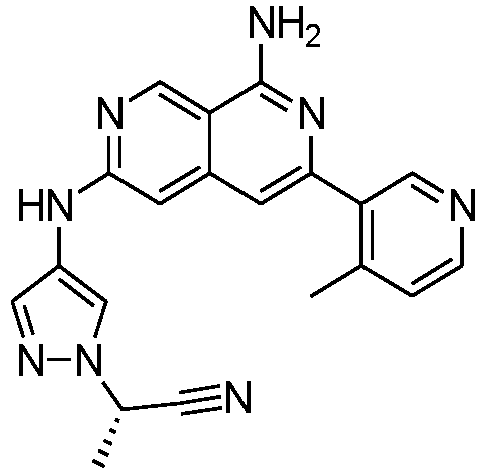
1.61 1H NMR (300 MHz, CD3OD) δ 9.19 (s, 1H), 8.50 (s, 1H), 8.42 (d, J = 6.0 Hz, 1H), 8.13(s, 1H), 7.70(s, 1H), 7.39(d, J = 6.0 Hz, 1H),6.78 (s, 1H), 6.74 (s, 1H), 5.64 (q, J = 6 Hz, 1H), 2.44 (s, 3H), 1.91(d, J = 6 Hz, 3H). 371, K-1 275 
1.86 1HNMR (300 MHz, CD3OD) δ 9.34 (s,1H), 8.71 (s, 1H), 8.44 (d, J = 5.2 Hz, 1H), 8.35 (s, 1H), 7.40 (d, J = 5.2 Hz,1H), 6.59 - 6.52 (m, 1H), 5.40 - 5.37 (m, 1H), 5.25 - 5.21 (m, 1H), 2.82 - 2.63 (m, 2H), 2.23 (s, 3H), 2.05 - 2.01 (m, 1H), 1.77 - 1.72 (m, 1H), 1.37 - 1.34 (m, 1H), 1.08 - 1.03 (m, 1H). 385.2 K-1 276 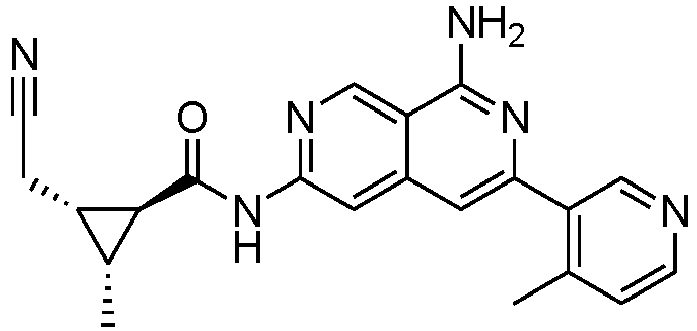
3.24 1H NMR (300 MHz, CD3OD) δ 9.32 (s, 1H), 8.55 (s, 1H), 8.42 (d, J = 5.2 Hz, 1H), 8.34 (s, 1H), 7.42 (d, J = 5.2 Hz, 1H), 7.01 (s, 1H), 2.74 - 2.68 (m, 2H), 2.46 (s, 3H), 2.07 - 2.03 (m, 1H), 1.73 - 1.68 (m, 1H), 1.51 - 1.44 (m, 1H), 1.27 (d, J = 8.0 Hz, 3H). 372 M 277 
0.85 1H NMR (300 MHz, CD3OD) δ 9.32 (s, 1H), 8.55 (s, 1H), 8.42 (d, J = 5.2 Hz, 1H), 8.34 (s, 1H), 7.42 (d, J = 5.2 Hz, 1H), 7.01 (s, 1H), 2.74 - 2.68 (m, 2H), 2.46 (s, 3H), 2.07 - 2.03 (m, 1H), 1.73 - 1.68 (m, 1H), 1.51 - 1.44 (m, 1H), 1.27 (d, J = 8.0 Hz, 3H). 372 K-1 278 
0.99 1H NMR (300 MHz, CD3OD) δ 9.30 (s, 1H), 8.54 (s, 1H), 8.43 (d, J = 5.2 Hz, 1H), 8.30 (s, 1H), 7.41 (d, J = 5.2 Hz, 1H), 6.98 (s, 1H), 2.74 - 2.67 (m, 2H), 2.46 (s, 3H), 1.88 - 1.81 (m, 1H), 1.73 - 1.68 (m, 2H), 1.28 (d, J = 8.0 Hz, 3H). 372 K-1 279 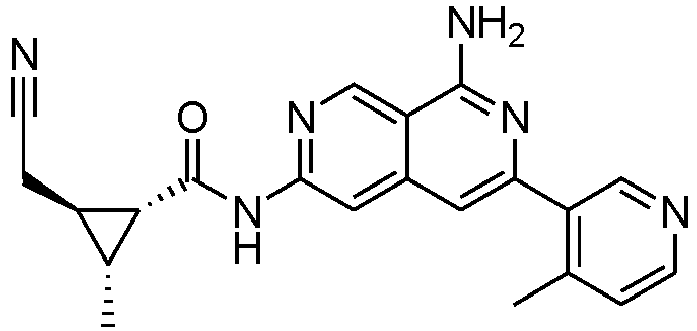
1.79 1H NMR (300 MHz, CD3OD) δ 9.30 (s, 1H), 8.54 (s, 1H), 8.43 (d, J = 5.2 Hz, 1H), 8.30 (s, 1H), 7.41 (d, J = 5.2 Hz, 1H), 6.98 (s, 1H), 2.74 - 2.67 (m, 2H), 2.46 (s, 3H), 1.88 - 1.81 (m, 1H), 1.73 - 1.68 (m, 2H), 1.28 (d, J = 8.0 Hz, 3H). 372 K-1 280 
2.89 1H NMR (300 MHz, CD3OD) δ 9.28 (s, 1H), 8.28 (s, 1H), 7.48 (s, 1H), 7.35 - 7.27 (m, 2H), 7.12 (d, J = 7.8 Hz, 1H), 7.01 (t, J = 9.0 Hz, 1H), 6.85 (s, 1H), 3.83 (s, 3H), 2.39 - 2.32 (m, 1H), 2.22 (s, 3H), 2.12 - 2.06 (m, 1H), 1.58 - 1.52 (m, 1H), 1.27 - 1.20 (m, 1H). 417.2 K-1 281 
1.67 1H NMR (300 MHz, CD3OD) δ 9.28 (s, 1H), 8.28 (s, 1H), 7.48 (s, 1H), 7.35 - 7.27 (m, 2H), 7.12 (d, J = 7.8 Hz, 1H), 7.01 (t, J = 9.0 Hz, 1H), 6.85 (s, 1H), 3.83 (s, 3H), 2.39 - 2.32 (m, 1H), 2.22 (s, 3H), 2.12 - 2.06 (m, 1H), 1.58 - 1.52 (m, 1H), 1.27 - 1.20 (m, 1H). 417.2 K-1 282 
1.59 1H NMR (400 MHz, CD3OD) δ 9.30 (s, 1H), 8.28 (s, 1H), 7.50 (s, 1H), 7.38 - 7.37 (m, 2H), 7.34 - 7.27 (m, 2H), 6.89 (s, 1H), 4.64 (s, 2H), 3.85 (s, 3H), 2.41 - 2.37 (m, 1H), 2.35 (s, 3H), 2.13 - 2.09 (m, 1H), 1.60 - 1.55 (m, 1H), 1.29 - 1.24 (m, 1H). 429.2 K-1 283 
1.52 1H NMR (400MHz, CD3OD) δ 9.30 (s, 1H), 8.28 (s, 1H), 7.50 (s, 1H), 7.38 - 7.37 (m, 2H), 7.34 - 7.27 (m, 2H), 6.89 (s, 1H), 4.64 (s, 2H), 3.85 (s, 3H), 2.41 - 2.37 (m, 1H), 2.35 (s, 3H), 2.13 - 2.09 (m, 1H), 1.60 - 1.55 (m, 1H), 1.29 - 1.24 (m, 1H). 429.3 K-1 284 
2.09 1H NMR (300MHz, DMSO-d 6) δ 10.89 (s, 1H), 9.32 (s, 1H), 8.18 (s, 1H), 7.56 (s, 1H), 7.29 (s, 1H), 7.17 (s, 2H), 6.92 (t, J =7.8 Hz, 1H), 6.72 (s,1H), 6.65 (d, J=7.2Hz, 1H), 6.57 (t, J =7.2 Hz, 1H), 4.87 (s, 2H), 3.76 (s, 3H), 2.22-2.17 (m, 2H), 2.00 (s, 3H), 1.41 - 1.35 (m, 1H), 1.23 - 1.16 (m, 1H). 414.3 K-1 285 
2.09 1H NMR (300MHz, DMSO-d 6) δ 10.89 (s, 1H), 9.32 (s, 1H), 8.18 (s, 1H), 7.56 (s, 1H), 7.29 (s, 1H), 7.17 (s, 2H), 6.92 (t, J =7.8 Hz, 1H), 6.72 (s,1H), 6.65 (d, J=7.2Hz, 1H), 6.57 (t, J =7.2 Hz, 1H), 4.87 (s, 2H), 3.76 (s, 3H), 2.22 - 2.17 (m, 2H), 2.00 (s, 3H), 1.41 - 1.35 (m, 1H), 1.23 - 1.16 (m, 1H). 414.3 K-1 286 
2.22 1H NMR (300MHz, CD3OD) δ 9.26 (s, 1H), 8.27 (s, 1H), 7.50 (s, 1H), 7.37 (s, 1H), 7.10 (d, J = 8.0 Hz, 1H), 6.84 (d, J = 8.0 Hz, 2H), 6.77 - 6.75 (m, 1H), 3.85 (s, 3H), 2.40 - 2.35 (m, 1H), 2.24 (s, 3H), 2.13 - 2.08 (m, 1H), 1.59 - 1.55 (m, 1H), 1.28 - 1.26 (m, 1H). 415.3 K-1 287 
1.26 1H NMR (300 MHz, CD3OD) δ 9.26 (s, 1H), 8.27 (s, 1H), 7.50 (s, 1H), 7.37 (s, 1H), 7.10 (d, J = 8.0 Hz, 1H), 6.84 (d, J = 8.0 Hz, 2H), 6.77 - 6.75 (m, 1H), 3.85 (s, 3H), 2.40 - 2.35 (m, 1H), 2.24 (s, 3H), 2.13 - 2.08 (m, 1H), 1.59 - 1.55 (m, 1H), 1.28 - 1.26 (m, 1H). 415.3 K-1 288 
2.29 1H NMR (300 MHz, DMSO-d 6) δ 10.93 (s, 1H), 9.34 (s, 1H), 8.22 (s, 1H), 7.56 (s, 1H), 7.29 -7.16 (m, 4H), 6.96 (d, J = 2.7 Hz, 1H), 6.88 - 6.85 (m, 2H), 3.76 (d, J = 3.9 Hz, 6H), 2.27 (s, 3H), 2.22 - 2.17 (m, 2H), 1.40 - 1.38 (m, 1H), 1.19-1.18 (m, 1H). 429.3 K-1 289 
2.30 1H NMR (300 MHz, DMSO-d 6) δ 10.93 (s, 1H), 9.34 (s, 1H), 8.22 (s, 1H), 7.56 (s, 1H), 7.29 -7.16 (m, 4H), 6.96 (d, J = 2.7 Hz, 1H), 6.88 - 6.85 (m, 2H), 3.76 (d, J = 3.9 Hz, 6H), 2.27 (s, 3H), 2.22 - 2.17 (m, 2H), 1.40 - 1.38 (m, 1H), 1.19-1.18 (m, 1H). 429.3 K-1 290 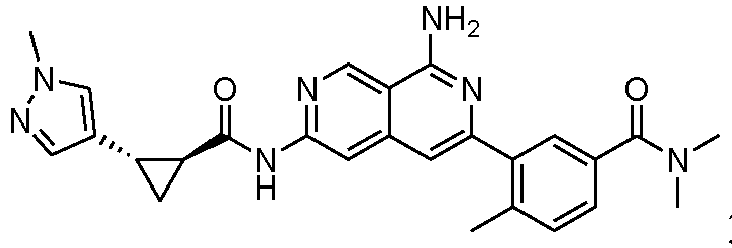
1.25 1H NMR (300 MHz, CD3OD) δ 9.30 (s, 1H), 8.33 (s, 1H), 7.55 - 7.47 (m, 2H), 7.46 - 7.36 (m, 3H), 6.95 (s, 1H), 3.86 (s, 3H), 3.12 (d, J = 10.1Hz, 6H), 2.43 - 2.30 (m, 4H), 2.18 - 2.05 (m, 1H), 1.65 - 1.50 (m, 1H), 1.35 - 1.20 (m, 1H). 470.3 K-1 291 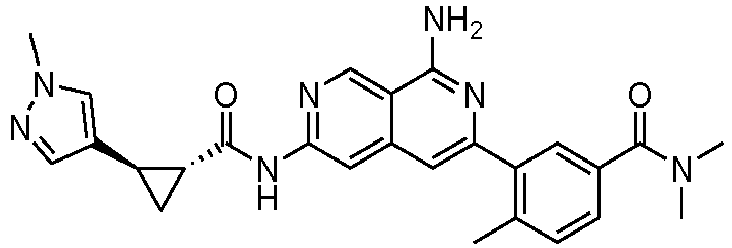
1.25 1H NMR (300 MHz, CD3OD) δ 9.30 (s, 1H), 8.33 (s, 1H), 7.55 - 7.47 (m, 2H), 7.46 - 7.36 (m, 3H), 6.95 (s, 1H), 3.86 (s, 3H), 3.12 (d, J = 10.1 Hz, 6H), 2.43 - 2.30 (m, 4H), 2.18 - 2.05 (m, 1H), 1.65 - 1.50 (m, 1H), 1.35 - 1.20 (m, 1H). 470.3 K-1 292 
1.94 1H NMR (400 MHz, CD3OD) δ 9.30 (s, 1H), 8.54 (s, 1H), 8.44 (d, J = 5.1 Hz,1H), 8.33 (s, 1H), 7.61(s, 1H), 7.48 - 7.36 (m, 2H), 6.99 (m, 1H), 4.30 - 4.28 (m, 2H), 3.82 - 3.80 (m, 2H), 3.66 - 3.49 (m, 2H), 2.85 - 2.82 (m, 2H), 2.46 (s, 3H), 2.42 - 2.37 (m, 1H), 2.14 - 2.10 (m, 1H), 1.61 - 1.56 (m, 1H), 1.29 - 1.26 (m, 1H). 473.3 K-1 293 
1.94 1H NMR (400 MHz, CD3OD) δ 9.30 (s, 1H), 8.54 (s, 1H), 8.44 (d, J= 5.1 Hz,1H), 8.33 (s, 1H), 7.61(s, 1H), 7.48 - 7.36 (m,2H), 6.99 (m,lH), 4.30 - 4.28 (m, 2H), 3.82 - 3.80 (m, 2H), 3.66 - 3.49 (m, 2H), 2.85 - 2.82 (m, 2H), 2.46 (s, 3H), 2.42 - 2.37 (m, 1H), 2.14 - 2.10 (m, 1H), 1.61 - 1.56 (m, 1H), 1.29 - 1.26 (m, 1H). 473.2 K-1 294 
1.91 1H NMR (400 MHz, CD3OD) δ 9.29 (s, 1H), 8.53 (s, 1H), 8.44 (d, J = 5.1 Hz, 1H), 8.26 (s, 1H), 7.40 (d, J = 5.1 Hz, 1H), 6.97 (s, 1H), 4.08 - 4.02 (m, 1H), 3.69 - 3.49 (m, 2H), 3.32 (s, 3H), 3.24 (s, 1H), 3.18 - 3.07 (m, 2H), 2.46 (s, 3H), 2.30 (t, J = 3.0 Hz, 1H), 2.18 - 2.16 (m, 2H), 2.01 - 1.92 (m, 2H), 1.73 - 1.69 (m, 2H) 445.2 K-1 295 
1.43 1H NMR (300 MHz, DMSO-d 6) δ 10.98 (s, 1H), 9.38 (s, 1H), 8.23 (s, 1H), 7.62 (s, 1H), 7.58 - 7.55 (m, 2H), 7.48 - 7.42 (m, 3H), 7.32 (s, 1H), 6.80 (s, 1H), 4.19 (t, J = 6.0 Hz, 2H), 3.71 (t, J = 6.0 Hz, 2H), 3.35 - 3.26 (m, 2H), 2.62 (t, J = 6.0 Hz, 2H), 2.22 (t, J = 6.0 Hz, 2H), 2.00 - 1.80 (m, 2H), 1.42 - 1.36 (m, 1H), 1.24 - 1.17 (m, 1H). 526.1 K-1 296 
1.43 1H NMR (300 MHz, DMSO-d 6) δ 10.98 (s, 1H), 9.38 (s, 1H), 8.23 (s, 1H), 7.62 (s, 1H), 7.58 - 7.55 (m, 2H), 7.48 - 7.42 (m, 3H), 7.32 (s, 1H), 6.80 (s, 1H), 4.19 (t, J = 6.0 Hz, 2H), 3.71 (t, J = 6.0 Hz, 2H), 3.35 - 3.26 (m, 2H), 2.62 (t, J = 6.0 Hz, 2H), 2.22 (t, J = 6.0 Hz, 2H), 2.00 - 1.80 (m, 2H), 1.42 - 1.36 (m, 1H), 1.24 - 1.17 (m, 1H). 526.1 K-1 297 
1.75 1H NMR (400 MHz, DMSO-d 6) δ 10.87 (s, 1H), 9.37 (s, 1H), 8.56 (s, 1H), 8.43 (d, J = 5.1Hz, 1H), 8.21 (s,1H), 7.31 (d, J = 5.3Hz, 3H), 6.95 (s,1H), 3.59 - 3.57 (m, 4H), 2.89 - 2.72 (m, 1H), 2.41 (s, 3H), 2.32 (d, J = 5.5 Hz, 4H), 2.16-2.06 (m, 3H), 1.77 - 1.74 (m, 2H),1.59 - 1.56 (m, 2H). 445.2 K-1 298 
1.330 1H NMR (400 MHz, CD3OD) δ 9.28 (s, 1H), 8.29 (s, 1H), 7.51 (s, 1H), 7.41 - 7.35 (m, 2H), 7.35 - 7.25 (m, 3H), 6.89 (d, J = 0.9Hz, 1H), 3.86 (s, 3H), 2.41 - 2.37 (m, 1H), 2.36 (s, 3H), 2.14 - 2.09 (m, 1H), 1.60 - 1.55 (m, 1H), 1.33 - 1.23 (m, 1H). 399 K-1 299 
1.840 1H NMR (400 MHz, CD3OD) δ 9.28 (s, 1H), 8.29 (s, 1H), 7.51 (s, 1H), 7.41 - 7.35 (m, 2H), 7.35 - 7.25 (m, 3H), 6.89 (d, J = 0.9 Hz, 1H), 3.86 (s, 3H), 2.41 - 2.37 (m, 1H), 2.36 (s, 3H), 2.14 - 2.09 (m, 1H), 1.60 - 1.55 (m, 1H), 1.33 - 1.23 (m, 1H). 399 K-1 300 
1.330 1H NMR (300 MHz, DMSO-d 6) δ 10.97 (s, 1H), 9.38 (s, 1H), 8.27 (s, 1H), 7.87 (s, 1H), 7.77 (d, J = 9.0 Hz, 1H), 7.58 (s, 1H), 7.52 (d, J = 9.0 Hz, 1H), 7.35 (s, 2H), 7.31 (s, 1H), 6.99 (s, 1H), 3.77 (s, 3H), 2.46 (s, 3H), 2.24 - 2.20 (m, 2H), 1.43 - 1.37 (m, 1H), 1.23 - 1.18 (m, 1H). 424 K-1 301 
1.330 1H NMR (300 MHz, DMSO-d 6) δ10.97 (s, 1H), 9.38 (s, 1H), 8.27 (s, 1H), 7.87 (s, 1H), 7.77 (d, J = 9.0 Hz, 1H), 7.58 (s, 1H), 7.52 (d, J = 9.0 Hz, 1H), 7.35 (s, 2H), 7.31 (s, 1H), 6.99 (s, 1H), 3.77 (s, 3H), 2.46 (s, 3H), 2.24 - 2.20 (m, 2H), 1.43 - 1.37 (m, 1H), 1.23 - 1.18 (m, 1H). 424 K-1 302 
1.340 1H NMR (400 MHz, CD3OD) δ 9.55 (s, 1H), 8.55 (s, 1H), 7.68 - 7.62 (m, 1H), 7.55 - 7.51 (m, 2H), 7.40 - 7.33 (m, 2H), 7.24 (s, 1H), 3.86 (s, 3H), 2.45 - 2.39 (m, 1H), 2.18 - 2.12 (m, 1H), 1.63 - 1.58 (m, 1H), 1.34 - 1.27 (m, 1H). 437 K-1 303 
1.350 1H NMR (400 MHz, CD3OD) δ 9.55 (s, 1H), 8.55 (s, 1H), 7.68 - 7.62 (m, 1H), 7.55 - 7.51 (m, 2H), 7.40 - 7.33 (m, 2H), 7.24 (s, 1H), 3.86 (s, 3H), 2.45 - 2.39 (m, 1H), 2.18 - 2.12 (m, 1H), 1.63 - 1.58 (m, 1H), 1.34 - 1.27 (m, 1H). 437 K-1 304 
0.95 1H NMR (400 MHz, DMSO-d 6) δ 10.98 (s, 1H), 9.39 (s, 1H), 8.25 (s, 1H), 7.61 - 7.54 (m, 3H), 7.45 - 7.42 (m, 2H), 7.35 (s, 2H), 7.31 (s, 1H), 7.00 (s, 1H), 3.78 (s, 3H), 2.24 - 2.18 (m, 2H), 1.14 - 1.37 (m, 1H), 1.24 - 1.17 (m, 1H) 419 K-1 305 
1.31 1H NMR (400 MHz, DMSO-d 6) δ 10.98 (s, 1H), 9.39 (s, 1H), 8.25 (s, 1H), 7.61 - 7.54 (m, 3H), 7.45 - 7.42 (m, 2H), 7.35 (s, 2H), 7.31 (s, 1H), 7.00 (s, 1H), 3.78 (s, 3H), 2.24 - 2.18 (m, 2H), 1.14 - 1.37 (m, 1H), 1.24 - 1.17 (m, 1H) 419 K-1 306 
2.332 1H NMR (400 MHz, CD3OD) δ9.30 (s, 1H), 8.31 (s, 1H), 7.52 - 7.44 (m, 2H), 7.37 (s, 1H), 7.13 - 7.05 (m, 2H), 6.99 (s, 1H), 3.02 (s, 3H), 2.41 - 2.34 (m, 1H), 2.13 - 2.10 (m, 1H), 1.61 - 1.56 (m, 1H), 1.29 - 1.25 (m, 1H). 421 K-1 307 
1.310 1H NMR (400 MHz, CD3OD) δ 9.30 (s, 1H), 8.31 (s, 1H), 7.52 - 7.44 (m, 2H), 7.37 (s, 1H), 7.13 - 7.05 (m, 2H), 6.99 (s, 1H), 3.02 (s, 3H), 2.41 - 2.34 (m, 1H), 2.13 - 2.10 (m, 1H), 1.61 - 1.56 (m, 1H), 1.29 - 1.25 (m, 1H). 421 K-1 308 
1.272 1H NMR (400 MHz, CD3OD) δ 9.33 (s, 1H), 8.70 (s, 1H), 8.38 (s, 1H), 8.15 - 8.14 (m, 2H), 7.51 (s, 1H), 7.45 - 7.44 (m, 1H), 7.38 (s, 1H), 7.09 (s, 1H), 3.86 (s, 3H), 2.57 (s, 3H), 2.42 - 2.37 (m, 1H), 2.14 - 2.10 (m, 1H), 1.61 - 1.56 (m, 1H), 1.34 -1.25 (m, 1H). 467 K-1 309 
1.280 1H NMR (400 MHz, CD3OD) δ 9.33 (s, 1H), 8.70 (s, 1H), 8.38 (s, 1H), 8.15 - 8.14 (m, 2H), 7.51 (s, 1H), 7.45 - 7.44 (m, 1H), 7.38 (s, 1H), 7.09 (s, 1H), 3.86 (s, 3H), 2.57 (s, 3H), 2.42 - 2.37 (m, 1H), 2.14 - 2.10 (m, 1H), 1.61 - 1.56 (m, 1H), 1.34 -1.25 (m, 1H). 467 K-1 310 
2.46 1H NMR (400 MHz, CD3OD) δ 9.33 (s, 1H), 8.29 (s, 1H), 7.56 - 7.48 (m, 2H), 7.42 (dd, J = 8.0, 8.0 Hz, 1H), 6.86 (s, 1H), 2.79 - 2.64 (m, 2H), 2.03 (m, 1H), 1.81 - 1.70 (m, 1H), 1.35 (m, 1H), 1.06 (m, 1H). 412 K-1 311 
1.370 1H NMR (400 MHz, CD3OD) δ 9.33 (s, 1H), 8.29 (s, 1H), 7.56 - 7.48 (m, 2H), 7.42 (dd, J = 8.0, 8.0 Hz, 1H), 6.86 (s, 1H), 2.79 - 2.64 (m, 2H), 2.03 (m, 1H), 1.81 - 1.70 (m, 1H), 1.35 (m, 1H), 1.06 (m, 1H). 412 K-1 312 
0.903 1H NMR (300 MHz, DMSO-d 6) δ 10.95 (s, 1H), 9.37 (s, 1H), 8.57 (s, 1H), 8.43 (d, J = 6.0 Hz, 1H), 8.25 (s, 1H), 7.53 (s, 1H), 7.32 - 7.31 (m, 3H), 6.99 (s, 1H), 3.22 - 3.20 (m, 2H), 2.42 (s, 3H), 2.38 - 2.36 (m, 2H), 2.12 - 2.08 (m, 1H), 1.76 - 1.74 (m, 1H), 1.52 - 1.49 (m, 1H), 1.10 - 1.06 (m, 2H). 403 K-1 313 
0.903 1H NMR (300 MHz, DMSO-d 6) δ 10.97 (s, 1H), 9.39 (s, 1H), 8.58 (s, 1H), 8.45 (d, J = 6.0 Hz,1H), 8.27 (s, 1H), 7.53 (s, 1H), 7.41 (s, 2H), 7.33 (d, J = 6.0 Hz,1H), 7.01 (s, 1H), 3.21 -3.16 (m, 2H), 2.42 (s, 3H), 2.38 - 2.36 (m, 2H), 2.12-2.08 (m, 1H), 1.97 - 1.70 (m, 1H), 1.53 - 1.45(m, 1H), 1.12 - 1.05 (m, 2H). 403 K-1 314 
1.014 1H NMR (300 MHz, DMSO-d 6) 10.96 (s, 1H), 9.37(s, 1H), 8.57 (s, 1H), 8.43 (d, J = 6.0 Hz, 1H), 8.25 (s, 1H), 7.58 (s, 1H), 7.32 - 7.30 (m, 3H), 6.97 (s, 1H), 3.15 - 3.12 (m, 1H), 3.02 - 2.99 (m, 1H), 2.41 (s, 3H), 2.31 - 2.25 (m, 1H), 2.11-2.04 (m, 2H), 1.92 - 1.78(m, 2H), 1.19-1.16 (m, 1H), 1.10 - 0.96 (m, 1H). 403 K-1 315 
1.007 1H NMR (300 MHz, CD3OD) 9.30 (s, 1H), 8.54 (s, 1H), 8.44 (d, J = 6.0 Hz, 1H), 8.32 (s, 1H), 7.41 (d, J = 6.0 Hz, 1H), 6.99 (s, 1H), 3.27 - 3.21 (m, 2H), 2.46 - 2.30 (m, 5H), 2.06 -1.99 (m, 3H), 1.47 - 1.39 (m, 1H), 1.11 - 1.07 (m, 1H). 403 K-1 316 
2.182 1H NMR (400 MHz, CD3OD) δ 9.39 (s, 1H), 9.04 (s, 1H), 8.51 (d, J = 4 Hz, 1H), 8.50 (s, 1H), 8.51 (d, J = 4 Hz, 1H), 2.81 - 2.66 (m, 2H), 2.34 (s, 3H), 2.09 - 2.03 (m, 1H), 1.90 - 1.75 (m, 2H), 1.41 - 1.36 (m, 1H), 1.11 - 1.07 (m, 1H), 0.88 - 0.77 (s, 2H), 0.17 - 0.07 (m, 2H). 399 K-1 317 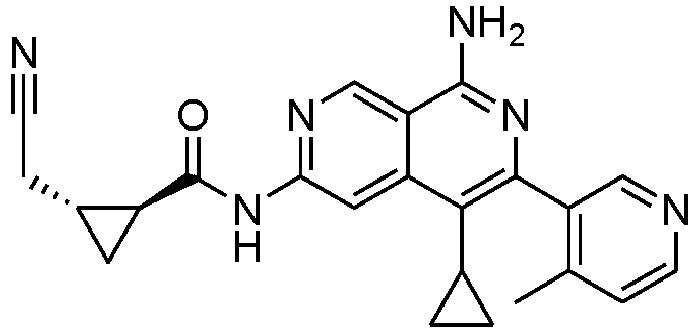
1.079 1H NMR (400 MHz, CD3OD) δ 9.39 (s, 1H), 9.04 (s, 1H), 8.51 (d, J = 4 Hz, 1H), 8.50 (s, 1H), 8.51 (d, J = 4 Hz, 1H), 2.81 - 2.66 (m, 2H), 2.34 (s, 3H), 2.09 - 2.03 (m, 1H), 1.90 - 1.75 (m, 2H), 1.41 - 1.36 (m, 1H), 1.11 - 1.07 (m, 1H), 0.88 - 0.77 (s, 2H), 0.17 - 0.07 (m, 2H). 399 K-1 318 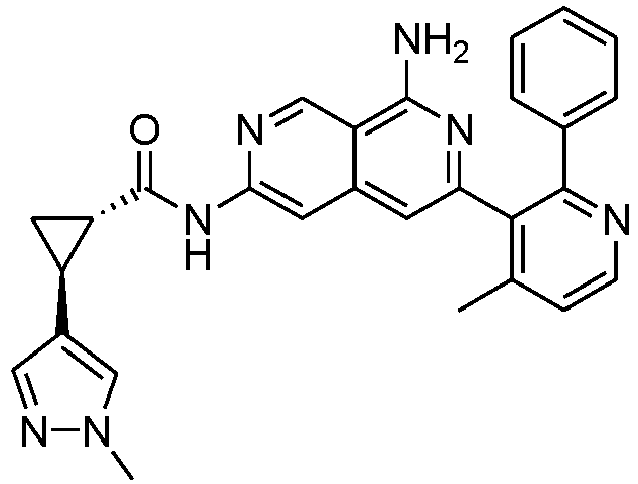
1.196 1H NMR (400 MHz, CD3OD) δ 9.22 (s, 1H), 8.52 (d, J = 4 Hz, 1H), 8.05 (s, 1H), 7.48 (s, 1H), 7.42 (d, J = 4.0 Hz, 1H), 7.40 - 7.38 (m, 2H), 7.35 (s, 1H), 7.23 - 7.20 (m, 3H), 6.57 (s, 1H), 3.85 (s, 3H), 2.37 - 2.33 (m, 1H), 2.31 (s, 3H), 2.09 - 2.058 (m, 1H), 1.56 - 1.51 (m, 1H), 1.26 - 1.21 (m, 1H). 476 K-1 319 
1.197 1H NMR (400 MHz, CD3OD) δ 9.22 (s, 1H), 8.52 (d, J = 4 Hz, 1H), 8.05(s, 1H), 7.48 (s, 1H), 7.42 (d, J = 4.0 Hz, 1H), 7.40 - 7.38 (m, 2H), 7.35 (s, 1H), 7.23 - 7.20 (m, 3H), 6.57 (s, 1H), 3.85 (s, 3H), 2.37 - 2.33 (m, 1H), 2.31 (s, 3H), 2.09 - 2.06 (m, 1H), 1.56 - 1.51 (m, 1H), 1.26 - 1.21 (m, 1H). 476 K-1 320 
1.290 1H NMR (400 MHz, CD3OD) δ 9.29 (s, 1H), 8.55 (s, 1H), 8.44 (d, J = 4.0 Hz, 1H), 8.37 (s, 1H), 7.41 (d, J = 4 Hz, 1H), 7.01 (s, 1H), 2.99 - 2.92 (m, 1H), 2.76 - 2.68 (m, 1H), 2.47 (s, 3H), 2.25 - 2.05 (m, 3H), 1.69 - 1.60 (m, 1H), 1.19 (d, J = 8.0 Hz, 3H). 348 K-1 321 
1.420 1H NMR (400 MHz, CD3OD) δ 9.29 (s, 1H), 8.56 (s, 1H), 8.44 (d, J = 4.0 Hz, 1H), 8.39 (s, 1H), 7.41 (d, J = 4.0 Hz, 1H), 7.01 (s, 1H), 3.51 - 3.45 (m, 1H), 2.96 - 2.89 (m, 1H), 2.55 - 2.48 (m, 1H), 2.47 (s, 3H), 2.27 - 2.18 (m, 1H), 2.09 - 2.00 (m, 1H), 1.73 -1.65 (m, 1H), 1.11 (d, J = 8.0 Hz, 3H). 348 K-1 322 
0.980 1H NMR (400 MHz, CD3OD) δ 9.29 (s, 1H), 8.55 (s, 1H), 8.44 (d, J = 4.0 Hz, 1H), 8.37 (s, 1H), 7.41 (d, J = 4.0 Hz, 1H), 7.01 (s, 1H), 2.99 - 2.92 (m, 1H), 2.76 - 2.68 (m, 1H), 2.47 (s, 3H), 2.25 - 2.05 (m, 3H), 1.69 - 1.60 (m, 1H), 1.19 (d, J = 8.0 Hz, 3H). 348 K-1 323 
0.980 1H NMR (400 MHz, CD3OD) δ 9.29 (s, 1H), 8.56 (s, 1H), 8.44 (d, J = 4.0 Hz, 1H), 8.39 (s, 1H), 7.41 (d, J = 4.0 Hz, 1H), 7.01 (s, 1H), 3.51 - 3.45 (m, 1H), 2.96 - 2.89 (m, 1H), 2.55 - 2.48 (m, 1H), 2.47 (s, 3H), 2.27 - 2.18 (m, 1H), 2.09 - 2.00 (m, 1H), 1.73 -1.65 (m, 1H), 1.11 (d, J = 8.0 Hz, 3H). 348 K-1 324 
1.100 1H NMR (400 MHz, CD3OD) δ 9.32 (s, 1H), 8.55 (s, 1H), 8.46 (d, J = 5.1 Hz, 1H), 8.32 (s, 1H), 7.43 (d, J = 5.1 Hz, 1H), 7.01 (s, 1H), 4.03 - 3.92 (m, 2H), 3.47 - 3.37 (m, 2H), 2.47 (s, 3H), 1.87 - 1.83 (m, 1H), 1.76 (t, J = 14.6 Hz, 2H), 1.57 - 1.42 (m, 2H), 1.38 - 1.31 (m, 1H), 1.25 - 1.21 (m, 1H), 1.19 - 1.07 (m, 1H), 0.93 - 0.89 (m, 1H). 404 K-1 325 
1.080 1H NMR (400 MHz, CD3OD) δ 9.32 (s, 1H), 8.55 (s, 1H), 8.46 (d, J = 5.1 Hz, 1H), 8.32 (s, 1H), 7.43 (d, J = 5.1 Hz, 1H), 7.01 (s, 1H), 4.03 - 3.92 (m, 2H), 3.47 - 3.37 (m, 2H), 2.47 (s, 3H), 1.87 - 1.83 (m, 1H), 1.76 (t, J = 14.6 Hz, 2H), 1.57 - 1.42 (m, 2H), 1.38 - 1.31 (m, 1H), 1.25 - 1.21 (m, 1H), 1.19 - 1.07 (m, 1H), 0.93 - 0.89 (m, 1H). 404 K-1 326 
1.980 1H NMR (400 MHz, CD3OD) δ 9.29 (s, 1H), 8.53 (s, 1H), 8.43-8.41 (m, 1H), 8.32 (s, 1H), 7.50 (s, 1H), 7.40 - 7.38 (m, 1H), 7.33 (s, 1H), 6.98 (s, 1H), 3.87 (s, 3H), 2.54 - 2.49 (m, 1H), 2.45 (s, 3H), 2.00 - 1.97 (m, 1H), 1.79 - 1.72 (m, 1H), 1.06 - 1.04 (m, 3H). 414 K-1 327 
1.090 1H NMR (400 MHz, CD3OD) δ 9.28 (s, 1H), 8.54 (s, 1H), 8.43-8.41 (m, 1H), 8.34 (s, 1H), 7.45 (s, 1H), 7.40 - 7.38 (m, 1H), 7.33 (s, 1H), 6.99 (s, 1H), 3.84 (s, 3H), 2.45 (s, 3H), 2.31 - 2.35 (m, 1H), 2.14 - 2.18 (m, 1H), 1.63- 1.67(m, 1H), 1.33- 1.35 (m, 3H). 414 K-1 328 
1.076 1H NMR (400 MHz, CD3OD) δ 9.29 (s, 1H), 8.53 (s, 1H), 8.43-8.41 (m, 1H), 8.32 (s, 1H), 7.50 (s, 1H), 7.40 - 7.38 (m, 1H), 7.33 (s, 1H), 6.98 (s, 1H), 3.93 (s, 3H), 2.54 - 2.49 (m, 1H), 2.45 (s, 3H), 2.00 - 1.97 (m, 1H), 1.79 - 1.72 (m, 1H), 1.06 - 1.04 (m, 3H). 414 K-1 329 
1.070 1H NMR (400 MHz, CD3OD) δ 9.29 (s, 1H), 8.53 (s, 1H), 8.43-8.41 (m, 1H), 8.34 (s, 1H), 7.45 (s, 1H), 7.40 - 7.38 (m, 1H), 7.33 (s, 1H), 6.98 (s, 1H), 3.84 (s, 3H), 2.45 (s, 3H), 2.31 - 2.35 (m, 1H), 2.14 - 2.18 (m, 1H), 1.63- 1.67(m, 1H), 1.33- 1.35 (m, 3H). 414 K-1 330 
1.060 1H NMR (300 MHz, DMSO-d 6) δ 10.97 (s, 1H), 9.38 (s, 1H), 8.57 (s, 1H), 8.45 (d, J = 6.0 Hz, 1H), 8.26 (s, 1H), 7.59 (s, 1H), 7.41 (s, 2H), 7.38 - 7.22 (m, 2H), 6.99 (s, 1H), 4.17 (t, J = 6.0 Hz, 2H), 3.64 (t, J = 6.0 Hz, 2H), 3.22 (s, 3H), 2.41 (s, 3H), 2.22 (t, J = 6.0 Hz, 2H), 1.52-1.33 (m, 1H), 1.23 - 1.27 (m, 1H). 444 K-1 331 
1.050 1H NMR (300 MHz, DMSO-d 6) δ 10.97 (s, 1H), 9.38 (s, 1H), 8.57 (s, 1H), 8.45 (d, J = 6.0 Hz, 1H), 8.26 (s, 1H), 7.59 (s, 1H), 7.41 (s, 2H), 7.38 - 7.22 (m, 2H), 6.99 (s, 1H), 4.17 (t, J = 6.0 Hz, 2H), 3.64 (t, J = 6.0 Hz, 2H), 3.22 (s, 3H), 2.41 (s, 3H), 2.22 (t, J= 6.0 Hz, 2H), 1.52-1.33 (m, 1H), 1.23 - 1.27 (m, 1H). 444 K-1 332 
1.090 1H NMR (400 MHz, CD3OD) δ 9.36 (s, 1H), 8.74 (s, 1H), 8.59 (d, J = 8.0 Hz, 1H), 8.53 (s, 1H), 7.65 (d, J= 8.0 Hz, 1H), 7.51 (s, 1H), 7.38 (s, 1H), 3.86 (s, 3H), 3.75 (t, J = 8.0 Hz, 2H), 2.89 (t, J = 8.0 Hz, 2H), 2.44 - 2.39 (m, 1H), 2.16-2.12 (m, 1H), 1.62 - 1.58 (m, 1H), 1.32 - 1.27 (m, 1H). 464 K-1 333 
1.090 1H NMR (400 MHz, CD3OD) δ 9.36 (s, 1H), 8.74 (s, 1H), 8.59 (d, J = 8.0 Hz, 1H), 8.53 (s, 1H), 7.65 (d, J = 8.0 Hz, 1H), 7.51 (s, 1H), 7.38 (s, 1H), 3.86 (s, 3H), 3.75 (t, J = 8.0 Hz, 2H), 2.89 (t, J = 8.0 Hz, 2H), 2.44 - 2.39 (m, 1H), 2.16-2.12 (m, 1H), 1.62 - 1.58 (m, 1H), 1.32 - 1.27 (m, 1H). 464 K-1 334 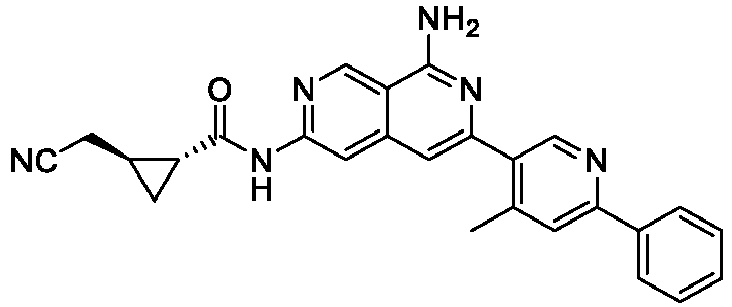
1.370 1H NMR (300 MHz, CD3OD) δ 9.31 (s, 1H), 8.62 (s, 1H), 8.32 (s, 1H), 8.02 - 7.98 (m, 2H), 7.82 (s, 1H), 7.56 - 7.54 (m, 3H), 7.03 (s, 1H), 2.79 - 2.69 (m, 2H), 2.54 (s, 3H), 2.06 - 2.00 (m, 1H), 1.97-1.72 (m, 1H), 1.39 - 1.31 (m, 1H), 1.09 - 1.02 (m, 1H). 435 K-1 335 
1.370 1H NMR (300 MHz, CD3OD) δ 9.31 (s, 1H), 8.62 (s, 1H), 8.32 (s, 1H), 8.02 - 7.98 (m, 2H), 7.82 (s, 1H), 7.56 - 7.54 (m, 3H), 7.03 (s, 1H), 2.79 - 2.69 (m, 2H), 2.54 (s, 3H), 2.06 - 2.00 (m, 1H), 1.97-1.72 (m, 1H), 1.39 - 1.31 (m, 1H), 1.09 - 1.02 (m, 1H). 435 K-1 336 
2.82 1H NMR (400 MHz, DMSO-d6 ) δ 10.75 (s, 1H), 9.35 (s, 1H), 8.56 (s, 1H), 8.43 (d, J = 5.0 Hz, 1H), 8.26 (s, 1H), 7.28 (br s, 2H), 7.33 - 7.21 (m, 1H), 6.95 (s, 1H), 2.43 - 2.40 (m, 1H), 2.41 (s, 3H), 1.42 (t, J = 3.8 Hz, 1H), 1.35 (dd, J = 7.4, 3.4 Hz, 1H), 0.95 - 0.73 (m, 4H). 346.1 Q 337 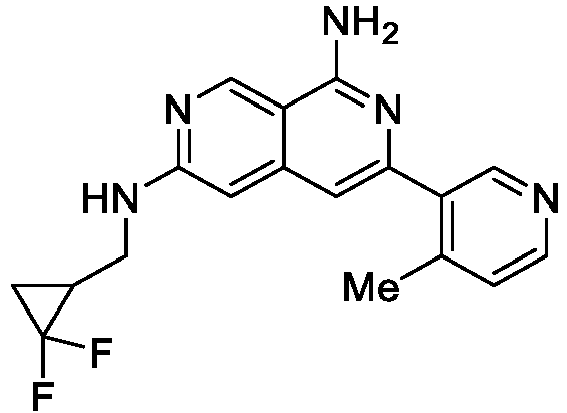
2.69 1H NMR (400 MHz, DMSO-d6 ) δ 9.20 (s, 1H), 8.54 (s, 1H), 8.46 (d, J = 5.0 Hz, 1H), 7.33 (d, J = 5.0 Hz, 1H), 7.25 (br s, 2H), 6.75 (s, 1H), 6.51 (s, 1H), 3.53 - 3.39 (m, 2H), 2.38 (s, 3H), 2.14 - 1.98 (m, 1H), 1.66 - 1.52 (m, 1H), 1.39-1.28 (m, 1H). 342.1 Q 338 
2.23 1H NMR (400 MHz, DMSO-d 6) δ 9.14 (s, 1H), 8.52 (s, 1H), 8.41 (d, J = 5.0 Hz, 1H), 7.28 (d, J = 5.0 Hz, 1H), 7.14 (t, J = 6.4 Hz, 1H), 7.04 (br s, 2H), 6.69 (s, 1H), 6.56 (s, 1H), 6.13 (tt, J = 56.3, 4.0 Hz, 1H), 3.84 - 3.69 (m, 2H), 2.39 (s, 3H). 316.1 Q 339 
3.33 1H NMR (400 MHz, DMSO-d6 ) δ 11.01 (s, 1H), 9.77 (d, J = 2.3 Hz, 1H), 9.41 (s, 1H), 9.00 (d, J = 2.3 Hz, 1H), 8.50 (s, 1H), 8.37 (s, 1H), 7.75 (s, 1H), 7.57 (s, 1H), 7.50 (s, 2H), 7.30 (s, 1H), 3.78 (s, 3H), 3.77 (s, 3H), 2.28 - 2.18 (m, 2H), 1.46 - 1.36 (m, 1H), 1.28 - 1.15 (m, 1H). 468.2 Q 340 
3.23 1H NMR (400 MHz, DMSO-d 6) δ 10.96 (s, 1H), 9.38 (s, 1H), 8.58 (s, 1H), 8.25 (s, 1H), 7.56 (s, 1H), 7.48 (s, 1H), 7.34 (br s, 2H), 7.29 (s, 1H), 7.03 (s, 1H), 3.76 (s, 3H), 3.02 (s, 3H), 2.99 (s, 3H), 2.46 (s, 3H), 2.24 - 2.16 (m, 2H), 1.44-1.33 (m, 1H), 1.24 - 1.12 (m, 1H). 471.2 Q 341 
3.43 1H NMR (400 MHz, DMSO-d 6) δ 10.95 (s, 1H), 9.38 (s, 1H), 8.71 (s, 1H), 8.28 (s, 1H), 8.01 (s, 1H), 7.56 (s, 1H), 7.37 (br s, 2H), 7.29 (s, 1H), 7.05 (s, 1H), 3.91 (s, 3H), 3.77 (s, 3H), 2.25 - 2.16 (m, 2H), 1.90 (s, 3H), 1.43 - 1.34 (m, 1H), 1.24 - 1.14 (m, 1H). 458.1 Q 342 
2.91 1H NMR (400 MHz, DMSO-d 6) δ 10.94 (s, 1H), 9.37 (s, 1H), 8.59 (s, 1H), 8.27 (s, 1H), 7.90 (s, 1H), 7.56 (s, 1H), 7.34 (br s, 2H), 7.29 (s, 1H), 7.01 (s, 1H), 3.77 (s, 3H), 2.46 (s, 3H), 2.25 - 2.16 (m, 2H), 1.43 - 1.34 (m, 1H), 1.23 - 1.13 (m, 1H). 444.1 Q 343 
3.29 1H NMR (400 MHz, DMSO-d 6) δ 10.92 (s, 1H), 9.35 (s, 1H), 8.34 (s, 1H), 8.24 (s, 1H), 7.56 (s, 1H), 7.52 (s, 1H), 7.29 (s, 1H), 7.28 (br s, 2H), 6.93 (s, 1H), 3.77 (s, 3H), 3.73 (dd, J = 4.7, 4.7 Hz, 2H), 3.12 (dd, J = 4.7, 4.7 Hz, 2H), 2.44 (s, 3H), 2.24 - 2.17 (m, 2H), 1.43-1.33 (m, 1H), 1.23 - 1.14 (m, 1H). 469.2 Q 344 
3.79 1H NMR (400 MHz, DMSO-d6 ) δ 10.93 (s, 1H), 9.36 (s, 1H), 8.56 (s, 1H), 8.26 (s, 1H), 7.83 (s, 1H), 7.78 (d, J = 2.1 Hz, 1H), 7.56 (s, 1H), 7.30 (br s, 2H), 7.29 (d, J = 2.1 Hz, 1H), 7.00 (s, 1H), 6.81 (s, 1H), 3.93 (s, 3H), 3.77 (s, 3H), 2.47 (s, 3H), 2.26 - 2.14 (m, 2H), 1.45 - 1.32 (m, 1H), 1.28 - 1.15 (m, 1H). 480.2 Q 345 
4.10 1H NMR (400 MHz, DMSO-d 6) δ 10.94 (s, 1H), 9.37 (s, 1H), 8.65 (d, J= 3.0 Hz, 1H), 8.48 (s, 1H), 8.27 (s, 1H), 7.88 (s, 1H), 7.85 (d, J= 3.0 Hz, 1H), 7.56 (s, 1H), 7.33 (br s, 2H), 7.29 (s, 1H), 7.03 (s, 1H), 6.60 (s, 1H), 3.77 (s, 3H), 2.54 (s, 3H), 2.25 - 2.16 (m, 2H), 1.43-1.34 (m, 1H), 1.23 - 1.16 (m, 1H). 466.2 Q 346 
3.40 1H NMR (400 MHz, DMSO-d 6) δ 10.95 (s, 1H), 9.38 (s, 1H), 8.79 (q, J = 4.9 Hz, 1H), 8.61 (s, 1H), 8.27 (s, 1H), 7.96 (s, 1H), 7.56 (s, 1H), 7.36 (br s, 2H), 7.29 (s, 1H), 7.04 (s, 1H), 3.77 (s, 3H), 2.84 (d, J = 4.9 Hz, 3H), 2.26 - 2.16 (m, 2H), 1.43 - 1.32 (m, 1H), 1.23 - 1.15 (m, 1H). 457.1 Q 347 
3.78 1H NMR (400 MHz, DMSO-d 6) δ 10.87 (s, 1H), 9.28 (s, 1H), 8.98 (d, J = 2.3 Hz, 1H), 8.47 (d, J = 2.3 Hz, 1H), 8.24 (s, 1H), 7.56 (s, 1H), 7.42 (s, 1H), 7.29 (s, 1H), 7.28 (br s, 2H), 6.75 (br s, 2H), 3.77 (s, 3H), 2.26 - 2.15 (m, 2H), 1.44-1.30 (m, 1H), 1.24 - 1.16 (m, 1H). 469.1 Q 348 
4.39 1H NMR (400 MHz, DMSO-d 6) δ 10.95 (s, 1H), 9.38 (s, 1H), 8.71 (s, 1H), 8.27 (s, 1H), 8.04 (s, 1H), 7.56 (s, 1H), 7.53 - 7.47 (m, 2H), 7.45 - 7.34 (m, 5H), 7.29 (s, 1H), 7.04 (s, 1H), 5.41 (s, 2H), 3.77 (s, 3H), 2.25 - 2.16 (m, 2H), 1.45-1.33 (m, 1H), 1.26 - 1.16 (m, 1H). 534.2 Q Table A-2 Cmpd No.. Structure/Name LCMS RT (min) M+H+ Method 1H NMR (ppm) 349 
3.9 498.1 - N 350 
3.9 498.1 - N 351 
3.1 1H NMR (400 MHz, DMSO-d 6) δ 10.94 (s, 1H), 9.37 (d, J = 1.0 Hz, 1H), 8.22 (d, J = 0.8 Hz, 1H), 8.04 (s, 1H), 7.67 (d, J = 1.5 Hz, 1H), 7.57 (m, 2H), 7.49 (br s, 1H), 7.33 (br s, 2H), 7.29 (d, J = 0.8 Hz, 1H), 6.84 (s, 1H), 3.77 (s, 3H), 2.25-2.16 (m, 5H), 1.43 - 1.34 (m, 1H), 1.26 - 1.12 (m, 2H). 460.1 N 352 
3.0 1H NMR (400 MHz, DMSO-d 6) δ 10.94 (s, 1H), 9.37 (s, 1H), 8.22 (s, 1H), 8.04 (s, 1H), 7.67 (d, J = 1.6 Hz, 1H), 7.58 (d, J = 1.7 Hz, 1H), 7.56 (s, H), 7.49 (s, 1H), 7.31 (d, J = 14.8 Hz, 3H), 6.84 (s, 1H), 3.77 (s, 3H), 3.42 - 3.31 (m, 0H), 3.29 (s, 0H), 2.21 (d, J = 9.2 Hz, 5H), 1.43-1.34 (m, 1H), 1.26 - 1.12 (m, 2H). 460.1 N 353 
1.278 1H NMR (400 MHz, CD3OD) δ 9.29 (s, 1H), 8.25 (s, 1H), 7.30 (d, J = 7.8 Hz, 1H), 7.20 (d, J = 7.8 H z,1 H), 6.80 (s, 1H), 2.87-2.58 (m, 4H), 2.22 (s, 3H), 2.14 (t, J = 7.0 Hz, 2H), 2.02-1.97 (m, 1H), 1.83-1.70 (m, 1H), 1.54 (s, 3H), 1.37-1.34 (m, 1H), 1.07-1.03 (m, 1H). 428.3 K 354 
1.414 1H NMR (400 MHz,CD3OD) δ 9.31 (s, 1H), 8.29 (s, 1H), 7.51 (s, 1H), 7.40 (s, 1H), 7.33-7.31 (m, 1H), 7.13 (d, J = 7.6 Hz, 1H), 7.03 (t, J = 8.9 Hz, 1H), 6.86 (s, 1H), 3.88 (s, 3H), 2.53-2.50(m, 1H), 2.23 (s, 3H), 2.01-2.00 (m, 1H), 1.82-1.71 (m, 1H), 1.06 (d, J = 6.3 Hz, 3H). 431.3 J 355 
1.422 1H NMR (400 MHz, CD3OD) δ 9.30 (s, 1H), 8.31 (s, 1H), 7.47 (s, 1H), 7.35-7.30 (m, 2H), 7.14 (d, J = 7.6 Hz, 1H), 7.04 (t, J = 8.8 Hz, 1H), 6.87 (s, 1H), 3.85 (s, 3H), 2.35-2.32 (m, 1H), 2.24 (s, 3H), 2.18-2.15 (m, 1H), 1.69-1.63 (m, 1H), 1.35 (d, J = 6.2 Hz, 3H). 431.3 J 356 
1.423 1H NMR (400 MHz, CD3OD) δ 9.30 (s, 1H), 8.31 (s, 1H), 7.47 (s, 1H), 7.35-7.30 (m, 2H), 7.14 (d, J = 7.6 Hz, 1H), 7.04 (t, J = 8.8 Hz, 1H), 6.87 (s, 1H), 3.85 (s, 3H), 2.35-2.32 (m, 1H), 2.24 (s, 3H), 2.18-2.15 (m, 1H), 1.69-1.63 (m, 1H), 1.35 (d, J = 6.2 Hz, 3H). 431.3 J 57 
1.413 1H NMR (400 MHz,CD3OD) δ 9.31 (s, 1H), 8.29 (s, 1H), 7.51 (s, 1H), 7.40 (s, 1H), 7.33-7.31 (m, 1H), 7.13 (d, J = 7.6 Hz, 1H), 7.03 (t, J = 8.9 Hz, 1H), 6.86 (s, 1H), 3.88 (s, 3H), 2.53-2.50(m, 1H), 2.23 (s, 3H), 2.01-2.00 (m, 1H), 1.82-1.71 (m, 1H), 1.06 (d, J = 6.3 Hz, 3H). 431.3 J 358 
1.18 1H NMR (300 MHz, DMSO-d 6) δ 10.83 (s, 1H), 9.33 (s, 1H), 8.17 (s, 1H), 7.53 (s, 1H), 7.28 (s, 1H), 7.23-7.10 (m, 2H), 6.91 (t, J = 7.7 Hz, 1H), 6.72 (s, 1H), 6.65 (dd, J = 8.0, 1.3 Hz, 1H), 6.56 (dd, J = 7.6, 1.3 Hz, 1H), 4.85 (s, 2H), 3.79 (s, 3H), 2.32-2.25 (m, 1H), 2.12 (t, J = 4.7 Hz, 1H), 2.00 (s, 3H), 1.69-1.49 (m, 1H), 0.95 (d, J = 6.2 Hz, 3H). 428.30 J 359 
1.341 1H NMR (400 MHz, CD3OD) δ 9.28 (s, 1H), 8.24 (s, 1H), 7.33-7.31 (m, 1H), 7.11 (d, J = 7.6 Hz, 1H), 7.01 (t, J = 8.9 Hz, 1H), 6.84 (s, 1H), 2.79-2.64 (m, 2H), 2.21 (s, 3H), 2.02-1.97 (m, 1H), 1.75-1.70 (m, 1H), 1.34-1.28 (m, 1H), 1.05-1.00 (m, 1H). 376.2 K 360 
1.336 1H NMR (400 MHz, CD3OD) δ 9.28 (s, 1H), 8.24 (s, 1H), 7.33-7.31 (m, 1H), 7.11 (d, J = 7.6 Hz, 1H), 7.01 (t, J = 8.9 Hz, 1H), 6.84 (s, 1H), 2.79-2.64 (m, 2H), 2.21 (s, 3H), 2.02-1.97 (m, 1H), 1.75-1.70 (m, 1H), 1.34-1.28 (m, 1H), 1.05-1.00 (m, 1H). 376.2 K 361 
1.526 1H NMR (400 MHz, DMSO-d 6) δ 11.08(s, 1H), 9.39(s, 1H), 8.19(s, 1H), 7.37-7.26(m, 5H), 6.74(s, 1H), 2.75(d, J = 2.0 Hz, 2H), 2.11(s, 4H), 1.61-1.59(m, 1H), 1.19-1.09(m, 1H), 1.01-0.90(m, 1H). 392.2 M 362 
1.523 1H NMR (400 MHz, DMSO-d 6) δ 11.08(s, 1H), 9.39(s, 1H), 8.19(s, 1H), 7.37-7.26(m, 5H), 6.74(s, 1H), 2.75(d, J = 2.0 Hz, 2H), 2.11(s, 4H), 1.61-1.59(m, 1H), 1.19-1.09(m, 1H), 1.01-0.90(m, 1H) 392.2 M 363 
1.232 1H NMR (300 MHz, DMSO-d6 ) δ 11.01 (s, 1H), 9.36 (s, 1H), 8.15 (s, 1H), 7.25 (s, 2H), 7.00 (d, J = 8.5 Hz, 1H), 6.67-6.64 (m, 2H), 5.02 (s, 2H), 2.73 (d, J = 6.2 Hz, 2H), 2.10-2.09 (m, 1H), 1.78 (s, 3H), 1.57-1.53 (m, 1H), 1.20-1.06 (m, 1H), 0.98-0.95 (m, 1H). 407.2 K 364 
2.112 1H NMR (300 MHz, DMSO-d 6) δ 11.01 (s, 1H), 9.35 (s, 1H), 8.14 (s, 1H), 7.24 (s, 2H), 6.99 (d, J = 8.5 Hz, 1H), 6.67-6.64 (m, 2H), 5.01 (s, 2H), 2.73 (d, J = 6.2 Hz, 2H), 2.10-2.09 (m, 1H), 1.78 (s, 3H), 1.57-1.53 (m, 1H), 1.20-1.06 (m, 1H), 0.98-0.95 (m, 1H). 407.2 K 365 
1.07 1H NMR (300 MHz, DMSO-d 6) δ 11.04 (s, 1H), 9.38 (s, 1H), 8.19 (s, 1H), 7.24-6.92 (m, 3H), 6.85-6.51 (m, 3H), 4.92 (s, 2H), 2.75-2.72 (m, 2H), 2.14-2.11 (m, 1H), 2.01 (s, 3H), 1.65-1.53 (m, 1H), 1.24-1.16 (m, 1H), 1.02-0.91 (m, 1H). 373 K 366 
1.07 1H NMR (300 MHz, CD3OD) δ 9.27 (s, 1H), 8.24 (s, 1H), 7.05 (t, J = 7.7 Hz, 1H), 6.87-6.71 (m, 3H), 2.82-2.60 (m, 2H), 2.11 (s, 3H), 2.05-1.99 (m,1H), 1.82-1.69 (m, 1H), 1.41-1.27 (m, 1H), 1.08-1.03 (m, 1H). 373 K 367 
1. 332 1H NMR (300 MHz, DMSO-d6 ) δ 10.97 (s, 1H), 9.38 (s, 1H), 8.25 (s, 1H), 8.07 (d, J = 3 Hz, 1H), 7.92-7.91 (m, 1H), 7.81 (d, J = 8.3 Hz, 1H), 7.55 (s, 1H), 7.40 (s, 2H), 7.29 (s, 1H), 7.08 (s, 1H), 3.76 (s, 3H), 2.22-2.18 (m, 2H), 1.42-1.36 (m, 1H), 1.22-1.16 (m, 1H). 444.2 J 368 
1.350 1H NMR (400 MHz, DMSO-d 6) δ 11.01 (s, 1H), 9.36 (s, 1H), 8.20 (s, 1H), 7.40 (d, J = 6.8 Hz, 1H), 7.30-7.22 (m, 5H), 6.85 (s, 1H), 2.83-2.63 (m, 2H), 2.36 (s, 3H), 2.11-2.08 (m, 1H), 1.60-1.55 (m, 1H), 1.14-1.11 (m, 1H), 0.98-0.96 (m, 1H). 358.2 K 369 
1.344 1HNMR (400MHz, DMSO-d 6) δ 11.00 (s, 1H), 9.36 (s, 1H), 8.19 (s, 1H), 7.40 (d, J = 6.8Hz, 1H), 7.32-7.12 (m,5H), 6.85(s, 1H), 2.74-2.67 (m, 2H), 2.36 (s, 3H), 2.13-2.09 (m, 1H), 1.60-1.55 (m, 1H), 1.15-1.11 (m, 1H), 0.98-0.96 (m, 1H). 358.2 K 370 
2.468 1HNMR (400MHz, DMSO-d 6) δ 11.04 (s, 1H), 9.38 (s, 1H), 8.23 (s, 1H), 7.85 (s, 1H), 7.75 (d, J = 8 Hz, 1H), 7.51 (d, J = 7.9 Hz, 1H), 7.32 (s, 2H), 6.98 (s,1H), 2.74-2.72 (m, 2H), 2.45 (s, 3H), 2.12-2.08 (m, 1H), 1.65-1.52 (m, 1H), 1.14-1.10 (m, 1H), 1.01-0.92 (m, 1H). 383.2 M 371 
1.295 1HNMR (400MHz, DMSO-d 6) δ 11.04 (s, 1H), 9.38 (s, 1H), 8.23 (s, 1H), 7.85 (s, 1H), 7.75 (d, J = 8 Hz, 1H), 7.51 (d, J = 7.9 Hz, 1H), 7.32 (s, 2H), 6.98 (s,1H), 2.74-2.72 (m, 2H), 2.45 (s, 3H), 2.12-2.08 (m, 1H), 1.65-1.52 (m, 1H), 1.14-1.10 (m, 1H), 1.01-0.92 (m, 1H). 383.2 K 372 
1.533 1H NMR (400 MHz, DMSO-d 6) δ 11.05(s, 1H), 9.38(s, 1H), 8.18(s, 1H), 7.36-7.25(m, 5H), 6.73(s, 1H), 2.74(d, J = 8.4 Hz, 2 H), 2.13-2.09(m, 4H), 1.76-1.51(m, 1H), 1.15-1.10(m, 1H), 0.98-0.94 (m, 1H). 392.2 M 373 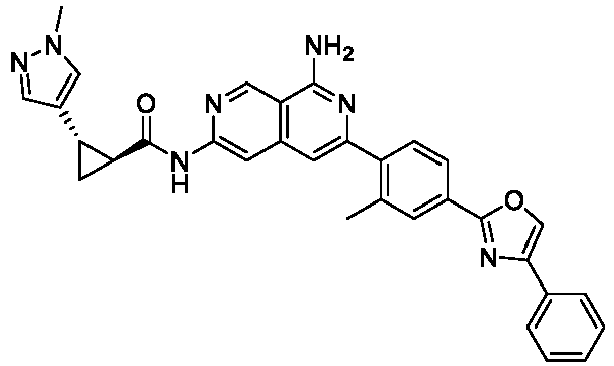
4.6 1H NMR (400 MHz, DMSO-d 6) δ 10.93 (s, 1H), 9.37 (s, 1H), 8.75 (s, 1H), 8.26 (s, 1H), 8.02 - 7.86 (m, 4H), 7.62 (d, J = 8.0 Hz, 1H), 7.56 (s, 1H), 7.48 (dd, J = 8.3, 7.0 Hz, 2H), 7.42 - 7.29 (m, 1H), 7.29 (s, 3H), 6.97 (s, 1H), 3.77 (s, 3H), 3.30 (s, 1H), 3.32 - 3.20 (m, 0H), 2.27-2.17 (m, 2H), 1.39 (ddd, J = 9.1, 5.9, 3.7 Hz, 1H), 1.26 - 1.14 (m, 2H). 542.2 N 374 
4.6 1H NMR (400 MHz, DMSO-d 6) δ 10.93 (s, 1H), 9.37 (s, 0H), 8.75 (s, 0H), 8.26 (s, 0H), 8.02 - 7.91 (m, 1H), 7.93 - 7.86 (m, 1H), 7.62 (d, J = 8.0 Hz, 0H), 7.56 (s, 0H), 7.48 (t, J = 7.7 Hz, 1H), 7.42 -7.32 (m, 1H), 7.32 - 7.27 (m, 1H), 6.97 (s, 0H), 3.77 (s, 2H), 3.45 - 3.22 (m, 1H), 2.26 - 2.17 (m, 1H),1.39 (ddd, J = 8.0, 5.9, 3.8 Hz, 1H), 1.26 - 1.14 (m, 1H). 542.2 N 375 
4.3 - 508.2 N 376 
4.3 - 508.2 N 377 
1.387 1HNMR (400 MHz, DMSO-d 6) δ 10.95 (s, 1H), 9.39 (s, 1H), 8.23 (s, 1H), 7.56 (t, J = 4.1 Hz, 3H), 7.50-7.31 (m, 3H), 7.29 (s, 1H), 6.81 (s, 1H), 3.77 (s, 3H), 2.21 (t, J = 7.0 Hz, 2H), 1.54-1.32 (m, 1H), 1.23-1.13 (m, 1H). 453.2 K 378 
1.388 1HNMR (400 MHz, DMSO-d 6) δ 10.95 (s, 1H), 9.39 (s, 1H), 8.23 (s, 1H), 7.56 (t, J= 4.1 Hz, 3H), 7.50-7.31 (m, 3H), 7.29 (s, 1H), 6.81 (s, 1H), 3.77 (s, 3H), 2.21 (t, J = 7.0 Hz, 2H), 1.54-1.32 (m, 1H), 1.23-1.13 (m, 1H). 453.2 K 379 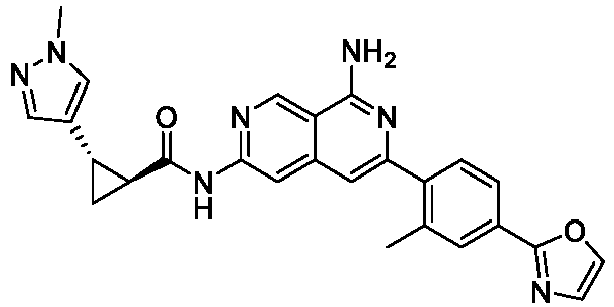
3.6 - 466.2 N 380 
3.6 - 466.2 N 381 
1.328 1H NMR (300 MHz, DMSO-d 6) δ 10.95 (s, 1H), 9.37 (s, 1H), 8.22 (s, 1H), 7.56 (s, 1H), 7.47-7.21 (m, 6H), 6.75 (s, 1H), 3.77 (s, 3H), 7.75 (s, 2H), 2.20 (t, J = 7.2 Hz, 2H), 2.12 (s, 3H) 1.39-1.36 (m, 1H), 1.22-1.17 (m, 1H). 438.3 K 382 
1.335 1H NMR (300 MHz, DMSO-d 6) δ 10.95 (s, 1H), 9.37 (s, 1H), 8.22 (s, 1H), 7.56 (s, 1H), 7.47-7.21 (m, 6H), 6.75 (s, 1H), 3.77 (s, 3H), 7.75 (s, 2H), 2.20 (t, J = 7.2 Hz, 2H), 2.12 (s, 3H) 1.39-1.36 (m, 1H), 1.22-1.17 (m, 1H). 438.3 J 383 
1.676 1H NMR (300 MHz, CD3OD) δ 9.30 (s, 1H), 8.30 (s, 1H), 7.49 (s, 1H), 7.40-7.27(m, 2H), 7.14 (d, J = 7.6 Hz, 1H), 7.04 (t, J = 8.9 Hz, 1H), 6.88 (s, 1H), 3.84 (s, 3H), 2.38-2.34 (m, 1H), 2.24 (s, 3H), 2.13-2.07 (m, 1H), 1.59-1.53 (m, 1H), 1.33-1.19 (m, 1H). 417.2 J 384 
511.2 1H NMR (400 MHz, DMSO-d 6) δ 10.95 (s, 1H), 9.38 (s, 1H), 8.65 (s, 1H), 8.27 (s, 1H), 7.93 (s, 1H), 7.56 (s, 1H), 7.36 (br s, 2H), 7.29 (s, 1H), 7.03 (s, 1H), 4.54 - 4.37 (m, 1H), 4.22 - 4.05 (m, 2H), 3.77 (s, 3H), 2.25 - 2.13 (m, 2H), 1.87 - 1.71 (m, 1H), 1.45 - 1.30 (m, 1H), 1.24-1.10 (m, 1H), 0.98 (d, J = 6.7 Hz, 3H), 0.91 (d, J = 6.7 Hz, 3H). 385 
527.2 1H NMR (400 MHz, DMSO-d 6) δ 10.96 (s, 1H), 10.36 (s, 1H), 9.39 (s, 1H), 8.71 (s, 1H), 8.28 (s, 1H), 8.08 (s, 1H), 7.56 (s, 1H), 7.37 (br s, 2H), 7.29 (s, 1H), 7.07 (s, 1H), 6.63 (s, 1H), 5.90 (d, J = 1.5 Hz, 1H), 3.86 (s, 3H), 3.77 (s, 3H), 2.54 (s, 3H), 2.24 - 2.17 (m, 2H), 1.44 - 1.34 (m, 1H), 1.29 - 1.06 (m, 1H). 386 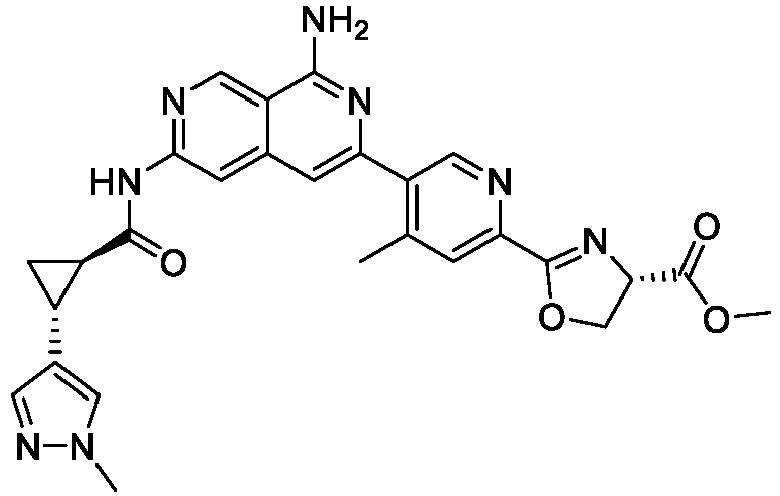
527.2 1H NMR (400 MHz, DMSO-d 6) δ 10.96 (s, 1H), 10.36 (s, 1H), 9.39 (s, 1H), 8.71 (s, 1H), 8.28 (s, 1H), 8.08 (s, 1H), 7.56 (s, 1H), 7.37 (br s, 2H), 7.29 (s, 1H), 7.07 (s, 1H), 6.63 (s, 1H), 5.90 (d, J = 1.5 Hz, 1H), 3.86 (s, 3H), 3.77 (s, 3H), 2.54 (s, 3H), 2.24 - 2.17 (m, 2H), 1.44 - 1.34 (m, 1H), 1.29 - 1.06 (m, 1H). 387 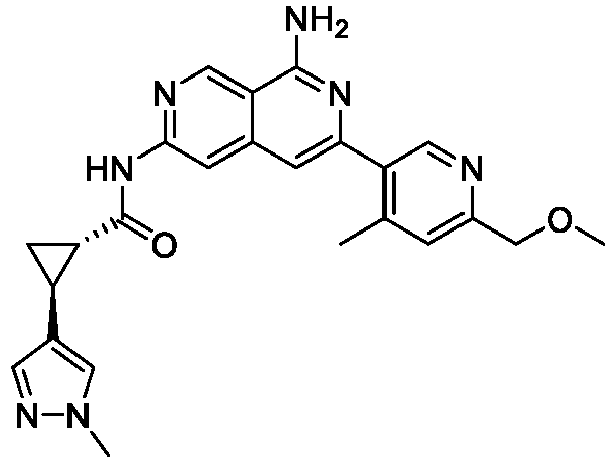
444.2 1H NMR (400 MHz, DMSO-d 6) δ 10.93 (s, 1H), 9.36 (s, 1H), 8.51 (s, 1H), 8.25 (s, 1H), 7.56 (s, 1H), 7.35 - 7.21 (m, 4H), 6.96 (s, 1H), 4.51 (s, 2H), 3.77 (s, 3H), 3.39 (s, 3H), 2.43 (s, 3H), 2.24 - 2.13 (m, 2H), 1.44-1.32 (m, 1H), 1.24 - 1.13 (m, 1H). 388 
444.2 1H NMR (400 MHz, DMSO-d 6) δ 10.93 (s, 1H), 9.36 (s, 1H), 8.51 (s, 1H), 8.25 (s, 1H), 7.56 (s, 1H), 7.35 - 7.21 (m, 4H), 6.96 (s, 1H), 4.51 (s, 2H), 3.77 (s, 3H), 3.39 (s, 3H), 2.43 (s, 3H), 2.24 - 2.13 (m, 2H), 1.44-1.32 (m, 1H), 1.24 - 1.13 (m, 1H). 391 
1.160 1H NMR (400 MHz, DMSO-d 6) δ 11.01 (s, 1H), 9.34 (s, 1H), 8.67 (s, 1H), 8.47 (d, J = 5.0 Hz, 1H), 8.23 (s, 1H), 7.57 (s, 1H), 7.48-7.37 (m, 3H), 7.30 (s, 1H), 7.20 (s, 1H), 3.77 (s, 3H), 2.49 (s, 3H), 2.28-2.12 (m, 2H), 1.50-1.36 (m, 1H), 1.26-1.12 (m, 1H). 424.2 K 392 
1.159 1H NMR (400 MHz, DMSO-d 6) δ 11.01 (s, 1H), 9.34 (s, 1H), 8.67 (s, 1H), 8.47 (d, J = 5.0 Hz, 1H), 8.23 (s, 1H), 7.57 (s, 1H), 7.48-7.37 (m, 3H), 7.30 (s, 1H), 7.20 (s, 1H), 3.77 (s, 3H), 2.49 (s, 3H), 2.28-2.12 (m, 2H), 1.50-1.36 (m, 1H), 1.26-1.12 (m, 1H). 424.2 K 393 
430.2 1H NMR (400 MHz, DMSO-d 6) δ 10.93 (s, 1H), 9.36 (s, 1H), 8.29 (s, 1H), 8.24 (s, 1H), 8.23 (s, 1H), 7.56 (s, 1H), 7.31 (br s, 2H), 7.29 (s, 1H), 6.91 (s, 1H), 3.94 (s, 3H), 3.77 (s, 3H), 2.25 - 2.14 (m, 2H), 2.21 (s, 3H), 1.45 - 1.33 (m, 1H), 1.23-1.12 (m, 1H). 394 
430.2 1H NMR (400 MHz, DMSO-d 6) δ 10.93 (s, 1H), 9.36 (s, 1H), 8.29 (s, 1H), 8.24 (s, 1H), 8.23 (s, 1H), 7.56 (s, 1H), 7.31 (br s, 2H), 7.29 (s, 1H), 6.91 (s, 1H), 3.94 (s, 3H), 3.77 (s, 3H), 2.25 - 2.14 (m, 2H), 2.21 (s, 3H), 1.45 - 1.33 (m, 1H), 1.23-1.12 (m, 1H). 395 
430.2 1H NMR (400 MHz, DMSO-d 6) δ 10.91 (s, 1H), 9.34 (s, 1H), 8.23 (s, 1H), 8.19 (s, 1H), 7.56 (s, 1H), 7.29 (s, 1H), 7.24 (br s, 2H), 6.91 (s, 1H), 6.74 (s, 1H), 3.87 (s, 3H), 3.77 (s, 3H), 2.38 (s, 3H), 2.26 - 2.14 (m, 2H), 1.46 - 1.32 (m, 1H), 1.27-1.05 (m, 1H). 396 
430.1 1H NMR (400 MHz, DMSO-d 6) δ 10.91 (s, 1H), 9.34 (s, 1H), 8.23 (s, 1H), 8.19 (s, 1H), 7.56 (s, 1H), 7.29 (s, 1H), 7.24 (br s, 2H), 6.91 (s, 1H), 6.74 (s, 1H), 3.87 (s, 3H), 3.77 (s, 3H), 2.38 (s, 3H), 2.26 - 2.14 (m, 2H), 1.46 - 1.32 (m, 1H), 1.27-1.05 (m, 1H). 397 
1.156 490.3 K 1H NMR (400 MHz, DMSO-d 6) δ 10.96 (s, 1H), 9.38 (s, 1H), 8.37 (d, J = 5.0 Hz, 1H), 8.15 (s, 1H), 7.56 (s, 1H), 7.37 (s, 2H), 7.30 (s, 1H), 7.18-7.07 (m, 4H), 7.02-6.98 (m, 2H), 6.66 (s, 1H), 3.91 (s, 2H), 3.77 (s, 3H), 2.20 (t, J = 7.1 Hz, 2H), 2.10 (s, 3H), 1.40-1.36 (m, 1H), 1.22-1.17 (s, 1H). 398 
466.2 1H NMR (400 MHz, DMSO-d 6) δ 10.94 (s, 1H), 9.37 (s, 1H), 8.65 (d, J = 3.0 Hz, 1H), 8.48 (s, 1H), 8.27 (s, 1H), 7.88 (s, 1H), 7.85 (d, J = 3.0 Hz, 1H), 7.56 (s, 1H), 7.33 (br s, 2H), 7.29 (s, 1H), 7.03 (s, 1H), 6.60 (s, 1H), 3.77 (s, 3H), 2.54 (s, 3H), 2.25 - 2.16 (m, 2H), 1.43 - 1.34 (m, 1H), 1.23 - 1.16 (m, 1H). 399 
466.2 1H NMR (400 MHz, DMSO-d 6) δ 10.94 (s, 1H), 9.37 (s, 1H), 8.65 (d, J = 3.0 Hz, 1H), 8.48 (s, 1H), 8.27 (s, 1H), 7.88 (s, 1H), 7.85 (d, J = 3.0 Hz, 1H), 7.56 (s, 1H), 7.33 (br s, 2H), 7.29 (s, 1H), 7.03 (s, 1H), 6.60 (s, 1H), 3.77 (s, 3H), 2.54 (s, 3H), 2.25 - 2.16 (m, 2H), 1.43 - 1.34 (m, 1H), 1.23 - 1.16 (m, 1H). 400 
469.2 1H NMR (400 MHz, DMSO-d 6) δ 10.92 (s, 1H), 9.35 (s, 1H), 8.34 (s, 1H), 8.24 (s, 1H), 7.56 (s, 1H), 7.52 (s, 1H), 7.29 (s, 1H), 7.28 (br s, 2H), 6.93 (s, 1H), 3.77 (s, 3H), 3.73 (dd, J = 4.7, 4.7 Hz, 2H), 3.12 (dd, J = 4.7, 4.7 Hz, 2H), 2.44 (s, 3H), 2.24-2.17 (m, 2H), 1.43 - 1.33 (m, 1H), 1.23 - 1.14 (m, 1H). 401 
469.2 1H NMR (400 MHz, DMSO-d 6) δ 10.92 (s, 1H), 9.35 (s, 1H), 8.34 (s, 1H), 8.24 (s, 1H), 7.56 (s, 1H), 7.52 (s, 1H), 7.29 (s, 1H), 7.28 (br s, 2H), 6.93 (s, 1H), 3.77 (s, 3H), 3.73 (dd, J = 4.7, 4.7 Hz, 2H), 3.12 (dd, J = 4.7, 4.7 Hz, 2H), 2.44 (s, 3H), 2.24-2.17 (m, 2H), 1.43 - 1.33 (m, 1H), 1.23 - 1.14 (m, 1H). 402 
458.1 1H NMR (400 MHz, DMSO-d 6) δ 10.95 (s, 1H), 9.38 (s, 1H), 8.71 (s, 1H), 8.28 (s, 1H), 8.01 (s, 1H), 7.56 (s, 1H), 7.37 (br s, 2H), 7.29 (s, 1H), 7.05 (s, 1H), 3.91 (s, 3H), 3.77 (s, 3H), 2.25 - 2.16 (m, 2H), 1.90 (s, 3H), 1.43 - 1.34 (m, 1H), 1.24-1.14 (m, 1H). 403 
458.1 1H NMR (400 MHz, DMSO-d 6) δ 10.95 (s, 1H), 9.38 (s, 1H), 8.71 (s, 1H), 8.28 (s, 1H), 8.01 (s, 1H), 7.56 (s, 1H), 7.37 (br s, 2H), 7.29 (s, 1H), 7.05 (s, 1H), 3.91 (s, 3H), 3.77 (s, 3H), 2.25 - 2.16 (m, 2H), 1.90 (s, 3H), 1.43 - 1.34 (m, 1H), 1.24-1.14 (m, 1H). 404 
480.2 1H NMR (400 MHz, DMSO-d 6) δ 10.93 (s, 1H), 9.36 (s, 1H), 8.56 (s, 1H), 8.26 (s, 1H), 7.83 (s, 1H), 7.78 (d, J = 2.1 Hz, 1H), 7.56 (s, 1H), 7.30 (br s, 2H), 7.29 (d, J = 2.1 Hz, 1H), 7.00 (s, 1H), 6.81 (s, 1H), 3.93 (s, 3H), 3.77 (s, 3H), 2.47 (s, 3H), 2.26 - 2.14 (m, 2H), 1.45 - 1.32 (m, 1H), 1.28 - 1.15 (m, 1H). 405 
480.2 1H NMR (400 MHz, DMSO-d 6) δ 10.93 (s, 1H), 9.36 (s, 1H), 8.56 (s, 1H), 8.26 (s, 1H), 7.83 (s, 1H), 7.78 (d, J = 2.1 Hz, 1H), 7.56 (s, 1H), 7.30 (br s, 2H), 7.29 (d, J = 2.1 Hz, 1H), 7.00 (s, 1H), 6.81 (s, 1H), 3.93 (s, 3H), 3.77 (s, 3H), 2.47 (s, 3H), 2.26 - 2.14 (m, 2H), 1.45 - 1.32 (m, 1H), 1.28 - 1.15 (m, 1H). 406 
482.2 1H NMR (400 MHz, DMSO-d 6) δ 10.98 (s, 1H), 9.41 (s, 1H), 9.03 (s, 1H), 8.67 (s, 1H), 8.30 (s, 1H), 7.56 (s, 1H), 7.45 (br s, 2H), 7.29 (s, 1H), 7.08 (s, 1H), 3.79 (s, 3H), 3.77 (s, 3H), 2.71 (s, 3H), 2.21 (dd, J = 7.2, 7.2 Hz, 2H), 1.44 - 1.36 (m, 1H), 1.23 - 1.14 (m, 1H). 407 
482.2 1H NMR (400 MHz, DMSO-d 6) δ 10.98 (s, 1H), 9.41 (s, 1H), 9.03 (s, 1H), 8.67 (s, 1H), 8.30 (s, 1H), 7.56 (s, 1H), 7.45 (br s, 2H), 7.29 (s, 1H), 7.08 (s, 1H), 3.79 (s, 3H), 3.77 (s, 3H), 2.71 (s, 3H), 2.21 (dd, J = 7.2, 7.2 Hz, 2H), 1.44 - 1.36 (m, 1H), 1.23 - 1.14 (m, 1H). 408 
482.1 1H NMR (400 MHz, DMSO-d 6) δ 10.98 (s, 1H), 9.41 (s, 1H), 8.45 (s, 1H), 8.40 (s, 1H), 8.29 (s, 1H), 7.56 (s, 1H), 7.44 (br s, 2H), 7.29 (s, 1H), 7.12 (s, 1H), 3.77 (s, 6H), 2.78 (s, 3H), 2.26 - 2.17 (m, 2H), 1.45-1.34 (m, 1H), 1.27 - 1.13 (m, 1H). 409 
482.2 1H NMR (400 MHz, DMSO-d 6) δ 10.98 (s, 1H), 9.41 (s, 1H), 8.45 (s, 1H), 8.40 (s, 1H), 8.29 (s, 1H), 7.56 (s, 1H), 7.44 (br s, 2H), 7.29 (s, 1H), 7.12 (s, 1H), 3.77 (s, 6H), 2.78 (s, 3H), 2.26 - 2.17 (m, 2H), 1.45-1.34 (m, 1H), 1.27 - 1.13 (m, 1H). 410 
496.2 1H NMR (400 MHz, DMSO-d 6) δ 10.97 (s, 1H), 9.40 (s, 1H), 8.57 (s, 1H), 8.24 (s, 1H), 7.56 (s, 1H), 7.45 (br s, 2H), 7.29 (s, 1H), 6.85 (s, 1H), 3.77 (s, 3H), 3.77 (s, 3H), 2.45 (s, 3H), 2.41 (s, 3H), 2.20 (dd, J = 6.9, 6.9 Hz, 2H), 1.42 - 1.33 (m, 1H), 1.22 - 1.15 (m, 1H). 411 
496.2 1H NMR (400 MHz, DMSO-d 6) δ 10.97 (s, 1H), 9.40 (s, 1H), 8.57 (s, 1H), 8.24 (s, 1H), 7.56 (s, 1H), 7.45 (br s, 2H), 7.29 (s, 1H), 6.85 (s, 1H), 3.77 (s, 3H), 3.77 (s, 3H), 2.45 (s, 3H), 2.41 (s, 3H), 2.20 (dd, J = 6.9, 6.9 Hz, 2H), 1.42 - 1.33 (m, 1H), 1.22 - 1.15 (m, 1H). 412 
1.391 1H NMR (300 MHz, CD3OD) δ 9.35 (s, 1H), 8.52 (s, 1H), 8.46-8.40 (m, 2H), 7.38 (d, J = 5.1 Hz, 1H), 7.01 (s, 1H), 5.32-5.00 (m, 1H), 3.98-3.72 (m, 1H), 3.22-3.02 (m, 1H), 3.01-2.94 (m, 1H), 2.92 (s, 3H), 2.90-2.71 (m, 1H), 2.62-2.49 (m, 1H), 2.41 (s, 3H), 2.19-1.98 (m, 1H), 1.70-1.50 (m, 1H) 453.3 J 413 
346.1 1H NMR (400 MHz, DMSO-d 6) δ 10.75 (s, 1H), 9.35 (s, 1H), 8.56 (s, 1H), 8.43 (d, J = 5.0 Hz, 1H), 8.26 (s, 1H), 7.28 (br s, 2H), 7.33 - 7.21 (m, 1H), 6.95 (s, 1H), 2.43 - 2.40 (m, 1H), 2.41 (s, 3H), 1.42 (t, J = 3.8 Hz, 1H), 1.35 (dd, J = 7.4, 3.4 Hz, 1H), 0.95 - 0.73 (m, 4H). 414 
0.962 1H NMR (300 MHz, DMSO-d 6) δ 9.31 (s, 1H), 9.19 (s, 1H), 7.92 (s, 1H), 7.75 (s, 1H), 7.45 (s, 1H), 7.02 (s, 2H), 6.68 (s, 1H), 5.67 (s, 1H), 5.10-5.06 (m, 4H), 3.72 (s, 2H), 2.99 (s, 3H), 2.06 (s, 3H), 1.23-1.16 (m, 2H), 0.96-0.92 (m, 2H) 456.3 J 415 
1.407 1H NMR (400 MHz, DMSO-d 6) δ 9.37(s, 1H), 9.20(s, 1H), 7.93 (s, 1H), 7.77 (s, 1H), 7.51 (s, 1H), 7.03 (s, 2H), 6.68 (s, 1H), 6.06 (s, 1H), 5.11 (s, 2H), 4.99 (s, 2H), 3.84 (t, J = 6Hz, 2H), 3.06 (t, J = 6Hz, 2H), 2.96 (s, 3H), 2.08 (s, 3H) 430.2 J 416 
0.965 1H NMR (400 MHz, CD3OD) δ 9.17 (s, 1H), 8.51 (s, 1H), 8.41 (d, J = 4 Hz, 1H), 7.67 (s, 1H), 7.37 (d, J=8 Hz, 1H), 6.85 (s, 1H), 6.14 (s, 1H), 5.33-5.32 (m, 1H),4.98 (d, J = 12 Hz, 1H), 4.77 (s, 1H), 4.45 (d, J = 4 Hz, 1H), 4.29-4.25 (m, 1H), 2.44 (s, 3H) 399.3 J 417 
1.554 1H NMR (400 MHz, CD3OD) δ 9.17 (s, 1H), 8.51 (s, 1H), 8.41 (d, J = 4 Hz, 1H), 7.67 (s, 1H), 7.37 (d, J=8 Hz, 1H), 6.85 (s, 1H), 6.14 (s, 1H), 5.33-5.32 (m, 1H),4.98 (d, J = 12 Hz, 1H), 4.77 (s, 1H), 4.45 (d, J = 4 Hz, 1H), 4.29-4.25 (m, 1H), 2.44 (s, 3H). 399.3 J 418 
3.03 - 438.1 N 419 
2.411 1H NMR (400 MHz, DMSO-d 6) δ 9.33 (s, 1H), 9.12 (s, 1H), 8.11-8.08 (m, 1H), 7.76-7.69 (m, 1H), 7.40 (s, 1H), 7.05 (s, 2H), 6.94-6.92 (m, 2H), 6.62 (s, 1H), 6.00 (s, 1H), 5.96-5.90 (m, 1H), 4.96 (s, 2H), 4.64-4.55 (m, 1H), 3.79 (t, J = 6 Hz, 2H), 2.99 (t, J = 6 Hz, 2H), 1.57 (d, J = 9 Hz, 3H), 1.12 (d, J = 9 Hz, 6H). 473.2 J 420 
1.967 1H NMR (400 MHz, DMSO-d 6) δ 9.43 (s, 1H), 9.14 (s, 1H), 7.60-7.58 (m, 1H), 7.48 (s, 1H), 7.42-7.36 (m, 1H), 7.08 (s, 2H), 6.64 (s,1H), 6.41 (d, J = 9 Hz, 1H), 6.24-6.19 (m, 1H), 6.03 (s, 1H), 5.99-5.92 (m, 1H), 4.98 (s, 2H), 4.64-4.55 (m, 1H), 3.79(t, J = 6 Hz, 2H), 2.99(t, J = 6 Hz, 2H), 1.63 (d, J = 9 Hz, 3H), 1.12 (d, J = 9 Hz, 6H). 473.2 J 421 
1.28 - 428.3 P 422 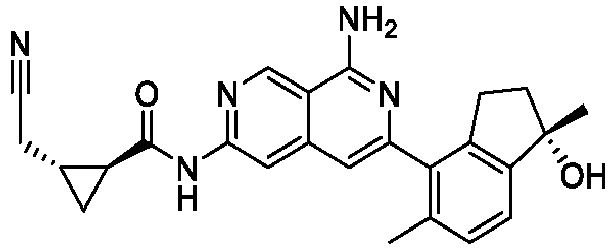
1.27 - 428.3 P 423 
1.179 - 428.3 P 424 
1.19 - 428.3 P 425 
1.19 - 428.3 P 426 
1.122 - 432.3 P 427 
1.96 - 490.3 P 428 
1.37 - 443.3 P 429 
1.36 - 443.3 P "-" refers to unreported data. - Exemplary compounds of Formula I or Ia were tested to assess compound inhibition of HPK-1. The Ki for each exemplary compound was determined
- HPK-FL enzyme phosphorylates Biotin-SLP-76 substrate in the presence of ATP at 1mM and varying concentrations of test compound. Product is detected by FRET using Eu-anti-pSLP76 Ab and SA-XL665. See www.cisbio.com/HTRF for additional HTRF technology information.
-
- Echo555 compound dispenser
- Agilent Bravo
- Perkin Elmer Envision
-
HPK full length, T165E S171E : 0.125 nM Biotin-SLP76: 100 nM ATP: 1 mM (ATP Km = 20 µM) Eu-anti-pSLP76: 2 nM SA-XL665: 8.3 nM Preincubation time: 30 min Kinase reaction time: 60 min Temperature: ambient Total volume: 12 µl ATPapp Km: 17.7 µM -
- Assay plate: White ProxiPlate 384 F (PerkinElmer cat# 6008289)
- Kinase: HPK full length double mutant
- Substrate: Biotin-SLP76
- ATP: 100 mM ATP
- BSG: 2% BSG
- DMSO: DMSO (Sigma cat # 34869-100ML)
- Reaction Buffer: H2O/50 mM HEPES, pH 7.5/10 mM MgCl2/2 mM TCEP/0.01% Brij-35/0.01% BSG
- Detection mix:Eu-anti-pSLP76/SA-XL665 (Cisbio, #610SAXAC)
- To a 384 well Proxiplate with 80 nL compound or DMSO spotted on was added 4 µl/well kinase mix. The mixture was preincubated for 30 minutes and then 4 µl/well substrate mix was added. The solution was incubated for 60 min and then 4 µl/well detection mix was added. The solution was incubated for another 60 min. The plates were then loaded onto a Perkin Elmer Envision and the TR-FRET signal was measured at 615 and 665 nm. A ratio of 665/620 was used to calculate the % activity at each concentration of compound.
-
Reagent Vender-Cat# white ProxiPlate 384 F(assay plate) PerkinElmer-6008289 384-well Microplate(compound plate) Labcyte-LP-0200 HPK1 enzyme Signalchem-M23-11G Tracer-222 Invitrogen-PV6121 Eu-Anti-GST Ab Invitrogen-PV5594 Assay Buffer 2mM DTT(Sigma-43815), 0.01% BRIJ-35(Sigma-B4184), 10mM MgCl2, 50mM HEPES(Invitrogen-15630130) - The compounds to be tested were diluted by preparing 12.5uL/well of 5mM compound (100X) in columns 2 and 13 and 10ul/well of DMSO in columns 3-12, 14-23, and wells A1-H1 and I24-P24 of the compound plate using a Bravo liquid handling platform. For the reference compound, the top concentration was 1mM. To the plate was added 10ul 2mM staurosporine in wells J1-P1 and A24-H24. A 11 point 5-fold compound serial dilution was performed using the Bravo liquid handling platform. From the plate were transferred 2.5ul of the solutions from column 2 and column 13 to the 10ul of DMSO in columns 3 and 14 & so on. The compound plate was centrifuged at 2500rpm for 1min. From the compound plate was transferred 80nl of the compounds into an assay plate using the Echo liquid handler system. One compound plate makes two assay plates. Each assay plate is sealed and stored in an N2 cabinet. II. Assay Condition:
- The following assay concentrations and times were used: 2nM HPK1, 2nM Eu-Anti-GST Ab, and 15nM Tracer222, with 60 min incubation time.
- For the binding assay, 4ul 2X HPK1 and Eu-anti-GST antibody were added to each well of the assay plate using a Multidrop reagent dispenser. The solutions were incubated in a 23C incubator for 1h. To each well of the assay plate was added 4ul 2X Tracer-222 using a Multidrop reagent dispenser. The solutions were again incubated in a 23C incubator for 1h. The results of the assay were read using an Envision plate reader with the following parameters:TR_FRET, 340ex/615 and 665em; 100 usec Delay; and 200 usec integration.
- Compound Ki was analyzed using Morrison ki fit model in XL-fit
- a.


- b. Parameters:
- E = enzyme concentration
- S= Tracer222 concentration, Kd = Tracer222 Kd
- All measurements reported using the same units (uM)
- Exemplary compounds of Formula I or Ia were tested in the binding assays. The Ki values determined are listed in Tables B1-1 and B1-2. The Ki data in Table B1-1 are based on the "Lanth" assay.
Table B1-1 Compound No. HPK1 Ki(µM) (Lanth) 1 0.00038 2 0.00156 3 0.00514 4 0.00287 5 0.00131 6 0.000793 7 0.00289 8 0.00164 9 0.00716 10 0.00173 11 0.00365 12 0.0493 13 0.0156 14 0.00946 15 0.0226 16 0.00721 17 0.0161 18 0.0475 19 0.0079 20 0.00322 21 0.00276 22 0.00491 23 0.0492 24 0.00068 25 0.00154 26 0.00021 27 0.00108 28 0.0149 29 0.014 30 0.00175 31 0.0039 32 0.0264 33 0.0341 34 0.034 35 5.54 36 4.08 37 0.0298 38 0.0484 39 2.03 40 0.098 41 5.8 42 0.0405 43 0.00205 44 0.048 45 0.0117 46 0.00152 47 0.00185 48 0.0103 49 0.00682 50 0.0059 51 0.0013 52 0.00298 53 0.000736 54 0.0489 55 0.0064 56 0.0065 57 0.00524 58 0.00281 59 0.0417 60 0.0106 61 0.0258 62 0.00503 63 0.101 64 0.44 65 0.00547 66 0.00488 67 0.00576 68 0.545 70 0.0276 71 0.010 72 0.0141 73 0.0134 74 0.0013 75 0.0008 76 0.0013 77 0.0006 78 0.0001 79 0.839 80 0.0003 81 0.0003 82 0.0004 83 0.0003 84 0.0018 85 0.00198 86 0.0161 87 0.0103 88 0.172 89 0.00488 90 0.101 91 0.000583 92 0.00736 93 0.00364 94 0.00321 96 0.00406 97 0.00040 98 0.163 99 0.0707 100 0.0183 101 0.0225 102 0.0215 103 0.00382 104 0.0189 105 0.0402 106 0.00497 107 0.000654 108 0.0028 109 0.0013 110 0.00649 111 0.00238 112 0.00187 113 0.00353 114 0.00224 115 0.00489 116 0.00557 117 0.00847 118 0.000476 119 0.00142 120 2.4 121 0.00058 122 0.0000629 123 0.0049 124 0.0011 125 0.0068 126 0.007 127 0.0053 128 0.0025 129 0.00098 130 0.0026 131 0.00031 132 0.0065 133 0.015 134 0.0056 135 0.00025 136 0.13 137 0.11 138 0.032 139 0.00048 140 0.0014 141 0.0023 142 0.0014 143 0.0059 144 0.0011 145 0.002 146 0.000020 147 0.039 148 0.0028 149 0.00078 150 0.00077 151 0.015 152 0.00015 153 0.0044 154 0.0011 155 0.0024 156 0.021 157 0.00057 158 0.0036 159 0.00023 160 0.0012 161 0.000020 162 0.0032 163 0.0012 164 0.0081 165 0.00095 166 0.0015 167 0.0094 168 0.002 169 0.00048 170 0.003 171 1.5 172 0.00019 173 0.000047 174 0.0025 175 0.0034 176 0.0055 177 0.0085 178 0.00025 179 0.0029 180 0.044 181 0.0032 182 0.0012 183 0.00098 184 0.0025 185 0.089 186 0.004 187 0.016 188 0.012 189 0.01 190 0.0011 191 0.0027 192 0.000501 193 0.000135 194 0.000967 195 0.00002 196 0.00601 197 0.000027 198 0.00055 199 0.00339 200 0.000343 201 0.00649 202 0.0004 203 0.0004 204 0.00099 205 0.0000881 206 0.0000509 207 0.0171 208 0.0146 209 0.0307 210 0.000258 211 0.000154 212 0.000685 213 0.000957 214 0.000039 215 0.00119 216 0.00353 217 0.0000614 218 0.000020 219 0.000567 220 0.000592 221 0.000026 222 0.00177 223 0.000135 224 0.0152 225 0.0842 226 0.0586 227 0.0387 228 0.011 229 0.0212 230 0.000295 231 0.000173 232 0.00728 233 0.000694 234 0.000078 235 0.000706 236 0.0233 237 0.0102 238 0.00194 239 0.00528 240 0.047 241 0.00219 242 0.0312 243 0.00137 244 0.00356 245 0.00542 246 0.0000455 247 0.0000219 248 0.00103 249 0.000433 250 0.000184 251 0.000512 252 0.000569 253 0.0000892 254 0.00455 255 0.0339 256 0.00002 257 0.00101 258 0.000695 259 0.146 260 0.00073 261 0.0367 262 0.000439 263 0.000021 264 0.000134 265 0.000249 266 0.000118 267 0.000113 268 0.000147 269 0.0023 270 0.000116 271 0.000768 272 0.000139 273 0.0000675 274 0.000297 275 0.000225 276 0.00601 277 0.000837 278 0.000763 279 0.000188 280 281 282 283 284 285 286 0.00182 287 0.000078 288 0.00619 289 0.00739 290 0.00336 291 0.0638 292 0.0000417 293 0.000668 294 0.00214 295 0.000287 296 0.000026 297 0.000972 298 0.000932 299 0.0000359 300 0.00136 301 0.0000692 302 0.00065 303 0.000027 304 0.00302 305 0.000152 306 0.00325 307 0.000112 308 0.00304 309 0.000184 310 0.0000675 311 0.00115 312 0.00577 313 0.00002 314 0.0131 315 0.0122 316 0.000522 317 0.000020 318 0.000032 319 0.000020 320 0.00782 321 0.0574 322 0.0148 323 0.0763 324 0.00048 325 0.00343 326 0.000074 327 0.00143 328 0.000114 329 0.00265 330 <0.000020 331 0.00112 332 0.00562 333 0.000432 334 0.0204 335 0.00441 336 0.00135 337 0.0613 338 0.345 339 0.00314 340 0.00614 341 0.000509 342 0.00143 343 0.00173 344 0.00226 345 0.0033 346 0.00244 347 0.0118 348 0.00117 Table B1-2 Compound No.. HPK 1 Ki L = Lanth H = HTRF 349 6.2 nM (H) 350 39.7 nM (H) 351 0.33 nM (H) 352 5 nM (H) 353 29 nM (L) 354 0.083 nM (L) 355 1.8 nM (L) 356 0.30 nM (L) 357 2.7 nM (L) 358 0.52 nM (L) 359 1.1 nM (L) 360 0.099 nM (L) 361 2.3 nM (L) 362 0.22 nM (L) 363 0.17 nM (L) 364 2.1 nM (L) 365 7.3 nM (L) 366 0.53 nM (L) 367 1.4 nM (L) 368 3.7 nM (L) 369 0.22 nM (L) 370 1.8 nM (L) 371 0.46 nM (L) 372 0.41 nM (L) 373 75 nM (L) 374 12 nM (L) 375 96 nM (L) 376 15 nM (L) 377 0.66 nM (L) 378 0.049 nM (L) 379 0.69 nM (L) 380 22 nM (L) 381 8.1 nM (L) 382 14 nM (L) 383 0.47 nM (L) 384 1.8 nM (L) 385 2.9 nM (L) 386 20 nM (L) 387 19 nM (L) 388 1.6 nM (L) 389 0.033 nM (L) 391 170 nM (L) 392 9.3 nM (L) 393 1.7 nM (L) 394 34 nM (L) 395 0.29 nM (L) 396 5.6 nM (L) 397 0.25 nM (L) 398 30 nM (L) 399 3.6 nM (L) 400 1.2 nM (L) 401 21 nM (L) 402 0.26 nM (L) 403 7.6 nM (L) 404 1.9 nM (L) 405 20 nM (L) 406 0.74 nM (L) 407 6.3 nM (L) 408 9.9 nM (L) 409 20 nM (L) 410 33 nM (L) 411 6.3 nM (L) 412 96 nM (L) 413 15 nM (L) 414 0.013 nM (H) 415 0.21 nM (H) 416 0.97 nM (L) 417 0.27 nM (L) 418 1.4 nM (L) 419 511 nM (H) 420 1644 nM (H) 421 190 nM, L 422 8 nM, L 423 9.4 nM, L 424 8 nM, L 425 1 nM, L 426 0.02 nM, L 427 0.78 nM, L 428 8 nM, L 429 51 nM, L - Anti-CD3 and anti-CD28 activates TCR signaling in primary human pan T cells leading to IL-2 promoter induction. Secreted IL-2 in cell culture supernatant is detected by electrochemiluminescence using a capture antibody against IL-2 and an anti-IL-2 antibody labeled with SULFO-tag.
- See www.mesoscale.com for additional electrochemiluminescence technology information.
- Incubate primary human pan T cells with varying concentrations of test compounds for 30 minutes in a humidified incubator at 37°C and 5% CO2. Transfer cells to a plate pre-coated with a fixed concentration of anti-human CD3 (determined separately for each donor lot) and add soluble anti-human CD28 (final concentration = 1µg/ml). Stimulate cells in a humidified incubator at 37°C and 5% CO2 for 4 hours. Transfer 25µl of supernatant to a MSD single spot plate pre-coated with an anti-human IL-2 antibody. Incubate MSD plate overnight at 4°C with gentle shaking. Wash MSD plate 4X with wash buffer. Add SLTLFO-tagged detection antibody at a 1:50 dilution and incubate at room temperature shaking for 2 hours. Wash MSD plate 4X with wash buffer and add 150µl 2X MSD read buffer. Read on an MSD instrument. Normalize data to stimulated/untreated controls to calculate % activity at each concentration of compound.
-
- Frozen Primary Human Pan-T Cells (StemCell Technologies #70024)
- anti-human CD3 (OKT3 clone) (eBioscience #16-0037-81)
- anti-human CD28 (CD28.2 clone) (BD #555725)
- 96-well Human IL-2 tissue culture kit (MSD #K151AHB-4)
-
- Biomek FX for liquid handling (Beckman Coulter)
- MSD SECTOR S 600 (Meso Scale Discovery)
- Exemplary compounds of Formula I or Ia were tested in the human T-cell IL-2 induction assays. The % increase measured for IL-2 in cells treated by the test compounds relative to untreated cells are provided in Table B2 for certain compounds (structures as shown with the HPK1 Ki values).
Table B2 Cmpound No. HPK1 Ki (nM) % IL-2 increase relative to untreated cells Assayed concentration (µM) H = HTRF L = Lanth 24 0.68, L 513% 0.93 103 3.8, L 94% 0.31 130 2.6, L 274% 0.93 256 0.59, H 699% 0.31 273 0.06, L 830% 0.93 328 0.11, L 936% 0.93 356 0.3, L 732% 2.8 379 0.69, L 547% 2.8 389 0.033, L 265% 0.10 - It is to be noted that the term "a" or "an" entity refers to one or more of that entity; for example, "a polypeptide" is understood to represent one or more polypeptides. As such, the terms "a" (or "an"), "one or more," and "at least one" can be used interchangeably herein.
- All technical and scientific terms used herein have the same meaning. Efforts have been made to ensure accuracy with respect to numbers used (e.g. amounts, temperature, etc.) but some experimental errors and deviations should be accounted for.
- Throughout this specification and the claims, the words "comprise," "comprises," and "comprising" are used in a non-exclusive sense, except where the context requires otherwise. It is understood that embodiments described herein include "consisting of" and/or "consisting essentially of" embodiments.
- As used herein, the term "about," when referring to a value is meant to encompass variations of, in some embodiments ± 50%, in some embodiments ± 20%, in some embodiments ± 10%, in some embodiments ± 5%, in some embodiments ± 1%, in some embodiments ± 0.5%, and in some embodiments ± 0.1% from the specified amount, as such variations are appropriate to perform the disclosed methods or employ the disclosed compositions.
- Where a range of values is provided, it is understood that each intervening value, to the tenth of the unit of the lower limit, unless the context clearly dictates otherwise, between the upper and lower limit of the range and any other stated or intervening value in that stated range, is encompassed within the invention. The upper and lower limits of these small ranges which may independently be included in the smaller rangers is also encompassed within the invention, subject to any specifically excluded limit in the stated range. Where the stated range includes one or both of the limits, ranges excluding either or both of those included limits are also included in the invention.
- Many modifications and other embodiments of the inventions set forth herein will come to mind to one skilled in the art to which these inventions pertain having the benefit of the teachings presented in the foregoing descriptions and the associated drawings. Therefore, it is to be understood that invention is as defined by the appended claims. Although specific terms are employed herein, they are used in a generic and descriptive sense only and not for purposes of limitation.
In some embodiments R1 is an optionally substituted C2-9 heteroaryl or C3-7 heterocyclyl.
Claims (18)
- A compound of Formula I:
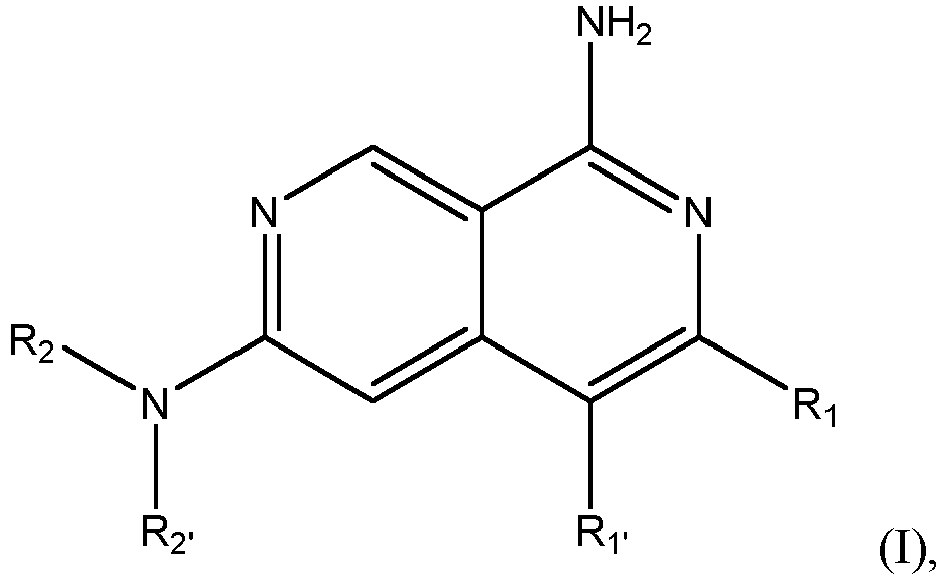 R1 is:
C2-9 heteroaryl, C2-9 heterocyclyl, or C6-10 aryl, wherein said heteroaryl or heterocyclyl has 1-4 heteroatoms selected from O, S and N; and wherein said aryl, heteroaryl and heterocyclyl can be optionally substituted with one, two, three or four substituents, R6, R7 R8 and R8', each of which is independently selected from the group consisting ofi. branched or linear C1-6 alkyl, C1-6 alkenyl, C1-6 alkenylene, and C3-9 cycloalkyl, wherein said alkyl, alkenyl, alkenylene, and cycloalkyl can be optionally substituted with hydroxyl, halogen, -CF2, -CF3, amino, di(C1-6)alkylamino, mono(C1-6)alkylamino, cyano, C3-7 cycloalkyl, C1-6 alkoxy, -SO2R', -SO2NR'R", -(CO)NR'R", or -NR'(CO)R", wherein R' and R" are independently H or C1-6 alkyl;ii. NRaRb-C(O)-,
wherein, Ra and Rb are each independently hydrogen or C1-6 alkyl, wherein said alkyl can optionally be substituted with hydroxyl, halogen, -CF2, or -CF3;iii. C1-6 alkoxy;iv. halogen;v. cyano;vi. hydroxyl;vii. amino;viii. di(C1-6)alkylamino;ix. mono(C1-6)alkylamino;x. -NRc(CO)Rd, wherein Rc and Rd are independently H or C1-6 alkyl;xi. -CF3;xii. -CF2;xiii. -SO2R', wherein R' is as described above;xiv. -SO2NR'R", wherein R' and R" are as described above;xv. -(CO)NRcRd; wherein Rc and Rd are as described above;xvi. -(CO)ORe; wherein Re is H, C1-6 alkyl, or CH2-aryl;xvii. substituted or unsubstituted C3-5 heterocyclyl; andwherein a carbon embedded in said aryl, heteroaryl or heterocyclyl taken together with an oxygen to which it is bound can form a carbonyl;R1 is:
H, C1-6 alkyl, C2-6 alkenyl, C3-6 cycloalkyl, C2-9 heteroaryl, or halogen, wherein said alkyl, alkenyl, cycloalkyl, and heteroaryl can be optionally substituted with hydroxyl, halogen, or amino;R2 is A-C(O)-, wherein, A is:i. C3-7 cycloalkyl(C1-6)jalkyl- or C2-9 heterocyclyl(C1-6)jalkyl-, wherein, j is 1 or 0; and wherein said cycloalkyl or heterocyclyl can be optionally substituted with one, two, three or four of R5, wherein R5, in each instance, is independently selected from the group consisting of branched or linear C1-6 alkyl, halogen, cyano, cyano(C1-6)alkyl-, -CF3, -CF2, hydroxy(C1-6)alkyl, halo(C1-6)alkyl, hydroxyl, (C1-6 alkyl)-O-(C1-6 alkyl)-, amino, di(C1-6)alkylamino, mono(C1-6)alkylamino, amino(C1-6)alkyl, C1-6 alkoxy, CH3CO2-(C1-6 alkyl)-, -SO2R', -SO2NR'R", -(CO)NR'R", -NR'(CO)R", wherein, in each instance, R' and R" are as decribed above, optionally substituted C2-9 heteroaryl, optionally substituted C2-9 heterocyclyl, optionally substituted C6-10 aryl and NReRf-C(O)-(C1-6 alkyl)k-,wherein Re and Rf are each independently selected from the group consisting of hydrogen and branched or linear C1-6 alkyl, or Re and Rf together with the nitrogen to which each is bound can form a C3-7 cycloalkyl, which can be optionally substituted with branched or linear C1-6 alkyl, C3-4 cycloalkyl, halogen, cyano, -CF3, -CF2, or hydroxyl;and k is 1 or 0;or, said cycloalkyl or heterocyclyl together with two of R5 form a bicyclic or spiro ring, wherein two of R5 attached to different carbons are taken together with the carbon to which each is attached to form a bicyclic, or two of R5 attached to the same carbon are taken together with the carbon to which each is attached to form a spiro ring;ii. -NRgRh, whereinRg is H or branched or linear C1-6 alkyl, wherein said alkyl can be optionally substituted with hydroxyl, halogen, cyano, amino, di(C1-6)alkylamino, mono(C1-6)alkylamino; -CF2, or -CF3;Rh is selected from the group consisting ofa. branched or linear C1-6 alkyl, wherein said alkyl can be optionally substituted with hydroxyl, halogen, cyano, amino, di(C1-6)alkylamino, mono(C1-6)alkylamino, -CF2, -CF3, or NRe'Rf-C(O)-, wherein Re' and Rf' are each independently hydrogen or branched or linear C1-6 alkyl;
and,b. C3-7 cycloalkyl(C1-6 alkyl)m-, C2-9 heteroaryl(C1-6 alkyl)m-, C6-10 aryl(C1-6 alkyl)m- or C2-9 heterocyclyl(C1-6 alkyl)m-, wherein, m is 1 or 0; and wherein said cycloalkyl, heteroaryl, aryl or heterocyclyl can be optionally substituted with one or two of R5',wherein R5', in each instance, is independently selected from the group consisting of branched or linear C1-6 alkyl, halogen, cyano, -CF3, -CF2, hydroxy(C1-6)alkyl, halo(C1-6)alkyl, hydroxyl, C1-6 alkoxy, amino, amino(C1-6)alkyl, and NRiRj-C(O)-(C1-6 alkyl)k',wherein Ri and Rj are independently selected from the group consisting of hydrogen and branched or linear C1-6 alkyl, and k' is 1 or 0;iii. R9-(C1-6 alkyl)-, wherein R9 is selected from the group consisting of hydroxyl, halogen, -CF2, -CF3, cyano, C1-6 alkoxy, -NRoRp, wherein, Ro and Rp are each independently H or branched or linear C1-6 alkyl, NRo'Rp'-CO-, wherein R° and Rp' are each independently hydrogen or branched or linear C1-6 alkyl;iv. B-(C1-6 alkyl)t-, wherein, B is C3-9 heteroaryl or C3-7 heterocyclyl, wherein, said heteroaryl or heterocyclyl has 1-3 heteroatoms selected from O, S and N; and wherein said heteroaryl or heterocyclyl can be optionally substituted with one, two or three of R10, R10' and R10", each of which is independently selected from the group consisting ofa. branched or linear C1-6 alkyl or C3-4 cycloalkyl, wherein said alkyl or cycloalkyl can be optionally substituted with hydroxyl, halogen, -CF2, -CF3, amino, di(C1-6)alkylamino, mono(C1-6)alkylamino, cyano, -(CO)NRqRr or-NRq(CO)Rr, wherein Rq and Rr are independently H or C1-6 alkyl;b. C3-7 cycloalkyl; andc. C3-7 heterocyclyl;d. hydroxyl;e. halogen;f. -CF2;g. -CF3;h. amino;i. di(C1-6)alkylamino;j. mono(C1-6)alkylamino;k. cyano;1. - (CO)NRsRt, wherein Rs and Rt are independently H or C1-6 alkyl; andm. - NRs(CO)Rt, wherein Rs and Rt are independently H or C1-6 alkyl; and, t is 1 or 0;v. (C6-10 aryl)q'-(C1-6 alkyl)n-O- or pyrrolidinyl-O-, wherein, the aryl can be optionally substituted with one, two or three of R11, R12 and R13, each of which is selected from the group consisting of branched or linear C1-6 alkyl, hydroxyl, halogen,-CF2, -CF3, cyano, C1-6 alkoxy, and NRuRv-, wherein Ru and Rv are each independently H or branched or linear C1-6 alkyl,
and, n is 1 or 0, q' is 1 or 0, provided that one of n and q' is 1;vi. branched or linear C1-6 alkyl, C1-6 alkenyl, C1-6 alkenylene, wherein said alkyl, alkenyl, and alkenylene, can be optionally substituted with hydroxyl, halogen,-CF2, -CF3, amino, di(C1-6)alkylamino, mono(C1-6)alkylamino, cyano, C3-7 cycloalkyl, C1-6 alkoxy, -SO2R', -SO2NR'R", -(CO)NR'R", or -NR' (CO)R", wherein R' and R" are independently H or C1-6 alkyl;or, R2 is D, wherein D is:i. C6-10 aryl-(C1-6 alkyl)z-, or C3-9 heteroaryl-(C1-6 alkyl)z-, wherein, said heteroaryl has 1-4 heteroatoms selected from O, S and N; and wherein said aryl or heteroaryl can be optionally substituted with one, two,three or four of R14, R15, R16' and R16, each of which is independently selected from the group consisting ofa. branched or linear C1-6 alkyl, wherein said alkyl can be optionally substituted with hydroxyl, halogen, -CF2, -CF3, amino, di(C1-6)alkylamino, mono(C1-6)alkylamino, cyano C1-6 alkoxy, -SO2R', -SO2NR'R", -(CO)NRwRx, or - NRw(CO)Rx, wherein Rw and Rx are independently H or C1-6 alkyl, wherein two of R14, R15, R16' and R16 attached to different atoms are taken together with the atom to which each is attached to form a bicyclic;b. C3-7 cycloalkyl;c. C3-7 heterocyclyl;d. hydroxyl;e. halogen;f. -CF2;g. -CF3;h. amino;i. di(C1-6)alkylamino;j. mono(C1-6)alkylamino;k. cyano;1. -NRy(CO)Rz, wherein Ry and Rz are independently H or C1-6 alkyl;m. -(CO)NRyRz, wherein Ry and Rz are independently H or C1-6 alkyl;n. -SO2NRyRz, wherein Ry and Rz are independently H or C1-6 alkyl; ando. -(CO)ORy, wherein Ry is H or C1-6 alkyl; and, z is 1 or 0;ii. C3-7 cycloalkyl-(SO2)-, wherein said cycloalkyl can be optionally substituted with one or two of R6 , wherein R6' in each instance, is independently selected from the group consisting of branched or linear C1-6 alkyl, halogen, cyano, -CF3, -CF2, hydroxy(C1-6)alkyl, halo(C1-6)alkyl, hydroxyl, (C1-6 alkyl)-O-(C1-6 alkyl)-, C1-6 alkoxy, amino, di(C1-6)alkylamino, mono(C1-6)alkylamino, amino(C1-6)alkyl, and NRe'Rf'-C(O)-(C1-6 alkyl)n-, wherein Re' and Rf' are independently selected from the group consisting of hydrogen and branched or linear C1-6 alkyl, and n is 1 or 0; andiii. C1-6 alkyl or pyrrolidine, wherein said alkyl is optionally substituted with halogen;and, R2' is H or branched or linear C1-6 alkyl. - The compound of claim 1, wherein R1 is:
 i. branched or linear C1-6 alkyl, C1-6 alkenyl, C1-6 alkenylene, and C3-9 cycloalkyl, wherein said alkyl, alkenyl, alkenylene, and cycloalkyl are optionally substituted with one to four substituents independently selected from the group consisting of hydroxyl, halogen, -CHF2, -CF3, amino, di(C1-6 alkyl)amino, mono(C1-6 alkyl)amino, cyano, C3-7 cycloalkyl, C1-6 alkoxy, -S(O)R', -SO2R', -SO2NR'R", -C(O)NR'R", and -NR'C(O)R", wherein R' and R" are independently H or C1-6 alkyl;ii. NRaRb-C(O)-, wherein, Ra and Rb are each independently hydrogen or C1-6 alkyl, wherein said alkyl can optionally be substituted with hydroxyl, halogen, -CHF2, or -CF3;iii. C1-6 alkoxy;iv. halogen;v. cyano;vi. hydroxyl;vii. amino;viii. di(C1-6 alkyl)amino;ix. mono(C1-6 alkyl)amino;x. -NRcC(O)Rd, wherein Rc and Rd are independently H or C1-6 alkyl;xi. -CF3;xii. -CHF2;xiii. -SO2R', wherein R' is H or C1-6 alkyl;xiv. -SO2NR'R", wherein R' and R" are independently H or C1-6 alkyl;xv. -C(O)NRcRd; wherein Rc and Rd are independently H or C1-6 alkyl;xvi. -C(O)ORe; wherein Re is H, C1-6 alkyl, or CH2-aryl;xvii. C3-5 heterocyclyl, C6-10 aryl, -(C1-6 alkyl)(C6-10 aryl), or C2-9 heteroaryl, wherein said heterocyclyl, aryl, or heteroaryl can be optionally substituted with C1-6 alkyl, C6-10 aryl, or -C(O)ORe; wherein Re is H, C1-6 alkyl, or CH2-aryl;xviii. -O-(C2-9 heteroaryl);xix. -NR' S(O)k'R", wherein k' is 1 or 2 and R' and R" are independently H or C1-6 alkyl;wherein the C6-10 aryl, C2-9 heteroaryl or C2-9 heterocyclyl of R1 together with two of R6, R7, and R8 can form a bicyclic; andwherein a carbon embedded in said aryl, heteroaryl or heterocyclyl taken together with an oxygen to which it is bound can form a carbonyl.
 - The compound of claim 1, wherein R1 is:

- The compound of claim 1, wherein R1 is

- The compound of any one of claims 1 to 4, wherein R2 is -A-C(O)-.
- The compound of claim 5, wherein A is:i. (C3-7 cycloalkyl)(C1-6 alkyl)j- or (C2-9 heterocyclyl)(C1-6 alkyl)j-, wherein, j is 1 or 0; and wherein said cycloalkyl or heterocyclyl can be optionally substituted with one, two, three or four of R5, wherein R5, in each instance, is independently selected from the group consisting of branched or linear C1-6 alkyl, halogen, cyano, cyano(C1-6 alkyl)-, -CF3, -CHF2, hydroxy(C1-6 alkyl), halo(C1-6 alkyl), hydroxyl, (C1-6 alkyl)-O-(C1-6 alkyl)-, -(C1-6 alkyl)-NHC(O)-(C1-6 alkyl), amino, -NR'C(O)R", acetyl, di(C1-6 alkyl)amino, mono(C1-6 alkyl)amino, amino(C1-6 alkyl), C1-6 alkoxy, CH3CO2-(C1-6 alkyl)-, -NR'SO2R", -SO2R', -SO2NR'R", -C(O)NR'R", - NR'C(O)R", optionally substituted C2-9 heteroaryl, optionally substituted C2-9 heterocyclyl, optionally substituted C6-10 aryl, optionally substituted C3-9 cycloalkyl-C(O)-, and NReRf-C(O)-(C1-6 alkyl)k-,wherein said C2-9 heteroaryl, C2-9 heterocyclyl, and C6-10 aryl can be optionally substituted with C1-6 alkyl or (C1-6 alkyl)-O-(C1-6 alkyl)-, wherein said (C1-6 alkyl)-O-(C1-6 alkyl)- may be optionally substituted with amino,wherein, in each instance, R' and R" are independently H or C1-6 alkyl,wherein Re and Rf are each independently selected from the group consisting of hydrogen and branched or linear C1-6 alkyland k is 1 or 0;or, said cycloalkyl or heterocyclyl together with two of R5 form a bicyclic or spiro ring, wherein two of R5 attached to different carbons are taken together with the carbon to which each is attached to form a bicyclic, or two of R5 attached to the same carbon are taken together with the carbon to which each is attached to form a spiro ring,;ii. -NRgRh, whereinRg is H or branched or linear C1-6 alkyl, wherein said alkyl can be optionally substituted with one to four substituents independently selected from the group consisting of hydroxyl, halogen, cyano, amino, di(C1-6 alkyl)amino, mono(C1-6 alkyl)amino; -CHF2, and -CF3;Rh is selected from the group consisting ofa. branched or linear C1-6 alkyl, wherein said alkyl can be optionally substituted with hydroxyl, halogen, cyano, amino, di(C1-6 alkyl)amino, mono(C1-6 alkyl)amino, -CHF2, -CF3, or NRe'Rf-C(O)-, wherein Re' and Rf' are each independently hydrogen or branched or linear C1-6 alkyl;
and,b. (C3-7 cycloalkyl)(C1-6 alkyl)m-, (C2-9 heteroaryl)(C1-6 alkyl)m-, (C6-10 aryl)(C1-6 alkyl)m- or (C2-9 heterocyclyl)(C1-6 alkyl)m-, wherein, m is 1 or 0; and wherein said cycloalkyl, heteroaryl, aryl or heterocyclyl can be optionally substituted with one or two of R5',wherein R5', in each instance, is independently selected from the group consisting of branched or linear C1-6 alkyl, halogen, cyano, cyano(C1-6 alkyl)-, - CF3, -CHF2, hydroxy(C1-6 alkyl), halo(C1-6 alkyl), hydroxyl, C1-6 alkoxy, amino, amino(C1-6 alkyl), and NRiRj-C(O)-(C1-6 alkyl)k'-,wherein Ri and Rj are independently selected from the group consisting of hydrogen and branched or linear C1-6 alkyl, and k' is 1 or 0;iii. R9-(C1-6 alkyl)-, wherein R9 is selected from the group consisting of hydroxyl, halogen, -CHF2, -CF3, cyano, C1-6 alkoxy, -NRoRp, NRo'Rp'-C(O)-; wherein Ro, Rp, Ro' and Rp' are each independently hydrogen or branched or linear C1-6 alkyl;iv. B-(C1-6 alkyl)t-, wherein, B is C3-9 heteroaryl or C3-7 heterocyclyl, wherein, said heteroaryl or heterocyclyl has 1-3 heteroatoms selected from O, S and N; and wherein said heteroaryl or heterocyclyl can be optionally substituted with one, two or three of R10, R10' and R10", each of which is independently selected from the group consisting ofa. branched or linear C1-6 alkyl or C3-4 cycloalkyl, wherein said alkyl or cycloalkyl can be optionally substituted with hydroxyl, halogen, -CHF2, -CF3, amino, di(C1-6 alkyl)amino, mono(C1-6 alkyl)amino, cyano, -C(O)NRqRr or -NR4C(O)Rr, wherein Rq and Rr are independently H or C1-6 alkyl;b. C3-7 cycloalkyl;c. C3-7 heterocyclyl;d. hydroxyl;e. halogen;f. -CHF2;g. -CF3;h. amino;i. di(C1-6 alkyl)amino;j. mono(C1-6 alkyl)amino;k. cyano;l. - C(O)NRsRt, wherein Rs and Rt are independently H or C1-6 alkyl; andm. - NRsC(O)Rt, wherein Rs and Rt are independently H or C1-6 alkyl;and, t is 1 or 0;v. (C6-10 aryl)q'-(C1-6 alkyl)n-O- or (C2-7 heterocyclyl)-O-, wherein, said aryl or heterocyclyl can be optionally substituted with one, two or three of R11, R12 and R13, each of which is selected from the group consisting of branched or linear C1-6 alkyl, hydroxyl, halogen, -CHF2, -CF3, cyano, C1-6 alkoxy, acetyl, and NRuRv-; wherein Ru and Rv are each independently H or branched or linear C1-6 alkyl; wherein, if present, a sulfur embedded in said heterocyclyl taken together with one oxygen can form a sulfoxide, or taken together with two oxygens can form a sulfone;
and, n is 1 or 0, q' is 1 or 0, provided that one of n and q' is 1; orvi. branched or linear C1-6 alkyl, C1-6 alkenyl, C1-6 alkenylene, wherein said alkyl, alkenyl, and alkenylene, can be optionally substituted with hydroxyl, halogen, -CHF2, -CF3, amino, di(C1-6 alkyl)amino, mono(C1-6 alkyl)amino, cyano, C3-7 cycloalkyl, C1-6 alkoxy, - SO2R', -SO2NR'R", -C(O)NR'R", or -NR'C(O)R", wherein R' and R" are independently H or C1-6 alkyl. - The compound of any one of claims 1 to 4, wherein R2 is:

R5, in each instance, is independently selected from the group consisting of C1-6 alkyl, halogen, cyano, cyano(C1-6 alkyl)-, -CF3, -CHF2, hydroxy(C1-6 alkyl), halo(C1-6 alkyl), hydroxyl, (C1-6 alkyl)-O-(C1-6 alkyl)-, -(C1-6 alkyl)-NHC(O)-(C1-6 alkyl), amino, -NR'C(O)R", acetyl, di(C1-6 alkyl)amino, mono(C1-6 alkyl)amino, amino(C1-6 alkyl), C1-6 alkoxy, CH3CO2-(C1-6alkyl)-, -NR'SO2R", -SO2R', -SO2NR'R", -C(O)NR'R", -NR'C(O)OR", -NR'C(O)NR'R", optionally substituted C2-9 heteroaryl, optionally substituted C2-9 heterocyclyl, optionally substituted C6-10 aryl, optionally substituted C3-9 cycloalkyl, optionally substituted C3-9 cycloalkyl-C(O)-, and NReRf-C(O)-(C1-6 alkyl)k-,wherein said C2-9 heteroaryl, C2-9 heterocyclyl, and C6-10 aryl can be optionally substituted with C1-6 alkyl or (C1-6 alkyl)-O-(C1-6 alkyl)-, wherein said (C1-6 alkyl)-O-(C1-6 alkyl)- may be optionally substituted with amino,wherein, in each instance, R' and R" are independently H or C1-6 alkyl,wherein Re and Rf are each independently selected from the group consisting of hydrogen and branched or linear C1-6 alkyl, or Re and Rf together with the nitrogen to which each is bound can form a C3-7 cycloalkyl, which can be optionally substituted (e.g., with branched or linear C1-6 alkyl, C3-4 cycloalkyl, halogen, cyano, -CF3, -CHF2, or hydroxyl);and k is 1 or 0. - The compound of claim 7, wherein R2 is:


- The compound of any one of claims 1 to 4, wherein R2 is D.
- The compound of claim 9, wherein D is a 5-membered heteroaryl having the formula

 Q is NR20, CR20, O or S;each T is independently N or CR21,each Z is independently N or C, provided that only one Z is N;each R20 and R21 is independently hydrogen, alkyl, haloalkyl, alkoxy, halogen, hydroxy, or cyano; andR22 and R23 are taken together with the atoms to which they are attached to form a bicyclic; wherein the bicyclic may contain one or more heteroatoms selected from N, S and O; and wherein the bicyclic is optionally substituted with one, two, three, four or five R30;wherein each R30 is independently C1-6 alkyl, C2-6 alkenyl, C3-7 cycloalkyl, C3-7 heterocyclyl, halogen, cyano, oxo, -NR31R32, -SO2NR31R32, -C(O)NR31R32, -C(O)OR33, -OR33, -NR33C(O)R34, -NR33SO2R35 or -SO2R35; wherein the C1-6 alkyl, C2-6 alkenyl, C3-7 cycloalkyl and C3-7 heterocyclyl of R30 are optionally substituted with one to four R40; or two R30 groups are taken together with the parent moiety to which they are attached to form a ring which is optionally substituted with one to four R40;each R31 and R32 is independently hydrogen or C1-6 alkyl; or R31 and R32 are taken together with the nitrogen atom to which they are attached to form a C3-7 heterocyclyl optionally substituted with one to four R40;each R33 and R34 are independently hydrogen or C1-6 alkyl;R35 is C1-6 alkyl;each R40 is independently selected from the group consisting of halogen, cyano, oxo, -NR41R42, -SO2NR41R42, -C(O)NR41R42, -C(O)OR43, -OR43, -NR43C(O)R44, -NR43SO2R45 or -SO2R45; C1-6 alkyl, C1-6 haloalkyl, C2-9 heteroaryl, C6-10 aryl, oxo; or two R40 groups are taken together with the parent moiety to which they are attached to form a ring which is optionally substituted with one to three substituents selected from C1-6 alkyl, C1-6 haloalkyl, hydroxyl and oxo;each R41 and R42 is independently hydrogen or C1-6 alkyl; or R41 and R42 are taken together with the nitrogen atom to which they are attached to form a C3-7 heterocyclyl optionally substituted with one to three substituents selected from C1-6 alkyl, C1-6 haloalkyl, hydroxyl and oxo;each R43 and R44 are independently hydrogen or C1-6 alkyl; andR45 is C1-6 alkyl.
 - The compound of claim 10, wherein D is

 R36 is independently hydrogen or R30; andR20 and R30 are as defined in claim 10.
 - The compound of claim 10, wherein (a) D is
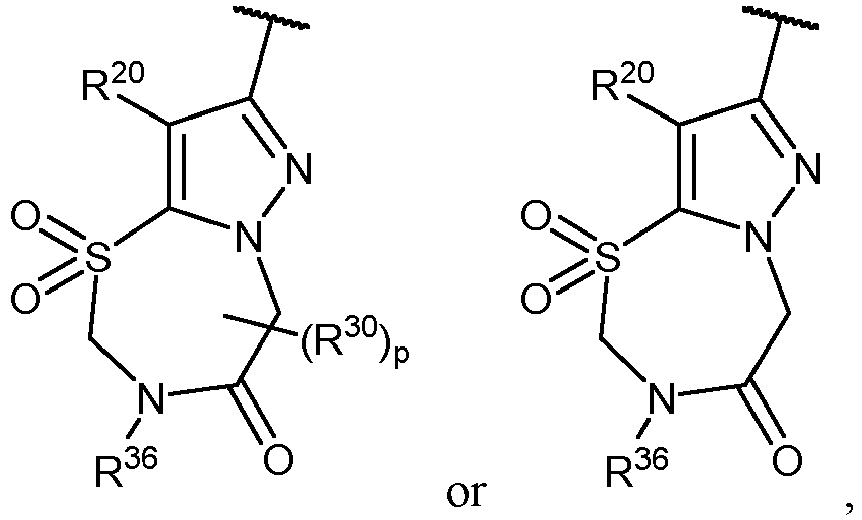 wherein p is 0, 1, 2, 3 or 4;R36 is independently hydrogen or R30; andR20 and R30 are as defined in claim 10;or (b) D is
 wherein X is CH2, N, O or S;n is 1, 2, 3 or 4;p is 0, 1, 2, 3 or 4;R36 is hydrogen or R30; andR20 and R30 are as defined in claim 10;or (c) D is
 wherein q is 0, 1, 2, 3, 4, 5 or 6;G is independently C or N;G' is independently N, NR46, CR47, S or O;R46 and R47 are independently hydrogen or R40; or two groups R46 and R47 are taken together to form a ring; andR20 and R40 are as defined in claim 10;or (d) D is
 wherein Q is NR20, O or S;X is CR38aR38b, NR36, S or O;X' is CR39aR39b, NR36, S, SO2 or O;R36, R37a, R37b, R38a and R38b are independently hydrogen or R30;R39a and R39b are independently hydrogen or R30, or R39a and R39b are taken together with the carbon atom to which they are attached to form a C3-7 cycloalkyl or C3-7 heterocyclyl; andR20 and R30 are as defined in claim 10.
 - The compound of claim 11 or 12, wherein D is


- The compound of any one of claims 1 to 13, wherein R1' is hydrogen, halogen, or C1-6 alkyl.
- The compound of any one of claims 1 to 14, wherein R2' is hydrogen.
- The compound of claim 1, wherein the compound is selected from the group consisting ofcis-N-[8-amino-6-(4-methyl-3-pyridyl)-2,7-naphthyridin-3-yl]-2-fluoro-cyclopropanecarboxamidecis-N-(8-amino-6-(1,5-dimethyl-1H-pyrazol-4-yl)-2,7-naphthyridin-3-yl)-2-fluorocyclopropanecarboxamidecis-N-(8-amino-6-(1,3,5-trimethyl-1H-pyrazol-4-yl)-2,7-naphthyridin-3-yl)-2-fluorocyclopropanecarboxamidecis-N-(8-amino-6-(1-methyl-1H-pyrazol-4-yl)-2,7-naphthyridin-3-yl)-2-fluorocyclopropanecarboxamidetrans-N-(8-amino-6-(4-ethylpyridin-3-yl)-2,7-naphthyridin-3-yl)-2-cyanocyclopropanecarboxamide(1S,2S)-N-(8-amino-6-(4-methylpyridin-3-yl)-2,7-naphthyridin-3-yl)-2-fluorocyclopropanecarboxamide(1S,2S)-N-(8-amino-6-(1-methyl-1H-pyrazol-4-yl)-2,7-naphthyridin-3-yl)-2-fluorocyclopropanecarboxamidetrans-N-(8-amino-6-(1-methyl-1H-pyrazol-4-yl)-2,7-naphthyridin-3-yl)-2-fluorocyclopropanecarboxamide1-(8-amino-6-(1-methyl-1H-pyrazol-4-yl)-2,7-naphthyridin-3-yl)-3-methylurea(1S,2S)-N-(8-amino-6-(4-methoxypyridin-3-yl)-2,7-naphthyridin-3-yl)-2-fluorocyclopropanecarboxamideN-(8-amino-6-(4-methylpyridin-3-yl)-2,7-naphthyridin-3-yl)-2,2-difluorocyclopropanecarboxamide(1S,2S)-N-(8-amino-6-(4-methylpyrimidin-5-yl)-2,7-naphthyridin-3-yl)-2-fluorocyclopropanecarboxamide(1S,2S)-N-(8-amino-6-(4-ethylpyrimidin-5-yl)-2,7-naphthyridin-3-yl)-2-fluorocyclopropanecarboxamide(1S,2S)-N-(8-amino-6-(4-(difluoromethyl)pyridin-3-yl)-2,7-naphthyridin-3-yl)-2-fluorocyclopropanecarboxamide(1S,2S)-N-(8-amino-6-(4-cyanopyridin-3-yl)-2,7-naphthyridin-3-yl)-2-fluorocyclopropanecarboxamidecis-N-(8-amino-6-(6-amino-4-methylpyridin-3-yl)-2,7-naphthyridin-3-yl)-2-fluorocyclopropanecarboxamide(1S,2S)-N-(8-amino-6-(5-fluoro-4-methylpyridin-3-yl)-2,7-naphthyridin-3-yl)-2-fluorocyclopropanecarboxamide(1S,2S)-N-(8-amino-6-(1-methyl-1H-pyrazol-5-yl)-2,7-naphthyridin-3-yl)-2-fluorocyclopropanecarboxamidecis-N-(8-amino-6-(6-methyl-1H-benzo[d]imidazol-5-yl)-2,7-naphthyridin-3-yl)-2-fluorocyclopropanecarboxamideN-[8-amino-6-(4-ethyl-3-pyridyl)-2,7-naphthyridin-3-yl]cyclobutanecarboxamidecis-N-(8-amino-6-(1H-pyrrolo[2,3-c]pyridin-4-yl)-2,7-naphthyridin-3-yl)-2-cyanocyclopropanecarboxamidecis-N-(8-amino-6-(3-methylpyridin-4-yl)-2,7-naphthyridin-3-yl)-2-fluorocyclopropanecarboxamideN-(8-amino-6-(4-methylpyridin-3-yl)-2,7-naphthyridin-3-yl)cyclopropanecarboxamideN-(8-amino-6-(6-(hydroxymethyl)-4-methylpyridin-3-yl)-2,7-naphthyridin-3-yl)cyclopropanecarboxamideN-(8-amino-6-(4-ethylpyridin-3-yl)-2,7-naphthyridin-3-yl)cyclopropanecarboxamideN-[8-amino-6-(1-methylpyrazol-4-yl)-2,7-naphthyridin-3-yl]cyclopropanecarboxamideN-[8-amino-6-(4-ethyl-3-pyridyl)-2,7-naphthyridin-3-yl]-3-cyano-propanamide and N'-[8-amino-6-(4-ethyl-3-pyridyl)-2,7-naphthyridin-3-yl]butanediamideN'-[8-amino-6-(4-ethyl-3-pyridyl)-2,7-naphthyridin-3-yl]butanediamide1-[8-amino-6-(4-ethyl-3-pyridyl)-2,7-naphthyridin-3-yl]-3-(thiazol-5-ylmethyl)urea1-[8-amino-6-(4-ethyl-3-pyridyl)-2,7-naphthyridin-3-yl]-3-isopropyl-ureaN-[8-amino-6-(4-ethyl-3-pyridyl)-2,7-naphthyridin-3-yl]-2-cyano-acetamide3-[8-amino-6-(4-ethyl-3-pyridyl)-2,7-naphthyridin-3-yl]-1,1-dimethyl-urea2-[[8-amino-6-(4-ethyl-3-pyridyl)-2,7-naphthyridin-3-yl]carbamoylamino]propanamideN-(8-amino-6-(4-methylpyridin-3-yl)-2,7-naphthyridin-3-yl)-2-cyano-2-methylpropanamideN-(8-amino-6-(4-methylpyridin-3-yl)-2,7-naphthyridin-3-yl)-2-methoxy-2-methylpropanamideN-(8-amino-6-(4-methylpyridin-3-yl)-2,7-naphthyridin-3-yl)isobutyramideN-(8-amino-6-(4-methylpyridin-3-yl)-2,7-naphthyridin-3-yl)-2-cyanopropanamideN-(8-amino-6-(4-methylpyridin-3-yl)-2,7-naphthyridin-3-yl)-2-hydroxy-2-methylpropanamideN-(8-amino-6-(2-oxooxazolidin-3-yl)-2,7-naphthyridin-3-yl)cyclopropanecarboxamideN-(8-amino-6-(2-oxo-1,2-dihydropyridin-3-yl)-2,7-naphthyridin-3-yl)cyclopropanecarboxamidetrans-N-(8-amino-6-(4-methylpyridin-3-yl)-2,7-naphthyridin-3-yl)-2-cyanocyclopropanecarboxamide(1S,2S)-N-(8-amino-6-(4-(hydroxymethyl)pyridin-3-yl)-2,7-naphthyridin-3-yl)-2-fluorocyclopropanecarboxamide(1S,2S)-N-(8-amino-6-(2-ethylpyrrolidin-1-yl)-2,7-naphthyridin-3-yl)-2-fluorocyclopropanecarboxamidecis-N-(8-amino-6-(4-cyclopropylpyridin-3-yl)-2,7-naphthyridin-3-yl)-2-fluorocyclopropanecarboxamideN-(8-amino-6-(1-methyl-1H-pyrazol-4-yl)-2,7-naphthyridin-3-yl)-2-methylcyclopropanecarboxamide (3:1 ratio of trans/cis)4-(1-amino-6-((cis)-2-fluorocyclopropanecarboxamido)-2,7-naphthyridin-3-yl)-3-methylbenzamide4-(1-amino-6-((cis)-2-fluorocyclopropanecarboxamido)-2,7-naphthyridin-3-yl)-N,3-dimethylbenzamidetrans-N-(8-amino-6-(4-isopropylpyridin-3-yl)-2,7-naphthyridin-3-yl)-2-cyanocyclopropanecarboxamidetrans-N-(8-amino-6-(4-methylpyridin-3-yl)-2, 7-naphthyridin-3-yl)-2-fluorocyclopropanecarboxamidecis-N-(8-amino-6-(7-methyl-1H-imidazo [4, 5-b] pyridin-6-yl)-2, 7-naphthyridin-3-yl)-2-fluorocyclopropanecarboxamidetrans-N-(8-amino-6-(4-ethylpyridin-3-yl)-2,7-naphthyridin-3-yl)-2-(methoxymethyl) cyclo propane carboxamidecis-N-(8-amino-6-(2-(2-hydroxyethyl)pyrrolidin-1-yl)-2,7-naphthyridin-3-yl)-2-fluorocyclopropanecarboxamidecis-N-(8-amino-6-(2-methoxy-5-methylpyridin-4-yl)-2,7-naphthyridin-3-yl)-2-fluorocyclopropanecarboxamidecis-N-[8-amino-6-(5-methyl-2-oxo-1H-pyridin-4-yl)-2,7-naphthyridin-3-yl]-2-fluoro-cyclopropanecarboxamidebenzyl 8-amino-6-(4-ethylpyridin-3-yl)-2,7-naphthyridin-3-ylcarbamatecis-N-(8-amino-6-(6-methyl-2-oxoindolin-5-yl)-2,7-naphthyridin-3-yl)-2-fluorocyclopropanecarboxamidecis-N-(8-amino-6-(6-methyl-2-oxoindolin-5-yl)-2,7-naphthyridin-3-yl)-2-fluorocyclopropanecarboxamidecis-N-(8-amino-6-(4-ethylpyridin-3-yl)-2,7-naphthyridin-3-yl)-2-cyanocyclopropanecarboxamide cis-N 1-(8-amino-6-(4-ethylpyridin-3-yl)-2,7-naphthyridin-3-yl)cyclopropane-1,2-dicarboxamidecis-N-(8-amino-6-(2,4-dimethylpyridin-3-yl)-2,7-naphthyridin-3-yl)-2-fluorocyclopropanecarboxamidecis-N-(8-amino-6-(1-methyl-1H-pyrrolo[3,2-c]pyridin-7-yl)-2,7-naphthyridin-3-yl)-2-fluorocyclopropanecarboxamidecis-N-[8-amino-6-(4-ethyl-1-methyl-6-oxo-3-pyridyl)-2,7-naphthyridin-3-yl]-2-fluoro-cyclopropanecarboxamide(R)-1-(8-amino-6-(4-ethylpyridin-3-yl)-2,7-naphthyridin-3-yl)-3-(1-methyl-2-oxopyrrolidin-3-yl)ureacis-N-(8-amino-6-(4-ethyl-6-methoxypyridin-3-yl)-2,7-naphthyridin-3-yl)-2-fluorocyclopropanecarboxamidecis-N-(8-amino-6-(6-amino-4-ethylpyridin-3-yl)-2,7-naphthyridin-3-yl)-2-fluorocyclopropanecarboxamideN-[8-amino-6-(4-ethyl-3-pyridyl)-2,7-naphthyridin-3-yl]cyclopropene-1-carboxamide5-Methyl-1H-pyrazole-3-carboxylic acid [8-amino-6-(4-ethylpyridin-3-yl)-[2,7]naphthyridin-3-yl] amide2H-Pyrazole-3-carboxylic acid [8-amino-6-(4-ethylpyridin-3-yl)-[2,7]naphthyridin-3-yl]amide2-Methyl-2H-pyrazole-3-carboxylic acid [8-amino-6-(4-ethylpyridin-3-yl)-[2,7]naphthyridin-3-yl] amide1-Methyl-1H-pyrazole-4-carboxylic acid [8-amino-6-(4-ethylpyridin-3-yl)-[2,7]naphthyridin-3-yl] amide3-(4-Ethylpyridin-3-yl)-N6-(1-methyl-1H-pyrazol-4-yl)-[2,7]naphthyridine-1,6-diamine 3-(4-Ethylpyridin-3-yl)-N6-(1H-pyrazol-4-yl)-[2,7]naphthyridine-1,6-diamine3-(4-Ethylpyridin-3-yl)-N6-(1-methyl-1H-pyrazol-3-yl)-[2,7]naphthyridine-1,6-diamine 3-(4-Ethylpyridin-3-yl)-N6-(1H-pyrazol-3-yl)-[2,7]naphthyridine-1,6-diamine3-(4-Ethylpyridin-3-yl)-N6-(1-piperidin-4-yl-1H-pyrazol-4-yl)-[2,7]naphthyridine-1,6-diamine Cyclopropanesulfonic acid [8-amino-6-(4-ethylpyridin-3-yl)-[2,7]naphthyridin-3-yl]amide3-(4-Ethylpyridin-3-yl)-N6-(6-methylpyrimidin-4-yl)-[2,7]naphthyridine-1,6-diamine2-[8-Amino-6-(4-ethylpyridin-3-yl)-[2,7]naphthyridin-3-ylamino]-N-ethyl-N-methylisonicotinamide1-{2-[8-Amino-6-(4-ethylpyridin-3-yl)-[2,7]naphthyridin-3-ylamino]-pyridin-4-yl}propan-1-ol {6-[8-amino-6-(4-ethylpyridin-3-yl)-[2,7]naphthyridin-3-ylamino]pyridin-2-yl}methanolN-(8-amino-6-(4-ethylpyridin-3-yl)-2,7-naphthyridin-3-yl)-1-(piperidin-4-yl)-1H-pyrazole-4-carboxamide2-{4-[8-Amino-6-(4-ethylpyridin-3-yl)-[2,7]naphthyridin-3-ylamino]pyrazol-1-yl} ethanol (1S,2S)-N-(8-amino-6-(5-fluoro-4-methylpyridin-3-yl)-2,7-naphthyridin-3-yl)-2-fluorocyclopropane-1-carboxamidecis-N-(8-amino-6-(2-ethylpyrrolidin-1-yl)-2,7-naphthyridin-3-yl)-2-fluorocyclopropane-1-carboxamidecis-N-(8-amino-6-(4-ethyl-6-methoxypyridin-3 -yl)-2,7-naphthyridin-3 -yl)-2-fluorocyclopropane-1-carboxamidecis-N-(8-amino-6-(1-methyl-1H-pyrrolo[3,2-c]pyridin-7-yl)-2,7-naphthyridin-3-yl)-2-fluorocyclopropane-1-carboxamideN-(8-amino-6-(4-ethylpyridin-3 -yl)-2,7-naphthyridin-3 -yl)-2-cyanocyclopropane-1 -carboxamide trans-N-(8-amino-6-(4-ethylpyridin-3-yl)-2,7-naphthyridin-3-yl)-2-cyanocyclopropane-1-carboxamidecis-N-(8-amino-6-(4-ethylpyridin-3-yl)-2,7-naphthyridin-3-yl)-2-cyanocyclopropane-1-carboxamide trans-N-(8-amino-6-(4-methylpyridin-3-yl)-2,7-naphthyridin-3-yl)-2-cyanocyclopropane-1-carboxamidetrans-N-(8-amino-6-(4-ethylpyridin-3-yl)-2,7-naphthyridin-3-yl)-2-(3-hydroxycyclobutane-1-carbonyl)cyclopropane-1-carboxamidetrans-N-(8-amino-6-(8-hydroxy-5,6,7,8-tetrahydroisoquinolin-4-yl)-2,7-naphthyridin-3-yl)-2-cyanocyclopropane-1-carboxamidecis-N-(8-amino-6-(2-(hydroxymethyl)-5-methylpyridin-4-yl)-2,7-naphthyridin-3-yl)-2-fluorocyclopropane-1-carboxamidecis-N-(8-amino-6-(2-cyano-5-methylpyridin-4-yl)-2,7-naphthyridin-3-yl)-2-fluorocyclopropane-1-carboxamideN-(8-amino-6-(4-ethylpyridin-3-yl)-2,7-naphthyridin-3-yl)-2-(1H-pyrazol-5-yl)acetamidecis-N-(8-amino-6-(3,5-dimethyl-1H-pyrazol-4-yl)-2,7-naphthyridin-3-yl)-2-fluorocyclopropane-1-carboxamidetrans-N-(8-amino-6-(1,2-dimethyl-1H-imidazol-5-yl)-2,7-naphthyridin-3-yl)-2-cyanocyclopropane-1-carboxamideN6-((1H-pyrazol-5-yl)methyl)-3-(4-ethylpyridin-3-yl)-2,7-naphthyridine-1,6-diamine cis-N-(8-amino-6-(pyridin-3-yl)-2,7-naphthyridin-3-yl)-2-fluorocyclopropane-1-carboxamide trans-N-(8-amino-6-(4-methylpyridin-3-yl)-2,7-naphthyridin-3-yl)-2-fluorocyclopropane-1-carboxamide1-[8-amino-6-(4-ethyl-3-pyridyl)-2,7-naphthyridin-3-yl]-3-(cis-3-hydroxycyclobutyl)urea trans-N-(8-amino-6-(4-(trifluoromethyl)pyridin-3-yl)-2,7-naphthyridin-3-yl)-2-cyanocyclopropane-1-carboxamideN-[8-amino-6-(4-methyl-3-pyridyl)-2,7-naphthyridin-3-yl]-3-azabicyclo[3.1.0]hexane-6-carboxamidetrans-N-(8-amino-6-(1H-pyrazol-4-yl)-2,7-naphthyridin-3-yl)-2-cyanocyclopropane-1-carboxamide N-[8-amino-6-(4-methyl-3-pyridyl)-2,7-naphthyridin-3-yl]-5-azaspiro[2.3]hexane-2-carboxamide trans-N-(8-amino-6-(5 -isopropyl- 1H-pyrazol-4-yl)-2,7-naphthyridin-3 -yl)-2-cyanocyclopropane-1 - carboxamiderac-(1R,5S)-N-[8-amino-6-(4-methyl-3-pyridyl)-2,7-naphthyridin-3-yl]-3-oxabicyclo[3.1.0]hexane-6-carboxamide1-[8-amino-6-(4-methyl-3-pyridyl)-2,7-naphthyridin-3-yl]-3-[rac-(1S,2S)-2-hydroxycyclopentyl]urea1-(8-amino-6-(4-methylpyridin-3-yl)-2,7-naphthyridin-3-yl)-3-(1-hydroxypropan-2-yl)ureatrans-N-(8-amino-6-(4-methylpyridin-3-yl)-2,7-naphthyridin-3-yl)-2-methylcyclopropane-1-carboxamidetrans-N-(8-amino-6-(4-methylpyridin-3-yl)-2,7-naphthyridin-3-yl)-2-(trifluoromethyl)cyclopropane-1-carboxamide3-(4-methyl-3-pyridyl)-N6-pyrrolidin-3-yl-2,7-naphthyridine-1,6-diaminetrans-N-[8-amino-6-(4-methyl-3-pyridyl)-2,7-naphthyridin-3-yl]-2-(1H-pyrazol-3-yl)cyclopropanecarboxamidetrans-N-[8-amino-6-(4-methyl-3-pyridyl)-2,7-naphthyridin-3-yl]-2-(1H-pyrazol-4-yl)cyclopropanecarboxamide(1R,5S,6R)-N-[8-amino-6-(4-methyl-3-pyridyl)-2,7-naphthyridin-3-yl]-3-oxabicyclo[3.1.0]hexane-6-carboxamideexo-N-[8-amino-6-(4-methyl-3-pyridyl)-2,7-naphthyridin-3-yl]-3-(2-methoxyethyl)-3-azabicyclo[3.1.0]hexane-6-carboxamidetrans-N-(8-amino-6-(4-methylpyridin-3-yl)-2,7-naphthyridin-3-yl)-5-azaspiro[2.4]heptane-1-carboxamidecis-N-(8-amino-6-(4-methylpyridin-3-yl)-2,7-naphthyridin-3-yl)-5-azaspiro[2.4]heptane-1-carboxamidetrans-N-(8-amino-6-(4-methylpyridin-3-yl)-2,7-naphthyridin-3-yl)-5-(2-methoxyethyl)-5-azaspiro [2.4]heptane-1-carboxamidecis-N-(8-amino-6-(4-methylpyridin-3-yl)-2,7-naphthyridin-3-yl)-5-(2-methoxyethyl)-5-azaspiro[2.4]heptane-1 -carboxamidetrans-N-[8-amino-6-(4-ethoxy-3-pyridyl)-2,7-naphthyridin-3-yl]-2-cyano-cyclopropanecarboxamide1-[8-amino-6-(4-methyl-3-pyridyl)-2,7-naphthyridin-3-yl]-3-methyl-ureatrans-N-[8-amino-6-(4-methyl-3-pyridyl)-2,7-naphthyridin-3-yl]-2-(3-pyridyl)cyclopropanecarboxamidetrans-N-[8-amino-6-[5-(trifluoromethyl)-1H-pyrazol-4-yl]-2, 7-naphthyridin-3-yl]-2-cyano-cyclopropanecarboxamide[(3R)-2-oxopyrrolidin-3-yl] N-[8-amino-6-(4-methyl-3-pyridyl)-2,7-naphthyridin-3-yl]carbamate1-[8-amino-6-(4-methyl-3-pyridyl)-2, 7-naphthyridin-3-yl]-3-[(1S,2S)-2-hydroxycyclopentyl]ureatrans-N-(8-amino-6-(5-methyl-2-oxo-2,3-dihydrobenzo[d]oxazol-6-yl)-2,7-naphthyridin-3-yl)-2-cyanocyclopropanecarboxamidecis-N 1-(8-amino-6-(4-methylpyridin-3-yl)-2,7-naphthyridin-3-yl)-N2,N2-dimethylcyclopropane-1,2-dicarboxamidecis-N 1-(8-amino-6-(4-methylpyridin-3-yl)-2,7-naphthyridin-3-yl)-N2-ethylcyclopropane-1,2-dicarboxamidetrans-N1-(8-amino-6-(4-methylpyridin-3-yl)-2,7-naphthyridin-3-yl)-N2,N2-dimethylcyclopropane-1,2-dicarboxamidetrans-N-(8-amino-6-(4-methylpyridin-3-yl)-2,7-naphthyridin-3-yl)-2-methylcyclopropanecarboxamidetrans-N-(8-amino-6-(4-methylpyridin-3-yl)-2,7-naphthyridin-3-yl)-2-(trifluoromethyl)cyclopropane carboxamidecis-N-(8-amino-6-(4-methylpyridin-3-yl)-2,7-naphthyridin-3-yl)-2-methylcyclopropanecarboxamidetrans-N-(8-amino-6-(3,5-dimethyl-2-oxo-2,3-dihydrobenzo[d]oxazol-6-yl)-2,7-naphthyridin-3-yl)-2-cyanocyclopropanecarboxamideexo-3-acetyl-N-[8-amino-6-(4-methyl-3-pyridyl)-2,7-naphthyridin-3-yl]-3-azabicyclo[3.1.0]hexane-6-carboxamidetrans-N-[8-amino-6-(5-methyl-2-oxo-3H-1,3-benzoxazol-6-yl)-2,7-naphthyridin-3-yl]-2-(1H-pyrazol-4-yl)cyclopropanecarboxamidetrans-N-[8-amino-6-(4-methyl-3-pyridyl)-2,7-naphthyridin-3-yl]-2-[3-[(4-methoxyphenyl)methyl]imidazol-4-yl]cyclopropanecarboxamidetrans-N-[8-amino-6-(4-methyl-3-pyridyl)-2,7-naphthyridin-3-yl]-2-(1-ethylsulfonylpyrazol-4-yl)cyclopropanecarboxamidetrans-N-(8-amino-6-(5-(difluoromethyl)-4-methylpyridin-3-yl)-2,7-naphthyridin-3-yl)-2-cyanocyclopropanecarboxamidetrans-N-(8-amino-6-(4-methylpyridin-3-yl)-2,7-naphthyridin-3-yl)-5-(methylsulfonyl)-5-azaspiro [2.4]heptane-1-carboxamidecis-N-(8-amino-6-(4-methylpyridin-3-yl)-2,7-naphthyridin-3-yl)-5-(methylsulfonyl)-5-azaspiro[2.4]heptane-1 -carboxamideN-(8-amino-6-(4-methylpyridin-3-yl)-2,7-naphthyridin-3-yl)-5-(3-cyanopyridin-2-yl)-5-azaspiro[2.3]hexane-1-carboxamideexo-N-[8-amino-6-(4-methyl-3-pyridyl)-2,7-naphthyridin-3-yl]-3-methylsulfonyl-3-azabicyclo[3.1.0]hexane-6-carboxamidetrans-N-[8-amino-6-(4-methyl-3-pyridyl)-2,7-naphthyridin-3-yl]-2-isothiazol-4-yl-cyclopropanecarboxamidetrans-N-(8-amino-5-fluoro-6-(4-methylpyridin-3-yl)-2,7-naphthyridin-3-yl)-2-cyanocyclopropanecarboxamidetrans-N-(8-amino-6-(4-methylpyridin-3-yl)-2,7-naphthyridin-3-yl)-2-(hydroxymethyl)cyclopropanecarboxamidetrans-N-(8-amino-6-(4-methylpyridin-3-yl)-2,7-naphthyridin-3-yl)-2-(aminomethyl)cyclopropanecarboxamideN-(8-amino-5-fluoro-6-(4-methylpyridin-3-yl)-2,7-naphthyridin-3-yl)acetamidetrans-N-[8-amino-6-(4-methyl-3-pyridyl)-2,7-naphthyridin-3-yl]-2-(cyanomethyl)cyclopropane carboxamideexo-N-[8-amino-6-(4-methyl-3-pyridyl)-2,7-naphthyridin-3-yl]-4-oxo-3-azabicyclo[3.1.0]hexane-6-carboxamidetrans-N-[8-amino-6-(4-methyl-3-pyridyl)-2,7-naphthyridin-3-yl]-2-(1-methylpyrazol-4-yl)cyclopropane carboxamidetrans-N-[8-amino-6-(3-hydroxy-6-methyl-2-oxo-indolin-5-yl)-2,7-naphthyridin-3-yl]-2-cyano-cyclopropane carboxamide1-[3-[4-[[8-amino-6-(4-methyl-3-pyridyl)-2,7-naphthyridin-3-yl]amino]pyrazol-1-yl]azetidin-1-yl]ethanone1-[8-amino-5-fluoro-6-(4-methyl-3-pyridyl)-2,7-naphthyridin-3-yl]-3-(1-methylpyrazol-4-yl)urea1-[8-amino-5-chloro-6-(4-methyl-3-pyridyl)-2,7-naphthyridin-3-yl]-3-(1-methylpyrazol-4-yl)ureatrans-4-(1-amino-6-((trans)-2-cyanocyclopropanecarboxamido)-2,7-naphthyridin-3-yl)-3-methyl-N-(2,2,2-trifluoroethyl)benzamide)trans-N-(8-amino-6-(5-amino-4-methylpyridin-3-yl)-2,7-naphthyridin-3-yl)-2-cyanocyclopropane carboxamidetrans-2-(1-acetylpiperidin-4-yl)-N-(8-amino-6-(4-methylpyridin-3-yl)-2,7-naphthyridin-3-yl)cyclopropanecarboxamidecis-N-(8-amino-6-(4-methyl-6-(2-oxo-1,2-dihydropyridin-3-yl)pyridin-3-yl)-2,7-naphthyridin-3-yl)-2-fluorocyclopropanecarboxamide2-[4-[[8-amino-6-(4-ethyl-3-pyridyl)-2,7-naphthyridin-3-yl]amino]pyrazol-1-yl]ethanol2-[4-[[8-amino-6-(4-methyl-3-pyridyl)-2,7-naphthyridin-3-yl]amino]pyrazol-1-yl]ethanol4-[[8-amino-6-(4-methyl-3-pyridyl)-2,7-naphthyridin-3-yl]amino]-1-methyl-pyridin-2-one1-[8-amino-6-(4-methyl-3-pyridyl)-2,7-naphthyridin-3-yl]-3-(2-cyanophenyl)ureatrans-N-(8-amino-5-fluoro-6-(4-methylpyridin-3-yl)-2,7-naphthyridin-3-yl)-2-(1H-pyrazol-4-yl)cyclopropanecarboxamidetrans-N-(8-amino-5-chloro-6-(4-methylpyridin-3-yl)-2,7-naphthyridin-3-yl)-2-(1H-pyrazol-4-yl)cyclopropanecarboxamide1-(8-amino-6-(4-methylpyridin-3-yl)-2,7-naphthyridin-3-yl)-3-(1-(2-methoxyethyl)azetidin-3-yl)urea1-(8-amino-6-(4-methylpyridin-3-yl)-2,7-naphthyridin-3-yl)-3-(azetidin-3-yl)urea(R)-1-(8-amino-6-(4-ethylpyridin-3-yl)-2,7-naphthyridin-3-yl)-3-(1-methyl-2-oxopyrrolidin-3-yl)urea1-(8-amino-6-(4-methylpyridin-3-yl)-2,7-naphthyridin-3-yl)-3-(1-hydroxypropan-2-yl)urea1-[8-amino-6-(4-methyl-3-pyridyl)-2,7-naphthyridin-3-yl]-3-[1-(1-cyanoethyl)pyrazol-4-yl]ureacis-N-[8-amino-6-[6-[(3S)-3-aminopyrrolidin-1-yl]-4-methyl-3-pyridyl]-2,7-naphthyridin-3-yl]-2-fluoro-cyclopropanecarboxamidetrans-4-[1-amino-6-[[trans-2-cyanocyclopropanecarbonyl]amino]-2,7-naphthyridin-3-yl]-N,1,3,5-tetramethyl-pyrrole-2-carboxamidetrans-N-[8-amino-6-(5-amino-2,4-dimethyl-3-pyridyl)-2,7-naphthyridin-3-yl]-2-methyl-cyclopropanecarboxamide2-[4-[[8-amino-6-(4-methyl-3-pyridyl)-2,7-naphthyridin-3-yl]amino]pyrazol-1-yl]-N,2-dimethyl-propanamide2-[4-[[8-amino-6-(4-methyl-3-pyridyl)-2,7-naphthyridin-3-yl]amino]pyrazol-1-yl]-N,N,2-trimethyl-propanamide2-[4-[[8-amino-6-(4-methyl-3-pyridyl)-2,7-naphthyridin-3-yl]amino]pyrazol-1-yl]-N-methylacetamidetrans-5-(1-amino-6-(trans-2-cyanocyclopropanecarboxamido)-2,7-naphthyridin-3-yl)-2,4-dimethylbenzamidetrans-N-(8-amino-6-((S)-4-methyl-2-oxooxazolidin-3-yl)-2,7-naphthyridin-3-yl)-2-cyanocyclopropane carboxamidetrans-N-(8-amino-6-(5-methyl-1H-pyrazol-4-yl)-2,7-naphthyridin-3-yl)-2-(trifluoromethyl)cyclopropane carboxamidetrans-N-(8-amino-6-(1,3,5-trimethyl-1H-pyrazol-4-yl)-2,7-naphthyridin-3-yl)-2-(trifluoromethyl)cyclopropanecarboxamidetrans-N-(8-amino-6-(4-methylpyridin-3-yl)-2,7-naphthyridin-3-yl)-2-(pyrimidin-2-yl)cyclopropanecarboxamidetrans-N-(8-amino-6-(5-amino-4-methylpyridin-3-yl)-2,7-naphthyridin-3-yl)-2-(trifluoromethyl) cyclopropanecarboxamidetrans-N-(8-amino-6-(4-(2-hydroxyethyl)pyridin-3-yl)-2,7-naphthyridin-3-yl)-2-cyanocyclopropanecarboxamidetrans-N-(8-amino-6-(4-(2-hydroxyethyl)pyridin-3-yl)-2,7-naphthyridin-3-yl)-2-(cyanomethyl)cyclopropanecarboxamide(1S,2R)-N-(8-amino-6-(4-methylpyridin-3-yl)-2,7-naphthyridin-3-yl)-2-(cyanomethyl)cyclopropane-1-carboxamide(1R,2S)-N-(8-amino-6-(4-methylpyridin-3-yl)-2,7-naphthyridin-3-yl)-2-(cyanomethyl)cyclopropane-1-carboxamide(1S,2S)-N-(8-amino-5-fluoro-6-(4-methylpyridin-3-yl)-2,7-naphthyridin-3-yl)-2-(1H-pyrazol-4-yl)cyclopropane-1-carboxamide(1R,2R)-N-(8-amino-5-fluoro-6-(4-methylpyridin-3-yl)-2,7-naphthyridin-3-yl)-2-(1H-pyrazol-4-yl)cyclopropane-1-carboxamide(1S,2S)-N-(8-amino-6-(4-methylpyridin-3-yl)-2,7-naphthyridin-3 -yl)-2-(1 -methyl- 1H-pyrazol-4-yl)cyclopropane-1-carboxamide(1R,2R)-N-(8-amino-6-(4-methylpyridin-3-yl)-2,7-naphthyridin-3-yl)-2-(1-methyl-1H-pyrazol-4-yl)cyclopropane-1-carboxamide(1R,2R)-N-(8-amino-6-(5-amino-4-methylpyridin-3-yl)-2,7-naphthyridin-3-yl)-2-cyanocyclopropane-1-carboxamide(1S,2S)-N-(8-amino-6-(5-amino-4-methylpyridin-3-yl)-2,7-naphthyridin-3-yl)-2-cyanocyclopropane-1-carboxamidetrans-N-(8-amino-6-(4-(trifluoromethyl)pyridin-3-yl)-2,7-naphthyridin-3-yl)-2-cyanocyclopropane-1-carboxamide(1S,2S)-N-(8-amino-6-(4-methylpyridin-3-yl)-2,7-naphthyridin-3-yl)-2-cyanocyclopropane-1-carboxamide(1R,2R)-N-(8-amino-6-(4-methylpyridin-3-yl)-2,7-naphthyridin-3-yl)-2-cyanocyclopropane-1-carboxamideN-(8-amino-5-(3-hydroxycyclopent-1-enyl)-6-(4-methylpyridin-3-yl)- 2,7-naphthyridin-3-yl)cyclopropanecarboxamidetrans-N-(8-amino-5-methyl-6-(4-methylpyridin-3-yl)-2,7-naphthyridin-3-yl)-2-(cyanomethyl)cyclopropanecarboxamidetrans-N-(8-amino-6-(4-methyl-2-phenylpyridin-3-yl)-2,7-naphthyridin-3-yl)-2-(cyanomethyl)cyclopropanecarboxamide2-(8-amino-6-(4-methylpyridin-3-yl)-2,7-naphthyridin-3-ylcarbamoyl)-1-methylcyclopropyl)methyl acetateN-(8-amino-6-(4-methylpyridin-3-yl)-2,7-naphthyridin-3-yl)-2-(hydroxymethyl)-2-methylcyclopropanecarboxamidetrans-N-(8-amino-5-bromo-6-(4-methylpyridin-3-yl)-2,7-naphthyridin-3-yl)-2-(cyanomethyl)cyclopropanecarboxamidecis-N-(8-amino-6-(2,3-dihydro-1H-pyrrolo[2,3-c]pyridin-4-yl)-2,7-naphthyridin-3-yl)-2-fluorocyclopropanecarboxamidetrans-N-(8-amino-6-(4-methylpyridin-3-yl)-2,7-naphthyridin-3-yl)-2-(cyanomethyl)cyclopropanecarboxamide2-(4-(8-amino-6-(4-methylpyridin-3-yl)-2,7-naphthyridin-3-ylamino)-1H-pyrazol-1-yl)propan-1-oltrans-N-(8-amino-6-(4-(2-hydroxyethyl)pyridin-3-yl)-2,7-naphthyridin-3-yl)-2-(1-methyl-1H-pyrazol-4-yl)cyclopropanecarboxamidecis-N-(8-amino-6-(4-methyl-5-(methylamino)pyridin-3-yl)-2,7-naphthyridin-3-yl)-2-fluorocyclopropanecarboxamide2-(4-(8-amino-6-(4-methylpyridin-3-yl)-2,7-naphthyridin-3-ylamino)-1H-pyrazol-1-yl)propanenitrile1-(3-(4-(8-amino-6-(4-methylpyridin-3-yl)-2,7-naphthyridin-3-ylamino)-1H-pyrazol-1-yl)pyrrolidin-1-yl)ethanone(trans)-3-(4-(8-amino-6-(4-methylpyridin-3-yl)-2,7-naphthyridin-3-ylamino)-1H-pyrazol-1-yl)-1-(oxetan-3-yl)piperidin-4-ol(trans)-4-(4-(8-amino-6-(4-methylpyridin-3-yl)-2,7-naphthyridin-3-ylamino)-1H-pyrazol-1-yl)-1-(oxetan-3 -yl)piperidin-3 -ol1-(3 -(8-amino-6-(4-methylpyridin-3 -yl)-2,7-naphthyridin-3-ylamino)-1-methyl-1H-pyrazol-5 - yl)ethanolcis-N-(8-amino-6-(3-oxo-3,4-dihydro-2H-pyrido[4,3-b][1,4]oxazin-8-yl)-2,7-naphthyridin-3-yl)-2-fluorocyclopropanecarboxamidecis-N-(8-amino-6-(3,4-dihydro-2H-pyrido[4,3-b][1,4]oxazin-8-yl)-2,7-naphthyridin-3-yl)-2-fluorocyclopropanecarboxamidetrans-N-(8-amino-6-(2-cyanophenyl)-2,7-naphthyridin-3-yl)-2-cyanocyclopropanecarboxamidetrans-N-(8-amino-6-(4-(2-hydroxy-2-methylpropyl)pyridin-3-yl)-2,7-naphthyridin-3-yl)-2-cyanocyclopropanecarboxamidecis-5-(1-amino-6-(-2-fluorocyclopropanecarboxamido)-2,7-naphthyridin-3-yl)-N,4-dimethylnicotinamidetrans-N-(8-amino-6-(4-(cyanomethyl)pyridin-3-yl)-2,7-naphthyridin-3-yl)-2-cyanocyclopropanecarboxamidetrans-N-(8-amino-6-(4-(methoxymethyl)pyridin-3-yl)-2,7-naphthyridin-3-yl)-2-cyanocyclopropanecarboxamidetrans-N-(8-amino-6-(4-(2-methoxyethyl)pyridin-3-yl)-2,7-naphthyridin-3-yl)-2-cyanocyclopropanecarboxamide(exo)-N-(8-amino-6-(4-methylpyridin-3-yl)-2,7-naphthyridin-3-yl)- 2-cyanobicyclo[3.1.0]hexane-6-carboxamidetrans-N-(8-amino-6-(4-methylpyridin-3-yl)-2,7-naphthyridin-3-yl)-2-(2-oxooxazolidin-5-yl)cyclopropanecarboxamidetrans-N-(8-amino-6-(4-(2-hydroxypropyl)pyridin-3-yl)-2,7-naphthyridin-3-yl)-2-cyanocyclopropanecarboxamidetrans-N-(8-amino-5-chloro-6-(4-methylpyridin-3-yl)-2,7-naphthyridin-3-yl)-2-(1-methyl-1H-pyrazol-4-yl)cyclopropanecarboxamidetrans-N-(6-(4-(1H-pyrazol-4-yl)pyridin-3-yl)-8-amino-2,7-naphthyridin-3-yl)-2-cyanocyclopropanecarboxamidetrans-N-(8-amino-6-(4-methyl-6-(1-methyl-1H-pyrazol-4-yl)pyridin-3-yl)-2,7-naphthyridin-3-yl)-2-(cyanomethyl)cyclopropanecarboxamidetrans-N-[8-amino-6-(4-methylpyridin-3-yl)-2,7-naphthyridin-3-yl]-2-(2-methoxypropan-2-yl)cyclopropane-1 -carboxamidetrans-N-[8-amino-6-(4-methylpyridin-3-yl)-2,7-naphthyridin-3-yl]-2-(2-hydroxypropan-2-yl)cyclopropane-1 -carboxamidetrans-N-(6-(4-(1H-pyrazol-3-yl)pyridin-3-yl)-8-amino-2,7-naphthyridin-3-yl)-2-cyanocyclopropanecarboxamidetrans-N-(8-amino-6-(4-(2-hydroxyethyl)pyridin-3-yl)-2,7-naphthyridin-3-yl)-2-(isothiazol-4-yl)cyclopropanecarboxamidetrans-N-[8-amino-6-(5-amino-4-methylpyridin-3-yl)-2,7-naphthyridin-3-yl]-2-(cyanomethyl)cyclopropane-1-carboxamide3-(4-[[8-amino-6-(4-methylpyridin-3-yl)-2,7-naphthyridin-3-yl]amino]-1H-pyrazol-1-yl)-1-methylpyrrolidin-2-one3-(4-[[8-amino-6-(4-methylpyridin-3-yl)-2,7-naphthyridin-3-yl]amino]-1H-pyrazol-1-yl)-1-methylpiperidin-2-onetrans-N-[8-amino-6-[4-(2-hydroxyethyl)pyridin-3-yl]-2,7-naphthyridin-3-yl]-2-(pyridin-3-yl)cyclopropane-1 -carboxamideExo-N-[8-amino-6-(4-methylpyridin-3-yl)-2,7-naphthyridin-3-yl]-3-(oxetan-3-yl)-3-azabicyclo[3.1.0]hexane-6-carboxamide2-[[8-amino-6-(4-methylpyridin-3-yl)-2,7-naphthyridin-3-yl]amino]-6-methyl-4H,5H,6H,7H,8H-pyrazolo[1,5-d][1,4]diazepin-7-one6-N-[1-(2,2-difluoroethyl)-1H-pyrazol-4-yl]-3-(4-methylpyridin-3-yl)-2,7-naphthyridine-1,6-diamineN-(8-amino-6-(4-methylpyridin-3-yl)-5-(1H-pyrazol-4-yl)-2,7-naphthyridin-3-yl)cyclopropanecarboxamide2-(3-[[8-amino-6-(4-methylpyridin-3-yl)-2,7-naphthyridin-3-yl]amino]-5-cyclopropyl-1H-pyrazol-1-yl)ethan-1-ol1-(4-[[8-amino-6-(4-methylpyridin-3-yl)-2,7-naphthyridin-3-yl]amino]-1H-pyrazol-1-yl)-2-methylpropan-2-ol2-(5-[[8-amino-6-(4-methylpyridin-3-yl)-2,7-naphthyridin-3-yl]amino]-3-methyl-1H-pyrazol-1-yl)ethan-1-ol2-(3-[[8-amino-6-(4-methylpyridin-3-yl)-2,7-naphthyridin-3-yl]amino]-5-methyl-1H-pyrazol-1-yl)ethan-1-ol3-[[8-Amino-6-(4-methylpyridin-3-yl)-2,7-naphthyridin-3-yl]amino]-N,1-dimethyl-1H-pyrazole-5-carboxamide(4-[[8-Amino-6-(4-methylpyridin-3-yl)-2,7-naphthyridin-3-yl]amino]phenyl)methanesulfonamide1-(4-[[8-amino-6-(4-methylpyridin-3-yl)-2,7-naphthyridin-3-yl]amino]phenyl)piperazin-2-one2-(4-[[8-amino-6-(4-methylpyridin-3-yl)-2,7-naphthyridin-3-yl]amino]-1H-pyrazol-1-yl)-2-methylpropan-1-oltrans-N-(8-amino-6-(5-fluoro-2-methylphenyl)-2,7-naphthyridin-3-yl)-2-(1-methyl-1H-pyrazol-4-yl)cyclopropanecarboxamidetrans-N-[8-amino-6-(5-hydroxy-2-methylphenyl)-2,7-naphthyridin-3-yl]-2-(1-methyl-1H-pyrazol-4-yl)cyclopropane-1-carboxamidetrans-N-[8-amino-5-chloro-6-(4-methylpyridin-3-yl)-2,7-naphthyridin-3-yl]-2-(cyanomethyl)cyclopropane-1-carboxamidetrans-N-[8-amino-5-ethyl-6-(4-methylpyridin-3-yl)-2,7-naphthyridin-3-yl]-2-(cyanomethyl)cyclopropane-1-carboxamide(R)-2-(4-(8-amino-6-(4-methylpyridin-3-yl)-2,7-naphthyridin-3-ylamino)-1H-pyrazol-1-yl)propanenitrile(S)-2-(4-(8-amino-6-(4-methylpyridin-3-yl)-2,7-naphthyridin-3-ylamino)-1H-pyrazol-1-yl)propanenitriletrans-N-[8-amino-5-ethenyl-6-(4-methylpyridin-3-yl)-2,7-naphthyridin-3-yl]-2-(cyanomethyl)cyclopropane-1-carboxamide(1,2)trans-N-[8-amino-6-(4-methylpyridin-3-yl)-2,7-naphthyridin-3-yl]-2-(cyanomethyl)-3-methylcyclopropane-1 -carboxamidetrans-N-[8-amino-6-(2-fluoro-6-methylphenyl)-2,7-naphthyridin-3 -yl] -2-(1-methyl- 1H-pyrazol-4-yl)cyclopropane-1-carboxamidetrans-N-[8-amino-6-[5-(hydroxymethyl)-2-methylphenyl]-2,7-naphthyridin-3-yl]-2-(1-methyl-1H-pyrazol-4-yl)cyclopropane-1-carboxamidetrans-N-[8-amino-6-(3-amino-2-methylphenyl)-2,7-naphthyridin-3-yl]-2-(1-methyl-1H-pyrazol-4-yl)cyclopropane-1-carboxamide(1S,2S)-N-[8-amino-6-(5-hydroxy-2-methylphenyl)-2,7-naphthyridin-3-yl]-2-(1-methyl-1H-pyrazol-4-yl)cyclopropane-1-carboxamide(1R,2R)-N-[8-amino-6-(5-hydroxy-2-methylphenyl)-2,7-naphthyridin-3-yl]-2-(1-methyl-1H-pyrazol-4-yl)cyclopropane-1-carboxamidetrans-N-[8-amino-6-(5-methoxy-2-methylphenyl)-2,7-naphthyridin-3-yl]-2-(1-methyl-1H-pyrazol-4-yl)cyclopropane-1-carboxamidetrans-3-(1-amino-6-[[2-(1-methyl-1H-pyrazol-4-yl)cyclopropane]amido]-2,7-naphthyridin-3-yl)-N,N,4-trimethylbenzamidetrans-N-[8-amino-6-(4-methylpyridin-3-yl)-2,7-naphthyridin-3-yl]-2-[1-[2-(2-aminoethoxy)ethyl]-1H-pyrazol-4-yl]cyclopropane-1-carboxamide(1R,3r,5S,6s)-N-[8-amino-6-(4-methylpyridin-3-yl)-2,7-naphthyridin-3-yl]-3-(3-methoxyazetidin-1-yl)bicyclo[3 .1. 0]hexane-6-carboxamidetrans-N-[8-amino-6-(2,6-dichlorophenyl)-2,7-naphthyridin-3-yl]-2-[1-[2-(2-aminoethoxy)ethyl]-1H-pyrazol-4-yl]cyclopropane-1-carboxamideexo-N-[8-amino-6-(4-methylpyridin-3-yl)-2,7-naphthyridin-3-yl]-3-(morpholin-4-yl)bicyclo[3 .1. 0]hexane-6-carboxamidetrans-N-[8-amino-6-(2-methylphenyl)-2,7-naphthyridin-3-yl]-2-(1-methyl-1H-pyrazol-4-yl)cyclopropane-1-carboxamidetrans-N-[8-amino-6-(5-cyano-2-methylphenyl)-2,7-naphthyridin-3-yl]-2-(1-methyl-1H-pyrazol-4-yl)cyclopropane-1-carboxamidetrans-N-(8-amino-6-(2-chloro-6-fluorophenyl)-2,7-naphthyridin-3-yl)-2-(1-methyl-1H-pyrazol-4-yl)cyclopropanecarboxamidetrans-N-[8-amino-6-(2-chlorophenyl)-2,7-naphthyridin-3-yl]-2-(1-methyl-1H-pyrazol-4-yl)cyclopropane-1-carboxamidetrans-N-[8-amino-6-(2,6-difluorophenyl)-2,7-naphthyridin-3-yl]-2-(1-methyl-1H-pyrazol-4-yl)cyclopropane-1-carboxamidetrans-N-[8-amino-6-[4-methyl-6-(1,3-oxazol-2-yl)pyridin-3-yl]-2,7-naphthyridin-3-yl]-2-(1-methyl-1H-pyrazol-4-yl)cyclopropane-1-carboxamidetrans-N-(8-amino-6-(2,6-dichlorophenyl)-2,7-naphthyridin-3-yl)-2-(cyanomethyl)cyclopropane-1-carboxamideN-[8-amino-6-(4-methylpyridin-3-yl)-2,7-naphthyridin-3-yl]-5-oxo-6-azaspiro[2.5]octane-1-carboxamidetrans-N-(8-amino-5-cyclopropyl-6-(4-methylpyridin-3-yl)-2,7-naphthyridin-3-yl)-2-(cyanomethyl)cyclopropane-1-carboxamidetrans-N-(8-amino-6-(4-methyl-2-phenylpyridin-3-yl)-2,7-naphthyridin-3-yl)-2-(1-methyl-1H-pyrazol-4-yl)cyclopropanecarboxamideN-(8-amino-6-(4-methylpyridin-3-yl)-2,7-naphthyridin-3-yl)-2-methylcyclobutanecarboxamidetrans-N-[8-amino-6-(4-methylpyridin-3-yl)-2,7-naphthyridin-3-yl]-2-(oxan-4-yl)cyclopropane-1-carboxamide(1,3)trans-N-[8-amino-6-(4-methylpyridin-3-yl)-2,7-naphthyridin-3-yl]-2-methyl-3-(1-methyl-1H-pyrazol-4-yl)cyclopropane-1-carboxamide(1R,2R)-N-(8-amino-6-(4-methylpyridin-3-yl)-2,7-naphthyridin-3-yl)-2-(1-(2-methoxyethyl)-1H-pyrazol-4-yl)cyclopropanecarboxamide(1S,2S)-N-(8-amino-6-(4-methylpyridin-3-yl)-2,7-naphthyridin-3-yl)-2-(1-(2-methoxyethyl)-1H-pyrazol-4-yl)cyclopropanecarboxamide(1S,2S)-N-(8-amino-5-chloro-6-(4-(2-hydroxyethyl)pyridin-3-yl)-2,7-naphthyridin-3-yl)-2-(1-methyl-1H-pyrazol-4-yl)cyclopropane-1-carboxamide(1R,2R)-N-(8-amino-5-chloro-6-(4-(2-hydroxyethyl)pyridin-3-yl)-2,7-naphthyridin-3-yl)-2-(1-methyl-1H-pyrazol-4-yl)cyclopropane-1-carboxamidetrans-N-(8-amino-6-(4-methyl-6-phenylpyridin-3-yl)-2,7-naphthyridin-3-yl)-2-(cyanomethyl)cyclopropane-1-carboxamideN-(8-amino-6-(4-methylpyridin-3-yl)-2,7-naphthyridin-3-yl)spiro[2.2]pentane-1-carboxamideN6-((2,2-difluorocyclopropyl)methyl)-3-(4-methylpyridin-3-yl)-2,7-naphthyridine-1,6-diamine N6-(2,2-difluoroethyl)-3-(4-methylpyridin-3-yl)-2,7-naphthyridine-1,6-diaminetrans-N-(8-amino-6-(7-methyl-8-oxo-7,8-dihydropyrido[2,3-d]pyridazin-3-yl)-2,7-naphthyridin-3-yl)-2-(1 -methyl- 1H-pyrazol-4-yl)cyclopropane-1 -carboxamide5-(1-amino-6-(trans-2-(1-methyl-1H-pyrazol-4-yl)cyclopropane-1-carboxamido)-2,7-naphthyridin-3-yl)-N,N,4-trimethylpicolinamidemethyl 5-(1-amino-6-(trans-2-(1-methyl-1H-pyrazol-4-yl)cyclopropane-1-carboxamido)-2,7-naphthyridin-3 -yl)-4-methylpicolinate5-(1-amino-6-(trans-2-(1-methyl-1H-pyrazol-4-yl)cyclopropane-1-carboxamido)-2,7-naphthyridin-3-yl)-4-methylpicolinic acidtrans-N-(8-amino-6-(4-methyl-6-(2-oxoazetidin-1-yl)pyridin-3-yl)-2,7-naphthyridin-3-yl)-2-(1-methyl-1H-pyrazol-4-yl)cyclopropane-1-carboxamidetrans-N-(8-amino-6-(4-methyl-6-(1-methyl-1H-pyrazol-3-yl)pyridin-3-yl)-2,7-naphthyridin-3-yl)-2-(1-methyl-1H-pyrazol-4-yl)cyclopropane-1-carboxamidetrans-N-(8-amino-6-(4-methyl-6-(1H-pyrazol-1-yl)pyridin-3-yl)-2,7-naphthyridin-3-yl)-2-(1-methyl-1H-pyrazol-4-yl)cyclopropane-1-carboxamide5-(1-amino-6-(trans-2-(1-methyl-1H-pyrazol-4-yl)cyclopropane-1-carboxamido)-2,7-naphthyridin-3-yl)-N,4-dimethylpicolinamidetrans-N-(8-amino-6-(6-amino-5-(trifluoromethyl)pyridin-3-yl)-2,7-naphthyridin-3-yl)-2-(1-methyl-1H-pyrazol-4-yl)cyclopropane-1-carboxamide5-(1-amino-6-(trans-2-(1-methyl-1H-pyrazol-4-yl)cyclopropane-1-carboxamido)-2,7-naphthyridin-3-yl)-4-methylpicolinateN-(8-amino-6-(2-fluoro-6-methyl-4-(oxazol-2-yl)phenyl)-2,7-naphthyridin-3-yl)-2-methyl-3-(1-methyl-1H-pyrazol-4-yl)cyclopropane-1-carboxamide(1S,2S,3S)-N-(8-amino-6-(2-fluoro-6-methyl-4-(oxazol-2-yl)phenyl)-2,7-naphthyridin-3-yl)-2-methyl-3-(1-methyl-1H-pyrazol-4-yl)cyclopropane-1-carboxamide4-(1-amino-6-((1S,2S)-2-(1-methyl-1H-pyrazol-4-yl)cyclopropane-1-carboxamido)-2,7-naphthyridin-3 -yl)-3 -fluoro-5 -methylbenzamide4-(1-amino-6-((1R,2R)-2-(1-methyl-1H-pyrazol-4-yl)cyclopropane-1-carboxamido)-2,7-naphthyridin-3 -yl)-3 -fluoro-5 -methylbenzamide(1S,2R)-N-(8-amino-6-((R)-1-hydroxy-1,5-dimethyl-2,3-dihydro-1H-inden-4-yl)-2,7-naphthyridin-3-yl)-2-(cyanomethyl)cyclopropane-1 -carboxamide(1R,2S,3R)-N-(8-amino-6-(2-fluoro-6-methylphenyl)-2,7-naphthyridin-3-yl)-2-methyl-3-(1-methyl-1H-pyrazol-4-yl)cyclopropane-1-carboxamide(1S,2S,3S)-N-(8-amino-6-(2-fluoro-6-methylphenyl)-2,7-naphthyridin-3-yl)-2-methyl-3-(1-methyl-1H-pyrazol-4-yl)cyclopropane-1-carboxamide(1R,2R,3R)-N-(8-amino-6-(2-fluoro-6-methylphenyl)-2,7-naphthyridin-3-yl)-2-methyl-3-(1-methyl-1H-pyrazol-4-yl)cyclopropane-1-carboxamide(1S,2R,3S)-N-(8-amino-6-(2-fluoro-6-methylphenyl)-2,7-naphthyridin-3-yl)-2-methyl-3-(1-methyl-1H-pyrazol-4-yl)cyclopropane-1-carboxamide(1S,2R,3S)-N-(8-amino-6-(3-amino-2-methylphenyl)-2,7-naphthyridin-3-yl)-2-methyl-3-(1-methyl-1H-pyrazol-4-yl)cyclopropane-1-carboxamide(1R,2S)-N-(8-amino-6-(2-fluoro-6-methylphenyl)-2,7-naphthyridin-3-yl)-2-(cyanomethyl)cyclopropane-1-carboxamide(1S,2R)-N-(8-amino-6-(2-fluoro-6-methylphenyl)-2,7-naphthyridin-3-yl)-2-(cyanomethyl)cyclopropane-1-carboxamide(1R,2S)-N-(8-amino-6-(2-chloro-6-methylphenyl)-2,7-naphthyridin-3-yl)-2-(cyanomethyl)cyclopropane-1-carboxamide(1S,2R)-N-(8-amino-6-(2-chloro-6-methylphenyl)-2,7-naphthyridin-3-yl)-2-(cyanomethyl)cyclopropane-1-carboxamide(1S,2R)-N-(8-amino-6-(3-amino-6-chloro-2-methylphenyl)-2,7-naphthyridin-3-yl)-2-(cyanomethyl)cyclopropane-1-carboxamide(1R,2S)-N-(8-amino-6-(3-amino-6-chloro-2-methylphenyl)-2,7-naphthyridin-3-yl)-2-(cyanomethyl)cyclopropane-1-carboxamide(1R,2S)-N-(8-amino-6-(3-amino-2-methylphenyl)-2,7-naphthyridin-3-yl)-2-(cyanomethyl)cyclopropane-1-carboxamide(1S,2R)-N-(8-amino-6-(3-amino-2-methylphenyl)-2,7-naphthyridin-3-yl)-2-(cyanomethyl)cyclopropane-1-carboxamide(+/-)-trans-N-(8-amino-6-(2-chloro-5-cyanophenyl)-2,7-naphthyridin-3-yl)-2-(1-methyl-1H-pyrazol-4-yl)cyclopropane-1 -carboxamide(1R,2S)-N-(8-amino-6-(o-tolyl)-2,7-naphthyridin-3-yl)-2-(cyanomethyl)cyclopropane-1-carboxamide(1S,2R)-N-(8-amino-6-(o-tolyl)-2,7-naphthyridin-3-yl)-2-(cyanomethyl)cyclopropane-1-carboxamide(1R,2S)-N-(8-amino-6-(5-cyano-2-methylphenyl)-2,7-naphthyridin-3-yl)-2-(cyanomethyl)cyclopropane-1-carboxamide(1S,2R)-N-(8-amino-6-(5-cyano-2-methylphenyl)-2,7-naphthyridin-3-yl)-2-(cyanomethyl)cyclopropane-1-carboxamidetrans-N-(8-amino-6-(2-chloro-6-methylphenyl)-2,7-naphthyridin-3-yl)-2-(cyanomethyl)cyclopropane-1-carboxamide(1S,2S)-N-(8-amino-6-(2-methyl-4-(4-phenyloxazol-2-yl)phenyl)-2,7-naphthyridin-3-yl)-2-(1-methyl-1H-pyrazol-4-yl)cyclopropane-1-carboxamide(1R,2R)-N-(8-amino-6-(2-methyl-4-(4-phenyloxazol-2-yl)phenyl)-2,7-naphthyridin-3-yl)-2-(1-methyl-1H-pyrazol-4-yl)cyclopropane-1-carboxamide(1S,2S)-N-(8-amino-6-(4-(4-isopropyloxazol-2-yl)-2-methylphenyl)-2,7-naphthyridin-3-yl)-2-(1-methyl-1H-pyrazol-4-yl)cyclopropane-1-carboxamide(1R,2R)-N-(8-amino-6-(4-(4-isopropyloxazol-2-yl)-2-methylphenyl)-2,7-naphthyridin-3-yl)-2-(1-methyl-1H-pyrazol-4-yl)cyclopropane-1-carboxamide(1R,2R)-N-(8-amino-6-(2,6-dichlorophenyl)-2,7-naphthyridin-3-yl)-2-(1-methyl-1H-pyrazol-4-yl)cyclopropane-1-carboxamide(1S,2S)-N-(8-amino-6-(2,6-dichlorophenyl)-2,7-naphthyridin-3-yl)-2-(1-methyl-1H-pyrazol-4-yl)cyclopropane-1-carboxamide(1S,2S)-N-(8-amino-6-(2-methyl-4-(oxazol-2-yl)phenyl)-2,7-naphthyridin-3-yl)-2-(1-methyl-1H-pyrazol-4-yl)cyclopropane-1-carboxamide(1R,2R)-N-(8-amino-6-(2-methyl-4-(oxazol-2-yl)phenyl)-2,7-naphthyridin-3-yl)-2-(1-methyl-1H-pyrazol-4-yl)cyclopropane-1-carboxamide(1R,2R)-N-(8-amino-6-(2-(cyanomethyl)-6-methylphenyl)-2,7-naphthyridin-3-yl)-2-(1-methyl-1H-pyrazol-4-yl)cyclopropane-1-carboxamidetrans-N-(8-amino-6-(2-(cyanomethyl)-6-methylphenyl)-2,7-naphthyridin-3-yl)-2-(1-methyl-1H-pyrazol-4-yl)cyclopropane-1-carboxamide(1R,2R)-N-(8-amino-6-(2-fluoro-6-methylphenyl)-2,7-naphthyridin-3-yl)-2-(1-methyl-1H-pyrazol-4-yl)cyclopropane-1-carboxamidetrans-N-(8-amino-6-(6-((S)-4-isopropyl-4,5-dihydrooxazol-2-yl)-4-methylpyridin-3-yl)-2,7-naphthyridin-3-yl)-2-(1-methyl-1H-pyrazol-4-yl)cyclopropane-1-carboxamidemethyl (S)-2-(5-(1-amino-6-((1S,2S)-2-(1-methyl-1H-pyrazol-4-yl)cyclopropane-1-carboxamido)-2,7-naphthyridin-3-yl)-4-methylpyridin-2-yl)-4,5-dihydrooxazole-4-carboxylatemethyl (S)-2-(5-(1-amino-6-((1R,2R)-2-(1-methyl-1H-pyrazol-4-yl)cyclopropane-1-carboxamido)-2,7-naphthyridin-3-yl)-4-methylpyridin-2-yl)-4,5-dihydrooxazole-4-carboxylate(1S,2S)-N-(8-amino-6-(6-(methoxymethyl)-4-methylpyridin-3-yl)-2,7-naphthyridin-3-yl)-2-(1-methyl-1H-pyrazol-4-yl)cyclopropane-1-carboxamide(1R,2R)-N-(8-amino-6-(6-(methoxymethyl)-4-methylpyridin-3-yl)-2,7-naphthyridin-3-yl)-2-(1-methyl-1H-pyrazol-4-yl)cyclopropane-1-carboxamide2-[6-[[8-amino-6-(4-methyl-3-pyridyl)-2,7-naphthyridin-3-yl]amino]-3-pyridyl]acetonitrile(1S,2S)-N-(8-amino-6-((4-methylpyridin-3-yl)ethynyl)-2,7-naphthyridin-3-yl)-2-(1-methyl-1H-pyrazol-4-yl)cyclopropane-1-carboxamide(1R,2R)-N-(8-amino-6-((4-methylpyridin-3-yl)ethynyl)-2,7-naphthyridin-3-yl)-2-(1-methyl-1H-pyrazol-4-yl)cyclopropane-1-carboxamide(1S,2S)-N-(8-amino-6-(5-methoxy-4-methylpyridin-3-yl)-2,7-naphthyridin-3-yl)-2-(1-methyl-1H-pyrazol-4-yl)cyclopropane-1-carboxamide(1R,2R)-N-(8-amino-6-(5-methoxy-4-methylpyridin-3-yl)-2,7-naphthyridin-3-yl)-2-(1-methyl-1H-pyrazol-4-yl)cyclopropane-1-carboxamide(1S,2S)-N-(8-amino-6-(6-methoxy-4-methylpyridin-3-yl)-2,7-naphthyridin-3-yl)-2-(1-methyl-1H-pyrazol-4-yl)cyclopropane-1-carboxamide(1R,2R)-N-(8-amino-6-(6-methoxy-4-methylpyridin-3-yl)-2,7-naphthyridin-3-yl)-2-(1-methyl-1H-pyrazol-4-yl)cyclopropane-1-carboxamide(1R,2R)-N-(8-amino-6-(2-benzyl-4-methylpyridin-3-yl)-2,7-naphthyridin-3-yl)-2-(1-methyl-1H-pyrazol-4-yl)cyclopropane-1-carboxamide(1S,2S)-N-(8-amino-6-(4-methyl-6-(1H-pyrazol-1-yl)pyridin-3-yl)-2,7-naphthyridin-3-yl)-2-(1-methyl-1H-pyrazol-4-yl)cyclopropane-1-carboxamide(1R,2R)-N-(8-amino-6-(4-methyl-6-(1H-pyrazol-1-yl)pyridin-3-yl)-2,7-naphthyridin-3-yl)-2-(1-methyl-1H-pyrazol-4-yl)cyclopropane-1-carboxamide(1S,2S)-N-(8-amino-6-(4-methyl-6-(2-oxoazetidin-1-yl)pyridin-3-yl)-2,7-naphthyridin-3-yl)-2-(1-methyl-1H-pyrazol-4-yl)cyclopropane-1-carboxamide(1R,2R)-N-(8-amino-6-(4-methyl-6-(2-oxoazetidin-1-yl)pyridin-3-yl)-2,7-naphthyridin-3-yl)-2-(1-methyl-1H-pyrazol-4-yl)cyclopropane-1-carboxamidemethyl 5-(1-amino-6-((1S,2S)-2-(1-methyl- 1H-pyrazol-4-yl)cyclopropane-1 -carboxamido)-2,7-naphthyridin-3 -yl)-4-methylpicolinatemethyl 5 -(1-amino-6-((1R,2R)-2-(1-methyl- 1H-pyrazol-4-yl)cyclopropane-1 -carboxamido)-2,7-naphthyridin-3 -yl)-4-methylpicolinate(1S,2S)-N-(8-amino-6-(4-methyl-6-(1-methyl-1H-pyrazol-3-yl)pyridin-3-yl)-2,7-naphthyridin-3-yl)-2-(1-methyl- 1H-pyrazol-4-yl)cyclopropane-1-carboxamide(1R,2R)-N-(8-amino-6-(4-methyl-6-(1-methyl-1H-pyrazol-3-yl)pyridin-3-yl)-2,7-naphthyridin-3-yl)-2-(1-methyl- 1H-pyrazol-4-yl)cyclopropane-1-carboxamide(1S,2S)-N-(8-amino-6-(2,7-dimethyl-8-oxo-7,8-dihydropyrido[2,3-d]pyridazin-3-yl)-2,7-naphthyridin-3 -yl)-2-(1-methyl- 1H-pyrazol-4-yl)cyclopropane-1-carboxamide(1R,2R)-N-(8-amino-6-(2,7-dimethyl-8-oxo-7,8-dihydropyrido[2,3-d]pyridazin-3-yl)-2,7-naphthyridin-3 -yl)-2-(1-methyl- 1H-pyrazol-4-yl)cyclopropane-1-carboxamide(1S,2S)-N-(8-amino-6-(4,7-dimethyl-8-oxo-7,8-dihydropyrido[2,3-d]pyridazin-3-yl)-2,7-naphthyridin-3 -yl)-2-(1-methyl- 1H-pyrazol-4-yl)cyclopropane-1-carboxamide(1R,2R)-N-(8-amino-6-(4,7-dimethyl-8-oxo-7,8-dihydropyrido[2,3-d]pyridazin-3-yl)-2,7-naphthyridin-3 -yl)-2-(1-methyl- 1H-pyrazol-4-yl)cyclopropane-1-carboxamide(1S,2S)-N-(8-amino-6-(2,4,7-trimethyl-8-oxo-7,8-dihydropyrido[2,3-d]pyridazin-3-yl)-2,7-naphthyridin-3 -yl)-2-(1-methyl-1H-pyrazol-4-yl)cyclopropane-1-carboxamide(1R,2R)-N-(8-amino-6-(2,4,7-trimethyl-8-oxo-7,8-dihydropyrido[2,3-d]pyridazin-3-yl)-2,7-naphthyridin-3 -yl)-2-(1-methyl-1H-pyrazol-4-yl)cyclopropane-1-carboxamideN-(8-amino-6-(4-methylpyridin-3-yl)-2,7-naphthyridin-3-yl)-3-(methylsulfonamido)bicyclo[3.1.0] hexane-6-carboxamideN-(8-amino-6-(4-methylpyridin-3-yl)-2,7-naphthyridin-3-yl)spiro[2.2]pentane-1-carboxamide2'-((8-amino-6-(5-amino-4-methylpyridin-3-yl)-2,7-naphthyridin-3-yl)amino)-6'-methyl-5',6'-dihydrospiro[cyclopropane-1,4'-pyrazolo[1,5-d][1,4]diazepin]-7'(8'H)-one2-((8-amino-6-(5-amino-4-methylpyridin-3-yl)-2,7-naphthyridin-3-yl)amino)-6-methyl-5,6-dihydro-4H-pyrazolo[1,5-d][1,4]diazepin-7(8H)-one(S)-2-((8-amino-6-(4-methylpyridin-3-yl)-2,7-naphthyridin-3-yl)amino)-6,7-dihydro-4H-pyrazolo[5, 1-c] [1,4]oxazine-7-carbonitrile(R)-2-((8-amino-6-(4-methylpyridin-3-yl)-2,7-naphthyridin-3-yl)amino)-6,7-dihydro-4H-pyrazolo[5,1-c][1,4]oxazine-7-carbonitrile2-((8-amino-6-(4-methylpyridin-3-yl)-2,7-naphthyridin-3-yl)amino)-5,7-dimethyl-7,9-dihydro-8H-pyrido[2,3-d]azepin-8-one2-((8-amino-6-(1-(pyridin-2-yloxy)ethyl)-2,7-naphthyridin-3-yl)amino)-6-isopropyl-5,6-dihydro-4H-pyrazolo[1,5-d][1,4]diazepin-7(8H)-one2-((8-amino-6-(1-(2-oxopyridin-1(2H)-yl)ethyl)-2,7-naphthyridin-3-yl)amino)-6-isopropyl-5,6-dihydro-4H-pyrazolo[1,5-d] [1,4]diazepin-7(8H)-one(1S,2R)-N-(8-amino-6-((R)-1-hydroxy-1,5-dimethyl-2,3-dihydro-1H-inden-4-yl)-2,7-naphthyridin-3-yl)-2-(cyanomethyl)cyclopropane-1 -carboxamide(1S,2R)-N-(8-amino-6-((S)-1-hydroxy-1,5-dimethyl-2,3-dihydro-1H-inden-4-yl)-2,7-naphthyridin-3-yl)-2-(cyanomethyl)cyclopropane-1 -carboxamide(1S,2S,3S)-N-(8-amino-6-(3-amino-2-methylphenyl)-2,7-naphthyridin-3-yl)-2-methyl-3-(1-methyl-1H-pyrazol-4-yl)cyclopropane-1-carboxamide(1R,2S,3R)-N-(8-amino-6-(3-amino-2-methylphenyl)-2,7-naphthyridin-3-yl)-2-methyl-3-(1-methyl-1H-pyrazol-4-yl)cyclopropane-1-carboxamide(1R,2R,3R)-N-(8-amino-6-(3-amino-2-methylphenyl)-2,7-naphthyridin-3-yl)-2-methyl-3-(1-methyl-1H-pyrazol-4-yl)cyclopropane-1-carboxamide2-((8-amino-6-(2-fluoro-6-methylphenyl)-2,7-naphthyridin-3-yl)amino)-6-methyl-5,6-dihydro-4H-pyrazolo[1,5-d][1,4]diazepin-7(8H)-onetrans-N-(8-amino-6-(2-benzyl-4-methylpyridin-3-yl)-2,7-naphthyridin-3-yl)-2-(1-methyl-1H-pyrazol-4-yl)cyclopropane-1-carboxamide(1R,2R)-N-(8-amino-6-(2-(methoxymethyl)-6-methylphenyl)-2,7-naphthyridin-3-yl)-2-(1-methyl-1H-pyrazol-4-yl)cyclopropane-1-carboxamide(1S,2S)-N-(8-amino-6-(2-(methoxymethyl)-6-methylphenyl)-2,7-naphthyridin-3-yl)-2-(1-methyl-1H-pyrazol-4-yl)cyclopropane-1-carboxamide3 -methyltetrahydrofuran-3 -yl (8-amino-6-(5 -amino-4-methylpyridin-3 -yl)-2,7-naphthyridin-3 - yl)carbamate3-methyltetrahydrofuran-3-yl (8-amino-6-(8-methyl-2,3-dihydro-1H-pyrido[2,3-b][1,4]oxazin-7-yl)-2,7-naphthyridin-3 -yl)carbamate3 -methyloxetan-3 -yl (8-amino-6-(5 -amino-4-methylpyridin-3 -yl)-2,7-naphthyridin-3 -yl)carbamate3-methyloxetan-3-yl (8-amino-6-(8-methyl-2,3-dihydro-1H-pyrido[2,3-b][1,4]oxazin-7-yl)-2,7-naphthyridin-3 -yl)carbamate1,1-dioxidotetrahydrothiophen-3-yl (8-amino-6-(5-amino-4-methylpyridin-3-yl)-2,7-naphthyridin-3-yl)carbamate1,1-dioxidotetrahydrothiophen-3-yl(8-amino-6-(8-methyl-2,3-dihydro-1H-pyrido[2,3-b][1,4]oxazin-7-yl)-2,7-naphthyridin-3-yl)carbamate1,3-dimethyl-5-oxopyrrolidin-3-yl (8-amino-6-(5-amino-4-methylpyridin-3-yl)-2,7-naphthyridin-3-yl)carbamate1,3-dimethyl-5-oxopyrrolidin-3-yl (8-amino-6-(8-methyl-2,3-dihydro-1H-pyrido[2,3-b][1,4]oxazin-7-yl)-2,7-naphthyridin-3-yl)carbamate1-acetyl-3-methylazetidin-3-yl (8-amino-6-(5-amino-4-methylpyridin-3-yl)-2,7-naphthyridin-3-yl)carbamate1-acetyl-3-methylazetidin-3-yl (8-amino-6-(8-methyl-2,3-dihydro-1H-pyrido[2,3-b][1,4]oxazin-7-yl)-2,7-naphthyridin-3-yl)carbamate1-(8-amino-6-(5-amino-4-methylpyridin-3-yl)-2,7-naphthyridin-3-yl)-3-methylurea1-(8-amino-6-(8-methyl-2,3-dihydro-1H-pyrido[2,3-b][1,4]oxazin-7-yl)-2,7-naphthyridin-3-yl)-3-methylurea2-((8-amino-6-(5-amino-4-methylpyridin-3-yl)-2,7-naphthyridin-3-yl)amino)-6-methyl-4H,6H-pyrazolo[1,5-e][1,2,5]oxadiazepin-7(8H)-one2-((8-amino-6-(8-methyl-2,3-dihydro-1H-pyrido[2,3-b][1,4]oxazin-7-yl)-2,7-naphthyridin-3-yl)amino)-6-methyl-4H,6H-pyrazolo[1,5-e][1,2,5]oxadiazepin-7(8H)-one2'-((8-amino-6-(5-amino-4-methylpyridin-3-yl)-2,7-naphthyridin-3-yl)amino)-6'-methyl-6'H-spiro[cyclopropane-1,4'-pyrazolo[1,5-e][1,2,5]oxadiazepin]-7'(8'H)-one2-((8-amino-6-(5-amino-4-methylpyridin-3-yl)-2,7-naphthyridin-3-yl)amino)-4,4,6-trimethyl-4H,6H-pyrazolo[1,5-e][1,2,5]oxadiazepin-7(8H)-one2-((8-amino-6-(5-amino-4-methylpyridin-3-yl)-2,7-naphthyridin-3-yl)amino)-4,6-dimethyl-4H,6H-pyrazolo[1,5-e][1,2,5]oxadiazepin-7(8H)-one2-((8-amino-6-(4-hydroxy-5-methyl-3,4-dihydro-2H-pyrano[2,3-b]pyridin-6-yl)-2,7-naphthyridin-3-yl)amino)-5,6-dihydro-4H-pyrazolo[1,5-d] [1,4]diazepin-7(8H)-one2-((8-amino-6-(4-hydroxy-5-methyl-3,4-dihydro-2H-pyrano[2,3-b]pyridin-6-yl)-2,7-naphthyridin-3-yl)amino)-6-methyl-5,6-dihydro-4H-pyrazolo[1,5-d] [1,4]diazepin-7(8H)-one6-(1-amino-6-((5,6-dihydro-11H-imidazo[1,2-a]pyrazolo[1,5-d][1,4]diazepin-8-yl)amino)-2,7-naphthyridin-3-yl)-5-methyl-3,4-dihydro-2H-pyrano[2,3-b]pyridin-4-ol2-((8-amino-6-(5-methyl-3,4-dihydro-2H-pyrano[2,3-b]pyridin-6-yl)-2,7-naphthyridin-3-yl)amino)-5,6-dihydro-4H-pyrazolo[1,5-d][1,4]diazepin-7(8H)-oneN6-(5,6-dihydro-11H-imidazo[1,2-a]pyrazolo[1,5-d] [1,4]diazepin-8-yl)-3-(5-methyl-3,4-dihydro-2H-pyrano[2,3-b]pyridin-6-yl)-2,7-naphthyridine-1,6-diamine2-((8-amino-6-(5-methyl-3,4-dihydro-2H-pyrano[2,3-b]pyridin-6-yl)-2,7-naphthyridin-3-yl)amino)-6-methyl-5,6-dihydro-4H-pyrazolo[1,5-d] [1,4]diazepin-7(8H)-one2-((8-amino-6-(4-fluoro-5-methyl-3,4-dihydro-2H-pyrano[2,3-b]pyridin-6-yl)-2,7-naphthyridin-3-yl)amino)-5,6-dihydro-4H-pyrazolo[1,5-d] [1,4]diazepin-7(8H)-one2-((8-amino-6-(4-fluoro-5-methyl-3,4-dihydro-2H-pyrano[2,3-b]pyridin-6-yl)-2,7-naphthyridin-3-yl)amino)-6-methyl-5,6-dihydro-4H-pyrazolo[1,5-d] [1,4]diazepin-7(8H)-oneN6-(5,6-dihydro-11H-imidazo[1,2-a]pyrazolo[1,5-d] [1,4]diazepin-8-yl)-3-(4-fluoro-5-methyl-3,4-dihydro-2H-pyrano[2,3-b]pyridin-6-yl)-2,7-naphthyridine-1,6-diamine2-((8-amino-6-(4-methyl-5,6,7,8-tetrahydro-1,5-naphthyridin-3-yl)-2,7-naphthyridin-3-yl)amino)-5,6-dihydro-4H-pyrazolo[1,5-d][1,4]diazepin-7(8H)-one2-((8-amino-6-(4-methyl-5,6,7,8-tetrahydro-1,5-naphthyridin-3-yl)-2,7-naphthyridin-3-yl)amino)-6-methyl-5,6-dihydro-4H-pyrazolo[1,5-d] [1,4]diazepin-7(8H)-oneN6-(5,6-dihydro-11H-imidazo[1,2-a]pyrazolo[1,5-d] [1,4]diazepin-8-yl)-3-(4-methyl-5,6,7,8-tetrahydro-1,5 -naphthyridin-3 -yl)-2,7-naphthyridine-1,6-diamine2-((8-amino-6-(4-methyl-8-oxo-5,6,7,8-tetrahydro-1,5-naphthyridin-3-yl)-2,7-naphthyridin-3-yl)amino)-6-methyl-5,6-dihydro-4H-pyrazolo[1,5-d] [1,4]diazepin-7(8H)-one8-(1-amino-6-((6-methyl-7-oxo-5,6,7,8-tetrahydro-4H-pyrazolo[1,5-d][1,4]diazepin-2-yl)amino)-2,7-naphthyridin-3-yl)-4,9-dimethyl-l,2,3,4-tetrahydro-5H-pyrido[3,2-e][1,4]diazepin-5-one8-(1-amino-6-((7-oxo-5,6,7,8-tetrahydro-4H-pyrazolo[1,5-d][1,4]diazepin-2-yl)amino)-2,7-naphthyridin-3-yl)-4,9-dimethyl-l,2,3,4-tetrahydro-5H-pyrido[3,2-e][1,4]diazepin-5-one8-(1-amino-6-((5,6-dihydro-11H-imidazo[1,2-a]pyrazolo[1,5-d][1,4]diazepin-8-yl)amino)-2,7-naphthyridin-3-yl)-4,9-dimethyl-l,2,3,4-tetrahydro-5H-pyrido[3,2-e][1,4]diazepin-5-one2-((8-amino-6-(8,8-difluoro-4-methyl-5,6,7,8-tetrahydro-l,5-naphthyridin-3-yl)-2,7-naphthyridin-3-yl)amino)-5,6-dihydro-4H-pyrazolo[1,5-d] [1,4]diazepin-7(8H)-one2-((8-amino-6-(8,8-difluoro-4-methyl-5,6,7,8-tetrahydro-1,5-naphthyridin-3-yl)-2,7-naphthyridin-3-yl)amino)-6-methyl-5,6-dihydro-4H-pyrazolo[1,5-d] [1,4]diazepin-7(8H)-one3-(8,8-difluoro-4-methyl-5,6,7,8-tetrahydro-1,5-naphthyridin-3-yl)-N6-(5,6-dihydro-11H-imidazo[1,2-a]pyrazolo[1,5-d][1,4]diazepin-8-yl)-2,7-naphthyridine-1,6-diamineN6-(5,6-dihydro-11H-imidazo[1,2-a]pyrazolo[1,5-d] [1,4]diazepin-8-yl)-3-(8-fluoro-4-methyl-5,6,7,8-tetrahydro-1,5-naphthyridin-3-yl)-2,7-naphthyridine-1,6-diamine2-((8-amino-6-(8-fluoro-4-methyl-5,6,7,8-tetrahydro-1,5-naphthyridin-3-yl)-2,7-naphthyridin-3-yl)amino)-6-methyl-5,6-dihydro-4H-pyrazolo[1,5-d] [1,4]diazepin-7(8H)-one2-((8-amino-6-(8-fluoro-4-methyl-5,6,7,8-tetrahydro-1,5-naphthyridin-3-yl)-2,7-naphthyridin-3-yl)amino)-5,6-dihydro-4H-pyrazolo[1,5-d] [1,4]diazepin-7(8H)-one7-(1-amino-6-((6-methyl-7-oxo-5,6,7,8-tetrahydro-4H-pyrazolo[1,5-d][1,4]diazepin-2-yl)amino)-2,7-naphthyridin-3-yl)-3,8-dimethyl-2,3-dihydropyrido[3,2-d]pyrimidin-4(1H)-one7-(1-amino-6-((7-oxo-5,6,7,8-tetrahydro-4H-pyrazolo[1,5-d][1,4]diazepin-2-yl)amino)-2,7-naphthyridin-3-yl)-3,8-dimethyl-2,3-dihydropyrido[3,2-d]pyrimidin-4(1H)-one7-(8-amino-3-((5,6-dihydro-11H-imidazo[1,2-a]pyrazolo[1,5-d] [1,4]diazepin-8-yl)amino)-7-fluoroisoquinolin-6-yl)-3,8-dimethyl-2,3-dihydropyrido[3,2-d]pyrimidin-4(1H)-one2-((8-amino-6-(3-hydroxy-5-methyl-3,4-dihydro-2H-pyrano[2,3-b]pyridin-6-yl)-2,7-naphthyridin-3-yl)amino)-6-methyl-5,6-dihydro-4H-pyrazolo[1,5-d] [1,4]diazepin-7(8H)-one2-((8-amino-6-(3-hydroxy-5-methyl-3,4-dihydro-2H-pyrano[2,3-b]pyridin-6-yl)-2,7-naphthyridin-3-yl)amino)-5,6-dihydro-4H-pyrazolo[1,5-d] [1,4]diazepin-7(8H)-one2-((8-amino-6-(3-hydroxy-5-methyl-3,4-dihydro-2H-pyrano[2,3-b]pyridin-6-yl)-2,7-naphthyridin-3-yl)amino)-6-methyl-5,6-dihydro-4H-pyrazolo[1,5-d] [1,4]diazepin-7(8H)-one6-(1-amino-6-((5,6-dihydro-11H-imidazo[1,2-a]pyrazolo[1,5-d][1,4]diazepin-8-yl)amino)-2,7-naphthyridin-3 -yl)-5 -methyl-3,4-dihydro-2H-pyrano [2,3 -b]pyridin-3 -ol7-(1-amino-6-((5,6-dihydro-11H-imidazo[1,2-a]pyrazolo[1,5-d][1,4]diazepin-8-yl)amino)-2,7-naphthyridin-3-yl)-8-methyl-1,2,3,4-tetrahydro-1,5-naphthyridin-4-ol2-((8-amino-6-(8-hydroxy-4-methyl-5,6,7,8-tetrahydro-1,5-naphthyridin-3-yl)-2,7-naphthyridin-3-yl)amino)-6-methyl-5,6-dihydro-4H-pyrazolo[1,5-d][1,4]diazepin-7(8H)-one2-((8-amino-6-(8-hydroxy-4-methyl-5,6,7,8-tetrahydro-1,5-naphthyridin-3-yl)-2,7-naphthyridin-3-yl)amino)-5,6-dihydro-4H-pyrazolo[1,5-d] [1,4]diazepin-7(8H)-one7-(1-amino-6-((5,6-dihydro-11H-imidazo[1,2-a]pyrazolo[1,5-d][1,4]diazepin-8-yl)amino)-2,7-naphthyridin-3-yl)-8-methyl-1,2,3,4-tetrahydro-1,5-naphthyridine-4-carbonitrile7-(1-amino-6-((6-methyl-7-oxo-5,6,7,8-tetrahydro-4H-pyrazolo[1,5-d][1,4]diazepin-2-yl)amino)-2,7-naphthyridin-3-yl)-8-methyl-1,2,3,4-tetrahydro-1,5-naphthyridine-4-carbonitrile7-(1-amino-6-((7-oxo-5,6,7,8-tetrahydro-4H-pyrazolo[1,5-d][1,4]diazepin-2-yl)amino)-2,7-naphthyridin-3 -yl)-8-methyl-1,2,3 ,4-tetrahydro-1,5 -naphthyridine-4-carbonitrile3-(1-amino-6-((6-methyl-7-oxo-5,6,7,8-tetrahydro-4H-pyrazolo[1,5-d][1,4]diazepin-2-yl)amino)-2,7-naphthyridin-3-yl)-4-methylpyridine 1-oxide3-(1-amino-6-((5,6-dihydro-11H-imidazo[1,2-a]pyrazolo[1,5-d] [1,4]diazepin-8-yl)amino)-2,7-naphthyridin-3-yl)-4-methylpyridine 1-oxideN-(5-(1-amino-6-((6-methyl-7-oxo-5,6,7,8-tetrahydro-4H-pyrazolo[1,5-d] [1,4]diazepin-2-yl)amino)-2,7-naphthyridin-3-yl)-4-methylpyridin-3-yl)methanesulfonamideN-(5-(1-amino-6-((7-oxo-5,6,7,8-tetrahydro-4H-pyrazolo[1,5-d][1,4]diazepin-2-yl)amino)-2,7-naphthyridin-3-yl)-4-methylpyridin-3-yl)methanesulfonamideN-(5-(1-amino-6-((5,6-dihydro-11H-imidazo[1,2-a]pyrazolo[1,5-d][1,4]diazepin-8-yl)amino)-2,7-naphthyridin-3-yl)-4-methylpyridin-3-yl)methanesulfonamideN-(5-(1-amino-6-((6-methyl-7-oxo-5,6,7,8-tetrahydro-4H-pyrazolo[1,5-d] [1,4]diazepin-2-yl)amino)-2,7-naphthyridin-3-yl)-4-methylpyridin-3-yl)methanesulfinamideN-(5-(1-amino-6-((5,6-dihydro-11H-imidazo[1,2-a]pyrazolo[1,5-d][1,4]diazepin-8-yl)amino)-2,7-naphthyridin-3-yl)-4-methylpyridin-3-yl)methanesulfinamideN-(5-(1-amino-6-((7-oxo-5,6,7,8-tetrahydro-4H-pyrazolo[1,5-d][1,4]diazepin-2-yl)amino)-2,7-naphthyridin-3-yl)-4-methylpyridin-3-yl)methanesulfinamide2-((8-amino-6-(7-methyl-2-oxo-2,3-dihydro-1H-pyrrolo[3,2-b]pyridin-6-yl)-2,7-naphthyridin-3-yl)amino)-6-methyl-5,6-dihydro-4H-pyrazolo[1,5-d] [1,4]diazepin-7(8H)-one2-((8-amino-6-(7-methyl-2-oxo-2,3-dihydro-1H-pyrrolo[3,2-b]pyridin-6-yl)-2,7-naphthyridin-3-yl)amino)-5,6-dihydro-4H-pyrazolo[1,5-d] [1,4]diazepin-7(8H)-one6-(1-amino-6-((5,6-dihydro-11H-imidazo[1,2-a]pyrazolo[1,5-d][1,4]diazepin-8-yl)amino)-2,7-naphthyridin-3-yl)-7-methyl-1,3-dihydro-2H-pyrrolo[3,2-b]pyridin-2-one2-((8-amino-6-(2,7-dimethyl-3-oxo-2,3-dihydro-1H-pyrazolo[4,3-b]pyridin-6-yl)-2,7-naphthyridin-3-yl)amino)-6-methyl-5,6-dihydro-4H-pyrazolo[1,5-d][1,4]diazepin-7(8H)-one2-((8-amino-6-(2,7-dimethyl-3-oxo-2,3-dihydro-1H-pyrazolo[4,3-b]pyridin-6-yl)-2,7-naphthyridin-3-yl)amino)-5,6-dihydro-4H-pyrazolo[1,5-d] [1,4]diazepin-7(8H)-one6-(1-amino-6-((5,6-dihydro-11H-imidazo[1,2-a]pyrazolo[1,5-d][1,4]diazepin-8-yl)amino)-2,7-naphthyridin-3-yl)-2,7-dimethyl-1,2-dihydro-3H-pyrazolo[4,3-b]pyridin-3-one2-((8-amino-6-(7-methyl-2,2-dioxido-1,3-dihydroisothiazolo[4,3-b]pyridin-6-yl)-2,7-naphthyridin-3-yl)amino)-6-methyl-5,6-dihydro-4H-pyrazolo[1,5-d][1,4]diazepin-7(8H)-one2-((8-amino-6-(7-methyl-2,2-dioxido-1,3-dihydroisothiazolo[4,3-b]pyridin-6-yl)-2,7-naphthyridin-3-yl)amino)-5,6-dihydro-4H-pyrazolo[1,5-d] [1,4]diazepin-7(8H)-one6-(1-amino-6-((5,6-dihydro-11H-imidazo[1,2-a]pyrazolo[1,5-d][1,4]diazepin-8-yl)amino)-2,7-naphthyridin-3-yl)-7-methyl-1,3-dihydroisothiazolo[4,3-b]pyridine 2,2-dioxide2-((8-amino-6-(7-methyl-2-oxido-1,3-dihydroisothiazolo[4,3-b]pyridin-6-yl)-2,7-naphthyridin-3-yl)amino)-6-methyl-5,6-dihydro-4H-pyrazolo[1,5-d][1,4]diazepin-7(8H)-one2-((8-amino-6-(7-methyl-2-oxido-1,3-dihydroisothiazolo[4,3-b]pyridin-6-yl)-2,7-naphthyridin-3-yl)amino)-5,6-dihydro-4H-pyrazolo[1,5-d] [1,4]diazepin-7(8H)-one6-(1-amino-6-((5,6-dihydro-11H-imidazo[1,2-a]pyrazolo[1,5-d][1,4]diazepin-8-yl)amino)-2,7-naphthyridin-3-yl)-7-methyl-1,3-dihydroisothiazolo[4,3-b]pyridine 2-oxide6-(1-amino-6-((5,6-dihydro-11H-imidazo[1,2-a]pyrazolo[1,5-d][1,4]diazepin-8-yl)amino)-2,7-naphthyridin-3-yl)-2,2,7-trimethyl-2,3-dihydro-1H-pyrrolo[3,2-b]pyridin-3-ol2-((8-amino-6-(3-hydroxy-2,2,7-trimethyl-2,3-dihydro-1H-pyrrolo[3,2-b]pyridin-6-yl)-2,7-naphthyridin-3-yl)amino)-6-methyl-5,6-dihydro-4H-pyrazolo[1,5-d][1,4]diazepin-7(8H)-one2-((8-amino-6-(3-hydroxy-2,2,7-trimethyl-2,3-dihydro-1H-pyrrolo[3,2-b]pyridin-6-yl)-2,7-naphthyridin-3-yl)amino)-5,6-dihydro-4H-pyrazolo[1,5-d][1,4]diazepin-7(8H)-one6-(1-amino-6-((5,6-dihydro-11H-imidazo[1,2-a]pyrazolo[1,5-d][1,4]diazepin-8-yl)amino)-2,7-naphthyridin-3-yl)-3-hydroxy-3,7-dimethyl-1,3-dihydro-2H-pyrrolo[3,2-b]pyridin-2-one2-((8-amino-6-(3-hydroxy-3,7-dimethyl-2-oxo-2,3-dihydro-1H-pyrrolo[3,2-b]pyridin-6-yl)-2,7-naphthyridin-3-yl)amino)-6-methyl-5,6-dihydro-4H-pyrazolo[1,5-d][1,4]diazepin-7(8H)-one2-((8-amino-6-(3-hydroxy-3,7-dimethyl-2-oxo-2,3-dihydro-1H-pyrrolo[3,2-b]pyridin-6-yl)-2,7-naphthyridin-3-yl)amino)-5,6-dihydro-4H-pyrazolo[1,5-d][1,4]diazepin-7(8H)-one2-((8-amino-6-(4,6-dimethyl-7-oxo-6,7-dihydro-5H-pyrrolo[3,4-b]pyridin-3-yl)-2,7-naphthyridin-3-yl)amino)-6-methyl-5,6-dihydro-4H-pyrazolo[1,5-d] [1,4]diazepin-7(8H)-one3-(1-amino-6-((5,6-dihydro-11H-imidazo[1,2-a]pyrazolo[1,5-d] [1,4]diazepin-8-yl)amino)-2,7-naphthyridin-3-yl)-4,6-dimethyl-5,6-dihydro-7H-pyrrolo[3,4-b]pyridin-7-one2-((8-amino-6-(4,6-dimethyl-7-oxo-6,7-dihydro-5H-pyrrolo[3,4-b]pyridin-3-yl)-2,7-naphthyridin-3-yl)amino)-5,6-dihydro-4H-pyrazolo[1,5-d] [1,4]diazepin-7(8H)-one8-1-amino-N-methyl-6-((6-methyl-7-oxo-5,6,7,8-tetrahydro-4H-pyrazolo[1,5-d][1,4]diazepin-2-yl)amino)-N-(6-oxo-1,6-dihydropyridin-2-yl)-2,7-naphthyridine-3-carboxamide8-amino-3-((5,6-dihydro-11H-imidazo[1,2-a]pyrazolo[1,5-d][1,4]diazepin-8-yl)amino)-7-fluoro-N-methyl-N-(6-oxo-1,6-dihydropyridin-2-yl)isoquinoline-6-carboxamide1-amino-N-methyl-N-(6-oxo-1,6-dihydropyridin-2-yl)-6-((7-oxo-5,6,7,8-tetrahydro-4H-pyrazolo[1,5-d][1,4]diazepin-2-yl)amino)-2,7-naphthyridine-3-carboxamide1-amino-N-methyl-6-((6-methyl-7-oxo-5,6,7,8-tetrahydro-4H-pyrazolo[1,5-d][1,4]diazepin-2-yl)amino)-N-(6-oxo-1,6-dihydropyrazin-2-yl)-2,7-naphthyridine-3-carboxamide1-amino-6-((5,6-dihydro-11H-imidazo[1,2-a]pyrazolo[1,5-d][1,4]diazepin-8-yl)amino)-N-methyl-N-(6-oxo-1,6-dihydropyrazin-2-yl)-2,7-naphthyridine-3-carboxamide1-amino-N-methyl-N-(6-oxo-1,6-dihydropyrazin-2-yl)-6-((7-oxo-5,6,7,8-tetrahydro-4H-pyrazolo[1,5-d][1,4]diazepin-2-yl)amino)-2,7-naphthyridine-3-carboxamide2-((8-amino-6-(3-amino-9-methyl-3,4-dihydro-2H-[1,4]dioxepino[2,3-b]pyridin-8-yl)-2,7-naphthyridin-3-yl)amino)-6-methyl-5,6-dihydro-4H-pyrazolo[1,5-d][1,4]diazepin-7(8H)-one3-(3-amino-9-methyl-3,4-dihydro-2H-[1,4]dioxepino[2,3-b]pyridin-8-yl)-N6-(5,6-dihydro-11H-imidazo[1,2-a]pyrazolo[1,5-d] [1,4]diazepin-8-yl)-2,7-naphthyridine-1,6-diamine2-((8-amino-6-(9-methyl-3,3-dioxido-1,2-dihydro-4H-pyrido[3,2-f][1,3,5]oxathiazepin-8-yl)-2,7-naphthyridin-3-yl)amino)-5,6-dihydro-4H-pyrazolo[1,5-d][1,4]diazepin-7(8H)-one2-((8-amino-6-(9-methyl-3,3-dioxido-1,2-dihydro-4H-pyrido[3,2-f][1,3,5]oxathiazepin-8-yl)-2,7-naphthyridin-3-yl)amino)-6-methyl-5,6-dihydro-4H-pyrazolo[1,5-d][1,4]diazepin-7(8H)-one8-(1-amino-6-((5,6-dihydro-11H-imidazo[1,2-a]pyrazolo[1,5-d][1,4]diazepin-8-yl)amino)-2,7-naphthyridin-3-yl)-9-methyl-1,2-dihydro-4H-pyrido[3,2-f][1,3,5]oxathiazepine 3,3-dioxide2-((8-amino-6-(4-methyl-5-(1H-pyrazol-1-yl)pyridin-3-yl)-2,7-naphthyridin-3-yl)amino)-6-methyl-5,6-dihydro-4H-pyrazolo[1,5-d][1,4]diazepin-7(8H)-one2-((8-amino-6-(4-methyl-5-(1H-pyrazol-1-yl)pyridin-3-yl)-2,7-naphthyridin-3-yl)amino)-5,6-dihydro-4H-pyrazolo[1,5-d][1,4]diazepin-7(8H)-one2-((6-(5-(1H-imidazol-1-yl)-4-methylpyridin-3-yl)-2,7-naphthyridin-3-yl)amino)-6-methyl-5,6-dihydro-4H-pyrazolo[1,5-d][1,4]diazepin-7(8H)-one2-((6-(5-(1H-imidazol-1-yl)-4-methylpyridin-3-yl)-8-amino-2,7-naphthyridin-3-yl)amino)-5,6-dihydro-4H-pyrazolo[1,5-d][1,4]diazepin-7(8H)-one2-((8-amino-6-(4-methyl-5-(1H-pyrazol-5-yl)pyridin-3-yl)-2,7-naphthyridin-3-yl)amino)-6-methyl-5,6-dihydro-4H-pyrazolo[1,5-d][1,4]diazepin-7(8H)-one2-((8-amino-6-(4-methyl-5-(1H-pyrazol-5-yl)pyridin-3-yl)-2,7-naphthyridin-3-yl)amino)-5,6-dihydro-4H-pyrazolo[1,5-d][1,4]diazepin-7(8H)-one2-((6-(5-(1H-imidazol-5-yl)-4-methylpyridin-3-yl)-8-amino-2,7-naphthyridin-3-yl)amino)-6-methyl-5,6-dihydro-4H-pyrazolo[1,5-d][1,4]diazepin-7(8H)-one2-((6-(5-(1H-imidazol-5-yl)-4-methylpyridin-3-yl)-8-amino-2,7-naphthyridin-3-yl)amino)-5,6-dihydro-4H-pyrazolo[1,5-d][1,4]diazepin-7(8H)-one2-((8-amino-6-(5-amino-4-methylpyridin-3-yl)-2,7-naphthyridin-3-yl)amino)-6-(1-methoxypropan-2-yl)-5,6-dihydro-4H-pyrazolo[1,5-d][1,4]diazepin-7(8H)-one2-((8-amino-6-(8-methyl-2,3-dihydro-1H-pyrido[2,3-b][1,4]oxazin-7-yl)-2,7-naphthyridin-3-yl)amino)-6-(1-methoxypropan-2-yl)-5,6-dihydro-4H-pyrazolo[1,5-d] [1,4]diazepin-7(8H)-one2-((8-amino-6-(8-methyl-2,3-dihydro-1H-pyrido[2,3-b][1,4]oxazin-7-yl)-2,7-naphthyridin-3-yl)amino)-6-(tetrahydrofuran-3-yl)-5,6-dihydro-4H-pyrazolo[1,5-d] [1,4]diazepin-7(8H)-one2-((8-amino-6-(5-amino-4-methylpyridin-3-yl)-2,7-naphthyridin-3-yl)amino)-6-(tetrahydrofuran-3-yl)-5,6-dihydro-4H-pyrazolo[1,5-d][1,4]diazepin-7(8H)-one4-(1-amino-6-((6-methyl-7-oxo-5,6,7,8-tetrahydro-4H-pyrazolo[1,5-d][1,4]diazepin-2-yl)amino)-2,7-naphthyridin-3 -yl)-3 -fluoro-5 -methylbenzamide4-(1-amino-6-((7-oxo-5,6,7,8-tetrahydro-4H-pyrazolo[1,5-d][1,4]diazepin-2-yl)amino)-2,7-naphthyridin-3-yl)-3-fluoro-5-methylbenzamide1-(1-amino-6-((5,6-dihydro-11H-imidazo[1,2-a]pyrazolo[1,5-d][1,4]diazepin-8-yl)amino)-2,7-naphthyridin-3-yl)-5,6-dimethylpyrimidin-4(1H)-one2-((8-amino-6-(5,6-dimethyl-4-oxopyrimidin-1(4H)-yl)-2,7-naphthyridin-3-yl)amino)-5,6-dihydro-4H-pyrazolo[1,5-d][1,4]diazepin-7(8H)-one2-((8-amino-6-(5,6-dimethyl-4-oxopyrimidin-1(4H)-yl)-2,7-naphthyridin-3-yl)amino)-6-methyl-5,6-dihydro-4H-pyrazolo[1,5-d][1,4]diazepin-7(8H)-one1-(1-amino-6-((5,6-dihydro-11H-imidazo[1,2-a]pyrazolo[1,5-d][1,4]diazepin-8-yl)amino)-2,7-naphthyridin-3-yl)-5-(hydroxymethyl)-6-methylpyrimidin-4(1H)-one2-((8-amino-6-(5-(hydroxymethyl)-6-methyl-4-oxopyrimidin-1(4H)-yl)-2,7-naphthyridin-3-yl)amino)-5,6-dihydro-4H-pyrazolo[1,5-d] [1,4]diazepin-7(8H)-one2-((8-amino-6-(5-(hydroxymethyl)-6-methyl-4-oxopyrimidin-1(4H)-yl)-2,7-naphthyridin-3-yl)amino)-6-methyl-5,6-dihydro-4H-pyrazolo[1,5-d] [1,4]diazepin-7(8H)-one5-(1-amino-6-((5,6-dihydro-11H-imidazo[1,2-a]pyrazolo[1,5-d][1,4]diazepin-8-yl)amino)-2,7-naphthyridin-3-yl)-1,6-dimethylpyrimidin-2(1H)-one2-((8-amino-6-(1,6-dimethyl-2-oxo-1,2-dihydropyrimidin-5-yl)-2,7-naphthyridin-3-yl)amino)-6-methyl-5,6-dihydro-4H-pyrazolo[1,5-d] [1,4]diazepin-7(8H)-one2-((8-amino-6-(1,6-dimethyl-2-oxo-1,2-dihydropyrimidin-5-yl)-2,7-naphthyridin-3-yl)amino)-5,6-dihydro-4H-pyrazolo[1,5-d][1,4]diazepin-7(8H)-one5-amino-1-(1-amino-6-((5,6-dihydro-11H-imidazo[1,2-a]pyrazolo[1,5-d][1,4]diazepin-8-yl)amino)-2,7-naphthyridin-3-yl)-6-methylpyrimidin-4(1H)-one2-((8-amino-6-(5-amino-6-methyl-4-oxopyrimidin-1(4H)-yl)-2,7-naphthyridin-3-yl)amino)-6-methyl-5,6-dihydro-4H-pyrazolo[1,5-d] [1,4]diazepin-7(8H)-one2-((8-amino-6-(5-amino-6-methyl-4-oxopyrimidin-1(4H)-yl)-2,7-naphthyridin-3-yl)amino)-5,6-dihydro-4H-pyrazolo[1,5-d][1,4]diazepin-7(8H)-onecis-N-(8-amino-6-(8-methyl-2,3-dihydro-1H-pyrido[2,3-b][1,4]oxazin-7-yl)-2,7-naphthyridin-3-yl)-2-(2-hydroxyethyl)cyclopropane-1-carboxamidecis-2-(2-acetamidoethyl)-N-(8-amino-6-(8-methyl-2,3-dihydro-1H-pyrido[2,3-b][1,4]oxazin-7-yl)-2,7-naphthyridin-3-yl)cyclopropane-1-carboxamide(1R,3R,6S,7S)-3-acetamido-N-(8-amino-6-(8-methyl-2,3-dihydro-1H-pyrido[2,3-b][1,4]oxazin-7-yl)-2,7-naphthyridin-3-yl)bicyclo[4.1.0]heptane-7-carboxamidecis-N-(8-amino-6-(8-methyl-2,3-dihydro-1H-pyrido[2,3-b][1,4]oxazin-7-yl)-2,7-naphthyridin-3-yl)-2-(hydroxymethyl)cyclopropane-1-carboxamide7-(1-amino-6-((5,6-dihydro-11H-imidazo[1,2-a]pyrazolo[1,5-d][1,4]diazepin-8-yl)amino)-2,7-naphthyridin-3-yl)-3,8-dimethyl-3,4-dihydro-1H-pyrido[3,2-c][1,2,6]thiadiazine 2-oxide2-((8-amino-6-(3,8-dimethyl-2-oxido-3,4-dihydro-1H-pyrido[3,2-c][1,2,6]thiadiazin-7-yl)-2,7-naphthyridin-3-yl)amino)-6-methyl-5,6-dihydro-4H-pyrazolo[1,5-d][1,4]diazepin-7(8H)-one2-((8-amino-6-(8-methyl-2,3-dihydro-1H-pyrido[2,3-b][1,4]oxazin-7-yl)-2,7-naphthyridin-3-yl)amino)-6-isopropyl-5,6-dihydro-4H-pyrazolo [1,5-d] [1,4]diazepin-7(8H)-one2-((8-amino-6-(8-methyl-2,3-dihydro-1H-pyrido[2,3-b][1,4]oxazin-7-yl)-2,7-naphthyridin-3-yl)amino)-6-methyl-5,6-dihydro-4H-pyrazolo[1,5-d][1,4]diazepin-7(8H)-one2-((8-amino-6-(5-amino-4-methylpyridin-3-yl)-2,7-naphthyridin-3-yl)amino)-6-isopropyl-5,6-dihydro-4H-pyrazolo[1,5-d][1,4]diazepin-7(8H)-one2-((8-amino-6-(5-methyl-3,4-dihydro-2H-benzo[b][1,4]oxazin-6-yl)-2,7-naphthyridin-3-yl)amino)-6-methyl-5,6-dihydro-4H-pyrazolo[1,5-d] [1,4]diazepin-7(8H)-one2'-((8-amino-6-(8-methyl-2,3-dihydro-1H-pyrido[2,3-b][1,4]oxazin-7-yl)-2,7-naphthyridin-3-yl)amino)-6'-methyl-5',6'-dihydrospiro[cyclopropane-1,4'-pyrazolo[1,5-d] [1,4]diazepin]-7'(8'H)-one2-((8-amino-6-(8-methyl-2,3-dihydro-1H-pyrido[2,3-b][1,4]oxazin-7-yl)-2,7-naphthyridin-3-yl)amino)-5,6-dihydro-4H-pyrazolo[1,5-d][1,4]diazepin-7(8H)-oneN6-(5,6-dihydro-11H-imidazo[1,2-a]pyrazolo[1,5-d][1,4]diazepin-8-yl)-3-(8-methyl-2,3-dihydro-1H-pyrido[2,3-b][1,4] oxazin-7-yl)-2,7-naphthyridine-1,6-diamineN-(8-amino-6-(8-methyl-2,3-dihydro-1H-pyrido[2,3-b][1,4]oxazin-7-yl)-2,7-naphthyridin-3-yl)-2-methyl-3-(1-methyl- 1H-pyrazol-4-yl)cyclopropane-1-carboxamideN-(8-amino-6-(8-methyl-2,3-dihydro-1H-pyrido[2,3-b][1,4]oxazin-7-yl)-2,7-naphthyridin-3-yl)-2-ethyl-3-(1-methyl-1H-pyrazol-4-yl)cyclopropane-1-carboxamideN-(8-amino-6-(5-amino-4-methylpyridin-3-yl)-2,7-naphthyridin-3-yl)-2-ethyl-3-(1-methyl-1H-pyrazol-4-yl)cyclopropane-1-carboxamideN6-(5,6-dihydro-11H-imidazo[1,2-a]pyrazolo[1,5-d][1,4]diazepin-8-yl)-3-(5-methyl-3,4-dihydro-2H-benzo[b][1,4]oxazin-6-yl)-2,7-naphthyridine-1,6-diamine2-((8-amino-6-(5-amino-4-(trifluoromethyl)pyridin-3-yl)-2,7-naphthyridin-3-yl)amino)-6-methyl-5,6-dihydro-4H-pyrazolo[1,5-d][1,4]diazepin-7(8H)-one3-(5-amino-4-(trifluoromethyl)pyridin-3-yl)-N6-(5,6-dihydro-11H-imidazo[1,2-a]pyrazolo[1,5-d][1,4]diazepin-8-yl)-2,7-naphthyridine-1,6-diamineor a pharmaceutically acceptable salt thereof.
- A pharmaceutical composition comprising the compound of any one of claims 1 to 16, or a pharmaceutically acceptable salt thereof; and a pharmaceutically acceptable carrier.
- A compound according any one of claims 1-16, or a pharmaceutically acceptable salt thereof; or a pharmaceutical composition according to claim 17; for use in treating a HPK1-dependent disorder, wherein said HPK1-dependent disorder is a cancer.
Applications Claiming Priority (3)
| Application Number | Priority Date | Filing Date | Title |
|---|---|---|---|
| CN2017078792 | 2017-03-30 | ||
| CN2018076909 | 2018-02-15 | ||
| PCT/US2018/025562 WO2018183956A1 (en) | 2017-03-30 | 2018-03-30 | Naphthyridines as inhibitors of hpk1 |
Publications (3)
| Publication Number | Publication Date |
|---|---|
| EP3601284A1 EP3601284A1 (en) | 2020-02-05 |
| EP3601284B1 true EP3601284B1 (en) | 2023-12-27 |
| EP3601284C0 EP3601284C0 (en) | 2023-12-27 |
Family
ID=62223184
Family Applications (1)
| Application Number | Title | Priority Date | Filing Date |
|---|---|---|---|
| EP18726551.7A Active EP3601284B1 (en) | 2017-03-30 | 2018-03-30 | Naphthyridines as inhibitors of hpk1 |
Country Status (12)
| Country | Link |
|---|---|
| US (2) | US10407424B2 (en) |
| EP (1) | EP3601284B1 (en) |
| JP (1) | JP7154221B2 (en) |
| KR (1) | KR20190136028A (en) |
| CN (1) | CN110678466B (en) |
| AU (1) | AU2018244935A1 (en) |
| BR (1) | BR112019018093A2 (en) |
| CA (1) | CA3052492A1 (en) |
| IL (1) | IL268262A (en) |
| MX (1) | MX2019011511A (en) |
| TW (1) | TW201904964A (en) |
| WO (1) | WO2018183956A1 (en) |
Families Citing this family (84)
| Publication number | Priority date | Publication date | Assignee | Title |
|---|---|---|---|---|
| BR112019018093A2 (en) * | 2017-03-30 | 2020-06-16 | F. Hoffmann-La Roche Ag | COMPOUNDS, COMPOSITION, HPK1 INHIBITION METHOD, METHODS TO IMPROVE AN IMMUNE RESPONSE AND TO TREAT A DISORDER AND COMPOUND USES |
| AU2018341781B2 (en) * | 2017-09-28 | 2023-03-30 | Cstone Pharmaceuticals | Fused ring derivative as A2A receptor inhibitor |
| WO2019090198A1 (en) | 2017-11-06 | 2019-05-09 | Bristol-Myers Squibb Company | Isofuranone compounds useful as hpk1 inhibitors |
| KR102708681B1 (en) | 2018-02-13 | 2024-09-26 | 길리애드 사이언시즈, 인코포레이티드 | Pd-1/pd-l1 inhibitors |
| WO2019178129A1 (en) | 2018-03-13 | 2019-09-19 | Shire Human Genetic Therapies, Inc. | Substituted imidazopyridines as inhibitors of plasma kallikrein and uses thereof |
| EP4600247A3 (en) | 2018-04-19 | 2025-11-19 | Gilead Sciences, Inc. | Pd-1/pd-l1 inhibitors |
| UA126421C2 (en) | 2018-07-13 | 2022-09-28 | Гіліад Сайєнсіз, Інк. | PD-1/PD-L1 INHIBITORS |
| TW202012405A (en) * | 2018-07-24 | 2020-04-01 | 瑞士商赫孚孟拉羅股份公司 | Naphthyridine compounds and uses thereof |
| CN113454070A (en) * | 2018-09-30 | 2021-09-28 | 豪夫迈·罗氏有限公司 | Cinnoline compounds and their use for the treatment of HPK 1-dependent disorders such as cancer |
| WO2020092528A1 (en) | 2018-10-31 | 2020-05-07 | Gilead Sciences, Inc. | Substituted 6-azabenzimidazole compounds having hpk1 inhibitory activity |
| PE20211655A1 (en) | 2018-10-31 | 2021-08-24 | Gilead Sciences Inc | 6-AZABENZIMIDAZOLE COMPOUNDS SUBSTITUTED AS HPK1 INHIBITORS |
| US20220047603A1 (en) | 2018-12-11 | 2022-02-17 | Bayer Aktiengesellschaft | Substituted pyrrolopyridine-derivatives |
| US12492194B2 (en) | 2019-03-26 | 2025-12-09 | Janssen Pharmaceutica Nv | HPK1 inhibitors |
| CA3129772A1 (en) | 2019-03-26 | 2020-10-01 | Janssen Pharmaceutica Nv | Bicyclic hpk1 inhibitors |
| TWI826690B (en) | 2019-05-23 | 2023-12-21 | 美商基利科學股份有限公司 | Substituted eneoxindoles and uses thereof |
| AU2020301161B2 (en) | 2019-06-25 | 2023-10-26 | Gilead Sciences, Inc. | FLT3L-Fc fusion proteins and methods of use |
| TWI848141B (en) | 2019-07-04 | 2024-07-11 | 英屬開曼群島商百濟神州有限公司 | PYRROLO[2,3-b]PYRAZINES AS HPK1 INHIBITOR AND THE USE THEREOF |
| TW202116753A (en) * | 2019-07-11 | 2021-05-01 | 大陸商南京征祥醫藥有限公司 | Cinnolines as inhibitors of hpk 1 |
| CN112239473B (en) | 2019-07-17 | 2023-12-08 | 百济神州(北京)生物科技有限公司 | Preparation method of tricyclic compounds as HPK1 inhibitors |
| CN110483402B (en) * | 2019-08-12 | 2021-07-23 | 上海毕得医药科技股份有限公司 | Synthetic method of 3-bromo-5-phenyl-1H-pyrazole |
| WO2021032148A1 (en) * | 2019-08-21 | 2021-02-25 | Beigene, Ltd. | Aminopyrazine compounds as hpk1 inhibitor and the use thereof |
| PH12022550605A1 (en) * | 2019-09-13 | 2023-09-25 | Nimbus Saturn Inc | Hpk1 antagonists and uses thereof |
| US11370803B2 (en) | 2019-09-18 | 2022-06-28 | Takeda Pharmaceutical Company Limited | Heteroaryl plasma kallikrein inhibitors |
| PT4031547T (en) | 2019-09-18 | 2024-08-27 | Takeda Pharmaceuticals Co | Plasma kallikrein inhibitors and uses thereof |
| KR102902719B1 (en) | 2019-10-18 | 2025-12-24 | 포티 세븐, 엘엘씨 | Combination therapy for treating myelodysplastic syndromes and acute myeloid leukemia |
| CA3153636A1 (en) | 2019-10-31 | 2021-05-06 | Forty Seven, Inc. | Anti-cd47 and anti-cd20 based treatment of blood cancer |
| TWI778443B (en) | 2019-11-12 | 2022-09-21 | 美商基利科學股份有限公司 | Mcl1 inhibitors |
| EP4445902A3 (en) | 2019-12-24 | 2024-12-18 | Carna Biosciences, Inc. | Diacylglycerol kinase modulating compounds |
| TW202140473A (en) * | 2020-01-15 | 2021-11-01 | 美商纜圖藥品公司 | Map4k1 inhibitors |
| CN117964757A (en) | 2020-02-14 | 2024-05-03 | 吉利德科学公司 | Antibodies and fusion proteins binding to CCR8 and uses thereof |
| CN113336747A (en) * | 2020-03-03 | 2021-09-03 | 轶诺(浙江)药业有限公司 | Novel HPK1 inhibitor and preparation method and application thereof |
| US12110294B2 (en) | 2020-05-01 | 2024-10-08 | Gilead Sciences, Inc. | CD73 compounds |
| WO2021249913A1 (en) | 2020-06-09 | 2021-12-16 | Bayer Aktiengesellschaft | 2'-(quinolin-3-yl)-5',6'-dihydrospiro[azetidine-3,4'-pyrrolo[1,2-b]pyrazole]-1-carboxylate derivatives and related compounds as map4k1 (hpk1) inhibitors for the treatment of cancer |
| CN111965367A (en) * | 2020-07-23 | 2020-11-20 | 北京大学第三医院(北京大学第三临床医学院) | Application of HIP-55 as a GPCR Biased Drug Target |
| TWI908894B (en) * | 2020-09-28 | 2025-12-21 | 南韓商福斯特生物股份有限公司 | Indazoles as hematopoietic progenitor kinase 1 (hpk1) inhibitors and use thereof |
| US20240174683A1 (en) | 2021-02-05 | 2024-05-30 | Bayer Aktiengesellschaft | Map4k1 inhibitors |
| CN114907375B (en) * | 2021-02-07 | 2026-03-31 | 苏州信诺维医药科技股份有限公司 | Heterocyclic compounds, their preparation methods, pharmaceutical compositions and applications |
| CN114907374B (en) * | 2021-02-07 | 2026-03-10 | 苏州信诺维医药科技股份有限公司 | Heterocyclic compound, preparation method, pharmaceutical composition and application thereof |
| WO2022174253A1 (en) | 2021-02-12 | 2022-08-18 | Nimbus Saturn, Inc. | Hpk1 antagonists and uses thereof |
| CN117295737A (en) | 2021-03-05 | 2023-12-26 | 林伯士萨顿公司 | HPK1 antagonists and their uses |
| CN115073308A (en) * | 2021-03-15 | 2022-09-20 | 苏州信礼发医药技术有限公司 | Synthesis method of 1-aminomethyl-1-cyclopropanol |
| CN117396469A (en) * | 2021-03-17 | 2024-01-12 | 武田药品工业株式会社 | Inhibitors of plasma kallikrein |
| WO2022213062A1 (en) | 2021-03-29 | 2022-10-06 | Nimbus Saturn, Inc. | Hpk1 antagonists and uses thereof |
| WO2022214009A1 (en) * | 2021-04-08 | 2022-10-13 | 杭州阿诺生物医药科技有限公司 | High-activity hpk1 kinase inhibitor |
| TW202302145A (en) | 2021-04-14 | 2023-01-16 | 美商基利科學股份有限公司 | Co-inhibition of cd47/sirpα binding and nedd8-activating enzyme e1 regulatory subunit for the treatment of cancer |
| CN117136190A (en) * | 2021-04-22 | 2023-11-28 | 浙江海正药业股份有限公司 | Aromatic fused ring derivatives and their preparation methods and uses |
| TW202313094A (en) | 2021-05-18 | 2023-04-01 | 美商基利科學股份有限公司 | Methods of using flt3l-fc fusion proteins |
| EP4359415A1 (en) | 2021-06-23 | 2024-05-01 | Gilead Sciences, Inc. | Diacylglyercol kinase modulating compounds |
| WO2022271650A1 (en) | 2021-06-23 | 2022-12-29 | Gilead Sciences, Inc. | Diacylglyercol kinase modulating compounds |
| US11932634B2 (en) | 2021-06-23 | 2024-03-19 | Gilead Sciences, Inc. | Diacylglycerol kinase modulating compounds |
| WO2022271659A1 (en) | 2021-06-23 | 2022-12-29 | Gilead Sciences, Inc. | Diacylglyercol kinase modulating compounds |
| MX2024000751A (en) | 2021-07-14 | 2024-03-25 | Blueprint Medicines Corp | Heterocyclic compounds as map4k1 inhibitors. |
| AU2022375782B2 (en) | 2021-10-28 | 2026-02-26 | Gilead Sciences, Inc. | Pyridizin-3(2h)-one derivatives |
| AU2022376954B2 (en) | 2021-10-29 | 2026-04-23 | Gilead Sciences, Inc. | Cd73 compounds |
| US20230220106A1 (en) | 2021-12-08 | 2023-07-13 | Dragonfly Therapeutics, Inc. | Antibodies targeting 5t4 and uses thereof |
| WO2023107956A1 (en) | 2021-12-08 | 2023-06-15 | Dragonfly Therapeutics, Inc. | Proteins binding nkg2d, cd16 and 5t4 |
| AU2022419982B2 (en) | 2021-12-22 | 2026-04-16 | Gilead Sciences, Inc. | Ikaros zinc finger family degraders and uses thereof |
| CA3237577A1 (en) | 2021-12-22 | 2023-06-29 | Gilead Sciences, Inc. | Ikaros zinc finger family degraders and uses thereof |
| TW202340168A (en) | 2022-01-28 | 2023-10-16 | 美商基利科學股份有限公司 | Parp7 inhibitors |
| EP4493554A1 (en) | 2022-03-17 | 2025-01-22 | Gilead Sciences, Inc. | Ikaros zinc finger family degraders and uses thereof |
| WO2023183817A1 (en) | 2022-03-24 | 2023-09-28 | Gilead Sciences, Inc. | Combination therapy for treating trop-2 expressing cancers |
| TWI876305B (en) | 2022-04-05 | 2025-03-11 | 美商基利科學股份有限公司 | Combination therapy for treating colorectal cancer |
| WO2023193759A1 (en) * | 2022-04-07 | 2023-10-12 | Insilico Medicine Ip Limited | Hpk1 antagonists and uses thereof |
| CR20240451A (en) | 2022-04-21 | 2024-12-04 | Gilead Sciences Inc | Kras g12d modulating compounds |
| JP2025520511A (en) * | 2022-06-17 | 2025-07-03 | ニューロン23, インコーポレイテッド | Kinase modulators and methods of use thereof |
| WO2024003773A1 (en) * | 2022-07-01 | 2024-01-04 | Pfizer Inc. | 2,7-naphthyridine compounds as mastl inhibitors |
| PE20250758A1 (en) | 2022-07-01 | 2025-03-13 | Gilead Sciences Inc | CD73 COMPOUNDS |
| WO2024064668A1 (en) | 2022-09-21 | 2024-03-28 | Gilead Sciences, Inc. | FOCAL IONIZING RADIATION AND CD47/SIRPα DISRUPTION ANTICANCER COMBINATION THERAPY |
| WO2024064214A2 (en) * | 2022-09-21 | 2024-03-28 | Takeda Pharmaceutical Company Limited | Synthesis of cyclopropane carboxylic acids |
| CN119894905A (en) * | 2022-09-23 | 2025-04-25 | 广州威诺森医药科技有限公司 | Bicyclic pyridine steroid synthetase inhibitor and preparation method and application thereof |
| CN120225509A (en) | 2022-12-22 | 2025-06-27 | 吉利德科学公司 | PRMT5 inhibitors and uses thereof |
| AU2024252725A1 (en) | 2023-04-11 | 2025-11-06 | Gilead Sciences, Inc. | Kras modulating compounds |
| PE20260121A1 (en) | 2023-04-21 | 2026-01-16 | Gilead Sciences Inc | PRMT5 INHIBITORS AND THEIR USES |
| WO2024243025A1 (en) * | 2023-05-19 | 2024-11-28 | Ikena Oncology, Inc. | Naphthyl-substituted pyrido[4,3-d]pyrimidines and related compounds and their use in treating medical conditions |
| AU2024306338A1 (en) | 2023-06-30 | 2026-01-08 | Gilead Sciences, Inc. | Kras modulating compounds |
| KR20260046403A (en) | 2023-07-26 | 2026-04-07 | 길리애드 사이언시즈, 인코포레이티드 | PARP7 inhibitor |
| WO2025024811A1 (en) | 2023-07-26 | 2025-01-30 | Gilead Sciences, Inc. | Parp7 inhibitors |
| US20250101042A1 (en) | 2023-09-08 | 2025-03-27 | Gilead Sciences, Inc. | Kras g12d modulating compounds |
| AU2024337913A1 (en) | 2023-09-08 | 2026-03-26 | Gilead Sciences, Inc. | Pyrimidine-containing polycyclic derivatives as kras g12d modulating compounds |
| US20250154172A1 (en) | 2023-11-03 | 2025-05-15 | Gilead Sciences, Inc. | Prmt5 inhibitors and uses thereof |
| WO2025137640A1 (en) | 2023-12-22 | 2025-06-26 | Gilead Sciences, Inc. | Azaspiro wrn inhibitors |
| WO2025245003A1 (en) | 2024-05-21 | 2025-11-27 | Gilead Sciences, Inc. | Prmt5 inhibitors and uses thereof |
| WO2026039365A1 (en) | 2024-08-12 | 2026-02-19 | Gilead Sciences, Inc. | Kras modulating compounds |
| WO2026089992A1 (en) | 2024-10-21 | 2026-04-30 | Gilead Sciences, Inc. | Prmt5 inhibitors and uses thereof |
Family Cites Families (12)
| Publication number | Priority date | Publication date | Assignee | Title |
|---|---|---|---|---|
| US3773919A (en) | 1969-10-23 | 1973-11-20 | Du Pont | Polylactide-drug mixtures |
| CA2612241C (en) | 2005-07-01 | 2018-11-06 | Medarex, Inc. | Human monoclonal antibodies to programmed death ligand 1 (pd-l1) |
| KR20100044251A (en) | 2007-08-15 | 2010-04-29 | 싸이토키네틱스, 인코포레이티드 | Certain chemical entities, compositions, and methods |
| JP2012500652A (en) | 2008-08-25 | 2012-01-12 | アンプリミューン、インコーポレーテッド | Targeted costimulatory polypeptides and methods of use for treating cancer |
| EP4209510B1 (en) | 2008-12-09 | 2024-01-31 | F. Hoffmann-La Roche AG | Anti-pd-l1 antibodies and their use to enhance t-cell function |
| NO2504364T3 (en) | 2009-11-24 | 2018-01-06 | ||
| US20130017199A1 (en) | 2009-11-24 | 2013-01-17 | AMPLIMMUNE ,Inc. a corporation | Simultaneous inhibition of pd-l1/pd-l2 |
| EP2770998B1 (en) | 2011-10-27 | 2020-04-29 | Merck Sharp & Dohme Corp. | Factor ixa inhibitors |
| US9556144B2 (en) * | 2012-06-15 | 2017-01-31 | Curegenix, Inc. | Compound as WNT signaling inhibitor, composition, and use thereof |
| CA2905830C (en) * | 2013-03-12 | 2022-01-18 | Curegenix Inc. | Quinazoline and naphthyridine derivatives useful in the treatment of cancer |
| ES2872555T3 (en) * | 2015-06-25 | 2021-11-02 | Univ Health Network | HPK1 inhibitors and methods of using them |
| BR112019018093A2 (en) * | 2017-03-30 | 2020-06-16 | F. Hoffmann-La Roche Ag | COMPOUNDS, COMPOSITION, HPK1 INHIBITION METHOD, METHODS TO IMPROVE AN IMMUNE RESPONSE AND TO TREAT A DISORDER AND COMPOUND USES |
-
2018
- 2018-03-30 BR BR112019018093-1A patent/BR112019018093A2/en not_active Application Discontinuation
- 2018-03-30 TW TW107111421A patent/TW201904964A/en unknown
- 2018-03-30 US US15/942,321 patent/US10407424B2/en active Active
- 2018-03-30 WO PCT/US2018/025562 patent/WO2018183956A1/en not_active Ceased
- 2018-03-30 EP EP18726551.7A patent/EP3601284B1/en active Active
- 2018-03-30 MX MX2019011511A patent/MX2019011511A/en unknown
- 2018-03-30 CA CA3052492A patent/CA3052492A1/en active Pending
- 2018-03-30 JP JP2019552613A patent/JP7154221B2/en active Active
- 2018-03-30 CN CN201880034930.5A patent/CN110678466B/en active Active
- 2018-03-30 AU AU2018244935A patent/AU2018244935A1/en not_active Abandoned
- 2018-03-30 KR KR1020197031494A patent/KR20190136028A/en not_active Ceased
-
2019
- 2019-07-25 IL IL268262A patent/IL268262A/en unknown
- 2019-08-15 US US16/542,129 patent/US11034692B1/en active Active
Also Published As
| Publication number | Publication date |
|---|---|
| AU2018244935A1 (en) | 2019-08-15 |
| JP7154221B2 (en) | 2022-10-17 |
| US11034692B1 (en) | 2021-06-15 |
| IL268262A (en) | 2019-09-26 |
| CA3052492A1 (en) | 2018-10-04 |
| MX2019011511A (en) | 2019-11-18 |
| JP2020512974A (en) | 2020-04-30 |
| US10407424B2 (en) | 2019-09-10 |
| CN110678466B (en) | 2023-01-31 |
| BR112019018093A2 (en) | 2020-06-16 |
| EP3601284C0 (en) | 2023-12-27 |
| TW201904964A (en) | 2019-02-01 |
| CN110678466A (en) | 2020-01-10 |
| WO2018183956A1 (en) | 2018-10-04 |
| EP3601284A1 (en) | 2020-02-05 |
| US20180282328A1 (en) | 2018-10-04 |
| KR20190136028A (en) | 2019-12-09 |
Similar Documents
| Publication | Publication Date | Title |
|---|---|---|
| US11034692B1 (en) | Naphthyridines as inhibitors of HPK1 | |
| EP3601259B1 (en) | Isoquinolines as inhibitors of hpk1 | |
| EP3826722B1 (en) | Isoquinoline compounds and uses thereof | |
| EP3224258B1 (en) | 4,5,6,7-tetrahydro-1h-pyrazolo[4,3-c]pyridin-3-amine compounds as cbp and/or ep300 inhibitors | |
| EP3356330B1 (en) | Biaryl kinase inhibitors | |
| JP7386842B2 (en) | Naphthyridine compounds and their uses | |
| TW202023558A (en) | 8-aminoisoquinoline compounds and uses thereof | |
| EP3852752A1 (en) | Spirocyclic 2,3-dihydro-7-azaindole compounds and uses thereof | |
| CN117024411B (en) | Isoquinoline as HPK1 inhibitor | |
| HK40043202A (en) | Isoquinoline compounds and uses thereof | |
| HK40020685A (en) | Naphthyridines as inhibitors of hpk1 | |
| HK40020685B (en) | Naphthyridines as inhibitors of hpk1 |
Legal Events
| Date | Code | Title | Description |
|---|---|---|---|
| STAA | Information on the status of an ep patent application or granted ep patent |
Free format text: STATUS: UNKNOWN |
|
| STAA | Information on the status of an ep patent application or granted ep patent |
Free format text: STATUS: THE INTERNATIONAL PUBLICATION HAS BEEN MADE |
|
| PUAI | Public reference made under article 153(3) epc to a published international application that has entered the european phase |
Free format text: ORIGINAL CODE: 0009012 |
|
| STAA | Information on the status of an ep patent application or granted ep patent |
Free format text: STATUS: REQUEST FOR EXAMINATION WAS MADE |
|
| 17P | Request for examination filed |
Effective date: 20191030 |
|
| AK | Designated contracting states |
Kind code of ref document: A1 Designated state(s): AL AT BE BG CH CY CZ DE DK EE ES FI FR GB GR HR HU IE IS IT LI LT LU LV MC MK MT NL NO PL PT RO RS SE SI SK SM TR |
|
| AX | Request for extension of the european patent |
Extension state: BA ME |
|
| DAV | Request for validation of the european patent (deleted) | ||
| DAX | Request for extension of the european patent (deleted) | ||
| STAA | Information on the status of an ep patent application or granted ep patent |
Free format text: STATUS: EXAMINATION IS IN PROGRESS |
|
| 17Q | First examination report despatched |
Effective date: 20201123 |
|
| GRAP | Despatch of communication of intention to grant a patent |
Free format text: ORIGINAL CODE: EPIDOSNIGR1 |
|
| STAA | Information on the status of an ep patent application or granted ep patent |
Free format text: STATUS: GRANT OF PATENT IS INTENDED |
|
| INTG | Intention to grant announced |
Effective date: 20230913 |
|
| GRAS | Grant fee paid |
Free format text: ORIGINAL CODE: EPIDOSNIGR3 |
|
| GRAA | (expected) grant |
Free format text: ORIGINAL CODE: 0009210 |
|
| STAA | Information on the status of an ep patent application or granted ep patent |
Free format text: STATUS: THE PATENT HAS BEEN GRANTED |
|
| AK | Designated contracting states |
Kind code of ref document: B1 Designated state(s): AL AT BE BG CH CY CZ DE DK EE ES FI FR GB GR HR HU IE IS IT LI LT LU LV MC MK MT NL NO PL PT RO RS SE SI SK SM TR |
|
| REG | Reference to a national code |
Ref country code: GB Ref legal event code: FG4D |
|
| REG | Reference to a national code |
Ref country code: CH Ref legal event code: EP |
|
| REG | Reference to a national code |
Ref country code: DE Ref legal event code: R096 Ref document number: 602018063187 Country of ref document: DE |
|
| REG | Reference to a national code |
Ref country code: IE Ref legal event code: FG4D |
|
| U01 | Request for unitary effect filed |
Effective date: 20231227 |
|
| U07 | Unitary effect registered |
Designated state(s): AT BE BG DE DK EE FI FR IT LT LU LV MT NL PT SE SI Effective date: 20240109 |
|
| U20 | Renewal fee for the european patent with unitary effect paid |
Year of fee payment: 7 Effective date: 20240220 |
|
| PG25 | Lapsed in a contracting state [announced via postgrant information from national office to epo] |
Ref country code: GR Free format text: LAPSE BECAUSE OF FAILURE TO SUBMIT A TRANSLATION OF THE DESCRIPTION OR TO PAY THE FEE WITHIN THE PRESCRIBED TIME-LIMIT Effective date: 20240328 |
|
| PG25 | Lapsed in a contracting state [announced via postgrant information from national office to epo] |
Ref country code: ES Free format text: LAPSE BECAUSE OF FAILURE TO SUBMIT A TRANSLATION OF THE DESCRIPTION OR TO PAY THE FEE WITHIN THE PRESCRIBED TIME-LIMIT Effective date: 20231227 |
|
| PG25 | Lapsed in a contracting state [announced via postgrant information from national office to epo] |
Ref country code: GR Free format text: LAPSE BECAUSE OF FAILURE TO SUBMIT A TRANSLATION OF THE DESCRIPTION OR TO PAY THE FEE WITHIN THE PRESCRIBED TIME-LIMIT Effective date: 20240328 Ref country code: ES Free format text: LAPSE BECAUSE OF FAILURE TO SUBMIT A TRANSLATION OF THE DESCRIPTION OR TO PAY THE FEE WITHIN THE PRESCRIBED TIME-LIMIT Effective date: 20231227 |
|
| PG25 | Lapsed in a contracting state [announced via postgrant information from national office to epo] |
Ref country code: RS Free format text: LAPSE BECAUSE OF FAILURE TO SUBMIT A TRANSLATION OF THE DESCRIPTION OR TO PAY THE FEE WITHIN THE PRESCRIBED TIME-LIMIT Effective date: 20231227 Ref country code: NO Free format text: LAPSE BECAUSE OF FAILURE TO SUBMIT A TRANSLATION OF THE DESCRIPTION OR TO PAY THE FEE WITHIN THE PRESCRIBED TIME-LIMIT Effective date: 20240327 Ref country code: HR Free format text: LAPSE BECAUSE OF FAILURE TO SUBMIT A TRANSLATION OF THE DESCRIPTION OR TO PAY THE FEE WITHIN THE PRESCRIBED TIME-LIMIT Effective date: 20231227 |
|
| PG25 | Lapsed in a contracting state [announced via postgrant information from national office to epo] |
Ref country code: IS Free format text: LAPSE BECAUSE OF FAILURE TO SUBMIT A TRANSLATION OF THE DESCRIPTION OR TO PAY THE FEE WITHIN THE PRESCRIBED TIME-LIMIT Effective date: 20240427 |
|
| PG25 | Lapsed in a contracting state [announced via postgrant information from national office to epo] |
Ref country code: CZ Free format text: LAPSE BECAUSE OF FAILURE TO SUBMIT A TRANSLATION OF THE DESCRIPTION OR TO PAY THE FEE WITHIN THE PRESCRIBED TIME-LIMIT Effective date: 20231227 |
|
| PG25 | Lapsed in a contracting state [announced via postgrant information from national office to epo] |
Ref country code: SK Free format text: LAPSE BECAUSE OF FAILURE TO SUBMIT A TRANSLATION OF THE DESCRIPTION OR TO PAY THE FEE WITHIN THE PRESCRIBED TIME-LIMIT Effective date: 20231227 |
|
| PG25 | Lapsed in a contracting state [announced via postgrant information from national office to epo] |
Ref country code: SM Free format text: LAPSE BECAUSE OF FAILURE TO SUBMIT A TRANSLATION OF THE DESCRIPTION OR TO PAY THE FEE WITHIN THE PRESCRIBED TIME-LIMIT Effective date: 20231227 Ref country code: SK Free format text: LAPSE BECAUSE OF FAILURE TO SUBMIT A TRANSLATION OF THE DESCRIPTION OR TO PAY THE FEE WITHIN THE PRESCRIBED TIME-LIMIT Effective date: 20231227 Ref country code: RO Free format text: LAPSE BECAUSE OF FAILURE TO SUBMIT A TRANSLATION OF THE DESCRIPTION OR TO PAY THE FEE WITHIN THE PRESCRIBED TIME-LIMIT Effective date: 20231227 Ref country code: IS Free format text: LAPSE BECAUSE OF FAILURE TO SUBMIT A TRANSLATION OF THE DESCRIPTION OR TO PAY THE FEE WITHIN THE PRESCRIBED TIME-LIMIT Effective date: 20240427 Ref country code: CZ Free format text: LAPSE BECAUSE OF FAILURE TO SUBMIT A TRANSLATION OF THE DESCRIPTION OR TO PAY THE FEE WITHIN THE PRESCRIBED TIME-LIMIT Effective date: 20231227 |
|
| PG25 | Lapsed in a contracting state [announced via postgrant information from national office to epo] |
Ref country code: PL Free format text: LAPSE BECAUSE OF FAILURE TO SUBMIT A TRANSLATION OF THE DESCRIPTION OR TO PAY THE FEE WITHIN THE PRESCRIBED TIME-LIMIT Effective date: 20231227 |
|
| PG25 | Lapsed in a contracting state [announced via postgrant information from national office to epo] |
Ref country code: PL Free format text: LAPSE BECAUSE OF FAILURE TO SUBMIT A TRANSLATION OF THE DESCRIPTION OR TO PAY THE FEE WITHIN THE PRESCRIBED TIME-LIMIT Effective date: 20231227 |
|
| REG | Reference to a national code |
Ref country code: DE Ref legal event code: R097 Ref document number: 602018063187 Country of ref document: DE |
|
| PLBE | No opposition filed within time limit |
Free format text: ORIGINAL CODE: 0009261 |
|
| STAA | Information on the status of an ep patent application or granted ep patent |
Free format text: STATUS: NO OPPOSITION FILED WITHIN TIME LIMIT |
|
| PG25 | Lapsed in a contracting state [announced via postgrant information from national office to epo] |
Ref country code: MC Free format text: LAPSE BECAUSE OF FAILURE TO SUBMIT A TRANSLATION OF THE DESCRIPTION OR TO PAY THE FEE WITHIN THE PRESCRIBED TIME-LIMIT Effective date: 20231227 |
|
| PG25 | Lapsed in a contracting state [announced via postgrant information from national office to epo] |
Ref country code: MC Free format text: LAPSE BECAUSE OF FAILURE TO SUBMIT A TRANSLATION OF THE DESCRIPTION OR TO PAY THE FEE WITHIN THE PRESCRIBED TIME-LIMIT Effective date: 20231227 |
|
| 26N | No opposition filed |
Effective date: 20240930 |
|
| PG25 | Lapsed in a contracting state [announced via postgrant information from national office to epo] |
Ref country code: IE Free format text: LAPSE BECAUSE OF NON-PAYMENT OF DUE FEES Effective date: 20240330 |
|
| PG25 | Lapsed in a contracting state [announced via postgrant information from national office to epo] |
Ref country code: IE Free format text: LAPSE BECAUSE OF NON-PAYMENT OF DUE FEES Effective date: 20240330 |
|
| U20 | Renewal fee for the european patent with unitary effect paid |
Year of fee payment: 8 Effective date: 20250210 |
|
| PGFP | Annual fee paid to national office [announced via postgrant information from national office to epo] |
Ref country code: CH Payment date: 20250401 Year of fee payment: 8 |
|
| PG25 | Lapsed in a contracting state [announced via postgrant information from national office to epo] |
Ref country code: CY Free format text: LAPSE BECAUSE OF FAILURE TO SUBMIT A TRANSLATION OF THE DESCRIPTION OR TO PAY THE FEE WITHIN THE PRESCRIBED TIME-LIMIT; INVALID AB INITIO Effective date: 20180330 |
|
| PG25 | Lapsed in a contracting state [announced via postgrant information from national office to epo] |
Ref country code: HU Free format text: LAPSE BECAUSE OF FAILURE TO SUBMIT A TRANSLATION OF THE DESCRIPTION OR TO PAY THE FEE WITHIN THE PRESCRIBED TIME-LIMIT; INVALID AB INITIO Effective date: 20180330 |
|
| PG25 | Lapsed in a contracting state [announced via postgrant information from national office to epo] |
Ref country code: TR Free format text: LAPSE BECAUSE OF FAILURE TO SUBMIT A TRANSLATION OF THE DESCRIPTION OR TO PAY THE FEE WITHIN THE PRESCRIBED TIME-LIMIT Effective date: 20231227 |
|
| U20 | Renewal fee for the european patent with unitary effect paid |
Year of fee payment: 9 Effective date: 20260219 |
|
| REG | Reference to a national code |
Ref country code: CH Ref legal event code: U11 Free format text: ST27 STATUS EVENT CODE: U-0-0-U10-U11 (AS PROVIDED BY THE NATIONAL OFFICE) Effective date: 20260401 |
|
| PGFP | Annual fee paid to national office [announced via postgrant information from national office to epo] |
Ref country code: GB Payment date: 20260219 Year of fee payment: 9 |