EP3599266A1 - Liquid-crystal lens - Google Patents
Liquid-crystal lens Download PDFInfo
- Publication number
- EP3599266A1 EP3599266A1 EP19187473.4A EP19187473A EP3599266A1 EP 3599266 A1 EP3599266 A1 EP 3599266A1 EP 19187473 A EP19187473 A EP 19187473A EP 3599266 A1 EP3599266 A1 EP 3599266A1
- Authority
- EP
- European Patent Office
- Prior art keywords
- compounds
- denotes
- formula
- atoms
- liquid
- Prior art date
- Legal status (The legal status is an assumption and is not a legal conclusion. Google has not performed a legal analysis and makes no representation as to the accuracy of the status listed.)
- Granted
Links
- 0 *c1ccc(CCc(ccc(*)c2F)c2F)cc1 Chemical compound *c1ccc(CCc(ccc(*)c2F)c2F)cc1 0.000 description 10
- DBGBBIGXUGUKJK-UHFFFAOYSA-N CC(C(C)[Te]C1C)C1I Chemical compound CC(C(C)[Te]C1C)C1I DBGBBIGXUGUKJK-UHFFFAOYSA-N 0.000 description 1
- UXXUDKFSBBLPLU-UHFFFAOYSA-N CC(Cc(c1c2F)cc([IH]c3cc(CC(C)C4(F)F)c4c(F)c3F)c2F)C1(F)F Chemical compound CC(Cc(c1c2F)cc([IH]c3cc(CC(C)C4(F)F)c4c(F)c3F)c2F)C1(F)F UXXUDKFSBBLPLU-UHFFFAOYSA-N 0.000 description 1
- FIJHVABMDQDNEH-UHFFFAOYSA-N CC(Cc1c2c(F)c(C)cc1)C2(F)F Chemical compound CC(Cc1c2c(F)c(C)cc1)C2(F)F FIJHVABMDQDNEH-UHFFFAOYSA-N 0.000 description 1
- RPMUDXVQHUECRE-UHFFFAOYSA-N CC1COC(C)OC1 Chemical compound CC1COC(C)OC1 RPMUDXVQHUECRE-UHFFFAOYSA-N 0.000 description 1
- MQEUFWZYXXTMOJ-UHFFFAOYSA-N CC1SC(C)C(C)(C)C1I Chemical compound CC1SC(C)C(C)(C)C1I MQEUFWZYXXTMOJ-UHFFFAOYSA-N 0.000 description 1
- DYSJQUQJVBYIOT-UHFFFAOYSA-N Cc(ccc(C)c1F)c1F Chemical compound Cc(ccc(C)c1F)c1F DYSJQUQJVBYIOT-UHFFFAOYSA-N 0.000 description 1
- HBXFIXSFKULBOG-UHFFFAOYSA-N Cc1cc(F)c(C)c(F)c1 Chemical compound Cc1cc(F)c(C)c(F)c1 HBXFIXSFKULBOG-UHFFFAOYSA-N 0.000 description 1
Classifications
-
- G—PHYSICS
- G02—OPTICS
- G02B—OPTICAL ELEMENTS, SYSTEMS OR APPARATUS
- G02B3/00—Simple or compound lenses
- G02B3/12—Fluid-filled or evacuated lenses
-
- C—CHEMISTRY; METALLURGY
- C09—DYES; PAINTS; POLISHES; NATURAL RESINS; ADHESIVES; COMPOSITIONS NOT OTHERWISE PROVIDED FOR; APPLICATIONS OF MATERIALS NOT OTHERWISE PROVIDED FOR
- C09K—MATERIALS FOR MISCELLANEOUS APPLICATIONS, NOT PROVIDED FOR ELSEWHERE
- C09K19/00—Liquid crystal materials
- C09K19/04—Liquid crystal materials characterised by the chemical structure of the liquid crystal components, e.g. by a specific unit
- C09K19/06—Non-steroidal liquid crystal compounds
- C09K19/08—Non-steroidal liquid crystal compounds containing at least two non-condensed rings
- C09K19/10—Non-steroidal liquid crystal compounds containing at least two non-condensed rings containing at least two benzene rings
- C09K19/14—Non-steroidal liquid crystal compounds containing at least two non-condensed rings containing at least two benzene rings linked by a carbon chain
- C09K19/18—Non-steroidal liquid crystal compounds containing at least two non-condensed rings containing at least two benzene rings linked by a carbon chain the chain containing carbon-to-carbon triple bonds, e.g. tolans
-
- C—CHEMISTRY; METALLURGY
- C09—DYES; PAINTS; POLISHES; NATURAL RESINS; ADHESIVES; COMPOSITIONS NOT OTHERWISE PROVIDED FOR; APPLICATIONS OF MATERIALS NOT OTHERWISE PROVIDED FOR
- C09K—MATERIALS FOR MISCELLANEOUS APPLICATIONS, NOT PROVIDED FOR ELSEWHERE
- C09K19/00—Liquid crystal materials
- C09K19/04—Liquid crystal materials characterised by the chemical structure of the liquid crystal components, e.g. by a specific unit
- C09K19/06—Non-steroidal liquid crystal compounds
- C09K19/08—Non-steroidal liquid crystal compounds containing at least two non-condensed rings
- C09K19/10—Non-steroidal liquid crystal compounds containing at least two non-condensed rings containing at least two benzene rings
- C09K19/12—Non-steroidal liquid crystal compounds containing at least two non-condensed rings containing at least two benzene rings at least two benzene rings directly linked, e.g. biphenyls
-
- C—CHEMISTRY; METALLURGY
- C09—DYES; PAINTS; POLISHES; NATURAL RESINS; ADHESIVES; COMPOSITIONS NOT OTHERWISE PROVIDED FOR; APPLICATIONS OF MATERIALS NOT OTHERWISE PROVIDED FOR
- C09K—MATERIALS FOR MISCELLANEOUS APPLICATIONS, NOT PROVIDED FOR ELSEWHERE
- C09K19/00—Liquid crystal materials
- C09K19/04—Liquid crystal materials characterised by the chemical structure of the liquid crystal components, e.g. by a specific unit
- C09K19/06—Non-steroidal liquid crystal compounds
- C09K19/08—Non-steroidal liquid crystal compounds containing at least two non-condensed rings
- C09K19/10—Non-steroidal liquid crystal compounds containing at least two non-condensed rings containing at least two benzene rings
- C09K19/20—Non-steroidal liquid crystal compounds containing at least two non-condensed rings containing at least two benzene rings linked by a chain containing carbon and oxygen atoms as chain links, e.g. esters or ethers
-
- C—CHEMISTRY; METALLURGY
- C09—DYES; PAINTS; POLISHES; NATURAL RESINS; ADHESIVES; COMPOSITIONS NOT OTHERWISE PROVIDED FOR; APPLICATIONS OF MATERIALS NOT OTHERWISE PROVIDED FOR
- C09K—MATERIALS FOR MISCELLANEOUS APPLICATIONS, NOT PROVIDED FOR ELSEWHERE
- C09K19/00—Liquid crystal materials
- C09K19/04—Liquid crystal materials characterised by the chemical structure of the liquid crystal components, e.g. by a specific unit
- C09K19/06—Non-steroidal liquid crystal compounds
- C09K19/08—Non-steroidal liquid crystal compounds containing at least two non-condensed rings
- C09K19/10—Non-steroidal liquid crystal compounds containing at least two non-condensed rings containing at least two benzene rings
- C09K19/20—Non-steroidal liquid crystal compounds containing at least two non-condensed rings containing at least two benzene rings linked by a chain containing carbon and oxygen atoms as chain links, e.g. esters or ethers
- C09K19/2007—Non-steroidal liquid crystal compounds containing at least two non-condensed rings containing at least two benzene rings linked by a chain containing carbon and oxygen atoms as chain links, e.g. esters or ethers the chain containing -COO- or -OCO- groups
-
- C—CHEMISTRY; METALLURGY
- C09—DYES; PAINTS; POLISHES; NATURAL RESINS; ADHESIVES; COMPOSITIONS NOT OTHERWISE PROVIDED FOR; APPLICATIONS OF MATERIALS NOT OTHERWISE PROVIDED FOR
- C09K—MATERIALS FOR MISCELLANEOUS APPLICATIONS, NOT PROVIDED FOR ELSEWHERE
- C09K19/00—Liquid crystal materials
- C09K19/04—Liquid crystal materials characterised by the chemical structure of the liquid crystal components, e.g. by a specific unit
- C09K19/06—Non-steroidal liquid crystal compounds
- C09K19/08—Non-steroidal liquid crystal compounds containing at least two non-condensed rings
- C09K19/10—Non-steroidal liquid crystal compounds containing at least two non-condensed rings containing at least two benzene rings
- C09K19/20—Non-steroidal liquid crystal compounds containing at least two non-condensed rings containing at least two benzene rings linked by a chain containing carbon and oxygen atoms as chain links, e.g. esters or ethers
- C09K19/2007—Non-steroidal liquid crystal compounds containing at least two non-condensed rings containing at least two benzene rings linked by a chain containing carbon and oxygen atoms as chain links, e.g. esters or ethers the chain containing -COO- or -OCO- groups
- C09K19/2021—Compounds containing at least one asymmetric carbon atom
- C09K19/2028—Compounds containing at least one asymmetric carbon atom containing additionally a linking group other than -COO- or -OCO-, e.g. -CH2-CH2-, -CH=CH-, -C=C-; containing at least one additional carbon atom in the chain containing -COO- or -OCO- groups, e.g. -COO-CH*-CH3
-
- C—CHEMISTRY; METALLURGY
- C09—DYES; PAINTS; POLISHES; NATURAL RESINS; ADHESIVES; COMPOSITIONS NOT OTHERWISE PROVIDED FOR; APPLICATIONS OF MATERIALS NOT OTHERWISE PROVIDED FOR
- C09K—MATERIALS FOR MISCELLANEOUS APPLICATIONS, NOT PROVIDED FOR ELSEWHERE
- C09K19/00—Liquid crystal materials
- C09K19/04—Liquid crystal materials characterised by the chemical structure of the liquid crystal components, e.g. by a specific unit
- C09K19/06—Non-steroidal liquid crystal compounds
- C09K19/08—Non-steroidal liquid crystal compounds containing at least two non-condensed rings
- C09K19/30—Non-steroidal liquid crystal compounds containing at least two non-condensed rings containing saturated or unsaturated non-aromatic rings, e.g. cyclohexane rings
- C09K19/3001—Cyclohexane rings
- C09K19/3048—Cyclohexane rings in which at least two rings are linked by a carbon chain containing carbon to carbon double bonds
-
- C—CHEMISTRY; METALLURGY
- C09—DYES; PAINTS; POLISHES; NATURAL RESINS; ADHESIVES; COMPOSITIONS NOT OTHERWISE PROVIDED FOR; APPLICATIONS OF MATERIALS NOT OTHERWISE PROVIDED FOR
- C09K—MATERIALS FOR MISCELLANEOUS APPLICATIONS, NOT PROVIDED FOR ELSEWHERE
- C09K19/00—Liquid crystal materials
- C09K19/04—Liquid crystal materials characterised by the chemical structure of the liquid crystal components, e.g. by a specific unit
- C09K19/06—Non-steroidal liquid crystal compounds
- C09K19/08—Non-steroidal liquid crystal compounds containing at least two non-condensed rings
- C09K19/30—Non-steroidal liquid crystal compounds containing at least two non-condensed rings containing saturated or unsaturated non-aromatic rings, e.g. cyclohexane rings
- C09K19/3001—Cyclohexane rings
- C09K19/3059—Cyclohexane rings in which at least two rings are linked by a carbon chain containing carbon to carbon triple bonds
-
- C—CHEMISTRY; METALLURGY
- C09—DYES; PAINTS; POLISHES; NATURAL RESINS; ADHESIVES; COMPOSITIONS NOT OTHERWISE PROVIDED FOR; APPLICATIONS OF MATERIALS NOT OTHERWISE PROVIDED FOR
- C09K—MATERIALS FOR MISCELLANEOUS APPLICATIONS, NOT PROVIDED FOR ELSEWHERE
- C09K19/00—Liquid crystal materials
- C09K19/04—Liquid crystal materials characterised by the chemical structure of the liquid crystal components, e.g. by a specific unit
- C09K19/06—Non-steroidal liquid crystal compounds
- C09K19/08—Non-steroidal liquid crystal compounds containing at least two non-condensed rings
- C09K19/30—Non-steroidal liquid crystal compounds containing at least two non-condensed rings containing saturated or unsaturated non-aromatic rings, e.g. cyclohexane rings
- C09K19/3001—Cyclohexane rings
- C09K19/3066—Cyclohexane rings in which the rings are linked by a chain containing carbon and oxygen atoms, e.g. esters or ethers
- C09K19/3068—Cyclohexane rings in which the rings are linked by a chain containing carbon and oxygen atoms, e.g. esters or ethers chain containing -COO- or -OCO- groups
-
- C—CHEMISTRY; METALLURGY
- C09—DYES; PAINTS; POLISHES; NATURAL RESINS; ADHESIVES; COMPOSITIONS NOT OTHERWISE PROVIDED FOR; APPLICATIONS OF MATERIALS NOT OTHERWISE PROVIDED FOR
- C09K—MATERIALS FOR MISCELLANEOUS APPLICATIONS, NOT PROVIDED FOR ELSEWHERE
- C09K19/00—Liquid crystal materials
- C09K19/04—Liquid crystal materials characterised by the chemical structure of the liquid crystal components, e.g. by a specific unit
- C09K19/06—Non-steroidal liquid crystal compounds
- C09K19/34—Non-steroidal liquid crystal compounds containing at least one heterocyclic ring
- C09K19/3402—Non-steroidal liquid crystal compounds containing at least one heterocyclic ring having oxygen as hetero atom
- C09K19/3405—Non-steroidal liquid crystal compounds containing at least one heterocyclic ring having oxygen as hetero atom the heterocyclic ring being a five-membered ring
-
- C—CHEMISTRY; METALLURGY
- C09—DYES; PAINTS; POLISHES; NATURAL RESINS; ADHESIVES; COMPOSITIONS NOT OTHERWISE PROVIDED FOR; APPLICATIONS OF MATERIALS NOT OTHERWISE PROVIDED FOR
- C09K—MATERIALS FOR MISCELLANEOUS APPLICATIONS, NOT PROVIDED FOR ELSEWHERE
- C09K19/00—Liquid crystal materials
- C09K19/04—Liquid crystal materials characterised by the chemical structure of the liquid crystal components, e.g. by a specific unit
- C09K19/42—Mixtures of liquid crystal compounds covered by two or more of the preceding groups C09K19/06 - C09K19/40
- C09K19/44—Mixtures of liquid crystal compounds covered by two or more of the preceding groups C09K19/06 - C09K19/40 containing compounds with benzene rings directly linked
-
- C—CHEMISTRY; METALLURGY
- C09—DYES; PAINTS; POLISHES; NATURAL RESINS; ADHESIVES; COMPOSITIONS NOT OTHERWISE PROVIDED FOR; APPLICATIONS OF MATERIALS NOT OTHERWISE PROVIDED FOR
- C09K—MATERIALS FOR MISCELLANEOUS APPLICATIONS, NOT PROVIDED FOR ELSEWHERE
- C09K19/00—Liquid crystal materials
- C09K19/52—Liquid crystal materials characterised by components which are not liquid crystals, e.g. additives with special physical aspect: solvents, solid particles
- C09K19/54—Additives having no specific mesophase characterised by their chemical composition
-
- G—PHYSICS
- G02—OPTICS
- G02F—OPTICAL DEVICES OR ARRANGEMENTS FOR THE CONTROL OF LIGHT BY MODIFICATION OF THE OPTICAL PROPERTIES OF THE MEDIA OF THE ELEMENTS INVOLVED THEREIN; NON-LINEAR OPTICS; FREQUENCY-CHANGING OF LIGHT; OPTICAL LOGIC ELEMENTS; OPTICAL ANALOGUE/DIGITAL CONVERTERS
- G02F1/00—Devices or arrangements for the control of the intensity, colour, phase, polarisation or direction of light arriving from an independent light source, e.g. switching, gating or modulating; Non-linear optics
- G02F1/01—Devices or arrangements for the control of the intensity, colour, phase, polarisation or direction of light arriving from an independent light source, e.g. switching, gating or modulating; Non-linear optics for the control of the intensity, phase, polarisation or colour
- G02F1/13—Devices or arrangements for the control of the intensity, colour, phase, polarisation or direction of light arriving from an independent light source, e.g. switching, gating or modulating; Non-linear optics for the control of the intensity, phase, polarisation or colour based on liquid crystals, e.g. single liquid crystal display cells
-
- C—CHEMISTRY; METALLURGY
- C09—DYES; PAINTS; POLISHES; NATURAL RESINS; ADHESIVES; COMPOSITIONS NOT OTHERWISE PROVIDED FOR; APPLICATIONS OF MATERIALS NOT OTHERWISE PROVIDED FOR
- C09K—MATERIALS FOR MISCELLANEOUS APPLICATIONS, NOT PROVIDED FOR ELSEWHERE
- C09K19/00—Liquid crystal materials
- C09K19/04—Liquid crystal materials characterised by the chemical structure of the liquid crystal components, e.g. by a specific unit
- C09K19/0403—Liquid crystal materials characterised by the chemical structure of the liquid crystal components, e.g. by a specific unit the structure containing one or more specific, optionally substituted ring or ring systems
- C09K2019/0407—Liquid crystal materials characterised by the chemical structure of the liquid crystal components, e.g. by a specific unit the structure containing one or more specific, optionally substituted ring or ring systems containing a carbocyclic ring, e.g. dicyano-benzene, chlorofluoro-benzene or cyclohexanone
-
- C—CHEMISTRY; METALLURGY
- C09—DYES; PAINTS; POLISHES; NATURAL RESINS; ADHESIVES; COMPOSITIONS NOT OTHERWISE PROVIDED FOR; APPLICATIONS OF MATERIALS NOT OTHERWISE PROVIDED FOR
- C09K—MATERIALS FOR MISCELLANEOUS APPLICATIONS, NOT PROVIDED FOR ELSEWHERE
- C09K19/00—Liquid crystal materials
- C09K19/04—Liquid crystal materials characterised by the chemical structure of the liquid crystal components, e.g. by a specific unit
- C09K19/0403—Liquid crystal materials characterised by the chemical structure of the liquid crystal components, e.g. by a specific unit the structure containing one or more specific, optionally substituted ring or ring systems
- C09K2019/0411—Liquid crystal materials characterised by the chemical structure of the liquid crystal components, e.g. by a specific unit the structure containing one or more specific, optionally substituted ring or ring systems containing a chlorofluoro-benzene, e.g. 2-chloro-3-fluoro-phenylene-1,4-diyl
-
- C—CHEMISTRY; METALLURGY
- C09—DYES; PAINTS; POLISHES; NATURAL RESINS; ADHESIVES; COMPOSITIONS NOT OTHERWISE PROVIDED FOR; APPLICATIONS OF MATERIALS NOT OTHERWISE PROVIDED FOR
- C09K—MATERIALS FOR MISCELLANEOUS APPLICATIONS, NOT PROVIDED FOR ELSEWHERE
- C09K19/00—Liquid crystal materials
- C09K19/04—Liquid crystal materials characterised by the chemical structure of the liquid crystal components, e.g. by a specific unit
- C09K2019/0425—Liquid crystal materials characterised by the chemical structure of the liquid crystal components, e.g. by a specific unit characterized by a specific unit that results in a functional effect
-
- C—CHEMISTRY; METALLURGY
- C09—DYES; PAINTS; POLISHES; NATURAL RESINS; ADHESIVES; COMPOSITIONS NOT OTHERWISE PROVIDED FOR; APPLICATIONS OF MATERIALS NOT OTHERWISE PROVIDED FOR
- C09K—MATERIALS FOR MISCELLANEOUS APPLICATIONS, NOT PROVIDED FOR ELSEWHERE
- C09K19/00—Liquid crystal materials
- C09K19/04—Liquid crystal materials characterised by the chemical structure of the liquid crystal components, e.g. by a specific unit
- C09K2019/0444—Liquid crystal materials characterised by the chemical structure of the liquid crystal components, e.g. by a specific unit characterized by a linking chain between rings or ring systems, a bridging chain between extensive mesogenic moieties or an end chain group
- C09K2019/0466—Liquid crystal materials characterised by the chemical structure of the liquid crystal components, e.g. by a specific unit characterized by a linking chain between rings or ring systems, a bridging chain between extensive mesogenic moieties or an end chain group the linking chain being a -CF2O- chain
-
- C—CHEMISTRY; METALLURGY
- C09—DYES; PAINTS; POLISHES; NATURAL RESINS; ADHESIVES; COMPOSITIONS NOT OTHERWISE PROVIDED FOR; APPLICATIONS OF MATERIALS NOT OTHERWISE PROVIDED FOR
- C09K—MATERIALS FOR MISCELLANEOUS APPLICATIONS, NOT PROVIDED FOR ELSEWHERE
- C09K19/00—Liquid crystal materials
- C09K19/04—Liquid crystal materials characterised by the chemical structure of the liquid crystal components, e.g. by a specific unit
- C09K19/06—Non-steroidal liquid crystal compounds
- C09K19/08—Non-steroidal liquid crystal compounds containing at least two non-condensed rings
- C09K19/10—Non-steroidal liquid crystal compounds containing at least two non-condensed rings containing at least two benzene rings
- C09K19/12—Non-steroidal liquid crystal compounds containing at least two non-condensed rings containing at least two benzene rings at least two benzene rings directly linked, e.g. biphenyls
- C09K2019/121—Compounds containing phenylene-1,4-diyl (-Ph-)
- C09K2019/122—Ph-Ph
-
- C—CHEMISTRY; METALLURGY
- C09—DYES; PAINTS; POLISHES; NATURAL RESINS; ADHESIVES; COMPOSITIONS NOT OTHERWISE PROVIDED FOR; APPLICATIONS OF MATERIALS NOT OTHERWISE PROVIDED FOR
- C09K—MATERIALS FOR MISCELLANEOUS APPLICATIONS, NOT PROVIDED FOR ELSEWHERE
- C09K19/00—Liquid crystal materials
- C09K19/04—Liquid crystal materials characterised by the chemical structure of the liquid crystal components, e.g. by a specific unit
- C09K19/06—Non-steroidal liquid crystal compounds
- C09K19/08—Non-steroidal liquid crystal compounds containing at least two non-condensed rings
- C09K19/10—Non-steroidal liquid crystal compounds containing at least two non-condensed rings containing at least two benzene rings
- C09K19/12—Non-steroidal liquid crystal compounds containing at least two non-condensed rings containing at least two benzene rings at least two benzene rings directly linked, e.g. biphenyls
- C09K2019/121—Compounds containing phenylene-1,4-diyl (-Ph-)
- C09K2019/123—Ph-Ph-Ph
-
- C—CHEMISTRY; METALLURGY
- C09—DYES; PAINTS; POLISHES; NATURAL RESINS; ADHESIVES; COMPOSITIONS NOT OTHERWISE PROVIDED FOR; APPLICATIONS OF MATERIALS NOT OTHERWISE PROVIDED FOR
- C09K—MATERIALS FOR MISCELLANEOUS APPLICATIONS, NOT PROVIDED FOR ELSEWHERE
- C09K19/00—Liquid crystal materials
- C09K19/04—Liquid crystal materials characterised by the chemical structure of the liquid crystal components, e.g. by a specific unit
- C09K19/06—Non-steroidal liquid crystal compounds
- C09K19/08—Non-steroidal liquid crystal compounds containing at least two non-condensed rings
- C09K19/10—Non-steroidal liquid crystal compounds containing at least two non-condensed rings containing at least two benzene rings
- C09K19/12—Non-steroidal liquid crystal compounds containing at least two non-condensed rings containing at least two benzene rings at least two benzene rings directly linked, e.g. biphenyls
- C09K2019/121—Compounds containing phenylene-1,4-diyl (-Ph-)
- C09K2019/124—Ph-Ph-Ph-Ph
-
- C—CHEMISTRY; METALLURGY
- C09—DYES; PAINTS; POLISHES; NATURAL RESINS; ADHESIVES; COMPOSITIONS NOT OTHERWISE PROVIDED FOR; APPLICATIONS OF MATERIALS NOT OTHERWISE PROVIDED FOR
- C09K—MATERIALS FOR MISCELLANEOUS APPLICATIONS, NOT PROVIDED FOR ELSEWHERE
- C09K19/00—Liquid crystal materials
- C09K19/04—Liquid crystal materials characterised by the chemical structure of the liquid crystal components, e.g. by a specific unit
- C09K19/06—Non-steroidal liquid crystal compounds
- C09K19/08—Non-steroidal liquid crystal compounds containing at least two non-condensed rings
- C09K19/10—Non-steroidal liquid crystal compounds containing at least two non-condensed rings containing at least two benzene rings
- C09K19/14—Non-steroidal liquid crystal compounds containing at least two non-condensed rings containing at least two benzene rings linked by a carbon chain
- C09K19/18—Non-steroidal liquid crystal compounds containing at least two non-condensed rings containing at least two benzene rings linked by a carbon chain the chain containing carbon-to-carbon triple bonds, e.g. tolans
- C09K2019/181—Ph-C≡C-Ph
-
- C—CHEMISTRY; METALLURGY
- C09—DYES; PAINTS; POLISHES; NATURAL RESINS; ADHESIVES; COMPOSITIONS NOT OTHERWISE PROVIDED FOR; APPLICATIONS OF MATERIALS NOT OTHERWISE PROVIDED FOR
- C09K—MATERIALS FOR MISCELLANEOUS APPLICATIONS, NOT PROVIDED FOR ELSEWHERE
- C09K19/00—Liquid crystal materials
- C09K19/04—Liquid crystal materials characterised by the chemical structure of the liquid crystal components, e.g. by a specific unit
- C09K19/06—Non-steroidal liquid crystal compounds
- C09K19/08—Non-steroidal liquid crystal compounds containing at least two non-condensed rings
- C09K19/10—Non-steroidal liquid crystal compounds containing at least two non-condensed rings containing at least two benzene rings
- C09K19/14—Non-steroidal liquid crystal compounds containing at least two non-condensed rings containing at least two benzene rings linked by a carbon chain
- C09K19/18—Non-steroidal liquid crystal compounds containing at least two non-condensed rings containing at least two benzene rings linked by a carbon chain the chain containing carbon-to-carbon triple bonds, e.g. tolans
- C09K2019/183—Ph-Ph-C≡C-Ph
-
- C—CHEMISTRY; METALLURGY
- C09—DYES; PAINTS; POLISHES; NATURAL RESINS; ADHESIVES; COMPOSITIONS NOT OTHERWISE PROVIDED FOR; APPLICATIONS OF MATERIALS NOT OTHERWISE PROVIDED FOR
- C09K—MATERIALS FOR MISCELLANEOUS APPLICATIONS, NOT PROVIDED FOR ELSEWHERE
- C09K19/00—Liquid crystal materials
- C09K19/04—Liquid crystal materials characterised by the chemical structure of the liquid crystal components, e.g. by a specific unit
- C09K19/06—Non-steroidal liquid crystal compounds
- C09K19/08—Non-steroidal liquid crystal compounds containing at least two non-condensed rings
- C09K19/10—Non-steroidal liquid crystal compounds containing at least two non-condensed rings containing at least two benzene rings
- C09K19/20—Non-steroidal liquid crystal compounds containing at least two non-condensed rings containing at least two benzene rings linked by a chain containing carbon and oxygen atoms as chain links, e.g. esters or ethers
- C09K19/2007—Non-steroidal liquid crystal compounds containing at least two non-condensed rings containing at least two benzene rings linked by a chain containing carbon and oxygen atoms as chain links, e.g. esters or ethers the chain containing -COO- or -OCO- groups
- C09K2019/2035—Ph-COO-Ph
-
- C—CHEMISTRY; METALLURGY
- C09—DYES; PAINTS; POLISHES; NATURAL RESINS; ADHESIVES; COMPOSITIONS NOT OTHERWISE PROVIDED FOR; APPLICATIONS OF MATERIALS NOT OTHERWISE PROVIDED FOR
- C09K—MATERIALS FOR MISCELLANEOUS APPLICATIONS, NOT PROVIDED FOR ELSEWHERE
- C09K19/00—Liquid crystal materials
- C09K19/04—Liquid crystal materials characterised by the chemical structure of the liquid crystal components, e.g. by a specific unit
- C09K19/06—Non-steroidal liquid crystal compounds
- C09K19/08—Non-steroidal liquid crystal compounds containing at least two non-condensed rings
- C09K19/30—Non-steroidal liquid crystal compounds containing at least two non-condensed rings containing saturated or unsaturated non-aromatic rings, e.g. cyclohexane rings
- C09K19/3001—Cyclohexane rings
- C09K19/3003—Compounds containing at least two rings in which the different rings are directly linked (covalent bond)
- C09K2019/3004—Cy-Cy
-
- C—CHEMISTRY; METALLURGY
- C09—DYES; PAINTS; POLISHES; NATURAL RESINS; ADHESIVES; COMPOSITIONS NOT OTHERWISE PROVIDED FOR; APPLICATIONS OF MATERIALS NOT OTHERWISE PROVIDED FOR
- C09K—MATERIALS FOR MISCELLANEOUS APPLICATIONS, NOT PROVIDED FOR ELSEWHERE
- C09K19/00—Liquid crystal materials
- C09K19/04—Liquid crystal materials characterised by the chemical structure of the liquid crystal components, e.g. by a specific unit
- C09K19/06—Non-steroidal liquid crystal compounds
- C09K19/08—Non-steroidal liquid crystal compounds containing at least two non-condensed rings
- C09K19/30—Non-steroidal liquid crystal compounds containing at least two non-condensed rings containing saturated or unsaturated non-aromatic rings, e.g. cyclohexane rings
- C09K19/3001—Cyclohexane rings
- C09K19/3003—Compounds containing at least two rings in which the different rings are directly linked (covalent bond)
- C09K2019/3009—Cy-Ph
-
- C—CHEMISTRY; METALLURGY
- C09—DYES; PAINTS; POLISHES; NATURAL RESINS; ADHESIVES; COMPOSITIONS NOT OTHERWISE PROVIDED FOR; APPLICATIONS OF MATERIALS NOT OTHERWISE PROVIDED FOR
- C09K—MATERIALS FOR MISCELLANEOUS APPLICATIONS, NOT PROVIDED FOR ELSEWHERE
- C09K19/00—Liquid crystal materials
- C09K19/04—Liquid crystal materials characterised by the chemical structure of the liquid crystal components, e.g. by a specific unit
- C09K19/06—Non-steroidal liquid crystal compounds
- C09K19/08—Non-steroidal liquid crystal compounds containing at least two non-condensed rings
- C09K19/30—Non-steroidal liquid crystal compounds containing at least two non-condensed rings containing saturated or unsaturated non-aromatic rings, e.g. cyclohexane rings
- C09K19/3001—Cyclohexane rings
- C09K19/3003—Compounds containing at least two rings in which the different rings are directly linked (covalent bond)
- C09K2019/301—Cy-Cy-Ph
-
- C—CHEMISTRY; METALLURGY
- C09—DYES; PAINTS; POLISHES; NATURAL RESINS; ADHESIVES; COMPOSITIONS NOT OTHERWISE PROVIDED FOR; APPLICATIONS OF MATERIALS NOT OTHERWISE PROVIDED FOR
- C09K—MATERIALS FOR MISCELLANEOUS APPLICATIONS, NOT PROVIDED FOR ELSEWHERE
- C09K19/00—Liquid crystal materials
- C09K19/04—Liquid crystal materials characterised by the chemical structure of the liquid crystal components, e.g. by a specific unit
- C09K19/06—Non-steroidal liquid crystal compounds
- C09K19/08—Non-steroidal liquid crystal compounds containing at least two non-condensed rings
- C09K19/30—Non-steroidal liquid crystal compounds containing at least two non-condensed rings containing saturated or unsaturated non-aromatic rings, e.g. cyclohexane rings
- C09K19/3001—Cyclohexane rings
- C09K19/3003—Compounds containing at least two rings in which the different rings are directly linked (covalent bond)
- C09K2019/3015—Cy-Cy-Ph-Cy
-
- C—CHEMISTRY; METALLURGY
- C09—DYES; PAINTS; POLISHES; NATURAL RESINS; ADHESIVES; COMPOSITIONS NOT OTHERWISE PROVIDED FOR; APPLICATIONS OF MATERIALS NOT OTHERWISE PROVIDED FOR
- C09K—MATERIALS FOR MISCELLANEOUS APPLICATIONS, NOT PROVIDED FOR ELSEWHERE
- C09K19/00—Liquid crystal materials
- C09K19/04—Liquid crystal materials characterised by the chemical structure of the liquid crystal components, e.g. by a specific unit
- C09K19/06—Non-steroidal liquid crystal compounds
- C09K19/08—Non-steroidal liquid crystal compounds containing at least two non-condensed rings
- C09K19/30—Non-steroidal liquid crystal compounds containing at least two non-condensed rings containing saturated or unsaturated non-aromatic rings, e.g. cyclohexane rings
- C09K19/3001—Cyclohexane rings
- C09K19/3003—Compounds containing at least two rings in which the different rings are directly linked (covalent bond)
- C09K2019/3016—Cy-Ph-Ph
-
- C—CHEMISTRY; METALLURGY
- C09—DYES; PAINTS; POLISHES; NATURAL RESINS; ADHESIVES; COMPOSITIONS NOT OTHERWISE PROVIDED FOR; APPLICATIONS OF MATERIALS NOT OTHERWISE PROVIDED FOR
- C09K—MATERIALS FOR MISCELLANEOUS APPLICATIONS, NOT PROVIDED FOR ELSEWHERE
- C09K19/00—Liquid crystal materials
- C09K19/04—Liquid crystal materials characterised by the chemical structure of the liquid crystal components, e.g. by a specific unit
- C09K19/06—Non-steroidal liquid crystal compounds
- C09K19/08—Non-steroidal liquid crystal compounds containing at least two non-condensed rings
- C09K19/30—Non-steroidal liquid crystal compounds containing at least two non-condensed rings containing saturated or unsaturated non-aromatic rings, e.g. cyclohexane rings
- C09K19/3001—Cyclohexane rings
- C09K19/3003—Compounds containing at least two rings in which the different rings are directly linked (covalent bond)
- C09K2019/3021—Cy-Ph-Ph-Cy
-
- C—CHEMISTRY; METALLURGY
- C09—DYES; PAINTS; POLISHES; NATURAL RESINS; ADHESIVES; COMPOSITIONS NOT OTHERWISE PROVIDED FOR; APPLICATIONS OF MATERIALS NOT OTHERWISE PROVIDED FOR
- C09K—MATERIALS FOR MISCELLANEOUS APPLICATIONS, NOT PROVIDED FOR ELSEWHERE
- C09K19/00—Liquid crystal materials
- C09K19/04—Liquid crystal materials characterised by the chemical structure of the liquid crystal components, e.g. by a specific unit
- C09K19/06—Non-steroidal liquid crystal compounds
- C09K19/08—Non-steroidal liquid crystal compounds containing at least two non-condensed rings
- C09K19/30—Non-steroidal liquid crystal compounds containing at least two non-condensed rings containing saturated or unsaturated non-aromatic rings, e.g. cyclohexane rings
- C09K19/3001—Cyclohexane rings
- C09K19/3003—Compounds containing at least two rings in which the different rings are directly linked (covalent bond)
- C09K2019/3025—Cy-Ph-Ph-Ph
-
- C—CHEMISTRY; METALLURGY
- C09—DYES; PAINTS; POLISHES; NATURAL RESINS; ADHESIVES; COMPOSITIONS NOT OTHERWISE PROVIDED FOR; APPLICATIONS OF MATERIALS NOT OTHERWISE PROVIDED FOR
- C09K—MATERIALS FOR MISCELLANEOUS APPLICATIONS, NOT PROVIDED FOR ELSEWHERE
- C09K19/00—Liquid crystal materials
- C09K19/04—Liquid crystal materials characterised by the chemical structure of the liquid crystal components, e.g. by a specific unit
- C09K19/06—Non-steroidal liquid crystal compounds
- C09K19/08—Non-steroidal liquid crystal compounds containing at least two non-condensed rings
- C09K19/30—Non-steroidal liquid crystal compounds containing at least two non-condensed rings containing saturated or unsaturated non-aromatic rings, e.g. cyclohexane rings
- C09K19/3001—Cyclohexane rings
- C09K19/3028—Cyclohexane rings in which at least two rings are linked by a carbon chain containing carbon to carbon single bonds
- C09K2019/3036—Cy-C2H4-Ph
-
- C—CHEMISTRY; METALLURGY
- C09—DYES; PAINTS; POLISHES; NATURAL RESINS; ADHESIVES; COMPOSITIONS NOT OTHERWISE PROVIDED FOR; APPLICATIONS OF MATERIALS NOT OTHERWISE PROVIDED FOR
- C09K—MATERIALS FOR MISCELLANEOUS APPLICATIONS, NOT PROVIDED FOR ELSEWHERE
- C09K19/00—Liquid crystal materials
- C09K19/04—Liquid crystal materials characterised by the chemical structure of the liquid crystal components, e.g. by a specific unit
- C09K19/06—Non-steroidal liquid crystal compounds
- C09K19/08—Non-steroidal liquid crystal compounds containing at least two non-condensed rings
- C09K19/30—Non-steroidal liquid crystal compounds containing at least two non-condensed rings containing saturated or unsaturated non-aromatic rings, e.g. cyclohexane rings
- C09K19/3001—Cyclohexane rings
- C09K19/3048—Cyclohexane rings in which at least two rings are linked by a carbon chain containing carbon to carbon double bonds
- C09K2019/3051—Cy-CH=CH-Cy-Ph
-
- C—CHEMISTRY; METALLURGY
- C09—DYES; PAINTS; POLISHES; NATURAL RESINS; ADHESIVES; COMPOSITIONS NOT OTHERWISE PROVIDED FOR; APPLICATIONS OF MATERIALS NOT OTHERWISE PROVIDED FOR
- C09K—MATERIALS FOR MISCELLANEOUS APPLICATIONS, NOT PROVIDED FOR ELSEWHERE
- C09K19/00—Liquid crystal materials
- C09K19/04—Liquid crystal materials characterised by the chemical structure of the liquid crystal components, e.g. by a specific unit
- C09K19/06—Non-steroidal liquid crystal compounds
- C09K19/08—Non-steroidal liquid crystal compounds containing at least two non-condensed rings
- C09K19/30—Non-steroidal liquid crystal compounds containing at least two non-condensed rings containing saturated or unsaturated non-aromatic rings, e.g. cyclohexane rings
- C09K19/3001—Cyclohexane rings
- C09K19/3059—Cyclohexane rings in which at least two rings are linked by a carbon chain containing carbon to carbon triple bonds
- C09K2019/3063—Cy-Ph-C≡C-Ph
-
- C—CHEMISTRY; METALLURGY
- C09—DYES; PAINTS; POLISHES; NATURAL RESINS; ADHESIVES; COMPOSITIONS NOT OTHERWISE PROVIDED FOR; APPLICATIONS OF MATERIALS NOT OTHERWISE PROVIDED FOR
- C09K—MATERIALS FOR MISCELLANEOUS APPLICATIONS, NOT PROVIDED FOR ELSEWHERE
- C09K19/00—Liquid crystal materials
- C09K19/04—Liquid crystal materials characterised by the chemical structure of the liquid crystal components, e.g. by a specific unit
- C09K19/06—Non-steroidal liquid crystal compounds
- C09K19/08—Non-steroidal liquid crystal compounds containing at least two non-condensed rings
- C09K19/30—Non-steroidal liquid crystal compounds containing at least two non-condensed rings containing saturated or unsaturated non-aromatic rings, e.g. cyclohexane rings
- C09K19/3001—Cyclohexane rings
- C09K19/3066—Cyclohexane rings in which the rings are linked by a chain containing carbon and oxygen atoms, e.g. esters or ethers
- C09K19/3068—Cyclohexane rings in which the rings are linked by a chain containing carbon and oxygen atoms, e.g. esters or ethers chain containing -COO- or -OCO- groups
- C09K2019/3075—Cy-COO-Ph
-
- C—CHEMISTRY; METALLURGY
- C09—DYES; PAINTS; POLISHES; NATURAL RESINS; ADHESIVES; COMPOSITIONS NOT OTHERWISE PROVIDED FOR; APPLICATIONS OF MATERIALS NOT OTHERWISE PROVIDED FOR
- C09K—MATERIALS FOR MISCELLANEOUS APPLICATIONS, NOT PROVIDED FOR ELSEWHERE
- C09K19/00—Liquid crystal materials
- C09K19/04—Liquid crystal materials characterised by the chemical structure of the liquid crystal components, e.g. by a specific unit
- C09K19/06—Non-steroidal liquid crystal compounds
- C09K19/08—Non-steroidal liquid crystal compounds containing at least two non-condensed rings
- C09K19/30—Non-steroidal liquid crystal compounds containing at least two non-condensed rings containing saturated or unsaturated non-aromatic rings, e.g. cyclohexane rings
- C09K19/3001—Cyclohexane rings
- C09K19/3066—Cyclohexane rings in which the rings are linked by a chain containing carbon and oxygen atoms, e.g. esters or ethers
- C09K19/3068—Cyclohexane rings in which the rings are linked by a chain containing carbon and oxygen atoms, e.g. esters or ethers chain containing -COO- or -OCO- groups
- C09K2019/3077—Cy-Cy-COO-Ph
-
- C—CHEMISTRY; METALLURGY
- C09—DYES; PAINTS; POLISHES; NATURAL RESINS; ADHESIVES; COMPOSITIONS NOT OTHERWISE PROVIDED FOR; APPLICATIONS OF MATERIALS NOT OTHERWISE PROVIDED FOR
- C09K—MATERIALS FOR MISCELLANEOUS APPLICATIONS, NOT PROVIDED FOR ELSEWHERE
- C09K19/00—Liquid crystal materials
- C09K19/04—Liquid crystal materials characterised by the chemical structure of the liquid crystal components, e.g. by a specific unit
- C09K19/06—Non-steroidal liquid crystal compounds
- C09K19/08—Non-steroidal liquid crystal compounds containing at least two non-condensed rings
- C09K19/30—Non-steroidal liquid crystal compounds containing at least two non-condensed rings containing saturated or unsaturated non-aromatic rings, e.g. cyclohexane rings
- C09K19/3001—Cyclohexane rings
- C09K19/3066—Cyclohexane rings in which the rings are linked by a chain containing carbon and oxygen atoms, e.g. esters or ethers
- C09K19/3068—Cyclohexane rings in which the rings are linked by a chain containing carbon and oxygen atoms, e.g. esters or ethers chain containing -COO- or -OCO- groups
- C09K2019/3078—Cy-Cy-COO-Ph-Cy
-
- C—CHEMISTRY; METALLURGY
- C09—DYES; PAINTS; POLISHES; NATURAL RESINS; ADHESIVES; COMPOSITIONS NOT OTHERWISE PROVIDED FOR; APPLICATIONS OF MATERIALS NOT OTHERWISE PROVIDED FOR
- C09K—MATERIALS FOR MISCELLANEOUS APPLICATIONS, NOT PROVIDED FOR ELSEWHERE
- C09K19/00—Liquid crystal materials
- C09K19/04—Liquid crystal materials characterised by the chemical structure of the liquid crystal components, e.g. by a specific unit
- C09K19/06—Non-steroidal liquid crystal compounds
- C09K19/08—Non-steroidal liquid crystal compounds containing at least two non-condensed rings
- C09K19/30—Non-steroidal liquid crystal compounds containing at least two non-condensed rings containing saturated or unsaturated non-aromatic rings, e.g. cyclohexane rings
- C09K19/3001—Cyclohexane rings
- C09K19/3066—Cyclohexane rings in which the rings are linked by a chain containing carbon and oxygen atoms, e.g. esters or ethers
- C09K19/3068—Cyclohexane rings in which the rings are linked by a chain containing carbon and oxygen atoms, e.g. esters or ethers chain containing -COO- or -OCO- groups
- C09K2019/3083—Cy-Ph-COO-Ph
-
- C—CHEMISTRY; METALLURGY
- C09—DYES; PAINTS; POLISHES; NATURAL RESINS; ADHESIVES; COMPOSITIONS NOT OTHERWISE PROVIDED FOR; APPLICATIONS OF MATERIALS NOT OTHERWISE PROVIDED FOR
- C09K—MATERIALS FOR MISCELLANEOUS APPLICATIONS, NOT PROVIDED FOR ELSEWHERE
- C09K19/00—Liquid crystal materials
- C09K19/04—Liquid crystal materials characterised by the chemical structure of the liquid crystal components, e.g. by a specific unit
- C09K19/06—Non-steroidal liquid crystal compounds
- C09K19/34—Non-steroidal liquid crystal compounds containing at least one heterocyclic ring
- C09K19/3402—Non-steroidal liquid crystal compounds containing at least one heterocyclic ring having oxygen as hetero atom
- C09K2019/3422—Non-steroidal liquid crystal compounds containing at least one heterocyclic ring having oxygen as hetero atom the heterocyclic ring being a six-membered ring
Definitions
- the present invention relates to a liquid-crystal (LC) lens, a LC medium for use in liquid-crystal lenses and to devices comprising an LC lens according to the invention.
- LC liquid-crystal
- Electrically tunable liquid-crystal lenses potentially provide important advantages of size and cost over mechanical zoom lenses. Possible applications are in cameras, in sensors, binoculars, and other optoelectronic devices. The advantages are based on the properties of liquid crystal lenses, such as a small volume (i.e. thin shape), an electrically-tunable optical zoom, a fast response, and low energy consumption.
- a conventional objective lens includes a plurality of lens groups. By movement of the lens groups along an optical axis, the distance between the lens groups is changed so as to change the focal length.
- Such kind of lens requires longer distances for the movement of the lens groups where the relationship of distances to be varied is non-linear. Thus, such a structure has difficulties in design, control precision, and the manufacturing cost is also high.
- liquid crystals LC
- a liquid-crystal lens includes a liquid -crystal medium and a lens device.
- the birefringence and viscosity of the liquid-crystal medium directly influence the focal length and the speed of the electro-optical tuning of the lens.
- Conventional liquid-crystal media for displays usually have a birefringence of less than 0.2.
- a liquid-crystal medium with a birefringence greater than 0.2 should be used to satisfy the optical requirements of such a lens.
- the LC lens can be realised e.g. with a lens-shaped LC layer on top of a concave or convex glass lens covered with ITO, and the focal length can be varied continuously from a value for an extraordinary ray to that for an ordinary ray by applying an electric field.
- the LC lens with variable focusing properties can also be realized using a plane-paralleled structure where the LC director is reoriented by an axially symmetric nonuniform electric field produced by a hole-patterned electrode structure.
- a structured electrode is proposed for the same purpose which consists of a plurality of concentric ring electrodes that are used to control the birefringence distribution of the liquid-crystal material.
- LCDs LC displays
- LCDs of various types all well-known and widely available in the market.
- the desire to display images providing a natural viewing experience for the observer recently has led to the introduction of displays capable of displaying three dimensional (3D) images for TV sets, as well as for monitors for desk-top and for lap-top computers and also for hand held devices such as for example mobile phones, tablet computers, and portable point of sale displays.
- a first classification can be made distinguishing between various techniques, which all require the observer to wear special glasses to observe the effect, and other techniques, using auto-stereoscopic display principles. The latter do not require the observer to wear glasses, no matter whether active, or passive type glasses.
- Such “glasses-free” 3D techniques are called auto-stereoscopic displays.
- the first type is using a so-called "parallax barrier" in order to differentiate the pictures viewed by the right and by the left eye, respectively, provided by two separate channels of information.
- Said parallax barrier blocks for each eye the optical path of the displayed image created for the other eye.
- the second type uses "lenticular lenses" to achieve this effect of the separation of the two channels.
- This second type there are two different ways of practical realization.
- the lenticular lens is realized by the polymerization of an oriented reactive mesogen or mixture of reactive mesogens forming an anisotropic, polymeric liquid crystal lens.
- This technique requires the use of an additional electro-optical switching element, e.g. a liquid crystal display, to provide the information for the optical image. This, in turn, leads to increased complexity of the design and to increased production costs.
- RM lenses are used to convert 2D images to 3D images or vice versa
- an additional process to optically bond these 3D lenses to the panel switching the polarization typically using UV irradiation is required in order to attach the 3D lenses.
- UV stability of LC media used is very important in many applications.
- the panel switching the polarization, together with the bonded RM lenses, typically are attached directly to the image creating panel, which preferable is an LCD.
- the lenticular lenses are created using a liquid-crystalline medium that is electrically addressed and used to alter its optical state and to directly display the optical information required for the two viewing channels.
- Such LC lenses are typically bonded directly to the image creating panel.
- the ⁇ n is a key parameter of LC mixtures for the switchable 3D LC lens because it mainly influences on the quality (depth) of a 3D image and determines the required cell gap. With increasing ⁇ n its 3D depth is getting deeper and the cell gap used may be lower. Such a decreased cell gap helps both to reduce the driving voltage and to improve the alignment power, especially for relatively high cell gaps of some few tens of micrometers. In general, ⁇ n values in the range of 0.15 to 0.4, depending on the type and application, are required.
- the liquid-crystalline material is embedded in a mould of a polymeric material.
- This polymeric material which may be optically isotropic or anisotropic, typically is located on one of the substrates.
- the polymeric material is structured in a way to provide the space for the liquid crystal material in the inverse shape of the lenticular lenses to be realized.
- the polymeric material forms troughs of inverse lenticular lenses.
- liquid crystal material is sandwiched between a pair of substrates, one of them being covered with electrodes, which may provide alternating voltages creating an electrical field in the plane of the device, like in an " i n p lane s witching" (IPS) display or in a “ f ringe f ield s witching” (FFS).
- IPS i n p lane s witching
- FFS f ringe f ield s witching
- the LC material is embedded into the mold.
- a relatively high value of ⁇ n typically in the order of 0.2 ⁇ 0.4 is required for this type of LC lens.
- an only moderately high rotational viscosity ( ⁇ 1 ) is required.
- Yet another aspect of the present invention is to provide a liquid-crystal medium suitable for the use in Liquid-Crystal-on-Silicon (LCoS) panels or LCoS spatial light modulators (SLM).
- LCD Liquid-Crystal-on-Silicon
- SLM LCoS spatial light modulators
- the UV stability of the LC media used is very important in many applications.
- LC compositions known to date are afflicted with serious disadvantages for the use envisaged here. Besides other deficiencies, most of them result in disadvantageously small modulation of the optical response, slow response or inadequate addressability, requiring high operation voltages or inadequate stability, in particular against UV irradiation.
- Novel liquid-crystalline media having improved properties are thus necessary.
- the modulation of the optical response, the response time, the operation voltage and the stability have to be improved.
- the present invention relates to a liquid-crystal lens comprising a liquid crystal medium which contains
- the medium according to the invention is distinguished by a high clearing point, a suitably high birefringence, a suitable dielectric anisotropy, a high stability of the voltage holding ratio against temperature and UV-load.
- the medium according to the invention is particularly suitable for mobile applications.
- the medium according to the invention is distinguished by a surprisingly high extraordinary refractive index (n e ) which enables switchable lenses particularly for 2D/3D switchable displays with improved clarity of the 2D image.
- the low dielectric anisotropy of the medium according to the invention compared to media for 3D application from the state of the art surprisingly enables switchable lens arrays with reduced cross-talk while maintaining a sufficiently high birefringence.
- the present invention further relates to the LC medium described above and below.
- the present invention further relates to the use of the LC lens according to the invention in various applications which require a high birefringence as for example TN display, STN display, PDLC display, phase modulator, camera, mobile phone camera, 3D LCD shutter glass, 3D display, LC lens, holographic projection system, LCoS spatial light modulator or component for high-frequency technology operable in the microwave range.
- a high birefringence for example TN display, STN display, PDLC display, phase modulator, camera, mobile phone camera, 3D LCD shutter glass, 3D display, LC lens, holographic projection system, LCoS spatial light modulator or component for high-frequency technology operable in the microwave range.
- Preferred embodiments of the LC lens according to the invention are characterised by preferred LC media contained therein, as set forth below.
- the compounds of formula I are preferably selected from the group of compounds of formulae I-1 to I-3, particularly preferably from formula I-3 in which the occurring groups have the respective meanings given above under formula I, and in formulae I-1 and I-2 preferably
- the liquid-crystal media according to the present invention preferably comprise one or more compounds of formula 1-1, preferably selected from the group of compounds of formulae I-1a to I-1d, preferably of formulae I-1a and/or I-1d, most preferably of formula I-1a, wherein the occurring groups have the meanings given above.
- the liquid-crystal media according to the present invention preferably comprise one or more compounds of formula I-2, preferably selected from the group of compounds of formulae I-2a to I-2f, preferably of formulae I-2a and/or I-2d, most preferably of formula I-2a, wherein the occurring groups have the respective meanings given above.
- the liquid-crystal media according to the present invention preferably comprise one or more compounds of formula I-3, preferably selected from the group of compounds of formulae I-3a to I-3d, preferably of formulae I-3c and/or I-3c and/or I-3d, most preferably of formula I-3d, wherein the occurring groups have the respective meanings given above.
- the medium comprises one or more compounds of formula I-3d.
- the compounds of formula II are preferably selected from the compounds of the sub-formulae IIZ and IIQ, preferably IIZ: wherein the occurring groups and parameters have the respective meanings given above under formula I and preferably in formula IIZ
- the mesogenic media according to the present application comprise one or more compounds of formula IIZ preferably selected from the group of compounds of formulae IIZ-1 to IIZ-3, preferably one or more compounds of formula IIZ-1 and one or more compounds of selected from the group of compounds of formulae IIZ-2 and IIZ-3 and, in an especially preferred embodiment one or more compounds each of formulae IIZ-1, IIZ-2 and IIZ-3, wherein the parameters have the meanings given above under formula IIZ and preferably
- the mesogenic media according to the present invention comprise one or more compounds of formula II preferably selected from the group of compounds of formulae IIQ-1 to IIQ-3, preferably selected from formulae IIQ-1 and IIQ-2 and, more preferably one or more compounds each of formula IIQ-1 and of formula IIQ-2, wherein the occurring groups have the respective meanings given above under formula IIQ and preferably
- the medium according to the invention comprises one or more compounds selected from the group of formulae III and IV wherein
- liquid-crystal media according to the present invention comprise one or more compounds of formula III preferably selected from the group of compounds of formulae of formulae 111-1 to III-3: wherein the occurring groups have the respective meanings given above and preferably
- (R 31 and R 32 ) are, in particular, (C n H 2n+1 and C m H 2m+1 ) and (C n H 2n+1 and O-C m H 2m+1 ).
- liquid-crystal media according to the present invention comprise one or more compounds of formula III-1, preferably selected from the group of compounds of formulae of formulae III-1 a to 111-1 c, preferably of formulae 111-1 a and/or 111-1 c, most preferably of formula III-1 a, wherein the occurring groups have the respective meanings given above.
- liquid-crystal media according to the present invention comprise one or more compounds of formula III-2, preferably selected from the group of compounds of formulae of formulae III-2a to III-2d, preferably selected from formulae III-2a, III-2b and III-2d, most preferably of formula III-2a wherein the occurring groups have the respective meanings given above, and preferably
- (R 31 and R 32 ) are, in particular, (C n H 2n+1 and C m H 2m+1 ) and (C n H 2n+1 and O-C m H 2m+1 ).
- liquid-crystal media according to the present invention comprise one or more compounds of formula III-3, preferably selected from the group of compounds of formulae of formulae III-3a to III-3d, particularly preferably of formula III-2a in which L 3 denotes H or F, preferably F, and R 31 and R 32 have the meanings given above, and preferably
- liquid crystal media comprise one or more compounds of formula IV, preferably of compounds of formula IV, wherein
- the medium according to the invention preferably comprises one or more compounds of formula V wherein is preferably
- the liquid-crystal media according to the present invention comprise one or more compounds of formula I preferably selected from the group of compounds of formulae I-1 to I-3, preferably selected from formulae I-1 and I-2 and, more preferably one or more compounds each of formula I-1 and of formula I-2.
- the liquid-crystal media according to the present invention comprise one or more compounds of formula V preferably selected from the group of compounds of formulae V-1 to V-3, preferably selected from formulae V-1 and I-3 and, more preferably one or more compounds of formula V-1, wherein the occurring groups have the respective meanings given above, and preferably
- the medium comprises one or more compounds of formula VI in which denotes
- Preferred compounds of formula VI are the following compounds VI-1 to VI - 8, particularly preferably formula VI -3
- the medium according to the invention comprises one or more compounds selected from the group of compounds of formulae VII, VIII and IX, in which
- R L preferably denotes H.
- one or two groups R L preferably one group R L is different from H.
- the compounds of formula VII are selected from the group of compounds of the formulaeVII-1 to VII-5: in which
- the media preferably comprise one or more compounds of formula VII-1, which are preferably selected from the group of the compounds of the formulae VII-1 a to VII-1f, preferably of formula VII-1b or VII-1f: in which R 7 has the meaning indicated above for formula VII and preferably denotes unfluorinated alkyl having 1 to 7 C atoms or unfluorinated alkenyl having 2 to 7 C atoms.
- the media preferably comprise one or more compounds of formula VII-2, which are preferably selected from the group of the compounds of the formulae VII-2a to VII-2e, preferably of formula VII-2c: in which R 7 has the meaning indicated above for formula VII and preferably denotes unfluorinated alkyl having 1 to 7 C atoms or unfluorinated alkenyl having 2 to 7 C atoms.
- the media preferably comprise one or more compounds of formula VII-3, which are preferably selected from the group of the compounds of the formulae VII-3a to VII-3d , particularly preferably of formula VII-3b: in which R 7 has the meaning indicated above for formula VII and preferably denotes unfluorinated alkyl having 1 to 7 C atoms or unfluorinated alkenyl having 2 to 7 C atoms.
- the media preferably comprise one or more compounds of formula VII-4, which are preferably selected from the group of the compounds of the formulae VII-4a to VII-4d, particularly preferably of formula VII-4b: in which R 7 has the meaning indicated above for formula VII and preferably denotes unfluorinated alkyl having 1 to 7 C atoms or unfluorinated alkenyl having 2 to 7 C atoms.
- the media preferably comprise one or more compounds of formula VII-5, which are preferably selected from the group of the compounds of the formulae VII-5a to VII-5d, particularly preferably of formula VII-5b: in which R 7 has the meaning indicated above for formula VII and preferably denotes unfluorinated alkyl having 1 to 7 C atoms or unfluorinated alkenyl having 2 to 7 C atoms.
- the media preferably comprise one or more compounds of formula VIII, which are preferably selected from the group of the compounds of the formulae VIII-1 to VIII-3, preferably selected from the group of the compounds of the formulae VIII-1 and VIII-2: in which the parameters have the meanings given under formula VIII above and preferably
- the compounds of formula VIII-1 are preferably selected from the group of the compounds of the formulae VIII-1 a to VIII-1 e: in which
- the compounds of formula VIII-2 are preferably selected from the group of the compounds of the formulae VIII-2a and VIII-2b: in which
- the compounds of formula VIII-3 are preferably selected from the group of the compounds of the of formulae VIII-3a to VIII-3d: in which
- the compounds of formula IX are preferably selected from the group of the compounds of the formulae IX -1 to XI-6, more preferably of the formulae selected from the group of the compounds of the formulae IX-1, IX-2, IX-3 and IX-4, and particularly preferably of formula IX-1: in which
- the compounds of formula IX-1 are preferably selected from the group of the compounds of the formulae IX-1a to IX-1e, more preferably selected from the group of the compounds of the formulae IX-1 a and IX-1 b, particularly preferably of formula IX-1 b: in which
- the compounds of formula IX-2 are preferably compounds of formula IX-2a: in which
- the compounds of formula IX-5 are preferably selected from the compounds of formula IX-5a:
- the media according to the invention comprise a stabiliser selected from the group of compounds of the formulae ST-1 to ST-18. in which
- n preferably denotes 3.
- n preferably denotes 7.
- Very particularly preferred mixtures according to the invention comprise one or more stabilisers from the group of the compounds of the formulae ST-2a-1, ST-3a-1, ST-3b-1, ST-8-1, ST-9-1 and ST-12:
- the compounds of the formulae ST-1 to ST-18 are preferably each present in the liquid-crystal mixtures according to the invention in amounts of 0.005 - 0.5%, based on the mixture.
- the concentration correspondingly increases to 0.01 - 1% in the case of two compounds, based on the mixtures.
- the total proportion of the compounds of the formulae ST-1 to ST-18, based on the mixture according to the invention, should not exceed 2%.
- the liquid-crystal medium comprises one or more compounds of the formulae I-1 and II-3.
- the liquid-crystal media in accordance with the present invention preferably have a clearing point of 90°C or more, more preferably 95°C or more, particularly preferably 100°C or more.
- the nematic phase of the media according to the invention preferably extends down to a lower temperature of 0°C or less, more preferably down to -10°C or less, even more preferably down to -20°C or less and, most preferably down to -30°C or less. At the same time, it preferably extends up to an upper temperature of to 90°C or more, preferably up to 95°C or more, more preferably up to 100°C or more and, in particular, up to 110°C or more.
- the dielectric anisotropy ( ⁇ ) of the liquid-crystal medium in accordance with the invention is in the range of from 3 to 20, preferably from 5 to 15 and particularly preferably from 6 to 12.
- the ⁇ n of the liquid-crystal media in accordance with the present invention is preferably 0.200 or more, more preferably 0.240 or more.
- the ⁇ n of the liquid-crystal media in accordance with the present invention is preferably in the range of from 0.200 to 0.400, more preferably from 0.230 to 0.300 and particularly preferably from 0.240 to 0.280.
- liquid crystal media according to the invention comprise:
- dielectrically positive describes compounds or components where ⁇ > 3.0
- dielectrically neutral describes those where -1.5 ⁇ ⁇ ⁇ 3.0
- dielectrically negative describes those where ⁇ ⁇ -1.5.
- ⁇ is determined at a frequency of 1 kHz and at 20°C.
- the dielectric anisotropy of the respective compound is determined from the results of a solution of 10 % of the respective individual compound in a nematic host mixture. If the solubility of the respective compound in the host mixture is less than 10 %, the concentration is reduced to 5 %.
- the capacitances of the test mixtures are determined both in a cell having homeotropic alignment and in a cell having homogeneous alignment. The cell thickness of both types of cells is approximately 20 ⁇ m.
- the voltage applied is a rectangular wave having a frequency of 1 kHz and an effective value of typically 0.5 V to 1.0 V, but it is always selected to be below the capacitive threshold of the respective test mixture.
- the host mixture used for dielectrically positive compounds is mixture ZLI-4792 and that used for dielectrically neutral and dielectrically negative compounds is mixture ZLI-3086, both from Merck KGaA, Germany.
- the absolute values of the dielectric constants of the compounds are determined from the change in the respective values of the host mixture on addition of the compounds of interest. The values are extrapolated to a concentration of the compounds of interest of 100 %.
- Components having a nematic phase at the measurement temperature of 20°C are measured as such. All others are treated like compounds.
- threshold voltage refers to the optical threshold and is quoted for 10% relative contrast (V 10 )
- mid-grey voltage is the voltage for 50 % relative contrast (V 50 )
- saturation voltage refers to the optical saturation and is quoted for 90 % relative contrast (V 90 ), in all cases unless expressly stated otherwise. All characteristic voltages are determined for perpendicular observation.
- the threshold voltages are determined using test cells produced at Merck KGaA, Germany.
- the test cells for the determination of ⁇ have a cell thickness of approximately 20 ⁇ m.
- the electrode is a circular ITO electrode having an area of 1.13 cm 2 and a guard ring.
- the orientation layers are SE-1211 from Nissan Chemicals, Japan, for homeotropic orientation ( ⁇ ⁇ ) and polyimide AL-1054 from Japan Synthetic Rubber, Japan, for homogeneous orientation ( ⁇ ⁇ ).
- the capacitances are determined using a Solatron 1260 frequency response analyser using a sine wave with a voltage of 0.3 V rms .
- the light used in the electro-optical measurements is white light.
- the characteristic voltages have been determined under perpendicular observation.
- the threshold (V 10 ), mid-grey (V 50 ) and saturation (V 90 ) voltages have been determined for 10 %, 50 % and 90 % relative contrast, respectively.
- the liquid-crystal media according to the invention preferably have nematic phases of in each case at least from -20°C to 80°C, preferably from -30°C to 100°C and very particularly preferably from -40°C to 130°C.
- the expression have a nematic phase here means on the one hand that no smectic phase and no crystallisation are observed at low temperatures at the corresponding temperature and on the other hand that no clearing occurs on heating from the nematic phase.
- the investigation at low temperatures is carried out in a flow viscometer at the corresponding temperature and checked by storage in test cells having a layer thickness of 5 ⁇ m for at least 100 hours. At high temperatures, the clearing point is measured in capillaries by conventional methods.
- the clearing point (T(N,I)) of the liquid crystalline media preferably is 90°C or more, more preferably 95°C or more and particularly preferably 100°C or more.
- the liquid-crystal media according to the invention are also characterised by suitable rotational viscosities ( ⁇ 1 ).
- the rotational viscosities are preferably 350 mPa ⁇ s or less, more preferably 300 mPa ⁇ s or less, even more preferably 280 mPa ⁇ s or less and most preferably 250 mPa ⁇ s or less.
- Preferably the rotational viscosities of the media are as low as possible. However, a possible practical lower limit could be 100 mPa ⁇ s or more or even 150 mPa ⁇ s or more.
- alkyl preferably encompasses straight-chain and branched alkyl groups, as well as cycloalkyl groups, each having 1 to 15 carbon atoms, in particular the straight-chain groups methyl, ethyl, propyl, butyl, pentyl, hexyl and heptyl, as well as cyclopropyl and cyclohexyl. Groups having 2 to 10 carbon atoms are generally preferred.
- alkenyl preferably encompasses straight-chain and branched alkenyl groups having 2 to 15 carbon atoms, in particular the straight-chain groups.
- Particularly preferred alkenyl groups are C 2 - to C 7 -1 E-alkenyl, C 4 - to C 7 -3E-alkenyl, C 5 - to C 7 -4-alkenyl, C 6 - to C 7 -5-alkenyl and C 7 -6-alkenyl, in particular C 2 - to C 7 -1 E-alkenyl, C 4 - to C 7 -3E-alkenyl and C 5 - to C 7 -4-alkenyl.
- alkenyl groups are vinyl, 1 E-propenyl, 1 E-butenyl, 1 E-pentenyl, 1 E-hexenyl, 1 E-heptenyl, 3-butenyl, 3E-pentenyl, 3E-hexenyl, 3E-heptenyl, 4-pentenyl, 4Z-hexenyl, 4E-hexenyl, 4Z-heptenyl, 5-hexenyl, 6-heptenyl and the like. Groups having up to 5 carbon atoms are generally preferred.
- fluoroalkyl preferably encompasses straight-chain groups having a terminal fluorine, i.e. fluoromethyl, 2-fluoroethyl, 3-fluoropropyl, 4-fluorobutyl, 5-fluoropentyl, 6-fluorohexyl and 7-fluoroheptyl.
- fluorine i.e. fluoromethyl, 2-fluoroethyl, 3-fluoropropyl, 4-fluorobutyl, 5-fluoropentyl, 6-fluorohexyl and 7-fluoroheptyl.
- other positions of the fluorine are not excluded.
- oxaalkyl or “alkoxyalkyl” preferably encompasses straight-chain radicals of the formula C n H 2n+1 -O-(CH 2 ) m , in which n and m each, independently of one another, denote an integer from 1 to 10.
- n here is 1 and m is 1 to 6.
- the liquid-crystal media in accordance with the present invention may comprise further additives and chiral dopants in the usual concentrations.
- the total concentration of these further constituents is in the range from 0 % to 10 %, preferably 0.1 % to 6 %, based on the mixture as a whole.
- the concentrations of the individual compounds used are each preferably in the range from 0.1 % to 3 %.
- the concentration of these and similar additives is not taken into consideration when quoting the values and concentration ranges of the liquid-crystal components and liquid-crystal compounds of the liquid-crystal media according to the invention.
- the liquid-crystal media according to the invention consist of a plurality of compounds, preferably 3 to 30, more preferably 4 to 20 and very preferably 4 to 15 compounds. These compounds are mixed in a conventional manner. In general, the desired amount of the compound used in the smaller amount is dissolved in the compound used in the larger amount. If the temperature is above the clearing point of the compound used in the higher concentration, it is particularly easy to observe completion of the dissolution process. It is, however, also possible to prepare the media in other conventional ways, for example using so-called pre-mixes, which can be, for example, homologous or eutectic mixtures of compounds, or using so-called "multibottle" systems, the constituents of which are themselves ready-to-use mixtures.
- Table A lists the codes used for the ring elements of the core structures of the compounds, while Table C shows the linking groups. Table C gives the meanings of the codes for the left-hand or right-hand end groups. Table D shows illustrative structures of compounds with their respective abbreviations.
- Table D Illustrative structures The illustrative structures show compounds which are particularly preferably employed.
- n ⁇ ⁇ 1;2;3;4;5;6;7 ⁇ , m ⁇ ⁇ 1;2;3;4;5;6;7 ⁇ , and k ⁇ ⁇ 1;2;3;4 ⁇ preferably 2 or 4, most preferably 2, and l ⁇ ⁇ 1;2;3 ⁇ , preferably 1.
- Table E shows illustrative compounds which can be used as stabiliser in the liquid-crystal media in accordance with the present invention.
- the total concentration of these and similar compounds in the media is preferably 5 % or less.
- the liquid-crystal media comprise one or more compounds selected from the group of the compounds from Table E.
- liquid-crystal media in accordance with the present invention preferably comprise two or more, preferably four or more, compounds selected from the group consisting of the compounds from the above tables.
- liquid-crystal media in accordance with the present invention preferably comprise
- the nematic liquid-crystal mixtures C1, C2, and N1 to N12 are prepared as follows: Comparative Example C1 CEP-3-N 10.0 % T (N,I) . [°C]: 74 CP-3-N 24.0 % ⁇ n (589.3 nm, 20°C) 0.1383 CP-5-N 5.0 % n e (589.3 nm, 20°C) 1.6376 CP-3-O2 16.0 % n o (589.3 nm, 20°C) 1.4993 CP-3-OT 5.0 % ⁇ (1 kHz, 20°C): 7.5 CCEP-3-1 6.0 % ⁇ ⁇ (1 kHz, 20°C): 11.4 CCEP-3-2 5.0 % ⁇ ⁇ (1 kHz, 20°C): 3.9 CCEP-3-3 5.0 % ⁇ 1 [mPa ⁇ s], (20°C): 119 PTP-1-O2 6.0 % K 1 [pN
- the media N3 to N6 are prepared from the medium N2 by addition of stabilisers selected from ST-16, ST-3a-1, ST-3b-1, and ST-8-1, in the amounts given in the table below.
- a LC zoom lens equipped with one of the media N1 to N12 has a shorter shortest focal length and a lower driving voltage than a zoom lens equipped with the medium C1 or C2.
Landscapes
- Chemical & Material Sciences (AREA)
- Crystallography & Structural Chemistry (AREA)
- Engineering & Computer Science (AREA)
- Materials Engineering (AREA)
- Organic Chemistry (AREA)
- Physics & Mathematics (AREA)
- General Physics & Mathematics (AREA)
- Optics & Photonics (AREA)
- Nonlinear Science (AREA)
- Liquid Crystal Substances (AREA)
- Liquid Crystal (AREA)
- Organic Low-Molecular-Weight Compounds And Preparation Thereof (AREA)
Abstract

Description
- The present invention relates to a liquid-crystal (LC) lens, a LC medium for use in liquid-crystal lenses and to devices comprising an LC lens according to the invention.
- Electrically tunable liquid-crystal lenses potentially provide important advantages of size and cost over mechanical zoom lenses. Possible applications are in cameras, in sensors, binoculars, and other optoelectronic devices. The advantages are based on the properties of liquid crystal lenses, such as a small volume (i.e. thin shape), an electrically-tunable optical zoom, a fast response, and low energy consumption.
- Generally, cameras, mobile-phone cameras or 3D image processing devices are disposed with varifocal lenses for magnifying or minimizing images. A conventional objective lens includes a plurality of lens groups. By movement of the lens groups along an optical axis, the distance between the lens groups is changed so as to change the focal length. Such kind of lens requires longer distances for the movement of the lens groups where the relationship of distances to be varied is non-linear. Thus, such a structure has difficulties in design, control precision, and the manufacturing cost is also high.
- The application of liquid crystals (LC) to electrically tunable, variable-focusing lenses is known and described e.g. in S. Sato 1979 Jpn. J. Appl. Phys. 18, 1679; S. Sato, Optical Review, Vol. 6, No. 6 (1999) 471-485.
- A liquid-crystal lens includes a liquid -crystal medium and a lens device. The birefringence and viscosity of the liquid-crystal medium directly influence the focal length and the speed of the electro-optical tuning of the lens. Conventional liquid-crystal media for displays usually have a birefringence of less than 0.2. A liquid-crystal medium with a birefringence greater than 0.2 should be used to satisfy the optical requirements of such a lens.
- The LC lens can be realised e.g. with a lens-shaped LC layer on top of a concave or convex glass lens covered with ITO, and the focal length can be varied continuously from a value for an extraordinary ray to that for an ordinary ray by applying an electric field. The LC lens with variable focusing properties can also be realized using a plane-paralleled structure where the LC director is reoriented by an axially symmetric nonuniform electric field produced by a hole-patterned electrode structure. In
US 9,746,745 B1 - Another aspect of the invention is LC displays (LCDs). LCDs of various types all well-known and widely available in the market. The desire to display images providing a natural viewing experience for the observer recently has led to the introduction of displays capable of displaying three dimensional (3D) images for TV sets, as well as for monitors for desk-top and for lap-top computers and also for hand held devices such as for example mobile phones, tablet computers, and portable point of sale displays.
- There are several techniques to render the 3D effects in such displays. A first classification can be made distinguishing between various techniques, which all require the observer to wear special glasses to observe the effect, and other techniques, using auto-stereoscopic display principles. The latter do not require the observer to wear glasses, no matter whether active, or passive type glasses.
- To some observers the necessity of wearing glasses is rather inconvenient, especially those wearing optical (ophthalmic) glasses already.
- Another disadvantage of the 3D rendering techniques requiring glasses is the fact that without glasses the observation is not possible at all and, hence, the maximum number of observers, who may view the display correctly at the same time, is limited by the number of glasses available at a time. Further, the surfaces of glasses are susceptible to degradation. Furthermore, in case of active glasses, which require the active and synchronized operation of the glasses as shutters or polarisation modifiers in matched timing with the panel displaying the image, there is a need to constantly provide the glasses with a synchronization signal. Further it is necessary to frequently recharge their batteries, unless a supply of energy is provided via "wiring" the observer, which can be even more uncomfortable. Due to these drawbacks of the various types of 3D technologies requiring the observer to wear special glasses, presently there is a high demand for displays capable of rendering 3D images without the necessity of using glasses.
- Such "glasses-free" 3D techniques are called auto-stereoscopic displays. Currently, there are at least two different types of such displays under development. The first type is using a so-called "parallax barrier" in order to differentiate the pictures viewed by the right and by the left eye, respectively, provided by two separate channels of information. Said parallax barrier blocks for each eye the optical path of the displayed image created for the other eye.
- The second type uses "lenticular lenses" to achieve this effect of the separation of the two channels. For this second type there are two different ways of practical realization.
- In the first one, called "RM lens" herein, the lenticular lens is realized by the polymerization of an oriented reactive mesogen or mixture of reactive mesogens forming an anisotropic, polymeric liquid crystal lens. This technique, however, requires the use of an additional electro-optical switching element, e.g. a liquid crystal display, to provide the information for the optical image. This, in turn, leads to increased complexity of the design and to increased production costs.
- In case the RM lenses are used to convert 2D images to 3D images or vice versa, an additional process to optically bond these 3D lenses to the panel switching the polarization, typically using UV irradiation is required in order to attach the 3D lenses. Thus, UV stability of LC media used is very important in many applications. The panel switching the polarization, together with the bonded RM lenses, typically are attached directly to the image creating panel, which preferable is an LCD.
- In the second one, called "LC lens" herein, the lenticular lenses are created using a liquid-crystalline medium that is electrically addressed and used to alter its optical state and to directly display the optical information required for the two viewing channels. Such LC lenses are typically bonded directly to the image creating panel.
- The Δn is a key parameter of LC mixtures for the switchable 3D LC lens because it mainly influences on the quality (depth) of a 3D image and determines the required cell gap. With increasing Δn its 3D depth is getting deeper and the cell gap used may be lower. Such a decreased cell gap helps both to reduce the driving voltage and to improve the alignment power, especially for relatively high cell gaps of some few tens of micrometers. In general, Δn values in the range of 0.15 to 0.4, depending on the type and application, are required.
- Once again, also for the "LC lens" type, there are two possible embodiments. In the first one, called "polymeric mould" type here, the liquid-crystalline material is embedded in a mould of a polymeric material. This polymeric material, which may be optically isotropic or anisotropic, typically is located on one of the substrates. The polymeric material is structured in a way to provide the space for the liquid crystal material in the inverse shape of the lenticular lenses to be realized. Typically, the polymeric material forms troughs of inverse lenticular lenses.
- In a second embodiment and effect known as "electrically induced birefringence" (short EIB) is made use of. Here, the liquid crystal material is sandwiched between a pair of substrates, one of them being covered with electrodes, which may provide alternating voltages creating an electrical field in the plane of the device, like in an "in plane switching" (IPS) display or in a "fringe field switching" (FFS).
- For the practical realization of 3D displays several difficulties have to be overcome with respect to the driving technology and the manufacturing process. In particular, improved liquid crystal materials fulfilling demanding specifications have to be provided. Here, liquid-crystalline media with improved performance for switchable 3D LC lenses are proposed.
- In the plastic mold type, the LC material is embedded into the mold. A relatively high value of Δn, typically in the order of 0.2 ~ 0.4 is required for this type of LC lens. Additionally, a relatively high value of the dielectric constant (Δε), of 9 or more, or, preferably, even of 40 or more, is typically required to reduce the operating voltage, cause by the comparatively large thickness, respectively cell gap. Also, an only moderately high rotational viscosity (γ1) is required.
- In EIB type the orientation of the LC molecules is directly controlled by the applied voltage. Thus, no extremely high values of Δn are required. Typically, the values of Δn should be in the range of from 0.15 to 0.25. Also, no large cell gap is required. Thus, also rather moderately high positive values of Δε of up to 5 are sufficient for this type of LC lenses. However, low values of γ1 are required in order to achieve a fast response time (τ) especially for devices with multiple viewing points.
- Yet another aspect of the present invention is to provide a liquid-crystal medium suitable for the use in Liquid-Crystal-on-Silicon (LCoS) panels or LCoS spatial light modulators (SLM).
- As in the manufacturing processes typically UV irradiation is applied, the UV stability of the LC media used is very important in many applications.
- The LC compositions known to date are afflicted with serious disadvantages for the use envisaged here. Besides other deficiencies, most of them result in disadvantageously small modulation of the optical response, slow response or inadequate addressability, requiring high operation voltages or inadequate stability, in particular against UV irradiation.
- Novel liquid-crystalline media having improved properties are thus necessary. In particular, the modulation of the optical response, the response time, the operation voltage and the stability have to be improved.
In addition, there is a demand for an improvement in the low-temperature behaviour of the liquid-crystalline media. Both an improvement in the operating properties and also in the shelf life is necessary here. - Thus, there is a considerable demand for liquid-crystalline media having suitable properties for corresponding practical applications. In particular it is an object of the present invention to provide new materials having suitable properties for LC lenses enabling applications with improved properties.
- The present invention relates to a liquid-crystal lens comprising a liquid crystal medium which contains
- a) one or more compounds of formula I

- R11 and R12
- identically or differently, denote H, alkyl or alkoxy having 1 to 12 C atoms, or alkenyl, alkenyloxy or alkoxyalkyl having 2 to 12 C atoms, in which one or more CH2-groups may be replaced by


- L11, L12, L13
- independently of one another, denote H, Cl or F,


- Z1
- denotes denote a single
bond, -CH2CH2-, -CH=CH-, -CF2O-, -OCF2-, -CH2O-, -OCH2-, -COO-, -OCO-, -C2F4-, -CF=CF-, -CH=CHCH2O-, - n
- is 0 or 1;
- b) one or more compounds of formula II

- R2
- has the meanings of R11 above,
- X2
- denotes F, Cl, CF3, OCF3, CN or NCS,
- Z2
- denotes C=O or CF2, preferably C=O.
- L21, L22 and L23
- identically or differently, denote, H or F,
- L2
- denotes H or alkyl having 1 to 6 C atoms, preferably H or methyl, particularly preferably H,


- m and n
- are, independently of each other, 0 or 1.
- The medium according to the invention is distinguished by a high clearing point, a suitably high birefringence, a suitable dielectric anisotropy, a high stability of the voltage holding ratio against temperature and UV-load.
- Due to the high clearing temperature the medium according to the invention is particularly suitable for mobile applications.
- The medium according to the invention is distinguished by a surprisingly high extraordinary refractive index (ne) which enables switchable lenses particularly for 2D/3D switchable displays with improved clarity of the 2D image.
- Furthermore, the low dielectric anisotropy of the medium according to the invention compared to media for 3D application from the state of the art surprisingly enables switchable lens arrays with reduced cross-talk while maintaining a sufficiently high birefringence.
- The present invention further relates to the LC medium described above and below.
- The present invention further relates to the use of the LC lens according to the invention in various applications which require a high birefringence as for example TN display, STN display, PDLC display, phase modulator, camera, mobile phone camera, 3D LCD shutter glass, 3D display, LC lens, holographic projection system, LCoS spatial light modulator or component for high-frequency technology operable in the microwave range.
- Preferred embodiments of the LC lens according to the invention are characterised by preferred LC media contained therein, as set forth below.
- The compounds of formula I are preferably selected from the group of compounds of formulae I-1 to I-3, particularly preferably from formula I-3


- R11
- is n-alkyl or alkenyl having up to 7 C atoms, most preferably n-alkyl having 1 to 5 C atoms, and
- R12
- is n-alkoxy or alkenyloxy having 1 to 6 C atoms, most preferably n-alkoxy having 1 to 4 C atoms,
- R11
- is n-alkyl or alkenyl having up to 7 C atoms, most preferably n-alkyl having 1 to 5 C atoms, and
- R12
- is n-alkyl or alkenyl having up to 7 C atoms, most preferably n-alkyl having up to 5 C atoms.
- The liquid-crystal media according to the present invention preferably comprise one or more compounds of formula 1-1, preferably selected from the group of compounds of formulae I-1a to I-1d, preferably of formulae I-1a and/or I-1d, most preferably of formula I-1a,




- The liquid-crystal media according to the present invention preferably comprise one or more compounds of formula I-2, preferably selected from the group of compounds of formulae I-2a to I-2f, preferably of formulae I-2a and/or I-2d, most preferably of formula I-2a,




- The liquid-crystal media according to the present invention preferably comprise one or more compounds of formula I-3, preferably selected from the group of compounds of formulae I-3a to I-3d, preferably of formulae I-3c and/or I-3c and/or I-3d, most preferably of formula I-3d,


- Very preferably, the medium comprises one or more compounds of formula I-3d.
- The compounds of formula II are preferably selected from the compounds of the sub-formulae IIZ and IIQ, preferably IIZ:


in formula IIZ - X2
- denotes CN, NCS or OCF3, most preferably CN and
- X2
- denotes F, Cl or OCF3, most preferably F,
- L24 and L25
- identically or differently, denote H or F,
- The mesogenic media according to the present application comprise one or more compounds of formula IIZ preferably selected from the group of compounds of formulae IIZ-1 to IIZ-3, preferably one or more compounds of formula IIZ-1 and one or more compounds of selected from the group of compounds of formulae IIZ-2 and IIZ-3 and, in an especially preferred embodiment one or more compounds each of formulae IIZ-1, IIZ-2 and IIZ-3,


- R1
- is n-alkyl or alkenyl,
- X1
- is CN, Cl or CF3, most preferably CN.
- In a preferred embodiment, the mesogenic media according to the present invention comprise one or more compounds of formula II preferably selected from the group of compounds of formulae IIQ-1 to IIQ-3, preferably selected from formulae IIQ-1 and IIQ-2 and, more preferably one or more compounds each of formula IIQ-1 and of formula IIQ-2,


- R2
- is n-alkyl or alkenyl, most preferably n-alkyl, and
- X1
- is F, Cl or CF3, most preferably F.
- Preferably, the medium according to the invention comprises one or more compounds selected from the group of formulae III and IV


- R31, R32, R41 and R42
- are independently of each other alkyl, which is straight chain or branched, preferably has 1 to 20 C-atoms, is non-substituted, mono- or poly-substituted by F, Cl or CN, preferably by F, and in which one or more CH2 groups are optionally replaced, in each case independently from one another, by -O-, -S-, -CO-, -COO-, -OCO-, -OCO-O-, -S-CO-, -CO-S-, -CH=CH- or -C≡C- in such a manner that O and/or S atoms are not linked directly to one another, preferably n-alkyl or n-alkoxy with 1 to 9 C-atoms, more preferably with 2 to 5 C-atoms; or alkenyl, alkenyloxy or alkoxyalkyl with 2 to 9 C-atoms, more preferably with 2 to 5 C-atoms or halogenated alkyl, halogenated alkenyl or halogenated alkoxy with preferably up to 9 C-atoms, preferably mono fluorinated, di- fluorinated or oligofluorinated alkyl, alkenyl or alkoxy with preferably up to 9 C-atoms,
most preferably n-alkyl, n-alkoxy, alkenyl, alkenyloxy or alkoxyalkyl with preferably up to 9 C-atoms,


- Z31 and Z32
- on each occurrence, identically or differently, denote -CH2CH2-, -CF2CF2-, -CF2CH2-, -COO-, trans- -CH=CH-, trans--CF=CF-, -CH2O-, -CF2O-, -C≡C- or a single bond, preferably at least one denotes a single bond
- p
- is 0 or 1.
- Preferably the liquid-crystal media according to the present invention comprise one or more compounds of formula III preferably selected from the group of compounds of formulae of formulae 111-1 to III-3:


- Z31, Z32
- denote, identically or differently, -CH2O-, -C(O)O- or a single bond,
- R31
- denotes non-fluorinated alkyl or non-fluorinated alkoxy, each having 1 to 9 C atoms, or non-fluorinated alkenyl, non-fluorinated alkenyloxy or non-fluorinated alkoxyalkyl, each having 2 to 9 C atoms, preferably alkyl, particularly preferably n-alkyl having 1 to 5 C atoms,
- R32
- denotes H, non-fluorinated alkyl or non-fluorinated alkoxy, each having 1 to 5, preferably 1 to 3, particularly preferably 3, C atoms,
- p
- is 0 or 1,
- R31
- denotes CnH2n+1 or CH2=CH-(CH2)Z and
- R32
- denotes CmH2m+1 or O-CmH2m+1 or (CH2)Z-CH=CH2,
- n and m,
- independently of one another, denote an integer in the range from 0 to 20, preferably in the range from 1 to 9 and particularly preferably 1 to 5, and
- z
- denotes 0, 1, 2, 3 or 4, preferably 0 or 2.
- The preferred combinations of (R31 and R32) here are, in particular, (CnH2n+1 and CmH2m+1) and (CnH2n+1 and O-CmH2m+1).
- Preferably the liquid-crystal media according to the present invention comprise one or more compounds of formula III-1, preferably selected from the group of compounds of formulae of formulae III-1 a to 111-1 c, preferably of formulae 111-1 a and/or 111-1 c, most preferably of formula III-1 a,


- Preferably the liquid-crystal media according to the present invention comprise one or more compounds of formula III-2, preferably selected from the group of compounds of formulae of formulae III-2a to III-2d, preferably selected from formulae III-2a, III-2b and III-2d, most preferably of formula III-2a


- R31
- denotes non-fluorinated alkyl or non-fluorinated alkoxy, each having 1 to 15 C atoms, or non-fluorinated alkenyl, non-fluorinated alkenyloxy or non-fluorinated alkoxyalkyl, each having 2 to 15 C atoms, preferably alkyl, particularly preferably n-alkyl,
- R32
- denotes H, non-fluorinated alkyl or non-fluorinated alkoxy, each having 1 to 5, preferably 1 to 3, particularly preferably 3, C atoms,
- R31
- denotes CnH2n+1 or CH2=CH-(CH2)Z and
- R32
- denotes CmH2m+1 or O-CmH2m+1 or (CH2)Z-CH=CH2,
- n and m,
- independently of one another, denote an integer in the range from 0 to 15, preferably in the range from 1 to 7 and particularly preferably 1 to 5, and
- z
- denotes 0, 1, 2, 3 or 4, preferably 0 or 2.
- The preferred combinations of (R31 and R32) here are, in particular, (CnH2n+1 and CmH2m+1) and (CnH2n+1 and O-CmH2m+1).
- Preferably the liquid-crystal media according to the present invention comprise one or more compounds of formula III-3, preferably selected from the group of compounds of formulae of formulae III-3a to III-3d, particularly preferably of formula III-2a


and preferably - R31
- denotes non-fluorinated alkyl or non-fluorinated alkoxy, each having 1 to 15 C atoms, or non-fluorinated alkenyl, non-fluorinated alkenyloxy or non-fluorinated alkoxyalkyl, each having 2 to 15 C atoms, preferably alkyl, particularly preferably n-alkyl,
- R32
- denotes H, non-fluorinated alkyl or non-fluorinated alkoxy, each having 1 to 5, preferably 1 to 3, particularly preferably 3, C atoms, more preferably
- R31
- denotes CnH2n+1 or CH2=CH-(CH2)Z and
- R32
- denotes CmH2m+1 or O-CmH2m+1 or (CH2)Z-CH=CH2,
- n and m,
- independently of one another, denote an integer in the range from 0 to 15, preferably in the range from 1 to 7 and particularly preferably 1 to 5, and
- In a preferred embodiment of the present invention the liquid crystal media comprise one or more compounds of formula IV, preferably of compounds of formula IV, wherein
- R41
- is n-alkyl or alkenyl, more preferably n-alkyl, and, most preferably CnH2n+1, and
- R42
- is alkenyl, more preferably CH2=CH-[CH2-]Z, CH3-CH2=CH-[CH2-]Z, [-CH2]2-CH=CH2 or [-CH2]2-CH=C-CH3, in which
- n
- is an integer in the range from 0 to 15, preferably in the range from 1 to 7 and particularly preferably 1 to 5, and
- z
- is 0, 1, 2, 3 or 4, preferably 0 or 2.
- The medium according to the invention preferably comprises one or more compounds of formula V


- R5
- are independently of each other alkyl, which is straight chain or branched, preferably has 1 to 20 C-atoms, is non-substituted, mono- or poly-substituted by F, Cl or CN, preferably by F, and in which one or more CH2 groups are optionally replaced, in each case independently from one another, by -O-, -S-, -CO-, -COO-, -OCO-, -OCO-O-, -S-CO-, -CO-S-, -CH=CH- or -C≡C- in such a manner that O and/or S atoms are not linked directly to one another, preferably n-alkyl or n-alkoxy with 1 to 9 C-atoms, more preferably with 2 to 5 C-atoms; or alkenyl, alkenyloxy or alkoxyalkyl with 2 to 9 C-atoms, more preferably with 2 to 5 C-atoms or halogenated alkyl, halogenated alkenyl or halogenated alkoxy with preferably up to 9 C-atoms, preferably mono fluorinated, di- fluorinated or oligofluorinated alkyl, alkenyl or alkoxy with preferably up to 9 C-atoms,
most preferably n-alkyl, n-alkoxy, alkenyl, alkenyloxy or alkoxyalkyl with preferably up to 9 C-atoms, - X5
- is halogen, CN, NCS, CF3 or OCF3, preferably F or OCF3,
- Y01, Y02, R01 and R02
- have the respective meanings given under formula I above, and
- i
- is 0 or 1.
- The liquid-crystal media according to the present invention comprise one or more compounds of formula I preferably selected from the group of compounds of formulae I-1 to I-3, preferably selected from formulae I-1 and I-2 and, more preferably one or more compounds each of formula I-1 and of formula I-2.
- The liquid-crystal media according to the present invention comprise one or more compounds of formula V preferably selected from the group of compounds of formulae V-1 to V-3, preferably selected from formulae V-1 and I-3 and, more preferably one or more compounds of formula V-1,


- R5
- denotes non-fluorinated alkyl or non-fluorinated alkoxy, each having 1 to 15 C atoms, or non-fluorinated alkenyl, non-fluorinated alkenyloxy or non-fluorinated alkoxyalkyl, each having 2 to 15 C atoms, preferably alkyl, particularly preferably n-alkyl, and
- X5
- denotes F, CF3 or OCF3, H, preferably OCF3.
- In a preferred embodiment of the present invention the medium comprises one or more compounds of formula VI




- R6
- denotes H, alkyl or alkoxy having 1 to 12 C atoms, or alkenyl, alkenyloxy or alkoxyalkyl having 2 to 12 C atoms, in which one or more CH2-groups may be replaced by


- X6
- denotes CN, F, CF3 or OCF3, preferably CN, and
- Y61, Y62
- denotes H, Cl or F.
- Preferred compounds of formula VI are the following compounds VI-1 to VI - 8, particularly preferably formula VI -3


- In a preferred embodiment, the medium according to the invention comprises one or more compounds selected from the group of compounds of formulae VII, VIII and IX,


- R7
- denotes H, unfluorinated alkyl or unfluorinated alkoxy having 1 to 17, preferably 3 to 10 C atoms, or unfluorinated alkenyl, unfluorinated alkenyloxy or unfluorinated alkoxyalkyl having 2 to 15, preferably 3 to 10, C atoms, in which one or more CH2-groups may be replaced by


- n
- is 0, 1 or 2,
- R8
- denotes H, unfluorinated alkyl or unfluorinated alkoxy having 1 to 17, preferably 3 to 10 C atoms, or unfluorinated alkenyl, unfluorinated alkenyloxy or unfluorinated alkoxyalkyl having 2 to 15, preferably 3 to 10, C atoms, in which one or more CH2-groups may be replaced by


- Z81
- denotes trans-CH=CH-, trans-CF=CF- or -C≡C-, preferably -C≡C- or trans-CH=CH-, and


and wherein - R9
- denotes H, unfluorinated alkyl or unfluorinated alkoxy having 1 to 17, preferably 3 to 10 C atoms, or unfluorinated alkenyl, unfluorinated alkenyloxy or unfluorinated alkoxyalkyl having 2 to 15, preferably 3 to 10, C atoms, in which one or more CH2-groups may be replaced by


- one of Z91 and Z92
- , preferably Z92; denotes trans-CH=CH-, trans-CF=CF- or -C≡C- and the other one, independently thereof, denotes -C≡C-, trans-CH=CH-, trans-CF=CF- or a single bond, preferably one of them, preferably Z32; denotes -C≡C- or trans-CH=CH- and the other denotes a single bond, and
- In the compounds of formulae VII, VIII and IX RL preferably denotes H.
- In another preferred embodiment, in the compounds of formulae VII, VIII and IX, one or two groups RL, preferably one group RL is different from H.
- In a preferred embodiment of the present invention, the compounds of formula VII are selected from the group of compounds of the formulaeVII-1 to VII-5:


- L71, L72 and L73
- on each occurrence, identically or differently, denote H or F,
- R7
- denotes unfluorinated alkyl having 1 to 7 C atoms or unfluorinated alkenyl having 2 to 7 C atoms.
- The media preferably comprise one or more compounds of formula VII-1, which are preferably selected from the group of the compounds of the formulae VII-1 a to VII-1f, preferably of formula VII-1b or VII-1f:


- The media preferably comprise one or more compounds of formula VII-2, which are preferably selected from the group of the compounds of the formulae VII-2a to VII-2e, preferably of formula VII-2c:





- The media preferably comprise one or more compounds of formula VII-3, which are preferably selected from the group of the compounds of the formulae VII-3a to VII-3d , particularly preferably of formula VII-3b:


- The media preferably comprise one or more compounds of formula VII-4, which are preferably selected from the group of the compounds of the formulae VII-4a to VII-4d, particularly preferably of formula VII-4b:


- The media preferably comprise one or more compounds of formula VII-5, which are preferably selected from the group of the compounds of the formulae VII-5a to VII-5d, particularly preferably of formula VII-5b:


- The media preferably comprise one or more compounds of formula VIII, which are preferably selected from the group of the compounds of the formulae VIII-1 to VIII-3, preferably selected from the group of the compounds of the formulae VIII-1 and VIII-2:


- R8
- denotes H, unfluorinated alkyl or alkoxy having 1 to 7 C atoms or unfluorinated alkenyl having 2 to 7 C atoms,
- R8
- denotes CnH2n+1 or CH2=CH-(CH2)Z, and
- n
- denotes an integer in the range from 0 to 15, preferably in the range from 1 to 7 and particularly preferably 1 to 5, and
- z
- denotes 0, 1, 2, 3 or 4, preferably 0 or 2.
- The compounds of formula VIII-1 are preferably selected from the group of the compounds of the formulae VIII-1 a to VIII-1 e:


- R8
- has the meaning indicated above and preferably denotes CnH2n+1 or CH2=CH-(CH2)Z, and
- n
- independently of one another, denote an integer in the range from 0 to 15, preferably in the range from 1 to 7 and particularly preferably 1 to 5, and
- z
- denotes 0, 1, 2, 3 or 4, preferably 0 or 2.
- The compounds of formula VIII-2 are preferably selected from the group of the compounds of the formulae VIII-2a and VIII-2b:


- R8
- has the meaning indicated above and preferably denotes CnH2n+1 or CH2=CH-(CH2)Z,
- n
- denotes an integer in the range from 0 to 15, preferably in the range from 1 to 7 and particularly preferably 1 to 5, and
- z
- denotes 0, 1, 2, 3 or 4, preferably 0 or 2.
- The compounds of formula VIII-3 are preferably selected from the group of the compounds of the of formulae VIII-3a to VIII-3d:


- R8
- has the meaning indicated above and preferably denotes CnH2n+1 or CH2=CH-(CH2)Z,
- n
- denotes an integer in the range from 0 to 15, preferably in the range from 1 to 7 and particularly preferably 1 to 5, and
- z
- denotes 0, 1, 2, 3 or 4, preferably 0 or 2.
- The compounds of formula IX are preferably selected from the group of the compounds of the formulae IX -1 to XI-6, more preferably of the formulae selected from the group of the compounds of the formulae IX-1, IX-2, IX-3 and IX-4, and particularly preferably of formula IX-1:






- Z91 and Z92
- independently of one another denote trans-CH=CH- or trans-CF=CF-, preferably trans-CH=CH-, and in formula IX-6 alternatively one of Z31 and Z32 may denote -C≡C- and the other parameters have the meaning given above under formula IX,
- R9
- denotes H, unfluorinated alkyl or alkoxy having 1 to 7 C atoms or unfluorinated alkenyl having 2 to 7 C atoms,
- R9
- denotes CnH2n+1 or CH2=CH-(CH2)Z,
- n
- denotes an integer in the range from 0 to 15, preferably in the range from 1 to 7 and particularly preferably 1 to 5, and
- z
- denotes 0, 1, 2, 3 or 4, preferably 0 or 2.
- The compounds of formula IX-1 are preferably selected from the group of the compounds of the formulae IX-1a to IX-1e, more preferably selected from the group of the compounds of the formulae IX-1 a and IX-1 b, particularly preferably of formula IX-1 b:


- R9
- has the meaning indicated above and preferably denotes CnH2n+1 or CH2=CH-(CH2)Z,
- n
- denotes an integer in the range from 0 to 15, preferably in the range from 1 to 7 and particularly preferably 1 to 5, and
- z
- denotes 0, 1, 2, 3 or 4, preferably 0 or 2.
- The compounds of formula IX-2 are preferably compounds of formula IX-2a:

- R9
- has the meaning indicated above and preferably denotes CnH2n+1 or CH2=CH-(CH2)Z,
- n
- denotes an integer in the range from 0 to 15, preferably in the range from 1 to 7 and particularly preferably 1 to 5, and
- z
- denotes 0, 1, 2, 3 or 4, preferably 0 or 2.
- The compounds of formula IX-5 are preferably selected from the compounds of formula IX-5a:

- R9
- has the meaning indicated above for formula IX-5 and preferably denotes CnH2n+1, in which
- n
- denotes an integer in the range from 0 to 7, preferably in the range from 1 to 5.
- Preferably, the media according to the invention, comprise a stabiliser selected from the group of compounds of the formulae ST-1 to ST-18.


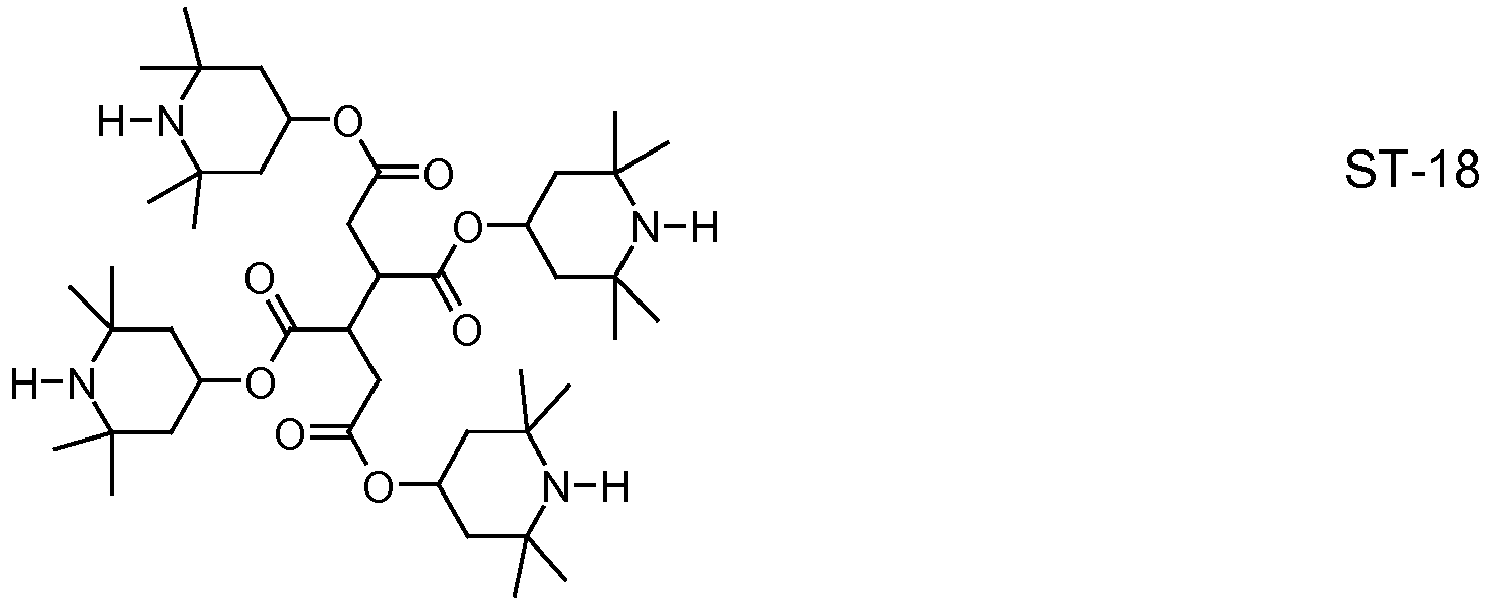
- RST
- denotes H, an alkyl or alkoxy radical having 1 to 15 C atoms, where, in addition, one or more CH2 groups in these radicals may each be replaced, independently of one another, by -C≡C-, -CF2O-, -OCF2-, -CH=CH-,

- ZST
- each, independently of one another, denote -CO-O-, -O-CO-, -CF2O-, -OCF2-, -CH2O-, -OCH2-, -CH2-, -CH2CH2-, -(CH2)4-, -CH=CH-CH2O-, -C2F4-, -CH2CF2-, -CF2CH2-, -CF=CF-, -CH=CF-, -CF=CH-, -CH=CH-, -C≡C- or a single bond,
- L1 and L2
- each, independently of one another, denote F, Cl, CF3 or CHF2,
- p
- denotes 1 or 2,
- q
- denotes 1, 2, 3, 4, 5, 6, 7, 8, 9 or 10.
- Of the compounds of the formula ST, special preference is given to the compounds of the formulae


- In the compounds of the formulae ST-3a and ST-3b, n preferably denotes 3. In the compounds of the formula ST-2a, n preferably denotes 7.
- Very particularly preferred mixtures according to the invention comprise one or more stabilisers from the group of the compounds of the formulae ST-2a-1, ST-3a-1, ST-3b-1, ST-8-1, ST-9-1 and ST-12:


- The compounds of the formulae ST-1 to ST-18 are preferably each present in the liquid-crystal mixtures according to the invention in amounts of 0.005 - 0.5%, based on the mixture.
- If the mixtures according to the invention comprise two or more compounds from the group of the compounds of the formulae ST-1 to ST-18, the concentration correspondingly increases to 0.01 - 1% in the case of two compounds, based on the mixtures.
- However, the total proportion of the compounds of the formulae ST-1 to ST-18, based on the mixture according to the invention, should not exceed 2%.
- Other mesogenic compounds which are not explicitly mentioned above can optionally and advantageously also be used in the media in accordance with the present invention. Such compounds are known to the person skilled in the art.
- In a preferred embodiment of the present invention, the liquid-crystal medium comprises one or more compounds of the formulae I-1 and II-3.
- The liquid-crystal media in accordance with the present invention preferably have a clearing point of 90°C or more, more preferably 95°C or more, particularly preferably 100°C or more.
- The nematic phase of the media according to the invention preferably extends down to a lower temperature of 0°C or less, more preferably down to -10°C or less, even more preferably down to -20°C or less and, most preferably down to -30°C or less. At the same time, it preferably extends up to an upper temperature of to 90°C or more, preferably up to 95°C or more, more preferably up to 100°C or more and, in particular, up to 110°C or more.
- Preferably, the dielectric anisotropy (Δε) of the liquid-crystal medium in accordance with the invention, at 1 kHz and 20°C, is in the range of from 3 to 20, preferably from 5 to 15 and particularly preferably from 6 to 12.
- The Δn of the liquid-crystal media in accordance with the present invention, at 589.3 nm (NaD) and 20°C, is preferably 0.200 or more, more preferably 0.240 or more.
- The Δn of the liquid-crystal media in accordance with the present invention, at 589.3 nm (NaD) and 20°C, is preferably in the range of from 0.200 to 0.400, more preferably from 0.230 to 0.300 and particularly preferably from 0.240 to 0.280.
- Preferably, the liquid crystal media according to the invention comprise:
- one or more compounds of formula I in a total concentration in the range of from 20% to 80%, preferably from 30% to 70%, particularly preferably from 40% to 60%;
- one or more compounds of formula I-1 in a total concentration in the range of from 5% to 25%, preferably from 10% to 20%, particularly preferably from 12% to 18%;
- one or more compounds of formula I-2 in a total concentration in the range of from 1% to 10%, preferably from 2% to 15%, particularly preferably from 3% to 7%;
- one or more compounds of formula I-3 in a total concentration in the range of from 15% to 60%, preferably from 20% to 50%, particularly preferably from 25% to 45%;
- one or more compounds of formula I in a total concentration of 40% or more, preferably of 44% or more, particularly preferably of 55% or more;
- one or more compounds of formula I-1 and I-2 and I-3;
- one or more compounds of formula III-3 in a total concentration in the range of from 1% to 10%, preferably from 2% to 8%;
- one or more compounds of formula VI in a total concentration in the range of from 1% to 10%, preferably from 2% to 7%;
- one or more compounds of formula VI in a total concentration of 20% or less, preferably 10% or less;
- one or more compounds of formula II, preferably IIZ, in a total concentration in the range of from 5% to 50%, preferably 10% to 40%;
- one or more compounds of formula II, preferably IIZ, and one or more compounds of formula VI in a total concentration in the range of from 10% to 30%, preferably 12% to 20%.
- The acronyms used above are created according to tables A to C and are explained in table D.
- Herein, the expression dielectrically positive describes compounds or components where Δε > 3.0, dielectrically neutral describes those where -1.5 ≤ Δε ≤ 3.0 and dielectrically negative describes those where Δε < -1.5. Δε is determined at a frequency of 1 kHz and at 20°C. The dielectric anisotropy of the respective compound is determined from the results of a solution of 10 % of the respective individual compound in a nematic host mixture. If the solubility of the respective compound in the host mixture is less than 10 %, the concentration is reduced to 5 %. The capacitances of the test mixtures are determined both in a cell having homeotropic alignment and in a cell having homogeneous alignment. The cell thickness of both types of cells is approximately 20 µm. The voltage applied is a rectangular wave having a frequency of 1 kHz and an effective value of typically 0.5 V to 1.0 V, but it is always selected to be below the capacitive threshold of the respective test mixture.
- The following definitions apply here.


- The host mixture used for dielectrically positive compounds is mixture ZLI-4792 and that used for dielectrically neutral and dielectrically negative compounds is mixture ZLI-3086, both from Merck KGaA, Germany. The absolute values of the dielectric constants of the compounds are determined from the change in the respective values of the host mixture on addition of the compounds of interest. The values are extrapolated to a concentration of the compounds of interest of 100 %.
- Components having a nematic phase at the measurement temperature of 20°C are measured as such. All others are treated like compounds.
- Herein, the expression "threshold voltage" refers to the optical threshold and is quoted for 10% relative contrast (V10), "mid-grey voltage" is the voltage for 50 % relative contrast (V50) and the expression "saturation voltage" refers to the optical saturation and is quoted for 90 % relative contrast (V90), in all cases unless expressly stated otherwise. All characteristic voltages are determined for perpendicular observation. The capacitive threshold voltage (V0), also called the Freedericks threshold (VFr), is only used if expressly mentioned.
- Herein, the following conditions and definitions apply, unless expressly stated otherwise. All concentrations are quoted in per cent by weight and relate to the respective mixture as a whole, all temperatures are quoted in degrees Celsius and all temperature differences are quoted in differential degrees. All physical properties are determined in accordance with "Merck liquid Crystals, Physical Properties of liquid Crystals", Status Nov. 1997, Merck KGaA, Germany, and are quoted for a temperature of 20°C, unless expressly stated otherwise. The optical anisotropy (Δn) is determined at a wavelength of 589.3 nm. The dielectric anisotropy (Δε) is determined at a frequency of 1 kHz. The threshold voltages, as well as all other electro-optical properties, are determined using test cells produced at Merck KGaA, Germany. The test cells for the determination of Δε have a cell thickness of approximately 20 µm. The electrode is a circular ITO electrode having an area of 1.13 cm2 and a guard ring. The orientation layers are SE-1211 from Nissan Chemicals, Japan, for homeotropic orientation (ε∥) and polyimide AL-1054 from Japan Synthetic Rubber, Japan, for homogeneous orientation (ε⊥). The capacitances are determined using a Solatron 1260 frequency response analyser using a sine wave with a voltage of 0.3 Vrms.
- The light used in the electro-optical measurements is white light. A set-up using a commercially available DMS instrument from Autronic-Melchers, Germany, is used here. The characteristic voltages have been determined under perpendicular observation. The threshold (V10), mid-grey (V50) and saturation (V90) voltages have been determined for 10 %, 50 % and 90 % relative contrast, respectively.
- Herein, the term "compounds" does mean both one compound and a plurality of compounds, unless expressly stated otherwise.
- The liquid-crystal media according to the invention preferably have nematic phases of in each case at least from -20°C to 80°C, preferably from -30°C to 100°C and very particularly preferably from -40°C to 130°C. The expression have a nematic phase here means on the one hand that no smectic phase and no crystallisation are observed at low temperatures at the corresponding temperature and on the other hand that no clearing occurs on heating from the nematic phase. The investigation at low temperatures is carried out in a flow viscometer at the corresponding temperature and checked by storage in test cells having a layer thickness of 5 µm for at least 100 hours. At high temperatures, the clearing point is measured in capillaries by conventional methods.
- The clearing point (T(N,I)) of the liquid crystalline media preferably is 90°C or more, more preferably 95°C or more and particularly preferably 100°C or more.
- The liquid-crystal media according to the invention are also characterised by suitable rotational viscosities (γ1). The rotational viscosities are preferably 350 mPa·s or less, more preferably 300 mPa·s or less, even more preferably 280 mPa·s or less and most preferably 250 mPa·s or less. Preferably the rotational viscosities of the media are as low as possible. However, a possible practical lower limit could be 100 mPa·s or more or even 150 mPa·s or more.
- The term "alkyl" preferably encompasses straight-chain and branched alkyl groups, as well as cycloalkyl groups, each having 1 to 15 carbon atoms, in particular the straight-chain groups methyl, ethyl, propyl, butyl, pentyl, hexyl and heptyl, as well as cyclopropyl and cyclohexyl. Groups having 2 to 10 carbon atoms are generally preferred.
- The term "alkenyl" preferably encompasses straight-chain and branched alkenyl groups having 2 to 15 carbon atoms, in particular the straight-chain groups. Particularly preferred alkenyl groups are C2- to C7-1 E-alkenyl, C4- to C7-3E-alkenyl, C5- to C7-4-alkenyl, C6- to C7-5-alkenyl and C7-6-alkenyl, in particular C2- to C7-1 E-alkenyl, C4- to C7-3E-alkenyl and C5- to C7-4-alkenyl. Examples of further preferred alkenyl groups are vinyl, 1 E-propenyl, 1 E-butenyl, 1 E-pentenyl, 1 E-hexenyl, 1 E-heptenyl, 3-butenyl, 3E-pentenyl, 3E-hexenyl, 3E-heptenyl, 4-pentenyl, 4Z-hexenyl, 4E-hexenyl, 4Z-heptenyl, 5-hexenyl, 6-heptenyl and the like. Groups having up to 5 carbon atoms are generally preferred.
- The term "fluoroalkyl" preferably encompasses straight-chain groups having a terminal fluorine, i.e. fluoromethyl, 2-fluoroethyl, 3-fluoropropyl, 4-fluorobutyl, 5-fluoropentyl, 6-fluorohexyl and 7-fluoroheptyl. However, other positions of the fluorine are not excluded.
- The term "oxaalkyl" or "alkoxyalkyl" preferably encompasses straight-chain radicals of the formula CnH2n+1-O-(CH2)m, in which n and m each, independently of one another, denote an integer from 1 to 10. Preferably, n here is 1 and m is 1 to 6.
- Compounds containing a vinyl end group and compounds containing a methyl end group have low rotational viscosity.
- The liquid-crystal media in accordance with the present invention may comprise further additives and chiral dopants in the usual concentrations. The total concentration of these further constituents is in the range from 0 % to 10 %, preferably 0.1 % to 6 %, based on the mixture as a whole. The concentrations of the individual compounds used are each preferably in the range from 0.1 % to 3 %. The concentration of these and similar additives is not taken into consideration when quoting the values and concentration ranges of the liquid-crystal components and liquid-crystal compounds of the liquid-crystal media according to the invention.
- The liquid-crystal media according to the invention consist of a plurality of compounds, preferably 3 to 30, more preferably 4 to 20 and very preferably 4 to 15 compounds. These compounds are mixed in a conventional manner. In general, the desired amount of the compound used in the smaller amount is dissolved in the compound used in the larger amount. If the temperature is above the clearing point of the compound used in the higher concentration, it is particularly easy to observe completion of the dissolution process. It is, however, also possible to prepare the media in other conventional ways, for example using so-called pre-mixes, which can be, for example, homologous or eutectic mixtures of compounds, or using so-called "multibottle" systems, the constituents of which are themselves ready-to-use mixtures.
- All temperatures, such as, for example, the melting point T(C,N) or T(C,S), the transition from the smectic (S) to the nematic (N) phase T(S,N) and the clearing point T(N,I) of the liquid crystals, are quoted in degrees Celsius. All temperature differences are quoted in differential degrees.
- In the present invention and especially in the following examples, the structures of the mesogenic compounds are indicated by means of abbreviations also referred to as acronyms. In these acronyms, the chemical formulae are abbreviated as follows using Tables A to C below. All groups CnH2n+1, CmH2m+1 and ClH2l+1 or CnH2n-1, CmH2m-1 and ClH2l-1 denote straight-chain alkyl or alkenyl, preferably 1 E-alkenyl, having n, m and I C atoms respectively, where n, m and l, independently of one another, denote an integer from 1 to 9, preferably 1 to 7, or from 2 to 9, preferably 2 to 7, respectively. CoH2o+1 denotes straight-chain alkyl having 1 to 7, preferably 1 to 4, C atoms, or branched alkyl having 1 to 7, preferably 1 to 4, C atoms.
- Table A lists the codes used for the ring elements of the core structures of the compounds, while Table C shows the linking groups. Table C gives the meanings of the codes for the left-hand or right-hand end groups. Table D shows illustrative structures of compounds with their respective abbreviations.
Table A: Ring elements C 
P 
D 
DI 
A 
AI 
G 
GI 
U 
UI 
Y 
M 
MI 
N 
NI 
fN 
fNI 
dH 
N(2,6) 
K 
KI 
L 
LI 
F 
FI 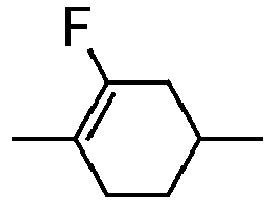
Table B: Linking groups E -CH2CH2- Z -CO-O- V -CH=CH- ZI -O-CO- X -CF=CH- O -CH2-O- XI -CH=CF- OI -O-CH2- B -CF=CF- Q -CF2-O- T -C≡C- QI -O-CF2- W -CF2CF2- Table C: End groups Left-hand side Right-hand side Use alone -n- CnH2n+1- -n -CnH2n+1 -nO- CnH2n+1-O- -nO -O-CnH2n+1 -V- CH2=CH- -V -CH=CH2 -nV- CnH2n+1-CH=CH- -nV -CnH2n-CH=CH2 -Vn- CH2=CH-CnH2n+1- -Vn -CH=CH-CnH2n+1 -nVm- CnH2n+1-CH=CH-CmH2m- -nVm -CnH2n-CH=CH-CmH2m+1 -N- N≡C- -N -C≡N -S- S=C=N- -S -N=C=S -F- F- -F -F -CL- CI- -CL -Cl -M- CFH2- -M -CFH2 -D- CF2H- -D -CF2H -T- CF3- -T -CF3 -MO- CFH2O - -OM -OCFH2 -DO- CF2HO - -OD -OCF2H -TO- CF3O - -OT -OCF3 -OXF- CF2=CH-O- -OXF -O-CH=CF2 -A- H-C=C- -A -C≡C-H -nA- CnH2n+1-C≡C- -An -C≡C-CnH2n+1 -NA- N≡C-C≡C- -AN -C≡C-C≡N Use together with others -...A...- -C≡C- -...A... -C≡C- -...V...- CH=CH- -...V... -CH=CH- -...Z...- -CO-O- -...Z... -CO-O- -...ZI...- -O-CO- -...ZI... -O-CO- -...K...- -CO- -...K... -CO- -...W...- -CF=CF- -...W... -CF=CF- - The following table shows illustrative structures together with their respective abbreviations. These are shown in order to illustrate the meaning of the rules for the abbreviations. They furthermore represent compounds which are preferably used.
Table D: Illustrative structures The illustrative structures show compounds which are particularly preferably employed. 


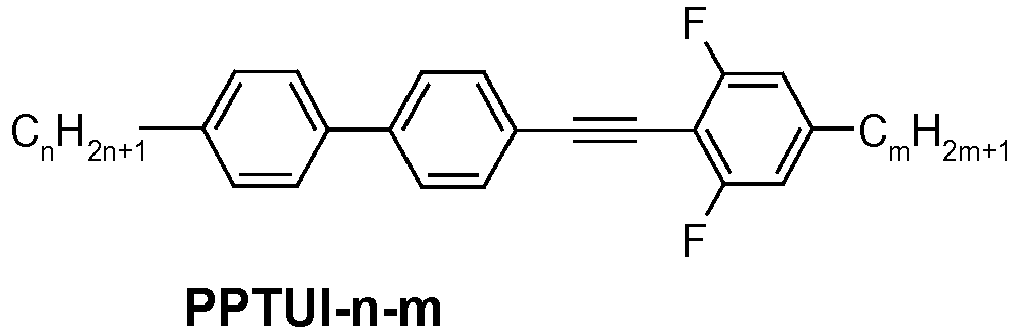


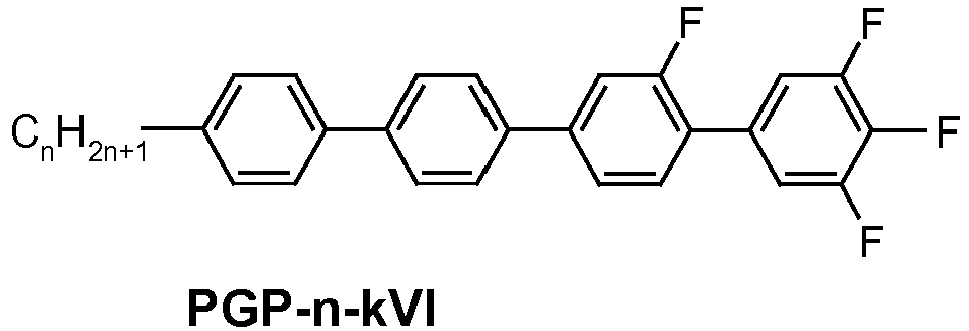

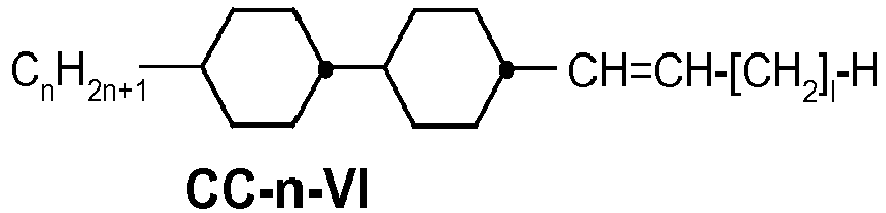


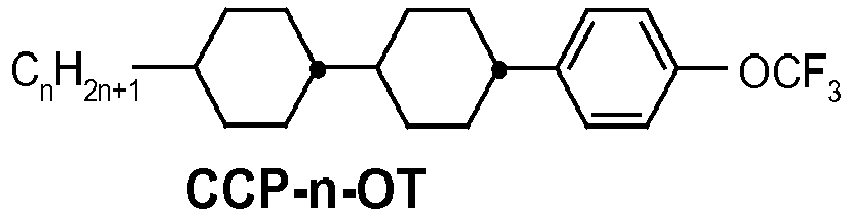


- Herein n ∋ {1;2;3;4;5;6;7}, m ∋ {1;2;3;4;5;6;7}, and k ∋ {1;2;3;4}, preferably 2 or 4, most preferably 2, and l ∋ {1;2;3}, preferably 1.
- The following table, Table E, shows illustrative compounds which can be used as stabiliser in the liquid-crystal media in accordance with the present invention. The total concentration of these and similar compounds in the media is preferably 5 % or less.


- In a preferred embodiment of the present invention, the liquid-crystal media comprise one or more compounds selected from the group of the compounds from Table E.
- The liquid-crystal media in accordance with the present invention preferably comprise two or more, preferably four or more, compounds selected from the group consisting of the compounds from the above tables.
- The liquid-crystal media in accordance with the present invention preferably comprise
- seven or more, preferably eight or more, compounds, preferably compounds having three or more, preferably four or more, different formulae, selected from the group of the compounds from Table D.
- The following examples illustrate the present invention without limiting it in any way. However, it becomes clear to the person skilled in the art from the physical properties what properties can be achieved and in what ranges they can be modified. In particular, the combination of the various properties which can preferably be achieved is thus well defined for the person skilled in the art.
- The nematic liquid-crystal mixtures C1, C2, and N1 to N12 are prepared as follows:
Comparative Example C1 CEP-3-N 10.0 % T(N,I). [°C]: 74 CP-3-N 24.0 % Δn (589.3 nm, 20°C) 0.1383 CP-5-N 5.0 % ne (589.3 nm, 20°C) 1.6376 CP-3-O2 16.0 % no (589.3 nm, 20°C) 1.4993 CP-3-OT 5.0 % Δε (1 kHz, 20°C): 7.5 CCEP-3-1 6.0 % ε∥ (1 kHz, 20°C): 11.4 CCEP-3-2 5.0 % ε⊥ (1 kHz, 20°C): 3.9 CCEP-3-3 5.0 % γ1 [mPa·s], (20°C): 119 PTP-1-O2 6.0 % K1 [pN], (20°C): 12.7 PTP-2-O1 6.0 % K3 [pN], (20°C): 17.8 CPP-3-2 6.0 % V0 [V], (20°C): 1.40 CPP-5-2 6.0 % ∑ 100.0 % Comparative Example C2 PUQU-3-F 15.0 % T(N,I). [°C]: 101 PGUQU-3-F 6.0 % Δn (589.3 nm, 20°C) 0.1889 CP-3-O2 18.0 % ne (589.3 nm, 20°C) 1.6969 CVCP-1V-O1 4.0 % no (589.3 nm, 20°C) 1.5081 PP-1-2V1 6.0 % Δε (1 kHz, 20°C): 9.6 PGU-2-F 6.0 % ε∥ (1 kHz, 20°C): 13.6 PGU-3-F 6.0 % ε⊥ (1 kHz, 20°C): 4.0 PGIGI-3-F 12.0 % γ1 [mPa·s], (20°C): 253 PGP-2-3 7.0 % K1 [pN], (20°C): 16.3 CPGP-5-2 6.0 % K3 [pN], (20°C): 17.9 CPGP-5-3 6.0 % V0 [V], (20°C): 1.38 CGPC-3-3 4.0 % CGPC-5-3 4.0 % ∑ 100.0% Mixture Example N1 PZG-2-N 13.0 % T(N,I). [°C]: 114 PZG-3-N 7.0 % Δn (589.3 nm, 20°C) 0.2563 PZG-4-N 9.0 % ne (589.3 nm, 20°C) 1.7657 PZG-5-N 8.0 % no (589.3 nm, 20°C) 1.5094 CP-3-O2 7.0 % Δε (1 kHz, 20°C): 10.6 CC-5-V 8.0 % ε∥ (1 kHz, 20°C): 14.7 PTP-1-O2 8.0 % ε⊥ (1 kHz, 20°C): 4.1 PTP-2-O1 8.0 % γ1 [mPa·s], (20°C): 319 PPTUI-3-2 13.0 % K1 [pN], (20°C): 15.2 PPTUI-3-4 15.0 % K3 [pN], (20°C): 18.4 CCZPC-3-3 3.0 % V0 [V], (20°C): 1.27 CCZPC-3-4 4.0 % ∑ 100.0 % Mixture Example N2 PZG-4-N 10.5 % T(N,I). [°C]: 104 CP-1V-N 5.0 % Δn (589.3 nm, 20°C) 0.2493 CP-3-O1 16.5 % ne (589.3 nm, 20°C) 1.7652 CCP-V-1 7.0 % no (589.3 nm, 20°C) 1.5159 PTP-1-O2 4.5 % Δε (1 kHz, 20°C): 7.1 PTP-2-O1 4.5 % ε∥ (1 kHz, 20°C): 11.0 PTP-3-O1 4.5 % ε⊥ (1 kHz, 20°C): 3.9 CPTP-3-O1 5.0 % γ1 [mPa·s], (20°C): 245 PPTUI-3-2 20.0 % PPTUI-3-4 20.0 % CGPC-3-3 2.5 % ∑ 100.0% - The media N3 to N6 are prepared from the medium N2 by addition of stabilisers selected from ST-16, ST-3a-1, ST-3b-1, and ST-8-1, in the amounts given in the table below.


Mixture c(ST-16) [1%] ST-3a-1 [ppm] ST-3b-1 [ppm] ST-8-1 [ppm] N3 0.5 - - N4 0.5 100 - - N5 - 300 - - N6 - 300 - 100 N7 - 300 - 500 N8 - 300 - 1000 N9 - - 300 - N10 - - 300 100 N11 - - 300 500 N12 - - 300 1000 - A LC zoom lens equipped with one of the media N1 to N12 has a shorter shortest focal length and a lower driving voltage than a zoom lens equipped with the medium C1 or C2.
in formula IIZ-2 most preferably alkenyl,


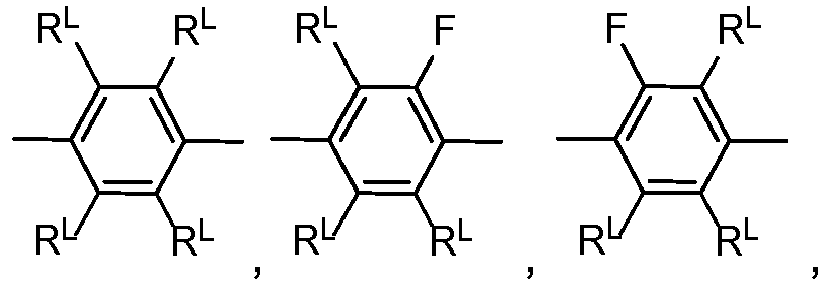


and wherein


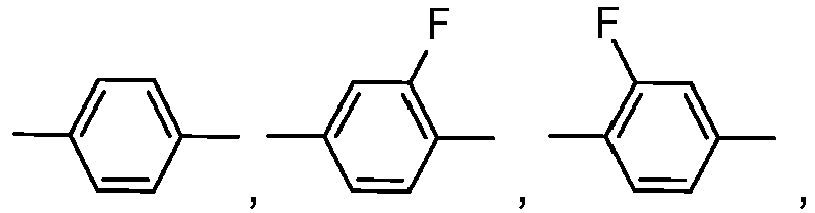


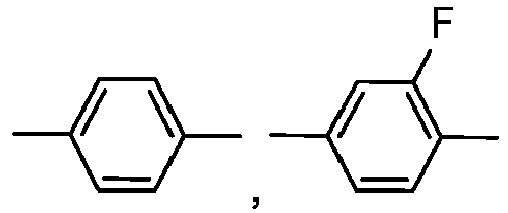


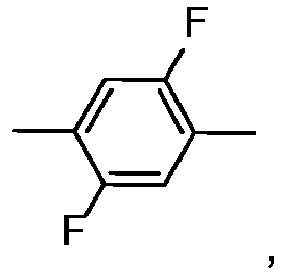


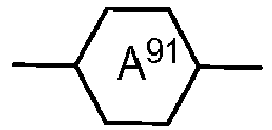


and wherein


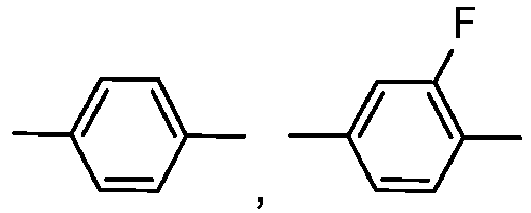


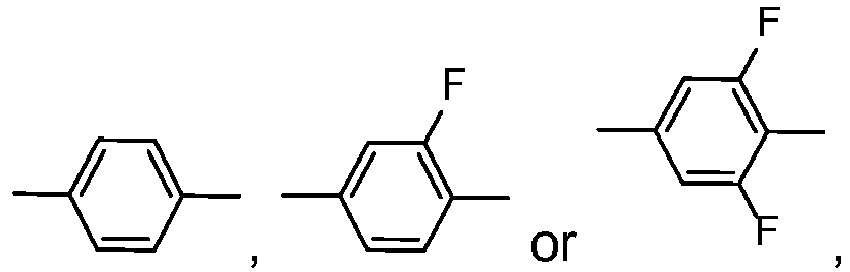


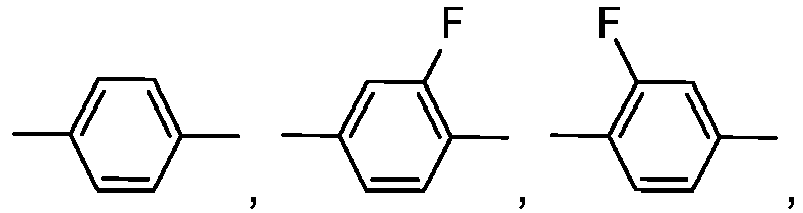


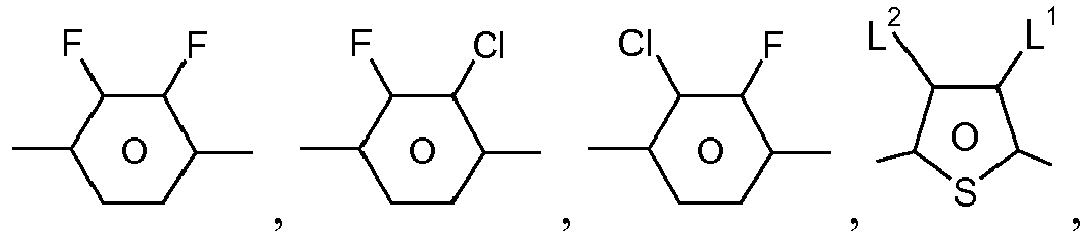


Claims (16)
- A liquid-crystal lens comprising an electrode on a substrate and a liquid-crystal medium, characterised in that the liquid-crystal medium contains- one or more compounds of formula I
 R11 and R12 identically or differently, denote H, alkyl or alkoxy having 1 to 12 C atoms, or alkenyl, alkenyloxy or alkoxyalkyl having 2 to 12 C atoms, in which one or more CH2-groups may be replaced by
 L11, L12, L13 independently of one another, denote H, Cl or F,


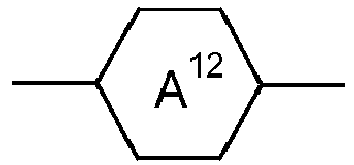

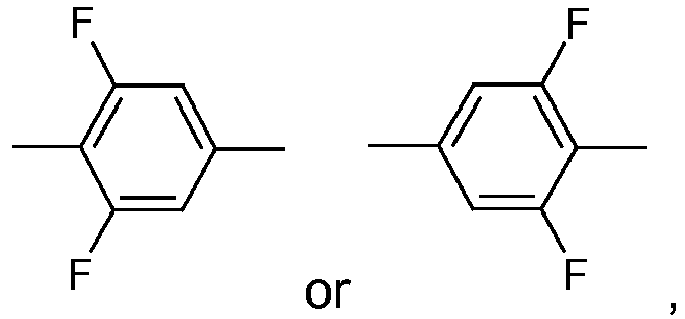 Z1 denotes denote a single bond, -CH2CH2-, -CH=CH-, -CF2O-, -OCF2-, -CH2O-, -OCH2-, -COO-, -OCO-, -C2F4-, -CF=CF-, -CH=CHCH2O-,n is 0 or 1;and- one or more compounds of formula II
 R2 has the meanings of R11 above,X2 denotes F, Cl, CF3, OCF3, CN or NCS,Z2 denotes C=O or CF2,L21, L22 and L23 identically or differently, denote, H or F,L2 denotes H or alkyl having 1 to 6 C atoms,


 m and n are, independently of each other, 0 or 1.
 - The lens according to claim 1, wherein Z2 in formula II denotes C=O.
- The lens according to claim 1 or 2, wherein the one or more compounds of formula II are selected from the compounds of formula IIZ

- The lens according to one or more of claims 1 to 3, wherein the one or more compounds of formula I are selected from the group of compounds of formulae I-1 to I-3:
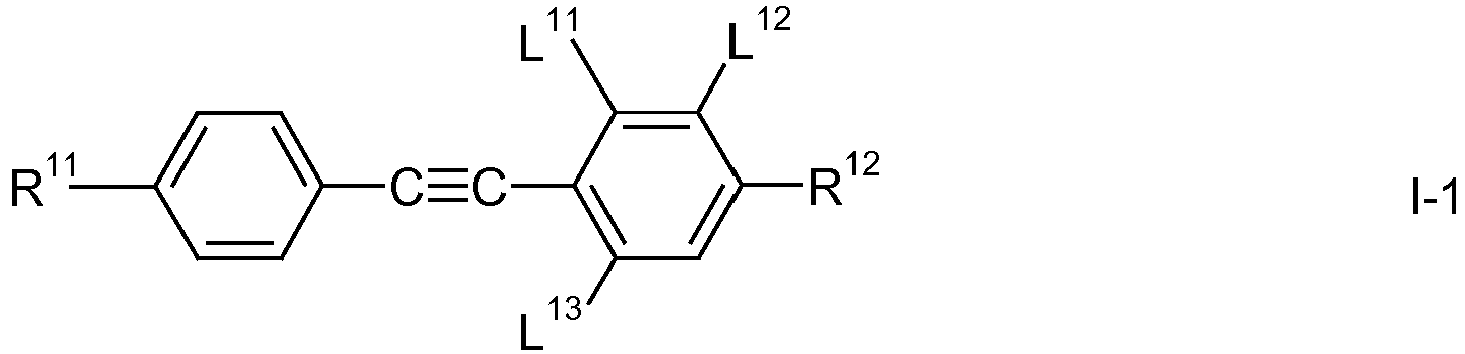

 R11 and R12 have the meanings defined in claim 1,Z1 denotes -CO-O-, -CH2CH2- or a single bond, andL11 to L13 each, independently of one another, denote H or F.
 - The lens according to claim 4, wherein the liquid crystal medium comprises one or more compounds of formula I-1, one or more compounds of formula I-2 and one or more compounds of formula I-3.
- The lens according to one or more of claims 1 to 5, wherein the proportion of the one or more compounds of formula I is 40% or more.
- The lens according to one or more of claims 1 to 6, wherein the medium comprises one or more compounds of formula III
 R31, R32 identically or differently, denotes alkyl having 1 to 20 C atoms, which is straight chain or branched, is non-substituted, mono- or poly-substituted by F, Cl or CN, and in which one or more CH2 groups are optionally replaced, in each case independently from one another, by -O-, -S-, -CO-, -COO-, -OCO-, -OCO-O-,
-S-CO-, -CO-S-, -CH=CH- or -C≡C- in such a manner that O and/or S atoms are not linked directly to one another,


 Z31 and Z32 on each occurrence, identically or differently, denote -CH2CH2-, -CF2CF2-, -CF2CH2-, -COO-, trans--CH=CH-, trans--CF=CF-, -CH2O-, -CF2O-, -C≡C- or a single bondp is 0, 1 or 2.
 - The lens according to claim 7, wherein the proportion of the one or more compounds of formula III in the liquid-crystal medium is 30% or less.
- The lens according to one or more of claims 1 to claim 8, wherein the medium comprises one or more compounds of formula III-3

- The lens according to one or more of claims 1 to 9, wherein the liquid crystal medium comprises one or more compounds of formula VI


 R6 denotes H, alkyl or alkoxy having 1 to 12 C atoms, or alkenyl, alkenyloxy or alkoxyalkyl having 2 to 12 C atoms, in which one or more CH2-groups may be replaced by
 X6 denotes CN, F, CF3 or OCF3, preferably CN, andY61, Y62 identically or differently, denotes H, Cl or F.
 - The lens according to one or more of claims 1 to 10, wherein the liquid-crystal medium has a clearing temperature of 100°C or more.
- The lens according to claim 1, wherein the electrode is patterned.
- The liquid-crystal medium set forth in one or more of claim 1 to 11.
- Process for the preparation of a liquid-crystal medium according to claim 13, characterised in that one or more compounds of formula I, one or more compounds of formula II and optionally one or more compounds of formula III, as defined in claims 1 and 7, are mixed with one or more further compounds and/or with one or more additives.
- Use of a liquid-crystal medium according to claim 13 in a TN display, STN display, PDLC display, phase modulator, camera, mobile phone camera, 3D LCD shutter glass, 3D display, LC lens, holographic projection system, LCoS spatial light modulator or component for highfrequency technology operable in the microwave range.
- Electro-optical device component comprising one or more lenses according to claim 1 or 12.
Applications Claiming Priority (1)
| Application Number | Priority Date | Filing Date | Title |
|---|---|---|---|
| TW107125456A TWI775904B (en) | 2018-07-24 | 2018-07-24 | Liquid-crystal lens |
Publications (2)
| Publication Number | Publication Date |
|---|---|
| EP3599266A1 true EP3599266A1 (en) | 2020-01-29 |
| EP3599266B1 EP3599266B1 (en) | 2021-05-12 |
Family
ID=67438321
Family Applications (1)
| Application Number | Title | Priority Date | Filing Date |
|---|---|---|---|
| EP19187473.4A Active EP3599266B1 (en) | 2018-07-24 | 2019-07-22 | Liquid-crystal lens |
Country Status (5)
| Country | Link |
|---|---|
| US (1) | US11473014B2 (en) |
| EP (1) | EP3599266B1 (en) |
| JP (1) | JP7428485B2 (en) |
| KR (1) | KR102900454B1 (en) |
| TW (1) | TWI775904B (en) |
Cited By (2)
| Publication number | Priority date | Publication date | Assignee | Title |
|---|---|---|---|---|
| WO2022008474A1 (en) * | 2020-07-08 | 2022-01-13 | Merck Patent Gmbh | Optical component |
| WO2022238453A1 (en) * | 2021-05-12 | 2022-11-17 | Merck Patent Gmbh | Liquid crystal medium and electronic component |
Families Citing this family (4)
| Publication number | Priority date | Publication date | Assignee | Title |
|---|---|---|---|---|
| JP7676352B2 (en) * | 2021-12-23 | 2025-05-14 | アップル インコーポレイテッド | Liquid crystal compounds and compositions for adjustable lenses - Patents.com |
| JP7413426B2 (en) * | 2022-03-18 | 2024-01-15 | 維沃移動通信有限公司 | Light projecting equipment, ranging equipment, and electronic equipment |
| WO2024035667A1 (en) * | 2022-08-12 | 2024-02-15 | Corning Incorporated | Polyfluoroaromatic derivatives for liquid lenses |
| CN118185637A (en) * | 2022-12-12 | 2024-06-14 | 石家庄诚志永华显示材料有限公司 | Liquid crystal composition, liquid crystal display element or liquid crystal display |
Citations (6)
| Publication number | Priority date | Publication date | Assignee | Title |
|---|---|---|---|---|
| EP2006352A1 (en) * | 2006-03-13 | 2008-12-24 | Chisso Corporation | Liquid-crystal composition and liquid-crystal element |
| WO2010022891A1 (en) * | 2008-08-29 | 2010-03-04 | Merck Patent Gmbh | Liquid crystalline medium and liquid crystal display |
| US9746745B1 (en) | 2016-10-11 | 2017-08-29 | Industrial Technology Research Institute | Zoom lens and method for manufacturing the same |
| WO2018078078A1 (en) * | 2016-10-31 | 2018-05-03 | Merck Patent Gmbh | Nanocapsules comprising a liquid-crystalline medium |
| US20180171229A1 (en) * | 2015-07-02 | 2018-06-21 | Dic Corporation | Liquid crystal composition and liquid crystal display device |
| US20180171234A1 (en) * | 2015-07-02 | 2018-06-21 | Dic Corporation | Liquid crystal composition and liquid crystal display device using the same |
Family Cites Families (5)
| Publication number | Priority date | Publication date | Assignee | Title |
|---|---|---|---|---|
| DE10223912A1 (en) | 2001-06-28 | 2003-01-16 | Merck Patent Gmbh | Twisted nematic and super twisted nematic liquid crystal displays contain compounds having specified dielectric anisotropy values |
| DE102004002418B4 (en) * | 2003-02-14 | 2012-05-16 | Merck Patent Gmbh | Liquid-crystalline medium and its use |
| CN101712874B (en) * | 2009-11-26 | 2013-03-13 | 石家庄诚志永华显示材料有限公司 | Large optical anisotropic liquid crystal composition |
| EP2399972B1 (en) * | 2010-06-25 | 2015-11-25 | Merck Patent GmbH | Liquid-crystalline medium and liquid-crystal display having high twist |
| CN104650927A (en) * | 2015-02-09 | 2015-05-27 | 石家庄诚志永华显示材料有限公司 | Liquid crystal composition |
-
2018
- 2018-07-24 TW TW107125456A patent/TWI775904B/en active
-
2019
- 2019-07-15 KR KR1020190084843A patent/KR102900454B1/en active Active
- 2019-07-22 EP EP19187473.4A patent/EP3599266B1/en active Active
- 2019-07-23 JP JP2019135304A patent/JP7428485B2/en active Active
- 2019-07-24 US US16/520,960 patent/US11473014B2/en active Active
Patent Citations (6)
| Publication number | Priority date | Publication date | Assignee | Title |
|---|---|---|---|---|
| EP2006352A1 (en) * | 2006-03-13 | 2008-12-24 | Chisso Corporation | Liquid-crystal composition and liquid-crystal element |
| WO2010022891A1 (en) * | 2008-08-29 | 2010-03-04 | Merck Patent Gmbh | Liquid crystalline medium and liquid crystal display |
| US20180171229A1 (en) * | 2015-07-02 | 2018-06-21 | Dic Corporation | Liquid crystal composition and liquid crystal display device |
| US20180171234A1 (en) * | 2015-07-02 | 2018-06-21 | Dic Corporation | Liquid crystal composition and liquid crystal display device using the same |
| US9746745B1 (en) | 2016-10-11 | 2017-08-29 | Industrial Technology Research Institute | Zoom lens and method for manufacturing the same |
| WO2018078078A1 (en) * | 2016-10-31 | 2018-05-03 | Merck Patent Gmbh | Nanocapsules comprising a liquid-crystalline medium |
Non-Patent Citations (2)
| Title |
|---|
| S. SATO, JPN. J. APPL. PHYS., vol. 18, 1979, pages 1679 |
| S. SATO, OPTICAL REVIEW, vol. 6, no. 6, 1999, pages 471 - 485 |
Cited By (5)
| Publication number | Priority date | Publication date | Assignee | Title |
|---|---|---|---|---|
| WO2022008474A1 (en) * | 2020-07-08 | 2022-01-13 | Merck Patent Gmbh | Optical component |
| CN115777009A (en) * | 2020-07-08 | 2023-03-10 | 默克专利股份有限公司 | optical components |
| US20230313043A1 (en) * | 2020-07-08 | 2023-10-05 | Merck Patent Gmbh | Optical component |
| US12258509B2 (en) * | 2020-07-08 | 2025-03-25 | Merck Patent Gmbh | Optical component |
| WO2022238453A1 (en) * | 2021-05-12 | 2022-11-17 | Merck Patent Gmbh | Liquid crystal medium and electronic component |
Also Published As
| Publication number | Publication date |
|---|---|
| JP7428485B2 (en) | 2024-02-06 |
| EP3599266B1 (en) | 2021-05-12 |
| KR20200011361A (en) | 2020-02-03 |
| TW202007767A (en) | 2020-02-16 |
| JP2020021065A (en) | 2020-02-06 |
| KR102900454B1 (en) | 2025-12-17 |
| US11473014B2 (en) | 2022-10-18 |
| US20200032142A1 (en) | 2020-01-30 |
| TWI775904B (en) | 2022-09-01 |
Similar Documents
| Publication | Publication Date | Title |
|---|---|---|
| EP3599266B1 (en) | Liquid-crystal lens | |
| EP3839009B1 (en) | Liquid-crystalline medium and liquid-crystal display comprising the same | |
| US10883047B2 (en) | Liquid-crystalline medium and liquid-crystal display comprising the same | |
| KR102658941B1 (en) | Liquid-crystalline medium and liquid-crystal display comprising the same | |
| TWI895313B (en) | Liquid-crystalline medium and liquid-crystal display comprising the same and compounds | |
| KR20160137393A (en) | Liquid-crystalline medium and liquid-crystal display comprising the same | |
| KR20170115447A (en) | Liquid-crystalline medium and liquid-crystal display comprising the same | |
| KR20200051741A (en) | Liquid crystal medium and liquid crystal display comprising same | |
| CN101508896A (en) | Liquid crystal medium and liquid crystal display | |
| EP3810724B1 (en) | Liquid-crystalline medium | |
| KR102366745B1 (en) | Liquid-crystalline media, switchable liquid crystal lenses and liquid crystal displays comprising them | |
| KR102285824B1 (en) | Liquid-crystalline media, switchable liquid crystal lenses and liquid crystal displays comprising them | |
| CN112358884A (en) | Liquid crystal lens | |
| KR102285837B1 (en) | Liquid-crystalline media, switchable liquid crystal lenses and liquid crystal displays comprising these | |
| KR102285846B1 (en) | Liquid-crystalline media, two-frequency electro-optical switching elements and liquid crystal devices comprising these | |
| CN120349802A (en) | Liquid crystal medium and liquid crystal display |
Legal Events
| Date | Code | Title | Description |
|---|---|---|---|
| PUAI | Public reference made under article 153(3) epc to a published international application that has entered the european phase |
Free format text: ORIGINAL CODE: 0009012 |
|
| STAA | Information on the status of an ep patent application or granted ep patent |
Free format text: STATUS: REQUEST FOR EXAMINATION WAS MADE |
|
| 17P | Request for examination filed |
Effective date: 20190722 |
|
| AK | Designated contracting states |
Kind code of ref document: A1 Designated state(s): AL AT BE BG CH CY CZ DE DK EE ES FI FR GB GR HR HU IE IS IT LI LT LU LV MC MK MT NL NO PL PT RO RS SE SI SK SM TR |
|
| AX | Request for extension of the european patent |
Extension state: BA ME |
|
| STAA | Information on the status of an ep patent application or granted ep patent |
Free format text: STATUS: EXAMINATION IS IN PROGRESS |
|
| 17Q | First examination report despatched |
Effective date: 20201002 |
|
| GRAP | Despatch of communication of intention to grant a patent |
Free format text: ORIGINAL CODE: EPIDOSNIGR1 |
|
| STAA | Information on the status of an ep patent application or granted ep patent |
Free format text: STATUS: GRANT OF PATENT IS INTENDED |
|
| INTG | Intention to grant announced |
Effective date: 20210209 |
|
| GRAS | Grant fee paid |
Free format text: ORIGINAL CODE: EPIDOSNIGR3 |
|
| GRAA | (expected) grant |
Free format text: ORIGINAL CODE: 0009210 |
|
| STAA | Information on the status of an ep patent application or granted ep patent |
Free format text: STATUS: THE PATENT HAS BEEN GRANTED |
|
| AK | Designated contracting states |
Kind code of ref document: B1 Designated state(s): AL AT BE BG CH CY CZ DE DK EE ES FI FR GB GR HR HU IE IS IT LI LT LU LV MC MK MT NL NO PL PT RO RS SE SI SK SM TR |
|
| REG | Reference to a national code |
Ref country code: GB Ref legal event code: FG4D |
|
| REG | Reference to a national code |
Ref country code: CH Ref legal event code: EP |
|
| REG | Reference to a national code |
Ref country code: DE Ref legal event code: R096 Ref document number: 602019004560 Country of ref document: DE |
|
| REG | Reference to a national code |
Ref country code: IE Ref legal event code: FG4D |
|
| REG | Reference to a national code |
Ref country code: AT Ref legal event code: REF Ref document number: 1392181 Country of ref document: AT Kind code of ref document: T Effective date: 20210615 |
|
| REG | Reference to a national code |
Ref country code: LT Ref legal event code: MG9D |
|
| REG | Reference to a national code |
Ref country code: AT Ref legal event code: MK05 Ref document number: 1392181 Country of ref document: AT Kind code of ref document: T Effective date: 20210512 |
|
| REG | Reference to a national code |
Ref country code: NL Ref legal event code: MP Effective date: 20210512 |
|
| PG25 | Lapsed in a contracting state [announced via postgrant information from national office to epo] |
Ref country code: HR Free format text: LAPSE BECAUSE OF FAILURE TO SUBMIT A TRANSLATION OF THE DESCRIPTION OR TO PAY THE FEE WITHIN THE PRESCRIBED TIME-LIMIT Effective date: 20210512 Ref country code: LT Free format text: LAPSE BECAUSE OF FAILURE TO SUBMIT A TRANSLATION OF THE DESCRIPTION OR TO PAY THE FEE WITHIN THE PRESCRIBED TIME-LIMIT Effective date: 20210512 Ref country code: FI Free format text: LAPSE BECAUSE OF FAILURE TO SUBMIT A TRANSLATION OF THE DESCRIPTION OR TO PAY THE FEE WITHIN THE PRESCRIBED TIME-LIMIT Effective date: 20210512 Ref country code: AT Free format text: LAPSE BECAUSE OF FAILURE TO SUBMIT A TRANSLATION OF THE DESCRIPTION OR TO PAY THE FEE WITHIN THE PRESCRIBED TIME-LIMIT Effective date: 20210512 Ref country code: BG Free format text: LAPSE BECAUSE OF FAILURE TO SUBMIT A TRANSLATION OF THE DESCRIPTION OR TO PAY THE FEE WITHIN THE PRESCRIBED TIME-LIMIT Effective date: 20210812 |
|
| PG25 | Lapsed in a contracting state [announced via postgrant information from national office to epo] |
Ref country code: PL Free format text: LAPSE BECAUSE OF FAILURE TO SUBMIT A TRANSLATION OF THE DESCRIPTION OR TO PAY THE FEE WITHIN THE PRESCRIBED TIME-LIMIT Effective date: 20210512 Ref country code: NO Free format text: LAPSE BECAUSE OF FAILURE TO SUBMIT A TRANSLATION OF THE DESCRIPTION OR TO PAY THE FEE WITHIN THE PRESCRIBED TIME-LIMIT Effective date: 20210812 Ref country code: LV Free format text: LAPSE BECAUSE OF FAILURE TO SUBMIT A TRANSLATION OF THE DESCRIPTION OR TO PAY THE FEE WITHIN THE PRESCRIBED TIME-LIMIT Effective date: 20210512 Ref country code: PT Free format text: LAPSE BECAUSE OF FAILURE TO SUBMIT A TRANSLATION OF THE DESCRIPTION OR TO PAY THE FEE WITHIN THE PRESCRIBED TIME-LIMIT Effective date: 20210913 Ref country code: SE Free format text: LAPSE BECAUSE OF FAILURE TO SUBMIT A TRANSLATION OF THE DESCRIPTION OR TO PAY THE FEE WITHIN THE PRESCRIBED TIME-LIMIT Effective date: 20210512 Ref country code: RS Free format text: LAPSE BECAUSE OF FAILURE TO SUBMIT A TRANSLATION OF THE DESCRIPTION OR TO PAY THE FEE WITHIN THE PRESCRIBED TIME-LIMIT Effective date: 20210512 Ref country code: GR Free format text: LAPSE BECAUSE OF FAILURE TO SUBMIT A TRANSLATION OF THE DESCRIPTION OR TO PAY THE FEE WITHIN THE PRESCRIBED TIME-LIMIT Effective date: 20210813 Ref country code: IS Free format text: LAPSE BECAUSE OF FAILURE TO SUBMIT A TRANSLATION OF THE DESCRIPTION OR TO PAY THE FEE WITHIN THE PRESCRIBED TIME-LIMIT Effective date: 20210912 |
|
| PG25 | Lapsed in a contracting state [announced via postgrant information from national office to epo] |
Ref country code: NL Free format text: LAPSE BECAUSE OF FAILURE TO SUBMIT A TRANSLATION OF THE DESCRIPTION OR TO PAY THE FEE WITHIN THE PRESCRIBED TIME-LIMIT Effective date: 20210512 |
|
| PG25 | Lapsed in a contracting state [announced via postgrant information from national office to epo] |
Ref country code: EE Free format text: LAPSE BECAUSE OF FAILURE TO SUBMIT A TRANSLATION OF THE DESCRIPTION OR TO PAY THE FEE WITHIN THE PRESCRIBED TIME-LIMIT Effective date: 20210512 Ref country code: ES Free format text: LAPSE BECAUSE OF FAILURE TO SUBMIT A TRANSLATION OF THE DESCRIPTION OR TO PAY THE FEE WITHIN THE PRESCRIBED TIME-LIMIT Effective date: 20210512 Ref country code: SK Free format text: LAPSE BECAUSE OF FAILURE TO SUBMIT A TRANSLATION OF THE DESCRIPTION OR TO PAY THE FEE WITHIN THE PRESCRIBED TIME-LIMIT Effective date: 20210512 Ref country code: SM Free format text: LAPSE BECAUSE OF FAILURE TO SUBMIT A TRANSLATION OF THE DESCRIPTION OR TO PAY THE FEE WITHIN THE PRESCRIBED TIME-LIMIT Effective date: 20210512 Ref country code: RO Free format text: LAPSE BECAUSE OF FAILURE TO SUBMIT A TRANSLATION OF THE DESCRIPTION OR TO PAY THE FEE WITHIN THE PRESCRIBED TIME-LIMIT Effective date: 20210512 Ref country code: DK Free format text: LAPSE BECAUSE OF FAILURE TO SUBMIT A TRANSLATION OF THE DESCRIPTION OR TO PAY THE FEE WITHIN THE PRESCRIBED TIME-LIMIT Effective date: 20210512 Ref country code: CZ Free format text: LAPSE BECAUSE OF FAILURE TO SUBMIT A TRANSLATION OF THE DESCRIPTION OR TO PAY THE FEE WITHIN THE PRESCRIBED TIME-LIMIT Effective date: 20210512 |
|
| REG | Reference to a national code |
Ref country code: DE Ref legal event code: R097 Ref document number: 602019004560 Country of ref document: DE |
|
| PLBE | No opposition filed within time limit |
Free format text: ORIGINAL CODE: 0009261 |
|
| STAA | Information on the status of an ep patent application or granted ep patent |
Free format text: STATUS: NO OPPOSITION FILED WITHIN TIME LIMIT |
|
| PG25 | Lapsed in a contracting state [announced via postgrant information from national office to epo] |
Ref country code: MC Free format text: LAPSE BECAUSE OF FAILURE TO SUBMIT A TRANSLATION OF THE DESCRIPTION OR TO PAY THE FEE WITHIN THE PRESCRIBED TIME-LIMIT Effective date: 20210512 |
|
| REG | Reference to a national code |
Ref country code: BE Ref legal event code: MM Effective date: 20210731 |
|
| 26N | No opposition filed |
Effective date: 20220215 |
|
| PG25 | Lapsed in a contracting state [announced via postgrant information from national office to epo] |
Ref country code: IS Free format text: LAPSE BECAUSE OF FAILURE TO SUBMIT A TRANSLATION OF THE DESCRIPTION OR TO PAY THE FEE WITHIN THE PRESCRIBED TIME-LIMIT Effective date: 20210912 Ref country code: LU Free format text: LAPSE BECAUSE OF NON-PAYMENT OF DUE FEES Effective date: 20210722 Ref country code: FR Free format text: LAPSE BECAUSE OF NON-PAYMENT OF DUE FEES Effective date: 20210731 Ref country code: AL Free format text: LAPSE BECAUSE OF FAILURE TO SUBMIT A TRANSLATION OF THE DESCRIPTION OR TO PAY THE FEE WITHIN THE PRESCRIBED TIME-LIMIT Effective date: 20210512 |
|
| PG25 | Lapsed in a contracting state [announced via postgrant information from national office to epo] |
Ref country code: IT Free format text: LAPSE BECAUSE OF FAILURE TO SUBMIT A TRANSLATION OF THE DESCRIPTION OR TO PAY THE FEE WITHIN THE PRESCRIBED TIME-LIMIT Effective date: 20210512 Ref country code: IE Free format text: LAPSE BECAUSE OF NON-PAYMENT OF DUE FEES Effective date: 20210722 Ref country code: BE Free format text: LAPSE BECAUSE OF NON-PAYMENT OF DUE FEES Effective date: 20210731 |
|
| REG | Reference to a national code |
Ref country code: CH Ref legal event code: PL |
|
| PG25 | Lapsed in a contracting state [announced via postgrant information from national office to epo] |
Ref country code: LI Free format text: LAPSE BECAUSE OF NON-PAYMENT OF DUE FEES Effective date: 20220731 Ref country code: CH Free format text: LAPSE BECAUSE OF NON-PAYMENT OF DUE FEES Effective date: 20220731 |
|
| P01 | Opt-out of the competence of the unified patent court (upc) registered |
Effective date: 20230519 |
|
| PG25 | Lapsed in a contracting state [announced via postgrant information from national office to epo] |
Ref country code: CY Free format text: LAPSE BECAUSE OF FAILURE TO SUBMIT A TRANSLATION OF THE DESCRIPTION OR TO PAY THE FEE WITHIN THE PRESCRIBED TIME-LIMIT Effective date: 20210512 |
|
| PG25 | Lapsed in a contracting state [announced via postgrant information from national office to epo] |
Ref country code: HU Free format text: LAPSE BECAUSE OF FAILURE TO SUBMIT A TRANSLATION OF THE DESCRIPTION OR TO PAY THE FEE WITHIN THE PRESCRIBED TIME-LIMIT; INVALID AB INITIO Effective date: 20190722 |
|
| GBPC | Gb: european patent ceased through non-payment of renewal fee |
Effective date: 20230722 |
|
| PG25 | Lapsed in a contracting state [announced via postgrant information from national office to epo] |
Ref country code: MK Free format text: LAPSE BECAUSE OF FAILURE TO SUBMIT A TRANSLATION OF THE DESCRIPTION OR TO PAY THE FEE WITHIN THE PRESCRIBED TIME-LIMIT Effective date: 20210512 Ref country code: GB Free format text: LAPSE BECAUSE OF NON-PAYMENT OF DUE FEES Effective date: 20230722 |
|
| PG25 | Lapsed in a contracting state [announced via postgrant information from national office to epo] |
Ref country code: TR Free format text: LAPSE BECAUSE OF FAILURE TO SUBMIT A TRANSLATION OF THE DESCRIPTION OR TO PAY THE FEE WITHIN THE PRESCRIBED TIME-LIMIT Effective date: 20210512 |
|
| PG25 | Lapsed in a contracting state [announced via postgrant information from national office to epo] |
Ref country code: MT Free format text: LAPSE BECAUSE OF FAILURE TO SUBMIT A TRANSLATION OF THE DESCRIPTION OR TO PAY THE FEE WITHIN THE PRESCRIBED TIME-LIMIT Effective date: 20210512 |
|
| PGFP | Annual fee paid to national office [announced via postgrant information from national office to epo] |
Ref country code: DE Payment date: 20250620 Year of fee payment: 7 |