EP3598339B1 - Systeme und verfahren zur durchgehenden handschriftlichen texterkennung unter verwendung neuronaler netze - Google Patents
Systeme und verfahren zur durchgehenden handschriftlichen texterkennung unter verwendung neuronaler netze Download PDFInfo
- Publication number
- EP3598339B1 EP3598339B1 EP19184180.8A EP19184180A EP3598339B1 EP 3598339 B1 EP3598339 B1 EP 3598339B1 EP 19184180 A EP19184180 A EP 19184180A EP 3598339 B1 EP3598339 B1 EP 3598339B1
- Authority
- EP
- European Patent Office
- Prior art keywords
- image
- sub
- sequence
- decoder unit
- unit
- Prior art date
- Legal status (The legal status is an assumption and is not a legal conclusion. Google has not performed a legal analysis and makes no representation as to the accuracy of the status listed.)
- Active
Links
Images

Classifications
-
- G—PHYSICS
- G06—COMPUTING OR CALCULATING; COUNTING
- G06V—IMAGE OR VIDEO RECOGNITION OR UNDERSTANDING
- G06V40/00—Recognition of biometric, human-related or animal-related patterns in image or video data
- G06V40/30—Writer recognition; Reading and verifying signatures
- G06V40/33—Writer recognition; Reading and verifying signatures based only on signature image, e.g. static signature recognition
-
- G—PHYSICS
- G06—COMPUTING OR CALCULATING; COUNTING
- G06V—IMAGE OR VIDEO RECOGNITION OR UNDERSTANDING
- G06V10/00—Arrangements for image or video recognition or understanding
- G06V10/70—Arrangements for image or video recognition or understanding using pattern recognition or machine learning
- G06V10/82—Arrangements for image or video recognition or understanding using pattern recognition or machine learning using neural networks
-
- G—PHYSICS
- G06—COMPUTING OR CALCULATING; COUNTING
- G06F—ELECTRIC DIGITAL DATA PROCESSING
- G06F18/00—Pattern recognition
- G06F18/20—Analysing
- G06F18/21—Design or setup of recognition systems or techniques; Extraction of features in feature space; Blind source separation
- G06F18/214—Generating training patterns; Bootstrap methods, e.g. bagging or boosting
-
- G—PHYSICS
- G06—COMPUTING OR CALCULATING; COUNTING
- G06F—ELECTRIC DIGITAL DATA PROCESSING
- G06F18/00—Pattern recognition
- G06F18/20—Analysing
- G06F18/21—Design or setup of recognition systems or techniques; Extraction of features in feature space; Blind source separation
- G06F18/217—Validation; Performance evaluation; Active pattern learning techniques
-
- G—PHYSICS
- G06—COMPUTING OR CALCULATING; COUNTING
- G06N—COMPUTING ARRANGEMENTS BASED ON SPECIFIC COMPUTATIONAL MODELS
- G06N3/00—Computing arrangements based on biological models
- G06N3/02—Neural networks
- G06N3/04—Architecture, e.g. interconnection topology
- G06N3/044—Recurrent networks, e.g. Hopfield networks
-
- G—PHYSICS
- G06—COMPUTING OR CALCULATING; COUNTING
- G06N—COMPUTING ARRANGEMENTS BASED ON SPECIFIC COMPUTATIONAL MODELS
- G06N3/00—Computing arrangements based on biological models
- G06N3/02—Neural networks
- G06N3/04—Architecture, e.g. interconnection topology
- G06N3/045—Combinations of networks
-
- G—PHYSICS
- G06—COMPUTING OR CALCULATING; COUNTING
- G06N—COMPUTING ARRANGEMENTS BASED ON SPECIFIC COMPUTATIONAL MODELS
- G06N3/00—Computing arrangements based on biological models
- G06N3/02—Neural networks
- G06N3/04—Architecture, e.g. interconnection topology
- G06N3/049—Temporal neural networks, e.g. delay elements, oscillating neurons or pulsed inputs
-
- G—PHYSICS
- G06—COMPUTING OR CALCULATING; COUNTING
- G06T—IMAGE DATA PROCESSING OR GENERATION, IN GENERAL
- G06T3/00—Geometric image transformations in the plane of the image
- G06T3/40—Scaling of whole images or parts thereof, e.g. expanding or contracting
-
- G—PHYSICS
- G06—COMPUTING OR CALCULATING; COUNTING
- G06V—IMAGE OR VIDEO RECOGNITION OR UNDERSTANDING
- G06V30/00—Character recognition; Recognising digital ink; Document-oriented image-based pattern recognition
- G06V30/10—Character recognition
- G06V30/19—Recognition using electronic means
- G06V30/191—Design or setup of recognition systems or techniques; Extraction of features in feature space; Clustering techniques; Blind source separation
- G06V30/19173—Classification techniques
-
- G—PHYSICS
- G06—COMPUTING OR CALCULATING; COUNTING
- G06V—IMAGE OR VIDEO RECOGNITION OR UNDERSTANDING
- G06V30/00—Character recognition; Recognising digital ink; Document-oriented image-based pattern recognition
- G06V30/10—Character recognition
- G06V30/22—Character recognition characterised by the type of writing
- G06V30/226—Character recognition characterised by the type of writing of cursive writing
-
- G—PHYSICS
- G06—COMPUTING OR CALCULATING; COUNTING
- G06V—IMAGE OR VIDEO RECOGNITION OR UNDERSTANDING
- G06V30/00—Character recognition; Recognising digital ink; Document-oriented image-based pattern recognition
- G06V30/10—Character recognition
Definitions
- the disclosure herein generally relates to handwritten text recognition in offline mode, and, more particularly, to systems and methods for end-to-end handwritten text recognition using neural networks.
- Offline Handwritten Text Recognition from scanned handwritten text images is an important problem for enterprises attempting to digitize large volumes of handwritten scanned documents or reports in the present digital world.
- the offline Handwritten Text Recognition is considerably more challenging compared to online mode which exploits attributes like stroke information and trajectory in addition to a text image, whereas offline mode has only the text image of the document/report available for feature extraction.
- Handwritten Text Recognition has been formulated as a sequence matching problem where a sequence of features extracted from input data such as a line of text of the document or report is matched to an output sequence composed of characters from text equivalent of the input data, primarily using Hidden Markov Models (HMMs).
- HMMs Hidden Markov Models
- the Hidden Markov Models (HMMs) fail to make use of context information in an input text sequence, due to Markovian assumption that each observation depends only on a current state.
- RNNs Recurrent Neural Networks
- RNNs Recurrent Neural Networks
- use of Recurrent Neural Networks (RNNs) is limited to scenarios in which individual characters in a sequence may be segmented, as RNN objective functions require a separate training signal at each timestep.
- Multi-Dimensional Recurrent Neural Network is known as first end-to-end model for Handwritten Text Recognition (HTR) which uses hierarchy of multi-dimensional RNN layers that processes an input text image along two axes thereby learning long term dependencies in both directions.
- MDRNN Multi-Dimensional Recurrent Neural Network
- spatial structure of characters are captured along with a vertical axis while encoding sequence information along a horizontal axis.
- a formulation is computationally expensive as compared to standard convolution operations which extract same visual features.
- a composite architecture that combines a Convolutional Neural Network (CNN) with a deep one-dimensional RNN-CTC model provide better performance on standard Handwritten Text Recognition (HTR) benchmarks,
- HTR Handwritten Text Recognition
- Document Baoguang Shi ET AL discloses a novel neural network architecture, which integrates feature extraction, sequence modeling and transcription into a unified framework. Compared with previous Systems for scene text recognition, the proposed architecture possesses distinctive properties: (1) It is end-to-end trainable, in contrast to most of the existing algorithms whose components are separately trained and tuned. (2) It naturally handles sequences in arbitrary lengths, involving no character Segmentation or horizontal scale normalization.
- the encoder part For each input text image, the encoder part firstly combines deep convolutional layers with bidirectional Recurrent Neural Network to generate an ordered, high-level feature sequence, which could avoid the complicated text Segmentation pre-processing. Then in the decoder, a recurrent network with attention mechanism is developed to generate text line output, enabling the model to selectively exploit image features from the encoder correspondingly.
- the whole segmentation free model allows end-to-end training within a Standard backpropagation algorithm. Extensive experiments demonstrate significant performance improvements comparing to baseline Systems. Furthermore, qualitative analysis reveals that the proposed model could learn the alignment between input and output in accordance with the intuition.
- Document PUIGCERVER JOAN discloses an alternative model that relies only on convolutional and one-dimensional recurrent layers that achieves better or equivalent results than those of the current state-of-the-art architecture and runs significantly faster. In addition, using random distortions during training as synthetic data augmentation dramatically improves the accuracy of the model.
- Embodiments of the present disclosure present technological improvements as solutions to one or more of the above-mentioned technical problems recognized by the inventors in conventional systems.
- Terminologies like character, text and sequence are interchangeably used depending on the context, to indicate text present in a scanned handwritten text input image before or after the conversion.
- An output sequence refer to a recognized text after the conversion.
- RNN Deep recurrent neural network
- LSTM Multi-dimensional Long Short Term Memory
- the disclosed systems and methods for end-to-end handwritten text recognition combine a deep Convolutional Neural Network (CNN) with a RNN based encoder unit and decoder unit to map a handwritten text image to a sequence of characters corresponding to text present in the scanned handwritten text input image.
- the deep CNN is used to extract features from the handwritten text image whereas the RNN based encoder unit and decoder unit is used to generate converted text as a set of characters.
- FIG. 1 through 5 where similar reference characters denote corresponding features consistently throughout the figures, there are shown preferred embodiments and these embodiments are described in the context of the following exemplary systems and methods for end-to-end handwritten text recognition using neural networks.
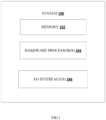
- FIG. 1 illustrates an exemplary block diagram of a system 100 for end-to-end handwritten text recognition using neural networks, in accordance with an embodiment of the present disclosure.
- the system 100 includes one or more processors 104, communication interface device(s) or input/output (I/O) interface(s) 106, and one or more data storage devices or memory 102 operatively coupled to the one or more processors 104.
- the one or more processors 104 that are hardware processors can be implemented as one or more microprocessors, microcomputers, microcontrollers, digital signal processors, central processing units, state machines, graphics controllers, logic circuitries, and/or any devices that manipulate signals based on operational instructions.
- the processor(s) is configured to fetch and execute computer-readable instructions stored in the memory.
- the system 100 can be implemented in a variety of computing systems, such as laptop computers, notebooks, hand-held devices, workstations, mainframe computers, servers, a network cloud and the like.
- the I/O interface device(s) 106 can include a variety of software and hardware interfaces, for example, a web interface, a graphical user interface, and the like and can facilitate multiple communications within a wide variety of networks N/W and protocol types, including wired networks, for example, LAN, cable, etc., and wireless networks, such as WLAN, cellular, or satellite.
- the I/O interface device(s) can include one or more ports for connecting a number of devices to one another or to another server.
- the memory 102 may include any computer-readable medium known in the art including, for example, volatile memory, such as static random access memory (SRAM) and dynamic random access memory (DRAM), and/or non-volatile memory, such as read only memory (ROM), erasable programmable ROM, flash memories, hard disks, optical disks, and magnetic tapes.
- volatile memory such as static random access memory (SRAM) and dynamic random access memory (DRAM)
- non-volatile memory such as read only memory (ROM), erasable programmable ROM, flash memories, hard disks, optical disks, and magnetic tapes.
- ROM read only memory
- erasable programmable ROM erasable programmable ROM
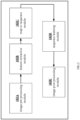
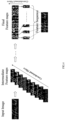
- FIG.2 illustrates an exemplary architecture of functional modules comprised in the system 100 of FIG.1 , in accordance with an embodiment of the present disclosure.
- the functional modules include an image pre-processing module 102A, a feature extraction module 102B, a map-to-sequence module 102C, a sequence learning module 102D, and an image post-processing module (102E).
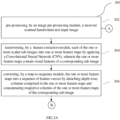
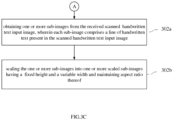
- FIG.3A through FIG.3C illustrates a flow diagram of a processor implemented method 300 for end-to-end handwritten text recognition using neural networks, in accordance with an embodiment of the present disclosure.
- the one or more data storage devices or memory 102 operatively coupled to the one or more processors 104 is configured to store instructions configured for execution of steps of the method 300 by the one or more processors 104.
- the steps of the method 300 will now be explained in detail with reference to the components of the system 100 of FIG.1 and the functional modules of the exemplary architecture of FIG.2 .
- process steps, method steps, techniques or the like may be described in a sequential order, such processes, methods and techniques may be configured to work in alternate orders. In other words, any sequence or order of steps that may be described does not necessarily indicate a requirement that the steps be performed in that order.
- the steps of processes described herein may be performed in any order practical. Further, some steps may be performed simultaneously.
- an image pre-processing module (102A of FIG.2 ) is configured to pre-process, at step 302, a received scanned handwritten text input image.
- the step 302 of pre-processing comprises: obtaining one or more sub-images from the received scanned handwritten text input image at step 302a, wherein each sub-image comprises a line of handwritten text present in the scanned handwritten text input image and further scaling, at step 302b, the one or more sub-images into one or more scaled sub-images having a fixed height and a variable width and maintaining aspect ratio.
- the received scanned handwritten text input image may be a file or a document which may be scanned or processed by a standard scanning apparatus such a scanner, multi-function peripheral (MFP) device, image copying device and a like.
- the received scanned handwritten text input image may comprise at least one line of handwritten text that is to be recognized or converted into a digital or machine readable text.
- the received scanned handwritten text input image is divided into one or more sub-images at step 302a, by the image pre-processing module (102A of FIG.2 ), wherein each sub-image comprises a line of handwritten text present in the scanned handwritten text input image.
- the line of handwritten text comprised in each sub-image may or may not be a complete sentence.
- each sub-image contains a single channel with 256 intensity levels and the fixed height may range from 128 pixels to 32 pixels.
- the width of the each sub-image is adjusted to maintain the aspect ratio of corresponding sub-image to reduce number of computations and memory requirements of the system 100 as shown in Table 1.
- the leaky ReLU activations of the seven convolution layers are configured by performing a batch normalization to prevent internal covariate shift and speed up a training before propagating to a subsequent convolutional layer and a pooling operations mechanism for activation of the convolutional layers to reduce dimensionality of the one or more sub-images.
- each sub-image of the received scanned handwritten text input image is inverted by the image pre-processing module (102A of FIG.2 ) before being sent to the feature extraction module (102B of FIG.2 ), so that foreground of the each sub-image is composed of higher intensity on a dark background for Convolutional Neural Networks (CNNs) activations to learn easily.
- CNNs Convolutional Neural Networks
- the sequence of feature vectors are constructed by concatenating respective columns of the one or more feature maps.
- an i th feature vector is constructed by concatenating i th columns of the one or more feature maps. Due to translational invariance of convolution operations performed by the CNN at step 304, each column represents a vertical strip (termed as receptive field), moving from left to right, as shown in FIG.4 . Due to the scaling of each sub-image at step 302, by the image pre-processing module (102A of FIG.2 ), the sequence of feature vectors comprises unique dimensions without putting any restriction on sequence length of each feature vector.
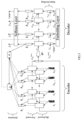
- a sequence learning module (102D of FIG.2 ) is configured to generate, at step 308, one or more set of characters, by mapping the visual features associated with each sequence of feature vectors, using a recurrent neural network (RNN) based encoder unit and decoder unit.
- the one or more set of characters is a machine readable text recognized for the corresponding sub-image.
- An encoder unit of the RNN based encoder unit and decoder unit is configured to generate a context vector for each sequence of feature vectors.
- a decoder unit of the RNN based encoder unit and decoder unit is configured to apply a conditional probability distribution over the context vector for each sequence of feature vectors, to generate a set of characters for the corresponding sub-image.
- both the encoder unit and the decoder unit of the RNN based encoder unit and decoder unit act as separate recurrent neural networks.
- the encoder unit constructs a compact representation in the form of the context vector based on an understanding of the sequence of feature vectors of each sub-image obtained at step 306 and the decoder unit generates the set of digitized characters or machine readable text for the corresponding sub-image by applying the conditional probability distribution on the same compact representation.
- f t ⁇ W f x t + U f h t ⁇ 1
- i t ⁇ W i x t + U i h t ⁇ 1
- u t tanh W u x t + U u h t ⁇ 1
- o t ⁇ W o x t + U o h t ⁇ 1
- ⁇ ( ) and tanh () represent element wise sigmoid and tanh operations while W and U are parameters of a linear transformation.
- the final cell state c Ts is used as the context vector for the corresponding sub-image.
- the encoder unit is a bidirectional network.
- the bidirectional network is formed by combining two LSTM cells, to utilize both forward and backward dependencies in the sequence of feature vectors.
- the bidirectional network processes the sequence of feature vectors in opposite directions, as shown in FIG.5 .
- the decoder unit generates a token y t of an output sequence at each timestep t , conditioned on c 1 and own previous predictions ⁇ y 1 , .... , y t-1 ⁇ .
- each conditional is modelled as p ( y t
- ⁇ y t ,...., y t-1 ⁇ , c 1) softmax ( g ( y t -1 , h t -1 , c 1 )), where g is a non-linear function and h t -1 is a hidden state of the decoder unit.
- both the encoder unit and the decoder unit comprise two recurrent layers each with 256 hidden units in each of the LSTM cells, and extends to a depth of two layers to enhance learning capacity.
- the dropout mechanism is employed to preserve a capacity of the RNN based encoder unit and decoder unit to capture long-term dependencies.
- the layer normalization is employed for recurrent activations in the RNN based encoder unit and decoder unit to stabilize hidden state dynamics and for better convergence during training of the system 100.
- a linear transformation W ⁇ R 256 xN is applied on the decoder unit to generate logits, where N is an output vocabulary size.
- a Softmax operation is performed on the logits to define a probability distribution over the output vocabulary at each timestep.
- the output vocabulary size is number of letters present in a language along with special characters such as space, asterisk etc..,.
- the output vocabulary size for English language handwritten text recognition is 79 that includes 26 letters and 53 special characters.
- the attention mechanism such as a Bahdanau attention mechanism is employed as an extension to the RNN based encoder unit and decoder unit due to which, the context vector is modified at each timestep based on similarity of decoder unit previous hidden state h t ⁇ 1 decoder with sequence of annotations h 1 encoder , ... , h T S encoder generated by the encoder unit, for the sequence of feature vectors.
- the attention mechanism is used due to a fact that the context vector that forms a link between the encoder unit and the decoder unit may tend to forget essential information especially for long sequences.
- the long sequences may contain more than one handwritten text sentences.
- a is a feedforward network trained along with CNN of the feature extraction module (102B of FIG.2 ) and RNN based encoder unit and decoder unit of the sequence learning module (102D of FIG.2 ).
- the context vector is modified as a weighted sum of input annotations, where weights measure how similar the output of the decoder unit at position i is with the feature vector from the sequence feature vectors around position j of the sequence of feature vector.
- An attention input feeding approach used in Luong attention mechanism is also employed due to which the context vector from previous timestep is concatenated with the input of the current timestep to further augment a predictive capacity of the system 100.
- the system 100 is trained by minimizing a cumulative categorical cross-entropy (CE) loss which is calculated independently for each predicted character in the output sequence.
- CE categorical cross-entropy
- an input to the decoder unit at each timestep is an embedding vector from a learnable embedding layer, corresponding to gold prediction from previous step, until an end-of-sequence ⁇ eos> is emitted.
- a gradient descent is performed across the RNN based encoder unit and decoder unit using Back Propagation Through Time (BPTT) followed by back propagation into the CNN to update the network weights and biases.
- BPTT Back Propagation Through Time
- a Focal Loss technique is employed by assigning suitable weights to contribution of each instance in final CE loss to address class imbalance problem that arises from the CE loss.
- an inference of the system 100 is derived using a Greedy Decoding (GD) which emits class with a highest probability from softmax distribution at each timestep, as the output at that instance.
- the Greedy Decoding operates with underlying assumption that a best sequence is composed of most likely tokens at each timestep, which may not necessarily be true.
- a Beam Search decoding algorithm is used to find a best sequence by maximizing a joint distribution, over a set of hypotheses, known as a beam.
- the Beam Search decoding algorithm selects top -K classes, where K is a beam size, at first timestep and obtains an output distribution individually for each of them at next timestep.
- K is a beam size
- N is an output vocabulary size
- top- K classes are chosen based on product p ( y 1 ) ⁇ p ( y 2
- a final output of the decoder unit is a ray having a highest value of p ( y 1 , y 2 , ..., y T d in the beam.
- the beam size is defined as equivalent to the output vocabulary size.
- An image post-processing module (102E of FIG.2 ) is configured to post-process, at step 310, the set of characters.
- the step 310 of post-processing comprises combining the set of characters for each of the corresponding sub-image to generate a handwritten text output file, wherein the hand-written text output file is a recognized text version of the scanned handwritten text input image.
- the image post-processing module (102E of FIG.2 ) is configured to combine the set of characters in the order in which the set of characters is recognized for each sub-image by the RNN based encoder unit and decoder unit to generate the handwritten text output file.
- both the feature extraction module (102B of FIG.2 ) and the sequence learning module (102D of FIG.2 ) act as connectionist components in the disclosed system 100 for end-to-end handwritten text recognition using neural networks.
- the systems and methods for end-to-end handwritten text recognition using neural networks are explained with handwritten text recognition for a single scanned handwritten text image for easy understanding.
- the disclosed systems and methods can recognize handwritten text for multiple scanned handwritten text images.
- the disclosed systems and methods for end-to-end handwritten text recognition using neural networks is evaluated on publicly available datasets such as IAM Handwriting Database v3:0 (English), and RIMES Database (French) on Nvidia Tesla K40 GPU, using Character Error Rate (CER) and Word Error Rate (WER) as performance metrics determined as mean over all text lines of the scanned handwritten text input image.
- IAM Handwriting Database v3:0 English
- RIMES Database Factor Database
- WER Word Error Rate
- M is a batch size and y it represents t th timestep of i th instance of the batch.
- the batch size is set to 16.
- An Adam algorithm is used as an optimizer with a learning rate of 0:001.
- the disclosed system 100 is trained till to get a test validation accuracy and is achieved after 30 epochs.
- Table 3 shows an effect of the Layer Normalization (LN), the Focal Loss technique and the Beam Search decoding algorithm on the disclosed system 100.
- LN improved performance of a base model of the system 100 by around 3%.
- Use of the Focal Loss technique also increased accuracy of the system 100 by 1-3% but major improvement is achieved by replacing greedy decoding with the Beam Search decoding algorithm which boosted the accuracy of the system 100 by 4-5%.
- Table 3 IAM RIMES Methods CER (%) WER (%) CER (%) WER (%) Baseline 17.4 25.5 12.0 19.1 + LN 13.1 22.9 9.7 15.8 + LN + Focal Loss 11.4 21.1 7.3 13.5 + LN + Focal Loss + Beam Search 8.1 16.7 3.5 9.6
- Table 4 shows a comparison on the accuracy in terms of Character Error Rate (CER) and Word Error Rate (WER) of the disclosed system 100 and method 300 with existing systems and methodologies.
- Table 5 shows a comparison on an efficiency in terms of maximum GPU memory consumption and number of trainable parameters of the disclosed system and method with existing CNN-1DRNN-CTC model.
- Table 4 IAM RIMES Methods CER (%) WER (%) CER (%) WER (%) 2DLSTM 8.3 27.5 4.0 17.7 CNN-1DLSTM-CTC 6.2 20.2 2.6 10.7 Disclosed systems and methods 8.1 16.7 3.5 9.6 Table 5 Methods Memory (GB) # of Parameters (Mi) CNN-1DRNN-CTC 10.5 9.3 Disclosed systems and methods 7.9 4.6
- a word level accuracy of the disclosed systems and methods is improved over the existing systems and methodologies, however a character level accuracy is slightly lower in comparison.
- the systems and methods for end-to-end handwritten text recognition using neural networks takes input, the sub-image, as a scaled or down sampled version maintaining fixed height with the range from 128 pixels to 32 pixels while the width is adjusted maintaining the aspect ratio of the corresponding sub-image, thereby achieving handwritten text recognition with reduced number of computations and less memory requirements.
- the experimental results a reduction of 61% in computations and 17% in memory consumption is achieved by down sampling to almost a sixteenth of original size of each sub-image, without compromising with the overall accuracy.
- the disclosed systems and methods for end-to-end handwritten text recognition using neural networks achieves significant improvement with the accuracy in handwritten text recognition using the RNN based encoder unit and decoder unit with attention mechanism over existing CNN-1DRNN-CTC model.
- the disclosed system and method for end-to-end handwritten text recognition using neural networks surpassed on the accuracy over the available datasets, IAM and RIMES by 3:5% and 1:1%, respectively.
- the systems and methods for end-to-end handwritten text recognition using neural networks provides a complete end-to end solution for performing efficient offline handwritten text recognition using the scanned handwritten text input images.
- the hardware device can be any kind of device which can be programmed including e.g. any kind of computer like a server or a personal computer, or the like, or any combination thereof.
- the device may also include means which could be e.g. hardware means like e.g. an application-specific integrated circuit (ASIC), a field-programmable gate array (FPGA), or a combination of hardware and software means, e.g.
- ASIC application-specific integrated circuit
- FPGA field-programmable gate array
- the means can include both hardware means and software means.
- the method embodiments described herein could be implemented in hardware and software.
- the device may also include software means.
- the embodiments may be implemented on different hardware devices, e.g. using a plurality of CPUs.
- the embodiments herein can comprise hardware and software elements.
- the embodiments that are implemented in software include but are not limited to, firmware, resident software, microcode, etc.
- the functions performed by various modules described herein may be implemented in other modules or combinations of other modules.
- a computer-usable or computer readable medium can be any apparatus that can comprise, store, communicate, propagate, or transport the program for use by or in connection with the instruction execution system, apparatus, or device.
- a computer-readable storage medium refers to any type of physical memory on which information or data readable by a processor may be stored.
- a computer-readable storage medium may store instructions for execution by one or more processors, including instructions for causing the processor(s) to perform steps or stages consistent with the embodiments described herein.
- the term "computer-readable medium” should be understood to include tangible items and exclude carrier waves and transient signals, i.e., be non-transitory. Examples include random access memory (RAM), read-only memory (ROM), volatile memory, nonvolatile memory, hard drives, CD ROMs, DVDs, flash drives, disks, and any other known physical storage media.
Landscapes
- Engineering & Computer Science (AREA)
- Theoretical Computer Science (AREA)
- Physics & Mathematics (AREA)
- General Physics & Mathematics (AREA)
- Evolutionary Computation (AREA)
- Computer Vision & Pattern Recognition (AREA)
- Multimedia (AREA)
- Data Mining & Analysis (AREA)
- Artificial Intelligence (AREA)
- Life Sciences & Earth Sciences (AREA)
- Health & Medical Sciences (AREA)
- General Health & Medical Sciences (AREA)
- General Engineering & Computer Science (AREA)
- Software Systems (AREA)
- Computing Systems (AREA)
- Mathematical Physics (AREA)
- Biophysics (AREA)
- Computational Linguistics (AREA)
- Biomedical Technology (AREA)
- Molecular Biology (AREA)
- Databases & Information Systems (AREA)
- Medical Informatics (AREA)
- Bioinformatics & Cheminformatics (AREA)
- Bioinformatics & Computational Biology (AREA)
- Evolutionary Biology (AREA)
- Human Computer Interaction (AREA)
- Character Discrimination (AREA)
- Image Analysis (AREA)
Claims (9)
- System (100) zur Ende-zu-Ende-Erkennung von handgeschriebenem Text unter Verwendung neuronaler Netzwerke, wobei das System Folgendes umfasst:
eine oder mehrere interne Datenspeichervorrichtungen (102), die betriebsfähig mit einem oder mehreren Hardwareprozessoren (104) gekoppelt sind, um Anweisungen zu speichern, die zur Ausführung durch den einen oder die mehreren Hardwareprozessoren konfiguriert sind, wobei die Anweisungen in Folgendem enthalten sind:ein Bildvorverarbeitungsmodul (102A), das zu Folgendem konfiguriert ist:Empfangen eines abgetasteten handgeschriebenen Texteingabebilds;Erhalten eines oder mehrerer Teilbilder aus dem abgetasteten handgeschriebenen Texteingabebild, wobei jedes des einen oder der mehreren Teilbilder eine Zeile von handgeschriebenem Text umfasst, der in dem abgetasteten handgeschriebenen Texteingabebild vorhanden ist; undSkalieren des einen oder der mehreren Teilbilder in ein oder mehrere skalierte Teilbilder mit einer festen Höhe und einer variablen Breite und Beibehalten des Seitenverhältnisses davon;ein Merkmalsextraktionsmodul (102B), das betriebsfähig mit dem Bildvorverarbeitungsmodul (102A) gekoppelt ist und konfiguriert ist, um jedes des einen oder der mehreren skalierten Teilbilder in eine oder mehrere Merkmalskarten durch Anwenden eines Convolutional Neural Network, CNN, zu transformieren, wobei die eine oder die mehreren Merkmalskarten visuelle Merkmale eines entsprechenden Teilbilds enthalten, wobei das CNN eine Mehrzahl von Faltungsschichten umfasst, die seriell mit Leaky-ReLU-Aktivierungen gestapelt sind, wobei die Leaky-ReLU-Aktivierungen der Faltungsschichten konfiguriert sind durch Durchführen von:Stapelnormalisierung, um eine interne Kovarianzverschiebung zu verhindern und das Training zu beschleunigen, bevor es zu einer nächsten Faltungsschicht propagiert wird; undPooling-Operationsmechanismus, um die Aktivierung von mindestens einigen der Faltungsschichten durchzuführen, um die Dimensionalität des einen oder der mehreren Teilbilder zu reduzieren;ein Map-to-Sequence-Modul (102C), das betriebsfähig mit dem Merkmalsextraktionsmodul (102B) gekoppelt ist und konfiguriert ist, um die eine oder die mehreren Merkmalskarten in eine Sequenz von Merkmalsvektoren umzuwandeln, indem Spalten, die in der einen oder den mehreren Merkmalskarten enthalten sind, in der Tiefe getrennt werden und jeweilige Spalten der einen oder der mehreren Merkmalskarten des entsprechenden Teilbilds verkettet werden;ein Sequenzlernmodul (102D), das betriebsfähig mit dem Map-to-Sequence-Modul (102C) gekoppelt ist und konfiguriert ist zum:Erzeugen eines oder mehrerer Sätze von Zeichen, indem die visuellen Merkmale, die jeder Sequenz von Merkmalsvektoren zugeordnet sind, unter Verwendung einer Recurrent Neural Network, RNN-basierten Codiereinheit und Decodiereinheit abgebildet werden,wobei der eine oder die mehreren Sätze von Zeichen ein maschinenlesbarer Text ist, der für das entsprechende Teilbild erkannt wird, und wobei eine Codiereinheit der RNN-basierten Codiereinheit und Decodiereinheit konfiguriert ist, um einen Kontextvektor für jede Sequenz von Merkmalsvektoren zu erzeugen, und eine Decodiereinheit der RNN-basierten Codiereinheit und Decodiereinheit konfiguriert ist, um eine bedingte Wahrscheinlichkeitsverteilung über den Kontextvektor für jede Sequenz von Merkmalsvektoren anzuwenden, um einen Satz von Zeichen für das entsprechende Teilbild zu erzeugen, wobei eine lineare Transformation Erleichtern des Gradientenflusses zu einer nachfolgenden rekurrenten Schicht durch darin enthaltene rekurrente Einheiten durch Restverbindungen;Regularisieren der Codiereinheit, ohne rekurrente Verbindungen zu modifizieren, um langfristige Abhängigkeiten zu erfassen, indem ein Dropout-Mechanismus entlang tiefenmäßiger Verbindungen verwendet wird;Aktivieren von Zellenneuronen, um die Kovarianzverschiebung aufgrund von Ministapeltraining durch eine Schichtnormalisierung zu verhindern; undAusrichten verborgener Zustände der Decodiereinheit mit verborgenen Zuständen der Codiereinheit durch einen Aufmerksamkeitsmechanismus, wobei ein Bahdanau-Aufmerksamkeitsmechanismus als eine Erweiterung der RNN-basierten Codiereinheit und Decodiereinheit verwendet wird, sodass der Kontextvektor bei jedem Zeitschritt basierend auf der Ähnlichkeit des vorherigen verborgenen Zustands der Decodiereinheit
 Berechnen eines kumulativen kategorischen Kreuzentropie(CE)-Verlusts für jedes Zeichen in dem Satz von Zeichen, der durch Abbilden der visuellen Merkmale, die jeder Sequenz von Merkmalsvektoren zugeordnet sind, unter Verwendung der RNN-basierten Codiereinheit und Decodiereinheit erhalten wird;Durchführen eines Gradientenabstiegs über die RNN-basierte Codiereinheit und Decodiereinheit unter Verwendung einer Backpropagation Through Time, BPTT, gefolgt von Backpropagation in das CNN, um CNN-Gewichte und -verzerrungen zu aktualisieren;Verwenden einer Fokalverlusttechnik durch Zuweisen von Gewichten zu jeder Instanz in dem CE-Verlust, um ein Klassenungleichgewichtsproblem anzugehen, das sich aus dem CE-Verlust ergibt; undein Bildnachverarbeitungsmodul (102E), das betriebsfähig mit dem Sequenzlernmodul (102D) gekoppelt ist und konfiguriert ist, um den Satz von Zeichen für jedes der entsprechenden Teilbilder zu kombinieren, um eine handgeschriebene Textausgabedatei zu erzeugen, wobei die handgeschriebene Textausgabedatei eine erkannte Textversion des abgetasteten handgeschriebenen Texteingabebilds ist.
 - System nach Anspruch 1, wobei das Bildvorverarbeitungsmodul ferner zu Folgendem konfiguriert ist:Verwenden einer Minibatch-Trainingstechnik, um die Gleichmäßigkeit in den Abmessungen zu erhalten, indem das eine oder die mehreren Teilbilder, die in einem Batch enthalten sind, mit jeweiligen Hintergrundpixeln sowohl auf der linken als auch auf der rechten Seite aufgefüllt werden, um der Breite eines breitesten Teilbildes in dem Batch zu entsprechen; undEinführen zufälliger Verzerrungen in das eine oder die mehreren Teilbilder, um Variationen in dem einen oder den mehreren Teilbildern zu erzeugen.
- System nach Anspruch 1, wobei das CNN sieben Faltungsschichten umfasst, die seriell mit den Leaky-ReLU-Aktivierungen gestapelt sind.
- System nach Anspruch 1, wobei die Codiereinheit ein bidirektionales Netzwerk ist, das durch Kombinieren von zwei Zellen mit langem Kurzzeitgedächtnis, LSTM, gebildet wird, und die Decodiereinheit ein unidirektionales Netzwerk mit einer einzelnen LSTM-Zelle ist.
- System nach Anspruch 4, wobei die Codiereinheit und die Decodiereinheit zwei rekurrente Schichten mit 256 verborgenen Einheiten in jeder der LSTM-Zellen umfassen.
- Prozessorimplementiertes Verfahren (300) zur Ende-zu-Ende-Erkennung von handgeschriebenem Text unter Verwendung neuronaler Netzwerke, wobei das Verfahren die folgenden Schritte umfasst:Vorverarbeiten, durch ein Bildvorverarbeitungsmodul, eines empfangenen abgetasteten handgeschriebenen Texteingabebilds (302), wobei das Vorverarbeiten Folgendes umfasst:Erhalten eines oder mehrerer Teilbilder aus dem empfangenen abgetasteten handgeschriebenen Texteingabebild, wobei jedes Teilbild eine Zeile von handgeschriebenem Text umfasst, der in dem abgetasteten handgeschriebenen Texteingabebild (302a) vorhanden ist; undSkalieren des einen oder der mehreren Teilbilder in ein oder mehrere skalierte Teilbilder mit einer festen Höhe und einer variablen Breite und Beibehalten des Seitenverhältnisses davon (302b);Transformieren, durch ein Merkmalsextraktionsmodul, jedes des einen oder der mehreren skalierten Teilbilder in eine oder mehrere Merkmalskarten durch Anwenden eines Convolutional Neural Network, CNN, wobei die eine oder die mehreren Merkmalskarten visuelle Merkmale eines entsprechenden Teilbilds (304) enthalten,wobei das CNN eine Mehrzahl von Faltungsschichten umfasst, die seriell mit Leaky-ReLU-Aktivierungen gestapelt sind, wobei die Leaky-ReLU-Aktivierungen der Faltungsschichten konfiguriert sind durch Durchführen von:Stapelnormalisierung, um eine interne Kovarianzverschiebung zu verhindern und das Training zu beschleunigen, bevor es zu einer nächsten Faltungsschicht propagiert wird; undPooling-Operationsmechanismus, um die Aktivierung von mindestens einigen der Faltungsschichten durchzuführen, um die Dimensionalität des einen oder der mehreren Teilbilder zu reduzieren;Umwandeln, durch ein Map-to-Sequence-Modul, der einen oder der mehreren Merkmalskarten in eine Sequenz von Merkmalsvektoren, indem Spalten, die in der einen oder den mehreren Merkmalskarten enthalten sind, in der Tiefe getrennt werden und jeweilige Spalten der einen oder der mehreren Merkmalskarten des entsprechenden Teilbilds verkettet werden (306);Erzeugen, durch ein Sequenzlernmodul, eines oder mehrerer Sätze von Zeichen, indem die visuellen Merkmale, die jeder Sequenz von Merkmalsvektoren zugeordnet sind, unter Verwendung einer Recurrent Neural Network, RNN-basierten Codiereinheit und Decodiereinheit abgebildet werden,
wobei der eine oder die mehreren Sätze von Zeichen ein maschinenlesbarer Text ist, der für das entsprechende Teilbild erkannt wird, und wobei eine Codiereinheit der RNN-basierten Codiereinheit und Decodiereinheit konfiguriert ist, um einen Kontextvektor für jede Sequenz von Merkmalsvektoren zu erzeugen, und eine Decodiereinheit der RNN-basierten Codiereinheit und Decodiereinheit konfiguriert ist, um eine bedingte Wahrscheinlichkeitsverteilung über den Kontextvektor für jede Sequenz von Merkmalsvektoren anzuwenden, um einen Satz von Zeichen für das entsprechende Teilbild zu erzeugen (308), wobei eine lineare Transformation Erleichtern des Gradientenflusses zu einer nachfolgenden rekurrenten Schicht durch darin enthaltene rekurrente Einheiten durch Restverbindungen;Regularisieren der Codiereinheit, ohne rekurrente Verbindungen zu modifizieren, um langfristige Abhängigkeiten zu erfassen, indem ein Dropout-Mechanismus entlang tiefenmäßiger Verbindungen verwendet wird;Aktivieren von Zellenneuronen, um die Kovarianzverschiebung aufgrund von Ministapeltraining durch eine Schichtnormalisierung zu verhindern; undAusrichten verborgener Zustände der Decodiereinheit mit verborgenen Zuständen der Codiereinheit durch einen Aufmerksamkeitsmechanismus, wobei ein Bahdanau-Aufmerksamkeitsmechanismus als eine Erweiterung der RNN-basierten Codiereinheit und Decodiereinheit verwendet wird, sodass der Kontextvektor bei jedem Zeitschritt basierend auf der Ähnlichkeit des vorherigen verborgenen Zustands der Decodiereinheit
 Berechnen eines kumulativen kategorischen Kreuzentropie,CE,-Verlusts für jedes Zeichen in dem Satz von Zeichen, der durch Abbilden der visuellen Merkmale, die jeder Sequenz von Merkmalsvektoren zugeordnet sind, unter Verwendung der RNN-basierten Codiereinheit und Decodiereinheit erhalten wird;Durchführen eines Gradientenabstiegs über die RNN-basierte Codiereinheit und Decodiereinheit unter Verwendung einer Backpropagation Through Time (BPTT), gefolgt von Backpropagation in das CNN, um CNN-Gewichte und -verzerrungen zu aktualisieren;Verwenden einer Fokalverlusttechnik durch Zuweisen von Gewichten zu jeder Instanz in dem CE-Verlust, um ein Klassenungleichgewichtsproblem anzugehen, das sich aus dem CE-Verlust ergibt; undNachverarbeiten, durch ein Bildnachverarbeitungsmodul, des Satzes von Zeichen, wobei das Nachverarbeiten das Kombinieren des Satzes von Zeichen für jedes der entsprechenden Teilbilder umfasst, um eine handgeschriebene Textausgabedatei zu erzeugen, wobei die handgeschriebene Textausgabedatei eine erkannte Textversion des abgetasteten handgeschriebenen Texteingabebilds (310) ist.
 - Verfahren nach Anspruch 6, wobei der Schritt des Vorverarbeitens ferner Folgendes umfasst:Verwenden einer Minibatch-Trainingstechnik, um die Gleichmäßigkeit in den Abmessungen zu erhalten, indem das eine oder die mehreren Teilbilder, die in einem Batch enthalten sind, mit jeweiligen Hintergrundpixeln sowohl auf der linken als auch auf der rechten Seite aufgefüllt werden, um der Breite eines breitesten Teilbildes in dem Batch zu entsprechen; undEinführen zufälliger Verzerrungen in das eine oder die mehreren Teilbilder, um Variationen in dem einen oder den mehreren Teilbildern zu erzeugen.
- Verfahren nach Anspruch 6, wobei das CNN sieben Faltungsschichten umfasst, die seriell mit den Leaky-ReLU-Aktivierungen gestapelt sind.
- Computerprogrammprodukt, umfassend ein nichtflüchtiges computerlesbares Medium mit einem darin verkörperten computerlesbaren Programm, wobei das computerlesbare Programm, wenn es auf einer Rechenvorrichtung ausgeführt wird, die Rechenvorrichtung zu Folgendem veranlasst:Vorverarbeiten eines empfangenen abgetasteten handgeschriebenen Texteingabebilds durch ein Bildvorverarbeitungsmodul, wobei das Vorverarbeiten Folgendes umfasst:Erhalten eines oder mehrerer Teilbilder aus dem empfangenen abgetasteten handgeschriebenen Texteingabebild, wobei jedes Teilbild eine Zeile von handgeschriebenem Text umfasst, der in dem abgetasteten handgeschriebenen Texteingabebild vorhanden ist; undSkalieren des einen oder der mehreren Teilbilder in ein oder mehrere skalierte Teilbilder mit einer festen Höhe und einer variablen Breite und Beibehalten des Seitenverhältnisses davon;Transformieren, durch ein Merkmalsextraktionsmodul, jedes des einen oder der mehreren skalierten Teilbilder in eine oder mehrere Merkmalskarten durch Anwenden eines Convolutional Neural Network, CNN, wobei die eine oder die mehreren Merkmalskarten visuelle Merkmale eines entsprechenden Teilbilds enthalten, wobei das CNN eine Mehrzahl von Faltungsschichten umfasst, die seriell mit Leaky-ReLU-Aktivierungen gestapelt sind, wobei die Leaky-ReLU-Aktivierungen der Faltungsschichten konfiguriert sind durch Durchführen von:Stapelnormalisierung, um eine interne Kovarianzverschiebung zu verhindern und das Training zu beschleunigen, bevor es zu einer nächsten Faltungsschicht propagiert wird; undPooling-Operationsmechanismus, um die Aktivierung von mindestens einigen der Faltungsschichten durchzuführen, um die Dimensionalität des einen oder der mehreren Teilbilder zu reduzieren;Umwandeln, durch ein Map-to-Sequence-Modul, der einen oder der mehreren Merkmalskarten in eine Sequenz von Merkmalsvektoren, indem Spalten, die in der einen oder den mehreren Merkmalskarten enthalten sind, in der Tiefe getrennt werden und jeweilige Spalten der einen oder der mehreren Merkmalskarten des entsprechenden Teilbilds verkettet werden;Erzeugen, durch ein Sequenzlernmodul, eines oder mehrerer Sätze von Zeichen, indem die visuellen Merkmale, die jeder Sequenz von Merkmalsvektoren zugeordnet sind, unter Verwendung einer Recurrent Neural Network, RNN-basierten Codiereinheit und Decodiereinheit abgebildet werden,
wobei der eine oder die mehreren Sätze von Zeichen ein maschinenlesbarer Text ist, der für das entsprechende Teilbild erkannt wird, und wobei eine Codiereinheit der RNN-basierten Codiereinheit und Decodiereinheit konfiguriert ist, um einen Kontextvektor für jede Sequenz von Merkmalsvektoren zu erzeugen, und eine Decodiereinheit der RNN-basierten Codiereinheit und Decodiereinheit konfiguriert ist, um eine bedingte Wahrscheinlichkeitsverteilung über den Kontextvektor für jede Sequenz von Merkmalsvektoren anzuwenden, um einen Satz von Zeichen für das entsprechende Teilbild zu erzeugen, wobei eine lineare Transformation Erleichtern des Gradientenflusses zu einer nachfolgenden rekurrenten Schicht durch darin enthaltene rekurrente Einheiten durch Restverbindungen;Regularisieren der Codiereinheit, ohne rekurrente Verbindungen zu modifizieren, um langfristige Abhängigkeiten zu erfassen, indem ein Dropout-Mechanismus entlang tiefenmäßiger Verbindungen verwendet wird;Aktivieren von Zellenneuronen, um die Kovarianzverschiebung aufgrund von Ministapeltraining durch eine Schichtnormalisierung zu verhindern; undAusrichten verborgener Zustände der Decodiereinheit mit verborgenen Zuständen der Codiereinheit durch einen Aufmerksamkeitsmechanismus, wobei ein Bahdanau-Aufmerksamkeitsmechanismus als eine Erweiterung der RNN-basierten Codiereinheit und Decodiereinheit verwendet wird, sodass der Kontextvektor bei jedem Zeitschritt basierend auf der Ähnlichkeit des vorherigen verborgenen Zustands der Decodiereinheit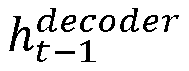
 Berechnen eines kumulativen kategorischen Kreuzentropie, CE,-Verlusts für jedes Zeichen in dem Satz von Zeichen, der durch Abbilden der visuellen Merkmale, die jeder Sequenz von Merkmalsvektoren zugeordnet sind, unter Verwendung der RNN-basierten Codiereinheit und Decodiereinheit erhalten wird;Durchführen eines Gradientenabstiegs über die RNN-basierte Codiereinheit und Decodiereinheit unter Verwendung einer Backpropagation Through Time, BPTT, gefolgt von Backpropagation in das CNN, um CNN-Gewichte und -verzerrungen zu aktualisieren;Verwenden einer Fokalverlusttechnik durch Zuweisen von Gewichten zu jeder Instanz in dem CE-Verlust, um ein Klassenungleichgewichtsproblem anzugehen, das sich aus dem CE-Verlust ergibt; undNachverarbeiten des Satzes von Zeichen durch ein Bildnachverarbeitungsmodul, wobei das Nachverarbeiten das Kombinieren des Satzes von Zeichen für jedes der entsprechenden Teilbilder umfasst, um eine handgeschriebene Textausgabedatei zu erzeugen, wobei die handgeschriebene Textausgabedatei eine erkannte Textversion des abgetasteten handgeschriebenen Texteingabebilds ist.
Applications Claiming Priority (1)
| Application Number | Priority Date | Filing Date | Title |
|---|---|---|---|
| IN201821026934 | 2018-07-19 |
Publications (3)
| Publication Number | Publication Date |
|---|---|
| EP3598339A1 EP3598339A1 (de) | 2020-01-22 |
| EP3598339C0 EP3598339C0 (de) | 2024-09-04 |
| EP3598339B1 true EP3598339B1 (de) | 2024-09-04 |
Family
ID=67145731
Family Applications (1)
| Application Number | Title | Priority Date | Filing Date |
|---|---|---|---|
| EP19184180.8A Active EP3598339B1 (de) | 2018-07-19 | 2019-07-03 | Systeme und verfahren zur durchgehenden handschriftlichen texterkennung unter verwendung neuronaler netze |
Country Status (6)
| Country | Link |
|---|---|
| US (1) | US10839246B2 (de) |
| EP (1) | EP3598339B1 (de) |
| JP (1) | JP7311341B2 (de) |
| CN (1) | CN110738090B (de) |
| AU (1) | AU2019206010B2 (de) |
| CA (1) | CA3050025C (de) |
Families Citing this family (69)
| Publication number | Priority date | Publication date | Assignee | Title |
|---|---|---|---|---|
| US10839543B2 (en) * | 2019-02-26 | 2020-11-17 | Baidu Usa Llc | Systems and methods for depth estimation using convolutional spatial propagation networks |
| US11388416B2 (en) * | 2019-03-21 | 2022-07-12 | Qualcomm Incorporated | Video compression using deep generative models |
| CN111753822B (zh) * | 2019-03-29 | 2024-05-24 | 北京市商汤科技开发有限公司 | 文本识别方法及装置、电子设备和存储介质 |
| US10984279B2 (en) * | 2019-06-13 | 2021-04-20 | Wipro Limited | System and method for machine translation of text |
| US11023783B2 (en) | 2019-09-11 | 2021-06-01 | International Business Machines Corporation | Network architecture search with global optimization |
| US10943353B1 (en) * | 2019-09-11 | 2021-03-09 | International Business Machines Corporation | Handling untrainable conditions in a network architecture search |
| JP7417192B2 (ja) * | 2020-02-13 | 2024-01-18 | 京セラドキュメントソリューションズ株式会社 | 画像処理システムおよび画像処理プログラム |
| CN111291696B (zh) * | 2020-02-19 | 2024-03-22 | 南京大学 | 一种基于卷积神经网络的手写东巴文识别方法 |
| CN111353313A (zh) * | 2020-02-25 | 2020-06-30 | 四川翼飞视科技有限公司 | 基于进化神经网络架构搜索的情感分析模型构建方法 |
| CN111401374A (zh) * | 2020-03-06 | 2020-07-10 | 湖南快乐阳光互动娱乐传媒有限公司 | 基于多任务的模型训练方法、字符识别方法及装置 |
| JP7293157B2 (ja) * | 2020-03-17 | 2023-06-19 | 株式会社東芝 | 画像処理装置 |
| CN111444834B (zh) * | 2020-03-26 | 2024-10-01 | 同盾控股有限公司 | 图像文本行检测方法、装置、设备及存储介质 |
| CN113536858B (zh) * | 2020-04-20 | 2025-09-16 | 阿里巴巴集团控股有限公司 | 图像识别方法和系统 |
| CN111553363B (zh) * | 2020-04-20 | 2023-08-04 | 北京易道博识科技有限公司 | 一种端到端的图章识别方法及系统 |
| CN111639527A (zh) * | 2020-04-23 | 2020-09-08 | 平安国际智慧城市科技股份有限公司 | 英文手写文本识别方法、装置、电子设备及存储介质 |
| CN114207676A (zh) * | 2020-05-27 | 2022-03-18 | 京东方科技集团股份有限公司 | 手写体识别方法、装置、电子设备及存储介质 |
| CN111786738B (zh) * | 2020-07-01 | 2022-06-03 | 中国人民解放军陆军工程大学 | 基于长短期记忆的抗干扰学习的网络结构及学习方法 |
| US11461988B2 (en) * | 2020-07-23 | 2022-10-04 | Suresh Babu Revoled Konti | Method of transferring data between unconnected computing devices |
| CN112926372B (zh) * | 2020-08-22 | 2023-03-10 | 清华大学 | 基于序列变形的场景文字检测方法及系统 |
| US20220058842A1 (en) * | 2020-08-24 | 2022-02-24 | Brown University | Generating handwriting via decoupled style descriptors |
| CN114120336B (zh) * | 2020-08-25 | 2023-08-08 | 本源量子计算科技(合肥)股份有限公司 | 手写数字识别方法、系统、设备及计算机可读存储介质 |
| CN112052852B (zh) * | 2020-09-09 | 2023-12-29 | 国家气象信息中心 | 一种基于深度学习的手写气象档案资料的字符识别方法 |
| CN112183544B (zh) * | 2020-09-29 | 2024-09-13 | 厦门大学 | 一种融合双通道的三层架构数学公式识别方法、系统和存储设备 |
| CN112257847A (zh) * | 2020-10-16 | 2021-01-22 | 昆明理工大学 | 一种基于CNN和LSTM预测地磁Kp指数的方法 |
| CN112508023A (zh) * | 2020-10-27 | 2021-03-16 | 重庆大学 | 基于深度学习的零件喷码字符端到端识别方法 |
| KR102472971B1 (ko) * | 2020-11-19 | 2022-12-02 | 네이버 주식회사 | 인공지능 모델을 이용한 동영상 인코딩 최적화 방법, 시스템, 및 컴퓨터 프로그램 |
| RU2768211C1 (ru) * | 2020-11-23 | 2022-03-23 | Общество с ограниченной ответственностью "Аби Продакшн" | Оптическое распознавание символов посредством комбинации моделей нейронных сетей |
| US11972220B2 (en) * | 2020-11-30 | 2024-04-30 | Oracle International Corporation | Enhanced logits for natural language processing |
| AU2021396303A1 (en) * | 2020-12-11 | 2023-06-08 | Ancestry.Com Operations Inc. | Handwriting recognition |
| US20220237904A1 (en) * | 2021-01-25 | 2022-07-28 | Qatar University | Assistive system for people with visual impairments |
| CN112883818A (zh) * | 2021-01-26 | 2021-06-01 | 上海西井信息科技有限公司 | 文本图像识别方法、系统、设备及存储介质 |
| CN112686219B (zh) * | 2021-03-11 | 2021-06-18 | 北京世纪好未来教育科技有限公司 | 手写文本识别方法及计算机存储介质 |
| CN113705313B (zh) * | 2021-04-07 | 2025-07-08 | 腾讯科技(深圳)有限公司 | 文本识别方法、装置、设备及介质 |
| CN113313127B (zh) * | 2021-05-18 | 2023-02-14 | 华南理工大学 | 文本图像识别方法、装置、计算机设备和存储介质 |
| CN113255668B (zh) * | 2021-06-22 | 2021-10-08 | 北京世纪好未来教育科技有限公司 | 文本识别方法、装置、电子设备、存储介质 |
| CN113269189B (zh) * | 2021-07-20 | 2021-10-08 | 北京世纪好未来教育科技有限公司 | 文本识别模型的构建方法、文本识别方法、装置及设备 |
| CN113283427B (zh) * | 2021-07-20 | 2021-10-01 | 北京世纪好未来教育科技有限公司 | 文本识别方法、装置、设备及介质 |
| CN113344145B (zh) * | 2021-08-02 | 2021-11-19 | 智道网联科技(北京)有限公司 | 字符识别方法、装置、电子设备和存储介质 |
| CN113591764B (zh) * | 2021-08-09 | 2024-06-07 | 广州博冠信息科技有限公司 | 手势识别方法、装置、存储介质和电子设备 |
| CN113591882A (zh) * | 2021-08-11 | 2021-11-02 | 卓尔智联(武汉)研究院有限公司 | 汽车配件识别方法、计算机装置及可读存储介质 |
| CN113963339B (zh) * | 2021-09-02 | 2024-08-13 | 泰康保险集团股份有限公司 | 一种信息提取方法和装置 |
| CN113807340B (zh) * | 2021-09-07 | 2024-03-15 | 南京信息工程大学 | 一种基于注意力机制的不规则自然场景文本识别方法 |
| CN113919294B (zh) * | 2021-09-29 | 2024-09-24 | 北京搜狗科技发展有限公司 | 公式识别模型的训练方法、装置和用于模型训练的装置 |
| CA3233965A1 (en) * | 2021-10-05 | 2023-04-13 | Jiahui YU | Vector-quantized image modeling |
| CN113837186A (zh) * | 2021-11-29 | 2021-12-24 | 中央民族大学 | 一种基于卷积神经网络的东巴象形文字识别方法及装置 |
| CN118235128A (zh) | 2021-11-29 | 2024-06-21 | 三星电子株式会社 | 电子装置和用于对电子装置中的书写信息进行掩蔽或去掩蔽的方法 |
| CN116244427A (zh) * | 2021-12-06 | 2023-06-09 | 中移(苏州)软件技术有限公司 | 文本处理方法及装置、电子设备及存储介质 |
| CN114283411B (zh) * | 2021-12-20 | 2022-11-15 | 北京百度网讯科技有限公司 | 文本识别方法、文本识别模型的训练方法及装置 |
| CN114445808A (zh) * | 2022-01-21 | 2022-05-06 | 上海易康源医疗健康科技有限公司 | 基于Swin Transformer的手写文字识别方法及系统 |
| CN114118075B (zh) * | 2022-01-28 | 2022-04-22 | 北京易真学思教育科技有限公司 | 文本识别方法、装置、电子设备和存储介质 |
| US12217001B2 (en) | 2022-02-25 | 2025-02-04 | Optum Services (Ireland) Limited | Natural language processing techniques using multi-context self-attention machine learning frameworks |
| CN114565702B (zh) * | 2022-02-25 | 2024-09-24 | 北京鼎事兴教育咨询有限公司 | 文本图像生成方法、装置及电子设备 |
| KR102885583B1 (ko) * | 2022-04-05 | 2025-11-13 | 네이버 주식회사 | 영상 세그먼트 단위의 최적 인코딩 프리셋을 이용한 동영상 인코딩 최적화 방법 및 시스템 |
| CN114821601A (zh) * | 2022-04-14 | 2022-07-29 | 北京知云再起科技有限公司 | 一种基于深度学习的端到端英文手写体文本检测识别技术 |
| CN114780852B (zh) * | 2022-04-29 | 2025-04-15 | 西北大学 | 一种基于双向编码和状态复用的序列推荐方法 |
| US12205390B2 (en) | 2022-05-02 | 2025-01-21 | Truist Bank | Application of heuristics to handwritten character recognition to identify names using neural network techniques |
| US12198452B2 (en) * | 2022-05-02 | 2025-01-14 | Truist Bank | Third party API integration for feedback system for handwritten character recognition to identify names using neural network techniques |
| CN114998673B (zh) * | 2022-05-11 | 2023-10-13 | 河海大学 | 一种基于本地自注意力机制的大坝缺陷时序图像描述方法 |
| CN115565177B (zh) | 2022-08-16 | 2023-06-20 | 北京百度网讯科技有限公司 | 文字识别模型训练、文字识别方法、装置、设备及介质 |
| CN115512361A (zh) * | 2022-09-20 | 2022-12-23 | 扬州大学 | 一种基于工业场景的超分辨光学字符检测识别系统及方法 |
| CN115577118B (zh) * | 2022-09-30 | 2023-05-30 | 南京信息工程大学 | 一种基于混合分组排序和动态实体记忆规划的文本生成方法 |
| CN115797952B (zh) * | 2023-02-09 | 2023-05-05 | 山东山大鸥玛软件股份有限公司 | 基于深度学习的手写英文行识别方法及系统 |
| CN116630979B (zh) * | 2023-04-10 | 2024-04-30 | 雄安创新研究院 | 一种ocr识别方法、系统、存储介质和边缘设备 |
| CN116824225A (zh) * | 2023-06-06 | 2023-09-29 | 东北大学 | 一种基于注意力机制的改进手写体板坯号识别方法 |
| CN117292385B (zh) * | 2023-09-25 | 2025-10-17 | 电子科技大学 | 一种基于字符特征摘要的端到端文本提取识别头方法 |
| KR102717777B1 (ko) * | 2023-12-14 | 2024-10-15 | 주식회사 엘솔루 | 딥러닝 및 규칙 기반 하이브리드 텍스트 비정규화 방법 및 장치 |
| CN118334682B (zh) * | 2024-04-17 | 2024-10-29 | 重庆邮电大学 | 一种基于图形结构引导感知的跨模态手写文本识别方法 |
| CN118095210B (zh) * | 2024-04-28 | 2024-06-25 | 腾讯科技(深圳)有限公司 | 文本处理方法、装置、产品、设备和介质 |
| CN120783355B (zh) * | 2025-09-03 | 2025-11-18 | 厦门厦华科技有限公司 | 一种基于深度学习的笔迹意图识别方法 |
Family Cites Families (10)
| Publication number | Priority date | Publication date | Assignee | Title |
|---|---|---|---|---|
| EP3433795A4 (de) | 2016-03-24 | 2019-11-13 | Ramot at Tel-Aviv University Ltd. | Verfahren und systeme zur umwandlung eines bildes in text |
| US10354168B2 (en) | 2016-04-11 | 2019-07-16 | A2Ia S.A.S. | Systems and methods for recognizing characters in digitized documents |
| US9881208B2 (en) | 2016-06-20 | 2018-01-30 | Machine Learning Works, LLC | Neural network based recognition of mathematical expressions |
| US10846523B2 (en) | 2016-11-14 | 2020-11-24 | Kodak Alaris Inc. | System and method of character recognition using fully convolutional neural networks with attention |
| US10733380B2 (en) * | 2017-05-15 | 2020-08-04 | Thomson Reuters Enterprise Center Gmbh | Neural paraphrase generator |
| CN107180247A (zh) * | 2017-05-19 | 2017-09-19 | 中国人民解放军国防科学技术大学 | 基于选择性注意力卷积神经网络的关系分类器及其方法 |
| US10217028B1 (en) * | 2017-08-22 | 2019-02-26 | Northrop Grumman Systems Corporation | System and method for distributive training and weight distribution in a neural network |
| WO2019058372A1 (en) * | 2017-09-19 | 2019-03-28 | Ramot At Tel-Aviv University Ltd. | METHOD AND SYSTEM FOR RECOGNIZING IMAGE CONTENT |
| US10262235B1 (en) * | 2018-02-26 | 2019-04-16 | Capital One Services, Llc | Dual stage neural network pipeline systems and methods |
| CN108509881A (zh) | 2018-03-22 | 2018-09-07 | 五邑大学 | 一种无切分的脱机手写汉字文本识别方法 |
-
2019
- 2019-07-03 EP EP19184180.8A patent/EP3598339B1/de active Active
- 2019-07-10 US US16/507,385 patent/US10839246B2/en active Active
- 2019-07-16 AU AU2019206010A patent/AU2019206010B2/en active Active
- 2019-07-17 CA CA3050025A patent/CA3050025C/en active Active
- 2019-07-18 JP JP2019132445A patent/JP7311341B2/ja active Active
- 2019-07-19 CN CN201910654750.3A patent/CN110738090B/zh active Active
Non-Patent Citations (2)
| Title |
|---|
| MD ZAHANGIR ALOM ET AL: "The History Began from AlexNet: A Comprehensive Survey on Deep Learning Approaches", ARXIV.ORG, CORNELL UNIVERSITY LIBRARY, 201 OLIN LIBRARY CORNELL UNIVERSITY ITHACA, NY 14853, 3 March 2018 (2018-03-03), XP081555942 * |
| POLZOUNOV ANDREI ET AL: "Wordfence: Text detection in natural images with border awareness", 2017 IEEE INTERNATIONAL CONFERENCE ON IMAGE PROCESSING (ICIP), IEEE, 17 September 2017 (2017-09-17), pages 1222 - 1226, XP033322770, DOI: 10.1109/ICIP.2017.8296476 * |
Also Published As
| Publication number | Publication date |
|---|---|
| JP7311341B2 (ja) | 2023-07-19 |
| CN110738090A (zh) | 2020-01-31 |
| JP2020017274A (ja) | 2020-01-30 |
| AU2019206010B2 (en) | 2023-11-02 |
| EP3598339C0 (de) | 2024-09-04 |
| EP3598339A1 (de) | 2020-01-22 |
| US20200026951A1 (en) | 2020-01-23 |
| US10839246B2 (en) | 2020-11-17 |
| CA3050025A1 (en) | 2020-01-19 |
| CA3050025C (en) | 2021-11-02 |
| CN110738090B (zh) | 2023-10-27 |
| AU2019206010A1 (en) | 2020-02-06 |
Similar Documents
| Publication | Publication Date | Title |
|---|---|---|
| EP3598339B1 (de) | Systeme und verfahren zur durchgehenden handschriftlichen texterkennung unter verwendung neuronaler netze | |
| Chowdhury et al. | An efficient end-to-end neural model for handwritten text recognition | |
| Kang et al. | Pay attention to what you read: non-recurrent handwritten text-line recognition | |
| Yang et al. | A holistic representation guided attention network for scene text recognition | |
| Li et al. | Highly efficient forward and backward propagation of convolutional neural networks for pixelwise classification | |
| KR102734307B1 (ko) | 이미지 컨텐츠 인식 방법 및 장치 | |
| Jaramillo et al. | Boosting handwriting text recognition in small databases with transfer learning | |
| CN115188079B (zh) | 基于自适应多尺度注意力时序网络的连续手语识别方法 | |
| Cojocaru et al. | Watch your strokes: improving handwritten text recognition with deformable convolutions | |
| US20220164533A1 (en) | Optical character recognition using a combination of neural network models | |
| Teslya et al. | Deep learning for handwriting text recognition: Existing approaches and challenges | |
| Cong et al. | A comparative study of attention-based encoder-decoder approaches to natural scene text recognition | |
| Zia et al. | Recognition of printed Urdu script in Nastaleeq font by using CNN-BiGRU-GRU based encoder-decoder framework | |
| US10373022B1 (en) | Text image processing using stroke-aware max-min pooling for OCR system employing artificial neural network | |
| CN116341564A (zh) | 基于语义理解的问题推理方法和装置 | |
| WO2024103997A1 (zh) | 手写体识别方法、手写体识别模型的训练方法及装置 | |
| Ko et al. | Convolutional neural networks for character-level classification | |
| Cui et al. | An end-to-end network for irregular printed Mongolian recognition | |
| Kumari et al. | A comprehensive handwritten paragraph text recognition system: Lexiconnet | |
| Valy et al. | Text Recognition on Khmer Historical Documents using Glyph Class Map Generation with Encoder-Decoder Model. | |
| Mondal et al. | Exploring multi-tasking learning in document attribute classification | |
| CN114693941B (zh) | 文本识别方法、装置、计算机设备及存储介质 | |
| Noubigh et al. | Open vocabulary recognition of offline Arabic handwriting text based on deep learning | |
| WO2025043468A1 (en) | Method and apparatus for performing refering image segmentation | |
| Zhu et al. | On probability calibration of recurrent text recognition network |
Legal Events
| Date | Code | Title | Description |
|---|---|---|---|
| PUAI | Public reference made under article 153(3) epc to a published international application that has entered the european phase |
Free format text: ORIGINAL CODE: 0009012 |
|
| STAA | Information on the status of an ep patent application or granted ep patent |
Free format text: STATUS: THE APPLICATION HAS BEEN PUBLISHED |
|
| AK | Designated contracting states |
Kind code of ref document: A1 Designated state(s): AL AT BE BG CH CY CZ DE DK EE ES FI FR GB GR HR HU IE IS IT LI LT LU LV MC MK MT NL NO PL PT RO RS SE SI SK SM TR |
|
| AX | Request for extension of the european patent |
Extension state: BA ME |
|
| STAA | Information on the status of an ep patent application or granted ep patent |
Free format text: STATUS: REQUEST FOR EXAMINATION WAS MADE |
|
| 17P | Request for examination filed |
Effective date: 20200722 |
|
| RBV | Designated contracting states (corrected) |
Designated state(s): AL AT BE BG CH CY CZ DE DK EE ES FI FR GB GR HR HU IE IS IT LI LT LU LV MC MK MT NL NO PL PT RO RS SE SI SK SM TR |
|
| STAA | Information on the status of an ep patent application or granted ep patent |
Free format text: STATUS: EXAMINATION IS IN PROGRESS |
|
| 17Q | First examination report despatched |
Effective date: 20210810 |
|
| REG | Reference to a national code |
Ref country code: DE Ref legal event code: R079 Free format text: PREVIOUS MAIN CLASS: G06K0009000000 Ipc: G06V0010820000 Ref country code: DE Ref legal event code: R079 Ref document number: 602019058190 Country of ref document: DE Free format text: PREVIOUS MAIN CLASS: G06K0009000000 Ipc: G06V0010820000 |
|
| GRAP | Despatch of communication of intention to grant a patent |
Free format text: ORIGINAL CODE: EPIDOSNIGR1 |
|
| STAA | Information on the status of an ep patent application or granted ep patent |
Free format text: STATUS: GRANT OF PATENT IS INTENDED |
|
| RIC1 | Information provided on ipc code assigned before grant |
Ipc: G06V 30/226 20220101ALI20240207BHEP Ipc: G06V 30/19 20220101ALI20240207BHEP Ipc: G06V 10/82 20220101AFI20240207BHEP |
|
| INTG | Intention to grant announced |
Effective date: 20240223 |
|
| GRAS | Grant fee paid |
Free format text: ORIGINAL CODE: EPIDOSNIGR3 |
|
| GRAA | (expected) grant |
Free format text: ORIGINAL CODE: 0009210 |
|
| STAA | Information on the status of an ep patent application or granted ep patent |
Free format text: STATUS: THE PATENT HAS BEEN GRANTED |
|
| AK | Designated contracting states |
Kind code of ref document: B1 Designated state(s): AL AT BE BG CH CY CZ DE DK EE ES FI FR GB GR HR HU IE IS IT LI LT LU LV MC MK MT NL NO PL PT RO RS SE SI SK SM TR |
|
| REG | Reference to a national code |
Ref country code: GB Ref legal event code: FG4D |
|
| REG | Reference to a national code |
Ref country code: CH Ref legal event code: EP |
|
| REG | Reference to a national code |
Ref country code: IE Ref legal event code: FG4D |
|
| REG | Reference to a national code |
Ref country code: DE Ref legal event code: R096 Ref document number: 602019058190 Country of ref document: DE |
|
| U01 | Request for unitary effect filed |
Effective date: 20240904 |
|
| U07 | Unitary effect registered |
Designated state(s): AT BE BG DE DK EE FI FR IT LT LU LV MT NL PT RO SE SI Effective date: 20240912 |
|
| PG25 | Lapsed in a contracting state [announced via postgrant information from national office to epo] |
Ref country code: NO Free format text: LAPSE BECAUSE OF FAILURE TO SUBMIT A TRANSLATION OF THE DESCRIPTION OR TO PAY THE FEE WITHIN THE PRESCRIBED TIME-LIMIT Effective date: 20241204 |
|
| PG25 | Lapsed in a contracting state [announced via postgrant information from national office to epo] |
Ref country code: GR Free format text: LAPSE BECAUSE OF FAILURE TO SUBMIT A TRANSLATION OF THE DESCRIPTION OR TO PAY THE FEE WITHIN THE PRESCRIBED TIME-LIMIT Effective date: 20241205 Ref country code: PL Free format text: LAPSE BECAUSE OF FAILURE TO SUBMIT A TRANSLATION OF THE DESCRIPTION OR TO PAY THE FEE WITHIN THE PRESCRIBED TIME-LIMIT Effective date: 20240904 |
|
| PG25 | Lapsed in a contracting state [announced via postgrant information from national office to epo] |
Ref country code: HR Free format text: LAPSE BECAUSE OF FAILURE TO SUBMIT A TRANSLATION OF THE DESCRIPTION OR TO PAY THE FEE WITHIN THE PRESCRIBED TIME-LIMIT Effective date: 20240904 |
|
| PG25 | Lapsed in a contracting state [announced via postgrant information from national office to epo] |
Ref country code: ES Free format text: LAPSE BECAUSE OF FAILURE TO SUBMIT A TRANSLATION OF THE DESCRIPTION OR TO PAY THE FEE WITHIN THE PRESCRIBED TIME-LIMIT Effective date: 20240904 Ref country code: RS Free format text: LAPSE BECAUSE OF FAILURE TO SUBMIT A TRANSLATION OF THE DESCRIPTION OR TO PAY THE FEE WITHIN THE PRESCRIBED TIME-LIMIT Effective date: 20241204 |
|
| PG25 | Lapsed in a contracting state [announced via postgrant information from national office to epo] |
Ref country code: RS Free format text: LAPSE BECAUSE OF FAILURE TO SUBMIT A TRANSLATION OF THE DESCRIPTION OR TO PAY THE FEE WITHIN THE PRESCRIBED TIME-LIMIT Effective date: 20241204 Ref country code: PL Free format text: LAPSE BECAUSE OF FAILURE TO SUBMIT A TRANSLATION OF THE DESCRIPTION OR TO PAY THE FEE WITHIN THE PRESCRIBED TIME-LIMIT Effective date: 20240904 Ref country code: NO Free format text: LAPSE BECAUSE OF FAILURE TO SUBMIT A TRANSLATION OF THE DESCRIPTION OR TO PAY THE FEE WITHIN THE PRESCRIBED TIME-LIMIT Effective date: 20241204 Ref country code: HR Free format text: LAPSE BECAUSE OF FAILURE TO SUBMIT A TRANSLATION OF THE DESCRIPTION OR TO PAY THE FEE WITHIN THE PRESCRIBED TIME-LIMIT Effective date: 20240904 Ref country code: GR Free format text: LAPSE BECAUSE OF FAILURE TO SUBMIT A TRANSLATION OF THE DESCRIPTION OR TO PAY THE FEE WITHIN THE PRESCRIBED TIME-LIMIT Effective date: 20241205 Ref country code: ES Free format text: LAPSE BECAUSE OF FAILURE TO SUBMIT A TRANSLATION OF THE DESCRIPTION OR TO PAY THE FEE WITHIN THE PRESCRIBED TIME-LIMIT Effective date: 20240904 |
|
| PG25 | Lapsed in a contracting state [announced via postgrant information from national office to epo] |
Ref country code: IS Free format text: LAPSE BECAUSE OF FAILURE TO SUBMIT A TRANSLATION OF THE DESCRIPTION OR TO PAY THE FEE WITHIN THE PRESCRIBED TIME-LIMIT Effective date: 20250104 |
|
| PG25 | Lapsed in a contracting state [announced via postgrant information from national office to epo] |
Ref country code: SM Free format text: LAPSE BECAUSE OF FAILURE TO SUBMIT A TRANSLATION OF THE DESCRIPTION OR TO PAY THE FEE WITHIN THE PRESCRIBED TIME-LIMIT Effective date: 20240904 |
|
| PG25 | Lapsed in a contracting state [announced via postgrant information from national office to epo] |
Ref country code: CZ Free format text: LAPSE BECAUSE OF FAILURE TO SUBMIT A TRANSLATION OF THE DESCRIPTION OR TO PAY THE FEE WITHIN THE PRESCRIBED TIME-LIMIT Effective date: 20240904 |
|
| PG25 | Lapsed in a contracting state [announced via postgrant information from national office to epo] |
Ref country code: SK Free format text: LAPSE BECAUSE OF FAILURE TO SUBMIT A TRANSLATION OF THE DESCRIPTION OR TO PAY THE FEE WITHIN THE PRESCRIBED TIME-LIMIT Effective date: 20240904 |
|
| PLBE | No opposition filed within time limit |
Free format text: ORIGINAL CODE: 0009261 |
|
| STAA | Information on the status of an ep patent application or granted ep patent |
Free format text: STATUS: NO OPPOSITION FILED WITHIN TIME LIMIT |
|
| 26N | No opposition filed |
Effective date: 20250605 |
|
| U20 | Renewal fee for the european patent with unitary effect paid |
Year of fee payment: 7 Effective date: 20250725 |
|
| PGFP | Annual fee paid to national office [announced via postgrant information from national office to epo] |
Ref country code: GB Payment date: 20250722 Year of fee payment: 7 |
|
| PGFP | Annual fee paid to national office [announced via postgrant information from national office to epo] |
Ref country code: CH Payment date: 20250801 Year of fee payment: 7 |