EP3597627A1 - Process for the preparation of 1-(3,5-dichlorophenyl)-2,2,2-trifluoroethanone and derivatives thereof - Google Patents
Process for the preparation of 1-(3,5-dichlorophenyl)-2,2,2-trifluoroethanone and derivatives thereof Download PDFInfo
- Publication number
- EP3597627A1 EP3597627A1 EP19190828.4A EP19190828A EP3597627A1 EP 3597627 A1 EP3597627 A1 EP 3597627A1 EP 19190828 A EP19190828 A EP 19190828A EP 3597627 A1 EP3597627 A1 EP 3597627A1
- Authority
- EP
- European Patent Office
- Prior art keywords
- formula
- compound
- fluoro
- preparation
- chloro
- Prior art date
- Legal status (The legal status is an assumption and is not a legal conclusion. Google has not performed a legal analysis and makes no representation as to the accuracy of the status listed.)
- Pending
Links
- 0 *c(c(Cl)cc(C(C(F)(F)F)=O)c1)c1Cl Chemical compound *c(c(Cl)cc(C(C(F)(F)F)=O)c1)c1Cl 0.000 description 1
- SZPGXXCURZVFJD-UHFFFAOYSA-N [O-][NH+](c1cc(C(C(F)(F)F)=O)ccc1F)[O-] Chemical compound [O-][NH+](c1cc(C(C(F)(F)F)=O)ccc1F)[O-] SZPGXXCURZVFJD-UHFFFAOYSA-N 0.000 description 1
Classifications
-
- C—CHEMISTRY; METALLURGY
- C07—ORGANIC CHEMISTRY
- C07C—ACYCLIC OR CARBOCYCLIC COMPOUNDS
- C07C45/00—Preparation of compounds having >C = O groups bound only to carbon or hydrogen atoms; Preparation of chelates of such compounds
- C07C45/61—Preparation of compounds having >C = O groups bound only to carbon or hydrogen atoms; Preparation of chelates of such compounds by reactions not involving the formation of >C = O groups
- C07C45/63—Preparation of compounds having >C = O groups bound only to carbon or hydrogen atoms; Preparation of chelates of such compounds by reactions not involving the formation of >C = O groups by introduction of halogen; by substitution of halogen atoms by other halogen atoms
-
- C—CHEMISTRY; METALLURGY
- C07—ORGANIC CHEMISTRY
- C07C—ACYCLIC OR CARBOCYCLIC COMPOUNDS
- C07C201/00—Preparation of esters of nitric or nitrous acid or of compounds containing nitro or nitroso groups bound to a carbon skeleton
- C07C201/06—Preparation of nitro compounds
- C07C201/08—Preparation of nitro compounds by substitution of hydrogen atoms by nitro groups
-
- C—CHEMISTRY; METALLURGY
- C07—ORGANIC CHEMISTRY
- C07C—ACYCLIC OR CARBOCYCLIC COMPOUNDS
- C07C201/00—Preparation of esters of nitric or nitrous acid or of compounds containing nitro or nitroso groups bound to a carbon skeleton
- C07C201/06—Preparation of nitro compounds
- C07C201/12—Preparation of nitro compounds by reactions not involving the formation of nitro groups
-
- C—CHEMISTRY; METALLURGY
- C07—ORGANIC CHEMISTRY
- C07C—ACYCLIC OR CARBOCYCLIC COMPOUNDS
- C07C205/00—Compounds containing nitro groups bound to a carbon skeleton
- C07C205/45—Compounds containing nitro groups bound to a carbon skeleton the carbon skeleton being further substituted by at least one doubly—bound oxygen atom, not being part of a —CHO group
-
- C—CHEMISTRY; METALLURGY
- C07—ORGANIC CHEMISTRY
- C07C—ACYCLIC OR CARBOCYCLIC COMPOUNDS
- C07C45/00—Preparation of compounds having >C = O groups bound only to carbon or hydrogen atoms; Preparation of chelates of such compounds
- C07C45/45—Preparation of compounds having >C = O groups bound only to carbon or hydrogen atoms; Preparation of chelates of such compounds by condensation
- C07C45/46—Friedel-Crafts reactions
-
- C—CHEMISTRY; METALLURGY
- C07—ORGANIC CHEMISTRY
- C07C—ACYCLIC OR CARBOCYCLIC COMPOUNDS
- C07C49/00—Ketones; Ketenes; Dimeric ketenes; Ketonic chelates
- C07C49/76—Ketones containing a keto group bound to a six-membered aromatic ring
- C07C49/80—Ketones containing a keto group bound to a six-membered aromatic ring containing halogen
-
- C—CHEMISTRY; METALLURGY
- C07—ORGANIC CHEMISTRY
- C07C—ACYCLIC OR CARBOCYCLIC COMPOUNDS
- C07C49/00—Ketones; Ketenes; Dimeric ketenes; Ketonic chelates
- C07C49/76—Ketones containing a keto group bound to a six-membered aromatic ring
- C07C49/80—Ketones containing a keto group bound to a six-membered aromatic ring containing halogen
- C07C49/807—Ketones containing a keto group bound to a six-membered aromatic ring containing halogen all halogen atoms bound to the ring
Definitions
- the present invention relates to the preparation of halo-substituted 1-aryl-2,2,2-trifluoro-ethanones (compounds Ia, Ib and Ic): and to intermediates useful for said process.
- Said compounds are important intermediates for the preparation of pesticidally active isoxazoline-substituted benzamides as for example 1-(3,5-dichloro-4-fluoro-phenyl)-2,2,2-trifluoro-ethanone (Ic) disclosed in EP 1932836A1 .
- said compounds of formula Ia, Ib and Ic are prepared by reaction of the corresponding organometallic reagents derived from halo-substituted 5-bromo-benzenes of formula VIa, VIb and VIc with the derivatives of trifluoroacetic acid (for example ethyl trifluoroacetate).
- trifluoroacetic acid for example ethyl trifluoroacetate.
- the present invention also relates to a process for the preparation of a compound of formula II, wherein R 1 is fluoro; characterized in that fluorobenzene is reacted with trifluoroacetyl chloride in the presence of aluminium chloride.
- the compound of formula III, wherein R 1 is fluoro ( CAS 1297553-45-7 ) is described for example in US 2011/130445 A1 .
- the compound of formula III, wherein R 1 is chloro, is novel and was developed specifically for the preparation of the compounds of the formula I. Accordingly, said compound also form part of the subject-matter of the present invention.
- the nitration of the compound of formula II can be performed using nitration agents like a mixture of concentrated sulfuric acid (4 - 6 equiv., concentrated or fuming) and concentrated or fuming nitric acid (1.02 to 1.1 equiv.65%) without solvent at temperatures of 20°C to 100°C.
- nitric acid its sodium or potassium salts (sodium nitrate or potassium nitrate) can be also used.
- a combination of fuming sulfuric acid (20, 30 or 66 % dissolved SO 3 ) and fuming nitric acid (90-100%) can be advantageously used.
- fuming sulfuric acid with 30% SO 3 content in combination with 99% fuming nitric acid allows reducing the use rate of acid by 50% (2 - 3 equiv.).
- the chlorination of the compounds of formula III to the compounds of formula IV requires a very powerful electrophilic chlorinating agent due to intrinsic low reactivity of compounds III towards electrophilic substitution. This inertness is caused by the presence of 3 strong electron withdrawing groups (F, NO 2 , and trifluorocarbonyl groups in the compound of formula III, wherein R 1 is fluoro). It was surprisingly found that the compounds of formula III can be chlorinated using commercially available and inexpensive trichloroisocyanuric acid in combination with concentrated or fuming sulfuric acid at high temperatures (80 - 160°C). Trichloroisocyanuric acid is known to be a powerful chlorinating agent when combined with sulfuric acid, however no examples of chlorination of such deactivated substrates were reported.
- the transformation of the compound of formula III to the compound of formula IV can also be performed in a one-pot procedure, without isolation of the intermediate of formula III, since the reaction media (H 2 SO 4 ) is the same for both reaction steps.
- the chlorinating agent is simply added portion-wise to the crude reaction mixture when the nitration is completed.
- the substitution of an aromatic nitro group by a chlorine atom using chlorine gas at high temperatures (200°C) is a well-known transformation.
- this transformation is only applicable to a special class of substrates which can tolerate such drastic conditions.
- the reaction is performed by passing chlorine gas through a neat compound of formula IV (no solvent) at temperatures from 180 to 250°C, preferably from 200 to 220°C.
- the product can be advantageously removed by distillation during the reaction. This also accelerates the conversion of the remaining starting material. A slight vacuum can be applied to facilitate the distillation. If the product cannot be efficiently removed by distillation during the course of the reaction, the unreacted starting material of formula IV can be separated from the product by fractional distillation afterwards and reused in the next run.
- the reaction mixture is highly corrosive.
- corrosion can be substantially reduced to acceptable levels by adding a small amount of HF / water-binding agents, for example anhydrous calcium chloride or silicon dioxide.
- a small amount of HF / water-binding agents for example anhydrous calcium chloride or silicon dioxide.
- small amount of anhydrous calcium chloride (1 - 5 mol%) are added to the reaction mixture in order to reduce corrosion of the glass surfaces.
- the reaction mixture was stirred for additional 3 h at 0°C and then it was slowly added to ice-cold water (1200 g) while keeping the temperature below 30°C (intensive cooling required).
- the aqueous lower layer was separated and the organic layer was washed with water (300 mL).
- the product was isolated by fractional distillation using 50 cm Vigreux column as follows: Most of fluorobenzene was distilled at normal pressure while increasing the bad temperature from 100 to 140°C. Then the bad temperature was reduced to 80°C and the apparatus was evacuated to 200 mbar. After distilling remaining fluorobenzene the product was collected at the head temperature of 100-101°C (200 mbar). Yield 437 g. According to the quantitative 1 H NMR analysis (1,1,2,2-tetrachloroethane as an internal standard) the material had purity of 99%.The recovered fluorobenzene (546 g) was used in the next run.
- Example P6 Preparation of the compound of formula IIIc: 2,2,2-trifluoro-1-(4-fluoro-3-nitrophenyl)ethanone (using fuming nitric acid)
- Example P7 Preparation of the compound of formula IVb: 1-(3-chloro-4-fluoro-5-nitro-phenyl)-2,2,2-trifluoro-ethanone (one pot reaction from compound IIc, 2,2,2-trifluoro-1-(4-fluorophenyl)ethanone)
- Example P8 Preparation of the compound of formula IVb: 1-(3-chloro-4-fluoro-5-nitro-phenyl)-2,2,2-trifluoro-ethanone (one pot reaction from compound IIc, 2,2,2-trifluoro-1-(4-fluorophenyl)ethanone, product isolation by distillation)
- Fuming sulfuric acid (66% SO 3 , 150 g, 1.24 mol SO 3 ) was added to the reaction mixture in 1 h.
- the reaction mixture was heated to 100°C followed by addition of trichloroisocyanuric acid (81 g, 0.33 mol) in several portions within 2 h at 100-105°C.
- the reaction mixture was stirred for 3 h and 30 min followed by the addition of trichloroisocyanuric acid (15.2 g, 0.062 mol) in one portion.
- trichloroisocyanuric acid (15.2 g, 0.062 mol) in one portion.
- After 3 h stirring at 100-105°C a next portion of trichloroisocyanuric acid (7.7 g, 0.031 mol) was added and the temperature was increased to 120°C.
- a last portion of trichloroisocyanuric acid (7.7 g, 0.031 mol) and the stitring was continued for 2 h
- the reaction mixture was cooled to ambient temperature and discharged.
- the crude reaction mixture was fractionated under vacuo (18 mbar) using a 10 cm Vigreux column to separate the title compound of formula Ic (b.p. 88-90°C, 6.25 g) from the starting material IVc (3.25 g, distillation residue).
- the title compound of formula Ic had a purity of 88% according to the quantitative 1 H NMR analysis (1,1,2,2-tetrachloroethane as an internal standard).
- the distillation residue contained 81.5% of compound of formula IVc and 7.3% of compound of formula Ic.
- reaction temperature was gradually reduced from 210°C to 183°C.
- Reaction off-gas was scrubbed in a 10% sodium hydroxide solution.
- the conversion of the starting material was 96% according to 1 H NMR analysis.
- the reaction mixture was cooled to ambient temperature and discharged.
- the crude reaction mixture was fractionated under reduce pressure (93 mbar) using a 30 cm distillation column (evacuated, silver coated insulating jacket, packed with glass beds) to give the title compound of formula Ic (b.p. 100-102 °C, 142 g).
- the title compound of formula Ic had a purity of 95% according to the quantitative GC analysis.
Landscapes
- Chemical & Material Sciences (AREA)
- Organic Chemistry (AREA)
- Chemical Kinetics & Catalysis (AREA)
- Organic Low-Molecular-Weight Compounds And Preparation Thereof (AREA)
- Catalysts (AREA)
- Low-Molecular Organic Synthesis Reactions Using Catalysts (AREA)
Abstract
Description
- The present invention relates to the preparation of halo-substituted 1-aryl-2,2,2-trifluoro-ethanones (compounds Ia, Ib and Ic):

EP 1932836A1 . - Typically said compounds of formula Ia, Ib and Ic are prepared by reaction of the corresponding organometallic reagents derived from halo-substituted 5-bromo-benzenes of formula VIa, VIb and VIc

WO 2012/120135 . - The corresponding bromo derivatives of the formula VIa, VIb and VIc are not easily available and prepared via multistep procedures. For example, 5-bromo-1,2,3-trichloro-benzene (VIb) can be prepared as described in Sott, R.; Hawner, C.; Johansen, J.E. Tetrahedron 2008, 64, 4135. 5-bromo-1,3-dichloro-2-fluoro-benzene (VIc) is especially difficult to prepare in particular on a large scale with the described synthesis being an inefficient multistep approach in Miller, M.W.; Mylari, B.L.; Howes, H.L.; Figdor, S.K.; Lynch, M.J.; Lynch, J.E.; Koch, R.C. J. Med. Chem. 1980, 23, 1083 but also in
CN 101177379 ,CN 101337862 andCN 103664511 (Scheme 1).
- A significant disadvantage of these known processes is the low overall yields caused by the large number of reaction steps (4-6) and consequently high production cost. Moreover the synthesis generates large quantities of waste and has low atom economy.
- It is therefore the object of the present invention to provide a process for the preparation of halo-substituted 1-aryl-2,2,2-trifluoro-ethanones with a reduced number of reaction steps, high yield and substantially lower production costs.
- Thus, according to the present invention, there is provided a process for the preparation of a compound of formula I

- a) reacting a compound of formula II


- b) reacting the compound of formula III with trichloroisocyanuric acid in the presence of sulfuric acid or fuming sulfuric acid
to the compound of formula IV
- c) reacting the compound of formula IV with chlorine gas at a temperature from 180°C to 250°C to the compound of formula I.
- Compounds of formula II are commercially available and several methods are reported in the literature for their preparation. For example, compounds of formula II, wherein R1 is hydrogen or chloro, can be easily synthesized in high yields via Friedel-Crafts acylation of benzene and chlorobenzene respectively with trifluoroacetyl chloride or trifluoroacetic anhydride in the presence of a Lewis acid catalyst (aluminium chloride). However, the a preparation of a compound of formula II, wherein R1 is fluoro, via Friedel-Crafts method is only reported in a single publication using expensive 1-(trifluoroacetyl)-4-(dimethylamino)pyridinium trifluoroacetate as an acylating agent.
- It was surprisingly found that the compound of formula II wherein R1 is fluoro, can be synthesized in analogy to the synthesis of compound of formula II wherein R1 is chloro, using trifluoroacetyl chloride in the presence of aluminium chloride in good yield. Therefore, the present invention also relates to a process for the preparation of a compound of formula II,

- The compound of formula III, wherein R1 is hydrogen, is known (CAS 1960-27-6) and can be prepared via nitration according to Canadian Journal of Chemistry, 1964,vol. 42, p.439 -446; and Canadian Journal of Chemistry, vol. 38, no. 3, pages 399-406, ISSN:0008-4042.
- The compound of formula III, wherein R1 is hydrogen, (CAS 657-15-8) is commercially available and can be prepared via nitration according to for example
WO 2013/100632 A1 . The compound of formula III, wherein R1 is fluoro (CAS 1297553-45-7) is described for example inUS 2011/130445 A1 . The compound of formula III, wherein R1 is chloro, is novel and was developed specifically for the preparation of the compounds of the formula I. Accordingly, said compound also form part of the subject-matter of the present invention. - The nitration of the compound of formula II can be performed using nitration agents like a mixture of concentrated sulfuric acid (4 - 6 equiv., concentrated or fuming) and concentrated or fuming nitric acid (1.02 to 1.1 equiv.65%) without solvent at temperatures of 20°C to 100°C. Instead of nitric acid, its sodium or potassium salts (sodium nitrate or potassium nitrate) can be also used. Also to minimize the sulfuric acid waste and to be able to perform the following step in the same pot, a combination of fuming sulfuric acid (20, 30 or 66 % dissolved SO3) and fuming nitric acid (90-100%) can be advantageously used. For example, fuming sulfuric acid with 30% SO3 content in combination with 99% fuming nitric acid allows reducing the use rate of acid by 50% (2 - 3 equiv.).
- The chlorination of the compounds of formula III to the compounds of formula IV requires a very powerful electrophilic chlorinating agent due to intrinsic low reactivity of compounds III towards electrophilic substitution. This inertness is caused by the presence of 3 strong electron withdrawing groups (F, NO2, and trifluorocarbonyl groups in the compound of formula III, wherein R1 is fluoro). It was surprisingly found that the compounds of formula III can be chlorinated using commercially available and inexpensive trichloroisocyanuric acid in combination with concentrated or fuming sulfuric acid at high temperatures (80 - 160°C). Trichloroisocyanuric acid is known to be a powerful chlorinating agent when combined with sulfuric acid, however no examples of chlorination of such deactivated substrates were reported. Merely the chlorination of 1,3-dinitrobenzene with trichloroisocyanuric acid in 98% sulfuric acid at 130°C has been reported, though only 50% yield of the corresponding product was obtained. (Mendoca, G. F.; Senra, M. R., Esteves, P. M.; de Mattos, M. C. S. Applied Catalysis A: General, 2011, vol. 401, p. 176 - 181). Therefore, the success of this transformation was surprising.
- Advantageously the transformation of the compound of formula III to the compound of formula IV can also be performed in a one-pot procedure, without isolation of the intermediate of formula III, since the reaction media (H2SO4) is the same for both reaction steps. The chlorinating agent is simply added portion-wise to the crude reaction mixture when the nitration is completed.
- The compounds of formula IV

- The substitution of an aromatic nitro group by a chlorine atom using chlorine gas at high temperatures (200°C) is a well-known transformation. However, this transformation is only applicable to a special class of substrates which can tolerate such drastic conditions. There are no examples described in the prior art of this transformation on substrates having as a substituent a trifluoroacetyl group on the aromatic ring. The reaction is performed by passing chlorine gas through a neat compound of formula IV (no solvent) at temperatures from 180 to 250°C, preferably from 200 to 220°C. The product can be advantageously removed by distillation during the reaction. This also accelerates the conversion of the remaining starting material. A slight vacuum can be applied to facilitate the distillation. If the product cannot be efficiently removed by distillation during the course of the reaction, the unreacted starting material of formula IV can be separated from the product by fractional distillation afterwards and reused in the next run. The reaction mixture is highly corrosive.
- According to
EP 0163230A2 corrosion can be substantially reduced to acceptable levels by adding a small amount of HF / water-binding agents, for example anhydrous calcium chloride or silicon dioxide. In a preferred embodiment of the invention, small amount of anhydrous calcium chloride (1 - 5 mol%) are added to the reaction mixture in order to reduce corrosion of the glass surfaces. -
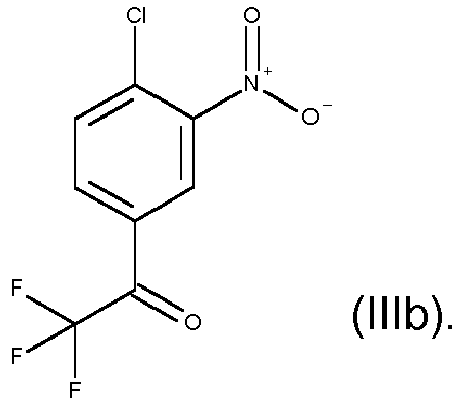
- In a 50 mL 3-neck round-bottom flask equipped with a magnetic stirrer, a thermometer and a dropping funnel, was placed fuming sulfuric acid (12.0 g, 20-30% SO3). The flask content was cooled to 5°C and compound of formula lib (1-(4-chlorophenyl)-2,2,2-trifluoro-ethanone, 9.48 g, 45.0 mmol) was added in one portion. Fuming nitric acid (3.09 g, 48.6 mmol) was added to the mixture during 5 minutes. The temperature rose to 60°C. After the addition was complete, the cooling bath was removed and the reaction mixture was stirred at ambient temperature for 40 minutes. (At this point HPLC analysis indicated a complete conversion of the starting material to compound of formula IIIb). The reaction mixture was placed in an ice bath and water (1.4 g) was added to the mixture. The solution was extracted twice with dichloromethane (10 mL and 5 mL). The solvent was removed under vacuo to give the title compound of formula IIIb (1-(4-chloro-3-nitro-phenyl)-2,2,2-trifluoro-ethanone, 11.40 g). According to the quantitative 1H NMR analysis (1,1,2,2-tetrachloroethane as an internal standard) the material had purity of 97%.
1H NMR (400 MHz, CDCl3) δ ppm 7.82 (d, J = 8.5 Hz, 1H), 8.21 (dm, J = 8.6 Hz, 1H), 8.55 (d, J = 1.8 Hz, 1H)
13C NMR (101 MHz, CDCl3) δ ppm 116.1 (q, 1JC-F = 290.5 Hz), 126.9 (d, J = 2.2 Hz), 129.1, 133.1, 133.5 (q, J = 2.20 Hz), 134.6, 148.4, 177.9 (q, 2JC-F = 36.6 Hz).
19F NMR (376 MHz, CDCl3) δ ppm - 71.92. -

- A 50 mL single-neck round-bottom flask equipped with a magnetic stirrer was charged with the compound of formula IIIb (1-(4-chloro-3-nitro-phenyl)-2,2,2-trifluoro-ethanone, 6.535 g, 25.0 mmol, 97% purity) and fuming sulfuric acid (10.0 g, 20-30% SO3). The flask was placed in an oil bath and heated to 105°C (external temperature). Trichloroisocyanuric acid (1.96 g, 8.4 mmol) was added in one portion. The reaction mixture was stirred for 1 h and 15 min followed by the addition of a second portion of trichloroisocyanuric acid (0.47 g, 2.0 mmol). After 2 h and 15 min of stirring, the conversion of the starting material was 96% (HPLC analysis, area% at 220 nm). A third portion of trichloroisocyanuric acid (0.2 g, 0.9 mmol) was added and the reaction was stirred overnight. The Next morning (14 h since the addition of the last portion of trichloroisocyanuric acid) the conversion was 100% and a small quantity of polychlorinated by-products was observed (< 10 area%). The reaction mixture was allowed to cool to ambient temperature and water (1.6 g) was added while cooling in a water bath. The solution was extracted twice with dichloromethane (10 mL and 5 mL). The solvent was removed under vacuo to give the title compound of formula IVb (1-(3,4-dichloro-5-nitro-phenyl)-2,2,2-trifluoro-ethanone) as a pale yellow liquid (7.39 g). According to the quantitative 1H NMR analysis (1,1,2,2-tetrachloroethane as an internal standard) the material had purity of 88.5%.
- The crude material was purified by fractional distillation at 0.07 mbar using a 10 cm Vigreux column to give 6.01 g of compound of formula IVb with chemical purity of 93% (quantitative 1H NMR analysis, 1,1,2,2-tetrachloroethane as an internal standard)
1H NMR (400 MHz, CDCl3) δ ppm 8.34 (d, J = 0.8 Hz, 2H)
13C NMR (101 MHz, CDCl3) δ ppm 115.9 (q, 1JC-F = 290.5 Hz), 124.0 (m), 129.0, 133.3, 133.8 (d, J = 2.20 Hz), 137.3, 150.1, 177.2 (q, 2JC-F = 37.3 Hz).
19F NMR (376 MHz, CDCl3) δ ppm - 71.85. -

- In a 10 mL 2-neck round-bottom flask equipped with a magnetic stirrer, a glass pipe for gas introduction and a reflux condenser, was placed a compound of formula IVb (1-(3,4-dichloro-5-nitro-phenyl)-2,2,2-trifluoro-ethanone, 5.82 g, 18.8 mmol, 93% purity). The flask was placed in an oil bath and heated to 220°C (external temperature). A slow stream of chlorine gas was introduced under the liquid surface over a period of 9.5 h. Reaction off-gas was scrubbed into a 10% sodium hydroxide solution. After this time the conversion of the starting material was 99.5% (GC area%, FID). The reaction mixture was purged with nitrogen to remove the chlorine gas from the system and simultaneously cooled to about 60°C. Dichloromethane (5 mL) was introduced through the reflux condenser and the resulting solution was discharged. The flask was rinsed with a small quantity of dichloromethane (5 mL). The solvent was removed under vacuo to afford compound of formula Ib (2,2,2-trifluoro-1-(3,4,5-trichlorophenyl)ethanone) as white crystalline material (5.37 g). The title compound of formula Ic had chemical purity of 93% according to the quantitative 1H NMR analysis (1,1,2,2-tetrachloroethane as an internal standard).
1H NMR (400 MHz, CDCl3) δ ppm 8.05 (d, J = 0.8 Hz, 2H)
13C NMR (101 MHz, CDCl3) δ ppm 116.1 (q, 1JC-F = 290.5 Hz), 129.0, 129.5 (m), 135.8, 139.5, 177.9 (q, 2JC-F = 36.6 Hz).
19F NMR (376 MHz, CDCl3) δ ppm - 71.68. -

- In a 2L glass reactor equipped with a cooling circulator, a mechanical stirrer and a glass pipe for gas introduction, was placed fluorobenzene (865 g, 9.00 mol). The reactor's content was cooled to -5°C and finely-powered anhydrous aluminum chloride (444 g, 3.30 mol) was added in one portion. A stream of trifluoroacetyl chloride gas (400 g, 3.02 mol) was introduced under the liquid surface over a period of 3 h at -5°C (2.2 g /min). Reaction off-gas was scrubbed in a 10% sodium hydroxide solution. The reaction mixture was stirred for additional 3 h at 0°C and then it was slowly added to ice-cold water (1200 g) while keeping the temperature below 30°C (intensive cooling required). The aqueous lower layer was separated and the organic layer was washed with water (300 mL). The product was isolated by fractional distillation using 50 cm Vigreux column as follows: Most of fluorobenzene was distilled at normal pressure while increasing the bad temperature from 100 to 140°C. Then the bad temperature was reduced to 80°C and the apparatus was evacuated to 200 mbar. After distilling remaining fluorobenzene the product was collected at the head temperature of 100-101°C (200 mbar). Yield 437 g. According to the quantitative 1H NMR analysis (1,1,2,2-tetrachloroethane as an internal standard) the material had purity of 99%.The recovered fluorobenzene (546 g) was used in the next run.
- Als spectroscopic data were in agreement to those of commercially available material.
-

- In a 100 mL 3-neck round-bottom flask equipped with a magnetic stirrer, a thermometer and a dropping funnel was placed compound of formula IIc (2,2,2-trifluoro-1-(4-fluorophenyl)ethanone, 19.8 g, 102.0 mmol) and concentrated sulfuric acid (50.0 g, 95-98%, 492 mmol). Concentrated nitric acid (10.5 g, 65%, 107.1 mmol) was added over a period of 15 min. During the addition time, the reaction mixture was allowed to reach 55°C and then it was kept at this temperature by cooling using a water bath. After the addition was completed, the water bath was removed and the reaction mixture was stirred overnight at ambient temperature (15 h). Water (13.0 g) was added to the reaction mixture. The pale yellow organic layer was separated and contained mostly the compound of formula IIIc. According to the quantitative 1H NMR analysis (1,1,2,2-tetrachloroethane as an internal standard) the material had purity of 95.6%.
1H NMR (400 MHz, CDCl3) δ ppm 7.55 (dd, J = 9.8, 8.8 Hz, 1H), 8.38 (dm, J = 8.9 Hz, 1H), 8.79 (dd, J = 7.0, 2.0 Hz, 1H)
13C NMR (101 MHz, CDCl3) δ ppm 116.1 (q, 1JC-F = 290.5 Hz), 120.0 (d, J = 21.7 Hz), 126.6 (d, J = 4.1 Hz), 128.6, 136.8 (dm, J = 10.5 Hz), 137.9, 159.3 (d, 1JC-F = 276.6 Hz), 177.6 (q, 2JC-F = 36.8 Hz)
19F NMR (376 MHz, CDCl3) δ ppm -104.95 (s, 1F), - 71.78 (s, 3F). -
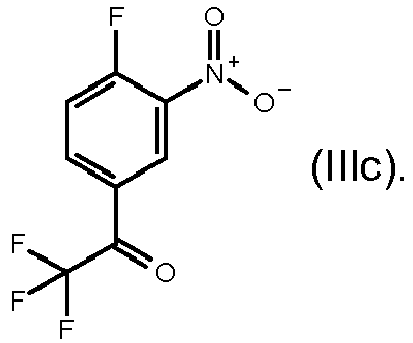
- In a 100 mL 3-neck round-bottom flask equipped with a magnetic stirrer, a thermometer and a dropping funnel was placed compound of formula IIc (2,2,2-trifluoro-1-(4-fluorophenyl)ethanone, 38.8 g, 200 mmol) and concentrated sulfuric acid (40.0 g, 95-98%, 400 mmol). Fuming nitric acid (13.9 g, 99%, 215 mmol) was added over a period of 1 h and 30 min. During the addition time, the reaction mixture was allowed to reach 60°C. After the addition was completed, the reaction mixture was stirred at 60°C for 1 h. The pale yellow organic layer was separated to give 46.0 g of the title compound. According to the quantitative 1H NMR analysis (1,1,2,2-tetrachloroethane as an internal standard) the material had purity of 97.5%.
-

- In a 50 mL 3-neck round-bottom flask equipped with a magnetic stirrer, a thermometer and a dropping funnel, was placed fuming sulfuric acid (20.4 g, 20-30% SO3). The flask content was cooled to 5°C in an ice bath and compound of formula IIc (2,2,2-trifluoro-1-(4-fluorophenyl)ethanone, 10.0 g, 51.5 mmol) was added in one portion. Fuming nitric acid (3.42 g, 54 mmol) was added to the mixture during 15 minutes while keeping the temperature below 25°C. The cooling bath was removed and the reaction mixture was stirred at ambient temperature for 1h. At this point HPLC analysis indicated 99.4% conversion of starting material of formula IIc to the intermediate of formula IIIc. The flask was placed in an oil bath and heated to 120°C (external temperature). Trichloroisocyanuric acid (4.00 g, 17.2 mmol) was added in one portion. The reaction mixture was stirred for 1 h and 20 min followed by the addition of a second portion of trichloroisocyanuric acid (1.05 g, 4.5 mmol). After 14 h of stirring, the conversion of the starting material was 75% (HPLC). A third portion of trichloroisocyanuric acid (0.97 g, 4.2 mmol) was added and the temperature was increased to 140°C. After stirring for an additional 6 h at 140°C, the conversion reached 94%. The reaction mixture was allowed to cool to ambient temperature and water (4.2 g) was slowly added while cooling in a water bath. The product was extracted twice with dichloromethane (10 mL and 5 mL). The solvent was removed under vacuo to give the title compound of formula IVb as yellow oily liquid (13.2 g). According to the quantitativ 1H NMR analysis (1,1,2,2-tetrachloroethane as an internal standard) the material had purity of 88.0%.
- The crude material of formula IVb from different experiments (47.6 g) was purified by fractional distillation at 0.07 mbar using a 25 cm Vigreux column to give compound of formula IVb (44.62 g, b. p. 58-61°C) with chemical purity of 92% (quantitative 1H NMR analysis, 1,1,2,2-tetrachloroethane as an internal standard) .
1H NMR (400 MHz, CDCl3) δ ppm 8.41 (dm, J = 5.8 Hz, 1H), 8.65 (dm, J = 6.0 Hz, 1H).
19F NMR (376 MHz, CDCl3) δ ppm -105.95 (s, 1F), - 71.67 (s, 3F). -
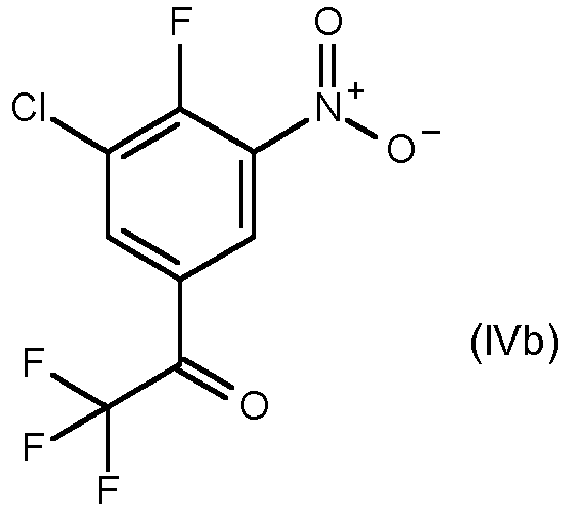
- In a 0.5 L glass reactor equipped with a cooling circulator, a mechanical stirrer and two dropping funnels were placed compound of formula IIc (2,2,2-trifluoro-1-(4-fluorophenyl)ethanone, 194 g, 1.00 mol) and concentrated sulfuric acid (70.0 g, 95-98%, 0.70 mmol). Fuming sulfuric acid (66% SO3, 127g, 1.05 mol SO3) and fuming nitric acid (99%, 66.8 g, 1.05 mol) were simultaneously added in 2 h while keeping the temperature below 50°C. The reaction mixture was stirred for 5 h at 25 °C and then 1 h at 50°C.
- Fuming sulfuric acid (66% SO3, 150 g, 1.24 mol SO3) was added to the reaction mixture in 1 h. The reaction mixture was heated to 100°C followed by addition of trichloroisocyanuric acid (81 g, 0.33 mol) in several portions within 2 h at 100-105°C. The reaction mixture was stirred for 3 h and 30 min followed by the addition of trichloroisocyanuric acid (15.2 g, 0.062 mol) in one portion. After 3 h stirring at 100-105°C a next portion of trichloroisocyanuric acid (7.7 g, 0.031 mol) was added and the temperature was increased to 120°C. Finally, after 4 h stirring at 120°C a last portion of trichloroisocyanuric acid (7.7 g, 0.031 mol) and the stitring was continued for 2 h. At this time the conversion reached 99%.
- The reaction mixture was cooled to ambient temperature and water (25 g) was slowly added. The product was isolated by distillation under reduced pressure over a 20 cm Vigreux column direct from the reaction mixture (b. p 97-100°C, 4 mbar). Yield 269 g. According to the quantitativ 1H NMR analysis (1,1,2,2-tetrachloroethane as an internal standard) the material had purity of 91.5%.
-

- In a 100 mL 2-neck round-bottom flask equipped with a magnetic stirrer, a thermometer, a glass pipe for gas introduction and a reflux condenser, was placed the compound of formula IVc (1-(3-chloro-4-fluoro-5-nitro-phenyl)-2,2,2-trifluoro-ethanone, 10.0 g, 33.9 mmol, 92% purity). The flask was placed in an oil bath and heated to 230°C (external temperature). A slow stream of chlorine gas was introduced under the liquid surface over a period of 18 h and 30 min. Reaction off-gas was scrubbed in a 10% sodium hydroxide solution. At this time, the conversion of the starting material was 71% according to 1H NMR analysis. The reaction mixture was cooled to ambient temperature and discharged. The crude reaction mixture was fractionated under vacuo (18 mbar) using a 10 cm Vigreux column to separate the title compound of formula Ic (b.p. 88-90°C, 6.25 g) from the starting material IVc (3.25 g, distillation residue). The title compound of formula Ic had a purity of 88% according to the quantitative 1H NMR analysis (1,1,2,2-tetrachloroethane as an internal standard). The distillation residue contained 81.5% of compound of formula IVc and 7.3% of compound of formula Ic.
- Isolated yield of compound of formula Ic 62.2%.
- Yield of the recovered starting material IVc 26.4%.
- Compound of formula Ic:
- 1H NMR (400 MHz, CDCl3) δ ppm 8.05 (dd, J = 6.1 Hz, 0.8 Hz, 2H).
- 13C NMR (101 MHz, CDCl3) δ ppm -116.2 (q, 1JC-F = 290.54 Hz), 124.1 (d, J = 18.6 Hz), 126.8 (d, J = 4.7 Hz), 131.0, 158.7 (d, 1JC-F = 262.7 Hz), 177.6 (q, 2JC-F = 37.08 Hz).
- 19F NMR (376 MHz, CDCl3) δ ppm -102.51 (s, 1F), -71.56 (s, 3F).
-

- In a 250 mL 3-neck round-bottom flask equipped with a magnetic stirrer, a thermometer, a glass pipe for gas introduction and a reflux condenser, was placed the compound of formula IVc (1-(3-chloro-4-fluoro-5-nitro-phenyl)-2,2,2-trifluoro-ethanone, 204.0 g, 0.687 mol, 91.5% purity) and anhydrous calcium chloride (3.9 g). The flask was placed in a sand bath and heated to 210°C (internal temperature). A slow stream of chlorine gas (about 1.5 g /h) was introduced under the liquid surface over a period of 33 h. During this time the reaction temperature was gradually reduced from 210°C to 183°C. Reaction off-gas was scrubbed in a 10% sodium hydroxide solution. At this time, the conversion of the starting material was 96% according to 1H NMR analysis. The reaction mixture was cooled to ambient temperature and discharged. The crude reaction mixture was fractionated under reduce pressure (93 mbar) using a 30 cm distillation column (evacuated, silver coated insulating jacket, packed with glass beds) to give the title compound of formula Ic (b.p. 100-102 °C, 142 g). The title compound of formula Ic had a purity of 95% according to the quantitative GC analysis.
Claims (1)
- A process for the preparation of a compound of formula II,

Applications Claiming Priority (3)
| Application Number | Priority Date | Filing Date | Title |
|---|---|---|---|
| EP14188744 | 2014-10-14 | ||
| EP15775221.3A EP3207023B1 (en) | 2014-10-14 | 2015-10-07 | Process for the preparation of 1-(3,5-dichlorophenyl)-2,2,2-trifluoroethanone and derivatives thereof |
| PCT/EP2015/073118 WO2016058881A2 (en) | 2014-10-14 | 2015-10-07 | Process for the preparation of halo-substituted benzenes |
Related Parent Applications (2)
| Application Number | Title | Priority Date | Filing Date |
|---|---|---|---|
| EP15775221.3A Division-Into EP3207023B1 (en) | 2014-10-14 | 2015-10-07 | Process for the preparation of 1-(3,5-dichlorophenyl)-2,2,2-trifluoroethanone and derivatives thereof |
| EP15775221.3A Division EP3207023B1 (en) | 2014-10-14 | 2015-10-07 | Process for the preparation of 1-(3,5-dichlorophenyl)-2,2,2-trifluoroethanone and derivatives thereof |
Publications (1)
| Publication Number | Publication Date |
|---|---|
| EP3597627A1 true EP3597627A1 (en) | 2020-01-22 |
Family
ID=51690931
Family Applications (2)
| Application Number | Title | Priority Date | Filing Date |
|---|---|---|---|
| EP19190828.4A Pending EP3597627A1 (en) | 2014-10-14 | 2015-10-07 | Process for the preparation of 1-(3,5-dichlorophenyl)-2,2,2-trifluoroethanone and derivatives thereof |
| EP15775221.3A Active EP3207023B1 (en) | 2014-10-14 | 2015-10-07 | Process for the preparation of 1-(3,5-dichlorophenyl)-2,2,2-trifluoroethanone and derivatives thereof |
Family Applications After (1)
| Application Number | Title | Priority Date | Filing Date |
|---|---|---|---|
| EP15775221.3A Active EP3207023B1 (en) | 2014-10-14 | 2015-10-07 | Process for the preparation of 1-(3,5-dichlorophenyl)-2,2,2-trifluoroethanone and derivatives thereof |
Country Status (17)
| Country | Link |
|---|---|
| US (1) | US10040745B2 (en) |
| EP (2) | EP3597627A1 (en) |
| JP (2) | JP6728151B2 (en) |
| KR (4) | KR20220051422A (en) |
| CN (2) | CN109665956A (en) |
| BR (1) | BR112017007506B1 (en) |
| DK (1) | DK3207023T3 (en) |
| ES (1) | ES2755333T3 (en) |
| HR (1) | HRP20192143T1 (en) |
| HU (1) | HUE046755T2 (en) |
| IL (2) | IL251176B (en) |
| MX (2) | MX386842B (en) |
| PL (1) | PL3207023T3 (en) |
| RS (1) | RS59795B1 (en) |
| SI (1) | SI3207023T1 (en) |
| TW (2) | TWI670256B (en) |
| WO (1) | WO2016058881A2 (en) |
Families Citing this family (3)
| Publication number | Priority date | Publication date | Assignee | Title |
|---|---|---|---|---|
| JP7071036B2 (en) * | 2019-02-15 | 2022-05-18 | 福建永晶科技股▲ふん▼有限公司 | A new new method of Friedel-Crafts reaction and the catalyst used in the method. |
| CN112110806B (en) * | 2020-09-10 | 2022-11-15 | 浙江永太科技股份有限公司 | Preparation method and intermediate of 1- (3, 5-dichloro-4-fluoro-phenyl) -2, 2-trifluoroacetone |
| WO2022061914A1 (en) * | 2020-09-28 | 2022-03-31 | 台州臻挚生物科技有限公司 | Method for preparing 3,5-dihalotrifluoroacetophenone and derivative thereof |
Citations (8)
| Publication number | Priority date | Publication date | Assignee | Title |
|---|---|---|---|---|
| EP0163230A2 (en) | 1984-05-22 | 1985-12-04 | Asahi Glass Company Ltd. | Process for producing aromatic chlorine compounds |
| CN101177379A (en) | 2006-11-10 | 2008-05-14 | 浙江富盛控股集团有限公司 | Method for preparing 2,4,6-trichloro-fluorobenzene |
| EP1932836A1 (en) | 2005-09-02 | 2008-06-18 | Nissan Chemical Industries, Ltd. | Isoxazoline-substituted benzamide compound and harmful organism-controlling agent |
| CN101337862A (en) | 2008-08-08 | 2009-01-07 | 浙江富盛控股集团有限公司 | Method for preparing 2,3-dichlorin fluorobenzene |
| US20110130445A1 (en) | 2009-10-28 | 2011-06-02 | Bayer Schering Pharma Aktiengesellschaft | Substituted 3-phenylpropionic acids and the use thereof |
| WO2012120135A1 (en) | 2011-03-10 | 2012-09-13 | Novartis Ag | Isoxazole derivatives |
| WO2013100632A1 (en) | 2011-12-30 | 2013-07-04 | Hanmi Pharm Co., Ltd. | THIENO[3,2-d]PYRIMIDINE DERIVATIVES HAVING INHIBITORY ACTIVITY FOR PROTEIN KINASES |
| CN103664511A (en) | 2013-12-13 | 2014-03-26 | 上虞市临江化工有限公司 | Preparation method of 5-bromo-1,3-dichloro-2-fluorobenzene |
Family Cites Families (15)
| Publication number | Priority date | Publication date | Assignee | Title |
|---|---|---|---|---|
| JPH03275646A (en) * | 1990-03-27 | 1991-12-06 | Asahi Glass Co Ltd | Production of fluorinated benzoic acids |
| JPH08259507A (en) * | 1995-03-24 | 1996-10-08 | Nissan Chem Ind Ltd | Nitration of acetophenone derivative |
| JPH08268975A (en) * | 1995-03-30 | 1996-10-15 | Nissan Chem Ind Ltd | Production of nitrohalogenoacetophenone derivative |
| KR100240198B1 (en) * | 1997-08-09 | 2000-01-15 | 김충섭 | Novel propenoic ester and amide derivatives having alkenyl groups substituted with trifluoromethyl groups |
| CN100400529C (en) * | 2003-10-08 | 2008-07-09 | 中国科学院化学研究所 | Fluorine-containing aromatic organic tetracarboxylic dianhydride and preparation method and application thereof |
| MX2008013305A (en) * | 2006-04-20 | 2008-10-27 | Du Pont | Five-membered heterocyclic invertebrate pest control agents. |
| CN101377862A (en) | 2007-08-31 | 2009-03-04 | 张帝 | Technical method for cipher anti-theft |
| JP5472638B2 (en) * | 2008-03-18 | 2014-04-16 | 日産化学工業株式会社 | Process for producing 1- (substituted phenyl) -1-substituted silyl ethers, alcohols or ketones and intermediates |
| WO2009151098A1 (en) * | 2008-06-13 | 2009-12-17 | 塩野義製薬株式会社 | SULFUR-CONTAINING HETEROCYCLIC DERIVATIVE HAVING β-SECRETASE-INHIBITING ACTIVITY |
| WO2010083310A2 (en) * | 2009-01-14 | 2010-07-22 | Dow Agrosciences Llc | Fungicidal compositions including hydrazone derivatives and copper |
| GB0917775D0 (en) * | 2009-10-09 | 2009-11-25 | Btg Int Ltd | Novel pharmaceutical compounds |
| WO2011071057A1 (en) * | 2009-12-09 | 2011-06-16 | 塩野義製薬株式会社 | Pharmaceutical composition for treatment or prevention of alzheimer's disease containing sulfur-containing heterocyclic derivative |
| JP2012082186A (en) * | 2010-09-15 | 2012-04-26 | Bayer Cropscience Ag | Insecticidal arylpyrrolidines |
| JP2014500865A (en) * | 2010-11-03 | 2014-01-16 | ビーエーエスエフ ソシエタス・ヨーロピア | Process for the preparation of substituted isoxazoline compounds and their precursors 4-chlorobenzaldehyde oxime, 4-bromobenzaldehyde oxime or 4-iodobenzaldehyde oxime |
| JP6124012B2 (en) * | 2011-05-26 | 2017-05-10 | 日産化学工業株式会社 | Process for producing 1- (2-amino-substituted phenyl) -2-halo-2,2-difluoroethanone compound and 1- (substituted phenyl) -2-halo-2,2-difluoroethanone compound |
-
2015
- 2015-10-07 KR KR1020227012489A patent/KR20220051422A/en not_active Ceased
- 2015-10-07 ES ES15775221T patent/ES2755333T3/en active Active
- 2015-10-07 RS RS20191533A patent/RS59795B1/en unknown
- 2015-10-07 HU HUE15775221A patent/HUE046755T2/en unknown
- 2015-10-07 PL PL15775221T patent/PL3207023T3/en unknown
- 2015-10-07 US US15/515,271 patent/US10040745B2/en active Active
- 2015-10-07 KR KR1020237025980A patent/KR20230117260A/en not_active Ceased
- 2015-10-07 EP EP19190828.4A patent/EP3597627A1/en active Pending
- 2015-10-07 KR KR1020177009561A patent/KR102436959B1/en active Active
- 2015-10-07 EP EP15775221.3A patent/EP3207023B1/en active Active
- 2015-10-07 HR HRP20192143TT patent/HRP20192143T1/en unknown
- 2015-10-07 SI SI201531012T patent/SI3207023T1/en unknown
- 2015-10-07 DK DK15775221T patent/DK3207023T3/en active
- 2015-10-07 CN CN201910041997.8A patent/CN109665956A/en active Pending
- 2015-10-07 MX MX2017004383A patent/MX386842B/en unknown
- 2015-10-07 CN CN201580055749.9A patent/CN106795093B/en active Active
- 2015-10-07 BR BR112017007506-7A patent/BR112017007506B1/en active IP Right Grant
- 2015-10-07 WO PCT/EP2015/073118 patent/WO2016058881A2/en not_active Ceased
- 2015-10-07 JP JP2017519682A patent/JP6728151B2/en active Active
- 2015-10-07 KR KR1020257014656A patent/KR20250065736A/en active Pending
- 2015-10-13 TW TW104133497A patent/TWI670256B/en active
- 2015-10-13 TW TW108116398A patent/TWI687404B/en active
-
2017
- 2017-03-15 IL IL251176A patent/IL251176B/en active IP Right Grant
- 2017-04-04 MX MX2021002896A patent/MX2021002896A/en unknown
-
2020
- 2020-02-04 IL IL272451A patent/IL272451A/en active IP Right Grant
- 2020-07-01 JP JP2020114073A patent/JP6987930B2/en active Active
Patent Citations (8)
| Publication number | Priority date | Publication date | Assignee | Title |
|---|---|---|---|---|
| EP0163230A2 (en) | 1984-05-22 | 1985-12-04 | Asahi Glass Company Ltd. | Process for producing aromatic chlorine compounds |
| EP1932836A1 (en) | 2005-09-02 | 2008-06-18 | Nissan Chemical Industries, Ltd. | Isoxazoline-substituted benzamide compound and harmful organism-controlling agent |
| CN101177379A (en) | 2006-11-10 | 2008-05-14 | 浙江富盛控股集团有限公司 | Method for preparing 2,4,6-trichloro-fluorobenzene |
| CN101337862A (en) | 2008-08-08 | 2009-01-07 | 浙江富盛控股集团有限公司 | Method for preparing 2,3-dichlorin fluorobenzene |
| US20110130445A1 (en) | 2009-10-28 | 2011-06-02 | Bayer Schering Pharma Aktiengesellschaft | Substituted 3-phenylpropionic acids and the use thereof |
| WO2012120135A1 (en) | 2011-03-10 | 2012-09-13 | Novartis Ag | Isoxazole derivatives |
| WO2013100632A1 (en) | 2011-12-30 | 2013-07-04 | Hanmi Pharm Co., Ltd. | THIENO[3,2-d]PYRIMIDINE DERIVATIVES HAVING INHIBITORY ACTIVITY FOR PROTEIN KINASES |
| CN103664511A (en) | 2013-12-13 | 2014-03-26 | 上虞市临江化工有限公司 | Preparation method of 5-bromo-1,3-dichloro-2-fluorobenzene |
Non-Patent Citations (10)
| Title |
|---|
| B. R. LIVSHITS ET AL: "Reactions of polyfluoro ketones with aromatic compounds", BULLETIN OF THE ACADEMY OF SCIENCES OF THE USSR, DIVISION OF CHEMICAL SCIENCES., vol. 16, no. 3, 1 March 1967 (1967-03-01), US, pages 591 - 595, XP055645883, ISSN: 0568-5230, DOI: 10.1007/BF00905999 * |
| BHARGAVA SEN: "Synthesis of substituted dinitrophenyl-ketones and -phenylacetic acids", JOURNAL OF THE INDIAN CHEMICAL SOCIETY, vol. 26, 1 January 1949 (1949-01-01), IN, pages 287 - 290, XP055645884, ISSN: 0019-4522 * |
| CANADIAN JOURNAL OF CHEMISTRY, vol. 38, no. 3, pages 399 - 406, ISSN: 0008-4042 |
| CANADIAN JOURNAL OF CHEMISTRY, vol. 42, 1964, pages 439 - 446 |
| CHEMICAL ABSTRACTS, Columbus, Ohio, US; abstract no. 1297553-45-7 |
| J H SIMONS: "Fluorocarbon Aromatic Ketones", J. AM., 1 January 1953 (1953-01-01), pages 5621 - 5622, XP055646186, Retrieved from the Internet <URL:https://pubs.acs.org/doi/pdf/10.1021/ja01118a044> [retrieved on 20191125] * |
| MENDOCA, G. F.SENRA, M. R.ESTEVES, P. M.DE MATTOS, M. C. S., APPLIED CATALYSIS A: GENERAL, vol. 401, 2011, pages 176 - 181 |
| MILLER, M.W.MYLARI, B.L.HOWES, H.L.FIGDOR, S.K.LYNCH, M.J.LYNCH, J.E.KOCH, R.C., J. MED. CHEM., vol. 23, 1980, pages 1083 |
| SIMCHEN G ET AL: "EINE EINFACHE METHODE ZUR DARSTELLUNG VON ARYL- TRIFLUORMETHYLKETONEN. ÖA SIMPLE METHOD FOR THE PREPARATION OF ARYL TRIFLUOROMETHYL KETONES", SYNTHESIS, GEORG THIEME VERLAG, STUTTGART, DE, no. 9, 1 September 1996 (1996-09-01), XP000621444, ISSN: 0039-7881, DOI: 10.1055/S-1996-4444 * |
| SOTT, R.HAWNER, C.JOHANSEN, J.E., TETRAHEDRON, vol. 64, 2008, pages 4135 |
Also Published As
Similar Documents
| Publication | Publication Date | Title |
|---|---|---|
| JP6987930B2 (en) | Method for producing 1- (3,5-dichlorophenyl) -2,2,2-trifluoro-etanone and its derivative | |
| JP5412742B2 (en) | Process for producing 4-perfluoroisopropylanilines | |
| EP3207024B1 (en) | Process for the preparation of halo-substituted trifluoroacetophenones | |
| JP5504898B2 (en) | Method for producing difluorocyclopropane compound | |
| JP4286524B2 (en) | A method for producing 4-alkoxyphenyl-4-oxo-butyric acid and a method for producing 7-alkoxy-1-tetralones. | |
| SK136894A3 (en) | Method of production o-aminophenylketones and method of producing o-aminophenylcyclopropylketone | |
| JP2008174552A (en) | Method for producing 4-perfluoroisopropylanilines | |
| JP4344422B2 (en) | Method for producing p-bromophenols | |
| JP2006045095A (en) | 3-formyl-5-trifluoromethylbenzonitrile derivative and method for producing the same |
Legal Events
| Date | Code | Title | Description |
|---|---|---|---|
| PUAI | Public reference made under article 153(3) epc to a published international application that has entered the european phase |
Free format text: ORIGINAL CODE: 0009012 |
|
| STAA | Information on the status of an ep patent application or granted ep patent |
Free format text: STATUS: THE APPLICATION HAS BEEN PUBLISHED |
|
| AC | Divisional application: reference to earlier application |
Ref document number: 3207023 Country of ref document: EP Kind code of ref document: P |
|
| AK | Designated contracting states |
Kind code of ref document: A1 Designated state(s): AL AT BE BG CH CY CZ DE DK EE ES FI FR GB GR HR HU IE IS IT LI LT LU LV MC MK MT NL NO PL PT RO RS SE SI SK SM TR |
|
| STAA | Information on the status of an ep patent application or granted ep patent |
Free format text: STATUS: REQUEST FOR EXAMINATION WAS MADE |
|
| 17P | Request for examination filed |
Effective date: 20200722 |
|
| RBV | Designated contracting states (corrected) |
Designated state(s): AL AT BE BG CH CY CZ DE DK EE ES FI FR GB GR HR HU IE IS IT LI LT LU LV MC MK MT NL NO PL PT RO RS SE SI SK SM TR |
|
| STAA | Information on the status of an ep patent application or granted ep patent |
Free format text: STATUS: EXAMINATION IS IN PROGRESS |
|
| 17Q | First examination report despatched |
Effective date: 20220303 |
|
| RAP1 | Party data changed (applicant data changed or rights of an application transferred) |
Owner name: SYNGENTA CROP PROTECTION AG |