EP0163230A2 - Process for producing aromatic chlorine compounds - Google Patents
Process for producing aromatic chlorine compounds Download PDFInfo
- Publication number
- EP0163230A2 EP0163230A2 EP85106173A EP85106173A EP0163230A2 EP 0163230 A2 EP0163230 A2 EP 0163230A2 EP 85106173 A EP85106173 A EP 85106173A EP 85106173 A EP85106173 A EP 85106173A EP 0163230 A2 EP0163230 A2 EP 0163230A2
- Authority
- EP
- European Patent Office
- Prior art keywords
- chlorine
- reaction
- water
- aromatic
- compound
- Prior art date
- Legal status (The legal status is an assumption and is not a legal conclusion. Google has not performed a legal analysis and makes no representation as to the accuracy of the status listed.)
- Granted
Links
Classifications
-
- C—CHEMISTRY; METALLURGY
- C07—ORGANIC CHEMISTRY
- C07B—GENERAL METHODS OF ORGANIC CHEMISTRY; APPARATUS THEREFOR
- C07B39/00—Halogenation
-
- C—CHEMISTRY; METALLURGY
- C07—ORGANIC CHEMISTRY
- C07C—ACYCLIC OR CARBOCYCLIC COMPOUNDS
- C07C17/00—Preparation of halogenated hydrocarbons
- C07C17/093—Preparation of halogenated hydrocarbons by replacement by halogens
Definitions
- the present invention relates to a process for producing aromatic chlorine compounds from aromatic nitro compounds.
- the intermediate product i.e. the diazonium salt
- the diazonium salt has an extremely high toxicity, and the adverse effects to the workers is a serious problem.
- the diazonium salt is unstable, and readily undergoes decomposition at room temperature, whereby it is impossible to obtain the desired compound in good yield.
- the above-mentioned invention involves a number of steps, each step having a low volume efficiency, and large amount of acidic waste liquid forms, treatment of which is costly.
- the conventional process has several drawbacks.
- the present inventors have conducted extensive researches with an aim to develop a process for producing an aromatic chlorine compound from an aromatic nitro compound in an industrially advantageous manner, on the basis of their knowledge that an aromatic chlorine compound can be obtained in a single step reaction without bringing about an environmental problem by directly substituting chlorine for the nitro group bonded directly to a carbon atom of the aromatic ring.
- this substitution reaction of chlorine for the nitro group is affected by the substituents adjacent to the nitro group, i.e. the chlorine substitution hardly takes place when both sides of the nitro group are occupied by hydrogen atoms, and when at least one of the adjacent positions is occupied by a halogen atom, the reactivity remarkably improves.
- the present inventors have found another interesting fact that by conducting the substitution of chlorine for the nitro group in the substantial absence of water, the yield can be remarkably improved.
- the present invention has been accomplished on the basis of these discoveries.
- the present invention provides a process for producing an aromatic chlorine compound of the following formula II, which comprises substituting chlorine for the nitro group of an aromatic nitro compound of the following formula I with chlorine gas in the substantial absence of water: wherein each of X and Y is Cl, Br, F or H, provided that X and Y are not simultaneously H, and each of R 1 , R 2 , R 3 , R 4 , R 5 and R 6 is Cl, Br, F, N0 2 , CN, CF 3 , OCF 3 or H.
- the aromatic nitro compound in the present invention is represented by the above formula I and is a compound having at least one nitro group and at least one halogen atom such as Cl, Br or F, simultaneously. Further, there is at least one pair of adjacent carbon atoms in the aromatic ring on which the nitro group and the halogen atom are attached. Namely, in the formula I, at least one of X and Y adjacent to the nitro group is a halogen atom. If X and Y are H simultaneously, the chlorination of the nitro group sandwiched by X and Y hardly takes place. On the other hand, the resulting aromatic chlorine compound is represented by the above formula II.
- X and Y respectively represent Cl , B r, F or H, and include all combinations thereof except for the combination of X and Y being H simultaneously.
- R 1 , R 2 and R 3 respectively represent Cl, Br, F, NO 2 , CN, CF 3 or H, and include combinations of 1 to 3 kinds thereof.
- R 4 , R 5 and R 6 respectively represent Cl, Br, F, N0 2 , CN, CF 3 or H, and include combinations of 1 to 3 kinds thereof.
- the substitution reaction of chlorine for the nitro group is conducted in a liquid phase or vapor phase system.
- the reaction may be conducted in the presence or absence of a solvent.
- a solvent it is preferred to use a halogen solvent such as a chlorinated paraffin, a chlorotri-. fluoroethylene low molecular weight polymer or tetrabromoethane.
- the chlorine gas is used in an amount of from 0.2 to 10 times, preferably from 1.0 to 5 times, the theoretical amount required for the substitution of chlorine for the nitro group in the aromatic nitro compound, to be substituted by chlorine.
- the reaction is suitably conducted at a temperature of from 150 to 350 o C, under a reaction pressure of from atmospheric pressure to 100 kg/cm for a reaction time of from 2 to 30 hours.
- HF particularly water-containing HF
- HF-binding agents there may be mentioned CaCl 2 , Si0 2 , NaF and KF.
- a dehydrating agent an inorganic dehydrating agent which is inert to the starting materials and the reaction product and which has a substantial water-binding property, is preferred. Namely, it is preferred to use a dehydrating agent which is capable of reacting with water at a temperature of at least 150°C to form a hydrate, or has a strong water- absorbing property, and which has a property not to readily release the bound water.
- Preferred specific examples include SbCl 5 , SbF 5 , SbBr 3 , SnCl 4 , TaCl 5 , BF 3' CaCl 2 , PCl 5 , Si0 2 , P 2 O 5 and synthetic zeolite. They may be used alone or in combination as a mixture. CaCl 2 or SiO 2 is useful also as a HF-binding agent.
- a method for maintaining the system in the substantial absence of water to control the side reaction with water there may be mentioned a method wherein the supply of the starting materials and the withdrawal of the reaction product are conducted continuously so as not to permit the accumulation of water in the reaction system, and the resulting water is positively withdrawn from the reaction system.
- the type of the HF-binding agent or the dehydrating agent to give good yield of the desired compound varies depending upon the. desired compound, and may be appropriately selected.
- the HF-binding agent is used in an amount of from 0.01 to 1 mol per mol of the starting material aromatic nitro compound.
- the dehydrating agent is used preferably in an amount of from 0.01 to 1-mol.
- aromatic chlorine compounds such as 2,6-dichlorofluorobenzene, 3-chloro-4-fluorobenzenetrifluoride, 3,4,5-trichlorobenzotrifluoride and l-chloro-2,3,4-trifluoro- benzene, which are useful as the starting materials for intermediates of medicines or agricultural chemicals, can be obtained advantageously in an industrial manner.
- the reaction solution was analyzed, whereby the conversion of the starting material was 85% and the selectivity for 2,6-dichlorofluorobenzene was 96%. Further, the corrosion rate in this reaction was 0.05 mm/ year. In this Example and the following Examples and Comparative Examples, the corrosion rate was measured as follows.
- Corrosion rate (mm/year) ⁇ W x 8000/S x P x T
- Example 2 To the charge of Example 1, 7 g of fine silica (Si0 2 in a fine particulate form) was added, and the reaction was conducted in the same manner as in Exmaple 1. The reaction solution was analyzed, whereby the conversion of the starting material was 83%, and the selectivity for 2,6-dichlorofluorobenzene was 95%. The corrosion rate of the glass in the reaction was less than 0.01 mm/year.
- the reaction was conducted in the same manner as in Example 1 except that no phosphorus pentachloride was used, whereby the selectivity for 2,6-dichlorofluorobenzene was 65% at a conversion of the starting material of 85%.
- the corrosion rate of the glass in this reaction was 20 mm/year.
- the reaction was conducted in the same manner as in Example 3 except that no anhydrous calcium chloride was used, whereby the selectivity for 2,6-dichlorofluorobenzene was 79% at a conversion of the starting material of 82%.
- the corrosion rate of the glass in this reaction was 18 mm/year.
Landscapes
- Chemical & Material Sciences (AREA)
- Organic Chemistry (AREA)
- Organic Low-Molecular-Weight Compounds And Preparation Thereof (AREA)
Abstract


Description
- The present invention relates to a process for producing aromatic chlorine compounds from aromatic nitro compounds.
- As a process for producing an aromatic chlorine compound such as 2,6-dichlorofluorobenzene from an aromatic nitro compound such as 3-chloro-2-fluoronitro- benzene, the following process is known.

- However, the intermediate product i.e. the diazonium salt, has an extremely high toxicity, and the adverse effects to the workers is a serious problem. Further, the diazonium salt is unstable, and readily undergoes decomposition at room temperature, whereby it is impossible to obtain the desired compound in good yield. Moreover, the above-mentioned invention involves a number of steps, each step having a low volume efficiency, and large amount of acidic waste liquid forms, treatment of which is costly. Thus, the conventional process has several drawbacks.
- The present inventors have conducted extensive researches with an aim to develop a process for producing an aromatic chlorine compound from an aromatic nitro compound in an industrially advantageous manner, on the basis of their knowledge that an aromatic chlorine compound can be obtained in a single step reaction without bringing about an environmental problem by directly substituting chlorine for the nitro group bonded directly to a carbon atom of the aromatic ring. As a result, it has been found that this substitution reaction of chlorine for the nitro group is affected by the substituents adjacent to the nitro group, i.e. the chlorine substitution hardly takes place when both sides of the nitro group are occupied by hydrogen atoms, and when at least one of the adjacent positions is occupied by a halogen atom, the reactivity remarkably improves. From a further research, the present inventors have found another interesting fact that by conducting the substitution of chlorine for the nitro group in the substantial absence of water, the yield can be remarkably improved. The present invention has been accomplished on the basis of these discoveries.
- Namely, the present invention provides a process for producing an aromatic chlorine compound of the following formula II, which comprises substituting chlorine for the nitro group of an aromatic nitro compound of the following formula I with chlorine gas in the substantial absence of water:


- Now, the present invention will be described in detail with reference to the preferred embodiments.
- The aromatic nitro compound in the present invention is represented by the above formula I and is a compound having at least one nitro group and at least one halogen atom such as Cl, Br or F, simultaneously. Further, there is at least one pair of adjacent carbon atoms in the aromatic ring on which the nitro group and the halogen atom are attached. Namely, in the formula I, at least one of X and Y adjacent to the nitro group is a halogen atom. If X and Y are H simultaneously, the chlorination of the nitro group sandwiched by X and Y hardly takes place. On the other hand, the resulting aromatic chlorine compound is represented by the above formula II. In the formulas I and II, X and Y respectively represent Cl, Br, F or H, and include all combinations thereof except for the combination of X and Y being H simultaneously. R1, R2 and R3 respectively represent Cl, Br, F, NO2, CN, CF3 or H, and include combinations of 1 to 3 kinds thereof. Likewise, R4, R5 and R6 respectively represent Cl, Br, F, N02, CN, CF3 or H, and include combinations of 1 to 3 kinds thereof.
- The substitution reaction of chlorine for the nitro group is conducted in a liquid phase or vapor phase system. In the liquid phase system, the reaction may be conducted in the presence or absence of a solvent. When a solvent is employed, it is preferred to use a halogen solvent such as a chlorinated paraffin, a chlorotri-. fluoroethylene low molecular weight polymer or tetrabromoethane. The chlorine gas is used in an amount of from 0.2 to 10 times, preferably from 1.0 to 5 times, the theoretical amount required for the substitution of chlorine for the nitro group in the aromatic nitro compound, to be substituted by chlorine. The reaction is suitably conducted at a temperature of from 150 to 350oC, under a reaction pressure of from atmospheric pressure to 100 kg/cm for a reaction time of from 2 to 30 hours.
- In the chlorine substitution reaction of the present invention, the formation of NO2Cl has been confirmed. This is believed to be attributable to the chlorination reaction of the N02 group. This NO2Cl can readily be separated from the desired compound by alkali washing. In the process of the present invention, water forms as a by-product. Although the mechanism of the formation is not clearly understood, it is believed that water forms as a by-product by the reaction of the above-mentioned NO2Cl with HC1 which forms as a by-product by the chlorination of the ring. Anyway, the by-product water reacts with the starting material, whereby the yield of the desired compound will decrease, and if water is incorporated into the starting material chlorine, the corrosive property remarkably increases. Thus, it is important to conduct the substitution reaction of chlorine for the nitro group, in the substantial absence of water. For instance, in the case where the starting material aromatic nitro compound is 3-chloro-2-fluoro- nitrobenzene, an undesirable side reaction takes place whereby the nitro compound reacts with water formed as a by-product, to form HF, as shown below.
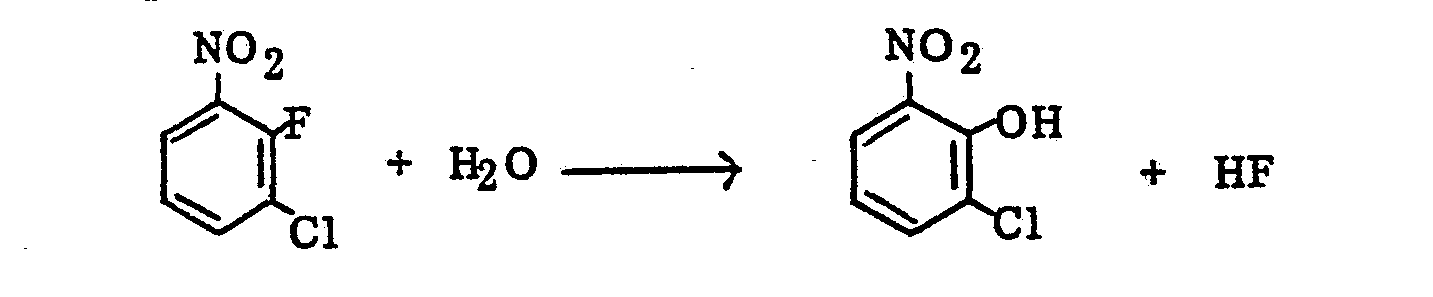
- HF, particularly water-containing HF, is likewise highly corrosive, and it not only corrodes the material of the apparatus, but also causes a side reaction with the corroded metal material serving as a negative catalyst. Therefore, in the case where a starting material which is likely to form HF, is to be used, it is preferred to conduct the chlorine substitution reaction for the nitro group in the presence of a HF-binding agent. As preferred HF-binding agents, there may be mentioned CaCl2, Si02, NaF and KF.
- In order to maintain the chlorine substitution reaction for the nitro group in the substantial absence of water, it is effective to conduct the reaction in the presence of a dehydrating agent. As the dehydrating agent, an inorganic dehydrating agent which is inert to the starting materials and the reaction product and which has a substantial water-binding property, is preferred. Namely, it is preferred to use a dehydrating agent which is capable of reacting with water at a temperature of at least 150°C to form a hydrate, or has a strong water- absorbing property, and which has a property not to readily release the bound water. Preferred specific examples include SbCl5, SbF5, SbBr3, SnCl4, TaCl5, BF3' CaCl2, PCl5, Si02, P2O5 and synthetic zeolite. They may be used alone or in combination as a mixture. CaCl2 or SiO2 is useful also as a HF-binding agent. As another method for maintaining the system in the substantial absence of water to control the side reaction with water, there may be mentioned a method wherein the supply of the starting materials and the withdrawal of the reaction product are conducted continuously so as not to permit the accumulation of water in the reaction system, and the resulting water is positively withdrawn from the reaction system.
- The type of the HF-binding agent or the dehydrating agent to give good yield of the desired compound, varies depending upon the. desired compound, and may be appropriately selected. The HF-binding agent is used in an amount of from 0.01 to 1 mol per mol of the starting material aromatic nitro compound. Likewise, the dehydrating agent is used preferably in an amount of from 0.01 to 1-mol.
- According to the process of the present invention, aromatic chlorine compounds such as 2,6-dichlorofluorobenzene, 3-chloro-4-fluorobenzenetrifluoride, 3,4,5-trichlorobenzotrifluoride and l-chloro-2,3,4-trifluoro- benzene, which are useful as the starting materials for intermediates of medicines or agricultural chemicals, can be obtained advantageously in an industrial manner.
- Now, the present invention will be described with reference to Exmaples. However, it should be understood that the present invention is by no means restricted to these specific Examples.
- Into a 200 ml Hastelloy C autoclave, 140 g (0.80 mol) of 3-chloro-2-fluoronitrobenzene and 16.6 g (0.080 mol) of phosphorus pentachloride were charged, and chlorine gas was introduced at a rate of 6.3 g/hr at 180°C for 15 hours.
- The reaction solution was analyzed, whereby the conversion of the starting material was 85% and the selectivity for 2,6-dichlorofluorobenzene was 96%. Further, the corrosion rate in this reaction was 0.05 mm/ year. In this Example and the following Examples and Comparative Examples, the corrosion rate was measured as follows.
- A test piece of Hastelloy (30 x 15 x 3 mm) or glass (5 0 x 50 mm) was placed in a reactor, and the chlorination reaction was conducted. The weight reduction of the test piece in this reaction was converted to the depth of errosion per year (8000 hours), which represents the corrosion rate.
- Corrosion rate (mm/year) = △ W x 8000/S x P x T
- △W: weight reduction (mg)
- S: surface area of the test piece (mm2)
- P: density of the test piece (mg/mm3)
- T: reaction time (hr)
- To the charge of Example 1, 7 g of fine silica (Si02 in a fine particulate form) was added, and the reaction was conducted in the same manner as in Exmaple 1. The reaction solution was analyzed, whereby the conversion of the starting material was 83%, and the selectivity for 2,6-dichlorofluorobenzene was 95%. The corrosion rate of the glass in the reaction was less than 0.01 mm/year.
- Into a 200 ml glass reactor, 140 g (0.80 mol) of 3-chloro-2-fluoronitrobenzene and 8.9 g (0.080 mol) of anhydrous calcium chloride were charged, and chlorine gas was introduced at a rate of 6.3 g/hr at 180°C for 15 hours. The reaction solution was analyzed, whereby the conversion of the starting material was 82%, and the selectivity for 2,6-dichlorofluorobenzene was 98%. The corrosion rate of glass in this reaction was 0.04 mm/year.
- Into a 200 ml glass reactor, 100 g (0.45 mol) of 3-chloro-4,6-dinitrofluorobenzene and 5.0 g (0.045 mol) of anhydrous calcium chloride were charged, and chlorine gas was introduced at a rate of 7 g/hr at 200°C for 15 hours. The reaction solution was analyzed, whereby the conversion of the starting material was 90%, and the selectivity for I-fluoro-2,4,5-trichlorobenzene was 97%. The corrosion rate of the glass in this reaction was 0.06 mm/year.
- Into a 200 ml Hastelloy reactor, 140 g (0.80 mol) of 4-chloro-2-fluoronitrobenzene and 16.6 g (0.080 mol) of phosphorus pentachloride were charged, and chlorine gas was introduced at a rate of 6.3 g/hr at 180°C for 20 hours. The reaction solution was analyzed, whereby the conversion of the starting material was 92%, and the selectivity for 2,5-dichlorofluorobenzene was 88%. The corrosion rate of the glass in the reaction was 0.08 mm/year.
- Into a 200 ml of a glass reactor, 200 g of 4-fluoro-3-nitrobenzotrifluoride and 5.3 g of anhydrous calcium chloride were charged, and chlorine gas was introduced at a rate of 27 g/hr at 180°C under a pressure of 7 kg/cm2 for 6 hours, whereby the conversion of the starting material was 94.6%, and the selectivity for 3-chloro-4-fluorobenzotrifluoride was 98.5%. Then, the reaction solution was washed with water and then distilled to obtain 149 g of 3-chloro-4-fluorobenzotrifluoride having a purity of 99.8%.
- Into a 200 ml Hastelloy C autoclave, 150 g of 2,3,4-trifluoronitrobenzene and 17.5 g of phosphorus pentachloride were charged and heated to about 190°C. While maintaining the pressure at a level of from 5 to 7 kg/cm2, chlorine gas was introduced at a rate of about 25 g/hr for 4 hours. The reaction solution was analyzed, whereby the conversion of the starting material was 93%, and the selectivity for l-chloro-2,3,4-trifluorobenzene was 88%.
- Into a 200 ml Hastelloy C autoclave, 150 g of 3,4-dichloro-5-nitrobenzotrifluoride and 16 g of phosphorus pentachloride were charged and heated to about 190°C. While maintaining the pressure at a level of about 5 kg/cm2 , chlorine gas was introduced at a rate of about 25 g/hr for 4 hours. The reaction solution was analyzed, whereby the conversion of the starting material was 92%, and the selectivity for 3,4,5-trichlorobenzo- trifluoride was 89%.
- The reaction was conducted in the same manner as in Example 1 except that no phosphorus pentachloride was used, whereby the selectivity for 2,6-dichlorofluorobenzene was 65% at a conversion of the starting material of 85%. The corrosion rate of the glass in this reaction was 20 mm/year.
- The reaction was conducted in the same manner as in Example 3 except that no anhydrous calcium chloride was used, whereby the selectivity for 2,6-dichlorofluorobenzene was 79% at a conversion of the starting material of 82%. The corrosion rate of the glass in this reaction was 18 mm/year.
- The reaction was conducted in the same manner as in Example 7 except that no phosphorus pentachloride was used, whereby the selectivity for l-chloro-2,3;4-trifluorobenzene was 60% at a conversion of the starting material of 93%.
Claims (4)


Applications Claiming Priority (2)
| Application Number | Priority Date | Filing Date | Title |
|---|---|---|---|
| JP59101670A JPS60246327A (en) | 1984-05-22 | 1984-05-22 | Preparation of aromatic chlorine compound |
| JP101670/84 | 1984-05-22 |
Publications (4)
| Publication Number | Publication Date |
|---|---|
| EP0163230A2 true EP0163230A2 (en) | 1985-12-04 |
| EP0163230A3 EP0163230A3 (en) | 1986-04-02 |
| EP0163230B1 EP0163230B1 (en) | 1989-03-29 |
| EP0163230B2 EP0163230B2 (en) | 1996-03-06 |
Family
ID=14306800
Family Applications (1)
| Application Number | Title | Priority Date | Filing Date |
|---|---|---|---|
| EP85106173A Expired - Lifetime EP0163230B2 (en) | 1984-05-22 | 1985-05-20 | Process for producing aromatic chlorine compounds |
Country Status (3)
| Country | Link |
|---|---|
| EP (1) | EP0163230B2 (en) |
| JP (1) | JPS60246327A (en) |
| DE (1) | DE3569101D1 (en) |
Cited By (5)
| Publication number | Priority date | Publication date | Assignee | Title |
|---|---|---|---|---|
| EP0249257A1 (en) * | 1986-04-14 | 1987-12-16 | Stauffer Chemical Company | Preparation of aryl halides |
| EP0355719A1 (en) * | 1988-08-26 | 1990-02-28 | Asahi Glass Company Ltd. | Process for producing chlorofluorobenzenes |
| US5208394A (en) * | 1988-08-26 | 1993-05-04 | Asahi Glass Company Ltd. | Process for producing chlorofluorobenzenes |
| US7595426B2 (en) | 2005-04-22 | 2009-09-29 | Basf Aktiengesellschaft | Method for the production of 1,3,5-trifluoro-2,4,6-trichlorobenzene from fluorobenzene derivatives |
| WO2016058881A2 (en) | 2014-10-14 | 2016-04-21 | Syngenta Participations Ag | Process for the preparation of halo-substituted benzenes |
Families Citing this family (1)
| Publication number | Priority date | Publication date | Assignee | Title |
|---|---|---|---|---|
| JPH0333871A (en) * | 1989-06-30 | 1991-02-14 | Canon Inc | Processing cartridge and image forming device where this processing cartridge is freely attachable / detachable |
Family Cites Families (2)
| Publication number | Priority date | Publication date | Assignee | Title |
|---|---|---|---|---|
| US4470930A (en) * | 1982-02-09 | 1984-09-11 | Occidental Chemical Corporation | Preparation of nuclear chlorinated aromatic compounds |
| US4424396A (en) * | 1982-07-21 | 1984-01-03 | Occidental Chemical Corporation | Process for the preparation substituted anilino acids |
-
1984
- 1984-05-22 JP JP59101670A patent/JPS60246327A/en active Granted
-
1985
- 1985-05-20 DE DE8585106173T patent/DE3569101D1/en not_active Expired
- 1985-05-20 EP EP85106173A patent/EP0163230B2/en not_active Expired - Lifetime
Cited By (7)
| Publication number | Priority date | Publication date | Assignee | Title |
|---|---|---|---|---|
| EP0249257A1 (en) * | 1986-04-14 | 1987-12-16 | Stauffer Chemical Company | Preparation of aryl halides |
| EP0355719A1 (en) * | 1988-08-26 | 1990-02-28 | Asahi Glass Company Ltd. | Process for producing chlorofluorobenzenes |
| US5208394A (en) * | 1988-08-26 | 1993-05-04 | Asahi Glass Company Ltd. | Process for producing chlorofluorobenzenes |
| US5349098A (en) * | 1988-08-26 | 1994-09-20 | Asahi Glass Company Ltd. | Process for producing chlorofluorobenzenes |
| US7595426B2 (en) | 2005-04-22 | 2009-09-29 | Basf Aktiengesellschaft | Method for the production of 1,3,5-trifluoro-2,4,6-trichlorobenzene from fluorobenzene derivatives |
| WO2016058881A2 (en) | 2014-10-14 | 2016-04-21 | Syngenta Participations Ag | Process for the preparation of halo-substituted benzenes |
| EP3597627A1 (en) | 2014-10-14 | 2020-01-22 | Syngenta Participations AG | Process for the preparation of 1-(3,5-dichlorophenyl)-2,2,2-trifluoroethanone and derivatives thereof |
Also Published As
| Publication number | Publication date |
|---|---|
| EP0163230B2 (en) | 1996-03-06 |
| JPS6365051B2 (en) | 1988-12-14 |
| DE3569101D1 (en) | 1989-05-03 |
| JPS60246327A (en) | 1985-12-06 |
| EP0163230B1 (en) | 1989-03-29 |
| EP0163230A3 (en) | 1986-04-02 |
Similar Documents
| Publication | Publication Date | Title |
|---|---|---|
| US5679879A (en) | Process for the production of substituted aromatic hydrocarbons from corresponding anilines by dediazoniation | |
| US5744659A (en) | Process for the preparation of difluoromethane | |
| RU2114813C1 (en) | Method for production of 1,1,1,3,3-pentafluoropropane, method for production of 1,1,1,3,3-pentafluoro-2-halogeno-3-chloropropane, method for production of 1,1,1,2,3-hexachloropropene, method for production of 1,1,1,3,3-pentafluoro-2,3-dichloropropane | |
| US4780559A (en) | Process for preparing organic fluorides | |
| EP0163230B1 (en) | Process for producing aromatic chlorine compounds | |
| US4778933A (en) | Process for making decabromodiphenyl oxide | |
| JP3572619B2 (en) | Method for producing difluoromethane | |
| EP0450584B1 (en) | Bromination method | |
| CA1067518A (en) | Process for the production of chlorofluorinated aliphatic ketones | |
| US5440051A (en) | Process for the α-chlorination of aryl ethers | |
| US5057633A (en) | Synthesis of perfluoroalkyl bromides | |
| US5872291A (en) | Process for producing benzoyl chlorides | |
| US4898996A (en) | Process for producing 3-chloro-4-fluoronitrobenzene | |
| EP0196529A1 (en) | Process for preparation of alpha-, alpha-, alpha-, trifluoroanisoles | |
| US4306103A (en) | Process for the manufacture of 1,3,5-trichlorobenzene | |
| EP0038052B1 (en) | Method for the preparation of cis-alkenyl bromide and acetate | |
| US4647695A (en) | Method of preparing trifluoroacetic acid from trichlorotrifluoroethane | |
| CS240984B2 (en) | Production method of 1,2-dichloroethane | |
| JPH0625111B2 (en) | Method for producing (trifluoromethyl) pyridine | |
| US4129602A (en) | Liquid phase fluorination process | |
| US5432290A (en) | Process for the preparation of 2,2-difluoro-1,3-benzodioxole | |
| JP3882855B2 (en) | Method for producing alkylbenzoyl chloride | |
| EP0027155B1 (en) | Process for dehydrohalogenating (polyhaloalkyl)benzenes | |
| CA1064508A (en) | Chlorination of butadiene sulfone to 3,3,4,4-tetrachlorotetrahydrothiophene-1,1-dioxide | |
| US4130594A (en) | Liquid phase fluorination process |
Legal Events
| Date | Code | Title | Description |
|---|---|---|---|
| PUAI | Public reference made under article 153(3) epc to a published international application that has entered the european phase |
Free format text: ORIGINAL CODE: 0009012 |
|
| AK | Designated contracting states |
Designated state(s): BE CH DE FR GB IT LI NL |
|
| PUAL | Search report despatched |
Free format text: ORIGINAL CODE: 0009013 |
|
| AK | Designated contracting states |
Kind code of ref document: A3 Designated state(s): BE CH DE FR GB IT LI NL |
|
| 17P | Request for examination filed |
Effective date: 19860611 |
|
| 17Q | First examination report despatched |
Effective date: 19870630 |
|
| GRAA | (expected) grant |
Free format text: ORIGINAL CODE: 0009210 |
|
| AK | Designated contracting states |
Kind code of ref document: B1 Designated state(s): BE CH DE FR GB IT LI NL |
|
| ITF | It: translation for a ep patent filed | ||
| REF | Corresponds to: |
Ref document number: 3569101 Country of ref document: DE Date of ref document: 19890503 |
|
| ET | Fr: translation filed | ||
| PLBI | Opposition filed |
Free format text: ORIGINAL CODE: 0009260 |
|
| 26 | Opposition filed |
Opponent name: HOECHST AKTIENGESELLSCHAFT ZENTRALE PATENTABTEILUN Effective date: 19891223 |
|
| NLR1 | Nl: opposition has been filed with the epo |
Opponent name: HOECHST AG. |
|
| ITTA | It: last paid annual fee | ||
| PUAH | Patent maintained in amended form |
Free format text: ORIGINAL CODE: 0009272 |
|
| STAA | Information on the status of an ep patent application or granted ep patent |
Free format text: STATUS: PATENT MAINTAINED AS AMENDED |
|
| 27A | Patent maintained in amended form |
Effective date: 19960306 |
|
| AK | Designated contracting states |
Kind code of ref document: B2 Designated state(s): BE CH DE FR GB IT LI NL |
|
| ITF | It: translation for a ep patent filed | ||
| REG | Reference to a national code |
Ref country code: CH Ref legal event code: AEN Free format text: MAINTIEN DU BREVET DONT L'ETENDUE A ETE MODIFIEE |
|
| NLR2 | Nl: decision of opposition | ||
| NLR3 | Nl: receipt of modified translations in the netherlands language after an opposition procedure | ||
| ET3 | Fr: translation filed ** decision concerning opposition | ||
| REG | Reference to a national code |
Ref country code: CH Ref legal event code: PFA Free format text: ASAHI GLASS COMPANY LTD,1-2, 2-CH. MARUNOUCHI,CHIYODA-KU/TOKYO (JP) TRANSFER- ASAHI GLASS COMPANY LTD.,12-1, YURAKUCHO 1-CHOME, CHIYODA-KU,TOKYO 100-8405 (JP) |
|
| REG | Reference to a national code |
Ref country code: FR Ref legal event code: CA |
|
| PGFP | Annual fee paid to national office [announced via postgrant information from national office to epo] |
Ref country code: CH Payment date: 20010511 Year of fee payment: 17 |
|
| PGFP | Annual fee paid to national office [announced via postgrant information from national office to epo] |
Ref country code: DE Payment date: 20010514 Year of fee payment: 17 |
|
| PGFP | Annual fee paid to national office [announced via postgrant information from national office to epo] |
Ref country code: GB Payment date: 20010516 Year of fee payment: 17 |
|
| PGFP | Annual fee paid to national office [announced via postgrant information from national office to epo] |
Ref country code: FR Payment date: 20010518 Year of fee payment: 17 |
|
| PGFP | Annual fee paid to national office [announced via postgrant information from national office to epo] |
Ref country code: NL Payment date: 20010531 Year of fee payment: 17 |
|
| PGFP | Annual fee paid to national office [announced via postgrant information from national office to epo] |
Ref country code: BE Payment date: 20010717 Year of fee payment: 17 |
|
| REG | Reference to a national code |
Ref country code: GB Ref legal event code: IF02 |
|
| PG25 | Lapsed in a contracting state [announced via postgrant information from national office to epo] |
Ref country code: GB Free format text: LAPSE BECAUSE OF NON-PAYMENT OF DUE FEES Effective date: 20020520 |
|
| PG25 | Lapsed in a contracting state [announced via postgrant information from national office to epo] |
Ref country code: LI Free format text: LAPSE BECAUSE OF NON-PAYMENT OF DUE FEES Effective date: 20020531 Ref country code: CH Free format text: LAPSE BECAUSE OF NON-PAYMENT OF DUE FEES Effective date: 20020531 Ref country code: BE Free format text: LAPSE BECAUSE OF NON-PAYMENT OF DUE FEES Effective date: 20020531 |
|
| PG25 | Lapsed in a contracting state [announced via postgrant information from national office to epo] |
Ref country code: NL Free format text: LAPSE BECAUSE OF NON-PAYMENT OF DUE FEES Effective date: 20021201 |
|
| PG25 | Lapsed in a contracting state [announced via postgrant information from national office to epo] |
Ref country code: DE Free format text: LAPSE BECAUSE OF NON-PAYMENT OF DUE FEES Effective date: 20021203 |
|
| GBPC | Gb: european patent ceased through non-payment of renewal fee |
Effective date: 20020520 |
|
| REG | Reference to a national code |
Ref country code: CH Ref legal event code: PL |
|
| PG25 | Lapsed in a contracting state [announced via postgrant information from national office to epo] |
Ref country code: FR Free format text: LAPSE BECAUSE OF NON-PAYMENT OF DUE FEES Effective date: 20030131 |
|
| NLV4 | Nl: lapsed or anulled due to non-payment of the annual fee |
Effective date: 20021201 |
|
| REG | Reference to a national code |
Ref country code: FR Ref legal event code: ST |