EP3594865B1 - Systeme und verfahren zur gekoppelten darstellung mithilfe von transformationslernen zum lösen von inversen problemen - Google Patents
Systeme und verfahren zur gekoppelten darstellung mithilfe von transformationslernen zum lösen von inversen problemen Download PDFInfo
- Publication number
- EP3594865B1 EP3594865B1 EP19184116.2A EP19184116A EP3594865B1 EP 3594865 B1 EP3594865 B1 EP 3594865B1 EP 19184116 A EP19184116 A EP 19184116A EP 3594865 B1 EP3594865 B1 EP 3594865B1
- Authority
- EP
- European Patent Office
- Prior art keywords
- features
- target domain
- data
- source domain
- transform
- Prior art date
- Legal status (The legal status is an assumption and is not a legal conclusion. Google has not performed a legal analysis and makes no representation as to the accuracy of the status listed.)
- Active
Links
Images


Classifications
-
- G—PHYSICS
- G06—COMPUTING OR CALCULATING; COUNTING
- G06N—COMPUTING ARRANGEMENTS BASED ON SPECIFIC COMPUTATIONAL MODELS
- G06N20/00—Machine learning
-
- G—PHYSICS
- G06—COMPUTING OR CALCULATING; COUNTING
- G06F—ELECTRIC DIGITAL DATA PROCESSING
- G06F18/00—Pattern recognition
- G06F18/20—Analysing
- G06F18/21—Design or setup of recognition systems or techniques; Extraction of features in feature space; Blind source separation
- G06F18/213—Feature extraction, e.g. by transforming the feature space; Summarisation; Mappings, e.g. subspace methods
- G06F18/2134—Feature extraction, e.g. by transforming the feature space; Summarisation; Mappings, e.g. subspace methods based on separation criteria, e.g. independent component analysis
- G06F18/21347—Feature extraction, e.g. by transforming the feature space; Summarisation; Mappings, e.g. subspace methods based on separation criteria, e.g. independent component analysis using domain transformations
-
- G—PHYSICS
- G06—COMPUTING OR CALCULATING; COUNTING
- G06F—ELECTRIC DIGITAL DATA PROCESSING
- G06F18/00—Pattern recognition
- G06F18/20—Analysing
- G06F18/21—Design or setup of recognition systems or techniques; Extraction of features in feature space; Blind source separation
- G06F18/217—Validation; Performance evaluation; Active pattern learning techniques
-
- G—PHYSICS
- G06—COMPUTING OR CALCULATING; COUNTING
- G06F—ELECTRIC DIGITAL DATA PROCESSING
- G06F18/00—Pattern recognition
- G06F18/20—Analysing
- G06F18/28—Determining representative reference patterns, e.g. by averaging or distorting; Generating dictionaries
-
- G—PHYSICS
- G06—COMPUTING OR CALCULATING; COUNTING
- G06T—IMAGE DATA PROCESSING OR GENERATION, IN GENERAL
- G06T1/00—General purpose image data processing
- G06T1/20—Processor architectures; Processor configuration, e.g. pipelining
-
- G—PHYSICS
- G06—COMPUTING OR CALCULATING; COUNTING
- G06N—COMPUTING ARRANGEMENTS BASED ON SPECIFIC COMPUTATIONAL MODELS
- G06N3/00—Computing arrangements based on biological models
- G06N3/02—Neural networks
- G06N3/04—Architecture, e.g. interconnection topology
- G06N3/045—Combinations of networks
Definitions
- the disclosure herein generally relates to inverse problems in image processing, and, more particularly, to systems and methods for coupled representation using transform learning for solving inverse problems.
- Image acquisition has been known to be fraught with several problems that have been traditionally recast as inverse problems. Most notable among the problems include denoising, deblurring and super-resolution. Noise appears in cameras owing to heating of sensors, analog to digital conversion etc. Removal of noise is popularly called denoising. Images can get blurred owing mostly to motion artefacts, due to movement of the camera or the target or both. Deblurring is used for removal of such artifacts. Limitations in packing sensors (low resolution in order to check costs/size) require super-resolving them.
- Document NAGPAL SHRUTI ET AL "Face Sketch Matching via Coupled Deep Transform Learning” (DOI: 10.1109/ICCV.2017.579 ) discloses a method for Face sketch to digital image matching. Face sketch to digital image matching is an important challenge of face recognition that involves matching across different domains. Current research efforts have primarily focused on extracting domain invariant representations or learning a mapping front one domain to the other. In this research, the authors propose a novel transform learning based approach termed as DeepTransformer, which learns a transformation and mapping function between the features of two domains. The proposed formulation is independent of the input Information and can be applied with any existing learned or hand-crafted feature.
- Embodiments of the present disclosure present technological improvements as solutions to one or more of the above-mentioned technical problems recognized by the inventors in conventional systems.
- the invention is set out in the appended set of claims.
- the systems and methods of the present disclosure are based on a coupled representation learning approach, wherein a basis or transform (and corresponding coefficients or features) are learnt for a source domain and a target domain such that the features from one domain can be linearly mapped to the other.
- the transforms provide a representation for a corresponding domain.
- the representation in the source domain may constitute lower dimensional measurements compared to the target domain.
- the expressions 'source domain' and 'measurement domain' maybe used interchangeably.
- 'target domain' and 'signal domain' may be used interchangeably.
- 'The expressions 'basis' or 'transform' may be used interchangeably.
- 'features' or 'coefficients' may be used interchangeably.
- FIG. 1 through FIG.3 where similar reference characters denote corresponding features consistently throughout the figures, there are shown preferred embodiments and these embodiments are described in the context of the following exemplary system and/or method.
- FIG.1 illustrates an exemplary block diagram of a system 100 having coupled representation using transform learning for solving inverse problems in accordance with an embodiment of the present disclosure.
- the system 100 includes one or more processors 104, communication interface device(s) or input/output (I/O) interface(s) 106, and one or more data storage devices or memory 102 operatively coupled to the one or more processors 104.
- the one or more processors 104 that are hardware processors can be implemented as one or more microprocessors, microcomputers, microcontrollers, digital signal processors, central processing units, state machines, graphics controllers, logic circuitries, and/or any devices that manipulate signals based on operational instructions.
- the processor(s) are configured to fetch and execute computer-readable instructions stored in the memory.
- the expressions 'processors' and 'hardware processors' may be used interchangeably.
- the system 100 can be implemented in a variety of computing systems, such as laptop computers, notebooks, hand-held devices, workstations, mainframe computers, servers, a network cloud and the like.
- the I/O interface(s) 106 can include a variety of software and hardware interfaces, for example, a web interface, a graphical user interface, and the like and can facilitate multiple communications within a wide variety of networks N/W and protocol types, including wired networks, for example, LAN, cable, etc., and wireless networks, such as WLAN, cellular, or satellite.
- the I/O interface(s) can include one or more ports for connecting a number of devices to one another or to another server.
- the memory 102 may include any computer-readable medium known in the art including, for example, volatile memory, such as static random access memory (SRAM) and dynamic random access memory (DRAM), and/or nonvolatile memory, such as read only memory (ROM), erasable programmable ROM, flash memories, hard disks, optical disks, and magnetic tapes.
- volatile memory such as static random access memory (SRAM) and dynamic random access memory (DRAM)
- nonvolatile memory such as read only memory (ROM), erasable programmable ROM, flash memories, hard disks, optical disks, and magnetic tapes.
- ROM read only memory
- erasable programmable ROM erasable programmable ROM
- FIG.2A through FIG.2B illustrate exemplary flow diagrams for a computer implemented method 200 for providing coupled representation using transform learning for solving inverse problems in image processing for denoising, deblurring and/or super-resolution, in accordance with an embodiment of the present disclosure.
- the system 100 includes one or more data storage devices or memory 102 operatively coupled to the one or more processors 104 and is configured to store instructions configured for execution of steps of the method 200 by the one or more processors 104.
- the steps of the method 200 will now be explained in detail with reference to the components of the system 100 of FIG. 1 .
- process steps, method steps, techniques or the like may be described in a sequential order, such processes, methods and techniques may be configured to work in alternate orders. In other words, any sequence or order of steps that may be described does not necessarily indicate a requirement that the steps be performed in that order.
- the steps of processes described herein may be performed in any order practical. Further, some steps may be performed simultaneously.
- A identity
- A convolution with the blurring kernel
- A super-resolution
- A is a sampling operator and for reconstruction, A is a compression matrix.
- coupled representation using transform learning is used for solving generic inverse problems in image processing for denoising, deblurring and/or super-resolution of the form expressed in equation (1)
- Corrupted data y in the form of a corrupted image is treated as a source domain and clean data x in the form of a clean image is treated as a target domain.
- a coupled representation learning is used to learn the mapping from the source or measurement domain to the signal or target domain.
- FIG.3 provides a schematic representation of coupled representation learning further explained below in accordance with an embodiment of the present disclosure.
- the first step represented by equation (2) is a gradient descent step, a linear operation.
- the second step represented by equation (3) involves thresholding and hence is a non-linear operation making the overall algorithm (l1 minimization) a non-linear inversion operation.
- Other greedy approaches such as Matching Pursuit, known in the art, are also nonlinear. They either have a sorting step or a thresholding step, making the overall algorithm non-linear.
- non-linear relationships can be 'learnt' from data.
- Coupled representation learning is not a neural network but can 'learn' non-linear relationships.
- Dictionary learning and Autoencoder are non-linear in nature.
- the non-linearity is explicit in the form of activation functions.
- the non-linearity is implicit, arising from the bi-linearity of the formulation. Such implicit non-linearity has been used in the past to build deep dictionary learning networks.
- such non-linearity help coupled representation learning to learn arbitrary relationships from data.
- Dictionary learning is a synthesis formulation; sometimes referred as synthesis sparse coding.
- Transform learning used in the present disclosure is an analysis equivalent of dictionary learning.
- T XZ
- X the data and Z the corresponding coefficient.
- the following formulation was disclosed in " Learning Sparsifying Transforms," by S. Ravishankar et al. in the IEEE Transactions on Signal Processing vol.61 . min T , Z TX ⁇ Z F 2 + ⁇ T F 2 ⁇ log detT + ⁇ Z 1
- the additional penalty T F 2 is to balance scale; without this log detT may keep on increasing producing degenerate results in the other extreme.
- the present disclosure provides a coupled representation learning formulation that can be used for solving generic inverse problems, but falls only under the scope of the claims when applied to image processing for denoising, deblurring and/or super-resolution.
- the one or more processors 104 are configured to identify, at step 202, a source domain that comprises one or more corrupted data (y) in a training set, wherein the one or more corrupted data is in a form of a corrupted image, and further identify, at step 204, a target domain that comprises one or more clean data (x) in the training set, wherein the one or more clean data is in a form of a clean image.
- the one or more processors 104 are configured to generate a model for coupled representation learning using equal number of the one or more corrupted data and the one or more clean data, at step 206.
- a source domain transform (TS) and corresponding source domain features (ZS) pertaining to the source domain are learnt at step 206a.
- a target domain transform (TT) and corresponding target domain features (ZT) pertaining to the target domain are learnt.
- the number of features of the source domain may not be equal to the number of features in the target domain.
- the source domain may constitute lower dimensional measurements in comparison to the target domain unlike conventional approaches wherein they have to be equal.
- the source domain features (ZS) and the target domain features (ZT) are then coupled at step 206c using an objective function serving as a coupling mechanism based on the analysis sparse coding formulation and characterized by a coupling operator (A) such that the source domain features (ZS) are linearly mapped to the target domain features (ZT).
- the objective function being a non-convex problem is solved using the alternating minimization method by dividing the non-convex problem into a plurality of convex problems, and wherein the plurality of convex problems is solved in an alternating manner until the objective function converges to a local minima. It may be noted that conventionally, multi-optimization problems are solved greedily.
- the objective function is represented as: min T M , T S , Z M , Z S , A T S y ⁇ Z S F 2 + T T x ⁇ Z T T 2 + ⁇ T S F 2 + T T F 2 ⁇ log det T S ⁇ log det T T + ⁇ Z T ⁇ AZ S F 2 + ⁇ x Z T 1 + ⁇ y Z S 1 where y represents corrupted data in the training set stacked as columns and x represent corresponding clean data
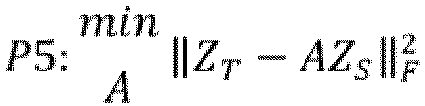
- the plurality of convex problems may be represented as: P 1 : min T S T S y ⁇ Z S F 2 + ⁇ T S F 2 ⁇ log detT S P 2 : min T T T T x ⁇ Z T F 2 + ⁇ T T F 2 ⁇ log detT T P 3 : min Z S T S y ⁇ Z S F 2 + ⁇ Z T ⁇ AZ S F 2 + ⁇ y Z S 1 P 4 : min Z T T T x ⁇ Z T F 2 + ⁇ Z T ⁇ AZ S F 2 + ⁇ x Z T 1 P 5 : min A Z T ⁇ AZ S F 2
- the sub-problems P1 and P2 are similar to equation (6) with their closed forms discussed above.
- the sub-problems P3 and P4 are standard L1 minimization problems where the ISTA algorithm may be used.
- the sub-problem P5 has a closed form solution (Moore-Penrose pseudo inverse).
- the one or more processors (104) are further configured to solve an inverse problem, at step 208, by synthesizing one or more clean data (xtest) from corresponding one or more corrupted data (ytest) from a testing set.
- the testing set is discrete from the training set and hence comprises unknown data.
- the one or more corrupted data (ytest) is received at step 208a.
- Source domain features (zS) are then obtained at step 208b based on the one or more corrupted data (ytest) and the source domain transform (TS) from the training phase.
- target domain features (zT) are also obtained at step 208c based on the coupling operator (A) and the source domain features (zS) from the training phase.
- the one or more clean data(xtest) are then be synthesized, at step 208d, based on the target domain transform TT from the training phase and the target domain features (zT).
- the step of obtaining features (zS) of the one or more corrupted data is represented as zS ⁇ TSy ⁇ (17).
- Coupled Analysis Sparse Coding learning was evaluated for four types of problems: denoising, deblurring, super-resolution and compressed sensing (CS) reconstruction.
- CS compressed sensing
- For experimental evaluation of denoising, deblurring and super-resolution the protocol outlined in " Deep Networks for Image Super-Resolution with Sparse Prior,” by Z.Wang et al. at the 2015 IEEE International Conference on Computer Vision (ICCV) , Santiago was carried out and for CS reconstruction the protocol in " ReconNet: Non-Iterative Reconstruction of Images from Compressively Sensed Measurements," by K.Kulkarni e al. at the 2016 IEEE Conference on Computer Vision and Pattern Recognition (CVPR) , Las Vegas was carried out.
- the training set consists of 91 images for all the problems.
- the testing set comprises Set5 of 5 images and Set14 of 14 images, for the CS reconstruction problem the testing set consists of 11 standard images.
- Denoising For denoising, the Coupled Analysis Sparse Coding learning (CASC) of the present disclosure was compared with the Coupled Autoencoder (CAE), the Coupled Dictionary Learning (CDL) and the Vectorized Convolutional Neural Network (VCNN). For denoising grayscale of all 91 images was obtained and each image was divided into overlapping patches of size 20 x 20, the images were corrupted with additive Gaussian noise with zero mean and 0.1 standard deviation. The patches from the clean images were fed as input of the target domain and corresponding source domain was obtained from the 20x20 proposed patches of the noisy images. There are four parameters to be tuned in the CASC of the present disclosure viz., ⁇ , ⁇ , ⁇ x, ⁇ y.
- CAE and the CASC of the present disclosure consistently outperform VCNN by a significant margin; note that in image processing anything that improves over 0.5dB in PSNR and approximately 0.02 in SSIM is considered significant in the sub 30dB regime.
- Super-resolution For super-resolution, the same techniques as used for denoising and deblurring were used. The only difference is, instead of using VCNN which is for generic image processing, Super-Resolution Convolutional Neural Network (SRCNN) which is a tool tailored for super-resolution was used. Sparse Coding based Network (SCN) has also been compared. For both SRCNN and SCN, the MATLAB testing codes and the pre-trained models made available in the public domain on the same 91 training images were used. The results for PSNR and SSIM only for luminance channels for scaling factor of 2 are shown. For experiments on super-resolution, the luminance channel only was considered and the model was trained on overlapping 10x10 patches.
- SRCNN Super-Resolution Convolutional Neural Network
- SCN Sparse Coding based Network
- the ground truth luminance channel served as the target domain and the upsampled images served as the source domain.
- the transforms for the source and the target domain were perfectly determined. The iterations were run till the objective function converged to local minima. The numerical results are shown in Table III.
- A is a lower dimensional projection matrix (usually Gaussian, random Bernoulli, restricted Fourier etc.).
- the task is to recover the image x from the measurements y.
- Compressed sensing based image reconstruction revolutionized magnetic resonance imaging (MRI) and X-ray computed tomography (CT). It paved the way for faster MRIs and safer CT scans.
- MRI magnetic resonance imaging
- CT X-ray computed tomography
- a recent study showed how CNN can be used for reconstruction. They obtained a noisy version of the image by applying AT on y. This image was at the input of the CNN, and at the output was the clean image. Thus the CNN 'learnt' to produce a clean version of the image.
- the CASC of the present disclosure does not need operating y by AT. It can directly learn the inversion.
- ReconNet For ReconNet, a pre-trained model known in the art was used for testing for the two measurement rates. Therein it was shown that ReConNet yields comparable performance. Hence, it is enough to show that there is significant improvement of the CASC of the present disclosure over ReConNet. This indeed is the case; as can be seen from Tables IV and V.
- the training time and testing time for the CASC of the present disclosure is very short compared to the conventional techniques mentioned therein.
- the signal was reconstructed from its lower dimensional representation.
- ⁇ and m Two parameters to be tuned in the CASC of the present disclosure - ⁇ and m .
- the transforms for the signal and the measurement domain (TS and TT) are perfectly determined. The iterations were run till the objective function converged to local minima.
- the CASC of the present disclosure is compared with Compressive Sensing (CS) or Spectral Projected Gradient for l1 minimization (SPGL1) and Stacked Sparse Denoising Autoencoder (SSDAE) that are conventionally used for reconstruction.
- the SPGL1 and SSDAE are optimized in the best possible manner for a fair comparison with the CASC of the present disclosure.
- a couple representation learning architecture for solving inverse problems in image processing for denoising, deblurring and/ or super-resolution based on transform learning formulation which is an analysis equivalent of dictionary learning.
- the formulation is referred herein above as Coupled Analysis Sparse Coding (CASC).
- CASC Coupled Analysis Sparse Coding
- the performance of the CASC on various inverse problems - denoising, deblurring, super-resolution and reconstruction is better in terms of image reconstruction quality, has a very low computational complexity with a need for only three matrix-vector products, and requires very short training and testing times, which makes it applicable for real-time applications.
- the CASC of the present disclosure can learn directly from the source domain.
- the CASC of the present disclosure does not involve multiple layers of data transformation and large of parameters as seen in conventional deep learning approaches.
- Transform learning finds a variety of applications in computer vision and natural language processing. In vision, it has been used for synthesis problems like deblurring and super-resolution and for analysis problems like Red Green Blue (RGB) to Near Infrared (NIR) matching and photo to sketch matching. In Natural Language Processing (NLP) it has been used for multi-lingual document retrieval. It has also been used for multi-modal (text to video) retrieval. Accordingly, systems and methods of the present disclosure may be adapted for any of these applications but fall within the scope of the invention only when applied to image processing for denoising, deblurring and/or super-resolution, as specified in the appended claims.
- the hardware device can be any kind of device which can be programmed including e.g. any kind of computer like a server or a personal computer, or the like, or any combination thereof.
- the device may also include means which could be e.g. hardware means like e.g. an application-specific integrated circuit (ASIC), a field-programmable gate array (FPGA), or a combination of hardware and software means, e.g.
- ASIC application-specific integrated circuit
- FPGA field-programmable gate array
- the means can include both hardware means and software means.
- the method embodiments described herein could be implemented in hardware and software.
- the device may also include software means.
- the embodiments may be implemented on different hardware devices, e.g. using a plurality of CPUs.
- the embodiments herein can comprise hardware and software elements.
- the embodiments that are implemented in software include but are not limited to, firmware, resident software, microcode, etc.
- the functions performed by various modules described herein may be implemented in other modules or combinations of other modules.
- a computer-usable or computer readable medium can be any apparatus that can comprise, store, communicate, propagate, or transport the program for use by or in connection with the instruction execution system, apparatus, or device.
- a computer-readable storage medium refers to any type of physical memory on which information or data readable by a processor may be stored.
- a computer-readable storage medium may store instructions for execution by one or more processors, including instructions for causing the processor(s) to perform steps or stages consistent with the embodiments described herein.
- the term "computer-readable medium” should be understood to include tangible items and exclude carrier waves and transient signals, i.e., be non-transitory. Examples include random access memory (RAM), read-only memory (ROM), volatile memory, nonvolatile memory, hard drives, CD ROMs, DVDs, flash drives, disks, and any other known physical storage media.
Landscapes
- Engineering & Computer Science (AREA)
- Theoretical Computer Science (AREA)
- Data Mining & Analysis (AREA)
- Physics & Mathematics (AREA)
- Computer Vision & Pattern Recognition (AREA)
- General Physics & Mathematics (AREA)
- Evolutionary Computation (AREA)
- General Engineering & Computer Science (AREA)
- Artificial Intelligence (AREA)
- Software Systems (AREA)
- Life Sciences & Earth Sciences (AREA)
- Bioinformatics & Cheminformatics (AREA)
- Bioinformatics & Computational Biology (AREA)
- Evolutionary Biology (AREA)
- Computing Systems (AREA)
- Medical Informatics (AREA)
- Mathematical Physics (AREA)
- Image Analysis (AREA)
Claims (10)
- Prozessorimplementiertes Verfahren (200) zur gekoppelten Darstellung unter Verwendung von Transformationslernen zum Lösen von inversen Problemen in der Bildverarbeitung zum Entrauschen, Entschärfen und/oder Superauflösung, wobei das prozessorimplementierte Verfahren die folgenden Schritte umfasst:Identifizieren einer Quelldomäne, die ein oder mehrere beschädigte Daten (y) in einem Trainingssatz (202) umfasst, wobei die ein oder mehreren beschädigten Daten in Form eines beschädigten Bildes vorliegen;Identifizieren einer Zieldomäne, die ein oder mehrere saubere Daten (x) in dem Trainingssatz (204) umfasst, wobei die ein oder mehreren sauberen Daten in Form eines sauberen Bildes vorliegen; undErzeugen eines Modells zum Lernen der gekoppelten Darstellung unter Verwendung einer gleichen Anzahl der ein oder mehreren beschädigten Daten und der ein oder mehreren sauberen Daten (206), wobei der Schritt des Erzeugens eines Modells Folgendes umfasst:Lernen einer Quelldomänentransformation (Ts) und entsprechender Quelldomänenmerkmale (Zs), die zu der Quelldomäne gehören, wobei die Quelldomänentransformation (Ts) an den ein oder mehreren beschädigten Daten arbeitet, um die Quelldomänenmerkmale (Zs) zu erzeugen (206a);Lernen einer Zieldomänentransformation (TT) und entsprechender Zieldomänenmerkmale (ZT), die zu der Zieldomäne gehören, wobei die Zieldomänentransformation (TT) an den ein oder mehreren sauberen Daten arbeitet, um die Zieldomänenmerkmale (ZT) zu erzeugen (206b); undKoppeln der Quelldomänenmerkmale (Zs) und der Zieldomänenmerkmale (ZT) unter Verwendung einer Zielfunktion, die als ein Kopplungsmechanismus dient, basierend auf einer Analysespärlichkeitscodierungsformulierung und gekennzeichnet durch einen Kopplungsoperator (A), so dass die Quelldomänenmerkmale (Zs) linear auf die Zieldomänenmerkmale (ZT) abgebildet werden (206c), wobei die Zielfunktion, die ein nicht-konvexes Problem ist, unter Verwendung eines alternierenden Minimierungsverfahrens gelöst wird, indem das nicht-konvexe Problem in eine Mehrzahl von konvexen Problemen unterteilt wird, wobei die Mehrzahl von konvexen Problemen in einer alternierenden Weise gelöst wird, bis die Zielfunktion zu einem lokalen Minimum konvergiert, und wobei die Zielfunktion dargestellt wird als:

Lösen eines inversen Problems durch Synthetisieren von ein oder mehreren sauberen Daten (xtest) aus entsprechenden ein oder mehreren beschädigten Daten (ytest) aus einem Testsatz (208) durch:Empfangen der ein oder mehreren beschädigten Daten (ytest) (208a);Erhalten von Quelldomänenmerkmalen (zs) basierend auf den ein oder mehreren beschädigten Daten (ytest) und der Quelldomänentransformation (Ts) (208b);Erhalten von Zieldomänenmerkmalen (ẑT ) basierend auf dem Kopplungsoperator (A) und den Quelldomänenmerkmalen (zs) (208c); undSynthetisieren der ein oder mehreren sauberen Daten (xtest) basierend auf der Zieldomänentransformation TT und den Zieldomänenmerkmalen (ẑT ) (208d). - Prozessorimplementiertes Verfahren nach Anspruch 1, wobei die Mehrzahl von konvexen Problemen dargestellt ist als:


- Prozessorimplementiertes Verfahren nach Anspruch 1, wobei der Schritt des Erhaltens von Merkmalen (zs) der ein oder mehreren beschädigten Daten dargestellt ist als zs ← Tsy .
- Prozessorimplementiertes Verfahren nach Anspruch 1, wobei der Schritt des Erhaltens von Merkmalen (ẑT ) der Zieldomäne dargestellt ist als ẑT = Azs .
- Prozessorimplementiertes Verfahren nach Anspruch 1, wobei der Schritt des Synthetisierens der ein oder mehreren sauberen Daten (x) der Zieldomäne dargestellt ist als eine pseudoinverse Form TTx =ẑT
- Prozessorimplementiertes Verfahren nach Anspruch 1, wobei die Anzahl von Merkmalen der Quelldomäne kleiner als, größer als oder gleich der Anzahl von Merkmalen in der Zieldomäne ist.
- System (100) zur gekoppelten Darstellung unter Verwendung von Transformationslernen zum Lösen von inversen Problemen in der Bildverarbeitung zum Entrauschen, Entschärfen und/oder Superauflösung, wobei das System Folgendes umfasst:
eine oder mehrere Datenspeichervorrichtungen (102), die betriebsfähig mit einem oder mehreren Hardwareprozessoren (104) gekoppelt sind und konfiguriert sind, um Anweisungen zu speichern, die zur Ausführung durch den einen oder die mehreren Hardwareprozessoren konfiguriert sind, um:eine Quelldomäne zu identifizieren, die ein oder mehrere beschädigte Daten (y) in einem Trainingssatz umfasst, wobei die ein oder mehreren beschädigten Daten in Form eines beschädigten Bildes vorliegen;eine Zieldomäne zu identifizieren, die ein oder mehrere saubere Daten (x) in dem Trainingssatz umfasst, wobei die ein oder mehreren sauberen Daten in Form eines sauberen Bildes vorliegen; undein Modell zum Lernen der gekoppelten Darstellung unter Verwendung einer gleichen Anzahl der ein oder mehreren beschädigten Daten und der ein oder mehreren sauberen Daten zu erzeugen, wobei das Modell durch Folgendes erzeugt wird:Lernen einer Quelldomänentransformation (Ts) und entsprechender Quelldomänenmerkmale (Zs), die zu der Quelldomäne gehören, wobei die Quelldomänentransformation (Ts) an den ein oder mehreren beschädigten Daten arbeitet, um die Quelldomänenmerkmale (Zs) zu erzeugen;Lernen einer Zieldomänentransformation (TTv) und entsprechender Zieldomänenmerkmale (ZT), die zu der Zieldomäne gehören, wobei die Zieldomänentransformation (TT) an den ein oder mehreren sauberen Daten arbeitet, um die Zieldomänenmerkmale (ZT) zu erzeugen; undKoppeln der Quelldomänenmerkmale (Zs) und der Zieldomänenmerkmale (ZT) unter Verwendung einer Zielfunktion, die als ein Kopplungsmechanismus dient, basierend auf einer Analysespärlichkeitscodierungsformulierung und gekennzeichnet durch einen Kopplungsoperator (A), so dass die Quelldomänenmerkmale (Zs) linear auf die Zieldomänenmerkmale (ZT) abgebildet werden, wobei die Zielfunktion, die ein nicht-konvexes Problem ist, unter Verwendung eines alternierenden Minimierungsverfahrens gelöst wird, indem das nicht-konvexe Problem in eine Mehrzahl von konvexen Problemen unterteilt wird, wobei die Mehrzahl von konvexen Problemen in einer alternierenden Weise gelöst wird, bis die Zielfunktion zu einem lokalen Minimum konvergiert, und wobei die Zielfunktion dargestellt wird als:
Lösen eines inversen Problems durch Synthetisieren von ein oder mehreren sauberen Daten (xtest) aus entsprechenden ein oder mehreren beschädigten Daten (ytest) aus einem Testsatz durch:Empfangen der ein oder mehreren beschädigten Daten (ytest);Erhalten von Quelldomänenmerkmalen (zs) basierend auf den ein oder mehreren beschädigten Daten (ytest) und der Quelldomänentransformation (Ts);Erhalten von Zieldomänenmerkmalen (ẑT ) basierend auf dem Kopplungsoperator (A) und den Quelldomänenmerkmalen (zs); undSynthetisieren der ein oder mehreren sauberen Daten (xtest) basierend auf der Zieldomänentransformation TT und den Zieldomänenmerkmalen (ẑT ). - System nach Anspruch 7, wobei die Mehrzahl von konvexen Problemen dargestellt ist als:


- System nach Anspruch 7, wobei das Erhalten von Merkmalen (zs) der ein oder mehreren beschädigten Daten dargestellt ist als zs ← Tsy; das Erhalten von Merkmalen (ẑT ) der Zieldomäne dargestellt ist als ẑT = AzS ; das Synthetisieren der ein oder mehreren sauberen Daten (x) der Zieldomäne dargestellt ist als eine pseudoinverse Form TTx = ẑT ; und die Anzahl von Merkmalen der Quelldomäne kleiner als, größer als oder gleich der Anzahl von Merkmalen in der Zieldomäne ist.
- Computerprogrammprodukt, umfassend ein nichtflüchtiges computerlesbares Medium mit einem darin verkörperten computerlesbaren Programm, wobei das computerlesbare Programm, wenn es auf einer Rechenvorrichtung ausgeführt wird, die Rechenvorrichtung veranlasst zum:Identifizieren einer Quelldomäne, die ein oder mehrere beschädigte Daten (y) in einem Trainingssatz umfasst, wobei die ein oder mehreren beschädigten Daten in Form eines beschädigten Bildes vorliegen;Identifizieren einer Zieldomäne, die ein oder mehrere saubere Daten (x) in dem Trainingssatz umfasst, wobei die ein oder mehreren sauberen Daten in Form eines sauberen Bildes vorliegen; undErzeugen eines Modells zum Lernen der gekoppelten Darstellung unter Verwendung einer gleichen Anzahl der ein oder mehreren beschädigten Daten und der ein oder mehreren sauberen Daten, wobei das Modell durch Folgendes erzeugt wird:Lernen einer Quelldomänentransformation (Ts) und entsprechender Quelldomänenmerkmale (Zs), die zu der Quelldomäne gehören, wobei die Quelldomänentransformation (Ts) an den ein oder mehreren beschädigten Daten arbeitet, um die Quelldomänenmerkmale (Zs) zu erzeugen;Lernen einer Zieldomänentransformation (TT) und entsprechender Zieldomänenmerkmale (ZT), die zu der Zieldomäne gehören, wobei die Zieldomänentransformation (TT) an den ein oder mehreren sauberen Daten arbeitet, um die Zieldomänenmerkmale (ZT) zu erzeugen; undKoppeln der Quelldomänenmerkmale (Zs) und der Zieldomänenmerkmale (ZT) unter Verwendung einer Zielfunktion, die als ein Kopplungsmechanismus dient, basierend auf einer Analysespärlichkeitscodierungsformulierung und gekennzeichnet durch einen Kopplungsoperator (A), so dass die Quelldomänenmerkmale (Zs) linear auf die Zieldomänenmerkmale (ZT) abgebildet werden, wobei die Zielfunktion, die ein nicht-konvexes Problem ist, unter Verwendung eines alternierenden Minimierungsverfahrens gelöst wird, indem das nicht-konvexe Problem in eine Mehrzahl von konvexen Problemen unterteilt wird, wobei die Mehrzahl von konvexen Problemen in einer alternierenden Weise gelöst wird, bis die Zielfunktion zu einem lokalen Minimum konvergiert, und wobei die Zielfunktion dargestellt wird als:

Lösen eines inversen Problems durch Synthetisieren von ein oder mehreren sauberen Daten (xtest) aus entsprechenden ein oder mehreren beschädigten Daten (ytest) aus einem Testsatz durch:Empfangen der ein oder mehreren beschädigten Daten (ytest);Erhalten von Quelldomänenmerkmalen (zs) basierend auf den ein oder mehreren beschädigten Daten (ytest) und der Quelldomänentransformation (Ts);Erhalten von Zieldomänenmerkmalen (ẑT ) basierend auf dem Kopplungsoperator (A) und den Quelldomänenmerkmalen (zs); undSynthetisieren der ein oder mehreren sauberen Daten (xtest) basierend auf der Zieldomänentransformation TT und den Zieldomänenmerkmalen (ẑT ).
Applications Claiming Priority (1)
| Application Number | Priority Date | Filing Date | Title |
|---|---|---|---|
| IN201821025416 | 2018-07-06 |
Publications (3)
| Publication Number | Publication Date |
|---|---|
| EP3594865A1 EP3594865A1 (de) | 2020-01-15 |
| EP3594865C0 EP3594865C0 (de) | 2025-02-12 |
| EP3594865B1 true EP3594865B1 (de) | 2025-02-12 |
Family
ID=67352486
Family Applications (1)
| Application Number | Title | Priority Date | Filing Date |
|---|---|---|---|
| EP19184116.2A Active EP3594865B1 (de) | 2018-07-06 | 2019-07-03 | Systeme und verfahren zur gekoppelten darstellung mithilfe von transformationslernen zum lösen von inversen problemen |
Country Status (2)
| Country | Link |
|---|---|
| US (1) | US11216692B2 (de) |
| EP (1) | EP3594865B1 (de) |
Families Citing this family (3)
| Publication number | Priority date | Publication date | Assignee | Title |
|---|---|---|---|---|
| US11348364B2 (en) * | 2018-12-18 | 2022-05-31 | Booz Allen Hamilton Inc. | Method and system for neural fingerprint enhancement for fingerprint recognition |
| US12622626B2 (en) | 2020-06-04 | 2026-05-12 | Biosense Webster (Israel) Ltd. | Reducing noise of intracardiac electrocardiograms using an autoencoder and utilizing and refining intracardiac and body surface electrocardiograms using deep learning training loss functions |
| CN112907449B (zh) * | 2021-02-22 | 2023-06-09 | 西南大学 | 一种基于深度卷积稀疏编码的图像超分辨率重建方法 |
Family Cites Families (5)
| Publication number | Priority date | Publication date | Assignee | Title |
|---|---|---|---|---|
| US9307208B2 (en) | 2014-03-07 | 2016-04-05 | The University Of British Columbia | System and method for solving inverse imaging problems |
| US9858502B2 (en) * | 2014-03-31 | 2018-01-02 | Los Alamos National Security, Llc | Classification of multispectral or hyperspectral satellite imagery using clustering of sparse approximations on sparse representations in learned dictionaries obtained using efficient convolutional sparse coding |
| US9734601B2 (en) * | 2014-04-04 | 2017-08-15 | The Board Of Trustees Of The University Of Illinois | Highly accelerated imaging and image reconstruction using adaptive sparsifying transforms |
| US9870519B2 (en) * | 2014-07-08 | 2018-01-16 | Nec Corporation | Hierarchical sparse dictionary learning (HiSDL) for heterogeneous high-dimensional time series |
| US10610162B2 (en) * | 2016-05-31 | 2020-04-07 | Stmicroelectronics S.R.L. | Method for the detecting electrocardiogram anomalies and corresponding system |
-
2019
- 2019-07-03 EP EP19184116.2A patent/EP3594865B1/de active Active
- 2019-07-03 US US16/502,760 patent/US11216692B2/en active Active
Non-Patent Citations (2)
| Title |
|---|
| RAVISHANKAR SAIPRASAD ET AL: "Closed-form solutions within sparsifying transform learning", ICASSP, IEEE INTERNATIONAL CONFERENCE ON ACOUSTICS, SPEECH AND SIGNAL PROCESSING - PROCEEDINGS 1999 IEEE, IEEE, 26 May 2013 (2013-05-26), pages 5378 - 5382, XP032508795, ISSN: 1520-6149, ISBN: 978-0-7803-5041-0, [retrieved on 20131018], DOI: 10.1109/ICASSP.2013.6638690 * |
| RAVISHANKAR SAIPRASAD ET AL: "Online Sparsifying Transform Learning- Part I: Algori", IEEE JOURNAL OF SELECTED TOPICS IN SIGNAL PROCESSING, IEEE, US, vol. 9, no. 4, 1 June 2015 (2015-06-01), pages 625 - 636, XP011581054, ISSN: 1932-4553, [retrieved on 20150512], DOI: 10.1109/JSTSP.2015.2417131 * |
Also Published As
| Publication number | Publication date |
|---|---|
| US11216692B2 (en) | 2022-01-04 |
| EP3594865C0 (de) | 2025-02-12 |
| US20200012889A1 (en) | 2020-01-09 |
| EP3594865A1 (de) | 2020-01-15 |
Similar Documents
| Publication | Publication Date | Title |
|---|---|---|
| US12045961B2 (en) | Image denoising method and apparatus based on wavelet high-frequency channel synthesis | |
| US11645835B2 (en) | Hypercomplex deep learning methods, architectures, and apparatus for multimodal small, medium, and large-scale data representation, analysis, and applications | |
| Elad et al. | Image denoising: The deep learning revolution and beyond—a survey paper | |
| Machidon et al. | Deep learning for compressive sensing: a ubiquitous systems perspective | |
| US20230103638A1 (en) | Image-to-Image Mapping by Iterative De-Noising | |
| EP3738082B1 (de) | Beschleunigte quantisierte multiply-add-operationen | |
| US12159232B2 (en) | Apparatus and method with neural network implementation of domain adaptation | |
| EP3716198B1 (de) | Bildrekonstruktionsverfahren und -vorrichtung | |
| CN107525588B (zh) | 一种基于gpu的双相机光谱成像系统的快速重构方法 | |
| US20230154069A1 (en) | Magnetic Resource Imaging Method Using Score-based Diffusion Model And Apparatus thereof | |
| Lefkimmiatis et al. | Nonlocal structure tensor functionals for image regularization | |
| Thai et al. | Riesz-Quincunx-UNet variational autoencoder for unsupervised satellite image denoising | |
| JP7754602B2 (ja) | 基底スケーリング及び剪定を用いる転移学習 | |
| US11823307B2 (en) | Method for high-dimensional image reconstruction using low-dimensional representations and deep learning | |
| US11216692B2 (en) | Systems and methods for coupled representation using transform learning for solving inverse problems | |
| Wang et al. | Efficient blind hyperspectral unmixing with non-local spatial information based on Swin transformer | |
| Gai et al. | Sparse representation based on vector extension of reduced quaternion matrix for multiscale image denoising | |
| US12354234B2 (en) | Method and system for multi-modal image super-resolution | |
| Singh et al. | Deep blind compressed sensing | |
| Kumar et al. | Fractional Sailfish Optimizer with Deep Convolution Neural Network for Compressive Sensing Based Magnetic Resonance Image Reconstruction | |
| Wang et al. | Image deblurring using fusion transformer-based generative adversarial networks | |
| Gkillas et al. | An optimization-based deep equilibrium model for hyperspectral image deconvolution with convergence guarantees | |
| Wang et al. | Optimization of the regularization in background and foreground modeling | |
| Moshtaghpour et al. | Compressive hyperspectral imaging with Fourier transform interferometry | |
| Hafsi et al. | Prior-Guided Image Denoising via Generative Adversarial Networks with Single Noisy Images |
Legal Events
| Date | Code | Title | Description |
|---|---|---|---|
| PUAI | Public reference made under article 153(3) epc to a published international application that has entered the european phase |
Free format text: ORIGINAL CODE: 0009012 |
|
| STAA | Information on the status of an ep patent application or granted ep patent |
Free format text: STATUS: THE APPLICATION HAS BEEN PUBLISHED |
|
| AK | Designated contracting states |
Kind code of ref document: A1 Designated state(s): AL AT BE BG CH CY CZ DE DK EE ES FI FR GB GR HR HU IE IS IT LI LT LU LV MC MK MT NL NO PL PT RO RS SE SI SK SM TR |
|
| AX | Request for extension of the european patent |
Extension state: BA ME |
|
| STAA | Information on the status of an ep patent application or granted ep patent |
Free format text: STATUS: REQUEST FOR EXAMINATION WAS MADE |
|
| 17P | Request for examination filed |
Effective date: 20200710 |
|
| RBV | Designated contracting states (corrected) |
Designated state(s): AL AT BE BG CH CY CZ DE DK EE ES FI FR GB GR HR HU IE IS IT LI LT LU LV MC MK MT NL NO PL PT RO RS SE SI SK SM TR |
|
| STAA | Information on the status of an ep patent application or granted ep patent |
Free format text: STATUS: EXAMINATION IS IN PROGRESS |
|
| 17Q | First examination report despatched |
Effective date: 20210930 |
|
| REG | Reference to a national code |
Ref country code: DE Ref legal event code: R079 Free format text: PREVIOUS MAIN CLASS: G06N0020000000 Ipc: G06N0003045000 Ref document number: 602019065691 Country of ref document: DE |
|
| GRAP | Despatch of communication of intention to grant a patent |
Free format text: ORIGINAL CODE: EPIDOSNIGR1 |
|
| STAA | Information on the status of an ep patent application or granted ep patent |
Free format text: STATUS: GRANT OF PATENT IS INTENDED |
|
| RIC1 | Information provided on ipc code assigned before grant |
Ipc: G06T 1/20 20060101ALI20241024BHEP Ipc: G06N 20/00 20190101ALI20241024BHEP Ipc: G06N 3/045 20230101AFI20241024BHEP |
|
| INTG | Intention to grant announced |
Effective date: 20241108 |
|
| GRAS | Grant fee paid |
Free format text: ORIGINAL CODE: EPIDOSNIGR3 |
|
| GRAA | (expected) grant |
Free format text: ORIGINAL CODE: 0009210 |
|
| STAA | Information on the status of an ep patent application or granted ep patent |
Free format text: STATUS: THE PATENT HAS BEEN GRANTED |
|
| AK | Designated contracting states |
Kind code of ref document: B1 Designated state(s): AL AT BE BG CH CY CZ DE DK EE ES FI FR GB GR HR HU IE IS IT LI LT LU LV MC MK MT NL NO PL PT RO RS SE SI SK SM TR |
|
| REG | Reference to a national code |
Ref country code: GB Ref legal event code: FG4D |
|
| REG | Reference to a national code |
Ref country code: CH Ref legal event code: EP |
|
| REG | Reference to a national code |
Ref country code: DE Ref legal event code: R096 Ref document number: 602019065691 Country of ref document: DE |
|
| REG | Reference to a national code |
Ref country code: IE Ref legal event code: FG4D |
|
| U01 | Request for unitary effect filed |
Effective date: 20250212 |
|
| U07 | Unitary effect registered |
Designated state(s): AT BE BG DE DK EE FI FR IT LT LU LV MT NL PT RO SE SI Effective date: 20250218 |
|
| PG25 | Lapsed in a contracting state [announced via postgrant information from national office to epo] |
Ref country code: RS Free format text: LAPSE BECAUSE OF FAILURE TO SUBMIT A TRANSLATION OF THE DESCRIPTION OR TO PAY THE FEE WITHIN THE PRESCRIBED TIME-LIMIT Effective date: 20250512 |
|
| PG25 | Lapsed in a contracting state [announced via postgrant information from national office to epo] |
Ref country code: PL Free format text: LAPSE BECAUSE OF FAILURE TO SUBMIT A TRANSLATION OF THE DESCRIPTION OR TO PAY THE FEE WITHIN THE PRESCRIBED TIME-LIMIT Effective date: 20250212 |
|
| PG25 | Lapsed in a contracting state [announced via postgrant information from national office to epo] |
Ref country code: ES Free format text: LAPSE BECAUSE OF FAILURE TO SUBMIT A TRANSLATION OF THE DESCRIPTION OR TO PAY THE FEE WITHIN THE PRESCRIBED TIME-LIMIT Effective date: 20250212 |
|
| PG25 | Lapsed in a contracting state [announced via postgrant information from national office to epo] |
Ref country code: NO Free format text: LAPSE BECAUSE OF FAILURE TO SUBMIT A TRANSLATION OF THE DESCRIPTION OR TO PAY THE FEE WITHIN THE PRESCRIBED TIME-LIMIT Effective date: 20250512 Ref country code: IS Free format text: LAPSE BECAUSE OF FAILURE TO SUBMIT A TRANSLATION OF THE DESCRIPTION OR TO PAY THE FEE WITHIN THE PRESCRIBED TIME-LIMIT Effective date: 20250612 |
|
| PG25 | Lapsed in a contracting state [announced via postgrant information from national office to epo] |
Ref country code: HR Free format text: LAPSE BECAUSE OF FAILURE TO SUBMIT A TRANSLATION OF THE DESCRIPTION OR TO PAY THE FEE WITHIN THE PRESCRIBED TIME-LIMIT Effective date: 20250212 |
|
| PG25 | Lapsed in a contracting state [announced via postgrant information from national office to epo] |
Ref country code: GR Free format text: LAPSE BECAUSE OF FAILURE TO SUBMIT A TRANSLATION OF THE DESCRIPTION OR TO PAY THE FEE WITHIN THE PRESCRIBED TIME-LIMIT Effective date: 20250513 |
|
| U20 | Renewal fee for the european patent with unitary effect paid |
Year of fee payment: 7 Effective date: 20250725 |
|
| PG25 | Lapsed in a contracting state [announced via postgrant information from national office to epo] |
Ref country code: SM Free format text: LAPSE BECAUSE OF FAILURE TO SUBMIT A TRANSLATION OF THE DESCRIPTION OR TO PAY THE FEE WITHIN THE PRESCRIBED TIME-LIMIT Effective date: 20250212 |
|
| PGFP | Annual fee paid to national office [announced via postgrant information from national office to epo] |
Ref country code: GB Payment date: 20250722 Year of fee payment: 7 |
|
| PGFP | Annual fee paid to national office [announced via postgrant information from national office to epo] |
Ref country code: CH Payment date: 20250801 Year of fee payment: 7 |
|
| PG25 | Lapsed in a contracting state [announced via postgrant information from national office to epo] |
Ref country code: CZ Free format text: LAPSE BECAUSE OF FAILURE TO SUBMIT A TRANSLATION OF THE DESCRIPTION OR TO PAY THE FEE WITHIN THE PRESCRIBED TIME-LIMIT Effective date: 20250212 |
|
| PG25 | Lapsed in a contracting state [announced via postgrant information from national office to epo] |
Ref country code: SK Free format text: LAPSE BECAUSE OF FAILURE TO SUBMIT A TRANSLATION OF THE DESCRIPTION OR TO PAY THE FEE WITHIN THE PRESCRIBED TIME-LIMIT Effective date: 20250212 |
|
| PLBE | No opposition filed within time limit |
Free format text: ORIGINAL CODE: 0009261 |
|
| STAA | Information on the status of an ep patent application or granted ep patent |
Free format text: STATUS: NO OPPOSITION FILED WITHIN TIME LIMIT |
|
| 26N | No opposition filed |
Effective date: 20251113 |