EP3594825A1 - Abstandsbasierte suchreihungsabstufung - Google Patents
Abstandsbasierte suchreihungsabstufung Download PDFInfo
- Publication number
- EP3594825A1 EP3594825A1 EP19196203.4A EP19196203A EP3594825A1 EP 3594825 A1 EP3594825 A1 EP 3594825A1 EP 19196203 A EP19196203 A EP 19196203A EP 3594825 A1 EP3594825 A1 EP 3594825A1
- Authority
- EP
- European Patent Office
- Prior art keywords
- local
- document
- search
- documents
- geographic location
- Prior art date
- Legal status (The legal status is an assumption and is not a legal conclusion. Google has not performed a legal analysis and makes no representation as to the accuracy of the status listed.)
- Withdrawn
Links
Images


Classifications
-
- G—PHYSICS
- G06—COMPUTING OR CALCULATING; COUNTING
- G06F—ELECTRIC DIGITAL DATA PROCESSING
- G06F16/00—Information retrieval; Database structures therefor; File system structures therefor
- G06F16/20—Information retrieval; Database structures therefor; File system structures therefor of structured data, e.g. relational data
- G06F16/24—Querying
- G06F16/245—Query processing
- G06F16/2457—Query processing with adaptation to user needs
- G06F16/24578—Query processing with adaptation to user needs using ranking
-
- G—PHYSICS
- G06—COMPUTING OR CALCULATING; COUNTING
- G06F—ELECTRIC DIGITAL DATA PROCESSING
- G06F16/00—Information retrieval; Database structures therefor; File system structures therefor
- G06F16/20—Information retrieval; Database structures therefor; File system structures therefor of structured data, e.g. relational data
- G06F16/24—Querying
- G06F16/248—Presentation of query results
-
- G—PHYSICS
- G06—COMPUTING OR CALCULATING; COUNTING
- G06F—ELECTRIC DIGITAL DATA PROCESSING
- G06F16/00—Information retrieval; Database structures therefor; File system structures therefor
- G06F16/20—Information retrieval; Database structures therefor; File system structures therefor of structured data, e.g. relational data
- G06F16/29—Geographical information databases
-
- G—PHYSICS
- G06—COMPUTING OR CALCULATING; COUNTING
- G06F—ELECTRIC DIGITAL DATA PROCESSING
- G06F16/00—Information retrieval; Database structures therefor; File system structures therefor
- G06F16/90—Details of database functions independent of the retrieved data types
- G06F16/95—Retrieval from the web
- G06F16/953—Querying, e.g. by the use of web search engines
- G06F16/9537—Spatial or temporal dependent retrieval, e.g. spatiotemporal queries
-
- G—PHYSICS
- G06—COMPUTING OR CALCULATING; COUNTING
- G06F—ELECTRIC DIGITAL DATA PROCESSING
- G06F16/00—Information retrieval; Database structures therefor; File system structures therefor
- G06F16/90—Details of database functions independent of the retrieved data types
- G06F16/95—Retrieval from the web
- G06F16/953—Querying, e.g. by the use of web search engines
- G06F16/9535—Search customisation based on user profiles and personalisation
-
- H—ELECTRICITY
- H04—ELECTRIC COMMUNICATION TECHNIQUE
- H04L—TRANSMISSION OF DIGITAL INFORMATION, e.g. TELEGRAPHIC COMMUNICATION
- H04L2101/00—Indexing scheme associated with group H04L61/00
- H04L2101/60—Types of network addresses
- H04L2101/69—Types of network addresses using geographic information, e.g. room number
Definitions
- This specification relates to processing local search results.
- the Internet provides access to a wide variety of resources such as video or audio files, web pages for particular subjects, book articles, or news articles.
- a search system can identify resources in response to a search query that includes one or more search phrases (i.e., one or more words).
- the search system ranks the resources based on their relevance to the search query and on measures of quality of the resources and provides search results that link to the identified resources.
- the search results are typically ordered for viewing according to the rank.
- Some search systems can obtain or infer a location of a user device from which a search query was received and include local search results that are responsive to the search query.
- a local search result is a search result that references a local document.
- a local document is a document that has been classified as having local significance to particular locations of user devices. Accordingly, a local document may receive a search score "boost" for a query if the location associated with the local document is near the location of the user device. For example, in response to a search query for "coffee shop," the search system may provide local search results that reference web pages for coffee shops near the location of the user device.
- Some local results may have very high scores independent of the local scoring boost.
- This score which is referred to as a "location independent score,” may be high due to the document being of interest to people outside of a region that includes the location of the local result.
- a restaurant may have a very unique name, and may also be a famous restaurant nationwide. Accordingly, although the restaurant has local significant, it may still be of very great interest to users nationwide.
- a search algorithm that takes into account search traffic and query log data may rank a document for the restaurant (e.g., a web page) very high.
- a power company named after Thomas Edison may have very heavy local traffic in a large state.
- the search algorithm that takes into account search traffic and query log data will also rank a document for the power company very high due to the sheer volume or traffic to the webpage by its many customers.
- the power company webpage may be of very little interest to a user several states away. For example, a user may desire to learn about Thomas Edison, and not the power company that bears his name.
- that web page may be ranked higher than a webpage about the man, the latter of which is more likely to be of interest to a user that inputs the query "Edison.”
- one innovative aspect of the subject matter described in this specification can be embodied in methods that include the actions of receiving data specifying a search query, and a location of a user device from which the search query was received; receiving data specifying a set of documents determined to be relevant to the search query, the data specifying, for each of the documents, a respective search score indicative of the relevance of the document to the query and a ranking of the documents according to a first order based on the search scores, and wherein a proper subset of the documents are local documents, wherein each of the local documents is a document that is specified as having local significance to a geographic location of a user device; determining that a first local document in the proper subset of the local documents is eligible for a demotion operation that adjusts its respective search score to demote the rank of the first local document in the first order, the determination based at least in part on a proximity measure based on the geographic location of the user device and a geographic location specified for the first local document, and in response to the determination: for each second local document
- the method can further include, in response to determining that a first local document in the proper subset of the local documents is eligible for a demotion operation, determining that at least one document in the set of documents that is not a local document has a search score that meets a distant document demotion threshold and in response adjusting the search score of the first local document to demote its ranking in the first order so that the rank of the first local document relative to the rank of the at least one document is decreased.
- Adjusting the search score of the first local document to demote its ranking in the first order so that the rank of the first local document relative to the rank of the at least one document is decreased can include adjusting the search score of the first local document to demote its ranking in the first order so that the rank of the at least one document is greater than the rank of the first local document.
- the determination based at least in part on the proximity measure based on the geographic location of the user device and a geographic location specified for the first local document can include determining that the proximity measure indicates a distance between the geographic location of the user device and a geographic location specified for the first local document exceeds a maximum distance.
- the determination is based at least in part on the proximity measure based on the geographic location of the user device and a geographic location specified for the first local document can include determining that the proximity measure indicates the geographic location of the user device and the geographic location specified for the first local document are not within a same region defined by a political boundary.
- the search query can be a search query that does not include a location phrase that explicitly specifies a geographic location, and the data specifying a search query can include a local intent measure that is a measure of local intent for the search query.
- the determining that a first local document in the proper subset of the local documents is eligible for a demotion operation can further include determining that the first local document is eligible for demotion based, in part, on local intent measure meeting a threshold value.
- the data specifying a search query can include a local intent measure that is a measure of local intent for the search query, and adjusting the search score of the first local document to demote its ranking in the first order so that the rank of the first local document relative to the rank of the at least one document is decreased can include adjusting the search score of the first local document in inverse proportion to the local intent measure of the search query.
- Determining that a first local document in the proper subset of the local documents is eligible for a demotion operation can further include determining that the first local document is eligible for demotion only if the first local document has a location independent search score component that does not meet distant document preservation threshold.
- a data processing apparatus can provide more relevant search results in response to receipt of a single general search query with an implicit local intent by demoting local search results when the general search query is determined to be a locally significant search query for a particular user location, and the distance of the particular user location from the location associated with the local search result meets a distance requirement.
- Search results in a set of search result documents are processed to determine which, if any, of the search result documents are local search result documents. If a local search result document is identified, and it is further identified to be a "distant" search result document, then it is eligible for demotion.
- a local search result document is a "distant" search result document when the location associated with the local search result document is determined to not meet a proximity threshold.
- a proximity threshold may be met, for example, when the location for the local search result document and the location for the user device are within a same geographic region (e.g., a same state), or within a threshold distance (e.g., 100 miles).
- a demotion of a local search result document occurs when the search query has a local intent, and there is one of: a) another local search result document having a location that is within a threshold distance of the location of the user device; or b) a search result document that is not a local search result document and having a sufficiently high search score.
- a distant search result document may be precluded from being demoted if a location-independent component of its search score meets a preservation threshold. In this latter case, the distant search result document may be of sufficient relevance to the query, independent of location, such that demotion would be detrimental to satisfying the user's informational need.
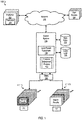
- Fig. 1 is a block diagram of an example environment 100 in which a search system 110 provides local search results.
- the example environment 100 includes a network 102, such as the Internet, and connects publisher web sites 104, user devices 106, and the search system 110.
- Each website 104 is a collection of one or more resources 105 associated with a domain name and hosted by one or more servers.
- An example website is a collection of web pages formatted in hypertext markup language (HTML) that can contain text, images, multimedia content, and programming elements, e.g., scripts.
- HTML hypertext markup language
- Each website 104 is maintained by a publisher, e.g., an entity that manages and/or owns the website.
- a resource 105 is any data that can be provided by the website 104 over the network 102 and that is associated with a resource address.
- Resources 105 include HTML pages, word processing documents, and portable document format (PDF) documents, images, video, and feed sources, to name just a few.
- PDF portable document format
- the resources can include content, e.g., words, phrases, images and sounds and may include embedded information (e.g., meta information and hyperlinks) and/or embedded instructions (e.g., scripts).
- a user device 106 is an electronic device that is under control of a user and is capable of requesting and receiving resources over the network 102.
- Example user devices 106 include personal computers, mobile communication devices, and other devices that can send and receive data over the network 102.
- a user device 106 typically includes a user application, e.g., a web browser, to facilitate the sending and receiving of data over the network 102.
- the search system 110 identifies the resources 105 by crawling and indexing the resources 105.
- Data describing the resources 105 can be indexed and stored in a web index 112.
- the user devices 106 submit search queries to the search system 110.
- the search system 110 accesses the index 112 to identify resources 105 that are determined to be relevant to the search query.
- the search system 110 identifies the resources in the form of search results and returns the search results to the user devices 106 in search results page resource.
- a search result is data generated by the search system 110 that identifies a resource (generally referred to as a "document") or provides information that satisfies a particular search query.
- a search result for a document can include a web page title, a snippet of text extracted from the web page, and a resource locator for the resource, e.g., the URL of a web page.
- search result is the listing provided in a search results web page
- search result document or simply “document” is the resource linked to by the search result.
- the search results are ranked based on scores related to the resources identified by the search results, such as information retrieval (“IR”) scores, and optionally a separate ranking of each resource relative to other resources (e.g., an authority score).
- IR information retrieval
- the search results are ordered according to these scores and provided to the user device according to the order.
- the user devices 106 receive the search results pages and render the pages for presentation to users.
- the user device 106 requests the resource identified by the resource locator included in the selected search result.
- the publisher of the website 104 hosting the resource receives the request for the resource from the user device 106 and provides the resource to the requesting user device 106.
- the queries submitted from user devices 106 are stored in query logs 114.
- Other information can also be stored in the query logs, such as selection data for the queries and the web pages referenced by the search results and selected by users.
- the query logs 114 can thus be used to map queries submitted by user devices to resources that were identified in search results and the actions taken by users when presented with the search results in response to the queries.
- a local result subsystem 120 can identify local documents for a search query.
- a local document is a document that is specified as having local significance to a geographic location.
- a variety of appropriate systems may be used to determine local documents.
- the local result subsystem 120 may determine a document is a local document if the document includes an address; or if search results for the document have a high rate of selection from user devices in a given location relative to user devices outside of the particular location; or if the local document has been specified by the publisher as being local to a particular location; etc.
- the local result subsystem 120 may indicate that certain documents that are determined to be responsive to the query are eligible for promotion.
- the feature of a document being a local document for certain queries may be stored in the web index 112.
- a query may specify a local intent explicitly or implicitly.
- An explicit specification of local intent occurs when a query includes a location phrase and/or another geographic identifier.
- a location phrase is one or more terms that specify a geographic location (e.g., a zip code, an address, a city or a state).
- the search query "Coffee shops Mountain View” includes the location phrase "Mountain View,” such that the search query "Coffee shops Mountain View” is a local query.
- search result documents that are local to the location specified by the location phrase may be determined to be more relevant than search result documents that are not local to the location.
- the location of the user device may be determined to be of little, if any, relevance, as the user has explicitly specified a location.
- An implicit specification of locality occurs when user responses to the query indicate a local interest. For example, for the query "coffee shops," observed user behavior may indicate that search results referencing documents having locations in close proximity to the location of the user device may be selected more often than search results referencing documents having locations that are more distant. Thus, such search queries may be determined to have an implicit local interest with respect to a user's current location.
- User selection behavior is one example way by which queries can be determined to have an implicit local intent; however, other processes can also be used.
- the feature of a query having an implicit local intent may be stored in the query logs 114.
- the local result subsystem 120 determines if the query has an implicit local intent. If the query does not have an implicit local intent and is not an explicitly local query, e.g., such as the query "quadratic equation,” then the ranking of search result document is not adjusted based on locality. However, if the query does have an implicit local intent, and is not an explicitly local query, e.g., such as the query "coffee shops," then the local result subsystem 120 performs a distance adjustment process 122.
- the local intent of the query can, in some implementations, be pre-determined, e.g., by another sub-system, and stored in the query logs. A variety of processes can be used to determine local intent of a query, such as the process that observes user behavior as described above.
- the distance adjustment process 122 adjusts the search scores of a local document depending on whether the local document is a "distant" document.
- a local search result document is determined to be a distant document, it is eligible for demotion. Whether it is actually demoted depends, in some implementations, on the status of other documents in the set of documents responsive to the query, and on the search scores of those documents and the search score of the distant document.
- Fig. 2 is a flow chart of an example process 200 for demoting a distant search result.
- the process 200 can be used in a data processing apparatus used to implement the local result subsystem 120.
- the process 200 receives data specifying a search query and a location of a user device from which the search query was received (202).
- the location may be, for example, geographic coordinates (or approximations thereof) of the user device.
- the process 200 is operative only when the search query does not include a location phrase that explicitly specifies a geographic location, and the data specifying a search query includes a local intent measure that meets a threshold value.
- the process 200 may require that the local intent measure of the query indicate with at least an N% likelihood that that query has local intent.
- the process 200 receives data specifying a set of documents determined to be relevant to a search query received from a user device, the documents ranked according to a first order (204).
- the data specifies, for each of the documents, a respective search score indicative of the relevance of the document to the query and a ranking of the documents according to a first order based on the search scores.
- the process 200 determines if a local document is eligible for demotion (206). An example process for determining whether a local document is eligible for demotion is described with reference to Fig. 4 below.
- the process 200 does not demote the local document (208). If, however, the local document is eligible for demotion, the local document is not automatically demoted; one or more subsequent conditions may be required to be met before the local document is demoted. For example, in some implementations, the local document is only demoted if there are other local documents having a location near the user device, or if other documents in the set of responsive documents, which are not local documents, have a sufficiently high search score.
- the process 200 determines if there are other local documents having a location within a threshold distance of the location of the user device (210). For example, the process 200, for each other local document in the proper subset, determines a proximity measure that is based on the geographic location of the user device and the geographic location specified for the second local document. The proximity measure can indicate a distance, and if the indicated distance is less than a threshold distance, then the local document eligible for demotion will be demoted (214).
- the process 200 determines if there is a non-local document that is sufficiently ranked in the set of documents (212). For example, the process 200 may determine whether at least one document in the set of documents that is not a local document and has a search score that meets a distant document demotion threshold.
- the distant document demotion threshold search score is a score that indicates a document is very relevant to the query. Because of the high relevance, the non-local document should not be displayed by the distant document.
- the process 200 demotes the local document eligible for demotion.
- the process 200 adjusts the search score of the local document eligible for demotion to demote its ranking in the first order so that the rank of the demoted local document relative to the rank of the sufficiently ranked non-local document is decreased.
- the demotion can be such that the demoted local document is ranked at least one position below sufficiently ranked non-local document.
- the process 200 does not demote the local document eligible for demotion (208).
- a demotion of a local document can be effected in a variety of appropriate ways.
- the demotion may be a fixed amount, such as a fixed percentage of a search score, or a fixed number of rank positions.
- the demotion may be dependent on one or more other factors.
- a distant document may be demoted in proportion to the measure of local intent of a query.
- Fig. 3 is a graph 300 illustrating a sigmoid for a demotion component based on a local intent measure of a query.
- the graph 300 illustrates the scaling of a demotion component in the form of a sigmoid.
- Formula (1) is one example formula, and other search score adjustment formulas can also be used. According to the graph of Fig. 3 , for a very weak locality intent, there will be little or no demotion. However, as the local intent signal emerges, the demotion will increase rapidly. This results in an adjustment of the search score of the eligible local document in inverse proportion to the local intent measure of the search query.
- sigmoid maps the locality intent to a demotion component scaling factor.
- the function need not be symmetrical about the locality intent range; the function can, for example, be shifted upward or downward on the horizontal axis.
- the local intent of the search query may also be considered when determining whether a local document is eligible for a demotion operation. For example, a threshold local intent may be required before a document may be demoted. For queries with a local intent less than the threshold local intent, no demotions will occur; conversely, for queries with a local intent greater than or equal to the threshold local intent, a demotion of a local document may occur.
- Fig. 4 is a flow chart of an example process 400 for determining if a local search result is a distant search result that is eligible for demotion.
- the process 400 can be used in a data processing apparatus used to implement the local result subsystem 120.
- the process 400 determines a proximity measure based on the geographic location of the user device and a geographic location specified for a local document (402).
- the proximity measure can be, for example, either distance based or region based.
- the proximity measure is a measure of the distance between the geographic location of the user device and a geographic location specified for the first local document.
- the process 400 determines if the proximity measure indicates the local document is distant (404). If the distance exceeds a maximum locality distance, then the local document may be eligible for demotion (410). Otherwise, the process 400 determines the local document is not eligible for a demotion (406).
- the maximum locality distance may be the same for all local documents, or may be dependent on the local document type. For example, a maximum locality distance for local document belonging to the category of restaurants may be less than the maximum location distance for local documents belonging to the category of medical clinics.
- the local document is eligible for demotion when the proximity measure indicates a distance that exceeds the maximum locality distance. In other implementations, however, the search score of the local document may preclude demotion. For example, if the proximity measure indicates a distant document, then the process 400 determines if the search score of the local document meets a preservation threshold (408).
- the comparison of the search score to the preservation threshold may, in some implementations, be based on a location independent search score component of the local document.
- the final ranking of the local document may be the result of a search score that has been modified based on the document's location. This modification is ignored, and the underlying relevance score that measures the relevance of the document to query, without consideration of locality, is used as the search score that is compared to the preservation threshold.
- the process determines the local document is eligible for demotion (410).
- Embodiments of the subject matter and the operations described in this specification can be implemented in digital electronic circuitry, or in computer software, firmware, or hardware, including the structures disclosed in this specification and their structural equivalents, or in combinations of one or more of them.
- Embodiments of the subject matter described in this specification can be implemented as one or more computer programs, i.e., one or more modules of computer program instructions, encoded on computer storage medium for execution by, or to control the operation of, data processing apparatus.
- the program instructions can be encoded on an artificially-generated propagated signal, e.g., a machine-generated electrical, optical, or electromagnetic signal, that is generated to encode information for transmission to suitable receiver apparatus for execution by a data processing apparatus.
- a computer storage medium can be, or be included in, a computer-readable storage device, a computer-readable storage substrate, a random or serial access memory array or device, or a combination of one or more of them.
- a computer storage medium is not a propagated signal
- a computer storage medium can be a source or destination of computer program instructions encoded in an artificially-generated propagated signal.
- the computer storage medium can also be, or be included in, one or more separate physical components or media (e.g., multiple CDs, disks, or other storage devices).
- the operations described in this specification can be implemented as operations performed by a data processing apparatus on data stored on one or more computer-readable storage devices or received from other sources.
- the term "data processing apparatus” encompasses all kinds of apparatus, devices, and machines for processing data, including by way of example a programmable processor, a computer, a system on a chip, or multiple ones, or combinations, of the foregoing
- the apparatus can include special purpose logic circuitry, e.g., an FPGA (field programmable gate array) or an ASIC (application-specific integrated circuit).
- the apparatus can also include, in addition to hardware, code that creates an execution environment for the computer program in question, e.g., code that constitutes processor firmware, a protocol stack, a database management system, an operating system, a cross-platform runtime environment, a virtual machine, or a combination of one or more of them.
- the apparatus and execution environment can realize various different computing model infrastructures, such as web services, distributed computing and grid computing infrastructures.
- a computer program (also known as a program, software, software application, script, or code) can be written in any form of programming language, including compiled or interpreted languages, declarative or procedural languages, and it can be deployed in any form, including as a stand-alone program or as a module, component, subroutine, object, or other unit suitable for use in a computing environment.
- a computer program may, but need not, correspond to a file in a file system.
- a program can be stored in a portion of a file that holds other programs or data (e.g., one or more scripts stored in a markup language document), in a single file dedicated to the program in question, or in multiple coordinated files (e.g., files that store one or more modules, sub-programs, or portions of code).
- a computer program can be deployed to be executed on one computer or on multiple computers that are located at one site or distributed across multiple sites and interconnected by a communication network.
- the processes and logic flows described in this specification can be performed by one or more programmable processors executing one or more computer programs to perform actions by operating on input data and generating output.
- the processes and logic flows can also be performed by, and apparatus can also be implemented as, special purpose logic circuitry, e.g., an FPGA (field programmable gate array) or an ASIC (application-specific integrated circuit).
- processors suitable for the execution of a computer program include, by way of example, both general and special purpose microprocessors, and any one or more processors of any kind of digital computer.
- a processor will receive instructions and data from a read-only memory or a random access memory or both.
- the essential elements of a computer are a processor for performing actions in accordance with instructions and one or more memory devices for storing instructions and data.
- a computer will also include, or be operatively coupled to receive data from or transfer data to, or both, one or more mass storage devices for storing data, e.g., magnetic, magneto-optical disks, or optical disks.
- mass storage devices for storing data, e.g., magnetic, magneto-optical disks, or optical disks.
- a computer need not have such devices.
- a computer can be embedded in another device, e.g., a mobile telephone, a personal digital assistant (PDA), a mobile audio or video player, a game console, a Global Positioning System (GPS) receiver, or a portable storage device (e.g., a universal serial bus (USB) flash drive), to name just a few.
- Devices suitable for storing computer program instructions and data include all forms of non- volatile memory, media and memory devices, including by way of example semiconductor memory devices, e.g., EPROM, EEPROM, and flash memory devices; magnetic disks, e.g., internal hard disks or removable disks; magneto-optical disks; and CD-ROM and DVD-ROM disks.
- the processor and the memory can be supplemented by, or incorporated in, special purpose logic circuitry.
- a computer having a display device, e.g., a CRT (cathode ray tube) or LCD (liquid crystal display) monitor, for displaying information to the user and a keyboard and a pointing device, e.g., a mouse or a trackball, by which the user can provide input to the computer.
- a display device e.g., a CRT (cathode ray tube) or LCD (liquid crystal display) monitor
- keyboard and a pointing device e.g., a mouse or a trackball
- Other kinds of devices can be used to provide for interaction with a user as well; for example, feedback provided to the user can be any form of sensory feedback, e.g., visual feedback, auditory feedback, or tactile feedback; and input from the user can be received in any form, including acoustic, speech, or tactile input.
- a computer can interact with a user by sending documents to and receiving documents from a device that is used by the user; for example, by sending web pages to a
- Embodiments of the subject matter described in this specification can be implemented in a computing system that includes a back-end component, e.g., as a data server, or that includes a middleware component, e.g., an application server, or that includes a front-end component, e.g., a client computer having a graphical user interface or a Web browser through which a user can interact with an implementation of the subject matter described in this specification, or any combination of one or more such back-end, middleware, or front-end components.
- the components of the system can be interconnected by any form or medium of digital data communication, e.g., a communication network.
- Examples of communication networks include a local area network (“LAN”) and a wide area network (“WAN”), an inter-network (e.g., the Internet), and peer-to-peer networks (e.g., ad hoc peer-to-peer networks).
- LAN local area network
- WAN wide area network
- inter-network e.g., the Internet
- peer-to-peer networks e.g., ad hoc peer-to-peer networks.
- the computing system can include clients and servers.
- a client and server are generally remote from each other and typically interact through a communication network. The relationship of client and server arises by virtue of computer programs running on the respective computers and having a client-server relationship to each other.
- a server transmits data (e.g., an HTML page) to a client device (e.g., for purposes of displaying data to and receiving user input from a user interacting with the client device).
- client device e.g., for purposes of displaying data to and receiving user input from a user interacting with the client device.
- Data generated at the client device e.g., a result of the user interaction
Landscapes
- Engineering & Computer Science (AREA)
- Theoretical Computer Science (AREA)
- Databases & Information Systems (AREA)
- Data Mining & Analysis (AREA)
- Physics & Mathematics (AREA)
- General Engineering & Computer Science (AREA)
- General Physics & Mathematics (AREA)
- Computational Linguistics (AREA)
- Remote Sensing (AREA)
- Information Retrieval, Db Structures And Fs Structures Therefor (AREA)
- Information Transfer Between Computers (AREA)
Applications Claiming Priority (3)
| Application Number | Priority Date | Filing Date | Title |
|---|---|---|---|
| US14/057,692 US9262541B2 (en) | 2013-10-18 | 2013-10-18 | Distance based search ranking demotion |
| PCT/US2014/060454 WO2015057686A1 (en) | 2013-10-18 | 2014-10-14 | Distance based search ranking demotion |
| EP14790939.4A EP3058482A1 (de) | 2013-10-18 | 2014-10-14 | Abstandsbasierte suchreihungsabstufung |
Related Parent Applications (1)
| Application Number | Title | Priority Date | Filing Date |
|---|---|---|---|
| EP14790939.4A Division EP3058482A1 (de) | 2013-10-18 | 2014-10-14 | Abstandsbasierte suchreihungsabstufung |
Publications (1)
| Publication Number | Publication Date |
|---|---|
| EP3594825A1 true EP3594825A1 (de) | 2020-01-15 |
Family
ID=51842883
Family Applications (2)
| Application Number | Title | Priority Date | Filing Date |
|---|---|---|---|
| EP19196203.4A Withdrawn EP3594825A1 (de) | 2013-10-18 | 2014-10-14 | Abstandsbasierte suchreihungsabstufung |
| EP14790939.4A Ceased EP3058482A1 (de) | 2013-10-18 | 2014-10-14 | Abstandsbasierte suchreihungsabstufung |
Family Applications After (1)
| Application Number | Title | Priority Date | Filing Date |
|---|---|---|---|
| EP14790939.4A Ceased EP3058482A1 (de) | 2013-10-18 | 2014-10-14 | Abstandsbasierte suchreihungsabstufung |
Country Status (5)
| Country | Link |
|---|---|
| US (5) | US9262541B2 (de) |
| EP (2) | EP3594825A1 (de) |
| CN (2) | CN110990725B (de) |
| DE (2) | DE202014010951U1 (de) |
| WO (1) | WO2015057686A1 (de) |
Families Citing this family (16)
| Publication number | Priority date | Publication date | Assignee | Title |
|---|---|---|---|---|
| US9262541B2 (en) * | 2013-10-18 | 2016-02-16 | Google Inc. | Distance based search ranking demotion |
| US10229219B2 (en) * | 2015-05-01 | 2019-03-12 | Facebook, Inc. | Systems and methods for demotion of content items in a feed |
| US10509833B2 (en) * | 2015-06-05 | 2019-12-17 | Apple Inc. | Proximity search scoring |
| US10621189B2 (en) | 2015-06-05 | 2020-04-14 | Apple Inc. | In-application history search |
| US10509834B2 (en) * | 2015-06-05 | 2019-12-17 | Apple Inc. | Federated search results scoring |
| US10592572B2 (en) | 2015-06-05 | 2020-03-17 | Apple Inc. | Application view index and search |
| US10755032B2 (en) | 2015-06-05 | 2020-08-25 | Apple Inc. | Indexing web pages with deep links |
| US10592514B2 (en) * | 2015-09-28 | 2020-03-17 | Oath Inc. | Location-sensitive ranking for search and related techniques |
| US10585960B2 (en) * | 2015-09-28 | 2020-03-10 | Oath Inc. | Predicting locations for web pages and related techniques |
| US10397056B2 (en) | 2016-12-16 | 2019-08-27 | Google Llc | Optimized digital component analysis system |
| EP3552368B1 (de) * | 2017-06-13 | 2021-07-28 | Google LLC | Verfahren, system und computerlesbares medium zur übertragung von digitalen komponenten hoher latenz in einer umgebung mit niedriger latenz |
| US11609949B2 (en) | 2018-11-20 | 2023-03-21 | Google Llc | Methods, systems, and media for modifying search results based on search query risk |
| US12271834B2 (en) | 2019-02-01 | 2025-04-08 | System Inc. | Systems and methods for organizing, finding, and using data |
| US11354587B2 (en) * | 2019-02-01 | 2022-06-07 | System Inc. | Systems and methods for organizing and finding data |
| CN112380372A (zh) * | 2020-11-13 | 2021-02-19 | 上海哔哩哔哩科技有限公司 | 搜索图像的方法及计算设备 |
| JP7776344B2 (ja) * | 2022-02-16 | 2025-11-26 | 富士フイルム株式会社 | 情報処理装置、情報処理方法、及び情報処理プログラム |
Citations (3)
| Publication number | Priority date | Publication date | Assignee | Title |
|---|---|---|---|---|
| US20050065916A1 (en) * | 2003-09-22 | 2005-03-24 | Xianping Ge | Methods and systems for improving a search ranking using location awareness |
| WO2008073502A2 (en) * | 2006-12-11 | 2008-06-19 | Google Inc. | Viewport-relative scoring for location search queries |
| US20120143859A1 (en) * | 2010-12-01 | 2012-06-07 | Microsoft Corporation | Real-time personalized recommendation of location-related entities |
Family Cites Families (58)
| Publication number | Priority date | Publication date | Assignee | Title |
|---|---|---|---|---|
| US5745890A (en) * | 1996-08-09 | 1998-04-28 | Digital Equipment Corporation | Sequential searching of a database index using constraints on word-location pairs |
| AUPR230700A0 (en) * | 2000-12-22 | 2001-01-25 | Canon Kabushiki Kaisha | A method for facilitating access to multimedia content |
| US6701312B2 (en) * | 2001-09-12 | 2004-03-02 | Science Applications International Corporation | Data ranking with a Lorentzian fuzzy score |
| US7599911B2 (en) * | 2002-08-05 | 2009-10-06 | Yahoo! Inc. | Method and apparatus for search ranking using human input and automated ranking |
| US8060498B2 (en) * | 2002-09-23 | 2011-11-15 | Alex Fiero | Broadcast network platform system |
| US20050080786A1 (en) * | 2003-10-14 | 2005-04-14 | Fish Edmund J. | System and method for customizing search results based on searcher's actual geographic location |
| US8341017B2 (en) * | 2004-01-09 | 2012-12-25 | Microsoft Corporation | System and method for optimizing search result listings |
| US7231405B2 (en) * | 2004-05-08 | 2007-06-12 | Doug Norman, Interchange Corp. | Method and apparatus of indexing web pages of a web site for geographical searchine based on user location |
| US7395257B2 (en) | 2004-06-14 | 2008-07-01 | Ebay Inc. | Automated method and system to calculate the surface distance between two geographical locations, and to filter a data set based on the calculation |
| US20060123014A1 (en) * | 2004-12-07 | 2006-06-08 | David Ng | Ranking Internet Search Results Based on Number of Mobile Device Visits to Physical Locations Related to the Search Results |
| US20060218114A1 (en) * | 2005-03-25 | 2006-09-28 | Microsoft Corporation | System and method for location based search |
| US7617193B2 (en) * | 2005-03-28 | 2009-11-10 | Elan Bitan | Interactive user-controlled relevance ranking retrieved information in an information search system |
| US20060218146A1 (en) * | 2005-03-28 | 2006-09-28 | Elan Bitan | Interactive user-controlled relevance ranking of retrieved information in an information search system |
| US7822751B2 (en) | 2005-05-27 | 2010-10-26 | Google Inc. | Scoring local search results based on location prominence |
| GB0517585D0 (en) * | 2005-08-30 | 2005-10-05 | Ramakrishna Madhusudana | Intuitive search which delivers fast results on the mobile phone |
| US20070248311A1 (en) * | 2006-03-31 | 2007-10-25 | Nathaniel Wice | System and method for transferring data between electronic data storage devices |
| US8041730B1 (en) * | 2006-10-24 | 2011-10-18 | Google Inc. | Using geographic data to identify correlated geographic synonyms |
| US8555318B2 (en) * | 2006-12-06 | 2013-10-08 | Verizon Patent And Licensing Inc. | Customized media on demand |
| US8140566B2 (en) * | 2006-12-12 | 2012-03-20 | Yahoo! Inc. | Open framework for integrating, associating, and interacting with content objects including automatic feed creation |
| US8005822B2 (en) * | 2007-01-17 | 2011-08-23 | Google Inc. | Location in search queries |
| US7966321B2 (en) | 2007-01-17 | 2011-06-21 | Google Inc. | Presentation of local results |
| CN101636737B (zh) * | 2007-01-24 | 2012-11-14 | 谷歌公司 | 混合移动搜索结果 |
| US7827170B1 (en) * | 2007-03-13 | 2010-11-02 | Google Inc. | Systems and methods for demoting personalized search results based on personal information |
| CN101437039B (zh) * | 2007-11-15 | 2012-11-07 | 华为技术有限公司 | 一种移动搜索的方法、系统和设备 |
| US7953731B2 (en) * | 2007-11-19 | 2011-05-31 | Cisco Technology, Inc. | Enhancing and optimizing enterprise search |
| US8051076B1 (en) * | 2007-12-13 | 2011-11-01 | Google Inc. | Demotion of repetitive search results |
| US7822742B2 (en) * | 2008-01-02 | 2010-10-26 | Microsoft Corporation | Modifying relevance ranking of search result items |
| US20130246381A1 (en) * | 2008-10-03 | 2013-09-19 | Google Inc. | Geo signal search result |
| US8850571B2 (en) * | 2008-11-03 | 2014-09-30 | Fireeye, Inc. | Systems and methods for detecting malicious network content |
| US8195653B2 (en) | 2009-01-07 | 2012-06-05 | Microsoft Corporation | Relevance improvements for implicit local queries |
| US8903816B2 (en) * | 2009-04-08 | 2014-12-02 | Ebay Inc. | Methods and systems for deriving a score with which item listings are ordered when presented in search results |
| US20100287174A1 (en) * | 2009-05-11 | 2010-11-11 | Yahoo! Inc. | Identifying a level of desirability of hyperlinked information or other user selectable information |
| US8396888B2 (en) | 2009-12-04 | 2013-03-12 | Google Inc. | Location-based searching using a search area that corresponds to a geographical location of a computing device |
| US20110252031A1 (en) * | 2009-12-31 | 2011-10-13 | Michael Blumenthal | Method, Device, and System for Analyzing and Ranking Products |
| US8930849B2 (en) * | 2010-03-31 | 2015-01-06 | Verizon Patent And Licensing Inc. | Enhanced media content tagging systems and methods |
| US20120054302A1 (en) * | 2010-08-31 | 2012-03-01 | Apple Inc. | Location context for content delivery |
| US8332396B1 (en) * | 2010-10-01 | 2012-12-11 | Google Inc. | Resource geotopicality measures |
| US8645362B1 (en) * | 2010-11-12 | 2014-02-04 | Google Inc. | Using resource load times in ranking search results |
| US9978022B2 (en) * | 2010-12-22 | 2018-05-22 | Facebook, Inc. | Providing context relevant search for a user based on location and social information |
| US8949277B1 (en) * | 2010-12-30 | 2015-02-03 | Google Inc. | Semantic geotokens |
| US8667007B2 (en) * | 2011-05-26 | 2014-03-04 | International Business Machines Corporation | Hybrid and iterative keyword and category search technique |
| CA2848637C (en) * | 2011-06-13 | 2015-03-31 | Opus Deli, Inc. | Multi-media management and streaming techniques implemented over a computer network |
| US9294582B2 (en) * | 2011-12-16 | 2016-03-22 | Microsoft Technology Licensing, Llc | Application-driven CDN pre-caching |
| EP2635036A1 (de) * | 2012-02-29 | 2013-09-04 | British Telecommunications Public Limited Company | System, Vorrichtung, Verfahren und verwandte Aspekte zur Regelung einer Programempfehlung |
| US9189526B1 (en) * | 2012-03-21 | 2015-11-17 | Google Inc. | Freshness based ranking |
| US9152701B2 (en) * | 2012-05-02 | 2015-10-06 | Google Inc. | Query classification |
| US8832088B1 (en) * | 2012-07-30 | 2014-09-09 | Google Inc. | Freshness-based ranking |
| US8819004B1 (en) * | 2012-08-15 | 2014-08-26 | Google Inc. | Ranking image search results using hover data |
| US9098511B1 (en) * | 2012-10-02 | 2015-08-04 | Google Inc. | Watch time based ranking |
| US20140133293A1 (en) * | 2012-11-15 | 2014-05-15 | Seven Networks, Inc. | Triggering congestion control in a manner such that the mobile device radio is application aware |
| US9111011B2 (en) * | 2012-12-10 | 2015-08-18 | Google Inc. | Local query suggestions |
| US20140280090A1 (en) * | 2013-03-15 | 2014-09-18 | Call-It-Out, Inc. | Obtaining rated subject content |
| US9113208B2 (en) * | 2013-03-18 | 2015-08-18 | Squaredon Co Ltd | Personalized video channel control |
| US9292610B2 (en) * | 2013-04-09 | 2016-03-22 | Google Inc. | Location identification using hierarchical nature of geographic locations |
| US9384303B2 (en) * | 2013-06-10 | 2016-07-05 | Google Inc. | Evaluation of substitution contexts |
| US9355158B2 (en) * | 2013-08-29 | 2016-05-31 | Google Inc. | Modifying search results based on selection of one of the search results |
| TWI511303B (zh) * | 2013-08-30 | 2015-12-01 | 業鑫科技顧問股份有限公司 | 液晶顯示器的陣列基板 |
| US9262541B2 (en) * | 2013-10-18 | 2016-02-16 | Google Inc. | Distance based search ranking demotion |
-
2013
- 2013-10-18 US US14/057,692 patent/US9262541B2/en active Active
-
2014
- 2014-10-14 DE DE202014010951.6U patent/DE202014010951U1/de not_active Expired - Lifetime
- 2014-10-14 EP EP19196203.4A patent/EP3594825A1/de not_active Withdrawn
- 2014-10-14 WO PCT/US2014/060454 patent/WO2015057686A1/en not_active Ceased
- 2014-10-14 CN CN201911036094.7A patent/CN110990725B/zh active Active
- 2014-10-14 CN CN201480057219.3A patent/CN105637511B/zh active Active
- 2014-10-14 EP EP14790939.4A patent/EP3058482A1/de not_active Ceased
- 2014-10-14 DE DE202014010829.3U patent/DE202014010829U1/de not_active Expired - Lifetime
-
2016
- 2016-01-07 US US14/990,072 patent/US10031951B1/en active Active
-
2018
- 2018-07-03 US US16/026,355 patent/US11442946B2/en active Active
-
2022
- 2022-09-12 US US17/942,819 patent/US11893034B2/en active Active
-
2023
- 2023-12-20 US US18/391,225 patent/US20240211481A1/en active Pending
Patent Citations (3)
| Publication number | Priority date | Publication date | Assignee | Title |
|---|---|---|---|---|
| US20050065916A1 (en) * | 2003-09-22 | 2005-03-24 | Xianping Ge | Methods and systems for improving a search ranking using location awareness |
| WO2008073502A2 (en) * | 2006-12-11 | 2008-06-19 | Google Inc. | Viewport-relative scoring for location search queries |
| US20120143859A1 (en) * | 2010-12-01 | 2012-06-07 | Microsoft Corporation | Real-time personalized recommendation of location-related entities |
Also Published As
| Publication number | Publication date |
|---|---|
| US20230072600A1 (en) | 2023-03-09 |
| US20240211481A1 (en) | 2024-06-27 |
| US11893034B2 (en) | 2024-02-06 |
| US20180210884A1 (en) | 2018-07-26 |
| US9262541B2 (en) | 2016-02-16 |
| DE202014010951U1 (de) | 2017-01-27 |
| CN105637511A (zh) | 2016-06-01 |
| CN105637511B (zh) | 2019-11-26 |
| US10031951B1 (en) | 2018-07-24 |
| CN110990725B (zh) | 2024-10-29 |
| DE202014010829U1 (de) | 2016-11-04 |
| US11442946B2 (en) | 2022-09-13 |
| WO2015057686A1 (en) | 2015-04-23 |
| US20190005046A1 (en) | 2019-01-03 |
| US20150112978A1 (en) | 2015-04-23 |
| EP3058482A1 (de) | 2016-08-24 |
| CN110990725A (zh) | 2020-04-10 |
Similar Documents
| Publication | Publication Date | Title |
|---|---|---|
| US11893034B2 (en) | Distance based search ranking demotion | |
| US8346815B2 (en) | Dynamic image display area and image display within web search results | |
| US10102482B2 (en) | Factorized models | |
| US9183499B1 (en) | Evaluating quality based on neighbor features | |
| US9158857B2 (en) | Identifying landing pages for images | |
| US20150278366A1 (en) | Identifying topical entities | |
| US11036804B1 (en) | Device specific adjustment based on resource utilities | |
| US10691746B2 (en) | Images for query answers | |
| US10102222B2 (en) | Semantic geotokens | |
| CN109952571B (zh) | 基于上下文的图像搜索结果 | |
| US9348925B2 (en) | Locally significant search queries | |
| US9811592B1 (en) | Query modification based on textual resource context | |
| US9251202B1 (en) | Corpus specific queries for corpora from search query | |
| US20150169567A1 (en) | Search result image display environment and background | |
| US20160070703A1 (en) | Distance based adjustments of search ranking | |
| US9031929B1 (en) | Site quality score | |
| US20150161127A1 (en) | Ranking entity realizations for information retrieval | |
| US9659064B1 (en) | Obtaining authoritative search results | |
| US10025830B1 (en) | Aggregation of disparate entity lists for local entities | |
| US10133788B1 (en) | Determining resource quality based on resource competition |
Legal Events
| Date | Code | Title | Description |
|---|---|---|---|
| PUAI | Public reference made under article 153(3) epc to a published international application that has entered the european phase |
Free format text: ORIGINAL CODE: 0009012 |
|
| STAA | Information on the status of an ep patent application or granted ep patent |
Free format text: STATUS: THE APPLICATION HAS BEEN PUBLISHED |
|
| AC | Divisional application: reference to earlier application |
Ref document number: 3058482 Country of ref document: EP Kind code of ref document: P |
|
| AK | Designated contracting states |
Kind code of ref document: A1 Designated state(s): AL AT BE BG CH CY CZ DE DK EE ES FI FR GB GR HR HU IE IS IT LI LT LU LV MC MK MT NL NO PL PT RO RS SE SI SK SM TR |
|
| STAA | Information on the status of an ep patent application or granted ep patent |
Free format text: STATUS: REQUEST FOR EXAMINATION WAS MADE |
|
| 17P | Request for examination filed |
Effective date: 20200610 |
|
| RBV | Designated contracting states (corrected) |
Designated state(s): AL AT BE BG CH CY CZ DE DK EE ES FI FR GB GR HR HU IE IS IT LI LT LU LV MC MK MT NL NO PL PT RO RS SE SI SK SM TR |
|
| STAA | Information on the status of an ep patent application or granted ep patent |
Free format text: STATUS: EXAMINATION IS IN PROGRESS |
|
| 17Q | First examination report despatched |
Effective date: 20201102 |
|
| STAA | Information on the status of an ep patent application or granted ep patent |
Free format text: STATUS: THE APPLICATION IS DEEMED TO BE WITHDRAWN |
|
| 18D | Application deemed to be withdrawn |
Effective date: 20210313 |
|
| P01 | Opt-out of the competence of the unified patent court (upc) registered |
Effective date: 20230519 |